Cover created by Transcriber from content in the original book, and
placed in the Public Domain.
The List of Illustrations was added by Transcriber and placed into the
Public Domain.
THE ART OF MUSIC
The Art of Music
A Comprehensive Library of Information
for Music Lovers and Musicians
Editor-in-Chief
DANIEL GREGORY MASON Columbia University
Associate Editors
EDWARD B. HILL LELAND HALL Harvard UniversityPast Professor, Univ. of Wisconsin
Managing Editor
CÉSAR SAERCHINGER Modern Music Society of New York
In Fourteen Volumes Profusely Illustrated
NEW YORK THE NATIONAL SOCIETY OF MUSIC
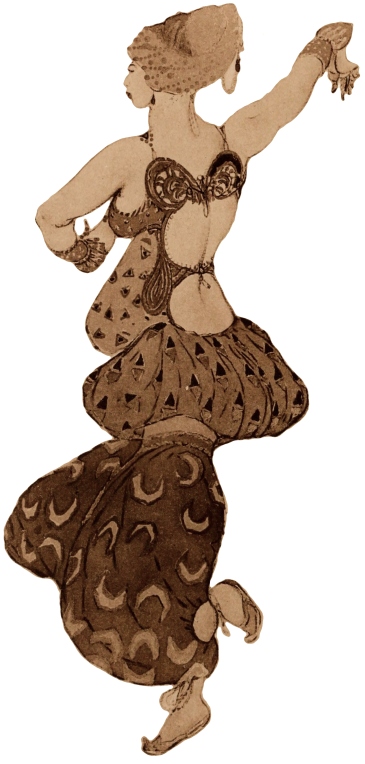
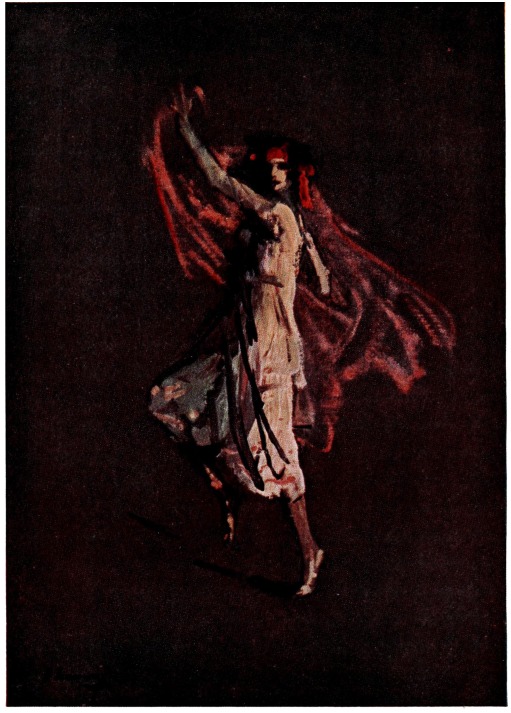
Odalisque in ‘Scheherazade’ (Russian Ballet)
Design by Léon Bakst
THE ART OF MUSIC: VOLUME TEN
Department Editor: IVAN NARODNY
Introduction by
ANNA PAVLOWA Ballerina, Imperial Russian Ballet
NEW YORK
THE NATIONAL SOCIETY OF MUSIC
Copyright, 1916, by
THE NATIONAL SOCIETY OF MUSIC, Inc.
[All Rights Reserved]
INTRODUCTION
‘The gods themselves danced, as the stars dance in
the sky,’ is a saying of the ancient Mexicans. ‘To
dance is to take part in the cosmic control of the
world,’ said the ancient Greek philosophers. ‘What
do you dance?’ asks the African Bantu of a member of
another tribe after his greeting. Livingston said that
when an African wild man danced, that was his religion.
It is said that the savages do not preach their
religion but dance it. According to the Bible, the
ancient Hebrews danced before their Ark of the Covenant.
St. Basil describes the angels dancing in Heaven.
According to Dante, dancing is the real occupation of
the inmates of Heaven, Christ acting as the leader of a
celestial ballet. ‘Dancing,’ said Lucian, ‘is as old as
love.’ Dance had a sacred and mystic meaning to the
early Christians upon whom the Bible had made a deep
impression: ‘We have piped unto you and ye have
not danced.’
The service of the Greek Church—even to-day—is
for the most part only a kind of sacred dance, accompanied
by chants and singing. The priest, walking and
gesturing with an incense-pan up and down before the
numerous ikons, kneeling, bowing to the saints, performing
queer cabalistic figures with his hands in the
air, and following always a certain rhythm, is essentially
a dancer. It is said that dancing of a similar kind
was performed in the English cathedrals until the fourteenth
century. In France the priests danced in the
choir at the Easter Mass up to the seventh century.
In Spain similar religious dancing took deepest root
and flourished longest. In the Cathedrals of Seville,
Toledo, Valencia and Xeres the dancing survives and
is the feature at a few special festivals.
‘The American Indian tribes seem to have had their
own religious dances, varied and elaborate, often with
a richness of meaning which the patient study of the
modern investigators has but slowly revealed,’ writes
Havelock Ellis. It is a well-known fact that dancing
in ancient Egypt and Greece was an art that was
practiced in their temples. ‘A good education,’ wrote
Plato, ‘consists in knowing how to sing well and how
to dance well.’ According to Plutarch, Helen of Sparta
was practicing the Dance of Innocence in the Temple of
Artemis when she was surprised and carried away by
Theseus. We are told by Greek classics that young
maidens performed dances before the altars of various
goddesses, consisting of ‘grave steps and graceful, modest
attitudes belonging to that order of choric movement
called emmeleia.’ The ancient Egyptian Astronomic
Dance can be considered the sublimest of all
dances; here, by regulated figures, steps, and movements,
the order and harmonious motion of the celestial
bodies was represented to the music of the flute,
lyre and syrinx. Plato alludes to this dance as ‘a divine
institution.’
In spite of the high status of dancing in the ancient
civilizations, it has not progressed steadily, as have the
other arts. It has remained the least systematized and
least respected of arts, generally considered as lacking
in seriousness of intention, fitness to express grave emotions,
and power to touch the heights and depths of
the intellect. Being an art that expresses itself first
in the human body, the dance has aroused reprobation
in certain pious, puritanical minds of mediæval type,
who have considered it a collection of ‘immodest and
dissolute movements by which the cupidity of the flesh
is aroused.’ It is this particular view that has damned
dance with bell, book and candle. The main reason
for this has been the hostile attitude of the church to
all folk-arts which manifested a more or less conspicuous
ethnographic individuality—that is, were stamped
as of Pagan and not Christian origin. All folk-dancing,
broadly speaking, is a natural form of æsthetic courtship.
The male intends to win the female by his beauty,
grace and vigor, or vice versa. From the point of view
of sexual selection we can understand, on the one hand,
the immense ardor with which every sensuous part of
the human body has been brought into the play of the
dance, and, on the other, the arguments of the pseudo-moralists
to classify it with the frivolous and least
tolerated arts.
The stamp of frivolity, put upon the dance by the
Christian clergy, has retarded its natural development
for several centuries. Italy and Germany, having been
the cradles of all modern music and stage arts, have
given little inspiration to a systematic development of
the art of dancing. The seventeenth, eighteenth and
nineteenth centuries, that have meant so much to the
perfection of the opera, vocal and orchestra technique,
gave nothing of any significance to choreography. The
church that tolerated Bach, Paësiello, Haydn, Mozart
and Beethoven, put an open ban upon everything that
had any relation to the dance. The great musical
classics of the past centuries have treated dance as an
insignificant side issue, thereby putting a label of inferiority
upon this loftiest of arts. All the dance music
of the great classics sounds naïve and lacking in choreographic
images. Yet dance and music are like light
and shadow, each depending upon the other. As canvas
is to a painter, so is music to a dancer the essential
element upon which he can draw his picture. The fact
that the art of dancing has not evolved into its normal
state of equality with the other arts, is wholly due to
the lack of musical leadership. Neither the reforms of
Noverre nor those of Fokine nor Marius Petipa can be
of fundamental value if they lack the phonetic designs
which alone a choreographic artist can transform into
plastic events. Essentially, and æsthetically speaking,
dancing should be the elemental expression alike of
symbolic religion and love, as it used to be from the
earliest human times.
Dancing and architecture are the two primary and
plastic arts: the one in Time, the other in Space; the
one expressing the soul directly through the medium
of the human body, the other giving only an outline of
the soul through the medium of fossilized forms. The
origin of these two arts is earlier than man himself.
Both require mathematics, the one rhythmically, the
other symmetrically. For dancing the mathematical
forms are to be found in music, for architecture, in
geometry. ‘The significance of dancing, in the wide
sense, thus lies in the fact that it is simply an intimate
concrete appeal of that general rhythm which marks
all the physical and spiritual manifestations of life,’
writes Havelock Ellis. ‘The art of dancing moreover
is intimately entwined with all human traditions of
war, of labor, of pleasure, of education, while some of
the wisest philosophers and ancient civilizations have
regarded the dance as the pattern in accordance with
which the moral life of man must be woven. To realize
therefore what dance means for mankind—the poignancy
and the many-sidedness of its appeal—we must
survey the whole sweep of human life, both at its highest
and at its deepest moments.’
Æsthetic basis of the dance; national character expressed in dances; ‘survival value’ of dancing; primitive dance and sexual selection; professionalism in dancing—Music and the dance; religion and the dance; historic analysis of folk-dancing and ballet.
Earliest Egyptian records of dancing; hieroglyphic evidence; the Astral dance; Egyptian court and temple rituals; festival of the Sacred Bull—Music of the Egyptian dances; Egyptian dance technique; points of similarity between Egyptian and modern dancing; Hawasis and Almeiis; the Graveyard Dance; modern imitations.
Lack of art sense among the Hindoos; dancing and the Brahmin religion; the Apsarazases, Bayaderes and Devadazis; Hindoo music and the dance; dancing in modern India; Fakir dances; philosophic symbolism of the Indian dance.
IV.
Dances of the Chinese, the Japanese and the American Indians
Influence of the Chinese moral teachings; general characteristics of Chinese dancing; court and social dances of ancient China; Yu-Vang’s ‘historical ballet’; modern Chinese dancing; dancing Mandarins; modern imitations; the Lantern Festival—Japan: the legend of Amaterasu; emotional variety of the Japanese dance; pantomime and mimicry; general characteristics and classification of Japanese dances—The American Indians: The Dream dance; the Ghost dance; the Snake dance.
Biblical allusions; sacred dances; the Salome episode and its modern influence—The Arabs; Moorish florescence in the Middle Ages; characteristics of the Moorish dances; the dance in daily life; the harem, the Dance of Greeting; pictorial quality of the Arab dances.
Homeric testimony; importance of the dance in Greek life; Xenophon’s description; Greek religion and the dance; Terpsichore—Dancing of youths, educational value; Greek dance music; Hyporchema and Saltation; Gymnopœdia; the Pyrrhic dance; the Dipoda and the Babasis; the Emmeleia; The Cordax; the Hormos—Greek theatres; comparison of periods; the Eleusinian mysteries; the Dionysian mysteries; the Heteræ; technique.
Æsthetic subservience to Greece; Pylades and Bathyllus; the Bellicrepa saltatio; the Ludiones; the Roman pantomime; the Lupercalia and Floralia; Bacchantic orgies; the Augustinian age; importations from Cadiz; famous dancers.
The mediæval eclipse; ecclesiastical dancing in Spain; the strolling ballets of Spain and Italy; suppression of dancing by the church; dances of the mediæval nobility; Renaissance court ballets; the English masques; famous masques of the seventeenth century.
Louis XIV and the ballet; the Pavane and the Courante; reforms under Louis XV; Noverre and the ballet d’action; Auguste Vestris and others; famous ballets of the period—the Revolution and the Consulate; the French technique, the foundation of ‘choreographic grammar’; the ‘five positions’; the ballet steps—Famous danseuses; Sallé, Camargo; Madeleine Guimard; Allard.
The rise of nationalism—The Spanish folk-dances: the Fandango; the Jota; the Bolero; the Seguidilla; other Spanish folk-dances; general characteristics; costumes—England: the Morris dance; the Country dance; the Sword dance; the Horn dance—Scotland: Scotch Reel, Hornpipe, etc.—Ireland: the Jig; British social dances—France: Rondo, Bourrée and Farandole—Italy: the Tarantella, etc.—Hungary: the Czardas, Szolo and related dances; the Esthonians—Germany: the Fackeltanz, etc.—Finland; Scandinavia and Holland—The Lithuanians, Poles and Southern Slavs; the Roumanians and Armenians—The Russians: ballad dances; the Kasatchy and Kamarienskaya; conclusion.
The Danish ballet and Boumoville’s reform; Lucile Grahn, Augusta Nielsen, etc.—Mrs. Elna Jörgen-Jensen; Adeline Genée; the mission of the Danish ballet.
Nationalism of the Russian ballet; pedagogic principles of the Russian school; French and Russian schools compared—Begutcheff and Ostrowsky; history of the Russian ballet—Didelot and the Imperial ballet school; Petipa and his reforms—Tschaikowsky’s ‘Snow-Maiden’ and other ballets; Pavlowa and other famous ballerinas; Mordkin; Volinin, Kyasht, Lopokova.
The ‘return to nature’; Isadora Duncan—Duncan’s influence: Maud Allan; Duncan’s German followers—Modern music and the dance; the Russian naturalists; Glière’s ‘Chrisis’—Pictorial nationalism: Ruth St. Denis—Modern Spanish dancers; ramifications of the naturalistic idea.
The old ballet arguments pro and con—The new movement: Diaghileff and Fokine; the advent of Diaghileff’s company; the ballets of Diaghileff’s company; ‘Spectre of the Rose,’ ‘Cleopatra,’ Le Pavilion d’Armide, ‘Scheherezade’—Nijinsky and Karsavina—Stravinsky’s ballets: ‘Petrouchka,’ ‘The Fire-Bird,’ etc.; other ballets and arrangements.
Jacques-Dalcroze and his creed; essentials of the ‘Eurhythmic’ system—Body-rhythm; the plastic expression of musical ideas; merits and shortcomings of the Dalcroze system—Speculation on the value of Eurhythmics to the dance.
The defects of the new Russian and other modern schools; the new ideals; Prince Volkhonsky’s theories—Lada and choreographic symbolism—The question of appropriate music.
Æsthetic basis of the dance; national character expressed in dances;
‘survival value’ of dancing; primitive dance and sexual selection; professionalism
in dancing—Music and the dance; religion and the dance;
historic analysis of folk-dancing and ballet.
Every true art is a direct and immediate act of life.
As in music and dancing, so in life, rhythm is the skeleton
of tone and movement and also the basis of existence.
We breathe rhythmically and our heart beats
rhythmically. We walk, laugh and weep rhythmically.
Rhythm is the only frame to the moving material of
the visuo-audible art. What except rhythm can unite
living men in order to convert them from a chaotically
moving crowd into a work of art? It was undoubtedly
the innate feeling for rhythm that actuated the primitive
man to dance. All existing races show a strong
tendency to dance, as well in their primitive as in
the more or less civilized state. The plastic forms of
the human body lend themselves more to an æsthetic
expression that contains architecture, sculpture, painting,
poetry, drama and music, than anything else in
creation. The mimic expressions of the face, the agility
of the steps, the grace of gestures and poses are all
natural means which a man can employ in his dance.
The symmetric lines of the body that are produced after
the melodic patterns of the music form the æsthetic
basis of the art of dancing. The ability to give a living
meaning to these lines is what makes a dance beautiful
and divine. Although frequently the beauty of a line
and movement can be observed in animals and birds,
yet there it is an unconscious act, lacking in that individual
and subjective feeling that we call inspiration.
The foremost element in every dance is—the step.
Step is also, practically speaking, the first movement of
life. In consequence of pure physical laws each step
requires a new impulse and thus divides it into two
periods: motion and repose. The continuance of these
two rhythmic periods produces the feeling of symmetry
and joy, which in its turn creates the various combined
movements that again are divided into various sub-motions
and partial measures. The development of
steps in a dance is based on two principles: the movement
of the feet, and the combined movement of the
body and hands for grace or mimicry. Consequently
dance is nothing but a chain of bodily movements that
are subjected to a certain musical rhythm and follow
the emotional expressions of the dancer. According to
an innate principle dance, like speech, was practiced
by the primitive races as a medium of the most vital
expressions. By means of a dance the savages express
their joy, sorrow, anger, tenderness and love. Dance
has its peculiar psychology, which varies according to
racial temperament, climate and other conditions. This
is best illustrated in the various styles of the folk-dance.
To the vigorous races of Northern Europe
in their cold and damp climate dancing became naturally
a function of the legs. The Scandinavian and Finnish
folk-dances betray more heavy and massive motion,
while those of Spain, Hungary and Italy or France
give an impression of romantic grace, coquettish agility
and fire. The folk-dances of the Cossacks are usually
violent and acrobatic, as is their life. Energy or
dreaminess, fire or coolness, and a multitude of other
racial qualities assert themselves automatically in a
folk-dance. The list of forces that make and preserve
a nation’s dances is incomplete without the addition of
the powerful element of national pride, weakness or
other peculiarities. On the contrary, in the Far East, in
Japan, Java, China, etc., dancing is exclusively a motion
of the hands and fingers alone. In ancient Rome
dancing was predominantly the rhythmic motion of
the body, with vibratory or rotatory movements of
breast or flanks. The Stomach Dance of the Arabians
betrays the wild passion of a nomadic desert race.
According to Louis Robinson, dancing is an innate
instinct that has an indirect bearing upon the existence
of the human race. Robinson argues that throughout
Nature instincts, like the organs of our bodies, are the
product of the strict laws of evolution, and have been
built up to meet some need. At some critical time
in the past they had a certain survival value—i. e., they
were capable of determining in the struggle for existence
which individuals or tribes should go under and
which should survive. This principle can be taken as
one of the axioms which must be our pilots in every
attempt to account for the faculties which each of us
brings into the world, as distinct from those acquired
in the life of the individual.
Practically every savage people has elaborate dances
and spends a good deal of time in such exercises.
Among adults dancing takes the place of the play of
children. When we come to analyze the play of all
young creatures from the historical standpoint we find
it forms part of an elaborate natural system of physical
training. The perpetual motion of the kitten while it
is awake is obviously a training for those accomplishments
which in later life mean a livelihood. Such astonishing
skill and agility as are shown by the cats in
securing prey cannot be attained by any ready-made
machinery like that of the dragon-fly or the mantis:
they must be built up and manufactured. Herein the
nervous mechanism of the mammalia has prevailed
over the limited mechanical perfection of lower things
such as reptiles, fish, and insects. Most of them can
do some one thing or other supremely well, but the
mammalia, with their better nervous system and receptive
brains, can excel in many things. We, with our
greater gifts of the same sort, are the most versatile and
teachable of all; hence we prevail over the rest of
creation. The kitten, the puppy, and the young savage,
by their continual restless and organized activity, gain
great advantage in certain movements necessary in
after life, and foster the growth of the particular muscles
which later on will be absolutely requisite in the
serious business of holding their place in the world.
Obviously such instincts would become out of date and
inappropriate should the general manner of living undergo
a complete change. Hence we find that much
of the play of young children in civilized lands has little
or no reference to the serious life which comes afterwards.
Such instincts, however, were developed during
or before the long stretch of time of the Stone
Age, when all men played hide and seek, and chased
one another, and threw things, and ran, and jumped,
and wrestled for exactly the same reason that makes us
scan commercial articles, attend markets, and work in
our studies or offices. What is observable in any nursery
or playground affords a good illustration of the
persistence of instincts long after the need which
created them has passed away. For some reason the
play instinct in most creatures tends to lapse at the
time of full bodily maturity. It does not cease entirely,
but apparently it no longer suffices as an incentive for
the battle of life.
Man in the savage state is naturally lazy and does
not like to exert himself when food comes easily. When
no urgent need or human authority is pushing him,
he prefers to eat to repletion and then to lie in the sun
or loaf. We even find this primitive habit cropping
up in strenuous lands where the stimulus of moral
education and competition has been at work for generations.
We are all aware that, when we are lazy for any
length of time, we get slack and soft. The primitive
savage who lives by hunting and is in continual danger
of raids from his neighbors, cannot afford to get slack.
He must keep himself fit every day of life. How was
this to be managed by our prehistoric forefathers when
there was no fighting, with the weather soft, and a
delicious fish easily to be caught quite near the dwelling?
It is pretty safe to say that, owing to the want of
condition—if they were not dancing tribes—they did
not leave descendants which are among us in the
twentieth century.
It seems strange how readily a group of negroes who
are apparently exhausted after a long day’s work will
join in dance with their fellows, and how, when not
very tired, they will in their laziest moments spring up
and take vigorous exercise of this kind. Every doctor
will tell you that there are plenty of women to-day who
have not the strength nor the energy to do any work or
to walk a couple of miles, but who will dance from
evening till morning without showing any great fatigue.
Among such Pagans as the Zulus and Masai, who organize
themselves for war almost as well as has ever
been done by the most civilized Christians, there is
practically no distinction between military exercises
and dancing. This is proof enough to show that dancing
had a survival value throughout the long stretch
of the Stone Age. Dancing taught primitive men to
move in compact bodies without confusion, and
especially without getting so bunched together that they
could not use their weapons.
To-day the true war-dance only persists among us
in the form of military marchings, but the other primitive
dances have left numerous descendants of all kinds
and degrees, down to the modern tango. Among these
non-military dances the survival value, apart from the
healthy exercise which they provided and their general
disciplinary effects, worked through the agency of sexual
selection.
In the case of the primitive dances the working of
sexual selection was beneficial as conducive to racial
fitness. The dances in which women took part gave
opportunity for appraisement of exactly the kind
needed for a sound choice of mates under savage conditions.
It afforded the chance, so lacking in our present
civilization, of advertising any admirable qualities
which might be possessed. It was a test not only of
physical grace and perfection, but of activity, taste and
temper. It contributed to honest matrimonial dealing—especially
when danced in the approved ballroom
costumes of savage times.
There have been many discussions as to why clothes
were first worn—whether for ornament, warmth, or
decency—but one may fairly say without any doubt
whatever that, from the first ages until now, dance
clothing has been mainly decorative. Here we find an
ethical justification of matters connected with dancing
dress, which has often provoked severe criticism among
puritans. Without a doubt from the earliest times until
now the dance has been a chief purifying agent in
the marriage market—has played the part, in fact, of
those market inspectors appointed to guard against
adulteration.
It is a most extraordinary thing, when we come to
consider man’s place in Nature, that he ever began to
dance. Not that dancing is uncommon in Nature; many
birds, especially those of the crane tribe, execute elaborate
dances during their season of courtship, and as
a mere pastime when they have nothing else to do.
Few, if any, of the mammalia appear to indulge in organized
dances, unless we give such a name to the frisking
of young lambs and the prancing evolutions of
horses and antelopes. Assuredly, in our direct line of
descent nothing of the kind could have existed as far
back as our knowledge and imagination will carry us.
You cannot very well dance in the trees, which, according
to Darwin, were the real nurseries of our species;
and when you come down to solid earth your weak
prehensile lower members would only make you ridiculous
and contemptible if they attempted any performance
of the kind.
Mother Nature, however, is a dame of infinite varieties,
and seems continually to be trying the most bizarre
experiments apparently without the least prompting or
justification. The products of these experiments are
called ‘sports,’ and there seems no limit to their possibilities.
Chimpanzees delight in thumping hollow trees
and knocking pieces of wood together, while it is said
that the gorilla waddles to war to the sound of the
drum, improvising a substitute by beating his hands
against his brawny chest.
In the Western world professionalism in dancing has
happily not had the blighting effect on the pursuit that
it seems to have had on some other forms of pastime.
But if we go to the East we find that practically all
other forms of dancing have ceased to exist. We see
the effect of this tendency most fully developed in
China, where the recreative dancing of European society
seems to be quite beyond the comprehension of
a well-bred Chinese, who naïvely asks the question:
‘Why do you not pay people to dance for you?’
Stage dancing seems to be an interesting instance of
the degeneration into pure luxury or something which
was at one time a helpful influence to the race. This
is a tendency observable in many phases of life when
the pressure of evolutionary forces is somewhat relaxed.
Most of the luxuries pertain to matters which
at one time had a survival value, and it cannot be said
that they have retired from among the evolutionary
forces even to-day; but their effect, if still beneficial to
the race, lies in aiding Nature to eliminate the unfit.
From the earliest times on dancing has been dependent
upon music of some kind. The question
whether music is older than dancing has not been
answered satisfactorily by academic anthropologists
yet. However, all scholars agree that the appearance of
these two arts must have been more or less simultaneous,
the one influencing the other. But undoubtedly
the first dance music was not instrumental but vocal.
The savages to-day dance most of their sexual dances
to rhythmic recitation of certain words. Music is in
every phase of evolution the only true essence of that
which forms the subject of the dance.
To the transformation of more or less primitive
folk-dances into those of strictly religious character is
due the principal idea of the modern ballet. In the
Oriental temples dancing underwent a strange transformation.
While dancing was made the basis of dramatic
and symbolic ideas, yet this very fact became
detrimental to the musical influence upon the choreography.
The Egyptians, whom we consider the
pioneers in religious dances, originated elaborate temple
ballets, which were based more upon a dramatic
than a musical theme. Though the tradition speaks of
rounds, of symbolic and sidereal motions, and the instruments
chiefly employed, as the Egyptian guitar,
used both by men and women, the single and double
pipe, the harp, lyre, and flute, yet essentially this all
resembled a pantomime rather than actual dance.
It is very likely that all the ancient sacred dances
originated with the subconscious idea of counteracting
the sensuous or strictly playful influence of the social
dances. The whole pedigree of our Western religions
seems to show a remarkable absence of this method of
encouraging religious feeling. The reasons why such
manifestations were discouraged by Jewish and Christian
moralists pertains to physiology rather than theology.
As already said, man’s nature is compounded of
many diverse elements, and the machinery of emotion
at present at work within us dates back to our animal
past. Our most refined and exalted feelings spring from
the same nervous reservoirs and pass through the very
channels which were at one time solely occupied by
grosser passions. The Egyptian church that grew
directly of the folk-art of the country was a stranger
to Greece and Rome, and still more so to our Christian
religion. The ethical ideals that actuated the Egyptian
priests in introducing dancing at the altar, sprang directly
from the soil and meant, in bringing the better
part of human nature to the top, to act as a kind of
separator. The priests discovered that the higher emotions,
with the help of sacred dancing, can be put to
excellent service as impulses to improved conduct.
The Christian missionaries, coming from the East,
found nothing elevating and ennobling in our Western
dancing, which did not appeal to them on account of
the very differences of the style and racial character.
It is due to their opposition that the religious dances
have faded out under the Western civilization. The
warfare against dancing generally, on the part of the
Apostles of Christianity, dates back to the fanatic era
of theological and nationalistic differences. In all countries
where the religion descends directly from a racial
folk-lore, dancing has remained in high esteem at home
and in the temples. This we find true in Egypt, Greece,
India and China. In the Jewish form of worship there
seems to have been no formally recognized dancing,
although we have records of several displays of this
kind, as in the case of King David, when, ‘clothed in
a linen ephod, he danced before the Ark of the Lord
with all his might.’
In Greece, cradle of the arts, the Muses manifested
themselves to man as a dancing choir, led by Terpsichore.
The Romans imitated the Greeks in all their
arts and imported with the Greek slaves Greek dances.
But Rome was too barbaric to appreciate the full value
of Greece’s poetic arts. The solemn religious dance
instituted by Numa and practiced by the Salian priests
soon degenerated into ceremonial march that was abolished
when Rome became Christian, through a papal
decree in 744. Darkness of night fell on the development
of secular and religious dancing, a darkness that
endured for centuries. The influence of the Nile in
Egypt and Cadiz in Spain, which for centuries had
been the two great centres of the ancient dancing and
supplied their dancers to the Roman potentates, faded
out slowly in the history of European nations. The
folk-dances were labelled as low and undignified
amusements of Pagan peasants. Dance in every form
remained an outcast, despised and condemned until the
court circles of Italy and France distorted it to an
amusement at domestic gatherings and masquerades.
It is said that the modern ballet had its origin in the
spectacular masquerades arranged for the marriage of
Galeazzo, Visconti, Duke of Milan, in 1489. The impression
of this performance spread to the Court of
Florence. Catherine de Medici, the Queen of France,
brought the Italian court pantomime to Paris, where
the French kings and queens grew to admire dancing
and took actual part in it. The attempts of Noverre to
elevate the art of dancing to what it had been in ancient
Egypt and Greece, were successful only externally.
Music, the soul of dancing in the modern sense, was
lacking, and without this soul the art of plastic form
is incomplete. Though the Russian reformers elevated
dancing from a domestic amusement to a serious and
lofty stage art, they did not succeed wholly in giving
to it the foundation that it deserves among the other
arts. All the past and living goddesses of choreography
have not had the freedom, the phonetic means and
dramatic threads to thrill their audiences as they
would, if man had not distorted and hidden the natural
meaning of the dance that inspired his barbaric ancestors.
The philosophical conclusion of our historic analysis
of dance leads back to the same axioms that actuated
the savage in his practice of agility: the sexual selection
and primitive sport, both necessary for evolution
and the existence of the race. However, there is neither
sexual motive nor instinct for ‘physical culture’ in the
‘Heavenly Alchemy’ of evolution that has created the
poetic movements of Taglioni and her successors. The
ancient racial propensities have developed into more
spiritual ideas. Like the tendency of evolution generally,
to universalize an individual and individualize the
universe, so in dance the racial characteristics are
transformed into cosmic motives. In this stage beauty
becomes symbolic and concrete emotions take on a
more and more abstract form. The survival value of
the greatest art of the dance lies in ennobling the intellect
and soul, which has necessarily an indirect bearing
upon the physical. Ultimately this means perfection of
the whole human organism. It inspires the mind and
influences the body.
Civilization has brought humanity to a state where
the physical needs depend upon the psychical. We
have devised a more complicated form of sexual selection
and more complicated means of existence than the
primitive dances employed in our animal past. Beauty
in the long course of evolution has grown more spiritual,
accordingly dancing as an art has become an evolutionary
medium of the intellect.
CHAPTER II DANCING IN ANCIENT EGYPT — I — II
Earliest Egyptian records of dancing; hieroglyphic evidence; the
Astral dance; Egyptian court and temple rituals; festival of the Sacred
Bull—Music of the Egyptian dances; Egyptian dance technique; points of
similarity between Egyptian and modern dancing; Hawasis and Almeiis;
the Graveyard dance; modern imitations.
Long before the rest of the world had emerged from
barbarism Egypt had reached a high state of civilization.
But the history of Egyptian civilization was hidden
behind a curtain of mysteries, until the key to the
hieroglyphs was discovered. Then, the imposing pyramids
opened suddenly their sealed lips and the world
stood aghast at their revelations. The ruins of Memphis
and Thebes became books of interesting reading.
The discovered inscriptions and papyri revealed the
high state of development that the dance had reached
in the ancient Egyptian temples. The first dancing in
Egyptian history is recorded by Manetho, the priest of
Heliopolis who lived in 5004 B. C.,—which is approximately
one thousand years before the creation of
the world, according to Biblical chronology. Plato
alludes to Egyptian art and dancing performed ten
thousand years before his time. Schliemann, the great
archeologist, maintained that the history of Egypt was
written in various dance-phases, as can be seen from
the inscriptions of their ancient sarcophagi and pyramids.
Scarce as are the hieroglyphic materials, nevertheless
they reveal to us that the Egyptians, during the
reign of the Pharaohs, highly admired the art of dancing.
Most of the Egyptian documents or inscriptions
begin with dancing figures. These figures are to be
found in the most ancient records, which proves that
dancing must have been known as an art to the Egyptians
not for hundreds but for thousands of years.
Herodotus, ‘the father of history,’ tells us that the
dances performed to Osiris were as elaborate as the
music of a hundred instruments and a chorus of three
hundred singers. According to Diodorus, Hermes gave
to mankind the first laws of eurhythmics. ‘Hermes
taught the Egyptians the art of graceful body movements.’
A fragmentary inscription of a sarcophagus in
the Museum of Petrograd describes that Maneros, ‘who
conquered so many nations, did this not by means
of torch and sword but by teaching the divine art of
music and dancing.’ The ancient Egyptian legend
surrounds Maneros with nine dancing Muses, which the
Greeks probably copied from Egypt later. Music and
dancing were employed by the Egyptians at home, in
social festivals, on the occasion of marriage, birth and
death, and in the temples. Their folk-dances were as
gay and fiery as the temperament of the race. This is
best illustrated in the recently discovered frescoes of
peasants dancing, evidently after their daily work in
the fields.
Being worshippers of all the celestial bodies, the
Egyptians practiced in their temples certain astronomical
ballets. It is said that Hermes, the inventor of
the lyre, produced from his instrument as many tones
as there were stars in the sky. The three strings of his
lyre meant Winter, Summer and Spring. This gives
an idea to what an extent astronomy and nature figured
in all their dancing and music. The Astral Dance was
an imitation of the movement of the various constellations.
In this their imagination knew no limit. The
altar, around which most of the astral dances were
performed, represented the sun. According to the descriptions
of Plutarch, the dancers made with their
hands the signs of the zodiac in the air, while dancing
rhythmically from the east to the west, in imitation of
the movement of various planets. After every circle
the dancers stopped for a few moments as if petrified,
which was meant to represent the immovability of the
earth. By means of combined gestures and mimic expressions,
the priests gave intelligible pantomimic stories
of the astral system and the harmony of eternal
motion. Lucian called this one of the most divine
inventions.
It is a pity that all the hieroglyphic records known
to us do not give any adequate explanation of the
ancient Egyptian Astral Dance. The descriptions left
by Greek writers are too general and are frequently
incorrect. Various scholars have made efforts to discover
the mystic meaning of the dance of the ‘Seven
Moving Planets,’ but in vain. How much the idea of
an astral dance has impressed the European ballet-masters
is proved in that Dauberval and Gardel produced
in the eighteenth century ballets of this character.
However, in this case the performers were not
priests but fantastically dressed ballet dancers who,
representing various stars and planets, jumped and
turned around the prima ballerina, who represented the
sun.
To what an extent the love of pantomime and dancing
prevailed in Egypt can be judged from the recently
made decipherings by Setche of the inscriptions of the
sarcophagus of a prime minister which describes the
code of an elaborate court ritual. The inscription tells
how a newly-appointed minister should meet his ruler.
He should enter the imperial hall, dancing so that from
his gestures, poses and miming could be read devotion,
loyalty, chivalry, grace, tenderness, vigor and
energy. Pharaoh, in his turn, would meet the minister
with a different sort of dance. The reception would
end with the joining of all the court functionaries,
musicians and priests in a great procession.
The Egyptian clergy exercised a great influence upon
the people. Imitating the court of the Pharaohs, they
surrounded the religious rituals with unnecessary secrets.
The more mysterious they made the ceremonies
the more they impressed the people. In consequence of
such an attitude on the part of the clergy, a large majority
of religious dances grew so complicated in their
symbolic details that they degenerated into nonsense.
A large number of the Egyptian sacred dances were
based on the cult of Isis and Osiris, the one a feminine,
the other a masculine divinity. This gave the fundamental
idea of maintaining a large number of the
so-called ‘sacred’ courtesans, who took an active part
in most of the temple dances. Herodotus tells us
that the presence of these ‘sacred’ courtesans in the
Egyptian temple ceremonies during the last Dynasties
is responsible for the downfall of this ancient civilization.
Most of the Egyptian temple dances were performed
by men and women alike. On the other hand, there
existed special feminine and strictly masculine ballets.
Of the feminine dances, the most known is the dance
which was performed during the celebrated sacrificial
festival of the sacred bull Apis. After the black bull
on whose back grew naturally the figure of a white
eagle was found, forty temple maidens were selected
to feed it forty days on the shores of the Nile.
All this time the maidens had to practice the great ballet
that they were to perform thereafter. The Festival
of the Sacred Bull was opened with a solemn dance
of the priests in the temple of Osiris at Memphis. Then
the bull was carried through the city by the maidens
in a spectacular procession, accompanied by singing
and dancing. When the bull was brought before the
huge statue of Osiris the real ballet was performed by
priests and maidens together. The ballet, which lasted
for half a day, was opened with a slow introduction in
march form. In this the dancers personified the birth
process of divinities, particularly of Osiris. In the second
movement, which probably resembled a modern
allegro energico, were depicted the youth and romantic
adventures of Osiris with the goddess Isis. Priests in
fantastic costumes represented Osiris and his warriors,
while the maidens played the rôle of Isis and her companions.
The last movement of the ballet closed with
a festival finale, which meant the victory of Osiris in
conquering India. When the sacred bull was drowned
in the Nile a violent funeral ballet was performed by
the priests. As the recently discovered bas-reliefs illustrate,
the dancing priests wore costumes consisting of
a yellow tunic and round caps.
While some of the Egyptologues maintain that dancing
was performed only on special occasions such as
the above, others are of the opinion that every Egyptian
temple service contained some kind of dance.
However, the hieroglyphic inscriptions of various
periods prove that there were hundreds of different
temple dances. Of particular interest is the recently
discovered ‘Dance of Four Dimensions,’ which was
performed in the temple of Isis. In this both priests
and priestesses participated. It differed from the other
dances in that the dancers carried along their musical
instruments.
Since the art of dancing had reached such a high
degree of culture in Egypt it is evident that the people
must have possessed a highly developed form of music.
Though musical history denies the fact that harmony
was known to the ancient civilization, yet the recent
archeologic discoveries and hieroglyphic decipherings
speak eloquently of the use of various instruments in
a kind of orchestra, and there are frequent allusions
to temple choirs of a hundred and more singers. Dr.
Schliemann even believes that the Egyptians had their
specific musical notation which was still in use by the
Arabs when they came to Spain. It is only natural to
believe that an art of such a high standard was taught
in a school, as the technique that they evidence is the
result of long and systematic studies. ‘It is very likely,’
a Russian archeologist writes, ‘that the Egyptian academy
of music and dancing was connected with the
temple of Ammon.’
It is evident that the Egyptians knew practically
every choreographic rule and possessed a technique
which our most celebrated dancers have not yet
reached. Their mimic expressions are superb, as are
their eurhythmic gestures and poses. Since the temple
in Egypt united under its supreme patronage all the
arts, it is only natural that dancing and music knew
no other forms of expression, except the home. However,
the court of Pharaohs played a big rôle in stimulating
a secular style of dance, which the Greeks later
performed in a modified form on their stage. Various
inscriptions and sarcophagus bas-reliefs depict a corps
of several hundred dancers that was maintained by
the ruler. The Queen Cleopatra was so fond of dancing
that she herself gave performances in a specially constructed
hall, dimly lighted and richly decorated. Here
she danced nude to her guests behind numerous gauze
curtains, using constantly the effects of fused light produced
by different colored lanterns. She had a well
trained and beautiful voice and played masterfully on
various instruments. Also, in connection with her
dances, Cleopatra used heavy redolescent perfumes by
means of which she put her audience into a ‘passionate
trance.’
That the Egyptian dancers knew pirouettes, fouetté
pirouettes, arabesques, pas de cheval, and other modern
ballet tricks 5,000 years ago is proven by the dancing
figures that can be seen at the sarcophagi at Beni
Hassan. These figures illustrating ballet corps are
usual. A common style of Egyptian dancing was the
peculiar reverse movement of the two dancers which
reached a rhythmic perfection, particularly in dances
where many participated, that is absolutely unknown
to our choreographic artists. Some dances show great
architectural beauty in their pyramidic combinations.
The use of the hands at the same time with the use of
the legs is evidently more in keeping with a certain
style and harmony of line, than that employed by our
ballet or classic dancers.
There is in the Egyptian gallery of the British Museum
a wall painting taken from a tomb at Thebes.
The painting is supposed to have been executed during
the eighteenth or nineteenth dynasty, and in it are
depicted two dancing girls facing in opposite directions.
There is plenty of action and agility depicted
in these figures. In one the hands are raised high above
the head; in the other they are lowered. One female
not dancing is represented playing a double pipe, and
others are clapping their hands. The accompanists are
dressed, but the dancers wear only a gauze tunic.
All Egyptian professional dancers are represented
either nude or very slightly dressed and the performances
were given by the people of highest respectability.
All Egyptologues are of the opinion that the outline
of the transparent robe worn by these dancing girls
may, in certain instances, have become effaced; but
others say that it is certain they danced naked, as their
successors, the Almeiis, do. The view of Sir Gardner
Wilkinson that the Egyptians forbade the higher classes
to learn dancing as an amusement or profession, because
they dreaded the excitement resulting from such
an occupation, the excess of which ruffled and discomposed
the mind, contradicts the opinions of other scholars
on the same subject. We read in the Bible that
after the Israelites had safely accomplished the passage
across the Red Sea, Miriam, the sister of Moses and
Aaron, herself a prophetess, took a tambourine in her
hand, and danced with other women to celebrate the
overthrow of their late task-masters. There are other
instances in the Bible which tend to show that among
the Jews, who were reared on Egyptian civilization,
it was customary for people of the most exalted rank
to dance. There is a reproduction of Amenophis II.
from one of the oldest tombs of Thebes that goes to
show that Egyptians of all classes were highly proficient
in the art of dancing. Four upper class women
are represented as playing and dancing at the same
time, but their instruments are for the most part obliterated.
A fifth figure is resting on one knee, with
her hands crossed before her breast. The posing of
the heads in these figures is masterful. In another
painting from Beni Hassan, executed about three thousand
five hundred years ago, a dancer is represented
in the act of performing a pirouette in the extended
fourth position. The arms are fully outstretched, and
the general attitude of the figure is precisely what it
might be in executing a similar movement at the present
day. It is also noticeable that the angle formed
by the upper part of the foot and fore part of the leg
is obtuse, which is quite in accordance with modern
choreographic rules, while the natural inclination of
an inexperienced and untrained dancer when holding
the limb in such a position would be to bend the foot
towards the shin, or at least to keep it in its normal
position at right angles.
From many paintings and sculptures that have been
discovered, we may gather that the primary rules by
which the movements of the dancers are governed have
not altered since the time of the Pharaohs. The first
thing the Egyptian dancers were taught was evidently
to turn their toes outward and downward, and special
attention was paid to the positions of their arms, which
were gracefully extended and raised high, with the
hands almost joining above the head. In the small
tablet of Baken Amen representing the adoration of
Osiris, now in the British Museum, all arm positions of
the dancing figures are excellent. In one of the sculptures
from Thebes a figure is unmistakably performing
an entrechât. Other figures go to show that the Egyptians
employed frequently jetés, coupés, cabrioles, toe
and finger tricks. There are reproductions representing
dance figures for two performers, executing apparently
a kind of minuet. Between the dancers in each
figure are inscriptions which refer to the name of the
dance. Thus, for instance, one was called mek na snut,
or making a pirouette. This appears to have been a
movement in which the dancers turned each other
under the arms, as in the pas d’Allemande.
Besides the temple dances, Egypt had travelling ballet
companies, giving their performances in the open air
gardens of towns and villages. The nomadic Hawasis
whose profession to-day is chiefly dancing, are undoubtedly
barbarized descendants of the Hawasis that
entertained the Pharaohs with their passionate and
fiery social dances. Most of the Hawasi dances were
of a sensuous nature, performed exclusively by girls,
either naked or in light gauze dresses. The themes of
all these dances were often so distinctly feminine, depicting
the romantic nature of a woman so graphically,
that they were performed only as a part of wedding
ceremonies. In regard to this style of dance Sir
Gardner Wilkinson expresses the conviction ‘that there
is reason to believe that dances representing a continuous
action or argument of a story were in use
privately and were executed by ladies attached to the
harem or household.’
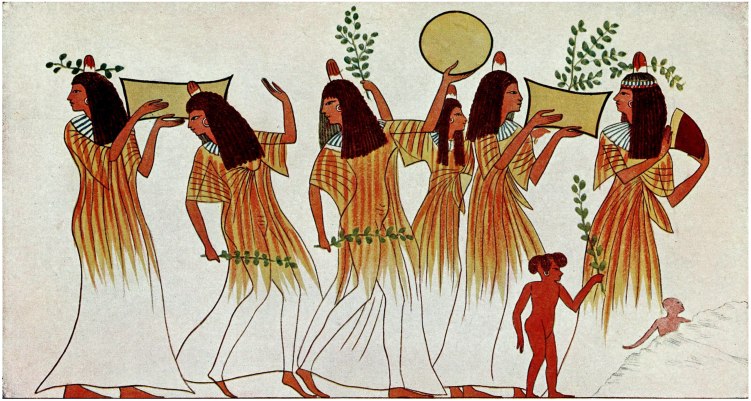
Egyptian women dancing with cymbals
From an ancient fresco (in the original colors)
Another secular class of Egyptian dances was that
performed by Almeiis. While the style and subject of
the Hawasi dances tended to express the sexual passions,
the Almeiis had learned to be ‘classic’ and scholarly.
The Almeiis of to-day maintain that they descend
directly from the dancing Pharaohs. The romantic
element in the Almeii dances remains within the limits
of a strict code of propriety. For that reason the dancing
Almeiis, like the clergy, enjoyed an immunity from
the common law. The Almeiis of to-day enjoy the same
ancient reputation throughout the East and are invited
by the Mohammedan chiefs to teach dancing to their
harems. They can be seen dancing in the Arabian
desert and in Tunis, Algiers, Tripoli and Morocco. But
their present-day dances lack the subtleties and technique
that their ancestors possessed five thousand years
ago. Their celebrated Sword and Stomach Dances
have degenerated into deplorable vaudeville shows.
Petipa, the celebrated Russian ballet master, has succeeded
in composing a brilliant ballet on the theme of
Almeii dances, called ‘The Daughter of the Pharaoh.’
However, excellent as the Russian ballet dancers are,
they have never performed it to the satisfaction of its
author.
One of the weird ancient Egyptian dances that has
survived and is practiced by several Oriental races, particularly
in Arabia, Persia and Sahara, is the Graveyard
Dance. It is known that the Almeiis used to perform
this dance at midnight on the graveyards of rich
Egyptians, frequently around the pyramids. Though
semi-religious, it did not belong to the classified sacred
dances performed under the supervision of the clergy.
Prof. Elisseieff thinks that this dance probably originated
in lower Egypt and belonged there to a recognized
temple ceremony, but the priests in upper Egypt failed
to recognize it, so the Almeiis monopolized it with great
advantage.
The Graveyard Dance performed in the East to-day
is wild, weird and ghastly. It is performed by women,
dressed in long robes, which cover even their heads.
It is danced on moonlight nights by professional Almeiis.
These are hired by the relatives or descendants
of the rich dead to accompany the wandering soul
until it reaches that sphere which belongs to it. There
is much strange symbolism and morbid beauty in the
Graveyard Dance. Just as weird as the dance is the
music, produced from pipes and drums, often accompanied
by hooting or sobbing voices. It begins in a
slow measure, the dancers marching like spectral shadows
in a circle around the musicians. Gradually the
music grows quicker, as does the dance. It ends in a
wild fury after which the dancers drop unconscious to
the ground.
The dances of the living Almeiis and Hawasis and
their imitators give little idea of the high art of dancing
that was practiced thousands of years ago in
ancient Egypt. The modern axis and stomach dances
that are practiced by the daughters of the various tribes
of the desert are crude acrobatic feats and vulgar degenerations
of the graceful and highly developed art
that has vanished with the whole ancient civilization of
Egypt. In 1900 there appeared in Paris a supposed-to-be
descendant of the celebrated ancient Almeiis, La
belle, unique et incomparable Fatma, giving performances
of ‘Egyptian Wedding Scenes’ and a ‘Dance of
Glasses,’ which created a sensation among the decadent
artists and writers. However, her success was more due
to her beautiful body and its vivid gestures in suggesting
certain erotic emotions, than to any real art. On the
other hand, Isadora Duncan, Mme. Villiani and Desmond
have attempted to arouse interest in the Egyptian
dances by giving performances that they have claimed
to be the genuine classic art of the Nile. According to
them, all that a modern dancer needs in becoming
Egyptian is to dress as the Egyptians did and produce
poses, if possible, with the fewest possible garments,
that are to be seen in the ancient fresco paintings,
sculptures and hieroglyphs. Then again, the Russian
ballet, touring in Europe, announced in its repertoire
an Egyptian ballet Cleopatra, which was to be a revelation
of unseen beauties of the lost ancient civilization.
However, all efforts of the modern imagination are unable
to lift the veil of the ages.
Though posterity can catch more accurate fragments
in the degenerated dances of Almeiis, Hawasis and the
few folk-dances of Young Egypt than in the artificial
imitations of various choreographic modernists, as a
whole we know but a microscopic part of the vanished
age of the Pharaohs. The few scarce records that we
possess of the Egyptian dancing speak eloquently of an
art far superior to anything which our boasted civilization
has yet reached.
CHAPTER III DANCING IN INDIA
Lack of art sense among the Hindoos; dancing and the Brahmin religion;
the Apsarazases, Bayaderes and Devadazis; Hindoo music and the
dance; dancing in modern Indian; Fakir dances; philosophic symbolism
of the Indian dance.
The civilization of ancient India was, with the exception
of China, the only rival to that of Egypt. But it is
remarkable that the Indian mind took a totally different
direction from the Egyptian. The tendency towards
spiritual expansion that manifested itself in Egypt and
Greece became in India a tendency towards concentration.
The Indian mind lacked the gift of observation
and mathematical proportions, so essential in
art, that was possessed by the subjects of the Pharaohs.
For this reason we find a magnificent Indian
philosophy and mystic science, but an undeveloped feeling
for æsthetic values. With the exception of weird
and bizarre architecture, that manifested itself most
powerfully in the pagodas and temples, the Indian
sculpture, painting, music and dancing are too primitive
for our taste, as they probably were for that of the
ancient Egyptians and Greeks.
In all the Indian constructive arts, in their temple
decorations and frescoes, we find very few dancing
figures, still fewer graceful reproductions of the human
body. Their gods and goddesses look to us like monsters.
The Indian Venera, to be seen in the Pagoda of
Bangilore, looks like a caricature, as compared with the
Greek Aphrodite. The Indian goddess of dancing, Ramble,
who, according to the legend, was a courtesan of
Indra, and gave birth to two daughters, Nandra (Luxury)
and Bringa (Pleasure), lacks all the loftiness and
charm which surrounded the dancing goddesses of
Egypt and Greece. There is neither life nor grace in
any of the Indian temple art. Even the smile of Indian
gods is stupid and inexpressive. The lack of humor
and joy mirrors itself best in the art of the Bayaderes,
the celebrated dancers of India. Their gestures and
movements are void of that exultant gaiety and optimism
that predominates in dances of other nations. An
air of gloom and pessimism emanates from all the Indian
art.
There is no doubt that the peculiarities of Indian
music have been obstacles to the development of the
national dance. Although it is full of color and feeling,
yet the division of their scale into so many more
tone units than ours makes it extremely difficult for a
dancer to catch the delicate nuances and lines and
reproduce them in movement. A few dancing designs
here and there give the impression that this art has
not changed during the four thousand years of the nation’s
existence. Since the whole Indian civilization is
the same to-day that it was thousands of years ago, we
are pretty safe in our assumption that the dances of the
Bayaderes exhibited at Calcutta or Benares now were
pretty nearly the same during the life of Buddha. The
modern dances, like the old ones, show similarity in
the fact that the Indian dancers stand nearly at one
spot and hardly move their feet, while mimicking, and
moving their body, arms, hands and fingers. The individual
peculiarity of all Indian dances lies in the impressionistic
poses of their hands and the body.
India deserves to be called the Land of a Thousand
Religions. Religion to an Indian represents everything.
Like wisdom and life, dance is of divine origin.
From time immemorial dancing has been a part of
Indian temple ceremonies. The Brahmin religion is
interwoven with beautiful legends and myths, according
to which dancing was the first blessing that Brahma
gave to mankind. One of the legends tells us that
the divine Tshamuda danced to music while standing
on an egg and holding a huge turtle on her back.
In such a position she is to-day giving performances
to Brahma in the Nirvana. Such a magic Paradise,
with plenty of dancing and music, lasting from early
morning till late in evening, is promised after death to
all faithful souls.
A widespread Indian legend is that which describes
the magic dancing of the Apsarazases, or divine
nymphs, with which the Indian imagination has populated
every hill and brook. The only occupation of
the Apsarazases is singing and aerial dancing. For this
purpose these sacred nymphs are supplied with feathery
wings which enable them to fly freely in the air.
Dancers who reach the very climax of their art get
magic wings like every Apsarazas and vanish alive
from the earth. This legend laid the foundation of
the Indian sacred dances, which were taught by the
priests to young maidens kept specially for that purpose
near the temples. While the European tourist
calls all Indian dancers Bayaderes, regardless whether
they give their performances on the streets or in the
temples, an Indian calls the temple dancers Devadazis,
or the ‘slaves of God.’ The common street or social
dancer is called Nautch Girl. The Indian Devadazis
are raised and educated much as are the Christian
nuns. After being graduated from a dancing school,
the girls are taken by the priests to the temples in which
they give daily performances to the pilgrims and live
as sacred courtesans with the clergy.
The main function of the Devadazis consists in giving
performances, either singly or in groups, to the
priests and the pilgrims. Some of their dances take
place in front of the pagodas, others inside. The dancers
always wear a long garment, covering their body
and legs, leaving only the hands and arms bare. Rich
people can hire these temple dancers to give performances
in their homes, otherwise they never appear outside
the temple atmosphere. To an Indian dancer the
most important parts of her body are her breasts and
fingers. Though she appears in dance barefoot, frequently
with rings in her toes, she pays comparatively
little attention to her feet. Many of the modern Bayaderes
wear an elaborate costume of yellow with wide
pantalettes and richly embroidered wraps around the
shoulders, leaving arms and breasts bare.
The music accompanying the dances of the Indian
Bayaderes is produced by an orchestra consisting of
wood wind instruments similar to our flute and oboe,
a few string instruments, two different drums and a
few tambourines. The leader of the orchestra gives a
sign by striking certain brass plates and the Bayaderes,
lifting their veils, advance in front of the musicians
and begin the dance. The dance, consisting usually
only of mimic expressions of two dancers, has a strange
melody and a stranger rhythm. Neither the music nor
the dance can be compared with anything known in
our Western art. Now and then the feet beat measure,
otherwise there is little display of leg agility. The
face, particularly the eyes, of the Indian dancers are
very expressive. But the alphabet of the dance mimicry
is so large that it requires a special study in order to
understand and appreciate the fine movements of an
artist.
All the Indian social ceremonies, such as marriage,
birth and burial, are celebrated with dancing and music.
This is particularly true of the social ceremonies
of the rich. The standing of the dancers is high in
India, so that even in the palace of the Rajah dancers
are treated like the guests. In certain parts of India
the Bayaderes have the right to live as guests at any
house without paying. Prince Uchtomsky, who made
a special study of Indian life and art, writes that in
cities visited by the European tourists one rarely gets
a glimpse of the real Bayaderes. According to him
there are many Indian Bayadere dancers that surpass
in their suggestive power our most passionate ballets.
Every line of their miniature impressionism in dance
has an exotic beauty which implies more than it expresses.
The Indian dancers are usually women, though Pierre
Loti writes that he witnessed several dances performed
by men. These dances, as described by him, tally
closely with those which the writer saw frequently performed
by various Mongolian tribes in South-Eastern
Russia. But we are inclined to think that these, being
wild in their character, could not be classified as dances
of Indian origin.
To a certain class of Indian dancing belong the well-known
fakir dances, performed by begging pilgrims
at public gatherings. These represent the surviving
fanaticism of an ancient sect. Their strange performances
are to be seen everywhere in Northern India.
Absolutely naked and with dishevelled hair, they moan,
shriek and groan, jumping wildly up and down and
shaking their hands convulsively. When the fanatical
execution has reached its climax the fakirs stab themselves
with knives or hot irons until they fall into a
trance. It is a kind of Oriental ‘Death Dance.’ To
an outsider it is unexplainable how they can endure
such self-torture for any length of time. In most cases
the knives that the fakirs use are so constructed that
they do not go deep into the body but scratch only
the skin and produce slight wounds. Though their
bloody performances make a deep and shocking impression
upon the onlookers, yet dances of this kind
cannot be classified as an art.
The best dancers that India has ever produced are
those who resembled brooding philosophers and prophetic
priestesses rather than pleasing artists. The Indian
conception of beauty lies in the spiritual and intellectual
and but little in the physical and æsthetic forms.
The main purpose of the great Indian ballerinas is to
inspire their audiences to thought and meditation upon
the great powers of nature and the mystic purposes of
human life. Their art is exotic and introspective and
lacks absolutely the element of purely beautiful inspiration,
produced by the great Western dancers. Those
of our Western students of art who make us believe
that they can perform genuine Indian dances are
grossly mistaken, simply because the real Indian dance
is not an art and amusement, but the preaching of a
certain philosophy. Our materialistic logic is unable
to catch the subtle philosophic symbolism that appeals
to an Indian mind. We are brought up to enjoy the
positive and not the negative plane of life. For us
beauty is joy, for the Hindus it is sorrow. An Indian
dancer who can move her audience to tears with her
dancing will fail to make the least impression upon
our audiences.
CHAPTER IV DANCES OF THE CHINESE, THE JAPANESE AND THE AMERICAN INDIANS — I — II
Influence of the Chinese moral teachings; general characteristics of
Chinese dancing; court and social dances of ancient China; Yu-Vang’s
‘historical ballet’; modern Chinese dancing; dancing Mandarins; modern
imitations; the Lantern Festival—Japan: the legend of Amaterasu; emotional
variety of the Japanese dance; pantomime and mimicry; general
characteristics and classification of Japanese dances—The American Indians:
The Dream dance; the Ghost dance; the Snake dance.
In China the art of dancing was in full bloom for
centuries before the Christian era. The great Chinese
historians tell us that music and dancing were developed
and stood in high esteem in China from the dynasty
of Huang-Ta till the rule of They, which is a
period of not less than 2450 years. Europe with its
civilization did not yet exist when choreography was
publicly taught in China. Like every other form of
Chinese evolution, dancing thus fell into a state of
spiritual torpidity. Forbearance, the foremost virtue
of the Chinese race, that was preached by their ancient
moralists, like Kon-Fu-Tse and others, stifled in the
long run all the passionate emotions of the people and
exerted a most detrimental influence upon the arts.
Under such conditions the Chinese view of life grew
materialistic and dry, the very opposite of the Indian.
This peculiarity did not fail to make itself felt in
Chinese dancing. The gradual killing of passionate
emotions killed also the tendency to imagination in
the race. The fantasy that populated the air and water,
the mountains and forests of other nations with
myths, legends, gods and goddesses, was transformed in
China into the most realistic reasonings and mechanical
dexterity. The industrial spirit of the great nation
killed all romantic and poetic aspirations in art, religion
and literature. The music of China is as syncopated
and monotonous as her views of life. The
only poetry that the Chinese possess is that which was
written 4000 years ago.
You, which means in Chinese language ‘dance,’ lacks
the principal forms of agility of our choreography.
Pirouettes, jetés, cabrioles and pas’s are unknown
terms to a Chinese ballerina. Their dancing, consisting
of slow gestures of the arms, the shaking of head,
bowing to the ceiling, and other similar manipulations,
makes at the first glance an impression that suggests
to our imagination the officiating of Greek priests. The
power of a dancer lies in the atmosphere that she
creates and the peculiar imitating poses of the body.
Chinese dance music is correspondingly slow of rhythm
and reminds us in many ways of our ultra-modern
orchestral music. However, we read in the works of
the Chinese classics that their art of dancing was much
higher about two and three thousand years ago.
The ancient Chinese philosophers recommended
dancing to strengthen the human body and mind. They
emphasized the mimic expressions which all races of
the world should learn as an unspoken and universal
language. It is written that the great ruler Li-Kaong-Ti
took dancing and music lessons from the great
teacher of music, Teu-Kung, so that he was able to give
entertainments in these arts to his family and guests.
He founded a dancing academy at the court and invited
learned Mandarins to take charge of the institution.
Gradually dancing was introduced in all the colleges
and public schools. All Chinese educated classes had
to be good dancers at that time. The rulers used to
dance to the public at great annual festivals to express
their gratitude or dissatisfaction. The receptions of
various Viceroys at the national capital were opened
with dancing performed by the great functionaries and
statesmen of the empire. People judged the characteristics
of their newly appointed officials and judges from
the individual peculiarities of their dance. The Chinese
court kept regularly 64 sworn dancers, who were
obliged to give historic ‘ballets’ to the rulers. The orchestra
was composed of flutes, a drum, one or several
tambourines with bells, and a queer instrument in the
shape of the figure ‘2.’ About a thousand years before
Christ an imperial decree was issued for the purpose
of limiting the number of dancers that one or another
of the statesmen could employ.
Eight different dances were performed at the Chinese
court and eight dancers participated in each dance.
The first dance was Ivi-Men—Moving Clouds; this was
given in honor of the celestial spirits. The second
dance was the Ta-knen—Great Circle; this was performed
when the Emperor brought sacrifice at a round
votive altar. The third dance was Ta-gien—General
Motion; this was performed during the sacrificial festival
at the square altar. The fourth dance was Ta-mao—Dance
of Harmony; this was the most graceful dance
and was dedicated to the Four Elements. The fifth
dance was Gia—Beneficial Dance; this dance was dedicated
to the spirits of the mountains and rivers, and
was slow and majestic. The sixth dance was Ta-gu—Dance
of Gratitude; this was dedicated to women. The
seventh dance was Ta-u—Great War Dance; this was
dedicated to the spirit of Man. The eighth dance was
U-gientze—Dance of Waves; this was dedicated to the
ancestors and was of elaborate form, containing nine
different movements and nine different rhythms. These
were all long ‘ballets’ and lasted for several hours each.
But besides these there were six smaller dances. One
of these was called the Dance of the Mystic Bird; another
the Dance of Oxtail; another the Dance of the
Flag; another the Dance of Feathers; another the Sword
Dance; and the last the Dance of Humanity. This was
performed only by the Mandarins.
The Chinese historians write that Confucius did not
like the Sword Dance, but highly praised the others.
Confucius describes the Emperor Yu-Vang, who lived
1100 years before Christ, as the author of many new
dances and composer of music to accompany them.
One of his dances was a great historical ballet, which
must have resembled the Roman pantomimes. This
ballet has been performed in a distorted form in the
nineteenth century and is mentioned by several Russian
writers who lived or travelled in China. Judging from
the Chinese writers, the historical ballet must have been
a spectacular performance in the style of the Oberammergau
Passion Play. It opened with the creation of
the world and sea and ended with the latest phase of
national history. Some of the dancers represented fish,
animals and birds; others, monsters, spirits, rulers and
social classes. The music of this ballet was of peculiar
symphonic form, very melodious and dramatic. Only
fragmentary records of the ancient notation had been
preserved in the imperial palace at Pekin, but during
recent political disturbances even these vanished and
the world has thus been deprived of one of the most
valuable of musical documents.
In China the social and religious dancers were one
and the same. The touring dancing companies to be
seen to-day in China give a faint idea of the ancient
choreography. Japanese dancing has made a deep impression
upon the Chinese dancers, so that there is a
marked element of mixture in the performances that
one sees in the present Chinese towns. The Chinese
dancers from olden times on have been men and
women. It seems as if men predominated before, while
now the feminine element is in majority. The Chinese
dancing costumes are bizarre and picturesque. There
are no barefoot dancers among them and their bodies
are heavily covered with garments. Nude dancers are
unknown in China.
An odd class of Chinese dancers are the dancing
Mandarins. In Su-Chu-Fu there exists still an old
school that was founded 2500 years ago for the purpose
of teaching dancing to the Mandarins. They presumably
learned with the idea of using the art in religious
rituals. The style of their dancing differs
slightly from that of the professional class. Dancing
Mandarins can be seen now in China, but their cabalistic
gestures and queer mimic expressions are unintelligible
to the Western mind. There are no folk or national
dances in China and the people do not dance in
the same sense as we in our social dances. The idea
of a social dance is a torture to an average Chinaman.
He enjoys seeing dancing, but never takes part in it.
The rich Chinese frequently hire professional dancers
and let them give performances at their houses. The
Chinese wedding dances are never performed by the
bride, groom, or their guests, but by hired professional
dancers or dancing Mandarins. The historians tell us
that this was not so in remote antiquity. There was a
time when the Chinese people danced, though their
dances were mostly slow and pantomimic. The Russian
ballet dancers, who have toured in China, have told
that their performances filled the Chinese audiences
with horror and disgust, as our Western acrobatic technique
makes them afraid of possible neck-breaking accidents.
The attempts of Europeans to create Chinese ballets
for our Western stage have been in so far miserable
failures. ‘Kia-King’ by Titus, ‘Chinese Wedding’ by
Calzevaro, and ‘Lily’ by San-Leon give no true impression
of Chinese choreography of any age. Nor are
their music or their scenarios similar to any genuine
Chinese ballets of the above-named titles.
In our story of Chinese dancing it is worth while to
mention the celebrated ‘Lantern Festival’ that is performed
every New Year night. It is very likely that
the Chinese had once long ago a lantern dance, which
has degenerated now into a simple marching procession,
in which the people participate in the same sense
as the Italians do in their carnival. Confucius writes
of it as of a festival in honor of the sun, the source of
the light and life. This festival is celebrated three
nights continually. Everything considered, we come
to the conclusion that the art of dancing of the land of
Mandarins has been of little influence and significance
to our choreography. The reason for this lies partly
in the racial morale, partly in a national psychology
that breathes peace and externalism.
Of a quite different character are the dances of Japan,
of which Marcella A. Hincks gives to us a comprehensive
picture. According to her, dancing in Japan is
an essential part of religion and national tradition. In
one of the oldest Japanese legends we are told that the
Sun Goddess Amaterasu, being angry, hid herself in a
cave, so that the world was plunged in darkness and
life on earth became intolerable. The eight million
deities of the Japanese heaven, seeing the sorrow and
destruction wrought by Amaterasu’s absence from the
world, sought by every means possible to coax her from
her retreat. But nothing could prevail on her to leave
it, until one god, wiser than the others, devised a plan
whereby the angered goddess might be lured from her
hiding place. Among the immortals was the beautiful
Ame-No-Azume, whom they sent to dance and sing at
the mouth of the cave, and the goddess, attracted by
the unusual sound of music and dancing, and unable
to withstand her curiosity, emerged from the concealment,
to gaze upon the dancer. So once more she gave
the light of her smile to the world. The people never
forgot that dancing had been the means of bringing
back Amaterasu to Japan, therefore from time immemorial
the dance has been honored as a religious
ceremony and practiced as a fine art throughout the
Land of the Rising Sun.
Dancing in Japan is not associated with pleasure and
joyful feeling alone; every emotion, grave or gay, may
become the subject of a dance. Some time ago funeral
dances were performed around the corpse, which was
placed in a building specially constructed for that purpose,
and though it is said that originally the dancers
hoped to recall the dead to life by the power and charm
of their dance, later the measures were performed
merely as a farewell ceremony.
The Japanese dance is of the greatest importance and
interest historically. Like her civilization, and the
greater number of her arts, Japan borrowed many
of her dance ideas from China, though the genius of
the people very soon developed many new forms of
dance, quite distinct from the Chinese importation.
From the earliest times dancing has been closely associated
with religion: in both the Shinto and the Buddhist
faiths we find it occupying foremost place in worship.
The Buddhist priests of the thirteenth century
made use of dancing as a refining influence, which
helped to refine the uncultured military class by which
Japan was more or less ruled during the early Middle
Ages.
The Japanese dance, like that of the ancient Greeks,
is predominantly of a pantomimic nature, and strives
to represent in gesture a historic incident, some mythical
legend, or a scene from folk-lore; its chief characteristic
is always expressiveness, and it invariably possesses
a strong emotional tendency. The Japanese have
an extraordinary mimic gift which they have cultivated
to such an extent that it is doubtful whether any other
people has ever developed such a wide and expressive
art of gesture. Dancing in the European sense the
Japanese would call dengaku or acrobatic.
Like the tea ceremony, the Japanese dance is esoteric
as well as exoteric, and to apprehend the meaning of
every gesture is no easy task to the uninitiated. Thus
to arch the hand over the eyes conveys that the dancer
is weeping; to extend the arms while looking eagerly
in the direction indicated by the hand suggests that
the dancer is thinking of some one in a far-away country.
The arms crossed at the chest mean meditation,
etc. There is, for instance, a set of special gestures for
the No dances, divided first of all into a certain number
of fundamental gestures and poses, and then into
numerous variations of these, and figures devised from
them, much as the technique of the European ballet
dancing consists of ‘fundamental positions’ and endless
less important ‘positions.’
The conventional gestures, sleeve-waving and fan-waving
movements, constitute the greatest difficulty in
the way of an intelligent interpretation of the Japanese
dance. The technique is also elaborate and the vocabulary
of the dancing terms large, but the positions and
the attitudes of the limbs are radically different from
those of the European dance, the feet being little
seen, and their action considered subordinate, though
the stamping of the feet is important in some cases.
The ease of movement, the smoothness and the legato
effect of a Japanese dance can only be obtained by the
most rigorous physical training. The Japanese strive
to master the technique so thoroughly that every movement
of the body is produced with perfect ease and
spontaneity; their ideal is art hidden by its own perfection.
The dances of Japan may be grouped under three
broad divisions of equal importance: Religious, classical,
and popular. The last vestiges of a religious dance
of great antiquity may still be seen at the half-yearly
ceremonials of Confucius, when eight pairs of dancers
in gorgeous robes, each holding a triple pheasant’s
feather in one hand and a six-holed flute in the other,
posture and dance as an accompaniment to the Confucian
hymn. It is said that the Bugaku dance was
introduced 2000 years ago.
The Japanese history of dancing begins from the
eighth to twelfth centuries. The Bugaku and the Kagura,
another ancient Japanese sacred dance, are considered
the bases of all the other dances. The movements
in both dances strive to express reverence, adoration
and humility. The music of the old Japanese
dances is solemn, weird and always in a minor key,
and the instruments used are flutes and a drum. Stages
were erected at all the principal Shinto temples and
each temple had its staff of dancers. The Kagura dance
can still be seen at the temple of Kasuga at Nara. Like
the Chinese, the Japanese lack dances known to us as
folk-dancing. In the art of dancing Japan far surpasses
China, this being due to the more emotional and poetic
character of the race. The dancing of Japan, like its
other arts, is outspokenly impressionistic and symbolic.
It is graceful and dainty and gives evidence of thorough
refinement.
Dances of pungent racial tinge are those of the
American Indians. The best known of the Indian
pantomimes are the Ghost, Snake, and Dream Dances.
Very little observed and recorded are their various
war dances; still less their social dances. Stolid, impassive
and stoic as is the man himself, so are his
dances and other æsthetic expressions. Void of frivolous
gaiety and passionate joy as an Indian remains
in his life, so is his dance. His dance turns more about
some mystic or religious idea than about a sexual
one. There is that peculiar heavy and secretive trait
in an Indian folk-dance that manifests itself so conspicuously
in the dances of the Siberian Mongolians,
as the Buriats, Kalmuks, and particularly the Finns.
Though our space is limited, we shall here attempt to
give an outline of the better known peculiarities of Indian
folk-dances, particularly of the Dream Dance
of the Chippewa tribe.
The Chippewas or Ojibways were, at the arrival of
the whites, one of the largest of the tribes of North
America. They originally occupied the region embracing
both shores of Lake Superior and Lake Huron.
We owe the description of the Dream Dance to S. A.
Barrett, according to whose view it is based on the
story of an Indian girl who escaped into the lake upon
the arrival of the white men and hid herself among the
lilies, thinking they would soon leave. She remained
in the lake for ten days without food or sleep, until
the Great Spirit from the clouds rescued her miraculously
and carried her back to her people. In memory
of this event the ceremony of the Dream Dance was
instituted and is performed annually in the open air,
about the first of July. A special dance ground, from
fifty to eighty feet in diameter, was prepared and
marked off by a circle of logs or by a low fence. This
circle was provided with an opening toward the west
and one toward the east.
The objects about which this whole ceremony centres
are a large drum and a special calumet, the former
elaborately decorated with strips of fur, beadwork,
cloth, coins, etc. It is hung by means of loops upon
four elaborately decorated stakes. Often they are provided
with bells. To this the greatest reverence is paid
throughout the dance, a special guard being kept for
it. The calumet serves as a sacrificial altar, the function
of which is the burning of sacred tobacco, in order
that its incense may be carried to the particular deity
in whose honor the offering is made. The drum is
beaten by ten to fifteen drummers, each beating it
with a stick two feet long, as an accompaniment to the
song which serves as the dance tune. Each song lasts
from five to ten minutes, and is repeated for several
hours continually.
The drum-strokes are beaten in pairs, which gives the
impression of difference in the interval of time between
the two strokes of one pair and the initial stroke
of the next. In this dance, which is always performed
by a man of highest standing in the community, a
dancer may go through the necessary motions with the
feet without moving from the position in which he is
standing, or he may dance one or more times around
the circle. Frequently the dancers take at first a complete
turn around the circle and come back to the
vicinity of the original seats and dance here until the
tune is finished. The movement is of a skipping step,
from the east to the west. Perfect time is kept in
the music no matter what movement may be employed
by the dancer. Two motions up and down are first
made with one heel and then two motions with the
other, these being in perfect unison with the double
strokes of the drum sticks. The position assumed in
the dancing is perfectly erect, the weight of the body
being rapidly shifted from one foot to the other, as
the dancing proceeds. The foot is kept in a position
which is nearly horizontal, the toe just touching the
ground at each stroke of the drum. The dance begins
at eleven o’clock in the morning and lasts until four
in the afternoon. A special festival meal is served
during the dance in the circle.
Of somewhat different nature is the Ghost Dance,
which is performed in the unclosed area, the ground
being consecrated by the priests before the beginning
of the ceremony. The features of this are the sacred
crow, certain feathers, arrows, and game sticks, and
a large pole which is placed in the centre of the dancing
area. About this the dancers circle in a more lively
motion and with lighter steps than the dancers in the
Dream Dance. In this there are no musical instruments
used. The men, women and children take part
in the Ghost Dance, their faces painted with symbolic
designs. The participants form a circle, each person
grasping the hand of his adjacent neighbor, and all
moving sidewise with a dragging, shuffling step, in
time to the songs which provide the music. The purpose
of the Dream Dance is to communicate with the
Great Spirit of Life. The Ghost Dance has for its
object the communication of the participants with the
spirits of the departed relatives and friends, this being
accomplished by hypnotic trances induced through the
agency of the medicine man.
The Snake Dance is a ceremony performed by the
Indians of the southern states. This is of a ghastly
nature, as the dancer holds two rattlesnakes in his
mouth while executing his evolutions. Not only must
the dancer be an artist who can manage the movement
of his face so that the heads of the deadly snakes
cannot touch his face or bare upper body, but he has
to know the secret words that neutralize the poison
of the snake, in case he should be bitten. This dance,
like the two above named, is executed in a circle to the
chant of special singers. Though the Indian uses musical
instruments for his social ceremonies, such as the
turtle-shell harp, wooden flute and whistles, he never
applies their tunes to the dances that have a more
serious or religious meaning. The Snake Dance, like
the Dream Dance, is based on a legend, but the story
of it is more involved, tragic and mystic, therefore its
ghastly nature and weird symbolic gestures appear
more vivid and direct than the themes of any other of
the Indian folk-dances. But the steps and poses of
every Indian dance are similar to each other, slow,
compact, impassive and dignified. A strong mystic
and symbolic feeling pervades the limited gestures and
mimic expressions. Æsthetic ideas with the Indian
are closely interwoven with those of ethics and religion.
There is nothing graceful, amusing, delicate or charming
in an Indian dance, therefore our dance authorities
have ignored them.
CHAPTER V DANCES OF HEBREWS AND ARABS — I — II
Biblical allusions; sacred dances; the Salome episode and its modern
influence—The Arabs; Moorish florescence in the Middle Ages; characteristics
of the Moorish dances; the dance in daily life; the harem, the
Dance of Greeting; pictorial quality of the Arab dances.
That dancing was practiced in temples and homes of
the ancient Hebrews is evident from numerous Biblical
allusions, and is only natural when we consider that
they were educated in Egypt, the cradle of dancing.
Some scholars maintain that dancing was a part of
Hebrew worship, pointing as a proof of their theory
to David’s dancing before the Ark of the Covenant and
the fact that Moses, after the crossing of the Red Sea,
bade the children of Israel to dance. Others, basing
their arguments on the Talmud, deny this. It is very
likely that the dancing which the Hebrews had learned
in Egypt soon degenerated into crude shows, due to
their long nomadic desert life, far from civilization.
Only now and then did some of their kings indulge
in dancing and try to revive the vanishing art. David
and Solomon introduced dancing at their courts and
in the temple, as we can see in the Bible: ‘Praise the
Lord—praise him with timbrel and dance.’ ‘Then shall
the virgin rejoice in the dance.’ ‘Thou shalt be again
adorned with thy tabrets, and shalt go forth in the
dances,’ etc. On another occasion we read how the sons
of Benjamin were taught to capture their wives. ‘If the
daughters of Shiloh come out to dance in dances, then
come ye out of the vineyards, and catch you every man
his wife.—And the children of Benjamin did so, and
took them wives, according to their number of them
that danced, whom they caught.’
The Dance of the Golden Calf, which was plausibly
an imitation of the Egyptian Apis Dance, was most
severely forbidden by Moses. Since this dance was one
of the principal ceremonial dances of Egypt, it is evident
that it had rooted deep into the soul of the people
and Moses had to resort to violent methods in order
to abolish it entirely. We read in the Bible that to
honor the slayer of Goliath, the women came out from
all the cities of Israel and received him with singing and
dancing. Other historic sources tell us that the ancient
Hebrews frequently hired dancers and musicians for
their social ceremonies. There are various Byzantine
designs and inscriptions of the fifth and sixth centuries,
in which King David is depicted as a ballet master, with
a lyre in his hand, surrounded by dancing men and
women. We read that when Solomon finished the New
Temple in Jerusalem it was dedicated with singing and
dancing. It is evident that the ancient Hebrew sacred
dances were performed by men, while women figured
exclusively in the social dancing. The Jews in Morocco
employ professional dancers for the celebration of the
marriage ceremony to-day.
The best known of the ancient Hebrew dances is
that of the celebrated Salome. Thus we read in a chapter
of St. Matthew of the beheading of John the Baptist:
‘But when Herod’s birthday was kept, the daughter of
Herodias danced before them, and pleased Herod.
Whereupon he promised with an oath to give her whatever
she would ask.’ These short remarks of the New
Testament describe a gruesome tragedy that has inspired
hundreds of artists to amplify with their imagination
what has been left unsaid in the Gospel.
Moreau, Botticelli, Dolci, Reno and Stuck have produced
immortal paintings of Salome. Some of them
have depicted her as a stately society lady of her times,
the others show her either frivolous, abnormal or
under the spell of narcotics and wine. Many gruesome
legends have risen about the death of Salome, according
to which she committed suicide by drowning. But
an accurate historic investigation has revealed that
she was married to the Tetrarch Philip, after whose
death she became the wife of Aristobul, the son of
Herod, and died at the age of 54.
Be that as it may, the Salome episode is an eloquent
proof that dancing was cultivated by the Hebrews and
that their daughters were educated in this art either
by Egyptian or Greek masters. Several other historic
allusions show that Greek dancers went often to Jerusalem
to give there performances during the national
festivals. Plutarch writes that rich Hebrews came to
the Olympic and Dionysian Festivals and were eager
to learn Greek music and dancing. But evidently the
Greek arts had the least influence upon the Hebrews,
whose minds had been trained in the strict Mosaic code
of morals to follow only the autocratic commandments
of the Lord, and to leave all the arts of other races
alone. Like the Confucian philosophy in China, the
Mosaic ethics in Palestine put a stamp of æsthetic stagnation
on Hebrew national life. For this very reason
the Hebrews never developed a national art, particularly
a national music or national dance.
The Salome of Richard Strauss has inspired many of
our Western dancers to personify the ancient heroine.
With the exception of Ida Rubinstein and Natasha
Trouhanova, the Salome dances of all the European
or American aspirants have been of no importance.
There are characteristics to be seen in a few old inscriptions
of dancing Hebrew priests which express
most forcibly their peculiar nervous poses and quick
gestures. European choreography has for the most
part failed to grasp the principal features of the vanished
Hebrew dances.
Of all living Oriental races the Arabs show the most
innate instinct for dancing. Judging from the ruins of
the architecture that the Moors have left in Spain we
can see that they knew more than the mere elementary
rules of æsthetic line and form, which is the very essential
of a dance. The ruins of the majestic Alhambra
speak a language that fills us with an awe. No architects
of other races, either dead or living, have reached
that harmony of line which is plainly visible in this
structural masterpiece of humanity. Since, according
to the views of all æsthetic psychologists, dancing and
architecture develop as allied arts, the Moors must have
developed a high degree of dancing in the Middle
Ages, when the rest of the world was shaken by barbaric
wars and ruled by ecclesiastic fanaticism. However,
the Mohammedan religion prohibits painting and
sculpture, therefore we find no frescoes or decorations
in the walls of the Moorish castles or Mosques that
could give an idea of the style and perfection of the
dancing that was taught in Cadiz.
The Greek and Roman writers allude frequently to
the fiery and passionate dances that were exhibited
by the graduates of Cadiz, ‘which surpassed anything
the people had seen before.’ We know that the Moors
taught dancing to their boys and girls alike. Furthermore,
we know that their dances differed distinctly
from those of the Greeks and Egyptians. The dancing
teachers at Cadiz emphasized agility of legs, softness
and grace of the body and a vivid technique of imitation.
Passion was the principal theme of their feminine
dances, and was expressed with the technique of
virtuosity. It is said that the Califs of Seville kept a
staff of fifty trained dancers at their court.
The essential feature of Arabian dancing was the
graphic production of pictorial episodes, in rich harmonious
lines of the body, sensuous grace of the poses
and sinuous elegance of movement. A special emphasis
was placed upon the exhibition of the most perfect
womanly beauty. To complete the task of architectural
perfection an Arabic dancer was taught to study
carefully the geometric laws of nature and eliminate
the crudities acquired in everyday life. The principal
musical instrument of the Moorish dancers was the African
guitar, which was their national invention. Most
of the great Arab dancers were women, who preferred
to dance without a masculine partner. Ordinarily they
danced to the music of two or three differently tuned
guitars, and only on festival occasions or in appearances
at court was the music supplied by an orchestra
of ten or more. Already the Arabs had their musical
notation, set in three colors: red, green, and blue. Fragments
of their mediæval music notation were recently
discovered by a French scholar and were successfully
deciphered. It appears that many of the dance melodies
still in use in Spain are of Moorish descent. The
Kinneys,A who seemingly have made a study of Spanish
and modern Arab dancing, write of it graphically,
as follows:
A Troy and Margaret West Kinney: The Dance (New York, 1914).
‘Of formulated dances the Arab has few, and those
no more set than are the words of our stories: the point
must not be missed, but we may choose our own vocabulary.
In terms of the dance, the Arab entertainer
tells stories; in the case of known and popular stories
she follows the accepted narrative, but improvises the
movements and poses that express it, exactly as though
they were spoken words instead of pantomime. Somewhat
less freedom necessarily obtains in the narration
of dance-poems than in the recital of trifling incidents;
but within the necessary limits, originality is prized. In
the mimetic vocabulary are certain phrases that are
depended upon to convey their definite meanings. New
word-equivalents, however, are always in order, if they
can stand the searching test of eyes educated in beauty
and minds trained to exact thinking.
‘Nearly unlimited as it is in scope, delightful as it
unfailingly is to those who know it, Arabic dancing
suits occasions of a variety of which the dances of
Europe never dreamed. In the café it diverts and
sometimes demoralizes. In his house the master
watches the dancing of his slaves, dreaming under the
narcotic spell of rhythm. On those rare occasions when
the demands of diplomacy or business compel him to
bring a guest into his house, the dancing of slaves is depended
upon to entertain. His wives dance before him
to please his eye, and to cajole him into conformity with
their desires. Even the news of the day is danced, since
the doctrines of Mohammed deprecate the printing
of almost everything except the Koran. Reports of
current events reach the male population in the market
and the café. At home men talk little of outside affairs,
and women do not get out except to visit others of their
kind, as isolated from the world as themselves. But
they get all the news that is likely to interest them, none
the less; at least the happenings in the world of Mohammedanism.
‘As vendors of information of passing events, there
are women that wander in pairs from city to city, from
harem to harem, like bards of the early North. As
women they are admitted to women’s apartments.
There, while one rhythmically pantomimes deeds of
war to the cloistered ones that never saw a soldier, or
graphically imitates the punishment of a malefactor in
the market place, her companion chants, with falsetto
whines, a descriptive and rhythmic accompaniment.
Thus is the harem protected against the risk of narrowness.
‘In the daily life of the harem, dancing is one of the
favored pastimes. Women dance to amuse themselves
and to entertain one another. In the dance, as in music
and embroidery, there is endless interest, and a spirit
of emulation usually friendly.
‘One of the comparatively formalized mimetic expressions
is the “Dance of Greeting,” the function of
which is to honor a guest when occasion brings him into
the house. Let it be imagined that coffee and cigarettes
have been served to two grave gentlemen; that one has
expressed bewilderment at the magnificence of the establishment,
and his opinion that too great honor has
been done him in permitting him to enter it; that the
host has duly made reply that his grandchildren will
tell with pride of the day when the poor house was so
honored that such a one set his foot within it. After
which a sherbet, more coffee and cigarettes. When
the time seems propitious, the host suggests to the guest
that if in his great kindness he will look at her, he—the
host—would like permission to order a slave to try
to entertain with a dance.
‘The musicians squatting against the wall begin the
wailing of the flute, the hypnotic throb of “darabukkeh.”
She who is designed to dance the Greeting enters
holding before her a long scarf that half conceals her;
the expression on her face is surprise, as though honor
had fallen to her beyond her merits or expectation.
Upon reaching her place she extends her arms forward,
then slowly moves them, and with them the scarf, to one
side, until she is revealed. When a nod confirms the
command to dance, she quickly drops the scarf to the
floor, advances to a place before the guest and near
him, and honors him with a slave’s salutation. Then
arising she proceeds to her silent Greeting. * * *
‘The Arabian dance is not a dance of movement; it
is a dance of pictures, to which movement is wholly
subordinate. Each bar of the music accompanies a
picture complete in itself. Within the measure of each
bar the dancer has time for the movements leading
from one picture to the next, and to hold the picture
for the instant necessary to give emphasis. At whatever
moment she may be stopped, therefore, she is
within less than a moment’s pose so perfectly balanced
that it appears as a natural termination of the dance.
The Oriental’s general indifference to the forces of accumulation
and climax are consistent with such a capricious
ending. In his dance each phrase is complete
in itself; it may be likened to one of those serial stories
in our magazines, in which each installment of the story
is self-sufficient.
‘To the Occidental unused to Oriental art, the absence
of crescendo and climax, and the substituted
iteration carried on endlessly, is uninteresting. Nevertheless,
a few days of life among Oriental conditions
suffice to throw many a scoffer into attunement with
the Oriental art idea, which is to soothe, not to stimulate.
Moorish ornament is an indefinitely repeated
series of marvellously designed units, each complete in
itself, yet inextricably interwoven with its neighbors.
In music the beats continue unchanging through bar
after bar, phrase after phrase. The rhythmic repetition
of the tile-designs on the wall, the decorative repetition
of the beats of music, produce a spell of dreamy
visioning comparable only to the effect of some potent
but harmless narcotic.’
From all modern observations and ancient records
it is evident that the Arabs’ dances differed essentially
from their Eastern neighbors. Spain undoubtedly is
the only Occidental country that has preserved in its
vivid national dances, Jotas, Boleros, Seguidillas and
Fandangos, the mutilated and deformed elements of
the vanished choreography of Cadiz. Though the Moor
has left so few records of his highly cultivated art of
dancing, yet his spectral shadow hangs over the race
beyond the Pyrenees. Of all the living civilized nations
the Spaniards, more than any others, are justly
the very incarnation of the vanished magic Arabs in
dance. A studious observer finds in Spanish dances all
the hysteria, magic, seductiveness and softness that was
practiced by mediæval Arab dancers. And then the
costumes—most picturesque and romantic—that the
Spanish women use in their dances are similar in their
lines and colors to those that were worn by the Moorish
girls who entertained with their magic dances a Cleopatra
and a Cæsar.
CHAPTER VI DANCING IN ANCIENT GREECE — I — II — III
Homeric testimony; importance of the dance in Greek life; Xenophon’s
description; Greek religion and the dance; Terpsichore—Dancing of
youths, educational value; Greek dance music; Hyporchema and Saltation;
Gymnopœdia; the Pyrrhic dance; the Dipoda and the Babasis; the Emmeleia;
the Cordax; the Hormos—Greek theatres; comparison of periods;
the Eleusinian mysteries; the Dionysian mysteries; the Heteræ; technique.
Best known to us of all the ancient and exotic dances
are those of the Greeks. In Greece dancing was an
actual language, interpreting all sentiments and passions.
Aristotle speaks of Saltators whose dances mirrored
the manners, the passions and the actions of
men. About three hundred years before the Augustan
era dancing in Greece had reached an apotheosis that
it has never reached in any other country in the history
of ancient civilization. Accurate information about
the ancient Greek dances is given not only in numerous
fresco paintings, reliefs and sculptures, but in the
works of Homer, Aristotle, Plato, Lucian, Aristophanes,
Hesiod and many others.
That dancing was highly esteemed as an accomplishment
for young ladies in the Heroic Age we may gather
from the sixth book of the Odyssey, when gentle white-armed
Nausicaa, the daughter of a king, is represented
as leading her companions in the choral lay after they
had washed their linen in the stream, and amused themselves
awhile with a game of ball. Ulysses compliments
her especially upon her choric skill, saying that if she
should chance to be one of those mortals who dwell
on earth her brother and venerable mother must be
ever delighted when they behold her entering the dance.
We read how Ulysses was entertained at the court of
Alcinous, the father of the young lady who had befriended
him, and whose dancing he had so greatly
admired. The admiration of the wanderer was excited
by the rapid and skillful movements of the dancers,
who were not maidens only, but youths in the prime
of life. Presently two of the most accomplished youths,
Halius and Laodamus, were selected by Alcinous to exhibit
their skill in a dance, during which one performer
threw a ball high in the air while the other caught it
between his feet before it reached the ground. From
the further description it appears that this was a true
dance and not a mere acrobatic performance, and that
the purple ball was used by the participants simply as
an accessory.
The twenty-third book of the same poem tells us that
dancing among the guests at wedding festivals formed
in these early times an essential part of the ceremonies.
The wanderer, having been recognized by the faithful
Penelope, tells his son, Telemachus, to let the divine
bard who has the tuneful harp lead the sportive dance,
so that anyone hearing it from without may say it is a
marriage. Homer thought so highly of dancing that
in the ‘Iliad’ he calls it ‘irreproachable.’ In describing
various scenes which Vulcan wrought on the shield of
Achilles, he associates dancing with hymeneal festivities.
No Athenian festivals were ever celebrated without
dancing. The design with which the gods used to
adorn the shields of heroes represented the dance contrived
by Dædalus for fair-haired Ariadne. In this
dance youths with tunics and golden swords suspended
from silver belts, and virgins clothed in fine linen
robes and wearing beautiful garlands, danced together,
holding each other by the wrists. They danced in a
circle, bounding nimbly with skilled feet, as when a
potter, sitting, shall make trial of a wheel fitted to his
hands, whether it will run; and at other times they ran
back to their places between one another.
Galen complained that ‘so much do they give themselves
up to this pleasure, with such activity do they
pursue it, that the necessary arts are neglected.’ The
Greek festivals in which dancing was a feature were
innumerable. The Pythian, Marathon, Olympic and all
other great national games opened with and ended with
dancing. The funeral feats of Androgeonia and Pollux,
the festivals of Bacchus, Jupiter, Minerva, Diana,
Apollo, and the Feasts of the Muses and of Naxos were
celebrated predominantly with dancing ceremonies.
According to Scaliger dancing played an important part
in the Pythian games, representations which may be
looked upon as the first utterances of the dramatic
Muse, as they were divided into five acts, and were
composed of poetic narrative with imitative music performed
by choruses and dances. Lucian assures us
that if dancing formed no part of the program in the
Olympian games, it was because the Greeks thought
no prizes could adequately reward it. Socrates danced
with Aspasia and Aristides danced at a banquet given
by Dionysius of Syracuse.
The Greeks danced always and everywhere. They
danced in the temples, in the woods and in the fields.
Every social or family event, birth, marriage and death,
gave occasion for a dance. Cybele, the mother of the
Immortals, taught dancing to the Corybantes upon
Mount Ida and to the Curetes in the island of Crete.
Apollo dictated choreographic laws through the mouths
of his priestesses. Priapus, one of the Titans, taught
the god of war how to dance before instructing him
in strategics. The heroes followed the example of the
gods. Theseus celebrated his victory over the Minotaur
with dances. Castor and Pollux created the Caryatis,
a nude dance performed by Spartan maids on the banks
of the Eurotas.
It is written that Æschylus and Aristophanes danced
in public in their own plays. Philip of Macedonia married
a dancer by whom he had a son who succeeded
Alexander. Nicomedes, King of Pithynia, was the son
of a dancing girl. This art was so esteemed that great
dancers and ballet masters were chosen to act as public
men. The best Greek dancers came from the Arcadians.
The main aim of the Greek dancers was to contrive
the most perfect plastic lines in the various poses of
the human body, and in this sculpture was their ideal.
It is said that the divine sculpture of Greece was inspired
by the high standard of national choreography.
Though we know little of the Greek dance music,
yet occasional allusions inform us that it was instrumental
and vocal. Thus Athenæus says: ‘The Hyporchematic
Dance is that in which the chorus dances
while singing.’ Xenophon writes in his sixth book of
‘Anabasis’ as follows: ‘After libations were made, and
the guests had sung a pæan, there rose up first the Thracians,
and danced in arms to the music of a flute, and
jumped up very high with light jumps, and used their
swords. And at last one of them strikes another, so
that it seemed to everyone that the man was wounded;
and he fell down in a very clever manner, and all the
bystanders raised an outcry. And he who struck him,
having stripped him of his arms, went out singing sitacles;
and others of the Thracians carried out his antagonist
as if he were dead, but in reality he was not
hurt. After this some Ænianians and Magnesians rose
up, who danced the dance called Carpæa, they, too, being
in armor. And the fashion of the dance was like
this: One man, having laid aside his arms, is sowing
and driving a yoke of oxen, constantly looking around,
as if he were afraid. Then comes up a robber; but the
sower, as soon as he sees him, snatches up his arms, and
fights in defence of his team in regular time to the
music of the flute, and at last the robber, having bound
the man, carries off the team; but sometimes the sower
conquers the robber, and then, binding him alongside
his oxen, he ties his hands behind him and drives him
forward.’
Another ancient Greek dance is graphically described
by Xenophon as it was given by Callias to entertain his
guests, among whom was Socrates. The dance represented
the marriage of Dionysos and Ariadne. ‘Ariadne,
dressed like a bride, comes in and takes her
place. Dionysos enters, dancing to the music. The
spectators did all admire the young man’s carriage, and
Ariadne herself is so affected with the sight that she
may hardly sit. After a while Dionysos, beholding
Ariadne, and, incensed with love, bowing to her knees,
embraces and kisses her first, and kisses her with grace.
She embraces him again, and kisses him with the like
affection.’
The nature of the Greek religion was such that many
of their sacred dances would, according to our conventions,
be far more shocking than those which they
performed socially. In the Homeric hymn to Apollo
we read how the Ionians with their wives and children
were accustomed to assemble in honor of the god, and
delight him with their singing and dancing. The poet
describes that dancing was at that time an art in which
everybody could join, and that it was by no means cultivated
only by professional artists. Though the Ionians
contributed much to the development of the art
of dancing, yet in later years these degenerated into
voluptuous gesticulations and sensuous poses known
by the Romans as ‘Ionic Movements.’ In another part
of the same poem Homer depicts ‘the fair-haired
Graces, the wise Hours and Harmony, and Hebe and
Venus, the daughter of Jove, dance, holding each other
by the wrists. Apollo strikes the harp, taking grand
and lofty steps, and a shining haze surrounds him, and
the light glitters on his feet and on his well-fitted tunic.’
Pan, who was considered by the Greeks as well as by
the Egyptians one of the greater gods, is represented
by Homer as going hither and thither in the midst of
the dancers moving rapidly with his feet. However,
his dancing must have been singularly devoid of grace,
as most of the designs known to us depict him as a
patron of shepherds in Arcadia, gay and old-fashioned.
All other gods and goddesses of the first order were
supposed to be accomplished artists in dancing. The
recently found bronze vase in a Phœnician sarcophagus,
on the island of Crete, contains designs of unusually
soft forms of naked dancing girls following Apollo.
This best illustration of the Apollo ceremony goes to
show that the Phœnicians had learned dancing from
the Greeks and imitated them successfully.
As thorough as were all the Greek gods and goddesses
in their knowledge and talent of dancing, yet they were
far surpassed by Terpsichore, the real goddess of dancing
and one of the nine Muses who always surrounded
Apollo. Most of the recovered Greek drawings and
sculptures represent Terpsichore either sitting or standing,
but always with a lyre in her hand. The invention
of the lyre was attributed to her. A painting, discovered
in the excavated city, Herculaneum, represents
her standing with the lyre in her uplifted hand. Another
smaller drawing describes her with a wreath on
her head while executing a graceful dance with other
Muses. Various mediæval artists represented in their
works Terpsichore dancing with a flower in her hand
and an ethereal veil floating around her head. One of
the Greek legends tells us that she was the mother of
the singing Sirens.
All records indicate that dances in Greece were performed
by men and women alike. In some of these
dances they wore a loose garment, keeping their arms
and legs bare; in others they danced perfectly naked.
Some dances were performed by girls alone and others
by boys, but often they mingled freely. The Greek
customs generally permitted the freest intercourse between
young people of both sexes, who were specially
brought into contact at the great religious festivals and
choruses. It seems that the youths who had distinguished
themselves at the public dances expected no
other reward than smiles of appreciation from the
girls present, and dreaded nothing so much as their indifference.
The constant practice of dancing by youths
of both sexes from their earliest years was meant to
impart to them precision of movement, suppleness of
body, pliant and firm action of limbs, celerity of
motion and all those physical qualities that would be
advantageous in warfare and elevating or ennobling in
everyday life. Plato praises the quickness of the body
as the most reliable medium of warfare. The Greeks
developed such beautiful bodies that they disliked to
hide their plastic lines with any garments, therefore
they preferred to appear naked, and more so in the
temples and theaters than in their homes or in society.
The fact that all the Greek sculpture is nude can be
attributed, not to any abstract art ideals, but to the
actual custom of the time.
The first form of the Greek dance music was vocal,
sung by a chorus; in later times they began to use as
accompaniment to singing certain chrotals, or castañets.
During the Homeric era, the lyre was used predominately.
In later centuries the flute (aulos) was introduced.
The vocal music was produced by soloists and
by male or mixed choruses. Frequently the dancers
themselves sang or played the music and danced at the
same time. However, the dancers of the fourth century
never furnished their own music. According to the
three principal divisions of the Greek mythology (the
cult of Earth and Heaven, the cult of Chronos, Titans
and Cyclops, and the cult of Zeus and the 12 Olympic
divinities) the sacred dances of Greece can be divided
into similar groups. All the Greek deities, even Zeus,
were considered accomplished dancers. Since they enjoyed
dancing themselves it was only natural that they
should like to see dancing included as part of their worship.
Cupid, the naughty little god of love, is depicted
in most cases dancing. The fourth century figurine of a
Bacchante in thin and supple draperies, whirling
around on one foot, looks very much like a ballet
dancer of to-day.
The oldest of the Greek dances was probably the
Hyporchema, which was accompanied by the chorus.
Though developed in different styles, it always kept
a religious character and was looked upon as the first
Greek attempts at saltation, in which, as the name
betrays, song and dance were intermingled. The earliest
use made of saltation was in connection with
poetry. Athenæus says, however, that the early poets
had resource to the figures of saltation only as symbols
of images and ideas depicted in their verse. All
dances of the Hyporchema class were dignified and
elevated, men and women alike taking part in them.
Some attribute their origin to the Delians, who sang
them around the altars of Apollo. Others ascribe their
invention to the Cretans, taught by Thales.
Of later descent, but more practiced than the Hyporchema,
were the Gymnopædia, favored especially
by the Lacedæmonians in their festivals of Apollo. This
was considered one of the most noble and praiseworthy
of the ancient dances. At the festivals the Gymnopædias
were at first performed by large choruses of men
and boys, but later the maidens were permitted to join
them also. Then the men and women danced in separate
choirs. The choragus, or leader, was crowned
with palm leaves, and it was his privilege to defray the
expenses of the chorus. All who took part in this
had to be well-trained dancers, as it was the custom
in Sparta that all children should commence to receive
choreographic instruction from the age of five. Max
Müller says, though this dance was performed perfectly
nude, it enjoyed a high reputation. Müller is of opinion
that music was generally cultivated by the Dorians
and Arcadians owing to the circumstance that ‘women
took part in it, and sang and danced in public, both
with men and by themselves.’ Music and dancing were
taught to the females at the Laconian capital, while
housekeeping was regarded as a degrading occupation.
One of the public dances most favored by the Lacedæmonians
was the Pyrrhic Dance. Lucian attributes
its invention to Neoptolemus, the son of Achilles, who
so much excelled in this that he enriched it with a fine
new species, which from his surname Pyrrhicus received
its title. The influence of this dance must have
extended to the remotest and most barbarous nations,
for not only the Romans but the Mongolians practiced
it. That it underwent considerable modification in
later times is evident from what Athenæus says: ‘The
Pyrrhic Dance as it exists in our own time appears to
be a sort of Bacchic dance, and a little more pacific than
the old one; for the dancers carry thyrsi instead of
spears, and they point and dart canes at one another,
and carry torches. And they dance figures having reference
to Bacchus and the Indians, and to the story of
Pentheus; and they require for the Pyrrhic Dance the
most beautiful airs.’
The Pyrrhic Dance in its early stage was a kind of
war dance, as the performers employed every type of
arms. The figures of the dance represented a kind of
mimic battle, and the movements of the dancers were
generally light, rapid, and eminently characteristic.
There were figures representing the pursuit or retreat
of an enemy; then again there were movements and
positions of the body by which spear thrusts, darts, and
wounds generally could be avoided. Other kind of
movements suggested aggressive actions, striking with
the sword or using the arrow. All these movements
were performed in the most accurate rhythm to the
music of flutes.
The number of the ancient Greek dances is so large
that we can count on this occasion only those which
are already known more or less through classic literature.
Wide popularity was enjoyed by the Lysistrata,
Dipoda, Bibasis, Hymnea, and the stage dances, Cordax,
Emmeleia, Hormos, Endymatia and the celebrated
religious Mysteries of Aphrodite, Apollo, Demetrius,
Dionysius, etc.
Most of those elegant female dancers whom we
find represented on ancient bas-reliefs, with their heads
crowned, reeds in their hands raised above them, are
executing the Dipoda, which Aristophanes has used as
the climax in his celebrated comedy Lysistrata. This
is what the author himself writes of the dance: ‘Come
here to celebrate Sparta, where there are choruses in
honor of the gods and the noise of dancing, where, like
young horses, the maidens on the banks of the Eurotas
rapidly move their feet, and their dresses are agitated
like those of bacchanals, brandishing the thyrsus and
sporting, and the chaste daughter of Leda, the lovely
leader of the chorus, directs them. Now come, bind
up your hair, and leap like fawns; now strike the
measured tune which cheers the chorus.’ It is said that
the simple, flowing chitons which they wore as garments
flowed freely with the movements of their limbs,
or fell in naturally graceful lines appropriate to the
poses they assumed.
A dance of wonderful agility was that of the Bibasis.
According to Max Müller, a Laconian maiden danced
the Bibasis a thousand times more than any other girl
had done. The peculiarity of this dance was to spring
upward from the ground and perform a cabriole en
arrière, striking the feet together behind before alighting.
The cabriole is executed by the modern dancers
with both feet in the air; and both legs act in the beating
movement, rapidly separating and closing. To this a
leap, called jetté, in the modern terminology, was probably
added. The upward spring was made first from
one foot and then from the other and striking the heels
behind. The number of the successful strokes was
counted, and the most skillful performer received the
prize. It is said that Æschylus and Sophocles improved
considerably the Bibasis Dance, musically and choreographically,
for both authors were accomplished musicians
and dance authorities.
The Emmeleia was one of the most respected and
popular dramatic dances of the Greek stage. Plato
speaks of it as a dance of extraordinary gentleness,
gravity and nobility, appropriate to the highest sentiments.
It possessed extraordinary mobility and dramatic
vigor, and yet was graceful, majestic and impressive.
This dance, as it was produced on the Athenian
stage, is said to have been so terribly realistic that
many of the spectators rushed shocked from the theatre,
imagining that they really beheld the incarnated
sisters of sorrow whose very names they did not dare
to mention. These awful ministers of divine vengeance,
who were supposed to punish the guilty both on earth
and in the infernal regions, appeared in black and
blood-stained garments. Their aspect was frightful
and their poses emanated an air of death. On their
heads they carried wreathed serpents, while in their
hands were wriggling scorpions and a burning torch.
The music used for the Emmeleia was supplied by an
‘orchestra’B and chorus. Both the musicians and the
singers were divided into two groups, one of which
was to the right, the other to the left of the dancers.
This gives an idea of the so-called ‘strophic’ principle.
There are allusions to the fact that the Egyptians used
music to the Astral Dances in this form. Though we
do not know the character of the Greek dance music,
particularly of the Emmeleia, yet fragmentary allusions
here and there give an idea that they were mostly in a
minor key and of very changeable measure. Kirchoff,
who made a special study of this dance, came to the
theoretic conclusion that this was predominantly recitative
and resembled partly the later operas of Wagner—of
course, only melodically—and partly the Finnish
Rune tunes. As there was much action that could not
be danced, the Emmeleia required a perfect mimic
technique and thorough knowledge of ‘eurhythmic’
rules. A few of the old Greek writers speak of dance
music as dignified and stately, which attributed seriousness
or sorrow to the grave steps, gracefulness and modesty
to the gay and joyful poses.
B As to the significance of this word, see Vol. I, pp. 120ff.
Of a very opposite character was the Cordax Dance.
According to most accounts it lacked in respectability
and some writers speak of it as an ‘indecorous dance.’
Lucian says it was considered a shame to dance it when
sober. In some parts of Greece it took a comic character
and was often marred by buffoonery. According
to Burette, people had recourse to this dance when excited
by wine. Cordax was a Satyr who gave his name
to it. Since it was frivolous and comic, it was performed
only by less reputable female dancers. It is said
that in its first phase the Cordax was an extremely
comic dance and the people enjoyed its refreshing humor
and burlesque style. Like the Spanish Zarzuelas,
the Cordax dances were small local comic pantomimes.
In it the dancers ridiculed public men whom no one
dared to criticize otherwise. Like every other stage art
of this kind the Cordax dances grew indecent and were
later abolished.
A dance of distinctly sexual nature was the Hormos,
which was dedicated to Artemis. Lucian tells us that
the Hormos was commenced by a youth, absolutely
unclad, and started with steps in military nature, such
as he was afterwards to practice in the field. Then
followed a maiden, who, leading up her companions,
danced in a gentle and graceful manner. Finally, ‘the
whole formed a chain of masculine vigor and feminine
modesty entwined together.’ Sometimes the dance went
in a circle, sometimes in pairs of a maiden and a
youth. Sometimes passionate and sensuous gestures
were made by both sexes, though only for a moment,
and the dance ended with a floating, graceful adagio.
It was an allegorical playlet in dance of human passions
and their control. The music for the youths was
twice as rapid as that for the maidens.
Lucian writes that at some of the festivals three great
choruses were formed for the dancers: of boys, of
young men, and of old men. The old men danced, singing
of their life of valor and wisdom. The chorus of
the young men took up the theme and answered that
they could accomplish deeds greater than any that
had been achieved. The boys finished the song boasting
that they would surpass both in deeds of glory. The
choragos, who acted at the same time as a conductor
and ballet-master, was regarded a man of the highest
standing.
The Greek theatres, in which the dances and dramas
were performed regularly, were of vast dimensions.
The Theatre of Dionysius at Athens, being built in the
shape of a horseshoe, could accommodate an audience
of 30,000 spectators. A deep and wide stage was constructed
for the dramatic performances. The theatre
was not merely, as with us, a place of entertainment,
but also a temple of the god whose altar was the central
part of the semicircle of seats, where the worshippers
sat, during the festival days, from sunrise to sunset.
The stage decorations were of three sorts: for
tragedies, the front of a palace, with five doors; for
comedy, a street with houses; for satire, rocks and trees.
There were no accessories of any kind on the stage.
Instead of a roof there was the blue sky. The front part
of the stage was used for the chorus, instruments and
dancing. Lucian mentions how even the Bacchanalian
dance was treated so seriously on the stage that the
people would sit whole days in the theatre to view the
Titans and Corybantes, Satyrs and shepherds. ‘The
most curious part of it is,’ he writes, ‘that the noblest
and greatest personages in every city are the dancers,
and so little are they ashamed of it that they applaud
themselves more upon their dexterity in that species
of talent than on their nobility, their posts of honor,
or the dignities of their forefathers.’
How learned the public dancers were in Greece is
best illustrated by a dialogue that occurred between
Lucian and Croton. In this one of the speakers maintains
that any person desiring to become a public dancer
should know by heart Homer and Hesiod, should know
the national mythology and legends, should be acquainted
with the history of Egypt, should have a good
voice and know how to sing well, and should be a man
of high personal character. A dancer should be neither
too tall or too short, too thin or too fat. If a dancer
ever failed in his efforts to please the audience he ran
the risk of being pelted with stones. The Greek audiences
were accustomed to express their disapprobation
in a very decided manner.
It is interesting to compare the Greek dancing figures
of various periods, which actually give an idea of the
development of their choreography, and also of the
change which took place in their costumes and styles.
In the first half of the sixth century the Ionic style prevailed
in garments. The feminine body was heavily
draped. Later, until the Persian War, a costume of a
chiton, with wide sleeves and sharply cut was in
fashion. This century is rich in reproductions of dancing
figures, which have a tendency to keep one another’s
hands and strive to be decorative. The fifth century
figures give an impression of poised grace and plastic
perfection of the body. The fourth century figures
show dancers with great individuality and perfection
in the use of the arms. Numerous bas-reliefs of this
era represent women dancing with veils which give to
them a peculiar magic of motion. Like all the Orientals,
the Greek women used to wear veils while outside
of their homes. The veil was a natural medium of
decoration and a symbol for the pantomime of the
dance. Frequently the dancing garments of this era
are so slight that they add only a mystifying charm to
the apparently nude dancers. The poses of their limbs
and arms give evidence of rhythm and technique. The
mimic expressions play seemingly a foremost rôle, as
their smiling faces and bashful looks betray the power
of their fascination. They show expert skill in the use
of the veils, with which they now seemingly cover their
bodies, opening them again to give a glimpse of their
great beauty. The exquisitely artistic statuettes found
at Tanagra give some idea of the beauty of motion as
practised by young women dancers, when, in the marvellous
setting of the antique theatres, under the blue
skies of Greece, they gave performances to audiences
with whom the love of beauty was a passion.
At some of the religious ceremonial dances only boys
and girls appeared, at others young men or girls, or
both together, danced. Of a rather voluptuous nature
were the dances performed in the temples of Aphrodite
and Dionysos. Of special importance were the dances
connected with the Eleusinian Mysteries, always celebrated
in Athens. Their performance and the form
of their construction were surrounded with greatest
secrecy. Plato, who was initiated into them, spoke
very highly of their meaning. It is evident that their
real influence upon the people began in the sixth century.
In the beginning the Mysteries were performed
once every five years. Later they became annual performances.
According to Desrat, they had much in
common with the Rondes of the Middle Ages. The
procession of the Mysteries proceeded from the temple
of Demetrius, in Attica, and passed along a wooded
road to Athens. A special resting place was the Fountain
of Magic Dances, where the girls performed dances
of unusual poetic grace. Late in the evening the procession
entered the temple with a dance of torches.
Here, on a stage specially erected for this purpose, were
performed the dances of the Mysteries. Very little is
known of the character of these dances. It is likely
that they were dramatized legends of Demetrius, who
was depicted as a pilgrim, wandering from place to
place, in search of his lost daughter. Another phase
of the Mysteries was to produce in symbolic gestures
and poses and by proper staging, episodes of the life
beyond. The performance began in twilight, the first
scene being the pantomime in Hell, whither the soul of
Demetrius was carried by infernal powers. It represented
the utmost horror. During all the performance
no word was spoken. After the scene in Hell came another
in Heaven. The most impressive of all the dances
was the ‘Leap with Torches,’ in which only the women
appeared. It was said to be the most fantastic and
acrobatic of all the Greek religious dances. Plutarch
says that the impression was that of spectral ghosts
playing perpetually with flames. It was meant to act
as a purgatory fire that cleansed all the souls from their
wickedness. The Mysteries ended in the night of the
fourth day with a Dance of Baskets, in which the
women appeared with covered baskets on their heads
in a solemn march rhythm and vanished into the darkening
temple. The Eleusinian Mysteries were abolished
by an imperial decree in 381 A. D.
Not less popular than the Eleusinian were the Dionysian
Mysteries. It is said that these developed as
the festival of the first-fruits, but were later dedicated
to the god Dionysos, the patron of wine and pleasure.
To him is ascribed the invention of enthusiasm and
ecstasy, the essential element of all beauty. The symbol
of all the Dionysian dances was the goat, which
also figured in the Mysteries. It was one of the most
sensuous performances that imagination could invent.
In it men and women took part, but men wore usually
women’s dresses and the women men’s. In the centre
of the dancers, before the statue of Dionysos, stood a
huge cup filled with wine. The ceremony lasted three
days and was performed in every town and hamlet of
the country. According to the Greek mythology, Dionysos
is represented in a group of dancing women and
men. As Satyrs were supposed to be daily companions
of Dionysos, the Satyr Dance was a feature of the
Mysteries. Of one of the Dionysian dances we read
in ‘Daphnis and Chloë’: ‘Meanwhile Dryas danced a
vintage dance, making believe to gather grapes, to carry
them in baskets, to tread them down in the vat, to pour
the juice into tubs, and then to drink the new wine: all
of which he did so naturally and so featly that they
deemed they saw before their eyes the vines, the vats,
the tubs, and Dryas drinking in good health.’
Greek and Roman Dances as Depicted on Ancient Vases
Other features of the Dionysian Mysteries were the
Dances of Nymphs, the Dances of the Knees, and the
Skoliasmos, in the nature of gymnastics, in which the
performers hopped on inflated wine-skins, rubbed over
with oil to make them slippery. The ancient writers
describe these dances as lascivious and comic. In the
Satyr Dance the dancers wore goat-skins and appeared
as Satyrs. Several of these dances consisted of graceful
and more modest movements, measured to the sound
of flutes. Some of them were accompanied by light
songs, daring sarcasm, and licentiously suggestive
poems. Dances in which animals were imitated were
numerous. There was a Crane Dance, supposed to be
invented by Theseus, and Owl, Vulture, and Fox
Dances.
The Mysteries of Demetrius took a more centralized
form than the Mysteries of Dionysos. Each town had
its individual secrets of romantic mysteries. In Athens
the cult of love turned very much around the legend
of Mænads, which, like little devils, shadowed the people
day and night. In the Museum of Naples can be
seen a vase with dancing Mænads, which represents best
the ancient spirits of love. Plato says that the Mænad
Dance consisted principally of the embracing and
caressing of men and women.
Reinach believes that all Greek mythology, art and
science grew out of the Greek folk-songs and folk-dances.
According to him, the rhythm and melody of
dance music changed in strict correspondence with the
theme. All the sacred dances dedicated to Demetrius
and Apollo, or to Aphrodite, were in legato form, graceful,
melodious and full of color; on the other hand,
those dedicated to Bacchus and Dionysos were of
quicker tempo, syncopated style and less melodious.
Reinach succeeded in deciphering the words and music
of an ancient Greek dance song that was discovered
in the ruins of the temple of Delphi. This was presumably
danced at the Delphic festivals and is dedicated
to Apollo. Since the cult of Apollo was widespread
in Greece there were not a few dances dedicated
and performed to this god. We are told that palm-leaves
were given as prizes for the best of the Apollo
dancers.
Besides the artists who appeared either in sacred
or classic dances, there existed in Greece a class of professional
dancers called Heteræ. These were women of
flirting and coquettish type. In our sense, they must
have been a kind of Varieté or professional social
dancers. During the time of Pericles there were 500
Heteræ in Athens. Thus Sappho, Aspasia and Cleonica
were trained to be Heteræ dancers. At one time in
Greek history the Heteræ became a danger to the family.
Aspasia was the mistress of Pericles until she became
his wife. Being well educated, the Heteræ were
women of attractive type and most of the great Greek
thinkers, artists or statesmen felt the spell of their
charm. Sappho called her house the ‘home of the
Muses,’ where plastic beauty rivalled with poetry and
music. The tragedy of Sappho has inspired many writers,
ancient and modern, to immortalize her in their
works, particularly the story according to which she
sang and flung herself down into the sea. Performed
by great celebrities the dances of the Heteræ were by
no means vulgar, but lyric and suggestively sensuous.
They were performed with garments or without, with
floating veils and to the music of a flute. The dancers
of this class used to give performances at their homes
or in specially established gardens. All the Hetera
dances were dedicated to Aphrodite and the ambition
of the performers was to imitate the lovely poses of
the celebrated goddess. According to most descriptions
they resembled our past century’s minuets, gavottes and
pavanes.
Emmanuel, who has written an interesting work on
the Greek choreography, maintains that the accuracy
of rhythm was of foremost importance. A choreographic
time-marker was attached to sandals that produced
sounds modified to the changing sentiments of
the action. A little tambourine or cymbals were occasionally
employed. A special branch of dance instruction
was the Chironomia, or the art of using the hands.
Greek dancing was by no means predominantly gesturing
with hands, as some people think, but it was the
harmonious use of every limb of the human body, in
connection with the corresponding art of pantomime.
There were numerous dancing schools in Greece, and
each of them had its particular method of instruction.
The first exercise in a school was the learning of flexibility
of the body, which lasted a few years. A special
school dance was the Esclatism, which was chiefly
a rhythmic gymnastic, on the order of Jaques-Dalcroze’s
method at Hellerau. We know comparatively
little of the details of the ancient technical mechanism
of choreography. Unfortunately all the ancient dancing
figures represent merely one moment of a dance,
therefore it is extremely difficult to grasp the principal
points of the vanished art.
CHAPTER VII DANCING IN THE ROMAN EMPIRE
Æsthetic subservience to Greece; Pylades and Bathyllus; the Bellicrepa
saltatio; the Ludiones; the Roman pantomime; the Lupercalia and Floralia;
Bacchantic orgies; the Augustinian age; importations from Cadiz; famous
dancers.
As with all their arts, the ancient Romans borrowed
their dancing from the Greeks. A nation raised in
adoration of military and aristocratic ideals, conceited,
and with a strong tendency to materialism and formalities,
the Romans contributed little to choreography.
Their civilization was imitative rather than creative.
Their art is void of ethnographic characteristics and a
kind of artificial stiffness breathes from their best
achievements. The only conspicuous contribution of
the Roman dancers to the evolution of dance lies in
their unique dramatic and ecclesiastic pantomimes and
their celebrated masque dances. But it seems surprising
that dancing was far more highly developed and
esteemed in the earlier period of Roman history than
in those days of luxury and vice which preceded the
downfall of the empire. Under the republic, dancing
was considered one of the foremost factors in education,
and the children of patricians and statesmen were
obliged to take lessons in Greek dancing. But of the
social views of later centuries we read from Quintilian
that ‘it disgraced the dignity of a man,’ or as Cicero
said, ‘No sober man dances, unless he is mad.’ Horace
rebukes the Romans for dancing as for an infamy.
Various other Roman writers tell us how much the
women of standing were criticized for their lack of virtue
if they entertained a dancer at their house or shook
hands with him.
On the other hand, we have an eloquent proof of
the Roman frenzy for the stage dance in the exciting
intrigues of Pylades and Bathyllus, which set the whole
Republic in a ferment. De Jaulnaye, the great historian,
writes that the rivalries of Pylades and Bathyllus
occupied the Romans as much as the gravest affairs
of state. Every citizen was a Bathyllian or a Pyladian.
Glancing over the history of the disturbances created
by these two mummers, we seem to be reading that of
the volatile nation whose quarrels about music were
so prolonged, so obstinate, and, above all, so senseless
that no one knew what were the real points of dispute,
when the philosopher of Geneva wrote the famous letter
to which no serious reply was ever made. Augustus
(the Emperor) reproved Pylades on one occasion for
his perpetual quarrels with Bathyllus. ‘Cæsar,’ replied
the dancer, ‘it is well for you that the people are engrossed
by our disputes; their attention is thus diverted
from your actions!’ While Pylades is described as
a great tragic actor and dancer, Bathyllus is represented
as having been endowed not only with extraordinary
talent, but also with great personal beauty, and is said
as having been the idol of the Roman ladies. It is said
that the banishment of Pylades from Rome almost
brought about a serious revolution, that was prevented
by the recall of the imperial decree.
One of the most interesting ancient dances practised
by the Romans was Bellicrepa saltatio, a military dance,
instituted by Romulus after the seizure of the Sabine
women, in order that a similar misfortune might never
befall his own country. To Numa Pompilius, the gentle
Sabine, who became king after the mysterious disappearance
of Romulus, is ascribed the origin of Roman
religious dances. Especially celebrated were the dancing
priests of Mars, and the order of Salien priests,
numbering twelve, who were selected from citizens of
first rank. Their mission was to worship the gods by
dances. As a sign of special distinction they wore in
their ceremonials richly embroidered purple tunics,
brazen breastplates and their heads covered with gilded
helmets. In one hand they held a javelin, while the
other carried the celestial shield called the ancilia.
They beat the time with their swords upon this ancilia,
and marched through the city singing hymns to the time
of their solemn dancing.
According to Livy, pantomimes were invented to
please the gods and to distract the people, horrified by
the plague that created havoc in the sacred city of
Rome. The Ludiones, the celebrated Roman bards,
are said to have performed their dances first before the
houses of the rich to the music of the flute, but later
appeared in the circuses and in special show tents.
Their example found followers among the Roman
youth. All the Roman dancers gave performances
masqued, and it was the custom that in the sacred, as
well as in the great dramatic pantomimes women were
excluded, though during the later period of the Empire,
particularly during the reign of Nero, women dancers
appeared.
The best known of the ancient Roman pantomimes
were those performed at the festival of Pallas, of Pan
and of Dionysus or Bacchus. Juvenal writes that
Bathyllus, having composed a pantomime on the subject
of Jupiter, performed it with such realism that
the Roman women were profoundly moved. The same
is said of the dances invented and performed by Pylades,
some of which were later given by the priests of
Apollo. The art of Roman pantomime developed gradually
to classic standards and ranged over the whole
domain of mythology, poetry and drama. Dancers,
called Mimii, like Bathyllus and Pylades, translated
the most subtle emotions by gestures and poses of extreme
graphic power so that their audiences understood
every meaning of their mute language. This
plastic form of mute drama made the dancing of the
Romans a great art. The Emperor Augustus is said
to have been a great admirer of Bathyllus, and so also
was Nero. It is said that an African ruler, while the
guest of Nero, was so impressed by the dancer that he
said to Nero that he would like to have such an artist
for his court. ‘And what would you do with him?’
asked the Emperor. ‘I have around me,’ said the other,
‘several neighboring tribes who speak different languages,
and as they are unable to understand mine, I
thought, if I had this man with me, it would be quite
possible for him to explain by gesture all that I wished
to express.’
Very unusual was the Roman festival of Pan, or the
Lupercalia, at which half-naked youths danced about
the streets with whips in their hands, lashing freely
everyone whom they chanced to meet. The Roman
women liked to be lashed on this occasion, as they believed
it would keep them young. Another kind of Pan
festival was celebrated by the peasants in the spring
at which the young men and maidens joined in the
dances, which took place in the woods or on the fields.
They wore garlands of flowers and wreaths of oak on
their heads. Similar dances, only more solemn and
magnificent, were performed at the festival of Pallas by
shepherds. Dancing and singing around blazing bonfires
in a circle they worshipped the goddess of fruitfulness.
Frequently the officiators were disreputable
women who appeared dressed in long white robes, symbolic
of chastity. Then there were the great Floralia or
May Day festivals which in the beginning were of sufficiently
decent manner but eventually degenerated into
scenes of unbounded licentiousness. Still wilder than
these were the orgies of Bacchus, which contributed
greatly to the demoralization of the people until the
consuls Albinus and Philippus banished them from
Rome by a decree of the Senate.
On account of their sensuous character the Romans
were unable to keep their art of dancing in such poetic
and yet simple æsthetic frames as did the Greeks, for
which reason all the Roman women characters in a
pantomime were disguised young men. They lacked
the ability of self-control in the stage art which in
Greece had reached a standard of classic perfection.
It is sufficient to say that they must have been wicked
enough when a ruler like Tiberius commanded the
dancers to be expelled from Rome. But Tacitus relates
that, while publicly Tiberius reprimanded Sestius Gallus
for the elaborate balls given at his house, privately
he made arrangements to be his guest on the condition
that he should himself be entertained in the usual manner.
Of his successor, Caligula, Suetonius writes: ‘So
fond was the emperor of singing and dancing that he
could not refrain from singing with the tragedians and
imitating the gestures of the dancers either by way of
applause or correction.’
During the reign of Augustus the art of pantomime
reached its zenith. The dances of this time were more
spectacular and impressive on account of their carefully
executed stage effects. As far as music was concerned,
this was produced by flutes and harps, sometimes
by singing voices. The Romans never cared for
dancing itself, but they were fond of it as a spectacle.
A great rôle in Roman life at this juncture was played
by the female dancers from Cadiz, which were said to
be so brilliant and passionate that poets declared it impossible
to withstand the great charm these women exercised
over the spectators. Some one says ‘they were
all poetry and voluptuous charm.’ An English writer
maintains that the famous Venus of Cailipyge was
modelled from a Caditian dancer in high favor at
Rome. Another noted writer calls the delicias caditanas
the most fascinating performances that ever could
be seen, and calls all other dances of the Romans and
even the Greeks amateurish puerilities.
Of great Roman female dancers we know by name
Lucceia, who was said to give performances when she
was one hundred years old; Stephania, ‘the first to dance
on the stage in comedy descriptive of Roman manners’;
Galeria Copiola, who danced before Emperor Augustus
ninety-one years after her first appearance; and Alliamatula,
who danced before Nero at the age of one hundred
and twenty. The most known of all the great
women dancers in ancient Rome was Telethusa, a fascinating
girl from Cadiz, to whose extraordinary beauty
and art the poet Martial dedicated many of his songs.
CHAPTER VIII DANCING IN THE MIDDLE AGES
The mediæval eclipse; ecclesiastical dancing in Spain; the strolling
ballets of Spain and Italy; suppression of dancing by the church; dances
of the mediæval nobility; Renaissance court ballets; the English masques;
famous masques of the seventeenth century.
There is a lapse of time, nearly a thousand years,
from the fall of the ancient civilization of Greece and
Rome to the Grand Ballet of France, when the art
of dancing was almost stifled by the Mediæval ecclesiastic
scholasticism. Since we have practically no records
of the dancing that was fostered in Cadiz, which
was probably the most conspicuous at that time, we
must confess that the greatly esteemed art of the ancients
nearly came to a ruin. If it had not been for
Spain, where dancing was introduced even into the
churches, it might have taken centuries longer to revive
the vanishing ideas of the ancient choreography and
keep alive the plastic religion. We are told that a
bishop of Valencia adopted certain sacred dances in
the churches of Seville, Toledo and Valencia, which
were performed before the altar. In Galicia a slow
hymn-dance was performed by a tall priest, while
carrying a gorgeously dressed boy on his shoulders, at
the festival of Corpus Christi.
Much as the church fathers fought dancing in other
countries, they had to admit it in Spain. It is said
that the choir-boys of Seville Cathedral executed danzas
during a part of the religious processions in mediæval
Spain, and that this practice was authorized in 1439
by a Bull of Pope Eugenius IV. Of these choir-boy
dancers Baron Davillier writes: ‘They are easily to
be recognized in the streets of Seville by their red caps,
their red cloaks adorned with red neckties, their black
stockings, and shoes with rosettes and metal buttons.
The hat (worn during the dance), slightly conical in
shape, is turned up on one side, and fastened with a
bow of white velvet, from which rises a tuft of blue
and white feathers. The most characteristic feature
of the costume is the golilla, a sort of lace ruff, starched
and pleated, which encircles the neck. Lace cuffs,
slashed trunk-hose or galzoncillo blue silk stockings and
white shoes with rosettes, complete the costume of
which Doré made a sketch when he saw it in Seville
Cathedral, on the octave of the Conception. The dance
of the boys attracts as many spectators to Seville as
the ceremonies of Holy Week, and the immense cathedral
is full to overflowing on the days when they are
to figure in a function.’
Vuillier writes of another occasion of the Spanish
temple dances: ‘One of these festivals is celebrated
on the 15th of August, the day of the Assumption of the
Virgin Mary, the other on the following day, the feast
of the patron of the village of Alaro. On these occasions
a body of dancers called Els Cosiers play the principal
part. It consists of six boys dressed in white,
with ribbons of many colors, wearing on their heads
caps trimmed with flowers. One of them, La Dama,
disguised as a woman, carries a fan in one hand and
a handkerchief in the other. Two others are dressed as
demons with horns and cloven feet. The party is followed
by some musicians playing on the cheremias,
the tamborino, and the fabiol. After vespers the Cosiers
join the procession as it leaves the church. Three
of them take up positions on either side of the Virgin,
who is preceded by a demon; every few yards they
perform steps. Each demon is armed with a flexible
rod with which he keeps off the crowd. The procession
stops in all the squares and principal places, and there
the Cosiers perform one of their dances to the sound
of the tamborino and the fabiol. When the procession
returns to the church they dance together round the
statue of the Virgin.’
Of a very primitive but unique nature were the mediæval
strolling ballets of Spain and Italy. Some old
writers assert that they originated in Italy and passed
later into Spain, but others tell the contrary. Later the
Portuguese organized a strolling ballet in adoration of
St. Carlos. Castil-Blaze writes of a strolling ballet that
was instituted by the King René of Provence, in 1462,
called the Lou Gue. This consisted of allegorical scenes
of the Bible and was danced in the style of Roman
mythological pantomimes. Most of the conspicuous
characters of the Bible and history were enacted in this
ballet. The procession of the ballet went through a
city to the square of a garden before some cathedral
or castle. Fame headed the march, blowing a trumpet
and carrying a gorgeous shield on a winged horse. He
was followed by the rest of the company in various
comic and spectacular costumes. There were the Duke
of Urbino, King Herod, Fauns, Dryads, and Apostles,
and finally the Jews, dancing round a Golden Calf.
‘King René wrote this religious ballet in all its details,’
writes Castil-Blaze. ‘Decorations, dance music,
marches, all were of his invention, and his music has
always been faithfully preserved and performed. The
air of Lou Gue has some curious modulations; the
minuet of the Queen of Sheba, the march of the Prince
of Love, upon which so many noëls have been founded,
and, above all the Veie de Noue, are full of originality.
But the wrestler’s melody is good René’s masterpiece,
if it be true that he is its author, as tradition affirms.
This classic air has a pleasing melody with gracefully
written harmonies; the strolling minstrels of Provence
play it on their flutes to a rhythmical drum accompaniment,
walking round the arena where the wrestlers are
competing.’
Some queer religious pantomimes came into vogue
in France about the twelfth century, and of these the
torch dances, executed on the first Sunday in Lent,
enjoyed the greatest popularity; but they were all suppressed
by the clergy and later became degenerate.
In Paris the clergy sold dancing indulgences to the
rich patricians for a considerable sum of money. The
high society was taught to despise dancing as an amusement
unworthy of its position. It remained only a popular
diversion among the middle class. The theatrical
ballets and strolling pantomimes disappeared altogether.
The theatre was declared by the clergy a Pagan
institution and every art connected with the stage of
infernal origin. But, strange to say, mediæval stage
dancing was first introduced by women. Men appeared
only as spectators of such performances. Thus we read
in a ballad of the twelfth century that the damosels
arranged a grand ball and the knights came to look on.
The first dances that the mediæval nobility introduced
at their castles, in which they themselves participated,
were the famous Caroles. These were performed to
the vocal accompaniment of the dancers themselves,
although sometimes a strolling band was hired. Out
of these grew gradually the various mediæval social
dances and the court ballets and gay masquerades,
which reached a climax during the middle of the seventeenth
century. The most celebrated of this kind were
the Ballets des Ardents, arranged by the Duchess de
Berri and attended by the whole court. However, the
most conspicuous of the mediæval attempts in this respect
was the Fête given in 1489 by Bergonzio di Botta
of Tortona, in honor of Galeazzo, Duke of Milan, on the
occasion of his marriage of Isabella of Aragon. Of this
we read:
‘The Amphitryon chose for his theatre a magnificent
hall surrounded by a gallery, in which several bands
of music had been stationed; an empty table occupied
the middle. At the moment when the Duke and the
Duchess appeared, Jason and Argonauts advanced
proudly to the sound of martial music. They bore the
Golden Fleece; this was the tablecloth, with which they
covered the table, after having executed a stately dance,
expressive of their admiration of so beautiful a princess
and of a sovereign to possess her. Next came Mercury,
who related how he had been clever enough to trick
Apollo, shepherd of Admetus, and rob him of a fat
calf, which he returned to present to the newly married
pair, after having had it nobly trussed and prepared by
the best cook of Olympus. While he was placing it
upon the table, three quadrilles that followed him
danced round the fatted calf, as the Hebrews had
formerly capered round that of gold.’
The writer describes how Diana, Mercury and the
Nymphs followed the first scene. Then Orpheus appears
to the music of flutes and lutes. ‘Each singer, each
dancer had his special orchestra, which was arranged
for him according to the sentiments expressed by his
song or by his dance. It was an excellent plan, and
served to vary the symphonies; it announced the return
of a character who had already appeared, and produced
a varied succession of trumpets, of violins with
their sharp notes, of the arpeggios of lutes, and of the
soft melodies of flutes and reed pipes. The orchestrations
of Monteverdi prove that composers at that time
varied their instrumentation thus, and this particular
artifice was not one of the least causes of the prodigious
success of opera in the first years of its creation.’
This was followed by a solo singer accompanied by a
lyre, after whose aria Atlanta and Theseus appeared to
the sound of brass instruments. After this appeared a
ballet of Tritons. During the intermission refreshments
were served and the spectacle ended with the
scenes of Orpheus, Hymen and Cupid. Finally, Lucretia,
Penelope, Thomyris, Judith, Portia, and Sulpici
advanced and laid at the feet of the Duchess the palms
of virtue that they had won during their lives.
There is no doubt that this spectacular fête of the
Duke of Milan gave the initial impetus to the following
Grand Ballets at the French Court, which in turn became
the embryos of the modern stage dances. It is
also very likely that the well-known masques, so much
in vogue during the seventeenth and eighteenth centuries,
were an outcome of the original Milan pageant.
In particularly high favor stood the masques at the
English court. Thus we read that in 1605 ‘The Masque
of Blackness’ was given at Whitehall, in which Queen
Anne and her ladies blackened their skins and appeared
as blackamoors. The Spanish Ambassador, having to
kiss Her Majesty’s hand, gave voice to his fears that the
black might come off. Three years later ‘The Masque
of Beauty’ was given. Both were written by Ben Jonson.
The speeches of the masques were mostly in
verse, but sometimes in prose. In the ‘Masque of Castillo,’
written by John Crowne in 1675, the Princess
Anne and Mary took part at St. James’ Palace and the
performance was a great success. Though Bacon designated
masques as mere toys, nevertheless he enjoyed
them as spectacles on account of their rich colors and
costumes. In 1632 James Shirley wrote ‘The Triumph
of Peace,’ upon which production a sum of £21,000 was
expended. This was given for the first time before the
king and queen at Whitehall and was repeated in Merchant
Tailors’ Hall. The music to this was composed
by William Lawes and Simon Ives. The scenes and
costumes were designed and superintended by the
famous architect Inigo Jones.
Nearly all the masques of olden times were written
in honor of the marriage of royalty or of some great
nobleman and were mostly given at Christmastide
Twelfth Night. They were said to be many-sided in
their construction, music and themes. For the most
part they were dramatic, festive and gay, the allegorical
characters giving them an element of poetic charm.
Dancing was one of their most potent elements, and this
was graceful, dainty and lively. The dancers called
maskers were a special feature in the masques, though
they had nothing to do with speech or song. The
dresses in these masques were not always accurate, for
the parts were sometimes acted by women in farthingales,
though they impersonated classic goddesses.
Masques were patronized in England for only two centuries,
Henry VIII, Elizabeth, James I, and Charles I
being their main sponsors. Queen Anne of Denmark
was so much delighted with them that she acted one
of the characters.
Alfonso Ferrabosco, a noted musician of Italian descent,
was the composer of many masques during the
reign of James I. Other composers were Nicholas Laniere
and John Coperario. ‘Salmacida Spolia’ by Sir
William Davenant, with music by Ferrabosco, was
said to be one of the most spectacular masques of the
seventeenth century. It consisted of pretty scenes and
songs between the dances, so full of allegory and devices,
and so gay in costumes and light that it was a
favorite of English nobility for three generations. The
most popular of the English masques were ‘Love’s
Triumph Callipolis’ by Ben Jonson and Inigo Jones,
which was performed at the court in 1630; the ‘Sun’s
Darling,’ performed in 1623; the ‘Masque of Owles,’
performed for King Charles I; and ‘Tempe Restored’
by Aurelian Townsend, performed in 1632, with Queen
Henrietta Maria and fourteen ladies as the leading characters.
In the last-named masque the beasts form a
procession, fourteen stars descend to the music of the
spheres, and Tempe is restored to the true followers of
the Muses. Large figures were posted on either side
of the stage, one a winged woman, the other a man,
with the lighted torch of Knowledge and Ignorance.
Women with snaky locks mingled with Harmony in
the songs of the chorus of Circe. Dances by the queen
and her ladies added to the spectacular character of
the scene.
CHAPTER IX THE GRAND BALLET OF FRANCE — I — II — III
Louis XIV and the ballet; the Pavane and the Courante; reforms
under Louis XV; Noverre and the ballet d’action; Auguste Vestris and
others; famous ballets of the period—the Revolution and the Consulate;
the French technique, the foundation of ‘choreographic grammar’; the ‘five
positions’; the ballet steps—Famous danseuses: Sallé, Camargo; Madeleine
Guimard; Allard.
Though Catherine de Medici, Henri IV, and Cardinal
Richelieu are often quoted as the first rulers who enabled
and encouraged their subjects to revive the ancient
dances and thus lay the foundation of the modern
ballet, the honor really belongs to Louis XIV. His love
for dancing was so vital that he himself figured frequently
on the stage, and emphasized the fact that the
theatre was not a Pagan or immoral institution. He personally
inspired Lully, Benserade and Molière to devote
their genius to the stage. He introduced Minuets, Gavottes,
Pavanes and Courantes at his court functions
and they were copied by all the other rulers and by the
nobility. In 1661 the Royal Academy of Dancing was
founded. To its graduates were given the privileges that
were enjoyed only by the highest officers of the empire.
It is said that the king danced in the Masque of Cassandra
when he was thirteen years of age. The French historians
write that Louis XIV danced in twenty-seven
grand ballets, not to mention the intermezzi of lyrical
tragedies and comedy-ballets. In the Ballet du Carrousel,
given in 1662 on a large open space before the
Tuileries, the king danced in the rôle of a Roman emperor
and his brother in that of a Turkish sultan. On
the occasion of the king’s marriage in 1660 the ballet
‘Hercules in Love’ was given at the palace.
Lully’s ballet, ‘Cupid and Bacchus,’ was said to be a
piece full of imagination, dramatic, vigorous and rich in
timely mood. ‘The Triumph of Love,’ performed in
1681, being the first ballet in which women appeared,
is considered one of the best creations of this time
musically and scenically. One of the most popular
comic ballets of that era was Impatiencem, composed
of series of disconnected scenes of extremely humorous
nature. Pecour and Le Basque were the two celebrated
dancers of those days, while Beauchamp, a talented
composer and artist of considerable imaginative power,
acted as Director of the Academy of Dancing and ballet-master
in the Opéra. All his ballets were distinguished
by their extraordinary complexity of mechanical
contrivances, by imposing effects and their allegorical
character. However, towards the end of the century
Dupré appeared on the stage and soon far surpassed
all his predecessors. Noverre speaks of him as
the god of dancing, whose harmony of movements was
of marvellous perfection.
The principal tendency of dancing of this era was to
be magnificent and noble, but it lacked individuality
and failed to stir the emotions. The best examples of
this kind of stateliness and stiffness are offered by the
Pavane and Courante, which still survive. The gentleman,
with hat in one hand, a gilded sword at his side,
an imposing cloak thrown over his arm, gravely bowed
before his partner, stiff and statuesque in her long train,
and began the dance walking gravely around the room.
The Pavane was ridiculously ceremonial and conventional.
The Courante was different, somewhat resembling
the Minuet. It was rather graceful, consisting
of backward and forward steps. How fond the king
was of the Courante is evident of what Regnard writes:
‘Pecour gives him lessons in the Courante every morning.’
Littré says that the Courante began by bows and
courtseys, after which the dancer and the partner
performed a set figure, which formed a sort of
elongated ellipse. This step was in two parts: the first
consisted in making plié relevé, at the same time bringing
the foot from behind into the fourth position in
front by a pas glissé; the second consisted of a jetté with
one foot, and a coupé with the other. The dancers
performed the back stay step twice, returning to position,
and turned, beginning the movement again by
repeating the first springing step and the back stay
step, so that the partners changed places and turn. All
these three figures were then repeated, commencing
with the opposite foot. Eight bars of music were always
occupied with the slow pas de basque in a circle.
This briefly shows the same designs and forms in the
dance of this era that we find in the Rococco style of
architecture.
But the beginning of the eighteenth century shows
a marked reaction against the statuesque solemnity, the
dead stiffness and merciless etiquette that had prevailed.
An era of artificial reforms begins with Louis
XV. To this period belongs the origin of our modern
industrialism. The views and feelings of the feudal
system begin to give place to those of coming realism
and individualism. But the change is insignificant, as
the art of dancing lacks in this as it did in the other,
energy, feeling and soul. The one was more impressive
through its grand outlines, the other excelled
through its dainty charm, like the fashions, decorations
and other arts of that time. Long, gilded mirrors, gay
garlands of flowers, frail elliptic carvings, graceful designs,
gauzy tissues, mauve ribbons, painted faces and
hands, perfumed atmosphere, these and numerous other
impressions emanate of the art of dancing of the first
part of the eighteenth century, although to this era belong
the vigorous attempts of Jean-Georges Noverre,
the greatest of all the dance authorities of the past centuries.
Noverre, the celebrated ballet-master of France, is
considered the father of the ballet and classic dancing
generally. The brothers Gardel and Dauberval based
their ideas upon the principles of Noverre. It was he
who drove the masks, paniers, and padded coat-skirts
from the stage and made it human. ‘A ballet,’ he said,
‘is a picture, or rather a series of pictures, connected
by the action which forms the subject of the ballet.
To me the stage is a canvas on which the composer
paints his ideas, notes his music and displays scenery
colored by appropriate costumes. A picture is an imitation
of Nature; but a good ballet is Nature itself,
ennobled by all the charms of art. The music is to dancing
what the libretto is to the music.’ According to his
theory the action of the dancer should be an instrument
for the rendering of the written idea. Before Noverre
laid the foundation to his ballet d’action, dancing had
existed as an auxiliary form to opera and was lacking
in any signs of life. The dancers wearing powdered
hair piled up a foot on their heads, and the men in
their long-skirted coats made the impression more of
a big puppet-show than of a living dance. This made
the use of intricate and plastic movements of the body
and, moreover, of mimic expressions, absolutely impossible.
This is Noverre’s argument:
‘I wish to reduce by three-quarters the ridiculous
paniers of our danseuses. They are opposed equally
to freedom, to quickness and to the prompt and animated
action of the dance. They deprive the figure of
its elegance and of the just proportions which it ought
to possess. They diminish the beauty of the arms; they
bury, so to speak, the graces. They embarrass and distract
the dancer to such a degree that the movement of
her panier sometimes occupies her more seriously than
that of her limbs.’
In spite of his great reputation and influence, Noverre
found it difficult to reform the stage fundamentally.
He failed to perform his own ballets in the way
he wished. Thus in the ‘Horatii’ Camilla appeared in
hooped petticoat, her hair piled up and decorated with
fantastic ribbons and flowers. However, his reforms
gained ground little by little. Much as he tried, he
failed in reforming the stage celebrities of his time.
This actuated the great reformer to say, ‘what we lack
is not talent, but emulation. It almost seems, in fact,
as if this were deliberately repressed. How I should
rejoice to see a great dancer performing some noble
part without plumes or wig or masks! I should then
be able to applaud his sublime talent with satisfaction
to myself; and I could then justly apply the term “great”
to him, whereas now the most I say is: “Ah la bella
gamba!” It is evident, therefore, that theatrical dancing
demands many reforms. They cannot, of course,
all be carried out at once; but we might at least begin.
Let us do away with those gold painted masks, which
deprive us of what would be one of the most interesting
features of a pas-de-deux, the expressions of the
performers’ faces. The disappearance of the periwig
would follow of itself, and a shepherd would no longer
dance in a plumed helmet.’
It is said that the Noverre’s ballets reached the number
of fifty. But most known of them are ‘The Death of
Ajax,’ ‘The Clemency of Titus,’ ‘The Caprices of Galatea,’
‘Orpheus’ Descent Into Hell,’ ‘Rinaldo and Armida,’
‘The Roses of Love,’ ‘The Judgment of Paris,’ etc. Several
of these he produced at the courts of Stuttgart,
Vienna, St. Petersburg and Florence. It was through
his influence upon the Empress Anna of Russia that
the great Russian Imperial Ballet School was founded,
whose graduates have been electrifying the European
audiences during the present and past decades.
Noverre’s reform ideas were much perfected by the
French composers and dancers of the following generation,
men whom we have previously mentioned—Gardel,
Dauberval, the Vestris brothers, and, in addition,
Duport, Blasis and Milon. Auguste Vestris was
twelve years old when he made his début in Paris, in
1772, in the ballet La Cinquantaine, and aroused the
wildest enthusiasm in the audience. His high leaps
were so popular that his father used to boast, ‘If Auguste
does not stay up in the air, it is because he is unwilling
to humiliate his comrades.’ For thirty-six years
he was premier danseur of the Opéra of Paris, and
preserved his popularity till the age of sixty-six, when
he retired to give lessons in dancing at the Academy.
Of an eighteenth-century performance Weber writes
graphically:
‘On June 11, 1778, Mile. Guimard and the younger
Vestris danced in the new ballet, Les Petits Riens, with
Dauberval and Mlle. Anglin. The performance was a
great success. The only author mentioned was Noverre,
the celebrated ballet-master. It was he who had imagined
the three scenes, which were in fact the groundwork
of his ballet. The first scene represented Love,
caught in a net and put in a cage; the second, a game of
blind-man’s buff; and in the third, which was the greatest
success, Love led two shepherdesses up to a third,
disguised as a shepherd, who discovered the trick by
unveiling her bosom. “Encore!” cried the audience.
Mlle. Guimard, the younger Vestris, and Noverre were
heartily applauded, but not one “bravo!” was given to
the composer of the music—who was no other than the
divine Mozart. Mozart, who, fifteen years before, had
been acclaimed in Paris as an infant prodigy and an
inspired composer, was vegetating in the city in poverty
and obscurity. The success of Les Petits Riens apparently
made little difference to him, for a few days after
the performance we find him leaving Paris, and seeking
employment as an organist to ensure his daily
bread.’
This sad episode of the treatment of one of the greatest
musical geniuses of his time is partly proof of how
little valued was the musical side of a ballet at that
time, yet it is also a graphic picture of the mental level
of audiences of any time—ours not excluded—who
judge a genius by public sentiment artificially aroused,
either by means of some press-agent or by incidental
novelty.
Of the Gardel ballets the most popular were Paul et
Virginie, La Dansomanie, Psyche, L’Oracle, Telemaque,
and Le Déserteur. The writer witnessed a performance
of Psyche given by the Russian Imperial Ballet
with all the true atmosphere of its age, and it made a
peculiar impression, similar to that which we get in
visiting ethnographic museums of Europe. It was performed
in Paris first time on December 14, 1790, at
the Théâtre des Arts and pleased the people so immensely
that it has been repeated not fewer than a
thousand times since. The Dansomanie, which was
given during the Revolution, was less effective and the
author was apparently depressed, though he had chosen
a subject of timely character—peasants, villagers and
Savoyard farmers acting as the heroes. His ballet,
Guillaume Tell, promised to be more successful, as the
Committee of Public Safety had ordered its performance,
but the money granted for its staging was stolen
by politicians and Gardel took back his manuscript. It
was given after his death. But his spectacular ballet
Marseillaise created a furore when it was given at the
Opéra. The ballet opened with a blast of trumpets,
and was executed by dancers dressed as warriors and
participants in a hungry mob. Mlle. Maillard, personifying
Liberty, took her rôle so well that the actors on
the stage and the audience fell on their knees before
her, as though in prayer. The solemn hymn passage
of this part of the opera, and the slow, majestic dance
of the artist were so impressive that the audience burst
into sobs.
Though the ballet lost its previous splendor under
the Revolution, yet it became more vigorous in its enforced
simplicity. The French writers admit that the
ballets performed in connection with the fêtes of the
Republic were marked by more serious tendencies and
possessed certain profound emotional qualities. Actors
and dancers soon accommodated themselves to the new
ideals of social life. The Festival of the Supreme Being,
conducted by Robespierre himself, was the most
important of the itinerant ballets of that time. It was
a ceremony of classic nature, performed with slow and
march-like steps. Special ceremonial dances were also
performed by the colossal statue of Wisdom to the accompaniment
of an orchestra. The members of the
Convention had their places on a specially erected platform,
while choirs chanted a hymn to the Supreme Being.
The President set fire with a torch to an image of
Atheism. ‘An immense mountain,’ writes Castil-Blaze,
‘symbolized the national altar; upon its summits rises
the tree of Liberty, the Representatives range themselves
under its protective branches, fathers with their
sons assemble on the part of the mountain set aside
for them; mothers with their daughters place themselves
on the other side; their fecundity and the virtues
of their husbands are their sole titles to a place
there. A profound silence reigns all around; touching
strains of harmonious melody are heard: the fathers
and their sons sing the first strophe; they swear with
one accord that they will not lay down their arms until
they have annihilated the enemies of the Republic, and
all the people take up the finale.’
This short picture gives a fairly clear idea of the
Revolutionary period, which laid a new foundation to
the French arts, including the art of dancing. The historians
tell us that scarcely was the Terror at an end
when twenty-three theatres and eighteen hundred dancing
salons were open every evening in Paris. The costumes
worn by the dancers under the first Republic
were more or less imitations of those of the ancient
Greeks. The women arranged their hair in imitation
of the coiffures of Aspasia and Sappho, and appeared
with bare arms, bare bosoms, sandalled feet, and hair
bound in plaits round their heads. Even during the
Terror people danced in every restaurant on the boulevards,
in the Champs Élysées, and along the quays. It
is said the people danced in order to forget the tragedies
of the day. Milon was a celebrated composer and ballet-master
under the Consulate. The most popular of
his ballets during this period were Les Sauvages de la
Mer du Sud, Lucas et Laurette, Héro et Leandre, Clary,
Nina, Le Carnaval de Venise, etc. As in their dress
and their ideals, so also in their dancing the people
showed an outspoken tendency to appear à la sauvage.
However, the political turmoils that shook France in
these centuries, when the art of ballet crystallized into a
systematic shape, assisted its natural development,
chiefly by forcing it to swing from one extreme to the
other.
The foundation which the French grand ballet laid
for the art of dancing still prevails in all the dancing
schools of Europe. The ballet codes of all the modern
nations use the same French grammar of technique as
that which was taught to Mlles. Sallé, Camargo, and
Guimard during the past centuries. To the French
Academy of Dancing the world owes the principles of
the ballet-technique, the pirouettes, jetés, chassés, etc.
The French ballet-masters found it necessary to divide
dancing into five different positions, which formed the
foundation of all dancing; and then classified the various
styles of steps. In describing first, the positions,
we begin with the right foot, but the movements would
be the same if we would choose the left foot. First position:
place the heels against each other, the knees and
toes turned well out, the legs firm and straight, the
body erect and well balanced, standing equally on the
two feet. Second position: pass the right foot to the
side to the length of the foot, the weight of the body
resting on both feet, the right heel turned forward.
Third position: bring the heel of the extended foot close
to the hollow of the other instep, in the middle. Fourth
position: move the right toe to the front, the toe pointed,
the heel forward. Fifth position: let the feet be completely
crossed, the heel of one foot brought to the toe
of the other.
In systematizing the dance steps the French based
their technique upon the ancient method. Here we
find the pas marché, or the walking step, in which the
toe is pointed and is accompanied by a springy gait, for
it is often combined with a jeté and a demi coupé, as
the primary steps of the ballet. This is followed by the
jeté, which means, spring forward on the pointed toe
of the front foot so that the weight is thrown on it.
To perform this it is necessary first to bend the knee
and jump on the foot; second, to bring the toe of the
right foot into the above-described third position; third,
advance the right foot in small steps; fourth, bring the
left foot behind into the fifth position and raise the
right.
The pas coupé is a step that requires the raising of
one foot to the second position, then bringing it quickly
to the other foot, which is then raised. Literally it
means a step cut short. A step to the side is called
coupé lateral, it is a coupé dessous if the same movement
is executed in front or behind. Then there is a
demi coupé, in which the step is half made. The
chassé is a step in which the feet appear to be chasing
each other close to the ground. It requires the advancing
of the front foot, bringing the other close to it behind,
then advancing the hind foot to the front, with an
assemblé round the other foot. The first movement requires
a step forward with right foot, bringing the toe
of the left to the heel of the front foot. Then step
forward, bring the foot back to third position with an
assemblé, and let the other foot take the fifth position
in front.
The battements is balancing on one foot, while the
other is extended to the side, front or back, and returning
to the fifth position, in front or at the back. In the
petit battements the movements are made with the
toe on the ground. For theatrical dancing the leg is
raised as high as possible. The arabesque is a step
that requires the placing of the foot in the third position,
then a slide of the left foot to the second position,
turning the face and body in the same direction, the
left hand curved above the head. In the second movement
the right foot should be well extended behind, and
the right hand stretched out behind. Of a quite different
nature is the cabriole, which means striking the feet
or calves of the legs together in the course of a leap. A
demi-cabriole is a leap from one foot to the other, striking
the feet while aloft. It requires the feet to be in
the third position, sliding the right foot to the side,
passing the left foot to the back, springing on the right
foot, and turning and leaving the left foot still behind;
the fourth movement brings the left foot forward with
the right knee to the third position. Executed by
trained ballet dancers with both feet in the air while
the legs are rapidly separated and brought together, it
is an effective trick.
Well known even to social dancers, as the basis of
the polka-step, is the pas bourrée. This requires the
dancer to stand on the front foot while the back one
is raised. In the first movement the back foot is
brought into the third position on the toes. The second
movement is the beating of the front foot, and third
movement the beating of back and front feet. To this
step belongs the pas de bourrée emboîté, which requires
the advancing of the right foot to the fourth position,
the toe pointed and the knee straight, the bringing up
of the left foot to the fourth position with the toe
pointed behind the right, and the advancing of the
right foot with the toe pointed to the fourth position
without any raising or sinking of the body; it is all performed
on the toes.
Quite acrobatic in character are the celebrated pirouettes—movements
composed of a demi-coupé and two
steps on the points of the toes. The pirouette starts
by bringing one foot to the fifth position behind, the
toe touching the heel, then raising both heels and turning
on the toe, reversing the position of the feet, and
revolving on the toe. A pirouette used in the old dances
consists of a turn on one foot and the raising of the
heel of the other, stepping with the toe of this foot four
times and so getting around the other one. In some
of the slow pirouettes the movement seems to consist
of the raising of the foot and jumping round as in some
of the country dances. To this class belongs the fouetté,
which gives a fluid, swinging impression.
Of ancient French origin is the pas de basque, which
starts in the fifth position with the bringing of the right
foot forward with pointed toe, and passing in a semi-circle
to the second position with the weight on the
right foot, then with a glissade through the third position
into the fourth. The glissade is a slide. Slide the
front foot from the third position with pointed toe
slightly raised to the right; then bring the left toe to the
right heel, and vice versa. The first movement is the
sliding of the foot from the third to the second position;
the second, the left foot is drawn into the third position
forward and repeats.
The fleuret is a movement composed of a demi-coupé
and two steps on the points of the toes. Start in the
fourth position without touching the ground, bend the
knees equally and pass the right foot in front in the
fourth position, and so rise on the points of the toes and
walk two steps on the toes, letting the heel be firm as
you finish. This can be done also at the back and sides.
The ‘balance’ is performed by rising and falling on the
side of one foot, while the other is brought up close.
The brisé and entre-chat are related movements. They
occur during the spring while in the air. The feet cross
and recross, and assume various positions. The
changement de pied is a conventional step. In the first
movement the dancer springs upward from the third
position with the right foot forward; in the second, he
throws this foot back and the left forward, dropping
down into the third position, the situation of the feet
being changed; this can be done in the same manner
starting from the fifth position. The pas sauté is a
jumping step, performed by bending the knee and leaping
on one foot while the other is raised. Of more or
less importance are the assemblé and the ballotté. The
movement in the former is that of bringing the foot
from an open to a closed position, as from the second
position to the fifth. The latter is a crossing of the
feet alternately before and behind. Then there is the
pivot, in which the dancer revolves on one foot while
the other beats time in turning around.
This is briefly the elementary grammar of the French
ballet technique, upon which the mechanical part of
the art of dancing has been based. This was thought
to be of essential value for a dancer in producing the
most effective lines of the various positions and gestures
of the body. According to the views of the authorities
of the French Academy, mental application
to physical effort were the chief requirements of a
dancer. The gymnastic, and particularly the acrobatic,
features occupied the foremost place in the ballet performances.
Thus dancers in a ballet were not considered
human beings but rather moving figures in a decorative
design. Even the celebrated prima ballerinas,
Mlles. Sallé, Camargo and Guimard, who are considered
as the first accomplished women dancers on the European
stage, with their ‘ravishing figures,’ and ‘enchanting
appearances’ as Voltaire praised them in his poems,
remained acrobatic puppets, as compared with our
modern terpsichorean celebrities.
The advent of the above-named three French ballet
dancers was due to the genial reforms of Noverre, the
Shakespeare of the dance, in the eighteenth century.
We know very little of the principal qualities of Mlle.
Sallé’s art, except that she disliked rapid measures and
choreographic eccentricities. She was the principal
dancer in many of Noverre’s ballets, especially in ‘The
Caprices of Galatea’ and ‘Rinaldo and Armida,’ and in
several Gardel ballets. In 1734 she appeared at Covent
Garden in London, in the ballet of ‘Pygmalion and
Galatea,’ and seemed to electrify her audiences so much
that Handel wrote for her the ballet ‘Terpsichore,’ and
at the close of the ballet purses filled with jewels were
showered on the stage at her feet.
The real favorite of the eighteenth century opera
habitués was Mlle. Camargo. Her success is said to
have been so sensational that the crowds around the
doors of the theatre in London fought for the mere
privilege of seeing her. She was also famous for her
enchanting body and fascinating personality. Though
born in Brussels, she was the daughter of a Spanish
ballet-master, therefore she had at her command all
the impassioned art of the ancient Caditians. At the
age of ten she was sent by the Princess de Ligne to
Paris and became a pupil of Madame Prévost, the foremost
dancing teacher of that time. At the age of eleven
she made her début at Rouen; but she continued her
study until she was sixteen when she appeared for the
first time at the Opera in Paris with unparalleled success.
‘Nimble, coquettish, and light as a sylph, she
sparkled with intelligence,’ writes Castil-Blaze. ‘She
added to distinction and fire of execution a bewitching
gayety which was all her own. Her figure was very
favorable to her talent: hands, feet, limbs, stature, all
were perfect. But her face, though expressive, was not
remarkably beautiful. And as in the case of the famous
harlequin Dominique, her gayety was a gayety of
the stage only; in private life she was sadness itself.’
Camargo is credited with having brought about an
absolute revolution in opera by her fanciful and ingenious
improvisations. In spite of the prevailing stiffness
and rigid rules in the ballet she made a special
place for herself by depicting the characters that she
had to personify on the stage. She delighted in the
conquering of technical difficulties. Stormy love affairs
affected her so much that for six years she retired from
the stage. But she quitted public life in 1741 and lived
in seclusion the rest of her life. She left two children
with the Duc de Richelieu and Comte de Clermont.
She died at sixty years of age and ‘was remembered as
the grave, sweet woman whose last years had been
spent in loneliness and meditation.’
Madeleine Guimard, whose fame loomed up soon
after the retirement of Camargo, remained for forty
years a commanding figure in the French ballet. Born
in Paris in 1743, she made her début at the age of eighteen
and was acclaimed as an artist of exquisite figure,
marvellous grace, and extremely distinguished manners.
She knew how to make money out of her rich
patrons but she was also most reckless in the expenditure
of her wealth and her affections. She possessed
two elaborate villas, one at Pantin, the other in
the Chaussée d’Antin, in both of which she had built
little stages on which she and her contemporary stage
celebrities gave performances to the high society of
Paris. Fleury says that ‘it was a gala day for one of
our actors when he could escape from the desert of
the Comédie Française and disport himself on the
boards of a theatre so perfectly arranged.’ She entertained
the guests of the court at her houses and loved to
make her arrangements to clash with those given at
the court. She was said to be pensioned by a Royal
prince, a banker and a bishop, but lost nearly everything
in the revolutionary storms. Retiring from the
Opéra in 1789, she married the dancer Despreaux,
who died soon after. Her old age was verging on misery
and she died neglected in a miserable three-room
apartment in the Rue Menars, at the age of seventy-three.
A great dramatic ballerina after Camargo was Mlle.
Allard, whose partners were Vestris, Dauberval and
Gardel. Her frenzied admirers claimed that she far
surpassed Camargo because of her added fire, her unusual
agility and the expressive beauty of her poses.
At one time she would be an ideal Sylvia, gentle and
graceful to her finger-tips, then again she was the terrible
Medea; now she personified the ethereal charms
of a goddess of youth, then the voluptuous passions of
a sultana. She figured as the prima ballerina in many
of the ballets written by Maximilian Gardel, Milon, Mozart
and Rossini.
Of other dancers of the French school who enjoyed
public favor under the Republic and the early Napoleonic
era Duport is the only conspicuous figure. Being
a special favorite with Napoleon, he was the star in
the ballets of Blasis and Blache. He composed some
ballets himself in which he played the leading rôles.
But these gained little success. Napoleon wrote to
Cambaceres from Lyons that it was inconceivable to
him why Duport had been allowed to compose ballets.
‘This young man has not been in vogue a year. When
one has made such a marked success in a particular
line, it is a little precipitate to invade the specialty of
other men, who have grown gray at their work.’ This
clearly shows how much the great emperor was interested
in the ballet, and how well he could criticize
its artistic values.
The Napoleonic era stopped temporarily the development
of the ballet. Pieces composed during this time
gained production more easily on foreign stages than
at home. Thus the brilliant Antoine et Cléopatre, with
music by Kreutzer, lived a few performances at home,
whereas it became one of the most successful ballets
abroad. The same was the case with Blache’s ballets
‘Don Juan,’ ‘Gustave Vasa’ and ‘Malakavel,’ which became
the favorites of the St. Petersburg audiences, while
they remained unknown at home. It seems as if the
political events which marked such a great step towards
democratic ideas in France and Europe became a serious
stumbling-stone to the evolution of the dance.
Democratic England always relied on autocratic
France, Italy, Austria and Russia for stimulation in
dancing. All the great ballet celebrities of continental
Europe found in England responsive and generous audiences,
but never any serious rivals. Who of the
great French prima ballerinas or male dancers, from
Mlle. Sallé till Carlotta Grisi, did not make pilgrimages
to Drury Lane?
Danseuses en Scène (The Ballet)
Painting by E. Degas
Though to the period of the Renaissance and the
European national awakening belong all the immortal
musical geniuses, like Bach, Mozart, Gluck, Beethoven,
Schubert and others, who laid the foundations of the
opera and symphony, yet these men seemed to ignore
the ballet (if we leave out of consideration their inferior
or incidental works). Gluck wrote a few pieces
of this order, and so did Mozart; but they are not the
works of their inspiration. Scribe, Rossini, Auber,
Weber and Meyerbeer gave occasional expression to
ballet music, particularly in connection with their operas,
but they regarded these works as inferior to their
operas. There are two reasons for this: ecclesiastical
prejudice and the revolutionary mob. Just as a
fanatical clergy branded the dance as Pagan and immoral,
so the mob has always regarded the ballet as an
aristocratic luxury. Science seems to us essentially
democratic; but from the arts there breathes an air of
snobbishness and luxury. The history of civilization
has not yet recorded a truly democratic art, particularly
a democratic ballet.
CHAPTER X THE FOLK-DANCES OF EUROPE — I — II — III — IV — V — VI — VII — VIII — IX
The rise of nationalism—The Spanish folk-dances: the Fandango; the
Jota; the Bolero; the Seguidilla; other Spanish folk-dances; general characteristics;
costumes—England: the Morris dance; the Country dance; the
Sword dance; the Horn dance—Scotland: Scotch Reel, Hornpipe, etc.—Ireland:
the Jig; British social dances—France: Rondé, Bourrée and Farandole—Italy:
the Tarantella, etc.—Hungary: the Czardas, Szolo and related
dances; the Esthonians—Germany: the Fackeltanz, etc.—Finland;
Scandinavia and Holland—The Lithuanians, Poles and Southern Slavs;
the Roumanians and Armenians—The Russians: ballad dances; the Kasatchy
and Kamarienskaya; conclusion.
The greatest factor in the stimulation of European
art, particularly music, drama and ballet after the
bloody Napoleonic wars, was the rise of nationalism,
vigorously manifested in the folk-art—dresses, customs,
decorations, buildings, songs and dances—of various
nations. The first steps in this direction were taken
by the Scandinavians: Grieg, Ibsen, Björnson and August
Bournoville. What Noverre was to aristocratic
France that Bournoville was to Scandinavia. Instead of
searching for models and inspiration in the aristocratic
traditions of the past centuries, these men turned to
the inexhaustible treasuries of the national folk-art.
And they truly discovered new beauties in the simple
racial traits of the people. In the previously despised
peasant art they found unexpected æsthetic gems, out
of which they began to form the individual beauties of
their new art.
The Scandinavians were soon followed by the young
Russian dreamers: Glinka, Dargomijsky, Seroff, Balakireff,
Moussorgsky and Tschaikowsky in music and also
in ballet; Gogol, Turgenieff, Dostoievsky and Ostrovsky
in drama and literature, turned in their creations
to the rich and unexploited folk-lore of the people.
Russian music, perhaps more than any other, is a true
mirror of the racial soul. There is fire, gloom, sorrow
and joy, remodelled and expressed in the same racial
spirit as that in which the moujik sings his Ai Ouchnem,
or builds his izba.
The electrifying effect of the Russian dancers upon
the European audiences is not due to the influence of
the French Academy, on the model of which the Russian
Imperial Ballet School was formed, as many music
and dance critics of the old and new worlds seem to
think, but to the primitive racial spirit, to the great
stage geniuses of the Russian Empire, who began their
work on the basis of ethnographic principles. It is
therefore in the folk-dances that we must look for
the solution of future dance problems, it is in the ethnographic
element that is laid the foundation of the modern
art dance.
While taking into consideration the folk-dances of
various European nations, we find that those of Spain
are the richest in racial individuality, most passionate
in their æsthetic conception, and most powerful in their
dynamic language. With their mediæval mystery,
magic passion, merciless fury, angelic grace and seductive
plastic forms the Spanish folk-dances remain the
most impressive examples of folk-art. The centuries of
Inquisition, romantic tragedies of the Moors and the
silhouettes of an Alhambra are all expressed in the
voluptuous lines of a Jota or Fandango, regardless of
whether they are performed by an Andalusian or an
Aragon beauty.
So manifold is the Spanish folk-dance and so rich
the Spanish imagination that each province has its own
peculiar dance, of which, as in the case of the Zarzuelas,
the inhabitants are immensely proud, and which they
dance on the occasion of the fêtes of their patron-saints.
The Andalusians boast of their Bondinas, the
Galicians of their Muynieras, the Murcians of their Torras
and Pavanas, etc. Dancing is the great pastime of a
Spaniard. A dance of distinctly Moorish traits is the
Polo. This is performed to the music of the gaita, a
kind of bagpipe, and to the songs accompanying it.
Devilier tells us how the male dancer looks over the
girls present and, smiling on one of them, sings: ‘Come
hither, little one, and we’ll dance a Polo that’ll shake
down half Seville.’ ‘The girl so addressed was perhaps
twenty years of age, plump, robust, strapping and supple.
Stepping proudly forward, with that easy swaying
of the hips which is called the meneo, she stood in the
centre of the court awaiting her cavalier. Then castañets
struck up, accompanied by the gay jingle of tambourines
and the bystanders kept time by tapping the
flags of the yard with their heels or their sword-canes,
or by slapping the backs of the fingers of the right hand,
and then striking the two palms together. The dancer,
marvellously seconded by her partner, had little need
of these incitements; now she twisted this way, and
now that, as if to escape the pursuit of her cavalier;
again she seemed to challenge him, lifting and lowering
to right and to left the flounced skirt of her calico dress,
showing a white starched petticoat and a well-turned,
nervous leg. The spectators grew more and more excited.
Striking a tambourine, some one cast it down
at the girl’s feet; and she danced round it with redoubled
animation and agility. But soon the exhausted
dancers had to sink upon a bench of the courtyard.’
One of the most typical of the Spanish folk-dances is
the celebrated Fandango, that surpasses in its wild passions
and vulcanic vigor everything of its kind. If
you see it performed in the shadows of the ruined
Moorish castles and mosques to a measure in rapid
triple time, and hear the sharp clank of ebony or ivory
castañets beating strange, throbbing rhythms, you stand
spellbound and electrified, a mute witness of striking
ethnographic magic. You seem to feel the pulse of the
semi-tropical, semi-African race. The flutter and glitter,
passion and quivering seductiveness, are a glimpse
into the æsthetic depths of a national soul. The dance
seems to inflame the dancers as well as the spectators.
A Spanish poet speaks of the Fandango as of an electric
shock that animates all hearts. ‘Men and women,’
he writes, ‘young and old, acknowledge the power of
the Fandango air over the ears and soul of every Spaniard.
The young men spring to their places, rattling
castañets, or imitating their sound by snapping their
fingers. The girls are remarkable for the willowy languor
and lightness of their movements, the voluptuousness
of their attitudes—beating the exactest time with
tapping heels. Partners tease and entreat and pursue
each other by turns. Suddenly the music stops, and
each dancer shows his skill by remaining absolutely
motionless, bounding again into the full life of the Fandango
as the orchestra strikes up. The sound of the
guitar, the violin, the rapid tic-tac of the heels (taconeos),
the crack of fingers and castañets, the supple
swaying of the dancers, fill the spectators with ecstasy.’
An equally well known of the Spanish folk-dances is
the Jota, which is said to have originated in the province
of Aragon, though the inhabitants of Valencia and Andalusia
claim that the Jota is the invention of their ancestors
centuries before the Aragonians knew of it.
It is a more ceremonial and less passionate dance than
the Fandango, as it is performed on Christmas Eve and
at other festivals with the purpose of invoking the favor
of the Virgin. The Kinneys write of it: ‘It is a good,
sound fruit of the soil, full of substance, and inviting
to the eye as good sound fruit may be. No academy’s
hothouse care has been needed to develop or protect
it; the hand of the peasant has cultivated without dirtying
it. And that, when you look over the history of
dancing in some more progressive nations, is a pretty
significant thing. The people of Aragon are not novelty-hunters.
Perhaps that is why they have been satisfied
while perfecting the dance of their province not
to pervert it from its proper motive—which is to express
in terms of poetry both the vigor and the innocence of
rustic, romping, boy-and-girl courtship.’
‘A trace of stiffness of limb and angularity of movement,
proper to the Jota, imbued it with a continuous
hint of the rural grotesque. Yet, as the angular spire of
the Gothic cathedral need be no less graceful than the
rounded dome of the mosque, so the Jota concedes
nothing in beauty to the more rolling movement of the
dance of Andalusia. It is broad and big of movement;
the castañets most of the time are held strongly out at
arm’s length. One of its many surprises is the manner
of the pauses: the movement is so fast, the pauses are
so electrically abrupt, and the group in which the dancers
hold themselves statue-like through a couple of
measures is so suddenly formed, that a layman’s effort
to understand the transition would be like trying to
analyze the movements of the particles in a kaleidoscope.’
The Jotas of the other provinces, particularly of Andalusia
and Valencia, are less racial than la Jota Aragonesa,
but nevertheless they are true to the spirit of
their localities. Thus the Andalusian Jota breathes mystery
and romantic gloom, while that of Valencia is fluid
and graceful in every movement. The great violinist
Sarasate was so fond of the Jota that he made special
trips after his concert season in the capitals of the
world to his home town in Spain, and immensely enjoyed
dancing with his old friends and the townspeople
or playing the violin to them free of charge.
An extremely graceful and dignified Spanish folk-dance
is the Bolero. This dance more than any other
resembles the general architectonic and decorative style
of the Spanish middle class. It has round and fluid
lines, rich, soft forms, and graceful poses. In many
respects it rather suggests a mediæval ballroom than
a simple folk-dance. Some authors say that it is an invention
of Sebastian Cerezo, a celebrated dancer of the
eighteenth century, but the Spaniards themselves maintain
that it dates back to the Arab rule or before. Blasis
writes of it: ‘The Bolero consists of five parts: the
paseo, or promenade, which is introductory; the differencia,
in which the step is changed; the traversia, in
which places are changed; then the so-called finale;
followed in conclusion by the bien parado, distinguished
by graceful attitudes, and a combined pose of
both the dancers. The Bolero is generally in duple
time, though some Boleros are written in triple time.
Its music is varied and abounds in cadences. The
tune or air may change, but the peculiar rhythm must
be preserved, as well as the time and the preludes,
otherwise known as feigned pauses—feintes pauses.
The Bolero step is low and gliding, battu or coupé, but
always well marked.’
A folk-dance of great antiquity, according to Fuentes,
is the Seguidilla, which has certain affinities with the
Bolero. It is a spirited, gay and modest country dance
of the Andalusian peasants. The Seguidillas of some
provinces have a rapid rhythm and are accompanied
by humorous recitative songs. It is said that in La
Mancha, whose inhabitants are famous for their passionate
love of dancing, verses to Seguidillas are improvised
by popular poets to suit every occasion. The
Seguidillas are dances that you see performed on any
occasion at country inns and at social festivals. Though
requiring less physical strength and dynamic technique
than many others, nevertheless the Seguidilla is difficult
to untrained aspirants. But like most of the Spanish
folk-dances it betrays caprice, coquettishness and romantic
tendencies of some sort. The theme of the
Seguidilla poems is always love. Davillier says that
the Seguidilla that he saw at Albacetex ‘began in a
minor key with some rapid arpeggios; and each dancer
chose his partner, the various couples facing each other
some three or four paces apart. Presently, two or three
emphatic chords indicated to the singers that their
turn had come, and they sang the first verse of the
copla (the song that accompanies a dance); meanwhile
the dancers, toes pointed and arms rounded, waited
for their signal. The singers paused, and the guitarist
began the air of an old Seguidilla. At the fourth bar
the castañets struck in, the singers continued their
copla, and all the dancers began enthusiastically turning,
returning, following and fleeing from each other.
At the ninth bar, which indicates the finish of the first
part, there was a slight pause; the dancers stood motionless
and the guitar twanged on. Then, with a
change of step, the second part began, each dancer
taking his original place again. It was then we were
able to judge of the most interesting and graceful part
of the dance—the bien parado—literally: well stopped.
The bien parado in the Seguidillas is the abrupt breaking
off of one figure to make way for a new one. It is
a very important point that the dancers should stand
motionless, and, as it were, petrified, in the position in
which they are surprised by the final notes of the air.
Those who managed to do this gracefully were applauded
with repeated cries of bien parado!
‘Such are the classic lines upon which the dance is
regulated, but how shall we describe its effect upon
the dancers? The ardent melody, at once voluptuous
and melancholy, the rapid clank of castañets, the melting
enthusiasm of the dancers, the suppliant looks and
gestures of their partners, the languorous grace and
elegance of the impassioned movements—all give to
the picture an irresistible attraction only to be appreciated
to the full by Spaniards. They alone have the
qualities necessary for the performance of their national
dance; they alone have the special fire that inspires
its movements with passion and with life.’
Noteworthy among the other Spanish folk-dances is
El Jaleo, a wild and animated dance, consisting of acrobatic
leaping and bounding, pirouet wheeling and fury-like
fleeing and rushing. It needs a strong and experienced
gypsy girl or a seasoned country dancer to give
it its peculiar electrifying quality. El Garrotin is described
as a pantomimic dance, in which the gesture of
the hands and arms plays a leading rôle. The Kinneys
write that La Farruca is an interesting folk-dance.
‘After one becomes accustomed to it sufficiently to be
able to dominate one’s own delight and astonishment,
one may look at it as a study of contrasts. Now the performers
advance with undulation so slow, so subtle
that the Saracenic coquetry of liquid arms and feline
body is less seen than felt. Mystery of movement envelops
their bodies like twilight. Of this perhaps eight
measures, when—crash! Prestissimo! Like gatling-fire
the volley of heel-tapping. The movements have become
the eye-baffling darting of swallows. No preparation
for the change, no crescendo nor accelerando; in
the matter of abruptness one is reminded of some of
the effects familiar in the playing of Hungarian orchestras.’
The Cachucha, Tascara and Zorongo are Spanish
folk-dances of more or less local color. While the
Zorongo is a rapid dance, performed in backwards and
forwards movements, the dancer beating time with his
hands, the Cachucha is danced by a single dancer of
either sex, in triple time. Its steps are gay, graceful
and impassionate, head and bust playing a conspicuous
rôle. The Tascara dance is more fantastic and symbolic
than hardly any other of Spain. The movements
are slow and languorous. It requires more backward
curving and strange posing than agility and grace. In
olden times Tascara was imagined as a dragon with an
enormous mouth and fantastic wings. The slow movements
of the dance grow gradually in speed and near
the end the castañets strike, for without them a Spanish
dancer seems to feel uneasy.
The choreographic designs of all the Spanish folk-dances
are rich in graceful curves, with abrupt sharp
corners here and there, like the national architecture.
They speak of a sweet glow of emotion and make a
direct appeal to the passions. In dances of certain
provinces and certain ages we discern the influence of
Egypt, particularly of the Arabs. They give evidence
of an ancient training which has grown into the blood
and bones of the nation. They betray more the forms
of Moorish arabesques than the clear-cut images of the
Roman, Greek, or Gothic style. You can feel in their
vigorous rhythm and colorful tunes simple, unspoiled
souls, filled with energy and hope. To this the picturesque
and romantic dresses of their women add that
atmosphere and background which the individual stage
dance seeks in proper scenery and costumes. In this
the Spaniards are born masters. Take, for instance,
the black velvet bodice, golden-yellow satin skirt, net-work
dotted with little black balls, draped over the
hips of an Andalusian belle, and you have a combination
of colors and designs that so aptly fit a Fandango or
Bolero that it seems as if a genius had been at work in
this harmonious combination. Not less effective are the
silver-spangled costume of an Aragonian dancing girl,
and the costume of Spanish male dancers, which is suggestive
of humor, brilliancy and simple strength. The
laced black breeches lashed at the knee, the black velvety
waist-coat, broad blue sash, and the red handkerchief
tied around the head, and you have the most harmonious
counterpart to the picturesque woman dancer.
The music, steps, gestures, poses, dress and choreographic
figures of the dance melt into a grandiose masterpiece
of some gigantic yet unknown genius. The
colors, the wide skirt, the light sandals, the comfortable
costumes and the animated gestures fit so perfectly together
and produce in the symbolic lines of the movement
a language that speaks so clearly of the æsthetic
peculiarities of the nation that we are convinced we
have here the best lesson in the fundamental principles
of a new art dance.
How true a mirror the folk-dances and the folk-songs
have been and are in showing the racial differences in
regard to beauty, is best to be seen if we take the reader
from semi-tropical Spain into cold, conventional England,
where æsthetic views have developed so differently.
In this field we owe much to Cecil Sharp, whose
careful works on English folk-dances are of exceptional
service to the student of choreography.
The most typical of English folk-dances are the Morris
Dances, the Country Dances, and the Sword Dances.
All three lack the fire and boisterous passions of the
Spanish Jotas, Boleros and Fandangos. They betray
the traits of a more phlegmatic and more critical,
perhaps more intellectual, but less emotional race.
Take, for instance, the Morris Dance, and you find it
to be a manifestation of vigor rather than of grace.
The same you will find true of all the other English
folk-dances. They are, in spirit, the organized, traditional
expressions of virility and sound health—they
smack of cudgel-play, of wrestling and of honest fisticuffs.
There is nothing dreamy, nothing romantic,
nothing coquettish about them. Speaking particularly
of the Morris Dance, Mr. Sharp writes:
‘It is a formula based upon and arising out of the
life of man, as it is lived by men who hold much
speculation upon the mystery of our whence and
whither to be unprofitable; by men of meagre fancy,
but of great kindness to the weak; by men who fight
their quarrels on the spot with naked hands, drink together
when the fight is done, and forget it, or, if they
remember, then the memory is a friendly one. It is
the dance of folk who are slow to anger, but of great
obstinacy—forthright of act and speech; to watch it in
its thumping sturdiness is to hold such things as poniards
and stilettos, the swordsman with the domino,
the man who stabs in the back—as unimaginable things.
The Morris Dance is a perfect expression in rhythm and
movement of the English character.’
The Morris dancers wear bells strapped to their shins,
and properly to ring them requires considerable kicking
and stamping. This ringing is done to emphasize
the fortissimo part of the music. The foot, when lifted,
is never drawn back, but always thrust forward. The
toe is never pointed in line with the leg, but held at a
right angle to it, as in the standing position. The stepping
foot is lifted as in walking, as if to step forward,
then the leg is vigorously straightened to a kick, so as
to make the bells ring. At the same instant that the
forward leg is straightened, a hop is made on the rear
foot; the dancer alights upon the toe, but lets the heel
follow immediately and firmly, so that he stands upon
the flat foot. The dancer jumps as high as his own
foot, holding his legs and body straight while he is in
the air, alighting upon the toes (but only so as to break
the shock sufficiently), then letting the heels come firmly
down. In alighting from the jump, the knees are bent
just enough to save the dancer from injurious shock,
and are straightened immediately. The Morris Dance
is danced by men, usually six. Occasionally, but rarely,
women have figured as performers. The music in early
times was furnished by the bagpipe, whistle and tabor;
but for a century or so a fiddle did the service. The
dress of the dancers was a tall hat with a band of red,
green and white ribbons, an elaborately frilled and
pleated white shirt, fawn-shaded breeches with braces
of white webbing, blue tie with the ends long and loose,
substantial boots, and rough, gray wool stockings. All
dancers carry a white handkerchief, the middle finger
thrust through a hole in one corner.
Of somewhat different type is the Country Dance,
which is performed by men and women together.
Though less of a festival nature than the Morris, the
Country Dance has been practised as the ordinary,
every-day dance of the people. It is performed in
couples and contains gestures that suggest flirtation.
For this no special dress is needed. The figures and
steps are simple and more graceful than those of the
Morris Dance. Its step is of a springy walking nature,
two to each bar, executed by women with a natural
unaffected grace, and on the part of men with a complacent
bearing and a certain jauntiness of manner.
Like the Morris, the Country Dance never requires
pointed toes, arched legs or affected swayings. The
galop, waltz and polka steps are occasionally used. The
movements are performed smoothly and quietly, the
feet more sliding than walking. The figures are numerous
and involve many repetitions.
Of a very spectacular character are the Sword
Dances, which bear a stamp of high antiquity. During
the mythologic era they may have been practised as
war dances, as we find similar ones practised by all
primitive tribes. The history of all nations speaks of
sword dances of some kind. There is to be seen in
the Berlin Museum a picture from the seventeenth century
that shows two double rings of dancers in white
shirts, holding up on a frame of interlaced swords two
swordsmen clad entirely in colors. There are also,
separately, seven sword-dancers, six in white shirts, the
first only clothed in red, like one of the swordsmen.
They dance in file toward the left, each sloping his
own sword back over his left shoulder and grasping the
sword-point of the men next in front of him. The last
man only shoulders his sword.
In England there seem to have been six principal
sword dances, three long and three short. The long-sword
dance of Yorkshire requires six men dancers,
the Captain, and the Fool. These are accompanied by
a musician who plays either a fiddle, bagpipe or accordion.
The dancers wear red tunics, cut soldier fashion
and trimmed with white braid down the front and
around the collar and sleeves; white trousers with a
red stripe an inch or more wide down the side of each
leg; brown canvas shoes, and tightly fitting cricket caps,
quartered in red and white. Each dancer carries a
sword; the leader, an ordinary military weapon, and
the others swords forged by a village blacksmith. The
Captain wears a blue coat of flowered cloth, ordinary
trousers and a peaked cap of white flannel. He used
to carry a drum, slung round his waist, upon which
he accompanied the dance tunes. The Fool used to
wear a cocked hat, decorated with peacock feathers.
He wore a dinner-bell and a fox’s tail attached to the
back buckle of his trousers, and he used to run among
the spectators making humorous exclamations. The
steps, a kind of leisurely tramp, or jog-trot, fall on the
first and middle beats of each bar of the music, and the
tramp of the feet should synchronize with the rhythm
of the tune. The dancers move slowly round in a ring,
clockwise, stepping in time with the music and clashing
their swords together on the first and middle beats of
each bar of the first strain of the music. The swords
are held points up, hilts level with the chin, the blades
nearly vertical, forming a cone immediately above the
centre of the circle. Each dancer places his sword over
his left shoulder and grasps the sword-point belonging
to the dancer in front of him. He then faces the centre
of the ring, passes his sword over his head and lets his
arms fall naturally to his sides. The dance consists of
eight different figures. In the last figure the dancers
draw close together, linked by their swords, each crossing
his right hand well over his head. Each man then
drops the tip of his neighbor’s sword and, using both
his hands, presses the hilt of his own sword under the
point of the sword adjacent to it. In this way the
swords are tightly meshed together in the form of a
double triangle, or six-pointed star. The process of
fastening the swords together is carried out as quickly
and smartly as possible.
The writer saw a series of English folk-dances given
at the MacDowell Festival at Peterboro, N. H., in 1914,
among them the sword-dance described. The performance
was exceedingly effective, though the instructor
had only inexperienced young amateurs at his disposal.
The character of the English folk-dances made rather
the impression of a wholesome sport than of a social
ceremonial. It seemed as if they were void of all emotional
suggestions and their language was clever and
realistic rather than fanciful and imaginative.
Though of the same order as the previously described
Morris, Country and Sword Dances, yet of a more fantastic
appearance is the Horn Dance, which the English
have borrowed from the Finns, and greatly changed
after their own taste. The English Horn Dance requires
ten performers, six dancers, a fool, Maid Marian,
a hobby-horse, and a boy carrying a bow and arrow.
These are accompanied by a musician, who plays an
accordion, and a boy with a triangle. Each dancer
carries a pair of reindeer horns. The antlers borne by
the first three dancers are painted a white or cream
color, the remaining three a dark blue. The horns are
set in a wooden counterfeit skull, from which depends
a short wooden pole or handle about eighteen inches
long. Each dancer bears the head in front of him, and
supports it by grasping the handle with his right hand
and balancing the horn with his left. The fool has a
stick with a bladder attached to it; Maid Marian is impersonated
by a man dressed in woman’s clothes and
carries a wooden ladle which is used to collect money.
The boy holds a bow and arrow which he clicks together
in time with the music. The step is similar to the
country dance step, an easy, rhythmical, graceful and
springy walking movement.
The Scotch folk-dances, which surpass the English
by their more rigorous movement and spirited steps,
picture graphically the simple, industrious traits of a
thrifty race. The most characteristic of the Scotch folk-dances
are the Highland Fling, the Scotch Reel, and the
Shean Treuse. All the Scotch dances are more or less
variants of the previously described English ones. They
have the same strong, sporty rhythm and jaunty bearing
as the others. Their choreographic figures are so
closely related to the English, and the English to theirs,
that it were superfluous to give a detailed description
of them on this occasion. Perhaps the Scotch Reel
shows most typical traits of the Scottish race. This
dance requires four ladies and four gentlemen, who
all join hands, forming a circle. Then the gentlemen
and ladies cross their hands and move eight steps forward
and eight steps back in the style of a promenade.
The gentleman balances his partner, swinging his
right and left arms alternately and proceeds through
the chain, the ladies separating left, the gentlemen
right, until all arrive at their previous positions. The
first lady goes into the centre of the ring while others
hop around her until they reach their original position,
after which the lady in the centre balances to her partner
and back to the opposite gentleman in a half-swing,
forming occasionally a chain of three. Thus it goes on
until all the four ladies have done, after which the
gentlemen follow the same figures and steps. All their
steps are of a sharp, skipping nature and the lines of
their poses remind one of the designs on their checked
decorations and on the patterns of their bright and
plain dresses. Noteworthy among the Scotch folk-dances
is the Hornpipe, which has been a favored
dance of the sailors and peasants. Its lively, rapid
measure, so far as the feet are concerned, the folded
arms, the firm and stiff body are typical characteristics
of a Scotchman’s manners. The dance owes its name
to the fact that it is performed to the music of a pipe
with a horn rim at the open end. There are an infinite
variety of Hornpipes and of music to which they can
be danced, either in common or triple time, the final
note having a special stress laid on it.
Of somewhat different character than the English and
Scotch folk-dances are those of Ireland. The Irish Jig
enjoys a popularity throughout the world. Already the
name suggests a light, frolicking and airy movement.
Since the days of Charles II and Queen Anne, this dance
has been associated with humorous verses. The Jigs
were already in vogue at the time of Shakespeare, who
speaks of them as leading pieces in the theatrical repertoires.
A dancing or singing Jig was the real climax of
a piece, often being given as an entertainment during
the intermissions. Audiences were accustomed to call
for a Jig as a happy ending to a show. The Irish people,
possessing a natural love for music and dancing, have
put their soul into the Jig. It mirrors best the semi-sentimental,
the semi-adventurous racial traits of an
Irishman.
There are single and double Jigs; the distinction rests
on the number of beats in the bar and they have often
enough been danced to the strains of the bagpipe. As
a rule, the foot should strike six times to a bar, and
it needs a certain amount of enthusiasm to get into the
spirit of the thing, the music thereof being most exhilarating.
It adds to the charm if the dancers appear
as Paddy in a brown coat, green breeches, and the soft
hat with the pipe in it, and his partner in emerald
green stockings and skirt, with a red kerchief about her
head. The music of a Jig is usually an old Irish ditty,
and anything more spirited or more in tune to the step
could not be found. The first sixteen bars of the dance
are occupied with the pitch in which the leg is thrown
out. Sixteen bars are given to the toe and heel step.
Thirty-two bars are occupied with the diagonal cock-step,
supposed to represent the strutting of a cock. Sixteen
bars are danced to a rocking-step, in which the
legs are crossed. Eight bars are given to pointing; sixteen
to stamping firmly with both feet, then the dancers
advance and pivot. Finally, sixteen bars are given to
a round and round movement. It requires a great deal
of hand movement and body vivacity. It has been said
by certain Irishmen that a Jig is in its apparent fun
and fury a short symbolic drama of Irish life. The
first figures mean love making, wooing, wedding and
marriage. Then come the troubles of married life, the
repentance and sinking into the grave.
To old Irish, Scotch and English folk-dances belong
the ‘All in a Garden Green,’ ‘Buckingham House,’ ‘Dargason,’
‘Heartsease,’ and ‘Oranges and Lemons.’ They
are all graceful and dignified, but depict more the English
middle class or nobility than the people. Thus in
the ‘All in a Garden Green’ the man begins by shaking
the hand of his lady partner and kissing her twice,
which was rather the custom of the fashionable ballroom
than of a puritan people. They all give the impression
of a refinement of manners that belongs more
to the early French social dances than to the folk-dances
of a heavy and realistic race. We know how the English
high society and court imitated the French in the
seventeenth and eighteenth centuries, so it is only natural
that it accepted with certain modifications the
French social dances.
It seems like a paradox that a country which gave
to the world the classic ballet in the modern sense,
Noverre, Blasis and Vestris, never produced any folk-dances
of such racial flavor as we find in many other
nations. The old French Rustic Dances, ‘Rounds,’
Bourrées, the Breton Dances, and the Farandole, betray
only in certain figures the characteristics of the French
race; otherwise they make the impression of a pleasing
and polished bourgeois art. The Ronde, considered as
the first form of French folk-dances, being performed
in circles by taking each other by the hand, is to be
found among races like the Finns, Esthonians, Letts and
Lithuanians, as we read from the old epics of these
nations. Thus we read in the Kalewipoeg that ring
dances—ringi tants—of eleventh-century Esthonians
were practically of the same order as the French
Rondes. The Greeks had ‘Rounds,’ so had other ancient
civilized races.
An old French dance is the Bourrée of Auvergne. It
is said to be a shepherd dance originally; but Catherine
de Medici introduced it at court and polished out all
the heavy, simple and characteristic traits of the people.
From that time it has figured as a semi-fashionable
dance danced in the society. Bach, Gluck, Handel,
and many others since have either composed Bourrées
or treated Bourrée themes in their orchestral compositions.
Originally the Bourrée was a simple mimic
dance of the peasants. The woman moved round the
man as if to tease him. He advanced and returned,
glanced at her and ignored her. In the meanwhile she
continued her flirting. Then the man snapped his
finger, stamped his foot and gave an expression of his
masculinity. That induced her to yield, and the dance
stopped—only to begin anew.
Like the Bourrée, the Farandole, which originated
in Southern France, was concocted into a dance of
the Beaux Monde and deprived of its racial language.
The Farandole that one sees danced in Provence is
only a pretty social dance and has little of the old
flavor. The dancers performing it stand in a long line,
holding the ends of each other’s handkerchiefs and
winding rapidly under each other’s arms or gyrating
around a single couple in a long spiral. The modern
‘Cotillions’ and ‘Quadrilles’ are based on the old French
Farandole.
It is likely that the idolized French ballet killed the
interest of the people in their simple and idyllic folk-dances.
The peasant going to the town felt the contempt
that a patrician had for the country art and naturally
grew to dislike his traditional old-fashioned village
dance. The music that he heard in the city cafés
cast its spell upon him, as did the city dances. Urban
ideals have been of great influence upon the French
country people, upon their traditional folk-dances and
folk-songs, and this has deprived the race of valuable
ethnographic reserve capital, in which many other nations
excel. The French, like the English, have been
strong in cosmic tendencies but weak in ethnic. While
science grows out of the cosmic principles, art’s vigor
lies in those of ethnographic nature. An average
Frenchman is a great connoisseur of dancing and indulges
in it with a particular pleasure. But his love
of the refined and most accomplished impressions puts
him naturally outside a simple and coarse peasant art.
The Italian is less pretentious in his taste than the
former. But an average Italian, regardless of whether
he be a peasant from the most secluded corner of the
country or a citizen of Naples, lives and dies in music,
particularly in song. The predilection that a Frenchman
shows for the ballet transforms itself in the case
of an Italian into a love for the opera. Italy has produced
great composers, great musicians and singers,
but only a few great dancers. An Italian dancer is
either acrobatic or blunt. She seems to lack the more
subtle qualities of plastic expression, the ability to
speak in gestures and mimic forms. This is best illustrated
in the celebrated folk-dance, the Tarantella.
The Tarantella owes its name to a great poisonous
spider, whose bite was supposed to be cured only by
dancing to the point of exhaustion. The Italians perform
it to the music of a tambourine, which in the
hands of an expert gives an amazing variety of tones.
Like the skirt, apron and the head-dress of the dancing
girl, the tambourine is adorned with glaring red, white
and green colored ribbons. The white under-bodice
of the Italian peasant dress is capable of any amount
of embroidery, the hair intertwisted and interplaited
with ribbons, the aprons interwoven with colors, and,
instead of the usual square head-dress, with its hard oblong
board resting on the head, a scarf is gracefully
folded over the foundation and caught back with
bright ribbons; this is the special Tarantella dress of
a girl. The Italian costumes, both ancient and modern,
are full of grace and beauty and give the appropriate
atmosphere to a dance.
The Tarantella, being a tragic dance, demands considerable
temperament, fire and dramatic gift. It begins
with the dancers saluting each other, and dancing
a while timidly. Then they withdraw, return, stretch
out their arms and whirl vehemently in a giddy circle.
It has many surprising and acrobatic turns. Towards
the middle the partners turn their backs on each other
in order to take up new figures. It ends with a tragic,
whirling collapse of the girl and the man looking sadly
on. It is typical of hysteric fury, revenge, superstition,
hatred, fanaticism, passion and agony. It speaks of
a quick and sanguine temperament. An Englishman,
Scandinavian or Dutchman could never dance a Tarantella.
It is the dance of a temperamental race.
Like the ancient Romans, the Italians are fond of
pantomimes and spectacular effects, with little discrimination
for poetry and poise. We can see the same
traits in the Italian ballet, which has an outspoken
tendency to the acrobatic. All the Italian ballet teachers
in Russia are kept there only for their acrobatic
specialties. You find in Italy everywhere singing parties,
but comparatively little dancing. Some provinces
may be more inclined to dancing than those around
Naples and Rome. We have heard of a pretty dance,
called Trescona, that the people dance in Florence, but
we have never seen it performed. Other Italian folk-dances
are the La Siciliana, Saltarello, Ruggera and
Forlana. Some of them are more graceful and less
dramatic than the Tarantella, but they have comparatively
little racial vigor, little original appeal. They
are either pantomimic or imbued with gymnastic tricks,
and with a strong tendency towards the extravagant
or the grotesque. However, the Tarantella is and remains
the crown of Italian folk-dances. How much
it has impressed the Italian and foreign composers is
evident in the numerous compositions that they have
devoted to this theme. Rubinstein’s ‘Tarantella’ is one
of the best.
We find a remarkable contrast to the Italian style
and spirit in the folk-dances of the Hungarians, whose
popular themes have been successfully employed by
Liszt and Brahms in their instrumental and orchestral
compositions. A nation of Mongolian descent, of impassionate
and virile temperament, living its own life,
isolated from the æsthetic influence of their European
neighbors, little conventional, optimistic, fantastic and
lovers of adventure, the Hungarians are born dancers.
True to the quick and fiery temperament of the race,
the Hungarian dances are vivid sketches, full of action
and color. Music and dancing have been for centuries
past the foremost recreations of the race. Their ancient
legends speak of worship that consisted only of music
and dancing. Unlike other nations, their dance music
is exceedingly pretty, melodious and full of imaginary
beauty. The Hungarian folk-dance is expressive, rich
in pictorial episodes, symbolic and elevating.
The Hungarian costume for a Czardas is singularly
effective, the petticoat of cloth of gold, the red velvet
bodice opening over a stomacher of gold and precious
stones, crimson and green blending in the sash which
surrounds the waist. It is said that the name Czardas
is derived from an inn where it was danced by the
peasants in past centuries. In every Czardas the music
governs the dance, which is romantic, full of lyric
beauty and very changeable. It is mostly written in
2/4 time, in the major mode. The dance consists of a
slow and quick movement, the music beginning with
andante maesteso, changing gradually to allegro vivace.
It is of ancient origin and was probably used as a worship
dance. It is danced to different tunes of one and
the same character, as far as the figures are concerned.
Six, eight, ten, or more couples place themselves in a
circle, the dancer passing his arm round the waist of
his partner. As long as the andante movement is given,
he turns his partner to the right and left, clapping his
spurred heels together and striking the ground with his
toe and heel, and then they continue the step as a
round dance. In some provinces the women put their
hands on their partners’ shoulders and jump high
from the ground with their assistance. So fond is the
Hungarian of his Czardas that, as soon as he hears the
stirring tunes of the dance played by a gypsy band or
fiddler, it seems to electrify him so that he can hardly
listen to it without dancing. As the music continues,
the dance gets wilder and wilder until it ends abruptly.
The steps of the Hungarian folk-dances are as varied as
the music. Now they are gliding and sharp, then again
graceful and curved. Some of the dances are quiet and
of seductive nature, others of involved steps and tricky
tempo.
The Szolo is said to be a semi-acrobatic dance, in
which the woman is swung through the air in a horizontal
position from which she descends as if she were
coming down from a flight. The Verbunkes is a dance
of military character, performed mostly by men (ten
or twelve), each dancer being provided with a bottle
of wine which he swings as he dances, singing in between
a patriotic song as an additional accompaniment
to the occasional gypsy band. Unlike the English folk-dances,
the Hungarian are mostly built upon some romantic
theme, either legendary or symbolic. Being a
nation with rural traditions and rural ideas, Hungary
has no sport spirit in any of her folk-dances. There is
a strong feeling for Bohemianism and nomadic abandon
in their mute language. Mostly the Hungarian
dances are gay, sparkling with life and fantasy. They
suggest Oriental designs mixed with Occidentalism, a
world of queer dreams and sentimentalism.
Folk-dances related to those of Hungary, that deserve
to be known, are the Esthonian Kuljak, Kaara Jaan,
and Risti Tants. Descendants from the same stock as
the Hungarians and the Finns, the Esthonians settled
down in the Russian Baltic Provinces about the seventh
or eighth centuries and since that time have
formed their independent racial art and traditions,
which they have cultivated and preserved till to-day.
The great Esthonian epic Kalewipoeg, known so little
to the outside world, remains, like Homer’s Iliad, and
the Indian Mahabarata, a valuable treasury of ethnographic
art, and it is from this book that we have
gained an authentic knowledge of the character of the
Esthonian folk-dances, though the writer has seen some
of them performed in the country.
The Kuljak, like many other Esthonian folk-dances,
is performed to the accompaniment of a harp—kannel—and
the singing voices of the dancers themselves. It
is danced by men and women alike, in a similar formation
as the Irish Jig. But the Kuljak tempo is very
similar to that of the Czardas, with the exception of
the latter’s tune and the formation of the figures. Like
the national costumes of the Esthonians, their folk-art
is more sombre and poetic than the Hungarian, but less
romantic and less fiery. The Kuljak steps are sharp,
angular and timid, without that boisterous and jaunty
expression which is so conspicuously evident in the
dances of the southern nations. The peculiarity of the
Kuljak is that it is performed around a bonfire or
kettle filled with burning substance. Sometimes the
dancers circle round the fire holding each other’s hands,
sometimes they go in gliding promenade step, sometimes
they dance singly, as if challenging or fearing
the cracking and high-leaping flame. There is no doubt
that this is a rare survival of the ancient sacrificial
temple dance. The legendary and mythologic element
is the unique peculiarity of the Esthonian folk-dances.
The Risti-Tants—‘Cross Dance’—which is performed
by men and women, first, in crossing the hands, then
in making the cross designs with the steps, is of great
antiquity and many of its cabalistic figures are incomprehensible
to the modern mind. Like the designs of
the Esthonian national dress, the figures of their
primitive and simple folk-dances have a tendency of
never-ending lines. The colors, white, black and red—the
symbols of red blood, white light and black earth—suggest
dreamy, melancholy, but determined traits of
a semi-Oriental race. Dance here is not a sport, not
an amusement, not a medium of love-making, not a
social function, but a magic motion to influence the
great powers of Nature, and a semi-mythologic ceremony
for the purpose of future joy and happiness. On
this occasion the æsthetic element is interwoven with
the ethical, the art is at the same time religion.
The German mind has not been strikingly original
or racial in folk-dances. It has taken more an abstract
and purely musical direction and paid little attention to
the dance. If we leave out the dances of the Bavarians,
Saxons and Tyroleans, there is little that is of any ethnographic
interest in this respect. The Prussian Fackeltanz
belongs more to the elaborate pantomimes of
the order of ancient Rome, rather than to regular
dances. The mediæval Germany that was ruled politically
and ecclesiastically from Rome never felt the
influence of the rural country people, but, on the contrary,
was mostly under the æsthetic and intellectual
influence of the feudal barons and urban middle class.
Under the influence of these two classes, German music,
poetry, drama and literature came into existence. The
German classic art is predominantly aristocratic and
ecclesiastic. The early German artists were constrained
to gather in the aristocratic salons of the rich patricians.
The peasant was rarely a model of early German
artists, but a German Freiherr, Bürger or Handwerker
has been the subject of many German dramas,
operas and musical compositions, and of much painting,
sculpture and dancing. Wilhelm Angerstein tells
us in his interesting book Volkstänze in deutschen Mittelalter
that already in 1300 there existed German guild
dances—Zunfttänze—such as the Messertanz (‘knife
dance’) in Nürnberg, Schafftertanz (‘cooper’s dance’)
in Munich, etc. Besides these there were the aristocratic
Schreittänze and Schleiftänze. The Drehtanz,
out of which originated the later Walzer, was an aristocratic
and patrician, but never a truly rural folk-dance.
There is no question that the German people has
always been interested in dancing, a fact which is best
illustrated in the frequent outbursts of mediæval Tanzwuth—‘dance
craze’—that affected the population of
various cities. These phenomena became occasionally
so threatening to the public morality that in 1024 the
Bishop Burchard von Worms issued a special decree
putting dancing under the ban of the church. In 1237
over two thousand children left Erfurt, dancing. In
1418 an epidemic rage for dancing manifested itself
in Strassburg. The well-known Veitstanz—St. Vitus’
dance—originated in mediæval Germany and spread
itself all over the world. The Schuhplatteltanz of Bavaria
is a real folk-dance and contains in its gay and
grotesque figures characteristic spiritual traits of the
Tyrolean peasants. Most of the tunes of the Schuhplatteltänze
are gay, joyful and bubbling with mountainous
brilliancy, as is the dance. Though played in the waltz-rhythm,
the dance is by no means a waltz, but a pretty,
quaint little ballet of the people. There are some six
to eight different figures in the dance as one can best
see it performed in some villages near Innsbruck. It is
danced by a man and girl, and begins with a graceful,
slow promenade of the couple. Then she starts to flirt
with him by spinning coquettishly round and round
until he is enchanted and puts his hand gracefully
round her waist. Now they dance together awhile,
seemingly in love. But suddenly she seems to have
changed her mind and tries to turn him down. The
dance is full of buoyant joy and clever mimic expressions.
It gives the impression of a healthy mountain
race, optimistic, simple and humorous. Though occasionally
rough, there are passages of sweet and sentimental
grace which convey the impression of an old-fashioned
Minuet.
The Schmoller is a characteristic dance of the Saxonian
peasants, in which the man never reaches his
hand to the lady, though they perform the four or five
movements in the rhythm of the Mazurka with considerable
turning and stamping the heels. A quaint old
dance is the Siebensprung of Schwaben which is
danced to the accompaniment of a song with humorous
verses. The Taubentanz of the Black Forest region
is a very graceful and simple dance with distinct mazurka
steps, in which the gentleman reaches only his
right hand to the lady. The Zwölfmonatstanz of Wurtemberg
is a semi-social dance, which is performed by
twelve couples. The Fackeltanz has been for centuries
a ceremonial display of Prussian nobility and the court.
The following is a short account, from the Figaro, of a
Torch Dance as it was performed at the marriage of the
sister of Kaiser Wilhelm II:
‘Twelve youthful pages, pretty and dainty as the
pages of opera, slowly entered by a side door under the
direction of the chamberlains. They carried torch-holders
in wrought silver, containing thick white wax-candles,
which they handed to the twelve ministers.
The marshal raised his bâton, the orchestra from the
gallery opposite the emperor slowly began a tuneful
Polonaise. The bride and bridegroom placed themselves
after the ministers, who made the tour of the
room, the chamberlain completed the cortège, which
stopped before the emperor. The bride made a slight
curtsey, the emperor rose and offered his arm, the
cortège again passed in procession around the room.
On returning, the bride invited the empress and made
the tour with her. Then the twelve pages approached
and took the torches again. The dance continued. The
ceremony might have been monotonous but for the infinite
variety and richness of the costumes and uniforms,
and the liveliness of the music. The twelve
pages were quite delicious and marched with all the
enthusiasm of youth.’
The German Rheinländer and the Walzer are both
dances of the middle class and the city. Whether they
ever were danced as folk-dances by the German peasants,
we do not know. They probably originated in the
mediæval guild circles and spread gradually over the
country. The Waltz, as we know it to-day, originated in
the eighteenth century in Germany, though the French
claim that it is a development of Volte, which originally
was an old folk-dance of Provence. The Volte
was in vogue in France in the sixteenth century.
Castil-Blaze writes that ‘the waltz which we again
took from the Germans in 1795 had been a French
dance for four hundred years.’ The German waltz
originated from the widespread folk-song, ‘Ach du
lieber Augustin!’ which dates back to the middle of
the eighteenth century. Gardel introduced it first in his
ballet La Dansomanie in 1793 in Paris. But the real
vogue for the waltz began after the Czar Alexander the
First danced it at his court ball in 1816. Until the
masses began to imitate the nobility it was a ‘high society’
dance and such it remained fully half a century,
if not longer.
The waltz is written in 3/4 rhythm and in eight-bar
phrases. It has a gliding step in which the movements
of the knees play a conspicuous rôle. Each country developed
its particular style of waltz. The Germans and
French treated it as a dainty and graceful courtship
play. In Scandinavia it grew more heavy and theatrical.
In the English waltz the dancers walked up and
down the room, occasionally breaking into the step
and then pushing the partner backward along the room.
The German rule was that the dancers should be able
to waltz equally well in all directions, pivoting and
crossing the feet when necessary in the reverse turn but
the feet should never leave the floor. Waldteufel and
Johann Strauss may be considered as the master-composers
of the waltz as a social dance.
As elaborate as the Finnish folk music is in racial
color and line, the Finns have few interesting and original
folk-dances. Dr. Ilmari Krohn has hundreds of
Finnish folk-dance tunes, but they reveal musical rather
than choreographic vigor. A large number of graceful
Finnish folk-dances are imitations of the Swedish
or Norwegian style. In their own dances the figures
and steps are heavy, languorous and compact as the
rocky semi-arctic nature. Like the Finnish sculpture,
the Finnish folk-dance has a tendency to the mysterious,
grotesque and unusual line. Some of their folk-dances
are as daring and unusual as the Finnish architectural
forms. You find in the Finnish architecture that
straight lines are broken up in the most extraordinary
manner, projecting gables, turrets and windows are
used to avoid the monotony of gray, expansive and
flat walls. It falls into no category of known styles.
Like fantastically grown rocks, it compels your attention.
There is something disproportionate yet fascinating
in the Finnish style and folk-dance.
The most racial of the Finnish folk-dances are not
the pleasing village Melkatusta and other types of this
kind, but the ‘Devil’s Dance,’ Paimensoitaja (‘Shepherd
Tune’), Hempua, Hailii and Kaakuria. Like the Finnish
Rune, Finnish dancing shows an unusual tendency to
the magical, the mystic and the fantastic in emotions
and ideas. It is less the graceful and quick, fiery style
that appeals to a Finn than heavy, rugged and compact
beauty. The ‘Devil’s Dance’ is weird, ceremonial and
mystical. It is performed by a single woman inside of
a ring of spectators, who are chanting to her a rhythmic
and alliterative hymn of mythologic meaning. The
hands are crossed on the breast and take no part of any
kind in the display, while there are slight mimic
changes to convey the more subtle meaning of the performance.
Like the other northern races, the Finns
make their dancing a function of the body and the legs.
The Finns dance to the music of a harp—kantele—horn—sarwi—and
to the singing voices. It is never the
dancer who sings, but the spectators or special singers.
More picturesque and graceful than the Finnish are
the Swedish, Norwegian and Danish folk-dances. Grieg,
Svendsen, Gade, Hartmann and the modern Scandinavian
composers have made successful use of the old
folk-themes for their individual orchestral compositions.
Though simple in step, the Scandinavian folk-dances
are complicated in figure, lively and gay in
manner, and rich in pantomime. They seem to have a
strong predilection to square figures and sharp lines.
The Swedish dancers are fond of arabesques, minuet
grace and dainty poses. The Norwegian dance is more
rugged and imaginary, the Danish and Swedish more
refined and delicate. While the Norwegian is a naturally
gifted singer, the Swede is a born dancer. There
is a strong feeling in Sweden for reviving their old Skralat,
Vafva Vadna, and other old national dances. The
latter is a weaver dance and imitates the action of the
loom. The girl, representing the movements of the shuttle,
flashes back and forth through the lines of other
performers, who are imitating the stretched threads.
It is a clever piece of folk-art showing the vivid and
quick temperament of the race. There are quite a
few such symbolic country dances in Sweden, of which
the harvest dances take the first place. The Daldans
and Vingakersdans are pantomimic dances of humorous
character, both themes dealing with the social-sexual
relations in a rather satirical way. In the latter
two women are endeavoring to gain the affection of a
man. The favored one seats herself a moment on the
man’s knee and finishes the number by waltzing with
him, while the other bites her nails with vexation. In
Sweden, as in France, the sexual elements play a conspicuous
rôle in the folk-dance and render it sweetly
graceful, seductive and sensuous by turns.
The Danes, being a race of industry and agriculture
from the earliest times on, have followed the lead of
Norway in ethnographic matters, but of Paris and
Vienna in artistic manners. While they have developed
the national art of the ballet to a high degree, their
folk-dances have impressed me more by their cosmopolitan
and imitative nature than by any original and
racial traits they may have. There are certain plastic
traits, certain soft nuances in the Danish mimicry, that
speak of something racial, yet they melt in so much
with the universal art that it is hard to analyze the
national elements. Whether the ‘Corkscrew’ is a Norwegian,
Danish or Swedish folk-dance, we have been
unable to learn, but it is a charming piece of folk-art.
In this the couples form in two lines. The top
couple join hands, go down the middle and up again,
and turn each other by the right arm once; then the
gentleman turns the next lady, the lady the next gentleman,
then each other again to the end, when the
other couples kneel and clap their hands; and the first
couple, joining hands, dance up one line and down the
other, the lady inside. Then follows the corkscrew: all
join hands outstretched with their vis-à-vis, the leading
couple thread their way in and out of the other couples,
the ladies backing, taking the lead, and then the gentlemen.
All hands are raised when they reach the bottom,
and, passing under the archway thus formed, they
give place to the next couple.
The Dutch had previously many characteristic and
racial folk-dances, as their great painters have handed
down to us in their numerous works, but they have
mostly died out. A Dutch folk-dance, with the performers
dressed in long brocaded gowns and close-fitting
caps of the same material, the face framed with
small roses edging the cap, makes a most quaint and
charming impression. The best known of the Dutch
folk-dances is the Egg Dance, which was given with
eggs beneath the feet. Another very effective dance,
though slightly coarse in conception, is their Sailor’s
Dance. The latter is danced by a couple in wooden-shoes,
man and woman with their backs to each other
and faces turned away. The dance has some eight
figures and only at the end of each figure the dancers
turn swiftly around to get a glimpse of each other,
and turn back in the original position. If well executed
this is an exceedingly humorous dance.
The Lithuanians had in olden times snake dances
and dances somewhat related to the legendary and
mystic themes of the American Indians. Even in the
folk-dances of the modern Lithuanians there are elements
to be found that show relation to the ancient
American tribes. An average Lithuanian folk-dance,
as known and danced to-day is simple but pretty, and
is either mixed with Byzantine or with Romanesque
designs. But the legendary ideas still prevail, even
in the picturesque wedding dances.
The Polish folk-dances, the Polonaise, Mazurka,
Krakoviak, and Obertass, contribute their quota of
originality. The Krakoviak is a circular dance with
singing interspersed; lively graceful poses, soft delicate
lines and gliding steps make it look like a refined
salon dance of mediæval nobility. The Polonaise and
Mazurka have spread as social dances in numerous
variations throughout the world. Chopin used the
themes of many Polish folk-dances for his individual
compositions, as they are exceedingly sweet, romantic,
and delicate in their melodic structure. The Obertass
is a real gymnastic performance with occasional polka-steps
and wild turns. It is danced by a couple with
such velocity towards the end that the woman must
hold strongly to the shoulders of her partner in order
to keep from reeling off towards the spectators. Delicate,
temperamental, with occasional traits of melancholy
and softly graceful line, the Polish folk-dances
are characteristic of the racial soul. In many respects
the Poles resemble the French in racial qualities. The
debonair manners of the French, their tendency toward
romantic emotions, are to be noticed in the Polish national
dance. The qualities give it an air of seeming
refinement and make it a distinct social amusement,
and nothing else.
The Bohemian, Ruthenian, Servian and Bulgarian
folk-dances are each typical of their race. A tendency
of most of the Slavic folk-dances is that the two sexes
should mingle as little as possible. Men and women
join hands in certain figures, emphasizing the dramatic
meaning of the dance, otherwise they remain separated.
They rarely dance in couples as the other
European races do. They make promenades, march
or gallop; they leap and bound in such a manner that
the woman faces the man but rarely touches him.
The woman’s movements are distinctly feminine, the
man’s masculine. The Slav feels that the mixing of
the sexes, or the putting of woman on the same plane
with man, is detrimental to the æsthetic emotions, particularly
to the romantic feelings.
The Romaika and Kolla are both picturesque circle
dances of the Southern Slavs. In the latter the man
does not take the hand of the woman next to him, but
passes his arm under hers to clasp the hand of her
neighbor. The whole ring circles round in skipping
step to the accompaniments of melancholy songs. The
women are adorned with glass beads, huge gowns, artificial
flowers and false jewelry of the most fantastic
colors. The men wear richly embroidered bright-colored
shirts and wide trousers. Sometimes a special
woman dancer enters the ring and executes a dramatic
pantomime, reflecting somehow a local affair. On
other occasions man and woman go through a vivid
pantomimic performance in the circle, while the rest
circle around them singing.
The Roumanians have a strange folk-dance called
the Hora which is performed by the youth in languishing
cadence to the long drawn notes of the bagpipes.
This consists of a prelude and a real dance. At first,
the dancers advance to the left five steps, stamping
the ground and stopping suddenly, after which they repeat
the same motions for a few times. Of this M.
Lancelot writes: ‘Gradually the mandolins strike in
to enliven the solemn strain, and seem desirous to
hurry it, emitting two or three sonorous notes, but
nothing moves the player of the bagpipes; he perseveres
in his indolent rhythm. At last a challenging
phrase is thrice repeated; the dancers accompany it
by stamping thrice on the ground, and looking back
at the girls grouped behind them. The latter hesitate;
they look at each other, as if consulting together; then
they join hands and form a second circle round the
first. Another call, more imperious still, is sounded,
they break from each other, and mingle in the round
of young men.
‘At this moment the old gypsy opens his keen little
eyes, showing his sharp white teeth in a sudden smile,
shaking out a shower of joyous, hurried notes over
the band, he expresses by means of an agitated harmony
the tender thrill that must be passing through
all the clasped hands. The Hora proper now begins.
It lasts a long time, but retains throughout the character
of languor that characterized its commencement.
Its monotony is varied, however, by a pretty bit of
pantomime. After dancing round with arms extended,
the men and their partners turn and face each other
in the middle of the circle they have been describing.
This circle they reduce by making a few steps forward;
then, when their shoulders are almost touching, they
bend their heads under their uplifted arms, and look
into each other’s eyes. This figure loses something
of its effect from the frequency with which it is repeated;
and the cold placidity with which the dancers
alternately gaze at their right-hand and left-hand neighbors
is disappointing, and robs the pantomime of its
classic aroma.’
Of Oriental flavor are the Armenian folk-dances,
which the writer saw many years ago performed by
Armenian students to the music of a queer mandolin-like
instrument and the rhythmic beats of the drum
played by the dancer with his fingers. This drum gives
a register of six or seven different tones and adds its
peculiar effect to the whole. It seems that most of the
Armenian dances are executed by a single dancer,
either man or woman, in bent, erect, arched and twisted
positions, often standing on a single spot for minutes.
Though languorous and weird, they possess a grace
of their own.
In no other country have the folk-dances reached
such a variety of forms, such a high degree of development
and an individuality so distinctly racial and
rich in dramatic and imaginary poses, steps, gestures
and mimic expressions as in Russia. In the Russian
dances we can trace the elements of all the hundreds
of ancient and modern tribes and nationalities who
have been molten in one homogeneous mass of people,
a world in itself. Here the Orient and Occident
have found a united form for their æsthetic expressions,
with no relation to those of the West-European
nations. The Russian dances, like the country itself,
are a mixture of contrasts and extremes: melancholy
and yet gay, simple and even sweet; ghastly yet fascinating
and seductive; mysterious and yet open as the
prairies of its own boundless steppes; old and yet
young. All these contrasts and contradictions may be
found reflected in the essentials of the Russian folk-dance.
Like the semi-Oriental style of architecture,
now curved and gloomy, then suddenly straight and
dazzlingly brilliant, occasionally bizarre and fantastic,
but strongly inclined to the romantic and the mystic
forms, are the innumerable figures and steps of the
Russian dances. In Russia more than in any other
country the sexual diversity in the style of the steps,
poses and mimic display is subjected to a most careful
consideration. The woman is neither equal nor inferior
to the man. She occupies her dignified position
in the slightest move, by remaining more subtle, tender
and passively fascinating, while the man’s rôle often is
extravagantly masculine, sometimes even rough. No
Russian dance puts the two sexes on the same level
æsthetically and dramatically. The couple dance is an
unknown, or at best a rather crude, conception to a
Russian.
Up to this time no one has yet made a thorough study
of all the Russian folk-dances, as each province and
district has its particular traditions and dances. The
Volga region, having once been inhabited by Bulgarian
and Tartar tribes, has a more nomadic and adventurous
dance style than the dreamy peasants of Kostroma
and Nijny Novgorod. The dances of the Little Russians
are more joyful and humorous than those of more
northern regions, but they are also less elaborate and
less dramatic. The dances of the provinces of Novgorod
and Pskoff possess an unusual tendency towards
the legendary and towards free forms of plastic expression,
as if meaning to express tales of a golden
age in the past when they had a republican form of
government and a democratic evolution. The dances
of the Caucasian and Crimean regions are outspokenly
romantic and epic, those of Siberia tragic and heroic.
Fundamentally, the Russian folk-dances can be divided
into four different groups: the ballad dances, or
Chorovody; the romantic dances of the Kamarienskaya
type; the dramatic dances of the Kasatchy type; the
bacchanalian dances of the Trepak type; and the unlimited
number of humorous, gay, amusing and entertaining
country dances—the so-called Pliasovaya—of
purely local flavor. Besides these there are the historic
ballad dances, such as ‘Ivan the Terrible’, ‘Ilia
Murometz,’ and others. The Cossack dance, Lesginka,
the Kaiterma, the Polowetsi dances, the Vanka, and
others of this kind, are dances of a rather local character,
though they have spread all over the country.
The oldest and most varied of Russian folk-dances
are the Chorovody, or the ballad dances, performed
only to the singing voices of the dancers themselves.
This is a kind of ring dance like the old French Round.
In some dances the men reach their hands to the girls,
in others they touch each other with their elbows only,
as the girls keep their hands on their hips, while
the men cross them on their breast. The real dance
is performed inside the ring, usually by a girl, who
sometimes has a man partner; this dance may be pantomimic,
humorous or full of wildest joy and agility.
The writer has witnessed some Chorovody which were
performed with such skill and finesse of plastic pose
and mimic art as to leave many ballet celebrities far
in the background. The Russian folk-dancer employs
every inch of his body, his hands, legs, toes, heels, hips,
shoulders, head and the mimic art so masterfully and
correctly that you must often marvel his born talent
and lively interest in dancing. However, in all folk-dances
the women seem to play the leading rôle, the
men merely supporting them with the contrasted figures.
The Chorovody were used by the mediæval Boyars
in a more refined and poetic style for their social functions
and the entertainment of their guests. Later they
were introduced to the court and finally they were employed
in the Russian ballets and operas. Ivan the
Terrible was fond of Chorovody dances and often
danced them himself, as did also other Russian rulers.
The aristocratic Chorovody, however, grew more stately
and artificial and lost their racial freshness. Catherine
the Great sent her chamberlains to every province to
invite the best folk-dancers to come to the court, which
they did. All dances of this type are picturesque, romantic,
poetic and restrained in their expression.
An entirely different dance is the Kasatchy, danced
by a man and a woman at the same time. This is more
a man’s than a woman’s dance. He selects his partner
and proceeds to execute a series of seductive motions
around her, while she demurely hangs her head, refusing
for a while to be seduced by his allurements.
At length she thaws and begins to sway in harmony
with his manly but graceful movement. Now they
bend and bow together, and swerve from side to side,
the while performing a multitude of gestures depicting
timidity and embarrassment, till finally from shy, half-tearful
expression of love and flirting glances they proceed
with gay eyes expressive of the most burning devotion.
Now the dance waxes fierce and fast, in and
out they circle, turn and twist, ever now and then reverting
to that crouching posture, so commonly seen
in the Russian folk-dances. Finally they meet in close
embrace and whirl with incredible rapidity round and
round, till thoroughly out of breath and dizzy from
their effort, they sink exhausted on a friendly bench.
The Kamarienskaya is a bride’s dance, in which the
girl symbolizes all the imaginary bliss and happiness
of her future married life. In the first part, which
consists of a soft legato, she dances dreamily but dramatically,
using conspicuously every muscle of her
body and her arms to express the imagined love motions
that she will perform in meeting her beloved.
Thus the pantomime continues on to the blissful moment
of meeting, which she performs like a whirlwind,
until, unexpectedly stopping, she ends the dance with
a slightly disappointed, humorous expression.
Since our space is limited, the writer must refrain
from more detailed and further description of the
previously mentioned types of the Russian folk-dances.
He need only repeat that they surpass by far the folk-dances
of all the rest of the world, in that they are so
much more racial, so rich in plastic lines, and so perfect
in their artistic appeal; it seems as if a remarkable
genius had presided over their invention and execution.
They are masterfully original from the beginning
and continually furnish new ideals of choreographic
beauty. They draw their inspiration from some
rich fountain unknown to the Occidentals. They are
too fresh, vigorous and alive to be perverse.
Thus having drawn kaleidoscopic sketches of the
primitive racial choreographic impulses of a number
of the civilized and barbaric races, we can come to the
conclusion that in these alone are to be found the
sound and virile germs of lasting individual or highly
developed national art-dance. Ethnographic essentials
are the next stepping-stones to a more developed
future cosmic choreography, and in this the folk-dances
give the most eloquent elementary lessons. As from
a mute conversation we learn from the ethnic dances
in what manifold forms one and the same beauty can
manifest itself to the human mind. The ethnic symbols
are graphic and true to the spirit of the thing
expressed; for this reason a folk-dance, no matter how
coarse, how grotesque and how strange it seems, is
yet sincere and intelligible to the open-hearted observer.
It always impresses one as something manly
and direct, sound and firm.
CHAPTER XI THE CELEBRATED SOCIAL DANCES OF THE PAST
The Pavane and the Courante; the Allemande and the Sarabande; the
Minuet and the Gavotte; the Rigaudon and other dances.
Since we have devoted a chapter to the folk-dances,
it will be fitting to describe a few of the most noted
dances of the nobility in order to complete our comparative
treatment of such a vast subject, so little systematized
and so much ignored. While the general
tone of all the folk-dances is masculine, that of all
the social dances seems predominantly effeminate,
rather soft and delicate. Their exceedingly graceful
plastic lines, shaded movements, soft forms and subtilized
gestures speak of gilded ball-rooms, silk and
perfume, affected manners and the artificial air of a
Rococo style. It seems as if a woman’s mind had
worked out their embroidered figures and timid steps.
They belonged to no particular nation, but to the rich
class of all the world. The same Allemande that was
danced by the French nobility was copied at the castles
of the German barons, English lords, Italian and Russian
counts.
The oldest and most ceremonial of the Middle Ages’
social dances was the Pavane, the celebrated peacock
dance, in which kings and princes, lords and ladies
took part, the men wearing gorgeous uniforms, the
ladies flowery trains. It was distinguished by rhythmic
grace, and by slow and stately measure. The
dancers attempted to enshroud their very souls in majestic
dignity, gracefully rounding their arms, while
crossing and recrossing, keeping their heads away from
each other. One big step and two small ones accompanied
one bar of the music, which was sung by a chorus
of hidden singers. Beginning side by side, hand
in hand, with a curtsey and bow, the couple started
with a pas marché down the floor, making four steps,
the cavalier taking the lady’s left hand. After making
a turn with four steps, they danced backward with
four steps. He took her right hand and turned with
four steps. Thus it went on in four different movements.
The Pavane was a dance for cortèges and processions,
and the lady’s trains were spread out like
the tail of a peacock.
The next most conspicuous nobility dance was the
Courante, which was practised for nearly three centuries
at the European castles and courts. It was a
great favorite of Louis XIV, and no one else danced it
so well as he. It was danced at the court of Charles
II and Queen Elizabeth was fond of it. The ladies
danced it in short soft velvet skirt; bodice with basques
and lace berthes. It had three movements and started
usually with a deep curtsey, a springing step forward
and back, both arms raised and each dancer turning
outward. These movements occupied four double
bars of the music. Handel and Bach wrote many
Courantes, but they were too elaborate and quick,
therefore they were used only by professional dancers.
Bach and Handel have also written numerous Chaconnes,
which were dances in slow triple time, of a
stately character, light and graceful. In the Chaconne
two or three people could participate. This dance
was said to be of Spanish origin, though the Italians
claim that one of their blind musicians composed it
in the sixteenth century. Cervantes writes in ‘Don
Quixote’ that it was a mulatto dance for negroes and
negresses, imported by the French. It is composed of
a springing and walking step on the toes, at the end
of which the heels must be so placed that the body
is firm. The rhythm is slow and well marked. The
dance has seven different movements. The fourth and
sixth movements are in Mazurka steps, the fifth in
skating steps and the last in bourrée step. In the third
movement the lady turns under her partner’s arm.
A celebrated dance of more than four centuries was
the Allemande, in which the head and arm movements
played the foremost rôle. It had five movements,
danced by any number of couples, placing themselves
behind each other. The Allemande step is three pas
marchés and the front foot raised. The lady stands
in front of the gentleman and he holds her left hand
with his left and her right with his right hand.
For four bars they go forward and pose, repeat this
four times and turn. The second movement has four
steps around, after which the gentleman turns the lady
with arms over head, and the lady turns the gentleman.
The third movement is a polka step backward
and forward and turned. In the fourth the lady takes
four steps in front of the gentleman and turns. In
the last they take four steps across the room, turn and
pose; two steps back and pose, and repeat.
A dance of pretty music and more original design
was the Sarabande of the sixteenth and seventeenth
centuries, which was danced as a solo by a man or a
woman, although later it was danced by couples. It
had a slow and stately step and consisted of four different
figures. In the first figure the dancer raised the
right foot and took a step forward, turned to the right
and posed, and repeated to the left and the right. The
second figure was a pas bourrée to the left and the
right, with some turning in between. The third figure
consisted of an accentuated hip movement, coupé, a
pose with head movement, and a repetition to the opposite
direction. The last figure consisted of springing
on the left foot, stretching the right leg to the back,
and bowing. This was carried on in several repetitions.
The most effective Sarabande music was composed by
Lully. For this the ladies wore a picturesque dress of
cloth of gold, the sleeves and tunic in the form of
gigantic oak leaves of red and gold, tipped with sequins;
red shoes and stockings.
Probably the most celebrated and widespread of old
social dances was the Minuet, which demanded much
repose and dignity on the part of the dancers. It
was performed by men and women, but was given also
by ladies only. It began with a deep reverence on
the part of the lady and a bow on the part of the man,
the dancers turning towards each other at right angles
to the audience, the lady with her left hand holding her
dress, the elbow prettily rounded. They advanced, the
lady turning around and assuming the position in which
they started. This was repeated, and the dance ended
with a bow and a curtsey. Then the lady held her
dress in both hands, her head being turned over her
right shoulder, while her partner’s head was turned to
the left. A favorite step was that of lifting the foot
high, rising on the toes, and then taking three little
steps on tip-toes to the next bar. The Minuet requires
much grace and deliberation, with every movement
thought out and studied. The main rule is that in
passing each other the partners should make a deep
curtsey and bow. The fingers of the hand should
be moderately open, the arms curved and graceful.
The women often carried a feather fan. Louis XV
was a virtuoso in the Minuet. The English kings used
to take lessons in the dance. It is the one dance that
England has looked on kindly. It created a perfect
sensation in France and was in vogue until the Revolution
swept it away. Many celebrated composers have
written fine Minuet music, Lully’s being probably the
best. It had nine different movements. The ladies
wore for the minuet a satin petticoat, bordered with
a deep flounce. The bodice had a pleating round à la
veille, which was carried down to the open front of
the skirt, on either side of the bodice, and round the
back, which left a plain pointed front with a rosette
in the centre of the neck. The sleeves were elbow
length, the hair powdered and worn very high, a ribbon
tied across the back from which rose three large
bows of white plumes, the shoes pointed.
A dance as distinguished as the minuet was the
Gavotte, performed by couples in joyous, sparkling
little steps. Its foundation was three steps and an
assemblé in quadruple time, commencing on the fourth
beat of the bar. It starts in a line or a circle, one
couple separating themselves from the rest. It has
six figures. The first figure consists of four gavottes
forward, four gavottes round, four back, four around
again, the dancers hand in hand, the figures always
accompanied by graceful head movements, the partners
turning towards each other or apart. The following
three movements are nearly the same, with
slight variations. The fifth consists of four skating
steps and gavotting around the partner. The sixth
figure consists of gavotting forward three times, pirouetting
back, raising the foot up to the heel, and
advancing four times. In the Gavotte the partners generally
kissed each other, as they did in so many other
dances. In later days the cavalier presented a flower
in the course of the figure instead. The Gavotte was a
favorite dance of Louis XV, Marie Antoinette and Napoleon.
Lully, Gluck and Grétry composed pretty
gavottes, and it was frequently performed on the stage
by Gardel and Vestris.
The Rigaudon, which enjoyed a great popularity at
all the European castles and courts till the French
Revolution, was rather intricate. In it each figure
occupied eight bars and both dancers started together
without taking hands. The dance consisted of seven
figures, the first being a sliding step and four running
steps, turning, posing and repeating with the opposite
foot. The second consisted of turning to left and right
alternately four times, and sliding backwards. The
third figure was danced diagonally to the right with
running steps, turning, posing and repeating. The
fourth figure was a graceful hopping and turning, repeating,
running diagonally to the right and turning
with the arms out straight. The fifth was in two half
turns, one turn and repetition. The sixth was three
steps left with arms over the head, hopping around,
turning to left and right, posing with right hand down
and the left hand above the head. The seventh consisted
of balancing four times on the left foot and four
times on the right and posing. Like the music of so
many other old social dances, that of the Rigaudon
was of extremely gracious cadences, with sentimental
pathos and sweet, gay melodic turns. Music combined
with dancing carried gladness and joy into the soft-shaded
ball-rooms, bringing smiles and laughter to
the lips of the picturesque gatherings.
Somewhat resembling the Minuet, but with quicker
steps, was the celebrated French Passepied, with which
most of the balls began, all the guests dancing around
hand in hand. It originated many other old-time social
dances with song. It opened with the dancers joining
hands and facing each other, then setting to each
other with the pas de Basque, bringing the first left
shoulder forward and then the right, and changing
their places with a waltz step. The partners cross
hands, placing the arms round each other’s neck and
making the pirouette with eight pony steps, pawing
the ground and then turning. The dance consists of
ten figures, each of which demands some dramatic
talent.
Other celebrated old dances were the Galliard, consisting
of five figures, that require some pirouettes, pas
de bourrées, coupés, dessous and springing. Similar to
this was the Tourdion, which was more of a glissade
movement. The Canaries was a queer old dance, very
popular in England and Germany. It had seven figures
and started with a pas jeté, by throwing the right foot
over the left, and the left over the right. In the last
movement the partners held hands vis-à-vis, turning
each other without separating hands, posing vis-à-vis
one bar and repeating four bars. History tells us how
in former times queens and princesses often fell in
love with graceful male dancers as did their husbands
with the pretty women dancers. Queen Elizabeth fell
in love with young Hatton, an insignificant London
lawyer, whom she first met at a ball dancing the Galliard.
Sir Perro used to say that Hatton danced into
the court by the Galliard. It is said that the favors
which the virgin monarch extended to the young lawyer
excited the jealousy of the whole court, especially that
of the Earl of Leicester, who, thinking to depreciate the
accomplishment of his rival, offered to introduce to
Her Majesty a professional dancer whose performances
were considered far more wonderful than those of Hatton.
To this the royal lady exclaimed: ‘Pish! I will not
see your man; it is his trade!’
A languishing eye and a smiling mouth were considered
indispensable accessories to a fashionable society
dance. Like the prevailing style of dress and manners,
the dances were too delicate and artificial to last. The
high-heeled shoes, the elaborately piled-up structures
of powdered hair and ornament, and the dresses with
long trains were by no means favorable to virility and
sincerity. Like all effeminate art, the nobility dances
of the past lacked spontaneity and inspiration.
The Ball
After a painting by Auguste de Saint-Aubin
CHAPTER XII THE CLASSIC BALLET OF THE NINETEENTH CENTURY — I — II — III
Aims and tendencies of the nineteenth century—Maria Taglioni—Fanny
Elssler—Carlotta Grisi and Fanny Cerito; decadence of the classic ballet.
The end of the Napoleonic wars marks the beginning
of a new era of European art, particularly of the ballet.
To this period belong the great ballet masters, Taglioni,
Bournoville, Didelot, and the greatest of all, Marius
Petipa; the great ballet composers, Meyerbeer, Rossini,
Adam, Delibes, Nuitter, Dubois, Hartmann, Gade,
Tschaikowsky, and Rimsky-Korsakoff; the celebrated
ballerinas, Taglioni, Grisi, Elssler, Genée, Teleshova,
Novitzkaya, Liadova, Muravieva, Bogdanova, Sokolova
and Kshesinskaya. It seems as if the evolution of the
art of dancing is always stopped by political disturbances;
during the middle of the past century, which
was marked by revolutionary movements, in which
even Wagner participated, we notice a sudden indifference
to dancing ideals on the part of the public. The
history of evolution seems to proceed in certain cosmic
waves of public sentiment and ideals. They grow,
reach their climax and die.
The foundation that the French Academy, particularly
Noverre, Vestris and Gardel, had laid for the
ballet, developed during the nineteenth century into
a solid and essential stage art. We find the beginning
of a rivalry among the various schools, of which those
of Paris, Milan, Vienna, Stockholm, Copenhagen and
St. Petersburg stand in the first rank. Like music and
drama, the ballet strives either towards the classic or
romantic. The most conspicuous ballets of this period
are La Sylphide by Léo Delibes, Corsaire by Adam,
Sakuntala by Gautier, La Source by Delibes, La Farandole
by Dubois, Sylvia by Delibes, Gretna Green by
Nuitter, Excelsior and Sieba by Manxotti, Flore et
Zephire by Didelot, La Esmeralda by Perrot and Pugni,
Iphigenia in Aulis by Gluck, Laurette by Galcotti, Ghiselle
by Gautier and Adam, Abdallah by Bournoville
and Paulli, Arkona by Hartmann, Swan Lake, Sleeping
Beauty and The Snow Maiden by Tschaikowsky,
Baba Yaga by Balakireff, Scheherezade by Rimsky-Korsakoff,
etc.
The main tendency of the nineteenth century ballet
is to get rid of the mechanical contrivances, the monstrous
etiquette and majestic solemnity and, like music,
give it more coherence and better harmony with
the plot. Between 1820 and 1850 it became an inseparable
accompaniment to the opera to such an extent
that the occupants of the gilded boxes preferred the
thrill of the dancing to the music. The ballet represented
at that time more than a stage filled with masses
of elegant coryphées and a magnificent spectacle. The
public interest began to centre in a few great dancers
whose names were as familiar to the audiences as those
of the prima donnas. The first phenomenon of this
kind was the cult of Taglioni that spread with miraculous
rapidity throughout the Occidental world.
Maria Taglioni was born at Stockholm in 1804 of an
Italian father and Swedish mother and made her début
in Vienna in 1822, in the ballet Reception d’une jeune
Nymphe à la Court de Terpsichore, written by her
father, M. Taglioni, who was a ballet master in the
Swedish Royal Opera. Inspired by the ideas of Noverre,
M. Taglioni laid a solid foundation for his daughter’s
training in dancing. Though she was successful in her
début in Vienna, the father did not think that she was
sufficiently ripe for public appearances in a larger
style, so he continued to instruct the girl himself and
secured for her education other celebrities of the time.
Even when she appeared five years later in Le Sicilien,
in Paris, she did not arouse any enthusiasm. It was
only in Les Bayaderes and, above all, in La Sylphide,
that her art attained the utmost limits of spirituality
and she was hailed as one of the most ethereal appearances
that the European stage had ever seen.
Taglioni appeared in Paris in La Vestale, Mars et
Venus, Le Carnaval de Venise, and many other ballets,
which marked the beginning of her career. A French
critic of that time writes: ‘Her talent, so instinct with
simple grace and modesty, her lightness, the suppleness
of her attitudes, at once voluptuous and refined, made
a sensation at once. She revealed a new form of dancing,
a virginal and diaphanous art, instinct with an
originality all her own, in which the old traditions and
time-honored rules of choreography were merged.
After an appearance of a few days only on our boards,
this charming mirage vanished to shine in great
triumph at Munich and Stuttgart. But she came back,
and an enthusiastic reception awaited her. And in
the midst of these brilliant successes, taking the hearts
of the people by storm, admitted to the intimate friendship
of the Queen of Wurtemberg, she remained sweet,
simple and reserved.’
Besides her choreographic training, Taglioni was a
highly educated girl in every other respect, and was of
the most charming personality and manners. The people,
and even her many rivals, loved and adored her as
a great artist and great woman. Though not pretty in
any sense, as so many other dancers were, she was
fascinating through her distinct spiritual appeal. This
same note of spirituality manifested itself in her dance.
Her admirers used to say that she looked in La Sylphide
like some supernatural being always ready to take
wing and soar up in the air. Her steps were pure and
innocent, as were all her gestures and mimic expressions.
Even in her romantic dances she failed to suggest
any symptoms of voluptuous or sensual emotions.
Throughout her life she remained as poetic as she was
in her art.
In London she appeared first in 1830 in Didelot’s ballet
Flore et Zéphire and made an instantaneous success.
On nights when she was announced to appear
the London theatre was literally besieged. Thackeray
immortalized her in his ‘The Newcomes,’ saying, ‘you
can never see anything so graceful as Taglioni.’ She
received in London £100 a night, and insisted on handsome
sums for her family, as well as £600 for her father
as ballet master, £900 to her brother and sister-in-law,
together with two benefit performances. She was so
much the fashion of the hour that women wore Taglioni
hats, gowns, and coats, and even a stage coach
was called after her.
With all her charm and refinement, Taglioni was in
many respects an undeveloped girl emotionally, capricious
and sentimental to her finger-tips. It is said that
one evening when Perrot, her partner, happened to receive
a greater amount of applause than she, she refused
to continue the performance, and accused her
surrounding stage people of having intrigued against
her for malicious reason. She received immense sums
of money, but she spent everything just as lavishly as
it was received, not so much on herself as for her
relatives, friends and the poor. She married Comte
Gilbert des Voisins in 1832, but their married life was
of short duration. There is a story that she met him
some years later at a dinner at the Comte de Morny’s,
when he had the effrontery to ask to be introduced to
Maria Taglioni. She replied that she thought she had
made the gentleman’s acquaintance in 1832, the year
of her marriage. In 1837 she went to Russia and remained
there for five years as prima ballerina of the
Imperial Ballet.
Taglioni’s freedom and style had a great influence
upon the development of the ballet at that juncture.
Her dress, a long tunic of white silk muslin which
reached almost to her ankles and fell in graceful
folds from her figure, was the first of this kind.
Through this she was able to reveal the plastic lines
of her body, and thus made her movements free from
the artificial stiffness that had prevailed before her.
She was a reformer in many ways, and in this her
father, as a practical ballet-master, was of material
help. It was not until Fanny Elssler appeared in 1847
that Taglioni began to lose her hold upon the public.
Little by little her art grew old-fashioned to the novelty-loving
audiences, as the dancing of Elssler brought a
new note of more romantic nature to the stage. Actually
this change was nothing but a turn of public sentiment
indicative of some new social fad. Trying to
maintain her living by giving dancing lessons in various
European capitals, she died in Marseilles in 1884,
in great poverty, forsaken by all her previous adorers
and frenzied audiences.
Of a very different nature were the art and personality
of Fanny Elssler, the pretty Viennese girl, who in
many respects followed the example of Taglioni. Emerson,
who saw her dancing in Boston, exclaimed, ‘that
is poetry!’ But Margaret Fuller, who sat next to him, replied,
‘Ralph, it’s religion.’ Turgenieff was so impressed
by her art that he wrote to Balzac: ‘Her dance
is the most magic novel that I have ever read. What a
mystery of beauty! Her every step and gesture is a
line of unwritten verse. Her lines are accentuated
phrases, her poses illustrations to the intoxicating text.
Her art haunts me.’
Born in Vienna in 1810, Elssler received an early and
thorough musical education from her father, who was
a copyist to Haydn. Her ballet training, which she received
partly in Vienna, partly in Italy, was of the old
order. It was the Cachucha that made her a favorite
of the Milan and Naples audiences, but, as with Taglioni,
it was La Sylphide that made Elssler’s final reputation.
Elssler saw La Sylphide danced by Taglioni in
Munich and it electrified her so that she made it a main
aim of her ambition to surpass Taglioni, which she
did.
A girl of receptive mind, good education and great
talent, Elssler took notice of all the critical views of
her future rival, as expressed by her contemporary
ballet-masters, composers and dance critics. This enabled
her to embody in her art and style the features
which were less developed and most disliked by Taglioni.
Taglioni was said to be poetic, but lacking in
romantic warmth and dramatic sentiment. In this latter
quality Elssler excelled. She made a special study
of those gestures, poses and steps, which express by
passionate emotions, and made appropriate use of them.
The mechanical features of the dance interested her
little, though occasionally she indulged in acrobatic
tricks. Chorley, the English critic, writes of her: ‘The
exquisite management of her bust and arms set her
apart from everyone whom I have ever seen before or
since. Nothing in execution was too daring for her,
nothing too pointed. If Mademoiselle Taglioni flew, she
flashed. The one floated on the stage like a nymph,
the other showered every sparkling fascination round
her like a sorceress. There was more, however, of the
Circe than of the Diana in her smile.’
Sylphides; a Typical Classic Ballet
A graphic description of Elssler is given by Gautier.
‘Clad in a skirt of rose-colored satin clinging closely
to the hips, adorned with deep flounces of black lace,
she came forward with a bold carriage of her slender
body, and a flashing of diamonds on her breast. Her
leg, like polished marble, gleams through the frail net
of the stocking. Her small foot is at rest, only awaiting
the signal of the music to start into motion. How
charming she is with the large comb in her hair, the
rose behind her ear, her flame-like glance, and her
sparkling smile! At the extremity of her rose-dipped
fingers tremble the ebony castañets. Now she darts
forward; the castañets commence their sonorous clatter;
with her hands she seems to shake down clusters
of rhythm. How she twists! how she bends! what fire!
what voluptuousness of motion! what eager zest! Her
arms seem to swoon, her head droops, her body curves
backward until her white shoulders almost graze the
ground. What charm of gesture! And with that hand
which sweeps over the dazzle of the footlights would
not any one say that she gathered all the desires and
all the enthusiasm of those who watch her?’
It was a pity that such a bitter rivalry was created
between Elssler and Taglioni by theatrical managers,
which became a source of fierce controversy throughout
Europe. We are told by the writers of that time
that a veritable war of sentiments between the Taglionists
and Elsslerists lasted for years. Now the one, now
the other party claimed victory. Each party claimed to
have the highest art in the individual style of its idolized
dancer. It was a conflict between two movements
rather than two artists: here the classic idealism,
there the romantic realism. Elssler at the end remained
the winner, but not for a long time, as the
political unrest that swept Europe in the middle of the
nineteenth century distracted the public attention from
the ballet. After a successful tour in America, Elssler
returned to Milan, when the La Scala opera, which was
supported by the Austrian government, began to feel
keenly the political pulse of the time. Elssler was to
appear in Perrot’s ballet Faust, when she beheld the
members of the ballet wearing a medal that represented
the new liberal Pope, who was strongly pro-Italian,
while Elssler was an Austrian. To her it seemed a
demonstration directed against her fatherland and she
refused to go on the stage unless the demonstration
stopped. The audience was informed of the trouble
behind the scenes, and from this time on Elssler’s career
was finished. Vainly trying her luck in Russia
and England till 1851, she realized the sentimental
opposition of all the audiences to her art and retired
forever. She spent her life in comfort, as the American
tour alone had netted her a sum of five hundred thousand
dollars. She died in 1884 in Vienna, a few months
after the death of her rival, Taglioni.
The star that followed Taglioni and Elssler was Carlotta
Grisi, born in a village of Istria and educated in
Milan by Perrot. She was a medium between the poetic
Taglioni and romantic Elssler. Her favorite ballets
were La Peri and Ghiselle (the libretto of the latter by
Théophile Gautier and the music by Adolphe Adam).
She was excellent in fairy rôles, in which she showed
a marvellous conception of imaginary motions and gestures.
Her fragile figure was favorable to similar rôles
and in these her mimic expressions were superb. She
danced in England with success, but somehow failed
to arouse the enthusiasm that greeted her contemporary
Fanny Cerito. Grisi married her former teacher
Perrot, who composed for her many ballets.
Cerito distinguished herself in Ondine and La Vivandière,
and was for a long time a favorite of the French
audiences. A French critic writes of her: ‘A good
many of our readers will probably remember Saint-Léon,
the distinguished and popular ballet-master.
Originally an eminent violinist, it was out of love for
the fairy-like Cerito, whom he married, that he first
gave himself up to the enthusiastic study of dancing.
Mme. Cerito bewitched the public with her exquisite
dancing, while Saint-Léon delighted them with his skill
upon the violin and the dignity and distinction of his
compositions.’
There were several French, Italian or Austrian ballet
dancers who distinguished themselves at home, but
none of them succeeded in attracting much the English
or American public’s attention. Katty Lanner and
Madame Weiss danced with some success in London,
and enjoyed a high reputation in Vienna. The characteristics
of all the Vienna dancers of this age were
their decadent manners and their pretty, plastic poses.
Vienna developed more conspicuous operetta dancers
than real ballet dancers. Katty Lanner achieved a particular
grace and agility in the Le Papillon, by Emma
Livry.
Of the French and Italian ballet dancers that appeared
during the second half of the nineteenth century
most conspicuous are Leontine Beaugrand, Mlle.
Subra, Rosetta Mauri, Mlle. Bernay, Mlle. Petipa, and
Rita Sangalli. Though local critics praised one or
other of these as rivals of Taglioni and Elssler, the fact
is they were all either mere acrobatic imitators, decadent
impressionists, or conventional figures. The ballet
shrinks into a secondary position, as the vogue
for opera and orchestral music occupies the foremost
attention of the public. Stage dancing degenerates into
shows of insignificant meaning. With our best will we
can find nothing that would seem worthy of the attention
of the French critic who writes of Beaugrand:
‘Before long the public will learn to love this strange
profile—so like a frightened bird’s—and criticism will
have to reckon with this aspiring talent. She has not
yet put forth all her strength. It was not until she appeared
in the part of Coppélia that she wholly revealed
what was in her, and that the full extent of her grace
and poetic feeling was unfolded to the public.’
One season later the expected virtuoso vanishes from
the public eye and a new aspirant takes her place. Considering
one after the other, one finds little crisp and
spontaneous beauty in the steps and gestures of the
ballerinas of the last part of the past century. The
umbrella-like stiff dress of the classic ballet has only
a momentary semi-sensuous appeal. In the long run
it becomes unæsthetic and unpractical, since it hides
the natural lines of the human body.
CHAPTER XIII THE BALLET IN SCANDINAVIA — I — II
The Danish ballet and Bournoville’s reform; Lucile Grahn, Augusta
Nielsen, etc.—Mrs. Elna Jörgen-Jensen; Adeline Genée; the mission of
the Danish ballet.
The French ballet dominated civilized Europe for
centuries, as did the French fashions, manners, language,
art and social traditions. The high society of
every country was outspokenly French, and so were its
views and entertainments. How much even Germany
was in the grip of French ideals can be seen best from
the efforts of her eighteenth-century writers and reformers
on behalf of their own national traditions.
Lessing was most bitterly fighting the French influence
in German life and art. It was only natural that semi-aristocratic
Sweden and Denmark felt the French sway.
Stockholm introduced the ballet during the last part
of the eighteenth century, but used it for the most part
as an accessory of the opera. Taglioni, the father of
the celebrated ballerina, was employed as a ballet-master
in Stockholm where, in addition to his actual
stage work, he was training dancers for the ballet corps.
He was succeeded by no one else than the great Didelot,
who later became a director of the ballet and ballet
school in Petrograd. But Sweden strictly followed the
footsteps of France and Italy and never took another
direction. The Swedish ballet of the nineteenth century
was strictly French-Italian.
But the Danish ballet, which had been founded at the
same time with the Swedish, took a different turn. The
early part and middle of the nineteenth century mark
a great turning point in the history of the Danish stage
dance. This is wholly due to the patriotic efforts of
its great reformer, Bournoville, who did not like the
foreign flavor of such an important art as dancing, and,
moreover, found the stiff style, artificial manners and
the incoherent relation between the music and dancing
too crude and outmoded for a new era. On the other
hand, the method of training the dancers was lacking
in system and seemed too insufficient to make any thorough
artists of the young men and women who wished
to make their career as dancers. Vincenzo Tomaselli
Galeotti, who had been for half a century an autocratic
figure and ballet-master of Denmark, emphasized
either the acrobatic Italian or the stereotyped French
styles. For Galeotti the Danish ballet was perfection
itself, but not so for Bournoville.
Antoine Auguste Bournoville was born in 1805 in
Copenhagen, where his father had been a dancer and
assistant conductor under Galeotti. Already at the age
of eight he danced in small parts in Copenhagen. But
it was not until 1829 that he made his real début in
Gratiereness Hulding. In 1824 he made a trip with
Orloff to Paris where he saw Vestris and Gardel, whose
instruction and art inspired him to do for the Danish
ballet what they had done for the French. After a tour
in Austria and Italy, Bournoville settled down in Copenhagen
and began to reform the stage of his native
land.
Bournoville’s main reformative idea was that a
dancer should first of all have a perfect technique, and
then be an individual and not a dead figure in a spectacular
design. The technique of the Milan school was
to him one-sided, striving for gymnastic effects at the
expense of the musical and thematic requirements of
a composition. Taglioni had just made her reputation
on the foundations that Bournoville had laid for the
Danish ballet. Virtuosity had been the danger of the
old school. Admiration was centred exclusively in the
difficulty of the execution of the steps. The pointes and
pirouettes had been regarded as the highest form of
accomplishment. Bournoville realized that this step,
when it is abused, becomes the curse of ballet dancing.
While recognizing that it was absolutely necessary for
momentary use, when completing an attitude or giving
a suggestion of ethereal lightness (as of the poise of a
winged being alighting for an instant upon the earth)
he combated the tendency to base the significance of
the dance only on this. On other occasions, one quick
passage across the stage, the tips of the toes scarcely
brushing the dust of the carpet, the dancer may make
the impression of the grace of a bird’s flight. But if
this trick is displayed constantly during a performance
the effect is lost in the ugliness of the effort.
Bournoville was also dissatisfied with the ballet compositions
and plots. He remodelled many French ballets
and wrote some himself. In many things Bournoville
coöperated with Pierre J. Larcher. The most conspicuous
of their works was Valdemar, which was first
performed in 1835, with music by Froehlich. Not less
successful was the Festen i Albano, an idyllic ballet in
one act with music by Froehlich. This was first performed
in 1839. A very popular ballet that Bournoville
arranged to the music of Hartmann was Olaf den Hellige.
The most conspicuous pupil of Bournoville and the
foremost of his prima ballerinas was Lucile Grahn, a
girl of outspoken individuality, temperament and dramatic
force. She was a rival of Taglioni and Elssler,
not only in Denmark, but in France, England and in
other European countries. Grahn’s favored ballet was
La Sylphide, though she danced superbly in the Fiorella,
and Brahma und Bayaderen. The Danish critics
wrote that the Copenhagen audience fairly went wild
over her dancing in the Robert af Normandie. Grahn
differed from Taglioni in her individual style, which
was more romantic and lofty, and in her dramatic talent.
Besides being a great dancer she was an excellent
actress. The London and Petrograd audiences were
particularly fond of her divertissement numbers,
mostly written by Danish composers. She was born
in 1819 and died in Munich in 1875, after having lived
nineteen years of happy married life with Friedrich
Young, a celebrated opera singer of that time.
Next to Lucile Grahn in the Danish ballet stands
Augusta Nielsen, born in 1823 in Copenhagen. As a
girl of fifteen, she danced in Valdemar. But her real
career began with Toreadoren, in which she danced for
the first time in 1840. Nielsen’s tendency in dancing
was to be natural rather than acrobatic. Her mimic
and rhythmic talent surpassed by far that of Grahn,
Taglioni and Elssler. But since she strove less for
gymnastic effects than her celebrated contemporaries,
she failed to arouse the enthusiasm that greeted the
others. She came close to the modern natural dancers,
since dancing was for her an individual art like singing,
in which each artist should express only the best of
his inner self. Like many other Danish dancers, Nielsen
was a born actress and emphasized the dramatic
features as the most important ones in the ballet.
Among Danish ballet dancers the most conspicuous
figures are Adolph F. Stramboe, Johann Ferdinand
Hoppe, Waldemar Price and Hans Beck. They all
follow the footsteps of Bournoville, whose reforms in
Danish dancing are equal to those of Noverre in
France, or Petipa in Russia. Bournoville’s main efforts
were to make dancing a serious dramatic art. In this
he succeeded. The influence of the Danish ballet upon
the Russian is of far-reaching extent. Didelot, having
been a ballet-master in Stockholm, was inspired by
Bournoville’s attempts, and followed his example after
becoming a ballet director in Russia. But the art of
dancing has its period of youth, maturity, decay and
rebirth. The Danish ballet stopped its evolution after
Bournoville. It has remained what it was half a century
ago. It is sound, classic, and noble in its spirit,
but it lacks the fire and soul of youth.
The writer has a record of the young living solo
dancer of the Danish Royal Ballet, Mrs. Elna Jörgen-Jensen,
whose exquisite delicate plastic art in Strindberg’s
Brott och Brott, and Gabriele d’Annunzio’s Gioconda
aroused stormy enthusiasm among Copenhagen’s
audiences. Haagen Falkenfleth, the celebrated ballet
critic of the Nationaltidende of Copenhagen, writes of
her; ‘Mrs. Elna Jörgen-Jensen, the prima ballerina of
the Danish Royal Ballet, entered the Copenhagen Ballet
School as a child, as the result of an episode that
is still little known. Her parents knew that little Elna
was passionately fond of dancing, but their surprise
was great when one day she disappeared from her
home. It appeared that she had run after a street
organ-grinder to whose screaming tune she was dancing
in the middle of the street to the surprise of the
occasional spectators. At the age of seven she became
a pupil of the Royal Ballet School in Copenhagen,
where the children are taught not only dancing and
calisthenics, but also the general school subjects, in
the same way as the dancers are educated in the Russian
Imperial Ballet School in Petrograd. As a pupil
she was favored with small dancing parts in certain
ballets. She was excellent for little fairy rôles. In this
way she received a gradual training for the stage and
had already mastered her routine when she made her
real début in Drigo’s “Harlequin’s Millions.” She had
personified Sylvia’s child in d’Annunzio’s Gioconda and
the page in Schiller’s Don Carlos. Her dancing was so
sure, her movements so graceful and her mimicry so
true to life that her reputation was instantly established;
but how versatile she was became known only
later.
‘No one who saw her during her début in the rôle of
the gay Pierrette, with frolic-humorous eyes and graceful
juvenile steps, could imagine that on the next occasion
she would be so easily transformed into a tragedienne
in Schnitzler’s and Dohnányi’s “Veil of Pierrette.”
She practically created her rôle. Her romantic
eyes, so full of sorrow and despair, added a magic
gloom to her dramatic dance, in which she stands so
high above her many contemporaries. She is realistically
gripping. Already at the age of nineteen she was
an accomplished mute actress of the modern type, and
a great solo dancer. Dohnányi, who attended the
performance, told me that he had not supposed she
could possibly add such a tragic fire to the rôle that
he wrote for untrained theatrical dancers. Mrs. Jörgen-Jensen
proved in this rôle that she had broken
loose from all the traditions of the Bournoville school
in which she was trained. You could not see a line of
the conventional ballet style.
‘Bournoville, the reformer of the Danish ballet, introduced
a strong dramatic element into the national art.
Yet his tendency was outspokenly romantic. In this
he aimed to be classic and strictly choreographic. In
many of his ballets the romantic and the realistic issues
are closely interwoven. In these Mrs. Jörgen-Jensen
sometimes has gone against the Bournoville principles
and used her own judgment. She has figured
as the principal dancer in the “Flower Festival at
Genzano,” La Ventana, “Far from Danemark,” Coppélia
and Swanhilde. But in “The Little Mermaid,” a
ballet based on Hans Andersen’s fairy-tale, she is best
of all. While dancing in the rôle of the Mermaid, she
makes the impression of a magic creature of a different
world, with grace and charms that we have never
known, yet which cast a spell upon us. Mrs. Jörgen-Jensen’s
repertoire is large, but still larger is the range
of her dramatic personifications. The Copenhagen audiences
are sorry to see her so little, but the stage of
our National Theatre is more adapted to the opera and
drama than to the ballet.’
Perhaps the best known of the living Danish dancers
is Adeline Genée, whose name has figured during the
past twenty years in the ballet repertoires of all the
more or less known opera houses. She has been a special
favorite of the London public, where she made her
début in Monte Cristo in November, 1897. She has
shown her best in Delibes’ Coppélia, though some critics
maintain that her triumph in the Dryad is even greater.
But what La Sylphide was to Taglioni, Ghiselle to Grisi
and Éoline to Lucile Grahn, that is Coppélia to Genée.
She is a true exponent of the Bournoville school of
ballet, though she claims that she owes her brilliant
technique to some other sources. Though she studied
dancing with her uncle in Denmark, yet the method,
style and technique originate from Bournoville. Max
Beerbohm has given a pretty characteristic account of
her appearance in Coppélia in London. ‘No monstrous
automaton is that young lady. Perfect though she be
in the haute école, she has by some miracle preserved
her own self. She was born a comedian and a comedian
she remains, light as foam. A mermaid were
not a more surprising creature than she—she of whom
one half is that of an authentic ballerina, whilst the
other is that of a most intelligent, most delightful human
actress. A mermaid were, indeed, less marvellous
in our eyes. She would not be able to diffuse any
semblance of humanity into her tail. Madame Genée’s
intelligence seems to vibrate in her very toes. Her
dancing, strictly classical though it is, is a part of her
acting. And her acting, moreover, is of so fine a quality,
that she makes the old ineloquent conventions of
gesture tell meanings to me, and tell them so exquisitely
that I quite forget my craving for words.—Taglioni
in Les Arabesques? I suspect in my heart of hearts,
she was no better than a doll. Grisi in Ghiselle? She
may or may not have been passable. Genée! It is a
name our grandchildren will cherish, even as we cherish
now the names of those bygone dancers. And alas!
our grandchildren will never believe, will never be
able to imagine, what Genée was.’
The writer has attended a number of Genée’s performances
in Europe and in America, and does not
agree entirely with Mr. Beerbohm’s eulogy. As already
explained above, Bournoville’s method was a great improvement
over the French-Italian schools of dancing,
in that it emphasized the dramatic issues and individual
traits in the ballet, which Genée has exactly
followed; but unfortunately the evolution of the Danish
ballet stopped with Bournoville. The art remained
in its preliminary state of development and ended with
the Dresden-china steps. It is this very style that makes
Genée an attractive museum figure. In this she stands
unrivalled. She exhibits an art of the past, with every
detail sedulously studied. You can see how mathematically
exact is the position of the fingers, the attitude
of the head, the lines of the arms and limbs, and
so on. ‘Every step has its name, every gesture belongs
to its code; there is only one way and no other of executing
them rightly, and that way is Madame Genée’s,’
writes one of her admirers. But the dance is more
than an exhibition of mathematical figures. The studied
smile and sorrow fail to arouse the emotions of the
audience. The Dresden-china step is a fossilized thing
of bygone centuries. It somehow does not belong to
the stage.
The significance of the Danish ballet, and its influence
upon the evolution of the art of dancing is greater
than it is universally admitted. The Danes introduced
the element of drama into the ballet in order to make
the dancing a kind of mute acting. They were the first
to revolt against many time-worn rules of the old
schools. They were the first to advocate the imitation
of nature to a certain extent. Bournoville said ‘as nature
moves in curves and gradations rather than by
leaps and turns, dancing should take that into consideration.’
The Russian ballet was influenced through
the Danish and Swedish. The Danish ballet was a
stepping-stone between the academic French-Italian
and ethno-dramatic Russian schools. It has accomplished
a great task in the evolution of the art of dancing
by making the ballet a dramatic expression on
academic lines.
CHAPTER XIV THE RUSSIAN BALLET — I — II — III — IV
Nationalism of the Russian ballet; pedagogic principles of the Russian
school; French and Russian schools compared—Begutcheff and Ostrowsky;
history of the Russian ballet—Didelot and the Imperial ballet school;
Petipa and his reforms—Tschaikowsky’s ‘Snow-Maiden’ and other ballets;
Pavlova and other famous ballerinas; Mordkin; Volinin, Kyasht, Lopokova.
The celebrated saying of the German poet, ‘Und
neues Leben blüht aus den Ruinen’ applies better than
anything else to the Russian ballet, which has risen out
of the West European choreographic ruins. The Russian
ballet marks a new era in the history of the art
of dancing. The Russian ballet is a new word in the
dance world. It brings the smell of trees and flowers,
the songs of birds, the leaps of gazelles and lions and
the very soil of nature to the stage. It breathes the
spectral shadows of the trees and mountains; it begins
with the simplest mushroom and ends with the most
complicated hot-house plant. It emanates nature with
all its uncouthness and grace. Like the Russian composers
and poets, the Russian dancers strive to echo
Nature with all its majesty and mystery.
Even with the beginning of the nineteenth century
the Russian ballet begins a course entirely different
from that which the schools of Western Europe were
preaching and teaching. Though the ballet-masters
and instructors are foreigners, yet they are actuated by
outward circumstances to apply their academic theories
to the conditions of a different school. With the
advent of a national school of music and drama, at the
head of which stood Balakireff, Borodine, Seroff, Moussorgsky,
Tschaikowsky and Rimsky-Korsakoff in music,
and Ostrowsky, Turgenieff, Gogol and others in the
drama, the Russian ballet is forced in the same channels.
The Russian ballet grows gradually into a new
nationalistic art, and separates itself altogether from
the French-Italian aristocratic academicism. The frequent
remarks of the foreign critics, suggesting that the
Russian ballet was and is a direct offspring and copy of
the classic French-Italian schools, are absolutely wrong.
It is true that the Russians borrowed from the French
the skeleton and from the Italians the mechanic contrivances,
but they built up the body themselves and
created something entirely different from what Western
Europe knew of the ballet.
A born dancer, the Russian could never stand the
prescribed poses, smiles, tears, steps and gestures, that
were and are still practised outside. He is ready to
undergo the most strenuous training, and follows
microscopically the instructions of the teachers, in order
to acquire the necessary technique; but when it
comes to a performance, he will put his spontaneous
ideas and impulses above the technique and act according
to his emotions and inspiration. This is a peculiarity
of the Russian. He is and remains an individual.
No school can put him on the same level with
his fellow-students. Is not Pavlova quite different
from Fokina or Karsavina?
No other nation cares so much for racial beauty as
the Russian. And in this it is essentially democratic.
All Russian art is based on the peasant, and not on
aristocratic ideals. It expresses this by being simple,
direct, spontaneous and rugged. The greatest factor
in separating the Russian ballet from the western, is
the Russian folk-dance. It owes everything to folk-art.
No outside influence has ever been able to change the
Russian æsthetic taste. In art, particularly in the ballet,
the peasant ideals force themselves upon all aristocratic
and bureaucratic classes. Already as a youth he
sucks from the atmosphere the innumerable forms of
dance expression. In his blood lives unconsciously
the whole choreographic code, as his ancestors have
known and practised it for centuries. The design of a
peasant is the æsthetic scale of a Russian artist, particularly
of a dancer. Aristocratic ideals never amounted
to anything in Russia. The fact is, the nobleman follows
in matters of æsthetic taste the moujik, but never
vice versa. The benefit of this has been that neither
the court nor foreign academicism could influence the
Russian art of dancing.
Besides the racial motives, the question of scientific
education has been a hobby with the Russian art pedagogues
since the early part of the last century. The
Russians are almost fanatic in this respect and have
specialized their educational institutions to such a degree
that they stand unique. The method of training
the dancers in other countries was centred mainly
in training the step technique and was, so to speak,
purely choreographic. The Russians took into consideration
all the arts that are related to dancing, and
made a rule that all pupils in the dancing schools
should have at least an elementary training in human
anatomy, in sculpture, drama, architecture, painting,
music and in general educational subjects. To know
every branch of art correspondingly well—this made it
necessary that children be educated in an institute
from their childhood on. Thus the education for the
Russian ballet is given in the two Imperial Ballet
Schools, one in Petrograd, the other in Moscow, both
being connected with the dramatic departments in
which children are trained for the stage. The course
in the school lasts eight years, with an extra one or two
years’ post-graduate practice at some opera stage, after
which a graduate receives his ‘Free Artist’ degree which
places him on an equal rank with the graduates of a
college, university or musical conservatory.
Marius Petipa, the director and leading spirit of the
Petrograd ballet school, has, upon one occasion, said
to the writer: ‘We employ the French, the Italian,
the Danish and the Russian instructors in order to
give the best of every school and style to our pupils.
We teach things that no other school would teach. For
instance, our pupils must know psychology, which is
supposed to be unnecessary for a dancer. But I say,
no. How can a girl personify the Snow Maiden when
she does not know the psychology of a fairy? It’s ridiculous,
you might think, as fairies are only legendary
figures. But the very fact that they are imaginary
makes it necessary for a girl to know how to avoid
showing any human characteristics.
‘The foreign schools do not care in what steps a
dancer should express such subtle emotions as jealousy,
longing, bliss and sorrow. Abroad they prescribe
pirouettes for joy and happiness. They prescribe acting
in this, dancing in that phrase. It is not so with us.
We teach the pupil to see the various human emotions
in historic sculpture and painting. We show them the
attitudes of various celebrated actresses in this or that
emotion. Then, we go back to psychology and leave it
to the artist to formulate the position that he would
occupy in various emotions. So you see psychology is
very important to a dancer.
‘Dancing is the cream of architecture and sculpture.
We teach our future dancers to know the difference between
architecture and sculpture and then between a
dance and a dramatic pose, which are just as different
as opera singing and concert singing. All our graduates
must be accomplished dancers, actors, acrobats,
architects and designers. We teach the difference between
a Gothic and Byzantine line, a Moorish and Romanesque
design. We have to analyze music and
sculpture to their elementary parts in order to be able
to show the manifold manifestations of the human soul,
and the manifold forms of beauty. It is in this way
that a dancer comes to know which step or gesture
corresponds to the emotions of a Romanesque Italian,
Gothic German or Byzantine Russian.
‘I have been assailed by our critics and composers as
being too strict in demanding technique from our dancers.
But tell me, please, can any talent make a man
an artist without technical ability, where mathematical
laws are required as in dancing and in music? Can
there ever be a Rubinstein, Paderewski or Kubelik
without the acquired harmonic and melodic skill on the
instrument which I call technique? Just as little chance
has a man of being a great dancer if he does not possess
the ability to control his body, though he be the
greatest choreographic genius in the world. Art is
technique plus talent. No great artist in dancing was
ever produced without technique.
‘Do you know what Lubke said in his immortal History
of Sculpture, that applies also to a dancer? I am
telling all my pupils when they leave the institution
that, like sculptor in the clay, a dancer in himself must
seek the “Image of God,” the spark of divine life.
When he fails to find this in separate lines, poses, gestures,
attitudes and mimic expressions, he must search
for it in the whole, and, by thoughtful study and thinking,
he will certainly attain the reflex of immortal
beauty—the image of deity. This I call artistic creation.
In sculpture as in dancing the divine and heroic
are the aims of the artistic achievements. Without this
striving after the divine spark nothing is produced but
lifeless figures and dead forms. A dancer, like any
other artist, should aspire after spirit-breathing beauty.’
Pavlowa
a painting by John Lavery
This briefly expresses the fundamental traditions of
the Russian ballet school. To a certain extent it is academic,
but it has never interfered with the racial and
the individual tendencies of the artists. Though there
are only three large independent ballet corps in Russia,
those of Petrograd, Moscow, and Warsaw, yet nearly
every one of the sixty or more provincial opera houses
keeps its local ballet corps in connection with the operatic
and dramatic staff. While in foreign countries
ballet has been appreciated mainly as an accessory to
the opera for its spectacular effects, its æsthetic appeal
being regarded as not possessing a high order of merit,
in Russia it is considered a great and independent art
of the stage, standing on a plane with opera, both musically
and dramatically. When a few years ago the
Russian dancers made their appearance abroad the
public was startled, as no one could imagine that any
good thing could come out of Czardom. It is a great
mistake to suppose that the Russian ballet is an aristocratic
or autocratic institution. By no means. Like
Russian drama and music the Russian ballet is a national
institution and a national achievement.
In how far the Russian ballet differs from her sister
institutions outside is best to be seen in such old-fashioned
ballets as Les Sylphides, which was danced by
Taglioni, and is danced by the artists of the French-Italian
schools and figures in the repertoires of the
Russian ballet. Another work of similar nature is the
Coppélia. Not only are these two time-worn ballets
wholly changed in their thematic and musical sense
but in the very form of conception. The Russian Sylphides
and Coppélia are old scenes in modern light,
the French-Italian Sylphides and Coppélia are pitiable
museum shows. Where a French-Italian ballerina
would leap and whirl, a Russian acts and poses. Like
the art of an actress that of a Russian ballerina is in
the first place a personification of the character in
whose rôle she is dancing. Pavlova as she depicts the
incomparable fury of Glazounoff’s L’Autômne Bacchanale,
could not by any means be a Cleopatra as personified
by Astafieva. Karsavina with all her dramatic
thrill and arabesques is a mediocrity in the rôles in
which Pavlova excels. The dramatic issue is the foremost
question in the Russian ballet, often to such an
extent that it minimizes the musical significance. The
most talented of the foreign ballet dancers do not begin
to go into the dramatic details of a dance as the
Russians do.
To get an idea of the Russian ballet with all its true
atmosphere one must go to Russia. The performances
of the Diaghileff company which foreign audiences
have seen, belong to the revolutionary school, but not
to the typical classic dance of Russia, which we shall
discuss later. The Russian ballet dancer is free from
all the stiffness, decadent artificiality, preconceived
emotions, and fossilized formalities of the French-Italian
ballet dancers. This freedom he owes, in the first
place, to the thorough training in the school; second,
to the distinctly racial traditions of the Russian drama
and art; and third, to the serious critical attitude of
the audiences. To say that the Russian ballet has not
travelled in ideals far from those of Milan in the earlier
part of the nineteenth century, as a foreign dance critic
has said, is untrue. The difference between these two
schools is just as real as that between the Catholic and
the Protestant church: the one believes in the form, the
other in the spirit.
How much the Russian ballet has influenced drama,
opera, painting and music can be judged from the fact
that almost without an exception all the Russian operas
require dancing; thus there are several dramas and
orchestra works interwoven with the ballet. On the
other hand the dancer has made use of themes and
compositions that had been created for other purposes;
for all such ballets as the Scheherezade, Prince Igor,
Baba Yaga and many others, were written as orchestral
suites, symphonic poems or parts of operas. But the
choric imagination discovered in them latent music
dramas adapted for dancing. We are inclined to think
that the Moscow ballet, but not that of Petrograd, is a
thoroughly Russian institution, since Begutcheff, who
was a director of the Moscow Opera and Ballet at the
time of Tschaikowsky and Ostrowsky, banished all
foreign influence from that stage, more so than has ever
happened in Petrograd.
In 1873 Begutcheff asked Ostrowsky, one of the foremost
Russian dramatists, to write a fairy ballet for
performance at the Imperial Opera in St. Petersburg,
exacting that it should be free from any satirical or politically
undesirable element. Begutcheff asked the
dramatist to submit the scenario to him for approval.
Ostrowsky was noted for his bitter sarcasm anent the
Russian bureaucracy and for his idealization of the
peasants. This he was told he should avoid in the
ballet, ‘for such would be not pleasing to the imperial
family.’ Ostrowsky smiled, grunting: ‘God be
thanked, the imperial family has no business to interfere
with the imagination of an artist.’ He finished his
libretto without consulting Begutcheff and entitled it
Snegourotchka—‘Snow Maiden.’ The director of the
Petrograd ballet did not like Ostrowsky’s libretto and
refused to consider it. Begutcheff, however, turned the
libretto over to Tschaikowsky to compose the music
and it was performed with great success in Moscow.
One of the special features of the Russian ballet is
its chorovody character—that is, the musical accompaniment,
on many occasions, is supplied by the singing
of the dancers themselves. This species of vocal
ballets evidently originated in the choral dances of
the peasants. The Russian ballet is, in fact, an outgrowth
of the folk-dance just as Russian music emanates
from the folk-song. While watching the Russian
ballet, you see glimpses of the racial traits. It is not
like the music, however, a picture of the gloom of lonely
moujik life, in which only here and there a beam of
light breaks through the melancholy. It is a succession
of brilliant pictures of the mediæval Boyars, the semi-barbaric
nobility. Every part of the ballet is meant to
show the rich Byzantine colors, and primitive passions
as set forth in a half-civilized garb.
It is true the Russian ballet is controlled by the court
and therefore is forced to be aristocratic in appearance.
The composers and the ballet-masters have been strictly
instructed to avoid all undesirable themes; but, strange
to say, the ballet is just as much a mirror of the hospitable,
good natured, naïve and emotional peasant as
it is of a spoiled Boyar. It is not that all the ballet
dancers are children of peasants, educated for the
stage by the court, but because the Russian dramatists
and composers have unconsciously put their own moujik
souls in their creations, for, though most of the Russian
composers and dramatists are descendants of the
aristocracy, yet in their hearts they have remained one
with the people, whose life they live in thought and
feeling.
In its principles the ballet is the most aristocratic and
the oldest of all Russian arts of the stage. The unwritten
history of the enchanting Russian dance would
make a thrilling record of more than two centuries.
The romances, tragedies, mysteries, and intrigues connected
with this sealed drama have often played a
decisive rôle in the affairs of the country. As the result
of a romance with pretty Teleshova Griboyedoff,
a famous Russian dramatist was killed in Teheran.
For having dedicated his ‘Eugene Onyegin’ to the fascinating
Istomina, prima ballerina of the Imperial
Opera, Poushkin, the poet, lost the love of his wife and
was subsequently shot in a duel. The Czar Paul fell
in love with Eugeny Kolossova and in consequence was
strangled at his palace in Petrograd. Before the present
Czar ascended the throne he was said to have been
so much in love with Mathilda Kshesinskaya that he
made plans to renounce his throne and marry her.
The ballet was introduced in Russia as early as 1672.
Czar Alexis Mihailowitch ordered his aid-de-camp,
Colonel Van Staden, to have a troupe of Dutch comedians
brought to Moscow. Van Staden made a contract
with a ballet manager in Brussels, but the foreigner
was frightened into giving up the venture because
of a rumor that he and his troupe might eventually
land in Siberia. After this a German pastor, the
Rev. Johann Gregory, undertook the management of
the troupe, hiring sixty-four German and Italian dancers
and producing in 1673 the first ballet, ‘Orpheus and
Euridice,’ with great success. Peter the Great was so
fascinated with the ballet that he himself took part and
for this purpose received lessons from the ballet-master.
The ballet of this time was, of course, Italian-French
in conception and music. But the early foreign masters
soon produced a school of native instructors who
gradually made use of the peculiarities of national
dances. Many Russian ballets were already at this
time of national color, one of them, Baba Yaga, having
been written by the Czar himself. Baba Yaga is a Russian
fairy tale. Like the English ‘Witch on a Broomstick,’
Baba Yaga rides through the sky on a huge
mortar, propelling herself with a pestle, while her
great tongue licks up the clouds as she passes. The
dancers were trained in various military or municipal
schools and the teaching was unsystematic in every
respect.
The first impetus to a national dancing academy was
given by Empress Anna Ivanovna, the sister of Peter
the Great, who felt that the education of the dancers
was not systematic enough, and regretted that the best
dancers had to be hired from abroad. In 1735, she
asked Christian Wellmann, a teacher of gymnastics in
the Cadet Corps, to found a dramatic dancing school in
which girls and boys could be educated for the ballet.
The Italian composer Francesca Areja was employed
to take care of the music, while Lande, a pupil of Noverre,
was to act as ballet director. As the newly
formed school could not get children of the nobility to
learn dancing, Lande trained a number of poor city
boys and girls free of any charge, and with them gave a
performance at the palace. The Empress was so
pleased with their dance that she instructed that the
pupils be educated in the Imperial Dramatic Dancing
School free of charge.
The most conspicuous figures in the development of
the early Russian ballet were Locatelli, Hilferding and
Lessogoroff. To the latter’s efforts are due the reforms
that made the Russian school independent from French-Italian
influences. But to Charles Louis Didelot is due
the thorough and many sided system of training that
makes the School a unique institution in Europe. He
may be considered the real father of all the pedagogic
technical perfection, for it was he who emphasized the
importance of a systematic training in a true dramatic
spirit, contending that a good ballet dancer should also
be a good actress and an artist and a poet at heart. Up
to his time lessons had consisted mostly of physical
training, fencing and gymnastics, but he insisted that
the ballet be put on the same basis as drama. Whereas
the dance had been merely a spectacular part of opera
he intended that it should become an independent production.
This brought upon him a storm of indignation
on the part of the clergy and their supporters, the
quarrel becoming so intense that in 1801, as one of its
effects, the Czar Paul was acclaimed a heretic and was
combatted by the ecclesiastic powers until he was
strangled in his palace and his son, Alexander I, ascended
the throne. The young Czar was religious, but
so much an admirer of the ballet that he did not interfere
with the plans of Didelot and gave him a still
greater authority.
It is strange how Didelot, a rather small, insignificant,
pock-marked and deformed Frenchman, who had
been for some time a ballet teacher in Stockholm, could
play a dominating rôle during the twenty-five years
that he was director of the Imperial Ballet School. The
best known dancers of his school were Istomina, Teleshova
and the uncle of Taglioni, who later undertook
the training of Maria Taglioni. Miss Novitzkaya was a
celebrated pupil of Didelot, but her career was soon
destroyed by an affair of the heart. Gedeonoff, the
director who followed Didelot, fell madly in love with
Novitzkaya and proposed to her, but the dancer, having
given her heart to a poor composer, remained true to
him and became his wife. This was the end of her
art, though critics claimed her superior to Taglioni and
Elssler.
By 1847 the Russian ballet had taken a leading place
in Europe, but in a purely artistic sense it was still
foreign in character, the librettos being built mainly
on foreign themes or constructed to foreign music.
With the advent of the composers Glinka, Dargomijsky,
Seroff, Balakireff and Moussorgsky, it was evident that
ballet faced a reform similar to that which music had
undergone. The ballets of the old school had usually
been divided into several acts and figures, each of
which had entrées and strictly prescribed rules for
using various gestures, steps, etc., in certain places.
They, however, failed to define the relation of emotion
and acting to the plot and made dancing a complicated
artificial salon-plant. An uninitiated logic could hardly
grasp the hieroglyphic meaning of all the queer gymnastic
tricks. With the engagement of Marius Petipa,
in 1849, there came a change. Although a Frenchman
by birth Petipa was just such a reformer in the ballet
as Michelangelo was in sculpture. More powerful
than any other master, he entered the sphere of choreographic
art, transforming it completely, and assigning
it new limits. Petipa was the master of a new ballet,
an idealist in the strictest sense of the word. He sought
for a universally available expression, and often even
ignored questions of racial beauty. He gave himself
up for many years to an anatomical study of the dance
and the human body. By him the human form in all
its majesty was valued for its own sake. To exhibit it
in all conceivable attitudes and poses, to display it
freely and grandly after the principles of classic beauty,
was the aim of his endeavor. The weak decadent
movements and the forced forms of the Paris and Milan
schools were irritable to his broad views of the art of
dancing. Unfettered subjectivity prevailed in his efforts,
which admitted no objective realism in their absolute
sway. All his method betrays an eternal struggle
to introduce into dancing the most sublime ideas,
the sway of idea over form. Whether a figure was
natural or not interested him little, if it only expressed
what was floating before his mind. Petipa infused a
new life into Russian ballet. Nevertheless he could not
wholly free himself from the mannerism of the time,
nor could he yet find the path to perfect purity and
naïveté of conception.
Petipa surrounded himself with the best dance authorities
of the time. Felix Kshesinsky, Leggatt, Schirjajeff
and Bekeffy became his associates in the task he
had undertaken. Coöperating in harmony and inspired
by the new tendency of nationalism in music and
drama, they made the ballet typically national by introducing
a long repertoire of national themes in the
dance. With pretty Kshesinskaya, Bogdanova, Breobrashenskaya,
Sokolova, Pavlova, Karsavina, Lopokova
and Fokina as the prima ballerinas many new ballets
became thrilling novelties to the Russian audiences.
The ballet in the eyes of the Petipa school became a
mute drama with music, and at once took a high position
artistically and poetically. People grew to find the
ballet far more alluring than the pessimistic drama.
What Petipa did pedagogically for the uplifting of
the Russian ballet, Vsevoloshky did scenically and industrially.
Vsevoloshky made himself the spirit of the
nationalistic movement by combining with the purely
choreographic part the creations of the new school of
painters and composers in a highly artistic manner.
Rubinstein, Tschaikowsky, Rimsky-Korsakoff, Arensky
and Glazounoff in music, Bilibin, Benois and Bakst in
painting, contributed their best works to the ballet. On
the other hand, while the West European ballets cared
little for training the male dancers, the Russians laid
a special stress on training an equal number of boys
with the girls in all their ballet schools. The training
of a boy is different from that of a girl in that it teaches
chiefly those traits that lend virility and strength to
expression. A weak masculine element deprives the
ballet of its natural effect. A Pavlova, Karsavina or
Fokina without a Nijinsky, Mordkin or Volinin, would
be like an orchestra without the bass. How repulsive
it is to see the ‘boy’ dancer of the English stage, who
is always a girl!
The most typical of the early purely Russian native
ballets was the Snegourotchka—‘The Snow Maiden’—which
was first performed in 1876 in Moscow. Tschaikowsky
took for his musical themes half a dozen folk-songs
from Brokunin’s collection, and a few from the
lips of the village people near Kieff. This ballet has
been of the greatest success on the Russian stage thus
far. This is musically and choreographically a dramatized
fairy tale. The Snow Maiden is the issue of
the union of the gladsome fairy, Spring, with the grim
old geni, Winter. The father jealously guards her
from the courting Sun-God, who is eager to pour upon
her his scorching and destructive rays. Winter would
like to keep her in the forest, but the mother, proud of
her child’s beauty, wants to send her into the busy
world to charm its inhabitants. After a serious conflict
of the parents the father yields. The girl feels the
strange emotions of love and trembles, singing a thrilling
melody. She wanders from village to village in
search of a lover, but her numerous admirers are unable
to stir her heart, because snow circulates through
her veins. She realizes that she is void of real passion.
Spring appears to her and endows her with the tenderness
of a lily, the languor of a poppy and the desire of
a rose. The Snow Maiden’s heart is touched at last,
but in the moment when she wishes to fall on her lover’s
neck a brilliant sun ray pours its Summer heat on
her. She dissolves in vapor and floats into the skies.
The score is wholly Russian in mood and color. The
dramatic treatment of the subject is the best that
Tschaikowsky has ever done. The Snow Maiden’s
theme is very sad and beautiful in the last movement.
The pantomime and steps are excellent, and seem to
melt into one magic whole. Tschaikowsky, with his
peculiar genius for evolving floating, curving dance
rhythms and his remarkable gift for lyrical characterization,
made ‘The Snow Maiden’ a great success.
Of less success was Tschaikowsky’s second ballet,
‘Swan Lake,’ though it has been in recent years a favorite
ballet with the Petrograd audiences. Like the
first, it was built on a fairy tale and an old folk legend
theme. It was performed in 1876. Another ballet full
of imaginary episodes and pretty music is ‘The Sleeping Beauty.’
The finest pages of this score are found in
the Adagio misterioso, describing the sleep of the princess.
But choreographically the best part is the Pas
d’action, in which the prima ballerina seems to melt
into one audio-visible beauty that thrills the utmost
depths of the soul. The ‘Nut Cracker’ has had less success
than the others, yet it is a magnificent work of art.
It probably lacks the feminine sentimentality that is
always sure of a stage success.
To our knowledge none of Tschaikowsky’s ballets has
been given in America. Whether the Diaghileff company
ever gave any of them in Paris and London, we
have been unable to learn. The Russian ballets that the
foreign audiences have thus far seen abroad, are nearly
without exception musical patch-works. Neither the
Rimsky-Korsakoff Scheherezade nor Prince Igor nor
Cleopatra was ever written for dancing. The Scheherezade,
for instance, is an orchestral suite of Rimsky-Korsakoff.
He never meant it for a ballet. Of all the
real ballets that the Diaghileff troupe has given only
those composed by Stravinsky and a few by Tcherepnin
are meant to be danced.
Among the best Russian ballet dancers of the strictly
classic or, as we should say, of the Petipa school, are
Kshesinskaya, Breobrashenskaya, Geltzer, Pavlova,
Mordkin, Novikoff, Volinin, Kyasht and Lopokova,
most of whom are known abroad. But there are quite
a number of Russian prima ballerinas, who, for some
reason or other, have not been able to display their
art abroad, yet who rival the best we know. As with
other artists, dancers all have their individual traits of
superiority and weakness. In some dances we have seen
Kshesinskaya superior to all the rest, in other rôles
she is just a mediocrity. We can imagine nothing more
inspiring and beautiful than Pavlova and Mordkin in
Glazounoff’s L’Autômne Bacchanale. No Russian ballet
dancers have surpassed them in this. In the same
way we consider Pavlova a goddess of grace and beauty
in Drigo’s Papillon and Saint-Saëns’ ‘The Swan.’ We
measure her one of the most lyric artists of the Russian
classic ballet.
Mme. Pavlova is a graduate of the Petrograd Ballet
School and was for years a prima ballerina at the
Mariensky Theatre in that city before she made a tour
to Riga, Warsaw and Helsingfors. Having been received
with greatest enthusiasm on her provincial tour
she decided to try her luck abroad and made her London
début in 1910, where she immediately had the city
at her feet. It is only in recent years that Pavlova has
danced in her own regular ballet, whereas before she
appeared exclusively in solo dances, either with Mordkin,
Novikoff or Volinin. In our judgment she has not
added anything to her reputation or success by her
patchy ballet, particularly in America, where the public
is least impressed by pantomimic art of the kind
they can see with more advantage in the moving-picture
show. It is Pavlova’s art that the people admire,
not the ballets that are concocted for her. It must be
said that the ballets recently produced by her possess
little dramatic or choreographic appeal.
In questions pertaining to her dancing Pavlova has
been broad and tolerant, and has listened quietly to
every eulogistic or critical remark. She has not remained
indifferent to the latest choreographic movements
but has adapted herself to many suggestions,
particularly to those of the movement of the naturalistic
school of Isadora Duncan. In spite of the growing
influence of the revolutionary new ballet of the
Fokine-Diaghileff group, and while keeping in view the
changing taste and requirements of the public, Pavlova
should, we believe, guard against too great a compromise.
She surpasses in her magic swiftness, delicacy,
bird-like agility, floating grace and lyric pirouettes
all her living rivals. One can see that she has
tuned her body to the most delicate pianissimi and the
most powerful forti. But when she attempts to use her
arms too conspicuously, or produce Greek poses, she is
a disappointing failure. We must admit with an English
critic that ‘in Pavlova’s dancing we are no longer aware
of the conscious and painful obedience of the body to
the dictates of a governing mind. It is as though the
spirit itself had left its central citadel and, by some
unwonted alchemy becoming dissolved in the blood
and fibres of her being, had penetrated to the extremities
of the limbs. Soul from body is no longer distinguishable,
and which is servant to the other none can
tell.’
Mordkin and Volinin stand by no means beyond the
dynamic beauty of Pavlova. In their virilly graceful
gestures and poses lies something heroic and strong,
something beast-like in its beauty. Mordkin perhaps
more than Volinin is endowed with a robust, massive
and splendid physique, qualities which leave some of
his less critical admirers blind to the deficiencies of his
art. Both dancers have acquired most of their pliancy
and manliness by a course of systematic and rigorous
training which gives to their dance an unusual abandon
and loftiness. Their dancing has a tendency to give a
semblance of repose to their quickest motions. They
seem to avoid the conventional whirls and pivots with
intention, and to prefer the lion-like leaps and chassées.
Their reckless swing in L’Autômne Bacchanale
is just as much an expression of manly vigor as Pavlova’s
pirouette and rond de jambe is one of feminine
grace.
The ranks of the Russian ballet dancers are of a
peculiar bureaucratic order, beginning with the simple
danseuse and ending with the prima ballerina, which
is a rank similar in the hierarchy to that of a full general.
Lydia Kyasht, for instance, is a lieutenant in her
rank of première sujet. Pavlova and Karsavina are
ballerinas, while only Kshesinskaya and Breobrashenskaya
are prima ballerinas. Among the Russian dancers
known abroad, Lydia Kyasht and Lydia Lopokova
are next to Pavlova brilliant exponents of the Russian
classic or so called ‘Old Ballet.’ They have both impressed
us as sincere and eloquent artists of their
school, the one romantic, the other extremely poetic.
The ethereal twists and glides of Lopokova surpass
by far those of Pavlova in their peculiar fairy-like lines
and poses. Kyasht appeals to us immensely on account
of her absolutely classic plastic and enchanting
poses, which add an exotic air to her enchanting expressions.
In introducing Pavlova, Mordkin and other more or
less prominent exponents of the Russian classic ballet
to America and England Max Rabinoff has been the
practical spirit behind the scenes. An authority on
the dance, Mr. Rabinoff had the conviction, even when
the Russian dancers were yet unknown in America, that
they would ultimately triumph as they did. To his persistent
efforts the Russian ballet owes its success in
America.
The classic Russian ballet is a pure Byzantine piece
of stage art. It mirrors the bizarre glow and colors of
the cathedrals, the mystic romanticism of the Kremlin
walls and cupolas, the Tartar minarets, the vaulted
teremas (Boyar houses), the lonely steppes, the gloomy
penal colonies, the luxurious palaces and twisted towers
of a semi-Oriental country. Strongly replete with
the character of the passing Boyar life, it is an era in
itself.
CHAPTER XV THE ERA OF DEGENERATION — I — II
Nineteenth century decadence; sensationalism—Loie Fuller and the Serpentine
dance—Louise Weber, Lottie Collins and others.
During the last half of the nineteenth century the
art of dancing reached such a low level that Max Nordau
said: ‘It is a fleeting pastime for women and
youths, and later on its last atavistic survival will be
the dancing of children.’ An English writer of that
time wrote aptly: ‘In these days of culture, when the
public mind is being trained to perceive and appreciate
whatever is lovely in nature and art, when music is
universally studied, when there is ample evidence of
general improvement in taste and design in our streets,
our buildings, on the walls and in the furniture of our
homes, is it not strange that a single art, one which
was in classic times deemed worthy to rank with poetry
and painting—the art of dancing—has degenerated to
such an extent that its practice, as frequently exhibited
both in public and in private, is a positive disgrace to
the age? This is no exaggerated statement. It is one
which I think any competent critic is hardly likely to
deny.’
The Skirt Dance, the Serpentine Dance, the High
Kickers, the Nude Bayaderes were the sensations of
the day. Here Lottie Collins, there Loie Fuller, now
Letti Lind, then again Connie Gilchrist, figured as the
greatest dance attractions of the day. London blamed
Paris, Paris blamed New York. How much the craze
for such an art had cast its spell on the public of that
period is best illustrated by the immense sums of
money that the theatrical managers paid for their
shows. The gross receipts during one season in New
York of ‘Humpty Dumpty,’ a celebrated ballet of that
time, amounted to $1,406,000. It brought in a similar
sum, if not more, outside.
A brilliant star of the sensational school of dancing
was Loie Fuller, of Chicago. She made her New York
début in ‘Jack Sheppard,’ with a salary of seventy-five
dollars a week. While rehearsing a new play, she received
from an English officer a present of an extremely
fine Oriental robe that floated gracefully in the air.
This gave her the idea of using it for her dancing.
While making some experiments before the mirror,
she noticed the effects brought about by the then newly
invented electric light. She tried innumerable variations
of poses and all were delightful. This was the
birth process of the Serpentine Dance. J. E. Crawford
Flitch writes of the incident:
‘The invention of the Serpentine Dance coincided
with the discovery of electricity as a method of lighting
the stage. Until that time gas alone had been used.
Loie Fuller immediately saw the possibilities of the
new scientific illumination, and with the aid of a few
friends she devised a means by which the effect of the
vivid sunshine could be obtained through the use of
powerful electric lights placed in front of reflectors.
Then various experiments with color were tried; for
the white light of electricity were substituted different
shades of reds, greens, purples, yellows, blues, by the
combinations of which innumerable and wonderful
rainbow-like effects of color were obtained. Played
upon by the multitudinous hues, the diaphanous silk
gave an impression of startling originality and beauty.
Coming at the time when the artistic lighting of the
stage was scarcely studied at all, the riot of color
created a sensation. Nothing like it had been seen before.
The old-fashioned limelight, the flickering gas-jets,
the smoking red and blue flames dear to the
Christmas pantomime, paled before this discovery of
science which apparently possessed inexhaustible possibilities
of a stage illuminant.’
Loie Fuller made a sensation in America, particularly
in New York and Chicago. But her success was
much greater when she gave spectacular performances
to the morbid Berlin, Paris and London audiences.
Her début at Folies Bergères was more than a triumph.
She became the rage of France. The management of
the Folies Bergères engaged her for three years at a
salary of one thousand dollars a week. How greatly
‘La Loie,’ as she was called in Paris, impressed the
French audiences is best to be seen in what one of
the French critics writes of her: ‘We shall not easily
forget the Serpentine Dance, undulating and luminous,
full of weird grace and originality, a veritable revelation!
By means of a novel contrivance, the gauzy iridescent
draperies in which Loie Fuller swathes herself
were waved about her, now to form huge wings, now to
surge in great clouds of gold, blue, or crimson, under
the colored rays of the electric light. And in the flood of
this dazzling or pallid light the form of the dancer suddenly
became incandescent, or moved slowly and spectrally
in the diaphanous and ever-changing coloration
cast upon it. The spectator never wearied of watching
the transformations of these tissues of living light,
which showed in successive visions the dreamy dancer,
moving languidly in a chaos of figured draperies—in a
rainbow of brilliant colors or a sea of vivid flames.
And after having roused us to a pitch of enthusiasm by
this luminous choreography, she appeared triumphant
in the pantomime-ballet Salome, reproducing the
gloomy episode of the death of John the Baptist.’
Among the dances that Loie Fuller had in her repertoire,
besides the Serpentine Dance, were the Rainbow
Dance, the Flower Dance, the Butterfly Dance, the Mirror
Dance, and the Fire Dance. It is only natural that
all her dances of this kind made necessary a vast paraphernalia
of accessories and an army of assistants.
The Fire Dance she performed in the centre of a darkened
stage before an opening in the floor through which
a powerful electric reflector threw up intensely brilliant
rays. None of her dances had any classified steps,
any poses, gestures of the kind employed by dancers
of various other schools and different ages. The function
of the limbs and arms was merely to put veils and
draperies into motion.
Of somewhat the same class were the entertainments
given by Louise Weber or ‘La Goulu,’ another American
girl of the type of Loie Fuller. Occasionally she
exhibited some skill in her kicking scenes. It is said
that she never made pretension to rhythm and grace.
Her ‘art’ was a negation of every beauty. It was a
frenzied delirious gymnastic. An American critic says
that her legs were agitated like those of a marionette,
they pawed the air, jerked out in the manner of a
pump-handle, and menaced the hats of the spectators.
Lottie Collins was a favorite of the English, French
and American audiences, though she was little more
than a jumper of a new style. The watchword of the
ballet habitués of this time was novelty at any price.
It is extremely amusing to read a Kansas City criticism
of Miss Collins’ performance in that city: ‘Lottie
Collins has the stage all to herself and she bounces
and dances and races all over it in the most reckless
and irresponsible way, precisely as if she were a
happy child so full of health and spirits that she
couldn’t keep still if she wanted to. Sometimes she
simply runs headlong all the way round the stage, finishing
the lap with perhaps a swift whirl or two, or a
whisk and kick. Sometimes she simply jumps and
bounces, and sometimes she doubles up like a pen-knife
with the suddenness of a springlock to emphasize
the “boom.” She is invariably in motion except when
she stops to chant the gibberish that passes for verses,
but the wonder is that she has breath enough to sing
after the first cyclonic interlude.’
Still more debased were the performances of Olga
Desmond, Villiani and others, who made erotic gestures
and nude dances a fad of many European capitals.
The argument of these dancers was that dancing,
like sculpture, is predominantly an art of nudes. Only
the naked body could show the perfect plastic lines and
graceful poses. They strove to dance slow music, sonatas
and symphonic poems, in order to display the effects
of certain pretty poses and arabesques. They put
a special stress upon the rhythm, but their interpretation
was morbidly perverse.
The best figure of this decadent school of dancing
was Kate Vaughan, who strove to follow the style and
manners of Taglioni’s dance. But the sensation and
novelty-loving public of England found her art too
tame and old-fashioned, so she died in poverty and
broken health in South Africa. Mr. Crawford Flitch
says of her: ‘Although of course she never reached the
perfection of her predecessor [Taglioni], it was to her
careful training in the school of the ballet that she
owed the ease and grace of her movements and the
wonderful effect of spontaneity with which she accomplished
even the most difficult steps. She danced not
only with her feet, but with every limb of her frail
body. She depended not merely upon the manipulation
of the skirt for her effect, but upon her facility of balance
and the skillful use of arms and hands. Her andante
movements in particular were a glorious union
of majesty and grace. It is true that she condescended
at times to introduce into her dance some of those
hideous steps which vulgarized the dancing of the period—in
particular that known as the “high kick”; but
even this unpleasant step she accomplished with a certain
sense of elegance and refinement which disguised
its essential ugliness and suggestion of contortion. She
danced with a distinct inspiration, and upon her style
was built up all that was best in the dancing of her
time.’
This new dance hysteria seemed to be of an epidemic
nature. The vogue for crude and sensational
dances held the whole western world for nearly half
a century in its iron grip. With the exception of Scandinavia
and Russia, all Europe and America were affected
by a decadent dance taste. Novelty was reckoned
far superior to beauty. Cleverness was placed
high above talent and genius. It was seemingly a prelude
to a subsequent effeminacy that was to spread over
Occidental art and life.
CHAPTER XVI THE NATURALISTIC SCHOOL OF DANCING — I — II — III — IV
The ‘return to nature’; Isadora Duncan—Duncan’s influence: Maud
Allan; Duncan’s German followers—Modern music and the dance; the
Russian naturalists; Glière’s ‘Chrisis’—Pictorial nationalism: Ruth St.
Denis—Modern Spanish dancers; ramifications of the naturalistic idea.
During the last part of the past and the beginning of
the present century, when the outside world was ignorant
of the existence of the Russian ballet, circles of
more serious-minded students of art began to voice
protest against the cult of skirt and fire dancers, jongleurs
and kickers, and the time was ripe for any movement
that would bring relief from the prevailing deterioration
of such a noble art as dancing. Even the
general public grew bored of acrobatic performances
and as during every period of decadence ‘there were a
few teachers who consistently resolved to impart to
their pupils only what was good and beautiful in dancing,
whose voices, feeble as they sounded, were nevertheless
strong enough to carry weight and rescue their
art from the deplorable condition into which it had
for the time fallen,’ as a dancing critic of that time aptly
writes. One of the most ardent advocates of a new
classic art of dancing during this time was Mrs. Richard
Hovey. In all her teaching and preaching Mrs.
Hovey based the principles of the prospective style
upon the plastic art of the ancient Greeks. She made
a vigorous propaganda for this in New York, Boston
and California. Whether directly or indirectly Miss
Isadora Duncan, who had been interested in initiating
a reform of human life in its least details of costume,
of hygiene and of morals, felt the impulse of Mrs.
Hovey’s propaganda and joined the worthy movement.
The fundamental principle of Mrs. Hovey’s propaganda
was the return to nature. According to the
theory of this new movement, dancing was declared an
expression of nature. Water, wind, birds and all forces
of nature are subject to a law of rhythm and gravity.
Not the tricky, broken lines, spinning whirls and toe
gymnastics, but soft, curved undulations of nature,
are close to Mother Earth. Thus also man in his normal
life and savage state, moved rather in slow curves
than in quick broken lines. This, briefly, was the
principal argument of the few reformers who inspired
Miss Duncan. Already Noverre and Petipa had emphasized
the fact that ancient Greek sculpture and
Greek designs gave the best ideas of graceful lines and
pleasing human forms. But the votaries of the new
school explained that in a return to the natural gesture
of human life Greek art was the only logical criterion.
Miss Duncan in her essay, ‘The Dance,’ says:
‘To seek in nature the fairest forms and to find the
movement which expresses the soul of these forms—this
is the art of the dancer. It is from nature alone
that the dancer must draw his inspirations, in the same
manner as the sculptor, with whom he has so many
affinities. Rodin has said: “To produce good sculpture
it is not necessary to copy the works of antiquity;
it is necessary first of all to regard the works of nature,
and to see in those of the classics only the method by
which they have interpreted nature.” Rodin is right;
and in my art I have by no means copied, as has been
supposed, the figures of Greek vases, friezes and paintings.
From them I have learned to regard nature, and
when certain of my movements recall the gestures that
are seen in works of art, it is only because, like them,
they are drawn from the grand natural source.
‘My inspiration has been drawn from trees, from
waves, from clouds, from the sympathies that exist between
passion and the storm, between gentleness and
the soft breeze, and the like, and I always endeavor to
put into my movements a little of that divine continuity
which gives to the whole of nature its beauty and its
life.’
Thus Miss Duncan started her career by interpreting
natural qualities by means of natural movements. ‘I
have closely studied the figured documents of all ages
and of all the great masters, but I have never seen in
them any representations of human beings walking on
the extremity of the toes or raising the leg higher than
the head. These ugly and false positions in no way
express that state of unconscious Dionysiac delirium
which is necessary to the dancer. Moreover, movements,
just like harmonies in music, are not invented;
they are discovered,’ writes Miss Duncan. To her the
only mode of dancing is barefoot. According to her
‘the dancer must choose above all the movements which
express the strength, the health, the grace, the nobility,
the languor or the gravity of living things.’ Gravity to
Miss Duncan is natural and right. A ballet dancer, a
Pavlova, Nijinsky and Karsavina, eager to defy the
laws of gravity, is to her a freak.
Prince Serge Volkhonsky, who has been a conspicuous
figure in the Russian dance reform-movement,
writes of Miss Duncan’s school in comparison with that
of Jacques-Dalcroze: ‘Her dance is a result of personal
temperament, his movements are the result of music;
she draws from herself, he draws from rhythm; her
psychological basis is subjective; his rhythmical basis
is objective; and, in order to characterize her in a few
words, I may say Isadora is the dancing “ego.” This
subjective psychological basis of Isadora’s art I find
clearly emphasized by Mr. Levinsohn’s words: “The
images or moods (Stimmungen) created in our mind
by the rational element—music—cannot be identical
with every one, and therefore cannot be compulsory.
Just in that dissimilitude of moods and uncompulsoriness
of images resides the best criterion for the appreciation
of Isadora Duncan as a founder of a system.
Her dance is precisely not a system, cannot found what
is called a ‘school’; it needs another similar ‘ego’ to repeat
her. And according to this it seems quite incomprehensible
that some people should see in Miss Duncan’s
art ‘a possibility for all of us being beautiful.’
No, not at all for all of us; for not every temperament,
while embodying ‘images or moods’ called forth by
music, will necessarily create something beautiful;
one cannot raise the exceptional into rule. In order
to be certain of creating something beautiful, no matter
whether in the moral or the æsthetical domain, it
is not in ourselves that we shall find the law, but in
subjecting ourselves to another principle which lives
outside of ourselves. For the plastic (choreographic),
this principle is Music. It is not instinct expressing
itself under the influence of music—which with every
man is different, and only in few chosen natures beautiful
in itself—but the rhythm of music, which in every
given composition is an unchangeable element subjecting
our ‘ego.’ This is the basis of living plastic art.
And in this respect Isadora’s art satisfies the double
exigencies of the visible and the audible art as little as
the ballet. Her arms are certainly more rhythmical
than her legs, but as a whole we cannot call her rhythmical
in the strict sense of the word, and this appears
especially in the slow movements: her walk, so to
speak, does not keep step with music; she often steps
on the weak part of the bar and often between the
notes. In general it is in the examples of slow tempo
that the insufficiency of the principle may be observed.
The slower a tempo the more she ‘mimics,’ and the
farther, therefore, she strays from the music. If we
look at the impression on the spectators we shall see
that all in the paces of the quick tempos the movement
must enter into closer connection with the music; in
cases of very minute divisions of the bar the simple
coincidence of the step with the first ‘heavy’ part already
produces a repeated design which makes ear and
eye meet in one common perception. If the representatives
of that particular kind of dance were to realize
this they would endeavor to introduce into slow tempos
the rhythmical element instead of the mimic, which
leads them out of the music and converts the dance
into a sort of acting during the music, a sort of plastic
melo-declamation.”’
These critics have pointed out the subjective nature
of Miss Duncan’s dance and her impatience of rules
and formal technique. They believe that because of
these two qualities of her art it cannot be repeated,
except by ‘another similar ego.’ But as if in direct
answer to these charges come Miss Duncan’s pupils.
They are by no means highly selected material or
‘similar egos,’ but each (among the more mature pupils)
is a beautiful and individual dancer. To each she
has transmitted her spirit; in each she has preserved
the native personality. They are the best evidence thus
far obtained of the truth of Miss Duncan’s dictum of
the ‘possibility for all of us being beautiful.’ Moreover
we must not suppose that Miss Duncan’s contempt
for formal technique is a contempt for technical ability.
She herself is a marvellously plastic and exact
dancer, and she demands, ultimately, no less of her
pupils. The limited range of her technique, so often
complained of, is the deliberate result of her belief
that the only movements proper to the dance are the
natural movements of the human body. She stakes
the success of her art upon the proposition that these
movements alone are capable of the highest absolute
and interpretive beauty. As to the truth of this proposition
each observer must judge for himself from the
results. Again, Miss Duncan does not always ‘dance
the music’ literally, note for note, according to the
theory of the Jacques-Dalcroze system. Her interpretation
is frankly emotional and subjective, but it does not
pretend to transcend the music.
In further justice to her efforts we should consider
Isadora Duncan as much a prophet of a new movement,
as a dancer of a new school. Her influence has
been more far-reaching in Russia than anywhere else.
She practically brought about a serious revolution
among the Russian dancers, of whom we shall speak
in another chapter. She influenced the art of dancing
in Germany, France, Italy and England. She was the
striking contrast to all the deteriorated stage dances of
the early twentieth century in America. She has given
a powerful impulse to all dance reforms by counteracting
the academic and time-worn views. She is the
indirect motive of the Diaghileff-Fokine break with the
old Russian ballet and their striving for new rules and
ideas in the art of dancing. To her is due the gradual
increase of refined taste and higher respect for the stage
dance. Personally we have found that her dances failed
to tell the phonetic story of the music. Her selection
of the compositions of Gluck, Schubert, Chopin and
Beethoven has not been uniformly successful, since
most of them were never meant by the composer to be
danced. Compositions of this kind lack the necessary
choreographic episodes and often even the plastic symbols.
No genius, we believe, could visualize the slow
cadences and solemn images of any symphonic music
of those German classics, whose works have been the
choice of Miss Duncan. With a few exceptions, such
as the Moments Musicals and some other pieces, we have
never been able to grasp the meaning of the phonetoplastic
images of Isadora Duncan’s dances.
Duncan
It was only natural that Miss Duncan’s laureated appearances
in various European cities quickly found
followers and imitators. The best known exponent of
Duncan’s naturalism has been Miss Maud Allan, a
talented Canadian girl, whose dancing in England has
made her a special favorite of the London audiences,
before whom she first appeared in 1908. How favorably
she was received by the English audiences is evident
from the fact that the late King Edward invited
her to dance for him at Marienbad. Like Miss Duncan,
Maud Allan has danced mostly barefoot, her body
slightly clothed in a loose Greek drapery. The most
sensational in Miss Allan’s repertoire has been the
‘Vision of Salome,’ compiled from passages from
Richard Strauss’ opera, in which she has tried to
give the impression of the ghastly Biblical tragedy by
means of plastic pantomime and dancing. Among her
artistically successful dances has been the Grieg Peer
Gynt suite, of which the London critics speak as of
‘a beautiful art of transposition.’ ‘The faithfulness
with which her movements follow the moods of the
composer is probably only fully realized by those who
are musicians as well as connoisseurs of dance. Her
translation of music has not seldom the rare quality
of translations of being finer than the original, and
there are not a few who, when they hear again, unaccompanied,
the music which her dancing has ennobled,
will be conscious of a sense of incompleteness and loss,’
writes an English dance authority of her art.
Isadora Duncan’s naturalism has probably made the
most powerful direct impression upon German aspirants,
first, through the school of dancing of Isadora’s
sister, Elisabeth, and second, through the pretended
appeal to the moods by means of classic ideals, and yet
requiring comparatively little technique. Assiduously
as a German student will practice in order to acquire
the most perfect technique for being an artist, musician,
singer or architect, he lacks the painstaking persistency
of a Russian, Hungarian, Bohemian or Spaniard
in acquiring a thorough technique for his dance.
He is inclined to interpret music by means of the most
easily acquired technique, such as seemingly the naturalistic
school requires. For this very reason, Miss
Duncan has been the greatest dance genius for the
Germans, as that is so clearly to be seen in the excellent
work of Brandenburg, Der moderne Tanz. This book
from the beginning to the end, written in a fine poetic
prose, is a eulogy of Duncan’s naturalism, and an elaborate
display of the minutest pretty moves of the German
exponents of the movement. Among the praised
geniuses of Brandenburg are the sisters Wiesenthal,
who attracted widespread attention in some of Max
Reinhardt’s productions.
The sisters Wiesenthal, Elsa and Grete, were received
with unparalleled enthusiasm at home and in consequence
made a tour abroad, on which occasion one of
them danced in New York. How little she impressed
the New York audience, can be judged from what one
of the most favorable critics wrote of her as having ‘a
pretty fluttering, tottering marionette manner of her
own.’ Our impression is that the sisters Wiesenthal
proved most successful in the quaint, naïve and simple
ensemble performances which they gave in Germany.
They displayed some excellent ritartandos and
a few successful adagio figures. One could see that their
steps and arm twists were not a result of systematic
studies but of spontaneous impulses, since in repetitions
of the music there was no sign of a well trained
art, the wing-like arms of the first phrase being arabesque-like
in the repetition, etc. They showed that
they possessed a poetic conception of the dance, but
failed to grasp and express its intrinsic meaning. They
were rather poets than dancers, rather actresses than
designers in the choreographic sense. Their acting
often interfered with dancing and brought about an
unpleasant disharmony with the musical rhythm.
They may have danced better on other occasions, but
what a number of impartial connoisseurs of the dance
saw of them stamps them as talented dilettantes rather
than accomplished artists of a school.
A girl who enjoyed a great reputation in Vienna,
Munich and in other German cities in the first decade
of this century, but of whom was heard nothing later,
was Miss Gertrude Barrison, an Anglo-Viennese. Her
art was more clever and more in style with the principles
of the naturalistic than that of the sisters Wiesenthal.
She won the ear of Austria for the new message.
With a certain assurance in the conviction of her individuality,
Miss Barrison treated her art with freedom
and loftiness. She enforced her personality more than
her art upon the spectators, and this was, to a great
extent, the secret of her phenomenal success.
The best of all the German dancers of this century
thus far has been Rita Sacchetto, a pretty Bavarian girl,
who made her début in Munich, and was at once recognized
as an artist of much talent. Though the Berlin
critics did not receive her with the enthusiasm that
they had shown to the Wiesenthals, she was by far the
biggest artist of all. Her slighter recognition was possibly
due to her lighter style of work and an unfavorable
repertoire, lacking in music that was of timely
importance. This withholding of recognition has always
been peculiar to Berlin. Tired out by hundreds
of aspiring virtuosi and artists of every description, an
average Berlin critic, like one of New York, grows
at the end of a season nervous in the presence of the
vast majority of mediocrities and press-agented celebrities,
so that he is likely to ignore or tear down the
serious beginner, if her performance coincides with his
‘blue’ moods. This is what probably happened to Miss
Sacchetto. The connoisseurs and authorities of other
countries who have seen her dances speak of them
in highest terms as pretty and exceedingly graceful
exhibitions of poetic youthful soul. What has become
of Miss Sacchetto lately the writer has been unable to
learn.
Though none of the above mentioned dancers of
Germany has pretended to be a follower of Miss Duncan,
yet all belong to the new movement that was
brought into being by her persistent efforts. They all
defy the principle of the classic ballet, they all pretend
to interpret music in their ‘plastic art,’ as they have
preferred to term the dance. Traditionally the German
music has been either inclined to classic abstraction,
or to strictly operatic lines. The spectacular ballet of
Richard Strauss, ‘The Legend of Joseph,’ belongs more
to pantomimic pageantries than a class of actual dance
dramas, of which we shall speak in another chapter.
The music of a foreign school and race is always lacking
in that natural stimulating vigor that it gives to
those who are absolutely at home with racial peculiarities
choreographically. In this the Russians have been
lately more fortunate than other nations. A great
number of talented young Russian composers have
written an immense amount of admirable dance music,
ballets and instrumental compositions that could be
danced. They have an outspoken rhythmic character,
which is the first requirement of the dance. In this
the recent German composers have remained behind
the Russians. The compositions of Richard Strauss,
Reger, Schönberg and the other distinguished musical
masters of modern Germany offer nothing that would
inspire a new school of the art of dancing. In the
first place they lack the instinct for rhythm, and in
the second, they lack the plastic sense so essential for
the dance. This circumstance has been most detrimental
to those of the young German dancers who attempted
to follow the naturalistic movement.
How much better than the German Duncanites have
been those of Scandinavia, Finland and France in this
direction is difficult to say authentically, though they
have had the advantage over the Germans, of having at
their disposal the works of some of the most talented
young composers of dance music. Grieg, Lange-Müller,
Svendsen and many others have written music with
strong rhythmic and choreographic images. But superior
to all the Scandinavian composers, in the modern
dance music or music that could be danced, are the
Finns: Sibelius, Jaernefelt, Melartin, Merikanto and
Toiwo Kuula. Many of Sibelius’s smaller instrumental
compositions offer excellent themes and music for
dancing. A few of them are real masterpieces of their
kind. But the Finns have shown up to this time little
interest for the modern dance movements. The Danes,
Swedes and Norwegians have been more affected by the
new ideas that are connected with the stage, though
none of them has shown any marked achievement
that would be known in wider circles. Ida Santum, a
young Scandinavian girl in New York, has given evidence
of some graceful plastic forms and idealized
folk-dances. Thus far she has not shown anything
strikingly appealing to the audiences. Aino Akté’s
Salome Dances are purely operatic and have no bearing
upon our subject.
Among English and American girls who have followed
the footsteps of Miss Duncan are Gwendoline
Valentine, Lady Constance Stewart-Richardson, Beatrice
Irvin, and a number of others, but the writer has
been unable to gather any sufficient data for critical
arguments.
Undoubtedly the most talented dancer of the naturalistic
school whom we have known among the Russians
is Mlle. Savinskaya of Moscow. In power of expressing
depth and subtlety of dramatic emotions Savinskaya
is supreme. She is an actress no less than a dancer.
Her conception of naturalistic dancing is so deeply
rooted in her soul and temperament that it often acts
against the plastic rules and grace, often displayed by
the dancers for the sake of pleasing effects. Miss Duncan
herself strives to create moods by means of classic
poses, but Savinskaya’s ideal is to express the plastic
forms of music in her art. She is romantically dramatic,
more a tragedian than anything else. Her
dance in the graphically fascinating ballet Chrisis by
Reinhold Glière, in Moscow, revealed her as an artist
of the first rank, and perhaps the first thoroughly
trained Duncanite whose technique and dramatic talent
rival with any ballerina, of the new school or the old.
Probably the lack of suitable music has been thus
far the greatest obstacle in the way of the naturalistic
dancers, though they pretend to find their ideals in the
eighteenth and nineteenth century’s classic compositions.
No doubt some of the old music can be aptly
danced, such as the light instrumental works of Grieg,
Mozart, Chopin and Schumann, but the proper music
has yet to be composed. The phonetic thinking of past
music was involved, hazy in closed episodes and often
disconnected in structural form. There is one single
theme of a poem in a whole symphony. To illustrate
this plastically is a physical impossibility. Maud Allan’s
and Isadora Duncan’s attempts to dance symphonies
of Beethoven and other classic idealists have
been miserable failures. Those who pretend to see
in such dances any beauty and idea, are ignorant of
musical and choreographic principles.
To our knowledge Reinhold Glière, the genial young
Russian composer and director of the Kieff Symphony
Society, is the first successful musical artist in the field
of naturalistic ballets. His ballet Chrisis, based on an
Egyptian story by Pierre Louis, is a rare masterpiece
in its line.
Though built on the style of the conventional
ballets, its music is meant for naturalistic interpretation
and lacks all the pirouette, chassée, and other
semi-acrobatic ballet music forms. Like the principles
laid down by Delsarte and his followers, Glière’s music
‘moves with the regular rhythm, the freedom, the equipoise,
of nature itself.’ It has for the most part a slow
ancient Egyptian measure, breathing the air of the
pleasant primitive era. It suggests the even swing of
the oar, the circular sweep of the sling, the rhythmic
roar of the river, and all such images that existed before
our boasted civilization. It gives a chance for the
dancer of the naturalistic school to display pretty
poses, primitive gestures and ‘sound’ steps. Like all
Glière’s compositions this is exceedingly lyric, full of
charming old melodies and curved movements that
occasionally call to mind Schumann, Schubert and
Chopin. The ballet begins with Chrisis in the majestic
valley of the Nile spinning cotton on a spinning-wheel,
which she stops when a soft music, coming from a far-away
temple, comes to her ears. It is the music of the
morning-prayer. She prays, dancing to the trees and
the clouds. At this time Kise, another little maiden,
is passing with food for her parents and Chrisis calls
her. They dance together and spin for a while. There
is in the background a sacred tree. Chrisis approaches
it in slow dance and utters her secret wish. During
this time Kise meets on the river shore a blind musician
carrying a lyre. He plays a gay dance to the
girls, to which they dance so exquisitely that phantom-like
nymphs and fawns emerge from the river, and
stop to watch. Finally a shepherd, who has been looking
on from the top of the hill, becomes interested in
the dance and makes friends with the girls. There
ensues a passionate love scene and dramatic climax
for the first act, Chrisis going into a convent. The second
act takes place in an ancient convent, Chrisis as a
dancing priestess. The last act takes place with
Chrisis as a courtly lady with every luxury around her.
It is a magnificent piece of work musically and choreographically,
and should find widespread appeal.
We may count as belonging to the naturalistic school
of dancing the exponents of idealized and imitative
national dances, though they do not belong among the
Duncanites. Particularly we should mention Ruth
St. Denis, who is widely known through her skilled
imitation and idealization of the Oriental dances. As
Isadora Duncan sought by the ancient Greeks the ideal
of her ‘natural’ dances, so Ruth St. Denis attempted
to find choreographic beauties in the art of the East.
In this she has been strikingly successful. Her Japanese
dances can be considered as real gems of the
Orient in which she has made the impression as if an
exotic old print of the empire of the Mikado became
alive by a miracle, though it was in the Indian sacred
dances that she made her reputation. This is what a
dance critic writes of her:
‘Clad in a dress of vivid green spangled with gold,
her wrists and ankles encased in clattering silver bands,
surrounded by the swirling curves of a gauze veil, the
dancer passed from the first slow languorous movements
into a vertiginous whirl of passionate delirium.
Alluring in every gesture, for once she threw asceticism
to the winds, and yet she succeeded in maintaining
throughout that difficult distinction between the voluptuous
and the lascivious. The mystic Dance of the
Five Senses was a more artificial performance and
only in one passage kindled into the passion of the
Nautch. As the goddess Radha, she is dimly seen seated
cross-legged behind the fretted doors of her shrine.
The priests of the temple beat gongs before the idol and
lay their offerings at her feet. Then the doors open,
and Radha descends from her pedestal to suffer the
temptation of the five senses. The fascination of each
sense, suggested by a concrete object, is shown forth
in the series of dances. Jewels represent the desire of
the sight, of the hearing the music of bells, of the smell
of the scent of flower, of the taste of wine, and the
sense of touch is fired by a kiss. Her dancing
was inspired by that intensity of sensuous
delight which is refined to its farthest limit
probably only in the women of the East. She rightly
chose to illustrate the delicacy of the perceptions not
by abandon but by restraint. The dance of touch, in
which every bend of the arms and the body described
the yearning for the unattainable, was more freely
imaginative in treatment. And in the dance of taste
there was one triumphant passage, when, having
drained the wine-cup to the dregs, she burst into a
Dionysiac Nautch, which raged ever more wildly until
she fell prostrate under the maddening influence of the
good wine. Then by the expression of limbs and features
showing that the gratification of the senses leads
to remorse and despair, and that only in renunciation
can the soul realize the attainment of peace, she returns
to her shrine and the doors close upon the seated
image, resigned and motionless. So she affirmed in
choice and explicit gesture the creed of Buddha.’
Very strange yet effective are the dances of Ruth St.
Denis in which she exhibits the marvellous twining
and twisting art of her arms, which act as if they had
been some ghastly snakes. Her arms possess an unusual
elasticity and sinuous motion which cannot be
seen better displayed by real Oriental dancers. The
hands, carrying on the first and fourth finger two huge
emerald rings, give the impression of gleaming serpents’
eyes. Miss St. Denis is apparently a better musician
than Miss Duncan, while in her poetic sense and
in the sense of beauty she remains behind. However,
as a musician she is excellent, and always acts in perfect
rhythm with the composition. But unfortunately
all her dance music is just as little Oriental as Miss
Duncan’s is Greek. Ruth St. Denis seemingly is ignorant
of the numerous Russian Oriental compositions
which would suit her art a thousand times better than
the works of the Occidental classics. In justice to her
efforts it must be said that she is a thorough artist in
spite of the fact that she has never studied her dances
in the East. Her slender tall figure and semi-Oriental
expression give her the semblance of an Indian Bayadere.
It has always impressed us that she minimizes
her art by affected manners and an air that lacks sincerity.
We believe her to have very great talent, but
for some reason or other, she has failed to display
it fully.
The modern Spanish dances as performed by Rosario
Guerrero, La Otero and La Carmencita, are in
fact a perfected type of Spanish folk-dances. The Kinneys
write of them as follows: ‘So gracious, so stately,
so rich in light and shade is the Sevillanas, that it
alone gives play to all the qualities needed to make a
great artist. When, a few summers ago, Rosario Guerrero
charmed New York with her pantomime of “The
Rose and the Dagger,” it was the first two coplas of this
movement-poem that charmed the dagger away from
the bandit. The same steps glorified Carmencita in her
day and Otero, now popular as a singer in the opera
in Paris. All three of these goddesses read into their
interpretation a powerful idea of majesty, which left it
none the less seductive.’ It is clear that none but a
Spaniard could perform the more or less perfected
folk-dances of the country. It requires a physique with
born talent and traditions to give the dance its proper
fire and brutal elegance.
Maud Allan
After a painting by Otto Marcus
Havelock Ellis gives a graphic picture of the Spanish
dance. ‘One of the characteristics of Spanish dancing,’
he writes, ‘lies in its accompaniments, and particularly
in the fact that under proper conditions all the spectators
are themselves performers. In flamenco dancing,
among an audience of the people, every one takes
a part by rhythmic clapping and stamping, and by the
occasional prolonged “oles” and other cries by which
the dancer is encouraged or applauded. Thus the
dance is not the spectacle for the amusement of a
languid and passive public, as with us. It is rather the
visible embodiment of an emotion in which every spectator
himself takes an active and helpful part; it is, as
it were, a vision evoked by the spectators themselves
and upborne on the continuous waves of rhythmical
sound which they generate. Thus it is that at the end
of a dance an absolute silence often falls, with no
sound of applause; the relation of performer and public
has ceased to exist. So personal is this dancing that
it may be said that an animate association with the
spectators is necessary for its full manifestation. The
finest Spanish dancing is at once killed or degraded by
the presence of an indifferent or unsympathetic public,
and that is probably why it cannot be transplanted but
remains local.’
The naturalistic school of dancing is by no means an
invention of Isadora Duncan, though she has been one
of its most persistent preachers. The true psychological
origin belongs to Delsarte, whose method of poetic
plasticism inspired Mrs. Hovey to give lessons and lectures
on the subject. It branched out like a tree.
Every country was interested in the new idea in its own
way. America, having no æsthetic traditions whatsoever,
found the pioneers in Isadora Duncan and Ruth
St. Denis; Germany found hers in the sisters Wiesenthal,
Miss Rita Sacchetto and others; France, in Mme.
Olga Desmond; Spain, in the refined and talented folk-dancers;
Russia, in the rise of a new ballet, and so on.
Like a magic message, the idea filled the air and was
inhaled by special minds. There was a strong argument
in favor of its development, and that argument
was the spiritual yeast that set the world into a ferment.
The more it was opposed and fought the more
it spread and grew. The naturalistic dance has been
thus far more an awakening than a mature art. As
such it is apt to be crude and imperfect. There is no
reason to fear that a fate like that which befell the
Skirt Dance may overtake the ‘classical’ dancing of the
naturalistic school. It has accomplished a great service
in bringing the audiences to realize that the argument
of natural plasticism is based on philosophical truth.
Soon the ranks of those who believe that ‘natural’
dancing is that which requires the least technique will
decrease in favor of those serious minded artists, who
seek the solution in technique plus talent. ‘The theory
that a dancer can ignore with impunity the restrictions
of technique, that she is bound to please if only she is
natural and happy and allows herself to follow the
momentary inspiration of the music and dances with
the same gleeful spontaneity as a child dancing to a
barrel-organ is a doctrine as seductive as it is fatal.’
The future solution of the movement lies in perfection
of the technique and in grasping the deeper depths of
musical relation to the art of dancing.
‘The chief value of reaction resides in its negative
destructive element,’ says Prince Volkhonsky. ‘If, for
instance, we had never seen the old ballet, with its
stereotyped character, I do not think that the appearance
of Isadora Duncan would have called forth such
enthusiasm. In Isadora we greeted the deliverance.
Yet in order to appreciate liberty we must have felt the
chains. She liberated, and her followers seek to exploit
that liberty.’
CHAPTER XVII THE NEW RUSSIAN BALLET — I — II — III — IV
The old ballet: arguments pro and con—The new movement: Diaghileff
and Fokine; the advent of Diaghileff’s company; the ballets of Diaghileff’s
company; ‘Spectre of the Rose,’ ‘Cleopatra,’ Le Pavillon d’Armide, ‘Scheherezade’—Nijinsky
and Karsavina—Stravinsky’s ballets: ‘Petrouchka,’ ‘The
Fire-Bird,’ etc.; other ballets and arrangements.
Gordon Craig very aptly characterized the French
ballet as the most deliciously artificial impertinence
that ever turned up its nose at Nature. Commenting
on this Prince Volkhonsky says: ‘Seldom one meets
in a short definition with such an exhausting acknowledgment
of the positive and negative sides of the
question. How easy and pleasant it is to agree with a
judgment which is penetrated with such impartiality.
Who will not acknowledge that that powdered Marquise
is charming, and yet who will not acknowledge
that that huge pile of false hair sprinkled with powder
is against Nature?’ Magnificent as the old Russian ballet
has been dramatically and acrobatically, yet it failed
to acknowledge the artificialities of its form and the
deficiencies of its phonetic conceptions. It failed to see
what Delsarte, Mrs. Hovey, Isadora Duncan and the
partisans of the naturalistic school had grasped: the
call of Nature. Though it banished the powdered Marquise
of the French school from the stage, yet it did not
banish the creed from the ballerina’s toe—the unmusical
acting, the spectacular leaps and pirouettes, the umbrella-like
tunics, the acrobatic stunts, the fossilized
forms of the dead ages. In praise of the old ballet Mr.
A. Levinsohn has written in a Russian magazine of the
dance: ‘When a ballerina rises on the tips of her toes
(pointés), she frees herself of a natural movement and
enters a region of fantastic existence.’ The principal
meaning of all the ballet technique in preaching the
toe-dance is to defy the laws of gravity and give the
dance the semblance of a flight, or floating in the air.
There is no question that a few musical phrases require
such plastic, particularly in such compositions as Saint-Saëns’
‘The Swan,’ or Drigo’s Papillons, which Pavlova
has visualized so magnificently. But to apply the same
style to express the romantic, poetic, tragic and other
human emotions, to apply the toe-technique to every
form of dancing, is really abnormal. Prince Volkhonsky,
who has contributed so much to the Russian ballet
reform, writes with striking argument and vigor:
‘Movement cannot be an aim in itself; such a movement
would be nonsense. What does a dancer express
when he imitates a spinning-top? What does the
ballerina express when with a fascinating smile she regards
caressingly her own toe, as she toe-dances over
the smooth floor? What does her body express, the
human body—the most wonderful instrument of expression
on earth—when, carried away by gymnastic
enthusiasm in an acrobatic ecstasy, with panting chest
and terror in her open eyes, she crosses the stage diagonally,
whirling on one toe, while with the other she
executes the famous “thirty-two fouettés”?’ ‘Gymnastics
transform themselves into fantastics,’ exclaims
Levinsohn; ‘but I assure you, when in the circus the
man-serpent, all dressed in green scales, puts his legs
behind his shoulder, this is no less fantastic.’ The so-called
tunic (the French tutu)—a light short garment
of pleated gauze—has, with Mr. Levinsohn, not only a
physical justification from the point of view of comfort
but a logical explanation, an æsthetic sanction; it
‘lends to the body a seeming stability.’ ‘Do you catch
this?’ he continues. ‘The perpendicularity of the human
figure in our eyes is, so to speak, balanced by the
horizontality of the skirt; just the principle of the spinning-top.
Now, is it possible to invent a more deplorable
formula for transforming man into a machine?
Is it possible to give a more definite expression to the
principle of eliminating one’s “ego”? Is not art the
expression, the manifestation, the blossoming of man?
And what, finally, shall we say from the purely æsthetic
point of view of that exaltation of a costume which by
its umbrella-like stiffness cuts the human body into
two? Shall we remain indifferent to the beauty of
folds, to the obedience of the flowing veils, to the plastic
injunctions of the living movement?
‘The theory of mechanisation of the human body
could not but lead to the panegyric of the “flat-toed”
ballet slipper. The simple sad necessity of giving to
the ballerina a point of support receives a philosophico-æsthetic
interpretation: this slipper “generalises the
contour of the foot” and “makes the impression of the
movement clearer and more finished.” In the name of
all—I won’t say of all that is sacred—but of all that
is beautiful, is it possible to say such things? You have
never admired a foot; you do not know what it is—a
foot that slowly rises from the ground, first with the
heel, then with the sole; you do not know the beauty of
supple toes; you evidently never saw the foot of Botticelli’s
“Pallas,” the foot of Houdon’s “Diana.” If it is
so valuable to “generalise” the contour of the foot by
the flat-toed slipper, why not, then, “generalise” the
contour of the hand and give to the ballerinas boxing-gloves?
Art is an exteriorisation of man, a spreading
of one’s self outside the limits of one’s ego, and here
we are asked to cut, to shorten, to hide: a principle
which is exactly the contrary of art. It was also a
“generalisation” of the human figure when Niobe was
being metamorphosed into a rock, but it remains
till the end of time the expression of grief; the Greeks
have not found a more eloquent myth for the eternalisation
of human sorrow than the return of form
into that which is not formed. They knew that all process
of creation goes from the general to the particular.
When the musician shapes the musical material accessible
to everybody into a particular musical melody,
he goes from the general to the particular. When the
sculptor takes away piece by piece from the block of
marble, he goes from the general to the particular. If,
out of the shapeless mass of the human family, the
great types could detach themselves and crystallise
themselves into definite characters, it is only thanks
to their particularities that they conquer and receive
their universal value. The direction of the artist is
from the shapeless, from the abstract, into the concrete;
the process of art is a process of individualisation.
It is easy to understand, therefore, the instinctive
hostility which is provoked in a man who loves art, by
all attempts at “generalisation”: it is the infiltration into
art of that which is not art, it is that which in the
course of centuries has deserved the appellation of
“routine.” This crust of uniformity and impersonality
which spreads over art is nothing but an infiltration
of the generalising principle into that which is and
ought to remain the sacred domain of personality. It
is the desert under whose breath fades and withers the
beauty of the oasis.
‘No wonder that a reaction should set in against an
art which seeks its justification in such theories; the
reaction against the stereotyped ballet is a direct act
of logic—it is the voice of common sense: it would be
impossible that a form of art should live which is in
contradiction to the principle of art. When I say
“live,” I do not mean the right of existence; I take the
word in its most real sense: to live, that is, to possess
the elements of development. In the form into which it
has developed the “classical” ballet lacks these elements—it
cannot evolve; as Mr. Svetloff judiciously remarked,
if every ballerina could execute seventy-five
instead of “thirty-two fouettés,” it would be a greater
difficulty to overcome, it would not be art developed.
Thus I repeat, when I say that such a form of art as
the old ballet cannot live I am not denying its right to
exist, but I am indicating the absence of elements of
development, the atrophy of the principle of vitality.
‘There is one point of view possible as to the “classical
ballet”; it is the one form in which we see the established
forms of old dances. Who will deny the
charm of the minuet, of the gavotte, of the pavane?
But, on the other hand, who ever will dare to say that
this is the final word of plastic art? Miniature painting
is a lovely art, is it not? Yet equally wrong are those
who would assert that the miniature has expressed all
that painting is capable of, and those who would say
that miniature is “all right, but it needs enlarging.”
And when we consider the ballet from the only possible
point of view, from the point of view of the crystallised
dance, how offensive will appear to us “gymnastics that
transform themselves into fantastics.” On the other
hand, we shall not be astonished when we hear the
regrets of some adherents of the old “dance” in the
presence of the “Scythian invasion” on that same stage
where the plastic formulas of the Latin race have blossomed;
only imagine it—where the gavotte and sarabanda
used to reign there now bursts out the tempest
of the “Tartar hordes”!’
The appearance of Isadora Duncan and her pupils
in Russia was truly a high explosive bomb. Her art
startled the Russian dancers and public. It was the
very opposite of what everybody had been accustomed
to see, and what everybody imagined the dance to be.
Though the limited character of her technique decreased
the effect, yet the truth of her principle was
what caused the greatest discussion and made the deepest
impression. In the fundamentals of her dance were
that freedom, individuality and relief which the Russian
mind had missed in the old ballet. It was this
theoretical argument that made Miss Duncan’s art such
a factor in Russia. Marius Petipa had been an excellent
scholar and academician in his days, but he had
grown old and his views had become obsolete. His
genius saw the evolution of the ballet only in the conventional
channels. Among his assistants were a group
of talented young dancers and teachers, some of whom
were dissatisfied with the old order, yet found themselves
forced to follow the time-worn rules. One of the
young students of this type was M. Fokine, a very intelligent
student and gifted artist, who was particularly
electrified by Miss Duncan’s art. He saw the shortcomings
of Miss Duncan’s school and realized that here he,
with his thorough understanding of the ballet and its
technique, could do much that she had been unable
to do.
With all the best will Fokine found himself bound
to the old order of things. But it was at this very juncture
that M. Diaghileff, who had been successfully editing
the annual Reviews of the Imperial Ballet, laid the
foundation for a new art magazine on radical principles.
Having been a graduate of the Conservatory of
Music of Petrograd and a connoisseur of the art of
dancing, he was just the man to gather a group of radical
dance and music students and artists of every description
around his venture and attempt to accomplish
something radically modern in all the fields of stage
art. His efforts found a quick response among the
various artists of the ballet, who already knew of his
work and tendencies. One of them was Fokine, and
with him came many of his talented pupils and friends.
Like with every other new movement this needed crystallization
theoretically and practically. For some
reason or other Diaghileff’s magazine failed. But it
had already accomplished its evolutionary task: a
group of artists was ready to join any leaders of revolution
who would be worthy of their confidence.
The next move from the revolutionary Diaghileff and
his general Fokine was their unexpected appearance in
Paris. Here they had surrounded themselves with a
few genial ballet dancers of Petrograd and Moscow.
The announcement of an appearance of the Russian
ballet in Paris, under the management of Diaghileff
and Fokine and with stars like Nijinsky, Mmes. Fokina,
Karsavina and Astafieva, marks the first revolutionary
move in Russian dance history. It was undoubtedly
the phenomenal success that Pavlova and Mordkin had
had outside of Russia, particularly in Paris and London,
which actuated and encouraged the rebels. They
argued, ‘If Pavlova and Mordkin had such phenomenal
success as solo dancers, in the old classic style, we are
more sure of a success in real modern ballets.’ And
they proved that they had. Here is what a London
critic writes of the appearance of the Diaghileff company:
‘For the unknown to be successful in London it is
always necessary to create what is called a boom—marvelous
clothes or the lack of them; a terrifying
top note; a tame lion; a Star that has been shining with
unparalleled brilliancy in another city. But we were
told nothing about the Russian dancers when they arrived
in 1909—some half dozen of them only—and so we
expected nothing. And it is to be feared that some of
us found what we expected. Now, two years later, we
are slowly opening our eyes.
‘There is no need to describe either Karsavina or
Pavlova. If there were, indeed, pen and ink would be
incapable of the task, for they both typify and express
the woman of all ages, and ageless.
‘*** For many it was as if they understood life for
the first time, had entered a chamber in the castle
Existence which hitherto had been hidden from them.
They gave us thoughts, these Russian magicians, for
which we have been unconsciously seeking and travailing
many years. They gave us knowledge we thought
to buy in a huckster’s shop, steal from a bottle of wine,
or find in a bloodless novel or in the crude stage play
of the average theatre, bearing little or no relation to
life. Now here it was, all expressed in dances men
and women danced thousands of years ago: music of
face and body, of muscle and brain, which stirred and
sang in our hearts like wind in the trees.
‘The elusive spirit of youth she (Karsavina) most
eloquently expresses in Les Sylphides, the music by
Chopin, which is described as a Rêverie Romantique.
The sex of the dancer, instead of dominating, disappears.
And so, of all the good things the Russian Dancers
have given us, the Spirit of Youth of Tamara Karsavina
comes first and foremost.
‘The men of the Russian Ballet possess the same technical
perfection, the same marvelous grace, as the
women. Whether their bodies be as slim and light as
Nijinsky’s and Kosloff’s, or as massive and muscular as
Mordkin’s and Tichomiroff’s, makes no difference: they
can be as graceful, as supple, as tender as a girl, without
losing a scrap of their superb masculinity.’
Among the most conspicuous Russian dancers who
followed the revolutionary call of Diaghileff and Fokine,
were Vera Fokina, Tamara Karsavina, Sophie
Feodorova, Seraphime Astafieva, Nijinsky, and Kosloff.
The real drawing cards of the revolutionary group were
Karsavina and Nijinsky, one more genial than the
other, the one the very type of the Russian youthful
poetic and passionate girl, the other that of masculine
virility and grace. The leaping of Nijinsky and the
darting of Karsavina will remain as the most effective
symbols in the mind of those who have witnessed their
inspiring dances. In Le Spectre de la Rose, danced by
Karsavina and Nijinsky, we can best compare their individualities.
‘Their bodies, flower-like, representing
the spirit of flowers, weave dreams with silent and
graceful movements,’ writes a critic. ‘We are altogether
removed from the world of flesh and blood to a
kingdom of enchantment.’ Nijinsky and Karsavina
are the two talented exponents of the New Russian Ballet,
in the same sense as Pavlova and Mordkin belong
to the Old Ballet.
The question arises in what respect Nijinsky differs
from Mordkin and Karsavina from Pavlova? If we
could see illustrative performances by these four greatest
figures of the two Russian schools the difference
would be immediately evident, in spite of their individual
traits. Where Pavlova concentrates attention
on her conventional toe-dancing, Karsavina employs
conspicuously the naturalistic steps and strives to display
the plastic lines of her beautiful body. Where
Mordkin resorts to pantomime, Nijinksy finds his expression
through the movements of the dance. However,
the difference between the two ballets is not so
clearly cut with the men as with the women dancers.
Fokine has introduced a great deal of the plastic
element that has actuated the partisans of the naturalistic
school. We find the acrobatic stunts of the old
ballet almost lacking in the new. You will hardly see
Karsavina, Fokina or Astafieva performing the leg-bending
tricks of the followers of the old school. If
they resort to pirouettes and leg agility, they do so in a
different sense than the others.
A highly praised dance of Karsavina and Nijinsky is
Le Spectre de la Rose (with music arranged from the
compositions of Weber), which takes place in a summer
night in old aristocratic France. The music,
though old-fashioned, is soft and tender. Karsavina
represents a young sentimental girl who has just returned
from the ball. She is thinking of her lover,
while raising to her lips a red rose which he gave her
at the ball. Going through a pantomimic scene of her
sentimental dreams Karsavina depicts the romantic
prelude of a young girl until Nijinsky, representing
her visionary lover, leaps in. ‘The spirit of the garden
and the song of the night have entered her bedroom,
and the wind blows this rose-spirit to and fro. It is
love in human shape: now he hovers above the sleeping
figure, caressing: now he is dancing just in front
of the window. And we dare not breathe lest by so
doing the air is stirred to drive him back into the moving
shapes outside. But he rises on the arms of the
wind, he crouches beside the girl. She falls into his
arms and the love dream of a ballroom is realized.
The music of the night has entered the room, languid
music like water which these two spill as they dance
to and fro, until, our eyes being opened, we can see as
well as hear music. The miracle is so brief that we
scarcely realize it before it has gone. But they were
chords and harmonies, these two spirit shapes floating
on the implacable air: hands and feet, arms and legs,
lips and eyes spilling and spelling each note of music.
The hour has passed. Jealous dawn lays his fingers on
the night.... The girl is in her chair again. The spirit
of the rose hovers like love with trembling wings above
her.’
A favorite ballet of the Diaghileff company is Cléopatre,
arranged by Fokine to music by Arensky, Taneieff,
Rimsky-Korsakoff, Glinka, Glazounoff, and Moussorgsky.
The chief characters of this ballet are Seraphime
Astafieva, as Cleopatra, Sophie Feodorova, as
Ta-Hor, Vera Fokina, as a Greek woman, and Nijinsky,
as the favorite of Cleopatra. It has been declared the
most popular of all Fokine’s ballets. It describes the
well-known love drama of the great Egyptian queen.
The first scene is laid on the shores of the Nile. There
is just visible the arch of an ancient temple and its
entrance with great figures of stone. The ground on
which it stands is flanked by pillars which tower towards
the sky. The waters of the river gleam between
these pillars. The sun is sinking into the hot desert.
The first character of the dance is Ta-Hor, a priestess;
the second Amoun, a warrior, her beloved. She
emerges through the dark curtain of the night and
meets him in the silent precincts of the temple. Music
quivers from hands and feet, lips and eyes. We feel an
impending danger. The silence is broken with the sudden
appearance of the High Priest. Cleopatra is coming.
But Ta-Hor clings to the lips of Amoun. When the
Queen appears the lovers shrink back into the shadows
of the temple. She is a voluptuous beauty. We see her
resting, her limbs tangled in a mass of color, her eyes
fixed like serpent’s, staring into the hot night of the
desert while she waits for what it will bring her. She
is tired of the wealth the world has poured at her feet.
There is but one thing that never tires her and is ever
new. Her subtle limbs uncurl from the tangled colors,
open like a rose at a breath of warm wind—to close
again with a little shiver of ecstasy. Love is always
new and beautiful. Of love she has never tired, only
of lovers.
Cleopatra finally sees Amoun dancing, and falls
madly in love with him. There are many passionate
and dramatic scenes. ‘Like the sea-foam, her body is
tempest-tossed. Her eyes burn into his soul. The music
sings songs of the desert, invocations to the Nile,
hymns to the god of love. Around the royal divan of
Cleopatra we see a medley of men and women, twining
and grouping themselves. The music sounds like a
gentle breeze, full of love and enchantment, which
longs yet fears to slake its thirst. We see Egyptian
dancers moving slowly and quietly. String instruments
are thrumming like nightingales. We see a whole
company of men and women dancing in the torchlight.
The sight of the costumes pours a spell of the Nile
upon us. The stars of the desert and the passionate
music of string instruments, the beautiful girls and the
black virile bodies of the slaves, the waves of light
and the distant wall of soldiers and priests, fill the
air with something tragic and black. We get a glimpse
of Cleopatra and Amoun, he standing beside her couch.
The high priest of the temple holds between his hands
the sacred cup filled with the poisonous wine that
Amoun must drink. He takes the cup firmly and looks
into her eyes, and smiling he drinks. She smiles, too.
At this moment Amoun drops the cup to the ground.
Death lays hands upon him. His agony is brief. Cleopatra
stands waiting. When he falls his fingers clutch
the air. A shiver shakes the Queen’s body. Cleopatra
goes out from the night passing through the vast pillars
of the temple into the dawn of the desert. After
her comes Ta-Hor, looking for her lover. But she finds
the dead body. We see her warm brown body shiver
and shrink. She would tear out her heart. A soft
wind comes whispering over the desert bringing with
it the red of the rising sun. It is the end of a ghastly
picture.’
Impressive as Cléopatre is in its scenic and pantomimic
vigor and tragic atmosphere, yet it is hardly a
ballet in the modern sense. There is no unity of music,
this being altogether a patch-work. It may sound exceedingly
pretty and appropriate occasionally to the
accompaniment of the mute drama, yet it is by no
means dance music. This is an example of the patchy
ballet music that the Diaghileff company is continually
trying to employ. Musically less patchy is Le Pavillon
d’Armide, with music by Tcherepnin and setting
by Benois. But the theme is old-fashioned and over-perfumed.
The story takes place in mediæval France
at the castle of a certain Marquis, a magician. It is
night. Winds blow, rain pours down and thunder rolls.
A nobleman is to meet his sweetheart near the Marquis’
castle and takes refuge from the bad weather.
The Marquis places his Pavillon d’Armide at his disposal.
In the pavilion he sees an old Gobelin tapestry
representing the beautiful Armide, beneath it, a great
clock supported by Love and Time. The nobleman
goes to sleep and at midnight sees the figures of Love
and Time step down from the clock. Armide becomes
alive. The nobleman falls in love with her and Armide
embraces him. This is the beginning of an animated
dance. It is a fantastic scene, the old Marquis taking
part in the feast. Finally Time triumphs over Love
and they return to their places. It is an interesting
short phantasy, a poem in pantomime.
A ballet which has created the greatest comment and
discussion in its dramatic and scenic beauty is the
Scheherezade, with music by Rimsky-Korsakoff. This
is a symphonic suite of which Bakst and Fokine have
manufactured a kind of pantomime-ballet. Though
the music is magnificent as an orchestra piece by itself,
yet it is a perversion to employ it to accompany a queer
pantomimic drama. Rimsky-Korsakoff had no idea of
a Zobeide played by Karsavina, of her negro lover,
danced by Nijinsky, of Schariar, the Grand Eunuch,
and of the Odalisque, who are the characters of the
ballet. This again is a patch-work and not a dance
in its real sense. If it is a dance, it is such that only
one artist or at most two could depict. According to
the scenario writers it draws the story of a Sultan’s
harem from ‘The Arabian Nights.’ All the harem beauties
are dancing with their lovers and slaves. Among
them we find the pretty Sultana. The Sultan enters
and suspects that Zobeida has betrayed him. He finds
her lover. We see death and passion. It is picturesque,
but the dance is only an incidental affair. Scheherezade
without Karsavina’s vivid mimicry and youthful
beauty, and Nijinsky’s agility, would be nothing.
In the words of a Russian critic, ‘Nijinsky makes us
understand that a gesture is, as Blake said of a tear,
an intellectual thing. His gestures, by which I do not
mean the technical steps, are different in manner and
in spirit from those of the traditional Italian school.
With the conventional gestures of the academies,
which mimic such attitudes as men are supposed naturally
to adopt when they perform certain actions or
experience certain emotions, he will have nothing to
do. Nijinsky’s gestures mimic nothing. They are not
the result of a double translation of idea into words,
and words into dumb show. They are the mood itself.
His limbs possess a faculty of speech. Wit is expressed
in his Arlequin dance as lucidly as in an epigram. His
genius consists in a singular pliancy of the body to the
spirit.’C
If Karsavina had not joined the choreographic revolutionists
her dramatic talent would have had little or
no opportunity to express itself, for the exponents of
the old classic ballets are strictly opposed to display
of natural gestures and acting. While she now exhibits
a talent equal to Pavlova’s, in the old ballet she
would be only half of what she is. Although her excellent
dramatic sense is displayed in Le Spectre de
la Rose, Scheherezade and in several of Stravinsky’s
ballets, still we have not had a chance yet to become
enthusiastic over any of her abstract dances.
This view we notice also expressed by many French
and English critics. ‘Of her performances at Covent
Garden, all were marked by such rare technique and
instructed grace that it is difficult to put any one before
another; but certainly she never surpassed her achievement
in Le Spectre de la Rose. Her dancing caught
the very spirit of a maiden’s revery, and nothing could
have been more finely imagined than those transitions
from languor into quick rushes of darting movement,
which illustrate the abrupt and irrational episodes of
a troubled dream. She was the very embodiment of
faint desire. We felt, as it were, a breath of perfume,
and were troubled in spite of ourselves. Moreover,
the long partnership between the two performers
seemed to have resulted in a very special and intimate
harmony. For the most part they simply floated about
the stage as though borne upon a common current of
emotion. There was a marriage, not only between
their bodily movements, but between their spirits, such
as I have never noted in the union of any other
dancers.’
Like the ballet Prince Igor, music by Borodine, scenario
by Fokine, Le Carneval, music from Schumann,
Liadoff, Glazounoff, Tcherepnine and various other
sources, are nothing but dances from an opera, dances
taken here and there. Neither is there any unity of
theme or style in these trimmed-up panoramas. The
Polovetsi dances of Borodine’s opera Prince Igor are
magnificent examples of savage Tartar art. The music
is the very image of the hot and restless Mongolian
temperament, the very breath of battle lust, the exaltation
of victory. Fokine has taken a scene from the
second act of the opera and patched a story together
with some characters of the opera. The dance in the
opera itself is wonderful. But in the ballet form, as
arranged by Fokine, it is a mediocrity.
In the repertoire of Diaghileff’s company there have
been, thus far, only two more or less satisfactory ballets,
Le Pavilion d’Armide, by Benois and Tcherepnin,
and Le Spectre de la Rose by Weber and Vaudoyer.
But both might be termed choreographic sketches in
one scene rather than ballets. Without Nijinsky and
Karsavina even these would not be very charming. The
aristocratic sentimentality and poetic pathos of the
two dance pantomimes are perfectly displayed by these
two most talented artists of the revolutionary group,
as their miming and dancing are characterized by a
certain natural softness of movement, the quality of
languor and passion. But it was the music of Igor
Stravinsky, a young Russian composer working in the
impressionistic style, that saved the situation of the
new ballet. Stravinsky has a genius for the ballet, such
as perhaps the world has never seen before. However,
he seems to be greatly hampered by lack of proper conception
of what constitutes the modern ballet. It is
evident that he is influenced in his compositions too
much by the Diaghileff-Fokine tendencies, as most of
his ballets are built up in the old form of construction,
though the phonetic images and spirit are new. His
music is graphically vivid, as it should be, has a strong
rhythm and inspiring modern spirit. It is the form of
construction that he has not grasped yet fully, except
in his Petrouchka.
This Petrouchka, Stravinsky’s masterpiece, is a Russian
burlesque taken from an old fairy-story of Harlequin
in love with the Clown’s wife. In this ballet
the scenes are splendidly arranged by Fokine and the
music is thrilling. The puppet has always exercised
a curious fascination upon the human mind. The animated
doll is a fantastic and yet pathetic symbol of our
emotions. Petrouchka is the Russian counterpart of
English ‘Punch and Judy,’ though differing in its more
sentimental character. Petrouchka represents the
character of a real puppet. Stravinsky has woven
a dramatic plot around the puppet stage. ‘To
take us behind the scenes and show the mingled comedy
and tragedy of the puppet world, was a true and
dramatic inspiration’ of the composer. The scenic
effect of Petrouchka is calculated to create a melancholy
feeling in the spectator with its bleak gray background
and dull frigidity. It gives a striking contrast
to the barbaric colors of the crowd on the stage. One
has the feeling of opaque leaden skies, of snow and gay
people at a fair. The costumes and scenery designed
by Benois are true to Russian life and strikingly in
harmony with the dance. In every phrase of the music
the composer shows himself a master of the art of
writing ballet music. ‘Throughout the four scenes he
displays not only a nice sense of dramatic firmness,
but a shrewd appreciation of character. In the treatment
his humorous percept is of large assistance. In
the trumpet dance by which the Blackamoor is first
lured into the fair one’s toils or in the slower pas
de fascination, by which the conquest of him is completed,
Stravinsky’s sense of the ludicrous has turned
two slender occasions to most diverting account. A
piece of clever orchestration is a passage at the outset
of the opening scene where the composer succeeds not
only in reproducing the peculiar sounds of an old
hurdy-gurdy, but weaves the opposition between two
such competing instruments into a most entertaining
and harmonious discord.’
As in all the other Stravinsky ballet compositions,
the orchestration of Petrouchka is realistically true to
the action and the characters of the play. It is full-blooded
and modern. It breathes an air of the unsophisticated
joy of a simple people who attend to their
affairs regardless of conventional restrictions. Nijinsky,
with his dramatic flexibility and vigor, makes the
play a vivid fairy tale in actuality, or rather gives life
to a dream of a fairy tale. ‘That the ballet is thereby
endowed with meaning, an inwardness, which it might
not otherwise possess, must be accounted as a tribute
to the dancer’s genius,’ writes an English critic.
Another splendid Stravinsky ballet performed by
the Diaghileff company is L’Oiseau de Feu. Fokine
has arranged the music successfully in this ballet.
Like Petrouchka, it is based upon a folk-tale. The
overture of the play indicates that a fantastic story is
to follow. Strange mutterings and unexpected harmonies
dispose the hearer to an atmosphere of another
world. The adventurous pantomime opens in a gloomy
forest emanating an air of midnight mysteries. But
the music glows gradually like the magic glow in the
forest. One sees the spectacular Fire Bird floating
downward toward the stage. Now dancing and music
melt into one fascinating picture of two dimensions,
to which the brilliant scenic effects add a special spiritual
note. Performed by Karsavina, as the Fire Bird,
the ballet is excellent.
But Stravinsky has succeeded less well in his post-impressionistic
Le Sacre du Printemps. This consists
of two tableaux of ancient pagan Russia. The first
scene is the adoration of the earth; the second, the
adoration of the sun. The music is less spontaneous
and less graphic than that in Stravinsky’s other ballets.
But, all in all, Stravinsky remains the greatest
drawing card and the greatest æsthetic factor in the
art of the Russian ballet rebels.
A charming number in the repertoire of the Diaghileff
company is Balakireff’s Thamar. Balakireff
wrote this as a symphonic poem on an Oriental theme,
but Bakst has manufactured out of it a ballet. The
music is very beautiful and typically Russian. The
story is a thrilling tale of Caucasian life, which takes
place at an ancient castle built in a gorge of romantic
mountains. But because it is an artificial construction,
it is less interesting musically and choreographically
than the Stravinsky ballets.
The Russian new ballet has attempted to perform
Claude Debussy’s L’Après-Midi d’un Faun, and Richard
Strauss’ La Légende de Joseph. In the latter ballet a
new Russian dancer, Leonide Miassine, was introduced
in the title rôle. Neither Miassine nor La Légende de
Joseph proved great attractions. Magnificent as Strauss
and Debussy are in their modern compositions otherwise,
in ballet music they remain mediocrities. Their
rhythm is so anæmic, their images so hazy and their
episodes so disconnected that not even a Nijinsky or
a Karsavina could put life into them.
In criticising the new Russian ballet of Diaghileff
and Fokine, Prince Volkhonsky writes: ‘Their main
defect is that they develop [the dance] independently
from the music; they are a design by themselves—complicated,
interesting, very often pleasing to the
eye, yet independent of the music. And we have already
seen when we spoke of the old codas that the
most unpretentious figure, even when banal, becomes
inspiring when it coincides with the musical movement,
and, on the contrary, the most interesting “picturesque”
figure loses meaning when it develops in discord
with music. Look at some dance, definite, exact,
that has crystallized itself within well-established limits;
you may look at it even without music. But try
to watch a pantomime without music. In the first
place, it will be a design without color, quite an acceptable
form; in the second it will be a body without
skeleton—something unacceptable.’
The Russian new ballet is an interesting proof of
the far-reaching effect that the naturalistic school of
dancing indirectly exercised upon the development of
the art of dancing. The efforts of the reform that
Fokine is attempting to achieve are admirable and
show the great possibilities that the revolutionists face
in the immediate future. Their whole drawback has
been in their conception of the form and music. Even
Stravinsky has not been able to shake himself loose
from the old pantomimic form. But sooner or later
they will see the new point of view and acknowledge
the mistake that every reformer is apt to make in his
first step. The Russians have the technique, the music,
the innate talent and the traditions for all future choreographic
inspiration. The solution lies, to a great
extent, in the coöperative work of their composers,
writers, critics, painters, designers, teachers and
dancers.
CHAPTER XVIII THE EURHYTHMICS OF JACQUES-DALCROZE — I — II — III
Jacques-Dalcroze and his creed; essentials of the ‘Eurhythmic’ system—Body-rhythm;
the plastic expression of musical ideas; merits and shortcomings
of the Dalcroze system—Speculation on the value of Eurhythmics
to the dance.
What apparently proves to be the elementary step
in building up a new school of choreography—perhaps
that which some of the younger dancers have chosen
either by accident or by roundabout ways—are the
Jacques-Dalcroze Rhythmic Gymnastics or ‘Eurhythmics’
on the order of the ancient Greeks. Thus far this
style of dancing is merely in its preliminary form.
Therefore it is now as difficult to draw any definite conclusion,
as it was about 1905, when the Swiss composer
Dalcroze, who had been since 1892 a professor
of harmony at the Geneva Conservatoire, first launched
the movement. However, the systematic work of instruction
by Dalcroze began in 1910, when the brothers
Wolf and Harald Dohrn invited him to come to Dresden,
where, in the suburb of Hellerau, they built for him
a College of Rhythmic Gymnastics. From this time
on the inventor of the new method began a systematic
training of young men and women.
Ethel Ingham writes of the life at the college at Hellerau:
‘The day commences with the sounding of a
gong at seven o’clock; the house is immediately alive,
and some are off to the College for a Swedish gymnastic
lesson before breakfast, others breakfast at half-past
seven and have their lesson later. There is always
a half hour of ordinary gymnastics to begin with. Then
there will be a lesson in Solfège, one in Rhythmic Gymnastics,
and one in Improvisation, each lasting for
fifty minutes, with an interval of ten minutes between
lessons.’
‘One of the most marked tendencies of the modern
æsthetic theory is to break down the barriers that convention
has created between the various arts,’ writes
Michael T. H. Sadler of the value of Jacques-Dalcroze’s
eurhythmics to art. ‘The truth is coming to be realized
that the essential factor of poetry, painting, sculpture,
architecture and music is really of the same quality,
and that one art does not differ from another in anything
but the method of its expression and the conditions
connected with that method.
‘The common basis to the arts is more easily admitted
than defined, but one important element in it—perhaps
the only element that can be given a name—is
rhythm. Rhythm of bodily movement, the dance, is
the earliest form of artistic expression known. It is
accompanied in nearly every case with rude music,
the object being to emphasize the beat and rhythmic
movement with sound. The quickness with which
children respond to simple repetition of beat, translating
the rhythm of the music into movement, is merely
the recurrence of historical development.
‘To speak of the rhythm of painting may seem fanciful,
but I think that is only lack of familiarity. The
expression is used here with no intention of metaphor.
Great pictures have a very marked and real rhythm,
of color, of line, of feeling. The best prose-writing has
equally a distinct rhythm.
‘There was never an age in the history of art when
rhythm played a more important part than it does to-day.
The teaching of M. Dalcroze at Hellerau is a
brilliant expression of the modern desire for rhythm
in its most fundamental form—that of bodily movement.
Let it be clearly understood from the first that
the rhythmic training at Hellerau has an importance
far deeper and more extended than is contained in its
immediate artistic beauty, its excellence as a purely
musical training, or its value to physical development.
The beauty of the classes is amazing; the actor as well
as the designer of stage-effects will come to thank M.
Dalcroze for the greatest contribution to their art that
any age can show. He has recreated the human body as
a decorative unit. He has shown how men, women and
children can group themselves and can be grouped in
designs as lovely as any painting design, with the added
charm of movement. He has taught the individuals
their own power of gracious motion and attitude. Musically
and physically the results are equally wonderful.
But the training is more than a mere musical education;
it is also emphatically more than gymnastics.
‘To take a joy in the beauty of the body, to train his
mind to move graciously and harmoniously both in
itself and in relation to those around him, finally, to
make his whole life rhythmic—such an ideal is not
only possible but almost inevitable to the pupil at Hellerau.
The keenness which possesses the whole College,
the delight of every one in his work, their comradeship,
their lack of self-consciousness, their clean sense
of the beauty of natural form, promise a new and
more harmonious race, almost a realization of Rousseau’s
ideals, and with it an era of truly artistic production.’
Dalcroze’s school has emphasized that its purpose is
not merely to train dancers but to educate for life
generally. His theory is that all the people should
be raised to feel and appreciate the intrinsic value of
the rhythm, which is best proven in M. Dalcroze’s
own essay, Le Rhythme, which was published in 1909.
‘Schools of Music,’ he says, ‘formerly frequented
only by born musicians, gifted from birth with unusual
powers of perception for sound and rhythm,
to-day receive all who are fond of music, however
little Nature may have endowed them with the necessary
capacity for musical expression and realization.
The number of solo players, both pianists and
violinists, is constantly increasing, instrumental technique
is being developed to an extraordinary degree,
but everywhere, too, the question is being asked
whether the quality of the instrumental players is equal
to their quantity, and whether the acquirement of extraordinary
technique is not joined to musical powers,
if not of the first rank, at least normal.
‘Of ten certified pianists of to-day, at the most one,
if indeed one, is capable of recognizing one key from
another, of improvising four bars with character or so
as to give pleasure to the listener, of giving expression
to a composition without the help of the more or less
numerous annotations with which present-day composers
have to burden their work, of experiencing any
feeling whatever when they listen to, or perform, the
composition of another. The solo players of older days
were without exception complete musicians, able to improvise
and compose, artists driven irresistibly towards
art by a noble thirst for æsthetic expression, whereas
most young people who devote themselves nowadays
to solo playing have the gifts neither of hearing nor
of expression, are content to imitate the composer’s
expression without the power of feeling it, and have
no other sensibility than that of the fingers, no other
motor faculty than an automatism painfully acquired.
Solo playing of the present day has specialized in a
finger technique which takes no account of the faculty
of mental expression. It is no longer a means, it has
become an end.
‘There are two physical agents by means of which
we appreciate music. These two agents are the ear
as regards sound, and the whole nervous system as regards
rhythm. Experience has shown me that the
training of these two agents cannot easily be carried
out simultaneously. A child finds it difficult to appreciate
at the same time a succession of notes forming a
melody and the rhythm which animates them.
‘Before teaching the relation which exists between
sound and movement, it is wise to undertake the independent
study of each of these two elements. Tone is
evidently secondary, since it has not its origin and
model in ourselves, whereas movement is instinctive
in man and therefore primary. Therefore I begin the
study of music by careful and experimental teaching
of movement. This is based in earliest childhood on
the automatic exercise of marching, for marching is
the natural model of time measure.
‘By means of various accentuations with the foot, I
teach the different time measures. Pauses (of various
length) in the marching teach the children to distinguish
duration of sound; movements to time with the
arms and the head preserve order in the succession of
the time measures and analyze the bars and pauses.
‘Unsteady time when singing or playing, confusion
in playing, inability to follow when accompanying, accentuating
too roughly or with lack of precision, all
these faults have their origin in the child’s muscular
and nervous control, in lack of coördination between
the mind which conceives, the brain which orders, the
nerve which transmits and the muscle which executes.
And still more, the power of phrasing and shading music
with feeling depends equally upon the training of
the nerve-centres, upon the coördination of the muscular
system, upon rapid communication between brain
and limbs—in a word, upon the health of the whole
organism; and it is by trying to discover the individual
cause of each musical defect, and to find a means of
correcting it, that I have gradually built up my method
of eurhythmics.
‘The object of the method is, in the first instance, to
create by the help of rhythm a rapid and regular current
of communication between brain and body; and
what differentiates my physical exercises from those
of present-day methods of muscular development is
that each of them is conceived in the form which can
most quickly establish in the brain the image of the
movement studied.
‘It is a question of eliminating in every muscular
movement, by the help of will, the untimely intervention
of muscles unless for the movement in question,
and thus developing attention, consciousness and will-power.
Next must be created an automatic technique
for all those muscular movements which do not need
the help of the consciousness, so that the latter may be
reserved for those forms of expression which are purely
intelligent. Thanks to the coördination of the nerve-centres,
to the formation and development of the greatest
possible number of motor habits, my method assures
the freest possible play to subconscious expression.
‘The first result of a thorough rhythmic training is
that the pupil sees clearly in himself what he really
is, and obtains from his powers all the advantage possible.
* * * The education of the nervous system must
be of such a nature that the suggested rhythms of a
work of art induce in the individual analogous vibrations,
produce a powerful reaction in him and change
naturally into rhythms of expression. In simpler language
the body must become capable of responding to
artistic rhythms and of realizing them quite naturally
without fear of exaggeration.
‘Gestures and attitudes of the body complete, animate
and enliven any rhythmic music written simply
and naturally without special regard to tone, and, just
as in painting there exist side by side a school of the
nude and a school of the landscape, so in music there
may be developed, side by side, plastic music and music
pure and simple. In the school of landscape painting
emotion is created entirely by combinations of moving
light and by the rhythms thus caused. In the school
of the nude, which pictures the many shades of expression
of the human body, the artist tries to show the
human soul as expressed by physical forms, enlivened
by the emotions of the moment, and at the same time
the characteristics suitable to the individual and the
race, such as they appear through momentary physical
modifications.
‘At the present day plastic stage music is not interpreted
at all, for dramatic singers, stage managers and
conductors do not understand the relation existing between
gesture and music, and the absolute ignorance
regarding plastic expression which characterizes the
lyric actors of our day is a real profanation of scenic
musical art. Not only are singers allowed to walk and
gesticulate on the stage without paying any attention
to the time, but also no shade of expression, dynamic
or motor, of the orchestra—crescendo, decrescendo,
accelerando, ralletando—finds in their gestures adequate
realization. By this I mean the kind of wholly
instinctive transformation of sound movements into
bodily movements such as my method teaches.’
This is briefly the essential part of the Jacques-Dalcroze
school of Eurhythmics. The method falls into
three main divisions: (1) ear training; (2) rhythmic
gymnastics; and (3) improvisations. The ear method
is nothing but the training of the pupil in an accurate
sense of pitch and a grasp of tonality. However, the
system of teaching rhythmic gymnastics is based upon
two different methods: time and time-values. Time is
expressed by movements of the arms; time-values—note
durations—by movements of the feet and body. A
combination of these two methods is called the plastic
counterpoint, in which the actual notes played are represented
by movements of the arms, while the counterpoint
in crotchets, quavers or semi-quavers, is given by
the feet. The crotchet as the unit of note-values is expressed
by means of a step. Thus for each note in the
music there is one step. Notes of shorter duration than
the crotchet are also expressed by steps, only they are
quicker in proportion to their frequency. ‘When the
movements corresponding to the notes from the
crotchet to the whole note of twelve beats have, with
all their details, become a habit, the pupil need only
make them mentally, contenting himself with one step
forward. This step will have the exact length of the
whole note, which will be mentally analyzed into its
various elements. Although these elements are not
individually performed by the body, their images and
the innervations suggested by these images take the
place of the movements.’
The first training of a pupil in the Dalcroze school
consists of steps only. Simple music is played to which
the pupils march. After the pupil has an elementary
command of his legs the rhythmic training of his arms
and body begins. At this stage the simple movements
to indicate rhythms and notes are made a second nature
of the pupil. This can be compared to the pupil’s
learning of the alphabet. Plastic reading consists of
composing more or less definite images from the elementary
rhythm-units. This is done either individually
or in groups. The pupil is taught to form clear mental
images of the movements corresponding to the rhythm
in question and then give physical expression to those
images. As a child learns to compose letters and syllables
to words and words to phrases, a Dalcroze pupil
is taught to understand the elementary parts of the
music and the rules of its composition and to recompose
it into a lengthy series of body movements.
The main object of Dalcroze’s method is to express
by rhythmic movements rhythms perceived by the ear.
The exactness of such expression is the main aim of
the school. The body must react momentarily to the
time and sound-units of the music that the ear perceives.
As the wind creates waves in the sea, music is
meant to create motion in the human body. Percy B.
Ingham writes that characteristic exercises of this
group are ‘beating the same time with both arms but
in canon, beating two different tempi with the arms
while the feet march to one or perhaps march to yet
a third time, e. g., the arms 3/4 and 4/4, the feet 5/4.
There are, also, exercises in the analysis of a given time
unit into various fractions simultaneously, e. g., in a
6/8 bar one arm may beat three to the bar, the other
arm two, while the feet march six.’
According to Dalcroze’s plastic theory the arms
should express the theme in making as many movements
as there are notes, while the feet should mark
the counterpoint in crotchets, quavers, triplets or semi-quavers.
A compound rhythm can be expressed by the
arms taking one rhythm, the feet, another. This is
meant to correspond to the technical exercises of orchestral
music, by training the body to react to the
various tones of different instruments. The general
purpose, however, is and remains the development of
feeling for rhythm by teaching the physical expression
of body rhythms. There is no doubt that shades of
crescendos and decrescendos, fortes and pianissimos
are achieved by this method, yet the question remains:
how near does the Dalcroze school come to visualizing
the music in all its symbolic and spiritual depths?
Music is more than rhythm; it is a subjective symbolic
language of our soul and the universe. It is a
mystic factor of life, human and cosmic. There is an
unaccentuated language in every genial and great composition,
an æsthetic image and philosophic meaning
that we can grasp not by means of the intellect but
mostly through the emotions, and it is in expressing
this that Dalcroze’s school has failed in so far. Dalcroze
has aimed to express the elemental factors of
the music, and in this he has succeeded. The performances
given by Mr. T. Jarecki, one of the most talented
of the graduates of Hellerau, are sufficient proof of the
fact that the school has its shortcomings in the above-mentioned
directions. He performed a Prelude by
Chopin, a composition of Rachmaninoff, one by Schubert,
and several numbers of other classics in a costume
that looked like a bathing suit. Powerful as he was
in all his rhythmic grace, he yet failed to translate the
musical language of the compositions by means of
bodily plasticity. Chopin’s and Rachmaninoff’s preludes
possess distinct tonal expressions and designs
of something very human and emotional that lies beyond
mere rhythm. Poetry is based on the laws of
rhythm, yet it is not alone the rhythm that makes a
poem beautiful, but the image that it creates. Thus in
the art of dance it is not only the rhythm but the æsthetic
episode that concerns a dancer most of all. It
is the transformation of this phonetic episode into plastic
forms, the visualization of the audible beauty, that
lies at the bottom of every great dance. This requires
certain symbols and those lie beyond the achievements
of the Dalcroze graduates.
The great value of Dalcroze’s method lies in his insistence
on perfect rhythm as an elementary training
upon which the coming art of dancing can be based.
The various folk-dances are outspokenly rhythmic, but
they contain that peculiar racial flavor which is very
difficult to keep outside its proper atmosphere and race.
We have found that the best Russian dancers could not
give the simple folk-dances of another race with the
racial perfection which a native untrained folk-dancer
would have imparted to it. In the same way foreign
dancers with their best efforts fail in trying to dance
what a Russian dances. The national dances can be
employed as valuable bases for the individual art, but
that is all. They lack the cosmic element, the language
of the world. An Italian understands his Tarantella,
a Spaniard his Fandango, a Russian his Trepak best
of all. The future art of dancing needs a universal
element of choreographic design and it is in this that
the Dalcroze school may be of immense value. It
bases everything on rhythm only, which is very significant,
but its aim should lie far beyond that. Rhythm
is the syllable and the word, but words must be combined
into phrases and phrases into paragraphs before
we can read a story. It is after all the story in which
the mind is interested, not the words and phrases.
We have seen in previous chapters that the foundation
of the ballet lacks the firmness and soundness of
a natural art. It is decadent and altogether shaky. No
genius could build anything lasting unless the foundation
is firm. The aim of dancing is not acrobatic nor
gymnastic effect, but plasticity. Symmetry is the chief
element of architecture, rhythm that of music. If we
can combine the symmetric rules with those of the
rhythmic we have the basis upon which a new choreography
can be built. Isadora Duncan, Fokine, Lada,
Trouhanova and many others are trying to grasp the
truth in their individual ways, but the elemental truth
lies in Dalcroze’s system. That Dalcroze has not aimed
to train any stage artists is evidenced by the bathing-suit-like
costume that his pupils wear, which in itself
is unæsthetic and objectionable to our eye, though it
may fit well for regular class-room work. It is at illusion
that the stage aims, and this is not to be found in
naked realism but in something else.
A Plastic Pantomime (Dalcroze Eurhythmics)
Some writers and critics seem to think that the great
importance of Dalcroze’s system lies in his Neo-Hellenism,
in that it is so close to the ancient Greek ideas.
This view is particularly widespread in Germany, the
country of classic adoration. But Greek spirit and
ideals cannot help but only mislead a modern man.
We have our problems, so many thousand years of
evolution after the Greek civilization, that differ fundamentally
from those of the bygone centuries. It is not
in looking backward, but in looking forward that we
have to find the great cosmic ideal of beauty. Dalcroze
is by no means an imitator of the Greeks, but a man of
to-day. He maintains emphatically that his method of
eurhythmics is meant to be a general educational subject
in all the schools—an elementary rhythmic training
for life.
It is to be hoped that the Dalcroze system of training
dancers will be employed as the elementary step in
all the dancing schools, for only then we may hope to
see the rise of a new art of dancing. Without learning
the alphabet thoroughly or without knowing the
most elementary rules of a science nothing could be
obtained by a pupil in his later studies. Here is the
elementary system in all its primitive simplicity and
truth. All we need is to adapt it to the higher schools
of choreography. What the Dalcroze schooling of to-day
gives is insufficient for a stage art. But it is by
far a more thorough elementary training than any ballet,
naturalistic or individual school can give, as it
makes a student feel the music in his body and soul
before he expresses it in his plastic forms. Then again,
there is a strict system, a method of gradual development
of those essentials which lie at the bottom of
every art dance.
In spite of the many shortcomings the Jacques-Dalcroze
school can be considered as the first move towards
a new stage art. It means the beginning of a new
school of dancing altogether. However, it needs another
reformer to begin where Dalcroze ended. Can
we expect this of Fokine, Volkhonsky or some one else?
Dance in its highest sense is symbolic. The symbols
that it expresses should not be others than those of
music. We know only that they should form images
of the symmetric and rhythmic elements, but their exact
nature remains either for an individual artist or a
future school to determine.
CHAPTER XIX PLASTOMIMIC CHOREOGRAPHY — I — II — III — EPILOGUE FUTURE ASPECTS OF THE ART OF DANCE
The defects of the new Russian and other modern schools; the new
ideals; Prince Volkhonsky’s theories—Lada and choreographic symbolism—The
question of appropriate music.
We have witnessed the various phases and changes
which the art of dancing has undergone during the
past centuries. The ancient Egyptians danced the
movements of astral bodies, the Greeks danced the
hymns of their mythology, the Romans their war songs,
the Middle Ages danced the aristocratic etiquette of
gilded ball-rooms, the French Ballet danced to stereotyped
tunes with marionette-like manners, the Russian
Ballet danced to dramatic scenarios that had musical
accompaniment, the various nations danced to their
simple tunes, the Duncanites to the mood-creating elements
of the music, the Jacques-Dalcrozists to the
rhythm of a composition only. It is inconceivable that
none of the reformers, none of the new schools, danced
the music itself. Those among the partisans of ‘natural’
or ‘classic’ dancing who claim to interpret the music
have given us thus far supposed imitations of the
Greek, Oriental or fantastic styles of some kind, based
upon hazy rhythmic mood-producing forms of a composition.
We have seen only fragmentary passages
here and there, single numbers of the celebrated dancers,
which expressed the phonetic designs of the music
in true plastic lines. Pavlova has certainly succeeded
in expressing all the emotional fury of Glazounoff’s
L’Autômne Bacchanale, the grace of Drigo’s Papillons,
and Saint-Saëns’ ‘The Swan.’ We must give all due
credit to Karsavina, for her dancing of Stravinsky’s
L’Oiseau de Feu, and half a dozen others of her repertoire
depict truly the very soul of the music. The child
pupils of Miss Duncan dance all the ethereal grace of
Schubert’s Moments Musicals. In the same way we
find in one or several dances of Mordkin, Nijinsky
and Volinin, of Lopokova, Fokina and Kyasht that they
have succeeded in dancing the music. We are pretty
safe to say that each of the celebrated dancers of history
has probably been able to translate into visible
‘plasticism’ only a few of the phonetic forms of one or
another composition of his repertoire. And this is what
we may term ‘dancing the music.’
We have attended innumerable dance performances,
have seen many new and old ballets, in Russia and
abroad, have seen the new and ultra-modern dancers,
yet we have so far seen but a microscopic fragment of
what we here call ‘dancing the music.’ Certainly the
greatest part of the repertoire of all the celebrated
dancers has been the dancing of something else than
the music. All the Pavlova ballets that have been
given in America, all the elaborate ballets of the Russian
classic school, all the ballets of the Diaghileff-Fokine
group, are and remain dances to preconceived
plots, dances to a style or a mood, but rarely dances of
the music. We should like to have any of the celebrated
dancers show us where there is expression of the music
in all the spectacular pirouettes of Pavlova, Karsavina,
Nijinsky and Fokina, in their dramatic acting to a musical
composition, even in the most modern ballets of
Stravinsky. The dancing that they perform during the
whole ballet is pantomimic acting to a certain plot,
arranged to music. We are not by any means biased in
making the statement, but make it with deliberation.
Dancers of various schools and ages have failed to
see the point. Though Prince Volkhonsky is preaching
exclusively the Jacques-Dalcroze rhythmic gymnastics
as the basis of a new school of dance and therefore
sees nothing more in a dance than the rhythmic expression,
yet he has described aptly the defects of the
Russian ballets, old and new, of the Duncanites and
other modern schools of dancing. ‘Their main defect
is that they develop independently of the music,’ he
writes; ‘they are a design by themselves—complicated,
interesting, very often pleasing to the eye, yet independent
of the music. And we have already seen when
we spoke of the old codas that the most unpretentious
figure, even when banal, becomes inspiring when it
coincides with the musical movement, and, on the contrary,
the most interesting picturesque figure loses
meaning when it develops in discord with music. Look
at some dance, definite and exact, which has crystallized
itself within well-established limits; you may look
at it even without music, but try to watch a pantomime
without music. In the first place, it will be a design
without color, quite an acceptable form; in the second,
it will be a body without skeleton—something unacceptable.
‘The main fault of the leaders of the modern ballet
is that they put the centre of gravity of the ballet in
the plot, in the event, in the story: what in painting is
called literature. Whereas the subject of the ballet is
not in the plot, the subject is in the music. Any picture
which is not dictated by music, any independent movement,
is synonymous with abandonment of the subject,
the essence; it is in the end an interruption of art, an
interruption caused by a rupture between the two
equivalent elements of the visuo-audible art—sound
and movement. This rupture with music is all the
more felt the more participants there are in the picture,
and the more markedly it tends towards “realism.”
Only look at them when they represent scenes of disorder;
and by and by we lose the impression of “art”;
we see real, not represented, disorder; and finally we
are turned to the dramatic point of view, and we are
called upon to admire the “acting crowd.” And if you
are musical, if you live in the movement of sound,
this independent visible movement cannot but appear
as a sort of unasked-for interference of some intruder.
The acting crowd is not admissible where a rhythmically
moving crowd is required. Acting leads the artist
out of music and conducts him into the plot; and
the subject of ballet, I repeat, is not in the plot, it is
in the music; the plot is but the pretext.
‘Only through the rhythm will the ballet come back
to music and accomplish the fusion which has been
destroyed by independent acting. Schopenhauer said
that music is a melody to which the universe serves
as a text; take away the music from the ballet—it will
have nothing to say. There is quite a clear parallel
here with the vocal art. The musician composes a
song; he puts words to music. Imagine a singer coming
out and telling us only the words; he will be far
from the fulfillment of his task; he will have accomplished
but the half of it, the lesser part of it. It is
the same with the ballet; the musician composes the
ballet, he puts the plot to music. Imagine a dancer
coming out and acting the plot alone; he will be far
from the fulfillment of his task; he will have accomplished
but the lesser part of it. For the ballet does
not relate how the Sleeping Beauty, for instance, fell
asleep and awoke (this is the business of literature,
declamation and drama); the ballet relates how music
tells it. Music is the only real essence in that which
forms the subject of the ballet. All the remaining
“reality,” the real man with his real movement, is
nothing but a means of expression, nothing but artistic
material. It is evident how wrong, how offensive it is
(for a musician) when this material of living movement
embodies a new moving formula which is not
implied in the music. Have you seen those “processions”
of maidens, slaves, priests, etc.? Have you ever
been shocked by the discord of their walk with music?
Have you noticed that the pace which you see is quite
different from the one you hear? Have you ever felt
offended on seeing that they step between the notes
and thus give you the impression of syncopes which
are in no way justified by music? I am afraid you
have not. Few are those who realize the importance
of the accord of movement and sound, who long for its
realization, and, together with Schiller, desire that
“Music in its ascendant ennoblement shall become
Image.”
‘The music we hear is the subject of the image we
see. And in fact the singer sings music, the dancer
dances music, and cannot dance anything else; he cannot
“dance” jealousy or grief or fright, but he can and
must dance the music which expresses the feeling of
jealousy, grief or fright. And when he has rendered
the music he will, by the same means, have rendered
its contents, and naturally the silly question will be
dropped: “How is it possible that on the stage the
people should dance everything, whereas in life only
dances are danced, or, at the utmost, joy?” The question
is strange, to be sure, yet no less strange are those
who forget that the only thing they may dance is
music, and think they may dance a “rôle.” The dramatic
principle based upon an arbitrary division of
time is directly opposed to the choreographic principle,
which is wholly founded on the musical, consequently
regulated, division of time. Therefore the introduction
of the element of “personal feeling,”D of individual
choice, and even more, destroys the very essence of
the choreographic art, and eats away its very texture.
I do not speak against the working out of such; I
speak against an independent working out—that is, a
separate one running a course other than that in which
music is the greatest essential. I remember one of
the best ballerinas contorting herself in wild movements
of anguish while the notes of the violin were
dying away in one long sound of a trill. She “acted,”
and there is, of course, no harm in this, but she acted
according to her ideas, instead of acting according to
music. It is just the same sin against art as if a singer
were to execute a lyric song with bravado. Would
you forgive him? Why, then, do we not forgive a
singer, yet forgive a mimic, even admire his “acting”?
Why is it every one understands that singing must
agree with music, and so few, almost nobody, feel
the offensiveness of movement which disagrees with
music? And yet how sensitive to the observation of
the musico-plastic principle are those who are so indifferent
to its non-observation. How much they enjoy,
though unconsciously, every manifestation of that concordance!
We may say with certitude that for the
best moments, the moments of greatest satisfaction in
the living art—that is, the musico-plastic art combining
the visible with the audible—we are indebted to
the simultaneous concurrence of the plastic movement
with the musical; in other words, to the equality in
division of space and time. In an old French treatise
on the dance, published in the year 1589, the author
says among other bits of advice: “It is wrong for the
foot to say one thing and the instrument the other.”
In its naïve conciseness this sentence represents the
germ of all that has been said, perhaps with some prolixity,
in these pages.
‘Space and time are the fundamental conditions of
all material existence—and for that same reason the
inevitable conditions of all material manifestation of
man within the limits of his earthly being. If we agree
that art is the highest manifestation of order in matter,
and order in its essence nothing but division of
space and time, we shall understand the fullness of
artistic satisfaction which man must feel when both
his organs of perfection, eye and ear, convey to him
not only each separate enjoyment, but the enjoyment
of fusion; when all his æsthetic functions are awakened
in him not separately but collectively, in one unique
impression: the visible rhythm penetrated by the audible,
the audible realized in the visible, and both united
in movement. This is the combination of the spacial
order with the temporal. And when this combination
is accomplished, and still more when it is animated
with expression, then no chord of human impressionability
is left untouched, no category of human
existence is neglected; space and time are filled with
art, the whole man is but one æsthetic perception.
‘And, once we have understood all that, how is it possible
not to express the wish that the leaders of the
art of the ballet should assimilate the principle of concordance
of motion and music? Without this there is
no art in movement, and all our old “pointés” and
“fouettés,” all those records of rapidity and difficulties
are nothing but words without significance, whereas
the new “choreographical” pictures are but a dramatization
of movement to the sound of an accompanying
music.’
One of the first among living dancers to realize
the truth of the above-described lack of concordance
between motion and music in all the ancient and new
schools, and to devise, intuitively, a method of her own
in expressing only the music, is Lada, a young American
girl, who had been assiduously studying dancing
in Europe and in Russia. She felt so keenly the discord
in the ballet, in the art of Isadora Duncan, in the
dances of so many modern celebrities, that she was led
to draw her inspiration from the folk-dances of various
European countries. Here was something simple and
primitive, the simple and naïve harmonic relation between
the audible, and the visible, the plastic, conception.
It was the concordance of motion and music.
Lada’s New York début in the late spring of 1914
was, in spite of so many unfavorable circumstances,
a choreographic triumph such as few dancers have
achieved under similar conditions. The New York
musical and dramatic critics, though unfamiliar with
subtle choreographic issues, declared her an artist of
the foremost rank. Yet this girl has not had yet the
chance to display the best of her art. Her art may be
divided into three different categories: those based
on the racial, on the dramatic and on the symbolic
principles. Her Brahms’ Hungarian Dance, Glinka’s
Kamarienskaya, and Schubert’s Biedermayer are distinct
ethnographic plastic panoramas; her Sibelius’
Valse Triste is a masterpiece among her dramatic and
realistic dances, while MacDowell’s ‘Shadow Dance,’
Sibelius’ ‘Swan of Tuonela,’ Glière’s Lada, and Rimsky-Korsakoff’s
Antar are perfect choreographic gems
of unusual symbolic breadth. In the Valse Triste the
sad majesty, as if absorbed in infinite grief, overcomes
the spectator so irresistibly that he almost forgets the
morbidly beautiful music of Sibelius. On occasions,
impressively executed with unsurpassed loftiness and
freedom, she places before us a visionary being, though
on the verge of death, in whose presence everything
low falls from us, and our feelings express the same
elevation that they do in genuine tragedy.
But, however excellently Lada may interpret the
sentimental issues of various ethnographic compositions
and how well she may portray the tragic vigor of
the dramatic music, the best of her art lies in the symbolic
visualization of phonetic beauties. In these she
appears like a supernatural being raised above common
humanity. Her rendering of Gretchaninoff’s
‘Bells,’ which we have seen so far only in rehearsals,
makes an impression as if she were lost in sacred revery.
A touch of religious feeling pervades the beautiful
panorama. In other dances of similar religious character
she seems floating in mid-air, unsubstantial as
the moon whose pale beams pour a magic beauty over
sleeping Nature—and yet so far removed. Her art is
an absolute image of the music. Lada is by no means
a mood creator or a believer in genial spontaneity that
requires nothing but a stage and orchestra. She
possesses in her simplest folk-dance-like choreographic
sketches the same technical perfection, the same
strenuous practice, as the most accomplished ballet
dancer. This is what makes her body seem like a
highly strung instrument, whose strings the slightest
breath of wind can set quivering. Let us hope that she
will not change her views and aspirations for the sake
of managerial or timely requirements, as so many successful
dancers have done. It would be a loss to the
evolution of the art of dancing.
To this school of dancing belongs also Natasha Trouhanova,
a fascinatingly beautiful Caucasian girl, whose
appearances in Russia and Paris have attracted great
attention. Being of semi-Oriental descent herself, Trouhanova’s
art has verged on Oriental conceptions. Russian
music is rich in excellent Oriental themes; Borodine,
Rubinstein, Balakireff, Ippolitoff-Ivanoff and
Spendiaroff have written a large number of instrumental
works of Oriental cast, which adapt themselves magnificently
to dancing. Indeed, the composers of other
countries have not been able to approach the Russians
in the treatment of Oriental subjects. Mlle. Trouhanova
has specialized in a romantic Oriental symbolism, in
which she has succeeded more than any of the other
living dancers. There is an enchanting, exotic atmosphere
in Trouhanova’s plastic expressions, something
that breathes of the Thousand and One Nights, seductive
and saturated with passion, yet beautiful in every
detail. Her best performances have been those which
she has given in Oriental surroundings, in the atmosphere
to which such expressions belong. Like Lada,
Trouhanova seeks the solution of choreography in the
music itself. She has been inclined to a kind of symbolism
that pertains to the romantic emotions, and in
this particular field she stands supreme.
How important Lada’s illustration of the theory of
concordance of motion and music is at this time of
dancing evolution can be more concretely grasped by
the coming generations than by an average dance-lover
to-day. It is perspective that gives the true visual
impression of a mountain. ‘In the unison of plasticity
and music, of the visible with the audible, of the spacial
with the temporal, lies the guarantee of that new
art which we so ardently desire and so unsuccessfully
seek,’ writes a celebrated dance authority. But here
comes the question of music, the phonetic image that
should guide the choreographic artist. Lada complains
that she has a very limited choice of compositions
that can be danced. The problem of proper
dance music is more serious than one would think.
Sibelius’ Valse Triste is perhaps the best sample of
dramatic dance music that corresponds perfectly to a
dancer’s requirements. MacDowell’s ‘Shadow Dance’
is another gem of this kind. There are quite a few
by other composers. The sum is slight. But the dancer
can hardly blame the composer alone, for the latter
knows only the old ballet, the naturalistic school or
folk-dance themes. He has never heard of any other
dance music than the one which has been danced,
either socially or on the stage.
Dancing to music requires short phonetic episodes
with sufficient poetic, symbolic or dramatic element,
and images clearly depicted in strong rhythmic measure
and sufficient background for the story. The more
variety of figures, the greater contrasts and the more
‘chapters’ in such a composition, the better for the
dancer. The modern decadent, unrhythmic, vague
mood music of the radical French and German schools
is of little appeal and practically impossible to render
in plastic forms. It is the Russian school of music,
as also the works of modern Finnish composers, that
have all the rich, clear and powerfully vivid magic
of the north, and appeal so strongly to a dancer’s
imagination. Sibelius’ En Saga, a tone-poem for full
orchestra, would be the most grateful composition for
this purpose had it not been written in the old symphonic
form. It belongs to that baffling and unsatisfactory
class of symphonic poems to which Sibelius has
failed to give a clear literary basis. The music suggests
the recital of some old tale in which the heroic
and pathetic elements are skillfully blended. The music
is vigorous and highly picturesque, but its interest
would be greatly enhanced by a more definite program.
Again, the same composer’s ‘Lemminkainen’s
Home-Faring’ would make an excellent dance for a
man dancer, had the composer rearranged it for a
smaller orchestra and for dancing. It is an episode
from the Kalevala. Sibelius’ Fourth Symphony is a
composition that could be danced, being based on a
series of single episodes of extremely imaginary character.
But the score is written for a large symphony
orchestra, therefore unpractical for dancing in a general
way. Sibelius’ incidental music to Adolf Paul’s
tragedy, ‘King Christian II,’ and the other to Maeterlinck’s
‘Pelléas and Mélisande’ are large ballets rather
than music that could be performed without any particular
difficulties by dancers of Lada’s type.
The question of appropriate music for the latest
phase of the art of dancing is so serious that it requires
earnest consideration. In considering the best dances
of all the great dancers of all ages and schools we find
that among the phonetic images the symbolic element
renders itself most gratefully to plastic transformation.
By its very nature dancing is the symbolic rendering
of music. The more symbolic the subject of a composition
the better chance it has of being transmitted into
a visible language. A dancer represents in his vibrating
body lines the symbolic complex of all the phonetic
unities of a composition. He is, so to speak, the unset
type. Music is the text that he has to print in such pictorial
forms, in such symbols that our mind can grasp
it. Throughout his dance, he remains a kaleidoscopic
tracer of the musical designs of the composition.
The plastic positions of the human body, the mimic
expression of the face, the gestures and the steps, are
the mediums that can suggest certain phases of emotion
and feeling, certain ideas and impressions of soul
and body. There is a certain tonal and pictorial
‘logic,’ a kind of unarticulated thinking, in music as
well as in dancing. But this cannot be depicted in
any other than symbolic form. Essentially both arts
are composed of a succession of peculiar emotional
symbolic images. Music is the vibration of the sound,
dancing the vibration of the form. Both arts appeal directly
to our emotions, music more than dancing, the
latter being more mixed with our intellectual processes.
Dancing may be termed the translating of the absolutely
subjective language into a more objective one.
According to this theory all the ballets in the old form
of drama, where the characters dance their rôles, is
against the principle of pure art dancing. It is impossible
to imagine that there is any music on the order
of our conventional dramas, of so or so many characters.
At the utmost there can be only two dancing
figures, two characters that we could imagine in a tone-drama
of this kind; but even so, the other could be only
the acting, the pantomimic character, while only one
dancer at a time can render the real transformation
process of the musical theme.
To comply with the requirements of the above-described
theory of musical dancing, the writer has composed
a scenario, ‘The Legend of Life,’ to which Reinhold
Glière is composing the music. In this ballet, or
more correctly plastomime, which is arranged in three
scenes, there is only one single dancer throughout the
whole performance, and she is the symbolic image,
the visualized imagination of a young monk, who is
sitting in the evening before the festival of ordainment
in his gloomy cell and thinking of the girl he used to
love outside. Here he begins to hear the worldly music
that is interrupted by the chimes and the choir of
the church. The girl of whom he is thinking appears
before him and dances romantic episodes—dances, so
to speak, his vivid reminiscences. The monk is the
realistic figure, the dancing girl the symbolic image
of the music. It is a whole drama, which takes place
in the monk’s mind. The drama is in music, and is
his love, his romantic emotion, which is often interrupted
by ecclesiastic surroundings. The second scene
is the dream of the monk at night in a beautiful garden.
The vision of the dancing girl. The third
scene depicts him watching his own ordination in
the church and the people arriving solemnly through
the courtyard to witness the ceremony. Among them
he sees his beloved. This scene is laid in the monastery’s
courtyard. The charm of the dancing girl here
becomes so overwhelming to the monk that he throws
off his robe and rushes to her. Here she vanishes like
a phantom and the plastomime ends. This, briefly, is
an attempt at the sort of literary basis upon which the
author considers dance music can be constructed in
concordance with the new symbolic ideals.
The above-described scenario is merely one of the
innumerable dance themes that modern composers
could employ in their future dance music. It is to be
hoped that composers will grasp the idea and enrich
musical literature with works that adapt themselves
to the requirements of a new choreography.
As in the physical so in the spiritual world there prevails
a kind of circulation of energies and life; growth,
maturity and decline. Individuals seem nothing but
the beginnings where the universes end, and vice versa.
As a man mirrors the world in his soul, so a protoplasm
mirrors the man. An invisible hand pushes a
worm along the same road of evolution as it does an
imperious Cæsar. One and the same feeling heart
seems to beat in the breast of man that beats in the
action of the constellations. Yet the hand of evolution
that tends to adjust the equilibrium between the individual
and the cosmic will gives by every new turn a
new touch of perfection to the subjective and the objective
parties. This tendency manifests itself in the
history of individuals and races, and also in the history
of art. The greatest genius of to-day is surpassed by
another to-morrow.
The art of dancing, as it stands to-day, promises
much encouragement for to-morrow. It is near the
beginning of a new era—the era of the cosmic ideals.
The past belongs to the aristocratic ideals, in which
the Russian ballet reached the climax. The French
were the founders of aristocratic choreography; the
Russians transformed it into an aristocratic-dramatic
art; to the Americans belongs the attempt at a democratic
school.
‘The chief value of reaction resides in its negative,
destructive element,’ says Prince Volkhonsky. ‘If, for
instance, we had never seen the old ballet, with its
stereotype, I do not think that the appearance of Isadora
Duncan would have called forth such enthusiasm.
In Isadora we greeted the deliverance.’ The chief
merit of Duncan lies in destroying the aristocratic
foundation of the ballet, and in attempting to find a
democratic expression. She meant to find the solution
in ancient Greek ideas and tried to imitate them. But
she forgot that she was an outspoken American individualist
and grasped only the democratic principles of
a young race. All she achieved was to prove that the
democratic essentials are no more satisfactory in the
future æsthetic evolution of the dance than were the
aristocratic traditions of the bygone centuries. The
question remains, where is to be found the true basis of
the coming choreography?
It is strange to contemplate what different directions
the development of the dance in various countries
and in various ages has taken. In ancient Egypt and
Greece the primitive folk-dances developed into spectacular
religious ballets, in Japan they assumed the
same impressionistic character as the rest of the national
art, in aristocratic France the folk-dances grew
to a gilded salon art, in Italy they became acrobatic
shows, while in Russia they transformed themselves
into spectacular racial pantomimes. In every age and
country the art of dancing followed the strongest æsthetic
motives of the time. If a nation worshipped
nobility it danced the aristocratic ideals, if it worshipped
divine ideas it danced them accordingly. The
social-political democratic ideals of the New World
have exercised a great influence in this direction upon
the art of the Old. Though imitating aristocratic Europe,
America has not failed to add an element of its
own to the æsthetic standards of the former. But had
America been only democratic there would be little
hope left that it could attribute anything to the future
beauty, particularly to the future dance. There are,
however, other elements that give encouragement to
something serious and lasting, and this is the cosmic
tendency in American life and art.
The chief characteristics of the American mind are
to condense expressions and ideas into their shortest
forms. This is most evident in the syncopated style
of its music, in its language and in its architecture.
Like the American ‘ragtime’ tune, an American skyscraper
is the result of an impressionistic imagination.
Both are crude in their present form, yet they speak a
language of an un-ethnographic race and form the
foundation of a new art. Instead of having a floating,
graceful and, so to speak, a horizontal tendency like
the æsthetic images of the Old World, the American
beauty is dynamic, impressionistic and perpendicular.
It shoots directly upwards and denies every tradition.
The underlying motives of such a tendency are not
democratic but cosmic. While a nationalistic art is
always based on something traditional, something that
belongs to the past evolution of a race, the cosmic art
strives to unite the emotions of all humanity. The task
of the latter is very much more difficult. It requires
a universal mind to grasp and express what appeals
to the whole world. It requires a Titanic genius to
condense the æsthetic images so that in their shortest
form they may say what the others would express in
roundabout ways. This gives to beauty a dynamic
vigor and makes it so much more universal than the
art of any nation or age could be. But this requires
the use of symbols, and tends to subjectivism. However,
the symbols employed in this case are fundamentally
different from those employed by the Orientals.
Since the earliest ages the Orient has made use of
symbols in art and religion. But the Oriental symbols
have been mystic or philosophic in their nature. The
American symbols will either be purely intellectual or
they will be poetic.
The future of the art of dancing belongs to America,
the country of the cosmic ideals. This is evident from
its evolution since Isadora Duncan’s début. The Russian
New Ballet (of Diaghileff’s group) is the best proof
that the traditional racial plasticism is being transformed
into a cosmic one. Compare the steps and
gestures of Karsavina and Nijinsky with those of Pavlova
and Volinin. Where the former have become
realistically dramatic, the latter remain acrobatically
academic. There is more symbolism in Karsavina’s
and Nijinsky’s art than in that of Pavlova and the followers
of the old ballet. But the plastic symbols of
Lada are far more condensed than those of Karsavina.
This is what we have termed the essential of a cosmic
choreography.
The tendency of every art is from the simple to the
complex and then again from the complex to the simple.
The greatest dancer is the one who can express
the most complex musical images in the simplest plastic
forms. Dancing in the future will be nothing but
a transformatory process of the time-emotions in the
space-emotions. ‘Rhythm is in time what symmetry is
in space—division into equal parts corresponding to
each other,’ said Schopenhauer. Arthur Symons called
dancing ‘thinking overheard.’ ‘It begins and ends before
words have formed themselves, in a deeper consciousness
than that of speech. * * * It can render
birth and death, and it is always going over and over
the eternal pantomime of love; it can be all the passions,
all the languors; but it idealizes these mere acts,
gracious or brutal, into more than a picture; for it is
more than a beautiful reflection, it has in it life itself,
as it shadows life; and it is farther from life than a
picture. Humanity, youth, beauty, playing the part of
itself, and consciously, in a travesty, more natural than
nature, more artificial than art: but we lose ourselves
in the boundless bewilderment of its contradictions.’
It follows that a neo-symbolism is the logical outcome
of the future dance. Dancing will become an independent
stage art and take the place of the obsolescent
opera. But before it reaches that stage, composers will
be compelled to realize the importance of the new
choreography, and produce music that contains all the
graphic designs, the plastic possibilities, the dynamic
drama and, above all, that structure of sounds which
gives ample possibility for symbolic plasticism and yet
contains a message.
The real future dance will be expressionistic and
subjective. Instead of copying life it will suggest its
deepest depths and highest heights by combining the
plastic symbols with the musical ones. It will not
try to imitate nature but transpose it, as a painting
transposes a landscape. Our mind is growing tired of
the prevailing naked realism and its photographic
effects. The realistic drama is gradually losing its
æsthetic appeal. The aristocratic opera seems to belong
to past centuries. Opera has lost its grip on the
modern mind. Our æsthetic conception has reached
the point where our subjective mind requires not imitation
but inspiration. Instead of traditional beauties
we require dynamic ones. We enjoy a suggestion of
an æsthetic sensation more than an accurate description
of it. This proves that the symbolic sensations
will sooner or later take the upper hand, and symbolic
dancing will be the watchword of the coming age.
Since, according to our theory, the future of the art
of dancing belongs to America, we should take into
consideration those primary elements of musical art
that form the foundation of every dance. American
art naturally lacks fundamentally national elements;
it strives toward cosmic ideals instead. Miserable as
is the syncopated form of American popular music it
yet constitutes the musical Volapük of all the nations.
This same syncopated form of expression manifests
itself in American architecture and in its social dancing.
The broken lines, the irregular dynamics, and the
restless corners here and there that we find predominant
in American architecture are nothing but a transposed
form of popular music. It is evident that neither
one of the arts has yet found its foundation. A New
York skyscraper is a silent ‘ragtime’ tune, and vice
versa. But the ‘ragtime’ rhythm can be modulated to
the same æsthetic expressions as the skyscrapers. Unconsciously
the dance follows the patterns of architecture
and music. The future choreography does not
necessarily need to be based upon syncopated rhythm
only, but upon the various factors of the style, the
method of expression and the spiritual issues.
The physical and spiritual bases of every folk-art
lie in the rural life. A folk-song or a folk-dance is
and remains the product of idyllic village atmosphere.
It mirrors the joys and sorrows, hopes and passions of
the country people. It has been molded under the blue
sky, in sunshine and storm. The songs of birds and
the voices of nature form its æsthetic background. A
village troubadour or poet is usually its creator, and
simplicity is its fundamental trait. It exalts the rural
atmosphere, poetry and characteristics. The place of
the birth and growth of syncopated rhythm and broken
symmetry is exclusively the city. It exalts the noise,
rush and triviality, also the alertness and forces of
the street. It suggests motion and intellectual fever.
It leaves images of something artificial and fatal in
the mind. The spirit of the country is different in
every nation; but the spirit of the city is a similar one
all over the world. It is in this very fact that we have
to look for the logical foundation of the future choreography.
It will emanate from no particular race, from
no particular country, nor from any particular element
of national art. It will come from the artificial city,
the mother of cosmic idealism. The symbolism of the
city is destined to take the place of the symbolism of
the country. The New York plasticism will be also the
plasticism of Paris and Petrograd.
The ethnographic and aristocratic era in the art of
dancing has reached the climax of æsthetic development.
We are entering the era of cosmic art. We
begin it with the same primitive steps that our ancestors
made so many centuries ago; only with this difference—that
now we view the problem from a universal
point of view while our forefathers beheld it
from a nationalistic and aristocratic point of view.
We are in the cosmic current of evolution and begin
our circle where it was left by those who had passed
the current of a certain race or class. The future dance
will grasp beauty from a broader stretch and deeper
depths than the greatest virtuosi of the past and present
could do. The fundamental law of all spiritual
as well as physical evolution is to bring about a better
equilibrium between the individual and the universal
powers.
LITERATURE FOR VOLUME X — In English — In German — In French — In Italian — In Russian — In Danish — In Finnish and Esthonian
S. A. Barrett: The Dream Dance of the Chippewa and
Menominee Indians (Milwaukee, Wis., 1911).
Caroline and Charles Caffin: Dancing and Dancers of To-day
(New York, 1912).
Havelock Ellis: The Philosophy of Dancing (Atlantic
Monthly, Boston, April, 1914).
J. E. Crawford Flitch: Modern Dancing and Dancers (London,
1912).
Marcella A. Hincks: The Japanese Dance (London, 1910).
A. Holt: How to Dance the Revived Ancient Dances (London,
1907).
Troy and Margaret West Kinney: The Dance (New York,
1914).
Cecil J. Sharpe and Herbert C. MacIlwaine: The Morris
Book (London, 1910).
G. Vuillier: A History of Dancing (New York, 1898).
W. Angerstein: Volkstänze im deutschen Mittelalter (Berlin,
1868).
F. M. Boehme: Geschichte des Tanzes in Deutschland (Leipzig,
1886).
Hans Brandenburg: Der Moderne Tanz (Munich, 1913).
Émile Jacques-Dalcroze: Der Eurythmus (Dresden, 1913).
H. Flach: Der Tanz bei den Griechen (Berlin, 1880).
G. Fuchs: Der Tanz (Stuttgart, 1906).
G. Mohr: Die deutschen Volkstänze (Leipzig, 1874).
Punctuation, hyphenation, and spelling were made consistent when a
predominant preference was found in the original book; otherwise they
were not changed.
Simple typographical errors were corrected; unbalanced quotation
marks were remedied when the change was obvious, and otherwise left
unbalanced.
The index was not checked for proper alphabetization or correct page
references, with this exception: all references to pages iii–vi should
be to pages vii–x. In versions of this eBook that support hyperlinks,
the links have been corrected, but the displayed page numbers have not
been changed in any version of this eBook.
Page 110: “Albacetex” was printed that way;
probably is a misprint for “Albacete”.
Page 131: “3/4 rhythm” was printed as “3-4
rhythm” but changed here to conform with the predominant form of
notation throughout the original book.
Page 275: “English Cathedrals” reference
to page viii was printed as “iii-f”; changed
here.