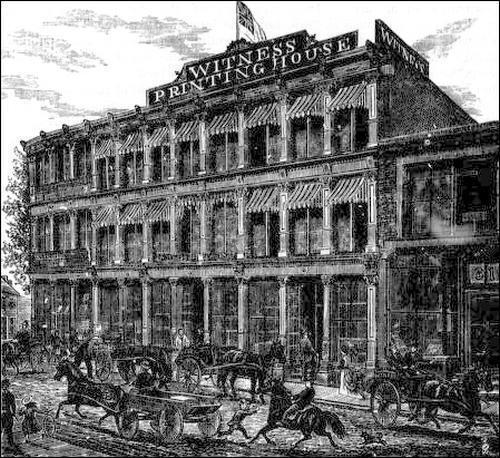
THE "WITNESS" BUILDING.
Guttenberg and Faust were good
printers. Their beautiful work still remains
in proof that the moneyed partner
was not in league with the Evil
One, even were it not known that
the first book which issued from their
press was the Bible. Notwithstanding
that it has often been asserted, and may
be reiterated for centuries to come,
that the fruit of the printing press is
irreligion, the pages of the Mazarin
Bible—the earliest printed book known—remain
still perfect and bright as the
morn that work issued complete from the
press, four hundred years ago and more,—an
evidence that in the minds of the
pioneers of the art, good, and not evil,
was the controlling influence. And the
history of printing ever since, shows
that the bright days of the art, in any
part of the world whatsoever, have been
ever contemporaneous with increasing
prosperity, intelligence and progress in
the more important things of life.
Time had not reached its greatest
value in the anticipatory days of the
art; the world had not then been
scoured to find the materials wherewith
to make cheap ink and cheap
paper. The early printers, in their
work, had either to rival the exquisite
manuscripts of the monkish transcribers
of written knowledge, or be
considered far behind in the "art
preservative of all arts." Everything
was done conscientiously in those days,
and with the greatest care. The inventors
were the printers, and their
hearts were in their work. Printers
then looked upon their productions as
works of art. Their competition did
not come in the shape of speed in production,
nor lowness of price, but in
that of excellence of material and
beauty of execution; and when a
man paid a fortune for a book, he expected
that it would be an heirloom to
be handed from generation to generation,
to the end of time,—the same volume
telling its story to grandfather,
father, son, and grandson, gaining
value with each generation and sanctity
from the mere fact of age.
Now it is different. Rapidity of production,
novelty, and above all cheapness,
are the leading characteristics
to be aimed at by the publisher
who would reach the public. These
latter attainments are found in highest
combination in that wonder of the
present age, the daily newspaper.
There is probably nothing so common
of which so little is known, or
about which there is so much curiosity,
as the newspaper. Men read it every
day; they abuse it, threaten to give it
up, praise it, advertise their wants in
it, write to it, search it to see if their
letters are in it, call it hard names, pay
for it year after year,—and still to
ninety-nine out of a hundred of them
its production is a complete mystery.
To them it is a business office, a newsboy,
or a post-office, who are simply
carriers, and that is all. It is the exemplification
of effect without cause,—an
impersonal institution with plenty of
vitality, and sometimes even with
genius; but it is always mysterious
even to those most intimately connected
with it. The whole of its secrets are
known to no single individual. Its
personality is swallowed up in the
editorial we, into whose depths no
man penetrates, and even the inquisition
of the law never gets behind
the innermost curtain. The only name
pertaining to it is that of the publisher,
the accoucheur, who becomes responsible
for its daily birth.
For the benefit of those who have no
opportunity of visiting a city printing
office and would know something
of how such a one is arranged
and regulated, and also for the further
satisfaction of those who have visited
an office of this description and learned
only enough to make them desire to
know more, we will endeavor to describe
the process of making a daily
newspaper, taking for a special subject
the Witness Printing House,
where this magazine is published.
The general appearance of a newspaper
has no little to do with its success.
It should be neatly and clearly
printed, so that it may be read with
ease and pleasure. This depends
chiefly on the mechanical workmanship.
Good paper is also a desideratum, but
then it must not be expensive, and
need not be made as if to last for all
time, as from its nature the life of any
single number of a newspaper is short,
although in the continual succession of
numbers, day after day, there is much of
permanency about an established journal.
A daily newspaper is the world's
history of one day to be read on the
same day or the next, and too often
forgotten on the third; and to habitual
news readers news forty-eight hours behind
the date is almost as ancient
history, and only interesting as a memorial
of how the people lived so long ago.
There is hardly any portion of the
world which has not been ransacked
for material of which to make cheap
paper. The "American Encyclopædia"
gives the following extensive, though
incomplete, list of substances from
which paper has been made: "Acacia,
althæa, American aloe or maguey, artichoke,
asparagus, aspen, bamboo,
banana, basswood, bean vines, bluegrass,
broom, buckwheat straw, bulrushes,
cane, cattail, cedar, china grass,
clematis, clover, cork, corn husks and
stalks, cotton, couch grass, elder, elm,
esparto grass, ferns, fir, flags, flax,
grape vine, many grasses, hemp, hop
vines, horse chestnut, indigo, jute, mulberry
bark and wood; mummy cloth,
oak, oakum and straw, osier, palm,
palmetto, pampas grass, papyrus, pea
vines, pine, plantain, poplar, potato
vines, rags of all kinds, reeds, rice
straw, ropes, rye straw, sedge grass,
silk, silk cotton (bombax), sorghum,
spruce, thistles, tobacco, wheat straw,
waste paper, willow, and wool." The
principal materials are: "1, cotton and
linen rags; 2, waste paper; 3, straw;
4, esparto grass; 5, wood; 6, cane; 7,
jute and manila." In Canada, the principal
ingredients used in the newspaper
are a mixture of cotton rags and basswood;
although from a very prevalent
habit amongst some of chewing paper, it
might almost be presumed that tobacco
was also commonly used. The process
of converting these different ingredients
into pure white paper is a most interesting
one, but we shall pass on to other
materials used in making the newspaper
without further notice.
The central idea in the printing process
is the movable type from which
the impression, which we call printing,
is made. Types are composed from an
alloy known as type metal. Its chief
ingredient is lead; antimony is added
to make it more stiff, and tin to give it
toughness. A very small quantity of
copper is sometimes added to give it
a still greater degree of tenacity, and
in some cases the ordinary type is faced
with copper through the agency of the
galvanic battery,—an expensive operation,
but one which adds greatly to the
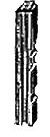
durability of the letters. A type has
been described as a small bar of metal,
with the letter in relief upon one end,
as in the illustration, by which, also, it
will be seen that the letter on the type
is reversed, so that the impression will
appear on the paper as we see it.
Types are of a uniform height,
ninety-two hundredths of an inch
being the invariable height of all
types, and of everything used to
print along with types all over
the world. They are of various
sizes, from the letters two or more
feet across, used in posters, to the
minute type only seen in the very smallest
editions of the Bible, or in marginal
notes. The largest size commonly
used in the present day is "pica,"
of which 71.27 lines go to a foot.
The next smaller is "small pica,"
with 80 lines to a foot; then "long
primer" (with which this article is
is printed), with 89.79 lines to a foot;
then "bourgeois," 100.79 lines to a foot;
"brevier," 113.13 lines to a foot;
"minion" (with which the Witness is
principally printed), 126.99 lines to a
foot; "nonpareil," half the size of
"pica;" and "agate" (with which
the Witness advertisements are set),
160 lines to a foot.
Pearl.
Machinery now does nearly every part of labor, thus saving tim
Agate.
Machinery now does nearly every part of labor, thus sav
Nonpareil.
Machinery now does nearly every part of labor, thus
Minion.
Machinery now does nearly every part of labor,
Brevier.
Machinery now does nearly every part of
Long Primer.
Machinery now does nearly every part
Small Pica.
Machinery now does nearly every
Pica.
Machinery now does nearly
There are also several smaller sizes
which are used for special purposes
only, as for Bibles. These are "pearl,"
"diamond," and "brilliant," the last
almost a microscopic type.
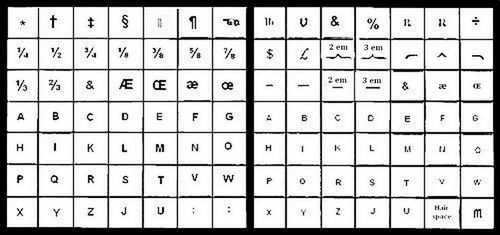
UPPER CASE.
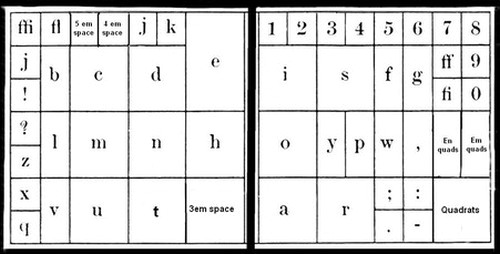
LOWER CASE.
SETTING TYPE.
The different letters of the alphabet
vary in thickness. The m, which,
whether capital, lowercase, or italic,
is nominally square in body,—that is,
just as broad as the line is deep,—is taken
in America as the basis of measuring
the quantity of matter in a page, and,
thus used, is written "em." The unit
of measurement is a thousand "ems,"
which means an amount of matter
equal to a thousand such square types.
A line of this article measures seventeen
ems, and there are fifty-five lines
to a column, thus a full page contains
1,870 ems, for which a compositor
would usually be paid forty-four
cents. Every one who reads knows that
some letters are used more frequently
than others. For the ordinary class of
English work, the relative ratios of the
letters, as nearly as can be calculated,
are as follows :—y, l, k, j, q, x—3; b, v—7;
g, p, w, y—10; c, f, u, m—12; d, l—20;
h, r—30; a, i, n, o, s—40; t—45; e—60;
in all, 532. The "fonts," or supplies
of single styles of type, are made of
all sizes, from two or three pounds to
thousands of pounds, according to the
quantity needed. Before the types are
used they are placed in two "cases,"
called respectively the "upper" and
"lower," which are placed on a stand
or "frame." The upper case is divided
into ninety-eight boxes of equal size,
in which are placed the CAPITAL
and SMALL CAPITAL letters, as in the
plan given, by which the position of
each letter and character may be seen.
The lower case has fifty-four compartments
of different sizes, in which are the
"lowercase" letters, spaces, quadrats—commonly
called "quads"—and other
prime necessities for a printing office.
The quadrats are pieces of metal lower
than the type, and are used for filling
out blank spaces, such as the incomplete
lines at the end of a paragraph,
while the "spaces," which vary from the
thickness of a hair to the width of the
letter n, make the spaces between words.
The larger spaces are all multiples of
the m, which is square, and are therefore
called quadrats, or quads.
MAKING "PI."
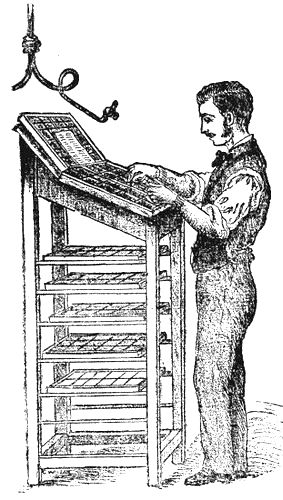
With a pair of these cases before
him, the compositor begins his work.
His "copy" (the reading matter to be
set in type) lies before him on the right
hand side of the upper case, which is
very seldom used. He has in his mind
a phrase of the article he is setting, and
picks up the letters one by one, placing
them in turn in a composing "stick,"
which he holds in his left hand. He
does not pick the letters from their
boxes at random, but, as a matter of
habit, his eye searches out a particular
letter that lies in a position to be grasped
before his hand reaches it. He
never looks at the face of a letter to be
sure of what it is, but only at the notch,
or "nick," at one side at the bottom,
which must invariably be placed upward
or towards his thumb in the stick.
With the nicks down the words would
look as follows:

BACKWARD WRITING.
When a line is completed it is "justified,"—that
is, the spaces between the
words are increased or diminished, so
that each line will end with a word or
a syllable. An ordinary-sized stick will
contain thirteen lines of the size of type
in which this article is set; and when
the stick is full, then comes one of the
most unsatisfactory duties for novices—that
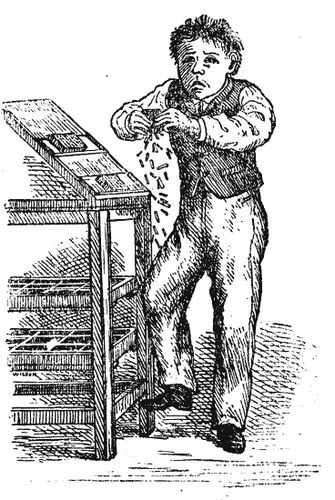
of "emptying" it. There will be
in the stick some two hundred different
pieces of metal. Lifting them out of the
stick in one piece is a precarious proceeding.
The boy in the illustration has
evidently failed in the attempt, as do
most beginners.
The result of such a slip is "pi,"
which is made by no stated rules, but
in numberless ways. A common work
for beginners is setting up the "pi,"
which, when set up, looks like this:
heq ae tti d, mc cu bah, tchi ooh hi jz.
vbcmwp;"—MKe 3 : - hx. i.r ta wsmt
[fl]mcb2uo'zewlect 3o,gsu ,s—qvuke9oi?b
[fi]y atim o irr ,h ae6 Ij gss off ieer xo a
lpgt ro ,renc oc thd adeo sirt , ifofy
From the stick the type is transferred
to a "galley," a long metal or
wooden tray, against whose side and
end the type rests. It is usually placed
in an inclined position that there may
be no danger of the type "pying," or
becoming so mixed up as to be useless.
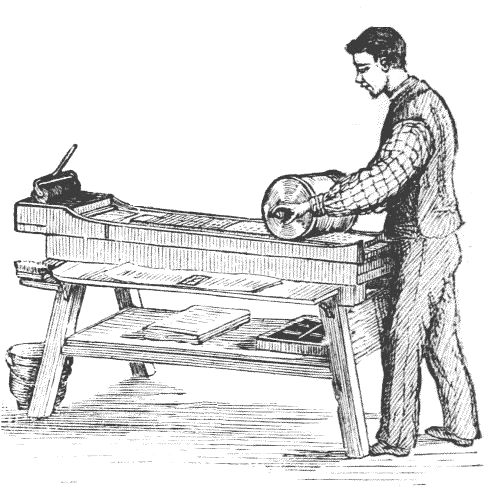
When the galley becomes filled it is
"locked up"—an operation made plain
by our illustration—and "proofs"
taken. This is done by "inking" the
type by means of a roller, then placing
a sheet of damped paper upon
it and passing a heavy iron roller,
surrounded by a "blanket," over it.
The proof is then sent to the proof-reader,
who goes over it carefully, comparing
it with the copy, which is read
aloud to him by the "copy-holder."
Any corrections to be made are indicated
by certain hieroglyphical marks,
which, with slight variations, are recognized
by printers everywhere.
TAKING A "PROOF."
In daily papers, when great expedition
is required, the proofs are read in
"takes,"—which requires us to turn back
for a moment in this description.
Doubtless many of our readers have
desired to know why it is that newspaper
publishers are continually requiring
correspondents to write only
on one side of the paper, and thus
encouraging so much waste and additional
postage. It is this:—the copy
is given out in "takes," or sections, of
a dozen lines, more or less. To do
this the sheets are often cut and renumbered.
Thus, if the manuscript
were written on both sides, endless
confusion would ensue. The proofs
are often read in these "takes," the
impression being obtained from the
type while in the stick. At times, when
the news arrives immediately before
the paper is sent to press, this reading
is the only one it receives. Ordinarily
they are read two or three times over,
or oftener; first with the copy-holder,
who reads the copy while the proof-reader
compares it with the printed
proof before him, then "revised" by
the proof-reader, who compares the
second impression, or "revise" with
the one on which the errors or omissions
had been previously indicated,
and glanced over a third time, to see
that no mistakes have been overlooked
in the previous reading and with
more careful attention to the sense of
the passage. Then a proof goes to the
writer for further revision, if necessary.
The best proof-readers are usually
those who have had some experience
as compositors, and thus know
from experience the errors most likely
to be made, and the manner of correcting
them so as to cause the least delay.
Proof-reading requires a very unusual
association of qualifications. The really
good proof-reader must be perfectly acquainted
with his own language, and
have some general knowledge of almost
all others, besides of the dialects
of his own. He must have a general acquaintance
with literature and be able
to confirm every quotation, and have
the dictionary and gazeteer at his
fingers' ends. He must have an eye
which nothing escapes (technically
called a typographical eye), and be able
to detect and correct the errors made
by both author and compositor,—and
the number by the former is usually not
inconsiderable. And withal he must
have a temper which nothing can ruffle,
a power of centring his attention on the
dryest matter read for the second and
third time, and determination sufficient
to see that every correction indicated is
duly made—and this last is by no means
the least of his necessary qualifications.
In the early days of printing, the
proof-readers were eminent scholars,
and it was no unusual thing for a proof
to pass through the hands of several of
the most learned men of the time and
neighborhood before the sheets were
printed. It is related of Raphelingus, a
distinguished scholar who was engaged
in reading proofs in Antwerp about
1558, that he declined the professorship
of Greek at Cambridge, preferring
to correct the text of the oriental
languages. Plantin, of Antwerp,
and Stephens, of Paris, used to expose
publicly the sheets of their books,
offering a reward to any who would
discover errors in them. But it is very
seldom, if ever, that a work is issued
from the press absolutely typographically
perfect. In this respect the Oxford
edition of the Bible is said to be
the most successful work published.
Many are the ludicrous and mortifying
mistakes made in printing. Erasmus,
rather unfortunately for himself, corrected
his own proofs, with such a
result that he declared that either the
devil presided over typography or that
there was diabolical malice on the
part of the printers. Perhaps the most
astonishing example of bad proofreading
was the edition of the vulgate
edited by Pope Sixtus V. His Holiness
carefully supervised every sheet of
this wonderful edition before it was
sent to the press, and to stamp it with
his authority fulminated a bull that any
printer who, in reprinting the work,
should make any alteration in the text
would be excommunicated. This was
printed as a preface to the first volume
of the work. Isaac Disraeli, in his
"Curiosities of Literature," says, in
referring to this circumstance, that
"To the amazement of the world, the
work remained without a rival—it
literally swarmed with errata. A
multitude of scraps were printed to
paste over the erroneous passages in
order to give the true text. The book
makes a whimsical appearance with
these patches; and the heretics exulted
in this demonstration of papal infallibility!
The copies were called in,
and violent attempts made to suppress
it; a few still remain for the raptures
of the Bible collectors. Not long ago
the Bible of Sixtus V. fetched above
sixty guineas—not too much for a
mere book of blunders."
Another historical erratum was an
intentional one made by a printer's
widow in Germany, at whose house a
new edition of the Bible was being
printed. At night she stole into the
office and altered the passage—Genesis
III., 16—which makes Eve subject to
Adam, by taking out the two first letters
of the word Herr, used in German, and
substituting in their place Na. The
passage thus improved read: "and he
shall be thy fool," instead of, "and he
shall be thy lord," as it should have
been. It is said that this woman was
punished by decapitation. Perhaps the
most striking error of all in any edition
of the Bible was the omission of the
negation in the seventh commandment
in one instance. This edition was very
effectively suppressed.
PLACING "MATTER" IN "TURTLE."
In reporting Parliament some ten
years ago, one of our morning papers
contained a statement to the effect
that the Hon. Mr. Holton said he had no
doubt that Mr. Morris was tight (right),
a single letter proving very derogatory
both to the speaker and to the very
highly respected gentleman to whom
he referred.
When the proofs have been read and
the errors corrected, or supposed to have
been corrected, the "matter" is placed
in the forms. Those, for the "rotary"
press used in the Witness office, form
segments of the central cylinder of the
press, and from their resemblance to
a turtle shell are called "turtles."
The type is placed in the form piece
by piece, the different kinds of matter
each in its proper place. This is a
matter requiring both skill, care and
ability, so that paragraphs are all
placed under their proper headings,
and that two articles do not become
"mixed up," as sometimes happens.
There have been many illustrations of
the evil effects of such a medley, but
none hardly equal to that given by Max
Adeler, which, we presume, has been
subjected to some ingenious improvement.
He says:
"The Argus is in complete disgrace with all
the people who attend our church. Some of the
admirers of Rev. Dr. Hopkins, the clergyman,
gave him a gold-headed cane a few days ago,
and a reporter of the Argus was invited to be
present. Nobody knows whether the reporter
was temporarily insane, or whether the foreman,
in giving out the 'copy,' mixed it accidently
with an account of a patent hog-killing machine
which was tried in Wilmington on that same
day, but the appalling result was that the Argus,
next morning, contained the following obscure
but very dreadful narrative:
"'Several of Rev. Dr. Hopkins friends called
upon him yesterday, and after a brief conversation
the unsuspicious hog was seized by the
hind legs and slid along a beam until he reached
the hot water tank. His friends explained the
object of their visit, and presented him with
a very handsome gold-headed butcher, who
grabbed him by the tail, swung him round, slit
his throat from ear to hear, and in less than a
minute the carcass was in the water. Thereupon
he came forward and said that there were times
when the feelings overpowered one, and for that
reason he would not attempt to do more than
thank those around him, for the manner in which
such a huge animal was cut into fragments was
simply astonishing. The doctor concluded his
remarks, when the machine seized him, and in
less time than it takes to write it the hog was
cut into fragments and worked up into delicious
sausage. The occasion will long be remembered
by the doctor's friends as one of the most delightful
of their lives. The best pieces can be
procured for fifteen cents a pound, and we are
sure that those who have sat so long under his
ministry still rejoice that he has been treated so
handsomely.'"
In the recent number of an English
religious paper a somewhat similar
mistake took place, the report of a
meeting for the conversion of the
Jews and an item on the advantages of
phosphates as manure being pretty well
shaken up together.
The matter all being properly placed
in the "turtles," of which there are
eight for the Daily Witness, the latter
are "locked up" by means of screws at the
ends, by tightening which pressure is
brought to bear on all sides of the
matter, and it becomes as one mass,
so solid that it would not fall to pieces
though it fell from one floor to another.
It will be noticed that a section
of the turtle forms the arc of a circle,
while the sides of the type are parallel.
How to make the matter close firmly
under these circumstances was the subject
of much study. One inventor made
his type wedge-shaped, but that did not
answer, and the difficulty was at length
overcome by making the rules which
divide the columns so much larger towards
the top than the bottom that
the column rule sits into the arch of
types after the same fashion as a keystone
in masonry.
The "turtles," when being made
up, are placed on stands made for the
purpose, which are wheeled along to
the hoist and lowered to the press
room.
The hoist used in the Witness office
has some peculiarities which distinguish
it from others. Where so many
young people were working together,
it was considered unsafe to have a
a hole in the floor with no protection.
The mechanical manager, Mr. John
Beatty, therefore set his mind to work
to invent attachments whereby the hoist
would automatically open and close,
as required. He was entirely successful,
and now the machinery is so
arranged that whenever the hoist is at
any particular flat the gate opposite it
is raised so that free access may be had
to the platform; at all other times the
gate is closed, so that no one can fall
into what is, too often, little more
than a man-trap.
Descending with the "turtles" to the
ground floor, we arrive at the pressroom,
where the forms are hoisted on
to one of Hoe's mammoth eight-cylinder
rotary presses. The turtles are fastened,
or "locked," on to an immense
cylinder and form a portion of its circumference,
the rest of its surface being
used for distributing the ink. Surrounding
this cylinder, and acting in conjunction
with it, are eight other cylinders,
very much smaller than the one
bearing the type. At each of them
stands a man, whose duty it is to
"feed" the press—that is, place the
sheets, one by one, so that at the
proper time they will be clutched by
the automatic fingers by which they
are drawn around the smaller cylinder,
at the same time being pressed by the
one bearing the type, so that a clear
impression is made. The sheets are
then carried away by means of tapes,
and deposited evenly on tables at the
rear of the press. This machine will
print sixteen thousand copies an hour,
and is often run beyond that speed in the
Witness office. Its catalogue price
is thirty thousand dollars.
A word may be said about the progress
of the printing press towards
perfection. The changes have all been
from direct or reciprocating to rotary
or revolving motion. At first the type
was inked by "ink balls," and the paper
was pressed on it by a flat platen
brought down upon it with pressure by
means of a spring or screw. Inking is
now invariably done by rollers, but the
direct action of a flat platen pressing
against a flat bed is still preserved,
not only in all the smaller and simpler
presses, but in those which do the
very finest work. The first great step
towards increased speed was made
when the paper was pressed against
the type by a cylinder or drum. This
is the character of most newspaper
presses, and of a good number in the
Witness pressroom. In these presses
the types still travel backwards and
forwards on a flat bed, which has to
stop and reverse its motion twice for
every impression. The next step in
advance was that which placed the
types also on a cylinder, so that there
might be for them only one continuous
motion round and round in one direction.
This is illustrated by the large
rotary presses in the picture of the
pressroom, one of which, the four-cylinder,
has just been removed to
make way for presses adapted to finer
magazine work. There is still in the
rotary press the necessity of feeding
by hand. A number of machines have
been invented to feed themselves from
a roll of paper, thus introducing another
rotary motion, and to "deliver"
the paper by still another rotary process.
None of these presses, so far,
have come to such perfection as to
print from type as well and as fast as
the great rotary press now used by the
Witness, but they are constantly improving
in construction. Such presses
have, of course, to print one side of
the paper and then the other before
the sheet leaves the press, and would
have to deliver these perfected sheets
as fast from one exit as the rotary does
from eight or ten. It is in these
points where the difficulty is found, as
one side has to be printed before the
ink is dry on the other, and the rapid
disposal of the finished papers requires
very ingenious machinery. There are
further improvements still in the future.
We can imagine lithography completely
supplanting type or stereotype printing,—as
it has begun to do,—the impression
of the type being transferred to
stone, or some other lithographic
surface. If lithographic surfaces could
be made cylindrical they could, being
smooth, work against each other, and
so print both sides of the paper at
the same time. The whole press would
thus consist of two impression rollers
and two more to ink them going round
just as fast as the chemical character
of the ink would permit. The Witness
has had to purchase a new machine
about every five years to keep up
with the times, and it is not probable
that it will be otherwise in the
future.
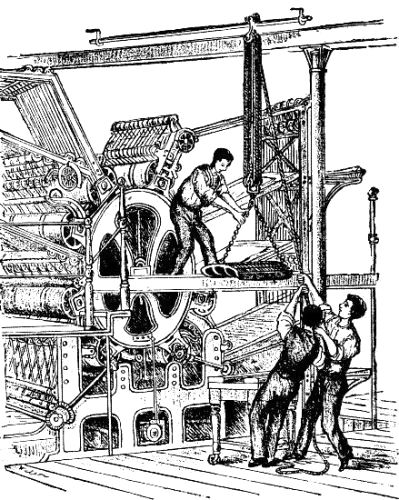
HOISTING "TURTLE" ON THE PRESS.
As the sheets are printed they are
gathered from each of the eight receiving
tables and carried off to the
folding machines, of which there are
four on the same flat. These are unable
to do all the work as quickly as
required, so that some are sent up to
the bindery above, and folded by hand.
Let us, for a moment, consider the
amount of paper which goes through
the presses on this floor in a year.
There are, devoted to papers, an
eight-cylinder rotary for the Daily,
a two-cylinder for the Weekly Witness,
and a single-feeder for the
Messenger. There are also several
presses for job work, one of which,
however, prints L'Aurore, and another
the New Dominion Monthly, which
need not now be referred to in detail.
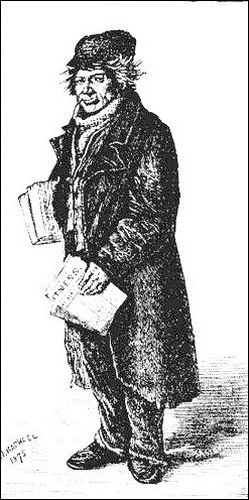
A FELLOW LABORER.
Some fourteen thousand five hundred
copies of the Daily Witness are
printed daily, or 4,509,500 a year, excluding
from the calculation Sundays
and legal holidays. The circulation of
the Weekly Witness averages twenty-six
thousand copies, or 1,412,000 in a
year. Some fifty thousand copies of the
Northern Messenger are issued
semi-monthly, or 1,200,000 sheets a
year. Thus the total mounts up to
more than seven million papers which
are printed on these premises during a
year. A few statistics with this number
as a basis would prove interesting.
Piled in reams these papers would
form a column 3,560 feet high, or
more than two-thirds of a mile. Stretched
out and pasted together they would
reach four thousand four hundred and
twenty-one miles. But such figures
as these simply daze one, and we
will leave them and follow the papers
a little farther.
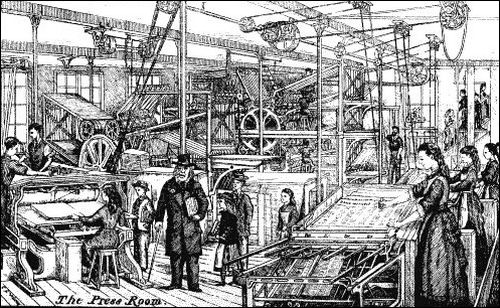
The Press Room.
These take two courses. Some go
upstairs to the mailing room, while
others are counted out to the newsboys
for street sale and to the dealers
throughout the city. The newsboys
are a most unruly lot, and to be kept
under control are compelled to wait in
a room, built on purpose for them, until
the papers are ready. This time they
occupy in quarrelling, cutting their
names on the sides of the deal partitions,
and calling out to "Miss Gray,"
the traditional name given to every young
lady who has had charge of that department
for the last ten years or more.
Should a gentleman take her place for
the nonce, he is called Mr. Gray. As
soon as the papers are ready they are
counted out to the newsboys, each of
whom has his particular beat or stand
in the city. Some, with more enterprise
or capital than others, buy by
wholesale, and sell to others with less
capital. A few, standing on the street
corners, have regular customers who
pay or not, as the case may be, each
night; and as the business men pass,
one after another, the papers are handed
to them almost as rapidly as tickets at
a crowded concert-room. Often they
are snatched from under the boy's arm;
but no matter, without any system of
book-keeping, or even a book of original
entry, each customer will be told
the exact amount he owes at any time,
and without a moment's hesitation.
These newsboys sell from one to twenty
dozen copies daily. They pay for the
Witness eight cents a dozen, and sell
them at a cent each. Thus the newsboy's
income will average from four cents to
eighty cents per day—the latter no inconsiderable
sum in these hard times.
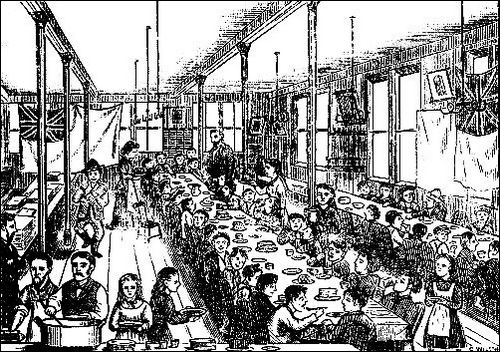
THE NEWSBOY'S FESTIVAL.
Although unkempt looking, rough
in manner, boisterous and unmannerly
in speech, there is often much that is
good in the newsboy, and Mr. Beatty,
of the Witness office, keeps a sharp
eye after their character and interests.
About once a year the office gives
them a dinner, or something of the
sort, which they attend as one man,
or, more properly, as one boy or girl,
for some of the "newsboys" are girls.
It is one of these occasions which is
shown in the picture. The boy standing
with his arms full and legs crossed
has just been informed that he could
"pocket," and now wants to have his
picture taken.
Much of the business once done by
the newsboys has been taken away by
the fruit dealers, grocers, and confectioners
throughout the city, most of whom
have regular customers to supply. To
these the papers are sent by four carts
built for the purpose. They are shown in
the picture of the building, some of
them in process of being laden and
others departing with their loads.
During the day the number of papers
to be sent to each dealer is plainly
marked on prepared labels, on which
are printed the name and address.
These are arranged in order according
to the route they are to be taken.
As soon as the papers are printed,
they are rapidly and securely tied
up in bundles, with the label exposed,
for the carrier; and in a few minutes
after the paper is sent to the press the
four carts are swiftly carrying them to
all corners of the city. Each driver
has a shrill and peculiarly sounding
whistle, which is blown immediately
before each dealer's door is reached;
the bundle is thrown on the sidewalk
as the horse dashes by unchecked,
and the contents distributed amongst
the crowd of customers sure to be
waiting for their Witness.
Again, some of the parcels have to
be made up for the towns, to which
they are sent by railway, through the
agency of the Express office. Almost
every town in Canada on the railway
receives its bundle of papers, and as
each new railroad is opened the demand
for the Daily Witness to be
sent in this manner increases. A large
number also go by mail to the remote
parts of the country, and in
glancing over the mailing lists the person
most conversant with the geography
of Canada would be obliged to
confess that a very large percentage of
the names he would there meet was
entirely unfamiliar to him.
The manner of addressing papers
adopted in the Witness office is to
print the names and addresses, with
the date when the subscriptions expire,
directly on the papers themselves,
in red ink. This method has several
disadvantages, but these are counterbalanced
by the fact that when once
the name is printed it can never come
off, as is the case when addresses are
printed on little slips of colored paper,
and then pasted on. In either method
the subscribers' names are first set up
in columns, under their respective post-offices,
these offices being arranged
alphabetically for facility of reference.
It will be noticed that the post-office
is only printed once, and then in large
heavy type, the subscribers' names
following it in the column. Five of
these columns, containing on an average
two hundred names, are placed in
a "chase" and locked up. There are
altogether in the office some three
hundred and fifty of these chases
constantly in use. They have to
be continually revised, at which from
two to ten men are constantly engaged.
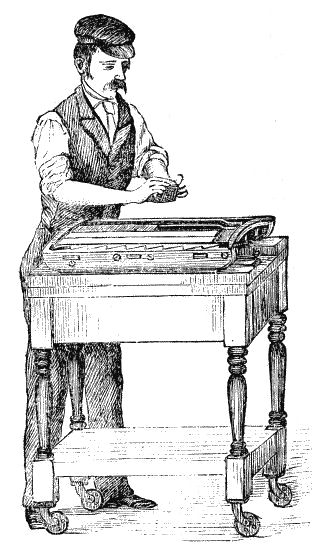
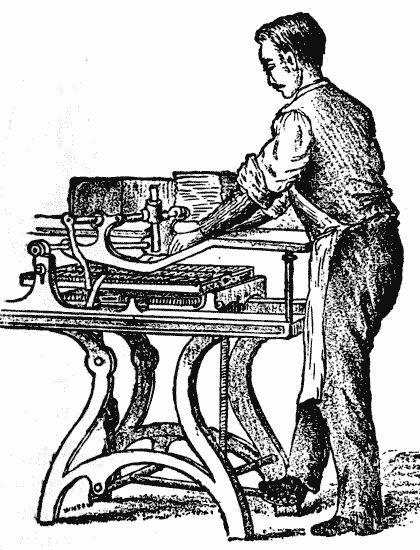
When the mailing time comes the chase
which is to be used is inked and placed
in the mailing machine, which is shown
in the engraving. The machine is
worked by the operator's foot. A
paper is put under the hammer, as
shown, and the treadle being pressed
the name in the chase beneath is
plainly stamped on the paper. Only the
first paper of each parcel has the name
of the post-office as well as that of the
subscriber. When all the papers going
to one post-office have been stamped,
they are tied in one parcel and that
with the name of the post-office being
uppermost, the general address of the
whole is known. When the parcel
arrives there it is opened, and the
postmaster makes the further distribution.
ADDRESSING MACHINE.
Those who read this account will
understand how it is that sometimes
papers go astray. It would be wonderful
if, out of nearly a hundred
thousand names always in type at the
Witness office, while changes are
constantly being made in the lists, there
were not some mistakes, and it is
creditable to the system adopted by
newspaper publishers that the number
is comparatively so small.
As will have been observed, the
type from which the Witness is printed
when in the turtles assumes a rounded
shape. Readers of that paper know
that on many occasions it is embellished
with wood cuts, and that wood engravings
are ordinarily cut on a flat surface.
They may have wondered how the difficulty
is got over. In the Witness all
the engravings are electrotyped. To
perform this operation an impression
of the engraving is first made in a sheet
of wax by means of a powerful press.
The wax is so fine and the pressure so
great that the finest lines are reproduced.
The wax is then blackleaded
with graphite, made especially fine for
the purpose, and the waxen plate is inserted
in an battery in which is
a strong solution of copper. In a few
hours a thin film of copper, the exact
counterpart of the engraving, is formed.
This is laid on its face in a hot iron
pan and over the back a covering of
tin foil is placed to give it consistency,
the heat causing it to melt and fill all
the finer interstices of the engraving.
Over this again is poured a "backing"
of lead or type metal, which is shaved
down to the exact thickness required.
This is again backed with wood, to raise
it to the height necessary for printing.
This wood has been curved to the shape
of the press and the electrotype is bent
to correspond. Some papers stereotype
the whole form—a shorter process, but
one impracticable for an afternoon
paper in editions, as, in the latter case,
even fifteen minutes' delay would be
more than could be spared.
Thus having disposed of the mechanical
branch of printing, we will next
resort to another matter of the greatest
importance to a daily newspaper—that
of advertising. The Daily Witness
is sold at a cent a number, a sum which
hardly pays the cost of paper alone; so
that out of the advertisements inserted
must be met the expenses for printing,
publishing, editing, etc. If an ordinary
newspaper, published in a small
city such as Montreal practically was
twenty years ago, be examined, it will
be found that nine-tenths of the advertisements,
measured by the space occupied,
come under one of the following
categories: advertisements of liquors
and tobacco, of groceries including
liquors and tobacco, or of places selling
liquors; advertisements of theatres and
other questionable amusements; advertisements
of questionable medicines;
advertisements of questionable reading
matter; advertisements of other quackeries.
To avoid all such was the firm
determination of the Witness from the
beginning, so that it had, as it were, to
create its own advertising business.
Another custom against which it set its
face was that of using large and varied
type in advertisements, seeing that
when all do this they neutralize each
other in point of prominence, and get
much less value out of their space,—besides
making a very ugly and vulgar
looking paper. It was held that
among advertisements printed in uniform
type, a small number printed
prominently would be worth a
great deal to those who chose to pay
for them, and more in proportion to the
fewness of them. This end was gained
by charging double to all who thought
the prominence worth the price. Instead
of putting difficulties in the way
of making changes in advertisements,
the Witness does its best to get the
advertisers to put in new advertisements
every day, believing that were
this to become universal the advertising
columns would be as much studied
as the reading columns. Here are one
or two points not understood by all
advertisers: one, that it is of no advantage
to draw attention to commodities
that are not worth the money they are
sold for. If purchasers are disappointed,
the more attention drawn to the
goods the worse for the business,—those
swindling concerns that live on first
transactions always excepted. Another
thing is that it is better to have
an advertisement where it will be looked
for by those wanting the article than
to have to draw the attention of everybody
to it. To get people into the
habit of looking into certain quarters
for certain things should be the primary
object of all advertisers and advertising
mediums. Some Montreal
men are proving adepts in the art of
advertising and making it very profitable,
while, on the other hand, there is
no way of throwing away money faster
than by unwise advertising.
Some idea of the amount of business
which is done in advertising may be
obtained from the fact that in 1877-78,
one of the dull years, twenty-four thousand
two hundred and ninety advertisements
were received in the Witness
office, a daily average of seventy-nine.
This was obtained almost without any
canvassing. A business that depends
largely on canvassing must necessarily
adopt prices that will cover canvassers'
commission.
ANSWERING AN ADVERTISEMENT.
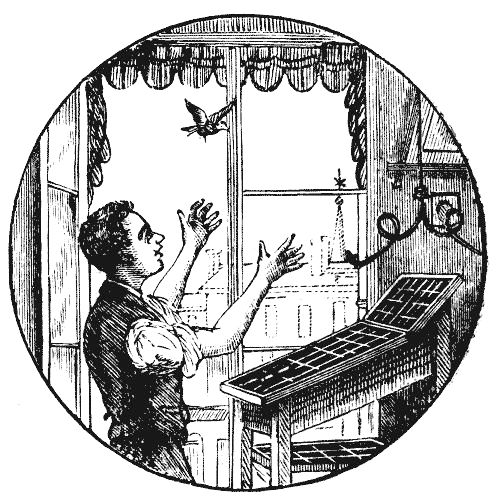
There are many traditions in the
Witness office in regard to remarkable
answers to advertisements. A
gentleman, one bright summer's day,
lost a favorite canary, and hurried
to the Witness office to make his
loss known. His advertisement was
immediately sent up to the compositors'
room to be set up, and while
this was being done the bird flew
in through the window and perched
himself on the case immediately in
front of the young man who was
putting the advertisement into type.
Birdie was caught, and soon the
owner was happy again. It is well
that all lost articles do not, in a
similar manner, find their way into
printing offices, as the character of
the profession might then be subject
to suspicion.
The subject of curious advertisements
is an endless one, and has been fully
entered into in Sampson's "History
of Advertising." There is the kind in
which the sentences are, to say the
least, ambiguous, as that of the lady who
advertised for a husband "with a Roman
nose having strong religious tendencies."
Then there was "to be
sold cheap, a splendid gray horse,
calculated for a charger, or would carry
a lady with a switch tail,"—hardly as
curious an individual as the one spoken
of in the following announcement:
"To be sold cheap, a mail phaeton,
the property of a gentleman with a
movable head as good as new." A
travelling companion to these would
be the following: "To be sold an
Erard grand piano, the property of a
lady, about to travel in a walnut wood
case with carved legs." But what can
compare with the specimen of humanity
referred to by a chemist in the
request that "the gentleman who left
his stomach for analysis will please
call and get it, together with the result!"
The insertion of marriages is of early
date, they first appearing as news, and
in certain respects were much more
satisfactory than those now given, as
for instance, the one in the Daily Post
Boy of February 21st, 1774:
"Married, yesterday at St. James' church, by
the Right Rev. Dr. Hen. Egerton, Lord Bishop
of Hereford, the Hon. Francis Godolphin, Esq.,
of Scotland Yard, to the third daughter of
the Countess of Portland, a beautiful lady of
£50,000 fortune."
Sometimes the papers in those days
disputed as to the matters of marriages
and deaths. The London Evening Post,
in April, 1734, said:
"Married.—A few days since—Price, a Buckinghamshire
gentleman of near £2,000 per annum,
to Miss Robinson, of the Theatre Royal,
Drury-lane."
At this the Daily Advertiser remarks,
a few days later, "Mr. Price's marriage
is entirely false and groundless"—a
peculiar kind of marriage that. The
Daily Journal about the same time asserts:
"Died.—On Tuesday, in Tavistock-street, Mr.
Mooring, an eminent mercer, that kept Levy's
warehouse, said to have died worth £60,000."
But the Daily Post informs the public
that "this was five days before he did
die, and £40,000 more than he died
worth."
That the principle of protection was
known in 1804 is clearly shown by the
following important advertisement:
"To be disposed of, for the benefit of the
poor widow, a Blind Man's Walk in a charitable
neighborhood, the comings-in between twenty-five
and twenty-six shillings a week, with a dog
well drilled, and a staff in good repair. A handsome
premium will be expected. For further
particulars inquire at No. 40, Chiswell street."
We will conclude this branch of advertising
by one of more recent date
from a United States paper, whose
frankness is charming:
"About two years and a half ago we took
possession of this paper. It was then in the
very act of pegging out, having neither friends,
money, nor credit. We tried to breathe into it
the breath of life; we put into it all our own
money, and everybody else's we could get hold
of; but it was no go; either the people of
Keilhsburg don't appreciate our efforts, or we
don't know how to run a paper. We went into
the business with confidence, determined to run
it or burst. We have busted. During our connection
with the Observer we have made some
friends and numerous enemies. The former will
have our gratitude while life lasts."
This was inserted in the space reserved
for death notices, and really
deserved some obituary poetry.
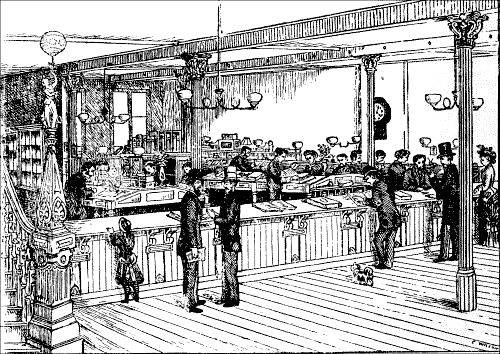
During December and January the
department in a newspaper office busy
above all others is the one where the
subscriptions are received and the lists
attended to.
COUNTING ROOM.
The immense amount of work which
comes under this head has been previously
referred to. A few statistics
will render it more clear. During the
year ending February, 1877, twenty-two
thousand seven hundred and seventy-three
money letters passed through this
department in the Witness office, while
as many more, having reference to
changes, instructions, giving advice,
etc., were attended to. Some of these
letters are of an extraordinary nature.
In one instance, on a day when some
eight hundred money letters poured
into the department, the writer signed
his name after the manner of an enigma.
It was interesting, but out of place.
People sometimes send letters with the
statement, "Of course you know my
name, as you sent me a circular," or
something similar. Others sign their
names without giving any post-office
address, while many again give two
addresses, one at the head and the
other at the foot of their letters. Sometimes
the amount required to be sent is
enclosed with no other intimation; but
more frequently still the letters, names
and all, are sent without the money.
By an ingenious method all money
letters which come into this department
are numbered, the amount received
and the page of cash book where entered
marked upon them, and then filed away
in books of one hundred, which are
bound together, so that any particular
letter can be turned up in an instant
and referred to. The cash book is
ruled so as to give a column for the
Daily Witness, Weekly Witness,
Northern Messenger, New Dominion
Monthly, and Aurore, and
the total amount; and sometimes one
single letter contains a subscription
for every one of the papers enumerated,
while a very large proportion have at
least two of them. There are a very large
number of subscribers who, year after
year, take these papers, and not satisfied
with this evidence of goodwill,
make a point of sending several other
subscriptions along with their own. It
is always pleasant to the publisher to
hear from these, and their letters constantly
recurring, year by year, are like
the visits of old friends.
It would be impossible to leave this
department without a reference to a
minor one partially connected with it—that
having charge of the premiums.
It is desired, as far as possible, to give
some return for all favors done. But
here arises a difficulty. Most of these
favors are simply because of the goodwill
of the performers, and any direct return
would be anything but pleasing to
them. Thus the rule has been made that
those who desire to work for prizes
must, in some way, indicate their
desire, and the manner considered most
satisfactory is to have the words "In
competition" written on the top of all
letters containing money intended for
the prizes. The names of those who
send such letters are entered in a separate
book ruled in columns, and the
remittances are recorded one after the
other, so that when the last is sent in
the total can be checked in an instant.
The number of prizes given in a
year is nothing inconsiderable. The
following is merely a partial list of what
were sent out in the winter of 1877-78:—236
pairs of skates; 30 gold lockets;
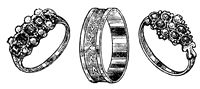
125 gold rings; 40 photograph albums;
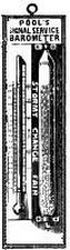
82 Pool's weather glass and thermometer
combined; 6 magic lanterns; 4
McKinnon pens; 298 chromos of Lady
Dufferin and 327 of the Earl of Dufferin.
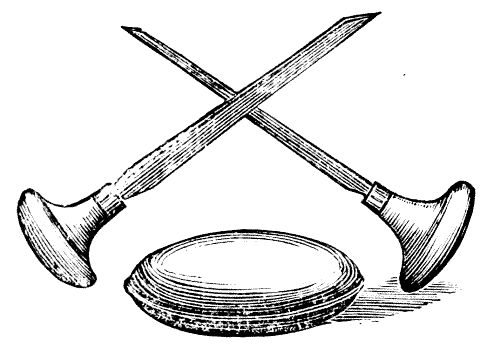
GRAVERS' TOOLS
A new and growing department in
the Witness office, but quite unique as
regards daily newspapers, is the one
where the wood-engravings are made.
Next to the reporter, whose materials,
except those carried in the head, consist
of a cedar lead-pencil, a few sheets
of paper and a penknife, his are the
least troublesome and expensive used
in almost any line of business. To
bring out all the beautiful effects obtainable
in wood-engraving the only
tools used are about thirty "gravers'
tools," most of them triangular in shape,
ground down to a sharp point. The
material used is boxwood, cut across
the log, joined in small pieces so perfectly
that the place of junction cannot be
distinguished, and polished to a perfect
state. On this the design to be followed
is drawn. The engraver may either
be an artist or not. If an artist, he
will, as he pursues his work, alter and
improve an imperfect drawing in its
minor and imperfect details, as may be
necessary; putting in a little light here,
darkening a shade there, and almost invariably
turning out a pleasing picture.
If not an artist, he will "follow his copy,
even if it goes out of the window," as a
compositor would say, copying beauties
and defects with the same unconcern,
and producing a picture even from a
good drawing with as little spirit or
soul as the block on which he works—a
"wood-cut," not an "engraving."
It will be understood that all wood-engravings
are made in relief, that
which is to be printed being allowed
to remain, the lights being cut away.
If this were merely all, the work would
not be very difficult; but more is
required. The block must be lowered
at places to give very light and delicate
shades and that the edges of the shades
may not be harsh and coarse, for the
press is not naturally a discriminating
machine, and unless everything is very
near perfection, little aid can be given
by it. But, nevertheless, the pressman
is required to assist the engraver,
and to do this properly he also must be
an artist. By placing small pieces of
tissue paper, or, sometimes, something
coarser, under the electrotype here and
there where needed, he will cause it to
rise and greater pressure to come on
some portions where greater distinctness
is required than at others. This is called
"underlaying." More perfect work
than is possible in newspapers is obtained
by "patches," as they are called,
pasted on the "tympan," or the sheet
which presses on the face of the engraving,
a process called, in contradistinction
to the other, "overlaying." There are
now three engravers in the employ of
the Witness office, and by one of these,
Charles Wilson, a deaf-mute, the
sketches which illustrate this article
were made, with three exceptions, which
the reader will have no difficulty in determining.
Most of the pictures were
engraved by him and his confrères, others
being executed by an etching process
on zinc without the use of wood at all,
or, indeed, of any engraving process,
which we cannot now further refer to.
All matters in regard to the newspaper
are in interest subordinate to the
editing, to which everything is in all
ways subsidiary. Who or what is the
mysterious "We" whose opinions have
such weight, and who appears to be possessed
of all knowledge? Sometimes
there is little mystery about it, as when
the public are informed that "yesterday
we received the finest cucumbers
we ever ate from Mr. Gardner;" or
when it is announced that "the public
must excuse the small quantity of editorial
matter and the mistakes in our
paper of last week, as we were laid up
with rheumatism." There is no poetry
about a "we" who eats cucumbers or
is troubled with rheumatism. But the
candid impersonal opinions of a newspaper
are usually of great weight and
value, and enhanced by the impersonality
of the writer.
That this should be the case requires
no discussion. A newspaper office is
the centre of information on current
topics. The news gravitates to this
centre as naturally as riches to a
wealthy man. Thus the writer should
be well-informed and be the best able
to give a correct judgment on matters
of general interest. Then the fact that
the argus-eyed press the country over
is watching his utterances closely has a
tendency to cause much greater care in
the expression of views than is the case
in ordinary conversation, or in public
addresses which will be heard and forgotten.
But let a writer in a paper
which has the reputation of being impartial
make a mistake of consequence,
and he has many correctors before the
day is over. On the other hand, there
is a very great disadvantage under which
many papers labor. They are the
"organs" of some political party, and
instead of being advocates of truth,
are advocates of truth only when it
suits the "party." It is strange that
such papers are often blindly followed,
although the followers generally imagine
that they are the leaders.
Suffice it to say, while on this matter,
that the editor of a metropolitan
daily newspaper is an impersonal individual,
or individuals, who never can
be seen. His functions, however, are
divided, and every one who visits a
newspaper may find the person he
wants. The reception of visitors is
one of the most engrossing duties of
the editorial chair. Almost daily they
come in throngs, for business or for
pleasure—to receive advice, but more
often to give it—to compliment, but
more frequently to complain—sometimes,
but proportionately seldom, to
give valuable information. But the
last they do, sometimes, and all such
visitors are gladly welcomed.
Usually the busiest looking man on
the editorial staff in a newspaper
office is the managing editor, on a
morning paper known as the night
editor. Every item which appears in
the paper except the advertisements
must pass through his hands. It is his
duty to see that the copy is sent in in
good form and grammatically correct.
He prepares the telegrams for publication,
no inconsiderable duty, requiring
an extended knowledge, exact and
varied information, carefulness, tact
and experience, to be properly done.
No message, however ambiguous when
he receives it, must be ambiguous when
it leaves his hands. The contractions
must be extended, the wrongly-spelled
proper names put right and verified by
means of atlas, directory or gazetteer,
and on his zeal and ability in no slight
measure depends the acceptability of
the newspaper to the public.
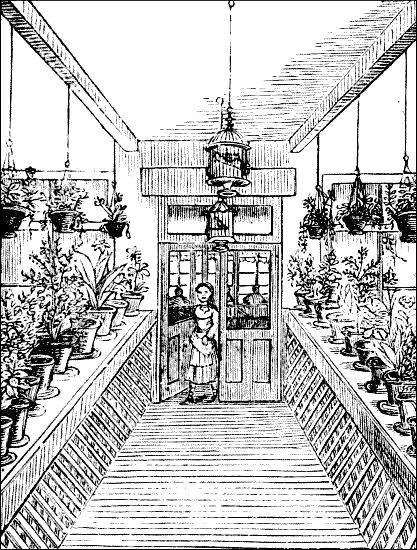
CONNECTING BRIDGE.
A man of no little consequence in
most daily papers is the commercial
editor. He needs discretion, shrewdness,
sound judgment, and above all to
possess the highest sense of honor and
responsibility. In these days when fortunes
are made and lost in an hour,
when farmers consult the newspapers
as to the time to sell, and business is
conducted at a feverish heat, it is
necessary that all important commercial
transactions be promptly and correctly
reported in the daily papers. To do
this properly is a matter of great
difficulty. "Bulls" and "bears" are
not over-scrupulous in playing a joke on
a reporter sometimes, when they have
an end in view, and unless the commercial
editor of a paper is well up to
his work he and his constituents will be
often lead astray. He is supposed to
be well versed in every topic of the
commercial world, in stocks and produce,
railroads, steamboats, dry-goods,
hardware, and everything whereby men
make gain.
The exchange editor of a newspaper
is a man with an eye which just covers
a page of print, no matter what the size.
Through his hands pass all the newspapers
received at the office, except,
perhaps, those on special subjects,
which may go to the different editors.
He is usually armed with a huge pair of
shears, and as he rapidly opens one
paper after another, falling on something
here and there of interest or probable
interest, it is cut out for revision
and perhaps republication. He is the
"paste and scissors" editor so much
talked and read about, but has no little
responsibility in making a paper readable
and "newsy." From the force of
education or habit he knows exactly
where to look for the kind of information
he requires, and a single rapid
glance over a page tells him at once if
there is anything there for him. He is
naturally well-informed in all matters
interesting the country outside the
city he is in, and thus becomes an
authority on local politics.
The ubiquitous members of a daily
newspaper staff are the city reporters.
The education of habit can hardly go
further than is shown in their lives.
Unconsciously they are drawn to where
some event is happening, or about to
happen, and if the reporters are
on the qui vive, but little need escape
them. Gathering information is as
much a matter of habit as the duties of
the table. A reporter cannot stray
along the street without finding something
to make a note of, and the note
is made in his mind if not in his book.
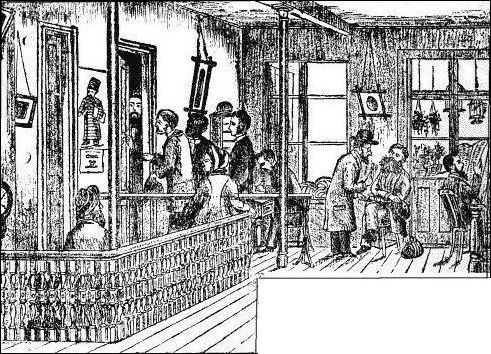
WAITING FOR THE EDITOR.
His perseverance is unmeasurable, his
tact perfect, his courage undoubted, and
his audacity—perhaps the least said of
this the better! But it must be of a
very peculiar nature—there must be no
swagger about it. A reporter should
not be what is best described by the vulgar
term "cheeky." Such a one will
never succeed. He must rather have
a quiet determination which will overcome
all obstacles, together with a modest
demeanor and sufficient self-confidence
"not to stand any nonsense;"
be fluent of speech and speak with
authority when he has anything to say;
have a perfect knowledge of men and
things of interest, and be an easy, rapid
and fluent writer. It may be said that
such a man would be a paragon of excellencies.
However this may be, a
first-class reporter is not often met, and
seldom remains a reporter very long,
except under specially favorable circumstances,
for the opportunities to
pursue other occupations, if he be a
man of good character, are not few.
But once a reporter, the reporting
spirit never leaves him. The occupation
is so full of variety and interest,
that the mind constantly reverts to
it. He has plenty of drudgery also.
Sitting up till midnight or daylight to
make a good resume of some dry speech
is not pleasant work; digesting long
and complicated reports, and many
other duties, are mere drudgery, and
form no small fraction of his duties.
To these, however, are added the excitement
belonging to the work of a detective
who is employed in searching
out hidden things; that of a lawyer examining
and cross-examining a witness
in order to arrive at the truth; of a judge
weighing the evidence from all sides to
come to something like a satisfactory
decision on troublesome questions. It
may be thought that this is an ideal
view of a reporter, and that the reality
is never met with in real life. But the
ideal has often been reached, and during
the comparatively short life of the Witness
there have been connected with it
in this and other capacities gentlemen
whose names rank with the highest
in commercial and professional life.
The ranks of the press in England,
France, and the United States, as well as
Canada, are constantly being infringed
on to fill those of legislators, business
men and authors. There is one thing
connected with reporting which always
has had a tendency to lower it in the
public estimation. It has been considered
a means of providing men of
ability, but lax in morals and irregular
in habits, a means of obtaining a precarious
livelihood. This has made the
dangers to be met with in this course
of life very great, because of the associations
surrounding those engaged in it,
and at one time it was supposed to be
almost impossible to be a reporter and
a well-living man. But the days of
"Bohemianism" have passed in Canada,
and for years there has but very
seldom been a reporter on the Witness
who was not at the same time a total abstainer
from all that intoxicates.
We might mention very many interesting
instances, showing under what
difficulties information is sometimes
obtained, how "secret" meetings are
reported in full, and how but very little
that reporters want to know is hid, but
space will not permit.
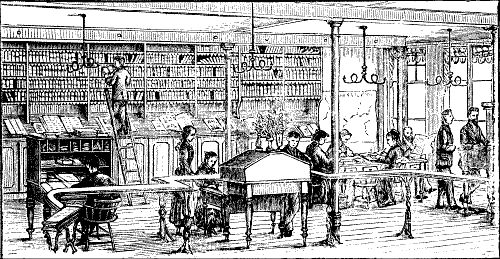
THE LIBRARY.
We will now rapidly run through the
Witness office. It occupies two large,
three-story buildings, one fronting on St.
Bonaventure street, Montreal, and the
other extending back almost to Craig
street in the rear. These two buildings
are united by an enclosed space,
which is utilized as an engine-room
and storehouse. This portion is covered
with a glass roof to give light to
both of the buildings, which are connected
by bridges ornamented with
flowers and musical with the songs of
birds, as suggested by the engraving.
Entering by the front door from St.
Bonaventure street is the business office.
Ascending the large staircase shown,
the editorial and reporting rooms are
reached. In the latter is the library
for the use of the Witness employees,
containing over one thousand volumes.
These books are lent free to all engaged
in the office desirous of reading them.
The principal English, American and
Canadian papers are also kept on file.
On the same flat is the correspondence
department,—in which young
ladies do most of the work,—the engraving
department, the editor of the
Aurore, and the desk of the mechanical
manager. Going up stairs still
higher, the "news" room is reached,
where the compositors of the Daily
Witness perform their duties. The
managing editor and the proof-readers
monopolize a corner of this
room. Crossing one of the bridges
previously referred to, the electrotyping
department is seen occupying a partitioned-off
corner of the very large and
airy "job" office, where are the compositors
of the Dominion Monthly,
and where any amount of pamphlets,
books, and of job work is turned out
each year. Taking the hoist we
descend to the next floor, which is
occupied by the binding and folding
room. Here also the mailing lists are
kept and scores of "chases" full of
names are to be seen, as well as the machines
for mailing the papers. This
room is the one shown in the illustration
of the dinner to the newsboys, the tables,
however being covered with something,
to them, more attractive than sheets
of pamphlets, while the walls are draped
with the national flags. This room has
been formally devoted to any reunions
the employees may decide to hold for
their own entertainment. Descending
still another story, we reach the pressroom,
where the huge eight feeder, nineteen
feet high, thirty feet long and six
broad, is turning out sixteen thousand
printed sheets an hour. The double
building occupies 7,300
feet of ground and 20,400
feet of flooring, besides
cellarage.
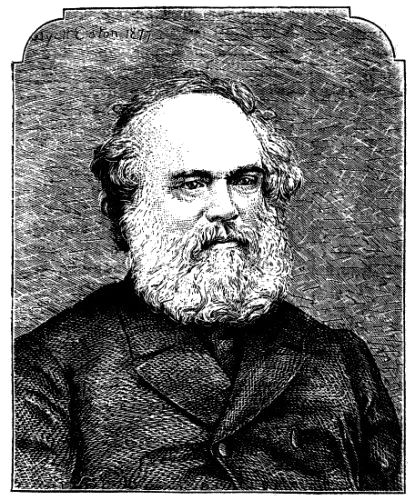
JOHN DOUGALL.
In all there are one
hundred and twenty-eight
persons employed within
these walls. In the business
department there are
ten; in the editorial and
reporting thirteen; three
engravers; four in the promotion
and correspondence
department; thirty-five
compositors on the
Daily Witness, including
foremen; four proof-readers
and copy-holders; two
electrotypers; thirteen job
printers; eighteen folders
and binders; four despatchers;
three compositors
to keep the mailing lists
in order; fifteen pressmen;
one engineer, and four
drivers for delivery to
city dealers.
Besides these there are a host of
others, a part of whose sustenance is
obtained from the Witness. Newsboys,
carriers, dealers, correspondents,
telegraphic operators, writers, agents
and others, all make a list of no little
importance. Female labor is extensively
used in the offices, there being
no less than thirty-seven young women
employed. Amongst all the employees
there has grown up a commendable
esprit de corps, which is much to be
admired. There are but few changes
in the personnel of any department,
and the good feeling amongst all has
much to do with the general efficiency
of the establishment, and will conduce
to make it still more prosperous and
useful.
So much has been said about the Witness
office that there is little room for
the Witness itself. It will remain a
lasting monument to the zeal of Mr.
John Dougall, who is now in New
York, endeavoring to engineer the New
York Witness to success. Its history
has been one of trial, perseverance, but
ultimate success all through. It was
started in Montreal as a weekly in
January, 1846, on a basis then entirely
novel in Canada. It was devoted
to the advance of religion, religious
liberty, temperance, and of all
moral and social reforms, and to the
education of the people in matters
affecting their moral or material wellbeing,
standing entirely alone on many
questions. The following, from the
opening article in the first number,
shows the object for which the paper
was started, and the course marked out
for it to pursue.
* * * "We say good papers, for assuredly
the utmost of care should be exercised to keep
such sheets as have a demoralizing tendency
away from the hallowed precincts of the family
circle.
"The Canadian field is comparatively unoccupied
at present, and, therefore, the importance
of sowing good seed early and plentifully can
scarcely be over-rated, otherwise it will, doubtless,
soon be filled with tares and thistles."
* * * "The power of the press is incalculable;
it is, probably, the very first element, next
to the living voice, of general influence; should
not, then the Lord's people make every effort to
wield it on His side, and not tamely abandon it
to the god of this world." * * *
"By occupying the field for the Lord, we do
not mean, however, the publication exclusively,
or even chiefly, of what is called religious matter.
We mean that every subject,—History, Science,
Education, Agriculture, News, and in a word, all
the affairs of life,—should be treated and illustrated
as part and parcel of the Moral and
Providential Government of an infinitely great,
just, wise, and good God, whose crowning mercy
is displayed on the cross of Christ.
"'I have never wanted articles on religious
subjects half so much as articles on common subjects
written with a decidedly religious tone,' were
the words of Dr. Arnold, one of the master
minds of the age, words which the Religious
Tract Society of London has appropriately
chosen as the motto of a series of volume publications
intended to supply the Christian family,
and in fact, the world, with the requisite information
upon important secular subjects,
tinged, or rather embued, with the spirit of pure,
undefiled religion, instead of the spirit of infidelity
or licentiousness which has too often pervaded
popular publications hitherto. In fact,
they seek to efface the brand of Satan from popular
literature, and substitute the stamp of Christ;
and is this not a worthy object of Christian ambition?
For ourselves we would say, that our
highest aim is to spend, and be spent, in humbly
endeavoring to contribute to the attainment of
such an object."
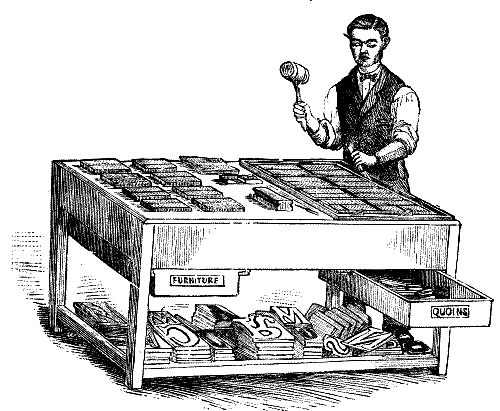
LOCKING UP "DOMINION" FORM.
At the close of the year the following
course was laid down:
"It is our intention to carry on the 'Witness'
substantially as it has been carried on during the
past year—testifying for great truths as occasions
may arise; acknowledging no sect but Christianity,
and regarding no politics but those of the
kingdom of God; yet devoting much attention
to everything that regards the physical welfare
and social improvement of the people of
Canada."
This was no idle expression of intention,
as the history of the paper to the
present time gives evidence. As it was
instituted it remains to-day. It is amusing
to read that in 1864 it began agitating
for public baths—which it is agitating
for now—and that it began working
for a reduction in postage, which soon
after it was successful in obtaining. It
began publishing pictures in the second
number issued, and still gives more
space to them than other journals.
For several of its early years appeals
were made to subscribers to assist it
so that it might be able to live and
become a success. But the crisis once
past it grew rapidly and firmly. It became
a semi-weekly at the time it adopted
first in Canada the cash system
of payments, by which it was able to
give just twice as much for the money.
On the visit of the Prince of Wales
in 1860, a daily was commenced experimentally.
It was so popular from
the first that it was continued. Its circulation,
which began with hundreds,
rapidly grew to thousands. As it became
prosperous its production became
expensive. First it was a very
small sheet which might easily be sold
for a cent with some profit. But as it
grew older the necessity for improvement
became more pressing until it
now, in interest and the quantity and
value of its contents, excels papers
which attain to the proud dignity of
selling fewer copies at three cents or
more.
At first it was printed on a single
feeder press in a back office; now it
is printed on the gigantic eight feeder
spoken of above. In 1860 the weekly
pay list amounted to $80, which was
paid to sixteen employees; now it
amounts to $925, paid to one hundred
and twenty-eight employees.
The Northern Messenger was
commenced in 1865, as a four-paged
semi-monthly, under the title, Canadian
Messenger. Its circulation then
was small, but now it has attained to
nearly fifty thousand copies. The New
Dominion Monthly began its existence
contemporaneously with the Dominion
of Canada, on July 1st, 1867.
It has not had a very vigorous life
until late years, but it seems to have
overcome all its hinderances. It is
now enjoying much popularity, and a
long and useful career is looked forward
to for it. The youngest of the Witness
publications is L'Aurore, a child
of adoption, which is published in
French,—the only Protestant paper in
America in that language. It is undergoing
its struggle for existence and
is weathering the storm bravely, and
every day adds to its chance of ultimate
success. All these publications are
sent forth in the hope that they will
be the instruments of good and blessing
to many. Unless this object had
been in some measure fulfilled, it is
most likely that none of them would
have lived any length of time. They
were all, at starting, losing ventures in a
monetary point of view, and in that
respect have thus far little more than
made ends meet; but in the higher reward
sought—that of becoming engines
of usefulness, they have exceeded all
expectation.
G. H. F.