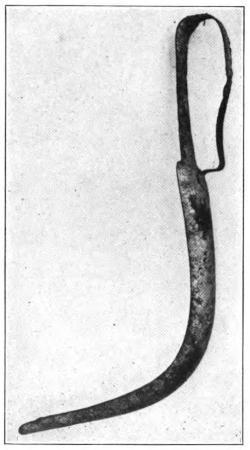
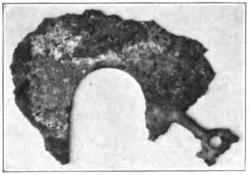
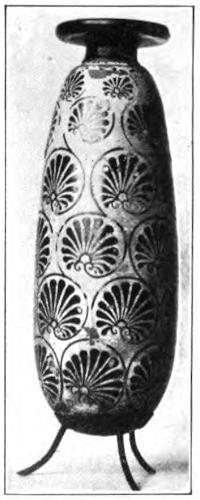
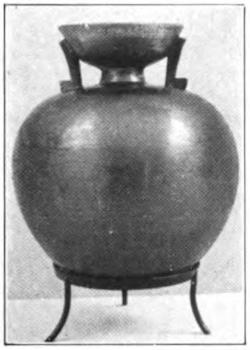
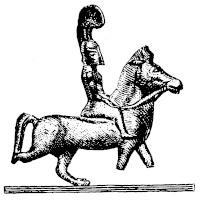
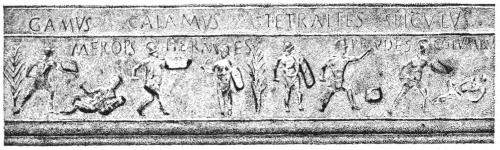
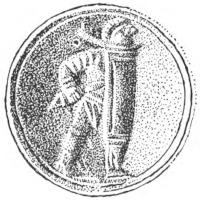
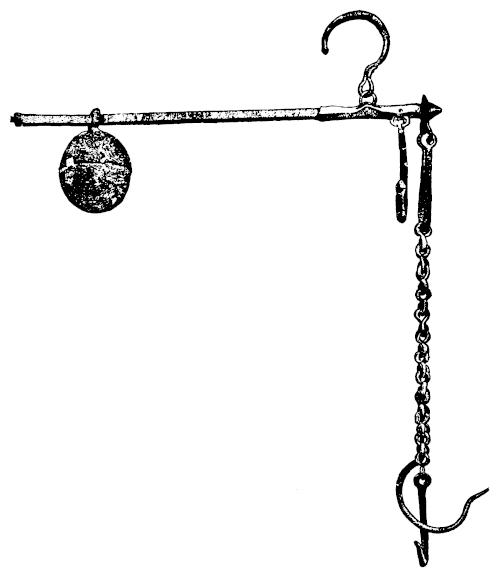
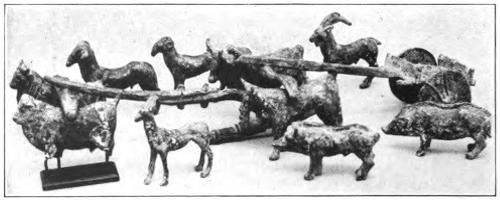
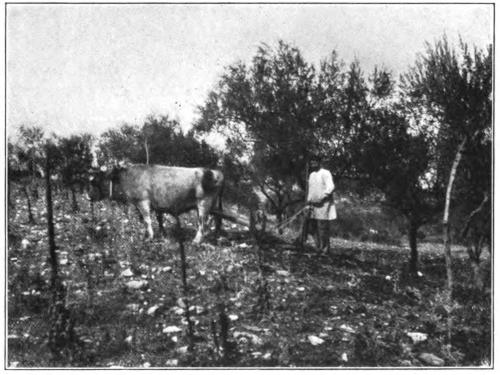
This handbook is intended to serve as a guide to those
objects in the Classical Collection which illustrate the
daily life of the Greeks and Romans. Some of these have
been brought together as a special exhibition in Cases 1
to 5 in the Fifth Room, while others which it has not been
possible to move are referred to in their respective positions.
Many of these antiquities are among the most
valued possessions of the Museum, while others are entirely
lacking in artistic qualities and would scarcely attract
the visitor’s attention, yet placed in their proper
relations they are found to be full of unsuspected interest.
Investigations of the sites of ancient cities, settlements,
and burial places, especially during the last fifty years,
have brought to light objects of the most varied kinds
which allow us to know, as was never before possible, the
appearance and manner of life, the tools, utensils, weapons,
and toys of the Greeks and Romans. Any one who
will take up an old translation of an author such as the
elder Pliny, Xenophon, or Martial, and compare it with a
modern version will see at once the difference in this particular.
The earlier translator was often at a loss when
confronted with allusions to every-day life and consequently
either did not express clearly the meaning of his
original or even entirely misrepresented it. But quite
apart from a correct interpretation of the works of ancient
writers, the study of private antiquities enables us to form
a mental picture of these people and their surroundings,
the actors in the theatre, the citizens gathered in the assembly
or at a religious festival, the houses from which
they came, and the work they left behind; and as a result,
to see the world with their eyes, to comprehend their aims
and actions, and to compare them more intelligently with
our own.
The greater part of these objects were not very valuable
at the time they were made; they were the ordinary possessions
of ordinary persons. Yet one sees on all sides evidence
of the skill, careful workmanship, and artistic feeling
ungrudgingly spent in making simple, common articles for
every-day use. In our own time the situation is very
different; to the average person beauty and utility have
little or no relation to each other, and he consequently
provides for his home useful and necessary utensils which
have no beauty, and so far as he is able adds “ornaments”
which have no utility and very frequently, it must be said,
no real beauty. Again, the period in which we are living
has not produced any definite style, either in architecture
or in the arts and crafts, though there has been much careful
copying and adapting of earlier ideas; but the products
of Greek and Roman artists and craftsmen have “style,”
not as a result of striving for an effect, but because each
workman received the traditional schooling in his craft and,
having practised it with satisfaction in work well done,
tried to add something to the store of knowledge before
handing it on to the next generation. Such considerations
alone would make the study of the every-day
utensils of classical times a valuable one in the present day.
No attempt has been made in this handbook to treat the
subject exhaustively; it is intended merely to provide such
explanation and commentary as will be helpful toward an
understanding of the antiquities. In consequence the
length of the sections has been determined by the amount
of material available and does not necessarily correspond
to the relative importance of the various subjects.
THE DAILY LIFE OF THE GREEKS AND ROMANS — I RELIGION CASE 1
The religion of the Greek and Roman peoples was
composed of many elements, and presents throughout
their history a great variety of cults and observances.
Religious tenets were not defined, and no priestly hierarchy
attempted to coerce the people in their beliefs or actions.
A Greek or a Roman was not under the necessity of worshipping
the gods, though he might incur the anger of his
fellow-citizens by outraging their feelings. To the ordinary
man or woman, however, the service of the gods was a
daily duty and each important event of human life had its
appropriate observance. The head of every family was
its priest, and the children his assistants in carrying out
the worship of the divine beings who guarded the house
and fields and all the living creatures therein. Similarly
the great gods of the city were served by the priests and
priestesses appointed to represent the city, conceived of as
one great family. Each city had its recurring festivals,
its rest days sacredly kept, and its days of commemoration
of the dead.
Public worship in Greece and Italy consisted of prayers
and hymns, and of sacrifices offered both within the temples
and shrines and in other places, such as groves and
springs, which were held to be sacred. The temples were
built and adorned with all possible care, and were the pride
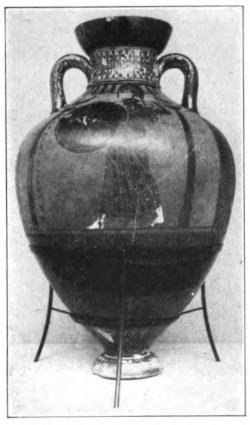
of the community. An amphora
(on the bottom of Case S in the
Fourth Room) decorated with a
religious scene shows a common
type of altar. It is shaped rather
like a pedestal with an architectural
moulding and “horns” on either
side. A miniature terracotta shrine
from Cyprus (on the right side of
the top shelf in Case 1), made for
household use, gives us an idea of
the shape of the larger ones which
held a statue at crossroads and
street corners. Incense, a frequent
accompaniment of worship, was
burned in a covered vessel, often
provided with a high stand, such as
the incense burner painted on a
small oinochoë in Case G in the Fifth Room; or a little altar
was used for the purpose. An example from Cyprus, which
still shows traces of fire, stands on the top shelf of Case 1.
A marble lamp from a temple is in Case G in the Third
Room. It was made to be set in a support, probably a
bronze tripod, and was filled with oil in which a wick floated.
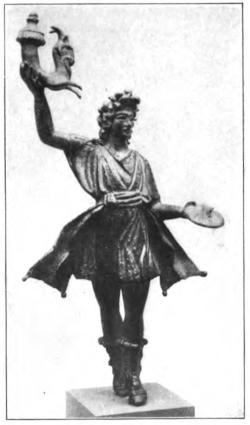
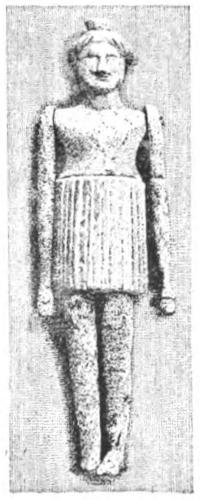
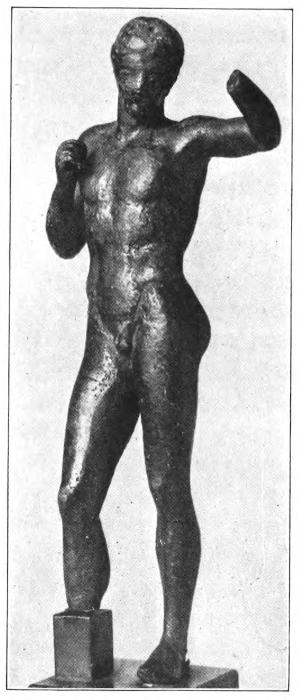
FIG. 1. PRAYING YOUTH (?)
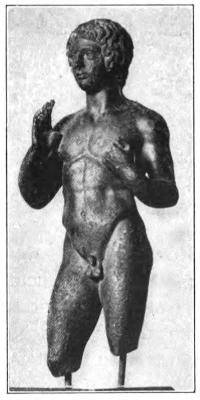
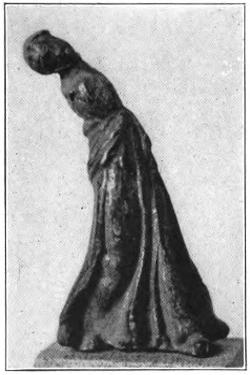
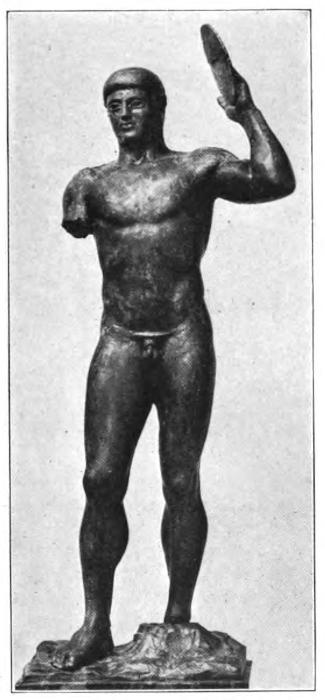
In prayer the worshipper looked upward and raised both
hands. This attitude is perhaps represented in a bronze
statuette, probably a votive offering, in Case D in the Fifth
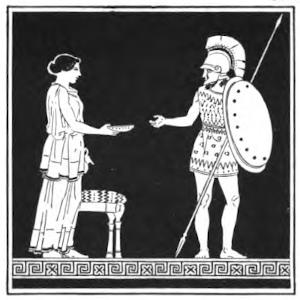
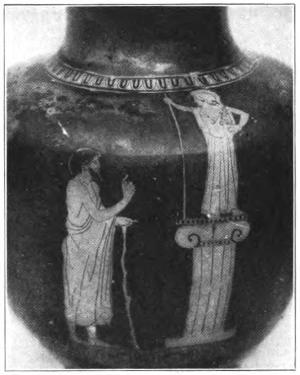
Room (fig. 1). A small wine-jug (Case 1, middle shelf) is
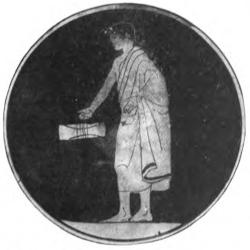
decorated with a scene no doubt very common in Athens;
before a statue of Athena
raised on a low
column stands a man
saluting the goddess by
kissing his fingers and
raising them toward her
(fig. 2). A bronze votive
statuette in Case D
in the Fourth Room is
making the same gesture.
FIG. 2. MAN SALUTING A STATUE OF ATHENA
FIG. 3. MAN CARRYING A PIG TO BE SACRIFICED
FIG. 4. VOTIVE TABLE
FIG. 5. VOTIVE PLAQUE
The universal custom
of offering to a divinity
gifts in supplication and
thanksgiving has many
interesting illustrations in the collection.
A remnant of the ancient
religion of Crete is the die for moulding
miniature bronze axes in Case
B in the First Room. The little
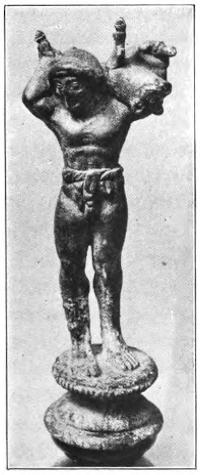
bronze figure of a man carrying a
pig in Case C2 in the Third Room
served as a memorial of a burnt
sacrifice (fig. 3). The terracotta
warriors from Cyprus (Case 1 and
the wall-cases in the corridor), and
the Italic bronze warriors (Case 3
and Case J in the Third Room)
were probably thank-offerings for a
victorious home-coming. The
group of terracotta figures holding
one another’s hands gives a rude
picture of a ring-dance such as was
performed in honor of Aphrodite in Cyprus (Case 1, top
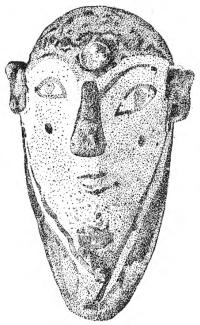
shelf). The painted terracotta face above this shelf is an
example of the many little masks
called “oscilla” which were hung by
cords in sanctuaries or on the branches
of trees outside (see tail-piece, p. xvii).
They seem to have been a substitute
for the worshipper when he was
obliged to be away about his daily
occupation. Several other examples
will be found in wall-cases in the
corridor. Fourteen miniature bronze greaves in Case 4 were
probably dedications, perhaps made by soldiers after a battle.
Food and drink were the simplest and commonest gifts, but
were often beyond the means of the worshipper. If this
were true, he gave a representation
in some cheap material of the offering
he wished to make, thus expressing
pressing his good-will. In Case 1
are three little tables with articles
of food in relief upon the surface.
We see a ham, a whole boar, some
cakes, fruit, and various dishes of
food (fig. 4). Near these tables is
a little tray with several cakes represented
in relief upon it, a substitute
for the cakes which were placed on tables in the
temples, like the shew-bread of the Hebrews. The group
of vases connected by a ring was used for offering small
portions of liquid, probably oil, wine, honey, or milk.
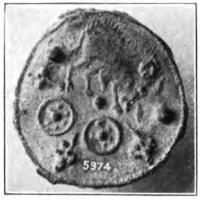
Gratitude for the cure of disease was often exhibited by
dedicating a representation of the affected part. On the
top shelf at the left are terracotta plaques showing eyes,
eyes and mouth, and an ear (fig. 5). Other examples are
in Cases 47 and 75 in the Cesnola Collection. The manufacture
and sale of such objects formed an industry in
ancient times, and the records of the temple of Asklepios
at Athens which are still preserved contain long lists of
them.
FIG. 6. TERRACOTTA HERM
FIG. 7. WARRIORS MAKING A TREATY (?)
FIG. 8. CHARMS OF COLORED GLASS
The ceremonies and sacrifices in temples were few compared
to the frequent occasions for private and family
worship. No meal was eaten without offering a portion
of food and drink to the gods, and statuettes and symbols
of divinities were kept in various rooms of the house
and near the house-door. The rude bust of Hermes on a
pillar (Case 1, middle shelf) is of the same type as the
much larger pillars which in Athens were placed near
house-doors, in schools, and in the market-place (fig. 6).
It was the mutilation of these images which caused such
consternation immediately before the sailing of Nikias on
the disastrous Sicilian expedition in 415 B.C.
FIG 9. LAR
An interesting terracotta
relief in Case 4 represents
two warriors clasping
hands (fig. 7). Perhaps it
may be regarded as a votive
offering made to commemorate
a treaty or an
alliance, either of which
with the Greeks and also
the Romans was an agreement
made in the sight of
the gods and accompanied
by sacrifices. Readers of
the Anabasis will remember
the treaty made by the
Greeks and the Persians
after Cyrus’s death (II, ii,
8, 9), when the sword-blades
and spear-heads were dipped
in the blood of the victims
caught in a shield, and the
leaders on both sides gave
their right hands as a pledge of fidelity.
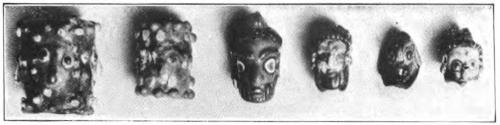
The superstitious and fearful aspect of ancient religion
is represented by the grotesque faces called apotropaia,
“turners away,” which were thought to avert misfortune.
They were worn especially by children, and large ones of
various materials were often fastened up in workshops and
houses. A number of small examples in glass are in
Case C in the Third Room (fig. 8).
Perhaps the first divinities we think of when we turn to
the native Roman religion are the Lares, the guardians of
house and field. The Lar was represented as a youth holding
a horn of plenty and a patera, a shallow bowl used in
sacrificing (fig. 9). Two of these figures stood side by side
near the hearth in the principal room of the early Roman
house, but at a later period they were
placed in a little shrine usually adjoining
the atrium. A statuette of
rather careless workmanship stands
on the middle shelf in Case 1 and a
much better example in Case J in the
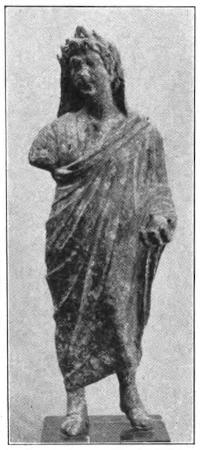
Eighth Room. A fine statuette of
the Imperial period represents a priest
with his toga drawn up over his head
in preparation for sacrificing, in accordance
with the custom which Virgil
mentions in the Aeneid: “Veil thine
hair with a purple garment for covering,
that no hostile face at thy divine
worship may meet thee amid the holy
fires and make void the omens” (III,
vv. 405ff. Mackail) (Case J in the
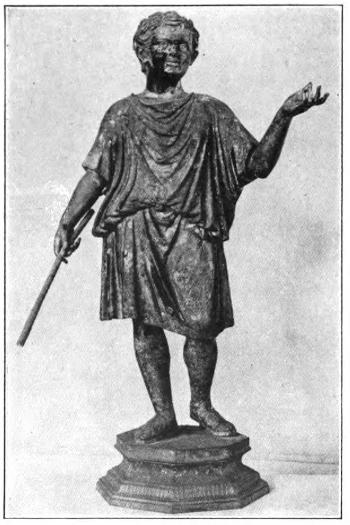
Eighth Room, fig. 10). A life-size
statue of a camillus, a boy assistant
at religious rites, is in this room (fig. 11). The office of
camillus was an honorable one bestowed upon the young
sons of distinguished families.
FIG. 10. ROMAN PRIEST
We have several interesting objects related to special
cults. A goddess revered by both Greeks and Romans
was Tyche or Fortuna. A small bronze statuette (Seventh
Room, Case H 2) represents the Fortune of Antioch seated
on a rock, crowned with turrets, and holding in her hand
a sheaf of grain. Fortuna had many temples in Rome,
where she was worshipped under different titles. The
popular belief in her power is attested by Caesar, who tells
of the confidence felt by his men in him and in his success
because they believed him to be a favorite of Fortune. A
rather rude statuette of this divinity stands on the second
shelf of Case 1.
FIG. 11. CAMILLUS
The worship of the Egyptian goddess Isis gradually
spread from Egypt into Asia Minor and thence into Greece
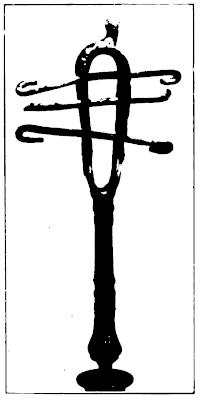
and Rome. The bronze sistrum or rattle was used in her
rites, and she is often represented holding it in her hand
(Case 1, fig. 14).
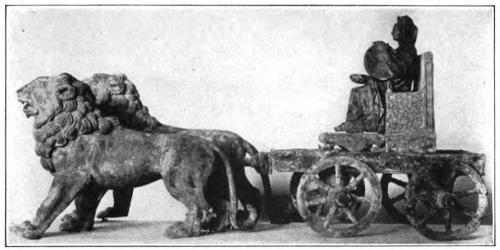
An especially interesting memorial of an Eastern cult
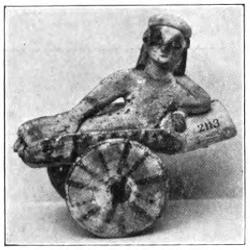
established in Rome is the statuette of Cybele, the Mother
of the Gods, on her processional car drawn by lions (Case
M in the Eighth Room, fig. 12). The worship of Cybele, a
very ancient one, was introduced into Rome during the
Second Punic War at a time of great danger and anxiety.
Our statuette represents not the goddess herself but her
cult statue, and probably commemorates one of the annual
festivals at which the image on its car was taken to the
river Almo to receive a ritual bath. The god-companion
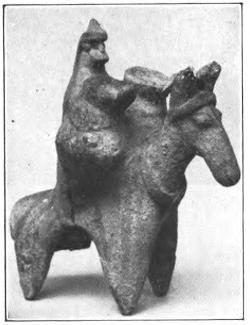
of Cybele, Attis, was not worshipped at Rome before the
time of Claudius, though his cult was diffused over many
parts of the East. A little terracotta from Cyprus shows
him in Phrygian dress on a horse (Case 1).
FIG. 12. STATUE OF CYBELE ON ITS CAR
FIG. 13. SACRIFICIAL PROCESSION
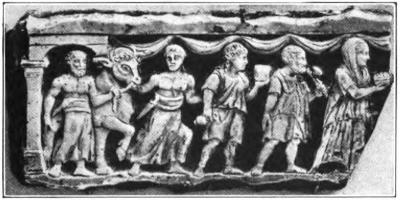
A glass relief (on the tray above the middle shelf) gives a
realistic picture of a Roman sacrifice (fig. 13); an ox is
being led through the portico of a temple by four men
carrying knives and an axe. A priestess walks before
them with veiled head, holding a box containing incense,
meal, or other articles used at sacrifices.
FIG. 14. SISTRUM
II THE DRAMA CASE 1
Dramatic performances in Greece were a part of
the worship of the wine-god Dionysos, and in consequence
attendance in the theatre at Athens was a religious duty
as well as a pleasure. The audience was composed of the
citizens, both men and women, and visitors from other
states and cities. In early times the playwright acted in
his own play, but later the profession of actor was distinct
from that of poet. Women’s parts were taken by men.
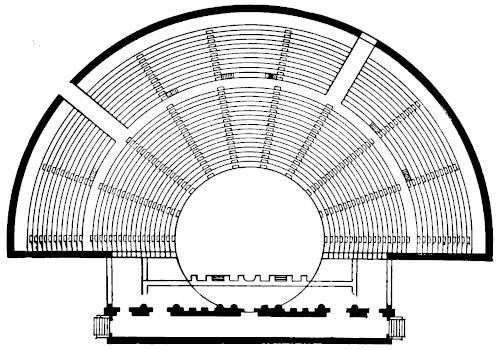
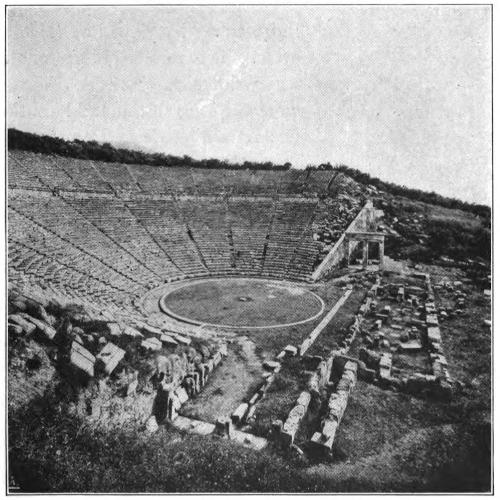
Plays were performed by daylight in the open air, in
theatres so constructed that most of the audience was at a
considerable distance from the actors. These circumstances
naturally had a great effect upon the conventions
of the theatre and the manner of acting, as effects must be
broad, characters must be typical rather than individual,
and facial play was impossible (fig. 17). Early in the
history of the Greek drama masks for the actors were introduced,
and continued in use for both tragedy and
comedy. They were usually
made of linen stiffened with
clay and painted, though cork
and wood were also used. The
pupils of the eyes were perforated
so that the actor could
see, and the mouth was always
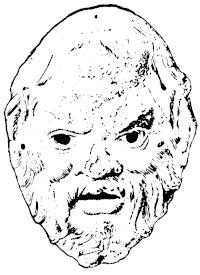
open. In Case 1 are two terracotta
masks, possibly made for
use, one of a satyr (see tail-piece,
p. 18), the other of a
young woman, and two little
masks representing comic characters.
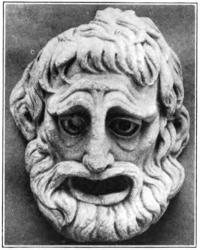
In the same room above Case 4 is a large tragic
mask of marble (fig. 15). This fine piece of decorative
work is modeled after the masks
worn by the heroes of the tragic
stage. Above the tragic mask rose
a projection called onkos which increased
the apparent height of the
wearer. For the same purpose a
shoe with a very thick sole, the
kothornos, was worn; the height of
onkos and kothornos varying with
the importance of the character.
The dress of the tragic actor corresponded
in a general way with
that of every-day life, but the chiton
was long, and the costumes were
frequently bright in color and decorated
elaborately with woven or embroidered bands.
FIG. 15. TRAGIC MASK
FIG. 16. SLAVE IN OLD COMEDY
FIG. 17. THEATRE AT EPIDAURUS
FIG. 18. ACTOR OF MIMES
A group of terracotta statuettes from Athens (Sixth
Room, Case L) gives a vivid picture of the actors of the
Old Comedy, that of Aristophanes and his contemporaries.
By a convention of the stage, all comic actors, even those
who played young women’s parts, were grotesquely padded,
and over the padding male characters wore an elastic
woolen covering much like the modern jersey, which is
represented by dots in the statuettes.
The man’s chiton was always
ridiculously short. Women
wore the long chiton and himation.
On examining these figures we see
that they include certain stock
characters which were used over
and over by playwrights. The figure
on the left hand in the lowest
row represents an old man, probably
an irascible old father. His
mask is made so as to present a
kindly expression on one side and
an angry one on the other. The
actor turned to the audience the
side which expressed his feelings at
the moment. The statuette at the
left of the top row seems to be of the
same general type. The right-hand
figure in the top row is Herakles
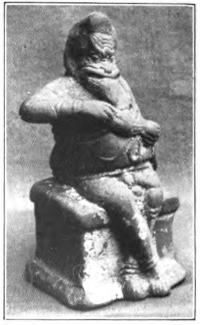
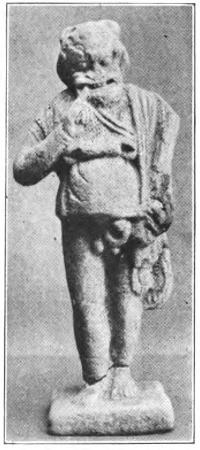
(fig. 20); that on the right hand of the lowest row is probably
Odysseus, both favorite comic characters. Another
represents a slave who has stolen a purse and has taken
refuge at an altar upon which he sits weighing his pelf in
both hands (fig. 16). Besides these there are a young
woman and a middle-aged matron, an old nurse with a
baby, and a street vendor with a basket. The scheming
slave, another stock character of ancient comedy, stands
in a thoughtful attitude at the left hand of the second row
from the top.
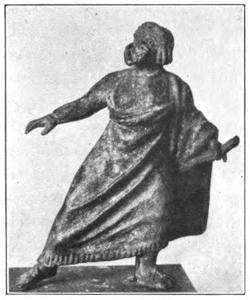
In the Seventh Room
(Case H 2) is a bronze
statuette of an actor in
the New Comedy (fig. 19).
The ridiculous dress of the
earlier period has been discarded
for a fringed himation,
but the mask is still
worn. This actor seems to
be declaiming a passage
“full of sound and fury”
accompanied by sweeping
gestures.
FIG. 19. ACTOR IN NEW COMEDY
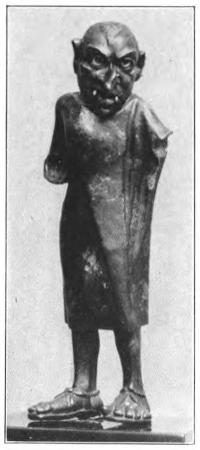
In the same case is a statuette of
an actor of mimes or pantomimes, in
itself a masterpiece of the grotesque
(fig. 18). These performances were
generally satires upon contemporary
life, and were immensely popular in
Greece and Italy, being sometimes
provided as entertainment for guests
after dinner. The actors did not wear
masks and probably relied much upon
gestures and facial play for their
effects.
FIG. 20. COMIC ACTOR AS HERAKLES
In Rome as well as in Athens the
drama was connected with religious
festivals and the funerals of the great,
but it encountered much opposition
from the more old-fashioned moralists
and was never so popular as were grosser amusements.
The actors were frequently slaves, though citizens
engaged in this profession in increasing numbers under
the late Republic and the Empire, but their occupation
deprived them of certain civil rights and affected their
social standing; while at Athens parts in both tragedies
and comedies were taken by citizens, who lost nothing in
public estimation by so doing. This in itself shows the
marked difference in the Greek and Roman attitudes.
Roman tragedy was closely modeled upon the Athenian,
and the plays of Menander and his contemporaries, translated
and adapted by Plautus and Terence, became
Roman comedy, from which the classic comedy of modern
Europe is derived. More popular, however, were the
farces and pantomimes of various kinds, in which the native
influence was strong, the dialogue and gestures being
largely extemporaneous, thus affording an opportunity to
a clever actor for displaying all his skill.
III HOUSES AND FURNITURE CASES 2 AND 5
Though the Greek and the Roman house differed
considerably in detail, in a general way the two were similar.
For Americans the simplest comparison to make
would be with the Spanish type of dwelling in California
and other parts of the Southwest, since all three have the
common characteristic of looking in, rather than out. The
exterior presented a blank wall, usually of brick, broken by
a door and a few windows. An open courtyard formed
the center of the Greek house, and this manner of building
was borrowed by the Romans as their wealth increased
and larger and pleasanter houses were desired. The
Roman house, which grew by the addition of rooms to the
original single-room hut, had a large opening in the roof of
the principal room or atrium, to provide light and allow the
smoke from the hearth to escape. Under the opening
was a basin, called impluvium, into which fell the rain-water
from the roof. These features were retained even
after the atrium was used only as a reception room, the
household work and cooking being done in a separate
kitchen.
FIG. 21. ROMAN WALL-PAINTING
FIG. 22. CUBICULUM
Houses were usually built of sun-dried brick on a stone
foundation. The roofs were often flat and were sometimes
covered with hardened mud, but tile roofs were also
common. Marble for columns and other decorative features
was introduced into Rome in the later part of the
Republican period and colored marbles were used freely
by the rich Romans of the Empire. Walls were covered
with stucco, which was frequently painted. There was no
wall-paper, of course, and pictures were painted directly
on the walls. Fashions in decoration changed as they do
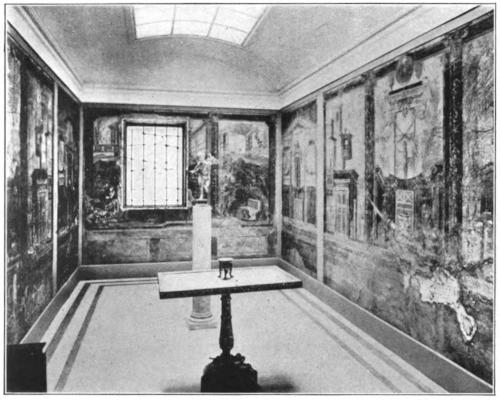
at present, though more slowly. The wall-paintings from
a villa near Boscoreale, in the Eighth Room, illustrate
several types in use in Italy in the first century A.D. The
earliest style imitated columns, marble panels, or other
ornamental features employed in buildings. Arabesques
and fanciful combinations of foliage, birds, animals, and
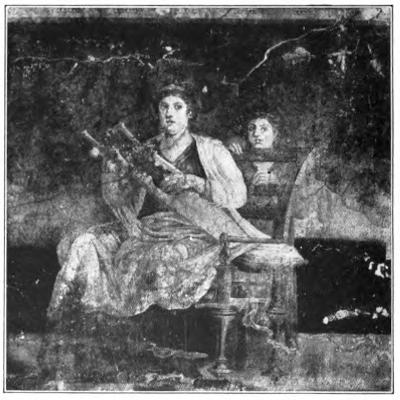
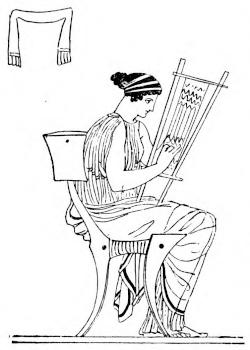
masks came into use later. Mythological and genre
scenes, as the lady with the kithara (fig. 21) and the group
of a man and a woman seated side by side, required a
skilful painter and were naturally reserved for the principal
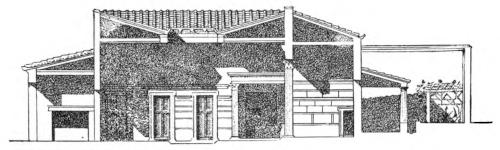
rooms. In the cubiculum (fig. 22) another style has
been employed, in which buildings, arches, porticoes, and
gardens are combined in a way which, while of course somewhat
fanciful, still probably represents the general appearance
of the streets and houses of Pompeii and other
cities of the time. Stucco reliefs, of which there are
several graceful examples in the Museum, were used in
Greek houses of the Hellenistic period as well as in Italy.
FIG. 23. MOSAIC PICTURE
Floors in early times were of hardened earth, paving
stones, or plaster. In the fifth century pebbles set in cement
came into use in Greece, and from this kind of floor
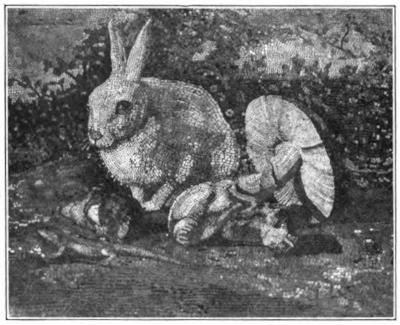
mosaic, plain and patterned, was derived. Pictures or
decorative designs made of fine glass mosaic were also used
as wall decorations. Three examples are on the tops of
Cases 1 and 2 (fig. 23).
FIG. 24. OLD MAN SEATED ON A KLISMOS
The Greek and Roman furniture which has come down
to us is necessarily small in amount and fragmentary because,
like most modern furniture, it was made of wood
and consequently has been destroyed by damp. There
remain, however, some fairly complete pieces, and a considerable
number of metal fittings and casings, as well as
some models and many illustrations from vases. Among
the objects from Cyprus in wall-cases in the corridor are
two bronze tripods, and three ornaments consisting of
goats’ feet and bulls’ heads from another. The bronze
lions’ paws were feet for a large chair or chest. We have
also a little terracotta chair with a diminutive figure in it
and a three-legged table of the kind used to set beside a
dining-couch, both from Cyprus, as well as a round table
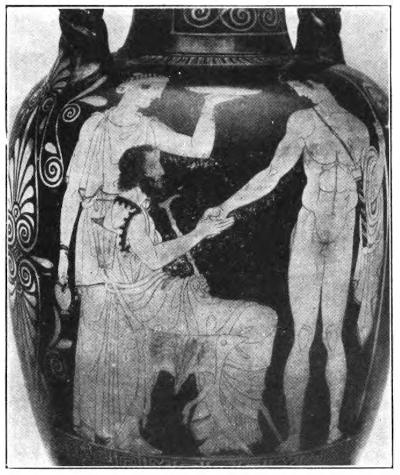
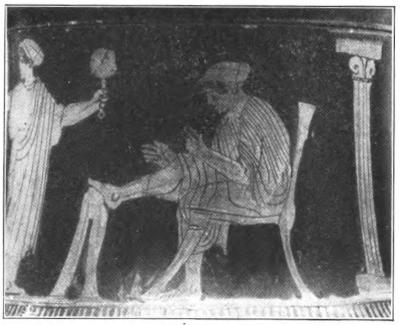
on three legs, of much later date (Case 2). Two lekythoi in
Case K in the Fourth Room, decorated with interior scenes,
show chairs of a very graceful and comfortable type, the
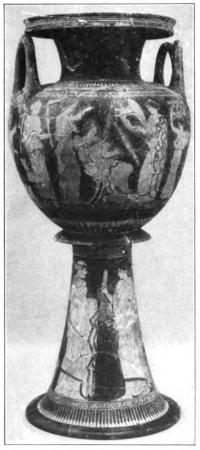
Greek klismos, and the same kind of chair is seen on the
grave-monument of a lady in the Sculpture Gallery (No.
4), and on a large amphora on a pedestal in the Fifth Room
(fig. 24). The lady playing a kithara in the wall-painting
in the Eighth Room is seated in a large armchair, the
thronos. In Case 5 is a bronze casing of beautiful work
for a piece of furniture, and in Case 2 a bronze chair-leg
and an ornament terminating
in the head of a young
bullock. Two tripods and
some bronze mountings
from Cyprus will be found
in wall-cases in the corridor.
In the cubiculum
from Boscoreale is a table
of marble and bronze.
The bronze rim which surrounds
the marble top is
inlaid with silver and niello
in a beautiful pattern of
palmettes and rosette ornaments.
A couch, probably for dining (wrongly restored
as a seat), and a footstool stand in the corridor between
the Eighth and Ninth Rooms. Bedsteads, which were
similar to this couch in shape, were merely frames on which
thongs were stretched, like the old-fashioned corded beds,
the interlaced leather bands acting as springs. The
wooden frames were frequently decorated with bronze
fittings, and in the Hellenistic and Roman periods inlay
and mountings of silver, gold, ivory, and tortoise-shell
were employed for the rich. Couches and beds were
usually supplied with a raised head-rest, often finished with
bronze animal-heads, such as the mule-heads in Case A in
the Seventh Room and Case L in the Eighth Room.
FIG. 25. BRONZE CAULDRON
FIG. 26. GREEK TABLE-WARE OF PAINTED TERRACOTTA
Clothing was kept in chests, which were well adapted
to the large pieces of cloth composing a costume. A good
illustration of a chest may be seen in Case W in the Fourth
Room, on an amphora decorated with a scene from the
story of Danaë and Perseus, and in Case 2 there is a miniature
chest of white
stone from which the
cover has been lost.
FIG. 27. BRONZE PATERA
Household utensils,
since they were made
of metal or pottery,
exist in considerable
numbers. Cooking
was usually done over
an open fire, though
stoves of a simple type
came into use in the
Hellenistic and Roman
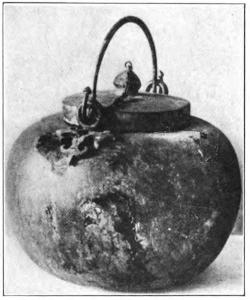
periods. The bronze
cauldrons used for boiling
(Case S in the Third
Room and wall-cases
in-the corridor) were
valued highly, and
were offered frequently
as prizes in athletic contests (fig. 25). At the funeral
games of Patroklos (Iliad XXIII, vv. 267-268) Achilles
gives a ‘bronze cauldron untouched by fire’ as a prize for
the chariot race, and records of later contests prove that
the custom was a common one. An amphora in Case Y
in the Fourth Room is decorated with the figure of a
youth, evidently a victor in the games, carrying away upon
his shoulders a cauldron which he has won. The metal
hook in Case N in the Seventh Room was used for drawing
pieces of meat from the cauldron. Pails, finely made and
decorated, especially as to the handles and their attachments,
probably served some purpose at table, as, for example,
to hold cold water or snow in which
a vessel of wine was placed to cool.
FIG. 28. BRONZE WINE-JUG
FIG. 29. BRONZE JUG
FIG. 30. BRONZE BEAKER
FIG. 31. BRONZE LADLE FOR WINE
FIG. 32. BRONZE WINE-STRAINER
The pottery in the various rooms of the
collection shows the kinds of dishes in use
in Greek and Italian houses. There are
cups of different shapes, pitchers and jugs
for water, wine, and other liquids, kraters
(large bowls for mixing water and wine),
plates for food, and lekythoi (oil-cruets)
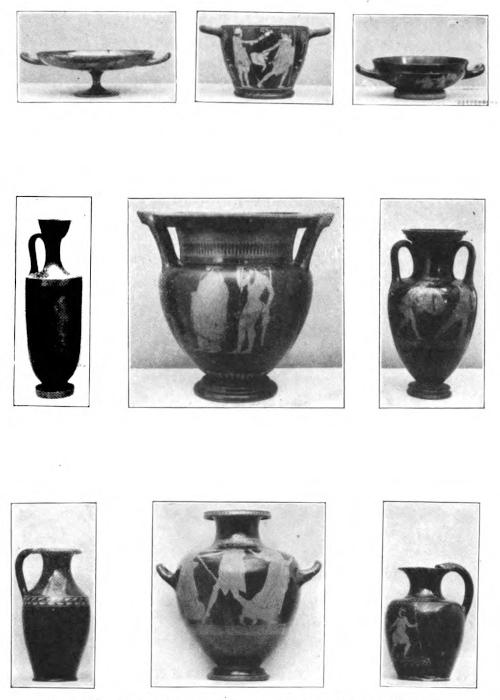
(fig. 26). The modern china, that is, high-fired
pottery covered with a vitreous glaze,
was not known, and glass did not become
common until
the Imperial
period. In the
Eighth Room
and the corridor
are many
examples of the glass vessels of
that time, some plain, others
with ornaments in relief, and
still others of colored glass in
patterns of remarkable beauty
(Cases N and O in the Eighth
Room). Much of the plain
glass has become iridescent
owing to exposure to damp
in graves. The pottery in museum
collections is naturally the
finer product of the workshop;
receptacles for storing and for
kitchen use were of undecorated
clay and more carelessly made. In the Cesnola Collection on
the tops of Cases 58-63 are some of the tall jars, called pithoi
by the Greeks and dolia by the Romans, which were used
for storing and exporting wine, grain, and many other articles,
taking the place of the casks, barrels, and boxes, and
the paper bags and cartons of modern times. The pointed
ends were driven into earthen floors.
FIG. 33. ROMAN SILVER CUP
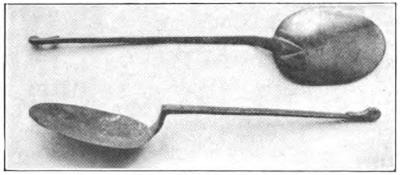
FIG. 34. ROMAN SILVER SPOONS
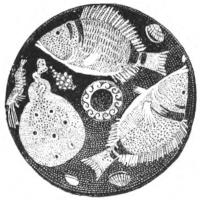
Another piece of table-ware which should be mentioned
is a special plate for fish, made in Italy, which had a depression
in the center for holding the sauce. These plates
are decorated with interesting and surprisingly accurate
drawings of fish (Case Q in the Sixth Room, tail-piece, p. 31).
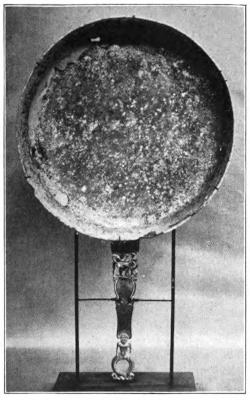
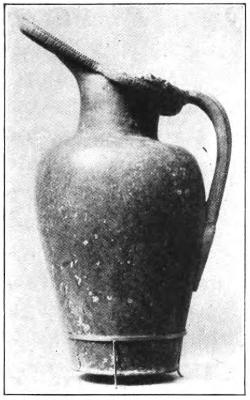
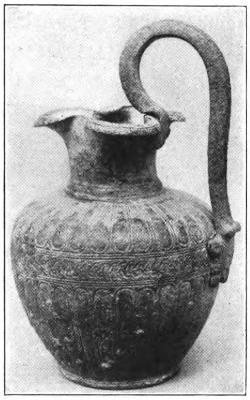
In Case E in the Third Room is a bronze table service
of Greek work from an Etruscan tomb, and in Case O in
the same room are bronze jars and jugs of various fine
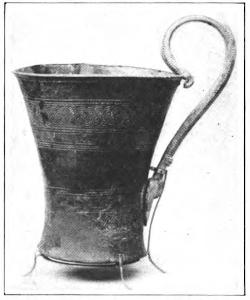
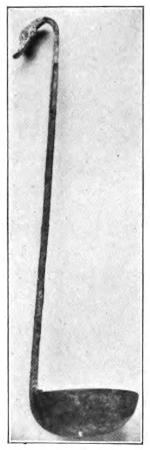
shapes (figs. 27-30), and ladles for dipping wine (fig. 31).
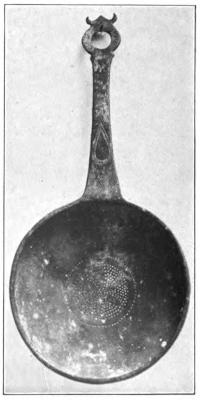
In Case A in the Fourth Room is a wine-strainer (fig. 32).
The remarkably beautiful handles from
vessels in these cases are a further proof
of the taste and care expended upon
household utensils. Silver table services
were not common among the
Greeks, but silver and even gold dishes
were used by wealthy Romans. In
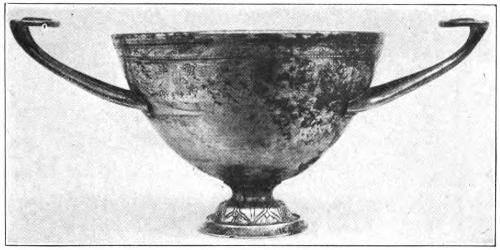
Case C in the Eighth Room are four
cups of Roman date (fig. 33) with a ladle
and a little jug or cup with a spout.
Food was usually cut into convenient
pieces in the kitchen and eaten with
the fingers, but spoons were used to
a considerable extent by the Romans.
Several bronze spoons are exhibited in
Case 5, and there are some silver spoons
of various shapes in the case with the
silver cups in the Eighth Room (fig.
34).
The habit of rising and going to bed
early which prevailed in Greece and
Italy is easily understood when we see
the meagre arrangements for lighting
which they possessed. In the street
torches were carried, and they were
also used in the house in early times.
A bronze torch-holder of the late sixth
century from Cyprus in the corridor and a terracotta
example in Case 2 appear to have been made so that
they could be set on a table. The Romans and Etruscans
made candles of pitch and also wax ones very similar to
our own, but the Greeks were not acquainted with them
until they were introduced by the Romans. The iron
candelabrum in Case S in the Third Room was designed to
hold candles on the prickets around
the top. Lamps were commonly
of terracotta or bronze. Olive oil
was burnt in them with a wick of
flax, but at best the light must
have been poor and flickering.
Candelabra were commonly made
of wood, but handsomer ones were
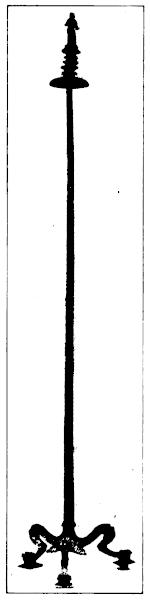
of bronze. A fine Etruscan candelabrum
stands in the Fifth
Room. It was probably furnished
with hooks or other attachments
for hanging lamps, or with prickets
for candles (fig. 35). A
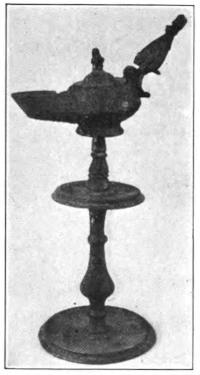
group of lamps of various shapes
is shown in Case 2 (fig. 36).
FIG. 35. BRONZE CANDELABRUM
FIG. 36. BRONZE LAMP ON A STAND
IV OCCUPATIONS OF WOMEN CASES 2, 3, AND 5
FIG. 37. WOMAN EMBROIDERING OR MAKING A NET
The home in ancient times, especially the country
house, was a manufactory on a small scale, like many American
homes of a century ago.
Most of the clothing for the
family was made there, and
consequently the mistress of
the house must understand
wool-working in every stage
and the making of linen
cloth, and must also be able
to teach and direct the slave
women. Wool was often
bought in the raw state or
even in the fleece, which
necessitated cleansing it, certainly
a disagreeable task.
The Syracusan lady in the
Fifteenth Idyll of Theokritos
scolds because her husband has bought five dirty fleeces of
poor quality—“work upon work” for her. For making the
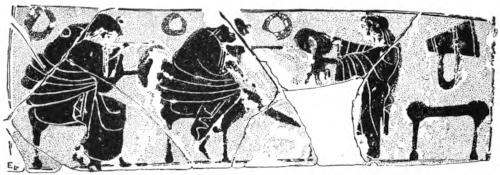
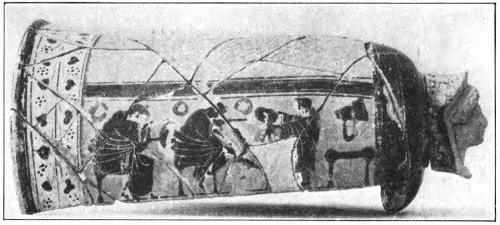
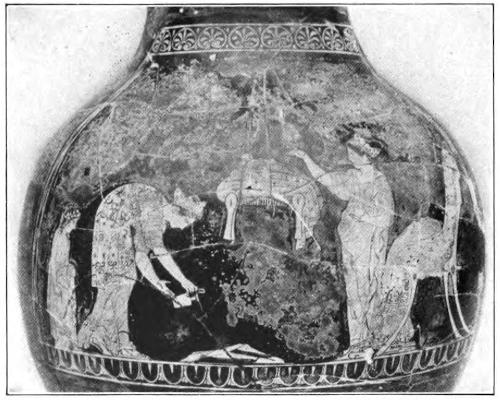
roves a pottery shield, called epinetron or onos, was placed
on the knee and the fibers rubbed over it. An interesting
example, decorated with drawings of women at work
(see head-band, p. 32), has the upper surface covered
with a scale pattern which furnished the slightly roughened
surface necessary for making the roves (Case 2, top shelf,
fig. 38). The covering, however, was sometimes dispensed
with; a finely decorated toilet-box in Case A in the Fourth
Room has on one side a drawing of a woman carding over
her bare knee (fig. 39). This box also shows the next stage
in the making of cloth, the spinning, for which distaff and
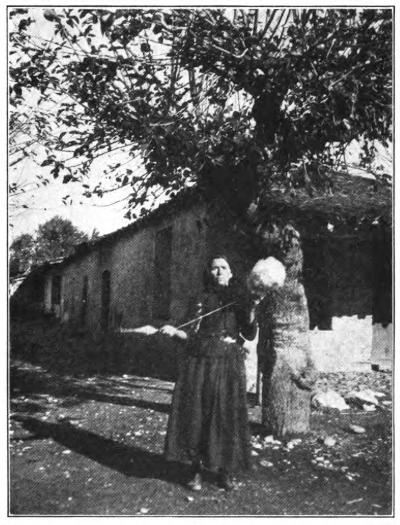
spindle were used (see tail-piece, p. 39). A small weight,
the spindle-whorl, usually of terracotta, was attached
to the thread below the spindle to increase the twisting
motion. An example is in Case 5. This primitive method
of spinning is still in use among the Greek country-folk,
witness a photograph taken in 1922 (fig. 41).
FIG. 38. ONOS OR EPINETRON
FIG. 39. WOMAN CARDING WOOL
FIG. 40. EMBROIDERED CLOTHING
The loom used in Greece and Italy was upright, consisting
of two posts with a cross-bar. The threads of the
warp, alternately long and short, were held by terracotta
weights tied to the lower ends. A loom-weight from Crete
is marked with the owner’s name, Kaleneika, wife or daughter
of Teriphos (Case 5).
FIG. 41. GREEK COUNTRY-WOMAN SPINNING
Cloth was woven in the size desired for a particular garment,
so that no cutting was necessary and consequently
there were no edges to hem. Sewing was therefore restricted
to seams, of which few were required, but a great
deal of time and skill could be devoted to embroidered
ornament upon fine garments. The earlier fashion, seen
on black-figured vases, was to cover the cloth with patterns,
but later only borders were used, or bands of figures.
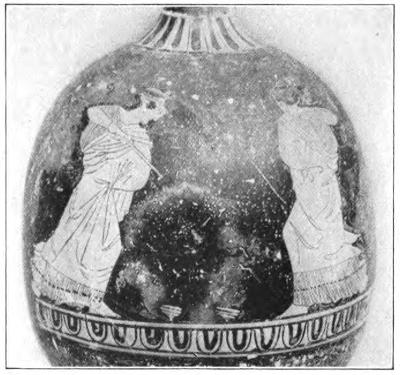
On an oinochoë of the fifth century, in Case C in the Fifth
Room, are two ladies perfuming clothes. The garments
and head-dresses they are wearing and the clothes they
are folding are worked with beautiful borders in the wave
pattern and ornaments in the form of conventionalized
flowers (fig. 40). Besides providing fine apparel for themselves
and their families, women also expended their skill
on garments which they offered to the goddesses: the treasuries
of Athena and of Artemis at Athens contained chests
full of many-colored robes offered by worshippers (fig. 37).
Naturally in the course of time various industries sprang
up which contributed manufactured products to the household,
but spinning and weaving continued to be domestic
occupations, at least to provide clothing for the slaves.
Some conservative families in Rome prided themselves
upon wearing garments made at home; the Emperor
Augustus is said to have worn, except on special occasions,
the handiwork of the ladies of his family as an example of
simplicity in a period of general extravagance.
FIG. 42. BAKING BREAD IN A PRIMITIVE OVEN
FIG. 43. WOMEN WINNOWING AND GRINDING CORN
The preparation of food likewise required the housewife’s
direction, though the master of the house, or in
large establishments a trusted steward, attended to the
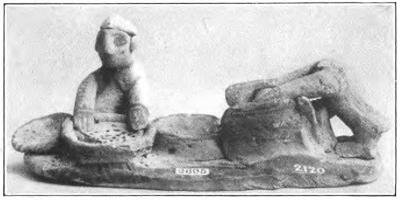
marketing. Two small terracottas from Cyprus on the
bottom of Case 3 illustrate the making of bread by very
primitive methods. In the first (fig. 43), the woman at the
left is winnowing grain with a sieve, which she holds, and a
winnowing-fan shaped like a shovel, which lies by her side.
The other woman (whose head is unfortunately missing)
is grinding the corn on a saddle-quern; she draws the
upper millstone back and forth over the lower, which is
provided with side boards to prevent the meal from falling
off—a hard day’s work, one would say. The other terracotta
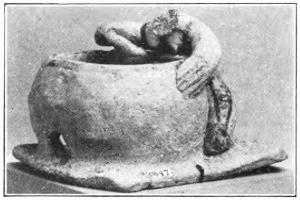
represents a primitive method of baking bread. A
clay oven like a huge bowl was built up by hand in a convenient
place. The usual fuel, dried grasses, was placed
in and around it and after the oven became heated and the
fire had died down, the housewife set the flat loaves around
the inside to bake (fig. 42).
FIG. 44. WOMEN AT A WELL-HOUSE IN ATHENS
Another task often represented on vases is the drawing
and carrying of water. In many places the public well-houses
were the principal source of supply, as the piping of
water into dwellings was unusual in Greece until Roman
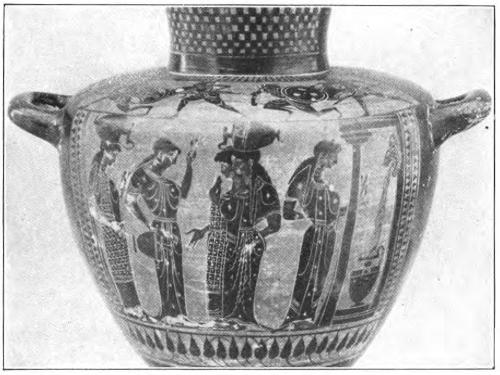
times. A hydria in Case 2 shows a group of women carrying
away their jars on their heads from a public well-house
(fig. 44).
FIG. 45. MARRIAGE-VASE
In Athens, and probably more or less throughout the
Greek world, a woman’s life
was rather monotonous.
Ladies did not go out unattended,
and indeed were not
expected to go out at all
without good reason. A wife
did not receive her husband’s
guests or take part
in his social life; but women
were included in family
gatherings such as weddings
and dinners after the birth
of children, they made visits
to women relatives and
friends, and shared in the
frequent religious festivals,
which at Athens included
the theatre. In the earlier
vase paintings there are comparatively
few figures of
women, and such as appear
are usually goddesses or accessory
persons in mythical
scenes; but with the gradual change to subjects taken
from every-day life in the later sixth and the early fifth
century, we begin to see women about their usual occupations,
or in groups talking with each other or with men.
Much of the later Athenian pottery is decorated with
charming scenes from the life of women, showing them
with their children, at their toilet, busy with embroidery,
or playing with pets. The younger ones seem to have enjoyed
some games which we have relegated to childhood,
such as spinning tops (see fig. 53). On the marriage-vases
we see the bride being dressed by her friends and servants,
or receiving presents on the day after the wedding, the
traditional occasion for the presentation of gifts. Two
of these vases are in Case B in the Fifth Room (fig. 45), and
a perfume vase in Case Q is decorated with a similar scene.
The usual presents seem to have been bands and ribbons
for the hair, perfumes, jewelry, and pets, especially birds.
V CHILDREN AND EDUCATION CASES 2 AND 3
Little babies were tightly bound in swaddling clothes
soon after birth, and the mother, in anxiety for her child’s
safety, usually fastened an amulet
or charm of some kind around its
neck to keep away unfriendly
spirits. The grotesque faces of colored
glass previously mentioned
(p. 8) may have served this purpose.
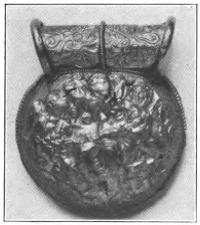
Roman children wore the bulla, a
case of leather or gold, according
to the means of the parents, containing
a charm. A large gold bulla
of Etruscan workmanship is in a
case at the left side of the Gold Room (fig. 46). The baby
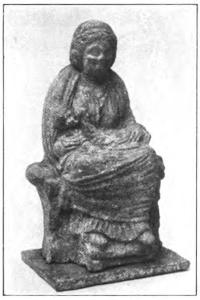
became the charge of an old and trusted slave-woman such
as the kind old nurse represented in a terracotta statuette
on the middle shelf of Case 3. Another of the same type
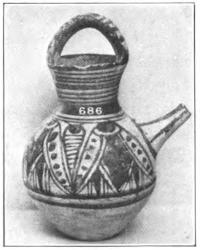
is in Case K in the Sixth Room (fig. 47). The prettily decorated
jug with a spout is a feeding-bottle (fig. 48).
FIG. 46. GOLD BULLA
FIG. 47. OLD NURSE HOLDING A BABY
FIG. 48. TERRACOTTA FEEDING-BOTTLE
Greek and Roman children played with toys much like
those of the present day, but they were simple and inexpensive.
Rattles for babies
were made of terracotta with
a few pebbles enclosed (Case 3,
middle shelf). An interesting
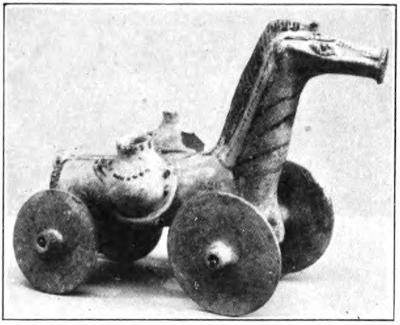
toy for a small child is the terracotta
horse from Cyprus with
large jars in its panniers such
as those carried by real horses
for taking provisions to and
from market (Case 2, top shelf,
fig. 49). Carts were favorite
playthings; a small oinochoë
in Case 3 shows a boy driving
two goats harnessed to a
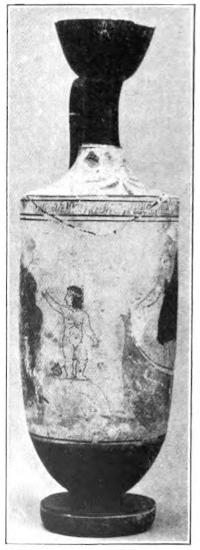
chariot, and on a white lekythos
painted for a child’s grave
(Case F in the Fifth Room), a little
boy is going to Charon’s boat
for his journey over the Styx,
drawing his toy cart (fig. 50).
Of course, Greek and Roman
children kept house with their
dolls, and charming miniature
vases were made for them, some
for the doll’s table and others for
her toilet and wedding. These
vases, which are decorated with
scenes of children at play, were
given, it is thought, as presents
on a festival day called Choes,
“Jugs.” A number of different types are in Case G in
the Fifth Room.
FIG. 49. TOY HORSE ON WHEELS
Dolls were made of wax and clay. The two seated
terracotta dolls without
joints in Case L in
the Seventh Room
were found in graves at
Tarentum in Southern
Italy. Another made
of bone has jointed
arms and could easily
be dressed (Case 3,
tail-piece, p. 46).
These dolls were originally
painted in bright
colors, which have been destroyed by
time.
FIG. 50. TOMB LEKYTHOS. CHILD DRAWING A CART
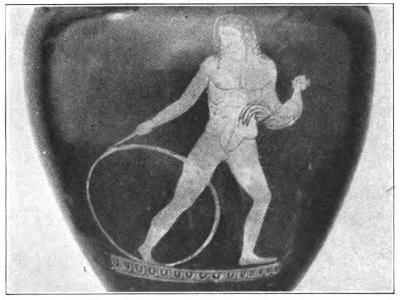
Rolling hoops, contrary to modern
ideas, seems to have been a boys’
sport. A boy with a hoop may be
seen on a vase in Case J in the Fifth
Room (fig. 52). Mothers and nurses
swung small children in swings, as in
the scene on a vase from Southern
Italy (Case P, Sixth Room), and older
girls also enjoyed this pastime. As
part of a game or perhaps as forfeit,
girls sometimes carried one another
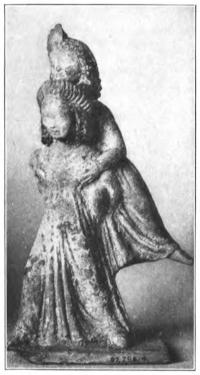
on their backs. A terracotta statuette
represents two girls playing ephedrismos,
as this game was called
(Case 3, fig. 55). Young women and
girls, as well as boys, played with
whipping-tops, as is shown on a lekythos
on the same shelf (fig. 53), and
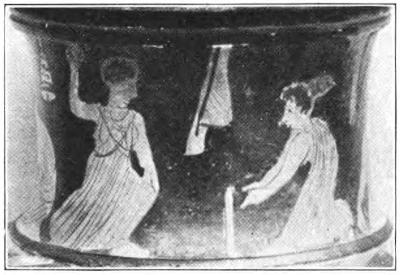
on one side of a toilet-box two girls are
playing a game of ball with a wicket (fig. 51). Children
also played hide-and-seek, tug-of-war, and many games
with beans, nuts, pebbles, small coins, and the astragals
described in the section on Amusements (pp. 68-69).
FIG. 51. GIRLS PLAYING BALL
At about six years of age Greek boys were sent to school,
while the girls remained at home to learn from their mothers
how to spin and weave, and to read a little and keep accounts.
Their education was of the simplest kind and
ceased very early.
FIG. 52. BOY ROLLING A HOOP
FIG. 53. WOMEN WHIPPING TOPS
FIG. 54. STYLUS
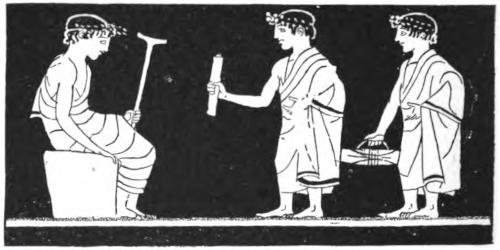
The first school to which a boy went was that of the
letter-teacher, who taught reading, writing, and simple
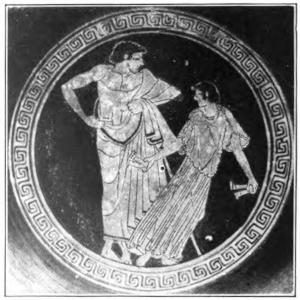
arithmetic. A kylix in Case 3 (see head-band, p. 40) is
decorated with figures of schoolboys, one of whom holds
a roll of manuscript, and another a writing tablet. These
tablets were thin pieces of wood covered with wax and
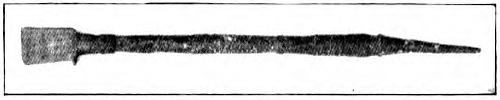
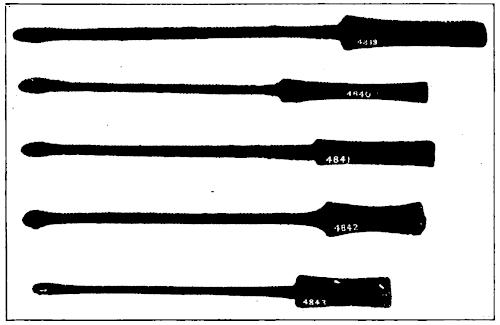
fastened together with cords (fig. 56). A pointed stylus
(fig. 54) was used for writing, the blunt end being turned
around when it was necessary to erase by smoothing the
wax[1]. After three or four years in the letter-school
the boys went to the music teacher, who taught
them to sing and to play the
lyre, and in connection with
the music they learned many
selections from the great poets.
Training in the palaistra or
wrestling-school was begun
very early, and was usually
continued until the boy was old
enough to be called into the
military service of the state.
These lessons will be described
in the section on athletics, as
the sports of the palaistra were
in general the same as those of
the men’s gymnasium. In addition
to the subjects already
mentioned, many boys, during
the fifth century and later,
studied geometry, rhetoric,
and philosophy.
[1] Several very interesting objects illustrating Greek writing and
writing-materials are exhibited in the case devoted to learning in the
Seventh Egyptian Room. They include a wooden tablet covered with wax,
several short letters on potsherds—a cheap and common writing-material—and
fragments of the Iliad and the Odyssey on papyrus, the
usual substance on which books were written, dating from the third
century B.C. The reed pens in this case are of the kind employed for
writing on papyrus.
FIG. 55. EPHEDRISMOS GAME
FIG. 56. BOY WITH A WRITING TABLET
FIG. 57. INK-POT
In Italy, Greek ideas of
education were generally
adopted; boys learned the
Greek language and studied
the Greek and Roman
poets. A little geography
and history were taught,
and arithmetic occupied
much time, for the Roman
system of weights, measures,
and coins was difficult
and inconvenient. Besides
the schools for elementary
subjects there were special
classes for the study of rhetoric and philosophy. The
children of rich or noble families were often educated at
home by Greek tutors, the girls and
boys together, and among the humbler
people they went to the same
school for a time. In general the
education of girls was similar to that
of boys, so far as it went, and sometimes
in wealthy families was continued
after marriage. Many ladies
knew the Greek poets well and wrote
verses themselves. Music occupied
much of their time and they learned
to dance for recreation and as a means of giving pleasure
to their families and friends.
VI DRESS AND TOILET CASES 2, 3, AND 5
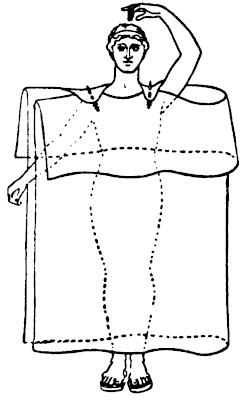
FIG. 58. DIAGRAM OF DORIC CHITON
Greek dress, both for men and women, consisted
of two portions, a garment for the house and a wrap to be
worn over it. Men, from the time
of the Homeric poems downwards,
wore a “chiton,” rectangular in
shape and somewhat wider than
the body, closed on the sides and
across the top except for openings
left for the head and arms. A short
woolen chiton was the usual dress
for soldiers, workmen, and poor
persons, while the nobles of the
Homeric poems seem to have worn
linen chitons reaching to the feet.
Over this a wrap, either rectangular
or curved on one side, was arranged
in various ways. The
earliest representations show men wearing a wrap with
one curved edge, and apparently doubled like a shawl.
This type of dress may be seen in vase paintings in the
Third Room; for example, the figure of Dionysos on a
stamnos (No. GR 564 in Case R), and the same god on a
large amphora (No. 12.198.4) in that case.
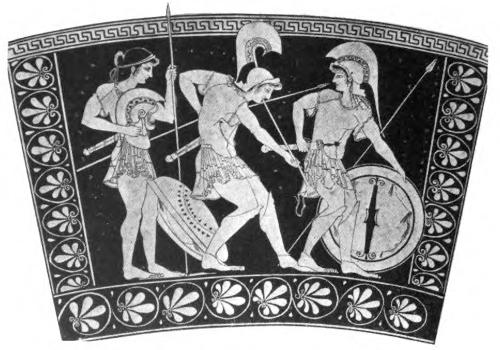
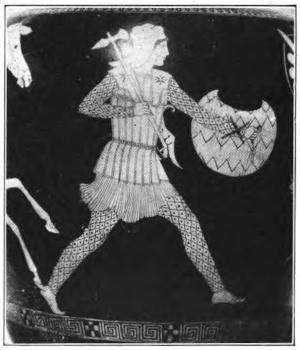
FIG. 59. AMAZONS IN MEN’S IONIC CHITONS
The earliest garment for women which we know of was
a chiton of wool without sewing. This was a large rectangular
piece of cloth considerably wider and longer than the
body. It was folded through the middle lengthwise, so that
one side was closed and the other open. The top, again,
was generally folded over, this hanging portion being
called “apoptygma.” Long pins inserted with the points
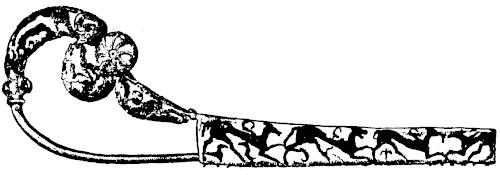
upwards, or fibulae (see head-band, p. 47), were used to
fasten the double edge on the shoulders, and a girdle was
usually worn to hold the edges of the open side in place (fig.
58). If the chiton were still too long, part of the cloth was
drawn up through the girdle into a blouse called “kolpos.”
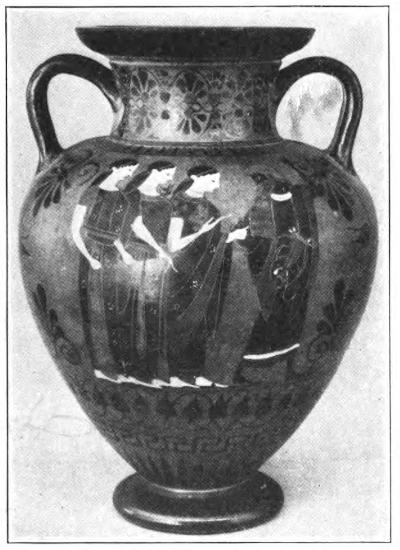
The heavy woolen chiton may be seen in the drawing of
three nymphs on an amphora (No. GR 549) in Case K in
the Third Room. From these early representations in
art, it seems that clothing for both men and women was at
first rather narrow and was often covered with woven or
embroidered patterns (fig. 60).
During the seventh and sixth centuries the rich and
artistic Ionian cities had a great influence on the customs
of Greece, and from them the ladies of Athens adopted
the linen chiton, which was wider and was sewed on the
sides. The additional width was sometimes used to form
sleeves by catching the two pieces together at the top in
three or four places, with sewing, buttons, or small pins.
Long sleeves sewn in were occasionally worn, but were
exceptional rather than customary, so that artists often
represent barbarians with sleeves to distinguish them from
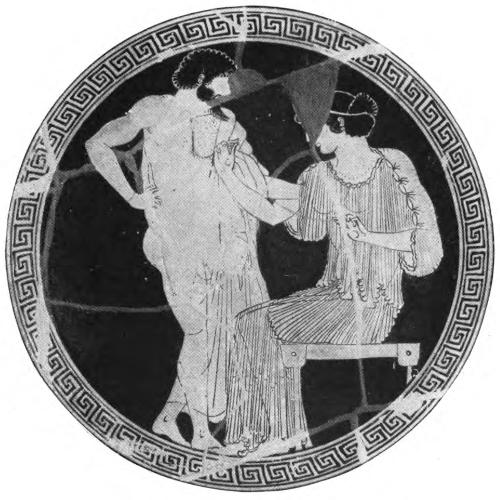
Greeks. On a kotyle in Case C in the Fifth Room is a
woman wearing a spotted chiton with long, close-fitting
sleeves. At this period men as well as women at times
wore the apoptygma and kolpos, but the man’s chiton
was generally short (fig. 59). On two kylikes on the bottom
of Case L in the Fourth Room (Nos. 12.231 and
GR1120) women are represented in the linen chiton (fig.
62). After the Persian Wars, as the result of the strong
reaction against Eastern fashions,
men and women both
adopted the woolen Doric chiton
again, and for men it remained
the universal dress,
being now short and without
apoptygma and kolpos. Still,
the adoption of the Doric chiton
did not imply a violent
change, for working people had
worn it continuously and it was
the usual dress for young girls.
Old men, priests, charioteers,
and officials on public occasions
continued to wear the long
Ionic chiton, and both were in
use by ladies at the same
period. It should be added
that at this time the two types
were often worn together, the
Ionic forming an undergarment
with short sleeves, and
the Doric, a sleeveless gown.
This costume is frequently seen on grave-reliefs, but our
only example is an engraving of a Maenad on a bronze
mirror in Case C in the Sixth Room.
FIG. 60. EARLY CHITONS
FIG. 61. WOMAN’S DORIC CHITON OF THE V CENTURY
FIG. 62. WOMAN IN IONIC CHITON
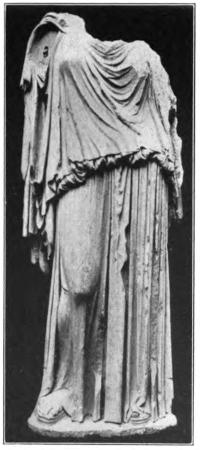
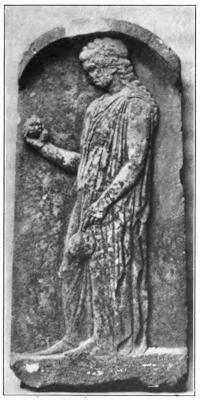
The woman’s Doric chiton of this time may be seen in
the statue of Eirene, No. 15 in the Sculpture Gallery (fig.
61), and it is worn without a girdle by the young girl on a
gravestone (No. 21, fig. 63). Here the open side shows
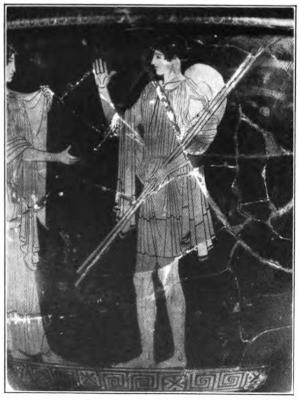
plainly. A drawing of Zeus on a krater on the bottom of
Case O in the Fourth Room, and a young hunter on a krater
on the left side of the first shelf show the man’s chiton
(fig. 67). The Ionic chiton is illustrated by the statue of a
goddess, No. 19 in the Sculpture
Gallery. Metal buttons to
represent the sleeve fastenings
were inserted in the marble.
FIG. 63. DORIC CHITON WITHOUT GIRDLE
FIG. 64. LADY IN HIMATION AND HAT
FIG. 65. LADY IN HIMATION
FIG. 66. MAN IN RIDING-CLOAK AND HAT
The usual outer wrap, called
himation, was a large oblong,
rectangular piece of woolen
cloth, and was practically the
same for both sexes. In the
seventh and sixth centuries
there were various ways of arranging
it; as a shawl, or as a
scarf fastened on one shoulder.
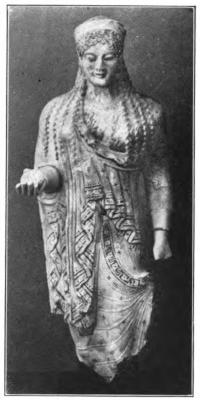
The archaic statue of a woman,
No. 2 in the Sculpture Gallery,
wears it doubled and fastened
on one shoulder over an Ionic
chiton of soft, crinkled linen
(fig. 68). Gradually a simpler
and more beautiful arrangement
was adopted; the himation
was laid across the back with one corner over the
left shoulder, then folded around the front of the body,
passing either over or under the right arm according to
the wearer’s wish, and the end thrown over the left shoulder,
from which it hung down the back, kept in place by a
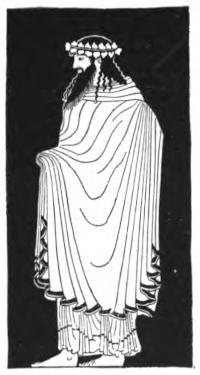
weight in the corner. On a krater (No. 16.72) on the bottom
of Case J in the Fourth Room, the god Dionysos is
wearing the himation arranged in this way (see tail-piece,
p. 67), and the cast of the so-called Lateran Sophokles
(No. 775 in the Gallery of Casts) shows the himation at its
best. Ladies often drew it up over their heads like a veil.
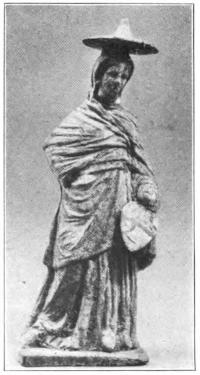
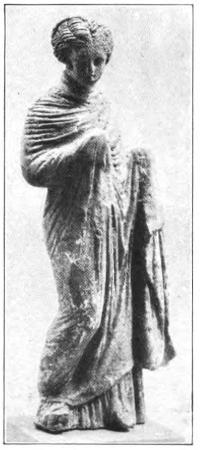
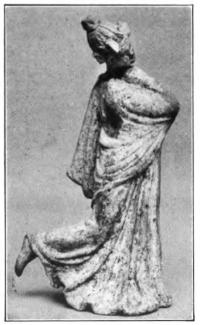
The terracotta statuettes in the Sixth Room illustrate
the variety of ways in which the wrap could be draped
(figs. 64, 65). Besides the himation there were cloaks of
more convenient dimensions
for riding,
hunting, or traveling.
These were variously
named but were all
unsewn pieces of cloth,
rectangular or curved
on one side, and were
usually pinned on one
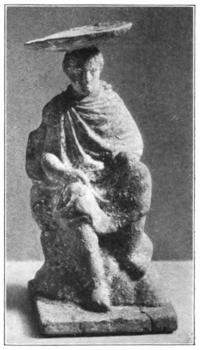
shoulder. A terracotta
(No. 06.1118) in
Case G in the Sixth
Room represents a
traveler in chiton and
riding-cloak (fig. 66),
and the same cloak is
worn by a warrior on
the large amphora on a pedestal in the Fifth Room (see
fig. 103).
FIG. 67. MAN’S CHITON
Head-coverings were worn only by travelers, riders, or
working-men. A hat with a wide brim, called “petasos,”
was the usual traveler’s head-gear. It was made in a
variety of shapes, the brim being sometimes broader at
back and front, sometimes at the sides. Another form had
a circular brim which turned up. This may be seen on
three terracotta statuettes (Case 2, and Case G in the
Sixth Room). A cap, called “pilos,” was worn by smiths,
sailors, and working-men in general. There is a man
wearing a pilos on a cup on the top shelf of Case S in the
Fourth Room, and a warrior with the same hat will be
found on a small hydria on the first shelf of Case Q in the
Fifth Room. Some head-coverings which may be either
caps or small hats with rolled brims, are represented in
several terracotta statuettes of
boys in Case G in the Sixth
Room. Women wore the petasos
for traveling, and they also
used a kind of sun-hat, called
“tholia,” with a pointed crown
and broad brim, made of straw
and fastened by a ribbon.
Several examples of this stiff
and ungraceful hat may be
seen on terracotta statuettes
in Case 2, and in Case G in
the Sixth Room (see fig. 64).
FIG. 68. AKROPOLIS MAIDEN IN IONIC CHITON AND HIMATION
Shoes were of two principal
types: sandals with straps, and
high shoes or boots for hunting
and traveling. The Greeks
valued finely made shoes, and
dandies sometimes invented
new fashions which were called
by their names, as “Alkibiades
shoes.” A terracotta foot from
Cyprus wearing a sandal and another painted black are on
the middle shelf of Case 2. On a krater in Case O in the
Fourth Room Hermes wears high laced boots with a tongue
rising above the laces, and a stamnos on the bottom of Case
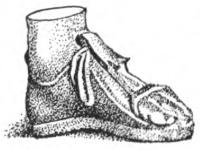
E shows the hunter Eos in boots. The bronze statuette
of the philosopher Hermarchos in the Seventh Room wears
sandals which are worked out in detail (fig. 69), and an
idea of the thickness of the soles may be gained from those
worn by the woman on a stele, No. 4 in the Sculpture
Gallery. The number and arrangement of the straps
which held the sandal in place were various and they were
sometimes broad enough to form what
was practically a shoe. Boots were
at times made with the leg-covering
composed of leather bands resembling
modern puttees. Women wore sandals
or low shoes. Black was the usual
color for foot-coverings, but gay colors
were worn by women and young
men. The warm climate and custom permitted people
often to dispense with shoes in the house, and working-men
went barefoot.
FIG. 69. GREEK SANDAL
FIG. 70. GREEK JEWELRY
The hair was worn long by men until the fifth century,
and the Spartans and Athenian gentlemen who admired
Spartan ways continued the fashion. It was sometimes
allowed to fall on the shoulders in curls or braids, but was
more frequently braided in two plaits and wound around
the head, or made into a sort of roll at the back and fastened
by a gold pin. In the sixth century men wore pointed
beards without moustaches, but later it became customary
to shave the entire face, though short beards and moustaches
were worn by older men. A warrior arming, on an
amphora on the bottom of Case 4, has a pointed beard and
long hair. His young squire, who stands behind him, is
beardless but his hair is long and curling. The lyre-player
on a large amphora on Pedestal R3 in the Third Room has
long hair in a knot at the back, held in place by a band. A
somewhat similar arrangement is seen in the bronze statuette
of Apollo in Case C2 in the same room. The fashion
of plaited hair wound around the head is illustrated by a
terracotta relief of Phrixos on the ram’s back in Case E in
the Fourth Room. In the fifth century short hair was
usual for both young and old men; young men did not
wear beards but older men frequently wore short beards
with moustaches. A moustache without a beard was
regarded as the mark of the barbarian. The marble heads
of two young men, Nos. 12 and 14 in the Sculpture Gallery,
and the athlete’s head on Pedestal H in the Sixth Room
show the fashion for young men, and a comparison of the
vases and small bronzes in the Third Room with those
in the Fourth Room will make clear the gradual change
of style from elaboration to simplicity.
FIG. 71. WOMEN’S COIFFURES
The styles of women’s hair-dressing can be best understood
by looking at the statues, vases, and terracottas in
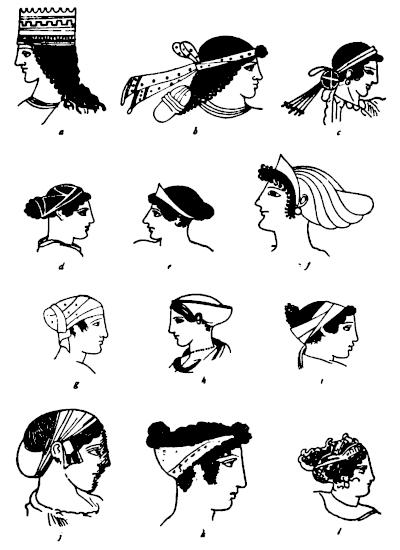
the collection. A variety of ornamental kerchiefs was
worn, especially a very pretty band called sphendone,
“sling,” from its shape (fig. 71). On the bottom of Case
J in the Fifth Room is a large stamnos decorated with
groups of women dressed in the Ionic and Doric chitons
and wearing various kinds of head-dresses. Many of the
terracottas in the Sixth Room
and the head of a young goddess,
No. 7 in the Sculpture
Gallery, illustrate the “melon”
coiffure which became the
mode in the fourth century.
Fashions in dress were the
same in general throughout the
Greek world, although of course
there were local peculiarities.
In Sparta boys and men often
wore only a small wrap without
a chiton, and young men
commonly went barefoot. The
women wore the Doric chiton.
FIG. 72. STRIGIL
The jewelry in use included
necklaces and bracelets, rings
for the ears and fingers, and
pins for the hair and clothes.
The Doric chiton originally required two very large pins,
which were inserted with the points upwards, but they
went out of use in the sixth century when the Ionic chiton
came into fashion and were not worn with the later Doric
chiton. The fibula or safety-pin was used throughout the
Greek and Roman world. A group of these pins of various
types is exhibited in Case D in the Second Room.
The fibula illustrated in the head-band is in the Gold
Room. Greek jewelry of the fifth and fourth centuries
was frequently of great beauty. Precious stones were used
but seldom until the Hellenistic period, but the excellence
of Greek workmanship has rarely been equalled by other
craftsmen. The Greek
gentleman permitted himself
only a handsome ring
which was useful as a seal,
and the artistic value of
these engraved seal rings of
gold or of gold set with a
semi-precious stone has
made them favorites with
collectors for many centuries.
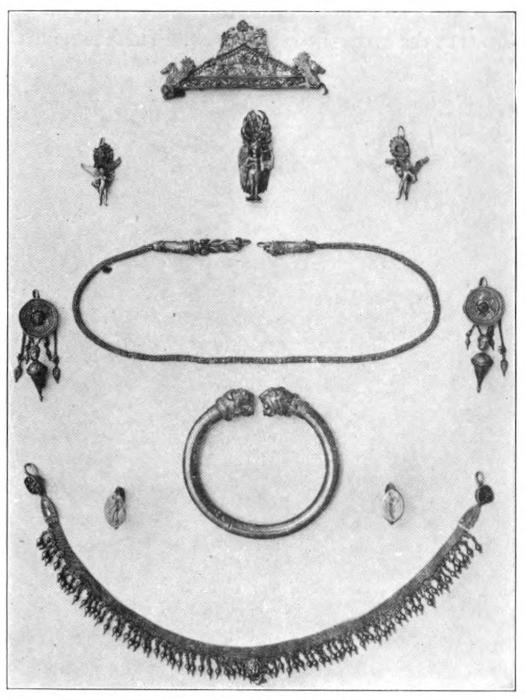
The rings and gems in cases in the rooms of the
Classical Wing, and the beautiful jewelry in the Gold Room
are proofs of the skill of Greek workmen
and the fine taste of their patrons
(fig. 70).
FIG. 73. RAZOR
FIG. 74. ALABASTRON
Roman dress was similar to that of
Greece in its principal characteristics.
The clothing of women was the same
as that of the Greek lady of the Hellenistic
age represented in the terracotta
statuettes. The Ionic chiton, made
usually of wool instead of linen, and
called stola, was worn in the house, but
the married woman’s stola had a wide
piece like a flounce sewn on at the bottom.
For the street the himation,
called by the Romans palla, was worn
over it. The Roman citizen wore a
white woolen tunic like the Greek chiton,
but it was usually provided with short sleeves. Senators,
knights, and free-born children had this tunic ornamented
with purple stripes running from each shoulder to
the bottom, both front and back. In the statue of a
camillus in the Eighth Room the stripes were inlaid in
silver, of which traces remain. Over this was worn the
toga, corresponding to the Greek himation and arranged
in the same general way. The toga, however, was usually
larger than the himation and was semicircular on
the lower edge. For senators, knights, and children it
was ornamented with a broad purple stripe following the
straight edge. Shoes and sandals of various kinds were
in use; a special kind of high shoe called calceus was always
worn with the toga, and the tunic, toga, and calceus
formed the regulation dress for citizens in public. The
toga, being a very heavy, cumbersome garment, was not
worn for traveling or active work, and for these purposes
there were many small wraps and longer cloaks of various
shapes.
FIG. 75. ARYBALLOS
FIG. 76. GLASS BOTTLE
Short hair was universally worn by men in Rome.
Under the Republic women’s hair was simply arranged,
but throughout the Imperial period a variety of styles
prevailed at different times, most of which were conspicuous
for their bad taste and so elaborate that the desired
effect was produced by wearing wigs and wire supports.
Some of the better styles may be seen on the portraits in
the Sculpture Gallery, and on
the heads of a girl and a
woman on pedestals in the
Eighth Room. During most
of their history the Romans
did not wear beards or moustaches,
but under the Empire
fashion fluctuated, following
the style favored by the reigning
emperor. After the time
of Trajan beards were usual.
FIG. 77. SILVER PYXIS
FIG. 78. TERRACOTTA PYXIS
Roman ladies were fond of
ornaments and wore a great
many of them. Large sums of
money were expended on precious
stones and on shoes
and other garments embroidered
with pearls.
During the Republican
period the Roman wore a
gold ring as the badge of
his citizenship, but in the
Imperial period, with the
increase of luxurious bad
taste, dandies sometimes
covered all the joints of
their fingers with rings.
Requisites for the toilet
do not differ greatly from
one period to another, since
the purposes for which they were intended remain practically
the same; so we find much that seems familiar among
those of the Greeks and Romans. Probably the oldest
article in this group is a razor with a crescent-shaped blade,
made in Italy in the early Iron Age. The shape seems to
have been a common one (fig. 73). Tweezers, of which
an example is shown in Case 5, were used for removing
superfluous hair. An article of daily use in ancient times,
though we have no modern utensil to correspond with it,
is the strigil or flesh-scraper (Case 5, fig. 72). It was used
especially by athletes after exercise, to remove the dust and
sand of the wrestling-ground, so that the strigil, oil-flask,
and sponge became in Greece a kind of symbol for the
athlete’s life, which was, practically speaking, the life of
all well-to-do young men. On a gravestone, No. 7 in the
Sculpture Gallery, the dead youth is represented with a
strigil in his hand, while his little slave holds his towel and
oil-flask. Both men and women used strigils in the bath
for scraping off the fuller’s earth or lye powder used as
soap. A silver strigil was included in the tomb furniture
of an Etruscan lady which is exhibited in Case F in the
Sixth Room. There is an example in glass of Roman date
in Case 5.
FIG. 79. SPATULA
FIG. 80. DIPPING-ROD
It was customary among the Greeks and Romans to
rub the body with oil after the bath. The small jar called
aryballos (Case G in the Fifth Room, fig. 75) and the taller
alabastron (Case 2, and Case A in the Fourth Room, fig.
74) were used for holding oil and perfumes for toilet use.
Some small glass toilet
bottles in Case J in the
Third Room are so charming
in shape and coloring
as to make a modern
woman envious (fig. 76).
In the Gold Room are two
crystal scent bottles from
Cyprus, one of which has
a gold stopper. The toilet
box or pyxis held ointment,
rouge, face or tooth
powders, or small toilet
articles or ornaments.
These charming boxes
were made of metal, as the
silver box in Case F in the
Sixth Room (fig. 77), or of
painted terracotta. The
latter are often triumphs
of the potter’s and vase
painter’s art; for example,
the white pyxis in Case V
in the Fourth Room (fig. 78) and the red-figured pyxis in
Case A in the same room, with its interesting drawings of
women working wool (compare fig. 39). Others of a variety
of shapes and decoration will be found in Cases C and
G in the Fifth Room.
FIG. 81. GREEK MIRROR ON A STAND
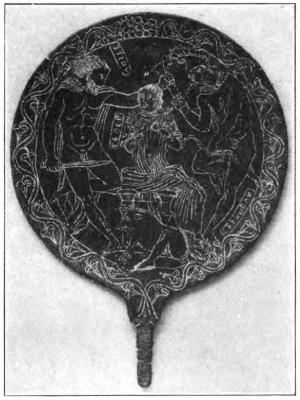
FIG. 82. ETRUSCAN MIRROR
FIG. 83. GREEK MIRROR AND COVER
The bronze boxes known as cistae are Etruscan. Some
of those which have been found in tombs are very large
and are elegantly decorated with engraved scenes. They
seem to have been a kind of dressing-case, for holding all
of a lady’s toilet equipment. A small one was included in
the tomb furniture of an Etruscan woman which is shown
in Case F in the Sixth Room.
Bronze spatulae were useful in a variety of ways for mixing
and applying the cosmetics which were employed so
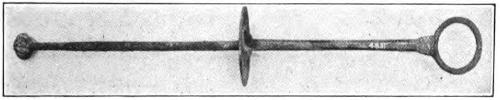
constantly by Greek and Roman ladies (fig. 79). An instrument
corresponding to our medicine droppers are the
dipping-rods of bronze or glass. They could be inserted
into bottles or jars to take out a small quantity of liquid.
A disk about half way up the rod kept it from slipping into
the bottle (fig. 80). Examples of both utensils will be
found in Case 5.
Ancient mirrors were as inferior to the modern in power
to reflect as they are superior in beauty. Disks of highly
polished metal, usually bronze, were employed for this
purpose, for the process of making a mirror by backing a
sheet of glass is not older than the fourteenth century.
Sometimes the mirror consists of a simple disk, plain or
ornamented on one side with an engraving or a design in
relief, or again it is made in one piece with a long handle or
with a short tang to be inserted into a bone or ivory handle,
or it is provided with a ring. The disk is often protected
with a cover which bears the principal decoration. Etruscan
mirrors most frequently have handles but no covers,
and are decorated with engraved scenes, usually taken
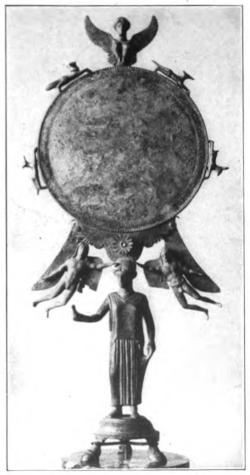
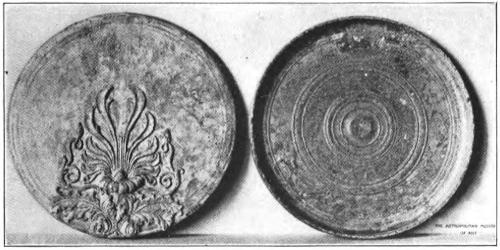
from Greek mythology (fig. 82). Greek mirrors are of two
types: either a simple disk without a handle, fitting into a
cover, usually ornamented with a relief (fig. 83), or a disk
supported on a stand, often in the form of a human figure
(fig. 81). In Case A in the Fourth Room are two fine
examples of the latter, two stands from which the mirrors
have been lost, and a mirror with a cover decorated
with a woman’s head in relief. Another charming stand
of Etruscan workmanship is in Case H in the Third Room.
In Case A in the Fifth Room are four very beautiful Greek
mirrors of the fourth century, and in Case C in the Sixth
Room are examples of both Greek and Etruscan types. A
pretty terracotta statuette of a lady using a mirror is in
Case G in the same room; she is arranging her hair while
balancing her mirror on her knee.
VII AMUSEMENTS, MUSIC, AND DANCING CASES 1, 3, AND 5
As at the present time, festivities frequently centered
around dining. In Greece, many dinners were given by
men to their friends, followed by the symposium, at which
the guests drank wine mixed with water, told jests, sang,
and often watched hired performers, such as jugglers,
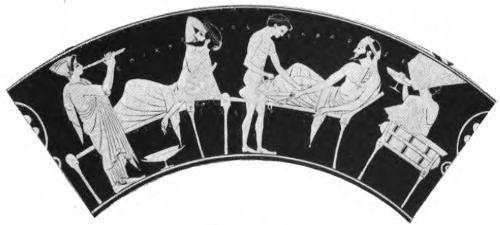
tumblers, and dancers. A kylix in Case E in the Fourth
Room is decorated with a scene from a symposium (fig. 84).
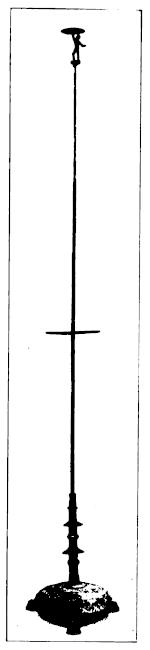
The special game for this occasion was “kottabos,” which
was played with the aid of a bronze contrivance like a
candelabrum, of which an example stands in the Fifth
Room (fig. 85). The players held their cups by one
handle and tried to throw a small quantity of liquid on the
bronze disk at the top of the shaft, so that it fell down with
a ringing sound. The game was also played by throwing
the liquid into nutshells or small saucers floating in a
krater full of water, so as to make them sink. Many
games of chance were known to the Greeks and Romans.
Perhaps the most popular were those played with the
knucklebones (astragaloi) of sheep and goats. They
could be used like dice, and also like “jacks,” being thrown
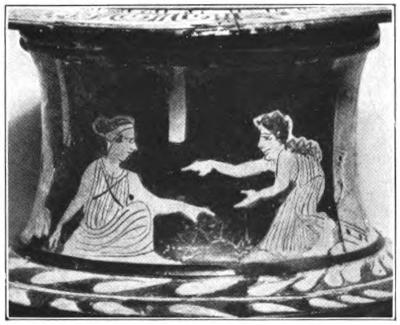
up and caught on the back of the hand. A toilet box
on the middle shelf of Case 3 (fig. 87) shows three women
playing, one of whom has an astragal on the back of her
hand. The knob on the cover of the box is appropriately
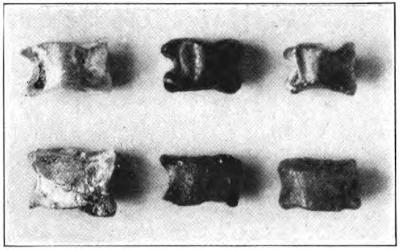
made in the same form. Nine very small examples of glass
are in Case 1 (fig. 86). The invention of draughts was
ascribed to Palamedes, one of the heroes of the Trojan War,
a story which at least proves that they were played in
Greece in very early times. Nuts and coins were also used
as counters in various games, and games of dice were
played in various ways. Astragals could be used as dice,
and had the advantage of needing no marks, as the sides
were naturally different.
FIG. 84. SYMPOSIUM
The musical instruments in use were the lyre and kithara
and the flute, with some other less common varieties of
stringed instruments. The kithara, the instrument of
professional musicians, had a sounding-board and hollow
arms of wood. The strings extended from the “yoke,”
a cross-piece connecting the arms, to the sounding-board.
The kithara was usually played standing, and was hung
by a band to the performer’s shoulders. He played with
both hands, using the plectron or “pick” in his right. A
rather rude terracotta from Cyprus in Case 1 represents a
woman with a kithara, a terracotta statuette of Eros with
a kithara is in Case K in the Seventh
Room, and a wall-painting in the Eighth
Room represents a lady playing one (see
fig. 21). Kithara players in festal costume
at the public games are represented
on three vases in the collection (Case K
in the Third Room and Cases E and Y
in the Fourth Room). Another illustration
is on an amphora on the bottom
of Case P in the Fifth Room, where
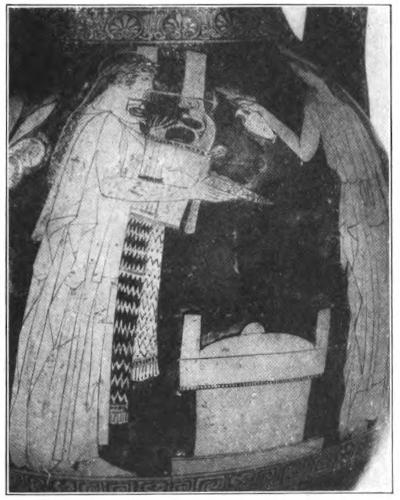
Apollo, the god of music, stands before
an altar holding his favorite instrument
(fig. 90). The best representation, however,
is the kithara held by a gold siren
who forms the pendant of an earring
exhibited in the Gold Room. The details
of construction are fully worked
out and the attachment of the strings
can be clearly seen. Those used at public
festivals were often richly ornamented
with carving and inlay of semi-precious
stones.
FIG. 85. KOTTABOS-STAND
FIG. 86. GLASS ASTRAGALS
FIG. 87. GIRLS PLAYING WITH ASTRAGALS
The lyre was the usual instrument of
the amateur. Boys learned to play it
at school, and gentlemen were expected
to be able to accompany themselves
upon it at symposia. Its sounding-board
was made of the shell of a tortoise covered on one
side with wood. The upright pieces, curved outward and
in again toward the top, were sometimes made of the horns
of animals. It had a yoke near the ends of the uprights,
and a bridge on the sounding-board. The strings, of
sheep’s guts or sinews, varied in number from three to
eleven at different periods, but seven was the usual number
in the fifth century. The plectron was generally used in
playing both instruments. Several good illustrations of
the lyre may be seen in the Museum collection. A satyr
with a lyre decorates an amphora on the shelf in Case J
in the Fourth Room. On the bottom of Case O is an
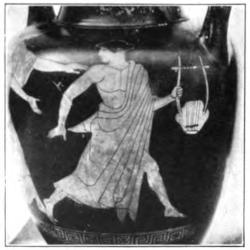
amphora showing Kephalos with a lyre (fig. 88), and on
the shelf above a boy singing to the lyre will be seen in the
interior of a kylix. A man holding a lyre, probably a
guest at a symposium, decorates the inside of a kylix in
Case E. An interesting little bronze figure in Case C 2 in
the Third Room represents a musician in festival dress
with the same instrument. The statuette was probably a
votive offering for success
in a contest.
FIG. 88. YOUTH WITH A LYRE
FIG. 89. GIRL DANCING AND PLAYING THE CASTANETS
FIG. 90. APOLLO WITH A KITHARA
The ancient flute differed
from the modern in being
played at the end, and in
having a vibrating reed as
a mouthpiece. The tone
was shrill. Flutes were
always played in pairs, and
a kind of bandage was often
worn by the player to support
their weight. This
can be seen on the psykter
in Case 4 and on a terracotta statuette from Cyprus in
Case 1. Flute music
had a very wide use.
It accompanied the
voice in solo or chorus,
and the kithara at
public contests; it was
employed in the theatre
at Athens and at
Rome, and was used
to guide and accompany
the exercises of
the palaistra. The
flute furnished music
for dancers, and in
Rome it was played at
funerals. Meals were served and work such as the kneading
of bread in bakeries was done to its music. Flute-cases
are often represented in interior scenes in Greek vase
paintings, as on the inside of a kylix in Case O in the
Fourth Room, showing a boy playing the lyre, and on a
lekythos in Case K in that room where a woman is playing
the same instrument. Another instrument was the
syrinx or Pan’s pipe, made of reeds arranged in graduated
lengths, fastened together with cords and wax. It was
especially the shepherd’s companion in his long, solitary
days with his flocks. The little faun which forms the
pendant of the bracelet in Case K 2 in the Seventh Room
is playing the syrinx. Cymbals were used principally at
religious ceremonies of an orgiastic type. There are two
pairs in the collection, one being marked with the owner’s
name, Kallisthenia (Case 5 and Case C 2 in the Sixth
Room). Dancing formed a part of worship in ancient
times. The rude clay groups of men and women dancing
in a ring illustrate a feature of the worship of Aphrodite
in Cyprus (Case 1). In Greece boys were taught the exercises
preliminary to a dancer’s training as a part of their
physical education, and the
many public festivals gave opportunity
for large numbers to
progress further. Professional
dancers, both boys and girls,
were employed to furnish entertainment
at symposia. On a
kylix on the bottom of Case L
in the Fourth Room is a girl
dancing and playing the castanets,
while a young man looks
on (fig. 89). Women of good
family danced at home for
amusement, and at domestic
festivals. The character of
Greek dancing was largely
mimetic, the movements of the
arms and the use of the drapery being very important
(see tail-piece, p. 75). The terracotta dancers in Case L in
the Seventh Room and another in Case 1 are good illustrations
of this (figs. 91-92). The Romans in early times
practised religious dancing. The processions of the Salii
or priests of Mars, and of the Arval Brothers are the best-known
examples of such ritual performances. Dancing as
an amusement, however, they adopted from the Greeks
in its period of decadence, and consequently the sterner
moralists opposed it. Under the early Empire it nevertheless
grew very fashionable. Girls and women of noble
family learned to dance as an accomplishment, and even
men of high rank danced, though at the cost of their dignity.
Professional dancers were greatly sought after and admired.
FIG. 91. WOMAN DANCING
FIG. 92. WOMAN DANCING
Our representations of pet animals are all on articles of
Greek manufacture. An old gentleman walking with his
sharp-nosed Melitean dog decorates the interior of the
kylix by Hegesiboulos in Case K in the Fourth Room.
Cocks and quails were kept
for fighting by boys and
young men. Ganymede on an
amphora in Case J in the Fifth
Room carries his cock on his
arm (see fig. 52). Quails,
cranes, small birds, and rabbits
were also household favorites.
On the perfume vases in Cases
Q and C in the Fifth Room,
quails, cranes, and a rabbit
appear among the groups of
women. Cats were probably
introduced from the East or
from Egypt in the late sixth
or the early fifth century, but
they were rare and seemed to have been looked upon as
curiosities rather than as pets. The goose was perhaps the
commonest pet and children are often represented playing
with one. Some small boys with two goats harnessed
to a little chariot appear on the oinochoë in Case Y in
the Fourth Room.
VIII ARMS AND ARMOR CASES 3, 4, AND 5
The Greek soldier did not wear a full suit of armor
such as that of the medieval knight; the hoplite or fully
armed infantryman wore
only a helmet, a cuirass, and
greaves for protecting the
shins. Such an equipment
may be seen in the statuette
of a warrior of about 500 B.C.
of which the original was
found at Dodona (top shelf
of Case 3, fig. 93). The Romans
adopted this armor
from the Greeks, with minor
changes and variations, but
very little Roman armor has
come down to our times, since
it was almost entirely of
iron and has rusted away in the earth where it was buried.
FIG. 93. GREEK FOOT-SOLDIER
FIG. 94. ITALIC HELMET
FIG. 95. ITALIC HELMET WITH METAL CREST
FIG. 96. CAP-SHAPED HELMET
FIG. 97. “JOCKEY-CAP” HELMET
FIG. 98. CORINTHIAN HELMET
FIG. 99. ITALIC ARMORED BELT
FIG. 100. PAIR OF GREAVES
The earliest Greek helmets were of the type called
Corinthian because Athena is represented in this helmet
on the coins of Corinth. It formed a complete covering
for the head, having openings only for the eyes and mouth.
A nose-piece extends downward from the top. Holes for
attaching a leather or cloth lining may be seen along the
edges of our three oldest examples in Case H 2 in the
Second Room. In the later helmets (Case J in the Third
Room and Case 4, fig. 98), the shape has improved and the
workmanship is finer. These helmets must have been
worn over a cap, as there are no holes for sewing in the lining.
One example (No. 1530 in Case J in the Third Room)
has three small loops for attaching the crest, which was
generally made of horsehair. When not in battle the
wearer pushed the helmet back until the front rested on
his forehead.
FIG. 101. ITALIC CUIRASS
The Corinthian helmet had the great disadvantage of
covering the ears and its shape probably caused it to be
easily displaced. An improved form known as the Attic
appears during the sixth century. This helmet, of which
No. 1535 in Case 4 is an early example, was lighter than the
Corinthian, fitted the head better, and had openings for
the ears (see tail-piece, p. 88). The cheek-pieces were often
provided with hinges and could be turned upwards and
away from the face; on the large amphora on a pedestal
in the Fifth Room a young warrior is holding a beautiful
Attic helmet with cheek-pieces which seem to be hinged
(see fig. 103). An example with immovable cheek-pieces
in the form of rams’ heads is in Case C 2 in the Sixth Room.
Both the Corinthian and the Attic helmet continued in
use at the same time, but the Attic type gradually superseded
the other. Two helmets (Case 4 and Case C 2 in
the Sixth Room) shaped like the pilos or felt cap worn by
workmen show a Greek type of the fifth and fourth centuries.
One of them (No. 1541) has holes for attaching a
crest (fig. 96). The other helmets in the collection are
Italic or Etruscan. An Italian helmet reinforced by
bands in relief (No. 1558 in Case N in the Seventh Room)
is of the same type as those in the British Museum which
were found on the battle-field of Cannae (figs. 94, 95, 97).
FIG. 102. GREEK CUIRASS OF THE V CENTURY
FIG. 103. WARRIOR CARRYING A SHIELD
The earliest Greek cuirass consisted of two curved
bronze plates laced together at the sides. It reached to
the waist and turned up around the edges so as not to hurt
the wearer. The Dodona statuette shows this cuirass,
and an Italic example in Case A in the Second Room
belongs to the same general type, though it is longer and
the lower part is slightly curved out to follow the line of
the hips (fig. 101). This heavy and uncomfortable piece
of armor was superseded in Greece in the fifth century by a
cuirass made of leather or cloth upon which bronze scales
were sewn. It was provided with shoulder-straps and
a cloth or leather kilt reinforced with strips of metal hung
below the corselet proper. A warrior on a krater on the
bottom of Case S in the Fourth Room shows this type well
(fig. 102). The earlier cuirass continued to be used in
Italy, but in an improved form; the bronze plates, being
moulded to follow the curves of the body, made a more
comfortable as well as a beautiful piece of armor. Two
examples, one with the lower part broken away, are in
Case C 2 in the Sixth Room. In some parts of Italy a
substitute for the cuirass was found in the use of a breastplate
made of leather on which bronze disks were sewn.
An armored belt accompanied the breastplate. On a
krater from South Italy in Case Q in the Sixth Room is a
warrior wearing such a belt, and an example is shown in
Case 4. The small holes along the edges are for sewing in
a lining (fig. 99).
Greaves were characteristic features of a Greek soldier’s
equipment. The pair of greaves in Case J in the Third
Room will show how their shape and elasticity caused them
to stay in place on the leg (fig. 100). The greave in Case 4
has holes along the edges for sewing in a lining. On the
upper part of a loutrophoros in Case J in the Fourth Room
is a warrior wearing greaves of which the lining can be
seen in a ridge around the foot.
FIG. 104. PERSIAN FIGHTING WITH A MACHAIRA
FIG. 105. JAVELIN-HEAD
FIG. 106. SPEAR-HEAD
FIG. 107. DAGGER-BLADE WITH HOOKED TANG
FIG. 108. LEAF-SHAPED DAGGER-BLADE
FIG. 109. BRONZE SWORD
FIG. 110. ARROW-HEADS
Shields were a necessary part of the defensive armor of
ancient times, but remains of them are very scanty.
Scenes of arming and of combat, however, are so frequent
in Greek and Roman art that we are acquainted with their
general appearance. Greek shields were usually circular
or oval in shape, and made of wooden frames covered
with hides and reinforced with bronze. The rim and a
large boss in the center were the most essential metal
parts, but the entire surface might be covered with bronze,
or plates of various forms arranged upon it. The
large bronze plates in Case 5 and
in Case B in the Second Room
seem to have been parts of shields.
When using the shield as a defense
the warrior thrust his left
arm through the Loops in the inside,
one of which was close to the rim
at the left and another usually
near the center of the shield; he
held a third, which probably
was stouter than the others, in his
hand. The loops on the rim are shown in a painting on
the amphora which stands on the pedestal in the Fifth
Room, as well as the strap extending from side to side by
which it was suspended around the wearer’s neck on the
march (fig. 103). The Dodona warrior carries the so-called
Boeotian shield which has depressions in the middle
of each side. Various explanations are given of the
origin of this form; a probable one is that it results from
stretching a hide over an oval frame on which the top and
bottom were fastened firmly while the sides were left free
and were naturally drawn in by the pull from both ends.
Another possibility is that the shield was cut out at the
sides to provide peep-holes. Roman shields were rectangular
and curved around at the sides to protect the wearer’s
body. Only the boss and the rim were made of metal.
The shield of the Greek soldier bore the device of his state,
as the Koppa of Corinth, which was painted on the shields
of her citizen-warriors; and the Roman soldier carried the
sign of his legion in the same fashion. Interesting devices,
frequently animals’ heads, were adopted like coats of arms
by Greek nobles, and many of these can be seen on vases
of the sixth century. An amphora on the bottom of Case
4 shows shields decorated with the heads of a bull and a
boar.
FIG. 111. AMAZON WITH BATTLE-AXE AND WICKER SHIELD
The ancient warrior’s weapons were the dagger, sword,
spear, javelin, bow, and sling. The weapons in the Classical
Collection cannot
strictly be called Greek
or Roman because
they were made at a
remote period before
the Greek and Roman
states came into existence,
but they are interesting
in that they
show the types from
which later weapons
were developed, and
often there is very little
difference between
the early types and
their descendants. The
oldest cutting weapons are the bronze dagger-blades
from Cyprus, and those from Crete in Case D 2 in the
First Room. They were fitted into wooden or bone
handles. A Cretan dagger-blade with an engraved design
still holds the three dowels which fastened the haft. The
tangs of the Cypriote blades are prolonged or hooked to
prevent the blade from loosening in its socket (figs. 107-108).
Spear-heads also were at first made to be inserted
in the shaft, but later fitted over it. They have a slit on
one side of the socket, probably to give elasticity (figs.
105-106). The bronze butt-spikes were used to fix the
spear in the ground during halts. Examples of these
weapons are in Case 4 and the wall-cases in the corridor.
The swords in the collection date from the Bronze or
early Iron Age and so are pre-classical. The fine bronze
sword (Case 4, No. 1460) belongs to an early Italian type
(fig. 109), and the sword and sheath (No. 1461 in Case A
in the Second Room) is also Italian. An iron sword from
Cyprus (No. 1462 in the corridor) preserves the form of the
bronze swords of the late Mycenaean period, as the early
iron-workers at first imitated the shapes of bronze weapons.
The pin in the shape of a sword illustrates the type
in use during the fifth century in Greece (Case 4). The
machaira which Xenophon often mentions had a curved
blade and was especially useful as a cutting weapon for
cavalry. A good illustration of this shape may be seen
in a painting on an amphora in Case N in the Fourth Room
representing a Greek and a Persian fighting. The Persian
holds a machaira ready for the down-stroke (fig. 104).
Roman swords were broad and flat. They were designed
for thrusting, and were carried by common soldiers and
officers.
The foot-soldier wearing helmet, cuirass, and greaves,
and armed with sword, spear, and shield, that is, the
familiar hoplite and legionary, formed the most important
part of the Greek and Roman armies. Cavalry and light-armed
infantry, however, who used the javelin, the bow,
or the sling, became gradually more prominent as their
importance was perceived in the wars with Eastern peoples
and barbarous tribes. The use of the bow and the sling
was taught in the palaistra at Athens, as a practical training
for warfare, but ability in this direction was not rated
very highly. Certain nations were especially skilful with
these weapons and served as mercenaries to other states;
both Xenophon and Caesar mention the Cretan archers,
and Caesar speaks of slingers from the Balearic Isles who
served under him in Gaul. The arrow-heads exhibited
are Cypriote, but No. 4786 is Hellenic in type (Case 4,
fig. 110).
Greek artists frequently represented the Amazons of
legend in a dress similar to that of the Persians of their own
day, and from such paintings
on vases in the collection
we find illustrations of
various articles of dress
and of weapons mentioned
by Xenophon. On a polychrome
lekythos in Case
M in the Fourth Room is
an Amazon shooting with
a sling. Two spears are
stuck in the ground beside
her. An oinochoë in Case
K in the Fifth Room shows
three Amazons in their long
trousers and tight-fitting
sleeves covered with a pattern.
One of them carries a battle-axe and two hold
shields of plaited wicker-work, probably of the same sort
as those which furnished fuel to cook the Greek soldiers’
breakfast on the morning after the battle of Cunaxa
(Anabasis II, 1, 6) (fig. 111). Two large kraters in the
Fourth Room decorated with combats of Greeks and
Amazons show costumes and arms of the same type and
a war chariot of the kind used by the Greeks.
FIG. 112. LAMP. VICTORY WITH A TROPHY
An interesting custom was that of setting up a trophy
after a victory; a tree-trunk to which a cross-piece had been
fastened was arrayed in armor taken from the battle-field,
and remained standing there until destroyed by time or
taken by the enemy. A terracotta lamp from Cyprus in
Case 5 is decorated with a symbolic device representing
Victory holding a trophy at an altar between two Lares
militares, the protecting deities of the Roman state (fig. 112).
IX ATHLETICS CASES 3 AND 4
The strength, agility, and symmetry of the body were
valued in the highest degree by the Greeks, and with them
physical training occupied a much larger place than has
been the case among other peoples. Athletics were closely
connected with religion, since contests were held as a part
of the funeral and memorial rites of heroes, and likewise of
the worship of the gods. They also had an important
practical end; Greek armies were always levies of citizens,
and since there was no considerable length of time during
which the Greek states were at peace before the period of
Roman domination, the safety of the state depended to a
great extent upon the training of its citizens. Gymnastic
games and exercises were continued throughout the greater
part of a man’s life, contributing to good health and
physical development no less than to recreation.
This interest in athletics can be traced back to very
early times in the Boxer Vase from Crete dated in the sixteenth
century B.C. (a reproduction of this vase is in Case
J in the First Room) and the scenes of bull-leaping and
the ivory leapers from Knossos (reproductions on the
south wall of the First Room and in Case H 2). The
Homeric poems contain many references to athletics, as
the funeral games of Patroklos in the Twenty-third Book
of the Iliad, the games among the Phaeacians in which
Odysseus took part (Odyssey VII), and Odysseus’ encounter
with the beggar (Odyssey XVIII, vv. 15ff.); but
at this time sports were unorganized and no rules had
as yet been devised for them. The seventh century was
especially the period of organization during which the great
festivals became fixed in time and in the number and kind
of contests, and by 570 B.C. the four great Panhellenic
festivals—the Olympian, the Pythian, the Isthmian, and
the Nemean—were established.
FIG. 113. JUMPER WITH HALTERES
FIG. 114. DISKOS-THROWER
There are a large number of vases, especially those of
the late sixth and early fifth centuries, ornamented with
scenes from the wrestling-schools and gymnasia. The
place is indicated by the objects hung on the walls, such as
jumping-weights, a diskos, or an oil-flask and a strigil for
removing sand and oil. The trainer is usually present,
represented as a mature man, wearing a himation and
carrying a forked rod. The flute-player in a long, spotted
robe often accompanies the exercises or plays for the
jumper.
FIG. 115. ATHLETE THROWING A JAVELIN
FIG. 116. WRESTLERS
The principal athletic contests were foot-races of various
distances, including the torch-race, which corresponded to
the modern relay race, broad jumping, throwing the diskos
and the javelin, wrestling, and boxing. There were also
the pentathlon (five contests), which consisted of the
jump, the foot-race, throwing the diskos and the javelin,
and wrestling; and the pankration, a combination of
wrestling and boxing.
FIG. 117. SCENE FROM THE PANKRATION
For jumping, weights called halteres were used; on the
black-figured lekythos on the middle shelf of Case 4
decorated with a scene of athletes practising, two of the
number hold halteres, the drawing being sufficiently detailed
to show the shape well. On the psykter and a vase
fragment on the same shelf are jumpers at the take-off
(fig. 113), and a boy preparing for a jump decorates the
interior of a kylix on the lower shelf in Case P in the Fifth
Room.
A foot-race is represented on one of the Panathenaic
amphorai in the Third Room (Case N), and the cast of a
bronze statuette in Tübingen shows a contestant in the
race for hoplites (heavy-armed foot-soldiers), at the
starting-line (top shelf of Case 3). The shield which he
carried on his left arm has been broken away.
Throwing the diskos was one of the oldest Greek sports.
The object was to throw it as far as possible, as in putting
the shot. So many representations of this sport have come
down to us in statues, vase paintings, coins, and gems,
that it is possible to work out the successive movements
of the throw. The principle seems to have been always
the same, though individuals were allowed certain differences
in style. A bronze
statuette in Case B in the
Fourth Room (fig. 114)
shows one stance; the athlete
is about to swing the
diskos down from the left to
the right hand. The position
preliminary to the swing
downwards to the side, the
athlete now holding the diskos
in both hands, may be
seen on the lekythos in Case
4; and one of the figures on
the psykter is in the same
position. The well-known
statue by Myron, of which
a cast stands in Gallery 22,
shows the position just preliminary
to the throw, an
instant before the diskos leaves the hand.
FIG. 118. PANATHENAIC AMPHORA
The art of fighting in heavy armor, hoplomachy, was
taught to Greek boys by a special master as part of their
athletic training. A most interesting scene of this kind
decorates the shoulder of a hydria of the late sixth or early
fifth century where two men armed with helmet and shield
are fencing with spears to the music of a flute-player (Case
Y in the Fourth Room). Plato alludes more than once to
the attention given to this branch of physical training in
his day, and the prestige enjoyed by teachers of the art.
FIG. 119. YOUTH BINDING ON A FILLET
Throwing the javelin also had a practical value as
preparation for warfare and was one of the commonest
sports of the palaistra. In the pentathlon it was thrown
for distance only, but there were competitions in throwing
at a target at the Panathenaea and, no doubt, on other
occasions. A thong, fastened near the center of gravity,
and twisted around the hardwood shaft, acted like the
rifling of a gun in insuring greater accuracy. One of the
figures on the black-figured lekythos is preparing to throw
a javelin, and the artist has represented the thong in such
a way that the method of using it can easily be understood.
The thrower holds the shaft in his hand with the first and
second fingers inserted into loops in the end of the thong.
As he throws, the thong unwinds, giving the missile a
whirling motion (fig. 115).
The use of the bow and the sling, as has been said in the
section on Armor, was also taught in the palaistra at
Athens.
The pankration, a combination of wrestling and boxing,
was one of the most popular Greek sports. In it ground-wrestling
and hitting were allowed. Two scenes from the
pankration are represented on a skyphos in Case 4. On
one side the winner has thrown his opponent backward
and is about to strike him, while the other holds up his
hand, probably as a signal of defeat (fig. 116). On the
other side the combatants have their hands covered with
the thongs which served as boxing-gloves. The man on
the ground has thrown the other by a neck-hold (see head-band,
p. 89). There are two boxers in the group of athletes
on a krater on the top shelf of Case Q in the Fifth Room,
and a boxing scene is represented on one of the Panathenaic
amphorai.
The value of the prizes given for athletic skill varied
greatly, from the wreath of olive at Olympia and the
parsley leaves of Nemea to articles of considerable value
and, in a few cases, even money. At the Panathenaea the
prizes were jars of oil in greater or less numbers, and the
painted vases known as Panathenaic amphorai. Probably
only one of these was given to a victor. They bear on one
side a picture of the contest in which the vase was won,
and on the other, the figure of Athena with an inscription,
“From the games at Athens” (fig. 118). When the prize
took the form of a wreath, the victor first bound a fillet or
band of wool around his head and upon this the official in
charge of the games placed the wreath. The act of tying
the fillet was often represented by Greek sculptors; the
most famous example is, of course, the Polykleitan statue
known as the Diadoumenos, of which a cast stands in
Gallery 22. The beautiful bronze statuette in Case D in
the Sixth Room has the same motive (fig. 119), and on the
psykter in Case 4 a boy who holds in his hands the palms
signifying victory is being crowned by an official.
X RACES AND RIDING CASE 5
In the Homeric period cavalry was not employed in
battle, but princes and nobles drove about the field in
chariots from which they descended to fight. The bodies
of these chariots were just large enough for the warrior and
his driver to stand side by side, since lightness and quickness
of movement were essential. The chariot in the
Third Room (fig. 120) is of the type in use among the
Etruscans; the Greek type in the earliest pictures which we
have is more open and slightly different in shape. An excellent
representation of the Greek chariot may be seen on a
large amphora on Pedestal R 3 in the same room, and this
drawing also shows the light harness in use and the method
of arranging it. War-chariots were used on occasion for
racing, as at the funeral games of Patroklos in the Twenty-third
Book of the Iliad; and at a later period, when nobles
no longer rode to battle and armies of citizens were the rule
in Greece, the chariot remained as a racing vehicle. The
principal feature of the Olympic games from the year 680
B.C. was the chariot race for four horses, and a victory in
this event brought much-coveted renown to the owner of
the horses and his city. The Greeks of Italy and Sicily
were devoted to this sport, their interest being reflected in
their coin types, of which the finest are the Syracusan
(fig. 121). Some examples will be found in the Ward
Collection in the Gold Room.
FIG. 120. BRONZE CHARIOT
FIG. 121. RACING CARS ON SYRACUSAN COINS
FIG. 122. LAMP. SCENE FROM THE CIRCUS
A very beautiful bronze statue found at Delphi, no
doubt a dedication after a victory, represents a young
charioteer in the long white chiton which was his traditional
dress (Cast No. 462 in Gallery 22), and a fragment of
a relief from the Mausoleum (Cast No. 741 on the east
wall of Gallery 25) shows another with flying hair and garment
as he strains forward toward the goal. One of the
Panathenaic amphorai in the Third Room was a prize in a
chariot race at Athens,
as we know from the
drawing on one side (fig.
123). Another event in
the games at Athens was
a race for two horses
harnessed to a little cart
in which the driver sat,
but this contest was
never so important as
the race for four horses.
At other games the chariot
was the vehicle used
for two horses as well as
for four. These sports
were naturally very costly,
and under the Roman
rule they gradually died
out in Greece as races in
the circus in Rome and other Italian cities took their place.
Chariot races were the earliest of the free shows at Rome
and were always the most popular, the great attraction of
the circus being not the speed of the race, but its danger.
Some clay lamps from Cyprus are decorated with reliefs
of chariots and horses, showing how the passion for racing
spread over the Roman world (Case 5, fig. 122).
FIG. 123. PANATHENAIC AMPHORA CHARIOT RACE
FIG. 124. BIT USED IN TRAINING HORSES
FIG. 125. HORSE’S MUZZLE
Riding was the usual mode of travel in Greece, as it is
still in many parts of that mountainous country; and, while
carts and carriages of various kinds gradually came into
service among the Romans, in Italy, too, the horse was
the commonest means of travel. But although the Greeks
and Romans were good horsemen, they were probably
not the equals of the
best modern riders, owing
to the fact that they had
no saddles and no stirrups.
As a result of the absence
of stirrups, able-bodied
persons mounted with the
help of a spear or staff,
while old men were handed
up by slaves. Women
rode only upon a pillion,
and probably not very
often in that way. The
custom of nailing metal
shoes upon the hoofs of
horses was not known, but shoes made of metal, leather,
or rushes were adjusted before
passing over a specially
bad road, and could later
be removed when no longer
needed. Two bits are shown
on the bottom of Case 4.
One is quite simple, consisting
of two bars joined
by a double link, which
probably belongs to the
sixth century, though no
doubt this type was in use
for a long period (fig. 127);
the other, probably of the
fifth or fourth century, is very severe. Xenophon in his
treatise on Horsemanship (X, 6) describes this variety and
explains its use in training horses (fig. 124). Branding
was practised even for valuable animals. On a small
amphora in Case C in the Fifth Room decorated with a
picture of the Sun in his chariot, one of the horses is
branded with a sun surrounded by rays. It was customary
to muzzle horses when they were taken out for exercise or
for some other purpose without a bridle. Probably the
muzzles were usually made of leather, but bronze was employed
on special occasions or by the wealthy. Two
bronze muzzles, one of a simple, the other of a more elaborate
form, are exhibited (Case 4, fig. 125).
FIG. 126. YOUNG HORSEMAN
FIG. 127. BRONZE BIT
Greek boys received lessons in riding in the course of
their athletic training, which was, of course, a preliminary
military training as well. In Attica a troop of ephebes,
young men in military service, patrolled the borders as a
mounted guard. The decoration on a krater in Case P
in the Fifth Room and a relief in Case A in the Sixth Room
represent members of this troop in their short cloaks fastened
on the shoulder and their broad-brimmed hats.
The fine relief, No. 13 in the Sculpture Gallery, also
represents an ephebe (fig. 126) or one of the Diaskouri in
this guise. Hunting deer and boars from horseback was a
favorite sport which required skill in the rider, and riding-races
of various types were a feature of the games. One of
the Panathenaic amphorai was a prize for a horse-race at
Athens, as the decoration shows.
The bronze statuette of a horse at the head of the main
staircase allows us to see the type of animal bred in
Greece, and is at the same time a work of the greatest
spirit and delicacy.
XI GLADIATORS CASES 3 AND 5
Combats of gladiators formed part of the funeral
rites of the Etruscans, and in Campania they were offered
as entertainment to guests at feasts. The Romans adopted
the custom from their neighbors, the first public show of
gladiators taking place in 264 B.C. For six centuries they
continued to be a favorite amusement in Italy and the
provinces, until Honorius made them illegal in 404 A.D.
The great popularity of the sport is proved by the frequency
with which it was represented on articles of common
use, such as vases, dishes, lamps, seal-rings, and in
sculpture, mosaic, and painting for the decoration of walls.
In early times the combatants were prisoners of war who
fought with their own arms and equipment for the entertainment
of their conquerors, and later, when men were
recruited in other ways, the arms of the early enemies of
Rome were in a great measure retained as belonging especially
to this sport. Gladiators received a careful training
in schools kept for the purpose. They were divided
into several classes, according to their weapons and manner
of fighting, and were called by the name of the peoples
whose arms they had adopted. They usually fought in
pairs, each from a different class, though occasionally a
number engaged in a mêlée. The most important class
was the Samnites, who wore a helmet, one greave, a guard
on the right arm, and fought with sword and shield. The
lamps from Cyprus in Case 5, Nos. 2639, 2642, 2643, are
decorated with figures of Samnites in relief (fig. 128). The
Thracian was distinguished by a dagger which was curved
or bent at right angles. He wore two greaves with leather
coverings for the thighs, and an arm-guard, and carried a
little shield (lamp No. 2636, fig. 129). The hoplomachus
seems to have been a variety of Samnite who had a large
shield, and was generally paired with the Thracian (lamp
No. 2637, see tail-piece, p. 108). Another class not illustrated
was the retiarius (net-thrower), equipped with a
dagger, a trident, and a large net in which he tried to envelop
his adversary, the secutor (follower), who was
armed like a Samnite.
FIG. 128. SAMNITE GLADIATOR
FIG. 129. THRACIAN GLADIATOR
A combat between a Samnite and a Thracian decorates
one of the lamps (No. 2641). Another (No. 2647) shows
a wounded Samnite on one knee. On a third (No. 2644)
a Thracian has brought his opponent to the ground, and
by holding up his thumb, seems to signify that he will spare
him, or perhaps asks permission of the spectators to do so.
A fourth lamp (No. 2651) is decorated with two swords
and two pairs of greaves. Four gladiatorial combats appear
in relief upon a glass cup, made in Gaul in the second
century A.D., which is on the top shelf of Case 3 (see head-band,
p. 106). The names of the combatants are placed over
their heads, so we may suppose that they represent actual
gladiators who were famous in their day. Gamus, a
Samnite, stands over Merops, who is lying on the ground
and holding up his thumb to ask mercy from the spectators.
Next come Calamus, a Samnite, paired with Hermes, a
Thracian, then another pair of Samnite and Thracian,
Tetraites and Prudes. The latter has lost his little shield.
In the fourth combat Spiculus is victorious over Columbus.
XII TRADES AND CRAFTS CASES 1, 3, AND 5
In this division is assembled a series of
miscellaneous objects illustrating trades and
crafts, political life, agriculture, and other
occupations.
The processes of agriculture and craftsmanship
in Greece and Italy were much like
those of Europe and America a century ago,
before mechanical devices became common.
Cultivation of grains, the olive, and the
grape has been practised in Aegean lands
from prehistoric times. A bronze farmyard group in Case
3 shows the animals and utensils most necessary to a
farmer, and though Roman, will serve as an illustration of
Greek life as well. The animals include two bulls, two
cows, a pig and a sow, a ram and a ewe (fig. 130). There
are also two double yokes, a cart, and a plough. The
plough-tail has been lost, but a hole shows the place of attachment.
The remainder is in one piece, though the
joints of the rude wooden original are carefully represented,
the pole which is fastened to the yoke being attached to
the share-beam by pegs and the share-beam to the share by
thongs or ropes. This primitive wooden plough is still used
in Greece today (fig. 131). The cart is merely a platform
with a front-board and tail-board, mounted on solid wheels.
A terracotta cart from Cyprus, though of the early Iron
Age, is much like the Roman cart (fig. 132). A small
bronze sickle with indented edge from Cyprus belongs to a
type common in Minoan Crete (Case 5). The bronze
shepherd’s crooks in the same case recall the important
place held by the care of sheep and goats in ancient country
life. A stone model of a sheep-fold in Case 40 in the Cesnola
Collection, containing sheep and a drinking-trough,
was intended as a votive offering, probably for increase
of flocks.
FIG. 130. BRONZE FARMYARD GROUP
FIG. 131. GREEK FARMER PLOUGHING
The cultivation of the vine and wine-making for domestic
use were a part of the yearly routine on the farms of
Greece and Italy, while the finer kinds of wine were a
valuable article of commerce. The only object in the
collection which illustrates wine-making is an Arretine
bowl in Case G2 in the Eighth Room, decorated with
figures of satyrs gathering and treading grapes. The process
of getting rural produce to market is represented by two
terracotta figures of donkeys with panniers whose counterparts
can be seen in Greece at the present day (figs. 133-134).
The conformation of Greece and Italy, and the numerous
islands of the Mediterranean compelled the inhabitants
to accustom themselves to seafaring from the earliest times.
A vase painting and some clay boats from Cyprus are valuable
illustrations of the type of ship in use in the sixth
century. A black-figured krater of that date in Case 1 has
three long boats or war vessels painted inside the mouth.
These vessels were propelled by oars, as the method of
fighting made speed essential to them, though a sail was
used when the wind was favorable. Two of the ships have
eleven oars on a side, and the third has nine. The steersman
sits in the stern with one or two steering paddles. The
forecastle is surmounted by a high stem-post, and between
the stern and the forecastle runs a railing or bulwark.
The bow projects in the form of an animal’s head, probably
a fish or a boar, and a large eye is painted just above the
water-line. The edge of the krater has been injured so
that the sail has disappeared, but the single mast can be
seen, as well as the sheets and halyards. A ship of this
kind regularly has a square
sail and halyards, brailing-ropes,
braces, and sheets.
Above the stern projects an
ornament rather like the tail
of a bird. It was this that was
taken by the enemy as a trophy
(fig. 138). The clay boats from
Cyprus in the same case are of
a type frequently found in
sixth-century graves in Amathus.
Two of them represent
merchant vessels, as is shown by their breadth and deep
hulls. The largest has strakes along the water-line which
held the “under-girding” of
ropes used to prevent the
planks from springing in stormy
weather, and large cat-heads at
the bows to receive the anchor.
The helmsman sits in the stern
with his two steering-oars. Of
the two other boats the smallest
is a row-boat, and the other
has a deck and a small deck-house
(fig. 139).
FIG. 132. TERRACOTTA MODEL OF A CART
FIG. 133. TERRACOTTA FROM CYPRUS. DONKEY WITH PANNIERS
A rude relief on a stone slab
from Cyprus (Case 1) is a
votive offering for rescue from
an accident in quarrying or
mining. Above is Apollo seated before an altar. Below,
a man is hastening to help another who is standing in front
of a large mass of rock or earth. Between them a pickaxe
lies on the ground. Probably the relief represents a dangerous
fall of rock or earth. The inscription runs: “Diithemis
dedicated it to the god Apollo, in good fortune.”
FIG. 134. DONKEYS CARRYING JARS IN PANNIERS, 1922
Very few wooden objects have survived from ancient
times, but examples of the tools used in making them and
of metal fittings remain. The axe-blades from Cyprus in
Case 5 and in wall-cases in the corridor are of almost pure
copper. These blades were inserted in a haft or lashed to
a handle. In Case B in the First Room are four double
axes from Crete of the second millennium B.C., and in Case
A in the Fifth Room another of much later date. Handles
were inserted between the two blades, as in the modern
hammer. The chisels, awl, nails, and hinges in Case 5
are Cypriote. In Case B in the First Room are chisels
and an awl, and in Case D 2 several knives, from Crete.
They are especially interesting in that they are well preserved
and of excellent workmanship.
The keys exhibited in Case 5 (figs. 135 and 137) are of
three types. The earlier one is shown with the bolt to which
it belongs. The key when inserted into the bolt pushed upward
with its teeth a series of pegs which fitted into holes
in the bolt and took their place. It could then be used as
a handle to pull the bolt backward. The second consists of
a plate provided with notches which lifted a series of tumblers
and allowed the bolt to be shot. The third key belongs
to the type in use today, and as such keys have been found
in Pompeii, they must have been known before 79 A.D.
The lock-plate is perhaps from a strong-box (fig. 136).
FIG. 135. KEY EARLY TYPE
FIG. 136. LOCK-PLATE
FIG. 137. KEY LATER TYPE
Only the balance seems to have been known to the
Greeks, but the Romans made use of the steelyard also.
The example shown in Case 1 does not differ from those
of modern times. The hooks and chains at the end of the
rod were used for suspending the articles to be weighed.
Three other hooks, of which two are preserved on movable
rings, were for hanging the steelyard. Each is attached to
a different side. When the steelyard was hung by the
hook nearest to the graduated bar, articles up to twelve
pounds could be weighed by sliding the weights along the
bar. The second side of the bar weighs articles of from five
pounds to twenty-two; the third, articles of from twenty to
fifty-eight pounds. The large weight is made of lead
covered with bronze, and weighs two pounds, while the
small weight is entirely of bronze and weighs one ounce
(see head-band, p. 109.)
FIG. 138. WAR-VESSELS. VASE PAINTING
FIG. 139. TERRACOTTA BOAT
There are a number of objects illustrating various industrial
processes in the collection. A fragment of a
pottery cup of the red-figured technique shows the stage
at which the figure is outlined with a broad band of black
paint, in order to make a red silhouette, but the background
has not yet been filled in with black (fig. 141).
Several moulds for making terracotta reliefs are shown
with modern impressions made from them; they represent
the lower part of a young man’s figure (Case A in the
Fifth Room, fig. 142), a grotesque of a man, a Medusa
head, and a number of symbols, perhaps for stamping
sacred cakes. Another mould, unfortunately fragmentary,
is a chimaera or a goat, a fine and spirited figure (Case B
in the Seventh Room). In Cases C and G2 in the Eighth
Room are examples of Arretine ware, the most beautiful
pottery of ancient
Italy. There are
also ancient
moulds with modern
bowls made
from them. Several
of the moulds
are signed by the
makers and by the
owner of the workshop.
A small stone mould for casting gold ornaments
of the Late Minoan period is in Case B in the First
Room. It has two dies representing animals, one a bull
and the other probably an ibex. The gold-beater’s block
in Case 5 was used for making small ornaments when many
of the same kind were needed. A thin sheet of metal was
laid on the die, covered with wax or lead, and then beaten
into the die with a hammer. There are twenty-two dies on
this block belonging in style to the Roman period. Some
gold ornaments used for borders among the Roman jewelry
in the Gold Room were probably made in this way, but
such mechanical devices do not seem to have been employed
in making Greek jewelry of the best period (fig.
140).
FIG. 140. GOLD-BEATER’S BLOCK
FIG. 141. UNFINISHED POTTERY CUP
FIG. 142. ANCIENT MOULD AND MODERN RELIEF
The earliest traders of the Mediterranean lands practised
barter, and in the Homeric poems we find cattle and
bronze utensils frequently mentioned as standards of
value. In the later part of the eighth century or the early
part of the seventh, coinage originated in Asia Minor, the
earliest coins being merely rough lumps of metal with
striations on the reverse made by the roughened surface of
a punch. In the process of manufacture a flat blank of
metal was placed red hot on a die, a punch was then held
upon the reverse of the blank, and struck with a hammer.
As no “collar” was employed, the metal of course spread
at the edges, making the coin only roughly circular. With
the advance of art the coin types received the attention
of the best artists and craftsmen, and in consequence the
value of Greek coins, both as original works of art and as
historical documents, cannot be exaggerated. Roman
coins, while not often beautiful, are an important source
of information relative to political and economic conditions.
These facts may be noted with regard to the practical
side of ancient coinage; Greek coins are not dated,
they will not stack, and marks of value are more often
absent than present. The earlier Roman coins resembled
the Greek in these features, but, later, marks of value
were added and the date indicated.
FIG. 143. DIKAST’S TICKET
A number of small bronze instruments in Case 5 may
have been part of a physician’s or pharmacist’s case. They
include several probes, one being double (fig. 144), spatulae
(fig. 145), spoon-probes, and two scalpels or bistouries.
The spatulae were used for preparing and spreading ointments,
and also by painters in mixing colors.
The dikast’s ticket gives us a glimpse of Greek city life.
It is the ticket of a juryman, Epikrates, entitling him to
sit in the ninth court at Athens, of which there were ten
in all, and to draw three obols a day, about ten cents, a
“living wage,” however (fig. 143).
The statuette of a negro boy in Case C in the Seventh
Room is a reminder of the important part taken by slave
labor in ancient times. This was much greater among
the Romans than in Greece. Slaves were sometimes captives
taken in war, or their descendants, but were more
frequently acquired through trade. Their condition was
much better in Greece than in Rome. On the grave stele
of a young man in the Sculpture Gallery (No. 7) a little
slave stands beside his master.
FIG. 144. FORKED PROBE
FIG. 145. SPATULAE
These are, of course, domestic or personal servants, but
slaves formed a large part of the laboring class in Greece,
and the proportion was still greater in Rome in the later
Republican period and under the Empire. They worked
on the farms, in the factories, and, most dangerous occupation
of all, in the mines and quarries, as well as in the
workshops of skilled artisans and as clerks and copyists in
private and public offices.
There are many proofs of the existence of an extended
and active commerce in the Mediterranean world, but
none is more convincing than to note the far-distant places
in which Athenian pottery has been found. The cities
and tombs of Italy have furnished many of the most
beautiful specimens, but vases have been found in Asia
Minor, Egypt, the islands of the Aegean, and the Crimea.
A specimen of ancient advertising appears on three glass
cups signed by the maker Ennion, a Sidonian (Case H in
the Eighth Room). One was found in Cyprus, a second
near Venice, and a third near Nazareth. Each bears the
maker’s signature and the words, “Let the buyer remember.”
XIII BURIAL-CUSTOMS
Greece. The inhabitants of Mycenae and other prehistoric
sites did not burn their dead, so far as we know, but
buried them with the belongings which they had used and
valued in life. Members of rich or princely families were
often decked with gold ornaments and diadems, and the
face covered with a gold mask moulded to resemble the
features. Reproductions of some of the objects found in
graves at Mycenae are in Case T in the First Room, and in
the center of the same room is a reproduction of a stone
sarcophagus from Hagia Triada in Crete, decorated with
painted scenes representing a funerary sacrifice.
The people of the Homeric poems burned their dead
and buried the ashes beneath a mound. Both ways of
disposing of the body continued in common use in Greece,
the choice resting with the family of the deceased. Cremation
was more costly than burial, and so was practised
less frequently by the poorer classes. At all periods both
Greeks and Romans attached great importance to the
proper performance of funeral rites, as they were believed
to affect the happiness
of the soul in the world
of the dead.
FIG. 146. MOURNERS AT A BIER. TERRACOTTA RELIEF
FIG. 147. POET ON HIS BIER (?) TERRACOTTA PLATE
The body was prepared
for burial by the
women of the family,
who anointed it with
oil and perfumes, and
clothed it in the dress
of common life, usually
of white. A wreath of
flowers, or of laurel,
olive, or ivy was placed
on the head, or in its stead a wreath of gold leaves. Before
the funeral the dead was laid on a couch in the central
hall of the house, with
his feet toward the house
door. His relatives and
friends came to pay their
last respects, and the
funeral dirge was sung.
An interesting terracotta
relief from Attica on the
north wall of the Second
Room represents such
an occasion. The
women standing by the
bier are tearing their
hair as they raise their
voices in the lament (fig. 146). The same scene is frequent
on certain kinds of Greek pottery, notably the great Dipylon
vases of the eighth century B.C., which were used as grave
monuments. There are two Dipylon vases in the Second
Room in Cases G and L (fig. 148). On the upper band of
each is a scene showing a dead man on a bier surrounded
by his family (see head-band, p. 121). An interesting plate
in Case K in the same room is decorated with a scene
which seems to represent a poet on a funeral couch with a
wreath about his head and his lyre hanging on the wall
above (fig. 147).
FIG. 148. DIPYLON VASE
FIG. 149. ATHENIAN TOMB LEKYTHOI
The greatest number of funeral scenes are found
on the white Athenian lekythoi of the fifth century
and later, which were made to be placed about the
bier, in the tomb, or around the monument. One of those
in Case L in the Fifth Room is painted in colors with a
scene of mourners beside a funeral couch, treated in a
later style. Other typical scenes are the farewell of the
dead to his family as if for a long journey, and the care of
the tomb by surviving relatives. Most of the vases in
Cases L and F in the Fifth Room are decorated with variations
of these two themes (fig.
149). Early in the morning of the
second or third day after death
the body was carried on the couch
out of the city gates for burial or
cremation. The funeral procession
is represented on the lower
bands of the Dipylon vases, or it
may be that the horses and chariots
are intended to suggest the
funeral games, which were celebrated
in early times after the
death of a man of rank.
FIG. 150. MARBLE LEKYTHOS
FIG. 151. ETRUSCAN FOCOLARE
The loutrophoros is a vase associated
especially with the funeral
procession. These long-necked
jars were used in the
marriage ceremonies to bring
water for the ceremonial bath of
the bridegroom and the bride;
and in the case of the death of a
betrothed person, a loutrophoros
was carried in the funeral procession
and set up on the grave.
One of these vases will be found
in Case R in the Third Room.
If the body was disposed of by
cremation the ashes were placed
in a jar, usually of stone or pottery. In Cases P, R,
and T in the Seventh Room are a number of pottery jars
which were used to hold the ashes of Greeks who died at
Alexandria. Some of them are marked with the name of
the deceased and the position of the jar in the cemetery.
It was usual to erect tombs along the roads leading from the
city gates, the sculptured tablets bordering the highway on
either side, interspersed with trees, and sometimes accompanied
by stone seats erected by families for the use
of those members who came to tend the graves. Greek
grave monuments are frequently very beautiful, and are
characterized by fine taste and restraint in the expression
of feeling, as well as by the absence of painful or shocking
suggestion. There are a number of examples in the
Sculpture Gallery. The marble lekythos is an example
of a common type of monument (fig. 150). Another form is
the lofty tablet with painted or sculptured akroterion (see
tail-piece, p. 131), such as Nos. 6 and 5A in the Sculpture
Gallery and the stele in the Third Room. Examples of
tablets with sculptured figures are Nos. 4, 7, 10, 30, and 59
in the Sculpture Gallery and the stele of a young man
in the Sixth Room. On these monuments the dead is
represented alone in a quiet pose, with some article or
utensil suggesting his favorite occupation or manner of
life; or as taking leave of his family (fig. 152). In Rooms
21, 22, and 23 in the Gallery of Casts are reproductions
of some of the most beautiful and best known of the Greek
grave stelai. Several painted stones from the cemetery
near Alexandria will be found in two cases in the Vestibule.
The Cesnola Collection contains a number of Cypriote
grave monuments inscribed
with Greek formulas of farewell.
These are in Cases 6 to
12, 14, and 15 in the corridor.
FIG. 152. MONUMENT OF SOSTRATE
FIG. 153. ETRUSCAN URN FOR ASHES
The custom, followed by the
inhabitants of Greece and Italy
for many centuries, of placing
in tombs articles used in daily
life, has preserved large numbers
of objects which would
otherwise have perished. The
dead was surrounded by the
belongings he had valued; the
warrior had his arms, the woman
her ornaments, mirror, and toilet boxes, and the
child his toys. An idea of the prevalence of the custom
may be formed by looking through the collection with
this fact in mind. The greater part of the Greek pottery
now in existence was found in tombs, not only in Greece
but in Italy and in many other parts of the Mediterranean
world. The bronze chariot and the utensils in Case S in
the Third Room were the tomb furniture of an Etruscan
noble. The beautiful bronze table service in Case E in
the same room, and the table service of black-glazed pottery
in Case G in the Seventh Room were also found in
tombs. In Case F in the Sixth Room are the toilet
articles and utensils buried in the grave of an Etruscan
lady, the terracotta figurines in the Sixth and Seventh
Rooms were made to be placed in graves, and many
separate objects in the collection have been preserved in
the same manner.
Italy. The earliest
inhabitants of Italy did
not practise cremation,
but this custom was introduced
in prehistoric
times, both cremation
and burial continuing in
use contemporaneously.
FIG. 154. ETRUSCAN URN
FIG. 155. ETRUSCAN URN
The Etruscans placed
the ashes of the dead in
jars with smaller vases
and ornaments and buried
them in pits; or for
the wealthy, tomb-chambers
were built and arranged to resemble rooms in the
houses of the living, the
cinerary urns being set
in niches, or the bodies
being laid out on biers.
Their urns in the earlier
periods were frequently
made in a very rude imitation
of a human being
with portrait head, and
were often placed in terracotta
chairs. Two
examples are in Case N
in the Second Room (fig.
153). Curious trays of
dishes, probably used for
offerings to the dead and known as “focolari,” are not uncommonly
found in tombs. Examples are in Cases R and
Q in the Second Room (fig. 151). In later times rectangular
stone boxes, sculptured or painted, with a reclining
figure of the deceased on the cover, were used. There are
several of these urns in the Seventh Room, in Cases N and
P and on Pedestals E and U (figs. 154-155).
FIG. 156. ROMAN GRAVE MONUMENT
The Romans burned their dead, with some exceptions.
A few of the ancient families, notably the Cornelii, kept to
the older fashion of burial, and it was customary even
when a body was cremated to take one small portion of
bone, called the “os resectum” from the ashes and bury it.
The very poor, slaves, and outcasts were buried in graves
made to hold a number of bodies, often with little care or
respect. Roman funeral customs, so far as we know them,
were very similar to those of Greece. Glass urns were in
common use in the western part of the Roman world
from the first to the third century A.D. One still contains
fragments of bone and ashes. Under the Empire
the custom of burial became frequent among the well-to-do,
as is evidenced by the large and costly stone sarcophagi of
the period. There are two Roman sarcophagi, Nos. 36
and 46 in the Sculpture Gallery, and a large one from
Tarsus in the Vestibule. The relief on the south wall of
the Sculpture Gallery representing the death of Meleager
(No. 38A) once decorated a sarcophagus. These sculptured
scenes are rarely connected with death, but are
usually mythical or fanciful. A grave monument on the
west wall of the Eighth Room, representing a young man
and his wife, is interesting in that this form of portrait
relief within a box-like frame is thought to have been derived
from the wax death-masks, “imagines,” enclosed in
boxes, which adorned the hall of the Roman noble (fig. 156).
In the Sculpture Gallery is a stone cippus or monument
(No. 43), erected to a mother and her two sons, and decorated
with portraits in relief.