ESTABLISHING THE PORT TOWNS
The dependence of 17th-century Virginia upon
the single crop—tobacco—was a chronic problem.
A bad crop year or a depressed English market could
plunge the whole colony into debt, creating a chain
reaction of overextended credits and failures to meet
obligations. Tobacco exhausted the soil, and soil
exhaustion led to an ever-widening search for new
land. This in turn brought about population
dispersal and extreme decentralization.
After the Restoration in 1660 the Virginia colonial
government was faced not only with these economic
hazards but also with the resulting administrative
difficulties. It was awkward to govern a scattered
population and almost impossible to collect customs
duties on imports landed at the planters’ own wharves
along hundreds of miles of inland waterways. The
royal governors and responsible persons in the
Assembly reacted therefore with a succession of
plans to establish towns that would be the sole
ports of entry for the areas they served, thus making
theoretically simple the task of securing customs
revenues. The towns also would be centers of business
and manufacture, diversifying the colony’s
economic supports and lessening its dependence on
tobacco. To men of English origin this establishment
of port communities must have seemed natural and
logical.
The first such proposal became law in 1662,
establishing a port town for each of the major river
valleys and for the Eastern Shore. But the law’s
sponsors were doomed to disappointment, for the
towns were not built.[1] After a considerable lapse,
a new act was passed in 1680, this one better implemented
and further reaching. It provided for a port
town in each county, where ships were to deliver
their goods and pick up tobacco and other exports
from town warehouses for their return voyages.[2]
One of its most influential supporters was William
Fitzhugh of Stafford County, a wealthy planter and
distinguished leader in the colony.[3] “We have now
resolved a cessation of making Tobo next year,”
he wrote to his London agent, Captain Partis, in
1680. “We are also going to make Towns, if you
can meet with any tradesmen that will come and live
at the Town, they may have privileges and immunitys.”[4]
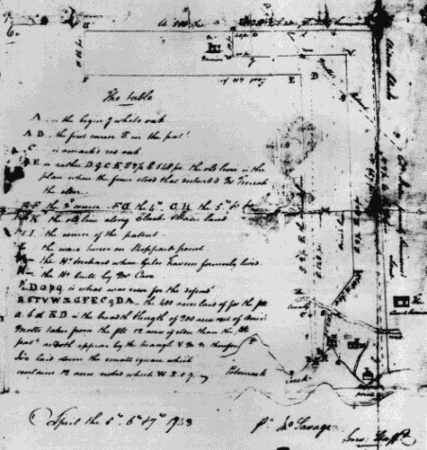
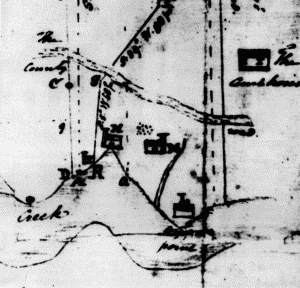
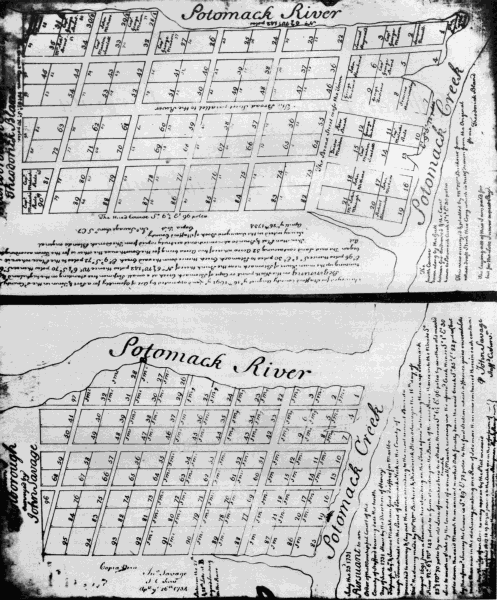 Figure 2.—Survey plats of Marlborough as copied in
John Mercer’s Land Book showing at bottom, John
Savage’s, 1731; and top, William Buckner’s and
Theodorick Bland’s, 1691. (The courthouse probably
stood in the vicinity of lot 21.)
Figure 2.—Survey plats of Marlborough as copied in
John Mercer’s Land Book showing at bottom, John
Savage’s, 1731; and top, William Buckner’s and
Theodorick Bland’s, 1691. (The courthouse probably
stood in the vicinity of lot 21.)
Some of these towns actually were laid out, each on
a 50-acre tract of half-acre lots, but only 9 tracts were
built upon. The Act soon lagged and collapsed. It
was unpopular with the colonists, who were obliged
to transport their tobacco to distant warehouses and
to pay storage fees; it was ignored by shipmasters,
who were in the habit of dealing directly with planters
at their wharves and who were not interested in
making it any easier for His Majesty’s customs
collectors.[5]
Nevertheless, efforts to come up with a third act
began in 1688.[6] William Fitzhugh, especially, was
articulate in his alarm over Virginia’s one-crop
economy, the effects of which the towns were supposed
to mitigate. At this time he referred to tobacco
as “our most despicable commodity.” A year later,
he remarked, “it is more uncertain for a Planter to
get money by consigned Tobo then to get a prize in a
lottery, there being twenty chances for one chance.”[7]
In April 1691 the Act for Ports was passed, the
House, significantly, recording only one dissenting
vote.[8] Unlike its predecessor, which encouraged
trades and crafts, this Act was justified purely on the
basis of overcoming the “great opportunity ... given
to such as attempt to import or export goods and
merchandises, without entering or paying the duties
and customs due thereupon, much practised by
greedy and covetous persons.” It provided that all
exports and imports should be taken up or set down
at the specified ports and nowhere else, under penalty
of forfeiting ship, gear, and cargo, and that the law
should become effective October 1, 1692. The towns
again were to be surveyed and laid out in 50-acre
tracts. Feoffees, to be appointed, would grant half-acre
lots on a pro rata first-cost basis. Grantees
“shall within the space of four months next ensueing
such grant begin and without delay proceed to build
and finish on each half acre one good house, to containe
twenty foot square at the least, wherein if he
fails to performe them such grant to be void in law,
and the lands therein granted lyable to the choyce
and purchase of any other person.” Justices of the
county courts were to fill vacancies among the feoffees
and to appoint customs collectors.[9]
THE PORT TOWN FOR STAFFORD COUNTY
The difficulties confronting the central and local
governing bodies in putting the Acts into effect are
illustrated by the attempts to establish a port town
for Stafford County. Under the act of 1680 a town
was to be built at “Peace Point,” where the Catholic
refugee Giles Brent had settled nearly forty years
before, but there is no evidence that even so much
as a survey was made there. The 1691 Act for
Ports located the town at Potomac Neck, where
Accokeek Creek and Potomac Creek converge on the
Potomac River. Situated about three miles below
the previously designated site, it was again on Brent
property, lying within a tract leased for life to Captain
Malachi Peale, former high sheriff of Stafford. On
October 9, 1691, the Stafford Court “ordered that
Mr. William Buckner deputy Surveyor of this County
shall on Thursday next ... repair to the Malachy
Peale neck being the place allotted by act of assembly
for this Town and Port of this County and shall then
and there Survey and Lay Out the said Towne or
Port ... to the Interest that all the gentlemen of
and all other of the Inhabitants may take up such
Lot and Lots as be and they desire....” On the
same day John Withers and Matthew Thompson,
both justices of the peace, were appointed “Feoffees
in Trust.” Young Giles Brent, “son and heir of
Giles Brent Gent. late of this county deced” and not
yet 21, selected Francis Hammersley as his guardian.
Hammersley in this capacity became the administrator
of Brent’s affairs, and accordingly it was agreed
that 13,000 pounds of tobacco should be paid to him
in exchange for the 50 acres of town land owned by
Brent.[10]
Actually, 52 acres were surveyed, “two of the said
acres being the Land belonging to and laid out for
the Court House according to a former Act of Assembly
and the other fifty acres pursuant to the late
Act for Ports.” The “former Act of Assembly”
which had been passed in 1667 had stipulated the
allotment of two-acre tracts for churches and court houses,
which in case the lots “be deserted ye land
shall revert to ye 1st proprietor....”[11] For the
extra two acres Hammersley was given 800 pounds of
tobacco in addition. Of the total of 13,800 pounds,
3450 were set aside to compensate Malachi Peale for
the loss of his leasehold.
The order for the survey to be made was a formality,
since the plat had actually been drawn ahead of
time by Buckner on August 16, nearly two months
before; clearly the Staffordians were eager to begin
their town. Buckner’s plat was copied by his superior,
Theodorick Bland, and entered in the now-missing
Stafford Survey Book. John Savage, a later surveyor,
in 1731 provided John Mercer with a duplicate
of Bland’s copy, which has survived in John Mercer’s
Land Book (fig. 2).[12]
On February 11, 1692, the feoffees granted 27 lots
to 15 applicants. John Mercer’s later review of the
town’s history in this period states that “many” of the
lots were “built on and improved.”[13] Two ordinaries
were licensed, one in 1691 and one in 1693, but no
business activity other than the Potomac Creek ferry
seems to have been conducted.[14] Any future the
town might have had was erased by the same adverse
reactions that had killed the previous port acts. The
merchants and shippers used their negative influence
and on March 22, 1693, a “bill for suspension of
ye act for Ports &c. till their Majts pleasure shall be
known therein or till ye next assembly” passed the
house. In due course the act was reviewed and returned
unsigned for further consideration. William
Fitzhugh, on October 17, 1693, dutifully read the
recommendation of the Committee of Grievances and
Properties “That the appointment of Ports & injoyneing
the Landing and Shipping of all goods
imported or to be exported at & from the same will
(considering the present circumstances of the Country)
be very injurious & burthensome to the Inhabitants
thereof and traders thereunto.”[15] Doubtless dictated
by the Board of Trade in London, the recommendation
was a defeat for those who, like Fitzhugh, sought by
the establishment of towns to break tobacco’s strangle-hold
on Virginia.
THE ACT FOR PORTS OF 1705
AND THE NAMING OF MARLBOROUGH
Nevertheless, the town idea was hard to kill.
In 1705 Stafford’s port town, along with those in
the other counties, was given a new lease on life
when still another Act for Ports, introduced by
Robert Beverley, was passed. This Act repeated
in substance the provisions of its immediate forerunner,
but provided in addition extravagant inducements
to settlement. Those who inhabited
the towns were exempted from three-quarters of the
customs duties paid by others; they were freed of
poll taxes for 15 years; they were relieved from military
mustering outside the towns and from marching
outside, excepting the “exigency” of war (and then
only for a distance of no more than 50 miles). Goods
and “dead provision” were not to be sold outside
within a 5-mile radius, and ordinaries (other than
those within the towns) were not permitted closer
than 10 miles to the towns’ boundaries, except at
courthouses and ferry landings. Each town was to
be a free “burgh,” and, when it had grown to 30
families “besides ordinary keepers,” “eight principal
inhabitants” were to be chosen by vote of the “freeholders
and inhabitants of the town of twenty-one
years of age and upwards, not being servants or
apprentices,” to be called “benchers of the guild-hall.”
These eight “benchers” would govern the
town for life or until removal, selecting a “director”
from among themselves. When 60 families had
settled, “brethren assistants of the guild hall” were
to be elected similarly to serve as a common council.
Each town was to have two market days a week and
an annual five-day fair. The towns listed under
the Act were virtually the same as before, but this
time each was given an official name, the hitherto
anonymous town for Stafford being called Marlborough
in honor of the hero of the recent victory
at Blenheim.[16]
The elaborate vision of the Act’s sponsors never
was realized in the newly christened town, but there
was in due course a slight resumption of activity in
it. George Mason and William Fitzhugh, Jr. (the
son of William Fitzhugh of Stafford County) were
appointed feoffees in 1707, and a new survey was
made by Thomas Gregg. The following year seven
more lots were granted, and for an interval of two
years Marlborough functioned technically as an
official port.[17]
Inevitably, perhaps, history repeated itself. In 1710
the Act for Ports, like its predecessors, was rescinded.
The reasons given in London were brief and straightforward;
the Act, it was explained, was “designed to
Encourage by great Priviledges the settling in Townships.”
These settlements would encourage manufactures,
which, in turn, would promote “further
Improvement of the said manufactures, And take
them off from the Planting of Tobacco, which would
be of Very Ill consequence,” thus lessening the
colony’s dependence on the Kingdom, affecting the
import of tobacco, and prejudicing shipping.[18]
Clearly, the Crown did not want the towns to succeed,
nor would it tolerate anything which might stimulate
colonial self-dependence. The Virginia colonists’
dream of corporate communities was not to be
realized.
Most of the towns either died entirely or struggled
on as crossroads villages. A meager few have survived
to the present, notably Norfolk, Hampton,
Yorktown, and Tappahannock. Marlborough lasted
as a town until about 1720, but in about 1718 the
courthouse and several dwellings were destroyed by
fire and “A new Court House being built at another
Place, all or most of the Houses that had been built
in the said Town, were either burnt or suffered to go
to ruin.”[19]
The towns were artificial entities, created by acts
of assembly, not by economic or social necessity.
In the few places where they filled a need, notably
in the populous areas of the lower James and York
Rivers, they flourished without regard to official
status. In other places, by contrast, no law or edict
sufficed to make them live when conditions did not
warrant them. In sparsely settled Stafford especially
there was little to nurture a town. It was easier, and
perhaps more exciting, to grow tobacco and gamble
on a successful crop, to go in debt when things were
bad or lend to the less fortunate when things were
better. In the latter case land became an acceptable
medium for the payment of debts. Land was wealth
and power, its enlargement the means of greater
production of tobacco—tobacco again the great
gamble by which one would always hope to rise and
not to fall. When one could own an empire, why
should one worry about a town?
ESTABLISHING COURTHOUSES
The administrative problems that contributed to
the establishment of the port towns also called for the
erection of courthouses. As early as 1624 lower courts
had been authorized for Charles City and Elizabeth
City in recognition of the colony’s expansion, and ten
years later the colony had been divided into eight
counties, with a monthly court established in each.
By the Restoration the county courts possessed broadly
expanded powers and were the administrative as well
as the judicial sources of local government. In practice
they were largely self-appointive and were responsible
for filling most local offices. Since the courts
were the vehicles of royal authority, it followed that
the physical symbols of this authority should be
emphasized by building proper houses of government.
At Jamestown orders were given in 1663 to build a
statehouse in lieu of the alehouses and ordinaries
where laws had been made previously.[20]
In the same year, four courthouses annually were
ordered for the counties, the burgesses having been
empowered to “make and Signe agreements wth any
that will undertake them to build, who are to give
good Caution for the effecting thereof with good
sufficient bricks, Lime, and Timber, and that the
same be well wrought and after they are finished to
be approved by an able surveyor, before order be
given them for their pay.”[21] Such buildings were to
take the place of private dwellings and ordinaries in
the same way as did the statehouse at Jamestown.
It was no accident that legislation for houses of
government coincided with that for establishing port
towns. Each reflected the need for administering the
far-flung reaches of the colony and for maintaining
order and respect for the crown in remote places.
THE COURTHOUSE IN THE PORT TOWN
FOR STAFFORD COUNTY
Stafford County, which had been set off from
Westmoreland in 1664, was provided with a courthouse
within a year of its establishment. Ralph
Happel in Stafford and King George Courthouses and the
Fate of Marlborough, Port of Entry, has given us a
detailed chronicle of the Stafford courthouses, showing
that the first structure was situated south of
Potomac Creek until 1690, when it presumably
burned.[22] The court, in any event, began to meet
in a private house on November 12, 1690, while on
November 14 one Sampson Darrell was appointed
chief undertaker and Ambrose Bayley builder of a
new courthouse. A contract was signed between them
and the justices of the court to finish the building by
June 10, 1692, at a cost of 40,000 pounds of tobacco
and cash, half to be paid in 1691 and the remainder
upon completion.[23]
With William Fitzhugh the presiding magistrate
of the Stafford County court as well as cosponsor of
the Act for Ports, it was foreordained that the new
courthouse should be tied in with plans for the port
town. The Act for Ports, however, was still in the
making, and it was not possible to begin the courthouse
until after its passage in the spring. On
June 10, 1691, it was “Ordered by this Court that
Capt. George Mason and Mr. Blande the Surveyor
shall immediately goe and run over the ground where
the Town is to Stand and that they shall then advise
and direct Mr Samson Darrell the Cheife undertaker
of the Court house for this County where he shall
Erect and build the same.”[24]
The court’s order was followed by a hectic sequence
that reflects, in general, the irresponsibilities, the
lack of respect for law and order, and the frontier
weaknesses which made it necessary to strengthen
authority. It begins with Sampson Darrell himself,
whose moral shortcomings seem to have been legion
(hog-stealing, cheating a widow, and refusing to give
indentured servants their freedom after they had
earned it, to name a few). Darrell undoubtedly
had the fastidious Fitzhugh’s confidence, for certainly
without that he would not have been appointed
undertaker at all. In his position in the court,
Fitzhugh would have been instrumental in selecting
both architect and architecture for the courthouse,
and Darrell seems to have met his requirements.
Fitzhugh, in fact, had sufficient confidence in Darrell
to entrust him with personal business in London in
1688.[25]
Although several months elapsed before a site was
chosen, enough of the new building was erected by
October to shelter the court for its monthly assembly.
In the course of this session, there occurred a “most
mischievous and dangerous Riot,”[26] which rather
violently inaugurated the new building. During this
disturbance, the pastor of Potomac Parish, Parson
John Waugh,[27] upbraided the court while it was
“seated” and took occasion to call Fitzhugh a Papist.
The court, taking cognizance of “disorders, misrules
and Riots” and “the Fatal consequences of such
unhappy malignant and Tumultuous proceeding,”
thereupon restricted the sale of liquor on court days
(thus revealing what was at least accessory to the
disturbance).[28] Fitzhugh’s letter to the court concerning
this episode mentions the “Court House” and
the “Court house yard,” adding to Happel’s ample
documentation that the new building was by now in
use.
During the November session, James Mussen was
ordered into custody for having “dangerously wounded
Mr. Sampson Darrell.”[29] This suggests that the
sequence of disturbances may have been associated
with the unfinished state of the courthouse, which,
like the town, symbolized the purposes of Fitzhugh
and the property-owning aristocracy. Certain it is
that Darrell, publicly identified with Fitzhugh, was
violently assaulted and that “a complaint was made
to this Court that Sampson Darrell the chief undertaker
of the building and Erecting of a Court house for
this county had not performed the same according to
articles of agreement.” He and Bayley accordingly
were put under bond to finish the building by June
10, 1692. By February Bayley was complaining that
he had not been paid for his work, “notwithstanding
your petr as is well known to the whole County hath
done all the carpenters work thereof and is ready to
perform what is yet wanting.” On May 12, less than
a month from the deadline for completion, Darrell
was ordered to pay Bayley the money owing, and
Bayley was instructed to go on with the work. Nearly
six months later, on November 10, Darrell again was
directed to pay Bayley the full balance of his wages,
but only “after the said Ambrose Bayley shall have
finished and Compleatly ended the Court house.”[30]
No description of the courthouse has been found.
The Act of 1663 seems to have required a brick
building, although its wording is ambiguous. Even
if it did stipulate brick, the law was 28 years old in
1691, and its requirements probably were ignored.
Although Bayley, the builder, was a carpenter, this
would not preclude the possibility that he supervised
bricklayers and other artisans. Brick courthouses
were not unknown; one was standing in Warwick
when the Act for Ports was passed in 1691. Yet, the
York courthouse, built in 1692, was a simple building,
probably of wood.[31] In any case, the Stafford courthouse
was a structure large enough to have required
more than a year and a half to build, but not so
elaborate as to have cost more than 40,000 pounds
of tobacco.
LOCATION OF THE STAFFORD COURTHOUSE
The location of the building is indicated by a
notation on Buckner’s plat of the port town: “The
fourth course (runs) down along by the Gutt between
Geo: Andrew’s & the Court house to Potomack
Creek.” A glance at the plat (fig. 2) will disclose
that the longitudinal boundaries of all the lots south
of a line between George Andrews’ “Gutt” run
parallel to this fourth course. Plainly, the courthouse
was situated near the head of the gutt, where the
westerly boundary course changed, near the end of
“The Broad Street Across the Town.” It may be
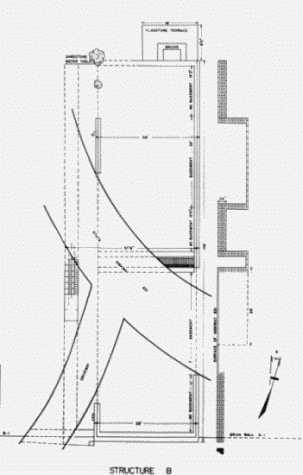
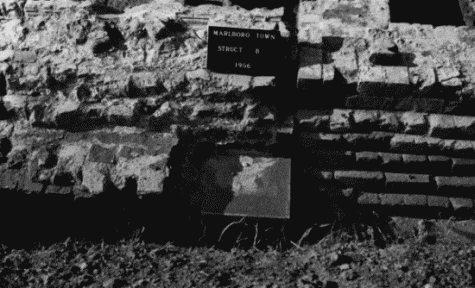
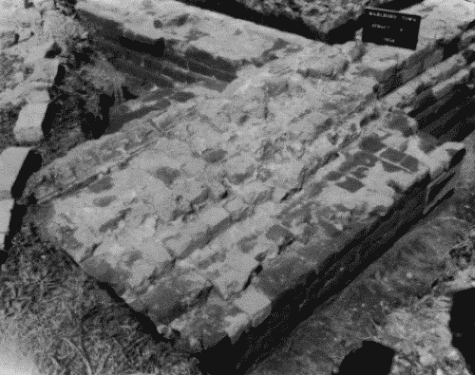
significant that the foundation (Structure B) on
which John Mercer’s mansion was later built is
located in this vicinity.
In or about the year 1718 the courthouse “burnt
Down,”[32] while it was reported as “being become
ruinous” in 1720, with its “Situation very inconvenient
for the greater part of the Inhabitants.” It was
then agreed to build a new courthouse “at the head
of Ocqua Creek.”[33] Aquia Creek was probably
meant, but this must have been an error and the “head
of Potomac Creek” intended instead. Happel shows
that it was built on the south side of Potomac Creek.
Thus, the burning of the Marlborough courthouse
in 1718 merely speeded up the forces that led to the
end of the town’s career.
MARLBOROUGH PROPERTY OWNERS
Not only was Marlborough foredoomed by external
decrees and adverse official decisions, but much of its
failure was rooted in the local elements by which
it was constituted. The great majority of lot holders
were the “gentlemen” who were so carefully distinguished
from “all other of the Inhabitants” in the
order to survey the town in 1691. Most were leading
personages in Stafford, and we may assume that their
purchases of lots were made in the interests of investment
gains, not in establishing homes or businesses.
Only three or four yeomen and ordinary keepers seem
to have settled in the town.
Sampson Darrell, for example, held two lots, but he
lived at Aquia Creek.[34] Francis Hammersley was a
planter who married Giles Brent’s widow and lived
at “The Retirement,” one of the Brent estates.[35]
George Brent, nephew of the original Giles Brent, was
law partner of William Fitzhugh, and had been
appointed Receiver General of the Northern Neck in
1690. His brother Robert also was a lot holder.
Both lived at Woodstock, and presumably they did
not maintain residences at the port town.[36] Other
leading citizens were Robert Alexander, Samuel Hayward,
and Martin Scarlett, but again there is little
likelihood that they were ever residents of the town.
John Waugh, the uproarious pastor of Potomac
Parish, also was a lot holder, but he lived on the south
side of Potomac Creek in a house which belonged to
Mrs. Anne Meese of London. His failure to pay for
that house after 11 years’ occupancy of it, which led
to a suit in which Fitzhugh was the prosecutor, does
not suggest that he ever arrived at building a house
in the port town.[37]
Captain George Mason was a distinguished individual
who lived at “Accokeek,” about a mile and
a half from Marlborough. He certainly built in the
town, for in 1691 he petitioned for a license to “keep
an ordinary at the Town or Port for this county.”
The petition was granted on condition that he “find
a good and Sufficient maintenance and reception
both for man and horse.” Captain Mason was
grandfather of George Mason of Gunston Hall,
author of the Virginia Bill of Rights, and was, at one
time or another, sheriff, lieutenant colonel and
commander in chief of the Stafford Rangers, and a
burgess. He participated in putting down the uprising
of Nanticoke Indians in 1692, bringing in
captives for trial at the unfinished courthouse in
March of that year.[38] Despite his interest in the
town, however, it is unlikely that he ever lived there.
Another lot owner was Captain Malachi Peale,
whose lease of the town land from the Brents had
been purchased when the site was selected. He also
was an important figure, having been sheriff. He
may well have lived on one of his three lots, since
he was a resident of the Neck to begin with. John
Withers, one of the first feoffees and a justice of the
peace, was a lot holder also. George Andrews and
Peter Beach, somewhat less distinguished, were perhaps
the only full-time residents from among the
first grantees. After 1708 Thomas Ballard and
possibly William Barber were also householders.
Thus, few of the ingredients of an active community
were to be found at Marlborough, the skilled craftsmen
or ship’s chandlers or merchants who might
have provided the vitality of commerce and trade
not having at any time been present.
HOUSING
It is likely that most of the houses in the town conformed
to the minimum requirements of 20 by 20
feet. They were probably all of wood, a story and a
half high with a chimney built against one end.
Forman describes a 20-foot-square house foundation
at Jamestown, known as the “House on Isaac Watson’s
Land.” This had a brick floor and a fireplace large
enough to take an 8-foot log as well as a setting for a
brew copper. The ground floor consisted of one room,
and there was probably a loft overhead providing
extra sleeping and storage space.[39] The original
portion of the Digges house at Yorktown, built following
the Port Act of 1705 and still standing, is a brick
house, also 20 feet square and a story and a half high.
Yet, brick houses certainly were not the rule. In
remote Stafford County, shortly before the port town
was built, the houses of even well-placed individuals
were sometimes extremely primitive. William Fitzhugh
wrote in 1687 to his lawyer and merchant
friend Nicholas Hayward in London, “Your brother
Joseph’s building that Shell, of a house without
Chimney or partition, & not one tittle of workmanship
about it more than a Tobacco house work,
carry’d him into those Arrears with your self & his
other Employees, as you found by his Accots. at his
death.”[40] Ancient English puncheon-type construction,
with studs and posts set three feet into the
ground, was still in use at Marlborough in 1691, as
we know from the contract for building a prison
quoted by Happel.[41] No doubt the houses there
varied in quality, but we may be sure that most were
crude, inexpertly built, of frame or puncheon-type
construction, and subject to deterioration by rot and
insects.
FURNISHINGS OF TWO MARLBOROUGH HOUSES
Like George Mason, George Andrews ran an ordinary
at the port town, having been licensed in 1693,
and he also kept the ferry across Potomac Creek.[42]
He died in 1698, leaving the property to his grandson
John Cave. From the inventory of his estate recorded
in the Stafford County records (Appendix A) we
obtain a picture not only of the furnishings of a house
in the port town, but also of what constituted an
ordinary.[43] We are left with no doubt that as a
hostelry Andrews’ house left much to be desired.
There were no bedsteads, although six small feather
beds with bolsters and one old and small flock bed
are listed. (Flock consisted of tufted and fragmentary
pieces of wool and cotton, while “Bed” referred not
to a bedframe or bedstead but to the tick or mattress.)
There were two pairs of curtains and valances.
In the 17th century a valance was “A border of
drapery hanging around the canopy of a bed.”[44]
Curtains customarily were suspended from within
the valance from bone or brass curtain rings on a
rod or wire, and were drawn around the bed for
privacy or warmth. Where high post bedsteads
were used, the curtains and valances were supported
on the rectangular frame of the canopy or tester.
Since George Andrews did not list any bedsteads, it
is possible that his curtains and valances were hung
from bracketed frames above low wooden frames that
held the bedding. Six of his beds were covered with
“rugs,” one of which was “Turkey work.” There
is no indication of sheets or other refinements for
sleeping.
Andrews’ furniture was old, but apparently of good
quality. Four “old” cane chairs, which may have
dated back as far as 1660, were probably English,
of carved walnut. The “old” table may have had
a turned or a joined frame, or possibly may have
been a homemade trestle table. An elegant touch
was the “carpet,” which undoubtedly covered it.
Chests of drawers were rare in the 17th century, so
it is surprising to find one described here as “old.”
A “cupboard” was probably a press or court cupboard
for the display of plates and dishes and perhaps the
pair of “Tankards” listed in the inventory. The
latter may have been pewter or German stoneware
with pewter mounts. The “couch” was a combination
bed and settee. As in every house there were
chests, but of what sort or quality we can only
surmise. A “great trunk” provided storage.
Andrews’ hospitality as host is symbolized by his
lignum vitae punchbowl. Punch itself was something
of an innovation and had first made its appearance in
England aboard ships arriving from India early in
the 1600’s. It remained a sailor’s drink throughout
most of the century, but had begun to gain in general
popularity before 1700 in the colonies. What is more
remarkable here, however, is the container. Edward
M. Pinto states that such lignum vitae “wassail” bowls
were sometimes large enough to hold five gallons of
punch and were kept in one place on the table, where
all present took part in the mixing. They were lathe-turned
and usually stood on pedestals.[45] George
Andrews’ nutmeg graters, silver spoons, and silver
dram cup for tasting the spirits that were poured into
the punch were all elegant accessories.
Another resident whose estate was inventoried was
Peter Beach.[46] One of his executors was Daniel
Beach, who was paid 300 pounds of tobacco annually
from 1700 to 1703 for “sweeping” and “cleaning” the
courthouse (Appendix B). Beach’s furnishings were
scarcely more elaborate than Andrews’. Unlike
Andrews, he owned four bedsteads, which with their
curtains and fittings (here called “furniture”) varied
in worth from 100 to 1500 pounds of tobacco. Here
again was a cupboard, while there were nine chairs
with “flag” seats and “boarded” backs (rush-seated
chairs, probably of the “slat-back” or “ladder-back”
variety). Eight more chairs and five stools were not
described. A “parcel of old tables” was listed, but
only one table appears to have been in use. There
were pewter and earthenware, but a relatively few
cooking utensils. An “old” pewter tankard was
probably the most elegant drinking vessel, while one
candlestick was a grudging concession to the need for
artificial light. The only books were two Bibles;
the list mentions a single indentured servant.
THE GREGG SURVEY
In 1707, after the revival of the Port Act, the new
county surveyor, Thomas Gregg, made another survey
of the town. This was done apparently without regard
to Buckner’s original survey. Since Gregg adopted
an entirely new system of numbering, and since his
survey was lost at an early date, it is impossible to
locate by their description the sites of the lots granted
in 1708 and after.
Forty years later John Mercer wrote:
It is certain that Thomas Gregg (being the Surveyor
of Stafford County) did Sep 2d 1707 make a new Survey
of the Town.... it is as certain that Gregg had no
regard either to the bounds or numbers of the former
Survey since he begins his Numbers the reverse way
making his number 1 in the corner at Buckner’s 19 &
as his Survey is not to be found its impossible to tell
how he continued his Numbers. No scheme I have
tried will answer, & the Records differ as much, the
streets according to Buckner’s Survey running thro the
House I lived in built by Ballard tho his whole lot was
ditched in according to the Bounds made by Gregg.[47]
Whatever the intent may have been in laying out
formal street and lot plans, Marlborough was essentially
a rustic village. If Gregg’s plat ran streets
through the positions of houses on the Buckner
survey, and vice versa, it is clear that not much
attention was paid to theoretical property lines or
streets. Ballard apparently dug a boundary ditch
around his lot, according to Virginia practice in the
17th century, but the fact that this must have encroached
on property assigned to somebody else on
the basis of the Buckner survey seems not to have
been noted at the time. Rude houses placed informally
and connected by lanes and footpaths, the
courthouse attempting to dominate them like a
village schoolmaster in a class of country bumpkins,
a few outbuildings, a boat landing or two, some
cultivated land, and a road leading away from the
courthouse to the north with another running in the
opposite direction to the creek—this is the way
Marlborough must have looked even in its best days
in 1708.
THE DEATH OF MARLBOROUGH AS A TOWN
Could this poor village have survived had the
courthouse not burned? It was an unhappy contrast
to the vision of a town governed by “benchers of the
guild hall,” bustling with mercantile activity, swarming
on busy market days with ordinaries filled with
people. This fantasy may have pulsated briefly
through the minds of a few. But, after the abrogation
of the Port Act in 1710, there was little left to justify
the town’s existence other than the courthouse. So
long as court kept, there was need for ordinaries and
ferries and for independent jacks-of-all-trades like
Andrews. But with neither courthouse nor port
activity nor manufacture, the town became a paradox
in an economy and society of planters.
Remote and inaccessible, uninhabited by individuals
whose skills could have given it vigor, Marlborough
no longer had any reason for being. It lingered on
for a short time, but when John Mercer came to
transform the abandoned village into a flourishing
plantation, “Most of the other Buildings were suffered
to go to Ruin, so that in the year 1726, when your
Petitioner [i.e., Mercer] went to live there, but one
House twenty-feet square was standing.”[48]
MERCER’S ARRIVAL IN STAFFORD COUNTY
By 1723 Marlborough lay abandoned. George
Mason (III), son of the late sheriff and ordinary keeper
in the port town, held the now-empty title of feoffee,
together with Rice Hooe. In that year Mason and
Hooe petitioned the General Court “that Leave may
be given to bring in a Bill to enable them to sell the
said Land [of the town] the same not being built
upon or Inhabited.” The petition was put aside for
“consideration,” but within a week—on May 21,
1723—it was “ordered That Rice Hooe & George
Mason be at liberty to withdraw their petition ...
and that the Committee to whom it was referred be
discharged from proceeding thereon.”[49]
This curious sequence remains unexplained. Had
the committee informally advised the feoffees that
their cause would be rejected, suggesting, therefore,
that they withdraw their petition? Or had something
unexpected occurred to provide an alternative
solution to the problem of Marlborough?
Possibly it was the latter, and the unexpected occurrence
may have been the arrival in Stafford County
of young John Mercer. There is no direct evidence
that Mercer was in the vicinity as early as 1723; but
we know that he appeared before 1725, that he had
by then become well acquainted with George Mason,
and that he settled in Marlborough in 1726.
Mercer’s remarkable career began with his arrival
in Virginia at the age of 16. Born in Dublin in 1704,
the son of a Church Street merchant of English
descent—also named John Mercer—and of Grace
Fenton Mercer, John was educated at Trinity
College, and then sailed for the New World in 1720.[50]
How Mercer arrived in Virginia or what means he
brought with him are lost to the record. From his
own words written toward the end of his life we
know that he was not overburdened with wealth:
“Except my education I never got a shilling of my
fathers or any other relations estate, every penny I ever
got has been by my own industry & with as much fatigue
as most people have undergone.”[51]
From his second ledger (the first, covering the
years 1720-1724, having been lost) we learn that he
was engaged in miscellaneous trading, sailing up and
down the rivers in his sloop and exchanging goods
along the way. Where his home was in these early
years we do not know, but it would appear that he
had been active in the Stafford County region for
some time, judging from the fact that by 1725 he had
accumulated £322 4s. 5½d. worth of tobacco in a
warehouse at the falls of the Rappahannock.[52] He
certainly had encountered George Mason before
then, and probably Mason’s uncles, John, David, and
James Waugh, the sons of Parson John Waugh, all
of whom owned idle Marlborough properties.
Mercer’s friendship with the Masons was sufficiently
well established by 1725 that on June 10 of that year
he married George’s sister Catherine. This marriage,
most advantageous to an aspiring young man,
was celebrated at Mrs. Ann Fitzhugh’s in King George
County with the Reverend Alexander Scott of
Overwharton Parish in Stafford County officiating.[53]
Thus, allied to an established family that was “old”
by standards of the time and sponsored socially by a
representative of the Fitzhughs, Mercer was admitted
at the age of 21 to Virginia’s growing aristocracy.
In this animated and energetic youth, the Masons
and Waughs probably saw the means of bringing
Marlborough back to life. Mercer, for his part, no
doubt recognized the advantages that Marlborough
offered, with its sheltered harbor and landing, its
fertile, flat fields, and airy situation. That it could
be acquired piecemeal at a minimum of investment
through the provisions of the Act for Ports was an
added inducement.
JOHN MERCER AS A TRADER
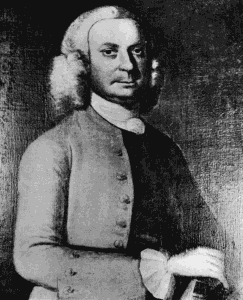 Figure 3.—Portrait of John Mercer, artist unknown.
About 1750. (Courtesy of Mrs. Thomas
B. Payne.)
Figure 3.—Portrait of John Mercer, artist unknown.
About 1750. (Courtesy of Mrs. Thomas
B. Payne.)
During 1725 Mercer pressed ahead with his trading
enterprises. From his ledger we learn that he sold
Richard Ambler of Yorktown 710 pounds of “raw
Deerskins” for £35 10s. and bought £200 worth of
“sundry goods” from him. Between October 1725
and February 1726 he sold a variety of furnishings
and equipment to Richard Johnson, ranging from a
“horsewhip” and a “silk Rugg” to “½ doz. Shoemaker’s
knives” and an “Ivory Comb.” In return
he received two hogsheads of tobacco, “a Gallon of
syder Laceground,” and raw and dressed deerskins.
He maintained a similar long account with Mosley
Battaley (Battaille) (Appendix C). From William
Rogers of Yorktown[54] he bought £12 3s. 6d. worth
of earthenware, presumably for resale. The tobacco
which he had accumulated at the falls of the Rappahannock
he sold for cash to the Gloucester firm of
Whiting & Montague, paying Peter Kemp two
pounds “for the extraordinary trouble of yr coming
up so far for it.”
His sloop was the principal means by which Mercer
conducted his business. Occasionally he rented it
for hire, once sharing the proceeds of a load of oystershells
with George Mason and one Edgeley, who had
sailed the sloop to obtain the shells. Only one item
shows that Mercer extended his mercantile activities
to slaves: on February 18, 1726, he sold a mulatto
woman named Sarah to Philemon Cavanaugh “to be
paid in heavy tobacco each hhd to weigh 300 Neat.”
That Mercer was turning in the direction of a legal
career is revealed in his first account of “Domestick
Expenses” for the fall of 1725 (Appendix D). We find
that he was attending court sessions far and wide:
“Cash for Exps at Stafford & Spotsylvania,” “Cash
for Exps Urbanna,” the same for “Court Ferrage
at Keys.” He already was reading in the law, and
lent “March’s Actions of Slander,” “Washington’s
Abridgmt of ye Statutes,” and “an Exposition of the
Law Terms” to Mosley Battaley.
SETTING UP HOUSEKEEPING
Mercer’s domestic-expense account is full of evidence
that he was preparing to set up housekeeping.
He bought “1 China punch bowl,” 10s.; “6 glasses,”
3s.; “1 box Iron & heaters,” 2s. 6d.; “1 pr fine
blankets,” 1s. 13d.; “Earthen ware,” 10s.; “5 Candlesticks,”
17s. 6d.; “1 Bed Cord,” 2s.; “3 maple knives
& forks,” 2s.; “1 yew haft knife & fork & 1 pr Stilds
[steelyards?],” 1s. 10½d.; “1 pr Salisbury Scissors,”
2s. 6d.; and “1 speckled knife & fork,” 5d.
In addition, he accepted as payment for various
cloth and materials sold to Mrs. Elizabeth Russell the
following furniture and furnishings:
| | Ster. | £ | s. | d. |
| By a writing desk | Do | 5 | | |
| By a glass & Cover | Do | | 7 | 6 |
| By 18l Pewter at ¼ | Do | 1 | 4 | |
| By 6 tea Cups & Sawcers 2/ | Do | | 12 | |
| By 2 Chocolate Cups 1/ | Do | | 2 | |
| By 2 Custard Cups 9d | Do | | 1 | 6 |
| By 1 Tea Table painted with fruit | Do | | 14 | |
| By 6 leather Chairs @ 7/ | | 2 | 2 |
| By a small walnut eating table | | | 8 |
| By ½ doz. Candlemoulds | | | 10 |
| By a Tea table | | | 18 |
| By a brass Chafing dish | | | 5 |
| By 6 copper tart pans | | | 6 |
At the time of this purchase, the only house standing
at Marlborough was that built by Thomas Ballard
in 1708. It was inherited by his godson David
Waugh,[55] who now apparently offered to let his
niece Catherine and her new husband occupy it.
Mercer later referred to it as “the House I lived in
built by Ballard.”[56] From his own records we know
that he moved to Marlborough in 1726. He did
so probably in the summer, since on June 11 he
settled with Charles McClelland for “cleaning out
ye house.” Unoccupied for years and small in size,
it was a humble place in which to set up housekeeping,
and indeed must have needed “cleaning out.” It
also must have needed extensive repairs, since Mercer
purchased 1500 tenpenny nails “used about it.”
Throughout 1726 Mercer acquired household
furnishings, made repairs and improvements, and
obtained the necessities of a plantation. On February
1 he acquired “3 Ironbacks” (cast-iron firebacks for
fireplaces) for £8 4s. 2d., as well as “2 pr hand Irons”
for 15s. 5d., from Edmund Bagge. From George
Rust he bought “3 Cows & Calves” for £7 10s., a
featherbed for £3 10s., and an “Iron pot” for 5s.
His reckoning with John Dogge opens with a
poignant note, “By a Child’s Coffin”: Mercer’s
first-born child had died. On the same account
was “an Oven,” bought for 17 shillings. Dogge
also was credited with “bringing over 10 sheep
from Sumners” (a plantation at Passapatanzy, south
of Potomac Creek). Rawleigh Chinn was paid for
“plowing up & fencing in my yard” and for “fetching
3 horses over the Creek.” Also credited to Chinn
was an item revealing Mercer’s sporting enthusiasm:
“went on ye main race ... 15/.”
From Alexander Buncle, Mercer acquired one
dozen table knives, three chamber-door locks, two
pairs of candle snuffers, and two broad axes. His
account with Alexander McFarlane in 1726, the
credit side of which is quoted here in part, is a further
illustration of the variety of hardware and consumable
goods that he required:
| | £ | s. | d. |
| 2 pr men’s Shooes | | 9 | |
| 1 Razor & penknife | | 2 | 6 |
| 2¼ gall Rum | | 6 | 9 |
| 9 gals. molasses | | 13 | |
| 121 brown Sugar | | 6 | |
| 6¼ double refined Do 20d | | 10 | 5 |
| 1 felt hat | | 2 | 4 |
| 1 qt Limejuice | | 1 | |
| 2 doz. Claret | 1 | 10 | |
| 2 lanthorns | | 6 | |
| 1 funnell | | | 7½ |
| 1 quart & 1 pint tin pot | | 1 | 10½ |
| * * * |
| By 2 doz & 8 bottles Claret | 2 | 8 | |
| By a woman’s horsewhip | | 3 | |
| By 1oz Gunpowder | | | |
| By 10l Shot | | | |
| By 1 woms bound felt [hat] | | | |
Mercer’s comments, added three years later to this
record, signify the complexities of credit accounting
in the plantation economy: “In July 1729 I settled
Accounts wth Mr McFarlane & paid him off & at
the same time having Ed Barry’s note on him for
1412l Tobo (his goods being extravagantly dear) I
paid him 1450l Tobo to Mr Thos Smith to ballns
accts.”
Another of Mercer’s accounts was with Edward
Simm. From Simm, Mercer acquired the following
in 1726:
| | £ | s. | d. |
| 1 horsewhip | | 4 | |
| 1 fine hat | | 12 | |
| 9 yds bedtick ¾ | 1 | 10 | |
| 1 pr Spurs | | | 8 |
| 1 Curry Comb & brush | | 2 | 9 |
| 2 pr mens Shooes 5/ | | 10 | |
| 1 pr Chelloes | 1 | 10 | |
| 2 pr woms gloves 2/ | | 4 | |
| 2 pr Do thread hose | | 9 | |
| 2 pr mens worsted do | | 8 | |
| 2 pr chkr yarn | | 3 | 4 |
| 1 Sifter | | 2 | |
| 1 frying pan | | 4 | 6 |
| 7 quire of paper 1¼ | | 9 | 8 |
| 6 silk Laces 4d | | 2 | |
ACQUIRING LAND
AND BUILDING A NEW HOUSE
Mercer’s first actual ownership of property came as
a result of his marriage. In 1725 he purchased from
his wife Catherine 885 acres of land near Potomac
Church for £221 5s. and another tract of 1610
acres on Potomac Run for £322.[57] His occupancy
of the Ballard house, meanwhile, was arranged on a
most informal basis, three years having been allowed
to pass before he paid his first and only rent—a total
of 12 shillings—to his uncle-in-law David Waugh.
In January 1730 the following appears under
“Domestick Expenses”: “To bringing the frame of
my house from Jervers to Marlbro ... 40/.”
Associated with this are items for 2000 tenpenny nails,
2000 eightpenny nails, and 1000 sixpenny nails,
together with “To Chandler Fowke for plank,” “To
Jno Chambers &c. bring board from Landing,” and
“To John Chambers & Robt Collins for bringing
Bricks & Oyster Shells.”
In the same month the account of Anthony Linton
and Henry Suddath includes the following:
| By building a house at Marlborough when finished by agreement | £10.0.0 |
| By covering my house & building a Chimney | 3.0.0 |
Clearly, the Mercers had outgrown the temporary
shelter which the little Ballard house had given them.
Now a new house was under construction, with the
steps plainly indicated. To obtain timber of sufficient
size to frame the house it was necessary to go where
the trees grew. The nearest thickly forested area was
north of Potomac Creek and Potomac Run. The
appropriate timbers apparently grew on property
owned by Mercer but occupied by the widow of
James Jervis (or “Jervers”). Not only did the trees
grow there, but we may be sure that there they were
also felled, hewn, and cut, and the finished members
fitted together on the ground to form the frame of the
new house. It was a time-honored English building
practice to prepare the timbers where they were felled,
shaping them, drilling holes for “trunnels” (wooden
pegs or “tree nails”), inscribing coded numbers with
lumber markers, and then knocking the prefabricated
members apart and transporting them to the building
site.[58]
Oystershells and bricks for the chimney were brought
from Cedar Point and Boyd’s Hole, south of Marlborough,
by Chambers and Collins. Shells were
probably burned at the house site to make lime for
mortar. Chambers was paid 12 pence a day for 32½
days’ work spread over a period from October 1730 to
February 1731. Hugh French had been paid for 1000
bricks on August 24, 1730, while James Jones, on
October 3, 1730, was recompensed three shillings for
“9 days of work your Man plaistering my House &
making 2 brick backs.”
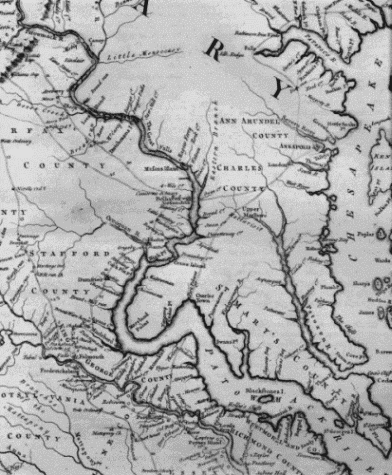 Figure 4.—The neighborhood of John Mercer. Detail from J. Dalrymple’s revision (1755)
of the map of Virginia by Joseph Fry and Peter Jefferson. Marlborough is incorrectly
designated “New Marleboro.” (Courtesy of the Library of Congress.)
Figure 4.—The neighborhood of John Mercer. Detail from J. Dalrymple’s revision (1755)
of the map of Virginia by Joseph Fry and Peter Jefferson. Marlborough is incorrectly
designated “New Marleboro.” (Courtesy of the Library of Congress.)
The new house was thus brought to completion
early in 1731. That it was a plain and simple house
is apparent from the small amount of labor and the
relatively few quantities of material. It appears to
have had two fireplaces only and one chimney.
Although the house was wooden, there is no evidence
that it had any paint whatsoever, inside or out.
FURNISHING THE HOUSE
Other than a child’s chair and a bedstead costing
10 shillings, purchased from Enoch Innes in 1729,
little furniture was acquired before 1730. Listed in
“Domestick Expenses” for 1729-1730 are minor
accessories for the new house, such as HL hinges,
closet locks, a “scimmer,” a pair of brass candlesticks,
milk pans, pestle and mortar, “½ doz plates,” a
“Cullender,” a candlebox, earthenware, and a
pepperbox, together with several handtools.
MERCER’S VARIED ACTIVITIES AND INTERESTS
The agricultural aspects of a plantation were
increasingly in evidence. In 1729 Rawleigh Chinn
was paid for “helping to kill the Hogs,” “pasturage
of my cattle,” and “making a gate.” Edward Floyd
was credited with £4 6s. 7½d. for “Wintering Cattle,
taking care of my horse & Sheep to Aug. 1729.”
John Chinn seems to have been Mercer’s jockey, for
as early as 1729 he was entering the races which
abounded in Virginia, and “went on ye race wth Colt
1729.”
In this early period we find considerable evidence
of a typical young Virginian’s fondness for gaming
and sport. One finds scattered through Mercer’s
account with Robert Spotswood such items as “To
won at the Race ... 8.9” and “To won at Liew at
Colo Mason’s ... 7.3.” (Loo was an elegant
18th-century game played with Chinese-carved
mother-of-pearl counters.) Mercer participated in
several sporting events at Stafford courthouse, for
court sessions continued, as in the previous century,
to be social as well as legal and political occasions.
This is illustrated in a credit to Joseph Waugh:
“By won at a horse race at Stafford Court and
Attorney’s fee ... £1.”; on the debit side of
Enoch Innes’s account: “To won at Quoits &
running with you ... 1/3”; and in Thomas
Hudson’s account, where four shillings were marked
up “To won pitching at Stafford Court.”
Mercer’s diversions were few enough, nevertheless,
and it is apparent that he devoted more time to reading
than to gaming. In 1726 he borrowed from John
Graham (or Graeme) a library of 56 volumes belonging
to the “Honble Colo Spotswood”[59] (Appendix E).
Ranging from the Greek classics to English history,
and including Milton, Congreve, Dryden, Cole’s
Dictionary, “Williams’ Mathematical Works,” and
“Present State of Russia,” they were the basis for a
solid education. That they included no lawbooks
at a time when Mercer was preparing for the law
is an indication of his broad taste for literature and
learning.
Marlborough, we can see, was occupied by a young
man of talent, energy, and creativity. He alone, of
the many men who had envisioned a center of
enterprise on Potomac Neck, was possessed of the
drive and the simple directness to make it succeed.
For George Mason and the Waughs, Mercer was the
ideal solution for their Marlborough difficulties.
MERCER THE YOUNG LAWYER
The 1730’s opened a golden age in the Virginia
colony. There was an interval of peace in which
trade might flourish; there were new laws which
favored the tobacco planter and led to the building
of resplendent mansions along Virginia’s shores.
John Mercer wasted no time in grasping the opportunities
that lay about him. With shrewd foresight
he made law his major objective, thus raising himself
above most of his contemporaries. At the same
time he began an extensive purchasing of property,
so that within a decade he was to become one of the
major landed proprietors in the colony. Planting and
legal practice each augmented the other in Mercer’s
prosperity, which was assured by a classic combination
of energy, ability, and outgoing personality. As
with many successful men, Mercer had an eye for
meticulous detail; the documents he left behind were
a treasury of methodically kept records.
His Ledger B reveals that as early as 1730 his legal
career was becoming firmly established. It records
fee accounts, charges for drawing deeds, writing
bonds, and representing clients in various courts.
In that year he “subscribed to Laws of Virginia”
through William Parks, the Williamsburg printer and
stationer, and began to build up a substantial law
library, which was augmented by the purchase of
40 lawbooks from Robert Beverley.
DIFFICULTIES IN ACQUIRING MARLBOROUGH
On October 13, 1730, Mercer obtained title from
David Waugh to the Ballard house and lots on the
basis of the “Statute for transforming uses into
possessions.” At the same time he acquired the three
lots originally granted to John Waugh, while nine
months later he was given the release of the three
lots inherited by George Mason from his father.[60]
Mercer’s foothold in Marlborough was now secure.
Following these developments, he “employed the
County Surveyor to lay off the several Lots he had
purchased,” which led to the discovery of the previously
mentioned disparities and conflicts between
the Buckner survey of 1691 and the missing Gregg
survey of 1707. For some reason the town now lacked
feoffees, so Mercer “applied to the County Court of
Stafford on the tenth day of June one thousand seven
hundred and thirty-one and the said Court then
appointed Henry Fitzhugh Esquire and James
Markham Gent. Feofees of the said Town.” Mercer
stated that he “proposed making great Improvements
... and wanted to take up several other Lots
to build on.” The court thereupon ordered John
Savage, the county surveyor, to make a new survey,
“having regard to the Buildings and Improvements
then standing”—a significant instruction, intended no
doubt to permit the reconciling of conflicting titles with
respect to what actually was built.[61]
The new survey was laid out July 23, 1731, “in the
presence of the said Feoffees,” and drawn with the
same plan and numbering as Buckner’s, except that
an additional row of lots was applied along the western
border of the town, compressing slightly the former
lots as planned by Buckner and pushing them eastward
(fig. 2). This extra row, we have reason to
believe, was added with “regard to the Buildings and
Improvements then standing.”
At the time of the survey, the feoffees told Mercer
“that he might proceed in his Buildings and Improvements
on any the said Lots not before granted,”
promising that they would at any time make him
“any Title they could lawfully pass.” A proposal by
Fitzhugh to give title to any lots already purchased or
any which Mercer might take up under terms of the
Port Act of 1705 was discouraged by Mercer’s lawyer,
Mr. Hopkins, who took the view that, since the three
surveys conflicted, the deeds would not be good.
Accordingly, Fitzhugh and Mercer applied for an
“amicable Bill,” or suit in chancery, in the General
Court, in order “to have Savage’s or any particular
Survey established.” The request was shelved,
however, and still was unanswered in 1748.
The extra row of lots and the court’s instructions to
Savage to make his survey with “Regard to the
Buildings and Improvements then Standing” seem
to be correlated. Savage made a significant notation
on his survey plat: “The lots marked 16, 17, 18, 19,
20, & 21 joining to the Creek are in possession of
Mr. John Mercer who claims them under Robinson,
Berryman, Pope & Parry, & under Ballard & under
John Waugh deced, all wch he says have been built
on and saved.” On the Buckner plat the lots bearing
these numbers comprise a block of six in the southwest
corner of the town, extending up from the
creek in two 3-tiered rows (fig. 2). The plat included
the lots near the head of the “gutt” where the
courthouse appears to have stood, as well as the land
on which Structure B (the foundation of Mercer’s
mansion) was excavated. The lots appear in the
same relationship on Savage’s survey, except that the
new row bounds them on the west.
We know that the Robinson-Berryman-Pope-Parry
lot was the same lot originally granted to Robert
Alexander in 1691, numbered 19 on Buckner’s plat.
It was granted to its later owners according to the
Gregg survey in 1707, and was then described as
“being the first Lott known in the Survey Platt by
number 1.” From Mercer we have learned already
that Gregg made “his number 1 in the corner at
Buckner’s 19.” The other five lots were claimed
under Ballard and John Waugh. Waugh was
granted one lot in 1691—Buckner’s number 20—and
acquired two more in 1707. All three appear to have
been in the corner block of six lots. In any case,
these six lots equal the number of lots known to have
been granted the above-listed lot holders. Both of
Ballard’s lots were granted in 1707. His lot number
19 (Gregg survey), where Mercer first lived, is
described as “bounding Easterly with a lott surveyed
for Mr. John Waugh Westerly with a Narrow street
Northerly with a lott not yet surveyed, Southerly
with the first main Street which is parallel with
Potomac Creek.” We do not know which of Waugh’s
lots is meant, nor do we know Gregg’s street plan,
except that it was at odds with Buckner’s. But it is
probable that Ballard’s lot (Gregg’s number 19) was
the same as Buckner’s number 21, that the crosstown
street on Gregg’s plat lay to the south of the lot
rather than to the north of it, as on Buckner’s plat,
and that one of Waugh’s lots lay to the east of it.[62]
Assuming that the two acres for the courthouse
were located near the head of the “gutt” and that
Ballard’s lot 19 was approximately the same as
Buckner’s 21, it is apparent that Ballard’s lot must
have overlapped the courthouse lots in the confusion
between the two surveys. Since Mercer was living
on Ballard’s lot, he probably infringed on the courthouse
property. Even though the courthouse had
been burned and abandoned, the two acres assigned
to it were required to revert to the original owner,
as provided in the Act of 1667, concerning church and
courthouse lands. In this case, the courthouse land,
having been “deserted,” had reverted to the heir
of Giles Brent.
Mercer’s embarrassment at this state of affairs
must have been great. However, the addition by
Savage of a whole new row of lots along the westerly
border of the town created new acreage, sufficient
both to reconcile the conflict and to provide compensatory
land to satisfy the Brents. Unfortunately,
the Savage survey, as we have noted, was not made
official, and Mercer was forced to continue his
questionable occupancy of properties whose titles
were in doubt.
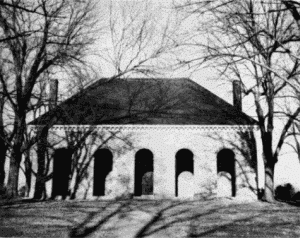
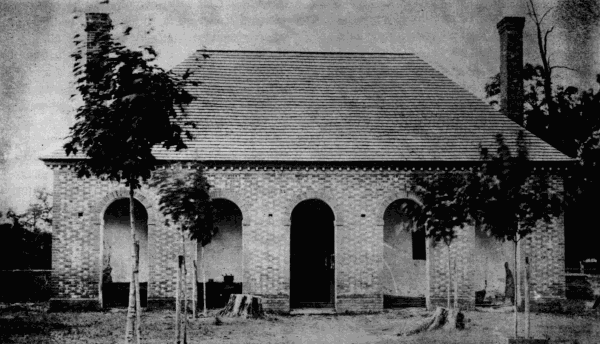 Figure 5.—King William courthouse, about 1725. Mercer often pleaded cases here. (From
a Civil War period negative.) (Courtesy of Historic American Buildings Survey, Library of
Congress.)
Figure 5.—King William courthouse, about 1725. Mercer often pleaded cases here. (From
a Civil War period negative.) (Courtesy of Historic American Buildings Survey, Library of
Congress.)
What is most significant to us in all this is the
inference that the courthouse, the Ballard house
which Mercer occupied, and the Structure B foundation
were all in close proximity.
LARGE PROPERTY ACQUISITIONS
Mercer’s next purchase of Marlborough property
was on July 28, 1737, when he bought the three lots
granted in 1691 to George Andrews from Andrews’
grandson, John Cave. Meanwhile, he began large-scale
acquisitions of lands elsewhere. By 1733 he
had acquired an aggregate of 8096 acres in Prince
William County. In addition, he obtained a “Lease
for three Lives” on three large tracts belonging to
William Brent, adjoining Marlborough, so that he
controlled virtually all of Potomac Neck.[63]
Thus, after 1730 we find Mercer’s fortune already
well established and increasing. No longer a youthful
trader plying the Potomac in his sloop, he was
now a gentleman planter and influential lawyer.
He lived in a new house, owned some parts of
Marlborough, and was building “improvements”
on others. Almost overnight he had become a
landed proprietor.
SUCCESS AT LAW AND CONFLICTS WITH LAWYERS
The source of Mercer’s newly made wealth is easily
discovered. His ledger shows an income from legal
fees in 1730 amounting to £291 10s. 1½d. In 1731
the figure climbed to £643 18s. 2d., then leveled off
to £639 11s. 2½d. the following year. For a young
man still in his twenties and self-trained in the law,
this was a remarkable achievement. His success
perhaps is attributable to a single event that stemmed
from youthful brashness and vigorous outspokenness.
Early in 1730, in a daring gesture on behalf of property
owners and taxpayers, he protested against privileges
granted in an act passed by the Assembly the previous
year “for encouraging Adventurers in Iron Works.”
Presented in the form of a proposition, the protest was
read before the Stafford court by Peter Hedgman.
The reaction to it in Williamsburg, once it had
reached the ears of the Assembly, was immediate and
angry. The House of Burgesses
Resolv’d That the Proposition from Stafford County
in relation to the Act past in the last Session of this
Assembly for encouraging Adventurers in Iron Works is
a scandalous and Seditious Libel Containing false and
scandalous Reflections upon the Legislature and the
Justices of the General Court and other Courts of this
Colony.
Resolv’d That John Mercer the Author and Writer of
that paper and Peter Hedgman one of the Subscribers who
presented the same to the Court of Stafford County to be
certified to the General Assembly are guilty of a high
Misdemeanour.
Order’d That the said John Mercer and Peter Hedgman
be sent for in Custody of the Serjeant at Arms attending
this House to answer their said Offence at the Bar of
this House.[64]
Mercer and Hedgman made their apologies to the
House, received their reprimands, and paid their
fines. But this protest, so offensive to the dignity of
the lawmakers, had its effect in forcing amendments
to the act, particularly in removing the requirement
for building public roads leading from the ironworks
to the ore supplies and shipping points. To those
living in Stafford, particularly in the neighborhood
of the proposed Accokeek Ironworks, near Marlborough,
this concession must have elevated Mercer
to the level of a hero.[65]
Mercer’s frank disposition led him into other difficulties
during the first years of his practice. His
insistence on the prompt payment of debts and his
opposition to stays of execution following suits had
won him enemies at Prince William court. Charges
of improper legal activities were brought against him;
these were investigated at Williamsburg, with the
result that on June 13, 1734, he was suspended from
practicing law in Virginia for a period of six months.[66]
TEMPORARY RETIREMENT, THE ABRIDGMENT,
AND GUARDIANSHIP OF GEORGE MASON
Deprived temporarily of his principal livelihood,
Mercer set out to write an Abridgment of the Laws of
Virginia. The task completed, he petitioned the
General Court on April 23, 1735, for “leave to Print
an Abridgment compil’d by him of all the Laws of
this Colony & to have the benefit of the Sale thereof.”
On the same day he petitioned for a renewal of his
license, which was granted with the exception of the
right to practice in Prince William, where he was to
remain persona non grata generally thereafter.[67]
Soon after these events his brother-in-law and old
acquaintance, George Mason, drowned. Mercer was
designated co-guardian of 10-year-old George Mason
IV, who came to live at Marlborough. Young George
later grew up to be the master of Gunston Hall and,
as the author of the Virginia Bill of Rights, to stand
among the intellectuals whose ideas influenced the
Revolution and the framing of the Constitution. In
these formative years, young George Mason surely
must have been affected by the strong legal mind and
cultivated tastes of his uncle.[68]
On October 14, 1737, the Virginia Gazette carried the
following advertisement:
This Day is Published
An Exact Abridgment of the Laws of VIRGINIA,
in Force and Use, to this present time. By
John Mercer.
At long last, after innumerable delays, the Abridgment
was in print. From a financial point of view it
was a conspicuous failure. Too few Virginians,
apparently, were sufficiently interested to buy it.
DOMESTIC FURNISHINGS AND SERVANTS
During this eventful decade of the 1730’s Mercer
acquired the things needed for the proper maintenance
of his house and properties. One requisite was Negro
servants. From Pat Reyant he bought “a Girl
named Margaret” for 43 pounds of tobacco in 1730.
In 1731 he bought Deborah, Phillis, Peter, Nan, and
Bob. The following year he obtained Lucy, Will, and
George, and, in 1733, Nero. His purchases increased
as his landholdings increased. In 1736 he bought
five slaves, three of whom he aptly named Dublin,
Marlborough, and Stafford.
To help feed his slaves during this early period,
Mercer apparently depended in part upon Stafford’s
wealth of natural resources. At least we find a
record of wild game entered on the same page and
under the same heading as his “Negroes” account
in the ledger. There it is noted that he purchased
42 ducks from Natt Hedgman on November 19, 1730,
and 20 ducks from Rawleigh Chinn the same day,
paying for them in powder and shot. Two swans and
a goose, as well as venison, appear on the list. Payment
for these was made in powder, shot, and wool.
He continued, meanwhile, to equip his house.
From John Foward (or Foard), a London merchant,
he bought a “frying pan” and “2 doz. bottles,”
“1 tomahawk,” “2 stock-locks,” “1 padlock,” “2 best
padlocks,” “1 drawingknife,” “9 pr hinges,” “3 clasp
knives,” and “1 gall. Maderas.” In April 1731, he
bought from Captain Foward:
| | £ | s. | d. |
| 1 bellmettle skillet 4½oz at 2/ | | 9 | |
| 1 copper Sausepan | | 7 | |
| 1 Small Do | | 5 | 4 |
| 1 hunting whip | | 5 | |
| 1 halfcheck bridle | | 7 | |
| 1 fine hat | | 12 | |
| 1 wig Comb | | 6 | |
Also in 1731 he bought “6 rush bottom Chairs”
for 17 shillings and a spinning wheel for 10 shillings
from William Hamitt. The “writing desk” which
he had bought in 1725 apparently needed extensive
and expensive repairs, for in March 1731 there
appears an item under “Domestick Expenses,” “To
Wm Walker for mending Scoutore £1.” (Scoutore
was one of many corrupt spellings of escritoire, a
slant-top desk.) William Walker was a Stafford
County cabinetmaker and builder, about whom we
shall hear much more.
One of the most active accounts was that of Nathaniel
Chapman,[69] who directed the newly established
Accokeek Ironworks. In 1731 he sold Mercer
several hundred nails of different descriptions, a
variety of hoes, ploughs, wedges, door latches, and
heaters for smoothing irons. One item is “By putting
a leg in an old Iron Pott”; another is “By Col Mason
pd for mending a snuff box. 2.6” (Appendix F).
In 1732 he paid Thomas Staines £1 for “a Cradle,”
“two Bedsteads,” and “a weekes work.” From John
Blane, during the same year, he purchased 2500 tenpenny
nails and the same quantity of eightpenny
nails. He also bought from Blane 4 “basons,” a
porringer, 100 needles, 2 penknives, a gross of “thread
buttons,” and a pair of large “Scissars.” Again, in
1732 he obtained from William Nisbett a quantity
of miscellaneous goods, including 10 parcels of earthenware
and a pewter dish weighing 4 to 5 ounces.
He also settled with Samuel Stevens for “your share
in making a Canoe.”
TOBACCO WAREHOUSES
The Tobacco Act of 1730 provided for the erection
of public tobacco warehouses, and Marlborough was
selected as one of the sites.[70] In 1731 Mercer’s
account with John Waugh included “Timber for 2500
boards @25/.£3.2.6” and “Posts & Ceils for two
Warehouses, 12 shillings.” In April 1732 he settled
accounts with Captain Henry Fitzhugh for “building
a Warehouse & Wharf & 6 prizes” at 3000 pounds of
tobacco, or £15. The prizes probably were “incentive
awards” for the workmen. Included in Fitzhugh’s
account were “3 days work of Caesar & Will,”
ten shillings, and “4319 very bad Clapboards at ½d ye
board.” On March 25 he paid Anthony Linton for
1820 clapboards, allowing him eight shillings for
“sawing of Boards.” The warehouses were in operation
in 1732, as we learn from Mercer’s “Account of
Inspectors,” but they suffered the fate of all official
enterprises at Marlborough, for in 1734 “the same
were put down, as being found very inconvenient.”[71]
The actual date of their termination was November 16,
1735, when a new warehouse was scheduled for completion
at the mouth of Aquia Creek.[72] The expression
“put down” does not seem to mean that the
warehouses were torn down, but that they were
officially discontinued. He apparently, however, continued
to use them for his own purposes.
PERSONAL ACTIVITIES
During the 1730’s Mercer recorded a minimum of
recreational activities. Those that he did list are
representative of the society of which he was a part.
Making wagers was a favorite amusement. For
example, he was owed £7 16s. by “Colo George
Braxton To a Wager you laid me at Capt Robt
Brooke’s house before Mr James Reid, Willm Brooke
&c. Six Guineas to one that Colo Spotswood would
not during the Reign of K. George that now is,
procure a Commission as Chief or Lieut Govr of
Virginia.” In 1731 he paid William Brent “By a
pistole won of me about Hedgman’s wrestling with
and throwing Fras Dade. £1.1.12.” He also paid
£2 10s. to James Markham “By [my] part on the
Race on Stotham’s horse.” There are other scattered
references to wagers on horseraces.
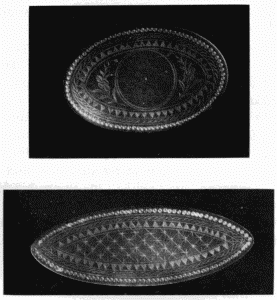 Figure 6.—Mother-of-pearl counters, or
“fish,” used in playing 18th-century games,
including Loo, at which Mercer once won
7s. 3d. from Col. George Mason (III). These
examples, collected in Massachusetts, are probably
late 18th century. (USNM 61.399.)
Figure 6.—Mother-of-pearl counters, or
“fish,” used in playing 18th-century games,
including Loo, at which Mercer once won
7s. 3d. from Col. George Mason (III). These
examples, collected in Massachusetts, are probably
late 18th century. (USNM 61.399.)
Mercer had become a vestryman in Overwharton
Parish as early as 1730, and appears to have been
made responsible for all legal matters pertaining to
that church. His account, shown in detail in Appendix
G, is of interest in showing that violations of moral
law were held accountable to the church and that
fines for convictions were paid to the church. Mercer,
representing the parish, collected a portion of each
fine as his fee.
Most of his energies now seem to have been divided
between the law and the substantial responsibilities
for managing his plantations. The increasing extent
of tobacco cultivation is revealed in the tobacco
account with “Mr Jonathan Foward, Merchant in
London” (presumably John Foward, mentioned
earlier), extending from 1733 to 1743. This account
lists shipments of 129 hogsheads of tobacco, totaling
£643 1s. 11d. (if we include a few extraneous items,
such as “To an over charge in Lemons” and “To a
Still charg’d never sent”). Several similar accounts
involve proceeds from tobacco. In 1734 and 1738,
for example, he shipped 54 hogsheads to William
Stevenson, another London merchant, for £207 7d.
on the ships Triton, Snake, Brooks, and Elizabeth.
Marlborough’s full transition to a seat of tobacco-planting
empire is now clearly discernible. In so
becoming, it was typical of the consolidation of
wealth, property, and power in Virginia as the
mid-century approached. Land had become both
a substitute for tobacco in lean years and the means
for paying off debts. The same land in better
years yielded crops to its new owners, so that a
relatively few dynamic men were able to amass
great wealth and form a ruling aristocracy. The
varieties of talents in men like Mercer—who, besides
being a planter, was an accomplished lawyer and
able administrator—placed them in the ascendancy
over their less able fellows. The vigor and ability
with which such men were endowed fostered the
remarkable class of leaders of the succeeding generation,
who had so much to do with founding the nation.
TRAVEL
On April 12, 1741, Mercer was admitted to practice
at the General Court in Williamsburg.[73] His trip
there on that occasion was typical of the journeys
which took him at least twice yearly to the capital.
On the first day of this Williamsburg trip he rode
“To Colo Taliaferro’s,” a distance of 19 miles.
The following day “To Caroline Court” (18 miles),
the next “To Mr Hubbard’s” (30 miles), then as far
as “Mr Jno Powers” (24 miles), and finally “To
Furneas & Williamsburg” (30 miles). The route
was usually to West Point, or Brick House on the
opposite shore in New Kent County, and thence
either directly to Williamsburg, or by way of New
Kent courthouse. Stopovers were made either at
ordinaries or at the houses of friends.[74]
Mercer’s travels, summarized in the journal that
he kept in the back of Ledger B from 1730 until his
death in 1768, were prodigious. In 1735, for example,
he journeyed a total of 4202 miles and was
home only 119 days. This pace had slackened
considerably in the period we are now considering,
but, nevertheless, he was not at home more than 218
days out of any one year of the decade 1741-1750.
This energetic and restless moving about was common
among the leading planters, but in Mercer’s case it
seems to have reached its ultimate. Practicing law,
playing politics, acquiring property, and becoming
acquainted with people led him all over Virginia.
A representative sample from the journal covers the
period of September and October 1745. It will be
noted that the days of the week are indicated alphabetically,
a through g, as in the calendar of the Book
of Common Prayer. The mileage traveled each day
is entered at the right.
| 1 | F | to Potomack Church & home | 10 |
| 2 | g | at home | |
| 3 | a | to Tylers & Spotsylvania Court | 14 |
| 4 | b | to Mr Daniels[75] & home | 14 |
| 5 | c | to Mr Moncure’s,[76] my Survey & home | 20 |
| 6 | d | to King George Court & Wm Walkers’[77] | 24 |
| 7 | e | to Mrs. Spoore’s[78] my Survey & home | 20 |
| 8 | F | at home | |
| 9 | g | Mr Moncure’s my Survey & home | 20 |
| 10 | a | to Stafford Court & home | 20 |
| 11 | b | at home | |
| 12 | c | to Mrs Mason’s[79] Survey | 18 |
| 13 | d | at Do | 10 |
| 14 | e | at Do | 15 |
| 15 | F | to Potomack Church & Mr Moncure’s | 18 |
| 16 | g | home | 6 |
| 17 | a | at home | |
| 18 | b | Do | |
| 19 | c | to Mrs Spoore & Mrs Taliaferro’s | 17 |
| 20 | d | at Mr Taliaferro’s | 14 |
| 21 | e | To Fredericksburg & Mrs Taliaferro’s |
| 22 | F | To Doctor Potter’s[80] & Mrs Taliaferro’s. |
| | | Lost my horses | 2 |
| 23 | g | To Mr Moncure’s | 9 |
| 24 | a | home | 10 |
| 25 | b | at home | |
| 26 | c | Do | |
| 27 | d | Do | |
| 28 | e | to Mr Moncure’s, Vestry & home | 16 |
| 29 | F | at home | |
| 30 | g | Do | |
| | | October | |
| 1 | a | at home | |
| 2 | b | to Mr Moncure’s & Fredericksburg Fair | 15 |
| 3 | c | at the Fair | |
| 4 | d | to Mr Moncure’s & home | 15 |
| 5 | e | at home | |
| 6 | F | to Mrs Taliaferro’s | 17 |
| 7 | g | to Caroline Court ho & George Hoomes’s[81] | 20 |
| 8 | a | to Newcastle | 50 |
| 9 | b | to Mr Anderson’s & Mr Gray’s [82] | 14 |
| 10 | c | to New Kent Courths & Mr Gray’s | 14 |
| 11 | d | to Furnau’s & Williamsburg | 17 |
| 12 | e | at Williamsburg | |
[He remained at Williamsburg until November 6.]
Such itineraries were punctuated by periods of staying
at Marlborough, but even then there were day-long
journeys to Stafford courthouse, to church, or to
a survey. The courthouse, which succeeded that at
Marlborough, was situated on the south side of Potomac
Creek, about three miles upstream from the
old site. Mercer almost invariably took the 10-mile-long
land route through the site of the present village
of Brook, along the Fredericksburg road past Potomac
Church, then along the headwaters of Potomac Run
on a now-disused road leading to Belle Plains. Just
before reaching the courthouse, which stood on a rise
of land some distance back from the creek, he passed
“Salvington,” the mansion of Joseph Selden.[83] Near
the water, and in sight of the courthouse, stood the
house of John Cave, whose grandfather in 1707 had
bought his land from Sampson Darrell, undertaker
of the Marlborough courthouse.[84] Near it, on a
foundation still visible, Cave built the warehouse that
bore his name, and through him passed much of the
tobacco that Mercer raised locally. Occasionally,
when he had business to do at Cave’s, Mercer would
return home by water, as he did on August 14, 1746:
| to Stafford Court & Mr Cave’s | 11 |
| home by water | 5 |
VEHICLES
During the 1740’s Mercer’s travels were often by
chaise or chariot. We learn from Ledger G that he
bought “a fourwheel Chaise” from Charles Carter[85]
in September 1744, a significant step in emulating
the manners and ways of Virginia’s established
aristocrats. Three years later he purchased “a Sett
of Chaisewheels” from Francis Hogans, a Caroline
County wheelwright, and in June 1748 he discounted
as an overcharge the cost of “a Chaise worth nothing”
in his account with the English mercantile firm of
Sydenham & Hodgson.[86] A “chaise” could have
been one of several types of vehicles, but it was
probably “a carriage for traveling, having a closed
body and seated for one to three persons,” according
to Murray’s A New Oxford Dictionary.
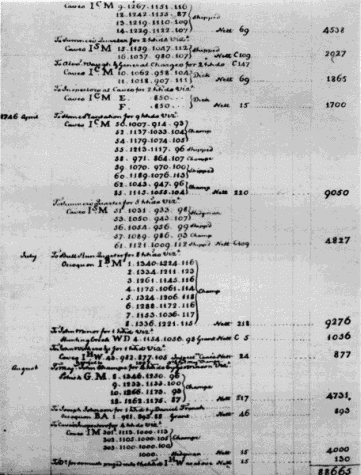 Figure 7.—John Mercer’s tobacco-cask symbols, drawn in his Ledger G. The “home
plantation” (Marlborough) is symbolized by the initial C, probably in honor of his wife
Catherine. Sumner’s quarters at Passapatanzy is indicated by S, and Bull Run quarters
by B. (Courtesy of Bucks County Historical Society.)
Figure 7.—John Mercer’s tobacco-cask symbols, drawn in his Ledger G. The “home
plantation” (Marlborough) is symbolized by the initial C, probably in honor of his wife
Catherine. Sumner’s quarters at Passapatanzy is indicated by S, and Bull Run quarters
by B. (Courtesy of Bucks County Historical Society.)
In 1749 Mercer bought a “chariot” from James
Mills of Tappahannock for £80. Doubtless an
elegant piece of equipage, this was, we learn from
Murray, “a light four-wheeled carriage with only
back seats, and differing from the post-chaise in
having a coach-box.” In November 1750 he paid
John Simpson, a Fredericksburg wheelwright, 10
shillings for “wedging & hooping the Chariotwheels”
and 9 shillings for “mending 3 fillys & 3 Spokes in
Do.”[87]
At the same time he bought a “pr Cartwheels” for
£2 and a “Tumbling Cart” for £1 6s. from Simpson.
Murray tells us that a “tumble cart” or a “tumbril
cart” was a dung cart, designed to dump the load.
TOBACCO CASK BRANDS
Hogsheads and casks of tobacco were branded with
the symbols or initials of the original owners. Many of
the brands are recorded explicitly in the ledger.
Mercer, at the beginning of his career, used a symbol
M. As his plantations multiplied, however, three
symbols were adopted, based on his own two initials.
Tobacco casks from Bull Run were marked I B.M.
Those from Sumner’s Quarters bore the brand I S.M,
while the “Home Plantation” at Marlborough had
casks marked I C.M (fig. 8).
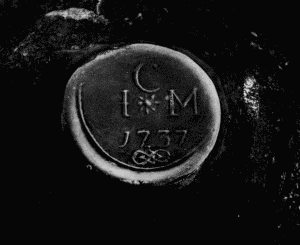 Figure 8.—Wine-bottle seal on bottle excavated at
Marlborough, with same arrangement of initials
used in the Marlborough tobacco seal.
Figure 8.—Wine-bottle seal on bottle excavated at
Marlborough, with same arrangement of initials
used in the Marlborough tobacco seal.
The interpretation of these symbols warrants some
digression. In the 17th century, and indeed in the
18th century also, the triangular cipher to indicate
the initials of man and wife was commonly used to
mark silver, pewter, china, delftware, linens, and other
objects needing owners’ identifications. The common
surname initial was placed at the top, the husband’s
first-name initial at the lower left, and the wife’s at
the lower right. This arrangement was used consistently
in the 17th century. In the 18th century,
however, variations began to appear in the colonies,
although not, apparently, in England. Silver made
in New York and Philadelphia during the 1700’s
presents the initials reading from left to right, with
the husband’s at the lower left, the wife’s at top
center, and the surname initial at the lower right.
The large keystone of the Carlyle house in Alexandria,
built in 1751, bears a triangular arrangement of John
and Sarah Carlyle’s initials: J S.C.[88]
Like Carlyle, Mercer used initials in this fashion,
but also, as we have seen, in two other combinations
in which “J. M.” remains constant, the upper center
initial having a subordinate significance. “S” signifies
Sumner’s Quarters, and “B,” Bull Run Quarters.
“C” on seals and brands having to do with Marlborough
apparently refers to Catherine, honoring her
as Mercer’s wife and mistress of the home plantation.
The possibility that “C” stands for Cave’s warehouse
may be dismissed as being inconsistent with the other
two marks, the tobacco from Sumner’s Quarters
having also been shipped through Cave’s, and that
from Bull Run Quarters having been stored at the
Occaquan warehouse.[89]
John Withers also used the left-to-right arrangement,
I H.W, although Henry Tyler, a planter whose
account is mentioned in Mercer’s Ledger, used the
conventional three-letter cipher, H T.M. These marks
occurred on casks transmitted to Mercer as payments,
and are recorded in Ledger G (fig. 7).
TOBACCO EXCHANGE
Tobacco, before being transferred to another owner,
was examined by official inspectors. Mercer kept a
special “Inspector’s Notes” account where he kept
track of fees due the inspectors. Direct payments of
tobacco were made in transactions with William
Hunter and Charles Dick, the Fredericksburg merchants
from whom Mercer bought most of his goods
and supplies. To others, however, payments were
made in a complexity of tobacco notes, legal-fee
payments, and plain barter. Tobacco shipped overseas
was usually handled by Sydenham & Hodgson.
Also involved with tobacco transactions in England
were two Virginia merchants, Major John Champe,
a distinguished resident of King George County
who lived at Lamb’s Creek plantation, and William
Jordan, of Richmond County, both of whom arranged
for purchases of books, furniture, and other
English imports for Mercer.
The following are excerpts from Sydenham &
Hodgson’s account in Ledger G:
| 1745 | | £ | s. | d. |
| June | To 8 hhds. tobo consigned | 63 | 5 | 5 |
| | you by the | | | |
| | Pri[n]ce of Denmark | | | |
| November | To 6 hhds by the | 29 | 15 | 9 |
| | Harrington | | | |
| 1746 | | | | |
| May | To 5 hhds by Capn | | | |
| | Lee LOST | | | |
| Feb | To 10 hhds by Capt | 51 | 14 | 8 |
| | Perry | | | |
| 1747 | | | | |
| Septembr | To 10 hhds by Capt | 35 | 9 | 8 |
| | Perryman | | | |
| 1748 | | | | |
| June | To 10 hhds by Capn | | | |
| | Donaldson LOST | | | |
| 1749 | | | | |
| Septembr | To 24 hhds tobo sold | 162 | 17 | 14 |
| | Mr. Jordan | | | |
Revealed in this account are the hazards of shipping
goods overseas in the 18th century. A partnership
apparently figured in the second loss at sea, however,
as the following entry in Ledger G shows:
| June 1747 | By Profit & Loss for the half | £75.15.3¾ |
| | of 20 hhds by Donaldson | |
| | in the Cumberland & Lost | |
| | By William Jordan for the | |
| | other half. | |
Between 1747 and 1750 Mercer lost a total of 107
hogsheads of tobacco. Over and above this, however,
he shipped overseas tobacco to the amount of
£385 11s. 7d., during the same period.
CLIENTS
Mercer’s success was gained despite the failures
of a great many persons to pay the fees they owed
him. In 1745 he listed 303 “Insolvents, bad &
doubtful debts.” That matters were no worse may
be attributed to a high average of responsible clients.
Among them were such well-known Virginians as
Daniel Dulaney, William and Henry Fitzhugh,
William Randolph, Augustine, John, and Lawrence
Washington, Gerard Fowke, Richard Taliaferro,
John and Daniel Parke Custis, Andrew and Thomas
Monroe, George Tayloe, George Lee, George Wythe,
and William Ramsay.
CLOTHING
By the early 1740’s Mercer was in a position to
surround himself with symbols of wealth and prestige.
Clothes, a traditional measure of affluence, were now
a growing concern for himself and his family. Between
1741 and 1744, the ledger reveals, he purchased
from William Hunter a greatcoat, women’s stockings,
women’s calf shoes, morocco pumps, a “fine hat,”
three felt hats, two dozen “plaid hose,” two pairs of
men’s shoes, one pair of “Women’s Spanish Shoes,”
and “2 pr Calf Do.” In 1744 and 1745 he bought
from Charles Dick two pairs of “women’s coll’d
lamb gloves,” two pairs of silk stockings, “1 velvet
laced hood,” a “laced hat,” a “Castor” (i.e., beaver)
hat, “fine thread stockings,” silk handkerchiefs, a
“flower’d pettycoat,” worsted stockings, and buckskin
gloves. From Hugh MacLane, a Stafford
tailor, he obtained a suit in 1745.
The rise in Mercer’s wealth and prestige is reflected
in his patronizing Williamsburg tailors, beginning
in 1745 when he settled with George Charleston for
a tailor’s bill of £6 10s. In 1748 he paid Charleston
four shillings for “Collar lining a Velvet Waistcoat.”
In 1749 he purchased a “full trimm’d velvet Suit”
from Charles Jones, the work and materials totaling
£7 7s. 4¼d., while in 1750 he spent £11 2s. 1½d.
on unitemized purchases from the same tailor.
In that year he bought also from Robert Crichton, a
Williamsburg merchant, “a flower’d Velvet Waistcoat,
£5.” As the decade advanced, Mercer played
with increasing consciousness the role of wealthy
gentleman, as his choice of tailors shows.
MATERIALS
Textile materials, as seen under “General Expenses”
and in the accounts of Hunter and Dick,
ran the gamut of the usual imported fabrics, as well
as rare, expensive elegancies. An alphabetical list
of the materials mentioned in these accounts, with
definitions, is given in Appendix I.
From this list we gain an impression of great
diversity and refinement in the materials used for
clothing and interior decoration, as well as of a
tremendous amount of sewing, embroidering, and
making of clothes at home, probably typical of most
of the great plantations in the middle of the century.
WEAVING
In addition to fine imported materials, there were
needed blankets, work clothes for slaves, and fabrics
for other practical purposes. To these ends Mercer
employed several weavers in various parts of Virginia.
In 1747 William Threlkeld wove 109 yards of woolen
cloth at fourpence a yard. During that year and the
next, John Booth of King George County wove an
indeterminate amount for a total of £2 4d. In 1748
John Fitzpatrick wove 480 yards of cotton at fourpence
a yard, and William Mills wove 30 yards of
“cloath.” Much of the work appears to have been
done in payment for legal services.
Weaving and spinning evidently were done at
Marlborough, as they were at most plantations. In
1744 Mercer recorded under “General Charges” that
he had sold a loom to Joseph Foxhall. In 1746 he
bought a spinning wheel from Captain Wilson of
Whitehaven, England, purchasing three more from
him in 1748. Wool cards also appear in the accounts.
In January 1748 Mercer charged William Mills with
“3 months Hire of Thuanus the Weaver, £3,” which
suggests that Thuanus was an indentured white
servant (his name does not occur on the list of slaves)
employed at Marlborough and hired out to Mills, a
Stafford County weaver.
PERSONAL ACCESSORIES
In contrast to the elegancies of dress materials and
clothing, Mercer left little evidence of jewelry, toilet
articles, or other personal objects. In Ledger G we
find “2 horn combs” bought for fivepence, an ivory
comb for tenpence, two razors, two strops, snuff-boxes,
bottles of snuff, “a smelling bottle,” and “buck-handled”
and silver-handled penknives. From John
Hyndman, a Williamsburg merchant, Mercer acquired
a set of silver buckles for £1 10s., and from William
Woodford he bought “a gold watch, Chain & Swivel”
for the not-trifling sum of £64 6s. 3d.
Like most successful men, Mercer had his portrait
painted. During the General Court sessions held
in the spring and fall of 1748 in Williamsburg, he
lodged with William Dering, the dancing master and
portrait painter. Dering lived in the house still
standing on the capitol green, now known as the
Brush-Everard house. In Dering’s account we find:
“by drawing my picture, £9.2.9.”[90]
FOOD AND DRINK
Good food and drink played an important part in
Mercer’s life, as it did in the lives of most Virginia
planters. In the ledger accounts are found both
double-refined and single-refined sugar, bohea tea,
coffee, nutmegs, cinnamon, mace, and chocolate.
Most meats were provided by the plantation and
thus are not mentioned, while fish were caught from
the plantation sloop or by fixed nets. However,
Thomas Tyler of the Eastern Shore sold Mercer a
barrel of drumfish and four and one-half bushels of
oysters, while Thomas Jones, also of the Eastern Shore,
provided a barrel of pork for 47s. 6d. in 1749. Earlier
there appeared a ledger item under “General
Charges” for 1775 pounds of pork.
Molasses was an important staple, and Mercer
bought a 31-gallon barrel of it from one “Captain
Fitz of the Eastern Shore of Maryland” in 1746 and
30 gallons the next year, charging both purchases to
his wife. In 1750 he received 88 gallons of molasses
and 255 pounds of “muscovy sugar” from Robert
Todd. Muscovy sugar was the same as “muscavado”
sugar, the unrefined brown sugar of the West Indies,
known in Spanish as mascabado.
Beverages and the fruits to go with them were
bought in astonishing quantities between 1744 and
1750. Major Robert Tucker, a Norfolk merchant,
exchanged a “Pipe of Wine” worth £26 and a 107½-gallon
hogshead of rum valued at £22 in return for
Mercer’s legal services. Again as a legal fee, Mercer
received 55 gallons of “Syder” from Janet Holbrook
of Stafford and bought 11 limes from John Mitchelson
of York for 12 shillings. From William Black he
purchased “11 dozen and 11 bottles of Ale” at 13
shillings, and from John Harvey “5 ⅟12 dozen of
Claret” for £11 6d. “Mark Talbott of the Kingdom
of Ireland Esq” sold Mercer a pipe of wine for £3 3s.
LIFE OF THE CHILDREN
During the 1740’s Mercer’s first four surviving
children, George, John Fenton, James, and Sarah
Ann Mason Mercer,[91] were growing up, and the
accounts are scattered through with items pertaining
to their care and upbringing. There are delightful
little hints of Mercer’s role as the affectionate father.
On May 17, 1743, “By Sundry Toys” appears in
Hunter’s account; an item of “1 horses 1d” in Dick’s
account for 1745 was undoubtedly a toy. Most
charming of all the entries in the latter account is
“1 Coach in a box 6d. 4 Toys. 8d, 2 Singing birds.”
The birds may have occupied a birdcage and stand
bought from George Rock, the account for which
was settled a year later.
 Figure 9.—French horn dated 1729. Mercer purchased
a “french horn” like this from Charles Dick
in 1743. (USNM 95.269.)
Figure 9.—French horn dated 1729. Mercer purchased
a “french horn” like this from Charles Dick
in 1743. (USNM 95.269.)
“1 french horn” and “3 trumpets” are listed in the
Dick account. The horn was probably used in
hunting; the three trumpets were bought perhaps
for the three boys. Mercer’s library contained one
book of music entitled The Musical Miscellany, which
may have furnished the scores for a boyish trio of
trumpets. Music and dancing were a part of the
life at Marlborough, and in 1745 an entry under
“General Charges” reads “To DeKeyser for a years
dancing four children £16,” while in the following
year ninepence was paid William Allan “for his
Fidler.” In 1747 “Fiddle strings” were bought from
Fielding Lewis in Fredericksburg for 2s. 4½d.
 Figure 10.—Mercer listed a hornbook in his
General Account in 1743. It probably resembled
this typical hornbook in the collection of
Mrs. Arthur M. Greenwood.
Figure 10.—Mercer listed a hornbook in his
General Account in 1743. It probably resembled
this typical hornbook in the collection of
Mrs. Arthur M. Greenwood.
From the ledger we also learn much about the
children’s clothing: child’s mittens and child’s shoes,
boy’s pumps, boy’s shoes, girl’s shoes, boy’s collared
lamb gloves, two pairs of “girl’s clock’d Stocking,”
“2 pr large boys Shoes 6l 2 pr smaller 5/ ... 1 pr
girls 22d, 1 pr smaller 20d,” boy’s gloves, and “Making
a vest and breeches for George” in October 1745.
In 1748 Captain Wilson brought from England “a
Wig for George,” worth 12 shillings. George then
had reached the age of 15 and young manhood.
Hugh MacLane, the Stafford tailor, was employed to
make clothes for the three boys—a suit for George,
and a suit, vest, coat, and breeches each for James and
John.
That the children were educated according to time-honored
methods is revealed in the “General Expenses”
account for May 1743, where “1 hornbook
3d” is entered. The hornbook was an ancient instructional
device consisting of a paddle-shaped piece of
wood with the alphabet and the Lord’s Prayer printed
or otherwise lettered on paper that was glued to the
wood and covered for protection with thin sheets of
transparent horn. Elaborate examples sometimes
were covered with tooled leather, or were made of
ivory, silver, or pewter. The mention of hornbooks
in colonial records is a great rarity, although they
were commonplace in England until about 1800.
The Mercer children were taught by private tutors.
One, evidently engaged in England, was the Reverend
John Phipps, who was paid a salary of £100
annually and, presumably, his board and lodging.
Mercer noted in his journal on November 18, 1746,
that “Mr Phipps came to Virginia.” That Mr.
Phipps left something to be desired was revealed
years later in the letter written in 1768 by John to
George Mercer, who was then in England, asking
him to find a tutor for his younger children: “...
the person you engage may not pretend, as Mr
Phipps did that tho’ he undertook to instruct my
children he intended boys only, & I or my wife
might teach the girls. As I have mentioned Mr
Phipps, it must remind you that a tutor’s good nature
& agreeable temper are absolutely necessary both
for his own ease & that of the whole family.”[92]
In 1750 George entered the College of William
and Mary. He had a room at William Dering’s
house, and the account of “Son’s Maintenance at
Williamsburg” provides an interesting picture of a
well-to-do college-boy’s expenses, chargeable to his
father. Such items as “To Cash pd for Lottery
Tickets” (£7 10s. 6d.), “To Covington the Dancing
Master ... 2.3,” “To Wm Thomson for Taylor’s
work” (£1 9s. 6d.), “To pd for Washing” (£1 1s.),
and “To Books for sundrys” (£22 4s. 7½d.) show a
variety of obligations comparable to those sometimes
encountered on a modern campus. The entire
account appears in Appendix J.
BUILDING THE MANOR HOUSE
As early as 1742 the ledger shows that Mercer
was building steadily, although the nature of what
he built is rarely indicated. Hunter’s account for
1742 lists 2500 tenpenny nails and 1000 twenty-penny
nails, while in the following year the same account
shows a total of 4200 eightpenny nails, 5000 tenpenny,
2000 fourpenny, and 1000 threepenny nails.
The following tools were bought from Hunter in
1744: paring chisel, 1½-inch auger, ¾-inch auger,
socket gouge, broad axe, adze, drawing knife, mortice
chisel, a “square Rabbit plane,” and “plough
Iron & plains.” In Charles Dick’s account we find
purchases in 1745 of 16,000 flooring brads, 4000
twenty-penny nails, 2000 each of fourpenny, sixpenny,
eightpenny, and tenpenny brads, and 60,000 fourpenny
nails.
Beginning in 1744 Mercer made great purchases of
lumber. Thomas Tyler of the Eastern Shore sold him
2463 feet of plank in that year, and in 1745 made
several transactions totaling 5598 feet of 1-, 1½-,
and 2-inch plank, as well as 23,170 shingles. In 1746
Charles Waller of Stafford sold Mercer 5193 feet of
1-, 1¼-, and 1½-inch plank. In the same year James
Waughhop of Maryland provided “4000 foot of Plank
of different thicknesses for £12,” and in May 1749,
“2300 foot of 1½ Inch Plank at 7/.” Mercer made
several similar purchases, including 14,700 shingles,
from Robert Taylor of the Eastern Shore.
Where all these materials were used is a matter for
conjecture. We know that Mercer made “Improvements”
to the extent of “saving” 40 lots under the
terms of the Act for Ports and Towns, and that a
great deal of construction work, therefore, was going
on. One building was probably a replacement for a
warehouse, for a laconic entry in his journal on New
Year’s day of 1746 notes that “My warehouses burnt.”
These were doubtless the buildings erected in 1732
and officially vacated in 1735. That at least one
eventually was rebuilt for Mercer’s own use is known
from an overseer’s report of 1771 (Appendix M).
The windmill, the foundations of which still remain
in part near the Potomac shore, was probably built in
1746. Mercer’s cash account for that year includes
an item of 2s. 6d. for “Setting up Mill,” which
apparently meant adjusting the millstones for proper
operation. In August he paid Nathaniel Chapman
£22 19s. 8¾d. “in full for Smith’s work.” A windmill,
with its bearings, levers, lifts, and shafts, would seem
to have been the only structure requiring such a costly
amount of ironwork.
The most elaborate project of all, however, is clearly
discernible in the ledger. In 1746 Thomas Anderson,[93]
in consideration of cash and legal services,
charged for “making & burning 40m Stock bricks” at
4 pounds 6 pence per 1000. In the same year David
Minitree, described by Mercer as a “Bricklayer,”
came to Marlborough from Williamsburg. Minitree
was more than an ordinary bricklayer, however, for
he had worked on the Mattaponi church, and later,
between 1750 and 1753, was to build Carter’s Grove
for Carter Burwell.[94]
The credit side of Minitree’s account in Ledger G
is as follows:
| | | £ | s. | d. |
| 1746 | | | | |
| Decembr 5 | By making & burning | 9 | 5 | 7½ |
| | 41,255 Bricks at 4/6 | | | |
| 1747 |
| Septembr | By stacking & burning | | 16 | 9½ |
| | 11,200 Do at 1/6 | | | |
| | By making & burning | 14 | 2 | 10 |
| | 62,849 Do at 4/6 | | | |
| | By making & burning | | 4 | 6 |
| | 1000 Do at 4/6 | | | |
| | By short paid of my | | | 9½ |
| | Order on Majr | | | |
| | Champe | | | |
| | By building part of | | | 10½ |
| | my House | | | |
The last item, in particular, is clear indication that
an architectural project of importance was underway
and that Mercer had set about to make Marlborough
the equal of Virginia’s great plantations. Only “part
of my house” was built by Minitree, yet his bill was
more than five times the total cost of Mercer’s
previous house, completed in 1730!
Since it was customary in Virginia to make bricks
on the site of a new house, utilizing the underlying
clay excavated from the foundation, Minitree, as well
as Anderson, made his bricks at Marlborough before
using them. Mortar for laying bricks was made of
lime from oystershells. In 1747 and 1748, we learn
from the ledger, 61½ hogsheads of oystershells were
bought from Abraham Basnett, an “Oysterman,”
payment having been made in cash, meat, and
brandy. “Flagstones &c ” were obtained in 1747
through Major John Champe at a cost of £36 4s. 6d.
These may have been the same stones brought up as
“a load of stone” by “Boatswain Davis” of Boyd’s
Hole in Passapatanzy in October 1747 for £4 5s. 5d.
Early in 1748 a new set of developments concerning
the house took place. Major William Walker of
Stafford, revealed in the journal and the ledgers as
an old acquaintance of Mercer’s, then became the
“undertaker,” or contractor, for the house. Walker
was a talented man who had started out as a cabinetmaker,
a craft in which his brother Robert still
continued. Whiffen (The Public Buildings of Williamsburg)
shows that he both designed and built a glebe
house for St. Paul’s Parish, Hanover County, in
1739-1740, and the steeple for St. Peter’s Church in
New Kent the latter year. Also in 1740 he built a
bridge across the Pamunkey for Hanover County. At
the same time that he was engaged on Mercer’s
mansion, he undertook in March 1749 to rebuild the
burned capitol at Williamsburg. He died 11 months
later before bringing either of these major projects
to completion.[95]
Walker’s carpenter was William Monday. Mercer
settled with Monday in March 1748 for a total bill
of £126 16s. 2½d., but with a protest addressed
to himself in the ledger: “By work done about my
House which is not near the value as by Majr Walker’s
Estimate below, yet to avoid Disputes & as he is
worth nothing I give him Credit to make a full
Ballance.”
Meanwhile, William Bromley, a joiner, had gone
to work on the interior finish. Like Minitree and
Walker, Bromley represented the highest caliber of
artisanship in the colony. Eighteen years later
Mercer referred to Bromley, “who,” he said, “I
believe was the best architect that ever was in
America.”[96] Bromley employed several apprentices,
among them an Irishman named Patterson.[97] For
the interval from July 9, 1748, to December 25,
1750, Bromley was paid £140 1s. ½d., almost
entirely for wages. The payment included “3 pr
hollows & rounds / 6 plane irons / 1 gallon Brandy.”
For the same period Andrew Beaty, also a joiner,
received £113 5s. 1½d. On June 19, 1749, Mercer
noted in his journal, “Beaty’s apprentice came to
work.” These men were specialists in framing
woodwork and in making paneling, doors, wainscoting,
and exterior architectural elements of wood.
The opulence of the building’s finish is indicated
by a charge on Walker’s account for “his Carver’s
work 69 days at 5/, £17. 15....” Previously,
while Minitree was still working on the house, an
item had been entered in August 1747, “To Cash
paid for cutting the Chimneypiece ... 6.3.” A
chimneypiece was usually the ornamental trim or
facing around a fireplace opening, although in this
instance the overpanel may have been meant.
Jacob Williams, a plasterer, worked 142½ days
for a total of £22 4s. 4d., while his helper Joseph
Burges was employed 43 days for £5 7s. 6d.
Walker charged £3 8s. 11d. for “his Painters work
about my house,” and a purchase of “42 gallons of
Linseed Oyl” was recorded in the general charges
account. Three books of goldleaf, which Mercer
had obtained from George Gilmer, the Williamsburg
apothecary, were charged, together with paint, to
Walker.
In May 1750, a charge by George Elliot, “Turner,
Stafford,” was recorded, “By turning 162 Ballusters
at 6d, £4.1....” Another item, for supplying
“341½ feet Walnut Plank at 2d,” settled in October,
may have been for the wood of which the balusters
were made.
Thomas Barry, “Bricklayer,” carried on the work
that Minitree had not completed. His account for
1749 follows:
| | £ | s. | d. |
| By Building the Addition to my House | 26 | | |
| 22 Arches at 6/ | 6 | 12 | |
| 900 Coins & Returns at 6/ | 2 | 14 | |
| A Frontispiece | 3 | 10 | |
| Underpinning & altering the Cellar | 2 | | |
| raising a Chimney | 1 | 5 | |
| building an Oven | | 15 | |
| building a Kiln | 1 | | |
| building a Kitchen | 9 | 10 | |
| 3 Arches at 6/ | | 18 | |
| 2 Plain Do at 2/6 | | 5 | |
| 500 Coins & returns at 6/ | 1 | 10 | |
| | 55 | 19 | 0 |
Expensive stone was imported for the house by
Captain Roger Lyndon, master of the Marigold,
whose account occurs in the ledger:
| | | | £ | s. | d. |
| 1749 | April | By 630 Bricks at 20/ pr m. | | 10 | |
| | Decr | By Gen’l Charges for | | | |
| | | hewn Stone from Mr | | | |
| | | Nicholson[98] | 65 | 16 | 4 |
| 1750 | June | By Gen’l Charges for | | | |
| | | sundrys by the Marigold | | | |
| | | By Do for freight of | | | |
| | | Stones to my House | 5 | | |
It is interesting to note that bricks, probably carried
from England as ballast, were brought by Captain
Lyndon.
 Figure 11.—Fireplace mantels illustrated in William Salmon’s Palladio Londonensis.
(Courtesy of the Library of Congress.)
Not all the hewn stone was fashioned in England.
William Copein, a Prince William County mason,
and Job Wigley were employed together in 1749
to the amount of £2 8s. In 1750 Copein was paid
by Mercer for 64 days of work at 3s. 1d. per day,
totaling £9 17s. 4d. Copein was another accomplished
craftsman, the marks of whose skill still are
to be seen in the carved stone doorways of Aquia
Church in Stafford County and in the baptismal font
at Pohick Church in Fairfax.
The design of the house will be considered in more
detail later in the light of both archeological and
documentary evidence. It is already quite clear,
however, that the new mansion was remarkably
elaborate, reflecting the workmanship of some of
Virginia’s best craftsmen. The most significant clues
to its inspiration are found in the titles of four books
which Mercer purchased in 1747. These are listed
in the inventory of his books in Ledger G as follows:
“Hoppne’s Architecture.” This was probably The Gentlemans
and Builders Repository on Architecture Displayed.
Designs Regulated and Drawn by E. Hoppus, and engraved by
B. Cole. Containing useful and requisite problems in geometry
... etc, (1738). Edward Hoppus was “Surveyor to
the Corporation of the London Assurance.” He also
edited Salmon’s Palladio Londonensis. We find no writer
on architecture named Hoppne and assume this was a
mistake.
“Salmon’s Palladio Londonensis.” Palladio Londonensis:
or the London Art of Building, by William Salmon, which
appeared in at least two editions, in 1734 and in 1738,
had a profound influence on the formal architecture of
the colonies during the mid-century.
“Palladio’s Architecture.” The Italian Andrea Palladio
was the underlying source of English architectural thought
from Christopher Wren down to Robert Adam. Under
the patronage of Lord Burlington, this book was brought
out in London in an English translation by Giacomo
Leoni under the title The Architecture of A. Palladio; in Four
Books. It had appeared in three editions prior to this
inventory, in 1715, 1721, and 1742, according to Fiske
Kimball (Domestic Architecture of the American Colonies
and of the Early Republic; New York: Charles Scribner’s
Sons, 1924, p. 58). Mercer probably owned one of these.
“Langley’s City & Country Builder.” City and Country
Builder’s and Workman’s Treasury of Design by Battey
Langley, 1740, 1745. This was another copybook much
used by builders and provincial architects.
 Figure 12.—Doorways illustrated in William Salmon’s Palladio Londonensis (the London
Art of Building), one of the books used by William Bromley, the chief joiner who worked
on Mercer’s mansion. (Courtesy of the Library of Congress.)
Figure 12.—Doorways illustrated in William Salmon’s Palladio Londonensis (the London
Art of Building), one of the books used by William Bromley, the chief joiner who worked
on Mercer’s mansion. (Courtesy of the Library of Congress.)
All four of these books were listed in succession in
the ledger and bracketed together. Next to the
bracket are the initials “WB,” to indicate that the
books had been lent to someone who bore those
initials. In this case it is virtually certain that the
initials are those of William Bromley, to whom the
books would have been of utmost importance in
designing the woodwork of the house.
Door hardware was purchased from William Jordan
in June 1749, according to an item for “Locks &
Hinges” that amounted to the large sum of £13 8s. 8d.
DOMESTIC FURNISHINGS
As the mansion progressed, so did the acquisition of
furnishings suitable to its elegance. As early as 1742,
doubtless in anticipation of the new house, Mercer
had bought from Hunter a “lanthorn,” three porringers,
two cotton counterpanes at 27s., a plate
warmer for 7s. 6d., a half-dozen plates for 3s. 6d., a
half-dozen deep plates for 6s., a dozen “Stone Coffee
cups” for 18d., a dozen knives and forks for 3s., two
tin saucepans at 4d. each, and “4 Dishes, 19½ lib.”
(obviously large pewter chargers). In 1743 he
bought “5 gallon Basons 4/7” and “2 pottle Basons at
2/4” (for toilet use), “1 Soop Spoon 1/,” and “1
Copper Chocolate pot 7/6 & mull Stick 6d,” “2 blew
& Wt Jugs 2/” (probably Westerwald stoneware),
and “1 Flanders Bed Bunt, 25” (colored cotton or
linen used for bedcovers).
In 1744 Mercer acquired from Charles Dick 4
candlesticks for a penny each, 2 pairs of large hinges,
a “hair sifter,” “2 kitchen buck hand knives,” 12 cups
and saucers for 2s., “1 milkmaid 2d” (probably a
shoulder yoke), and “1 bucket ½d.” In 1745 a
5-gallon “Stone bottle” for 3s. 6d., “1 doz. butcher
knives,” a hearthbroom, six spoons for a shilling, a
pair of scissors, “8 Chamberdoor Locks wth brass
knobs £2,” and “1 Sett finest China 35/, 2 punch
bowls ... 2.7” were purchased.
The following year Mercer paid a total of £23 for a
silver sugar dish, weighing 8 oz., 5 dwt.; one dozen
teaspoons and tray, 8 oz., 7 dwt.; a teapot and frame,
26 oz., 8 dwt. This lot of silver probably was bought
at second hand, having been referred to as “Pugh’s
Plate pd Edwd Wright as by Rect.” He paid John
Coke, a Williamsburg silversmith, £1 6s. for engraving
and cleaning it. In the meanwhile, in 1745, he
had sold Coke £6 worth of old silver. He also sold a
quantity of “old Plate” for £15 17s. 3d. to Richard
Langton in England through Sydenham & Hodgson.
In 1747 he made a large purchase of silver from the
silversmith William King[99] of Williamsburg:
| | oz. | dwt. | £ | s. | d. |
| May 1747 | | | | | |
| By Bernard | | | | | |
| Moore for | | | | | |
| 1 Cup | 51 | 1 | 30 | 8 | 3 |
| By James | | | | | |
| Power for | | | | | |
| 1 Waiter | 8 | 7½ | 4 | 14 | 2½ |
| By a pair of | | | | | |
| Sauceboats | 25 | 8 | | | |
| By a large | | | | | |
| Waiter | 29 | 3 | 48 | 11 | 3½ |
| By a smaller | | | | | |
| Do | 23 | 8 | | | |
| By a small Do | 8 | 8 | | | |
| | 148 | 15½ @ 11/3 | 84 | 13 | 9 |
In March 1748, Mercer settled with Captain Lyndon
for the following:
| | £ | s. | d. |
| 1 | superfine large gilt Sconce glass | 6 | 16 | |
| 1 | Do | 5 | 5 | |
| 1 | Walnut & gold Do | 2 | 10 | |
| 1 | Marble Sideboard 32/6 Bragolo [sic] 32/6 | 3 | 5 | |
The following June he bought a marble table from
William Jordan and in October “4 looking Glasses,”
which Jordan obtained from Sydenham & Hodgson.
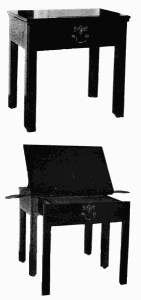 Figure 13.—Table-desk made in 1749 for Henry
Purefoy of Shalstone Manor in Buckinghamshire by
John Belchier of London. In the following year,
John Mercer received £43 13s. worth of “Cabinet
Ware” from that noted cabinetmaker. (Reproduced
from Purefoy Letters, 1735-1753, G. Bland, ed.,
Sidgwick and Jackson, Ltd., London, 1931, by courteous
permission of the publisher.)
Figure 13.—Table-desk made in 1749 for Henry
Purefoy of Shalstone Manor in Buckinghamshire by
John Belchier of London. In the following year,
John Mercer received £43 13s. worth of “Cabinet
Ware” from that noted cabinetmaker. (Reproduced
from Purefoy Letters, 1735-1753, G. Bland, ed.,
Sidgwick and Jackson, Ltd., London, 1931, by courteous
permission of the publisher.)
Meanwhile, William Walker’s brother Robert made
14 chairs for Mercer, on which William’s carver spent
54 days. The total cost was £30 8s. The quality of
Mercer’s furniture is illustrated further by a purchase
in 1750 from Lyonel Lyde,[100] a London merchant,
of £43 13s. worth of “Cabinet Ware from
Belchier.” Belchier was a leading London furniture
maker, whose shop in 1750 was located on the “south
side of St. Paul’s, right against the clock.” Sir
Ambrose Heal, in The London Furniture Makers, illustrates
a superb japanned writing cabinet in green and
gold chinoiserie made by Belchier in 1730.[101] Belchier
also supplied Shalstone Manor, the Buckinghamshire
estate of Henry Purefoy, with a table-desk in 1749
(fig. 13).[102]
The ledger notes other occasional purchases of
furniture during this period. In 1746 Mercer paid
cash “for oysters & a bedsteed,” in the amount of
10s. 6d. In September 1748, he bought “an Escritoire”
from tutor John Phipps, for which he paid £5.
LIGHTING DEVICES
Artificial lighting for the manor house receives
sparse mention. The four candlesticks bought in 1744
for a penny each were probably of iron or tin for
kitchen use. Candlesticks purchased earlier probably
remained in use, sufficing for most illumination. It
is a modern misconception that colonial houses were
ablaze at night with lamplight and candlelight.
Candles were expensive to buy and time-consuming
to make, while lamps rarely were used before the
end of the century in the more refined areas of
households. The principal use of candles was in
guiding one’s way to bed or in providing the minimum
necessary light to carry on an evening’s conversation.
During cold weather, fireplaces were a satisfactory
supplement. In general, early to bed and early to
rise was the rule, as William Byrd has shown us, and
artificial light was only a minor necessity.
Nevertheless, some illumination was needed in the
halls and great rooms of colonial plantation houses,
especially when guests were present—as they usually
were. The three sconce glasses which Captain Lyndon
delivered to Mercer in 1748 were doubtless
elegant answers to this requirement. These glasses
were mirrors with one or more candle branches,
arranged so that the light would be reflected and
multiplied. On special occasions, these, and perhaps
some candelabra and a scattering of candlesticks to
supplement them, provided concentrations of light;
for such affairs the use of ordinary tallow candles,
with their drippings and smoke, was out of the
question. A pleasant alternative is indicated by the
purchase in April 1749 of “11½ lib. Myrtle Wax
att 5d ... 14.4½” and “4 lib Beeswax 6/” from
Thomas Jones of the Eastern Shore. Similar purchases
also are recorded. Myrtle wax came from
what the Virginians called the myrtle bush, better
known today as the bayberry bush. Its gray berries
yielded a fragrant aromatic wax much favored in the
colonies. In making candles it was usually mixed
with beeswax, as was evidently the case here. A
clean-burning, superior light source, it was nonetheless
an expensive one. Burning in the brackets of the
sconce glasses at Marlborough, heightening the
shadows of the Palladian woodwork and, when
snuffed, emitting its faint but delicious fragrance,
it must have been a delight to the eyes and the
nostrils alike.
NEGROES
Negroes played an increasingly important part in
the life of Marlborough, particularly after the manor
house was built. Between 1731 and 1750 Mercer
purchased 89 Negroes. Most of these are listed by
name in the ledger accounts. Forty-six died in this
period, while 25 were born, leaving a total of 66
Negroes on his staff in 1750. In 1746 he bought 6
men and 14 women at £21 10s. from Harmer &
King in Williamsburg. The new house and the
expanded needs for service were perhaps the reasons
for this largest single purchase of slaves.
There is no indication that Mercer treated his
slaves other than well, or that they caused him any
serious difficulties. On the other hand, his frequent
reference to them by name, the recording of their
children’s names and birth dates in his ledger, and
the mention in his journal of new births among his
slave population all attest to an essentially paternalistic
attitude that was characteristic of most Virginia
planters during the 18th century. Good physical
care of the Negroes was motivated perhaps as much
by self-interest in protecting an investment as by
humane considerations, but, nonetheless, we find such
items in the ledger as “To Cash pd Doctor Lynn for
delivering Deborah.”
That discipline served for the Negroes as it usually
did for all colonials, whether the lawbreaker were
slave, bondsman, or free citizen, is indicated by an
entry in the Dick account: “2 thongs wth Silk lashes
1/3.” One must bear in mind that corporal punishment
was accepted universally in the 18th century.
Its application to slaves, however, usually was left to
the discretion of the slave owner, so that the restraint
with which it was administered depended largely
upon the humanity and wisdom of the master.
The use of the lash was more often than not
delegated to the overseer, who was hired to run, or
help run, the plantation. It was the overseer who
had a direct interest in eliciting production from the
field hands; a sadistic overseer, therefore, might
create a hell for the slaves under him. It is clear
from Mercer’s records that some of his overseers
caused problems for him and that at least one was
a brutal man. For October 1747 a chilling entry
appears in the account of William Graham, an overseer
at Bull Run Quarters: “To Negroes for one you
made hang himself. £35.” Entered in the “Negroes”
account, it reappears, somewhat differently: “To
William Graham for Frank (Hanged) £35 Sterling.
£50. 15.” This is one of several instances on record
of Negroes driven to suicide as the only alternative
to enduring cruelties.[103] In this case, Graham was
fined 50 shillings and 1293 pounds of tobacco.
We do not know, of course, whether other Negroes
listed as dead in Mercer’s account died of natural
causes or whether cruel treatment contributed to
their deaths. In the case of a homesick Negro named
Joe, who ran away for the third time in 1745, Mercer
seems reluctantly to have resorted to an offer of
reward and an appeal to the law. Even so, he
declined to place all the blame on Joe. Joe had
been “Coachman to Mr. Belfield of Richmond
County” and in the reward offer Mercer states that
Joe
... was for some time after he first ran away lurking
about the Widow Belfield’s Plantation.... He is a
short, well-set Fellow, about 26 Years of Age, and took
with him several cloaths, among the rest a Suit of Blue,
lined and faced with Red, with White Metal Buttons,
Whoever will secure and bring home the said Negroe,
shall receive Two Pistoles Reward, besides what the
Law allows: And as I have a great Reason to believe,
that he is privately encouraged to run away, and then
harboured and concealed, so that the Person or Persons so
harbouring him may be thereof convicted, I will pay to
such Discoverer Ten Pistoles upon Conviction. This
being the third Trip he has made since I bought him in
January last, I desire he may receive such Correction in
his Way home as the Law directs, when apprehended.[104]
Whether Joe received the harsh punishment his
offense called for is not recorded. However, in 1748
Mercer accounted for cash paid for “Joe’s Lodging &
burial £3. 10.,” suggesting that Joe enjoyed death-bed
care and a decent burial, even though he may
have succumbed to “such correction ... as the law
directs.”
As has already been suggested, his overseers seem
to have given Mercer more trouble than his slaves.
One was Booth Jones of Stafford, about whom Mercer
confided in his ledger, “By allowed him as Overseer
tho he ran away about 5 weeks before his time was
out by wch I suffered more damage than his whole
wages. £3. 11.” Meanwhile, in 1746 William
Wheeland, an overseer at Bull Run Quarters,
“imbezilled” 40 barrels of corn.
James Savage was one of the principal overseers
and seems to have been in charge first at Sumner’s
Quarters and then at Bull Run Quarters. John
Ferguson succeeded him at the former place. William
Torbutt was also at Bull Run, while Mark Canton
and Nicholas Seward were overseers at Marlborough.
The outfitting of slaves with proper clothes, blankets,
and coats was an important matter. It called for such
purchases as 121 ells of “ozenbrigs” from Hunter in
1742. “Ozenbrigs” was a coarse cloth of a type made
originally in Oznabruck, Germany,[105] and was traditionally
the Negro field hand’s raiment. Many
purchases of indigo point to the dying of “Virginia”
cloth, woven either on the plantation or by the
weavers mentioned earlier. Presumably, shoes for
the Negroes were made at Marlborough, judging from
a purchase from Dick of 3¼ pounds of shoe thread.
The domestic servants were liveried, at least after the
mansion was occupied. William Thomson, a Fredericksburg
tailor, made “a Coat & Breeches [for]
Bob, 11/.” Bob was apparently Mercer’s personal
manservant, who had served him since 1732. Thomson
also was paid £4 16s. 2d. for “Making Liveries.”
The listing of such materials as “scarlet duffel” and
“scarlet buttons” points to colorful outfitting of
slaves.
SAILING, FISHING, HUNTING
Water transportation was essential to all the
planters, most of whom owned sloops. We have seen
that Mercer used a sloop for his earliest trading
activities before he settled at Marlborough, and it is
apparent that in the 1740’s either this same sloop or
another which may have replaced it still was operated
by him. Hauling tobacco to Cave’s warehouse,
picking up a barrel of rum in Norfolk or a load of
lumber on the Eastern Shore were vital to the success
of the plantation. To equip the sloop, 14 yards of
topsail, ship’s twine, and a barrel of tar were purchased
in 1747. Mercer had two Negroes named
“Captain” and “Boatswain,” and we may suppose
that they had charge of the vessel. Such an arrangement
would not have been unique, for many years
after this, in 1768, Mercer wrote that “a sloop of
Mr Ritchie’s that came around from Rappa for a
load of tobacco stopped at my landing; his negro
skipper brought me a letter from Mr Mills....”[106]
That there was considerable hunting at Marlborough
is borne out by repeated references to
powder, shot, gunpowder, and gunflints. Fishing
may have been carried on from the sloop and also in
trap-nets of the same sort still used in Potomac Creek
off the Marlborough Point shore. In 1742 purchases
were made of a 40-fathom seine and 3 perch lines,
and in 1744 of 75 fishhooks and 2 drumlines.
BOOKS
In Ledger G, Mercer listed all the books of his
library before 1746. He then listed additions as they
occurred through 1750 (Appendix K). This astonishing
catalog, disclosing one of the largest libraries in
Virginia at that time, reveals the catholicity of
Mercer’s tastes and the inquiring mind that lay
behind them. Included in the catalog are the titles
of perhaps the most important law library in the
colony.
The names of all sorts of books on husbandry and
agriculture are to be found in the list: “Practice of
farming,” “Houghton’s Husbandry,” “Monarchy of
the Bees,” “Flax,” “Grass,” and Evelyn’s “A Discourse
of Sallets.” Mercer’s interest in brewing,
which later was to launch a full-scale, if abortive,
commercial enterprise is reflected in “London
Brewer,” “Scott’s Distilling and Fermentation,”
“Hops,” and the “Hop Gardin,” while “The Craftsman,”
“Woollen Manufacture,” and “New Improvements”
indicate his concern with the efficiency of
other plantation activities.
He displayed an interest in nature and science
typical of an 18th-century man: “Bacon’s Natural
History,” “Gordon’s Cosmography,” “Gordon’s Geography,”
“Atkinson’s Epitome of Navigation,” “Ozamun’s
Mathematical Recreations,” “Keill’s Astronomy,”
and “Newton’s Opticks.” Two others were
“Baker’s Microscope” and “Description of the
Microscope &c.” It may be significant that in 1747
Mercer bought three microscopes from one “Doctor
Spencer” of Fredericksburg, the books on the subject
and the instruments themselves possibly having been
intended for the education of the three boys.
“150 Prints of Ovid’s Metamorphosis” appears, in
addition to “Ovid’s Metamorphosis and 25 Sins,” for
which Mercer paid £8 6s. to William Parks in 1746.
“Catalog of Plants” and “Merian of Insects” are
other titles related to natural science.
Many books on history and biography are listed—for
example, “Life of Oliver Cromwell,” “Lives of
the Popes,” “Life of the Duke of Argyle,” “Hughes
History of Barbadoes,” “Catholick History,” “History
of Virginia,” “Dr. Holde’s History of China,” “The
English Acquisitions in Guinea,” “Purchas’s Pilgrimage.”
There are 25 titles under “Physick & Surgery,”
reflecting the planter’s need to know the rudiments of
medical care for his slaves and family. Art, architecture,
and travel interested him also, and we find such
titles as “Noblemen’s Seats by Kip,” “Willis’s Survey
of the Cathedrals,” “8 Views of Scotland,” “Perrier’s
Statues,” “Pozzo’s Perspective,” “100 Views of
Brabant & Flanders,” “History of Amphitheatres.”
There was but one title on music—“The Musical
Miscellany,” mentioned previously. “Report about
Silver Coins” was probably an English report on the
exchange rate of silver coinage in the various British
colonies.
Mercer kept abreast of English literature of his own
and preceding generations: “Swift’s Sermons,” the
“Spectator” and the “Tatler,” “Pope’s Works,”
“Turkish Spy,” “Tom Brown’s Letters from the
Dead to the Living,” “Pamela,” “David Simple,”
“Joseph Andrews,” “Shakespeare’s Plays,” “Ben
Jonson’s Works,” “Wycherley’s Plays,” “Prior’s
Works,” “Savage’s Poems,” “Cowley’s Works,”
and “Select Plays” (in 16 volumes), to mention but
a few. The classics are well represented—“Lauderdale’s
Virgil,” “Ovid’s Art of Love,” “Martial” (in
Greek), as well as a Greek grammar and a Greek
testament. There were the usual sermons and religious
books, along with such diverse subjects as
“Alian’s Tacticks of War,” “Weston’s Treatise of
Shorthand” and “Weston’s Shorthand Copybook,”
and “Greave’s Origin of Weights, &c.” He subscribed
to the London Magazine and the Gentleman’s
Magazine, and received regularly the Virginia Gazette.
While most of Mercer’s books were for intellectual
edification or factual reference, a few must have
served the purpose of sheer visual pleasure. Such
was Merian’s magnificent quarto volume of hand-colored
engraved plates of Surinam insects, with
descriptive texts in Dutch. The 18th-century gentleman’s
taste for the elegant, the “curious,” and the
aesthetically delightful were all satisfied in this
luxurious book, which would have been placed
appropriately on a table for the pleasure of Mercer’s
guests.[107]
THE PETITION
Although overseeing the construction of his mansion,
buying the furniture for it, and assembling a splendid
library would have been sufficient to keep lesser men
busy, Mercer was absorbed in other activities as well.
On May 10, 1748, for example, he recorded in his
journal that he went “to Raceground by James
Taylor’s & Wido Taliaferro’s,”[108] traveling 50 miles
to do so. On December 13, 1748, he went “to
Stafford Court & home. Swore to the Commission
of the Peace,” thus becoming a justice of the peace
for Stafford County.
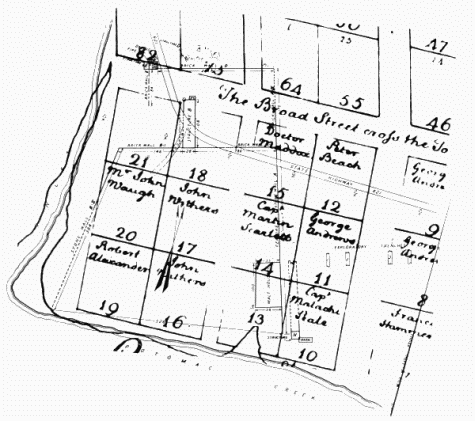 Figure 14.—Archeological survey plan superimposed over detail of 1691 plat, showing
southwest corner of town developed by Mercer. It can be seen that the mansion foundation
was in the area near the change of course “by the Gutt between Geo. Andrew’s &
the Court house,” hence in the vicinity of the courthouse site.
Figure 14.—Archeological survey plan superimposed over detail of 1691 plat, showing
southwest corner of town developed by Mercer. It can be seen that the mansion foundation
was in the area near the change of course “by the Gutt between Geo. Andrew’s &
the Court house,” hence in the vicinity of the courthouse site.
In the meanwhile, years had gone by, and no action
had been taken on the suit in chancery brought in
the 1730’s to establish Savage’s survey of Marlborough
as the official one. During this time, Mercer had
continued to build on various lots other than those
he owned, “relying on the Lease and Consent of
[the feoffees], at the Expense of above Fifteen Hundred
Pounds, which Improvements would have saved
forty lots.” Finally, “judging the only effectual way
to secure his Title would be to procure an Act of
General Assembly for that purpose,”[109] Mercer
applied to the Stafford court to purchase the county’s
interest in the town, to which the court agreed on
August 11, 1747, the price to be 10,000 pounds of
tobacco. Since this transaction required legislative
approval, Mercer filed with the House of Burgesses
the petition which has served so often in these pages
to tell the history of Marlborough.
Mercer argued in the petition that the county had
nothing to lose—that it “had received satisfaction”
for at least 30 lots, some of which he might be obliged
to buy over again; that, considering the history of the
town, no one but himself would be likely to take up
any other lots, the last having been subscribed to in
1708; and that his purchase of the town would be not
to the county’s disadvantage but rather to his own
great expense. He was willing to accept an appraisal
from “any one impartial person of Credit” who
would say the town was worth more, and to pay
“any Consideration this worshipful House shall think
just.”
He pointed out that the two acres set aside for the
courthouse were excluded and that they “must revert
to the Heir of the former Proprietor, (who is now an
Infant).” He did not indicate in the petition that
he himself was the guardian of William Brent, infant
heir to the courthouse property. It is most significant,
therefore, that in asking for favorable action he added,
“except the two acres thereof, which were taken in
for a Courthouse, as aforesaid and which he is
willing to lay of as this worshipful House may think
most for the Benefit of Mr. William Brent, the Infant,
to whom the same belongs, or to pay him double or
treble the worth of the said two acres, if the same is also
vested in your Petitioner.” (Italics supplied.) Plainly,
Mercer had much at stake in obtaining title to the
courthouse land. This supports the hypothesis that
the Gregg survey of 1707 infringed on the courthouse
land, that Ballard’s lot 19 on the Gregg survey overlapped
it, and that Mercer’s first two houses, and now
his mansion, were partly on land that rightfully
belonged to his ward, William Brent. Mercer
apparently had so built over all the lower part of
Marlborough without regard to title of ownership,
and had so committed himself to occupancy of the
courthouse site, that he was now in the embarrassing
position of having to look after William Brent’s
interests when they were in conflict with his own.
Likely it is that he had depended too much on acceptance
of the still-unauthorized Savage survey to correct
the previous discrepancies by means of its extra row
of lots.
Still further indication that the courthouse land
was at issue is found in the proceedings that followed
the petition. In these, there are repeated references
to Mercer’s having been called upon to testify “as
the Guardian of William Brent.” Clearly, the
legislators were concerned with the effect the acceptance
of the petition would have on Brent’s interests.
If Mercer, as seems likely, was building his mansion
on the courthouse land, the burgesses had reason to
question him. In any case, the House resolved in the
affirmative “That the said Petition be rejected”.[110]
This setback was only temporary, however. The
wider problems of Marlborough had at least been
brought to light, so that by the time the next fall
session was held Mercer’s 18-year-old suit to have
Savage’s designated the official survey finally was
acted upon:
“At a General Court held at the Court House in
Williamsburg the 12th October 1749” the John
Savage survey of 1731 was “Decreed & Ordered”
to be “the only Survey” of Marlborough. The
problem of overlapping boundaries occasioned by the
conflicts between the first two surveys was solved
neatly. Mercer agreed to accept lots 1 through 9,
22 and 25, and 33, 34, 42, and 43, “instead of the
sd 17 lots so purchased.” The new lots extended up
the Potomac River shore, while the “sd 17 lots” were
those which he had originally purchased and had
built upon. Since he had “saved” these 17 lots by
building on them, according to the old laws for the
town, “it is further decreed & ordered that the said
Town of Marlborough grant & convey unto the sd
John Mercer in fee such & so many other Lotts in the
said Town as shall include the Houses & Improvmts
made by the said John Mercer according to the Rate
of 400 square feet of Housing for each Lot so as the
Lots to be granted for any House of greater Dimensions
be contiguous & are not separated from the
said House by any of the Streets of the said Town.”[111]
Thus, Mercer’s original titles to 17 lots were made
secure by substituting new lots for the disputed ones
he had occupied. This device enabled the feoffees to
sell back the original lots—at £182 per lot—with
new deeds drawn on the basis of the Savage survey.
The final provision that lots be contiguous when a
house larger than the minimum 400 square feet was
built on them, and that the house and lots should
not be separated by streets from each other, guaranteed
the integrity of the mansion and its surrounding
land. No mention was made here, or in subsequent
transfers, of the courthouse land. Presumably it was
conveniently forgotten, Mercer perhaps having duly
recompensed his ward.
HEALTH AND MEDICINE
Three weeks before his petition was read in the
House, Mercer became ill. On October 26, 1748, he
noted in his journal, “Very ill obliged to keep my
bed.” This was almost his first sickness after years
of apparently robust health. Such indispositions as
he occasionally suffered had occurred, like this one, at
Williamsburg, where conviviality and rich food caused
many another colonial worthy to founder. In this
case, anxiety over the outcome of his petition may
have brought on or aggravated his ailment. In
any event, he stayed throughout the court session at
the home of Dr. Kenneth McKenzie, who treated
him. On November 3 he noted that he was “On
Recovery,” and two days later “went out to take the
air.” The following appears in his account with
Dr. McKenzie:
| October 1748: | By Medicines & Attendance |
| | myself & Ice | £7.19.11 |
| | By Lodging &c. 7 weeks | 6. 6. 7 |
From William Parks, on another occasion, he
bought “Rattlesnake root,” which was promoted
in 18th-century Virginia as a specific against the
gout, smallpox, and “Pleuritick and Peripneumonic
Fevers.”[112] Twice he bought "British oyl," a
favorite popular nostrum sold in tall, square bottles,
and on another occasion “2 bottles of Daffy’s Elixir.”[113]
In 1749 he settled his account with George Gilmer,
apothecary of Williamsburg, for such things as oil
of cinnamon, Holloways’ Citrate, “Aqua Linnaean,”
rhubarb, sago, “Sal. Volat.,” spirits of lavender,
and gum fragac. The final item in the account was
for April 22, 1750, for “a Vomit.” The induced
vomit, usually by a tartar emetic, was an accepted
cure for overindulgence and a host of supposed
ailments. That inveterate valetudinarian and amateur
physician, William Byrd, was in the habit of
“giving” vomits to his sick slaves.[114]
In November and December 1749 Mercer sustained
his first long illness, during which he was
attended by “Doctor Amson.” “Taken sick” at
home on November 13, he evidently did not begin to
recover until December 11. Whatever improvement
he may have made must have received a setback on
the last day of the year, when he recorded in his
journal: “Took about 60 grains of Opium & 60
grains of Euphorbium by mistake instead of a dose of
rhubarb.”
RELIGION AND CHARITIES
Mercer’s religious observances were irregular,
although usually when he was home he attended
Potomac Church. At the same time he continued as
a vestryman in Overwharton Parish (which included
Potomac and Aquia churches). On September 28,
1745, the vestry met to decide whether to build a
new Aquia church or to repair the old one. They
“then proceeded to agree with one William Walker,
an Undertaker to build a new brick Church, Sixty
Feet Square in the Clear, for One Hundred and
Fifty Three Thousand Nine Hundred and Twenty
Pounds of Transfer Tobacco.”[115] In October Mercer
entered in Ledger G, under the Overwharton Parish
account, “To drawing articles with Walker.” In
December he charged the parish with “2 bottles
claret” and “To Robert Jackson for mending the
Church Plate.” Jackson was a Fredericksburg
silversmith.[116]
The following March, the proprietors of the
Accokeek Ironworks petitioned the Committee on
Propositions and Grievances with an objection to the
vestry’s decision to rebuild, claiming that “as the
said Iron-Works lie in the Parish aforesaid, and employ
many Tithables in carrying on the same, they
will labour under great Hardships thereby....”[117]
The petition was rejected, but nothing seems to have
been done on the new church until three months
after Walker’s death in February 1750, when Mourning
Richards was appointed undertaker.[118]
Mercer’s charities in this decade form a short list.
His only outright gift was his “Subscription to
Protestant working-Schools in Ireland. To my
annual Subscription for Sterling £5.5.” In 1749 he
did £12 3s. worth of legal work for the College of
William and Mary, which he converted into “Subscriptions
to Schools” of equal value; in other words,
he donated his services.
CATHERINE MERCER’S DEATH AND
ANN ROY’S ARRIVAL
On April 1, 1750, Mercer went to Williamsburg for
the spring session and stopped en route to visit his
friend Dr. Mungo Roy at Port Royal in Caroline
County. He remained at Williamsburg until the
seventh, except for going on the previous day to
“Greenspring” to be entertained by Philip Ludwell
in the Jacobean mansion built a century earlier by
Governor Berkeley. Again stopping off at Port
Royal, he returned home on May 10. He remained
there until June 15, when he made the laconic entry
in his journal: “My wife died between 3 & 4 at noon.”
What time this denotes is unclear.
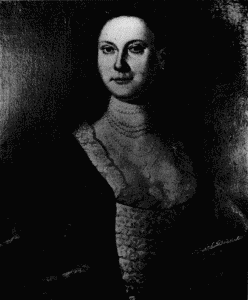 Figure 15.—Portrait of Ann Roy Mercer, John
Mercer’s second wife and the daughter of Dr. Mungo
Roy of Port Royal, painted in 1750 or shortly
thereafter. (Courtesy of Mrs. Thomas B. Payne.)
Figure 15.—Portrait of Ann Roy Mercer, John
Mercer’s second wife and the daughter of Dr. Mungo
Roy of Port Royal, painted in 1750 or shortly
thereafter. (Courtesy of Mrs. Thomas B. Payne.)
Following this loss—Catherine Mercer was only
43—Mercer remained at home for five days, then
visited his sister-in-law Mrs. Ann Mason. The next
night he stayed with the pastor of Aquia Church,
Mr. Moncure, then returned to Marlborough and
remained there for nearly a month. Meanwhile, he
purchased from Fielding Lewis, at a cost of
£3 18s. 7½d., “sundrys for mourning.” William
Thomson, the Stafford tailor, made his mourning
clothes. The preparations for the funeral must have
been elaborate; it was not held until July 13.
At the end of July Mercer went to Williamsburg,
thence to Yorktown, and from there to Hampton and
Norfolk by water on an “Antigua Ship,” returning
to Hampton on August 5 on a “Negro Ship,” evidently
having caught passage on oceangoing traders.
The younger children remained in Williamsburg with
George and a nurse. On September 8 he went to
Port Royal and stayed “at Dr. Roy’s.” He returned
home on the 10th, then went back to Port Royal on
the 14th, staying at Dr. Roy’s until the 20th, attending
Sunday church services during his visit. He returned
home again on the 23rd, only to visit Dr. Roy once
more on the 28th. The October court session drew
him to Williamsburg, where he remained until
November 7. While there, he purchased the following
from James Craig,[119] a jeweler:
| | £ | s. | d. |
| By a pair of Earrings | 2 | 12 | |
| By a pair of Buttons | 2 | 12 | |
| By a plain Ring | 1 | 1 | 6 |
On November 8 he returned to Dr. Roy’s. On the
10th he added a characteristically sparse note to his
chronicle, “Married to Ann Roy.”
The period for mourning poor Catherine was short
indeed. But the mansion at Marlborough needed a
mistress, and Mercer’s children, a mother. A new
chapter was about to open as the decade closed.
From the meticulous records that Mercer kept, it has
been possible to see Mercer as a dynamic cosmopolite,
accomplishing an incredible amount in a few short
years. His constant physical movement from place to
place, his reading of the law and of even a fraction of
his hundreds of books in science, literature, and the
arts, his managing of four plantations, attending two
monthly court sessions a year at Williamsburg, looking
after the legal affairs of hundreds of clients, concerning
himself with the design and construction of a
remarkable house and selecting the furnishings for
it—all this illustrates a personality of enormous
capacity.
Marlborough was now a full-fledged plantation.
Although the legacy of an earlier age still nagged at
Mercer and prevented him from holding title to much
of the old town, he had, nevertheless, transformed it,
gracing it with the outspread grandeur of a Palladian
great house.
THE OHIO COMPANY
The long last period of Mercer’s life and of the
plantation he created began at a time of growing
concern about the western frontier and the wilderness
beyond it. In 1747 this concern had been
expressed in the founding of the Ohio Company of
Virginia by a group of notable colonial leaders:
Thomas Cresap, Augustine Washington, George
Fairfax, Lawrence Washington, Francis Thornton,
and Nathaniel Chapman. George Mason was an
early member, and so, not surprisingly, was John
Mercer, whose prestige as a lawyer was the primary
reason for his introduction to the company. We learn
from the minutes of the meeting on December 3, 1750.
“[Resolved] That it is absolutely necessary to have
proper Articles to bind the Company that Mason ...,
Scott & Chapman or any two of them, apply to John
Mercer to consider and draw such Articles and desire
him attend the next general meeting of the Company at
Stafford Courthouse....”[120]
At the meeting in May 1751, Mercer presented the
Articles and was “admitted as a Partner on advancing
his twentieth part of the whole Expence.”[121] From
then on he was virtually secretary of the company,
as well as its chief driving force. He was made a
committee member with Lawrence Washington,
Nathaniel Chapman, James Scott, and George Mason,
who was treasurer. The “Committee” was the central
or executive board.
With the leading members living in Stafford County
or nearby, most of the meetings of both the company
and the committee were held at Stafford courthouse,
and occasionally in private houses of the members.
We can imagine with what pride Mercer noted in his
journal for February 5-7, 1753, “Ohio Committee
met at my house.” The important role played by
the Ohio Company in the Mercers’ lives—and by
them in the Company—is fully recounted in the
George Mercer Papers Relating to the Ohio Company of
Virginia.
GEORGE, JOHN, AND JAMES
Mercer doubtless threw himself into the Ohio
Company’s affairs with characteristic drive and
enthusiasm. We may surmise that there was heady
talk at Marlborough about the frontier and of
dangerous exploits against the Indians and the
French—enough, at least, to have stirred youthful
cravings for adventure among the Mercer boys.
Certain it is that George and John Fenton, aged 19
and 18, respectively, joined the frontier regiment of
their neighbor Colonel Fry as young officers “upon
the first incursions of the French.”[122]
James, aged 16 and too young for soldiering,
exhibited an unusual aptitude for architecture. His
talent was noticed by William Bromley, the master
joiner on the mansion house, who told Mercer that
James “had a most extraordinary turn to mechanicks.”
On the strength of this, Mercer decided
that James should become a master carpenter or
joiner, then synonymous with “architect.” In
America in 1753 professional architects, as we know
them, did not exist; gentlemen, some very talented,
designed and drafted, while skilled joiners or carpenters
followed general directions, executing, engineering,
and inventing as they went along.
Mercer’s decision was as unconventional as it was
prescient, being made at a time when gentlemen were
not expected to learn a trade, yet at a moment when
the respected place the professional architect was
later to have could be envisioned. Indeed, he
explained his feeling that those who possessed architectural
skills “were more beneficial members of
society, and more likely to make a fortune, with credit,
than the young Gentlemen of those times, who wore
laced jackets attended for improvement at ordinaries,
horse races, cock matches, and gaming tables.”
Motivated by this honest sense of values, forged in the
experience of a self-made man, Mercer proceeded to
bind James “apprentice to Mr. Waite, a master
carpenter and undertaker (of Alexandria), who
covenanted to instruct him in all the different branches
of that business. At the same time I bound four
young Negro fellows (which I had given him) to Mr.
Waite, who covenanted to instruct each of them in a
particular branch. These, I expected, when they
were out of their time, would place him in such a
situation as might enable him to provide for himself,
if I should not be able to do any more for him. It is
notorious that I received the compliments of the
Governour, several of the Council, and many of the
best Gentlemen in the country, for having set such an
example, which, they said, they hoped would banish
that false pride that too many of their countrymen
were actuated by.”
On June 25, 1753, Mercer noted in his journal,
“At home. Bound son James & Peter & Essex to
Wm Waite for 5 yrs.” However commendable this
effort to banish “false pride” may have been, it was
probably not a realistic solution for James’ career.
James, as we shall see, was to make his own choice
later and was to follow with great distinction in his
father’s footsteps as a lawyer.
GROWING BURDENS,
RESPONSIBILITIES, AND DEBTS
Meanwhile, Mercer had announced his intention to
publish a new edition of the Abridgment. In doing so,
he adopted a hostile, testy approach that was unusual
even in 18th-century advertising. Implying that he
was doing a favor to an ungrateful populace, he stated
in the Virginia Gazette on August 16, 1751, “I have
been prevail’d upon to print it, if I have a prospect of
saving myself, though the Treatment I met from the
Subscribers to the last had determined me never to be
again concerned in an Undertaking of this Kind.”
On the following February 20, he announced in the
Gazette that if there were 600 subscribers by the last of
the next General Court he would send the copy to
press. If not, he would return the money to those who
had subscribed, “which I should not have troubled
myself with, if I could have thought of any other
Expedient to secure myself against the base Usage I
met with from the Subscribers to my former Abridgment,
who left above 1200 of them on my Hands.”
This kind of advertising had its predictable response:
publication of the new Abridgment was postponed
indefinitely.
The first suggestion that all was not well in Mercer’s
financial affairs was given in an advertisement in the
Gazette on April 10, 1752. In this he noted that he
had agreed to pay the debts of one Francis Wroughton,
a London merchant, out of Wroughton’s effects.
However, although Wroughton’s effects had not
materialized, he promised to make payment anyway,
“notwithstanding a large Ballance due to myself.”
He concluded, “Besides Mr. Wroughton’s Debts, I
have some of my own (and not inconsiderable) to
pay, therefore I hope that such Gentlemen as are
indebted to me will, without putting me to the
Blush which a Dunn will occasion, discharge their
Debts....”
Perhaps to alleviate these difficulties, he had
advertised in the Gazette on the previous March 15
that he would lease “3,000 Acres of extraordinary
good fresh Land, in Fairfax and Prince William,”
but there is no evidence that he was successful.
Signs of irritability became increasingly noticeable.
In 1753 he outraged his fellow justices at Stafford
court—so much so that they brought charges against
him before the Executive Council “for misbehavior
as a Justice.”[123] It was decided that, although
“his Conduct had been in some Respects blameable,
particularly by his Intemperance, opprobrious Language
on the Bench, and indecent Treatment of the
other Justices, ... that in Consideration of his
having been a principal Instrument in a due Administration
of Justice, and expediting the Business of
the County, it has been thought proper to continue
him Judge of the Court.”[124]
A growing burden of debt, in contrast to the
prosperity of the preceding decade, clearly affected
Mercer’s attitude, as we can see in a Gazette advertisement
on November 7, 1754: “I will not undertake
any new, or finish any old Cause, ’til I receive
my Fee, or Security for it to my liking: And I hope
such Gentlemen as for above these seven years past
have put me off with Promises every succeeding
General Court will think it reasonable now to discharge
their accounts.” Concurrent with indebtedness
was an almost annual increase in the size of
his family. In 1752 Grace Fenton Mercer was born,
the next year Mungo Roy, and in 1754 Elinor.
At the same time, he still pursued the restless
activity that characterized his earlier years. On
July 24, 1753, Mercer went “to Balthrop’s, Smith’s
Ordinry & Vaulx’s,”[125] a distance of 27 miles, during
which he “Overset.” On the 25th he went on eight
miles farther “to Colo Phil Lee’s”[126] for a three-day
meeting of the Ohio Company, then went the whole
35 miles home on the 28th. On September 6 he was
called eight miles away “to Boyd’s hole on Inquest as
Coroner & home by 4 in the morng,” while the next
day he was “at home. Son Mungo Roy born abt 2
in the morning.” On the 19th Mungo Roy was
christened. Four days later he went 15 miles to
Fredericksburg for the christening of William Dick’s
son Alexander, returning home the next day. The
following day Mercer journeyed 14 miles and back to
“Holdbrook’s Survey” by way of Mountjoy’s, and
repeated the trip the next day, stopping at Major
Hedgman’s[127] coming and going. On October 5
he made a three-day trip to Williamsburg, covering
the distance in stretches of 16, 52, and 42 miles per
day, respectively. He went by way of Port Royal,
where he “Met Mr Wroughton,” presumably the
London merchant whose creditors he had agreed to
pay. The second day took him by way of King
William courthouse. On the return on November
4-6, he came via Chiswell’s Ordinary[128] and New
Kent courthouse (which he noted had "Burnt"),
covering a total of 110 miles.
On June 3, 1754, his clerk reported to duty,
according to a journal entry: “Rogers came here at
£50 pr annum.” Rogers remained in Mercer’s employ
until 1768.
Mercer seems to have been driving himself to the
limit, not to achieve success as in the prior decades,
but rather to hold secure what he already had.
The specter of debt now hung over him, as it did over
nearly every planter, under the increasing burdens of
the French and Indian War. The 17th-century
wisdom of William Fitzhugh and Robert Beverley in
seeking to lead the colony away from complete
dependence upon tobacco was apparent to those who
would remember. Marlborough, although still technically
a town, was now in reality a tobacco plantation,
and Mercer, despite his status as a lawyer, was
as irretrievably committed to the success or failure
of tobacco as was Fitzhugh 70 years earlier. The
hard years were now upon all, and, like his equally
hard-pressed debtors, Mercer was suffering from
them.
LIFE AT MARLBOROUGH
DURING THE FRENCH AND INDIAN WARS
On March 11, 1755, after nearly 30 years of uncertainty
about his titles to Marlborough, Mercer at last
was granted the entire 52-acre town in a release from
the feoffees, Peter Daniel and Gerard Fowke. This
was made with the provision that he should be “Eased
from making improvements on the other twenty-six
Lots (those not built upon), to prevent their forfeiture
and the County will be wholly reimbursed, which it is
not probable it ever will be otherwise as only one Lot
has been taken up in forty-seven years last past and
there is not one House in the said town which has not
been built by the said Mercer.”[129]
While the day-to-day events of Marlborough went
on much as ever, the conflict between the British and
the French spread from Canada southward along the
western ridge of the Appalachians. This expansion,
inevitably, was reflected in the Mercers’ activities in
many ways, both great and small. As the struggle
approached its climax, Braddock’s troops came to
Virginia in March 1755, and were quartered in
Alexandria. Among them was John Mercer’s brother,
Captain James Mercer, who was a professional soldier.
On March 25 John left Marlborough for Alexandria,
probably to greet James and to have him billeted at
William Waite’s house where young son James already
was living as Waite’s apprentice. This bringing
together of two far-flung members of the Mercer
family had unanticipated results. Captain James was
a British gentlemen-officer, untouched by the leveling
influences of colonial life and therefore untempted to
banish “false pride” by any such radical means as
John had employed with young James. Indeed, the
sight of his nephew learning a mechanical trade must
have been a rude shock, for we learn from John
Mercer that Captain James “found means to make
his nephew uneasy under his choice; and I was from
that time incessantly teazed, by those who well knew
their interest over me, until I was brought to consent
very reluctantly that he should quit the plumb and
square” and become a lawyer.[130]
Mercer returned to Marlborough by way of
George Mason’s, near the place where a few months
later William Buckland was to begin work on
“Gunston Hall.” He remained there all day on
April 1—“at Mr Mason’s wind bound,” he wrote in
his journal. The next day he went “home through a
very great gust.”
The problems of managing a plantation went on
through peace and through war. Besides a multitude
of Negroes, there were also indentured white
servants at Marlborough. One of these ran away
and was advertised in the Virginia Gazette on May 2,
1755:
... a Servant Man named John Clark, he pretends
sometimes to be a Ship-Carpenter by Trade, at other
Times a Sawyer or a Founder ... he is about 5 feet
7 inches high, round Shoulders, a dark Complexion,
grey eyes, a large Nose and thick Lips, an Englishman by
birth; had on when he went away, a blue Duffil Frock
with flat white Metal Buttons and round Cuffs, red
corded Plush Breeches, old grey Worsted Stockings, old
Shoes, and broad Pewter Buckles, brown Linen wide
Trousers, some check’d Shirts, and a Muslin Neckcloth;
had also an old Beaver Hat bound round with Linen.
On October 24, the Gazette carried another advertisement
related to Mercer’s problems of personnel:
A Miller that understands the Management of a Wind-mill,
and can procure a proper Recommendation, may
have good Wages, on applying to the Subscriber during
the General Court, at Williamsburg, or afterwards, at his
House in Stafford County, before the last Day of November,
or if any such Person will enclose his Recommendation,
and let me know his Terms by the Post from
Williamsburg, he may depend on meeting an Answer at
the Post-Office there, without Charge, the first Post after
his Letter comes to my Hands. John Mercer
In the meanwhile, the war had broken out in full
scale, and the disaster at Fort Duquesne had taken
place. Mercer apparently learned the bad news at
a Stafford court session, for he noted in his journal
on July 9, after observing his attendance at court,
“General Braddock defeated.” We can imagine
his concern, for both George and John Fenton were
participants in the campaign.
On April 18, 1756, John Fenton was killed in
action while fighting under Washington.[131] Curiously,
his death was not mentioned in the journal. Instead,
we learn of the death of John Mercer’s horse on the
way to Williamsburg in April and of the fact that,
on his return in May, Mercer lost his way and
traveled 46 miles in a day. He tells us that he went
“to Mr Moncure’s by water” on May 26, a distance
of 15 miles, and that he made a round trip from
Mr. Moncure’s to Aquia Church for a total of 12
miles. On July 14, he noted that he went “to
Majr Hedgman’s & returning thrown out of the
chaise & very much bruised.”
The demands of the war are revealed in journal
entries made in June 1757. On the 20th he wrote,
“to Court to prick Soldiers & home,” and on the
27th, “to Court to draft Soldiers & home.” As at
other times in the journal, birth and death, in their
tragic immediacy and repetitiveness, were juxtaposed
in September: on the 24th, “Son John born”; on
the 27th, “Brother James died at Albany”; on the
28th, “Son John died.”
In 1758 George Mason ran for the office of burgess
from both Stafford and Fairfax. On July 11,
Mercer went to the Stafford elections, where “Lee &
Mason” were chosen. On the 15th, he went “to
Mr Selden’s & home by water to see Mr Mason,”
who evidently had come to Marlborough for a visit.
Four days later, he traveled to Alexandria for the
elections there and saw “Johnston & Mason”
elected.
In the fall of 1758 he went, as usual, to Williamsburg.
His route this time was long and devious,
taking him to both Caroline and King William
County courthouses on the way, for a total of 121
miles in five days. We learn of one of the hazards
of protracted journeys in the 18th century from a
notation repeated daily in his journal for four days
following his arrival: “at Williamsburg Confined to
Bed with the Piles.”
On November 15, soon after his return to Marlborough,
Mercer was sworn to the new commission
of Stafford justices. Five days previously his son
Catesby had been buried, but, as usually happened,
new life came to take the place of that which had
survived so briefly. On May 17, 1759, Mercer
recorded, “Son John Francis born at 7 in the Evening.”
John Francis evidently was given an auspicious start
in life by a christening of more than ordinary formality:
“May 28. to Colo Harrison’s with the Govr Son
christened.”
During 1759 the second edition of the Abridgment
was published in Glasgow, Scotland, this time with
neither public notice nor recrimination.[132] On November
25, Mercer met the growing problem of his
indebtedness by deeding equal shares of some of his
properties, as well as whole amounts of others, to
George and James Mercer, Marlborough and a few
other small holdings excepted. Fifty Negroes were
included in the transaction. This action was followed
immediately by the release of the properties under
their new titles to Colonel John Tayloe and Colonel
Presley Thornton for a year, thus providing cash by
which George and James could pay £3000 of John
Mercer’s debts.[133]
The Ohio Company was experiencing its difficulties
also. Mercer’s importance in it was demonstrated by
his appointment to “draw up a full State of the
Company’s Case setting forth the Hardships We
labour under and the Reasons why the Lands have
not been settled and the Fort finished according to
Royal Instructions....”[134] This was his most
responsible assignment during his activity in the
company.
Indebtedness throughout these years lurked constantly
in the background, now and then breaking
through acutely. In 1760, for example, William
Tooke, a London merchant, brought suit to collect
£331 1s. 6d. which Mercer owed him. Two years
later Capel Hanbury sued Mercer for £31 10s.[135]
In 1761 George Washington and George Mercer
ran for burgesses from Frederick County in the
Shenandoah Valley, and both were elected. John
Mercer, evidently anxious to be present for the election,
undertook the arduous journey to Winchester,
leaving Marlborough on May 15. His itinerary was
as follows:
| May | 15 | to Fredericksburg | 15 |
| | 16 | to Nevill’s Ordinary | 37 |
| | 17 | to Ashby’s Combe’s & Winchester | 32 |
| | 18 | at Winchester (Frederick Election) | |
| | | (Geo Washington and Geo Mercer elected) | |
| | 19 | to Mr Dick’s Quarter | 18 |
| | 20 | to Pike’s Mr Wormley’s Quarter | 12 |
| | 21 | to Snickers’s Little River Quarters & | |
| | | Nevill’s | 60 |
| | 22 | to Fallmouth & home | 50 |
In the previous year Anna had been born, and
now, on December 14, 1761, Maria arrived. Between
the 8th and the 20th of August, 1762, entries
were made that suggest that there was an epidemic
of sorts at Marlborough: “Cupid died // Tom
(Poll’s) died // Daughter Elinor died // Miss B. Roy
died.” In his long letter to George, written in
1768, he reflected on the fact that, although through
the years 98 Negroes had been born at Marlborough,
he, at that time, had fewer than the total of all he
had ever bought. “Your sister Selden,” he wrote
“attributes it to the unhealthiness of Patomack
Neck, which there may be something in.... I
thank God, however, that my own family has been
generally as healthy as other people’s.”[136]
THE END OF THE WAR
AND THE STAMP ACT
The year 1763 marked the end of the war. It also
signaled a turning point in the colonies’ relations with
England. In a royal proclamation the King prohibited
the colonies from expanding westward past
the Appalachian ridge, in effect nullifying the Ohio
Company’s claims and objectives. George Mercer
was appointed agent of the company and was dispatched
to England to plead its cause.
By this time Britain was beginning to apply the
other allegedly oppressive measures which preceded
the Revolution. Antismuggling laws were enforced,
implemented by “writs of assistance,” thus increasing
colonial burdens which had been avoided previously
by widespread smuggling. The South was particularly
hard hit by parliamentary orders forbidding the
colonies the use of paper money as legal tender for
payment of debts. In a part of the world where a
credit economy and chronic indebtedness made a
flexible currency essential, this measure was a
disastrous matter.
Despite the ominousness of the times, Mercer continued
with the daily routine, the minutiae of which
filled his journal. He noted on January 9, 1763, that
he went to Potomac Church—“Neither Minister or
clerk there.” On February 21 he went a mile—probably
up Potomac Creek—to watch “John
Waugh’s halling the Saine & home.” On March 1
his merchant friend John Champe was buried. After
the funeral Mercer went directly to Selden’s for an
Ohio Company meeting.
From December 10 until March 1765, Mercer was
sick. Of this interval, he wrote George in 1768 that
“My business had latterly so much encreased,
together with my slowness in writing, & Rogers, tho
a tolerable good clerk, was so incapable of assisting
me out of the common road, that when you saw me at
Williamsburg, I was reduced by my fatigue, to a very
valetudinary state.”[137] Indebtedness, overwork, advancing
age, and the reverses of the times had
evidently caused a crisis.
Passage of the Stamp Act in 1765, to raise revenues
to support an army of occupation in the colonies,
struck close to John Mercer, for George, while in
England, had been designated stamp officer for
Virginia. George returned to Williamsburg, little
expecting the hostile greeting he was to receive from
a crowd of angry planters. Quickly disavowing his
new office, he returned the stamps the following day.
Many made the most of George’s tactical blunder
in accepting the stamp-officer appointment. Indeed,
the Mercers seem to have been made the scapegoats
for the frustrations and turmoil into which the
mother country’s actions had plunged the colony.
George Mercer was hanged in effigy at Westmoreland
courthouse, and James Mercer took to the Gazettes
to defend him. There were counterattacks on James
while he was absent in Frederick County, and
Mercer himself rushed in with a lengthy satirical
diatribe entitled “Prophecy from the East.” Occupying
all the space normally devoted to foreign
news in Purdie & Dixon’s Virginia Gazette for September
26, 1766, this struck out at anonymous
attackers whom Mercer scathingly nicknamed Gibbet,
Scandal, Pillory, and Clysterpipe. He later explained
to George that James’ “antagonist was backed by
so many anonymous scoundrels, that I was drawn
in during his abscence at the springs in Frederick
to answer I did not know whom tho it since appears
Dr Arthur Lee was the principal, if not the only
assassin under different vizors, & he was so regardless
of truth that he invented & published the most
infamous lies as indisputable facts: on your brother’s
return I got out of the scrape but from a paper war
it turned to a challenge, which produced a skirmish,
in which your bro. without receiving any damage
broke the Doctors head, & closed his eyes in
such a manner as obliged him to keep his house
sometime....”[138]
Of John Mercer’s own attitude towards the Stamp
Act there can be no question. On November 1,
1765, he noted in his journal, “The damned Stamp
Act was to have taken place this day but was proved
initially disappointed.” He is said to have written
a tract against the Stamp Act, although no copy
has survived.
THE CLOSING YEARS[139]
The elements of tragedy mark Mercer’s final
years—the tragedy of John Mercer and Marlborough
interwoven with the epic failures of the colonial
experiment. Prompted by his illness, he quit his
legal practice in the courts in 1765. In the same
year he “gave notice to the members of the Ohio
Company, that my health & business would not
longer allow me to concern myself in their affairs
which they had entirely flung upon my hands.”
He also “on account of my deafness, refused to act as
a justice, which I should not have done otherwise, as
I have the satisfaction to know that I have done
my country some service in this station.”
Heavily in debt, disillusioned and embittered by the
dwindling results of his struggles, he wrote that “I
have attended the bar thirty-six years, through a
perpetual hurry and uneasiness, and have been more
truly a slave than any one I am, or ever was, master
of; yet have not been able, since the first day of last
January, to command ten pounds, out of near ten
thousand due me.” Recoiling from his situation, he
desperately sought a way out and a means to recover
his losses. With self-deceptive optimism he seized
upon the idea of establishing a brewery at Marlborough,
since “our Ordinaries abound & daily
increase (for drinking will continue longer than
anything but eating).” Accordingly, he built a
brewhouse and a malthouse, each 100 feet long, of
brick and stone, together with “Cellars, Cooper’s
house & all the buildings, copper & utensils whatever,
used about the brewery.” He depended at
first on his windmill for grinding the malt, but to
avoid delays on windless days, “I have now a hand-mill
fixed in my brewhouse loft that will grind 50
bushels of malt (my coppers complement) every
morning they brew.”
To get his project under way, Mercer plunged
further into the depths of debt by buying 40 Negroes
“to enable me to make Grain sufficient to carry on
my brewery with my own hands.” These cost £8000,
“a large part of which was unpaid, for payment of
which I depended on the Brewery itself & the great
number of Debts due to me.” But the external fate
which was driving him closer and closer to destruction
now struck with the death of John Robinson, treasurer
of the colony, who, having lent public funds promiscuously
to debtor friends, had left a deficiency of
£100,000 in the colonial treasury. A chain reaction
of suits developed, threatening James Hunter of
Fredericksburg, Mercer’s security for purchase of the
slaves.
The brewery lumbered and stumbled. Mercer’s
first brewer, a young Scot named Wales, prevailed
upon him to spend £100 to alter the new malthouse.
On September 16, 1765, William King, evidently
a master brewer, arrived. He immediately found
fault with Wales’ changes in the malthouse. Within
three weeks, however, King died. King’s nephew,
named Bailey, then came unannounced with a high
recommendation as a brewer from a man he had
served only as a gardener. Mercer was impressed:
“You may readily believe I did not hesitate to
employ Bailey on such a recommendation, more
especially as he agreed with King in blaming the
alteration of the malt house & besides found great
fault with Wales’s malting.” Faced with rival claims
as to which could brew better beer, Mercer allowed
each to brew separately. “Yet though Bailey found
as much fault with Wales’s brewing as he did with his
malting, that brewed by Wales was the only beer I
had that Season fit to drink.” Wales, however,
brewed only £40 worth of beer, barely enough to pay
his wages, let alone maintenance for himself and his
wife. Although Bailey brewed enough to send a
schooner load of it to Norfolk, it was of such “bad
character” that only two casks were sold, the remainder
having been stored with charges for two months,
then brought back to Marlborough, where an effort
to distill it failed.
In 1766 there was a similar tale. Five hundred fifty
bushels of malt were produced, but much of the beer
and ale was bad. In January 1766, Andrew Monroe[140]
was employed as overseer. “Wales complains
of my Overseer & says that he is obliged to wait
for barley, coals & other things that are wanted which,
if timely supplied with he could with six men & a
boy manufacture 250 bushels a week which would
clear £200.... My Overseer is a very good one &
I believe as a planter equal to any in Virginia but you
are sensible few planters are good farmers and barley
is a farmer’s article,” Mercer wrote to George.
Besides the overhead of slaves and nonproductive
brewers, the establishment required the services of
two coopers at £20 per year.
Purdie & Dixon’s Virginia Gazette for April 10, 1766,
carried the advertisement of Mercer’s brewery:
To be SOLD, at the
MARLBOROUGH BREWERY
STRONG BEER AND PORTER at 18d. and ALE at
1s. the gallon, Virginia currency, in cask, equal in goodness
to any that can be imported from any part of the
world, as nothing but the genuine best MALT and
HOPS will be used, without any mixture or substitute
whatsoever; which, if the many treaties of brewing
published in Great Britain did not mention to be frequently
used there, the experience of those who have
drunk those liquors imported from thence would point
out to be the case, from their pernicious effects.
The severe treatment we have lately received from our
Mother Country, would, I should think, be sufficient to
recommend my undertaking (though I should not be
able to come up to the English standard, which I do not
question constantly to do) yet, as I am satisfied that the
goodness of every commodity is its best recommendation,
I principally rely upon that for my success; and my own
interest, having expended near 8000 l. to bring my
brewery to its present state, is the best security I can give
the publick to assure them of the best usage, without
which such an undertaking cannot be supported with
credit.
The casks to be paid for at the rate of 4s. for barrels,
5s. for those between 40 and 50 gallons, and a penny the
gallon for all above 50 gallons; but if they are returned in
good order, and sweet, by having been well scalded as
soon as emptied, the price of them shall be returned or
discounted.
Any person who sends bottles and corks may have them
carefully filled and corked with beer or porter at 6s. or
with ale at 4s. the dozen. I expect, in a little time, to
have constant supply of bottles and corks; and if I meet
the encouragement I hope for, propose setting up a
glasshouse for making bottles, and to provide proper
vessels to deliver to such customers as favour me with
their orders such liquors as they direct, at the several
landings they desire, being determined to give all the
satisfaction in the power of
Their most humble servant,
JOHN MERCER
Foolhardy though the brewery was, a glass factory
would have been the pinnacle of folly. Yet it was
seriously on Mercer’s mind. In his letter to George
he wrote:
A Glass house to be built here must I am satisfied turn
to great profit, they have some in New England & New
York or the Jerseys & find by some resolves the New
England men are determined to increase their number.
Despite his manifest failure, Mercer confidently
attempted to persuade George of the possibilities of
the brewery and even the glasshouse. Shifting from
one proposal to another, he suggested that he could
“rent out all my houses and conveniences at a reasonable
rate,” or take in a partner, although “I have so
great a dislike for all partnerships, nothing but my
inability to carry it on my self could induce me to
enter into one.”
In spite of these desperate thrashings about in a
struggle to survive, Mercer’s empire was collapsing.
When Monroe arrived as overseer, he
found [according to Mercer] but 8 barrels of corn upon
my plantation, not enough at any of my quarters to
maintain my people, a great part of my Stock dead
(among them some of my English colts & horses in the
2 last years to the amt of £ 375. 10. —) & the rest of
them dying, which would have infallibly have been their
fate if it had not been for the straw of 1000 bushels of
barley & the grains from the brewhouse.... Convinced
of his [Monroe’s] integrity, I have been forced
to submit the entire management of all the plantation
to him.
The following passage from the letter summarizes
Mercer’s financial predicament:
“I reced in 1764 £1548 ... 4 ... 3½ & in 1765
£961 ... 5 ... 4½ but since I quitted my practice I
reced in 1766 no more than £108 ... 16 ... 1 of which
I borrowed £24.10.—& 7 ... 1 ... 6 was re’ced for the
Governor’s fees. £20 ... 8 ... 4 I got for Opinions &c
and from the brewery £28 ... 3 ... the remaining
£28 ... 16 is all I received out of several thousands
due for all my old & new debts. In 1767 I reced
£159 ... 9 ... 3 of which borrowed £5 ... 15 ...—the
governor’s fees £10 ... 7 ... 6 reced for opinions
&c. £49 ... 6 ...—from the brewhouse £66 ... 14 ...
of which £94 ... 14 ... 3 was from the brewery & 9 in
1766 I gave a collector £20 besides his board ferrage &
expences & finding him horses & his whole collection
during the year turned out to be £27 ... 2 ... 10. In
the two years my taxes levied and quitrents amounted
to £199 ... 8 ... 1 which would have left a ballance
of £1 . 13 . 3 in my favour in that time from the
brewery & my practice (if it could be so called) & all
my debts, in great part of which you and your brother
are jointly & equally interested. What then remained
to support me & a family consisting of about 26 white
people & 122 negroes? Nothing but my crops, after
that I had expended above £100, for corn only to support
them, besides rice & pork to near that value &
the impending charge of £125 for rent, of £140 to
overseers yearly, remained, & £94 ... 14 ... 3 out of
those crops, as I have already mentioned, proceeding
from the brewery, was swallowed up in taxes (tho the
people in England say we pay none, but I can fatally
prove that my estate from which I did not receive sixpence
has, since the commencement of the war, paid
near a thousand pounds in taxes only).”
On December 25, 1766, Mercer made public his
situation in Rind’s Virginia Gazette:
The great Number of Debts due to me for the last
seven Years of my Practice, and the Backwardness of
my Clients (in attending whose Business, I unhappily
neglected my own) to make me Satisfaction, would of
itself, if I had had no other Reason, have obliged me to
quit my Practice. And when I found that by such
partial Payments as I chanced to receive I was able
to keep up my Credit, I can appeal to the Public, whether
any Person, who had so many outstanding Debts, was
less importunate, or troublesome, to his Debtors, But
when I found, upon my quitting the Bar, all Payments
cease, and that I would not personally wait upon my
Clients, I could not approve of the Method of Demand,
by the Sheriff, too commonly in Practice, without
Necessity. I therefore employed a Receiver, who, ever
since the first day of January last, has been riding through
the Northern Neck, and even as far as Williamsburg, and
who to this Time has not been able, out of near ten
thousand Pounds, to collect as much as will pay his own
Wages, and discharge my public taxes (for Proof of
which I will produce my Books to any Gentleman concerned
or desirous to see them). This too, at a Time
when my own Debts contracted by the large Expences
I have been at for some Years past for establishing a
Brewery, has disabled me by any other Means from
discharging them, (except when they would take lands,
Assignments of Debts, or any thing I can spare, without
Detriment to my Plantations or Brewery). Selling
Lands avail nothing, I have bonds for some sold four
or five Years ago but I can’t get the Money for them.
I therefore cannot be thought too unreasonable to give
this public Notice (which the Circumstances of the
Country make most disagreeable to me) that I shall be
against my inclination obliged to bring Suits, immediately
after next April General Court, against all persons
indebted to me who do not before that Time, discharge
their Debts to me or my Son James Mercer, who will
have my Books during the said Court to settle with
every Person applying to him. And as some Persons
have since my quitting the Practice, sent to me for
Opinions and to settle Accounts without sending my
Fees, to prevent any more Applications of that Sort,
I give this Public Notice, that tho’ I shall always be
ready to do any Thing of that Kind (which can be
done at my own House) upon receiving an adequate
Satisfaction for it, it will be in vain to expect it be any
Messenger they may send without they send the Money.
There are some Gentlemen who must know that nothing
in this Advertisement can relate to them but that any
of their Commands will at any Time, be readily complied
with by their
and the Public’s
humble Servant
JOHN MERCER
Dec. 8, 1766
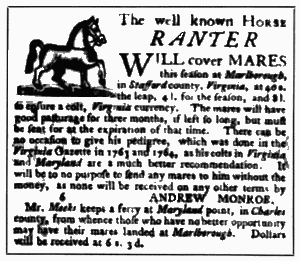 Figure 16.—Advertisement of the services of Mercer’s
stallion Ranter. Andrew Monroe, grandfather of
the President, was Mercer’s overseer. (Purdie’s
Virginia Gazette, April 18, 1766.)
Figure 16.—Advertisement of the services of Mercer’s
stallion Ranter. Andrew Monroe, grandfather of
the President, was Mercer’s overseer. (Purdie’s
Virginia Gazette, April 18, 1766.)
Andrew Monroe, as manager of the plantation,
advertised over his own name in Purdie & Dixon’s
Virginia Gazette, of April 18, 1766, the services of “The
well known Horse RANTER,” an English stallion
imported by Mercer in 1762 (fig. 16). One senses
that without Monroe, Marlborough would have
collapsed completely. In spite of his ministrations,
however, there were difficulties with the staff. Purdie
& Dixon’s Gazette carried the following on June 6,
1766:
MARLBOROUGH, STAFFORD county, May 26,
1766.
Run away from the subscriber, some time last February,
a Negro man named TEMPLE, about 35 years old, well
set, about 5 feet 6 inches high, has a high forehead, and
thick bush beard; he took a gun with him, and wore a
blue double breasted jacket with horn buttons. I
suspect he is harboured about Bull Run, in Fauquier
county, where he formerly lived. I bought him, with
his mother and sister, from Mr. Barradall’s executors in
Williamsburg above 20 years ago, and expected he would
have returned home; but as he has been so long gone, I
am doubtful he may endeavour to get out of the country
by water, of which he may understand something, as he
was two years on board the Wolf sloop of war in the
West Indies, and carries the marks of the discipline he
underwent on board.
Likewise run away last Whitsun holydays two indented
servants, imported from LONDON last September, viz.
JOSEPH WAIN of Bucknell, in the county of Oxford,
aged 22 years, about 5 feet 4 inches high, round shouldered,
stoops pretty much in his walk, has a down look,
and understands ploughing. WILLIAM CANTRELL
of Warwickshire, aged 19, about the same height, and
stoops a little, but not so much as WAIN, has a scar
under one of his eyes, but which is uncertain, has some
marks of the smallpox, his hair is of a dark brown and
short, but Wain’s is cut off, he pretends to understand
ploughing and country business, and has drove a waggon
since he has been in my service; they both have fresh
look. The clothes they left home in were jackets of red
plaids, brown linen shirts, Russia drill breeches with
white metal buttons, and thread stockings; Cantrell with
an old hat and new shoes, and Wain with a new
hat and old shoes; But as it is supposed that they were
persuaded to elope with four Scotch servants belonging
to the widow Strother, on Potowmack run in this county,
whom they went to see, and who went off at the same
time, it is probable that they may exchange their clothes,
or have provided some other. It is supposed that they
will make for Carolina, where it is said an uncle of one
of Mr. Strother’s servants lives; and as several horses are
missing about the same time in these parts, it is very
probable they did not choose to make such a journey
on foot. Whoever secures my servants and Negro, or
any of them shall, besides the reward allowed by law,
be paid any reasonable satisfaction, in proportion to
the distance and extraordinary trouble they may be
put to.
JOHN MERCER
Mercer seems to have been concerned principally
with his brewers and with the wasteful scheme they
furthered with their incompetencies. Even they
seem to have been beyond his strength, for he became
ill in January 1766, and suffered recurrently the
rest of the year. From his journal we can detect
a once-strong man’s struggle against the first warnings
of approaching death:
| August | 26 | Rode | 6 m. & | home had a fever | 12 |
| | 27 | sick | | | |
| | 28 | Rode | 5 m. & | home | 10 |
| | 29 | | 2 m. & | Do had an Ague | 4 |
| | 30 | | | Do | |
| | 31 | | | Do | |
| Sept | 1 | | | Had an Ague | |
| | 2 | Rode | 5 m. & | home | 10 |
| * * * |
| Sept | 22 | to Mr Selden’s & ret’d abot a mile but | |
| | | went back | 12 |
| | 23 | home by 12 and went to bed | 10 |
| | 24 | Confined to my bed | |
| | | (remained so rest of month) | |
| Oct | 1 | Confined to my bed and very ill | |
| | 5 | Do | Sat up a | little |
| | 6 | Do | | Better |
| | 7 | Do | | Do |
| | 8 | Drove out 3 m & home | 6 |
He informed George that after his return from Mr.
Selden’s on September 23 he was for “several days
under strong delerium and had the rattles.” By the
beginning of 1768, however, he was able to boast
that “I think I may safely aver that I have not been
in a better [state of health] any time these twenty
years past, & tho’ I am not so young, my youngest
daughter ... was born the 20th day of last January.”
On April 22, 1766, he noted in the journal that the
“Kitchen roof catched fire” and on May 15 that he
“Took Possion [sic] of my summer house.” The
latter was probably located in the garden, where,
during his convalescence in the spring, he was able to
make a meticulous record of the blooming of each
plant, flower, tree, and shrub, constituting a most
interesting catalog of the wild and cultivated flora of
18th-century Marlborough. The catalog is indicative
of Mercer’s ranging interests and his knowledge of
botanical terms (see Appendix L). That the garden
was perhaps as interesting as the house is borne out
by the fact that in 1750, as the house was reaching
completion, Mercer had brought from England a
gardener named William Blacke, paying Captain
Timothy Nicholson for his passage.
Mercer’s close attention to the natural phenomena
around him began with his illness in 1766. On
January 4, only a few days after he had become ill,
he installed a thermometer in his room, and eight
days later moved it to his office. Regularly,
from then until the close of his journal, except when
he was absent from Marlborough, he recorded the
minimum and maximum readings. One has only to
look at the figures for the winter months to realize
that “heated” rooms, as we understand them, were
little known in the 18th century. Only on Christmas
Eve in 1767 did the temperature range from a low
of 41° to as high as 63°, because, as Mercer noted,
“A good fire raised the Thermometer so high.”
Although Mercer apparently found surcease from
his cares in the peaceful surroundings at Marlborough,
his responsibilities went on nevertheless. The cost of
keeping slaves remained an enormous and wasteful
one: “Every negroes cloaths, bedding, corn, tools,
levies & taxes will stand yearly at least in £5,” he
wrote to George. In his letter he placed an order
through George for clothing, which included 25
welted jackets “for my tradesmen & white servants,”
indicating the large number of white workmen on his
staff. It also included 20 common jackets, 45 pair of
woolen breeches, 1 dozen greatcoats, 5 dozen stockings,
1½ dozen for boys and girls, 4 dozen “strong felt
hats & 600 Ells of ozenbrigs. We shall make Virga
cloth enough to cloath the women and children, but
shall want 50 warm blankets & 2 doz of the Russia
drab breeches.” Against the advice of his merchant
friend Jordan, he declined to order a superior grade
of jacket for his Negroes that would last two years,
since “most negroes are so careless of their cloathes
& rely so much on a yearly support that I think such
jackets as I had are cheapest & last the year very
well.”
He ordered George to buy new sheeting for family
use, including “84 yds of such as is fit for compa,”
inasmuch as “my wife is ashamed of her old sheets
when any strangers come to the house.” He also
placed an order for windmill sails, which, he observed,
were costly in the colony, and could be made only at
Norfolk.
My millwrights directions were
The Drivers 3 foot 6 inches broad
The leaders 3 3
} 23 feet long
A Suit I had made at Norfolk by those dimensions
proved too long, something, they should be of Duck No. 2.
In addition, he ordered nails, 50 yards of haircloth,
a yard wide, for the malt kiln, a “drill plow with
brass seed boxes for wheat, turnips, lucarn pease
&c.,” and a considerable number of books, particularly
for his children. “Bob. Newbery at the
Bible & Sun in St. Paul’s churchyard can best
furnish you at the cheapest rate with books best
adapted to the real instruction as well as amusement
of children from two to six feet high.”
The long letter was finally finished on January 28,
1768, its great length partly dictated by the fact
that the river had frozen, immobilizing the posts.
He noted in his journal that on February 16 he was
in Fredericksburg and “dined at my Sons being my
birthday and 63 yrs old.” On the 24th he attended
a meeting of the Ohio Company at Stafford courthouse
and on March 14 returned there for a court
session. The next day he went home to Marlborough,
perhaps never to leave again. The journal ended at
the close of the month. The next that we hear of
him appeared in Rind’s Virginia Gazette on October 27:
On Friday, the 14th instant, died at his house in
Stafford County, John Mercer, Esq., who had practiced
the law with great success in this colony upwards of
forty years. He was a Gentleman of great natural
abilities inspired by an extensive knowledge, not only
in his profession, but in several other branches of polite
literature. He was of a humane, generous and chearful
disposition, a facetious companion, a warm friend, an
affectionate husband, a tender parent, and an indulgent
master.
 Figure 17.—Plate from Maria Sibylla Merian’s Metamorphosis Insectorum Surinamensium
efte Veranderung Surinaamsche Insecten (Antwerp, 1705), an elegant work in Mercer’s Library.
Figure 17.—Plate from Maria Sibylla Merian’s Metamorphosis Insectorum Surinamensium
efte Veranderung Surinaamsche Insecten (Antwerp, 1705), an elegant work in Mercer’s Library.
JAMES MERCER’S ADMINISTRATION
OF THE ESTATE
James Mercer was now “manager” of John Mercer’s
estate. George, heavily in debt, remained in England
never returning to Virginia. The staggering task of
rescuing the estate from bankruptcy was left to James.
The immediate necessity was to reduce wasteful
overhead at Marlborough and to liquidate non-essential
capital investment. On December 15, 1768,
James advertised in Rind’s Virginia Gazette:
A large and well chosen collection of BOOKS, being
all the library of the late John Mercer, Esq., deceased,
except such as are reserved for the use of his children.
Those to be sold consist of more than 1200 volumes
now at home, with which it is hoped may be reckoned
upwards of 400 volumes which appear to be missing by
the said Mercer’s catalogue.... The borrowers are
hereby requested to return them before the 19th of
December next, the day appointed for the appraising of
the estate....
Also to be sold, about 20 mares and colts, and 40 pair
of cows and calves. The colts are the breed of the
beautiful horse Ranter, who is for sale; his pedigree has
been formerly published in this Gazette, by which it will
appear he is as well related as any horse on the continent.
He cost 330 l. currency at his last sale, about 4 years
ago, and is nothing worse except in age, and that can be
but little in a horse kept for the sole use of covering....
Except for attempting to dispose of the library and
the horses and livestock, no significant changes were
undertaken until after September 7, 1770, when John
Mercer’s widow, Ann Roy Mercer, died. Reduction
of the plantation to simpler terms then began in
earnest. Purdie & Dixon’s Virginia Gazette published
the following advertisement on October 25, 1770:
To be SOLD on Monday the 19th of November, if fair,
otherwise next fair day, at Marlborough, the seat of the late
John Mercer Esq: deceased.
The greatest part of his personal estate (except slaves)
consisting of a variety of household furniture too tedious
to mention; a number of well chosen books, in good condition;
a very large and choice flock of horses, brood
mares, and colts, all blooded, and mostly from that very
beautiful and high bred horse Ranter a great number of
black cattle, esteemed the best in the colony, equal in
size to any beyond the Ridge, but superiour to them,
because they will thrive in shorter pastures; also 700
ounces of fashionable plate, and a genteel family coach,
not more than seven years old, seldom used, with harness
for six horses. Those articles were appraised, in December
1768, to 1738 l. The horses and black cattle are
since increased, and now are in very good order; so that
any person inclinable to purchase may depend on having
enough to choose out of.
Also will then be sold several articles belonging to a
BREWERY, viz. a copper that boils 500 gallons, several
iron bound buts that contain a whole brewing each,
coolers, &c. &c. and a quantity of new iron hoops and
rivets for casks of different forms, lately imported.
Purchasers above 6 l. will have credit until the Fredericksburg
September fair, on giving bond with security,
with interest from the day of sale; but if the money is
paid when due, the interest will be abated.
Proper vessels will attend at Pasbytansy, for the conveyance
of such as come from that side of Potomack Creek.
It is clear that Ranter and his colts, as well as the
cattle, had not been disposed of at the former sale.
Further, it is obvious that there was an end to brewing
at Marlborough, a result which James must have
been all too glad to bring about.
This sale, however, was also unsuccessful. In the
May 9, 1771, issue of Purdie & Dixon’s Virginia
Gazette we learn that “The wet Weather last November
having stopped the Sale of the personal Estate of the
late John Merser, Esquire, the Remainder ... will
be sold at Marlborough, on Monday, the 27th of this
Month, if fair....” We learn that the family
beds, apparently alone of the furniture, had been
sold, and that the chariot had been added to the sales
list. Apparently the library still remained largely
intact, as “a great Collection of well chosen Books”
was included. Ranter was still for sale, now at a
five percent discount “allowed for ready money.”
But again—so an advertisement of June 13 reads in
the same paper—the sale was “prevented by bad
Weather.” June 20 was appointed the day for the
postponed sale. This time an additional item consisted
of 200 copies of Mercer’s “old Abridgment”
(doubtless the 1737 edition), to be sold at five shillings
each.
In the meanwhile, James had employed one
Thomas Oliver, apparently of King George County,
as overseer for the four plantations which were in his
custody—Aquia, Accokeek, Belvedere, and Marlborough.
On May 31, 1771, Oliver made a detailed
report to Mercer on “the true state & Condition of
the whole Estate and its Contents as they appear’d
when this return was fill’d up”.[141] Included in it
was an inventory of every tool, outbuilding, vehicle,
and servant. The Marlborough portion of this is
given in Appendix M. Oliver added an N.B. summarizing
the condition of the animals and the
physical properties. The following of his remarks are
applicable to Marlborough:
... The work of the Mill going on as well as Can be
Expected till Mr. Drains is better, the Schoo and Boat
unfit for any Sarvice whatsoever till repair’d. if Capable
of it. the foundation of the Malt house wants repairing.
the Manor house wants lead lights in some of the windows.
the East Green House wants repairing. the west
do wants buttments as a security to the wall on the
south side. The barn, tobacco houses at Marlbrough &
Acquia must be repaired as soon as possible.... five
stables at Marlbrough plantation must be repair’d
before winter. we have sustai’d no damage from Tempest
or Floods. it will Expedient to hyer a Carpinder for the
woork wanted can not be accomplish’d in time, seeing
the Carpenders must be taken of for harvest which is
Like to be heavy. I will advertise the sale at Stafford
Court and the two parish Churches to begin on the
20th of June 1771.... P.S. The Syder presses at
Each plantation & Syder Mill at Marlborough totally
expended.... Negro Sampson Marlbro Company
Sick of the Gravel.... Negro Jas Pemberton at
Marlbh Sick Worme Fever.
The sale as advertised and, presumably, as posted
by Oliver was again a failure. Apparently no one
attended. The situation must have been regarded
then as desperate, for James advertised on August 29,
1771, in Purdie & Dixon’s Virginia Gazette substantially
the same material as before. This time, however,
it was “To be SOLD, at the Townhouse in
Fredericksburg, on the 24th day of September next (being
the second Day of the Fair).” Added to the former
list were “About two Hundred Weight of HOPS of last
Crop,” “About four hundred Weight of extraordinary
good WOOL with a variety of Woollen and Linen
Wheels, Reels, &c.,” as well as “A Number of
GARDEN FLOWER POTS of different forms.
Some ORANGE, LEMON and other EVERGREENS,
in Boxes and Pots.” The valuable but
unwanted Ranter was again put up.
But once more bad luck and an apathetic (and
probably impecunious) populace brought failure to
the sale. On October 24, 1771, Purdie & Dixon’s
Virginia Gazette printed the following advertisement
and James Mercer’s final public effort to convert some
of his father’s estate into cash:
To be SOLD to the highest Bidders, some Time Next Week,
before the Raleigh Tavern in Williamsburg,
The beautiful Horse RANTER, a genteel FAMILY
COACH, with Harness for six Horses, also several
Pieces of FASHIONABLE PLATE, yet remaining of
the Estate of the late John Mercer, Esquire, deceased.
Credit will be allowed until the 25th of April next, the
Purchasers giving Bond and Security, with Interest from
the Sale; but if the Money is paid when due, the Interest
will be abated.
Any Person inclinable to purchase RUSHWORTH’S
COLLECTION may see them at the Printing Office,
and know the Terms. At the same Place are lodged
several Copies of the old Abridgment of the VIRGINIA
LAWS, containing so many Precedents for Magistrates
that they are esteemed well worth five Shillings, the
Price asked for them.
JAMES MERCER
Williamsburg, October 24.
N.B. The Plate is lodged with Mr. Craig, and may be
seen by any inclinable to purchase.
James did not attempt to sell the plantation itself
or the slaves, but evidently sought to reestablish
Marlborough on an efficient and profitable basis.
That he failed to do so is brought out in a letter that
George Mason wrote to George Washington on
December 21, 1773. In it is expressed the whole
tragic sequence of debt compounding debt in the
plantation economy and the insurmountable burden
of inherited obligations:
The embarrass’d Situation of my Friend Mr. Jas. Mercer’s
Affairs gives Me much more Concern than Surprize. I
always feared that his Aversion to selling the Lands &
Slaves, in Expectation of paying the Debts with the
Crops & Profits of the Estate, whilst a heavy Interest
was still accumulating, wou’d be attended with bad
Consequences, independent of his Brother’s Difficulties
in England; having never, in a single Instance, seen
these sort of Delays answer the Hopes of the Debtor.
When Colo. [George] Mercer was first married, &
thought in affluent circumstances by his Friends here,
considerable purchases of Slaves were made for Him, at
high prices (& I believe mostly upon Credit) which
must now be sold at much less than the cost: He was
originally burthened with a proportionable part of his
Father’s Debts: most of which, as well as the old Gentleman’s
other Debts, are not only still unpaid, but must
be greatly increased by Interest; so that even if Colo.
Mercer had not incurr’d a large Debt in England, He
wou’d have found his Affairs here in a disagreeable
Situation. I have Bye me Mr. James Mercer’s Title-Papers
for his Lands on Pohick Run & on Four-mile
Run, in this County; which I have hitherto endeavoured
to sell for Him in Vain: for as he Left the Price entirely
to Me, I cou’d not take less for them than if they had
been my own.[142]
MARLBOROUGH DURING
AND AFTER THE REVOLUTION
Despite the seeming unwisdom of doing so, James
Mercer held on to Marlborough until his death.
He was an active patriot in the Revolution, serving
as a member of the Virginia Committee of Safety.
Marlborough, too, seems to have been a participant
in the war, when Lord Dunmore, on a last desperate
foray, sailed his ships up the Potomac and attacked
several plantations. That Marlborough was a target
we learn from the widow of Major George Thornton
of the Virginia militia, who “was at the bombardment
of Marlborough, the seat of Judge Mercer, on the
Potomac....”[143] In Purdie’s Virginia Gazette of
August 2, 1776, we read:
Lord Dunmore, with his motley band of pirates and
renegradoes, have burnt the elegant brick house of
William Brent, esq., at the mouth of Acquia Creek, in
Stafford county, as also two other houses lower down
the Potowmack River, both the property of widow ladies.
Marlborough was no longer the property of a “widow
lady,” but accurate reporting even today is not
universal, and Marlborough may have been meant.
In any case, the mansion was not destroyed, although
we do not know whether any other buildings at
Marlborough were damaged or not.
John Francis Mercer, James’ half brother, appears
to have lived at Marlborough after his return from
the Revolution. He served with distinction, becoming
aide-de-camp to the eccentric and difficult General
Charles Lee in 1778. When Lee was court-martialed
after the Battle of Monmouth, John Francis resigned,
but reentered the war in 1780.[144] He apparently
settled at Marlborough after the surrender at Yorktown,
at which he was present. In 1782 he was
elected to both the Virginia House of Delegates and
the Continental Congress. General Lee died the
same year, stipulating in his will:
To my friend John [Francis] Mercer, Esq., of Marlborough,
in Virginia, I give and bequeath the choice of
two brood mares, of all my swords and pistols and ten
guineas to buy a ring. I would give him more, but, as
he has a good estate and a better genius, he has sufficient,
if he knows how to make good use of them.[145]
It is not probable that John Francis’ “genius”
was sufficient to make profitable use of Marlborough.
He moved to Maryland in 1785, and later became its
Governor.[146]
James Mercer died on May 23, 1791. In 1799 the
Potomac Neck properties were advertised for sale or
rent by John Francis Mercer in The Examiner for
September 6. We learn from it that there were
overseer’s houses, Negro quarters and cornhouses,
and that “the fertility of the soil is equal to any in the
United States, besides which the fields all lay convenient
to banks (apparently inexhaustible) of the
richest marle, which by repeated experiments made
there, is found to be superiour to any other manure
whatever.” “30 or 40 Virginia born slaves, in
families, who are resident on the lands” were made
“available.”
THE COOKE PERIOD:
MARLBOROUGH’S FINAL DECADES
The plantation was bought by John Cooke of
Stafford County. Cooke took out an insurance
policy on the mansion house on June 9, 1806, with
the Mutual Assurance Society of Virginia.[147] From
this important document (fig. 43) we learn that the
house had a replacement value of $9000, and, after
deducting $3000, was “actually worth six thousand
Dollars in ready money.” The policy shows a plan
with a description: “Brick Dwelling House one Story
high covered with wood, 108 feet 8 Inches long by
28½ feet wide, a Cellar under about half the House.”
Running the length of the house was a “Portico 108
feet 8 Inches by 8 feet 4 Inches.” A “Porch 10 by 5
f.” stood in front of the “portico,” and another was
located at the northeast corner of the building, “8 by
6 feet.” The policy informs us that the house was
occupied not by Cooke, but by John W. Bronaugh, a
tenant or overseer.
The records do not reveal how long the mansion
survived. That by the beginning of the century it had
already lost the dignity with which Mercer had
endowed it and was heading toward decay is quite
evident. After John Cooke’s death Marlborough was
again put up for sale in 1819, but this time nothing
was said of any buildings, only that the land was
adapted to the growth of red clover, that the winter
and spring fisheries produced $2500 per annum, and
that “Wild Fowl is in abundance.”[148]
Undoubtedly as the buildings disintegrated, their
sites were leveled. There remained only level acres
of grass, clover, and grain where once a poor village
had been erected and where John Mercer’s splendid
estate had risen with its Palladian mansion, its
gardens, warehouses, and tobacco fields. Even in the
early 19th century the tobacco plantation, especially
in northern Virginia, had become largely a thing of
the past. Within the memory of men still alive, the
one structure still standing from Mercer’s time was
the windmill. Except for the present-day fringe of
modern houses, Marlborough must look today much
as it did after its abandonment and disintegration.