Elsa was a very beautiful girl. She
lived with her father, the Duke of Brabant.
Her father loved her very much,
so they lived happily in their lovely home.
But one day Elsa’s father died, leaving
her all of his lands and castles. Then she
had no one to care for her, and she was
very unhappy indeed.
The Duke of Brabant had had a trusted
friend, Frederick of Telramund. He
undertook the care of Elsa; but he did not
guard the lonely maiden as her father
would have wished. Indeed, this man
tried to force her to marry him, that he
might obtain all of her wealth.
In vain the lovely Elsa declared she did
not love him. In vain she appealed to his
chivalry. He cared nothing for her tears,
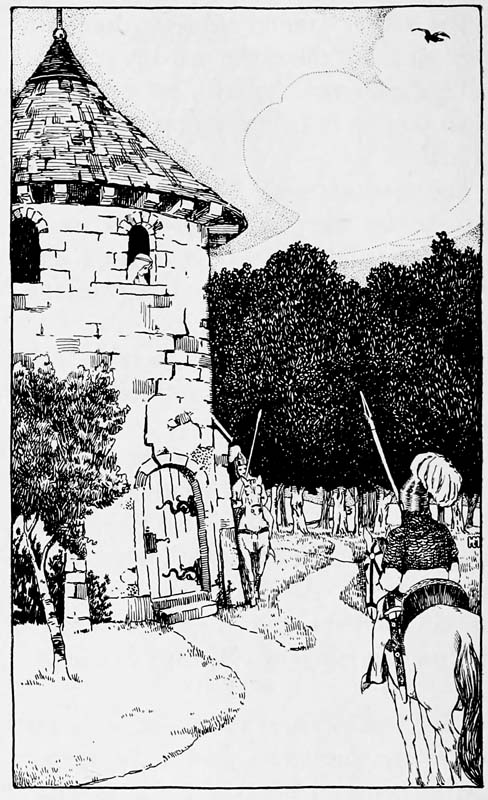
but cruelly cast her into a damp prison
close by the rushing river. There she
must suffer in loneliness until she would
obey the will of Telramund.
At last Elsa sent a long message to
Henry I. begging him for aid. He decided
that the matter should be settled
in the lists. Elsa should choose a champion
to fight with Frederick of Telramund.
Poor Elsa lost all hope when she heard
this decision. She knew full well that no
knight in the neighborhood would dare
accept a challenge from Telramund; for
Telramund had fought many times and
had never been defeated. Day after day
the herald sought someone to battle for
Elsa’s rights. It was as she had feared,
no one answered the call.
Forsaken by all, the orphan girl turned
to the helper of the helpless. Night and
day she knelt in her narrow cell and
prayed. In her great grief she struck her
breast with the rosary clasped in her little
hands.
The little bell attached to the rosary,
gave forth a low tinkling sound. These
silvery tones were very soft and faint.
They could scarcely be heard above the
roar of the waters rushing past the tower.
But they floated out through the narrow
window into the open air.
The winds of heaven caught up the
sounds and whirled them rapidly away.
Farther and farther they traveled, louder
and louder they became. At last it seemed
as if all the bells on earth had united to
ring forth one grand deafening peal.
These loud and pleading tones reached
even into the far distant temple on Montsalvat.
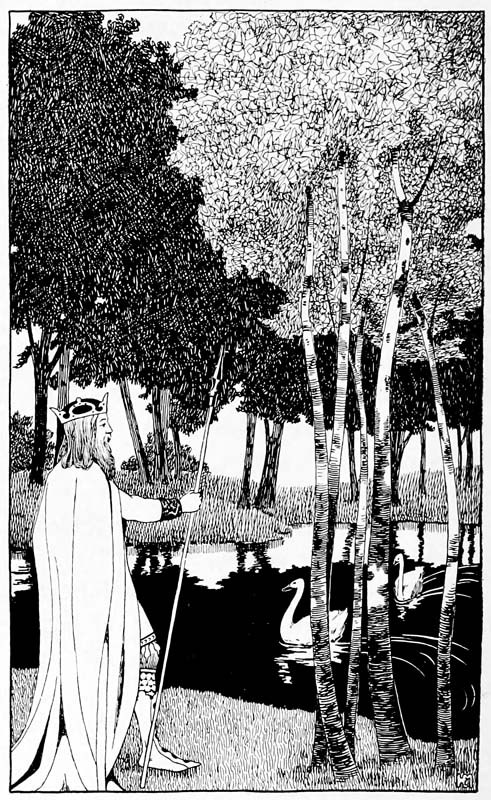
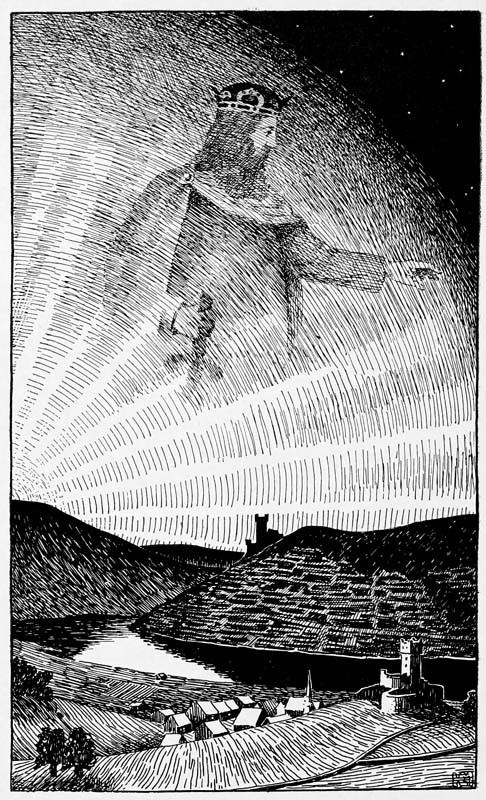
Here King Parsifal and his train
of dauntless knights kept constant watch
over the Holy Grail. The King was
greatly alarmed by the tones. He knew
that some poor creature needed aid, and
so hastened into his inner temple.
Within this holy place there stood a
beautiful vase, giving forth its rosy light.
On its bright edge the King read the message
from heaven. “Send Lohengrin to
defend his future bride, but let her trust
him and never seek to know his origin.”
These were the strange words which met
the aged King’s eyes.
The King immediately sent for his son.
Lohengrin was a brave young knight.
He had been trained to receive the messages
of the Holy Grail with the most
perfect faith. When he heard the words
from his father, he put on his armor,
spoke his farewells, and at once prepared
to mount his waiting steed.
Suddenly sweet music fell upon his ear.
He had never heard anything like it on
land or sea. Soft, low, and sweet, it rose
and fell and rose again. Then, in the distance,
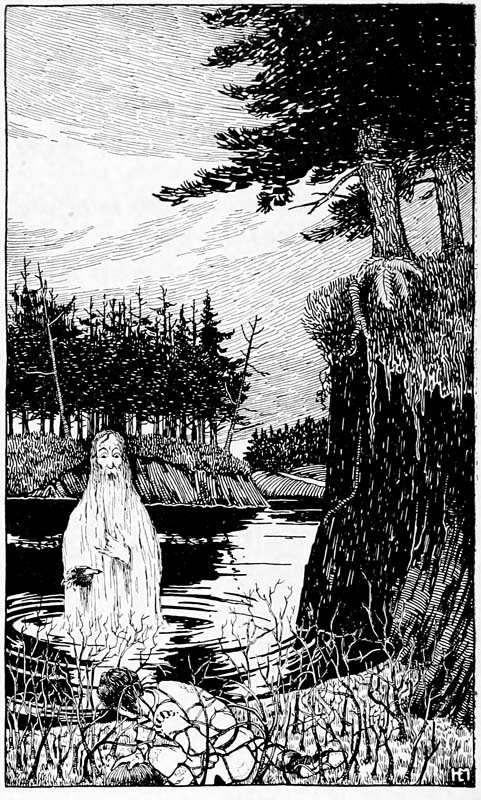
Lohengrin saw a stately swan come
floating toward him. It drew behind it a
little skiff. Nearer and nearer came the
stately swan, clearer and sweeter rose the
mystic strain. Both came to a pause close
by the shore where the wondering knight
stood.
Lohengrin sprang at once into the skiff.
The swan took up its song again, and soon
bore him out of sight.
The day for the tournament had
dawned. The last preparations had been
made. Many knights had gathered to
view the scene. Yet not one dared to
offer himself as champion for the lovely
maiden.
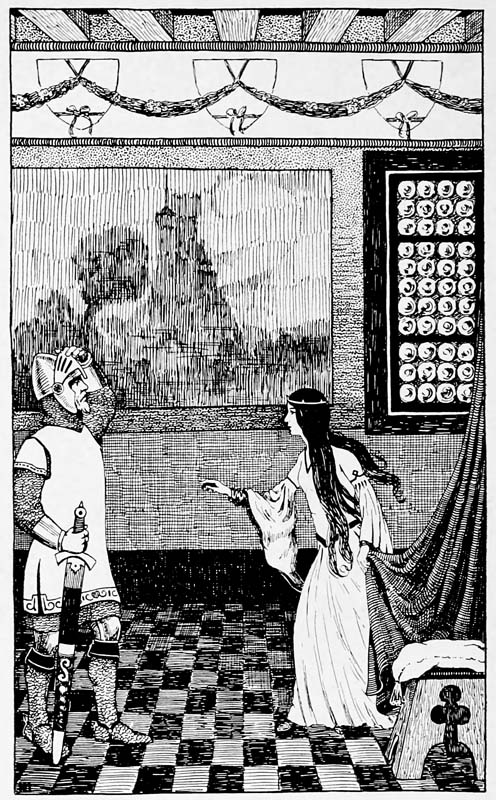
Elsa clung to her prison bars. Tearfully
she repeated for the last time her
prayers.
“Send Thou the deliverer, O Lord!”
she cried.
All at once her sobs ceased. The far
away sounds of music fell comfortingly
upon her ear. She looked out eagerly.
There she beheld a spotless swan floating
gently down the stream, skillfully guiding
a little boat. In the boat a knight in full
armor lay fast asleep on a glittering
shield.
Just as the swan passed beneath the
window where Elsa stood, the knight
awoke. His first glance rested upon her
tear-stained face.
“Weep no more, fair maiden!” he cried,
springing to his feet. “Fear naught! I
have come to defend you!”
The skiff passed on down the river.
The prison door opened, and Frederick of
Telramund appeared to lead Elsa to the
lists. A smile of triumph curled his cruel
lips as he heard the herald give the last
call for Elsa’s champion. The sound of
the trumpets died away and Frederick
had turned to address Elsa. Suddenly a
ringing voice came from the end of the
lists.
“Here am I, the Swan Knight, ready to
fight for the rights of the Princess. I will
win her cause or die.”
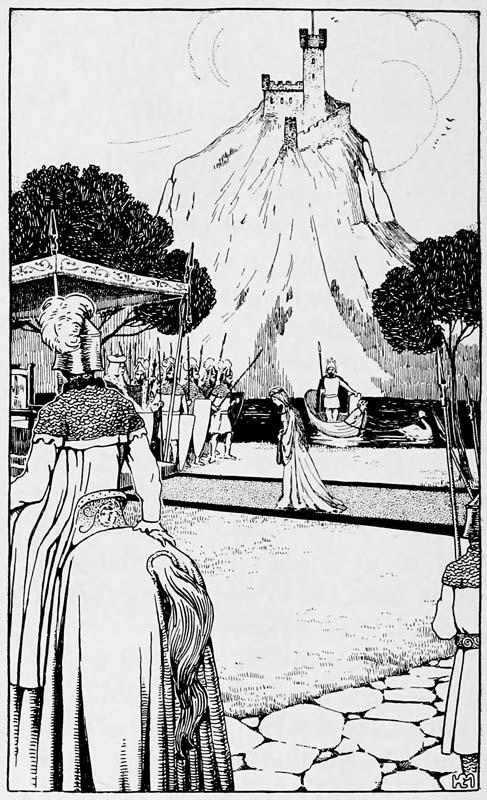
A cry of admiration arose from the
crowd, as they turned toward the Rhine.
There they saw a handsome knight, standing
erect in a tiny skiff drawn by a swan.
Spellbound they watched him. He sprang
lightly ashore and sent the swan away.
It floated down the river and out of sight,
giving forth its own beautiful, dreamy
song.
For a moment Lohengrin knelt at
Elsa’s feet, making a solemn vow to save
her. Then he mounted his waiting steed,
drew down his visor, and took his place
in the lists.
The struggle began. Breathlessly the
knights and ladies watched it. Nothing
could be heard but the clank of steel, the
heavy breathing of the two knights, and
the tramp of their horses feet. The dust
almost hid them from view.
Suddenly a terrible blow was heard.
The great frame of Frederick of Telramund
was seen to sway for a moment in
the saddle, then to fall and roll in the
dust. In a moment Lohengrin had dismounted.
He stood with one foot on
Telramund’s breast, ordering him to surrender.
Triumphant cries and joyful trumpets
told of the victory. Cheer after cheer
rang through the summer air, as Lohengrin
knelt before Elsa once more. The
cries of the knights and ladies were loud
and long. They almost drowned Elsa’s
sweet voice as she bade her champion rise
and name his own reward.
Though the low spoken tones had been
unheeded by the people, not one word had
been lost by Lohengrin.
“Tempt me not, oh noble lady!” he replied.
“Here at your feet where I would
linger forever, I cannot but confess how
much I love you, and how I hope some day
to claim your hand.”
The pretty flush on Elsa’s soft cheeks
deepened at these words. The long
lashes drooped over the beautiful eyes.
Timidly she held out her hand.
“You saved me, sir knight,” she softly
whispered. “I am yours!”
Not a word of this conversation had
been heard by the people, for their shouts
had been redoubled as the knight bent low
over Elsa’s hand and pressed it to his lips.
Before night, however, Elsa’s promise
to become the knight’s bride had gone
abroad. Preparations for the marriage
were begun at once.
Elsa had trembled with fear at the
thought of a union with Frederick of
Telramund, yet she did not hesitate in the
least to give herself to the strange knight
who had saved her. Nor did she doubt
him when he told her that she must never
seek to know either his name or his origin.
These must remain a secret from her
and from all the people or they would
have to part forever.
Many knights and ladies attended the
marriage ceremony. The young Lohengrin
and his lovely bride lived peacefully
and happily for many years. Their love
for each other grew deeper and better as
one by one three beautiful children came
to add to their happiness.
But Elsa, though perfectly content with
her husband’s unchanging love, could not
but notice that many of her people secretly
doubted him. They tried many times,
and in many different ways to discover
his name and origin.
Little by little, she, too, began to
wonder. The more she thought of it, the
more she longed to know her husband’s
secret. Finally, as she was seated by him
one day, she suddenly turned to him and
asked the forbidden question.
“Elsa! Elsa! Is your faith dead?”
cried the Swan Knight in broken voice.
“Can you no longer trust me? I love you
so, and now I must leave you. Our happiness
is at an end! But, before I go,
your question shall be answered. Come
with me!”
His pale face and despairing glance
brought Elsa to her senses. With a loving
cry she flung herself on his breast,
begging him to forgive and forget her
question. He sadly shook his head.
“It is too late, Elsa,” he replied, “too
late! You have doubted me; and I must
leave you; but before I go you shall know
all.”
The knights had gathered in the great
banqueting hall near the Rhine. They
started up in surprise when their master
suddenly came in their midst. He led the
pale and weeping Elsa gently by the hand.
“Listen, oh, knights,” he began. “The
time has come when I must leave you.
Before I go, it is right that you should
know that I am Lohengrin, son of Parsifal,
the great king. I was sent hither by
the Holy Grail, to save your princess,
Elsa, from Frederick of Telramund.
Now the Holy Vessel calls me and I must
go. Ere I depart, I ask you to watch
faithfully over my little ones and to wipe
away their mother’s tears. Farewell!”
Then in the midst of the silence which
followed these words, while he held Elsa
in a last fond embrace, the low strains of
the sweet music again came floating down
the Rhine. A moment later the swan appeared.
Slowly Lohengrin tore himself away
from Elsa’s trembling arms. He sprang
down the steps and into the waiting swan
boat. Away it glided to the strains of
sad music, and bore him out of sight forever.
TRANSCRIBER’S NOTE:
Obvious typographical errors have been corrected.