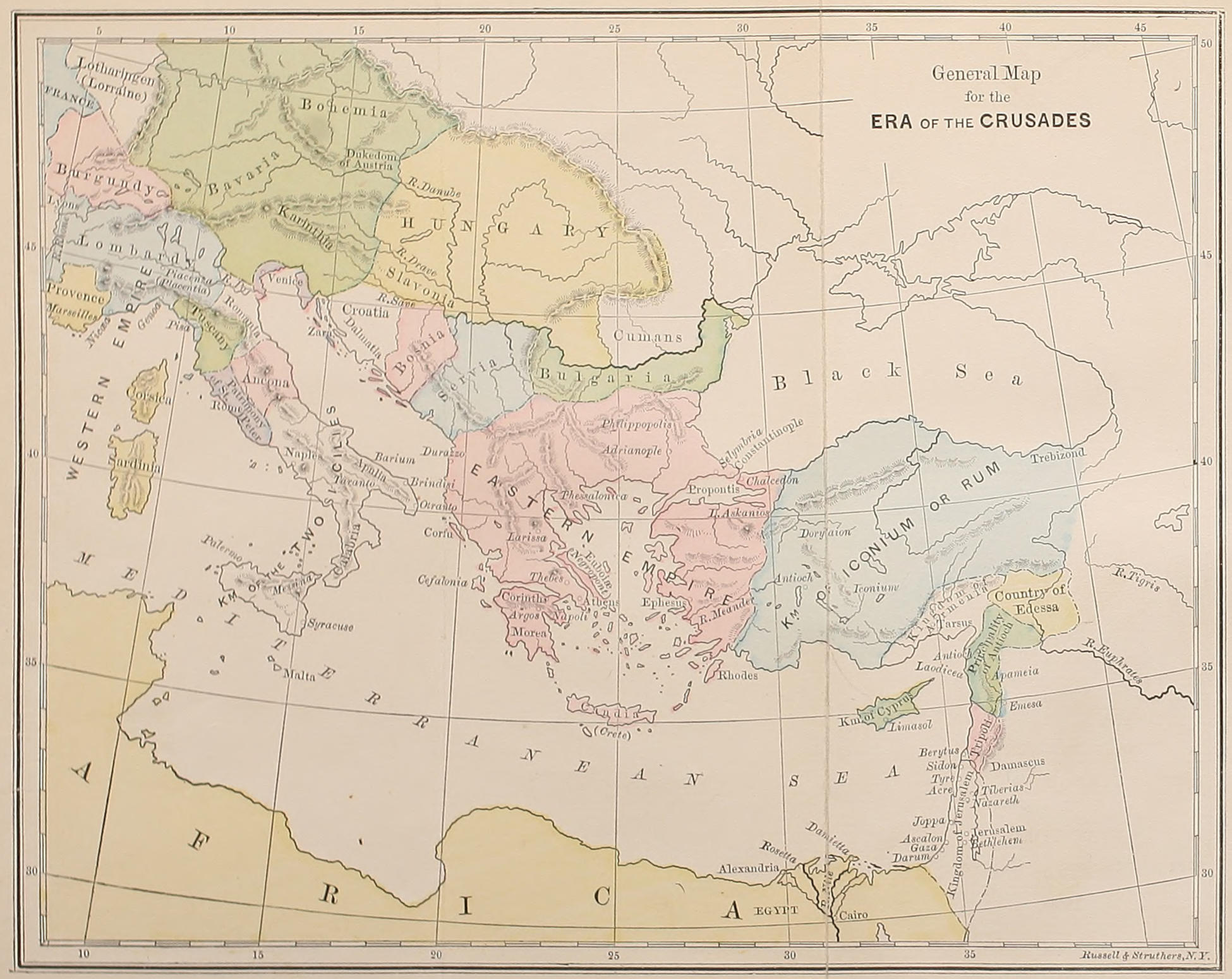
A. D. 1096. Departure of the first rabble of crusaders under Peter the Hermit and Walter the Penniless.
Little more than half the time allowed for the gathering
of the crusaders had passed away, when a crowd
of some sixty thousand men and women,
neither caring nor thinking about the means
by which their ends could be attained, insisted
that the hermit Peter should lead them
at once to the holy city. Mere charity may
justify the belief that some even amongst
these may have been folk of decent lives moved by the
earnest conviction that their going to Jerusalem would do
some good; that the vast majority looked upon their vow
as a license for the commission of any sin, there can be
no moral doubt; that they exhibited not a single quality
needed for the successful prosecution of their enterprise,
is absolutely certain. With a foolhardiness equal to his
ignorance, Peter undertook the task, in which he was
aided by Walter the Penniless, a man with some pretensions
to the soldier-like character. But the utter disorder
of this motley host made it impossible for them to journey
long together. At Cologne they parted company; and
15,000 under the penniless Walter made their way to the
frontiers of Hungary, while Peter led onwards a host
which swelled gradually on the march to about 40,000.
Second rabble under Emico and Gotschalk.
Another army or horde of perhaps 20,000 marched under
the guidance of Emico, count of Leiningen, a third
under that of the monk Gotschalk, a man
not notorious for the purity or disinterestedness
of his motives. Behind these came a
rabble, it is said, of 200,000 men, women, and children,
preceded by a goose and a goat, or, as some have supposed,
by banners on which, as symbols of the mysterious
faith of Gnostics and Paulicians, the likeness of these
animals was painted. In this vile horde no pretence was
kept up of order or of decency. Sinning freely, it would
seem, that grace might abound, they plundered and
harried the lands through which they marched, while
3,000 horsemen, headed by some counts and gentlemen,
were not too dignified to act as their attendants and to
share their spoil.
Bloody persecutions of the Jews.
The Jews taken under the protection of the empire.
But if they had no scruple in robbing Christians, their
delight was to prove the reality of their mission as soldiers
of the cross by plundering, torturing, and
slaying Jews. The crusade against the Turk
was interpreted as a crusade directed not
less explicitly against the descendants of those who had
crucified the Redeemer. The streets of Verdun and
Treves, and of the great cities on the Rhine, ran red with
the blood of their victims; and if some saved their lives
by pretended conversions, many more cheated their persecutors
by throwing their property and their persons
either into the rivers or into the consuming fires. Thus
auspiciously began the mighty enterprise on which pope
Urban had insisted as the first duty of all Christians; and
thus early did the result of his preaching tend to revive
the waning power of the emperor, who interposed his
authority to this merciless onslaught on a
peaceable and useful class of his subjects.
The Jews were taken under the protection
of the empire, and for the time the change
was a real relief. Their posterity found to their cost that
their guardian might in his turn become their plunderer
and tormentor.
March of Walter and his followers through Hungary and Bulgaria.
A space of six hundred miles lay between the Austrian
frontier and Constantinople; and across the dreary waste
the followers of Walter the Penniless struggled
on, destitute of money, and rousing
the hostility of the inhabitants whom they
robbed and ill-used. In Bulgaria their misdeeds
provoked reprisals which threatened
their destruction; and none perhaps would have reached
Constantinople, if the imperial commander at Naissos
had not rescued them from their enemies, supplied them
with food, and guarded them through the remainder of
their journey. These succours involved some costs;
and the costs were paid by the sale of unarmed men
amongst the pilgrims, and especially of the women and
children, who were seized to provide the necessary funds.
Of those who formed the train of the hermit Peter, seven
thousand only, it is said, reached Constantinople.
Passage of the pilgrims across the Bosporos.
Of such a rabble rout the Emperor Alexios needed
not to be afraid. He had already seen and encountered
far larger armies of Normans, Turks, and
Romans; and he now extended to this vanguard
of the hosts of Latin Christendom a
hospitality which was almost immediately abused. They
had refused to comply with his request that they should
quietly await the arrival of their fellow crusaders; and
consulting the safety of his people not less than his own,
he induced them to cross the Bosporos, and pitch their
camp on Asiatic soil, the land which they had come to
wrest from the unbelievers.
Their utter destruction by Kilidje Arslan.
Alexios wished simply to be rid of their presence:
they had to deal with an enemy still more crafty and
formidable in the Seljukian Sultan David, whose surname
Kilidje Arslan marked him out as the Sword of
the Lion. The vagrants whom Peter and
Walter had brought thus far on the road to
Jerusalem were scattered about the land in
search of food; and it was no hard task for David to
cheat the main body with the false tidings that their
companions had carried the walls of Nice (Nikaia), and
were revelling in the pleasures and spoils of his capital.
The doomed horde rushed into the plain which fronts the
city; and a vast heap of bones alone remained to tell
the story of the great catastrophe, when the forces which
might more legitimately claim the name of an army
passed the spot where the Seljukian had entrapped and
crushed his victims. In this wild expedition not less, it
is said, than 300,000 human beings had already paid the
penalty of their lives.
Rank and character of the leaders of the first crusade.
Still the first crusade was destined to accomplish more
than any of the seven or eight crusades which followed
it; and this measure of success it achieved
probably because none of the great European
sovereigns took part in it. The Western
emperor, Henry IV., the representative of
Charles the Great was the enemy of the pope; Philip I.,
king of France, had been excommunicated by Urban in
the council of Clermont; the sovereigns of Denmark,
Scotland, Sweden and Poland were as yet scarcely
brought within the community of European monarchs;
the Spanish kings had their crusades ready made at home;
and we have already seen that the English William II.,
was more intent on acquiring dukedoms than on running
the risk of a blessed martyrdom at the gates of Jerusalem.
The task of setting up a Latin kingdom in Palestine
was to be achieved by princes of the second order.
Godfrey of Bouillon and his brothers Baldwin and Eustace.
Of these the foremost and the most deservedly illustrious
was Godfrey, of Bouillon in the Ardennes, a kinsman
of the counts of Boulogne, and duke of
Lothringen (Lorraine). In the service of the
emperor Henry IV., the enemy or the victim
of Hildebrand, he had been the first to
mount the walls of Rome and cleave his way into the
city; he might hope that his crusading vow would be
accepted as an atonement for his sacrilege. Speaking
the Frank and Teutonic dialects with equal ease, he exercised
by his bravery, his wisdom, and the uprightness
of his life, an influence which brought to his standard,
it is said, not less than 80,000 infantry and 10,000 horsemen,
together with his brothers Baldwin and Eustace,
count of Boulogne.
Hugh of Vermandois.
Robert of Normandy.
Among the most conspicuous of Godfrey’s colleagues
was Hugh, count of Vermandois, whose surname the
Great has been ascribed by some to his birth
as the brother of Philip I., the French king,
by others merely to his stature as ‘Hugh the long.’
With him may be placed the Norman duke Robert,
whose carelessness had lost him the crown
of England, and who had now pawned his
duchy for a pittance scarcely less paltry than that for
which Esau bartered away his birthright. The picture
drawn of him is indeed not unlike that of the forefather of
the Edomite tribes. Careless of the future, open in his
friendship or his enmity, free from duplicity in himself
and unsuspicious of treachery in others, charming others
and injuring himself by his light-hearted cheerfulness
and his lavish generosity, Robert was a man whom the
total lack of the qualities which marked his iron-hearted
father brought to a horrible captivity and death in the
dungeons of Cardiff Castle.
Robert of Flanders and Stephen of Chartres.
The number of the great chiefs who led the pilgrims
from northern Europe is completed with the names of
Robert, count of Flanders, whom his followers
lauded as the Sword and Lance of
the Christians, and of Stephen, count of
Chartres, Troyes, and Blois, the possessor, if we choose
to believe the tale, of 365 castles, and as rich in his eloquence
as in his fortresses. The same arithmetic would
have us think that the minor chiefs were more numerous
than the champions whom Agamemnon led to the Trojan
war; and the assertion is perhaps as much and as
little to be credited as the catalogue of Greek warriors in
the Iliad.
Adhemar bishop of Puy.
Raymond of Toulouse.
Foremost, by virtue of his title and office, among the
leaders of the southern bands, was the papal legate
Adhemar (Aymer) bishop of Puy—a leader
rather as guiding the counsels of the army
than as gathering soldiers under his banner. A hundred
thousand horse and foot attested, we are told, the greatness,
the wealth, and the zeal of Raymond,
count of Toulouse, lord of Auvergne and
Languedoc, who had grown old in warfare, and won for
himself a mingled reputation for wisdom and haughtiness,
obstinacy and greed.
Bohemond.
Less tinged with the fanatical enthusiasm of his comrades,
and certainly more cool and deliberate in his
ambition, Bohemond, son of Robert Guiscard,
whom we have seen fighting at Dyrrhachium
and victorious at Larissa (p. 23), looked to the
crusade as a means by which he might regain the vast
regions extending from the Dalmatian coast to the
northern shores of the Egean. Nay, if we are to believe
William of Malmesbury, he urged Urban to set forward
the enterprise for the very purpose, partly, of thus recovering
what he was pleased to regard as his inheritance,
and in part of enabling the pontiff to suppress all opposition
in Rome. Guiscard had left his Apulian domains
to a younger son, and Bohemond was resolved, it would
seem, to add to his principality of Tarentum a kingdom
which would make him a formidable rival of the Eastern
emperor.
Tancred.
Far above his companion Bohemond, rises his cousin
Tancred, the son of the marquis Odo, surnamed the
Good, and of Emma, the sister of Robert
Guiscard; and his reputation comes not
from his wealth or the greatness of his following, but
from the qualities of mind and person which raised him
indefinitely nearer than his fellows to the standard of the
‘very gentle perfect knight’ of Chaucer. In Tancred
was seen the embodiment of those peculiar sentiments
and modes of thought which gave birth to the crusades,
and to which the crusades in their turn imparted marvellous
strength and splendour.
Cause and effect of chivalry.
Knighthood.
Courtesy.
When in the council of Clermont pope Urban dwelt
on the cowardice and ignoble fears of the Turks, he
probably touched a chord which grated on
the more generous and enthusiastic amongst
his hearers, and was in fact speaking as a
priest when with greater wisdom he should have used the
language of a general. There can be little doubt that
the finer spirits of the age were moved by the eager
desire of rescuing a crowd of helpless Christians from
conquerors whose might it was impossible for them to
resist, and who were worthy antagonists even for the
noblest knights of Latin and Teutonic Christendom.
The rescue of this feeble multitude could be effected only
at the cost of a great sacrifice,—the sacrifice of houses
and lands, of luxuries and pleasures: and the consciousness
of large sacrifices, cheerfully made for the weak and
suffering, is amongst the highest feelings which may be
awakened in the human heart. Thus in the most noble-minded
and disinterested of the crusading champions
there was distinctly a combination of two ideas, seemingly
discordant, yet working together to produce one definite
moral result. These were the indignation with which
they regarded the tyranny exercised over the Christians
of the East, and the involuntary respect and even admiration
which they felt for the conquerors as the most redoubtable
warriors of the age next to the foremost knights
of Christendom. The former feeling would impel them
to the most desperate efforts for the recovery of the Holy
Land and the Holy Sepulchre; the latter would place
checks dimly recognized and not always heeded on the
ferocious warfare with which they would without scruple
seek to sweep away all meaner or more savage enemies.
So far as he was actuated by such motives, the crusader
was cultivating in himself the germs of forbearance and
toleration which must at once to whatever extent soften
the horrors of war and which would in the end yield
more solid and satisfying fruits. In this same direction
the influence of the Church was felt with constantly increasing
power. It had been her aim to curb, when she
could not repress, the violence of her children, and to
establish by a solemn sanction that Truce of God which
prevented the practice of private war from becoming a
burden too heavy for the earth to bear. But in the expedition
for the delivery of the Holy Land war itself was
sanctified; and the knight, initiated even in past years
by rites, which, heathen in their origin, had been made
sacred by the Church, was raised almost to the level of
the priest and the monk. Henceforth the young aspirant
for the knightly dignity and office was treated much as
the catechumens had been treated in the first
Christian centuries. He must enter on his
work with clean thoughts and pure conscience, and the
spotless garment of the catechumen, purified by his long
fast, was reproduced in the white robe which the young
squire put on after cleansing his body in the bath, while
the profession of baptism was repeated in the knightly
vow which (after a special confession of sin followed by
absolution) pledged the young man to deal justly, truly,
and generously, defending the oppressed, succouring the
needy and helpless, and everywhere showing himself the
unsparing antagonist of all tyrants and evil-doers. In an
especial degree he was to be the champion of women,
the protector of children; and he rose from his knees
before the assembled clergy, dubbed a knight by the
sword of his godfather in the names of God, of our Lady,
and of St. Michael, or St. George. The nearest to the
heart of those who uttered this formula, as to that of
the young knight, was the name of the Virgin Mother,
whose name, it would seem, has fascinated multitudes
without curing them of savage treachery and bloodthirsty
ferocity. In feudal phrase she was his Lady
(Notre Dame), as the crucified Jesus was his Lord (Notre
Seigneur); and the adoring and humble love which he
bore for her was held to sanctify and to be reflected in
the devotion which he felt for every noble lady and more
especially for the one favoured dame who became the
idol of his heart, a star to be worshipped at a distance,
if not a queen at whose feet he might throw himself in
an ecstacy of passion. This being whom he delighted
to picture to himself as the peerless ideal of womanhood
might be the wife of another man; and these extravagant
fancies produced not unfrequently the most lamentable
and ruinous results. But the knightly or chivalrous
spirit, thus sometimes led astray, tended nevertheless to
impose moral checks on rude and savage minds which
had never felt them before; and the growth of this spirit
was ensured chiefly by the crusaders. The iniquities
wrought by the soldiers of the Cross were fearful indeed;
but the horrors of the warfare were in some small measure
softened by the honour which the foremost warriors on
both sides paid each to the bravery and good faith of the
other; and this feeling expressed itself in a word which
even now has by no means lost its meaning. The quality
of courtesy so named displayed itself in the
readiness to give place to another where
strength and power might have refused all concessions.
It was closely allied to the Christian qualities of meekness
and mercy, and any approach to this heavenly temper
was a gain indeed in a brutalized and ferocious age. The
highest glory of the crusading knight was to be a mirror
of courtesy: and this glory is especially associated with
the name of Tancred. Tancred lived, fought, and conquered:
the Rinaldo whom Tasso paints in his epic
poem on the deliverance of Jerusalem is a being of
cloudland like the Greek Achilleus, the Trojan Hektor,
and the Persian Rustam.
A. D. 1096. August. Departure of the main army of the crusaders under Godfrey.
The miserable remnant of 3,000 men who escaped
from the field of blood before the city of the Seljukian
Sultan (p. 41), found a refuge in Byzantine
territory about the time when the better appointed
armies of the crusaders were setting
off on their eastward journey. The most
disciplined of these troops set out with a
vast following from the banks of the Meuse and the
Moselle under Godfrey of Bouillon who led them safely
and without opposition to the Hungarian border. Here
the armies of Hungary barred the way against the advance
of a host at whose hands they dreaded a repetition
of the havoc wrought by the lawless bands of Peter
the Hermit and his self-chosen colleagues. Three weeks
passed away in vain attempts to get over the difficulty.
The Hungarian king demanded as a hostage Baldwin,
the brother of the general: the demand was refused, and
Godfrey put him to shame by surrendering himself. He
asked only for a free passage and a free market; but
although these were granted, it was not in his power to
prevent some disorder and some depredations as his
army or horde passed through the country. The mischief
might have been much worse, had not the Hungarian
cavalry, acting professedly as a friendly escort but
really as cautious warders kept close to the crusading hosts.
Captivity of Hugh of Vermandois.
At length they reached the gates of Philippopolis, and
here Godfrey learnt that Hugh of Vermandois, whose
coming had been announced to the Greek
emperor Alexios by four-and-twenty knights
in golden armour, and who styled himself
the brother of the king of kings and lord of all the Frankish
hosts, was a prisoner within the walls of Constantinople.
With Robert of Normandy and Robert of Flanders,
with Stephen of Chartres and some lesser chiefs,
Hugh had chosen to make his way through Italy; and
the charms of that voluptuous land had a greater effect,
it seems, in breaking up and corrupting their forces than
the delights of Capua had in weakening the soldiers of
Hannibal. With little regard to order the chiefs determined
to cross the sea as best they might. Hugh embarked
at Bari; and if we may believe Anna Comnena,
the historian and the worshipper of her father Alexios,
his fleet was broken by a tempest which shattered his
own ship on the coast between Palos and Dyrrhachium
(Durazzo), of which John Comnenos, the nephew of the
emperor, was at this time the governor. The Frank
chief was here detained until the good pleasure of Alexios
should be known. That wary and cunning prince saw
at once how much might be made of his prisoner, who
was by his orders conducted with careful respect and
ceremony to the capital. Kept here really as a hostage,
but welcomed to outward seeming as a friend, Hugh was
so completely won by the charm of manner which Alexios
well knew how and when to put on, that, paying him
homage and declaring himself his man, he promised to
do what he could to induce others to follow his example.
A. D. 1096. Christmas. Arrival of Godfrey before the walls of Constantinople.
Policy of the emperor Alexios.
From Philippopolis Godfrey sent ambassadors to
Alexios, demanding the immediate surrender of Hugh.
The request was refused, and Godfrey resumed
his march, treating the land through
which he passed as an enemy’s country,
until by way of Adrianople he at length appeared
before the walls of the capital at
Christmastide, 1096. The fears of Alexios were aroused
by the sight of a host so vast and so formidable: they
quickened into terror as he thought of the armies which
were still on their way under the command of Bohemond
and Tancred. Of Godfrey, beyond the fact
of his mission as a crusader, he knew little
or nothing: but in Bohemond he saw one
who claimed as his inheritance no small portion of his
empire. This gathering of myriads, whom a false step
on his part might convert into open enemies, was the result
of his own entreaties urged through his envoys before
Urban II. in the council of Piacenza; and his mind
was divided between a feverish anxiety to hurry them on
to their destination and so to rid himself of their hateful
presence, and the desire to retain a hold not only on the
crusading chiefs but on any conquests which they might
make in Syria.
Compact between Alexios and the crusaders.
Hugh was sent back to Godfrey’s camp; but the
quarrel was patched up, rather than ended. It was
easier to rouse suspicion and jealousy than to restore
friendship. But it was of the first importance
for Alexios that he should secure the
homage of the princes already gathered
round his capital before the arrival of his ancient enemy
Bohemond. In this he succeeded, and a compact was
made by which Alexios pledged them his word that he
would supply them with food and aid them in their eastward
march, and would protect all pilgrims passing
through his dominions. On the other hand the crusading
chiefs, as already subjects of other sovereigns, gave
their fealty to the emperor as their liege lord only for the
time during which they might remain within his borders,
and undertook to restore to him such of their conquests
as had been recently wrested from the empire. In order
to secure this treaty Alexios had been compelled to go
through the fatigue of interminable audiences with the
Western warriors and to put up with not a little insolence.
The effrontery of a crusader, who flinging himself
on the imperial throne declared that he saw no
reason for standing while one rustic remained seated,
was denounced as intolerable rudeness even by his companions;
but Robert, count of Paris, if indeed it was he,
closed a brief career not many weeks later, and is more
conspicuous in modern romance than in the pages of
mediæval historians.
Homage of the crusaders to Alexios.
The spirit of Bohemond was stirred deeply within
him when on reaching Constantinople he found that his
colleagues, instead of remaining independent
chiefs, had made themselves vassals of
the Byzantine monarch. But Alexios was
vigorously aided by Robert of Flanders, whose friendly
offices were the result of an alliance made with his
father eight years before; and Bohemond soon saw that
he must in appearance follow the example of his comrades,
whatever course it might suit him to take hereafter.
He became the guest of the emperor, listened
with complacency to his flatteries, accepted a magnificent
gift or bribe, and accompanied his submission with a request
for the office of Grand Domestic, or general of the
East. The emperor put him off with the promise of an
independent principality, and turned with more genuine
warmth to the honest simplicity of Godfrey. This disinterested
crusader was anxious only to fulfill his vows;
and Alexios felt that he was making no sacrifice and entering
into no inconvenient engagements by adopting
him as his son.
Disastrous march of Raymond of Toulouse to Constantinople.
The policy and the bribes of Alexios had overcome
the opposition of Bohemond. He was to experience a
stouter resistance from Raymond of Toulouse, who,
though he had been the first to enlist, was
the last to set out on his crusade. He should
never make another journey, he said, and he
was determined to be well prepared. Wishing
to avoid, so far as he could, the lines of
march chosen by the chiefs who had preceded him, he
took the road through Lombardy. Thus far his march
was easily accomplished: but things wore a different look
when he reached the savage mountains and desolate
valleys of Dalmatia and Slavonia. The people had
driven their cattle (and their cattle formed practically
their whole property) into inaccessible glens: and instead
of plundering others the crusaders found themselves harassed
and their stragglers cut off by thieves and murderers.
Raymond retaliated by cutting off the hands and
noses of all who were taken prisoners and putting out
their eyes; and the wrath of the natives was roused to
desperate resistance. At Scodra he entered into some
sort of agreement with the Servian chief Bodin; but the
country could yield little for the support of this vast
army, which was compelled to struggle onwards under
dire difficulties. It is astonishing to hear that Raymond
could still speak of himself as the leader of a hundred
thousand warriors, when he refused flatly to do homage
to the Greek emperor.
Refusal of Raymond to do homage.
The count of Toulouse scarcely regarded himself as
the vassal even of the French king. He was ready, he
said, to be the friend of Alexios on equal
terms; but he would not declare himself to
be his man. On this point he was immovable,
although Bohemond tried the effect of a threat,
which was never forgiven, that if the quarrel came to
blows, he should be found on the side of the emperor.
But Alexios soon saw that in Raymond he had to deal
with an enthusiast as sincere and persistent as Godfrey.
He took his measures accordingly, and winning the heart
of the old warrior, although he failed to compel his obedience,
he confessed to him his dislike of the rude and
noisy habits of the Franks and his deep-seated fears of
Bohemond. The admiration of Anna Comnena was as
great as the esteem professed for him by her father. Raymond
in her fervent language shone among the barbarians
as the sun among the stars of heaven.
Conduct of Alexios to the crusaders.
A. D. 1097. March.
While Alexios was thus busied in dealing with Godfrey
and Raymond, Bohemond and Tancred, he was not less
anxiously occupied with the task of sending
across the Bosporos the swarms which might
soon become an army of devouring locusts
round his own capital. It was easier to give them a welcome
than to get rid of them: and more than two months
had passed since Christmas, when the followers
of Godfrey found themselves on the soil
of Asia. It was well to place even a narrow strait of sea
between himself and these dangerous friends, who had
threatened him at first with all the horrors of savage war.
The rumour had got abroad that Alexios meant to hem
them in among marshes, and leave them there to starve;
and an assault of the crusaders on the suburbs showed
the emperor what he might expect, if these suspicions
were not quieted. Probably he had not intended to entrap
them to their death: but he had felt less scruple in
submitting them to cheatings with debased coin and to
extortions which carried with them no sense of novelty
for his own people. Even these he found it politic to
abandon, and so zealously did he employ an opposite
method that for the time the crusaders seemed to have
become his mercenaries.
Passage of the crusaders across the Bosporos.
Godfrey’s men had no sooner been landed on the
eastern side of the Bosporos, than all the vessels which
had transported them were brought back
to the western shore. With great astuteness,
and at the cost of large gifts, Alexios
in like manner freed the neighbourhood of his capital
from the invading multitudes. As fast as they came,
they were hurried across, and the emperor breathed
more freely when, on the feast of Pentecost, not a single
Latin pilgrim remained on the European shore.
Thorough antagonism between the crusaders and the Greeks.
Contrast between the Greek and Latin clergy.
The danger of conflict had throughout been imminent;
and the danger arose, not so much from the fact
that the crusaders were armed men, marching
through the country of professed allies,
but from the thorough antagonism between
Greeks and Latins in modes of thought and
habits of life, in the first notions of civilization, law, and
duty. For the Greeks feudalism was a thing of the remote
past; in other words, was a thing unknown. To
get at a state resembling that of Western Europe they
would have had to go back for nearly twenty centuries—to
the days of Solon and of the Thessalian and Theban
nobility, who were among the most efficient allies of
Xerxes. For the crusading armies or rather for their
chiefs (of the common herd there was no need to take
any account), nothing was so hateful as a central authority
which pressed on all orders in the state alike:
nothing was so precious as local tyranny and the right
of private war, which respected neither person nor property.
For the subjects of the Eastern empire the protection
of person and property was everything, and in
order to secure this they were willing to put up with a
large amount of oppression and of corruption in their
governors. In a sense not so high perhaps as that which
the words bore in the days of Herodotos, law was still
their king; and of public law the Latins could scarcely
be said to have any conception. Nor must
we forget the vast gulf which separated the
Eastern from the Western clergy. The
latter were now becoming well broken into
the yoke of celibacy which had been finally thrust upon
them by Damiani and Hildebrand; for the former marriage
was a condition for the very reception of their
orders. The Latin clergy had by this change been converted
into a close order or caste, which looked up to the
Roman pontiff as their head and hated the thought of
allegiance to any temporal ruler. This empire within
an empire was an idea which had not dawned on the
Greek or the Eastern mind; and the clergy of the West
despised their brethren of the East for their cowardly
submission to the secular arm. These, in their turn,
shrunk with horror from the sight of bishops, priests,
and monks riding with blood-stained weapons over fields
of battle, and exhibiting at other times an ignorance
equal to their ferocity. Harmony between nations and
races under such conditions is as hopeless as the voluntary
mingling of oil and water; and the result of contact
was an exasperation of the suspicion, jealousy, and
hatred which the one side felt instinctively for the supposed
treachery, lying, and violence of the other.
Numbers of the crusaders.
Thus was gathered on the eastern shores of the
Hellespont and the Bosporos a host, we may well believe
more vast than that which Xerxes drove
before him for the invasion of Europe, and
leaving behind it in utter insignificance the
scanty force with which Alexander attempted and
achieved the conquest of Asia. When tribes or a nation
pour out their whole population, men, women, and children
alike, there is practically no limit to the numbers
which may be set in motion; nor is it any tax on our
credulity to believe that a hundred thousand horsemen,
fully armed in the light coats of mail worn during the
first crusading age, were marshalled on the Bithynian
plains, even if we put aside as an absurd exaggeration
the notion of the chaplain of Count Baldwin, that the
whole body of the crusaders amounted to not less than
six millions.
June. Siege and fall of Nice (Nikaia).
July 4. Battle of Dorylaion.
Their strength and valour were soon to be tested.
They were now face to face with the Turks on whose
cowardice Urban II. had enlarged with so
much complacency before the council of
Clermont. The Sultan David, or Kilidje
Arslan (p. 41), placed his family and treasures in his
capital city of Nice (Nikaia), and retreated with 50,000
horsemen to the mountains, whence he swooped down
from time to time on the outposts of the Christians. By
these his city was formally invested; and for seven weeks
it was assailed to little purpose by the old instruments
of Roman warfare, while some of the besiegers shot
their weapons from the hill on which were mouldering
the bones of the fanatic followers of Peter. It was protected
to the west by the Askanian lake, and so long as
the Turks had command of this lake they felt themselves
safe. But Alexios sent thither on sledges a large
number of boats, and the city, subjected to a double
blockade, submitted to the emperor, who was in no way
anxious to see the crusaders masters of the place. The
crusaders were making ready for the last assault, when
they saw the imperial banner floating on the walls. Their
disappointment at the escape of the miscreants, or unbelievers,
for so they delighted to speak of them, was
vented in threats which seemed to bode a renewal of
the old troubles: but Alexios, with gifts, which added
force to his words, professed that his only desire now,
as it had been, was to forward them safely on their
journey. Nor had they to go many stages before they
found themselves again confronted with their adversary.
The conflict took place near the Phrygian
Dorylaion, and seemed at first to portend
dire defeat to the crusaders. More than once
the issue of the day seemed to be turned by the indomitable
personal bravery of the Norman Robert, of
Tancred, and of Bohemond; and when even those
seemed likely to be borne down, they received timely
succours from Godfrey, and Hugh of Vermandois, from
bishop Adhemar of Puy and from Raymond, count of
Toulouse. Still the Turks held out, and it seemed likely
that they would long hold out, when the appearance
of the last division of Raymond’s army filled them with
the fear that a new host was upon them.
March to Cogni and the Pisidian Antioch.
Quarrel between Baldwin and Tancred at Tarsus.
The crusaders had won a considerable victory. Three
thousand knights belonging to the enemy had been slain,
and Kilidje Arslan was hurrying away to
enlist the services of his kinsmen. Meanwhile
the Latin hosts were sweeping onwards,
passing Cogni (Ikonion, Iconium), Erekli (Herakleia),
and the Pisidian Antioch. Their dangers were
great; their sufferings terrible. The son of Kilidje
Arslan had hurried on before them with ten thousand
horsemen, and declared before the gates of each city
that they came as conquerors, not as fugitives. They
had ravaged the lands as they came along; in the town
they sacked the churches, plundered the houses, emptied
the granaries; and the crusaders who followed them
had to journey over a naked soil under the burning
Phrygian sun. Hundreds died from the heat: and dogs
or goats took the place of the baggage horses which had
perished. At length Tancred with his troop found himself
before Tarsus, the birthplace and the home of that
single-hearted apostle who long ago had preached a
gospel strangely unlike the creed of the crusaders. Following
rapidly behind him, Baldwin saw
with keen jealousy the banner of the Italian
chief floating on its towers, and insisted on
taking the precedence. Tancred pleaded
the choice of the people and his own promise to protect
them; but the intrigues of Baldwin changed their
humour, and the rejection of Tancred by the men of
Tarsus was followed by an attempt at private war between
Tancred and Baldwin, in which the troops of
Tancred were overborne. So early was the first harvest
of murderous discord reaped among the holy warriors
of the cross. It was ruin, however, to stay where they
were; and the main army again began its march, to
undergo once more the old monotony of hardship and
peril.
Conquest of Edessa by Baldwin.
A very small force would have sufficed to disorganize
and rout them as they clambered over the defiles of
Mount Taurus; nor could Raymond, recovering
from a terrible illness, or Godfrey,
suffering from wounds inflicted by a bear,
have done much to help them. But for the present
their enemies were dismayed; and Baldwin, brother of
Godfrey, hastened with eagerness to obey a summons
which besought him to aid the Greek or Armenian tyrant
of Edessa. As Alexios had done to his brother, so this
chief welcomed Baldwin as his son; but Baldwin, having
once entered into the city, cared nothing for the means
which had brought him thither, and the death of his
adoptive father was followed by the establishment at
Edessa of a Latin principality which lasted for fifty-four,
or, as some have thought, forty-seven years. Baldwin
had anticipated the unconditional surrender of Samosata;
but the Turkish governor had some of the Edessenes
in his power, and he refused to give up the city
except on the payment of ten thousand gold pieces.
The Turk shortly afterwards fell into Baldwin’s hands,
and was put to death.
Arrival of the crusaders before the Syrian Antioch.
A. D. 1097. Oct.
Meanwhile the main army of the crusaders was advancing
towards the Syrian capital, that ancient and
luxurious city whose fame had gone over the
whole Roman world for its magnificence, its
unbounded wealth, its soft delights, and its
unholy pleasures. The days of its greatest splendour
had passed away. Its walls were partially in ruins; its
buildings were in some parts crumbling away or had
already fallen; but against assailants utterly ignorant
and awkward in all that relates to the blockade of cities
it was still a formidable position. Nor could they invest
it until they had passed the iron bridge (so called from
its iron-plated gates) of nine stone arches, which spanned
the stream of the Ifrin at a distance of nine miles from the
city. This bridge was carried by the impetuous charge
of Robert of Normandy, aided by the more steady efforts
of Godfrey; and in the language of an age which delighted
in round numbers, a hundred thousand
warriors hurried across to seize the
splendid prize which now seemed almost within their
grasp.
Siege of Antioch.
But the city was in the hands of men who had been
long accustomed to despise the Greeks, and who had
not yet learnt to respect the valour of the
Latins. Preparing himself for a resolute
defence, the Seljukian governor Baghasian had sent
away, as useless, if not mischievous, most of the Christians
within the town; and the crusading chiefs had
begun to discuss the prudence of postponing all operations
till the spring, when Raymond of Toulouse with
some other chiefs insisted that delay would imply fear,
and that the imputation of cowardice would ensure the
paralysis of their enterprise. The city was therefore at
once invested, so far as the forces of the crusaders could
suffice to encircle it; and a siege began which in the
eyes of the military historian must be absolutely without
interest, and of which the issue was decided by paroxysms
of fanatical vehemence on the one side, and by
lack not of bravery but of generalship on the other. Of
the eastern and northern walls the blockade was complete;
of the west it was partial; and the failure to invest
a portion of the western wall, with two out of the five
gates of the city, left the movements of the Turks in this
direction free.
Folly of the besiegers.
But the besiegers were in no hurry to begin the work
of death. The wealth of the harvest and the vintage
spread before them its irresistible temptations,
and the herds feeding in the rich pastures
seemed to promise an endless feast.
The cattle, the corn, and the wine were alike wasted
with besotted folly, while the Turks within the walls received
tidings, it is said, of all that passed in the crusading
camp from some Greek and Armenian Christians to
whom they allowed free egress and ingress. Of this
knowledge they availed themselves in planning the sallies
by which they caused great distress to the besiegers,
whose clumsy engines and devices seemed to produce no
result beyond the waste of time, and who felt perhaps
that they had done something when they blocked up the
gate of the bridge with huge stones dug from the neighbouring
quarries.
Famine in the crusading camp.
Three months passed away; and the crusaders found
themselves not conquerors but in desperate straits from
famine. The winter rains had turned the land round
their camp into a swamp, and lack of food left them
more and more unable to resist the pestilential
diseases which were rapidly thinning
their numbers. A foraging expedition under
Bohemond and Tancred filled the camp with food: it
was again recklessly wasted. The second famine scared
away Tatikios, the lieutenant of the Greek emperor
Alexios; but the crusading chiefs were perhaps still more
disgusted by the desertion of William of Melun, called
the Carpenter, from the sledge-hammer blows which he
dealt out in battle. Hunger obtained a victory even
over the hermit Peter, who was stealing away with
William of Melun, when he with his companion was
caught by Tancred and brought back to the tent of Bohemond.
Arrival of envoys from the Fatimite sultan of Egypt.
For a moment the look of things was changed by the
arrival of ambassadors from Egypt. To the Fatimite
caliph of that country the progress of the
crusading arms had thus far brought with it
but little dissatisfaction. The humiliation
of the Seljukian Turks could not fail to bring
gain to himself, if the flood of Latin conquests could be
checked and turned back in time. His generals besieged
Jerusalem and Tyre; and when the Fatimite once more
ruled in Palestine, his envoys hastened to the crusaders’
camp to announce the deliverance of the Holy Land
from its oppressors, to assure to all unarmed and peaceable
pilgrims a month’s unmolested sojourn in Jerusalem,
and to promise them his aid during their march, on condition
that they should acknowledge his supremacy
within the limits of his Syrian empire.
Their terms rejected by the crusaders.
The arguments and threats of the caliph were alike
thrown away. The Latin chiefs disclaimed
all interest in the feuds and quarrels of rival
sultans and in the fortunes of Mahomedan
sects. God Himself had destined Jerusalem for the
Christians, and if any held it who were not Christians,
these were usurpers whose resistance must be punished
by their expulsion or their death. The envoys departed
not encouraged by this answer, and still more perplexed
by the appearance of plenty and by the magnificence
of a camp in which they had expected to see a terrible
spectacle of disorder and misery.
Fierce warfare between the Christians and the Turks.
A. D. 1098. March.
The resolute persistence of the besiegers convinced
Baghasian of the need of reinforcements. These were
hastening to him from Cæsarea, Aleppo, and
other places, when they were cut off by Bohemond
and Raymond, who sent a multitude
of heads to the envoys of the Fatimite
caliph, and discharged many hundreds from their
engines into the city of Antioch. The Turks had their
opportunity for reprisals when the arrival of some Pisan
and Genoese ships at the mouth of the Orontes
drew off the greater part of the besieging
army. The crusaders were returning with provisions and
arms, when their enemies started upon them from an
ambuscade. The battle was fierce: but the defeat of Raymond
which threatened dire disaster was changed into
victory on the arrival of Godfrey and the Norman Robert,
whose exploits equalled or surpassed, if we are to believe
the story, even those of Arthur, Lancelot, or Tristram.
Hundreds, if not thousands, of Turks fell. Their bodies
were buried by their comrades in the cemetery without
the walls: the Christians dug them up, severed the heads
from the trunks, and paraded the ghastly trophies on their
pikes, not forgetting to send a goodly number to the
Egyptian caliph, by way of showing how his Seljukian
friends or enemies had fared. The picture is disgusting;
but if we shut our eyes to these loathsome details, the
truth of the history is gone. We are dealing with the
wars of savages, and it is right that we should know this.
Plan of Bohemond for the reduction of Antioch.
The next scene exhibits Godfrey and Bohemond in
fierce quarrel about a splendid tent, which, being intended
as a gift for the former, had been seized by an Armenian
chief and sent to the latter. But there was now more
serious business on hand. Rumour spoke of the near
approach of a Persian army, and the besieged
under the plea of wishing to arrange terms
of capitulation obtained a truce which they
sought probably only for the sake of gaining time. The
days passed by, but no offers were made; and their disposition
was shown by seizing a crusading knight in the
groves near the city, and tearing his body in pieces. The
Latins returned with increased fury to the siege: but the
defence, although more feeble, was still protracted, and
Bohemond began to feel not only that fraud might succeed
where force had failed, but that from fraud he might
reap not safety merely but wealth and greatness. His
plans were laid with a renegade Christian named Phirouz
(high in the favour of the governor), with whom he had
come into contact either during the truce or in some
other way. By splendid promises he ensured the zealous
aid of his new ally, and then came forward in the
council with the assurance that he could place the city
in their hands, but that he could do this only on condition
that he should rule in Antioch as Baldwin ruled in Edessa.
His claim was angrily opposed by the Provençal Raymond:
but this opposition was overruled, and it was
resolved that the plan should be carried out at once.
June. Betrayal of Antioch to Bohemond.
There was need for so doing. Rumours spread within
the city that some attempt was to be made to betray
the place to the besiegers, and hints or open
accusations pointed out Phirouz as the traitor.
Like other traitors, the renegade thought
it best to anticipate the charge by urging that the guards
of the towers should on the very next day be changed.
His proposal was received as indubitable proof of his
innocence and his faithfulness; but he had made up his
mind that Antioch should fall that night, and that night
by means of a rope ladder Bohemond with about sixty
followers (the ropes broke before more could ascend)
climbed up the wall. Seizing ten towers of which all the
guards were killed, they opened a gate, and the Christian
host rushed in. The banner of Bohemond rose on one
of the towers; the trumpets sounded for the onset, and a
carnage began in which at first the assailants took no
heed to distinguish between the Christian and the Turk.
In the awful confusion of the moment some of the besieged
made their way to the citadel, and there shut
themselves in, ready to resist to the death. Of the rest
few escaped: ten thousand, it is said, were massacred.
Baghasian with some friends passed out beyond the besiegers’
lines; but fainting from loss of blood he fell from
his horse, and his companions hurried on. A Syrian
Christian heard his groans, and striking off his head, carried
the prize to the camp of the conquerors. Phirouz
lived to be a second time a renegade, and to close his
career as a thief.
Arrival of the Persians under Kerboga.
The victory was for the crusaders a change from
famine to abundance; and their feasting was accompanied
by the wildest riot and the most filthy
debauchery. But if heedless waste may have
been one of the most venial of their sins,
it was the greatest of their blunders. The reports which
spoke of the approach of the Persians were not false.
The Turks within the citadel suddenly found that they
were rather besiegers than besieged, and that the Christians
were hemmed in by the myriads of Kerboga
prince of Mosul and the warriors of Kilidje Arslan.
The old horrors of famine were now repeated, but in
greater intensity; and the doom of the Latin host seemed
to be sealed.
Desertion of Stephen of Chartres.
Stephen count of Chartres had deserted his companions
before the fall of the city; others now followed
his example, and with him set out on their
return to Europe. In Phrygia Stephen encountered
the emperor Alexios, who was
marching to the aid of the crusaders, not only with a
Greek army, but with a force of well appointed pilgrims
who had reached Constantinople after the departure of
Godfrey and his fellows. The story told by Stephen
drove out of his head every thought except that of his
own safety. The order for retreat was given; and the
pilgrim warriors not less than the Greeks were compelled
to turn their faces westwards. In vain Guy, a brother
of Bohemond, pleaded his duty and his vow. His words
were unheeded; and his indignation wrung from him the
desperate assertion that if the Divine Being were omnipotent,
He would not suffer such things to be done.
Desperate straits of the crusaders in Antioch.
The discovery of the Holy Lance.
In Antioch the crusading soldiers were fast sinking
into utter despair. Discipline had well nigh come to an
end, and so obstinate was their refusal to
bear arms any longer, that Bohemond resolved
to burn them out of their quarters.
These were consumed by the flames, which spread so
rapidly as to fill him with fear that he had destroyed not
only their dwellings but his whole principality. His experiment
brought the men back to their duty: but so despondingly
was their work done that but for some signal
succour the end, it was manifest, must soon come. In
a credulous age such succour at the darkest hour, if obtained
at all, will generally be obtained through miracle.
A Lombard priest came forward, to whom St. Ambrose
of Milan had declared in a vision that the third year of
the crusade should see the conquest of Jerusalem; another
had seen the Saviour Himself, attended by his
Virgin-Mother and the Prince of the Apostles, had heard
from his lips a stern rebuke of the crusaders for yielding
to the seductions of pagan women (as if the profession
of Christianity altered the colour and the guilt of a vice),
and lastly had received the distinct assurance that in five
days they should have the help which they needed. The
hopes of the crusaders were roused; with hope came a
return of vigorous energy; and Peter Barthelemy, chaplain
to Raymond of Toulouse, seized the opportunity for
recounting a vision which was to be something more than
a dream. To him St. Andrew had revealed
the fact that in the church of St. Peter lay
hidden the steel head of the spear which had
pierced the side of the Redeemer as He hung upon the
cross; and that Holy Lance should win them victory
over all their enemies as surely as the spear which imparted
irresistible power to the Knight of the Sangreal.
After two days of special devotion they were to search
for the long-lost weapon: on the third day the workmen
began to dig; but until the sun had set they toiled in
vain. The darkness of night made it easier for the
chaplain to play the part which Sir Walter Scott, in the
‘Antiquary,’ assigns to Herman Dousterswivel in the ruins
of St. Ruth. Barefooted and with a single garment the
priest went down into the pit. For a time the strokes of
his spade were heard, and then the sacred relic was
found, carefully wrapped in a veil of silk and gold. The
priest proclaimed his discovery; the people rushed into
the church; and from the church throughout the city
spread the flame of a fierce enthusiasm.
Fate of the discoverer.
Nine or ten months later Peter Barthelemy paid the
penalty of his life for his fraud or his superstition. A
bribe taken by his master Raymond brought
that chief into ill odour with his comrades,
and let loose against his chaplain the tongue of Arnold,
the chaplain of Bohemond. Raymond had traded on
fresh visions of his clerk; and Arnold boldly attacked
him in his citadel by denying the genuineness of the
Holy Lance. Peter appealed to the ordeal of fire. He
passed through the flames, as it seemed, unhurt. The
bystanders pressed to feel his flesh, and were vehement
in their rejoicings at the result which vindicated his integrity.
He had really received fatal injuries. Twelve
days afterwards he died, and Raymond suffered greatly
in his dignity and his influence.
Battle of Antioch.
A. D. 1098. June 28.
Defeat of Kerboga.
Antioch made a principality for Bohemond.
The infidel was doomed; but the crusaders resolved
to give him one chance of escape. Peter the Hermit was
sent as their envoy to Kerboga to offer the
alternative of departure from a land which
St. Peter had bestowed on the faithful, or of baptism
which should leave him master of the city and territory
of Antioch. The reply was short and decisive. The
Turk would not embrace an idolatry which he hated and
despised, nor would he give up soil which belonged to
him by right of conquest. The report of the hermit
raised the spirit of the crusaders to fever
heat; and on the feast of St. Peter and St.
Paul they marched out in twelve divisions, in remembrance
of the mission of the twelve apostles, while Raymond
of Toulouse remained to prevent the escape of the
Turks shut up in the citadel. The Holy Lance was
borne by the papal legate, Adhemar, bishop of Puy; and
the morning air laden with the perfume of roses was now
regarded as a sign assuring them of the divine favour.
They were prepared to see good omens in everything;
and they went in full confidence that departed saints
would, as they had been told, take part in the battle and
smite down the infidel. The fight (one of brute force on
the Christian side, of some little skill as well as strength
on the other) had gone on for some time when such help
seemed to become needful. Tancred had hurried to the
aid of Bohemond who was grievously pressed by Kilidje
Arslan; and Kerboga was bearing heavily on Godfrey
and Hugh of Vermandois, when, clothed in white armour
and riding on white horses, some human forms were seen
on the neighbouring heights. ‘The saints are coming to
your aid,’ shouted the bishop of Puy, and the people saw
in these radiant strangers the martyrs St. George, St.
Maurice, and St. Theodore. Without awaiting their
nearer approach the crusaders turned on the enemy with
a force and fury which were now irresistible. Their
cavalry could do little. Two hundred horses only remained
of the sixty thousand which had filled the plain a
few months before. But the hedge of spears advanced
like a wall of iron, and the Turks gave way,
broke, and fled. It was rout, not retreat;
and with the crusaders victory was followed by the
massacre of men, women, and children. The garrison
in the citadel at once surrendered. Some declared themselves
Christians and were baptized; those who refused
to abandon Islam were taken to the nearest
Mohamedan territory. The city was the
prize of Bohemond; and in his keeping
it remained, although Raymond of Toulouse had made
an effort to seize it by hoisting his banner on the walls.
The work of pillage being ended, the churches were
cleansed and repaired, and their altars blazed with
golden spoils taken from the infidel. The Greek patriarch
was again seated on his throne: but he held his
office at the good pleasure of the Latins, and two years
later he was made to give place to Bernard, a chaplain
of the bishop of Puy.
Mission of Hugh of Vermandois to Constantinople.
Ten months had passed away after the conquest of
Antioch when the main body of the crusading army set
out on its march to Jerusalem. They had wished to
depart at once, but their chiefs dreaded to encounter
waterless wastes at the end of a Syrian summer,
and for the present they were content
to send Hugh of Vermandois and Baldwin
of Hainault as envoys to the Greek emperor,
to reproach him with his remissness or his want
of faith. But the miseries endured by Christians and
Turks were the pleasantest tidings in the ears of Alexios,
for in the weakening of both lay his own strength; and
he saw with satisfaction the departure of Hugh, not for
Antioch, but for Europe, whither Stephen of Chartres
had preceded him.
Death of Adhemar, bishop of Puy.
Siege and capture of Marra.
Winter came; but the chiefs still lingered at Antioch.
Some were occupied in expeditions against neighbouring
cities: but a more pressing care was the
plague which punished the foulness and disorder
of the pilgrims. A band of 1,500 Germans,
recently landed in strong health and full equipments,
were all, it is said, cut off; and among the victims
the most lamented perhaps was the papal legate
Adhemar. A feeling of discouragement was again
spreading through the army generally. The chiefs
vainly entreated the pope to visit the city where the disciples
of St. Peter first received the Christian name; the
people were disheartened by the animosities and the selfish
or crooked policy of their chiefs. Raymond still
hankered after the principality of Antioch, and insisted
that Bohemond and his people, like the men of the
three trans-jordanic tribes in the days of Joshua, should
share in the last great enterprise of the crusade. More
disgraceful than these feuds were the scenes
witnessed during the siege and after the
conquest of Marra. Heedlessness and waste
soon brought the assailants to devour the flesh of dogs
and of human beings. The bodies of Turks were torn
from their sepulchres, ripped up for the gold which they
were supposed to have swallowed, and the fragments
cooked and eaten. Of the besieged many slew themselves
to avoid falling into the hands of the Christians; to some
Bohemond, tempted by a large bribe, gave an assurance
of safety. When the massacre had begun, he ordered
these to be brought forward. The weak and old he slaughtered;
the rest he sent to the slave-markets of Antioch.
A. D. 1099. May march of the crusaders from Antioch.
A weak attempt made by Alexios to detain
the crusaders only spurred them to more
vigorous efforts. They had already left Antioch,
and Laodicea was in their hands,
when he desired them to await his coming in June.
The chiefs, remembering the departure of Tatikios
(p. 62) with his Byzantine troops for Cyprus, retorted
that he had broken his compact, and had therefore
no further claims on their obedience. Hastening
on their way, they crossed the plain of Berytos (Beyrout),
overlooked by the eternal snows of Lebanon,
along the narrow strip of land whence the great Phenician
cities had sent their seamen and their colonists,
with all the wealth of the East, to the shores of the Adriatic
and the gates of the Mediterranean. Having reached
Jaffa, they turned inland to Ramlah, a town sixteen miles
only from Jerusalem. Two days later the crusaders
came in sight of the Holy City, the object of their long
pilgrimage, the cause of wretchedness and death to
millions. As their eyes rested on the scene hallowed to
them through all the associations of their faith, the crusaders
passed in an instant from fierce enthusiasm to a
humiliation which showed itself in sighs and tears. All
fell on their knees, to kiss the sacred earth and to pour
forth thanksgivings that they had been suffered to look
upon the desire of their eyes. Putting aside their armour
and their weapons, they advanced in pilgrim’s garb and
with bare feet towards the spot which the Saviour had
trodden in the hours of his agony and his passion.
June. Siege of Jerusalem.
July. Storming of the city.
But before their feelings of devotion could be indulged,
there was other work to be done. The chiefs took up
their posts on those sides from which the
nature of the ground gave most hope of a
successful assault. On the northern side
were Godfrey and Tancred, Robert of Flanders, and
Robert of Normandy; on the west Raymond with his
Provencals. On the fifth day, without siege instruments,
with only one ladder, and trusting to mere weight, the
crusaders made a desperate assault upon the walls.
Some succeeded in reaching the summit, and the very
rashness of their attack struck terror for a moment into
their enemies. But the garrison soon rallied, and the
invaders were all driven back or hurled from the ramparts.
The task, it was manifest, must be undertaken
in a more formal manner. Siege engines must be made,
and the palm and olive of the immediate neighbourhood
would not supply fit materials for their construction.
These were obtained from the woods of Shechem, a distance
of thirty miles; and the work of preparation was
carried on under the guidance of Gaston of Bearn by
the crews of some Genoese vessels which had recently
anchored at Jaffa. So passed away more than thirty
days, days of intense suffering to the besiegers. At Antioch
they had been distressed chiefly by famine: in
place of this wretchedness they had here the greater
miseries of thirst. The enemy had carefully destroyed
every place which might serve as a receptacle of water;
and in seeking for it over miles of desolate country they
were exposed to the harassing attacks of Moslem horsemen.
Nor had visions and miracles improved the
morals or discipline of the camp; and the ghost of Adhemar
of Puy appeared to rebuke the horrible sins which
were drawing down upon them the judgments of the
Almighty. Better service was done by the generosity
of Tancred, who made up his quarrel with Raymond;
and the enthusiasm of the crusaders was again roused
by the preaching of Arnold (p. 68) and the hermit Peter.
The narrative of the siege of Jericho in the book of
Joshua suggested probably the procession in which the
clergy singing hymns preceded the laity round the walls
of the city. The Saracens on the ramparts mocked their
devotions by throwing dirt upon crucifixes: but they
paid a terrible price for these insults. On the next day
the final assault began, and was carried on through the
day with the same monotony of brute force and carnage
which marked all the operations of this merciless war.
The darkness of night brought no rest. The actual
combat was suspended, but the besieged were incessantly
occupied in repairing the breaches made by the assailants,
while these were busied in making their dispositions
for the last mortal conflict. In the midst of that
deadly struggle, when it seemed that the Cross must
after all go down before the Crescent, a knight was seen
on Mount Olivet, waving his glistening shield to rouse
the champions of the Holy Sepulchre to the supreme
effort. ‘It is St. George the Martyr who has come again
to help us,’ cried Godfrey, and at his words the crusaders
started up without a feeling of fatigue and carried everything
before them. The day, we are told, was Friday,
the hour was three in the afternoon (the moment at
which the last cry from the cross announced the accomplishment
of the Saviour’s passion), when Letold of
Tournay stood, the first victorious champion of the cross,
on the walls of Jerusalem. Next to him came, we are
told, his brother Engelbert: the third was Godfrey.
Tancred with the two Roberts stormed the gate of St.
Stephen; the Provencals climbed the ramparts by ladders,
and the conquest of Jerusalem was achieved. The
insults offered a little while ago to the crucifixes
were avenged by Godfrey’s orders in
the massacre of hundreds; the carnage in
the mosque of Omar swept away the bodies of thousands
in a deluge of human blood. The Jews were all burnt
alive in their synagogues. The horses of the crusaders,
who rode up to the porch of the temple, were (so the
story goes) up to the knees in the loathsome stream; and
the forms of Christian knights hacking and hewing the
bodies of the living and the dead furnished a pleasant
commentary on the sermon of Urban at Clermont.
Adoration of the crusaders in the church of the Sepulchre.
Exaltation of Peter the Hermit.
From the duties of slaughter these disciples
of the Lamb of God passed to those of
devotion. Bareheaded and barefooted, clad
in a robe of pure white linen, in an ecstasy
of joy and thankfulness mingled with profound
contrition, Godfrey entered the church of the Holy
Sepulchre and knelt at the tomb of his Lord. With
groans and tears his followers came, each in his turn, to
offer his praises for the divine mercy which had vouchsafed
this triumph to the armies of Christendom. With
feverish earnestness they poured forth the vows which
bound them to sin no more, and the excitement of prayer
and slaughter, perhaps of both combined, led them to
see everything which might be needed to give effect to
the closing scene of this appalling tragedy. As the saints
had arisen from their graves when the Son of Man gave
up the ghost on Calvary, so the spirits of the pilgrims
who had died on the terrible journey came to take part
in the great thanksgiving. Foremost among them was
Adhemar of Puy, rejoicing in the prayers for forgiveness
and the resolutions of repentance which promised a new
era of peace upon earth and of good will towards all men.
With departed saints were mingled living men who deserved
all the honour which might be paid to them. The
backsliding of the hermit Peter was blotted out of the
memory of those who remembered only the fiery eloquence
which had first called them to their now triumphant
pilgrimage, and the zeal which had
stirred the heart of Christendom to cut short
the tyranny of the Unbeliever in the birth-land
of Christianity. The assembled throng fell down
at his feet, and gave thanks to God who had vouchsafed
to them such a teacher. His task was done, and in the
annals of the time Peter is heard of no more.
Second and deliberate massacre in Jerusalem.
On this dreadful day Tancred had spared three hundred
captives to whom he had given a standard as a
pledge of his protection and a guarantee of
their safety. Such misplaced mercy was a
crime in the eyes of the crusaders. The
massacre of the first day may have been aggravated by
the ungovernable excitement of victory: but it was resolved
that on the next day there should be offered up
a more solemn and deliberate sacrifice. The men whom
Tancred had spared were all murdered; and the wrath
of Tancred was roused not by their fate but by an act
which called his honour into question. The butchery
went on with impartial completeness, old and young,
decrepit men and women, mothers with their infants,
boys and girls, young men and maidens in the bloom of
their vigour, all were mowed down, and their bodies
mangled until heads and limbs were tossed together in
awful chaos. A few were hidden away by Raymond of
Toulouse; his motive, however, was not mercy, but the
prospects of gain in the slave-market. After this great
act of faith and devotion the streets of the Holy City
were washed by Saracen prisoners; but whether these
(like the women servants whom Odysseus strung up like
sparrows after the slaughter of the suitors) were butchered
when their work was ended we are not told.
Compassion of Omar and Godfrey.
Four centuries and a half had passed away, when these
things were done, since Omar had entered Jerusalem as
a conqueror and knelt outside the church of
Constantine, that his followers might not
trespass within it on the privileges of the
Christians (p. 13). The contrast is at the least marked
between the caliph of the Prophet and the children of
the Holy Catholic Church.
Election of Godfrey to the sovereignty of Jerusalem.
Battle of Ascalon.
Return of the pilgrims to Europe.
When, the business of the slaughter being ended, the
chiefs met to choose a king for the realm which they had
won with their swords, one man only appeared
to whom the crown could fitly be
offered. Baldwin was lord of Edessa; Bohemond
ruled at Antioch; Hugh of Vermandois
and Stephen of Chartres had returned to Europe;
Robert of Flanders cared not to stay; the Norman
Robert had no mind to forfeit the duchy which he had
mortgaged; and Raymond was discredited by his
avarice, and in part also by his traffic in the visions of
Peter Barthelemy. But in the city where his Lord had
worn the thorny crown, the veteran leader who had looked
on ruthless slaughter without blanching and had borne
his share in swelling the stream of blood would wear no
earthly diadem, nor take the title of king. He would
watch over his Master’s grave and the interests of his
worshippers under the humble guise of Baron and Defender
of the Holy Sepulchre; and as such, a fortnight
after his election, Godfrey departed to do
battle with the hosts of the Fatimite caliph
of Egypt, who now felt that the loss of Jerusalem was
too high a price for the humiliation of his rivals. The
conflict took place at Ascalon, and the Fatimite army
was miserably routed. Godfrey returned to Jerusalem, to
hang the sword and standard of the sultan before the Holy
Sepulchre and to bid farewell to the pilgrims who were
now to set out on their homeward journey.
He retained, with 300 knights under Tancred,
only 2,000 foot soldiers for the defence
of his kingdom; and so ended the first act in the great
drama of the crusades.