I
CONCERNING THE GOOD SHIP
The ‘Dunottar Castle’ is the twenty-first ship built for the
‘Castle’ Company, and is the largest, and in all respects the most
perfect, of all the vessels engaged in the South African Royal Mail
Service. This fine vessel was built by the Fairfield Shipbuilding and
Engineering Company of Govan, Glasgow, under the direction of Mr. Saxon
White, the Manager of that Company, and the supervision of Mr. John
List and Mr. George Scott of the ‘Castle’ Line. The fact that the ship
was ordered from the Fairfield Company without competing contracts
being invited from other firms, is a proof of the confidence which Sir
Donald Currie had in the builders.
This is especially noteworthy when the dimensions and the capacity
of the ship are remembered. She exceeds the largest of her sister
ships, the ‘Roslin Castle’ by 1000 tons, the gross tonnage of the
‘Dunottar Castle’ being nearly 5500 tons, and her net tonnage 3069.
Her length is 435 feet; the extreme breadth is 50 feet; and she is
36 feet deep.
The hull is constructed entirely of steel, with a continuous double
cellular bottom, and with eight vertical bulk-heads, which extend to
the upper deck, and divide the ship into nine water-tight compartments.
The engines are of the triple-expansion type, the cylinders being
respectively 38 inches, 61½ inches, and 100 inches in diameter, with
a stroke of 5 feet 6 inches. Between 6000 and 7000 horse-power can be
developed. Steam is supplied at a pressure of 160 lbs. to the square
inch, by four large steam boilers and a supplementary boiler, each with
six corrugated furnaces.
The Music Saloon
The steamer has accommodation for 360 passengers—170
first class, 100 second class, and 100 third class; but the last
class is capable of being increased by 150 at least. The crew consists of 150
officers and men, commanded by Captain Webster, the senior Captain of
the ‘Castle’ Company. Each of the dining saloons accommodates at one
time the whole complement of passengers assigned to it,—a point
of no small importance, as the trouble and worry of double meals are
thereby avoided. The ship is admirably equipped in every particular,
and the furnishings are of the most elegant character. The first-class
dining saloon is a very handsome apartment, with panelled walls and
dado, and is furnished throughout with refined taste. Abaft of this
saloon, there is a supplementary saloon for children and nurses.
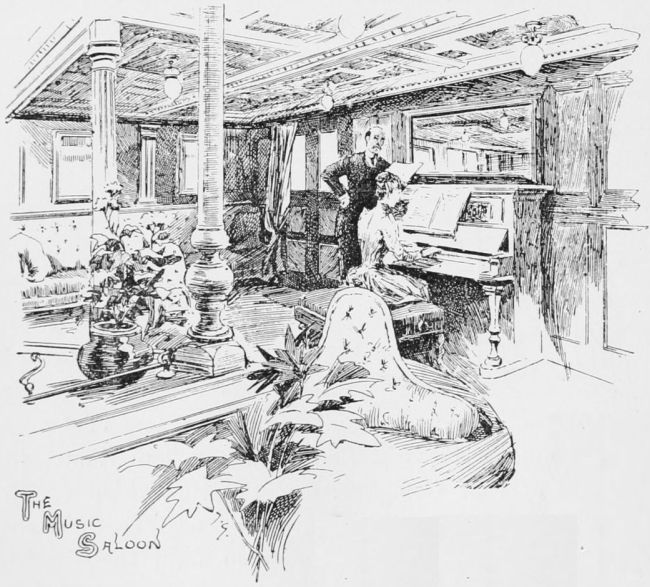
Forming a spacious gallery above the dining saloon is the music-room,
which is beautifully decorated in white and gold, and exquisitely
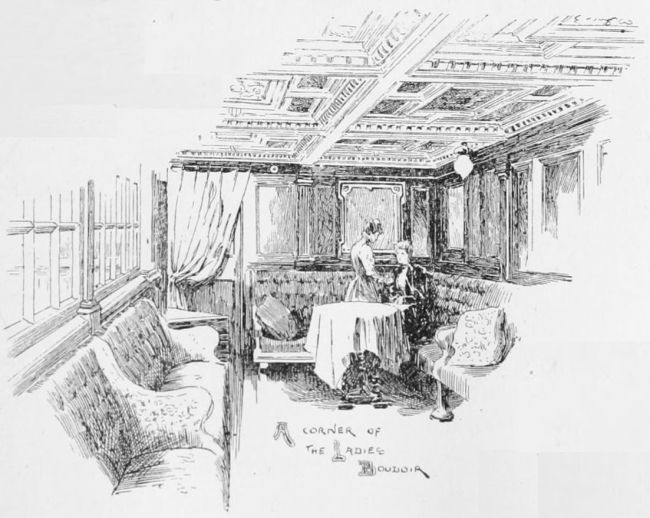
furnished in old-gold upholstery. Adjoining this, and separated from it
by a handsome screen of bevelled glass, is the ladies’ boudoir, which
is also most luxuriously furnished.
A corner of the Ladies’ Boudoir
A notable feature of this part of the ship is the spacious double
staircase, leading from the saloon to the main and upper decks. Like
the saloon itself, it is handsomely decorated with solid panels,
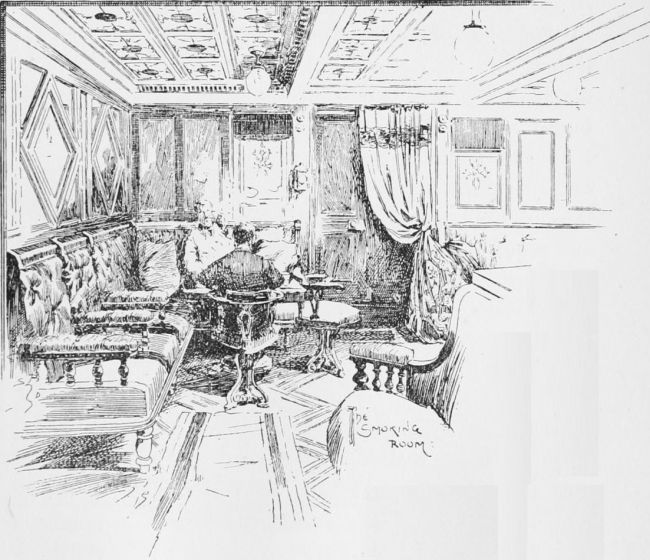
and every detail is conceived and executed in good taste. Abaft the
main deck state-rooms, there is a handsome and very comfortable
smoking-room, with bar attached, which is much superior to the
ordinary smoking-rooms of ocean-going steamers, in respect both of
size and of furnishings. Behind the staircase on the upper deck is
the reading-room, which contains writing-tables, book-shelves, and
lounges.
The Smoking room
This may be the proper place to mention that the
ship’s library, of nearly five hundred volumes, is exceedingly
attractive and well selected. It contains many standard
works in history, travels, and fiction, including some of the
most recent publications. It also contains valuable books
of reference, in the shape of atlases and gazetteers, and a
representative selection of music, including Scottish, English,
and Irish songs and glees. The man or the woman would
be very difficult to please who could not find within the ship
itself, with its pianos, organ, and library, ample resources
for spending pleasantly and profitably three or four weeks
at sea.
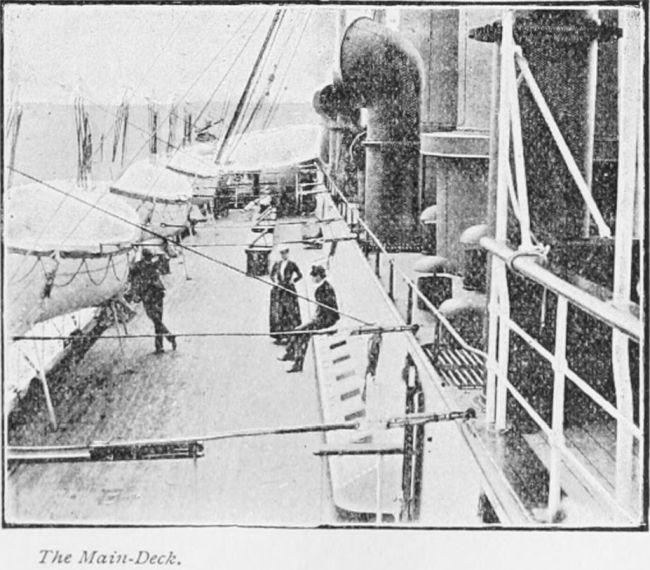
The promenade deck is exceptionally spacious, and affords ample
room for those recreations with which time is wont to be beguiled
in tropical seas. The first-class state-rooms are fitted up in a
very handsome, luxurious style, with iron spring-beds, sofas, and
lavatories, all constructed on the most approved principles.
The Main-Deck.
The intermediate sleeping-berths differ but little, in point
of comfort and convenience, from those assigned to first-class
passengers; and the dining-saloon, which has its own
piano and organ, is infinitely superior to what we were
accustomed to in old-fashioned steamers. The third-class
accommodation is altogether superior to that provided in
the general run of ocean-going steamers.
The sanitary arrangements include some special features,
one of which is an improved system of ventilation with compressed
air. Marble baths, and all the most approved
lavatory appliances, are provided in sumptuous fashion. A
novel luxury in the ‘Castle’ liners is a barber’s shop, with a
rotatory hair-brushing machine worked by an electric motor.
Indeed, scarcely anything is lacking which could be desired
by the most fastidious traveller on shore.
One of the greatest charms of the ship is the electric
lighting, which is carried out on a perfect scale. Nothing
has done so much as the introduction of the electric light
to make ocean-travelling comfortable and safe. It is
bright and cleanly, and it is always available. It is an
immense advantage to be able to turn on a bright light
in your state-room at any moment. The evening hours
in the saloon, instead of being dreary, are looked forward
to with pleasure, and are thoroughly enjoyed. In point
of fact, the saloon is quite as brilliant at night as during
the day.
The decks also are brightly lighted up at night with
electric cluster lights, as well as with single lamps, so that
dancing and other recreations can be carried on with the
greatest comfort. The ship’s band of ten or twelve instruments
is also an excellent institution, which does much to
relieve the tedium of the voyage.
The rapidity with which the ‘Dunottar Castle’ was
got into working order speaks well for the resources and
the organising power of the Clyde shipbuilders. When the
ship was launched at Govan, on May 22d, she was a mere
hulk—a huge steel case intersected with a few floors and
partitions. When the trial trip took place on August 28th,
exactly fourteen weeks later, she was completely finished,
furnished, and manned, and was ready in every particular to
undertake a long voyage. Those who saw her at the Tail
of the Bank, off Greenock, at the latter date, had some
difficulty in believing that she was the same vessel. Everything
was in its place, down to the minutest curtain-ring
and the smallest carpet-tack; and every man was at his
post, from the Captain to the cabin-boy.
The behaviour of the ship on the trial trip was admirable,
and left nothing to be desired. The day was splendid,
and everything went well. The ship attained a speed of
17½ knots on the measured mile, off Skelmorlie, and both
builders and owners were satisfied with the results, as they
had good reason to be.
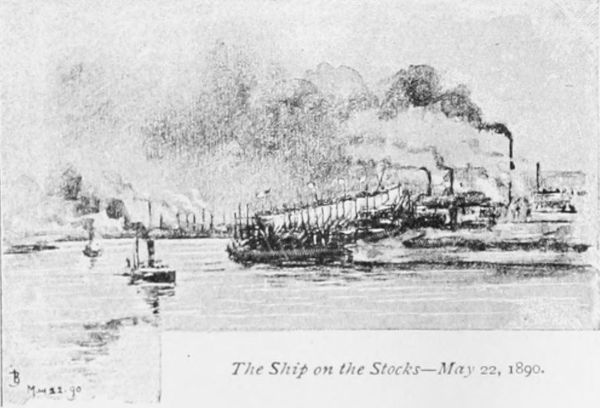
The Ship on the Stocks—May 22, 1890.
II
IN THE FIRTH OF CLYDE
The trial cruise will not soon be forgotten by those who were
privileged to take part in it. The trip was worthy of the great ship,
and worthy of the famous ‘Castle’ Line. The strangers and foreigners,
the Englishmen and the colonists, who were of the party, had an
opportunity of seeing all that is grandest in Scottish coast-scenery,
such as is enjoyed by few natives; and every Scotsman on board must
have felt proud of his country.
The course taken was the converse of that of Agricola,
when his galleys sailed round Scotland, and proved for the
first time that Britain was an island. While the Romans
sailed, or rather rowed in open galleys, from the Firth of
Forth to the Firth of Clyde, the ‘Dunottar Castle’ pleasure-party
steamed from the Clyde to the Forth in a veritable
floating palace, replete with the comforts of advanced civilisation,
and embodying the most recent developments of
science in the applications of steam and of electricity. The
contrast is almost too great to be appreciated even by the
most imaginative modern mind. It is difficult to realise
what the feelings of James Watt, or of Henry Bell, would
be were they permitted to see to what perfection the
results of their inventive genius have been brought by
their successors.
Perhaps few of those who entered on the expedition
realised the useful purposes which it served. They thought
only of the pleasant holiday provided for them; but in
truth it answered a more practical and more important end.
It was, in fact, a preliminary trial, in which the crew and
all the officers, including the stewards, were put through
their facings, and in which the commissariat and other
resources of the management were subjected to a pretty
severe test. The whole routine of the daily life was precisely
similar to that which will prevail in the regular
voyages of the ship from London to the Cape, and it is
but just to say that the results were entirely satisfactory.
The ‘Dunottar Castle’ presented a splendid appearance
as she rode at anchor at the Tail of the Bank, off
Greenock, on Saturday, August 30th, awaiting the arrival of
the invited guests of Sir Donald Currie. Being light of
draught, she lay high in the water, and made everything
else in the neighbourhood, even an American liner, look small
in comparison, while her beautiful lines were seen to the
greatest advantage. On board, everything was ship-shape
and in good order; and when Sir Donald Currie, on his
arrival from Garth, was received on the main deck about
noon, by Captain Webster and his officers, it might have
been supposed that the steamer had been in commission
for years, and was undergoing an inspection on her return
from one of her ocean voyages.
The view from the upper deck was magnificent. Few
scenes in the British Isles can compare in beauty and variety
with the estuary of the Clyde opposite Greenock. We
stood in the centre of a wide cyclorama, nearly every point
in which glowed in brilliant sunshine. Greenock alone was
dark and murky, as is its wont. Even Gourock gleamed in
colour, as it caught the sun’s rays emerging from the mists.
Dumbarton Castle loomed large in the warm haze to the
eastward. Helensburgh basked peacefully on its wooded
slopes. Kilcreggan and Cove smiled in their leafy bowers,
while beyond them Ben Lomond raised on high its massive
head. Westward, the rugged ridge of the Arrochar Hills
and Argyll’s Bowling Green filled up the distance. Then
the line of view descended again at Strone Point, and the
placid Holy Loch, and the bright villas of Hunter’s Quay,
and so the circuit was complete.
When the last tug-load of passengers and luggage had
been received on board, the anchor was weighed, and the
majestic ship steamed down the Firth past the Cloch lighthouse,
past Castle Wemyss, and Wemyss Bay, and Skelmorlie,
on the one side, and past Dunoon and Inellan on
the other. Off the Greater Cumbrae we lay-to, in order
to receive on board Lord Provost Muir of Glasgow, who,
with his brother Commissioners of the Clyde Trust, had
been engaged in an inspection of the lighthouses on these
coasts. Their little steamer drew up alongside, and the
Commissioners were courteously received on board and
were shown over the ship. The Commissioners, minus the
Lord Provost, were dismissed with a cheer, and we proceeded
on our way.
Passing Rothesay Bay and Mount Stuart House, one of the
Marquis of Bute’s residences, we enter a wider sea, and get
a fine view of Goatfell and the rugged peaks of Arran which
surround Glen Sannox. Opposite that weird glen, of evil
omen, we turn northward, and steam past the Fallen Rocks,
and round the north point of Arran into Kilbrannan Sound,
our purpose being to sail round Arran and to anchor for
the night in Lamlash Bay. We have a pleasant glimpse,
in passing, of Loch Ranza and its rugged keep, and of the
valleys and ‘cols’ that lead over to Glen Sannox and Glen
Rosa. The west coast of Arran, however, is distinctly
tame, and gives few tokens of cultivation and industry, until
we approach the south end of the island. There are, indeed,
more signs of an active population on the peninsula of
Cantire, on our right. Arran, however, can boast of historical,
or at least of traditional, interest, for the King’s
Cave, near Blackwaterfoot, is said to have been the first
resting-place of Robert the Bruce on his landing from
Rathlin Island.
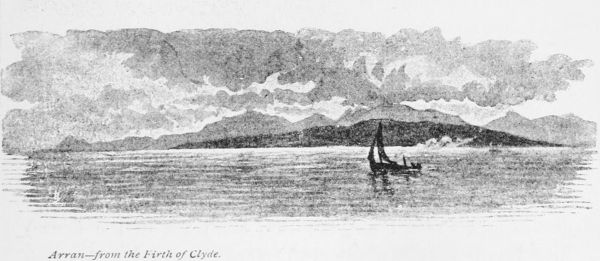
Arran—from the Firth of Clyde.
As we steam southward, that island and the Irish coast
are clearly visible beyond the Mull of Cantire. Looking
back from this point, the picturesque outline of the mountains
in the north of Arran stands out boldly against the
northern sky, while southward we see Ailsa Craig and
its pale grey rocks, with their myriads of gannets. By-and-by,
in the gloamin’, we pass Whiting Bay, in which at least
half a hundred small boats are busily engaged in deep-sea
fishing. Then we steam cautiously between Holy Island
and King’s Cross Point (another landmark of the Bruce)
into Lamlash Bay, where we drop anchor, and prepare to
dine in peace.
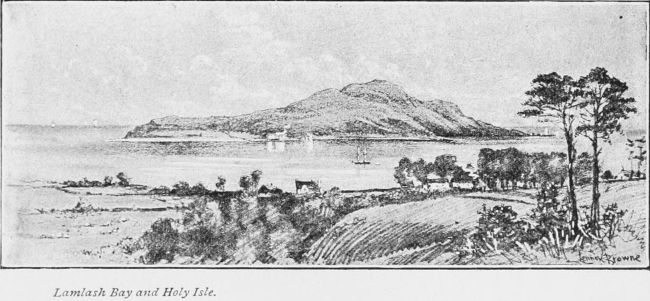
Lamlash Bay and Holy Isle.
We then begin to realise the importance of the fact
that our cruise is to be one of pleasure, as well as of practical
use, in a sense not previously thought of. We are
to steam ahead during daylight, and our nights are to be
spent peacefully at anchor in quiet waters. The arrangement
is not only comfortable on that account, but is also
convenient, inasmuch as we shall miss very little of the
coast-scenery—none of it, indeed, if we are careful to rise
betimes.
As we lay at our anchorage, we had an opportunity of
realising what the electric light has done for navigation, not
merely in the brilliant lighting of our own ship, but in that
of several of the Clyde steamers. When the ‘Duchess of
Hamilton,’ a coasting steamer, passed through the bay with
her lights gleaming, she might have been a floating firework
displayed for our special gratification.
Calmly and peacefully the night was passed. Some
spent an hour pleasantly in the Music Saloon, under the
spell of music and song. Others found more congenial
occupation in the Smoking-room. Not a few lingered on
deck till a late hour, bewitched by the galaxy of stars, or
watching the glimmering lights of the Lamlash cottages,
as, one by one, they succumbed to the demands of repose,
and bade us a silent ‘good-night.’ One or two adventurous
rowing boats came out at a late hour to inspect the monster
of the deep that had suddenly disturbed the quiet of the
bay; but the plash of their oars soon died away, and our
little world was left in a silence that was felt.
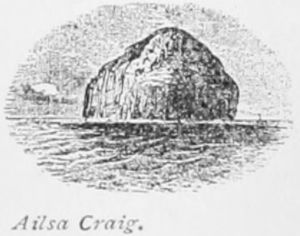
Ailsa Craig.
III
AMONG THE SOUTHERN HEBRIDES
If the denizens of Lamlash were looking forward to obtaining a
good view of the ‘Dunottar Castle’ next day (Sunday), they must have
been grievously disappointed, for we made an early start, and were
out of the bay before the majority of them were out of their beds. By
seven o’clock, we had rounded the Mull of Cantire, and were beginning
to feel the swell of the Atlantic. The morning was clear and crisp,
and both sea and sky seemed joyous in the sunshine. Nearly every one
was on deck for an hour before breakfast, and the sharp air was most
exhilarating.
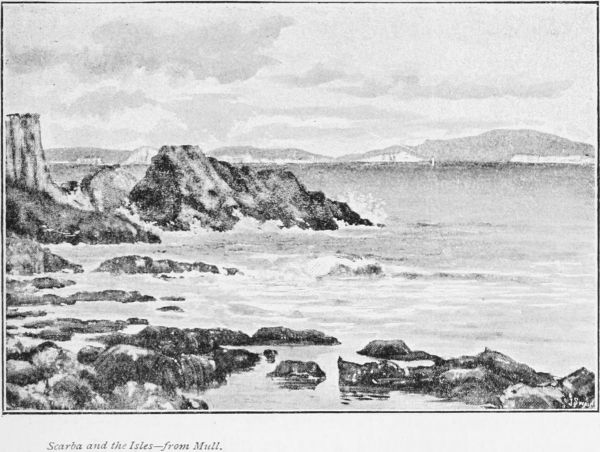
Scarba and the Isles—from Mull.
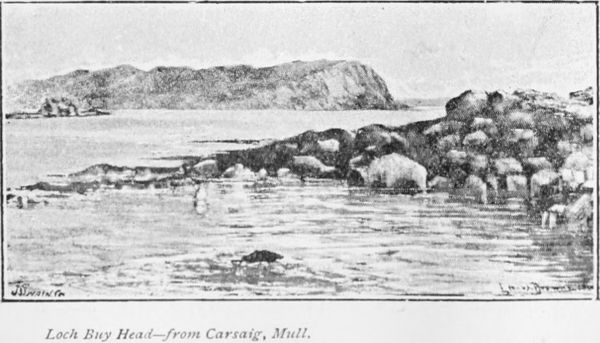
Loch Buy Head—from Carsaig, Mull.
The Irish coast remained in sight for several hours; but still more
attractive was the view of the west coast of Cantire. Machrihanish
Bay awakened pleasant memories in the golfers on board. They had been
there, and still would go; and very tempting the bay looked with its
gleaming sands and sparkling wavelets. Our course now lay through the
Sound of Islay, which runs between that island and its sister Jura.
Long before we reached the Sound, we were once more in quiet water
under the lee of Islay, and with the well-marked Paps of Jura right
ahead. In the Sound, the sea was absolutely still, and there we had
morning service,
reverently conducted by Captain Webster, Sir Donald Currie reading
the lessons. Shortly afterwards we met, by appointment, our host’s
large steam yacht, the ‘Iolanthe,’ which attended us during the remainder
of our cruise, and added greatly to our enjoyment by taking us into
narrow and shallow lochs and sounds into which the great ship could
not have ventured. Mr. James Currie, of Leith, with his family, was
on board, and did all in his power to render our voyage an agreeable
one. The interest of the sail increased as we passed northward between
Jura and Colonsay. The weather was superb. The Sabbath calm seemed to
have settled down on hill and sea. It was a day for lounging on deck,
and for gazing at the summer sky, or on the Islands of the Blest which
surrounded us.
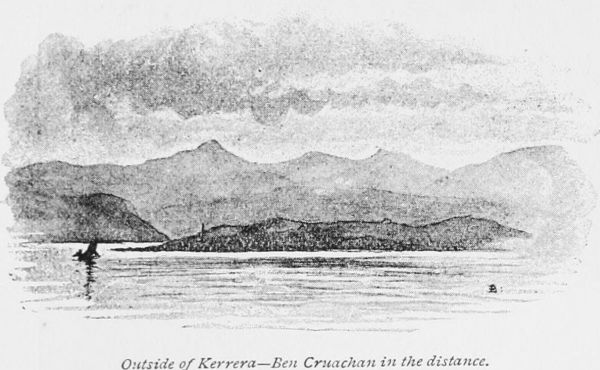
Outside of Kerrera—Ben Cruachan in the distance.
We were prepared for a toss at the Strait of Corrievreckan;
but though the boiling of the tide was perceptible
to the eye, it was unappreciable by any other sense, at
least to those in the massive ‘Dunottar Castle.’ As we
crossed the Firth of Lorne, the mountains of Argyllshire
came into full view, Ben Cruachan and Ben More of Mull
being specially conspicuous. Off Scarba, we made a wide
detour westward in the direction of the Ross of Mull, so
that we might see its cliffs and caves and the shores of
dark Loch Buy.
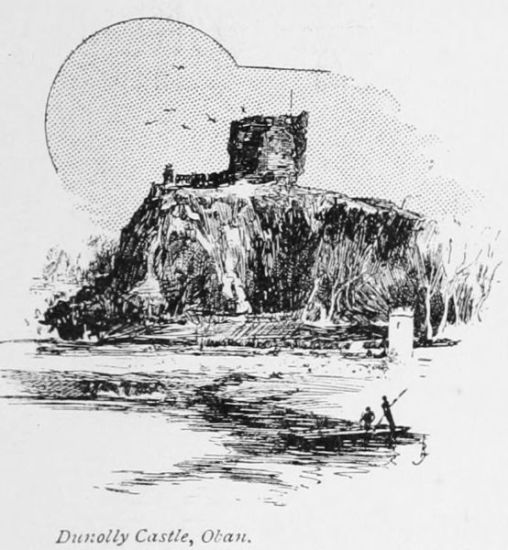
Dunolly Castle, Oban.
Toward evening, we reached our anchorage at the northern point of
Kerrera, but outside of Oban Bay, which is crowded at this season with
yachts and other small craft. We were opposite to David Hutchison’s
monument, set up near the scene of his labours, to remind travellers of
the great things which he did for them, and for Scotland, in opening up
the Western Highlands to swift steamer traffic. We had also a distant
view of Dunolly Castle, the ancestral home of the Macdougalls. Evening
service was conducted by Sir Arthur Blackwood, Secretary of the General
Post-Office, London; and the earnestness and freshness of his address
were highly appreciated.
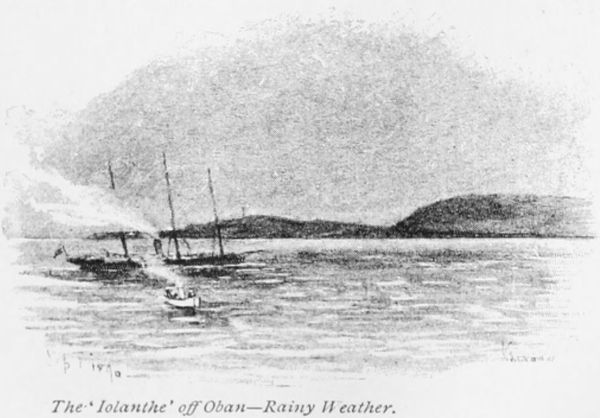
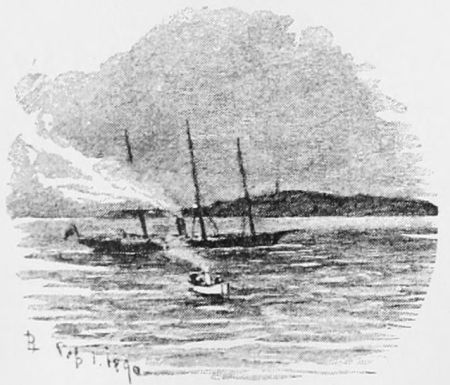
The ‘Iolanthe’ off Oban—Rainy Weather.
The weather changed in the night, and we awoke to find ourselves
enveloped in mist and in drizzling rain. A projected trip up Loch
Linnhe to Ballachulish was consequently abandoned; and we spent the
whole day at our anchorage, awaiting the arrival of expected guests
at Oban, who were brought off in the ‘Iolanthe,’ and thence in the
steam launch.
Those of us who were so inclined had thus an opportunity of seeing the
capital of the Western Highlands, though not under the most favourable
conditions; of visiting its attractive shops, and of admiring, though
at a safe distance, its numerous or innumerable hotels. When it rains
on this coast it does so with a vengeance. In fine weather Oban is one
of the most beautiful places in Scotland; on a wet day it is one of the
most disagreeable under heaven.
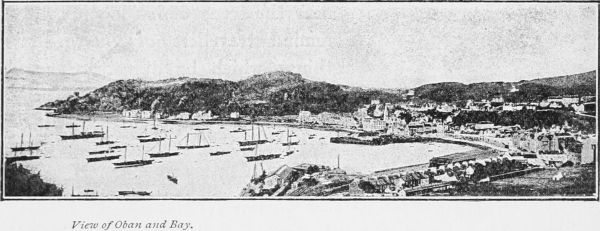
View of Oban and Bay.
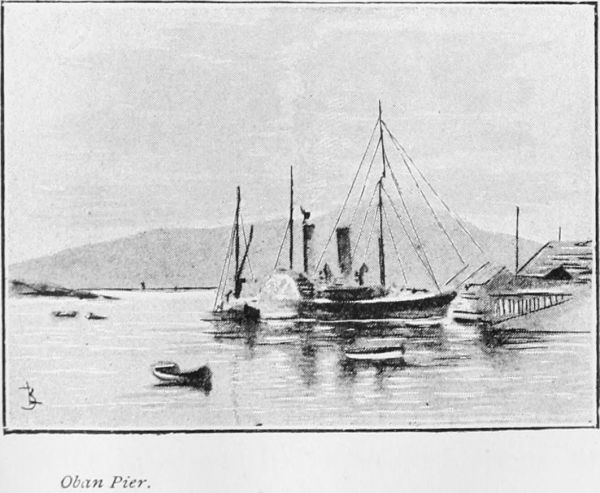
Oban Pier.
IV
IN THE SOUND OF MULL
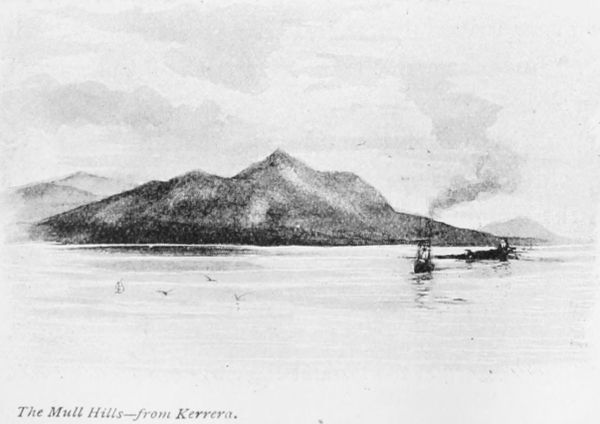
The Mull Hills—from Kerrera.

Next morning (Tuesday) finds us in the Sound of Mull, one of the
most beautiful and romantic of Highland seas. The lighthouse full
astern stands on the point of the island of Lismore, anciently the seat
of the Bishops of Argyll, and still more famous as the home of its
Dean, James Macgregor, who, in the sixteenth century, made a valuable
collection of poems in Gaelic and English, well known as the ‘Book of
the Dean of Lismore.’ The picturesque ruin at the entrance to the Sound, on the eastmost
point of Mull, is Duart Castle, the home of the Macleans. Not far off
is the ‘Lady Rock,’ which disappears at high-water, and on which one
of the Macleans once left his wife, intending that she should perish
when the tide rose and covered the rock. She was Ellen of Lorne, a
sister of the Earl of Argyll. One of her brothers rescued her, and
afterwards slew Maclean. Such stories are common in these regions:
they cling, like the ivy, to every ruined tower. These traditions of
lawlessness and vengeance formed the greater part of the education of
the people.
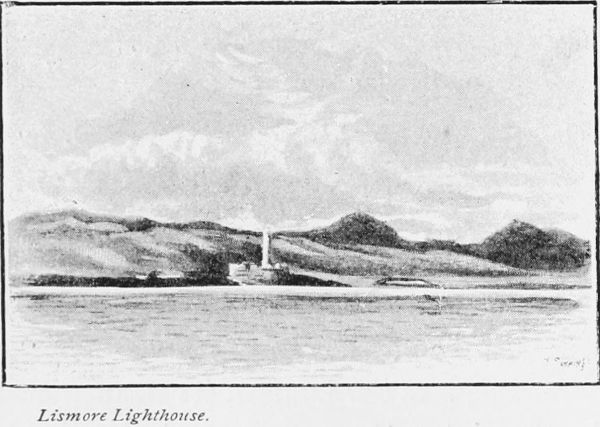
Lismore Lighthouse.
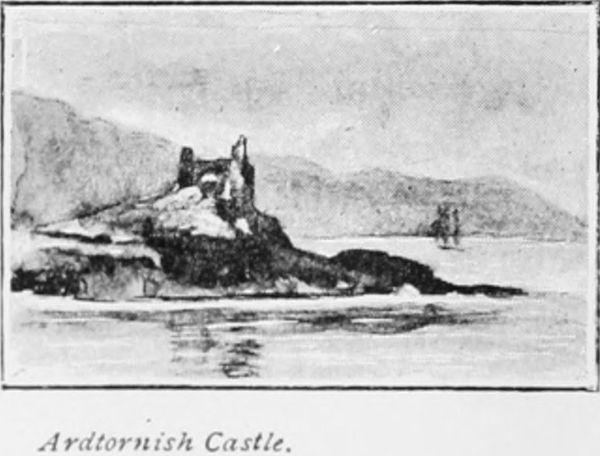
By and by we pass on the right Ardtornish Castle, a
stronghold of the Lords of the Isles, and memorable as the
site of the opening of Scott’s poem:—
‘Thy rugged halls, Ardtornish! rung,
And the dark seas, thy towers that lave,
Heaved on the beach a softer wave,
As ’mid the tuneful choir to keep
The diapason of the Deep.
Lulled were the winds on Inninmore,
And green Loch Aline’s woodland shore,
As if wild woods and waves had pleasure
In listing to the lovely measure.’
The ruins of Ardtornish are near the entrance to
Loch Aline, and under the shadow of the massive and bare
hills of Morven. These hills had a never-ending charm for
Dr. Norman M‘Leod, whose native village of Morven lies
on the east coast of the Sound, nearly opposite Tobermory.
The Sound to-day is in one of its angry moods: clouds
obscure the sun; mists cling to the mountains, and the
sullen sky is reflected in the fretful sea.
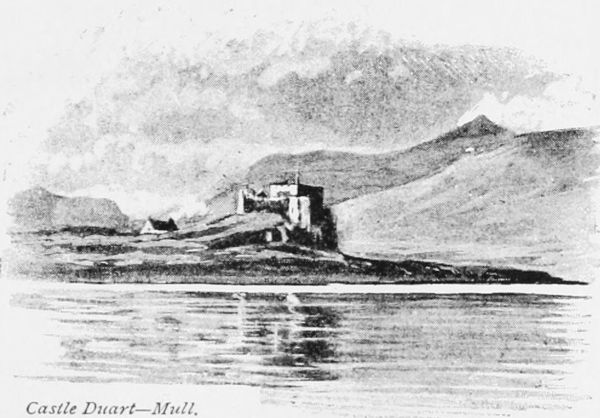
Castle Duart—Mull.
Presently we pass on the left the ruins of Aros Castle, another of
those rock-built fortresses which are so numerous on these coasts. The
stupendous mountain-wall which appears to close up the Sound at the
north end is the rocky peninsula of Ardnamurchan, the most westerly
point on the British mainland. At its base stands yet another ruined
castle, that of Mingarry, also a stronghold of the Lords of the Isles,
and woven with warp of treachery and woof of heroism into their
adventurous story.
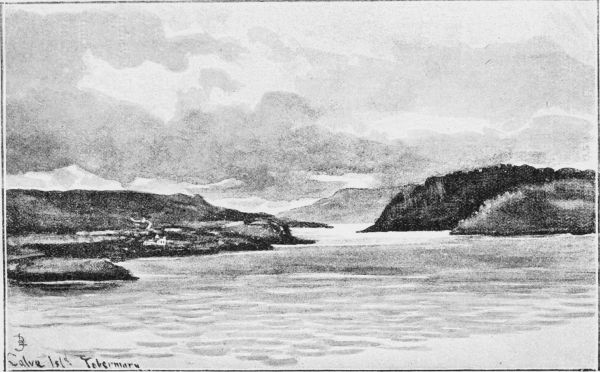
Calve Isld. Tobermory
Passing Tobermory Bay, to which we shall return by-and-by,
we sail beyond Ardnamurchan Point, and have a distant
view of the Scuir of Eigg and the graceful outline
of the mountains of Rum. The mists lift somewhat,
and give us a view of the north coast of Mull,
and of the bold beetling headland of Ardnamurchan,
with its tall lighthouse thrust out into the sea. Then
we return to Tobermory, the quaint and primitive capital
of Mull, and anchor in its lovely Bay.
The village, which, like a few other places in the Highlands,
looks best at a distance, skirts two sides of the Bay.
The western banks are steep and richly wooded. On the
east, the Bay is cut off from the sea by the small island of
Calve, which forms a natural breakwater, thus producing
a spacious and very safe anchorage. Aros House, imbedded
in woods, stands on the south side of the Bay, and near
it there is a very fine waterfall on the stream which
emerges from the Mishnish Lochs—a favourite resort of
anglers. From the deck, a lovely view of the Sound of
Mull is seen over the crest of Calve. The hills in the
distance are dark, but the east shores of the Sound are
lighted up with gleams of sunshine, developing marvellous
combinations of colour.
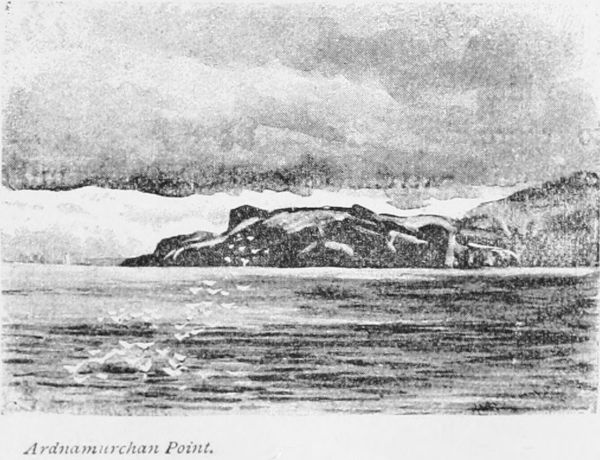
Ardnamurchan Point.
The day being still young, the ‘Iolanthe’ is brought into
requisition, and a delightful trip is made up Loch Sunart, a veritable
fiord in its windings, and its narrowness, and its flanking mountains.
As we enter the Loch, we catch one of those occasional and transient
effects which delight artists, but which it is hazardous to paint, and
still more difficult to reproduce without colour. A brilliant rainbow
rests one of its extremities on the massive hill of Ardnamurchan, and
practically cuts it in two; one half of it being melted away under the
changing colours of the arch.
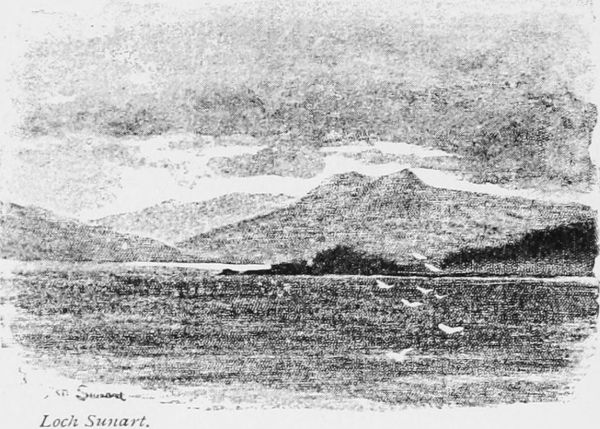
Loch Sunart.
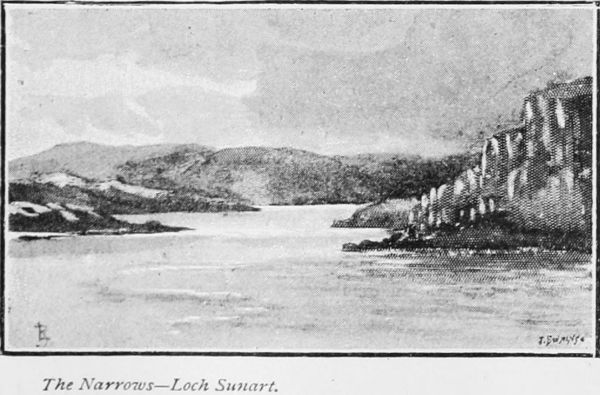
The Narrows—Loch Sunart.
It was during this trip that some members of the party developed
extraordinary skill in the game of deck quoits, while others indulged
in athletic sports of various kinds, terminating in a ‘tug-of-war’ in
which nearly every man and boy on board took part. It was alleged,
however, with
what truth I know not, that a majority of those on the winning side
wore deck shoes with india-rubber soles. Nevertheless, they maintained
stoutly that ‘it was weight that told.’ The sail up Loch Sunart was
very enjoyable. A fair breeze was blowing, and the sun, which had been
concealed before, burst through the clouds, and shed beauty on the
landscape.
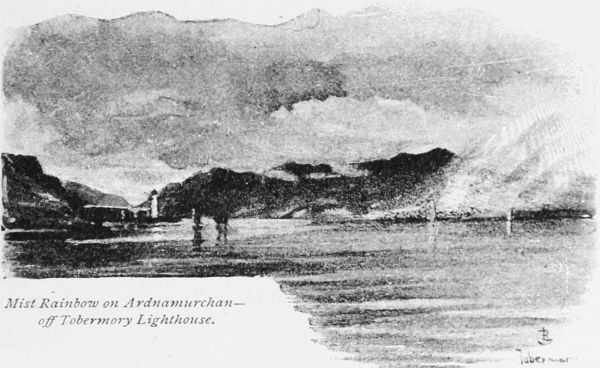
Mist Rainbow on Ardnamurchan—off
Tobermory Lighthouse.
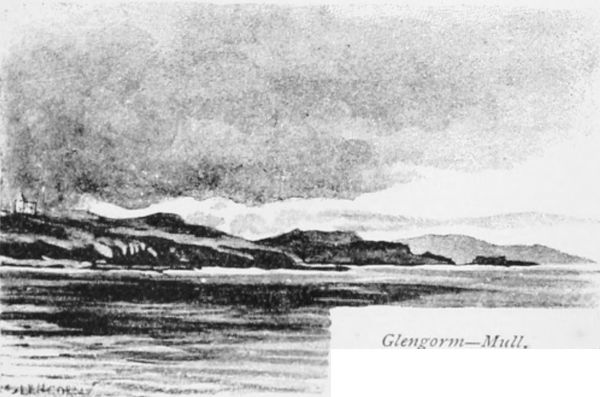
Glengorm—Mull.
In the afternoon we embarked on the ‘Iolanthe’ again, and sailed
round the north coast of Mull in fairly good weather, past Ardmore
Point, past Glengorm Castle (the property of Mr. James Cowan), past
Caliach Point, and Calgary Castle with its marvellous silver strand,
and past
Trishnish Point, in the direction of the Trishnish Islands. A farmhouse
near Caliach Point has an interest for literary men. Thomas Campbell
the poet spent five months there as tutor when a young man; and there
he first conceived the theme of The Pleasures of Hope. Another
poet has revelled in this region; for the Trishnish Islands belong to
the group described by Scott:—
‘The shores of Mull on the eastward lay,
And Ulva dark, and Colonsay,
And all the group of islets gay
That guard famed Staffa round.
Then all unknown its columns rose,
Where dark and undisturbed repose
The cormorant had found,
And the shy seal had quiet home,
And weltered in that wondrous dome,
Where, as to shame the temples decked
By skill of earthly architect,
Nature herself, it seemed, would raise
A Minster to her Maker’s praise!’
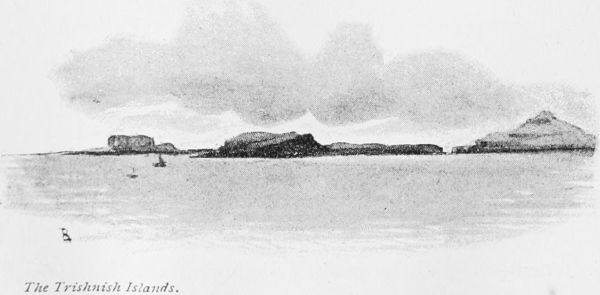
The Trishnish Islands.
The Trishnish Islands are covered with rich grass, which
makes excellent pasture. The Laird of Calgary fattens his
mutton there during the summer months, and sends out a
yacht once a fortnight to capture two or three sheep for
use. As the animals are as wild and as swift as deer, capturing
them is no easy task. They are generally driven
by a contracting line of men and boys into a trap made
with spars and a sail between two rocks on the shore; but
they often break through the cordon, and even leap sometimes
over the heads of the drivers.
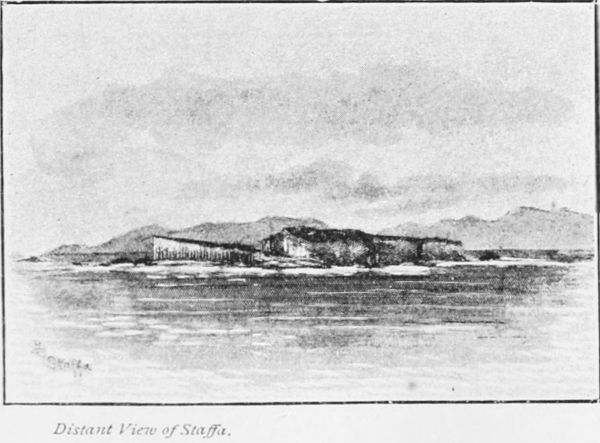
Distant View of Staffa.
This, however, is a digression. The rough sea, and consideration
for the weaker vessels of the party, male and
female, induced Sir Donald Currie to abandon the intention
of visiting Staffa, with a distant view of which the guests
had to be satisfied. It is noteworthy that this yachting
cruise was the only occasion, during the whole trip, on which
symptoms of sea-sickness showed themselves. It may be
added that the most serious case was that of Sir Donald’s
young piper, who had never been on the sea before; but
scarcely had the yacht been put about when a few blasts of
a pibroch, recalling memories of the braes of Garth and
Glenlyon, gave audible proofs of his convalescence, and
indeed completed the cure. On returning to Tobermory we
landed, and enjoyed a refreshing walk on the shore before
dinner: some exploring the woods about Aros House, and
others climbing to the heights that surround the town,
whence a wider view was obtained.
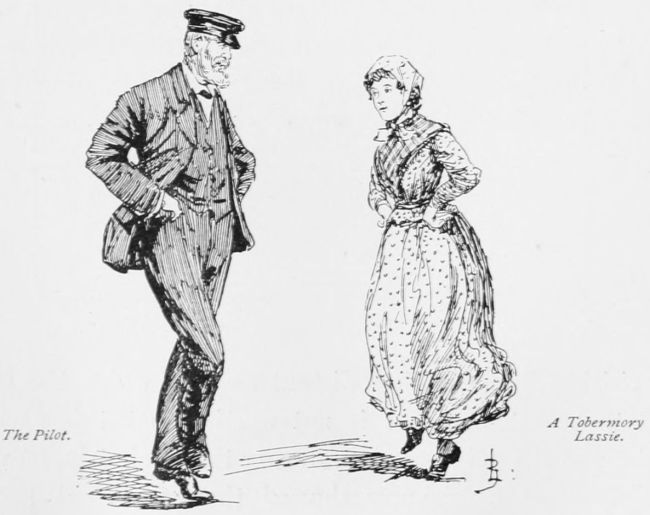
The Pilot.——A Tobermory Lassie.
The evening was given up to recreation, including dancing
to the music of the ship’s band, under the awning on the
promenade deck, which, lighted up with electric lamps,
made a spacious and brilliant ballroom. This was carried
on in presence of nearly the whole population of Tobermory,
which had come out, on Sir Donald’s invitation, to see the
stately ship. The performances were not by any means confined
to the saloon folks. Our stalwart pilot, relieved of his
duties for the night, came out strong in the ‘reels’; and,
having shown his paces in a ‘fling’ with our chief, he was in
great request with the Tobermory lassies, with one of whom
he engaged in a kind of terpsichorean duel, which reminded
the spectators of
‘The dancing pair that, simply, sought renown
By holding out to tire each other down.’
Another hero of the dance was one of the quartermasters,
who was a match for any of the natives, or, for that matter,
for any of the crew, engineers or seamen. It was a case of
‘one down, another come on,’ and the contest might have
lasted till break of day. Unfortunately, however, the
festivities were marred by a heavy downpour of rain; but
that did not prevent the singing of ‘Auld Lang Syne’ and
‘God save the Queen,’ or hearty cheers for our host, before
the party broke up. One could not but feel sorry for the
poor people who had to find their way to the shore in the
dark, and through the pelting, pitiless rain.
Ardtornish Castle.
V
ROUND ABOUT SKYE
Wednesday morning was dull and misty. We had to feel our way
cautiously between Eigg and Rum in the direction of Skye. No view could
be obtained either of the Coolins or of the mountains of the mainland.
It was indeed tantalising to know that we were in the neighbourhood
of some of the grandest scenery in Scotland, and to be unable to
see a vestige of it, except occasionally a few outlying rocks, or a
mountainous headland swept by the mist. Early in the day we cast anchor
in the Sound of Soa, near the entrance to Loch Scavaig.
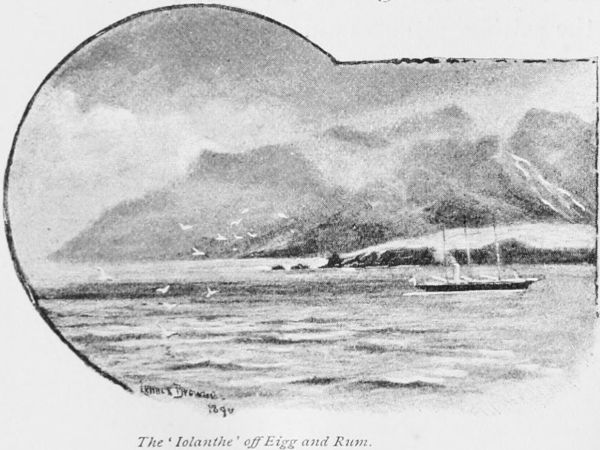
The ‘Iolanthe’ off Eigg and Rum.
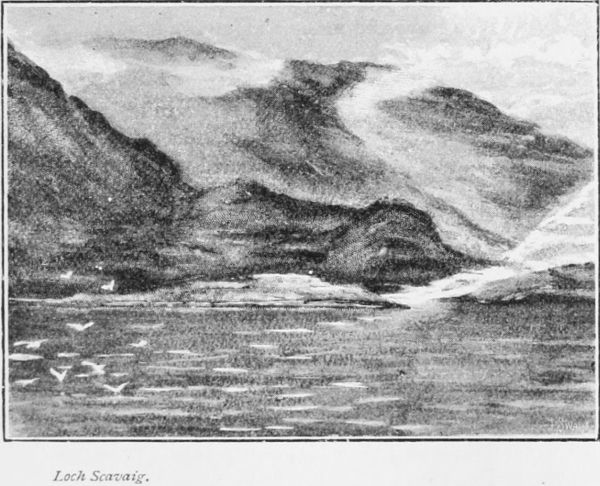
Loch Scavaig.
The object of stopping at that point in the voyage was
to visit Loch Coruisk, the wildest and most desolate of
Highland lochs, imbedded in the heart of the Coolins.
In spite of the mist and the threatening rain, nearly the
whole party started in the ‘Iolanthe’ for the head of Loch
Scavaig. Scavaig itself is a very grand loch, partaking of
the gloom of the mountains that surround it,—a gloom
relieved only by the breakers on the rocky coast, and the
glint of the wings of sea-birds. The landing, at all times
difficult, was rendered more so by the slippery state of the
rocks: but it was effected without serious mishap. After a
rough walk of half a mile, over boulders and broken rocks,
the south end of the dark lake was reached. No one had
any reason to regret the toils or the risks of the expedition.
Though the mists concealed the mountain tops, they intensified
the darkness of the lake. The rain, which had been
falling for some time in sport, now began to come down in
earnest, and it quickly swelled the thousand streams that
covered the hillsides. The silver streaks had become roaring
cataracts. The loneliness of the scene was oppressive. The
lines in which Scott has described the silent lake, whose
name is a synonym for desolation, occurred to many. It is
the Bruce that speaks:—
‘Saint Mary! what a scene is here!
I’ve traversed many a mountain-strand,
Abroad, and in my native land,
And it has been my lot to tread
Where safety more than pleasure led;
Thus, many a waste I’ve wandered o’er,
Clombe many a crag, crossed many a moor;
But, by my halidome,
A scene so rude, so wild as this,
Yet so sublime in barrenness,
Never did my wandering footsteps press,
Where’er I happed to roam.’
No marvel thus the Monarch spake;
For rarely human eye has known
A scene so stern as that dread lake,
With its dark ledge of barren stone.
Seems that primeval earthquake’s sway
Hath rent a strange and shattered way
Through the rude bosom of the hill;
And that each naked precipice,
Sable ravine, and dark abyss,
Tells of the outrage still.
The wildest glen but this can show
Some touch of Nature’s genial glow;
On high Benmore green mosses grow,
And heath-bells bud in deep Glencroe,
And copse on Cruchan-Ben;
But here,—above, around, below,
On mountain or in glen,—
Nor tree, nor shrub, nor plant, nor flower,
Nor ought of vegetative power,
The weary eye may ken.
For all is rocks at random thrown,
Black waves, bare crags, and banks of stone,
As if were here denied
The summer sun, the spring’s sweet dew,
That clothe with many a varied hue
The bleakest mountain-side.
The evening mists, with ceaseless change,
Now clothed the mountains’ lofty range,
Now left their foreheads bare,
And round the skirts their mantle furled,
Or on the sable waters curled,
Or on the eddying breezes whirled,
Dispersed in middle air.
And oft, condensed, at once they lower,
When, brief and fierce, the mountain shower
Pours like a torrent down.
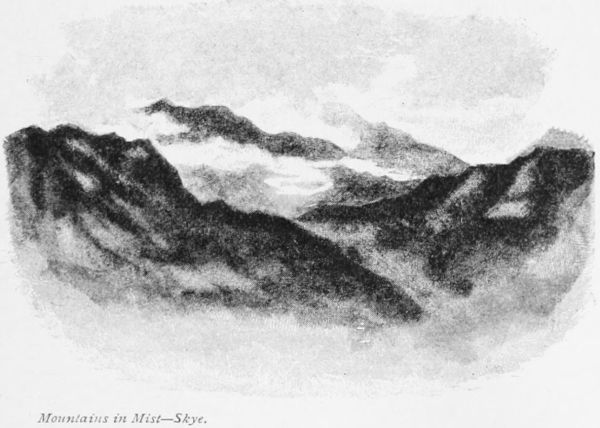
Mountains in Mist—Skye.
If the rain added to the picturesqueness of the scene, it
did not add to the comfort of the visitors, most of whom
returned to the ship drenched from head to foot. But
their spirits were not damped, whatever their bodies were:
for all were in the greatest good humour. Some one,
probably a man, expressed the wish that the mist were
away. Some one else, probably a woman, suggested that it
would not be missed if it were away. Such ‘Coruiskations’
of wit were not inappropriate to the occasion, though they
may have been to the scene. They helped at all events
to keep up the spirits of the party. The refreshments
distributed on the return to the ‘Dunottar Castle’ had a
similar effect.
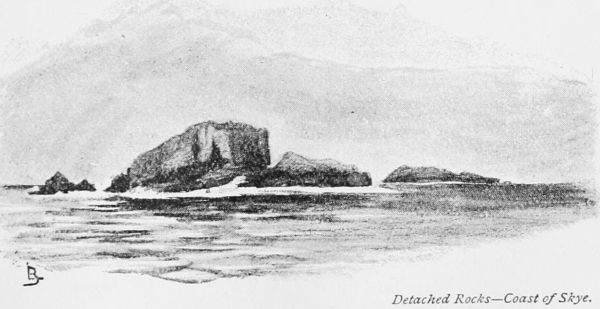
Detached Rocks—Coast of Skye.
The anchor was then weighed, and we steamed round the
west and north coasts of Skye, the ‘Iolanthe’ going in the
opposite direction through the Sound of Sleat to Portree,
where we were to meet, and to anchor for the night. The
effects of the rain were seen in a tremendous increase in the
waterfalls that precipitate themselves into the Sound of
Soa from the steep sides of the mountains. The cataracts
were indeed magnificent, and every one felt that the wild
weather had not been without its compensations.
To tell the truth, however, the scenery had to be taken
very much for granted. One or two picturesque bits of
rocky coast were all that could be seen. ‘M‘Leod’s Maidens’
were ‘children of the Mist.’ Dunvegan Castle was nowhere.
Duntulm was invisible. The bold Quiraing, and the Old
Man of Storr, and Prince Charlie’s Cave, were held as seen;
and when we anchored in the evening in the Sound of Raasay,
opposite Portree, we might have been anywhere.
These untoward conditions, however, did not interfere
with our enjoyment of the good things provided for us on
board, or of the adjournment to the smoking-room at a
later hour, when bad jokes and good stories were equally
enjoyed, and when some wonderful card tricks were performed
by our own Wizard of the North, who proved,
however, mere potter’s clay in the cool hands of Captain
Webster.
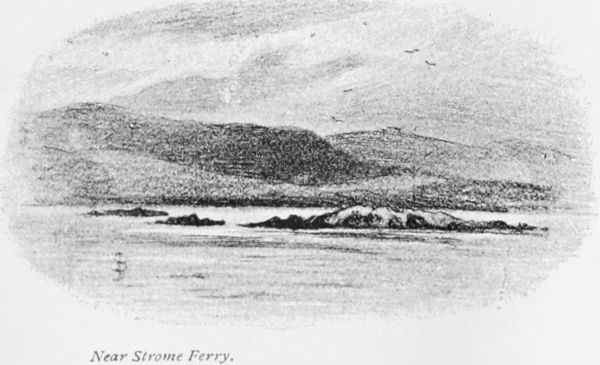
Near Strome Ferry.
VI
WILD LOCH ALSH AND DARK LOCH DUICH
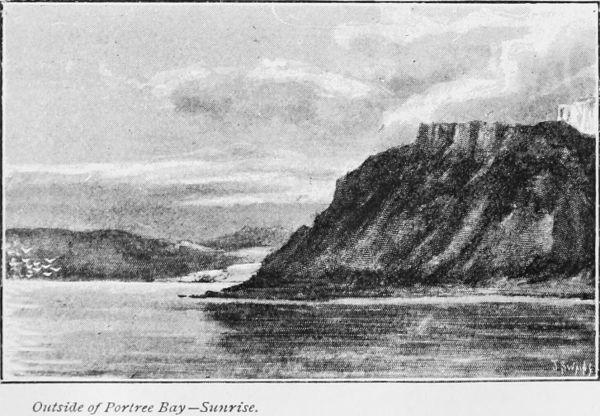
Outside of Portree Bay—Sunrise.
The morning of Thursday brought a welcome change. The day opened
grandly, and the good weather which then set in blessed us during the
remainder of the cruise. Those who rose early, of whom our Special
Artist was one, were rewarded with a splendid view of the hills behind
Portree, and of the bay and harbour. We started soon after breakfast
in the ‘Iolanthe’ for Strome Ferry, where several members of the party
were to leave us, and where others were to take their places, while all
eagerly awaited letters and telegrams.
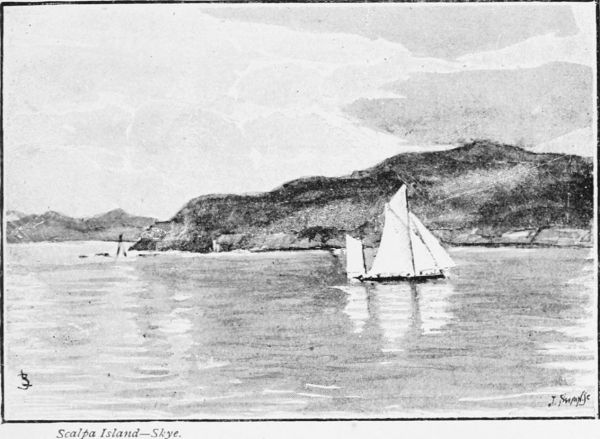
Scalpa Island—Skye.
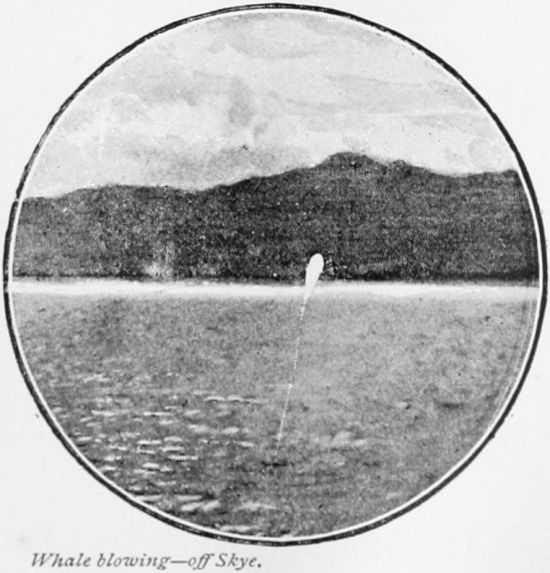
Whale blowing—off Skye.
The sail across the Inner Sound was extremely pleasant and
exhilarating. Loch Sligachan slept in peace. Scuirna-gillean and
Blaven still wore their nightcaps. The island of Scalpa was a blaze
of rich colour, heightened by the white sails of a passing yacht.
The Islands of Longa and Pabba were emeralds set in a blue sea.
Broadford was a picture of self-contained repose. Off Pabba, two
large whales—probably truants from the school, a thousand
strong, lately reported from the Shetland seas—appeared ever and anon to plough
the surface of the water, and one of our photographers succeeded in
catching them (in her camera) in the very act of blowing clouds of
spray into the air.
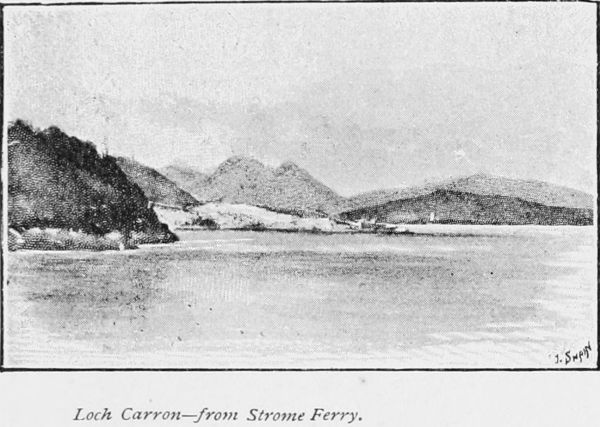
Loch Carron—from Strome Ferry.
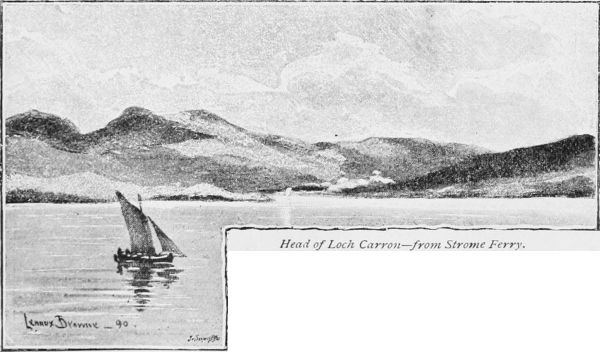
Head of Loch Carron—from Strome Ferry.
At the entrance to Loch Carron, the parallel beaches on opposite
sides of the loch were mistaken by not a few on board for railway
embankments. Like the parallel beaches of Glen Roy and the other
valleys of Lochaber, they are obviously old moraines, but that does
not make them less interesting; rather more so. Unfortunately, we
reached Strome Ferry pier just in time to see the eleven o’clock
train steam out of the station, and meander along the coast of
the Loch. It was rather aggravating,
no doubt; but everything comes to him who waits; and our disappointed
friends, who wished to go southward, were able to enjoy a drive over
the crest of the promontory to Balmacarra, and to return in time for
the two o’clock train.
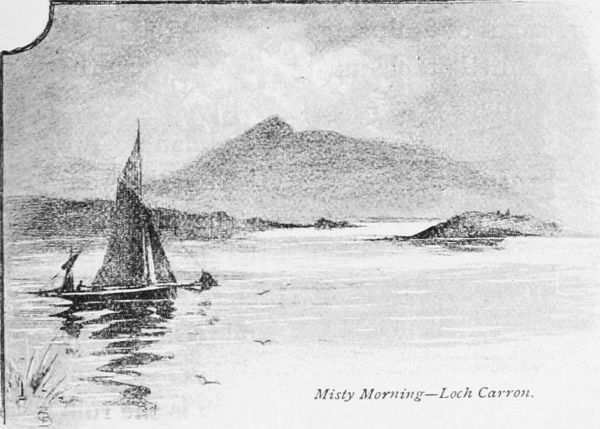
Misty Morning—Loch Carron.
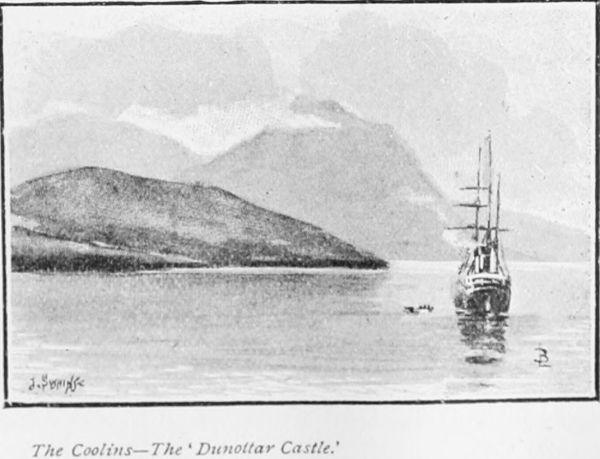
The Coolins—The ‘Dunottar Castle.’
Loch Carron is a very beautiful sea. It cannot compare in
grandeur or boldness with Loch Alsh or Loch Hourn. Its beauty is
of a softer type, and a simpler character; but its charms are not
less. The navigable entrance to it is narrow, owing to treacherous
rocks; and the tide flows through the passage with tremendous force
and speed. We pass on the one shore the ruins of Strome Castle,
and on the other the handsome residence of Duncraig, and the
fishing village
of Plockton—a collection of weatherbeaten huts, but prettily
situated on an outstanding promontory. As we emerge from the Loch, we
have a very grand view of the Coolins, with the ‘Dunottar Castle’ lying
under their shadow, and of the islands of Scalpa and Raasay—the
latter crowned with a curious little table-mountain over which the Old
Man of Storr is distinctly visible.
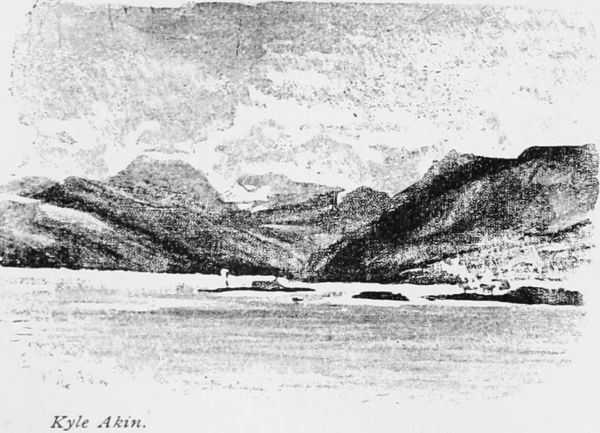
Kyle Akin.
Later in the day, and still on board the ‘Iolanthe,’ we steamed
through the narrow passage of Kyle Akin (between Skye and the mainland)
into Loch Alsh. The mouth of the loch is intersected by reefs and
rocks, on the crest of one of which is the ruin of Castle Maoil. Near
it, on the right hand, is the pretty village of Kyle Akin, built
round a crescent-shaped bay with lovely sands. One would like to
pause at such a charming spot, or to visit Balmacarra, peaceful and
sweet-looking, or to inspect more closely the monument, not far off,
erected by Sir Roderick Murchison to the memory of one of his ancestors
who heroically collected the rents of the proscribed Earl of Seaforth
after the ’45; but we have to content ourselves with distant views, in
the meantime at least.
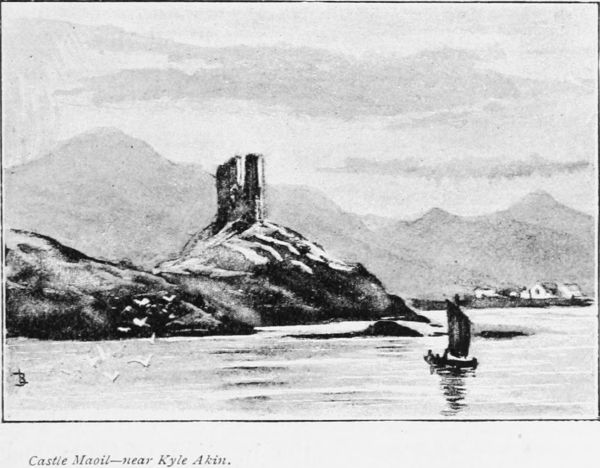
Castle Maoil—near Kyle Akin.
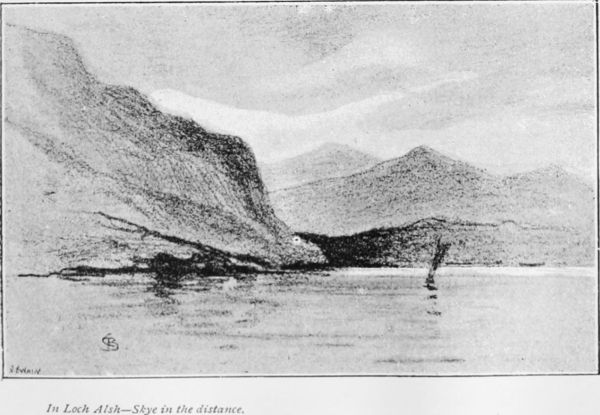
In Loch Alsh—Skye in the distance.
The constant changes in the character of the scenery of
Loch Alsh are perplexing. We think we have reached the
head of the loch, when, suddenly, a new channel opens up in
the apparently landlocked course. When King Haco of
Norway found his way into this inland loch, as he did on his northward
voyage after his defeat at Largs, he might very well have imagined
himself to have been caught in one of his native fiords, so tortuous is
the course and so difficult is the navigation.
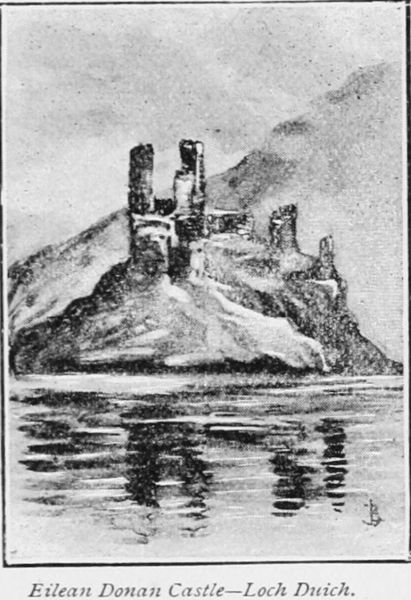
Eilean Donan Castle—Loch Duich.
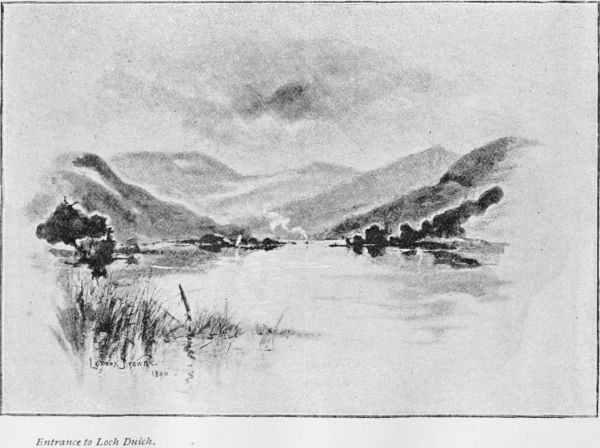
Entrance to Loch Duich.
At the head of the loch, we approach the ruin of Eilean Donan
Castle, which stands at the junction of three lochs—Loch Alsh, Loch Long, and
Loch Duich. The castle, built on a detached island, must in olden
times have been a place of strength; but the story goes that it was
demolished by the guns of Cromwell. Passing the Castle on the left,
we enter Loch Duich, which, though an arm of the sea, has all the
appearance of a fresh-water lake, so smooth is its surface, and so
soft and fertile are its banks. It attains its greatest beauty near
the mansion-house of Inverinate and the village of Kintail, in the
midst of rich woods on its northern shore. The prevailing green tints
gleam out in the fitful sunshine with a richness and variety that are
enchanting. At its head, the loch is closed in by a magnificent group
of pyramidal mountains—Ben Attow, Scour Ouran, Ben Mhor, and
the Saddle—all rising to a height of upwards of 3300 feet, and
separated by well-defined and gloomy valleys.
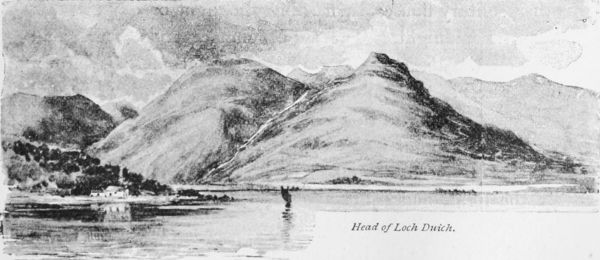
Head of Loch Duich.
The return voyage in the evening was very fine. As we emerged from
Loch Alsh and crossed Loch Carron, we had again a grand view of the
Coolins, cloud-capped and solemn, and traversed by the axled rays of
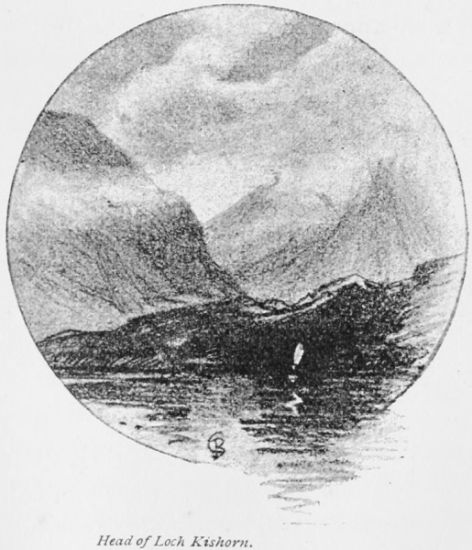
the setting sun. We steamed in the direction of Loch Kishorn, a northerly arm of Loch
Carron, where the ‘Dunottar Castle’ awaited us, and where we anchored
for the night.
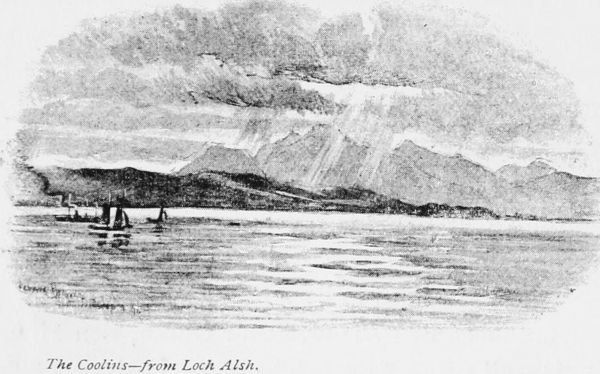
The Coolins—from Loch Alsh.
That night was made memorable by several incidents.
In the first place, the electric search-light was got into working
order, and we astonished the natives of Courthill and
other solitary houses by flashing the light of day in upon
them at midnight. The ship’s pinnace and other small
craft on the loch appeared like lime-light pictures thrown
on a screen. The submarine electric tackle, which is used
in cases of accident to the screw, or to the bottom of the
vessel, was also got into play; and a very striking and novel
effect it produced. A number of small fishes were attracted
by the light, and swam about within the halo it formed.
The scene recalled forcibly the stanza which Byron completed
by adding the last two lines:—
“The sun’s perpendicular ray
Illumined the depths of the sea;
And the fishes, beginning to sweat,
Cried (something) how hot we shall be.”
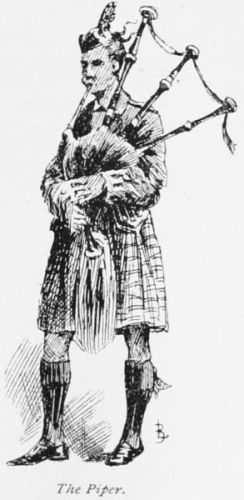
The Piper.
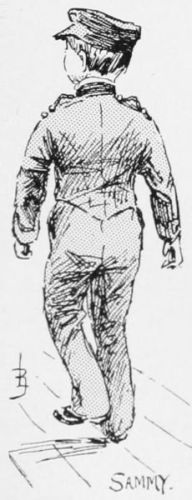
Sammy.
Most memorable of all, the Captain’s boy astonished every one
by volunteering a hornpipe, while dancing was in progress on the
promenade deck. Sir Donald summoned his piper to play the necessary
accompaniment; but that did not suit Sammy’s steps. He required the
whole orchestra of the ship’s band; and he gave them his instructions
with the cool confidence of a professional performer. While he was
in the very midst of his double-shuffle, Captain Webster appeared on
the gangway, calling, ‘Sammy, you rascal, what are you doing there?’
Sir Donald, fancying for the moment that the Captain was in earnest,
rushed forward to propitiate his wrath. It was as good as a play. If
the scene had been preconcerted, it could not have been more effective.
But Sam was not in the least perturbed. He continued his performance
amid the applause
of the whole company, until he was tired out. It afterwards transpired
that the boy had been ‘on the boards’ before, probably in the part of
the ‘Midshipmite’ in the Children’s ‘Pinafore.’
Head of Loch Kishorn.
VII
ROUND CAPE WRATH
Rona Island—Lewis and Harris in the distance.
Friday, September 5th, was perhaps the most enjoyable day of the
whole cruise. We started, in magnificent weather, with the intention
of steaming up the west coast to Cape Wrath, and thence eastward along
the north coast to Thurso. We steered up the Inner Sound, between
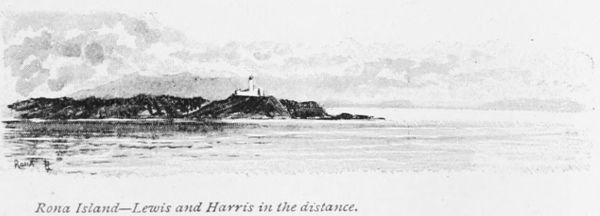
Raasay and Rona on the one hand, and the rugged coast of Applecross
on the other. We crossed Loch Torridon, at the head of which Ben
Liugach rose in calm and majestic splendour. Opposite Gairloch, we had
a fine view of Ben Slioch, which overlooks Loch Maree. Still finer,
however, was the view backward, where the Coolins frowned even in
the sunshine—the solemn pyramid of Blaven asserting itself in
presence of loftier peaks. From this rugged background the rocky ridge
extended northward by the Storr rocks and the Quiraing to the extremity
of the island.
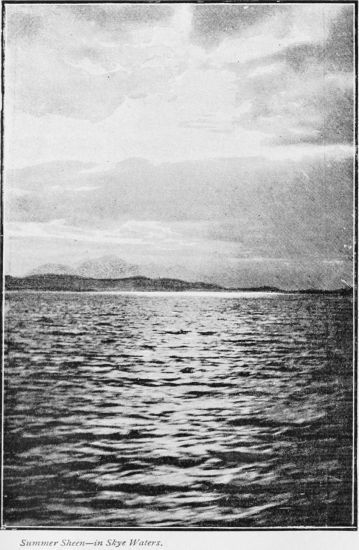
Toward the west, the misty outline of Lewis and Harris broke, but
scarcely broke, the regularity of the horizon.
Summer Sheen—in Skye Waters.
Then we crossed Loch Broom, with its Summer Isles, and
the point of Rhu-Coigach, and Enard Bay, and Loch Inver,
and we began to recognise the peculiar character of the
Sutherlandshire mountains. They rise abruptly to a considerable
height from wide intervening valleys, and they
frequently assume the sugar-loaf shape. That is the case
with Suilven, ‘the sugar-loaf’ par excellence, and also with
Canisp, and Ben Stack, and Foinaven near Loch Laxford.
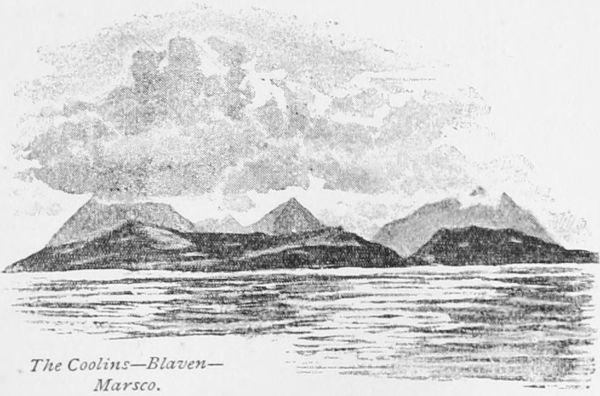
The Coolins—Blaven—Marsco.
The whole coast is rugged and forbidding. Close to the Point of
Stoer is the Rhu-Stoer, a detached columnar rock resembling the Old
Man of Hoy in Orkney. Several other stacks of similar formation were
seen as we passed northward, conspicuously ‘The Shepherd’ between Loch
Inchard and Cape Wrath. As we approached the latter, we felt once more
the Atlantic swell, and the ship pitched and rolled somewhat, though
she was as a rock in comparison with the smaller coasting steamers that
ply habitually in these waters, two of which we saw labouring heavily;
and some of us, at least, felt thankful that we were not as they.
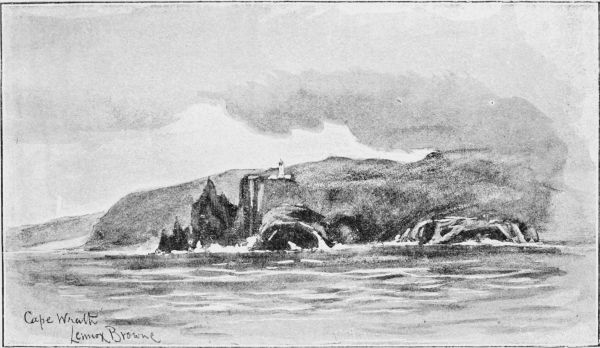
Cape Wrath
—Lennox Browne
Cape Wrath, now seen by many of us for the first time, is really
a splendid headland. The name in its modern interpretation may be
appropriate enough, considering the wild seas that roar and bluster
around it; but in point of fact it has no connection with the English
word ‘wrath.’ It is a corruption of the Norse ‘Hvarf,’ which meant ‘the
turning-point of the land,’ and might have been more correctly Englished ‘Cape Warp.’
The lighthouse stands on a cliff 370 feet above the sea, beneath which
there is a succession of jagged points, or needle-rocks, stretching
seaward, perforated at their bases with several openings, through which
the surf breaks and spends itself in spray. A more perilous point for
shipping in a dark night it would be hard to conceive. As we passed
the Cape, the cold, rainy squalls which had followed us for some time
cleared off, leaving behind them, however, very striking effects of sea
and sky.
The north coast, east of Cape Wrath, partakes of the
same rugged character as the promontory. There are castle
rocks, and detached rocks, and dark ‘cletts,’ too numerous to
mention. There are isolated mountains of considerable
height about the dark Kyle of Durness, and Loch Erribol,
and the Kyle of Tongue. The coast-scenery, however, becomes
rapidly tamer. Ben Hope and Ben Loyal are the last prominent
peaks that stand out from the undulating plain.
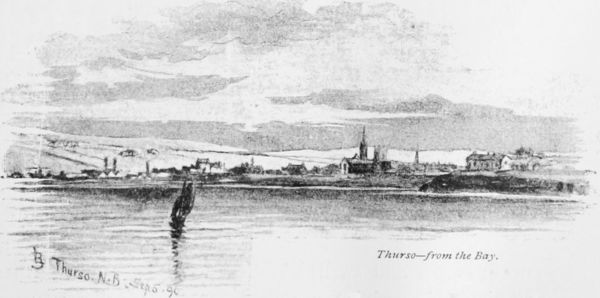
Thurso—from the Bay.
Beyond Strathy Point, we reach the lowlands of Caithness.
Green meadows and
yellow corn-fields sloping down to the golden sands become
common. Around Brims Ness and Holburn Head, the
coast is as flat and level as the shores of Fife and the
Lothians. Near Holburn
Head, however, there is another
huge detached rock, 200 feet high,
called the Clett, around which the
ocean surges and swells night and day in most weathers.
Passing this rock at a safe distance, we entered Thurso
Bay, and anchored securely in Scrabster Roads. The rain
clouds cleared off toward evening, and revealed a beautiful
sunset.
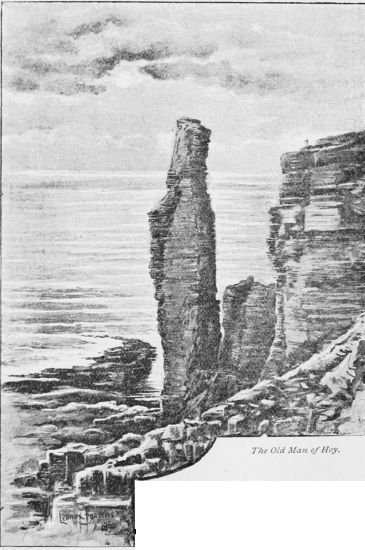
The Old Man of Hoy.
At Thurso (which is Thor’s Town, another Norse landmark)
we were in touch once more with the British railway
and postal systems. The most prominent object on the mainland
was the castle lately rebuilt by Sir J. G. Tollemache
Sinclair—a cold-looking mansion, rendered more forbidding
by the absence of trees. The town itself looked very
picturesque, with its spires and chimneys breaking the
coast-line, while the fields of golden grain that surrounded
it bespoke fertility and prosperity. Other noteworthy
features of the neighbourhood were Harold’s Tower, the
Bishop’s Castle, and the bold bluffs of Dunnet Head, the
most northerly point of the mainland. The northward
view included the Orkney Islands, and Hoy Head, with
the Old Man of Hoy at its base, which, at a later hour,
and in the ‘witching time of night,’ stood out grandly in
the moonlight.
‘The Old Man of Hoy
Looks out on the sea,
Where the tide runs strong, and the wave rides free:
He looks on the broad Atlantic sea,
And the Old Man of Hoy
Hath this great joy,
To hear the deep roar of the wide blue ocean,
And to stand unmoved ’mid the sleepless motion,
And to feel o’er his head
The white foam spread
From the wild wave proudly swelling,
And to care no whit
For the storm’s rude fit,
Where he stands on his old rock-dwelling.’
—Professor Blackie.
VIII
A RAID ON ORKNEY
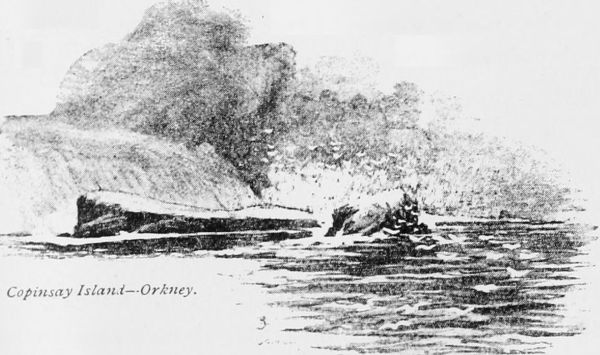
Copinsay Island—Orkney.
During the night we were rocked in the cradle of the deep, even at
our anchorage, by the north-west wind, which blew strongly; and at
an early hour in the morning, the anchor was weighed, and we steamed
steadily through the Pentland Firth, generally a tempestuous passage,
and then northward past the rugged islet of Copinsay, with its myriads
of sea-birds, into Shapinsay Sound. Balfour Castle, on the island of
Shapinsay, was the most prominent object in the landscape. One is apt
to wonder how the massive building came there, so inconsistent is
its pretentious appearance with its bare and cheerless surroundings.
By-and-by we anchored in Kirkwall Roads, and every one, as quickly as
possible, was
transferred to land in the ‘Iolanthe,’ and the steam launch, or the
attendant gigs.
Kirkwall is not a very stirring or lively place, but it has an
old-world flavour, which makes a visit to it pleasant and memorable.
Its narrow and tortuous streets, paved with flags, its old-fashioned
houses, many of them with secluded courts, and presenting their gables
to the sea, and most of all its ancient Cathedral, invest it with a
peculiar interest.
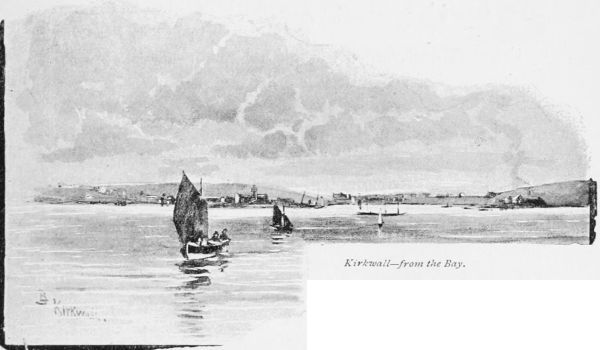
Kirkwall—from the Bay.
The Cathedral forms, of course, its chief attraction.
This building, which is the most conspicuous object in the
town, as seen either from the sea or from the land, dates
from the twelfth century, having been founded by Jarl
Rognvald in 1137, in memory of his uncle, St. Magnus. Its
style is chiefly Norman, but it contains many features of
the Pointed Gothic or Early English style, which makes
it extremely interesting to the antiquary and the architect,
resembling in that respect the famous Cathedral of
Trondhjem, which belongs to the same period. Outwardly,
it is wonderfully well preserved. Though really a very
small building of its kind—a cathedral in miniature,—its
parts are so well proportioned that it has almost an imposing
appearance. Worthy of special notice are the great
east window, which Sir Henry Dryden believed to be unique;
the circular window in the south transept; and the carving
of the west door, which Dryden refers to as probably the
finest example in the British Islands of the effective combination
of particoloured stones. But the delicate floral
work in the arch of the doorway is now much weather-worn,
and the fine pillars are wasted to skeletons. The
tower, to which we mounted, commands a splendid view of
the town and bay and the surrounding islands.
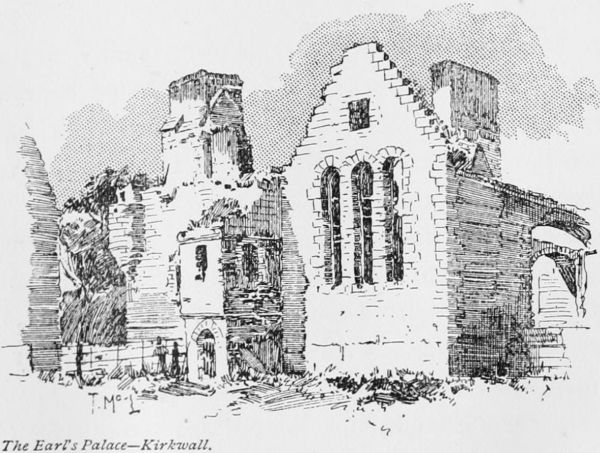
The Earl’s Palace—Kirkwall.
From the Cathedral we passed to the Bishop’s Palace,
part of which is probably as old as the Cathedral itself,
though the greater part is known to have been built in
the sixteenth century by Bishop Reid, who made additions
to the Cathedral also. In the older part of this palace
King Haco died on his return from Largs, and his remains
lay for a time within the Cathedral.
Still more interesting are the remains of the Earl’s Palace, which
stands to the east of the last-named building. It was erected by the
notorious Earl Patrick Stewart—“Black Pate”—about 1590.
He was the son of Lord Robert Stewart (a natural son of James V.), Earl of Orkney. Black Pate also built
Scalloway Castle in Shetland; and in the erection of both he levied
contributions from his vassals and retainers without stint, requiring
them not only to furnish the materials in stone, lime and eggs, with
which the mortar was mixed, but also to work like slaves under his
command: hence his by-name, “The Scourge of the Islands.” By-and-by his
notorious deeds became known in Edinburgh, and he was captured, and
ended his career on the gallows.
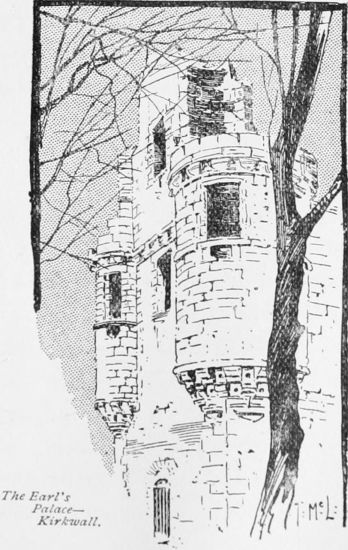
The Earl’s Palace—Kirkwall.
He must, however, have been a man of fine taste and grand
notions, if we are to judge by the architectural features of his
palace. It is really a fine specimen of the Scottish baronial style,
many of the details of ornament—in round turrets, quaint gables, and
projecting windows—being beautiful, especially as seen through
the grove of sycamore-trees which surrounds the building. A remarkable
feature is a level arch over one of the great fireplaces in the
banqueting hall, on either side of which the initials “P.E.O.”
(Patrick, Earl of Orkney) may still be seen. This is one of the best
examples of the straight arch in Scotland.
The day being exceedingly fine, a large contingent enjoyed
a drive along the Stromness road to Maeshowe and the
Stones of Brogar and Stenness.
Maeshowe is an unique chambered mound, and is one of
the most interesting of the many interesting antiquities of
Orkney. The mound is 36 feet high and 300 feet in circumference.
The central chamber (15 feet square) is built
of solid blocks of stone. The roof is of bee-hive shape, and
in the walls there are on three sides deep cells or shelves
5 or 6 feet long. It is reached by a long and narrow
passage, and as the whole is underground, it has to be
explored by candle-light. The position and the dimensions
of the cells suggest a place of burial, such as the early Britons
used; but the numerous inscriptions on the walls are Runic
and Norse. There has therefore been a great deal of discussion
as to the purpose of the building; but the general
belief now is that it was originally a Pictish sepulchre, and
that it was broken into by the Norsemen after the ninth
century, and was used by them as a place of refuge, and
for the concealment of treasure.
A mile and a half farther on are the two celebrated stone
circles, called respectively the Ring of Brogar and the Ring
of Stenness. The latter is the smaller, though it has given its
name to the whole. According to our own Antiquary, who
accompanied the party, that circle was 104 feet in diameter,
and consisted originally of twelve stones, of which only two
are standing. The Ring of Brogar, according to the same
authority, was 340 feet in diameter, and comprised sixty
stones, of which thirteen are standing, while ten others,
though they have fallen, are still entire. We were assured
that these are the finest stone circles in Scotland, far surpassing
in extent the Stones of Callernish in Lewis, and
comparing favourably with the more famous remains of
Stonehenge. As to the purpose of these circles, we were left
to solve the mystery for ourselves, being warned, however, that
their connection with Druidical worship is now discredited.
One of the most famous of these monoliths was the Stone
of Odin in the Stenness circle, now no longer erect. It was
perforated by a hole, about five feet from the ground, and
was regarded with the utmost veneration, being used (as the
readers of Scott’s Pirate will remember) as the place where
lovers plighted their troth by clasping hands through the
aperture. The stones in the case of both circles are of the
Old Red Sandstone formation.
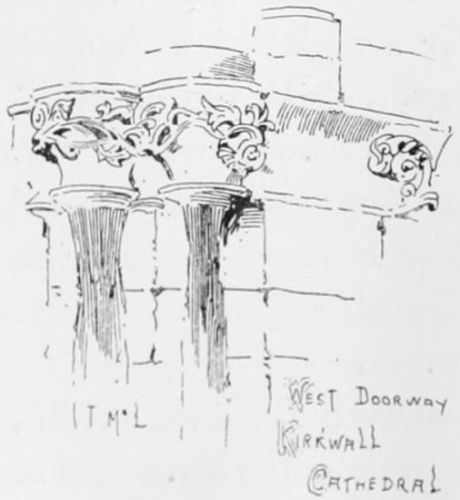
West Doorway Kirkwall Cathedral
IX
OUR SHIP’S NAME-MOTHER
The whole party returned to the ‘Dunottar Castle’ about five
o’clock, and soon afterwards the anchor was weighed and we started
on our homeward voyage. The wind, which had been blowing fresh from
the north-west all day, fell away toward sunset, and during the
night—the only night spent in sailing—we had a wonderfully
quiet passage.
About five o’clock in the morning, those who were fortunate enough
to occupy berths on the port side of the ship saw a magnificent
sunrise. The sky was clear overhead, but there was a dense bank of
clouds on the eastern horizon. Presently, in the midst of the dark
mass, a ruddy longitudinal streak appeared. Then the streak was doubled
and multiplied. The upper air glowed with opalescent tints. The clouds
melted away, and the ruddy orb of the sun appeared on the verge of the
ocean. The sea around us, and for miles away, was calm as a mirror, and
reflected the gradations of light and the fiery hues of the eastern
sky. It was an enchanting scene, such as could be witnessed only once
or twice in a lifetime.
We passed Aberdeen about six o’clock, but at too great a
distance to obtain a definite view. About breakfast-time we
were off Stonehaven, which threw back from its windows the
rays of the morning sun. It was a glorious day. Not a
cloud darkened the sky, not a ripple broke the surface of
the sea except in the track of the ship. Presently we were
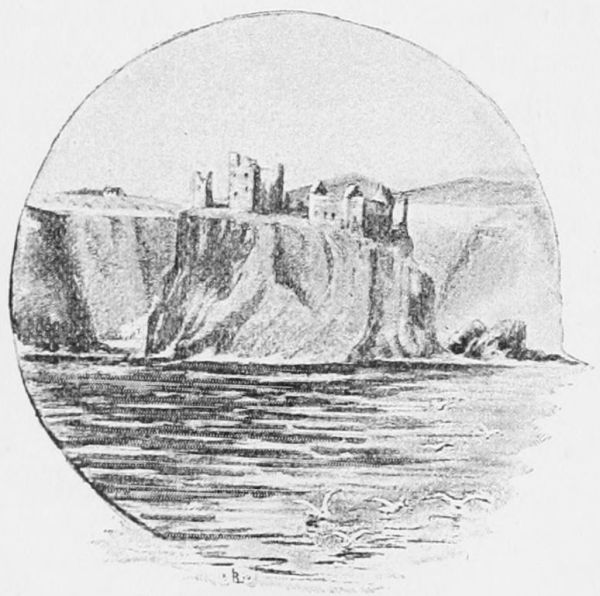
abreast of the ruins of Dunottar Castle, perched on its rocky
pedestal—the veritable name-mother of our ship. The
breakfast-bell was ringing (a welcome sound in ordinary
circumstances), but every one was loath to leave the deck.
The order was therefore given to lie-to until that necessary
rite had been performed. Then we returned to the deck
with satisfied spirits, and gazed for half an hour or more on
the beautiful scene. Artists, photographers, and scribes
were soon busily at work, all eager to catch the fleeting
beauty.
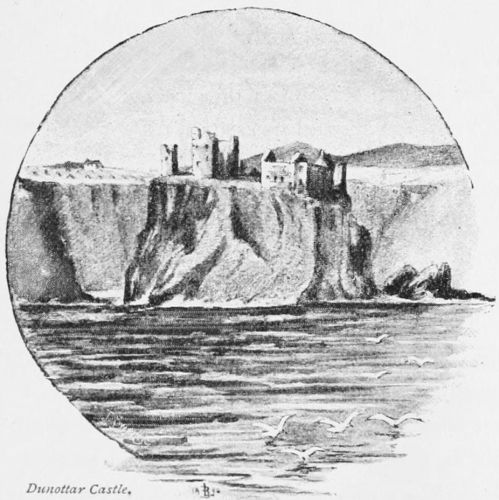
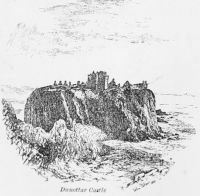
Dunottar Castle.
The detached, or semi-detached, rock on which the ruins
of the Castle stand is about two miles south of Stonehaven.
It is 160 feet high, and a deep chasm separates it, all but
completely, from the mainland, which at this point is wild
and precipitous. The neighbourhood, indeed, is a continuous
series of cliffs, which are frequented by numerous
sea-birds: hence the popular name given to the coast, of
the ‘Fowlesheugh.’
Here again the resources of our own Antiquary were
called into requisition, and he assured us, with the unblushing
confidence of an expert, that the name of the Castle meant
in Gaelic ‘the fort of the low promontory.’ It is easy to
believe that the rock was the site of a castle from very early
times, a siege of ‘Dunfoither’ (as it was then called) by
a king of the Picts in the seventh century being on record
(681 A.D.). [1] The Castle the ruins of which remain is of
course of much later date, though its buildings belong
to different ages. It appears, from evident signs, to have
covered the greater part of the surface of the rock, which
is 4½ acres in extent.
Its position resembles very closely that of Tantallon
Castle in the Firth of Forth, and before the days of artillery
it must have been almost impregnable. Nevertheless, Blind
Harry describes a capture of Dunottar by William Wallace,
when four thousand Englishmen were burned in the Castle.
It was re-fortified by Edward III. in 1336; but these incidents
relate to an older castle than that of which the remains
survive.
The present Castle, as far as can be ascertained, was
begun by Sir William Keith, the ‘Great Marischal of
Scotland,’ towards the close of the fourteenth century, and the
lands and castle remained in the hands of the Keith family
till the Rebellion of 1715, when the owner threw in his lot with
the Pretender, and forfeited his estates. One of the mottoes
of the family was couched in the quaint and defiant words,
‘They haif said:
Quhat say they:
Lat thame say!’
When the ship received the name of the Castle, these words
also were adopted as its motto.
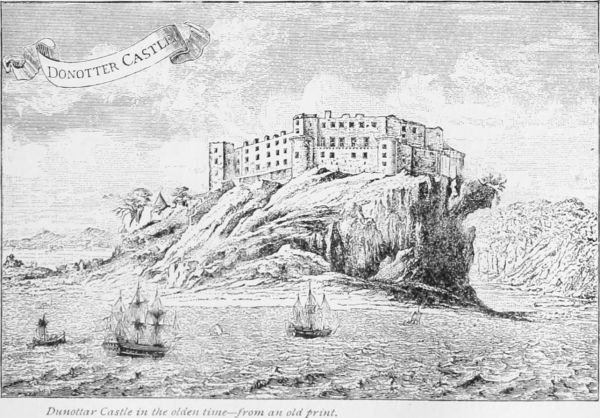
Dunottar Castle in olden time—from an old print.
Dunottar was besieged by the gallant Marquis of
Montrose during the great Rebellion, the Earl Marischal
of that time having been a Covenanter (1645). Montrose
offered him fair terms if he would capitulate, but the
Covenanting clergymen who had taken refuge within the
Castle overruled him, as their kind overruled David Leslie
at Dunbar; and he was not allowed to surrender. Thereupon
the Marquis subjected the surrounding property to
military execution, to the great dismay of the Earl, when he
saw flames and smoke rising from his houses, and notwithstanding
the assurance of Andrew Cant (ominous name) ‘that
the reek would be a sweet-smelling incense in the nostrils
of the Lord.’ Evacuation followed as a matter of course.
When Charles II. visited Scotland in 1650, he was entertained
in Dunottar Castle by the seventh Earl Marischal.
In the following year, when the English Parliamentary army
overran Scotland, the Scottish Estates deposited the Regalia
in Dunottar Castle, then deemed the strongest place in
the kingdom, and George Ogilvy of Barras was appointed
Lieutenant-Governor. It was besieged by Cromwell’s army,
and Ogilvy held out until famine rendered his troops
mutinous, whereupon he surrendered. Before he did so,
however, the Regalia had been cleverly removed by Mrs.
Granger, the wife of the minister of Kinneff—a village on
the coast, four miles farther south. Having obtained the
permission of the English commandant to visit her friend
Mrs. Ogilvy, the Lieutenant-Governor’s wife, Mrs. Granger,
carried with her, on leaving the Castle, a bundle of clothes,
in which the Crown was imbedded, and also a huge distaff
covered with lint, which was in fact formed of the Sceptre
and the Sword of State.
The same night, the precious treasures were buried by the
minister himself under the flags of his church at Kinneff;
and there they remained till after the Restoration of 1660,
when they were unearthed, and were presented to Charles II.
by the same George Ogilvy who had formerly been Commander
of the Castle. Ogilvy’s only reward was the title
of Baronet, and a new coat of arms. The minister and
his wife received no reward—not even thanks. Sir John
Keith, the brother of the Earl Marischal, was made Earl
of Kintore in 1677, and was the ancestor of the present
Earl, who is the tenth to hold the dignity.
After its surrender to Cromwell, the Castle was partially
dismantled and reduced to ruins. What remained of
it was, like the Bass Rock, used as a State prison for the
Covenanters during the persecutions under Charles II.
and the Duke of York. One hundred and sixty-seven men
and women were imprisoned at one time in its ‘Whig’s
Vault,’ or Black Hole, and nine of them speedily died of
suffocation. Driven to despair, some twenty-five of them
one night crept out of a window and along the face
of the cliff, in the hope of effecting their escape. Two
of these daring men fell over the rock and were killed.
The others were captured, and were subjected to terrible
cruelties.
A few years after the forfeiture already referred to, the
Castle was sold, and was completely dismantled. It was
subsequently repurchased by the Keith family; and it passed
finally into the hands of Sir Alexander Keith, Writer,
Edinburgh, whose grandson, Sir Patrick Keith Murray of
Ochtertyre, sold it in 1875 to Mr. Innes of Cowie, near
Stonehaven.
Having studied the Castle and its surroundings long
enough to deepen our impressions of it, we got up steam
again, and went on our way past Bervie, with its outstanding
Craig-David; past Montrose, stretched over a level site;
past Arbroath, with its tall chimneys, its spires, and its
ancient Abbey,—all seen in the dim distance, and reposing
peacefully in the Sabbath calm.
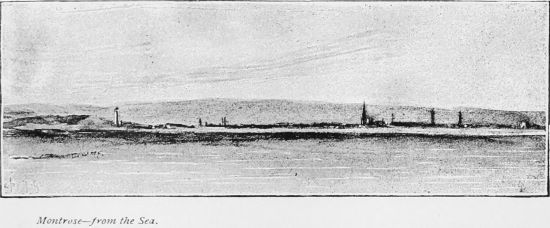
Montrose—from the Sea.
X
A DAY OF REST
At the morning service, which was held as usual in the saloon, Dr.
Cameron of Cape Town preached an eloquent and suggestive sermon from
Luke xiii. 29, ‘They shall come from the east, and from the west, and
from the north, and from the south, and shall sit down in the kingdom
of God.’ The words, he thought, were not inappropriate to the occasion;
for the company was gathered from many parts of this country, and some
of its members from distant lands. It might be said, indeed, that we
had come from the east, and from the west, from the north, and from
the south. After pointing out that the words were Christ’s real answer
to the question, ‘Are there few that be saved?’ and showing that His
restrictions applied to those who sought to enter the kingdom of God in
other ways than by the strait gate, the preacher continued:—
‘My text gives us the vision of a great commonwealth or
society, into which all worthy elements of human character are
gathered up—a kingdom of God which is at the same time a
kingdom of man. And they form a great multitude which no
man can number, because fresh crowds are ever gathering into
it. “The nations of them that are saved shall walk in the
light of it.”
‘“They shall come from the East”—the land of immemorial
traditions and gorgeous imaginations, of Oriental splendour and
barbaric gold: the cradle of civilisation, and philosophy, and
religion: where, a thousand years before Christ, mystics
dreamed of a blessedness which could be reached only by those
who mortified the flesh, and contemplated the unseen glories of
the spiritual world;—the East, with its patient millions who
have borne without complaint the yoke of a cruel bondage:
with its frankincense and myrrh, once laid in homage at the
cradle of a little child: with its jewelled temples raised in
honour of gods many and lords many, and its holy plains,
“Over whose acres walked those blessed feet
Which, eighteen hundred years ago, were nailed,
For our advantage, to the bitter cross.”
‘None of that splendour shall be lost: it shall receive a new
consecration. That devotion shall find its true object: those
dusky brows shall be decked by the hand of Him who hath
made us kings and priests unto God. “They shall come from
the east,” and sit down with prophets and patriarchs in the
kingdom of God.
‘“They shall come from the West.” The kingdom of God
is no palace of luxury, no paradise of passive repose, where
kings sit in solemn state, and mystics dream away their days
in fruitless visions. It is the commonwealth of those banded
together to do the work of the Lord, and there must be place
in it for the practical vigour and the restless energy of the
Western mind. The subtle Greek, who sent the arrows of his
thought quivering into the heart of Europe: the practical
Roman, fulfilling his great part in the commission to replenish
and subdue the earth: the nations of modern Europe, with
their culture, and power, and ambitions: the great Republic of
the West, where the banner of religious freedom was unfurled,
and great problems in politics and religion are being worked
out—not one of these can be spared from the final association
of men in the kingdom of God. Each has its contribution to
bring. We are debtors to the Greek and the barbarian, to the
wise and the unwise: and they in their turn are debtors to the
great world of which they form a part, and are to bring their
glory and honour, their worth and their wisdom, into the Community
of the Saved.
‘“They shall come from the North.” They came from the
north in mighty hordes—those fierce barbarians who swept down
upon the tottering Roman Empire, and crushed out what
remained to it of life. Province after province was invaded by
these terrible men, the fairest tracts of Southern Europe were
occupied by them, and are still held by their descendants.
They shall come again, Christ says, from the north: not for
destruction, but for help and blessing: not to ravage the
provinces of a decaying earthly empire, but to swell the
population and to add to the wealth of the city of God: from
the far north, the land of the midnight sun, and the noonday
darkness, into the city of which the Lord is the everlasting
light, and whose sun shall no more go down for ever.
‘“They shall come from the South”: where palm-trees cast
their grateful shadows on the earth, and temples lift their
stately heads to heaven. We read and speak of the luxury and
ease of the South, where life is free from care, and its burdens
rest very lightly on men whose hearts are bright and gay.
But there is a place even for something of this kind in the
final home. There must be rest and peace, as well as toil and
energy: enjoyment, as well as action. So the men of the
South come trooping in at the call of Christ, even as the
Queen of the South once came to hear the wisdom of Solomon.
From the banks of the river of Egypt, with its mighty pyramids
and mystic learning: from the central plains and southern
shores of the dark continent of Africa, which shall one day be
light in the Lord: from the new world of the Southern Seas
with their multitude of islands, and from that greater Britain
which is throbbing with the vigorous life of what they love to
call the Mother Country—from each and all of these they shall
come, a goodly host, each under its own standard, but high
over all the blood-red banner of the Captain of our Salvation.
They shall come, a great multitude which no man can number,
“from the east, and from the west, from the north, and from
the south”: and this is the processional hymn to the music of
which they march through the gates into the city—
“Unto Him that loved us, and washed
us from our sins in His own blood,
And hath made us kings and
priests unto God and His Father;
To Him be glory and dominion
for ever and ever. Amen.”’
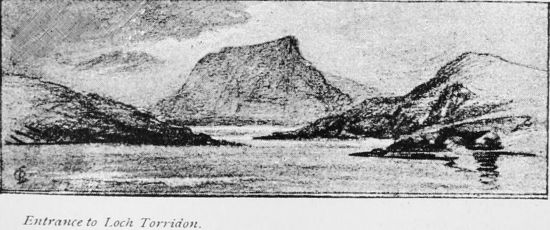
Entrance to Loch Torridon.
XI
HOMEWARD BOUND
When we returned to the deck we found ourselves
within sight of the Bell Rock, off the
Firth of Tay, and the old stories were retold
of the fate of Ralph the Rover, and of the
trials and hair-breadth ’scapes of Robert
Stevenson and the heroes who helped him to build the famous
lighthouse, and to carry out in an enduring
form the humane intentions of
“The pious Abbot of Aberbrothock.”
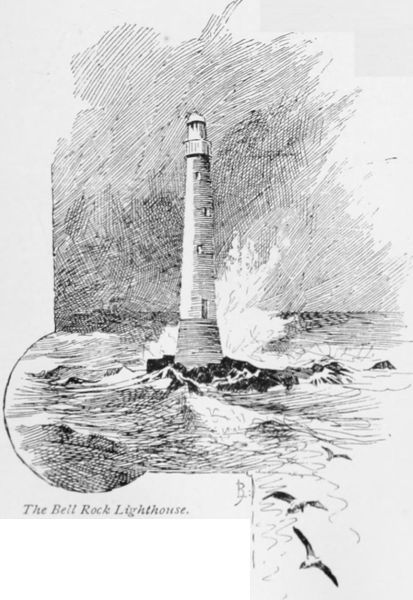
The Bell Rock Lighthouse.
A heavy haze now began to gather on the shore. No trace of St.
Andrews could be seen. The East Neuk of Fife, with King’s Barns on the
one side and Crail on the other, was only dimly visible. Steaming close
to the Isle of May, we saw very plainly its
lighthouses, its store-houses,
and its ruined chapel of St. Adrian. We were reminded,
in view of recent events, that this island is nearly
of the same size as Heligoland; and one wonders that it has
not been turned to as good account as the latter. Late
in the evening we entered the Firth of Forth by the passage
between Tantallon Castle and the Bass Rock, in order to
obtain a view of these famous fortresses.
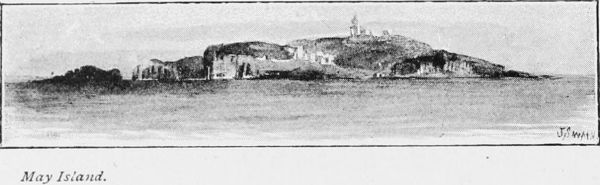
May Island.
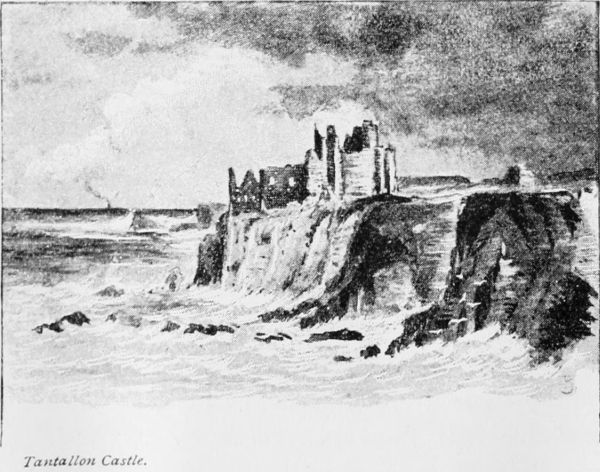
Tantallon Castle.
Tantallon Castle, like Dunottar, stands on a detached
rock, and is accessible from the mainland only at one point.
It is famous in the history of Scottish wars, and especially
in that of the house of Douglas. Every one is familiar with
Scott’s graphic description of it, and of the parting scene of
Marmion and Douglas at its gate:—
‘On the Earl’s cheek the flush of rage
O’ercame the ashen hue of age:
Fierce he broke forth,—“And darest thou then
To beard the lion in his den,
The Douglas in his hall?
And hopest thou hence unscathed to go?—
No, by Saint Bride of Bothwell, no!—
Up drawbridge, grooms!—what, warder, ho!
Let the portcullis fall.”—
Lord Marmion turned—well was his need—
And dashed the rowels in his steed,
Like arrow through the archway sprung;
The ponderous gate behind him rung:
To pass there was such scanty room,
The bars, descending, razed his plume.’
The buildings and the surrounding walls cover the
entire surface of the rock. Its strength in olden times was
proverbial, and led to the saying—
‘Ding doon Tantallon,
Mak’ a brig to the Bass,’
the one achievement being deemed about as easy as the
other. The ruins as seen from the sea do not present any
picturesque features, but they give the impression of a place
of great size, and practically impregnable.
The Bass Rock (313 feet high) is the counterpart in the
Firth of Forth of Ailsa Craig in the Firth of Clyde; and it
is remarkable that these two rocks are the only ones in
Scotland that are frequented by the gannet, or solan goose.
The Bass presents a very bold outline, from whatever point
it may be seen. Its summit slopes from north to south, and
it is surrounded on all sides by steep cliffs, rising sheer out
of the sea. The only possible landing-place is on a shelf of rock
on the south side, above which are the ruins of a fortress, which
stretched across the island from east to west.
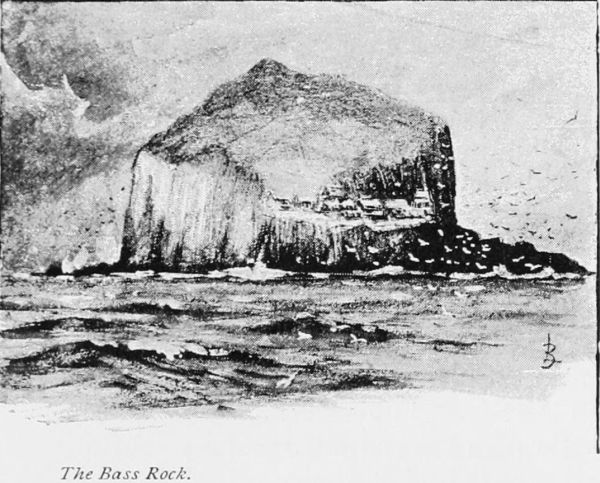
The Bass Rock.
This fortress, as has been mentioned, was used as a State prison in
the times of Charles II. and his brother
James VII. Many Covenanters were immured
there, including stout old John Blackadder, who died on the island
after a long imprisonment. The Bass was the last stronghold in Britain
that held out for James VII., and after
its surrender its castle was demolished.
As we passed close to the rock the steam-whistle was
sounded, and at once great numbers of solan geese rushed
forth like a living whirlwind, darting and wheeling in the
air, and filling it with their hoarse cries. The noise had
scarce died away when we passed North Berwick—sentinelled
by its Law, and guarded by its outposts, Craigleith and
Fidra. The haze grew denser and denser as we sailed up
the Firth of Forth, so much so that it was thought
advisable to go at half-speed. Inchkeith was not visible
until we were within less than a mile of it. One consequence
of the changed atmospheric conditions was that a
projected visit to the Forth Bridge had to be postponed;
another was, that we failed to obtain the view of Edinburgh
from the sea, which is considered one of the finest.
Above Inchkeith, we were met by a tug from the shore,
which brought out some of the representatives of the Leith
house (James Currie and Co.) and other friends. The tug
marshalled us the way to our anchorage; and about six
o’clock we dropped anchor in Leith Roads, not without
regret that the act signalised the practical termination of
our delightful cruise.
After dinner that evening, Sir Arthur Blackwood and
Lord Provost Muir expressed to Sir Donald Currie, in the
name of the guests, their hearty thanks for his splendid
hospitality, and for the pleasure which the trip had afforded
them in many ways. Captain Webster, his officers and
men, were not forgotten in this thanksgiving service; and
well they deserved this recognition, for what was a pleasure-trip
to the guests involved no little hard work for them.
Indeed the Captain declared that his anxieties had turned
his hair white, but he added that the many kind things said
of him had restored its natural colour—a kind of capillary
blush after the blanching of care.
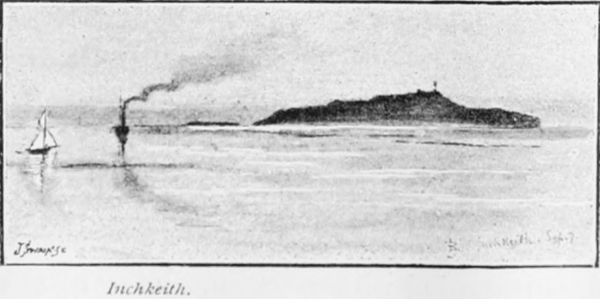
Inchkeith.
XII
IN THE FIRTH OF FORTH
Next morning the mist had risen sufficiently
to show dimly, but yet with a certain poetic
mystery, the beauties of the unrivalled position
of ‘the grey Metropolis of the North’
within her cincture of hills—Salisbury
Crags and Arthur’s Seat, Blackford Hill and the Braids,
Corstorphine Hill and the wooded heights of Dalmeny and
Hopetoun. In the midst, there was a dreamy indication of
the city, with its masses of buildings following the contours
of the undulating site, and relieved by outstanding spires,
monuments, and tall chimneys—the whole culminating in
the Castle Rock, which stood out like an aerial island from
a sea of haze.
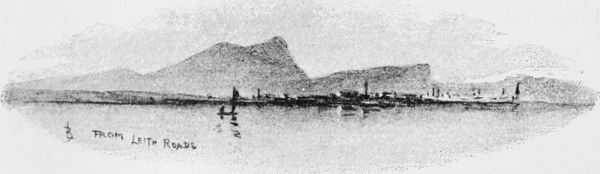
From Leith Roads
In the forenoon, a delightful trip was made in the
‘Iolanthe’ up to and under the Forth Bridge; and those who
made it were rewarded with a splendid view of that wonderful
structure. As every one knows, the view of the Bridge
from the sea is the finest that can be obtained. You see it
as a whole. You take in at a glance all its details. You
see each of the cantilevers separately, as well as the connecting
girders. You see the width of the great spans and the
height of the ‘fair-way’; and you understand why such
vast superstructures were necessary in order to secure the
stability of the intermediate railway line. All this is missed
by one who crosses the Bridge in a railway carriage, unless,
as occurred once in the experience of the writer, the western
sun casts a perfect shadow of the Bridge on the placid bosom
of the Firth below.
In the course of the day, several thousands of the inhabitants
of Edinburgh and Leith visited the ‘Dunottar Castle,’
on the general invitation of the Castle Company, and in
steamers provided for their accommodation. The extent
to which the privilege was taken advantage of showed how
highly it was appreciated.
In response to special invitations, the Corporations of
Edinburgh and Leith, the Merchant Company, the Chambers
of Commerce, and other public bodies, paid a visit to the
ship about noon, and were entertained to luncheon, to the
number of 150, Sir Donald Currie presiding. The manner
in which the extempore function was carried through showed
that the resources of the ship, without extraneous aid, were
quite equal to such an emergency. It is needless to do more
than refer to the eloquent speeches in which the beauty of
the ship and the enterprise of its owners were acknowledged.
Then, at length, the harmonious party, which for ten
days had been at home in the great ship, was scattered promiscuously
to the East and the West, the North and the
South, to resume old ties of love and friendship, but not to
forget the new ties that had been formed.
In the evening of the same day, the great ship left
her moorings and sailed for London, there to take her
appointed place in the Cape and Natal Mail Service;
and no vessel ever entered on her career with more cordial
good wishes from troops of friends than
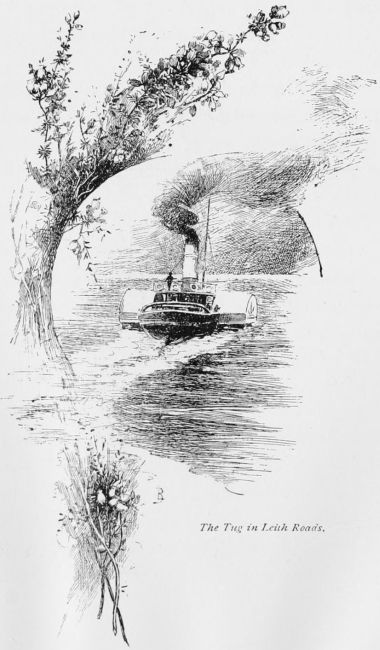
The Tug in Leith Roads.