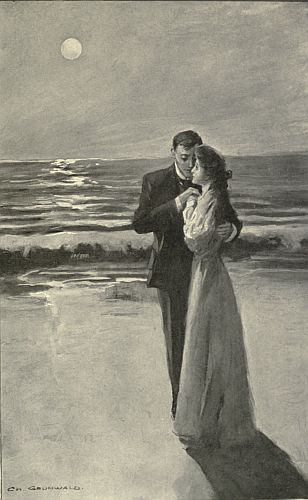
THE discreet Pringle, as on one other memorable
occasion, had seated himself on the box in the
middle of the road out of earshot; Daniel Meggison,
lounging not too steadily against the parapet of the
bridge, addressed Gilbert.
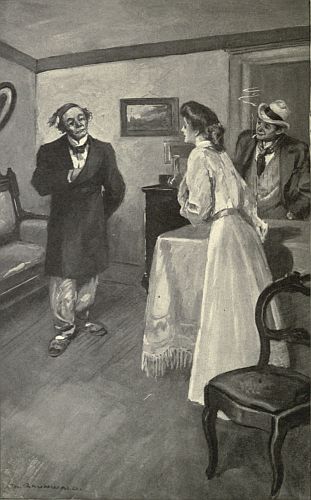
"When I cast my mind back, sir, over the past, I
find myself marvelling—marvelling is the correct
word—at the splendid fashion in which you have
kept the game alive for the sake of my child. For
what," went on Mr. Meggison, waving a hand towards
the sky, and addressing the landscape generally—"for
what have you not done on her account?
The splendid prodigality of it amazes me. In the first
place, you give up to her a house in the country—to
which, quite naturally, she brings her family, to say
nothing of other relatives and friends who trespass
upon her. From that we fly"—Daniel Meggison
made a movement with his hands flutteringly in the air
to suggest that flying—"to a well-appointed yacht,
where perhaps at the beginning all is not as well as it
might be. Reckless of the consequences—careless of
the results to life, limb and property—you splendidly
drive that vessel upon the rocks; you annex—(annex
is the proper word, I believe)—a portion of
country that is probably not your own property; declare
it to be an island; and in the most romantic
fashion provision the company cast upon it with you.
In a word, sir, the thing is magnificent—even if
carried a little too far."
"I firmly believed it to be an island until a few days
ago," said Gilbert. "I, like others, have been deceived;
I, like others, have been driven on a road I
never meant to travel. Great things and great consequences
have sprung from my small beginnings."
"Nobly said, sir!" exclaimed Daniel Meggison.
"But what I would ask is—why give the game
away now?" He lowered his voice to a whisper, and
took a step towards the younger man. "You've
played the game splendidly; play it a little longer.
Here is a village—ready and willing to supply all
our needs; here is a pleasant land, where we may pass
the summer, or what remains of it, in idyllic simplicity.
Why change anything? For my own part,
I needed but little to complete my personal happiness,
and that little I have found. Your credit here, sir—or
the credit of your servant—is particularly well
established; they bow before your name, sir."
"Are you another of them anxious to keep the
fraud going?" asked Gilbert in amazement.
"Certainly, sir," replied the unabashed Daniel
Meggison. "In a primitive fashion I am very happy
here: what will happen when the winter comes on is of
course quite another matter. But let the future take
care of itself; for the moment we are children, and we
laugh in the sunshine."
"The tide's turning, sir," said Pringle, getting up
from his box, and preparing to shoulder it.
"I'm afraid the tide has turned for me," said
Gilbert with a sigh, as he moved away.
Daniel Meggison was very merry over breakfast
that morning. He chose to be flippant with Gilbert,
and to rally Pringle on the ease with which these
islands could really be inhabited when it came to the
pinch. Dubbing himself the new Crusoe, he declared
his intention of searching the shore that very morning,
in the hope to find that solitary footprint of a
possible Man Friday. He asked Gilbert whether it
would not be wise to set about at once the building of
a stockade, the better to protect themselves against
the possible incursion of a dusky foe. Altogether
Daniel Meggison enjoyed the situation mightily, and
bore himself with that easy flippant gaiety that had
marked him out in the Arcadia Arms as being above
the common herd. He displayed his power by openly
asking Gilbert if he had ever been to the west coast of
Ireland, and if so, what he thought of the scenery.
But it was by a combination of circumstances that
the secret was at last exposed to those who already
were not in possession of it; and when the exposure
came at last, it seemed to come in the strangest way
from several quarters. In the first place, Daniel Meggison,
growing bolder, walked across that narrow
neck of land one morning, and spent the day in the
village, or in an adjacent one, being regarded by the
inhabitants as a species of amiable tramp who had
drifted out of the great Unknown to enliven the
monotony of their existence. As ill-luck would have
it, however, he drifted down across the bridge to the
shore again, blissfully forgetful of the fact that the
tide only served at certain hours, and discovered that
he was cut off for the night. Drifting back again, he
made a bed for himself in an outhouse, and slept the
night away.
But to Bessie his disappearance was a great and
inexplicable disaster. She had been in the habit, even
as in the old days of Arcadia Street, of bidding him
good night, and asking the question—futile here—whether
she could do anything more for him. But
this night he was missing; and an inquiry in various
directions among that very scanty population of the
island revealed the fact that nothing had been seen of
him since early morning.
Gilbert had his suspicions, of course, and so had
Pringle; but Bessie was frantic with anxiety. A thousand
things, in her imagination, might have happened
to him; he might have climbed the rocks and fallen
into the sea, or he might have fallen asleep on the
shore and been carried away by the waves. At all
events, the most exhaustive inquiry failed to find him
within the limited circumference of the island; and
Bessie was suddenly a new power to be reckoned
with.
Those who were the head and front of the actual
conspiracy came to Gilbert that night—drifting to
him guiltily and secretly one after the other. Mr.
Edward Stocker came first; and Mr. Edward Stocker
was vaguely apologetic for his wife's brother.
"An anxiety to the family at all times, sir," said
Mr. Stocker. "Clever man, of course, with much
more dignity and much more of real gentlemanly feeling
than ever I had, or am likely to have. Bit of
genius in his way, sir." Mr. Stocker paused, and
thoughtfully pulled at one ear as he looked at Gilbert.
"I suppose it isn't necessary to ask where he's gone,
sir?"
"I'm afraid not," replied the other. "He penetrated
the secret of this place a little time back;
he's making the most of his new freedom on the mainland—and
I expect he's been cut off by the tide.
He's safe enough; but it means that we must tell
Bessie."
"I suppose so," said Mr. Stocker, with a long face.
"And that also means that Mrs. Stocker and me will
go back to Clapham. Well," he added, with a sigh—"the
best of holidays must end."
Mr. Stocker had perhaps more gentlemanly feeling
after all than he imagined; at the very moment of
departure from Gilbert's hut he came back to him, to
make a little set speech that had been in his mind
evidently from the first. "I should like to say, sir, on
behalf of self and Mrs. Stocker (although Mrs.
Stocker may not think it absolutely necessary to speak
for herself), I should like to say that we take it kind
that people who force themselves on a gent like you,
without so much as 'by your leave,' should have been
so treated as I may say we have been. It isn't everyone
that would go and put up with people that shoved
themselves on him, and insisted on being shipwrecked
with him—and even on being supported, like the
early Christians, in rocks and caves of the earth. On
behalf of self and Mrs. Stocker—I am very thankful,
sir."
Mr. Jordan Tant came up the hill jubilantly
enough; he carried his head almost defiantly. He was
still a yard or two away, in fact, when he burst out
with his great news.
"She accepts me! As I predicted, she accepts
me!"
"That's not the most important thing on earth,"
retorted Gilbert. "What about this wretched old man
who has suddenly disappeared, as his daughter supposes,
and who will force us to tell the secret, and
explain the false position in which we stand?"
"That scarcely matters to me now," said Tant.
"My dear Enid is a woman of her word, and although
I may be forced to return to civilization, she will I
know go with me—understanding me better for the
way in which I have risen to the occasion during our
dangers and privations. She will say to herself—'If
this man can behave in such a fashion amid unknown
perils, and with the sea roaring and leaping
about us—what will he not be like in the neighbourhood
of a mere tame Hyde Park or Kensington
Gardens?' That's what she will say; that's what
she's already saying. Consequently, my dear Byfield,
I don't mind how soon I go back to civilization."
"Well—you've won your woman; you can afford
to play the deserter now," retorted Gilbert. "Go, by
all means; I have a vision of you and Mrs. Ewart-Crane
and the fair Enid, incongruously dressed, stepping
daintily across to the mainland——"
"Where I shall immediately telegraph news of my
safety, and proceed to buy a few rough garments with
the money I still have, and which it has been impossible
for me to spend in this place," broke in Jordan Tant.
"Above all things, Byfield, I shall cherish the remembrance
that in a fair and open field, when reduced
almost to the condition of primitive men, I won her
from you, as the better man. I always knew it; I was
always certain that in me were qualities undeveloped
by the artificial life I had led."
"You can believe that if you will," said Gilbert,
laughing. "As for myself, the bottom seems to have
dropped out of everything I ever contemplated doing,
and I am living here a more artificial life than ever I
lived in London. Take your way out into the world,
my Tant—and be happy."
Meanwhile there were other happenings. Mr.
Edward Stocker had deemed himself safe from his
formidable spouse, and had perhaps grown a little
careless under his new liberty; but it happened that
on that particular night, when the little man had
climbed the hill to Gilbert's hut, Mrs. Stocker had
thought it prudent to follow him. She had marked
his absence on other occasions; she who had forced
from him every secret his unromantic life had known
determined that she would force from him now any
knowledge he possessed outside that she herself held.
She listened outside the hut, and heard that talk of
the mainland and of the absent Daniel Meggison;
when Mr. Stocker, after his set speech, cautiously
scrambled down the hill, Mrs. Stocker, scratching
herself with briers, and gasping as she stumbled over
the rough earth, followed him. Bessie being absent
from the hut, Mrs. Stocker suddenly pounced upon
Mr. Stocker, to his great alarm, and dragged him
into that portion of the hut hitherto occupied by
Bessie Meggison and herself.
"My dear—I've been for a little walk," faltered
Edward Stocker, looking at her with a faint smile.
"Plotter and schemer!—so you thought you
would keep everything from your Julia—did you?"
she demanded, in a suppressed voice. "You had no
objection to your wife being made a guy of for the
amusement of those who consider themselves superior
in station; you didn't care if she lived in a sort of
cattle shed, without so much as a scrap of looking-glass
or a comb for weeks on end; you didn't mind if
she had to endure the pity of women who never really
look anything at all unless they are dressed to death!
What's this talk of the island and the mainland; and
where is my brother?"
"My dear—we've really been very comfortable
here," pleaded Edward Stocker. "It's been quite a
new experience—the sort of holiday to talk to our
friends about long years afterwards."
"I dare say," she sniffed. "Friends who have enjoyed
the privileges of Margate or Ramsgate, or even
Brighton, and worn respectable clothing with the best—with
a special blouse for dinner in the evening.
Holiday, indeed! I shall never be able to hold up my
head again as long as I live."
"I'm extremely sorry," said Mr. Stocker. "What
would you like me to do?"
"The moment this tide or whatever it is turns, you
will conduct me to the mainland. There, after we
have procured proper clothing, you will discover the
best way to reach Clapham; and for the rest of your
life you will remain there—respectably. No more
gadding about after people with whom one is not
really concerned. And don't you ever dare, Edward
Stocker, to refer to this time as a holiday!"
Late though it was, Mrs. Edward Stocker, primed
with this new knowledge, set out to impart it to the
lady she had hitherto regarded as her foe. Mrs.
Ewart-Crane should understand that Mrs. Stocker
was no mere ordinary woman, to be imposed upon;
Mrs. Ewart-Crane should be impressed with the fact
that Mrs. Stocker had sprung into the very heart of
the secret, and had in fact, if it came to that, suspected
the truth from the first. Binding the trembling
Edward Stocker to her with a fierce command,
she set out to find Mrs. Ewart-Crane.
She performed the visit with all due ceremony;
apologized profusely and yet with dignity for a call
which she knew was not strictly in accordance with the
usages of polite society; and then, in a most casual
manner, declared that she had at last been able to
verify the suspicion that she had entertained for a
long time.
"In fact, for some inexplicable reason, we have
been kept here, when we might have escaped at any
moment. The whole thing is one gigantic hoax, and
I am surprised that anyone should have been taken
in by it for a moment," said Mrs. Stocker loftily.
"Personally, I have had reasons for remaining here,
not altogether unconnected with relatives of my own;
but I see no further necessity for enduring discomfort
when I can quite easily get home."
"I am extremely sorry that you should have had
the trouble to call at this hour," retorted Mrs. Ewart-Crane,
shaking out her print dress more gracefully
about her. "But I was informed some time ago of the
extraordinary fact you have related. Our friend Mr.
Jordan Tant knows all about it. We shall of course
return to London at once. We were brought into this
discreditable business greatly against my wish, and
the sooner we have done with it the better I shall be
pleased. Good night, ma'am—and pray take care
of your husband; he doesn't look strong."
Mrs. Stocker led Edward Stocker back to the hut,
commenting fiercely upon the manners of the upper
classes, and upon the airs they gave themselves. On
second thoughts she decided that, once back in her
Clapham home, she might reasonably expand the adventures
on this supposed island; might come near
to starvation and that casting of lots that had been
threatened; and might be rescued in the nick of time
and in the last stage of exhaustion by a friendly
vessel, flying a foreign flag, the captain of which
was not altogether unimpressed by her charms. Also
she determined that the island should be placed in a
situation very remote from the British Isles.
Pringle sought his master in the hope of having
some new light thrown upon this strange development
of the story. Single-hearted as to purpose, so far
as Byfield was concerned, Pringle had held obstinately
to that fact he had set before himself at the first: that
the place was an island. Now, in a moment, it seemed
that there was no hope of that fiction being kept alive;
he desired fresh instructions as to how to deal with the
problem before him.
"Asking your pardon, sir, for interfering," he
said—"but I suppose you understand that this
won't be the end of it, by no means. Mr. Meggison,
sir, has been lured away in search of things he couldn't
find here, sir—and I'm afraid the others'll follow.
I've done my best from the very first; I wouldn't have
you think otherwise, sir."
"I know you've done your best, Pringle," replied
Gilbert, laughing ruefully—"but that doesn't mend
matters. The thing has gone beyond Mr. Daniel
Meggison; there are others already who know it. You
have played your part of the game admirably,
Pringle; but unfortunately I shall be supposed to
have played it with you from the very beginning. So
far as Mr. Meggison is concerned, let him stay on the
mainland, or let him come back; personally, I should
be glad if both he and his son had gone altogether.
The others are free to go when they like, because I'm
afraid that the sorry game is played out. It isn't
your fault, Pringle, because if it comes to that you
played your game better than any of us."
"Much obliged to you, sir, for your good opinion,"
said Pringle. "If it would ease matters at all, I'd
take the boat and row across, and bring Mr. Meggison
back—by force if necessary, sir."
"That wouldn't do at all; but we must invent some
story to allay Miss Meggison's anxiety."
"If I might make so bold, sir—wouldn't it be better
to tell her the truth? She's the best of the whole
bunch, sir—again asking your pardon for the
liberty—and I'm sure she'd understand, sir."
"Perhaps you're right, Pringle; in any case something
has to be done, and that without delay."
That thought was in the mind of Pringle as he
walked back towards his own quarters. Counting
over in his mind the various people who had been so
strangely brought together in that place, he came
with particular dislike to a recollection of Mr. Aubrey
Meggison—that coarse-mannered youth who had
consistently refused to assist in any work on the island,
and who had always taken growlingly his full
share of all the food and clothing that were to be had.
It might be a good idea to rid this harassed master of
his of the son as well as of the father.
Fortune played into his hands. He was sitting by
the last remains of the fire when he heard steps, and,
looking up, saw the man of whom he had been thinking
staring moodily down at him. Pringle looked up, and
nodded cheerfully, and spoke with that deep respect
with which he spoke to all men.
"Good evening, sir," said Pringle cheerfully.
"Bad business, sir—this about your guv'nor."
"A very mysterious business," said Aubrey darkly.
"If I was in London, I should have a word or two to
say about what the police had been doin'; I should let
'em know what I thought about the matter—and I
should point out a theory or two, to put 'em on the
right track. You can't deceive me, you know; I
wasn't born yesterday, not by a long chalk."
"I can quite believe it, sir," said Pringle. "Now,
what might be your theory, sir?—or, if left to yourself,
how would you set about finding this guv'nor of
yours, sir?"
Mr. Aubrey Meggison lowered himself to the
ground, and, resting a hand on each knee, leaned
forward towards Pringle. "My opinion," he said
solemnly, "is that the guv'nor was in the way—another
mouth to feed, you'll understand—and he's
been made away with." Aubrey leaned back, and
nodded slowly three times.
"Now, I should never have thought of that, sir,"
said Pringle.
"Nor anybody else that hadn't knocked about the
world as I have, and seen things," said Aubrey composedly.
"Mind, I'm not sayin' that in a way it
doesn't serve the guv'nor right; he hasn't played
what you might call the gentleman since we've been
'ere. At the same time, you see, he's my father—and
as fathers go he wasn't bad. At the same time,
justice is justice, and I want to know what's become
of the old man."
"If you'll excuse the saying, sir," said Pringle,
with deep respect—"you're smart—but your
father's smarter. That's putting it in the rough,
sir; but you've not been fairly dealt with, sir, and
I should like to speak my mind to you."
"You're probably mistaken, you know," said Aubrey—"but
you can go on."
"Thank you, sir," said Pringle. "You must
know, then, that your father has discovered that there
is a way of escape from this place—and he has taken
that way."
"Come—no bunkum, you know," said Aubrey.
"You can't gammon me; I'm much too fly."
"It would be waste of breath to try to, sir," replied
Pringle. "But your father has discovered,
quite by accident, what no one else knows; he has
found out that this place is not an island at all, but
is connected with the mainland. Consequently, sir,
to that mainland he has gone; and I expect at the
present moment he's got his toes stuck up in front of
a very decent fire, sir—with a glass of something
in his hand, and I shouldn't be surprised if there was
a cigar in the other."
Aubrey Meggison slowly got to his knees, and
leaned forward, and stared in blank amazement at
the placid Pringle. "You don't mean to say that
while all these mugs are rottin' about here, playin'
shipwrecks, the guv'nor's gone and found a little
place for himself, where he can be nice and comfortable?
Don't tell me that the old man's gone one better
than anybody else!" he pleaded.
"Unhappily it's a fact, sir. He's living on the fat
of the land," said Pringle.
Aubrey got up, and walked round the fire, swearing
softly to himself as he went. Then he stopped,
and looked down at Pringle, and began to laugh;
shook his head whimsically more than once, and
slapped his thigh, and danced about a little.
"By George!—he's a wonder!" he exclaimed, in
a tone of deep admiration. "I've always been proud
of him in a way; never minded tippin' him the nod
in a billiard-room or anything of that kind, because
he wasn't quite like other chaps' guv'nors. But to
think of him slipping off like that and having a good
time—— I tell you what it is—my old guv'nor
would make a jolly good livin' at the North Pole,
without a relief expedition. He's a living wonder!"
"He's a very remarkable man, sir," supplemented
Pringle.
"But I'll bowl him over; I'll show him that two
can play at that game," said Aubrey, with a chuckle.
"You show me what's the best way to get off this
blessed place—same as father's done—and I'll ferret
out the old man, and stand before him, and show
him that two can play at that game as well as one.
All's well that ends well, don't you know; when I've
got a good old cigar in between my teeth, and something
a little stronger than water ready to my hand,
I shall feel like a man again!"
Pringle, delighted with the success of his scheme,
arranged an early meeting at the point where the
rocks jutted into the sea. That appointment (surprisingly
enough for one who hated early rising)
was kept by Aubrey Meggison; and on the way
across the narrow neck of land the youth chuckled
to himself at the ease with which it had been possible
all along to reach the mainland. On the opposite
shore he turned to Pringle impressively.
"Don't you run away with the idea, my man, that
you've got rid of us," he said; "we're not so easy
shaken off as that. I know the guv'nor, and I also
know myself; and we shall have just a word to say,
if necessary, to the person that placed us in this
position. I don't think I need enlarge on the subject;
if you want to understand my feelings just cast your
eye over my clothes. This Mr. Byfield has trotted
us about for his own convenience; he needn't think
he's going to dump us anywhere, and leave us to shift
for ourselves. I'm going to find the guv'nor, and I'm
going to make myself comfortable with him. So
long!"
Pringle stood to watch him climbing over the
bridge; shook his head over his departing figure with
an expression of disgust. "It's a rum thing, when
you come to think of it," murmured Pringle to himself—"it's
a mighty rum thing that that sort of
creature generally manages to get through the world,
and to get some one else to keep it. I suppose the
real reason is that it turns so nasty if it doesn't get
what it calls its rights, that it becomes pleasanter
for all parties just to pay it to keep quiet."
Bessie had gone, in her bewilderment and anxiety,
at last to Gilbert; to him she presented that mystery
which was no mystery at all. What did he think had
become of her dear father?
Even then he held back from the truth; even then
he evaded the only explanation possible. "My
dear," he said gently, taking her hand, "I can only
assure you that your father is well—and safe."
"Then you know where he is?" she demanded
quickly.
"I can guess—and I can only tell you that it is
at the moment a little secret. You must trust me,
just as you have trusted me all through. You shall
know everything to-day; and everything shall be set
right to-day."
"Set right?" She looked at him in perplexity.
"Is anything wrong?"
"Nothing," he assured her. "You shall know
everything to-day, my darling; that at least I can
promise you. And your father is well."
She plied him with questions, but he would not
answer her. Truth to tell, he had not yet made up
his mind what to do; he seemed to see her, in imagination,
drifting again out of his life—refusing to
receive any explanation that he could offer. He
whispered of his love for her—of all that they might
do together in some impossible future, when they
should have been rescued from that place. She listened
with only a vague understanding of what he
said; doubts were in her mind already as to what
was happening, and why it should be necessary to
keep her in ignorance concerning her father. She
loved Gilbert—she thought she understood him; but
passionately she declared to herself that she had been
tricked once, and she would not be tricked again. She
strove hard to keep an open mind; strove to remind
herself that what he did was done for her sake, and
out of his love for her. But he had sworn to tell her
the truth always, and to cheat her no more; and to
that he must keep steadfastly. There must be no
second path.
Meanwhile, a series of personally conducted tours
were taking place, under the guidance of Pringle.
To Pringle each party appeared—and to him each
party appealed. Mrs. Stocker, leading the obedient
Stocker, demanded to be shown the way; the obliging
Pringle, feeling that here at last was a solution
of the great difficulty, willingly conducted the pair
round the rocks—and pointed the way. He watched
them climbing where Aubrey had climbed but a little
time before—incongruous-looking figures, facing
the dawn and going back into the world. Also he
carried in his mind, as a message not to be delivered,
certain parting words spoken by Mrs. Stocker.
"You may tell your master," that lady had said
at the last moment, "that I am not likely to forget
the position in which he has placed a lady who has
hitherto been able to hold up her head with the very
best in the most select part of Clapham. I am not
sure that my husband will not lay the matter before
his solicitors, with a view to a claim for damages.
Do you understand?"
"I will bear it in mind, ma'am," said Pringle
humbly.
"I am given to understand that we are probably
on the western coast of Ireland, which is much the
same as being cast among savages," went on the
lady. "In any case the return fare to Clapham
Junction (the station nearest our home), to say nothing
of garments to be purchased, will be considerable;
a claim shall be duly posted to your master, and must
be met forthwith. So far as moral damage is concerned,
I will consult with my husband, as I have
suggested, and Mr. Byfield will doubtless receive a
communication in due course."
"Very good, ma'am," said Pringle. "Go straight
across, ma'am, and keep to the road. Nice little village,
and pleasant people. Good morning!"
Pringle was turning away, not troubling for once
to conceal his laughter, when he was met by the second
party, consisting of Mr. Jordan Tant, Mrs.
Ewart-Crane, and Enid. Pringle straightened his
face, and gave them at once a cheerful but respectful
greeting.
"Good morning, sir," he said to Tant. "Are you
taking a walk, sir?"
"We are leaving this place, if it is at all possible,"
broke in Mrs. Ewart-Crane. "You can no longer
deceive us, my good man."
"Not for the world, ma'am," said Pringle. "In
fact, if you hurry a bit, there's just a chance you
may be able to get across before the tide turns.
Nice village, sir, just over the bridge; cheerful people.
This way, sir."
He watched them also disappear—splashing a
little in the middle of the neck of land, and with some
lifting of skirts on the part of the ladies. Then he
got back just in time himself, and set about the preparation
of breakfast, quite as though nothing unusual
had happened.
"Everybody's late this morning," commented
Simon Quarle, as he took his place by the fire, and
nodded to Pringle. "Heard anything about Meggison?"
Pringle saw Bessie approaching, and merely shook
his head. The girl greeted Simon quietly; her face
was white and set, and she did not look round even
when Gilbert approached. Gilbert seemed a little
surprised to find that they were the only breakfasters;
a gloomy silence had settled upon them all.
Pringle was withdrawing as usual, to take his breakfast
a little apart, when Gilbert called him back.
"Pringle—have you called the others?"
Pringle looked uncomfortable, and gazed down into
the cup he was carrying. "Might I have a word
with you, sir?" he asked, without raising his eyes.
"You can speak now; there's nothing to hide,"
said Gilbert, watching the girl.
"Well, sir—very early this morning the ladies
and gentlemen made up their minds, sir, to go. It
seems that everybody understood, sir—they'd found
it out somehow or other, sir, and the delights of the
island no longer attracted them. They've gone, sir,
by the way you know."
"All of them?" Gilbert stared at the man incredulously.
"Every one of 'em, sir," replied the man. "First
it was Mr. Aubrey—longing to see his father—and
then it was Mr. and Mrs. Stocker—and then
Mr. Tant and the other ladies."
"That will do, Pringle—thank you," said Gilbert;
and the man walked a few paces away, and
seated himself on the ground, and began his breakfast.
"Gone? Where the devil have they gone?" demanded
Quarle, staring open-mouthed at Byfield. "I
want to understand. Where could they go to?"
Gilbert turned to the girl; there could be no
further delay.
"Bessie," he began gently—"you must understand
that this place is not, as we thought, an island
at all. At low tide it is connected with the mainland—and
that mainland is, I believe, Ireland. Your
father found that out, and was one of the first to
go back into civilization; the others have discovered
the secret, and have followed him. I did not know
until—until a day or two ago that this place was
not an island. I have been perfectly honest with you—up
to that time."
She did not take her eyes from his face; a chill
drop of doubt seemed to fall upon her heart, and to
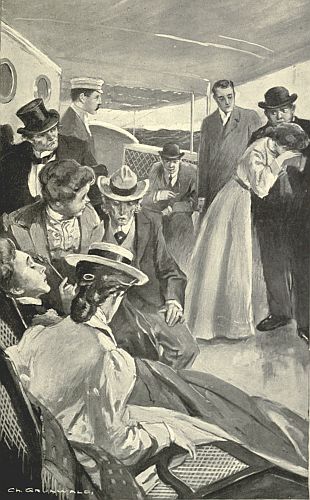
deaden it. She got to her feet and walked away;
the two men, watching her, saw her suddenly stop,
and drop her face in her hands. Gilbert sprang to
his feet, and Simon Quarle scrambled up also.
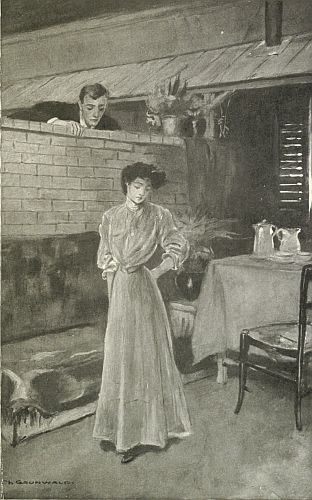
"Bessie!" cried the younger man; and again as
he got nearer to her—"Bessie!"
She turned swiftly, and dropped her hands at her
sides, and faced him. "And all these people know
now that the thing has been a cheat—a lie from the
beginning. Just as we played at make-believe at
your house at Fiddler's Green—just as we played
at make-believe on the yacht—so we've played at
make-believe here. Is that true?"
He took a step towards her, and laid his hands
upon her shoulders; he felt her stiffen under his
touch.
"Bessie—my dear, dear girl—it's true—but
it wasn't my fault this time. I did indeed believe that
we were cast away here; I hadn't the remotest notion
of where we were at all. Then, when at last—only a
few days ago, comparatively speaking—I found
out that we could get back into civilization so easily,
I determined that I would keep the game alive a
little longer——"
"Ah!—the game—always the game!" she
breathed tearfully, and dropped her head.
"And I did that because I loved you; and because
I was afraid that you might stand before me as
you're standing now, and refuse to believe what I
told you. I wanted to keep you here a little longer—I
wanted to see you cheerfully playing make-believe
day after day; I didn't want you to go back
into the world—the common ordinary world again."
"And now the game is ended," she said, looking
up at him with eyes brimming with tears. "Take
your hands away from me, Mr. Byfield, please; the
game is ended. It has been a poor game from the
first—and God help me!—I've lost every time.
Take your hands away from me!"
He watched her go—standing miserably and
helplessly looking after her. He dared not follow;
he was afraid to think what she would do, or how
this poor comedy that had so strangely developed
into a tragedy was to end. Simon Quarle said nothing;
he stood grimly muttering a little to himself;
he seemed dazed by the sudden turn of events.
"An island—and not an island; and to think
that I never for a moment suspected it," muttered
Quarle. "And for me, at my time of life, to play
at shipwrecks and Robinson Crusoe and the devil
knows what! It's amazing!"
Strangely enough, Simon Quarle was to cut the
knot on this occasion. He had sought out Pringle,
and had got the real truth from him—understanding
only too well that it would be necessary to wait
until early morning if he would cross to the mainland.
He was wandering disconsolately on the shore when
Bessie approached him.
"Mr. Quarle—you were always my friend—weren't
you?" she pleaded, looking quickly round
about to see that they were not observed. "And
you're going to help me?"
He nodded. "With my life, if necessary, my
dear," he said, with an attempt at whimsicality.
"What are you going to do?"
"The boat will take us across to the mainland;
we need not wait another night here," she whispered
hurriedly. "Dear good kind old friend—take me
across—and set me free."
He nodded again, and turned away at once in the
direction of the boat, she following. Together they
shoved it into the water, and with sturdy strokes the
man pulled round the rocks and in the direction of the
mainland. As he helped her out, she suddenly bent,
and put her arms about his neck, and kissed him.
"Good-bye, old friend," she said, a little brokenly—"I'm
going to run away."
"You'll find the others all down in the village, I
expect," he reminded her.
She shook her head, and smiled through her tears.
"I'm not going to find the others; I couldn't bear
to meet them," she replied. "I'm going to run away
into the world—all alone. Good-bye!"
"Stop!" he exclaimed, "you can't go like that."
But she waved her hand to him, and ran up towards
the bridge; turned there for a moment to wave her
hand again, and to blow a kiss in his direction. And
then ran on out of his sight, and down into the world.