The Cruel Murder of Mina Miller by Kenkouwsky, alias "Kettler"
Whole book · 4 sections
THE CRUEL MURDER OF MINA MILLER BY KENKOUWSKY, alias “KETTLER”
Wedded and Murdered Within an Hour!
THE CRUEL MURDER
OF MINA MILLER
BY
KENKOUWSKY, alias “KETTLER.”
The Guttenberg-Hoboken Tragedy.
A THRILLING AND REMARKABLE CASE, WHICH
RECALLS THE MURDER OF MARY RODGERS,
“THE SEGAR GIRL,” WHICH TOOK PLACE ON
THE SAME SPOT, THE SCENE OF OTHER
MURDERS OF A LIKE CHARACTER.
THE ONLY LIFE OF MINA MILLER PUBLISHED
BARCLAY & CO., Publishers,
21 North Seventh Street, Philadelphia, Pa.
AGENTS WANTED AT ALL TIMES.
Entered according to Act of Congress, in the year 1881, by
BARCLAY & CO.,
In the Office of the Librarian of Congress, at Washington, D. C.
MURDERED BY HER HUSBAND OF AN HOUR.
THE MINA MULLER MURDER.
On Friday morning, the 13th of last May, a German, whose purpose
was to gather green leaves to sell to florists in N. Y. city, entered the
path leading from Bergen avenue, in the district known as Bull’s Ferry,
north of Weehawken. He had followed it eastward toward the
river about 100 feet, and had turned aside to the right about twenty feet,
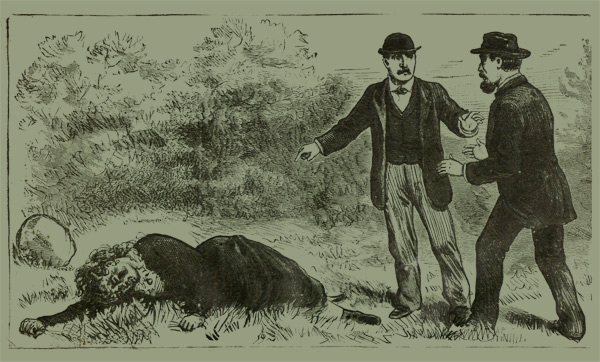
when he was appalled by almost stepping upon the dead body of a woman.
He hurried away to inform the police.
Early in the afternoon Coroner Wiggins, of Hoboken, visited the spot
and made a careful examination. He judged that the woman had not been
over 25 years old. Along the top of the head, on the left side, was a deep
gash, and beneath it the skull was fractured. There was another gash over
the right eye. Both of these gashes were apparently made with the edge
of a stone. The nose was broken in the middle. The right side of the
head had apparently been crushed by a stone. The left ear was injured as
if an ear-ring had been torn from it. Search was made for the missing
ear-ring, but it was not found. Her face had become blackened by the
sun, which shone upon the spot where the body lay. The features were
small and symmetrical. She wore number one or number two buttoned
shoes.
An investigation was at once begun by the coroner, but without much
success.
On the 18th the young woman was completely identified as Mrs. Philomena
Muller, the wife of Simon Muller, a tobacconist, at 502 West
Thirtieth street, N. Y. Mr. Muller called at the Morgue at 3 o’clock on
the afternoon of May 18th, in company with a lady whom he introduced
as Miss Maria Schmidt, his wife’s sister. He said they desired to look at
the body. They were led into the damp vault, and at sight of the body
Miss Schmidt was overcome, and she retired to the adjoining basement.
Mr. Muller gazed upon the body calmly. The jewelry and clothing of the
dead woman were shown to him, and he positively identified them as the
property of his wife. He said that he had given her the cameo brooch.
Mr. Muller said that some time ago his wife deserted him, and since then
she had not lived with him. Miss Schmidt had seen her sister about two
weeks before. Mrs. Muller then informed her that she had found a decent
man, who was going to marry her and take her to Germany in the steamer
L’Amerique, which was to sail on the 4th of May. When Miss Schmidt
told Mr. Muller of this he went to the wharf of the Transatlantic Steamship
Company on the morning of May 4th, and remained at the gang plank
of the vessel until all the passengers had gone aboard. He was certain
that his wife was not among them, but he did not know her paramour.
Before this identification was made, the authorities of Hudson county
had obtained conclusive evidence of the fact that the murdered woman was
Mrs. Philomena Muller, and that her assassin had married her on the morning
of the day on which he killed her, and had taken passage on the following
day for Europe. As Mrs. Finck, the wife of an alehouse keeper in
Pierce Avenue, West New York, was sitting in her saloon on the afternoon
of Tuesday, the 3d of May, a man and a woman entered and sat down at a
table. The woman ordered drinks, and called for a glass of beer. Her
companion drank soda water. While they were there the woman talked
almost incessantly. She said that they came from Morrisania. She seemed
to have plenty of money. When she paid for the refreshments, Mrs. Finck
noticed a large roll of bank notes in her pocketbook, besides some silver and
gold. Before going away, the woman borrowed a corkscrew to open a bottle
of Rhine wine which she had with her. She said she had bought the
bottle in Union Hill. Mrs. Finck minutely described the woman, and the
description tallied exactly with that of the woman who was murdered.
Prosecutor McGill was so impressed with the accuracy of Mrs. Finck’s
description, that he specially detailed Detectives Swinton and Fanning to
trace the movements of the unknown couple. They began their search on
Tuesday evening, May 17th, and Wednesday the 18th they submitted to
the Prosecutor a circumstantial account of their discoveries.
They began by looking for the person from whom the bottle of Rhine
wine had been purchased. Every saloon along the Boulevard and the
Hackensack plank road was visited, but to no purpose. Continuing their
inquiries, they entered an inn kept by Edward Stabel, on the Weaverstown
road. When they questioned him he said he remembered that on the day
indicated by them a woman had called at his place and asked for a bottle
of Rhine wine. As he did not have any he sent his granddaughter, Lizzie
Haas, to Mr. Eberling’s store, in Bergenline avenue, for a bottle of it.
While the girl was absent the woman chatted pleasantly with Stabel. She
told him, among other things, that she had just been married by the Rev.
Mr. Mabon, the pastor of the Grove Reformed Dutch Church, and that she
wanted the wine to celebrate the event, and to treat the minister. She also
said that she was about to sail for France. When the girl came back with
the bottle of wine the woman paid her fifty cents for it, and gave her ten
cents additional out of a $5 gold piece that Stabel changed for her. On
leaving the saloon the woman was joined by a man. Stabel could not recollect
anything in particular about the man, except that he had stood outside
on the street while the woman bought the wine. But he gave a very
accurate description of the woman and her dress, which tallied both with
Mrs. Finck’s description of the woman she had seen, and with that of the
murdered woman. Mrs. Stabel furnished additional details. She said the
woman came to the saloon on the 3d of May. She was sure of the date,
because on the same day there was a burial in the Grove Church Cemetery
which is only a short distance from the inn. The woman told Mrs. Stabel
of her marriage, and explained that it had been secretly performed, because
her brother disliked her husband, and had objected to the match. She also
said that she had been married once before, and had attended a cigar store
which her former husband kept in N. Y. city. Mrs. Stabel’s circumstantial
description of the woman tallied yet more accurately than her husband’s
with that of the murdered woman.
The detectives then went to the parsonage of the Grove Reformed
Dutch Church, where they found the Rev. Dr. Mabon. He recollected
having married a couple on May 3d. The woman, he said, entered his residence
alone, leaving the man in the yard, where he paced up and down as
if absorbed in meditation. The woman asked Mr. Mabon if he would perform
a marriage, and upon being told yes, she went out and returned immediately
with the man. As the couple had not provided a witness, the
clergyman called in John Schuman, a barber in Union street, Union Hill.
The man and woman made satisfactory replies to the usual questions, and
they were married in legal form. After the ceremony they subscribed the
following record of the marriage, which is now in Mr. Mabon’s possession:
On Tuesday, May 3, 1881, Louis Kettler, single, aged 33, bricklayer by occupation, and
residence 1511 Second avenue, New York, married to Mina Schmidt, single, aged 34, residence,
1247 Third avenue, New York. Father of bridegroom, Louis Kettler; father of bride,
Anastasius Schmidt. Both of the contracting parties were born in Katenheim, Germany.
The woman did most of the talking, and seemed to be in excellent
spirits. She exhibited a bulky pocketbook, and asked Mr. Mabon how
much his charge was. He replied that she might pay him whatever she
thought proper. As she had no small bills she went out to get change, and
came back presently with the money and a bottle of Rhine wine, which she
offered to the clergyman. When he refused it she tried to persuade him to
take a drink, but he declined, and, after a few more words, the strange couple
quitted the parsonage. Mr. Mabon could not recollect anything about
the dress of either of the parties, but his colored servant girl told the detectives
that she had particularly noticed the man as he was striding up and
down the garden, and acting as if his mind was troubled. She said he was
stout, with a full face and dark moustache, and wore a high, flat-topped
Derby hat.
Mrs. Sarah Rigler, who lives in the neighborhood of the church, saw
the couple before their marriage. They came along the road, and the woman
stopped and asked Mrs. Rigler:
“Can you please direct me to a priest?”
“Do you want a priest or a minister?” Mrs. Rigler inquired.
“I want a Protestant priest,” the woman responded. “I am going to
be married, and I want him to marry us.”
Mrs. Rigler’s description of the woman was almost precisely the same
as Mrs. Stabel’s. The man, she said, was quiet, and did not say anything
in her hearing. When the couple were last seen by the people in the neighborhood
of the church they were walking together toward West New York
by a road that led in the direction of Finck’s saloon and the Guttenberg
ferry.
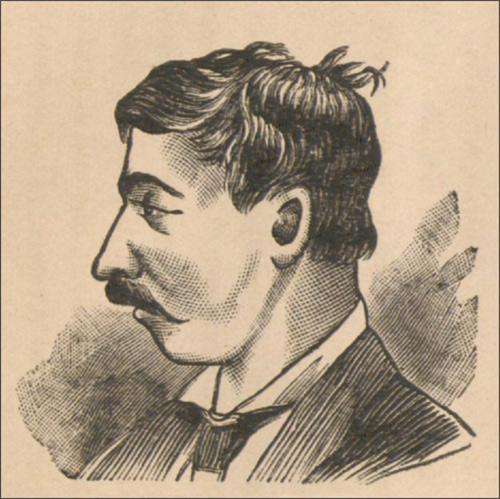
Martin Kenkouwsky
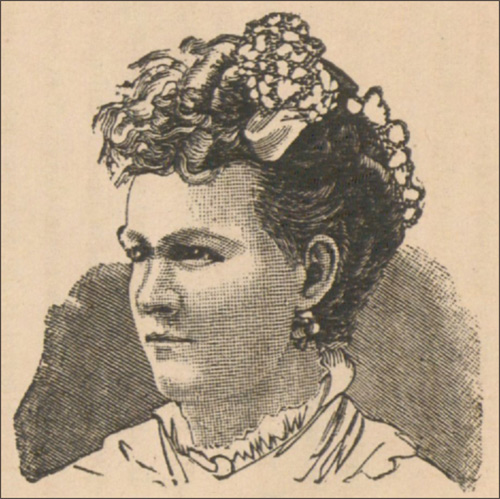
Mina Muller.
The detectives next went to 1247 Third avenue, N. Y. city, the number
that had been given to Mr. Mabon by the bride as her residence. There
they were unable for a long time to find any trace of Mina Schmidt. Finally
the daughter of the janitor remembered that a woman answering
Miss Schmidt’s description had been living at service with a family in the
house. But the family had moved, and the servant had gone with them.
An expressman named Body had taken away her trunks. After a tedious
search Body was found. The young woman whose trunks he had removed
proved not to have been the murdered woman. But Body said that about
the 1st of May a woman whom he knew as Mrs. Mina Muller offered to sell
him some articles of furniture, as she was about to move. They were unable
to agree on the price. Mrs. Muller returned shortly afterward and
left an order to have an express wagon call for her baggage at 1511 Second
avenue, where she was then staying. Body sent William Norke, one of his
drivers, to the place, and the man received from Mrs. Muller four trunks,
a bundle of bedding, and a valise, which, by her directions, he carried to
Theodore Scherrer’s Hotel, at 178 Christopher street. Body and Norke
described Mrs. Muller, and the detectives were satisfied that she was the
woman who, under the name of Mina Schmidt, was married by Mr. Mabon
in the Grove Church. A man whom the driver did not know, but who,
from his appearance, he believed to have been the murderer, superintended
the transfer of her packages, and rode in the wagon with Norke to the hotel.
On the way there he told Norke that he intended soon to sail for Europe.
At 1511 Second avenue, whither the detectives next proceeded, they
found a German woman named Mrs. Schwan, who keeps a dyeing establishment.
She did not know any man named Kettler, but she said that a man
who answered in every respect the description of Kettler had lived in the
house, but had moved about the first of May. He had lived, she said, with
a young widow, to whom she had heard he was married. Mrs Schwan described
the woman, and again the description tallied with that of the murdered
woman. Mrs. Schwan had been told that the woman had another
husband living in Thirty-ninth street. Charles Rost, the landlord, said that
on March 3d Mrs. Muller had engaged three rooms, front, on the top floor,
and had furnished them comfortably. She told Rost that she was working
for Hahn, the butcher, in Third Avenue. Her husband, Mr. Muller, she
said, had died of consumption, and had left her $1,000 insurance on his
life. She was away all day as a rule, and returned to her apartments in
the evening.
“One day,” said Mr. Rost, “about five weeks after she came here, I
had occasion to go to the roof. Her room door was wide open, and Mrs.
Muller was at work within fixing up her curtains and arranging her room.
I said to her in fun:
“You ought to have a husband here, Mrs. Muller.”
“‘Oh! I’ve got one,’ she said. ‘My name is Mrs. Kettler now. I’m
not Mrs. Muller any longer.’” She said, too, that her new husband was
a mason, kalsominer and paper hanger, and was getting good wages. A
few days after that Mr. Rost met him in the hallway of the house for the
first time, and asked if he lived there. He also told Kettler that he believed
Mrs. Muller had another husband living. His suspicions had been excited
by the woman’s talk of her dead husband and her inconsistent lack of
mourning attire or demeanor. On May 2nd, they sold their furniture, and
moved their trunks and bedding, no one then knew whither. “The man,”
said Mrs. Rost, “was a greenhorn,” and this was the testimony of others
in the building who had noticed him.
Among the persons by whom the woman had been employed was Moise
Hahn, a butcher in Third avenue. He said that she worked for him until
May 1st, when she quitted, as she intended to go to Europe. She was
then living with a foreigner whose name Hahn did not know, but whose
description corresponded with that of the groom in the marriage ceremony
in Mr. Mabon’s house. She told Hahn that she was going with him to
Mulhausen in Alsace.
Mr. Scherrer of Scherrer’s Hotel at 178 Christopher street, to which
place Norke had carried the trunks and bundles belonging to the woman
who gave her name as Mina Miller, informed the detectives that on
Monday evening, May 2, a German went there with an express wagon containing
four trunks, a bundle of bedding, and a valise.
“The man,” Scherrer said, “afterwards introduced a woman who he
said was his wife. She was very talkative and had all the money and paid
all the bills. The man told me that they were going to sail in the steamship
L’Amerique on the 4th inst., and were going to Mulhausen, in Alsace. On
the day they came to my place the man, who said his name was Kettler,
left the trunks here, but spent the night at Mr. Boker’s place, two doors
further down the street. On Monday, May 3, Mr. and Mrs. Kettler and
I had a long chat about the old country, and about noon they left my place
and went to the direction of the Christopher Street Ferry. Mrs. Kettler
promised my wife that she would come back to bid us good-by. Late on
Tuesday night Mr. Kettler returned alone. I asked him where his wife
was, and he said she had gone to spend the night at her sister’s house, and
was to meet him on board the steamship in the morning. He seemed to
me to be very much excited and uneasy, and his behaviour struck me at
the time as peculiar. The next morning he had his trunks sent to the
steamship wharf, and went away. That is the last I saw of him.”
Louis Groth keeps a lager beer saloon in Thirty-ninth street, near Ninth
avenue. A friend of his living at 1511 Second avenue, in the same house
with Mrs. Muller, told Groth of her being there with Kettler. Groth told
Mr. Schmidt, Mrs. Muller’s brother, who lives at 555 Ninth avenue, and
he informed Mr. Muller of his wife’s whereabouts.
Mr. Schmidt was at his home at 555 Ninth avenue last evening. He
told our reporter who called that he saw his sister for the last time on the
Sunday before the murder. Previous to that, upon the information from
Louis Groth that she was living with Kettler in Second avenue, he saw her
there, and remonstrated with her. He also had a talk with Kettler, who,
however, said nothing of any proposed marriage. He said, however, that he
knew Muller. Muller told Schmidt that he didn’t know Kettler. Schmidt
says that when his sister Mina called at his house on Sunday she got a bank
book containing $40 which he had been keeping for her, and told him that
she had sold her furniture, and had altogether $116. She was going to
marry Kettler on Tuesday, May 3, and go with Kettler to Alsace, which
was his former home. Her brother says he told her he did not want her
to marry again while she had a husband, but she said she was determined
to do so.
Mr. Schmidt has a brother August, a musician, living at 49 Avenue
A. and two sisters now living one of whom is married. Muller, he says, was
attentive to the unmarried sister, and Mrs. Muller and he continually
quarrelled about this intimacy. Their disputes were so violent as to
attract the attention of the people in the house where they lived in Thirty-ninth
street, and once Mr. Muller was badly whipped, it is reported, by
some friends of Mrs. Muller.
Muller and his wife were married in 1874, and lived for three and a
half years in the house at 338 West Thirty-ninth street. Muller made
cigars and kept a small store there. When he and his wife could stand
each other no longer, said Mr. Schmidt, they separated, and Mrs. Muller
for a while lived in a house in the same block. About three months previous
to the murder she left the neighborhood and secured employment
in the butcher shop of Moise Heahn in Third avenue. Muller sold his
store out on April 1, and removed to his present place in Thirtieth street.
Mr. Schmidt said that Kettler, after marrying his sister, undoubtedly
led her to the lonely place of the murder for the sole purpose of
killing and robbing her of the $116 which she had, and the gold watch
and chain.
As Mrs. Muller left her brother’s house on Sunday she said to the
saloon-keeper on the ground floor, “I’ve got another man—a nice man
now—and I’m all right again.”
Kettler had been only seven months in this country.
Attorney-General Stockton directed Mr. McGill to telegraph to the
authorities at Havre, describing Kettler, and requesting his arrest on a
charge of murder. Detective Edward Stanton was to sail for Europe
on Saturday in pursuit of the murderer, but subsequent events proved
this unnecessary, as the reader will learn by following this complete and
dramatic recital.
TRACKED AND ARRESTED.
Wildly Declaring his Innocence, yet admitting that he was
in Hoboken with the murdered woman—“She Led Me Astray”—A
very Touching Scene with his Wife.
Martin Kenkouwsky, alias Louis Kettler, the murderer of
Mrs. Mina Muller, was captured on the night of May 19th, 1881,
by Policemen Morris Fitzgerald and Richard Tregonning of the
Thirty-seventh street police station, as he was walking in Thirty-sixth
street, near Tenth Avenue, New York City. The clue which led to his
detection was discovered and followed out almost to the end by Gustavus
A. Seide, a reporter for a Jersey City newspaper, and compares, as a piece
of amateur detective work, with the detection of Chastine Cox, the murderer
of Mrs. Hull. Seide recognized that there was a flaw in the theory
that the alleged murderer had gone to Europe in the Amerique. There
was no certainty that the baggage which was taken from Sherrer’s house
on the day the steamer sailed was delivered at the pier of the French line,
nor was there positive evidence that Kettler himself had been seen on the
pier that morning. Superintendent West of the French pier said that on
the day the Amerique sailed, a man answering somewhat Kettler’s description
had applied to him for a ticket, and he had referred him to the purser.
Baggage corresponding to what Kettler was supposed to have taken with
him the Superintendent had not seen on the pier.
Seide came over to New York early Thursday morning, May 19th,
and proceeded at once to look for the man who was supposed to have taken
Kettler’s baggage from Scherrer’s Hotel to the pier. Scherrer had seen
the man in the neighborhood quite frequently, but did not know his name
or where he kept. He, however, described him to Seide as a tall, well-built
man, with dark moustache and dark complexion. The reporter
started out, and visited the truck stands between Christopher and Twentieth
streets, but could not find his man. Returning to Scherrer’s, he
found a man, whom he describes as a “dilapidated individual,” taking a
drink at the bar. Seide again asked Scherrer for a description of the
truckman. Scherrer gave it as before, adding that he drove a red truck
with one brown horse. Here the “dilapidated individual” spoke up and
said, the truckman might be found at Christopher and Bleecker streets.
On inquiring there Seide learned that he changed his stand a few days
before; but where he had gone no one in the immediate vicinity could tell.
He, however, discovered that his name was C. A. Strang. He then made
inquiries for Strang’s whereabouts in various smithies and liquor stores,
and in one of the latter he ascertained that Strang lived in Greenwich
street, on the west side, a few doors below Christopher street.
At this point Seide telegraphed over to Detective Stanton of the New
Jersey force, and awaited his arrival. Then they went to Strang’s house,
where Mrs. Strang informed them that her husband was at the new market,
corner of West and Gansvoort streets. There they found him. They
asked him if, on the morning of the sailing of the Amerique, he had taken
baggage belonging to Kettler to the steamship wharf. He replied that he
had not; he had taken the baggage to a Mrs. Clifford’s, at 179 Charles
street, and about ten days afterward he had removed the valise and three
ordinary yellow trunks to 510 West Thirty-sixth street. The other trunk,
which was long and black, he had not seen again. He was not sure whether
he had taken the first load on the 3d or 4th instant. He at first
refused to go with them to the house in Charles street, saying he was too
busy; but when Seide and Stanton offered to pay him for his time, he consented.
Mrs. Clifford said that a man answering Kettler’s description had
come to the house either on the 3d or 4th inst., and she remembered that
Strang had brought a valise and four trunks. Kettler had remained at
the house about ten days, paying her regularly. Once he paid her with a
five-dollar gold piece. She did not notice anything peculiar or restless in
his behaviour. He kept to the house pretty closely, though he was generally
out nights. She saw, however, that he read the newspapers very
closely. He told her that he was going to California. When asked if on
his departure he had taken all his baggage, she said, no, he had left a long
black trunk, which they would find in the wood-shed. They opened the
trunk, and found it full of crockery and cooking utensils. They carried
it to Strang’s truck, and directed Strang to carry it to the house in Thirty-sixth
street, to ask for Kettler, and if Kettler was there, to give them a
sign, as they would remain outside. Strang inquired for Kettler, but was
told that no man of that name lived there; but that a man corresponding
to the description lived one flight up with a wife and two children. Strang
took the trunk up stairs, and found a woman, a young boy, and a little
girl in the room designated. The woman said the trunk belonged to Martin
Kenkouwsky, her husband, and offered to pay fifty cents for its delivery.
Strang then signalled to Seide and Stanton that the man was not in, and
the reporter and detective went to an adjoining house, and received permission
to watch from the windows. Seide went out again to speak to
Strang, and while he was talking to him in front of 510 West Thirty-sixth
street, both were arrested by Policeman Tregonning. The police of Capt.
Washburn’s precinct had been looking for the same man, and had traced
him to this same house. This was the cause of the arrest of Seide and
Strang. When they got to the station, Seide explained to the Captain who
he was, and the Captain sent him back with a policeman to get Stanton to
identify him. At first they couldn’t find Stanton, and the policeman
wanted to take Seide back. In the meantime the Captain had sent Policeman
Fitzgerald to aid Tregonning in arresting Kenkouwsky. The policemen,
Seide, and Stanton, who had meanwhile relieved Seide of his embarrassment,
waited for about three hours, when they saw a man answering
the description of the murderer walking up the street. Policeman Fitzgerald
arrested him. He offered no resistance, and his only exclamation
was in German: “Was ist? was ist? was ist?” He was at once taken to
the station, where he was locked up. Sergeant Brown was sent down for
Scherrer, and a policeman was despatched for Strang. Scherrer arrived
about twenty minutes after the arrest, and identified the prisoner as the
man who had been at his house under the name of Kettler. Strang also
soon appeared, and he too identified Kettler. Meanwhile Policemen had
entered the room at 510 West Thirty-sixth street, notified the woman of
her husband’s arrest, and taken the four trunks and the valise to the station.
Our reporter was present when the trunks were opened. Almost
the first thing found when one of the yellow trunks was opened was a letter
addressed to Mrs. Mina Muller, 338 West Thirty-ninth street. In a
corner of the envelope was printed “Germania Lodge, No. 70, K. of H.”
It contained a request for her to attend a lodge meeting on Jan. 10. The
trunks were full of articles of female attire, and in one of them was a pair
of men’s gloves of white leather, stained with dirt and badly torn, as though
whoever wore them had been handling some rough object. It is thought
that Kenkowski wore these gloves when he was married and when he
crushed Mina Muller’s skull with stones. A gray wrapper, and a straw
bonnet and table covers were among the other objects found.
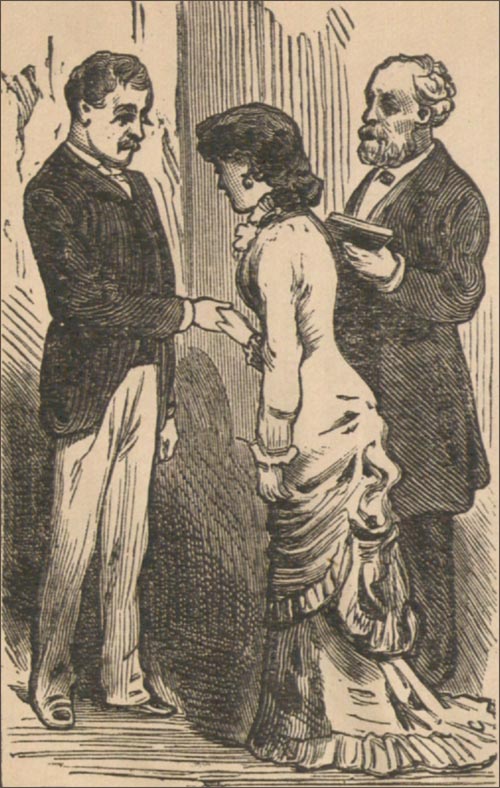
MARRIAGE CEREMONY WHICH TOOK PLACE AN
HOUR BEFORE THE MURDER.
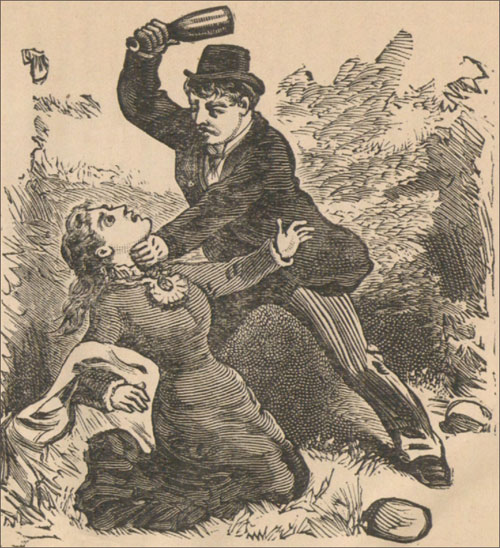
MURDERING MINA MULLER IN THE WOODS NORTH OF WEEHAWKEN.
At about half-past 9 the prisoner’s wife arrived at the station with her
boy, who was crying bitterly. She asked why her husband had been
arrested, and why the trunks had been taken away. When asked what
his name was, she replied, “Martin Kenkouwski,” and added that they
had been married ten years ago in Alsace, and had only been in this country
a little more than half a year. Her husband was a mason and kalsominer.
When asked if he had been at home regularly lately, she said he
had been away about ten days in the beginning of the month.
“Do you know,” asked the interpreter (the woman and her husband
spoke in German), “that he married another woman, and killed her?”
“I don’t believe it,” she replied firmly, while the boy cried more
loudly than before. “I don’t believe it!” she reiterated. “Let me see
him! Don’t cry my child” (turning to the boy), “or you will make me
weep. Don’t cry!” Here her voice faltered, and she burst into tears.
She was then led to the cell. Here a heart-rending scene occurred.
She threw herself with her child against the grating, sobbing and calling
for her husband. He was far back in the cell, and when he heard her and
the child, he shrieked from out of the darkness:
“Katrina! Katrina! Merciful Heavens! My child! My child! Great
God, are you here!”
Then he rushed forward to the cell door, pressed his face against the
iron trellis work, lifted his hands and called out: “Before God I stand a
guiltless man, and if I die I die guiltless. I was misled by the wicked
woman; she led me astray. My God, Katrina! Katrina! Give me your
hand!”
Here he thrust his hand through the cell gate, and his wife clasped it.
She was too much overcome to speak for a while, and the child moaned
and sobbed. Kenkouwski continued reiterating his innocence, when he
called out again. “The wicked woman misled me; she led me astray.”
His wife exclaimed: “Have I not been a good wife? Have I not
prayed to God for you?” Then she sobbed again. After a while she said
to him: “I don’t believe you killed her! I don’t believe it!” After
this she and the child were led away, and he called after them: “By God,
Katrina, I am innocent. I am innocent.”
The woman said he had always been a good husband to her, nor did
she seem to know anything of Mina Muller. She said nothing when asked
what she had thought when her husband came back with three yellow
trunks after an absence of ten days.
Shortly after the woman left, Kenkouwski was led before the Sergeant
for examination. He looked wild and nervous, and gesticulated violently.
“He must be watched well to-night,” said one of the policemen, “or he’ll
hang himself.” As he approached the desk, he suddenly threw up his
arms and exclaimed:
“Now, I will tell you the truth. If it is not the truth you may take
a knife and cut my throat, like this,” (here he pulled his finger across his
neck.) “Mina Schmidt told me the other day that she knew I was
married, but she wanted me to marry her and go to Germany with her,
where she had very good parents living. At that time I didn’t know she
was married. We went to Guttenberg to get married, and when we got
over there we went to the Schutzen Park. Two men there came up to me
and told me that she did not love me, that she loved another. When she
heard this she sprang up and ran away from me, and I have not seen her
since.”
He was then led back to his cell. He was again brought from his
cell at about 11 o’clock to be looked at by the reporters assembled in the
Thirty-seventh street station. He had been lying down, and the light dust
from the cell floor covered his back. He looked in a bewildered manner
at the throng about him, spoke a few words in German, reasserting what
he had previously said in regard to the murder, and was taken back again.
His eyes were bloodshot, and he spoke in a nervous manner.
“Mon Dieu! Mon Dieu!” exclaimed Kenkouwsky, “does any one
speak French?
“I do!” replied another reporter, addressing him in French.
Kenkouwsky sprang from his seat and, with tears falling fast, seized
the reporter by the hand and said: “Tell them that as our Saviour, who
was crucified, was innocent, so am I!”
“Of what?” asked the reporter.
“Of the murder of Mina Schmidt. I married her that day, although
I have a wife here. She told me she loved me. I did not tell her I was
married. After we were married we went to Schuetzen Park. There we
sat at a table drinking, when two men came by. They greeted Mina as
old friends, and we all drank together. One of the men took her away,
and the other then told me that Mina had said that she did not love me.
They all left me, and I, after hunting for them, came back to this city and
tried to find her.”
Chief of Police Donovan of Hoboken, who had been standing by all
this time and listening to what the reporter quickly translated, touched the
reporter on the shoulder and said: “Ask him if he was not in Jersey City
last night.”
The reporter asked the question. Kenkouwsky staggered back and
repeated, “Jersey City! Jersey City! Where is that?” The reporter
repeated the question.
Kenkouwsky replied: “I was with my wife last night.”
“In Jersey City?” asked the reporter.
“No; I was with a woman there.”
Chief Donovan’s eyes brightened, and he then said: “Last Monday
a young girl, whose name I cannot now mention, was taken into a house
by this man. He made her drink wine, and as she was partly stupefied,
he locked the doors and assaulted her. It was for this offence that I and
my detectives were hunting him up to-day. We did not then suspect that
he was the murderer of Mrs. Schmidt. Last night he was to meet
another girl, but she became frightened and did not stay where he told her
to until he came. He eluded us by ten minutes.”
In the prisoner’s pocket was found a clipping from a German paper
of the account of the hanging of Mrs. Meierhoffer and her paramour last
winter. To the reporter he said he had not read any account of the Guttenberg
murder until the day previous to his arrest.
At midnight Chief Donovan had the trunks of Mrs. Mina Schmidt
taken over to Hoboken.
Detective Stanton told our reporter that an empty watch case had been
found in the room at 510 West Thirty-sixth street. On the yellow trunks
labels were pasted with the address:
Monsieur Joseph Reymann,
No. 52 Rue Clissant,
Paris (France).
The purpose of this address was, it is supposed, to induce Scherrer to
believe that he was to take the French steamer.
Seide says he has ascertained that on Monday night, May 2, Kenkouwsky
applied at Becker’s Hotel in Christopher street, for a room, but
refused to write his name. The entry is in the hotel clerk’s hand. “Louis
Kettler, Room No. 1.”
Coroner Wiggins began an inquest in the case in Hoboken on the
afternoon of May 19th. Simon Muller, the husband of the murdered
woman, testified: “Coroner Wiggins told me on Wednesday that my wife
had been found murdered in Guttenberg. I told him that it could not be
so, for that she had gone to Germany with a man from Alsace. I went to
the French steamship wharf on the day I heard they were to sail, and
watched for her until the ship sailed, but she did not come. I was married
to her five years ago. Our married life was unhappy, and on the 5th
of last January she left me. She had then between $75 and $100.”
Carl Schmidt, the brother of the murdered woman, testified: “I last
saw my sister Philomina at my place, 555 Ninth avenue, New York. She
came to my house on Sunday, May 1, at about 5 o’clock in the afternoon.
She told me she was going with a man named Louis Kettler to Mulhausen,
in Alsace. I asked her why she was going. She replied that Kettler was
well off at home. ‘You know,’ she said, ‘what treatment I have had from
my husband.’ I told her that I knew he did not treat her right, but that
she should not go with this man, as she did not know him at all.
And further, I told her that she must first get a separation from Muller
before she could go with another man. She answered, ‘I don’t care how
it will result, I will go with him. My husband tried to shoot me.’ She
also told me that she had known Kettler for four weeks, and he had told
her that he had property in Mulhausen, and that he would give her a good
home there. Kettler, she said, was richer than the whole Schmidt family.
She left me at about 6½ o’clock to go to my other sister’s house in Tenth
avenue, between Nineteenth and Twentieth streets. I never saw Kettler
but once, and that was on a Sunday in April in Second avenue, near
Seventy-ninth street, in my sister’s apartments. On May 2nd a cousin of
my wife met Kettler on the street and asked him when he and Mina were
going to Europe. He replied that he was not going to Europe. The cousin
then asked what Mina would do, and he said she would go to the country,
where she had friends to stay with. Kettler then suggested that the cousin
and he should go off together, and leave Mina behind. Since the 3rd of
May, on the 9th or 10th of the month, I think, the woman Sacks saw
Louis Kettler passing up on the opposite side of the street. When she noticed
him she called my wife, who was in the room with her, to the
window.”
The Rev. Dr. Mabon, the pastor of the Grove Reformed Dutch
Church, on the Weavertown road, at whose house the murdered woman
and Kettler were married, testified that he had performed the ceremony.
“When I asked the man,” he said, “if he took the woman for his
lawful wife, he answered ‘Yes,’ and at the time I noticed a tear in his eye.”
The inquest was suddenly adjourned on the news of the murderer’s
arrest in N. Y. city.
THREATENING TO LYNCH HIM. — THE MURDERED WOMAN’S FUNERAL. — THE PERSON WHO CAUSED KENKOWSKY’S CAPTURE ARRESTED AS AN ACCOMPLICE.—HOW KENKOWSKY SPENT SUNDAY.
The Scene at his Parting from his Wife and Children—Angry Throngs
in Hoboken—Giving Away the Murdered Woman’s
Watch—The Testimony.
Over in New York Martin Kenkowsky was closely watched. He was
so agitated when he was led back to his cell on Thursday night, that
Policeman Finerty was detailed to watch him, as it was feared he
might attempt to kill himself. The policeman says that the prisoner
was restless until after sunrise. At first he paced the cell like a caged animal,
stopping now and then and pressing his face against the gate, his
bloodshot eyes glaring through the trellis work. This continued several
hours. Then, for the first time, he gave way to his feelings. He threw
himself upon the floor and moaned piteously. Then he sprang up again,
leaped to the gate, and tried to shake it. After that he again paced the cell,
wringing his hands wildly and calling out German words which the policeman
could not understand. Toward morning he became more quiet, but
even when lying down he tossed about and did not sleep. Finerty says that
Kenkowsky is one of the most powerful men he has seen; that when he
tried to shake the cell gate he could see the muscles moving beneath his
sleeves.
The news that the Guttenberg murderer had been captured spread rapidly
in the neighborhood, and by eight o’clock in the morning some 400
persons were in Thirty-seventh street, pressing toward the police station and
standing on either side of the station nearly all the way to Ninth and Tenth
avenues. A little after 8 o’clock a woman with a young boy at her side
and a little girl in her arms was seen trying to make her way through the
crowd. Whenever it was so dense as to impede her progress she spoke a
few words, and those in the immediate vicinity fell back and allowed her
to pass. The boy was crying bitterly, but the woman’s features were firmly
set, and the little girl, who seemed to be about 6 years old, was quiet. When
the woman had made her way to the station door she hesitated a moment.
Then she entered, dragging the boy, who seemed unwilling to follow, after
her. She was the prisoner’s wife. People now began to climb upon some
empty trunks near by, and even women with babies in their arms were seen
on the wagons. Up to this point the crowd had been quiet. But when
the coach in which Kenkowsky was to be conveyed to the Jefferson Market
Police Court appeared, some one shouted, “Kill him!” and an angry howl
went up from the dense throng.
“Lynch him! Hang him to a lamp post!” was shouted by others.
No attempt, however, was made to carry out these threats.
Meanwhile Chief of Police Donovan of Hoboken and Detective Stanton
had arrived, and the prisoner had been led from his cell. When he
saw his wife and children he burst into tears. His wife also wept and
called out:
“Why did you not take my advice? Why did you not stay away
from her?”
“I swear to God I am innocent,” he called out. “Let me kiss you,
Katrina; let me kiss you and my children!”
He stepped toward her with arms spread as though to embrace her, but
she started back in a half frightened way. The boy, however, sprang toward
him and clasped his arms around his neck. The woman turned her
face away and only allowed him to kiss her neck, while the little girl pushed
him off and then shrank away. Just then the crowd without howled.
Kenkowsky turned ghastly pale and trembled, while his wife fainted and
fell upon the floor, and the boy wept louder than ever. The little girl
leaned over her mother and patted her cheek with one hand, while with the
other she made a repelling motion toward her father. The prisoner was
led away, and as soon as the wife came to her senses she went away with
her children. When the door closed on her she stood for a moment gazing
in a dazed manner at the crowd. The people seemed to pity her. One
man took her hand and led her down the steps, and then she passed through
the crowd unmolested by either word or act. Her face was pale but calm,
and the little girl was as quiet as she had been throughout all the trying
scenes, but the boy, who clung to his mother’s skirt, was still crying bitterly.
Kenkowsky was again led back before the sergeant at the desk as soon
as his family had gone. He was then quite calm and collected. He turned
to a policeman and said in German: “I am innocent. I suppose you will
let me go home soon.”
“Why,” replied the policeman, “whether you’re guilty or not, you’ll
be mighty lucky if you get off.”
The prisoner was then asked if he would go quietly to court, and he
said he would. He was manacled, and between two policemen was marched
out of the station. His appearance was a signal for another howl from the
crowd, who pressed around the party so closely that the policemen used
their clubs. The prisoner turned pale, and trembled as he had done in the
station when he heard the angry cry without. He was hustled into the
coach, and as soon as the door was closed the driver whipped up his horses,
and they started off at such speed that the crowd had to fall back. Many,
however, ran after the coach several blocks down Ninth avenue, and some
boys followed it all the way to the Jefferson Market Police Court.
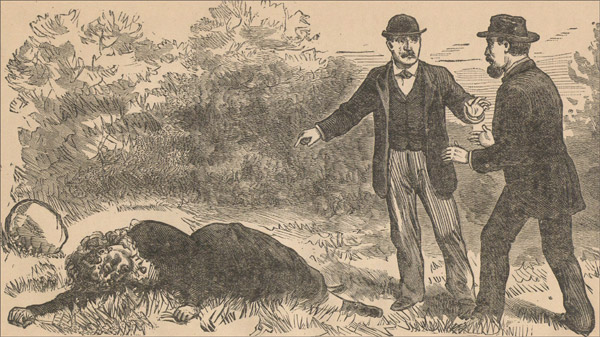
FINDING THE BODY OF MINA SCHMIDT, ALIAS MULLER, ALIAS KENKOUWSKY, WHERE IT HAD BEEN LEFT BY HER HUSBAND
The prisoner was taken into a small room, and when court was opened
he was led before Justice Morgan. Capt. Washburn, Coroner Wiggins,
Chief Donovan, Detective Stanton, and G. A. Seide were in court. Capt.
Washburn stated the case to the Justice, and said the New Jersey authorities
wished to have the custody of the prisoner. The Justice called up
Kenkowsky and asked if he knew why he was to be taken to New Jersey.
The French interpreter translated the question, but the prisoner said he understood
German better than he did French, so the German interpreter was
called in. Kenkowsky replied in the affirmative. He further said that he
knew his legal rights, but that he was willing to go to New Jersey without
any formal proceedings. The Justice then endorsed the warrant and Capt.
Washburn handed over the prisoner to Chief Donovan. Kenkowsky’s
manacles had been taken off, and he asked that he be allowed to have his
arms free. His request was granted.
Kenkowsky was then again placed in the coach, which was driven
hurriedly through West Tenth street to the Hoboken ferry and upon the
ferryboat Moonachie.
Kenkowsky’s coming had been anticipated in Hoboken, and an immense
throng had gathered at the ferry on the Hoboken side, rendering the streets
leading to the river almost impassable. As each boat reached the slip the
policemen on duty there experienced the utmost difficulty in restraining the
crowd that pressed forward eagerly in the desire to get a glimpse of the
prisoner. When at last he landed on the New Jersey shore the carriage
was driven as rapidly as possible through the multitude in the direction of
Police Headquarters. Some one in the throng recognized Chief Donovan
in the vehicle and shouted to the bystanders:
“There’s the murderer! There’s the murderer!”
The news spread like wildfire, and was received with mingled threats
and shouts of exultation. Cries of “Hang him!” “Lynch the wretch!”
“We’ll fix him!” were heard on all sides. The coach dashed up Newark
street to Hudson street, pursued by over 2,000 persons, shouting at the top
of their voices. Chief Donovan deemed it prudent to avoid the still larger
crowds that swarmed around the police station on Washington street.
He therefore directed the driver to pull up his horses at the end of an alley
that led to the rear of the building. The prisoner was conducted through
this passage to the station. He was placed in a cell at the end of the corridor.
While he was lying in jail awaiting the opening of the inquest, which
had been adjourned until 2 o’clock, another link in the chain of circumstantial
evidence against him was being prepared. Regina Herkfeldt, 20
years old, of 153 Newark avenue, told the police that on Monday, May 9,
she went to an intelligence office in Mott street to get a situation as a servant.
There she met a man answering Kenkowsky’s description. He
engaged her to do housework, and took her to 149 Charles street. There
he locked her in a room and assaulted her. He then led her to the street
and left her. Afterward he followed her into a saloon and took her pocketbook
and a ring from her finger, and left the saloon with them. She followed
him to Thirty-fifth street and Tenth avenue, where she lost him. Three or
four days afterward the man went to her brother’s place of business (her
brother is a galvanizer in the Pennsylvania Railroad shops), and told him
that he wanted to marry the girl. After that he went to her house and told
her he would marry her, and they went to Canal street, New York, to her
sister’s house. Last Sunday the man went to her house and told her he
was going to Chicago. He said he wanted to give her a gold watch and a
ring. The watch was a lady’s hunting case gold watch, with flowers
engraved on the outside case. The inside case did not look like
gold. The ring was chased, and had one round dark blue stone set in
a crown setting, with four claws which held the stone. He would not let
her keep the ring, but said he would send her one from Chicago. He went
back on Wednesday, the 18th, and told her she must get a situation, and he
would send for her from Chicago. The girl could not remember the man’s
name.
When Chief Donovan heard this story he telegraphed to Jersey City for
the girl, and she was taken to Hoboken by Detective Bowe. Kenkowsky
and a number of other persons were admitted to the large drill room of the
station, and the girl was then led in and requested to point out the man.
No sooner had she entered the apartment than she walked opposite to Kenkowsky,
looked at him steadily for an instant, and then, as she waved her
umbrella toward him, exclaimed:
“Das ist der man.”
“Ask him,” said Chief Donovan to Aid Ringe, “whether he has ever
seen this woman before.”
The aid interpreted the question and the prisoner grunted out a negative
answer.
At 2 o’clock in the afternoon, the hour appointed for the continuation
of the inquest, a great throng swarmed in Washington street between Police
Headquarters and the Morgue. Kenkowsky was led through this crowd by
Chief Donovan and an escort of policemen. The prisoner’s appearance was
greeted with the same threatening cries that had been uttered on his arrival
in Hoboken, but he bore up against the clamor with real or well-feigned
indifference. When he entered the hall and was being led to a seat at the
side of the Coroner’s chair his eyes accidentally fell upon the lay figure that
had been draped with the clothing of the murdered woman. When he saw
it he averted his face with a perceptible tremor. He almost immediately
recovered his composure and dropped into his seat.
The Rev. Dr. Mabon, the pastor of the Grove Reformed Dutch Church,
testified: “To the best of my knowledge I think the prisoner is the man
that I married under the name of Louis Kettler.”
Sarah Jane Rigler, who had directed the couple to Dr. Mabon’s house
on May 3, testified: “I recognize the prisoner as the man who was with
the woman who asked me where she could get a minister to marry them.”
John E. Schumann, the barber who had been called in by Dr. Mabon
to witness the ceremony, said that he believed the prisoner to be the man who
was married on that occasion.
Regina Herkfeldt testified concerning her acquaintance with Kenkowsky.
She identified a watch that was produced as the one that he gave
her. On cross-examination she considerably modified her previous account
of the prisoner’s assault upon her.
John E. Luthy, a watchmaker of 315 West Thirty-fifth street, testified
that the prisoner called at his place on May 16 with the watch and left it
there, taking a receipt for it.
Charles H. Peters, a roundsman of the Twentieth Precinct, this city,
testified to a conversation he had had with the prisoner at the station on the
night of the arrest. Kenkowsky admitted to him that he knew Mina
Muller. He at first denied but afterward confessed that he had given a
watch to Luthy to have repaired, and that it belonged to Mina Muller.
He told the roundsman that after the trunks had been taken to Christopher
street, Mina proposed to him to take a walk, and they went over to New
Jersey and visited the Scheutzen Park. They strolled into a saloon on the
Guttenberg road and had some beer. After leaving it he told her he wanted
to go back to New York, and she objected. As they were talking, two men,
he asserted, came along the road. One of them said to the woman: “Hello,
Mina! what are you doing over here?” When he heard this familiar language
he turned to his companion, and said: “If you are that kind of a
woman, I’ll have nothing to do with you,” and then he parted from her,
leaving her with the two men.
While the inquest was going on the wife of the prisoner entered the
room and managed to force her way through the throng. When she turned
her eyes toward her husband she threw up her arms and fell unconscious.
She was carried down stairs to the station, where restoratives were applied.
In the evening Kenkowsky was taken to the county jail and placed in
the cell formerly occupied by Covert D. Bennett.
In the trunks in Kenkowsky’s possession was found, in addition to a
lot of female clothing, a white shirt. The sleeves from the wrists to the
elbows were spotted with blood; the bosom, too, was marked with similar
stains. On each side of the shirt at about the waist there were marks of
bloody fingers. A pair of buckskin gloves with very small spots of blood
on the back was also found; the palms were soiled, as if they had been
used to handle some rough and dusty article.
At 11 o’clock on the morning of May 20th, Martin Sanger, an undertaker,
removed the body of Mina Muller from the Hoboken Morgue and
placed it in a plain coffin, which was put in a hearse and driven to the
residence of the deceased woman’s brother, Carl Schmidt, 555 Ninth avenue.
On the lid of the coffin was a silver plate with the inscription:
“Mina Muller, died May 3, 1881, aged 34 years.” A shield bearing the
words “Ruhe in Frieden,” was also on the coffin. A wreath of flowers
inwoven with the dead woman’s name rested upon the head of the coffin,
surrounded by bouquets. A throng of Germans, mostly women, were
waiting in front of the house for the arrival of the body. When the
hearse appeared at about two o’clock, the sidewalks for nearly a block were
almost impassable. Vehicles blocked the street in some places, and many
men and boys had climbed upon the elevated railroad columns. Six carriages
containing the husband and brothers of the deceased woman, and the
officers of Lodge No. 70, Knights and Ladies of Honor, accompanied the
hearse to the grave in the Lutheran Cemetery. Louis Schlisenger, the president
of the lodge, read its ritual. Mr. Muller wept during the service.
Mr. Schlisenger said the Lodge would pay the sister of Mrs. Muller
$1,000. Mrs. Muller joined the Lodge several years ago. She originally
assigned the money she was entitled to as a member to her husband, but on
May 3 she revoked this and assigned it to her sister. When Mrs. Muller
saw Mr. Schlisenger she told him she was going to France, and in case of
her death she desired that her sister should receive the money.
At half-past one o’clock on the morning of May 22d, Detectives Heidelberg
and Dolan arrested Philip Emden of 414 West Thirty-ninth street,
on the charge that he was an accomplice of Martin Kenkowsky. Emden
was locked up in a cell at the Police Headquarters. In the morning, however,
he was liberated. It was said that he was arraigned at the Jefferson
Market Police Court and liberated; but on the other hand it was reported
that he was not taken to court at all, but that Captain Washburn of the
Twentieth Precinct called at headquarters, and that after a conversation the
captain had with Inspector Byrnes, Emden was liberated. The police
were reticent about the procedure, but the result was that Emden was
freed.
Capt. Washburn was indignant at Emden’s arrest. He said: “Emden
was the first man to give a clue to Kenkowsky, and I promised to keep
his name a secret. We are in the habit of taking informers’ names in confidence;
otherwise people wouldn’t give us information. Prosecutor McGill
also promised me that he would not disclose the name. I think Kenkowsky’s
wife found out that Emden had given me information, and she
tried, out of revenge, to throw suspicions on him. Emden has lived three
years in the district, and is a quiet, well-behaved man. Chief Donovan was
perfectly willing that Emden should be set at liberty. Emden will accompany
me to testify at the inquest. He certainly has not behaved like a man
who has committed a murder.”
Philip Emden was found at his house, 414 West Thirty-ninth street.
According to his statement he met Kenkowsky shortly after the latter came
to this country. Emden is a mason, and found odd jobs for Kenkowsky,
who is of the same trade. On Feb. 19 last Emden married Bertha Himmelsbach,
and Kenkowsky was one of the witnesses to the ceremony, though
on the certificate his name appears as Martin Karkowsky. Shortly after
the marriage Emden was told by Kenkowsky that Mina Muller, a friend of
his, knew Bertha Himmelsbach, who, she said, was a bad woman. This
led to difficulties between Emden and his wife, which ended in their separation
on April 17. Since that time he has seen very little of Kenkowsky,
but he says that on one occasion the prisoner showed him a gold watch and
chain corresponding to those owned by Mina Muller. Emden does not
know whether this was before or after the murder.
On Thursday morning he read of the identification, and in H. Luhr’s
liquor store, 587 Tenth avenue, he mentioned that Kenkowsky had known
Mina Muller. Luhr, who knew Kenkowsky, suggested that the description
of the man who was married in Guttenberg tallied with Kenkowsky’s
appearance. Emden made up his mind to see if Kenkowsky was still at
his house, 510 West Thirty-sixth street. As his pretence for calling, he
determined to say that he had a job for the alleged murderer. He found
him in bed, and, when he asked if he wanted the job, Kenkowsky said that
he was engaged as a cook in a Jewish family on Fifth avenue, and only came
home nights. After working hours, Emden went to Capt. Washburn and
informed him of his suspicions, and a policeman was sent with him to
watch the house. In front of the house they found Strang, the trunkman,
who in the meantime had been tracked by Seide. Strang asked Emden if
he could speak German, and, when the latter answered in the affirmative,
requested him to ask the German woman up stairs if a trunk he was to
deliver belonged to her, saying he had left three trunks there some time
previously. Emden went up stairs and asked Mrs. Kenkowsky if three
trunks had been delivered there, and she said they had not. When Emden
came back to Strang with this answer, Strang requested him to ask again,
and this time she replied in the affirmative; and when Strang brought up
Kenkowsky’s trunk, she said, in surprise: “Why, he told me he had taken
it to where he was working in Fifth avenue.”
Kenkowsky’s wife was found at 510 West Thirty-sixth street. She
had just returned from a visit to her husband in jail. Her eyes were red
as though she had been weeping.
“Philip Emden,” she said, “has been a good friend to me and my
poor little ones. When I told my husband this afternoon in jail that Philip
had been arrested, he threw up his arms and exclaimed: ‘Philip arrested!
Philip, who has always been so good to us? He is innocent, Katrina, as
innocent as I am myself.”
Martin Kenkowsky spent Sunday quietly in his cell in the Hudson
County Jail at Jersey City. He ate his meals regularly and with much relish,
and slept for an hour after dinner. In the afternoon his wife and two
children visited him. He embraced them and had a long conversation
with them in the presence of a turnkey. In the course of their talk the
woman charged him with having stolen a five-dollar gold piece from her
room on the evening of May 3d. That was the day on which the murder
was committed. Kenkowsky admitted that he had taken the money. He
said that after he had left Mina with the two men at Union Hill, he returned
to New York city and went home. There he found the $5 piece,
which his wife had saved, and put it in his pocket. When he was told of
the arrest of Emden he seemed to be very much surprised. He said he
knew Emden, and had become acquainted with him only a short time ago.
“But,” he exclaimed, “he is as innocent as I am.”
The prisoner referred frequently to his former narrative as to the circumstances
under which he parted with Mrs. Muller in New Jersey. He
stated that one of the two men who accosted her in the Schuetzen Park,
and with whom he says he left her, was tall, and had a red moustache, and
the other was shorter and thinner. He was convinced, he declared, that
they murdered her.
City Missionary Verrinder held divine service in the corridor of the
jail on Sunday morning. Kenkowsky, at his own request, was permitted to
attend the exercises. He sat on the foremost bench, directly in front of the
minister, and although he did not understand the sermon, he bowed his head
reverently whenever the name of Jesus was uttered by the preacher. At an
early hour he went to bed, and fell asleep a few moments later.
The reader who has followed us thus far will perceive that scarcely
ever in the records of modern murder cases has such a steel coil of circumstantial
evidence, in such a small space of time, so completely woven itself
around a murderer. Kenkowsky attempted to prove an alibi by asserting
that on the day of the murder, and several hours before it could have taken
place, he was on his way to cross the river, and that on his way he had asked
the direction to the ferry of a carpenter whom he saw putting up posts for
a fence. This carpenter was found, and testified that a man on that date
had asked him the way to the ferry, but he failed to recognize Kenkowsky
as that man. The bottom of the alibi leaked, however, when the gentleman
on whose property the fence was being put up showed his diary, in
which was recorded a mem. of that particular job, dated several days after
the date of the murder. What verdict could a coroner’s jury bring in but
one fastening the crime on Kenkowsky? The trial will be read with great
interest.
THE END.
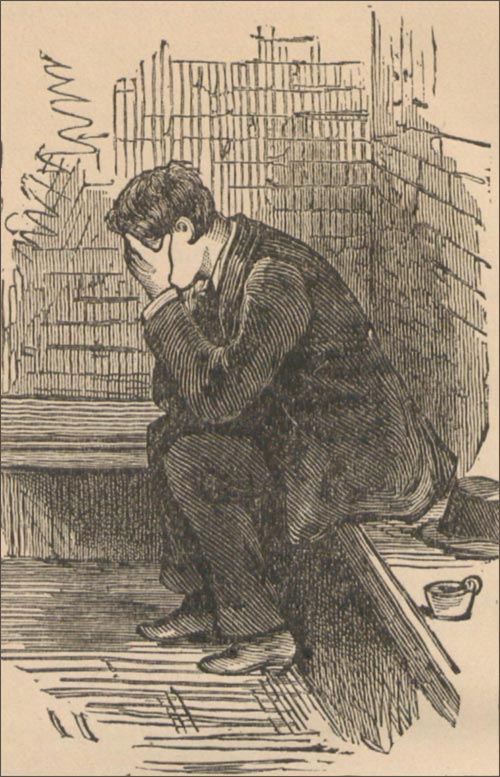
MARTIN KENKOUWSKY, ALIAS KETTLER, IN HIS
CELL.
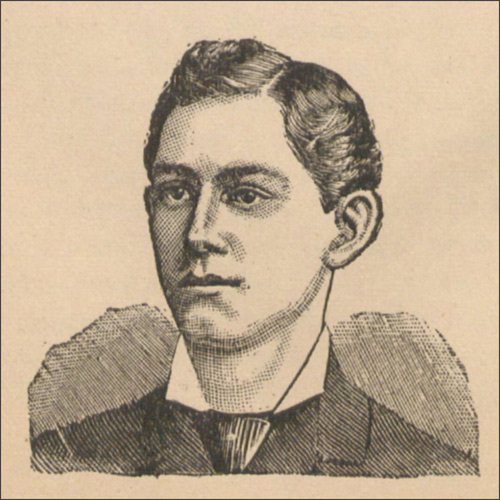
Augustus A. Seide,
THE JERSEY CITY REPORTER WHO SOLVED
THE WEEHAWKEN MYSTERY.
Transcriber’s Note
Efforts have been taken to transcribe this work as originally
published, including inconsistent capitalization and punctuation,
and alternative titles, names and spelling, except on page 37 where “ogether” has been
changed to “together”.