On the first mild—or, at least, the first bright—day of March, in this
year, I walked through what was once a country lane, between the
hostelry of the Half-moon at the bottom of Herne Hill, and the secluded
College of Dulwich.
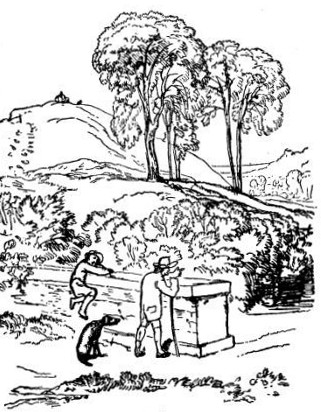
In my young days, Croxsted Lane was a green bye-road traversable for
some distance by carts; but rarely so traversed, and, for the most part,
little else than a narrow strip of untilled field, separated by
blackberry hedges from the better cared-for meadows on each side of it:
growing more weeds, therefore, than they, and perhaps in spring a
primrose or two—white archangel—daisies plenty, and purple thistles in
autumn. A slender rivulet, boasting little of its brightness, for there
are no springs at Dulwich, yet fed purely enough by the rain and morning
dew, here trickled—there loitered—through the long grass beneath the
hedges, and expanded itself, where it might, into moderately clear and
deep pools, in which, under their veils of duck-weed, a fresh-water
shell or two, sundry curious little skipping shrimps, any quantity of
tadpoles in their time, and even sometimes a tittlebat, offered
themselves to my boyhood's pleased, and not inaccurate, observation.
There, my mother and I used to gather the first buds of the hawthorn;
and there, in after years, I used to walk in the summer shadows, as in a
place wilder and sweeter than our garden, to think over any passage I
wanted to make better than usual in Modern Painters.
So, as aforesaid, on the first kindly day of this year, being thoughtful
more than usual of those old times, I went to look again at the place.
Often, both in those days, and since, I have put myself hard to it,
vainly, to find words wherewith to tell of beautiful things; but beauty
has been in the world since the world was made, and human language can
make a shift, somehow, to give account of it, whereas the peculiar
forces of devastation induced by modern city life have only entered the
world lately; and no existing terms of language known to me are enough
to describe the forms of filth, and modes of ruin, that varied
themselves along the course of Croxsted Lane. The fields on each side of
it are now mostly dug up for building, or cut through into gaunt corners
and nooks of blind ground by the wild crossings and concurrencies of
three railroads. Half a dozen handfuls of new cottages, with Doric
doors, are dropped about here and there among the gashed ground: the
lane itself, now entirely grassless, is a deep-rutted, heavy-hillocked
cart-road, diverging gatelessly into various brick-fields or pieces of
waste; and bordered on each side by heaps of—Hades only knows
what!—mixed dust of every unclean thing that can crumble in drought,
and mildew of every unclean thing that can rot or rust in damp: ashes
and rags, beer-bottles and old shoes, battered pans, smashed crockery,
shreds of nameless clothes, door-sweepings, floor-sweepings, kitchen
garbage, back-garden sewage, old iron, rotten timber jagged with
out-torn nails, cigar-ends, pipe-bowls, cinders, bones, and ordure,
indescribable; and, variously kneaded into, sticking to, or fluttering
foully here and there over all these,—remnants broadcast, of every
manner of newspaper, advertisement or big-lettered bill, festering and
flaunting out their last publicity in the pits of stinking dust and
mortal slime.
The lane ends now where its prettiest windings once began; being cut off
by a cross-road leading out of Dulwich to a minor railway station: and
on the other side of this road, what was of old the daintiest intricacy
of its solitude is changed into a straight, and evenly macadamised
carriage drive, between new houses of extreme respectability, with good
attached gardens and offices—most of these tenements being larger—all
more pretentious, and many, I imagine, held at greatly higher rent than
my father's, tenanted for twenty years at Herne Hill. And it became
matter of curious meditation to me what must here become of children
resembling my poor little dreamy quondam self in temper, and thus
brought up at the same distance from London, and in the same or better
circumstances of worldly fortune; but with only Croxsted Lane in its
present condition for their country walk. The trimly kept road before
their doors, such as one used to see in the fashionable suburbs of
Cheltenham or Leamington, presents nothing to their study but gravel,
and gas-lamp posts; the modern addition of a vermilion letter-pillar
contributing indeed to the splendour, but scarcely to the interest of
the scene; and a child of any sense or fancy would hastily contrive
escape from such a barren desert of politeness, and betake itself to
investigation, such as might be feasible, of the natural history of
Croxsted Lane.
But, for its sense or fancy, what food, or stimulus, can it find, in
that foul causeway of its youthful pilgrimage? What would have happened
to myself, so directed, I cannot clearly imagine. Possibly, I might have
got interested in the old iron and wood-shavings; and become an engineer
or a carpenter: but for the children of to-day, accustomed from the
instant they are out of their cradles, to the sight of this infinite
nastiness, prevailing as a fixed condition of the universe, over the
face of nature, and accompanying all the operations of industrious man,
what is to be the scholastic issue? unless, indeed, the thrill of
scientific vanity in the primary analysis of some unheard-of process of
corruption—or the reward of microscopic research in the sight of worms
with more legs, and acari of more curious generation than ever vivified
the more simply smelling plasma of antiquity.
One result of such elementary education is, however, already certain;
namely, that the pleasure which we may conceive taken by the children of
the coming time, in the analysis of physical corruption, guides, into
fields more dangerous and desolate, the expatiation of imaginative
literature: and that the reactions of moral disease upon itself, and the
conditions of languidly monstrous character developed in an atmosphere
of low vitality, have become the most valued material of modern
fiction, and the most eagerly discussed texts of modern philosophy.
The many concurrent reasons for this mischief may, I believe, be massed
under a few general heads.
I. There is first the hot fermentation and unwholesome secrecy of the
population crowded into large cities, each mote in the misery lighter,
as an individual soul, than a dead leaf, but becoming oppressive and
infectious each to his neighbour, in the smoking mass of decay. The
resulting modes of mental ruin and distress are continually new; and in
a certain sense, worth study in their monstrosity: they have accordingly
developed a corresponding science of fiction, concerned mainly with the
description of such forms of disease, like the botany of leaf-lichens.
In De Balzac's story of Father Goriot, a grocer makes a large fortune,
of which he spends on himself as much as may keep him alive; and on his
two daughters, all that can promote their pleasures or their pride. He
marries them to men of rank, supplies their secret expenses, and
provides for his favourite a separate and clandestine establishment with
her lover. On his deathbed, he sends for this favourite daughter, who
wishes to come, and hesitates for a quarter of an hour between doing so,
and going to a ball at which it has been for the last month her chief
ambition to be seen. She finally goes to the ball.
This story is, of course, one of which the violent contrasts and
spectral catastrophe could only take place, or be conceived, in a large
city. A village grocer cannot make a large fortune, cannot marry his
daughters to titled squires, and cannot die without having his children
brought to him, if in the neighbourhood, by fear of village gossip, if
for no better cause.
II. But a much more profound feeling than this mere curiosity of science
in morbid phenomena is concerned in the production of the carefullest
forms of modern fiction. The disgrace and grief resulting from the mere
trampling pressure and electric friction of town life, become to the
sufferers peculiarly mysterious in their undeservedness, and frightful
in their inevitableness. The power of all surroundings over them for
evil; the incapacity of their own minds to refuse the pollution, and of
their own wills to oppose the weight, of the staggering mass that chokes
and crushes them into perdition, brings every law of healthy existence
into question with them, and every alleged method of help and hope into
doubt. Indignation, without any calming faith in justice, and
self-contempt, without any curative self-reproach, dull the
intelligence, and degrade the conscience, into sullen incredulity of all
sunshine outside the dunghill, or breeze beyond the wafting of its
impurity; and at last a philosophy develops itself, partly satiric,
partly consolatory, concerned only with the regenerative vigour of
manure, and the necessary obscurities of fimetic Providence; showing how
everybody's fault is somebody else's, how infection has no law,
digestion no will, and profitable dirt no dishonour.
And thus an elaborate and ingenious scholasticism, in what may be called
the Divinity of Decomposition, has established itself in connection with
the more recent forms of romance, giving them at once a complacent tone
of clerical dignity, and an agreeable dash of heretical impudence; while
the inculcated doctrine has the double advantage of needing no laborious
scholarship for its foundation, and no painful self-denial for its
practice.
III. The monotony of life in the central streets of any great modern
city, but especially in those of London, where every emotion intended to
be derived by men from the sight of nature, or the sense of art, is
forbidden for ever, leaves the craving of the heart for a sincere, yet
changeful, interest, to be fed from one source only. Under natural
conditions the degree of mental excitement necessary to bodily health is
provided by the course of the seasons, and the various skill and fortune
of agriculture. In the country every morning of the year brings with it
a new aspect of springing or fading nature; a new duty to be fulfilled
upon earth, and a new promise or warning in heaven. No day is without
its innocent hope, its special prudence, its kindly gift, and its
sublime danger; and in every process of wise husbandry, and every
effort of contending or remedial courage, the wholesome passions, pride,
and bodily power of the labourer are excited and exerted in happiest
unison. The companionship of domestic, the care of serviceable, animals,
soften and enlarge his life with lowly charities, and discipline him in
familiar wisdoms and unboastful fortitudes; while the divine laws of
seed-time which cannot be recalled, harvest which cannot be hastened,
and winter in which no man can work, compel the impatiences and coveting
of his heart into labour too submissive to be anxious, and rest too
sweet to be wanton. What thought can enough comprehend the contrast
between such life, and that in streets where summer and winter are only
alternations of heat and cold; where snow never fell white, nor sunshine
clear; where the ground is only a pavement, and the sky no more than the
glass roof of an arcade; where the utmost power of a storm is to choke
the gutters, and the finest magic of spring, to change mud into dust:
where—chief and most fatal difference in state, there is no interest of
occupation for any of the inhabitants but the routine of counter or desk
within doors, and the effort to pass each other without collision
outside; so that from morning to evening the only possible variation of
the monotony of the hours, and lightening of the penalty of existence,
must be some kind of mischief, limited, unless by more than ordinary
godsend of fatality, to the fall of a horse, or the slitting of a
pocket.
I said that under these laws of inanition, the craving of the human
heart for some kind of excitement could be supplied from one source
only. It might have been thought by any other than a sternly tentative
philosopher, that the denial of their natural food to human feelings
would have provoked a reactionary desire for it; and that the dreariness
of the street would have been gilded by dreams of pastoral felicity.
Experience has shown the fact to be otherwise; the thoroughly trained
Londoner can enjoy no other excitement than that to which he has been
accustomed, but asks for that in continually more ardent or more
virulent concentration; and the ultimate power of fiction to entertain
him is by varying to his fancy the modes, and defining for his dulness
the horrors, of Death. In the single novel of Bleak House there are
nine deaths (or left for death's, in the drop scene) carefully wrought
out or led up to, either by way of pleasing surprise, as the baby's at
the brickmaker's, or finished in their threatenings and sufferings, with
as much enjoyment as can be contrived in the anticipation, and as much
pathology as can be concentrated in the description. Under the following
varieties of method:—
| One by assassination | Mr. Tulkinghorn. |
| One by starvation, with phthisis | Joe. |
| One by chagrin | Richard. |
| One by spontaneous combustion | Mr. Krook. |
| One by sorrow | Lady Dedlock's lover. |
| One by remorse | Lady Dedlock. |
| One by insanity | Miss Flite. |
| One by paralysis | Sir Leicester. |
Besides the baby, by fever, and a lively young Frenchwoman left to be
hanged.
And all this, observe, not in a tragic, adventurous, or military story,
but merely as the further enlivenment of a narrative intended to be
amusing; and as a properly representative average of the statistics of
civilian mortality in the centre of London.
Observe further, and chiefly. It is not the mere number of deaths
(which, if we count the odd troopers in the last scene, is exceeded in
Old Mortality, and reached, within one or two, both in Waverley and
Guy Mannering) that marks the peculiar tone of the modern novel. It is
the fact that all these deaths, but one, are of inoffensive, or at least
in the world's estimate respectable persons; and that they are all
grotesquely either violent or miserable, purporting thus to illustrate
the modern theology that the appointed destiny of a large average of our
population is to die like rats in a drain, either by trap or poison.
Not, indeed, that a lawyer in full practice can be usually supposed as
faultless in the eye of heaven as a dove or a woodcock; but it is not,
in former divinities, thought the will of Providence that he should be
dropped by a shot from a client behind his fire-screen, and retrieved in
the morning by his housemaid under the chandelier. Neither is Lady
Dedlock less reprehensible in her conduct than many women of fashion
have been and will be: but it would not therefore have been thought
poetically just, in old-fashioned morality, that she should be found by
her daughter lying dead, with her face in the mud of a St. Giles's
churchyard.
In the work of the great masters death is always either heroic,
deserved, or quiet and natural (unless their purpose be totally and
deeply tragic, when collateral meaner death is permitted, like that of
Polonius or Roderigo). In Old Mortality, four of the deaths,
Bothwell's, Ensign Grahame's, Macbriar's, and Evandale's, are
magnificently heroic; Burley's and Oliphant's long deserved, and swift;
the troopers', met in the discharge of their military duty, and the old
miser's, as gentle as the passing of a cloud, and almost beautiful in
its last words of—now unselfish—care.
'Ailie' (he aye ca'd me Ailie, we were auld acquaintance,)
'Ailie, take ye care and haud the gear weel thegither; for
the name of Morton of Milnwood's gane out like the last
sough of an auld sang.' And sae he fell out o' ae dwam into
another, and ne'er spak a word mair, unless it were
something we cou'dna mak out, about a dipped candle being
gude eneugh to see to dee wi'. He cou'd ne'er bide to see a
moulded ane, and there was ane, by ill luck, on the table.
In Guy Mannering, the murder, though unpremeditated, of a single
person, (himself not entirely innocent, but at least by heartlessness in
a cruel function earning his fate,) is avenged to the uttermost on all
the men conscious of the crime; Mr. Bertram's death, like that of his
wife, brief in pain, and each told in the space of half-a-dozen lines;
and that of the heroine of the tale, self-devoted, heroic in the
highest, and happy.
Nor is it ever to be forgotten, in the comparison of Scott's with
inferior work, that his own splendid powers were, even in early life,
tainted, and in his latter years destroyed, by modern conditions of
commercial excitement, then first, but rapidly, developing themselves.
There are parts even in his best novels coloured to meet tastes which he
despised; and many pages written in his later ones to lengthen his
article for the indiscriminate market.
But there was one weakness of which his healthy mind remained incapable
to the last. In modern stories prepared for more refined or fastidious
audiences than those of Dickens, the funereal excitement is obtained,
for the most part, not by the infliction of violent or disgusting death;
but in the suspense, the pathos, and the more or less by all felt, and
recognised, mortal phenomena of the sick-room. The temptation, to weak
writers, of this order of subject is especially great, because the study
of it from the living—or dying—model is so easy, and to many has been
the most impressive part of their own personal experience; while, if the
description be given even with mediocre accuracy, a very large section
of readers will admire its truth, and cherish its melancholy: Few
authors of second or third rate genius can either record or invent a
probable conversation in ordinary life; but few, on the other hand, are
so destitute of observant faculty as to be unable to chronicle the
broken syllables and languid movements of an invalid. The easily
rendered, and too surely recognised, image of familiar suffering is felt
at once to be real where all else had been false; and the historian of
the gestures of fever and words of delirium can count on the applause of
a gratified audience as surely as the dramatist who introduces on the
stage of his flagging action a carriage that can be driven or a fountain
that will flow. But the masters of strong imagination disdain such work,
and those of deep sensibility shrink from it.[154] Only under conditions
of personal weakness, presently to be noted, would Scott comply with the
cravings of his lower audience in scenes of terror like the death of
Front-de-Bœuf. But he never once withdrew the sacred curtain of the
sick-chamber, nor permitted the disgrace of wanton tears round the
humiliation of strength, or the wreck of beauty.
IV. No exception to this law of reverence will be found in the scenes in
Cœur de Lion's illness introductory to the principal incident in the
Talisman. An inferior writer would have made the king charge in
imagination at the head of his chivalry, or wander in dreams by the
brooks of Aquitaine; but Scott allows us to learn no more startling
symptoms of the king's malady than that he was restless and impatient,
and could not wear his armour. Nor is any bodily weakness, or crisis of
danger, permitted to disturb for an instant the royalty of intelligence
and heart in which he examines, trusts and obeys the physician whom his
attendants fear.
Yet the choice of the main subject in this story and its companion—the
trial, to a point of utter torture, of knightly faith, and several
passages in the conduct of both, more especially the exaggerated scenes
in the House of Baldringham, and hermitage of Engedi, are signs of the
gradual decline in force of intellect and soul which those who love
Scott best have done him the worst injustice in their endeavours to
disguise or deny. The mean anxieties, moral humiliations, and
mercilessly demanded brain-toil, which killed him, show their sepulchral
grasp for many and many a year before their final victory; and the
states of more or less dulled, distorted, and polluted imagination which
culminate in Castle Dangerous, cast a Stygian hue over St. Ronan's
Well, The Fair Maid of Perth, and Anne of Geierstein, which lowers
them, the first altogether, the other two at frequent intervals, into
fellowship with the normal disease which festers throughout the whole
body of our lower fictitious literature.
Fictitious! I use the ambiguous word deliberately; for it is impossible
to distinguish in these tales of the prison-house how far their vice and
gloom are thrown into their manufacture only to meet a vile demand, and
how far they are an integral condition of thought in the minds of men
trained from their youth up in the knowledge of Londinian and Parisian
misery. The speciality of the plague is a delight in the exposition of
the relations between guilt and decrepitude; and I call the results of
it literature 'of the prison-house,' because the thwarted habits of body
and mind, which are the punishment of reckless crowding in cities,
become, in the issue of that punishment, frightful subjects of exclusive
interest to themselves; and the art of fiction in which they finally
delight is only the more studied arrangement and illustration, by
coloured firelights, of the daily bulletins of their own wretchedness,
in the prison calendar, the police news, and the hospital report.
The reader will perhaps be surprised at my separating the greatest work
of Dickens, Oliver Twist, with honour, from the loathsome mass to
which it typically belongs. That book is an earnest and uncaricatured
record of states of criminal life, written with didactic purpose, full
of the gravest instruction, nor destitute of pathetic studies of noble
passion. Even the Mysteries of Paris and Gaboriau's Crime d'Augival
are raised, by their definiteness of historical intention and
forewarning anxiety, far above the level of their order, and may be
accepted as photographic evidence of an otherwise incredible
civilisation, corrupted in the infernal fact of it, down to the genesis
of such figures as the Vicomte d'Augival, the Stabber,[155] the
Skeleton, and the She-wolf. But the effectual head of the whole
cretinous school is the renowned novel in which the hunchbacked lover
watches the execution of his mistress from the tower of Notre-Dame; and
its strength passes gradually away into the anatomical preparations, for
the general market, of novels like Poor Miss Finch, in which the
heroine is blind, the hero epileptic, and the obnoxious brother is found
dead with his hands dropped off, in the Arctic regions.[156]
This literature of the Prison-house, understanding by the word not only
the cell of Newgate, but also and even more definitely the cell of the
Hôtel-Dieu, the Hôpital des Fous, and the grated corridor with the
dripping slabs of the Morgue, having its central root thus in the Ile
de Paris—or historically and pre-eminently the 'Cité de Paris'—is,
when understood deeply, the precise counter-corruption of the religion
of the Sainte Chapelle, just as the worst forms of bodily and mental
ruin are the corruption of love. I have therefore called it 'Fiction
mécroyante,' with literal accuracy and precision; according to the
explanation of the word which the reader may find in any good French
dictionary,[157] and round its Arctic pole in the Morgue, he may gather
into one Caina of gelid putrescence the entire product of modern infidel
imagination, amusing itself with destruction of the body, and busying
itself with aberration of the mind.
Aberration, palsy, or plague, observe, as distinguished from normal
evil, just as the venom of rabies or cholera differs from that of a wasp
or a viper. The life of the insect and serpent deserves, or at least
permits, our thoughts; not so, the stages of agony in the fury-driven
hound. There is some excuse, indeed, for the pathologic labour of the
modern novelist in the fact that he cannot easily, in a city population,
find a healthy mind to vivisect: but the greater part of such amateur
surgery is the struggle, in an epoch of wild literary competition, to
obtain novelty of material. The varieties of aspect and colour in
healthy fruit, be it sweet or sour, may be within certain limits
described exhaustively. Not so the blotches of its conceivable blight:
and while the symmetries of integral human character can only be traced
by harmonious and tender skill, like the branches of a living tree, the
faults and gaps of one gnawed away by corroding accident can be shuffled
into senseless change like the wards of a Chubb lock.
V. It is needless to insist on the vast field for this dice-cast or
card-dealt calamity which opens itself in the ignorance, money-interest,
and mean passion, of city marriage. Peasants know each other as
children—meet, as they grow up in testing labour; and if a stout
farmer's son marries a handless girl, it is his own fault. Also in the
patrician families of the field, the young people know what they are
doing, and marry a neighbouring estate, or a covetable title, with some
conception of the responsibilities they undertake. But even among these,
their season in the confused metropolis creates licentious and
fortuitous temptation before unknown; and in the lower middle orders, an
entirely new kingdom of discomfort and disgrace has been preached to
them in the doctrines of unbridled pleasure which are merely an apology
for their peculiar forms of illbreeding. It is quite curious how often
the catastrophe, or the leading interest, of a modern novel, turns upon
the want, both in maid and bachelor, of the common self-command which
was taught to their grandmothers and grandfathers as the first element
of ordinarily decent behaviour. Rashly inquiring the other day the plot
of a modern story from a female friend, I elicited, after some
hesitation, that it hinged mainly on the young people's 'forgetting
themselves in a boat;' and I perceive it to be accepted as nearly an
axiom in the code of modern civic chivalry that the strength of amiable
sentiment is proved by our incapacity on proper occasions to express,
and on improper ones to control it. The pride of a gentleman of the old
school used to be in his power of saying what he meant, and being silent
when he ought, (not to speak of the higher nobleness which bestowed love
where it was honourable, and reverence where it was due); but the
automatic amours and involuntary proposals of recent romance acknowledge
little further law of morality than the instinct of an insect, or the
effervescence of a chemical mixture.
There is a pretty little story of Alfred de Musset's,—La Mouche,
which, if the reader cares to glance at it, will save me further trouble
in explaining the disciplinarian authority of mere old-fashioned
politeness, as in some sort protective of higher things. It describes,
with much grace and precision, a state of society by no means
pre-eminently virtuous, or enthusiastically heroic; in which many people
do extremely wrong, and none sublimely right. But as there are heights
of which the achievement is unattempted, there are abysses to which fall
is barred; neither accident nor temptation will make any of the
principal personages swerve from an adopted resolution, or violate an
accepted principle of honour; people are expected as a matter of course
to speak with propriety on occasion, and to wait with patience when they
are bid: those who do wrong, admit it; those who do right don't boast of
it; everybody knows his own mind, and everybody has good manners.
Nor must it be forgotten that in the worst days of the self-indulgence
which destroyed the aristocracies of Europe, their vices, however
licentious, were never, in the fatal modern sense, 'unprincipled.' The
vainest believed in virtue; the vilest respected it. 'Chaque chose avait
son nom,'[158] and the severest of English moralists recognises the
accurate wit, the lofty intellect, and the unfretted benevolence, which
redeemed from vitiated surroundings the circle of d'Alembert and
Marmontel.[159]
I have said, with too slight praise, that the vainest, in those days,
'believed' in virtue. Beautiful and heroic examples of it were always
before them; nor was it without the secret significance attaching to
what may seem the least accidents in the work of a master, that Scott
gave to both his heroines of the age of revolution in England the name
of the queen of the highest order of English chivalry.[160]
It is to say little for the types of youth and maid which alone Scott
felt it a joy to imagine, or thought it honourable to portray, that they
act and feel in a sphere where they are never for an instant liable to
any of the weaknesses which disturb the calm, or shake the resolution,
of chastity and courage in a modern novel. Scott lived in a country and
time, when, from highest to lowest, but chiefly in that dignified and
nobly severe[161] middle class to which he himself belonged, a habit of
serene and stainless thought was as natural to the people as their
mountain air. Women like Rose Bradwardine and Ailie Dinmont were the
grace and guard of almost every household (God be praised that the race
of them is not yet extinct, for all that Mall or Boulevard can do), and
it has perhaps escaped the notice of even attentive readers that the
comparatively uninteresting character of Sir Walter's heroes had always
been studied among a class of youths who were simply incapable of doing
anything seriously wrong; and could only be embarrassed by the
consequences of their levity or imprudence.
But there is another difference in the woof of a Waverley novel from the
cobweb of a modern one, which depends on Scott's larger view of human
life. Marriage is by no means, in his conception of man and woman, the
most important business of their existence;[162] nor love the only
reward to be proposed to their virtue or exertion. It is not in his
reading of the laws of Providence a necessity that virtue should, either
by love or any other external blessing, be rewarded at all;[163] and
marriage is in all cases thought of as a constituent of the happiness of
life, but not as its only interest, still less its only aim. And upon
analysing with some care the motives of his principal stories, we shall
often find that the love in them is merely a light by which the sterner
features of character are to be irradiated, and that the marriage of the
hero is as subordinate to the main bent of the story as Henry the
Fifth's courtship of Katherine is to the battle of Agincourt. Nay, the
fortunes of the person who is nominally the subject of the tale are
often little more than a background on which grander figures are to be
drawn, and deeper fates forth-shadowed. The judgments between the faith
and chivalry of Scotland at Drumclog and Bothwell bridge owe little of
their interest in the mind of a sensible reader to the fact that the
captain of the Popinjay is carried a prisoner to one battle, and returns
a prisoner from the other: and Scott himself, while he watches the white
sail that bears Queen Mary for the last time from her native land, very
nearly forgets to finish his novel, or to tell us—and with small sense
of any consolation to be had out of that minor circumstance,—that
'Roland and Catherine were united, spite of their differing faiths.'
Neither let it be thought for an instant that the slight, and sometimes
scornful, glance with which Scott passes over scenes which a novelist of
our own day would have analysed with the airs of a philosopher, and
painted with the curiosity of a gossip, indicate any absence in his
heart of sympathy with the great and sacred elements of personal
happiness. An era like ours, which has with diligence and ostentation
swept its heart clear of all the passions once known as loyalty,
patriotism, and piety, necessarily magnifies the apparent force of the
one remaining sentiment which sighs through the barren chambers, or
clings inextricably round the chasms of ruin; nor can it but regard with
awe the unconquerable spirit which still tempts or betrays the
sagacities of selfishness into error or frenzy which is believed to be
love.
That Scott was never himself, in the sense of the phrase as employed by
lovers of the Parisian school, 'ivre d'amour,' may be admitted without
prejudice to his sensibility,[164] and that he never knew 'l'amor che
move 'l sol e l'altre stelle,' was the chief, though unrecognised,
calamity of his deeply chequered life. But the reader of honour and
feeling will not therefore suppose that the love which Miss Vernon
sacrifices, stooping for an instant from her horse, is of less noble
stamp, or less enduring faith, than that which troubles and degrades
the whole existence of Consuelo; or that the affection of Jeanie Deans
for the companion of her childhood, drawn like a field of soft blue
heaven beyond the cloudy wrack of her sorrow, is less fully in
possession of her soul than the hesitating and self-reproachful impulses
under which a modern heroine forgets herself in a boat, or compromises
herself in the cool of the evening.
I do not wish to return over the waste ground we have traversed,
comparing, point by point, Scott's manner with those of Bermondsey and
the Faubourgs; but it may be, perhaps, interesting at this moment to
examine, with illustration from those Waverley novels which have so
lately retracted the attention of a fair and gentle public, the
universal conditions of 'style,' rightly so called, which are in all
ages, and above all local currents or wavering tides of temporary
manners, pillars of what is for ever strong, and models of what is for
ever fair.
But I must first define, and that within strict horizon, the works of
Scott, in which his perfect mind may be known, and his chosen ways
understood.
His great works of prose fiction, excepting only the first half-volume
of Waverley, were all written in twelve years, 1814-26 (of his own age
forty-three to fifty-five), the actual time employed in their
composition being not more than a couple of months out of each year; and
during that time only the morning hours and spare minutes during the
professional day. 'Though the first volume of Waverley was begun long
ago, and actually lost for a time, yet the other two were begun and
finished between the 4th of June and the first of July, during all which
I attended my duty in court, and proceeded without loss of time or
hindrance of business.'[165]
Few of the maxims for the enforcement of which, in Modern Painters,
long ago, I got the general character of a lover of paradox, are more
singular, or more sure, than the statement, apparently so encouraging to
the idle, that if a great thing can be done at all, it can be done
easily. But it is in that kind of ease with which a tree blossoms after
long years of gathered strength, and all Scott's great writings were the
recreations of a mind confirmed in dutiful labour, and rich with organic
gathering of boundless resource.
Omitting from our count the two minor and ill-finished sketches of the
Black Dwarf and Legend of Montrose, and, for a reason presently to
be noticed, the unhappy St. Ronan's, the memorable romances of Scott
are eighteen, falling into three distinct groups, containing six each.
The first group is distinguished from the other two by characters of
strength and felicity which never more appeared after Scott was struck
down by his terrific illness in 1819. It includes Waverley, Guy
Mannering, The Antiquary, Rob Roy, Old Mortality, and The Heart
of Midlothian.
The composition of these occupied the mornings of his happiest days,
between the ages of 43 and 48. On the 8th of April, 1819 (he was 48 on
the preceding 15th of August) he began for the first time to
dictate—being unable for the exertion of writing—The Bride of
Lammermuir, 'the affectionate Laidlaw beseeching him to stop dictating,
when his audible suffering filled every pause. "Nay, Willie," he
answered "only see that the doors are fast. I would fain keep all the
cry as well as all the wool to ourselves; but as for giving over work,
that can only be when I am in woollen."'[166] From this time forward the
brightness of joy and sincerity of inevitable humour, which perfected
the imagery of the earlier novels, are wholly absent, except in the two
short intervals of health unaccountably restored, in which he wrote
Redgauntlet and Nigel.
It is strange, but only a part of the general simplicity of Scott's
genius, that these revivals of earlier power were unconscious, and that
the time of extreme weakness in which he wrote St. Ronan's Well, was
that in which he first asserted his own restoration.
It is also a deeply interesting characteristic of his noble nature that
he never gains anything by sickness; the whole man breathes or faints
as one creature; the ache that stiffens a limb chills his heart, and
every pang of the stomach paralyses the brain. It is not so with
inferior minds, in the workings of which it is often impossible to
distinguish native from narcotic fancy, and throbs of conscience from
those of indigestion. Whether in exaltation or languor, the colours of
mind are always morbid, which gleam on the sea for the 'Ancient
Mariner,' and through the casements on 'St. Agnes' Eve;' but Scott is at
once blinded and stultified by sickness; never has a fit of the cramp
without spoiling a chapter, and is perhaps the only author of vivid
imagination who never wrote a foolish word but when he was ill.
It remains only to be noticed on this point that any strong natural
excitement, affecting the deeper springs of his heart, would at once
restore his intellectual powers in all their fullness, and that, far
towards their sunset: but that the strong will on which he prided
himself, though it could trample upon pain, silence grief, and compel
industry, never could warm his imagination, or clear the judgment in his
darker hours.
I believe that this power of the heart over the intellect is common to
all great men: but what the special character of emotion was, that alone
could lift Scott above the power of death, I am about to ask the reader,
in a little while, to observe with joyful care.
The first series of romances then, above named, are all that exhibit the
emphasis of his unharmed faculties. The second group, composed in the
three years subsequent to illness all but mortal, bear every one of them
more or less the seal of it.
They consist of the Bride of Lammermuir, Ivanhoe, the Monastery,
the Abbot, Kenilworth, and the Pirate.[167] The marks of broken
health on all these are essentially twofold—prevailing melancholy, and
fantastic improbability. Three of the tales are agonizingly tragic, the
Abbot scarcely less so in its main event, and Ivanhoe deeply wounded
through all its bright panoply; while even in that most powerful of the
series, the impossible archeries and axestrokes, the incredibly
opportune appearances of Locksley, the death of Ulrica, and the
resuscitation of Athelstane, are partly boyish, partly feverish. Caleb
in the Bride, Triptolemus and Halcro in the Pirate, are all
laborious, and the first incongruous; half a volume of the Abbot is
spent in extremely dull detail of Roland's relations with his
fellow-servants and his mistress, which have nothing whatever to do with
the future story; and the lady of Avenel herself disappears after the
first volume, 'like a snaw wreath when it's thaw, Jeanie.' The public
has for itself pronounced on the Monastery, though as much too harshly
as it has foolishly praised the horrors of Ravenswood and the nonsense
of Ivanhoe; because the modern public finds in the torture and
adventure of these, the kind of excitement which it seeks at an opera,
while it has no sympathy whatever with the pastoral happiness of
Glendearg, or with the lingering simplicities of superstition which give
historical likelihood to the legend of the White Lady.
But both this despised tale and its sequel have Scott's heart in them.
The first was begun to refresh himself in the intervals of artificial
labour on Ivanhoe. 'It was a relief,' he said, 'to interlay the
scenery most familiar to me[168] with the strange world for which I had
to draw so much on imagination.'[169] Through all the closing scenes of
the second he is raised to his own true level by his love for the
queen. And within the code of Scott's work to which I am about to appeal
for illustration of his essential powers, I accept the Monastery and
Abbot, and reject from it the remaining four of this group.
The last series contains two quite noble ones, Redgauntlet and
Nigel; two of very high value, Durward and Woodstock; the slovenly
and diffuse Peveril, written for the trade; the sickly Tales of the
Crusaders, and the entirely broken and diseased St. Ronan's Well.
This last I throw out of count altogether, and of the rest, accept only
the four first named as sound work; so that the list of the novels in
which I propose to examine his methods and ideal standards, reduces
itself to these following twelve (named in order of production):
Waverley, Guy Mannering, the Antiquary, Rob Roy, Old
Mortality, the Heart of Midlothian, the Monastery, the Abbot, the
Fortunes of Nigel, Quentin Durward, and Woodstock.[170]
It is, however, too late to enter on my subject in this article, which I
may fitly close by pointing out some of the merely verbal
characteristics of his style, illustrative in little ways of the
questions we have been examining, and chiefly of the one which may be
most embarrassing to many readers, the difference, namely, between
character and disease.
One quite distinctive charm in the Waverleys is their modified use of
the Scottish dialect; but it has not generally been observed, either by
their imitators, or the authors of different taste who have written for
a later public, that there is a difference between the dialect of a
language, and its corruption.
A dialect is formed in any district where there are persons of
intelligence enough to use the language itself in all its fineness and
force, but under the particular conditions of life, climate, and temper,
which introduce words peculiar to the scenery, forms of word and idioms
of sentence peculiar to the race, and pronunciations indicative of their
character and disposition.
Thus 'burn' (of a streamlet) is a word possible only in a country where
there are brightly running waters, 'lassie,' a word possible only where
girls are as free as the rivulets, and 'auld,' a form of the southern
'old,' adopted by a race of finer musical ear than the English.
On the contrary, mere deteriorations, or coarse, stridulent, and, in the
ordinary sense of the phrase, 'broad' forms of utterance, are not
dialects at all, having nothing dialectic in them, and all phrases
developed in states of rude employment, and restricted intercourse, are
injurious to the tone and narrowing to the power of the language they
affect. Mere breadth of accent does not spoil a dialect as long as the
speakers are men of varied idea and good intelligence; but the moment
the life is contracted by mining, millwork, or any oppressive and
monotonous labour, the accents and phrases become debased. It is part of
the popular folly of the day to find pleasure in trying to write and
spell these abortive, crippled, and more or less brutal forms of human
speech.
Abortive, crippled, or brutal, are however not necessarily 'corrupted'
dialects. Corrupt language is that gathered by ignorance, invented by
vice, misused by insensibility, or minced and mouthed by affectation,
especially in the attempt to deal with words of which only half the
meaning is understood, or half the sound heard. Mrs. Gamp's 'aperiently
so'—and the 'undermined' with primal sense of undermine, of—I forget
which gossip, in the Mill on the Floss, are master- and
mistress-pieces in this latter kind. Mrs. Malaprop's 'allegories on the
banks of the Nile' are in a somewhat higher order of mistake: Miss
Tabitha Bramble's ignorance is vulgarised by her selfishness, and
Winifred Jenkins' by her conceit. The 'wot' of Noah Claypole, and the
other degradations of cockneyism (Sam Weller and his father are in
nothing more admirable than in the power of heart and sense that can
purify even these); the 'trewth' of Mr. Chadband, and 'natur' of Mr.
Squeers, are examples of the corruption of words by insensibility: the
use of the word 'bloody' in modern low English is a deeper corruption,
not altering the form of the word, but defiling the thought in it.
Thus much being understood, I shall proceed to examine thoroughly a
fragment of Scott's Lowland Scottish dialect; not choosing it of the
most beautiful kind; on the contrary, it shall be a piece reaching as
low down as he ever allows Scotch to go—it is perhaps the only unfair
patriotism in him, that if ever he wants a word or two of really
villainous slang, he gives it in English or Dutch—not Scotch.
I had intended in the close of this paper to analyse and compare the
characters of Andrew Fairservice and Richie Moniplies for examples, the
former of innate evil, unaffected by external influences, and
undiseased, but distinct from natural goodness as a nettle is distinct
from balm or lavender; and the latter of innate goodness, contracted and
pinched by circumstance, but still undiseased, as an oak-leaf crisped by
frost, not by the worm. This, with much else in my mind, I must put off;
but the careful study of one sentence of Andrew's will give us a good
deal to think of.
I take his account of the rescue of Glasgow Cathedral at the time of the
Reformation.
Ah! it's a brave kirk—nane o' yere whigmaleeries and
curliewurlies and opensteek hems about it—a' solid,
weel-jointed mason-wark, that will stand as lang as the
warld, keep hands and gunpowther aff it. It had amaist a
douncome lang syne at the Reformation, when they pu'd doun
the kirks of St. Andrews and Perth, and thereawa', to
cleanse them o' Papery, and idolatry, and image-worship, and
surplices, and sic-like rags o' the muckle hure that sitteth
on seven hills, as if ane wasna braid eneugh for her auld
hinder end. Sae the commons o' Renfrew, and o' the Barony,
and the Gorbals, and a' about, they behoved to come into
Glasgow ae fair morning, to try their hand on purging the
High Kirk o' Popish nicknackets. But the townsmen o'
Glasgow, they were feared their auld edifice might slip the
girths in gaun through siccan rough physic, sae they rang
the common bell, and assembled the train-bands wi' took o'
drum. By good luck, the worthy James Rabat was Dean o' Guild
that year—(and a gude mason he was himsell, made him the
keener to keep up the auld bigging), and the trades
assembled, and offered downright battle to the commons,
rather than their kirk should coup the crans, as others had
done elsewhere. It wasna for luve o' Paperie—na, na!—nane
could ever say that o' the trades o' Glasgow—Sae they sune
came to an agreement to take a' the idolatrous statues of
sants (sorrow be on them!) out o' their neuks—And sae the
bits o' stane idols were broken in pieces by Scripture
warrant, and flung into the Molendinar burn, and the auld
kirk stood as crouse as a cat when the flaes are kaimed aff
her, and a'body was alike pleased. And I hae heard wise folk
say, that if the same had been done in ilka kirk in
Scotland, the Reform wad just hae been as pure as it is e'en
now, and we wad hae mair Christian-like kirks; for I hae
been sae lang in England, that naething will drived out o'
my head, that the dog-kennel at Osbaldistone-Hall is better
than mony a house o' God in Scotland.
Now this sentence is in the first place a piece of Scottish history of
quite inestimable and concentrated value. Andrew's temperament is the
type of a vast class of Scottish—shall we call it
'sow-thistlian'—mind, which necessarily takes the view of either Pope
or saint that the thistle in Lebanon took of the cedar or lilies in
Lebanon; and the entire force of the passions which, in the Scottish
revolution, foretold and forearmed the French one, is told in this one
paragraph; the coarseness of it, observe, being admitted, not for the
sake of the laugh, any more than an onion in broth merely for its
flavour, but for the meat of it; the inherent constancy of that
coarseness being a fact in this order of mind, and an essential part of
the history to be told.
Secondly, observe that this speech, in the religious passion of it, such
as there may be, is entirely sincere. Andrew is a thief, a liar, a
coward, and, in the Fair service from which he takes his name, a
hypocrite; but in the form of prejudice, which is all that his mind is
capable of in the place of religion, he is entirely sincere. He does not
in the least pretend detestation of image worship to please his master,
or any one else; he honestly scorns the 'carnal morality[171] as dowd
and fusionless as rue-leaves at Yule' of the sermon in the upper
cathedral; and when wrapt in critical attention to the 'real savour o'
doctrine' in the crypt, so completely forgets the hypocrisy of his fair
service as to return his master's attempt to disturb him with hard
punches of the elbow.
Thirdly. He is a man of no mean sagacity, quite up to the average
standard of Scottish common sense, not a low one; and, though incapable
of understanding any manner of lofty thought or passion, is a shrewd
measurer of weaknesses, and not without a spark or two of kindly
feeling. See first his sketch of his master's character to Mr.
Hammorgaw, beginning: 'He's no a'thegither sae void o' sense, neither;'
and then the close of the dialogue: 'But the lad's no a bad lad after
a', and he needs some carefu' body to look after him.'
Fourthly. He is a good workman; knows his own business well, and can
judge of other craft, if sound, or otherwise.
All these four qualities of him must be known before we can understand
this single speech. Keeping them in mind, I take it up, word by word.
You observe, in the outset, Scott makes no attempt whatever to indicate
accents or modes of pronunciation by changed spelling, unless the word
becomes a quite definitely new and scarcely writeable one. The Scottish
way of pronouncing 'James,' for instance, is entirely peculiar, and
extremely pleasant to the ear. But it is so, just because it does not
change the word into Jeems, nor into Jims, nor into Jawms. A modern
writer of dialects would think it amusing to use one or other of these
ugly spellings. But Scott writes the name in pure English, knowing that
a Scots reader will speak it rightly, and an English one be wise in
letting it alone. On the other hand he writes 'weel' for 'well,' because
that word is complete in its change, and may be very closely expressed
by the double e. The ambiguous 'u's in 'gude' and 'sune' are
admitted, because far liker the sound than the double o would be, and
that in 'hure,' for grace' sake, to soften the word;—so also 'flaes'
for 'fleas.' 'Mony' for 'many' is again positively right in sound, and
'neuk' differs from our 'nook' in sense, and is not the same word at
all, as we shall presently see.
Secondly, observe, not a word is corrupted in any indecent haste,
slowness, slovenliness, or incapacity of pronunciation. There is no
lisping, drawling, slobbering, or snuffling: the speech is as clear as
a bell and as keen as an arrow: and its elisions and contractions are
either melodious, ('na,' for 'not,'—'pu'd,' for 'pulled,') or as normal
as in a Latin verse. The long words are delivered without the slightest
bungling; and 'bigging' finished to its last g.
I take the important words now in their places.
Brave. The old English sense of the word in 'to go brave' retained,
expressing Andrew's sincere and respectful admiration. Had he meant to
insinuate a hint of the church's being too fine, he would have said
'braw.'
Kirk. This is of course just as pure and unprovincial a word as
'Kirche,' or 'église.'
Whigmaleerie. I cannot get at the root of this word, but it is one
showing that the speaker is not bound by classic rules, but will use any
syllables that enrich his meaning. 'Nipperty-tipperty' (of his master's
'poetry-nonsense') is another word of the same class. 'Curlieurlie' is
of course just as pure as Shakespeare's 'Hurly-burly.' But see first
suggestion of the idea to Scott at Blair-Adam (L. vi. 264).
Opensteek hems. More description, or better, of the later Gothic
cannot be put into four syllables. 'Steek,' melodious for stitch, has a
combined sense of closing or fastening. And note that the later Gothic,
being precisely what Scott knew best (in Melrose) and liked best, it is,
here as elsewhere, quite as much himself[172] as Frank, that he is
laughing at, when he laughs with Andrew, whose 'opensteek hems' are
only a ruder metaphor for his own 'willow-wreaths changed to stone.'
Gunpowther. '-Ther' is a lingering vestige of the French '-dre.'
Syne. One of the melodious and mysterious Scottish words which have
partly the sound of wind and stream in them, and partly the range of
softened idea which is like a distance of blue hills over border land
('far in the distant Cheviot's blue'). Perhaps even the least
sympathetic 'Englisher' might recognise this, if he heard 'Old Long
Since' vocally substituted for the Scottish words to the air. I do not
know the root; but the word's proper meaning is not 'since,' but before
or after an interval of some duration, 'as weel sune as syne.' 'But
first on Sawnie gies a ca', Syne, bauldly in she enters.'
Behoved (to come). A rich word, with peculiar idiom, always used
more or less ironically of anything done under a partly mistaken and
partly pretended notion of duty.
Siccan. Far prettier, and fuller in meaning than 'such.' It contains
an added sense of wonder; and means properly 'so great' or 'so unusual.'
Took (o' drum). Classical 'tuck' from Italian 'toccata,' the
preluding 'touch' or flourish, on any instrument (but see Johnson under
word 'tucket,' quoting Othello). The deeper Scottish vowels are used
here to mark the deeper sound of the bass drum, as in more solemn
warning.
Bigging. The only word in all the sentence of which the Scottish form
is less melodious than the English, 'and what for no,' seeing that
Scottish architecture is mostly little beyond Bessie Bell's and Mary
Gray's? 'They biggit a bow're by yon burnside, and theekit it ow're wi
rashes.' But it is pure Anglo-Saxon in roots; see glossary to
Fairbairn's edition of the Douglas Virgil, 1710.
Coup. Another of the much-embracing words; short for 'upset,' but with
a sense of awkwardness as the inherent cause of fall; compare Richie
Moniplies (also for sense of 'behoved'): 'Ae auld hirplin deevil of a
potter behoved just to step in my way, and offer me a pig (earthern
pot—etym. dub.), as he said "just to put my Scotch ointment in;" and I
gave him a push, as but natural, and the tottering deevil coupit owre
amang his own pigs, and damaged a score of them.' So also Dandie Dinmont
in the postchaise: ''Od! I hope they'll no coup us.'
The Crans. Idiomatic; root unknown to me, but it means in this use,
full, total, and without recovery.
Molendinar. From 'molendinum,' the grinding-place. I do not know if
actually the local name,[173] or Scott's invention. Compare Sir
Piercie's 'Molinaras.' But at all events used here with bye-sense of
degradation of the formerly idle saints to grind at the mill.
Crouse. Courageous, softened with a sense of comfort.
Ilka. Again a word with azure distance, including the whole sense of
'each' and 'every.' The reader must carefully and reverently distinguish
these comprehensive words, which gather two or more perfectly understood
meanings into one chord of meaning, and are harmonies more than words,
from the above-noted blunders between two half-hit meanings, struck as a
bad piano-player strikes the edge of another note. In English we have
fewer of these combined thoughts; so that Shakespeare rather plays with
the distinct lights of his words, than melts them into one. So again
Bishop Douglas spells, and doubtless spoke, the word 'rose,'
differently, according to his purpose; if as the chief or governing
ruler of flowers, 'rois,' but if only in her own beauty, rose.
Christian-like. The sense of the decency and order proper to
Christianity is stronger in Scotland than in any other country, and the
word 'Christian' more distinctly opposed to 'beast.' Hence the
back-handed cut at the English for their over-pious care of dogs.
I am a little surprised myself at the length to which this examination
of one small piece of Sir Walter's first-rate work has carried us, but
here I must end for this time, trusting, if the Editor of the
Nineteenth Century permit me, yet to trespass, perhaps more than once,
on his readers' patience; but, at all events, to examine in a following
paper the technical characteristics of Scott's own style, both in prose
and verse, together with Byron's, as opposed to our fashionably recent
dialects and rhythms; the essential virtues of language, in both the
masters of the old school, hinging ultimately, little as it might be
thought, on certain unalterable views of theirs concerning the code
called 'of the Ten Commandments,' wholly at variance with the dogmas of
automatic morality which, summed again by the witches' line, 'Fair is
foul, and foul is fair,' hover through the fog and filthy air of our
prosperous England.
John Ruskin.
'He hated greetings in the market-place, and there were generally
loiterers in the streets to persecute him either about the events of
the day, or about some petty pieces of business.'
These lines, which the reader will find near the beginning of the
sixteenth chapter of the first volume of the Antiquary, contain two
indications of the old man's character, which, receiving the ideal of
him as a portrait of Scott himself, are of extreme interest to me. They
mean essentially that neither Monkbarns nor Scott had any mind to be
called of men, Rabbi, in mere hearing of the mob; and especially that
they hated to be drawn back out of their far-away thoughts, or forward
out of their long-ago thoughts, by any manner of 'daily' news, whether
printed or gabbled. Of which two vital characteristics, deeper in both
the men, (for I must always speak of Scott's creations as if they were
as real as himself,) than any of their superficial vanities, or passing
enthusiasms, I have to speak more at another time. I quote the passage
just now, because there was one piece of the daily news of the year 1815
which did extremely interest Scott, and materially direct the labour of
the latter part of his life; nor is there any piece of history in this
whole nineteenth century quite so pregnant with various instruction as
the study of the reasons which influenced Scott and Byron in their
opposite views of the glories of the battle of Waterloo.
But I quote it for another reason also. The principal greeting which Mr.
Oldbuck on this occasion receives in the market-place, being compared
with the speech of Andrew Fairservice, examined in my first paper, will
furnish me with the text of what I have mainly to say in the present
one.
'"Mr. Oldbuck," said the town-clerk (a more important person, who came
in front and ventured to stop the old gentleman), "the provost,
understanding you were in town, begs on no account that you'll quit it
without seeing him; he wants to speak to ye about bringing the water
frae the Fairwell spring through a part o' your lands."
'"What the deuce!—have they nobody's land but mine to cut and carve
on?—I won't consent, tell them."
'"And the provost," said the clerk, going on, without noticing the
rebuff, "and the council, wad be agreeable that you should hae the auld
stanes at Donagild's Chapel, that ye was wussing to hae."
'"Eh?—what?—Oho! that's another story—Well, well, I'll call upon the
provost, and we'll talk about it."
'"But ye maun speak your mind on't forthwith, Monkbarns, if ye want the
stanes; for Deacon Harlewalls thinks the carved through-stanes might be
put with advantage on the front of the new council-house—that is, the
twa cross-legged figures that the callants used to ca' Robbin and
Bobbin, ane on ilka door-cheek; and the other stane, that they ca'd
Ailie Dailie, abune the door. It will be very tastefu', the Deacon says,
and just in the style of modern Gothic."
'"Good Lord deliver me from this Gothic generation!" exclaimed the
Antiquary,—"a monument of a knight-templar on each side of a Grecian
porch, and a Madonna on the top of it!—O crimini!—Well, tell the
provost I wish to have the stones, and we'll not differ about the
water-course.—It's lucky I happened to come this way to-day."
'They parted mutually satisfied; but the wily clerk had most reason to
exult in the dexterity he had displayed, since the whole proposal of an
exchange between the monuments (which the council had determined to
remove as a nuisance, because they encroached three feet upon the public
road) and the privilege of conveying the water to the burgh, through the
estate of Monkbarns, was an idea which had originated with himself upon
the pressure of the moment.'
In this single page of Scott, will the reader please note the kind of
prophetic instinct with which the great men of every age mark and
forecast its destinies? The water from the Fairwell is the future
Thirlmere carried to Manchester; the 'auld stanes'[174] at Donagild's
Chapel, removed as a nuisance, foretell the necessary view taken by
modern cockneyism, Liberalism, and progress, of all things that remind
them of the noble dead, of their father's fame, or of their own duty;
and the public road becomes their idol, instead of the saint's shrine.
Finally, the roguery of the entire transaction—the mean man seeing the
weakness of the honourable, and 'besting' him—in modern slang, in the
manner and at the pace of modern trade—'on the pressure of the moment.'
But neither are these things what I have at present quoted the passage
for.
I quote it, that we may consider how much wonderful and various history
is gathered in the fact, recorded for us in this piece of entirely fair
fiction, that in the Scottish borough of Fairport, (Montrose, really,)
in the year 17— of Christ, the knowledge given by the pastors and
teachers provided for its children by enlightened Scottish
Protestantism, of their fathers' history, and the origin of their
religion, had resulted in this substance and sum;—that the statues of
two crusading knights had become, to their children, Robin and Bobbin;
and the statue of the Madonna, Ailie Dailie.
A marvellous piece of history, truly: and far too comprehensive for
general comment here. Only one small piece of it I must carry forward
the readers' thoughts upon.
The pastors and teachers aforesaid, (represented typically in another
part of this errorless book by Mr. Blattergowl) are not, whatever else
they may have to answer for, answerable for these names. The names are
of the children's own choosing and bestowing, but not of the children's
own inventing. 'Robin' is a classically endearing cognomen, recording
the errant heroism of old days—the name of the Bruce and of Rob Roy.
'Bobbin' is a poetical and symmetrical fulfilment and adornment of the
original phrase. 'Ailie' is the last echo of 'Ave,' changed into the
softest Scottish Christian name familiar to the children, itself the
beautiful feminine form of royal 'Louis;' the 'Dailie' again
symmetrically added for kinder and more musical endearment. The last
vestiges, you see, of honour for the heroism and religion of their
ancestors, lingering on the lips of babes and sucklings.
But what is the meaning of this necessity the children find themselves
under of completing the nomenclature rhythmically and rhymingly? Note
first the difference carefully, and the attainment of both qualities by
the couplets in question. Rhythm is the syllabic and quantitative
measure of the words, in which Robin, both in weight and time, balances
Bobbin; and Dailie holds level scale with Ailie. But rhyme is the added
correspondence of sound; unknown and undesired, so far as we can learn,
by the Greek Orpheus, but absolutely essential to, and, as special
virtue, becoming titular of, the Scottish Thomas.
The 'Ryme,'[175] you may at first fancy, is the especially childish part
of the work. Not so. It is the especially chivalric and Christian part
of it. It characterises the Christian chant or canticle, as a higher
thing than a Greek ode, melos, or hymnos, or than a Latin carmen.
Think of it, for this again is wonderful! That these children of
Montrose should have an element of music in their souls which Homer had
not,—which a melos of David the Prophet and King had not,—which
Orpheus and Amphion had not,—which Apollo's unrymed oracles became mute
at the sound of.
A strange new equity this,—melodious justice and judgment as it
were,—in all words spoken solemnly and ritualistically by Christian
human creatures;—Robin and Bobbin—by the Crusader's tomb, up to 'Dies
iræ, dies illa,' at judgment of the crusading soul.
You have to understand this most deeply of all Christian minstrels, from
first to last; that they are more musical, because more joyful, than any
others on earth: ethereal minstrels, pilgrims of the sky, true to the
kindred points of heaven and home; their joy essentially the sky-lark's,
in light, in purity; but, with their human eyes, looking for the
glorious appearing of something in the sky, which the bird cannot.
This it is that changes Etruscan murmur into Terza rima—Horatian Latin
into Provençal troubadour's melody; not, because less artful, less wise.
Here is a little bit, for instance, of French ryming just before
Chaucer's time—near enough to our own French to be intelligible to us
yet.
'O quant très-glorieuse vie,
Quant cil quit out peut et maistrie,
Veult esprouver pour nécessaire,
Ne pour quant il ne blasma mie
La vie de Marthe sa mie:
Mais il lui donna exemplaire
D'autrement vivre, et de bien plaire
A Dieu; et plut de bien à faire:
Pour se conclut-il que Marie
Qui estoit à ses piedz sans braire,
Et pensait d'entendre et de taire,
Estleut la plus saine partie.
La meilleur partie esleut-elle
Et la plus saine et la plus belle,
Qui jà ne luy sera ostée
Car par vérité se fut celle
Qui fut tousjours fresche et nouvelle,
D'aymer Dieu et d'en estre aymée;
Car jusqu'au cueur fut entamée,
Et si ardamment enflammée.
Que tous-jours ardoit l'estincelle;
Par quoi elle fut visitée
Et de Dieu premier comfortée;
Car charité est trop ysnelle.'
The only law of metre, observed in this song, is that each line shall
be octosyllabic:
Qui fut | tousjours | fresche et | nouvelle,
D'autre | ment vi | vret de | bien (ben) plaire,
Et pen | soit den | tendret | de taire
But the reader must note that words which were two-syllabled in Latin
mostly remain yet so in the French.
La vi | -e de | Marthe | sa mie,
although mie, which is pet language, loving abbreviation of amica
through amie, remains monosyllabic. But vie elides its e before a
vowel:
Car Mar- | the me | nait vie | active
Et Ma- | ri-e | contemp | lative;
and custom endures many exceptions. Thus Marie may be three-syllabled
as above, or answer to mie as a dissyllable; but vierge is always, I
think, dissyllabic, vier-ge, with even stronger accent on the -ge,
for the Latin -go.
Then, secondly, of quantity, there is scarcely any fixed law. The metres
may be timed as the minstrel chooses—fast or slow—and the iambic
current checked in reverted eddy, as the words chance to come.
But, thirdly, there is to be rich ryming and chiming, no matter how
simply got, so only that the words jingle and tingle together with due
art of interlacing and answering in different parts of the stanza,
correspondent to the involutions of tracery and illumination. The whole
twelve-line stanza is thus constructed with two rymes only, six of each,
thus arranged:
dividing the verse thus into four measures, reversed in ascent and
descent, or descant more properly; and doubtless with correspondent
phases in the voice-given, and duly accompanying, or following, music;
Thomas the Rymer's own precept, that 'tong is chefe in mynstrelsye,'
being always kept faithfully in mind.[176]
Here then you have a sufficient example of the pure chant of the
Christian ages; which is always at heart joyful, and divides itself into
the four great forms, Song of Praise, Song of Prayer, Song of Love, and
Song of Battle; praise, however, being the keynote of passion through
all the four forms; according to the first law which I have already
given in the laws of Fesolé; 'all great Art is Praise,' of which the
contrary is also true, all foul or miscreant Art is accusation, διαβολη: 'She gave me of the tree and I did eat' being an entirely
museless expression on Adam's part, the briefly essential contrary of
Love-song.
With these four perfect forms of Christian chant, of which we may take
for pure examples the 'Te Deum,' the 'Te Lucis Ante,' the 'Amor che
nella mente,'[177] and the 'Chant de Roland,' are mingled songs of
mourning, of Pagan origin (whether Greek or Danish), holding grasp still
of the races that have once learned them, in times of suffering and
sorrow; and songs of Christian humiliation or grief, regarding chiefly
the sufferings of Christ, or the conditions of our own sin: while
through the entire system of these musical complaints are interwoven
moralities, instructions, and related histories, in illustration of
both, passing into Epic and Romantic verse, which gradually, as the
forms and learnings of society increase, becomes less joyful, and more
didactic, or satiric, until the last echoes of Christian joy and melody
vanish in the 'Vanity of human wishes.'
And here I must pause for a minute or two to separate the different
branches of our inquiry clearly from one another. For one thing, the
reader must please put for the present out of his head all thought of
the progress of 'civilisation'—that is to say, broadly, of the
substitution of wigs for hair, gas for candles, and steam for legs. This
is an entirely distinct matter from the phases of policy and religion.
It has nothing to do with the British Constitution, or the French
Revolution, or the unification of Italy. There are, indeed, certain
subtle relations between the state of mind, for instance, in Venice,
which makes her prefer a steamer to a gondola, and that which makes her
prefer a gazetteer to a duke; but these relations are not at all to be
dealt with until we solemnly understand that whether men shall be
Christians and poets, or infidels and dunces, does not depend on the way
they cut their hair, tie their breeches, or light their fires. Dr.
Johnson might have worn his wig in fulness conforming to his dignity,
without therefore coming to the conclusion that human wishes were vain;
nor is Queen Antoinette's civilised hair-powder, as opposed to Queen
Bertha's savagely loose hair, the cause of Antoinette's laying her head
at last in scaffold dust, but Bertha in a pilgrim-haunted tomb.
Again, I have just now used the words 'poet' and 'dunce,' meaning the
degree of each quality possible to average human nature. Men are
eternally divided into the two classes of poet (believer, maker, and
praiser) and dunce (or unbeliever, unmaker, and dispraiser). And in
process of ages they have the power of making faithful and formative
creatures of themselves, or unfaithful and deformative. And this
distinction between the creatures who, blessing, are blessed, and
evermore benedicti, and the creatures who, cursing, are cursed, and
evermore maledicti, is one going through all humanity; antediluvian in
Cain and Abel, diluvian in Ham and Shem. And the question for the public
of any given period is not whether they are a constitutional or
unconstitutional vulgus, but whether they are a benignant or malignant
vulgus. So also, whether it is indeed the gods who have given any
gentleman the grace to despise the rabble, depends wholly on whether it
is indeed the rabble, or he, who are the malignant persons.
But yet again. This difference between the persons to whom Heaven,
according to Orpheus, has granted 'the hour of delight,'[178] and those
whom it has condemned to the hour of detestableness, being, as I have
just said, of all times and nations,—it is an interior and more
delicate difference which we are examining in the gift of Christian,
as distinguished from unchristian, song. Orpheus, Pindar, and Horace are
indeed distinct from the prosaic rabble, as the bird from the snake; but
between Orpheus and Palestrina, Horace and Sidney, there is another
division, and a new power of music and song given to the humanity which
has hope of the Resurrection.
This is the root of all life and all rightness in Christian harmony,
whether of word or instrument; and so literally, that in precise manner
as this hope disappears, the power of song is taken away, and taken away
utterly. When the Christian falls back out of the bright hope of the
Resurrection, even the Orpheus song is forbidden him. Not to have known
the hope is blameless: one may sing, unknowing, as the swan, or
Philomela. But to have known and fall away from it, and to declare that
the human wishes, which are summed in that one—'Thy kingdom come'—are
vain! The Fates ordain there shall be no singing after that denial.
For observe this, and earnestly. The old Orphic song, with its dim hope
of yet once more Eurydice,—the Philomela song—granted after the cruel
silence,—the Halcyon song—with its fifteen days of peace, were all
sad, or joyful only in some vague vision of conquest over death. But the
Johnsonian vanity of wishes is on the whole satisfactory to
Johnson—accepted with gentlemanly resignation by Pope—triumphantly and
with bray of penny trumpets and blowing of steam-whistles, proclaimed
for the glorious discovery of the civilised ages, by Mrs. Barbauld, Miss
Edgeworth, Adam Smith, and Co. There is no God, but have we not
invented gunpowder?—who wants a God, with that in his pocket?[179]
There is no Resurrection, neither angel nor spirit; but have we not
paper and pens, and cannot every blockhead print his opinions, and the
Day of Judgment become Republican, with everybody for a judge, and the
flat of the universe for the throne? There is no law, but only
gravitation and congelation, and we are stuck together in an everlasting
hail, and melted together in everlasting mud, and great was the day in
which our worships were born. And there is no Gospel, but only, whatever
we've got, to get more, and, wherever we are, to go somewhere else. And
are not these discoveries, to be sung of, and drummed of, and fiddled
of, and generally made melodiously indubitable in the eighteenth century
song of praise?
The Fates will not have it so. No word of song is possible, in that
century, to mortal lips. Only polished versification, sententious
pentameter and hexameter, until, having turned out its toes long enough
without dancing, and pattered with its lips long enough without piping,
suddenly Astræa returns to the earth, and a Day of Judgment of a sort,
and there bursts out a song at last again, a most curtly melodious
triplet of Amphisbænic ryme. 'Ça ira.'
Amphisbænic, fanged in each ryme with fire, and obeying Ercildoune's
precept, 'Tong is chefe of mynstrelsye,' to the syllable.—Don
Giovanni's hitherto fondly chanted 'Andiam, andiam,' become suddenly
impersonal and prophetic: It shall go, and you also. A cry—before it is
a song, then song and accompaniment together—perfectly done; and the
march 'towards the field of Mars. The two hundred and fifty
thousand—they to the sound of stringed music—preceded by young girls
with tricolor streamers, they have shouldered soldier-wise their shovels
and picks, and with one throat are singing Ça ira.'[180]
Through all the springtime of 1790, 'from Brittany to Burgundy, on most
plains of France, under most city walls, there march and
constitutionally wheel to the Ça-iraing mood of fife and drum—our clear
glancing phalanxes;—the song of the two hundred and fifty thousand,
virgin led, is in the long light of July.' Nevertheless, another song is
yet needed, for phalanx, and for maid. For, two springs and summers
having gone—amphisbænic,—on the 28th of August 1792, 'Dumouriez rode
from the camp of Maulde, eastwards to Sedan.'[181]
And Longwi has fallen basely, and Brunswick and the Prussian king will
beleaguer Verdun, and Clairfait and the Austrians press deeper in over
the northern marches, Cimmerian Europe behind. And on that same night
Dumouriez assembles council of war at his lodgings in Sedan. Prussians
here, Austrians there, triumphant both. With broad highway to Paris and
little hindrance—we scattered, helpless here and there—what to
advise? The generals advise retreating, and retreating till Paris be
sacked at the latest day possible. Dumouriez, silent, dismisses
them,—keeps only, with a sign, Thouvenot. Silent, thus, when needful,
yet having voice, it appears, of what musicians call tenor-quality, of a
rare kind. Rubini-esque, even, but scarcely producible to fastidious
ears at opera. The seizure of the forest of Argonne follows—the
cannonade of Valmy. The Prussians do not march on Paris this time, the
autumnal hours of fate pass on—ça ira—and on the 6th of November,
Dumouriez meets the Austrians also. 'Dumouriez wide-winged, they
wide-winged—at and around Jemappes, its green heights fringed and maned
with red fire. And Dumouriez is swept back on this wing and swept back
on that, and is like to be swept back utterly, when he rushes up in
person, speaks a prompt word or two, and then, with clear tenor-pipe,
uplifts the hymn of the Marseillaise, ten thousand tenor or bass pipes
joining, or say some forty thousand in all, for every heart leaps up at
the sound; and so, with rhythmic march melody, they rally, they advance,
they rush death-defying, and like the fire whirlwind sweep all manner of
Austrians from the scene of action.' Thus, through the lips of
Dumouriez, sings Tyrtæus, Rouget de Lisle,[182] 'Aux armes—marchons!'
Iambic measure with a witness! in what wide strophe here beginning—in
what unthought-of antistrophe returning to that council chamber in
Sedan!
While these two great songs were thus being composed, and sung, and
danced to in cometary cycle, by the French nation, here in our less
giddy island there rose, amidst hours of business in Scotland and of
idleness in England, three troubadours of quite different temper.
Different also themselves, but not opponent; forming a perfect chord,
and adverse all the three of them alike to the French musicians, in this
main point—that while the Ça ira and Marseillaise were essentially
songs of blame and wrath, the British bards wrote, virtually, always
songs of praise, though by no means psalmody in the ancient keys. On the
contrary, all the three are alike moved by a singular antipathy to the
priests, and are pointed at with fear and indignation by the pietists,
of their day;—not without latent cause. For they are all of them, with
the most loving service, servants of that world which the Puritan and
monk alike despised; and, in the triple chord of their song, could not
but appear to the religious persons around them as respectively and
specifically the praisers—Scott of the world, Burns of the flesh, and
Byron of the devil.
To contend with this carnal orchestra, the religious world, having long
ago rejected its Catholic Psalms as antiquated and unscientific, and
finding its Puritan melodies sunk into faint jar and twangle from their
native trumpet-tone, had nothing to oppose but the innocent, rather than
religious, verses of the school recognised as that of the English
Lakes; very creditable to them; domestic at once and refined; observing
the errors of the world outside of the Lakes with a pitying and tender
indignation, and arriving in lacustrine seclusion at many valuable
principles of philosophy, as pure as the tarns of their mountains, and
of corresponding depth.[183]
I have lately seen, and with extreme pleasure, Mr. Matthew Arnold's
arrangement of Wordsworth's poems; and read with sincere interest his
high estimate of them. But a great poet's work never needs arrangement
by other hands; and though it is very proper that Silver How should
clearly understand and brightly praise its fraternal Rydal Mount, we
must not forget that, over yonder, are the Andes, all the while.
Wordsworth's rank and scale among poets were determined by himself, in a
single exclamation:—
'What was the great Parnassus' self to thee,
Mount Skiddaw?'
Answer his question faithfully, and you have the relation between the
great masters of the Muse's teaching, and the pleasant fingerer of his
pastoral flute among the reeds of Rydal.
Wordsworth is simply a Westmoreland peasant, with considerably less
shrewdness than most border Englishmen or Scotsmen inherit; and no sense
of humour: but gifted (in this singularly) with vivid sense of natural
beauty, and a pretty turn for reflections, not always acute, but, as far
as they reach, medicinal to the fever of the restless and corrupted life
around him. Water to parched lips may be better than Samian wine, but do
not let us therefore confuse the qualities of wine and water. I much
doubt there being many inglorious Miltons in our country churchyards;
but I am very sure there are many Wordsworths resting there, who were
inferior to the renowned one only in caring less to hear themselves
talk.
With an honest and kindly heart, a stimulating egoism, a wholesome
contentment in modest circumstances, and such sufficient ease, in that
accepted state, as permitted the passing of a good deal of time in
wishing that daisies could see the beauty of their own shadows, and
other such profitable mental exercises, Wordsworth has left us a series
of studies of the graceful and happy shepherd life of our lake country,
which to me personally, for one, are entirely sweet and precious; but
they are only so as the mirror of an existent reality in many ways more
beautiful than its picture.
But the other day I went for an afternoon's rest into the cottage of one
of our country people of old statesman class; cottage lying nearly
midway between two village churches, but more conveniently for downhill
walk towards one than the other. I found, as the good housewife made tea
for me, that nevertheless she went up the hill to church. 'Why do not
you go to the nearer church?' I asked. 'Don't you like the clergyman?'
'Oh no, sir,' she answered, 'it isn't that; but you know I couldn't
leave my mother.' 'Your mother! she is buried at H—— then?' 'Yes, sir;
and you know I couldn't go to church anywhere else.'
That feelings such as these existed among the peasants, not of
Cumberland only, but of all the tender earth that gives forth her fruit
for the living, and receives her dead to peace, might perhaps have been,
to our great and endless comfort, discovered before now, if Wordsworth
had been content to tell us what he knew of his own villages and people,
not as the leader of a new and only correct school of poetry, but simply
as a country gentleman of sense and feeling, fond of primroses, kind to
the parish children, and reverent of the spade with which Wilkinson had
tilled his lands: and I am by no means sure that his influence on the
stronger minds of his time was anywise hastened or extended by the
spirit of tunefulness under whose guidance he discovered that heaven
rhymed to seven, and Foy to boy.
Tuneful nevertheless at heart, and of the heavenly choir, I gladly and
frankly acknowledge him; and our English literature enriched with a new
and a singular virtue in the aërial purity and healthful rightness of
his quiet song;—but aërial only,—not ethereal; and lowly in its
privacy of light.
A measured mind, and calm; innocent, unrepentant; helpful to sinless
creatures and scatheless, such of the flock as do not stray. Hopeful at
least, if not faithful; content with intimations of immortality such as
may be in skipping of lambs, and laughter of children,—incurious to see
in the hands the print of the Nails.
A gracious and constant mind; as the herbage of its native hills,
fragrant and pure;—yet, to the sweep and the shadow, the stress and
distress, of the greater souls of men, as the tufted thyme to the laurel
wilderness of Tempe,—as the gleaming euphrasy to the dark branches of
Dodona.
[I am obliged to defer the main body of this paper to next
month,—revises penetrating all too late into my lacustrine seclusion;
as chanced also unluckily with the preceding paper, in which the reader
will perhaps kindly correct the consequent misprints, p. 29, l. 20, of
'scarcely' to 'securely,' and p. 31, l. 34, 'full,' with comma, to
'fall,' without one; noticing besides that Redgauntlet has been
omitted in the italicised list, p. 25, l. 16; and that the reference to
note 2 should not be at the word 'imagination,' p. 24, but at the word
'trade,' p. 25, l. 7. My dear old friend, Dr. John Brown, sends me, from
Jamieson's Dictionary, the following satisfactory end to one of my
difficulties:—'Coup the crans.' The language is borrowed from the
'cran,' or trivet on which small pots are placed in cookery, which is
sometimes turned with its feet uppermost by an awkward assistant. Thus
it signifies to be completely upset.]
John Ruskin.
'Parching summer hath no warrant
To consume this crystal well;
Rains, that make each brook a torrent,
Neither sully it, nor swell.'
So was it, year by year, among the unthought-of hills. Little Duddon and
child Rotha ran clear and glad; and laughed from ledge to pool, and
opened from pool to mere, translucent, through endless days of peace.
But eastward, between her orchard plains, Loire locked her embracing
dead in silent sands; dark with blood rolled Iser; glacial-pale,
Beresina-Lethe, by whose shore the weary hearts forgot their people, and
their father's house.
Nor unsullied, Tiber; nor unswoln, Arno and Aufidus; and Euroclydon high
on Helle's wave; meantime, let our happy piety glorify the garden rocks
with snowdrop circlet, and breathe the spirit of Paradise, where life is
wise and innocent.
Maps many have we, now-a-days clear in display of earth constituent, air
current, and ocean tide. Shall we ever engrave the map of meaner
research, whose shadings shall content themselves in the task of showing
the depth, or drought,—the calm, or trouble, of Human Compassion?
For this is indeed all that is noble in the life of Man, and the source
of all that is noble in the speech of Man. Had it narrowed itself then,
in those days, out of all the world, into this peninsula between
Cockermouth and Shap?
Not altogether so; but indeed the Vocal piety seemed conclusively to
have retired (or excursed?) into that mossy hermitage, above Little
Langdale. The Unvocal piety, with the uncomplaining sorrow, of Man,
may have had a somewhat wider range, for aught we know: but history
disregards those items; and of firmly proclaimed and sweetly canorous
religion, there really seemed at that juncture none to be reckoned upon,
east of Ingleborough, or north of Criffel. Only under Furness Fells, or
by Bolton Priory, it seems we can still write Ecclesiastical Sonnets,
stanzas on the force of Prayer, Odes to Duty, and complimentary
addresses to the Deity upon His endurance for adoration. Far otherwise,
over yonder, by Spezzia Bay, and Ravenna Pineta, and in ravines of
Hartz. There, the softest voices speak the wildest words; and Keats
discourses of Endymion, Shelley of Demogorgon, Goethe of Lucifer, and
Bürger of the Resurrection of Death unto Death—while even Puritan
Scotland and Episcopal Anglia produce for us only these three minstrels
of doubtful tone, who show but small respect for the 'unco guid,' put
but limited faith in gifted Gilfillan, and translate with unflinching
frankness the Morgante Maggiore.[184]
Dismal the aspect of the spiritual world, or at least the sound of it,
might well seem to the eyes and ears of Saints (such as we had) of the
period—dismal in angels' eyes also assuredly! Yet is it possible that
the dismalness in angelic sight may be otherwise quartered, as it were,
from the way of mortal heraldry; and that seen, and heard, of
angels,—again I say—hesitatingly—is it possible that the goodness
of the Unco Guid, and the gift of Gilfillan, and the word of Mr.
Blattergowl, may severally not have been the goodness of God, the gift
of God, nor the word of God: but that in the much blotted and broken
efforts at goodness, and in the careless gift which they themselves
despised,[185] and in the sweet ryme and murmur of their unpurposed
words, the Spirit of the Lord had, indeed, wandering, as in chaos days
on lightless waters, gone forth in the hearts and from the lips of those
other three strange prophets, even though they ate forbidden bread by
the altar of the poured-out ashes, and even though the wild beast of the
desert found them, and slew.
This, at least, I know, that it had been well for England, though all
her other prophets, of the Press, the Parliament, the Doctor's chair,
and the Bishop's throne, had fallen silent; so only that she had been
able to understand with her heart here and there the simplest line of
these, her despised.
I take one at mere chance:
'Who thinks of self, when gazing on the sky?'[186]
Well, I don't know; Mr. Wordsworth certainly did, and observed, with
truth, that its clouds took a sober colouring in consequence of his
experiences. It is much if, indeed, this sadness be unselfish, and our
eyes have kept loving watch o'er Man's Mortality. I have found it
difficult to make any one now-a-days believe that such sobriety can be;
and that Turner saw deeper crimson than others in the clouds of Goldau.
But that any should yet think the clouds brightened by Man's
Immortality instead of dulled by his death,—and, gazing on the sky,
look for the day when every eye must gaze also—for behold, He cometh
with the clouds—this it is no more possible for Christian England to
apprehend, however exhorted by her gifted and guid.
'But Byron was not thinking of such things!'—He, the reprobate! how
should such as he think of Christ?
Perhaps not wholly as you or I think of Him. Take, at chance, another
line or two, to try:
'Carnage (so Wordsworth tells you) is God's daughter;[187]
If he speak truth, she is Christ's sister, and
Just now, behaved as in the Holy Land.'
Blasphemy, cry you, good reader? Are you sure you understand it? The
first line I gave you was easy Byron—almost shallow Byron—these are of
the man in his depth, and you will not fathom them, like a tarn,—nor in
a hurry.
'Just now behaved as in the Holy Land.' How did Carnage behave in the
Holy Land then? You have all been greatly questioning, of late, whether
the sun, which you find to be now going out, ever stood still. Did you
in any lagging minute, on those scientific occasions, chance to reflect
what he was bid stand still for? or if not—will you please look—and
what, also, going forth again as a strong man to run his course, he saw,
rejoicing?
'Then Joshua passed from Makkedah unto Libnah—and fought against
Libnah. And the Lord delivered it and the king thereof into the hand of
Israel, and he smote it with the edge of the sword, and all the souls
that were therein.' And from Lachish to Eglon, and from Eglon to
Kirjath-Arba, and Sarah's grave in the Amorites' land, 'and Joshua smote
all the country of the hills and of the south—and of the vale and of
the springs, and all their kings; he left none remaining, but utterly
destroyed all that breathed—as the Lord God of Israel commanded.'
Thus 'it is written:' though you perhaps do not so often hear these
texts preached from, as certain others about taking away the sins of the
world. I wonder how the world would like to part with them! hitherto it
has always preferred parting first with its Life—and God has taken it
at its word. But Death is not His Begotten Son, for all that; nor is
the death of the innocent in battle carnage His 'instrument for working
out a pure intent' as Mr. Wordsworth puts it; but Man's instrument for
working out an impure one, as Byron would have you to know. Theology
perhaps less orthodox, but certainly more reverent;—neither is the
Woolwich Infant a Child of God; neither does the iron-clad 'Thunderer'
utter thunders of God—which facts, if you had had the grace or sense to
learn from Byron, instead of accusing him of blasphemy, it had been
better at this day for you, and for many a savage soul also, by Euxine
shore, and in Zulu and Afghan lands.
It was neither, however, for the theology, nor the use, of these lines
that I quoted them; but to note this main point of Byron's own
character. He was the first great Englishman who felt the cruelty of
war, and, in its cruelty, the shame. Its guilt had been known to George
Fox—its folly shown practically by Penn. But the compassion of the
pious world had still for the most part been shown only in keeping its
stock of Barabbases unhanged if possible: and, till Byron came, neither
Kunersdorf, Eylau, nor Waterloo, had taught the pity and the pride of
men that
'The drying up a single tear has more
Of honest fame than shedding seas of gore.'[188]
Such pacific verse would not indeed have been acceptable to the
Edinburgh volunteers on Portobello sands. But Byron can write a battle
song too, when it is his cue to fight. If you look at the introduction
to the Isles of Greece, namely the 85th and 86th stanzas of the 3rd
canto of Don Juan,—you will find—what will you not find, if only
you understand them! 'He' in the first line, remember, means the typical
modern poet.
'Thus usually, when he was asked to sing,
He gave the different nations something national.
'Twas all the same to him—"God save the King"
Or "Ça ira" according to the fashion all;
His muse made increment of anything
From the high lyric down to the low rational:
If Pindar sang horse races, what should hinder
Himself from being as pliable as Pindar?
'In France, for instance, he would write a chanson;
In England a six-canto quarto tale;
In Spain, he'd make a ballad or romance on
The last war—much the same in Portugal;
In Germany, the Pegasus he'd prance on
Would be old Goethe's—(see what says de Staël)
In Italy he'd ape the 'Trecentisti;'
In Greece, he'd sing some sort of hymn like this t' ye.
Note first here, as we did in Scott, the concentrating and foretelling
power. The 'God Save the Queen' in England, fallen hollow now, as the
'Ça ira' in France—not a man in France knowing where either France or
'that' (whatever 'that' may be) is going to; nor the Queen of England
daring, for her life, to ask the tiniest Englishman to do a single thing
he doesn't like;—nor any salvation, either of Queen or Realm, being any
more possible to God, unless under the direction of the Royal Society:
then, note the estimate of height and depth in poetry, swept in an
instant, 'high lyric to low rational.' Pindar to Pope (knowing Pope's
height, too, all the while, no man better); then, the poetic power of
France—resumed in a word—Béranger; then the cut at Marmion, entirely
deserved, as we shall see, yet kindly given, for everything he names in
these two stanzas is the best of its kind; then Romance in Spain on—the
last war, (present war not being to Spanish poetical taste), then,
Goethe the real heart of all Germany, and last, the aping of the
Trecentisti which has since consummated itself in Pre-Raphaelitism! that
also being the best thing Italy has done through England, whether in
Rossetti's 'blessed damozels' or Burne Jones's 'days of creation.'
Lastly comes the mock at himself—the modern English Greek—(followed up
by the 'degenerate into hands like mine' in the song itself); and
then—to amazement, forth he thunders in his Achilles voice. We have had
one line of him in his clearness—five of him in his depth—sixteen of
him in his play. Hear now but these, out of his whole heart:—
'What,—silent yet? and silent all?
Ah no, the voices of the dead
Sound like a distant torrent's fall,
And answer, "Let one living head,
But one, arise—we come—we come:"
—'Tis but the living who are dumb.'
Resurrection, this, you see like Bürger's; but not of death unto death.
'Sound like a distant torrent's fall.' I said the whole heart of Byron
was in this passage. First its compassion, then its indignation, and the
third element, not yet examined, that love of the beauty of this world
in which the three—unholy—children, of its Fiery Furnace were like to
each other; but Byron the widest-hearted. Scott and Burns love Scotland
more than Nature itself: for Burns the moon must rise over Cumnock
Hills,—for Scott, the Rymer's glen divide the Eildons; but, for Byron,
Loch-na-Gar with Ida, looks o'er Troy, and the soft murmurs of the Dee
and the Bruar change into voices of the dead on distant Marathon.
Yet take the parallel from Scott, by a field of homelier rest:—
'And silence aids—though the steep hills
Send to the lake a thousand rills;
In summer tide, so soft they weep,
The sound but lulls the ear asleep;
Your horse's hoof-tread sounds too rude,
So stilly is the solitude.
Naught living meets the eye or ear,
But well I ween the dead are near;
For though, in feudal strife, a foe
Hath laid our Lady's Chapel low,
Yet still beneath the hallowed soil,
The peasant rests him from his toil,
And, dying, bids his bones be laid
Where erst his simple fathers prayed.'
And last take the same note of sorrow—with Burns's finger on the fall
of it:
'Mourn, ilka grove the cushat kens,
Ye hazly shaws and briery dens,
Ye burnies, wimplin' down your glens
Wi' toddlin' din,
Or foamin' strang wi' hasty stens
Frae lin to lin.'
As you read, one after another, these fragments of chant by the great
masters, does not a sense come upon you of some element in their
passion, no less than in their sound, different, specifically, from that
of 'Parching summer hath no warrant'? Is it more profane, think you—or
more tender—nay, perhaps, in the core of it, more true?
For instance, when we are told that
'Wharfe, as he moved along,
To matins joined a mournful voice,'
is this disposition of the river's mind to pensive psalmody quite
logically accounted for by the previous statement (itself by no means
rhythmically dulcet,) that
'The boy is in the arms of Wharfe,
And strangled by a merciless force'?
Or, when we are led into the improving reflection,
'How sweet were leisure, could it yield no more
Then 'mid this wave-washed churchyard to recline,
From pastoral graves extracting thoughts divine!'
—is the divinity of the extract assured to us by its being made at
leisure, and in a reclining attitude—as compared with the meditations
of otherwise active men, in an erect one? Or are we perchance, many of
us, still erring somewhat in our notions alike of Divinity and
Humanity,—poetical extraction, and moral position?
On the chance of its being so, might I ask hearing for just a few words
more of the school of Belial?
Their occasion, it must be confessed, is a quite unjustifiable one. Some
very wicked people—mutineers, in fact—have retired, misanthropically,
into an unfrequented part of the country, and there find themselves
safe, indeed, but extremely thirsty. Whereupon Byron thus gives them to
drink:
'A little stream came tumbling from the height
And straggling into ocean as it might.
Its bounding crystal frolicked in the ray
And gushed from cliff to crag with saltless spray,
Close on the wild wide ocean,—yet as pure
And fresh as Innocence; and more secure.
Its silver torrent glittered o'er the deep
As the shy chamois' eye o'erlooks the steep,
While, far below, the vast and sullen swell
Of ocean's Alpine azure rose and fell.'[189]
Now, I beg, with such authority as an old workman may take concerning
his trade, having also looked at a waterfall or two in my time, and not
unfrequently at a wave, to assure the reader that here is entirely
first-rate literary work. Though Lucifer himself had written it, the
thing is itself good, and not only so, but unsurpassably good, the
closing line being probably the best concerning the sea yet written by
the race of the sea-kings.
But Lucifer himself could not have written it; neither any servant of
Lucifer. I do not doubt but that most readers were surprised at my
saying, in the close of my first paper, that Byron's 'style' depended in
any wise on his views respecting the Ten Commandments. That so
all-important a thing as 'style' should depend in the least upon so
ridiculous a thing as moral sense: or that Allegra's father, watching
her drive by in Count G.'s coach and six, had any remnant of so
ridiculous a thing to guide,—or check,—his poetical passion, may alike
seem more than questionable to the liberal and chaste philosophy of the
existing British public. But, first of all, putting the question of who
writes, or speaks, aside, do you, good reader, know good 'style' when
you get it? Can you say, of half-a-dozen given lines taken anywhere out
of a novel, or poem, or play, That is good, essentially, in style, or
bad, essentially? and can you say why such half-dozen lines are good, or
bad?
I imagine that in most cases, the reply would be given with hesitation,
yet if you will give me a little patience, and take some accurate pains,
I can show you the main tests of style in the space of a couple of
pages.
I take two examples of absolutely perfect, and in manner highest, i.
e. kingly, and heroic, style: the first example in expression of anger,
the second of love.
(1) 'We are glad the Dauphin is so pleasant with us,
His present, and your pains, we thank you for.
When we have match'd our rackets to these balls,
We will in France, by God's grace, play a set,
Shall strike his father's crown into the hazard.'
(2) 'My gracious Silence, hail!
Would'st thou have laughed, had I come coffin'd home
That weep'st to see me triumph? Ah, my dear,
Such eyes the widows in Corioli wear,
And mothers that lack sons.'
Let us note, point by point, the conditions of greatness common to both
these passages, so opposite in temper.
A. Absolute command over all passion, however intense; this the
first-of-first conditions, (see the King's own sentence just before, 'We
are no tyrant, but a Christian King, Unto whose grace our passion is
as subject As are our wretches fettered in our prisons'); and with this
self-command, the supremely surveying grasp of every thought that is to
be uttered, before its utterance; so that each may come in its exact
place, time, and connection. The slightest hurry, the misplacing of a
word, or the unnecessary accent on a syllable, would destroy the 'style'
in an instant.
B. Choice of the fewest and simplest words that can be found in the
compass of the language, to express the thing meant: these few words
being also arranged in the most straightforward and intelligible way;
allowing inversion only when the subject can be made primary without
obscurity; thus, 'his present, and your pains, we thank you for' is
better than 'we thank you for his present and your pains,' because the
Dauphin's gift is by courtesy put before the Ambassador's pains; but
'when to these balls our rackets we have matched' would have spoiled the
style in a moment, because—I was going to have said, ball and racket
are of equal rank, and therefore only the natural order proper; but also
here the natural order is the desired one, the English racket to have
precedence of the French ball. In the fourth line the 'in France' comes
first, as announcing the most important resolution of action; the 'by
God's grace' next, as the only condition rendering resolution possible;
the detail of issue follows with the strictest limit in the final word.
The King does not say 'danger,' far less 'dishonour,' but 'hazard' only;
of that he is, humanly speaking, sure.
C. Perfectly emphatic and clear utterance of the chosen words; slowly
in the degree of their importance, with omission however of every word
not absolutely required; and natural use of the familiar contractions of
final dissyllable. Thus, 'play a set shall strike' is better than 'play
a set that shall strike,' and 'match'd' is kingly short—no necessity
could have excused 'matched' instead. On the contrary, the three first
words, 'We are glad,' would have been spoken by the king more slowly and
fully than any other syllables in the whole passage, first pronouncing
the kingly 'we' at its proudest, and then the 'are' as a continuous
state, and then the 'glad,' as the exact contrary of what the
ambassadors expected him to be.[190]
D. Absolute spontaneity in doing all this, easily and necessarily as the
heart beats. The king cannot speak otherwise than he does—nor the
hero. The words not merely come to them, but are compelled to them. Even
lisping numbers 'come,' but mighty numbers are ordained, and inspired.
E. Melody in the words, changeable with their passion fitted to it
exactly and the utmost of which the language is capable—the melody in
prose being Eolian and variable—in verse, nobler by submitting itself
to stricter law. I will enlarge upon this point presently.
F. Utmost spiritual contents in the words; so that each carries not only
its instant meaning, but a cloudy companionship of higher or darker
meaning according to the passion—nearly always indicated by metaphor:
'play a set'—sometimes by abstraction—(thus in the second passage
'silence' for silent one) sometimes by description instead of direct
epithet ('coffined' for dead) but always indicative of there being more
in the speaker's mind than he has said, or than he can say, full though
his saying be. On the quantity of this attendant fulness depends the
majesty of style; that is to say, virtually, on the quantity of
contained thought in briefest words, such thought being primarily loving
and true: and this the sum of all—that nothing can be well said, but
with truth, nor beautifully, but by love.
These are the essential conditions of noble speech in prose and verse
alike, but the adoption of the form of verse, and especially rymed
verse, means the addition to all these qualities of one more; of music,
that is to say, not Eolian merely, but Apolline; a construction or
architecture of words fitted and befitting, under external laws of time
and harmony.
When Byron says 'rhyme is of the rude,'[191] he means that Burns needs
it,—while Henry the Fifth does not, nor Plato, nor Isaiah—yet in this
need of it by the simple, it becomes all the more religious: and thus
the loveliest pieces of Christian language are all in ryme—the best of
Dante, Chaucer, Douglas, Shakespeare, Spenser, and Sidney.
I am not now able to keep abreast with the tide of modern scholarship;
(nor, to say the truth, do I make the effort, the first edge of its
waves being mostly muddy, and apt to make a shallow sweep of the shore
refuse:) so that I have no better book of reference by me than the
confused essay on the antiquity of ryme at the end of Turner's
Anglo-Saxons. I cannot however conceive a more interesting piece of
work, if not yet done, than the collection of sifted earliest fragments
known of rymed song in European languages. Of Eastern I know nothing;
but, this side Hellespont, the substance of the matter is all given in
King Canute's impromptu
'Gaily (or is it sweetly?—I forget which, and it's no matter)
sang the monks of Ely,
As Knut the king came sailing by;'
much to be noted by any who make their religion lugubrious, and their
Sunday the eclipse of the week. And observe further, that if Milton does
not ryme, it is because his faculty of Song was concerning Loss,
chiefly; and he has little more than faculty of Croak, concerning Gain;
while Dante, though modern readers never go further with him than into
the Pit, is stayed only by Casella in the ascent to the Rose of Heaven.
So, Gibbon can write in his manner the Fall of Rome; but Virgil, in
his manner, the rise of it; and finally Douglas, in his manner,
bursts into such rymed passion of praise both of Rome and Virgil, as
befits a Christian Bishop, and a good subject of the Holy See.
'Master of Masters—sweet source, and springing well,
Wide where over all ringes thy heavenly bell;
* * * *
Why should I then with dull forehead and vain,
With rude ingene, and barane, emptive brain,
With bad harsh speech, and lewit barbare tongue
Presume to write, where thy sweet bell is rung,
Or counterfeit thy precious wordis dear?
Na, na—not so; but kneel when I them hear.
But farther more—and lower to descend
Forgive me, Virgil, if I thee offend
Pardon thy scolar, suffer him to ryme
Since thou wast but ane mortal man sometime.'
'Before honour is humility.' Does not clearer light come for you on that
law after reading these nobly pious words? And note you whose
humility? How is it that the sound of the bell comes so instinctively
into his chiming verse? This gentle singer is the son of—Archibald
Bell-the-Cat!
And now perhaps you can read with right sympathy the scene in Marmion
between his father and King James.
'His hand the monarch sudden took—
Now, by the Bruce's soul,
Angus, my hasty speech forgive,
For sure as doth his spirit live
As he said of the Douglas old
I well may say of you,—
That never king did subject hold,
In speech more free, in war more bold,
More tender and more true:
And while the king his hand did strain
The old man's tears fell down like rain.'
I believe the most infidel of scholastic readers can scarcely but
perceive the relation between the sweetness, simplicity, and melody of
expression in these passages, and the gentleness of the passions they
express, while men who are not scholastic, and yet are true scholars,
will recognise further in them that the simplicity of the educated is
lovelier than the simplicity of the rude. Hear next a piece of Spenser's
teaching how rudeness itself may become more beautiful even by its
mistakes, if the mistakes are made lovingly.
'Ye shepherds' daughters that dwell on the green,
Hye you there apace;
Let none come there but that virgins been
To adorn her grace:
And when you come, whereas she in place,
See that your rudeness do not you disgrace;
Bind your fillets fast,
And gird in your waste,
For more fineness, with a taudry lace.'
'Bring hither the pink and purple cullumbine
With gylliflowers;
Bring coronatiöns, and sops in wine,
Worn of paramours;
Strow me the ground with daffadowndillies
And cowslips, and kingcups, and loved lilies;
The pretty paunce
And the chevisaunce
Shall match with the fair flowre-delice.'[192]
Two short pieces more only of master song, and we have enough to test
all by.
(2) 'No more, no more, since thou art dead,
Shall we e'er bring coy brides to bed,
No more, at yearly festivals,
We cowslip balls
Or chains of columbines shall make,
For this or that occasion's sake.
No, no! our maiden pleasures be
Wrapt in thy winding-sheet with thee.'[193]
(3) 'Death is now the phœnix rest,
And the turtle's loyal breast
To eternity doth rest.
Truth may seem, but cannot be;
Beauty brag, but 'tis not she:
Truth and beauty buried be.'[194]
If now, with the echo of these perfect verses in your mind, you turn to
Byron, and glance over, or recall to memory, enough of him to give means
of exact comparison, you will, or should, recognise these following
kinds of mischief in him. First, if any one offends him—as for instance
Mr. Southey, or Lord Elgin—'his manners have not that repose that marks
the caste,' &c. This defect in his Lordship's style, being myself
scrupulously and even painfully reserved in the use of vituperative
language, I need not say how deeply I deplore.[195]
Secondly. In the best and most violet-bedded bits of his work there is
yet, as compared with Elizabethan and earlier verse, a strange taint;
and indefinable—evening flavour of Covent Garden, as it were;—not to
say, escape of gas in the Strand. That is simply what it proclaims
itself—London air. If he had lived all his life in Green-head Ghyll,
things would of course have been different. But it was his fate to come
to town—modern town—like Michael's son; and modern London (and Venice)
are answerable for the state of their drains, not Byron.
Thirdly. His melancholy is without any relief whatsoever; his jest
sadder than his earnest; while, in Elizabethan work, all lament is full
of hope, and all pain of balsam.
Of this evil he has himself told you the cause in a single line,
prophetic of all things since and now. 'Where he gazed, a gloom
pervaded space.'[196]
So that, for instance, while Mr. Wordsworth, on a visit to town, being
an exemplary early riser, could walk, felicitous, on Westminster Bridge,
remarking how the city now did like a garment wear the beauty of the
morning; Byron, rising somewhat later, contemplated only the garment
which the beauty of the morning had by that time received for wear from
the city: and again, while Mr. Wordsworth, in irrepressible religious
rapture, calls God to witness that the houses seem asleep, Byron, lame
demon as he was, flying smoke-drifted, unroofs the houses at a glance,
and sees what the mighty cockney heart of them contains in the still
lying of it, and will stir up to purpose in the waking business of it,
'The sordor of civilisation, mixed
With all the passions which Man's fall hath fixed.'[197]
Fourthly, with this steadiness of bitter melancholy, there is joined a
sense of the material beauty, both of inanimate nature, the lower
animals, and human beings, which in the iridescence, colour-depth, and
morbid (I use the word deliberately) mystery and softness of it,—with
other qualities indescribable by any single words, and only to be
analysed by extreme care,—is found, to the full, only in five men that
I know of in modern times; namely Rousseau, Shelley, Byron, Turner, and
myself,—differing totally and throughout the entire group of us, from
the delight in clear-struck beauty of Angelico and the Trecentisti; and
separated, much more singularly, from the cheerful joys of Chaucer,
Shakespeare, and Scott, by its unaccountable affection for 'Rokkes blak'
and other forms of terror and power, such as those of the ice-oceans,
which to Shakespeare were only Alpine rheum; and the Via Malas and
Diabolic Bridges which Dante would have condemned none but lost souls to
climb, or cross;—all this love of impending mountains, coiled
thunder-clouds, and dangerous sea, being joined in us with a sulky,
almost ferine, love of retreat in valleys of Charmettes, gulphs of
Spezzia, ravines of Olympus, low lodgings in Chelsea, and close
brushwood at Coniston.
And, lastly, also in the whole group of us, glows volcanic instinct of
Astræan justice returning not to, but up out of, the earth, which will
not at all suffer us to rest any more in Pope's serene 'whatever is, is
right;' but holds, on the contrary, profound conviction that about
ninety-nine hundredths of whatever at present is, is wrong: conviction
making four of us, according to our several manners, leaders of
revolution for the poor, and declarers of political doctrine monstrous
to the ears of mercenary mankind; and driving the fifth, less sanguine,
into mere painted-melody of lament over the fallacy of Hope and the
implacableness of Fate.
In Byron the indignation, the sorrow, and the effort are joined to the
death: and they are the parts of his nature (as of mine also in its
feebler terms), which the selfishly comfortable public have, literally,
no conception of whatever; and from which the piously sentimental
public, offering up daily the pure emotion of divine tranquillity,
shrink with anathema not unembittered by alarm.
Concerning which matters I hope to speak further and with more precise
illustration in my next paper; but, seeing that this present one has
been hitherto somewhat sombre, and perhaps, to gentle readers, not a
little discomposing, I will conclude it with a piece of light biographic
study, necessary to my plan, and as conveniently admissible in this
place as afterwards;—namely, the account of the manner in which
Scott—whom we shall always find, as aforesaid, to be in salient and
palpable elements of character, of the World, worldly, as Burns is of
the Flesh, fleshly, and Byron of the Deuce, damnable,—spent his Sunday.
As usual, from Lockhart's farrago we cannot find out the first thing we
want to know,—whether Scott worked after his week-day custom, on the
Sunday morning. But, I gather, not; at all events his household and his
cattle rested (L. iii. 108). I imagine he walked out into his woods, or
read quietly in his study. Immediately after breakfast, whoever was in
the house, 'Ladies and gentlemen, I shall read prayers at eleven, when I
expect you all to attend' (vii. 306). Question of college and other
externally unanimous prayers settled for us very briefly: 'if you have
no faith, have at least manners.' He read the Church of England service,
lessons and all, the latter, if interesting, eloquently (ibid.). After
the service, one of Jeremy Taylor's sermons (vi. 188). After the sermon,
if the weather was fine, walk with his family, dogs included and guests,
to cold picnic (iii. 109), followed by short extempore biblical
novelettes; for he had his Bible, the Old Testament especially, by
heart, it having been his mother's last gift to him (vi. 174). These
lessons to his children in Bible history were always given, whether
there was picnic or not. For the rest of the afternoon he took his
pleasure in the woods with Tom Purdie, who also always appeared at his
master's elbow on Sunday after dinner was over, and drank long life to
the laird and his lady and all the good company, in a quaigh of whiskey
or a tumbler of wine, according to his fancy (vi. 195). Whatever might
happen on the other evenings of the week, Scott always dined at home on
Sunday; and with old friends: never, unless inevitably, receiving any
person with whom he stood on ceremony (v. 335). He came into the room
rubbing his hands like a boy arriving at home for the holidays, his
Peppers and Mustards gambolling about him, 'and even the stately Maida
grinning and wagging his tail with sympathy.' For the usquebaugh of the
less honoured week-days, at the Sunday board he circulated the champagne
briskly during dinner, and considered a pint of claret each man's fair
share afterwards (v. 339). In the evening, music being to the Scottish
worldly mind indecorous, he read aloud some favourite author, for the
amusement or edification of his little circle. Shakespeare it might be,
or Dryden,—Johnson, or Joanna Baillie,—Crabbe, or Wordsworth. But in
those days 'Byron was pouring out his spirit fresh and full, and if a
new piece from his hand had appeared, it was sure to be read by Scott
the Sunday evening afterwards; and that with such delighted emphasis as
showed how completely the elder bard had kept up his enthusiasm for
poetry at pitch of youth, and all his admiration of genius, free, pure,
and unstained by the least drop of literary jealousy' (v. 341).
With such necessary and easily imaginable varieties as chanced in having
Dandy Dinmont or Captain Brown for guests at Abbotsford, or Colonel
Mannering, Counsellor Pleydell, and Dr. Robertson in Castle Street, such
was Scott's habitual Sabbath: a day, we perceive, of eating the fat,
(dinner, presumably not cold, being a work of necessity and
mercy—thou also, even thou, Saint Thomas of Trumbull, hast thine!) and
drinking the sweet, abundant in the manner of Mr. Southey's cataract of
Lodore,—'Here it comes, sparkling.' A day bestrewn with coronatiöns and
sops in wine; deep in libations to good hope and fond memory; a day of
rest to beast, and mirth to man, (as also to sympathetic beasts that can
be merry,) and concluding itself in an Orphic hour of delight,
signifying peace on Tweedside, and goodwill to men, there or far
away;—always excepting the French, and Boney.
'Yes, and see what it all came to in the end.'
Not so, dark-virulent Minos-Mucklewrath; the end came of quite other
things: of these, came such length of days and peace as Scott had in
his Fatherland, and such immortality as he has in all lands.
Nathless, firm, though deeply courteous, rebuke, for his sometimes
overmuch light-mindedness, was administered to him by the more grave and
thoughtful Byron. For the Lord Abbot of Newstead knew his Bible by heart
as well as Scott, though it had never been given him by his mother as
her dearest possession. Knew it, and, what was more, had thought of it,
and sought in it what Scott had never cared to think, nor been fain to
seek.
And loving Scott well, and always doing him every possible pleasure in
the way he sees to be most agreeable to him—as, for instance,
remembering with precision, and writing down the very next morning,
every blessed word that the Prince Regent had been pleased to say of him
before courtly audience,—he yet conceived that such cheap ryming as his
own Bride of Abydos, for instance, which he had written from beginning
to end in four days, or even the travelling reflections of Harold and
Juan on men and women, were scarcely steady enough Sunday afternoon's
reading for a patriarch-Merlin like Scott. So he dedicates to him a work
of a truly religious tendency, on which for his own part he has done his
best,—the drama of Cain. Of which dedication the virtual significance
to Sir Walter might be translated thus. Dearest and last of Border
soothsayers, thou hast indeed told us of Black Dwarfs, and of White
Maidens, also of Grey Friars, and Green Fairies; also of sacred hollies
by the well, and haunted crooks in the glen. But of the bushes that the
black dogs rend in the woods of Phlegethon; and of the crooks in the
glen, and the bickerings of the burnie where ghosts meet the mightiest
of us; and of the black misanthrope, who is by no means yet a dwarfed
one, and concerning whom wiser creatures than Hobbie Elliot may
tremblingly ask 'Gude guide us, what's yon?' hast thou yet known, seeing
that thou hast yet told, nothing.
Scott may perhaps have his answer. We shall in good time hear.
John Ruskin
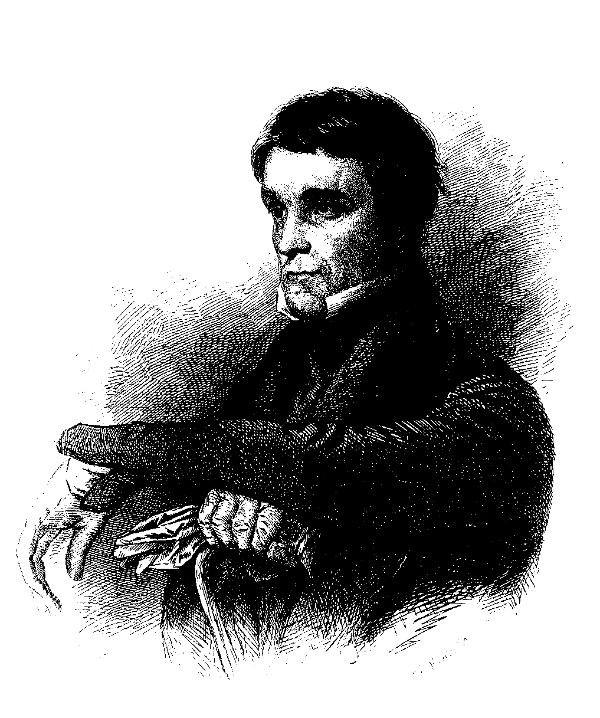 Portrait of Carlyle