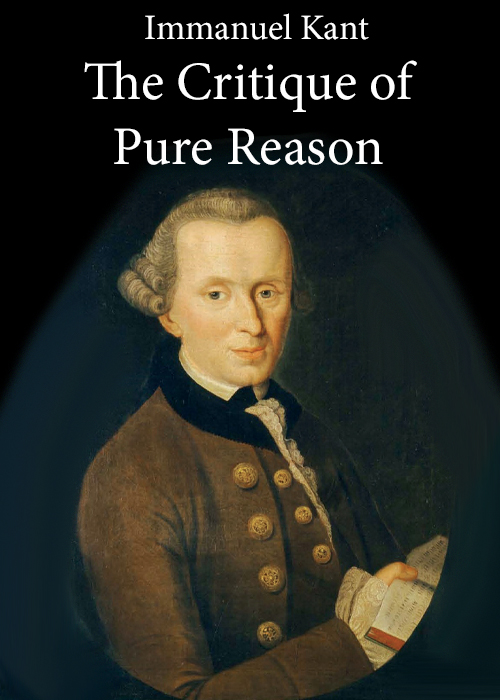
The Critique of Pure Reason
by Immanuel Kant
★★★★★No ratings yet
Language: English
Sign in to rate this book.
Sign in to shelve this book.
About this eBook
- Author
- Kant, Immanuel, 1724-1804
- Credits
- Charles Aldarondo and David Widger
- Language
- English
- LoC Class
- B: Philosophy, Psychology, Religion
- Subject
- Philosophy, German
- Category
- Text
- eBook-No.
- 4280
- Project Gutenberg
- https://www.gutenberg.org/ebooks/4280
- Release Date
- July 1, 2003
- Copyright
- Public domain in the USA.
Contents
- 1.The Critique of Pure Reason — By Immanuel Kant — Translated by J. M. D. Meiklejohn — Contents
- 2.PREFACE TO THE FIRST EDITION 1781
- 3.PREFACE TO THE SECOND EDITION 1787
- 4.Introduction — I. Of the difference between Pure and Empirical Knowledge — II. The Human Intellect, even in an Unphilosophical State, is in Possession of Certain Cognitions “à priori”. — III. Philosophy stands in need of a Science which shall Determine the Possibility, Principles, and Extent of Human Knowledge “à priori” — IV. Of the Difference Between Analytical and Synthetical Judgements. — V. In all Theoretical Sciences of Reason, Synthetical Judgements “à priori” are contained as Principles. — VI. The Universal Problem of Pure Reason. — VII. Idea and Division of a Particular Science, under the Name of a Critique of Pure Reason.
- 5.I. TRANSCENDENTAL DOCTRINE OF ELEMENTS. — FIRST PART. TRANSCENDENTAL ÆSTHETIC. — § I. Introductory. — SECTION I. Of Space. — § 2. Metaphysical Exposition of this Conception. — § 3. Transcendental Exposition of the Conception of Space. — § 4. Conclusions from the foregoing Conceptions. — SECTION II. Of Time. — § 5. Metaphysical Exposition of this Conception. — § 6 Transcendental Exposition of the Conception of Time. — § 7. Conclusions from the above Conceptions. — § 8. Elucidation. — § 9. General Remarks on Transcendental Æsthetic. — § 10. Conclusion of the Transcendental Æsthetic. — Second Part—TRANSCENDENTAL LOGIC — INTRODUCTION. Idea of a Transcendental Logic. — I. Of Logic in General. — II. Of Transcendental Logic. — III. Of the Division of General Logic into Analytic and Dialectic. — IV. Of the Division of Transcendental Logic into Transcendental Analytic and Dialectic. — FIRST DIVISION. TRANSCENDENTAL LOGIC. TRANSCENDENTAL ANALYTIC. § 1 — BOOK I. Analytic of Conceptions. § 2 — Chapter I. Of the Transcendental Clue to the Discovery of all Pure Conceptions of the Understanding — Introductory § 3 — Section I. Of the Logical Use of the Understanding in General § 4 — Section II. Of the Logical Function of the Understanding in Judgements § 5 — Section III. Of the Pure Conceptions of the Understanding, or Categories § 6 — Chapter II. Of the Deduction of the Pure Conceptions of the Understanding — Section I. Of the Principles of a Transcendental Deduction in general § 9 — Transition to the Transcendental Deduction of the Categories § 10 — Section II Transcendental Deduction of the pure Conceptions of the Understanding — Of the Possibility of a Conjunction of the manifold representations given by Sense § 11. — Of the Originally Synthetical Unity of Apperception § 12 — The Principle of the Synthetical Unity of Apperception is the highest Principle of all exercise of the Understanding § 13 — What Objective Unity of Self-consciousness is § 14 — The Logical Form of all Judgements consists in the Objective Unity of Apperception of the Conceptions contained therein § 15 — All Sensuous Intuitions are subject to the Categories, as Conditions under which alone the manifold Content of them can be united in one Consciousness § 16 — Observation § 17 — In Cognition, its Application to Objects of Experience is the only legitimate use of the Category § 18 — Of the Application of the Categories to Objects of the Senses in general § 20 — Transcendental Deduction of the universally possible employment in experience of the Pure Conceptions of the Understanding § 22 — Result of this Deduction of the Conceptions of the Understanding § 23 — BOOK II. Analytic of Principles — INTRODUCTION. Of the Transcendental Faculty of judgement in General — TRANSCENDENTAL DOCTRINE OF THE FACULTY OF JUDGEMENT OR, ANALYTIC OF PRINCIPLES — Chapter I. Of the Schematism at of the Pure Conceptions of the Understanding — Chapter II. System of all Principles of the Pure Understanding — Section I. Of the Supreme Principle of all Analytical Judgements — Section II. Of the Supreme Principle of all Synthetical Judgements — Section III. Systematic Representation of all Synthetical Principles of the Pure Understanding — Chapter III Of the Ground of the Division of all Objects into Phenomena and Noumena — APPENDIX — SECOND DIVISION—TRANSCENDENTAL LOGIC — TRANSCENDENTAL DIALECTIC. INTRODUCTION. — I. Of Transcendental Illusory Appearance — II. Of Pure Reason as the Seat of Transcendental Illusory Appearance — TRANSCENDENTAL DIALECTIC—BOOK I—OF THE CONCEPTIONS OF PURE REASON. — Section I—Of Ideas in General — Section II. Of Transcendental Ideas — Section III. System of Transcendental Ideas — TRANSCENDENTAL DIALECTIC—BOOK II—OF THE DIALECTICAL PROCEDURE OF PURE REASON — Chapter I. Of the Paralogisms of Pure Reason — Chapter II. The Antinomy of Pure Reason — Section I. System of Cosmological Ideas — Section II. Antithetic of Pure Reason — Section III. Of the Interest of Reason in these Self-contradictions — Section IV. Of the necessity imposed upon Pure Reason of presenting a Solution of its Transcendental Problems — Section V. Sceptical Exposition of the Cosmological Problems presented in the four Transcendental Ideas — Section VI. Transcendental Idealism as the Key to the Solution of Pure Cosmological Dialectic — Section VII. Critical Solution of the Cosmological Problem — Section VIII. Regulative Principle of Pure Reason in relation to the Cosmological Ideas — Section IX. Of the Empirical Use of the Regulative Principle of Reason with regard to the Cosmological Ideas — I. Solution of the Cosmological Idea of the Totality of the Composition of Phenomena in the Universe — II. Solution of the Cosmological Idea of the Totality of the Division of a Whole given in Intuition — III. Solution of the Cosmological Idea of the Totality of the Deduction of Cosmical Events from their Causes — IV. Solution of the Cosmological Idea of the Totality of the Dependence of Phenomenal Existences — Chapter III. The Ideal of Pure Reason — Section I. Of the Ideal in General — Section II. Of the Transcendental Ideal (Prototypon Trancendentale) — Section III. Of the Arguments employed by Speculative Reason in Proof of the Existence of a Supreme Being — Section IV. Of the Impossibility of an Ontological Proof of the Existence of God — Section V. Of the Impossibility of a Cosmological Proof of the Existence of God — Section VI. Of the Impossibility of a Physico-Theological Proof — Section VII. Critique of all Theology based upon Speculative Principles of Reason — APPENDIX. Of the Regulative Employment of the Ideas of Pure Reason
- 6.II. Transcendental Doctrine of Method — Chapter I. The Discipline of Pure Reason — Section I. The Discipline of Pure Reason in the Sphere of Dogmatism — Section II. The Discipline of Pure Reason in Polemics — Section III. The Discipline of Pure Reason in Hypothesis — Section IV. The Discipline of Pure Reason in Relation to Proofs — Chapter II. The Canon of Pure Reason — Section I. Of the Ultimate End of the Pure Use of Reason — Section II. Of the Ideal of the Summum Bonum as a Determining Ground of the Ultimate End of Pure Reason — Section III. Of Opinion, Knowledge, and Belief — Chapter III. The Architectonic of Pure Reason — Chapter IV. The History of Pure Reason
Community reviews
Sign in to write a review.
No reviews yet.