Yokohama looks very beautiful to the traveler who has spent over two
weeks on the long sea voyage from Seattle; but it has little to commend
it to the tourist, for most of its native traits have been Europeanized.
It is noteworthy, however, as the best place except Hongkong for the
traveler to purchase an oriental outfit and it is probably the cheapest
place in the world for trunks and bags and all leather goods. Its bund,
or water-front, is spacious and its leading hotels are very comfortable.
Of Japan and the Japanese, all that can be given are a few general
impressions of the result of two weeks of constant travel over the
empire and of talks with many people.
Of the country itself, the prevailing impression of the tourist, who
crosses it on the railroad or who takes rides through the paddy fields
in a rickshaw, is of a perennial greenness. Instead of the tawny yellow
of California in October, one sees here miles on miles of rice fields,
some of vivid green, others of green turning to gold. The foothills of
the mountains remind one of the foothills of the Sierra Nevada, as they
all bear evidences of the rounding and smoothing of glacial action.
At a distance the rice fields look like grain fields, but seen near at
hand they are found to be great swamps of water, with row on row of
rice, the dead furrows either serving as ditches or as raised paths
across the fields. Every bit of hillside is terraced and planted to rice
or vegetables or fruit.
Often these little, terraced fields, which look like the natural mesa of
southern California, will not be over fifty feet long by ten or fifteen
feet wide. Between the rows of fruit trees are vegetables or corn or
sorghum. The farmers live in little villages and apparently go home
every night after tilling their fields. There are none of the scattered
farmhouses, with trees around them, which are so characteristic a
feature of any American rural scene.
The towns as well as the cities show a uniformity of architecture, as
most of the shops are one story or a story and one-half, while the
residences seem to be built on a uniform plan, with great variety in
gateways and decoration of grounds. Most of the roofs are made of a
black clay, corrugated so that it looks like the Spanish-American tile,
and many of the walls that surround residences and temples are of adobe,
with a tiled covering, precisely as one sees to-day the remains of adobe
walls in old Spanish-Californian towns.
The general impression of any Japanese city when seen from a height is
that of a great expanse of low buildings with a liberal sprinkling of
trees and a few pagodas or roofs of Buddhist temples.
The strongest impression that the unprejudiced observer receives in
Japan is of the small value set upon labor as well as upon time by the
great mass of the people. In Yokohama and in Kobe, which show the most
signs of foreign influence, the same traits prevail.
It is one of the astonishing spectacles of the world, this
accomplishment of the business of a great nation by man power alone.
Only in one city, Osaka, the Chicago of Japan, is there any general
evidence of the adoption of up-to-date methods in manufacturing.
Everywhere one sees all the small industries of the country carried on
in the same way that they were conducted in Palestine in the time of
Christ.
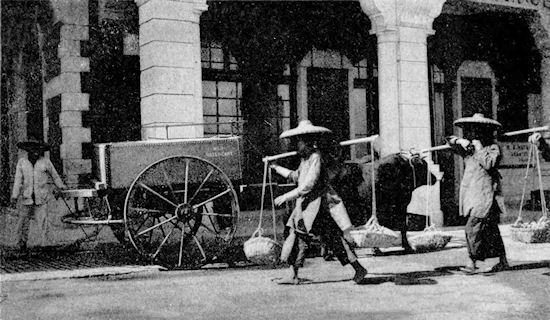
Everywhere men, harnessed to heavy push carts, are seen straining to
haul loads that are enough for a horse. The few horses in the cities are
used for heavy trucks, in common with bulls, for the Japanese bull is a
beast of burden and not one of the lords of creation as in our own
country.
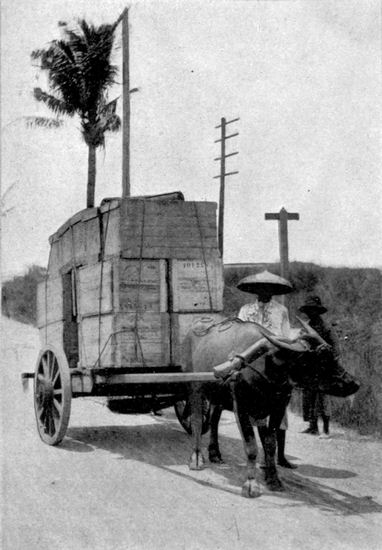
The bull is harnessed with a short neckyoke and a saddle on his back,
which bears a close resemblance to the riding saddle of the Cossack.
Some rope traces are hitched to crude, home-made whiffletrees. The bull,
as well as the horse, is guided by a rope line. The carts are remarkably
heavy, with wheels of great weight, yet many of these carts are pulled
by two men.
In the big cities may be seen a few victorias, or other carriages, and
an occasional motor car, but both these means of conveyance can be used
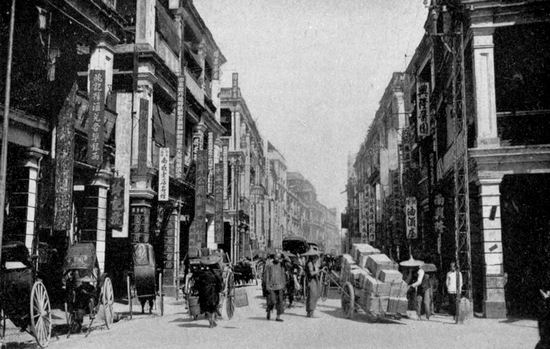
with safety only on the broadest avenues. In the narrow streets of the
native quarter, which seldom exceed ten feet in width and which have no
sidewalks, the jinrikisha is the only carriage. This is a light,
two-wheeled gig, drawn by one man and frequently on the steep grades
pushed from the back by a second man. The rickshaw man has a bell gong
on one shaft, which he rings when approaching a sharp turn in the street
or when he sees several trucks or other rickshaws approaching. The bell
also serves to warn old people or children who may be careless, for the
rickshaw has the right of way and the pedestrian must turn to either
side to give it the road. Americans, who are far more considerate of the
feelings of the Japanese than other foreigners, frequently may be seen
walking up the steep grades in such hilly cities as Nikko, Nara and
Kobe, but long residence in Japan is said to make everyone callous of
the straining and the sweating of the rickshaw man.
Purposely my itinerary included a number of little towns, which
practically have been uninfluenced by foreign customs. In these places
may be seen the primitive Japanese life, unchanged for hundreds of
years. Yet everywhere one cannot fail to be impressed by the tireless
industry of the people, and by their general good nature and courtesy.
In any other country in the world, a party of Americans with their
foreign dress would have provoked some insulting remarks, some gestures
that could not be mistaken; but here in rural Japan was seen the same
perfect courtesy shown in the Europeanized sections of the big cities.
The people, to be sure, made no change in their way of life. Mothers
suckled their infants in front of their little shops, and children stood
naked and unashamed, lost in wonder over the strange spectacle of the
party of foreign people that dashed by in rickshaws.
Naked men, with only a G-string to distinguish them from the costume of
Adam before the expulsion from Eden, labored at many tasks, and
frequently our little cavalcade swept by the great Government schools
where hundreds of little Japanese are being educated to help out the
manifest destiny of the empire.
This courtesy and good nature among the poorest class of the Japanese
people is not confined to their treatment of foreigners; it extends to
all their daily relations with one another. A nearly naked coolie
pulling a heavy cart begs a light for his cigarette with a bow that
would do honor to a Chesterfield.
A street blockade that in New York or San Francisco would not be
untangled without much profanity and some police interference is cleared
here in a moment because everyone is willing to yield and to recognize
that the most heavily burdened has the right of way.
In all my wanderings by day or night in the large Japanese cities I
never except once saw a policeman lift his, hand to exercise his
authority. This exception was in Tokio, where a band of mischievous
schoolboys was following a party of gayly dressed ladies in rickshaws
and laughing and chattering. The guardian of the peace admonished them
with a few short, crisp words, and they scuttled into the nearest
alleys.
The industry of the people, whether in city or country, is as amazing as
their courtesy. The Japanese work seven days in the week, and the year
is broken only by a few festivals that are generally observed by the
complete cessation of labor. In the large cities work goes on in most of
the shops until ten or eleven o'clock at night, and it is resumed at six
o'clock the next morning.
The most impressive spectacle during several night rides through miles
of Tokio streets was the number of young lads from twelve to sixteen
years of age who had fallen asleep at their tasks. With head pillowed on
arm they slumbered on the hard benches, where they had been working
since early morning, while the older men labored alongside at their
tasks.
From the train one saw the rice farmer and his wife and children working
in the paddy fields as long as they could see. These people do not work
with the fierce energy of the American mechanic, but their workday is
from twelve to fourteen hours and, considering these long hours, they
show great industry and conscientiousness.
In some places women were employed at the hardest work, such as coaling
ships by hand and digging and carrying earth from canals and ditches.
Scarcely less impressive than the tireless industry of the people is the
enormous number of children that may be seen both in city and country.
It was impossible to get statistics of births, but any American
traveling through Japan must be struck with the fact that this is a land
not threatened by race suicide.
Women who looked far beyond the time of motherhood were suckling
infants, while all the young women seemed well provided with children.
Girls of five or six were playing games with sleeping infants strapped
to their backs, and even boys were impressed into this nursery work. The
younger children are clothed only in kimonos, so that the passer-by
witnesses many strange sights of naked Japanese cherubs.
In all quarters of Tokio the children were as numerous as in tenement
streets of American cities on a Sunday afternoon, and in small country
towns the number of children seemed even greater than in the big cities.
Another feature of Japanese life that made a profound impression on me
was the pilgrimage of school children to the various sacred shrines
throughout the empire. At Nikko and at Nara, two of the great seats of
Buddhist and Shinto shrines, these child pilgrims were conspicuous. They
were seen in bands of fifty or seventy-five, attended by tutors. The
boys were dressed in blue or black jackets, white or blue trousers and
white leggings. Each carried his few belongings in a small box or a
handkerchief and each had an umbrella to protect him from the frequent
showers.
The girls had dark red merino skirts, with kimono waists of some dark
stuff. Many were without stockings, but all wore straw sandals or those
with wooden sole and heavy wooden clogs. School children are admitted to
temples and shrines at half rates and in every place the guides pay
special attention to these young visitors.
Pilgrimages of soldiers and others are also very common. Whenever a
party of one hundred is formed it receives the benefit of the half-rate
admission. No observant tourist can fail to see that in the pilgrimages
of these school children and these soldiers the authorities of new Japan
find the best means of stimulating patriotism. Church and State are so
closely welded that the Mikado is regarded as a god. Passionate devotion
to country is the great ruling power which separates Japan from all
other modern nations.
The number of young men who leave their country to escape the three
years' conscription is very small. The schoolboy in his most
impressionable years is brought to these sacred shrines; he listens to
the story of the Forty-seven Ronins and other tales of Japanese
chivalry; his soul is fired to imitate their self-sacrificing
patriotism. The bloody slopes of Port Arthur witnessed the effect of
such training as this.
Tokio, the capital of Japan, is a picturesque city of enormous extent
and the tourist who sees it in two or three days must expect to do
strenuous work. The city, which actually covers one hundred square
miles, is built on the low shore of Tokio bay and is intersected by the
Sumi river and a network of narrow canals. The river and these canals
are crossed by frequent bridges. At night the tourist may mark his
approach to one of these canals by the evil odors that poison the air.
Even in October the air is sultry in Tokio during the day and far into
the night, but toward morning a penetrating damp wind arises.
Although Tokio's main streets have been widened to imposing avenues that
run through a series of great parks, the native life may be studied on
every hand—for a block from the big streets, with their clanging
electric cars, one comes upon narrow alleys lined with shops and teeming
with life. Here, for the first time, the tourist sees Japanese city
life, only slightly influenced by foreign customs. The streets are not
more than twelve or fifteen feet wide, curbed on each side by flat
blocks of granite, seldom more than a foot or eighteen inches wide.
These furnish the only substitute for a sidewalk in rainy weather, as
most of the streets are macadamized. A slight rainfall wets the surface
and makes walking for the foreigner very disagreeable. The Japanese use
in rainy weather the wooden sandal with two transverse clogs about two
inches high, which lifts him out of the mud. All Japanese dignitaries
and nearly all foreigners use the jinrikisha, which has the right of way
in the narrow streets. The most common sound in the streets is the bell
of the rickshaw man or his warning shout of "Hi! Hi!"
My first day's excursion included a ride through Shiba and Hibiya parks
to Uyeno Park, the resting place of many of the shoguns. This makes a
trip which will consume the entire day. Shiba Park is noteworthy for its
temples (which contain some of the most remarkable specimens of Japanese
art) and for the tombs of seven of the fifteen shoguns or native rulers
who preceded the Mikado in the government of Japan. The first and third
shoguns are buried at Nikko, while the fourth, fifth, eighth, ninth,
eleventh and thirteenth lie in Uyeno Park, Tokio. These mortuary chapels
in Shiba Park are all similar in general design, the only differences
being in the lavishness of the decoration. Out of regard for the foreign
visitor it is not necessary to remove one's shoes in entering these
temples, as cloth covers are provided. Each temple is divided into three
parts—the outer oratory, a corridor and the inner sanctum, where the
shogun alone was privileged to worship. The daimyos or nobles were lined
up in the corridor, while the smaller nobles and chiefs filled the
oratory. It would be tedious to describe these temples, but one will
serve as a specimen of all. This is the temple of the second shogun,
which is noteworthy for the beauty of the decoration of the sanctum and
the tomb.
Two enormous gilded pillars support the vaulted roof of the sanctum,
which is formed of beams in a very curious pattern. A frieze of
medallions of birds, gilded and painted, runs around the top of the
wall. The shrine dates back for two and one-half centuries and is of
rich gold lacquer. The bronze incense burner, in the form of a lion,
bears the date of 1635. The great war drum of Ieyasu, the first of the
Tokugawa shoguns, lies upon a richly decorated stand. Back of the temple
is the octagonal hall, which houses the tomb of the second shogun. This
tomb is the largest example of gold lacquer in the world, and parts of
it are inlaid with enamel and crystal. Scenes from Liao-Ling, China, and
Lake Biwa, Japan, adorn the upper half, while the lower half bears
elaborate decoration of the lion and the peony. The base of the tomb is
a solid block of stone in the shape of the lotus. The hall is supported
by eight pillars covered with gilded copper, and the walls are covered
with gilded lacquer. The enormous amount of money expended on these
shrines will amaze any foreign visitor, as well as the profound
reverence shown by the Japanese for these resting places of the shoguns.
Passing along a wide avenue traversed by electric cars one soon reaches
Hibiya Park, one of the show places of Tokio. To the European tourist or
the visitor from our Eastern States the beauty of the vegetation is a
source of marvel, but San Francisco's Golden Gate Park can equal
everything that grows here in the way of ornamental shrubs, trees and
flowers. On the south side of the park are the Parliament buildings, and
near by the fine, new brick buildings of the Naval and Judicial
Departments and the courts. Near by are grouped many of the foreign
legations, the palaces of princes and the mansions of the Japanese
officials and foreign embassadors. Here also is the Museum of Arms,
which is very interesting because of the many specimens of ancient
Japanese weapons and the trophies of the wars with China and Russia. In
this museum one may see the profound interest which the Japanese
pilgrims from all parts of the empire take in these memorials of
conquest. To them they rank with the sacred shrines as objects of
veneration.
Not far away is the moat which surrounds the massive walls of the
imperial palace, open only to those who have the honor of an imperial
audience. These walls are of granite laid up without mortar, the corner
stones being of unusual size. The visitor may see the handsome roofs of
the imperial palaces. Those who have been admitted declare that the
decorations and the furniture are in the highest style of Japanese art,
although the simplicity and the neutral colors that mark the Shinto
temples prevail in the private chambers of the Emperor. In the throne
chamber and the banquet hall, on the other hand, gold and brilliant hues
make a blaze of color. Near the palace grounds are the Government
printing office and a number of schools.
Turning down into Yoken street, one of the great avenues of traffic, you
soon reach Uyeno Park—the most popular pleasure ground of the capital,
and famous in the spring for its long lines of cherry trees in full
blossom. In the autumn it impressed me, as did all the other Japanese
parks, as rather damp and unwholesome. The ground was saturated from
recent rain; all the stonework was covered with moss and lichen; the
trees dripped moisture, and the little lakes scattered here and there
were like those gloomy tarns that Poe loved to paint in his poems. Near
the entrance to this park is a shallow lake covered with lotus plants,
and a short distance beyond from a little hill one may get a good view
of the buildings of the imperial university. Here is a good foreign
restaurant where one may enjoy a palatable lunch. Near by on a slight
eminence stands a huge bronze image of Buddha, twenty-one and one-half
feet high, called the Daibutsu. It is one of several such figures
scattered over the empire. Passing through a massive granite torii, or
gate, one reaches an avenue of stately cryptomeria, or cedar trees that
leads to a row of stone lanterns presented in 1651 by daimyos as a
memorial to the first shogun. The temple beyond is famous for its
beautiful lacquer.
Near at hand are the temples and tombs of the six shoguns of the
Tokugawa family, buried in Uyeno Park. These temples are regarded as
among the finest remains of old Japanese art. The mortuary temples bear
a close resemblance to those in Shiba Park. The second temple is the
finer and is celebrated for the gilding of the interior walls, the
gorgeous decoration of the shrines and the memorial tablets in gold
lacquer. Here, also, are eight tablets erected to the memory of eight
mothers of shoguns, all of whom were concubines.
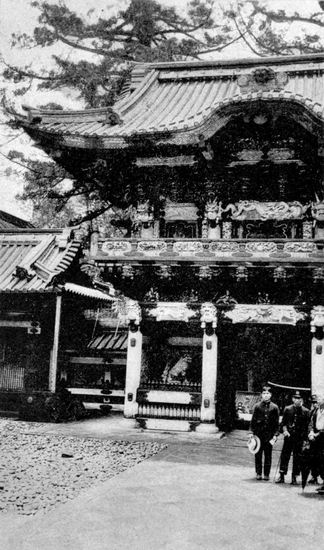 |
The Yomei-mori Gate, Ieyasu Temple, Nikko.
One of the Most Beautiful Gates in all Japan. The Columns
Are Painted White, with Capitals of Unicorn's Heads.
The Roof is Supported by Gilt Dragon's Heads.
|
A short distance from Uyeno Park is the great Buddhist temple known as
Asakusa Kwannon, dedicated to Kwannon, the goddess of mercy. The
approaches to this temple on any pleasant day look like a country fair.
The crowd is so dense that jinrikishas can not approach within one
hundred yards. The shrine dates back to the sixth century and the temple
is the most popular resort of its kind in Tokio. On each side of the
entrance lane are shops, where all kinds of curios, toys, cakes, et
cetera, are sold. The temple itself is crowded with votaries who offer
coins to the various idols, while below (near the stairs that give
entrance to the temple) are various side booths that are patronized by
worshipers. Some of these gods promise long life; others give
happiness, and several insure big families to women who offer money and
say prayers.
One of the remarkable jinrikisha rides in Japan is that from Uyeno to
Shimbashi station through the heart of Tokio by night. This takes about
a half hour and it gives a series of pictures of the great Japanese city
that can be gained in no other way. Here may be seen miles of little
shops lining alleys not over ten or twelve feet wide, in most of which
work is going on busily as late as eleven o'clock. In places the sleepy
proprietors are putting up their shutters, preparatory to going to bed,
but in others the work of artisan or baker or weaver goes on as though
the day had only fairly begun. Most of these shops are lighted by
electricity, but this light is the only modern thing about them. The
weaver sits at the loom precisely as he sat two thousand years ago, and
the baker kneads his dough and bakes his cakes precisely as he did
before the days of the first shogun. This ride gives a panorama of
oriental life which can be equaled in few cities in the world.
Occasionally the jinrikisha dashes up a little bank and across a bridge
that spans a canal and one catches a glimpse of long lines of house
boats, with dim lights, nestling under overhanging balconies. Overall is
that penetrating odor of the Far East, mingled with the smell of bilge
water and the reek of thousands of sweating human beings. These smells
are of the earth earthy and they led one to dream that night of weird
and terrible creatures such as De Quincey paints in his Confessions of
an English Opium Eater.
The most magnificent temples in Japan are at Nikko, in the mountains,
five hours' ride by train from Tokio. What makes this trip the more
enjoyable to the American tourist is that the country reminds him of the
Catskills, and that he gets some glimpses of primitive Japanese life.
The Japanese have a proverb: "Do not use the word 'magnificent' until
you have seen Nikko." And anyone who goes through the three splendid
temples that serve as memorials of the early shoguns will agree that the
proverb is true.
The railroad ride to Nikko is tedious, although it furnishes greater
variety than most of the other trips by rail through the Mikado's
empire. But as soon as one is landed at the little station he recognizes
that here is a place unlike any that he has seen. The road runs up a
steep hill to the Kanaya Hotel, which is perched on a high bank
overlooking the Daiyagawa river. Tall cedar trees clothe the banks, and
across the river rise mountains, with the roofs of temples showing
through the foliage at their base. This hotel is gratefully remembered
by all tourists because of the artistic decoration of the rooms in
Japanese style and the beneficent care of the proprietor, which includes
a pretty kimono to wear to the morning bath, with straw sandals for the
feet, and charming waitresses in picturesque costumes.
The first Buddhist temple at Nikko dates back to the eighth century, but
it was not until the seventeenth century that the place was made a
national shrine by building here the mausoleum of the first shogun,
Ieyasu, and of his grandson, Iemitsu. Hardly less noteworthy than these
shrines and temples is the great avenue of giant cryptomeria trees,
which stretches across the country for twenty miles, from Nikko to
Utsunomiya.
One of the chief objects of interest in Nikko is the Sacred Red Bridge
which spans a swift stream about forty feet wide. This is a new bridge,
as the old one was carried away by a great flood nine years ago.
Originally built in 1638, it served to commemorate the legendary and
miraculous bridging of the stream by Shodo Shonin, a saint. He arrived
at the river one day while on a pilgrimage and called aloud for aid to
cross. On the opposite bank appeared a being of gigantic size, who
promised to help him, and at once flung across the stream two green and
blue dragons which formed a bridge. When the saint was safely over the
bridge, it vanished with the mysterious being. Shodo at once built a hut
on the banks of the stream. For fourteen years he dwelt there and
gathered many disciples. Then he established a monastery and a shrine at
Lake Chuzinji, about nine miles from Nikko. Nine hundred years later the
second shogun of the Tokugawa dynasty sent two officials to Nikko to
select a site for the mausoleum of his father. They chose a site near
Nikko, on a hill called Hotoke-iwa, and in the spring of 1617 the tomb
was completed and the coffin was deposited under it with appropriate
Buddhist ceremonies.
The road to the mausoleum winds around the river. The first object on
the way is a pillar erected in 1643 to ward off evil influences. It is
a cylindrical copper column forty-two feet high, supported by short
horizontal bars of the same material, resting on four short columns.
Small bells hung from lotus-shaped cups crown the summit of the column.
Just beyond this column is a massive granite torii, twenty-seven and
one-half feet high, the gift of the Daimiyo of Chikuzen. To the left is
a five-story pagoda, one hundred and four feet in height, which is
especially graceful. Inside a red wooden wall are arranged a series of
lacquered storehouses, a holy water cistern cut out of a solid block of
granite, a finely decorated building in which rest a collection of
Buddhist writings. A second court is reached by a flight of stairs. Here
are gifts presented by the kings of Luchu, Holland and Korea, these
three countries being regarded as vassal states of Japan. On the left is
the Temple of Yahushi, beautifully decorated in red and gold lacquer,
and just beyond is a fine gate, called Yomei-mon, decorated with
medallions of birds. Passing through this gate, one reaches a court
bordered by several small buildings, one of which contains the
palanquins that are carried in the annual procession on June 1st, when
the deified spirits of the first shogun, Hideyoshi (the great
conqueror), and Yoritomo occupy them. Seventy-five men carry each of
these palanquins.
The main shrines are reached through the Chinese gate. The three
chambers are magnificent specimens of the finest work in lacquer, gold
and metal. The tomb of Ieyasu, the first shogun, is reached by ascending
two hundred stone steps. The tomb is in the form of a small pagoda of
bronze of an unusually light color caused by the mixture of gold. The
body of the shogun is buried twenty feet deep in a bed of charcoal.
Beyond is the mausoleum of Iemitsu, the third shogun. The oratory and
chapel are richly decorated, but they do not compare with those of the
first shogun's tomb. Back of these tombs, among the huge cedar trees
that clothe the sides of the mountain, is a small red shrine where women
offer little pieces of wood that they may pass safely through the
dangers of childbirth. Near by is the tomb of Shodo, the saint, and
three of his disciples.
These mortuary temples and tombs are genuinely impressive. They bear
many signs of age and it is evident that they are held in great
veneration by the Japanese, who make pilgrimages at all seasons to offer
up prayers at these sacred shrines. More impressive than the tombs
themselves are the pilgrims. On the day that I visited this sacred
shrine several large bands of pilgrims were entertained. One party was
composed of over a hundred boys from one of the big government military
schools. These lads were in uniform and each carried an umbrella and a
lunch tied up in a handkerchief. The priests paid special attention to
these young pilgrims and described for their benefit the marvels of
carving and lacquer work. Services were held before the shrines and the
glorious conquest of the shoguns and of Hideyoshi (popularly known as
the Napoleon of Japan) were described in glowing words. The Russian
cannon captured at Port Arthur, which stands near the entrance to the
tombs, was not forgotten by these priests, who never fail to do their
part in stimulating the patriotism of the young pilgrims.
These boys were followed by an equal number of public school girls, all
dressed in dark red merino skirts and kimonos of various colors. Some
were without stockings and none wore any head covering, although each
girl carried her lunch and the inevitable umbrella.
After these children came several parties of mature pilgrims, some
finely dressed and bearing every evidence of wealth and position, while
others were clothed in poor garments and showed great deference to the
priests and guides. All revealed genuine veneration for the sacred
relics and all contributed according to their means to the various
shrines. Some idea of the revenue drawn by the priests from tourists and
pilgrims may be gained when it is said that admission is seventy sen (or
thirty-five cents in American money) for each person, with half-rates to
priests, teachers and school children, and to members of parties
numbering one hundred.
The shops at Nikko will be found well worth a visit, as this city is the
market for many kinds of furs that are scarce in America. Many fine
specimens of wood carving may also be seen in the shops. The main street
of the town runs from the Kanaya Hotel to the railroad depot, a distance
of a mile and one-half, and it is lined for nearly the whole distance
with small shops.
On his return to the railroad the tourist would do well to take a
jinrikisha ride of five miles down through the great avenue of old
cryptomeria trees to the little station of Imaichi. This is one of the
most beautiful rides in the world. The road is bordered on each side by
huge cedar trees which are from one hundred and fifty to two hundred
feet in height. In many cases the roots of these old trees have formed a
natural embankment and the road is thus forced below the level of the
surrounding rice fields. These trees were planted nearly three hundred
years ago and they are certainly in a remarkable state of preservation.
A few gaps there are, due to the vandalism of the country people, but
mile after mile is passed with only an occasional break in these
stately columns, crowned by the deep green masses of foliage. Another
cryptomeria avenue intersects this and runs for twenty-five miles across
the country. The two avenues were planted in order that they might be
used by the shogun's messengers when they bore important letters to him
during his summer residence in Nara.
Next to Nikko, one of the most interesting cities in Japan is Kyoto, the
old capital under the shoguns, the seat of several fine palaces and many
beautiful temples, and the center of large manufacturing works of
satsuma and cloissone ware, damascene work and art work on silk and
velvet. Kyoto may be reached by a short ride from Kobe, but from Tokio
it is an all-day trip of twelve hours by express train. This ride, which
would be comfortable in well appointed cars, is made tedious by the
Japanese preference for cars with seats arranged along the side, like
the new American pay-as-you-enter street cars. For a short ride the side
seat may be endured, but for hours of travel (especially when one is a
tourist and wishes to see the scenery on both sides of the road) the
cars are extremely tiresome.
By selecting the express train and buying first-class tickets it was
hoped to avoid any crowd but, unfortunately, the day chosen saw many
other tourists on their way across Japan. The result was that the
first-class car was packed and many who had paid first-class fares were
forced to ride in the second-class cars. In my car one side was occupied
almost wholly by Japanese. Two were in American dress, one was an army
officer in uniform, another a clerk with many packages, and the
remaining two were an old couple, richly dressed. The Japanese, in
traveling first-class, generally brings a rug or fur, which he spreads
over the seat. On this he sits with his feet drawn up under him in the
national style. Smoking is not prohibited even in the first-class cars,
so that the American ladies in the cars had to endure the smell of
various kinds of Japanese tobacco, in addition to the heat, which was
rendered more disagreeable by the frequent closing of the windows as the
train dashed through many tunnels. The old couple carried lunch in
several hampers and they indulged in a very elaborate luncheon, helped
out by tea purchased in little pots from a dealer at a station. The army
officer bought one of the small wooden lunch boxes sold along all
Japanese railways, which contain boiled rice, fried fish and some boiled
sweet potatoes. This, with a pot of tea, made a good lunch. The Japanese
in European costume patronized the dining-car, where an excellent lunch
was served for one yen, or fifty cents in American money.
The scenery along the line of the railway varied. The road skirts the
coast for many miles, then cuts across several mountain ranges to
Nagoya, then along the shores of Owari bay (an arm of the ocean), thence
across the country to the lower end of Lake Biwa, near which Kyoto is
situated. In the old days this journey consumed twelve days, and the
road twice every year furnished a picturesque procession of the retinues
of great nobles or daimiyos traveling from Kyoto to Tokio to present
their respects to the shogun. The road was skirted by great cryptomeria,
and avenues of these fine trees may still be seen near Nikko.
Kyoto was a great city in medieval days, when it was the residence of
the Mikado. From 793 until 1868, when the court removed to Tokio, Kyoto
remained the capital. Its importance, however, began to decline with
the founding of Yedo, or Tokio, in 1590, and to-day many miles of its
former streets are devoted to the growing of rice. In this way several
of the finest temples, which were once in the heart of the old city, are
now relegated to the suburbs. Besides the Mikado's palace and Nijo
castle, which may be visited only by special permit, Kyoto boasts of an
unusual number of richly decorated temples, among which the most
noteworthy are the Shinto temple of Inari; the temple of the one
thousand images of Kwannon, the Deity of Mercy; the great Buddhist
temple of Nishi-Honguanji, celebrated for its art work in paintings and
decorated woods; the great bronze Buddha, fifty-eight feet high; the big
bell near by, nearly fourteen feet high, and the other in the Cheon-in
temple here—these being two of the four largest bells in all Japan. To
describe the treasures in art and decoration, in gold and lacquer, in
these palaces, would be tiresome. Unless one is a student of Japanese
art the visiting of temples soon becomes a great bore, for one temple or
one palace is a repetition of others already seen, with merely minor
differences in architecture and decoration, which appeal only to the
specialist.
Kyoto, however, is of great interest for its many art shops—since
applied art, as seen in satsuma and cloissone ware and in damascene,
have almost reached the level of pure art. A visit to one of the satsuma
factories is an interesting experience, as it shows how little the art
of Japan has been influenced by the foreigner. Here one sees the potter
at his wheel, precisely as in the days of the Bible. He does not avail
himself of electric power but whirls his wheel by hand and foot, exactly
as in the time of Christ. Passing from the pottery to the art rooms, one
finds a number of Japanese men and girls painting elaborate designs on
bowls and vases and other articles. These artists grind and mix their
own oil colors, which they proceed to lay on slowly upon the article
they are decorating. The patience of these artists is indescribable.
Infinite pains is taken with a single flower or tree or figure of man or
bird. One vase exhibited here is covered with butterflies which range
from natural size down to figures so small that they can be discerned
only under a magnifying glass. Yet, this vase, which represents such an
enormous outlay of labor and time, is sold at thirty dollars in American
money.
At the damascene works both men and women are also employed, although
the finest work is done by the men. The art consists in beating into
bronze small particles of gold leaf until they have become an actual
part of the baser metal. This gold is arranged in a great variety of
design and, after being beaten in, the article is subjected to powerful
heat, which oxidizes the metal and thus prevents any change due to the
weather. At this Kyoto factory were turned out the most artistic
jewelry, boxes, cigarette cases and a great variety of small articles,
many of which sold at absurdly low prices, considering the amount of
labor and time expended on them.
Kyoto will be found one of the best cities in Japan for the purchase of
the art work just described, as well as embroidery, silks and other
stuffs. In many of these shops the work is done on the premises and
hence the prices are cheaper than in any other city except Yokohama. It
is worth while to visit the shops that exhibit bronze work, silks,
velvets and carvings in ivory and wood, as well as curios of many kinds.
Most of these shopkeepers demand more than they expect to receive, but
in a few shops the goods are plainly marked and no reduction in price
can be secured. At Kyoto the tourist will find many traces of primitive
Japanese life, especially in the unfrequented streets and in the
suburbs. Here in the bed of the river, a portion of which was being
walled up for a canal, were employed a dozen women digging up gravel and
carrying it in baskets to carts near by. They had their skirts tied up
and they were working in mud and water which reached to their knees. It
was not a pleasant spectacle, but it excited no comment in this country,
where women labor in the rice fields by the side of men.
A short ride from Kyoto brings the visitor to Nara, the seat of the
oldest temples in Japan, and famous for the tame deer in the park. A
long avenue of stone lanterns leads to the principal temples, in an
ancient cedar grove. The main temple gives an impression of great age by
its heavy thatched roof.
Next looms up the gigantic wooden structure, which houses Daibutsa, the
great bronze image of Buddha. This statue, which dates back to the
eighth century, is fifty-three and one-quarter feet high; the face is
sixteen feet long and nine and one-quarter feet wide. The god is in a
sitting position, with the legs crossed. The head, which is darker than
the remainder of the image, replaced in the sixteenth century the
original head destroyed by fire. The expression of this Buddha is not
benignant, and the image is impressive only because of its size. It has
two images eighteen feet in height on either hand, but these seemed
dwarfed by the huge central figure.
The park at Nara is very interesting, because of the tame deer which
have no fear of the stranger in European dress, but will eat cakes from
his hand. One of the sources of revenue is to sell these cakes to the
tourist.
A visit was paid to an old temple at Horyuji, about eight miles from
Nara, which is famous as the oldest Buddhist temple in Japan. It
contains a valuable collection of ancient Japanese works of art. The
rickshaw ride to this place is of great interest, as the road passes
through a rich farming country and two small towns which seem to have
been little affected by European influence. In the fertile valley below
Nara rice is grown on an extensive scale, these paddy fields being
veritable swamps which can be crossed only by high paths running through
them, at distances of thirty or forty feet. Here also may be seen the
curious method of trellising orchards of pear trees with bamboo poles.
The trellis supports the upper branches and this prevents them from
breaking down under the weight of fruit, while it also makes easy the
picking of fruit. Agriculture at its best is seen in this fertile
Japanese valley. One peculiarity of this country, as of other parts of
rural Japan, is that one sees none of the scattered farmhouses which dot
every American farming section. Instead of building on his own land the
farmer lives in a village to which he returns at night after his day's
work.
Kobe is regarded as a base for the tourist who wishes to make short
excursions to Kyoto, Osaka and other cities. It was established as a
foreign settlement in 1868, and has grown so remarkably during the last
ten years that now it exceeds in imports and exports any other city in
Japan. Kobe is one of the most attractive cities in the empire, being
built on a pretty harbor, with the land rising like an amphitheater.
Scores of handsome residences are scattered over the foothills near the
sea. Those on the lower side of the streets that run parallel to the
harbor have gardens walled up on the rear, while the houses on the upper
side of the streets have massive retaining walls. These give opportunity
for many ornamental gateways.
Kobe has many large government schools, but the institutions which I
found of greatest interest were Kobe College for Women, conducted by
Miss Searle, and the Glory Kindergarten, under the management of Miss
Howe. Kobe College, which was founded over thirty years ago, is
maintained by the Women's Board of Missions of Chicago. It has two
hundred and twenty-five pupils, of whom all except about fifty are
lodged and boarded on the premises. I heard several of the classes
reciting in English. The primary class in English read simple sentences
from a blackboard and answered questions put by the teacher. A few
spoke good English, but the great majority failed to open their mouths,
and the result was the indistinct enunciation that is so trying to
understand. Another class was reading Hamlet, but the pupils made sad
work of Shakespeare's verse. The Japanese reading of English is always
monotonous, because their own language admits of no emphasis; so their
use of English is no more strange than our attempts at Japanese, in
which we employ emphasis that excites the ridicule of the Mikado's
subjects.
Not far from this college is the kintergarten, which Miss Howe has
carried on for twenty-four years. She takes little tots of three or four
years of age and trains them in Froebel's methods. So successful has she
been in her work among these children of the best Japanese families of
Kobe that she has a large waiting list. She has also trained many
Japanese girls in kintergarten work. All the children at this school
looked unusually bright, as they are drawn from the educated classes. It
sounded very strange to hear American and English lullabies being
chanted by these tots in the unfamiliar Japanese words.
Osaka, the chief manufacturing city of Japan, is only about
three-quarters of an hour's ride from Kobe. It spreads over nine miles
square and lies on both sides of the Yodogawa river. The most
interesting thing in Osaka is the castle built by Hideyoshi, the
Napoleon of Japan, in 1583. The strong wall was once surrounded by a
deep moat and an outer wall, which made it practically impregnable. What
will surprise anyone is the massive character of the inner walls which
remain. Here are blocks of solid granite, many of them measuring forty
feet in length by ten feet in height. It must have required a small army
of men to place these stones in position, but so well was this work
done (without the aid of any mortar) that the stones have remained in
place during all these years. From the summit of the upper wall a superb
view may be gained of the surrounding country.
From Kobe the tourist makes the trip through the Inland Sea by steamer.
Its length is about two hundred and forty miles and its greatest width
is forty miles. The trip through this sea, which in some places narrows
to a few hundred feet, is deeply interesting. The hills remind a
Californian strongly of the Marin hills opposite San Francisco, but here
they are terraced nearly to their summits and are green with rice and
other crops. Many of the hills are covered with a growth of small cedar
trees, and these trees lend rare beauty to the various points of land
that project into the sea. At two places in the sea the steamer seems as
though she would surely go on the rocks in the narrow channel, but the
pilot swings her almost within her own length and she turns again into a
wider arm of the sea. In these narrow channels the tide runs like a mill
race, and without a pilot (who knows every current) any vessel would be
in extreme danger. The steamer leaves Kobe about ten o'clock at night
and reaches Nagasaki, the most western of Japanese cities, about seven
o'clock the following morning.
Nagasaki in some ways reminds one of Kobe, but the hills are steeper and
the most striking feature of the town is the massive stone walls that
support the streets winding around the hills, and the elaborate paving
of many of these side-hill streets with great blocks of granite. The
rainfall is heavy at Nagasaki, so we find here a good system of gutters
to carry off the water. The harbor is pretty and on the opposite shore
are large engine works, three large docks and a big ship-building
plant, all belonging to the Mitsu Bishi Company. Here some five thousand
workmen are constantly employed.
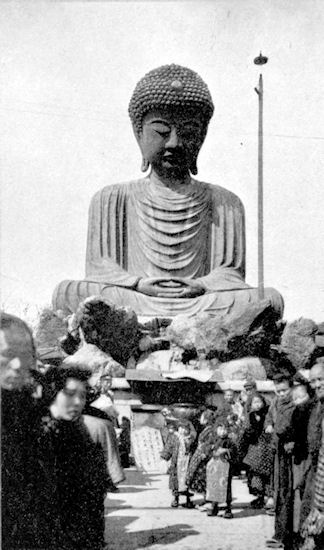 |
The Daibutsu or Great Bronze Buddha
at Hyogo, Near Kobe. The Impressive Figure is Forty-eight
Feet High and Eighty-five Feet Round the Waist. It is
Not so Fine as the Daibutsu at Kamakura But
Surpasses That at Nara
|
One of the great industries of Nagasaki is the coaling of Japanese and
foreign steamships. A very fair kind of steam coal is sold here at three
dollars a ton, which is less by one dollar and one-half than a poorer
grade of coal can be bought for in Seattle; hence the steamer Minnesota
coaled here. The coaling of this huge ship proved to be one of the most
picturesque sights of her voyage. Early on the morning of her arrival
lighters containing about a railway carload of coal began to arrive.
These were arranged in regular rows on both sides of the ship. Then came
out in big sampans an army of Japanese numbering two thousand in all.
The leaders arranged ladders against the sides of the ship, and up these
swarmed this army of workers, three-quarters of whom were young girls
between fourteen and eighteen years old. They were dressed in all
colors, but most of them wore a native bonnet tied about the ears. They
formed in line on the stairs and then the coal was passed along from
hand to hand until it reached the bunkers. These baskets held a little
over a peck of coal, and the rapidity with which they moved along this
living line was startling.
Every few minutes the line was given a breathing space, but the work
went on with a deadly regularity that made the observer tired to watch
it. Occasionally one of the young girls would flag in her work and,
after she dropped a few basketfuls, she would be relieved and put at the
lighter work of throwing the empty baskets back into the lighters. Most
of these girls, however, remained ten hours at this laborious work, and
a few worked through from seven o'clock in the morning until nearly
midnight, when the last basket of coal was put on board. At work like
this no such force of Europeans would have shown the same self-control
and constant courtesy which these Japanese exhibited. Wranglings would
have been inevitable, and the strong workers would have shown little
regard for their weaker companions.
Another feature of this Japanese work was the elimination of any strain
or overexertion. If a girl failed to catch a basket as it whirled along
the line she dropped it instantly. Never did I see anyone reach over or
strain to do her work.
The rest for lunch occupied only about fifteen minutes, the begrimed
workers sitting down on the steps of the ladders and eating their simple
food with keen relish. At night when strong electric lights cast their
glare over these constantly moving lines of figures the effect was
almost grotesque, reminding one of Gustave Doré's terrible pictures of
the lost souls in torment, or of the scramble to escape when the deluge
came. The skill that comes of long practice marked the movements of all
these workers, and it was rare that any basket was dropped by an awkward
or tired coal-passer.
In seventeen hours four thousand five hundred tons of coal were loaded
on the steamer. About fifteen hundred people were working on the various
ladders, while another five hundred were employed in trimming the coal
in the hold and in managing the various boats. The result was an exhibit
of what can be done by primitive methods when perfect co-operation is
secured.
Nagasaki itself has little that will interest the tourist but a ride or
walk to Mogi, on an arm of the ocean, five miles away, may be taken with
profit. The road passes over a high divide and, as it runs through a
farming country, one is able to see here (more perfectly than in any
other part of Japan) how carefully every acre of tillable land is
cultivated. On both sides of this road from Nagasaki to the fishing
village of Mogi were fields enclosed by permanent walls of stone, such
as would be built in America only to sustain a house. In many cases the
ground protected by this wall was not over half an acre in extent, and
in some cases the fields were of smaller size. Tier after tier of these
walls extended up the sides of the steep hills. The effect at a little
distance was startling, as the whole landscape seemed artificial. The
result of this series of walls was to make a succession of little mesas
or benches such as may be seen in southern California.
After a trip through Japan the question that confronts the observant
tourist is: What has preserved the fine artistic sense of the Japanese
people of all classes, in the face of the materialist influences that
have come into their life with the introduction of Western methods of
thought and of business? The most careless traveler has it thrust upon
him that here is a people artistic to the tips of their fingers, and
with childlike power of idealization, although they have been forced to
engage in the fierce warfare of modern business competition. What is it
that has kept them unspotted from the world of business? What secret
source of spiritual force have they been able to draw upon to keep fresh
and dewy this eager, artistic sense that must be developed with so much
labor among any Western people?
The answer to these questions is found, by several shrewd observers, in
the Japanese devotion to their gardens. Every Japanese, no matter how
small and poor his house, has a garden to which he may retire and
"invite his soul." These Japanese gardens are unique and are found in no
other land. China has the nearest approach to them, but the poor Chinese
never dreams of spending time and money in the development of a garden,
such as the Japanese in similar circumstances regards as a necessity.
And these Japanese gardens are always made to conform to the house and
its architecture. The two never fail to fit and harmonize. A poor man
may have only a square of ground no larger than a few feet, but he will
so arrange it as to give it an appearance of spaciousness, while the
more elaborate gardens are laid out so as to give the impression of
unlimited extent. The end of the garden appears to melt into the
horizon, and the owner has a background that extends for miles into the
country. By the artistic use of stones and dwarf plants, a few square
feet of ground are made to give the effect of liberal space and, with
bridges, moss-covered stones, ponds, gold fish and other features, a
perfect illusion of the country may be produced.
Into this garden the master of the house retires after the work of the
day. There he takes none of his business or professional cares. He gives
himself wholly to the contemplation of Nature. He becomes for the time
as a little child, and his soul is pleased with childish things. For him
this garden, with its pretty outlook on a larger world, serves as the
boundary of the universe. Here he may dream of the legends of the
Samurai, before Japan fell under the evil influence of the new God of
Gain. Here he may indulge in the day-dreams that have always been a part
of the national consciousness. Here, in fine, he may get closer to the
real heart of Nature than any Occidental can ever hope to reach.
It is this capacity to get close to Nature that the Japanese possess
beyond any other Oriental people—and this capacity is not limited to
those of means or leisure or education. The poor man, who has a daily
struggle to get enough rice to satisfy his moderate wants, is as open to
these influences as the rich man who is not worried by any material
wants. There is no distinction of classes in this universal worship of
beauty—this passion for all that is lovely in nature. It was not my
good fortune to be in Japan at the time of the cherry-blossom
festival—but these fêtes merely serve to bring out this national
passion for beauty and color, which finds expression not only in the
gardens throughout the empire but in painting, drawing and in working on
silks and other fabrics. The same instinctive art sense is seen in the
work of the cabinet-maker and even in the designs of gateways and the
doors of houses. The eye and the hand of the common worker in wood and
metal is as sure as the hand of the great artist. Such is the influence
of this constant study of beauty in nature and art.
When you watch a busy Japanese artisan you get a good idea of the spirit
that animates his work. He regards himself as an artist, and he shows
the same sureness of hand and the same sense of form and color as the
designer in colors or the painter of portraits or landscapes. All the
beautiful gateways or torii, as they are called, are works of art. They
have one stereotyped form, but the artists embellish these in many ways
and the result is that every entrance to a large estate or a public
ground is pleasing to the eye. As these gateways are generally lacquered
in black or red or gold, they add much to the beauty and color of each
scene. The ornamental lattice over nearly every door also adds
enormously to the effectiveness of even a simple interior.
Watch a worker on cloissone enamel and you will be amazed at the
rapidity and the accuracy with which he paints designs on this beautiful
ware. Without any pattern he proceeds to sketch with his brush an
intricate design of flowers, birds or insects, and he develops this with
an unerring touch that is little short of marvelous, when one considers
that he has never had any regular training in drawing but has grown up
in the shop and has gained all his skill from watching and imitating the
work of his master on the bench at his side. One day in Kyoto I watched
a mere boy gradually develop a beautiful design of several hundred
butterflies gradually becoming smaller and smaller until they vanished
at the top of the vase. What he proposed to make of this was shown in a
finished design that was exquisite in the gradation of form and color.
The same skill of hand and eye was seen in the shops of Kyoto where
damascene ware is made. Gold and silver is hammered into steel and other
metals, so that the intricate designs actually seem to become a part of
the metal. In carving in wood the Japanese excel, and in such places as
Nikko and Nara the tourist may pick up the most elaborate carvings at
absurdly low prices.
In summing up one's observations of Japanese life and character, after a
brief trip across the empire, it is necessary to exercise much care and
not to take the accidental for the ordinary incidents of life.
Generalizations from such observations on a hurried journey are
especially deadly. To guard against such error I talked with many
people, and the conclusions given here are drawn from the radically
different views of missionaries, merchants, steamship agents, bankers
and others. Generous allowance must be made for the prejudices of each
class, but even then the forming of any conclusions is difficult. This
is due largely to the fact that the Japanese a half-century ago were
mediæval in life and thought, and that the remarkable advances which
they have made in material and intellectual affairs have been crowded
into a little more than the life of two generations.
The most common charge made against the Japanese as a race is that their
standard of commercial morality is low as compared with that of the
Chinese. The favorite instance, which is generally cited by those who do
not like the Japanese, is that all the big banks in Japan employ Chinese
shroffs or cashiers, who handle all the money, as Japanese cashiers
cannot be trusted. This ancient fiction should have died a natural
death, but it seems as though it bears a charmed life, although its
untruth has been repeatedly exposed by the best authorities on Japan.
The big foreign banks in all the large Japanese cities do employ Chinese
shroffs, because these men are most expert in handling foreign money and
because they usually have a large acquaintance all along the Chinese
coast among the clients of the banks. The large Japanese banks, on the
other hand, employ Japanese in all positions of trust and authority, as
do all the smaller banks throughout the empire. Many of the cashiers of
these smaller banks understand English, particularly those that have
dealings with foreigners. At a native bank in Kobe, which was Cook's
correspondent in that city, I cashed several money orders, and the work
was done as speedily as it would have been done in any American bank.
The fittings of the bank were very cheap; the office force was small,
but the cashier spoke excellent English and he transacted business
accurately and speedily.
In making any generalizations on the lack of rigid commercial honesty
among Japanese merchants it may be well for me to quote the opinion of
an eminent American educator who has spent over forty years in Japan. He
said, in discussing this subject: "We must always consider the training
of the Japanese before their country was thrown open to foreign trade.
For years the nation had been ruled by men of the Samurai or military
class, with a rigid code of honor, but with a great contempt for trade
and tradesmen. Naturally business fell into the hands of the lower
classes who did not share the keen sense of honor so general among their
rulers. Hence, there grew up lax ideas of commercial morality, which
were fostered by the carelessness in money matters among the nobility
and aristocracy. Much of the prevalent Japanese inability to refrain
from overcharging, or delivering an inferior article to that shown to
the customer, dates back to these days of feudal life. The years of
contact with the foreigners have been too few to change the habits of
centuries. Another thing which must always be considered is the relation
of master and vassal under feudal life. That relation led to peculiar
customs. Thus, if an artisan engaged to build a house for his overlord
he would give a general estimate, but if the cost exceeded the sum he
named, he expected his master to make up the deficit. This custom has
been carried over into the new régime, so that the Japanese merchant or
mechanic of to-day, although he may make a formal contract, does not
expect to be bound by it, or to lose money should the price of raw
material advance, or should he find that any building operations have
cost more than his original estimate. In such case the man who orders
manufactured goods or signs a contract for any building operations seems
to recognize that equity requires him to pay more than was stipulated in
the bond. When Japanese deal with Japanese this custom is generally
observed. It is only the foreigner who expects the Japanese to fulfill
his contract to the letter, and it is the attempt to enforce such
contracts which gives the foreign merchant his poor opinion of Japanese
commercial honesty. In time, when the Japanese have learned that they
must abide by written contracts, these complaints will be heard no
longer. The present slipshod methods are due to faulty business customs,
the outgrowth of the old Samurai contempt for trade in any form."
In dealing with small Japanese merchants in various cities, it was my
experience that they are as honest as similar dealers in other
countries. Usually they demanded about one-half more than they expected
to receive. Then they made reductions and finally a basis of value was
agreed upon. This chaffering seems to be a part of their system; but the
merchants and manufacturers who are brought most often into contact with
Europeans are coming to have a fixed price for all their goods, on which
they will give from ten to twenty per cent. reduction, according to the
amount of purchases. One manufacturer in Kyoto who sold his own goods
would make no reduction, except in the case of some samples that he was
eager to sell. His goods were all plainly marked and he calmly allowed
tourists to leave his store rather than make any cut in his prices. The
pains and care which the Japanese dealer will take to please his
customer is something which might be imitated with profit by foreign
dealers.
A question that is very frequently put is, "What has been the influence
of Christianity upon Japanese life and thought?" This is extremely
difficult to answer, because even those who are engaged in missionary
work are not always in accord in their views. One missionary of thirty
years' experience said: "The most noteworthy feature of religious work
in Japan is the number of prominent Japanese who have become converts to
Christianity. The new Premier, who is very familiar with life in the
United States, may be cited as one of these converts. Such a man in his
position of power will be able to do much to help the missionaries. The
usual charge that Japanese embrace Christianity in order to learn
English without expense falls to the ground before actual personal
experience. The converts always seemed to me to be as sincere as
converts in China or Corea, but it must be admitted that the strong
materialist bent of modern Japanese education and thought is making it
more difficult to appeal to the present generation."
An educator who has had much experience with Japanese said: "It looks to
me as though Japan would soon reach a grave crisis in national life.
Hitherto Buddhism and Shintoism have been the two forces that have
preserved the religious faith of the people and kept their patriotism at
white heat. Now the influences in the public schools are all
antagonistic to any religious belief. The young men and women are
growing up (both in the public schools and the government colleges) to
have a contempt for all the old religious beliefs. They cannot accept
the Shinto creed that the Emperor is the son of God and should be
worshiped as a deity by all loyal Japanese. They cannot accept the
doctrines of Buddha, as they see the New Japan giving the lie to these
doctrines every day in its home and international dealings. Nothing is
left but atheism, and the experience of the world proves that there is
nothing more dangerous to a nation than the loss of its religious faith.
The women of Japan are slower to accept these new materialist views than
the men, but the general breaking down of the old faith is something
which no foreign resident of Japan can fail to see. On the other side
patriotism is kept alive by the pilgrimages of school children to the
national shrines, but one is confronted with the questions? Will the
boys and girls of a few years hence regard these shrines with any
devotion when they know that Buddhism and Shintoism are founded on a
faith that science declares has no foundation? Will they offer up money
and homage to wooden images which their cultivated reason tells them are
no more worthy of worship than the telegraph poles along the lines of
the railway?'"
The Japanese way of doing things is the exact reverse of the American
way generally, but if one studies the methods of this Oriental race it
will be found that their way is frequently most effective. Thus, in
addressing letters they always put the city first, then the street
address and finally the number, while they never fail to put the
writer's name and address on the reverse of the envelope, which saves
the postoffice employés much trouble and practically eliminates the
dead-letter office.
The Japanese sampan, as well as other boats, is never painted, but it is
always scrubbed clean. The sampan has a sharp bow and a wide, square
stern, and navigators say it will live in a sea which would swamp the
ordinary Whitehall boat of our water-front. The Japanese oar is long and
looks unwieldy, being spliced together in the middle. It is balanced on
a short wooden peg on the gunwale and the oarsman works it like a sweep,
standing up and bending over it at each stroke. The result is a sculling
motion, which carries the boat forward very rapidly. In no Japanese
harbor do the big steamships come up to the wharf. They drop anchor in
the harbor, and they are always surrounded by small sampans, the owners
of which are eager to take passengers ashore for about twenty-five cents
each. All cargo is taken aboard by lighters or unloaded in the same way.
These lighters hold as much as a railroad freight car.
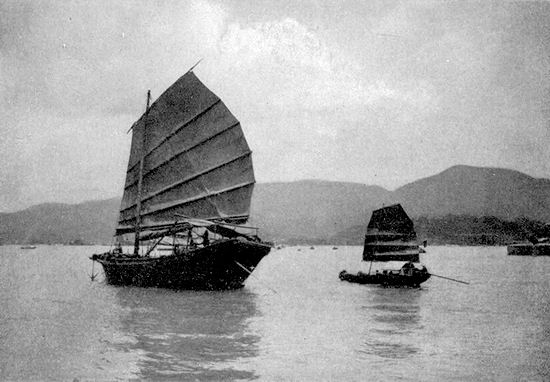
The fishing boats of Japan add much to the picturesqueness of all the
harbors, as they have sails arranged in narrow strips laced to bamboo
poles, and they may be drawn up and lowered like the curtains in an
American shop window. Whether square or triangular, these sails have a
graceful appearance and they are handled far more easily than ours.
The Japanese carpenter, who draws his plane as well as his saw toward
himself, appears to work in an awkward and ungainly way, but he does as
fine work as the American cabinet-maker. The beauty of the interior
woodwork of even the houses of the poorer classes is a constant marvel
to the tourist. Nothing is ever painted about the Japanese house, so the
fineness of the grain of the wood is revealed as well as the exquisite
polish. A specialty of the Japanese carpenter is lattice-work for the
windows and grill-work for doors. These add very much to the beauty of
unpretentious houses.
In conclusion it may be said that Japan offers the lover of the
beautiful an unlimited opportunity to gratify his æsthetic senses. In
city or country he cannot fail to find on every hand artistic things
that appeal powerfully to his sense of beauty. Whether in an ancient
temple or a new home for a poor village artisan, he will see the results
of the same instinctive sense of the beautiful and the harmonious. The
lines are always lines of grace, and the colors are always those which
blend and gratify the eye.
Any thoughtful visitor to Japan must be impressed with the problems that
confront Japan to-day, owing to the influence of foreign thought and
customs. This influence is the more to be dreaded because the Japanese
are so impressionable and so prone to accept anything which they are
convinced is superior to their own. They have very little of the Chinese
passion for what has been made sacred by long usage. They have high
regard for their ancestors, but very little reverence for their customs
and opinions. This lack of veneration is shown in striking fashion by
those Japanese students who come to this country to gain an education.
These young men are as eager as the ancient Athenians for any new thing,
and when they return to their old homes each is a center of Occidental
influence. This is frequently not for the best interests of their
countrymen, who have not had their own opportunities of observation and
comparison.
The qualities in which the Japanese excel are the very qualities in
which so many Americans are deficient. Personal courage and loyalty are
the traits which Professor Scherer, a distinguished expert, regards as
the fundamental traits of the Japanese character. That these qualities
have not been weakened materially was shown in the recent war with
Russia. In that tremendous struggle was demonstrated the power of a
small nation, in which everyone—men, women and children—were united in
a passionate devotion to their country. No similar spectacle was ever
shown in modern history. The men who went cheerfully to certain death
before Port Arthur revealed no higher loyalty than the wives at home who
committed suicide that their husbands might not be called upon to choose
between personal devotion to their family and absolute loyalty to the
nation. The foreign correspondents, who were on
two-hundred-and-three-metre hill before Port Arthur, have told of the
Japanese soldiers in the ranks who tied ropes to their feet in order
that their comrades might pull their bodies back into the trenches. All
those who were drafted to make the assaults on the Russian works in that
awful series of encounters (which make the charge of the Light Brigade
at Balaklava seem cheap and theatrical) knew they were going to certain
death. Yet these foreign observers have left on record that the only
sentiment among those who remained in the trenches was envy that they
had not been so fortunate as to be selected to show this supreme loyalty
to their country. General Nogi, who recently committed suicide with his
wife on the day of the funeral of the late Emperor, had two sons dash to
this certain death on the bloodstained hill before Port Arthur. As
commander, he could have assigned them to less dangerous positions, but
it probably never entered his head to shield his own flesh and blood.
And the same loyalty that is shown to country is also proved in the
relation of servant to master. The story of the Forty-seven Ronins is
too well known to need repetition, but the loyalty of these retainers
(who slew the man that caused their lord's death, although they knew
that this deed called for their immediate end by their own hands)
impresses one with new force when he stands before the tombs of these
men in the Japanese capital and sees the profound reverence in which
they are still held by the people of Japan.
What puzzles the foreign observer is: Will this passionate loyalty of
servant to master survive the spectacle of the ingratitude and
self-interest which the Japanese see in the relation of master and
servant in most Christian countries? The whole tendency of life in other
countries than his own is against this loyalty, which has been bred in
his very marrow. How long, without the mainstay of religion, will the
Japanese cling to this outworn but beautiful relic of his old life? And
it must be confessed that religion is rapidly losing its hold on the men
of Japan. Those who have been abroad are apt to return home
freethinkers, because the spectacle of the practical working of
Christianity is not conducive to faith among so shrewd a people as the
Japanese. Even the example of the foreigners in Japan is an influence
that the missionaries regard as prejudicial to Christianity.
Another trait of the Japanese which will not be improved by contact with
foreigners, and especially with Americans, is thoroughness. This trait
is seen on every hand in Japan. Nothing is built in a slovenly way,
whether for private use or for the government. The artisan never scamps
his work. He seems to have retained the old mechanic's pride in doing
everything well which he sets his hand to do. This is seen in the
carving of many works of art, as well as in the building of the
ornamental gateways throughout the empire, that stand as monuments to
the æsthetic sense of the people. Yet the whole influence of foreign
teaching and example is against this thoroughness that is ingrained in
the Japanese character. The young people cannot fail to see that it
does not pay their elders to expend so much time and effort to gain
perfection, when their foreign rivals secure apparently equal if not
superior results by quick and careless work. It is upon these Japanese
children that the future of the empire depends. They are sure to be
infected by these object lessons in the gospel of selfish and careless
work, which the labor union leaders in our country have preached until
it has been accepted by the great mass of mechanics.
Another racial quality of the Japanese, which is likely to suffer from
contact with foreigners, is his politeness. This is innate and not
acquired; it does not owe any of its force to selfish considerations.
The traveler in Japan is amazed to see this politeness among all
classes, just as he sees the artistic impulse flowering among the
children of rough toilers in the fields. And again the question arises:
Will the Japanese retain this attractive trait when they come into more
intimate contact with the foreigner, who believes in courtesy mainly as
a business asset rather than as a social virtue?
So, in summing up one's impressions of Japan, there comes this
inevitable doubt of the permanence of the fine qualities which make the
Japanese nation to-day so distinct from any other. The Japanese may
differ from all other races in their power of resisting the corrupting
influences of foreign association, but it is to be feared that the
visitor to the Mikado's land fifty years from now may not only find no
Mikado, but none of the peculiarly gracious qualities in the Japanese
people which to-day set them apart from all other nations.
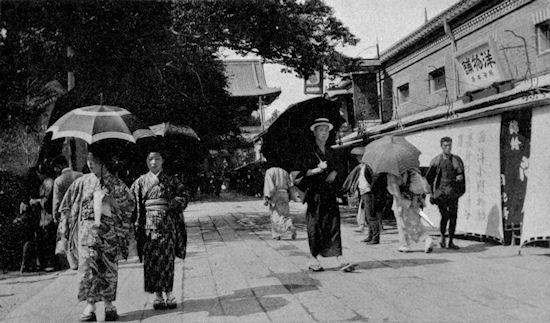 |
PLATE I
Street Scene, Asakusa
Park, Tokyo. This Picture
Gives a Good Idea
of Japanese Street
Dress of Men and
Women. The Park
Contains a
Twelve-Story
Tower, Two
Hundred and Twenty
Feet in Height
|
PLATE II
Entrance Hall and Stairway
of Modern Home
of a Tokyo Millionaire.
Note the Priceless
Screens With
Cherry-Blossom Decoration,
the Bronze Stair Railings
and the Inlaid Floor
|
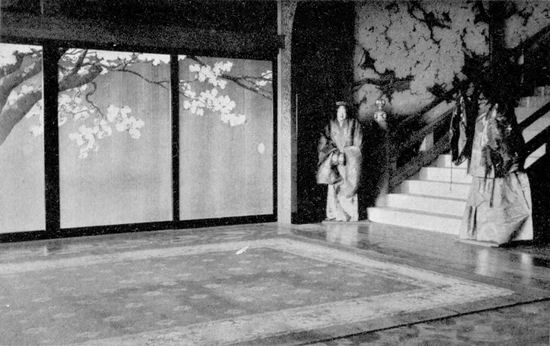 |
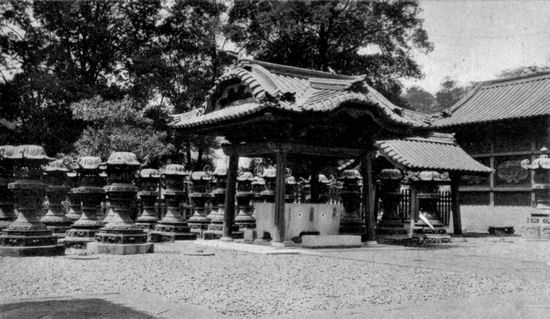 |
PLATE III
Bronze Lanterns and
Sacred Fountain, Shiba
Temple, Tokyo. These
Temples in Shiba Park
Are Among the Marvels
of Japanese
Art
|
PLATE IV
Sacred Red Bridge at
Nikko. Legend Says It
Was Built for the Saint
Shodo Shonin. No
One Crossed It Except
the Shoguns and in
Modern Times the
Mikado. General
Grant Was Given a
Permit to Cross This
Bridge, but Sensibly
Refused to Use It
|
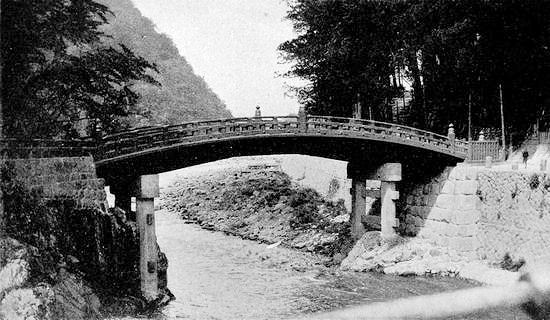 |
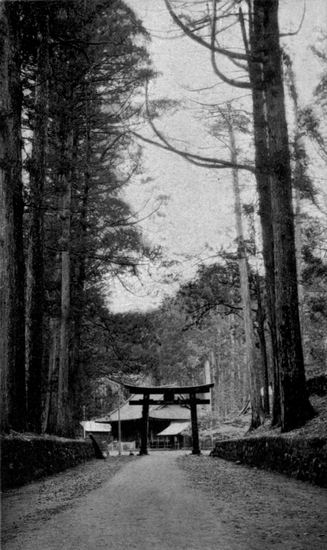 |
PLATE V
Avenue of Cryptomeria to Futaaru Temple, Nikko.
This Picture Gives a Good Idea of the Effectiveness of the
Tori or Gate, of Black or Red Lacquer or Natural
Wood, Which Stands at the Entrance
to Most Parks and Temples
|
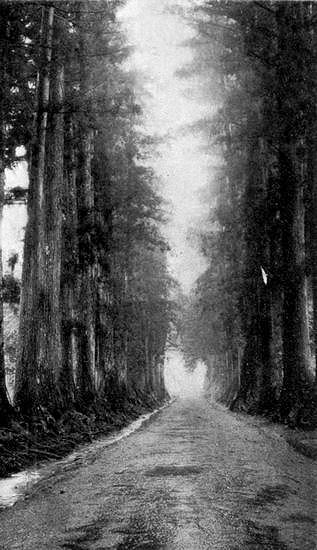 |
PLATE VI
Avenue of Cryptomeria Trees, near Nikko.
This Splendid Avenue, Lined with Huge Cedar Trees
from One Hundred and Fifty to Two Hundred
Feet in Height, Extends for Five Miles
from Nikko to Imaichi
|
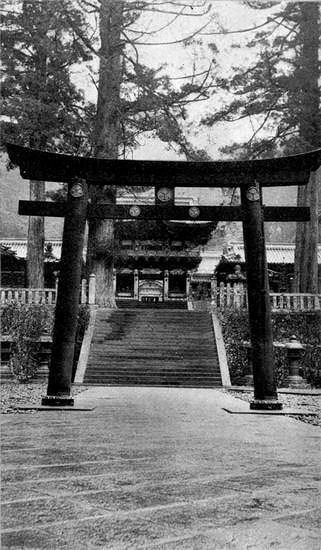 |
PLATE VII
Great Bronze Torii, Nikko.
These Torii or Gates Form the Most
Characteristic Feature of Japanese Landscapes. They
Are Always of the Same Pattern But
Infinite in Variety of Decoration
|
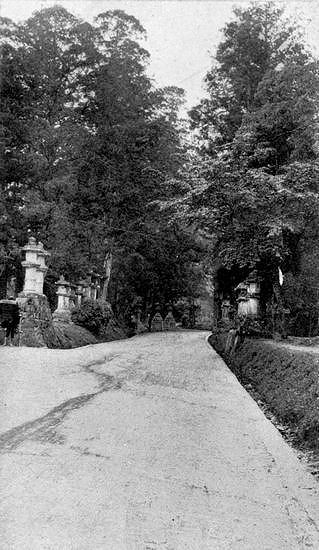 |
PLATE VIII
Stone Lanterns, Kasuga Temple Park, Nara.
A Remarkable Collection of Lanterns Which Line
the Avenue Leading to the Temple. In This
Park Many Tame Deer Wander, Their
Horns Being Cut Once a Year
in October
|
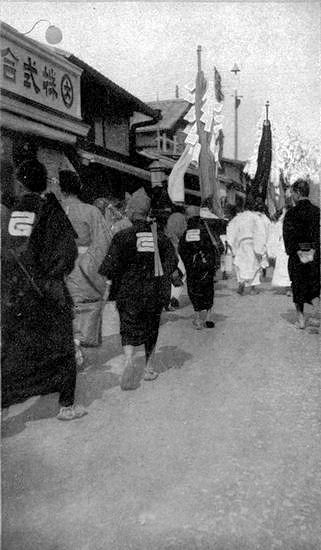 |
PLATE IX
Religious Procession, Kyoto.
This Gives a Good Idea of a Familiar Sight in
all Japanese Cities. Many of the Standards Carried in
These Processions are Very Beautiful,
With Silk Streamers of
Many Colors
|
PLATE X
Scene on Canal, Kyoto.
None of the Houses
That Line This Canal
Are Elaborate, But All
Have Balconies Adorned
With Dwarf Trees and
Plants in Pots of
Many Colors. This Is
One of the Most
Picturesque Scenes in
All Japan
|
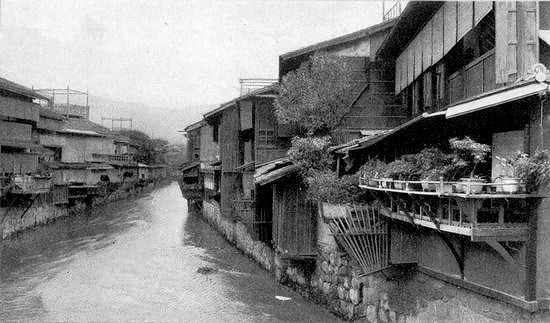 |
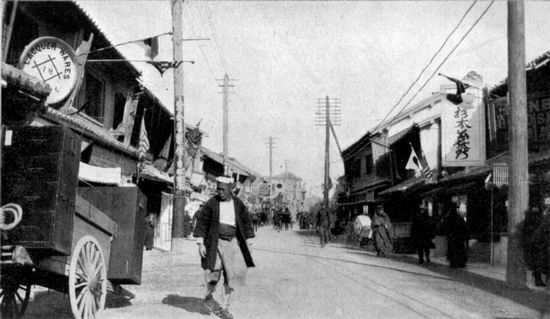 |
PLATE XI
Street Scene in Kobe.
This View Shows the
Low Two-Story Houses,
With Overhanging
Balconies, the Enormous
Gilded Signs and
the Absence of All
Horses in the Street.
This Street Scene Is
Typical of All Japanese
Cities
|
PLATE XII
A Group of Japanese
Schoolboys. These
Faces, Full of Life and
Mischief, Are Typical
of Young Japan. About
the Only Faces in Japan
Free From Lines of
Care Are Those of
School Children. When
Over Sixteen the Face
of the Japanese Becomes
a Mask Which Conceals
All Emotions
|
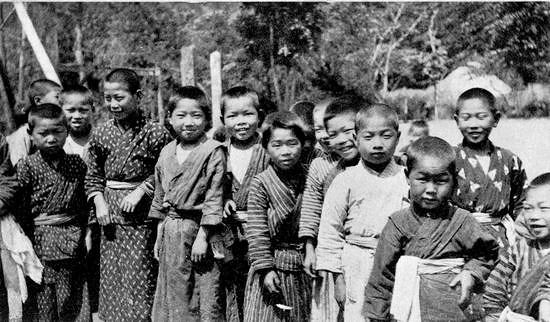 |
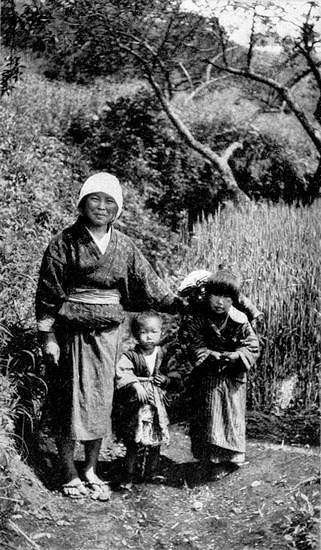 |
PLATE XIII
Japanese Peasant Group by the Roadside.
These Country People Show Keen Curiosity in
Regard to the Foreign Tourist but They
Are Always Courteous
|
PLATE XIV
Scene in Large Private
Garden, Kyoto. This
Old Capital of Japan Is
Noted for Its Many
Beautiful Gardens, With
Ponds Well Stocked
With Goldfish and
Crossed by Miniature
Bridges
|
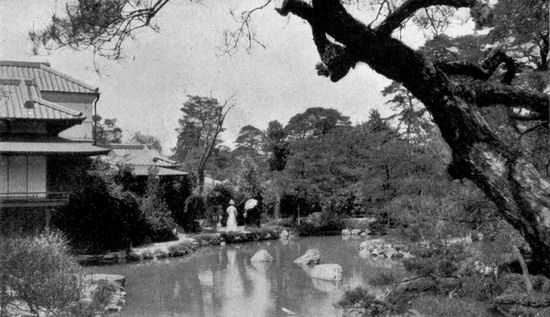 |
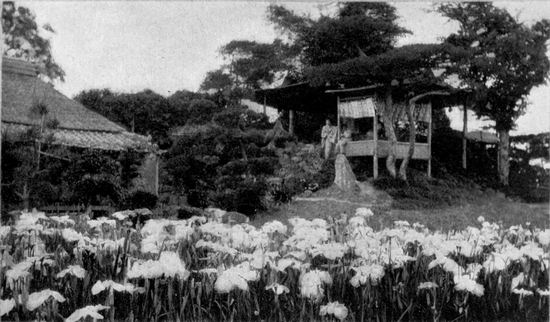 |
PLATE XV
Iris Bed at Horikiri,
near Tokyo. This
Flower Resort is the
Scene of Many Pilgrimages
in June When the
Irises Are in Full
Bloom
|
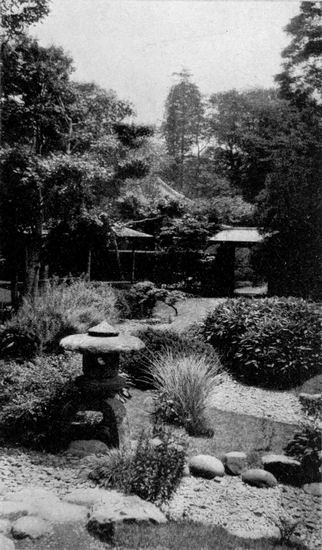 |
PLATE XVI
Private Garden, Kamakura.
This Gives a Good Idea of the Arrangement
of a Japanese Garden. To the Influence of the
Garden is Ascribed the Japanese Love of
the Beautiful in Nature and Art
|