So this was to be her home—and for three
long months! Patricia Meade dropped
her suitcase on a convenient chair and gazed
curiously about her. A hotel bedroom, with
stiff-looking twin brass beds, two willow
rockers, one straight chair, an imposing mahogany
bureau and one small table—absolutely
all the furniture, if one excepted the stiff draperies
at the windows and one or two not particularly
artistic pastel pictures adorning the
wall. Through a door and across the intervening
sitting-room she could see another bedroom
similarly equipped.
In the sitting-room, her father, Captain
4Meade, was tipping the grinning bell-boy who
had brought up their luggage,—a snub-nosed,
blue-eyed, curly-haired young chap whose gaze
was rivetted adoringly on the captain's khaki
uniform. When the boy was gone, the captain
turned to the door of Patricia's bedroom.
"Well, honey! Not much like home, eh?
Do you think you can stand it for three months?
Jove!—if she hasn't got her suitcase and is
unpacking it already!"
Patricia was indeed frantically flinging her
belongings about.
"Oh, it's jolly!" she replied, over her shoulder.
"But you're right about it's not being
much like home. I felt as if I'd just expire if
I couldn't see things strewn around in a sort
of careless and cosy way, as if people really
lived here!" She rose suddenly from her
kneeling posture before the suitcase, ran across
the room and thumped both stiff pillows on the
beds, knocking them a trifle awry. "There!
Now they look more like real beds that you
5sleep in and less like advertisements in the
back of a magazine!" she laughed. "The sitting-room's
a little better, with that big table
and the pretty reading-lamp and the comfortable
chairs. But do let's get a lot of papers
and magazines and books at once, and have
them lying all around as we do at home.
Mother would be scandalized—she's always
picking them up after us," she went rattling on,
and then stopped abruptly, lips quivering, eyes
bright with sudden tears.
"If mother could only be with us!" she
sobbed.
"Now, honey, don't—" the captain soothed
her, laying his arm lovingly around her shoulder.
"Remember you're a soldier's daughter;
and,—well, brace up! Mother's going to be
beautifully taken care of in that Sanatorium,
and Aunt Harriet is with her, to keep her company
and incidentally to indulge in some little
pet cures of her own, on the side."
"But why, oh! why did it have to happen just
6now?" wailed Patricia, refusing to be comforted.
"Is it any wonder that she broke down completely
and had a bad case of nervous prostration,
after waiting over a year for me to come
back from France? And feeling sure, too, for
the last six months that she'd never see me
alive again after she heard I'd been taken a
prisoner to Germany? It's enough to have
broken down the nerve of a cave-woman. And
your mother was always delicate."
"Oh, Daddy! It was like getting you back
from the dead," sighed Patricia, hiding her
head in his shoulder and shuddering at the
memory. "And in three months, you're going
back again!"
"But not to the dangers and horrors, this
time," he reminded her, and added half under
his breath, "Worse luck! Fortunately or unfortunately,
my constitution will never stand
the strain of trench-life again, after a few
months of German prison-diet, etc. But I'm
7only too thankful that the Government has
found use for me in some other capacity."
Patricia, who had been perched on his knee,
snuggling her head in his coat collar, suddenly
sat up straight and looked him in the eyes.
"Daddy, can't you tell me what it is you're doing?"
she begged. "I don't ask just from idle
curiosity. I want to understand. I want to
help you if I can. I love America, and I am
a soldier's daughter, and I want to act intelligently
about things and be of some use.
That's one reason I'm so glad you've allowed
me to be with you in this strange, big city and
in this great hotel, for three months,—besides
the joy of not being separated from you before
you go back to Europe again for goodness
knows how long! I want to do something for
my country, too!"
The Captain stroked his short mustache for
several silent moments before answering. "I
quite understand how you feel," he said at
length. "And I appreciate it. You're
8seventeen, Patricia,—almost a woman grown.
I know I could trust you utterly with the whole
thing, but it isn't wise,—in fact, it isn't even
allowable. A government secret is a government
secret, and cannot be revealed even to
one's nearest and dearest. This much only,
I can tell you. While I was a prisoner, I
stumbled upon a very valuable secret, something
new possessed by the enemy which, however,
they have not had the gumption to make
use of properly. But I saw that it could be
vastly improved upon and made a hundred
times more effective. The Government has
charged me with this task, and I'm to take it
back with me when I go. It's a very vital and
important thing, Patricia, and may turn the
tide for us. More I cannot tell you. It would
not be wise nor even safe for you to know.
And you can help me most by appearing to
know nothing whatever about my affairs.
Remember that,—to know nothing, whatever
9happens,—" He was interrupted by a loud
knocking at the door and went to open it.
"Telegram for you, sir!" grinned the bell-boy
of the snub-nose and twinkling eyes.
Captain Meade tore it open hastily.
"Here's a pretty pickle!" he exclaimed,
handing the yellow slip to Patricia. "Your
Aunt Evelyn fell yesterday, just before she was
to take the train from Chicago to meet us here,
and will be laid up for the next six or eight
weeks with a broken leg. Just like Evelyn!"
he added impatiently. "She was always the
worst youngster for falling down and getting
damaged at critical moments. And she's kept
it up consistently all the rest of her life. I'm
sorry for her, of course, but what on earth are
we to do?"
They stared blankly at each other. "Poor
Aunt Evelyn!" sighed Patricia, sympathetically.
"She was looking forward so to this
three-months' holiday. She wrote that she
10hadn't been away from home even a week, for
the last ten years, and was going to enjoy the
rest so much. I'm awfully sorry for her.
She'll be so disappointed!"
"Yes, but that doesn't solve the problem of
what we're going to do," argued the captain.
"She was to be your companion here. I can't
be around all the time. I may even have to be
away several days at a time. A young girl
like you can't stay alone in a big hotel. What
in sancho are we going to do?" He ran his
hands through his hair despairingly. "It was
only on the basis of her being able to join us
that your mother and I consented to this arrangement
at all. I guess now you'll have to
go out to Chicago and stay with her, after all.
There's no where else for you to go."
"Oh, Daddy, Daddy, don't!" implored Patricia,
hurling herself at him in a panic. "I
couldn't, I simply couldn't stand being parted
from you now. And I'd have the most miserable
time there. Aunt Evelyn would be in
11bed and a trained nurse puttering around her
all the time, (I know her!) and there'd be
nothing to do and I'd be simply wretched and
unhappy all the while. We can have such a
cosy time here, just you and I, and I'll promise
to be very good and quiet and read a lot, and
stay here in our own suite all by myself when
you are away. I've brought a lot of fancy-work,
too, and I'm going to do Red Cross
knitting and make all my Christmas presents
during these three summer months, so I'll be
very, very busy. Do say yes, Daddy!"
Captain Meade looked only half convinced.
"I don't like it at all, Patricia. It will not only
be lonely, for you, it may possibly even be dangerous.
There are spies about us all the time.
If they should happen to nose out my mission,
they'd no doubt try to make it hot for me—and
for you too. Your Aunt Evelyn was to
be your safeguard. But now—"
Patricia suddenly interrupted him. "Do
you have to go away for any length of time
12very soon? I mean, to go for several days?"
"Well, no," he admitted. "I'm supposed to
be giving lectures at the churches and Y. M. C. A.'s
of this city and hereabout on my experiences
as a prisoner. That, however, is hardly
more than a 'blind,' to cover my real work. It
will take me away some afternoons and evenings,
but I shall not stay away overnight for
a few weeks yet, in all likelihood."
"Then, Daddy," urged the wily Patricia,
grasping eagerly at this straw, "until you find
you have really to be absent for any length of
time, let me stay with you. If later on you
should find you must go, then we can see what
to do. Meantime let's be happy together for
a while and see what's going to turn up. I'll
even go to Chicago then, if you insist, if you'll
only let me stay here with you for a while."
And then Captain Meade relinquished the
argument, glad to settle the vexed question, at
least temporarily. "Very well," he said, a
trifle reluctantly. "Stay you shall, since you
13wish it so, at least for a while. But, Patricia,
attend to what I am going to say, and never
forget it under any circumstances. It's an
old saying that 'walls have ears,' but it was
never truer than it is in these days and in a big
hotel. Trust no one. Hear everything, see
everything—and say nothing. My very life,
and even yours too, may depend upon your
obeying in this, implicitly."
Patricia nodded gravely. "I understand,
Father!" was all she replied. But her brain
was a-whirl with feverish, delicious excitement.
"Spies," "danger," "secret mission"—the
magic words gave her an indescribable thrill!
And yet, with it all, she realized too the gravity
of the affair; and the realization served to give
her a mental balance beyond her years.
"But now let's go down to dinner!" cried
the Captain gaily, glad to change to a subject
less tense. "I've an appetite worthy of an ex-prisoner
in a German camp!"
As they passed out into the corridor, Patricia
14glanced up at the number over their door.
"Suite number 403!" she murmured, squeezing
her father's arm. "Now I wonder just what's
going to happen to us while this is our home
number?"
CHAPTER II FRIENDS OR ENEMIES?
15
They made their way through the long
corridors, down the elevator, past the
cosy sun-parlors and into the imposing dining-room.
To Patricia it was all a splendid adventure,
even without the strange, new element
so recently hinted at by her father.
"Daddy," she began, when they were settled
at a comfortable table for two in a remote
corner, "I wonder if you realize how simply
heavenly it is for me to sit down to a meal like
this (not to speak of all the meals to come!)
and pick out just exactly what I want to eat,
without having cooked or helped to cook them
all beforehand, and knowing I won't have to
wash the dishes afterward!" She picked up
the menu and scanned it luxuriously. "Now I
16think some cream-of-asparagus soup and a tenderloin
steak and some nice French-fried potatoes
would just suit me to-night!"
There was no response to her remark, and,
glancing up curiously, she found her father's
gaze riveted on the waiter who had just arrived
to take their order. Patricia, too, turned her
attention to the man, and found him a singularly
unprepossessing individual. He was of
medium height, with a swarthy skin, and black
hair plastered closely down the sides of his
head. His eyebrows were extremely black and
bushy, and one eyelid drooped conspicuously.
Several of his prominent front teeth were of
gold, and gleamed in a sinister manner when he
spoke. His voice was thick and husky, and
had a foreign accent.
"Are you to be the regular man for this
table?" questioned the Captain. The man
merely nodded in sullen affirmation.
"I want to know your name," pursued Captain
Meade. "I expect to be here some time
17and may keep this table. And if I'm going to
have anyone about me regularly, I prefer to
call him by the name that belongs to him.
What's yours?"
"Peter Stoger," still sullenly.
"What nationality?"
"Swiss."
"Very well, Peter. You may take our
order." And without further remark, the
Captain dismissed him.
"Daddy, I don't like that man," whispered
Patricia when he was gone. "He looks like
an alien enemy. I don't believe he's Swiss at
all. Can't we have another? I know he's going
to make me uncomfortable and worry me."
"Oh, he's all right," replied the Captain
easily. "You must learn not to mind an unprepossessing
outer appearance. If he makes
a good waiter, nothing else about him will matter
much to us. Don't get 'spies' on the
brain."
Patricia subsided, unconvinced, and they
18both gazed quietly about them for the few moments
while they were waiting to be served.
"Oh, Daddy," whispered Patricia, "don't
look for a minute or two, but isn't that a lovely
woman at the table diagonally at our right, just
a little behind you? She reminds me somehow
of Aunt Evelyn. And there's a pretty girl
with her, just about my age, I should think, but
I wonder what makes her look so queer and
cross—and sullen?"
After a proper interval, Captain Meade
glanced in the direction indicated. The
woman's appearance was certainly striking
enough to attract attention in any assembly.
Her wavy gray hair was elaborately dressed,
she had large, liquid brown eyes, she was
beautifully if quietly gowned, and was of imposing
height and build.
"She does look a little like your Aunt
Evelyn," he agreed, "only much handsomer
and more imposing. The young person with
19her doesn't seem to be enjoying life, somehow."
The girl in question did indeed appear very
unhappy. She was fifteen or sixteen years old,
but of a slight, fragile build that made her seem
younger. Her hair, a mass of dark curls, was
tied back simply at the nape of her neck. But
her lovely face was marred by a pouting, sullen
mouth, and her big dark eyes gazed about her
with an expression that struck Patricia as one
half-frightened, half-rebellious. She did not
often look about her, however, but kept her
gaze in the main riveted on her plate. Her
companion chatted with her almost continuously,
but she answered only in monosyllables
or not at all.
They were a strange pair. Patricia could
not understand them at all, nor could she, for
the remainder of the meal, keep her eyes long
from turning toward their table. The older
woman fascinated her, not only by her handsome
20appearance and vague resemblance to her
aunt, but also because of some subtle attraction
in her vivacious manner. Once she looked up
suddenly, caught Patricia's gaze fixed on her,
and smiled in so winning a manner that
Patricia was impelled to smile back in response.
The girl puzzled her by her strange, inexplicable
conduct toward one who was so evidently
interested and absorbed in her.
Patricia found herself wondering more and
more what could be the relationship between
the two.
But their own meal now delightfully finished
with French ice cream and tiny cups of black
coffee, Patricia and her father rose to leave the
dining-room. Their way led directly past the
table that had so deeply interested Patricia.
As she approached it, she noticed that a dainty
handkerchief belonging to the older woman had
fallen unheeded to the floor at her side. Stooping
to pick it up, Patricia restored it, and was
rewarded by another charming smile and a
21"Thank you, dear!" But in the same instant
her eye caught that of the young girl, and was
held by it for a long, tense moment. Patricia
was no practiced reader of expression, but it
seemed to her that in this moment, fear, hope,
dread and longing were all mirrored successively
in the beautiful dark eyes raised to her
face. Then the lids were dropped and the girl
went on eating in apparent unconcern.
Patricia and her father passed on. They
had almost reached the door of the big dining-room
when Captain Meade stopped suddenly
to grasp the hand of an elderly lady seated at
a table near the door.
"Mrs. Quale! by all things unexpected!
How do you happen to be here? Let me
present my daughter, Patricia." Patricia
made her best curtsey to one of the quaintest
little elderly ladies she thought she had ever
seen.
"Delighted to know Patricia," began Mrs.
Quale. "I'm here by virtue of having my
22house burn down, not exactly over my head,
but while I was away in New Haven. Carelessness
of old Juno, my colored cook. She
would keep too hot a range fire and overheated
the chimney. At any rate, here I am till the
thing is rebuilt, and a precious long job they're
making of it, with all these war-time restrictions.
So this is Patricia! I saw her once before
when she was a tiny baby. Are you staying
here, Captain Meade?"
The Captain sketched briefly for her, the
reason of their presence in the big hotel,—his
wife's breakdown and departure to a sanatorium;
the closing-up of their home and his
coming with Patricia for a combination of holiday
for her and lecture-program for him to this
distant city, of their disappointment about
Aunt Evelyn, and their consequent predicament.
"Well, don't worry your head another moment
about Patricia," laughed Mrs. Quale.
"Fate seems to have arranged things very
23nicely, that I should be here to act as her
chaperon whenever necessary, and general adviser
at all times. My suite is 720, ninth floor.
Be sure you call on me soon, Patricia, and we'll
get really acquainted in short order. Your
father played in my back yard as a child (his
house was right next door to ours) and so I feel
quite like a grandmother to you!"
"I like Mrs. Quale, Daddy," Patricia confided
to her father, as they were ascending to
their rooms in the elevator. "I like the way
her hair is fixed in those queer, old-fashioned
scallops, and her dear, round, soft face, and
her jolly manner. But how is it, I've never
heard you speak of her before?"
"She is an old friend of my boyhood days,"
replied her father, "and, as she said, we used
to live next door to her. I don't know why I
didn't think of her right away, when your
aunt's telegram came. I shouldn't have hesitated
to take you straight to her and put you
in her care. However, if her house is out of
24commission and she's staying here, it answers
the purpose even better. You must be sure
to call on her in her rooms to-morrow. Now,
I'm afraid you're in for a lonely evening,
Patricia, for I have an important business matter
to attend to, and may be detained rather
late. Telephone down to the office for anything
you need or any attention you want, but
don't leave these rooms on any consideration—short
of a fire! Tomorrow we'll do the town
and go out somewhere in the evening, so I hope
you won't be lonely to-night,—eh, honey?"
"Indeed I won't be lonely. Don't you
worry about me a minute!" agreed Patricia.
"I've heaps of things to do."
When Captain Meade had gone, Patricia
flew about, busily occupying herself with unpacking
her trunk and making her bedroom a
little more homelike with a few of her own
personal knickknacks and belongings. When
this occupation could be prolonged no further,
25she sank down in a cosy chair by the table in
the living-room, intending to read a magazine,
but in reality to dream delightfully over the
events of the day and her father's strange, half-exhilarating,
half-terrifying hints.
A great hotel full of people,—literally hundreds
of them,—coming and going continually,—some
of them friends, some of them enemies,
perhaps,—and she, Patricia Meade in the
center of it, she and her father the very center
of a whirlpool of plots and danger, perhaps!
Then more sober thought reminded her that
there was, in all probability, no likelihood of
anything particularly thrilling except in her
own imagination, and she laughed at herself for
romancing so foolishly. They would have a
very delightful holiday, she and her father.
He would accomplish safely and without difficulty,
the mission that occupied him, they
would return home to a reunited household at
the end of the summer,—and then he would
go away, 'over there' again.
26At this point in her revery, she suddenly
dropped into an unpleasant depression and decided
to send for a sandwich and a glass of
milk, write a tiny note to her mother and go
to bed. All at once she realized how very
tired she was and how the excitement and exhilaration
had all evaporated, leaving only
weariness in their place. Rather timidly she
telephoned her order to the office and sat down
again to await its arrival.
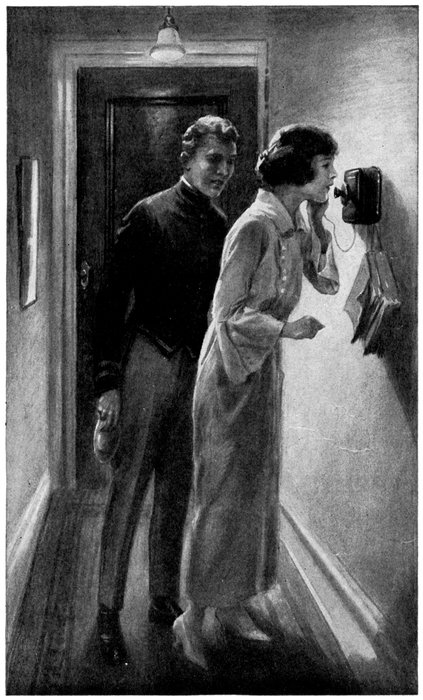
Five minutes later, she answered a knock at
the door, to find the grinning, implike bell-boy
of their first encounter, standing there with a
tray.
"Didn't have no chicken left, ma'am, so I
got you tongue. Best I could do!" he vouchsafed.
"Oh, thanks! That will do just as well," she
replied, then something impelled her to inquire,
"Do you always answer the calls in this corridor?"
27"Yep,—at least I try to work it that way. I
got a reason!" he ended darkly.
"A reason? What is it?" she asked idly.
"Not allowed to tell. State secret. Governor
forbids it!" he grinned; and Patricia
found herself laughing as much at his serio-comic
expression as at his very apparent nonsense.
"Anything else wanted?" he ended.
"Nothing but your name," she replied, following
her father's tactics. "If you're going
to be around here regularly, my father would
like to know it."
"Oh, it's Chet, just Chet Jackson!" he said,
apparently a trifle dumfounded to think that
anyone should care to know it. To the hotel
at large he was only 'Number 27.'
"Well, goodnight. That will be all, I
think." And Patricia turned back into the
room to lay the tray on the table. But as she
retraced her steps to close the door, she suddenly
remembered that she had meant to order
28ice-water for the night also, and walked out into
the corridor to see if Chester were still in sight.
He was not, however, and she turned back
toward her own door, murmuring, "Oh, well, it
doesn't really matter. I don't want to bother
'phoning down again. Daddy can send for it
when he comes in."
What impelled her, just at that instant, to
turn her head and glance over her shoulder, she
never quite knew. Perhaps if she had not, if
she had gone quietly in and closed her door, all
future events might have been different. At
any rate, turn her head she did, drawn by some
mysterious power, and beheld a curious sight.
A door diagonally opposite her own, across
the corridor, was standing a trifle ajar. It had
not been so while she was talking to the bell-boy,
of that she was positive, nor had she heard
the faintest sound of its being opened. And
in the opening was framed a face, gazing at her
absorbedly, intently. Patricia's heart gave a
29sudden leap. It was the face of the young girl
she had noticed in the dining-room.
So unexpected to both was this encounter of
eyes, that for a long instant, neither could remove
her gaze. Patricia was first to recover
her poise; moreover, truth to tell, she was even
a trifle pleased at this opportunity to break the
growing monotony of the evening. She smiled
her friendliest smile at the face across the corridor,
and with its resultant effect on the girl
in the opposite doorway, she was not a little
astonished. The expression in the big, black
eyes changed suddenly from watchfulness to
wonder, and a slow, reluctant answering smile
curved the sullen mouth. The effect was like
a shaft of sunlight breaking through a black
cloud.
"I was looking for our bell-boy," Patricia
called across laughingly and informally. "He
escaped before I could speak about bringing
ice-water." The girl in the opposite doorway
30suddenly realized that her presence too, might
call for some explanation.
"I was looking for my—ah—for Mme. Vanderpoel,"
she hesitated. "She has gone out.
I am a little lonely—and was watching for her—to
return." She spoke with a noticeably
foreign accent and her manner was reticent and
confused. But Patricia, for some inexplicable
reason felt immediately drawn to her. The
girl was lonely. So was she. What possible
objection could there be to spending a while in
each other's company?
"Why, I'm lonely, too," she vouchsafed.
"My father was to be away all the evening.
Won't you come in and sit with me awhile?
I've a couple of sandwiches that we can divide,
or I can send for more. Do come!"
For a moment it seemed as if the girl were
about to consent. A surprised, dimpling smile
lit her face for an instant, and she replied, "Oh,
thanks! Since you are so—"
At this moment the door of the room adjoining
31hers opened and a waiter came out, bearing
in his hands a tray of used dishes, and passed
directly between them, down the corridor. He
glanced neither to the right nor left, and disappeared
in a moment down the turning at the
end of the hall. Patricia realized with a tiny
qualm of dislike that it was the waiter of her
own table. But his passing had broken the
spell of the new acquaintance.
"I thank you—but—but this evening I must
stay in the room," the girl resumed, inexplicably
contradicting what she had plainly intended
to say at first. The bright smile was
gone. Her face had again assumed the
clouded, sullen expression. Patricia was thoroughly
puzzled.
"Well, that's too bad!" was all she could
find to reply. "Same here, or perhaps I could
run over to you. Are you staying here
long?"
"I think so. I am not sure how long."
"Oh, well, then we'll have plenty of time to
32get acquainted. Goodnight!" Patricia ended
pleasantly, as she closed her door.
But sitting alone and nibbling her sandwiches
later, she found herself vexed with many
puzzling surmises. Who was this strange, interesting,
appealing foreign girl? What was
her relation to the beautiful woman she called
'Mme. Vanderpoel'? Why had she appeared
to assent to the invitation so gladly, and suddenly
retracted after the passing of the man,
Peter Stoger?
"I like her, though," thought Patricia confusedly,
"And yet I can't for the life of me tell
why. I can't make her out. I don't believe
what she said about looking for that woman to
come back. I think that was only an excuse.
I firmly believe she was watching me. But
why? There's something queer about the
whole thing. But, no matter what happens,
I'm going to make a desperate effort to get
better acquainted with her. I believe we're
going to be friends."
CHAPTER III THE SHADOW ON THE WALL
33
In spite of her resolution to get better acquainted
with her mysterious neighbor,
however, Patricia made no further progress in
that direction for several days. These were
spent in a round of sight-seeing with her father
through the big, busy, manufacturing city in
which they were staying, at present so absorbed
in its war work and munition making. After
that came a series of delightful trolley-trips
through distant and picturesque parts of the
surrounding country. And when she was at
leisure at all, Patricia spent not a little time
with Mrs. Quale, finding a real delight in her
quaint, sunny, comfortable company. During
their wanderings, it chanced that she and her
father took few meals at the hotel. And thus
34it fell out that she saw nothing, or almost nothing,
of the curious couple that had so interested
her on the first night. Once, indeed, she did
have a brief glimpse of them at breakfast, but
the older woman only acknowledged her presence
by a friendly little nod. The girl never
so much as turned her head or looked in
Patricia's direction.
Then, on the sixth morning after their arrival,
came a change. Captain Meade announced
it as they were taking their leisurely
breakfast.
"We've done all the gadding about that I'll
be able to indulge in for a while," he told her.
"I must settle down to business now, and I'm
afraid you'll be left pretty much on your own
hands."
"Well, to tell the truth, I don't mind very
much," she replied, lazily dallying with the
grape-fruit. "I'm so tired of being on the go
that I'll appreciate a little rest and quietness."
"I must go off this morning to be gone almost
35all day," went on Captain Meade. "You
will be a little lonely, perhaps, but there's always
Mrs. Quale. Don't rush her too much,
however. Remember she's a very busy woman.
But you can always turn to her in
emergencies or if you need advice."
"No, I won't bother her," returned Patricia,
"and I think I'll spend the morning over at
the sea-wall in the park. I love it there, and
it's just the place to take some knitting and a
book and perhaps write some letters. Will
you be back to lunch?"
"I hardly expect to. Order a lunch sent to
the room, or go down to the dining-room if you
prefer, but don't wait for me."
"Oh, I'll have my luncheon sent upstairs, I
guess," sighed Patricia. "I detest that Peter
Stoger more every time I see him. I feel as
if he were spying on me constantly. I can't
understand why you don't realize it, too."
The captain smiled as they rose to leave the
table. "Poor Peter would be surprised, and
36horrified probably, if he realized he was posing
as a German spy for your benefit. But suit
yourself, Patricia, about luncheon, and don't be
alarmed if I'm not back till late. If I'm not
here by dinner-time, ask Mrs. Quale if you may
dine at her table."
"I surely will," agreed Patricia. "And I—I
beg your pardon!" The latter remark she
addressed suddenly to the handsome woman
whom she now knew as Madame Vanderpoel,
who was breakfasting alone at her own table,
and, as they were passing, had touched Patricia,
a trifle hesitantly, on the arm.
"It is I that must beg your pardon," she
answered. "I am going to be so bold as to ask
a very great favor, though I do not even know
you, but I am in great trouble and perplexity
this morning."
"Why, I'll be glad to do anything, of
course," began Patricia, in surprise.
"I was sure you would. I read it in your
face. That is why I ask," Madame Vanderpoel
37hurried on. "I am called away to New
York this morning on the most urgent business—something
that cannot be postponed. Unfortunately,
my dear little charge, Virginie,
Mademoiselle de Vos, is quite miserable—a
violent nervous headache; she is subject to
them frequently, poor little soul! I dread to
leave her alone all day in the care only of that
stupid chambermaid, yet my business is such
that I simply cannot postpone it. Would it
be imposing too much on your kindness to ask
you to stop in there occasionally, just for a
moment or two, to see that she is as comfortable
as possible? You are, I believe, just across the
hall from us, so it would not be a long journey."
"Why, I'll be delighted to!" agreed Patricia,
heartily. "I'll sit with her just as long as she
cares to have me. Don't worry about her at
all. I'm famous as a nurse, too, for my
mother never has been very well, and I'm used
to waiting on her."
"Oh, thank you so much!" breathed Madame
38Vanderpoel, seemingly much relieved. "I'll
be so much easier in mind. I leave almost at
once after breakfast. Go in as soon as you
like. Just knock at the door and open it.
I'll leave it unlocked. I can never repay your
kindness."
"That solves the problem of my day for me,
Daddy," remarked Patricia, when they were
back in their rooms. "I'll stay around here
and visit Virginie de Vos (My! but I'm glad
I know her name at last!) every little while.
I've been real anxious to meet her, and didn't
know how I was going to get the chance."
But the captain frowned a little doubtfully.
"It's all right, I suppose, and you couldn't
very well refuse, but I rather wish you didn't
have to come in contact with any strangers
here. They may be all right—and they may
not. These are queer times, and you can't
trust any one. Get Mrs. Quale to go in with
you, if possible, and don't stay there more than
fifteen minutes at any time."
39Patricia opened her eyes wide with astonishment.
"Well, of all things! You don't suspect
people like that of—of anything queer, do
you?"
"I suspect no one, and trust no one in this
entire establishment except, of course, Mrs.
Quale. But don't get another attack of 'spies'
on the brain, just because I warned you to be
ordinarily cautious. It's probably all right.
I'll be back by eight o'clock, anyway. Now,
good-by, honey, and take care of yourself."
Patricia waited until nearly ten o'clock before
essaying her first visit to the sick girl
across the hall. Then, obedient to her father's
injunction, she called up Mrs. Quale on the
house telephone, to ask if that lady would find
it convenient to accompany her. But the clerk
at the desk informed her that Mrs. Quale had
gone out for the day, leaving only her maid.
Patricia had seen this woman several times,
quiet, elderly, and noticeably hard of hearing,
and who, Mrs. Quale said, had been in her
40service for many years. So Patricia was left
with no alternative but to make her first venture
alone.
"I'm sure Daddy wouldn't want me to neglect
the poor little sick thing, even if Mrs.
Quale isn't there," she told herself as she
knocked at the door of number 404, across
the hall.
She had vaguely expected to find the sick
girl in bed, her head swathed in bandages, the
room darkened and orderly. The sight that
met her eyes as she entered, at a half-muffled
"Come in," was as different as possible from
that picture. The room was in great disorder,
and bright with the glare of the morning sun.
Both of the twin-beds were unmade—and
empty. But at one of the windows, her back
to the room, stood Virginie de Vos, staring out
into the street. She did not turn round as
Patricia entered.
"I beg your pardon—good morning," ventured
Patricia, timidly. "I came at the request
41of your—of Madame Vanderpoel, who
said you were ill. Is there anything I can do
for you? Oughtn't you to be in bed?"
Still with her back to her visitor, Virginie
shook her head. Suddenly, however, she
whirled around. Her eyes were red and swollen
with crying, but there were no tears in them
now.
"Thank you—oh, very much! It is so
thoughtful of you to come! My head does not
ache—at least, not now. I am better. I do
not need any care."
"But surely, there must be something the
matter! You—you cannot be feeling quite
well. Madame Vanderpoel said you were suffering
severely," returned Patricia, thoroughly
puzzled.
"Whatever it was, I am better now," muttered
the girl, almost sullenly. "But you are—you
are so kind!" she added, and her eyes lit
up with a friendly gleam for an instant.
"Look here," cried Patricia, in sudden determination,
42"perhaps you are feeling better,
but your headache may return. Now, I have
a plan to propose. It's very hot and glaring
and noisy in this room. You see, it's on the
street side and you get all the racket from this
busy avenue. Beside that, it hasn't been made
up yet. Come over and spend the morning in
our sitting-room with me. It's so quiet and
pleasant there, for it faces on the little park at
the back. I'll darken it up, and you can lie
on the couch, and I'll read or talk to you—or
just let you alone to sleep. Please come!"
Her manner was so cordial, so urgent and
convincing, that Virginie visibly wavered.
"I ought—I ought not." She hesitated.
"You do not know—you cannot know—"
"Oh, nonsense!" cried Patricia, impatiently.
"What earthly reason could there be for not
coming? Just come right along, and we'll
have a lovely time. I'm awfully lonesome,
and you probably would be, too, alone here all
day. So come!"
43Very reluctantly the girl assented and followed
Patricia. Once established in the cool,
pleasant, half-darkened sitting-room, however,
her hesitancy seemed suddenly to vanish. Patricia
insisted that she occupy the couch, which
she finally consented to do, though patently
more to please her hostess than herself.
"I am not sick; my head does not ache at all.
Madame Vanderpoel was—er—mistaken."
And, indeed, she looked the picture of health,
now that her eyes were returning to a normal
appearance.
"Never mind. She must have been worried
about you, or she wouldn't have asked me to
see to you. So lie down here for a while, and
I'll sit by you and do this fancy-work. I
suppose I ought to be knitting, but I do get so
tired of it at times. Do you ever embroider?"
"Ah, I—I love it!" cried Virginie, in sudden
enthusiasm. "Anything of the—artistic I love
and have studied to do." It was when she grew
44excited, Patricia noticed, that her language became
a trifle confused.
"Tell me," Patricia suddenly asked—"that
is, if you don't mind—what nationality are you?
I had thought perhaps you were French."
The girl's manner again grew restrained.
But she only replied in a voice very low and
tense, "I am a Belgian!"
Patricia impulsively dropped on her knees
by the couch and took both of Virginie's hands
in her own.
"You poor, poor darling!" she murmured.
"And did you—were you driven out of the
country?"
"We lived in Antwerp," Virginie replied
simply. "My father and I have always lived
there. My mother is long dead. When the
war came, I was being educated—in one of the
best schools. At first it was thought there
would be no danger. Antwerp was thought to
be—what you call—impregnable. Then, when
the Germans had taken Malines and Louvain
45and Liège, Madame Vanderpoel (she is my
mother's sister-in-law), came to take me away
from the school, to take me to England. She
told my father it was too dangerous, that he
should flee also. But he would not go. He is
an old man, and I am the last of his children.
He was too old for army service, but he said
he would remain and defend his villa there in
Antwerp. He declared the city could not be
taken. But he insisted that I go away to England—to
safety. He sent me from him,
though it broke our two hearts—and I have
never seen him since. You know what happened
to Antwerp."
She hid her face in the pillows and shook
with unrepressed sobbing. Patricia knew not
what to say to comfort the stricken girl. For
several moments she only smoothed the dark
hair in silence, but her touch was evidently
soothing, for Virginie presently sat up and
dried her eyes. She continued no further,
however, with any personal disclosures.
46"We too have suffered," began Patricia,
thinking to divert her mind from herself,—"suffered
dreadfully. You know, my father
went over with the army when the war first
broke out here, and when we bade him good-by,
we knew there was a big chance of never seeing
him again. But when we got word, a few
months later, that he had been wounded and
taken prisoner by the Germans, we were sure
we shouldn't. The suspense was simply
frightful. I never want to go through such a
thing again as long as I live. Six long months
it was, and we had no idea what had happened
to him. We almost hoped he was dead, because
the things we read of as happening to the
prisoners were so unspeakable. And then he
escaped and came back to us—we never knew
a thing about it till he was brought home one
day. I thought Mother would die with the joy
of it. She's in a sanatorium now—getting
over the shock of it all. So, you see, Virginie
dear, I know what you have suffered, and I'm
47sure your troubles are going to vanish—just as
ours did."
But Virginie only shook her head. "It is
not possible. You do not know all—you cannot.
My father is—perhaps—worse than
dead. He—but still, I feel very close to you.
We have both suffered. We understand—each
other. I—I love you!" And she kissed
Patricia impulsively on both cheeks.
Another silence followed, the girls sitting
close together on the couch, in wordless,
understanding sympathy. Suddenly Virginie
sprang to her feet, her dark eyes gleaming.
"Hush! Listen!" she cried. "I heard a
strange rustling outside the door. Can it be—some
one listening?" She hurried to the door
and pulled it open, Patricia close at her heels.
The corridor was empty.
"It was probably only a maid going by,"
laughed Patricia. "You're as scary as I am,
I do believe. I heard it, too. But let's go
and settle down again. I'm sure we're going
48to be the best kind of friends. Isn't it lucky
we're right across the hall from each other?"
But Virginie did not assent to the latter
question. Instead, she put one of her own.
"Do you speak French at all?" she inquired.
"I have studied the English, but I speak it with
difficulty. I think only in French, and I can
express myself better in that tongue. It is my
native language."
"Oh, I'd love to talk French with you!"
agreed Patricia, joyfully. "Father made me
study it and speak it with him ever since I was
a little girl. But I haven't had much practice
in it lately, and I don't believe my accent is
very good. We'll use it all the time, and you
can tell me when I make mistakes."
So they began to chatter in French, to Virginie's
evident relief, and her manner presently
lost much of its restraint. At noon Patricia
sent down for a delicious luncheon to be served
for them both in the room, but was thoroughly
disgusted to find that her pet aversion, Peter
49Stoger, had been sent up with it. And though
he seemed anxious to arrange the table for
them, she summarily dismissed him, shutting
and locking the door after him with a shudder.
"I thoroughly detest that man," she confided
to Virginie. And, rather to her surprise, Virginie
heartily agreed with her.
"I know. I feel a great dislike toward him.
I think he is an enemy. I think he is—watching."
"Precisely what I've thought!" cried Patricia.
"Isn't it queer that we've both felt the
same about him! Ugh! I wish now that we'd
gone down to the dining-room. We could have
sat at your table. You have another waiter.
Well, never mind. Let's enjoy ourselves
now, anyway."
The afternoon wore away, finding the two
girls still in each other's company, still exchanging
girlish confidences over fancy-work
and books. But they did not refer again to
Virginie's father, and both seemed to avoid
50any reference to war subjects in general. Patricia
longed to take the girl more into her own
confidence about her father and his affairs; but,
mindful of Captain Meade's constantly reiterated
warnings, she resisted the impulse.
At half past five Virginie remarked that she
must return to her room and dress for dinner,
as Madame Vanderpoel would soon be back.
"Tell me," asked Patricia, "why do you not
call her aunt, as she is your mother's sister-in-law?
It would be natural."
Virginie suddenly retired to her shell again.
"I never have," was all she vouchsafed. "I—do
not know why—that is—" They were
walking toward the door as she replied. All at
once she stopped, tensely rigid. "There it is
again!" she whispered. "Do you not hear it?"
There was indeed a curious intermittent sound,
as of some one cautiously tiptoeing down the
carpeted corridor. Patricia opened the door
with a quick jerk.
"You see?" whispered Virginie, clinging to Patricia spasmodically!
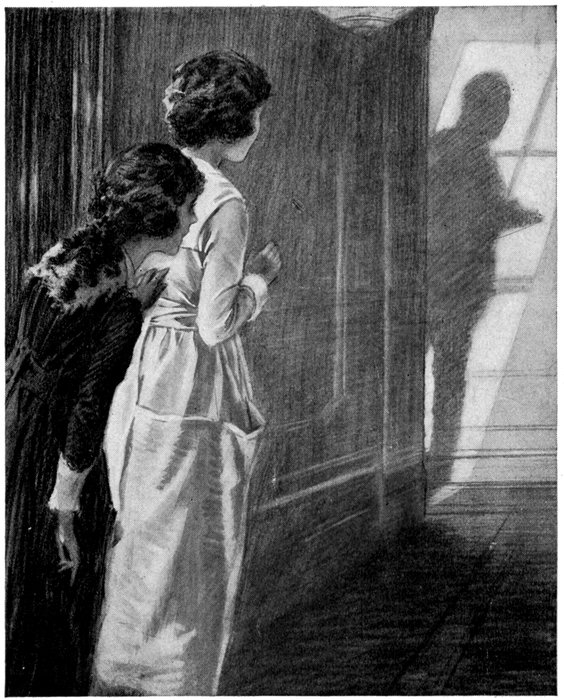
51The hall again was empty. But at the far
end of the corridor, where it turned into another,
the wall was illumined by a brilliant
patch of sunlight from some window out of
sight. And blackly on that patch of sunlight,
as on a lighted screen, was outlined the silhouette
of a man's form, and of something
else that he evidently carried in his hands.
"You see?" whispered Virginie, clinging to
Patricia spasmodically.
"Yes, I see!" answered Patricia.
The motionless silhouette was unmistakably
the form of Peter Stoger, carrying a tray.
CHAPTER IV THE CRIMSON PATCH
52
"I don't like it at all, somehow, and yet I
can't exactly tell you why." Captain
Meade shuffled the books and magazines on the
sitting-room table, rearranging them precisely
and absent-mindedly. On his forehead was an
anxious frown.
"But, Daddy," cried Patricia, "what possible
objection can there be to my being friends with
that lovely girl? She is so lonely and so sad!
I just love her already. Think what she has
suffered—and is still suffering! It seems as if
it would be simply cruel not to be friends with
her now, after what she has told me."
"But the very things you've told me about
her and your conversations with her make me
feel there's something strange about the whole
53affair. She's not as candid and open in manner
as I should like. She seems to be hiding
something all the time. And her relationship
to that Madame Vanderpoel appears singular.
She says the woman is her aunt, by marriage,
yet she doesn't seem to care to call her so. I
am deeply sorry for the girl, if her story is true,
as it probably is, but I feel as if there is much
that she is concealing. And I frankly confess
that I do not like this Madame Vanderpoel.
Why should she have told you that the girl was
ill with a severe headache, and then you go in
and find her in the best of health, apparently?
Things don't hang together, somehow."
"Well, what am I going to do?" demanded
Patricia, almost in tears. "Madame Vanderpoel
has invited me to go with them on a trip
to Creston Beach to-morrow and spend the day
with them there. I suppose she wants to do
something in return for my looking after Virginie
to-day. She spoke to me about it as we
passed her table to-night. You had gone on
54ahead to speak to Mrs. Quale. I told her I'd
ask you about it. Are you going to say I
mustn't go?"
The captain tugged at the end of his short
mustache and strode up and down the room
perplexedly. At length he spoke. "You
simply must trust me in this matter, honey, and
remember that I'm not an old tyrant, but just
a cautious Daddy, striving to do what is best
for us all. You will have an engagement with
Mrs. Quale to-morrow. Fortunately she suggested
to me this evening that perhaps you
would care to spend the morning with her and
help her select some wall-papers for her house
that is being rebuilt and decorated. And let
me offer just this wee bit of advice. See as
much as you want of this little Virginie when
you can be with her alone. She is a poor, forlorn
child who is suffering greatly—of that I
feel certain. And I believe there is no harm
in her. But avoid, if you can, any engagement
or invitation which includes the older woman."
55"Father, what do you suspect her of? What
are your suspicions about her?"
"I suspect her of nothing. I do not care
for her on general principles. Sometimes we
have only instinct to trust, and mine tells me,
just now, simply to be careful. That's all.
Now call her up on the 'phone and say you
will not be able to accompany them, and thank
her, of course, for so kindly thinking of you."
Patricia did as she was bid, and was answered
by Virginie, who said Madame Vanderpoel was
not there. "I'm so sorry that I'll not be able
to go, but Father had made another engagement
for me," Patricia assured her, and there
was a murmured reply over the instrument that
the captain could not catch. But when Patricia
hung up the receiver, her face was a study
in perplexity.
"What do you think she said, Daddy? 'I am
not sorry. I enjoy seeing you more by ourselves.'
That was all, but isn't it singular?
I don't believe she cares for that aunt of hers.
56And yet, I can't understand why. Madame
Vanderpoel seems lovely, to me, and she appears
to be so fond of Virginie. I'll take the
hint, however. And it fits in very nicely with
what you advised me to do, too. Oh, by the
way, Daddy, I nearly forgot to tell you what
happened this afternoon. And if you don't
think that Peter Stoger is spying, after you
hear it, I give up." And she described to him
the strange incident in the hall.
This time the captain did not laugh at her
fears. Instead, he frowned and looked worried.
"That does certainly seem suspicious.
I'll have to look into the matter," he vouchsafed,
and refused to discuss the incident
further.
In the two weeks that elapsed after the foregoing
incident, the friendship between the girls
increased, after a fashion, but Patricia was at
times sorely puzzled and perplexed by the
strange moods and whims and actions of her
57new companion. On one day they would be
in each other's company for several hours,
visiting in the Meades' attractive sitting-room,
where they read or sewed, or taking long walks
or trolley-rides into the country. On these occasions
Virginie would be almost clinging in
her confidence in, and affection for, Patricia.
Not the tiniest flaw would mar their intercourse,
and Patricia would acknowledge herself
more deeply interested than ever in this
attractive girl. Then on the next day, perhaps
for several days following, Virginie would
seem distant, reserved, morose, sometimes almost
disagreeable. She would pass Patricia
with the coldest nod, refuse to make any engagement
to be with her, and almost seem to
resent any advances toward the furtherance of
their friendship. Patricia worried and grieved
about it in secret, though she would not openly
acknowledge, even to her father, that Virginie's
singular conduct hurt her.
Madame Vanderpoel, on the contrary, always
58seemed most cordial and friendly, and
while she never commented on her ward's conduct
to Patricia, would often cast at her a deprecatory
and apologetic glance when Virginie
was more than usually disagreeable in manner.
Plainly, the girl's strange conduct tried her
sorely, though she was always very sweet about
it and ignored it whenever possible. Never
again, since the first occasion, had she attempted
to induce Patricia to accompany them
anywhere or spend any time in their united
company. Altogether, so thoughtful and
agreeable was she, that Patricia, more fascinated
by her than ever, often found herself
wishing that she were at liberty to see more of
this pleasant Madame Vanderpoel.
One rainy afternoon, Captain Meade having
gone out, to be away till a late hour that night
on a lecture engagement, Patricia called up
her friend on the house telephone to ask her to
come across the hall and spend the rest of the
day with her. She did this in considerable
59trepidation, for Virginie had been more than
usually morose and disagreeable and distant for
a number of days past. As it happened, it
was Madame Vanderpoel who answered the
'phone.
"Why certainly, my dear! Virginie will
come over at once," she replied cordially.
"She has been quite lonely this afternoon, and
wishing for something to do. You are very
kind."
Patricia had just begun to frame an answer,
when, somewhat to her surprise, the receiver at
the other end was suddenly hung up and the
connection cut. The action was very abrupt.
And though she told herself she certainly must
have been mistaken, she thought she had heard,
before being cut off, a voice in the room with
Madame Vanderpoel declaring, "I will not
go!" It was all very puzzling.
Virginie did not come in for some time, and
in the interval Patricia framed a resolution.
She would fathom this girl's singular conduct
60to-day or never, even if she had to ask the most
personal questions to do so.
When the little Belgian at last arrived, she
was polite, but distant, in manner, and distinctly
unhappy. To Patricia's cordial remarks
she returned only monosyllabic answers,
was restless and ill at ease. They were sitting
together on the couch, each pretending to be
deeply engrossed in her fancy-work, when Patricia
with wildly beating heart, suddenly determined
that the time had come to put her resolve
into effect.
"Virginie," she began, abruptly turning to
the girl, "won't you tell me what is the trouble?
What have I done to offend or annoy you?
You are often so strange in your actions toward
me. I cannot understand it. I—"
But she got no farther. To her intense
amazement and dismay, Virginie suddenly
threw herself across the couch in a passion of
wild and violent weeping. It was several moments
61before Patricia could soothe her back to
a state where she was able even to speak.
"Oh, I knew you would think this! I knew
it. I knew it!" she sobbed. "I knew the time
would come when I must explain—or lose your
friendship. If you only could trust me. If
you only knew—"
Patricia, at a loss for words, could only
squeeze her hand in silent assurance.
"But you never will know—and I never can
tell you!" she went on wildly. "I love you—I
love you—as I love no one else on earth now—beside
my father. Do you believe that?"
"I believe it if you say so," Patricia assured
her quietly. "I feel sure you are telling me
the truth." Her calm, soothing manner was
having its effect on the girl's hysterical
condition. Virginie herself suddenly became
calmer.
"I wish you would make a promise," she continued.
"If you knew my life and all that I
62have to endure,—all the puzzling, bewildering
things that are pulling me this way and that—things
that I perhaps can never tell you, because
they would concern others,—I know that
you would promise me this, never to care
whether my manner seems cold toward you;
never to think unkind thoughts of me, no matter
how I may act—to say to yourself always,
when I seem the worst, 'Virginie loves me; she
does not mean this mood for me!' Could you
make me that promise, Patricia? Some day, if
God wills, I may be able to explain."
"Indeed, Virginie," cried her companion,
sincerely touched, "I trust you every way and
always! I'll never be annoyed any more, no
matter how you act. I'll understand that it's
something quite outside of myself that is causing
it. Will that make you feel any better?"
Virginie did not answer in words, but the
grateful pressure of her hands was sufficient response.
The atmosphere having thus been
cleared, Patricia abandoned the subject and
63plunged gaily into something quite different.
"You told me once, Virginie," she began,
"that you had done a good deal of work in
water-colors at various times, but you have
never shown me any of your sketches. Have
you any here with you, and if so, could I see
them? I'm awfully interested in that sort of
thing, though I don't do much of the kind myself."
"Ah, yes!" cried Virginie, brightening at
once. "I have a whole portfolio in my room.
I will go to fetch it. I love the work, and I
turn to it whenever I have an opportunity."
She ran out of the room and hurried back with
a batch of color sketches that she spread out on
the couch. They were really exceedingly
clever, as Patricia recognized at once.
"Why, this is wonderful. You are a real,
out-and-out artist, and I never realized it before!"
she exclaimed enthusiastically. "I
dabble a little in that sort of thing myself once
in a while, but I'm not a great success. I do
64wish I had inherited some of father's artistic
ability. He can do beautiful work, but I only
just love it and admire it."
"Ah, your father is also an artist?" demanded
Virginie, interested afresh.
"Well, I don't know that I'd call him exactly
an artist," qualified Patricia. "He can
draw and paint 'most everything fairly well,
but he does excel in one thing. He's crazy
about it,—it's a regular hobby with him,—entomology,
you know, the study of bugs and
moths and caterpillars and butterflies, and all
that sort of thing. And he can make the most
beautiful sketches of them. Many's the day
I've gone on a long butterfly hunt with him,
and then have come home and watched him
make sketches of the specimens we've caught.
Just let me show you some of the things he's
done. I think he has a number of his pet
sketches in his trunk. He never travels without
them." Patricia brought her father's
sketches and placed them in Virginie's hands.
65And now it was Virginie's turn to exclaim
over the really beautiful work of Captain
Meade. There were caterpillars and moths
and butterflies, executed with consummate
skill and exquisitely colored; each labeled with
its own name and species. Virginie marveled
over their curious titles.
"Ah, but see here, what singular names—'The
Silver Spot,' 'The Red Admiral,' 'The
Painted Lady'! Why are they so called?"
"I think it's mainly because of the different
marking on the wings," answered Patricia.
"You see, each one—but what's that? Some
one knocking?" She ran to the door and
opened it. Madame Vanderpoel stood outside.
"Do pardon me," she began hesitatingly.
"I am making this little blouse for Virginie
and have just come to a place where I can go
no farther till I try it on. May I come in?"
"Why, surely!" returned Patricia, courteously,
and Madame Vanderpoel entered. As
Patricia had feared, however, there was an immediate
66chilling of the atmosphere as far as
Virginie was concerned. The girl said not a
word, but obediently, if ungraciously, slipped
the pretty blouse over her head and stood in
silence while Madame Vanderpoel made some
necessary alterations. The lady herself strove
to appear quite unobservant of the change and
chatted on brightly while she completed her
work. Patricia, bewildered and uncomfortable,
also tried to appear as though nothing unusual
was the matter. But she found the task
difficult. At length, Madame Vanderpoel, declaring
herself satisfied with the result, rose
to go. While passing the table, however, she
noticed Captain Meade's sketches, and, laying
down her sewing, stopped to examine them.
"Ah, what beautiful, what unusual work!"
she murmured, taking them up, one by one,
and asking Patricia some questions about them.
But at last she took her departure.
"Oh, by the way, may Virginie stay and
have dinner with me here in our rooms?" questioned
67Patricia, before she left. Madame
Vanderpoel gave her consent and was gone.
It was some time before Virginie recovered
her spirits after this interruption, but when she
was herself again, the two girls resumed their
now wholly delightful intercourse.
"Let's send down for some sarsaparilla and
fancy cakes!" suddenly cried Patricia. "I'm
hungry and thirsty, too, and it's a good while
till dinner-time." She telephoned her wish to
the office, and Chester Jackson presently
knocked at the door with the order.
"Golly!" he cried suddenly, catching sight of
the mass of sketches on the table, "but them's
purty things! You'd think they was the real
article lit all over the place. Can I look at
them?" Patricia laughingly gave her consent,
and he turned them over, chuckling at their
names. But he, too, at length departed, and
the girls were not interrupted further till
dinner-time, when Patricia asked to have the
meal served in the room.
68It was Peter Stoger who entered later with a
heavily laden tray, approached the table,
glanced about helplessly a moment, then
planted the tray directly on top of all the
sketches littered over its surface.
"Oh, be careful!" cried Patricia, in dismay.
"Don't you see what you're doing? Hold the
tray until I remove those things." Peter indifferently
lifted the tray while she hastily collected
the sketches and put them aside. Then
he stolidly resumed his work of arranging the
meal, and withdrew.
It was late when Captain Meade returned.
Patricia had been telling how she had spent her
day, and had just come to the part where she
had showed his sketches to Virginie.
"Great Jupiter! You did?" he cried distractedly.
"Why on earth didn't I warn you
not to! I never dreamed you'd be tempted to
do such a thing. Where are they—quick?"
Patricia watched him in a mystified daze as
69he nervously shuffled them over. What could
it all mean? Had she done wrong?
"It's just as I feared!" he groaned. "The
Crimson Patch is gone!"
CHAPTER V WHO TOOK IT?
70
It was a white-faced pair that finished a
frantic, but thoroughly fruitless search,
through every room of the suite for the lost
sketch of the butterfly. The captain was too
upset and nervous and unstrung by the occurrence
to comment on the subject, for a time,
and Patricia too bewildered and unhappy to
ask any questions. But when they had hunted
through every conceivable nook and cranny in
vain, they gave it up and sat down wearily to
rest. The Crimson Patch was gone!
"But, Daddy," moaned Patricia, "why did
you never tell me there was anything important
about these sketches? I never dreamed of
such a thing. I would never, never have done
what I did to-day if I had known."
71"That's just the trouble," muttered Captain
Meade. "There's nothing important about
any of them except just that one—and that's—well,
vital! I never told you about it, because
it's safer for you and best all around that you
know as little as possible of my affairs. Of
course, it never crossed my mind that you'd be
moved to show them to any one. They're not
a matter of general interest."
"But what is there about this sketch, the
Crimson Patch butterfly, that is so important,
Daddy, and why didn't you keep it safely
locked up? I shouldn't have thought you'd
leave it just lying loose in your trunk."
"The secret about this particular sketch, I
do not think it best for you to know, even now.
You'll always be in a safer position if you can
truthfully say you know nothing about it. It
looks very much the same as the others—but it
isn't! That is all I can tell you. And I had
an excellent reason for doing just as I did
about it. Had I kept an important secret always
72about my person, or even under lock and
key, it would, as a rule, be in far greater danger
of discovery than if carefully concealed in some
such fashion as this and left around as if there
were nothing unusual about it. Don't you understand?
But tell me again the whole history
of the thing, and who came into the room while
you had the sketches out, and when. We've
got to find the sketch as speedily as possible.
Every moment that it is out of my hands is a
dangerous loss of time."
Patricia patiently went over the history of
the afternoon, recounting every detail she
could remember. The captain listened intently,
and sat for several moments in deep
thought when she had finished.
"Tell me one thing," he suddenly demanded.
"Do you distinctly remember seeing the Crimson
Patch among the sketches when you first
looked them over? Think hard."
"Oh, I know it was there, because Virginie
spoke of the curious name and I told her it was
73given because of the two brilliant red spots on
the wings. I know it was there."
"Then, as far as I can see," went on Captain
Meade, "there were no less than four people in
the room, each of whom came in contact with
those sketches, and any one of the four may
have been the guilty party who took it. Your
little friend, Virginie, handled them first, and
when she left for the night, you say, she gathered
up her own sketches?"
"Daddy dear, you must not suspect her—you
simply must not!" cried Patricia, sensing
at once what he was driving at. "I would
rather be suspected myself than have any one
dream she could do such a thing. And how on
earth could she ever know that the sketch was
of any particular value, anyway?"
"What she may know or not know, I haven't
pretended to inquire, but you must certainly see
how easy it would be for her to slip the thing
into her own pile and walk off with it if she
wanted."
74"Her own sketches were all on the couch,"
protested Patricia, "and they never once were
near yours. I saw her get them together before
she left."
"But was your back never turned on her during
all the time mine were lying about?"
Patricia put her head down on the couch pillows
and sobbed audibly.
"It seems too dreadful and unkind and mean
to have such suspicions about her!" she wailed.
"Now, Patricia dear, be sensible!" demanded
the captain, despairingly. "I'm no more suspicious
of her than of any one else. I'm only
trying to sift the thing to the bottom. Let's
leave her, for a moment, however. You say
Madame Vanderpoel was the next one in. She
stayed about fifteen minutes, examined the
sketches, and went out. Tell me just exactly
what she did before she looked them over."
"She glanced at them as she was passing out,
asked me if she could look at them, placed her
75sewing on the table, looked at them all, took up
her sewing and went away."
"Did she put her sewing down near where
they were on the table?" asked the captain.
"Yes, because I remember that she had to
move it once, in order to see one or two that
were lying under it."
"Do you remember whether the Crimson
Patch was among those she looked at or commented
on?"
"No, I don't remember. I was busy taking
out some stitches in my fancy-work at the time,—something
that had gone wrong,—and I
didn't particularly notice what she said. But
I'm almost sure she didn't mention that one."
"She might very easily have concealed it under
her work and walked off with it," he went
on. "Of course, I don't say she did, but she
might have, had she been so inclined. Now,
how about Chester Jackson?"
"Oh, he couldn't possibly have taken a thing
76without my knowing it. He just leaned over
the table and looked at them all and giggled
and laughed over their names and said they
were 'bully good stuff.' I saw him practically
every minute of the time, except for two
seconds when I ran into my room for another
spool of thread. And he left without a thing
in his hands that he could have hidden it in or
under."
"The 'two seconds' you were out of the room
might have been sufficient for him," commented
Captain Meade. "So he isn't eliminated,
either. But I rather suspect him less than any
of the others. How about Peter?"
"He's the one, I haven't a doubt. I always
did suspect him of being up to something. Of
course he took it, Daddy! He went and set his
tray right down on top of the whole lot of them,
when he came in, in what I thought was the
stupidest fashion, and I made him take it right
up while I cleared them all aside. I believe he
could have slipped the sketch under his tray
77and kept it out of my sight and got away with
it without the slightest trouble. Can't you see
it, Daddy?" cried Patricia, eagerly. Captain
Meade looked only half convinced.
"Do you happen to remember whether that
particular sketch was uppermost when he came
in?"
"No, I don't honestly remember. But I
know that the Purple Dart was uppermost
when I moved them out of his way. It just
happened to catch my eye in passing."
"Well, that proves nothing, of course. But
the question now is, what in the world are we
going to do about it? I dare not do any telephoning
at this time of night (or rather, morning,
for it's three o'clock!) or even go out,
without exciting suspicion. And that's the
last thing I want to attract to myself. Better
have it appear that I care nothing about the
sketch than to raise a breeze about its disappearance.
I had thought that perhaps you
might find out from your friend the Belgian
78girl whether by any chance it had slipped in
with her own by mistake. But that must be
done later and done with the greatest caution or
the fat will be in the fire. And it's too late to
order anything brought to the room, or I might
have a chance to interview our waiter and bell-boy.
Nothing for it, I guess, but to go to bed
and get what sleep we can. It's been a bad
day's work, honey, but don't blame yourself for
a single thing. It's only one of those unpleasant
combinations of fortune that will happen,
plan as we may. And don't worry.
That never did any good yet. Go to sleep and
trust that everything's going to come out all
right!"
In spite of which injunction, however, no
sleep visited the unhappy Patricia for the remainder
of the night.
CHAPTER VI THE MYSTERY DEEPENS
79
During that sleepless night, however,
Patricia laid some plans of her own,
which she purposed to put into execution the
next day. She felt weary and lifeless after the
excitement and worry of the previous night and
the hours of restless tossing that followed.
Her father, likewise, seemed fatigued and depressed,
though he strove hard, for her sake, as
she privately surmised, to appear cheerful and
hopeful.
"We'll hurry through breakfast," he told
her, as they left the room, "and then I'll start
out on the hunt. I've been thinking over a
few of the possibilities during the night, and
some ideas have occurred to me that I didn't
think of at first. I want you to stay rather
close to the room to-day—that is, don't go out
80for any length of time till I get back. I may
not return before late afternoon, but don't let
that worry you. And don't lose heart, honey!
It will probably turn out all right. By the
way, when we get down to the dining-room,
please try to act as nearly normal as possible,
and as if nothing were wrong. It might be
fatal to let the world at large notice that all is
not as usual. And, of course, don't touch this
subject, as far as conversation goes, with a
forty-foot pole!"
His latter injunctions Patricia found rather
difficult to carry out. It was far from easy to
appear her usual care-free self when weighed
down with such a hideous burden of trouble.
If she hadn't felt the thing to be all her own
fault, unwitting though it was, she could have
borne it better.
Most difficult of all was having to face Peter
Stoger, who, in his usual leaden way, waited
upon them. His dull stupidity, she always
felt, covered a watchfulness, that being hidden,
81was more trying than if it had been open and
aboveboard. This morning she felt certain he
was watching them both, with a covert keenness,
when he thought himself unobserved.
The captain treated Peter in precisely the same
fashion as usual. Once only did she observe
anything unusual in his manner. This was
when the waiter, in passing behind him, brushed
his shoulder with the edge of his tray. It was
a trivial matter, and, so Patricia thought,
would, as a rule, have called forth no comment
from her father. But, rather to her surprise,
the captain turned on him with an impatient
gesture and the quite sharp remark, "Be careful,
Peter!" The man apologized almost
servilely and backed away.
"That shows how worried and tired and upset
Father is!" thought Patricia. "He doesn't
usually act that way over such a little thing.
He probably has his suspicions of that horrid
man, too. I'm afraid he's wishing he'd taken
my advice about him at first."
82Many times during the meal did she glance
over toward the table usually occupied by Virginie
and Madame Vanderpoel, hoping, yet almost
dreading, to see them. But the table remained
empty, nor did they appear at all in the
dining-room during that meal.
"Stay in the room as much as possible to-day,"
the captain again warned her before he
went away. "I don't want to think of these
premises being left free for any more queer
things to happen."
"I will, but may I see Virginie?"
"I don't see any reason why you shouldn't,
especially if it comes about naturally. It won't
do to seem to avoid these people, either. But
don't force any meeting, and above all things, I
hardly need warn you to say nothing about
what has happened. That would spoil everything."
For some time after her father left, Patricia
sat maturing her plans. See Virginie this day
she must, and she thought it could be effected
83in the most natural manner possible. She
would ask her to bring her water-colors and
sketches in again, and they would try to do
some work, she (Patricia) attempting to make
some copies of the sketches under Virginie's
direction. In some such natural way the conversation
might be led around to her father's
sketches, and she might have a chance to determine
whether the girl were at all involved in
this dreadful affair. Nothing about it need be
mentioned directly. Patricia felt sure she
could determine, from Virginie's manner, how
much she knew.
At ten o'clock she went over to the telephone
and called up the office, asking to be connected
with room 404. The reply she received, caused
her a veritable shock.
"The room is vacant."
"Vacant?" she demanded. "You mean that
Madame Vanderpoel and Mademoiselle de Vos
are out?"
"They have gone—left the hotel. They
84gave up the room this morning and went away
for good.... No, they didn't say where they
were going or if they intended to return."
Patricia hung up the receiver and crept over
to a chair by the window. A sort of black mist
seemed to float before her eyes and her mind
would register no impressions save trivial ones
for a long while. She was aware of the distant
roar of the city, borne across the more quiet
stretches of the park outside her window, of the
sparrows chattering in the branches, of the children
romping in the quiet walks, the honking
of an arriving automobile, and of little else.
Then gradually her numbed brain recovered
its normal action. Virginie and her aunt were
gone and without a single word to her, a single
farewell! Could their abrupt and mysterious
departure indicate any but one fact? After
the strange disappearance of her father's
sketch, what could it mean except that one or
both of them were guilty and they were trying
85to conceal it by flight? One or both of them!
No it could not be that Virginie was concerned.
She would never, never believe that. And yet,
if it were not so, why had Virginie gone away
without a single word to the friend whom she
declared she loved next best to her father?
Surely she could have managed to say a word
or two over the telephone, or scribble a tiny
note! Perhaps she had written a note and it
would arrive later in the mail. Patricia quite
brightened for a few moments, at the thought.
She would wait and see what the day's post
brought. That would doubtless explain.
The morning hours dragged by. The
weather was stifling and humid, and Patricia
sat by one of the opened windows of the darkened
room. Try as she would, she could not
keep her depressed thoughts from picturing the
darkest aspect of everything. How her pleasant
life had changed since yesterday at this
time, her bright hopes and plans collapsed like
86a fragile castle of cards! Who would have
dreamed such a calamity could have befallen
her?
At noon she telephoned down to the office to
ask for the mail, and also, as she felt no appetite,
requested that some crackers and a glass
of milk be sent up at the same time, to the
room. That was all the luncheon she felt she
could possibly manage.
Chester Jackson arrived with the letters and
her order a few moments later. The former
she shuffled over nervously and hopefully.
But they were only communications for her
father, and nothing at all for her. The boy,
watching her interestedly, noted the disappointment
in her face.
"Miss your side-partner, don't you?" he
queried.
"What's that?" she asked, absent-mindedly.
"You miss the mam'selle across the way a bit,
I figure. You and her seemed pretty thick."
"Yes, I do miss her very much," acknowledged
87Patricia, actually glad to have any one
to speak to on the subject. "But I'm awfully
surprised that she went away so suddenly. I
never even knew she was gone."
"You didn't, hey? Well, looka here! She
gave me a message to give to you—that is, she
meant it for a message, I reckon, only she
didn't get it all off her mind."
"Oh, what was it?" cried Patricia, excitedly,
her darkest suspicions of her friend vanishing
at once. "I knew she would want to send
some word to me."
"Well, it was this way. They sent down
word to the office they was leavin', and for some
one to come up and help bring down their hand
luggage. So I went up to get 'em. The
missus was bustlin' about good an' lively, but
the gal was sort of teary and not doin' much.
But when the little mam'selle handed me her
grip,—the t'other one's back was turned for a
minute,—she whispered to me low, 'Tell Miss
Meade I'm going—' But she didn't get no
88further, 'cause the other one turned round
quick like an' called me to come an' help her
strap a bag. An' from that time till they left
the place she never took her eyes offen the
young 'un, an' she never got no chance to
finish it up. But I thought I'd jest tell you
that much, anyway."
"Oh, thank you so much for that, anyhow!"
breathed Patricia. "But I can't understand
why she was afraid to say it right out and let
her aunt hear. It seems very strange."
"You needn't think that's the only queer
thing about that pair," he hinted darkly. "I
could tell you an earful if I chose!"
Patricia was just on the point of begging him
to do so, when some delicate instinct bade her
desist. Was it, after all, kind, or even honorable,
to pry into the affairs of a friend, to hear
"back-stair" gossip about them from a bell-boy
in a hotel?
"Well, thank you very much for delivering
the message," she remarked, "and please drop
89this letter in the mail-chute as you go out."
And after he was gone, curious as she had
been to hear what he had to say about them, she
was glad she had resisted the temptation.
The stifling afternoon dragged on. Patricia
found ample food for thought in the news she
had heard from the bell-boy, and spent the
hours in fruitless surmise. On one score at
least, she was relieved, almost happy. Virginie
had not tried to slip away without letting her
know she was going—perhaps she was trying
to tell her destination; perhaps she was promising
to write. But whatever it was, she had at
least tried to send her some word. But why
had her companion seemed to suspect it, to
make it impossible? If indeed, she had!
Why had not Madame Vanderpoel herself left
a pleasant message of regret at leaving, when
she had seemed so cordial, so friendly? Patricia
could not but admit that the action had a
very dark and suspicious aspect, after what had
happened the night before.
90And that brought her back again to her own
troubles: The Crimson Patch!—who had
taken it? Which one of the four that had had
access to the room last night had concealed and
carried it away? All of a sudden she sat up
very straight. There were not four—there
were only three! For beyond all question she
was certain now that Chester Jackson was in
nowise concerned in the matter. She could not
explain how she knew—she simply knew.
Something in that honest, snub-nosed, smiling
face, those candid, merry eyes, assured her.
Chet Jackson was unquestionably eliminated
from the subject, and the puzzle was reduced
to a triangle.
Half an hour later there was another knock
at the door and Chester, re-appearing, presented
her with a special delivery letter. He
stood informally watching her while she tore it
open and read it breathlessly. It was from her
father, written that morning from New York,
and it told her that he thought he was on the
91track of something that seemed important.
The matter would keep him over night,
but she must not be alarmed. She was to
put herself in Mrs. Quale's care from dinner-time
on, and he would return the next day
and tell her all about things. That was all.
Though he had touched on nothing directly,
Patricia was certain, of course, that he referred
to the matter of the Crimson Patch. She was
glad that he seemed to be in the way of discovering
anything at all that would lead to the
unraveling of their difficulty, but she felt suddenly
very forlorn at the thought of his being
away over night for the first time. And Chet,
watching her keenly, saw her face fall.
"Any bad news?" he inquired casually.
"No," she replied, rather pleased to have
some one to talk to, so lonely had been her day.
"Father's going to be away over night on some
important business. I'll miss him awfully."
"Say!" ventured Chet, in a confidential tone,
"I ask your pardon for speakin' about it, but
92you folks have had some trouble since yesterday,
haven't you?"
Rather startled, Patricia nodded her head.
Then she looked alarmed, to think that, by even
so much, she had revealed something of her
father's secret.
"Never you mind!" Chet assured her.
"Don't get scared because you think you're
giving anything away. I know a heap more
than any one thinks I do." And at her amazed
expression, he added:
"I'm goin' to tell you somethin'. It's a
secret and don't you let on to anybody. I ain't
goin' to be a bell-hop all my life, I ain't. I
got ambition, and this here hotel life ain't for
me."
"What—what are you going to be then?"
stammered the astonished Patricia.
"I'm goin' to be a detective or a secret service
agent or somethin' like that. I got it in
me, I have. Sort of sense things out an' nose
'em down when no one suspects I'm anything
93but a 'buttons' in this here hotel. It's great
sport. You see, not suspectin' I got more'n
enough sense to carry me through the day's
work, folks lets out a lot of things before me
that they think I don't catch on to, an' I see a
whole heap I'm not supposed to see. An' this
here war has made a lot of lively doings about
this place, I can tell you."
Patricia listened breathlessly. Here was
confirmation of her own ideas, and more. Chet
Jackson, beside being undoubtedly innocent of
any complicity in the matter of the Crimson
Patch might even become a valuable ally, if
she did but dare to enlist his aid. She suddenly
decided on a bold move.
"Chester," she said, "if you're going to do
any detective work, try and do a little for us.
The only trouble is, I can't tell you anything
much about things, because they are very, very
important secrets. So I don't know how
you're going to get to work on it."
"Don't worry about tellin' me so much. I
94know a whole lot about you folks that you
don't think I do. You'd be s'prised if I told
you how much I do know!" Chet assured her
darkly. "I gotta go now, because I been away
from the office long enough. But next time I
see you I'll tell you what I know an' we can
decide what I'd better do. So long!"
And he was gone, leaving her in a maze of
wonder over this new development.
CHAPTER VII LEFT ALONE
95
Patricia went back into the room and
sat down to think it all over. Chester
Jackson's curious remarks had disturbed her
strangely. What he had said about knowing
"a heap more about things" than any one
thought he did was a little alarming, to say
the least. What did he—what could he know
about her father's affairs, and how could he
have found it out? If only he had time to
tell her before he rushed away, and not left her
with this bewildering scrap of information!
However, one thing was becoming every moment
more certain in her mind. The boy was
innocent of any part in the disappearance of
the Crimson Patch, and might, besides, be enlisted
as an ally in its recovery, if only she dared
96to confide in him more fully. She wished with
all her soul that her father were with her, that
he was not to be detained away over night.
She wanted to talk it all over with him, to ascertain
how much he thought it wise to trust
this boy. But he was not here, and presently
she must go and put herself in the care of Mrs.
Quale for the night. Even now she ought to
be calling up that lady on the telephone, as it
was nearly dinner-time.
She went to the telephone and asked to be
connected with Mrs. Quale's room. The reply
she received caused her a veritable shock.
"Mrs. Quale came in a while ago and then
went out again, saying she would be away over
night in New York."
Patricia hung up the receiver and sat down
in the nearest chair with a little, frightened
shiver. She would be alone over night, in this
big, strange hotel, surrounded perhaps by unseen
and unknown enemies. Oh, if she could
only communicate with her father and urge him
97to come back at once! But that was not possible.
He had said he was in New York, but
had given no address, probably because he was
hurrying about from place to place and did not
intend to stop anywhere for the night. It was
certainly unfortunate that Mrs. Quale had
elected to be away at the same time. Well, it
was too bad, but it was not fatal. In all probability,
nothing unforeseen of any kind would
happen. There was no reason why it should.
Suddenly a bright idea came to her. If Mrs.
Quale's maid, Delia, had not accompanied her
mistress to New York, why would it not be
possible to ask her to come down and spend
the night? Her companionship would be better
than none at all. In the long weeks of her
intimacy with Mrs. Quale, Patricia had grown
to realize that Delia was becoming rather fond
of her, in her queer, taciturn way, and would
probably be glad to be of any help. She decided
to go upstairs now to see her and talk it
over.
98Her interview proved rather a difficult one.
Patricia had not Mrs. Quale's ease in communicating
with a deaf person, and it was some
time before Delia understood what she was
driving at. And even when she did, there was
hesitancy.
"I've a bad earache to-night," she averred,
"that's why Mrs. Quale didn't take me with
her. I have it quite often. I'm afraid I
won't be much company for you, Miss Patricia,
and I wanted to go to bed pretty early."
"Oh, I'm not going to stay up late!" cried
Patricia, "and, of course, you can have Father's
room. I just want you to be there near me.
Father would be dreadfully upset if he thought
I was here alone."
"Very well, then," Delia consented at last.
"To be sure, I wouldn't have you worried, nor
the captain worried about you, even if I am too
miserable to hold up my head. I'll be down
at half past eight. I've things that will keep
me busy till then."
99After that, Patricia decided to worry no further
about the matter, dress for dinner, go
down to the dining-room, and take her meal
as if she expected her father at any minute.
After that, she would read and sew and write
some letters and go to bed as usual. The sensible
resolve steadied her. She put on her
lightest and coolest attire, for the evening was
still very hot, and at a very early hour went
down to the dining-room. She wanted to have
this ordeal over as speedily as possible, for she
dreaded sitting at her table alone and being
waited on by Peter Stoger.
To her intense surprise, he was not there.
She was served by another waiter, and Peter
did not appear during the entire meal. Where
in the world could he be? She ventured to
question the new attendant about the usual
waiter, but received only the reply that he was
away for the day. It was certainly all very
mystifying.
After dinner, which passed without any
100unusual happenings, she went into the
lounge, supplied herself with some new magazines,
and hurried away to her room. The absence
of Peter Stoger disturbed her more than
she cared to admit, even to herself. She disliked
and feared him enough when he was present,
but in his absence he seemed positively terrifying.
She sat down by the window in the
gathering twilight to think it all over.
Three of them gone—the very three on
whom suspicion rested most heavily! The
Crimson Patch gone with them. Her father
gone too, involved in who knew what troubles,
what difficulties, in his search. What was this
strange Crimson Patch, anyway? Patricia
shut her eyes tight and strove to call up the
image of the sketch as she had seen it last. It
was nothing, it was absolutely nothing but the
cleverly executed sketch in water-colors of a
peculiar species of butterfly with a bright crimson
spot on each lower wing. There was nothing
about it that was different, nothing that she
101could remember, to distinguish it from the
many other sketches in her father's possession.
That it could harbor any secret, and
especially any government secret, seemed absolutely
absurd. And yet—it must be so.
Then her mind wandered back to Virginie.
Where was she now? What had she tried so
hard to communicate in that broken, incomplete
message to Chester Jackson? Would they
ever see each other again? In twenty-four
hours, life had suddenly assumed a very complicated
aspect to Patricia. She could scarcely
realize now how happy and care-free she had
been last night at this very hour. It did not
seem as if she could be the same person, so
many were the perplexing problems on her
mind.
And this brought her thoughts back to Chester
Jackson. She must see him again, as soon
as possible, and discover what it was that he
knew about herself and her father and his affairs.
She would call up the office and ask to
102have something sent to the room. So determined,
she switched on the lights, went to the
telephone and asked to have some of the hotel
stationery sent up. There was nothing else she
could think of, just at the moment. The knock
at the door a few moments later sent her flying
to it, her mind full of the questions she planned
to ask. To her intense chagrin, it was another
bell-boy who brought the paper.
Scarcely able to murmur her thanks, she
turned back into the room and shut the door.
Had Chester, too, deserted her? What could
possibly have happened? It was the first time
she could remember that he had not personally
answered the summons. If he had also, for
some inscrutable reason, left the hotel on this
fateful night, she would certainly feel herself
to be deserted of all mankind.
CHAPTER VIII A PIECE OF PAPER
103
Delia having appeared at the time
agreed on, and promptly withdrawing to
her own room, Patricia continued to worry for
an hour and a half over the problem
that was perplexing her, trying vainly to
write letters or concentrate her mind on a
book. But it was useless, and at length she
determined to put an end to her misery and
suspense, in that direction at least, and ring for
something else. If Chester Jackson did not
answer this time, it would mean that he too had
gone or been removed, and that she was left
without a single friend to rely on.
So once again she telephoned, this time for
ice-water, and waited in breathless suspense for
the answering knock. The curly head and
104merry eyes of Chet Jackson at the door was
like a bracing tonic to her overwrought nerves.
"Oh!" she quavered. "Whatever happened
to you? I thought you were gone, too."
He gazed at her in unfeigned astonishment.
"I don't get yer!" he remarked. "There ain't
nothin' happened to me!"
She explained her agitation, and he laughed
unfeelingly. "Gee! I gotta eat sometime or
other. An' half past seven's about as early as
I can usually strike it. You hit my supper
hour, miss!"
She laughed in relief and followed Chet as
he came into the room to place the tray on the
table.
"Chester, I want to know the rest of what
you were trying to tell me this afternoon.
What is it that you have found out? And how
have you discovered things?"
He glanced about the room cautiously, then
tiptoed over and closed the door into the hall.
"You can't be too careful in this place," he
105said apologetically. "I'll tell you all I can in
the little time I can spare, an' if I don't have a
chance to finish it now, I will come some other
time. I bet you'll hardly believe me, but I
knew before ever you folks landed here that
your dad—beg pardon!—that the captain was
comin' here an that he had something secret an'
important for the Gov'ment up his sleeve."
Patricia started involuntarily. "How—how
did you know that?" she stammered.
He grinned. "I told you I could make you
sit up an' take notice. Now I guess you'll
believe me! Well, I doped that out from the
conversation of two gents who had a room here
for a couple of nights an' left the day before
you came. They was sending for things constant,
eats and drinks an' what not,—an' I was
kept runnin' to their room as reg'lar as clockwork.
I got onto the fact that they was on the
watch for some one from one or two things
they said before me. They seemed to think I
was deaf or dumb or hadn't any brains, just
106because I was only a bell-hop, an' you bet I
acted the part all right. So they often talked
right out before me, seemin' to think I
wouldn't take it in.
"Once, when I came in, one of 'em was
sayin', 'He's a captain in the army, but he's
not on active service 'cause he's been wounded;
but I got word from headquarters he's doin'
something worth lookin' into. He's comin'
here in a day or two. He's got to be watched
an' watched hard. He's camouflagin' it, too,
with some lecture stuff or other, but that don't
count.' 'Nother time, one of 'em says: 'He
arrives to-morrow, so we'll disappear to-night.
But it's all right. Franz is on the job, and so
will Hofmeyer be, after to-morrow.'
"Well, there was other things, too, little
things I can't remember now, but I says to
myself, 'This here looks shady, Chet; better
get on the job an' do a little detectin' work
on your own! I didn't know this 'captain'
from Adam, but I hate to see any one get done,
107especially by a pair of Huns, like them two
looked, so I decided to keep my eyes open.
Well, sure enough, them two gave up their
room the night before you came, an' I've never
laid eyes on 'em since. The next day you arrived,
an' I just naturally cottoned to you
both right away. You're the right sort. You
don't act as if a bell-hop was made of wood
an' hadn't any brains or any feelin's either.
You treat 'em like human beings. An' your
dad—I mean your father—gee! I could lie
down an' let him walk all over me if he wanted
to!
"An' I made up my mind more than ever
that I wasn't goin' to let any one put it over
you two if I could help it. So I kept my eyes
open an' managed it so's I could answer most
of the calls in this corridor. An' I've seen a
few little things that would bear lookin' into."
Patricia had stood drinking in this information
with swiftly beating heart. "Chester,"
she exclaimed softly, "this is fine of you, and I
108appreciate what you have done more than I can
tell you, and so would Father if he knew! But
tell me, who is this 'Franz' and 'Hofmeyer'?
Have you discovered that? I have a special
reason for asking."
"There ain't any one in this place who goes
by either of them two names," he replied, "but
of course that don't count. Naturally, they
ain't the names any one would hand in here.
But I got my suspicions about one person in
this here hotel, an' I think I don't have to give
you a hundred guesses who, either." He
looked at her meaningly.
"You—you mean the waiter, Peter Stoger?"
she hesitated.
"You said it!" he remarked succinctly.
"He's a shady one, all right! Say, if you'll
believe me, I seen him once without his gilt
teeth—"
"What?" gasped Patricia, incredulously.
"Yep, they was nothin' but a set of false
caps, fit on over his real teeth. He was hurryin'
109down the hall from his room, an' I guess
he'd had 'em off an' forgotten 'em. After I
passed him, I looked back an' saw him take
somethin' out of his pocket an' raise his hands
to his mouth. Oh, he's slick, all right! An'
that funny droop in his eye, too. Once in a
while he ain't got that, either. He can do it
himself somehow or other. They're both just
disguises, that's all. An' I bet my hat he's
either Franz or Hofmeyer, for looka here: he
came the same day you folks did."
"Oh, I knew it!" sighed Patricia. "I knew
there was something wrong about him. I've
felt it all along. But tell me, Chester, one
more thing. I must ask it, though I hate to.
Have you ever discovered anything—queer
about—about Madame Vanderpoel and—and
Mademoiselle de Vos? I hate to ask it about
them, but—but I have a reason."
"They was a curious pair, all right," replied
Chet musingly. "An' I could never rightly
make 'em out. At first I was on to 'em good
110an' proper, because the madame had her room
changed from one on the next floor to down
here right opposite you. An' she sure did act
queer to that little mam'selle; or at least the
mam'selle acted queer to her—as if she just
couldn't stand her. But I never saw the madame
act ugly to her till to-day when she
wouldn't give her a chance to send you that
message. I watched 'em like a cat, but I never
saw nothin' that made me suspicious that they
was harmful to you folks, an' you seemed to
cotton so to the little mam'selle. But there
was somethin' always that seemed to me blamed
funny in the way she hated that madame, an'
it used to make me want to find out why.
"But say, I gotta go down now. I don't
darst stay here another minute, this trip. But
before I go, I'll tell you this much. After
that pair left to-day, I had an errand on this
floor, an' I just sauntered into their vacant
room a moment, before the chambermaid
cleaned it up, to have a look around. They
111hadn't left nothin' of interest, that I could see,
except just this. I found it in the waste-basket.
Maybe you'd like to have it."
He thrust a piece of torn and crumpled paper
into Patricia's hand and was gone before
she had time to say another word.
CHAPTER IX A MESSAGE IN THE NIGHT
112
Patricia took the crumpled scrap of
paper to the table and smoothed it out under
the lamp. It was a single sheet and was
torn almost in two, one way across and partially
along all its edges, as if an attempt had
been made to destroy it, an attempt that had
not been totally successful, probably because
the paper was rather thick and tough. It
looked very much as if some one had tried at
first to tear it in pieces, and, not having succeeded
in this, had simply crumpled it and
thrown it away. The writing was in a fine,
cramped, almost foreign-looking hand. And
the note, for such it appeared to be, was un-addressed,
beginning abruptly, without a name,
and signed at the end with only an initial.
113Patricia read it through wonderingly. It ran
thus:
"Mary and George have arrived. Heard
they got home yesterday. Can it be true?
Let no circumstances detain you. Need I say
more to you? If they stay in town while here,
I can no longer visit them. We go out every
week to see cousins. Their house is quite new
in the suburbs. See Hanford before you
leave. At a store there once had good cream.
Meet Mary soon and you will find Josephine
there.
"F."
"Well of all the silly letters!" thought Patricia,
after the first reading. "What can it
all mean? Of course, it refers to people and
circumstances I don't know anything about, but
even so, it sounds sort of scrappy. I wonder
why Chet wanted me to read it? I suppose I
really shouldn't have done so. I feel as if I'd
been prying into some one's affairs in a rather
horrid way, reading the letter they thought they
114had destroyed. I suppose it was one of Madame
Vanderpoel's. It isn't in the least interesting,
anyway, and I do wonder why Chet
saved it and asked me to read it. All I get
from it is that somebody 'arrived' and she had
to go, probably to meet them. Perhaps that
explains why they left so suddenly. Well,
Chester will have to explain later why he
thought it worth showing to me."
Then her mind reverted to the strange, unnerving
revelations the boy had made concerning
her father, the unknown pair who had
known so much about his affairs and had left
before they arrived, and the terrible Franz and
Hofmeyer who had doubtless been spying on
them all the time, and who, even now, were
probably in possession of the Crimson Patch.
And Peter Stoger—spy without doubt and a
disguised one at that—confirming her worst
suspicions of him! By what a hideous net they
were surrounded! And her father did not even
know all these details. How helpful they
115might be to him in his search, if she could only
put him in possession of the facts. But that
was impossible till he was with her again in
person. And meantime, there was all this long
night to be got through, without her father
to share her anxiety.
She took up the crumpled note once more
and read it again, critically. At the second
reading it struck her as even more foolish and
disjointed than at first. It really meant very
little when boiled down to the bare facts. It
seemed scarcely possible that Madame Vanderpoel
could find any very informing news in it.
While she was still studying it, the telephone
rang with a sudden shrillness that caused
her to jump, and she hurried over to take down
the receiver.
"Hello! hello!" she heard from very far
away. "Is that you, Patricia?" And she
recognized her father's voice.
"Oh, yes, yes, Daddy! Where are you?
Are you coming back to-night?"
116"No, I cannot do that," came the answer.
"I called up to see whether you were all right.
I was a little worried about you. How are
you getting on?"
Patricia was on the point of telling him all
her troubles and her loneliness and the absence
of Mrs. Quale, when something stopped her.
Her father was having far heavier worries of
his own. Why should she burden him with
these lighter ones? It would help him far more
if she put a brave face on everything and answered
him cheerfully, so she summoned all
her courage and answered brightly:
"I'm all right, Daddy. Fine as a fiddle.
But tell me, are you succeeding? Have you
had any luck?"
"We've struck something that looks very
important," he returned. "But I'll have to
tell you, dear, that it may keep me away another
whole day, and possibly even over another
night. You must get along somehow. Keep
Mrs. Quale close to you. Tell her it's very
117urgent. I'll call up to-morrow night, if possible,
but I may not have another chance before
that. Now I must stop, for this is long distance
and costing like Sancho. Can you manage,
honey?"
"Yes, oh, yes!" she assured him in a voice
from which she tried to keep a quaver of fear.
"Then, good-bye!"
Patricia hung up the receiver and walked
back to the table in a daze. Not a single
chance had she had to tell her father some of
the important details revealed by Chester
Jackson; and even if the chance had presented
itself, she doubted if it would have been wise
to divulge them over the telephone. But if her
father were on the track of any important discovery,
perhaps it was just as well that she
had not. And by the way, he had said, "we've
struck something!" now what in the world
could he mean by "we?" She had not supposed
that he would admit any one else into the
secret. Well, it was all very mysterious, and
118it was growing more so every moment. And
he was to be away at least twenty-four hours
longer!
Again her glance fell on the foolish and disjointed
little note lying on the table, and it
vaguely disturbed her. Its very lack of meaning
held something sinister in it. She looked
at her watch and took a sudden resolution. It
was not yet quite ten. She must see Chester
Jackson once more before he went to his own
home for the night, and she remembered that
he had said he went off duty at ten-thirty.
"I don't know what the hotel people will
think of my wanting so many things," and she
smiled rather ruefully, "but I don't very much
care. This is too important." She went to
the telephone and ordered a glass of milk and
some crackers to be sent up.
Jackson arrived in a few minutes with the
tray and a broad grin.
"I thought you'd be needin' something else
after a while!" he remarked, as he placed the
119tray on the table. "Make anything out of the
nice little note I handed you?"
"Why no. It seems to me simply crazy.
There doesn't seem to be any sense to it, not
even if one knew all the people and circumstances
it referred to. Can you make anything
of it?"
"I didn't at first," he replied; "but I just
naturally doped it out that there was something
shifty about it. So I took it all to pieces, and
put it together again, and turned it every which
way, and all at once I got on to it. You can
just bet it means something, and something
pretty slick at that!"
"Oh, tell me. Tell me quickly!" cried Patricia.
"How did you find it all out?"
"Well," began Chet, plainly enjoying very
much his rôle of Sherlock Holmes, "there was
just one word in the thing that made me sit
up and take notice. And that word was 'Hanford.'
Do you know what Hanford is?"
Patricia shook her head.
120"Well, it's a little two-cent hole of a town
about ten miles from here. Nothin' special to
it at all, just a little, one-horse country town
with about thirty houses and a couple of hundred
inhabitants. There ain't any reason on
this livin' earth why any one should 'see Hanford,'
because there ain't nothin' in it to see!
So I just shied at that, I did. An' I took
Hanford as a startin' point, an' I turned and
twisted that note inside out and upside down
till, all off a sudden, I struck it! I gotta go
now. I got another call to tend to on this
floor. But you just take that note and put a
pencil mark under every fourth word and copy
them out afterward an' see what you get. I'll
be back after a while to get this tray. Don't
forget—every fourth word!"
When he was gone, Patricia got a pencil
and paper and did as he had instructed her.
She counted off every fourth word in the letter,
underlined it, and feverishly copied down the
sequence. The result caused her to drop her
121pencil and sit staring at the paper, while a
shiver of fear ran icily down her spine. The
reconstructed letter ran:
Have got it. No need to stay here longer. Go
to house in Hanford at once. Meet you there.
F.
The meaning of the communication was only
too clear.
Ten minutes later there was a knock at the
door and Chet reappeared. He only glanced
at the sentences she had written and remarked:
"Guess that made you sit up and take notice,
didn't it?"
"Oh, Chester," she moaned. "It's awful!
It just confirms my worst suspicions. Do you
suppose some one sent it to Madame—Vanderpoel?
Who—who could it have been?"
"We can be pretty plum sure of one thing,"
remarked Chet. "The note is signed 'F' an' it
don't take much guessin' to dope out that F
stands for Franz; but who Franz is, unless it's
that slick Peter Stoger, I can't guess. But as
Peter has lit out too, we wouldn't be so far
122off to take it for Peter, I fancy. But say,
Miss, will you pardon me if I ask an awful
personal question? Did you folks lose anything
or miss anything before last night? If
you haven't, I don't quite get what it means
by those words, 'Have got it.'"
Patricia thought hard for a moment.
Should she or should she not confide in this
boy the secret she had been guarding for her
father? What would her father wish her to
do? It was plain that he knew a great deal
about their affairs already, and was as honest
and straightforward as even her father could
wish. Perhaps, too, he might be of infinite
help in unraveling the tangle. She would risk
it. She would risk all and tell him. But she
felt firmly convinced that the risk was not very
great.
"Yes, Chester," she acknowledged. "We
have missed something—the most important
thing my father has. You wouldn't think
123so to look at it, for it is only one of those pretty
sketches of butterflies that you were looking at
yesterday. I didn't know about it at the time,
or I wouldn't have left it around; but sometime
during that afternoon or evening it disappeared,
and Father is almost frantic about it.
He is off hunting for it now, and has been ever
since morning. I—oh, I just hate to think
that Madame Vanderpoel or Mademoiselle de
Vos took it or were in any way concerned with
it. I—I think an awful lot of Mademoiselle
Virginie. We—we were friends."
Chet scratched his head and thought deeply
for several moments. "Which sketch was it,
if I may ask?" he said at length.
"The one called the Crimson Patch," she replied.
"Do you remember seeing it?"
"You bet I do!" he cried enthusiastically.
"I remember that one particular because it had
a queer name and was such a purty one. Gee!
that proves one thing, at least. It didn't disappear
124before I come in, so the responsible
party must have come afterward. Who was
in here later?"
"Why, only Peter Stoger and Virginie.
But she didn't take it, I know. I will never,
never believe such a thing of her!"
"Sure she didn't!" agreed Chet. "It must
have been Peter. Of course it was Peter, don't
you see? 'Cause if he's Franz, he sends a note
afterward to the madame that he's got it, an'
they all beat it out of here. Can't get it any
straighter than that!"
"But what has poor little Virginie to do with
all this?" wondered Patricia, distractedly.
"Surely—surely she can't be working with a
lot of horrid spies. What is the explanation?"
"You can search me!" rejoined the boy. "I
ain't on to the dope about that little mam'selle
an' never was. She's a plum deep mystery,
she is. But one thing is sure—"
At that moment the telephone bell rang
again, and they both jumped nervously. Patricia
125went to it and took down the receiver.
There was a faint, "Hello!" to which she responded,
and then silence.
"Why, that's queer!" she said in an aside
to Chester. "Nobody seems to answer. And
the voice that said hello first seemed so faraway
and scared—"
"Hello! hello!" she exclaimed again, turning
to the receiver. "Yes, yes, this is Patricia....
Oh, Virginie! is it you?... Oh, I can't
hear you very well. Can't you speak a little
louder?... You can't?... What is that
you say?... You want to warn me....
What about? I don't understand.... There
is danger?... Who is in danger?... I am?...
We both are?... Oh, can't you tell me
more plainly? Where are you?... You
are ... where?"
"Oh!" cried Patricia, turning to the listening
boy. "She hung up the receiver without telling
me!"
CHAPTER X A COUNCIL OF WAR
126
They stared at each other a moment in
bewilderment. It was Chester who
spoke first.
"Are you sure it was the little mam'selle?"
he questioned. "Did it sound like her voice?"
"Oh, it was Virginie! I'm absolutely certain
of it. I'd know her voice a thousand miles
away. But what does it all mean? She says
there is danger—that both she and I are in
danger, and she was trying to warn me about
it. But she spoke so low, and she hesitated so,
and then, just as she was going to tell me where
she was, there was the click of the receiver being
hung up and not another word. What
does it mean?"
"It means," affirmed the boy, after some
127thought, "that the little un was speakin' to you
over the 'phone on the q.t., an' she was probably
scared stiff for fear she'd be caught, an'
she had to leave off before she'd finished because
some one was comin' along or somethin'.
That's the way I figure it."
"I believe you're right!" declared Patricia.
"That's just the way her voice sounded—'scared
stiff,' as you say. But what on earth
are we going to do? She's in danger and we
don't even know where she is; and I'm in danger
and I'm here all alone, except for Mrs.
Quale's Delia, who is with me for to-night.
It's dreadful. Just dreadful! I don't know
which way to turn. I'd call up the police and
put the thing in their hands if I dared. But I
don't dare. It would spoil everything for
Father if anything about this secret became
generally known, and I don't even think I
ought to speak to the hotel authorities for the
same reason. What am I going to do?"
"Looka here, Miss," began Chet, quietly, "I
128believe we can fix things pretty near to all
right. If you'd just be willin' to trust the
matter to me. I know I'm only a bell-hop, but
I know a whole heap more'n most folks think
I do; an' bein' only a bell-hop is the very reason
I can go and see an' do a lot that others
couldn't, just cause nobody's suspectin' I'm
up to anything. Do you get me?"
"Y-yes," faltered Patricia. "I think I see
what you're driving at and I really trust you
absolutely. But what is your idea? What do
you think had better be done?"
The boy seemed to grow an inch taller with
pride at Patricia's assertion of her faith and
trust in him. His snub-nosed countenance
fairly beamed. "Well, here's my idea. I
gotta go off duty pretty soon an' go home. I
oughtn't to be hangin' around here now. I'll
get what-for down in the office for bein' away
so long, anyhow. But I don't care. All in
the day's work! Now, I figure it this way.
129There ain't anything dangerous goin' to happen
to you to-night in this here hotel. You're
as safe as a church here as long as you keep
your door locked. If you feel nervous, better
sit up as long as you can, an' read or something.
Then if you should see or hear anything
queer, call right down to the office on the
'phone. You'd have the house detective up
here so quick it'd make you blink.
"But I'll tell you what I'll do besides. I'll
beat it home as fast as I can (I don't live so
very far off) an' let my mother know where I
am. Then I'll take my motor-cycle (the one
I bought for thirty dollars an' put in order an'
it runs like a bird!) an' I'll cruise around all
night. An' every once in a while I'll turn up
in the park right below your windows an' hang
around a while an' whistle, 'It's a long, long
trail.' You'll hear me plain enough, for
you're only on the third floor. An' if everything
ain't goin' all right, pull the shade clean
130up to the top, an' I'll know somethin's wrong
an' butt in here an' make it hot for every one
generally."
"Oh, Chester, that's awfully good of you!"
sighed Patricia, in mingled admiration and relief.
"It will make me feel lots easier. I
know I can't sleep a wink, so I might just as
well sit up and try to read or sew. I'll keep
the lights full on, and I'll follow your advice
about calling up the office if I think everything's
not all right. But it will be such a
comfort to know that you will be nearby once
in a while. Only it doesn't seem as if you
ought to be up all night when you've got to
work to-morrow."
"Don't you mind about me!" he assured
her. "To-morrow's my day off, an' I don't
have to show up here at all till ten-thirty P. M.,
when I go on night duty. You know I have
one day a week."
"But, Chester," cried Patricia, in fresh
alarm, "then I shall be all alone here to-morrow,
131for Mrs. Quale may not be back till night,
and I'm sure Father won't. I suppose I'm
silly, but this thing is so dreadfully mysterious
and—and uncertain that I'm just as much
afraid of it in the daytime as I am at night."
"You just quit worryin' about to-morrow,"
admonished Chet. "I got a scheme up my
sleeve for to-morrow, but you'll hear more
about that from me later. All I say about to-morrow
is this: go down to breakfast as usual
and as early as possible and ask for your mail
at the desk before you eat. Then we'll see
what to do next."
"But," objected Patricia, once more, "what
about poor little Virginie? She is in danger
too—and we don't even know where she is or
what the danger is. Yet I feel as if we ought
to do something about it. It isn't right to
leave her, is it, without trying to do a thing—"
"You just leave the little mam'selle's affairs
to me too, for to-night, an' don't worry about
'em no further," interrupted the boy. "I ain't
132got time to tell you all I plan to do, but you
can bet your boots I ain't goin' to be idle.
Good night, an' don't forget to go to breakfast
an' get your mail early!"
And Chester Jackson retired, closing the
door behind him.
CHAPTER XI AN ADVENTUROUS MISSION
133
The endless night was over at last.
Through her windows, which faced east,
Patricia noticed that the sky was faintly
streaked with pale light, each moment growing
more distinct. She had endured almost seven
hours of unbroken, nerve-racking suspense, yet
nothing alarming had happened. All night
she had huddled in a chair by the living-room
table, the electric lights full on, even to the
farthest wall-bracket, listening breathlessly to
the faintest creak or rustle, starting terror-stricken
at a sudden flapping of the window-shade,
crouching rigid at the slightest footfall
outside her door.
Yet the cheering whistle of the war's most
popular tune, every hour or so, in the park below,
134assured her that Chet was true to his
promise, even if the loud chugging of his motor-cycle
had not likewise informed her of his
intermittent presence. He was certainly proving
himself a friend, and a staunch one, in this
time of her dire need.
With the coming of daylight she turned off
the lights and lay down awhile, exhausted by
the night's vigil, but she did not sleep. She
heard Delia go quietly out soon after six. At
seven she prepared to go down to breakfast,
and promptly at seven-thirty stopped at the
desk in the lounge for her mail, as Chet had
directed. She found that she had two letters,
one a short note from Mrs. Quale, explaining
that she had been called away suddenly to New
York by the illness of a niece, but expected to
be back that evening, and hoping Patricia had
not needed her in the meantime.
"She little knows how much I did need her!"
sighed Patricia. "But thank goodness! she's
coming back to-night. I couldn't—I simply
135couldn't go through another night like last!"
The other letter was directed to her in a
handwriting she did not recognize, and she prepared
to read it while she was waiting for her
breakfast to be served. To her immense relief,
Peter Stoger was still absent. She had
had the horrible suspicion that he might be
there once again to spy on her, perhaps even
to be the instrument of the threatened "danger."
While waiting for her cantaloupe she opened
the second missive and read it through in
startled wonder. It was written in pencil and
marked midnight of the night before. It was
inscribed also with a fine disregard of spelling,
punctuation, and grammar, was only a few
sentences long, and signed at the end, "C. J."
It ran as follows:
Deer Miss,
I done a heap of scooting around last night on my
moter-cicle and I found out quite a bit you will be
intrested to no. If you are intrested will you please
try to be at the sea wall in the park where you usully
136like to sit about nine this a m an we can talk it over.
will wate for you their.
Yours respeckfully,
C. J.
"Bless that kind boy's heart!" thought Patricia.
"He certainly is a trump! I don't
know what on earth I'd be doing now if it
weren't for his help. I'll be there without
fail."
Promptly at nine she was at the tryst by the
sea-wall, a bench shaded by an overhanging
tree where she frequently came with her book
or sewing to enjoy the beautiful view out over
the water and the invigorating salt air. Chet
was there before her, sitting unostentatiously
with his legs hanging over the sea-wall, apparently
absorbed in the occupation of fishing
with a rod and reel.
"Hullo! Good morning!" he greeted her,
with his usual infectious grin. "Catch any
Hun spies lurkin' around last night?"
"No indeed!" she answered him quite gaily.
"I didn't see one—not a single one."
137"Well, I had better luck than you, then!"
he replied, looking about cautiously to see that
no one was approaching along the foot-path.
"Oh, Chester! How? What do you
mean?"
"Well, what do you think of this? Last
night, after I left the hotel, I went right home
an' got out my motor-cycle and made a bee-line
for Hanford. I somehow figured that
we'd better find out that queer dope about
Hanford first of all. I hadn't a ghost of an
idea where in the place that house might be,
but I told you before that there weren't so
many houses there, anyhow, an' I just figured
I could mosey around an' take a squint at 'em
all an' try to figure out which was the most
likely.
"It's a lonesome kind of a place, 'cause
there ain't no railroad nor even a trolley-line
runnin' near it. I didn't want to go chuggin'
through it on my cycle, waking the dead with
the racket, so I hid it in a little clump of woods
138just outside the place an' went huntin' round
on foot. First I went through the main street,
an' every house an' store was shut up as tight
an' dark as a graveyard. Nothin' doin' there.
Then I gave all the rest of the houses the once-over.
No better luck!
"The only place left was one way out on the
road toward Crampton. It's a lonesome kind
of a hole, old farm-house with queer, dinky,
green wooden shutters all in a piece an' a
slantin' roof goin' almost down to the ground
at the back. It used to be all sort of tumblin'
to pieces an' deserted, but a man around here
bought it an' fixed it all up modern inside an'
painted it, an' rents it out in the summer to
city folks for a few months. I didn't rightly
know whether it was occupied this season or
not, 'cause I ain't been that way lately, but I
thinks to myself, I'll go past it an' see, before
I give up the hunt.
"Sure enough, the place was lit up on the
ground floor an' one room upstairs too. But
139the shades were all drawn down tight. So I
just sneaked around quiet an' hid in the bushes
near the front door an' one of the windows, an'
lay low to see if anything would happen. I
didn't want to stay too long, either, 'cause I
wanted to get back an' give you the signal I
was on the job. Well, nothin' did happen for
so long I was just goin' to give it up, when all
of a sudden the front door opened an' a woman
come out an' stood on the little porch—"
"Oh, who was it?" cried Patricia, in a fever
of impatience.
"You can search me!" he replied. "She
ain't no one I ever see before. She was a
queer-lookin' specimen, dressed like a maid in
a black dress an' white cap an' apron. I could
see her quite well, 'cause the light was shinin'
out from the hall behind her. She was tall an'
bony and sort of grouchy-lookin'. Well, she
sat down on one of the little side-benches on
the porch to get the air, I guess, 'cause it was
pipin' hot. An' all of a sudden some one else
140slipped out of the door very quiet an' sat down
on the bench opposite. An' I bet you can't
guess who that was."
"Oh, who?" breathed Patricia.
"The little mam'selle!"
"Chester, you are a trump!" cried Patricia,
springing up excitedly. "What did you do?"
"Why, I didn't do nothin' but lay low, of
course. I sure would have spilled the beans if
I'd jumped out an' hollered who I was, then.
I just stayed and listened to what went on.
The grouchy maid said: 'You better go in.
The madame will not like it.' An' the little un'
said: 'Oh, Melanie, let me stay just a few
moments! It is so hot in my room. I need
the air.' Then the grouchy maid grunted
something that sounded like French. I
couldn't get on to it at all. They didn't say
no more, but sat a while, an' bimeby both got
up an' went in. An' soon after all the lights
went out in the place, an' I knew it wasn't no
use to stay longer, so I beat it back here."
"Oh, Melanie, let me stay just a few moments!"
141"Chester," exclaimed Patricia, at the end of
this recital, "what are we going to do?"
"Well, I got a plan," he acknowledged. "I
don't know whether you'll stand for it or not,
but here it is, anyway. An' I can promise you
that if you go in for it, you won't come to a bit
of harm. It ain't possible, the way I got it
fixed, an' we may do a whole lot of good, at
least as far as the little mam'selle is concerned,
an' maybe something about this here Crimson
Patch beside. Here's my scheme:
"I got an older brother who owns a secondhand
auto an' runs it like a jitney. That's
his business. But sometimes he takes a day off
when I do an' we go fishin' together or somethin'.
He's off to-day, same as me. An' you
can trust him just the same as me. He ain't
a born detective like I am, but he's honest as
honest an' he knows how to hold his tongue an'
ask no questions. So I ain't explainin' everything
to him.
"Now I figure that it ain't healthy for you
142to stay all day alone around that hotel if there's
anything in this 'danger' business. Not that
you wouldn't be safe enough if you sit tight,
but you can't tell what complicatin' thing might
come up, an' you ain't got a soul around to advise
you, not even me. Now suppose you come
out to Hanford with me an' Ted in the auto,
an' we'll hang around an' lie low an' see if we
can get hold of the little mam'selle somehow
an' find out what this here mess is all about,
anyhow. There can't any harm possibly come
to us, 'cause Ted's goin' to keep out of things
an' just lie low in the auto in that patch of
woods back of the house an' I got a police-whistle
in my pocket, an' if anything goes
wrong I'll blow it like mad an' he'll beat it
back to the city an' have the police out in ten
minutes. Are you game?"
For one uncertain moment Patricia wavered.
Was it right for her to engage in this harebrained
escapade? What would her father
say? Or Mrs. Quale? Then the thought of
143Virginie in danger, the possibility of locating
the Crimson Patch, and the sheer adventure of
the thing overcame all her scruples.
"Yes, I'll go, Chester. I trust you absolutely,
and I'm sure you will not let me come
to harm. But suppose Father should call me
up at the hotel? What will he think if they say
I'm away?"
"He'll think you're out somewhere with
Mrs. Quale probably, won't he?" answered
Chet. "And I'm almost certain he won't call
you up till evening, probably, because you
might be out an' he'd only be wasting time
an' money."
But another thought had suddenly occurred
to Patricia, who, truth to tell, did not feel at
all easy about this expedition, nor about what
her father would think of it. A solution of one
side of its difficulties had all at once leaped into
her mind.
"How would it do, Chester, if we take Mrs.
Quale's Delia along with us?"
144"What?" exclaimed Chet, in such obvious
dismay that Patricia could not resist a laugh at
his expense. "Gee whiz! you'd block the
whole game with that white elephant on our
hands!"
"Now, be sensible, Chester!" she urged.
"It's perfectly plain to me that I've either got
to take her, or else not go myself. Otherwise
Father would not allow it. We can have her
with us, and yet not tell her all about our plans.
You know, Mrs. Quale won't be back until
evening, so Delia hasn't a blessed thing to do
to-day. I'll ask her if she'd like to go off
on a little picnic with me this morning a ways
out of town where we may pick up Virginie.
She'll be delighted to have the outing, that I
know!"
The explanation cleared the air for Chet.
"All right, I'm game if you are!" he declared.
"If you go back and get her and bring her over
here, I'll be round with Ted and the jit in next
to no time."
145Twenty minutes later he appeared in a battered
jitney, sitting on the front seat with a
sheepish-looking, red-haired young fellow, who
bowed and grinned inarticulately as Chet introduced
him as his brother Ted. Patricia, accompanied
by an obviously delighted Delia and
a well-filled lunch basket, clambered into the
rear seat, and in another instant they were off
on their adventurous mission.
CHAPTER XII THE HOUSE WITH THE GREEN SHUTTERS
146
It was a short and breathless ride out to Hanford,
through a part of the country quite
unfamiliar to Patricia, as it was off the regular
trolley and railroad lines. They passed
through the little town at a breakneck speed,
purposely, as Chet explained. It was such a
tiny place and so out of the world that every
passing vehicle was apt to be an object of interest
to the inhabitants and he didn't want
their car to be specially noticed and commented
upon. Twice Delia protested strongly against
the pace, but Patricia pretended not to hear
her, and they sped on.
Outside the town limits they slowed down
and proceeded at a more leisurely pace, and
presently turned into a rough little apology for
147a road leading through the woods. Under a
dense mass of overhanging boughs they
stopped, securely screened from the road.
"Now here's where we begin the great Sherlock
Holmes act!" announced Chet, gaily.
"The house is just beyond the edge of the
woods. You sit here tight, Ted, an' don't you
budge unless you hear this whistle or see us
come runnin' back. Then you have the engine
ready to beat it like blazes. You understand,
don't you?"
Ted, still inarticulate, nodded vigorously.
"Now, come along, miss, if you're ready,"
went on Chet, "an' we'll scout around the edge
of the woods nearest to the house for a spell
an' see what's doin'."
Leaving Delia in the car, somewhat mystified,
but still unquestioningly happy, Patricia,
with pounding heart, followed his lead and,
Indian file, they plowed their way through the
deep underbrush and tangled vines till they
stood at the edge of the clearing, protected
148from sight only by some overhanging boughs.
Beyond them stretched the expanse of a couple
of hundred feet of grass. It had once, doubtless,
been only a rough meadow, but was now
converted into a smooth, well-kept lawn running
to the very steps of the porch where Chet
had hidden the night before. The house was
of the old-fashioned "salt-box" type, with long,
sloping roof running to within a few feet of
the ground at the back. It had been renovated
and painted, with the addition of a wide,
screened veranda on one side. But its distinctive
feature was the shutters, doubtless the old
original ones, of solid wood with little crescents
cut in them near the top, and painted a
bright green.
There was no one about, not a sign of a living
creature, though all the windows were open,
their pretty draperies swaying in the morning
breeze.
"What had we better do?" questioned Patricia.
149"We mustn't go any nearer the
house."
"No, we must sit tight right here and watch
what goes on for a while," agreed Chet.
"What I'm trying to do is to see, by who goes
in or out of the place, whose around, an' what
chance we have of passin' the glad word to the
little mam'selle."
They sat in almost absolute silence for nearly
half an hour and nothing happened at all. No
one went either in or out, no face appeared at a
window, nor door was opened or shut.
"I believe it's deserted," whispered Patricia,
impatiently. "I'm sure they've all gone
away."
"Don't you believe it!" retorted Chet.
"They ain't such geese as to all go off an' leave
the house open like that. But if somethin'
don't happen purty quick, I'm goin' to beat it
around to the back an' see the lay of the land
there."
150Something, however, did happen, and very
shortly after. A man in a chauffeur's outfit
appeared from somewhere at the back of the
house and went over to a small garage, barely
visible from where they stood hidden. Five
minutes later there was the sound of a motor
starting, and an automobile shot around the
curve of the drive and came to a halt before
the door. Almost at once the door opened, a
beautifully gowned woman came out, stepped
into the motor, and was driven rapidly away.
Patricia clutched Chet's arm spasmodically.
"It was Madame Vanderpoel!" she whispered.
"Oh, it made me shudder just to look at her
again. And I used to like her, too. But now
there's something awful about her!"
But Chet was interested in something quite
different.
"Hooray!" he exclaimed in an undertone.
"If she's flew the coop, we got a fightin' chance
anyway. Now, I may be wrong, but from
what I seen last night an' the lay of the land
151to-day, I figure there's only that grouchy maid
an' the little 'un left in the house. Let's wait
a while longer an' see if we see anybody else."
They waited in another long silence. Then
Patricia's heart almost stopped beating. The
front door opened and Virginie de Vos stepped
out, looked about her half cautiously, half
languidly, and started to cross the lawn in the
very direction where they were hidden. She
had a book in her hand, and Patricia suspected
that her intention was to sit and read in the
cool shade of the woods.
"Oh, it couldn't have happened better, could
it?" she whispered ecstatically to Chet. "I've
been fairly praying for something like this ever
since we've been here."
"Fine!" replied Chet, in ill-suppressed excitement.
"Now, looka here. I ain't goin' to
complicate things between you an' her by
hangin' around while you have your talk.
I'm just goin' to disappear in the woods back
here a ways, but I'll be right within call, an'
152when you want me, you can get me. An'
p'raps I'd better go an' entertain Delia a
while, or she'll be wantin' to quit this picnic.
See?"
Patricia nodded, mutely grateful for his tact,
but her gaze was fastened on the girl, approaching
so slowly and lifelessly across the
lawn. Chet melted away into the leafy growth
behind her, and she herself drew back a little
farther into the woods, so that the meeting
might not take place too close to the house.
In another moment she and Virginie stood
suddenly face to face.
Patricia sprang forward with a little cry of
joy. For a moment an answering gleam
leaped into Virginie's eyes. Then, to Patricia's
unbounded astonishment, the girl shrank
back, her eyes wide and terror-stricken, her
hands outspread before her as if to push her
friend far from her sight.
"Why, Virginie!" cried Patricia. "What is
153the trouble? Have I frightened you so?
Aren't you glad to see me?"
"Yes,—oh, no, no! You must not come. I
will not talk to you. I cannot! I cannot!"
Patricia was amazed at her incoherent distress,
and could make nothing out of the contradictory
statements she uttered.
"But I thought you would be glad to see me,
Virginie. I was so delighted to find out where
you were. And you are in trouble too, or
danger, or are worried about something.
Won't you tell me about it? I came all this
way to find out how you were and what I can
do to help you."
"You can do nothing," the girl answered
dully. "Go back and never think of me or try
to see me again. It is the only safe thing for
you."
"But I do not understand!" cried Patricia,
in despair. "What can you mean, Virginie?
Didn't you call me up last night and warn me
154of danger and say you too were in danger, but
you didn't have time to finish, or were cut off,
or something. I was so worried about you and—and
I—found out where you were, and have
come to find out all about it."
"I tried to warn you not to come," Virginie
answered, "but I—but I—did not get a chance
to finish. I—I could not make you understand.
When I said I was in danger I—I
only—meant in danger of being overheard."
"But, Virginie," cried Patricia, in utter bewilderment,
"what do you mean by 'warning
me not to come'? How could you think I was
coming, when I didn't even know where you
were? It was only by an—an accident that I
found out where you were—later."
The girl stared at her fixedly, a sudden light
dawning in her face.
"But, tell me, how did you come?" she whispered
excitedly. "Was it not with—with
Madame Vanderpoel?"
"With Madame Vanderpoel? Indeed not!"
155exclaimed Patricia, and to her utter discomfiture,
Virginie murmured a faint, "I am so
glad!" and dropped in a huddled heap on the
ground, hiding her face in her hands.
"But why should you think I came with
Madame Vanderpoel?" questioned Patricia, determined
to get to the bottom of this mystery.
"I have neither seen her nor heard from her
since she left the hotel."
"She—she has gone to the city to—to call
for you," murmured Virginie, her face still
buried in her hands. "She was going to urge
you to come out to see me, saying I was quite
ill and wished it. She was going to put the
matter very urgently. Oh, I prayed that you
would not come! And when I saw you, I
thought you had come with her, and—and—" She
stopped with a shuddering sob.
"Virginie," said Patricia, in a very firm,
quiet voice, "won't you please explain all this
to me? What is it Madame Vanderpoel
wished of me? Why was she trying to get me
156here? And what have you to do with it all?"
The girl crouching on the ground looked up
at her suddenly.
"Do you remember," she murmured, "that
once you promised to—to love and—and trust
me, no matter what happened, in spite of all—all
appearances that—that seemed against me?
Can you keep that promise—in spite of—of
everything?" She looked so appealingly at
her friend that Patricia went down on her
knees beside the crouching girl and put both
arms about her.
"I never yet failed to keep a promise, Virginie
dear. Believe me, I love you and trust
you just as much as ever, and always will. I
think there is some terrible secret that is making
you act very differently from what you would
under ordinary circumstances. I won't ask
you what it is, but if you ever want to tell me,
you can be sure it will be safe with me."
The gentle words acted like magic on the
crushed, unhappy girl. She sat up suddenly,
157as if inspired by some strong determination,
put both hands in Patricia's, and looked her
straight in the eyes.
"You are a darling! You are better to me,
more kind, than I ever hoped or dreamed. I
am going to tell you all—all I know, though I
do not dare to think what would happen to me
if they suspected it."
"Who are 'they'?" questioned Patricia.
"The Boches—the German spies!" answered
Virginie, in a hushed tone. "That is a house
full of them. Did you not know it?"
Patricia started back in real horror. This,
then, was the confirmation of her very worst
fears.
"But you—" she stammered. "Surely you
are not one of them? You said you were a
Belgian."
Virginie nodded lifelessly. "I am truly a
Belgian—but I am their helpless tool."
"But your aunt?" cried Patricia, still unconvinced.
"Surely Madame Vanderpoel is a
158Belgian too. Why does she not protect you?
Is she, too, in their power?"
Virginie shuddered. "Madame Vanderpoel
is no Belgian. She is a German by birth—and
at heart. She married my mother's
brother,—he is now dead,—and she lived for
many years in our country and was to all outward
appearance a Belgian. But she has been
secretly, all these years, in the service of the
German spy system. I never dreamed of such
a thing myself, nor did my father, till she had
brought me away to England and America and
had me completely in her power."
A great light suddenly dawned on Patricia.
Here was the explanation of many curious incidents
that had happened at the hotel. But
bewilderment on some points still possessed her.
"Madame Vanderpoel seemed very kind to
you though, Virginie?" she ventured. "And
you treated her rather abominably at times, if
I must say so. Yet she never reproached you
or said anything unpleasant."
159"She was very kind to me in public—yes.
But what she did and said to me in private, I
would wish never to tell you."
"Well, but, Virginie, there is one thing I
still cannot seem to understand!" cried Patricia.
"You say that Madame Vanderpoel has you
completely in her power. That seems unthinkable
to me, especially here in free America.
What is to prevent you from running away
from her, from giving yourself up to the proper
authorities, from informing them about her and
having her and all the rest of them put in
prison? You surely have had plenty of opportunity
to do that. Has it never occurred to
you?"
Virginie seemed fairly to shrink into herself
at this suggestion. "Oh, you do not understand!"
she moaned. "There is something else,
something more terrible than you have any idea
of. Gladly, only too gladly would I do as you
suggest. Indeed, I would have done it long
ago. I would have done it even had it meant
160my own death. But the safety of one I love
depends wholly on my complete obedience to
her—to them."
"What—oh, what do you mean?" breathed
Patricia, a partial light breaking in on her bewilderment.
"My father!—they have him, too, in their
power, 'over there'! He was captured by them
after the siege of Antwerp, and is now in a
German prison. Can you not see now where
they have complete control over me? I must
do their will without hesitation, or my father's
life will be forfeited. The first act of disobedience,
of rebellion on my part, and his life
is ended by a secret code message sent by them
through Switzerland. And so you see, my
friend, that my life is a daily torture."
She said no more. Patricia sat petrified by
this hideous revelation. No tale of horror that
she had heard from her father could exceed the
exquisite cruelty of the torment and misery
meted out to this lovely, helpless girl, forced
161against her will, her patriotism, and her affections
to act as their tool in order to save the life
of her father! Patricia understood it all now—all
the strange conduct that had so puzzled
her in their days together at the hotel. How
torn between her love, her sense of right, and
her fears this poor girl must have been—must
be now! And a great thankfulness filled her
that she had been moved to assure Virginie of
her love and trust, in spite of all appearances,
before she had known the whole truth.
But there seemed to be no words in which
she could express her horror of what she had
heard. So she only kept both arms about her
friend, and in this close contact they sat together,
Virginie clearly grateful for the unspoken
sympathy. At length Patricia broke
the silence.
"Have they—have they made you do many
things you—hated?" she asked hesitatingly.
"I do not quite understand how they could
use you—"
162"They have spent, as they say, a long time
'training me'," said Virginie. "I was to pose
before people as just what I am, a Belgian
refugee, and arouse sympathy, and get into
their confidence, and then—" she shuddered
again, "draw from them any secrets of interest
to the German government, or—or perhaps
take from them any secret papers of importance,
if I could manage it, or—or that kind of
thing. They thought at first that I should be
very successful, very helpful to them, but I fear
I have not—that is, I do not fear it, I am glad
of it—only I know that I risk my father's life
with every act of resistance.
"Twice I have failed them. Once, in England,
in a hotel there, they arranged that I
should become acquainted with the wife of a
prominent British general at the front. She
took a great fancy to me and had me with her
very often. They knew that she had papers of
her husband's of great importance in her possession,
and I was to obtain them somehow.
163But I could not do it—if for no other reason
that she had been so kind to me; and soon she
went away to do Red Cross work at the front,
so I never had another chance. I was thankful
from my heart, but oh, they were very, very
angry! I thought they would surely fulfil
their threat and take my father's life, but they
gave me another chance.
"When your country declared war, we came
over here and stayed for a time in a big hotel in
Washington. There, a second time, I was
made to form the acquaintance of an American
diplomat and his wife who were staying at the
same place. They were very sorry for me and
interested in me because I was a Belgian
refugee, and invited me often to their rooms.
I did not care for them, as I had for the English
lady, but they, too, were kind and good to
me. Madame Vanderpoel had ordered me, on
a certain day when I had been visiting in the
lady's room and she had left me alone for a
time, to go through her writing-desk and hunt
164for one particular document. And again I
failed them. I could not do this horrible thing
when it came to the moment, and I pretended
to be very ill and obliged to return at once to
my room. That night the diplomat and his
wife removed to the house of a friend, where
they were to visit for an indefinite time.
"The wrath of these terrible people against
me knew no bounds. And I thought for a time
that nothing could save my father. But they
decided to give me one more chance—and that
chance was you!"
Patricia started in spite of herself. "But
how—how do they know there is anything—about
me of—of interest to them?"
"They know everything," declared Virginie,
apathetically accepting what was to her a common,
every-day fact. "Yes, they know everything.
Though how they find it out, I cannot
imagine. They seem to have a million eyes
and ears watching and listening for them, in
every country. They know that your father
165has a very important secret mission. Whether
they know just what it is, I have not been able
to tell. But they know that it is vital to understand
that mission, to stop his work if possible.
They wish to obtain a secret paper he has, at
any cost. They knew you were both to come
to the hotel. We ourselves came there the day
before. We changed our room once, so as to
be nearer to you.
"Then I received my instructions. I was to
form an acquaintance with you—somehow.
It should be easy, since we were about of an
age. I was to be with you frequently, constantly.
I was to discover if you were in your
father's confidence. I was to locate that secret
paper, and I was to obtain possession of it when
the time seemed ripe. It was to be my last
chance. If I failed—well, you can imagine the
rest.
"I liked you from the first—yes, I loved you.
On that first night when you caught me spying
on you from the door across the hall and were
166so sweet and charming to me, I loved you.
And that love made all the harder what I had
to do. I determined that I would not get acquainted
with you; I would pretend that you
did not wish or encourage it. But my delay
only angered Madame Vanderpoel. She took
matters in her own hands on that morning when
she told you I was ill with a headache, and
forced the friendship on me in spite of myself.
You know that I was not ill, nor did she have to
go to New York. She merely went out and
stayed out all day to give us a chance to get
acquainted.
"Well, you know the rest of that history—how
strangely I acted at times, how—how
abominable I was to you. I do not yet understand
how you could have been so sweet and
forgiving. But the more you were, the more
I hated what I had to do and delayed about it.
And the longer I delayed, the more angry
Madame Vanderpoel grew with me. Of one
thing I was glad. I could discover nothing
167about any secret paper, and they were beginning
to doubt whether your father really had it
with him or whether it was concealed elsewhere.
"At any rate, much to my surprise, after that
last night I spent with you, Madame informed
me next morning very early that we were leaving
the hotel to come here. She did not offer
any explanation at the time, but I know now
that it was because they had obtained the secret
paper at last, I know not how, and there was
no need to stay longer at the hotel. I tried so
hard to get some word to you in spite of her. I
had just whispered part of the message to the
bell-boy when she interrupted and I got no
other chance.
"But though I never expected to see you
again, I rejoiced that the terrible necessity for
constantly deceiving you was over at last. I
could at least love you always and feel that I
need no longer wrong you. But it was not to
be. Last night I overheard them talking below,
and it seems that though they had obtained
168what they believed to be the secret paper, they
could make nothing of it at all, and so they
were as much in the dark as ever. They talked
and wrangled over it much, and at length
Madame herself proposed a plan. She knew
that your father had missed the paper and also
that he was in New York searching for it on a
false clue that they themselves had arranged.
But she imagined that she had so well covered
her tracks that neither you nor he connected us
with any share in the matter. So she planned
to go in to the city, call at your hotel, and try
to induce you to come out here with her in the
car to visit me for a few hours, telling you a
sad tale of how I had been taken ill again and
wished to see you. But while you were here,
she was going to threaten you suddenly with
dreadful things, both to yourself and your
father, if you did not tell her the secret of the
paper. And after she had frightened you
into telling (as she was sure she could), she
169was to have you driven away in the car and left
in some distant and unknown locality, and by
the time you had at last returned to the hotel,
we would all have disappeared and could not be
traced."
"But I do not know the secret of it!" cried
Patricia. Virginie only shrugged her shoulders
with a foreign gesture.
"So much the worse for Madame, then," she
went on. "She knew she was taking that
chance. But she felt almost certain you were
in your father's confidence. If you did not
know, then the same program would be carried
out. But first, before she questioned you, she
wished me to try and draw the secret from you.
If I were successful, it would be so much
simpler for her. She summoned me to her this
morning and instructed me in the part I was to
play. And that is why I shuddered so when I
saw you. I thought she had been successful in
her ruse to get you here. I had tried so hard
170to prevent it. Last night I called you on the
upstairs telephone, softly, so they might not
hear, for they were still wrangling down below.
But I could not finish. Melanie was coming
up the stairs. I had to ring off. Now you
know it all."
She ceased speaking and sat staring into her
lap, her hands clasped so tightly that the
knuckles showed white. Patricia also sat in
stunned silence. Now that the whole terrible
plot had been revealed to her, it all seemed so
infinitely worse than anything she had imagined
that she could scarcely collect her senses.
Two things stood out in her mind with distinctness:
the Crimson Patch was concealed somewhere
in that house—she must get hold of it at
all cost—it was vital to her father's, yes, even
to the whole country's interests; and Virginie
must be snatched somehow from the clutches of
these terrible enemies who were using her
against her will for their own ends. But how
was it to be accomplished?
171At that moment, Chet Jackson's head appeared
suddenly over the bushes.
"If you'll excuse me, ladies, for mentionin'
it," he whispered, "something's got to be done
pretty quick. I figure the Madame'll be
gettin' back any minute now."
CHAPTER XIII VIRGINIE DECIDES
172
Virginie looked up in quick alarm.
"Who is that?" she cried, in a low voice,
and then, recognizing the bell-boy she had seen
so often at the hotel, she gazed at Patricia in
amazed surprise. "How did you get here?"
she suddenly asked her friend. So absorbed
had she been in other matters, that the question
had not occurred to her before. Patricia
sketched to her in hurried whispers the history
of the previous night and the assistance rendered
by Chet, while the boy himself stood by
uneasily, watching the house and the road.
When she had finished, he added:
"I gotta tell you that I heard a good deal of
what the little mam'selle was sayin' just now,
'cause I had crept back to warn you folks you'd
have to be a bit quicker if we're goin' to get
173anything done, so I pretty well know the lay of
the land. Now I got a plan in the back of my
head. It's kind of risky, but I think we can
swing it if we work quick. But first we must
find out what this here little mam'selle is
plannin' to do. Are you goin' to get her to
break away from that shady gang an' beat it
with us?"
"Oh, that's just what I want her to do—just
what I've been thinking of myself!" cried Patricia.
"Are you willing, Virginie dear?"
The girl looked at her in some bewilderment.
American slang was something she had yet to
become acquainted with, and Chet's last remarks
were as incomprehensible to her as if
they had been uttered in Choctaw.
"We want you to come with us," Patricia
explained. "You must not stay any longer
with these dreadful people, Virginie. We
think we can get you away from them, and you
will have a happy life and never, never be tormented
by them again."
174But the girl shrank back in terror. "No,
no!" she cried. "It must not be. I cannot do
it, much as I long to. You must not ask it.
My father!" whispered Virginie, brokenly, and
she needed to say no more. Patricia understood.
She had forgotten for a moment how
deeply they held this helpless girl in their
power. And after the many terrible tales she
had heard of the enemy's cruelty, she had not
the slightest doubt that they would carry out
their threat. What could she say or do that
would be of any avail in the face of this? She
looked at Chet helplessly.
"Say," he declared at length, "this here's
sure a bad lookout, but there must be some way
out of it. You can't make me believe that in
this here free country any bunch of Huns is
goin' to get away with a come-on game like
that. Why say, what's the matter with this?
We'll bundle the little mam'selle into the car
an' hustle back to the city an' get the police out
here in a jiff' an' raid the whole place before
175they have time to turn around. We'd sure
find that Crimson Patch somewhere in the
ranch. An' they'd have the bunch all in the
jug before they had time to do any telephonin'
or send any messages or anything. What
say?"
"No, no!" cried Virginie, who had somehow
taken in his meaning in spite of his slang. "It
would not do. You do not understand. They
are not all here—in this house. Only Madame—and
Melanie, her maid, and the chauffeur,
Hermann Klausser (they call him Jacques
Thierrot in public) are here. But there are
many, many others in New York—everywhere.
They are all in these plots. They would find
out what had happened, and they would send
the message. I am not safe though you were
to shut up a dozen of them in jail at once. Do
you not see?"
They did see. Chet scratched his head in
perplexed thought and Patricia stared at them
both helplessly. It seemed an almost impossible
176tangle. It was Chet who presently
shrugged his shoulders and addressed them in
words of firmness and determination, thus:
"Say, this here does certainly seem some little
puzzle, but you want to think ahead of things a
bit, an' reason out how things are likely to go
on if they keep runnin' in the same groove.
Have you thought of this, miss—er—mam'selle?
If you keep on like this, just knucklin'
down to 'em all the time, are things ever goin'
to get any better? Ain't they goin' to force
you to do worse an' worse all the time just as
long as they can keep you under? That's the
Hun of it. They believe in terrorizing, they
do! They think they got you cold as long as
they can scare the livin' wits out of you. An'
that's where America put it all over 'em.
They didn't scare for a cent. All the Yanks
ever thought of was, 'Lead me to 'em! Just
let me get my hands on one of them 'ere Huns.
I'll give 'em a little dose of "frightfulness."
An' they did, too; an' the Huns are turnin' tail
177an' beatin' it this very minute at Château
Thierry an' thereabouts."
"That's the spirit to have. Don't let 'em
put it over you. An' another thing maybe you
haven't thought of, miss—mam'selle. Do you
really believe everything they're tellin' you?
I bet they'd as soon fool you as eat their dinner!
How do you know this is all true about
your father? He may be well an' safe this
very minute—"
"Oh, no, no!" interrupted Virginie. "If
that were so I would have heard from him in
some way. I have heard nothing in all these
three years. No, he is not safe. He is surely
in their power."
"Well, that may be so," insisted Chet, "but
still I say, you can't trust 'em. An' there's
one thing you can trust an' it's the most powerful
thing in the world to-day, an' that's this
little old U. S. Government. If anything on
earth can help you, that can, an' you'd a great
sight better put your trust in that than to
178knuckle down any longer to this beastly bunch
of Hun spies. Ain't I talkin' sensible, Miss
Patricia?"
"Indeed you are!" Patricia echoed enthusiastically.
"Why, Chet is right, Virginie, absolutely.
Can't you see it? I only wonder we
didn't think of it before! Your choice lies
between these horrible, unscrupulous creatures,
and the finest, most powerful Government in
all the world. How can you even hesitate?
You can't go on forever this way with Madame
Vanderpoel. Some day they might put an end
to your father's life for some reason of their
own, and you couldn't do a thing to stop it,
mightn't even know it. You'd be perfectly
helpless. Whereas, if you get yourself out of
their power, you stand some chance, at least, of
rescuing your father too. Take the chance,
Virginie. These people are not so powerful as
they seem to you because you have been so shut
up with them. They have let you know nothing.
Take the chance. I believe it is your
179only chance to help your father and yourself!"
And Virginie, very much impressed, visibly
wavered. She had, indeed, taken no thought
for the future, hopelessly supposing her bondage
would go on indefinitely, as at present, only
serving to prolong her father's existence by her
acquiescence. To her it was, indeed, a terrible
chance, yet not quite so uncertain as it had once
seemed. Perhaps the United States was more
powerful than she realized. Perhaps—but
suddenly she threw all hesitation to the winds.
"Yes, yes, you are right!" she exclaimed.
"I will go with you. Perhaps I can serve him
best—so."
"Hooray! Good for you!" cried Chet, overjoyed.
"An' now about this here Crimson
Patch. Do you think there's any chance of
our gettin' hold of it? Where d'you suppose
the Madame keeps it salted down?"
Patricia, too happy for expression at Virginie's
decision, could only press her hand
180warmly. "Yes, Virginie, we must, if possible,
get the Crimson Patch. Have you any idea
where it is?"
"I saw it in her writing-desk this morning,"
replied Virginie, "while she was telling me what
I must do. She was explaining to me how I
must get you to tell me the secret of it if I
could, without of course allowing you to think
it was here. I do not think she put it back in
the safe. She is so sure of herself that she has
no fear of its being discovered."
"Then it ought to be possible to get it somehow
or other," mused Patricia. "Who is this
maid, Melanie, that you speak of, Virginie, and
where do you think she is now?"
"Melanie has been Madame Vanderpoel's
servant for many years," answered the girl.
"She is the only one among them all who cares
in the slightest for me. I think she is quite
fond of me, though she has never said so. She
is a strange, silent woman."
"Is she a German?" questioned Patricia.
181"Yes, by birth, but she lived so long in Belgium
that I think she came to feel more Belgian
than German. I think she secretly hates all
this spy-work, but she is bound to Madame
Vanderpoel by many obligations and she dare
not make a protest. Madame at one time gave
her a great deal of money to help her family,
who were in great need, and Melanie is very
loyal to her. But she has always been fond of
me ever since I was a baby, and I feel sure that
she resents at times, the way they treat me. I
only feel this for she never has said one word.
I do not think she would dare let them know it.
She is probably in the kitchen now, for she has
to get the meals as well as wait on Madame.
There are no other servants around. Madame
will not have them, lest they discover too much.
Hermann Klausser is not a servant. He is
one of the worst of them,—the spies,—but he
drives the car and acts to the world as
Madame's chauffeur."
"Well, if Melanie is in the kitchen and the
182rest of them out of the way," said Chet, "it
ought to be a pretty good time to swipe that
sketch. Do you think you'd dare go in an'
cabbage it, little miss, or shall I try? It would
be safer an' quicker for you, if you think you
don't mind, because you know where the desk
is, an' this here Melanie wouldn't think it so
strange to see you goin' in an' out. But if you
don't care for the job, I'll try my hand at it.
But we got to be quick, whatever we do, 'cause
the madame may be back any minute. How
about it?"
"Oh, I will try it," assented Virginie. "It
would be far better for me, since I know its
location and can go in and out freely."
Patricia gave her a hug and murmured,
"You darling!" and she was just about to set
forth on her quest, when Chet cried, "Hold
on!" and laid a detaining hand on her arm.
The sound of a motor was heard tearing madly
up the road, and in another moment Madame's
car had swung into the driveway.
183"Can you beat that for luck!" snorted Chet.
And Virginie huddled back against Patricia
with a little moan of despair.
CHAPTER XIV MELANIE
184
The car stopped in front of the door and
Madame stepped out. She was in rare
ill-humor, that was plain, and she stood talking
long with the chauffeur. Then she went into
the house. The chauffeur sprang into the car
and drove off at a furious pace in the same
direction from which they had come.
The three crouching at the edge of the woods
watched it all with bitter disappointment and
alarm.
"What shall I do?" shuddered Virginie.
"It is now too late to carry out our plan. It
can never be done. Oh, I fear that I shall
never be free from her power."
"Now, just cut out all that!" said Chet,
brusque, but well-meaning. "You could be
185quit of her this very minute if we wanted to
beat it and take to the auto. But what we're
trying to do is to save that there Crimson Patch,
if possible. Perhaps we can't do it just the
way we meant to first, but there certain is some
way if we can just work it out. How about
this? Suppose you go back to the house, just
casual like, an' see what the fuss is all about.
We will stay put right here. It's perfectly
safe, an' we can stay here all the rest of the day
if necessary. Then, later, perhaps after
you've had your lunch, you'll find some chance
of gettin' that sketch an' wanderin' off here to
the woods again, an' then it will just be heigho,
an' beatin' the speed-limit back to the city for
us all! How about it?"
Virginie thought it over carefully. "I think
perhaps that is a good idea. I will tell you
why. After luncheon Madame always goes to
her room to rest and sleep. Melanie will be
busy in the kitchen, and if the chauffeur does
not come back, it will all be quite safe. I
186think he will not come back. I have a feeling
that he has gone to New York to consult with—with
the rest of them. But Madame may
not leave the sketch in her desk. She may lock
it in her safe, but I will go back, though she is
terrible when she is angry."
"But remember this, always, Virginie," Patricia
assured her; "she can do nothing now to
harm you personally. Things have changed
since you thought yourself completely in her
power. We are here, and, if things get too
bad, call to us, or make some outcry, and you'll
have help there before you know it. You are
not alone any more."
Thus cheered and comforted, Virginie took
her book, murmured an inarticulate farewell,
and stepped into the open. The two who remained
watched her breathlessly as she crossed
the lawn and ascended the steps of the little
porch. Then the door closed behind her and
they heard and saw no more.
A nerve-racking period of suspense followed.
187When it was plain that she would not, in all
probability, reappear for two or three hours,
Chet suggested that they go back to where the
others were waiting, lest Delia become anxious
and try to hunt them up.
"We might as well as have some lunch, while
we can," he added. "You can tell her that the
little mam'selle will join us later, if she asks
any questions. There's no telling how long
we have to wait, and you'll feel better for some
eats. Ted and I will keep watch. But be
ready to beat it, any minute, if we give the
signal."
They found Delia happily absorbed in arranging
the lunch and very little concerned
about Patricia's absence and the non-appearance
of the Belgian girl. She had struck up a
friendship with the inarticulate Ted, and the
two were busily occupied in transforming the
rear seat of the jitney into a luncheon table.
The food restored Patricia's courage and revived
her hopes, which had begun to wane with
188the disappearance of Virginie. When the
meal was over, she told Delia she was going to
fetch Virginie. Then she and Chet went back
to their post and resumed their long vigil.
Meanwhile, what was happening in the
house of the green shutters?
The wrath of Madame at the failure of her
plan was all that Virginie had expected it
would be, and the girl had to bear the brunt of
it when she ventured in at last. Madame had
called at the hotel and asked for Patricia. She
was not in and had not been seen since breakfast,
nor had they, the hotel authorities, any
information as to her whereabouts. Neither
did they know when she would be back.
Madame had waited in the lounge for over an
hour, but no Patricia had appeared. Then,
fearing to be seen there any longer, she had
come away. Where had the little idiot flown
to, she inquired in a violent temper? Could it
be possible she had joined her father? All her
189plans were now upset by this unaccountable
action of her intended victim.
Virginie, compelled to listen to it all, and
fearful of betraying some knowledge of the
matter, was more uncomfortable than she dared
to show, and could only sit by with downcast
eyes and her usual air of terrorized docility.
"It is your fault! I believe it is all your
fault!" Madame stormed, and Virginie shrank
back physically as well as mentally, though she
knew that Madame in no way realized how very
much "her fault" it actually was and was only
venting her ill-temper on the nearest object.
"Well, let us go to luncheon," Madame at
length announced when her ill-humor had spent
itself. "It has been a bad day's work, but we
must eat, and afterward I will rest and think
what to do next."
The meal was consumed in utter silence.
Madame was absorbed with her own thoughts,
and Virginie was only too thankful for a respite
from her angry accusations. All during the
190hour she was praying, hoping, wondering what
Madame was going to do about the sketch still
carelessly lying in the drawer of her writing-desk.
Would she remember to put it safely
away before she retired to her room? Every
mouthful choked the girl, but she made a brave
pretense of eating. It seemed as if Madame
would never be done with this dreadful meal,
the most trying that Virginie had ever endured.
But the ordeal was over at last. Madame
rose, pushed aside her chair, and left the room
without further remark. And Virginie, with
loudly beating heart, heard her pass through
the living-room and linger a moment at her
desk, rustling the papers about. What was
she doing? Oh, if she only dared to peep in
and see! But Melanie was silently clearing
the table, so she passed out to the screened
veranda beyond, hearing Madame ascending
the stairs as she did so. And she did not even
know what had become of the Crimson Patch!
It seemed as if Melanie would never finish
191her work in the dining-room. Half an hour
passed and she was still fussing about, washing,
as she usually did, all the silver and glass
in the butler's pantry, and passing and repassing
in and out on her many errands. Not until
she retired to the kitchen would Virginie dare
to begin her investigations.
But all things come to an end if one waits
long enough, and Melanie at length made her
last trip into the dining-room. Virginie heard
her retreating footsteps in the direction of the
kitchen with a sigh of unutterable relief. Her
one terror now was lest Madame might call to
her to come upstairs and fan her and read aloud
to her, as she frequently did when the mood
took her. Besides being an utterly repugnant
task, it would in this case put an end to every
thought of escape, according to her prearranged
plan with the two waiting in the
woods. If she could only get away before that
happened, all would be well!
The kitchen door closed at last. Virginie
192gathered all her courage and tiptoed through
the dining-room and on into the living-room
beyond. Her knees shook so that she could
scarcely walk, and a mist seemed to float before
her eyes. She felt sure that her pounding
heart could be heard by Madame herself in the
room above.
The desk stood in a big bay window, and was
closed, but not locked. Virginie pulled open
the drawer, which gave with a resisting squeak,
so loud that her very heart stood still at the
appalling sound. She stood motionless for
what seemed an hour, but nothing happened
and she gradually came to the conclusion that
the sound must have passed unnoticed. Then
she bent to look at the contents of the drawer.
The Crimson Patch was not there! At least,
it was nowhere to be seen on the top. But the
drawer was in some confusion, for Madame was
by no means a methodical person. Virginie
ventured to put in her hand and push the
papers about. Could it be?—yes, it must be,
that Madame had taken the sketch away, for it
was nowhere to be found. Virginie could have
wept as she stood there, with the terrible disappointment
of it all.
Melanie stood in the doorway surveying her with stern surprise
193But suddenly her heart gave a leap, for her
searching fingers had come in contact with
something that felt familiar, far down at the
bottom of the drawer. It was the heavy watercolor
paper that she remembered so well.
Madame, indolent with the desire for her afternoon
sleep and reluctant at the moment to go
to the trouble of locking away her treasure, had
carelessly tucked it away in a far corner of the
drawer under a mass of bills and other papers.
With a great sigh of joy, Virginie drew out
the Crimson Patch.
An instant after she had done so, a slight
sound behind her caused her to whirl about in
sudden alarm.
Melanie stood in the doorway between the
portières, surveying her with stern surprise.
CHAPTER XV OUT OF THE NET
194
Sheer terror at her awful position froze
Virginie to an immovable statue for a moment.
It seemed almost unbelievable, like the
situation in some terrible dream. Could it
actually be true? She knew not what to say,
what to think, what to do. Her brain absolutely
refused to work, her body to move.
It was Melanie herself who broke the spell.
"What are you doing here?" she whispered.
The sound of her voice released Virginie from
the nightmare of immovable terror. A sudden
determination was born in her, a wild impulse
to throw herself entirely on the mercy of this
strange, silent woman whose sympathy she had
sometimes felt, though it had never been expressed.
It was, she also realized, her only
course now.
195"Oh, Melanie! I can stand it all no longer!
I am going to go away. I am going with
friends who will love me and be kind to me.
And to show my gratitude to them for taking
me away from this terrible place, I am going to
restore to them what she has stolen—this! It
is all I can do. Help me, Melanie! I think
you—care for me a little, do you not? I have
always thought so. Do not drag me back
again into this horrible life!" She crept over
and clasped both arms about the woman's neck.
Melanie caught her breath in surprise. The
contact of the girl's clinging body and the clasp
of her soft young arms seemed to have a curious
effect on the stern, repressed woman. Tears
started to her eyes and her breath came in little
gasps. She raised her arms and for an instant
it seemed as if she were about to push the girl
away. Then, to Virginie's surprise, she suddenly
clasped her in a convulsive embrace.
"My little heart! The only baby I ever had
to love!" she murmured brokenly.
196Virginie was quick to seize her advantage.
"Oh, Melanie, help me to get away from this
terrible house. I can endure it no longer. I
have suffered too much. You know what I
have suffered. And now, at last, I have the
opportunity to get away from it all. Do not
prevent it, dear Melanie. Do not tell her!
And I will love you always. Will you do
this one thing for me?"
The woman hesitated for a long, tense moment.
Then she shrugged her shoulders and
pushed the clinging girl a little way from her.
"I owe much to—her—everything practically,"
she said. "My existence almost, and the
lives of my family. My mother and my little
sisters would have died of starvation had it not
been for her. She saved us all, but she has
made me pay a terrible price. She owns me,
body and soul. I have done despicable things
for her—because I had to. But one thing has
been harder for me than all the rest—her treatment
197of you, my little Virginie, in these last
four terrible years. I have loved you always,
from a baby, when you were left motherless.
I have felt all that she has made you suffer.
Yet what could I do? I was helpless.
"But now you wish to escape, to get away
from it all. Well, you shall. It will perhaps
help to ease my conscience that I have done at
least one good deed. I will leave the way
clear. You shall take the paper if you wish—and
go. I only pray you may be happy at last.
Madame shall never know how you got away.
But wait just one moment. There is something
I wish to give you before you go. Stay
where you are and I will be back immediately."
Virginie, only too grateful for the turn affairs
had taken, consented to remain where she
was till Melanie came back, and the woman
hurried away in the direction of the kitchen.
But Melanie was gone what seemed a very long
time. The girl began to grow impatient and
198even alarmed at the delay. What if Madame
should take a notion to call her now? What
could Melanie be about?
And even as this passed through her mind,
the languid voice of Madame floated down the
stairs, calling to her to come up and read aloud
and fan her till she got to sleep. In an agony
of anxiety, Virginie stood, reluctant to answer,
yet scarcely daring not to, till at length Melanie
came hurrying back.
"Here it is," she whispered, and crushed a
scrap of paper into Virginie's hand. "Now
go!" she ended, pointing to the door. "I will
tell her that you are not in the house. Have
no fear and—good-by!"
They clasped each other in a last embrace.
Then Virginie, the precious Crimson Patch
clutched to her heart, slipped silently out of the
door that Melanie held open and fled away
across the lawn. And ere the door was closed,
she had reached the edge of the woods and flung
herself into the arms Patricia held out to her.
199It was a mad ride back to the city, a ride in
which they broke the speed-limit many times
and slowed down to normal pace as the outskirts
of the town appeared. Virginie sat with
Patricia on the rear seat. So exhausted nervously
was she, that she could say almost nothing,
and only lay back with her eyes closed and
her hand clasped in Patricia's. And Patricia
was sensible enough not to urge her to talk,
though she was burning with curiosity to know
how the girl had made her escape with the
Crimson Patch. The precious sketch now lay
securely hidden, and she longed for the moment
when she could restore it to her father.
And the thought of her father brought her
suddenly face to face with the problem of what
they were going to do when they got back to
town again. She shrank from the idea of returning
to the hotel with the half-fainting Belgian
girl. It would arouse comment. Beside
that, if her father or Mrs. Quale were not there,
it might be a dangerous place for them to stay
200alone. Who could tell but what Madame
might trace them there and demand the immediate
return of the girl who was supposed to be
in her care? What, indeed, were they to do?
She leaned forward and confided her doubts
to Chet. And again she was astonished at the
foresight of this clever boy.
"You bet I worked that all out some little
time ago. It sure wouldn't be healthy for you
to go back there—at least not till your father
gets back. But I got a scheme that'll work
all right—that is, if you care to do it. You
come right to our place and stay with my
mother. I told her this morning she might
have some company before night, so she's half
expectin' you. I'll go back an' hang around
the hotel, an' the minute your father or Mrs.
Quale comes along, I'll tip 'em off to the lay
of the land an' fetch 'em right over. How
about it?"
"Oh, Chester, you're wonderful!" sighed
201Patricia. "You certainly do think of everything.
I never saw any one like you."
"Don't take much brain to think of that!"
protested Chet, modestly. "There sure is a
chance that that bunch will try to trace the girl
an' get her back, an' they'd probably guess
right away that she's swiped the paper an' gone
back to you. But, on the other hand, they may
be scared stiff for fear she's given the game
away, an' are tumblin' all over themselves tryin'
to get out of sight before the Government gets
on to 'em. However, we ain't takin' any
chances."
Chet Jackson's home was in an unpretentious
side street, a neat little box of a house, and as
the car drew up at the curb, a large, comfortable,
motherly woman, with a wide smile extremely
like that of her youngest son's, appeared
at the door. Patricia had been rather
dreading the explanations and apologies that
she realized must surely be in order on their
202arrival. So weary and overwrought was she,
that she felt almost unequal to undertaking
them. But much to her amazed relief, none
seemed to be required. Mrs. Jackson acted as
if a fugitive party of this nature was an every-day
occurrence and needed no comment.
"Come right in, ladies!" she welcomed them,
when Chet had made the introductions. "You
look very tired. I'm going to put you right
in this room by yourselves, and you can rest as
long as you wish till some one comes for you."
And she led them into a neat, ugly little bedroom
and left them to themselves.
Patricia made Virginie lie down on the bed,
while she established herself in a comfortable
old rocker near by. Delia, having assured herself
that her young charges were in good hands,
departed for the hotel to be there when Mrs.
Quale returned. For half an hour the two
girls remained as she had left them, each too
much overcome to utter a single word.
So quiet was Virginie at last, that Patricia
203thought she must surely have fallen asleep, till
she noticed two tears stealing down her cheeks.
"Why, darling, what is the trouble?" she
questioned, laying her head down beside her.
"My father!" sobbed Virginie. "Do you
think I have—have killed him?"
To divert her mind from this distressing subject,
Patricia begged her to tell how she had
managed to make her escape, and, in the recital,
the Belgian girl forgot her fears for a while.
"But what was it that Melanie gave you?"
questioned Patricia, and Virginie opened her
hand and disclosed the crumpled scrap of paper
that she had held clenched in it all this time.
So absorbed had she been in other things that
she had not till this moment noticed or thought
of it. Together they smoothed it out and bent
to read the sentences hastily scrawled on it in
lead-pencil.
There is something I must tell you [it read in
French] and I am cowardly enough not to wish to
204say it before your face, but I cannot let you go away
forever without knowing it. Would I had told you
before, but I did not dare. You have been kept in
this bondage by the threat that your father would
pay with his life if you dared to disobey them.
Have no fear. The threat is powerless. Your
father died during the siege of Antwerp—a painless
death. A shell struck and exploded near his villa,
damaging it. He was not injured, apparently, at
the time, but the shock evidently affected his heart,
for he was found soon afterward lying peacefully in
his chair—dead. You should rejoice that this is so,
for he is happy and at peace, and he never could
have been so again had he remained alive. May God
have some happiness in store for you in the future.
Good-by for the last time,
Melanie.
Virginie uttered one sobbing, astonished cry
and buried her face in the pillow. Patricia,
without a word, walked away to the window and
left her alone to the sacredness of her sorrow.
But as she stood with clenched hands, staring
out at nothing, she found herself murmuring
over and over again:
"Oh, they are not human! They are not
human!"
CHAPTER XVI THE SECRET OF THE CRIMSON PATCH
205
It was Mrs. Quale who arrived on the scene
first. She came in a taxi, having received
elaborate directions from Chet, who remained
at the hotel to watch for the return of the captain.
There was one comfortable thing about
Mrs. Quale that Patricia had always particularly
admired: she seemed to understand
things and situations without any explanations.
She came in now, took both Patricia's hands in
hers, and kissed her quietly.
"You poor child! If I had only known what
a tangle you were in, I would not have gone off
so thoughtlessly yesterday without first letting
you know. I supposed of course your father
was with you. I am thankful, at least, that
I'm home in time to help you out of the
muddle."
206That was all, but Patricia realized that whatever
she knew or did not know about the affair,
it made no difference whatever in her desire to
be of help.
She decided to tell her at once about Virginie,
and did so while they were standing outside the
door of the room where the Belgian girl was.
Mrs. Quale had met her casually at the hotel,
in company with Patricia, and had always
cherished a liking for the lonely, diffident
girl. When she had heard all the story, she
stood thinking a moment and then said decisively:
"You simply cannot go back to that hotel.
It is no place for you after all that has happened.
Now, I have a plan, and I shall urge
your father to fall in with it. Part of my house
is at last habitable—at least three bedrooms
and the living-room and kitchen are. I have
had old Juno there for a week getting them in
order and was going to leave the hotel for them
myself in a day or two. I want you all to
207come with me and make your home there for a
time. I do not believe it is either right or safe
for you to stay any longer in that public place,
especially after what has happened. We'll go
right over now, and I'll send word for your
father to follow as soon as he arrives. We can
go back to the hotel some other time and pack
up your belongings."
"Oh, Mrs. Quale, it is lovely of you to propose
it!" sighed Patricia. "You don't know
what a relief it will be to get away from that
place. I could never stand it again after the
dreadful hours I spent there last night. But
what about Virginie?"
"Never mind about her. Just take me to her
now, if you will, and we'll settle about that
later."
Virginie still lay on the bed, no longer sobbing
or weeping, but with her head buried in the
pillow, quiet, hopeless, and inert. She did not
even look up as they entered the room. Patricia
gently roused her, and she sat up to greet
208Mrs. Quale in a timid, half-frightened manner.
But Mrs. Quale had long since settled in her
own mind her plan of action. She sat down
on the side of the bed and put one arm protectingly
around Virginie.
"Dear," she said softly, "I know your story
now, all that you have suffered, all the brave
sacrifices you made to save the life, as you supposed,
of the father who was no longer living.
All that is ended. And now, dear, I am a very
lonely woman. I have no children and very
few relatives left, and I have always felt a
warm interest in you since first I saw you with
that unscrupulous woman. I knew that you
were not happy. Will you come and make
your home with me and be my daughter? I
will bring you up as my own. We are two
lonely people. I have no daughter, you have
no mother. Why should we not be happy together?"
The girl stared at her for a moment almost
uncomprehendingly. Then, suddenly, she
209grasped the meaning and it seemed too wonderful
to be true.
"Oh, you—you are too good—too—" Her
head went down on the motherly shoulder, and
her arms crept around Mrs. Quale's neck.
And so Patricia, tears of happiness standing
in her own eyes, stole out of the room and left
them together.
It was ten o'clock that night before Captain
Meade himself arrived, tired, dusty, discouraged,
and decidedly bewildered by the change
his daughter had made so unexpectedly in her
place of residence. Chet had encountered him
in the lobby of the hotel and steered him at once
to Mrs. Quale's house without any special explanations,
as he felt that Patricia was the one
best fitted to offer these. And it was not till
after he had bathed and had some supper that
Patricia, alone with him in the library, ventured
to ask what success he had had in his
search.
210"None at all. Absolutely nothing to show
for it!" he replied wearily. "We have raked
New York from end to end without success.
When we went there originally we were on a
good scent—actually had the fellow spotted
who we knew without fail must have had the
sketch in his possession; but when we finally
ran him down, he had nothing of the kind about
him nor had he had any opportunity to dispose
of it anywhere, so we had to give up that clue.
I confess, I'm terribly discouraged."
Patricia smiled cheerfully. "Well, never
mind, Daddy. You've had a hard time, but
perhaps things aren't as bad as they seem!"
He looked at her wonderingly. "I don't
know how they could be much worse!" he exclaimed
a little impatiently. "One of the most
valuable of the Government's secrets is in the
hands of the enemy at this minute."
Patricia lifted a book from the table, took
something from it, and laid it on her father's
knee.
211"I hate to contradict you," she remarked
gaily, "but I think the Crimson Patch is at this
minute in the possession of the one who has
most right to it!"
It was long after midnight. The rest of the
household was all asleep, but Patricia still sat
with her father by the open fire, for the night
had turned chilly. She sat on his knee, her
head snuggled comfortably in his coat collar.
The ensuing interval, after she had told her
story, had been a confusion of telephoning and
interviews, not only with Chester Jackson, but
also with a mysterious Mr. Brainerd, a curly-haired,
light-complexioned, athletic young man
with whom her father had been closeted for
three quarters of an hour in close conference.
Patricia was glad when it was over and they
had all gone and left them alone together.
"But, Daddy," she was saying, "there are
still a whole lot of things I don't understand
about this thing at all. You kept saying,
212'We were hunting for it in New York.' Now
who is 'we'? I thought you shared this secret
with no one."
The captain laughed. "You are right.
There's quite a little you've still to learn.
'We' is mainly Mr. Tom Brainerd, whom you
saw here to-night. He's a government secret-service
man, the best around these parts, and
he's been near me for protection ever since we
first came to the hotel."
"He has?" cried Patricia. "Why, I never
saw him before in my life."
"Oh, yes, you have!" contradicted the captain.
"You saw him every day of your life,
only you didn't know him. I confess he
looked a little different. Mr. Tom Brainerd
was no other than your pet spy, poor Peter
Stoger, my dear!"
Patricia's jaw dropped and her face was a
study in bewilderment. "Then—then he—he
wasn't Franz?" she stammered.
"He certainly was not! He elected to come
213here, disguised as he was, because his countenance
in real life is a little too familiar to the
German spy-system in general. The manager
of the hotel is fortunately a good friend of mine
and an ardent patriot, so 'Peter's' task was
made easy. But there was a 'Franz' here,
though he went by another name, and he, too,
was one of the waiters. I do not believe you
remember him. He was a short, thin, light-haired
young fellow, who had a table at the
other end of the dining-room. Curiously
enough, both he and Peter rather suspected
each other and were constantly watching each
other's movements.
"On the day when the sketch disappeared,
it happened in this way. When Tom, or
rather, Peter, came into the room that evening
with the tray containing your supper, he saw
to his astonishment, lying carelessly on the
table, the very sketch that he understood it
was so important to guard. Immediately he
saw the necessity of removing it to safety, as
214he knew that you were not in the secret about
it, so he put his tray down on top of it, in apparent
ignorance, and when you commanded
him to remove the tray, he did so, cleverly concealing
and holding the sketch underneath.
When he went out of the room he still had it
concealed under the tray, but once outside and
the door closed, he dropped it to the ground
while trying to transfer it to his pocket. It
was this unfortunate accident that he feels sure
led to its theft. In all probability, Madame
Vanderpoel was watching from her nearly
closed door and saw the sketch as it fell, and
guessed it must be connected in some way
with the secret we had been guarding. She
immediately found some means to report it to
her ally and companion-spy, Franz, and then
the trouble began."
"But did Peter—I mean Mr. Brainerd—suspect
Madame?" Patricia interrupted eagerly.
"He did not exactly suspect her, for she
had done and said nothing of a suspicious nature.
215She certainly passed herself off very
well for just what she wished to seem. She is
an exceedingly clever woman. His only uneasiness
about her arose from the rather peculiar
actions of your little friend, Virginie de
Vos. Still, as I say, Brainerd could not seem
to connect her with any doubtful matters.
Franz he did think was watching him, but even
he did nothing to arouse direct suspicion.
And, by the way, the 'Hofmeyer' that Chester
heard referred to is none other than this precious
'Madame Vanderpoel.' It is, in fact, her
real name, for she married, after her first husband
died, a German named Hofmeyer. Little
Virginie told me this to-night in a short interview
I had with her. So there you have
the famous two.
"Well, to continue. Peter intended to keep
the sketch by him and return it to me at the
earliest opportunity. But you know I got
back very late that night, and so he thought best
to retain it till morning, fearing it would arouse
216suspicion if he made an attempt to see me at
so late an hour. He took the chance of my being
a little upset at not finding it. He even
thought it possible I might not discover its disappearance
that night. Then, during the
night, the sketch was stolen from his room; he
does not even yet know how, but undoubtedly
Franz was the culprit.
"Next morning at breakfast, if you remember,
Peter jogged my shoulder with the tray,
and I reprimanded him rather sharply. It was
a preconcerted signal between us that he had
something important to tell me. Later we
met, and he told me what had happened and
that Franz had disappeared from his accustomed
post. We straightway went on a keen
hunt after Franz, struck his trail at the railroad
station, followed him to New York, pursued
him from place to place all day, and finally
had him arrested and searched, only to be disappointed
in finding he had nothing of the sort
on him. He must have got over to Hanford
217and left it there, or passed the sketch to Madame
before she went, or something of the kind.
At any rate, we had to let him go the next
morning, as we had no evidence on which to
hold him. After that, I came back here to find
you and Chester had been the best detectives
after all!
"The boy actually had the gumption to set
the police on the trail of that Hanford crowd
when he got back here. They went right out
to raid the place. But alas! every one of the
birds had flown. Not a trace of them anywhere.
Very likely the maid gave the warning
after Virginie got away, and they knew that
the authorities would be hot-foot after them in
a very short time. One consolation is that
Madame will be known and spotted wherever
she appears, so her usefulness as a German spy
is over, in this country at any rate.
"I think that I have made a great mistake
in keeping you in the dark about all these
things, from the first. I might better have let
218you into the secret of the importance of the
sketch and the fact that our waiter was only
a secret-service man in disguise. But I wanted
to spare you all worry about the matter, and I
thought it would be perhaps safer for you if
you knew nothing about my affairs. I see
now that I should have done differently. But,
at any rate, it has all turned out so well that we
won't regret anything."
"But what a trump Chester has been! Did
you ever see any one quite so clever?" cried Patricia,
enthusiastically. "He is really the one
who saved the whole situation."
"Yes, he is really a wonderful chap!" the
captain agreed. "He beat Mr. Brainerd at his
own job, and has done more for me than I can
ever hope to repay. But he shall certainly
have his reward, as far as I'm able to accomplish
it. He wants to be a detective, but he is
cut out for even better things if he only has
the education and opportunities. I am going
to arrange to have him put in a good school,
219and later he shall follow any line of work he
seems best fitted for. He will certainly make
his mark in the world some day."
"Well," murmured Patricia, with a little sigh
of content, "Chester and Virginie have certainly
lost nothing and gained much by the
disappearance of the Crimson Patch, so I feel
as if the adventure had been well worth while
in every way, even though it did cause us an
awful lot of worry!"
The captain reached over to the table and
took up the sketch. "It's a simple little thing
to have caused such a lot of worry, isn't it!"
he said musingly. "It looks as harmless and
innocent as any butterfly might seem, fluttering
about on a May morning. Yet, it is in
reality a very deadly little article, Patricia.
I'm only thankful to goodness that its deadliness
was so well hidden that those Huns never
caught on to it. Its particular usefulness is
practically over now, since the work I've been
doing is all but complete. But it would have
220been a terribly dangerous thing had it fallen
into the hands of the enemy and they had
fathomed its meaning. My work would then
have been almost valueless.
"And since you have done so much to aid in
keeping this a secret, Patricia, I think the time
has come to tell you the meaning of it all. You
have earned the right, and all I ask is that you
will communicate it to no one till I give you
permission. I can trust you, I know.
"I have already told you how, when I was
a prisoner in Germany, it occurred to me that
if I pretended to have lost some of my wits,
through shell-shock, as many have, the ruse
might benefit me in a number of ways. I was
strong and able-bodied at the time, and the
Huns were particularly in need of husky prisoners
to do their work, and they much prefer
those who show symptoms of not having all
their wits about them. I was unusually successful
in the device, and was finally set to
221work in an outer section of one of their airplane
factories—of course, under strict guard.
"It was here that I came in contact with a
German mechanic, a man of somewhat finer
caliber than most of them, to whom I was able
to render a rather important service or two.
He was ill and in want, and he had a serious
grievance against his government. He had invented
a certain device of immense importance,
and he was trying to get them to accept it and
pay him enough to assure him a decent living.
The government wanted the device badly
enough, but was so foolish as to haggle and
bargain with him over the price, offering him
scarcely enough to keep him for six months.
He was too ill to work and earn a living, but
he steadily refused to give up his secret till
properly reimbursed.
"At length it came to the point where he
knew he had but a little longer to live. Angered,
perhaps, that his Fatherland should have
222been so ungrateful and mean-spirited, and hating
to have his discovery, of which he was
justly proud, lost to the world, he confided it
to me, for I had, some time before, allowed
him to know that I was not the stupid creature
I seemed. I asked him whether he cared if
America made use of it, and he replied: 'I
care for nothing now. The Fatherland has
proved unworthy. Do with it what you will.'
"Later, as you know, I myself managed to
escape and get through to the French lines.
And so I arrived home. But, being of a somewhat
mechanical turn myself, I came to realize
that this device, still incomplete as it was, could
be perfected into an instrument of the greatest
importance to the aviation arm of the service.
I cannot explain to you exactly what it is, nor
go into all its workings. It would be much too
technical for you to understand.
"But I can tell you this much about it. An
aviator in a bombing-plane has had one great,
and, till now, almost insuperable difficulty to
223contend with. The velocity of his machine is
such that a released bomb will have for an appreciable
time after it is dropped the same
horizontal velocity. This means, in simpler
language, that the bomb will be carried along
for a time in the same direction and at almost
the same rate at which the machine is going.
Thus, you see that the aviator, if he is intending
to drop his bomb on a certain building or
object, cannot do so when he is directly over
that object, but must calculate in some way at
what point to release his bomb before he comes
directly over the object, or it will not hit its
mark.
"There have been many attempts to overcome
this difficulty, but none very successful.
The device I have perfected comes more nearly
to accuracy than anything yet discovered, and
our own Government is only too glad to make
use of it.
"And now we come to The Crimson Patch.
When the German mechanic gave me his secret,
224he also furnished me with a drawing or
diagram of the instrument. This was absolutely
necessary to have, as the invention was
so complicated that I could not possibly have
carried it in my head. But I realized, also,
that it would be extremely dangerous to carry
it around with me in the shape in which it was.
So I camouflaged the whole thing in a sketch
of the Crimson Patch butterfly, and in this form
it was safe enough, for I had made a point of
sketching at times the various butterflies I had
seen while in the prison-camp, and the Germans
thought me only a harmless lunatic on the subject.
The Crimson Patch was no more to them
than any other pretty little sketch I had made."
"But, Daddy," cried Patricia, staring at the
paper in his hand, "I can't see a trace of anything
like the drawing of a mechanical instrument."
"It is all incorporated in the veining of the
wings and shading of the body," he told her.
"No one would understand it save myself, for
225it is so much a matter of lines and scale and
angles. But it is all there, I assure you, at
least, in its cruder form. Until the machine
was completed, I had to have this sketch constantly
where I could refer to it, at times I
even had to carry it about with me. So you
see how important it was, considering the
abominable spy-system by which we are surrounded,
that it should appear only the innocent
thing it seemed.
"Well, now you know the history of the
Crimson Patch. It has certainly had, as they
say, a checkered career! I would like to keep
it always as an interesting souvenir, but it is
too dangerous to have about, and the time of
its usefulness is past. Only a few days ago,
at the place where we are to manufacture this
device, it was tried out and proved that it will
be a practical success after some necessary alterations
are made. Look your last on it, for
in a few minutes its existence will be over!"
He held it up before her eyes a moment.
226Then, slipping her off his knee, he walked over
to the fireplace, where a big log was still smouldering.
Stirring the fire into a blaze, he tore
the sketch into small bits and dropped the fluttering
pieces into the flames. Together they
watched while the charred fragments turned
brown, curled over, blazed for a moment and
shriveled into a gray crisp.
Five minutes later the fire died down. The
big log rolled over, burying the ashes under
its bulk. And so vanished the last trace of
the mysterious Crimson Patch.
THE END
228By AUGUSTA HUIELL SEAMAN
THE ADVENTURE OF THE SEVEN KEYHOLES
BLUEBONNET BEND
THE BOARDED-UP HOUSE
THE CRIMSON PATCH
THE DRAGON'S SECRET
THE EDGE OF RAVEN POOL
THE GIRL NEXT DOOR
MELISSA-ACROSS-THE-FENCE
THE MYSTERY AT NUMBER SIX
SALLY SIMMS ADVENTURES IT
THE SAPPHIRE SIGNET
THE SECRET OF TATE'S BEACH
THE SHADOW ON THE DIAL
THREE SIDES OF PARADISE GREEN
THE SLIPPER POINT MYSTERY
TRANQUILLITY HOUSE
VOICE IN THE DARK
THE VANDERLYN SILHOUETTE
THE MYSTERY AT LINDEN HALL
TRANSCRIBER'S NOTES
Silently corrected simple spelling, grammar, and typographical errors.
Retained anachronistic and non-standard spellings as printed.
Moved advertisement "By AUGUSTA HUIELL SEAMAN" from
beginning to end of volume.