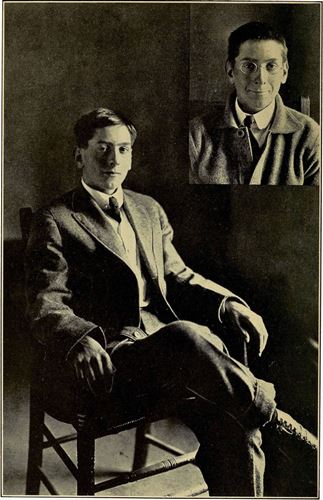
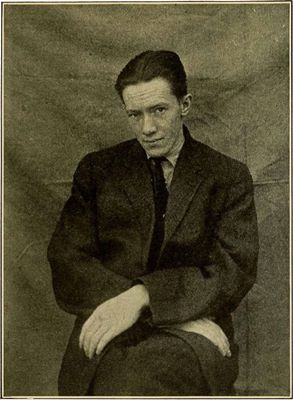
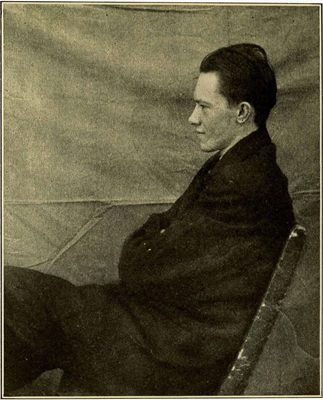
THE CASE OF JEAN GIANINI
“We find the defendant in this case not guilty as charged; we acquit the
defendant on the ground of criminal imbecility.”
Such was the verdict by the jury of the Supreme Court of Herkimer County,
New York, on May 28th, 1914, in the case of the people vs. Jean Gianini,
indicted for the murder of Lida Beecher, his former teacher.
The prosecution and, at first at least, the majority of the citizens of
the community held that this had been a carefully planned, premeditated,
cold-blooded murder of the most atrocious character, committed with a
fiendishness seldom seen among human beings. It was, on the other hand,
claimed by the defense that the boy was an imbecile, that he had only the
intelligence of a ten-year-old child, that he did not know the nature and
quality of his act, and that he did not have any true realization of the
enormity of his crime. For some reason unaccountable to a great many
people, the jury accepted the view of the defense.
Not infrequently have verdicts in murder trials been unacceptable to the
populace. In that respect this verdict is not an exceptional one, but from
other standpoints it is remarkable. Probably no verdict in modern times
has marked so great a step forward in society’s treatment of the
wrongdoer. For the first time in history psychological tests of
intelligence have been admitted into court and the mentality of the
accused established on the basis of these facts.
The value of this verdict cannot be overestimated. It establishes a new
standard in criminal procedure. It recognizes that weakness of mind, as
an excuse for crime, is of the same importance as disease of mind; puts
feeble-mindedness in the same category with insanity, and requires that it
like insanity be considered in all discussions of responsibility. When we
add the now accepted fact that the feeble-minded are at least as numerous
as the insane, we see the far-reaching significance of this standard set
by the Supreme Court of Herkimer County, New York.
That the verdict has not been at once acceptable to the people is due to
the fact that the character and the limitations of the high-grade
imbecile are not understood. With a view to explaining this type of
defective, which the defendant so well illustrates, we propose in the
following pages to go over the history of this case, explaining the facts
in the light of present-day knowledge of the feeble-minded.
The facts in the case as established by testimony:—
On the morning of March 28th, 1914, Henry Fitch, a farmer of Herkimer
County, accompanied by his son, started on his usual work to deliver milk.
At a point in the highway, approximately one mile from the village of
Poland, Mr. Fitch saw blood and signs of a struggle in the snow and slush
in the road; he also found an umbrella and a hat. A bloody path led out of
the road to a point some hundred and thirty feet away. Following the
tracks he found the body, which proved to be that of Lida Beecher, one of
the school-teachers in the village of Poland. She lay at full length on
her face, both arms under her. The body was removed to Sprague’s
undertaking rooms in the village.
On the same morning Jean Gianini, sixteen years old, left his father’s
house on the edge of the village to go to the home of Sam Hutchinson,
where he was working and taking his meals. He had his breakfast, went to
the barn, and worked a short time. When Mr. Hutchinson went out a little
later, he could not find Jean. A Mr. Smith said he had seen him going down
the tracks toward Newport. William Taylor, the track foreman, said he
passed Jean near the bridge. Mr. Hutchinson then sent word to the boy’s
father that he had gone. The father, supposing his son had run away as he
frequently did, telephoned to Newport asking that he be apprehended and
sent home. This was before anything was known of the crime. Peck Newman,
to whom the father telephoned, found Jean in a grocery store in Newport.
He had been apprehended at the depot. He was taken home and then to the
Justice of the Peace. Here he was stripped, presumably for the purpose of
discovering whether there was any blood upon his clothing or his body.
Although there is no evidence that any stains were found, yet he had no
sooner been stripped than he made a free and open confession. We shall
consider this confession in detail later. In substance he said that he
killed Miss Beecher to get revenge, because she had humiliated him in
school. He told in detail how he had accomplished this and what had been
his movements shortly before and after the deed. On the strength of this
confession and such corroborative evidence as could be obtained from
local witnesses the prosecution sought to convict this boy of murder in
the first degree.
It was understood at first that the defense would attempt to prove that he
was insane. There did not seem to be much evidence of insanity and it did
not appear that the prosecution was in great fear of such a verdict. As a
matter of fact, the real defense was imbecility. It is probable that this
defense was less intelligible to people who knew Jean Gianini than that of
insanity would have been. To one familiar with imbecility, however, there
is no shadow of a doubt of the correctness of this diagnosis. The only
possible question in the mind of any such person would be whether a
defective of such high grade knew the nature and quality of his act and
knew that it was wrong, and was therefore responsible for his act. This
point the jury decided, and we shall attempt to show by a study of the
case that they decided correctly.
Much of the confusion in the mind of the public and dissatisfaction with
the result in this case is due to a failure to understand the nature and
character of the imbecile. Most of the acts and the utterances of the
defendant, which seemed to many people to indicate his soundness of mind,
his premeditation and planning of the murder, are in reality so thoroughly
characteristic of the imbecile as to leave no doubt whatever of his low
mentality.
We have already given all that is known of the circumstances except
certain details which Jean claimed in his confession, and certain acts and
utterances which were testified to by local witnesses.
We may now examine these testimonies, reserving his confession for a later
discussion. So far as the crime itself is concerned but little testimony
was brought forward; so little, in fact, that without the boy’s confession
he probably could never have been convicted of the deed.
On the evening of the tragedy Jean was seen by several people walking up
the street toward his home in company with his victim. Two days before
this he had been heard to ask her when she was coming to see his father
about his returning to school; to this she had replied, that she “did not
know”; and he had answered, “Aw, I don’t believe you intend to come at
all, you will wait until summer time, and go home and then it will be too
late.” On the following evening he again asked her to go up to his house.
She said she could not go then, as she was going to prayer meeting, but
she would go the next night. He had also inquired of certain persons
whether she went to the Post Office in the evening. On one occasion he
had been seen with an old rusty wrench in his pocket and when asked what
he was doing with it, he had replied, “I have use for it.” This was the
wrench with which he struck his victim the death-blow, according to his
confession.
Previous to the tragedy he had told certain persons that he meant to get
even with Miss Beecher. The wrongs for which he claimed to have desired
revenge had occurred more than a year before the tragedy. For over a year
he had been out of school and had been working a part of that time. For
some months he had been an inmate of St. Vincent’s School, to which
institution he was committed by a Justice of the Peace at the instigation
of his father because of his propensity to jump freight trains.
The evidence was strongly against the idea that Miss Beecher had ever done
anything to injure him or anything which would reasonably cause resentment
in his mind. He had not gotten along well in his studies after going into
her room, had been more or less disorderly, and she, at the suggestion of
the principal, had seated him facing the wall with his back to the rest of
the school. She had occasionally sent him up to the principal, who had
sometimes flogged him.
On the night of the deed Jean was seen walking up the street with Miss
Beecher at something after seven o’clock in the evening; before eight
o’clock he was at home in his father’s house; there he was given an errand
to do and went down the street, returning shortly; spent some time in
reading and then went to bed. The next morning he was at his place of work
as already mentioned. The wrench which had been seen in his pocket was
found near the scene of the murder. These are the only known facts bearing
upon the case, previous to his own confession. For further items of
evidence see the hypothetical questions propounded by the prosecution and
by the defense—Appendix, pp. 109-138.
The fact that he was the last person seen with her, that the monkey wrench
at one time seen in his pocket was found at the scene of the deed, that he
left his place of work and went down the railroad track toward Newport,
was sufficient to arouse suspicion. It is more than doubtful whether the
evidence could have resulted in an indictment by a grand jury, and
practically certain it never could have resulted in a conviction. The
absence of any real motive for the act would have been fatal to such an
attempt. The absence of evidence of a prearranged plan is also a serious
lack. It is true that, when we have the confession and the later
explanations, the presence of the monkey wrench in his pocket and his
words that he “had use for it” sound like a prearranged plan, and yet
there is no real evidence here. He might have had the monkey wrench for a
dozen purposes and have given the same answer. Perhaps his threat to get
even with her, his remark “that if he had a revolver he would shoot her,”
may be considered more serious, but certainly no jury could convict him
merely on the basis of such statements.
It is reasonably certain then that, had he not confessed, he never would
have been convicted even if he had been indicted. Let us now examine the
confession.
Gianini’s Confession: Jean Gianini, being duly sworn, deposes and
says he resides in the village of Poland and is sixteen years old;
deponent further says, “I went to school to Lida Beecher and had
trouble with her and wanted to get revenge.
“I met her above the hotel and walked up the street with her up beyond
the stone quarry; she had been a coming to see my folks about school
and was a coming up to see them last night and I told her they lived
up the hill, and when we got up there on the left side of the road, I
hit her with a monkey wrench that I got out of my father’s barn. I had
the wrench in my pocket when I went up.
“After I had hit her about three times with the wrench, I hit her with
a knife several times, to be sure to finish her, and then I took her
over in the lot; I dragged her by the foot; and then I went home and
got there about 7:30.
“The knife I stabbed her with was one that belonged to my father and I
took it home and put it in the pantry drawer.
“I left the wrench somewhere near where I hit her. When I hit her
first, she did not scream but moaned.
“She said she thought it was quite a ways and she did not see any
house.
“I was not afraid when I got home; I was just as happy as I ever was
and didn’t think anything about it as I thought I had revenge.
“I make this statement voluntarily and under no fear or threat and
knowing the same may be used against me.
“Jean Gianini.
“Subscribed and sworn to before me this 28th day of March, 1914.
“Fred Moore,
“Justice of the Peace of Town of Russia.”
In its main points the confession must be accepted as true. To refuse to
accept it would be to admit at once without further proof that the boy
was crazy or an imbecile, since, if it were not true, it is inconceivable
that any normal person would claim to have done such a deed. It is
accepted then by all that Jean Gianini killed Lida Beecher on the night of
March 27th, 1914. There is no difference of opinion on that point. It is
now only a question of his responsibility.
We may now review the facts and see what is the evidence: first, that he
is an imbecile; second, that being an imbecile, he did not know the nature
and quality of his act and that it was wrong.
Is Jean Gianini an imbecile? What is an imbecile? We cannot expect to
agree upon the question of whether Jean is an imbecile until we agree upon
the definition of imbecile. There are various ways of designating this
type of individual. Imbecility, as used in law in this country, may be
defined as “the state of mental defect existing from birth or from an
early age, due to incomplete cerebral development, in consequence of which
the person affected is unable to perform his duties as a member of
society.” The high-grade imbecile, such as the person under discussion,
feeble-minded as he is called in England, or the moron as we are coming to
call him in the United States, is one who is “capable of earning a living
under favorable circumstances, but is incapable from mental defect,
existing from birth or from an early age, (a) of competing on equal
terms with his normal fellows, or (b) of managing himself or his affairs
with ordinary prudence.” These definitions were formulated by the Royal
College of Physicians of England, and accepted by the Royal Commission on
the Care and Control of the Feeble-minded.
We may further designate this type of individual by saying that he has the
mentality of a normal child of from three to twelve years of age. These
age limits have been determined by examining thousands of the inmates of
institutions for the feeble-minded and comparing with normal children. The
inmates of the institutions are there because they were not capable of
managing their own affairs with ordinary prudence, because society has
discovered that they could not take care of themselves; they are
weak-minded; they must be cared for by the public. Careful examination of
such persons as have been determined by experience to be incapable of
managing themselves shows that they range in intelligence, as before
stated, from three to twelve years. There are practically none in these
institutions that have a mentality above twelve. Those under three are
called idiots.
Considered from the standpoint of the growth and the development of the
child, we say that the imbecile is a case of arrested development; he has
stopped growing mentally, and has stopped previous to the age of twelve,
so that no matter what may be his actual age his mentality is that of a
child under twelve years.
In the case of Jean Gianini, although he is sixteen years old, he has only
the mentality of a child of ten. Or, if a possible error of two years were
allowed, he would still have only the mentality of twelve and would be an
imbecile. As a matter of fact, there is probably nothing in the whole
career and history of Jean Gianini that is inconsistent with a mentality
under twelve; and on the other hand there are numbers of things in
evidence in connection with his crime that are so thoroughly typical of
high-grade imbeciles that any one with experience with this type of person
can have no doubt about it; but it is our purpose to show this by an
analysis of the case. We must first attempt to remove some of the
difficulties in the way of this view.
First, why does it seem absurd to call Jean Gianini an imbecile? Mainly
because in the popular mind the term imbecile connotes only the low-grade
imbecile, the person who shows in every movement and action, if not in
his very face, that he is “lacking,” is “not all there,” is “not quite
right,” or whatever may be the expression that we apply to those
unfortunate ones, of whom there are, sad to say, always one or more in
every community.
Jean Gianini is not of that type; he is a high-grade imbecile; he is of
the grade that is only recognized by those who are intimately familiar
with imbeciles of all types. He is only discovered when we make a close
comparison between him and normal boys of the various ages. We may perhaps
liken it to the question of tuberculosis: the average man never recognizes
a fellow being as suffering from consumption until he is afflicted with a
cough which does not yield to treatment, is constantly expectorating, gets
thin and pale, and has other marked outward symptoms; the average person
would not find more than one or two consumptives among a hundred persons;
the expert physician, however, experienced with tuberculosis, recognizes
many more by signs and symptoms which he can describe with great accuracy,
and when he is allowed to apply his physiological tests and his clinical
thermometer and his microscope, the number increases enormously, and he
assures us that every seventh person will die of tuberculosis.
It is hard then for many people to accept the verdict that Jean Gianini
is an imbecile, largely because they do not realize what a high-grade
imbecile is.
A second reason is found in the fact that we insist upon believing the
unbelievable. We view a crime like the one under discussion and say
frankly, “It is unbelievable that any reasoning, intelligent person could
commit such an atrocious act,” and yet we believe that this boy did; we
believe that such a grade of villainy exists and that it can suddenly
appear in a boy who never before manifested anything approaching it. The
fact is, that our instinctive revulsion against such a thought is the
correct view. The fact that Jean Gianini committed such a crime is itself
the strongest kind of evidence that he is not a normal boy. But turning
from imbecility in the abstract, let us examine concrete instances in the
life of Jean Gianini, for we shall find there the best possible
illustrations of the characteristics of an imbecile.
We may begin at the most dramatic point—the crime itself. Since we know
practically nothing of the crime except through his admissions, we will
begin with the confession. And first, why was there a confession? It is
safe to say that there is not a sensible man or boy the country over who,
knowing the facts in the case, would not say, “What a fool Jean was to
confess!” Nobody but an imbecile would have confessed under those
circumstances; they had no evidence against him, nor did they pretend they
had; he testifies that they told him that they thought he was guilty of
the crime; they did not pretend that they knew he was guilty; there were
no third-degree methods used; they had taken his clothing off and examined
him, but they had not found any blood or any evidence, and the clothing
had only just been removed when Jean began to tell his story. He had not
been promised any immunity if he should confess; in fact, he had been told
that anything that he said would be used against him, but still he
persisted in telling the whole story. But we do not have to rely upon the
fact that it looks foolish to us for him to have confessed, because we
have the fact, well known to all who have to deal with imbeciles, that it
is characteristic of them to do just this thing. They do not always
confess, it is true. It seems to depend largely upon how proud they are of
their deeds—and frequently the more atrocious these are, the prouder they
are of them. It is perfectly clear that such was the case with Jean. He
made some little attempt to get away, at least he made what appeared like
an attempt to get away; there really is no evidence that he was doing
anything more than he had done many times before, going away from home to
seek work elsewhere, with that wanderlust which is also characteristic
of imbeciles. He walked down the railroad track toward Newport, not going
very fast, not taking any precautions to avoid being seen, and when met by
some one whom he knew, he came willingly back to Poland.
There is the highest probability, perfectly clear to one who understands
imbeciles, that almost from the time the deed was done he had a strong
desire to tell somebody about it, to brag about it; but a certain
instinct, a certain feeling that he ought not to be caught, probably held
him back. But when at last he was taken back to Poland and into the
presence of the Deputy Sheriff; when his clothes had been removed and he
thought his story would get into the papers and he would become notorious;
then he began to talk. In spite of all the warnings and declarations that
he would suffer for it, he talked. At this point it is important to
remember that he is talking now to be heard; he is not confessing in order
to escape punishment, he is talking because he is proud of what he has
done; he wants to boast, wants to be talked about and written up, wants to
be notorious, a great criminal, as is evidenced in the course of the
trial. Remembering this, we cannot believe all that he says in his
confession.
As already stated, in so far as it relates to the basal facts of the
crime, it is undoubtedly true; but when it comes to the finer details of
what he did, how he prepared, and what he claimed was his motive, we
greatly err if we accept everything he said. It is not in the sworn
confession, but it was in evidence that he said he sharpened the knife for
the purpose; the fact that he said he sharpened the knife for the purpose
should have no weight. It is precisely the kind of thing that he would put
in for effect. In fact all that he said after the deed as to arrangements
or plans or details must ever be questioned unless his statements can in
some way be corroborated, for this tendency to elaborate is so strong that
there is no possibility of putting any trust in his words.
It is worthy of note that whereas the defense introduced many witnesses
who testified to Jean’s sayings and actions that showed silliness and
indicated childish intelligence, the prosecution neither rebutted this nor
produced witnesses testifying to anything in his previous conduct that
gave evidence of good judgment or intelligence appropriate to his years,
or that he had any moral development that would be normal for his age.[1]
The evidences of his pride in the deed are scattered throughout the
testimony. For example, at one time he said, referring to the deed, “You
would not think anybody could do a deed like that so quick, would you?”
When asked how he could get Miss Beecher to go so far up the hill in the
dark with him, he replied with a good deal of pride: “That’s easy! I told
her my father was building a house up on the hill and we went up there.”
This leads us to another precaution which must be borne in mind in
considering this case. If Jean is an imbecile, then all our previous
conceptions must be changed, since the conclusions that we naturally draw
are based on the assumption that these facts relate to a normal man. To
illustrate: if Jean were a normal boy of sixteen, the fact that he
inquired as to the time of Lida Beecher’s being at the Post Office, that
he talked with her the day before about her promise to go with him to see
his father, the fact that he went off with her that night, that when he
reached his father’s house, he lied and said his father lived up over the
hill and led her up there, and then, as he said, struck her with the
monkey wrench, and so on, would all indicate premeditation and planning
and forethought; but the instant we conclude that Jean is an imbecile,
then these facts indicate nothing of the kind. It is not denied that such
may have been the case, or that it is impossible for an imbecile to carry
out such a plan. But it is claimed that there is no strong presumption
that such was the fact, because the result can be accounted for in another
way. Jean being an imbecile, it is entirely possible that he had no
premeditation of murder at all, that he not only did not grind that knife
for the purpose, but that he did not have the monkey wrench in his pocket
for the purpose. On the contrary, it is possible that as he walked up the
hill with Lida Beecher he had no more thought of killing her than of
committing suicide. Indeed, it is much more plausible from all we know of
imbeciles, and of boys of his physical development, that there was an
entirely different purpose. That purpose was probably sexual. The writer
is not alone in this thought. Hardly any of the persons with whom he has
talked of this crime has failed to ask the question, “Was there any sexual
offense in the matter?” The absence of any evidence of assault of this
character has been a surprise to many persons; but it again is no surprise
when we remember that Jean is an imbecile; we know also that he is a
masturbator.
While the writer has no theory to put forth in regard to this crime, yet,
for the sake of clearness and as an illustration of the imbecile type, let
us assume a plausible hypothesis; that is to say, an hypothesis which may
fit the case and is entirely plausible from the standpoint of imbecility.
Jean was sixteen years old, an age when sexual passion is strong. It is
the middle of the great adolescent period. The new physiological function
of sex is established, great psychic changes have occurred. The boy is
dreaming dreams, the imagination is active. In the normal boy this means
the evolution of ideals, ambitions, moral and religious ideas, attention
to dress and appearance, interest in the opposite sex. In the case of the
morally well-endowed boy, the sex impulses which have strengthened with
the development of the physical potency find their outlet in a kind of
vicarious functioning in the shape of polite and friendly association with
his girl friends, in chivalric attentions and devotions, with more or less
definite plans for future marriage and parenthood. In those with little or
no moral principle we see the impulse leaping over the social conventions
and attaining complete sexual gratification illegally.
With the imbecile the case is different. The fires of sexual passion may
burn as vigorously as in the better endowed, but he lacks both the power
of control and the courage and ingenuity to overcome the social barriers.
He masturbates. This banks the fires somewhat and requires no courage. If
stimulated by association with girls, he makes crude and imbecilic plans
for conquest. Lacking moral development and ignorant of the more subtle
means of accomplishing his purpose, he may resort to violence in some one
of the many possible ways. Often he is not conscious of what it is that is
driving him and hence does not know where satisfaction lies. Under these
conditions his violence may show no outward signs of being sexual. It may
show every degree from rough horseplay with girls, such as pushing,
pulling, grabbing hat, cloak, or other articles of dress, bantering,
teasing, and other forms of personal contact, up to physical injury,
torture, and even murder.
Volumes could be written—indeed volumes have been written—showing the
tremendous force of this sex impulse at this age, and the multifarious
ways in which it expresses itself—many of them not showing any of the
signs that are usually considered as indicating a sexual disturbance. That
is to say, such acts are, by the uninitiated, not considered sex acts at
all. One incident of this kind is in evidence. “At one time Jean took two
little girls to a piece of woods and started to take their clothes off,
and when asked why he did it, said he was going to play Indian and that
Indians were naked.” Dismissing the possibility that his explanation was
invented to conceal a definitely conscious sexual impulse, let us admit
that he gave his real reason for the act. Still it is clear to all who are
familiar with sex psychology that the subconscious reason for playing
Indian in that way was a sexual one. The procedure also shows a lack of
judgment and appreciation of the proprieties which argues strongly for
mental deficiency—especially as he was then between ten and twelve years
old. (For further items the reader is referred to pp. 113-120 of the
Appendix, where the hypothetical questions have summed up the testimony.)
The imbecile is a coward. Jean Gianini is an imbecile. Unconsciously
impelled by that strong instinct he seeks the company of Lida Beecher. As
a matter of fact her friend, Miss Clark, testified that Miss Beecher had
been annoyed at his attentions. He contrives an excuse to get her to come
up to his house; when he reaches the house, he makes another excuse to get
her to go farther, not, as generally believed, with the purpose of
murdering her; perhaps only blindly following that instinct of sex and
desiring to be in her company; more probably with the half-conscious
purpose of satisfying his passion if he could find a suitable
opportunity. They walk on; where they were going or how far they would
have walked no one will ever know, but there came a time when for some
reason her suspicions were aroused, or at least her common sense told her
that it was foolish to go farther. Of course we have nothing but Jean’s
statement, which may be true or may be false; instead of the simple
statement that she thought she would go back as she saw no light, there
may, for all we know, have been a strong argument; he may have made
improper proposals which she resented; this led to blows with the fatal
result. We have no means of knowing what actually took place at that spot.
But even taking Jean’s own account, when she remarked that “she thought
she would not go any further,” he saw that his plan was frustrated. Then
he struck her with the monkey wrench which he happened to have in his
pocket—for what purpose no one knows. Having struck her once, it was easy
to strike the second and the third time. It was only natural for an
imbecile to keep at it,—“finish the job” as he expressed it. According to
the evidence he struck her with the knife approximately twenty-four times,
finally hitting the jugular vein in the neck, as a result of which she
probably bled to death.
As already stated, the writer has no desire to advance this as the
theory of the deed. But if Jean is an imbecile, this theory is fully as
good as that upon which the prosecution worked, and it eliminates entirely
all necessity for elaborate planning. Up to this point we have shown that
the fact of a confession and the character of the confession, both
difficult to explain on the basis that Jean is a normal boy of sixteen,
are entirely clear and perfectly characteristic of a high-grade imbecile.
Let us look now at his actions immediately after the deed. It is in
evidence that Jean said he took the murdered girl by the foot because
there was no blood there and he did not want to get blood on his hands for
fear they would take his finger prints. Holding her by the foot, he
dragged her out of the road behind some bushes and left her in the snow.
He then went back into the road, making new tracks, which he made no
effort to cover. Nor did he make any effort to cover the old tracks or the
blood spots that were left along in the snow. Neither did he make any
attempt to hide the hat nor the umbrella nor the broken comb which were
left in the road; his care to take her by the foot where there was no
blood is cited as evidence of forethought and judgment; but what shall we
say of his failure to cover up his tracks when it was easy to have done
so!
Again we must remind the reader that we have nothing but the boy’s
testimony as to the fact that he took her by the foot or to explain why he
took her by the foot, but in accepting his testimony as true there is
nothing incompatible with high-grade imbecility.
The one peculiar thing about Jean is that he has read more than most
imbeciles even of this high grade. But this peculiarity does not save him
from being an imbecile, since there are cases of imbeciles who have read
as much or even more than he. Furthermore, there is plenty of evidence in
the case that Jean’s interest in reading has gone along the line,
childlike, of crime. The various experts who examined him told of his
talking about the case of the New York gunmen, of the Pomeroy case, of a
murder in the South, and possibly others. He inquired about Mahoney, the
would-be assassin of Mayor Mitchell. In connection with these crimes his
reading of finger prints had made the same impression upon him that it
would have upon any boy. He remembered what he had read and perhaps acted
upon it, at least talked about it when the opportunity came, and pretended
that he considered it in his action.
It needs no argument to show that all the rest of his conduct in leaving
things as he did was imbecilic. Even many a high-grade imbecile would have
been much more thoughtful and more careful to cover up the tracks in the
snow. That Jean did not do so is in itself almost an unanswerable argument
that he was an imbecile.
He then went home, and having washed the knife in the snow, put it in the
pantry drawer. No evidence was produced, so far as the writer knows, to
prove that this was the fact; we do not know whether the knife belonged in
the pantry drawer and he put it back, or whether it belonged in his pocket
and when he was through, he put it back in his pocket or put it somewhere
else. Again, assuming that he told the truth, he certainly ran the risk of
being questioned as to what he had been doing with the knife. He then went
on an errand, and, according to his statement, went down to the railroad,
hoping to jump a freight train. When he found the freight had gone, he
hurried back home. These actions according to the prosecution indicate
careful planning and a desire to get away; realizing the enormity of his
deed he wanted to get out of town. Surely no normal youth of sixteen would
have failed to get out of town even though he had missed the freight
train; but his conduct is perfectly characteristic of an imbecile. One
simple thought having failed to materialize, without planning further he
goes back home, acts as no one but an imbecile could under such
circumstances,—goes to bed, sleeps soundly, gets up the next morning, and
goes to work. Then he makes another effort to get away. But how crude an
effort it is. He walks quietly along the railroad track and, as already
stated, makes no attempt to hide, but passes the trackman and goes into
the station at Newport. When he meets a person from his own town, comes
promptly and quietly back home. Surely an act much more befitting an
imbecile than a normal boy of sixteen!
The writer was asked upon the stand whether these incidents indicated to
his mind that Jean had intelligence and had planned this thing carefully.
The answer was emphatically, “No.” At every turn they indicate an
imbecile. We could cite many instances of imbeciles in our institutions
who have done things of exactly the same character. Our high-grade boys
frequently plan to run away, and often their plans are much more
elaborately conceived and much better carried out than Jean’s was.
In speaking of the confession it may be noted also that not infrequently
our boys when they have made a plan to run away cannot keep it until they
can carry it out, but make a confession. They go to some attendant or
officer and, without any compulsion, actually tell of their plan. In this
way a great many times their purposes are frustrated. When two boys plan
to run away, it is rare indeed if they carry out their scheme; it is
almost certain that one of them will confess to somebody.
Jean manifested throughout that love of display and notoriety, that
longing to be the center of observation and talk, which is so
characteristic of imbeciles. He asked the alienists who were examining him
if his picture would be in the paper and what the people were saying about
him. According to the testimony of the experts who examined him in jail,
every occasion on which he was examined was regarded by Jean with
pleasure, and his only thought apparently was that he was the center of
observation. Instead of showing some realization of his crime and that he
was exerting himself to make an appearance that would be favorable to his
case, all the evidence was of the opposite character. None of the
witnesses for the prosecution were able to hide the fact that he was
light-hearted and frivolous, and, in a word, “showing off,” throughout
these various examinations.
Throughout the whole time of the writer’s examination of him Jean never
for one moment evidenced by word or action any thought as to how his
conduct or his answers to questions would affect his case. As was pointed
out by the defense, quite in keeping with his mentality was his statement
to the experts employed by the prosecution, that he had been told not to
talk, in spite of which he talked incessantly and told everything that
they wanted. The fact of the matter was that his desire to show off so far
overcame any thought of self-preservation that he talked and acted freely
in spite of his lawyer’s caution that he should not answer questions. His
conduct in the court room throughout the trial was that of an imbecile, of
a child, who had no realization of the predicament that he was in and no
purpose to make a good appearance. He was in the limelight and he enjoyed
it. Even when the most gruesome details of his deed were being recited, he
evidenced no feeling of horror or sorrow or fear; on the contrary he was
indifferent, and frequently even laughed at the incidents that were
related. He showed no excitement after he got home that evening; he slept
well. His only comment on his prison cell, which to a normal person would
have been loathsome in the extreme, was that it was better than St.
Vincent’s, where he had been at school. Even when the experts introduced
by his own counsel were examining him, and when, had he been intelligent,
he should have known that it was to his advantage to make the best
possible appearance, to give them every possible help, yet when his dinner
was brought into his cell, he could think of nothing but eating and
ignored the people who had been sent to help him. As one of the experts
testified, “As between soup and safety, Jean prefers soup.”
These facts and circumstances alone are enough to satisfy any person who
is familiar with the character of the inmates of our institutions for the
feeble-minded that Jean was an imbecile and really belonged in an
institution. But besides these circumstances several witnesses were
introduced who testified to the curious and childish actions of Jean in
his past history. Quite recently, he had tried to catch pigeons by putting
salt on their tails. The prosecuting attorney called attention to the fact
that almost every man remembers going through the same experience, but it
may be safely asserted that this is not done by any normal boy after the
age of twelve. It is a childish act, and indicates a mentality of less
than eleven.
Peter Black, the village blacksmith, testified that some one sent Jean to
him one day for “strap oil”; that he carried out the joke by slapping
Jean with a strap, but was unable to make him see that the whole thing was
a joke. He teased and bullied the other children in a way that is
characteristic of the high-grade imbecile. Mrs. Anna Newman testified that
he was a restless boy, and that sometimes he would answer her questions
and sometimes not. Every superintendent of an institution for the
feeble-minded would instantly recognize these characteristics as common
among his inmates. The reader will find more of these incidents in the
Appendix, pp. 113-119.
One of the unique features, so far as court procedure is concerned, was
the introduction into the case, of examinations by means of the
Binet-Simon Measuring Scale of Intelligence. The writer’s examination of
Jean consisted largely of the use of these tests, and as a result he
estimated his mentality at approximately ten years of age. It was somewhat
difficult to estimate his mentality with the usual exactness since others
had already used the tests, and it was impossible to say how much Jean had
learned from his previous examinations. As a matter of fact, in some cases
at least, he had not profited by the experiences which should have helped
him greatly had he been a normal boy. For example, one of the tests is to
draw from memory a diagram which he has been allowed to study for ten
seconds. It is clear that if one were given this test two or three times,
at the last trial he should have a pretty good idea of it and be able to
draw it correctly. Although the writer’s use of this test was in the last
of the series of those who tested him, yet he did not succeed in drawing
it. This is usually drawn by a child of ten years. When asked to repeat a
certain sentence, he replied, “Oh, I have been asked that a hundred
times.” But in spite of the fact that he had heard it several times he
failed to remember it, and yet this sentence is generally remembered by a
child of twelve.
This is not the place nor is it necessary to discuss the Binet tests
themselves. A word, however, may be said as to why the experts for the
prosecution did not get the same results with the tests that those of the
defense obtained. Also it seems necessary to make a brief explanation,
since the prosecuting attorney failed so markedly to understand the tests
in spite of the fact that he had had the instruction of one of his own
experts who used them. One of the prosecution’s experts told the writer
that he did not ask Jean any questions except those in the twelve-year
list, and he “seemed to do those satisfactorily.” There are two sources of
error in this. In the first place, Jean’s failures were not only in the
twelve-year, but in the eleven and ten. Secondly, if Jean seemed to do the
twelve-year tests correctly, it could only have been because they were
wrongly used. The Binet Scale is not, as the prosecutor insisted on
stating, an “arbitrary system.” It is not a set of questions to which
there are definite and fixed answers that are correct, and from which any
deviation is marked a failure. Nor is it a set of questions the answers to
which can be judged as to their correctness by the so-called “common
sense” of the investigator. To illustrate: Jean was asked to give the
definition of the word “charity”; he said, “Charity is giving.” The
prosecuting attorney insisted that this was a correct answer, because, as
he said, “Charity is giving.” This is mere sophistry. It is not a
question as to whether “charity is giving” is a theoretically correct
answer to the question; the important point is, that such an answer is
not the kind of answer that is given by twelve-year-old children. This
has been proved by asking hundreds of twelve-year-old children to define
“charity.” Practically 75 per cent of such children include not only the
idea of giving, but the other necessary idea of giving to some one who is
in need. The answer, “Charity is giving,” is characteristic not of
twelve-year mentality, but of something under that,—ten or less. So
throughout the system the scale must not be judged by what seem correct or
incorrect answers to the inexperienced adult. The value of an answer can
only be known by knowing the character of answers that are given by
children of the various ages. The point is not always that this answer is
or is not technically correct, but that it is not the kind of answer which
a child of the specified age should give. Therefore, it indicates that he
is not of that age, but below it. This was the error into which the
prosecutor and his alienists had fallen in their use of the tests in the
case of Jean Gianini.
Jean’s school record was the serious stumblingblock to many persons who,
from the facts, notably those already cited, were inclined to think that
possibly he was an imbecile. To many of these persons that record seemed
to indicate a normal boy. The teachers and the principal testified that he
did his work well through the fifth grade and got excellent marks, even
getting 100 per cent in some studies. They lost sight, however, of the
fact that Jean was fourteen or fifteen years of age and in a grade which
he should have been in at eleven, namely, the fifth.
As a matter of fact, Jean’s school experience, when taken as a whole, is
most confirmatory of his imbecile grade. It was proved in court, but not
fully appreciated, that Jean got along well through the fifth grade, but
when he went into the sixth grade, he failed.
Professor Robinson testified that when Jean was transferred to Miss
Beecher’s room, his troubles began. The boy did not get along nearly so
well after the change and he dropped back in his studies. His teacher was
obliged to report him a number of times to the principal, who twice
whipped him with a piece of rubber hose. Failing to make his studies under
the new standard, he was made to occupy a special seat apart from the
other pupils, at the instance, if not the actual order, of Miss Beecher.
The witness further testified that in the last days of his school life
Jean dropped, to a very marked degree, in his standing in his studies.
This falling off in Jean’s ability was attributed to his teacher. As a
matter of fact, the falling off was due to the fact that Jean had reached
his limit in the fifth grade. He attained to that height because of a
good memory, which is characteristic of many imbeciles and is in no way
indicative of normal intelligence. It is also very common for children of
this type to get through the fifth grade and fail in the sixth. They have
mentality enough to carry them to that point, but not farther.
It is a satisfaction to realize that Jean’s failure in school with Miss
Beecher is in no way due to the inefficiency of his unfortunate victim. It
was due simply and solely to the fact that Jean was an imbecile and had
reached his limit. These two facts of a good memory and of good school
work in a few school grades have deceived many people as to the
intelligence of a child.
It should be remembered that many imbeciles do not show their defect until
at the age of eleven or twelve when they are in the fifth or sixth grade.
One of the witnesses for the prosecution said that he considered that Jean
was normal and that his apparent backwardness was due to lack of
schooling. This is a common error in all such cases. If asked why a boy
should be backward through lack of schooling when he has been to school
and has had every opportunity to learn, it is common again to fall back
upon the idea that he has not studied. He has been a wild, wayward boy,
playing truant, more or less, and has never applied himself, therefore he
is behind his grade and is dull and backward. Again, while not denying
that there are children of perfectly normal intelligence who seem to be
misfits in school or who seem more interested in other things than in
their school work, or children who will not study because of dislike for
the teacher or for various other reasons, yet the reader must be reminded
that a study of the high-grade defective shows that he is continually
being confused with these very exceptional children who have the ability
but who do not study. In other words, when a boy does not get along in
school, even though it is evident that he does not study, the strong
probability is that he does not study because he has not mind enough to
appreciate the work, to understand it, hence to have that highest of all
incentives to work, success. The fact that the majority of boys do get
their lessons and get along well in school should be a strong argument
that there is something seriously wrong with those that do not succeed.
It may further be asked: How does the fact that the boy has not succeeded
in school affect his examination by the Binet test? Experience has shown
that the test is affected but slightly. In other words, the mind develops
regardless of school and school training. As long as we ask only such
questions as call for a general intelligence and do not call for specific
school instruction we are reasonably independent of such instruction. As a
matter of fact, nearly all of the questions of the Binet Scale are free
from this objection. Some of them, it is true, are a little helped if the
child has been to school and correspondingly hard if the child has not
been to school; but, on the whole, they do not affect the final rating to
any serious extent. This has been proven repeatedly by normal children
who, on account of sickness or for other reasons, have not been to school,
and yet can pass the Binet tests for their own age.
We must now turn to the question of cause. If we can account for Jean
Gianini’s imbecility, it will be much easier to believe in it. Much has
been written on the subject of the causes of feeble-mindedness. Certain
fundamental principles have been agreed upon. It is now known that at
least 66 per cent of feeble-mindedness is hereditary; that is to say, the
individual is feeble-minded because he comes from stock in which
feeble-mindedness exists. There is another group in which there are
practically no other feeble-minded persons in the family or among the
ancestors so far as can be discovered, but there is, on the other hand, a
great deal of bad physical history; there may be epilepsy, alcoholism,
insanity, or other serious physical disturbances. Finally, we have a group
in which there is history of some accident, either to the child at the
time of birth or after birth, or to the mother previous to the birth of
the child.
In Jean’s case we have no history of accident or injury to the child
himself. The pedigree or family tree has not been worked up and we do not
know what there may be. It was in evidence that the grandfather was born
on the south side of the Alps; and there was some slight attempt to imply,
since cretinism is very common in that region, that possibly there was
some cretinous condition in the family. All this is not impossible; and if
it existed in the grandfather or even in the great-grandfather, such a
condition might reappear in the grandson in the form of imbecility; yet in
view of our present knowledge, or rather our lack of knowledge on this
subject, this line of argument is too vague to enable us to draw any
conclusions.
The fact that the mother of Jean was insane and alcoholic justly had great
weight. Before her first child was born she broke down mentally and was
probably never “right” after that time. The first child lived to the age
of seven and from the description was clearly an idiot. The second child
is entirely normal. Jean, who is the third child, did not talk until he
was five years old.
Our general studies have not yet gone far enough, and certainly our study
of this particular family is far from sufficient, to enable us to decide
whether this is a matter of heredity or whether we shall say that Jean’s
condition as well as that of the first child is traceable directly to the
mother’s insanity or to her alcoholism.
For the present purpose, of course, it does not matter. We see in these
facts, whether we regard them as causes or merely as symptoms of a deeper
lying cause, sufficient reason for Jean’s being an imbecile. There is
every reason to believe that Jean Gianini is an imbecile of high grade.
The next important question that arises is a legal one of whether, being
an imbecile of high grade, he knew the nature and quality of his act and
that it was wrong.
Before discussing this let us consider two other cases—after which we may
discuss the general proposition of whether high-grade imbeciles know right
and wrong.