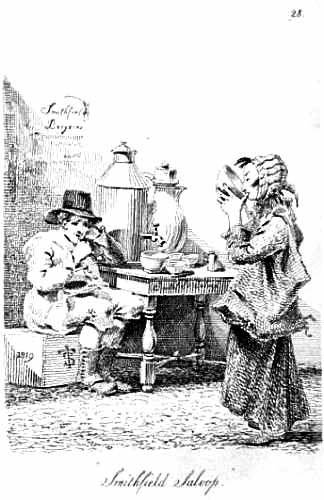
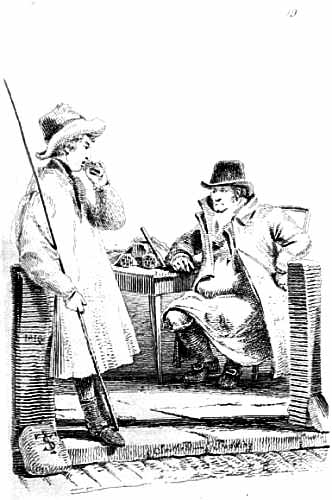
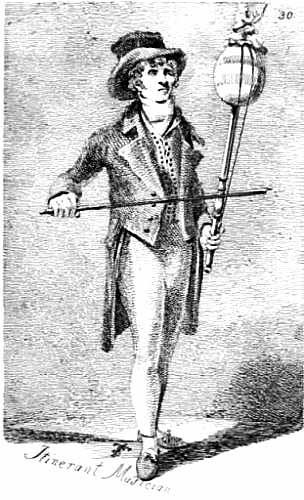
⁂ The interest of the Plates in Mr. Smith’s “Antient Topography
of London,” is much increased by numerous spirited little sketches of
remarkable characters well known in the streets of the Metropolis; several
of whom would have formed valuable additions, either to his work on the
London Beggars, intituled, “Vagabondiana,” or the present volume: a few of
these shall be here noticed.
1. In the View of the Old Houses in London Wall, p. 63, the man with two
baskets is John Bryson, well known in London, particularly in rainy
weather. He had been an opulent fishmonger in Bloomsbury Market, but
became, by several losses, so reduced, that he latterly carried nothing
except nuts in his basket; but his custom to the last was to cry every
sort of fish from the turbot to the perriwinkle, never heeding the calls
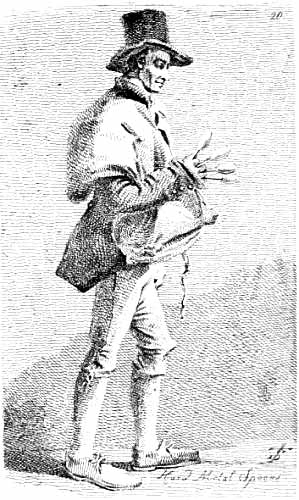
of those unacquainted with his humour. In the same Plate is William
Conway, whose cry of “Hard metal Spoons to sell or change,” was familiar
to the inhabitants of London and its environs. This man’s portrait is also
given by Mr. Smith in the present work, p. 63.
2. In the View of old Houses at the West end of Chancery Lane, p. 48, are
several figures drawn from the life. The woman with crutches represents
Anne Siggs. She was remarkable for her cleanliness, a rare quality for her
fraternity. Slander, from whose sting the most amiable persons are not
invulnerable, tempted this woman to spread a report of her being the
sister of the celebrated tragedian, Mrs. Siddons. From a work of singular
character by Mr. James Parry, it appears that she was a daughter of an
industrious breeches-maker at Dorking in Surrey. Another back view of this
woman occurs in the Plate of Duke Street, Smithfield, in p. 54.
3. The man without legs, in the same print,
is Samuel Horsey, well known in Holborn, Fleet Street, and the Strand. In 1816 this man had been a
London beggar for thirty-one years. He had a most Herculean trunk, and his
weather-beaten ruddy face was the picture of health. Mr. Smith has given a
back view of this beggar in “Vagabondiana,” p. 37, where are some further
anecdotes of him.
4. The dwarf hobbling up Chancery Lane was Jeremiah Davies, a native of
Wales. He was frequently shewn at fairs, and supported a miserable
existence by performing sleight-of-hand tricks. He was also very strong,
and would lift a considerable weight, though not above three feet high.
5. The tall slender figure next to Davies was a Mr. Creuse, a truly
singular man, who never begged of any one, but would not refuse money when
offered. He died in Middlesex Court, Drury Lane, and was attended to the
burial ground in that street by friends in two mourning coaches. It is
said he left money to a considerable amount behind him.
6. In the View of Houses in Sweedon’s Passage, p. 42, is a portrait of
Joseph Clinch, a noisy bow-legged ballad-singer, who was particularly
famous, about 1795, for his song upon Whittington and his Cat. He likewise
sold a coarse old woodcut of the animal, with its history and that of its
master printed in the back ground.
7. In the view of Winchester Street, p. 68, the person with the umbrella
went under the name of Count Verdion, well known to Book Collectors. This
person was a professor of languages; for several years frequented
Furnival’s Inn Coffee-House; and was a member of a man’s benefit society
held at the Genoa Arms public house, in Hays’s Court, Newport Market. This
supposed Count eventually proved to be a female, and died of a cancer on
the 16th July 1802, at her lodgings in Charles Street, Hatton Garden, in
the 58th year of her age.
8. The short figure, carrying a little box, was sketched from the
celebrated corn-cutter, Mr. Corderoy, who married a lady five feet six
inches high.
9. The figure beyond Mr. Corderoy, is that of the respectable Bishop of
St. Pol de Leon; of whom a portrait and memoir by Mr. Eardley Wilmot, will
be found in the Gentleman’s Magazine for 1807.
10. In the view of Leadenhall Street, p. 52, the figure with a wig-box in
his hands represents Joseph Watkins, born in 1739 at Richmond, in
Yorkshire; by trade a barber, and a man of retentive memory. He frequently
shaved Hogarth, whom he knew well, and said he was the last person in
London who wore a scarlet roquelaure. He had gathered blackberries on the
north side of the road now Oxford Street, and remembered the old
triangular gallows at Tyburn, as represented in the Execution Plate of the
Idle Apprentice.
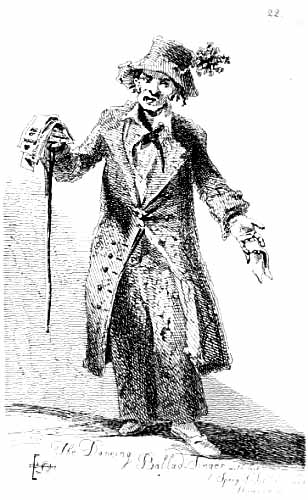
11. The next figure is that of a draggle-tailed bawler of dying speeches,
horrid murders, elegies, &c.
12. The female in a morning jacket was sketched from the celebrated Mrs.
Elizabeth Carter, the learned translator of Epictetus. She died Feb. 19,
1806.
13. The clumsy figure in a white coat, holding a goose, was well known
about town as a vender of aged poultry.
14. The figure with a cocked hat, was a dealer in old iron, a man well
known at auctions of building materials, and was nicknamed by the brokers
as Old Rusty.
In 1815 Mr. Smith published a separate whole-length portrait of “Henry
Dinsdale, nicknamed Sir Harry Dimsdale, mayor of the mock Borough of
Garret, aged 38, anno 1800.” It forms a good companion to his
Vagabondiana. Dinsdale was by trade a muffin-man. There is also a spirited
head of Dinsdale by Mr. Smith; and his portrait, in his court dress, is
copied into Hone’s Every Day Book, vol. II. p. 829, where, by mistake, it
is called Sir Jeffrey Dunstan.
P. 9. Hand’s Bun-house at Chelsea was pulled down April 18, 1839. See
Gentleman’s Magazine for May 1839.
In p. 54 the cry of “Young Lambs to Sell” is noticed. It may be added,
that in Hone’s Table Book, p. 396, is a spirited engraving of William
Liston, an old soldier, with one arm and one leg, who, in 1821, carried
about “Young Lambs to Sell.” The first crier of “Young Lambs to Sell,”
Mr. Hone says, “was a maimed sailor, and with him originated the
manufacture.”
THE END.
J. B. Nichols and Son, Printers, 25, Parliament-street.
Of Nichols and Son, may be had, Price 5l. 5s.
A NEW EDITION OF
THE ANTIQUITIES OF WESTMINSTER,
THE OLD PALACE, ST. STEPHEN’S CHAPEL, &c.
ILLUSTRATED BY
THREE HUNDRED AND THIRTY ENGRAVINGS
OF
TOPOGRAPHICAL SUBJECTS,
OF WHICH THE GREATER PART NO LONGER EXIST.
DRAWN ON THE SPOT, OR COLLECTED FROM SCARCE DRAWINGS
OR PAINTINGS,
BY JOHN THOMAS SMITH.
⁂ In this Edition the “Sixty-two additional Plates,”
published subsequently to the original Work, are inserted in their
proper places; together with twenty-two other Plates strictly
illustrative of Mr. Smith’s publication; forming together a collection
of Engravings illustrative of the antient City of Westminster
unequalled in any other work.
Footnotes:
[1] The remaining copies of this curious work having fallen into the hands
of Messrs. Nichols, it may now be had, with all the supplementary Plates
properly arranged, and with others added to them.
[2] A copy of the Life of Nollekens, enriched with the greater portion of
the autograph correspondence mentioned therein, and with numerous
drawings, portraits, and prints, is in the possession of Mr. Upcott; a
nearly similar copy is also in the library of William Knight, of
Canonbury-house, Islington, esq. who possesses by far the most complete
and valuable series of Mr. Smith’s graphic and literary labours. His copy
of the History and Antiquities of Westminster, with numerous drawings of
St. Stephen’s Chapel, taken by the Bucklers after the recent
conflagration, is at once unique and unrivalled.
[3] Mr. Smith went to breakfast with Mr. Kean, who met him in the Hall,
and asked him if he would like to see his lion; at the same moment
introduced him to the beast in the parlour, who fawned about him; Mr. Kean
became alarmed, and enticed the animal to the window, whilst Mr. Smith
went up to Mrs. Kean in the drawing-room, who, on hearing of the
circumstance, exclaimed, “Is Edmund mad?” Mr. Smith that morning made a
sketch of the lion in his den.
[4] This painted glass, 24 inches by 16, commemorates a very valuable
benefaction to the parish of Lambeth, by a person unknown, of a piece of
land, called, in 1504, Church Hope; in 1623, the Church Oziers, or Ozier
Hope; and in 1690, Pedlar’s Acre; let in 1504 at 2s. 8d., and now
covered with houses and wharfs. Hope or Hoope signifies an isthmus or neck
of land projecting into the river, or an inclosed piece of low marsh land.
By the Churchwardens’ Accounts, in 1607, it appears there was then a
picture of the Pedlar; but the present pane is thus noticed: “1703. March
6. Paid Mr. Price for a new glass Pedler £2.” Nichols’s Lambeth Parish,
pp. 30, 31, 39; Allen’s Lambeth, p. 62; in both which works are also
representations of this painted glass. N.
[5] A view of this house is given in the Gentleman’s Magazine for May
1801. Dr. Swift, in his Journal to Stella, Nov. 15, 1712, mentioning the
death of the Duke of Hamilton, in a duel with Lord Mahon, says, “the Duke
was helped towards the Cake-house by the Ring in Hyde Park (where the duel
was fought), and died on the grass before he could reach the house.” N.
[6] This curious series of the Cries of London, drawn after the life, was
engraved on 74 copper-plates by Tempesta, after Laroon. It is noticed in
Hone’s Table Book, vol. ii. p. 131, where twenty of these Cries not now
heard in the streets are described, and the following figures are copied.
1. “Buy a fine singing bird,” vol. i. p. 510; 2. “Six pence a pound, fair
cherries;” and 3. “Troop every one!” the seller of hobby-horses, toys for
children, i. 686; 4. “Any New-River water here,” p. 733; 5. “Fine Writing
Ink;” and 6. “Buy an Iron Fork, or a Spoon,” vol. ii. p. 431. The Set of
Cries by Paul Sandby, consists of twelve. Both these have many real
portraits. (Gough’s Brit. Top. i. 689.) N.
[7] It is much to be regretted that Mr. Smith never completed this work,
for which he had collected valuable materials, which we fear are
dispersed. N.
[8] Representations of these cressets are given in Douce’s “Illustrations
of Shakspeare,” and in “Hone’s Every Day Book,” i. 831. N.
[9] Stowe, edit. 1618, p. 160. These extracts from Stowe attracted the
notice of Mr. Hone, who has inserted them, with many suitable remarks, in
his “Every Day Book,” i. 827. N.
[10] This work was very popular. The eighth edition bears this title:
“English Villanies, eight several times prest to Death by the Printers,
but still reviving again, are now the eighth time (as at the first)
discovered by Lanthorne and Candlelight, &c. Lond. 1618.” N.
[11] Copied in Hone’s “Table Book,” vol. i. p. 733. N.
[12] Elizabeth, one of the learned and accomplished daughters of Sir
Anthony Cooke, Knt. was first married to Sir Thomas Hobye, (who died at
Paris in 1566.) She was afterwards married to John Lord Russell, (who died
in 1584); and having lived his widow 25 years, was buried at Bisham, June
2, 1609.—Nichols’s Progresses of Queen Elizabeth, III. 132. N.
[13] Sir Thomas de Veil died Oct. 7, 1746, in his 63d year, and was buried
at Denham, Bucks. A good memoir of him will be found in Gent. Mag. for
1747, p. 562. N.
[14] Since this work was written, an excellent work on Ancient Furniture
has been published, the plates engraved by Henry Shaw, F.S.A. and
described by Sir Samuel R. Meyrick, K.H. F.S.A.
[15] This appears to have been an adaptation from—
Young Lambs to sell! Young Lambs to sell!
If I’d as much money as I could tell
I never would cry, Young Lambs to sell!
[16] The lovers of saloop can no longer enjoy their favourite beverage at
this the original shop, it having been closed as a coffee-house in June
1833, the proprietor having been unfortunately too fond of liquor more
spirituous than his own saloop. It is now a shoe-warehouse. N.
[17] Lockyer was the name of the first proprietor of the house.
[18] Mount Pleasant is in America, and produces the sassafras, from which
the proprietor of the above coffee-house made the saloop.
[19] Wormholt or Wormwood Scrubs, in the parish of Hammersmith. The
following is extracted from the Sporting Magazine, Oct. 1802, p. 15. “On
Thursday a pitched battle, for twenty guineas a side, was fought between
O’Donnel and Pardo Wilson, brother-in-law to Belcher; and the ground fixed
upon for the combat was the Scrubs, through which the Paddington canal
runs, about four miles from Hyde Park Corner.” Wormholt Scrubs has long
been rented of the parish of Hammersmith by the Government as an exercise
ground for the cavalry. At the present time Wormholt Scrubs is traversed
by three railways, the London and Birmingham, the Great Western, and one
now making to join the two former ones with the Thames. N.