It was once thought that the universe moved round our earth merely as
its accompanying condition, existing simply and solely for the sake of
our earth. And so the batsman has been, and generally still is, regarded
as the centre of cricket, for whose enjoyment the rest of the players
subsist. Batting seems best worth while, not so much because of the
qualities, such as pluck, which it demands, as because of the pleasure
it may give. The reason why most people like batting, even if they hate
wicket-keeping and fielding and watching, and do not bowl, is the
enjoyment of striking and of scoring runs. Perhaps in this there is some
relic of the desire for hitting and killing—the desire for overcoming
and controlling Nature, for using power. Moreover, batting includes
defence as well as attack; indeed the safest defence may really be to
attack boldly. Batting at its best and fullest involves a complexity of
characteristics: it involves back-play, with gliding and late cutting,
pulling, forward play, with the cut-drive and ordinary drive, the
“half-cock” stroke, the snick; a decision between these varieties,
followed by a hit, then recovery of balance, then a decision whether one
shall run or not, then perhaps a run, then a turn at the crease—and
much besides this. It may involve a great change of habit. Thus in many
other ball-games the ball is hit when it is further off from the
striker’s foot—as in Golf, Racquets, Tennis, Lawn Tennis, Fives. In
Cricket, except in such strokes as the pull and the cut, the ball should
be hit when it is near to the striker’s foot.
He who is not born a batsman, he who wishes to be made—that is, make
himself—an all-round batsman, must learn not only general rules like
this, but also details with regard to the individual strokes. In
studying these details he will meet divergent theories; here again is
scope for individual trial and judgment, and for observation. He can
notice what the best players actually do, for, as Murdoch says, this
is of more importance than what they think they do.
The would-be batsman, therefore, is offered perhaps a few really
universal laws, and certainly many general hints, yet he must judge of
each hint by its results in his own case after fair experiment. He must
be a free agent. He may find that the advisers have assumed that he has
little reach, little activity, whereas he may be a Ford or Abel for
reach, a Jessop or Abel for activity, without the safety of a Shrewsbury
or the strength of a Hirst. Why should such a one be tied down by a law
that in forward play he shall not let his bat pass beyond his left foot,
if he has it in his power to send his bat with force many inches beyond
that point, and so smother the ball? Who shall bind down such players?
On the other hand, who shall spoil the slow player’s pleasure and safety
by bidding him run out?
Throughout this chapter all rules or hints are submitted to the test of
utility for the individual. They must be studied; questions must be
asked of coaches and others, who should explain strokes by doing them;
the mechanisms must be found out, and also the causes and reasons for
them. These mechanisms—some will be described later on—must be
mastered, if not in early life, then now; they must be mastered
sensibly, not with huge bats and balls to begin with, but with lighter
implements. The advice must all be judged by its effects.
If the reader will bear in mind that the mechanisms suggested, together
with the other helps, are not necessarily the best (though they are
based on a study of what the best players actually do in games), he will
treat them in the right spirit, with a view to sensible trial and
judgment by fruits. Anyhow, be these helps right or wrong, it is obvious
that, by all except the genius player, some A B C should be acquired
as a personal possession and habit before much regular play has
confirmed bad habits. Mr. Edward Lyttelton insists on this in the
following passage, after he has described what is needed for a correct
stroke:—
“Now from these principles, which some might call truisms, a very
important practical maxim proceeds. All sound rules of batting
should be practised by a young cricketer without the ball as well
as with it. The grammar of the science can be partly learnt in the
bedroom; the application of the rules must be made on the green
sward. Many a finished batsman has tried this plan. Five minutes
devoted every night by an aspiring cricketer to a leg hit, or cut,
or forward play at a phantom ball, will gradually discipline his
sinews to the required posture, besides sending him to bed in a
right frame of mind.
“I think it was Harry Jupp who used to ascribe his astonishingly
good defence to a habit of this kind. He used to place a
large-sized mirror on the floor—not for purposes of personal
vanity—but to see if the bat moved in a straight line. To make the
test better, a line was drawn along the floor from the centre of
the mirror, along which line the bat was to move. The least
deviation was then manifested, not only at the end of the stroke,
but while it was being made.”
It is not part of the alphabet of safe batting to meet and attack the
ball always. Both W. G. and C. B. Fry began their careers with safety,
with the stopping of balls; afterwards they proceeded to splendid
execution. The A B C of safe batting is not quite identical with the A B
C of effective batting, which will be considered in subsequent sections
of this chapter.
One of the first rules of safety is said to be to “keep the eye on the
ball.” This rule needs alteration.[2] Before the delivery the eye should
watch the bowler’s arm, wrist, and fingers; Shrewsbury owed to this
observation of something besides the ball a long innings against the
Australians many years ago. To foretell a change in direction, length,
pace, break, etc., is not easy by the sight of the ball alone. It is
after the ball has left the bowler’s hand that it must be sedulously
watched. Nor can it always be watched right on to the bat; exactly how
far it can be watched is a much disputed point. Certainly few batsmen
can carry out the golden rule of Golf. I believe that most of them—I
speak from my own Tennis and Racquet experience—take their eyes off the
cricket-ball too soon. Few err by looking at it too long. In my games,
almost without exception, the longer I look at the ball the better my
stroke is.
The second law is correct timing. There are several kinds of good sight;
I doubt if any one of them by itself brings with it that desirable
faculty, “the good eye.” Ranjitsinhji and others rightly include, under
the timing, the judgment as to the flight (direction, pace, etc.), the
decision as to what is or is not to be done, the command that the best
things shall be done, the correct combination and co-operation of the
requisite parts at just the very moment.[3] I believe that the good eye,
where it is not already a natural or acquired habit, means a splendidly
accurate and therefore healthy working of a vast number of more or less
separate nerve centres and nerves; but that what is often called “a good
eye” is nothing of the sort—it is a mastery of certain correct
mechanisms, which, if a man possesses them for his own, can produce an
even better effect than the most superb eyesight without such mechanism.
I may have a far better sight and eye for games than a fairly
well-taught golfer who knows what muscles to use, and has these as
half-automatic habits; but put me against him, and ask any spectators
which of us has the better eye, and they will very likely point to my
opponent.
If this be so, then the third rule will be to have already secured the
best possible mechanisms, and to have made them easy and sub-conscious;
at first perhaps they may be conquered one by one; in the end, however,
they must be not independent units, but co-operating parts of a
unit—members combining and working together in harmony, as in some
businesses, adding power each to each, relieving one another. These
mechanisms include, for many strokes, and especially the forward
strokes, the “straight bat,” i.e., the bat held straight and not
sideways as it meets the ball; with its handle nearer to the bowler than
its blade is; with the end of its blade just to the side of the left
foot; the bat moving as straight as may be towards the approaching ball
from start to finish (the finish being a follow-through after the ball
has been struck); quickness of foot and leg to start and to move, the
right leg being the base and pivot; the power to get right to the pitch
of the ball or else to wait for it as far back as possible; straight and
fast and full extensions of various limbs in various directions; a
control of many different strokes, and especially, in these days of
fast plumb-wickets, a control of the forward stroke. The reader will
best realise the number of these mechanisms if we mention (and if he
meanwhile realises by trial) some of those which are parts of the
ordinary forward stroke:—the right leg straight and unbent, the right
foot firm, the left foot and leg sent out towards the ball (a little to
the left of the line of flight), the left elbow and wrist shot well
forward at full stretch (in order to keep the ball down), the right
shoulder forward and down, the bat moved straight down and towards the
approaching ball and beyond it (not necessarily straight along the line
between the wickets), the weight brought forward with the head of the
bat, the recovery of balance and position, and the readiness to run
directly after the ball has been struck or missed. If one has run out
first, then the right foot will still have to serve as a firm pivot for
the whole stroke, which must be a single movement. This will give some
idea of what the correct mechanisms are, quite apart from individual
peculiarities in the use of them. Such correct mechanisms may be
acquired separately as I acquired my Tennis mechanisms, and as fencers
acquire their fencing—mechanisms of lunge, wrist-play, etc.; but it is
part of the A B C of correct play to have already acquired them as
correct members of a correct whole before the game begins. Add to these
the mechanisms and the combination of mechanisms for other strokes, such
as back-play, cut, pull, etc., and the reader will agree that the A B C
of batting is no light work for anyone, except the born player who
apparently has not had to learn it letter by letter.
Out of the list of useful mechanisms a few will now be suggested. It is
for the reader to judge how far they actually are used in the strokes of
leading experts. Each example must be compared with the positions and
movements of the best models, as shown in photographs like these, or in
actual games or practice.
Before attempting these exercises, the reader should find out the
principles of correct practice, some of which are suggested in Chapter
VIII. One or two of the most vital may be selected here.
(1.) Decide whether it is worth while to play Cricket at all; if so,
whether it is worth while to improve your standard of skill; if so,
whether these and your own exercises are likely to be of appreciable
help. (The exercises are not meant to take the place of net-practice and
games, which are indispensable, but to make them more pleasant and
useful.)
(2.) During the exercises, concentrate your whole attention either upon
the muscles at work, or upon their reflection in a looking-glass.
(3.) Aim at correctness, and therefore begin slowly and carefully before
you repeat any given movement. Freedom, pace, endurance, strength will
then increase almost of their own accord. Freedom and pace may best be
acquired by movements done at first without implements, afterwards with
light implements. I found these two preliminary stages invaluable in the
preparation for my games, perhaps especially for the sharp movements of
Racquets. The worst possible beginning is any “exerciser” that requires
a tense grip.
(4.) In case of a fault (discovered by yourself or pointed out by
others), seek to exaggerate the opposite fault.
Among the most useful exercises for batting, as for bowling and
fielding, are the fast and full and straight extensions of various
muscles and muscle-combinations, with economy of the unused parts, and
without loss of, or with immediate recovery of, the body’s balance, and
readiness to be directed elsewhither. It is likely that these pages
contain errors, but I think that if one were to ask a good player where
he ached most of all after his first practice or game in the season, one
would find that the aches were mainly due to these extension movements
(of the latissimus dorsi, below and behind the arm-pit, etc.).
For the feet and legs, (i.) Lunge far forward (but not so far as to
strain yourself) with the left foot and leg in a direct line (not a
curve) in various directions (perhaps along various chalk lines upon the
floor) with full weight—the head should come almost over the left
foot—but with rapid recovery of balance.
(ii.) Start to run in the forward direction afterwards.
(iii.) Practise the position and movement for backing up and a quick
start to run.
(iv.) Practise the movement for turning at the crease, as shown in the
photograph of Shrewsbury.
For the neck. Move the head round, at first slowly and carefully, from
side to side, then up and down, and so on; but do not strain.
For the trunk: the body’s force is great, as—to use an old
illustration—one can see when one bumps against a wall in the dark.
(i.) The body-swing from the hips is a most useful movement. Keeping the
legs as stiff as possible, and the head as still as possible, twist
round the shoulders, first to the right, then to the left. (ii.) Bend
the trunk forwards, and then sideways, from the hips.
For the shoulders, arm, and forearm. (i.) To the lunge of the left foot
add an equally full and direct and fast lunge of the left shoulder,
elbow, and wrist. Your head should come forward also, above your left
foot. Imagine yourself to be aiming at a ball, and see that your left
wrist is in a line between your eyes and some object, say a chair’s leg
in the bedroom. (ii.) Jerk the forearm (and wrist) as if you were
whipping a peg-top or shaking out a clogged stylographic pen.
For the wrist and fingers. Flex and twist the wrist and each finger far
and fast in various directions. After freedom and pace have been
acquired, but not before, some strength can be added by resistance—as
by holding a dumb-bell during the movements, or by using some grip
machine.
Let us apply these—a few out of many mechanisms for all-round
batting—to forward-play. The excellent words of Mr. Edward Lyttelton
must be quoted first. He says:—
“You will see from these directions that it is a very complex
action, far from easy to do all at once, so that by careful
practice if not by the light of nature you must first learn to do
it properly without the ball, then with it. Establish the motion as
a habit before the stress of the crisis begins.... It is thought
that just as great players of yore reached eminence without being
subject to coaching in early youth, or indeed in some cases after
being completely self-taught, so boys of the present day would
stand a better chance if they were less drilled than they sometimes
are, and were left to find the use of their limbs by a vigorous,
if unkempt style of hitting. The Englishman’s instinct, said a
Frenchman, is to go out of doors and hit or kick something as hard
as he can. This being so, why not let boys learn to hit as they
please till they are sixteen or seventeen, and then perhaps a few
rules might be taught them? But if taught beforehand, they only
cramp the style, and take away the enjoyment of the game. Nature
must be the best teacher; etc., etc.... But it is not at all easy
to secure this habit, and therefore you should remember it
carefully in your bedroom....”
Pretend that you are going to play forward, and hold a stick in your
hands. Now, moving your fingers as you come forward (see below), lunge
with your left foot along a straight line, and send your head over your
left foot. (If you tend to deviate from the line, probably towards the
left, then exaggerate towards the right.) Keep your eye on the foot till
the foot can take care of itself. Regard it as a servant that you must
first watch carefully till the correct work shall have become
half-automatic; then only an occasional glance of supervision will be
required. Add to this lunge the extended lunge of the left wrist, elbow,
and shoulder straight along a line parallel to and slightly to the right
of the left foot.
The stick should be lifted straight back and up before the stroke
(though the blade of a bat, as in Racquets, will face outwards at the
top of the lift), and should then come forward in a direct line close to
the left foot, and afterwards follow through beyond the left foot. Do
not forget to keep both that foot along its line and the left wrist
along its line by aiming say at some spot on the wall. After the lunge
with the whole weight, recover balance, look up, and prepare to run
forward. Later on, do this and actually start forwards a few steps. That
is part of the physical apparatus which a good average forward-stroke
demands. There is no space to describe the requirements of the other
strokes—the cut, etc. They can easily be seen from the photographs and
from the play of experts. And some additional exercises will be offered
under the special headings below.
In addition to these and other movements, which may be tried at first
either before a large mirror or else with a teacher behind to correct
and perform correctly by way of instruction, Mr. Edward Lyttelton
mentions the practice of certain strokes with a ball in the pavilion.
Any old room will do. And the narrower the implement of batting the more
easily it will show the errors of batting; the lighter the implement,
the better it will develop pace and freedom. A stump or stick or
broomstick will do; a light indiarubber ball will do.
If you cannot get a bowler, then you can throw the ball—a Lawn Tennis
ball will do—up against a wall, and play forward or back to it with a
stick. I know a player who did this with very good results.
Games of “Snob-cricket,” and of Cricket with smaller ball and narrower
bat, should be far more frequently tried for the sake of practice.
Imaginary strokes may be made during idle moments. Fancy yourself
playing straight forward with full weight, or fancy yourself stepping
across and back with the right foot and then cutting with a jerk of
shoulder and forearm and some wrist-flick. I do a great deal of Racquet
and Tennis practice in this way; needless to say, I play infinitely
better in imagination than in reality! But I know that thus I help to
make my ideal real. After such an imagination-practice I often reproduce
improved strokes with a light racket-handle in my bedroom.
If too many bowlers are bowling at one net, the variety is bad; in
actual play one has no such variety in a single over. I would rather see
three bowlers each bowl an over in turn, while the two others field. If
you cannot reform this, then make the best of it by trying to remember
the previous balls of each bowler, as if you were playing several games
of chess at the same time.
Begin on good wickets, so as to habituate confidence and pluck. Don’t
practise correct Cricket (you can, however, practise the bold
running-out game for a caking wicket) if the ground be fiery. Loss of
nerve is fatal.
Play safely and gently till you get set; defend against the difficult
balls; then, when you are set, meet and hit every ball, except for the
rare “half-cock” strokes to which you may have to resort.
The next stage is to place the ball. While on the one hand you must
count every chance you give, and every ball an inch or two from the
bails, as a wicket down, you may, on the other hand, venture on
experiments; you may determine to hit a ball pitched too short or too
far up to one of two or three places.
Notice the sort of ball which beats you most frequently, and find out
why it does so, and how you can best play it—perhaps this may be by
stepping back or forwards and turning it into some other ball.
Aim at developing your individual strong points, but—
(1.) Do not do this until you have mastered the fundamental elements of
various strokes; and
(2.) Do not be content with this. Gradually bring up your weak points to
the level of your strong points. Indeed, practise them far more than
your strong points.
While many hints must be reserved for the last section of this chapter,
we may here say a few words about games as distinct from training,
exercises, and net-practice; though it will be necessary to touch on the
importance of training, for success in the games. What better help is
there against the nervousness so fatal to success than the habit of full
and deep breathing? Can you be nervous at all so long as you breathe
fully and deeply? What better help, towards the steadiness and
confidence so important to success, than the clear eye that comes from
clean living, the feeling that the fingers “nip” the bat, the feeling
that the correct mechanisms are under control, the self-reliance gained
by net-practice on good pitches?
This steadiness is most necessary at the beginning of an innings. As we
mentioned above, two of the great players tell us that at first they
were content to defend, often merely to stop balls without attacking
them. Historians and natural historians and other scientists show us
that each individual human being in itself reproduces quickly the past
evolutions of the human race, being, for example, a seed, fish-like,
reptile-like, ape-like, then man-like. So each individual innings may
quickly reproduce the past stages of practice and progress, safety and
defence coming before severity and attack, except where—as on some
caking wickets—safety and defence consist in an apparently rash rushing
out to smite. As a rule, however, no liberties should be taken until the
bowling has been mastered and the eye is “in.” Time may be saved if one
watches the previous batsmen and finds out how they get out. Moreover,
just as Spofforth first tested the pitch and its pace and peculiarities
on any given day, before he bowled his best, so a batsman may also test
the pitch.
For different pitches demand different plays—different mechanisms,
different tactics. Few, like Shrewsbury, have a style adapted alike to
the billiard-table ground and the drying-ground. Ranjitsinhji’s book
gives most useful remarks on these differences.
While you are batting, count a chance as a blessed indication of error;
treat it as I treat a premonitory pain—do not wait for the illness
itself, but find out and correct the mistake at once. You may have to
exaggerate in the opposite direction—perhaps to play forward further
out to the right than seems natural to you on that day.
Guard is taken not only to give one a sense of the direction of any
ball, but also to give one the correct place for the right foot: the toe
of the right foot should be quite near to the block. Therefore one
should not have a block either to the off (in which case the right toes
might be in front of the wicket), or short and too near the wicket.
Before and after taking guard one should look round to see how the field
is placed.
As to the waiting-position, one may try several and choose that which is
the best basis and starting-pose for most ordinary strokes. But first
one should develop the various muscles, especially those needed for the
quick movements; otherwise one might adopt an attitude suited for safe
play when a more Jessop-like or at least a more Stoddart-like or
Abel-like attitude might be better for one. A good attitude for many
will be Shrewsbury’s as seen in the Photograph (I.). The body should be
nearly sideways,
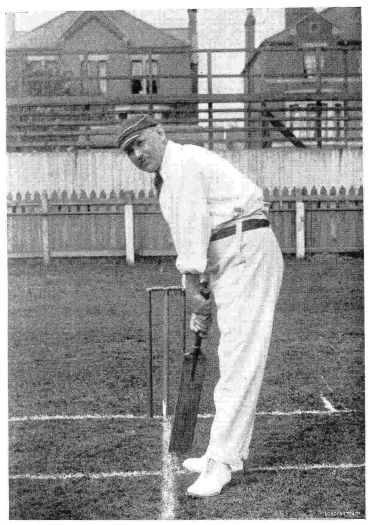
I.—Waiting for the ball, with the weight balanced almost
evenly upon the two feet (which are near together), but rather on the
right foot.
[To face page 22.
with the legs (or only the left leg) very slightly bent, and ready to
move backwards or forwards. One should not be stiff, but should be
inclined to looseness, until one knows which ball is coming; till then
one should be ready to run or jump out if it should be desirable. The
feet should probably be quite near to one another, the right being near
the crease and parallel to the wicket, the left outside the crease and
pointing more towards the bowler. Probably both should be resting on
their balls, and rather—so Mr. Fry advises—on the insides of their
balls.
The weight of most batsmen should be upon the right foot, the batsman’s
basis. Abel stands on the ball of his right foot; that is good if one be
quick-footed. Ranjitsinhji explains some of the reasons why the weight
should rest on the right foot—he instances several forms of exercise,
such as boxing; for Tennis and Racquets I have spent hours in practising
quick movements in all directions with the stiff right leg as my pivot.
The left foot may be slightly up and prepared to move out along some
forward line. In case of a late cut one has time to shift the weight on
to it and make it the pivot.
The bat is usually held with one hand near the top of the handle and the
other hand near the middle of the handle; if one holds the right hand
lower down one gets more control, but may lose some pace; one is more
apt to stoop, and to lift the ball. But for some strokes, as for certain
late cuts, the shifted grip is often preferable; one should be able to
slip the right hand down the handle towards the blade, near to which so
many of the stone-wallers love to keep it. As the right foot and leg
hold the ground more firmly, so does the right hand and wrist hold the
bat more firmly, though there should be no tight and tense grip till the
stroke is being made. One can—as Abel and Shrewsbury put it—“feel the
nip” of the bat without any unnecessary tension. Not a few players have
the grip of the two hands almost equal.
The left elbow should be well up, so as to keep the handle of the bat
nearer to the bowler and thus to prevent a chance of catches. And the
whole body and head should be well up as the bowler begins to bowl, so
that the best possible view may be given.
One must watch the fingers and wrist and arm of the bowler; a change in
his fingers
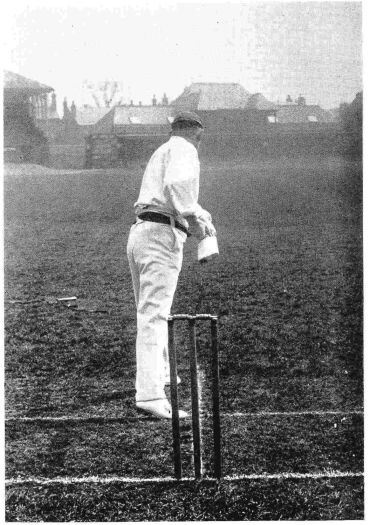
II.—Forward play: the bat has been drawn straight up and
back (not in a curve) before the stroke.
[To face page 25.
will mean a change of the ball he will bowl. Thus Hirst’s balls will
differ according to the way in which his fingers are arranged (see the
photographs). Abel generally watches the wrist rather than the fingers.
While the bowler is bowling, one should usually draw the bat up and
back, without flourish, in the line opposite to the line of the
approaching ball. The photograph of Shrewsbury (II.) shows the bat
lifted for a straight ball which he is going to play (not drive)
straight forward. By lifting the bat one gets more impetus and can use
one’s height and weight better.
Attention and alertness—these are to be maintained. “This one thing I
do now,” “On this depends everything”; such are samples of the
suggestions which I often make to myself at my own games. Yet I try to
economise energy and not to waste any of it; attention without tension,
alertness without fidgetiness—these are right.
“Timing the ball is the secret,” says Giffen. It is a secret, not
the secret. Nor is it a simple rule; timing is (see page 7) a
concoction of many good things.
A simpler general rule is not to leave a large space between the bat and
the legs, lest one should be bowled off one’s pads. The photograph of
Abel shows no intervening space at all.
Another simple general (but not universal) rule is to end up—as in
forward play—with the handle held by the first finger and thumb of the
right hand and of the left; the other three fingers scarcely have any
influence here. The nails of all four fingers—as in the
photograph—should face the bowler (or yourself if you were opposite a
mirror). The bat must not be tilted upwards nor drawn back behind the
line of the right foot, which is firmly on the ground, and is certainly
not drawn away to the leg-side.
About the “fixed right foot” there is—as we shall see—a great fallacy;
theory has been allowed to controvert the practice of the leading
experts. Shrewsbury in the photograh (III.) has his right foot firm
indeed, and not shifted to the leg-side, but back almost to the wicket
itself. W. G., in a photograph in Ranjitsinhji’s book, has his right
foot back, though not nearly so far back. I scarcely ever see a player
whose regular habit is not to shift back his right foot somewhat
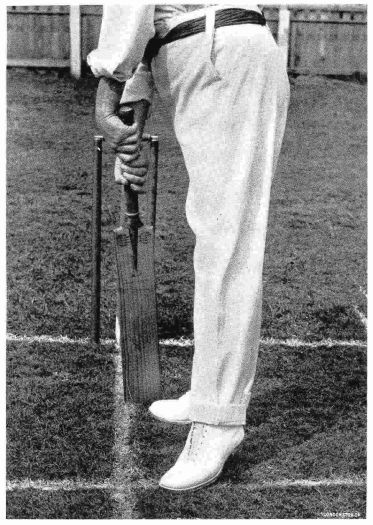
III.—Playing back: the right foot has retired nearer the
wicket, so as to give longer time for seeing the ball.
Note.—The bat should be held straight. This photograph was taken before
Shrewsbury was in practice.
[To face page 26.
in back play. Shrewsbury will tell one to get back far enough, moving
back with the ball. This obviously gives one more time to see the ball
and its break, turning a ball that is just a trifle short into a ball
that is nearly a long hop; if the legs be—as they often are—in front
of the wicket, so as to give a still better sight of the ball and also
to save a play-on, then the retreat of the right foot is obviously
useful. Others, however, do not move it in front of the wicket. But
nearly all back-play is actually practised with the retirement of the
right foot. Murdoch’s words are worth quoting at some length:—
“In the majority of cases, my experience has been that, by moving
the right foot as much or as little as judgment dictates, the
stroke is made with far more ease than by having your right foot a
fixture. If you will take the trouble to notice all players, you
will see for yourself that in almost every case when they are
playing back the right foot is always moved. And, again, you will
find you have far more command and power over the ball, and
especially so over a rising one, and you can finish your stroke in
a far safer way.... My advice to you is to move the right foot
when, in your judgment, it requires it; if you find you can play
the ball with ease by not moving it, well and good; but should you
at any time think you could play the ball better by getting back a
little, why do so, and you will find it will give you a particle
more time and enable you to make things very much easier.
“I think the art of boxing very applicable to forward and back play
of cricket, for whilst boxing is nearly all forward strokes, there
are many times when a boxer has to get back, and he generally finds
what a great difference there is in receiving a hit whilst standing
principally on his right foot, and when he has moved it a few
inches in getting back. So it is with your back-play at cricket,
the velocity of the ball is not so great two feet back from your
crease as it is right on it. The advantage of time is no doubt
momentary, but still it is an advantage, and one that I have proved
and seen to be very beneficial.”
One kind of glide-stroke forms a special branch of back-play: it is to
be seen in the photograph of Abel (IV.). Ranjitsinhji is the master of
this most useful stroke; he plays it for balls on the wicket as well as
for balls to leg. Others use it chiefly or solely for balls off the
wicket. For this stroke I believe every player has the right foot back.
The bat’s face is held not flat towards the bowler, but slanting in one
of many directions on the leg-side, according to the spot to which one
wishes to place the ball.
The “half-cock” stroke is Grace’s favourite help in time of trouble.
When he hesitates between forward and back-play, and especially after he
has decided on forward-play and
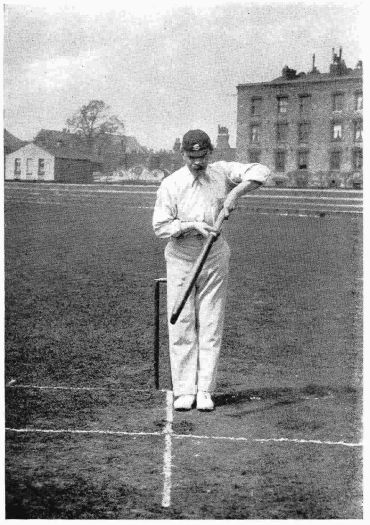
IV.—The glide: both feet well back.
[To face page 28.
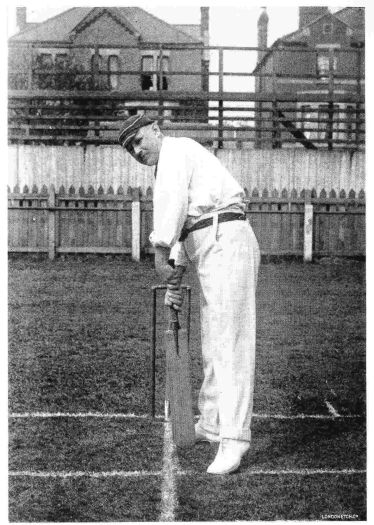
V.—Playing back: right foot retired, to give extra time for seeing
the ball; weight on right foot. This is Shrewsbury’s stroke when he
feels “beaten” by the bowler.
[To face page 29.
then doubts whether he can reach out near enough to the pitch of the
ball to smother the ball, he is content to strike the ball scarcely at
all, if at all, and to hold his bat half way between its forward and
back positions, and wait in hope.
Shrewsbury, however, if the ball be straight, prefers to bring his bat
straight down on to the block. He is to be seen doing this in the
photograh (V.).
It appears to me that, as most Lawn Tennis players learn back-play
securely before they learn forward-play (play, i.e., at the net), so
most cricketers should learn back-play securely; they should learn to
play forward, of course; but, as Mr. C. B. Fry says, they should not
learn that only. Inasmuch as back-play is the easier and more
natural—except for the art of not drawing away the right foot towards
the leg side—it should probably precede the mastery of forward-play,
towards which mastery the “half-cock” stroke might form a transition
step.
There may be days when scarcely any forward-play is needed; there may be
experts who prefer back-play even on fast and true pitches, just as Mr.
A. W. Gore, the amateur Lawn Tennis champion of 1901, prefers habitual
back-play at his game. But every player should be able to play forward,
particularly to swift good-length balls on quick plumb-wickets which are
either too dry or else too slippery to bite the ball and allow it to
break; on the fast slippery wickets, however, forward-play must be
accurate, because of the occasional shooter. Besides the safety of such
forward-play, since it can smother the ball, there is the extra delight
of meeting if not of attacking, and also of performing a movement which
is not by any means natural—the extra delight of overcoming a
mechanical difficulty.
We may begin to study this forward-play (for which we have already
offered certain exercises—see above) by a couple of quotations from
well-known writers.
“The golden rules to guide the beginner in playing forward may be
very briefly stated. (1.) Play forward when the ball is fairly well
pitched up, but remember that the faster the bowling and the faster
the wicket the more frequently will forward-play be the safer style
of play. (2.) Keep the bat quite
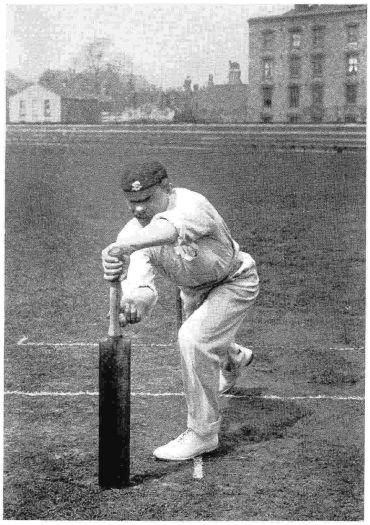
VI.—Playing forward to a ball on the off: the straight bat has
passed near and beyond the left foot in a “follow-through.” Notice
the fingers, especially the first finger and thumb of the left
hand. At the end of the stretch the left arm is fully extended, and
the right heel has come off the ground.
[Between pages 30 and 31.
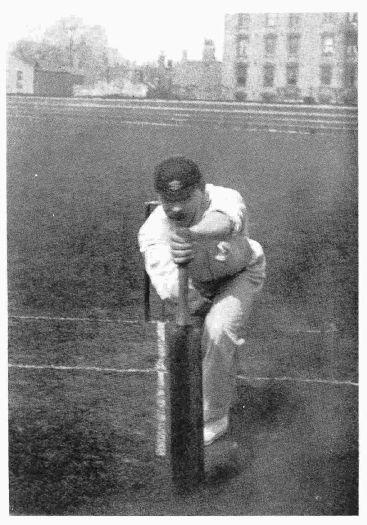
VII.—Playing forward to a ball slightly to the leg side: see
remark on previous photograph, and notice the head well over the
bat-handle.
[Between pages 30 and 31.
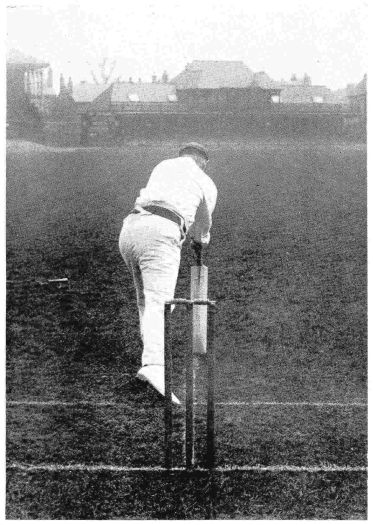
VIII.—Playing forward to a straight ball: see remarks on
previous photographs.
[Between pages 30 and 31.
straight and the left shoulder and elbow well forward. (3.) Get as
near to the pitch of the ball as possible. (4.) Do not put the bat
further forward than the level of the left foot, which ought to be
thrown right forward.”
“No forward-stroke is absolutely safe unless the ball is smothered.
There are many very beautiful strokes effected by forward-play at
the rising ball. Such strokes, however, are purely plumb-wicket
strokes.”
In the face of this latter quotation, and of (3) of the first quotation,
and in the face of the habitual practice of many leading experts (see
Photographs VI., VII., VIII., of Abel and Shrewsbury) in following
through with the bat beyond the left foot, the statement in (4) is
absurd. And yet, as we shall see in the Chapter on Fallacies, it appears
in almost every work on Cricket.
Personally I should far sooner see the general rule stated as follows:—
“At the root of good ordinary forward-play lies extension both
direct (not curved) and well-timed and well-co-ordinated (not too
early or too late, and not piece by piece—for example, first the
foot, then the left elbow), and fast and powerful (not slow and
tame), and full (not arrested); at the root of it lies such
extension of right leg, left foot, left shoulder, left elbow, left
wrist; but within the limits of power, and of balance or rapid
recovery of balance.” When Abel or Shrewsbury can thus safely and
strongly reach out an extra fifteen inches beyond the left foot,
and thus smother a ball and its break, why forbid it? If only in
case a ball hangs a bit, and also for the sake of the
follow-through—I believe that nearly every ball-game stroke
demands a follow-through—such a passing of the blade’s end beyond
the left foot may be advisable.
Be this as it may—and it must be settled by practice, not by theory—at
any rate the law holds good that for ordinary ground-play (as distinct
from the drive out of the ground) the left wrist must come before the
right, the right shoulder being kept down.
The base, the safe ἀφορμή of forward-play, is the firm right foot
(nearly parallel to the three wickets) and the straight right leg. From
this base the left leg has, as it were, to radiate forward in one or
another straight line towards the approaching balls; not straight at
those balls, but a few inches to one’s left; certainly not necessarily
straight forward down the line from wicket to wicket, as the forward
play of Abel to a ball on the off will show (see Photograph VI.); in
fact, to a left hand bowler round the wicket one should as a rule not
play along this line, but along a line further outwards to one’s right.
The left toe points, and the left foot moves, not at but towards the
line of the approaching ball, allowance being made for a curl or a break
that will alter this line. It is the line that the ball will be making
just when it strikes the bat (or, rather, just when it is struck by the
bat) that has to be met by the bat, which must move in a line a few
inches to the right of the left foot. The line both of left foot and of
bat must be direct, not curved.
Over one’s bat comes one’s head: as Abel says, one must get above the
ball and smell it. The bat itself, for ground-play, must not be tilted
with its blade nearer to the bowler than its handle is, lest a catch be
sent up. Its direction from the line when one lifts it before the stroke
(see Photograph II.), right up to the end of the follow-through (see
Photograph VIII.), must be as straight as possible; like a boxer’s blow
straight from the shoulder, and not like the swirling arm of the
unskilled navvy, even if both these movements might reach the same goal
eventually. The curved line means a loss of time and of power, as well
as a risk—for it allows a smaller margin of error.
The stroke should be all in one piece, the power beginning when the bat
is near to the left leg, and of course reaching its fulness from each
part of the mechanism just when the blade hits the ball.
To what part of the mechanism would one do best to attend? The firm
right foot is the base, the point d’appui, the terminus a quo. I
should say that the terminus ad quem, the point of limit, should be
the outside joint of the left wrist. Let that go right out to its
stretch. Most of us, by taking thought, can add an inch or so to our
reach. I added two inches to my (easy) forward reach within two months.
The hand’s grip should change as the left wrist shoots outward. In the
waiting position the bowler (or you yourself in a mirror) can see the
back of your left hand; then
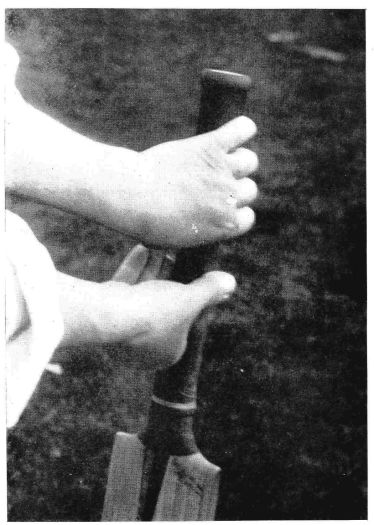
IX.—Position of hands and fingers at the end of the forward
stroke: the left hand has shifted round, the right hand holds the
bat with thumb and first finger only.
[To face page 35.
back and up goes the bat—not too far, but enough to get power (my own
ordinary Tennis and Racquet strokes and many a golfer’s ordinary strokes
go up and back quite a short way as compared with the old-fashioned
“complete” swing); then, as the bat comes down and forward, you yourself
(if you had not your eye on the ball) should be able to see the back of
your bat and above it the back of your left hand (as in Photograph IX.
of Shrewsbury’s hands). So far as the left side is concerned, the stroke
is an exaggeration of a left-handed backhand stroke, except that the
thumb in cricket does not support the handle as it often does in
Racquets.
If any one cannot yet play forward, but wishes to learn the art, let him
practise (as I have recently done) this turn of the fingers, this
outward stretch of left wrist, left elbow, left shoulder, straight along
a line, full, swift, weighty. It is amazing how soon the straight line
can become easy if one works faithfully along a line upon the floor and
opposite a mirror, correcting all errors by the opposite exaggerations,
but first of all securing the foundation—the long straight lunge of the
left foot. Sandow and all high authorities say, Throw the whole will,
focus the whole attention, concentrate the whole mind, fix the whole
vital force, upon the muscles which you are using; first do this upon
the left foot, then upon the left wrist (if not upon the handle of the
bat, strange as it may sound).
Having acquired this free forward line, then practise a speedy recovery
of balance afterwards, and a readiness to start running. Later on, add
to these two a few actual steps. Eventually, though you may have had to
conquer each mechanism by itself, as I conquered every part of my Tennis
and Racquet strokes separately, yet you will be able to combine them
together so harmoniously that no one will guess or believe how you
gained your stroke. It appears so exactly like a unity, so exactly like
one single action—that lunge with full weight, and recovery of
equilibrium—that people tell me I never could have learnt it
part-by-part. But I did. I can tell every part, though now the whole
move is a unit. There is absolutely no necessity to begin by doing the
whole stroke at once, so long as eventually you can combine the various
members of it into a harmonious whole. Otherwise any one individual bad
part may spoil the whole effect.
This correct stroke frustrates the bowler’s attempt to make you tilt up
your bat’s blade and send a catch: having your left wrist well forward
beyond your right, you keep your strokes down. Another common fault
besides the tilted bat is the crooked bat, the bat of which the blade is
too far to the off; this fault is obviated chiefly by the straight right
leg: bend the right leg, and the tendency is for both these faults to
appear.
Forward play may be either defensive or offensive. The latter kind
merges into the ground-drive. In either case the average-eyed person
must get to the pitch of the ball and smother it, or must not play
forward, but either do the half-cock stroke or else step back and give
himself the largest possible time in which to see the ball’s flight. The
defensive should as a rule precede the offensive, both while one is
learning to play forward and also while one is beginning any innings at
a net or in a game. A few forward stretches before play will perhaps
save a premature dismissal through stiffness.
In forward ground-driving the rule of not letting the bat’s blade go
beyond the left foot is far more reasonable. One must get well over the
ball, the power coming chiefly from just that jerk of shoulder,
fore-arm, and wrist which Latham and Pettitt and a few others use at
Racquets—the jerk of some whippers of peg-tops. But for this drive the
bat need not move quite so near to the left foot. Moreover the bat may
finish up with a smaller follow-through. Let the forward left elbow
arrest the swing of the right arm, lest the bat be tilted and the ball
rise: that wrench of the left elbow-joint is a satisfactory sign.
The forward off-drive (for a ball not coming at the wicket) allows of a
far freer swing, and, if you see it well, of a far less straight bat. It
needs more right wrist and less left elbow restraint. Indeed, it may end
up with the bat over the left shoulder. Photograph XIII. shows Abel’s
position for such a drive, though the position is better suited for a
cut-drive.
For the forward on-drive the left foot is pointed out towards mid-on.
There used to be a fallacy that the pull was bad form because it was
ungraceful; but now-a-days grace is of little account
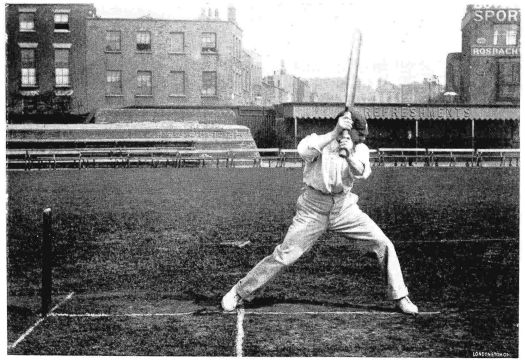
X.—Preparing to drive with a pull: the left leg is well
out so that the bat may get nearer to the pitch of the ball.
unless it is useful. Hirst’s pull will count as four, while graceful
“good form” will courteously return the same ball to the bowler and
score nothing. It was W. G. and his brother who subordinated so-called
art to utilitarianism. The only valid objection to the pull is that it
is most dangerous as a habitual stroke; whereas for a full pitch or a
long hop it may be, as Shrewsbury says, least dangerous as well as most
paying, since it may need less power and may go to a part of the ground
least thickly studded with fielders.
The mistake is not in the pulling per se, but, as Ranjitsinhji
insists, in the choice of the wrong ball for pulling, or else—we may
add—in the wrong way of pulling the right ball.
As there is elsewhere a forward-play as well as a back-play, so there is
with pulls. Abel is shown giving a forward pull, in Photograph X.;
notice that the left foot is right out so that the bat gets well to the
pitch of the ball. If one could always ensure that, pulling would be the
best stroke in the game. This step out adds to the safety of the pull
when the ball will pitch say two yards from the batsman.
The back-play pull is for a shorter ball. Hirst is making such a pull in
Photograph XI. (and Photograph XII. which represents a different kind of
pull by Shrewsbury). Hirst has moved back and turned a somewhat short
ball into a long hop. Into this stroke he will put the full body-swing
from the hips. He might do this stroke equally well with a good full
pitch to the off. To run out (either to slow bowling or to ordinary
bowling on a difficult wicket) and then to “volley” round to leg used to
be the one stroke that I could do reasonably well. Even then I often
erred in running out timidly and in using my wrists rather than my trunk
and shoulders.
Whereas the long hop and the ordinary full pitch may be placed thus, the
half-volley can seldom be safely pulled. It is hard to direct. But with
all these strokes, whether pulls or drives, the law of “the left elbow
and wrist well forward to prevent catches” may be ignored if one can get
to the pitch of the ball by coming forward, or else get it as a long hop
by stepping back, and then can place it safely away from any fielder. If
one can, then one need never mind about sending
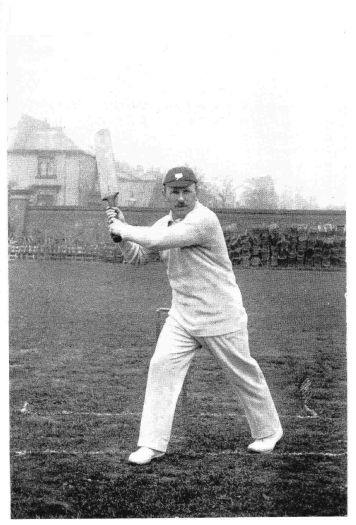
XI.—Preparing to pull a short ball: right foot across,
so as to help the stroke well round to leg.
[Between pages 40 and 41.
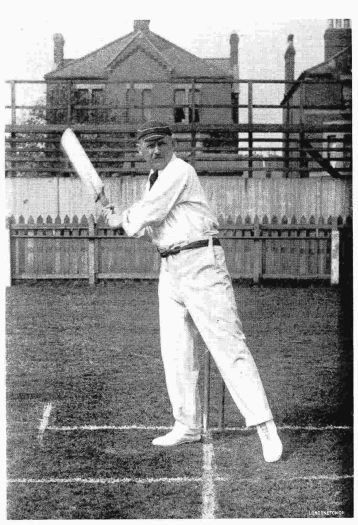
XII.—Preparing to pull a short ball: right foot across
and well back so as to make the short ball still shorter.
[Between pages 40 and 41.
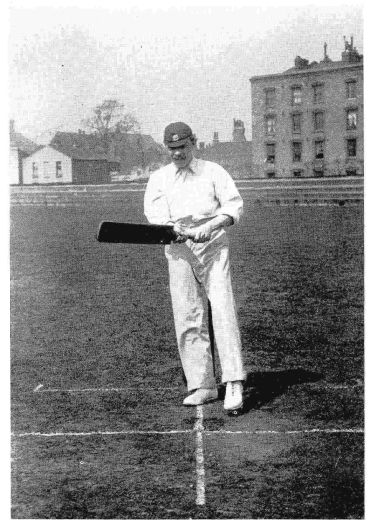
XIII.—Hook-stroke to leg: both feet well back, but
weight on right foot.
[Between pages 40 and 41.
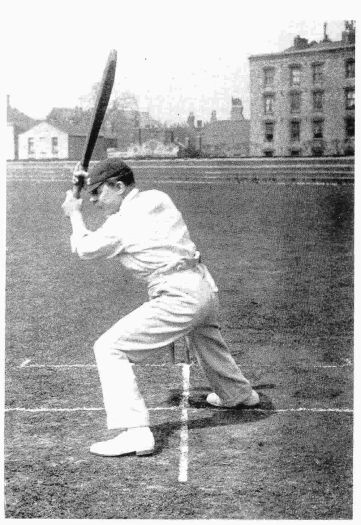
XIV.—Cut-drive. Right leg firm and straight, left leg
bent and well across.
[To face page 41.
high balls or playing with a crooked bat.
The useful hook-stroke to leg is seen in Photograph XIII.
Ranjitsinhji rightly distinguishes several kinds of cuts, and advanced
players must be referred to his book for details. Here one must be
content to notice the cut-drive (forward-play to some spot between point
and extra-cover, as in Photograph XIV. of Abel), and the late-cut
(back-play to some spot between point and short slip, as in the
photographs of Abel and Shrewsbury). Here once more we have forward and
back play, the latter allowing more time.
The cut-drive is good for a short ball on the off. The left foot is sent
out to the off, the bat swings back and generally somewhat up, very much
as it does to the pull-drive. Abel is seen preparing for a cut-drive in
Photograph XIV. He will get right on to the top of the ball.
The downward movement, for the sake of safety, applies also to the
late-cut, with regard to which we have already exposed the fallacy that
it is a stroke done entirely with the wrists.[4] The wrists may do some
of the directing at the last moment, but the large movement and the
force is usually given chiefly by the fore-arm-jerk, the
shoulder-jerk, a little trunk-movement, and (with some players) the step
with the right foot across the wicket. Let a hundred experts make
imaginary or real late-cuts for half-an-hour, and I guarantee that the
wrists will not be the only parts that ache. Indeed I have seen many
players cut safely and effectively with absolutely rigid wrists. As I
have already said, the motion is nearer to that of shaking out a
stylographic pen or whipping a peg-top; it is akin to the Racquet stroke
of Latham or the Tennis stroke of Pettitt. Watch the forearm and the
shoulder of a stripped player, and this will be clear.
The late-cut is most safely used against fast and not too short bowling
on a quick pitch; it does not oppose the ball’s flight, but rather
increases or at least directs that flight. It is not to be rashly tried
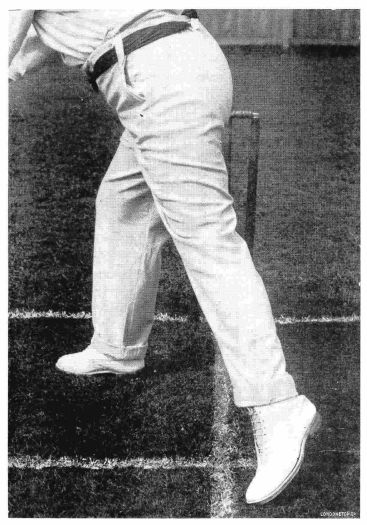
XV.—The late cut: right foot well across, left leg
extended so far as to bring heel off ground.
[Between pages 42 and 43.
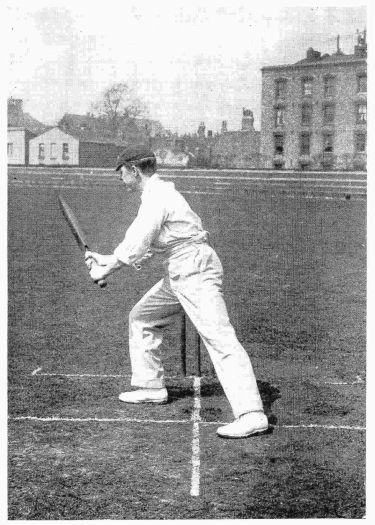
XVI.—The late cut: right foot well across, left leg
extended.
[Between pages 42 and 43.
against slow bowling, especially if this breaks much, on a slow or
caking wicket; for it needs very accurate timing.
In this late-cut the right leg is moved back and across the wicket (see
Photograph XIV. of Shrewsbury’s legs), so that the left leg and foot now
does what the right leg and foot do for the other strokes—namely, serve
as a pivot. Some move the right foot and then make the stroke; I believe
Ranjitsinhji generally prefers this plan. Others, like Abel, often make
the stroke as a single movement. Others use now one plan and now the
other. Anyhow the weight passes from the left on to the right leg, which
is bent. Shrewsbury, in the photograh (XV.), is allowing his left foot
to rise slightly on its ball. Contrast Abel, in XVI.
He does not alter his ordinary grip, and he uses his wrists a good deal;
others let their right hand slide down the handle towards the blade, and
sometimes let their left hand slide after it. The bat strikes downwards,
passing about twelve inches over the wicket.
The direction of the cut is most important: this depends partly on the
presence or absence of a wrist movement, partly, as Ranjitsinhji says,
on the moment at which one strikes the ball—the earlier hit goes
squarer (nearer to point), the later hit goes finer (nearer to short
slip).
The late-cut involves not a little risk. It may be well at the beginning
of an innings to study the art of
A good length or “blind” ball on the off-side, and a certain kind of
bumping long hop (almost out of one’s reach) are intended for a catch
behind the wicket. Some may be cut or driven, but it would be safer to
let a few pass by (unless they are going to break in) till one sees what
they are doing. The continued practice of this plan is not for the good
of Cricket as a form of sport.
The use of the legs to defend the wicket has been another much-discussed
topic. Ranjitsinhji rightly points out that it requires skill and is not
unknown in the play of the best experts. Here as elsewhere the fault
lies less in the use than in the excessive use.
If Shrewsbury and others have been censured as too cautious in letting
certain balls alone, and in playing certain other balls with their pads
instead of their bats, the runner-out is censured for the opposite
reason—for a ridiculous rashness. This is a fallacy. To run out is
often the safest policy: it may mean to smother an otherwise difficult
ball. Abel and Jessop, like Latham at Racquets and Tennis, play with
their feet as much as with their heads. The best illustration that
occurs to me of “the wisdom of anticipation” (stigmatized as “the folly
of rashness”) is the running up to volley or half-volley the service at
Racquets. Often one can take a ball best by letting it nearly fall to
the ground at its second bounce—that is, by turning into a “long hop”;
but if it be a good length service, or one with a heavy cut, it may be
more prudent to run up and thus change it into a comparatively harmless
plaything, as a child may deal with a snake by fearless handling.
Murdoch is most emphatic on this point, when he says:—“No, I think the
feet play very important parts in batting, and both of them should have
the greatest scope possible. I advise all players to learn to use their
feet quickly and well, and it will be the means of getting you out of
many a difficulty. By being able to get to a ball quickly you make it an
easy one where if you had remained in your crease you would have found
it a most difficult one to stop. Once you get into the way of doing this
you will never move the right foot unless you require to do so to make
your stroke. In all forward play it is absolutely necessary for you to
keep the right foot well on the ground.”
There are three ways of moving out to a ball; in all three ways one must
not draw the right foot away, but one must keep the right foot as the
pivot; and one must come out wholeheartedly, not hesitatingly.
Shrewsbury will often jump out, coming down on to his right foot first
with his body-weight upon its ball. He who tries this should be prepared
to keep his balance and if necessary to jump back again into his ground.
Most others run out sideways with small or large steps. See Photograph
XVII.
Abel runs out more quickly than these. His legs, as it were, intertwine
neatly in the way shown in Photograph XVIII. His first step, with the
left foot, is well across the
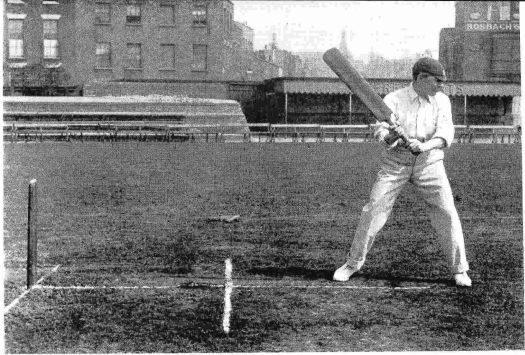
XVII.—The way of running out with fairly long steps,
weight should be chiefly on right foot, and right leg should be ready to
serve as firm pivot.
[Between pages 46 and 47.
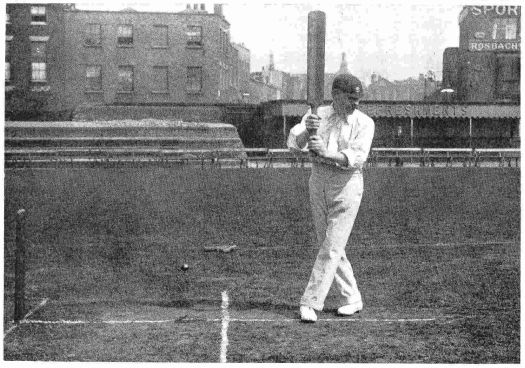
XVIII.—Abel’s way of running out, with feet interlacing.
[Between pages 46 and 47.
wicket and towards the off-side; his second step, with the right foot;
the action may be repeated.
This sideways running is not easy: it needs considerable practice
backwards and forwards before one can not only do it but also maintain
one’s poise and be ready to hit the ball afterwards. A jump or a run
out, even with a loss of poise, may be far better policy than to wait
for a “teaser.” Two quotations from high authority are worth citing
here.
“I do not think that batsmen run out enough at slow bowling or at
lobs. For some undiscovered reason, there is a floating idea that
running out and rashness are synonymous. As a matter of fact, to
run out is often the safest thing one can do. It makes a difficult
ball into an easy one, and often enables the batsman to make a
forcing-stroke along the ground instead of a risky high-drive. The
man who plays cautiously is invariably regarded with reverence and
favour by those who know. He is supposed to play the correct game.
He often ties himself into extraordinary knots by playing what he
considers a safe dashing game. There are some players who, not
being quick on their feet, ought never to run out.”
“A running-out stroke should be played with the same amount of care
and concentration as a back-stroke. There is an air of abandon
about quick-footed players which is very deceptive; they often run
out to meet the ball, because they feel safer in doing so than in
staying at home.”
Short balls or balls well off the wicket are seldom to be met in this
way unless one is a Jessop. But whatever ball be anticipated in this way
let it be sought with full pace and intent to “volley”. If one must be
stumped, then, as Grace and others say, one may just as well be many
yards out of one’s ground as be only one yard of it.
An obvious advantage in moving out is that, if your partner is backing
up, you have every chance of making a safe run.
Quick starting and quick moving between the wickets are little
cultivated. Yet a game of tip-and-run will show how many runs can be
stolen. Too little account is taken of the pace at which the ball has
been hit, the place to which it has been hit, the individual to whom it
has been hit, the side of that individual, left or right, to which it
has been hit, and so on.
The general rule is that the player in whose sight the struck ball
appears most clearly (namely, the batsman for balls in front of him, his
partner for balls behind him) shall call at once and call loudly. The
non-caller shall either trust and obey, or else immediately call a loud
“No.”
Both players should start at once from their right toes, and should run
the first run as briskly as if a second were sure to follow. Giffen
laments the small care paid to this art. He says:—
“One most important point connected with batting is running between
the wickets. Really it is almost heartrending to see the immense
number of runs, to say nothing of the wickets, which are lost
through bad judgment. A batsman wants to study the pace at which a
ball is travelling.”
The non-batsman should back up well; a few yards may be gained in this
way, and also by the habit of running the bat along the ground just
inside the crease.
A useful position for turning at the crease is to be seen in Photograph
XIX., of Shrewsbury. By the rapid change while the bat is held at full
stretch one may gain an appreciable amount of time and space.
The first pieces of advice to all players of games will be, “Get at the
reason why, and the means by which.” Why should one not flourish the bat
before a stroke? Partly because this sends the bat out of the straight
line and loses time. Why should one move the bat near to the left foot
in forward-play? Partly because this will give power by keeping the
weight of the body near to the bat, and because it will give safety, by
allowing no space for the ball to pass between bat and leg. Merely to
say to a beginner “Don’t be afraid of the ball” may not be enough; he
should know that, if he draws his right foot towards the leg-side, he
will lose his pivot and will tend not to play the ball down and not to
meet it along its line of approach. If he bends his right leg, the same
result
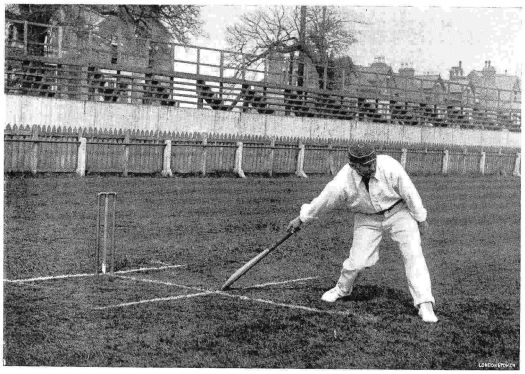
XIX.—Turning quickly at the crease after the first run.
[To face page 50.
may follow. How can he keep the ball down and meet it along its line of
approach? By attending to his left foot in practice, or by getting some
one to watch his practice or play from behind.
Having found out and mastered the muscular mechanisms as well as the
raisons d’être for each of them, let the learner be prepared to try
new things and to judge them by their results. In January, 1902, in my
thirty-fourth year, I changed my Racquet and Tennis stroke from a full
swing to a more “partial” jerk. In case it did not suit me, I was
prepared to go back to the old. As a matter of fact, the new did suit
me.
In this case I imitated Latham and (to some extent) Pettitt. They were
of about my own height. I did not imitate slavishly or in trust, but in
hope and because I saw good sense in what they did. In Cricket many
might hold that even slavish imitation is better than rank failure.
To take an example. Few batsmen play well on difficult wickets.
Shrewsbury does. I would sooner imitate his style and methods on
difficult wickets than go on failing to score. There is no particular
reason why his style and methods should not turn out to be mine as
well. I cannot tell till I have experimented.
The batsman, as Mr. C. B. Fry says, should be able to play all games and
strokes—forward, back, cut, and, let us add, tip and run. He must be
able to keep his wicket up, to stop good balls (as Shrewsbury advises)
and then punish bad balls; but he must also be able to force the game,
especially if the bowling be too hard to enable him to stay in long.
Especially should he be “nippy on his feet”—Abel’s rule. He need not
use them always, but he must be ready to use them. So with the pull: he
must not be tied down by a law “Thou shalt not pull.” A short ball can
often be pulled quite safely: it need not always be hit to mid-off.
Scarcely any rule is absolute. We hear that the right leg should not be
bent. Good. But when we see Grace hitting effectively to the on with a
decidedly bent right leg, we suspect that there may be times when this
is useful. It is only as general rules for most people that maxims are
to be laid down. “Stand upright” says the theorist; he even quotes
successful examples. But the individual may be nearer to Stoddart or
Jessop than to Palairet. Let the individual try both ways, if not in
games, then at the nets.
Reserve some force, says Mr. R. Lyttelton in the Badminton Volume;
Ranjitsinhji agrees—since the use of the full force may “give one away”
and lose the balance. But Shrewsbury says, “Use the full force; a
mis-hit then has more chance of going over the head of cover or some
other fielder.” Keep the ball down—that is a good enough rule; but if
you can hit the ball safely away from or over the head of a fielder, why
not? Again, we hear that the batsman should not stand with any part of
his body in front of his wicket; yet many find it useful to do so,
especially in case they snick the ball and might otherwise play on.
Another hint that may not always be helpful is “not to make up your mind
what you will do until the bowler’s intention has shown itself; for, if
you decide, he will alter his intention.” This presupposes that the
bowler is observant and intelligent, whereas ordinary bowlers are not.
In Racquets, on the same principle, I have been told not to pledge
myself to any set action before the server has served; that is sound
sense so long as the server is likely to vary his service; whereas, if
I know that he is going to pound away with the same sort of thing all
the time, I should waste energy by perpetual alertness. I take for
granted that the fool will serve foolishly, and I virtually settle my
policy beforehand. It is not every bowler who demands alertness.
Of wider and more nearly universal application are such hints as “Face
the left-hand bowler round the wicket differently from the bowler over
the wicket; move your left foot out on different lines”; “Don’t try
risky attack till you are sure of safe defence, unless the wicket be
extremely difficult”; “Don’t attempt to place a half-volley very
accurately”; “Watch and observe the ordinary curves and breaks of the
ball according to this or that action”; “Notice how others as well as
yourself are most apt to get out off certain balls—say off the breaking
ball well-pitched up on the off”; “Practise wicket-keeping
occasionally”; “Study each bowler’s action before you go in”; “When you
go in, be careful at first of touching balls on the off”; “Get the blind
spots of the pitch in your mind’s eye, so as to tell whether to play
back or forward: the blind spot varies according to the pace of the
ball, the state of the ground, etc.”; “Get in your mind’s eye a picture
of the fielders; and, when you are set, place the easier balls between
those fielders; but keep your real eye on the ball from the instant that
it has left the bowler’s hand”; “Find out your faults and practise the
opposite faults.” As Mr. Edward Lyttelton says, “If it appears that your
strokes habitually fail to tell as they should, it will probably be
owing to your body not being properly utilized, and a spell of bedroom
practice should at once be inaugurated.” You can even cultivate the
opposite fault during the game itself. This is my habit during Tennis
and Racquets matches: if I find myself playing too soon at the ball, I
purposely try to play too late.

 and


