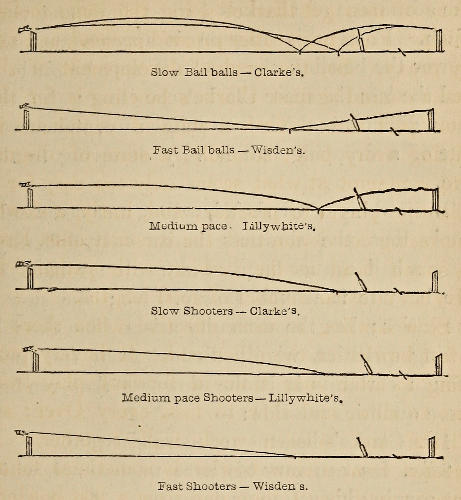
A writer in “Blackwood” once attributed the
success of his magazine to the careful exclusion of
every bit of science, or reasoning, above half an
inch long. The Cambridge Professors do not
exclusively represent the mind of Parker’s Piece;
so, away with the stiffness of analysis and the
mysteries of science: the laws of dynamics might
puzzle, and the very name of physics alarm, many
an able-bodied cricketer; so, invoking the genius
of our mother tongue, let us exhibit science in its
more palatable form.
All the balls that can be bowled may, for all
practical purposes, be reduced to a few simple
classes, and plain rules given for all and each.
There are what are called good balls, and bad
balls. The former, good lengths, and straight,
while puzzling to the eye; the latter, bad lengths
and wide, while easy to see and to hit.
But, is not a good hand and eye quite enough,
with a little practice, without all this theory?
Do you ignore the Pilches and the Parrs, who
have proved famous hitters from their own sense
alone?—The question is, not how many have succeeded,
but how many more have failed. Cricket
by nature is like learning from a village dame; it
leaves a great deal to be untaught before the
pupil makes a good scholar. If you have Caldecourt’s,
Wisden’s, or Lillywhite’s instructions, vivâ
voce, why not on paper also? What, though many
excellent musicians do not know a note, every good
musician will bear witness that the consequence
of Nature’s teaching is, that men form a vicious
habit almost impossible to correct, a lasting bar to
brilliant execution. And why?—because the
piano or the violin leaves no dexterity or rapidity
to spare. The muscles act freely in one way only,
in every other way with loss of power. So with
batting. A good ball requires all the power and
energy of the man! And, as with riding, driving,
rowing, or every other exercise, it depends on a
certain form, attitude, or position, whether this
power be forthcoming or not.
The scope for useful instructions for forming
good habits of hitting before their place is preoccupied
with bad—for, “there’s the rub”—is
very great indeed. If Pilch, and Clarke, and
Lillywhite, averaging fifty years each, are still
indifferent to pace in bowling,—and if Mr. Ward,
as late as 1844, scored forty against Mr. Kirwan’s
swiftest bowling, while some of the most
active young men, of long experience in cricket,
are wholly unequal to the task; then, it is undeniable
that a batsman may form a certain invaluable
habit, which youth and strength cannot
always give, nor age and inactivity entirely take
away.
The following are simple rules for forming
correct habits of play; for adding the judgment
of the veteran to the activity of youth, or putting
an old head on young shoulders, and teaching the
said young shoulders not to get into each other’s
way.
All balls that can be bowled are reducible to
“length balls” and “not lengths.”
Not lengths, are the toss, the tice, the half
volley, the long hop, and ground balls.
These are not length balls, not pitched at that
critical length which puzzles the judgment as to
whether to play forward or back, as will presently
be explained. These are all “bad balls;” and
among good players considered certain hits; though,
from the delusive confidence they inspire, sometimes
they are bowled with success against even
the best of players.
These not lengths, therefore, being the easiest to
play, as requiring only hand and eye, but little
judgment, are the best for a beginner to practise;
so, we will set the tyro in a proper position to play
them with certainty and effect.
Position.—Look at any professional player,—observe
how he stands and holds his bat.
Much, very much, depends on position,—so look
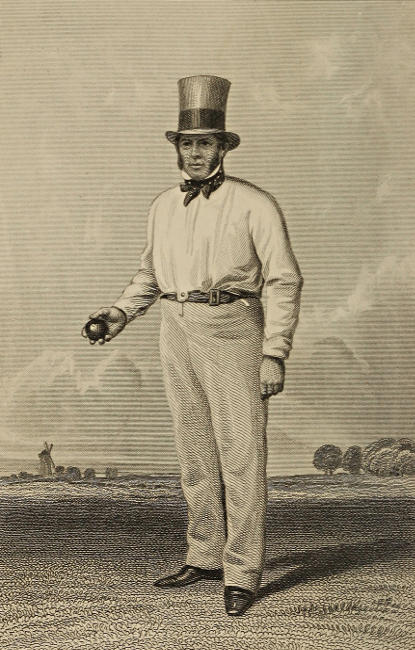
at the figure of Pilch. This is substantially the
attitude of every good batsman. Some think he
should bend the right knee a little; but an anatomist
reminds me that it is when the limb is
straight that the muscles are relaxed, and most
ready for sudden action. Various as attitudes
appear to the casual observer, all coincide in the
main points marked in the figure of Pilch in our
frontispiece. For, all good players,—
1st. Stand with the right foot just within the
line. Further in, would limit the reach and endanger
the wicket: further out, would endanger
stumping.
2dly. All divide their weight between their
two feet, though making the right leg more the
pillar and support, the left being rather lightly
placed, and more ready to move on, off, or forward,
and this we will call the Balance-foot.
3rdly. All stand as close as they can without
being before the wicket; otherwise, the bat cannot
be upright, nor can the eye command a line from
the bowler’s hand.
4thly. All stand at guard as upright as is easy
to them. We say easy, not to forbid a slight stoop,—the
attitude of extreme caution. Height is a
great advantage, “and a big man,” says Dakin,
“is foolish to make himself into a little man.”
If the eye is low, you cannot have the commanding
sight, nor, as players say, “see as much of the
game,” as if you hold up your head, and look well
at the bowler.
5thly. All stand easy, and hold the bat lightly,
yet firmly, in their hands. However rigid your
muscles, you must relax them, as already observed,
before you can start into action. Rossi,
the sculptor, made a beautiful marble statue of a
batsman at guard, for the late Mr. William Ward,
who said, “You are no cricketer, Mr. Sculptor;
the wrists are too rigid, and hands too much
clenched.”
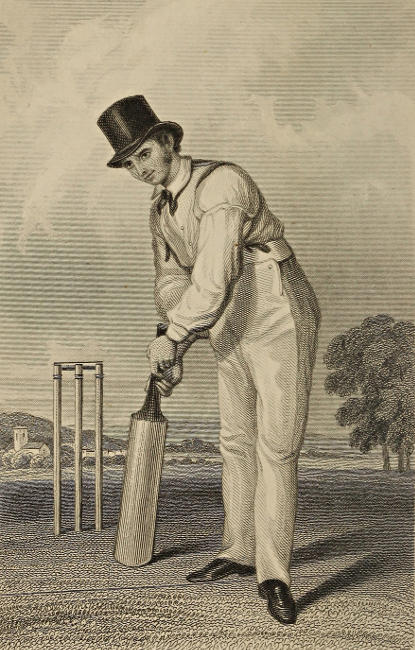
After standing at guard in the attitude of Pilch,
fig. 1. shows the bat taken up ready for action.
But, at what moment are you to raise your bat?
Caldecourt teaches, and some very good players
observe, the habit of not raising the bat till they
have seen the pitch of the ball. This is said
to tend both to safety and system in play; but a
first-rate player, who has already attained to a
right system, should aspire to more power and
freedom, and rise into the attitude of fig. 1. as
soon as the ball is out of the bowler’s hand.
Good players often begin an innings with their
bat down, and raise it as they gain confidence.
Fig. 1.
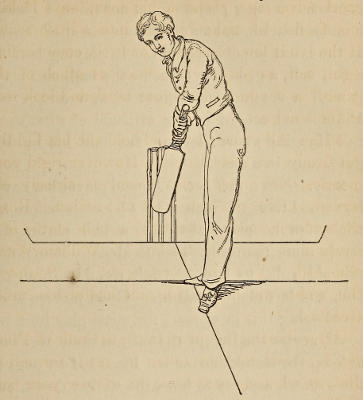
Preparing for Action. The toes are too much before Wicket, and foot hardly
within the crease. Foreshortening suits our illustration
better than artistic effect.
Meet the ball with as full a bat as the case
admits. Consider the full force of this rule.
1st. Meet the ball. The bat must strike the
ball, not the ball the bat. Even if you block, you
can block hard, and the wrists may do a little; so,
with a good player this rule admits of no exception.
Young players must not think I recommend
a flourish, but an exact movement of the bat
at the latest possible instant. In playing back to
a bail ball, a good player meets the ball, and plays
it with a resolute movement of arm and wrist.
Pilch is not caught in the attitude of what some
call Hanging guard, letting the ball hit his bat
dead, once in a season.
2dly. With a full bat. A good player has never
less wood than 21 inches by 4¼ inches before his
wicket as he plays the ball, a bad player has
rarely more than a bat’s width alone. Remember
the old rule, to keep the left shoulder over the
ball, and left elbow well up. Good players must
avoid doing this in excess; for, some play from leg
to off, across the line of the ball, in their over care
to keep the shoulder over it. Fix a bat by pegs in
the ground, and try to bowl the wicket down, and
you will perceive what an unpromising antagonist
this simple rule creates. I like to see a bat, as
the ball is coming, hang perpendicular as a pendulum
from the player’s wrists. The best compliment
ever paid me was this:—“Whether you play
forward or back, hitting or stopping, the wicket
is always covered to the full measure of your
bat.” So said a friend well known in North
Devon, whose effective bowling, combined with
his name, has so often provoked the pun of “the
falls of the Clyde.”
3dly. As full a bat as the case admits: you
cannot present a full bat to any but a straight
ball. A bat brought forward from the centre
stump to a ball Off or to leg, must be minutely
oblique and form an angle sufficient to make Off
or On hits.
Herein then consists the great excellence of
batting, in presenting the largest possible face of
the bat to the ball. While the bat is descending
on the ball, the ball may rise or turn, to say
nothing of the liability of the hand to miss, and
then the good player has always half the width
of his bat, besides its height, to cover the deviation;
whereas, the cross player is far more likely to
miss, from the least inaccuracy of hand and eye,
or twist of the ball.
And, would you bring a full bat even to a toss?
Would you not cut it to the Off or hit across to
the On?
This question tries my rule very hard certainly;
but though nothing less than a hit from a toss can
satisfy a good player, still I have seen the most
brilliant hitters, when a little out of practice, lose
their wicket, or hit a catch from the edge of the
bat, by this common custom of hitting across
even to a toss or long hop.
To hit tosses is good practice, requiring good
time and quick wrist play. If you see a man
play stiff, and “up in a heap,” a swift toss is
worth trying. Bowlers should practise both toss
and tice.
We remember Wenman playing well against
fine bowling; when an underhand bowler was put
on, who bowled him with a toss, fourth ball.
To play tosses, and ground balls, and hops, and
every variety of loose bowling, by the rigid rules
of straight and upright play, is a principle, the neglect
of which has often given the old hands a laugh
at the young ones. Often have I been amused
to see the wonder and disappointment occasioned,
when some noted member of a University Eleven,
or the Marylebone Club, from whom all expected
of course the most tremendous hitting “off mere
underhand bowling,” has been easily disposed of
by a toss or a ground ball, yclept a “sneak.”
A fast ball to the middle stump, however badly
bowled, no player can afford to treat too easily.
A ball that grounds more than once may turn
more than once; and, the bat though properly
4¼ inches wide, is considerably reduced when used
across wicket; so never hit across wicket. To turn
to loose bowling, and hit from leg stump square
to the on side with full swing of the body, is very
gratifying and very effective; and, perhaps you
may hit over the tent, or, as I once saw, into a
neighbour’s carriage; but, while the natives are
marvel-stricken, Caldecourt will shake his head,
and inwardly grieve at folly so triumphant.
This reminds me of a memorable match in
1834, of Oxford against Cowley, the village
which fostered those useful members of university
society; who, during the summer term, bowl at sixpences
on stumps sometimes eight hours a day,
and have strength enough left at the end to win
one sixpence more.
The Oxonians, knowing the ground or knowing
their bowlers, scored above 200 runs in their first
innings. Then Cowley grew wiser; and even
now a Cowley man will tell the tale, how they
put on one Tailor Humphreys to bowl twisting
underhand sneaks, at which the Oxonians laughed,
and called it “no cricket;” but it actually levelled
their wickets for fewer runs than were made
against Bayley and Cobbett the following week.
The Oxonians, too eager to score, and thinking
it so easy, hit across and did not play their usual
game.
Never laugh at bowling that takes wickets.
Bowling that is bad, often for that very reason
meets with batting that is worse. Nothing shows
a thorough player more than playing with caution
even badly pitched underhand bowling.
One of the best judges of the game I ever knew
was once offered by a fine hitter a bet that he
could not with his underhand bowling make him
“give a chance” in half an hour.
“Then you know nothing of the game,” was
the reply; “I would bowl you nothing but Off
tosses, which you must cut; you would not cut
those correctly for half an hour, for you could
not use a straight bat once. Your bet ought to
be,—no chance before so many runs.”
Peter Heward, an excellent wicket-keeper of
Leicester,—of the same day as Henry Davis, one
of the finest and most graceful hitters ever seen,
as Dakin, or any midland player will attest,—once
observed to me, “Players are apt to forget that a
bad bowler may bowl one or two balls as well as
the best; so, to make a good average, you must
always play the same guarded and steady game,
and take care especially when late in the season.”
“Why late in the season?” “Because the
ground is damp and heavy—it takes the spring
out of good bowling, and gives fast underhand
bowling as many twists as it has hops, besides
making it hang on the ground. This game is
hardly worth playing it is true; but a man is but
half a player who is only prepared for true
ground.” “We do not play cricket,” he continued,
“on billiard tables; wind and weather,
and the state of the turf make all the difference.
So, if you play to win, play the game that will
carry you through; and that is a straight and upright
game; use your eyes well; play not at the
pitch, nor by the length, but always (what few
men do) at the ball itself, and never hit or ‘pull
the ball’ across wicket.”
Next as to the half-volley. This is the most
delightful of all balls to hit, because it takes the
right part of the bat, with all the quickness of its
rise or rebound. Any player will show you what
a half-volley is, and I presume that every reader
has some living lexicon to explain common terms.
A half-volley, then, is very generally hit in the
air, soaring far above every fieldsman’s head; and
to know the power of the bat, every hitter should
learn so to hit at pleasure. Though, as a rule,
high hits make a low average. But I am now to
speak only of hitting half-volleys along the
ground.
Every time you play forcibly at the pitch of a
ball you have more or less of the half-volley; so
this is a material point in batting. The whole
secret consists partly in timing your hit well, and
partly in taking the ball at the right part of the
rise, so as to play the ball down without wasting
its force against the ground.
Every player thinks he can hit a half-volley
along the ground; but if once you see it done by
a really brilliant hitter, you will soon understand
that such hitting admits of many degrees of perfection.
In forward play, or driving, fine hitters
seem as if they felt the ball on the bat, and sprung
it away with an elastic impulse; and, in the more
forcible hits, a ball from one of the All England
batsmen appears not so much like a hit as a shot
from the bat: for, when a ball is hit in the swiftest
part of the bat’s whirl, and with that part of the
bat that gives the greatest force with the least jar,
the ball appears to offer no resistance; its momentum
is annihilated by the whirl of the bat,
and the two-and-twenty fieldsmen find to their
surprise how little ground a fieldsman can cover
against true and accurate hitting.
Clean hitting requires a loose arm, the bat held
firmly, but not clutched in the hand till the
moment of hitting; clumsy gloves are a sad hindrance,
the hit is not half so crisp and smart. The
bat must be brought forward not only by the free
swing of the arm working well from the shoulder,
but also by the wrist. (Refer to fig. 1. p. 115.)
Here is the bat ready thrown back, and wrists
proportionally bent; from that position a hit is
always assisted by wrist as well as arm. The
effect of the wrist alone, slight as its power appears,
is very material in hitting; this probably arises
from the greater precision and better time in
which a wrist hit is commonly made.
As to hard hitting, if two men have equal skill,
the stronger man will send the ball farthest.
Many slight men drive a ball nearly as far as
larger men, because they exert their force in a
more skilful manner. We have seen a man six
feet three inches in height, and of power in
proportion, hit a ball tossed to him—not once or
twice, but repeatedly—a hundred yards or more
in the air. This, perhaps, is more than any light
man could do. But, the best man at putting the
stone and throwing a weight we ever saw, was a
man of little more than ten stone. In this exercise,
as in wrestling, the application of a man’s
whole weight at the proper moment is the chief
point: so also in hard hitting.
The whirl of the bat may be accelerated by
wrist, fore-arm, and shoulder: let each joint bear
its proper part.
Nuts for strong teeth.—All effective hits
must be made with both hands and arms; and, in
order that both arms may apply their force, the
point at which the ball is struck should be opposite
the middle of the body.
Take a bat in your hand, poise the body as for
a half-volley hit forward, the line from shoulder
to shoulder being parallel with the line of the
ball. Now whirl the bat in the line of the ball,
and you will find that it reaches that part of its
circle where it is perpendicular to the ground,—midway
between the shoulders; at that moment
the bat attains its greatest velocity; so, then alone
can the strongest hit be made. Moreover, a hit
made at this moment will drive the ball parallel
to and skimming the ground. And if, in such a
hit, the lower six inches of the bat’s face strike
the ball, the hit is properly called a “clean hit,”
being free from all imperfections. The same may
be said of a horizontal hit, or cut. The bat should
meet the ball when opposite the body. I do not
say that every hit should be made in this manner;
I only say that a perfect hit can be made in no
other, and that it should be the aim of the batsman
to attain this position of the body as often
as he can. Nor is this mere speculation on the
scientific principle of batting; it arises from actual
observation of the movements of the best batsmen.
All good hitters make their hits just at the moment
when the ball is opposite the middle of
their body. Watch any fine Off-hitter. If he
hits to Mid-wicket, his breast is turned to Mid-wicket;
if he hits, I mean designedly, to Point,
his breast is turned to Point. I do not say that
his hits would always go to those parts of the
field; because the speed and spin of the ball will
always, to a greater or less degree, prevent its
going in the precise direction of the hit; but I
only say that the ball is always hit by the best
batsmen when just opposite to them. Cutting
forms no exception: the best cutters turn the
body round on the basis of the feet till the breast
fronts the ball,—having let the ball go almost as
far as the bails,—and then the full power of the
hitter is brought to bear with the least possible
diminution of the original speed of the ball. This
is the meaning of the observation,—that fine
cutters appear to follow the ball, and at the latest
moment cut the ball off the bails; for, if you do
not follow the ball, by turning your breast to it
at the moment you hit, you can have no power
for a fine cut. It makes good “Chamber practice”
to suspend a ball oscillating by a string:
you will thus see wherein lies that peculiar power
of cutting, which characterises Mr. Bradshaw,
Mr. Felix, and Mr. C. Taylor; as of old, Searle,
Saunders, and Robinson. Robinson cut so late
that the ball often appeared past the wicket.
And these hints will suffice to awaken attention
to the powers of the bat. Clean hitting is a
thing to be carefully studied; the player who has
never discovered his deficiency in it, had better
examine and see whether there is not a secret he
has yet to learn.
The Tice. Safest to block: apt to be missed,
because a dropping ball; hard to get away, because
on the ground. Drop the bat smartly on
the ground, and it will make a run, but do not
try too much of a hit. The Tice is almost a full
pitch; the way to hit it, says Caldecourt, is to
go in and make it a full pitch: I cannot advise
this for beginners. Going in even to a Tice puts
you out of form for the next ball, and creates a
dangerous habit.
Ground balls, and all balls that touch the
ground more than once between wickets, I have
already hinted, are reckoned very easy, but they
are always liable to prove very dangerous. Sometimes
you have three hops, and the last like a
good length ball: at each hop the ball may twist
On or Off with the inequalities of the ground;
also, if bowled with the least bias, there is much
scope for that bias to produce effect. All these
peculiarities account for a fact, strange but true,
that the best batsmen are often out with the worst
bowling. Bad bowling requires a game of its
own, and a game of the greatest care, where too
commonly we find the least; because “only underhand
bowling,”—and “not by any means good
lengths;” it requires, especially, playing at the
ball itself, even to the last inch, and not by calculation
of the pitch or rise.
Let me further remark that hitting, to be
either free, quick, or clean, must be done by the
arms and wrists, and not by the body; though the
weight of the body appears to be thrown in by
putting down the left leg; though, in reality, the
leg comes down after the hit to restore the balance.
Can a man throw his body into a blow (at
cricket)? About as much as he can hold up a
horse with a bridle while sitting on the same
horse’s back. Both are common expressions;
both are at variance with the laws of nature. A
man can only hit by whirling his bat in a circle.
If he stands with both feet near together, he hits
feebly because in a smaller circle; if he throws
his left foot forward, he hits harder because in a
wider circle. A pugilist cannot throw in his body
with a round hit; and a cricketer cannot make
anything else but round hits. Take it as a rule
in hitting, that what is not elegant is not right;
for the human frame is rarely inelegant in its
movements when all the muscles act in their
natural direction. Many men play with their
shoulders up to their ears, and their sinews all in
knots, and because they are conscious of desperate
exertion, they forget that their force is going anywhere
rather than into the ball. It is often remarked
that hard hitting does not depend on
strength. No. It depends not on the strength a man
has, but on the strength he exerts, at the right time
and in the right direction; and strength is exerted
in hitting, as in throwing a ball, in exact proportion
to the rapidity of the whirl or circle which
the bat or hand describes. The point of the bat
moves faster in the circle than any other part;
and, therefore, did not the jar, resulting from the
want of resistance, place the point of hitting, as
experience shows, a little higher up, the nearer
the end the harder would be the hit. The wrist,
however slight its force, acting with a multiplying
power, adds greatly to the speed of this whirl.
Hard hitting, then, depends, first, on the freedom
with which the arm revolves from the
shoulder, unimpeded by constrained efforts and
contortions of the body; next, on the play of the
arm at the elbow; thirdly, on the wrists. Observe
any cramped clumsy hitter, and you will
recognise these truths at once. His elbow seems
glued to his side, his shoulder stiff at the joint,
and the little speed of his bat depends on a twist
and a wriggle of his whole body.
Keep your body as composed and easy as the
requisite adjustment of the left leg will admit;
let your arms do the hitting; and remember the
wrists. The whiz that meets the ear will be a
criterion of increasing power. Practise hard hitting,—that
is, the full and timely application of
your strength, not only for the value of the extra
score, but because hard hitting and correct and
clean hitting are one and the same thing. Mere
stopping balls and poking about in the blockhole
is not cricket, however successful; and I must
admit, that one of the most awkward, poking,
vexatious blockers that ever produced a counterfeit
of cricket, defied Bayley and Cobbett at
Oxford in 1836,—three hours, and made five
and thirty runs. Another friend, a better player,
addicted to the same teasing game, in a match at
Exeter in 1845, blocked away till his party, the
N. Devon, won the match, chiefly by byes and
wide balls! Such men might have turned their
powers to much better account.
Some maintain that anything that succeeds is
cricket; but not such cricket as full-grown men
should vote a scientific and a manly exercise;
otherwise, to “run cunning” might be Coursing,
and to kill sitting Shooting. A player may happen
to succeed with what is not generally a successful
style,—winning in spite of his awkwardness, and
not by virtue of it.
But there is another cogent reason for letting
your arms, and not your body, do the work,—namely,
that it makes all the difference to your
sight whether the level of the eye remains the
same as with a composed and easy hitter; or,
unsteady and changing, as with the wriggling
and the clumsy player. Whether a ball undulates
in the air, or whether there is an equal undulation
in the line of the eye which regards that ball, the
confusion and indistinctness is the same. As an
experiment, look at any distant object, and move
your head up and down, and you will understand
the confusion of sight to which I allude. The
only security of a good batsman, as of a good shot,
consists in the hand and eye being habituated to
act together. Now, the hand may obey the eye
when at rest, but have no such habit when in unsteady
motion. And this shows how uncertain all
hitting must be, when, either by the movement of
the body or other cause, the line of sight is suddenly
raised or depressed.
The same law of sight shows the disadvantage
of men who stand at guard very low, and then
suddenly raise themselves as the ball is coming.
The same law of sight explains the disadvantage
of stepping in to hit, especially with a slow dropping
ball: the eye is puzzled by a double motion—the
change in the level of the ball, and the change
in the level of the line of sight.
So much for our theory; now for experience!
Look at Pilch and all fine players. How characteristic
is the ease and repose of their figures—no
hurry or trepidation. How little do their heads
or bodies move! Bad players dance about, as if
they stood on hot iron, a dozen times while the
ball is coming, with precisely the disadvantage
that attends an unsteady telescope. “Then you
would actually teach a man how to see?” We
would teach him how to give his eyes a fair chance.
Of sight, as of quickness, most players have
enough, if they would only make good use of it.
To see a man wink his eyes and turn his head
away is not uncommon the first day of partridge
shooting, and quite as common at the wicket. An
undoubting judgment and knowledge of the principles
of batting literally improves the sight, for
it increases that calm confidence which is essential
for keeping your eyes open and in a line to see
clearly.
Sight of a ball also depends on a habit of undivided
attention both before and after delivery,
and very much on health. A yellow bilious eye
bespeaks a short innings: so, be very careful what
you eat and drink when engaged to play a match.
At a match at Purton in 1836, five of the Lansdowne
side, after supping on crab and champagne,
could do nothing but lie on the grass. But your
sight may be seriously affected when you do not
feel actually ill. So Horace found at Capua:—
“Namque pilâ lippis inimicum et ludere crudis.”
Straight and Upright Play.—To be a
good judge of a horse, to have good common
sense, and to hit straight and upright at Cricket,
are qualifications never questioned without dire
offence. Yet few, very few, ever play as upright
as they might play, and that even to guard their
three stumps. To be able, with a full and upright
bat, to play well over and to command a ball
a few inches to the Off, or a little to the leg, is a
very superior and rare order of ability.
The first exercise for learning upright play is
to practise several times against an easy bowler,
with both hands on the same side of the handle of
the bat. Not that this is the way to hold a bat
in play, though the bat so held must be upright;
but this exercise of rather poking than playing
will inure you to the habit and method of upright
play. Afterwards shift your hands to their proper
position, and practise slipping your left hand
round into the same position, while in the act of
coming forward.
But be sure you stand up to your work, or
close to your blockhole; and let the bowler admonish
you every time you shrink away or appear
afraid of the ball. Much practice is required
before it is possible for a young player to attain
that perfect composure and indifference to the
ball that characterises the professor. The least
nervousness or shrinking is sure to draw the bat
out of the perpendicular. As to shrinking from
the ball—I do not mean any apprehension of
injury, but only the result of a want of knowledge
of length or distance, and the result of uncertainty
as to how the ball is coming, and how
to prepare to meet it. Nothing distinguishes the
professor from the amateur more than the composed
and unshrinking posture in which he plays
a ball.
Practice alone will prevent shrinking: so encourage
your bowler continually to remind you of
it. As to practising with a bowler, you see some
men at Lord’s and the University grounds batting
hour after hour, as if cricket were to be taken by
storm. To practise long at one time is positively
injurious. For about one hour a man may practise
to advantage; for a second hour, he may rather
improve his batting even by keeping wicket, or
acting long stop. Anything is good practice for
batting which only habituates the hand and eye
to act together.
The next exercise is of a more elegant kind,
and quite coincident with your proper game.
Always throw back the point of the bat, while
receiving the ball, to the top of the middle stump,
as in figure, page 114; then the handle will point
to the bowler, and the whole bat be in the line
of the wicket. By commencing in this position,
you cannot fail to bring your bat straight and
full upon the ball. If you take up your bat
straight, you cannot help hitting straight; but if
once you raise the point of the bat across the
wicket, to present a full bat for that ball is quite
impossible.
One advantage of this exercise is that it may
be practised even without a bowler. The path
of a field, with ball and bat, and a stick for a
stump, are all the appliances required. Place the
ball before you, one, two, or more feet in advance,
and more or less On or Off, at discretion. Practise
hitting with right foot always fixed, and with
as upright and full a bat as possible: keep your
left elbow up, and always over the ball.
This exercise will teach, at the same time, the
full powers of the bat; what style of hitting is
most efficacious; at what angle you smother the
ball, and at what you can hit clean; only, be
careful to play in form; and always see that your
right foot has not moved before you follow to
pick up the ball. Fixing the right foot is alone a
great help to upright play; for while the right
foot remains behind, you are so completely over a
straight ball, and in a form to present a full bat,
that you will rarely play across the ball. Firmness
in the right foot is also essential to hard hitting,
for you cannot exert much strength unless you
stand in a firm and commanding position.
Upright and straight hitting, then, requires,
briefly, the point of the bat thrown back to the
middle stump as the ball is coming; secondly, the
left elbow well up; and, thirdly, the right foot
fixed, and near the blockhole.
Never play a single ball without strict attention
to these three rules. At first you will feel
cramped and powerless; but practice will soon
give ease and elegance, and form the habit not
only of all sure defence, but of all certain hitting:
for, the straight player has always wood enough
and to spare in the way of the ball; whereas, a
deviation of half an inch leaves the cross-player
at fault. Mr. William Ward once played a single-wicket
match with a thick stick, against another
with a bat; yet these are not much more than
the odds of good straight play against cross play.
At Cheltenham College the first Eleven plays the
second Eleven “a broomstick match.”
When a player hits almost every time he raises
his bat, the remark is, What an excellent eye that
batsman has! But, upright play tends far more
than eye to certainty in hitting. It is not easy to
miss when you make the most of every inch of
your bat. But when you trust to the width
alone, a slight error produces a miss, and not uncommonly
a catch.
The great difficulty in learning upright play
consists in detecting when you are playing across.
So your practice-bowler must remind you of the
slightest shifting of the foot, shrinking from the
wicket, or declination of your bat. Straight
bowling is more easy to stand up to without
nervous shrinking, and slow bowling best reveals
every weak point, because a slow ball must be
played: it will not play itself. Many stylish
players are beaten by slow bowling; some, because
never thoroughly grounded in the principles
of correct play and judgment of lengths; others,
because hitting by rule and not at the ball. System
with scientific players is apt to supersede
sight; so take care as the mind’s eye opens the
natural eye does not shut.
Underhand bowling is by far the best for a
learner, and learners are, or should be, a large
class. Being generally at the wicket, it produces
the straightest play: falling stumps are “no flatterers,
but feelingly remind us what we are.”
Caldecourt, who had a plain, though judicious,
style of bowling, once observed a weak point in
Mr. Ward’s play, and levelled his stumps three
times in about as many balls. Many men boasting,
as Mr. Ward then did, of nearly the first
average of his day, would have blamed the bowler,
the ground, the wind, and, in short, any thing
but themselves; but Mr. Ward, a liberal patron
of the game, in the days of his prosperity, gave
Caldecourt a guinea for his judgment in the game
and his useful lesson. “Such,” Dr. Johnson
would say, “is the spirit and self-denial of those
whose memories are not doomed to decay” with
their bats, but play cricket for “immortality.”
Playing Forward and Back.—And now
about length-balls, and when to play forward at
the pitch, and when back for a better sight of the
rebound.
A length-ball is one that pitches at a puzzling
length from the bat. This length cannot be reduced
to any exact and uniform measurement,
depending on the delivery of the bowler and the
reach of the batsman.
For more intelligible explanation, I must refer
you to your friends.
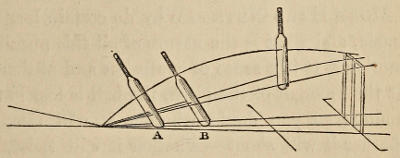
Every player is conscious of one particular
length that puzzles him,—of one point between
himself and the bowler, in which he would rather
that the ball should not pitch. “There is a
length-ball that almost blinds you,” said an experienced
player at Lord’s. There is a length that
makes many a player shut his eyes and turn
away his head; “a length,” says Mr. Felix,
“that brings over a man most indescribable
emotions.” There are two ways to play such
balls: to discriminate is difficult, and, “if you
doubt, you are lost.” Let A be the farthest point
to which a good player can reach, so as to plant
his bat at the proper angle, at once preventing a
catch, stopping a shooter, and intercepting a
bailer. Then, at any point short of A, should the
bat be placed, the ball may rise over the bat if
held to the ground, or shoot under if the bat is a
little raised. At B the same single act of planting
the bat cannot both cover a bailer and stop a
shooter. Every ball which the batsman can
reach, as at A, may be met with a full bat
forward; and, being taken at the pitch, it is
either stopped or driven away with all its rising,
cutting, shooting, or twisting propensities undeveloped.
If not stopped at A, the ball may rise
and shoot in six lines at least; so, if forced to
play back, you have six things to guard against
instead of one. Still, any ball you cannot cover
forward, as at B, must be played back; and nearly
in the attitude shown in page 115. This back
play gives as long a sight of the ball as possible,
and enables the player either to be up for a bailer
or down for a shooter.
More Hard Nuts.—Why do certain lengths
puzzle, and what is the nature of all this puzzling
emotion? It is a sense of confusion and of doubt.
At the moment of the pitch, the ball is lost in the
ground; so you doubt whether it will rise, or
whether it will shoot—whether it will twist, or
come in straight. The eye follows the ball till it
touches the ground: till this moment there is no
great doubt, for its course is known to be uniform.
I say no great doubt, because there is always
some doubt till the ball has passed some yards
from the bowler’s hand. The eye cannot distinguish
the direction of a ball approaching till it has
seen a fair portion of its flight. Then only can
you calculate what the rest of the flight will be.
Still, before the ball has pitched, the first doubt
is resolved, and the batsman knows the ball’s
direction; but, when once it touches the ground,
the change of light alone (earth instead of air
being the background) is trying to the eye.
Then, at the rise, recommences all the uncertainty
of a second delivery; for, the direction of the ball
has once more to be ascertained, and that requires
almost as much time for sight as will sometimes
bring the ball into the wicket.
All this difficulty of sight applies only to the
batsman; to him the ball is advancing and foreshortened
in proportion as it is straight. If the
ball is rather wide, or if seen, as by Point, from
the side, the ball may be easily traced, without
confusion, from first to last. It is the fact of an
object approaching perfectly straight to you, that
confuses your sense of distance. A man standing
on a railway cannot judge of the nearness
of the engine; nor a man behind a target of the
approach of the arrow; whereas, seen obliquely,
the flight is clear. Hence a long hop is not a
puzzling length, because there is time to ascertain
the second part of the course or rebound. A toss
is easy because one course only. The tice also,
and the half-volley, or any over-pitched balls, are
not so puzzling, because they may be met forward,
and the two parts of the flight reduced to one.
Such is the philosophy of forward play, intended
to obviate the batsman’s chief difficulty,
which is, with the second part, or, the rebound of
the ball.
The following are good rules:—
1. Meet every ball at the pitch by forward
play which you can conveniently cover.
Whatever ball you can play forward, you can
play safely—as by one single movement. But
in playing the same ball back, you give yourself
two things to think of instead of one—stopping
and keeping down a bailer; and, stopping a
shooter. Every ball is the more difficult to play
back in exact proportion to the ease with which
it might be played forward. The player has a
shorter sight, and less time to see the nature of
the rise; so the ball crowds upon him, affording
neither time nor space for effective play. Never
play back but of necessity; meet every ball forward
which you can conveniently cover—I say
conveniently, because, if the pitch of the ball
cannot be reached without danger of losing your
balance, misplacing your bat, or drawing your
foot out of your ground, that ball should be considered
out of reach, and be played back. This
rule many fine players, in their eagerness to score,
are apt to violate; so, if the ball rises abruptly,
they are bowled or caught. There is also danger
of playing wide of the ball, if you over-reach.
2. Some say, When in doubt play back. Certainly
all balls may be played back; but many it
is almost impracticable to play forward. But
since the best forward players may err, the following
hint, founded on the practice of Fuller
Pilch, will suggest an excellent means of getting
out of a difficulty:—Practise the art of half-play;
that is, practise going forward to balls a little beyond
your reach, and then, instead of planting
your bat near the pitch, which is supposed too far
distant to be effectually covered, watch for the
ball about half-way, being up if it rises, and down
if it shoots. By this half-play, which I learnt
from one of Pilch’s pupils, I have often saved my
wicket when I found myself forward for a ball
out of reach; though before, I felt defenceless,
and often let the ball pass either under or over
my bat. Still half-play, though a fine saving
clause for proficients, is but a choice of evils, and
no practice for learners, as forming a bad habit.
By trying too many ways, you spoil your game.
3. Ascertain the extent of your utmost reach
forward, and practise accordingly. The simplest
method is to fix your right foot at the crease, and
try how far forward you can conveniently plant
your bat at the proper angle; then, allowing that
the ball may be covered at about three feet from
its pitch, you will see at once how many feet you
can command in front of the crease. Pilch could
command from ten to twelve feet. Some short
men will command ten feet; that is to say, they
will safely meet forward every ball which pitches
within that distance from the crease.
There are two ways of holding a bat in playing
forward. The position of the hands, as of Pilch,
in the frontispiece, standing at guard, will not
admit of a long reach forward. But by shifting
the left hand behind the bat, the action is free,
and the reach unimpeded.
Every learner must practise this shifting of the
left hand in forward play. The hand will soon
come round naturally. Also, learn to reach forward
with composure and no loss of balance.
Play forward evenly and gracefully, with rather
an elastic movement. Practice will greatly increase
your reach. Take care you do not lose
sight of the ball, as many do; and, look at the
ball itself, not merely at the spot where you
expect it to pitch. Much depends on commencing
at the proper moment, and not being in a hurry.
Especially avoid any catch or flourish. Come
forward, foot and bat together, most evenly and
most quietly.
Forward play may be practised almost as well
in a room as in a cricket-field: better still with a
ball in the path of a field. To force a ball back
to the bowler or long-field by hard forward play
is commonly called Driving; and driving you may
practise without any bowler, and greatly improve
in balance and correctness of form, and thus increase
the extent of your reach, and habituate the
eye to a correct discernment of the point at which
forward play ends and back play begins. By
practice you will attain a power of coming forward
with a spring, and playing hard or driving. All
fine players drive nearly every ball they meet
forward, and this driving admits of so many
degrees of strength that sometimes it amounts to
quite a hard hit. “I once,” said Clarke, “had
thought there might be a school opened for
cricket in the winter months; for, you may drill a
man to use a bat as well as a broad-sword.” With
driving, as with half-play, be not too eager—play
forward surely and steadily at first, otherwise the
point of the bat will get in advance, or the hit be
badly timed, and give a catch to the bowler. This
is one error into which the finest forward players
have sometimes gradually fallen—a vicious habit,
formed from an overweening confidence and success
upon their own ground. Comparing notes
lately with an experienced player, we both remembered
a time when we thought we could
make hard and free hits even off those balls which
good players play gently back to the bowler; but
eventually a succession of short innings sent us
back to safe and sober play.
Sundry other hits are made, contrary to every
rule, by players accustomed to one ground or
one set of bowlers. Many an Etonian has found
that a game, which succeeded in the Shooting
fields, has proved an utter failure when all was
new at Lord’s or in a country match.
Every player should practise occasionally with
professional bowlers; for, they look to the principle
of play, and point out radical errors even in
showy hits. Even Pilch will request a friend to
stand by him in practice to detect any shifting of
the foot or other bad habit, into which experience
teaches that the best men unconsciously fall. I
would advise every good player to take one or
two such lessons at the beginning of the season.
A man cannot see himself, and will hardly believe
that he is taking up his bat across wicket, sawing
across at a draw, tottering over instead of
steady, moving off his ground at leg balls, or very
often playing forward with a flourish instead of
full on the ball, and making often most childish
mistakes which need only be mentioned to be
avoided.
One great difficulty, we observed, consists in
correct discrimination of length and instantaneous
decision. To form correctly as the ball pitches,
there is time enough, but none to spare: time
only to act, no time to think. So also with
shooting, driving, and various kinds of exercises,
at the critical moment all depends not on thought,
but habit: by constant practice, the time requisite
for deliberation becomes less and less, till at length
we are unconscious of any deliberation at all,—acting,
as it were, by intuition or instinct, for the
occasion prompts the action: then, in common
language, we “do it naturally,” or, have formed
that habit which is “a second nature.”
In this sense, a player must form a habit of
correct decision in playing forward and back.
Till he plays by habit, he is not safe: the sight of
the length must prompt the corresponding movement.
Look at Fuller Pilch, or Mr. C. Taylor,
and this rule will be readily understood; for,
with such players, every ball is as naturally and
instinctively received by its appropriate movement
as if the player were an automaton, and the ball
touched a spring: so quickly does forward play,
or back, and the attitude for off-cut or leg-hit,
appear to coincide with, or rather to anticipate,
each suitable length. All this quickness, ease,
and readiness marks a habit of correct play; and
the question is, how to form such a habit.
All the calmness or composure we admire in
proficients results from a habit of playing each
length in one way, and in one way only. To
attain this habit, measure your reach before the
crease, as you begin to practise with a bowler;
and, make a mark visible to the bowler, but not
such as will divert your own eye.
Having fixed such a mark, let your bowler
pitch, as nearly as he can, sometimes on this side
of the mark, sometimes on that. After every
ball, you have only to ask, Which side? and you
will have demonstrative proof whether your play
has been right or wrong. Constant practice,
with attention to the pitch, will habituate your
eye to lengths, and enable you to decide in a
moment how to play.
For my own part, I have rarely practised for
years without this mark. It enables me to ascertain,
by referring to the bowler, where any
ball has pitched. To know at a glance the exact
length of a ball, however necessary, is not quite
as easy to the batsman as to the bowler; and,
without practising with a mark, you may remain
a long time in error.
After a few days’ practice, you will become as
certain of the length of each ball, and of your
ability to reach it, as if you actually saw the
mark, for you will carry the measurement in
“your mind’s eye.”
So far well: you have gained a perception of
lengths and distance; the next thing is, to apply
this knowledge. Therefore, bear in mind you have
a HABIT TO FORM. No doubt, many will laugh
at this philosophy. Pilch does not know the
“theory of moral habits,” I dare say; but he
knows well enough that wild practice spoils play;
and if to educated men I please to say that, wild
play involves the formation of a set of bad habits
to hang about you, and continually interfere with
good intentions, where is the absurdity? How
should you like to be doomed to play with some
mischievous fellow, always tickling your elbow,
and making you spasmodically play forward, when
you ought to play back, or, hit round or cut, when
you ought to play straight? Precisely such a
mischievous sprite is a bad habit. Till you have
got rid of him, he is always liable to come across
you and tickle you out of your innings: all your
resolution is no good. Habit is a much stronger
principle than resolution. Accustom the hand to
obey sound judgment, otherwise it will follow its
old habit instead of your new principles.
To borrow an admirable illustration from Plato,
which Socrates’ pupil remarked was rather apt
than elegant,—“While habit keeps up itching,
man can’t help scratching.” And what is most
remarkable in bad habits of play is, that, long
after a man thinks he has overcome them, by
some chance association, the old trick appears
again, and a man feels (oh! fine for a moralist!)
one law in his mind and another law—or rather,
let us say, he feels a certain latent spring in him
ever liable to be touched, and disturb all the harmony
of his cricketing economy.
Having, therefore, a habit to form, take the
greatest pains that you methodically play forward
to the over-pitched, and back to the under-pitched,
balls. My custom was, the moment the ball
pitched, to say audibly to myself “forward,” or
“back.” By degrees I was able to calculate the
length sooner and sooner before the pitch, having,
of course, the more time to prepare; till, at last,
no sooner was the ball out of the bowler’s hand,
than ball and bat were visibly preparing for each
other’s reception. After some weeks’ practice,
forward and back play became so easy, that I
cease to think about it: the very sight of the
ball naturally suggesting the appropriate movement;
in other words, I had formed a habit of
correct play in this particular.
“Suave mari magno,” says Lucretius; that is,
it is delightful, from the vantage ground of
science, to see others floundering in a sea of error,
and to feel a happy sense of comparative security;—so,
was it no little pleasure to see the many
wickets that fell, or the many catches which were
made, from defects I had entirely overcome.
For, without the habit aforesaid, a man will
often shut his eyes, and remove his right fingers,
as if the bat were hot, and then look behind him
and find his wicket down. A second, will advance
a foot forward, feel and look all abroad, and then
try to seem unconcerned, if no mischief happens.
A third, will play back with the shortest possible
sight of the ball, and hear his stumps rattle before
he has time to do anything. A fourth, will stand
still, a fixture of fuss and confusion, with the same
result; while a fifth, will go gracefully forward,
with straightest possible bat, and the most meritorious
elongation of limb, and the ball will pass
over the shoulder of his bat, traverse the whole
length of his arms, and back, and colossal legs,
tipping off the bails, or giving a chance to the
wicket-keeper. Then, as Poins says of Falstaff,
“The virtue of this jest will be the incomprehensible
lies that this same fat rogue will tell us.”
For, when a man is out by this simple error in
forward or backward play, it would take a volume
to record the variety of his excuses.
The reason so much has been said about Habit
is, partly, that the player may understand that
bad habits are formed as readily as good; that a
repetition of wild hits, or experimentalising with
hard hits off good lengths, may disturb your quick
perception of critical lengths, and give you an
uncontrollable habit of dangerous hitting.
The Shooter.—This is the surest and most
destructive ball that is bowled. Stopping shooters
depends on correct position, on a habit of playing
at the ball and not losing it after the pitch, and
on a quick discernment of lengths.
The great thing is decision; to doubt is to lose
time, and to lose time is to lose your wicket.
And this decision requires a correct habit of
forward and back play. But since prevention is
better than cure, by meeting at the pitch every
ball within your reach, you directly diminish the
number, not only of shooters, but of the most
dangerous of all shooters, because of those which
afford the shortest time to play. But, supposing
you cannot cover the ball at the pitch, and a
shooter it must be, then—
The first thing is, to have the bat always
pointed back to the wicket, as in fig. 1. page 115;
thus you will drop down on the ball, and have all
the time and space the case admits of. If the bat
is not previously thrown back, when the ball shoots
the player has two operations,—the one, to put the
bat back: and the other, to ground it: instead of
one simple drop down alone. I never saw any man
do this better than Wenman, when playing the
North and South match at Lord’s in 1836. Redgate
was in his prime, and almost all his balls
were shooting down the hill; and, from the good
time and precision with which Wenman dropped
down upon some dozen shooters, with all the pace
and spin for which Redgate was famous—the
ground being hardened into brick by the sun—I
have ever considered Wenman equal to any batsman
of his day.
The second thing is, to prepare for back play
with the first possible intimation that the ball will
require it. A good player descries the enemy,
and drops back as soon as the ball is out of the
bowler’s hand.
The third—a golden rule for batsmen—is:
expect a good length to shoot, and you will have
time, if it rises: but if you expect it to rise, you
are too late if it shoots.
The Bail Ball.—First, the attitude is that
of fig. 1. The bat thrown back to the bails is
indispensable for quickness: if you play a bailer
too late, short slip is placed on purpose to catch
you out; therefore watch the ball from the
bowler’s hand, and drop back on your wicket in
good time. Also, take the greatest pains in
tracing the ball every inch from the hand to the
bat. Look hard for the twist, or a “break” will
be fatal. To keep the eye steadily on the ball,
and not lose it at the pitch, is a hint even for
experienced players: so make this the subject of
attentive practice.
The most difficult of all bailers are those which
ought not to be allowed to come in as bailers
at all, those which should be met at the pitch.
Such over-pitched balls give neither time nor
space, if you attempt to play them back.
Every length ball is difficult to play back, just
in proportion to the ease with which it could be
covered forward. A certain space, from nine to
twelve feet, before the crease is, to a practised
batsman, so much terra firma, whereon pitching
every ball is a safe stop or score. Practise with
the chalk mark, and learn to make this terra
firma as wide as possible.
The Draw is so called, I suppose, because,
when perfectly made, there is no draw at all.
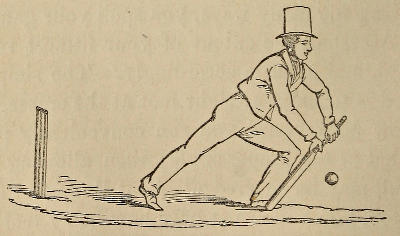
Look at fig. 2. The bat is not drawn across the
wicket, but hangs perpendicularly from the wrists;
though the wrists of a good player are never
idle, but bring the bat to meet the ball a few
inches, and the hit is the natural angle formed by
the opposing forces. “Say also,” suggests Clarke,
“that the ball meeting the bat, held easy in the
hand, will turn it a little of its own force, and the
wrists feel when to help it.” This old rule hardly
consists with the principle of meeting the ball.
The Draw is the spontaneous result of straight
play about the two leg stumps: for if you begin,
as in fig. 1., with point of bat thrown back true
to middle stump, you cannot bring the bat
straight to meet a leg-stump ball without the
line of the bat and the line of the ball forming
an angle in crossing each other; and, by keeping
your wrists well back, and giving a clear space
between body and wicket, the Draw will follow
of itself.
Fig. 2.
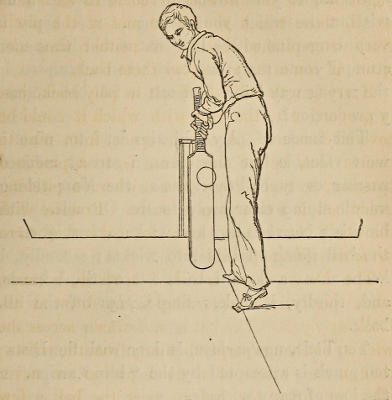
The bat must not be purposely presented edgeways
in the least degree. Draw a full bat from
the line of the middle stump to meet a leg-stump
ball, and, as the line of the ball must make a very
acute angle, you will have the benefit of a hit
without lessening your defence. “A Draw is
very dangerous with a ball that would hit the leg
stump,” some say; but only when attempted in
the wrong way; for, how can a full bat increase
your danger?
This mode of play will also lead to, what is
most valuable but most rare, a correct habit of
passing every ball the least to the Near side of
middle stump clear away to the On side. This
blocking between legs and wickets, first, obviates
the ball going off legs into wicket; secondly, it
keeps many awkward balls out of Slip’s hands;
and, thirdly, it makes single runs off the best
balls.
Too little, now-a-days, is done with the Draw;
too much is attempted by the “blind swipe,” to
the loss of many wickets.
Every man in a first-rate match who loses his
wicket, while swiping round, ought to pay a
forfeit to the Reward Fund.
The only balls for the Draw are those which
threaten the wicket. To shuffle backwards half
a yard, scraping the bat on the ground, or to let
the ball pass one side the body with a blind swing
on the other, are hits which to mention is to
reprove.
Our good friend, Mr. Abraham Bass,—and
what cricketer in the Midland Counties defers not
to his judgment?—thinks that the Draw cannot
be made quite so much of as we say, except by a
left-handed man. The short-pitched balls which
some draw, he thinks, are best played back to
middle On, by a turn of the left arm to the
On side.
Here Mr. Bass mentions a very good hit—a
good variety—and one, too, little practised: his
hit and the Draw are each good in their respective
places. To discriminate every shade is impossible.
“Mr. Taylor had most hits I ever saw,”
said Caldecourt, “and was a better player even
than Lord Frederick; though Mr. Taylor’s hits
were not all legitimate:” so much the better; new
combinations of old hits.
As to the old-fashioned hit under leg, Mr.
Mynn, at Leicester, in 1836, gave great effect
to one variety of it; a hit which Pilch makes
useful, though hard to make elegant. Some say,
with Caldecourt, such balls ought always to be
drawn: but is it not a useful variety?
Draw or Glance from off Stump.—What
is true of the Leg stump is true of the Off,
care being taken of catch to Slips. Every ball
played from two Off stumps, by free play of wrist
and left shoulder well over, should go away
among the Slips. Play hard on the ball; the
ball must never hit a dead bat; and every so-called
block, from off stumps, must be a hit.
Commence, as always, from fig. 1.; stand close
up to your wicket; weight on pivot-foot; balance-foot
ready to come over as required. This is the
only position from which you can command the
off stump.
Bear with me, my friends, in dwelling so much
on this Off-play. Many fine cutters could never
in their lives command off stump with a full and
upright bat. Whence come the many misses of
off-hits? Observe, and you will see, it is because
the bat is slanting, or it must sweep the whole
space through which the ball could rise.
By standing close up, and playing well over
your wicket with straight bat, and throwing, by
means of left leg, the body forwards over a ball
rising to the off-stump, you may make an effective
hit from an off-bailer without lessening your
defence; for how can hard blocking, with a full
bat, be dangerous? All that is required is,
straight play and a free wrist, though certainly
a tall man has here a great advantage.
A free Wrist.—Without wrist play there
can be no good style of batting. Do not be
puzzled about “throwing your body into your hit.”
Absurd, except with straight hits—half-volley,
for instance. Suspend a ball, oscillating by a
string from a beam, keep your right foot fixed,
and use the left leg to give the time and command
of the ball and to adjust the balance, and you
will soon learn the power of the wrists and arms.
Also, use no heavy bats; 2 lbs. 2 oz. is heavy
enough for any man who plays with his wrists.
The wrist has, anatomically, two movements; the
one up and down, the other from side to side;
and to the latter power, by much the least, the
weight of the bat must be proportioned. “My
old-fashioned bat,” said Mr. E. H. Budd, “weighed
nearly three pounds, and Mr. Ward’s a pound
more.”
The Off-hit, here intended, is made with
upright bat, where the horizontal cut were dangerous
or uncertain. It may be made with any
off-ball, one or two feet wide of the wicket. The
left shoulder must be well over the ball, and this
can only be effected by crossing, as in fig. 3. p. 159,
left leg over. This, one of the best players
agrees, is a correct hit, provided the ball be
pitched well up; otherwise he would apply the
Cut: but the cut serves only when a ball rises;
and I am unwilling to spare one that comes in
near the ground.
This upright off-hit, with left leg crossed over,
may be practised with a bat and ball in the path
of a field. You may also devise some “Chamber
Practice,” without any ball, or with a soft ball
suspended—not a bad in-door exercise in cold
weather. When proficient, you will find that
you have only to hit at the ball, and the balance-foot
will naturally cross over and adjust itself.
In practising with a bowler, I have often fixed
a fourth stump, about six inches from off-stump,
and learnt to guard it with upright bat. Experto
crede, you may learn to sweep with almost an
upright bat balls as much as two feet to the Off.
But this is a hit for balls requiring back play,
but—
Cover-hit is the hit for over-pitched off-balls.
Come forward hard to meet an off-ball; and then,
as your bat moves in one line, and the ball meets
it in another, the resultant will be Cover-hit. By
no means turn the bat: a full face is not only
safe but effective.
With all off-hits beware of the bias of the ball
to the off, and play well over the ball—very difficult
for young players. Never think about what
off-hits you can make, unless you keep the ball
safely down.
The fine square leg-hit is similar to cover-hit,
though on the other side. To make cover-hit
clean, and not waste power against the ground,
you must take full advantage of your height, and
play the bat well down on the ball from your hip,
timing nicely, eye still on the ball, and inclining
the bat neither too little nor too much.
Fig. 3.
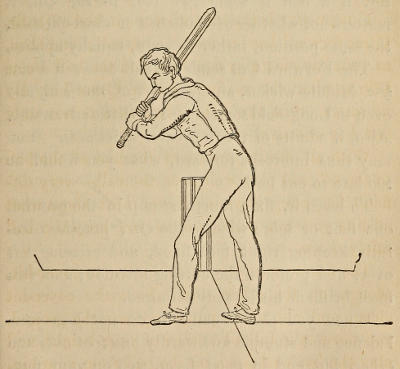
The Forward Cut, a name by which I would
distinguish another off-hit is a hit made by
Butler, Guy, Dakin, Parr, and indeed especially
by the Nottingham men, who, Clarke thinks, “hit
all round them” better than men of any other
county (see fig. 3.). The figures being foreshortened
as seen by the bowler, the artist unwillingly
sacrifices effect to show the correct
position of the feet. This hit may be made from
balls too wide and too low for the backward cut.
Cross the left leg over, watch the ball from its
pitch, and you may make off-hits from balls low
or cut balls high (unless very high, and then you
have time to drop the bat) with more commanding
power than in any other position. Some good
players do not like this crossing of left foot,
preferring the cutting attitude of fig. 3.; but I
know from experience and observation, that there
is not a finer or more useful hit in the field;
for, if a ball is some two feet to the Off, it
matters not whether over-pitched or short-pitched,
the same position, rather forward, equally applies.
The Forward Cut sends the ball between Point
and Middle-wicket, an open part of the field, and
even to Long-field sometimes: no little advantage.
Also, it admits of much greater quickness. You
may thus intercept forward, what you would be
too late to cut back.
To learn it, fix a fourth stump in the ground,
one foot or more wide to the Off; practise carefully
keeping right foot fixed, and crossing left
over, and preserve the cutting attitude; and this
most brilliant hit is easily acquired.
When you play a ball Off, do not lose your
balance and stumble awkwardly one foot over the
other, but end in good form, well on your feet.
Even good players commit this fault; also, in
playing back some players look as if they would
tumble over their wicket.
The Cut is generally considered the most delightful
hit in the game. The Cut proper is made
by very few. Many make Off-hits, but few “cut
from the bails between short slip and point with
a late horizontal bat—cutting, never by guess but
always by sight, at the ball itself; the cut applying
to rather short-pitched balls, not actually long
hops; and that not being properly a cut which is
in advance of the point.” Such is the definition
of Mr. Bradshaw, whom a ten years’ retirement
has not prevented from being known as one of
the best hitters of the day.
Fig. 4.
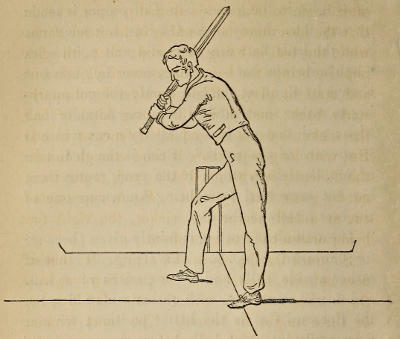
The attitude of cutting is faintly given (because
foreshortened) in fig. 4. This represents a cut at
rather a wide ball; and a comparison of figs. 3.
and 4. will show that, with rather wide Off-balls,
the Forward Cut is the better position; for you
more easily intercept balls before they are out of
play. Right leg would be thrown back rather
than advanced, were the ball nearer the wicket.
Still, the attitude is exceptional. Look at the
other figures, and the cutter alone will appear with
right foot shifted. Compare fig. 1. with the other
figures, and the change is easy, as in the left foot
alone; but, compare it with the cuts (figs. 4. and
5.), and the whole position is reversed: right
shoulder advanced, and right foot shifted. There
is no ball that can be cut which may not be hit
by one of the other Off-hits already mentioned,
and that with far greater certainty, though not
with so brilliant an effect. Pilch and many of
the steadiest and best players never make the
genuine cut. “Mr. Felix,” says Clarke, “cuts
splendidly; but, in order to do so, he cuts before
he sees the ball, and thus misses two out of three.”
Neither do I believe that any man will reconcile
the habitual straight play and command of off-stump,
which distinguishes Pilch, with a cutting
game. Each virtue, even in Cricket, has its excess:
fine Leg-hitters are apt to endanger the
leg-stump; fine Cutters, the Off. For, the Cutter
must begin to take up his altered position so soon,
that the idea must be running in his head almost
while the ball is being delivered; then, the first
impulse brings the bat at once out of all defensive
and straight play. Right shoulder involuntarily
starts back; and, if at the wrong kind of ball,
the wicket is exposed, and all defence at an end.
But with long-hops there is time enough to cut;
the difficulty is with good balls: and, to cut them,
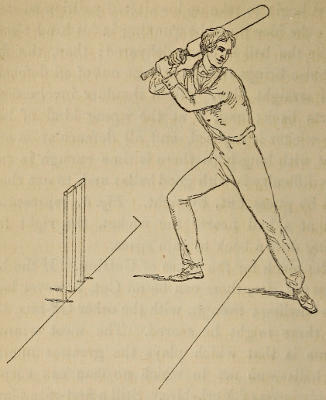
not by guess but, by sight. Fig. 5. represents a
cut at a ball nearer the wicket, the right foot
being drawn back to gain space.
So much for the abuse of Cutting. If the ball
does not rise, there can be no Cut, however loose
the bowling; though, with the other Off-hits, two
or three might be scored. The most winning
game is that which plays the greatest number
of balls—an art in which no man can surpass
Baldwinson of Yorkshire. Still a first-rate player
should have a command of every hit: a bowler
may be pitching uniformly short, and the balls
may be rising regularly: in this case, every one
would like to see a good Cutter at the wicket.
To learn the Cut, suspend a ball from a string
and a beam, oscillating backwards and forwards—place
yourself as at a wicket, and experimentalise.
You will find:—
1. You have no power in Cutting, unless you
Cut late—“off the bails:” then only can you use
the point of your bat.
Fig. 5.
2. You have no power, unless you turn on the
basis of your feet, and front the ball, your back
being almost turned upon the bowler, at the
moment of cutting.
3. Your muscles have very little power in Cutting
quite horizontally, but very great power in
Cutting down on the ball.
This agrees with the practice of the best
players. Mr. Bradshaw follows the ball and cuts
very late, cutting down. He drops his bat, apparently,
on the top of the ball. Lord Frederick
used to describe the old-fashioned Cutting as done
in the same way. Mr. Bradshaw never Cuts but
by sight; and since, when the eye catches the
rise of a good length ball, not a moment must be
lost, his bat is thrown back just a little—an inch
or two higher than the bails (he stoops a little for
the purpose)—and dropped on the ball in an
instant, by play of the wrist alone. Thus does
he obtain his peculiar power of Cutting even
fair-length balls by sight.
Harry Walker, Robinson, and Saunders were
the three great Cutters; and they all Cut very
late. But the underhand bowling suited cutting
(proper) better than round-armed; for all Off-hitting
is not cutting. Mr. Felix gives wonderful
speed to the ball, effected by cutting down, adding
the weight of a descending bat to the free
and full power of the shoulder: he would hardly
have time for such exertion if he hit with the precision
of Mr. Bradshaw, and not hitting till he
saw the ball.
Lord Frederick found fault with Mr. Felix’s
picture of “the Cut,” saying it implied force from
the whirl of the bat; whereas a cut should proceed
from wrists alone, descending with bat in
hand,—precisely Mr. Bradshaw’s hit. “Excuse
me, my Lord,” said Mr. Felix, “that’s not a Cut,
but only a pat.” The said pat, or wrist play, I
believe to be the only kind of cutting by sight, for
good-length balls.
To encourage elegant play, and every variety
of hit, we say practise each kind of cut, both
Lord Frederick’s pat and Mr. Felix’s off-hit, and
the Nottingham forward cut, with left leg over;
but beware of using either in the wrong place.
A man of one hit is easily managed. A good off-hitter
should send the ball according to its pitch,
not to one point only, but to three or four. Old
Fennex used to stand by Saunders, and say no
hitting could be finer—“no hitter such a fool—see,
sir, they have found out his hit—put a man
to stop his runs—still, cutting, nothing but cutting—why
doesn’t the man hit somewhere else?” So
with Jarvis of Nottingham, a fine player and one
of the best cutters of his day, when a man was
placed for his cut, it greatly diminished his score.
For off-balls we have given, Off-play to the slips—Cover
hit—the Nottingham hit more towards
middle wicket; and, the Cut between slip and
point—four varieties. Let each have its proper
place, till an old player can say, as Fennex said
of Beldham, “He hit quick as lightning all round
him. He appeared to have no hit in particular:
you could never place a man against him: where
the ball was pitched there it was hit away.”
Fig. 6.
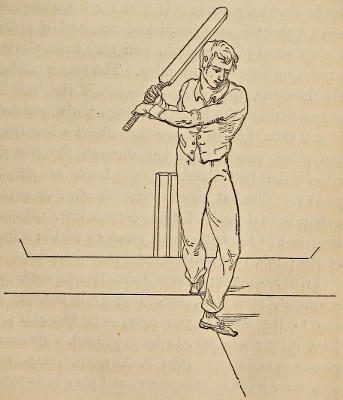
Leg-hitting.—Besides the draw, there are
two distinct kinds of leg-hits—one forward, the
other back. The forward leg-hit is made, as in
fig. 6., by advancing the left foot near the pitch
of the ball, and then hitting down upon the ball
with a free arm, the bat being more or less horizontal,
according to the length of the ball. A
ball so far pitched as to require little stride of left
leg, will be hit with nearly a straight bat: a ball
as short as you can stride to, will require nearly a
horizontal bat. The ball you can reach with
straight bat, will go off on the principle of the
cover-hit—the more square the better. But,
when a ball is only just within reach, by using a
horizontal bat, you know where to find the ball
just before it has risen; for, your bat covers the
space about the pitch. If you reach far enough,
even a shooter may be picked up; and if a few
inches short of the pitch, you may have all the
joyous spring of a half-volley. The better pitched
the bowling, the easier is the hit, if the ball be
only a little to the leg. In using a horizontal bat,
if you cannot reach nearer than about a foot from
the pitch, sweep your bat through the line in
which the ball should rise. Look at fig. 7.
p. 173. The bat should coincide with or sweep
a fair bat’s length of that dotted line. But if
the point of the bat cannot reach to within a foot
of the pitch, that ball must be played back.
The Short-pitched Leg Ball needs no
comment, save that, according as it is more or
less to the wicket, you may,—1. Draw it; 2.
Play it by a new hit, to be explained, a Draw or
glance outside your leg; 3. You may step back
on your wicket to gain space, and play it away to
middle On, or cut it round, according to your
sight of it.
But in leg-hitting, beware of a “blind swipe,”
or that chance hit, by guess of where the ball will
rise, which some make when the bat cannot properly
command the pitch. This blind hit is often
made at a ball not short enough to play by sight
back, nor long enough to command forward. Parr
advances left foot as far as he can, and hits where
the ball ought to be. But this he would hardly
advise, except you can nearly command the pitch;
otherwise, a blind swing of the bat, although the
best players are sometimes betrayed into it, is by
no means to be recommended.
Reader, do you ever make the square hit On?
Or, do you ever drive a ball back from the leg-stump
to long-field On? Probably not. Clarke
complains that this good old hit is gone out,
and that one more man is thereby brought about
the wicket. If you cannot make this hit, you have
evidently a faulty style of play. So, practise
diligently with leg-balls, till balls from two leg-stumps
go to long-field On, and balls a little wide
of leg-stump go nearly square; and do not do this
by a kind of push—much too common,—but by
a real hit, left shoulder forward.
Also, do you ever draw out of your ground in
a leg-hit? Doubly dangerous is this—danger
of stumping and danger of missing easy hits. If
once you move your pivot foot, you lose that
self-command essential for leg-hits. So, practise,
in your garden or your room, the stride and swing
of the bat, till you have learnt to preserve your
balance.
One of the best leg-hitters is Dakin: and his
rule is: keep your right foot firm on your ground;
advance the left straight to the pitch, and as far
as you can reach, and hit as straight at the pitch
as you can, just as if you were hitting to long-field:
as the lines of bat and ball form an angle,
the ball will fly away square of itself.
My belief is, the Wykehamists introduced the
art of hitting leg-balls at the pitch. When, in
1833, at Oxford, Messrs. F. B. Wright and Payne
scored above sixty each off Lillywhite and Broadbridge,
it was remarked by the players, they had
never seen their leg-hit before. Clarke says he
showed how to make forward leg-hits at Nottingham.
For, the Nottingham men used to hit after
leg-balls, and miss them, till he found the way of
intercepting them at the rise, and hitting square.
And this will be a fair occasion for qualifying
certain remarks which would appear to form what
is aptly called a “toe-in-the-hole” player.
When I spoke so strongly about using the
right foot as a pivot, and the left as a balance
foot, insisting, also, on not moving the right foot,
I addressed myself not to proficients, but to
learners. Such is the right position for almost
all the hits on the ball, and this fixing of the foot
is the only way to keep a learner in his proper
form.
Experienced players—I mean those who have
passed through the University Clubs, and aspire
to be chosen in the Gentlemen’s Eleven of All
England—must be able to move each foot on
its proper occasion, especially with slow bowling.
Clarke says, “If I see a man set fast on his legs,
I know he can’t play my bowling.” The reason
is, as we shall explain presently, that the accurate
hitting necessary for slow bowling requires not
long reaching, but a short, quick action of the
arms and wrists, and activity on the legs, to shift
the body to suit this hitting in narrow compass.
A practised player should also be able to go in
to over-pitched balls, to give effect to his forward
play. To be stumped out looks ill indeed; still,
a first-rate player should have confidence and
coolness enough to bide his time, and then go
boldly and steadily in and hit away. If you do
go in, take care you go far enough, and as far as the
pitch; and, only go in to straight balls, for to those
alone can you carry a full bat. And, never go in
to make a free swing of the bat or tremendous
swipe. Go in with a straight bat, not so much
to hit, as to drive or block the ball hard away, or,
as Clarke says, “to run the ball down.” Stepping
in only succeeds with cool and judicious
hitters, who have some power of execution. All
young players must be warned that, for any but a
most practised player to leave his ground, is decidedly
a losing game.
Supposing the batsman knows how to move his
right foot back readily, then, a long-hop to the leg
admits of various modes of play, which I feel
bound to mention, though not to recommend; for,
a first-rate player should at least know every hit:
whether he will introduce it much or little into
his game is another question.
A leg-ball that can be played by sight is sometimes
played by raising the left leg. This is quite
a hit of the old school,—of Sparkes and Fennex,
for instance. Fennex’s pupil, Fuller Pilch, commonly
makes this hit. Some first-rate judges—Caldecourt
among others—maintain it should never
be made, but the Draw always used instead.
Mr. Taylor found it a useful variety; for, before
he used it, Wenman used to stump him from balls
inside leg stump. For some lengths it has certainly
the advantage of placing the ball in a more
open part of the field.
Fig. 7.
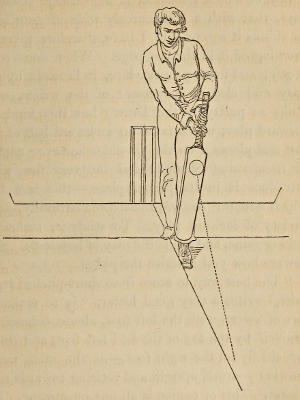
Another way to play such balls is to step back
with the right foot, and thus gain time and length
of hop, and play the ball away, with short action
of the arm and wrist, about middle On. This also
is good, as making one hit more in your game.
Another hit there is which bears a name not
very complimentary to Mr. James Dean; though
Sampson, of Sheffield, attains in a similar manner
remarkable certainty in meeting leg-balls, and not
inelegantly. My attention was first called to this
hit by watching the play of Mr. E. Reeves, who
makes it with all the ease and elegance of the
Draw, of which I consider it one variety. Clarke
says, that with a ball scarcely wide of your leg,
he thinks it a good hit: I have, therefore, given a
drawing of it in the last page. When done correctly,
and in its proper place, it is made by an
easy and elegant movement of the wrists, and
looks as pretty as the Draw; but this kind of
forward play, which takes an awkward ball at its
rise and places it on the On-side, however useful
to Sampson of Sheffield and the very few who
introduce it in its proper place,—this is a hit
which nascitur non fit, must come naturally, as a
variety of forward play. To study it, makes a
poking game, and spoils the play of hundreds. So,
beware how you practise the poke.
“The best way to score from short-pitched leg-balls,”
writes a very good hitter, “is to make a
sort of sweep with the left foot, almost balancing
yourself by the toe of the said left foot, and resting
chiefly on the right foot,—at the same time
drawing yourself upright and retiring towards the
wicket. This of course is all one movement. In
this position you make the heel of your right the
pivot on which you turn, and move your left (but
in a greater circle), so that both preserve the same
parallel as at starting, and come round together;
and this I regard as the great secret of a batsman’s
movement in this hit. This gives you the power
of simply playing the ball down, if it rises much,
and likewise of hitting hard if it keep within a foot
of the ground. Both Sampson and Parr score very
much in this style.”
However, with fast bowling, there are almost
as many mistakes as runs made by hitting at
these short-pitched leg-balls. Pilch, in his later
days, would hardly meddle with them.
Lastly, as to leg-balls, remember that almost
any one can learn to hit clean up (square, especially);
the art is to play them down. Also, leg-hitting
alone is very easy; but, to be a good Off-player,
and an upright and straight player, and
yet hit to leg freely, is very rare. We know a
fine leg-hitter who lost his leg-hit entirely when
he learnt to play better to the off.