Type-Species.—Telmatornis priscus Marsh, 1870, by subsequent
designation (Hay, 1902:528).
Included Species.—Type species only.
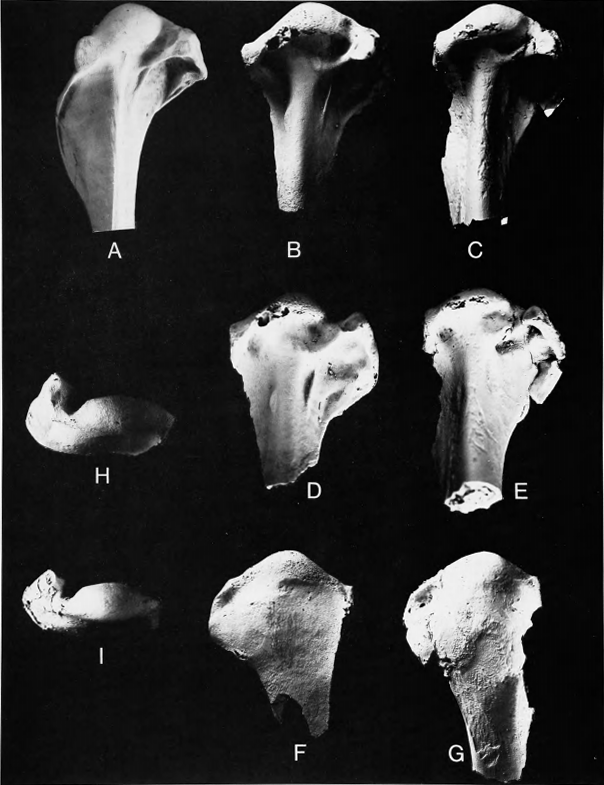
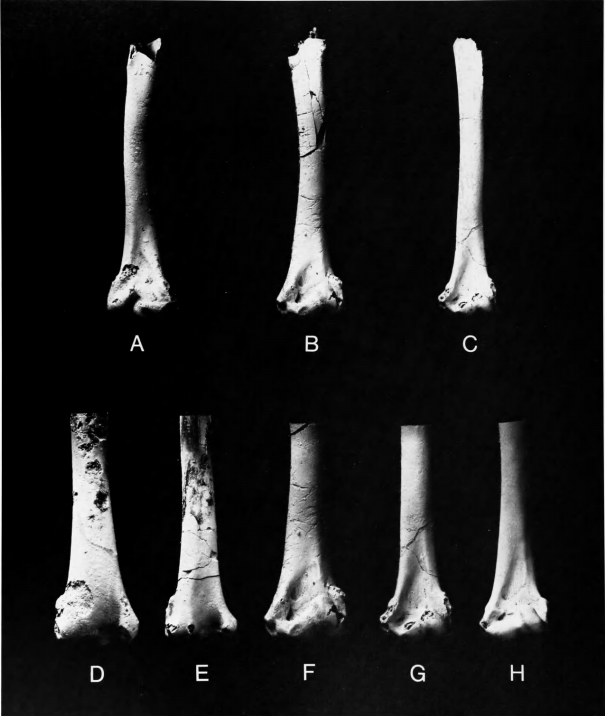
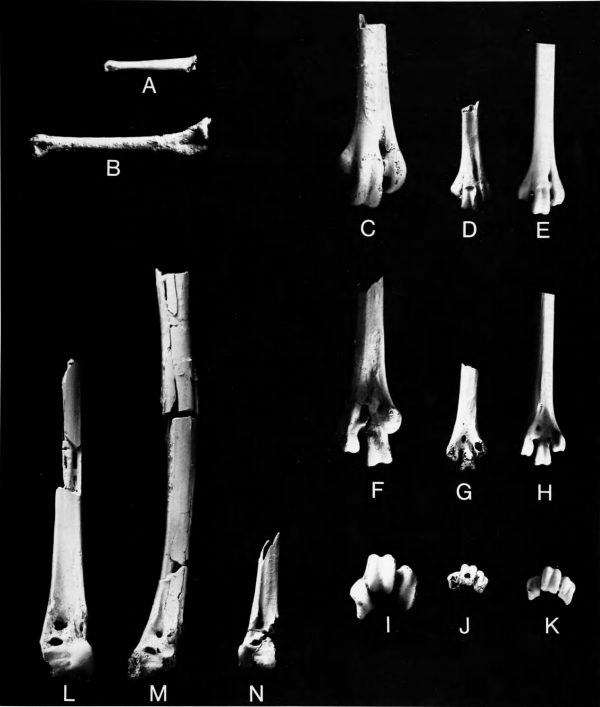
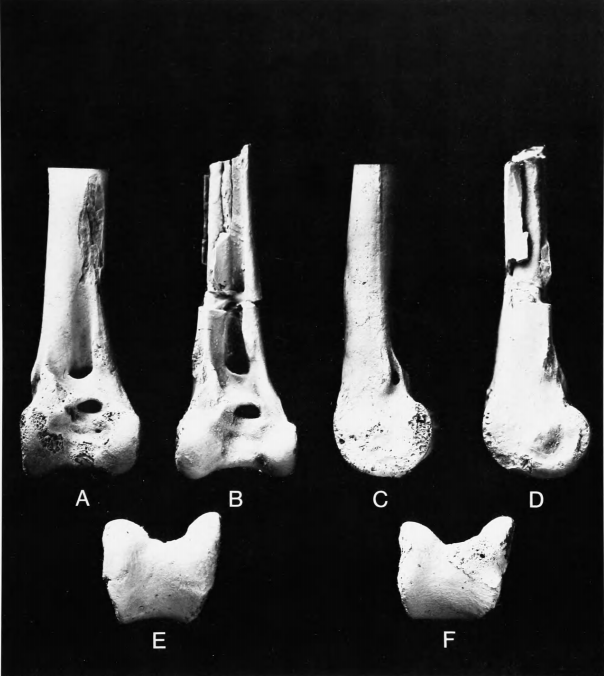
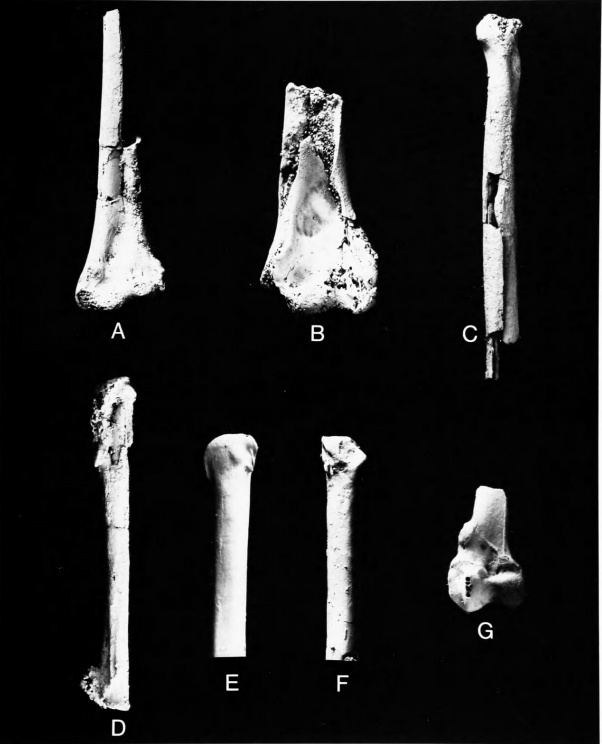
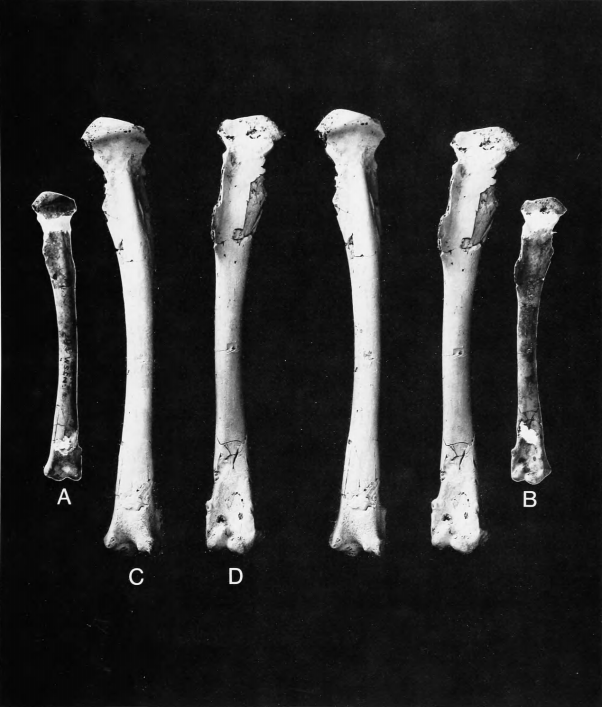
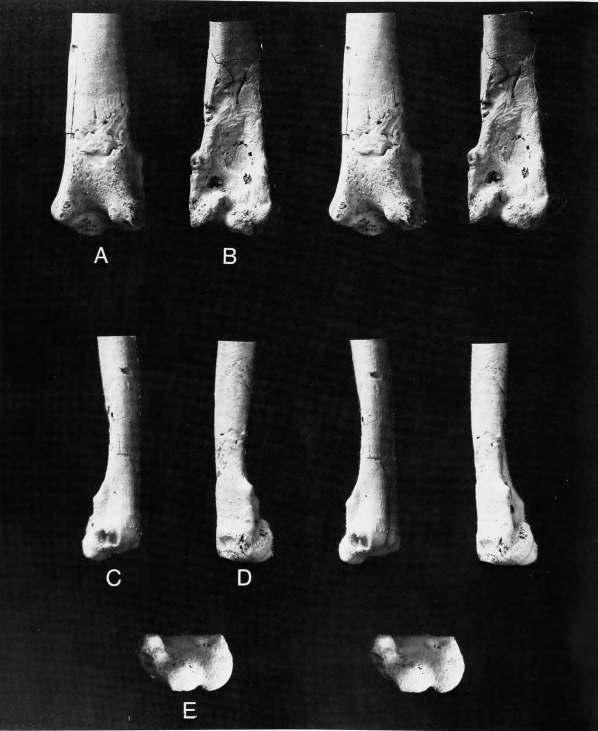
Figures 5b-j, 6c,e,g, 7a,d,g,j,n
Telmatornis priscus Marsh, 1870:210.
Telmatornis affinis Marsh, 1870:211.
Graculavus pumilis Marsh, 1872:364.
?Palaeotringa vetus Marsh, 1870:209.
Holotype.—Distal end of left humerus (Figure 5e,h), YPM 840;
collected in pits of the Cream Ridge Marl Company, near Hornerstown,
New Jersey by J.G. Meirs. Navesink Formation, Maastrichtian, Late
Cretaceous (Baird, 1967).
Referred Specimens.—Distal end of right humerus (Figure 5f,g),
YPM 845 (holotype of Telmatornis affinis Marsh 1870); same data as
holotype of T. priscus.
Proximal end of right humerus (Figure 5b-d), YPM 850, with distal
end of right carpometacarpus (Figure 5i) and several fragments of
shafts of long bones apparently associated (holotypical material of
Graculavus pumilis Marsh, 1872); collected near Hornerstown, New
Jersey, by J.G. Meirs; probably from the basal Hornerstown Formation,
Maastrichtian, Late Cretaceous.
Distal end of left tibiotarsus (Figure 7n), ANSP 13361 (holotype
of Palaeotringa vetus), collected near Arneytown, on the
Monmouth-Burlington county boundary, New Jersey; Basal Hornerstown
Formation, Maastrichtian, Late Cretaceous (Baird, 1967).
Left humerus lacking proximal end (Figure 6c,e,g), ANSP 15360;
collected in 1971 from the Inversand Company marl pit, Sewell,
Gloucester County, New Jersey, by Keith Madden. Basal Hornerstown
Formation, Maastrichtian, Late Cretaceous.
Distal end of left tarsometatarsus (Figure 7d,g,j), NJSM 11853;
collected 27 March 1975 by David C. Parris from the main fossiliferous
layer of the Inversand Company marl pit.
Right pedal phalanx 1 of digit II (Figure 7a), ANSP 15541; collected
in 1972 by Richard White at the Inversand Company marl pit.
Proximal end of right ulna (Figure 5j), NJSM 11900; collected 14
July 1978 from spoil piles near junction of Routes 537 and 539, near
Hornerstown, Upper Freehold Township, Monmouth County, New Jersey, by
Gerard R. Case; presumably from the Hornerstown Formation but whether
from Cretaceous or Tertiary sediments is not known.
Miller (1955) lists an additional specimen from near Arneytown under
the name Palaeotringa vetus (YPM 2808). This was cataloged in 1937
as "part of a tibia" of "Eocene" age but the specimen cannot now be
located in the Yale collections and its age and identity must be
considered very doubtful.
Measurements (in mm).—Distal ends of humeri (YPM 840, YPM 845, ANSP
15360, respectively): distal width 10.9, 10.1, 11.3; depth through
dorsal condyle 5.7, 5.2, 5.5; width of shaft at proximal extent of
brachial fossa 6.3, 5.5,6.4; length from distal end of pectoral crest
to ventral condyle (ANSP 15360 only) 45.1; shaft width at midpoint
(ANSP 15360 only) 4.7.
Proximal end of humerus YPM 850: proximal width through dorsal and
ventral tubercles 13.1; depth through bicipital surface and ventral
condyle 7.5, depth of head approximately 3.5.
Proximal end of ulna NJSM 11900: depth through dorsal cotyla 7.0.
Distal end of carpometacarpus YPM 840: depth at distal end 5.3; shaft
width 2.9.
Distal end of tibiotarsus ANSP 13361: shaft width 3.5, approximate
depth through medial condyle 6.9.
Distal end of tarsometatarsus NJSM 11853: distal width 6.1+; shaft
width 2.7.
Pedal phalanx 1 of digit II: length 14.6; proximal width 3.0.
Comparisons.—This is evidently the most abundant bird in the
New Jersey Cretaceous deposits. Hitherto it had been known only
from the two distal ends of humeri that are the holotypes of
Telmatornis priscus and T. affinis. Marsh (1870) did not clearly
place Telmatornis with any living family but mentioned species
of Rallidae, Scolopacidae, and Ardeidae in his comparisons. Hay
(1902:528) listed the genus under the Rallidae. Shufeldt (1915:26)
considered that Telmatornis was not a heron but might be related
either to rail-like or charadriiform birds, the material, according
to him, being insufficient for positive determination. He (1915:27)
also described a larger species, Telmatornis rex, which we have
removed to a new genus. Lambrecht (1933:489) maintained Telmatornis
as a genus incertae sedis in his order Ralliformes. Brodkorb (1967)
placed the genus in the family Rallidae, subfamily Rallinae, without
comment. Cracraft (1972) established that Telmatornis did not belong
in the Rallidae but was instead very similar to the Burhinidae. He
synonymized T. affinis with T. priscus and created a new family,
Telmatornithidae, for T. priscus and T. rex.
We concur in synonymizing T. affinis with T. priscus. The holotypes
and the new specimen of humerus (ANSP 15360), which is instructive in
that it preserves much more of the shaft (Figure 6c), are indeed
very similar to the humeri in the Burhinidae. In size they are closely
comparable to the small living species Burhinus vermiculatus (cf.
Figure 6g,h). The fossils differ from Burhinus in having (1) the
shaft less curved, both in dorsal and in lateral views; (2) brachial
depression shorter, wider, and slightly more distally located; in
distal view (3) the ventral condyle smaller and less rounded; and (4)
the dorsal tricipital groove shallower.
The distal portion of the humerus of Telmatornis is similar to that
in Presbyornis but differs in having (1) the dorsal condyle decidedly
more elongate; (2) olecranal fossa much shallower; (3) ventral
epicondyle in ventral view less distinctly demarcated but (4) more
protrudent in lateral or medial view.
The proximal end of humerus (YPM 850) that is the holotype of
Graculavus pumilis was considered by Shufeldt (1915:19) definitely
to be from a limicoline charadriiform. It is from a bird exactly the
size of Telmatornis priscus and its coloration and preservation would
not be incompatible with its being the opposite end of the same bone
as the holotype of T. affinis (Figure 5b,c,f,g). The following
differences between the holotypical humeri of G. velox and _"G."
pumilis establish that these belong to different genera: (1) in
velox the area dorsal to the ventral tubercle and distal to the head
is much more excavated, undercutting the head; (2) the dorsal tubercle
is more pronounced; (3) there is a distinct excavation distomedial to
the ventral tubercle, lacking in pumilis; (4) the ventral tubercle in
ventral view is much more produced in velox than in pumilis.
The holotype of G. pumilis is very similar to the humerus in the
Burhinidae but differs from that family and agrees with Graculavus
in characters 8, 9, and 10 (p. 6). It differs further from the
Burhinidae in having the area for the attachment of M. scapulohumeralis
caudalis extending farther distally in ventral view. It differs from
Presbyornis mainly in lacking the excavation to and undercutting
the head. Because pumilis is not congeneric with Graculavus velox
and because of its size and similarities with the Burhinidae and
Presbyornis, we have no hesitation about considering Graculavus
pumilis Marsh, 1872, to be a junior subjective synonym of Telmatornis
priscus Marsh, 1870.
The proximal end of an ulna, NJSM 11900 (Figure 5j), is from a bird
the size of Burhinus vermiculatus and not too dissimilar to it
except that the shaft is more robust in the fossil. The specimen is
too imperfect to merit detailed study and is referred to Telmatornis
priscus only on size and probability.
The very fragmentary distal end of carpometacarpus associated with the
type of G. pumilis (Figure 5i) is slightly larger and more robust
than in Burhinus vermiculatus, but not
so much as to be incompatible
with T. priscus. Compared to Burhinus (1) the symphysial area
is deeper and (2) the articular surface for the major digit is
proportionately larger, the specimen being somewhat more similar to the
carpometacarpus in Presbyornis.
The three specimens of Palaeotringa Marsh from the Cretaceous of New
Jersey are based on poorly preserved distal ends of tibiotarsi. The
holotype of Palaeotringa vetus Marsh, 1870 (Figure 7n) is similar
in size to the comparable element in Burhinus vermiculatus, though
with a relatively more slender shaft, and hence is from a bird the
size of T. priscus, being smaller than any of the other species of
Palaeotringa. It is more similar to Presbyornis than to Burhinus.
Because it is from a charadriiform the size of T. priscus, as first
revisers we tentatively consider Palaeotringa vetus Marsh, 1870,
to be a subjective synonym of Telmatornis priscus Marsh, 1870. The
only alternative would be to consign it to Aves incertae sedis. It is
of passing historical interest to recall Marsh's (1870:209) comment
that the type of Palaeotringa vetus "apparently was the first fossil
bird-bone discovered in this country," having been mentioned both by
Morton (1834) and Harlan (1835) as belonging to the genus Scolopax
(Charadriiformes: Scolopacidae).
The distal portion of tarsometatarsus NJSM 11853 (Figure 7d,g,f)
is unfortunately quite abraded. It is from a small charadriiform and
has a shaft width about the same as in Burhinus vermiculatus. If
this fossil came from an individual of Telmatornis priscus, as we
assume, T. priscus being the smallest and most abundant "graculavid"
in the New Jersey Cretaceous deposits, then it is a very instructive
specimen, for it differs much more from Burhinus than does the humerus
of Telmatornis. NJSM 11853 differs from the Burhinidae and agrees with
Presbyornis in having (1) the distal foramen proportionately large
and oval, not very small and circular; (2) a large, well-developed scar
for the hallux (hallux absent in Burhinidae); (3) external trochlea
proximodistally more elongate. That which remains of the inner trochlea
indicates that it was (1) somewhat more posteriorly retracted than
in Burhinus but (2) not nearly as elevated and retracted as in
Presbyornis.
Pedal phalanx ANSP 15541 (Figure 7a) is from a bird the size of T.
priscus. This specimen is much longer and more slender than phalanx 1
of digit II in Burhinus vermiculatus but has almost exactly the shape
and proportions of the same element in Presbyornis (Figure 7b),
although being much smaller. Although its assignment to Telmatornis
is very tentative, the length of this element seems to indicate a
wading bird as opposed to one with the terrestrially adapted shorter
toes of the Burhinidae.