Then they descended and passed through the luxuriant yellow plains,
the sunset blazing on the rows of willows and on the square
farm-houses with their gaudy picture over the arched gateway, while
always in the background rose the dark masses of the mountains, solemn
and distant, beyond the golden glow of the fields.—William Black.
Home just in time from Ojo Caliente, we hooked our cars the same evening
to the never-tiring express, and trusted ourselves to its guidance
without a thought of danger. When daylight had fully come, and from the
“purple-blazoned gateway of the morn” the sun was begging entrance at
our curtained windows, somebody—I think it was the Photographer, a man
utterly without nervousness or regard for it in others—startled all our
tranquil slumbers by the shout, “Comanche!”
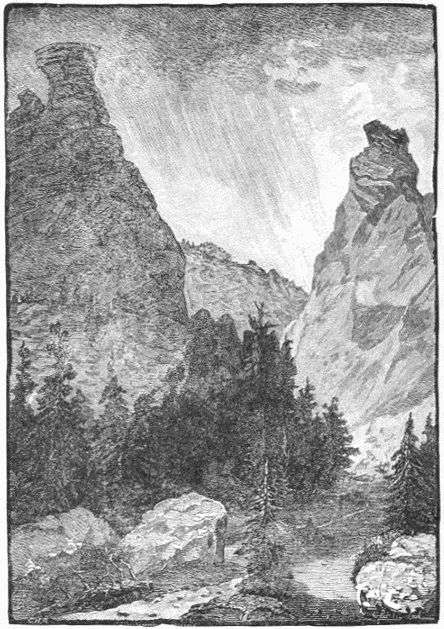
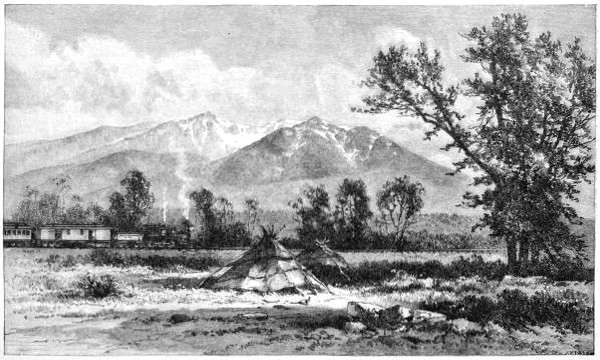
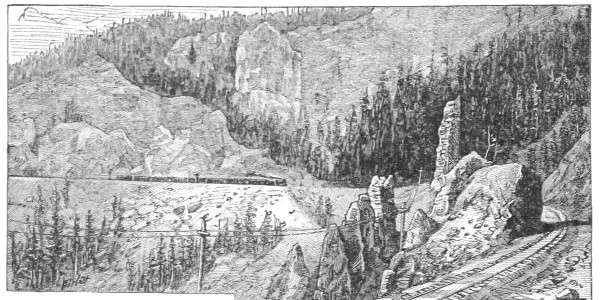
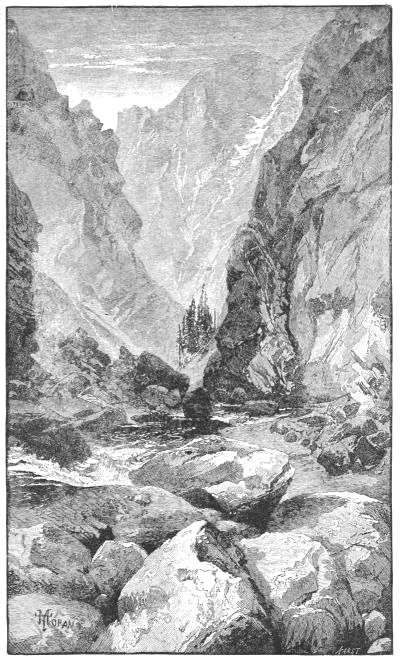
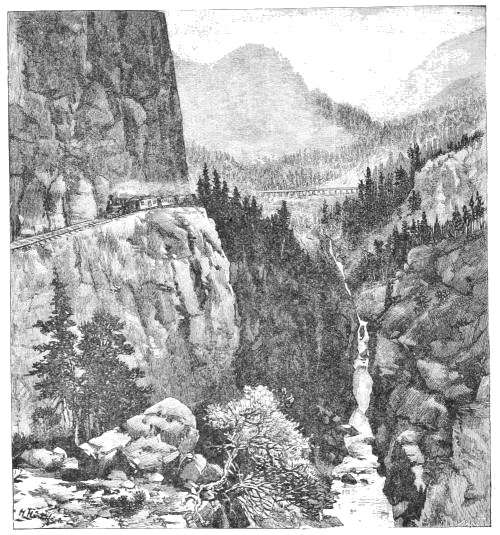
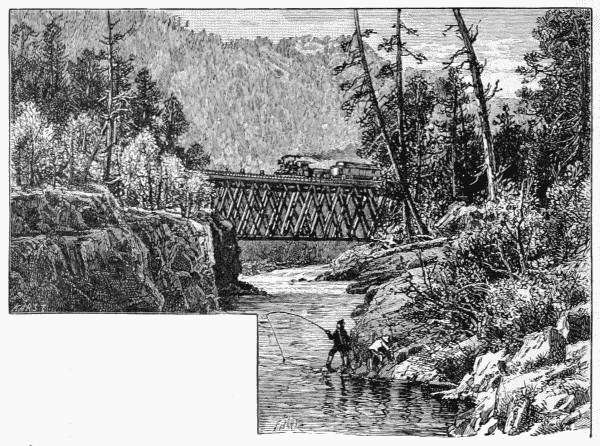
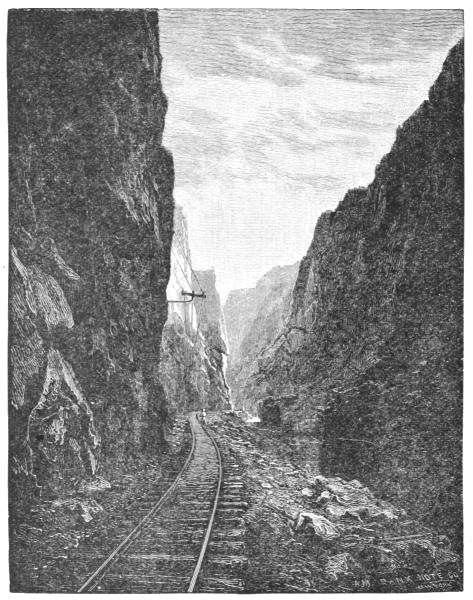
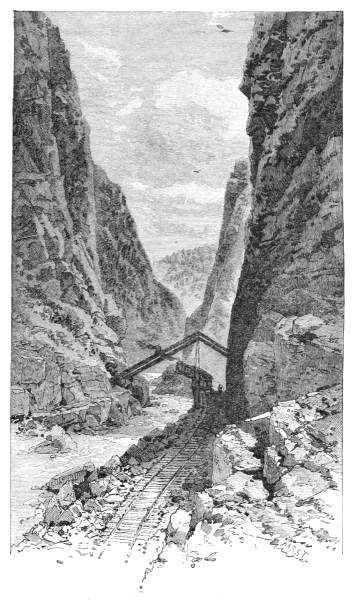
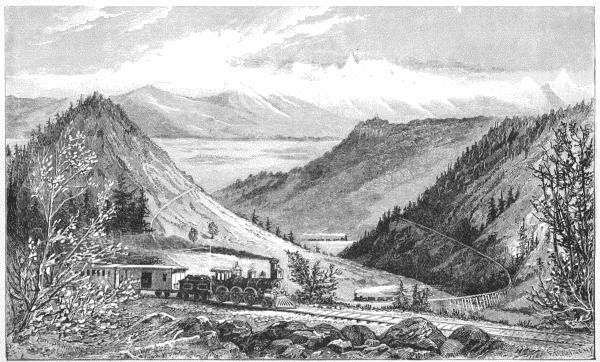
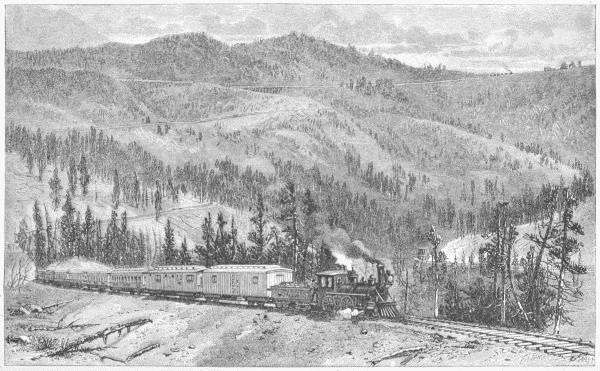
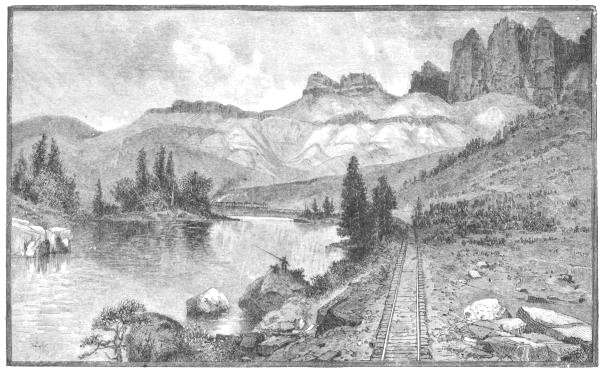
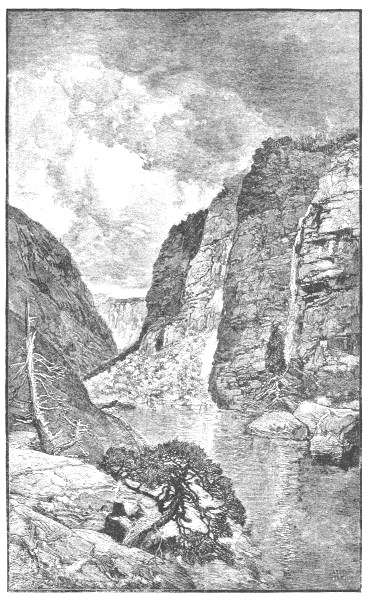
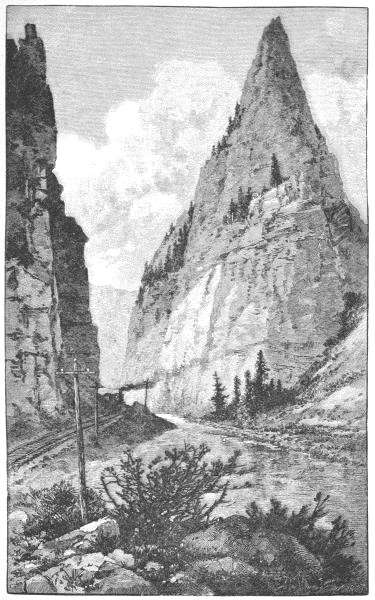
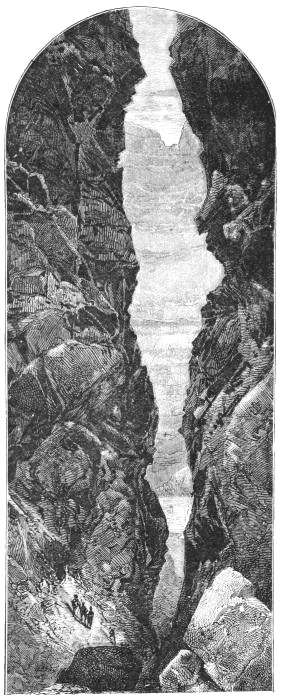
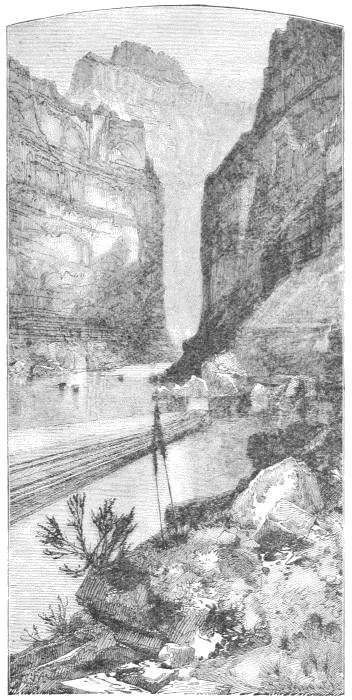
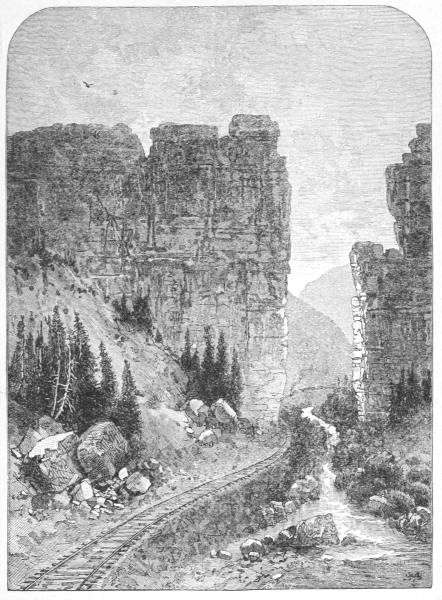
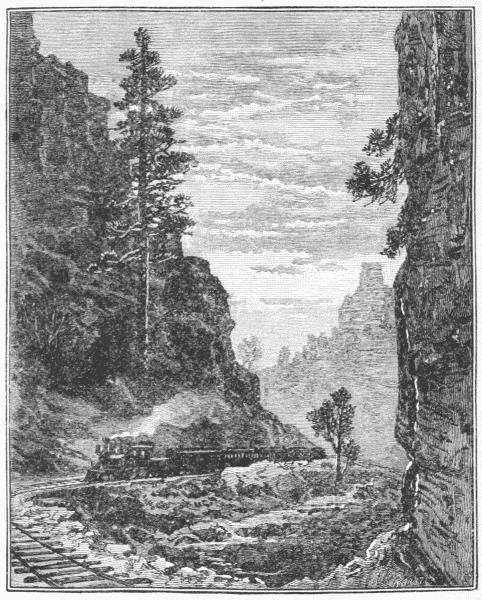
It was not Indians though—only a respectable sort of cañon, with great
black walls, and rugged hills wedged apart by the stream, and the train
hanging invisibly half-way betwixt top and bottom, always going in and
out of nooks and gulches, always gliding down nearer the water, until
finally, between strange farm-fields, the noble Rio Grande came in view,
and once more we ran upon a level track. Emerging from Comanche Cañon, a
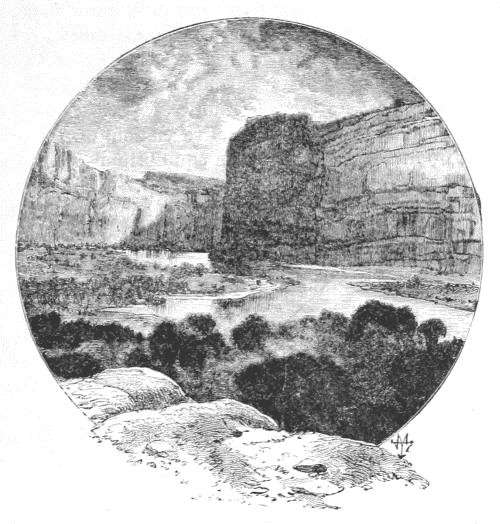
bend to the southward is made along the western bank of the lower part
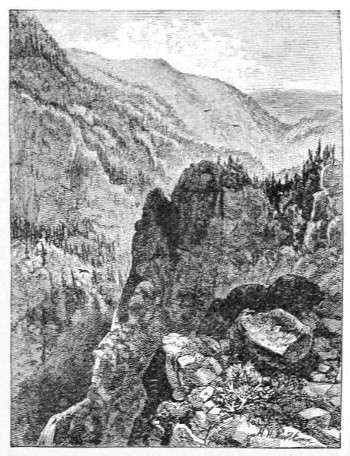
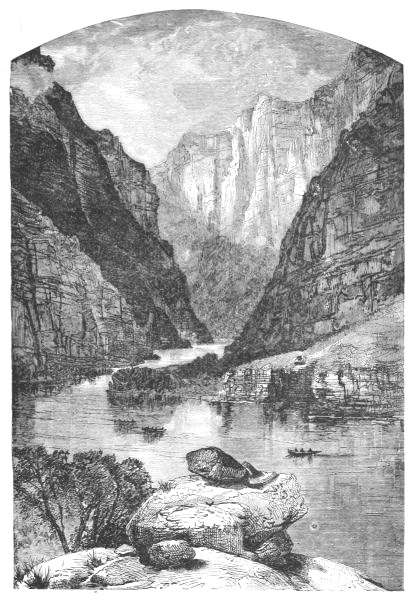
of the cañon of the Rio Grande. In many portions of this narrow valley,
only about twenty miles in length, features of great interest to the eye
occur, equaling the walls of Comanche, which was itself ignored until
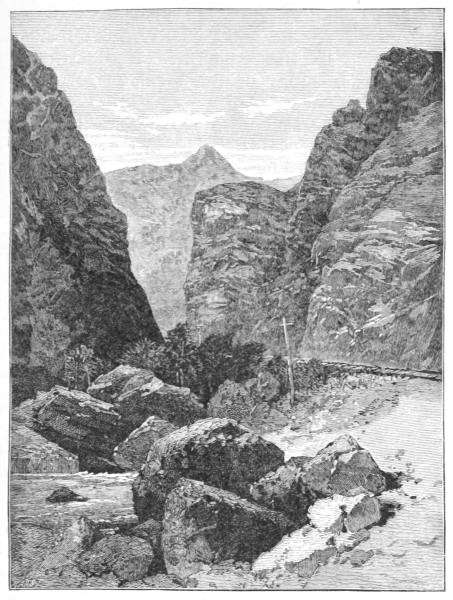
the railway brought it to light. The river here is about sixty yards
wide, and pours with a swift current troubled by innumerable fallen
rocks. To-day it is swollen and yellow with the drift of late rains, but
in clear weather its waters are bright and blue, for it has not yet
soiled its color with the fine silt which will thicken it between Texas
and Mexico.
On the opposite bank, near the level of the river, runs the wagon road
that General Edward Hatch, formerly commander of the department of New
Mexico, cut some years ago to give ready communication between his
headquarters at Santa Fe and the posts in the northern part of the
Territory and in southern Colorado. This is the track now followed by
all teamsters, but the old road from the south to Taos ran over the
hills far to the eastward, passing through Picuris.
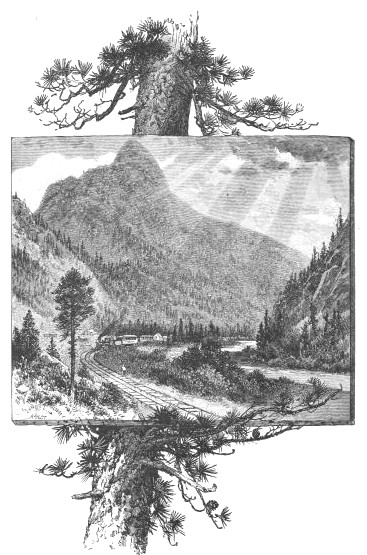
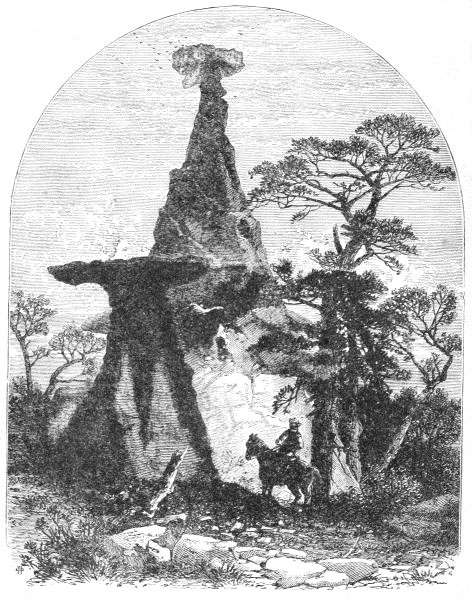
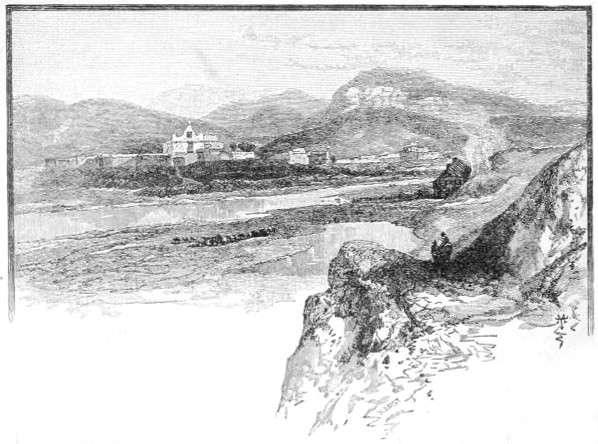
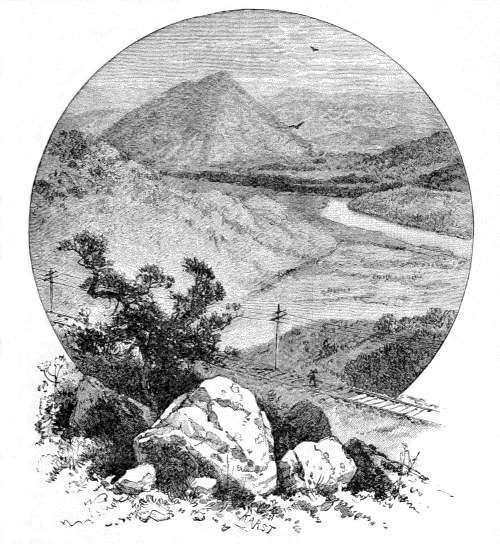
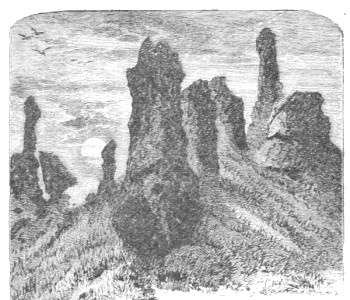
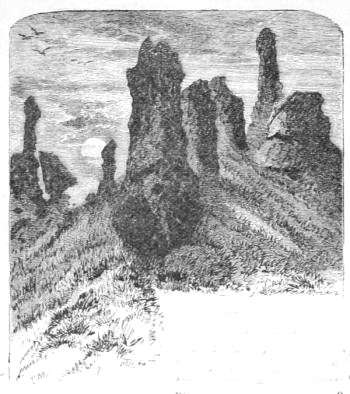
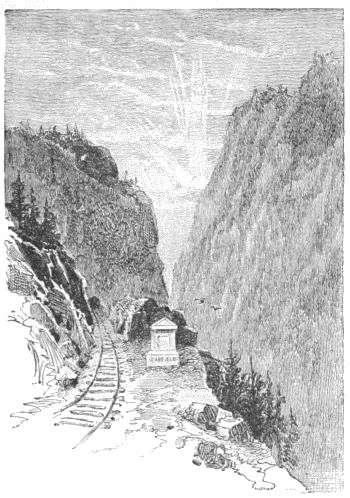
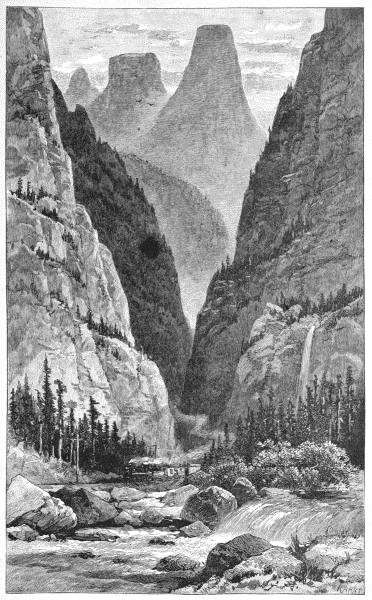
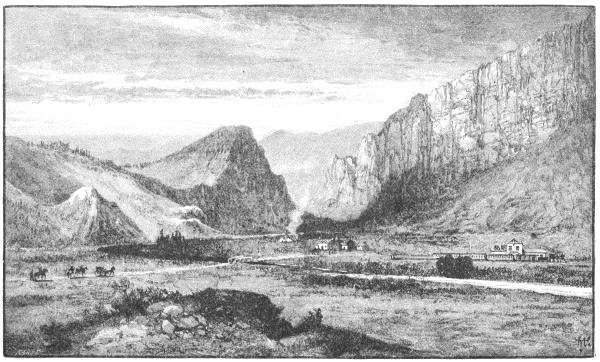
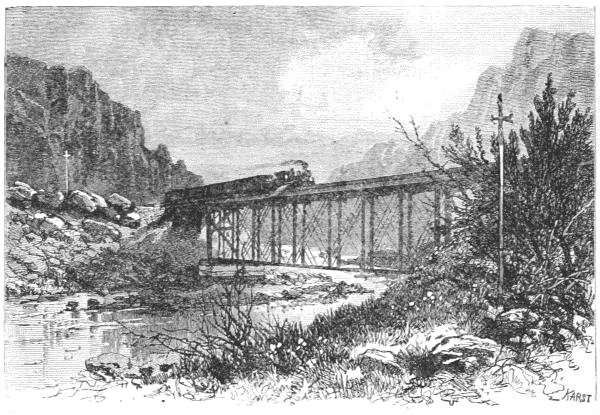
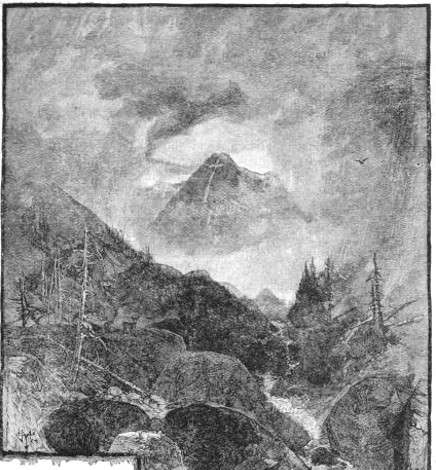
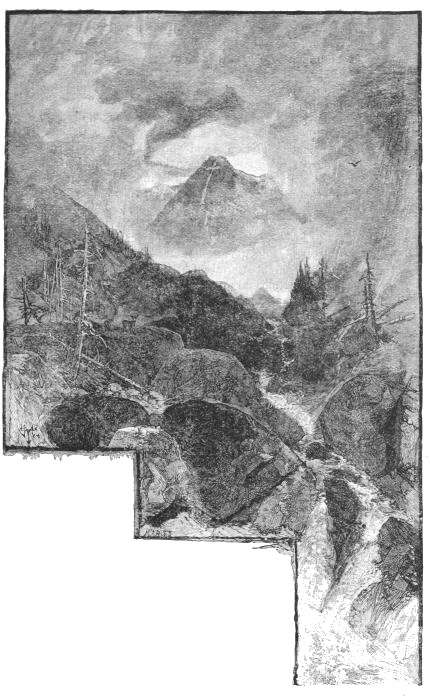
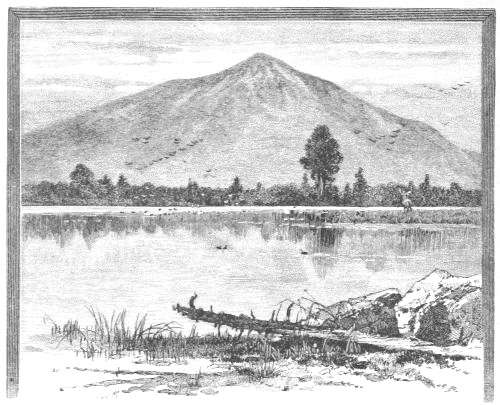
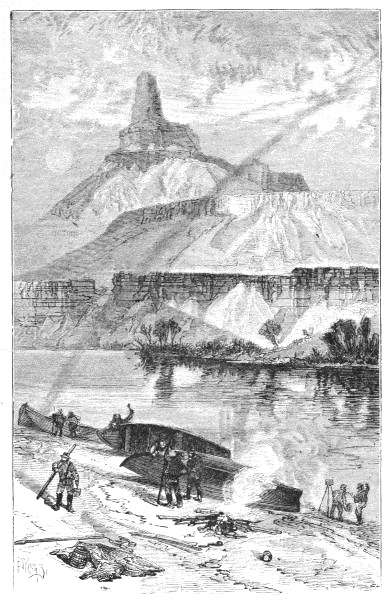
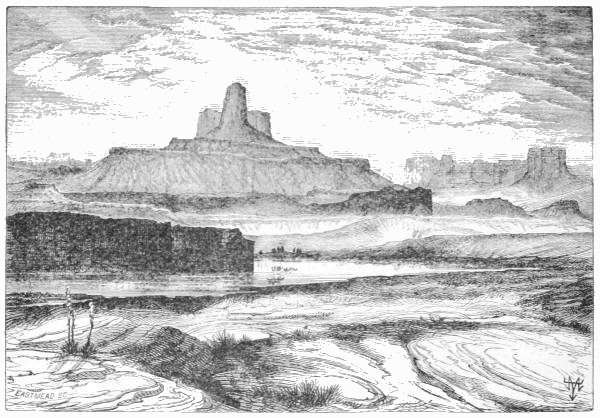
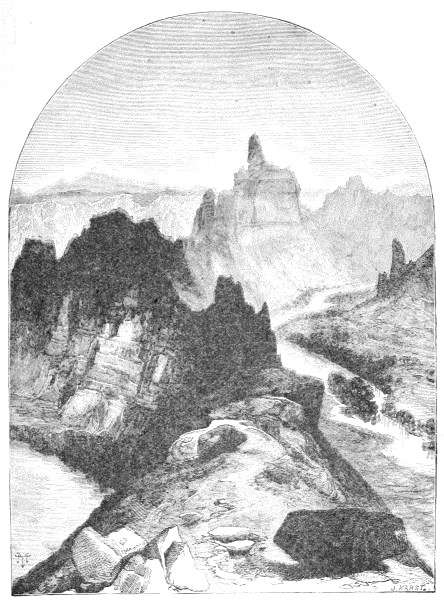
An odd conical hill (shown in our engraving) stands near the mouth of
the cañon, dividing the current of the river. Noticing its resemblance
to a funnel, the Mexicans called it Embudo, and the adjacent station
takes the same name. Embudo is chiefly important as the point of
departure for Taos, thirty miles distant.
While breakfast was preparing we were interrupted by the sudden
apparition at the side-door of our car of two long ears, then a
forehead, bulging by reason of the bushy hair that covered it, and
immediately afterward the neck and shoulders of a donkey. But if you say
donkey down here few comprehend you. The proper word is burro
(boó-ro). This animal bore upon his round back a small saw-buck saddle,
from each side of which hung a square panier of wicker-work. These
paniers were not nailed, but the willow sticks of which they were made
were bound into place by thongs of rawhide. On top, between them, was
lashed a third square basket, which would hold a half-bushel. Though
this seemed very bulky, it really was a light load for the little beast,
and he stepped along briskly ahead of the wrinkled old Mexican who owned
him. Shining through the wicker receptacles we saw green rinds, and sang
out,—
“Melones?”
“Si, Señor,” came the husky answer, whereupon the burro was seized by
the tail and brought very willingly to anchor. Slipping several of the
sticks out of their leather-loops, half a dozen long yellow specimens,
something between a melon and a cantaloupe, were held up for our
inspection. We hammered them with our knuckles, testing their soundness,
and finding some to suit, enquired the cost,—
“Cuanto pide vm. por estos melones?”
“Dos realles!” (two shillings) was the reply; so we bought three at an
outlay of seventy-five cents.
They proved muskmelonish and somewhat tough, but by no means bad. There
seems to be no reason why much better melons should not be raised, since
the conditions are favorable and every farmer does more or less at it.
This question why served to spice our chat at luncheon. It was
ultimately concluded that the continued degeneracy was due to the fact
that all the good ones were stolen and eaten, only the very poorest
being left to mature their seeds; thus the worst, instead of the best,
were used to propagate from. I recite this, to show the thoughtful
reader that we are not always frivolous, but often introduce grave
themes into our discourse, and discuss them in a philosophic way.
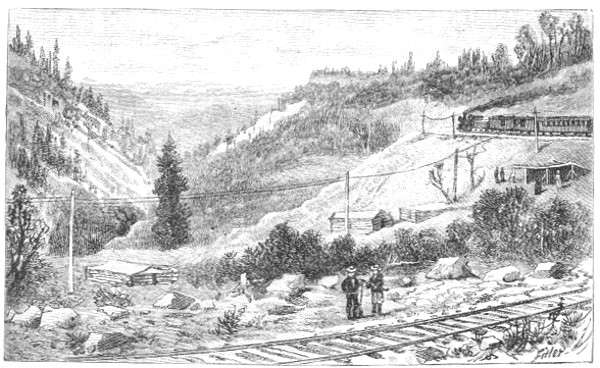
Attaching ourselves to the locomotive of a working train, after the noon
repast, we were hauled down the valley three miles, and given an
opportunity to watch the men repair track that had been lately torn to
pieces by water, two or three culverts having been swept out and the
road-bed completely uprooted. The hills at that point slanted down to
the river in a long treeless sweep, sown so thickly with boulders of
basalt, from the size of a bushel to that of a barrel, that even the
sagebrush could find scanty footing between. Down this long slope,
from the mountains behind, had come one of those raging precipitations
of unmeasured rain to which the West has given the expressive name
“cloudburst.” Truly, when one of these incidents of Rocky Mountain
meteorology occurs, “the windows of heaven are opened.” To such a
torrent the natural rip-rap opposed a very slight obstacle. The heavy
and closely packed rocks were lifted and rolled and hurled headlong as
though they had been a child’s marbles. Wherever any earth or mere
gravel was met, it was plowed up and dashed away in a moment, while as
for the railway bed, its embankments were demolished, its cuttings
filled, and such heaps of stones piled upon its distorted track in some
places that no attempt was made to dig it out, but new rails were laid
in a different spot. They were rough and irregular enough, but we went
safely over. Against these cloudbursts no railway in this region can
provide; and there is nothing to be done but rebuild as quickly as
possible. The skill, energy and marvelous speed with which the section
men do this, and the character of the temporary track over which they
run their trains until a better one can be constructed, excite the
surprise of every one. Railroading in the West is as unlike the similar
pursuit in the Atlantic States as a Colorado silver shaft is a contrast
to a commonplace granite quarry.
NEW MEXICAN LIFE.
We had observed on the further side of the river, where the flat lands
were continually widening between the stream and the hills, signs of
Mexican habitancy, and at the washout discovered a chapel of the Society
of the Penitentes, into which the flood had broken a great gap near the
foundation. It was a rude little house of mud, but well plastered
within, and perhaps had been intended as a dwelling in former days.
Creeping in through the breach, we found no furniture, but a pile of a
dozen or more wooden crosses, which had been carried there by the doers
of penance at Easter. The smallest of these crosses was more than ten
feet in height, and its beams at least six inches in diameter. As to the
heaviest, I doubt if I could have lifted it fairly from the ground. Yet
the poor sinners had managed to get them across their shoulders, and so
had dragged them hither, with many pains of outward penance and fearful
flagellations of conscience, but with rich reward of pride before
earthly eyes, and promises of glory in the world to come. From where
they had been brought, or by whom, there was no record; but their ends
were worn diagonally to a sharp wedge by long scraping over the stony
soil. In addition to these were several small crosses of lath, which had
been borne by the priests, typically; some tin and wooden candle
holders, curious little lanterns, and one of those rude religious
portraits on woods, which are so common throughout this section, and
which are preserved reverently among the Mexicans for generations.
The Penitentes are a sect within the Church, which the priests are said
to have been discouraging. Perhaps this has had some effect, for the
custom is in decay, a result due more to the railway than to the
cathedral, I fancy. During the greater part of the year the Penitentes
sin and are sinned against like other people, but in the spring they
atone for it by wearing coarse clothes under a sort of sacrificial robe,
and by torturing and starving themselves nearly to death. Walking in
processions, masked beyond recognition, enduring constant castigations
from each other, bearing over the roughest roads and across country the
heavy crosses we have seen, and with the “pride that apes humility”
enduring the utmost suffering, they consider themselves to have laid in
a stock of grace sufficient to over-balance all possible crime during
the coming twelvemonth. The practice has a long history, but amounts to
an American survival of the Flagellants of Europe.
A few miles below, the Mexican farms and orchards became more frequent,
the little settlement of Joya was noticed, Plaza Alcalde passed by, and
the wide, fertile plain of San Juan opened to our view. Skirting the
western edge of this (for the river keeps close under the high bluffs on
that side), we ran five or six miles, until a triangular parting in the
bank opened to the westward, where we halted on a side-track near the
old adobe village, but new railway station, of Chamita. The Rio Chama
flows into the Rio Grande here, and a broad valley area is the result.
The whole of this, which is easily irrigated, is under tillage, and just
now looking its best. It is therefore a green and prosperous landscape
we gaze upon, bounded by reddish benches which the setting sun brightens
into splendor, and shut in by blue, lofty, cloud-capped hills, beyond
which stand the guardian summits of snowy ranges.
Up the Rio Chama cultivation extends almost uninterruptedly for many
miles, and there are several villages or plazas. Chamita itself is on
this side—a cluster of scattered houses along the bluff through which
the railway has made a deep cut. The top of this ridge commands a fine
view up and down the Rio Grande, and there idle figures of Mexican or
Indian are always to be seen watching for the train or studying the
movements of almost invisible people on the other side of the valley.
Draped in black, for the most part, motionless and immovable, they
remind one irresistibly of Poe’s picture:—
“And the raven, never flitting, still is sitting, still is sitting,
On the pallid bust of Pallas, just above my chamber door.”
This point, as I have intimated, is in the midst of the civilization of
northern New Mexico. Twenty-five miles up the Chama stands the large
town of Abiquiu, an important place in old times; nearer by another
plaza, Cuchillo, is a farming center. Not far away, in the Rio Grande
valley, are San Juan, Santa Cruz and Española, the latter on the western
bank of the river and the present terminus of the railway line
southward, whence stages depart regularly for Santa Fe.
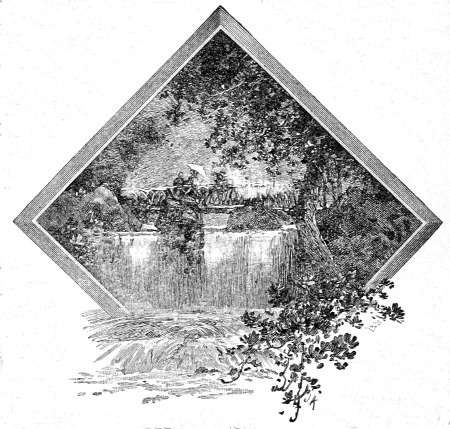
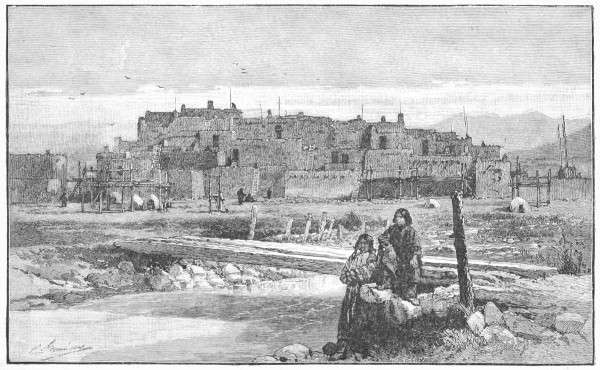
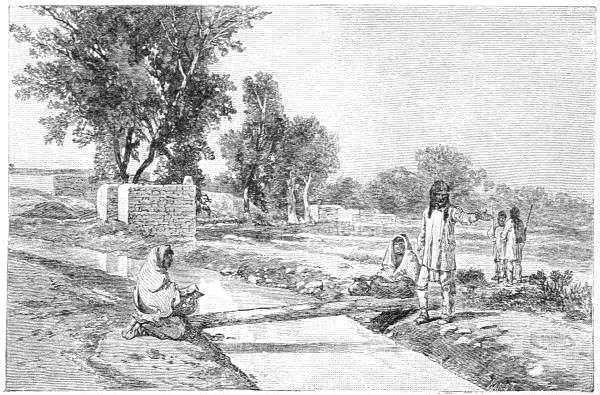
A Mexican farmhouse or “ranch” looks like a small fort, and makes a very
pleasing picture, as you may observe in our sketch. It is square, rarely
more than one story high, is built of mud, and roofed with immense round
rafters, the ends of which protrude irregularly beyond the wall, because
the builders have been too indolent to saw them off. Over these
rafters,—above the line of which the wall extends a few inches,—are
laid some boards or a stratum of poles, and upon these dry earth is
spread a foot or more deep, with rude gutters arranged to carry away the
water. In the course of two or three seasons, such a roof will have
caught a supply of wind-sown seeds, and support a plentiful crop of
grass and weeds, which is no disadvantage. This novel result is
interfered with somewhat, however, by the habit of using the roofs of
the houses (reached by a short ladder) as a place for drying fruit and
sunning grain, and for a general lounging spot, whence a better view of
what is occurring in the world,—the going and coming of the neighbors,
the planting or gathering of the crops, the approach of a
stranger-horseman, or the movements of the cattle on the benches,—can
be obtained, than a seat on the ground affords. As the train dashes by,
the passenger notices two or three women and children standing on each
housetop, shading their eyes with their brown hands, and making an
unconscious pose irresistibly alluring to an artist.
On a line with the front of the house a wall will probably extend a
little distance in each direction, and then backward, enclosing a garden
and diminutive orchard. Everything is square. The idea of a curve seems
rarely to enter the Spanish-Indian mind. For graphic effect, this is
highly gratifying, since the bends in the river, the rounded outlines of
the mountains, the undulations of foliage, are all in curves, to which
the angular lines of the buildings present a most pleasing contrast.
Now and then you will see a better house—one whitewashed outside, and
having a balcony running around the second story. The outbuildings, in
any case, are only a few mud huts, used for storage, and some rough pens
where the animals are kept. Anything like the barns of an Eastern farmer
is unknown.
The isolated dwelling, however, is largely a modern innovation. The
general plan is to live in compact, block-like villages, surrounded by a
wall, or what amounts to that. This results partly from the need in
early days of united protection against the Indians, but chiefly from
following the traditional custom of their red ancestors; for the New
Mexican of to-day is a half-breed, or a mongrel of some degree between
the Spaniard who “came over with the conqueror” and the Indian of
whatever tribe happened to be accessible. Remote from civilized
influences, the common people have tended always toward barbarous ways,
and are more Indian than Spanish, albeit the dialect they speak is not
so far removed from the Castilian as one would expect. There are local
differences and idioms, of course, which are at once noticeable; but the
usual tongue is not very bad Spanish.
Though Mexican hamlets and farms are scattered everywhere about here, in
the fertile valleys, there is a class of towns along this part of the
valley of the Rio Grande which are primarily Indian, and situated upon
reservations each ten miles square, secured to them by the government.
Each of these present villages, now commonly known by a Spanish name,
was the site of an ancient native pueblo, and the fields which were
deeded to them by the United States are those their fathers cultivated
before the white men appeared at all. Some, however, yet retain their
Indian names, as Taos, Picuris, Pecos, Pojuaque, Acoma and Tesúque. San
Juan, Santa Cruz, Santa Clara, San Ildefonso, and others have been given
new names by the conquerors and priests. South and west of Santa Fe lie
many other pueblos, some of them very populous, as Jemez, Zia, Santo
Domingo, and San Felipe. In all of them substantially the same sort of
life is found, and as it is impossible for me to cover the wide
territory they embrace, the reader must be content with the type of the
whole to be seen here at Pueblo San Juan. It is a phase of humanity and
conduct rapidly passing away—melting under the steady sun of modern
progress; and the traveler who does not take an early opportunity to
study it will miss not only that which is extremely interesting and
suggestive, but what in a few years will become a matter of history and
romantic tradition.
Here at Chamita the river is divided by a large, flat island into two
branches, each perhaps a hundred yards in width. Over the first one, at
the time of our visit, stood a good bridge, built by the railway
company; a second bridge had spanned the other branch until the high
water carried it away. Formerly there had been a ferry, but the boat
was out of order, and nobody cared to repair it, for could not the
stream be forded?
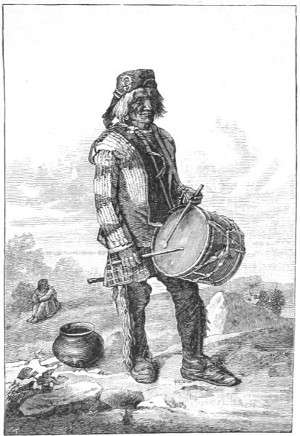
A PATRIARCH.
In the cool of the evening the whole party went down to the river bank,
trusting to good fortune for transportation. Thus challenged, good
fortune stood by us in the person of a citizen and his broncho.
Chartering the latter, the Artist, his sketching haversack slung over
his shoulder, mounted, and then the Madame was invited to ascend, the
pillion being a shawl thrown over the horse’s haunches. When there she
declared she could not stay—would certainly slip off the Gothic back of
the beast the instant he moved.
“Then take it Anna Dickinson fashion,” remarked her unfeeling spouse;
whereupon there was a frantic lurch, a twinkle of crimson suspected to
be hosiery, and a cheery “All right!” to let us know she was ready to
brave the passage. The landing was safe, and then the patient horse
returned and repeated the fording until we all were across.
But our peace of mind, or our amour propre—which is much the same
thing—was disturbed by a suspicion that we were being laughed at, for a
party of Mexican women from Chamita came down to the brink while we were
there, and, chattering merrily over our slow and undoubtedly ludicrous
progress, unconcernedly pulled off their shoes and stockings, gathered
their skirts in a bunch about their waists, and gaily waded through as
though in contempt of our fear of water and the conventionalities.
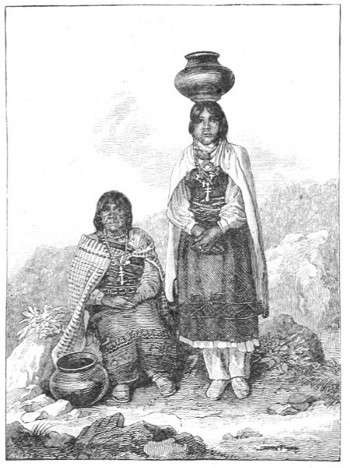
MAID AND MATRON.
The large island was gravelly and liable to be inundated, so that it was
given over to the pasturage of sheep, goats, cattle, horses and donkeys.
On the eastern bank we found ourselves at once in the midst of grain
fields and garden plats. Tall Indian corn alternated with short wheat,
hay and alfalfa, or patches of potatoes, melons and vegetables. Fences
were few, but the road was defined by a line of upright brush, bound
into cohesion by withes of bark, so that it resembled a thoroughly dead
hedge. Here and there stood a casa chiquita, but the main town was on
the bluff marking the old bank of the river, half a mile from its
present current.
Pueblo in Spanish simply means “a village.” When the first explorers,
Cabeça de Vaca, Coronado and the early lieutenants and friars whom
Cortez sent northward, in search more of gold than geography, penetrated
what is now New Mexico and Arizona, they everywhere found Indians more
or less nomadic, but the larger part of the natives belonging to a
different class, and living in settled communities of permanent houses.
To these the Spaniards naturally gave the name of “village,” or “pueblo”
Indians, which, by a common process of lingual change, has become
shortened into Pueblos, though Puebloans is a far better word. Their own
tribal names have disappeared except in a few cases, such as the Zuñis
and the Moquis, and the Spanish word covers all Village Indians
distinguished from the roving Apaches, Mojaves and Utes, that surround
them and centuries ago wrested from them much of their former territory.
At present there are in all New Mexico but nineteen towns of the Village
Indians, whose aggregate population in 1880 was only 10,469, as follows:
| Taos | 391 |
| San Juan | 408 |
| Santa Clara | 212 |
| San Ildefonso | 139 |
| Picuris | 1,115 |
| Nambé | 66 |
| Pojuaque | 26 |
| Tesuque | 99 |
| Sochiti | 271 |
| San Domingo | 1,123 |
| San Felipe | 613 |
| Jemez | 401 |
| Silla (or Zia) | 58 |
| Santa Aña | 489 |
| Laguna | 968 |
| Isoleta | 1,081 |
| Sandia | 345 |
| Zuñi | 2,082 |
| Acoma | 582 |
Ascending the high bank along a road greatly gullied by the rains, we
found ourselves in a large group of houses, each of which was joined to
its neighbor as continuously as in a city block, but only one story
high; or if there was a second story, it did not come out flush with the
front wall, but was ten or fifteen feet back, the roof of the lower
story serving as a portico to the upper floor, which was reached by an
outside ladder.
These dwellings were built of mud bricks, called adobes, and in many
cases the floors were lower than the level of the street—a matter of
small concern, since the door-sill was so high as to shut out any water
which might be running outside. Mixing in a little broken straw, rough
blocks about twice the size of ordinary bricks are moulded, dried
somewhat in the sun, and laid up in the form of a wall. Space is left
for a door and some small holes for windows, quite high up. That is
about all there seems to be of it, yet the inexpert find it not so easy
to build a “doby” as they supposed. The consistency of the clay must be
right, and I am told the wall must be laid so that the blocks somewhat
brace each other by beveled sides, or else the great weight which rests
on the top, otherwise wholly unsupported, will cause the middle of the
wall to bulge. That these ancient houses stand so plumb and uncracked
shows how proficient the Indians are at this peculiar architecture; and
ought they not to be, for did not they invent it?
All the buildings are smoothly plastered outside and in. This is done
some weeks after they are built, and after they have thoroughly dried.
To obtain the necessary material for the outer “stucco” coat, the floor
of the interior of the unfinished house is dug up and mixed with water
until it becomes a soft paste. Then it is taken by the handful, dashed
against the unchinked adobes, and spread smoothly with the palms, just
as a town mason would use a trowel. The women do all this, and I
remember surprising three damsels, as pretty as the New Mexican
peasantry have to show, down on their knees and up to their elbows in
seal-brown mud, plastering the new house, while father and mother were
busy in the fields.
Most of the Indian dwellings,—and they are as good as the majority of
the abodes of the Mexican ranchmen,—have two rooms, and sometimes
three, but these are generally so dark that the eye must accustom itself
to the gloom before their contents can well be discerned. This arises
from the scarcity and diminutive size of the windows. Here in San Juan,
indeed, I saw roughly sashed windows in many houses, or else a single
pane of glass set in; but often only a grating is used to guard the
aperture, or else holes in the walls are left so small that no enemy
could crawl through. You can imagine the darkness inside, therefore,
even on a bright day. Originally the pueblo was common property, and
both men and women assisted in building it, but new ideas of individual
possessions are invading the old notions. It was the former custom, too,
to mix ashes with earth and charcoal into a substitute for mortar; yet,
as we shall see later, the very ancient, ruined buildings of the
ancestors of these Puebloans show an architecture in stone, with a
cement now as hard, or even more tenacious, than the blocks it binds
together. “They take great pride,” says an old book “in their, to them,
magnificent structures, averring that as fortresses they have ever
proved impregnable. To wall out black barbarism was what the Pueblos
wanted; under these conditions time was giving them civilization.”
Entering one of the houses here in San Juan, we shall find the floor is
only of earth, but that many skins are spread about. In one corner, or
else beside the entrance door, will be one of the queer little
round-topped fireplaces prevalent all over Spanish America; but if in
the latter place, a low wall or wing of masonry runs out into the room,
protecting the fire from contrary drafts. The cooking in summer is done
out of doors almost wholly; but in cold weather, when utilizing these
fireplaces, they use the iron pots and skillets which civilization has
brought them, eking out with variously shaped earthen utensils of their
own make, and baskets obtained from Apache and Navajo visitors.
You must expect to see very little furniture in an Indian’s house,
though occasionally some familiar objects are found. The beds are made
on the floor, and consist entirely of skins and blankets. The walls are
often whitewashed, and though they never heard of Eastlake, they always
make a dado of clay water. The soft brown tint contrasts well with the
white frieze, and would be attractive in itself; but the clay here is
full of specks of mica, which dust the walls with gleaming points not to
be spurned in mural decoration.
The Indians admire pictures, but are not scrupulous as to artistic
superiority. In nearly every house you will find a board a few inches
square, upon which is painted a religious subject, usually in red and
yellow, of some saint, or a group of them. Such pictures, and others
whenever they can get them, are highly valued and will be adorned with
peacock feathers and bright berries.
They love gay colors and choose them in their dress, which is a singular
mixture of Indian, Mexican and American. There go a man and woman ahead
of us who are fair types. Neither are of large size, and though an
oddity of gait comes from their habit of walking with their toes
straight before them, both are of erect carriage. The man is dressed in
brown flannel shirt, hanging blouse-like about him, tightly fitted
leggings of buckskin, with a broad seam-flap in place of fringe on the
outside of each leg, and moccasins. Over his right shoulder and under
his left arm is loosely draped a striped blanket made by the Navajo or
Apache Indians of the interior, and diligently repaired in its worn
places. His head is bare, under the blaze of the hot sun, save for a
wreath of cottonwood leaves. Under this “bay crown” his smoothly-brushed
and jet black hair, accurately parted in the middle along a line of red
or yellow ochre, is plaited on either side into two long braids,
intertwined and lengthened out with strips of red flannel and tufts of
otter-skin.
The woman wears a long, loose tunic of coarse cloth, almost devoid of
sleeves, and belted at the waist; but sometimes this is of buckskin, Her
extremities are not clad in leggings, but encased in short, shapeless
boots having a moccasin foot, and stiff legs, which reach nearly to her
knees, and often afford the only recognizable distinction between a male
or a female, who, to a stranger’s eye, are confusingly alike. She wears
thrown over her head a shawl-like expanse of common pink-printed calico;
but if you could see her hair you would discover that none of the
attention had been bestowed upon it which her husband’s has received; it
has been cut short, particularly across the forehead, and is likely to
be tangled and dirty. In this respect these Rio Grande Indians have
fallen from grace into the slovenliness of their nomadic neighbors. The
maidens of the purer Moqui pueblos, for example, take great care of
their raven locks. Parting the hair at the back of the head, they roll
it around hoops, when it is fastened in two high bunches, one on each
side, a single feather being sometimes placed in the center. The Moqui
wives gather it into two tight knots at the side, or one at the back of
the head; and the men cut their hair in front of the ears and in a line
with the eyebrows, while at the back it is plaited or gathered into a
single bunch and tied with a band.
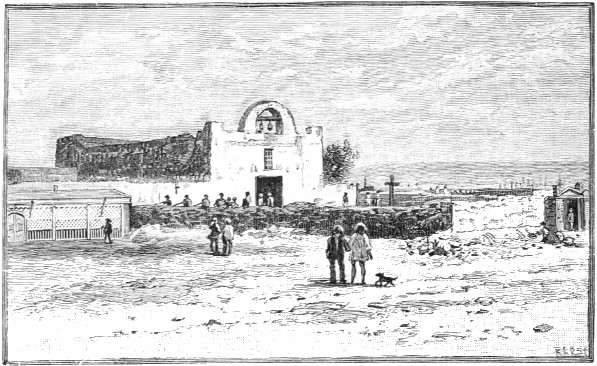
OLD CHURCH OF SAN JUAN.
This woman is going to one of the public wells to draw water, and
presently is joined by a young Hebe, with bare, shapely ankles and
rotund bust, whose laughing talk is like the gurgling chatter of the
blackbirds in the rushes. They each carry classically shaped and gaily
ornamented jars of earthenware, made by themselves, and which they will
tell you are tinájas. Some of the wells are so shallow that an
inclined passage-way has been cut down to the water from the surface;
from others the liquid must be drawn in buckets. Having filled their
vessels, each woman lays a little pad on her head, skillfully poises
the heavy tinája upon it, and marches off, as erect, elastic of tread
and graceful in mien as any Ganymede who ever handed about the nectar on
Olympus. You can see the trimmed and painted gourd-dipper floating about
in the neck of the jar, and thus know that the water is level with the
top; yet up hill and down, along the dusty roadway, through the
half-concealing corn, and under the low doorway go the dusky carriers,
and not a drop is lost.
A short distance back we had met a superannuated governor, or chief,
called in Spanish Attencio. His long, straight hair, of ashy hue, and
deeply furrowed features gave a most venerable appearance to his
attenuated but still upright form. His garments evinced more design,
were better fitting, and somewhat fantastically decorated; while from
his neck was suspended a drum, a tribute apparently to growing
infirmities which had not quite obscured the dream of place and
circumstance. We halted in curiosity while the Photographer, by specious
argument and a gentle subsidizing process, overcame the half-scruples of
the patriarch, and transferred his semblance to a “dry plate,” an
operation he repeated a little later with the maid and matron whom we
had seen at the well, though in their case with more difficulty and
overcoming of native shyness. The results of this enterprise are
commended to the reader.
The pueblo pottery is of all sizes and shapes,—jars, pitchers,
canteens, bowls, platters, and images of men and animals, made as
playthings for their children, or merely for amusement, and the latter
often called their “gods” by ignorant tourists.
It is evident everywhere that originally much finer and more symmetrical
pottery was made by all these Village Indians than now. They seem to
have understood the art of mixing a finer paste, and they worked with
more careful hands. The resemblance of this antique ware to that of
Egypt and Cyprus, has been noted in its structure, and in the “scrolls,
straight lines and walls of Troy,” with which it is embellished. Birds,
too, were painted upon some of the oldest ware extant, recalling certain
Chinese symbols, while “in the animal handles and in a design known as
the old Japanese seal,” the early ware of Japan is simulated. The
ancient and (in ruins) most widely distributed form of pottery known is
the “corrugated,” fragments of which are also found in the mounds of the
Ohio and Mississippi valleys and on the Pacific slope. This variety was
made by winding around and above one another slender strings or ropes of
red clay, expanding and contracting the coil to suit the varying
diameters of the vessel. Pressure of the fingers alone, or aided only by
a smooth stone, then compressed the coils into compactness and on the
inside into some smoothness. There was also a kind of ware in use in
prehistoric times which bore a red or black glaze beyond anything seen
in later manufacture; but this fine finish is thought to have been
accidental.
At San Juan, as in all other pueblos, the old adobe church, with its
absurdly barbaric furniture and uncouth appearance, is a center of
interest. Climbing the rickety ladder to its little gallery, and thence
ascending to the roof, one gets the best idea of how valuable a garden
spot this district is. As far as the eye can reach, up and down the
river, stretch farms and orchards and plazitas. I suppose that from the
mouth of the cañon down to the village of San Ildefonso, a distance of
about thirty miles, the river-bottom is almost continuously cultivated,
the chief crops being wheat and Indian corn, the latter notable for its
variegated and bright colors, and for which the people here keep the
original name, maiz; but every sort of grain and vegetable is also
produced in abundance.
The population sustained consists largely of Indians, in some
localities, as here at San Juan, almost entirely so; and they are quite
as industrious and skillful in their farming as the Mexicans. In most of
the villages the tillage of the reservation is wholly in common, but
here the Indians many years ago divided up their farming lands into
individual properties, not all equally either, for it was apportioned to
each man in proportion to his needs, abilities and desire. It is said
that there has been little change in the ownership of this property, the
same fields descending from father to son, generation after generation.
This being the case, it is not strange to learn the second fact, that
there is small variation in the fortunes of the different families, and
that there is slight disposition on the part of any to become rich while
others grow poor. All are self-supporting, and proud of the fact that no
aid is asked or received from the government.
Nothing reminds the traveler more of the Holy Land than to witness these
people threshing their grain, which happens, of course, in August, since
they do not stack the grain in the straw at all. The threshing-floors
are circular spaces of high level ground in the outskirts of the pueblo,
around which poles ten or twenty feet high are set, though there is no
need of more than mere posts. When the threshing is to be done, a
rawhide rope or two is stretched about these posts to form a fence, and
often upon this are hung many blankets, the gay colors and striped
ornamentation of which make an exceedingly picturesque scene. Sometimes
in place of the ropes a cordon of bare-legged small boys and girls, to
whom the duty is great sport, does service as a girdle. The diameter of
such a prepared space, hardened by service for half a century to the
consistency of brick, is sixty or a hundred feet. In the middle of it
are heaped the sheaves of the three or four families who are accustomed
to join in this work until a suitable quantity has been obtained, and
then the fun begins.
Through an opening in the extemporized fence is driven a flock of sheep
and goats, or else a small herd of horses. They at once fall to eating
the fresh grain, but are quickly beaten off and started into a run
around the enclosure, trampling down the edges of the stack, and all the
time getting more and more of it under their beating hoofs. Behind them
race two or three athletic, bare headed and scantily-dressed youths,
cracking long whips, hustling the laggards, and nimbly keeping out of
the way of the kicking, crowding and bewildered animals. This is quite
as hard work as any of the horses or goats do, and is accompanied by
continual halloos and trilling cries, which almost make a song when
heard at a little distance. Now and then a young horse will make a leap
at the rope, and snap the rawhide lariat, or dodge under it; or a
venturesome goat will elude his guard and escape; but there are excited
youngsters enough to speedily give chase and bring him back; and from
time to time the panting drivers are changed, the animals given a rest,
and the grain heaped into a new pile in the center. It is a wonderfully
lively and gay picture, which will never be forgotten, and entirely
unlike anything else to be seen in the United States. Toward evening,
when the incessant tramping has threshed all the grains out of their
husks, comes the winnowing. This is quite as primitive and idyllic as
its forerunner. Having lifted away the bulk of the straw, several men
and women take long-handled, flat-bladed wooden shovels, and toss up the
grain which lies thick on the hard clay floor, thus allowing the wind to
blow away the chaff. There is generally a breeze at sunset every day,
and the largest part of the chaff is gotten rid of by the shoveling; but
to perfect the process, the women take half a bushel at once of the
grain, and re-winnow it, by tossing it a second time in and out of one
of the large Navajo wicker-baskets, of which every family owns a number.
The rough, wasteful threshing, and the cleansing, only partial at best,
having thus been accomplished, the grain is divided out to its owners,
and by them packed away in huge jars of coarse earthenware, called
ollas, some of which will hold several bushels. These vessels keep it
dry and safe from rats, so long as the covers are tight. All these
processes are followed not only by the Indians, but by all Mexican
farmers throughout the Spanish southwest.
We were never weary of wandering about these Indian towns, and watching
the people at their work and sunny-tempered play. They are the happiest
men and women on the continent. Well sheltered, well fed, well
companioned, peaceful, guileless,—what else do they wish? Not theirs to
know carking care, and the fluctuating markets which imperil hard-earned
gains; nor to suffer the hurt unsatisfied ambition feels, or know the
terrors of a crime-haunted or doubt-stricken conscience. The broad,
bright sunshine of their latitude suffuses their whole lives and
dispositions, turning their rock-bounded lowlands into a Vale of Tempe.