I. TECHNICAL PROCESSES IN THE MAKING OF MODERN POTTERY AND THEIR APPLICATION TO THE TECHNIQUE OF ANCIENT VASES — PREPARATION OF THE CLAY — Ingredients and properties. — Washing. — Wedging. — FASHIONING THE VASES — (1) WHEELWORK — (2) BUILDING — (3) MOULDING — FIRING THE VASES — Production of Temperature. — Types of kilns. — Packing the kiln. — Firing. — Number of firings. — Injuries in the firing. — GLAZING — RED OCHRE WASH — WERE ATHENIAN VASES MADE FOR EVERY-DAY USE?
The making of a pot begins in the clay bed. The
clay has to be found, it has to be transported, and
above all it has to be tested to see whether it is
adapted to the potter’s needs. For there are many different
kinds of clay and they are as individual as human beings;
so that a thorough understanding of them is essential to
the successful potter.
The chief ingredients of clay are silica, alumina, and
water. Other possible ingredients are iron oxide, lime
(calcium oxide), magnesia, and potash. To the iron compounds
are due the different colors of the clay. When potters
speak of the color of a clay—red, yellow, white—they
refer to the color after burning, not in the raw state. The
tones of the color are controlled by heat; for instance, a red
clay becomes first pink, then in a higher fire a deeper red,
and in a still higher fire a brownish red.
The potter demands three properties of his clay: (1)
plasticity, the property which enables the clay to acquire
form; (2) porosity, the property which enables the water
to escape; and (3) vitrification, the property which enables
the clay to be fired. These three properties are due to the
three chief component parts of the clay; namely, clay base,
quartz, and feldspar. It will be found that some clays are
not plastic enough, others not sufficiently porous, and others
again not properly vitrifiable; in such cases the addition of
certain substances is necessary to make the clay usable.
The actual composition of the clay, therefore, is of great
importance, as no amount of skilful labor will avail if the
clay itself has not the right consistency.
When the right composition of the clay has been assured,
the next step is to wash it and separate it from the many
natural impurities, such as stones, sticks, etc., with which
it is mixed. A clay not properly washed is a source of
great vexation in the later stages of pottery making. The
best method is that of “blunging,” that is, the dry clay
is put into water and stirred constantly until it reaches the
consistency of cream, technically called “slip,” whereupon
it is poured through sieves, coarse or fine according to the
desired consistency. The liquid clay or slip must then be
dried sufficiently to become plastic and workable. This can
be done either in filter presses in which the water is squeezed
out in a comparatively short time, or in shallow receptacles in
the open air where the water is allowed slowly to evaporate.
But even at this stage the clay is not yet ready for use;
it has first to go through the important process of kneading
or “wedging.” This consists of cutting a ball of clay in
two against a wire (fig. 1), slapping the two parts on a
plaster or wooden board, one on top of the other (fig. 2),
then lifting up the whole lump, cutting it in two again, and
slapping it down as before. The purpose is to remove all
air bubbles and to correct irregularities in hardness. The
operation has sometimes to be repeated fifteen or twenty
times before a good texture is secured.[5]
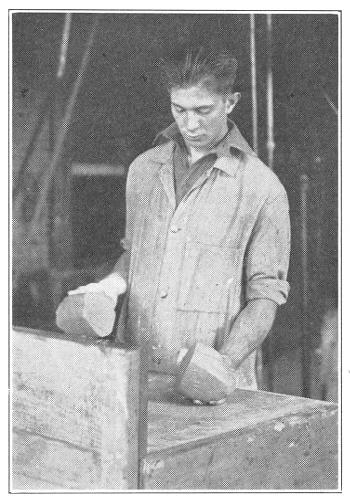
Fig. 1. Wedging (a)
We learn from the above survey that the fine consistency
of the clay in Athenian and in some other Greek wares is not
necessarily due to its natural state, but to the careful washing
and kneading undergone in its preparation for use.
When different particles are found in the fired clay they
are due to indifferent washing. And the varying shades of
pink and red of Greek vases likewise do not presuppose
different kinds of clay, but are due largely to the various
temperatures to which the vases were fired. We have too
often made our analyses of clays of Greek vases without due
cognizance of these facts.
There are three principal ways of making vases—fashioning
them on the wheel, building them, and making
them from moulds. Let us examine first the work on the
wheel, the potter’s tool par excellence.
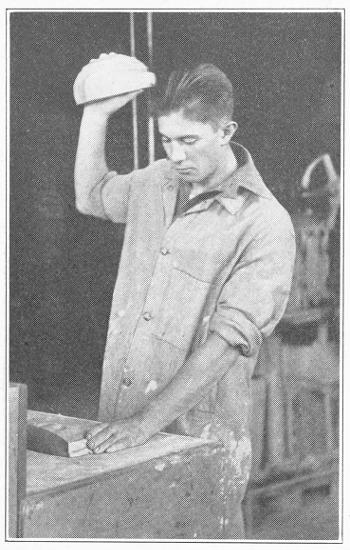
Fig. 2. Wedging (b)
Types of wheel.
There are various types of wheel in general use today.
The wheel run by electric power does not concern us here
since it cannot have been used by the Greeks. In studio
potteries, a kick-wheel is often used. In this the operator
stands and kicks with his left foot against a treadle, the
weight of his body being supported by the right (fig. 3).
Another fairly popular type has a large, heavy disk at the
bottom revolving in a horizontal plane, and kept in motion
by one foot of the operator (fig. 4). A very simple type
of wheel in use some time ago is illustrated in fig. 5. Here
the motion is imparted by an assistant turning the handle.
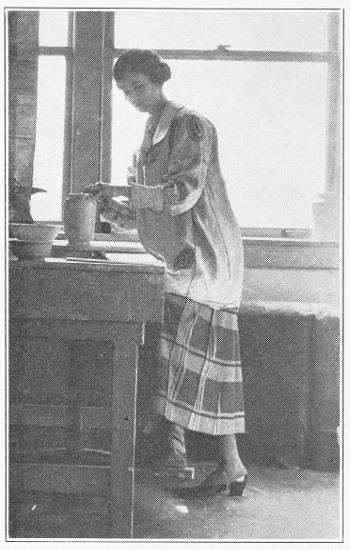
Fig. 3. Kick-wheel with treadle
Any one of these three types may have been used by the
Greeks. In the representations of ancient potters at work
(cf. pp. 64 ff.) the wheel appears to have been propelled
either with the foot or by an assistant.
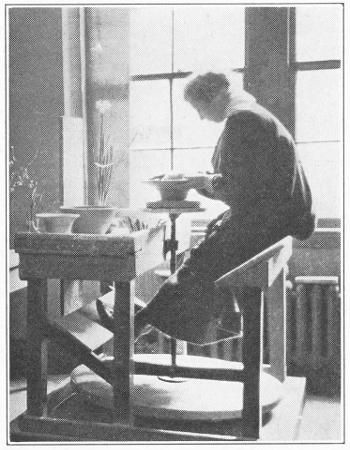
Fig. 4. Kick-Wheel with disk
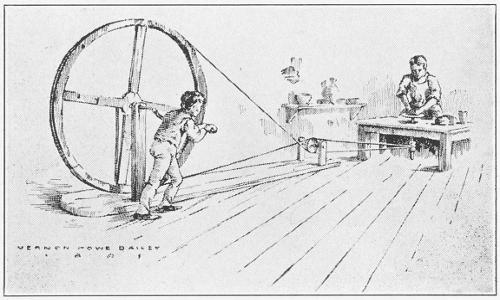
Fig. 5. Wheel put in motion by assistant turning handle
Barber, The Pottery and Porcelain of the United States, p. 4, fig. 2
Throwing.
Figs. 6-9. Processes of throwing
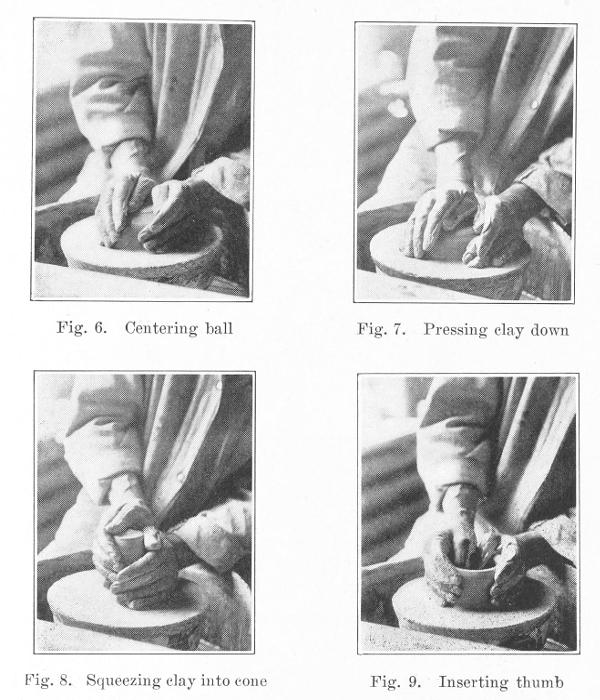
Fig. 6. Centering ball
Fig. 7. Pressing clay down
Fig. 8. Squeezing clay into cone
Fig. 9. Inserting thumb
Figs. 10-13. Processes of throwing
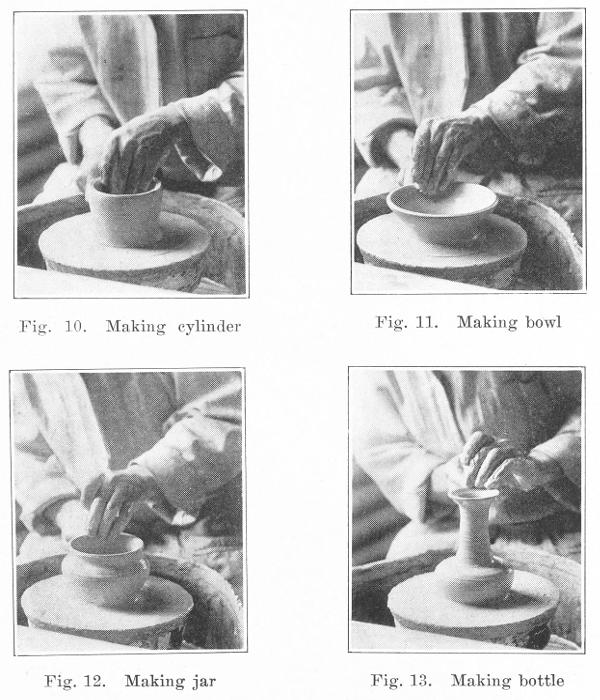
Fig. 10. Making cylinder
Fig. 11. Making bowl
Fig. 12. Making jar
Fig. 13. Making bottle
The first task in fashioning a vase on the wheel—or
“throwing” it, as it is technically called—is to center the
ball of clay on the wheel-head. It is accomplished by
pressing the left hand against the ball of clay as it revolves
rapidly, care being taken to keep the left forearm absolutely
rigid (fig. 6). The right hand is used for keeping
the clay wet by sprinkling it with water, and for pulling
the clay inward, thus squeezing it up to a cone. The cone
is pressed up and down in this manner several times (figs.
7 and 8). When the ball runs perfectly true, it is time to
open it by inserting the thumb in the center (fig. 9); then
by placing the fingers of one hand inside the hollow, and the
fingers of the other on the outside,[6] and by raising both
hands gradually several times and squeezing the clay lightly
while so doing, a cylinder is formed (fig. 10). The cylinder
is the foundation of all other shapes. For to produce a
bowl, one need only pull out the cylinder a little at the top
(fig. 11); to make a globular jar, pull it out at the bottom
and in at the top (fig. 12); to fashion a long-necked vase,
pull it out at the bottom and in at the top, leaving enough
clay to spin the top into a tall, narrow cylinder which will
serve as a neck (fig. 13); and by various other manipulations
one can produce almost every variety of shape. To
throw a vase to specific measurements, a careful drawing of
the shape should first be made and calipers and measuring
sticks kept close at hand for checking the work as it
proceeds.
The earliest Greek vases are made by hand; but from the
Early Minoan III and Middle Helladic I periods (i.e.,
about 2200 B.C.) in certain places at least, vases were regularly
thrown on the wheel. They could not have the regular
and symmetrical outlines they have if they were built by
hand, and many would show traces of vertical joints if
they were made in moulds.
That the processes of throwing were identical with those
described as in use today, there is of course no means of
determining; but they certainly must have been similar, as
clay has not changed its nature from Greek times to ours.
The evidence which we glean from representations on Greek
vases of potters at work, scanty though it is, bears out this
self-evident fact. From the above description it will be noted
that in this work of throwing the simultaneous use of both
hands is necessary—an important fact to remember when
interpreting scenes to be related to the fashioning of vases.
Turning.
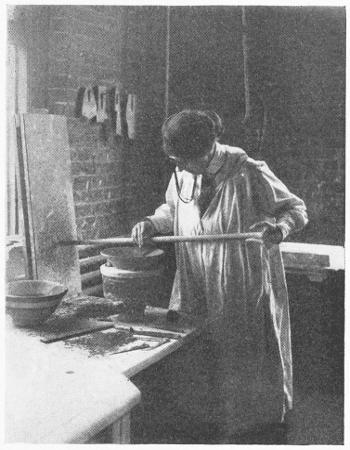
Fig. 14. Turning a vase
After a piece has been thrown on the wheel, it has
assumed its general shape, but that is all. The thinning of
the walls, the refinements of foot and lip, all such finishing
touches must be reserved for the next process. This is
known among modern potters as “turning.” In this the
clay is no longer in a wet state, but in a “leather-hard”
condition, and it is not worked with the hands but with
steel cutting tools. A newly shaped vase becomes leather
hard after it has been kept in the air and the water allowed
to evaporate for about twenty-four hours. Pieces in this
state are hard enough to be handled with care and to be cut
easily with a knife. They are not so fragile as either in the
wet or in the “bone-dry” state, but they are still delicate
and exposed to many dangers. Not until a vase has been
fired is it safe to handle it freely. The cutting with the
steel tools is done on the wheel (or “jigger”[7]), the right
hand which grasps the tool being kept steady by letting it
rest on a stick held in the left hand; the stick should have
a sharpened nail on one end, the point of which is pressed
into a wooden board at the height required (fig. 14). By
continued cutting off of thin shavings of clay and by adding
more clay in slip form when more is needed, the final outline
of the shape and the various grooves and mouldings for
lip and foot can be obtained. But it is a slow process,
requiring time, care, and great patience. For the smoothing
of the surface, scrapers, sandpaper, and sponge are
useful.
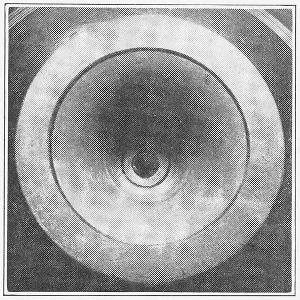
Fig. 15. Turned foot
Met. Mus. Acc. No. 12.234.2
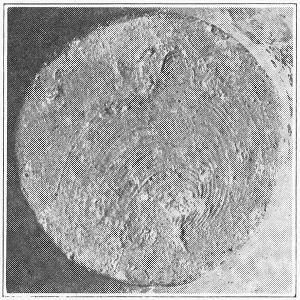
Fig. 16. Foot left as thrown
Met. Mus. Acc. No. 07.232.30
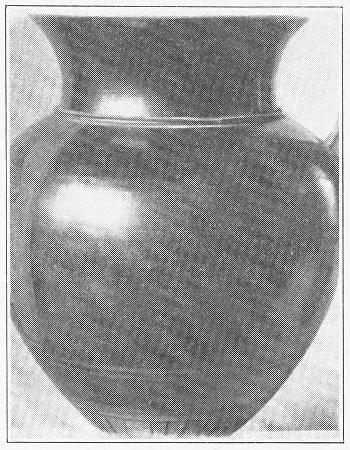
Fig. 17. Turning marks on outside of vase
Met. Mus. Acc. No. 06.1021.64
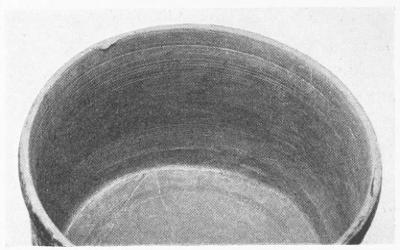
Fig. 18. Turning marks on inside of vase
Met. Mus. Acc. No. G.R.1228
This turning or refining of the shape after throwing, was,
as we might expect, not in universal use in ancient times.
Prior to the sixth century B.C. it was used occasionally here
and there, and often only to a limited extent. But there
cannot be the slightest doubt that in the Athenian black-figured
and red-figured vases extensive use was made of the
turning tools. The grooves and mouldings for lip and foot
were produced by this turning process, not, as modern
archaeologists tell us, by the use of moulds.[8] For this there
is abundant proof. The feet of Athenian vases are almost
all turned at the bottom, some with remarkable care and
finish (fig. 15), not left flat, as they would be after throwing
(fig. 16). The lids of pyxides and similar vases could not
have been made to fit so neatly on their ledges without the
use of turning. Above all, the wonderful finish and precision
of Athenian vases could never have been attained by
mere throwing. But there is even more convincing proof.
Unless the marks of the turning tools are very carefully
obliterated (with scrapers, sandpaper, and sponge), traces
of them are always visible. And this is the case also in
Athenian vases. The outside surfaces are generally carefully
smoothed, but even there the ridges formed by the
tools are often discernible (fig. 17); and on the inside of
the necks or feet or lids such ridges and concentric or spiral
scratches are quite frequent (fig. 18). They are very different,
however, from the finishing marks left in handwork
(fig. 19). To appreciate the fine, smooth surface which
work with the turning tools produces, we need only examine
the insides of most Athenian amphorai and hydriai; for
these, being more or less concealed, are generally left as
thrown, often showing the spiral ridges which rapidly
revolving clay will cause (fig. 20). They thus form a striking
contrast to the finely smoothed outside surfaces.
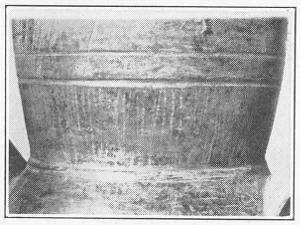
Fig. 19. Finishing marks left in handwork
Met. Mus. Acc. No. G.R.834
The fact that the Athenian potter made use of the turning
process shows incidentally that he was able to make his
vases to very exact measurements. This is important in
connection with Jay Hambidge’s theory that Athenian pottery
was carefully designed on certain geometrical principles;[9]
for if the Athenian potter had confined himself
merely to throwing on the wheel that would not have been
possible. It is during the second process of turning that an
expert potter can effect many changes in width and height
or in details, and thus make his product correspond exactly
with his carefully planned design. Modern potters of
standing work in the same way today. They first make a
drawing of a vase, full size or to scale, and then proceed to
follow this drawing in every detail, using rules and calipers
for their guidance. Of course it needs a great deal of skill
and patience to be able to work so exactly; but Greek potters,
we can be quite sure, had a good supply of both of
these qualities.
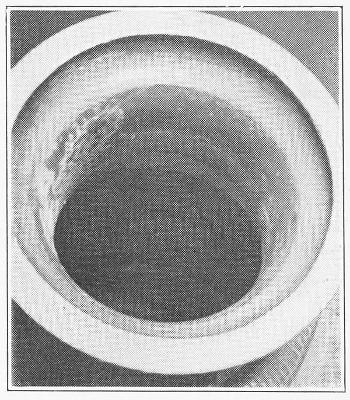
Fig. 20. Unturned inside of amphora
Met. Mus. Acc. No. G.R.545
Work in sections.
So far we have spoken only of comparatively small vases,
which can be thrown all in one piece. Larger vases are
best thrown in sections. To throw large jars in one piece
requires great physical strength, and it is very difficult to
finish such jars properly on the inside and to prevent them
from being unduly heavy. The section work is by no means
easy. At first a drawing of the vase has to be made, either
full size or to scale, and the heights of the different parts
marked off. While throwing the respective pieces use must
be made of measuring sticks and calipers, to obtain the
right heights and diameters. The measurements should be
those of the soft clay, which will of course be slightly larger
than those of the final shape. About one-eighth is the
average allowance for the shrinkage of the clay in drying
and firing. This shrinkage will naturally be proportional;
so that the relation of every part to the whole will be the
same in the fired vase as in the thrown product. The joining
is obtained by applying a thick slip of the same clay as
was used for the vase, to act as a binder. When all the sections
are in place the outside of the vase can be “turned.”
If this and the foregoing processes are done skilfully the
final joints will hardly be visible, even before the glaze is
applied. Figs. 21, 22, 23 show the three chief stages in the
making of a vase in sections.
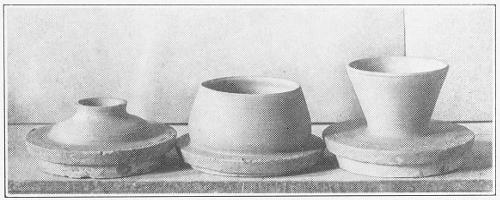
Fig. 21. Vase thrown in sections
To obtain good results in this work it is important that it
should not be hurried. It is best, for instance, before joining
the sections, to let them stand on top of one another for
a day or longer, in order that they may mature together.
To retain the pieces during this time in leather-hard condition,
they must be kept in a “wet cellar,” that is, in a moist
place where the water in the clay will not evaporate (fig.
24). With this simple precaution pieces can be kept
leather hard practically indefinitely.
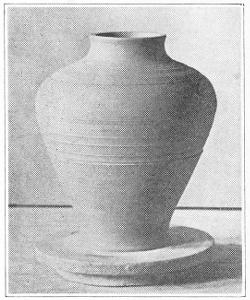
Fig. 22. Sections in place
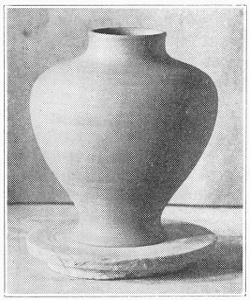
Fig. 23. Vase after turning
Section work was used by the Greeks, as it is now. There
would, in fact, be nothing gained in throwing the very
large vases, such as some of the kraters and amphorai, all
in one piece; and though the joints are, as a rule, skilfully
concealed, they are plainly visible on certain examples, especially
on the inside. Where possible the joints seem to
have been made at the natural angles or “articulations”
of the vase (that is, at the neck, the foot, etc.); and further
to simplify the work, a thin ridge of clay was often added
to conceal the joint.[10]
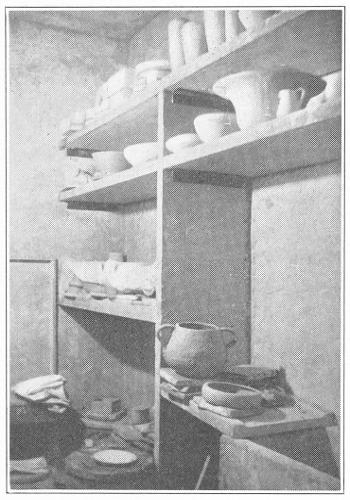
Fig. 24. Wet cellar
One of the most difficult things to throw successfully is a
flat, wide bowl on a foot; and the larger the diameter of the
bowl the more difficult the task, since the overhanging rim
almost always sags at the critical moment. The fifth-century
kylix has therefore always been rightly admired as one of
the greatest feats of the Athenian potter. How did he prevent
the bowl from sagging? Did he throw it upside down
and hollow it out later with the turning tools? Or did he
make the base very thick and then “turn” it down to fit on
a slender foot? Both methods would be clumsy, as they
would entail lengthy turning work. Or was the Athenian
potter so skilful that he somehow prevented the clay from
sagging? Not at all. He simply threw his kylix in two sections;
the foot with a bowl about half the required diameter
in one piece (or possibly two, with the foot separate), and
the remaining part of the bowl as a separate section. The
joints where the two parts of the bowl were united are
clearly visible on many kylikes on the outside (fig. 25)[11];
the inside of the kylix, being the most conspicuous part, is
always so carefully turned that no joining can be detected.
Polishing.
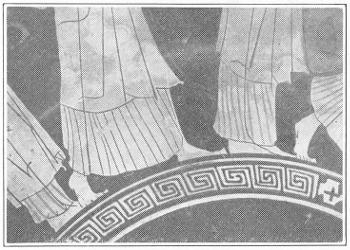
Fig. 25. Detail of kylix showing joint
Met. Mus. Acc. No. 06.1021.167
To impart a polish, the blade of a knife is applied to the
surface while the vase is revolving; for an inward curve a
curved tool must be used. The operation is simple and can
be accomplished in a few minutes. It is not often employed,
however, by the modern potter, whose object is to keep the
pores of his vase open for the better adhesion of the glaze
with which he intends to cover the surface of his pot.
The Athenian potter, on the other hand, put great stress
on giving the surface of his vase a fine polish; probably
using the simple method described above. The difference
between a polished and an unpolished surface is clearly seen
on some vases on which the potter has omitted to repolish
the parts round the handles where the slip used for the
attachment had spilled over (fig. 26).
Attachment of handles.
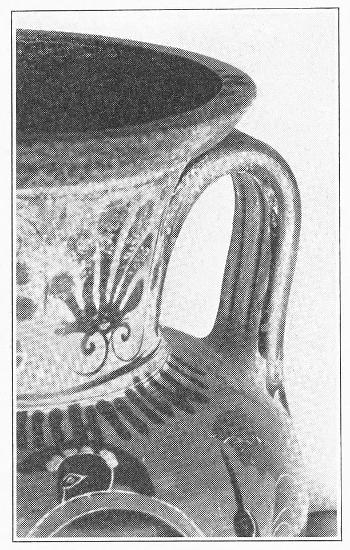
Fig. 26. Detail of amphora showing difference between
polished and unpolished surfaces
Met. Mus. Acc. No. G.R.530
The final process in the fashioning of a vase is the attachment
of the handles. These can be made either in moulds
or by hand. Any one who thinks that the making of
handles is a simple or quick process will soon be undeceived.
Whether working in plaster, as one would if the handle is
made in a mould, or in clay, if it is made by hand, the potter
must bestow infinite care on the work, as both clay and
plaster are very liable to break; and working on so small a
thing as a handle is extremely fussy. The writer personally
found nothing so difficult in her whole pottery
training as the making of handles. The best method of
procedure in handwork is first to shape the handle roughly
while the clay is soft and plastic, then wait until it becomes
leather hard, and finally refine it to the desired form and
finish with modeling tools. In moulded work, the handle
has to be cut out in plaster and then used for making the
mould. When the handles are finally made, they are
joined to the vase by means of slip, in the same way that
the sections were (fig. 27). As the handle is pressed into
position the superfluous slip will of course spill over
the edge, and this has to be carefully removed and the
surface smoothed before the vase can be pronounced finished.
The vase is then put in the drying room so that all
the water in the clay may evaporate. Only when it is perfectly
dry can it be fired in the kiln; otherwise it is liable
to crack.
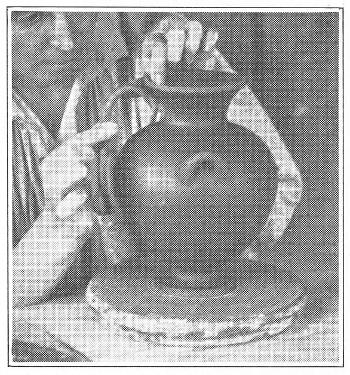
Fig. 27. Attachment of handles
The handles of Athenian vases show perhaps better than
anything else the great skill and sense of beauty of the
Athenian potter; and they will repay detailed study (cf.
figs. 28-33). They are never, as so often on modern vases,
detached pieces stuck on the vase as a kind of afterthought.
Rather, they seem to grow out of the vase like branches
from a tree, which gives them a wonderful, living quality.
Moreover, the place where they were attached, the size, and
the curve have been carefully considered both from a practical
and from an aesthetic point of view.
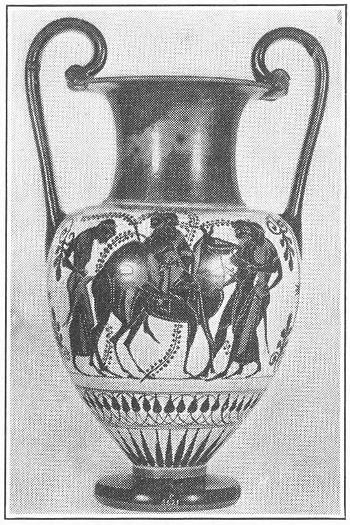
Fig. 28. Amphora in the Boston Museum
Acc. No. 01.17
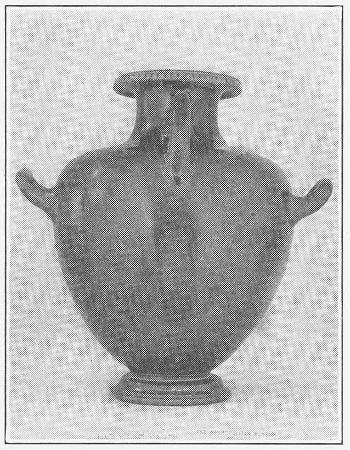
Fig. 29. Hydria in the Metropolitan Museum
Acc. No. 06.1021.190
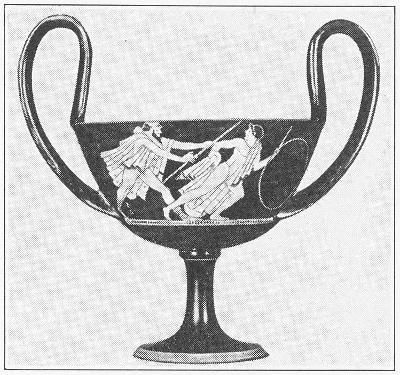
Fig. 30. Kantharos in the Boston Museum
Acc. No. 95.36
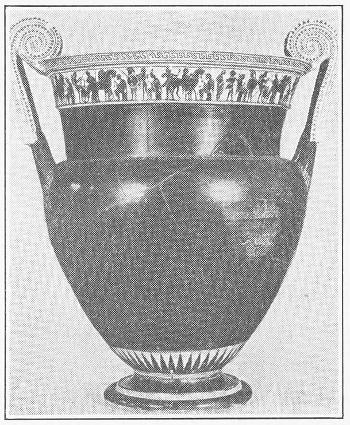
Fig. 31. Volute krater in the Boston Museum
Acc. No. 90.153
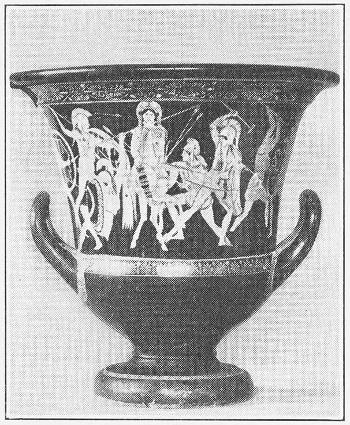
Fig. 32. Bell krater in the Metropolitan Museum
Acc. No. 07.286.86
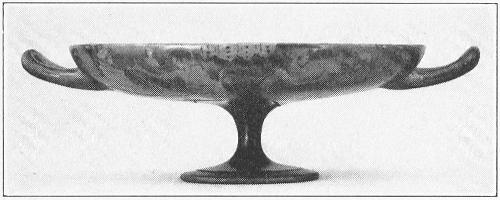
Fig. 33. Kylix in the Metropolitan Museum
Acc. No. G.R.1047
Athenian handles are made by hand, not in moulds.
Practically every pair of handles shows perceptible variations
such as are unavoidable in handwork and distinguish
it from the mechanical products of moulding. The handles
were attached to the vase in leather-hard condition, and
often the pressure entailed thereby resulted in a slight
bulge on the inner side. This is particularly noticeable on
kylikes where the walls of the pot were especially thin.
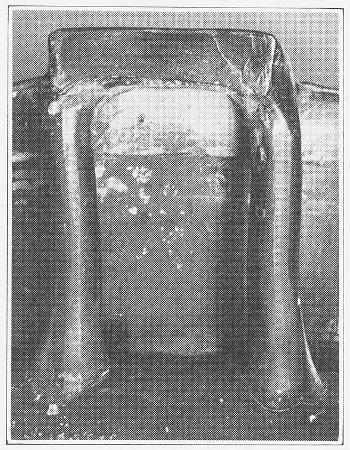
Fig. 34. Detail of krater showing under part of handle left rough
Met. Mus. Acc. No. 07.286.73
It may be noted that the handles of Athenian vases are
not finished off neatly in parts where they were not seen.
For instance, the under parts of handles on column kraters
are generally left quite rough (fig. 34). This fact, together
with that already observed, that the insides of amphorai
and hydriai are usually unturned, shows that the Greeks, at
least, had no such theories as those often held today that a
work should be finished perfectly all over, even in places not
ordinarily seen, and were quite willing to save trouble when
possible. Many potters today bestow as much care on the
inside of a narrow flask as on that of an open bowl. It is
characteristic of the sense of proportion of the Greeks that
their potters took infinite trouble with what was important—the
shapes, the proportions, the decoration—but that they
did not spend time and labor where it profited nobody.
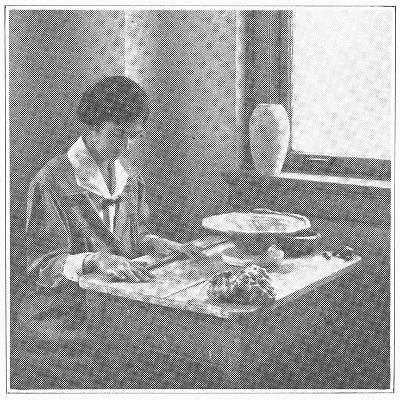
Fig. 35. Making coils
Compared to the wheelwork the building appears simple
at first, but experience will soon show that it too needs considerable
practice. Though the actual process has not the
glamor and thrill associated with wheelwork, there is a
certain quality in a built vase which gives it a value of its
own. Building is generally done nowadays by means of
coils of clay (fig. 35), which must be a little thicker than
the walls of the vase are to be and should be as uniform as
possible. To make the foot of the vase, the end of one of
these coils is laid in the center of a plaster bat and the rest
coiled round in spiral line. To hide the joints the surface is
rubbed over with the fingers on both sides. In making the
walls of the vase a coil is used for each round and the
superfluous clay pinched off, every new coil being begun at
a new point. The whole surface, inside and outside, is
again smoothed by rubbing with the fingers, using very little
water in the process. Only about three coils should be
worked in at a time and then left to harden before new
coils are added. In building up a certain shape it is best to
use a templet of cardboard or plaster, to be sure that the
profile of the vase is followed out correctly. To give the
required finish at the end, modeling tools as well as further
rubbing with the fingers are required.
With this process in mind it is easy to distinguish between
built and wheel-made pottery among the Greek wares. In
the built pottery, however careful the work, there is always
a certain unevenness of outline—which indeed gives it some
of its charm. Unlike the moderns, the Greeks did not continue
to build pottery after the invention of the wheel. Naturally
the general adoption of the wheel was not synchronous
in all ceramic centers. It was used considerably earlier
in Crete, for instance, than in Cyprus. But when once its
convenience was thoroughly realized, the slower and more
monotonous method was entirely dropped. Among Athenian
black-figured and red-figured vases there are no built
pieces.
The process of moulding vases is the one most in use
nowadays, for the simple reason that when once the required
mould has been made the production of any number of
vases is a rapid and easy task. But though commercially
favored, this method is looked down upon by the artistic
potter as being purely mechanical, and there is no doubt
that a moulded vase has all the characteristics of machine
work.
The material used for moulds nowadays is plaster. The
clay can either be poured into a mould in slip form or
pressed into a mould while soft and plastic. In the former
process the mould or moulds are made in two or more pieces,
which fit closely together leaving an opening at the top.
By pouring the clay slip into the opening, leaving it to
harden a little, and then pouring out again what has not
hardened, a hollow vase is formed. After due shrinkage
the mould is carefully removed from the vase (fig. 36).
The same mould can be used indefinitely for making vases
of the same shape; it has only to be dried between one use
and the next. Handles can be produced in the same way
and then attached.
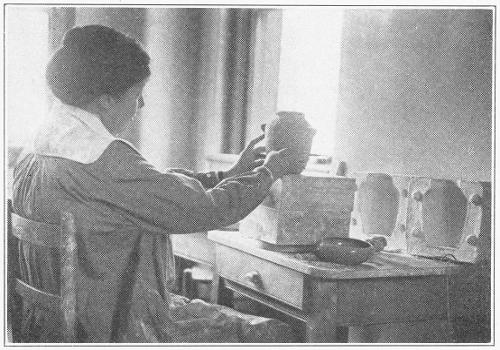
Fig. 36. Vase poured in a mould
In pressing clay into moulds each part of the mould is
used separately, except where only one mould is required, as
in the case of an open bowl or tile. When the clay has been
carefully pressed into every part of the mould, it is left to
harden, and then, upon shrinkage, can be easily separated.
If the vase has been pressed in several pieces, the parts
must be carefully joined and the seams effaced as neatly as
possible.
The Greek potter did not use moulding as a labor-saving
device. He employed it only where the work demanded it,
as in the Athenian plastic ware. Here we sometimes even
find the same mould used several times, as in the group of a
negro and a crocodile of which chance has preserved us at
least five replicas[12]; but the number of such repetitions is not
great and certainly would not indicate mass production.
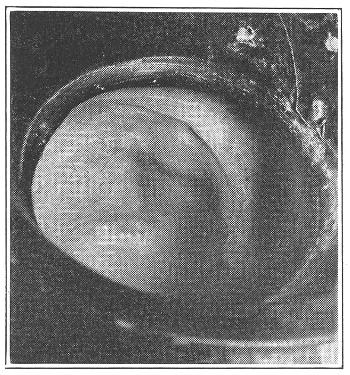
Fig. 37. Inside of moulded vase
Met. Mus. Acc. No. 06.1021.205
The material of Greek moulds was burnt clay. That the
Athenian plastic vases were pressed into moulds rather than
poured can be seen from the fact that the insides of these
vases are rough and show finger-marks (cf. fig. 37). The
joints of the two parts are clearly visible on many examples
(cf. fig. 38). Often the lip was thrown separately on the
wheel and attached.
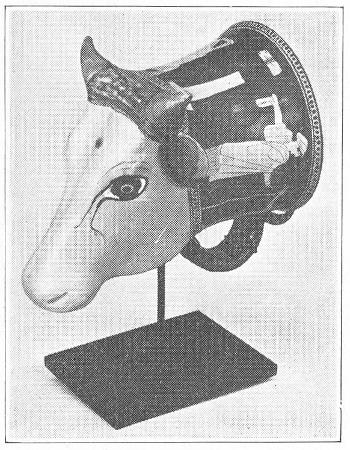
Fig. 38. Vase showing joint of two parts of mould
Met. Mus. Acc. No. 06.1021.203
In the fire the great miracle takes place and the dry clay,
most friable and perishable of materials, becomes one of the
most durable. This is accomplished by the softening of the
feldspar grains which cement the whole together and thus
form a dense mass. To produce the temperature at which
this phenomenon takes place two things are necessary, fuel
and draught, the former supplying the carbon, the latter
the oxygen. The liberation of the carbon in the fuel and
its union with the oxygen of the air develop combustion,
during which heat is generated. Combustion can be complete
or incomplete. It is complete when there is an excess
of air and the carbon can combine with two molecules of
oxygen to form carbon dioxide (CO₂). This condition is
called oxidation. It is incomplete when there is not enough
air and the carbon can get only one molecule of oxygen,
forming carbon monoxide (CO). This condition is called
reduction. Carbon monoxide, being very hungry for oxygen,
will try to extract it from whatever source it can. If
ferric oxide (Fe₂O₃) is present in the clay—which is the
case in red clay—the carbon monoxide will take one molecule
of oxygen from it and convert it into ferrous oxide
(CO + Fe₂O₃ = CO₂ + 2FeO). The important feature
in this process is that ferric oxide is red and will make the
clay burn red; but ferrous oxide (FeO) is black and will
give the clay a blackish color. If no ferric oxide is present
in the clay, that is, if the clay is not a red clay, then reduction
has no effect on the color of the clay and can be freely
used. In Europe potters regularly burn under reducing
conditions, while in America the general practice is to burn
under oxidizing conditions. When the draught in the kiln
is faulty, partial reduction will often occur, and many
faults in the burning, especially in the glazes, are attributable
to this cause.
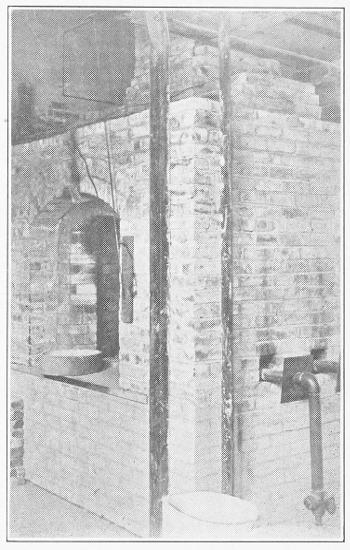
Fig. 39. Open kiln
We shall see presently how important is a knowledge of
these chemical changes during the process of firing when we
come to consider the defects on Greek vases caused by
injuries in the firing (cf. pp. 44 ff.).
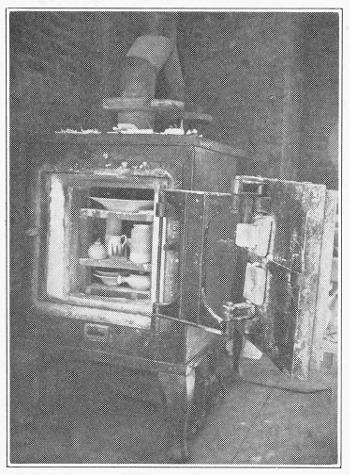
Fig. 40. Muffle kiln with biscuit ware
There are two chief types of kiln construction in use
today: (1) the open kiln, in which the flame passes through
the kiln chamber (fig. 39); (2) the muffle kiln, in which the
flame passes around the chamber and not through it (fig.
40). In the open kiln the ware either comes in direct contact
with the flame, or is stacked in saggers, i.e., boxes made
of fire clay fitting one on top of the other (fig. 41). The
muffle kiln is, so to speak, one large sagger, and the ware is
stacked on shelves. The draught in the kiln can be either
an up draught or a down draught; in either case the air
supply, as well as the fuel supply, must be under control,
so that the combustion shall be as desired. The draught
can be regulated by means of dampers, the fuel by attention
to the burners. An arched top is an advantage, for it
imparts greater strength—an important item considering
the strain to which the kiln is subjected—and it facilitates
the circulation of the heat. Coal, wood, gas, or kerosene oil
can be used for fuel. Of these, oil and gas are now the
most popular; coal and wood are rapidly coming into disuse
on account of the greater labor they entail.
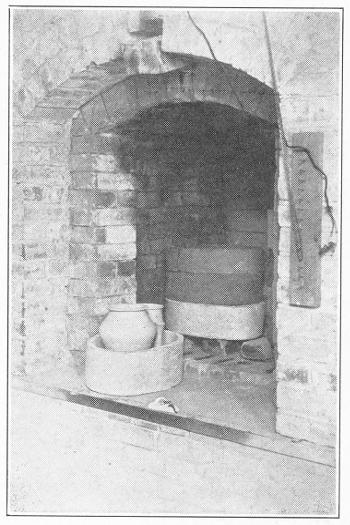
Fig. 41. Open kiln showing saggers
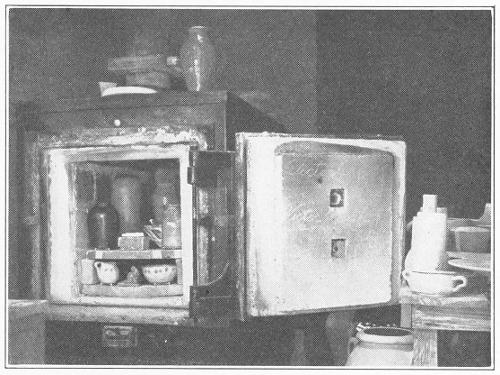
Fig. 42. Muffle kiln with glazed ware
In packing the kiln the ware is stacked as closely as possible
for economical reasons, so that as much as possible
shall be accomplished in one firing. In biscuit firing the
ware can be placed so that it touches (fig. 40); in glaze
firing the pieces must be separated (fig. 42) both from one
another and from the bottom of the saggers or shelves on
which they stand, since the melted glaze is apt to run.
Glazed pieces are therefore generally placed on stilts made of
burnt clay, and the marks of these stilts will often show on
the bottoms of the vases.
That the chief features of modern and Athenian kilns
were similar is clear from an examination of the ancient
representations of kilns (cf. figs. 72-81 and pp. 76 ff.). How
closely the ware was sometimes stacked is clearly seen in
fig. 80. The fuel used by the Greeks was probably wood
and charcoal.
Almost all modern pottery is twice fired; once for the
conversion of the clay into terracotta or biscuit, and the
second time for the glaze. To glaze unbiscuited ware is a
delicate business, and the risk of glazing a piece of raw
clay is considered larger than the trouble of burning it a
second time. It is done occasionally when very tough clay
is used, for instance, in kitchen crooks and in stoneware; in
that case it is best to apply the glaze when the clay is in
leather-hard condition, for then the absorption is less.
More than the two regular firings are often used for correcting
mistakes in glazing, for additional coats of glaze,
and for decorating the ware.
Different wares and different glazes require different
temperatures. Thus porcelain and stoneware are fired to
much higher temperatures than ordinary pottery, and salt
and alkaline glazes need a higher fire to mature than the
ordinary lead glazes. When the required temperature has
been reached—which nowadays is determined either by
means of a pyrometer or with the help of pyrometric cones
which melt at a given temperature and which are watched
through a spy-hole (cf. fig. 40 where the cones are set up
opposite the spy-hole in the door, and fig. 42 where the cones
have melted)—the fire is gradually extinguished and the
kiln left to cool slowly. Twelve hours for the firing and
twelve for cooling is a rough estimate for the firing of an
ordinary kiln. It is important not to hurry the process of
cooling, as a too rapidly cooling fire may crack the ware or
affect the glaze injuriously.
The Greeks fired their pottery at a considerably lower
temperature than potters do today. It seems to have been
about 960° centigrade (corresponding to about cone 010)
since any increase over this temperature causes a change
in the color of the clay together with an additional contraction.
Mr. Tonks has made the ingenious suggestion that,
950° and 1065° being the melting points of silver and gold
respectively, the Greeks may have used these metals in the
same way as the modern potters use cones, to regulate the
heat of the kiln.[13]
When the kiln is finally opened comes the exciting
moment of seeing what the fire has done with one’s products.
In taking out the contents of the kiln, gloves and
sticks are often useful for handling ware that is still too hot
to touch. Invariably there will be surprises—what one has
expected to be a great success often turns out a failure, and
what one thought little of may become a rare thing of
beauty. In the biscuit firing the adventures of the pot are
comparatively few; it may crack or sag or warp, but as a
rule the expected shape is maintained. But in the glaze
firing so many elements enter in that even an experienced
potter can never be sure of the result. The color may turn
out a different shade from that desired; the glaze may
unexpectedly be matt (dull) or too glossy; it may blister
or peel or crack; it may be too thin or too thick. Such
defects are almost invariably due to faulty composition of
the clay or the glaze or to the conditions of firing. They
can often be remedied by further glazings and firings; but
quite often a pot on which much time and labor have been
bestowed is hopelessly ruined. A good potter, however, will
soon learn to bear such mishaps philosophically; and it is
certainly true that one often learns much more from failures
than from successes. Moreover, the element of uncertainty
lends spice to the craft.
A careful consideration of the modern processes of firing
pottery described above will help us to settle the problems
connected with the firing of Greek vases—for the action of
fire on clay remains the same even though the kilns in use
by the Greeks were probably somewhat more primitive than
now.
The chief problems which confront us in Athenian pottery
are (1) the number of firings, (2) the interpretation
of defects on Greek vases as injuries in the firing.
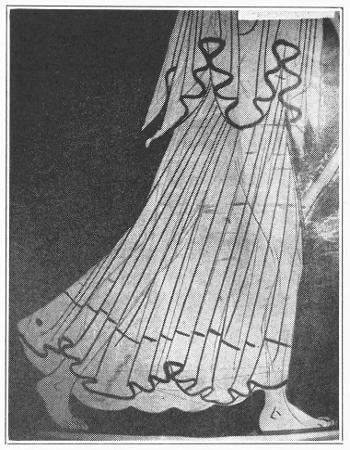
Fig. 43. Detail of amphora showing preliminary sketch
Met. Mus. Acc. No. 06.1021.114
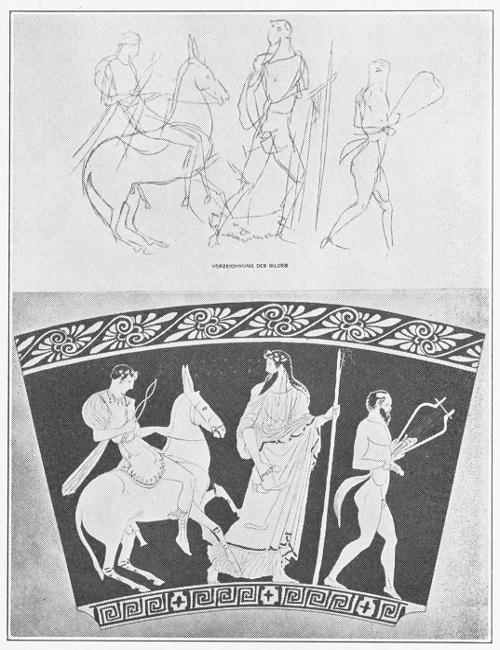
Fig. 44. Design on red-figured krater
(a) Preliminary sketch (b) Completed painting
Furtwängler u. Reichhold, Griechische Vasenmalerei, I, pl. VII
Was Athenian pottery once or twice fired?[14] That is,
was it decorated in leather-hard or in biscuit condition?
This has been one of the most debated questions in Greek
ceramics. Archaeologists often assume offhand a number
of firings,[15] but without stating any evidence or squarely
facing the problems involved. Briefly, the arguments for
and against are as follows. As is well known, a large proportion
of red-figured vases of good period show a preliminary,
colorless sketch for the design traced with a blunt[16]
instrument directly on the clay (cf. figs. 43-44). The
smooth grooves of this sketch show beyond doubt that the
sketch was made while the clay was in leather-hard condition,
that is, before firing. If the vase had been fired, even
at a low temperature, the sketch would have had to be
scratched in with a sharp tool, and would have left a
ragged, not a smooth line.[17] Now it is not a natural procedure
for an artist to make a rough sketch for his design,
and then to leave his vase to be fired before completing his
work. Furthermore, an examination of the incised lines on
the black-figured vases—which clearly go over the black
glaze—shows also that these lines must have been made
while the clay was still leather hard. The ragged edge of
the glaze along the incisions has sometimes been thought to
indicate that they were made after firing. But just this
effect is produced by cutting through dry glaze on unfired
clay; and it would have been very difficult to attain the
required delicacy, swing, and smoothness by incision into
hard, fired clay. Any one who will try the experiment will
soon become convinced of this.[18] So that, for the black-figured
period at least, this evidence points to a once-fired
pottery.
On the other hand, it might be urged that if we assume
that the decoration was executed in leather-hard condition,
the vase painters whom we see depicted on Greek vases
should be handling their pots with considerable care, and
that this is hardly conveyed in the representations. On the
Boston fragment, for instance, the painter is holding a
kylix by its slender foot without any apparent fear of breaking
it (fig. 67). And whoever painted the scene knew
what he was doing, for he was in the act of decorating such
a kylix himself. However, if the clay used by the Athenians
was of a tough variety,[19] this would, I have been told
by potters, be a perfectly possible procedure; and experiments
made with imported Athenian clay[20] bore this out to
an astonishing degree. Vases made of this clay could be
handled quite freely in leather-hard condition. So that if
the Athenian potter of the fifth century used similar clay
to that of his present-day descendant, his handling of these
pots on the vase paintings would be perfectly justified in
the leather-hard state.
There is, moreover, evidence which seems to settle this
question beyond dispute. On a number of the Athenian
vases there are dents such as can only have occurred while
the vase was still in a leather-hard state. The mark of the
object contact with which caused the dent is invariably over
the black glaze (cf. fig. 45), showing clearly that the glaze
must have been applied in leather-hard condition.[21] In
some cases we find still adhering in the dents a little burnt
clay, apparently from another vase contact with which
caused the accident. Here it is probable that the accident
was caused not while the vase was leather hard, but when
red hot in the kiln, at least in those instances, as in the
black-figured amphora in the Metropolitan Museum[22] (fig.
46), where the glaze shows a rough fracture due to the separation
of the two pieces which had stuck together; for this
fractured edge would have become fused and smooth upon
subsequent firing.[23]
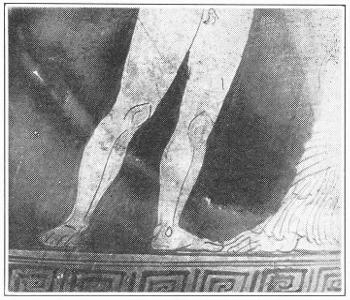
Fig. 45. Detail of hydria showing dent with mark over black glaze
Met. Mus. Acc. No. 17.230.15
The fragments of unfinished vases which have been found
from time to time[24] have been used as evidence to prove several
glaze fires; for they show fired vases at a definite stage
in the glazing, the outlines and inner markings painted, but
the background not yet filled in. Must we, then, suppose
that it was the regular practice—at least in the later red-figured
period to which all the unfinished pieces belong—to
fire before and after the painting of the background?
It is difficult to see what would be gained by the process.
If the pottery were fired before any decoration was applied,
there would be the advantage of safer handling of the ware;
but to have an extra firing with the decoration more than
half completed gives no apparent gain and there is the distinct
disadvantage of the extra expense of firing.
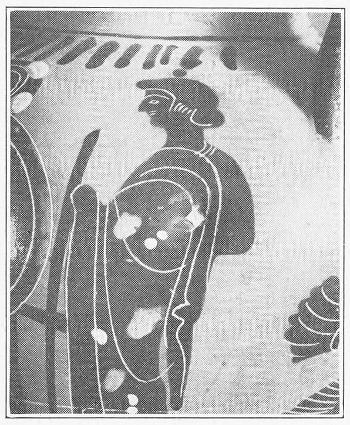
Fig. 46. Detail of amphora showing dent with clay from
other body still adhering
Met. Mus. Acc. No. G.R.530
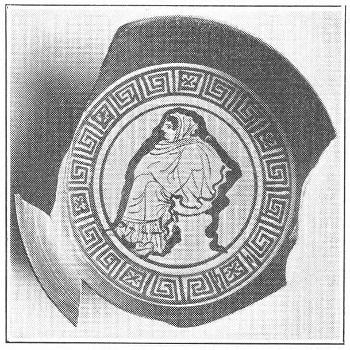
Fig. 47. Unfinished kylix
Met. Mus. Acc. No. 11.212.9
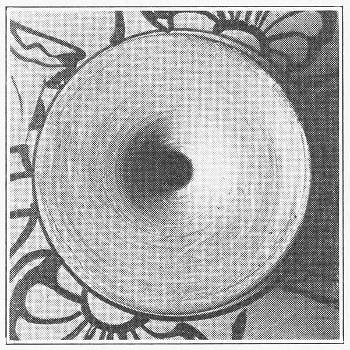
Fig. 48. Foot of unfinished kylix
Met. Mus. Acc. No. 11.212.9
The unfinished kylix in the collection of the Metropolitan
Museum may shed light on this problem (fig. 47). It is
not so fragmentary as the pieces in the other museums,
being complete except for portions of the rim. The foot is
very roughly turned (fig. 48), very different from the average
kylix foot, as if it had not been worth while to spend
much time on this product. The decoration itself is also
quite cursory. This suggests that the piece was merely a
“test,” such as potters use often nowadays for making
trials of their clay body, or their glaze, or their kiln. The
kylix is, as a matter of fact, too soft fired, and the glaze has
turned reddish in parts. May we be permitted the guess
that this was a trial to test out a new kiln? It is only a
possibility and there are many others. The important point
is that the evidence of the unfinished fragments does not
make it necessary to assume more than one glaze firing.
The probability, therefore, is that Athenian pottery is
once fired,[25] all ornamentation—both glaze and accessory
colors[26]—being applied while the vase was in leather-hard
condition; for in the case of the accessory colors also there
would have been no advantage in an additional firing.
The action of the fire on the potter’s products was apparently
as much an open question in Greek times as it is now.
Practical experience must have gone a long way then as
today; but full control could not be achieved. In forming
an estimate of what proportion of the pottery was spoiled
in the kiln we must remember that in our museums we are
apt to encounter the survival of the fittest—what the potter
considered worth preserving, what the Greek client deemed
adequate to his need, and what the modern museum curator
considers good enough for exhibition. But even in this
selection we meet with a number of kiln mishaps, which
apparently were so common that they were hardly noticed.
When our eyes have become trained to observe such things,
we shall note that in any collection of Greek vases there are
many cases of warping and sagging, especially in the overhanging
lips of the hydriai and amphorai.[27] There are
many cracks and dents,[28] many faults in the glaze. A
very conspicuous fault is the change of the clay from a pink
to a grayish color.[29] Archaeologists often explain this as
due to over-firing.[30] The real reason is not that the temperature
has been too high, but that the clay has been subjected
in the kiln or in the funeral pyre, to fumes the carbon
of which has been absorbed by the clay. In other
words, there was either reduction and the red ferric oxide in
the clay has been changed to black ferrous oxide (cf. pp.
30 f.), or the clay has absorbed the black carbon physically.
When controlled, this change is very useful to the potter
for obtaining certain effects. Thus bucchero pottery is
simply red clay fired under completely reducing conditions;
and in the Vasiliki mottled ware some carbonaceous pigment
like tar was probably placed on the spots which were
intended to be black, whereupon the carbon would be
absorbed by the clay and the iron reduced.[31]
The commonest injury to the glaze in the fire is its change
into a brilliant red instead of the intended black. This can
be observed on many vases, sometimes as a large spot (cf.
fig. 49), other times as a less clearly defined variegation.[32]
The cause was irregularity of fire, a jet of air passing
through the kiln coming in contact with parts of the vases.
In other words, there was an excess of oxygen (or the
reverse of reduction) which turned the black ferrous oxide
of the glaze into red ferric oxide.[33]
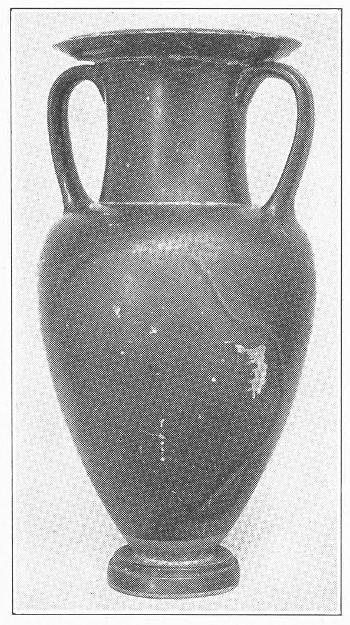
Fig. 49. Black-glazed amphora with large red spot on one side
Met. Mus. Acc. No. G.R.607
Such red spots caused by jets of air coming in contact
with the vases must not be confused with the very similar
red spots which are due to the wearing off of the black
glaze and the exposure underneath it of the ochre-tinted
clay (cf. p. 58). Examination with a magnifying glass will
show the difference: in one case the red is part of and
level with the black glaze, in the other it is on a layer
beneath the black glaze; in the former case the red will
not come off when rubbed, in the latter it will.
Besides shaping and firing a vase, a potter must understand
the art of glazing, to many the most alluring part of
the craft; this comprises both the preparation of the glaze
and its application to the pot. A glaze is a chemical compound,
known as a silicate, which upon firing becomes a
glassy substance. It has three chief ingredients: (1) an
oxide of lead, of lime, of alkali, etc., which forms the
foundation of the glaze; (2) alumina and boron oxide,
which regulate the behavior of the glaze in the fire; and (3)
silica, which controls the fitting of the glaze to the body.
Modern glazes are divided into two chief categories: lead
glazes and leadless glazes. Of these the former are by far
the more numerous; but alkaline glazes, tin enamels, etc.,
are also used, especially in studio potteries.
In the preparation of a glaze the ingredients have first
to be weighed out carefully in the required proportions;
the mixture has then to be ground with water and sieved;
and when the right thickness is attained (usually about the
consistency of cream), the glaze is applied to the vase,
which should first be soaked in water to saturation to prevent
too rapid absorption. Gum tragacanth is used as a
binder to make the glaze stick.
The glaze can be applied in various ways—by dipping
(fig. 50), by pouring (fig. 51), by the use of the brush (fig.
52), or by spraying (fig. 53), the method depending chiefly
on the individual choice of the potter. To apply a glaze
properly to the clay body is a great art, and upon it, as
much as on the preparation of the glaze, final success
depends. The glaze mixtures when applied are whitish or
grayish; it is only after firing that they assume the wonderful
range of colors which delight us so much today.
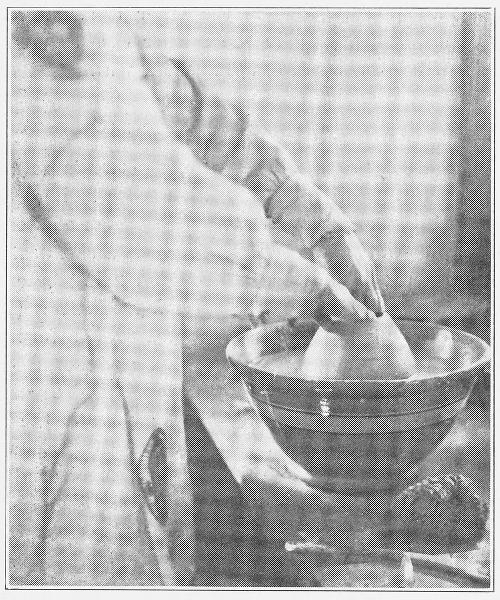
Fig. 50. Method of glazing: dipping
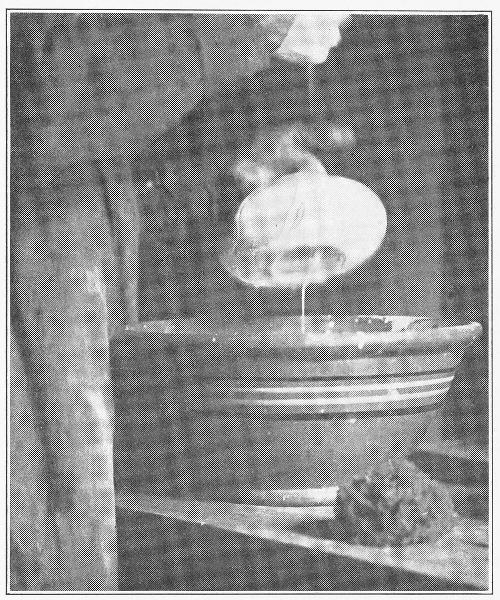
Fig. 51. Method of glazing: pouring
The Athenian potter had no ambition to produce brilliant
color effects in glazing. He was content with the one
variety which he had brought to perfection—a thin, luminous
glaze of a deep, velvety black color and of astonishing
durability. After generations of experiments we cannot
yet say that we can successfully imitate it. Its composition
is, however, no longer a secret. It has been shown by
analysis and synthesis that the chief component parts of
the glaze are an alkali (potash or soda), a clay (which
would contain some silica such as flint naturally), and ferrous
oxide.[34] The exact proportion of these parts, and
above all the manipulation of the glaze are still unknown.
At least, nothing completely corresponding to the Greek
glaze has as yet been produced, though Mr. Tonks[35] and
especially Mr. Binns[36] have come very near it. Whether the
secret lies in the proportion, in the medium used for binder,[37]
or in some undiscovered element one cannot tell. It is only
certain that when the discovery is made, as doubtless it must
be, it will be of great import both to archaeologists and to
modern potters.
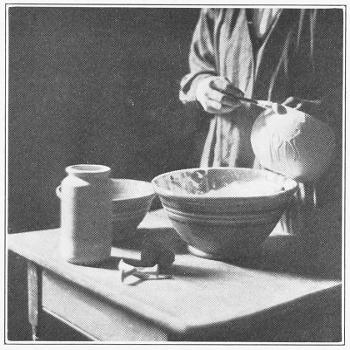
Fig. 52. Method of glazing: use of the brush
The glaze was, as I have endeavored to show (cf. pp. 37 ff.),
applied to the vase in leather-hard condition. At that stage
the clay still contains enough water to prevent too rapid
absorption, and the glaze, therefore, runs in an easy, flowing
manner.[38] To carry out his work the painter could take his
time, for, as we have seen (cf. p. 16), a vase can be kept
leather hard for an indefinite period by the simple device
of placing it in a damp box, that is, an air-tight case with
a pan of water at the bottom.[39]
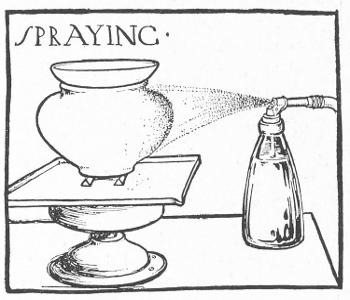
Fig. 53. Method of glazing: spraying
Cox, Pottery for Artists, Craftsmen and Teachers, p. 111, fig. 51
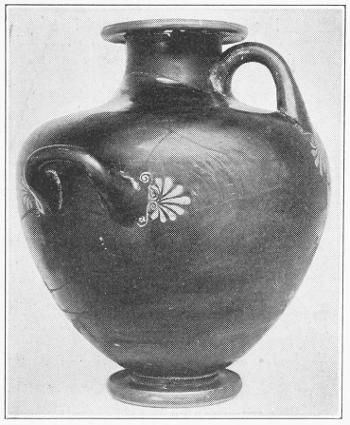
Fig. 54. Hydria showing brush marks
Met. Mus. Acc. No. 11.212.7
How did the Greek painter apply the glaze to his pottery?
We know that on the broader surfaces the brush was used,
for brush marks are clearly visible in many cases.[40] When
possible the backgrounds and horizontal bands were painted
while the piece was rotating on the wheel; where a panel
had to be reserved, the irregularity of free-hand brush work
can readily be observed (fig. 54). For the “flat” glaze
lines, in both the figured scenes and the ornamental motives,
smaller brushes were employed. But what was the instrument
which produced the famous “relief” lines, that is,
those fine lines which stand out perceptibly from the surface
and which were used for the contours and inner markings
of the figures during the best red-figured period (fig.
55)? The quality of these lines has been justly admired by
all who have studied them and it has been thought that the
instrument used had much to do with the result.[41] After
a number of experiments with fine brushes, single bristles,
reeds, feathers, pens, etc., I have come to the conclusion that
it is of little avail to discuss the instrument used before we
can employ in our experiments a glaze identical with the
Greek. For to get the wonderful flow of the Greek line, the
glaze must run much more easily than any imitation black
glaze which we have so far produced. The groove which
runs down the middle of the relief lines hardly affords a
clue; for slight pressure of any instrument seems to produce
such a result.
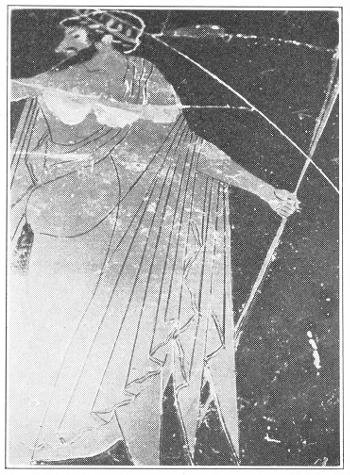
Fig. 55. Detail of psykter showing relief line
Met. Mus. Acc. No. 10.210.18
In three statements of ancient writers the addition of red
ochre to Athenian pottery is referred to.[42] In Pliny, Natural
History, XXXV, 152, we read: Boutades inventum est
rubricam addere aut ex rubra creta fingere, “Boutades first
added red ochre, or made pottery of red clay.” Isidorus,
Etymologiae, XX, iv, 3, speaks of pottery vases having been
first invented at Samos and then adds: Postea inventum et
rubricam addere et ex rubra creta fingere, “a later invention
was to add red ochre and to make pottery of red clay.”
Suidas in his lexicon, where he describes Cape Kolias as a
place in Attica where pottery is made, says that the clay
from that region is the best, and adds: ὥστε καὶ βάπτεσθαι ὑπὸ
τῆς μίλτου, “so that it is also dyed with red ochre.”
Archaeologists have assumed that this red ochre was
mixed with the clay and that to it was due the deeper color
of Athenian ware as compared, for instance, with the
geometric. Thus in practically all our books on vases the
preparation of the clay for the manufacture of Athenian
vases is described somewhat as follows: “The clay having
been thoroughly purified and washed, was then kneaded
and brought to a consistency suitable for shaping it on the
wheel. It was at this stage that other substances, chiefly a
red earth (ochre = μίλτος), were worked in with the clay to
deepen the color.” First of all, it should be noted that if
ochre is to be added to the clay it must be done long before
the kneading stage, otherwise the red ochre will of course not
mix evenly. The best time would be when the clay is dry,
so that a definite proportion could be weighed out. But that
is too obvious to need discussion. The question is, Does
the addition of red ochre materially change the color of the
clay? It may be interesting in this connection to record
my experience in the matter. About three years ago I was
asked to speak at a convention of modern potters meeting
at the Metropolitan Museum of Art, on the subject of Greek
vases. I thought that these potters would probably be
specially interested in the technical side of Greek ceramics,
and with the courage of ignorance I described in detail our
theories regarding the manufacture of Greek pottery. It
was the questions which the potters asked me afterwards
which convinced me that it was time I went to a pottery
school. One of my statements which aroused considerable
interest was this theory that red ochre was added as an
ingredient to deepen the color of red clay. Several men
came to me after the talk and said, “I don’t see why the
Greeks did that; for by just slightly raising the temperature
they could easily have deepened the color.” I had no
answer then, but when I went to the pottery school I
thought I should take nothing for granted, but convince
myself by making my own experiments. So I made some
tests, adding certain percentages of ochre to see how it
would affect the color. Apparently the ochre had little
effect, and the pieces with and without ochre were about
equally pink when they came out of the kiln. I then
burned some pieces without any ochre to a little higher
temperature and the red was considerably deepened. I was
quite convinced then that the ochre added as an ingredient
to the clay would not have the desired result; besides, if
we needed further proof we might remember that analyses
made of Athenian clay have shown no trace of ochre.[43]
What, then, do Pliny and Suidas mean when they speak
of the addition of red ochre to Athenian pottery? A number
of archaeologists have observed from time to time that
Athenian vases, especially of the late red-figured period,
show traces of a reddish pigment applied over the surface.
Reichhold in his technical description of vases in Furtwängler
und Reichhold, Griechische Vasenmalerei, frequently
refers to it as “rötliche Lasur.”[44] Pottier ascribed
it to a sort of varnish or lustre applied over the surface
of the decorated, fired vase which on decomposition
precipitated into a red deposit.[45] Walters thought
that red ochre was rubbed on certain parts of the vase which
had remained too pale after baking.[46] A detailed examination
of the vases in many European and American museums
convinced me that the use of this red pigment was quite
general throughout the red-figured period, and to a limited
extent in the black-figured period. On a few vases it
appears in excellent preservation.[47] The majority of red-figured
vases of all periods[48] and a few of the black-figured
vases[49] show traces of it. When it is not otherwise visible,
it can often be detected in the slight depressions of the
preliminary sketch, or under the handles, or on the under
side of the foot. As the color comes off when rubbed with
a damp cloth, it is not surprising that it is not better preserved,
after the extensive cleaning that most museum
specimens have undergone. But the many traces which are
still preserved can only be satisfactorily explained by assuming
that it was the general practice—at least in the red-figured
period—to apply a red pigment over the whole
surface of the vase.
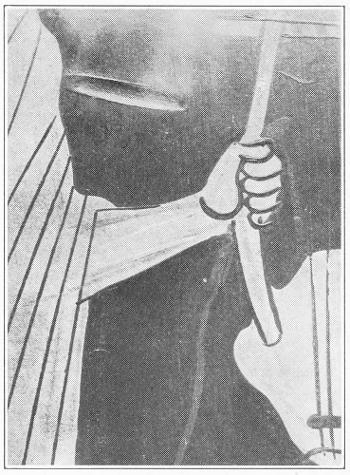
Fig. 56. Detail of amphora showing diluted black glaze line (on arm)
going over red ochre left in preliminary sketch line
Met. Mus. Acc. No. 12.236.2
In the light of this experience let us again examine what
Pliny and Suidas say. Pliny’s statement is sufficiently
vague to make any interpretation possible; but Suidas’ use
of the word βάπτεσθαι, “to be dipped,” is illuminating. The
clay could not have been “dipped” in a powdery or liquid
state, the only way of having the ochre become an actual
ingredient in the clay. The term βάπτεσθαι implies that
the clay must have become a solid vase, in which case the
ochre was applied only on its surface. Indeed Athenaeus
(480 E) uses the term βάπτεσθαι to signify the “glazing” or
“silvering” of earthen vessels. So that literary testimony
seems to agree with the evidence of the vases themselves that
the ochre was applied on the surface. At what stage, then,
was this ochre added? Was it before or after the black
glaze? Careful examination has shown that it was previous
to the glazing. When the black glaze is chipped off it generally
takes the surface too, so that instances of the red ochre
showing underneath are not numerous; but there are nevertheless
a number of undoubted examples.[50] An especially
convincing instance is on an amphora in the Metropolitan
Museum in which a diluted black glaze line goes clearly over
traces of the red lift in a preliminary sketch line (fig. 56).
Furthermore, in many cases the glaze on the background
surfaces has disintegrated and shows the red ochre beneath.[51]
Since the black glaze was probably applied to the leather-hard
clay, the ochre wash must also have been added in
that state. The leather-hard vase might have been dipped
in an ochre solution or the ochre applied with a brush or
rubbed into the surface as a powder. In order to make it
adhere properly to the clay actual experiments have shown
that by far the best results are obtained by giving the surface
a good polish after the application of the ochre. The
ochre is thereby actually incorporated with the clay and
forms a good firm surface. If not so polished, it is powdery
after firing and comes off easily.
Experiments further showed that (1) red ochre applied
in this manner on the red clay in leather-hard condition produced
an effect identical with the red “wash” observable on
the Athenian vases; (2) preliminary sketch lines engraved
lightly with a blunt tool did not remove the ochre; (3) the
ochre in no way interfered with the adhesion of the black
glaze over it; (4) the ochre came off only a little at a time
even when rubbed hard while wet. It is therefore only during
the long processes of wear and time that the red ochre
application has worn off. But even when it has entirely
disappeared, it has stained the clay a deeper color—namely,
the orangey hues which we see now; for the actual color of
the clay is lighter and pinker, as any fracture will show.[52]
Originally, however, we learn from our investigation,
the red-figured Athenian vases had an even deeper and
richer tint than they have now—approaching more nearly
the color of copper. The general effect, therefore, must
have been considerably more vivid than it is today, and to
some this thought may not at first appeal. But we should
remember that we are discovering also in other fields that
the Greeks loved bright, intense color, not the faded tints
that so many of their works present today.
The theory has often been advanced that the painted
black-figured and red-figured vases were made for decoration
and for votive and funeral purposes, but not for
actual use. Percy Gardner in his Grammar of Greek Art
(p. 160) holds this view and gives as his reason that the
painted vases were too fragile to be easily handled and
too porous to contain liquid. Reichhold in Furtwängler
und Reichhold, Griechische Vasenmalerei, Text, I, p. 82,
and Skizzenbuch griechischer Meister, p. 10, is of the
same opinion, and bases his assumption on the fact that
a number of the vases show ancient rivet marks and could
not therefore have served any practical purpose in such a
condition; also that no ancient vases show signs of wear,
which would have been unavoidable if they had been in
daily use. Does our investigation of the technique of
Athenian vases help to settle this question? Let us look
first at the case in its broader aspects.
Nobody can work long with Greek vases or other forms
of Greek industrial art without being impressed with the
wonderful combination of beauty and practical utility
which these objects show. The Greek vases are not only
finely proportioned, but each one is admirably adapted to
its purpose. We need only try pouring from an oinochoë
to see how easily the liquid flows without any danger of
spilling; or from a lekythos to see how the oil trickles
through the narrow neck, drop by drop, or in a very thin
stream, just right for cooking or the making of salad dressing.
We need only drink from a kylix to realize how,
contrary to expectations, it is an easy and delightful process—the
little curve of the rim preventing the liquid from
spilling down one’s cheeks.[53] We need only closely observe
the handles of Greek vases to see how their positions,
their curves, and above all their extraordinary solidity
render them eminently practical. Moreover, the study of
a hundred little details, the forms of the knobs on pyxides,
the projections for holding the lids in place, the outward
or inward curves of the lips, the substantial feet, all combine
to form overpowering evidence that these vases
were designed for actual use. It is only in isolated
instances, such as the loutrophoroi which have no bottoms
or the white lekythoi which have no connection between the
neck and body, that this rule does not hold good. Such
vases, however, belong to clearly defined classes evidently
made as votive offerings or as tomb furniture.
That the bulk of vases were made for votive purposes,
there is no real evidence. Among the many sixth- and
fifth-century inscriptions recording such offerings there
are few relating to pottery vases. Nor is it conceivable
that these vases were purely ornamental. We know that
private houses in Athens were at that period excessively
simple, consisting mostly of a courtyard and a few rooms
opening on it, so that it is not likely that people surrounded
themselves with a lot of useless ornaments; nor
can we believe that in a period which, at least in the sixth
century, was still one of strenuous endeavor, these vases
were exported to all parts of the world merely as decorative
bric-à-brac. Everything we know of Greek life at
that time points against such an assumption. Moreover,
if the Greeks had such decorations in their homes we should
expect to see, depicted in the vase paintings, cabinets or
shelves with vases displayed on them; instead, when vases
are shown, they are invariably in actual use, or hanging on
a nail on the wall, ready for immediate service.[54]
There is another consideration. Even if, from our
modern point of view, we may hesitate to believe that a
beautiful cup of Euphronios was used merely as a drinking
vessel, where are we to draw the line? Any one who
has worked in a museum or has excavated on fifth-century
sites knows that besides the selected specimens exhibited
in museum cases there are a large number of inferior examples,
hastily decorated, which could hardly have been displayed
as ornaments, but which are open to the same
objections raised against the vases of better workmanship.
And now let us examine these objections. First, the
vases are supposed to be too porous to contain liquid. The
fineness of the clay, the polish which was imparted to it,
and perhaps the application of the ochre tended to reduce
this porosity somewhat. In the course of time the deposit
left by wine and oil would still further close the pores. In
any case, experiments show that Athenian vases do hold
liquids without any difficulty. The unglazed portions
become damp, and a damp mark is left on the table if the
foot is not glazed; but in the days before highly polished
furniture there was no strong objection to that, and there
was on the other hand a very real advantage. For it allows
a certain amount of evaporation which would tend to cool
the liquid—a very desirable thing in a warm climate
without a regulated ice supply. Any one who has tried
the experiment of keeping water in an unglazed jar in a
warm room has found that the evaporation keeps it delightfully
cool. In southern Europe today liquids are kept in
that manner during the summer. We must also remember
that a large number of the early wares from the Bronze
Age down, as well as the commoner wares at all times, are
either wholly unglazed or have unglazed portions. And
surely nobody wants to contend that these vases were not
manufactured for use.
The objection that Athenian pottery is fragile is easily
disposed of. Actual handling of the vases will show that
they are anything but fragile, in fact that they are remarkably
strong. All those portions which would get special
wear, such as handles and rims, are almost always stoutly
made, more so than much of the china and earthenware and
glass we use today. Occasionally, of course, we get a very
thin and delicate example; and that would have to be
handled with special care.
Then, as regards the question of wear. Terracotta is, as
a matter of fact, one of the most indestructible materials we
have, and especially so when glazed. Glazed earthenware,
consequently, even though in constant use shows little trace
of wear. What little we should expect, a close inspection
of Athenian vases will reveal. The black glaze, even when
perfectly preserved on the exterior, is much worn on the
interior of stamnoi or kraters (cf. fig. 57), where the liquid
came in constant contact with the glaze, and the unglazed
interiors of amphorai and hydriai are certainly not perfectly
fresh and unused looking. It is also noteworthy that
finely and poorly decorated vases are in the same condition
in this respect. A comparison with the Corean pottery of
the Korai period, 935-1392 A.D.,[55] which is known to have
been made to serve merely as tomb furniture, is helpful.
The fresh and clean insides of these vases offer a very different
appearance from that of the discolored interiors of
Greek amphorai and hydriai—a clear proof that the Athenian
ware did not serve the same unutilitarian purpose as the
Corean.
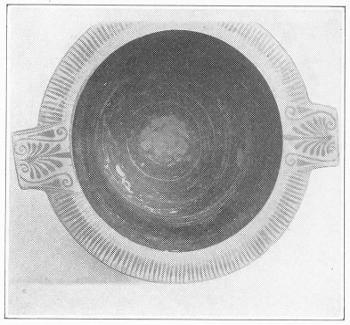
Fig. 57. Inside of krater showing extensive wear
Met. Mus. Acc. No. 07.286.74
Lastly, regarding the argument about riveted vases, it is
surely natural now and then, instead of throwing away a
broken pot, to have it put together and make the best of it
in its mended state. We do the same thing nowadays. At
all events, the vase could still have been used to contain dry
materials. Such Athenian vases with ancient rivet marks
are in any case infrequent, and do not compare in number
with the broken vases which have not been mended.
Such considerations should once for all explode the theory
that Athenian vases were not actually used; so that we can
think of them, in the way that appeals to our imagination,
as serving in the daily life of the Athenians and as adding
to the enjoyment of that life, both by their beauty and by
their usefulness.
II. REPRESENTATIONS OF ANCIENT POTTERS — FASHIONING THE VASES — DECORATING THE VASES — FIRING THE VASES — Representations of potter’s kilns. — MISCELLANEOUS SCENES — REPRESENTATIONS WRONGLY INTERPRETED AS POTTERY SCENES — POTTER’S IMPLEMENTS
An important source of knowledge for the technique
of Greek vases is supplied by the representations of
ancient potters at work and by potter’s implements
which have survived. It may be interesting to review these
and see what new interpretations experience at a modern
pottery school will suggest.
1. Black-figured hydria in Munich.
Furtwängler u. Reichhold, Griechische Vasenmalerei, I, Text, p. 159.
Jahn, Beschreibung der Vasensammlung in der Pinakothek zu
München, No. 731.
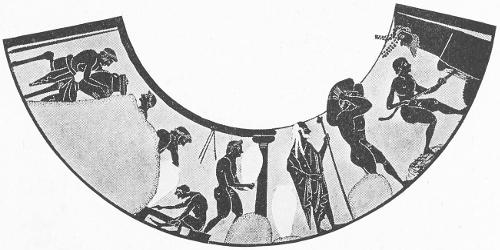
Fig. 58. Athenian pottery establishment
Furtwängler u. Reichhold, Griechische Vasenmalerei, I, Text, p. 159
An Athenian pottery establishment. To the left a
man sits on a stool and is holding with both hands an
amphora on his lap; a boy (only the head and one hand are
preserved) is standing before him, placing one hand on the
body of the vase; the latter is painted black, that is, it has
already been glazed. The man has the air of inspecting it,
while the boy is apparently helping him hold it (since it is
still in leather-hard condition, it requires careful handling).
The next group represents a man throwing a
tall vase on a wheel; a boy is sitting before him on a
low stool, turning the wheel with both hands at whatever
speed is required. The vase is so tall that the entire forearm
of the potter is inserted; while his other hand (now
missing) was doubtless placed on the outside of the vase, so
that by the pressure of the two hands the pot might acquire
the necessary form and thickness. The vase is painted
white to show that it is as yet unglazed. A pair of calipers
is hanging on the wall ready for use, to enable the potter to
check the heights and widths of his products. To the right
a youth is carefully carrying away a vase that has just been
thrown, to dry. A similar vase is already standing on the
other side of a column, drying in the open air or in a court.
Both vases are painted white to indicate their unglazed condition.
Next we see an old man walking leisurely with a
stick. His dignified air is in strong contrast to the busy
absorption of the workmen. He is evidently the overseer or
proprietor of the pottery. To his right a tall youth is carrying
a heavy weight on his back, apparently a sack of charcoal.
He is bringing it to the kiln, which is being stoked by
the fireman. The kiln has a satyr head at the top to avert
the evil eye and protect the pottery from all danger during
the firing.[56]
2. Fragment of a Corinthian pinax in the Berlin
Museum.
Antike Denkmäler, I, 1886, pls. 8, 17.
Furtwängler, Beschreibung der Vasensammlung in Berlin, I, No.
869.
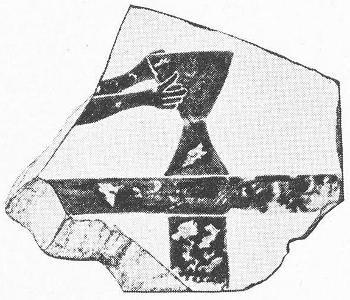
Fig. 59. Potter throwing
Antike Denkmäler, I, pl. 8, No. 17
A potter throwing a vase on a wheel, with both his hands
placed on the outer surface; only the two hands of the
potter and the upper part of the wheel with the vase are
preserved.
3. Red-figured fragment from the Akropolis in
Athens.
Athenische Mittheilungen, XIV, 1889, p. 157.
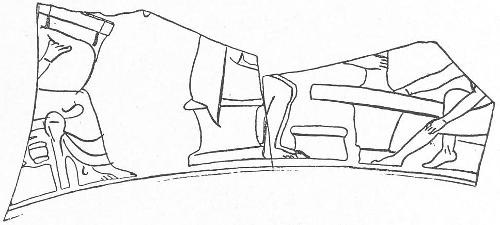
Fig. 60. Potter throwing
Athenische Mittheilungen, 1889, p. 157
A potter is sitting on a stool and throwing a vase on a
wheel which is being propelled by a boy; another man sits
behind him with a krater on his lap.
4. Interior of a black-figured kylix in the British
Museum.
British Museum, Guide to Greek and Roman Life (2d edition), 1920,
p. 182, fig. 218.
Walters, Catalogue of the Greek and Etruscan Vases, II, B.432.
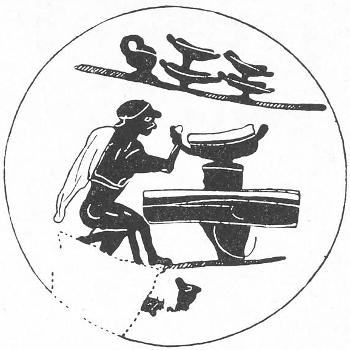
Fig. 61. Potter attaching handles
British Museum, Guide to Greek and Roman Life
(2d Edition), p. 182, fig. 218
A potter is sitting in front of his wheel on which a kylix is
standing. He is apparently engaged in attaching the handles.
On a shelf above are piled some more kylikes and a
jug. The whole is very roughly painted.
5. Corinthian black-figured pinax in the Museum of
the Louvre.
Gazette archéologique, VI, 1880, p. 106, 3a.
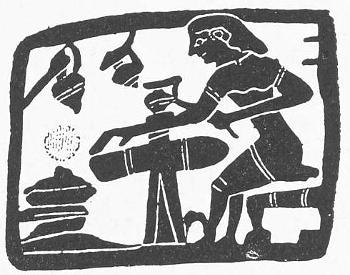
Fig. 62. Potter incising lines (?)
Gazette archéologique, 1880, p. 106 (3a)
A potter is sitting before his wheel propelling it with one
hand. He is working on what appears to be a one-handled
jug. He is not “throwing” or “turning” it, since it
already has its handle attached. Perhaps he is incising
horizontal lines on it, for which process he could easily
propel his own wheel. On the wall hang two other jugs
(with similar incised lines), and some plates (?) are stacked
on the floor.
6. Corinthian pinax in the Berlin Museum.
Antike Denkmäler, I, 1886, pl. 8, 14b.
Furtwängler, Beschreibung der Vasensammlung in Berlin, I, No.
885.
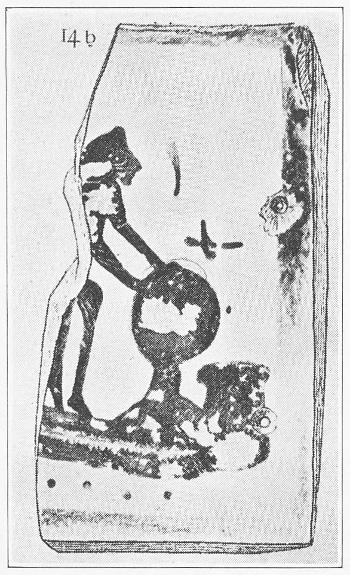
Fig. 63. Potter joining sections (?)
Antike Denkmäler, I, pl. 8, No. 14b
A man is sitting in front of a tall globular vase on a high
foot. He is not throwing it, for there is no indication of a
wheel. Perhaps he is joining the sections of a tall vase,
some of which are already in place, while one part lies on
the floor waiting to be attached. But the whole scene is so
roughly painted that it is impossible even to know definitely
that a potter is represented.
7. Interior of a red-figured kylix, Berlin Museum
No. 2542.
Rayet et Collignon, Histoire de la céramique grecque, p. XVII, fig. 7.
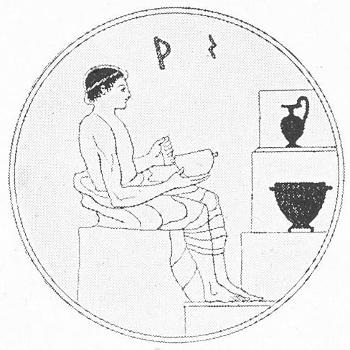
Fig. 64. Boy finishing vase
Rayet et Collignon, Histoire de la Céramique grecque
p. XVII, fig. 7
A boy is sitting with a cup (kotyle) in one hand and an
implement in the other, evidently engaged in a finishing
process. Perhaps he is removing the surplus clay after the
handles have been attached; for the vase is as yet unglazed
and is left in the red color of the clay, in contrast to the
black kotyle and oinochoë on the stand close by.
8. Terracotta statuette of a potter in the British
Museum.
British Museum, Guide to Greek and Roman Life (2d edition),
1920, p. 181, fig. 216.
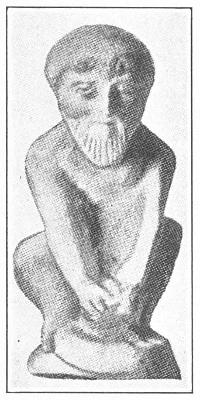
Fig. 65. Potter building a vase
British Museum, Guide to Greek and Roman Life
(2d Edition), p. 181, fig. 216
A man is represented in a crouching attitude apparently
engaged in building a pot.
1. Red-figured hydria in Ruvo.
Annali dell’Instituto, 1876, pl. DE.
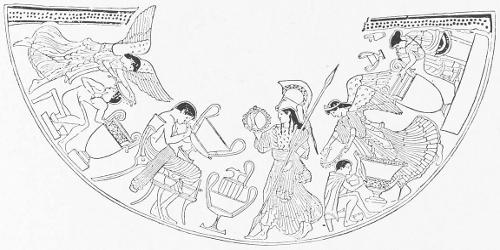
Fig. 66. Athena and Victories crowning potters at work
Annali dell’Instituto, 1876, pl. DE
Athena and two Victories crowning potters at work. To
the left is a potter sitting on a low stool and engaged in
decorating a volute krater; he is holding a brush in his
closed fist in Japanese fashion, and is looking in surprise at
the Nike who is crowning him; by his side are two paint
pots. In front of him another workman, comfortably
seated on a chair, is busily painting a kantharos which he
holds tipped on his lap. He also holds the brush in his fist
downwards. Another kantharos and an oinochoë stand on
the floor, awaiting their turn to be decorated; on a low stand
close by are two paint pots, one with its lid tipped against
the side. The artist is completely absorbed in his work and
has not yet discovered Athena, the patron of arts and
crafts, approaching him with a wreath. Behind Athena a
third workman is seated on a low stool, decorating a bell
krater with a palmette design. He tips up the vase with one
hand, holds the brush firmly in his fist, and has his paint pot
within easy reach on the floor. A Nike is about to crown
him with a wreath; but he, too, is entirely engrossed in his
work and quite unconscious of the honor to be conferred on
him. Completing the scene on the right is a girl on a low
platform painting the handle of a large volute krater.
The figure is of special interest today, for it shows that
there were women potters then as now. Above her on the
wall are suspended a kantharos and a lekythos. The whole
scene is of great importance as the most representative we
possess of ancient vase painters at work.
2. Red-figured kylix in the Museum of Fine Arts,
Boston.
Hartwig, Jahrbuch des Instituts, XIV, 1899, pl. 4.
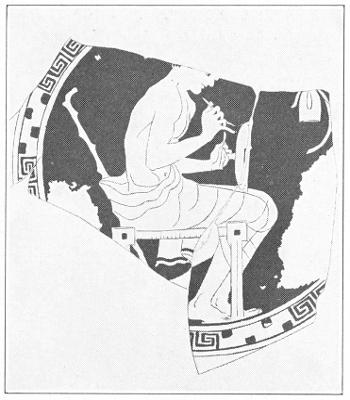
Fig. 67. Youth decorating kylix
Hartwig, Jahrbuch des Instituts, 1899, pl. IV
A youth is sitting on a stool, holding a kylix by the foot
and decorating the outside of it with what looks like a brush
with long bristles, though it has also been identified as a
feather (by Hartwig). In the hand that grasps the kylix
is a pointed instrument which has been identified by Hartwig
as the implement with which the preliminary sketch was
drawn. The attitude of the painter suggests the quiet
absorption required by a delicate task. Behind the youth
is his knotted staff, and on the wall hang his oil flask and
strigil.
3. Fragment of a red-figured kylix, found on the
Akropolis, Athens.
Hartwig, Jahrbuch des Instituts, XIV, 1899, p. 154, fig. 2.
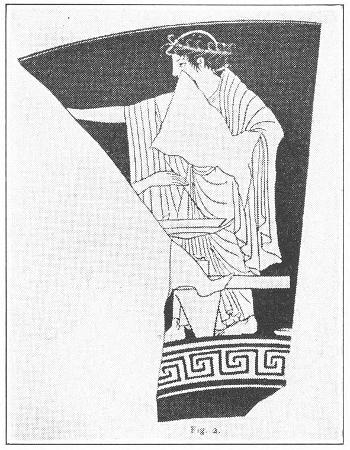
Fig. 68. Potter glazing kylix
Hartwig, Jahrbuch des Instituts, 1899, pl. 154, fig. 2
A potter glazing the inside of a kylix as it rotates on the
wheel. A woman appears to be crowning him with a
wreath.
4. Corinthian pinax in the Berlin Museum.
Antike Denkmäler, I, pl. 8, No. 18.
Furtwängler, Beschreibung der Vasensammlung zu Berlin, I, No.
868.
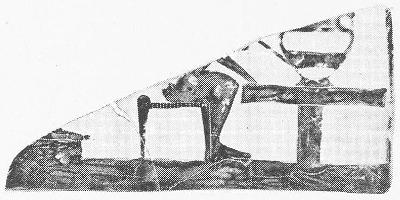
Fig. 69. Potter painting bands on a krater
Antike Denkmäler, I, pl. 8, No. 18
A potter is sitting on a stool before his wheel, apparently
in the act of painting broad black bands on a column krater
while the vase is revolving.
5. Red-figured bell-krater in the Ashmolean
Museum, Oxford.
Beazley, Journal of Hellenic Studies, XXVIII, 1908, pl. XXXII, A.
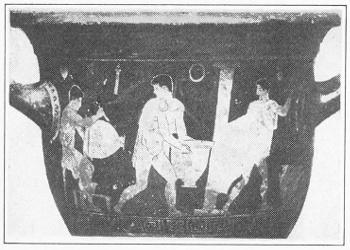
Fig. 70. Three youths, one painting a krater
Beazley, Journal of Hellenic Studies, XXVIII (1908), pl. XXXII, A.
To the left a youth is sitting on a stool painting the outside
of a bell krater. He is steadying the vase with his left
arm placed inside the krater, while he lets the rim rest on
his lap. By his side is a low stand with a skyphos evidently
containing the paint. A second workman is carrying off
another krater to the right. He may be going to fetch some
water or wine in it, for it is evidently a completed, fired
vase, otherwise he would not be carrying it by the handles.
A third workman is moving in the same direction holding
up a skyphos, perhaps to get more paint or some water or
wine to drink. A krater standing on the ground completes
the scene. On the wall hang some implements of the potter’s
trade, identified by Beazley from the original as (1)
a kylix for drinking, (2) a mortar for grinding the ingredients
of the glaze, (3) a brush case, (4) a bowl to contain
liquid glaze, (5) a strainer for sieving the glaze.
6. Bœotian black-figured skyphos in the Polytechnion
in Athens.
Found in Lokris.
Blümner, Athenische Mittheilungen, XIV, 1889, p. 151.
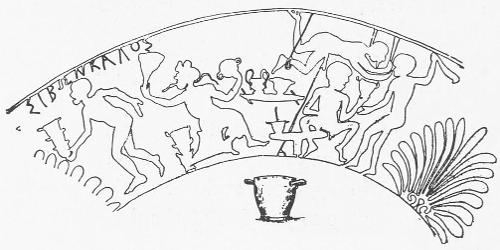
Fig. 71. Pottery establishment
Blümner, Athenische Mittheilungen, XIV, 1889, p. 151
The master of the pottery is sitting with a kylix in one
hand, while with the other he is trying to beat a slave who
is running off with three skyphoi. Three other skyphoi are
on the ground, while a kantharos and a skyphos are near by
on a shelf. Another workman is inspecting a skyphos he
has just glazed; a paint pot and brush are on a low stand
by his side. He takes no notice of a scene which is taking
place close by, a man beating a slave suspended from
the ceiling. The workmanship is very crude, and if it is a
product of the pottery establishment which it depicts, it is
a fair sample of the work we might expect from a place run
on such methods!
1-10 Votive tablets or pinakes found at Penteskuphia
near Corinth, dating 650-550 B.C. (figs. 72-80).
Nos. 73-78, 80 are in the Berlin Museum; Nos.
72, 79 in the Museum of the Louvre.
Antike Denkmäler, I, 1886, pl. 8, Nos. 1, 4, 12, 15, 19b, 21, 22, 26
(Furtwängler, Beschreibung der Vasensammlung zu Berlin, I, Nos.
608, 802, 616, 893, 909, 827, 611). Gazette archéologique, VI, 1880, p.
105 (1), p. 106 (1).
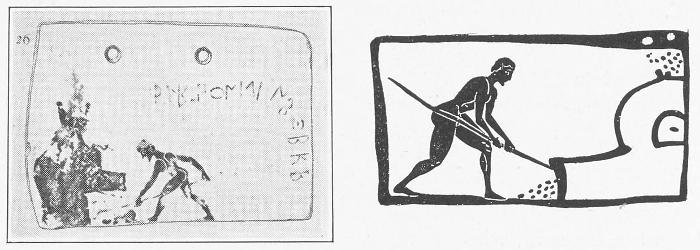
Figs. 72-73. Potters stoking the fire
Antike Denkmäler, I, pl. 8, 26.
Gazette archéologique, VI, p. 105.
The kilns are domed, and have three openings, one at the
bottom for the fuel, one on the side for the insertion of the
ware and to act as a spy-hole, and one at the top to let out
the smoke and for the regulation of the draught. On figs.
72-79, the firemen are busy stoking the fire, and climbing to
the top of the kiln to manipulate the draught-hole with a
hooked implement; for the flames are seen emerging at the
top, which means that heat is being wasted. Fig. 80 shows
the inside of a kiln, in horizontal section, with two openings
for the fire, each opening having two channels into the kiln.
The vases should of course stand upright, but the painter
naturally found it difficult to depict them in the right perspective
looking at them from the top.
Figs. 74-79. Potters regulating draught
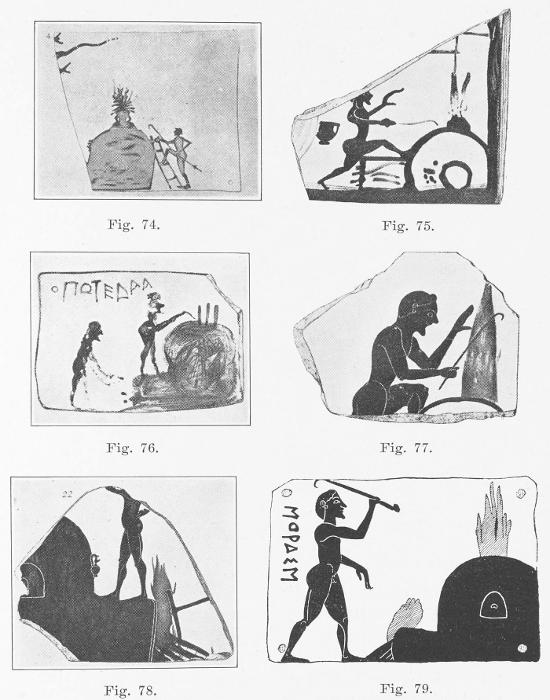
Antike Denkmäler, I, pl. 8, Nos. 4, 12, 1, 21, 22; Gazette archéologique,
VI, p. 106.
Furtwängler (Beschreibung der Vasensammlung zu Berlin,
I, p. 70, note) was inclined to think that these ovens
are not pottery kilns, but furnaces for metal smelting.
His objections, however, do not hold. The ovens are not
too large for pottery, and the climbing to the top for the
regulation of the draught is a well-known proceeding.
Moreover, the scene (fig. 80) showing the stacked vases, the
little pots painted on figs. 75 and 78 as if to indicate the
purpose of the ovens, and the representations of potters at
work on other tablets, make the interpretation as pottery
kilns the most likely. These pictures are of special importance
since no actual Greek kilns have yet been discovered,
though several Etruscan and numerous Roman ones have
come to light (cf. Montelius, Civilisation primitive, pl. 107,
11, and Blümner, op. cit., II, pp. 23 ff.).
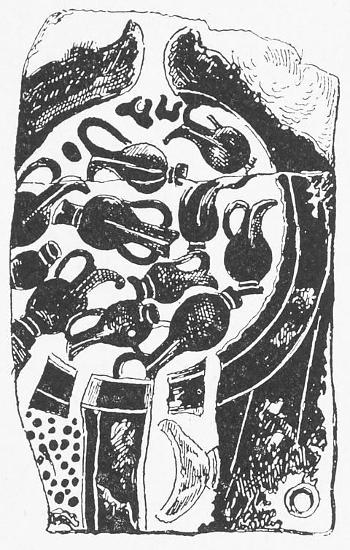
Fig. 80. Vases stacked in potter’s kiln
Antike Denkmäler, I, pl. VIII, No. 19b
1. Engraved gem, present whereabouts not known.
Millin, Peintures de vases antiques, II, title vignette.
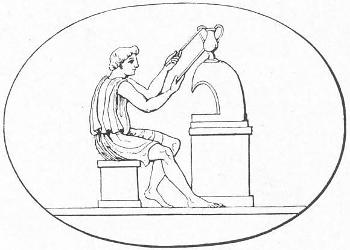
Fig. 81. Youth removing vase from oven with two sticks
Millin, Peintures de vases, II, title vignette
A youth is sitting in front of an oven removing with two
sticks a two-handled vase which has been placed there for
drying. He is using the sticks instead of his fingers because
the pot is too hot to touch; not in order to avoid injuring
the fresh glaze on the vase, as has been suggested (cf.
Blümner, Technologie u. Terminologie II, 1895, p. 52), for
the sticks would mark the glaze as much as the fingers
would. Modern potters often use sticks for removing hot
ware from the kilns (cf. p. 36).
2. Engraved gem, present whereabouts not known.
Millin, Peintures de vases antiques, I, vignette.
Blümner, Technologie u. Terminologie, II, p. 52, fig. 13.
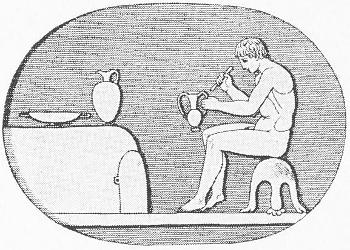
Fig. 82. Youth working on vases (?)
Millin, Peintures de vases, I, vignette
A youth is sitting on a low tripod in front of an oven.
He holds a jug by the handle, and seems to be working on it
with an instrument. It is not clear what he is doing; the
way he holds the vase by one handle suggests that the vase
has been fired. On the oven are a kylix and an oinochoë,
perhaps placed there for drying.
3. Archaic Greek stele in the Akropolis Museum,
Athens.
Lechat, La Sculpture attique avant Pheidias, p. 367, fig. 29.
Dickins, Catalogue of the Akropolis Museum at Athens, p. 272, No.
1332.
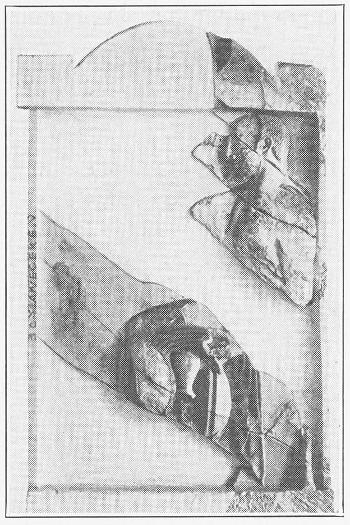
Fig. 83. Master potter (?)
Lechat, La Sculpture attique avant Phidias, p. 367, fig. 29
A bearded man is represented seated, holding in his left
hand two kylikes, one by the handle, the other by the foot.
A large part of the stele is missing. The figure has been
interpreted, with some probability, as a “master potter.”
4. Greek stele in the Metropolitan Museum of Art,
New York.
Richter, Handbook of the Classical Collection, p. 209, fig. 125.
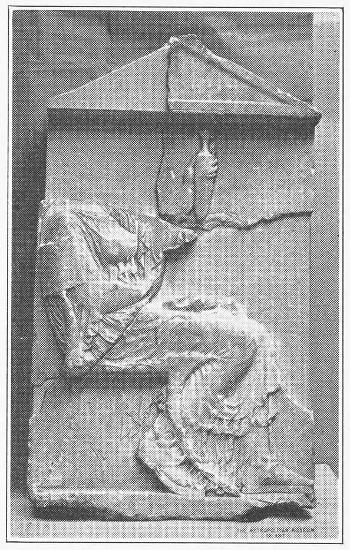
Fig. 84. Woman potter (?)
Met. Mus. Acc. No. 08.258.42
A woman is represented seated with a pyxis on her lap
and a lekythos in one hand. On the analogy of the
Akropolis stele, it is possible that here too we have a votive
offering of a potter.
5. Interior of a kylix in the Johns Hopkins University,
Baltimore.
Hartwig, Die griechischen Meisterschalen, pl. XVII, I, and title
vignette.
Hoppin, A Handbook of Attic Red-Figured Vases, II, p. 355.
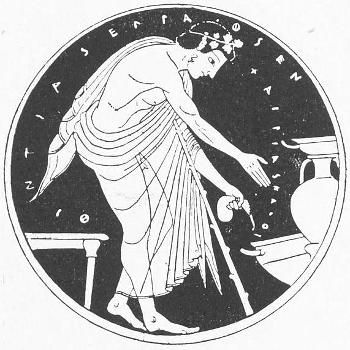
Fig. 85. Client in potter’s shop
Hartwig, Die griechischen Meisterschalen, title vignette
A client in a potter’s shop is examining the stacked ware,
and holds his purse ready to pay for what he will select.
6. Fragment of a Corinthian pinax in the Berlin
Museum.
Antike Denkmäler, I, 1886, pl. 8, 3a.
Furtwängler, Beschreibung der Vasensammlung zu Berlin, I, No.
831b.
Fig. 86. Ship with cargo of pottery
Antike Denkmäler, I, pl. 8, 3a
Sailing-ship with a sheet wound round the mast, and a
row of jugs painted in the field above. The latter apparently
indicate the cargo of the ship, and the tablet is probably
an offering of a merchant to the sea-god Poseidon for the
safe conduct of his precious consignment to foreign lands.
This is the only picture we have of the transport of Greek
vases, which we know played so significant a part in Greek
ceramic industry. Even in the seventh century B.C.,
when most important localities produced their own wares,
such shipments must have been frequent, since, for instance,
large numbers of Corinthian vases have been unearthed in
Etruria, and Laconian vases are found scattered far and
wide. In the sixth and fifth centuries B.C., when Athens
supplied a large part of the Greek world with her pottery,
the trade must have been an exceedingly active one; so that
we must imagine ship after ship laden with pottery sailing
from the Piraeus for distant lands.
From time to time various representations have been interpreted
as pottery scenes which probably have no such
significance. The following are the two most important.
1. Interior of a kylix in the Metropolitan Museum
of Art.
A satyr is stoking the fire of an oven on which is a skyphos.
This scene is figured in many of the books on vases (cf. e.g.
Walters, History of Ancient Pottery, I, p. 216, fig. 68) and
interpreted as a satyr firing pottery; probably he is simply
cooking his dinner.
2. Interior of a kylix.
Gerhard, Auserlesene Vasenbilder, pls. CLXXX-CLXXXI.
Youth holding the rim of a large krater with both hands.
He is sometimes interpreted as a potter working on a vase;
but there is no clear connection with pottery work.
Unfortunately very few potter’s implements of classical
Greek times have survived. We have no Athenian wheel or
kiln or turning tools. And even from other periods the list
of such utensils is a slim one. But what has survived here
and there from other periods is in line with the general
trend of the evidence—that the techniques in ancient times
were very similar to what they are today. Perhaps the
most interesting pieces are the terracotta disks found at
Gournia, Arezzo, and elsewhere,[57] which are wheel-heads[58] on
which the pottery was thrown and turned. On the under
side of some of these is a hole for insertion in the pivot
(fig. 87).
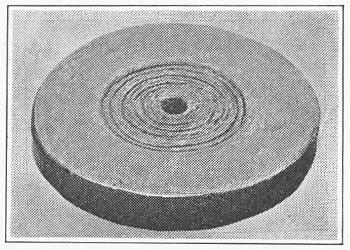
Fig. 87. Wheel-head
British Museum, Guide to Greek and Roman Life
(2d Edition), p. 181, fig. 217
The potter’s tools found at Arezzo (fig. 88)[59] are not unlike
our modern modeling tools and were doubtless used for
various finishing processes.
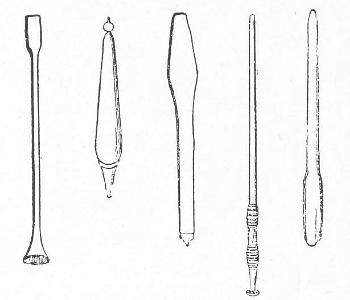
Fig. 88. Tools found at Arezzo
Daremberg et Saglio, Dictionnaire des antiquités grecques
et romaines, p. 1122, fig. 3036
In the British Museum (Nos. 74.7-10,302) are terracotta
stilts used for supporting vases in the kilns, very like the
stilts used by potters today. It is unlikely that they were
used by the Athenian potters, since the Greek black glaze is
so thin it would not be apt to run, but for the Roman ware
with metallic glaze they were essential, and the marks they
left are visible on the feet of the vases.[60] On one of the
British Museum stilts (fig. 89) are remains of a greenish
glaze from such a vase. No moulds for the Athenian plastic
ware have to my knowledge been found. But moulds for
the later wares, such as the Arretine, are of course plentiful.
They are invariably made of burnt clay. The kilns
which have survived all date from Roman times (cf. Blümner,
op. cit., II, pp. 23 ff.).
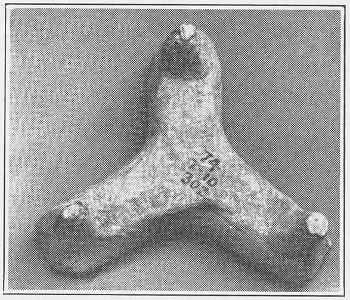
Fig. 89. Stilt
III. REFERENCES TO THE POTTERY CRAFT IN ANCIENT LITERATURE — PREPARATION OF THE CLAY — FASHIONING THE VASES — (1) WHEELWORK — (2) BUILDING — FIRING THE VASES — RED OCHRE WASH — POROSITY OF GREEK POTTERY — THE STATUS OF POTTERS
The information derived from ancient literature on
the subject of the technique of Athenian vases is
decidedly meagre; and naturally so. The only
people who could have given us valuable data regarding
technical questions were the potters themselves, and they
were not writers. Outsiders knew as little of the technique
of the craft as they do today. So we obtain from them only
general remarks; and these on the whole bear out the points
we have already made. Occasionally, however, they throw
fresh light on a question, or give us information on some
point on which the vases themselves cannot speak, such as
the status of the ancient potters, the value placed on the
vases, etc. It is important, therefore, to examine the chief
references in Greek and Roman literature on this subject.
Geoponica, II, 49.
3. It is most necessary for
every reason to have potters (on
a farm), since we are convinced
that it is possible to find potter’s
clay on any land; for either on
the surface, or deep down, or in
out-of-the-way places on the land
you will find earth suitable for
making pottery.
3. Ἀναγκαιότατον δὲ καὶ κεραμέας
ἔχειν πάντων ἕνεκα, πεπεισμένον ὅτι
ἐν πάσῃ τῇ γῇ ἔστιν εὑρεῖν κεραμικὴν
γῆν, ἢ γὰρ ἐπιπολάσιον, ἢ ἐν βάθει, ἢ
ἐν ἀποκεκρυμμένοις μέρεσι καὶ τόποις
τοῦ χωρίου ἐπιτηδείαν γῆν πρὸς κατασκευὴν
κεράμων εὑρήσεις.
The abundance of clay on Greek soil must have helped the
manufacture of the many local varieties before Athens
obtained the monopoly in the sixth century B.C.
Geoponica, VI, 3.
On making pithoi
1. Not all earth is suitable
for pottery, but with regard to
potter’s clay, some prefer the yellowish
red, some the white, and
others mix the two. 2. Some in
judging of a well-made pithos are
satisfied if, when struck, it gives
forth a sharp, clear sound.
3. That, however, is not enough,
but the person in charge ought to
be present while the work is going
on, and see to it that the clay has
been well worked, and not let it
be put on the wheel before the
clay shows what sort of pot it
will make when fired.
περὶ κατασκευῆς πίθων
1. Γῆ οὐ πᾶσα ἐπιτήδειος πρὸς κεραμείαν,
ἀλλὰ τῆς κεραμίτιδος γῆς
οἱ μὲν προκρίνουσι τὴν πυρρὰν τὸ χρῶμα,
οἱ δὲ τὴν λευκήν, οἱ δὲ ἀμφοτέρας
συμμιγνύουσι. 2. Τινὲς μὲν οὖν ἀρκοῦνται
ἐν τῇ δοκιμασίᾳ τοῦ καλῶς
κεκεραμευμένου πίθου, τῷ κρουσθέντα
αὐτὸν ἀποδοῦναι ἦχόν τινα ὀξὺν καὶ
πορόν. 3. Οὐκ ἔστι δὲ τοῦτο αὔταρκες,
ἀλλὰ χρῆ τὸν κατασκευάζοντα παρεῖναι
τῇ κεραμείᾳ, καὶ ὅπως ὁ πηλὸς καλῶς
εἰργασμένος εἴη προνοῆσαι, καὶ
μὴ πρὶν ἐᾶσαι ἐπὶ τὸν τροχὸν ἀναβιβάσαι,
πρὶν τὸν πηλὸν διαδεῖξαι ὁποῖος
ἔσται ὁ πίθος ὀπτηθείς.
Good potters were evidently well aware, then as now, of
the importance of the right composition and consistency of
their clay. It is also interesting to note that potters in
modern Athens still regularly use a mixture of red and
white clay (cf. p. 40, note 2).
Sophokles, Fragments, 438.
First begin to work the clay
with your hands.
Καὶ πρῶτον ἄρχου πηλὸν ὀργάξειν
χερσῖν.
Hesychius, Lexicon, s. v. ὀργάσαι.
ὀργάσαι: to make ready; or as
is said, to knead the clay, which
is to prepare it, to mix it, to wet
it, to work it into a plastic mass.
ὀργάσαι· ἑτοιμάσαι, καὶ τὸν πηλὸν
ὀργάσαι φασίν, ὅ ἐστιν ἑτοίμασαι, φυρᾶσαι,
βρέξαι, ἀνάδευσαι.
Ὀργάσαι in other words was the Greek expression for
wedging the clay and getting it ready for throwing.
Diodorus Siculus, IV, 76.
Talos, the son of Daedalus’
sister, was brought up as a child
by Daedalus, and being cleverer
than his teacher, he invented the
potter’s wheel.
Τῆς ἀδελφῆς τῆς Δαιδάλου γενόμενος
υἱὸς Τάλως ἐπαιδεύετο παρὰ
Δαιδάλῳ παῖς ὢν τὴν ἡλικίαν, εὐφυέστερος
δ’ ὢν τοῦ διδασκάλου τὸν κεραμευτικὸν
τροχὸν εὗρε.
Strabo, Geography, VII, p. 303.
Ephoros says that Anacharsis’
inventions were the bellows, the
double-fluked anchor, and the potter’s
wheel. I repeat this statement,
although I am well aware
that this writer is not very accurate,
and especially in the account
of Anacharsis, for how could the
potter’s wheel be an invention of
his, while Homer[61] who was of an
earlier time knew of it?
Ὁ Ἔφορος ... εὑρήματά τε
αὐτοῦ λέγει τά τε ζώπυρα καὶ τὴν ἀμφίβολον
ἄγκυραν καὶ τὸν κεραμικὸν
τροχόν. ταῦτα δὲ λέγω σαφῶς μὲν εἰδὼς
ὅτι καὶ οὗτος αὐτὸς οὐ τἀληθέστατα
λέγει περὶ πάντων, καὶ δὴ καὶ
τὸ τοῦ Ἀναχάρσιδος. πῶς γὰρ ὁ τροχὸς
εὕρημα αὐτοῦ, ὃν οἶδεν Ὅμηρος
πρεσβύτερος ὤν;
Pliny, Natural History, VII, 198.
Coroebus the Athenian invented
earthen pots, and among the inventors,
the Scythian Anacharsis,
or as others say, Hyperbius
the Corinthian, discovered the
potter’s wheel.
... figlinas (invenit) Coroebus
Atheniensis, in iis orbem Anacharsis
Scythes, ut alii, Hyperbius
Corinthus.
Critias, Elegies, I, 12-14 (Bergk).
The child of the wheel and the
earth and the kiln, the famous
pottery, useful house servant, that
city invented which set up the
glorious trophy at Marathon.
Τὸν δὲ τροχοῦ γαίης τε καμίνου τ’ ἔκγονον εὗρεν,
κλεινότατον κέραμον, χρήσιμον οἰκονόμον,
ἡ τὸ καλὸν Μαραθῶνι καταστήσασα τρόπαιον.
It is natural that the ancients should have attributed the
great invention of the potter’s wheel to various individuals
or cities, but they themselves realized the anomaly of
ascribing it to a comparatively recent period, when it was
known to Homer (see below). Actual remains of wheel-thrown
vases show that the wheel was known in Crete and
Greece in the Early Minoan and Early Helladic III periods
(before 2200 B.C.) and in Egypt in the third and fourth
dynasties[62] (about 3000 B.C.).
Homer, Iliad, XVIII, 599-601.
And now they would run round
with deft feet exceeding lightly,
as when a potter sitting by his
wheel that fitteth between his
hands maketh trial of it whether
it run. (Lang, Leaf and Myers.)
Οἱ δ’ ὁτὲ μὲν θρέξασκον ἐπισταμένουσι πόδεσσιν,
ῥεῖα μαλ’, ὡς ὅτε τις τροχὸν ἄρμενον ἐν παλάμῃσιν.
ἑζόμενος κεραμεὺς πειρήσεται, αἵ κε θέῃσιν.
Plutarch, De genio Socratis, p. 588f.
One ought not to be surprised
at seeing the movement of large
merchant-vessels controlled by
small helms, nor the whirling of
the potter’s wheel moving regularly
at the mere touch of the tips
of his fingers.
Οὐ δεῖ δὲ θαυμάζειν ὁρῶντας τοῦτο
μὲν ὑπὸ μικροῖς οἴαξι μεγάλων περιαγωγὰς
ὀλκάδων, τοῦτο δὲ τροχῶν κεραμεικῶν
δίνησιν ἄκρας παραψαύσει
χειρὸς ὁμαλῶς περιφερομένων.
Persius, Satires, III, 23-24.
[Advice to an idle young man of
good position.]
You are wet, soft clay; at this
very moment you should be hastening
to shape yourself on the
swift wheel.
udum et molle lutum es, nunc
nunc properandus et acri
fingendus sine fine rota.
Hippokrates, Περὶ Διαίτης, I, Littré, VI, p. 494, §22.
Potters turn the wheel which
moves neither backward nor forward
and at the same time imitates
the rotation of the universe,
and on this same wheel as it
whirls they make things of all
kinds, no one of them like
another, from the same materials
with the same tools.
Κεραμέες τροχὸν δινέουσι, καὶ οὔτε
ὀπίσω οὔτε πρώσω προχωρέει καὶ ἀμφοτέρωσε
ἅμα τοῦ ὅλου μιμητὴς τῆς
περιφορῆς· ἐν δὲ τῷ αὐτῷ ἐργάζονται
περιφερομένῳ παντοδαπά, οὐδὲν ὅμοιον
τὸ ἕτερον τῷ ἑτέρῳ ἐκ τῶν αὐτῶν τοῖσιν
αὐτοῖσιν ὀργάνουσιν.
The fascination of a pot shaped on a rapidly turning
wheel appealed to the ancients as it does to us; and the
parallelism between a pot in the making and man shaped by
life is too obvious to have escaped them. Hippokrates’
remark that of the vases produced on the wheel no two are
alike is characteristic of the Greek love of variety.
Ecclesiasticus, 38, 32.
So does the potter sitting at his
work and turning his wheel round
with his feet, who is always painstaking
with his task; and all his
work is done by number. He
moulds the clay with his arm, and
his feet. [Literal translation of
the Greek text written by a
Hebrew and evidently colored by
his own idiom.]
Οὕτω κεραμεὺς καθήμενος ἐν ἔργῳ
αὐτοῦ, καὶ συστρέφων ἐν ποσὶν αὐτοῦ
τροχόν, ὃς ἐν μερίμνῃ κεῖται διὰ παντὸς
ἐπὶ τὸ ἔργον αὐτοῦ, καὶ ἐναρίθμιος
πᾶσα ἡ ἐργασία αὐτοῦ.
Ἐν βραχίονι αὐτοῦ τυπώσει πηλόν,
καὶ πρὸ ποδῶν κάμψει ἰσχὺν αὐτοῦ.
This is the only place in ancient literature in which the
action of the foot in wheelwork is referred to. In the
second century B.C., therefore, we might assume the knowledge
of the kick-wheel, though it may well have been in use
long before then, since it is a simple and obvious device.
Where labor, however, was cheap and plentiful, as in fifth-century
Athens, a slave boy turning the wheel for the potter,
whose whole strength and attention could then be expended
on his work, would be preferable; and this is the manner
in which wheelwork is depicted in Athenian vase paintings
(cf. pp. 64 ff).
Athenaeus, XI, p. 480 c.
These kylikes are clay drinking-cups,
and are so called from being
turned on the wheel.
Ταῦτα δ’ ἐστὶ κεράμεα ποτήρια καὶ
λέγεται ἀπὸ τοῦ κυλίεσθαι τῷ τροχῷ.
The kylix is, of course, the wheel-made vase par excellence.
Nothing so light and graceful or with such a fine
flow of line could be produced by handwork.
Plato, Gorgias, p. 514 e.
Is not this, as they say, to learn
the potter’s craft by undertaking
a pithos, ... and does not this
seem to you a foolish thing to do?
Τὸ λεγόμενον δὴ τοῦτο ἐν τῷ πίθῳ
τὴν κεραμείαν ἐπιχειρεῖν μανθάνειν ...
οὐκ ἀνοητόν σοι δοκεῖ
ἂν εἶναι οὕτω πράττειν;
Plato, Laches, p. 187 b.
For if this is your first attempt
at education, you must take care
lest you try the experiment, not
on a Carian slave, but on your
sons or the children of your
friends, and let the proverb fit
you which says that the potter’s
art is in the pithos.
Εἰ γὰρ νῦν πρῶτον ἄρξεσθε παιδεύειν,
σκοπεῖν χρὴ μὴ οὐκ ἐν τῷ Καρὶ
ὑμῖν ὁ κίνδυνος κινδυνεύηται, ἀλλ’
ἐν τοῖς ὑέσι τε καὶ ἐν τοῖς τῶν φίλων
παισί, καὶ ἀτεκνῶς τὸ λεγόμενον κατὰ
τὴν παροιμίαν ὑμῖν συμβαίνῃ ἐν πίθῳ
ἡ κεραμεία γιγνομένη.
Scholiast on Plato, Laches, p. 187 b.
The proverb, “in the pithos is
the potter’s art,” about those
who skip the first lessons and take
hold of the greatest tasks which
are properly the last.
Παροιμία, ἐν πίθῳ τὴν κεραμείαν,
ἐπὶ τῶν τὰς πρώτας μαθήσεις ὑπερβαινόντων,
ἁπτομένων δὲ τῶν μειζόνων καὶ
ἤδη τῶν τελειοτέρων.
Corpus Paroemiographorum Graecorum, Zenobius, III, 65.
“I learn the potter’s craft on
the pithos”; a proverb upon
those who skip the first lessons,
and immediately attempt greater
things; as if anyone who was
learning to be a potter, before
learning to mould plates or any
other small thing, should undertake
a pithos.
Ἐν πίθῳ τὴν κεραμείαν μανθάνω:
Παροιμία ἐπὶ τῶν τὰς πρώτας μαθήσεις
ὑπερβαινόντων, ἁπτομένων δὲ εὐθέως
τῶν μειζόνων. Ὡς εἴ τις μανθάνων
κεραμεύειν, πρὶν μαθεῖν πίνακας
ἢ ἄλλο τι τῶν μικρῶν πλάττειν, πίθῳ
ἐγχεροίη.
The fact that there was a Greek proverb on the folly of
attempting large vases before a thorough knowledge of the
craft has been acquired, shows how common was the realization
of the difficulty of the task.
Plutarch, Quaestiones conviviales, II, p. 636 c.
Polykleitos the modeler said
that the work is most difficult
when the clay stands the test of
the nail (?).
Πολύκλειτος ὁ πλάστης εἶπε χαλεπώτατον
εἶναι τοὔργον, ὅταν ἐν ὄνυχι
ὁ πηλὸς γένηται.
If we interpret this passage as referring to a potter, and
ὅταν ἐν ὄνυχι γένηται as meaning when the stage has been
reached that the clay is hard enough to be scratched with
the nail, this may possibly be an allusion to turning; which
may well be called the most difficult process of pottery
making. But this interpretation is very uncertain. The
passage is usually taken as referring to the sculptor’s last
touches on a clay model for a bronze statue.
Geoponica, VI, 3 (4).
4. Potters do not use the wheel
for all pithoi, but only for the
small ones. The larger ones they
build up day by day, placing them
on the ground in a warm room,
and thus make them large.
4. Οὐ πάντας δὲ τοὺς πίθους ἐπὶ
τὸν τροχὸν ἀναβιβάζουσιν οἱ κεραμεῖς,
ἀλλὰ τοὺς μικρούς. τοὺς μέντοι μείζους
χαμαὶ κειμένους ὁσημέραι ἐν
θερμῷ οἰκήματι ἐποικοδομοῦσι, καὶ
μεγάλους ποιοῦσιν.
Pollux, Onomasticon, VII, 164.
164. That around which those
who make pithoi put the clay and
shape it—this wooden core is
called κάναβος.
164. Περὶ δὲ ὃ οἱ τοὺς πίθους πλάττοντες
τὸν πηλὸν περιτιθέντες πλάττουσι,
τοῦτο τὸ ξυλήφιον κάναβος καλεῖται.
Such hand-built ware does not, of course, include the
large painted kraters and amphorai of Athenian make; for
these have all the ear-marks of wheel-thrown pottery.
Wooden cores are still used today in the making of cement
forms. Since the clay cement shrinks upon drying and the
wood does not, care must be taken to prevent the former
from cracking. The wooden core is therefore made in
collapsible form. A wedge is made in the center and a core
built around it. When the work is finished the wedge can
be drawn out and the sides of the core will fall in.[63]
Geoponica, VI, 3 (5).
5. The firing is no small part
of the potter’s craft. Not too
little or too much fire should be
built under the pots, but just
enough.
Οὐ μικρὸν δὲ τῆς κεραμίας ἐστὶ
μέρος ἡ ὄπτησις· δεῖ δὲ μήτε ἔλαττον,
μήτε πλέον, ἀλλὰ μεμετρημένως τὸ
πῦρ ὑποβάλλειν.
Vita Herodotea λβ = Epigrammata Homerica, 14.
(Text of T. W. Allen, in Oxford University Classical Texts.)
Some potters, seeing him
[Homer] setting out the next
morning while they were building
a fire in a kiln of fine pottery,
called him to them, knowing that
he was a poet, and they bade him
sing, promising to give him some
of the pottery and whatever else
they had, and Homer sang to them
the following poem, which is
called the “Kiln”:—
“If you will give me a reward
I will sing to you, O potters.
Come hither, Athena, and stretch
thy hand over the kiln, and may
the kotyloi blacken well and all
the ... and may they be well
baked, and receive the price due
to their value, many being sold
in the market, and many in the
streets. May they gain much....
But if you turn to shamelessness,
and choose falsehood, then I summon
the destroyers to fall upon
the kiln, Crasher and Smasher and
Unquenchable and Shatterer and
Fierce Conquerer, who would
bring many evils upon this craft
... and may the whole kiln be
thrown into confusion, while the
potters lament loudly. As a
horse’s jaw eats greedily, so may
the kiln devour all the pottery
within it, making it brittle.
Come hither, Circe, daughter of
the sun, skilled in drugs; bring
malignant poisons, afflict the men
and ruin their work. Let Cheiron
bring hither many Centaurs, both
those who escaped the hands of
Herakles, and those who perished.
Let them harshly smite the work
and smite the kiln, and may the
men themselves see these grievous
deeds with lamentations. But I
shall be happy when I see their
unlucky craft. And the man who
peeps over, may his whole face
burn on account of this, so that
all may know how to do what is
right.”
Tῇ δὲ εἰσαύριον ἀποπορευόμενον
ἰδόντες κεραμέες τινες κάμινον ἐγκαίοντες
κεράμου λεπτοῦ, προσεκαλέσαντο
αὐτόν, πεπυσμένοι ὅτι σοφὸς εἴη· καὶ
ἐκέλευόν σφιν ἀεῖσαι, φάμενοι δώσειν
αὐτῷ τοῦ κεράμου καὶ ὅ τι ἂν ἄλλο
ἔχωσιν. ὁ δὲ Ὅμηρος ἀείδει αὐτοῖς
τὰ ἔπεα τάδε ἃ καλέεται Κάμινος·
Εἰ μὲν δώσετε μισθὸν ἀείσω, ὦ κεραμῆες·
δεῦρ’ ἄγ’ Ἀθηναίη καὶ ὑπείρεχε χεῖρα καμίνου,
εὖ δὲ μελανθεῖεν κότυλοι καὶ πάντα μάλευρα,
φρυχθῆναί τε καλῶς καὶ τιμῆς ὦνον ἀρέσθαι,
πολλὰ μέν εἰν ἀγορῇ πωλεύμενα, πολλὰ δ’ ἀγυιᾶς,
πολλὰ δὲ κερδῆναι, ἡμῖν δὲ δὴ ὥς σφι νοῆσαι.
ἢν δ’ ἐπ’ ἀναιδείην τρεφθέντες ψεύδε’ ἄρησθε,
συγκαλέω δ’ ἤπειτα καμίνῳ δηλητῆρας,
Σύντριβ’ ὁμῶς Σμάραγόν τε καὶ Ἄσβετον ἠδέ γ’ Ἄβακτον,
Ὠμόδαμόν θ’ ὃς τῇδε τέχνῃ κακὰ πολλὰ πορίζοι.
πεῖθε πυραίθουσαν καὶ δώματα, σὺν δὲ κάμινος
πᾶσα κυκηθείη κεραμέων μέγα κωκυσάντων.
ὡς γνάθος ἱππείη βρύκει, βρύκοι δὲ κάμινος
πάντ’ ἐντοσθ’ αὐτῆς κεραμήϊα λεπτὰ ποιοῦσα.
δεῦρο καὶ ἠελίου θύγατερ πολυφάρμακε Κίρκη.
ἄγρια φάρμακα βάλλε, κάκου δ’ αὐτούς τε καὶ ἔργα.
δεῦρο δὲ καὶ Χείρων ἀγέτω πολέας Κενταύρους,
οἵ θ’ Ἡρακλείους χεῖρας φύγον, οἵ τ’ ἀπόλοντο·
τύπτοιεν τάδε ἔργα κακῶς, τύπτοι δὲ κάμινον,
αὐτοὶ δ’ οἰμῴζοντες ὁρῷατο ἔργα πονηρά.
γηθήσω δ’ ὁρόων αὐτῶν κακοδαίμονα τέχνην.
ὃς δὲ χ’ ὑπερκύψῃ, περὶ τούτου πᾶν τὸ πρόσωπον
φλεχθείη, ὡς πάντες ἐπίσταιντ’ αἴσιμα ῥέζειν.
This is a good picture of the havoc that may happen in
a kiln.
Hippokrates, Epidemia, IV, 20; Littré, V, p. 160.
The man who fell down from
the potter’s oven, since a cupping-glass
was not applied immediately,
suffered from an internal
inflammation and on the twentieth
day grew worse.
Ὁ ἀπὸ τοῦ κεραμέου ἴπνου καταπεσὼν,
ᾧ οὐ προσβλήθη αὐτίκα σικύη,
ἐκαύθη ἔσω, καὶ εἰκοστῇ ἐπαλιγκότησεν.
This reminds us of the men we see climbing on the kilns
in the representations on Corinthian pinakes (p. 76).
Pollux, Onomasticon, VII, 108.
It was the custom for bronze
casters to hang something ridiculous
in front of their furnaces, or
to mould something upon them, in
order to avert envy. These were
called βασκάνια.
Πρὸ δὲ τῶν καμίνων τοῖς χαλκεῦσιν
ἔθος ἦν γελοῖά τινα καταρτᾶν, ἢ ἐπιπλάττειν,
ἐπὶ φθόνου ἀποτροπῇ. ἐκαλεῖτο
δὲ βασκάνια.
Such devices to avert the evil eye would apply equally to
pottery kilns, as we know from actual representations (cf. pp.
64 f.). It is natural that the vagaries of a kiln should be
ascribed by the superstitious ancients to supernatural forces.
Inscriptiones Graecae, II, 1, 546.
Be it decreed by the senate and
people of the Ioulietai concerning
the representations of the envoys
from Athens, that the export of
miltos shall be to Athens, and
to no other place from this
day forward; if anyone exports
it to any other place, his
ship and its cargo shall be confiscated
and a half shall be given
to the informer; ... If the
Athenians decree any other regulations
for the guarding of the
miltos they shall be valid.
(Ἔδ)οξεν τῇ βουλῇ καὶ τῷ δήμῳ
τῷ Ἰουλιητῶν, περὶ (ὧν οἱ παρ’ Ἀθηναίων
λέγουσι, δεδόχθα)ι τῇ βούλῃ
καὶ τῷ δήμῳ τῷ Ἰουλιητῶν, εἶναι τὴ(ν
ἐξαγωγὴν τῆς μίλτου Ἀθήναζε),
ἄλλοσε δὲ μηδαμῇ ἀπὸ τῆσδε τῆς ἡμέρας.
ἐὰν δέ τι(ς ἄλλοσε ἐξάγῃ, δημόσια
εἶναι τ)ὸ πλοῖον καὶ τὰ χρήματα
τὰ ἐν τῷ πλοίῳ. τῷ δὲ φήν(αντι ἢ
ἐνδείξαντι εἶναι τὰ ἡμίσεα) ...
(ἐὰν δέ τι ἄλ)λο ψηφίζωνται Ἀθηναῖοι
περὶ φυλακῆς τῆς μίλ(του ... κύρια
εἶ)ναι ἃ ἂν Ἀθηναῖοι ψηφίζωνται.
Inscriptiones Graecae, II, 1, 546.
Theogenes moved: be it decreed
by the senate and people of
the Koresians, concerning the
representations of the envoys
from Athens, the export of miltos
shall be to Athens ... as it was
before; and in order that the
decrees of the Athenians and
Koresians concerning miltos may
be valid, it shall be exported in a
ship which they shall designate
and in no other ship ... the
tax of two per cent shall be paid
to the collectors by those engaged
in the trade.
(Θεογ)ένης εἶπεν. δεδόχθαι (τ)ῇ
βο(υλῇ καὶ τῷ δήμῳ τῷ Κορησίων.
περὶ ὧν λέγουσι οἱ παρ’ Ἀθη)ναίων,
εἶναι τῆς μίλτου τὴν ἐξ(αγωγὴν Ἀθήναζε
... κ)αθάπερ πρότερον ἦν.
ὅπως δ’ ἂν κύρια ἦ(ι τ)ὰ ψηφίσματα
(... Ἀθηναίων κ)αὶ Κορησίων τὰ
περὶ τῆς μίλτου, ἐξάγειν ἐμπλοίῳ ὧ(ι
ἂν ... ἀποδείξωσιν, ἐν ἄλλῳ) δὲ
πλοῖῳ μηδενί ...
(τελ)εῖν δὲ τὴν πεντηκοστὴν τοῖς πεντηκοστολόγοις
τοὺς ἐργαζομένους.
It is interesting to learn how important miltos (red
ochre) was to the Athenians. We know that it was used in
building for the dressing of stones[64]; and if the appearance
of one of the chief articles of commerce of Athens, viz. the
pottery, was dependent on it (cf. pp. 53 ff.), it is natural that
stringent provisions should be made for its acquisition and
monopoly.
Pliny, Natural History, XXXV, 12 (43), 152.
The addition of red ochre or
moulding in red clay is the invention
of Butades.
Butades inventum est rubricam
addere aut ex rubra creta fingere.
Suidas, Lexicon, s. v. Κωλιάδος κεραμῆες.
Potters of Kolias: Kolias, a
place in Attica where vases are
moulded. It is said that of all
the kinds of clay that are brought
to the wheel (and the wheel on
which vessels are shaped is
meant), that is, of all the clay
fit for making vases, the clay of
Kolias is the best, so that it is
also dyed with miltos.
Κωλιάς, τόπος τῆς Ἀττικῆς, ἔνθα
σκεύη πλάττονται, λέγει οὖν ὅτι ὅσοι
ἐπὶ τροχοὺς φέρονται (τροχὸν δὲ τὸν
σκευοπλαστικὸν λέγει) τουτέστιν, ὅσαι
πρὸς σκευοπλασίαν ἐπιτήδειαι, πασῶν
ἡ Κωλιάδος κρείσσων· ὥστε καὶ βάπτεσθαι
ὑπὸ τῆς μίλτου.
Isidorus, Etymologiae, XX, iv, 3.
It is said that pottery vases
were first invented in the island
of Samos, being made of clay
and hardened by fire, whence
comes the term Samian vases. A
later invention was to add red
ochre and to make pottery of red
clay.
Fictilia vasa in Samo insula
prius inventa traduntur, facta ex
creta et indurata igni; unde et
Samia vasa: postea inventum et
rubricam addere et ex rubra creta
fingere.
The significance of these passages has already been
discussed on pp. 53-59.
Pollux, Onomasticon, VII, 161 ff.
162. Aristophanes says that a
clay vinegar jar has leprosy, instead
of saying that it is moist
(sweats?).
Λεπρᾶν δὲ κεράμειον ὀξηρόν,
ἀντὶ τοῦ μυδᾶν, Ἀριστοφάνης λέγει.
This appears to refer to the fact that unglazed ware (and
even painted Athenian pottery is unglazed in parts)
becomes moist when filled with liquid, on account of its
porosity.
Isokrates, De Permutatione, 2.
As if one should have the insolence
to call Pheidias, who made
the statue of Athena, a statuette
maker, or to say that Zeuxis and
Parrhasius had plied the same
trade as that of the painters of
pinakes.
Ὥσπερ ἂν εἴ τις Φειδίαν τὸν τὸ τῆς
Ἀθηνᾶς ἕδος ἐργασάμενον τολμῷη
καλεῖν κοροπλάθον, ἢ Ζεῦξιν καὶ Παρράσιον
τὴν αὐτὴν ἔχειν φαίη τέχνην τοῖς
τὰ πινάκια γράφουσιν.
Aristophanes, Ekklesiazousai, 995 f.
Old Woman. Who is this?
Young Man. The man who
paints lekythoi for the dead.
Γρ. οὗτος δ’ ἔστι τίς;
Νεανίας. ὃς τοῖς νεκροῖσι ζωγραφεῖ
τὰς ληκύθους.
Plutarch, Life of Numa, 17.
So, distinguishing the whole
people by the several arts and
trades, he formed the companies
of musicians, goldsmiths, carpenters,
dyers, shoemakers, skinners,
braziers, and potters (A. H.
Clough).
Ἦν δὲ ἡ διανομὴ κατὰ τὰς τέχνας,
αὐλητῶν, χρυσοχόων, τεκτόνων, βαφέων,
σκυτοτόμων, σκυτοδέψων, χαλκέων,
κεραμέων.
Plato, Euthydemos, 301, c, d.
What, said he, is the business
of a good workman? Tell me, in
the first place, whose business is
hammering?
The smith’s.
And whose the making of pots?
The potter’s.
And who has to kill and skin
and mince and boil and roast?
The cook, I said.
And if a man does his business,
he does rightly?
Certainly.
And the business of the cook is
to cut up and skin, you have
admitted that?
Yes, I have, but you must not
be too hard upon me.
Then if some one were to kill,
mince, boil, roast the cook, he
would do his business, and if he
were to hammer the smith, and
make a pot of the potter, he
would do their business (Jowett).
Οἶσθα οὖν, ἔφη, ὅτι προσήκει ἑκάστοις
τῶν δημιουργῶν; πρῶτον τίνα
χαλκεύειν προσήκει, οἶσθα;—Ἔγωγε·
ὅτι χαλκέα.—τί δέ, κεραμεῦειν;
κεραμέα.—τί δέ, σφάττειν τε καὶ ἐκδέρειν
καὶ τὰ μικρὰ κρέα κατακόψαντα
ἕψειν καὶ ὀπτᾶν;—Μάγειρον, ἦν δ’
ἐγώ.—Οὐκοῦν ἐάν τις, ἔφη, τὰ προσήκοντα
πράττῃ, ὀρθῶς πράξει; Μάλιστα.—Προσήκει
δέ γε, ὡς φῄς, τὸν
μάγειρον κατακόπτειν καὶ ἐκδέρειν;
ὡμολόγησας ταῦτα ἢ οὔ;—Ὡμολόγησα,
ἔφην, ἀλλὰ συγγνώμην μοι ἔχε—Δῆλον
τοίνυν, ἦ δ’ ὅς, ὅτι ἄν τις
σφάξας τὸν μάγειρον καὶ κατακόψας
ἑψήσῃ καὶ ὀπτήσῃ, τὰ προσήκοντα
ποιήσει. καὶ ἐὰν τὸν χαλκέα τις αὐτὸν
χαλκεύῃ καὶ τὸν κεραμέα κεραμεύῃ,
καὶ οὗτος τὰ προσήκοντα πράξει.
Justinus, Historiae Philippicae, XXII, 1, 1 and 2.
Agathocles, the tyrant of
Sicily, who succeeded to the great
power of the elder Dionysius,
came into the splendor of a kingdom
from a humble and base
family. And too, being born in
Sicily of a potter, he had a boyhood
not more honorable than his
origin.
Agathocles, Siciliae tyrannus,
qui magnitudini prioris Dionysii
successit, ad regni maiestatem ex
humili et sordido genere pervenit.
Quippe in Sicilia patre figulo
natus non honestiorem pueritiam
quam principia originis habuit.
Much has been written about the lowly status of Greek
potters,[65] and the above references bear out this general idea.
The craft of pottery was evidently placed on a par with
other trades, and all such manual work was not considered
a worthy occupation of free-born citizens, and left mostly
to the metics, or non-citizens. We know this not only from
texts and inscriptions on stone, but also from the non-Attic
forms of the names of the potters, as well as the inscriptions
on the vases which frequently show non-Attic spellings.
It would be absurd, however, to infer that all pottery was as
contemptuously regarded as the rough little tomb lekythoi[66]
and the pinakes referred to by Aristophanes and Isokrates.
And this is borne out by the following references.
Plato, Hippias Maior, p. 288 d.
If a skilful potter had made
the vessel smooth and rounded
and well baked, like some of the
fine two-handled jars which hold
six choai—if he should ask us
about such a vessel as this, we
should be obliged to agree that it
was beautiful.
Εἴπερ ἡ χύτρα κεκεραμευμένη εἴη
ὑπὸ ἀγαθοῦ κεραμέως λεία καὶ στρογγύλη
καὶ καλῶς ὠπτημένη, οἷαι τῶν
καλῶν χυτρῶν εἰσί τινες δίωτοι, τῶν
ἓξ χοᾶς χωρουσῶν, πάγκαλαι, εἰ
τοιαύτην ἐρωτῴη χύτραν, καλὴν ὁμολογητέον
εἶναι.
Pliny, Natural History, XXXV, 161.
At Erythrae in the temple there
are shown today two amphorai
consecrated on account of their
thinness, a pupil and a teacher
having contested as to which of
them could draw the clay thinner.
Erythris in templo hodieque ostenduntur
amphorae duae propter
tenuitatem consecratae discipuli
magistrique certamine, uter tenuiorem
humum duceret.
Amphis, Ampelourgos, I.
Meineke, Fragmenta Comicorum Graecorum, III, p. 302.
There is no sweeter solace in
life for human ills than craftsmanship;
for the mind, absorbed
in its study, sails past all troubles
and forgets them.
Οὐκ ἔστιν οὐδὲν ἀτυχίας ἀνθρωπίνης
παραμύθιον γλυκύτερον ἐν βίῳ τέχνης·
ἐπὶ τοῦ μαθήματος γὰρ ἐστηκὼς ὁ νοῦς
αὐτοῦ λέληθε παραπλέων τὰς συμφοράς.
Pindar, Nemean Odes, X, 35, 36.
And in earthenware baked in
the fire, within the closure of figured
urns, there came among the
goodly folk of Hera the prize of
the olive-fruit (Myers).
γαίᾳ δὲ καυθείσᾳ πυρὶ καρπὸς ἐλαίας
ἔμολεν Ἥρας τὸν εὐάνορα λαὸν
ἐν ἀγγέων ἕρκεσιν παμποικίλοις.
Simonides, Fragments, 155 (213) (Bergk).
And he won five garlands in
succession at the Panathenaic
games, amphorai full of oil.
Καὶ Παναθηναίοις στεφάνους λάβε πέντ’ ἐπ’ αἔθλοις
ἑξῆς ἀμφιφορεῖς ἐλαίου.
That finely executed pottery was held in high esteem is
evident from the remarks of Plato, Pliny, and Pindar; and
there certainly could be no more enthusiastic eulogy of
craftsmanship than Amphis’ beautiful lines. Moreover,
the fact that clay vases were used as prizes at the most
important games at Athens certainly points to considerable
and wide-spread appreciation of them.
Ktesias ap. Athenaeus, p. 464 a.
And Ktesias says, “Among
Persians he whom the king wishes
to insult uses pottery vessels.”
Καὶ γὰρ Κτησίας “παρὰ Πέρσαις”
φησίν, “ὃν ἂν βασιλεὺς ἀτιμάσῃ, κεραμέοις
χρῆται”.
Plutarch, Life of Galba, 12.
When he was dining with
Claudius Caesar he stole a silver
cup, and Caesar, finding it out,
invited him to dinner again on
the next day, but ordered his
servants to bring out and put
before the guest nothing silver,
but everything of pottery.
Δειπνῶν δὲ παρὰ Κλαυδίῳ Καίσαρι
ποτήριον ἀργυροῦν ὑφείλετο. πυθόμενος
δὲ ὁ Καῖσαρ τῇ ὑστεραίᾳ πάλιν αὐτὸν
ἐπὶ δεῖπνον ἐκάλεσεν, ἐλθόντι δὲ
ἐκέλευσεν ἐκείνῳ μηδὲν ἀργυροῦν,
ἀλλὰ κεράμεα πάντα προσφέρειν καὶ
παρατιθέναι τοὺς ὑπηρέτας.
Tibullus, Elegies, I, 1, 37 f.
Come, ye gods, nor scorn the
gifts from a poor man’s table,
from clean pottery vessels.
Adsitis, divi, neu vos e paupere mensa
dona nec e puris spernite fictilibus.
Juvenal, Satires, III, 168.
[Even a poor man] is ashamed
to dine off pottery dishes.
Martial, Epigrams, XIV, 98.
We advise you not overmuch
to despise Arretian vases: Tuscan
earthenware was luxury to
Porsena (W. E. Ker).
Arretina nimis ne spernas vasa monemus.
lautus erat Tuscis Porsena fictilibus.
Lucian, Prometheus, 1.
Then you say I am Prometheus?
If, Sir, it is because I
too work in clay, I recognize the
similarity and acknowledge that
I am like him, nor do I refuse
to be called a potter.
Οὐκ οὖν Προμηθέα με εἶναι φῄς;
εἰ μὲν κατὰ τοῦτο, ὦ ἄριστε, ὡς πηλίνων
κἀμοὶ τῶν ἔργων ὄντων, γνωρίζω
τὴν εἰκόνα καί φημι ὅμοιος εἶναι αὐτῷ,
οὐδ’ ἀναίνομαι πηλοπλάθος ἀκούειν.
Athenaeus, XI, p. 482 b.
(Repeated by Macrobius, Satires, V, 21, 10.)
They placed a krater for the
gods, not of silver nor set with
stones, but of clay from Kolias.
Κρατῆρα γὰρ ἵστασαν τοῖς θεοῖς,
οὐκ ἀργυροῦν οὐδὲ λιθοκόλλητον,
ἀλλὰ γῆς Κωλιάδος.
Though the Persians and the Romans set great store by
metal vases and regarded clay vases as fit only for a poor
man’s table, the Greeks had no such feelings, as we
learn from Athenaeus and from innumerable vase paintings
of banquets.
Inscriptiones Graecae, I, Suppl., 362, p. 79.
Euphronios the potter offered
... in supplication to
(Athena) Hygieia.
(Ε)ὐφρόνιος (ἀνέθηκεν ὁ) κεραμεύς
(... ἱκεσί)αν Ὑγιεία(ι).
Inscriptiones Graecae, I, Suppl. 373²¹⁵, p. 101.
Mnesiades the potter and Andokides
dedicated me.
(Μν)ησιάδης κεραμεύς με καὶ
Ἀνδοκίδης ἀνέθηκεν.
Corpus Inscriptionum Graecarum, 3485.
The lord of the land and sea,
Imperator Caesar M. Aurelius
Severus Antoninus, Pius, Augustus,
the potters have erected from
their own property.
Τὸν γῆς καὶ θαλάσσης δεσπότην
Αὐτοκράτορα Καίσαρα Μ. Αὐρ(ήλιον)
Σευῆρον Ἀντωνῖνον, Εὐσεβῆ,
Σεβαστόν, (ἐκ τῶν) ἰδίων ἵδ(ρυσαν)
οἱ κεραμεῖς.
Corpus Inscriptionum Graecarum, 9188.
Sarcophagus of Theophilos and
his son Tyrannos, a potter by
trade.
Σωματωτήκη Θεωφίλου (καὶ τοῦ)
(α)ὐ(τ)οῦ (ὑ)οῦ Τυράννου τὴν τέχνην
κερα(μέως).
Corpus Inscriptionum Graecarum, addenda 4212.
I, Sesames the potter, have
bought through the board of
magistrates this burial vault for
myself and my wife Elpis and
my mother-in-law Euphrosyne
and for Ianoarios and our children,
and for Soterichos my
father-in-law. No one else shall be
buried here, since (the violator)
shall pay to the sacred treasurer
1500 denarii.
Σ)ησάμας κεραμεὺς ὠνησάμην διὰ
τῶν ἀρχείων τὸν πυργίσκον ἑαυτῷ καὶ
γυναικί μου Ἐλπίδι καὶ (τῇ) πενθερ(ίδι
μου) Εὐφροσύνῃ κ(αὶ) Ἰανοαρίῳ
καὶ τ(έ)κνοις ἡ(μῶν) καὶ Σωτηρίχῳ
τῷ πενθε(ρῷ). ἑτέρῳ δὲ οὐδενὶ
ἐξέσται (τεθ)ῆναι. ἐπεὶ ἀ(πο)(τ)είσει
τῷ (ἱερωτάτῳ ταμε(ί)ῳ δηναρία
α̅φ̅.
These inscriptions of dedications show that potters sometimes
became people of means and influence.
Plato, Republic, p. 467 a.
Did you never observe in the
arts how the potters’ boys look
on and help, long before they
touch the wheel? (Jowett).
Ἢ οὐκ ᾔσθησαι τὰ περὶ τὰς τέχνας,
οἷον τοὺς τῶν κεραμέων παῖδας, ὡς
πολὺν χρόνον διακονοῦντες θεωροῦσι
πρὶν ἅπτεσθαι τοῦ κεραμεύειν;
Quintilian, Institutio Oratoria, II, 17, 3.
... For what man is there so
bereft, I will not say of learning,
but of sense, that he thinks that
there is an art of constructing
and of weaving, and of making
vases from clay, but that rhetoric,
that greatest and noblest work,
as I said above, has risen to such
sublime heights without art?
... nam quis est adeo non ab eruditione
modo, sed a sensu remotus
hominis, ut fabricandi quidem et
texendi et e luto vasa ducendi
artem putet, rhetoricen autem,
maximum ac pulcherrimum, ut
supra diximus, opus, in tam sublime
fastigium existimet sine arte
venisse?
Suidas, Lexicon, s. v. Κεραμεύειν.
To make pottery: commonly
said instead of “to work hard.”
Κεραμεύειν. κοινῶς ἀντὶ τοῦ κατεργάζεσθαι.
Hesiod, Works and Days, 25 f.
Potter bears a grudge against
potter, and carpenter against carpenter,
and beggar envies beggar,
and minstrel is jealous of minstrel.
Καὶ κεραμεὺς κεραμεῖ κοτέει καὶ τέκτονι τέκτων
καὶ πτωχὸς πτωχῷ φθονέει καὶ ἀοιδὸς ἀοιδῷ.
Aristotle, Rhetoric, 2, 4, 21, 22.
[We are friendly towards] our
equals, and towards those who
have the same interests, if they
do not clash with us, and if their
livelihood does not come from the
same source, for thus arises the
proverb “Potter hates potter.”
Καὶ τοὺς ὁμοίους καὶ ταὐτὰ ἐπιτηδεύοντας,
ἐὰν μὴ παρενοχλῶσι μὴ δ’
ἀπὸ ταὐτοῦ ὁ βίος. γίγνεται γὰρ
οὕτω τὸ κεραμεὺς κεραμεῖ.
Aristotle, Nicomachaean Ethics, 8, 1, 6.
For some define [friendship]
as a kind of resemblance, and
claim that those who resemble
each other are friends, whence
is the saying “Like to like,”
and “Jackdaw to Jackdaw,” and
so on. Others, on the contrary,
say that all such people are like
potters to each other.
Οἱ μὲν γὰρ ὁμοιότητα τινὰ τιθέασιν
αὐτὴν καὶ τοὺς ὁμοίους φίλους, ὅθεν
τὸν ὅμοιόν φασιν ὡς τὸν ὅμοιον. καὶ
κολοιὸν ποτὶ κολοιόν, καὶ τὰ τοιαῦτα.
οἱ δ’ ἐξ ἐναντίας κεραμεῖς πάντας τοὺς
τοιούτους ἀλλήλοις φασὶν εἶναι.
Evidently it was fully recognized that pottery was a
craft which needed a long apprenticeship, and in such a
highly specialized art we are not surprised to read of the
keen rivalry existing among potters. The inscription by
Euthymides on one of his vases, “Never has Euphronios
painted the like of this” (cf. Hoppin, Handbook of Attic
Red-Figured Vases, p. 432), is evidence of the same spirit.
Judging from the evidence collected above it is fair to
assume that though the estimate of potters and pottery
varied at different times, in the period of Athenian vase
painting it was distinctly high. Potters had, it is true, no
social status; but they were respected members of the community,
and the keen appreciation of their work had as its
natural result eager rivalry among the potters and the setting
of high standards. That their craft was regarded as a
“trade” is of course nothing new. Artists as a class have
only lately been promoted to the higher social ranks. We
need only recall Albrecht Dürer’s description of the great
Procession from the Church of Our Lady at Antwerp, in
which he lists the painters and sculptors and goldsmiths
with “the masons, the joiners, the carpenters, the sailors,
the fishermen, the butchers, the leatherers, the clothmakers,
the bakers, the tailors, the cordwainers,” and refers to the
group as “workmen of all kinds and many craftsmen and
dealers who work for their livelihood.” This is not so much
an indignity to art as a wholesome appreciation of all
manual labor.