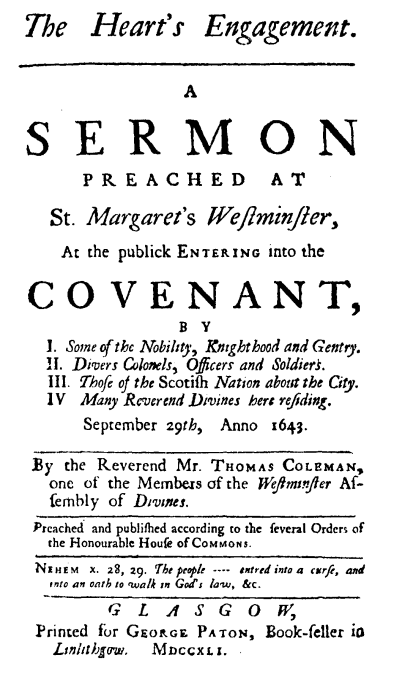
"And because of all this, we make a sure covenant, and
write it; and our princes, Levites, and priests, seal unto it." —Nehemiah ix. 38.
The general subject of this verse, is the special business of
this day. A solemn engagement to the Lord, and among
ourselves, in a sure covenant. Wherein we may consider
these five things.
First, The nature of a covenant, from the whole.
Secondly, The grounds of a covenant, from those words,
"because of all this."
Thirdly, The property of a covenant, in that epithet,
Sure—"we make a sure covenant."
Fourthly, The parties entering into, and engaging themselves
in a covenant, expressed by their several degrees and
functions, Princes, Levites, priests. And were these all?
All whom this verse specifies, and enow to bring in all the
rest? Where the governors and the teachers go before in
an holy example, what honest heart will not follow? And
the next chapter shews us, all who were honest hearted,
following this holy example, verse 28: "And the rest of
the people, the priests, the Levites, the porters, the singers,
the Nethinims, and all they that had separated themselves
from the people of the lands, unto the law of God, their
wives, their sons, and their daughters, every one having
knowledge, and having understanding: They clave unto
their brethren, their nobles, and entered into," &c.
Fifthly, The outward acts by which they testified their
inward sincere consent, and engaged themselves to continue
faithful in that covenant: First, writing it. Second, sealing
to it. Third, (in the tenth chapter, ver. 29.) "They entered
into a curse." Fourth, "Into an oath, to walk in God's law,
which was given by Moses the servant of God, and to
observe to do all the commandments of the Lord their God,
with the statutes and judgments. And that they would not
give their daughters to the people of the land," &c: with
divers many articles of that covenant, tending both to their
ecclesiastical and civil reformation.
I begin with the first point, the nature of a covenant.
Concerning which, we may receive some light from the
notation of the original words; 1. For a covenant. 2. For
the making of a covenant. The Hebrew Berith (a covenant)
comes from Barah, which signifieth two things: First, To
choose exactly, and judiciously. Second, To eat moderately,
or sparingly. And both these significations of the root Barah,
have an influence upon this derivative Berith, a covenant:
the former of these intimating, if not enforcing, that a
covenant is a work of sad and serious deliberation, for such
are elective acts. Election is, or ought to be made, upon
the rational turn of judgment, not upon a catch of fancy,
or the hurry of our passions.
Now, in a covenant, there is a double work of election:
First, An election of the persons, between whom. Second,
An election of the conditions, or terms upon which the
covenant is entered. As God's covenant people are His
chosen people, so must ours. Some persons will not enter
into covenant, though invited; and others, though they
offer themselves, are not to be admitted. They who are
not fit to build with us, are not fit to swear with us. Some
offered their help to the Jews in the repair of the temple,
"Let us build with you, for we seek your God." But this
tender of their service was refused. "Ye have nothing to do
with us, to build an house unto our God; but we ourselves
together will build." What should we do with their hands
in the work, whose hearts, we know, are not in the work?
The intendment of such enjoining, must be either to build
their hay and stubble with our gold and silver, or else to
pull down by night what they build by day, and secretly
to undermine that noble fabric, which seemingly they
endeavoured to set up. We find in this book of Nehemiah,
that the persons combining in that covenant, were choice
persons. The text of the tenth chapter, sets two marks of
distinction upon them. First, "All they that separated
themselves from the people of the lands, unto the law of
God." Second, All "having knowledge, and having understanding."
Here are two qualifications, whereof one is
spiritual, and the other is natural. The plain English of
both may be this, "that fools and malignants, such as (in
some measure) know not the cause, and such as have no
love at all to the cause, should be outcasts from this
covenant." Such sapless and rotten stuff will but weaken,
if not corrupt this sacred band.
The tenor of the covenant now tendered, speaks thus
respecting the persons. "We noblemen, barons, knights,
gentlemen, citizens, burgesses, ministers of the gospel, and
commons, of all sorts, in the kingdom of England, Scotland,
and Ireland." And doth not this indistinctly admit all, and
all, of all sorts? I answer, no. For the words following
in the preface, shew expressly, that only they are called to
it, who are of one reformed religion; which shuts out all
papists, till they return. And the articles pass them through
a finer sieve, admitting only such as promise, yea, and
swear, that through the grace of God, they will sincerely,
really, and constantly endeavour the preservation of the
reformed religion, against the common enemy in the one
kingdom, the reformation and extirpation of what is amiss
in the other two; as also, in their own persons, families,
and relations. They who do thus, are choice persons
indeed, and they who swear to do thus, are (in charity and
justice) to be reputed so, till their own acts and omissions
falsify their oaths. Thus our covenant makes an equivalent,
though not a formal or nominal election of the persons.
Second, There must be a choice of conditions in a covenant;
as the persons obliged, so the matter of the obligation must
be distinct. This is so eminent in the covenant offered,
that I may spare my pains in the clearing of it; every
man's pains in reading of it, cannot but satisfy him, that
there are six national conditions about which we make
solemn oath, and one personal, about which we make a
most solemn profession and declaration, before God and the
world. And all these are choice conditions: such as may
well be held forth to be (as indeed they are) the results and
issues of many prayers, and serious consultations, in both
the kingdoms of England and Scotland. Conditions they
are, in which holiness and wisdom, piety and policy, zeal
for God in purging His church, and care for man in settling
the commonwealth, appear to have had (in a due subordination)
their equal hand and share.
Thus much of a covenant, from the force of the word in
the first sense, leading us to the choice both of persons and
conditions.
Second, The root signifies, to eat moderately, or so much
as breaks our fast. And this refers also to the nature of a
covenant, which is to draw men into a friendly and holy
communion, and converse one with another. "David
describes a familiar friend, in whom he trusted, to be one,
that did eat of his bread." And the apostle Paul, when he
would have a scandalous brother denied all fellowship in
church-covenant, he charges it thus, "With such a one, no
not to eat." Hence it was a custom upon the making up
of covenants, for the parties covenanting, soberly to feast
together. "When Isaac and Abimelech sware one to
another, and made a covenant; the sacred story tells us,
that Isaac made them a feast, and they did eat and drink."
A covenant is a binder of affection, to assure it, but it is a
loosner of affection, to express it. And their hearts are
most free to one another, which are most bound to one
another. How unbecoming is it, that they who swear
together, should be so strange as scarce to speak together?
That which unites, ought also to multiply our affections.
Further, the word hints so to converse together as not
to sin together; for it signifies moderation in eating. As
if it would teach us, that at a covenant-feast, or when
covenanters feast, they should have more grace, than meat
at their tables: or if (through the blessing of God) their
meat be much, their temperance should be more. The
covenant yields us much business, and calls to action:
excess soils our gifts, and damps our spirits, fitting us for
sleep, not for work. In and by this covenant, we (who were
almost carried into spiritual and corporal slavery) are called
to strive for the mastery. Let us therefore (as this word and
the apostle's rule instruct us) "Be temperate in all things."
Intemperate excessive eaters will be but moderate workers,
especially in covenant-work. A little will satisfy their
consciences, who are given up to satisfy their carnal
appetites. And he who makes his belly his god, will not
make much of the glory of God.
So much concerning the nature of a covenant, from the
original word; for a covenant, signifying both to chuse, and
to eat. We may take in some further light to discover the
things from the original word, which we translate "make"—"Let
us make a covenant."
That word signifies properly to cut, to strike, or to slay.
The reason hereof is given, because at the making of solemn
covenants, beasts were killed and divided asunder, and the
covenant-makers went between the parts. When God made
that first grand covenant with Abraham, He said unto him,
"Take an heifer of three years old, and a she-goat of three
years old. And he took unto him all these, and divided
them in the midst, and laid all those pieces one against
another." "Behold, a smoking furnace, and a burning lamp"
(which latter was the token of God's presence for the
deliverance of His people) passed between those pieces.
In Jeremiah we have the like ceremony in making a
covenant, "They cut the calf in twain, and passed between
the parts thereof." Upon this usage the phrase is grounded
of cutting or striking a covenant. Which ceremony had this
signification in it, that when they passed between those
divided parts of the slain beast, the action spake this curse
or imprecation, "Let him be cut asunder, let his members
be divided, let him be made as this beast, who violates the
oath of this covenant."
From these observations about the words, we may be
directed about the nature of the thing: and thence collect
this description of a covenant. A covenant is a solemn
compact or agreement between two chosen parties or more,
whereby with mutual, free, and full consent they bind themselves
upon select conditions, tending to the glory of God,
and their common good.
A covenant strictly considered, is more than a promise,
and less than an oath; unless an oath be joined with it, as
was with that in the text, and is with this we have now
before us. A covenant differs from a promise gradually,
and in the formalities of it, not naturally, or in the substance
of it. God made promises to Abraham, Gen. xii. and Gen.
xiii. but He made no covenant with him, till chap. xv. ver.
18. "In that day the Lord made a covenant with
Abraham." And the work of the Lord in that day with
Abraham, had not only truth and mercy in it, but state and
majesty in it. A covenant day, is a solemn day. As the
collection of many stars makes a constellation, so the collection
of many promises makes a covenant. Or, as in the first
of Genesis, "The gathering together of the waters, was by
the Lord called seas:" so we may call the gathering together
of promises, or conditions, a covenant. The Lord doth
(as it were) rally all the promises of mercy made to us,
which lie scattered up and down through the whole volume
of the scriptures, and puts them together into a covenant:
and we do (as it were) rally all the promises of duty which
we owe unto God, and to one another, and put them
together in a covenant. Such a bundle of duty is tied up
in this present covenant; what duty is there which we owe
to God, to His churches, or these commonwealths whereof
we make not promise, either expressly, or by consequence
in the compass of this covenant? And how great an
obligation to duly doth this contain, wherein there is an
obligation to every duty?
Seeing then this covenant, being taken, carries in it so
great an obligation, it calls for great preparation before we
take it. A slightness of spirit in taking this covenant, must
needs cause a slightness of spirit in keeping it. All solemn
duties, ought to have solemn preparations; and this I think,
as solemn as any. A Christian ought to set his heart (as far
as he can through the strength of Christ) into a praying
frame, before he kneels down to prayer. And we ought to
set our hearts in a promising frame, before we stand up to
make such mighty promises. "Take heed how ye hear," is
our Saviour's admonition in the gospel; surely then we had
need take heed how we swear. "Let a man examine
himself (saith the apostle Paul) and so let him eat of that
bread, and drink of that cup;" let him come examined to
the sacrament: so I may say, "Let a man examine himself,
before he lift up his hand, or write down his name;" let him
come examined to the covenant.
I shall briefly propose three heads of preparatory examination,
respecting our entrance into this covenant.
First, Examine your hearts, and your lives, whether or
no you are not pre-engaged in any covenant contrary to the
tenor and conditions of this covenant? If any such upon
inquiry be found, be sure you avoid it, before you engage
yourselves in this. A super-institution in this kind, is very
dangerous. Every man must look to it, that he takes this
covenant (corde vacante) with a heart emptied of all
covenants which are inconsistent with this. For a man to
covenant with Christ and His people for reformation, while
he hath either taken a covenant with others, or made a
covenant in his own breast against it, is desperate wickedness.
Or if upon a self-search, you find yourselves clear of
any such engagements, yet search further. Every man by
nature is a covenanter with hell, and with every sin he is at
agreement: be sure you revoke and cancel that covenant,
before you subscribe this. "If I regard iniquity in my
heart, the Lord will not hear my prayer;" that is, He will
not regard my prayers, (saith David). And if we regard
iniquity in our hearts, the Lord will not hear us covenanting;
that is, He will not regard our covenant. Woe be unto
those who make this league with God and His people, while
they resolve to continue their league with sin: which is (upon
the matter) a league with Satan. God and Satan will never
meet in one covenant. "For what communion hath light
with darkness? and what concord hath Christ and Belial?"
Second, Before you enter into this covenant with God,
consider of, and repent for this special sin, your former
breaches and failings in God's covenant. "We who were
sometimes afar off, aliens from the commonwealth of Israel,
and strangers from the covenant of promise, are made nigh
by the blood of Jesus," even so nigh, as to be in covenant
with God. Some who pretend to this privilege, will be
found "Such as have counted the blood of the covenant to
be an unholy thing." And where is the man that walketh
so holily in this covenant as becomes him, and as it
requires? Labour therefore to have those breaches healed
by a fresh sprinkling of the blood of Christ upon your
consciences, before you enter this covenant: If you put this
new piece to an old garment, the rent will be made worse:
If you put this new wine into old bottles, the bottles will
break, and all your expected comforts will run out and be
lost. If you should not feel and search your own hearts, without
doubt the Lord will. "And if you be found as deceivers,
you will bring a curse upon yourselves, and not a blessing."
This is a covenant of amity with God: reconciliation must
go before friendship, you can never make friendship till
you have made peace, nor settle love, where hostility is
unremoved.
Third, Inquire diligently at your own hearts, whether
they come up to the terms of this covenant? You must
bid high for the honour of a covenanter, for a part in this
privilege. "Which of you," saith our Lord Christ to His
hearers, "intending to build a tower, sitteth not down first,
and counteth the cost, whether he have sufficient to finish
it? Lest haply after he hath laid the foundation, and is not
able to finish it, all that behold it, begin to mock him,
saying, this man began to build, and was not able to finish."
We are met this day to lay the foundation of one tower, and
to pull up the foundation of another; we are pulling up the
foundation of Babel's tower, and we are laying a foundation
for Zion's tower. We have seen some who have heretofore
done as much, but they have done no more; when they had
laid a foundation for those noble works in taking a solemn
oath and covenant, they have never moved a hand after
either to build or to pull down, unless it were quite cross to
their own engagements, for the pulling down of Zion's tower,
and the building of Babylon.
And what was the reason of this stand, or contrary
motion? this surely was one, they did not gage their own
hearts before hand, neither did they sit down to count the cost
of such an undertaking. And therefore when they perceived
the charge to arise so high, they neither could finish,
nor would they endeavour it, but left the work before it
looked above the ground; and are justly become a mock
and a scorn and a reproach in Israel, these are the men that
began in a solemn covenant to build, but could not finish;
they had not stock enough either of true honour or honesty
(tho' their stock of parts and opportunities was sufficient) to
finish this work.
Let us therefore sit down seriously and count the cost;
yea and consider whether we be willing to be at the cost.
To lead you on in this, my humble advice is, that you would
catechise your hearts upon the articles of this covenant.
Put the question to your hearts, and let every one say this
unto himself:
Am I indeed resolved sincerely, really and constantly,
through the grace of God, in my place and calling, to
endeavour the preservation of the reformed religion in the
church of Scotland? The reformation of religion in the
kingdoms of England and Ireland?
Am I indeed resolved in like manner, without respect of
persons, to endeavour the extirpation of popery, prelacy?
Am I indeed resolved never to be withdrawn or divided
by whatsoever terror or persuasion from this blessed union
and conjunction, whether to make defection to the contrary
part, or to give myself to a detestable indifferency or neutrality
in this cause of God?
Am I indeed resolved to humble myself for my own sins,
and the sins of the kingdom? to amend myself, and all in
my power, and to go before others in the example of a real
reformation?
According to these hints, propose the question upon every
clause of this covenant. And then consider what the cost
of performing all these may amount to, and whether you are
willing to go to that cost.
But it may be, some will say, what is this cost? I answer,
the express letter of the covenant tells you of one cost which
you must be constantly at, and that is sincere, real, and constant
endeavour. Pains is a price, I am sure real pains is.
The heathens said, "That their gods sold them all good
things for labour." The good things of this covenant are
sold at that rate; yea, this is the price which the true God
puts upon those things which He freely gives. To consent
to this covenant, to wish well to this covenant, to speak well
of this covenant, come not up to the price; you must do
these, and you must do more, you must be doing, so the
promise of every man for himself runs, I will through the
grace of God endeavour. Yet every endeavour is not current
money, payable as the price of this covenant: there must be
a threefold stamp upon it. Unless it bear the image and
superscription of sincerity, reality, and constancy, it will not
be accepted. For so the promise runs, "I will sincerely,
really, and constantly endeavour."
Neither yet is this all. Such endeavours are virtually
money; but as this covenant calls also for money formally,
as the price of it, he that really endeavours after such ends,
as here are proposed, must not only be at the cost of his
pains, but also at the cost of his purse for the attainment of
them. He must open his hand to give and to lend as well
as to work and labour. Unless a man be free of his purse
as well as of his pains, he bides not up to the demands of
this covenant, nor pays up to his own promise when he
entered into it. Can that man be said really to endeavour
the maintenance of a cause while he lets it starve? or, to
strengthen it while he keeps the sinews of it close shut up?
Would he have the chariot move swiftly, who only draws
but will not oil the wheels? Know then and consider it
that the cost you must be at is both in your labours and in
your estates. The engagement runs to both these: and to
more than both these.
The covenant engages us not only to do but to suffer,
not only to endeavour but to endure. Such is the tenor of
the sixth article where every man promises for himself that
he will not suffer himself to be withdrawn from this blessed
Union by any terrors. If not by any terror, then not by
any losses, imprisonments, torments, no, nor by death, that
king of terrors. You see, then, that the price of this
covenant may be the price of blood, of liberty, and of life.
Sit down and consider. Are you willing to be at this cost
to build the tower? Through the goodness of God in
ordering these great affairs, you may never come actually
to pay down so much, haply, not half so much, but
except you resolve (if called and put to it by the real
exigencies of this cause) to pay down the utmost farthing,
your spirits are too narrow and your hearts too low for
the honour and tenor of this covenant. If any shall
say these demands are very high and the charge very
great, but is a part in this covenant worth it? Will it
quit cost to be at so great a charge? Wise men love
to see and have somewhat for their money; and when
they see they will not stick at any cost so the considerations
be valuable.
For the answering and clearing of this, I shall pass to the
Second point which holds forth the grounds of a covenant
from those words of the text, "And because of all this."
If any one shall be troubled at the "All this" in the price,
I doubt not but the "All this" in the grounds will satisfy
him. Because of all this, we make a sure covenant.
Here observe:
1. A covenant must be grounded on reason: we must
shew the cause why. God often descends, but man is
bound, to give a reason of what he doeth. Some of God's
actions are above reason, but none without reason. All our
actions ought to be level with reason and with common
reason, for it is a common act. That which men of all
capacities are called to do, should lie in the reach of every
man's capacity. Observe:
2. A covenant must be grounded on weighty reason;
there must be much light in the reason (as was shewed
before) but no lightness. "Because of all this" saith the
text. There were many things in it, and much weight in
every one of them.
And the reasons, in their proportion, must at least be as
weighty as the conditions. Weighty conditions will never be
balanced with light reasons. If a man ask a thousand
pounds for a jewel, he is bound to demonstrate that his
jewel is intrinsically worth so much, else no wise man will
come up to his demands. So when great things are
demanded to be paid down by all who take part in this
covenant, we are obliged to demonstrate and hold forth an
equivalent of worth in the grounds and nature of it. Hence
observe
3. That the reasons of a covenant must be express,
"Because of all this." This is demonstrative. Here's the
matter laid before you, consider of it, examine it thoroughly.
This is fair dealing, when a man sees why he undertakes,
and what he may expect, before he is engaged. And so
may say, "Because of this, and this, because of all this," I
have entered into the covenant.
But what were the particulars that made up the gross sum
of all this? I answer, those particulars lie scattered
throughout the chapter, the attentive reader will easily find
them out; I shall in brief reduce them unto two heads.
1. The defection and corruptions that were crept in, or openly
brought in among them. 2. The afflictions, troubles, and
judgments that either were already fallen, or were feared
would further fall upon them.
The former of these causes is laid down in the 34 and 35
verses of this chapter. "Neither have our kings, our princes,
our priests, nor our fathers kept Thy law, nor hearkened to
Thy commandments, and Thy testimonies, wherewith Thou
didst testify against them. For they have not served Thee
in Thy kingdom, and in Thy great goodness."
The latter of these reasons is contained in the 36 and 37
verses. "Behold, we are servants this day; and for the
land which Thou gavest unto our fathers, to eat the fruit
thereof, and the good thereof, behold, we are servants in it."
The close of all is, we are in great distress. From this
narrative of the grounds, the making of a covenant is
inferred as a conclusion, in the immediate subsequent words
of the text, "because of all this." As if he had said,
"because we are a people who have so departed from the
laws and statutes of our God, and are so corrupted both in
worship, and in practice; because we are a people so
oppressed in our estates, and liberties, and so distressed by
judgments and afflictions: therefore, because of all this, we
make a sure covenant."
And if we peruse the records of the holy Scripture, we
shall find, that either both these grounds conjoined, or one
of them, are expressed as the reasons at any time inducing the
people of God, to enter into the bond of a covenant. This
is evident in Asa's covenant, 2 Chron. xv. 12, 13. In
Hezekiah's, 2 Chron. xxix. 10. In Josiah's, 2 Chron. xxxiv.
30, 31. In Ezra's, chap. x. 3. To all which, I refer the
reader for satisfaction. And, from all consenting with this in
the text, I observe:
That when a people are corrupted or declined in doctrine,
worship, and manners; when they are distressed in their
liberties, livelihoods, or lives; then, and at such a time they
have warrantable and sufficient grounds to make and engage
themselves (as their last and highest resort for redress) in the
bonds of a sacred solemn covenant.
What engagement can be upon us, which these reasons do
not reach and answer? The liberty of our persons, and of
our estates, is worth much; but the liberty of the gospel
and purity of doctrine and ordinances, are worth much more.
Peace is a precious jewel, but who can value truth? The
wise merchant will sell all that he hath with joy to buy this,
and blesses God for the bargain.
And because of all this, we are called to make a covenant
this day. Truth of doctrine and purity of worship were
going, and much of them both were gone. The liberty of
our persons, and property of our estates, were going, and
much of them both were gone; we were at once growing
popish and slavish, superstitious and servile; we were in
these great distresses, "And because of all this we make a
covenant this day." That these are the grounds of our
covenant, is clear in the tenor of the covenant. The
preamble whereof speaks thus:
"We calling to mind the treacherous and bloody plots,
conspiracies, attempts, and practices of the enemies of God,
against the true religion and professors thereof, in all places,
especially in these three kingdoms, ever since the reformation
of religion; and how much their rage, power and
presumption are of late, and at this time increased and
exercised, whereof the deplorable estate of the church and
kingdom of Ireland, the distressed estate of the church and
kingdom of England, and the dangerous estate of the
church and kingdom of Scotland, are present and public
testimonies: we have now at the last, for the preservation
of ourselves, and our religion, from utter ruin
and destruction, after mature deliberation resolved and
determined to enter into a mutual and solemn league and
covenant."
So then, if we be asked a reason of our covenant, here
are reasons, clear reasons, easy to the weakest understanding,
yea, open to every man's sense. Who amongst us hath not
felt these reasons? and how many have smarted their proof
unto us? And as these reasons are so plain, that the most
illiterate and vulgar understandings may conceive them; so
they are so weighty and cogent, that the most subtile and
sublime understandings cannot but be subdued to them;
unless, because they are such masters of reason, they have
resolved to obey none. And yet where conscience is indeed
unsatisfied, we should rather pity than impose, and labour
to persuade, rather than violently to obtrude. Now seeing
we have all this for the ground of a covenant, let us cheerfully
and reverently make a sure covenant, which is the
third point in the text, the property of this covenant: we
make a sure covenant.
In the Hebrew, the word covenant is not expressed. The
text runs only thus, we make a sure one, or a sure thing.
Covenants are in their own nature and constitution, things
of so much certainty and assurance, that by way of
excellency, a covenant is called, a sure one, or an assurance.
When a sure one is but named, a covenant must be
understood. As, the "Holy One" is God, and the "Holy
One and the Just," is Christ. You may know whom the
Holy Ghost means, when He saith "The Holy One and the
Just." So the sure one, is a covenant. You may know what
they made, when the Holy Ghost saith, they made a sure
one. Hence observe, that
A well grounded covenant is a sure, a firm, and an
irrevocable act. When you have such an all this, (and such
you have) as is here concentrated in the text, to lay into, or
for the foundation of a covenant, the superstruction is
æternitati sacrum, and must stand for ever.
A weak ground is but a weak obligation; and a sinful
ground is no obligation. There is much sin in making a
covenant upon sinful grounds, and there is more sin in
keeping of it. But when the preservation of true religion,
and the vindication of just liberties meet in the groundwork,
ye may swear and not repent; yea, if ye swear, ye
must not repent. For because of all such things as these,
we ought (if we make any, and that we ought) to make a
sure covenant.
The covenant God makes with man is a sure covenant.
Hence called a "Covenant of salt," because salt preserves from
perishing and putrefaction. The covenant of God with
man about temporal things, is called a "Covenant of Salt,
and a covenant forever." For tho' His covenant about
temporal things (as all temporals must) hath an end of termination,
yet it hath no end of corruption: time will conclude it,
but time cannot violate it. But as for His covenant about
eternal things, that, like eternity, knows not only no end of
corruption, but none of termination. "Altho' my house (saith
gasping David) be not so with God; yet He hath made with
me an everlasting covenant, ordered in all things and sure: for
this is all my salvation, and all my desire, altho' He make it
not to grow." And what is it that makes the covenant of
God with man thus sure? sure not only in itself, but (as the
apostle speaks) to all the seed. Is it not this, because it
hath a strong foundation, a double, impregnable foundation?
First, His own free grace. Second, The blood of Christ;
which is therefore also called, the blood of the covenant.
Because of all this, this all, which hath an infinity in it,
the Lord God hath made with us a sure covenant.
Now, as the stability and everlastingness of God's covenant
with His elect, lies in the strength of the foundation, "His
own love, and the blood of His Son:" so the stability and
firmness of our covenant with God, lies in the strength of
this foundation, the securing of the gospel, and the asserting
of gospel-purity in worship, and privileges in government;
the securing of our lives, and the asserting of our common
liberties. When at any time ye can question, and, from the
oracles of truth, be resolved, that these are sufficient grounds
of making a covenant, or that these are not ours, ye may
go, and unassure the covenant which ye make this day.
Application. Let me therefore invite you in the words of
the prophet Jeremiah, "Come let us join ourselves to the
Lord, in a perpetual covenant that shall never be forgotten."
And do not these look like the days wherein the prophet
calls to the doing of this? "In those days, and at that
time, saith the Lord." What time, and what days were
those? the beginning of the chapter answers. "The word
that the Lord spake against Babylon, declare ye among
the nations, and publish, and set up a standard, publish
and conceal not: say, Babylon is taken, Bell is confounded,
Merodach is broken in pieces; her idols are confounded,
her images are broken in pieces: for out of the north there
cometh up a nation against her, which shall make her land
desolate." Then follows, "In those days and at that time
saith the Lord, the children of Israel shall come. And they
shall ask the way to Zion, with their faces thitherward saying,
Come, and let us join ourselves to the Lord, in a perpetual
covenant that shall not be forgotten."
Are not these the days, and this the time (I speak not of
time to a day, but of time and days) wherein the Lord
speaks against Babylon, and against the land of the
Chaldeans: wherein He saith, "Declare among the nations,
and publish, and set up the standard." Are not these the
days, and this the time, when out of the north there cometh
up a nation against her? As face answers face in the water,
so do the events of these days answer, if not the letter, yet
much of the mystery of this prophecy. There seems
wanting only the work which this day is bringing forth, and
a few days more (I hope) will bring unto perfection, the
joining of ourselves in a perpetual covenant, never to be
forgotten. It is very observable, how the prophet, as it
were, with one breath saith, "Babylon is taken." And,
"Come let us join ourselves in covenant." As if there were
no more in it but this, take the covenant, and ye take
Babylon. Or, as if the taking of a covenant were the ready
way, the readiest way to take Babylon. Surely at the report
of the taking of this sure covenant, we in our prayer-visions
(as the prophet Habakkuk), "May see the tents of Cushan
in affliction, and the curtains of the land of Midian tremble."
Or, as Moses in his triumphant song, "The people shall
hear, and be afraid: sorrow shall take hold of the inhabitants
of Palestina. The dukes of Edom shall be amazed; the
mighty men of Moab, trembling shall take hold upon them;
the inhabitants of Canaan (who are now the inhabitants of
Babylon) shall melt away. The towers of Babylon shall
quake, and her seven hills will move. The great mountain
before our Zerubbabel, will become a plain, and we shall
bring forth the head-stone (of our reformation) with shouting,
crying, grace, grace unto it." Why may we not promise to
ourselves such glorious effects (and not build these castles
in the air) when we have laid so promising a foundation,
this sure covenant, and have made a perpetual covenant,
never to be forgotten?
The three things I shall propose, which this covenant will
bring in, as facilitating contributions to so great a work:
1. This covenant will distinguish men, and separate the
precious from the vile. In the twentieth chapter of Ezekiel,
the Lord promiseth His people, after this manner, "I will
cause you to pass under the rod, and I will bring you into
the bond of the covenant." The phrase of causing to pass
under the rod, is an allusion to shepherds, or the keepers of
cattle, who when they would take special notice of their
sheep or cattle, either in their number to tithe them, or in
their goodness to try them, they brought them into a fold,
or some other inclosed place, when letting them pass out
at a narrow door, one by one, they held a rod over them, to
count or consider more distinctly of them. This action was
called a "passing of them under the rod," as Moses teaches
us, "And concerning the tithe of the herd, or of the flock,
even of whatsoever passeth under the rod, the tenth shall be
holy unto the Lord." The learned Junius expounds that
text in Ezekiel by this in Leviticus, giving the sense thus,
"As if the Lord had said, I will prove and try the whole
people of Israel, as a shepherd doeth his flock, that I may
take the good and sound into the fold of My covenant, and
cast out the wicked and unsound." Which interpretation
is not only favoured, but fully approved, in the words
immediately following, "I will bring you into the bond of
the covenant, and I will purge out from among you the
rebels, and them that transgress against Me."
A covenant is to a nation, as a fan to the floor, which
purges away the chaff and purifies the wheat. It is like the
furnace to the metal, which takes away the dross and shews
you a refined lump. It is a Shibboleth, to distinguish
Ephraimites from Gileadites. And who knows not how
great an advantage it is for the successful carrying on of any
honourable design, to know friends from enemies, and the
faithful from false brethren? Some have thought it
unpolitical to set-a-foot this covenant, lest it should discover
more enemies than friends, and so holding out to the view
more than otherwise can be seen, the weakness of a party
may render them, not only more obnoxious, but more
inconsiderable.
To this I answer, in a word, invisible enemies will ever
do us more hurt than visible; and if we cannot deliver
ourselves from them, when they are seen and known,
doubtless unseen and unknown, they will more easily, tho'
more insensibly devour us. And I verily believe, we have
already received more damage and deeper wounds from
pretended friends, than from professed and open enemies.
The sad stories of Abner and Amasa inform us, that there
is no fence against his stroke, who comes too near us, who
stabs while he takes us aside to speak kindly to us, who
draws his sword, while he hath a kiss at his lips, and art
thou in health, my brother, at his tongue. Let us never
think ourselves stronger, because we do not know our
weakness; or safer, because we are ignorant of our danger.
Or that our real enemies and false friends will do us less
hurt, because they are less discovered. I do not think,
that a flock ever fared the better, because the wolves that
were amongst them, went in sheep's clothing. Rather will
our knowledge be our security, and the discovery which this
covenant makes, help on both our deliverance and our
business. For as, possibly, this covenant may discover
those who are faithful to be fewer, than was supposed before
this strict distinction from others; so it will certainly make
them stronger than they were before, by a stricter union
among themselves. And this is
2. The second benefit of this covenant, which I shall
next insist upon. As it doth separate those who are
heterogeneal, so likewise it will congregate and embody
those who are homogeneal. And therefore it cannot
but add strength unto a people; for whatsoever unites,
strengthens. A few united, are stronger than a scattered
multitude. Tho' they who subscribe this covenant should
be, comparatively, so few, as the prophet speaks, "That a
child may write them;" yet this few thus united are
stronger than so many scattered ones, as exceed all
arithmetic, whom (as John speaks,) "No man can number."
Cloven tongues were sent, to publish the gospel, but not
divided tongues, much less divided hearts: the former
hindered the building of Babel, and the latter, tho' tongues
should agree, will hinder the building of Jerusalem. Then
a work goes on amain, when the undertakers, whether they
be few or many, all speak and think the same thing. A
people are more considerable in any work, because they are
one, than because they are many. But when many and one
meet, nothing can stand before them. So the Lord God
observed, when "He came down to see the city and the
tower, which the children of men builded." And the Lord
said, "Behold, the people is one, and they have all one
language: and this they begin to do; and now nothing will
be restrained from them, which they have imagined to do."
Men may do as much as they can think, while they all
think and do as one; and not only can such do great
things, if let alone; but none can let them in doing what
they intend; so saith the Lord, "They have begun to do,
and nothing will be restrained from them, which they have
imagined." Nothing could restrain, or let them from their
work, but His power, who "will work, and none can let it."
Thus it is apparent that union is our strength. And it is
as apparent that this covenant, through the blessing of God
upon it, will be our union. To unite, is the very nature of
a covenant. Hence it is called "the bond of the covenant,
I will bring you into the bond of the covenant," saith the
Lord. Junius and some others render it, I will bring you
(ad exhibitionem fœderis) to the giving or tendering of the
covenant: deriving the word from Masar, signifying, to
exhibit or deliver. Whence (to note that in passage) the
traditionary doctrine among the Jews is called Masora, or
Masoreth. Others (whom our translators fellow, and put
the former sense, delivering, in the margin) others, I say,
deriving the word from Asar to bind, render it the bond of
the covenant.
And this covenant is the bond of a twofold union.
First, It unites us of this kingdom among ourselves, and
this kingdom with the other two. Second, It makes a special
union of all those who shall take it holily and sincerely
throughout the three kingdoms with the one-most God.
Weak things bound together, are strong, much more then,
when strong are bound up with strong: most of all, when
strong are bound up with Almighty. If in this covenant,
we should only join weak to weak, we might be strong.
But, blessed be God, we join strong, as creatures may be
accounted strong, with strong. The strong kingdoms of
England and Ireland, with the strong kingdom of Scotland.
A threefold cord twisted of three such strong cords, will not
easily, if at all, be broken. They which single, blessed be
God, have yet such strength, how strong may they be when
conjoined? as the apostle writes, "I speak after the manner
of men, because of the infirmity of your flesh:" so I speak
now after the manner of men, concerning the strength of
our flesh, outward means, in these kingdoms. For as the
apostle Peter speaks in like phrase, tho' to another occasion,
"The Lord is not slack concerning His promise, as some
men count slackness:" so I may say, no man, no kingdoms,
are strong to any purpose, as the Lord counts strength.
And therefore, I reckon this the least part of our
strength, that these three strong kingdoms will be united by
this covenant. Nay, if this were all the strength, which this
union were like to make, I should reckon this no strength at
all. Wherefore, know that this covenant undoubtedly is,
and will be a bond of union between strong and Almighty:
between three strong nations, and an Almighty God. This
covenant engages more than man, God also is engaged;
engaged, through His free grace, in His power, wisdom,
faithfulness, to do us good, and much good, tho' in and of
ourselves unworthy of the least, unworthy of any good.
All this considered, this covenant will be our strength:
our brethren of Scotland have, in a plentiful experience,
found it so already. This covenant, thro' the blessing of God
upon their councils and endeavours, hath been their Samson's
lock, the thing in fight, wherein their strength lieth. And
why should not we hope, that it will be ours; if we can be
wise, as they, to prevent or overcome the flattering
enticements of those Delilahs who would lull us asleep in
their laps, only for an opportunity to cut or shave it off?
Then indeed, which God forbid, we should be but weak like
other men, yea, weaker than ourselves were before this lock
was grown, having but the strength of man; God utterly
departing from us, for our falseness and unfaithfulness in this
covenant.
3. This covenant observed will make us an holy people,
and then, we cannot be an unhappy people. That which
promotes personal holiness, must needs promote national
holiness. The consideration that we are in the bonds of a
covenant, is both a bridle to stop us from sin, and a spur to
duty. When we provoke God to bring evil upon us, He
stays His hand by considering His covenant. "I will
remember My covenant, saith the Lord, which is between Me,
and you; and every living creature of all flesh; and the
waters shall no more become a flood to destroy all flesh."
As if the Lord had said, It is more than probable, that I
shall quickly see as much cause, "all flesh corrupting all
their ways before Me," to drown the world with a second
deluge, as I did for the first: the foulness of the world, will
quickly call for another washing. But I am resolved, never
to destroy it by water again; for, "I will remember My
covenant." Hence also in the second book of the
Chronicles, chap. xxi. where the reign and sins of Jehoram
are recorded; such sins as might justly put a sword into the
hand of God to cut him off root and branch; howbeit, saith
the text, "The Lord would not destroy the house of David,
because of the covenant that He had made with David, and
as He promised to give a light to him, and to his sons
forever." Now, as the remembrance of the covenant on His
part, stays the hand of God from smiting; so the
remembrance of the covenant on our part, will be very
effectual to stay our hands, and tongues, and hearts from
sinning. A thought of that will damp and silence our lusts
and passions, when they begin to move or quest within us:
it will also break the blow of Satan's temptations, when he
assaults us. The soul in such cases will answer, True, I am
now as strongly tempted to sin as ever, I have now as
fair an opportunity to commit sin as ever, I could now be false
to, and desert this cause with as much advantage, upon as
fair hopes and promises as ever: O! but I am in covenant,
I remember my covenant, I will not, I cannot do it; and so
he falls a praying against the temptation: yea, he begs
prayers of others, that he may be strengthened against, and
overcome it. I read you an instance of this effect. Before the
sermon, a paper is sent to this congregation, containing this
request: "One who through much passion oftentimes
grievously offends the Majesty of God by cursing and
swearing, and that since his late taking the covenant,
desires the prayers of this congregation, that his offence may
be pardoned, and that he may be enabled to overcome that
temptation from henceforwards." This is the tenor of that
request, to a letter and a tittle, and therein you see how the
remembrance of the covenant wrought. Probably this
party (whosoever he was) took little notice of, or was little
troubled at the notice of these distempers in himself before;
least of all sought out for help against them. And I have the
rather inserted this to confute that scorn which, I hear, some
have since put upon that conscientious desire. As if one had
complained, that since his swearing to the covenant he could
not forbear swearing, and that this sacred oath had taught
him profane ones. But what holy thing is there which
swine will not make mire of, for themselves to wallow in?
I return; and I nothing doubt, but that this covenant,
wherein all is undertaken through the grace of Christ, will
make many more gracious who had grace before, and turn
others, who were running on amain in the broad way, from
the evil and error of their ways, into the way which is called
holy, or into the ways of holiness. Every act wherein we
converse with an holy God, hath an influence upon our
spirits to make us holy. The soul is made more holy in
prayer, tho' holiness be not the particular matter of the
prayer: a man gets much of heaven into his heart, in praying
for earthly things, if he pray in a spiritual manner; and the
reason is because, in prayer, he hath converse with, and
draws nigh to God, whatsoever lawful thing he prays about.
And the same reason carries it in covenanting, tho' it were
only about the maintenance of our outward estates and
liberties, forasmuch as therein we have to do with God.
How much more then will holiness be increased through this
covenant which, in many branches of it, is a direct covenant
for, and about holiness? And if we improve it home to this
purpose, for the subduing of those mystical Canaanites, those
worst and indeed most formidable enemies, our sinful lusts:
if we improve it for the obtaining of more grace, and the
making of us more holy: tho' our visible Canaanites should
not only continue unsubdued by us, but subdue us; though
our estates and liberties should continue, not only
unrecovered, but quite lost; tho' we should neither be a
rich, nor a free, nor a victorious people; yet if we are an
holy people, we have more than all these, we have all, He is
ours, "Who is all in all." So much of the first general part
of the application.
The second is for admonition and caution, in three or
four particulars.
1. Take heed of "profaning this covenant," by an unholy
life. Remember you have made a covenant with heaven;
then do not live as if you had made a "covenant with hell
or were come to an agreement with death," as the prophet
Isaiah characters those monsters of profaneness. Take
heed also of "corrupting this covenant," by an unholy gloss.
Wo be unto those glossers that corrupt the text, pervert the
meaning of these words: who attempt to expound the
covenant by their own practice, and will not regulate their
practice by the covenant. The apostle Peter speaks of
Paul's writings, "That in them some things are hard to be
understood, which they that are unlearned and unstable
wrest, as they do also the other scriptures, to their own
destruction." We may fear, that tho' the text of this
covenant be easy to be understood, yet some (who, at least
think themselves learned), and whom we have found not
only stable but stiffened in their own erroneous principles
and opinions, will be trying their skill, if not their malice, to
wrest, or, as the Greek imports, to torture and set this
covenant upon the rack, to make it speak and confess a
sense never intended by the composers, or proposers of it:
and whereof (if but common ingenuity be the judge) it
never will, nor can be found guilty. All that I shall say to
such is that in the close of the verse quoted from the
apostle Peter, let them take heed such wrestings be not
(worst to themselves, even) to their own destruction.
2. Take heed of delaying to perform the duties of this
covenant. Some, I fear, who have made haste to take the
covenant, will take leasure to act it. It is possible, that a
man may make too much haste (when he swears, before he
considers what it is) to take an oath; but, having taken it
upon due consideration, he cannot make too much haste to
perform it. "Be not rash with thy mouth," saith the
preacher. That is, do not vow rashly, but, "When thou
vowest a vow unto God, defer not to pay it: for He hath
no pleasure in fools (slow performance is folly); pay that
which thou hast vowed." Speedy paying (like speedy
giving) is double payment; whereas slow payment is no
payment or as bad as none, for it is foolish payment. A
bond, if I mistake not, is presently due in law, if no day be
specified in the bond. It is so I am sure in this covenant;
here is no day set down, and therefore all is due the same
day you take it. God and man may sue this bond presently
for non-payment: the covenant gives no day, and therefore
requires the next day, every day. It is not safe to take day
for payment, when the obligation is in terminis de præsenti,
and none is given.
3. Take heed of dallying with this covenant. It is more
than serious, a sacred covenant. It is very dangerous
jesting with edged tools. This covenant is as keen as it is
strong. Do not play fast and loose with it, be not in and
out with it; God is an avenger of all such: He is a
jealous God, and will not hold them guiltless, who thus
take His name in vain. They who swear by, or to the
Lord, and swear by Malcham, are threatened to be cut off.
To be on both sides, and to be on no side; neutrality and
indifferency differ little, either in their sin or danger.
4. Above all, take heed of apostatizing from, or an utter
desertion of, this covenant. To be deserted of God, is the
greatest punishment, and to desert God, is the greatest sin.
When you have set your hands to the plough, do not look
back: remember Lot's wife. Besides the sin, this is, First,
Extremely base and dishonourable. It is one of the brands
set upon those Gentiles whom "God had given up to a
reprobate mind, and to vile affections," that they were
covenant breakers. And how base is that issue which is
begotten between, and born from vile affections, and a
reprobate mind? where the parents are such, it is easy to
judge what the child must be. Second, Besides the sin and
the dishonour, this is extremely dangerous and destructive.
We are said in the native speaking, to cut a covenant, or to
strike a covenant, when we make it; and if we break the
covenant when we have made it, it will both strike and cut
us, it will kill and slay us. If the cords of this covenant do
not bind us, the cords of this covenant will whip us; and
whip us, not as with cords, but as with scorpions. The
covenant will have a quarrel with, and sends out a challenge
unto such breakers of it, for reparation. And (if I may so
speak) the great God will be its second. As God revenges
the quarrel of His own covenant, so likewise the quarrel of
ours. He hath already "Sent a sword to revenge the
quarrel of His covenant." He will send another to revenge
the quarrel of this upon the wilful violators of it. Yea,
every lawful covenant hath a curse always waiting upon it,
like a marshal or a sergeant, to attack such high contemners
of it. It was noted before from the ceremony of killing,
dividing, and passing between the divided parts of a beast,
when covenants were made, that the imprecation of a curse
upon the covenanters was implied, in case they wilfully
transgressed or revolted from it. Let the transgressors of,
and revolters from this covenant, fear and tremble at the
same curse, even the curse of a dreadful division: "That
God will divide them and their posterity in Jacob, and
scatter them in our Israel; yea, let them fear, that God will
rebuke them, and they shall flee far off, and shall be chased
as the chaff of the mountains before the wind, and like a
rolling wind before the whirlwind. This is (their portion,
and) the portion of them that spoil us, and the lot of them
that rob us." And if so, is not their lot fallen in an
unpleasant place? have they not a dreadful heritage? to be
under any curse is misery enough; but to be under a
covenant curse, is the greatest, is all misery. For as the
blessings we receive are most sweet, when they pass to us
through the hands of a covenant; a mercy from a promise
is far better than a mercy from bare Providence, because
then it is sprinkled with the blood of Christ: so on the
other side, the curse which falls upon any one is far more
bitter when it comes through a covenant, especially an
abused, a broken covenant. When the fiery beams of God's
wrath are contracted into this burning glass, it will burn as
low as hell, and none can quench it. That alone which
quenches the fire of God's wrath is the blood of Christ.
And the blood of Christ is the foundation of this covenant.
Not only is that covenant which God hath made with us
founded in the blood of Christ, but that also which we
make with God. Were it not by the blood of Christ, we
could not possibly be admitted to so high a privilege.
Seeing then the blood of Christ only quenches the wrath of
God, and this blood is the foundation of our covenant, how
shall the wrath of God (except they repent, return and
renew their covenant) be quenched towards such violators
of it? And, as our Saviour speaks upon another occasion,
"If the light which is in them be darkness, how great is that
darkness?" So, I say, if that which is our friend turn upon
us as an enemy, how great is that enmity; and if that
which is our mercy be turned into wrath, how great
is that wrath, and who can quench it? It is said of
good king Josiah, that when he had made a covenant
before the Lord, "he caused all that were present in
Jerusalem, and in Benjamin, to stand to it." How far he
interposed his regal authority, I stay not to dispute. But
he caused them to stand to it; that is openly to attest, and
to maintain it. Methinks the consideration of these things,
should reign over the hearts of men, and command in their
spirits, more than any prince can over the tongues or bodies
of men, to cause them to stand to this covenant. Ye that
have taken this covenant, unless ye stand to it, ye will fall
by it. I shall shut up this point with that of the apostle,
"Take unto you the whole armour of God, that you may
be able to withstand in the evil day, and, when ye have done
all, to stand," (Eph. vi. 13). Stand, and withstand, are
the watchword of this covenant, or the impress of every
heart which hath or shall sincerely swear unto it.
For the helping of you to stand to this covenant, I shall
cast in a few advices about your walking in this covenant,
or your carriage in it, which, if followed, I dare say, through
the mercy of the Most High, your persons, these kingdoms,
and this cause, shall not miscarry.
1. Walk in holiness and uprightness. When God renewed
His covenant with Abraham, He makes this the preamble of
it, "I am the Almighty God, walk before Me, and be thou
perfect, and I will make My covenant between Me and
thee." As this must be a covenant of salt, in regard of
faithfulness; so there must be salt in this covenant, even
the salt of holiness and uprightness. The Jews were
commanded in all their offerings to use salt; and that is
called the salt of the covenant, "Every oblation of thy
meat-offering shalt thou season with salt, neither shalt
thou suffer the salt of the covenant of thy God to
be lacking." What is meant by salt on our parts,
is taught us by Christ Himself, "Have salt in yourselves,
and have peace one with another." Which I
take to be parallel in sense with that of the apostle,
"Follow peace with all men and holiness." As salt, the
shadow of holiness, was called for, in all those Jewish
services; so holiness, the true substantial salt, is called
for in all ours. As then it was charged, "Let not the
salt of the covenant of thy God be lacking:" so now
it is charged, "Suffer not the salt of thy covenant
with God and His people to be lacking." Seeing we
have made a covenant of salt, that is, a sure covenant,
let us remember to keep salt in our covenant. Let
us add salt to salt, our salt to the Lord's salt, our salt
of holiness to His salt of faithfulness, and we shall not
miscarry.
2. Walk steadily or stedfastly in this covenant. Where
the heart is upright and holy, the feet will be steady.
Unstedfastness is a sure argument of unsoundness, as well
as a fruit of it. "Their heart was not right with Him;
neither were they stedfast in His covenant." As if He
had said, would you know the reason why this people were
so unstedfast? It was, because they were so unsound.
"Their heart was not right with Him." We often see the
diseases of men's hearts breaking forth at their lips, and at
their finger ends, in all they say or do.
God will be steady to us; why should not we resolve to
be so to Him? and this covenant will be stedfast and
uniform unto us, why should not we resolve to be so too,
and in this covenant? The covenant will not be our
friend to-day, and our enemy to-morrow, do us good
to-day, and hurt to-morrow, it will not be the fruitful this
year, and barren the next; but it is our friend to do us
good to-day, and ever. It is fruitful and will be so for
ever. We need not let it lie fallow, we cannot take
out the heart of it, tho' we should have occasion to
plough it, and sow it every year. Much less will this
covenant be so unstedfast to its own principles, as to
yield us wheat to-day, and cockle to-morrow, an egg to-day,
and to-morrow a scorpion; now bread, and anon a
stone; now give us an embrace, and anon a wound; now
help on our peace, and anon embroil us; now prosper
our reformation, and anon oppose, or hinder it; strengthen
us this year, and weaken us the next. No, as it will never
be barren, so it will ever bring forth the same fruit, and
that good fruit; and the more and the longer we use it, the
better fruit. Like the faithful wife, "It will do us good,
and not evil, all the days of its life." It is therefore, not
only sinful, but most unsuitable and uningenuous, for us to
be up and down, forward and backward, liking and disliking,
like that double minded man, "Unstable in all our ways,"
respecting the duties of this covenant.
3. Walk believingly, live much in the exercise of faith.
As we have no more good out of the covenant of God, than
we have faith in it; so no more good out of our own, than
(in a due sense) we have faith in it. There is as much
need of faith, to improve this covenant, as there is of
faithfulness. We live no more in the sphere of a covenant,
than we believe. And we can make no living out of it but
by believing. All our earnings come in here also, more by
our faith, than by our works. Let not the heart of God be
straitened, and His hand shortened by our unbelief.
Where Christ marvelled at the unbelief of a people, consider
what a marvel followed: Omnipotence was as one weak.
"He could do no mighty works among them." Works less
than mighty will not reach our deliverances or procure our
mercies. The ancient worthies made more use of their
faith, than to be saved, and get to heaven by it. "By faith
the walls of Jericho fell down. By faith they subdued
kingdoms, wrought righteousness, (or exercised justice)
stopped the mouths of lions. By faith they quenched the
violence of fire, escaped the edge of the sword, out of
weakness they were made strong, waxed valiant in fight,
turned to flight the armies of the aliens." We have Jerichos
to reduce, and kingdoms to subdue, under the sceptre and
government of Jesus Christ: we have justice to execute,
and the mouths of lions to stop: we have a violent fire to
quench, a sharp edged sword to escape, Popish alien armies
to fight with; and we (comparatively to these mighty works)
are but weak. How then shall we out of our weakness
become strong, strong enough to carry us through these
mighty works, strong enough to escape these visible dangers?
If we walk and work by sense, and not by faith? And if
we could get through all these works and dangers without
faith, we should work but like men, not at all like Christians,
but like men in a politic combination, not in a holy covenant.
There's not a stroke of covenant work (purely so called) can
be done without faith. As fire is to the chemist, so is faith
to a covenant people. In that capacity, they can do
nothing for themselves without it; and they have, they can
have, no assurance that God will. Seeing then we are in
covenant, we must go to counsel by faith, and to war by
faith; we must pull down by faith, and build by faith; we
must reform by faith, and settle our peace by faith. Besides,
to do a work so solemn and sacred, and then not to believe
and expect no fruit; yea, then to believe and expect
answerable fruit, is a direct taking of God's name in vain,
and a mock to Jesus Christ. And if we mock Christ by
calling Him to a covenant, which we ourselves slight, as a
thing we expect little or nothing from: "He will laugh at
our calamity," and "mock when our fear cometh." Wherefore
to close, "If ye will not believe, surely ye shall not be
established," no, not by this sure covenant. But, "believe
in the Lord your God, in covenant, so shall you be
established; believe His prophets, so shall you prosper."
4. Walk cheerfully. So it becomes those that have God
so near them. Such, even in their sorrows, should be like
Paul, "As sorrowful, yet always rejoicing." The (as) notes
not a counterfeiting of sorrow, but the overcoming of
sorrow. On this ground David resolves against the fear of
evil, tho' he should see nothing but evil; "Tho' I walk in
the valley of the shadow of death, I will fear no evil: for
Thou art with me." In a covenant, God and man meet;
He is with us who is more than all that are against us: and
when He is with us, who can be against us? For then all
things, and all persons, even while (to the utmost of their
skill and power) they set themselves against us, work for us;
and should not we rejoice? If we knew that every loss
were our gain, every wound our healing, every disappointment
our success, every defeat our victory, would we not
rejoice? Do but know what it is to be in covenant with God;
and be sad, be hopeless, if you can. It is to have the
strength and counsels of heaven engaged for you; it is to
have Him for you, "Whose foolishness is wiser than men,
and whose weakness is stronger than men." It is to have
Him with you, "who doeth according to His will in the
army of heaven, and among the inhabitants of the earth,
and none can stay His hand, or say unto Him, what doest
thou?" It is to have Him with you, "who frustrateth the
tokens of the liars, and maketh the diviners mad, who
turneth wise men backward, and maketh their knowledge
foolish." It is to have Him with you, before whom "the
nations are as the drop of a bucket, and as the dust of the
balance, who taketh up the isles as a very little thing." In
a word, it is to have Him with you, "who fainteth not,
neither is weary; there is no searching of His understanding.
He giveth power to the faint; and to them that have
no might, He increaseth strength." This God is our God,
our God in covenant; "This is our beloved and this is our
Friend, O daughters of Jerusalem." And shall we not
rejoice? Shall we not walk cheerfully? Tho' there be
nothing but trouble before our eyes, yet our hearts should
live in those upper regions, which are above storms and
tempests, above rain and winds, above the noise and
confusions of the world. Why should sorrow sit clouded in
our faces, or any darkness be in our hearts, while we are in
the shine and light of God's countenance? It is said,
"That all Judah rejoiced at the oath; for they had sworn
with all their heart:" If we have sworn heartily, we shall
rejoice heartily. And for ever banish base fears, and killing
sorrows from our hearts; and wipe them from our faces.
They, who have unworthy fears in their hearts, give too fair
an evidence that they did not swear with their hearts.
5. Walk humbly and dependently; rejoice, but be not
secure. Trust to God in covenant, not to your covenant.
Make not your covenant your Christ; no, not for this
temporal salvation. As a horse trusted to, is a vain thing
to save a man, so likewise is a covenant trusted to; neither
can it deliver a nation by its great strength: tho' indeed the
strength of it be greater than the strength of many horses.
"In vain is salvation hoped for from this hill, or from a
multitude of mountains," heaped up and joined in one by
the bond of this covenant. Surely in the Lord our God,
our God in covenant, is the salvation of England. We
cannot trust too much in God, nor too little in the creature;
there is nothing breaks the staff of our help, but our leaning
upon it. If we trust in our covenant, we have not made it
with God, but we have made it a god; and every god of
man's making, is an idol, and so nothing in the world: you
see, pride in, or trust to this covenant will make it an idol,
and then in doing all this, we have done nothing; for "an
idol is nothing in the world." And of nothing, comes
nothing. By overlooking to the means, we lose all; and by
all our travail shall bring forth nothing but wind: it will
not work any deliverance in the land. Wherefore, "rest
not in the thing done, but get up, and be doing," which is
the last point, and my last motion about your walking in
covenant.
6. Walk industriously and diligently in this covenant.
You were counselled before to stand to the covenant, but
take heed of standing in it. Stand, as that is opposed to
defection; but if you stand as that is opposed to action,
you are at the next door to falling. A total neglect is little
better than total apostasy.
We have made a perpetual covenant, never to be forgotten,
as was shewed out of the prophet. It is a rule, that words
in scripture, which express only an act of memory, include
action and endeavours. When the young man is warned to
"remember his Creator in the days of his youth," he is also
charged to love, and to obey Him. And while we say, this
covenant is never to be forgotten; we mean, the duties of
it are ever to be pursued, and, to the utmost of our power,
fulfilled. As soon as it is said that Josiah made all the
people stand to the covenant; the very next words are,
"and the inhabitants of Jerusalem did according to the
covenant of God, the God of their fathers." They stood to
it, but they did not, like those, "stand all the day idle;"
they fell to work presently. And so let us. Having laid
this foundation, a sure covenant, now let us arise and
build, and let our hands be strong. Do not think that all
is done, when this solemnity is done, It is a sad thing to
observe how some, when they have lifted up their hands,
and written down their names, think presently their work is
over. They think, now surely they have satisfied God and
man for they have subscribed the covenant.
I tell you, nay, for when you have done taking the
covenant, then your work begins. When you have done
taking the covenant, then you must proceed to acting the
covenant. When an apprentice has subscribed his name,
and sealed his indentures, doth he then think his service is
ended? No, then he knows his service doth begin. It is
so here. We are all sealing the indentures of a sacred
and noble apprenticeship to God, to these churches and
commonwealths; let us then go to our work, as bound,
yet free. Free to our work, not from it; free in our work,
working from a principle of holy ingenuity, not of servility,
or constraint. The Lord threatens them with bondage and
captivity, who will not be servants in their covenant, with
readiness and activity. "I, saith the Lord, will give the
men that have transgressed My covenant, which have not
performed the words of the covenant, which they had made
before Me, when they cut the calf in twain, and passed
between the parts thereof; the princes of Judah, and the
princes of Jerusalem, the eunuchs, and the priests, and all
the people of the land, which passed between the parts of
the calf, I will even give them into the hand of their
enemies, and into the hand of them that seek their life, and
their dead bodies shall be meat to the fowls of the air, and
the beasts of the earth." Words that need no rhetoric to
press them, nor any comment to explain them: they are so
plain, that every one may understand them; and so severe,
that every one, who either transgresses, or performs not,
who doeth any thing against, or nothing for the words of this
covenant, hath just cause to tremble at the reading of them:
I am sure, to feel them will make him tremble. Seeing
then our princes, our magistrates, our ministers, and our
people, have freely consented to, written, and sworn this
covenant; let us all in our several places, be up and doing,
that the Lord may be with us; not sit still and do nothing,
and so cause the Lord to turn against us.
You that are for consultation, go to counsel; you that are
for execution, go on to acting; you that are for exhorting
the people in this work, attend to exhortation; you that are
soldiers, draw your swords; you that have estates, draw
your purses; you that have strength of body, lend your
hands; and all you that have honest hearts, lend your
prayers, your cries, your tears, for the prosperous success of
this great work. And the Lord prosper the works of all our
hands, the Lord prosper all our handy-works. Amen.