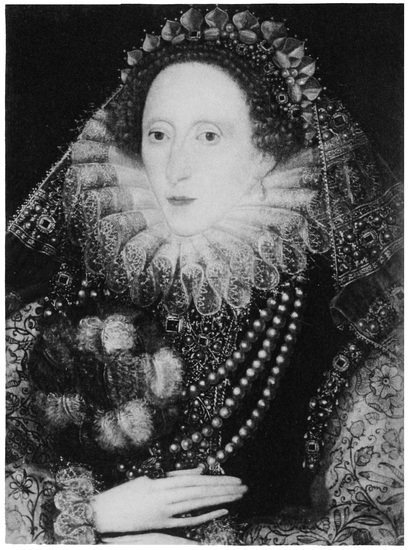
QUEEN ELIZABETH, FROM THE ORIGINAL PORTRAIT BY ZUCCHERO,
IN HAMPTON COURT PALACE.
THE COURTSHIPS OF
QUEEN ELIZABETH
A HISTORY OF THE VARIOUS
NEGOTIATIONS FOR HER MARRIAGE BY MARTIN A. S. HUME, F. R. HIST. S.
EDITOR OF THE CALENDAR OF SPANISH STATE
PAPERS OF ELIZABETH (PUBLIC RECORD OFFICE)
“AND THE IMPERIAL VOTARESS PASSED ON IN MAIDEN MEDITATION FANCY FREE”
Midsummer Night’s Dream
NEW YORK: MACMILLAN & Co.
LONDON: T. FISHER UNWIN MDCCCXCVI
PREFACE.
It has been my pleasant duty to consider carefully
in chronological order a great mass of diplomatic
documents of the time of Elizabeth, in which are
reflected, almost from day to day, the continually
shifting aspects of political affairs, and the varying
attitudes of the Queen and her ministers in dealing
therewith. I have been struck with the failure of
most historians of the time, who have painted their
pictures with a large brush, to explain or adequately
account for what is so often looked upon as the
perverse fickleness of perhaps the greatest sovereign
that ever occupied the English throne; and I have
come to the conclusion that the best way in which a
just appreciation can be formed of the fixity of
purpose and consummate statecraft which underlay
her apparent levity, is to follow in close detail the
varying circumstances and combinations which
prompted the bewildering mutability of her policy.
To do this through the whole of the events of a
long and important reign would be beyond the
powers of an ordinary student, and the attempt
would probably end in confusion. I have therefore
considered it best to limit myself in this book to one
set of negotiations, those which relate to the Queen’s
proposed marriage, running through many years of
her reign: and I trust that, however imperfectly
my task may have been effected, the facts set forth
may enable the reader to perceive more clearly
than hitherto, that capricious, even frivolous, as the
Queen’s methods appear to be, her main object
was rarely neglected or lost sight of during the long
continuance of these negotiations.
That a strong modern England was rendered
possible mainly by the boldness, astuteness, and
activity of Elizabeth at the critical turning-point of
European history is generally admitted; but how
masterly her policy was, and how entirely personal
to herself, is even yet perhaps not fully understood.
I have therefore endeavoured in this book to follow
closely from end to end one strand only of the complicated
texture, in the hope that I may succeed by
this means in exhibiting the general process by
which England, under the guidance of the great
Tudor Queen, was able to emerge regenerated and
triumphant from the struggle which was to settle
the fate of the world for centuries to come.
Character of Elizabeth and her contemporaries—Main object
of her policy—Youth of Elizabeth—The Duke of Angoulême—Philip
of Spain—Seymour and Catharine Parr—Mrs.
Ashley’s and Parry’s confessions—Execution of
Seymour—Proposed marriage of Elizabeth with a son of
the Duke of Ferrara—With a son of Hans Frederick of
Saxony—Courtney—Emmanuel Philibert, Duke of Savoy—Prince
Eric of Sweden—Death of Queen Mary—The
Earl of Arundel.
The greatest diplomatic game ever played on the
world’s chessboard was that consummate succession
of intrigues which for nearly half a century was
carried on by Queen Elizabeth and her ministers
with the object of playing off one great Continental
power against another for the benefit of England
and Protestantism, with which the interests of the
Queen herself were indissolubly bound up. Those
who were in the midst of the strife were for the
most part working for immediate aims, and probably
understood or cared but little about the ultimate
result of their efforts; but we, looking back as over
a plain that has been traversed, can see that, from
the tangle of duplicity which obscured the issue to
the actors, there emerged a new era of civilisation
and a host of young, new, vigorous thoughts of
which we still feel the impetus. We perceive now
that modern ideas of liberty and enlightenment are
the natural outcome of the victory of England in
that devious and tortuous struggle, which engaged
for so long some of the keenest intellects, masculine
and feminine, which have ever existed in Europe.
It seems impossible that the result could have been
attained excepting under the very peculiar combination
of circumstances and persons then existing in
England. Elizabeth triumphed as much by her
weakness as by her strength; her bad qualities were
as valuable to her as her good ones. Strong and
steadfast Cecil would never have held the helm so
long if he had not constantly been contrasted with
the shifty, greedy, treacherous crew of councillors
who were for ever ravening after foreign bribes as
payment for their honour and their loyalty. Without
Leicester as a permanent matrimonial possibility
to fall back upon, the endless negotiations for
marriage with foreign princes would soon have
become pointless and ineffectual, and the balance
would have been lost. But for the follies of Mary
Stuart, which led to her downfall and lifelong
imprisonment, the Catholic party in England could
never have been subjected so easily as it was.
Elizabeth, with little fixed religious conviction,
would, with her characteristic instability, almost
certainly at one difficult juncture or another have
been drawn into a recognition of the papal power,
and so would have destroyed the nice counterpoise,
but for the unexampled fact that such recognition
would have upset her own legitimacy and right to
reign. The combination of circumstances on the
Continent also seems to have been exactly that
necessary to aid the result most favourable to
English interests; and the special personal qualities
both of Philip II. and Catharine de Medici were as
if expressly moulded to contribute to the same end.
But propitious, almost providential, as the circumstances
were, the making of England and the establishment
of Protestantism as a permanent power in
Europe could never have been effected without the
supreme and sustained statecraft of the Queen and
her great minister. The nimble shifting from side
to side, the encouragement or discouragement of the
French and Flemish Protestants as the policy of the
moment dictated, the alternate flouting and flattering
of the rival powers, and the agile utilisation of the
Queen’s sex and feminine love of admiration to
provoke competing offers for her hand, all exhibit
statesmanship as keen as it was unscrupulous. The
political methods adopted were perhaps those which
met with general acceptance at the time, but the
dexterous juggling through a long course of years
with regard to Elizabeth’s marriage is unexampled in
the history of government. Not a point was missed.
Full advantage was taken of the Queen’s maiden
state, of her feminine fickleness, of her solitary
sovereignty, of her assumed religious uncertainty,
of her accepted beauty, and of the keen competition
for her hand. In very many cases neither the wooer
nor the wooed was in earnest, and the courtship was
merely a polite fiction to cover other objects; but at
least on two occasions, if not three, the Queen was
very nearly forced by circumstances or her own
feelings into a position which would have made her
marriage inevitable. Her caution, however, on
each occasion caused her to withdraw in time
without mortal offence to the family of her suitor;
and to the end of her days she was able, painted old
harridan though she was, to act coquettishly the
part of the peerless beauty whose fair hand might
possibly reward the devoted admiration paid to her,
with their tongues in their cheeks, by the bright
young gallants who sought her smiles. The story
of the various negotiations for the Queen’s marriage
has been told in more or less detail in the histories
of the times, but no comprehensive view has yet
been given of the marriage negotiations alone: nor
has their successive relation to other events been
set forth as a connected narrative. Within the last
few years much new material for such a narrative
has become available both in England and on the
Continent, and it is now possible to see with a
certain amount of clearness the hands of the other
players besides that of the English Queen. The
approaches made to Elizabeth by the brothers de
Valois, or rather by their intriguing mother,
Catharine de Medici, have been related somewhat
fully, mainly from the documents in the National
Library in Paris, by the Count de la Ferrière,1 and
the recent publication of the Spanish State Papers
at Simancas of the reign of Elizabeth by the Record
Office,2 puts us into possession of a vast quantity of
hitherto unused material of the highest interest,
especially with regard to the matrimonial overtures
made by Philip II. and the princes of the house of
Austria; whilst the full text of the extraordinary
private letters to and from the Queen in relation to
the Alençon match, 1579–82, printed by the Historical
MSS. Commission from the Hatfield Papers,
affords an opportunity of the greatest value for
criticising the by-play in this curious comedy.
From these sources, from the Walsingham Papers
from the French diplomatic correspondence, from
the Foreign, Domestic, and Venetian Calendars of
State Papers, and from the various contemporary
and later chroniclers of the times, it is proposed to
construct a consecutive narrative of most of the
important attempts made to persuade the “Virgin
Queen” to abandon her much-boasted celibacy.
In October, 1532, exactly eleven months before
the birth of Elizabeth, Henry VIII. paid his pompous
visit to the French king, accompanied by his
privately married wife, Anne Boleyn, Marchioness
of Pembroke. He had deeply offended the Spanish
Emperor by his treatment of Queen Catharine, and
felt the need of drawing closer the bonds of union
with Francis I., which twelve years before had been
tied on the Field of the Cloth of Gold; and almost
as soon as the little Princess Elizabeth was born,
negotiations were opened for her marriage with
the child-prince, Duke of Angoulême, third son of
Francis I. Henry asked for too much, as was his
wont. He required the French king and his nobles
to make a declaration of approval of the Act of Succession
which had been passed in England defying
the Pope and settling the crown on the issue of
Anne Boleyn. Francis was to press the Pope to
revoke the anathemas that the Church had hurled
upon the schismatic king, and the little prince was
to be brought up in England, holding his dukedom
as an independent fief of the French crown. The
last two demands might have been complied with,
as they could subsequently have been revoked, but
the eldest son of the Church could never accept the
first article, which would have brought him into
definite defiance of the papacy; and the negotiation
fell through.
Elizabeth was only three years old when her
mother’s fall removed her from the line of the succession,
and with the strange vicissitudes of her
early girlhood we have nothing here to do. When,
however, in 1542, the death of James V. of Scotland
and the almost simultaneous birth of his daughter
Mary seemed to bring nearer to its consummation
Henry’s idea of a union of the two crowns, he proposed
to marry the baby Queen of Scots to his own
infant son and at the same time offered the hand of
Elizabeth, who was then nine years old, to the Earl
of Arran, head of the house of Hamilton, the next
heir to the Scottish crown. The man was nearly an
idiot and failed to see the advantages of such a connection,
the consequence being that French intrigue
and French money, backed up by the influence of
the Queen Dowager of Scotland, Mary of Lorraine,
were victorious; and Henry was thwarted of his
desire. The fact that he had been checkmated by
the French king in this matter rankled in his breast
and caused that foolish and profitless war, in alliance
with the Emperor, against France, which is
principally remembered for the siege and capture
and subsequent loss of Boulogne. Charles V. tried
very hard to get his cousin, Mary Tudor, Henry’s
elder daughter, acknowledged as legitimate, but
although this was not done in so many words, both
she and her sister Elizabeth were restored to their
respective places in the line of succession; and whilst
the treaty of alliance between the two sovereigns was
under discussion a suggestion was made that Charles’
son, Philip of Spain, then a lad of seventeen, should
be betrothed to Elizabeth, who was eleven. It was
probably never meant to be anything but a compliment,
and certainly would not have been seriously
entertained by the Emperor, but in any case the
suggestion was quietly dropped and Spanish and
English interests rapidly drifted apart again. In
January, 1547, Henry VIII. died, leaving the succession
to his two daughters in tail after his child-son
Edward VI. and his heirs. The Queen Dowager,
Catharine Parr, immediately married Sir Thomas
Seymour, brother of the Protector Somerset, and
uncle of the little King. To their care was confided
Princess Elizabeth, then a girl of fourteen, who
resided principally in the Queen’s dower houses at
Chelsea and Hanworth, and it was at this critical
period of her life that her personal interest in her
love affairs may be said to have commenced.
When, subsequent to the death of the Queen
Dowager, a short year afterwards, her husband’s
ambitious schemes had aroused the jealousy of his
all-powerful brother, one of the charges made
against him was that he had planned to marry the
Princess Elizabeth and use her as one of his instruments
for obtaining supreme power. The original
confessions and declarations of those who were supposed
to be concerned with him in the plot, which
are still amongst Lord Salisbury’s papers at Hatfield,
were published in full many years ago by
Haynes, and have more recently been calendared by
the Historical MSS. Commission. They have been
used by all historians of the times, and there is no
intention of repeating here fully the oft-told story
divulged by these curious declarations. It is needless
to say that they disclose scandalous treatment
of a young and sensitive girl both by Seymour and
Catharine Parr, even after allowing for the free
manners then prevalent. It is difficult to understand,
indeed, what can have been Seymour’s real
intention towards the Princess, unless it was the
guilty satisfaction of his own passions. His wife
was young and healthy, and in the natural course of
events might have been expected to live long, so
that he could hardly have looked forward to his
marriage with Elizabeth; and yet Mrs. Ashley,3 her
governess, confessed in the Tower in February,
1549, that Seymour was in the habit of visiting the
girl’s bedroom before she was dressed, sometimes
by himself and sometimes with his wife, and there
indulged in much indelicate and suggestive romping,
in which Catharine Parr herself occasionally took
part. Thomas Parry,4 the cofferer, repeats in his
confession a story told him by Mrs. Ashley which
carries the matter somewhat further. “She said
the Lord Admiral loved the Lady Elizabeth but
too well, and had done so for a good while, and
this was the cause that the Queen was jealous of
him and Lady Elizabeth. On one occasion the
Queen coming suddenly upon them had found him
holding the Lady Elizabeth in his arms; upon which
she fell out with them both, and this was the cause
why the Queen and Lady Elizabeth parted.”
Whatever may have been Seymour’s intentions
towards Elizabeth during his wife’s life, he left
them in no doubt as soon as she died. For a
conspirator, indeed, he was the most open-mouthed
person imaginable. By the confessions, early in
1549, of Wightman, Sharington, Dorset, Harrington,
and Parry, it would appear that he had openly
expressed his discontent with his brother’s supremacy
and made no secret of his pretensions to the
guardianship of the young King and the hand of
Elizabeth. His accomplice, Sharington, master of
the Bristol mint, was coining testoons out of the
national treasure, and hoarding vast sums of coin
for his use; noblemen were advised by him to
retire to their estates and raise forces to support
him; and the seizure of himself and his friends was
a mere movement of self-defence on the part of the
Protector. With regard to the match with Elizabeth,
Parry appears to have been the first person
approached directly. He was closely attached to
the person of the Princess, and had been sent to
Seymour ostensibly to ask for the use of Durham
Place as a temporary town residence for her. Seymour
said this could not be, as the house was to be
made into a mint, but she could have his own house
to stay in until she could see the King. Parry
confesses that Seymour asked him many questions
about Elizabeth’s pecuniary means; and when he
got back to Hatfield the cofferer asked the young
Princess whether she would be willing to accept
Seymour for a husband if the Council were agreeable.
She asked Parry sharply who told him to
put such a question to her, to which he answered
that “nobody had done so, but he thought he perceived
by Seymour’s inquiries that he was given
that way.” “She said that she could not tell her
mind therein.”5
When the Master of the Household and Denny
suddenly arrived at Hatfield to interrogate the
household as to their communications with Seymour
Parry quite lost his head, “went to his
own chamber and said to his wife, 'I would I had
never been born, for I am undone,’ and wrung his
hands, cast away his chain from his neck and his
rings from his fingers.”
Elizabeth’s profound diplomacy and quick intelligence
were shown even thus early at this critical
juncture. Sir Robert Tyrwhitt and his wife were
sent by the Protector to worm out of her all she
knew of the plot. Threats, cajolery, forged letters
and invented confessions, were all tried upon her in
vain. She would tell nothing of importance. “She
hath,” says Tyrwhitt, “a very good wit and nothing
is gotten of her but by great policy.” She bitterly
resented the imprisonment of her governess, Mrs.
Ashley, and the substitution of Lady Tyrwhitt;
and said that she had not so behaved that they
need put more mistresses upon her; wept all night
and sulked all day, but withal was too much for
Tyrwhitt, who avowed that “if he had to say his
fantasy he thinks it more meet she should have
two governesses than one.”
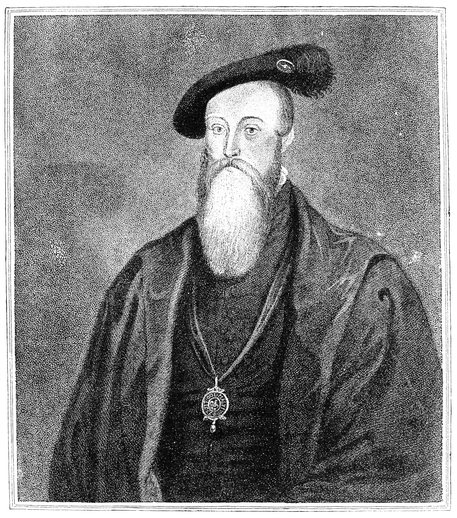
Thomas, Lord Seymour of Sudeley.
The confessions of Parry and Ashley with regard to
Elizabeth’s conduct, and their own, are bad enough;
but they probably kept back far more than they
told, for on Elizabeth’s succession, and for the rest
of their lives, they were treated with marked
favour: Parry was knighted and made Treasurer
of the Household, and on Mrs. Ashley’s death in
July, 1565, the Queen visited her in person and
mourned her with great grief. It is probable that
the inexperienced girl was really in love with the
handsome, showy Seymour; but how far their
relations went will most likely never now be
known. She indignantly wrote to the Protector
complaining of the slanders that were current about
her, to the effect that she was with child by the
Lord Admiral and demanded to be allowed to come
to Court and “show herself as she was”; but
virtuous indignation, real and assumed, was always
one of her favourite weapons. Tyrwhitt said he
believed a secret compact had been entered into
between her and Ashley and Parry never to confess
during their lives. “They all sing one song and
she hath set the note for them.”
After this dangerous escapade and the execution
of Seymour, Elizabeth became almost ostentatiously
saintly and straitlaced, until the accession of
her sister made her the heiress presumptive to the
crown and the hope of the Protestant party, now
that Northumberland’s nominees had been disposed
of. Even before this event, the reforming party in
England were anxious to further strengthen themselves
by allying her to a foreign prince of Protestant
leanings, not powerful enough to force her
claims to the crown upon them, but of sufficient
weight to give them moral support, whilst removing
her from the way in England. As early as August,
1551, Northumberland (or, as he was then, the Earl
of Warwick) had put his agents upon the alert on
the Continent to find a suitable match for her, and
one of them, Sir Anthony Guidotti,6 says that the
Duke of Guise had suggested the Duke of Ferrara’s
son, “who was one of the goodliest young men of
all Italy.” The youth was a son of that Renée of
France, Duchess of Ferrara, who vied with her
kinswoman, Jeanne d’Albret, in her attachment to
the reformed faith, but Northumberland would
hardly accept the recommendation of the Guises as
disinterested; and the matter went no further. The
same agent suggests that the son of the Duke of
Florence (Medici) who was then only eleven years
old might do, and “if this party were liked it were
an easy matter to be concluded without any excessive
dote.” This was less likely to please even than
the previous proposal, and nothing was done; but
the Ferrara family were apparently anxious for the
connection, and early in 1553 Sir Richard Morysine,7
the English envoy in Antwerp, wrote to the Council
reporting that Francesco d’Este, the brother of the
Duke of Ferrara, had approached him on the matter
and had asked for a description of the Princess.
Morysine replied that “If God had made her Grace
a poor man’s daughter he did not know of a prince
that might not think himself happy to be the
husband of such a lady,” and added that d’Este
was of the same opinion “at present.” A much
more likely match had been privately suggested to
Cecil by Morysine shortly before this.8 “Hans
Frederick’s (of Saxony) second son, who is the
goodlier gentleman, would, if he durst, bear a great
affection towards the Lady Elizabeth’s grace. The
land in Germany is divided, and as much comes to
the second son as to the eldest, which eldest is
thought to be of no long life. Were Dukes Maurice
and Frederick to die their lands go to Hans
Frederick’s sons.” But the collapse of Northumberland
and the accession of Mary entirely changed
Elizabeth’s prospects, so that her marriage had to
be considered in conjunction with Mary’s own, and
the capture of the Queen by the Spanish interest
made it desirable to secure her sister if possible for
the same side. In the autumn of 1553, Simon Renard
had suggested to Mary a marriage between herself
and Prince Philip. She herself was in grave doubt
at that time and afterwards as to its wisdom or
practicability. Young Courtney had been designated
by the public voice as the most fitting consort
for her; and although the romantic theories of many
historians as to her supposed attachment to him are
unsupported by a single shred of evidence, it is
certain that for a time she seriously contemplated
the wisdom of conciliating English feeling by marrying
the man who was one of her first competitors for
the possession of the throne. Gradually, however,
Renard, with his logical persuasiveness, convinced
her that she would acquire more strength by an
alliance with the only son of the Emperor than by
a marriage “with one of her own vassals, without
credit, power, or assistance, who has seen and
knows nothing of the world, having been reared in
servitude and never left England.”9
Renard presented the Emperor’s formal offer of
his son’s hand to the Queen on the 6th of October,
and after some hesitation she asked him to put upon
paper his arguments in favour of the match. He
did so in a long paper dated the 11th, which will be
found in the Renard Correspondence transcripts in
the Record Office. In it he tells her that she is
surrounded by dangers against which only a powerful
marriage can protect her. She has, he says,
four sets of enemies: namely, the heretics and
schismatics, the rebels and friends of Northumberland,
the powers of France and Scotland, and
Madam Elizabeth, who would never cease to trouble
and threaten her. Mary replied that she knew
all about the French intrigues, and was certain
to be kept well informed of approaches made by
the French ambassador Noailles to Elizabeth and
Courtney. In conversation with Renard afterwards
she told him, and he faithfully transmitted the conversation
to his master,10 that she had had a long
talk with Courtney three days before at the instance
of his mother, and he had told her in all simplicity
that an English lord had suggested to him that he
should marry Elizabeth, since he could not now
hope to obtain the Queen. If he took the Princess
either he or his heirs might hope to succeed to the
throne as the Queen was getting old. The idea
seems to have originated with Lord Paget, who was
doubtless the lord referred to by Courtney, and who
thought to stand well with all parties in future by
the device. As he was the principal supporter in
the Privy Council of the Spanish match, Renard
could not at first openly veto the suggestion. Mary
consulted Renard upon the subject, and told him that
Courtney had said that his own thought was only
to “marry a simple lady rather than Elizabeth who
was too proud a heretic and of a doubtful race on her
mother’s side.” The imperial ambassador replied
that such a marriage would have to be very deeply
weighed and discussed,11 and so politely shelved the
question. On the other hand, the idea was zealously
promoted by Noailles, who, Courtney asserted some
months afterwards, pressed him warmly to marry
Elizabeth,12 and it was considered even by the
strongest Spanish partisans in the Council to be a
happy combination which would conjure away all
dangers. How far Elizabeth herself was a consenting
party it is difficult to say, but Noailles, who
was in the heart of the intrigue, writes to his king
on the 14th of December that it depends entirely
on Courtney whether she married him and joined
him in Devonshire to raise the flag of revolt. “But
the trouble,” he says, “is that Courtney is so alarmed
and timid that he dares nothing.” So Courtney disappears
promptly from the scene where soon such
rough work was to be undertaken. Even before the
arrival of Egmont in the winter of 1553 to offer
formally Philip’s hand to Mary, the Council was
mainly opposed to the match. Paget was first
bought over with a large sum of money, then Gardiner,
Courtney’s greatest friend, was reluctantly
won with the promise of a cardinal’s hat, and others
by similar means; but the self-seeking Earl of
Arundel immediately saw how his own interests
might be benefited by the Spanish match. De
Noailles says that he knew that at the Queen’s age,
and with her health, every month’s delay decreased
the probability of her having issue; and he, therefore,
warmly supported the marriage with Philip, which
could not be rapidly effected, in order to marry his
young son to Elizabeth, and so, practically, get the
reversion to the crown. The matter never seems to
have got beyond a suggestion; and the youth soon
after dying, Arundel, as will be told, subsequently
became a suitor himself. But whilst these nebulous
speculations with regard to Elizabeth’s hand were
going on, Renard had been arranging a clever
scheme by which the Spanish party should ensure
to themselves the control of England not only
during the Queen’s life but after her death. When
Egmont and his splendid embassy arrived all
England was in a whirlwind of panic and indignation
at the idea of a Spanish match. Elizabeth had
retired to Woodstock, ostensibly on friendly terms
with the Queen, but deeply wounded at her contemptuous
treatment, and at the equivocal position
she occupied, now that the divorce pronounced by
Cranmer of Henry VIII. and Catharine of Aragon
had been quashed, and Elizabeth consequently bastardised.
Egmont was instructed to point out to
the Queen that all might be pleasantly settled by
marrying her sister to the gallant young Emmanuel
Philibert, Duke of Savoy, the son of the Emperor’s
sister, and consequently first cousin to Philip. His
patrimonial states, all but a mere shred of them in
the valley of Aosta, had been occupied by the
French in the course of the war, and the prince was
fighting like a hero in the Emperor’s army. But his
blood was the bluest of any in Europe, and before
he could marry Elizabeth she must be legitimised
and placed in the order of the succession, without
which the throne would probably pass on Mary’s
death to the French candidate, Mary of Scotland.
This was gall and wormwood to Mary Tudor. They
could not both be legitimate. If the grounds for
the divorce of Queen Catharine were good she was
never Henry’s lawful wife, and her daughter had no
right to the crown. If they were bad, then Elizabeth
was necessarily the bastard that the law of
England inferentially had just declared her to be.
The King of France, foiled in his attempts to prevent
the Queen’s Spanish marriage, instructed de
Noailles13 to use every possible means to hinder a
match between Elizabeth and Savoy, “poor and
dispossessed as he is”; and, alert as the ambassador
was, no great effort on his part was needed. The
Queen, bitterly jealous of her sister, who she knew
was more or less openly working with the Carews,
the Courtneys, the Wyatts and others to undermine
her throne, peremptorily refused to rehabilitate
Elizabeth’s birth. Then came the Wyatt rebellion
and Elizabeth’s imprisonment. In after years both
Philip and Elizabeth often referred to the fact that
at one juncture he had saved her life, and it is
highly probable that the Princess was released from
the Tower in May, 1554 on the recommendation of
Renard, made in the name of the coming bridegroom
of the Queen. De Noailles writes that she
was to go to Richmond from the Tower, and was
there to receive two gentlemen from the Emperor
who were to sound her as to a marriage with
Emmanuel of Savoy. If she refused the match she
was to be taken to Woodstock under guard, again a
prisoner. De Noailles knew that the best way of
preventing such a match was to arouse the Queen’s
suspicion that Elizabeth was plotting with the
French. So with devilish ingenuity he sent a man
with a present of apples to the Princess to meet her
on her arrival at Richmond. The man was seized
and searched to the skin, and no letters were found,
but to de Noailles’ undisguised glee the Princess was
hurried off at once to Woodstock without seeing the
Emperor’s envoys. Again by Philip’s intercession
Elizabeth was released, and invited to be present at
the Queen’s entry into London after her marriage.
Philip had been anxious that his favourite cousin
of Savoy should have come to England for the ceremony,
but Emmanuel was in the midst of war in an
important command, his own oppressed people, the
prey of a ruthless invader, were imploring him, their
prince, to come and rescue them; he was desperately
short of money, and his visit to England had to be
deferred. Soon after the wedding he sent a confidential
envoy named Langosco to pave the way for
his coming, and subsequently (December, 1554) the
Prince himself arrived. Elizabeth’s town house,
Somerset House, was placed at his disposal, and he
was made as welcome as his cousin could make him.
Philip tried his hardest to get him into the good
graces of the Queen. She was kindly and sympathetic;
gave him the Garter, and went so far to
please Philip as once more to liberate Elizabeth at
his urgent request, but she would not let the Princess
and her suitor meet. Emmanuel’s thoughts,
moreover, were elsewhere. An unsuccessful attempt
was being made to patch up a peace between Spain
and France, and the young Prince’s one idea was
to get his patrimonial Piedmont restored to him in
the scramble. So he had to hurry back again to
Flanders with nothing done about the marriage.
The idea was not dropped, however. Renard gave
wise advice to Philip in his constant letters. He
told him, amongst other things, that now that the
Queen’s hopes of progeny had proved illusive the
only way to prevent England from slipping through
their fingers was to get command of Elizabeth.
“You cannot,” he said, “change the succession as
laid down in King Henry’s will without causing a
rebellion. Marry Elizabeth to the Duke of Savoy,
it will please the English and be popular, provided
that her right to the succession be not interfered
with; and it might be a means towards expelling
the French from Piedmont.” Philip’s agents found
plenty of opportunities for trying to ingratiate themselves
with the Princess, but she was cool and
cautious; professed that she had no desire to
marry, and so forth. She was quite aware of the
reason for the Spanish desire that she should marry
Savoy, and even thus early began her great policy
of keeping people friendly by deferring their hopes.
As the clouds gathered ever darker over the
miserable Mary in the last sad months of her life,
and Elizabeth’s star rose, suitors became more
plentiful. At the beginning of 1558 Philip had
sent haughty Feria as his ambassador to his wife to
drive her into providing men and money to help him
in his war against France. Calais and Guisnes had
just been lost to England, and Mary, all her hopes
and illusions fled, was fretting her heart out in
despair. In April an ambassador arrived from the
King of Sweden, Gustavus, with letters to the
Queen proposing a treaty of commerce between the
two countries, and the marriage of his eldest son,
Eric, with Princess Elizabeth. The ambassador
was in no hurry to seek audience of the Queen—her
day was already on the wane—but posted down to
Hatfield to see the Princess, to whom he delivered
a letter from Prince Eric himself. The Queen was
overcome with rage at this and with fear that Philip
would blame her for refusing his request to restore
Elizabeth in blood and marry her to Emmanuel of
Savoy, and thus giving rise to this embarrassing
Swedish offer. Hearing that Feria was about to send
a courier to Flanders, she summoned him, and in a
violent passion of tears reproached him with wishing
to be beforehand with her in telling the story to her
husband. Feria says, “Her Majesty has been in
great anguish about it, but since hearing that
Madam Elizabeth gave answer that she had no
desire to marry she has become calmer, but is still
terribly passionate in the matter. One of the
reasons why she is so grieved about the miscarriage
is the fear that your Majesty should press her about
Savoy and Madam Elizabeth. Figueroa and I
think that the opportunity of the coming of this
ambassador, and the illusion about the pregnancy
should be taken advantage of to do so; but it must
not be done at the same time as we press her about
raising troops here. In short, I do not think now
that she will stand in the way of her sister’s succession
if providence do not bless your Majesty with
children.”14
The Swedish ambassador was to have been
openly reproved by the Queen before the whole
Court, but the Queen thought better of it, and
received him in the presence of Gardiner and the
Marquis of Winchester only. She dismissed him
curtly—almost rudely—and told him that after committing
such a breach of etiquette as to deliver a
letter to her sister before presenting his credentials,
he had better go home and never come back to
England with such a message as that again.
Before Feria left England to see his master in July,
1558, he visited Elizabeth at Hatfield, and did his
best to persuade her that she had all Philip’s sympathy,
and that her safe course would be to adhere
to the Spanish connection. He was no match for
her in diplomacy even then, and got nothing but
smiles and genial generalities. In November Mary
was dying, and Dassonleville, the Flemish agent,
wrote to the King begging him to send Feria back
again to forward Spanish interests, “as the common
people are so full of projects for marrying Madam
Elizabeth to the Earl of Arundel or some one else.”
On the 8th of November a committee of the Council
went to Hatfield to see Elizabeth and deliver to her
the dying Queen’s message, begging her “when she
should be Queen to maintain the Catholic Church
and pay her (Mary’s) debts.” Elizabeth would pledge
herself to nothing. She knew now that she must
succeed, with or without Mary’s good-will, and she
meant to have a free hand. Before the Queen died
even, Feria, who had arrived when she was already
almost unconscious, hastened to Hatfield to see the
coming Queen. So long as he confined himself to
courteous commonplace she answered him in the
same spirit, but as soon as he began to patronise
her and hint that she owed her coming crown to
the intervention and support of Philip, she stopped
him at once, and said that she would owe it only to
her people. She was equally firm and queenly when
Feria thus early hinted at her marriage with her
Spanish brother-in-law before the breath was out of
Mary’s body, and showed a firm determination to
hold her own and resist all attempts to place her
under the tutelage of Philip. A week afterwards
the Queen died, and then began the keen contest of
wits around the matrimonial possibilities of Elizabeth,
which ended in the making of modern England.
The first letter that Feria wrote to Philip after
the new Queen’s accession indicated how powerless
had been all his blandishments to pledge Elizabeth.
“The new Queen and her people,” he says, “hold
themselves free from your Majesty, and will listen
to any ambassadors who may come to treat of
marriage. Your Majesty understands better than I
how important it is that this affair should go through
your hands, which ... will be difficult except with
great negotiation and money. I wish, therefore,
your Majesty to keep in view all the steps to be
taken on your behalf; one of them being that the
Emperor should not send any ambassador here to
treat of this, for it would be inconvenient enough for
Ferdinand to marry here even if he took the titbit
from your Majesty’s hand, but very much worse if it
were arranged in any other way. For the present,
I know for certain they will not hear the name of
the Duke of Savoy mentioned, as they fear he will
want to recover his estates with English forces, and
will keep them constantly at war. I am very pleased
to see that the nobles are beginning to open their
eyes to the fact that it will not do to marry this
woman in the country itself.... The more I think
over this business the more certain I am that everything
depends upon the husband this woman may
take. If he be a suitable one, religious matters will
go on well, and the kingdom will remain friendly
with your Majesty, but if not it will all be spoilt. If
she decide to marry out of the country she will at
once fix her eyes on your Majesty, although some of
them here are sure to pitch upon the Archduke
Ferdinand.”15 Feria was wrong in his estimate of
Elizabeth’s character. From the first she had determined
to be a popular sovereign, and all observers
remarked her almost undignified anxiety to catch
the cheers of the crowd. She knew that the most
unpopular step she could take would be one that
bound her interests to Spain, and particularly a
marriage with Philip. A French marriage was impossible,
for the heir to the crown of France was
married to Mary Stuart, whose legal right to the
English throne was undoubtedly stronger than that
of Elizabeth herself.
So the Englishmen began to pluck up heart and
to think that the great prize might fall to one of them.
Early in December the Earl of Arundel came over
from Flanders, and Feria remarks in one of his letters
that he had seen him at the palace, “looking very
smart and clean, and they say he carries his thoughts
very high.” He was a widower of mature age, foppish
and foolish, but, with the exception of his son-in-law,
the Duke of Norfolk, the only English noble whose
position and descent were such as to enable him
without impropriety to aspire to mate with royalty,
and for a short time after his arrival he was certainly
looked upon by the populace as the most likely
husband for the young Queen.
CHAPTER II.
The Spanish policy with regard to the Austrian match—English
suitors for the Queen’s hand—Arundel and
Pickering—Philip II.—The Archduke Ferdinand—Lord
Robert Dudley—The Prince of Sweden—Philip’s attitude
towards the Austrian match—The Archduke Charles—Pickering
and Dudley—The Earl of Arran—Dudley’s
intrigues against the Archduke Charles’ suit—Death of
Lady Robert Dudley—Prince Eric again.
In the same ship that brought Arundel from
Flanders came that cunning old Bishop of Aquila,
who was afterwards Philip’s ambassador in England.
He conveyed to Feria the King’s real wishes with
regard to Elizabeth’s marriage, which were somewhat
at variance with those which appeared on the
surface. Philip had now definitely taken upon himself
the championship of the Catholic supremacy,
and his interests were hourly drifting further away
from those of his Austrian kinsmen, who were
largely dependent upon the reforming German
princes. This was the principal reason why Sussex
and other moderate Protestants in England were
promoting an Austrian marriage which, it was
assumed, would conciliate Philip without binding
England to the ultra-Catholic party. The Bishop’s
instructions were to throw cold water on the scheme
whilst outwardly appearing to favour it, but if he
saw that such a marriage was inevitable, then he
was to get the whole credit of it for his master, who
was to subsidise his impecunious cousin, the Archduke,
and make him the instrument of Spain.
Feria confessed himself puzzled. If he was not to
forward the Archduke Ferdinand, he did not know,
he said, whom he could suggest. Everybody kept
him at arm’s length and he could only repeat current
gossip. Some people thought the Earl of Arundel
would be the man, others the Earl of Westmoreland;
then Lord Howard’s son, and then Sir William
Pickering; “every day there is a new cry raised
about a husband.” “At present,” he said, “I see
no disposition to enter into the discussion of any
proposal on your Majesty’s own behalf, either on
her part or that of the Council, and when it has to
be approached it should be mentioned first to her
alone.” The first step, he thought, should be to
arouse the jealousy of each individual councillor of
the Queen’s marriage with any Englishman; and at
the same time to work upon the Queen’s pride by
hinting that she would hardly stoop to a marriage
inferior to that of her sister. He thought, however,
that a marriage with Philip would scarcely be acceptable,
as he could not live in England, and Feria
was still in hope that if they took any foreigner the
Archduke Ferdinand would be the man. Feria’s
plan of campaign was an ingenious one. After he
had aroused Elizabeth’s jealousy of her dead sister
and deprecated the idea of the degradation to the
Queen of a marriage with a subject, “we can take
those whom she might marry here and pick them
to pieces one by one, which will not require much
rhetoric, for there is not a man amongst them worth
anything, counting the married ones and all. If,
after this, she inclines to your Majesty, it will be
necessary for you to send me orders whether I am
to carry it any further or throw cold water on it and
set up the Archduke Ferdinand, for I see no other
person we can propose to whom she would agree.”16
Philip had sent to the Queen a present of jewels
by the Bishop of Aquila, with which she was delighted,
and assured Feria that those who said her
sympathies were French told an untruth. She was
indeed quite coquettish with him sometimes, but
he felt that he was outwitted. He could get no
information as he did in the last reign. The
councillors fought shy of him, anxious as ever for
bribes and pensions, but willing to give no return
for them, for the very good reason that they had
nothing to give, they being as hopelessly in the
dark as every one else as to the Queen’s intentions.
“Indeed I am afraid that one fine day we shall find
this woman married, and I shall be the last man in
the place to know anything about it,” said Feria.
In the meanwhile Arundel was ruining himself
with ostentatious expenditure; borrowing vast sums
of money from Italian bankers and scattering gifts
of jewels of great value amongst the ladies who
surrounded the Queen. He was a man far into
middle age at the time, with two married daughters,
the Duchess of Norfolk and Lady Lumley, and was
in antiquity of descent the first of English nobles;
but one can imagine how the keen young woman on
the throne must have smiled inwardly at the idea of
the empty-headed, flighty old fop, aspiring to be her
partner. “There is a great deal of talk also,” writes
Feria, “lately about the Queen marrying the Duke
Adolphus, brother of the King of Denmark. One
of the principal recommendations they find in him
is that he is a heretic, but I am persuading them
that he is a very good Catholic and not so comely
as they make him out to be, as I do not think he
would suit us.” At last, after the usual tedious
deliberation, the prayers and invocations for Divine
guidance, Philip made up his mind that he, like
another Metius Curtius, would save his cause by
sacrificing himself. He approached the subject in a
true spirit of martyrdom. Feria had been repeating
constantly—almost offensively—how unpopular he
was in England, ever since Mary died. He had, he
was told, not a man in his favour, he was distrusted
and disliked, and so on, but yet he so completely
deceived himself with regard to the support to be
obtained by Elizabeth from her people through her
national policy and personal popularity, as to write
to Feria announcing his gracious intention of
sacrificing himself for the good of the Catholic
Church and marrying the Queen of England on
condition of her becoming a Catholic and obtaining
secret absolution from the Pope. “In this way it
will be evident and manifest that I am serving the
Lord in marrying her and that she has been converted
by my act.... You will, however, not
propose any conditions until you see how the
Queen is disposed towards the matter itself, and
mark well that you must commence to broach the
subject with the Queen alone, as she has already
opened a way to such an approach.” It must
have been evident to Feria at this time (January,
1559) that the Queen could not marry his master
without losing her crown. The Protestant party
were now paramount, the reformers had flocked
back from Switzerland and Germany, and Elizabeth
had cast in her lot with them. To acknowledge
the Pope’s power of absolution would have been
to confess herself a bastard and an usurper.
There was only one possible Catholic sovereign of
England and that was Mary Queen of Scots, and
it is difficult to see what could have been Philip’s
drift in making such an offer, which, if it had been
accepted, would have vitiated his wife’s claim to the
crown of England and have strengthened that of
the French candidate.
In any case Elizabeth perceived it quickly
enough, and when Feria approached her and
delivered a letter from Philip to her, she began
coyly to fence with the question. She knew
she could not marry Philip; but she was vain
and greedy of admiration, and it would be something
to refuse such an offer if she could get it put
into a form which would enable her to refuse it.
So she began to profess her maiden disinclination
to change her state; “but,” says Feria, “as I saw
whither she was tending, I cut short the reply, and
by the conversation which followed ... as well as
the hurry she was in to give me the answer, I soon
understood what the answer would be ... to
shelve the business with fair words.” The end
of it was that he refused to take any answer at
all, unless it were a favourable one, and so deprived
Elizabeth of the satisfaction of saying she had
actually rejected his master’s offer—which was a
grievance with her for many years afterwards.
Of all this the multitude knew nothing. They
were busy with speculation elsewhere. “Il Schafanoya,”
the Italian gossip-monger, gives an interesting
account of the coronation ceremony and the self-sufficient
pomposity of Arundel, who was Lord
Steward, “with a silver wand a yard long, commanding
everybody, from the Duke (of Norfolk)
downwards.”17 Lord Robert Dudley as Master of
the Horse “led a fair white hackney covered with
cloth of gold after the Queen’s litter,” but no one
as yet seemed to regard him as her possible consort.
That came afterwards. Schafanoya, writing to the
Mantuan ambassador in Brussels (January, 1559),
says: “Some persons declare that she will take the
Earl of Arundel, he being the chief peer of this
realm, notwithstanding his being old in comparison
with the Queen. This report is founded on the
constant daily favours he receives in public and
private from her Majesty. Others assert that she
will take a very handsome youth, eighteen or twenty
years of age and robust, judging from passion, and
because at dances and other public places she
prefers him to any one else. A third opinion is
that she will marry an individual who until now has
been in France on account of his religion, though he
has not yet made his appearance, it being well
known how much she loved him. He is a very
handsome gallant gentleman whose name I forget.
But all are agreed that she will take an Englishman,
although the ambassadors of the King of Sweden
seek the contrary.”
The “very handsome youth” was perhaps the
Earl of Oxford; the “handsome gentleman” was
certainly Sir William Pickering, who for a time
was the favourite candidate. It is known that
there had been love passages long before between
Elizabeth and him, but to what extent was never
discovered. He can hardly have been a very
stable character, for he had fled to France under
Mary, but had very soon entered into treacherous
correspondence with the Spanish party to spy upon
the actions of the Carews and the rest of the
Protestant exiles. Shortly before Mary’s death he
had been commissioned to go to Germany and
bring thence to England a regiment of mercenaries
which had been raised for Mary. They were,
however, used by Philip for his own purposes, and
when Elizabeth ascended the throne, Pickering
thought proper to have a long diplomatic illness at
Dunkirk, to learn how he would be received in
England after his more than doubtful dealings. As
soon as he was satisfied that bygones would be
bygones, he came to England in fine feather.
Tiepolo writes to the Doge, February 23rd:
“Concerning her marriage it still continues to be
said that she will take that Master Pickering, who
from information received by me, is about thirty-six
years of age, of tall stature, handsome, and very
successful with women, for he is said to have
enjoyed the intimacy of many and great ones.”18
Parliament had sent a deputation to the Queen to
urge her to marry, and to represent the disadvantages
of a foreign match, to which the Queen
had given a sympathetic but cautious answer.
This had raised the hopes of Pickering to a great
height, and in the early spring he made his
appearance. He had lingered too long, however.
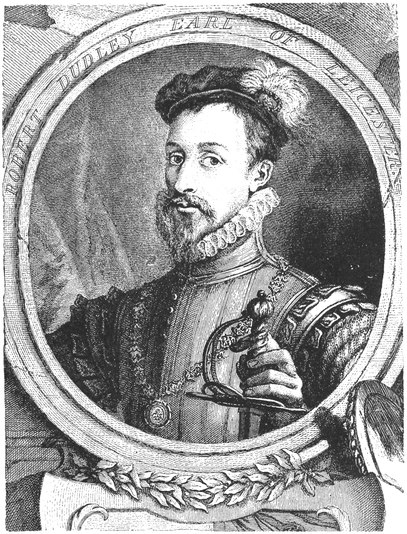
Lord Robert Dudley had already come to the front.
Feria wrote to Philip on the 18th of April:
“During the last few days Lord Robert has come
so much into favour that he does whatsoever he
pleases with affairs, and it is even said that her
Majesty visits him in his chamber day and night.
People talk of this so freely that they go so far as
to say that his wife has a malady in one of her
breasts and the Queen is only waiting for her to
die to marry Lord Robert. I can assure your
Majesty that matters have reached such a pass
that I have been brought to consider whether it
would not be well to approach Lord Robert on your
Majesty’s behalf, promising him your help and
favour and coming to terms with him.” At the
same time the Swedish ambassador was again
pressing the suit of Prince Eric; but he must
have been extremely maladroit, for he offended
Elizabeth at the outset by saying that his master’s
son was still of the same mind, and asked for a
reply to the letter he had sent her. “What letter?”
said the Queen. “The letter I brought your
Majesty.” Elizabeth replied that she was now Queen
of England, and if he required an answer he must
address her as such. She added that she did not
know whether his master would leave his kingdom
to marry her, but she could assure him that she
would not leave hers to be the monarch of the world,
and in the meanwhile she would say neither yes
nor no. A messenger was sent off with this cold
comfort, and came back with fine presents of furs
and tapestries, and for a time Swedish money was
lavished on the courtiers very freely—and it is
curious that the King of Sweden is always spoken
of as being one of the richest of monarchs—but
the ambassador became a standing joke and a
laughing-stock of the Court ladies as soon as his
presents ran out. A more dignified embassy from
Eric shortly afterwards arrived with a formal offer
of his hand, but they were, as the Bishop of Aquila
says, treated in a similar manner, and ridiculed to
their own faces in Court masques represented before
them.
A much more serious negotiation was running
its course at the same time. When the Emperor
had been informed that Philip had desisted from the
pursuit of the match for himself, he begged him to
support the suit of the Archduke Ferdinand. It
was considered unadvisable to mention at first
which of the Archdukes was the suitor, but Philip
himself made no secret of his preference to
Ferdinand, who was a narrow bigot of his own
school; so the Spanish ambassador in England was
instructed to forward the matter to the best of his
ability, in conjunction with an imperial ambassador
who was to be sent for the purpose. When the
instructions arrived, matters had gone so far that
a secretary had already come to London from the
Emperor with letters for the Queen and a portrait
of Ferdinand. This had been arranged by Sir
Thomas Challoner, who had recently been in Vienna;
but much doubt existed as to the sincerity of Philip’s
professions of good-will towards the affair. Indeed,
those who were most in favour of it appear to have
thought, not unreasonably, that the marriage would
become impossible if it were hampered with conditions
dictated by Spain. The Austrian match
certainly had influential support at Court. Cecil,
Sussex, and all of Dudley’s many enemies thought at
the time that it offered the best way of checking his
growing favour, and forwarded it accordingly. In
April Feria wrote: “They talk a great deal about
the marriage with the Archduke Ferdinand and
seem to like it, but for my part I believe she will
never make up her mind to anything that is good
for her. Sometimes she appears to want to marry
him, and speaks like a woman who will only accept
a great prince; and then they say she is in love
with Lord Robert and never lets him leave her. If
my spies do not lie, which I believe they do not, for
a certain reason which they have recently given me,
I understand she will not bear children; but if the
Archduke is a man, even if she should die without
any, he will be able to keep the kingdom with the
support of your Majesty.”
When Pickering finally arrived, therefore, he
found the field pretty well occupied, but his advent
caused considerable stir. He was at once surrounded
by those who for various reasons were
equally against Dudley and a Catholic prince.
Two days after his arrival Dudley was sent off
hunting to Windsor, and Sir William was secretly
introduced into the Queen’s presence; and a few
days afterwards went publicly to the palace and
stayed several hours by the Queen’s side. “They
are,” wrote Feria, “betting four to one in London
that he will be king.... If these things were not
of such great importance and so lamentable, they
would be very ridiculous.”19
Pickering’s arrival at Court is thus spoken of by
Schafanoya, writing on the 10th of May, 1559:
“The day before yesterday there came Sir William
Pickering, who is regarded by all people as the
future husband of the Queen. He remains at
home, courted by many lords of the Council and
others, but has not yet appeared at Court. It is
said they wished in Parliament to settle what title
they should give him and what dignity, but nothing
was done. Many deem this to be a sign that she
will marry the Archduke Ferdinand, but as yet
there is no foundation for this, although the news
comes from Flanders. Meanwhile my Lord Robert
Dudley is in very great favour and very intimate
with her Majesty. On this subject I ought not to
report the opinion of many persons. I doubt
whether my letter may not miscarry or be read,
wherefore it is better to keep silence than to speak
ill.”20 When Challoner had returned from Vienna
he had brought with him full descriptions of the
Emperor’s sons. Ferdinand was a bigot and a
milksop, and Charles, the younger Archduke, was
said to have narrow shoulders and a great head.
So when Baron Ravenstein arrived in London on
his matrimonial embassy the Queen was quite
ready for him. Ravenstein himself was as devout
a Catholic as his master, and was received very
coolly at first. The Queen told him she would
marry no man whom she had not seen, and would
not trust portrait painters; and much more to the
same effect. To his second audience Ravenstein
was accompanied by the Bishop of Aquila, as it was
desirable that, if anything came of the negotiation,
Spain should get the benefit of it. It soon became
clear to the wily churchman that Ferdinand would
never do. He says: “We were received on
Sunday at one, and found the Queen, very fine,
in the presence-chamber looking on at the dancing.
She kept us there a long while, and then entered
her room with us.” The Bishop pressed her, in
his bland way, to favourably consider the offers of
the Emperor’s ambassador; “but I did not name
the Archduke, because I suspected she would reply
excluding them both. She at once began, as I
feared, to talk about not wishing to marry, and
wanted to reply in that sense; but I cut short the
colloquy by saying that I did not seek an answer,
and only begged her to hear the ambassador.” He
then stood aside and chatted with Cecil, who gave
him to understand that they would not accept Ferdinand,
“as they have quite made up their minds
that he would upset their heresy,”21 and went on
to speak of the various approaches that had already
been made to the Queen; politely regretting that
affinity and religious questions had made the marriage
with Philip impossible. In the meanwhile
poor Ravenstein was making but slow progress with
the Queen, who soon reduced him to dazed despair,
and the Bishop again took up the running, artfully
begging her to be plain and frank in this business,
“as she knew how honestly and kindly the worthy
Germans negotiated.” And then, cleverly taking
advantage of what he had just heard from Cecil, he
said that he had been told that the Archduke had
been represented to her as a young monster, very
different from what he was; “for, although both
brothers are comely, this one who was offered to
her now was the younger and more likely to please
her than the one who had been spoken of before.
I thought best to speak in this way, as I understood
in my talk with Cecil that it was Ferdinand they
dreaded.” The Queen at this pricked up her ears,
and asked the Bishop of whom he was speaking.
He told her the Archduke Charles, who was a very
fit match for her as Ferdinand was not available.
“When she was quite satisfied of this,” says the
Bishop, “she went back again to her nonsense, saying
that she would rather be a nun than marry a man
she did not know, on the faith of portrait painters.”
She then hinted that she wished Charles to visit
her in person, even if he came in disguise. Her
thirst for admiration and homage was insatiable,
and, popular parvenue as she was, the idea of
princes of spotless lineage humbling themselves
before her very nearly led her into a quagmire more
than once. She probably had not the slightest
intention of marrying Charles at the time, but it
would have been a great feather in her cap if she
could have brought a prince of the house of Austria
as a suitor to her feet. But the Bishop was a match
for her on this occasion. “I do not know whether
she is jesting ... but I really believe she would like
to arrange for this visit in disguise. So I turned
it to a joke, and said we had better discuss the
substance of the business.... I would undertake
that the Archduke would not displease her.” The
Bishop having soothed the Queen with persiflage
of this sort, disconsolate Ravenstein was called back
rather more graciously, and told that, on the Bishop’s
request, the Queen would appoint a committee of
the Council to hear his proposals.
In the meanwhile Dudley and Pickering were
manœuvring for the position of first English candidate.
Sir William had now a fine suite of rooms
in the palace, and was ruffling bravely, giving
grand entertainments, and dining in solitary state
by himself, with minstrels playing in the gallery,
rather than feast, like the other courtiers of his rank,
at one of the tables of the household. He pooh-poohed
Ravenstein and his mission and said that the
Queen would laugh at him and all the rest of them,
as he knew she meant to die a maid. Pickering
appears to have rather lost his head with his new
grandeur, and soon drops out of the scene, upon
which only the keenest wits could hope to survive.
His insolence had aroused the indignation of the
greater nobles, but somehow it was only the least
pugnacious of them with whom he quarrelled. The
Earl of Bedford, who from all accounts seems to
have been a misshapen monstrosity with an enormous
head, said something offensive about Pickering
at a banquet, and a challenge from the irate
knight was the immediate result; Dudley, of all
men, being the bearer thereof, always at this time
ready to wound the extreme Protestant party, to
which Bedford belonged. But Pickering was as
distasteful to Catholics as to Protestants. On
one occasion he was about to enter the private
chapel inside the Queen’s apartments at Whitehall,
when he was met at the door by the Earl of
Arundel, who told him he ought to know that
that was no place for him, but was reserved for the
lords of the Council. Pickering answered that he
knew that very well, and he also knew that Arundel
was an impudent knave. The Earl was no hero,
and Pickering went swaggering about the Court
for days telling the story. With such a swashbuckler
as this for a rival, it is not surprising that
the handsome and youthful Dudley rapidly passed
him in the race for his mistress’s favour. Dudley
played his game cleverly. His idea was first to
put all English aspirants out of the running by
ostensibly favouring the match with the Archduke,
whilst he himself was strengthening his influence
over the Queen, in the certainty that, when matters
of religion came to be discussed, difficulties might
be raised at any moment which would break off the
Austrian negotiations. In the meanwhile the Queen
coquetted with dull-witted Ravenstein, and persuaded
him that if the Archduke would come over
and she liked him, she would marry him, although
she warned the ambassador not to give his master
the trouble of coming so far to see so ugly a lady
as she was. Instead of paying her the compliment
for which she was angling, he maladroitly asked her
whether she wished him to write that to the Archduke.
“Certainly not,” she replied, “on my account,
for I have no intention of marrying.” She jeered
at Ferdinand and his devotions, but displayed a
discreet maidenly interest in Charles, and, it is easy
to see, promptly extracted from Ravenstein all the
knowledge he possessed, much to Bishop Quadra’s
anxiety. Feria had gone back to Philip, with the
assurance that she never meant to marry, and
that it was “all pastime,” but Quadra thought
that she would be driven into matrimony by
circumstances. “The whole business of these
people is to avoid any engagement that will upset
their wickedness. I believe that when once they
are satisfied about this they will not be averse to
Charles. I am not sure about her, for I do not
understand her. Amongst other qualities which
she says her husband must possess is that he should
not sit at home all day among the cinders, but
should in time of peace keep himself employed in
warlike exercises.” For many reasons it suited
Elizabeth to show an inclination to the match; for
she could thus keep the English Catholics in hand,
notwithstanding the religious innovations and her
severity, whilst satisfying others “who want to see
her married and are scandalised at her doings.” But
the Bishop disbelieved in the marriage unless she
were driven to it. Whilst Ravenstein was being
caressed and befooled, the French were doing their
best to hinder an understanding with him. There
were sundry French noblemen in London as
hostages—and very troublesome guests they were—who
industriously spread the idea that it was
ungrateful of the Queen to disdain to marry one of
her own subjects who had raised her to the throne.
When Ravenstein discussed this view with her,
“she was very vexed, and repeated to him that
she would die a thousand deaths rather than marry
one of her subjects; but for all this,” says the
Bishop, “he does not seem to have got any further
than usual with his master’s affair.” And Bishop
Quadra and his master were determined he should
not do so, except with Spanish intervention and on
Spanish terms, which would make the marriage
impossible in England. Things were thus going
prosperously for Dudley. The Swedish embassy
had come and gone, “much aggrieved and offended ... as
they were being made fun of in the palace,
and by the Queen more than anybody. I do not
think it matters much whether they depart pleased
or displeased.”22 It was clear that Elizabeth would
have nothing to do with “Eric the Bad,” and the
Archduke was now the only serious competitor;
which exactly suited Dudley, as he knew the insuperable
religious obstacles that could be raised to him.
But Dudley was not by any means the only
artful or self-seeking man in Elizabeth’s Court, and
was not allowed to have all his own way. The
real difficulties of the marriage with the Archduke,
hampered as he would be by unacceptable Spanish
conditions, were soon obvious to the Protestant
party, who tried a bold stroke, which, if their
weapon had been a strong instead of a lamentably
weak one, might have altered the whole course of
English history. To a French Catholic princess,
as Queen of Scotland and heiress to the crown of
England, the natural counterpoise was a close
alliance between England and Spain; but the
Protestants saw that, from a religious point of
view, one position was as bad as the other, and
conceived the idea of encouraging the claims of
a son of the house of Hamilton, who, after Mary,
was next heir to the crown of Scotland. The Earl
of Arran, son of the Duke of Chatelherault was in
France; and Cecil’s henchmen, Randolph and Killigrew,
were sent backwards and forwards to him
and to Throgmorton, in Paris, to urge him to
action. If he could raise a revolution in Scotland
against papists and foreigners, and seize the crown,
he might, thought Cecil, marry Elizabeth, unite the
two countries, and defy their enemies. Trouble in
Scotland was easily aroused; but the King of
France, just before his own death, which raised
Mary Stuart to the throne of France as well, learnt
of the plan and ordered Arran’s capture alive or
dead. Killigrew managed to smuggle him out of
France disguised as a merchant, and took him to
Geneva and Zurich, where he sat at the feet of
Peter Martyr and other reformers, and then as
secretly was hurried over to England in July, 1559.
The Spanish party and the Emperor’s ambassador
soon got wind of it, and were in dismay. The
Earl was hidden first in Cecil’s house, and
was afterwards conveyed secretly to the Queen’s
chambers at Greenwich. The news soon spread,
and the marriage was looked upon, all through
August and part of September, as a settled thing;23
and, although Bedford and Cecil went out of their
way to buoy up the hopes of a marriage with the
Archduke, it was clear to the Spanish party that
Arran was the favoured man, the more especially
that Mary Stuart’s husband had now become King
of France. But this did not suit Dudley. Early
in September Lady Mary Sidney, Dudley’s sister,
came to the Spanish ambassador with a wonderful
story that a plot had been discovered to poison the
Queen and Dudley at a dinner given by the Earl of
Arundel. This, she said, had so alarmed the Queen,
who had now a war with France on her hands, that
she had determined to marry at once, and awaited
the ambassador at Hampton Court with the offer of
the Archduke, whom she would accept. Lady
Sidney professed to be acting with the Queen’s
consent, and emphatically insisted that, if the matter
were now pushed and the Archduke brought over at
once, it could be concluded without delay. The
cunning Bishop himself was for once taken in.
Before going to Hampton Court he saw Dudley,
who placed himself entirely at the disposal of the
King of Spain, “to whom he owed his life.” He
said the Queen had summoned him and his sister
the night before, and had directed them how to
proceed. The marriage, he assured the Bishop,
was now necessary and could be effected.
The Bishop wrote to Cardinal de Granvelle
directly after the interview: “Lord Robert and his
sister are certainly acting splendidly, and the King
will have to reward them well—better than he does
me—and your Lordship must remind him of it in due
time. The question of religion is of the most vital
importance, as is also the manner of the Archduke’s
marriage and its conditions and ceremonies. In
view of these difficulties it would be better for the
wedding to be a clandestine one. I do not know
how he will get over the oath that he will have to
take to conform with the laws of the land, which
are some of them schismatic.”24
The Bishop’s interview with the Queen, however,
fairly mystified him. She blew hot and cold as usual.
“She hoped to God that no harm would come to
the Archduke on his incognito visit; she would be
glad to see him; but mind,” she said, “I am not
bound to marry him if he come,” which the Bishop
assured the Emperor “was only dissimulation, and
she really meant to marry him.” She was very
careful to repeat that she had not invited the Archduke,
and was not bound to marry him, and went so
far as to say she could not trust Quadra to state this
clearly, and would write to the Emperor herself.
But whilst she said it in words she took equal care
to contradict it in looks and gestures that could
never be called up in witness against her. The
Bishop was at last completely won over, and strongly
urged the Emperor to send his son and seize the
prize. This new turn of events hardly pleased
Cecil, but it was necessary for him to dissemble, for
Elizabeth was now at war with France and Scotland,
and she could not afford to give the cold
shoulder to Spain as well. When the Bishop saw
him on leaving the Queen, he says: “I listened to
him (Cecil) for some time, and seeing that he was
beating about the bush, I begged that we might
speak plainly to each other, as I was neither blind
nor deaf, and could easily perceive that the Queen
was not taking this step, to refuse her consent after
all. He swore that he did not know, and could not
assure me,” and with this, and vague protestations
of Cecil’s personal wish for the Archduke’s success,
the Bishop had to be contented. He faithfully
conveyed the Queen’s words to the Emperor, but
her looks and gestures could not be put upon paper,
so that it is not surprising that his Majesty could see
no further assurance than before that he was not to
be fooled after all. Feria was more deeply versed
in the ways of women than was the Bishop, and on
receiving the news, answered: “It seems that the
Emperor up to the present refuses leave for his son
to go, and, to tell the truth, I cannot persuade
myself that he is wrong, nor do I believe that she
will either marry him, or refuse to marry him whilst
the matter at issue is only his visit.... As to what
Lord Robert and his sister say, I do not believe
more than the first day that the only thing the
Queen is stickling for is the coming of the lad.”
There was one point touched upon by the Queen in
her interview with the Spanish ambassador, which,
as he tells his own master, he dared not refer to in
his letter to the Emperor. After much fencing and
fishing for compliments respecting her personal
attractions, and expressed doubts on the Queen’s
part as to whether the Archduke would be satisfied
when he saw her, she said that even if he were, he
might be displeased with what he heard about her,
as there were people in the country who took
pleasure in maligning her. The Bishop wrote that
she displayed some signs of shame when she said
this, whilst he parried the point diplomatically, and
hastened to change the subject. “I saw she was
pleased, as she no doubt thought that if the Archduke
heard any of the idle tales they tell about her (and
they tell many) he might take advantage of them
to the detriment of her honour if the match were
broken off, although, from this point of view, I was
not sorry, as the fear may not be without advantage
to us.” But to the Queen he expressed himself
shocked that she should think of such a thing as he
had done previously when Lady Sidney had hinted
at a similar doubt. For the next two months an
elaborate attempt was made to keep up the appearance
of cordiality towards the Archduke’s match, and
the Spanish party was still further beguiled by the
sudden tendency of the Queen to smile on
Catholicism. Candles and crucifixes were placed
on the altar in the Chapel Royal, and the Queen
entertained the Bishop with long religious discussions,
for the purpose of inducing him to believe
that she was a Catholic in her heart. But they
could not deceive the Bishop for very long; nothing
definite could be got from the Queen, from whose
side Dudley never moved, and by the middle of
November (1559) the Bishop satisfied himself that
he was being played with. A new Swedish
embassy had arrived, and was being entertained
with hopes for the first time, particularly by Dudley,
who thought that the Austrian suit, having now
served his turn and eclipsed Arran, was becoming
too hot to be safe for him. The Bishop writes: “I
noticed Lord Robert was slackening in our business,
and favouring the Swedish match, and he had words
with his sister because she was carrying our affair
further than he desired. I have heard from a certain
person who is in the habit of giving me veracious
news that Lord Robert had sent to poison his wife.
Certainly all the Queen has done with us and with
the Swede, and will do with all the rest in the
matter of her marriage, is only to keep Lord
Robert’s enemies and the country engaged with
words, until this wicked deed of killing his wife is
consummated. I am told some extraordinary things
about this intimacy which I would never have
believed, only that now I find Lord Robert’s enemies
in the Council making no secret of their evil
opinion of it.” The Queen tried to face the Bishop
with her usual blandishments, but his eyes were
opened, and when he pressed the point closely, she
became coolly dignified, surprised that she had been
misunderstood, and threw over Lady Sidney and
Dudley, who reciprocally cast the blame upon each
other. The Bishop and the Emperor’s ambassador
were furious; and, as the best way to checkmate
Dudley, approached the Duke of Norfolk, who had
been declaiming for some time against the insolence
of the rising favourite, saying that if he did not
abandon his plans he should not die in his bed, and
so forth. The Duke, who was the most popular as
well as the most exalted of the English nobles,
listened eagerly to anything that should injure
Dudley, and promised all his influence and personal
prestige in favour of the Archduke. He recommended
that the latter should at once come openly
in state to England, and he, the Duke, wagered his
right arm if he did “that all the biggest and best in
the land should be on his side.” Whatever may
have been passing in Norfolk’s mind, there is no
doubt as to what the Bishop’s own plan was, to
avenge himself for the trick played upon him. He
says: “I am of opinion that if the Archduke comes
and makes the acquaintance, and obtains the goodwill
of these people, even if this marriage—of which
I have now no hope except by force—should fall
through, and any disaster were to befall the Queen,
such as may be feared from her bad government,
the Archduke might be summoned to marry Lady
Catharine (Grey) to whom the kingdom comes if this
woman dies. If the Archduke sees Catharine he
should so bear himself that she should understand
this design, which, in my opinion, will be beneficial
and even necessary.” The “design” evidently was
the murder of the Queen and Dudley, and the
securing of Catharine Grey to the Spanish interest.
A daring plan, but requiring bold instruments and
swift action. Weak, unstable Norfolk was no leader
for such an enterprise, as he proved years afterwards.
Whilst Quadra was plotting and sulking at
Durham House, Dudley’s opponents strove to checkmate
him by keeping the Archduke’s match afoot.
Count Helfenstein had come from the Emperor
before the fiasco, and it was now proposed to send
special English envoys to Austria and to the King of
Spain, the purpose of course being to frighten the
French into the idea that the matter was settled.
One day at Court Dudley and Norfolk came to high
words about it. He was neither a good Englishman
nor a loyal subject who advised the Queen to marry
a foreigner, said Dudley; and on another occasion,
Clinton and Arundel actually fell to fisticuffs on the
subject. The Swedes had stood less on their dignity
than the Austrians, and Eric’s brother, the young
Duke of Finland, had come over to press his brother’s
suit. When he arrived with vast sums of money for
gifts, as before, he preferred rather to become a
suitor himself, but with little success. When he
begged for a serious audience he was kept so long
outside in an antechamber alone that he went
away in a huff. The Venetian Tiepolo writes on
December 15th, giving an account of Arran’s defeat
in Scotland by the French, which, with his growing
dementia, spoilt him as a suitor; and Tiepolo goes
on to say: “The Queen is still undecided about
her marriage, though amongst all the competitors she
showed most inclination for the Archduke Charles.
The Duke of Finland, second son of the King of
Sweden, is with her. He came to favour the suit of
his elder brother, and then proposed himself, but
the man’s manners did not please the Queen. The
second son also of the late John Frederick of
Saxony, who heretofore was proposed to the Queen
by the French, but was afterwards deserted by them
because they wished her to marry an Englishman
... has not relinquished his pretensions, and has
sent Count Mansfeldt to propose to the Queen.
The King of Denmark, in like manner, has not
failed to exert himself, although the general opinion
is that if the affairs of the Earl of Arran prosper
he will prevail over all competitors.”25
All through the winter of 1559–60 matters thus
lingered on. The Bishop plotting and planning for
the invasion of England from Flanders, and
completely undeceived with regard to the Queen’s
matrimonial intentions, whilst the English still
desired to keep up an appearance of cordial friendship
with the Spanish party, as a counterpoise to
the King of France, with whom they were at war
in Scotland. The Bishop gives an account of an
interview which he and Helfenstein, the new
imperial ambassador had with the Queen in
February, and it is clear that at this time she was
again very anxious to beguile the Emperor into
sending his son on chance. But Helfenstein was a
very different sort of ambassador from Ravenstein,
and she could not do much with him; his idea being
to hold her at arm’s length until she was forced to
write to the Emperor herself, as she promised to do,
in which case it would not, he thought, be difficult to
construe something she might say into a pledge
which she could be forced to fulfil. “I do not,”
says the Bishop, “treat this matter with her as I
formerly did, as I want her to understand that I am
not deceived by her.” Nor was he for a time
deceived by Dudley. “The fellow is ruining the
country with his vanity.” “If he lived for another
year he” (Dudley) said “he would be in a very
different position,” and so forth. During the
summer an envoy named Florent (Ajacet) was
sent by Catharine de Medici and her son to
propose as a husband for Elizabeth a son of
the Duke de Nevers. As may be supposed,
such a match—or indeed any match recommended
by the consort of her enemy Mary Stuart, with
whom her war was hardly ended—did not meet
with her approval, and the envoy then went to
Bishop Quadra and told him he knew of a certain
way of bringing about the marriage with the
Archduke. His plan was that the Emperor
should prevail upon the King of France to give
up Calais to England. This was merely a feeler
and absurd, as Francis II. had nothing to gain
by the Austrian match, but the Bishop maliciously
told the Queen the joke, as he called it,
whereupon she was very angry that her claim for
Calais should be treated so lightly. She then told
him that she saw now she must marry without delay,
“although with the worst will in the world,” and tried
again to lead him to believe that she was anxious to
marry the Archduke, “but I fear,” said he, “that it
is with the hope of gaining your Majesty’s favour
in her cause, as she calls it, with the French....
Religious matters make me believe that in case she
determines to marry, she will rather lay hands on
any of these heretics than on the Archduke. I understand
now that the Earl of Arran is excluded as
being poor and of small advantage, and also because
he is not considered personally agreeable. They
all favour the Prince of Sweden as he is both
heretical and rich, and especially Secretary Cecil,
who would expect to remain at the head of affairs
as at present.” Shortly afterwards, in September,
1560, Cecil took the Bishop aside and complained
bitterly of Dudley, who he said was trying to turn
him out of his place; and then, after exacting many
pledges of secrecy, said that the Queen was conducting
herself in such a way that he, Cecil, thought
of retiring, as he clearly foresaw the ruin of the
realm through the Queen’s intimacy with Dudley,
whom she meant to marry. He begged the Bishop
to remonstrate with the Queen, and ended by
saying that Dudley was thinking of killing his wife,
“who was said to be ill although she was quite
well.”26 “The next day,” writes the Bishop, “as
she was returning from hunting, the Queen told me
that Robert’s wife was dead, or nearly so, and
asked me not to say anything about it. Certainly
this business is most shameful and scandalous; and,
withal, I am not sure whether she will marry the
man at once or even at all, as I do not think she
has her mind sufficiently fixed. Cecil says she
wishes to do as her father did.” In a postscript of
the same letter the writer gives the news of poor
Amy Robsart’s death. “She broke her neck—she
must have fallen down a staircase, said the Queen.”
Thenceforward Dudley was free, and the marriage
negotiations had another factor to be taken into
account.
About a month afterwards Cecil came to the
Bishop and said that as the Queen had personally
assured him she would not marry Dudley, he urged
him once more to bring the Archduke forward; but
Quadra was wary now, for he saw the design was
only to arouse the fears of the French, and he
would take no hasty step. It is difficult to see how
he could have done so, for, after sending three
ambassadors, the Emperor had now quite made
up his mind that the Queen should not again play
with him. Every weapon in the feminine battery had
been employed—maiden coyness, queenly reserve,
womanly weakness, and the rest of them, had been
tried in vain. A good portrait of the Archduke had
been sent, and her own agents had seen him. If, said
the Emperor, this were not enough, the young man
should come himself; but only on a distinct pledge
that she would marry him if he did. Beyond this
the Emperor would not go, and the Queen always
stopped short at a binding promise. Nor, indeed,
would the match have pleased the extreme reform
party in England led by Cecil, Bedford, and Clinton,
which was now the paramount one. It was useful to
Cecil, in order to play it as a trump card whenever
the negotiations with the French rendered it necessary,
but, at the time, undoubtedly the Swedish
match was most in favour with the Protestant party.
Prince Eric was very persevering. When his brother
returned to Sweden he proposed to come to England
himself, but was induced to delay his visit; according
to Throgmorton,27 in order that his father
might abdicate, and he might get better terms.
“Both father and son, however, have sent to
propose very advantageous conditions to the Queen,
should she consent to the marriage. They will
bind themselves to send to England annually
200,000 crowns to be expended for the benefit
of English subjects, and in time of war to keep
fifty armed ships at their own cost, with other
private conditions very profitable for England,
which the King defers making known until his
coming to her.” It is evident that Eric was too
much in earnest to suit Elizabeth, and she had to
behave rudely enough to him on several occasions
to prevent his ardour from causing inconvenience.
It is more than probable that she deceived Cecil
and the rest of her advisers as to her matrimonial
intentions as completely as she did the suitors
themselves, and that she never meant to marry—except
perhaps on two occasions, which will be
specified, when circumstances or her feelings nearly
drove her to the irrevocable step. Her own motives
were less complicated than those of her advisers,
and the lifelong playing off of France against
Spain, of which her matrimonial negotiations were
a part, was obviously only possible whilst she kept
single; whereas party, religious, and personal
affinities all operated on the minds of her courtiers
and ministers, and, to a certain extent, separated
their interests from hers.
CHAPTER III.
Dudley and the Council of Trent—The Bishop of Aquila
tricked—Eric makes another attempt—Dudley again
approaches the Bishop—The suitors for Mary of Scotland—Darnley—The
Archduke Charles—Dudley—Melvil’s
mission to Elizabeth—Hans Casimir—French approaches.
When it was clear that the Archduke Charles was
shelved and that Cecil and the Protestants were
urging the suit of the Prince of Sweden, who evidently
meant business, it behoved Dudley to make
a countermove. Bishop Quadra had over and over
again said he had found him out, and would not be
deceived by him again; but in January, 1561, only
four months after Lady Robert Dudley’s death, Sir
Henry Sidney came to see the Bishop. Sir Henry
was Lord Robert’s brother-in-law, and had always
belonged to the Spanish or Catholic party, and
consequently was a persona grata with Quadra,
especially as he was a near relative of the Duchess
of Feria (Jane Dormer) whose husband was the
Bishop’s great patron. He came (of course from
Dudley), and after much beating about the bush
said that as the Queen’s attachment to Lord
Robert, and her desire to marry him were now
public, he, Sidney, was much surprised that some
approach was not made to Dudley on behalf of the
King of Spain; as in the event of a helping hand
being extended to him now, “he would hereafter
serve and obey your Majesty like one of your own
vassals.” The Bishop intimated that there was no
particular reason why his master should put himself
out of the way about it, as he had nothing to gain
in the matter, although if the Queen expressed a
desire for his good offices he would be always
ready to extend courtesy to her. But really such
strange tales were afloat, said the Bishop, that he
had not dared to write to the King about them.
Sidney took the bull by the horns and said that
if the Bishop were satisfied about Lady Robert’s
death he saw no other reason for hesitation, “as
after all, though it was a love affair, the object of it
was marriage, and there was nothing illicit about
it.” He had, he said, inquired carefully into Lady
Robert’s death, and was satisfied that it was an
accident, although he knew that public opinion
held to the contrary. The Bishop was very dubious
upon the point, and said drily that it would be
difficult for Lord Robert to make things appear as
he represented them. Sidney admitted that no
one believed it was an accident, and that even
preachers in the pulpits impugned the honour of
the Queen in the matter. This led him to the real
object of his visit, which was to propose that in
return for the King of Spain’s help towards Dudley’s
marriage he would undertake to “restore religion.”
The Bishop still held off, reminding him of how he
had been tricked by Robert and the Queen before
through Sidney’s wife, and refused to move unless
the Queen herself spoke about it and told him what
to write to his master. This, said Sidney, was impossible,
unless he broached the subject first, but
promised that Dudley himself should come and
state his own case. The Bishop deprecated the
making of any bargain about religion. If Robert
wished to relieve his conscience he would be glad
to hear him, but he could enter into no agreement
to reward him for doing what was the duty of every
good Christian: all of which meant that the Bishop
was determined not to be caught again and made
to act by vague professions. In his letter to the
King, however, he emphatically urges him to take
advantage of the Queen’s passion for Dudley to
bring her to her knees, “as she will not dare to
publish the match if she do not obtain your
Majesty’s consent,” popular feeling being dead
against it. “There is not a person,” he says,
“without some scandalous tale to tell about the
matter, and one of the Queen’s gentlemen of the
chamber is in prison for blabbing.” It was even
asserted that the Queen had had children by
Dudley, but this the Bishop said he did not believe.
Shortly after this interview Sidney brought his
brother-in-law and the Bishop together, and Dudley,
wisely avoiding any direct reference to the religious
bargain, merely asked the ambassador to recommend
the Queen to marry him. The Bishop said
he could not do that, but would make an opportunity
for praising him to the Queen whilst
speaking of the advisability of her marriage. This
was even more than Dudley expected, and he
urged that no time should be lost. Two days
afterwards the Queen received the Bishop, who
more than fulfilled his promise to praise Dudley;
although he was careful to say that the King knew
nothing of the matter, but he succeeded in persuading
the Queen that his help would be readily
forthcoming if it were requested.
“After much circumlocution she said she wished
to confess to me.... She was no angel, and
did not deny that she had some affection for
Lord Robert ... but she certainly had not
decided to marry him or any one else, although
she daily saw more clearly the necessity of her
marriage, and to satisfy the English humour it was
desirable that she should marry an Englishman....
What would your Majesty think, she asked, if
she married one of her servants?” The Bishop
replied that he did not know, but would write and
ask the King, if she desired him to do so, although
he believed his master would be glad to hear of her
marriage in any case, and would no doubt be happy
to learn of the advancement and elevation of Lord
Robert, for whom he felt much affection. The Queen
had perforce to be content with this, which she at
once repeated to Dudley, who came to the Bishop
to thank him. Dudley was so elated at the almost
unexpected help he was getting that, in the fulness
of his heart he repeated Sidney’s pledge that in
return the whole control of the Government should
be handed over to the King of Spain, and the
Catholic religion restored. The Bishop stopped
him at once. He had done, he said, and would do,
all he could to forward his marriage, but he would
make no bargain about religion. That was an affair
of their own conscience. “I am thus cautious with
these people, because if they are playing false,
which is quite possible, I do not wish to give them
the opportunity of saying that we offered them
your Majesty’s favour in return for their changing
their religion, as they say similar things to make
your Majesty disliked by the heretics here and
in Germany. If they are acting straightforwardly,
a word from your Majesty in due time will do more
than I can do with many.”28 At the same time the
Bishop made no secret to the King of his opinion
that unless the “heretics” were to finally prevail
Dudley’s marriage must be forwarded or a revolution
and the removal of the Queen carried out.
Philip was even more cautious than his ambassador.
He was anxious to help Dudley on the lines suggested,
but there must be something in writing from
the Queen and her lover, and some prior earnest
must be given of their chastened hearts in the
matter of religion, either by the despatch of plenipotentaries
to the Council of Trent or otherwise.
Dudley was all eagerness to get the matter settled,
and for the next few weeks kept urging the Queen
to request the King of Spain’s good offices towards
the marriage. But the recognition of the Pope’s
Council of Trent was a serious matter and could
not be done without the co-operation of Cecil. He
had been bought over temporarily to Dudley’s side
in appearance by the gift of some vacant sinecure
offices, but he saw—as did the Queen in her calmer
moments—that the participation of Elizabeth in the
Catholic Council would ruin England by destroying
the balance upon which its safety depended. So
whilst ostensibly countenancing it he artfully frustrated
Dudley’s plan. Francis II., Mary Stuart’s
husband, was now dead, and France was ruled by the
Queen-mother Catharine de Medici, whose tenure of
power largely depended upon Huguenot support. So
to her was sent the Puritan Earl of Bedford to suggest
joint action with England in relation to the Council
and religious affairs generally as a countercheck to
Dudley, and Cecil himself began to intervene in the
negotiations with the Bishop. He urged the latter to
get his master to write a letter to the Queen recommending
the marriage, in terms that he knew were
impossible, and when the Bishop asked him point
blank whether this was the Queen’s message or his
own, he begged that a modest maiden like her Majesty
might not be driven into a corner and made to
appear anxious for her own marriage. He further
said the intention was to summon Parliament, and
lay the King’s letter before it as an inducement for
them to adopt the marriage with Dudley—a course
which he knew well would have an entirely opposite
effect. The Bishop soon saw the drift. “The sum
of it all is that Cecil and these heretics wish to keep
the Queen bound and subject to their heresies, and
although she sees that they treat her badly, and
especially the preachers, she dares not go against
Cecil’s advice, as she fears both sides would then
rise up against her. Robert is very much displeased
at all this, and has used great efforts to cause the
Queen to make a stand and free herself from the
tyranny of these people and throw herself entirely
on your Majesty’s favour. I do not think, however,
that he has been able to prevail, as he is faint-hearted
and his favour is founded on vanity.”
Sidney, Pembroke, and others, urged Dudley to
action, but, infatuated as the Queen was with him,
she knew what a weak reed he was in Council, and
always checked herself in her passion to take the
wise advice of Cecil. For some weeks, however, the
Bishop was deceived. A great show of cordiality was
made towards him; the Catholic nobles and bishops,
persuaded that Dudley’s suit was being pushed by
Spain, began to gather round the favourite, and
ostensible preparations were made for receiving the
Pope’s Nuncio in England with the invitation to
the Council of Trent. The Bishop wrote to the
King that, at last Dudley “appeared to have
made up his mind to be a worthy man and gain
respect.” Dudley was now more emphatic than
before of his intention to restore the Catholic religion
in England, and the Protestant party took fright.
Greatly to Quadra’s indignation public opinion was
excited against himself as the promoter of a plot
to restore Catholicism; the Nuncio was informed
that he would not be allowed to land in England,
the Queen refused to send envoys to the Council of
Trent, Sidney was hurried off to his Government in
Wales, and, by the end of April, Cecil’s underhand
diplomacy had triumphed and Dudley’s plan to force
the Queen into a marriage by the aid of the
Catholics was frustrated. It is undoubted that the
Queen was perilously near taking the step on this
occasion, and, but for Cecil, might have been betrayed
into doing so; although Dudley’s vain and
giddy boasting, when he thought he had triumphed
on this and other occasions aided the disillusionment.
Her own imperiousness could not brook
his assumption of superior airs in her presence,
and she quickly resented it. She would let them
know, she said, that in England there was only
one mistress and no master. Shortly before she
had told Morette, who came at the instance of the
Duke of Savoy, to propose the Duke de Nemours
for a husband, that in England there was a woman
who acted as a man, and did not need a Granvelle
or a Montmorenci to guide her. Elizabeth was
now in the very prime of her beauty and powers.
Her complexion was of that peculiar transparence
which is only seen in golden blondes, her figure
was fine and graceful, and her wit and accomplishments
were such as would have made a woman of
any rank or time remarkable. She was a splendid
horsewoman too, with a keen eye for popular effect
in her actions, and for ever on the look-out, as her
ill-fated mother had been, for the cheers of the
populace. One of the German agents sent by the
Emperor about the Archduke Charles’s match,
gave a glowing account of her.29 “She lives, he
says, a life of such magnificence and feasting as can
hardly be imagined, and occupies a great portion
of her time with balls, banquets, hunting, and similar
amusements, with the utmost possible display, but
nevertheless she insists upon far greater respect
being shown her than was exacted by Queen Mary.
She summons Parliament, but lets them know that
her orders must be obeyed in any case.” Her vanity
was perfectly insatiable, and only those who would
consent to pander to it could hope for a continuance
of her favour, always excepting Cecil, but yet the
great mind, the far-seeing caution, the strong will,
the keen self-interest, kept even the vanity and
frivolity in check when they otherwise would have
led her into danger. As Dudley was necessary to
her weak side, so was Cecil needful to her strong
one: the one to amuse and gratify her, the other
to counsel and sustain her and to protect her
against herself.
Robert Dudley, Earl of Leicester.
The Bishop attributed the approaches made to
him by Dudley to a deep-laid scheme to propitiate
Spain until the widowed Mary Stuart should be
married, but he seems to leave out of account
Dudley’s real desire for his marriage with the
Queen on any terms, and his wrath at the fiasco.
The Bishop thought the hand of Cecil had been
forced by the coming of the Pope’s Nuncio, and
that otherwise the farce would have been kept up
for some time longer. In any case the Catholic
hopes in England and Ireland, which had revived
at the news of the negotiation with Spain, were
speedily crushed by fresh persecutions, and the
Protestants in England, France, and Germany
were for the first time drawn together in a common
understanding. That the Bishop was deeply
chagrined at the way he had been treated is clear
by his behaviour towards the Queen and Dudley
during the entertainment given by Dudley on St.
John’s Day, 1561. It was only a month after the
Nuncio had been turned back, and the Catholic
prosecutions were being carried on vigorously.
The Queen, Dudley, and the Bishop were alone in
the gallery of the State-barge off Greenwich witnessing
the fireworks and other entertainments,
“when she and Robert began joking, which she
likes to do much better than talking about business.
They went so far in their jokes that Lord Robert
told her that if she wished I could be the clergyman
to marry them, and she, nothing loath to hear it, said
she was not sure whether I knew enough English.
I let them jest for a time, but at last spoke to them
in earnest, and told them that if they listened to me
they could extricate themselves from the tyranny of
the councillors who had taken possession of the
Queen and her affairs, and could restore peace and
unity to the country by reinstating religion. If
they did this they could effect the marriage they
spoke of, and I should be glad to perform it, and
they might severely punish those who did not like
it, as they could do anything with your Majesty
(Philip) on their side. As things were now I did
not think the Queen would be able to marry except
when and whom Cecil and his friends might please.
I enlarged on this point somewhat, because I see
that unless Robert and the Queen are estranged
from this gang of heretics they will continue as
heretofore, but if God ordain that they should fall
out with them I should consider it an easy thing to do
everything else we desire.” No action more likely
to attain the end in view than that adopted by the
Bishop can be conceived, and had it depended upon
Dudley alone, not many days would have passed
before England was handed over to Spain and the
Catholics for the satisfaction of the worthless favourite’s
ambition. Happily the Queen and Cecil had
to be taken into account as well, and England was
saved. In August news came to England that
the new king, Eric XIV., encouraged by certain
Puritan messages sent to him when Dudley’s marriage
was pending, was on his way to England.
His servants and household stuff arrived in Dover,
with smart new liveries and a showy stud of horses,
and it was announced that the King would follow
at once to ask for Elizabeth’s hand. This was inconvenient,
for Mary of Scotland was still a widow,
and the wedding of Elizabeth to Eric would have
been at once followed by the marriage of Mary to
a nominee of Philip, to the almost certain destruction
of the Protestant party. Elizabeth assured the
Swedes that she had no intention of marrying,
refusing a passport for the King on the ground that
it was not becoming for a modest maiden to be
always giving passports to a young unmarried
prince—besides, she had given him two already—one
of which he did not use and the other was lost.
In face of this coolness Eric affected to put to sea,
but a providential tempest caused him to return,
and the affair was again shelved, the Queen in the
meanwhile dallying with Lord Robert, which she
could do without much danger to the State now that
Cecil had upset his Catholic plan. But Dudley’s
personal enemies were always on the alert. Arundel
considered he had been insulted by him, and in
revenge had a minute inquiry made as to the circumstances
of Lady Robert’s death, which disclosed very
suspicious facts. This humbled Dudley somewhat
and made him more cautious, but as he found the
Catholics incensed against him, he tried to balance
matters by approaching their opponents. He sent
an envoy to Henry of Navarre with similar proposals
to the Huguenots to those he had previously made
to the Spaniards and Catholics. If they would
uphold him in his pretensions to the Queen’s hand
he would practically hand over England to their
control. They politely agreed, but knew full well
that the control of England was in stronger hands
than his, and did nothing to help him. It was little
indeed they could have done just then, for their
own great struggle was yet before them, and Dudley
soon found that he had made a mistake. His
sending Mowbray to negotiate with Navarre had
offended the regular English ambassador, Throgmorton,
and the noise of the intrigue had reached
England, more than ever irritating the Catholics
against Dudley. The latter had no scruples and
no shame, and turned completely round again. In
January, 1562, he once more went servilely to Bishop
Quadra, professing his attachment to Spanish interests
and begging that Philip should write to the
Queen urging her to marry him. He was in a
great hurry, and wanted the letter before Easter; but
the Bishop was not to be rushed into another compromising
position, and said that he had so often
assured the Queen of Philip’s affection for Dudley
that a fresh letter from the King was unnecessary,
but he would again speak to her Majesty in his
favour. This did not satisfy Lord Robert, but it
was all he could get, and a few days afterwards the
Bishop asked Elizabeth what was the meaning of
Dudley’s request, as Philip’s approval of the match
had already been expressed. “She replied that she
was as free from any engagement to marry as on the
day she was born, no matter what the world might
think or say, but she had quite made up her mind
to marry nobody whom she had not seen or known,
and consequently she might be obliged to marry in
England, in which case she thought she could find
no person more fitting than Lord Robert. She
did not wish people to say that she had married of
her own desire, but that her friends and neighbouring
princes should persuade her to do so.” “This,”
said she, “is what Robert wants; as for me, I ask
for nothing.” Seeing that the Bishop still held off
and refused to budge, she said it was of no consequence
at all. It was only for appearance’ sake.
She could as well marry without Philip’s approval
as with it, but if she did, Robert would have but
small reason to serve the interests of Spain. “I
answered her in a joking way,” said the Bishop,
“and told her not to dilly-dally any longer, but to
satisfy Lord Robert at once ... and so I passed
over the question of the letter.” He, no doubt
correctly, surmised that the letter was wanted
merely for the purpose of mollifying the Catholics
towards Dudley, and plainly told Philip that if he
were not prepared to force Catholicism upon England
by an invasion, there was no reason why the
letter should not be sent, as it would at all events
please somebody, whilst his present attitude of
reserve pleased no one, and the English Catholics
would never move without active help. The letter,
however, was never written, and three months afterwards
the Bishop himself had altered his opinion
about it. In April, 1562, he writes to Granvelle
that the time had now gone by for Philip to help
Robert, as the Catholics were against him, and
instead of their being propitiated they would be
alienated thereby. “The Queen,” he says, “desires
not to act in accord with his Majesty, as
will have been seen by her behaviour in this case
and all others. I have already pointed out that the
letter they requested was only to smooth over all
difficulties here and carry out their own intentions.”
Quadra was now completely undeceived, and declined
to be snared again with matrimonial negotiations.
Indeed, for the present, the point upon
which European policy pivoted was not the marriage
of Elizabeth, which had now grown stale, but that
of the widowed Mary Stuart in Scotland. The
persevering Eric XIV., after yet one more repulse
from the Queen Elizabeth, had sent to propose to
Mary—which, however, did not prevent his ambassador
in London from politely suggesting a
match with one of the daughters of the Emperor—Darnley,
the Earl of Arran, Don Carlos, and even
the Archduke Charles, were already being dangled
before Mary’s eyes. Her uncles, the Guises, were
in an atmosphere of intrigue on the subject,
and there was hardly a Court in Europe that
had not its own candidate for the Scottish Queen’s
hand. Elizabeth’s great efforts, seconded by those
of James Stuart (afterwards the Regent Murray),
were directed towards preventing Mary from marrying
a powerful foreign prince, particularly a Catholic,
and as a means to this end the Huguenots in France
were encouraged to break down the power of the
Guises. Catharine de Medici, the regent, was glad
of the chance, for she hated them; and now that
their niece was no longer Queen of France there was
no excuse for their predominance. The best way for
the English to please the Huguenots was to flout
Spain and the Catholics, and the Bishop soon found
that frowns instead of smiles greeted him. Elizabeth
had been informed that an intrigue was afoot to
marry Mary to Don Carlos, the vicious young
lunatic who was Philip’s only son. This would
have meant the ruin of Protestant England and the
strengthening of the Guises in France, to the
detriment of Catharine de Medici. The plan of the
latter, supported by James Stuart, was to hasten on
a marriage between Mary and Darnley. Elizabeth
did not relish the idea of the union of the two next
legal heirs to her own crown, but pretended to
approve of it,30 and Dudley promised Lethington to
support it strongly, in the hope that such a precedent
might bring his own marriage nearer. The
Spanish ambassador was openly slighted, his
couriers stopped, his letters read, his secretary
suborned, and he himself placed under semi-arrest,
charged with plotting against the Queen. Among
other things he was accused of writing to Philip, in
a letter that had been intercepted, that the Queen
had been privately married to Lord Robert in the
Earl of Pembroke’s house. To this he answered
that he had merely written what all London was
saying, namely, that the wedding had taken place.
“When he had said as much to the Queen herself
she was not annoyed thereat, for she had replied
that it was not only people outside who thought so,
as on her return that afternoon from the Earl’s
house her own ladies-in-waiting, when she entered
the chamber with Lord Robert, had asked her
whether they were to kiss his hand as well as her
own, to which she had replied no, and that they
were not to believe what people said.” The
Bishop inserted a sting at the end of his justification
by saying that, considering the way people were
talking, he did not think he would injure the Queen by
saying she was married. Elizabeth’s next step was to
send powerful aid to the Huguenots in France, who
were already in arms, to draw closer the connection
with the Protestants in Germany and Holland, and
for the first time openly to disregard Spain and the
Catholic party in Europe. With a divided France
and a discontented Netherlands this was possible as
it never had been before. In the midst of the warlike
preparations in England to occupy Havre for
the Huguenots, Elizabeth fell ill of small-pox at
Hampton Court, and was thought to be on her
death-bed. The consternation in the palace was
great, as the crisis was unexpected; but whilst the
acrimonious discussions as to the succession were
still in progress the Queen rallied, and was pronounced
out of danger. The first thing she did on
recovering speech and consciousness was to beg the
Council to make Dudley protector, with a peerage
and an income of £20,000. Everything she asked
was promised, though, as Quadra says, without any
intention of fulfilling it. But Dudley and the Duke
of Norfolk were admitted members of the Council,
which was a great point gained for the former.
When the Queen feared she might die she protested
solemnly before God that, although she loved
Robert dearly, nothing improper had ever passed
between them.31
Parliament assembled early in 1563, and deputations
from both Houses addressed the Queen on
the subject of fixing the succession. She was
extremely angry, and said that what they saw on
her face were pock marks and not wrinkles, and
she was not so old yet as to have lost hope of
children. Subsequent attempts to approach her on
the subject, or that of the marriage, met with a
similar or more violent repulse. In March, during
the sitting of Parliament, Maitland of Lethington,
Mary of Scotland’s famous Secretary of State,
arrived in London for the purpose of forwarding
his mistress’s claim to the succession. He soon saw
that the Queen would have her way, and that no
successor would be appointed, the evident intention
of both Elizabeth and Catharine de Medici being,
as Mary herself said, to force an unworthy or a
Protestant marriage upon her, in order to injure her
prestige with the English Catholics. Cardinal
Lorraine and others were anxious that Mary should
wed the Archduke Charles, but Mary said she must
have a prince strong enough to enforce her claim to
the English throne, which Charles was not, and
refused him, her own Catholic noblemen being
also strongly against him for similar reasons.
The opponents of the Guises in France, and
the Protestants in England, were of course against
the marriage of Mary with a member of the
house of Austria, so that, although his name was
kept to the front for some time, Charles was never a
probable husband for the Queen of Scots. In a
long conversation Elizabeth had with Maitland she
told him that if his mistress would take her advice,
and wished to marry with safety and happiness, she
would give her a husband who would ensure both:
and this was Lord Robert, in whom nature had
implanted so many graces that if she (Elizabeth)
wished to marry she would prefer him to all the
princes in the world. Maitland said this was indeed
a proof of the love she bore to his mistress, to give
up to her what she cherished so much herself, but
he hardly thought his mistress, even if she loved
Lord Robert as dearly as Elizabeth did, would consent
to deprive her of all the joy and solace she
received from his company. Elizabeth, after some
more talk of this sort, said she wished to God that
his brother, the Earl of Warwick, had the grace and
good looks of Robert, in which case each Queen
could have one of the brothers. Maitland was
much embarrassed by this unexpected sally, and
adroitly turned the subject to one that he knew
would silence the Queen. He said that as his
mistress was much the younger, it would be well
that Elizabeth should marry Robert first and have
children, and then when she died she might leave
both her kingdom and her husband to Mary.
The Scots nobles at this time saw that, with Elizabeth
and Catharine united against their Queen, things
were likely to go badly with her; and even Protestants
such as Maitland and Murray were desirous of
counteracting the opposing combination by enlisting
the help of Spain. Maitland, therefore, after much
circumlocution and mystery, proposed to Quadra
that Mary should be offered to Don Carlos. The
Bishop was delighted with the idea, and sent the
offer to Philip, who also approved of it. If such a
marriage had been possible, and had been carried
out swiftly and suddenly, it might have been the
turning-point to make England Catholic—but it was
not to be. Events marched too rapidly for Philip’s
leaden method, and the opportunity was lost whilst
information, pledges, and securities were being
sought from the Scotch and English nobles, upon
whom Philip depended for deposing Elizabeth and
placing Mary and her consort on the throne of
Great Britain. In vain through a course of years
Philip was told with tiresome reiteration that things
could not be done in that way. The Catholics
would not rise without a certainty of aid, and the
pledges could not be all on one side. So, tired of
waiting, at last the Scots nobles were driven to consent
to Mary’s marriage with Darnley, and she, for
a time at least, ceased to be the centre figure in the
marriage manœuvres.
Sir James Melvil, one of those cosmopolitan
Scotsmen who were in so much request at European
Courts in the sixteenth century, had been sent
by the Emperor and the Elector Palatine, to whom
he was then attached, to propose a marriage between
the boy-king, Charles IX., and one of the granddaughters
of the Emperor Ferdinand, and whilst he
was still in Paris, early in 1564, his own Queen,
Mary of Scotland, recalled him. He had lived
abroad for many years—since he was a child—and
Catharine de Medici made him tempting offers to
remain with her, but he decided to obey Mary’s
summons and return home. He had, of course, first
to go to Heidelberg and take leave of his master,
the Palatine. Some time before this the Palatine’s
second son, the famous Duke Hans Casimir, had
requested Melvil to carry an offer of marriage from
him to Elizabeth. Melvil refused, as he says he
had reason to believe from what he had heard that
Elizabeth knew herself incapable of child-bearing,
and “would never subject herself to any man.”
When Melvil was taking leave of the Palatine, Hans
Casimir forgot his resentment sufficiently to request
the Scotch courtier to take his portrait and present it
to the Queen on his way through London, and after
considerable demur Melvil consented to do so on condition
that he carried with him portraits of all the rest
of the Elector Palatine’s family, so that Hans Casimir’s
picture might be introduced as if accidentally.
Melvil took with him also an important message
from the Protestant princes of Germany to Elizabeth;
and, with his polish and wit, very soon got into
the Queen’s good graces. He deftly introduced
the subject of the portraits, and she at once asked
him pointedly whether he had that of Hans Casimir,
as she wished to see it. He told her he had left
the portraits in London, he being then at Hampton
Court, whereupon she said he should not go until
she had seen the pictures. Melvil delivered them
to her next day, and even suggested that she
should keep them. But she only asked Dudley’s
opinion about them, “and would have none of
them. I had also sure information that first and
last she despised Duke Casimir.” Which, indeed,
seems highly probable. In one of the Queen’s
familiar chats with Melvil she told him she had
determined to propose two persons as fit husbands
for his Queen, and promised to make the Scotsman
her agent in the matter, which, he says, at the persuasion
of Dudley, she failed to do. He was soon sent
back again to London as Mary’s envoy, to, if possible,
mollify Elizabeth’s anger at the Scotch queen’s cool
reception of her matrimonial advice, and at Mary’s
intimacy with Lennox, the father of Darnley.
He arrived in London early in October, 1564,
and soon became on friendly terms with Elizabeth
again. In his first interview in an “alley” in the
gardens at Whitehall he told the Queen that his
mistress had not considered the proposal for her to
marry Dudley until a joint commission of Scotch
and English statesmen should have met; and
Melvil suggested that the English commissioners
should be the Earl of Bedford and Lord Robert.
Elizabeth took offence at the order in which the
names were mentioned. “She said,” writes Melvil,
“that I appeared to make small account of my Lord
Robert, seeing that I named the Earl of Bedford
before him, but she said that ere long she would make
him a far greater earl, and that I should see it done
before I returned home. For she esteemed him as
her brother and best friend, whom she would herself
have married had she ever minded to have taken a
husband. But being determined to end her life in
virginity, she wished the Queen her sister might
marry him, as meetest of all other with whom she
could find in her heart to declare her second person.”32
Elizabeth’s reason for her recommendation was a
curious one. She said she trusted Dudley so
implicitly that she knew that if he married Mary
he would not allow any attempt to usurp the throne
of England whilst she, Elizabeth, lived. The
Queen was as good as her word, and before
Melvil left he saw Dudley made Earl of Leicester
and Baron Denbeigh. The ceremony of investure
was a splendid one, and the Queen herself helped to
decorate the new earl with the insignia of his rank,
“he sitting on his knees before her with great
gravity. But she could not refrain from putting
her hand in his neck, smilingly tickling him, the
French ambassador and I standing by. Then she
turned, asking at me, 'How I liked him.’ Melvil
gave a courtly answer. 'Yet,’ says she, 'you like
better of yonder long lad,’ pointing towards my
lord Darnley, who, as nearest prince of the blood,
did bear the sword of honour that day before her.
My answer was that no woman of spirit would make
choice of such a man, who more resembled a woman
than a man. For he was handsome, beardless, and
lady-faced.” But for all that one of Melvil’s principal
purposes in England was diplomatically to
obtain permission for Darnley to go to Scotland.
On another occasion Elizabeth told Melvil that
she would never marry unless forced thereto by his
mistress’s “harsh behaviour.” “I know the truth of
that, Madam,” said he, “you need not tell me. You
think that if you were married you would be but
Queen of England, and now you are both King and
Queen. I know your spirit cannot endure a commander.”
She then took him to her bedchamber
and opened a little cabinet “wherein were divers
little pictures, and their names written with her own
hand on the papers. Upon the first that she took
up was written 'My lord’s picture.’ I held up the
candle and pressed to see the picture so named, but
she appeared loath to let me see it, yet my importunity
prevailed, and found it to be the Earl of
Leicester’s picture.” Melvil tried to get the picture
to carry to Scotland, as the Queen had, as he says,
the original; but Elizabeth would not part with the
counterfeit, although she pretended to be willing to
give Dudley himself to “her dear sister.” Melvil
gives a very amusing account of the manner in
which the Queen pressed him to give his opinion as
to the respective perfections of his mistress and
herself. She dressed herself in every possible style
for his delectation, showed off her dancing, her
music (with a fair amount of coyness), her knowledge
of languages. “Her hair,” he says, “was
more reddish than yellow, curled, in appearance,
naturally. She desired to know whether my
Queen’s hair or hers was the best.” He rather
fenced so delicate a question, but the Queen
insisted upon an answer, and she was told that
“she was the fairest Queen in England, and mine
the fairest Queen in Scotland.” But still she was
not satisfied, and after much pressure Melvil was
fain to answer that “she was the whiter of the two,
but that Mary was very lovely.”
Shortly before Melvil’s visit a new Spanish ambassador,
Guzman de Silva, had arrived in London,
and Dudley lost not a day in trying upon him the
tactics that had failed with Quadra. A Catholic friend
of his was sent to Guzman to assure him that, if
he would exert his influence to ruin Cecil with the
Queen, Dudley would place himself under the orders
of Philip, and at a second interview with the ambassador
the same person told him “that Robert
still looks to marry the Queen, and thinks that
religious questions will be settled thereby. Robert,
he says, has an understanding with the Pope on
the matter, and a person in Rome to represent him.
This he told me in strict secrecy, and greatly praises
Robert’s good intentions with regard to religion and
the marriage, but with equivocal assurances as to
what measures would be adopted.” Needless to
say that the former ambassador’s experience was
not lost upon his successor, and Dudley was henceforward
looked at askance by the Spanish party.
The Queen herself next tried her blandishments
on the new envoy. He was invited to a grand
masque represented in the palace, and sat next to
her Majesty, who interpreted the play to him. Of
course it was all about love, which gave an opportunity
for the Queen to ask the Spaniard whether
Don Carlos had grown manly. She was told that
he had, and then, sighing sentimentally, she said:
“Ah me! every one disdains me! I hear he is
to be married to the Queen of Scots.” The ambassador
assured her that it was not true—Carlos
had been too ill of late for any thought of his
marriage, but still people would gossip about great
people. “That is very true,” said the Queen.
“Why, they even said in London the other day
that the King was sending an ambassador to treat
of the marriage of the prince (Don Carlos) with
me!” The feasting and entertainment lasted till
two in the morning, but it is probable that this hint
was the origin and end of it all. This was in July,
1564, when the Queen felt the need of again
drawing closer to the house of Austria. She had
been somewhat badly treated by Condé and his
Huguenots. Peace had been made in France on
terms which again gave the Catholics a predominance,
and Cardinal Lorraine had already practically
arranged the interview between Catharine de
Medici and her daughter, the Queen of Spain,
which took place at Bayonne in the following
spring. It was known in England and Germany
that the real object of this meeting between mother
and daughter was to give an opportunity for the
Catholic statesmen to form a league for the utter
extermination of Protestantism the world over;
and, since the Protestant princes in France had
been gained over, it became necessary for Elizabeth
now to trim to the side of Spain. She soon began
dropping hints to Guzman about her marrying a
German, and assured him that she was a Catholic at
heart, “although she had to conceal her real feelings
to prevail with her subjects in matters of religion.”33
When, with the desire of turning her against the
Protestants, he told her that preachers were slandering
her because she had placed a crucifix on
the altar of her chapel, she said that she would
order crosses to be placed in all the churches, and
then continued: “They also charge me with showing
more favour to Robert than is fitting, speaking
of me as if I were an immodest woman. I am
not surprised that occasion for it should have been
given by a young woman and a young man of good
qualities, to whose merits and goodness I show
favour, although not so much as he deserves; but
God knows how great a slander it is, and a time
will come when the world will know it. My life
is open ... and I cannot understand how so bad
a judgment can have been formed of me.” She
then referred to the negotiations, which were still
lingering on, for the marriage of Mary of Scotland
with Don Carlos, of which she was evidently in
great fear, and on the ambassador laughingly saying
that Mary was more likely to marry the King of
France, who was then only fifteen years of age,
Elizabeth at once said that was impossible, as
approaches had been made to marry him to her,
“which, she was assured, was a more suitable marriage
than that which your Majesty (Philip) had contracted
with her sister.” She had, however, she said,
laughed at it as a thing not to be spoken of considering
their ages.” This was quite true, for Condé
had suggested the matter to Sir Thomas Smith,
the English ambassador in Paris, a year before,
whilst the bickering was going on between them
as to the terms of the peace and the repayment
to the English of the cost of the aid given to the
Huguenots.34 Smith had passed it over at the time
as impossible, and the matter had gone no further;
but only a month after the interview described
above between Guzman and the Queen, the
marriage of the latter with the boy Charles IX.,
who was barely half her age, was brought forward
in a more authoritative form. When the Catholics
were again dominant in Paris, and the objects of
the Spanish and French rapprochement beyond
doubt, Elizabeth had sent to the new Emperor
Maximilian, ostensibly to condole with him on his
father’s death, but really to reopen the negotiations
for the marriage with the Archduke Charles. This
action had to be met and parried by Catharine de
Medici, who at this time—November, 1564—found
herself getting rather more completely pledged
than she liked to the Catholic and Spanish party,
the complete success of which she knew would be
her own downfall; and it was a characteristic stroke
of policy of hers to propose so farcical a match
as that of Charles IX. with Elizabeth, with the
objects, first of hindering the negotiations with the
Archduke Charles, secondly of keeping her own
Huguenots in hand and preventing England from
helping them, and thirdly to checkmate the attempts
to marry Mary of Scotland to a Spanish
prince. In one of her familiar chats with Smith,
who followed her in her voyage through Southern
France, she told him she would like to see her
son married to the Queen of England. Smith
was not sympathetic, but gave a full account of
the conversation to Cecil, who clearly looked upon
the proposal with equal dislike and incredulity.
Very soon afterwards a more direct approach was
made to Elizabeth herself, through one of those
intriguing ladies of the Valois Court whom Brantome
is so fond of describing. This was Madame de
Crussol, who is stated to have worked for Catharine
in sending Chastelard to Scotland for the express
purpose of compromising and injuring Mary of
Scotland.35 This woman wrote a long letter to
Elizabeth hinting at the marriage, and shortly
afterwards instructions were sent to Paul de Foix,
the French ambassador in England, to make
a formal offer to Elizabeth. The instructions
arrived early in February, 1565, and de Foix
was received by the Queen of England a few
days afterwards. The interview took place at first
in the presence-chamber, but on the ambassador
saying that he had something secret to communicate,
the Queen led him into her private apartment,
where, after much high-flown compliment, he read
to her Catharine’s despatch, saying that she would
be the happiest of mothers if her dearly beloved
sister would marry her son and become a daughter
to her. She hastened to add that “she (Elizabeth)
would find both in the body and mind of the King
that which would please her.”36 Elizabeth blushed
with satisfied vanity as much as confusion at this,
expressed a deep sense of the honour done her,
and deplored that she was not ten years younger.
She was afraid she would be abandoned as her
sister was, and foresaw the grave obstacles to such
a match; but de Foix sought to reassure her by
saying that the Queen-mother knew her age, and
expected she would yet bear many children to her
son. Elizabeth replied that she would rather die
than be neglected; but still, though her people
would prefer that she should marry an Englishman,
there was none she could marry but the Earl of
Arundel, “and he was as far off as the poles are
asunder.” As for the Earl of Leicester, she had
always esteemed his merit, but her sense of dignity
would not allow her to endure him as a husband.
It was agreed between the Queen and de Foix
that the matter should be kept secret, and she
promised him a reply shortly. The next day Cecil
drew up one of his lucid Latin papers, setting forth
in detail the many dangers and objections which
would ensue from such a marriage, and the Queen
at once repeated all of Cecil’s arguments to the
French ambassador as her own, assuring him that
she had not mentioned the matter to any one. The
ambassador still pressed the King’s suit; she would
have a husband in the flower of his youth, she
would be certain to bear children, Parliament might
certainly be induced to give its consent, and all the
objections might be overcome by a wisely drafted
treaty. But, said the Queen, who would bring the
King to book if he violated it? Upon this de
Foix lost patience, and said that as a consequence
of the good reports he had sent to the Queen-mother
with regard to Elizabeth’s disposition
towards her son, she had thought of this match;
but as he saw that her affections were placed
elsewhere he would withdraw. This did not suit
the Queen. She assured him she had not given
a refusal, made him sit close by her, and
thanked him warmly for the good report he had
sent of her to his King, dismissing him at last
with a promise to send Cecil to him in a couple
of days. Cecil was certainly not in favour of the
match, although Leicester affected to be so, thanks
partly to the bribes sent to him from France, and
partly because he considered the marriage an impracticable
one. Cecil, indeed, was now almost
ostentatiously leaning to the Catholic side, forcing
the vestments on to the clergy, relaxing the persecution
of the Catholics, and gaining praise even
from the Spanish ambassador. If the new Emperor
was going to fulfil the promises he had made to the
Protestant princes who had elected him, and turn
reformer, no husband would have been so favourable
to England as the Archduke Charles, who
would have disarmed Philip and the Catholics
whilst satisfying the Protestants and avoiding the
dangers to English independence which would
arise from the marriage of the Queen with a
prince of the reigning houses of France or Spain.
When Cecil saw de Foix, therefore, he diplomatically
combated the views advanced by the ambassador.
When the latter remarked that the aid
of France would for ever preserve England from
danger, Cecil replied proudly that England had
nothing to fear. At the end of the interview
Cecil promised to put his objections to the match
in writing; but when he was asked for the paper,
some days afterwards, he refused it, and said that
the Queen would go no further until she had a
reply from Catharine to her remarks made to de
Foix. Secretaries and couriers therefore went backwards
and forwards actively for the next few months.
This unwonted movement of messengers soon
attracted the attention of the Spanish ambassador,
who wrote, on the 15th of March: “The question
of marriage is a difficult one, because if she weds
Robert great dissatisfaction will be caused in the
country, both amongst the higher classes and the
common people. The Queen has told me several
times that she wishes to marry, but not with
Robert; and Robert himself has told me the same.
Apart from this all eyes are fixed on the Archduke
Charles, and I am informed that negotiations
are actually going on about him through Robert.... Of
Robert’s leaning towards the matter there
is no doubt, in appearance, although it is impossible
to say with what object. On the other hand,
it is said that negotiations are afoot about the
King of France, which the Queen herself told
me, and it may be true now, because the French,
having got wind of the Archduke’s affair, may wish
to divert it. It may be also that, however great
the disparity of years, they may be willing to overlook
it in order to join this country to theirs. By
the same rule this Queen may be listening to the
Archduke for the purpose of stopping his negotiations
with Scotland, and the French may be trying
to beat her at her own game.”37 It will be seen by
this how tangled was the diplomatic skein even to
those contemporaries whose especial business it was
to unravel it.
A week after the date of the letter just quoted,
Guzman saw the Queen, when, as usual, she
turned the conversation to the subject of marriages,
and the ambassador slily hinted that
there was some talk of her marrying the French
king. She held down her head and giggled at
this, and Guzman continued that the French ambassador
had asked his opinion about the match,
seeing that the King was so little and she so tall.
“O!” said the Queen, “they tell me he is not
very short; but as it is Lent, and you are my
friend, I will make a confession to you. A proposal
for marriage was formerly made to me by the
King, my brother-in-law (Philip). The King of
France has now made me an offer, as well as the
Kings of Denmark and Sweden, and, I am told,
the Archduke Charles also. The only person
who has not been suggested is your prince (Don
Carlos).” Guzman replied that the reason no
doubt was that, as she had refused the King
himself, it was concluded that she had no desire
to marry, since no higher match could be proposed
to her. She retorted that she did not consider such
an inference clear: it is true that she had no desire
to marry, and would not do so if she could appoint
a satisfactory successor; but her people were
pressing her, and she was now forced either to
marry or nominate an heir, which would be difficult.
“The world thinks that a woman cannot
live unmarried, and, if she refrains from marriage,
that she does so for some bad reason; as they said
of me that I avoided doing so because I was fond
of the Earl of Leicester, whom I could not marry,
as he had a wife living. His wife is now dead,
but yet I do not marry him, although I have been
pressed to do so even by your King.”38 Elizabeth
was getting very uneasy about the Franco-Spanish
meeting at Bayonne and the rumoured voyage of
Philip to the Netherlands with a strong force to
crush Protestantism for good and for all; the
idea of her marriage with Charles IX. was one
eminently calculated to breed distrust of the French
in the mind of Philip, and, as such, was being actively
forwarded by the Huguenot party. When therefore
de Foix, the French ambassador, saw her a few
days afterwards she told him that she had refused
to let Cecil put into writing his objections to the
match, as promised, because the objections were
really all reducible to one—namely, the question
of disparity of age. She said that Smith had
written lately, saying that the King had grown
wonderfully, and that, when he had seen him after
an interval of a few weeks, he hardly recognised
him, as he had grown so tall, and he would no doubt
be as tall as his father had been. De Foix afterwards
sat next to the Queen at supper, when she
was in very high spirits, and drank the King’s
health, and during the entertainment which followed
talked of nothing but the attractions of the French
Court.39
Catharine de Medici on her side was just as
eager in appearance for the match as Elizabeth—and
probably equally insincere, since she too had
her own game to play. She had a long talk about it
with Smith in Bordeaux in April, in which she said
that the ages seemed the principal objection, but if
Elizabeth would put up with the youth of the King,
she (Catharine) would put up with the age of the
Queen; upon which the youthful suitor himself
burst in with the remark that he hoped his mistress
would be as satisfied of his age as he was of hers.
Catharine went on to discuss the other two difficulties
raised; namely, the objection to the Queen
residing out of England, and the fear of the unpopularity
of the match; but Smith declined to
give any opinion upon the matter. It was clear,
indeed, all through that the English ambassador
would not commit himself in a negotiation which he
felt to be a hollow one. He said his instructions
were limited. If the King were a few years older,
if he had seen the Queen and really liked her,
he (Smith) would feel less astonishment at the
present advances, but now—— “But really,”
interrupted the King, “I do love her.” “Your
Majesty does not know yet what love is,” said
Smith, “but you will soon go through it. It is the
most foolish, impotent and disrespectful thing possible.”
The boy blushed at this, and his mother
answered for him saying that his was not a foolish
love. Perhaps not, said the ambassador, but it is just
because it must rest upon very grave reasons and
great and worthy considerations that it ought only
to be undertaken after mature deliberation.40 Catharine
pressed for a reply before the Bayonne
meetings, which were fixed for the following month
of May, but this Smith thought impossible. On
the following day she again tackled Smith on the
subject; and said that, as Cecil himself had had a
son at fifteen or sixteen, the King’s age could not
be made an objection. Secret as the negotiations
were kept, Guzman in London was irritated and
alarmed to see the coming and going of Huguenot
secretaries, without being able to fathom the
reasons, although it was evident that something was
afoot. Both de Foix and he were ecclesiastics,
and many were the feline passages of words that
passed between them on the subject. There was
really nothing at all going on, said de Foix, only
mercantile affairs were being negotiated. Guzman
did not believe him—as he was a Huguenot
although an Archbishop—but still did not guess
that the Queen’s marriage with Charles IX. was
seriously being discussed. For some time he
thought that the matter in hand was the marriage
of the Queen and Leicester under French patronage,
but at last in the middle of April the Queen could
keep the secret from him no longer. He was
sneering at the long delay at the arrival of a present
of a coach and some camels that were being sent
from Catharine to the Queen, when the latter told
him he was jealous, and asked him what he would
think if he found her one day Queen of France.
He declined to consider such a hypothetical case,
and the Queen, having said so much, tried to make
light of the matter, saying that she knew nothing of
all this coming and going of couriers that he talked
about. He could get no further, and concludes his
account of the interview thus: “She is very artful,
wished to appear reserved and give the idea that
there was no matter of importance afoot.”41 On the
20th of April de Foix pressed the Queen urgently
for a reply. The interviews of Bayonne were fixed
for the 20th of May, and if the King’s offer were
rejected, his betrothal to a princess of the house of
Austria would be arranged. Elizabeth put the
ambassador off with vague professions of friendship
which a week later changed into complaints that
Catharine was unduly hurrying her.42 In fact, the
insincere negotiations for the Queen’s marriage
with Charles IX. could now be dropped, as they
had served Elizabeth’s immediate purpose, and had
brought a prince of the House of Austria once
more into the meshes of her net.
CHAPTER IV.
Spain and the Archduke Charles—Swetkowitz’s mission—Leicester’s
continued intrigues—The French suit
dropped—Eric IV. again—Heneage—Renewed negotiations
with the Emperor—The French patronise Leicester’s
suit—Dissensions in the English Court respecting the
Austrian match—Mission of Sussex to Vienna—End of
the Austrian negotiations—Marriage of Charles IX.
In the meanwhile Guzman was more at fault than
ever, and was quite persuaded that the matter being
discussed was the marriage of Mary of Scotland with
Leicester, with the connivance of the Guises; but
gradually the coil began to unwind before his eyes.
First he received news from Vienna that secret negotiations
had been going on ever since the Emperor
Ferdinand’s death for the marriage of the Queen with
the Archduke Charles; and that Adam Swetkowitz,
Baron Mitterburg, was on his way to England,
ostensibly to return Ferdinand’s insignia of the
Garter, but really with a mission about the marriage;
then came the news of the marriage, or immediately
impending marriage, of Mary with Darnley,
which, however much Elizabeth may have pretended
otherwise, must have relieved her from
much anxiety and cleared the situation. News
came to him also of the proposals for betrothing
Charles IX. to a daughter of the Emperor, and
Leicester’s many enemies were again strongly
urging the Queen’s marriage with the Archduke.
Guzman by this time had become highly sceptical
of the Queen’s intention to marry at all, and was
not apparently anxious to help forward the Archduke’s
suit until the new Emperor’s attitude in
religion was well established. He therefore tried
to face both ways. He received Swetkowitz
cordially and promised him support, but before
doing anything sounded Leicester again. The
Earl, whilst hunting with the Queen, had met with
an accident, and was confined to his bed. This
gave Guzman an opportunity of calling upon him.
Maitland, Cecil, and Throgmorton were already
there when he entered, but stood aside whilst he
conversed with the Earl. He whispered to him
that his affection prompted him to say how sorry he
was that he (Leicester) was losing so much time in
bringing about his marriage with the Queen, and that
he had better act promptly now or he would regret it.
Guzman reminded him that he had always done his
best for him with the Queen and assured him of
Philip’s attachment to him. Leicester protested his
abject gratitude, but said sorrowfully that the Queen
would never marry him, as she was bent on wedding
a great prince; but there was none she could
marry but Don Carlos or the Archduke. Guzman
passed this over by saying he understood that there
had formerly been some talk about the Archduke,
and then again reverted to Leicester’s own suit.
Leicester’s spirits rose at this, as it seemed to
betoken a coolness towards the Archduke’s advances,
and said that if Guzman would speak to
the Queen now about marrying him he thought she
would be more favourable than formerly as her
reasons for rejecting him before was the fear that
Mary of Scotland would marry a powerful prince;
“whereas now that this marriage with Darnley had
taken place my business will be more easily
arranged. I have not cared to press the point
upon her hitherto, although the Council has done
so. I think, therefore, that this is a good juncture
for my business.” The Spanish ambassador told
him to leave the matter to him, and adds in his
letter to Philip: “I thought well to approach the
matter and have the road thus prepared before the
Emperor’s envoy arrived, so that if he does not tell
me what he is arranging I can still find out and proceed
in the business.”43 It appeared that for once
Leicester and Throgmorton had been co-operating
with Cecil and others to bring the Archduke
forward again, the Earl having taken up this new
position no doubt as soon as he thought the French
match was looking serious; but, withal, Guzman
did not believe in the sincerity of the new Austrian
negotiations, which he looked upon as a “mere
diversion,” and, after his conversation with Leicester,
wrote: “Lord Robert is more confident now and
said ... he could not contemplate the Queen’s
marriage with any one but himself without great
repugnance.” It is probable that at this time the
Queen seriously leant again towards a marriage
with Leicester. The proposals for a match with the
French king were never anything but a feint, with
the objects which have been mentioned, and the new
negotiations with the Archduke were undertaken,
not only to disarm Spain at the Bayonne meetings,
but also to clear the ground and deceive Cecil,
Sussex, and Norfolk, by an apparently sincere
attempt to bring about the marriage, which could
subsequently be wrecked on some religious scruple.
The general desire for the Queen’s marriage might
then be pleaded, even to Leicester’s enemies, as a
reason why the Queen should marry him, the only
remaining possible suitor. For the first time in her
reign the Queen now might do it, as she had
nothing to fear from “her dear sister” Mary of
Scotland. There is ample reason to believe that
this was the key to the present attitude of the
Queen and Leicester; and Guzman makes no
secret of his opinion that it was so. In the meanwhile
Cecil was proceeding in good faith with Swetkowitz;
and de Foix was still pressing the Queen
daily for some decision respecting Charles IX., to
whom she grew colder and colder. Swetkowitz
was being beguiled, as others had been, with
dinners and masques at Greenwich, and was made
much of by the Queen; but when, after many
fruitless attempts, de Foix got to close quarters
with her, she assured him that she had held out no
hopes to the Archduke, and then turned the tables
upon him and complained that Charles IX. was
seeking a bride elsewhere before he had received
her answer. But at last the comedy could be
carried on no longer, and the Queen referred de
Foix to her Council for his reply. The interview
took place on June 12, 1565, and although the
principal difficulty raised was again the King’s
youth, yet de Foix saw now plainly that the affair
was at an end. He and the other honest instruments
had been deceived from the first. It suited
Catharine and Elizabeth equally to play the game
for their own ends, and when the need for it had
disappeared it was dropped.
Swetkowitz was a Lutheran, and on Whit Sunday
attended Protestant service with the Queen, who
after dinner had an interesting conversation with him,
in which he promised that the new Emperor would
not stand so much upon his dignity as his father had
done, and would let the Archduke come and see her
as he (the Archduke) greatly wished to do. She
blushed with pleasure at this, and said that if they
liked one another the matter could soon be settled.
What was uppermost in her mind, however, was seen
in her next remark: “I pray you tell me, have you
heard from any one that the Earl of Leicester is not
dealing favourably with this affair or is opposing it
in any way?” He replied that on the contrary
Leicester had been most favourable, and had even
himself written to the Emperor urging the match.
He pointed out to her that it was not surprising
that the public considered the match probable, as if
she married out of England there was no other
prince of suitable age whom she could marry.
“But,” she said, “I have never said yet that I
would not marry the Earl of Leicester.” This rather
damped Swetkowitz, and Guzman was further confirmed
in his opinion that the whole negotiation was
dishonest and for the benefit of Leicester, who was
now leaning more towards French interests at
Court. Guzman distrusted and disliked him, but
thought necessary to feign approval of his suit, in
order to have a claim upon his gratitude; and
Swetkowitz, who was duly informed of this, consequently
had great doubts of the sincerity of
Spanish support in the Archduke’s pretensions.
This caused a coolness between the two ambassadors,
and somewhat paralysed the action of
Swetkowitz, who said that as soon as he was satisfied
that the King of Spain really favoured the
match he, Swetkowitz, had means for bringing it
about. At an interview Guzman had with the
Queen she expressed her doubts about the bona fides
of Philip’s approval and tried to draw the
Spanish ambassador into some clear expression of
it. He told her that if she decided to marry one of
her own subjects he, Guzman, could not forget the
interests of his friend (i.e., Leicester), but if she
chose a foreign prince he begged her not to overlook
the house of Austria, as he had said before.
“That is true,” she replied, “but you said the
house of Spain.” He told her she was mistaken.
He had no reason for saying Spain, as his master
was head of the house of Austria, and he did not
particularise or exclude any member of his house.
This was sufficiently indefinite, and conveyed to the
Queen the impression which was intended; namely,
that either match could only be effected by her
coming to an arrangement with Spain. She replied
that she thanked the ambassador for his kind remark
about his friend, and left Philip to thank him for the
rest. “This makes it evident to me,” he wrote to
the King, “that Lord Robert’s affair is not off, and
I have many reasons for being doubtful about the
Archduke.” Leicester’s enemies, particularly Sussex,
were busy trying to animate Swetkowitz, and
persuade Guzman to take a more active share in
the negotiations. But the new Emperor’s religious
attitude was still undefined, and Guzman at this time
believed that the Queen and Leicester were already
married.44 He looked, moreover, upon the promotion
of the Archduke’s suit by Sussex as a Court intrigue.
“Throgmorton,” he says, “is for ever coming here
to ask questions of the Emperor’s envoy, who tells
them that the Archduke is coming; and they
(Leicester’s friends) have devised some other
scheme to stop the business.” What the scheme
was soon appeared. A day or two after Guzman’s
interview with the Queen, in June, 1565, the French
ambassador saw the Council ostensibly to again press
the marriage of the Queen with Charles IX. He was
once more told that the King’s youth made such a
match impossible, and replied that as she refused
his master it was evident that she did not intend to
marry a foreigner, and warned the Council that the
chosen consort must be a person who was well
affected towards French interests, or trouble would
ensue. He was asked what person would best
please his master, and he replied the Earl of
Leicester. With the more or less overt support of
the ambassadors of the two great powers, Leicester’s
chance was now sufficiently good to alarm Cecil and
Sussex, who saw the necessity of doing something
to better the Archduke’s position. Cecil therefore
approached Leicester through his friend Throgmorton,
and suggested that if the Queen married
the Archduke, Leicester might be provided with
a wife and his position secured by his wedding some
relative of the Emperor, such as the young Princess
of Cleves, who was then fifteen. Throgmorton
was quite in love with the idea, and approached
the Emperor’s envoy with suggestions of Leicester’s
marriage with a sister of the Emperor or some
other princess of the house of Austria. The
proposal was of course received very coldly.
Guzman thought the object of it was perhaps only
to couple Leicester’s name with those of great
marriageable princesses, in order that the people
might gradually be brought to consider him a fit
husband for the Queen, who had always told the
ambassador that she would marry him (Leicester)
if he were a king’s son, but the real purpose was
to buy off Leicester’s opposition to the Archduke.
The sham proposals for the marriage of the Queen
with Charles IX. having served their purpose were
now quite at an end, and the Queen of Scots’ determination
to take Darnley had further simplified
the situation, so that Leicester’s chance was better
than ever it had been, supported as he was, for
interested reasons, both by France and Spain, the
promotion of the Archduke’s suit being mainly
pushed in the English Court by those who were
Leicester’s declared enemies, whilst the Spanish
ambassador was only giving it half-hearted countenance.
Norfolk and Sussex, however, continued
to talk to the Queen about the Archduke, and in a
conversation with Sussex on the subject she told
him that “Robert pressed her so that he does not
leave her a moment’s peace.” When Leicester
urged his suit she was just as ready to say that she
was never free from the importunities of Sussex on
behalf of the Archduke. Matters were in this
position in July, 1565, when, doubtless at the
instance of the English Protestant party, inimical to
Leicester, King Eric made another attempt. First
came an envoy with a present of magnificent sables
for the Queen, and news that the King’s sister
Princess Cecilia, who had married the Margrave of
Baden, was awaiting a ship at Embden to sail for
England, and Elizabeth lost no time in sending two
of her own vessels to convey her royal visitor to
her capital. Early in September the Margravine
arrived at Dover with her husband and a large suite,
and a few days afterwards came by boat from
Gravesend to Durham House, where she was to be
the guest of the Queen. She was dressed, we are
told, in a black velvet robe and a mantle of cloth of
silver, her fair hair being surmounted by a golden
crown. The Queen could not do too much,
apparently, to honour the first royal visitor she had
received since her accession. Lord and Lady
Cobham had awaited her at Dover, the Queen’s
cousin. Hunsdon, with six of the Queen’s gentlemen,
attended her from Gravesend, and at the water gate
of Durham House she was welcomed by the Countess
of Sussex, with Lady Bacon, and Lady Cecil,
who were leading members of the Puritan party.
The Queen herself visited the Margravine a few
days afterwards, and was prodigal of her marks of
affection to her. Shortly afterwards the Princess
gave birth to a son and heir, to whom Elizabeth
stood sponsor, and for a time Durham House and
Whitehall vied with each other in the splendour of
their reciprocal entertainments, although Eric’s
vicarious wooing prospered no better than before,
notwithstanding the efforts in its favour made by
the Bacons, the Cecils, and their friends. They
had, indeed, been checkmated even before the
Swedish princess’s arrival. The Spanish ambassador,
with the connivance of Sussex, Norfolk, and
Arundel, at once became much warmer in his
apparent support of the Archduke’s pretensions,
whilst at the same time privately assuring Leicester
of his master’s good-will towards him. He pressed
the Queen to look favourably upon the Emperor’s
brother, gave hopes that the Archduke might
be allowed to have his way and visit her, and
congratulated her upon having avoided so unequal
a match as that projected with the King of France,
who, the Queen herself said, might be her grandson.
The Emperor’s answer about his brother’s
coming was hardly as cordial as was wished, but
as it contained full particulars of the conditions
demanded, both as to religion, finances, and position
of the consort, the match was now brought seriously
and officially under consideration. The terms were
so hard, and the tone of the Emperor’s communication
so dry, that it was decided not to show the
letter to the Queen, and to conceal the text of the
conditions from her, by saying merely that the
Emperor was willing for his brother to come, but
desired first that commissioners should meet and
decide upon some bases for negotiation, in case she
should be favourably impressed by him. It was
seen at once by the friends of the match that the
Emperor’s terms were impossible. The Archduke
was to have the title of king and to govern jointly
with his wife; in case of her death without heirs he
was to remain in the government of the country,
and was to exercise the Catholic religion without
hindrance. Cecil, Sussex, and others privately met
Swetkowitz, and agreed that, if the matter were to
go on, the conditions must be softened to the
Queen, and by some means the Archduke be
brought to England, in the hope that his coming
would so far pledge her that she could not
well recede. But withal, the answer given by
the Queen and Council was not very encouraging.
The main question, that of religion, was slurred over
and left for future discussion, but a decided negative
was given to the claim that the consort should be
called king, or that a permanent income should be
settled upon him. As soon as the Emperor’s hard
terms were received a decided change took place
in the attitude of Leicester and his friends towards
the match. It was evident to him that it could
always be prevented by raising difficulties with
regard to religion, and Leicester had therefore no
hesitation in pretending to favour and forward it in
order to choke off the Swedish suit. He even
entered into a regular treaty with the Spanish
ambassador by which he agreed to help the Archduke’s
affair on condition that he was to receive
Spanish support in case the Austrian marriage came
to nothing, as he meant it to do. Still further to
beguile people into the belief that he himself was
entirely out of the running, and that the Archduke’s
suit was now really in a fair way, an elaborate
comedy was concocted, by which the Queen
was to flirt with Heneage—a married man—whilst
the Earl was to make love to Viscountess
Hereford, afterwards Countess of Essex, whom he
subsequently married. This he probably did too
realistically, and a quarrel, real or pretended, ending
in tears on all sides, consequently took place
between him, Heneage, and the Queen, whereupon
the favourite went to his rooms and sulked for a
few days, until he was recalled, and Heneage, who
had been sent away, was also allowed to return.
In the meanwhile Sussex was straining every nerve
to pledge the Queen to the Archduke; and Guzman
was really doing his best to forward the match,
although he never was for a moment deceived by
Leicester, whom he now saw through. “I keep
Leicester in hand,” he said, “in the best way I can,
as I am still firm in my opinion that if any marriage
at all is to result from all this it will be his.”
Swetkowitz hurried back to Vienna with the English
reply, and to explain to his master the only method
by which success was possible. Lutheran as he
was, he would have given way upon the vital point
of religion, although he confessed his fear that the
Emperor would not do so; “but,” said he, “you
must put up with a good deal to gain such a kingdom
as this.” To have given up on the point of
religion, however, would have made the match
useless to Philip, and there was never any chance
of the marriage being effected on such terms.
Leicester, of course, did not know how pliable the
Emperor might prove, but Swetkowitz’s hopefulness
and conciliatory attitude seems in August to
have alarmed both him and the French ambassador
into the belief that perhaps, after all, the marriage
would be effected. At all events, Leicester and the
French again began to push his suit warmly, as
soon as Swetkowitz left, and the Queen, with just
an occasional smile to Heneage, was kinder to him
than ever. Philip II., who knew Elizabeth as well
as any one, thus writes in October to his ambassador:
“The Archduke’s suit is now quite at an
end, as I am informed by the Emperor that he is
undeceived, and withdraws altogether from the
business. You will, therefore, say no more about
it unless he writes to the contrary, which I do not
think he will.... Let me know the result of the
Swedish negotiations, although no doubt they will
end like the rest; and, after all, she will either not
marry or else marry Robert, to whom she has
always been so much attached. You did well in
writing to me fully about the quarrel with Heneage,
because the whole affair and its sequel clearly show
that the Queen is in love with Robert, and for this
reason, and in case at last that she may take him
for her husband, it will be very expedient to keep
him in hand.”45 Maximilian, however, was not
playing quite fairly with Philip when he told him he
had abandoned the idea of marrying his brother to
the Queen of England. The interference of the
Spanish king in the affair was, in fact, a great
hindrance to its success, as, dependent as the
Emperor partly was upon the German Protestant
princes, he could not bind himself hard and fast
to the extreme Catholic militant party; and to saddle
an Austrian match with impracticable Spanish conditions,
was to make it impossible. Early in 1566,
therefore, the Emperor sent back a temporising
reply to England, saying that the wording of the
clause about religion appeared somewhat harsh, and
begging that it might be modified. The Emperor’s
tone was so conciliatory, as a result of Swetkowitz’s
representations, that the hopes of Suffolk and Norfolk
again rose high for a time. But as the Emperor
advanced the Queen receded. She complained to
the Spanish ambassador of the delay in the sending
of the reply, and was petulant about the Emperor’s
objections. “How could she marry,” she asked, “a
man whom she had to feed, and let the world say
she had taken a husband who could not afford to
keep himself! The Emperor must think they (the
English) lived like Turks, whereas they had the
Holy Sacrament the same as he had;” and then
she began to talk about Leicester in a way which
convinced the ambassador that his chance was
better than ever. She said that she had promised
the Earl no answer—in fact, he had never had the
presumption to ask her to marry him, but the
Council had done so, and it was for them to ask for
a reply, and not Leicester; “but the Earl had good
parts and great merits, and if she had to marry a
subject she had a great liking for him.” Referring
to Mary of Scotland’s recent marriage with Darnley,
she said that if she married Leicester two neighbouring
queens would be wedded in the same way.
“She is so nimble in her dealing and threads in
and out of this business in such a way that her most
intimate favourites fail to understand her, and her
intentions are, therefore, variously interpreted.”
In the meanwhile both the Archduke’s and Leicester’s
friends were confident that their respective
suits were prospering, although Leicester either
was, or feigned to be, bitterly jealous of the Queen’s
new flame, his erstwhile bosom friend Heneage, with
whom he had another noisy quarrel, nearly ending in
bloodshed, in February, 1566.46 Cecil, Sussex, and
Bacon, in the meanwhile, were constantly praying
Guzman to exert his influence with the Queen in
favour of the Archduke; and the Duke of Norfolk
was induced to speak to her on the subject. He
told the Queen that the former recommendation of
the Council to her to marry Leicester was only
adopted because they thought her own desires lay
that way, and not because they approved of it.
The Duke himself strongly urged her to marry the
Archduke and rescue the country from the evils of
a disputed succession. After leaving the Queen
Norfolk saw Leicester and taxed him with breaking
faith with them, as he had promised not to press his
own suit, the Queen having distinctly announced that
she would not marry him. On the strength of this
negotiations were being conducted with the Emperor,
and yet, said Norfolk, no sooner was the
imperial ambassador gone than Leicester pushed
his own courtship more strongly than ever. He
was told plainly that if he did not desist evil would
befall him, as all the nobility were against him;
whereupon Leicester went off in a huff and sulked
for a fortnight, until the Queen recalled him and
petted him more than ever, upon which Norfolk in
turn took umbrage and went home, leaving the
Archduke’s interests in the hands of Sussex. For
months this game of cross purposes went on. One
afternoon in February, 1566, Guzman saw the
Queen walking with Leicester in the lower gallery
overlooking the gardens of Whitehall. In conversation
with the ambassador she praised her favourite
to his face, and said that he was just trying to
persuade her to marry, for the sake of herself, the
country, and even on his (Leicester’s) account, as
every one believed that he was the cause of her
remaining single, and his life was in danger if he
remained at Court. She again said that “if he were
a prince she would marry him to-morrow.”47 With
the Emperor’s cool dilatoriness and Leicester’s
constant efforts, the cause of the latter was distinctly
in the ascendant during the spring of 1566. Norfolk
and Sussex were too evidently biased by
personal enmity towards the favourite to be good
negotiators for his rival, whilst Cecil and Bacon on
the one hand, and Guzman on the other, did not
care to be hasty in concluding the Archduke’s
marriage until the religious conditions were clearly
understood. It was finally determined that an
envoy should be sent to the Emperor with the
Queen’s reply to the objections he had raised, and
at first Francis Bertie, the Duchess of Suffolk’s
husband, was chosen. He was, however, a strong
Protestant, and a friend of Leicester’s, and the
Spanish ambassador privately urged Cecil to have
the appointment cancelled. This was done, and the
Queen’s kinsman, Sir Thomas Sackville, was then
selected. When this appointment was made Leicester
was, in one of his periodical sulking fits,
driven away by the remonstrances of Cecil and
Sussex and by the Queen’s flirting with the Earl of
Ormond. The French ambassador, de Foix, says
that Elizabeth had positively promised to marry the
favourite during the winter, and at Christmas had
begged him to wait till Candlemas, in order that
Catharine de Medici’s approval might be sent.
Leicester found that his best weapon was to deprive
the Queen of his presence, as she generally came
round in a few days so far as to promise him anything
to bring him back. Between her promises
and their fulfilment, however, there was usually a
great gap, and Leicester felt that he was powerless
to get beyond a certain point. His influence was
always strong enough to prevent the success of
another suitor, but not powerful enough to ensure
his own. His sulking bouts, indeed, were often
feigned, in concert with the Queen, to appease
Cecil, or to prevent the entire cessation of the
Archduke’s negotiations. This probably was the
case when the appointment of Bertie as ambassador
to the Emperor had aroused suspicion, as, after an
apparent tiff with the Queen, Leicester went to
Pembroke House, where the Queen, disguised,
joined him in a friendly dinner before he left the
Court.48 On the representations of Cecil she consented
to appoint Sackville instead of Bertie; but
she had quietly agreed with Leicester beforehand
that her complaisance should not go beyond appearance,
and before the favourite returned to Court
Sackville’s departure had been indefinitely postponed.
During Leicester’s absence from Court Cecil
and Sussex were more hopeful about the Archduke,
although as we now see with very little reason. The
Austrians were lethargic, the Spaniards coldly
cautious, whilst the French were determined and
unceasing in their efforts to thwart the Archduke’s
suit. De Foix spent large sums in Leicester’s
interest, and Catharine de Medici showered gifts
and favours upon him constantly. The moment
that he was in disgrace, however, or when the
Archduke’s match seemed really progressing, they
played their trump card in bringing forward Charles
IX. again. When Rambouillet, the French envoy
to Scotland, saw Elizabeth in February he had
enlarged, by the Queen-mother’s orders, upon the
vigour and comeliness of the young King. The
Queen was always ready to listen to talk like this,
and sighed that she would like to meet him, “but,”
she said, “do you think it would be a good match
for the King to marry an old woman like me?”
De Foix, before his departure in May, 1566, again and
again referred to the matter lightly, with the evident
intention of keeping it alive, to the detriment of
the Archduke’s match and for the benefit of Leicester.
The manœuvre was easily seen through, of
course, and Guzman, in an interview with Cecil on
the 18th of May, said to him, “These Frenchmen
are in a fine taking when they see the Archduke’s
match progressing, and at once bring forward their
own king to embarrass the Queen. When they see
that this trick has hindered the negotiations they
take up with Leicester again, and think we do not
see through them.” Cecil was of the same opinion,
and said the French thought they could do as
they liked when they had Robert on their side.
Instead of Sackville, a Kentish gentleman named
Danett was sent to the Emperor, merely as an
accredited messenger, with a reply to his letter
and the offer of the Garter. The letters from
Danett arrived in London in June, 1566, and
were of so encouraging a nature that the advocates
of the Austrian match again became
confident that their man would win the prize.
This gave rise as usual to fresh activity on the
part of the French. Catharine de Medici, in her
instructions to the new ambassador, Bôchetel de
la Forest, directed him to help forward Leicester’s
pretensions with all his might, and thwart those of
the Archduke, and Elizabeth had an interesting
conversation with the ambassador’s nephew Vulcob
on the subject during her progress in the autumn of
1566. The Queen was staying at Stamford, and
Vulcob was charged with his uncle’s excuses for not
attending her. He met Leicester at the door of
the chamber, to whom he conveyed the regard and
sympathy of the King and Queen-mother of
France. The Earl replied that the Queen was
more undecided about marrying him than ever,
and he did not know what to think. He had
known the Queen, he said, since they were children
together, and she had always announced her intention
to remain single, but if by any chance she did
marry, he was sure she would marry no one but
him. Vulcob was then summoned by the Queen,
who at once began to dwell upon the physical
qualities of Charles IX., and the Frenchman,
nothing loath, launched into high-flown panegyrics
of her own perfections and his master’s manliness.
A day or two afterwards he got into talk
with the Queen’s physician, who suggested that
the best way to cement the alliance between
England and France would be to bring about a
marriage between the King and Queen. Vulcob
objected that their ages were so different, and the
unlikelihood of issue; to which the physician replied:
“Your King is seventeen, and the Queen only
thirty-two. Take no notice of what she says in that
respect, it is only her passing fancies. If the King
marries her, I will answer for her having ten
children, and no one in the world knows her
temperament better than I do. If you like, you
and I will secretly manage this business. Your
King is young and vigorous and accustomed to
travel; let him come to Boulogne to see this fair
lady.”49 The hint was faithfully conveyed to Catharine
de Medici, but she was not deceived by it. Both
she and her ambassador clearly saw the drift, and
talked of the affair only when necessary to thwart
the Austrian match, or when Leicester himself was
not strong enough to stand alone against his
enemies.
This position continued during the summer and
autumn of 1566: Elizabeth bitterly jealous of the
birth of Mary of Scotland’s child, apprehensive
of the secret aid in money being sent by Alba to
Mary for the promotion of her cause, and yet afraid
to offend the house of Austria, which might arm
her own Catholic subjects against her; Leicester
alternately hopeful and despairing; the Archduke’s
friends minimising points of difference and smoothing
over difficulties in the hope of getting their man
to England at any cost; and the French party
sleepless in their efforts to prevent Elizabeth’s
marriage with any nominee of Spain. More than
once the quarrel between Leicester and his enemies
nearly flamed out into open hostility. The Queen
peremptorily insisted upon his making friends with
Sussex, and even forced him to an appearance of
reconciliation with his rival Ormond. Both the
Spanish and French ambassadors give numberless
instances of the rancour existing at Court, and
profess themselves shocked at the Queen’s lightness
and giddiness of conduct in connection with the
marriage question. The nation itself, so far as
public opinion could be said to exist at the time,
was also disturbed, and when Parliament met in
October, all Cecil’s efforts were unavailing to prevent
the discussion of the Queen’s marriage and the succession.
A joint committee of both Houses was
appointed to draw up an address to the Queen on
the subject, and the resentment of Elizabeth against
the majority for dealing with the matter of the
succession particularly, against her wish, was
cunningly fanned by Guzman, who pointed out
that they were nearly all extreme Protestants. “I
do not know what the devils want,” said the Queen.
“O! your Majesty,” replied the ambassador, “what
they want is simply liberty; and if monarchs do
not look out for themselves and combine, it is easy
to see how it will end.”50 So the irate Queen sent
for the leaders of both Houses to have it out with
them. First came the Duke of Norfolk, her kinsman
and most distinguished subject, himself almost
a sovereign in his own county, and received the
full torrent of her vituperation. He was a traitor,
a conspirator, and much else, and the poor man,
overwhelmed, stammered out that he never thought
to ask her pardon for having offended her thus.
Next came the turn of Leicester, Pembroke,
Northampton, and Howard, who remonstrated
with her upon her treatment of Norfolk. She told
Pembroke he talked like a swaggering soldier;
said that Northampton was a nice fellow to prate
about marriage—he had better look after his own
matrimonial difficulties than mince words with her.
Then softening somewhat she turned to Leicester
and said that, even if all the world had abandoned
her, she did not think he would have done so. He
said something about his willingness to die at her
feet, to which she replied that that was not the
purpose. When the interview was at an end, the
lords met in conclave and sent Sussex to beg
Guzman again to exert his influence in favour of
the Archduke. The next day the ambassador saw
the Queen for the purpose, when she again broke
out in denunciation of her councillors for putting this
pressure upon her, and was particularly bitter about
Leicester. “What did Guzman think,” she asked,
“of such ingratitude after she had shown him so
much kindness and favour that even her honour had
suffered for his sake. She was glad, however, of so
good an opportunity of sending him away, and the
Archduke might now be quite free from suspicion.”
Her anger of course was mostly directed against
the attempt to force her hand in the matter of the
succession; and, by the advice of Guzman, she saw
the leaders separately in a calmer mood and put
them off with vague assurances that she would
marry shortly, and would summon a Parliament if
anything prevented her from doing so. Once only she
lost her temper again in her long speech to the joint
committee, and that was when she addressed the
Bishops of London and Durham, whom she turned
upon and rent for their inconsistency. By dint of
alternate bullying and cajolery she reduced both
Houses of Parliament to a condition of pliability, and
having got her supplies voted, dissolved Parliament
early in January, 1567, and was again free to do as
she liked without interference. Her indignation
against Leicester was short-lived. Only a month
after she had rejoiced in sending him away, she
told Guzman that she thought he had acted for the
best and was deceived by the others. “She was
quite certain,” she said, “that he would lay down
his life for hers, and that if one of them had to die
he would willingly be the one.”
To satisfy the powerful combination which was
determined to press the Archduke’s cause, it was
decided that the Earl of Sussex should be sent with
the Garter to the Emperor, with powers to discuss
the terms of marriage; but Leicester and the French
managed, by casting doubts and raising difficulties,
to delay his departure. Norfolk was brought up to
London to exert his influence, and for several
months again the Court was a hot-bed of intrigue,
in which Norfolk, Sussex, and the Conservative
party, aided by Guzman, and cautiously supported
by Cecil and Bacon, were pitted against Leicester
and the French ambassador. From day to day the
fickle Queen changed. First Sussex was to be
hurried off at once, then he was to go after Shrovetide;
then when he had prepared for his journey
Elizabeth told him he would not leave so quickly as
he thought. With Leicester, too, she was equally
changeable, one day turning her back upon him,
and the next begging the Spanish ambassador to be
friendly with him. On one occasion in February,
1567, when the Council had progressed very far in
the settlement of Sussex’s instructions, Leicester’s
Puritan friends again brought up the matter of the succession
in order to embroil matters and embarrass the
Queen; but she put her foot down firmly then, and
they dropped the subject in a fright. This having
failed, they renewed their agitation for an inquiry into
the conduct of Sussex as Viceroy of Ireland; but out
of this honest Ratcliff emerged triumphant, to the
sorrow of his enemies. At last Sussex got tired of
the constant quarrelling, and begged for leave to go
home, which was refused, and some sort of reconciliation
was patched up between him and Leicester.
In view of almost hourly changes in the Queen’s
matrimonial attitude, and the certainty that the
Leicester party would after all try to wreck the
Archduke’s suit on the religious conditions, Sussex
firmly refused to undertake the embassy to the
Emperor, unless he had precise orders signed by
the Queen as to the terms he might accept, “as he
was determined not to deceive the Emperor.” At
last, after infinite trouble, Sussex was despatched at
the end of June, 1567, bearing full instructions to
negotiate the marriage. He was to raise no great
difficulty except on two points: first the question
of the Archduke’s income, and secondly that of
religion. He was to say that “the Queen will take
care that he wants for nothing, but she does not
wish her people to think she had married a man too
poor to keep himself.” The Archduke might
privately hear Mass in his own chamber, but must
conform outwardly to the law of England and accompany
the Queen to Protestant service publicly.
It was felt by all those who favoured the match
that the Spanish ambassadors in London and Vienna
might have been more cordial in their support of it
than they were; and both the Queen and Sussex
were for ever trying to get at Philip’s real desires in
the matter. With the papers now before us, we see
that if the Emperor was to be induced to give way
on the question of religion, and England was to
remain Protestant, the marriage would injure rather
than benefit Philip’s plans; whilst a thoroughly
Catholic match, by which Elizabeth would have
submitted to the Pope, would have cut the ground
from under her feet and made her the humble
servant of Spain. This she knew better than any
one, and however much Philip may have again
deceived himself in the matter, there was never
a shadow of a chance of such a match being made
by her or consented to by her wisest councillors.
Upon this rock the matrimonial hopes of the
Archduke again split. Sussex remained with the
Emperor until February, 1568, probably the only
prominent English statesman who was sincere or
honest in the negotiations, but was at last himself
undeceived, and begged for his recall in deep disappointment
and resentment against Leicester and
his party, upon whom he laid the blame of the
failure of his mission. A decent pretence was
assumed on both sides that the project was still pending;
and the Emperor was invested with the Garter
with great pomp; but the matter was practically at
an end on the departure of Sussex from Vienna:
not altogether to Philip’s displeasure, as he had lost
all belief in the Queen’s matrimonial professions,
and was daily becoming more convinced of the
impossibility of her humbling herself to the extent
of accepting the Catholic conditions by which alone
a marriage with his kinsman would be advantageous
to him. Elizabeth, too, was in a better position
now than she had been to drop the hollow negotiations,
since the civil war in France, and Philip’s
own difficulties in the Netherlands and the South
of Europe, secured her from present danger from
either power, whilst the standing menace of Scotland
had disappeared for the first time for years,
as Mary was a prisoner with a cloud of doubt and
disgrace hanging over her head.
Under these circumstances Elizabeth could rest
somewhat from the long comedy of mystification
about her matrimonial affairs, continuing, however,
to keep her hand in by dallying with Leicester and
occasionally smiling upon Heneage. An attempt
was made nearly three years later, in December,
1570, to revive the negotiations for the Archduke’s
match by sending young Henry Cobham to the
Emperor; but the device had at last grown too stale
to deceive, and a cold refusal to entertain the matter
was given, much to the indignation of Elizabeth,
who now found that both her royal suitors had
deserted her, Charles IX. having recently married
a daughter of the Emperor.
CHAPTER V.
Marriage with the Duke of Anjou suggested—Guido Cavalcanti
and La Mothe’s negotiations—Walsingham’s description
of Anjou—Anjou’s religious scruples—His
objections overcome—Lord Buckhurst’s mission to Paris—Anjou’s
conditions—Religious difficulties—The Ridolfi
plot—Anjou obstinate again—Smith’s mission to France—Marriage
with the Duke of Alençon suggested—Great
disparity of age.
The treaty of St. Germain between Charles IX.
and the Huguenots, signed in August, 1570, brought
to an end the long civil war in France. It had for
some time been a favourite project of the Guises
and the Catholic party in France to rescue Mary of
Scotland by force, with the help of the Pope, marry
her to the Duke of Anjou, and place her on the
throne of England. Charles IX. was bitterly
jealous of his brother Anjou, the hope of the
Catholic league, and was desirous of providing for
him somewhere out of France. Such a proposal,
therefore, as that made for his union with Mary
Stuart, met with some countenance from the King
and his mother. Elizabeth and her ministers were
not aware to what extent support would be given
by Spain to such a project, which, whilst on the one
hand strengthening the league, would on the other
have given the French a footing in Great Britain;
but with France at peace Elizabeth was always apprehensive,
and a counter-move had to be made.
The two great Huguenot nobles who had resided
in England during the war, the Vidame de Chartres
and Cardinal Chatillon—Coligny’s brother—were
permitted to re-enter France by the peace of St.
Germain; and to them and their party it appeared a
desirable thing to disarm the weak, fanatical Catholic
figurehead Anjou by yoking him, under their auspices,
to strong-minded Protestant Elizabeth, and
so remove him from active interference in French
politics. Such a proposal, moreover, was a welcome
one to Elizabeth and her friends, because it effectually
checkmated the intrigues of the Guises and
the league in favour of Mary Stuart, which for the
moment were founded on the suggested marriage
of the latter with Anjou. In the autumn of 1570,
therefore, both Chatillon and Chartres, before they
left England, separately broached the idea. Before
doing so, however, Chartres wrote asking the
opinion of Marshal Montmorenci, and Chatillon
sought guidance direct from the Queen-mother.
The replies apparently being favourable Chartres
mentioned the matter to Cecil, who discussed it
privately with the Queen, whilst at the end of
November Chatillon opened his approach by asking
the new French ambassador, La Mothe Fénélon,
how Anjou’s suit with the Princess of Portugal was
prospering, as he had reason to believe that if the
Duke became a suitor for the Queen of England’s
hand he would be welcomed. La Mothe, who
doubtless had already received his instructions from
France, replied that he had always understood that
the Queen had no intention of marrying, but if she
would accept the Duke for her consort greater peace
and tranquillity to France and the world would
result than from anything else. He promised to
write to the Queen-mother on the subject, which
he did at once.51 But Catharine always preferred to
negotiate through one of the many crafty Florentines
who were personally devoted to her, rather
than through the leaders of either French political
party, so an excuse was invented for sending her
trusty Guido Cavalcanti to England. La Mothe was
ill when Guido arrived in London, and the latter
called to ask after his convalescence. In conversation
with the ambassador he mentioned Elizabeth’s great
indignation at the rebuff she had received through
young Cobham from the Archduke Charles, who, to
make matters worse, had since married a Bavarian
princess. He then asked the ambassador whether
he thought this would not be a good opportunity
to bring Anjou forward. La Mothe’s reply being
favourable, Cavalcanti next approached Leicester,
who was equally encouraging, and promised to
revert to the subject when he returned from Hampton
Court, whither he was then going to see the
Queen. When La Mothe was told this by Cavalcanti,
he thought it time to assert himself as the
accredited ambassador, and at once went to Hampton
Court personally. Before seeing the Queen he
visited Leicester, and hinted that approaches had
been made to him for a marriage between the Queen
and Anjou, but as Leicester was regarded by the
French as their best friend, he, the ambassador,
had decided to carry the matter no further without
his co-operation, so that he might have the credit
of the negotiation. Leicester replied that he was
always against an Austrian alliance, and as the
Queen was determined not to marry a subject, he
would sacrifice his own chance in favour of Anjou’s
suit. The matter, he said, could be discussed fully
when the Court returned to London, but in the
meanwhile it would be well for La Mothe to say
a word or two to the Queen about it. When
Leicester introduced him into the presence,
Elizabeth was awaiting him in her smartest clothes.
After the usual coy fencing she said she was
growing old, and but for the idea of leaving heirs,
would be ashamed to speak about marriage, as she
was one of those women whom men seek for their
possessions and not for their persons. The princes
of the house of France, she said, had the reputation
of being good husbands, and to pay all honour to
their wives, but not to love them. This was
enough for the present, and La Mothe sent off post-haste
to Catharine a full account of the interview,
with no great confidence, as he said, of a successful
termination of the affair; but the chance was so
great a one that it should not be missed, and
the Duke of Anjou should be carefully prepared.
Catharine replied in the same strain. She had
considered, she said, that this might be one of
Elizabeth’s intrigues with the intention of prolonging
the negotiations and making use of the
French in the meanwhile, and if the Queen of
England had a daughter or heiress she would be a
more fitting match for Anjou than the Queen herself.
But still he (La Mothe) was to keep the matter alive
on every opportunity, and push it forward as if of
his own action. Catharine urged La Mothe that the
greatest secrecy should be observed, but Elizabeth
could not refrain from gossiping about it, and it soon
became common talk, much to the annoyance of
La Mothe, who blamed the indiscretion of Chartres
and Chatillon, who blamed each other. In conversation
with the ambassador Elizabeth appeared
entirely favourable to the match, but objected that
although Anjou had reached manhood—he was
just twenty—he was still much younger than she.
“So much the better for your Majesty,” replied he,
laughingly. On another occasion he extolled the
happiness of his young King Charles IX. with his
bride, and advised all princesses in search of happy
matrimony to mate with princes of the house of
France. The Queen thereupon cited some rather
conspicuous instances to the contrary, and said that
it would not satisfy her to be honoured as a Queen,
she must be loved for herself; and La Mothe duly
gave the expected gallant reply. Chatillon was then
announced and the ambassador retired. The Cardinal
put the question point blank—would she accept
the Duke if he proposed? To which she replied
that on certain conditions she would. To his
request that she would at once submit the proposal
to the Council she at first demured, but the next
day she did so.52 “One of the members only said
that the Duke would be rather young, and that it
would be well to consider deeply before they broke
entirely with the house of Burgundy. The other
members were silent, surprised to see her so set
upon this marriage, which they have hitherto
thought was merely a fiction. The Earl of
Leicester is greatly dismayed at having been the
instigator of it, but the Cardinal promises him grand
estate and honours, and says he shall go to France
to conclude it. The fickleness of the Queen makes
it impossible to say whether the marriage will go
forward or not. She has assured the Cardinal that
she is free from any pledge elsewhere, and that she
is determined to marry a prince and not a subject,
whilst she has a good opinion of the character of
Anjou.”53 This was in the third week of January,
1571; and on the 31st of the month La Mothe was
entertained at a grand banquet, where he was seated
next to the Queen. She was as usual sentimental,
and afraid that she would not be loved for herself
alone, but the ambassador assured her that the
Prince would both love and honour her, and would
in due time make her the mother of a fine boy.
This being an aspect of the case upon which she
liked to dwell, the Queen became more talkative
but pledged herself no further. She was indeed
so full of the subject that she could speak of nothing
else. She consulted Lady Clinton and Lady
Cobham, she discussed it with her other ladies, and
the Court was filled with feminine tittle-tattle about
Anjou’s personal charms and supposed gallantries.
With regard to the latter we may reserve our
opinion; but of the former we are in good position
to judge from contemporary portraits and descriptions
of him. When the match had begun to
look serious Walsingham was sent as ambassador
to France, and before he went he had a long conversation
with Leicester in his closet at Hampton
Court, when the Earl asked him to send a description
of the Prince to him as soon as possible
after his arrival. On the 16th of January Leicester
wrote to ask him for this description, and was
evidently even then not very enthusiastic for the
match. “I confesse our estate requireth a match, but
God send us a good one and meet for all parties.”
Walsingham, replying on the 28th, says he has had
a good opportunity of seeing the prince, and describes
him as being three inches taller than himself (Walsingham),
somewhat sallow, “his body verie good
shape, his legs long and thin but reasonably well
proportioned. What helps he had to supply any
defects of nature I know not. Touching the health
of his person I find the opinion diverse and I know
not what to credit, but for my part I forbeare to be
over curious in the search thereof, for divers respects.
If all be as well as outwardly it showeth he is
of bodie sound enough. And yet at this present I
do not find him so well coloured as when I was last
here.”54 He goes on to describe him as being haughty
at first approach, but really more affable than either
of his brothers. It will be seen that Walsingham,
Puritan and ally of Leicester, was not very favourable
to the match, and he was indeed regarded as
opposed to it in the French Court.
Jean Correro, the Venetian ambassador, describes
Anjou as being stronger built, of better colour, and
more agreeable appearance than his brother, Charles
IX., and says he was very fond of playing with the
ladies of the palace; but Michaeli, another Venetian
envoy, paints him in colours more familiar to us. “He
is completely dominated,” he says, “by voluptuousness;
covered with perfumes and essences. He wears
a double row of rings, and pendants at his ears, and
spends vast sums on shirts and clothes. He charms
and beguiles women by lavishing upon them the most
costly jewels and toys.”55 Walsingham says that a
portrait could not be sent to England, as it was forbidden
to paint pictures of the King or his brothers,
but a great French Catholic courtier56 wrote to Walsingham,
in the hope that he would transmit it to
Elizabeth, the following glowing but insidious account
of the young prince: “It is his misfortune that his
portraits do not do him justice. Janet himself has
not succeeded in depicting that certain something
which nature has given him. His eyes, that
gracious turn of the mouth when he speaks, that
sweetness which wins over all who approach him,
cannot be reproduced by pen or pencil. His hand
is so beautiful that if it were turned it could not be
more perfectly modelled. Do not ask me whether
he has inspired the passion of love! He has conquered
wherever he has cast his eyes, and yet is
ignorant of one-hundredth part of his conquests.
You have been persuaded that he has a leaning to
the new religion, and might be brought to adopt it.
Undeceive yourself. He was born a Catholic, he
has lived the declared champion of Catholicism, and,
believe me, he will live and die in the faith. I have,
it is true, seen in his hands the psalms of Marot and
other books of that sort, but he only had them to
please a great Huguenot lady with whom he was in
love. If the Queen, your mistress, be not satisfied
with so worthy a person she will never marry.
Henceforward the only thing for her to do is to vow
perpetual celibacy.”
Things went smoothly for the first few weeks,
although the French, warned by past experience,
were determined not to be drawn too far
unless Elizabeth showed signs of sincerity. But
soon the Guises and the nobles of the league
took fright, and the Pope’s Nuncio personally exhorted
Anjou not to be driven into such a match
with a heretic woman who was too old to hope for
issue by him. He told him that “England, which
he was well assured was the mark he chiefly shot at,
might be achieved, and that right easily too, by the
sword, to his great honour, and less inconvenience
than by making so unfit a match.”57 Walsingham,
on the other hand, was not very active in pushing
the suit. He evidently disbelieved in the Queen’s
sincerity, and he was probably right in doing so,
notwithstanding her professions to him of her desire
for the match. Whatever may have been in the
Queen’s own mind, the Walsingham Correspondence
proves beyond question that the marriage was
looked upon by Cecil as necessary at the time, and
it would seem as if even Leicester and Walsingham
were reluctantly drawn to the same opinion. Matters
were indeed in a critical condition for England. The
Ridolfi plot was brewing, the English Catholic nobles
in a ferment, and the Pope, Philip, the league, and
the Guises, ready to turn their whole power to the
destruction of Elizabeth. Scotland was in revolt
against the English faction, Alba was reported to be
preparing for the invasion of England, and Thomas
Stukeley was planning with Philip and the Pope his
descent upon Ireland. It was a desperate, forlorn
hope to think that the painted puppet in the hands
of the Catholic party in France would change his
religion for the sake of marrying Elizabeth, but
for the moment there seemed no other chance of
salvation for Protestant England. The Duke
himself spoke slightingly of the Queen and the
match. The Guises and the Spanish ambassador,
says Walsingham, “do not stick to use dishonourable
arguments to dissuade him from the
same. They urge rather the conquest of England.”
Cecil, on the 3rd of March, told Walsingham from
the Queen that if he were approached on the subject
he was to say that the Queen was convinced of the
necessity of marriage for the welfare of her realm,
and would only marry a prince. And then in a
private note Cecil adds: “If God should order this
marriage or any other to take place no time shall be
wasted otherwise than honour should require. I am
not able to discern what is best, but surely I see no
continuance of her quietness without a marriage.”
Leicester, even, seems to have believed in the match
taking place. He says he was so anxious for a
personal description of the Duke because he finds
that matter is likely to come into question, “and I
do perceive her Majesty more bent upon marrying
than heretofore she has been. God make her fortunate
therein.” Walsingham, in a letter to Leicester
(March 9th) in reply, says the opinion is that “unless
Anjou marries the Queen it will be most dangerous,
as he will then turn to the Queen of Scots, since he
must be provided for somewhere out of France.”
This, indeed, was almost the only hopeful element
in the situation, the absolute need for the young
King and his mother to deprive the French Catholic
nobles of their royal figurehead. Charles IX. and
his mother tried their hardest to persuade Anjou to
the marriage, but for a time without success. The
Duke grew more and more scornful of the match
under the influence of the monks by whom he was
surrounded. The Huguenots, to whom it was a
matter of life or death to get rid of the King’s
brother as chief of their enemies, sent Téligny to
Charles IX. to complain of the Duke’s attitude. The
King replied that he was sufficient master of his
brother to overcome every obstacle to the match
unless it were that of religion. He said he would
send his brother away from the Court so as to
destroy the influence of the monks over him.
Catharine at last despaired, and wrote to La Mothe
deploring that Anjou spoke disparagingly of Elizabeth’s
honour, and refused absolutely to marry her,
notwithstanding all her prayers. “So, M. de La
Mothe,” she adds, “you are on the point of losing
such a kingdom as that for my children.” But a
few days afterwards, by the aid of Cavalcanti, she
apparently overcame her son’s scruples, and on the
18th of February she wrote more cheerfully to La
Mothe, saying that Anjou had consented to marry
the Queen if he were asked.
Two days after this Lord Buckhurst, with a
brilliant suite, arrived in Paris, ostensibly to congratulate
Charles IX. on his marriage, but with secret
instructions from the Queen to negotiate with Catharine
again about the Anjou match. Fêtes and
banquets, masques and coursing, kept Buckhurst
brilliantly busy until the eve of his departure, when
Cavalcanti came and asked him whether he would
not like to see the new gardens of the Tuilleries, of
which Catharine was extremely proud. Buckhurst
went, and of course found there the Queen-mother,
who expressed pleasurable astonishment at the
unexpected meeting. She was glad, she said, to
have the opportunity before he left of expressing to
him the friendship of the King and herself towards
his mistress, and their desire to strengthen it when
opportunity offered. Time was short, and Buckhurst
did not beat about the bush. “Your Majesty
doubtless refers to the marriage of the Queen and
the Duke of Anjou,” he said. Catharine replied that
if she and the King could feel sure that Elizabeth
was not playing with them as she had done with
others, they would be pleased with the match,
always on condition that their honour did not suffer
thereby. Buckhurst assured her that the Queen
had instructed him to say that she was determined
to marry a foreign prince, but as it was not becoming
for a maiden to seek a husband, she could only say
that when she was sought she would prove to them
that no mockery need be feared. Buckhurst tried
very hard to draw Catharine into a direct offer of
her son’s hand, but she would only say that if the
Queen really wished to marry they were quite ready
to enter into negotiations. Before Buckhurst left
the next day, however, she sent him a written offer
of her son’s hand to the Queen, on certain conditions
to be arranged. Elizabeth’s attitude when she
received this offer by Buckhurst convinces us that,
however earnest some of her councillors may have
been to bring about the marriage, she herself was
playing her usual trick. On the 24th of March she
wrote to Walsingham, telling him of the offer
made to her through Buckhurst. It was her wish,
she said, that only Walsingham and de Foix
should deal with the matter. It was her intention
to marry some person of royal blood, and Walsingham
was to tell the Queen-mother that his mistress
knew full well that it had been reported that she did
not intend to marry, but only to hear offers and
“bruits of marriage from persons of great estate and
then reject them.” She was grieved to be so misunderstood.
It is true that at the beginning of her
reign she desired to live single, but the Queen-mother
must recollect whom it was she rejected
and how inconvenient such a marriage would have
been. This, of course, referred to Philip II.’s offer,
and was a very adroit turn, considering Catharine’s
own feelings towards her erstwhile son-in-law.
Walsingham was, indeed, instructed to take credit
for his mistress’s abnegation and nobleness in refusing
such a match. She was now resolved to marry, he
was to say; but through all the instructions she
cleverly avoided giving any specific pledge or
encouragement to Anjou personally. Her language,
indeed, is almost the same as that which she had
employed eleven years before with the Austrian
suitors. Amongst the characteristic passages in her
letter is one in which she says that the Queen-mother’s
experience in marriage affairs would enable
her to do all that was fitting in the case without pressing
Elizabeth to take too direct a part: “Pray the
Queen-mother not to be over curious as desiring so
precise an answer until the matter may be further
treated of and explained, and not to think it any
touch to the honour of her son to be named as a
suitor to us, as others of as great degree have been,
though the motions took no effect, rather for other
impediments than for any mislike of their persons.”58
He was not to say more than needful about the
conditions; but if he were pressed he was to suggest
those adopted on Mary Tudor’s marriage with
Philip II. There was no desire, said Elizabeth, to
urge Anjou to any change of conscience, but he
could not be allowed to exercise in England a
religion prohibited by the law, and must attend the
Anglican Church for form’s sake. Above all, the
Queen-mother was to be assured that, whatever
might be said to the contrary, Leicester was “ready
to allow of any marriage that we shall like.”
When Walsingham received this ambiguous letter
things in Paris were looking less favourable. Unstable
Anjou had again veered round to the Catholic side,
and Spanish intrigues were active all over Europe
to prevent the marriage. Anjou had just told de
Foix that he knew it was “all dalliance,” and
reproached him for drawing him so far in the
match. “I will take no step forward,” said the
prince, “unless a decisive reply is sent from
England.” When Walsingham learnt this from
de Foix he saw that it would be unwise to repeat
his mistress’s words about religion, and simply told
the Queen-mother that Elizabeth was disposed to
accept the hand of the Duke of Anjou. But this
was too dry an answer for Catharine, who well
knew that affairs could not be arranged so easily,
and told Walsingham as much. He replied that as
Elizabeth did not wish La Mothe in London to deal
with the affair, all points at issue might be settled by
sending de Foix thither, which Catharine promised
should be done shortly, but at present she preferred
to send a “neutre,” as she called Cavalcanti, upon
whose penetration and faithfulness to her she knew
she could depend. It is clear that she still distrusted
Elizabeth’s sincerity, and she was undoubtedly
correct in doing so. Leicester’s letters
to Walsingham59 at the same time show that his
mind ran in the same groove as that of the Queen.
The Queen, he said, was determined to marry, but
“wished to deal privately, for less reproach to both
parties if nothing came of it.” “The person of
Monsieur is well liked of, but his conversation is
harder to know.” There was no difficulty about
Anjou’s person or estate, he said, but the Queen
was firm about religion; whereat he, Leicester,
rejoiced, and hoped that God would always keep
her firm therein. He well knew that upon that
rock he could always split the marriage barque when
it looked too much like entering port.
Henry de Valois, Duke of Anjou (Henry III.).
Cavalcanti, who had only just returned from
London and who could better than any man fathom
the inner feelings of the English Court, doubtless
made his mistress acquainted with the true state
of affairs; and was again sent back to England
with a draft of the conditions proposed on behalf
of Anjou, which shows clearly the determination
of Catharine that there should be no ambiguity in
her son’s position. Cavalcanti arrived in London
on the 11th of April, 1571, but did not present
his conditions until La Mothe had made a
formal offer, in the name of the King of France,
of his brother’s hand. The Duke, he said, had long
felt great admiration and affection for her, to which
the Queen replied that the matter had already
been mentioned to her by others. She then elaborately
excused herself for the delay that had
attended her other marriage negotiations, promised
that no cause for complaint in this respect should
exist in the present instance, and hoped that the
French would not be too exacting on the point of
religion. The next day they came to business.
Cecil and Leicester were deputed to examine the
draft contract; and Cecil’s copy thereof is still at
Hatfield and is printed by the Historical MSS.
Commission in the Hatfield Papers, part 2.
The proposals, which are evidently such as
Elizabeth could never have accepted, may be summarised
as follows: (1) No ceremonies were to be
used at the marriage but those in accordance with
the religion of Monseigneur. (2) That he and his
household should be allowed the free exercise of their
religion. (3) That immediately after the marriage
he should receive the title of king and govern and
administer the country jointly with the Queen. (4)
That he should be crowned after the consummation
of the marriage. (5) That he should receive from
the English revenues a life pension of £60,000
sterling a year. (6) That the issue of the marriage
should succeed to the paternal and maternal properties
in conformity with the laws of the countries
where such property may be situate. (7) That in
the event of the Queen’s predeceasing her husband
and leaving issue he was to govern the country as
king on their behalf. (8) In case there were no
issue Anjou was to still be paid his pension of
£60,000 for life.
On the 14th Cecil submitted to the Queen the
draft answer to be sent to these proposals, and after
some alterations were made in it, Cavalcanti started
for France with the English terms on the 17th of
April. This able State paper will also be found entire
in part 2 of the Hatfield Papers (Hist. MSS. Com.),
and appears to be a sincere attempt on the part
of Cecil to compromise matters, although there are
two or three points upon which the Queen probably
depended to raise further difficulties if necessary to
prevent the match. The marriage was to be celebrated
according to the English rites, but Anjou’s
ministers might attend as witnesses, so far as might
be necessary to legalise the marriage from his point
of view. The Duke, however, was not required to
act against his conscience if any of the ceremonies
were openly offensive to the Catholic religion.
Neither he nor his household were to be compelled
against their conscience to attend Anglican worship,
but the Queen’s consort was expected to accompany
her to church at suitable and accustomed times.
He was forbidden to attempt to change any of the
ecclesiastical laws or customs of England, or to
favour those who violated them. He was not to
allow, so far as he could help, the ceremonies of the
English Church to be despised. He was to have
the title of king and his status was to be fixed by
the precedent of Philip and Mary, but he was not
to be crowned. The Queen would undertake to
supply him with such sums from the Treasury as
she might consider necessary for the proper maintenance
of his position. The French demands with
regard to the issue of the marriage were practically
conceded, but the demand for a life pension to continue
even after the death of the Queen was refused.
Matters, however, were not brought even to this
point without a great deal of finesse and wrangling
between La Mothe and the Queen and many long
interviews with Cecil and Leicester. When Cavalcanti
was about to depart La Mothe begged the
Queen to write a letter to Anjou in answer to one
he had sent to her. She, of course, was shocked; she
had never done such a thing, the pen would fall
from her hand, she would not know what to say,
and so on. But the letter was written nevertheless,
and a very curious production it is, full of worldly
wisdom about the marriage proposals, but with
plenty of fulsome flattery of Anjou’s beauty, of his
lovely hand, and his gifts of mind and body. She
apparently thought herself entitled to a little flattery
from La Mothe in return, and sighed that whilst in
seven or eight years the Duke would be better
looking than ever, she would have grown old. She
then asked whether any one had spoken to the Duke
about her foot, her arm, “and other things she did
not mention,” and said she thought the Duke very
desirable, to which La Mothe replied, nothing loath,
that they were both “very desirable,” and it was a
pity they were so long debarred from enjoying each
other’s perfections.60
All this was looked upon with dismay by the
Spaniards and the league. Gerau de Spes, the
Spanish ambassador in England, writes to his master61
an assurance that the marriage will take place, and
that the English are treating him more arrogantly
than ever in consequence. “The real remedy,” he
says, “is that with which Ridolfi is charged.” Nor
were the ultra-Catholics in Paris less desperate. In
vain Charles IX. assured Téligny that he would have
his brother “away from the superstitious friars, and
would in a few days work him, as he will yield to
anything that he, the King, might require.” The
King said that his brother was every day growing
less superstitious, but his Catholic courtiers left no
stone unturned to make the match impossible. Soon
after Cavalcanti had left London La Mothe went to
see the Queen, and instead of smiles was received with
frowns. She had just heard that a great gentleman
in the French Court had openly stated that she had
an incurable malady in one of her legs—this was a
sore point with Elizabeth, who really suffered from
an issue in the leg—and had said that this would
be a good reason for Anjou to give her a “French
potion” after he married her, and then marry the
Queen of Scots. She was in a great rage, and
threatened to make friends with the Spaniards
again, but would not mention the name of the
peccant courtier, which, indeed, she did not know.
She afterwards told La Mothe she was sorry he
had not seen her dance at the Marquis of
Northampton’s ball, so that he might be able to
assure the Duke that he ran no risk of marrying a
cripple. Cavalcanti arrived in Paris on the 24th
of April, but Walsingham was unable to see the
Queen-mother until the 27th, when an interview
took place at St. Cloud. Catharine professed to
be discontented with the religious conditions proposed
by the English, and said that if her son
submitted to them the Queen might blame herself
for accepting as a husband a man so ready to
change his religion as to prove himself without
piety or conscience. Walsingham replied that the
Queen did not wish him to change his religion
suddenly, or that he or his people should be forced
to conform to the Anglican Church, but it would
be a violation of the laws of her realm to allow him
the exercise of his own faith. Troubles such as
had recently afflicted France indeed might result
therefrom. This did not please Catharine. Her
son, she said, could never accept such a condition,
which in effect was tantamount to a change of
religion. If any troubles arose in England such as
those feared, the support of France would be the
best safeguard. When she saw that Puritan
Walsingham was not to be gained in this way, she
hinted that her son might more easily be brought
to change his views by the influence of the Queen
after his marriage, so that probably the objections
they feared would not last long. The Catholics,
she said, were afraid of the marriage, which they
thought might cause a change of religion throughout
Europe. Instructions at the same time were sent
to La Mothe, who told Cecil that if the religious
conditions were insisted upon the negotiation might
be regarded as at an end. But this by no means
suited the English Court. Cecil had been assured
by the Huguenot partisans of the match that the
French would give way on the crucial point of
religion if Elizabeth stood firm; but when this
appeared doubtful, Cecil himself moderated his tone,
and a pretence of great cordiality and agreement
between the French and English was carefully
assumed in order to deceive the Spaniards. In
this they were successful, and Spes writes to his
king constantly that the match is practically settled
and that Anjou was to turn Protestant. How
necessary it was for Elizabeth to foster this belief
at the time (May, 1571) is clear when we recollect
that Bailly, the Bishop of Ross’ servant, had just
confessed under the rack the heads of the Ridolfi
plot. Step by step the clue was being followed up,
and the vast conspiracy of Norfolk and the Catholic
English nobles, with Mary of Scotland, Spain, the
Pope, and the league, was being gradually divulged
in all its ramifications. There was no room for
doubt any longer. Spain and the Catholics were
determined to crush Elizabeth, and henceforward it
must be war to the knife between them. In such a
struggle England, unaided, would have been at the
mercy of the Catholic powers, and it was vital both
for Elizabeth and Catharine de Medici that they
should hold together for mutual support. It was
necessary, therefore, that the negotiations should
not be ostensibly dropped, and the Queen-mother
requested that Elizabeth should submit her amended
propositions. La Mothe had assured her that
Elizabeth would yield on the point of religion if
she only stood firm, and she, knowing the English
Queen’s extremity, was evidently determined to
extort conditions equally favourable with those
formerly granted by Elizabeth in the case of the
Archduke Charles. As a somewhat disingenuous
device Leicester suggested that the article of religion
should be omitted altogether from the draft treaty,
and to this Catharine consented. But as a point
of honour she insisted that Elizabeth should at once
send her counter-propositions as promised, and
Walsingham plaintively begs over and over again
that she should avoid “jealousy” by sending them
without delay.
On the 20th of May Walsingham saw the Queen-mother
at Gaillon and laid before her the strong
arguments which Elizabeth had for insisting upon
the law of England being respected in the matter of
the celebration of the Catholic religion. Catharine
was forced to admit their weight, and said that she
must consult the King and Anjou about them.
Walsingham then went to see the Duke himself.
He exerted on the young prince all his powers of
persuasion; palliating and minimising points of
difference, and suggesting compromise, but all to
no purpose. “The Queen,” said Anjou, “is, I am
told, the rarest creature that was in Europe these
500 years.” But this was a matter that touched
his soul and conscience, and he could not forsake
his faith even for such a prize.62
The next day Walsingham saw the King and his
mother to beg them to exert pressure on Anjou. Let
the Queen of England send her amended demands as
promised, said they, and all reasonable concessions
shall be made. De Foix and Montmorenci should
be sent to England to conclude the treaty when the
heads were agreed upon, and in the meanwhile
efforts should be made to win over Anjou somewhat.
De Foix himself was hardly so hopeful. He
had done, he said, all that mortal man could do to
persuade the Duke; but the constant influence of
the Guises and their friends rendered the matter
more and more difficult: “Monsieur being by them
persuaded that it would be his hap to march with
the forsaken.” If, said de Foix, the Queen persisted
in forbidding her husband the exercise of his faith
the matter was at an end. But withal Walsingham
thought this was simply bluff, and was assured by
some great Huguenot noble whom he does not
name, but who was probably Coligny, that if the
Queen stood firm she would have her way.
Some days afterwards Walsingham was still
further encouraged by learning that Anjou was
seeking advice and guidance about English affairs,
and how to become popular with the people. At
the beginning of June Anjou was ill in bed,
and Cavalcanti went to visit him. He found
the Duke in appearance almost eager for the
match; but always on condition that his honour
should be regarded in religion; and the King and
Queen-mother were most enthusiastic and hopeful.
This change of feeling was brought about by the
receipt, after long delay, of the propositions from
Elizabeth dated June 4, 1571, which will be found
printed entire in the Hatfield State Papers, part 2.
MSS. Com. The articles are mainly identical with
the marriage treaty of Philip and Mary, and not a
word is mentioned about religion at all. Cavalcanti
was sent off post-haste to England almost as soon
as the paper was received, to express the King’s
thanks to Elizabeth for her moderation. He would
never forget her friendship, he said, and would also
send at once M. L’Archant, the captain of Anjou’s
guard to England to formally announce the coming
of de Foix and Montmorenci as plenipotentiaries to
complete the contract. Still Catharine knew Elizabeth
of old, and sent word privately to Cecil beseeching
him not to let de Foix and Montmorenci come
unless the Queen really meant business.63 What
Cavalcanti, or rather his mistress, thought is reflected
in a remark he made to the Venetian ambassador
in Paris a day or two before he left for England.
The match, he said, would create a weight to
balance the great power of the King of Spain, by
uniting England and France in one interest, and he
had now great hopes that it would take place.64
Whilst Cavalcanti and L’Archant were awaiting
the finishing of some portraits of Anjou they were
to take with them, Catharine again saw Walsingham.
She begged him as a private gentleman to tell her
the best way to bring about the match. He said
there were two things he wished—first, that they
(the French) would not stand out stiffly about religion,
and next “that there should be a more honourable
sort of wooing.” Her reply with regard to religion
discloses a curious and artful intrigue by which
Cardinal Lorraine, through Throgmorton, sought to
catch Elizabeth. A form of English prayer, she said,
had been handed to de Foix, which the Pope offered
to authorise if the Queen would acknowledge to have
received it from him, and this would obviate all difficulty.
With regard to a “more honourable wooing,”
she must think, she said, of her son’s dignity
if the match were broken off. This distrust, Walsingham
thought, arose from La Mothe’s report of
the Queen’s indignant outburst about her rumoured
lameness. De Foix sought to reassure Walsingham
by telling him that Anjou would within a year
be as forward in religion as any man in England,
and related a story of the Duke’s visit to Madame
Carnavalet. Turning to her husband he said,
“Carnavalet, thou and I were once Huguenots,
and are now again become good Catholics.”
“Aye,” says she, “and if you proceed in the matter
you wot of you will be so again.” Anjou put
his finger on his lips and replied, “Not a word of
that, good Carnavalet.”65 The lady herself told
Walsingham that Anjou was not really against the
reformed religion, but Sir Francis seems to have
had as poor an opinion of his consistency, as of his
mother’s sincerity. He tells Cecil, June 20, 1571,
that Anjou’s religion depends entirely on his
mother. It was she, he says, that made him so
superstitious last Lent, so as not to lose her hold
on the Catholics if this falls through. “What her
religion is your lordship can partly guess.”
In the meanwhile the Guises were moving heaven
and earth to stop, or at least delay, the match, and
that between Henry of Navarre and the King’s
sister Margaret. Better marriages both for brother
and sister were promised. Hopes of the crown of
Poland were held out to Anjou, detraction of Elizabeth
was spread broadcast, plots in favour of Mary
Stuart and plans to marry her went on unceasingly.
Poor weak Anjou was wafted from side to side
like a straw upon the wind. When Cavalcanti took
the Duke’s portrait to England he carried with
him also that of the Princess of Cleves, to whom it
was suggested Leicester might be married as a
consolation. Marshal Tavannes thereupon told
Anjou that since he was going to marry Leicester’s
mistress he had better return the compliment by
marrying Leicester to his, Anjou’s, mistress, Mdlle.
Chateauneuf.66
L’Archant and Cavalcanti arrived in London towards
the end of June, but Elizabeth had one of her
diplomatic illnesses and they could not see her for
a week. Their mission was only to thank her for the
moderation of her proposals, and to request passports
for the special ambassadors. The Queen evidently
thought that matters were looking too much like business
to please her. The sincerity of Cecil, and even
of Walsingham, now, in their desire to bring about
the match is undoubted; but it is equally certain
that Elizabeth, as usual, wished to play off France
against Spain, Protestant against Catholic, without
burdening herself with a husband. So she once
more harked back to the religious difficulty, and
said it would be useless for the formal embassy to
come until that point was settled. She was very
amiable and gracious, coyly charmed at Anjou’s
portrait, full of protestations of friendship and affection,
but on the vital point of allowing her consort
the exercise of his faith, even privately, she would
not budge an inch. With her own hands she wrote
letters by L’Archant to the King, his mother, and
Anjou. She had given, as was her wont, she said,
a very straightforward answer. She was most
anxious to banish all suspicion, and hoped they
would take her answer in good part. To Anjou
she wrote one of her usual ambiguous love-letters,
saying that, although her rank caused her to doubt
whether her kingdom is not sought after more than
herself, yet she understands that he has found other
graces in her. She is sorry she cannot come up to
the opinion which L’Archant tells her the Duke has
formed of her; but whatever she may lack she will
never fail in her fraternal amity towards him.67
With this cold comfort L’Archant had to go back.
The Spanish ambassador in England, detected in
his complicity in the Ridolfi plots, was fuming
impotently, almost a prisoner in his own house, and
in daily fear of expulsion, but he managed to send
a courier who passed L’Archant on the road, and
arrived in Paris two days before him. The false news
he spread, to the delight of the Guises, was that
L’Archant had been treated off-handedly, and the
match might now be considered at an end. Some
one told this to young Charles IX., who burst out
that if any one dared to oppose the match in his
presence he should forthwith be hanged. L’Archant
and Cavalcanti were back in Paris on the 16th of July,
and by some mischance saw the Duke first, when
the latter was offended at the Queen’s persistence
in the matter of religion, and coldly sent the envoys
to his mother. It did not suit Catharine to have
the negotiations broken off, for she was now really
alarmed at Philip’s open support of the Guises and
the league in France, and she was determined at all
risks to cripple the Catholic power for harm against
her. With her full connivance Navarre and Huguenots
were arming privateers by the score at Rochelle
and elsewhere, to aid the revolted Netherlands and
prey on Spanish commerce, and she could not afford
to fall away from the English friendship. So, discontented
though she was with Elizabeth’s persistence,
both she and the King made the best of it,
and affected to believe that all was going well. But
they reckoned without Anjou. Neither his mother’s
tears nor his brother’s threats could move him, for
Cardinal Lorraine now had him in the hollow of his
hand. The Guises, the Nuncio, and the Spaniards
were untiring. They had surrounded Anjou with
their friends, who could lead him as they liked, and
Catharine said she suspected that “Villequier,
Lignerolles, and Sarret were the authors of all these
fancies. It we were only certain, I can assure you
they should repent it.” One of them, Lignerolles,
at all events, was soon after put out of the world by
murder. The King came to high words more than
once with Anjou himself. He had insulted the Queen
of England, he told him, by his foolishness. Conscience,
he was sure, had nothing to do with it, and
Anjou was only moved by greed through a pension
given to him by the Catholic clergy to be their champion.
“I will let you know,” cried the young King,
“that I will have no champions here but myself.”
Anjou shut himself up in his rooms all day bathed in
tears, but he would not yield. The Queen-mother
herself sometimes pretended to take Anjou’s part,
and made a show of standing out about religion, but
on this occasion no one was deceived by her, and
Walsingham writes to Cecil, July 30, 1571, that she
and the King are most anxious to be friendly with
Elizabeth, and are sending de Foix to London with
all sorts of offers and protestations to secure an
alliance, even if the match fall through. They are
growing, he says, daily more suspicious of Spain;
and the King will not have Anjou here. Even Walsingham
pitied poor abject Anjou, torn, as he says,
from one side to the other. De Foix left for London
on August 1st, but although a pretence of marriage
negotiation was still kept up, it was acknowledged
by all those who were interested that the affair was
at an end, and that de Foix’s real mission was to
sound Elizabeth as to a new offensive and defensive
alliance against Spain.
The envoy, who was a persona grata in England,
where he had long resided as ambassador, was
received with marked distinction, and had eight
audiences of the Queen. All the old arguments and
hair-splittings about the observance of religion were
gone over again. Sometimes the Queen appeared to
give way, but the next day she would be obdurate
again. Cecil himself was puzzled at her nimble gyrations,
and wrote to Walsingham that “the conferences
have had as many variations as there have been
days.” The Queen was withal gracious and full of
protestations of friendship, and at the last audience
the real hint was given which justified de Foix’s
mission. After finally satisfying him that if Anjou
came he must conform to the Anglican Church,
Cecil asked whether his instructions extended beyond
the marriage negotiations. De Foix said they did not,
but this was enough, and he posted back to Paris
with the hint, leaving Cavalcanti behind him. Before
leaving, on September 6th, he suggested to Cecil that
it might be well to send Sir Thomas Smith, who was
well known in France, or some one else, to discuss
the marriage, or a treaty, with the Queen-mother.
In the meanwhile, a somewhat curious change
had taken place in Paris. Charles IX. had
been informed, probably at the instance of the
Catholic party, that the Huguenots, seeing Anjou
so bigoted, were now opposing Elizabeth’s marriage
with him, and were proposing to her a match
with Henry of Navarre, who was engaged to the
King’s sister Margaret. There was little or no
foundation for this, but it served its purpose
and frightened the King into distrust of the
Huguenots; and when de Foix arrived in Paris
he found Charles IX. coolly acquiescent in
the Queen’s refusal, and on the watch for
signs of treachery from the Protestant party. Walsingham,
in Paris, soon felt the effect; and on the
26th of September he wrote to Cecil that the Anjou
marriage was absolutely at an end, and he was in
great alarm to see that France and Spain were
growing friendly. The smallest demonstration of
this was sufficient to bring Elizabeth to her knees,
and she at once sent Walsingham instructions to
revive the marriage negotiations on any terms. He
was even to give way on the crucial point of
religion.68 The very day upon which he received
this letter, namely the 8th of October, his great
confidant (probably Coligny) had told him how
anxious the Queen-mother was for her son, the
King, not to break with Elizabeth, and had asked
him how she could bring about a match between the
English Queen and her youngest son, the Duke of
Alençon. Her interlocutor had scouted the idea, he
said, but the seed was sown, which was probably all
that Catharine wanted. Anjou had now openly stated
that under no circumstances would he marry Elizabeth,
even if she gave way on all points, so that he
was no longer of any use as a piece in the game.
Walsingham accordingly wrote back to Elizabeth
saying that he would do his best to revive the
negotiations, but he was not hopeful, and would
keep his mistress’s tardy surrender to himself until
he “saw a better disposition here.”
There is no doubt that Walsingham and Cecil
were now thoroughly alarmed. The Queen-mother
and the King were almost ostentatiously tending to
the side of Spain. The Churchmen were busy promoting
a marriage between Anjou and Mary Stuart,
whilst the Queen-mother, for her part, was plotting
with Cosmo de Medici for the wedding of her
favourite son—“her idol,” as her daughter called
Anjou—to a Polish princess. The full discovery
of Norfolk’s plot in England, with its extensive
ramifications abroad, the troubles in Scotland and
Ireland, and the final rupture of diplomatic relations
between England and Spain, were so many more
black clouds gathering from all quarters over Elizabeth;
and Cecil’s letters to Walsingham at the time
were almost despairing. The marriage, he said,
was the only chance for the Queen’s safety,
and he thought now she was resolved to accept
the King of France’s conditions. But the French
were now cold. Walsingham did his best to
renew the talk of the marriage, but with little
success, and earnestly urged upon the Queen to
hold firm to the French friendship. But though
Coligny was restored to high favour, and the murderers
of the Guisan Lignerolles were immediately
pardoned and favoured, the murmurs of the coming
St. Bartholomew were already in the air, and Cecil
was warned long beforehand of Coligny’s danger.
In October Walsingham fell ill, and went to
England to recruit and discuss the perilous situation,
Henry Killigrew being appointed temporarily
to replace him. In the middle of December Sir
Thomas Smith was despatched on a special mission
to revive, at all costs, the talk of the Anjou match, or
to negotiate the bases of a treaty. He was well
fitted for the task; one of the first scholars in
England who had been maintained by Henry VIII.
at foreign Courts in order that his experience might
afterwards be useful. He had on more than one
occasion been instrumental in settling treaties of
peace between England and France, his witty,
jocose method evidently suiting the temper of the
Queen-mother and her advisers. His letters, some
printed in the Hatfield Papers and the Foreign
Calendar, and some in the “Compleat ambassador,”
are extremely graphic and amusing, in contrast with
those of Walsingham, in which penetration and perspicuity
are the salient characteristics.
Sir Thomas Smith and Killigrew arrived at
Amboise, where the Court was, on January 1, 1572.
His first interview was with de Foix, who assured
him that Anjou was still firm on the question of
religion. Smith said he did not think the last word
had been said on that matter, but refrained from
appearing anxious for an audience of the Queen-mother
or the King until Coligny and Montmorenci
had been sounded as to the best mode of procedure.
De Foix went so far as to say that Anjou was
religious mad, whereupon Smith replied that if he
thought the Duke was really obstinate about it he
“would soon turn tail,” and thus save his mistress’s
honour. It is very evident that Smith had no
belief in Anjou’s devotion, for he tells Cecil that
his “religion was really fixed on Mdlle. Chateauneuf,
and now in another place.”
Smith had his first audience with the Queen-mother
on the 6th of January. The King and the
rest of them, he says, were busy dancing, when the
Queen-mother took him apart into her chamber
and opened the colloquy by saying that the only
obstacle to the match was still the question of
religion, as Anjou was so bigoted as to think that
he would be damned if he yielded the point.
Smith then asked whether, in the event of Elizabeth
giving way on this, the match would be carried
through. “Well,” replied Catharine, “that is the
principal point, but still there are other questions
which will have to be settled touching the honour
and dignity of the Prince. Yet she assured the
English envoy there was nothing they ever desired
so much in their lives as the marriage, and they had
not the slightest desire to break off. To this Smith
replied that if they did want to break off the religious
question would be the most honourable point of
difference. Catharine assured him again of their
sincerity, but deplored that Anjou was so “assotted.”
What more can he desire, asked Smith, than that
which the Queen was now willing to concede;
namely, that he should have free exercise of his
religion, “only excepting such parts of the mass as
were against God’s words”? If he did not have full
mass he thought he would inevitably be damned,
said Catharine. The English envoy only gave way
step by step. Suppose, he asked, the Duke were
allowed to hear private mass in his own little chapel,
would that do for him? No, replied the Queen-mother,
he must have full, open, public mass; he
was so devout that he heard three or four masses a
day, and fasted so rigidly at Lent that “he began to
look lean and evil-coloured,” whereupon, she said,
she was angry with him, and told him she would
rather he were a Huguenot than thus hurt his
health. No, she continued, he will not have mass
in a corner, but “with all the ceremonies of the
Romish Church, with priests and singers and the
rest.” “Why, Madame,” quoth Smith, “then he
may require also the four orders of friars, monks,
canons, pilgrimages, pardons, oil, cream, relics, and
all such trumperies—that in nowise could be agreed
to.” He told Catharine of the cruel persecutions in
England in the time of Mary, and the present disaffection
of the English Catholics, “all of whom had
their hands in the pasty of the late treason,” and
pointed out the danger of allowing them again to
raise head in England. This touched the Queen of
England’s extremity, and Catharine diplomatically
added fuel to the fire by saying that Alba had hired
two Italian assassins to murder Elizabeth. Killigrew
interposed here, thinking perhaps that Smith
had made a faux pas, and said that the same party
had not scrupled to use their arts against Catharine’s
own blood, and hinted that the flower of her flock,
the beautiful Elizabeth of Valois, Philip’s third wife,
had been sacrificed by them. But Killigrew’s
French was weak, and instead of saying “Votre fille
perdue,” he said “Votre fille perdrie,” which made the
Queen-mother laugh whilst her eyes filled with tears
at the thought of her gentle daughter lying dead in
the convent of barefooted Carmelites in far-away
Madrid. At this point de Foix was summoned to
the conference, and Smith called him to witness
that whereas the Queen of England had always
refused to concede the exercise of the mass at all,
the Queen-mother now demanded “high mass, with
all the public ceremonies of the Church, with priest,
deacon, sub-deacon, chalice, altar, bells, candlesticks,
paten, singing-men, the four mendicant orders, and
all the thousand devils.”69 They laughed at Smith’s
vehemence, but they understood as well as he the
dire straits in which his mistress was, and stood firm.
The next day de Foix and the Bishop of Limoges
had another conversation with the English envoys,
whom they told that Anjou “would nothing relent,”
and that the King was very angry with him for his
obstinacy. Smith said he would rather die than lead
his Queen to consent; whereupon de Foix appears
to have hinted again at Alençon, of an alliance
without a marriage, but of this Smith would say
nothing, and closed the interview. As a matter of
fact Elizabeth was deeply mortified at the cool
dilatoriness with which her advances were being
received. It was almost a new experience for her.
Hitherto, with one exception, she had only had to
soften somewhat to bring her suitor to her feet
again, but now Anjou was openly scorning her and
his mother and brother receding as the English
Queen advanced. It was mainly a game of brag
on the part of Catharine, who was really as anxious
as Elizabeth at the time to maintain a close connection
between England and France. Alençon and
his brother Anjou were, says Smith, like Guelph
and Ghibelline, the former surrounded only by
those of “the religion,” whilst the latter’s suite and
courtiers were all “Papists.” Catharine had not
apparently yet been won over to the view that her
own interests would be served by allowing the
Catholic party complete domination, and their
opponents to be massacred; and when she was so
persuaded, and the St. Bartholomew had been perpetrated,
she soon found out her mistake and took
up her old policy again. The day following the
interview just mentioned, Cavalcanti came to Smith
with a formal copy of Anjou’s demand; namely,
that he should have full religious liberty in England.
Smith writes to Cecil on the 9th of January, giving
an account of his reception of the document. He
affected to be perfectly shocked at the terms, and
said he dared not send them to his mistress, which
really meant that before being quite off with the old
love he wished to have some advance from the new.
He asked Cavalcanti to suggest to the Queen-mother
whether she could not think of some salve
to accompany this bitter pill. Cavalcanti knew
what he meant, and said something about Alençon,
but Smith says he pretended to be too much perturbed
to hear, “for I will have it from the Queen-mother’s
own mouth.” Catharine sent word that
she was grieved that the paper had disturbed Smith
so much, and would be glad to see him. The next
day she sent a coach for him and Killigrew, and
they were accompanied to the Court by Castelnau
de la Mauvissière and Cavalcanti. She hoped, she
said, that his mistress would not break amity with
them on this matter, as she and the King were very
earnest, and trusted the Queen of England would
have pity upon them. She had another son who, if
the Queen would consent to “phantasy him,” would
make no scruple about religion. She also hinted at a
national alliance, and asked Smith whether he had
powers to negotiate. He told her he must await
further instructions, but as to the Duke of Alençon,
if the Queen were as much astonished at Anjou’s
demand as he was, she would not lend ear to any other
proposition from them of the sort. He could not, he
said, write to the Queen about it, but would sound
Cecil; and himself would meet any French statesman
the Queen-mother might appoint to “rough
hew” a treaty. Smith’s firmness had its reward, and
the Queen-mother softened considerably. She had
the envoys assured that in order to pacify Elizabeth
Alençon should be sent to England unconditionally.
Their evident anxiety inspired Smith with high
hopes. “Never,” he said, “was there a better
time than now for a marriage or a league,” and he
begs Cecil to urge the Queen to lose no time nor to
procrastinate, “as is commonly her wont.” Killigrew,
for his part, was just as hopeful, and wrote to the
Queen that “Papists and Huguenots alike all wish
Alençon to go to England, and he is very willing,
although Anjou is against it. Alençon,” he says,
“is not so tall or fair as his brother, but that is as
is fantasied. Then he is not so obstinate, papistical,
and restive like a mule, as his brother is. As for
getting children, I cannot tell why, but they assure
me he is more apt than the other.”70
In the meanwhile the “rough hewing” of the
treaty of alliance went on, but to all attempts to
draw him about the Alençon proposals Smith was
dumb until he could receive instructions from
England, which did not come; so the indispensable
Cavalcanti was sent over to broach the matter there.
La Mothe Fénélon, the French ambassador in
England, had some months before looked coldly
upon the suggestion of a match between Alençon
and the Queen, and had told Catharine that he
feared such a proposal would cause offence; but,
urged by the Queen-mother and her emissary,
Cavalcanti, he broached the matter to Cecil one day
at the end of January as he was coming from a long
interview with the Queen. Have you spoken to
the Queen about it? said Cecil. La Mothe said he
had not, and Cecil told him to keep it secret until
they two had put themselves in accord on the subject.
Smith’s repeated letters in favour of the idea,
and La Mothe’s advances, at last decided him to
open the suggestion to the Queen. She naturally
at once objected to the great disparity of ages—she
was nearly thirty-nine and Alençon was not seventeen—and
then she asked Cecil what was Alençon’s
exact height. He is about as tall as I am, replied
the lord treasurer. “You mean as tall as your
grandson,” snapped the Queen, and closed the conversation.71
Elizabeth’s vanity had been wounded
by the way in which the French had played fast
and loose with her about Anjou, and she was somewhat
restive; but Cecil and most of the English
ministers were better pleased with Alençon than
with his brother, first because he had been always
attached to the Huguenots by his diplomatic
mother, and would make no difficulty about religion;
and secondly, as he was not the next heir to the
French crown, the danger which might arise in the
event of his succession was more remote.
On Sunday, the 9th of February, a grand masque
and tourney were given by Catharine de Medici,
apparently for the purpose of showing off her
youngest son to the English envoys. He and his
brother the King, splendidly dressed and mounted,
with six followers aside, tilted at the ring, the
Queen-mother the meanwhile pointing out the
perfections of the younger, who, she told Killigrew,
was rather richer than his brother Anjou.
CHAPTER VI.
Interview of Walsingham and Smith with Catharine de
Medici respecting Alençon—Treaty between England
and France—Cavalcanti’s negotiations—Montmorenci’s
mission to London—Walsingham’s description of
Alençon—La Mole’s visit to the Queen—The Alençon
match prospers—The St. Bartholomew—Resumption of
negotiations—Alençon’s first letter to the Queen—Maisonfleur’s
mission—Special embassy of Castelnau de
la Mauvissière—Civil war in France—Anjou elected
King of Poland—Disappears as a suitor for Elizabeth’s
hand.
On the 21st of March Walsingham, who had now
returned to his post, was walking with Smith in the
park at Blois, when by accident or design they met
the Queen-mother. A quaint account of the interview
with her is given in a letter from Smith to
Cecil dated the following day. They were speaking
of the Duke of Norfolk’s conspiracy, when the
Queen-mother seized the opportunity of once more
trying to urge the suit of her youngest son. “I
would,” she said, “that the Queen were quiet from
all these broils; doe you (Smith) know nothing how
she can fancie the marriage with my son the Duke
of Alençon?” “Madam,” said Smith, “you know
me of old; I can affirm nothing except I have some
good ground. Why, if she be disposed to marrie,
I do not see where she shall marrie so well; and
yet, saith she, I may as a mother be justly accounted
partial, but as for those which I have heard named,
as the Emperor’s son or Don John, they be both
lesser than my son is, and of less stature by a good
deal, and if she should marrie it were pity any more
time were lost. Madam, quoth I, if it pleased God
that she were married and had a child, all these
braggs and all these treasons would soon be
appalled, and on condition that she had a child
by M. d’Alençon, for my part I care not if ye had
the Queen of Scotland here, for you would then
take as good care of her as we do.” Catharine de
Medici confirmed this view, and said that there was
no reason why they should not have several children.
“And if the Queen,” she said, “could have fancied
my son Anjou, why not this one, of the same house,
father and mother, and as vigorous and lusty as he,
and rather more? And now he beginneth to have
a beard come forth, for that I told him the last day
that I was angry with it, for I was now afraid he
would not be so high as his brethren. Yea,
Madam, I said, a man doth commonly grow in
height to his years, the beard maketh nothing.
Nay, said she, he is not so little; he is as high
as you, or very near. For that, Madam, quoth I,
I for my part make small account, if the Queen’s
Majesty can fancie him, for Pepin the short did not
reach his wife’s girdle and yet had Charlemagne.
It is true, said she, that it is heart and courage and
activity that is to be looked for in a man. But
have you no word of your Queen’s affection that
way? Can you give me no comfort?” But Smith
was not to be drawn out of his reserve without
special instructions from England, and these did not
come; so that although the conversation continued
in the same strain for a long time, Catherine could
get nothing definite in the way of encouragement to
Alençon.
In the meanwhile the “rough hewing” of the
treaty had been steadily going on, and on the 19th
of April the draft protocol was signed at Blois.
Aid was to be given unofficially by both nations
to the revolted Hollanders; the fleets of Protestant
privateers in the Channel were to be sheltered and
encouraged, and, above all, the Huguenot Henry of
Navarre was to marry Margaret of Valois, the
King’s sister. Catharine wrote a letter to Elizabeth
on the 22nd of April, through Smith, expressing
her joy at the prospect of peace and harmony in
France, which the treaty and her daughter’s
marriage held out, and Marshal de Montmorenci
and de Foix were sent as a special embassy to
England for the ratification of the formal alliance,
whilst Lord Admiral Clinton, the Earl of Lincoln,
was to proceed to France for a similar purpose.
The Protestant party in France were thus for the
moment victorious all along the line, and the connection
between England and France closer than it
had been for many years. Catharine, naturally
desirous of securing a double hold upon England
whilst these relations lasted, by settling her youngest
son as Elizabeth’s consort, instructed Montmorenci
to make a formal offer of his hand to the Queen.
As usual, Cavalcanti was sent over as a harbinger,
and took with him a flattering portrait of the Prince,
which was given to the Queen through Leicester.
Alençon was deeply pitted with the small-pox from
which he had recently suffered, and otherwise was
far inferior in appearance to his brother Anjou, so
that to a person of Elizabeth’s temperament he was
less likely to be acceptable. She had, moreover,
obtained by the treaty of Blois the close alliance
with France and the predominance of the Huguenots
which she desired, and could therefore afford to hold
off somewhat in the marriage negotiations in which
she personally had never been sincere. She accordingly
instructed Lord Lincoln72 that if any mention
were made to him of the marriage, he might say
that he believed she considered she had not been
well treated in the Anjou business; and moreover
the disparity of years between herself and Alençon
was so great as in her opinion to be a complete
“stay” to the match.
Montmorenci and de Foix arrived in London on
the 13th of June and were lodged at Somerset
House, their entertainment being the most lavish
and splendid that had been seen in England for
many years. After the swearing of the alliance on
the 15th at Westminster, the ambassadors had
audience of the Queen and presented her with
Catharine’s letter offering the hand of her son. She
again objected to her suitor’s youth, and sustained
the discussion with Montmorenci until supper was
announced. Subsequently, at Windsor, he returned
to the charge, when Elizabeth once more raised the
religious question. The ambassador said they would
be contented with the concessions which Smith had
offered at Blois when Anjou was under discussion.
But matters were changed now, and the Queen said
she did not recollect to have made any such concessions;
besides which the difference of age was so great
as to be an obstacle. De Foix replied that the disproportion
was not so very great after all. Alençon
was strong and vigorous, capable of begetting
children, whilst she who was used to command
would be better pleased with a young and docile
husband than with an older one. There was much
beating about the bush on the religious question,
but the ambassadors made it evident that Alençon
was not a bigot like his brother, and that no great
stand would be made on that point. On their
departure, therefore, at the end of the month the
matter was still left in suspense.
As soon as they had gone Burleigh sent some
account of their visit to Walsingham in France.
“They were,” he says, “entertained as never before
in man’s memory. The honour done them also by
the Queen was such as she could do no more. All
the higher nobility attended them, the only difference
from the Lord Admiral’s entertainment in France
being that no lord but my Lord Leicester entertained
them, saving I at Midsummer eve did feast
them and all their gentlemen with a collation of all
things I could procure, not being flesh to observe
their manner.” He deplores that the presents of
plate given to the ambassadors were not so great
as he would have wished, although they both got
“cupboards of plate and Montmorenci also a great
gold cup of 111 ounces.” With regard to Alençon,
“they got neither yea nor nay, only a month’s
delay.”
But at the end of the letter it is clear that
Elizabeth, who was not now in such a hurry, was
determined if she did marry to drive as hard a
bargain as possible. Walsingham is instructed to
get full information of the Prince’s age, stature,
condition, devotion, &c., with all speed, for the
Queen; and Burleigh assures his correspondent
that he sees no lack of will in the Queen but on
account of Alençon’s age. “If we could counter-balance
that defect with some advantage such as
Calais for their issue, he being governor for life.”73
Otherwise, he says, he doubts the result, as the
Queen mislikes Alençon’s youth and appearance.
In the meanwhile Lincoln came back from Paris
loaded with 2,800 ounces of gilt plate, worth, says
Walsingham, 10s. per ounce, and full of the
magnificence and gaiety of his entertainment in
France. His stay had been one succession of
splendid feasts, and Alençon especially had treated
him with marked distinction. Coligny and the
great Huguenot chiefs had emphatically praised the
young Prince to him, and Lincoln came back to his
mistress greatly impressed with all he had heard
and seen, and assured her that Alençon, far from
being inferior, was better than his brother, both in
bearing and credit. She characteristically objected
that he was not nearly so good-looking, and that
the small-pox had not improved him. Lincoln’s
favourable opinion was to a great extent confirmed
by Walsingham’s report to Cecil. The Duke, he
said, was born on the 25th of April, 1555, and his
stature is about the same as that of Lord Lincoln.
He was reputed to be prudent and brave, but also
somewhat feather-headed, which, says Walsingham,
is a common fault with his countrymen. Coligny
was in great hope of him in religion, and thought
he might soon be brought to a knowledge of the
truth; and Walsingham concludes his good
character of the Prince by hinting that he was
really in love with the Queen. But it will be
noticed that he says not a word as to his
physical charms, which indeed could not compare
with his brother Anjou’s somewhat effeminate
beauty. He is thus described at the time by the
Venetian ambassador in Paris. “His complexion
is swarthy and his face pitted with small-pox, his
stature small but well set, his hair black and curling
naturally. He wears it brushed up from the forehead,
which lengthens the oval of his face. He
affects popular manners, but his prodigal promises
of reforms are only a cloak for his unbridled desire
for trouble and dissension.”74
On the 20th of July the Queen sent instructions to
Walsingham saying that “although the forbearing
of her Majesty’s consent to the motion of Marshal
Montmorenci for a marriage with the Duke of
Alençon was grounded on their ages, yet a greater
cause of misliking proceeds from the report made
by all of his great blemish in his face by means of
small-pox, which is such that none dare affirm to
her Majesty the good liking of him in that respect,”75
and Walsingham is directed to let this view be known
to the Queen-mother, as if coming from himself
without instructions. The Queen herself wrote a
letter to Walsingham at the same time, going over
the whole ground. She says she was moved by
the importunity of Montmorenci to consider the
match, notwithstanding her treatment in the matter
of Anjou and the youth of Alençon, but “has now
spoken to Lord Lincoln and others from France,
and finds the conditions and qualities of the said
Duke nothing inferior to the Duke of Anjou, but
rather better liked. But as to visage and favour
everybody declares the same to be far inferior, and
especially for the blemishes of small-pox; so, the
youngness of his years being considered, she cannot
bring herself to like this offer, especially finding that
no other great commodity is offered with him,
whereby the absurdity that the general opinion of
the world might grow, might in some measure be
recompensed.” Walsingham is to decline with
thanks. She has no lack of desire for their friendship
but, really, the ages of her suitor and herself
were too disproportionate, particularly “as she
cannot hear of anything which may countervail the
inconvenience.”76 She again repeats that although
the official objection is Alençon’s youth, yet his
pock-marked visage has had a large share in
personally influencing her to refuse the offer, unless
indeed some great countervailing advantage—such
as the restoration of Calais—could make her forget
it. In another letter, a few days later, she enlarges
upon these points, but says that the only way to
overcome the difficulty will be for them to meet and
see whether they could fancy each other. But
she knew that this trick to feed her vanity was
getting stale, and foresaw the answer. If, she says,
the King and Queen-mother reply that it is not usual
for princes of the house of France thus to go on
approval, and that she only makes the suggestion
for the purpose of increasing her own reputation
and not to marry him, Walsingham is to point out
that the prize he aims at is a great one and worth
some small sacrifice. If they hold out on the point,
Walsingham is to propose that the question of religion
should be left open, so that it may be used as
an excuse for breaking off, if she and Alençon do
not fancy each other when they meet, and thus the
Prince’s amour propre may be saved. The reason
why Elizabeth was again presenting the bait of marriage
is not far to seek. A few days before this letter
was written an answer came from Charles IX. to
the Queen’s letter taken by Montmorenci. The
French king was already beginning to cry off of
his bargain about aiding the revolted Netherlands
against Philip. Pressure was being brought to
bear upon him from the Pope and the Emperor,
whispers of Huguenot plots and treasons against
him were instilled into his ear from morn till night
by his Catholic nobles; and the Queen-mother
herself had taken fright at the arrogance of the
now dominant Protestant party, who were riding
roughshod over their enemies. Paris was in a
ferment at the supersession of its beloved Guises;
and Charles IX. and his mother felt that in avoiding
the Scylla of Catholic subjection they had
fallen into the Charybdis of complete Huguenot
thraldom. Their connection with the “Englishwoman”
had gone too far for the patience of Paris,
and the King’s throne was in danger. As usual, the
cooler he grew towards the English alliance the
more openly was the bait of marriage held out by the
Queen. There was an additional reason, too, for his
holding back. The Huguenot force under Genlis,
which had entered Flanders, had been completely
crushed and routed by Don Fadrique de Toledo,
and it was clear to Charles IX. that unless he could
disconnect himself from the unsuccessful attempt,
he might be dragged down by the overthrow of
the Huguenot party. On the day, therefore, that
the news of Genlis’s defeat reached Paris the King
was closeted for hours with Montmorenci, and the
result of this conference was the dispatch the same
night of a young noble named La Mole to England.
He was a mere lad, a great friend of Alençon’s, and
the reason for choosing him was that he might
fittingly seem to be pressing Alençon’s suit, and
so keep Elizabeth from quite breaking away, whilst
really his object was to dissociate the King from
any act of hostility against Spain in Flanders, and
thus practically to withdraw from the treaty of
alliance of which the ink was hardly yet dry.
La Mole travelled post night and day, and arrived
in London only on the fourth day after he had left
Paris: he brought flattering letters of introduction
from Walsingham, Montmorenci, and Coligny, whose
main hope it is clear to see by his letter, now rested
upon Alençon’s marriage with the Queen. La Mole
arrived in London on the 27th of July, and on the
following night at eleven o’clock Burleigh had a
long private interview with him and La Mothe
Fénélon at the house of the latter. The Queen
was on her progress towards the splendid visit to
Kenilworth, and it was some days before her
decision with regard to receiving La Mole could
arrive. He started from London with La Mothe
Fénélon on the 1st of August, and reached the
Queen on the night of the 3rd, Sunday. He was
at once secretly introduced into the Queen’s
chamber, Leicester, Smith, and La Mothe Fénélon
alone being present. The Queen, we are told, was
full of graciousness and caresses,77 for the envoy
was young and gallant, but she could hardly have
been pleased with his mission. “His King,” he
said, “could not openly declare himself in the
matter of Flanders, as she desired ... as otherwise
it would provoke a league of the Pope, the
King of Spain, the Venetians, and others against
which he could not defend himself. He was against
any rash action. The King of Portugal had a large
force of 12,000 or 15,000 men, and he was assured
the Duke of Savoy was fully armed—all this must
be considered before any bold step was taken.”78
The next day La Mole went openly to the palace
ostensibly only as an emissary from Alençon, “with
all the tricks and ceremonies of the French and
these people. He is still at Court, being feasted
and made much of.”79 The Queen, indeed, was so
pleased with him that she carried him to Kenilworth
where a grand supper was given specially in his
honour, at which Elizabeth herself presided and
drank the young envoy’s health. The next day he
and La Mothe were entertained at dinner by Cecil,
and Elizabeth was again present. After dinner
she fully explained her new position towards the
Alençon match with her usual nimble volte face,
to suit the changed circumstances. La Mothe
Fénélon gives an account of the conversation as if
the Queen’s expressions were quite spontaneous;
but it is instructive to note that everything she said
was carefully drawn up by Cecil, and the interesting
paper is still at Hatfield.80 They (the French), she
said, had quite misunderstood Walsingham. It
would have been absurd for her to have said that
her marriage with Alençon was impossible and
immediately afterwards to have suggested a meeting
between them. She only raised certain difficulties
as to their ages, religion, and the like, but these
might doubtless be overcome. And so she again
holds out her hand, smooths away obstacles, suggests
a meeting between the Duke and herself, proposes
the adoption of the Anjou articles, with the exception
of religion, which she and Alençon will settle
between them, and generally opens wide once more
the door for negotiation. At this and subsequent
interviews at Kenilworth she exerted all her powers
of fascination upon La Mole and La Mothe, who
were both ready enough to flatter her to the top
of her bent. She played her spinet to them,
sighed that she was determined to marry and
must see the Duke at once, and persistently set
her cap at young La Mole as proxy for his master.
Solid Cecil and jocose Smith appear to have been
almost as much carried away as La Mole. They
both wrote to Walsingham the belief that at last
the affair would prosper in good earnest, if only the
lover would take the trouble to run over to England
and see the object of his affection. There are
plenty of ways, said Smith, of coming over; and
he would do more in an hour than we could do in
two years—“Cupido ille qui vincit omnia in oculis
insidet,” and so on. Everything seemed to be
prospering in the wooing, though the Queen herself
was no more in earnest than before; and doubtless
she and Leicester laughed in their sleeves at the
way they were hoodwinking some of the keenest
eyes of both nations. One person they certainly
did not deceive, and that was Catharine de Medici;
for at the very moment when all this billing and
cooing was going on the massacre of St. Bartholomew
was being planned, and the person who was
being kept in hand and cajoled into a false sense of
security, notwithstanding the refusal of Charles IX.
to help the Hollanders, was Elizabeth herself. But
deceived though she was, she had prudence enough
to mistrust the curious new attitude adopted by the
French, whose one object was to draw her into a
position of overt enmity to Spain in the Netherlands,
whilst Charles IX. deprecated taking up such
a position for himself. La Mole’s blandishments
were not powerful enough for this; and after twenty
days’ stay he and La Mothe left the Queen with
great professions of love and affection and a gold
chain worth 500 ducats for the young envoy, and
came to London, where they arrived on the 27th of
August. On the same day there arrived at Rye
two couriers from Paris, one with letters from
Walsingham to the Queen, and the other with
despatches for La Mothe Fénélon, the French
ambassador. Acting by order the English courier
immediately on his arrival caused the authorities of
the port to seize the papers of the other courier
and send them together with Walsingham’s letters
in all haste to the Queen at Kenilworth. The
Queen was out hunting when they arrived, and
read in them first as she rode the news of
St. Bartholomew—overwhelmed with the great
tragedy which seemed to be as much directed
against herself as against the French Huguenots.
All rejoicings were stopped, mourning garb was
adopted, and long, anxious conferences took the
place of gay diversion. Before the Queen herself
received the news the dire calamity had become
known in London. Terrified Huguenots by the
hundred, flying, as they thought, from a general
massacre, were scudding across the Channel to
the English ports in any craft they could get.
From mouth to mouth spread the dreadful story,
growing as it spread, and for a time London
and the Court were given up to panic at what
was assumed to be a world-wide murderous
conspiracy against Protestantism. The treachery
of the French was especially condemned, and La
Mole lost no time in getting away from a country
where he could be of no more use. La Mothe
was ordered by Elizabeth to keep in his house
until the safety of her ambassadors in France could
be ascertained, and for several days La Mothe himself
was but imperfectly informed as to what had
happened on Navarre’s terrible wedding-day. It
was not until the 7th of September that the Queen
received him at Woodstock on her way to Windsor.
She and her Court were in deep mourning, and
La Mothe was received in silence and with no
greeting from the Queen except a cold inquiry
whether the news she had heard was true. He
made the best of the sad story; repeated the
assertion that there was a plot of Coligny and the
Huguenots to seize the Louvre; urged that the
massacre was unpremeditated, and that the King
was obliged to sacrifice Coligny to save himself.
In the midst of his reading the King’s letter
Elizabeth interrupted the ambassador and said that
her knowledge of events would suffice to prevent
her from being deceived, or giving entire credit to
the King’s assertions; but even if they were all
true, she did not understand why harmless women
and children should have been murdered.81 La
Mothe urged the continuance of the French friendship,
but Elizabeth knew that such friendship would
be a false one so long as the Guises ruled in the
Councils of the King, and dismissed La Mothe with
a plain indication of her opinion.
Philip and the Catholics were of course overjoyed,
and the Guises soon made their heavy hands felt.
And then, not many days after the massacre, Catharine
de Medici saw the mistake she had made, and
tried so far as she could to retrace her steps, by
again raising hopes of the Huguenots and redressing
the balance of parties. She accordingly sent
Castelnau de la Mauvissière, a moderate man
known in England, to Walsingham for the purpose
of once again bringing the Alençon match forward.
Walsingham, sick with the horrors he had lately
witnessed, bluntly told him he had no belief in
their sincerity, and in a subsequent interview with
Catharine he repeated the same to her, much to her
indignation. But Walsingham carefully reported
that Alençon himself was entirely free from complicity
in the massacre, which he openly and loudly
condemned, taking the side of the Huguenots and
swearing with Henry of Navarre to avenge the
murdered admiral. He was closely watched at
Court, and was for long meditating an escape and
flight to England. On the 21st of September he
had a private interview with Walsingham, whom he
satisfied of his good faith personally, and on the
following day he signed a letter to Elizabeth which
was the beginning of the extraordinary correspondence
which continued for years, most of which still
may be found at Hatfield.82 The body of the letter
is written by a secretary, and is full of the most fulsome
flattery of Elizabeth, of “her rare virtues and
infinite perfections.” “His affection and fidelity for
her are such that there is nothing in the world,
however great or difficult it may be, that he would
not willingly do in order to render her more certain
thereof;” and with this he begs her to listen to what
will be said on his behalf by the bearer of the letter,
a certain L’huillier, seigneur de Maisonfleur. At
the bottom Alençon has scrawled a postscript himself
in his ridiculously illiterate boyish French, saying,
“Madame je vous supli mescuser si sete letre
nest toute escripte de ma min, et croies que nay peu
faire autrement.” Maisonfleur was a strangely
chosen emissary for such a mission. He had been
a follower of the Guises and a sergeant-carver to
Catharine, and was now a Protestant and an equerry
of Alençon. It was arranged that after seeing
Elizabeth, he should return to Dover and receive
Alençon, who had planned to escape and sail for
England. When Maisonfleur arrived at Court he
found the Huguenot nobles who were with the
Queen had told her something of his history and
she refused to give him audience. Either for this
reason or from the Duke’s misgivings Alençon’s
flight to England on this occasion fell through, and
Maisonfleur returned to London from Dover without
having seen his master. After his return he
managed to obtain access of the Queen, and gradually
broke down her distrust. In a letter of great
length, dated December 1st, he wrote to his master
under the name of Lucidor, giving him an encouraging
account of Elizabeth’s attitude, and urging
him to fulfil his former intention of escaping to
England. He says: “She would not use the short
word you desire, but her heart seemed to speak to
me through her eyes—'Tell him to come and to
despair of nothing; if I marry any prince in the
world it will be he.’”83 He urges Alençon that it
will be useless to attempt to bring about the match
by ordinary diplomacy, and above all by the intervention
of Madame la Serpente, as he calls Catharine
de Medici, the deepest distrust prevailing of
the ruling powers in France since St. Bartholomew.
The only way, he says, will be for Don Lucidor to
strike out a line independent of his relatives, to break
with the Catholics, draw to his side the Huguenots,
and the German and Swiss Protestants, come over
and marry Madame L’isle (Elizabeth) and become a
great sovereign. Maisonfleur, in a postscript which
he showed to Burleigh, laid down full instructions
for Alençon’s escape and urged him to bring
Navarre and Condé with him, but only a few attendants,
amongst whom should be La Mole, to whom he
also wrote begging him to urge his master to escape.
A few days before this letter was written
Castelnau de la Mauvissière arrived in London
with great ostentation, as a special ambassador from
the King of France. He was a persona grata with
Elizabeth, and his task on this occasion was to
smooth down the distrust and asperity caused by
the St. Bartholomew and thus to induce her to
refrain from actively helping the Huguenots in
France. Stern Rochelle, Protestant to the backbone,
was still held firmly against the Catholics,
Guienne, Languedoc and Gascony, where the reformers
were strongest, had now recovered the panic
of St. Bartholomew and were arming for the fray;
Portsmouth, Plymouth, and the eastern ports of
England were swarming with shipping, being fitted
out for Rochelle and the Netherlands; privateers
in the interest of Orange held command of the
North Sea, and emissaries were going backwards
and forwards between England and Germany to plan
concerted action for the defence of Protestantism
the world over. Henry of Navarre, Condé, and
Alençon were looked upon by the Catholics in
France with daily growing suspicion, whilst Montgomeri
and the Vidame de Chartres, at the Court
of Elizabeth, were unceasing in their vigilance to
pledge the young princes ever deeper to the cause
of England and the Protestants. Castelnau’s task
was therefore not an easy one, and was only
partially successful. Elizabeth consented to stand
sponsor to Charles IX.’s infant daughter, and the
personal relations between the sovereigns became
somewhat less strained, but not for a moment did
Elizabeth’s ministers slacken in their aid to beleaguered
Rochelle and the stubborn Dutchmen in
the North. Anjou was at the head of the Catholic
army before Rochelle and his brother Alençon,
much against his will, was forced to accompany
him. Over and over again he planned to escape to
Montgomeri’s fleet outside, and prayed his mother
to place him in command of the King’s ships. But
the Catholics well knew they dared not trust him,
and he was never allowed out of sight. Month
after month Anjou cast his men fruitlessly against
the impregnable walls of Rochelle; well supplied
with stores from England by Montgomeri’s fleet,
the townspeople bade defiance to the Catholics,
and the reformers through the rest of France were
rendered the more confident thereby. It was clear
to Catharine and her son that Protestantism had
not been extinguished in the blood of St. Bartholomew,
and they began to think it time to make
terms with an enemy they saw they could not crush.
On the 7th of March, 1573, therefore, La Mothe
Fénélon saw Elizabeth and assured her that “his
King would most faithfully continue in the league
and confederation which he had sworn to her, and
would strictly uphold it without departing therefrom
for any reason in the world.” He begged her to
lay aside her distrust of him, and then again
broached the subject of her marriage with Alençon.
The King and Queen-mother, he said, would never
trouble her with the matter again if she would only
let them know her pleasure now. They reminded
her that she had said that she would be obliged to
marry for the sake of her subjects, and that the
only question at issue was that of religion. Although
Alençon was a purely Catholic prince, and
she would be the first person to reject him as unworthy
if he changed his religion out of the mere
ambition to marry her, yet he would be content to
perform his religious exercises behind closed doors,
guarded by one of her own ushers.84 The Queen
thought these approaches afforded her a good
opportunity for striking a bargain in favour of
Protestantism, and said she would proceed no
further in the matter of the marriage unless fair
terms were given to the Huguenots and peace
made at Rochelle. There was nothing Catharine
desired more. Anjou was heartily sick of his unsuccessful
siege. The heroic Rochellais ostentatiously
feasted out of their meagre store, and danced
round the maypole on May-day, under his very eyes.
Montogomeri’s swift smacks threaded their way
safely through the King’s blockading fleet outside,
and it was seen that the starving, plague-stricken,
and disheartened besiegers were in far worse case
than the heroic besieged. The elective crown of
Poland, moreover, was already within Anjou’s
grasp, and both he and his mother were only too
glad to end a bad business by granting to the
Protestants some of the terms they demanded.
The draft treaty was signed by Anjou on the 25th
of June and ratified a fortnight later by the King.
A general amnesty was granted, full religious
liberty was accorded in the towns of Rochelle,
Montauban, and Nismes, and private household
worship elsewhere in France. Anjou was then
elected to the throne of Poland, which he changed
for that of France a year later (May 24, 1574)
and thenceforward disappears as one of the possible
suitors for Elizabeth’s hand.
CHAPTER VII
Revival of the Alençon match—Dr. Dale’s interview with
Catharine de Medici—Alençon’s letters to Elizabeth—Illness
and death of Charles IX.—Imprisonment of
Alençon—Huguenot plots and execution of La Mole and
Coconas—Alençon kept in durance and the marriage
negotiations discontinued.
Dr. Valentine Dale had replaced Walsingham as
English ambassador in France, and soon after the
signing of the peace of Rochelle, he and his temporary
colleague, Edmund Horsey, were summoned
by Catharine and asked whether their mistress was
willing to carry through the Alençon match, now
that her condition with regard to peace had been
fulfilled. Dale replied that if it were announced
that peace had been effected through Alençon’s
intervention their Queen would be willing to proceed
in the matter. This was accepted, and it was
arranged that, as the Queen of England intended to
stay a week at Dover in the ensuing month of
August, an opportunity for a meeting between her
and the Prince might be found. The Queen-mother
told Dale that Alençon had grown greatly
during his absence at Rochelle, “and that his beard
had grown, which helps much his imperfections.”85
He had good hopes, too, that the young Prince
would openly become a Protestant. When August
came, however, Catharine began to cry off, and
Dale thought she would not let her son come unless
“some further word of comfort be given,” thinking
of the “honte” if the affair fell through after all.
As for the Prince, he was not only ready but eager
to make the journey, and managed to convey as
much to Dale, who thus describes him on August
2nd: “His pock-holes are thick but not great,
as are seen in some men whose faces are little disfigured
with them, if the visage and colour are otherwise
liked. He was bashful and blushing at parting.
His speech is not so fast as his brother’s, and he
seems more advised. He is of 'statura mediocre.’”86
A few days after this Catharine sent Cavalcanti
to see Dale and sound him about Elizabeth’s present
sincerity. He talked about the “honte” to them all
if the Duke went to England and nothing came of
it, and hinted that he, Cavalcanti, or a greater
personage might first be sent to the English Court
to “learn the Queen’s mind.” Dale prudently
counselled Cavalcanti not to deal alone in the
matter, but to have some other pair of shoulders to
bear part of the responsibility if the affair fell
through. This was not very encouraging, and two
days afterwards Alençon providentially fell ill of
fever. This was at once seized upon as the excuse
for his not meeting the Queen; and Gondi, Count de
Retz, was sent to England in the last week of
August to see Elizabeth at Dover and explain the
reason for Alençon’s absence. He took letters from
the King, Catharine, and Alençon, and was to
obtain, if possible, some assurance from the Queen.
He accompanied her as far on her journey to
London as Canterbury, and there took his leave with
many loving but vague messages. By him Elizabeth
wrote to Alençon (September 15th) thanking him
for the visit he intends making her, and saying she
considers herself fortunate that the sea cannot
restrain his desire to see her. Besides the formal
letter he had sent by Retz, Alençon had written
another in much warmer terms. “He had been,”
he says, “twice near his last sigh, but is now, thank
God, better, although still with continual fever. He
is told that there are some in France who, par finese,
cotele, ou ruze, wish to bring about that she shall
love him no longer. He begs her not to believe
them, for if such should be the case he should
die,” and he sends her a ring as a love token. This
was a fair beginning of a romance between a
“feather-headed” prince of eighteen and the clever
Queen of forty, and for a time all looked prosperous
again. Retz’s report was favourable, and Catharine
was more inclined to let her son go. Dale saw the
Prince, and wrote to Burleigh in October that he
had “shot up” much since his sickness, and that his
“colour was amended of the ruddiness it had”; but,
he adds, “as for the rest, the liking or misliking is
in the hands of God.”
Elizabeth had vigilant agents who kept her informed
of the progress of events in France, and it
was soon seen that great changes were impending
there, for which it behoved her to move with
caution. Charles IX., although only twenty-four,
was in declining health. The Huguenots were
clamorously discontented with the terms granted at
Rochelle, and were demanding further concessions;
and above all the “politicians,” or moderates, under
the Montmorencis, were joining the Huguenots, and
the combined parties were much stronger than the
Guises and Catholics. Elizabeth therefore began to
talk about the unfortunate pock-marks in Alençon’s
face again. It appears that Retz had raised some
difficulty about Alençon’s visit, and Elizabeth
affected to believe that the real reason was a fear
that the pock-marks were too deep, and she would
dislike him if he came. She therefore sent Thomas
Randolph, late in October, to see and report closely
on his appearance, and to compare it with a portrait
of the Prince that had been sent to her. If he
found the marks very bad, he was confidentially to
tell Retz that there were several obstacles to the
match, which was unpopular in England, and so put
off the matter. He was also to study how the impending
changes and Anjou’s absence in Poland
would affect Alençon. Anjou had delayed his
departure until the sick king grew suspicious and
insisted upon his going. Catharine went with him
to the French frontier, and as she dared not lose
sight of Navarre and Alençon, she took them with
her. Whilst the party were in Picardy, a few miles
only from the English coast, the Huguenot agents
were busy planning the escape of the two younger
princes to England, from whence they might rally the
Protestant forces and work their will in France. As
soon as Alençon took leave of his brother, the new
King of Poland, he sent one of his valets de chambre
to Elizabeth with a loving letter dated early in
November, to communicate with her the details of
his proposed flight. Maisonfleur also, who had
now quite gained the Queen’s good graces, wrote,
urging his master most emphatically not to fail this
time. If, he says, you do not hasten to come this
time, the Queen will have some reason to believe
that all your past delays, and all the fine words you
have written to her have only been so many deceptions
practised upon her by the advice of Madame
la Serpente, in order to draw out matters and keep
them in hand for some design which nobody understands.
“What will you say to that, Lucidor?
You are summoned, you are entreated to hasten
your coming. O! Lucidor, the most fortunate prince
in the world, if only he know how to take advantage
of his fortune.”87 Once more the plan of escape
fell through, divulged this time by the faithless
Valois wife of Henry of Navarre, and Catharine
took good care thenceforward that neither her son
nor her son-in-law should give her the slip.
The position was a somewhat curious one. The
King and his mother were quite as anxious to bring
about the marriage as were Alençon and the
Huguenots, yet each party tried to frustrate the
other’s efforts to that end. In fact, unless the
marriage were effected on such terms as would
enable the King to get rid of his turbulent brother
and protect him in future from Huguenot aggression
in France, it would have been worse than useless to
him; whilst, on the other hand, it would have been
equally useless to the Protestant party if it were
effected on such conditions. When, therefore, La
Mothe Fénélon, on Randolph’s return from Picardy
with a fairly favourable report, submitted the final
terms for the match on the King’s behalf, Elizabeth
fenced and prevaricated again. The Duke should
come to England incognito and not publicly. She
refused to fix a date for the visit. She alleged that
the Protestants at La Rochelle were being treated
treacherously; and, in her usual fashion, thus again
involved the matter in clouds of uncertainty. Her
reason for this was not far to seek. She knew, as
we know now, that a vast Protestant conspiracy
enveloped France from one end to the other, strong
enough to overwhelm the Guises and seize the
Government. The absence of the figurehead
Alençon in England at such a time would have been
unfavourable to the Huguenot cause, unless he had
gone thither under Huguenot auspices, and was
ready to sail from there at any moment to lead the
great revolt. Catharine had taken him and Navarre
to St. Germain with her, and it had been arranged
that the general movement was to be preceded by
the forcible rescue of the princes by a body of chosen
horsemen under an officer named Guitry. But the
intention was betrayed in time to frustrate it, panic
seized the courtiers, La Mole, Alençon’s chosen
friend, lost his head, and told the whole story to
Navarre’s wife Margaret, who divulged it to her
mother. Flight to Catholic Paris was the only
course for Catharine and the sick King, and thither
they fled during the night, the Queen-mother taking
with her in her own carriage both Alençon and
Navarre.88 Both the princes were kept prisoners for
the next month or so, but the faithful La Mole and
the Count de Coconas were busy the while planning
their escape. Elizabeth had given a safe conduct,
all was ready and the horses waiting on the
18th of April, but Catharine was on the alert and once
more stopped the princes. La Mole and Coconas
were seized with an Italian magician, and charged,
amongst other things, with causing the illness of the
King by witchcraft. Young La Mole was subjected
to the most inhuman torture, his legs crushed
by the boot, his flesh seared with fire, but the poor
lad could only cry out in pity for himself, and declare
that he had plotted nothing but his master’s flight.
Coconas and others, who were probably deeper in
the secret intentions of the Huguenots, made more
incriminating admissions,89 and Catharine grasped the
nettle firmly. Marshals Montmorenci and De Cossé,
the leaders of the “politicians,” were imprisoned, and
armies were sent to crush the various Huguenot
risings in the South—an easy task now that all the
leaders were under lock and key. Elizabeth did not
forget young La Mole in his trouble, and Dr. Dale
besought his life as a favour to his Queen. But
Catharine refused coldly, and referred to the Duke
of Norfolk’s execution as a similar case. Elizabeth
afterwards made a grievance of it against Catharine,
who, she said, had promised Dale to spare La
Mole’s life. The King certainly had promised
Alençon to do so. The Duke was beside himself
with sorrow and rage. He alternately stormed and
implored, cast himself at his mother’s feet in an
agony of tears; and at last the King promised him
the life of his friend. But suddenly, and without
notice, La Mole and Coconas were beheaded on the
30th of April. Then Alençon fell seriously ill of
excitement and fear for his own life. Elizabeth
evidently was also apprehensive, both as to the fate
of her youthful suitor and the immediate future of
the Protestant cause. She therefore sent, early in
May, Thomas Leighton, Governor of Guernsey, to
France, ostensibly to reassure the King with regard
to an anticipated Huguenot descent upon Normandy
from that island, but really to advise Catharine “to
avoid violent counsels, and especially in the division
of the two brothers,” and to beg Charles IX., in
Elizabeth’s name, not to be hard upon Alençon.
The King was dying by this time, and could not
receive Leighton for several days. On the 15th of
May, although too ill to stand, he saw the envoy,
and in reply to his message affected to be surprised
at the rumours that he and his brother were bad
friends. They were on the best of terms, he said;
and when Leighton asked whether he might see the
Duke, he replied: “Oui Jesus!” as one would
say, why of course you can. But Alençon well
knew the falseness behind it all, and was afraid to
say anything; so Leighton got no confirmation
from him. He afterwards saw the Queen-mother,
who was somewhat indignant at Elizabeth’s meddling
in her family quarrels, and retorted, sarcastically,
that as “she was so careful of Alençon, it was
an undoubted argument and good augury of some
good effect to follow of the former matters that had
been moved.”90 The result of Leighton’s remonstrances,
however, was that Alençon and Navarre
were “allowed to go abroad for supper for countenance
sake.”
When Leighton took leave of the King at the
end of May Charles was sinking, and Alençon was
in daily fear of poison and the Bastille from the
Guises and their friends. Charles IX. finally
expired on the 30th of May, and almost before the
breath was out of his body his mother, without any
authority other than an alleged dying order of the
King, seized the regency, placed Navarre and
Alençon under strict guard in rooms with grated
windows, “where none dared speak with them.”
To all of Dale’s remonstrances she gave smooth
answers, and “took Alençon about with her as a
show, “but she never relaxed her hold upon him and
Navarre for one moment. When her son himself
asked why she was keeping him prisoner, she told
him she must hold him fast until his brother Henry
came from Poland. She was no doubt right in doing
so, for the Huguenots were suspiciously busy, and
Catharine almost came to words with Leighton
about the plots of some of his suite. During the
interview she had with him she pointed out how
she had always desired to be friendly with his
mistress, and had offered her the hand of each one
of her sons in turn. Alençon entered the room at
the moment, and his mother turned to Leighton
and said, “Here is another one whom I would
willingly give to her.” The Duke, who had been
taught his lesson, protested his fidelity to the new
King, his brother, and when he took leave Leighton
whispered some words in the Duke’s ear which
Catharine was curious to learn, and asked her son
what Leighton had said. “He told me,” replied
Alençon, “that Queen Elizabeth had nothing that
was not at my service.”91
Lord North was sent by Elizabeth to congratulate
the new King, and was present at a grand ball
in his honour at Lyons. He sat next to the Queen-mother,
and watched Alençon and his frail and
beautiful sister Margaret dancing together. North’s
eyes were all for the lovely Queen of Navarre, but
Catharine directed his attention to her brother.
“'He is not so ugly nor so ill-favoured as they
say, do you think so?’ she asked. North of course
agreed with her, when she replied, 'It is from no
fault on our part that the marriage with your
mistress has not taken place.’”92 When Lord North
took leave of Alençon in November the prince was
careful not to mention love matters, but only spoke
of “service” and “duty,” but, says Dale, he wrung
him by the arm, the old token between them, as
one that would say “et cupio et timeo.”93 North,
however, went home with the fixed idea that
Catharine was making fun of his mistress. He
thought her praises of Elizabeth’s beauty were
suspiciously overdone, and told his Queen so.
She of course was furious; and when La Mothe
Fénélon, instructed by the Queen-mother, once
more advanced the marriage negotiations, he found
the Queen on her dignity, and advised Catharine to
discontinue the matter for the present.
CHAPTER VIII.
Henry III. King of France—Escape of Alençon—Rising of
the Huguenots—Revival of the marriage negotiations—Suggested
marriage of Queen Elizabeth and Don John of
Austria—Efforts of Henry III. and Catharine to provide
for Alençon abroad—Alençon’s negotiations with the
Flemings—Flight of Alençon from Paris—Elizabeth’s
distrust of French interference in Flanders—Her negotiations
with Alençon on the subject—De Bacqueville
and De Quincy’s mission to England—L’Aubespine
and Rambouillet sent by the King—Spanish fears of the
Alençon match—Alençon enters Flanders and clamours
for English aid.
For the first year after the new King’s arrival in
France, he and his brother seemed to hold rival
Courts. The King’s, perhaps, was the more horribly
and shamelessly licentious, but both were filled
with quarrelsome, dissolute, and utterly unscrupulous
young men, who gloried in their vices. Those who
surrounded the King were mostly Catholics, whilst
Alençon’s courtiers were oftener Huguenots and
moderates. Between the two Courts quarrels, duels,
and secret murders were incessant, and a fresh
civil war was the inevitable outcome of such a
rivalry.
At last matters came to a crisis, and Alençon, on
the evening of September 15, 1575, walked out of
the Louvre with his face covered, and accompanied
only by a single attendant. Outside, in a quiet spot
near the Porte Ste. Honoré, his faithful courtier,
Jehan Simier, of whom more anon, was waiting
with a fair lady’s carriage into which Alençon
mounted, and was carried as fast as the horses
could gallop to where a body of three hundred
horsemen were ready to serve as his escort. They
got two hours’ start before the King learnt of his
brother’s flight, and orders were given in rage and
panic to bring him back at any cost. But Alençon
was the heir to the crown, and the courtiers did not
care to risk his future displeasure by too much zeal,
and he reached Dreux unharmed. There he issued
his proclamation, demanding reform of abuses but
taking care not to identify himself too closely with
the Huguenot cause.
From town to town through Central France the
Queen-mother followed her flying son, but he always
escaped her. At last she had the boldness to
appeal for aid to the moderates, and released their
chief, Montmorenci, from the Bastille for the purpose
of influencing Alençon. By this time the Huguenots
were in arms everywhere. Wilkes, the clerk
of Elizabeth’s Council, was sent to Condé and
Montmorenci’s son, Meru, at Strasburg, with a
large sum of money, and thence across the Rhine
to raise, through Duke Casimir, “one of the finest
armies that for twenty years has issued from
Germany” to enable Alençon to hold his own
against Henry III. and the Guises. But before reinforcements
could reach him Marshal Montmorenci
had induced him to patch up a six months’ truce
with his brother at the end of November, and for
the moment the danger of civil war was averted.
But Henry III. found, as his brother Charles had
found before him, that France was not large enough
to hold both him and Alençon. The latter must
be got rid of somehow. The Duke himself said
that an attempt was made to poison him, but in any
case his mother suggested to him that now that
Elizabeth had been so ready to help him with
money would be a good opportunity for reviving
the marriage negotiations. Alençon, nothing loath,
sent one of his friends, named La Porte, with two
letters of thanks to Elizabeth dated at Montreuil on
November 28, 1575.94 They contain no word about
marriage, but La Porte was instructed to co-operate
with Castelnau de la Mauvissière, who was now
the ambassador in England, in bringing it forward.
Elizabeth insisted, however, as a preliminary, that
a complete reconciliation should take place between
the brothers and peace made with the Huguenots
before she would again entertain the matter. The
best way, said Catharine to Dale, to bring that about
is for your mistress to desist from helping the rebels;
and again the negotiations were shelved. Elizabeth’s
new coolness is easily explained. Convinced,
probably, of the inutility of an alliance with France
in its present divided and unstable condition, she was
for the moment actively engaged in making friends
with Spain. Granvelle’s brother Champigny, who
had come from Flanders as an envoy from Philip’s
governor of the Netherlands to treat for a resumption
of friendly relations, had been received
with effusive civility. Philip’s fleet, under Pedro
de Valdes, had been hospitably entertained at
Plymouth, and Corbet had been sent to Flanders
to arrange a commercial treaty between England
and the Spanish States. Elizabeth had, moreover
hastily recalled the English levies serving with
Orange, although but few obeyed the call; and
finally she had despatched young Henry Cobham
as an envoy to Philip himself, in order to smooth
matters over between them. In Philip’s notes of
his interview with Cobham,95 he says that the latter
told him that Elizabeth had seen a letter from the
King of France to the Prince of Orange, “making
him many fine promises”; and then he said something
about a marriage which I did not very well
understand.” We shall probably not be far out if
we guess that Cobham’s vague hint about marriage,
which was so lost upon Philip, was not altogether
unconnected with certain approaches which at the
same time were made on Elizabeth’s behalf to Don
John of Austria, Philip’s natural brother, the heroic
young victor of Lepanto, who at that very time was
dreaming of a marriage with the captive Queen of
Scots. Don John, writing to his brother, says:
“She (Elizabeth) has sent an agent to me, who has
hinted at a marriage. I am, in my replies, putting
the matter aside, but I beg your Majesty to tell me
if I am to follow it up. Although I may be led
thus to restore a Queen and her realm to the true
faith, I would not for all the world make a dishonourable
choice. I blush whilst I write this to
think of accepting advances from a woman whose
life and example furnish so much food for gossip.”96
Philip told his brother that such an approach should
not be neglected; but events marched quickly, and
before anything could come of it another turn of
the kaleidoscope made it impossible.
Alençon’s six months’ truce had not stopped Duke
Casimir’s mercenaries with Condé from crossing the
frontier. Navarre, too, had escaped from the
Court, and had assumed the leadership of the
Huguenots; and then Henry III., sorely against
his will, was forced to let his mother make the
best terms she could with the insurgents and their
allies. Alençon was bought over with 100,000
livres and the rich duchies of Berri Touraine and
Anjou; Casimir got 300,000 crowns, a pension of
40,000 livres a year and rich estates in France;
Condé was promised the governorship of Picardy;
the Chatillons, Montgomeri, and even poor dead
La Mole and Coconas were rehabilitated, the crown
jewels were pawned to pay the German troops, and
so at last peace was made. But still the necessity for
getting Alençon out of the way existed; and, in
despair of Elizabeth, active negotiations were opened
for him to marry elsewhere. Catharine of Navarre,
a princess of Cleves, and a daughter of the Palatine
were all mentioned, but the most tempting and
diplomatic project was to marry him to Philip’s
eldest daughter and give him the government of
the Spanish Netherlands. This would have drawn
his claws indeed. The Walloons and Catholic
Flemings also approached him with similar suggestions,
and Alençon deserted the Protestant cause
entirely, and became suddenly a devout Catholic.
He even accepted the command of a force against
the Huguenots, upon whom he was implacable in
his severity.97
This change of front frightened Elizabeth, who
feared that if the Protestants in the Netherlands were
conquered her turn would come next, and she once
more held out the bait of marriage. She expressed
sorrow to Castelnau that the Duke had ceased to
write to her and had forgotten her. But this time
the fish failed to rise, and for the next three years
Alençon remained ostentatiously Catholic, sometimes
in arms against Huguenot resistance, sometimes at
Court with his brother, with whom he was nominally
on good terms. But the personal hatred and
jealousy between them continued still, and the duels
and murders between their respective courtiers went
on as before. The Duke’s turbulent and discontented
friends openly scoffed at the painted mignons
who surrounded the King, and if they resented the
insult, Bussy d’Amboise, the first swordsman in
France, was ready to fight any number of them.
At length, at the beginning of 1578, Bussy d’Amboise
was waylaid in Paris and nearly murdered by
some of the King’s courtiers, and had to seek safety
in absence from the Court. Then several other of
the Duke’s friends were bought over by favours to
the King’s side, and the mignons, emboldened by his
isolation, went to the length of sneering at Alençon
himself. This was at a ball at the palace of the
Montmorencis to which Catharine had forced her
son to go against his will; and fearing that this
demonstration of the mignons portended the Bastille
or poison for himself, the Duke lost patience, and
demanded permission to withdraw himself from
Court for a time. The only answer vouchsafed was
the rigid searching of his apartments by the Scots
guard at midnight, in the presence of the King
himself, with every circumstance of contumely. The
Duke was arrested, all his papers were seized, and
the principal friends who remained with him were
cast into the Bastille.
It must be confessed that, given Alençon’s turbulent
character, there were circumstances which fully
justified the suspicions of Henry III. against his
brother. The “Spanish fury” in Antwerp in 1576
had turned even the Walloons and Catholic Flemings
against Philip’s rule, and they had made common
cause with Orange’s Protestants in the North. It
was seen then that all the arms of Spain would be
powerless to subdue them; and, hardly pressed as
Philip was, he was forced to send his brother Don
John on a mission of pacification at all costs. But
Don John was a soldier, and it cut him to the heart,
as he said, to bend the knee and make terms “with
these drunken wineskins of Flemings”; so after
swearing the perpetual edict of pacification, he
resented the continued exigencies of the States,
treacherously seized the citadel of Namur, summoned
troops from Italy and elsewhere, and bade the
“rebels” do their worst. In order to sow dissension
between the two branches of the house of Austria,
the Walloon nobles had brought to Flanders as
their governor the young Archduke Mathias as an
avowed rival of the Protestant Orange. He was a
poor creature, but the great Taciturn patriotically
persuaded his followers to recognise him as their
chief, he, Orange, being his lieutenant. This, after
some turmoil and bloodshed, they did, and it was in
his name that the hastily gathered levies of the
States went out to attack Don John who had
betrayed them. The victor of Lepanto with his
few veterans met them on the last day of January,
1578, and completely defeated them, and the insurgent
Flemings once more were at the mercy of
the cruel Spanish soldiery, who were speeding back
again from Italy eager to shed the blood again of the
brave burghers who only a few months before had insisted
upon their withdrawal. Mathias was a broken
reed—he had no money, no followers, no influence,
and no prestige, so the Flemings were fain to look
elsewhere for help. Elizabeth had aided the Protestant
Hollanders bravely, but the Catholic Flemings
did not wish to be merged in and governed by the
Dutch States, and had to seek help from a Catholic
prince. Conciliation they had tried, and they had
been betrayed. A prince of the house of Austria
had been chosen, and had turned out useless.
Where, then, could they look but to a prince of
France, unfettered by Spanish sympathies? So
Alençon was approached, and expressed his willingness
to raise his friends, the moderate Catholics and
the Huguenots to aid the Flemings in their resistance.
This, of course, was known to Catharine
and Henry III., and as such an action on the part
of Alençon might have involved France in a war
with Spain, there was no doubt good ground for
the Duke’s belief that his brother intended to put
him out of harm’s way by quietly shutting him up in
the Bastille to keep company with his faithful friends
who were there already.
Bussy d’Amboise had not been idle outside in the
meanwhile. He had sent the fiery cross through
the provinces, and men-at-arms and nobles were
flocking to the Flemish frontier to join the standard
of Alençon when it should be raised. The gates of
Paris, it is true, were closely guarded, and Alençon
himself, with his sister Margaret (who herself tells
the story so racily), were not allowed out of the sight
of the Scottish archers. But the Court was full of
nobles who were disgusted with the King’s mode of
life, and plans were rife to rescue the captive.
Bussy crept back into Paris to plan an escape with
Simier, but both were captured and laid by the
heels. Then Catharine managed somehow to patch
up a reconciliation. Bussy was made to kiss his
principal antagonist Quélus in the presence of the
whole Court, which he did in so exaggerated a
fashion as to make every one laugh, and left Quélus
more enraged than ever. The prison doors were
opened, the guards removed, and the partisans of
both brothers swore eternal friendship. But the
mignons saw the wound was rankling, and told the
King so the same night. The guards were again
ordered to watch Alençon’s door, and after three
days of semi-imprisonment, on the 14th of February,
his sister contrived his escape with Simier, from her
chamber on the second floor of the Louvre, by a
rope into the moat. Bussy was awaiting him in the
abbey of St. Généviève, where, by connivance of
the abbot, a hole had been knocked in the city wall,
through which they escaped, and swift horses carried
them to Angers, where they were safe.98
All France was in a turmoil. Huguenots and
“malcontents” raised their heads once more, and
all the South was up in arms. Catharine, who was
never to rest, sped after her fugitive son, and with
tears and entreaties besought him to return, but
without avail. Henry III. pretended to put a good
face upon it, and told the Spanish ambassador
Mendoza, on his way to England a few days afterwards,
that his brother was still obedient and would
do nothing against Flanders. But all the world
knew better, and an entirely new complicating
element had entered into European politics, of which
it was difficult for the moment to guess the ultimate
effect. How disturbing an element it was to
Elizabeth may be seen by a minute in Burleigh’s
handwriting,99 putting the case from every point of
view. Envoys were sent from England both to
the States and to Don John to urge them to come
to a peaceful arrangement without French interference.
The States were to be reminded how much
England had done for them, and the danger incurred
by allowing the French to enter, as, being poor,
they (the French) would seek to reimburse themselves
by making themselves masters of the country,
or otherwise would end in turning to the side of
Don John and the Spaniards. In either of these
cases the English would have to oppose them, and
the only terms upon which Elizabeth would allow
the French to be employed were that an equal
number of Englishmen should enter with them.
Don John, on the other hand, was to be alarmed by
the idea that Alençon’s entrance would only be a
cloak for a French national invasion of Flanders,
and that Elizabeth would be forced to aid the
States to repel it. In fact, if Alençon’s adventure
was secretly under his brother’s patronage, it would
have been as disastrous for England as for Spain,
whilst, if affairs could so be guided that Alençon
might depend upon English patronage and money
for his expedition, Elizabeth’s ends would be well
served. For the next few years, therefore, the aim
of English diplomacy was to capture Alençon for
English interests and embroil him with his brother,
whilst at the same time avoiding an open rupture
with Spain. Alençon knew, as Elizabeth did not,
that he would get no aid, secret or overt, from his
brother, so he lost no time in protesting to the English
Queen his “undying affection for her” in a letter
written from the town of Alençon in May, 1578, and
to this an encouraging reply was sent. In vain his
brother and mother threatened and cajoled. Dukedoms,
money, marriage-alliances were offered him
in vain. On the 7th of July he crossed the frontier
at the request of the States and threw himself into
Mons for the purpose, as he declared, of “helping
this oppressed people, and humiliating the pride of
Spain.” Two days before this he had despatched
one of his wisest friends—his chamberlain, de
Bacqueville—to Elizabeth, to assure her again of
his entire devotion to her, to explain his entry into
Flanders, to beg for her guidance and counsel, and
renew his offer of marriage. But Elizabeth distrusted
the French, and half thought Alençon’s
move was only a cloak for a Catholic invasion of
England from France and Spain combined; so she
could run no risks, and at once subsidised a mercenary
German army of 20,000 men, under the Duke
Hans Casimir, to be ready to cross the Flemish
frontier when necessary in her interest, whilst she
still actively continued her efforts to bring about a
fresh agreement on the basis of the pacification of
Ghent between Don John and the States. Under
no circumstances, she repeated again and again to
all parties, would she allow the French to become
paramount in Flanders, and she swore violently to
Mendoza, “three times by God that if Don John
did not re-enact the perpetual edict of peace, she
would help the States whilst she had a man left in
England.”100
English auxiliaries were allowed to slip over to
the States by the thousand with arms and money;
and the Duke of Arschot’s brother, the Marquis
d’Havrey, who came from the Walloons to beg for
aid, was made clearly to understand that for every
Frenchman in Flanders there must be an Englishman.
The States desired nothing better; it meant
double help for them, and they were ready to
promise anything for men and money. When de
Bacqueville first arrived in England Elizabeth was
still uncertain as to whether Henry III. was helping
his brother, and she kept the envoy at arm’s length
for awhile, Sussex being the intermediary between
them; but when Walsingham and Cobham returned
from an unsuccessful mission of peace in Flanders,
and her own agents in France had assured her that
Alençon was really acting in despite of his brother,
her attitude towards her young suitor completely
changed. De Bacqueville had succeeded in impressing
honest Sussex with his master’s sincerity,
and the desirability of the match. Alençon, he said,
was determined to marry “either the Queen or the
Netherlands”; and if she would not listen to his
suit, he would join hands with Don John and the
Spaniards. Late in July Alençon sent another
agent, named de Quincy, to England, to again
assure the Queen that “he would be directed by
her in all his actions in the Low Countries”; and
Sussex, who was again the intermediary, laid before
the Queen strong arguments in favour of her
marriage.101
At length Elizabeth felt assured. Hans Casimir
had entered Flanders with a strong force of mercenary
Germans; Don John was chafing in Namur,
frantic with despair and disappointment, his heartbroken
cries for help all unheeded by cold-blooded
Philip and false Perez; Alençon depended entirely
upon England; the Flemings, Catholics and Protestants
alike, having found the Archduke Mathias a
broken reed, could only look to Elizabeth and
Alençon for rescue from their troubles. So, the
game being now entirely in her own hands, the Queen
could once more enter with full zest into the long-neglected
marriage negotiations. She was on a
progress through the eastern counties, and received
de Bacqueville and de Quincy at Long Melford.
Extraordinary efforts were made to show them
special honour, and Mendoza in one of his letters102
gives a curious instance of this, and of Elizabeth’s
treatment of even her most distinguished ministers.
At a banquet given by her to Alençon’s envoys, she
took it into her head that there ought to have been
more plate on the sideboard to impress the Frenchmen.
Angrily calling Sussex, as Lord Steward,
she asked him why there was so little silver. He
replied that he had accompanied the sovereigns of
England on their progresses for many years past, and
he had never seen so much plate carried before as she
was carrying; whereupon she flew into a rage, told
him to hold his tongue, called him a great rogue,
and said that the more she did for people like him
the worse they became. This was bad enough
before the envoys and the Frenchmen; but it was
not all, for Elizabeth turned to Lord North, a friend
of Leicester’s of course, and asked his opinion.
He, courtier-like, agreed that there was very little
silver, and threw the blame on Sussex. The latter
waited for him outside and called him a knave and
threatened to thrash him; Leicester intervened, and
the whole Court was set by the ears, whereupon the
Spanish ambassador chuckles to think how easy
“they may all be brought to discord.” In fact, no
sooner did the marriage negotiations assume a
serious aspect than Leicester and his friends
secretly thwarted them. The young Earl of
Oxford, for instance, was a very graceful dancer,
and was twice sent for by the Queen to show off
his agility before Alençon’s envoys, but he absolutely
refused, of course at Leicester’s prompting, to
contribute to the pleasure or amusement of Frenchmen.
After all the feasting and cajolery of de
Bacqueville and de Quincy they got but little solid
satisfaction from the Queen. She told them that it
was entirely their master’s fault that the negotiations
had been dropped for two years. She herself
could give no other answer than that which she had
given so often before. She could not marry any
prince without seeing him, and if Alençon was
going to take offence in case, after seeing him, she
did not accept him, he had better not come; if, on
the other hand, he was in earnest, and would remain
friendly in any case, he could come on a simple visit
with but few followers. Cecil, at all events, did not
believe in the Queen’s sincerity at this time, for he
said that if he were in de Bacqueville’s place he would
not bring his master over on such a message. With
the message, such as it was, de Quincy went back
to his master at Antwerp at the end of August, but
the loan of 300,000 crowns for which de Bacqueville
had entreated was not forthcoming, at all events
without good security. Bussy d’Amboise soon
after came to England with a similar errand, but
with no better result. The Queen’s first condition
of the marriage was the retirement of Alençon from
the Netherlands. Nor was pressure wanting from
other quarters to the same effect. The Pope,
through his Nuncio, offered the young prince a great
pension if he would retire, his brother alternately
threatened and cajoled, Catharine de Medici held
out the bait of a marriage with one of the infantas,
and Alençon himself was already disappointed at
the failure of the States to fulfil their promises to
him and place some strong places in his hands. In
fact, the French prince was looked upon by the
northern Dutchmen as coldly as Mathias had been,
and if he could bring neither the national support
of England or France he would be as useless as the
Austrian had been. And so everything hung on
the caprice of Elizabeth. It was still desirable for
the King of France, if possible, to marry his
brother in England, and especially if, at the same
time, he could secure an alliance between the two
countries. The principal point he had to avoid was
being driven into an attitude of antagonism to
Spain whilst England remained unpledged and
Alençon unwed; and these were the very objects
towards which Elizabeth’s personal policy tended.
Whilst de Bacqueville was in England in the
autumn of 1578, two of the French king’s principal
advisers were sent to forward the marriage negotiations.
These were Rambouillet and L’Aubespine,
who were received by the Queen at Norwich, and
satisfied her that Henry III. would give her and
his brother a free hand in Flanders and every help
in his power if a marriage and alliance could be
brought about, but not otherwise; and another
attempt was made to disarm the secret opposition of
Leicester to the match by suggesting to him a
marriage between himself and a French princess.
These negotiations went on with varying success
during the months of September and October, 1578,
and it was publicly announced that Alençon himself
would come in November. Philip never believed
in the sincerity of the Queen and constantly told
his ambassador that it was “all pastime and would
end in smoke”; but Mendoza, less experienced than
his master in Elizabeth’s policy, was much perturbed
at the prospect. He had an interview with the
Queen early in October about the pacification of
Flanders, and turned the conversation to the subject
of her marriage with Alençon. Mendoza asked her
when it was to take place; to which she replied that
she did not know, but asked him whether he
thought she ought to marry Alençon. His answer
was that, although she as usual would act with
wisdom, he knew the object of the French was to
prevent the aggrandisement of her crown and the
quietude of her country. Elizabeth at this time
was herself again conceiving suspicions of the
French. Catharine de Medici and her dissolute
daughter between them, aided by their “flying
squadron” of beauties, had managed to sap the
vigour and Protestant ardour of Henry of Navarre
and his Court, and Paulet sent from France shortly
afterwards alarmist news that the King of France had
entered into the Papal league against England, and
had sent to engage mercenaries in Germany to
enable Alençon to keep a footing in Flanders in
spite of her opposition. The news was probably
untrue, but in any case it was clear to Alençon that
unless aid came to him promptly and liberally from
somewhere he must ignominiously turn tail again
and re-enter France. The country people looked
upon the Frenchmen as enemies and intruders;
all stragglers were murdered without mercy, and
Alençon himself was without means even to feed
his followers. He must therefore gain Elizabeth’s
support or confess himself beaten and return to
the tender mercy of his affectionate brother, and
he had to choose an envoy more persuasive than
those he had sent before. The man he selected
was one who for the next three years played a prominent
and astounding part in this strange drama.
CHAPTER IX.
An account of Simier—His mission to the Queen—Her
strange relations with him—Leicester’s jealousy—Simier’s
negotiations on behalf of Alençon—Rochetaillé’s
mission—Leicester’s attempts to have Simier
murdered—Alençon’s first visit to England—Elizabeth’s
infatuation for him—His departure and letters to the
Queen—Exhaustive discussion of the marriage negotiations
by the English Council—The Queen announces
her determination to marry Alençon—Philip Sidney’s
remonstrance.
Jean de Simier, Alençon’s Master of the Wardrobe,
and one of his firmest friends, was a consummate
courtier steeped in the dissolute gallantry of
the French Court, and, above all, a persona grata of
Catharine de Medici. He arrived in London on
January 5, 1579, having gone through Paris on his
way to England, and presumably can hardly have
been at the moment in a very happy frame of mind.
During his absence with Alençon his wife had been
guilty of infidelity with his young brother, and on
Simier’s arrival home the intrigue was divulged to
him. He sent his men ahead to kill his brother at
the gate of the château before his arrival, and his
wife died, probably of poison, perhaps of grief,
soon afterwards, and the avenged husband then
went his way and came on his mission to England.
He was lodged and entertained at the Queen’s cost,
and brought with him twelve thousand crowns’ worth
of jewels to win over the courtiers to his master’s
cause. At his first interview with the Queen on
the 11th of January she was not very cordial, and
said that Alençon could not have been very eager,
as Simier had tarried three months on his way since
his coming was first announced, but she soon
melted under the influence of the envoy’s dulcet
words and the casket of jewels he handed her from
his master. After the interview Leicester entertained
him at supper, and the same night a grand
ball was given by the Queen in his honour, at which
we are told there was an entertainment in imitation
of a tournament between six ladies and a like
number of gentlemen who surrendered to them.
Young La Mole had charmed Elizabeth with his
language of French gallantry, but Simier was a
much more experienced hand at the game, and
artfully made violent love to the Queen under
shelter of his master’s name. The sober ambassador,
Castelnau de la Mauvissière, even could not avoid
seeing the effect upon Elizabeth, and wrote to the
Queen-mother: “This discourse rejuvenates the
Queen; she has become more beautiful and bonny
than she was fifteen years ago. Not a woman or a
physician who knows her who does not hold that
there is no lady in the realm more fit for bearing
children than she is.”103
On the 16th of January, only a few days after her
first interview with Simier, the Queen wrote a
letter to Alençon, in which her delight at his envoy
is clearly indicated. She says that she is so pleased
with him that no other advocate is necessary to
make his peace with her. Alençon’s own words,
she tells him, are worthy not of being written on
parchment, but graven on marble. She bids him
consult his wisest friends about coming over, but
if he thinks his honour will suffer the least thereby
she would not have him come for untold gold. She
assures him of her eternal friendship. She has
never, she says, broken her word in her life, so
that as constancy is rare amongst princes she is
offering no common thing. She ends by hoping
that he will reach the years of Nestor, and that
all his foes may be confounded.104
This was a pretty good beginning, but the
correspondence thereafter daily becomes more
affectionate. On the 8th of February the Queen
writes a long letter to her lover, in which she
says: “Je voy clair la constance rare résider
en vostre cœur qui ne se diminue par quelque
ombre d’ingratitude, qu’est asses de preuve pour
m’assurer de vostre affection sincère.” She then
goes on to point out to her tres cher that her
people are strongly opposed to the match, and
it will be best for Alençon and herself to settle
the conditions before commissioners are sent.
The meaning of this was that Simier, to whom
even thus early she had given the punning pet
name of her monkey (singe), was trying to get
better terms for his master, especially in the matter
of religion. In vain the young Prince flatters her
by saying that he should sink under his troubles
but for “l’imagination de vos beautés, et lesperance
que j’ai de vos bonnes grases”; in vain he says he
will leave every other point to her sole discretion,
but cannot give up his religion, and so offend God;
but Elizabeth and her advisers were firm, and
things dragged on month after month. In the
meanwhile Alençon was obliged to cross the border
and re-enter France, and in March made a voyage
of semi-reconciliation to see his brother in Paris.
Simier at the same time was pressing him warmly
to come over to England at once, strike the iron
whilst it was hot, and marry the Queen offhand;
but the Queen’s own letters persistently threw cold
water on this proposal, as did Castelnau, the French
ambassador, who was bitterly jealous of Simier;
and Alençon, for the present contented himself with
staying at his town of Dreux awaiting her favourable
decision as to the conditions “for which hope
alone he lives.” But he was more loving than ever
in his letters, and writes on the 22nd of March: “Je
garde vostre belle pinture, qui ne se separara james
de moi que par la fin de mes os. C’est ou je fes mes
auresons et pase la pluspart du tans en ladoration
des divintés qui y sont. Je supplie tres humblement
vostre majesté pardonner a mes pations (i.e.,
passions) si trop presontuheuzement je dis se qui
est dans mon ame.” It is evident that the Queen
was playing with him again, but she must have
deceived many of her ministers as well, for in the
Hatfield Papers there exists a whole series of
documents, mostly in Burleigh’s hand, discussing
the advantages and disadvantages of the match
from every conceivable point of view at prodigious
length, at which grave State papers doubtless her
Majesty and Leicester laughed heartily in their
sleeves. The Queen told the Spanish ambassador
that it “was a fine idea for an old woman like her
to talk about marriage,” and more than hinted to
him that the negotiations had only been undertaken
for the purpose of getting the French out of the
Netherlands, as she did not want them there. She
assured him that nothing would be arranged about
the marriage unless Alençon came. All through
March the negotiations for Alençon’s visit continued,
whilst the Puritan pulpits rang with denunciations
of the proposed popish match, and London was in
a fever of apprehension of the coming of a French
King consort. At last it was settled that the
Prince should come over in April; and it was then
considered necessary to secure Leicester’s neutrality
at least. He and Hatton had very soon got jealous
of the bewitching “monkey,” who rarely left the
Queen’s side now, so Castelnau, the ambassador,
had to be the intermediary. Some letters signed
by the King of France, but really concocted by
Castelnau in London, were delivered to the Queen
and Leicester, saying that Alençon would come in
May, and assuring Leicester on the King’s word
that the marriage should in no way injure his
honour or position. Leicester urged that Alençon
should come whilst Parliament was sitting, even
though the conditions were not agreed upon beforehand,
and said he would move the House to
demand the marriage. As the match was extremely
unpopular in London, this was about the very
worst advice that could be given, and was meant
to be so. Whilst the proposed conditions were
being discussed with Alençon’s special envoy, Rochetaillé,
in April, and the marriage was looked upon in
London as inevitable, some persons told the Queen
that papers had been found in the late Chancellor
Sir Nicholas Bacon’s office, proving that when the
affair was under discussion before, the object of the
French was only to ruin the country, kill the Queen,
and place Mary of Scotland on the throne. If
Elizabeth had been in earnest she would have taken
fright at this; but she only smiled and passed it
over. Both she and Leicester, however, were now
ostentatiously in favour of the match, as also were
Leicester’s enemies, with a very different end in view.
Great preparations were made at Court for the
Prince’s coming; new clothes as fine as money
could buy them were brought from far and near.
Leicester himself wrote to his “cousin,” Davison,
in Flanders, to send him 4,000 crowns’ worth of
crimson, black, and coloured velvet, satin, and silk,
and £400 worth of gold and silver tissue “or
such-like pretty stuffs”105; but Philip II. was still
incredulous, and continued to assure his ambassador
that it was “a mere invention.” During the billing
and cooing personally with Simier, and in writing
with his master, an occasional cloud of distrust
passed over. Once, late in April, 1579, news came
of a possible French naval expedition to Scotland in
the interest of Mary, and the dispatch of a papal
expedition from Spain to the Catholic insurgents
in Ireland; and the Queen was in a panic for a day
or two and even turned her back on Simier. On
such occasions as these bribes found their way from
Mendoza to the Queen’s ministers to large amounts,
to induce them to impede the marriage; Burleigh,
Sussex, Crofts, Leicester, and Hatton, all got their
share, but seem to have given very little value for it,
for they were just as heavily bribed by the French
on the other side.
The new conditions demanded by Simier and
Rochetaillé in the interest of Alençon were, first
his coronation immediately after marriage, secondly
the association of him with the Queen in the
government, and thirdly the granting to him
of a life pension of £60,000 per annum. These
new demands had been strenuously resisted by
Cecil and Sussex and the other councillors, but at
length Simier began to get restive and threatened
to leave unless a decided reply were given within
two days. Representations were being made to the
Queen from all quarters, and especially from the
Spanish ambassador and his creatures as to the
danger she would incur if the match were effected,
but, says Mendoza, “she expresses to Simier such
a strong desire to marry that not a councillor, whatever
his real opinion may be, dares to say a word
against it.” At length she could procrastinate no
longer, and started for a short stay at Leicester’s
house at Wanstead, in the last days of April, taking
Simier and Castelnau with her for the purpose
of giving them an answer. As usual she desired
to free herself from personal blame, and ordered
each member of her Council to give her his opinion
on the match in writing. This they all refused
to do, and confined themselves to stating the
arguments on both sides, leaving her to draw the
conclusion. During the stay at Wanstead, almost
day and night, Sussex, Leicester, Burleigh, and
Walsingham remained in conference, but could
come to no conclusion; and the Court had to return
with the Queen to London still without an answer
being given. At Whitehall on the 3rd of May, a full
meeting of the Council was held to finally discuss
the conditions, and Simier was invited to be present.
The second demand of the association of Alençon
with the Queen in the government and distribution
of offices was at once declared to be impossible, and
was abandoned by Simier after some demur; but
the other two conditions were insisted upon by him.
Simier then retired to an adjoining room whilst the
Council discussed these points. The first councillor
to speak was the new Lord Chancellor Bromley,
who set forth the danger of the match, in admitting
Frenchmen, their traditional enemies, into the
country, its unpopularity and the improbability of
there being any issue, and ended by declaring uncompromisingly
against the marriage. In the end
the whole of the Council except Sussex agreed with
him, and word was privately sent to the Queen that
the Council was well-nigh unanimously unfavourable.
Then Simier was called in and told that his new
demands were such as had never been made before,
and were absolutely inadmissible. The Frenchman’s
suavity suddenly left him, and he flew into a great
rage, flinging out of the room before Sussex could
reach him, banged the door after him in a fury, and
went straight to the Queen, who was in the garden.106
She professed great sorrow at her Council’s decision,
swore to Simier that she would marry in spite
of them all, assumed an appearance of settled
melancholy in his presence, and sent a loving letter
to the Prince by his secretary, de Vray, who was
despatched the same night to his master with the
Council’s reply.
But Alençon was not lightly put off. Rochetaillé
was already on his way back to England with handsome
presents for Leicester and the rest of them,
and de Vray returned at the end of May with his
master’s answer. He would, he said, marry her on
her own terms, and only timidly stipulated that he
should be allowed the private exercise of the mass
in his own apartments, concluding by announcing
his approaching visit to the Queen to press his suit
in person. This was by no means welcome news to
Elizabeth, who at the time certainly had no intention
of marrying him, and who feared the visit
might either force her hand or throw upon her
personally the responsibility of breaking off the
match. The Council, however, decided unanimously
that the Duke should not be affronted by a refusal
to receive him, and that the Queen could not
decently draw back now without at all events
seeing her suitor. So it was settled with Simier
that his master should come to England in the
middle of August, and the Queen’s ships and safe-conduct
should await him at Calais. When this
was decided the Queen desired to be left alone with
Simier, and Leicester was obliged, however unwillingly,
to take Castelnau out hunting. When
they returned three hours afterwards Simier and
the Queen were still together, and whilst Castelnau
supped with Leicester Simier took his evening
repast at the Queen’s table.
Castelnau, writing an account of affairs to the
Queen-mother,107 says that all was now going as
smoothly as ever: “Not a day passes that she
fails to send for him (Simier). On one occasion
she came in her barge to my lodging to fetch him
before he had read his despatches, and when he was
not dressed. He was obliged to come out to see
her with only his doublet on, and she took him with
her. Those who are against it are cursing him,
and declare that Simier will cheat her, and has bewitched
her.” Castelnau now quite believed in the
marriage. The Queen told him she really was convinced
that the Duke was seeking her for herself
alone, and not for her crown, but she feared that,
however much he might esteem her, he would only
love her for a year or two. She would, however,
promise before God that if he was a good husband
to her she would be the best wife in the world.
It is probable that by this time the Queen’s feelings
were really getting the better of her judgment,
and that the satisfied vanity of having a young
prince at her feet was carrying all before it. The
whole country was ringing with the strange news
of her close intimacy with Simier, who had, it was
said, bewitched her with a love philtre; and afterwards
Mary Stuart, in her prison, imprudently made
herself the echo of the scandal by writing to the
Queen the outrageous letter published by Labanoff,
accusing her of immorality with both Simier and
Alençon. The murmurs were industriously fostered
(and paid for) by the Spanish ambassador, who did
his best to stir up trouble and make the match
unpopular. He writes to his King at the end of
June: “Although there is no binding undertaking
about the marriage, the Queen gives every sign of
being most anxious for it, and affirms that she will
never marry a man whom she has not previously
seen. She is burning with impatience for his
(Alençon’s) coming, although her councillors have
laid before her the difficulties which may arise, the
other side having her support, has carried the day.
She herself is largely influenced by the idea that it
should be known that her talents and beauty are
so great that they have sufficed to cause him to
come and visit her without any assurance that he
will be her husband.”108
Leicester, who knew her better than any one, was
quick to see whither she was drifting, and became
violently jealous. When the time came for signing
the passport for Alençon, at the end of June, he
made a fervent appeal to the Queen not to sign
it; but Simier was too strong for him, and the passport
was sent, whereupon Leicester went and sulked
at Wanstead, feigning illness, and refused to be
comforted, although the Queen herself went there
secretly and stayed two days to console him.
Shortly afterwards a desperate attempt was made
by one of the Queen’s guard to assassinate Simier,
and it was at once concluded, doubtless correctly,
that it had been done at the instance of Leicester
and Hatton. The Queen was in a red-hot rage,
and so was Simier himself, who determined to
strike a blow at his rival, which no other had yet
dared to do. Leicester had been secretly married
some time before to the widowed Countess of
Essex, the daughter of Elizabeth’s cousin, and
Vice-Chamberlain Sir Francis Knollys: it was a
secret de polichinelle to every one but the Queen, but
no one had ventured to tell her until Simier,
choosing the propitious moment, did so. Her fury
passed all bounds of decency and decorum; she
raged and swore against the “she-wolf,” as she
called her cousin, who had thus been instrumental
in wounding her vanity; but Simier was victorious,
for she became more inseparable from him than
ever, and for a time kept Leicester under lock and
key in a fort in Greenwich Park. Soon afterwards
another attempt was made upon Simier’s life, this
time by a shot whilst he was on the river with the
Queen. He had previously lived with Castelnau
at the French embassy, but now, in order to avoid
the risk of his going backwards and forwards daily
by water, the Queen brought him to her palace at
Greenwich, and there lodged him, to the dismay
and disgust of the English courtiers.
The way seemed now clear. The King of
France and his mother had been convinced by
Simier and Castelnau that Alençon had only to
appear before the Queen for her to marry him, and
they were willing to run the risk of his going secretly
on the chance, in order, if possible, to get rid of so
troublesome an element as Alençon was in France.
In England the match was looked upon as settled;
but still gloomy, patient Philip, in his cell, was incredulous.
“Whatever may be said,” he wrote to
Mendoza, early in August, “I do not believe the
marriage will take place, as there can be on either
side no great desire for it, but a large amount of
pretence.” The only thing he left out of the calculation
was Elizabeth’s passion and vanity, which for
a time were overmastering her judgment.
Alençon started from Paris on the 2nd of August,
sending a confidential messenger ahead of him to
announce his coming to the Queen and Simier.
The latter had previously lodged in apartments
adjoining those of the Queen, to which he had a
key giving him private access, but now, for the sake
of appearances, he was transferred to a pavilion in
the garden at Greenwich, where rooms were also
prepared for the Prince. Various attempts at
mystification were made to prevent the knowledge
of his arrival becoming public and to throw people
off the scent, but as he was delayed by bad weather
at Boulogne for some days, the news spread and his
arrival was after all an open secret. The Queen
coyly told the Spanish ambassador that her lover
had not come, but her hints and her simpers clearly
implied that he had. The courtiers, to keep up an
appearance of innocence, stayed away as much as
possible, and they were prudent in doing so, for
the Countess of Derby and the Earl of Bedford’s
daughter, who were caught gossiping about the
Prince’s arrival, were incontinently placed under
arrest until after he had gone.
From a letter from Simier to the Queen109 it would
appear that the Prince’s approach was first made
known to her early in the morning, and that she
instantly sent word to Simier, who was in bed.
Simier says that as her messenger left his room the
Prince himself entered it so effectively disguised that
he hardly knew him. He had, he said, been met in
the street by many persons, but had not been recognised.
He was, says Simier, tired to death, but
notwithstanding that, entreated Simier to go at once
to the Queen and beg her to let him go and salute
her, all travel-stained and weary as he was. “But
I showed him how impossible this was, as he would
have to pass through a dozen chambers before he
got to yours, and that you were still asleep. At last
I persuaded him to take some rest, and soon got
him between the sheets, and I wish to God you were
with him there, as he could then with greater facility
convey his thoughts to you, for I well know that
'mal si riposa chi non la contentezza.’”
Leicester in the meanwhile was furious, and the
Spanish ambassador was missing no opportunity
of fanning the flame of discontent against the marriage.
The Queen dined alone with Alençon in
Simier’s room on the 17th of August, the day after
his arrival, and although the young Prince was no
beauty, with his swart, pocked-marked face, Elizabeth
at once fell in love with him. He became
from the first day her “frog” (grenouille), and the
little endearments of the two young lovers went on
ceaselessly all day, and often far into the night.
“The Queen,” writes Mendoza on the 25th of August,
“is delighted with Alençon, and he with her, as she
has let out to some of her courtiers, saying that she
was pleased to have known him, was much taken
with his good parts, and admired him more than
any man. She says that for her part she will not
stand in the way of his being her husband.”110
Castelnau, the French ambassador, writing at the
same time, says to the Queen-mother: “These
loving conferences have lasted eight days. The
lady has with difficulty been able to entertain the
Duke, being captivated, overcome with love: she
told me she had never found a man whose nature
and actions suited her better. She begs me to write
to your Majesty asking you not to punish him too
much for the great folly of risking so much in
coming to see a woman so unworthy as she is.”
The young Prince had been brought up in a Court
where love-making was the great business of life, and
flattered and languished as successfully as La Mole
and Simier had done, and Elizabeth’s overweening
vanity had probably never been so satisfied before.
She gave a ball on Sunday, the 23rd of August, 1579,
at Greenwich, Alençon, being only half hidden behind
the arras. The Queen danced and posed even
more than usual, and ever and anon made signals
to her guest, of whose presence all the courtiers
pretended to be ignorant. On the same night news
came to the Duke that his staunch friend, Bussy
d’Amboise, had at last been killed in a duel, and on
the 27th Alençon started by coach to Dover to take
the ship which was awaiting to carry him to Calais.
Castelnau said after he went that he wrote letters
“ardent enough to set fire to water,” and to judge
from the curious letters sent by him and Simier
from Dover before he embarked, the ambassador
was not very wide of the mark. These letters are
in the Hatfield collection, and are worth transcribing
as a specimen of the love-letters of the time,
although that of the Prince seems to our eyes a
perfect burlesque, considering that it was written by
a lover of twenty-four to a mature beauty of nearly
double his age. He is, he says, envious of his letter
which will reach her hand. He dare not commit
himself to a long discourse, knowing well that he is
not himself, as he is continually occupied in stanching
the tears which flow from his eyes without
intermission. He swears that his affection for her
will last for ever, and that he is and will remain
the most faithful and affectionate slave who can
exist on earth. “As such,” he says, “on the brink
of this troublesome sea I kiss your feet.”
This was accompanied by a letter from Simier in
the quaint French of the time, which the reader
may well be spared. It runs as follows: “Madame:
I must tell you how little rest your frog had last
night, he having done nothing but sigh and weep.
At eight o’clock he made me get up to discourse to
him of your divine beauty and of his great grief at
leaving your Majesty, the jailor of his heart, the
mistress of his liberty. Only his hope that he will
soon see you again gives him some consolation.
He has sworn to me a thousand times, but for that
he would not wish to live another quarter of an
hour. Do not then be cruel to him as he desires
only to preserve his life so long as you are kind.
Before he was out of bed he seized the pen and has
ordered me to send off Captain Bourg with this,
pending my own return to you, which will be as
soon as I see him (Alençon) at sea with his sails
spread. The weather is beautiful and the sea calm
and I expect he will have a fair passage unless he
swell the waves with the abundance of his tears.
The monkey takes the liberty of humbly kissing
your lovely hands.”111 These letters were sent on
the 28th of August, and on the two following days
similar extravagant missives were sent by the
Prince, by Castelnau, and Simier; and then, on his
arrival at Boulogne, more lovelorn epistles followed,
by the hands of Admiral Howard and Edward
Stafford, who had escorted the Prince so far. The
Queen could only talk of her ardent young lover,
who, by the way, had scattered liberally amongst
the courtiers the rich jewels his mother had provided
for the occasion, the Queen herself receiving a
splendid diamond ring worth 10,000 crowns; and in
conversation with the Spanish ambassador she could
find no words of praise strong enough for Catharine
de Medici, “whom she had formerly abominated.”
The circumstances indeed again rendered a close
alliance between England and France desirable
either by marriage or otherwise. Catharine had
managed to disarm Henry of Navarre, and the
signing of the treaty of Nerac in February, 1579,
had for a time brought harmony to France, and
when France was united it was always necessary
for Elizabeth to be in cordial agreement with that
country or Spain. Her undisguised help to the
revolted Flemings and her depredations on Spanish
shipping had alienated her more and more from
Philip, and now another circumstance had arisen
which must drive both her and Catharine de Medici
into more pronounced antagonism to Spain. The
King of Portugal was old, ailing, and childless, and
intrigues were ripe as to the succession of the crown.
The strongest claimant was Philip himself, and it
was felt that a further addition to his power and
the acquisition of so fine a seaboard as that of
Portugal would gravely prejudice the interest of
France and England. Catharine had a shadowy
claim to the crown herself for form’s sake, but she
and Elizabeth were quite agreed that, whoever got
the prize, they would do their best to prevent Philip
from gaining it, by stirring up war elsewhere and
aiding the other pretenders.
Matters were therefore again ripe for an attempt
to bring about a binding offensive and defensive
alliance between the two countries: and as soon as
the lovelorn swain had gone home, serious and
exhaustive discussions of the pros and cons of the
projected match was undertaken by the Council at
Greenwich. They appear to have sat continuously
from the 2nd to the 8th of October, and the minutes
of their proceedings in great detail, written by
Burleigh, exist in the Hatfield Papers.112 No phase
or eventuality seems to have been lost sight of, and
a sort of debit and credit account of advantages and
disadvantages is carefully drawn up. The main
result of the well-nigh interminable discussions was
that the possible dangers of the match outbalanced
the benefits, and an address to the Queen was drawn
up and signed by the whole Council, dated the 8th of
October, 1579, which, however, carefully avoided the
expression of a decided opinion, and cast the onus
of the final resolution on to the Queen. They say
that they “have not proceeded to a full resolution
as is usual in such consultations, feeling that inasmuch
as her Majesty’s own wishes and dispositions
are principally to be regarded, it was their duty first
to offer to her Majesty all their services and counsel
to do what best shall please her.” They beg her to
show them the inclination of her mind, and if she
pleases each councillor will state his opinion to her
and bear the responsibility she might lay upon
them.” This message was taken to her by
Burleigh, Leicester, Sussex, and Lincoln in the
forenoon, and, as may be supposed, did not please
their mistress. She wept and railed at them in no
measured terms that their tedious disputations
should seem to imply a doubt as to the wisdom of
her marrying and “having a child of her own body
to inherit and continue the line of Henry VIII.;
and condemned herself of simplicity in committing
this matter to be argued by them, for that she
thought to have rather had a universal request
made to her to proceed in this marriage than to
have made a doubt of it, and being much troubled
thereby she requested them to forbear her till the
afternoon.” When they went to her again they
found her even more indignant, “and shewed her
mislike of such as she thought would not proffer her
marriage before any device of surety.” She complained
very bitterly that they should think so
“slenderly” of her as to assume that she would
not be as careful to safeguard religion as they were,
and that they should begrudge her marriage and
child-bearing for that reason. We are told (in
Burleigh’s own hand) that “her answers were very
sharp in reprehending all such as she thought would
make argument against her marriage, and though
she thought it not meet to declare to them whether
she would marry or not, yet she looked from their
hands that they should with one accord have made
special suit to her for the same.”113 This meant, of
course, that the responsibility should rest on other
shoulders than her own whilst she had her way.
Stubbs’s famous book, “The discovery of a gaping
gulf wherein England is like to be swallowed by
another French marriage,” had recently been published,
and a fierce proclamation had just been
issued by the Queen denouncing such publications
as “lewde and seditious.” Stubbs himself had his
right hand chopped off and was exposed to public
contumely, but with his left hand he raised his
bonnet the moment after the blow was struck, and
cried, “God save the Queen!” Nearly all London
shared his opposition to the match and his personal
loyalty to the Queen; and Elizabeth, who clung to
her popularity above all things, was desirous of
avoiding the blame for the marriage and yet to
bring it about. In the meanwhile almost daily
couriers sped backwards and forwards with exchanges
of presents and loving missives between
the Queen and Alençon, who had had another
quarrel with his brother, and had retired to his own
town of Alençon. He cannot imagine, he says,
how her people can ever gainsay “une si bell royne
qui les a tousjours tant bien gouvernés qu’il ne se
peut mieus en monarchie du monde“: and her
Majesty was determined they should not gainsay
her if she could help it. Once Walsingham, in
conversation with her, expressed an unfavourable
opinion, whereupon she turned upon him in a fury,
and told him to be gone for a shielder of heretics;
and when Sir Francis Knollys, presuming upon
his relationship, asked her how she could think of
marrying a Catholic, she threatened that he should
suffer for his zeal. His was a fine way, she said,
of showing attachment to his sovereign. Why
should not she marry and have children like any
other woman? Even her faithful “sheep” Hatton
had a squabble with her about it, and was rusticated
for a week.114
Philip Sidney’s bold and nobly-worded letter of
remonstrance with the Queen against the match
was accepted in a better spirit. The virtues and
talents of the writer, coupled with the disinterested
patriotism which evidently inspired his protest,
secured him against the vituperation which Elizabeth
lavished on Walsingham and other Protestant
champions who timidly ventured to offer not a tithe
of Sidney’s outspoken opinions. “These” (the
Protestants), said Sidney—“how will their hearts
be galled, if not alienated, when they shall see you
take a husband, a Frenchman and a papist, in
whom, howsoever fine wits may find further dealings
or painted excuses, the very common people
well know this: that he is the son of a Jezebel
of our age; that his brother made oblation of his
sister’s marriage, the easier to make massacres of
our brethren in belief. That he himself, contrary
to his promise and all gratefulness, having his
liberty and principal estate by the Huguenot’s means
did sack La Charité and utterly spoil them with fire
and sword! This I say, even at first sight gives
occasion to all truly religious to abhor such a master,
and consequently to diminish much of the hopeful
love they long held to you.” The Queen wept
over this, as well she might, but to her credit it
may be said that she did not visit the writer with
her displeasure as she would have done in the case
of a less high-minded adviser.
CHAPTER X.
Simier’s departure with the draft agreement—The Queen
suddenly cools towards the match—Her perplexity—Her
efforts to temporise—Suggestions for an alliance with
France—Simier’s letters pleading Alençon’s cause—Alençon’s
plans in Flanders—Signature of the Peace of
Fleix—Queen Margaret’s intrigues against the Alençon
match—Simier’s disgrace—Catholic intrigues to gain
Alençon—Alençon’s new envoys to England—Clausse de
Marchaumont’s negotiations—His favour with the Queen—“La
belle jarretière.”
On the 9th of November, 1579, Simier came to the
Queen and told her he could delay no longer going
back to his master; and if a final decision was not
at once adopted, he must return without it. He was
closeted with her for several hours, and the next
day she summoned the principal councillors to her
chamber, and told them that she had made up her
mind to marry, and they need say no more about it;
their duty now was simply to devise the necessary
means for carrying out her wishes. She then sent
post-haste to bring back Stafford, who was on his way
to Alençon, and for a day her councillors thought the
matter was settled. But the next day a cool gust of
prudence passed over her passion, and she again sent
to the councillors ordering them to give her individually
their opinions in writing. This did not suit
Simier, and he rushed off to the Queen and told her
it was now unwise and unnecessary, as she had
made up her mind. She haughtily asked who told
him that, to which he replied that it was Cecil;
whereupon she flew into one of her violent rages
against councillors who could not keep their mouths
shut, and flung out of the room, leaving Simier to
meditate upon the inconstancy of woman. She then
ordered the councillors to send a joint letter begging
Alençon to expedite his coming, but they refused to
do so, and urged that before the Prince himself
came a person of higher rank and more serious
standing than Simier should come to settle the conditions.
When Simier heard this he booted and
spurred without more ado, and went in a huff to
take leave of the Queen. She mollified him, however,
with blandishments, and during the next few
days the terms of settlement were hastily agreed
upon and signed in draft, giving Alençon and his
household the right to attend the Catholic service in
his own chapel. But when the protocol was handed
to Simier for conveyance to France the Queen
characteristically insisted upon his giving an undertaking
which always left her a loophole of escape.
The original document in Simier’s handwriting is at
Hatfield, and agrees that the articles shall remain in
suspense for two months, “during which time her
Majesty hopes to have brought her people to consent
to the marriage.” If before that time she did not
write to the King and Alençon consenting to receive
ambassadors to sign the contract, the whole present
conditions were to be absolutely null and void.
Simier left London on the 24th of November,
loaded with presents, and from Gravesend wrote a
long letter to the Queen, warning her against those
who, for their own ends, were trying to persuade
her to forego the match, and who had been publicly
boasting in London that as soon as his back was
turned they would easily change her mind. He
finishes his letter by what comes perilously near a
bit of love-making on his own account, and during
his two days’ stay at Dover, and from Calais, letter
followed letter from him to the Queen, in all of
which the hope is fervently expressed that “le singe
restera tousjours vostre, et que la distance des lyeus,
ni la longeur du tanps, ni les fausses invantions des
mes contrères, ne me pouront aporter aucun préjudisse
en vos bonnes grasses ni enpecher le souleil de
mes yeulx, qui ne peuvent être contans que voyent
vostre grenouille aupres de vostre Majesté et moy
coume singe me voyr hordinere à vos piés,” and so
on, page after page. Stafford accompanied him
across, and brought back a letter with a great
emerald embedded in the seal, from Alençon to the
Queen, telling her of the efforts which were being
made to bring him and Navarre again into good
agreement with the King, to which the Queen
replied, leaving for once the philandering strain, and
writing a serious and statesmanlike warning against
his being too pliant. There is no doubt that for a
time after Simier left, the influence of Leicester,
Hatton, and Walsingham somewhat cooled her
towards the marriage. Stafford went first with
Simier to Paris to lay the draft conditions before
the King, and took the opportunity of demanding
some further limitation with regard to the exercise
of the Catholic religion. Henry III. would have
nothing to say to this, but left it to his brother’s
conscience, but he wrote to his ambassador in
England pointing out that this was another of their
tricks to break off the affair.
Stafford found Alençon no more yielding than his
brother, and for a time matters looked unpromising,
the “monkey” continuing to write gushing letters
to the Queen, begging her not to be influenced by
the “mile faulx bruis” of Walsingham and others,
who are trying to render the affair abortive. At
this juncture, doubtless, the Queen wrote the long
letter without date to the Duke,115 pointing out to him
the unpopularity of the match and the many difficulties
of carrying it through, unless the terms taken
by Simier, particularly with regard to religion and
the pension, were relaxed. If this is impossible, she
says, and the affair falls through, let us not worry
any more about it, but remain faithful friends for
ever. This did not at all please the Prince, who
plainly told her (January 28, 1580, Hatfield Papers)
that some people believed that she was only making
use of the religious question as an excuse to break
off the match, and that he is not at all astonished
that she has requested that the departure of commissioners
for the ratification should be stayed. He
was probably right in his conjecture, for only a few
days before (January 17, 1580, Hatfield Papers)
the Queen tried to pick a quarrel about the rank of
the ambassadors to be sent. She had roundly told
the King, she said, that she did not think France
was so short of princes that he must needs send her
a child or a low-born person. A person of the very
highest lineage must come or none at all: she would
never have the chronicles record that any slight was
offered to her honour on so great an occasion. The
poor “monkey” might write his inflated letters to
the Queen, deploring, and denouncing the enemies
who were impeding the match, and pleading in
heartbroken accents the cause of his lovelorn “frog”;
but there can be no doubt that at the end of January,
1580, in London, the affair was looked upon as at
an end. A long and instructive State paper exists
at Hatfield in the writing of Sir Thomas Cecil, dated
the 28th of January, addressed to the Queen, and setting
forth that the Alençon marriage, having fallen
through, the Prince would probably seek revenge for
his disappointment, and ally himself to the King
of Spain, with the object of aiding a general
Catholic assault on England and Ireland. Sir
Thomas then lays down a certain course of action
necessary to meet this danger. Alençon is to be
encouraged to push his ambitious projects in
Flanders in order to keep him at issue with Spain;
the Queen’s forces by sea and land are to be put on
a war footing, and German mercenaries are to be
hired; English trade, as far as possible, is to be
carried in foreign bottoms; the Irish are to be conciliated
by large concessions to their national traditions;
the Queen of Scots is to be more strictly held
and her son subsidised; and the Netherlanders and
the Huguenots are to be vigorously helped. This
was a bold programme indeed, but was fully warranted
by the circumstances as we now know them.
The Guises were moving heaven and earth to
prevent an understanding between Alençon and the
Huguenots; the Queen of Scots was in active
negotiation with Philip, through Beaton and Guise,
for a Spanish invasion of England in her interest;
and the Spanish troops, under the Papal banner,
were backing up the insurgent Irish.116
The reason for Alençon’s tardy resistance to
further surrender about his religion must be sought
in the fact that the Catholic Flemings were still in
active negotiations with him for his assuming the
sovereignty of the States, and any wavering on his
part in religion would at once have made him an
impossible candidate for them. The fact of the
Prince of Orange and the Huguenots being in his
favour was already rather against his chances with
the Walloons, and it was necessary for him to assume
a devotion to Catholicism, the sincerity of which may
well be doubted. It will thus be seen that the
position was full of danger and uncertainty to Elizabeth,
as she could never allow a Frenchman to be
dominant in the Netherlands unless he was her
humble servant. This, of course, was obvious to
Alençon as it was to her, and it was necessary for
him to know upon which side he would have to
depend for the promotion of his ambition, either the
Queen of England and the Huguenots, or the
Catholic Flemings and his brother. On the very
day, therefore, that the two months stipulated with
Simier expired, namely, the 24th of February, 1580,
Castelnau, the French ambassador, went to the
Queen and asked for a definite answer as to whether
she would marry the Prince on the terms arranged
or not. She replied that it was not a matter which
could be settled in such a hurry, and she must consult
her Council and her people. After a good deal of
bickering the ambassador unmasked his batteries,
and told her that if she did not carry out her agreement
to marry him, the Prince, in his own justification
and to show people that he had not come to
England out of mere flightiness, would be obliged
to publish all her letters. She replied, in her usual
vein, that she was surprised that Alençon should
think of treating any lady in this way, much less a
Queen, and with this she closed the colloquy in
great anger and indignation.
Mendoza tells the story,117 and adds that after the
ambassador had left, “she being alone in her chamber
with Cecil and the Archbishop of York, whom
she considers a very clever man, she said, My lord,
here am I between Scylla and Charybdis. Alençon
has agreed to all the terms I sent him, and he is
asking me to tell him when I wish him to come and
marry me. If I do not marry him I know not
whether he will remain friendly with me; and if I
do I shall not be able to govern my country with
the freedom and security I have hitherto enjoyed.
What shall I do?” The answer of the Archbishop
was that every one would be glad with whatever
she decided upon. She then turned to Cecil and
asked him what he thought, as he had been absent
from the Council for three days past. He said that
if she wished to marry she should do so, as no harm
could come to the country now that Alençon had
agreed to their terms; but, he added, if she did not
mean to marry him she ought to undeceive him at
once. She sharply told him that the rest of the
councillors were not of his opinion, but that the
Duke should be kept in hand by correspondence.
How could she tell, she asked, the feeling of the
King of Spain towards her, and whether it would
be safe for her to let go her hold on France? Cecil,
not relishing the snub, replied that those who tried
to trick princes were themselves generally tricked in
the end. The Spanish ambassador thought, and he
was no doubt right, that Alençon’s pressure and
covert threats were for the purpose of forcing the
Queen to help him in his designs in Flanders as some
solatium for the slight she had put upon him and his
family by throwing him over in the marriage negotiations;
and colour is given to this view by the
fact that envoys arrived simultaneously from La
Noue, the Huguenot chief, who was now in the
service of the States, from Orange, and the Prince
of Condé, to beg the Queen to send help to establish
Alençon in the Netherlands. This appeared to the
Queen a good way out of her difficulty, and she
seems to have seized it with avidity, though always
with a pretence that the marriage negotiations were
still pending, in order to save appearances and disarm
the French Government. On the receipt,
therefore, of a letter from Alençon by Captain
Bourg, on the 7th of March, announcing that he
only awaited her permission to send Marshal de
Cossé, to settle the conditions, the Queen took what
was for her a very unusual step, namely, to pay a
ceremonious visit by water to the French ambassador,
to promise him shortly to fix a date for the
coming of the commissioners. How hollow the
pretence was, however, is seen by a letter written at
the same time by Simier to the Queen, headed by a
true lovers’ knot, in which “her faithful monkey”
deplores that she has broken off the match which he
ascribes to the machinations of his enemies, and says
that he would rather have given his right arm and
ten years of his life than it should have happened, or
if she had decided to break it off that she had not
done so ten months before. Elizabeth continued her
great show of cordiality to the French ambassador,
and when the Prince of Condé himself came in June
to complain to her of the treatment suffered by the
Protestants in France, and to beg her aid, she went
to the length of refusing to receive him excepting in
the presence of Castelnau, and by every means in
her power sought to bring about an understanding
with the French Government before she pledged
herself single-handed too deeply in the troubled
affairs of Flanders. But this did not at all suit
Alençon, who had his own game to play and knew
full well that if a cordial alliance were arranged
between his brother and the Queen of England
there would be no need for the latter to marry him,
or for either party to risk an open rupture with
Spain for the sake of his personal aggrandisement;
particularly at the present moment, when Elizabeth
was in great alarm at a powerful Spanish fleet
which had just put to sea. So the faithful “frog”
and his attendant monkey began to get ardent
again. De Vray was sent to smooth down misunderstandings
and to mollify Leicester, who, after
grumbling that the French were not giving him
enough presents, had gone whining to the Spanish
ambassador to offer his services to impede the
understanding with the French—for a consideration.
Simier writes on the 18th of April:118 “As for your
frog, his flame is immortal, and his love towards you
can never end either in this world or the next. By
God, Madame, lose no more time! Take counsel
with yourself and those whose faithful attachment is
known to you for your own sake rather than their
advancement ... let Monseigneur soon approach
your charms. This is the daily prayer of your
monkey who, with all humility, kisses the shadow of
your footsteps.” Alençon’s letters, although somewhat
less hyperbolical, are yet very loving, and
press the Queen urgently to allow commissioners to
come to finally settle the marriage conditions, and
in this request he was seconded by his mother and
brother. To all these letters answers were sent
after much delay, “containing many sweet words
but no decision;” and the Spanish ambassador
writing an account of matters to his master on the
21st of May,119 says that the French were threatening
the Queen with Alençon’s resentment if she did not
marry him now the matter was so far advanced.
“In this way both parties are weaving a Penelope’s
web simply to cover the designs which I have
already explained to your Majesty.” These designs
were, on Alençon’s part, to force Elizabeth into a
marriage, or into supporting him in Flanders as the
price of throwing him over; on Elizabeth’s part that
if he went into Flanders at all he should do so only
as her tool and that of the Huguenots; or otherwise
to bring about a close alliance between England and
France, or a rupture between the latter and Spain:
and on the part of Henry III. and his mother, to
get rid of their “enfant terrible,” by marrying him in
England, and to drive Elizabeth single-handed into
a contest with Spain. The States envoys from
Ghent meanwhile were pressing upon Alençon the
sovereignty of the Netherlands, and the matter
could not brook long delay for Alexander Farnese,
who was no sluggard, had just routed La Noue, and
was pressing them hard. Alençon therefore thought
that affairs must be precipitated or he would slip to
the ground between his brother and the Queen of
England, between Protestant and Catholic support;
and the pressure put upon Elizabeth was now so
strong, and the danger that Alençon would enter
Flanders independent of her so great, that a Council
was held on the 5th of June, and unanimously
decided that a request should be sent to France for
commissioners to be despatched to England. Sir
Edward Stafford at the same time was despatched
to Alençon, to negotiate with him and obtain his co-operation
with the embassy. But Stafford found
the Duke in the sulks. He knew full well that the
sending of a formal embassy by his brother to England
would be more likely to lead to an alliance
than a marriage, or that if a marriage was brought
about by these means it would be on such
terms as would hamper rather than help his ambition;
so he stood out, and at last only gave his
concurrence with the embassy on condition that it
should solely be empowered to negotiate a marriage
and not a national alliance.120 Shortly after this, on
the 12th of August, a formal deputation of the States
offered Alençon the sovereignty of the Netherlands,
which he nominally accepted. He was, however,
powerless to move or assume his sovereignty until
peace was made between his brother and Henry of
Navarre and his Huguenots, who were now at open
warfare. No French troops of either party were
available for Alençon until he had persuaded the
Bearnais to come to terms, and had raised the siege
of La Fère. The Duke’s first care, therefore, was
to patch up some sort of settlement between the two
factions in France, not a very easy matter, particularly
when the King, learning of the vast Spanish
plunder brought by Drake from America, and concluded
that Elizabeth’s fear of reprisals would render
her powerless to back up the Huguenots. At last,
however, the peace of Fleix was signed in November,
1580, and the horizon for Alençon began to brighten
somewhat. Amongst those in the French Court
who most strongly opposed his marriage was his
sister Margaret, Queen of Navarre, for reasons
which the scandalmongers of the time had much to
say; and in the correct belief that Simier was
largely instrumental in bringing about the match,
she prompted her great friend Fervaques and his ally
Balagny to pick a quarrel with the “monkey,” and
if possible kill him. Thereupon ensued a bitter feud
in Alençon’s household, which ended in the flight of
Simier to his abbey of Bourgueil, whence he wrote
a series of interesting letters to Elizabeth in his
usual strain, giving her a full account of all that had
happened. She, for her part, kept up the correspondence
actively, and zealously endeavoured to
induce his master to restore him to favour. Alençon
seems to have treated his servitor very badly.
Simier tells the Queen that only a few days before
his disgrace he lent the Duke 90,000 crowns, and
that suddenly he had been deprived of all he possessed,
“and turned out in his shirt.” He ascribes
his trouble mostly to Margaret, and his letters—particularly
that of the 18th of October121—are so full of
scandal that one can well understand his fervent
prayers that the Queen will burn his letters and not
let a soul but herself read them. It is almost impossible
to read these letters and believe in the
innocence of the Queen’s relations with Simier, as
witness the final words in the aforesaid long letter
of the 18th of October: “I pray you, madame,
that no living soul shall know of my letters. I place
my life in your hands, and only wish to preserve it
to do you service. For I am your ape, and you are
my creator, my defender, my stay, and my saviour.
You are my god, my all, my life, my hope, my faith,
and my consolation. I supplicate you then, and
pray you with all my power to deign in your grace
to bring my affairs to a happy issue. You will thus
still further pledge the ape who in all humility will
render you complete obedience to death, as willingly
as he now humbly kisses and rekisses a hundred
million times your beautiful and loving hands.” All
this is mighty fine, but he gives the Queen in a
postscript a piece of news which must have interested
her still more, and certainly influenced her attitude
towards Alençon. “Saturn” (i.e., the King of
Spain), he says, “has informed the King and
Queen-mother that if they can dissuade Monsieur
from his plans in the Netherlands, he (the King of
Spain) will grant him the territory of Cambresis,
and will put him into possession of all the rest (i.e.,
of Catholic Flanders). The Pope and the Dukes
of Savoy, Florence, Urbino, and Ferrara will
guarantee this grant; and the Queen-mother has
undertaken to make these overtures to Monsieur,
who knows nothing of the matter yet. For God’s
sake burn this letter and let no soul see it.”
The effect of this was that loving letters were at
once sent to Alençon, all difficulties were smoothed
over, the commissioners should be cordially welcomed
as soon as they liked to come, and what was
of far more importance still, the Queen promised
the French ambassador that when they arrived she
would give Alençon 200,000 crowns of Drake’s
plunder to help him in the Netherlands enterprise
and subsidise Duke Casimir’s mercenary army of
Germans to cross the frontier and co-operate with
him.
But it was not a very easy task to settle with
the King of France the preliminaries of the embassy,
the extent of its powers, and the choice of its
members. Cobham, in Paris, tried to pledge Henry
III. to break first with Spain on account of his
mother’s claim to the Portuguese crown, which
Philip had usurped, but the King said he would
make no move until Elizabeth did so. Whilst these
discussions were going on in Paris, Alençon sent an
embassy of his own to London (in February, 1581)
to pave the way, in his interest, for the coming
of the commissioners. The principal envoy was
Clausse de Marchaumont, Count de Beaumont,
who was accompanied by Jean Bodin, the famous
writer, and others; and his principal task for many
months to come was to beg for money aid for his
master’s enterprise. He was received with apparent
cordiality by the Queen, who was closeted with him
for hours every day, and especially recommended
him to the French ambassador as a great favourite
of Alençon; but withal she must have watched him
closely at first, for in one of his most secret letters her
“faithful monkey” assures her that Marchaumont
was entirely dependent upon the Guises, and recommends
her to have a little secretary of his named
Obterre “untrussed,” when she will find some news
about Scotland. The Duke of Guise, it seems, had
dropped a hint about it in the hearing of one of
Simier’s friends. Whatever was the result of the
Queen’s secret conferences with Marchaumont, not
even her own councillors knew it, and she wrote
a private letter, which no one saw, for one of the
envoys, a cousin of Marchaumont’s, M. de Mery,
to take to the Duke, and with it she sent a wedding-ring
as a token. Mendoza says that “she also said
publicly that she was now so anxious for the commissioners
to come that every hour’s delay seemed like
a thousand years to her, with other tender speeches
of the same sort, which make most people who hear
them believe that the marriage will take place. The
three ministers (i.e., Sussex, Cecil, and Crofts) for
whom Marchaumont brought letters only replied to
him that they could say nothing further, but that the
Queen seemed very desirous that the wedding should
be effected.” The tone of this last remark is sufficient
to prove that the Queen, at this time, was
not in earnest, and that her real design, as I have
already pointed out, was to compass her ends without
burdening herself with a husband. At a subsequent
stage, as we shall see, her passion once more, and for
the last time, nearly swept away her judgment, and
drove her into a position from which it was difficult
to extricate herself without matrimony or loss of
prestige. Marchaumont brought with him a secretary
of Alençon’s named de Bex, who kept up an
extremely active correspondence during the whole
of his stay in England, with a large circle of friends
in France (Hatfield Papers), letters which are full of
curious sidelights on the manners of the times, but
which do not give us much fresh information on the
marriage negotiations. Another confidential agent
of Alençon was also constantly about the Queen’s
person, and his letters at Hatfield prove that for
many months the most secret instructions of the
French ambassador and the special envoys were
immediately conveyed to Elizabeth by this man,
who is only known to us under the pseudonym of
“Le Moyne,” with which he signed his letters to
the Queen and to Alençon, with both of whom he
seems to have been equally familiar. “Le Moyne”
has, I believe, never hitherto been identified, but
a careful comparison of his letters with certain known
facts of Marchaumont’s life convinces me that the
mysterious “monk” who was so deep in the confidence
of the Queen was Marchaumont himself.
How highly she favoured him is proved by her
behaviour to him on the occasion of her famous
visit to Drake’s ship, the Pelican, at Deptford early
in April, 1581. When the great sailor approached his
sovereign after the banquet to receive the honour of
knighthood, she jokingly told him she had a gilded
sword wherewith to strike off his head, but turning
to Marchaumont she handed the sword to him and
authorised him to give Drake the accolade, which he
did.122 When she was crossing the gangway to go
on board the Pelican, one of her purple and gold
garters slipped down and trailed behind her, whereupon
Marchaumont, who followed, seized it as a
lawful prize to send to his master. The Queen
besought him to return it to her, as she had nothing
else to prevent her stocking from slipping down;
but the gallant Frenchman refused to surrender it
until she promised to restore it to him as soon as
she returned to Westminster. She made no ado
about putting the garter on before him, and the next
day M. de Mery was started off hastily to the lovelorn
“frog,” again bearing with him a letter of high-flown
affection from the Queen and the precious
garter from Marchaumont.123 For a long time afterwards
Alençon, in his letters to the Queen, refers to
her “belle jartière” as a talisman which is the cause
of all his good fortune. Garters and loving words
were very well in their way, but Alençon was
anxious to come to business. The embassy was
waiting to go over to England, and affairs both in
Flanders and France were reaching a point where
it was necessary for the Duke to know upon whom
he could depend. His answer, therefore, was most
pressing. “He could have,” he said, “no rest
until the Queen gave him a certain and definite
answer as to the fulfilment of the marriage so long
treated of. He earnestly beseeches her, in recompense
for his faithful affection, to put aside all
doubts, ambiguities, and irresolutions, and give
expression to her final wishes on the matter. If she
shall approve of the setting out of the embassy to
conclude the marriage, as soon as her reply to the
present despatch shall have been received, they shall
be sent with instructions to obey and satisfy her
rather by deeds than by words.”124
CHAPTER XI.
Great French embassy to England to settle the Alençon
match—Elizabeth’s efforts to gain her objects without
marriage—Alençon’s determination to relieve Cambrai—Henry
III. strenuously opposes his brother’s plans in
Flanders—Alleged flying visit of Alençon to England—Catharine’s
efforts to divert Alençon from his plans in
Flanders—Elizabeth attempts to draw France into war
with Spain without her marriage with Alençon.
At length, after endless bickering about the rank
of the proposed ambassadors and the Queen’s assent
had been received by Alençon, the envoys were
ordered to rendezvous at Calais. There they were
delayed for some weeks, first for the young Prince
Dauphin, of Montpensier, whom the King had
added to the list of ambassadors to please the Queen
at Alençon’s request, and then by the illness of
other members of the embassy. Early in April, 1581,
however, all was ready for their crossing, and then
the English Council began to get alarmed at the
number of their following and the sumptuous nature
of the embassy, which most of the councillors knew
was destined to return with the marriage still undecided.
At last, however, a general passport was
granted at the instance of the Queen, who said she
could not afford to offend Alençon at this juncture.
Workmen were set on in furious haste to build a
grand-stand in the palace at Westminster, wherein
to entertain the visitors. Ten thousand pounds’
worth of plate was ordered for presents, and jousts,
banquets, and balls were hastily organised. “The
Queen went to the length of issuing an order in
Council that shopkeepers were to sell their cloth
of gold, velvets, silks, and other such stuffs at a
reduction of one quarter from the price per yard, as
she says she wishes them to do her this service in
order that the ladies and gentlemen may be the better
able to bedizen themselves. “This seems an evident
sign that her only object is to satisfy her own
vanity and keep Alençon in hand.”125 The writer goes
on to say that the Queen is paying no heed to the
weighty questions which will have to be settled by
the embassy, but is entirely absorbed by the
consideration of new devices for jousts, where a ball
is to be held, what beautiful women are to be at
Court, and such-like trifles. On the 14th of April
the glittering embassy embarked at Calais. It
consisted of nearly five hundred persons in all, and
included Francis de Bourbon, Dauphin of Auvergne,
the son of the Duke of Montpensier; Charles de
Bourbon, Count of Soissons, the youngest of the
Condé family; Marshal de Cossé; the Counts of
Sancerre and Carrouges; Lansac, Barnabé Brisson,
the famous president of the parliament of Paris;
La Mothe Fénélon; Pinart, Catharine’s Secretary of
State; de Vray; Jean Bodin, and others of high
rank. Lord Cobham, Warden of the Cinque ports,
the Earl of Pembroke, and others, received them at
Dover with a great train of the Queen’s carriages,
in which they were conveyed to Gravesend, where
a great number of the nobility met them with the
Queen’s barges to carry them to Somerset House.
London itself was crowded with the nobility and
Parliament-men, who had been specially ordered to
remain in town with their families. “They are also
collecting,” says Mendoza, “all their servants and
trains, both for the sake of ostentation and because,
being a suspicious folk, they fear some disturbance,
particularly Leicester, who is making greater efforts
than any one to collect a large company of kinsmen
and servants.” London itself was gloomy and discontented
at the coming of the embassy, but withal
was kept from open disturbance by the underlying
belief, now pretty general, that State alliance rather
than marriage would be the ultimate result of it all.
A salute of two hundred guns greeted the envoys
as they passed under London Bridge in their barges
on the 21st of April. Saturday, the 24th, was St.
George’s Day, and the ambassadors were taken in
great state by water to visit the Queen at Whitehall.
A vast banqueting-hall, says Hollingshead,
had been erected on the south side of the palace
covered with painted canvas and decorated in a
style of most fantastic splendour. Pendants of
fruits, and even vegetables, were hung from festoons
of ivy, bay, rosemary, and flowers, the whole
lavishly sprinkled with spangles. The ceiling was
painted like a sky, with stars and sunbeams intermixed
with escutcheons of the royal arms, and a
profusion of glass lustres illuminated the whole.
The envoys themselves, giving an account of their
reception,126 say that the walls of the chamber were
hung entirely with cloth of gold and silver; the
throne, raised on a dais, being surmounted by a
silken canopy covered with roses embroidered in
pearls. The Queen herself was dressed in cloth of
gold spangled with diamonds and rubies, and
smilingly inclined her head as the less important
members of the embassy passed before her. When
the young Dauphin, a prince of the blood and the
representative of the King, approached, however,
she stepped down from the dais and in English
fashion kissed him on the lips, and said a few
gracious words to Marshal de Cossé, Brisson,
Carrouges, and La Mothe Fénélon, who followed
him. Again and again she besought the young
Prince to don his plumed bonnet, and the crowd
being dense and the heat great, instead of again
mounting her dais she retired to an open window
overlooking the Thames. Lansac seized the
opportunity of presenting to her a French painter
who had been commissioned by Catharine de
Medici to paint her portrait, whereupon the Queen,
ever avid for compliments, said he must represent
her with a veil over her face, so that they might not
think her too old. That day and the next passed
in almost interminable entertainments, which, as
they are described in the pages of Hollingshead,
and by the ambassadors themselves, appear to us
incredibly far-fetched, childish, and absurd; but
which doubtless at the time were considered models
of poetry and delicate compliment to the Queen and
her guests. At length, on taking leave of the
Queen after the third day of feasting, the Prince
Dauphin asked her when they should get to
business, and which councillors she would appoint
to negotiate with the embassy. She was of course
well prepared for the request, and had planned her
course before the envoys had set foot in England.
Leicester and Walsingham had done their best to
prevent the passport for them from being sent, but
had been overborne by Cecil, Sussex, and the
Queen herself; and when Leicester, on the day
before their crossing, came again to his mistress and
pointed out the danger she ran in, carrying the
matter so far, she tranquillised him by saying that
if the embassy became too pressing she would confuse
the negotiations by bringing Alençon himself
over to England for a few days, whilst the envoys
were here. She could, she said, square matters
without a marriage and without offence by giving
him a money aid to his Netherlands projects. To
Sussex, and, above all, to Marchaumont, she artfully
told an entirely opposite tale, and led them to
believe that if the Duke came suddenly and
secretly she would certainly marry him, and, needless
to say, “the monk” at once wrote pressing his
master to make ready to come over if necessary.
But Marchaumont at the same time told the
ambassadors that he was of opinion that unless they
could get a distinct pledge that the marriage should
take place they ought to veto the Duke’s visit. The
control of events was thus cunningly centred in the
Queen’s hand. As the Spanish ambassador points
out to Philip, she had silenced the opposition of
Leicester and his friends, had convinced those
favourable to the marriage of her sincerity, whilst
providing herself with a loophole of escape in any
case. If Alençon did come she could deal with
him over the heads of the embassy, and so confuse
matters, whilst if he did not come she could allege
that as a reason for not marrying him, and infer
that the negotiations had fallen through by no fault
of her own.127 When the Prince Dauphin therefore
asked her to appoint a committee of the Council
she was ready for him, and named Cecil, Bedford,
Leicester, Sussex, Hatton, and Walsingham—that
is to say, three men who were determined to prevent
the marriage if possible, one—Sussex—honestly in
favour of it, and the other two—Cecil and Bedford—only
concerned in rendering the match innocuous to
English interests, if the Queen determined to carry it
through, which neither of them believed she would.
Business began with a grand banquet at the Lord
Treasurer’s new house in the Strand, hard by the
lodgings of the embassy. After a verification of
powers Cecil made a long speech to the effect that,
although he had formerly opposed the marriage, he
now considered that it would be conducive to the
interests of England, and Brisson replied in a
similar strain. Walsingham then launched his
thunderbolt. He alleged that since, and as a
consequence of, de Bacqueville’s mission eighteen
months before, the Pope had flooded England with
Jesuit emissaries, and had sent armed forces to
Ireland. The projected marriage, he said, had
raised the hopes of the Catholics in England, who
were already discounting its effects. He dwelt
upon the dangers which might attend an accouchement
of the Queen at her age, and complained
bitterly that Alençon, even since the negotiations
had been in progress, had entered into dealings
with the States-General of Flanders. The marriage
might therefore drag England into war, and the
Queen had consequently written a letter to the
Duke, to which she was now awaiting the reply.128
The envoys replied in astonishment that they had
looked upon the principle of the marriage as settled
before they came, and could not enter into discussions
of that sort, but pointed out that as England had
now offended Spain past forgiveness, it was needful
for the Queen to gain the friendship of France by
means of the marriage. They were told that if the
Queen married it would be from no such consideration
as this, but out of pure affection, and suggested
that if the marriage did not take place an offensive
and defensive alliance against Spain might be
concluded. But this, although the main object of
the Englishmen, did not at all suit the French.
They were only authorised, they said, to conclude
the marriage, for which purpose they had come, and
not to arrange an alliance. Let the Queen marry
Monsieur first, and then she might be sure the
King of France would help her in the Netherlands
and elsewhere. “In the meanwhile,” says Mendoza,
“no formal commission has been given to the
English ministers, by which it is clear that the
Queen is simply procrastinating about the marriage
in order to draw the French into an offensive
alliance without burdening herself with a husband,
whilst the French wish first to make sure of the
marriage.129 That the Spanish ambassador was
quite right in his reading of events we may now see
by the note in Cecil’s hand summarising the arguments
pro and con for the Queen’s guidance, and
also by the draft of the discourse pronounced by
Walsingham to the ambassadors which very plainly
show that the Queen at this time, notwithstanding
her honeyed words to “the monk” and loving
letters to Alençon, was not in earnest. Banquet
succeeded banquet, but the Frenchmen could get
no further. In vain they protested that they had
simply come to conclude the draft contract negotiated
by Simier, that their mission was limited, and
that they had no more time to waste in merrymaking.
Let us get to business first, they said,
and feast afterwards. On the 7th of May they
were invited to a ball at Whitehall, after which
the Queen again pressed upon them the necessity
for an alliance between England and France,
but said she could not go any further with the
marriage until she heard again from Alençon. In
vain her plaintive “monkey,” from his abbey of
Bourgueil, wrote praying her to make her lovelorn
“frog” happy without further delay, in vain Marchaumont
pressed in his master’s name that she
would not shame him by throwing him over after
all that had passed between them. Smiles, sweet
words, and vague protestations were all they could
get; and Secretary Pinart wrote on the 21st of
May to Catharine: “The Queen makes all sorts
of demonstrations to us, but we can get no further.
At a supper given by Sussex the Queen expressed
her satisfaction to La Mothe Fénélon at the approaches
the French had made to Leicester, who,
she said, had done his best to forward their views
and to maintain a friendly understanding between
the two countries. La Mothe drily replied that
such an understanding would be easy when the
marriage was concluded. Oh! said the Queen, as
for the marriage, that is in the hands of God, and
she could say nothing more about that until she
received a reply from Alençon. La Mothe thereupon
declined to discuss any other question and the
Queen closed the colloquy in a huff. Two days
after this, when the envoys had become quite disheartened
and perplexed at Marchaumont’s secret
dealings with the Queen and Sussex over their
heads, Elizabeth suddenly sent de Vray to Alençon
with a private autograph letter,130 in the sealing-wax
of which she embedded a diamond; and at the
same time Marchaumont wrote urging his master
to come over and gain the prize by a coup-de-main,
on the strength of a document which he had
obtained from the committee of the Council containing
some favourable expressions towards the
match. At the same time Marchaumont was
brought to a lodging in the gardens of Whitehall
and an elaborate pretence of keeping some important
personage concealed there was made, partly
to prepare the public mind for the coming of the
Duke and partly to still further mystify the envoys.
In this the Queen and Marchaumont were entirely
successful, and the Queen was looking almost hourly
for the arrival of her suitor, with whom she could
make her own terms and force France into an
alliance. Alençon himself was all eagerness to come,
but he had pledged himself solemnly to the States
to relieve Cambrai which was beleaguered by
Parma, and he dared not abandon his task. Simier,
moreover, was away from him, and his sister
Margaret’s friend, Fervaques, was ever at his ear
urging him to wrath against poor “monkey” and
the Queen of England. Fervaques, writing to
Marchaumont, says that if Elizabeth succeeds in
getting Simier reinstated, “the very day he comes
back I will quit the service; car s’il me donnait
tout son bien par la teste de Dieu je ne serverais
pas une heure. Send us some money or we shall
starve. Our master will make peace (i.e., in France)
for he rules the King of Navarre, and they say that
after that we are going to England. Je donne aux
mille diables le voyage et le premier qui mit les james
en avant. Tell my secretary if he comes not back
soon by God I will cut his throat.”131
Alençon accordingly wrote to Marchaumont on
the 20th of May saying that he could not come
until he had arranged for the relief of Cambrai at
any cost. He was, he said, like a bird on a branch
and might be able to fly off at any moment, and in
the meanwhile sent the clothes he would need on
his arrival. But events forced his hands. On the
17th of May the King issued a decree in Paris
ordering the dispersion by force of arms of all the
levies of Frenchmen being raised for the service of
his brother in Flanders. Great pressure, bribes,
persuasions and threats, were brought to bear upon
Alençon by his mother, to prevent him from again
entering Flanders to relieve Cambrai, and so, perhaps,
embroil France with Spain; but he plainly
saw now that his ambition would never be served
by the Catholic party and that he must frankly
depend upon the Protestants and Elizabeth, so he
hurriedly made preparations for a flying visit to
England. When the Queen was satisfied that he
was coming and that the King of France was quite
determined not to offend Spain as a preliminary of
the marriage, her tone towards the ambassadors
immediately changed, and the clause in the draft
treaty giving the bridegroom the right of exercising
his religion in England was struck out. The envoys
were naturally indignant, refused to accept the
alteration, and said that as, under the circumstances,
the marriage was an impossibility, they would depart
at once. To preserve appearances it was decided
that some sort of draft agreement, based on the
marriage contract of Philip and Mary, should be
agreed to, and after long bickering as to which
party should sign first, the Queen insisted that the
draft should be accompanied by a letter from her
to the effect that the conditions did not bind her to
marry at all, but should be adopted if at any future
time she decided to do so. This appeared absurd
to the envoys, and, whilst the subject was being
discussed, the Queen learnt that Alençon was on
his way and would submit to her will in all things.
She then turned round and said there was no need
for any capitulations at all. She and Alençon were
the persons to be married and they understood each
other perfectly well, so that his brother’s intervention
was unnecessary. This change of front completely
puzzled the ambassadors, but they were not long in
the dark as to the reason of it, for three days afterwards
Leicester told them that an English merchant
had just arrived in London who had seen Alençon
embark from Dieppe for England two days before,
namely on the 28th of May. The envoys and
the ambassador Castelnau were chagrined beyond
measure at this new escapade of the King’s brother,
and obstinately shut themselves up to avoid seeing
him. Such rigorous silence did they maintain as to
this visit in their correspondence that even the most
recent and best-informed French historian of the
events does not credit its having taken place.
The correspondence of Mendoza, the Spanish
ambassador in London, which has passed through
my hands, leaves me, however, little doubt upon
the subject132; although Philip, writing to his
ambassador, says that the news he receives from
France is incompatible with Alençon’s visit to
England on this occasion.
On the 1st of June, 1581, Marchaumont visited
Castelnau, the ambassador, who showed him a
letter from a certain Cigogne, one of Alençon’s
gentlemen, giving him intelligence of his master’s
movements. The Duke had embarked at Dieppe
at six o’clock on the morning of the 28th of May,
and after knocking about in the Channel for five
hours very seasick, had to return to land. He had
then ridden with all his suite to Evereux whence he
had sent Cigogne to inform his brother of his going
to England, and had then himself started on horseback
with a very small company towards Boulogne.
The faithful “monk” at once hastened to the
Queen with the news, which she had already heard
elsewhere. She appeared overjoyed at the coming
of her suitor, and she was for sending Stafford at
once to greet him. But de Bex was sent to
Dover instead, bearing a written message from the
Queen, couched in the most loving terms,133 and
rooms were ordered secretly to be prepared for the
Prince in Marchaumont’s chambers. On the afternoon
of the 2nd of June the visitor came up the
Thames with the tide, evading the spies whom the
King’s envoys had posted everywhere, and was
safely lodged in the apartments destined for him in
the Queen’s garden. Immediately afterwards one
of his gentlemen entered the presence-chamber as
if he had just come from France (as indeed he had)
bringing letters from his master to the Queen, and
Marchaumont sent to Leicester the agreed token of
his coming, namely, a jet ring. This strange prank
of the young Prince upset all calculations. He
had come without his brother’s prior knowledge
or permission and without consultation with the
ambassadors, the whole affair having been
managed by Marchaumont over their heads.
Says Mendoza, writing to Philip a day or two
after his arrival: “No man, great or small, can
believe that he has come to be married, nor
can they imagine that she will marry him because
he has come. It may be suspected that her
having persuaded him to come with hopes that
they two together would settle matters better than
could be done by the intervention of his brother’s
ministers, had been the motive which brought
him.”
The fact is that Henry III. had shown his hand.
Alençon’s levies had been attacked by the King’s
troops, and it was evident that unless he consented
to forego his ambition and again become the
laughing-stock of the mignons he must cleave to
the Queen of England, marriage or no marriage.
This she knew better than any one, and it was this
for which she had been playing. If the French
under Alençon went to the Netherlands to weaken
Spain, they would go in her interest and at her
behest, and not in those of France. No words
accordingly could be too sweet for her to greet her
lover, no promises too brilliant which could pledge
him to go in person to relieve Cambrai, notwithstanding
the pressure to the contrary from his
mother and brother. Leicester, Hatton, and Walsingham,
who feared their mistress’s impressionable
nature, were frightened when Alençon appeared,
and began as usual to stir up discontent of the
match. “If he came to marry the Queen,” said
the people, “he ought to have come as the brother
of a king should do and with proper means, whereas
if he did not come to marry, they needed no poor
Frenchmen in this country.” Money and support
for Cambrai were liberally promised by the Queen
if Alençon would only go back again as quickly as
he came and undertake the relief in person. So
after only two nights’ stay in London he dropped
down the river, unseen by any of his countrymen
except Marchaumont and de Bex, and went back
to France. No sooner was he gone than the
envoys came out of their hiding again and boldly
averred, with the aid of Leicester and his friends,
that he had not been in England at all; and the
hollow negotiations to cover their retreat were once
more resumed. The capitulations with the nullifying
letter were signed, sealed, and delivered,134 and
the pompous embassy took its departure on the
12th of June, much less hopeful of the result of the
mission than when it started. They were loaded
with gifts, cloyed with fine words, and some of them
even cajoled into the idea that Elizabeth was a
Catholic at heart; but whatever the young figureheads
may have thought, statesmen like Pinart,
Brisson, and La Mothe, knew full well by this time
that the marriage was all moonshine. Sussex of
course threw all the blame on Leicester, and tried
to arouse the indignation of the French against
him, whilst Leicester boldly said the Queen had
never intended to marry, and those who said she
did only wished to bring about a quarrel between
England and France. The Spanish ambassador,
too, ever busy at mischief, was trying his best by
means of willing tools to embitter French feeling
at the way in which a great nation had been flouted,
as he said, to magnify the Queen’s importance and
feed her insatiable vanity.
When Catharine had gone to see her younger
son at his town of Alençon late in May, she had
spent five days in fruitless entreaty to him not to
imperil the future of his country by entering
Flanders. But she found him obdurate, and returned
in despair to Chenonceaux, whilst he took his
flying visit to England. But the violent measures
adopted by Henry III. against his brother
frightened the poor lady, who once more had to
journey to St. Germain to endeavour to patch up
some sort of peace between the brothers. The King
was irreconcilable for a time, but when his mother
threatened to abandon him for good and set out for
Chenonceaux he soon followed her, and the result
of their long private conferences was that Catharine
again hurried north to meet Alençon and exacted
from him a promise that he would go and see his
brother at St. Germain before taking any active
steps to relieve Cambrai. But Alençon distrusted
his brother and preferred to stay safely at Chateau-Thierry,
awaiting the aid promised to him by the
English Queen. Elizabeth, however, was determined
if possible to obtain the co-operation of the
King of France, or at all events a promise of
neutrality before she flew in the face of Spain to
the extent of aiding Alençon to enter Flanders, and
she sent Somers, late in June, to sound Henry III.
as to his intentions. He and Cobham, the English
ambassador, found the French king and his mother
diplomatic and evasive, but they made it clear that
the marriage must precede all other negotiations,
and that the King would take no steps against
Spanish interests unless conjointly with England
after the marriage. When Alençon learnt this at
Mantes he instructed Marchaumont to assure the
Queen that he had resolutely refused to delay the
relief of Cambrai, and to beg her to urge his brother
to help him, at least by sending Marshal de Cossé
to guide him in his military actions. He was more
ardent for the conclusion of the marriage than ever,
and the moment he could get away he would fly to
the Queen’s side. But this did not suit Elizabeth
at all. It was clear that it might mean ruin to her
if she were driven into open war with Spain whilst
France, under the guidance of the Guises, was free
to join or make terms with the other side. So she
wrote an extremely interesting letter on the 21st of
July135 to Alençon in which once more her tone is
completely changed. The time has come, she says,
when she can speak plainly to him. Nothing in the
world can bring her so much sorrow as to be unable
to pass the few years of life remaining to her in the
company of him she loves most in the world, who
has sought her in so many honourable ways. She
is sure that grief alone will be her future portion in
the world, not only by reason of her being deprived
of the society of him she most highly esteems, but
also because she will be accused of ingratitude, of
which she has the greatest horror. It appears,
however, by the King’s answers to Somers, that
the marriage can only take place in conjunction
with a joint war of England and France against
Spain in the Netherlands. She has striven all her
life, and successfully, to secure peace for her people,
and to make her marriage a war-cry would alienate
them from her and it, and she cannot do it. But
still in order that he may see she has not forsaken
him, and to prevent the Spaniards from entirely
having their wicked way in the Netherlands, she is
sending Walsingham to France to persuade the
King how necessary it is for him to help his brother
in his noble task. This must have appeared plain
enough to the suitor as meaning that France must
pull the chestnuts out of the fire for her, and
Elizabeth probably thought it was rather too blunt,
for she has added in her own hand these words:
“Ne pences pas que chose du monde me changera
de vous demourer telle que prendra toujours part de
vostre fortune, voyr la plus mauvaise; et que si le
corps me soit, l’ame vous est toute dédié, comme
ces tabliers vous tesmoignent.”
When at a subsequent stage the Queen found
fault with some of Walsingham’s proceedings, he
wrote to her, recapitulating her private instructions
to him on his mission, and we are therefore in
possession of her real intentions at the time.136 He
says: “The principal cause why I was sent over
was to procure a straiter degree of amity between
the King and you without marriage, and yet to
carry myself in the procuring thereof, as might not
altogether break off the marriage.”
CHAPTER XII.
Walsingham’s mission to France—His alarm of the consequences
of the Queen’s fickleness—Alençon enters
Flanders—Relief of Cambrai—Alençon entreats Elizabeth’s
aid—Walsingham’s remonstrance to the Queen
for her penuriousness—Alençon again visits England—Elizabeth’s
severity to the Catholics during his stay—Leicester’s
continued intrigues—The Queen’s solemn
pledge to marry Alençon—Dismay of Leicester and his
friends—The Queen’s recantation—Arrival of Secretary
Pinart—Elizabeth’s plan to evade the marriage—Her
correspondence with Simier—He arrives in England
again—Elizabeth’s efforts to get rid of Alençon—He
refuses to leave unless she marries him—Simier’s advice
to the Queen.
When Walsingham landed at Boulogne he found a
message from Alençon at Chateau-Thierry asking
him to meet him and his mother at La Fère before
going to see the King. This he did, where he was
met by the Duke with complaints and reproaches
at the indefinite postponement of the marriage by
the Queen until a national alliance had been
effected. He told Walsingham that he could never
get the King to consent to an alliance unless the
marriage took place first, as the King feared that
when they had pledged him too far for him to draw
back the Queen would slip out of it and leave
France alone face to face with Spain. The efforts
of Catharine and her adviser, Turenne, were
directed to obtaining at least a money subsidy to
Alençon first, which would have pledged Elizabeth
to some extent; but Walsingham was too discreet to
be drawn, and tried to get an arrangement which
should embark France in the business before
England was compromised. Catharine said she
was well aware of the need for concerted action,
but she was afraid, as Elizabeth had apparently
thrown over the marriage for fear of offending her
subjects, she might afterwards throw over the
alliance for the same reason.
It is easy to see that both sides were finessing
with the same object, namely, to throw upon the
other the burden and onus of curbing the power
of Spain, which they both feared; and when
Catharine saw she could make nothing of Walsingham
or his mistress, she played her trump
card, with which she had come to La Fère fully
prepared. She promised Alençon that if he
would abandon his attempt, the Prince of Parma
would retire from Cambrai, Alençon should marry
the infanta, gain the support and friendship of
Spain, obtain a larger dotation from his brother,
and receive the investure of the sovereign states of
Saluzzo and Provence. But Alençon could not
trust Spain and the Guises, and refused the
tempting bait. Cecil and Elizabeth mistrusted the
presence of Catharine near her son, and fearing that
he might at last cede to her influence, had sent a
considerable sum of money by Walsingham, according
to Mendoza, to help Alençon to make masked
war upon Spain, without pledging England or
drawing the Queen into war through the marriage.
Alençon was angry at this suggestion, and said that
he would take no such answer, which was quite at
variance with the Queen’s own words. He
threatened and stormed until Walsingham almost
lost his temper, and Sir James Crofts told Mendoza
that when the Queen received the news of this “she
wept like a child, saying that she did not know
what to do, or into what trouble Leicester had
drawn her.” Walsingham also reported that the
King of France was extremely offended that after
so grand an embassy had been sent to England
only Walsingham should be sent in return, “and
that if he could manage to have him put out of
the way he would attempt it.” Lord Henry
Howard was at once sent off with a loving message
to Alençon to mollify him, and urgent new instructions
were despatched to Walsingham in Paris to
bring the marriage forward again on any terms.
But no sooner were Walsingham, Cobham, and the
French ministers in conference to settle the terms
of an alliance which was to accompany a marriage,
than Alençon sent, by de Vray, peremptorily refusing
to have anything to do with an alliance. It
must, he said, be a marriage pure and simple first,
and after that they could make what leagues they
pleased, but he was sure that if the endless negotiations
for an alliance had to be settled first he should
never be married at all. All things were therefore
again brought to a standstill, and Walsingham and
Cobham wrote a most serious, almost vehement,
memorandum to the Queen warning her of the
danger of her fickle course.137 They entreated her
to make up her mind one way or the other. The
French will think they are being played with and
will be greatly exasperated. France, Spain, and
Scotland will all be against us, and then God alone
can help us. Surely they say the only question is
one of expense, and it is “very hard that treasure
should be preferred before safety. I beseech your
Majesty that without offence I may tell you that
your loathness to spend even when it concerns your
safety is publicly delivered out here.... For the
love of God, madame, look into your own estate, and
think that there can grow no peril so great unto
you as to have a war break out in your own realm,
considering what a number of evil subjects you
have; and you cannot redeem this peril at too high
a price.” In another letter to Cecil, Walsingham
complains bitterly of the task that is set for him.
I would rather, he says, be shut up in the Tower
than be an English ambassador abroad. These
constant variations discredit us and shock the
King.
Suddenly, towards the middle of August, 1581,
Alençon crossed the frontier into Spanish Flanders
with a fine army of 12,000 infantry and 5,000
Cavalry, in which were enrolled half the young nobility
of France as volunteers, notwithstanding the King’s
anathemas. Parma at once raised the siege of
Cambrai and stood on the defensive, and the whole
position was changed in a moment. The King of
France felt, or at least expressed, the utmost alarm
at his brother’s action, lest he should be drawn into
the quarrel. Elizabeth, on the other hand, was no
less apprehensive that the King, the Guises, and
the Catholics might be after all behind the movement.
She, however, was soon tranquillised on
this score, and wrote a loving letter of congratulation.138
No sooner was Alençon in Cambrai than he
found himself without money. If the States will
not aid me, he wrote to the Prince of Orange, I can
go no further. But the attempt had been made
without the open patronage of the Queen of England,
and the Protestant States would do nothing. De
Bex was sent off post-haste by Alençon to take her
the news, and to beg for 300,000 crowns, “as he
had spent all his own money in the relief, and neither
the States nor his brother would give him a penny.
If she did not provide him with money he should
be obliged to return with his army to France without
going any further.”139
Marchaumont continued to urge his master’s need
for money, and besides the £22,000 which had been
taken by Walsingham a further sum of £20,000 in
gold was secretly sent from Drake’s plunder to
Alençon. But Elizabeth herself was somewhat
short of money, and still not without suspicion,
besides which she had no intention whatever of
defraying the whole expense of Alençon’s army,
and would send him no more money. Things went
from bad to worse. The French troops deserted in
bodies and fell to pillage; the young noblemen
slipped back over the frontier by hundreds. By
the first week in September Alençon had retired to
Chatelet, leaving a garrison in Cambrai; only 3,000
of his men remained with him, and he sent again
de Bex to the Queen to beg for more help before
they were all gone. His victory at Cambrai he
attributes all to the “belle jartière,” which he says
he will never surrender whilst he lives, nor the
desire to see again “vostre belle Majesté a la quelle
pour la hate de ce porteur je me contenteré de
bayzer les belles mins et les belles greves qui ont
porté la belle jartière.” But the Queen was not to
be wheedled out of her money by talk about the
beautiful garter, and Marchaumont began to hint
that his master’s only course would be to once more
cross the Channel and press his own suit.
In the meanwhile Walsingham was making no
progress in Paris, and the Queen as usual was
reproaching in no measured terms. Walsingham,
who knew his mistress well, gave her on this
occasion at least as good as she sent.140 He told her
bluntly that if she was sincere about the marriage
she was losing time she could ill spare; whilst, if
otherwise, it “is the worst remedy you can use.”
“Sometimes when your Majesty doth behold in what
doubtful terms you stand with foreign princes, then
you do wish with great affection that opportunities
offered had not been overslipped; but when they
are offered to you, accompanied with charges, they
are altogether neglected. The respect of charges hath
lost Scotland, and I would to God I had no cause
to think it might put your Highness in peril of the
loss of England.” He reproaches her almost rudely
for her niggardliness, which he compares with the
wise liberality of her predecessors where expenditure
was needful for the safety of the realm. “If this
sparing and provident course be held on still, the
mischiefs approaching being so apparent as they
are, there is no one that serveth in place of councillor
... who would not wish himself rather in
the farthest part of Ethiopia than enjoy the fairest
palace in England.” On his way back to England
Walsingham saw Alençon at Abbeville, in Picardy,
and rather encouraged the Duke in his desire to
come to England again. It is evident that, much
as Walsingham was attached to Leicester, he was
in grave alarm that the Protestant religion, to which
he was devoted, might be overborne by the
threatened union against England of the Catholic
powers, and at this time would have gladly welcomed
the marriage of the Queen and Alençon,
which would have prevented France from joining
the coalition and have banished the danger. When
Walsingham arrived in London at the end of
September, however, he found the Queen very
strongly opposed to her suitor’s proposed visit, not
wishing to have her hands forced in this way. She
told Marchaumont that his master must not come
on any account, or a rising of the people might be
feared, so angry were they at the idea of the match.
On the other hand, both Marchaumont and Castelnau,
the ambassador, took care to spread broadcast
the intelligence that the Duke would soon be here;
and when no open discontent ensued they pointed
out that the Queen’s fears were groundless.
Leicester, as usual, tried to run with the hare and
hunt with the hounds, to retain French bribes and
yet to stand in the way of French objects. Mendoza
says that he took good care to turn the Queen
against Alençon’s coming, but as soon as he was
sure that his efforts were effectual he went out of
town and hypocritically professed to the French that
Hatton and Walsingham alone were to blame for
the opposition.
But by the end of October the Queen’s apprehensions
seem to have been dissipated. Walsingham
must have made it clear to her that unless the
marriage were again taken up with some show
of sincerity she had no chance of getting the close
understanding with France which was necessary to
her plans. She had, moreover, spent large sums
of money in Flanders, which she could never get
back unless the States could be enabled to hold
their own, and she accordingly decided to make the
best of Alençon’s coming in the assurance that, if
the worst came to the worst, she could avoid a
marriage by supplying funds for his maintenance in
Flanders.
Shortly before the Duke’s arrival the “monk”
(Marchaumont) wrote to de Bex saying that every
one, from the Queen downwards, was expecting his
Highness’s arrival with pleasure, but he hints that
he had better make haste as the Spanish ambassador
was making certain proposals to the Queen; which
we now know to be true.141 He says that even
Leicester had now been won over, his only fear
being that if the marriage took place his bitter
enemy, Simier, might come, who, he was sure,
would plot his ruin. This state of things had not
been brought about without a good deal of friction.
Several sums of money had been sent by the Queen
with the hope of staving off the visit, but with no
effect. The Queen had a great row with Walsingham
in consequence of mischief-making of Sussex,
who had shown Marchaumont a letter written by
Walsingham from France, containing some slighting
expressions towards Alençon which had been repeated
to the Queen; “although,” says Mendoza,
“some people think that it is all put on, and that
she herself ordered Walsingham to write this so as
to hinder the marriage, as she is a woman very fond
of adopting such tricks. At all events Walsingham
takes very little notice of her anger, and Alençon
turns a deaf ear to everything, and only asks for
money, whilst Marchaumont keeps the negotiation
alive by pressing for a decision with regard to the
marriage.”
The Queen had lent Marchaumont a small house
attached to her own palace at Richmond, to which
entrance could be gained through it by means of
a connecting gallery. Two chambers were refurnished
and warmed in this house for the Prince’s
use, the Earl of Arundel (son of the attainted and
executed Duke of Norfolk) and his uncle, Lord
Harry Howard, were charged by the Queen to
make all arrangements for his comfort; and her
Majesty herself superintended the installation in one
of the rooms of a crimson bed, which she told
Marchaumont archly that his master would recognise.
A day or so before the Duke was expected
Marchaumont wrote to de Bex, who was with his
master on his journey hither, that he learnt by a
message the Queen had sent him “that every hour
seemed a month to her so anxious was she to see
her lover, for whose reception great preparations
had been made, although the Queen will pretend
that nothing special had been done.”142
When Walsingham had seen the Prince in France
the latter had expressed a desire to rest a day and
a night in Walsingham’s house in London before
going to see the Queen at Richmond, but when the
time approached for the visit Walsingham managed
to avoid the trouble of entertaining the guest by
saying that the plague was raging round the house,
and it was settled that he should be lodged for the
night in the house of Sir Edward Stafford, the son
of Elizabeth’s friend and Mistress of the Robes.
“But I need not tell you,” says Marchaumont to
de Bex, “to keep strict secrecy as to the Prince’s
movements, for if Lady Stafford knows anything it
will be easier to stem a torrent than to stop the
woman’s tongue.”
Alençon embarked from Calais at the end of
October, 1581, having met the Portuguese pretender,
Don Antonio, before going on board, and promised
him to plead his cause with the English Queen.
The heavy weather necessitated his anchoring in the
Downs instead of entering Dover, and it was only
at the cost of some risk and trouble that he landed.
Leaving the Prince Dauphin and most of his suite
of gentlemen to follow him, he pressed on in disguise
with de Bex to London, where he arrived and
slept at Stafford’s house on the night of the 1st of
November. The next morning he started off to
see the Queen privately at Richmond, the first
public reception being fixed for the 3rd of November,
when the Prince Dauphin and the rest of the
suite were fetched from London in the Queen’s
state coaches. It was, in truth, high time the
Prince came, for the Queen was very much out of
temper with him and every one else. She complained
to Castelnau that the Prince had acted in
Flanders without her permission, that the King of
France was intriguing with Spain for her ruin, that
the States were a lot of drunkards, who only
thought of borrowing money and not paying it back.
She was too old, she said, to be played with, and
would let them all see it. But when her young
lover came she was full of smiles and blandishments.
Fortunately he had plenty of money with him—money,
however, brought to him by St. Aldegonde,
at Calais, collected by the sorely pressed Flemings
for the support of his army, and not to be squandered
in England; but he bribed the ladies and the
councillors liberally with it. At first all went as
merrily as a marriage-bell. The Queen again took
to calling Alençon her little Moor, her little Italian,
her little frog, and so on; whilst she, as before, was
to him all the orbs of the firmament. Leicester
was radiant, however, which was a bad sign, and
Sussex was in the sulks, which was equally so; but
the French, and Alençon himself, grew more and
more confident of success. The Queen was playing
her usual game, and Leicester understood it perfectly,
but she could not help having her fling at
Walsingham when he tried clumsily to humour her.
He was praising the good parts and understanding
of Alençon one day to the Queen, and said that the
only thing against him was his ugly face. “Why,
you knave,” she replied, “you were for ever speaking
ill of him before: you veer round like a weathercock.”143
At the same time all sorts of scandalous
tittle-tattle began to arise. Every morning little
love-letters signed “your prince frog,” were sent
from Alençon to the Queen, and Lippomano,
the Venetian ambassador, assures the Doge and
Senate that the Queen entered his chamber every
morning before he was out of bed, and brought him
a cup of broth. He was with her, says Mendoza,
all day and every day, no one being present but
Sussex and Stafford, and even they were not
allowed to hear their conversation. In order to
allay the fears of her Protestant subjects, some of
whom were grumbling because Alençon heard mass
daily, unwonted severity was used towards the
Catholics during Alençon’s visit, and the Jesuit
priests Campion, Sherwin, and Briant, were executed
at Tyburn under circumstances of the most
heartrending cruelty. The Spanish ambassador at
last got somewhat anxious, and by Philip’s orders
began to approach Cecil with suggestions of the
falsity of Frenchmen and the advisability of a close
union between England and Spain, all injuries on
each side being forgiven and forgotten. He went to
the length, indeed, of hinting that the French were
intriguing with Mary of Scotland under cover of the
marriage negotiations, although he himself at the
time was plotting with and for her. But Cecil was
a match for him, and let him understand that the
friendship proposed was more necessary for Spain
than it was for England. The position at the time
of Alençon’s visit is well summarised by Mendoza
in a letter to King Philip144 as follows: “As soon as
the Queen learnt that Alençon had arrived, she said
to certain of the councillors separately that they
must consider what would have to be done with
him; to which they replied that they could hardly
do that unless she made her own intentions upon
the subject clear. To this she answered that she
was quite satisfied with the person of Alençon.
When he arrived here he told those who he knew
were in his favour that he would not go out in
public nor undertake any other affairs until he had
settled with the Queen the subject about which he
came. If this be so, present indications prove that
he has got an affirmative answer, as he now shows
himself almost publicly, and appears to be in high
spirits, all the principal people at Court being
allowed to see him at dinner and supper. Leicester
leaves nothing undone, and in the absence of the
Prince Dauphin, always hands Alençon the napkin,
publicly declaring that there seems to be no other
way for the Queen to secure the tranquillity of England
but for her to marry Alençon; and Walsingham
says the same. The Frenchmen who came with
him, and the ambassadors who were here before,
look upon the marriage as an accomplished fact, but
the English in general scoff at it, saying that he is
only after money, and that he has already begged
the Queen to give him £100,000 and 4,000 men to
aid your Majesty’s rebels. The principal Englishmen
indeed are saying that if he wanted a regular
pension they would grant him £20,000 a year, so
there are more indications of money being given
him than anything else. It is certain that the
Queen will do her best to avoid offending him, and
to pledge him in the affairs of the Netherlands, in
order to drive his brother into a rupture with your
Majesty, which is her great object, whilst she keeps
her hands free, and can stand by looking on at the
war.” Few men were better informed than Mendoza;
part of the Privy Council was in his pay, and
the most secret information was conveyed to him at
once by his spies, who were everywhere. He was,
moreover, one of the most keen-sighted statesmen
of his time, and we may accept his opinion therefore,
confirmed as it is by much other evidence, that up
to this time (November 11th) Elizabeth was once
more playing her old trick, and befooling Alençon
and the French.
When Leicester thought that matters were going
a little too far he persuaded the Queen to urge her
lover to start at once for Flanders, for which purpose
she would give him three ships and £30,000,
in order to receive the oath of allegiance which the
States were offering him, and then to return and
marry her; but Sussex saw through the device, and
privately warned Alençon that whatever pledges
might be made to him now, he might be convinced
that if once he went away without being married
the marriage would never take place. He entreated
him on no account to be driven out of England, and
as Alençon well knew that Sussex at least was
honest in his desire to see the Queen married and
freed from the baleful influence of Leicester, he put
his back to the wall and plainly told the Queen that
not only would he refuse to leave England, but he
would not ever vacate the rooms in her palace until
she had given him a definite answer as to whether
she would marry him or not. Crofts, the privy
councillor in Philip’s pay, told Mendoza that “when
the Queen and Alençon were alone together she
pledges herself to him to his heart’s content, and as
much as any woman could to a man, but she will
not have anything said publicly.”
Things were thus getting to a deadlock again.
The King of France wrote to the Queen saying
that under no circumstances, whether his brother
married or not, would he help him against Spain in
the Netherlands, and the Queen-mother began
pressing her son with all sorts of promises, to return
and abandon his hopeless quest before he became
the laughing-stock of the world. This of course
made the Queen warmer in her protestations, and
by the third week in November she had contrived
to convince Alençon again of her sincerity. He at
once wrote off to his brother, requesting that commissioners
might be sent to settle the conditions of
the treaty which had been discussed with Walsingham
when he was in France. The Queen encouraged
him to do this, knowing full well that
Henry III. would refuse to take his brother’s unsupported
word as to her bona fides, and send
another embassy, whilst his refusal to do so would
furnish her if necessary with an excuse for proceeding
no further in the matter.
On November 21, 1581, the Queen and Court
moved to Whitehall, where Alençon was lodged in
the garden-house, and on the following morning—coronation
day—he and the Queen were walking in
the gallery, Walsingham and Leicester being present,
when Castelnau, the French ambassador, entered, and
said that he had been commanded by his master to
learn from her own lips what her intentions were with
regard to her marrying the King’s brother. Either
because she was driven into a corner from which
there was no other escape, or because once more
her passions overcame her, she unhesitatingly replied
to Castelnau, “You may write this to the King:
that the Duke of Alençon shall be my husband, and
at the same moment she turned to Alençon and
kissed him on the mouth, drawing a ring from her
own hand and giving it to him as a pledge. Alençon
gave her a ring of his in return, and shortly
afterwards the Queen summoned the ladies and
gentlemen from the presence-chamber to the gallery,
repeating to them in a loud voice in Alençon’s
presence what she had previously said.”145
The French were naturally elated at this, and
Alençon at once sent off the great news to his
brother, but the feeling amongst the courtiers was
very different. Leicester and Hatton were in dismay;
they had felt certain hitherto that the Queen
was only play-acting, but surely matters were getting
serious, and tears, lamentations, and reproaches,
were the order of the day. But the Queen was
playing her own game, and sage old Cecil was
perhaps the only one of her advisers who really
understood her move. He was ill in bed with the
gout at the time, and was chatting with a couple of
gossips when the message reached him. Instead of
dismay he expressed great satisfaction, and placed
the matter at once in its true light. “Thank God,” he
said, “the Queen, for her part, has done all that she
can; it is for the country now to take the matter in
hand.” This meant that the Queen, ever evasive of
responsibility, had shifted the onus upon Parliament,
which had been summoned for the 6th of December.
There was not the slightest need for Parliament to
be consulted at all, but Elizabeth had been driven
into a corner by Alençon’s presence and persistence
and the immovable determination of his brother to
stand aloof until the marriage had taken place. By
taking the course she did, she artfully attained three
objects which could have been compassed by no other
way short of marriage: she secured further delay
without offence to the King, she personally bound
Alençon to her, come what might, and, most important
of all, she sowed the germ of discord between
him and his brother, who now appeared the principal
obstacle to the marriage, as he refused the terms
demanded by the English (which Parliament would
be asked to insist upon) before the marriage
could take place. Having the most secret correspondence
before our eyes now, we are able to see
clearly that this was the clever plan of the Queen
herself; but her most intimate contemporaries were
puzzled and disturbed at her apparent instability.
The balance of opinion was that the Queen had
been caught at last, and had pledged herself too
deeply to draw back, although Leicester, after his
first dismay was over, went about industriously
spreading a contrary view. He and Hatton, however,
were not so reassured as they would have had
it appear. Hatton went to the Queen, and with
many tears and sighs boldly told her that even
if she wanted herself to marry, she ought to
consider the grief she was bringing upon the
country by doing so, not to mention what might
happen to her personally if she married against the
will of her people, upon whose affection the security
of her throne depended. This almost seditious
speech at another time would have aroused
Elizabeth to fury, and consigned her “sheep”
Hatton, to the Tower, but the Queen was quite
confident in her game and only smiled and petted
her future Lord Chancellor. Leicester, by right of
his greater intimacy with his mistress, was blunter
in his reproaches. He asked her point blank
whether she was a maid or a married woman, to
which she replied that she was a maid, as the
conditions upon which she gave the marriage pledge
would never be fulfilled. He told her that she had
acted very unwisely in carrying the matter so far
and so ostentatiously, and they put their heads
together there and then to devise some scheme by
which the Queen’s words might be minimised,
probably solely at Leicester’s instance, and contrary
to her own better judgment, as her plans were well
laid. A message was therefore sent to Alençon,
saying that the Queen had been pondering about
the ring she had given him, and she felt sure that if
she married him she would not have long to live.
He might, she said, see that for himself, as he was
a witness of the dissatisfaction of the English
people at her attachment to him, which attachment
she hoped he did not wish to be fatal to her. She
prayed him therefore to let the matter rest for the
present, and there was nothing in her country she
would refuse him. She would be more attached to
him as a friend, even than if he were her husband.
Walsingham took this message, and whilst he was
with the Prince the latter remained calm. All he
had said and done, he protested, was solely to
please the Queen, whose death, very far from
desiring, he would imperil his own life to avert and
to give her pleasure, as, indeed, he was doing now
to save her from annoyance by refraining from
pressing his suit with less ardour at her request.146
But as soon as Walsingham was gone the young
Prince lost all control over himself. He saw now
how he had been tricked; it was too late to prevent
the coming of the commissioners whom his brother
had despatched to England to finally settle the
conditions, and in his rage he cursed the inconstancy
of woman, tore the ring from his finger and cast it
upon the ground.147 He told Elizabeth he would leave
at once, hinted at revenge for his and his country’s
slighted honour, and again brought matters to a
crisis. Then Elizabeth saw that her complaisancy
to Leicester had led her into a false position,
and once more resumed her original plan. She
mollified and lulled the Duke into a fool’s paradise
again with: “nouvelles démonstrations accompagnées
de baisers, privautés, caresses, et mignardises
ordinaries aux amants.” She received the
King’s envoy, Secretary Pinart, with new protestations
of her desire to marry, and appointed a
committee of the Council, consisting of the Lord
Chancellor, Cecil, Sussex, and Leicester to discuss
the pourparlers with him. She asked them first to
report their opinion to her, as, desirous as she was of
the marriage, she would not entertain it if she was
not satisfied that it was for the benefit of her
country; but they knew she was playing her own
game, of which most of them did not see the drift,
and were determined to avoid giving any opinion
which might offend and hamper her. In the meanwhile
Leicester, through his agents, was stirring up
the Protestants to distrust and hatred of the match,
whilst the host of Catholic sympathisers in the
interests of Spain were equally working against it
on the ground that Alençon had not raised a finger
to save the lives of his co-religionists who had been
martyred whilst he had been in England. Matters
therefore did not look particularly promising when
the Council met Pinart early in December, although
Alençon himself had been petted into hopefulness.
The English began by advancing claims for all sorts
of impossible conditions and assurances, and after
succeeding in making the marriage appear impracticable
they proposed that in lieu of marriage
they should give Alençon a regular subsidy for his
Netherlands projects if the King of France would
also support his brother. This had been proposed
and refused in different forms time after time, and
Pinart, who was an old diplomatist, at once retorted
that he had come to settle the marriage and nothing
else; if the marriage was not to take place all
negotiations must cease, and he must go back.
Catharine was equally disillusioned, and told Priuli,
the Venetian ambassador in France, that although
Alençon had given the Queen’s ring back again, she
attached no importance to it, as the gift of a ring
did not constitute a binding engagement. “Queen
Elizabeth, she said, is very artful, and my son is
very young. He has allowed himself to be drawn
by her into this adventure, in spite of all our arguments
and advice; he is being overwhelmed with
entertainments, and he has just written to me that
he still has hope.”148
François de Valois, Duke of Alençon.
The next day there was a meeting of the Council,
where it was proposed to settle matters by granting
to Alençon a pension of 10,000 marks a year, the
King of France a subsidy of £100,000, and the
States £80,000 on condition of a similar amount
being contributed by the King for the purpose of
making war upon Spain in the Netherlands under
the leadership of Alençon. If the King of France
refused this it was proposed to make an immediate
grant of £200,000 to Alençon, in consideration of
the relief of Cambrai, and that the marriage negotiations
be dropped. This was Leicester’s plan,
who undertook to answer for Alençon’s acquiescence
and the raising of the money by privy-seal loans
and exchequer bills, but when they sent the proposal
to the Queen as the result of their deliberation she
was furious. Her plans were working as she
intended them to work, and she could throw the
whole blame for the failure of her marriage upon
the King of France, whilst raising enmity between
him and his brother, and pledging Alençon to her
hard and fast without marriage. And yet these
dense councillors of hers, and jealous, shallow
Leicester, would keep thwarting her with their
officious interference. Cecil was the only one
who refused to do so, and always had a diplomatic
attack of gout at critical times. Crofts gave an
account to Mendoza of the way in which the Queen
received the proposal of her Council. “She made,
he says, a great show of anger and annoyance,
saying that her councillors only thought of their
own profit, wasting the substance of the country
without reflection, and buying, under cover of her
authority, that which suited them best. As Alençon
thought fit to forget her in exchange for her money,
she would neither marry him nor give him any
money, and he might do the best he could.” Then
she sent for Alençon and angrily told him the same,
and a quarrel between them ensued. When she
had thus upset the results of her Council’s officiousness,
she began her own game again. Pinart had
made clear to her that her demands for the restitution
of Calais, a rupture with Spain, and the
cessation of the old alliance between France and
Scotland were unreasonable, and that if the marriage
were broken off in consequence of such preposterous
conditions the responsibility would be cast upon
her and not upon his master. So she harked back
to somewhat more moderate-sounding claims, which
she knew would be also refused. She said that she
had given the ring and pledge to Alençon on
condition that he should make war on Spain in the
Netherlands at the expense of the King of France,
whilst she sent assistance from England in form of
men. She said she had distinctly understood that
this was to be the condition of the marriage; but
of course if the French King could not fulfil it,
there was the end of the matter. She was extremely
sorry, but it was not her fault if there was a misunderstanding,
or the French failed to carry out the
condition, and she urged that Marchaumont, her
devoted “monk,” whose letters are only a degree less
loving than those of Simier, should be sent to Paris
to urge this view upon the King and his mother.
Marchaumont had long been tiring of his task in
England, and had not ceased to entreat his master
to give him active employment, and especially to
bestow a stray abbey or two upon him instead of
giving everything to Fervaques and de Quincy.
He assures Elizabeth that he has received nothing
in consequence of his attachment to her, which had
aroused the jealousy of his fellows, and he left
England breathing vows and protestations of his
eternal devotion to her.149
Ever since Simier left England he had maintained
a copious cipher correspondence with Elizabeth,
which is now at Hatfield, containing the most minute
details of Alençon’s movements and intentions, interspersed
with curious marks which presumably stand
for kisses, twin hearts, transfixed with Cupid’s darts
and other lover-like devices. But amongst his frantic,
not to say impious, professions of adoration for the
Queen he continued to complain of the machinations
of Fervaques, the Queen of Navarre, and his other
enemies who had brought about his disgrace and
ruin. Elizabeth, for her part, was for ever urging
Alençon through Marchaumont, and by her own
letters to reinstate Simier in his good graces.
Sometimes more or less vague promises of acquiescence
were sent, sometimes the Prince told her
that if she knew all she would not be so warm in
Simier’s defence, and sometimes the revenues and
favours now enjoyed by her favourite were detailed
to prove that he had quite as much as he could
expect, but the net result was that Simier remained
in disgrace and Fervaques ruffled it more bravely
than ever. At last Simier appears to have got tired
of obscurity and entreaty, and finding he could get
no more by serving Alençon, bethought him that he
might employ his great influence with the Queen in
the service of Henry III. The offers of such an
instrument to mould events to the liking of the
King were eagerly accepted, and at first an attempt
was made by Henry and Catharine to induce
Alençon to discard Fervaques and de Quincy and
take Simier back again. But, as Simier writes to
the Queen, this only made Alençon love them the
more, for Queen Margaret’s influence on her brother
was too strong to be overcome. So when Fervaques,
Champvallon, Queen Margaret’s lover, and the rest
of the crew, came over with their master to
England, Simier, with the King’s connivance,
followed them in order ostensibly to challenge his
foe, but really to watch Alençon’s negotiations from
his point of vantage near the Queen, and, if
necessary, frustrate them in the King’s interest.
With him he took a second, another fire-eater named
Baron de Viteau, and when the challenge was sent
to Fervaques, the latter, true to Gascon character,
would only accept a pitched battle with six on each
side. This was obviously impossible, as Simier had
not six partisans in England, but it gave Fervaques
time to arrange with Leicester, who hated Simier
more bitterly than any one, to have the poor “ape”
assassinated in cold blood. Simier was attacked
on the London 'Change by hired cut-throats, but
fortunately once more escaped. He again complained
to his protectress, whose rage knew no
bounds. Calling Leicester to her, she called him a
murderous poltroon who was only fit for the gallows
and warned him and Alençon’s courtiers that if anything
happened to her “ape” in England they should
suffer for it. Fervaques, rightly or wrongly, thought
that Simier had been warned of the plot by a
certain Lafin, with whom he consequently picked a
quarrel in the palace itself. Lafin fled, pursued by
Fervaques with a drawn dagger, into the presence
of the Queen, who broke out into one of her uncontrollable
rages at such disrespect for her, and
cried out that if Fervaques were one of her subjects,
she would soon have his head off. There were
ample materials, therefore for dissensions, and by the
middle of December Alençon had lost heart again.
He earnestly pressed the Queen for an answer, and
a pledge that she would marry him if the King
acceded to her last demands. But she then
advanced another claim which had hitherto not been
mentioned, namely, the suppression of the English
Jesuit seminary at Rheims. Alençon, anxious to
make an end, asked her whether if he obtained this
concession she would bind herself to marry him; but
she still held back. Even in such case, she said,
she would have to consider very deeply whether it
would be advisable for her to change her state.
This was mere trifling, and Alençon in despair
begged her to send an envoy to discuss these
conditions with his brother, but she replied that the
King of France had better send one to her. Pinart
was still in England, although waiting and ready to
depart, and he was consequently delayed to discuss
these new pretensions. In the meanwhile news
arrived of the fall of Tournai, and the States, at the
end of their wits and resources, sent a deputation to
Alençon offering to invest him at once, if he would
come over, with the dukedom of Brabant, which he
had coveted from the first. This suited the Queen
excellently, as nothing was more likely to bring
about a rupture between France and Spain, but it
would never do to let the future sovereign of the
Netherlands leave her in dudgeon, or the control
might slip through her fingers after all. So she at
once changed her tone. Ships were made ready
with furious haste, money, munitions, and men were
promised in his aid, and every inducement was offered
for him to accept the States’ invitation; whilst at
the same time the Queen, with sighs and feigned
tears, entreated her lover not to leave her, but if he
must go to promise her faithfully soon to come back
again. Alençon replied that he would not return
unless she now gave an unconditional promise to
marry him. But this was no part of the Queen’s
programme, and she evaded the question with her
usual dexterity.
On the 20th of December all was ready for the
Duke’s departure. The vessels were awaiting him,
and some of his baggage and household had started;
a grand farewell supper was laid for him and the
Queen at Cobham House, near Gravesend, where
he was to take leave of her, and he was about to
embark in the barges which were to convey him
from Greenwich, when a strong north-east gale
sprang up and blew continuously for many days,
and prevented his departure.
Mendoza says that although she displayed publicly
great grief at his going, in the privacy of her
own chamber she danced for very joy at getting rid
of him. One day during his detention he reproached
her for letting him go so easily. He saw now, he
said, that she did not love him much, and that she
was tired of him, as she was sending him away
openly discarded. She protested with an abundance
of sounding oaths that she had only been induced
to let him go for his own gratification and not for
hers, and that she was sorry he was going so soon.
She did not mean it, of course, but it was enough
for Alençon, who seized the opportunity at once.
“No! no! Madame,” said he, “you are mine, as I
can prove by letters and words you have written to
me, confirmed by the gift of the ring, of which I
sent intelligence to my brother, my mother, and the
princes of France, and all those who were present at
our interviews are ready to bear testimony. If I
cannot get you for my wife by fair means and affection
I must do so by force, for I will not leave this
country without you.” The Queen was much perturbed
at this, and exclaimed that she had never
written anything which she could not justify. She
did not care, she said, what interpretation people
chose to put upon her letters, as she knew her own
intentions better than any one else could; and as for
the ring, it was only a pledge of perpetual friendship
and of a conditional contract, dependent upon his
brother the King acceding to her conditions, which
she was quite sure he never would do. She
repeated her repugnance to entering the married
state, but softened the blow by saying that there
was nothing she desired more than that he should
stay in England as her brother, friend, and good
companion, but not as her husband.150 Alençon was
deeply grieved at all this, but it ended in a promise
that after the new year’s holidays she would see
what help she could give him in his enterprise, and
with this he was perforce to appear content. But
withal, Alençon’s fresh talk of remaining in England
disturbed her, especially as Cobham in Paris
sent her news that the King was anxious to prolong
negotiations in order to keep him there and prevent
his going to Flanders. So she instructed Cecil to
inflame his ambition for the great career there open
to him, and at the same time sent for Simier to contrive
with him how she best might get him gone.
Simier had told her that if she really wished to avoid
the marriage she need only stand fast to the conditions
she had demanded from the King of France
as a preliminary. She repeated to him her last
demands, and said she was sure the King would
not consent to break with Spain and bear the whole
cost of the war without any contribution from her,
and this would furnish her with the excuse she
sought after, while she might make a show
of approaching Spain, and this would ensure
Alençon’s recall and the cessation of the marriage
negotiations. Simier, after all, said he was not
so sure of this. Alençon was such an evil
weed that his brother might consent to anything
to get rid of him from France. “Well,”
replied the Queen, “I do not believe the King
will grant such terms, but even if he do I shall
find a way out of it.” And then she and Simier
began to make merry at the fine gallant who would
so readily give up his lady-love in consideration of a
money payment. I offered him, she said, so much
a month, and it has brightened him up to such an
extent that you would not know him. But as soon
as he is once across the sea I will tell him my
Council will not agree to the arrangement, on the
ground that my country cannot without unduly
weakening itself provide so large a sum, and that
the people would not allow it.151 Both Elizabeth and
Cecil were strongly of opinion that whilst she held
large sums of money she would remain mistress of
the situation, and whatever promises were held out
to Alençon to induce him to embark in the enterprise,
the intention always was to dole out the subsidies
to him as sparingly as possible.
CHAPTER XIII.
Simier and his former master—Alençon’s altercation with the
Queen—The Queen appeals to Sussex—Unpopularity of
the match in England—Catharine de Medici plays Elizabeth
with her own game—Cecil suggests a loophole of
escape—Elizabeth demands French strongholds as
security—Alençon undeceived—Vows vengeance against
Elizabeth and his brother for the failure of his suit—Collapse
of his resolution—Pinart threatens Elizabeth—Alençon’s
departure for Flushing—Extraordinary demonstration
on the part of Elizabeth—Alençon still doubtful.
As may be imagined, it was not very long before
matters came to a crisis between Simier and his
former master. The Prince urged Elizabeth again
and again, as she loved him, to expel Simier from
England; but she was shocked at such an idea.
He had only come to justify himself, and she could
testify that he had conducted the marriage negotiations
better than any one else before or since, and
she could not be so unjust as to expel him even to
gratify her “chère grenouille.” Then Alençon began
to hector and threaten Simier, and ordered him to
return. Simier replied that he was no longer in his
service, and would not budge until it suited him;
and against this Alençon could only chafe fruitlessly
and continue his complaints to the Queen. All that
she, and indeed the whole country, wanted was to
see her too persistent suitor himself across the sea
Cecil pointed out to him that if he stayed over New
Year’s Day it would cost him a very large sum in
presents, which he might save if he left before; but
still he would not go, and Elizabeth began to get
angry. She told Cecil on Christmas night that she
would not marry Alençon to be empress of the
world, and the next day the Lord Treasurer made
another strenuous attempt to get him away, but he
found him more obstinate than ever. He said he
had been drawn into this Flemish adventure by the
English on the bait of a marriage with the Queen,
and until she had married him he would stir no
further, whatever might happen. If the Queen contemned
and threw him over he would arouse
Catholic Christendom to avenge him. This alarmed
her, and she again sought to bend him to her will
by tears, cajoleries, and blandishments. It was not
her fault, she said; would he not accept her as a
dear friend and sister instead of as a wife? No, he
replied; he had suffered, risked, and lost too much
to give up the quest now. He would rather die
than leave here unmarried to her. Did he, the
Queen asked, mean to threaten a poor old woman
in her own country? Was this the only result of all
his boasted love for her? If she did not think that
his violence was inspired by the strength of his
affection for her she would surely think him crazy,
and she warned him not to sacrifice his best friends
by such words. He melted at this, poor, overwrought,
sorely-beset lad as he was, burst into tears,
and swore he would rather be torn into a thousand
bits than lose the hope of marrying her, and thus
become the laughing-stock of the whole world. In
this mood the Queen could deal with him; she
mingled her tears with his, wiped his wet cheeks
with her own handkerchief, and “consoled him with
words more tender even than the occasion demanded.”152
As soon as Alençon had left her she
sent for Sussex, and told him what had passed.
She would rather, she said, succeed in getting
Alençon gone without offence than possess another
kingdom. She was much disturbed, especially that
Alençon had sent an account to France, as he said
he had, of the giving of the pledge and ring. For
his own dignity’s sake she thought he ought not to
have done so, as her pledge was purely conditional,
and the King had not seen fit to accede to her conditions.
Besides, she could not bring herself to the
idea of marriage, which had always been repugnant
to her; “and she hated it more every day, for
reasons which she would not divulge to a twin soul
if she had one, much less to any living creature.”
She entered into a very complete defence of her
action in the matter to Sussex, and wound up with,
“And now, by God! what living man in future will
ever dare to throw the blame on me, seeing that
they want to pin me down to a contract that was
only conditional?” Poor, honest, consumptive
Sussex was certainly not the man to disagree with
her, and promised to do his best to get Alençon
away in a good humour. There was an excellent
reason why the Queen should prime Sussex with
arguments in her justification, because he was the
only councillor who was a hard-and-fast advocate of
the match, and she knew that all she said to him
would be repeated both to Castelnau and to
Alençon’s friends. But Sussex could no more get
rid of him than could Cecil. The Queen, seeing the
possibility of her terms being accepted by Henry III.,
tried on one occasion to raise the religious difficulty
again. Look how difficult it would be, she said to
Alençon, for them to live together if one were a
Protestant and the other a Catholic; but he soon
met this objection by swearing that he would be a
Protestant for her sake, and she dropped the subject.
On New Year’s Day a grand tournament was
given in his honour, where he made a determined
attempt to revive the idea of a romantic affection for
the Queen. When he had to appear in the jousts
he entered mounted on a chariot fashioned in the
form of a rock, to which he was bound by heavy
fetters. He was drawn by figures representing Love
and Fate to the Queen’s feet; and Fate addressed to
her Majesty some couplets beseeching her to restore
the prisoner to his cherished liberty, and then to
forget her vow of chastity and let Hymen bind their
hearts together. The Duke acquitted himself well
in the tourney, and the Queen, before all the company,
embraced him again and again for his gallantry.
At night she accompanied him to the door
of his apartment, and came to visit him before he
was out of bed the next morning.153 This was all very
fine and quite raised poor Alençon’s spirits for the
time; but our present knowledge enables us to see
quite clearly that all these cajoleries were only with
the object of getting him away with a good grace.
But if Alençon failed to understand this his
astute mother had no doubt about it, and wrote
sharply, reproaching him for his sacrifice of dignity
and his interests in submitting to be played with in
this way. A marriage with an infanta of Spain was
once more held out to him, but he knew that his return
to France without an alliance and without money
would have reduced him to impotence and to the scorn
and derision of his brother’s Catholic subjects; and
he obstinately held on and refused to go. At last
matters began to look serious in England. The
murmurs at Alençon’s continued stay became deeper
and deeper. Leicester and Hatton secretly fanned
the flame of discontent at the dreaded match until
it was ready to burst out at any time; and Cecil
went to the Queen and told her that since promises
were ineffectual she had better give her suitor a
large sum of ready money to induce him to go to
the aid of the States, which were now in desperate
straits. They had sent a deputation to urge
Alençon to give them a definite answer as to
whether he would accept their offer of sovereignty
and come over at once or not. He replied that
they must do the best they could with the small aid
he had already sent them, as he was determined
not to go until the Queen had married him,
convinced as he was that he would not be supported
in the war by her and his brother unless he was
married. But when it came to giving ready money
frugal Elizabeth was on her guard, and told Cecil
that the King of France had not yet sent her an
answer to her last conditions, and she was informed
that Lansac was on the way with it. She must
wait until he arrived. It was clear that if the reply
was negative the responsibility for breaking off the
marriage would not be hers, and she was not bound
to give more money than she felt inclined.
But Simier knew what he was talking about when
he warned her that the King would accept any terms
in the end for the sake of getting quit of his troublesome
brother, and although Lansac did not come
with the reply, the son of Secretary Pinart arrived
in London on the 11th of January bringing with
him a complete acceptance by the King, the Queen-mother,
and the leading Huguenots, of all
Elizabeth’s conditions. This was a facer indeed.
Catharine de Medici had beaten her at her own
game. But the answer did not find her unprepared:
Simier had some days before informed her of its
purport, and she had privately summoned Cecil to a
conference to devise a way out of the difficulty.
He pointed out that as no one could bring the King
of France to book if he failed to fulfil the conditions
after the marriage had been effected, and Elizabeth
was running all the risk in marrying, whilst the
King of France incurred none at all, it was only
reasonable that he should place the town of Calais
into her hands as a security for the due execution
of the treaty. This was a device after Elizabeth’s
own heart and she adopted it with effusion, pledging
Cecil to secrecy and at the same time beguiling
Sussex with the hope that the marriage would now
really take place, all difficulties being overcome.
This latter view was, as was intended, immediately
conveyed to Alençon, and when young Pinart came
with his message, the Prince burst into tears at his
brother’s love and goodness to him, and bitterly
denounced those who had so long estranged them
by lies and intrigues. As soon as the Queen was
alone he flew to her, bursting with the great news,
and said that all her conditions being complied
with she had only to say yes and the marriage would
be concluded. She was kindly, but cool and collected,
and told him she would settle the matter with him
in a couple of days.
The next morning Alençon sent Marchaumont
to implore the good offices of Cecil, but the old
minister said that the matter was entirely in the
Queen’s hands, and he was powerless to do anything
but express his opinion if the Council was
consulted. Sussex was then appealed to, but it
happened that he was sulking just then because
Marchaumont had persuaded Alençon to make
much of Leicester; and he replied that they had
better get the support of their new friend as they
appeared to have forgotten their old one, who had
done so much for them. This rather damped the
young Prince’s hopes, and when he saw the Queen
in the evening he pressed her very warmly for an
answer. She coolly answered that the King’s communication
would be duly considered in Council and
a reply given in ordinary course—until then she
could say no more. Alençon lost his temper at
this, and they wrangled until they parted.
Elizabeth had to thank her “faithful ape” for the
fix in which she found herself. She had opened her
inmost heart to him, and he had understood that she
would really never marry, but proposed unacceptable
conditions in order that the King’s rejection of them
might relieve her of the responsibility of the failure
whilst binding Alençon personally to her and raising
discord between him and his brother. Simier, as I
have said, was now in the King’s pay and faithfully
transmitted his knowledge to France. It was perfectly
safe, therefore, for Henry III. to promise on
paper to accept any conditions, and thus at one
stroke to earn the gratitude of his brother and cast
all responsibility upon the Queen of England.
Elizabeth must have had some suspicion of her
“ape’s” falsity, because a day or so after young
Pinart arrived, Alençon, who looked upon Simier
as the author of all his disappointment, entered the
Queen’s chamber and implored her to send him
away. She was apparently hesitating when the
Prince whipped out his dagger and pressed it
against his own breast, swearing by God that he
would drive it home and die at her feet if she would
not promise him on the spot to dismiss Simier. She
replied that he had no need to go to such extremes
as that, and that although it was hardly fair to send
him away until he had obtained justification, she
would do so to please Alençon. Simier was therefore
sent off with letters to the Duke of Montpensier,
who, within a given time, was to exonerate
him from the charges against him in Alençon’s
name. Before he left, however, he asked the Queen
what she was going to do for Alençon to recompense
him for his expenditure in England; to which
she replied that she had already done three things
for him. She had sent £30,000 in cash to help
him in the Cambrai affair, she had maintained him
in England for a long time, whereby he saved his
usual outlay and could employ the money in Flanders,
and she had been no party to his going there at all.
She said she was very sorry she had carried the
marriage negotiations so far, but it was all Simier’s
fault, “because the first time Alençon came he,
Simier, insisted upon his having another interview
with her before he left.”154
In the meanwhile the sudden complaisance of the
King of France aroused all sorts of suspicion in the
Queen’s mind. It might be a plan for her ruin, she
thought, to induce her to entrust large English forces
to Alençon who might at once turn round and make
terms with the Spaniards to her detriment, and she
was more loath than ever to be over-liberal with him
or to allow him to obtain uncontrolled power in the
Netherlands. Orange kept writing to Alençon, showing
him how badly he was acting in breaking his
promise to the States and lingering in England, but
Elizabeth and St. Aldegonde in England were at
the same time putting their heads together and
planning that if he did go, Orange and his Protestants
should always be the stronger power.
In order to ascertain whether anything was being
arranged between the French and the Spaniards
the Queen took the opportunity, on the night of the
21st of January, as she was walking in the gallery
at Whitehall with Alençon, to say that she had
decided to come to terms with Philip. Poor Alençon
was thunderstruck at this specious piece of news,
and told Marchaumont afterwards that he could
only suppose the Queen meant to leave him floundering
in the morass into which she had led him. But
this was not her only shot at the same interview.
She had already fully primed Simier, who was still
lingering here, with similar intelligence, and had arranged
that he should enter the gallery by a private
door, of which he had the key, as soon as she had
fired her shot. Directly he entered she discreetly said
it would not become her to stand between master
and servant, and retired, leaving Alençon and the
“ape” together. The Prince turned upon his
former favourite, and sneeringly asked why he was
still staying in England. Was he afraid that he,
Alençon, would have him killed if he went to
France? “No,” said Simier, “I do not think you
would have me killed, but I do fear that I should
be murdered by some of my enemies.” Then
Alençon opened the floodgates of his anger and
piled reproach upon reproach on the devoted head
of poor Simier. He had sold and betrayed his
master, he told him; it was through him alone that
the marriage had fallen through, and he had been
the means of frustrating his hopes of intervening in
the Netherlands. As soon as he could get in a
word, Simier asked the Prince to tell him what he
had done to cause all this. “You have discredited
and defamed the best friend I have in England, the
Earl of Leicester,” replied the irate Prince, “and he
has consequently been unable to influence the Queen
in my favour as he would otherwise have done.”
Simier was not long in conveying this to the
Queen, and took care to have another fling at his
enemy, Leicester, at the same time. He was surprised,
he said, as all the world was, that she should
still favour a man who had deceived her as Leicester
had done by telling her he was not married when
he was. But Elizabeth’s object was not to quarrel
with Leicester, but to learn by the hasty words of
Alençon whether he was intriguing with the King
of Spain, and she turned the subject by saying that
Leicester was too powerful to be disgraced all at
once. The consideration of the King of France’s
reply was undertaken the next day by the Council,
but no decision was arrived at, as the Queen and
Cecil alone really knew what her plans were. Cecil
said something to the Queen before the Council
about three masses being celebrated every morning
in London now, i.e., those of Alençon, the Dauphin,
and Marchaumont, whereas by the marriage treaty
one only could take place even after the marriage.
She told him to have a little patience and leave it to
her. They and their masses would soon be across
the sea. The same night at her customary walk in
the gallery with Alençon she opened her batteries.
She pointed out to him that it would be much better
to abandon the Netherlands enterprise; nothing
but danger and trouble could come to him from it.
If she did not marry him she was sure the King of
France would not help him, and she alone was
unable to sustain the whole cost, particularly now
that the States themselves were exhausted and
wavering; whereas, on the other hand, if she did
marry him, it was equally certain that her ministers
and people would not consent to be brought into
conflict with so powerful a state as Spain. She was
more inclined at present to come to terms and bring
about peace. He might see by this, she said, that
he was not likely to benefit whether he married her
or not. Alençon quite broke down at this, and as
soon as he could get away flew to his false friend
Leicester to ask him what was the meaning of it.
It was all, said Leicester, the fault of Sussex, who
had continued to advise the Queen to make friends
with the King of Spain. So the next morning after
dinner the young Prince made a formal complaint
against Sussex, who he said had accepted Spanish
bribes to frustrate the marriage—which was not
true—and not only that, but he had undertaken to
serve Philip even against his own mistress, as he
was informed by the French ambassador in Madrid.
Elizabeth stoutly defended honest Sussex against
this calumny, but she took care to repeat it all to
him as soon as Alençon was gone, and told him that
she would never trust the Prince again after he had
so defamed in this way those who were his oldest
and best friends. Sussex, for his part, could only
swear with tears in his eyes to be avenged upon
the authors of such a falsehood. Everything that
Alençon did and said, therefore, was turned to his
disadvantage. At last, after all this preparation,
the Queen gave him her final reply. Calais and
Havre must both be garrisoned with Englishmen as
a security for her that the King of France would
fulfil all his promises. Alençon could hardly believe
his ears. Was she in earnest, he asked, and was
this the final reply? Certainly, replied the Queen,
and she could give no other: and Alençon, thunderstruck,
flung out of the room in a rage, now
thoroughly undeceived. He at once called a
council of his friends, and told them how he had
been betrayed. His honour must be avenged at all
costs, but for the present he must dissemble with
the Queen, as her help was necessary to enable
him first to wreak his vengeance upon the prime
author of his downfall, his false brother the King,
who had sent Simier hither, knowing he could do as
he liked with the Queen, in order to frustrate the
marriage. The sinister tyrant his brother, and his
evil-minded mother had plotted against his welfare,
and he would be even with them. His mother’s
only object was to keep him under her thumb in
France in order to hold his brother the better in her
thraldom. There were two courses open to him, he
said: first, to carry on the war in Flanders; and
secondly, to raise civil war in France. The first he
could not do without the English Queen’s help,
which he probably could not get, as she was in
treaty with the Spaniards, and he was certain his
brother would not aid him; but the Queen would
willingly support him in a Huguenot war in France,
as she had promised the King of Navarre to do so.
After much of this heated talk and denunciation of
the proud Guises, in which Marchaumont and de
Quincy added fuel to the fire, the Prince Dauphin,
old beyond his years, who had hitherto remained
silent, being urged by Alençon to give his opinion,
turned a cold stream of good sense on the inflated
balderdash of Alençon and his friends. He would
have nothing to do with treason, he said, and
warned them to take care they did not lose their
heads for such talk. This fairly frightened them
all, and Alençon took him apart in a window recess
and prayed him earnestly not to desert him. But
the Dauphin was obdurate; he would leave for
France at once, and consort no more with the
enemies of his King. He and the spies behind the
arras soon told everything to cautious old Pinart, who
had brought the King’s reply, and he flew to the
Queen to urge her not to help Alençon against his
brother. She had not heard a word about such a
project, she truly said, but Pinart did not quite know
whether to believe her, and warned her in almost
threatening words of her danger if she listened to
talk which would bring all Christendom down upon
her. Then he went and rated Alençon soundly,
who began to whimper, protesting that he did not
mean anything wrong, and collapsed completely.
Elizabeth had now quite satisfied herself that
there was no arrangement between Alençon, his
brother, and Spain; and at the same time had
brought the poor creature to a sufficiently chastened
and humble frame of mind, so she could without
misgiving send him off to the Netherlands on her
own terms. Seeing him in his barge on the river,
she ordered her own and joined him, and persuaded
him that it was at all events his duty to keep his
word and accede to the invitation of the States to
go to Flanders, and when he had been there he
might retire or stay as he thought best. She would
give him £30,000 in cash for his expenses and a
regular subsidy for the war, with some ships to take
him to Flushing. Alençon was glum and tearful,
but had no alternative. The ships were waiting for
him, the money ready in the exchequer, and the deputation
from the States with St. Aldegonde pressing
for his departure. Events and Elizabeth were too
strong for him, and he consented to sail next day
for Protestant Zeeland, instead of first to Catholic
Flanders, where he and his Frenchmen might have
caused trouble to the Queen of England. All was
settled for the Prince to sail on the next morning,
the 25th of January. Sussex was sent to say that
the Queen desired that all future correspondence
between them should be carried on through Simier,
but this Alençon refused point blank, said he would
have no more to do with him, and complained to
Sussex bitterly of the Queen’s demand for Calais and
Havre, and of his brother for refusing them. But
before the morning came another change occurred.
A courier came post-haste to Pinart from France
urging him, as he loved his King and country to
keep Alençon in England at any cost rather than
allow him to drag his brother into trouble with
Spain by going to the Netherlands. Alençon
thereupon feigned illness, and Pinart went to the
Queen and threatened that if she were too exacting
France might join with Spain and put Mary Stuart
on the throne. Although the King could not give
her Calais and Havre as security, he would send
such hostages as should satisfy her. This thoroughly
alarmed the Queen, who kept Lady Stafford awake
all night with her lamentations, and was in a high
fever in the morning. She was still in bed after
dinner, when she sent for Sussex in great trouble,
and told him she must marry Alençon after all.
Pinart threatened her with all sorts of dangers, and
besides that she must have a companion in the
government to enable her to curb her insolent
favourites, which she, a lone woman, could not do.
She knew this was the way to appeal to Sussex,
who hated Leicester with all his heart, but these
changes from hour to hour had completely obfuscated
him, and he could only beseech her to do as
she thought best, and not to ask his opinion until
he knew hers. She begged him at least to say
what he thought about the proposal to give hostages,
and he gave it as his opinion that she ought
to insist upon her demand for the ports. Immediately
afterwards a Council was called, when, the
marriage now appearing again possible, Leicester
and Hatton, who had been loaded with French
bribes, showed in their true colours. They both
opposed the match strenuously. It was a danger,
they said, to England and to religion, and no words
were strong enough to condemn it. Sussex, of
course, was in favour of it, and he and Leicester
were about to come to fisticuffs when Cecil stepped
between them, and told them that the question of
marriage or no marriage was in the hands of the
Queen—all they had to consider was what security
should be exacted if the marriage took place. They
broke up in confusion, without coming to any
decision, and Cecil alone remained afterwards in
conclave with the Queen, the result of their conference
being that the ships were again ordered to
make ready to sail with Alençon.
When Pinart found that his threats to Elizabeth
had produced no permanent result, he fell back upon
his alternative instructions, to threaten Alençon that if
he went to the Netherlands under English auspices he
and his followers should be treated as rebels and the
enemies of France. This again alarmed the Queen,
who next tried her cajoleries on Pinart. What were
his final instructions, she asked, with all her battery
of fascinations; but he said he would not tell her
until he received her decided reply about the marriage,
and only warned her to desist from helping Alençon
in the Netherlands, or evil would come of it both to
him and to her. She said she had not urged him
to it, and had only helped him after he began, whilst
she now thought it was better for him to retire and
have done with the business. All this fickleness
left poor Alençon in a chaotic condition of mind
from day to day. First the Queen would give him
£30,000, then a mere trifle of 20,000 crowns, then
nothing, then £70,000, and so on, Cecil being
strongly of opinion that no large sum should be furnished
to him; but withal every effort was made to
get him gone in a good humour. He was tardy
and unwilling, afraid of Pinart’s threats, and full of
sulky vows of vengeance against the Queen for
sending him away unmarried. He was only dissembling,
he told his friends; they should all see
what he would do before he went. Poor creature!
he could do nothing but impotently grumble and
vapour, mere twig as he was on the torrent of
events, borne hither and thither by stronger minds
than his own.
The Queen on one occasion told him that he
would only be away three weeks, and should then
come back and marry her; the castle of Dover was
already, she said, being prepared for his reception
when he returned; and although he smiled at this,
and feigned pleasure, he was no sooner alone with
Marchaumont than he burst into an agony of tears,
swore that he would only live to be revenged on
her, if he had to make friends with his brother for
the sake of doing it. But still from that day he
hung back on one pretext or another. Marchaumont
and most of his friends had been bribed by
the Queen to persuade him to go, and they used
every artifice with that object. How would he like,
they asked him, to go back to France, and dance
attendance on La Valette and d’Arques, his brother’s
mignons? Better surely, they said, suffer any hardship
in Flanders than put up with such an indignity
as that! As soon as they had persuaded him,
Pinart would come and threaten all manner of
terrible things if he trusted to rebels and heretics.
At last, on the 1st of February, on the arrival of a
new deputation from the States, the Queen prevailed
upon him to start for Dover with her by his side.
Leicester, Hunsdon, and Howard were to accompany
him, and the Queen told the Prince that if he
did not like to stay he could come back with the Earl in
three weeks, and she would then have decided about
the marriage. Sussex took the opportunity of urging
Alençon secretly to keep Leicester in Flanders
when he arrived, but he was powerless to do anything,
for the money, except 20,000 crowns for his
expenses, was handed to Hunsdon and Leicester to
be laid out for the benefit of the States; and it was
well understood that the French prince was to be a
mere figurehead to beguile the Catholic Flemings.
Every demonstration the Queen could make was
made. She went with him as far as Canterbury,
weeping copiously all the way. On taking leave of
him she cast herself about his neck and asked him
not to go until they learnt whether there was any
danger from the Spaniards at Antwerp as was
reported. The Flushing deputation had urged him
somewhat roughly to set out; and she flared up at
their disrespect, called them heretical cobblers and
tinkers to dare to talk like that to a prince. It was
all make-believe of course, though she swore to her
own ministers that she would not live an hour but for
the hope of her lover’s prompt return, for she was
determined to marry him in spite of everything.155
She gave him a personal present of £25,000
when she left him, and told him that a wound on
his little finger would pierce her heart. Amongst
all these blandishments the real object appears when
we learn that she urged him above all things to
obtain help from his brother. If she could only
bring France and Spain to loggerheads she would
be safe. Leicester, by means of Hatton, tried at
the last moment to shirk the voyage, but the Queen
threatened them both with all sorts of penalties if
such disrespect were “shown to the person she
loved best in the world,” but the real reason why
she was so anxious for Leicester to go was that he
bore secret instructions to Orange to detain Alençon
in Holland at any cost, and never let him come back
to England, notwithstanding that the Queen had
given him her word at parting that if he would only
return to her in six weeks she would marry him on
the conditions that Pinart had propounded. The
scales, however, were gradually falling from the
Prince’s eyes, for before he went Marchaumont, who
stayed in England, was instructed to make approaches
for his marriage with the wealthy daughter
of the Duke of Florence.
CHAPTER XIV.
Arrival of Alençon in the Netherlands—His investure as Duke
of Brabant—Leicester’s suspicion and intrigues—Alençon’s
ceaseless demands for money—Henry III. refuses
aid to his brother—The Queen’s attempts to revive the
marriage negotiations—Universal distrust of her—Attempted
assassination of William of Orange—Danger of
Alençon—-Elizabeth’s fear of a French and Spanish
understanding—To prevent it she again declares she will
marry Alençon—Her renewed efforts to pledge the King
of France before the marriage—She threatens France
that she will make friends with Spain unless her terms
are granted.
On February 10, 1582, Alençon’s fleet of fifteen ships
anchored before Flushing, where the Princes of
Orange and Epinay, with the members of the States,
were already assembled to welcome the new sovereign
of Brabant. He entered the town in great
pomp with William the Silent on one side of him
and Leicester on the other, and followed by Hunsdon,
Willoughby, Philip Sidney, Sir John Norris
who was in command of the English auxiliaries, and
many other Englishmen. The bells rang, the guns
thundered their welcome, and the crowds acclaimed
their new ruler; but as Orange in his speech to the
States clearly indicated, it was not the feeble Prince,
a Frenchman, and a Catholic, they were greeting so
much as the strong Protestant Queen of England,
under whose auspices and protection he came.
Wherever Frenchmen alone appeared they were
looked at askance: at Middleburg the townspeople
stoutly refused to admit even their new Duke’s
French bodyguard until Leicester himself besought
them to do so on his guarantee. All the citadels
were open to Englishmen, but not a Frenchman,
except Alençon, was allowed to enter them. Alençon
wrote to Marchaumont almost as soon as he
arrived that Orange and Leicester were arranging
everything over his head, and he saw clearly that
after all he was to play second fiddle. After some
delay and misgiving, and a dispute for precedence
between Brussels and Antwerp, the already disillusioned
Prince made his state entry into the latter
city, and received the oath of allegiance as Duke of
Brabant. Everything that pomp could do was done
to invest the ceremony with solemnity. When
Orange clasped around the new Duke his ermine-bordered
mantle he whispered to him, “I will fasten
it firmly, Monseigneur, so that no one shall deprive
you of it.” Garbed in his ducal panoply he passed
through the city on horseback to the palace of St.
Michael, sums of money in coins stamped with his
effigy were flung to the crowd, and in appearance at
least his longing for sovereignty was satisfied. But
in appearance alone, for the States and Orange were
urged by Leicester never to let the power out of
their hands—and they never did.
In the meanwhile Elizabeth in England was still
playing her part of the comedy. When she had
parted from her lover at Canterbury she prayed him
to address her in his letters as his wife, and daily
epistles full of lovesick nonsense continued to pass
between them. She openly said that she would
willingly give a million for her dear “frog” to be
disporting himself in the clear waters of the Thames
rather than in the sluggish ponds of the Netherlands,
and again asserted her intention of marrying her
suitor if his brother would fulfil his promises. All
this made Leicester in Flanders and Hatton in
London somewhat distrustful. The former thought
that perhaps after all he might be duped, and that
Alençon might detain him against his will. The
Queen, moreover, in Hatton’s hearing had made
some remark about men never knowing how fortunate
they were until fortune had left them, which
he applied to Leicester, and sent a special messenger
to urge him to return at once. Leicester needed no
second bidding. The very day after the investure of
Alençon he suddenly left Antwerp at dinner-time
and hastened to England. He arrived in London
on the 26th of February in high glee, boasting of
the good service he had done in leaving the Queen’s
troublesome suitor stuck fast in the bogs, like a
wrecked hulk, deserted by wind and tide. The
oath of allegiance, he said, was only a farce, and
Alençon a laughing-stock. Pasquins and insulting
placards had been fixed to his chamber-door on the
very first day of his stay in Antwerp; the Queen of
England, and she alone, was now arbitratress of the
peace of Europe. This was pleasant talk for Elizabeth,
but was soon conveyed to Marchaumont, who
made a formal complaint to the Queen of Leicester’s
words. For this reason or from fear of Spain, she
had a great wrangle with Leicester the next night.
She had never meant to sanction the formal investure,
she said, and had not been informed of it.
Leicester, for his own ostentation, had implied by his
presence at the ceremony her authority for it, and
had drawn her into an act of open hostility to the
King of Spain. He was a knave and a traitor, she
said, and much else of the same sort. It was all
a planned thing between him and that tyrannical
Orange, so that the latter might have his own way
in all things. She then turned on Walsingham, and
called him a scamp for persuading Alençon to go
to the Netherlands at all. Probably all this extraordinary
talk, and the Queen and Cecil’s sudden
attempt to gain the goodwill and friendship of Spain,
were caused by the intelligence sent by her ambassador,
Cobham, in France, that the King had stoutly
refused to countenance his brother’s attempt, and
had declared traitors all those who helped him.
Henry’s hand then was not to be forced, and after
all she might find herself alone face to face with all
the Catholic powers united. The fear of this always
brought her to her knees, and she insisted upon
Cecil’s leaving a sick bed to come and advise her
what to do. He urged her emphatically either to
marry Alençon at once or make terms with the King
of Spain, as things had now come to a crisis which
could not be prolonged. She was peevish and
quarrelsome with all about her, and perplexed to
the last degree. Cecil urged her one way, Walsingham
another, and Sussex a third. Alençon
was clamouring through Marchaumount for money,
more money, for not a penny could he get elsewhere.
His new subjects were bitterly distrustful
of him, and hated his Frenchmen almost as much
as they did their Spanish oppressors; and the poor
Queen had nearly come to the end of her clever serpentine
devices. First she decided to write, pressing
Alençon to come over at once and marry her—anything
to relieve herself of the sole and open responsibility
of the war—she solemnly swore to Castelnau
that this time she was in earnest, and would really
marry the Prince if he came. But Castelnau was
incredulous and irresponsive, Walsingham and
Leicester were inimical, and it is very doubtful
whether the letter to Alençon was really sent.
Certain it is that the Queen wrote a letter with her
own hand, and handed it the same day (March 5th)
to Marchaumont to send to Alençon, urging him
not to trust the Flemish mob overmuch, or to
venture further in the business than the support he
was sure of would warrant. As his brother would
not help him he must not expect her to quarrel with
the King of Spain alone. She thus coolly left him
in the lurch. The very day after this letter left,
one of Pinart’s secretaries brought important letters
from the King of France, his mother, and from
Cobham to the Queen, which once more entirely
changed the aspect of affairs. The King assured
her that under no circumstances would he help his
brother or break with Spain, whilst Cobham
detailed a long conversation he had had with the
King, in which the latter had expressed the greatest
anger and indignation at the way in which a vain
and fickle woman had befooled a prince of the blood
royal of France for her own ends. Thank God! he
said, he was not such a fool as his brother, and if
the latter had only listened to him he would have
safely and surely raised him to a better place than the
Queen of England could do. In vain Cobham had
sought to mollify the King. The Queen might try
her cleverness upon others, said Henry, but if she
was not straightforward with him she should suffer
for it. He had already conceded too much to her,
and would go no further. In future all responsibility
must rest on the Queen of England. Elizabeth did
not wait even to consult the Council, but at once sent
a special courier to Cobham, ordering him to assure
the King that there was nothing she desired more
than to marry if he would fulfil the conditions.
Then she summoned Sussex, and told him to
arrange with Marchaumont to renew the arrangements
for the marriage. But Sussex was sick of the
whole business; he felt he was a mere catspaw, and
yet he was being blamed by all parties; so he
declined to interfere, on the ground that the Queen
had so often expressed her natural repugnance to
marriage that he was sure she would never bring
herself to it, and she had better try to excuse
the slights she had offered to the French royal
house than commence a new series of them.
Besides, he said, however fit Alençon might be
personally, his present position in the Netherlands
made it most dangerous for her to marry him now,
as it might bring her country face to face with
Spain. He should not be doing his duty, said
Sussex, did he not advise her, if she decided to
marry the Duke, only to do so in case he left the
Netherlands and surrendered the title of Duke of
Brabant. She assured Sussex in reply that if she
did marry she would make the Duke abandon the
Netherlands enterprise. She then went to visit Cecil,
who was ill with gout, and told him she had overcome
her last scruple, and had decided to marry;
but he was just as cool as Sussex, and would have
nothing to do with it, and warned her to take care
what she was about, or ill would come of it.
Marchaumont was next taken in hand, and told by
the Queen that at last she had decided to marry
in real earnest. She urged him to persuade his
master on this assurance, to retire from the Netherlands
until she had arranged with his brother to
break with Spain jointly with her. Marchaumont
had long been begging for money, and seized the
opportunity of suggesting that he should himself go
to Flanders and bring Alençon round to her views,
taking with him the gold she had promised him
from Drake’s plunder. The Council would not
consent to Marchaumont’s going, but they sent the
£15,000 with the letter the next night. This was
early in March, 1582, and on the 18th of the same
month Alençon was giving an entertainment to
celebrate his birthday at the palace of St. Michael,
in Antwerp, when a young Biscayner discharged
a pistol in the face of the Prince of Orange and
wounded him in a way that kept him hovering
between life and death for weeks to come. At the
first news of the treacherous shot at the national
hero, the hatred of the stout Dutchmen for the
French flared out. It ran like wildfire from town to
town that this was another plot of the false brood
of Valois and Medici, and for a day Alençon’s own
life was in danger. But for the courage and
presence of mind of Orange himself in his own
apparently mortal strait every Frenchman in
Flanders would probably have been massacred, and
Alençon amongst them. The moment the Queen
of England heard the news all the ports were
closed, and one of her Gentlemen of the Chamber
was instructed to hasten to Antwerp and tell
Alençon to leave the States instantly. When Walsingham
learnt this he solemnly warned his mistress
to take care what she did. If Alençon came again
she must marry him or bring all Catholic Christendom
against her. She therefore, but very
unwillingly, took another course—namely, to send
for Castelnau, the French ambassador, and assure
him on her word of honour as a Queen that she
would marry Alençon. This and other things she
desired that he would convey to the King officially;
but really the trick was getting too stale. Castelnau
replied that she had at various times made him
write so many things which she had no intention of
fulfilling that he must decline to do so any more.
After much persuasion, however, he consented to
write, although he made no secret of his derision of
the whole affair.
If Mendoza is to be believed, the Queen was
playing a doubly false game on the present occasion.
She was trying to prevent the King of France from
joining a coalition against her by again professing
willingness to become his sister-in-law, she was
beguiling Alençon with renewed ideas of marriage
and help, to prevent him in his despair from making
terms with Parma, she was sending messages urging
him to retire from the Netherlands for his safety’s
sake in order to relieve herself of the responsibility
of helping him, whilst, by the very same messenger,
she was instructing Orange and the Protestants on
no account to let him go, so that she might not be
plagued again by his appearance in England as a
pressing suitor. All through March and April news
continued to arrive of the Prince of Orange’s
desperate condition. For days he was only kept
alive by the repression of the severed artery by
the fingers of relays of attendants night and day.
Several times apparently well-founded intelligence
came of his death, and Elizabeth and her councillors
had to consider the new aspect of affairs which such
an event would produce. Leicester, Hatton, and
Walsingham were in favour of the Queen herself
taking the protectorate of the Netherlands, as she
could then, if necessary, make better terms with
Spain; whilst if Alençon and the French once got
their grip on the country it would be ruinous to
England. Sussex and Cecil, on the other hand,
were for making an arrangement with Spain at
once. When they submitted their diverse opinions
to the Queen she angrily complained that the
death of a single person made all her councillors
tremble and deprived her subjects of their courage.
But she took her own tortuous course whatever her
councillors’ opinions might be. First she publicly
declared on every occasion her fixed intention of
marrying Alençon; then she sent for Sussex and
begged him to write to the Duke that when he
had made terms with Spain or had otherwise
arranged to relieve her of the need for contributing
to the war, she would marry him at once; and to
this she would pledge her word as a Queen and
her oath as a Christian. But Sussex refused this
time to be the instrument for still further injuring
her reputation, as he said. He had innocently done
so before, but he knew that marriage was repugnant
to her, and he would have no more to do with it.156
Finding that Sussex was obdurate, the Queen, not
to be baulked, sent her message by a gentleman
of Alençon’s named Pruneaux, who was then in
London.
The reason for this was that in case the amicable
settlement she feared was arrived at by Alençon and
his brother after Orange’s death, she should not be
left out of the arrangement, which she certainly
would not be if Alençon still hoped to be accepted
as her husband. She was indeed in greater fear of
the French now than ever; Henry III. had become
more and more complaisant with his brother as the
danger of Orange increased, and notwithstanding
all her diplomacy she could not extract even the
smallest conditional promise to break with Spain,
even, as she put it, as a matter of form. The
coast of Flanders and Holland in the hands of the
French would mean ruin to England, and, as usual,
she railed at Walsingham for his innocent share in
promoting Alençon’s going thither. “You knave!”
she greeted him with one day, “you ought to have
your head off your shoulders for persuading the
Duke to go to Antwerp. He is trying now to get
hold of the ports, but they will see whether I will
put up with that coolly;” whereupon the secretary
answered not a word. She wrote again to Alençon,
telling him she would marry him if he came, and
would not stand in the way of his Netherlands plans
if she were not expected to contribute to the cost;
but if he continued the war without marrying her
she would be his mortal foe and would expend her
last man and her last shot in preventing him from
obtaining uncontrolled possession of the Netherlands.
The £15,000 she had sent him, she said,
was a mark of affection rather than a subsidy for
the war, and indeed at this time—the end of April,
1582—it is clear that her most pressing fear was
lest the death of Orange should allow the French to
obtain the control of the country over her head, to
make their own terms with Philip, and leave her
and the Protestants in the lurch. She left no effort
untried to persuade the French that she really would
marry Alençon, but Castelnau, as well as his
master and the Queen-mother, were not very
credulous by this time, and were inclined rather to
make a joke of her newly-revived ardour. On one
occasion when she was setting forth in detail to
Castelnau the various reasons which she said made
her marriage with Alençon now necessary, he told
her that she had forgotten the most important
reason of all, namely, that people were saying that
she had already given him the privileges of a
husband. This was expressed in words that would
in our day be considered unpardonably coarse and
insulting if applied to the humblest woman, but the
Queen only answered that she would soon stop the
rumour. The ambassador told her that she might
perhaps do so in her own realm, but it would be
impossible in other countries where it was public
talk. Excited and angry at this the Queen exclaimed
that her conscience was clear and innocent,
and she therefore feared nothing; she would stifle
such calumnies everywhere by her marriage.157
Very anxiously she awaited the replies from the
King and Alençon to her new approaches. After
some delay the former very coolly sent word that
he could go no further than the terms which had
been conveyed by Pinart; but day after day passed
without the arrival of an answer from Alençon, and
the Queen, in the interim, hardly sought to hide her
trepidation from her councillors, especially from
Sussex. In the meanwhile Leicester and his friends
were busy again stirring up Protestant fears against
the match, and Cecil and Sussex were urging an arrangement
with Spain. At last, on the 2nd of May,
Bacqueville arrived with a letter from Alençon to
the Queen full of extravagant professions of love
and rejoicing. He had, he said, ceased to mention
the marriage for the last two months as he had
despaired of it, she having told him herself that the
mountains would move ere she would willingly wed.
Now, however, that she had changed her mind, he
would not trust to letters, but would himself take
flight like a swallow and nest in England. This
was his final resolution, and he entreated her to send
him word immediately when he might come and
consummate his joy. This letter plunged the Queen
once more in the midst of the intrigue, and she
confidently resumed her masterly handling of the
tangled skein. She openly expressed her pleasure
at her approaching union, she scolded poor Walsingham
as if he were a pickpocket, because, she said,
he had caused dissension between her and her lover,
and then she sent for Castelnau and Marchaumont.
She conveyed to them Alençon’s determination to
come, and swore solemnly that since she had given
him the ring she had never wavered for a moment
in her intention of becoming Alençon’s wife, if the
King of France would fulfil the conditions. Having
thus demonstrated her sincerity with regard to the
marriage itself, her next move was to dissociate
herself from Alençon’s projects in the Netherlands.
She turned upon Marchaumont like a fury, told him
he was a sordid, venal fellow who had never ceased
to importune her for money since his master
left, as if they both of them only cared for her to
administer to his ambition, and his only object was
to torment the old woman until they had drained
her purse.158 She then formally requested the ambassador
to inform the King—first, that Alençon was
coming to marry her as soon as word was sent to
him; second, that she herself was of the same mind;
and third, that the final word now rested with the
King. She had demanded that he should defray
half of the expenses of the war in the Netherlands,
not because she desired war with Spain—quite the
contrary. She desired universal peace and good-will,
but as Alençon, for his own ends, had entered
into the affair she did not want her subjects to say
that she had broken their long peace and prosperity
and wasted their treasure for the sake of marriage;
and she therefore wished the King to promise to
defray half the cost of the war before the marriage.
It was of the utmost importance, she repeated, that
the King should hand the money over before the
ceremony, and she did not see how she could marry
unless he did so. She urged the ambassador to
impress upon the King how very straightforwardly
she had acted in the matter, and to request him to
send a person of sufficiently high rank fully empowered
to settle; and she would then summon
Alençon and marry him without further ado. Castelnau
demurred at this. She had deceived him, he
said, so often, that his master had reproved him for
his credulity. How could he believe her word, he
asked. “These are not words alone,” replied the
Queen, “these are the solemn oaths of a Queen
and a Christian woman,” and she called God’s
vengeance down upon herself if she broke them.
Then she began to hector. If the King did not
accede to so reasonable a demand, she said, she
would know that he had been tricking her all along,
and she would be his and his brother’s mortal foe
for life. Her last man and her last penny should
be sacrificed, she swore, before she would permit
the French to gain a footing in the Netherlands.
She had plenty of powerful friends, the King of
Spain was seeking her, and if the King of France
did not make haste and consent to her terms, she
should consider his action as a negative, and immediately
throw him over and join the King of Spain.159
CHAPTER XV.
Elizabeth temporises with Alençon pending the King’s reply—Alençon’s
joy at the false news of his brother’s yielding—Elizabeth
throws upon Henry III. the blame for the
failure of the match—Fall of Oudenarde—Alençon’s
ultimatum to Elizabeth—Salcedo’s plot—Henry III. more
pliable—Alençon again hopeful—New exigencies of
Elizabeth—She again declares she will marry Alençon—Is
generally disbelieved—La Mothe’s interview with her—Alençon’s
treacherous attempt to seize the garrisons—Elizabeth’s
jealousy of the French in the Netherlands—Alençon’s
flight to Vilvorde and Dunkirk—His flight
to Calais—-His interview with his mother—Reconciliation
with Henry III.—Preparations for a new expedition—Elizabeth
offers her co-operation too late—Death of
Alençon—Disappearance of the last serious suitor for
Elizabeth’s hand and end of the negotiations for her
marriage.
The Queen’s bold game of brag succeeded. Castelnau
wrote to his King urging him to give
way and not to drive Elizabeth into the arms of
Spain on the one hand or of the Huguenots on
the other.
On the same day, May 4, 1582, the Queen wrote,
from Greenwich to Alençon a reply full of vague
professions of affection, and with not a word about
his coming to marry her. God knows it is not her
fault! She is ready, as she always was, to carry out
the contract “according to my last promise on the
conditions, which you alone know—very difficult ones
I confess.”160 It is entirely the King’s fault. She is
thoroughly ashamed of writing to him so often about
it. He (Henry) only repeats that he can go no further
than the conditions sent by Pinart. “Jugez sur ce,
mon tres cher, que puis je plus faire? Considerez
mon tres cher ... si tout l’univers ne s’ebahist comment
la reine d’Angleterre ayt tant oublié l’Angleterre
pour amener nouveaux voisins sur le continent prez
de son pais ... et puis voyez si de ma part je n’ay
rien hazardé pour vous; m’estant l’amour de ma
nation plus cher que la vie,”161 and so on, but not a
word to cause him to come to England. Almost
at the same time as he received this letter false
news came to Alençon from his sister Margaret that
the King had consented to the whole of Elizabeth’s
demands. He was almost beside himself for joy;
a letter, which is now at Hatfield,162 was instantly
sent off to the Queen, containing the most exuberant
expressions of pleasure and relief. There never was
happiness equal to his, which he can conceal no
longer. He has no further care now than to order
the clothes and everything necessary for the nuptials.
But she must more than ever fulfil her promise to
him, for now that he is to be her husband she would
not like to see him perish for want of assistance so
solemnly promised by her. “I have been sorry
hitherto,” he says, “to importune you so much,
being uncertain of the King’s intentions; but now
that I am sure of sleeping in the great bed and
being your husband, I claim, as the fulfilment of the
treaty between us, the payment of the whole sum of
money you were good enough to promise me at your
own instance.” He begs her to send her proxy over
for the marriage contract, and he will authorise Castelnau
to enter into the engagement in his name;
and concludes, “Adieu ma femme par immagination
que jespere sera bientost par effet. Celuy qui brulle
de dessir Françoys.” But a few days afterwards he
was informed that his sister’s news was untrue, and
wrote in heartbroken strain to the Queen: “Quand
je pense les affayres du mariage en bon aytre je
suys gai, et quand je connois le contrere la mort nest
plus hideuze que moy.” From the happy assurance
that he would soon be her husband he has now
become “froit et transi de tristesse” because of the
doubt she casts on the King’s surety. “Mon Dieu,
Madame,” he writes, “en quoi esse que je vous ay
esté si desagreeable pour ne pouvoir tirer nulle resolution
de vostre Majesté?”163 Before this letter was
received by the Queen she had anticipated its contents,
and wrote a very long communication to her
suitor, casting great doubt upon Queen Margaret’s
news. The delay, she said, was entirely owing to
the King of France. She, Heaven knows! had done
enough, even to the verge of impropriety. “Et
pense que le Roy pour telle me reputera, que je suis
la récherchante, qui sera tousjour une belle reputation
pour une femme.” But she still kept tight hold
of the money and did not send him the aid he so
confidently requested. She was, she said, a poor
hand at financial affairs and had but little love for
playing the economist. She was fain, therefore,
to leave money matters in the hands of those who
understood them better than she did, and the answer
would be given to Marchaumont. This meant that
she would send him no money until the position of
his brother was made clear, but she reminds him
that she has risked much already for him, and that
England has nothing to gain by the marriage and
very much to lose if the French should become
masters of Flanders.164 This letter was cool enough,
and contrasts greatly with a short note written by
Alençon the next day—May 25th—brought by one
of the English courtiers who was returning. He
winds up this note by bidding her farewell: “avecque
autant dafection que je me souhet vostre mari
couché entre deus dras dedans vos beaus bras.”
The fear that the French might after all dominate
the Netherlands or make terms with Spain, was
not only tightening her purse-strings but had led
her to consider an entirely new combination of the
European powers, by which the North was brought
in to redress the balance of the South. Eric of
Sweden had a fair daughter of fourteen, whom it
was proposed to marry to Alençon: a confederacy
between England, Scotland, Sweden, Norway,
Denmark, Russia, and Poland being formed; the
reversion of the elective crown of Poland being
secured to Eric, and a northern fleet being placed
at Alençon’s disposal to oppose any naval attack
upon him by Spain. Alençon and his mother, it was
understood, were not indisposed to listen to this
arrangement, but the countries were distant, their
interests not identical, and whilst the negotiations
were slowly dragging, events outstripped them and
rendered them nugatory.
Oudenarde fell early in July, and Alençon immediately
afterwards sent an ultimatum to Elizabeth.
He was at the end of his resources. If she did not
at once send him the money she had promised he
must abandon his task, and Spain would crush
Flanders for good and for all under the heel of
Alexander Farnese. The time had gone by for
high-strained compliments and billing and cooing,
and Alençon, in his letter to the Queen, says his
mind is too full of war to talk about marriage, and
he must leave Antwerp and await her answer elsewhere.
Leicester and his friends feared he might
go to Flushing, and thence run over to England,
and were consequently anxious to send him £20,000
at once. Cecil was strongly opposed to this, as at
the end of July there was in the Exchequer less
than £80,000, which, with the £400,000 in gold in
the Tower, formed the whole of the national treasury.
Whilst this was being discussed there came
news of the discovery of the Salcedo plot, said to
have been prompted by Spain, the Pope, and the
Guises, to assassinate Alençon and the Prince of
Orange. The avowals made by Salcedo on the
rack satisfied even Henry III. that a vast Catholic
conspiracy was in progress, from which he was
excluded, and this once more drew him nearer to
Elizabeth, and he instructed his ambassador to
assure her that he would accede to the conditions
she demanded as soon as she had decided upon the
marriage. Her answer was that since the King
consented to defray the cost of the war she must
have it under his own hand, with an undertaking
that England under no circumstances should be
called upon to contribute anything in case of a war
with Spain. The King’s readiness to accede to
every demand of Elizabeth was of itself a source of
suspicion to her, and was by many attributed to a
deep Papist plot to throw the whole responsibility
for breaking off the marriage upon her, and so turn
Alençon against her. To a certain extent it had
this effect, for although Alençon’s letters to the
Queen herself were a mixture of erotics and reproaches,
his communications to Sussex were in a
different tone. The Queen, he said, was the cause
of his ruin, and if she will not at once come to his
aid or marry him he must join her enemies, and she
will have no cause to complain. Lierre had just been
captured by the Spaniards, and all Alençon’s prayers
for money were ineffectual. A new turn of the
screw was applied to the King of France by Elizabeth
nearly every day. The last demand was that
he was to defend her not against Spain alone, but
against all her enemies whatsoever, and that an
undertaking to this effect, stamped with the great
seal of France, was to be sent her—anything
indeed, to drag France into open enmity with
Spain before she showed her hand. Events seemed
to be working for her. Henry III. was already
jealous of the Guises, his mother’s fleet to aid the
Portuguese pretender at Terceira against Philip
had been destroyed, and Catharine was vowing
vengeance, so that Henry was pliable.
Alençon, writing to the Queen early in August,
“thanks God that his brother has at last sent the
despatch she asked for, and assures himself now
that, having, as all well-bred ladies must, caused herself
to be sought, she will really fulfil her promise
and receive him as her husband; me fezant jouir du
fruit et contantement du mariage a quoy je me prepare,
fezant peu decquesersise (d’exercise) me nourisant
si bien que je masure que en reserveres plus
de contantement que d’autre qui soit sur la terre.”
But withal he entreats her again and again for
money. He is not, he says, a mercenary soldier,
but his honour is at stake, and he cannot obtain a
penny elsewhere. The answer to this was a remittance
of £20,000 and a fresh body of English
auxiliaries, but no fresh word about marriage, the
main line of policy now inaugurated being that which
was subsequently followed, namely, to nullify the
presence of Frenchmen in Flanders by the sending
of larger numbers of English volunteers. Catharine
de Medici also began to move in order to have
her revenge on Spain for her Terceira defeat, and
both men and money began to flow over the French
frontier to Alençon. At the same time the formal
document, signed and sealed by the King, was read
by Castelnau to Elizabeth. In it Henry bound himself
to relieve the Queen of all expense of the war if
she married Alençon, but would not bind himself to
break openly with Spain. Castelnau had instructions
in case the Queen were not satisfied with this
to drop the fruitless marriage negotiations, and
frankly propose an offensive and defensive alliance
between the two countries. The Guises were
openly discontented, and Paris swarmed with their
men-at-arms. It was clear to Henry and his mother
that they must cling to England and the Protestants,
or the house of Valois was doomed, and France
must become subservient to Spain and the bigots.
So, marriage or no marriage, Elizabeth must be
conciliated.
The task was not an easy one, for she knew the
position as well as anybody, and was hard to please.
She was dissatisfied with the formal undertaking,
which was read to her, and demanded that the
King should add a personally binding confirmation
in his own handwriting; but this he refused to do.
When the Queen again talked about marrying
Alençon immediately, if certain new conditions were
granted, Castelnau besought her to speak frankly
and state her final terms, so that, in any case, a firm
national alliance might be arranged. She affected
to fly into a passion at this, and said she was not
such a simpleton as to trust Frenchmen if she did
not marry Alençon. She then broke into strong
language, as was her wont, and called curses down
upon her own head if she did not instantly marry
the Prince after the King granted her demands.
Calling Cecil as witness to her words, she renewed
her vows, swearing like a trooper, until, as Castelnau
says, it made his blood run cold, and Cecil
himself whispered to Lady Stafford as he left the
chamber that if the Queen did not fulfil her word
this time God would surely send her to hell for such
blasphemy.165
The French, however, strongly backed up by
Leicester, were now all for a national alliance,
having lost belief in a marriage; the Queen for
her part stoutly maintaining that one thing was impossible
without the other; and when Cobham, early
in December, approached the King with regard to
the new conditions demanded, he was made clearly to
understand that there was no belief whatever in the
Queen’s sincerity, and that her object was what we
now know it to have been, namely, to pledge France
to a war with Spain, whilst her own hands were
free. The “monk” Marchaumont, too, was equally
undeceived and sick of the whole affair; blamed by
Alençon for his ill-success, and ceaselessly begging
for his recall. Indeed, by this time there was not a
soul who believed any more in the marriage negotiations,
and Elizabeth began to grow angry that
the trusty weapon which had served her well for so
many years had lost its point. So when La Mothe
Fénélon, on his way to Scotland, spoke to her about
the relations between France and England, she
gave him a piece of her mind. She told him that,
notwithstanding all his professions, the King of
France was the worst enemy she had. The
Dauphin and Marshal de Biron, she said, although
on the frontier of Flanders with troops, had tarried
long there, and had refused to go to the aid of the
States; besides which France, Spain, and the Pope,
were all intriguing against her in Scotland and elsewhere;
and the King was making friends with the
Guises again. Having thus tried to alarm La
Mothe, a desperate attempt was made once more to
drag up the marriage. Walsingham assured him
that the Queen really was in earnest, and a suggestion
was made that if the King of France would
break with Spain and help Alençon, the Queen
would declare the latter heir to the English crown.
As all this was obviously only to delay La Mothe,
and after some days the Queen was peremptorily
told that if she did not allow him to proceed at
once to Scotland, he would return to France, and
another ambassador would be sent by sea. She
was very angry, and came to high words with
La Mothe, threatening Mary Stuart, in whose
behalf she said she knew all these plots were being
carried on. But as La Mothe was leaving she gave
him a last message for the King about the marriage,
saying that if she were exonerated from expense
in the Flemish war, and a regular donation was
given to Alençon, she would marry him. La Mothe
replied that they had no longer the slightest belief
in her sincerity, either about the marriage or the
Netherlands, and the King was not much concerned
on those points; but if she sent a single man into
Scotland, or interfered there in any way, he would
send four times as many, and take the matter up
strongly. He softened this somewhat by saying
that, although the King would not openly make
war upon Spain, the Queen-mother would do so;
but all this fencing ended in talk alone, and La
Mothe proceeded on his way to Scotland, leaving
matters in their former condition.
In the meanwhile Alençon’s position was getting
more and more unpleasant. He had succeeded in
alienating his Protestant subjects, the backbone of
resistance to Spain; Orange was disgusted with and
tired of him, and was praying Elizabeth and her
councillors to have him back in England, or anything
to rid him, Orange, of a profitless burden.
The Dutchmen hated the French more than ever,
and Alençon himself was chafing in impotent fury
at his lack of means, his failure, and the undignified
figure he cut before the world. By the aid of his
mother, a number of Frenchmen flocked over the
frontier during the winter of 1582–3, and at length
Marshal de Biron himself joined the Prince, and
the plot that had long been hatching was attempted.
This was nothing less than by a coup-de-main to
seize and garrison all the strong places in Flanders
with Frenchmen. If this succeeded, Alençon might
demand his own terms, either from Philip or Elizabeth,
and the combined attempt was made on the
16th of January, 1583. Alençon himself took charge
of the affair at Antwerp, wherein one thousand
additional Frenchmen had secretly entered. This
being noticed by the burghers aroused suspicion,
and certain despatches from Alençon to Marchaumont
in England having been intercepted and read
by Orange, the latter gave timely warning to the
Antwerpers. A large body of Frenchmen arrived
suddenly before the town, and an excuse was made
that Alençon was to review them outside the
Burgerhout gate. As he sallied from the gate
of the town with his Swiss and French Guard
of four hundred men, he was joined by three
hundred French horsemen, and turning towards
the gate he cried to his countrymen, “Courage,
comrades, Antwerp is yours!” This was the
signal, and the Flemings at the gate were massacred.
The slight resistance overcome, the
main force of the French, with banners flying,
entered the town with cries of “The Duke and the
mass.” The burghers, unaware at first what the
tumult meant, were taken by surprise, and sought
refuge in their houses. But soon pillage and
murder began to remind them of the “Spanish
fury” of six years before. Alençon and Biron,
however, were very different men from Sancho de
Avila and Julian Romero; and the stout Antwerpers
turned upon their false friends, blocked the streets,
mustered their companies, and fought like the
heroes they were in defence of their homes. Fire-eating
Fervaques was taken prisoner, as were du
Fargis, le Rieux, and Bodin. Biron’s son, the
nephew of Cardinal Rambouillet, the Duke of St.
Aignan, and his son, and two hundred and fifty
other gentlemen were killed; the French loss
altogether reaching two thousand men, one-half
of their entire force, whilst the burghers lost
only about one hundred. Alençon, from afar,
outside the town, watched with sinking heart the
failure of his treachery, and when he saw that all
was lost, fled with difficulty, by the swollen rivers
hotly pursued until he arrived at Vilvorde, where
the French had succeeded in gaining the upper
hand, as they also had at Ostend, Dixmunde, Alost,
and Dunkirk, whilst they had failed at Antwerp,
Ghent and Bruges.
The news came to England confusedly and in
fragments at first, and the Queen was inclined to
bring her suitor over to England for safety; but
when full accounts came from the Prince of Orange,
and the treason was thoroughly understood, all
England growled at the falseness of Frenchmen in
general and Alençon in particular. Orange sought
to fasten some of the responsibility upon Elizabeth,
because, in answer to all remonstrances as to his
action and the increased number of Frenchmen with
him, Alençon had invariably said that he was there
as the Queen of England’s lieutenant, and was
acting with her full connivance. She was, moreover,
he said, already his wife before God and man,
and on this plea had obtained large sums of money
from her adherents for his own purposes. Orange
was strongly of opinion that Alençon was acting in
concert with the Spaniards, with the ultimate object
of avenging himself upon the English Queen; and
entreated her to help the States in the trouble that
had befallen them mainly through their attachment
to her, which had led them to trust Alençon. On
the other hand, Marchaumont tried his best to stem
the torrent that was setting in against his master,
and to persuade the Queen that he was forced to
take the step he did; and Elizabeth, who could not
yet entirely turn against him, sent Captain the
Honourable John Russell to inquire into the real
facts of the case, and, if necessary, to offer Alençon
a refuge in England. But the Prince’s power, such
as it was, had fled, and with it his spirit and his
health. Biron kept command of the French garrisons
in the conquered towns, whilst Alençon
wandered from Vilvorde to Dendremond and thence
to Dunkirk, disavowed by his brother, and cursed
even by his mother for his perversity.
Whilst Alençon was at Dendremond, in March,
the Queen made an attempt through Darcy, whom
she sent, to patch up a reconciliation between him
and the States. She made an elaborate pretence of
disavowing and threatening Sir John Norris and
the Englishmen who had abandoned him when he
attempted to assail the Flemings; but when he
asked her to withdraw them all and leave him to
deal with the States alone, she thought better of it,
and the attempts at reconciliation fell through. But
all this time not a word of the marriage. Letter
after letter came from the Prince reproaching the
Queen for leaving him unsuccoured in his misery,
and complaining of Norris, who disregarded his
authority; but even he apparently was undeceived
now.
By the time he arrived at Dunkirk he was humble
indeed. The very sight of the coast ruled by his
“belle Majesté” revives him, and he beseeches her
favour: “a mins jointes avecques les petits dois.”
He feels a sweet and gracious air from her
proximity, which he has not experienced since his
sad parting from her; and finally, on the 30th of May,
when the dreaded Farnese was already approaching
his refuge, he ventures to remind her of her
“promise and contract with him, and throws himself
on her favour.”166 But all to no purpose; he had
served her turn, and was now useless to her. A
month later he was forced to fly to Calais, and
from thence went to Chaulnes, where his mother
saw him for the first time since his adventure. She
had gone with anger on her lips, but found her son
with death in his heart, and had nothing but loving
words for him and consolation for his disappointment.
Once more for a short time an attempt was made
by Catharine to maintain an appearance of keeping
up the idea of marriage with Elizabeth, to prevent a
closer approach between England and Spain; but
it was only momentary and meant nothing. A cold,
almost severe letter was written by the Queen to
Alençon on the 10th of September, 1583, which
really sounds the death-knell of the marriage.167 She
has not, she says, been favoured with his letters for
a very long time, but now M. de Reaux had visited
her from him. She is much surprised at his
message asking what help she will give him to hold
the Netherlands. “My God, Monsieur!” she says,
“is this the way to keep our friends—to be always
draining them? Is the King your brother so weak
that he cannot defend his own blood without the
help of his neighbours?” ... It is not her fault,
she says, that things have turned out as they have,
and she will not bear the blame; and she ends the
cruel letter with: “God save you from painted
counsels, and enable you to follow those who respect
you more than you respect yourself.”
In January, 1584, Catharine sought her son at
Chateau-Thierry, and at last persuaded him to a
reconciliation with his brother, and took him to Paris
with her. There, with tears and repentance on both
sides, the brothers embraced each other, and the
King promised his help towards another expedition
to Flanders. Alençon returned to Chateau-Thierry
to make his preparations, and there fell gravely ill.
Guise, the Spaniards, and the Archbishop of Glasgow
in Paris, were busy at the time planning the invasion
of England and the liberation of Mary Stuart; and
Catharine, in April, hastened to Alençon with a new
project—that he should share in the plot and marry
his sister-in-law, the Scottish Queen. But his health
was broken. For the next two months he was
battling with approaching death, though still actively
preparing for his new expedition. But Elizabeth
could not afford to allow the French to go alone to
Flanders, and when she saw that Henry III. was
helping his brother, she suddenly proposed to
Castelnau to join her aid with that of the King.
By the time the offer reached Paris Alençon was
dying, and shortly afterwards, on the 11th of June,
1584, he breathed his last. Catharine cursed the
Spaniards, and swore to be revenged upon them for
her dead son, though how they were to blame for
his death is not very clear; but the messages, both
from the King and his mother to Elizabeth, kept up
to the last the fiction of the love and marriage
negotiations between her and the dead Prince.
Catharine, indeed, sent to the English Queen the
mourning which she wore for her so-called affianced
husband; and the letter in which Elizabeth sent
her condolence to Catharine is carefully conceived in
the same strain. “Your sorrow,” she says, “cannot
exceed mine, although you were his mother. You
have another son, but I can find no other consolation
than death, which I hope will soon enable me to
rejoin him. If you could see a picture of my heart,
you would see a body without a soul; but I will not
trouble you with my grief, as you have enough of
your own.”168
In very truth the farce of marriage by this time
had been played out to the bitter end. Elizabeth
was now fifty years of age and there were no princes
left in Europe marriage with whom would have
given her any advantage. From the far-off Ivan
the Terrible, who had been dismissed with a gibe,
to the youngest of the Valois, with whom she had
played for years, every marriageable prince in
Christendom had, in his turn, been suggested as a
suitor for Elizabeth’s hand. The long juggle she
had carried on had resulted in so much advantage
to her country that she was in any case strong
enough now to discard the pretence. Her old
enemy, Philip, was a sad and broken recluse, sorely
pressed even to hold his own, unable to avenge his
ruined commerce, swept from the seas by the ubiquitous
Drake, whilst his destined successor was too
young to be feared, and he had no man of his house
to second him. One more despairing effort was he
to make in which he was to risk his all and lose it
on the hazard of regaining the paramount position
from which he had allowed himself to be ousted by
the bold chicanery of the English Queen. But the
armada was beaten by anticipation years before it
was launched amid so much pompous mummery;
for the English seamen knew full well that fast,
well-handled ships that would sail close to the wind
could harass the cumbrous galleons of Philip as
they pleased, and the victory for England was a
foregone conclusion. The King of France was a
childless cipher, incapable of great designs or important
action; his mother, whose busy brain had
for so long been the dominant factor in France, was
rapidly sinking to her rest. Protestantism was now
firmly rooted in England, and had nothing to fear
from within during the life of the great Queen, whose
popularity was unbounded amongst all sections of
her subjects, whilst in the rest of Europe it was
evidently a waxing rather than a waning power.
The Huguenot Henry of Navarre was next heir to
the French crown, and could be trusted to give a
good account of the Pope, the Guises, and the league;
the strong Protestant princes of Germany rendered
the Emperor harmless as a Catholic force, whilst
the stubborn determination of the brave Dutchmen
to hold to their faith at all costs, gave to their
sympathetic English neighbours the certainty of a
guiding voice in their affairs.
Elizabeth had, in fact, begun her long marriage
juggle in 1559 in hourly danger of being overwhelmed
and crushed by her own Catholic subjects,
in union with one or the other of her great Continental
neighbours; she ended it in 1583, triumphant
all along the line, with both her rivals crippled and
distracted, whilst she really held the balance of peace
and war in Europe in her hands.
So at length the elaborate pretence of marriage
negotiations, which for many years had been her
great card, always ready to be played in the interests
of England, could safely be abandoned. But it
was too much to expect an elderly woman of Elizabeth’s
temperament, who for the whole of her adult
lifetime had fed her colossal vanity with the tradition
of her irresistible beauty, who had gained great ends
and derived the keenest enjoyment from the comedy
of love-making, to give up entirely what for so long
had brought her pleasure, profit, and power.
It was no longer a question of marriage, of course,
but many gallant gentlemen, Raleigh, Essex, Blount,
Harrington, and the rest of them, were yet to keep
her hand in at the courtly old game, and bow their
handsome heads before the perennial beauty which
had now become an article of the national faith.
With these one-sided courtships, the vain amusements
of the Queen in her declining age, we have
nought to do in these pages. The death of François
de Valois, Duke of Anjou, and Alençon, removed
from the scene the last serious suitor for the Queen’s
hand in marriage; and his passing bell rang down
the curtain upon the longest and most eventful
comedy in the history of England.
THE END.
INDEX.
A.
Adolphus, Duke of Holstein, a suitor for the Queen’s hand, 26–7.
Alençon François de Valois, Duke of, suggested match with Elizabeth, 143, 148–51;
128 Bibliothèque Nationale, Paris. Fonds francais, 3308.
La Ferrière.
129 Mendoza to Philip, May 4, 1581. Spanish Calendar
(Elizabeth).
130 Probably the important letter misdated 1580 in the Hatfield
Papers (MSS. Com., part 2, p. 358) wherein the Queen
urges Alençon to obtain a distinct pledge of aid from his
brother against the Spanish power in the Netherlands. The
main object of her policy was, of course, to bring about a
complete rupture between France and Spain, which would
have ruined the Guises, raised the Huguenots, weakened
Spain, and have rendered England secure on all sides.
Page 77: “considering their ages.” ends with a closing
quotation mark for which there is no matching opening mark.
Page 144: “negotiate the bases of a treaty” was printed
that way.
Page 146: There is no closing quotation mark for the
phrase beginning “that is the principal point”.
Page 148: “of an alliance without a marriage” was printed
as “or an alliance without a marriage”; changed here.
Page 185: There is an extra or a missing quotation mark
in “making him many fine promises”; and then he said something
about a marriage which I did not very well understand.”
Page 216: “projected match was undertaken” was printed that way.
Page 216: “she might lay upon them.” ends with a closing
quotation mark for which there is no matching opening mark.
Page 238: There is no closing quotation mark for the
sentence beginning “The Queen went to the length”.