Generalities—Darwin v. Wallace—The Peacock in his Pride—The
“Display” of the Peacock Pheasant—The Splendour of the
Argus Pheasant and the Marvel of its Eyes—The Frill of the
Amherst Pheasant—Birds of Paradise in the Toils of Love—Inflated
Suitors—Ruffs and Reeves—Fearsome Weapons
and their Uses—Birds which dance—Musical Birds—The
Bird’s Voice-box—The “Lek” of the Capercaillie—Instruments
of Percussion—The Curious Performance of the Wood-pecker.
The fact that so little is known about the mammals
during that period when the all-important work of securing
mates is going on, and of the subsequent events, is largely
due to the difficulties which close observation of this phase
of their life-history entails. With the birds matters are
far otherwise; their haunts are more accessible; they are
far more numerous, and much more easily kept under
observation. Consequently, we have a tolerably complete
knowledge of the lives of some species, at any rate, during
the reproductive period; that is to say, as to the sequence
of events from the beginning of the reproductive activities
onwards; but the interpretation of what is seen is another
matter. No attempt which has yet been made to fathom
the psychology of sex has yielded more than a slight
insight into what is taking place. Nevertheless, this is
an aspect of the subject which has a far more important
bearing on the problems of evolution than is generally
realized. But these pages are concerned rather with the
relations between the sexes, than with the subtle forces
which have fashioned and control conduct in this regard.
In all that concerns the problems of sex, which is to
say of reproduction, birds, speaking generally, display
a briefer and more condensed sequence of events than
the mammals; and, moreover, many species compel the
attention even of the most incurious, to their behaviour
at this time, through the development, either of song, or
of fantastic displays of their amorous feelings: while others
force themselves no less conspicuously under notice by
their habit of nesting in large, and often enormous colonies.
In the matter of the development of secondary sexual
characters birds stand conspicuous among the Vertebrates,
and easily eclipse the mammals; among which bright,
strongly contrasted, colours are the exception. Among
the birds they may almost be said to be the rule. Also,
in this category we have to reckon song, and the production
of more or less musical sounds by the agency of
internal resonators or of specially modified feathers;
as well as quaint forms of posturing which may be
included under the head of dances. Further, some species
have developed formidable weapons of offence. These
things are interesting enough in themselves, but they
become still more so when we reflect that they formed
the corner-stone of Darwin’s theory of “Sexual Selection,”
and that Wallace’s criticisms thereof were inspired by
evidence from the same source.
The interests of this chapter will best be served if the
evidence on which this theory was founded be first surveyed:
when Darwin’s deductions and the criticism
which they have aroused will be the more readily
appreciated.
Definitions are always liable to exceptions; and concrete
cases are better than abstract terms. Birds, then,
perhaps better than any other group, illustrate what is
meant by the term “secondary sexual characters,”
if only because examples are so constantly at hand. Save
among experts, sex among birds cannot be determined
except by the differences in plumage, or sometimes in
size, which the sexes display. But even here, it is only
among species which occupy what we may call a mid-evolutionary
phase in which this discrimination is
possible. Among “generalized” species, wherein the
plumage is of sombre hue, there is no external distinguishing
mark between male and female; and the
same is true with species which have attained to the
maximum of resplendent plumage; as for example many
Parrots and Kingfishers, where again both sexes, and at
all ages, display the same vivid hues. Thus, in the case
of either of the two extremes, the study of behaviour
during the breeding season is one of great difficulty and
no less uncertainty. Where the sexes are sharply distinguished
by differences of coloration, however, as with
the Peacock, the matter is otherwise. This bird, from
time immemorial the symbol of vanity, illustrates in a
singularly effective manner the broad features of what
is commonly meant by “courtship” among birds, while
it furnishes a no less striking example of the development
of “secondary sexual characters.”
One might have supposed that birds, under the spell
of that irresistible desire for sexual intercourse, would
behave differently in regard to their “courtship” according
to whether they were monogamous, polygamous, or
polyandrous: but while their behaviour during this period
of the life-history presents an extraordinary variety, it
is only at any rate slightly determined by the plurality
or otherwise of mates; and the same rule holds in regard
to the brilliancy or otherwise of coloration.
The most common manifestation of sexual desire among
birds takes the form of strange posturings which are, in
some species, enormously exaggerated by the display of
vividly coloured frills, tufts, or other conspicuous modifications
of the normal plumage. The Peacock affords a
most excellent example of this combination of the contortionist
and the beau, though the nature of this display
is by no means generally understood. This applies more
particularly to artists, who from time immemorial to
the present day, in essaying to paint the Peacock in his
pride, have invariably fallen into the error of treating
the great ocellated train as if it were the tail, placing
it where, of course, the tail ought to be, at the end of
the body! As a matter of fact it is nothing of the kind;
these gorgeous plumes are really exaggerated tail-coverts
which, when set on end, appear to arise from an oval shield
of metallic green scales—the central back-feathers. When
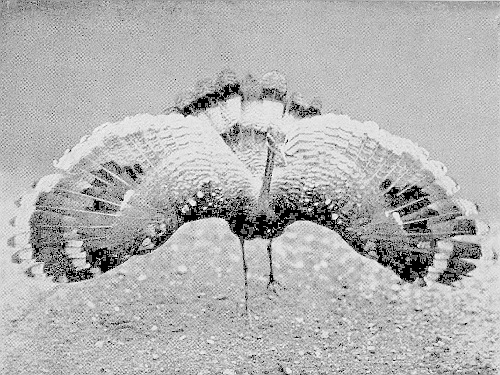
this trailing glory is erected, the bird throws the body
forwards and downwards, so that the outermost train-feathers
fall downwards on either side in front of the
wings, which are more or less trailed: so that from the
front only the head and neck are visible, the rest of the
body being hidden behind the screen, as may be seen by a
reference to the accompanying photographs. The manner
of this display is extremely interesting, for the bird seems
to be conscious of the effect produced: though it cannot
be supposed that this is really the case.
When displaying, the bird gradually approaches the
nearest female and slowly erects these extraordinary
plumes. So soon as this is accomplished he begins to
walk backwards towards the object of his attentions,
presenting nothing but a great round shield of dull brown
feathers, backed up by the tail-feathers, and the dull-coloured
wings. So soon as he judges himself near enough,
however, he suddenly swirls round, confronting her in all
his splendour, and heightening the effect with a loud scream
accompanied by a rapid, vibratory, motion of the train-feathers
which produces sounds like the pattering of rain
on leaves. Then he stands before her, with bowed head,
as if to give her an opportunity of drinking in his splendour
to the full. Commonly, however, she appears to be
utterly indifferent, and either walks away or continues a
real, or affected hunt for food, as if no such thing as a
love-sick suitor were within a hundred miles of her! But
sooner or later his suggestive attitudes beget an answering
response, and pairing takes place.
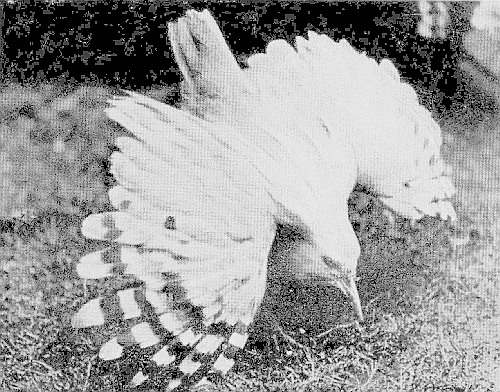
The display of the beautiful Peacock Pheasant differs
conspicuously from that of the Peacock, and recalls that
of the Argus Pheasant. In the Peacock Pheasant, as
will be seen from the adjoining photograph, the wings, and
tail, are alike bedecked with ocelli. The display is made
by the bird as it crouches close to the ground, with the
wings and tail raised to form a continuous, patterned
surface, the head being swiftly moved during the performance;
hence its blurred outline in the photograph.
Plate 15.
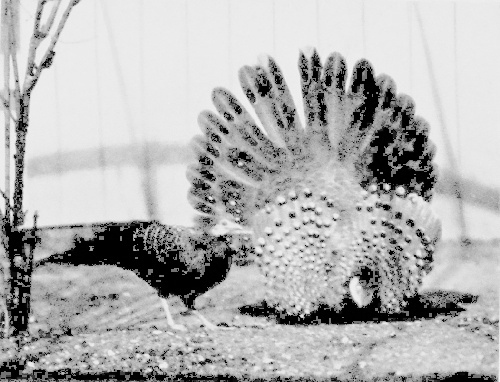
Photo by D. Seth-Smith.
PEACOCK PHEASANT.
The display of this bird differs conspicuously from that of the Peacock and recalls that of the
Pigeon in some respects. The “ocelli” on the wings afforded Darwin the interpretation he sought
for as to the meaning of the notch in the “eye” of the Peacock’s tail-feather.
Plate 16.
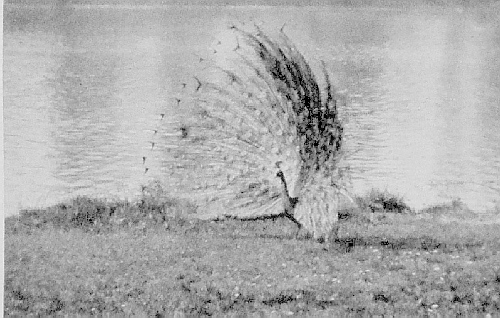
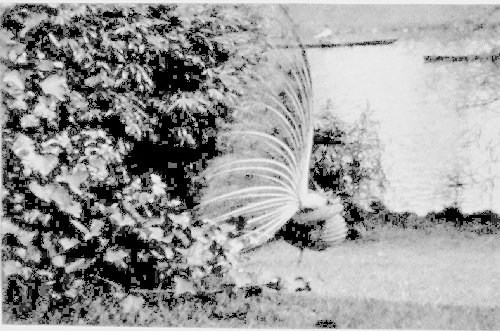
Photos by the Author.
“THE PEACOCK IN HIS PRIDE.”
In the upper figure it will be noticed the “train,” when erected, encircles the base of
the neck; the lower figure shows the train supported by the tail and dropping on each
side in front of the wings.
[Face page 96.
The Argus Pheasant is an even more wonderful performer
than the two preceding species. In this bird, it
should be remarked, the tail and the secondary wing-feathers
are enormously lengthened, the latter to an extent
met with in no other bird, showing that the struggle for
existence cannot be very severe with this species. For
if long journeys had to be undertaken in search of food,
or to avoid extremes of climate, or enemies had to be
swiftly escaped, such cumbersome wings would lead
to speedy extermination. But an even more remarkable
feature of these wings is their wonderful coloration.
The primaries have blue shafts, and a most delicately
mottled pattern formed by spots of reddish chocolate
on cream-coloured ground, while the secondaries have
their broad webs ornamented with large ocelli, to be
described in greater detail presently. When under the
influence of sexual excitement Darwin tells us, the wings
are so spread as to form a deep concavity, an effect which
is gained by pressing the primaries close to the ground,
and turning the elbows upwards. Within this concavity lie
the ocelli, in radiating vertical rows. But to produce this
effect the bird has to turn its head under its wing, so that
it lies behind the screen. Hence it cannot see the female
which is the object of these captivating antics. As a
consequence, to discover whether he has an audience for
she will often walk disdainfully away—he has constantly
to thrust his head through the curtain, and hence many
of the feathers in this region get much worn.
By nature it would seem the Argus Pheasant is a very
solitary bird, though we must assume it is polygamous.
As the breeding season advances, however, the male
proceeds to choose some open space in the depths of the
forest—which it never leaves—and therefrom to clear
all the dead leaves, and twigs, for a space of some six
or eight yards square, so that nothing but the bare earth
remains, and thereafter this area is kept scrupulously
clean. Here, in solitary state, for a short season he
remains, calling at frequent intervals to advertise the fact
that an eligible male is in the neighbourhood desiring
mates. A dozen times in succession he will break the
stillness of the forest gloom with a loud, “How-how, how,
how, how!” Sooner or later comes a responsive, “How-owoo,
how-owoo!” and in a short time, guided by the
sound, one or more females discover the object of their
quest. But the pairing desire has not yet reached its
full intensity, and doubtless to kindle this the display just
described is enacted, and not once, but a dozen times
probably, before the desired state of frenzy has been
aroused. Not seldom another male answers the cry,
and this inevitably leads to a duel whereby the fittest
and strongest male is speedily discovered.
A word as to these ocelli. This pattern is rare among
birds, and Darwin brought to light some extremely
interesting facts regarding it. He was led to investigate
the matter by his curiosity as to the meaning of the notch
in the ocelli of the Peacock’s train-feathers. At last he
noticed that among the different species of Peacock
Pheasants there was one (Polyplectron chinquis), in which
the ocelli were paired, one lying on either side of the
shaft, in another (P. malaccense) these approached
and partly fused with one another. Now, to get the
indented ocellus of the Peacock, we have only to imagine
the fusion of two such ocelli, whose long axes inclined
obliquely to one another, to get the “eye” of the Peacock
with its indented lower edge; for such fusion would give
a continuous upper and an indented lower border.
The “eyes” of the Argus Pheasant are more interesting
still, for, as Darwin pointed out, these have the appearance,
if the feathers are held more or less vertically, of a number
of balls lying each within a socket, or cup: for each of
these balls has a light area which exactly simulates the
light glancing across the upper pole of a sphere, leaving
the rest in shadow; and, singularly enough, this effect
is produced in the living bird only when the feathers are
erected for display. The probable steps in the evolution
of these ocelli from simple spots, and through elliptical
bars, Darwin traced with his usual skill and insight, and
those who would follow this up should turn to that
wonderful book, “The Descent of Man.”
Plate 17.
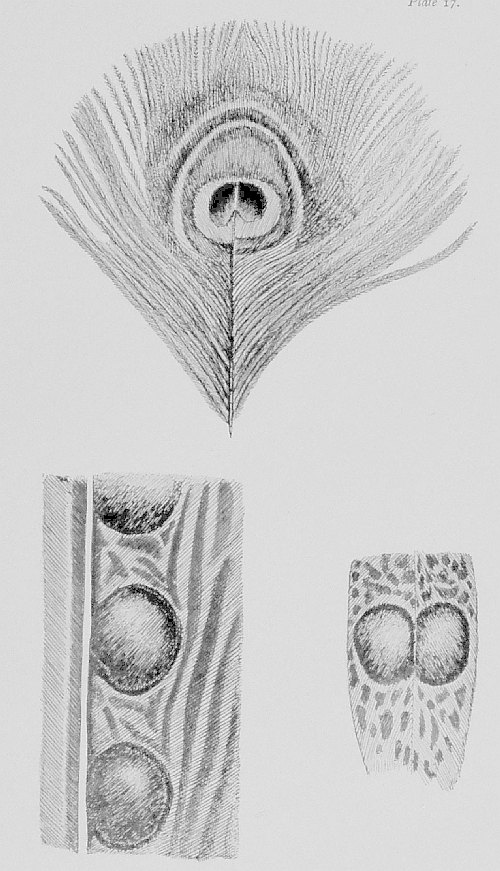
PATTERNS WHICH PUZZLED DARWIN.
The notch in the “eyes” of the Peacock’s train-feathers puzzled
Darwin till he met with the ocelli of the Peacock-pheasant. The
left-hand lower figure represents the ocellus of the Argus, the right-hand
that of the Peacock-pheasant.
[Face page 98.
It is probable that the erroneous interpretation of the
display of the Peacock is due to the more lasting and
easily remembered impression of what obtains in the case
of the Turkey under like emotions. This bird in his
exultant moods, most people have seen. Herein the
tail plays a very important part, being raised and spread
to form a great half-circle, while at the same time the
back-feathers, or at least those of the lower back, are set
on end, and the wings are trailed on the ground. The
effect is heightened by the suffusion of blood to the bare
skin of the head and neck, and the sudden inflation of a
long, pendent, fleshy wattle from the forehead, which hangs
down over the beak. Great display is made with this,
and an additional importance is added by the spasmodic
vocal efforts which can best be described by the “gobble”
rapidly repeated, as the bird struts about with mincing
gait, turning the wheel-like tail now to one side now to
the other. But the Turkey possesses yet another “ornament”
which commonly escapes notice. This is the
curious tuft of long, black, coarse, bristles which projects
forward in front of the breast. It is difficult to discern
what part this tuft may play, since it is quite
inconspicuous. It seems as though this must be added
to the number of structural characters which appear
to survive without any apparent use.
The game-birds, it is significant to remark—and
significant because they are commonly polygamous—afford
a quite remarkable series of displays, only some of which
can be summarized in these pages. In every case, too,
they are accompanied by conspicuous coloration and a
more or less excessive development of brightly-coloured
plumes, or areas of bare skin. In some, as in those
wonderful birds the Tragopans, the development of bare
skin, vividly coloured, and produced into pendulous folds,
has attained a degree met with nowhere else among this
group. These flaps, or finger-like wattles, as the case may
be, under the influence of sexual excitement become
turgid, and their hues enormously intensified: though
beyond this fact but little else is known of their performances.
In Swinhoe’s Pheasant the face is bare, the
skin being covered, as in the case of the common Pheasant,
with tiny villi of a vivid red colour. But when excited
by the presence of a female the upper part of this face
area rises high above the head like a pair of horns. With
these turgid, and erect, the bird makes a series of
short, semicircular rushes around his prospective mate,
accompanying each of these gyrations with an angry
hissing sound. The Golden, and Amherst Pheasants
are among the most gorgeously clad of birds. Not their
least conspicuous ornament is a cape-like frill of long,
highly coloured feathers of which the birds seem to be
extremely conscious; for when endeavouring to excite
the female nearest him to the necessary pitch of sexual
desire, he places himself sideways before her, drawing
the frill round to the side facing her, and dropping the
wing, in order, as it would seem, that she may miss
nothing of his resplendent livery. This side of his nature
he reserves for her. Intruding rivals are treated after
quite another fashion, for like most of the gallinaceous
birds his legs are armed with formidable spurs which
can, and do, inflict the most terrible wounds: as, indeed,
has been shown from the evidence of the Cock-pit in the
case of game-cocks.
Plate 18.
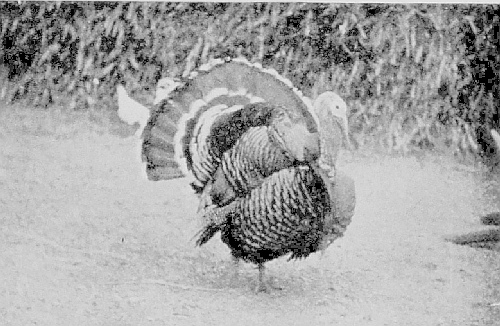
THE “STRUTTING TURKEY.”
This should be contrasted with the Peacock. Herein the tail itself is the principal
ornament, the effect of which is heightened by the erection of the back-feathers, and
the vivid play of colour of the “wattles” of the head.
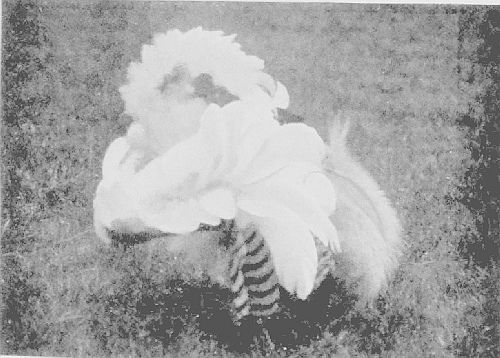
Photo copyright by W. H. Quentin.
THE DISPLAY OF THE GREAT BUSTARD.
This is effected by the inflation of a great wind-bag in the neck, and the eversion
of the wing and tail feathers as described in the text.
[Face page 100.
By way of contrast with the several displays just
described, it would be hard to find a more striking illustration
than that afforded by the Lesser Bird of Paradise
(Paradisea minor), inasmuch as here the display is
associated with rivalry between a number of individuals.
For much of our knowledge on this subject we have to
depend on the descriptions of natives; but happily this
has now been supplemented by observations made by
Mr. Ogilvie Grant on a captive in the Gardens of the
Zoological Society of London.
Impelled by the surging wave of sexual desire, as yet
only seeking consummation, these birds gather together at
frequent intervals, on certain of the forest trees of the Aru
Islands, selected apparently because they present an immense
head of spreading branches, and large but scattered
leaves. Here ample space is found for the revels, which
take the form of “Sacaleli,” or dancing-parties, comparable
to the erotic dances of many barbaric races.
By the time the ball opens, the birds, to the number
of twenty or more, have worked themselves up into a
state bordering on frenzy, and each commences his performance
with quivering wings and loud, penetrating
cries which may be syllabled as walk—walk—walk—walk—walk—walk,
rapidly repeated. Then the wings are suddenly
held out on either side, the tail is bent forward under
the branch, and with a quick, barely perceptible rustle,
the gorgeous, golden, diaphanous side-plumes are thrust
upward and forward on each side of the body, forming
an arched cascade above the back. With every muscle
tense the performer will remain in this attitude from
ten to twenty seconds, slightly quivering the wings, and
from time to time imparting a tremor to the upraised
plumes. Then follows a second phase. Each bird,
seemingly possessed, commences to dance and hop wildly
backwards and forwards along the bough, and with head
bent forward, wings spread horizontally, and the side
plumes raised to their utmost, he gives vent to a series
of loud harsh cries—“ca! ca! ca! ca!” For some
seconds he remains in a sort of ecstasy, rubbing his beak
on the bough, and occasionally glancing backwards below
his feet, and with the back fully arched. The climax
passed, he reverts once more to the earlier, more erect
stage of the display, when the paroxysm either gradually
subsides or is renewed.
No less extraordinary is the behaviour of the King-bird
of Paradise (Cicinnurus regius), which has been
described by Sir William Ingram, who for a time had a
captive in his aviaries. As the illustration shows, its
posturing is quite remarkable. Before this is described,
however, a brief description of its coloration should be
given, which, it must be remarked, cannot possibly
convey more than a very vague idea of its sumptuous
character. Picture a bird no bigger than a thrush, but
of a wonderful cinnabar red, with a gloss as of spun
glass: the head clothed in short, velvety, orange-hued
feathers; and with a white breast, having the softness
and sheen of satin, and crossed by a band of deep metallic
green, contrasting with the red of the throat. Add a yellow
beak, and legs of cobalt blue, and you will have the features
which catch the eye at the first glance. But a little closer
examination will reveal yet other points for wonderment.
Along each side of the body the upper flank-feathers
become elongated and delicately tinted, and, furthermore,
they are erectile: so that they can be raised up on
each side of the body to form an almost circular shield
of delicate ash grey, bordered with buff and emerald
green. These play a most important part during the sexual
frenzy, and the effect thereof is not a little heightened
by the middle pair of tail-feathers, which have been
modified to form a pair of slender stalks, some ten inches
long, bearing at the ends a curious disc of emerald green
formed by coiling upon itself—like a watch-spring—the
only piece of the vane of the feather which remains.
So much for its fine feathers; now for the manner
of their use. “He always commences his display,”
writes Sir William Ingram, “by giving forth several short
notes and squeaks, sometimes resembling the call of a
quail, sometimes the whine of a pet dog. Next he spreads
out his wings, occasionally quite hiding his head; at
times, stretched upright, he flaps them, as if he intended
to take flight, and then, with a sudden movement, gives
himself a half turn, so that he faces the spectators, puffing
out his silky-white lower feathers; now he bursts into his
beautiful melodious warbling song, so enchanting to
hear but so difficult to describe. Some weeks ago I was
crossing a meadow and heard the song of a skylark high
up in the heavens, and I exclaimed at once: ‘That is
the love-chant of my King-bird.’ He sings a low bubbling
note, displaying all the while his beautiful fan-like side-plumes,
which he opens and closes in time with the variations
of his song. These fan-plumes can only be expanded
when his wings are closed, and during this part of the
display he closes his wings and spreads out his short tail,
pressing it close over his back, so as to throw the long
tail-wires over his head, while he gently swings his body
from side to side. The spiral tips of the wires look like
small balls of burnished green metal, and the swaying
movement gives them the effect of being slowly tossed
from one side to the other, so that I have named this
part of the display the ‘Juggling.’ The swaying of the
body seems to keep time with the song, and at intervals,
with a swallowing movement of his throat, the bird raises
and lowers his head. Then comes the finale, which lasts
only a few seconds. He suddenly turns right round
and shows his back, the white fluffy feathers under the
tail bristling in his excitement; he bends down on the
perch in the attitude of a fighting cock, his widely-opened
bill showing distinctly the extraordinary light apple-green
colour of the inside of the mouth, and sings the same
gurgling notes without once closing his bill, and with a
slow dying-away movement of his tail and body. A
single drawn-out note is then uttered, the tail and wires
are lowered, and the dance and song are over.
“The King-bird has another form of display which he
very rarely exhibits, and only on three or four occasions
have I seen him go through this performance. Dropping
under the perch, the bird walks backwards and forwards
in an inverted position with his wings expanded. Suddenly
he closes his wings and lets his body fall straight
downwards, looking exactly like a crimson pear, his blue
legs being stretched out to the full length and his feet
clinging to the perch. The effect is very curious and
weird, and the performance is so like that of an acrobat
suddenly dropping on to his toes on the cross-bar of a
trapeze that I have named this the ‘Acrobatic’ display.
It has been witnessed on different days to his ‘Juggling’
display. While giving his ‘Acrobatic’ performance he
sings the whole time, but never shows his side-plumes,
and when he is in the pendulous position his body sways
gently as if it were influenced by a fitful breeze. The whole
of this performance takes but a very few seconds.”
Plate 19.
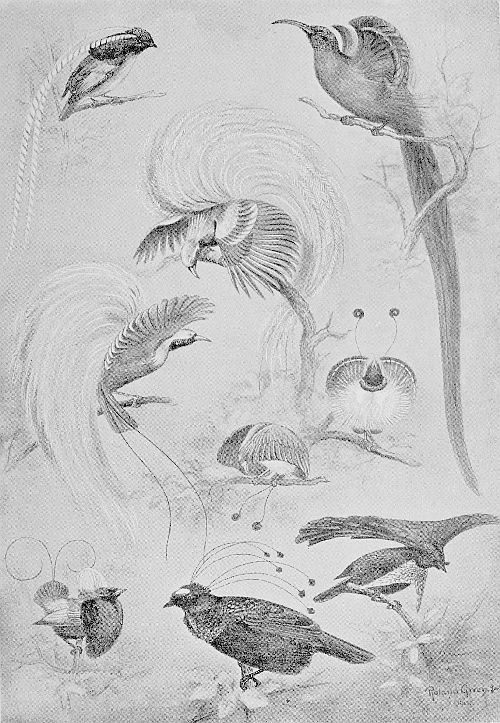
From a Drawing by Roland Green, Jun., adapted from G. E. Lodge and others.
SOME OF FORTUNE’S FAVOURITES.
The Birds-of-Paradise have few rivals in the matter of ornament. In the centre of this
plate are seen the Lesser and the King Bird-of-Paradise displaying (after G. E. Lodge). The
first-named is distinguished by the enormous development of the side plumes, which can
be raised high above the back. In the second, the ornaments take the form of erectile
frills on each side of the breast, and strangely modified tail-feathers which end in curious
discs. At the top left-hand corner is the King of Saxony’s Bird-of-Paradise; on the right
is the Long-tailed Bird-of-Paradise; at the bottom of the page, from left to right, are
Hunstein’s, the Six-wired, and Superb Bird-of-Paradise.
[Face page 104.
Naturally one needs to witness such a display to appreciate
its beauty and its weirdness; but the wonderful
sketches which my friend, Mr. G. E. Lodge, made during
one of these performances, should go far towards helping
the reader to visualize what really takes place.
While it would be untrue to say that the Birds of Paradise
are of a more amorous, or more excitable disposition
than other less resplendent birds, one cannot but be
impressed with the fact that they exhibit a range of
variation in the matter of feather-ornament probably
unequalled, and certainly unsurpassed, by any other
group of birds. From what has been observed of the
few species which have been kept in confinement, they
seem to enjoy no less distinction in matters of display.
On this latter subject no more of importance can be said,
and exigencies of space forbid any attempt to describe the
exquisite beauty of coloration which a survey of all the
known species reveals. It would be hardly more profitable
to attempt to describe the varied character of the
shields, crests, frills, streamers, which are to be met with
in different species: but a glance at the accompanying
illustrations will show that it would be hard, indeed, to
exaggerate the splendour of the ornamentation which
these birds have developed. Even here, where no indication
can be given of the glowing, vivid colours, often
indescribably beautiful, it is obvious that these birds well
deserve their name. St. John’s imaginary Paradise would
probably have been described in far more enticing language
had he known of the existence of these wonderful birds.
Among all the known species the dullest is Wallace’s
Bird of Paradise, the general coloration being of a dull
brown hue; but even here, a pair of wing-coverts are
produced into long, broad streamers, unique among birds;
while the feathers of the throat and flanks are of a marvellous
metallic green, the flank-feathers being produced
to form a long, pointed tuft.
To what factors must we attribute the growth of these
wonderful colours, these strange outgrowths, frills, and
tufts, and streamers, the like of which is almost unparalleled?
In a group numbering some fifty or more
species there is not one that does not display some strange
feature. We cannot attribute it to the environment, for
in such case the results should have produced uniformity;
nor can we invoke the aid of sexual selection save in a
very indirect manner, and in a sense other than generally
understood by this term. It seems, then, not unreasonable
to suggest that they are the expression points of the
internal metabolism: the manifestations of that tendency
to vary which is inherent in every fibre of the organism.
But no attempt shall be made to elaborate this theory till
more evidence has been taken. The humming-birds, and
the game-birds, are perhaps the only other groups which
exhibit quite such a prodigality of ornament; of the
latter, instances have already been cited.
So far the displays which have been described have been
such as are confined to the use of more or less resplendent
plumage. There are, however, many species which
contrive to secure most startling results, not so much by
the parade of coats of many colours as by grotesque changes
of shape produced by wind-bags of various kinds. The
Pouter-pigeon affords a case in point. This bird possesses
the power of inflating the gullet to an enormous size, so
as to produce a strangely distorted form, at any rate,
to our eyes. The “Pouter,” it is hardly necessary to
mention, is an artificial product of the “fancier,” who
has taken advantage of the natural tendency, seen in the
Wild Pigeon, to inflate the neck during moments of excitement.
By the selection from each generation of the
finest performers in his stock, the Pouter of to-day has
been developed. But there are many birds which,
while not even remotely related, have developed the same
strange device. The most striking illustration of this
kind is furnished by the Great Bustard, a bird once common
on the fen-lands of Great Britain, but now, unhappily,
exterminated within these islands.
The means of inflation in this case is afforded by a
large thin-walled sac of a very remarkable character.
Opening by a small slit just under the tongue, it is continued
down the front of the neck immediately under the
skin, which in this region is thickened by an accumulation
of fat and blood-vessels. Between the arms of the
furcula, or merry-thought, its cavity is constricted, to
expand again immediately to form a pear-shaped termination.
How it is filled is something of a mystery.
But once inflated, the bird draws its neck downwards and
backwards, so that the head is brought to rest between
the shoulders and is there almost buried, partly by pressure
on this curious air-cushion and partly by the erection of
a number of bristle-like feathers, which in calmer moments
project backwards on each side of the head. At the
same time the tail is drawn forwards to lie upon the back,
thus exposing a billowy mass of white feathers forming
the under tail-coverts. The tips of the wing-feathers are
used to hold the tail in position. Meanwhile the scapulars
are set on end, and the long inner secondary quills are
similarly erected. The feathered contortionist, having
completed his preparations, now approaches his partner
with a mincing gait, then halts before her and solemnly
utters a series of low grunts like “oak, oak, oak.” Having
thereby declared his passion, and commonly without
gaining any answering response, he returns to his normal
shape again!
It is curious that a near relative of this bird, the Great
Australian Bustard (Eupodotis australis), also captures
the wind to declare his love; but it is disposed of after
a quite different fashion, being drawn into the gullet,
though the precise manner in which it is manipulated
demands further investigation. The display Dr. Murie
described many years ago. It begins, he tells us, with a
swelling of the throat, while the head is thrown upwards.
Immediately after, the neck swells, and the feathers of
the lower part of the neck, set all on end, are carried
downwards, apparently surrounding a huge bag which
reaches nearly to the ground. During all this time the
head and neck are held rigid and point skywards, the head
surmounting a great feathery column. Meanwhile the
tail, as with the Great Bustard, is drawn forwards over
the back. In this peculiar attitude the bird struts about
in a stiff, waddling manner, the elongated neck-bag swaying
to and fro and the feathers of the throat standing out
in the shape of a great rounded swelling. The acme of
inspiratory effort completed, the bird begins to snap the
jaws together, producing loud noises, which are accompanied
by a soft dove-like cooing.
The Pectoral Sandpiper in like manner inflates its
gullet. But, unlike the Pigeon and the bird just described,
the neck is not markedly straightened, nor is the body
raised. As the air is drawn in, the gullet expands, till
it forms a great spherical drum. Then the excited performer
runs along the ground uttering a resonant “too-u
tooo-u” repeated seven or eight times in rapid succession,
all the while he approaches nearer to the apparently very
much-otherwise-engaged female. This effort failing, he
will then often rise on quivering wings twenty or thirty
feet into the air, and dive gracefully down again immediately
afterwards, deflating this curious balloon to await
a more favourable opportunity.
In some species where wind-bags are employed as
aphrodisiacs the outer skin is brilliantly coloured and
exposed during the display. The Prairie-hen affords a
case in point. In this species the air-chamber is furnished,
not by the gullet, but by the air-sacs of the neck.
When these are inflated they appear as two large orange-coloured
bodies standing boldly out among the feathers.
Their effect is heightened by a tuft of long stiff feathers
which are thrust forward like a pair of horns, on each
side of the head, while at the same time the feathers of
the back are set on end, the tail is spread like a great
fan, and the wings are half opened and trailed like those
of the Turkey.
The displays take place in the early hours of the morning,
when parties of from a dozen to fifty, of both sexes, meet
on some slight knolls where the grass is short. Having
duly assembled, the more ardent cocks immediately begin
to prepare for the morning revels, the first part of the
performance apparently being of a comparatively passive
nature—the parade of the air-sacs and the erection of
the feathers.
Then some “proud cock, in order to complete his
triumph, will rush forward at his best speed ... through
the midst of the love-sick damsels, pouring out as he
goes a booming noise ... which may be heard for at
least two miles in the morning air. This sound is by
no means harsh or unpleasant. When standing in the
open prairie at early dawn listening to hundreds of
different voices pitched in different keys, coming from
every direction and from various distances, the listener
is rather soothed than excited.
“Every few minutes this display is repeated. I have
seen not only one, but more than twenty cocks going
through this funny operation at once; but then they
seem careful not to run against each other, for they have
not yet got to the fighting point. After a little while the
lady birds begin to show an interest in the proceedings by
moving about quickly, a few yards at a time, and then
standing still a short time.
“The party breaks up when the sun is half an hour
high, to be repeated the next morning, and every morning
for a week or two before all make satisfactory matches.
It is towards the latter part of the love-season that the
fighting takes place among the cocks, probably by two
who have fallen in love with the same sweetheart....”
There is much that is extremely interesting in this
account and a little that seems to have been misinterpreted.
The fact that these antics are repeated
during many days until at last the females are moved
to display some interest is just what we should expect
if this demonstrative behaviour on the part of the males
acts, as we believe, as an aphrodisiac. And that actual
fighting occurs is highly probable, but there can be no
doubt that in such case the whole aspect of the bird
must be changed, for anything in the nature of fighting
with the delicate air-sacs inflated would greatly endanger
the most important aid to success in achieving this object
which these birds possess.
Plate 20.
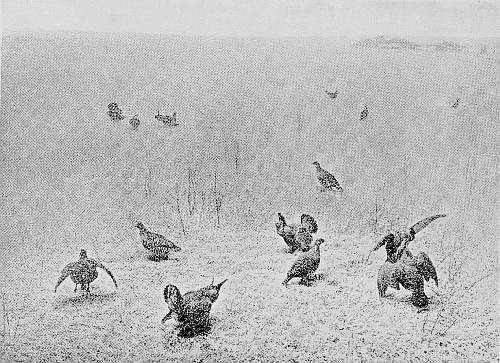
Photo from The Museum of Natural History, New York.
THE LOVE-MAKING OF THE PRAIRIE HEN.
During the “display” large, yellow, air-sacs in the neck are inflated. The bird in the foreground shows one of
these, and the ornamental feather frill, very clearly.
[Face page 110.
No less remarkable is the performance of the Frigate-bird
(Fregata), a tropical species allied to the Pelicans
and Boatswain-bird, and to our own more familiar Cormorants
and Gannets. It might well be called a marine
Swift, having excessively short legs and small feet, and
a wonderful expanse of wing. As with the Swifts, of
course most of its time is spent on the wing; the feet
are only useful for supporting the body when ashore,
they are never used for walking, at any rate, for more
than a few steps. The wings afford the only means of
locomotion. Our knowledge of these birds when under
the stress of sexual excitement we owe to Dr. C. W.
Andrews, who had the good fortune to study the
species known as the Great Frigate-bird (Fregata aquila)
during his task of surveying Christmas Island (Indian
Ocean).
“About the beginning of January,” he remarks, “the
adult males begin to acquire a remarkable pouch of
scarlet skin beneath the throat; this they can inflate
till it is nearly as large as the rest of the body, and a
dozen or more of these birds sitting on a tree with outspread,
drooping wings and this great scarlet bladder
under their heads are a most remarkable sight. When
a hen bird approaches the tree the males utter a peculiar
cry, a sort of ‘wow-wow-wow-wow,’ and clatter their
beaks like castanets, at the same time shaking their
wings. When they take to flight the air is allowed to
escape from the pouch, but occasionally they might be
seen flying with it partly inflated.”
Here again there can be no doubt about the purpose, or
perhaps one should say the stimulus, of this strange performance.
This pouch, I have been enabled to ascertain
from dissection, is not formed by inflating the gullet,
but, as in the case of the Prairie-hen, by the enlargement
of the air-sacs of the neck.
These air-sacs, which are present in all birds, are only
enlarged to further the ends of sexual display in a few
species, and, curiously enough, these are in no way related
one to another. The Adjutant storks, it may be remarked
in this connection, have used the air-sacs which are fed
by the nasal system instead of those fed by the lungs,
as in all the species so far described. When deflated this
pouch forms a quite inconspicuous conical swelling in
front of the neck; under the stimulus of excitement,
it awakens as it were into activity, and is suddenly
transformed into a great red or red-and-black bag, encircling
the neck and projecting far downwards in front
of it, only to be deflated an instant later with a speed
which leaves one gasping.
The specialization of the air-sacs, that is to say their
transformation to perform new functions subservient to
the ends of sexual activities, is not exclusively confined
to display. In at least one instance an air-sac has been
specially developed to act as a voice resonator. This
is furnished by the Emu, wherein the wind-pipe, near the
middle of its length and on its anterior aspect, has a
number of incomplete rings forming a long slit. The
lining of the windpipe escapes from this slit in a hernia-like
pouch, and takes up a position beneath the skin.
Even when inflated this pouch gives no very obvious
sign of its existence, but it serves to produce a curious
hollow, drumming sound, like the boom of a big drum
softly beaten. But why it should have been developed,
when the Ostrich and the Cassowary produce similar
but louder “music” without any special apparatus
whatever, is a mystery. At least one species of Cassowary
can emit a roar which would do credit to a
lion.
In the males of all healthy animals the periodic
stimulus to reproduction finds expression in more or
less striking eccentricity of conduct. Sometimes, as the
foregoing instances have shown, this has been exaggerated
by the development of long, resplendent plumes: sometimes
by brilliant coloration, displayed either by the
plumage or by bare areas of skin, or by both, while in not
a few cases attitudes, to our eyes grotesque and made
still more so by the aid of inflatable pouches, are the
outward and visible sign of the raging fires within. For
the completion of this chapter yet other instances of this
kind must be cited, instances which reveal a further
elaboration of some of the more striking of these tricks
of posturing; or which concern the growth of the aggressive
instincts, which are proclaimed by the development of
armature often of a very formidable character. As
the sequel shows, however, there are no hard and fast
dividing lines between these several modes of expression.
That remarkable bird, the Ruff (Machetes pugnax),
now, alas! no longer to be met with in our fens, exhibits
a curiously composite character in the phases of its love
display.
Preparations for this are begun in the early spring by
the assumption of what is called a “nuptial dress,”
which is worn only by the male, and which contrasts in
a very conspicuous manner with the plumage worn
during the rest of the year. The most striking features
of this dress are the great, erectile, Elizabethan ruff which
encircles the neck immediately behind the head, and
the long, tongue-shaped “ears” which surmount the
head itself. These exhibit a most remarkable diversity
in their coloration, and it is no exaggeration to say that
no two are ever alike. Red, cream-colour, buff, black,
white; spotted, streaked, freckled and barred are the
only descriptions that can be applied to them, for the
combinations of their hues and patterns seem infinite.
Having grasped this fact, the eye next turns to the
colouring of the rest of the body, and it will be found
that here too is the same diversity, though less conspicuously
so; and finally it will be noticed that at this
time the feathers around the base of the beak have been
replaced by yellow or orange-coloured papillæ. The
females also now wear a dress differing from that of the
so-called “winter plumage,” but it does not present any
very striking features nor any form of ornamentation
comparable to that of the males.
The Ruff is a polygamous bird, which, in its display,
presents some curious and puzzling features, one of which
consists of a sort of tournament between rival males.
At the break of day the performers, selecting such
eminences as the fen-lands afford, assemble apparently
to display their finery, for a couple of males will often
stand facing one another with frills erected and beaks
touching the ground, silent and immovable, for perhaps
half a minute. Sooner or later, however, they will
commence to spar, and this presently leads to blows,
during which one of the combatants will attempt to
seize the other by the wings. However, no damage
seems to be inflicted during such encounters, which are
by no means aimless or profitless, for during such bouts
the weaker, less vigorous birds are driven from the field,
and the victor in consequence wins for himself a larger
harem.
When the actual pairing time arrives the parade of
the frills begins again. The amorous instincts, it is
important to notice, are awakened earlier in the males,
so that by the time the females have attained to a like
condition the least mettlesome males have been driven
off. What follows is not the selection by the females of
the finest performers so much as a process of sorting
out, whereby the females discover and cleave to those
males which are readiest for mating. This display
succeeds in revealing both the most mettlesome males
and the most amorous females, who, however, would
seem to require great persistence and much demonstration
on the part of the males before they can be finally aroused
to the pitch necessary for pairing. Again and again
a male may be seen to approach an apparently very
unconcerned female, and then to crouch down before
her with his beak pressed to the ground and his frill and
“ears” set off to their fullest. For some seconds he
will remain lost in apparent contemplation, then with
a dazed, far-off, expression he will look up, to find, as often
as not, that she is still apparently feeding, quite unmoved
by his protestations; or that she has even flown off and
left him. Pursuit speedily follows, and the performance
is repeated until at last she too catches the flame of
passion and permits, or rather invites, the final act of
sexual congress.
Though these birds on occasion will fight, and savagely,
they cannot inflict serious damage on one another by
reason of the relative feebleness of their beaks and legs,
which are but ill-adapted for violent measures. Inasmuch
as the Ruff is a polygamous species, these bloodless
battles have a peculiar interest. They show that the
preponderance of females, which polygamy implies, is
not, as is commonly supposed to be the case, due to a
high death-rate among the males by fighting. The same
is true of the Wydah-birds, and their kin, the only
polygamous species among the Passeres.
In this connection it is to be remarked that fighting,
of a more or less sanguinary character, is apparently
universal among birds, the conflicts being waged
not so much in the way of squabbles for the possession
of females as for the acquisition and retention of
territory and all that this entails during the breeding
season and, to a much less extent, in the defence
of the eggs and young. But to this point we must
return. For the moment it will be more profitable
to focus attention on the character of this fighting. In
the first place, it is by no means necessary that the
combatants should be armed. The “dove of peace”
at this time of the year appears in a new and not always
pleasing light, for not only will he fight his neighbours,
but he does not always show that gentleness towards
his wife with which tradition has credited him. The
little Humming-bird would seem to be as little capable
of fighting as a bird could be, yet few are more pugnacious.
The naturalist Gosse tells of a pair which had torn one
another’s tongues out in their blind fury; and everybody
knows that Robins and Tits fight savagely to preserve
their chosen haunts from invasion by their neighbours.
In some birds this pugnacity has become an overmastering
passion. Some of the Quails, and a species of Rail (Gallicrex
cristatus), a near relation of the Moorhen, are
commonly kept by the natives of the East, as our forefathers
kept Fighting-cocks, for the sake of seeing them
fight one another. Yet, save in the case of the Fighting-cock,
neither of these birds possesses any aggressive
weapons.
Among the game-birds, however, powerful armature,
in the shape of long, pointed, spurs on the legs are met
with. In the Jungle-fowls and Pheasants only a single
pair are found on each leg, but in other species, as in
the Francolins, there are several pairs, and these birds,
it is instructive to notice, are notorious for the ferocity
of their encounters. It is said that in the Indian Swamp-Francolin
(Francolinus gularis) nearly every individual
is marked by scars and wounds received in duels with
rivals.
Certain members of the Plover-tribe, and certain
Anserine birds, have developed spurs of a very formidable
character on the wings. Among the Plover-tribe the
best example of such armoured species is the Egyptian
Spur-winged Plover (Hoplopterus). This bird, after the
fashion of its unarmoured relatives, such as the Common
Lapwing, fights by turning suddenly in the air and
striking with the wings. In the case of the formidably
armed Egyptian bird the result is often fatal; but with
our Lapwing a fatal result is rare, since but slightly
swollen knobs take the place of spurs. In Hoplopterus
and in the Jacana this spur arises from the base of the
thumb, but in the Spur-winged Goose (Plectropterus)
it is borne by one of the wrist bones (the radial) while
in the aberrant Geese-like birds (Palamedea and
Chauna) there are two spurs on each wring, one at
each end of the metacarpus. That these weapons have
come into being in response to need seems a very natural
conclusion, but it is one which presents many difficulties
when more closely examined. The wing spurs, differing
widely in their nature as they do, in one case borne on
a carpal bone, in others on the metacarpus, seem rather
to owe their origin to fortuitous variations which have
become, so to speak, adopted by selection, than to a
response to the oft-repeated stimuli incidental to fighting.
The latter explanation is Lamarckian and to-day finds
favour with but few. The stimulus theory seems to be
effectually discounted by the existence of the spurs on
the legs of gallinaceous birds. That these owe their
origin to impacts, or blows, seems more than doubtful:
and one can hardly see how they could have served any
useful purpose until they had attained a sufficient length
to serve as weapons. Even if we suppose that the spurs
of, say, the Jungle-fowl or the Francolin have been
derived from tuberosities such as are found on the legs
of the French Partridge (Caccabis rufa), we should still
lack evidence that the use of the legs in fighting caused
the origin of the tuberosities.
There is yet another puzzling feature in regard to the
armature of the wings, and one which may yet help to a
better understanding of the puzzles presented by spurs.
A Jacana, one of the Plovers, has the radius broadened
or flattened out from its middle onwards to form a flat
plate or blade, but the use thereof is unknown. It may
possibly serve as a weapon of offence, enabling the bird
to beat its rivals with its wings, but from the nature of
the structure, and of the effect such a use of the forearm
would have upon the hand, it seems doubtful whether
it serves any aggressive function. If used at all in
fighting it is probably during fights in mid-air, when,
after the fashion pursued by the Spur-winged Plover,
and even in the case of our own Lapwing, a blow is struck
by the uppermost bird at its rival, and often with fatal
effect. It is significant to remark, by the way, that in
the Lapwing a tubercle answers to the spur of Hoplopterus
just as the tubercles of the French Partridge (Caccabis)
answer to the spur of the Jungle-fowl or Pheasant: but
the flattened radius of the wing of the Metopidius jacana
has no parallel.
With birds, as with men, there must always remain
the ability to appeal to force when some important end
cannot otherwise be gained. The species which adopts
the crazy tactics of the Quaker is doomed to extinction,
sooner or later. The foregoing instances display force,
as we may say, aggressively. But even the peacefully
disposed birds can fight when aroused.
Reference has already been made to dancing in this
chapter; but so far no very striking instances thereof
as a form of sexual display have been cited. The
subject has been deferred because this peculiar type of
activity is not always directly associated with the furor
amantium.
With some species, which, it should be remarked, also
lack distinctive colouring, the erotic state is manifested
apparently not so much by the display of expanded wings
and tail as by frenzied dances. The Jacanas, aberrant
members of the Plover tribe resident in South America,
are expert performers, displaying moreover a curious
spontaneity during such outbursts. A flock will be
apparently sedulously feeding when suddenly and with
quick, excited gestures all will cluster together in a
group and go through a singular and pretty performance,
holding their wings outstretched and agitated, some with
a fluttering and others with more leisurely movement,
like that of a butterfly sunning itself. The performance
over, all scatter and feed again.. The Honourable Walter
Rothschild, in his “Avi-fauna of Laysan” tells us of
the stately Albatross, which breeds, or rather bred there—for
the Japanese display a singular callousness in regard
to animal life where commercial interests are concerned in
thousands: “First they stand face to face, then they
begin nodding and bowing vigorously, then rub their
bills together with a whistling cry. After this they
begin shaking their heads and snapping their bills with
marvellous rapidity, occasionally lifting one wing, straightening
themselves out and blowing out their breasts;
then they put their bills under the wing or toss them in
the air with a groaning scream, and walk round each
other often for fifteen minutes at a time.”
Cranes are much given to dancing. Mr. Nelson, an
American ornithologist, has described with much vigour
the dancing of the Sandhill Crane in Alaska. As he
lay in a “hunting-blind” he was suddenly aroused by
the arrival of a crane, followed speedily by a second,
uttering his loud note as he came, until he espied the
first-comer on the ground, when he made a circuit and
dropped close by. Both birds then joined in a series
of loud rolling cries in quick succession. Suddenly, the
last-comer, which seemed to be a male, wheeled his back
towards the female and made a low bow, his head nearly
touching the ground, and ending by a quick leap into the
air. Another pirouette brought him facing his charmer,
whom he greeted with a still deeper bow, his wings
trailing loosely by his sides. She replied by an answering
bow and hop, and then tried to outdo the other in a
series of spasmodic hops and starts, mixed with a set of
comically grave and ceremonious bows. The pair stood
for some moments bowing right and left, when the legs
appeared to become envious of the large share taken in the
performance by the neck, and then would ensue a series
of skilled hops and skips, like the steps of a minuet. Such
antics are characteristic of the Cranes of all species, and
sometimes a whole flock will join in such dances. But,
it is to be noted, they are not necessarily signs of the
furor amantium: they certainly always accompany
this, but frequently they are indulged in, apparently,
solely as an outlet for exuberance of feeling.
Before the theme of dancing can be dismissed the
performance of a small species of perching bird, one of
the South American Manakins, must be described.
The natives call it the “Bailador,” or dancer. In an
account of his travels in Nicaragua Mr. Nutting tells us:
“I once witnessed one of the most remarkable performances
it was ever my lot to see. Upon a bare twig ... at
about four feet from the ground, two male
‘bailadors’ were engaged in a song and dance act that
simply astonished me. The two birds were about a
foot and half apart and were alternately jumping about
two feet in the air and alighting exactly on the spot whence
they jumped. The time was as regular as clockwork,
one bird jumping up the instant the other alighted, each
bird accompanying himself to the tune of to-le-do—to-le-do—to-le-do,
sounding the syllable to as he crouched
to spring, le while in the air, and do as he alighted. This
performance was kept up without intermission for more
than a minute, when the birds suddenly discovered they
had an audience and made off.” Here again we have
no evidence of the furor amantium; nor that any females
were spectators of the scene.
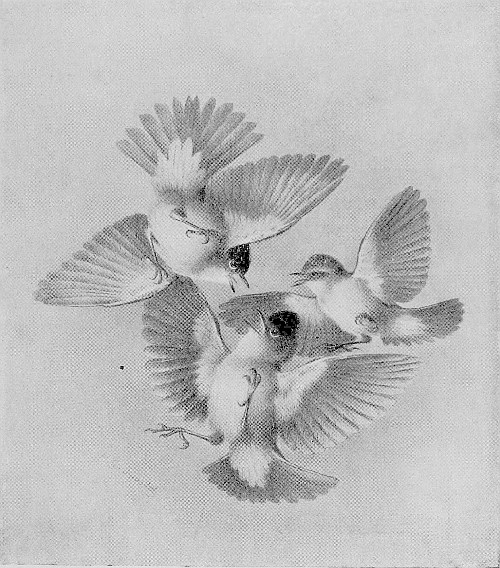
It is important to notice that Mr. Howard, in the course
of his study of the Warblers, witnessed a performance
having some likeness to this on the part of three young
Sedge Warblers but newly escaped from the nursery.
And this not in some solitary instance, but on several
occasions. Just after leaving the nest, he remarks, they
are very playful, “their games sometimes taking the
form of a tilting match. Three take part; two sit on
convenient twigs facing one another, and the third, from
the central position, might almost be called an umpire.
Numbers One and Two lower their heads, each in anticipation
of the other moving; one of them, call him Number
One, then springs into the air and darts at Number Two:
Number Two dodges and occupies the position vacated
by Number One; each of them then faces round ready
to continue the fray, the change of positions becoming
quite rapid.” But no recurrence of these antics has been
noted during the course of the adult sexual display, which
is confined to posturing and displaying the outspread
wings and tail. Nevertheless there can be no doubt
but that such games in later life are incorporated, in
the case of many species, with the love display.
That the reproductive glands have played, and still
play, a by no means unimportant rôle in Evolution is
shown by the history of the secondary sexual characters.
Among the birds, at any rate, the early stages of physical
changes belonging to this “figuration” are to be seen in
various forms of posturing, which in their more elaborate
developments we call “dances.” In many cases, as for
example among the Warblers, the periods of sex-emotion
are marked by posturing alone. But in a number of
species, as has already been shown, the products of the
sexual gland seem to have undergone some further
elaboration which has resulted in the additional phenomena
of gaudy coloration, in hypertrophied plumes, and in
weapons of offence.
But not yet is the list of such sexual products
exhausted, for no mention has so far been made of the
development of the many wonderful devices for the
production of peculiar and arresting sounds, musical and
otherwise. These are of two kinds: one wherein certain
feathers have been modified to produce rhythmical notes
either by percussion or by vibration; the other wherein
the internal organs have been modified to produce musical
notes or loud, resonant cries.
Instances of the latter kind are innumerable, and as a
consequence no more than one or two can be cited in
these pages. The facts associated with the production of
vocal, as distinct from instrumental, music are both
curious and puzzling. To begin with, this music is
produced by the lower end of the trachea or windpipe,
which has become modified in various ways, though not
so strictly in relation to the sounds produced as is
commonly supposed. The anatomical details of these
modifications cannot, or rather need not, be described
now, save in the most general terms.
Briefly the syrinx, or organ of voice, of birds, is formed
in part by the lowermost rings which form the tubular
windpipe, and in part by the smaller pair of tubes which,
running therefrom to the lungs, form the bronchi. These
last are formed of semi-rings only, the inner wall of the
tube being formed by very delicate translucent membranes.
As air is forced from the lungs along the bronchi and up
the windpipe, the modulation of the voice is effected by
muscles which regulate the amount of air driven through
the syrinx, and the height of the column in the tube;
the latter being effected by muscles which alternately
lengthen and shorten it.
So far so good. Next it is to be noted that this syrinx
presents a great variety of modifications, or types,
differing not only in plan, but also in the number and
distribution of the muscles for its manipulation. The
most accomplished performers are to be found among
that great group of birds known as the Passeres, or
perching birds, wherein the number of these muscles is
never less than five pairs, and generally rises to seven.
This association of musculature with performance is
exactly what we should expect. In Nature, however,
it is always the unexpected that happens. In the first
place, the females are, so far as the dissecting-knife and
the microscope can show, as well provided as the males,
yet they do not sing. In the second, the Nightingale
and the Crow are equally endowed, so far as we can
discover, yet it is unnecessary to state that the talents
which the Crow possesses are never used! More disconcerting
still is the reflection that the Parrot, which is
far less generously endowed by Nature in so far as singing
muscles are concerned, is a much more skilful performer,
inasmuch as it will reproduce with equal fidelity the
human voice and the song of the Canary! The latter
feat, at any rate, has been accomplished with amazing
accuracy both by the little Budgerigar (Melopsittacus
undulatus) and the Quaker Parrot (Myopsittacus monachus).
In their wild state the Parrot family are notorious for
their discordant cries. It is therefore the more remarkable
that such feats should be capable of attainment. But
wherefore the elaborate syrinx of the Nightingale, if the
simple type seen in the Parrot is capable of the same
result, and why the elaborate syrinx in the case of the
Crow, which never attains to a greater perfection of vocal
effort than the wild Parrot?
One speaks of the syrinx of the Parrot as of a simpler
type because of its feebler musculature and the lesser
complexity of its framework, but it is nevertheless a more
efficient instrument, since it is capable of reproducing
both the human voice and songs such as that of the Canary.
This fact becomes still more remarkable when we reflect
that the natural voice of the Parrot, as we have just
remarked, attains to no more than a harsh screech. How
is it that, capable of so much, it has achieved so little?
The same question may be asked in the case of the
Raven. This bird has a syrinx indistinguishable from
that of the Nightingale, save in point of size; yet
the Raven’s voice is never musical, nor can it be
trained to such an achievement. Like the Parrot,
however, it can be taught to speak, though its vocabulary
is never so extensive. One would have imagined that
when the syrinx of, say, the Raven, or any of the Crow
tribe, was compared with that of the Nightingale or the
Skylark, some structural differences, commensurate with
the difference in performance, would be discovered; but
such is not the case.
What interpretation are we to place on these paradoxical
facts? One cannot help asking why seven pairs
of muscles should have been produced by one group of
birds to perform what can as easily be achieved in
another by two? It is true that the more generously
endowed species are musicians by birth, the others only
by training. But one cannot make a silk purse out of a
sow’s ear. In like manner one asks why male and female,
possessing precisely similar voice-organs, should not sing
equally well, but they do not. Evidently mere mechanism
does not alone answer these questions.
Some, perhaps, may see in them instances of what
is known as “Hypertely,” wherein the bounds of mere
utility seem to be transcended. Hypertely, however,
implies something more than this: it implies a shooting
beyond the mark, the overdoing of a feature, where the
momentum gained, from some obscure cause, keeps on
being increased by cumulative inheritance: and not being
checked by Natural Selection, causes the species in
respect of such characters to pass beyond its congeners.
Professor Lloyd Morgan’s theory of “over-production”
would seem better to apply here, though in a somewhat
different sense from that used by him. For in the
instances just quoted there is a latent potentiality for
response to new demands which the struggle for existence
may make, but a potentiality varying in degree, and here
selection finds its métier.
Yet further illustrations of secondary sexual characters,
such as are concerned with vocal music, must now be
considered. The discussion of these has been designedly
deferred. They embrace instances of voice production
more singular than any yet referred to, and if possible
more difficult to interpret.
The facts first to be reviewed concern the syrinx of
certain of the Anatidæ. It is noteworthy that each
of the three divisions of this group—the Swans, Geese and
Ducks—contains species in which either the syrinx or the
windpipe has acquired some singular feature. In the
surface-feeding Ducks, modifications of the syrinx are
most frequently found. Commonly, as in the Mallard,
this takes the form of a spherical bony case; in the diving
Ducks this bony chamber has enormously increased in
size. Furthermore it has conspicuously changed both
in form and character: for it is now roughly trihedral
in form, and its walls present large fenestræ closed only
by delicate membrane, suggesting that the increased
size of the chamber has not been accompanied by a
corresponding increase of bony tissue for its construction.
Hence all that is available is used for the construction
of girders to form supports for the now membranous
chamber walls. Some species seem to show that this
fenestration has been pushed to excess, leaving only
vestiges of this singular chamber, as is shown in PI. 21.
In some species the bronchi are much swollen, and the
syringeal chamber has entirely disappeared: in others,
as in the Merganser and Goosander, a large syringeal
chamber is supplemented by dilatations of the windpipe.
Plate 21.
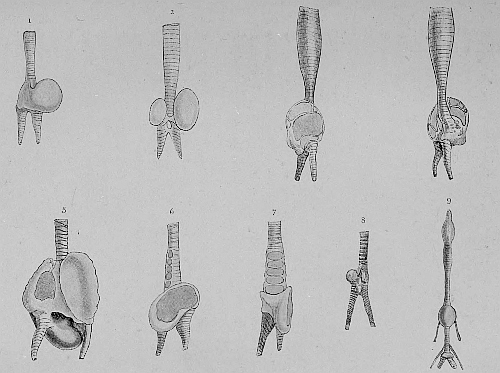
GRADES OF EVOLUTION IN THE SYRINX OR ORGAN OF VOICE IN THE MALES OF SURFACE FEEDING
AND DIVING-DUCKS.
1. Wigeon. 2. Common Sheldrake. 3 and 4. Red-crested Pochard. 5. Red-crested Merganser. 6 and 7. Long-tailed
Duck. 8. Steller’s Eider. 9. Common Scoter.
[Face Page 126.
Save in the case of the Goosander, these peculiar
structures are found only in the male, but in the species
first named the male, in addition to the syringeal chamber,
has two fusiform swellings in the windpipe, one above
the other: in the female one of these swellings is
present, but there is no syringeal box.
This box is generally, and probably correctly, regarded
as a sort of musical instrument. Nevertheless the males
are far less vociferous than the females which have no
such voice resonator. One has only to listen to, and
compare the notes of the Mallard drake and duck to
discover this fact. Here, then, we seem indeed to have
a case of “Hypertely.” Before, however, we build too
much on this we must discover whether the sibilant sounds
uttered by the males do, or do not, play an important
part in arousing the sexual passions of the females.
Certain of the Swans and Cranes afford illustrations
of musical instruments of an even more remarkable kind.
Herein the windpipe at the base of the neck enters a
large chamber formed by the absorption of the diploe
sandwiched between the outer walls of the keel of the
breastbone and the enlargement of the space so created
until it can accommodate the tubular windpipe. This,
entering the cavity in the form of a loop, runs the whole
length of the keel, the upper limb of the loop finally
running to the lungs. That we have here an indubitable
musical instrument there can be no question, for its
possessor is enabled thereby to utter loud, trumpet-like,
if harsh, sounds. Here again only the males are so
provided.
The profound interest of this really extraordinary
association of unrelated structures has never attracted
the attention it deserves. Originally, no doubt, one would
have met with nothing more than a loop of the windpipe
impinging against the anterior border of a normal, blade-like
keel: later there would have been formed a broad
shallow surface on the keel at the point of contact
with the loop, and gradually the depression must have
deepened till the bony chamber came into being. By
what nexus of sympathy were these reciprocal responses
made?
Another very singular type of looped windpipe is that
wherein the trachea forms a series of coils between the
body and the skin. It is surely somewhat surprising
to find that precisely similar coils are met with in widely
different groups of birds. Among the Passeres they occur
in the Manucode: among the Plovers in the Painted
Snipe (Rhynchea rostratula): among the game-birds in
some of the Curassows, and among the Anatidæ in the
aberrant Australian Black-and-White Goose (Anseranas).
Very little is really known of the part played by these
musical instruments of the Anatidæ, nor, for the matter
of that, of most of the “musicians” among birds. Of
some of the game-birds more has been gleaned, and among
these surely the most interesting is the love-song or “lek”
of the Capercaillie. With the advent of April the cock,
just before dawn, repairs to some favourite tree—used
year after year—and there performs a most astonishing
if unmusical serenade; with outstretched neck, drooping
wings and spreading tail he gives forth a weird, uncouth
kind of song, more or less divisible into three parts. He
begins with a series of notes which remind one of nothing
so much as the sound made by two sticks knocked
together at intervals of ten to fifteen seconds, getting
quicker and quicker, and changing in key till at last
they become bell-like. Then follows a series of sounds
like the drawing of a cork out of a bottle, and these end
with bird-like twitterings. By this time, however, the
singer has worked himself up to an ecstasy of fervour and
passion so intense as to deaden him to all that may be
passing in the outer world. During these moments no
sound disturbs him, partly, apparently, because the
excitement of the “song” causes a turgid condition of
the blood-vessels which for the time effectually deafens
him. “Sportsmen,” in Swedish and other European
forests, knowing this, select such performances as affording
the most favourable time for Capercaillie shooting, only
cocks being selected.
A survey must now be made of some of the more
remarkable cases whereby more or less musical, or
rhythmical, sounds are made by instruments of percussion;
or by rapid vibrations. These are in almost every
instance formed by varying grades of modification in
the feathers of the wings or tail. Their presence, and
their use, seem natural enough until we recall the fact
that many other birds without any apparatus whatever,
make sounds in no way less remarkable or less penetrating.
Pigeons, Nightjars and Owls, for example, can produce
at will curious snapping sounds by bringing the wings
smartly together over the back. The White, and Shoebilled
Storks make castanets of the beak, throwing the
head backwards till the point of the beak touches the
back, when the jaws are set rapidly clashing one against
another, producing a sound comparable to the “bones”
of negro minstrels, but without the varying rhythm. As
this performance is proceeding, the head and neck are
slowly moved through half a circle, till the tip of the beak
touches the ground, when the music ceases. As with the
wing-snapping just referred to, both sexes are equally
skilful performers; but while they seem to indulge in such
exercises much more frequently, and with more vim
during the breeding season, they will break out after
this demonstrative fashion at all times of the year. But
why, then, the need for the yet more elaborate contrivances
which are to be met with among the Snipe,
the Game-birds, and certain of the Passeres?
However, be this as it may, in a large number of species
a special mechanism has been evolved to produce sounds
which, as has been remarked, in other species are no less
effectually made without that mechanism.
One of the simplest of the cases is that furnished by
the remarkable “bleating” or “drumming” performances
of many species of Snipe, generally, if not only, when
sexually excited, and especially of the Common Snipe
(Gallinago cœlestis) during its love-flights. Mounting
to a great height, this bird, at such times, suddenly
turns, and descends with prodigious speed, meanwhile
holding the tail fully expanded. The outermost pair
of feathers are, however, specially modified so that, in
the first place, during this descent they stand at right
angles to the long axis of the body and well apart from
the rest of the tail-feathers. This alone, however, would
not produce these weird sounds, which owe their origin
to the fact that these particular feathers have their shafts
conspicuously thickened and peculiarly curved, while
the vane or web of the inner side of the feather is of great
width and structurally differs from the vanes of the other
feathers, whereby the vane becomes more resistant to
the rush of air caused by the wings during the descent.
But in the case of these Snipe it is to be noted this
curious form of musical instrument is found in both sexes,
and there is little difference in the quality of the sounds
produced, but the bleating of the male is said to be the
more resonant.
The Common Snipe is the best performer among several
different species, and it is to be noted presents, to a
casual examination, no remarkable or peculiar feature
whatever—the structural differences just described are
only to be discovered by very patient scrutiny. But in
the Pin-tailed Snipe (Gallinago stenura) the number of
the feathers has been greatly increased, while at the
same time their webs have been so reduced that the outspread
tail seems to consist of little more than spines.
With such a transformation one expects to find a quite
exceptional performance, far surpassing that of the
Common Snipe. Yet so far as observation and experiment
go they effect absolutely nothing! Here again we have
a case where modification of structure has passed the
bounds of need and passed so far as to make the whole
tail useless as a sound-producing organ!
A contrast and a parallel are afforded by some of the
gallinaceous birds of South America. The Black Penelope
(Penelopina nigra) of Guatemala, while on the wing,
will, during its “love-flights,” pitch suddenly earthwards
with outstretched wings, and at such times a crashing,
rushing sound is produced, which has been likened to
the sound of a falling tree. Yet there is nothing in the
shape of the wing which will account for this. On the
other hand, a near relation of this bird, the Black-wattled
Guan, Aburria (Penelope) aburri has the four outermost
primaries deeply incised along their inner vanes, reducing
the outermost portion of the feathers to mere spines.
Yet, so far as is known, this wing makes no especial noise.
However, the males of certain little South American
Perching-birds known as Manakins have the shafts of
the secondary quills thickened to an extraordinary degree
so as to form solid, horny lumps, and these, when the
wings are brought together smartly over the back, produce
a noise not unlike the crack of a whip, so that here
again structure and function are found together. In the
contradictory cases just cited where specialized parts are
found which are apparently functionless, we must suppose
that the habit of using them has been supplanted by some
new stimulant.
The part played by musical instruments of percussion
would seem to be a variable one. In some cases, and
possibly in all, it may serve as an excitant, or stimulant, to
the rousing of a “sex-storm”; in many, at any rate,
such sounds serve as calls to the sexes when separated.
This much seems to be demonstrated in the case of certain
of the Woodpeckers, which in this matter differ conspicuously
from any other species yet referred to, in
that they have developed no special sound-producing
mechanism, but make use of hollow trees which serve
them as drums, the beak being used as the drumstick.
This is a very noteworthy fact, for one would have
supposed that here at any rate, where the production of
loud and far-reaching sounds is of vital importance, the
means would have been provided by some such modification
of the wing-feathers as we have already seen to
obtain in the case, for example, of the Manakins. More
closely examined, however, this apparent failure of the
organism to produce its own mechanism becomes less
remarkable, for Woodpeckers are forest-dwellers and but
indifferent fliers; loud sounds produced by the rapid
vibration of the wings or tail, as in the case of the Snipe,
in mid-air, are thus impracticable, if not impossible,
and sounds produced after the fashion of the Manakins
would not have sufficient carrying power.
One of the most skilled performers among the
Woodpeckers is the Great Spotted Woodpecker (Dendrocofus
major), whose weird drumming once heard will
never be forgotten. These sounds are produced by blows
of the beak on a branch, delivered so rapidly that the
bird’s head presents but a blurred appearance. The
sounds thus made vary with the resonance of the wood
and can be heard at a distance of half a mile. These
strange vibrating notes are most frequently heard during
the courting season, and they will commonly beget a
speedy response from some more or less distant part of
the wood, so that their purpose is clear. They attain
the same end as the bellowing of the stag or the “lek”
of the Capercaillie. They are, however, to be heard at
other times, as when the birds are greatly alarmed or
when the nest is being robbed.