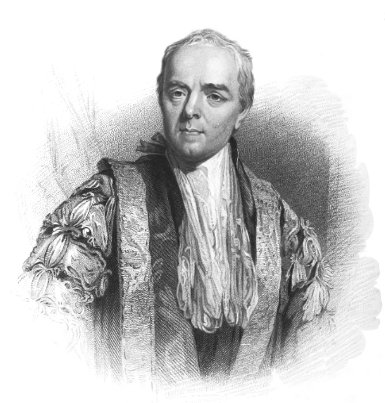
DEATH OF THE SPEAKER—MR. GRENVILLE ELECTED IN HIS PLACE—COMMITTEE
ON THE REGENCY—THE HOUSEHOLD BILL—CONDUCT OF THE PRINCES—ADDRESS
TO THE PRINCE OF WALES FROM THE IRISH PARLIAMENT—RECOVERY OF THE
KING—DECISIVE MEASURES OF LORD BUCKINGHAM—IRISH PROMOTIONS AND
CREATIONS—DISSENSIONS IN THE ROYAL FAMILY—MR. GRENVILLE APPOINTED
SECRETARY OF STATE—MR. ADDINGTON ELECTED SPEAKER—LORD BUCKINGHAM
RESIGNS THE GOVERNMENT OF IRELAND.
The one absorbing subject which for the last few weeks had engrossed the
public mind, almost to the exclusion of every other consideration, kept
the Parliament sitting close up to Christmas-day, in the year just
expired. On the 23rd of December, a resolution, vigorously opposed by
Lord North as instituting a fiction in lieu of the royal authority, was
adopted, empowering the Chancellor to affix the Great Seal to such Bill
of Limitations as might be necessary to restrict the power of the future
Regent; but Ministers had no sooner succeeded in carrying their object
to this important stage, than a new impediment presented itself. On the
2nd of January, 1789, Mr. Cornwall, Speaker of the House of Commons,
died. It was immediately decided that Mr. Grenville should be proposed
to succeed him. On all accounts, it was indispensable to hasten this
arrangement, as the functions of the Commons were unavoidably suspended
in the interim. A serious obstacle arose from the informality of the
proceeding, the sanction of the royal approbation being necessary,
according to custom, upon the nomination of a new Speaker. The elastic
character of the Constitution, however, although not providing direct
remedies for such special cases, admits of adaptation to the most
unforeseen exigencies; and so urgent was the pressure of affairs at this
agitating juncture, that the irregularity was passed over by the tacit
consent of all parties.
MR. W. W. GRENVILLE TO THE MARQUIS OF BUCKINGHAM.
Whitehall, Jan. 2nd, 1788.[B]
My dear Brother,
You will probably not be a little surprised at the contents of this
letter. The Speaker died this morning at about nine o'clock, and
after some consideration, it has been determined that I should be
proposed to the House to succeed him. I am not quite sure whether
the choice will come on to-morrow or Monday. The situation is a new
one, it having always been held, that the King's commands are
necessary for the election of a Speaker, and his approbation for
confirming him in his situation. But this cannot be had under the
present circumstances; nor can the House take any steps to supply
the deficiency till they have a Speaker. At the Restoration and
Revolution, the House, in both instances, chose a Speaker, who was
acknowledged as such, and was never afterwards confirmed by the
King.
With respect to myself, the time for deliberation has not been
long. But upon the whole, I think the decision which I have made is
clearly right. If the King recovers before Parliament is dissolved,
it is clearly understood that my acceptance of this situation is
not to prejudice my other views; and in the public opinion, the
having filled this office, though but for a short time, will rather
forward them. If the Regent goes on without dissolving, I am then
in a situation which, though perhaps not perfectly pleasant, is
nevertheless respectable, and will give me occupation. If they
dissolve, and carry the Chair against me in the new Parliament, I
do not see how I stand worse, in any respect, for having held this
office. Such is my reasoning, and I think you will approve it. As
far as I can judge, there is no doubt of my carrying it now. I
have not yet heard whether they start any opponent, but I think
they have none whose personal connexions can materially vary the
proportion between the two parties: it is very sufficiently
decisive.
I have not heard the account of to-day at St. James's. Nothing can
be better than all the accounts, both public and private, for the
last three or four days. It is certainly not sanguine to entertain
the very best hopes; and the progress has even been more rapid than
Willis expected; so that I think we may look with some confidence
to March or April at latest.
Ever most affectionately yours,
W. W. G.
MR. W. W. GRENVILLE TO THE MARQUIS OF BUCKINGHAM.
Whitehall, Jan. 4th, 1789.
My dear Brother,
The plan for the Regency was sent to the Prince of Wales in a
letter from Pitt, three days ago, with an expression of his
readiness to give any explanation, either in person or in any
other manner that he might intimate. Yesterday his answer was
received, directed to the Cabinet. It is long, and with much
affectation of good writing, and is in parts of it well expressed,
in other parts confused and timid. It ends, however, with saying
that if these restrictions are adopted by Parliament he will
accept.
I have no doubt of carrying the Chair to-morrow, but not a little
doubt whether I ought to have accepted it. The die is, however, now
cast. The restrictions will, I think, pass without much difficulty.
I still adhere strongly to my opinion about the prorogation,
because I think there is a wide difference between exercising
during the King's health a power which he commits to your
discretion, but which he might if he pleased regulate by
instruction at any moment, and exercising the same power now when
you are to state that the King is prevented by infirmity from
attending at all to the administration of his Government. I am sure
that your acting in the manner you speak of is liable to, and will
probably bear, the very worst construction in the minds of the
public here; and I cannot for the life of me conceive what fear
there can be that the two Houses will not adjourn, considering that
the great point which they all wish, is that they may not be
obliged to pledge themselves. The extraordinary anxiety in those
whom you see, to get you to prorogue, is, in my opinion, a very
strong proof of their being actuated by that sort of wish.
I have not time to write any more, except to express my anxiety to
hear how Lady B. and your child go on.
Ever most affectionately yours,
W. W. G.
There was no doubt about the issue of the election to the Speakership.
"Your brother William will certainly be Speaker," writes Lord Bulkeley
on the 3rd, "and has already stood the hoax at White's, where it was
debated last night whether he should wear a wig or his own hair." The
election went off to the entire satisfaction of Mr. Grenville, who,
reporting the event, says that "the majority, though quite large enough,
would have been larger if they had divided half an hour later, as nearly
forty of my friends were locked out below, and about eleven of theirs."
With his customary philosophy, he made the best of everything; but he
does not disguise from Lord Buckingham that he had strong doubts in his
mind whether he ought to have accepted the Chair. The Opposition might,
probably, have been stronger against his election, but for the belief
that prevailed that the King was getting rapidly better. "The progress
of the King," observes Mr. Grenville on the 7th, "is such, according to
our accounts, that it is by no means impossible, nor even a very
improbable case, that before the Irish Bill can pass, he may re-assume
his Government."
Another contingency that weighed with the floating mass of undecided
politicians was the rumour which now began to be circulated that the
Regent would not dismiss the existing Ministers till the end of the
session.
LORD MORNINGTON TO THE MARQUIS OF BUCKINGHAM.
Jan. 6th, 1789.
My dear Lord,
As I understood that Sir W. Young and Bernard wrote you an account
of the division last night, which placed Grenville so honourably in
the Chair of the House of Commons, I did not trouble you with any
letter by the post of yesterday; but I cannot deny myself the
pleasure of acquainting you, that nothing could be more perfectly
satisfactory to all our friends than the conduct of the new Speaker
on an occasion naturally distressing; his speech of excuse, and his
speech from the steps of the Chair, were universally admired, they
were both so composed and delivered as to render a scene, which I
have always understood to be very ridiculous, really interesting
and affecting. It is deemed a misfortune amongst our friends, that
the practice of printing the Speaker's speeches on this occasion in
the journals is now disused. Grenville's speeches would have done
him the highest credit, as well as afforded an excellent precedent
to future Speakers. I have prevailed with Mr. Speaker to mount his
wig, and the whole apparatus to-day: he must consider this as a
young lawyer does his first appearance at the bar, and the sooner
the laugh is over the better for the dignity of the Chair. Whatever
may be Grenville's future fortunes, it can be no discredit to his
character to have been placed in the Chair by such a majority, in
such times and circumstances, and at his age.
I write no accounts of what we are doing, you hear that much more
correctly from Grenville. I am anxious to know what will be the
temper of Ireland at the meeting. Grattan is as much a creature of
Fox and his party, as the meanest libeller in the "Morning Herald;"
he lives entirely with them. I hear Pelham is to take his father on
his back to the Government of Ireland. Grattan will stand, in my
opinion, on most unpopular ground, if he either attempts to assert
the hereditary right of the Prince, or to give him larger powers in
Ireland, than the Parliament of this country entrust to him for the
administration of the British Government. The hereditary right, I
suppose Grattan will not venture to touch; and the latter
proposition, I think, might be argued exactly as he argued the
Perpetual Mutiny Bill, and other questions, where the danger of
larger powers in Ireland than were held in England by the same
hands, were considered with a view to the Constitutions of both
countries. This argument is, in my opinion, clear, if the rights of
the King on the throne are admitted to be the rights of the people
at large, and if they are not, I know not why they exist. I have
not much fear that the Irish Parliament will listen to such
proposals. As to reversions and offices for life, a Regent, who has
not the power of granting them here, and attempts to obtain it in
Ireland, can mean nothing else than to indemnify his disappointed
friends in England at the expense of Ireland; I do not think this
can go down. On the whole, I think your argument in Ireland
stronger in every view than ours here, and that is saying a great
deal.
Arthur informs me that my Trimmers wish to have a company of foot
quartered on them. I am sure I have no objection to your giving
free quarters to the whole army on the worthy inhabitants of that
ancient and loyal town.
I sincerely wish you joy of your son, and hope the bad weather does
not affect either him or Lady Buckingham.
Ever, my dear Lord,
Yours most affectionately,
Mornington.
What think of Sir John Aubrey, rat?
MR. W. W. GRENVILLE TO THE MARQUIS OF BUCKINGHAM.
Whitehall, Jan. 10th, 1789.
My dear Brother,
I send you a letter of Camplin's, about an exchange which had been
proposed. We have no news here—everything remaining in precisely
the same state. The Committee, will, I think, most probably not
make their report to-day, though we meet for the chance of it. In
this manner, it will be impossible that the restrictions can be
opened before Tuesday or Wednesday. The debates of the Committee
have been conducted with great heat and violence on both sides, and
much indecency towards the King, particularly from Fox and Burke.
They are now endeavouring to turn it into a personal attack upon
the Queen, for having wished to make one of the reports of the
physicians more favourable, and for having dismissed Baker from her
service, on the ground of the great inattention towards the King
and his family, which appears on the face of his former
examination: he having perceived symptoms of this disorder so early
as the 22nd of October, and having, subsequent to that time,
entirely left the King.
The examination of Baker and Warren state the probability of
recovery as being nearly the same as when they were before
examined, but rather less. Willis and Pepys state it as much
greater; particularly the former of these two, who speaks in the
most sanguine terms. The answers of Reynolds and Gisborne are also,
as I believe, favourable.
These delays put all idea of dissolution out of the question, till
the end of the present session, at soonest; and that cannot take
place, according to my calculation, till the end of June. People
begin to speak doubtfully about the Regent's making any immediate
change, and I know that some of their friends affect to hold that
language; but I am inclined to think that, however difficult it may
be for them to undertake the Government under the existing
circumstances, it is absolutely impossible for them to satisfy the
Regent, or to quiet their own dependants, without running that
risk.
Fox is apparently recovering, but slowly.
Ever most affectionately yours,
W. W. G.
MR. W. W. GRENVILLE TO THE MARQUIS OF BUCKINGHAM.
Whitehall, Jan. 12th, 1789.
My dear Brother,
I understand from different conversations, as well as from the
general report here, that there is an intention of moving for an
Address to the Prince, such as was proposed here, immediately on
the first meeting of the Irish Parliament. Grattan, &c., &c., are
all going over, so as to be in Dublin by the 20th. He is understood
to have entered completely into all the views of the party here,
and to be ready to pledge himself to all their doctrines,
maintained, or retracted, or both. I thought it right to give you
this intelligence, although you will probably hear it from many
other quarters, and though I have very little apprehension, indeed,
from the effect of such a manœuvre. If anything could more
completely ruin them here than they are ruined already, it would be
such a measure. As to its effect in Ireland, I cannot persuade
myself that there can be any difficulty in getting people to pledge
themselves not to run before this country; and to appoint a Regent,
without conditions, in Ireland, before it is even known what
conditions are to be proposed, much less whether they will be
adopted by the British Parliament. At all events, however, the
battle must be fought; for it would be the most disgraceful thing
in the world to appear to give it up, or rather not to appear to
dispute it inch by inch.
Lord Glendon and Lord Fairford are both going over to assist you.
They both complain (particularly the former) of want of attention
from you; but I am so accustomed to such complaints, without
foundation, that I am not disposed to give much credit to them in
this instance. I understand that Lord Hillsborough has expressed
himself on the subject in a more decided manner than you seem at
all disposed to give him credit for.
Our report cannot probably be made to-day; but when it does appear,
I am told that the impression of it will be favourable to the idea
of the King's recovery. Surely, when this circumstance is taken
into consideration by your Irish speculators, in addition to the
many other considerations which make everybody here allow that
Pitt's side has the best of the day, they will not be induced to
hazard so decisive a step as you must give them to understand their
agreeing to this Address will be considered.
It was mentioned to me, that considerable offers had been made to
Corry. I mention this to you, but you will probably be able to
ascertain the truth of the report more accurately than I can.
It is worth observing, that the appointment of a Regent in Ireland
by Address goes directly to dissolve the Union of the two kingdoms,
because a Regent so appointed could not command the use of the
English Great Seal.
Ever most affectionately yours,
W. W. G.
MR. W. W. GRENVILLE TO THE MARQUIS OF BUCKINGHAM.
Whitehall, Jan. 19th, 1789.
My dear Brother,
I was so knocked up on Saturday, that I found it impossible to
write to you; though there is one circumstance, which, if I had
been acquainted with, would have prevailed over all fatigue—I mean
that of Captain Nugent's having voted against us upon the second
division. The question has not been distinctly stated in any of the
papers, as far as I have seen. It was a proposal of Fox's, that
the restrictions, particularly that of peerage, should continue
only for a limited time; by which means, we should have been placed
in this sort of situation, that if, at the expiration of that term,
the King should be so far recovered, as to afford hopes even of an
almost immediate recovery, the Regent would be able, by a sudden
creation of Peers, to make it impossible for him to resume his
authority.
Nugent had voted with us upon the first question; but was, I
suppose, led away by some part of Fox's speech, which had the
effect of carrying over Bankes and about six or seven more of our
conscientious friends. I think it right to mention this
circumstance to you, though not with any view of suggesting what
you may think it right to do. I shall, I own, be much mortified if
he should vote against us on Monday; but nothing that you can do
will be in time enough to prevent that. I do not feel that I can
take any measures on the subject, although I certainly have no
doubt what your wishes would have been if you were on the spot.
I find, from general report, that some of our friends are staggered
about the household resolution, which is to be proposed on Monday.
It is, therefore, probable, that we shall not carry this by so
triumphant a majority as we have the other questions. I think,
however, there is little doubt that we shall carry it; and that is
the point of real importance.
I shall be anxious to hear the event of your meeting. You will have
observed that, by Lord Sydney's despatch, a latitude is given you
of proroguing, in stating the opinion of the King's servants on the
different points. I thought, when the despatch was shown to me,
that this was a favourable circumstance, as, from your letters, it
seemed to me at that time very doubtful whether you would not have
adopted that measure; and, in that case, I felt that you would
certainly have been glad to have this sort of sanction.
Believe me ever most affectionately yours,
W. W. G.
The Duke of Leinster has, as I suppose you know, written to the
Prince of Wales, to offer himself to him. The consequence has been,
that Lord Charles Fitzgerald has declared, that he does not
consider himself in a situation to be turned over from party to
party every half-year; and that he has hoisted an Orange cape. He
will, as I understand, not go over to Ireland at the meeting; and I
take it for granted, that in case of a dissolution the Duke will
not re-elect him.
MR. W. W. GRENVILLE TO THE MARQUIS OF BUCKINGHAM.
Whitehall, Jan. 19th, 1789.
My dear Brother,
Since I wrote my other letter of this date, I have received yours
of the 15th, stating your alarm at the lies spread in Ireland about
the proceedings of the Committee of the House of Commons. You will,
long before this, have received the report itself from me, and by
reading it, will have found how much more favourable the account of
the King's situation appears from that examination, and how much
you are in the wrong to suffer your noble spirit to be cast down by
such weak inventions of the enemy; and above all, how monstrous the
idea is that Fox is to gain with the public by a transaction which
only shows their inveterate malice against the King and Queen, and
its utter impotence. Your expressions of duper and duped, you will
see are equally inapplicable to our representations of the King's
situation, which I think you will still believe to be as authentic
and as credible as the lies which Grattan and Forbes retail from
the porter's lodge at Carlton or Burlington House. Seriously
speaking, I am vexed to see the importance which you attach to all
these reports, because I know that it must work and agitate your
mind. A whole life would not suffice, on my part, to answer every
lie in circulation: but I beg you to believe that although,
perhaps, naturally a little sanguine in my temper, yet that if
there was any really unfavourable circumstance which arose here, I
would not conceal it from you. The King is better ever since that
examination; and this I speak on no partial authority, but on the
information of Warren himself, who gave yesterday to the person who
repeated it to me a much more favourable account.
I have not time to answer the rest of your letter to-day. Our Bill
is not prepared yet, nor can be till the resolutions have been
agreed to by both Houses; but it will be short, and nearly in the
same words with the resolutions, adding only the oath of office
from the Regency Bill of 1765, and a few other particulars.
Ever yours,
W. W. G.
I suppose you know that Lord Spencer certainly goes to Ireland.
The notion that the Regent would continue Mr. Pitt and his friends in
office was rapidly dissipated during the progress of these discussions.
The Household Bill, alluded to in one of Mr. Grenville's letters, gave
deep offence to His Royal Highness; and from the moment that part of the
plan was disclosed, there was no longer any disguise about the fact that
the Prince had not only made up his mind to dismiss the Ministers, but
that the list of the incoming Administration was actually settled, and
ready for use. The object of the Household Bill was to confide to the
Queen the care of the King's person, and the disposition of the royal
household, which would have the effect of placing at Her Majesty's
control the patronage of four hundred places; while the Regent was to
possess no power whatever over any office, reversion, or pension. This
appeared to the Prince and his allies a monstrous proposition,
calculated to introduce "weakness, disorder, and insincerity into every
branch of political business;" to "separate the Court from the State;"
to "disconnect the authority to command service from the power of
animating it by reward;" and to impose on the Regent "all the invidious
duties of the kingly station, without the means of softening them to the
public by any one act of grace, favour, or benignity."
In these poised and melodious sentences (said to have been written by
Burke) may be recognized the policy of the master spirit that raised the
storm which was to overwhelm Ministers. When the moment came, however,
at which it should have burst—Pitt's motion for the Address—Fox was
absent. "Fox is gone to Bath," says Mr. Grenville. "Whether he is very
ill, as some say, or wants to shirk the discussion about Mrs.
Fitzherbert, as others assert, I know not."
This business of Mrs. Fitzherbert, of which we hear something in these
letters, was suspended like a sword over the heads of the royal
Opposition; and whenever it threatened to descend, they endeavoured to
escape from it by avoiding the discussion, or to avert it by abating
their violence. The rumour, however, which ascribed Fox's absence on
this occasion to that cause was certainly unfounded. On the 19th of
January, he made his motion for limiting the continuance of the
restrictions; and on the 26th he was ill at Bath, where he remained for
some weeks in a precarious state of health. His loss was severely felt
by his party. Ministers were triumphant in both Houses. The incidental
shocks they experienced from the vibrations of that class of persons
designated by Mr. Grenville as "conscientious friends," and from the
defection of the rats, had been completely recovered in the final
majorities of Lords and Commons; and although Fox may not have thought
it prudent on some occasions to enhance the inevitable defeat of the
Prince's followers by assisting at their discomfiture, it is unlikely
that even the dread of a debate on Mrs. Fitzherbert would have kept him
away at this critical juncture.
While these discussions were going on, always ending in fluctuating
majorities for Pitt, the Prince of Wales and his brother,
notwithstanding the dissipation in which they indulged, were
indefatigable in their efforts to cultivate popularity. Thus writes Lord
Bulkeley:
The Princes go on in their usual style, both keeping open houses,
and employing every means in their power to gain proselytes,
attending the Beefsteak Clubs, Freemason meetings, &c., and will
probably very soon attend the parochial meetings of Lord John
Townshend's Committee in Westminster. Notwithstanding all this, the
Parliament still continues steadily to Mr. Pitt, which, considering
the looseness of morals and of the times, does the members great
credit. * * * The Duke of York never misses a night at Brookes's,
where the hawks pluck his feathers unmercifully, and have reduced
him to the vowels I. O. U. The Prince likewise attends very often,
and has taken kindly to play.
General Cuninghame appears to have disappointed the expectations of his
friends at this period, and, although present in the House on the 19th,
did not vote. It was the next thing to ratting, and seems to have been
regarded in that light by Lord Bulkeley.
General Cuninghame has been blowing hot and cold in his language
here, but has not voted, not even last night, when he appeared for
the first time in the House. I have had a letter from the Duke of
Dorset, complaining of his conduct in not resigning his seat, as
his conscience troubled him.
No man had so keen a scent for rats as Lord Bulkeley, and he was
generally in advance of his party in detecting them.
Thurlow and Loughborough were both ill at this time ("which," says Sir
William Young, with a touch of sarcastic humour, "will much shorten the
progress of the Regency Bill in the Lords"); and on the 2nd of February,
when Mr. Grenville, in his capacity of Speaker, attended at the bar of
the House of Peers to hear the Commission under the Great Seal read,
Thurlow was unable to attend, and Lord Bathurst officiated for him. The
night before, Thurlow declared, as reported by his physician, that "if
he were ten times worse, he'd go, by G—;" his physician, however,
overruled him; and the obstruction of his presence being thus
fortunately removed, it was anticipated that the progress of the Bill
through the Lords would be so rapid as to place the Regent on the throne
in a fortnight. Active preparations were, consequently, set on foot for
settling the new Administration. Amongst the other great situations,
Ireland was offered to the Duke of Northumberland, who declined it, and
then to Lord Spencer, who accepted it, with Pelham for his secretary.
Ireland was a considerable item in the calculations of the Opposition.
"The Prince and the Opposition," writes Lord Bulkeley, "have great hopes
of a riot in their favour in the Parliament of Ireland." Some such
result was to be apprehended from the temper of the people, and the
adverse views they took of the Regency question; although a true sense
of their own independence ought to have shown them that there were
national objections against allowing the Prince to indemnify himself by
the use of the royal prerogatives in Ireland for the restraints which
were put upon him in England. The object to which, under these difficult
circumstances, Lord Buckingham and Mr. Grenville directed their
attention, was to assimilate, as nearly as possible, the Regency Bills
in both countries, so as to prevent the occurrence of so great an
anomaly as that of having a Regent whose powers should be strictly
limited in the one kingdom, and who should, at the same time, be
invested with unrestricted powers in the other. The Parliament of
Ireland possessed the unquestionable right of deciding the Regency in
their own way, leaving the legal validity of the act for subsequent
consideration; and as it was understood that the Opposition intended to
move an Address to the Prince, which there was reason to believe they
would be able to carry, calling upon His Royal Highness to assume the
Government of Ireland unconditionally during the term of His Majesty's
illness, the position of Lord Buckingham had become peculiarly
embarrassing. What course should be taken in the event of such an
Address being carried? This question is anxiously discussed in numerous
communications between Lord Buckingham and Mr. Grenville and other
members of the Government. The predicament was so strange, and involved
constitutional considerations of such importance, as to give the most
serious disquietude to the Administration. The first expedient thought
of was to delay the proceedings of the Irish Parliament, by adjournment,
or any other available means, till after the Regent had been appointed
in England, provided the motion for the Address could be successfully
resisted in the first instance. But as it was almost certain the
Administration would be beaten on that motion, it remained to be
determined whether Lord Buckingham, in that event, should refuse to
transmit the Address to His Royal Highness. Upon the propriety of so
extreme a measure Mr. Grenville entertained some doubts in the
beginning. By refusing to transmit the Address, the Lord-Lieutenant
would clearly put himself in the way as an obstacle to that mode of
providing for the emergency which the two Houses of Parliament were
determined to adopt; or, on the other hand, by sending it he would make
himself, in some degree, a party to a request by which His Royal
Highness was asked to do an act which he, Lord Buckingham, held His
Royal Highness to be precluded by law from doing. Such was the dilemma
as it presented itself to the mind of Mr. Grenville. One escape from it
was, to forward the Address, accompanied by a representation from Lord
Buckingham of his own views of its illegality. Another was, to resign.
In the meanwhile, the projects of the Opposition in England were checked
by the gratifying accounts from Kew. The King was visibly improving, and
hopes began to be entertained that there might be no necessity for a
Regency after all. The letters of Mr. Grenville, reverting to the
opening of the Parliament, trace the progress of these circumstances in
detail.
MR. W. W. GRENVILLE TO THE MARQUIS OF BUCKINGHAM.
Whitehall, Feb. 2nd, 1789.
My dear Brother,
Our Parliament has this day been opened by Lord Bathurst, the
Chancellor being so ill as to make it absolutely impossible for him
to come down. The Commission was first read, and then Lord Bathurst
said, in a few words, that the Lords Commissioners being empowered
by the said Commission to declare the causes of calling the
Parliament, thought it their duty to call the attention of the two
Houses to the melancholy circumstance of His Majesty's illness, and
to recommend to them to provide for the care of His Majesty's royal
person, and the administration of the royal authority during His
Majesty's illness, in such manner as the exigency of the case
requires.
I think that my former calculation is rather too sanguine, and that
the 18th is the soonest that the Bill can pass, allowing for the
debate, of which notice has been given in both Houses, on the
Committee for the royal assent. The idea is, that the letters of
dismission are ready written, and will be sent that day.
I cannot yet learn, with certainty, who is to be the Home Secretary
of State. It is supposed to lie between Lord Stormont and Lord
Rawdon; and there is a report that they are quarrelling about that
as about everything else, and that the Duke of York espouses Lord
Rawdon's cause very warmly.
The accounts of Fox are that he is not at all better, and that he
has not been able yet to drink the waters. His death would throw
them into complete confusion, though the Prince is so far pledged,
that even in that case he must attempt to form a new Government.
We mean (but this inter nos only) to move an Amendment upon the
Address, expressive of our satisfaction at the flourishing state in
which the public affairs are delivered into His Royal Highness's
hands, and of our hope that the same principles and measures will
continue to be pursued. I have no doubt of our carrying this, in
their teeth.
Everybody seems to think a dissolution certain. I imagine it cannot
by possibility take place till May or June, though some people
expect it in March.
I believe I mentioned to you in my last the great improvement which
these last few days have made in the King's situation, and the
strong hope which we derive from it.
Ever most affectionately yours,
W. W. G.
MR. W. W. GRENVILLE TO THE MARQUIS OF BUCKINGHAM.
Whitehall, Feb. 7th, 1789.
My dear Brother,
I do not know of anything that has happened here since I wrote
last, which is worth mentioning to you. Our Bill is to be in the
Committee to-day, and Monday, so that I guess we shall not get it
into the House of Lords till Wednesday or Thursday. This will put
off the passing a little beyond my calculation, and I imagine the
Regent will not now be in full possession of his office till about
the 19th or 20th. I wait with much impatience to hear what has
passed on Thursday in the Irish Parliament. I find that people
here, those at least with whom I converse, are indifferent about
the success of the measure in Ireland, but are much exasperated at
the madness and folly of the people who are endeavouring to stir
fresh questions of separation between the two countries.
The accounts of the King still continue to be very favourable, but
I have not heard what degree of hope Willis grounds on this long
period of tranquillity. I should think that the breaking out in the
neck must be a favourable circumstance, but I begin to think the
time long if he still continues without real amendment of the
complaint itself. This, however, arises more from one's natural
impatience than from any reasonable ground which there is to think
worse of the case from this circumstance.
One hears of nothing now but of the intended arrangements. Among
these, the military is not the least curious part. His Royal
Highness the Duke of York is to be Commander-in-chief; Fitzpatrick,
Secretary at War; and there are to be four Field-Marshals;
consisting of the Regent himself, of the Dukes of York and
Gloucester, and General Conway. These Field-Marshals—of whom three
never saw a shot fired, and the fourth of whom has not served for
six-and-twenty years, except in the very peaceful situation of
Commander-in-chief in England for a few months at the end of the
war—make a pretty curious promotion. Faucitt is to continue,
notwithstanding a positive promise of the Duke of Portland's to
General Vaughan, for the sake of securing his vote and his
brother's. They are to make all the Colonels Major-Generals, down
to Lord Rawdon. The list of the Prince's aides-de-camp you will
have seen in the papers.
Lord Spencer is declared for Ireland.
The accounts from Bath say that Fox is better, and will recover.
The town and neighbourhood of Buckingham have voted an unanimous
Address to Pitt, without any of us knowing a word about it. It is
signed by near two hundred persons, as Jemmy tells me, for I have
not seen it.
I am living in hourly fear of having a meeting called in the
county, which would be a troublesome and useless thing, though, I
understand, the sense of the yeomanry is entirely with us. I hear
nothing of their intentions in case of a dissolution, but much
doubt, from what I hear, whether they will think of doing more than
ousting Aubrey, which they may do very peaceably; for by what I
hear, he would not have ten votes.
I have, at length, decided not to think of the Bolton Street house,
at least for the present year, as the repairs necessary to make it
habitable amount to so large a sum. Perhaps, if I was to be
re-elected after a dissolution it might be worth my while; but that
is, as you will easily suppose, a very doubtful contingency. Is it
not a singular thing that it should be doubtful at all, and that
there should be any chance of beating them in the new Parliament on
such a question as that?
Ever most affectionately yours,
W. W. G.
I open this letter again, to let you know that I have just received
an account of Sir Thomas Halifax's death, which happened this
morning. This circumstance is not a little perplexing to me,
especially in Bernard's absence. I have sent an express to Chaplin
to desire him to come to town to-morrow, and I shall then hear what
he says. The thing to be wished is, that we could secure Bernard's
election, now and hereafter, without much increase of expense; but
on that whole subject I am very much at sea, and there cannot be
time to hear from you and him upon it. Perhaps Chaplin may think it
better that we should now propose some other person, who might be
supported by Lord Chesterfield's interest, and not appear so
decidedly connected with us as Bernard is. We had a scheme for a
candidate of that sort at the general election, and Lord C. was
inclined to give into it. At all events, I think it is absolutely
necessary that Bernard should come over instantly, as his presence
is equally necessary, either as a candidate or in order to get a
repetition of the promises which this intervening election might
otherwise be construed to annul.
I have heard, since I wrote the preceding part of this letter, that
the Chancellor has been at Pitt's to-day, with an account that he
had seen Warren this morning, who had spoken to him in a very
favourable manner of the King's present state, and had even said
that he thought the amendment so material, that he had felt it his
duty, immediately on coming to town, to wait upon His Royal
Highness with the account. So there is a little bane for your rats.
Ever yours,
W. W. G.
MR. W. W. GRENVILLE TO THE MARQUIS OF BUCKINGHAM.
Whitehall, Feb. 14th, 1739.
My dear Brother,
Although I have nothing else to write to you, yet I could not
refuse myself the pleasure of letting you know that I have been at
Kew to-day with Pitt, and that the account which he received from
Willis is such as to confirm and strengthen all our hopes. The
public account is, as you will see, that the King continues in a
state of gradual amendment; and every circumstance which we can
learn, affords us room to entertain the most sanguine hopes. What
has already passed in the public, on the subject of Willis, and the
violent attacks of Opposition against him, have made him more
cautious and reserved in what he says, and he particularly desires
that his name may not be quoted. But I could not find in my heart
to conceal from you the favourable manner in which he speaks of
the present situation.
His account is confirmed by that of the other physicians, who all
speak the same language. Sir G. Baker told him to-day, that if it
was the case of a common patient whom he was attending, he should
not think it necessary to give him any more medicines. The most
favourable circumstance of all is, the great abatement of the
pulse, which, till now, has always been much too high.
You will easily imagine how much speculation all this makes, and a
more curious scene, I think, I never saw. The prevailing opinion
is, that we are not to be turned out. There is a report, which is
very confidently circulated (but I do not vouch for the truth of
it), that the Duke of Portland has positively told His Royal
Highness that, under these circumstances, it is impossible for him
to take any share in a new arrangement. It is also said that they
have quarrelled about the Prince's debts, but these are points of
which I know nothing but from report.
The account which Lord Chesterfield had yesterday from his friends
at Aylesbury tallies with Chaplin's, as to the possibility of
Bernard's success, though it is not quite so sanguine as to
numbers. If he succeeds at all, this last point may be no
misfortune to him, as it will diminish the claims upon him.
Ever most affectionately yours,
W. W. G.
The Irish Parliament had met in the interim, and were debating with
extraordinary vigour and asperity the Address by which the Prince of
Wales, before he had been appointed Regent in England, was to be invited
to assume at once the functions and privileges of the Crown in Ireland.
Many of the usual supporters of the Government, including even some
persons in high employments, had joined the ranks of the Opposition; and
Lord Buckingham in his letters to Lord Sydney declares that his powers
had been annihilated by that lapse of the sovereign authority which led
to this result, and that it would be no longer proper for him to
interfere any further, except only in reference to the "usual business
of the kingdom." Acting on the pressure of these circumstances, he felt
it due to his own credit, and to the service in which he was engaged, to
tender his resignation, as appears by the following letter from Mr.
Grenville:
MR. W. W. GRENVILLE TO THE MARQUIS OF BUCKINGHAM.
Whitehall, Feb. 13th, 1789.
My dear Brother,
We have no news here, except of the favourable accounts of the
King's situation, which are every hour more and more confirmed. All
our present anxiety is, to keep down the too sanguine expectations
of our friends, in order to prevent their being too much damped by
any check, which Willis considers as an event by no means unlikely,
and not such as in any degree to diminish his confidence in the
King's recovery. From the general turn of people's conversation
here, it seems by no means certain that the Prince will take any
step for dismissing the present Government, if the King continues
to mend. It would, indeed, be a measure so grossly indecent to turn
out the King's servants at the eve of his recovery, that it would
be too strong even for those counsels by which His Royal Highness
has hitherto been actuated. But there is another consideration
which will possibly have still more weight, namely, that the
acceptance of office under such circumstances would put his friends
to considerable inconvenience and expense, such as to be by no
means worth incurring, if they are to hold them for so very short
a period as the King's present situation appears to indicate. This
mode of reasoning is of itself sufficiently obvious, and I
understand that the Prince has held a language which corresponds
with it, since so great an alteration has taken place.
Under these circumstances, you must see that the letter which you
sent me is clearly inapplicable to the present situation. If,
contrary to our present expectation, the Prince should dismiss us
all immediately, I will lose no time in sending that letter; but if
not, it seems to be the wish of all your friends that you should
remain where you are for some little time, in order that you may
not have the appearance of being driven away either by the event
which has happened, or by the violence of the abuse thrown out
against you. I see and acknowledge the difficulties of such a
situation, and lament that you should in any case be subject to
them, but you must, on the other hand, consider that these
difficulties do not of themselves, unaccompanied by other
circumstances, afford a reason for withdrawing yourself from them.
I am far from being desirous, for many, very many reasons, that
your stay should be prolonged to the usual period of a
Lord-Lieutenant's reign; but I cannot help most earnestly wishing
that you could, in some mode or other, struggle through the present
session, in order to cover your retreat, which will otherwise by
your enemies be represented as a flight.
You see that all this refers to an event which may possibly not
happen; but I felt it indispensably due to you that I should beg
you to consider this case very seriously, and that with a view not
to present difficulties only, but taking into the account your
future situation. I have told you what I believe is the unanimous
wish of your friends on such lights as we possess here. It is
possible that circumstances with which we are unacquainted might
alter our opinion, but they must be very strong before they could
produce that effect.
I know no other point which is worth writing to you about:
certainly none which is worth your bestowing a moment, thought
upon, in comparison with that which I have mentioned. I enclose my
last account from Aylesbury. I need not say how much I feel for the
unpleasant circumstances of your present situation. But I know that
you have the best resource against them, in the sense of your own
conduct, and in the consciousness of the sincere and invariable
affection of those whose friendship you value.
Ever most affectionately yours,
W. W. G.
Two days afterwards, the report of the King's health was so encouraging
that his recovery was considered by the Cabinet as little less than
absolutely certain. Under these circumstances, it became a matter of
speculation whether the Prince would dismiss the Ministers, or, if he
did not, whether he would treat them in such a manner as to make it
impossible for them to stay in office. In any case, whether they were
dismissed or driven to resign, Mr. Grenville judged it prudent to
withhold Lord Buckingham's letter of resignation, till the solution,
either way, should have been ascertained. The conflicting difficulties
of the situation, looking at it from all sides, are ably stated in a
letter of the 15th of February.
You cannot come away, without appearing to desert your trust, while
the King's servants here abide by theirs; nor without giving the
Regent an opportunity to object to the nomination of any person who
may be proposed to him by Pitt to succeed you. You cannot remain
without the means of carrying on some appearance, at least, of
government in the House of Commons. You cannot employ those who
have now deserted you; nor can we expect that the Prince will
allow you to dismiss those whom he considers as having stood by
him. On the whole, I cannot imagine a more puzzling or distressing
case.
Nothing short of the implicit confidence and cordial support of the
Ministers, seconded by the highest courage and firmness on his own part,
could have enabled Lord Buckingham to sustain his authority in this
trying emergency. That he possessed the confidence and support of
Government to the fullest extent, is attested by the following letter
from Mr. Pitt; and that he displayed the qualities of resolution and
self-reliance demanded by the occasion, is sufficiently shown in the
sequel.
MR. PITT TO THE MARQUIS OF BUCKINGHAM.
(Private.) Downing Street, Feb. 15th, 1789.
My dear Lord,
The account received this morning of the step which the Irish House
of Commons have taken, has not surprised me; as it seemed before
evident that the torrent was too strong to be stemmed by any
exertion. Those who at the moment felt it as a triumph, perhaps
already begin to repent of it, and will probably have more and more
reason to do so every day. It will be abundant satisfaction to you
and your friends that you have done everything which depended on
you; and in the midst of so much profligacy, that you have
experienced such a support as that of Fitzgibbon and a few others,
which is in the highest degree honourable and manly.
I am fully aware how delicate your ground has been in all the
progress of the business, of which we have hitherto learnt the
result; and that it is not less so in what remained relative to the
transmission of this strange Address. Whatever you may have
decided on the spot will, I dare say, under all the circumstances,
have been right; and in either of the alternatives, you will not
want here the most cordial and decided support, whenever the
measure comes into discussion. All that I am now writing is, I
hope, superfluous; but I could not let the messenger go, without
expressing in part the sentiments for which I trust you would at
any rate have given me credit.
* * * * *
Believe me, my dear Lord,
Sincerely and affectionately yours,
W. Pitt.
Lord Buckingham, acting on the discretion thus confided to him, resolved
to decline accepting or transmitting the Address. This determination,
which threw the whole responsibility of the measure upon those with whom
it originated, afforded the highest satisfaction in England. Letters
from Lord Mornington, Lord Sydney, and others, abound in admiration of
the firmness of Lord Buckingham's conduct.
As had been anticipated, the Address was voted in both Houses of
Parliament, and laid before Lord Buckingham for transmission to His
Royal Highness. His Lordship at once declined to receive it; and in a
short and explicit answer, rested his refusal on the obligations imposed
upon him by his duty and his oath, adding that he did not feel warranted
in forwarding to His Royal Highness an Address, purporting to invest him
with powers to take upon him the government of the realm before he
should be enabled by law to do so. This answer, which had received the
full approbation of Mr. Pitt, by whom it had been communicated to the
Cabinet, was, as might have been expected, deeply resented by the
Opposition, whose hostility to the Government had been all along
assuming that shape of combination in which it now appeared without
disguise.
Frustrated in their desire of transmitting this Address through the
channel of the Lord-Lieutenant, they passed a resolution appointing
ambassadors of their own to lay it before His Royal Highness. The
persons nominated to undertake this extraordinary commission were, the
Duke of Leinster, the Earl of Charlemont, Mr. Conolly, Mr. O'Neill, Mr.
Ponsonby, and Mr. Stewart. Nor did they stop here. It was necessary to
avenge the indignity that had been put upon them; and a resolution,
declaring the conduct of Lord Buckingham unwarrantable and
unconstitutional, was accordingly moved by Mr. Grattan, and carried.
That a resolution still stronger than this, going to the preposterous
length of declaring the commission of the Lord-Lieutenant actually void
by the will of the Irish Parliament, was at one moment contemplated,
would appear from a passage in a letter of Mr. Grenville's, dated the
18th of February.
I am a little alarmed by one part of your letter, in which you talk
of a resolution of the two Houses being passed for avoiding your
commission, and of your resigning the Government in consequence of
it to Lords Justices appointed under the Act of last year. I trust,
however, that these favourable accounts [of the King's health] will
have put this idea out of the question. But if not, for God's sake
consider whether there is any one principle in which you deny the
right of the two Houses to appoint a Regent by address, which does
not apply equally to prove that they cannot either appoint or
remove a Lord-Lieutenant by resolution. I am persuaded, the more I
think of it, that it is impossible for you to quit the Government
in any other manner, than in consequence of a recal from hence, or
a resignation grounded on the removal of the Ministers here, or on
the Regent's acceptance of the office, under what you consider an
illegal appointment.
Mr. Pitt entirely concurred in these views, and it was resolved that
Lord Buckingham should remain in Ireland till he had overcome the
confederacy by which the security of the British power in that kingdom
was so seriously perilled. In a subsequent letter, Mr. Grenville conveys
the assurances of Mr. Pitt's determination to support Lord Buckingham in
any measures he should think necessary to the maintenance of the
supremacy of the Crown, and the vindication of his conduct in these
transactions. One of the measures which was considered indispensable, as
marking the sense and upholding the authority of the Government, was the
immediate dismissal of all those persons who, holding offices and
emoluments under the Crown, had joined in a factious resistance to the
policy of Ministers.
I had, yesterday evening, a long conversation with Pitt on the
subject of your letter of the 25th. I have already told you that
his ideas agree entirely with yours as to the proposition of your
remaining in your present situation long enough to complete your
victory over this combination, and to establish a Government
founded on a better system. We both consider it as a point of
absolute necessity and of indispensable duty, that we should resist
this profligate conspiracy against the Government of both kingdoms,
by every means, and to the last extremity; and we agree in thinking
that this battle ought, both for your own credit and for ours, to
be fought by you, preferably to any other person. He desires me to
say that there cannot be the least hesitation here in adopting any
proposal which you may think it right to make on the subject of
dismissals, and that his opinion inclines to the immediate removal
of all the people whom you have named, on the ground not of their
former votes, but of the combination which is now avowed.
The King was now so much better that he was permitted, at his own
request, to see the Chancellor, who, however, was prohibited by the
medical attendants from talking to His Majesty on business. Even this
prohibition was removed in a few days; and Willis considered him so
completely recovered that he recommended, as a preliminary experiment to
test the state of his mind, that the Chancellor should be authorized to
communicate to His Majesty the public events which had occurred during
his illness. Of all men that could have been selected for so delicate an
affair, Thurlow was, perhaps, the worst qualified; but his relation to
the Crown as Chancellor left Ministers no alternative.
MR. W. W. GRENVILLE TO THE MARQUIS OF BUCKINGHAM.
Whitehall, Feb. 19th, 1789.
My dear Brother,
The account which you will receive by this post of the King, is as
favourable as any of the others. This is now the thirteenth day
since Warren thought him so much—
I am agreeably interrupted in my reasoning by the arrival of Pitt,
who has seen Willis this morning. His account is, that as far as he
is enabled to judge, the King is now actually well. That he is
not sufficiently acquainted with the sort of effect which the
peculiar duties of the King's situation produce upon his mind, to
be able to pronounce as decidedly with respect to him as he would
in other cases; but that in the instance of any common individual,
he should not feel the smallest difficulty in pronouncing the cure
complete, and the patient as capable of attending to his own
affairs as he had been before his illness. He added that the
keeping back from the King the present situation of public business
and the measures which have been taken by Parliament, did him now
more harm than good, because it created a degree of anxiety and
uneasiness in his mind. He therefore recommended that the
Chancellor, whom the King has already seen, and whom he has
expressed a wish to see again, might go to him, for the purpose of
explaining to him all that has passed. You will easily imagine that
this will be an anxious trial for us, because if anything can bring
back the agitation of his mind, it must be such a recital as
Thurlow must have to make. It must, however, be made, and we can do
no more than follow the opinion of the physicians, and of Willis in
particular, as to the time of making it.
If the experiment succeeds, you need not be told that we shall not
feel ourselves disposed, nor indeed at liberty, to give up the
King's authority (he being well) into the hands of His Royal
Highness the Prince of Wales; and the less so, because we now
know that he and his friends, as he calls them, have taken the
resolution of making the change at all events, and of taking all
the offices of the country into their own hands, even (as they
express themselves) if they are to hold them only twelve hours.
Certainly, if we looked only to the objects of party, and had
nothing more important to attend to than the exposing in their true
colours this profligate and unfeeling set of men, we could desire
no fairer opportunity of doing it than by showing how much their
ambition, or revenge, overbear any other sentiment, when it leads
them to overturn the whole Government of their country, and to
bring on the confusion which must attend a double change of
Government in the space of a few weeks, merely in order to set the
Prince of Wales and Pitt more at variance; for that can be their
only object, unless indeed they look to that of drawing the line of
separation between His Royal Highness and his father stronger than
it was before.
We must not, however, be guided by these considerations. It is
impossible not to know and feel how much mischief such a change
would produce; and it is our duty to prevent it, both for the sake
of the King and of the country. Besides which, there are other
reasons which make it impossible that the present measure should go
on. We cannot suffer a Bill to proceed which asserts the King's
incapacity, at a time when his physicians pronounce him to be
capable. He cannot pass such a Bill himself, because the mere act
of passing it contradicts the averment of the Bill, and shows its
provisions to be improper. Still less can the Chancellor, who has
had an opportunity of being personally acquainted with the King's
actual restoration to perfect health, receive the orders of any
other man, or body of men, as to the use of the Great Seal for the
purpose of expressing the King's pleasure.
Our idea, in the present situation, is that the House of Lords
should adjourn till Monday, in consequence of the Chancellor's
communicating to them that the state of His Majesty's health is
such as to make it improper for them to proceed. If nothing
unfavourable should have occurred by that day, a motion will then
be made for an examination of the physicians; and that would be
followed by an Address from both Houses, congratulating the King on
his recovery. The King would then pass a Commission for
proroguing the Parliament, and another for opening it again, and
the business will proceed in the usual form.
I think that your object will be to use every possible endeavour,
by all means in your power, debating every question, dividing upon
every question, moving adjournment upon adjournment, and every
other mode that can be suggested to gain time. I do not know that
we can send you any communication from hence of which you can
take formal notice by speech or message, till the examinations of
the physicians are sent to you, which they shall be instantly on
their being made.
But your Ministers, in both Houses, may certainly communicate to
them what it has been thought right for the Chancellor to say
to-day, and may make similar motions for adjournments; unless,
indeed, which I hardly imagine, the whole business is concluded in
Ireland before you receive the account of this happy event.
I have great pleasure in thinking upon the disappointment and
mortification of those who have deserted you on this occasion. I
hope in God that you will make up your mind to the remaining where
you now are long enough to make them feel what they have done, and
to show that you are not driven away. After this, we shall probably
agree in thinking that the future Government of Ireland may be
carried on to more advantage in other hands, because it may
possibly become of absolute necessity to receive back some of these
rats into favour, and that is not an occupation in which I should
like to see you engaged.
Unless I understand from Fremantle that he has any business of
yours to do here, I shall desire him to return to you on Tuesday
with the examination of the physicians, which will, I hope, be
presented on that day, or perhaps I may keep him till the Addresses
are carried.
I make you no congratulations on this great event; but it has made
a deep impression in my heart, and so I am sure it will in yours.
God bless you, and believe me ever most affectionately yours,
W. W. G.
Do not say more of the King's situation than Lord Sydney's despatch
authorizes, because Willis's name should not be committed after
what has passed.
MR. W. W. GRENVILLE TO THE MARQUIS OF BUCKINGHAM.
Whitehall, Feb. 20th, 1789.
My dear Brother,
The House of Commons met to-day and adjourned to Tuesday, without a
word being said, except from Viner, who desired to hear from Pitt
an account of the King's real situation. No answer was given, and
the House adjourned.
Pitt has seen the Chancellor since his return from Kew to-day. He,
Thurlow, was with the King to-day for two hours. He did not enter
into particulars of what had been done, but only in general terms.
He says that he never saw, at any period, the King more composed,
collected, or distinct, and that there was not the least trace or
appearance of disorder.
Willis, however, does not allow the cure to be yet quite complete,
although he thinks it as nearly so as possible. All the other
medical people seem to think him quite well; but Willis's means of
information and his experience are so much greater, that we cannot
but give entire credit to what he says.
The Chancellor is to be at Kew again on Sunday. I think our present
idea is to adjourn the two Houses again from Tuesday to Thursday or
Saturday. If that is the case, I shall send Fremantle back to you,
as he tells me he has nothing to detain him here, and it is very
desirable that Bernard should be on the spot soon, to make his bow
at Aylesbury.
You must not expect to hear from me on any other subject than the
King's recovery; for nobody here writes, talks, thinks or dreams of
anything else.
Ever most affectionately yours,
W. W. G.
MR. W. W. GRENVILLE TO THE MARQUIS OF BUCKINGHAM.
Whitehall, Feb. 21st, 1789.
My dear Brother,
I have little to add to Lord Sydney's letter. Your refusal to
transmit the Address is generally approved here; and I have the
pleasure of seeing daily proofs that the Opposition in this country
are ashamed of what they and their friends have done in Ireland.
Your answer, I think, much improved by the transposition,
especially as it avoids the necessity of your submitting any advice
to His Royal Highness, which might have been said to be an
officious interference, as you are not in any situation which calls
upon you to advise him.
You will hear with as much pleasure as I write it, that the King
was not at all agitated by his interview with the Chancellor, and
was perfectly composed and collected all yesterday evening. The
accounts this morning are as good as can be.
Their Royal Highnesses the Prince of Wales and Duke of York have
been once or twice at Kew, to desire to be admitted to see him,
which you will naturally suppose was not permitted. This morning
they thought proper to make a formal demand that they should be
allowed to see him; or if not, insisting that the physicians should
give in writing the reasons for their refusal. In consequence of
this, Warren and Gisborne, who were there this morning, sent Willis
in to the King, to acquaint him that the two Princes wished to see
him. Willis returned with a message to them from the King, thanking
them for their inquiries, but wishing to put off the seeing them
till he had seen Thurlow again, which he is to do to-morrow. This
was reduced to writing, and sent to them; how it will be received I
know not, but it has completely defeated the avowed object of the
visit, which was to prejudice his mind against the measures which
have been taken.
There seems now every reason to hope that by the 6th or 7th of
March he will be sufficiently recovered, or rather will have been
recovered a sufficient time to make it proper to take his commands
for opening the Parliament. If not, you will see by the despatch
the nature of the measures which we have in contemplation; and I
can have no doubt of your agreeing, that no principle which we have
ever maintained would require or even justify us in putting the
Prince of Wales in such a situation as to enable him to overturn
the whole system of the King's Government, the King being all the
while perfectly well, conscious of what is going forward, and
restrained from acting himself only by the apprehension of a
relapse.
You will already have seen and considered what I have said to you
on the subject of remaining. You cannot form to yourself an idea
how universally it is the wish of all who wish for your own
personal credit, and of all who are interested for the credit of
the party, that you should remain in Ireland so long as to make it
appear that you have thoroughly weathered the storm. Your session
need be but very short indeed. The uncertain state of everything
since November last, is an ample apology for not being prepared
with other business, and for deferring it till another year. But
the leaving it in the middle, would convey the impression that all
this difficulty had been personal to yourself, and that you were
the only obstacle to the success of English Government in Ireland.
Directly the reverse of this proposition is, I am convinced, the
truth; but it is a truth which it is of the utmost importance to
yourself to establish in the general and public opinion in this
country. You have great advantages for this, from the general
disposition which is prevalent here to feel the strongest
indignation at the conduct which your opponents have held. I must
own it would be a severe mortification to me to see you forego this
opportunity.
You know the only motive which I can have for pressing this so
much, and how much violence I do to my own feelings when I urge
anything which may delay my seeing you again.
Ever most affectionately yours,
W. W. G.
Lord Bulkeley, in a letter dated the 24th, describes one of these
interviews of the Princes with His Majesty. The general impressions
which prevailed respecting the conduct and dispositions of their Royal
Highnesses in this crisis, may be gathered from these unreserved
revelations.
The accounts from Kew this morning are as good as possible (but I
have not got the precise words); notwithstanding, the Princes were
with him half an hour yesterday, which is a proof that his
miraculous recovery is not to be shaken. Lord Winchelsea, who was
at Kew the whole time, told me that the Prince and Duke of York,
though appointed at one, did not arrive till half-past three; and
that when they came out, they told Colonel Digby that they were
delighted with the King's being so well, and remarked that two
things in the half-hour's conference which they had with him had
struck them very forcibly: that he had observed to them how much
better he played at picquet than Mr. Charles Hawkins, and that
since he had been ill he had rubbed up all his Latin; and these
facts, which are facts, I expect to hear magnified by the Carlton
House runners into instances of insanity.
The Princes entered the King's apartment without any emotion, and
came out of it with none visible in their countenances. The Queen
only was present, and the conference lasted half an hour. I have
not heard as yet; but conclude they were both rioting, ——, and
drunk last night at the masquerade, as they were at one a week ago;
the truth is, that they are quite desperate, and endeavour to
drown their cares, disappointments, and internal chagrin in wine
and dissipation.
The Duke of York plays much at tennis, and has a score with all the
blacklegs; and in the public court tells them they shall all be
paid as soon as his father can settle with him some Osnaburg money
which he owes him.
* * * * *
The Princes give out, that as soon as they have an opportunity of
explaining their conduct to the King, they are sure he will approve
of it as much as he will reprobate that of Mr. Pitt's.
"It is now almost certain," says Mr. Grenville on the 23rd, "that we
shall not pass the Regency Bill, and consequently that the Government
will not be changed." In the same letter he refers to a suggestion of
Lord Buckingham's, that the answer declining to transmit the Irish
Address should be laid before His Royal Highness.
On conversing with Pitt, we were both clearly of opinion, that no
communication ought to be made to H.R.H. of what has passed in
Ireland, as we have uniformly considered him as not entitled, under
the present circumstances, to any communication of any part of the
business of Government. Nothing has accordingly been ever laid
before him, except the measures which Pitt intended to bring
forward respecting him personally; but that principle certainly
does not extend to such a communication as had been proposed in
your separate letter, which I have for that reason not sent to Lord
Sydney.
In so absurd a light, indeed, did the whole proceedings of the Irish
Parliament appear to Ministers, that Mr. Grenville thought it highly
improbable that the Irish Ambassadors, as they were called, would
venture to present the Address in the improved state of the King's
health, or that His Royal Highness would be advised to accept it. They
did present it notwithstanding, and their reception is thus reported
by Mr. Grenville:
Your Ambassadors are arrived; and presented their Address yesterday
evening to the Prince. The answer which, as I understand, he gave
them, was, that he was highly gratified with the expressions of
loyalty to the King, which the Address contained; but that with
respect to the rest he could not give them an answer before
Tuesday, on which day he desired to see them again. I take it for
granted, he will then say, that the King being recovered, all
consideration of a Regency is out of the question.
People in general here do not seem disposed to consider this
transaction in any other than a ludicrous manner, and as the most
absurd and ridiculous farce. It is impossible to describe how much
and how universally their Excellencies are laughed at. One of them
came into an assembly last night, and was received with a general
roar of laughter. I did not think they would have been so foolish
as to present it. The Prince and his friends must have been a good
deal embarrassed what answer to give them; and I do not think they
have succeeded remarkably well, if the account of the answer, such
as I have stated it, is true.
It was on the day after the Princes' interview that Mr. Pitt had his
first audience of the King since his illness; no Minister, except the
Chancellor, having hitherto been admitted to see His Majesty, on account
of the jealousies with which every step they took throughout this
painful interval was watched and turned to account.
MR. W. W. GRENVILLE TO THE MARQUIS OF BUCKINGHAM.
Whitehall, Feb. 24th, 1789.
My dear Brother,
Pitt has just shown me a letter which he received last night from
the King, written in His Majesty's own hand, couched in the warmest
terms, thanking him for his unshaken attachment to his interests,
and desiring to see him this morning. He went accordingly to Kew,
and was with the King above an hour. He says that there was not the
smallest trace or appearance of any disorder; that the King's
manner was unusually composed and dignified, but that there was no
other difference whatever from what he had been used to see. The
King spoke of his disorder as of a thing past, and which had left
no other impression on his mind than that of gratitude for his
recovery, and a sense of what he owed to those who had stood by
him. He spoke of these in such a manner as brought tears into his
eyes; but even with that degree of affection of mind, there was not
the least appearance of disorder.
After Pitt had left His Majesty, he conversed with Willis, who told
him that he now thought the King quite well; that he could not
perceive the least trace remaining of his disorder. Under these
circumstances, the more I consider our actual situation and what
seems due to the King's feelings, the more I am persuaded of that
opinion, to which I think our friends begin in general to lean,
that the King's resumption of his authority must be done purely by
his own act, and that it is impossible to hear of any examination
of physicians.
The two Princes were at Kew yesterday, and saw the King, in the
Queen's apartment. She was present the whole time, a precaution for
which, God knows, there was but too much reason. They kept him
waiting a considerable time before they arrived; and after they
left him, drove immediately to Mrs. Armstead's, in Park Street, in
hopes of finding Fox there, to give him an account of what had
passed. He not being in town, they amused themselves yesterday
evening with spreading about a report that the King was still out
of his mind, and in quoting phrases of his to which they gave that
turn. It is certainly a decent and becoming thing, that when all
the King's physicians, all his attendants, and his two principal
Ministers, agree in pronouncing him well, his two sons should deny
it. And the reflection that the Prince of Wales was to have had the
Government and the Duke of York the command of the army during his
illness, makes this representation of his actual state, when coming
from them, more peculiarly proper and edifying. I bless God it is
yet some time before these matured and ripened virtues will be
visited upon us in the form of a Government.
Believe me ever most affectionately yours,
W. W. G.
Acting on the carte blanche which he had asked, and which had been
freely accorded to him, respecting dismissals, appointments, and
creations, Lord Buckingham proceeded at once to redress the balance of
power in Ireland, by dismissing from their offices the persons who had
recently opposed the conduct of the Government on the Regency question.
A similar course had been pursued in England on His Majesty's recovery.
Mr. Grenville mentions specially "the justice which had been executed on
Lord Lothian" in this way, the King taking his troop from him, and
sending him to join another in Ireland. "The joke current here," says
Mr. Grenville, "is, that the Irish Ambassadors came over here to
Lothian's hotel, and that the King sends Lothian to return the visit."
In Ireland the disaffection had been more dangerous and extensive, and
demanded more severe measures.
The moment it was known that the King was recovered, a negotiation was
opened with the Government through Mr. Fitzgibbon, then
Attorney-General, by the principal members of the Lords and Commons who
had supported the Address, tendering their submission, and asking for an
amnesty. It has been stated in some publications referring to these
proceedings, that the negotiations were opened by Government; but Lord
Buckingham's official despatch, dated the 23rd of March, not only shows
that statement to be erroneous, but establishes the fact that Lord
Buckingham peremptorily refused to entertain the negotiation until he
should have received a positive assurance that a certain defensive and
hostile agreement, into which those gentlemen had entered, was to be
considered as abandoned. This agreement, or association, was called the
Round Robin (although not really a round robin, being merely a
declaration, followed in the usual way by the signatures of the
subscribers), pledging those who attached their names to it to "stand by
each other" (to use the phrase by which Mr. Beresford described it) in
the event of their offices or pensions being taken from them, and to
oppose any Administration that should resort to such a proceeding.
Finding Lord Buckingham immoveable upon the condition he stipulated for,
Lords Shannon, Loftus, Clifden, and many others, authorized the
Attorney-General to declare the association at an end, adding that they
desired to be represented to His Majesty as anxious to support his
Government, and to endeavour to remove by their future conduct all
unfavourable impressions from his mind. In the wise exercise of the
discretion reposed in him, Lord Buckingham accepted this voluntary
tender of allegiance, and permitted the gentlemen who had made it to
retain their offices. The Duke of Leinster, who had been only recently
appointed to the Rolls, and Mr. Ponsonby, who held the situation of
Postmaster-General, refusing to give the required undertaking,
aggravated, in the case of the latter, by a declaration that he would
not enter into any communication with Lord Buckingham, were at once
dismissed from their offices. This dismissal was followed by that of a
few others of less note.
These energetic measures were founded, not only on the dangerous
resistance these gentlemen had carried to extremity, at a period of
anxious suspense and universal excitement, against the Government, but
upon a knowledge of the existence of an organized combination they had
embarked in with the English Opposition to supersede the authority of
the Sovereign in the person of the Regent. In order the more effectually
to accomplish their objects, they had seized upon every act of the
Administration, and held it up to obloquy. A pension which had been
granted to Mr. Orde, and the reversion of Lord Clanbrassil's office
which had been conferred on Mr. Grenville, afforded them a pretext for
charging the Government with corruption and profligacy. They opened
their impeachment at the very beginning of the session, in February,
defeated the motion for adjournment, carried their Address at the
sacrifice of their own dignity and independence, and were only arrested
at last in their headlong career by those vigorous measures which broke
up the combination, and once more gave a legitimate preponderance in the
Senate to the saving influence of the Administration. The effect of the
coup d'état—for as such these dismissals may be considered—was
decisive. The hostile majority was broken down; and when Mr. Grattan,
still confident in his resources, brought forward his Pension Bill, to
disable persons who held pensions during pleasure, or offices that had
been created after a certain time, from sitting in Parliament, he was
defeated by a majority of 9. This was justly claimed as a conclusive
victory by a Government that had only just before been denounced in a
vote of censure in the same assembly by a majority of 32.
There is no doubt that the happy and unexpected recovery of His Majesty
averted a struggle that might have gone near to dissolve the connection
of the Executive authority between the two kingdoms; for, had His
Majesty's illness continued much longer, there is too much reason to
believe that His Royal Highness would have been advised to accept the
invitation of the Irish Parliament, by which he would have been created
Regent of Ireland, with full powers, before an Act of Parliament had
passed in England under the Great Seal empowering him to assume the
functions of Sovereignty. The confusion that would have ensued upon such
a state of affairs, and the disastrous issues to which it would have
inevitably led, cannot be contemplated, even at this distance of time,
without an expression of astonishment that men were to be found capable
of entertaining such a proposition. The heroic endurance of Lord
Buckingham, upon whom the whole weight of contending against the madness
in which this scene of folly and violence originated, enabled him,
happily for the repose of both countries, to live down the dangers and
the odium which his steadfast discharge of his duties, and his firm
adherence to the policy of the English Cabinet, had drawn upon him
during this season of political delirium. His own impressions of the
scene around him, and the strength of the resolution he brought to bear
upon it, will be shown in an extract from a hasty note written to Lord
Bulkeley, in the midst of the clamour of the Parliament, on the 14th of
March.
I have not shrunk from my duty in the worst times, and I will not
trifle with it in those which look more prosperous. Much must be
done to save the British Government from an infamous and daring
combination, which might have been yielded to by a more
pusillanimous minister; but could only be met by one confident in
his character and conduct. Do not think this the language of
vanity; the times have been, and still are much too serious for
such a boyish passion: I feel that the dearest interests of both
kingdoms are at stake, and nothing but firmness can save it. I have
been insulted, I may be beat, but I will not be disgraced.
When the victory was finally achieved, he writes again to Lord Bulkeley
in a strain of justifiable exultation, announcing his complete triumph
over the Opposition. The letter is dated the 4th May, and the passage
extracted from it contains an animated picture of the strife through
which the writer had just passed.
I told you, two months ago, that my friends would not blush for
me—that I might be beaten, but that I would not be disgraced. I
write to you now in the moment, and with the transports of the
warmest exultation and of honest pride, to tell you, that on
Saturday night I closed the session in the House of Commons, having
thrown out every measure brought forward by Opposition. They would
not divide after their second defeat, where, though our majority
was the same, yet, as fewer members voted, it was more in
proportion than before; and the illness of Lord Clanbrassil and of
Lord Lifford lost us three votes. The House of Lords still sits for
a cause which they are hearing, and for some private Bills. The
House of Commons adjourned to Friday, and on that day both Houses
adjourn to the 25th, when I shall pass the Bills, and shall finally
prorogue them.
In the space then of six weeks, I have secured to the Crown a
decided and steady majority, created in the teeth of the Duke of
Leinster, Lord Shannon, Lord Granard, Ponsonby, Conolly, O'Neil,
united to all the republicanism, the faction, and the discontents
of the House of Commons; and having thrown this aristocracy at the
feet of the King, I have taught to the British and Irish Government
a lesson which ought never to be forgotten; and I have the pride to
recollect that the whole of it is fairly to be ascribed to the
steady decision with which the storm was met, and to the zeal,
vigour, and industry of some of the steadiest friends that ever man
was blessed with.
While these anxious events were passing in Ireland, the old passion of
the King for interfering with military promotions, as if he were
resolved, as Mr. Grenville remarks, to absorb that branch of patronage,
involved Lord Buckingham and the Cabinet in another series of protocols
similar to those which passed concerning Colonel Gwynne's appointment.
Another lieutenant-colonelcy had fallen vacant, and Lord Buckingham
desired that it should be bestowed on his nephew, Colonel Nugent, who
had been disappointed of a similar favour on the former occasion; but
His Majesty directed that it should be given to Colonel Taylor. Even Mr.
Grenville, who exercised a philosophical patience in these matters, was
so hurt at the manner in which Lord Buckingham's wishes were passed
over, at a time when he was rendering such signal services to the Crown,
that he could not restrain the expression of his dissatisfaction.
Writing to Lord Buckingham, he says:
I feel that I would be unworthy, not only of your confidence and
affection, but of the name and character of a gentleman, if I did
not warmly partake of your just resentment at this gross and
unmerited offence, offered at a moment when your conduct had
entitled you to so very different a line of treatment.
Lord Buckingham was again on the point of resigning, and Mr. Grenville
participated so strongly in his feelings that he indicated his
determination of following his example. After stating in a subsequent
letter that he thought he saw in the King's mind "a strong wish to take
into his own hands this piece of military patronage whenever it
falls," he proceeds to observe upon the consequences.
The whole transaction gives me the greatest uneasiness, because I
am not afraid to say to you, fairly and openly, that the measures
to which, I fear, you may ultimately be driven in consequence of it
are of a nature which I fear extremely; and that, I trust, for
better reasons than any consideration of their effect on my views.
It is on every account a most critical and embarrassing moment for
you; and the sense which I entertain of the injustice of those who
have brought you into this situation, does not remove or diminish
my apprehensions of the consequences to which it leads. It is no
affectation or parade of disinterestedness, but the necessary
consequence of the first principles of justice and honour, when I
assure you that I am resolved to follow your decision upon it, and
that I consider your honour as inseparably connected with my own.
Fortunately, however, this solution of the difficulty was rendered
unnecessary. A compromise, as usual, afforded a convenient escape to all
parties, without disappointing any; and by an ingenious re-distribution
of three or four regiments (devised by His Majesty himself), Taylor was
provided for elsewhere, and Nugent obtained his lieutenant-colonelcy.
There was great difficulty, nevertheless, in bringing His Majesty to
this point. He had made up his mind to give the vacant regiment to
Taylor, and would hear of no one else. "I am truly sorry to say,"
observes Mr. Pitt, in the course of the negotiations, "that he seems
thoroughly determined not to yield, and I am sure no consideration will
induce him to agree to any other arrangement." Had it depended solely on
the disposition of the King, the difference would never have been
adjusted, and Lord Buckingham, stung by these repeated indignities,
might have thrown up his Government at a conjuncture when his retirement
must have plunged the country into anarchy. How seriously this step was
contemplated by him and Mr. Grenville will appear from the following
correspondence:
MR. W. W. GRENVILLE TO THE MARQUIS OF BUCKINGHAM.
Whitehall, April 7th, 1789.
My dear Brother,
I have just received your letter of the 3rd, and though I have
nothing new to say to you upon the point of Captain Taylor, he not
having yet sent his answer, I cannot help writing a few lines, lest
you think the subject is out of my mind. With respect to the
promotions of peerage, the fault, if there is any, is mine; because
I felt, and still continue to feel, that under the present
circumstances, and till this business of Taylor is settled, the
other ought to be postponed; nor can I imagine any real
inconvenience to arise from it. I am, however, by no means sanguine
in my expectations of the event of this business. I have already
expressed to you my sense of the King's treatment of you in this
instance, and my determination to abide by any measures that you
may think it right to take in this situation. I cannot, however, in
justice to you or to myself, avoid saying, that I most sincerely
wish you to consider well the step which you are about to take; and
that not only with a reference to your present situation or to
your immediate feelings, but with a view to the interpretation
which the public will put upon it, and with a view to any future
political object of ours. With respect to the latter, I am
persuaded you must see that it is impossible for you to resign the
Lord-Lieutenancy of Ireland at this time, and on this ground,
without making up your mind at the same moment finally to renounce
all ideas of our taking any part hereafter as public men in this
country. If you will consider what our situation would be, after
such a step, with the King, with the Prince, with Pitt's friends,
and with Fox, and lastly with the public at large, you will, I am
sure, think that the consequence which I state is not overstrained.
I can, without affectation, assure you, that though I am not
indifferent either to the recollection of what we have already
done, or to the prospects which are now before us; yet that I could
perfectly well make up my mind to a different line of life, and
that I am confident I possess sufficient resources within myself to
reconcile myself to such a step, provided it were taken for an
object which I felt to be tanti. And such I certainly do consider
the object of marking to you, and to the world, and of discharging,
in a manner satisfactory to my own feelings, my gratitude and
affectionate attachment to you, in an instance where I entirely
agree with you in thinking you ill-treated, at a time when you had
deserved best.
It remains, therefore, for you to consider what step it may be
best for you to take under all the present circumstances. Even if
your mind should ultimately lean to the idea of resigning, I should
certainly strongly press you not to carry this idea into effect
till you have closed your session in Ireland; and in this advice,
at least, I am certainly disinterested, because my situation would,
in the interim, be more disagreeable and embarrassing than it could
be under any other circumstances. But I am sure that if you
were to quit immediately, as you now talk of doing, you never
could induce any one to believe that this step was not taken with a
view to escape from present difficulties, instead of being intended
to mark your sense of personal ill-treatment; and that when the
impression of the present moment upon your feelings was over, you
never would forgive yourself for having concluded the transactions
of this winter by such a termination.
I have only to add that I am not indifferent, and that I am
persuaded you are not, to the public consequences of our conduct.
It is one of the circumstances which are necessarily attendant
upon a public situation and a public line of life, that a person
who is engaged in it cannot act even in those points which most
nearly concern himself without producing consequences which are
often of great public importance. It will certainly not be a
pleasant reflection to me to have materially contributed to the
overthrow of that system of public men and public measures which I
believe to be of the utmost importance to the welfare and
prosperity of my country. On the best reflection which I can give
to the subject, weighing what I owe to you and to myself, and what
I owe to others, I shall feel myself justified, whatever may be
the consequences; but certainly my feelings upon them will be such
as to prevent my ever again putting myself into a similar
situation, even if the circumstances to which I have alluded in the
beginning of this letter did not, as they probably will, render
such an event absolutely impossible.
When I speak of contributing to the overthrow of the present system
you certainly understand me to refer to the probable consequences
of our withdrawing ourselves from it, and not to any idea of your
being led, which I am persuaded is impossible, to contribute
actively to the triumph of a most wicked and profligate faction. I
should feel that I gave you just cause of offence, if I thought it
necessary to say, that this is a point to which no consideration
could lead me.
You will excuse me if I have said so much in this letter upon my
own subject, in treating of a point which relates to your conduct
and to your situation. I feel that the two subjects are too
intimately connected for me to speak of them separately, and I felt
that you could not but be desirous, in the moment of deciding a
step so interesting to us both, that I should open my heart to you
in as free and unrestrained a manner as I have now done.
One thing more I must recommend to your serious consideration.
Nothing is clearer to my mind than the propriety of the step you
have taken in dismissing Ponsonby, of the intimation which you have
given to Lord Shannon of the necessary consequences of his present
conduct, and of the measures you have adopted for securing to
yourself efficient assistance by the removal of Fitzherbert, and by
the nomination of Hobart on the persuasion which you entertain of
his ability to serve you. But I must entreat you to reflect that
this line of conduct is only to be justified on the supposition of
your being to remain in Ireland; while, on the other hand,
entertaining as you now do the idea of quitting your situation, it
is surely a duty which you owe to yourself, as well as to the
public, to leave to your successor his decision as free and open as
your own is now, on points which may be of such infinite importance
to his Government. To have failed in this instance would, I am
sure, much add to the many grounds of regret which will press
themselves upon your mind.
I will say no more on all these points. I have now written you a
dissertation, instead of a few lines, as I had intended, but my
anxiety on the subject has drawn me on. The groundwork of all this
difficulty may, after all, be removed by Taylor's refusal, or by
Pitt's exertions; but I again repeat that I am not sanguine on that
head, and it is certainly more reasonable that we should prepare
our minds for a contrary event.
Believe me ever, my dear brother,
Most affectionately yours,
W. W. G.
Why should you feel yourself offended because particular marks of
favour have been shown to Burrard and Lenox, two most steady, warm,
and deserving friends of ours at all times, and in all
circumstances?
MR. W. W. GRENVILLE TO THE MARQUIS OF BUCKINGHAM.
April 10th, 1789.
My dear Brother,
I have just received your letter of the 7th, and feel myself bound
to answer the question which you put to me as directly and as
explicitly as I am able to do. The business remains hitherto in the
same situation as when I wrote last to you. A further answer has
been received from Major Taylor, in which he still persists in his
former refusal; but by some confusion about dates, it is not
perfectly clear whether this is his final answer to the
notification which had been made to him, that he must renounce his
further expectations from the King if he refuses this. We were
desirous to delay any communication with the King upon the subject,
till it was perfectly clear that the plea of his engagement to
Taylor was removed by the refusal of the latter, because we thought
that, under those circumstances, the representation of what was due
to you would come with greater force. I am, however, obliged to say
that there is a further difficulty, even supposing this of Taylor
to be removed by his refusal. The King has destined his Majority
of Dragoons to Garth, one of his equerries, and has had the folly
and precipitation to communicate this intention to Garth. Under
these circumstances, it appears doubtful whether even a final
refusal from Taylor would remove the plea of actual engagement, and
whether Nugent's appointment would not still meet with the same
difficulty on account of its not opening a Majority of Dragoons for
Garth. You will observe that I speak only from a general idea of
the King's feelings and habits of thinking and acting on these
subjects, when I state these probable difficulties, but that I have
no further information as to his disposition in this particular
instance, than I had when I wrote to you last.
This will, however, now be brought in some measure to a point, as
Pitt and myself have agreed that there should be no further delay;
but that he should now write to the King to state Taylor's last
answer of refusal, and to express his hope, that in consequence of
this, His Majesty will, under all the circumstances of the case, be
disposed to comply with your recommendation of Colonel Nugent.
It has occurred to us, that even if the King should obstinately
persist in a refusal on this occasion, there is another solution
which you might possibly deem satisfactory. You will recollect that
the business of Colonel Gwynne closed last year, by the King's
consenting that Nugent should have the office of Adjutant-General,
provided any arrangement could be made by you for Faucitt. Neither
Pitt nor myself ever knew from you on what point your negotiation
with Faucitt broke off. But if that could be renewed, Pitt
authorizes me to say that he could find the means of opening a ten
Sh. Government for him in England immediately, and that he has no
doubt of the King's consent to the arrangement, even preceding the
signing Taylor's commission.
You, however, will best know how far this mode of arranging the
business would be satisfactory to you, and what probability there
would be of bringing it to bear, with the assistance which I state.
If you feel this to be impossible, there will then remain nothing
but to press the King on the other point as far as possible, and at
last, if it is found absolutely necessary, to give him to
understand that his option must be made between his Major Taylor
and his Major Garth on the one hand, and his Lord-Lieutenant of
Ireland on the other. You do justice to the manner in which I have
felt and written to you on this occasion, and it is extremely
satisfactory to me to know that you are not insensible to the
warmth and sincerity of my affection and gratitude towards you. Let
me therefore, upon that ground, presume so far only as to beg that
you will not send your resignation, or notify formally (or indeed
in any other manner) your intention so to do, till you learn from
me that I am convinced all other steps will be ineffectual. I
persuade myself that this is a trust which you will not believe me
capable of abusing, however unwilling I must be, on so many
accounts, to see you driven to the necessity of taking this last
and decisive step.
I mentioned also to you, in my last letter, the reasons which I
feel for wishing that, in all events, the actual execution of this
measure may be delayed till the conclusion of the session. I press
this for reasons personal to you, and which I feel very strongly,
although the interval will unquestionably be very embarrassing to
you, and perhaps even more distressing to myself. But I am desirous
of knowing how far you feel the force of those reasons, and what
your determination would be in that case, because I think it might
make some difference in the manner of stating your intention to the
King, if this should be rendered necessary.
I feel it needless to repeat to you what I have already said of my
intentions respecting my own conduct; and I hope you do me the
justice to believe, that however deeply I am involved in the result
of this business, my first anxiety is that it may terminate in a
manner consistent with your honour, character, and happiness.
Believe me, my dear brother,
Most affectionately yours,
W. W. G.
MR. W. W. GRENVILLE TO THE MARQUIS OF BUCKINGHAM.
Holwood, April 12th, 1789.
My dear Brother,
As I understand that Mr. Pitt writes to you by this messenger, in
order to state to you the nature of the King's answer to his
letter, and to explain the arrangement which is proposed to you as
a solution of this unpleasant business, I feel that I can have
nothing to add. I have already mentioned to you, in the most full
and unreserved manner, the whole of my feelings on this occasion,
and I see nothing in the present state of it which can at all vary
them. I still continue very desirous that this business may not
proceed to those extremities which you have mentioned, because I
think such a step, independent of its public consequences, would
close our political prospects in this country, and would, besides,
be liable to a construction which we should most wish to avoid. But
I also continue in the full determination to abide by your decision
upon it, and that your conduct shall regulate mine; because I feel
this as no less due to myself than to you, on an occasion in which
I certainly think the King has been much wanting to you.
If I were to write volumes to you, I could only enlarge upon these
points, on which I have already fully written to you, and with the
same freedom and sincerity as if I were thinking aloud. I always
feel some embarrassment and difficulty in writing upon points in
which I am myself so much interested; although I have not, on this
occasion, suffered that consideration to weigh with me, so as
either to say what I should not otherwise have said, or to leave
unsaid anything which I felt I ought to say. I have now, therefore,
only to conclude, with my sincere assurances of the uniform and
warm affection with which I am,
My dear brother, most truly yours,
W. W. G.
MR. W. W. GRENVILLE TO THE MARQUIS OF BUCKINGHAM.
Whitehall, April 16th, 1789.
My dear Brother,
I came to town yesterday with Mr. Pitt, and found your letter of
the 11th, and this morning I received yours of the 12th. I was much
mortified that I was not able to write to you yesterday evening,
as I had intended to do, first by the post, and afterwards by a
messenger. But different circumstances arose, which made it
impossible. I could have wished to have answered your letter at
length, in order to state to you everything that occurs to me upon
it; but I cannot now do this without unnecessarily delaying the
messenger, and I wish to lose no time in letting you know the exact
state of the business, as it now stands. Taylor has accepted, which
considerably increases the difficulty of making a point with the
King to undo what he has done for him. But another solution has now
offered itself, on which I cannot help feeling rather sanguine. We
have just heard of the death of General Mackay: Pitt is now writing
to the King, to represent the propriety of making any arrangement,
which this event may give rise to, subservient to the purpose of
removing this difficulty, and to desire to see the King, in order
to converse with him upon that point. The King will probably
appoint to-morrow; but as Pitt may not be back till late, I thought
it better to send off this messenger, as my letter is now a day
later than I meant to have written, and I can easily judge of your
impatience to hear from me on this subject.
Lodge Morres will be instantly dismissed, with such a letter as you
mention.
You shall hear from me again to-morrow, or Saturday, at latest. I
hope you have not taken any step on the receipt of our letters of
Sunday; but if any letter of formal resignation comes from you, I
should feel myself justified, under these circumstances, to stop
it.
In answer to your questions about Pitt, I beg you to believe that,
however warm and sincere my friendship is for him, yet that it
would not stand one moment in the way, if I thought him acting
dishonourably or unfairly by you. I may, to-morrow, have time to
write more at large on that subject; but, in the meantime, let me
assure you that I am the grossest dupe in the world if that is the
case. I am impatient to hear the result of Monday.
Ever most affectionately yours,
W. W. G.
MR. W. W. GRENVILLE TO THE MARQUIS OF BUCKINGHAM.
Whitehall, April 17th, 1789.
My dear Brother,
I have the greatest pleasure in being able to acquaint you that
this unpleasant business of the lieutenant-colonelcy is now in a
way of being settled, so as, I hope, may be perfectly satisfactory
to you. I have just seen Mr. Pitt, and received from him the
agreeable information that he found the King entirely disposed to
do whatever might conduce to this object, and even desirous of
explaining that the former difficulties had arisen only from his
actual engagements. It is not yet precisely settled in what mode
this should be done; because, Mr. Pitt finding the King in so
favourable a disposition on the subject, thought it better, on
every account, to avoid pressing him further than appeared
necessary. Two modes were, however, suggested in conversation
between them: the one, that General Ainslie should have Mackay's
regiment, by which means his lieutenant-colonelcy should be given
to Taylor, and so Nugent be appointed to Gwynne's; the other, that
the regiment should be given to Sir James Stewart Denham, which
would vacate his lieutenant-colonelcy for Nugent. A third was also
mentioned by the King, namely, the inducing Taylor, by the offer of
the Lieutenant-Governorship of Cowes, to exchange with Nugent. Any
one of these would, I flatter myself, answer your purpose; because
they would show the King's disposition to attend to your
recommendation, and that having been hampered by an actual
engagement to Taylor, he is now ready to accommodate his own
patronage in such a way as may, at the same time, provide for
Nugent. But what I think even better than all this, is the account
which Pitt gave me of the King's apparent manner of feeling on this
subject. I had, I confess, very much apprehended that, however
necessary it might be, in order to keep up your situation and
apparent weight with the King, to insist upon some such solution
for this business, yet that the doing this would leave a lasting
and most unfavourable impression on his mind, which might lead to a
renewal of this sort of contest on some future occasion. This
appears to be by no means the case, at present; and I am sure that
you will agree with me in thinking that although it might, in some
points of view, have been desirable that the whole arrangement
could have been concluded to-day, so as to put an end to all
appearance of suspense, yet that it would have been unwise, in this
state of things, to have pressed the King to this sort of
peremptory decision as to the mode of doing it, which he seemed
desirous of having an opportunity of revolving in his own mind.
It will now probably not be very long before whatever official
business you will have in this country, will pass through a medium
rather better disposed, and more attentive to you, than that of
your present correspondent; and if I do not grossly flatter myself,
a little attention on my part, to soothe the King's mind—which has
evidently been irritated on these points—will make all this sort
of business go smoothly, and to your satisfaction.
I am sorry not to have complied with your wish about the
promotions; but, on very mature reflection, I was persuaded that it
was risking too much, with regard to the principal and important
point, to mix with it any other business on which it was always
possible that some difficulty might arise in the King's mind. In
the course of the next week, I hope to be able to write to you on
that subject; but I trust you will not be unwilling to rely a
little on me with regard to the exact time, which I assure you I
will not delay, except I think I see very material reasons for it.
You must also make some allowance for the very great additional
delay which is created in all this sort of business, by the King's
residing wholly at Windsor, which gives Pitt fewer opportunities of
seeing him, and for a shorter time.
I mentioned to you, in my last letter, that Lodge Morres would be
immediately removed. I have desired that the letter notifying this,
may contain some such expressions as you mention; but I cannot
answer for this, because I cannot, as things now stand, interfere
in the wording of those letters, except by a very circuitous mode.
I also answered your question about Pitt, but I did it shortly; nor
indeed could any expressions that I could have used do justice to
the warm and anxious feeling which he has shown on this occasion. I
am inclined to impute this termination of the business, so much
more favourable than I had expected, almost entirely to his
judgment and address.
I have had the pleasure this morning of seeing Lady B. and your
children. You will have heard that she has had a feverish cold, but
I hope it has now quite left her. Your children are all well.
Adieu, my dear brother. I cannot express to you what a weight is
removed from my mind by the success of Pitt's journey.
Ever most affectionately yours,
W. W. G.
The promotions and creations glanced at in these letters were
recommended by Lord Buckingham as proper marks of His Majesty's sense of
the services rendered to the Government during the late crisis in
Ireland by some influential men in both Houses of Parliament. As those
who had abandoned the Administration were dismissed, it was no less an
act of justice that those who had supported it should receive some
testimony of the King's approbation, and the Lord-Lieutenant's carte
blanche embraced this dispensing power on both sides. Some alarm was
felt by the Cabinet at the list of promotions and creations (nineteen in
number) forwarded on this occasion for the royal sanction. The increase
of the peerage was, perhaps, the only point on which Mr. Pitt's
Government was vulnerable, for, although he exercised the greatest
caution in his selections, and introduced them by degrees, instead of
making them in batches, as the peculiar circumstances of Ireland at this
moment demanded, it was felt to be the objection which, of all others,
operated most injuriously against the character and popularity of his
Administration. His Majesty's engagements, too, enhanced the
embarrassment. Whenever any proposition for honours or appointments,
naval, military, or civil, was submitted to him, it was certain to be
obstructed by some obligation he had previously laid himself under by
promise to different persons. In the present instance a difficulty of
this kind interposed. Two peerages were already engaged in advance, and
the arrangement of the Irish list depended entirely on the nature of the
pledges to which His Majesty had committed himself in these cases. Mr.
Grenville writes that Mr. Pitt was to see His Majesty on the subject in
two or three days. "He will then endeavour to find out whether the
King's engagements were so positive and absolute as to Lords A. and C.
as to lay him under the absolute necessity of conferring this honour on
four persons in order to be able to reward the services of two." It may
be presumed that these engagements were not absolute, or, at all
events, that they were not suffered to interfere with Lord Buckingham's
list, as all the persons he named, with the exception of two or three,
who were excluded on special grounds, received the honours to which he
recommended them.
Amongst these was Mr. Fitzgibbon, Poor old Lord Lifford, who had kept
his seat, and exerted himself indefatigably to the last, died on the
28th of April. The labours of that terrible session proved too much for
his declining powers, and he finally sank under them. The opportunity to
which Mr. Fitzgibbon had been so long looking forward was now thrown
open to him. Lord Buckingham pressed his claims earnestly on the
Government, recounting the signal obligations he had laid them under on
the Regency question, tracing his career, and depicting his character in
terms of the highest eulogy. The appointment rested with Thurlow, whose
humours required to be waited upon, and who was suspected, moreover, to
be unfavourable to Fitzgibbon. Much delay and suspense consequently
ensued, and it was not until June that the patent was made out.
Fitzgibbon was immediately created a Baron. From that point his
promotion in the peerage advanced rapidly. In 1793, he was created
Viscount Fitzgibbon; and in 1795, Earl of Clare.
The King's recovery now enabled Ministers to resume those measures which
the late unhappy suspension of public affairs had so grievously
interrupted. One of the first subjects that called for consideration was
the abolition of the Slave Trade. Mr. Wilberforce had succeeded in
raising such an excitement throughout the country about his forthcoming
motion, that the West India interest took alarm, and desired to know
whether it was the intention of Government to adopt the measure. But Mr.
Pitt, who had not yet pledged the Administration to any step beyond that
of inquiry, maintained a reserve on this point, which the enthusiasm of
Mr. Wilberforce may be said to have forced upon him. A letter from Sir
William Young touches on this matter; and alludes, also, to some
unseemly conduct on the part of the Princes, which is spoken of in a
similar spirit of deprecation in other letters. The circumstances that
rendered their proceedings on this occasion the more conspicuous and
objectionable were, that the ball at White's Club, referred to, was
given in honour of His Majesty's birthday, and happy restoration; and
that the Queen had signified her intention of being present.
SIR WILLIAM YOUNG TO THE MARQUIS OF BUCKINGHAM.
Stratton Street, April 22nd, 1789.
My dear Lord,
The week passed hath not afforded an item of information worthy the
sending you. I have now a circumstance or two to mention in the
political line, and a little scandal to garnish it with, of a sort
"quod predetendici potuisse, et non potuisse refelli." Of
business in the first place. Steele told me yesterday, that on Mr.
Fox's motion this day to repeal the Hop-tax, it was meant to give
it up with the best grace possible. The next piece of Parliamentary
intelligence is respecting the Slave Trade; a committee from the
planters and merchants of the West Indies waited the other day on
Mr. Pitt, to put the short question, whether Government supported
Mr. Wilberforce in his motion for the Abolition of the Slave
Trade? Mr. Pitt answered, that "He must decline committing his own
opinion thus early, and that the Cabinet had not yet sat in
discussion of that question." The gentlemen of this committee speak
of Lord Hawkesbury as against the extent of Mr. Wilberforce's
proposition, and that Administration are generally (Camden and
others) with Lord Hawkesbury. Je ne m'en mêle pas.
I know of no other business to engage the attention of Parliament
after Easter but my poor Bill, which is much amended and enlarged
from last year. It seems to have general support. I have thought it
more candid to read it a first time and print it, deferring the
second reading to the first week of meeting after Easter, when I am
engaged to the House to open fully the principle of my undertaking,
in what your Lordship terms mémoires raisonnées. If I succeed in
this Bill, as I expect to do, relating to the able poor, I shall,
next sessions, proceed to accomplish the rest of my plan, by
amending and giving force to (where necessary) the Bastard, Vagrant
Laws, and generally those of police respecting the poor. The plan
is extensive, but I have much considered it. I think I have it
clear in comprehension, and can pursue it through each effect on
the industry and manners of our people. I cannot be idle, ainsi je
veux quelque part me faire ministre.
For the dish of scandal I promised, it is of marked importance as
to the character of those whose character must have leading
consequences in this country; and, in fact, it is no scandal, it is
a shameful truth; otherwise, tales of this sort, are not such as I
like blotting my paper with. In the first place, on the ball given
by White's Club, at the Pantheon, the Prince of Wales sent round to
canvass non-attendance by every one of his party; yet both
himself and the Duke of York took the tickets sent, and then the
Duke of York sent them all to be sold, at Hookham's, to any one
that would buy them. The fact was intimated at White's, when the
stewards adopted a regulation to preclude the mischief of improper
company, by directing that the person subscribing, or to whom the
tickets were sent, should put his name. The Duke thereon put his
name, and the tickets were sold, with the prostitution of the
title of "York." To close this disgraceful detail, a ball, the
same night, of ——, was given at the Horse Guards, expressly for
the Duke of York. I have not authentically heard whether the Prince
of Wales was of the party. The day will come when Englishmen will
bring these Princes to their senses.
Adieu, my dear Lord; health and prosperity, and success in all you
undertake, be yours; and to me, the happiness whilst I have life,
of signing, your affectionately devoted and obliged friend and
servant,
W. Young.
The lamentable divisions that existed in the royal family formed a topic
of common conversation, and deeply disturbed the tranquillity of His
Majesty's mind. The Prince of Wales and the Duke of York took
industrious advantage of all available means to cultivate popularity out
of doors; and when it was thought advisable by Ministers, that the King
should make a procession to St. Paul's to offer up thanks for his
recovery, their Royal Highnesses seem to have entered into a sort of
rivalry with the King for the applause of the spectators. Indeed, there
was so little disguise about their personal conduct to His Majesty, that
the newspapers did not hesitate to charge them with it, and the Dukes of
York, Gloucester and Cumberland, felt it necessary to protect themselves
against the animadversions of the Press, by prosecuting the publisher of
the "Times," for accusing them of "insincerity" in their professions of
joy at the King's recovery. Some fears were entertained as to the
bearing of His Majesty on the occasion of the procession; but he passed
through it with a composure and self-control that inspired his friends
with the utmost confidence in the future. Mr. Bernard, writing to Lord
Buckingham on the 23rd of April, gives the following account of the
proceedings:
MR. BERNARD TO THE MARQUIS OF BUCKINGHAM.
London, April 23rd, 1789, Five o'clock, p.m.
My Lord,
The ceremony of this day has been gone through exceedingly well.
The procession from the House of Commons began at eight o'clock,
and the King reached St. Paul's between eleven and twelve. The
arrangement of the cathedral, particularly the dome, presented a
beautiful sight. The King seems much reduced by his late
illness—was remarkably composed during the service, and attentive
to the music. His Majesty, as well as the Queen, seemed much
affected with the solemnity of their first entrance, as were many
of the persons present. Lady Uxbridge was near fainting away.
As the King went out of the church, he seemed to be in good
spirits, and talked much to the persons about him; but he stared
and laughed less than ever I knew him on a public occasion. He
returned to the Queen's House between three and four o'clock. Mr.
Fox and most of his party were there. He and Colonel Fitzpatrick
were stationed in front of the altar, and directly opposite the
King, being the part of the cathedral for Privy Councillors and
Peers' sons. Mr. Pitt sat near them, but not in the first ranks. I
saw Lord Temple in a very good place, in that part of the church. I
did not see Mr. Burke there, and therefore suppose he continues
ill. The trial was deferred yesterday on account of his illness,
which people say was occasioned by his working himself into too
great a passion the day before.
I have the honour to be ever, my Lord,
Your Excellency's most faithful and affectionate servant,
S. Bernard.
The same subject is followed up in a letter from Lord Bulkeley.
LORD BULKELEY TO THE MARQUIS OF BUCKINGHAM.
Stanhope Street, April 27th, 1789.
My dear Lord,
The pilgrimage to St. Paul's, which funck'd us all very much, has
turned out exceedingly well, for the King conducted himself
throughout the whole of that very arduous trial in such a manner as
to convince all, except those who will not see nor hear, that he is
in perfect possession of his faculties. The Princes of Wales, York,
Cumberland, and, I am sorry to say, Gloucester, talked to each
other the whole time of the service, and behaved in such an
indecent manner that was quite shocking. The King in Pall Mall was
received without applause, and the Prince with a good deal; but
from Cockspur Street to St. Paul's he had the warmest acclamations
possible, particularly in the city of London, where all ranks of
people were unanimous, which the King perceived, and since has much
praised. In parts of the Strand the Prince's dependants were posted
to give him an huzza as he passed, which flattered him most
exceedingly; but he lost his temper in the City, and he never
recovered it afterwards, for at St. Paul's he was in the worst
humour possible, and did everything he could do to expose himself
in the face of an amazing concourse of persons, and of all the
foreign Ministers.
On the return of the procession the Prince and Duke of York put on
their uniforms at Carlton House, and headed the whole brigade of
Grenadiers, and fired a feu de joie before Buckingham House, the
King and Queen and the Princesses standing in one of the windows.
The Prince, before the King got into his carriage, which the whole
line waited for before they filed off, went off on a sudden with
one hundred of the common people, with Mr. Wattie in the middle of
them, huzzaing him, and was done evidently to lead, if possible, a
greater number, and to make it penetrate into Buckingham House.
The breach is so very wide between the King and Prince, that it
seems to me to be a great weakness to allow him any communication
with him whatsoever; for under the mask of attention to their
father and mother, the Prince and Duke of York commit every
possible outrage, and show every insult they can devise to them.
The report of the journey to Hanover prevails to an alarming
degree, and the King talks of it right hand and left; but it is to
be hoped the Ministers will be able to divert his attention from it
at this particular moment, for in the present unhinged state of
things it might be pregnant with very disagreeable consequences. I
believe the King's mind is torn to pieces by his sons, and that he
expects to relieve himself by a new scene, and by getting out of
the way of hearing of and seeing the Prince of Wales, with the
hopes of being able to detach the Duke of York, whom he fondly and
dotingly loves, and of prevailing on him to marry on the continent,
of which there is no chance, for in my opinion he is just as bad as
the Prince, and gives no hopes of any change or amendment
whatsoever in thought, word, or deed.
* * * * *
P.S.—It is said that the King abuses Dundas to those about him
very much, in a language that is very much copied by those whom we
all know by the term of "King's friends;" and there are some who
pretend to say that his loss of ground at Buckingham House has been
owing to the part he took against Hastings, in which he has the
reputation of having engaged Pitt to concur. I have made every
inquiry whether the King ever expresses himself to his people about
him in favour of Hastings, and I am told he is very guarded and
reserved on his subject, but that some females in his house talk
loud and warmly in his favour, which occasions the attributing the
same opinions to him.
On one of the adjourned questions on Hastings's trial in the House
of Lords, Lord Maitland, standing next to Dundas, asked him what he
thought would be the result of the inquiry, to which he replied in
these words: "I don't care what is done with him, for you and your
friends in Opposition have done our business, by keeping him out of
the Board of Control." Lord Maitland on this called up Colonel
Fitzpatrick and Dudley Long, in whose presence Dundas actually
repeated his words, and they, of course, trumpeted them all over
town, and they have occasioned much conversation and much abuse of
Dundas, in addition to their former abuse on the part of Hastings's
friends. The folly of such language, especially to three violent
Oppositionists, was very absurd, weak, and ill-judged, but the fact
is certain.
I hear many complaints of Pitt and his Secretaries' personal
inattentions to Members of Parliament, but they will think twenty
times before they go into Opposition; and it is most probable that
these complaints are not made till impossible jobs have been
refused; I therefore only mention them as certainly existing, and
most probably as to any consequences, vox et præterea nihil, at
least till the last sessions.
* * * * *
Just as I was sealing my letter a person called on me, who tells
me that divisions in the Cabinet, or rather among the Cabinet
Ministers, certainly do exist, to a great degree, about Mr. Dundas,
and has confirmed to me what I have before told you, that every
corner of Buckingham House resounds with abuse, and opprobrious
epithets against him.
A passage in a letter of Mr. Grenville's, dated the 2nd of May,
indicates an approaching event, to which many circumstances, but chiefly
the increasing weight the writer had latterly acquired in the councils
of Mr. Pitt, had for some time been obviously tending.
I wish to mention to you that Lord S. has taken great offence, from
the circumstance of having at last found out that your despatches
to him come over enclosed to me. I could wish, therefore, that for
the very short time that your correspondence with him is likely
to continue you would alter this, as nothing material is likely to
arise that can render it necessary, and I am desirous just at this
particular moment to avoid any altercation with him. This jealousy
on his part, and a just sense on mine of his conduct towards you,
has entirely broke off all communication between us with respect to
Irish, or indeed any other, business. Some delay and awkwardness
necessarily arises from this; but it is unavoidable, and I repeat
that it will probably be of very short duration.
The nomination of Mr. Grenville to the Home Office had been delayed only
till the arrangements consequent upon the necessary changes it involved
could be satisfactorily carried out. The means of effecting it were now
within Mr. Pitt's reach; and at the moment this letter was written, Mr.
Grenville's appointment was on the eve of being ratified.
MR. W. W. GRENVILLE TO THE MARQUIS OF BUCKINGHAM.
Whitehall, May 15th, 1789.
My dear Brother,
Just as I was sitting down to write to you, I received a note from
Hobart, informing me of his arrival. I have seen him, and had a
long conversation on the different points which he is charged with.
My appointment is, I think I may now decisively say, fixed for
Friday next, and I hope that you will soon feel the effects of your
new correspondent, in the expedition of the various matters which
are now lying on hand. You must, I am sure, be sensible that under
the circumstances of these last three weeks, it has been quite
impossible for me, however ardently I wished it for your sake, to
bring forward these different points of business; but on Monday
sev'nnight, at latest, I hope to write to you upon them all, though
the length of Hobart's memorandum-paper has a little frightened me.
I do not complain of it as thinking your bill a large one,
considering the value received, but only I think the impression of
my début in the closet may be a little awkward. I must, however,
meet this as well as I can; and although this ten days' more delay
must, I know, be very unpleasant to you, I trust you will see it is
unavoidable.
If you find it necessary, for reconciling any of your principal
people to the delay, to assign the intended change in the
Secretary's office as a reason, there can now be no objection to
it, as we have agreed that it would be right that, by the time you
can receive this letter, we should begin to buzz it about, as a
thing not improbable to happen.
With respect, however, to your peerages, I have, as I promised you,
got Pitt to state them to the King, who has consented to them,
Marquisates and all. You may now, therefore, recommend them as soon
as you please, and I will take care there shall be no further
unnecessary delay.
There are, however, still two points with respect to this business.
I understand from Hobart that Lord Glerawley wants his promotion to
be limited to his brother. This had not been stated in your
letters, and I was therefore unable to mention it to Pitt. It is
therefore still possible that the King may make some objection to
this, as you know it is against one of his rules (though by no
means an invariable one) to give a step and a limitation at the
same time.
The other is essential, and can, I hope, make no difficulty with
you. He is willing to engage that these should all be done
without delay, but he seems much to wish that the promotions and
creations should be separated, in order that they may not, by
coming together, appear to fill too large a column in the
"Gazette." There must, therefore, be an interval of a fortnight or
three weeks. You will judge whether the promotions or creations
should come first.
The only remaining point is that of the Seals. I beg you to believe
me sincere when I assure you that, independent of your wishes upon
the subject, my own opinion is quite as much made up as yours is on
the subject of Fitzgibbon's appointment. But, in the same
sincerity, I assure you that it is by no means advantageous towards
the attainment of this object, that it should be pressed forward in
the present moment. Hobart has asked me whether Fitzgibbon's coming
over would not be of use to him? I am strongly inclined to be of
opinion that it would; but before I gave him a decisive answer, I
wish to consult Pitt, and he is not to write to Fitzgibbon till
after that. With respect to the difficulty of your Chancery causes,
I can conceive no earthly reason why Carleton, especially as he is
to receive so great a favour, should not have to go on with them,
just as Lord Loughborough did here when the Seals were in
commission for a year. Depend upon it that I do not deceive you,
when I say that it is much better to wait for the favourable
moment, than to hurry it on to a decision now. That favourable
moment may arise sooner or later, but I am confident that
ultimately le bon tems viendra. Your information about the
Chancellor's resolution is very curious, because I have reason to
know that McNa. is exactly the very person who has most strongly
urged Thurlow on the propriety of an English appointment, and who
has suggested this curious notion of F.'s unpopularity. But I
mention this, relying upon your honour that you will not repeat it
to any one, but particularly not to Fitzgibbon.
I am most sincerely sorry that the consideration of your health
should enter at all into the question of your going or remaining.
Pray let me entreat you, whether you take the one resolution or the
other ultimately, not to delay nor put off one day a fixed
resolution to use constant and sufficient exercise. I am sure any
delay on that head is of a hundred times more consequence than all
those which we have been lamenting. Nothing in the world could make
up to you for the consequences which your omission in this respect
(which I am grieved to learn from Hobart still continues) may bring
upon you. You cannot conceive how earnestly I feel on this subject,
because I am every day feeling the good effects of a contrary
practice, which enables me to go through all the business I have,
without hurting my health or spirits.
Adieu, my dear brother,
Believe me ever most affectionately yours,
W. W. G.
The duel between Colonel Lenox and the Duke of York took place on the
26th of May. The town gossiped about it, but regarded it with
indifference; and neither party got much credit in the end. Mr. Hobart,
on the 30th, communicates another on dit concerning the behaviour of
the Princes.
The Queen and Princesses were last night at the fête given by the
French Ambassador. The Prince of Wales, Dukes of York and Clarence,
were also there; but would not dance, or stay supper, lest they
should have the appearance of paying the smallest attention to Her
Majesty. The officers of the Duke of York's regiment met yesterday,
at the request of Charles Lenox; they did not come to a decision
till about an hour ago. I hear it is that Lenox acted with courage,
but not with judgment.
There was some difficulty in finding a successor for Mr. Grenville in
the House of Commons. The choice at last fell on Mr. Addington. The
selection was not altogether unexceptionable; but, upon the whole, he
was the best person that could be found.
MR. W. W. GRENVILLE TO THE MARQUIS OF BUCKINGHAM.
Whitehall, June 1st, 1789.
My dear Brother,
I have this morning received your two letters, of the 26th and 28th
together, which was a great relief to me from the uneasiness which
I should have felt from your first letter, if I had received it
separately. I most sincerely hope that you will feel no further bad
effects from this accident. Lady B. has been some days on her road
to Dublin, and is probably with you before this time. I cannot
express to you how much I am concerned that any parts of my letter
on the subject of the promotions should have appeared to you in the
smallest degree wanting in that kindness and warmth of affection
which I so sincerely feel, and always wish and mean to express. I
have no copy of that letter, nor have I any recollection of the
particular turn or expression of it which can at all serve me to
remember what part of it can have impressed your mind with this
sensation. I can therefore only say that, whatever it was, it has
been most remote from my intention, and that as to any expression
which can bear such an interpretation—totum hoc indictum volo.
With respect to the King's health, on which you ask me so
particularly, I can only repeat to you what I said in my last
letter—which I have from what I believe to be the very best
authority—that he continues perfectly well, both in mind and body,
and, with respect to the latter, is growing stronger every day. I
beg you to believe, that though I should write you any contrary
account with much pain and mortification, yet that I feel too much
the importance of your being well and accurately informed on the
subject, to have a moment's hesitation in stating anything of that
sort to you as soon as I heard it myself. But, in truth, I believe
that all these reports originate in nothing else than the anxiety
of the King's friends for the preservation of his health, and the
impatience which his enemies feel for the only event which can give
them any prospect of seeing their wishes accomplished.
Addington is the person intended for my successor. He wants only a
little more age, and being a little more known, to make his
nomination unexceptionable; but I certainly cannot but confess that
he does want both these. It is, however, the best appointment that
we can make to a situation to which so few people are willing to
look, and for which so much fewer are at all qualified. I have no
doubt of his acquitting himself well in it, and of his becoming, in
a little time, extremely popular in the House. We shall certainly
lose our Abolition question. The cry against us upon it is growing
every day stronger, without anybody being willing to give
themselves the trouble of entering, in the smallest degree, into
the examination of the grounds upon which our arguments rest.
We have no foreign news, except the continuance of the disputes and
difficulties in France. But these you have as fully in the
newspapers as I could detail them to you. The accounts from Vienna
seem to agree that there is not much probability of the Emperor's
finally recovering these repeated attacks, though he may linger out
a considerable time.
Adieu, my dear brother,
And believe me ever most sincerely and affectionately yours,
W. W. G.
Lord Buckingham's health had suffered so much from the toils and
anxieties to which he had been exposed during the last few months, that
his physicians urged upon him the necessity of trying the waters at
Bath. So long as the exigencies of the public service made an imperative
demand on his energies, he bore his labours with unshrinking resolution;
but now that the contest was over, and the security and influence of the
Government were restored, he felt the recoil severely. It was natural
that there should be mixed with this hope of recruiting his strength by
change of scene, a strong desire for repose. The stormy times he had
fallen upon in Ireland rendered his position there onerous and
oppressive. He had ridden the storm in safety, and had the satisfaction
of feeling that, whenever he retired from the Government, he would leave
to his successor, untrammelled by the associations and recollections of
the past, a comparatively easy task.
MR. W. W. GRENVILLE TO THE MARQUIS OF BUCKINGHAM.
(Private.) Whitehall, June 13th, 1789.
My dearest Brother,
You will receive with this the official notification of
Fitzgibbon's appointment to the Seals, which I send with the more
pleasure at this particular moment, because I know that it will
relieve your mind from one of the points on which you have felt a
peculiar degree of anxiety. The decision on this point gives me
great satisfaction, on many accounts, as an act of justice towards
him, and as an example both to our friends and our enemies; but the
interest which you took in it makes the event infinitely more
agreeable to me than it would otherwise have been, however much I
am convinced that it was right and necessary.
The particular occasion, however, of my writing this letter, was
not so much the conclusion of this business, as something which
relates to another, more nearly concerning yourself. In consequence
of your letter, and of the alarm which I have since had on your
account, I thought it very material that the idea of your going to
Bath should be opened to the King, in order to ascertain how far it
was practicable for you to avail yourself of this, which I am
persuaded will be the best of all remedies for you, without, at the
same time, giving up the idea of returning to Ireland, if you
should feel yourself desirous of it. I accordingly took to-day the
first opportunity which I have had, of mentioning this to the King,
and I have great pleasure in saying, that he not only acquiesced in
the idea, but that he lent himself to it with the greatest
readiness, and seemed desirous that you should not omit this if it
could be useful to you. If, therefore, on consultation with Austin,
you should find that a journey to Bath will be of service to you,
there remains nothing for you to do, but to write an official
letter "requesting the King's permission to be absent from Ireland
for a limited time, in order that you may go to Bath for the
recovery of your health," and I shall be able to return you an
answer, signifying the King's consent, before your preparations for
your journey can be made. If, after some residence at Bath, you
should find your health and spirits not equal to the returning, you
will be better enabled then to decide upon that point, and it will
be perfectly easy for you then to state this, and to resign on the
ground of the injury which the King's service would sustain from
any longer absence. But I am sure I need not mention to you, who
are so well acquainted with that country, the absolute and
indispensable necessity of your doing everything (in the event of
your going to Bath) which may give the strongest impression of
your determination to return. If this is not done, you must feel
that the Government will be thrown loose, and that the mischief of
such an interval may be such as to be irretrievable. If, on the
contrary, this persuasion prevails, I see no fear of inconvenience
from your absence on this account.
I enclose to you, under a flying seal, a letter of congratulation
and compliment to Fitzgibbon, which expresses no more than I really
feel on that subject. Adieu, my dear brother.
Believe me ever most affectionately yours,
W. W. G.
P.S.—You will, of course, immediately recommend Fitzgibbon for a
Barony; but if you can dissuade him from it, pray do not let him
take the title of Limerick, actually possessed by Lord Clanbrassil.
The instance of Earl of Buckinghamshire (so created) and Marquis
of B. by no means applies, and it would look invidious.
Lord Buckingham's resolution to relinquish the Government of Ireland was
now finally taken. He communicated his intentions, in the first
instance, in a private letter to Mr. Grenville, to which the following
is the reply.
MR. W. W. GRENVILLE TO THE MARQUIS OF BUCKINGHAM.
Wimbledon, Sept. 14th, 1789.
My dear Brother,
I received your letter of the 6th respecting your resignation, and
your subsequent letters of the 10th and 11th. You are too much
aware of the extreme difficulty of finding persons willing and
qualified to undertake the office which you are quitting, not to
expect some little delay before we can say anything to you
respecting the choice itself, or the mode or exact period of your
resignation; though I certainly agree with you, that, if you have
entirely abandoned the idea of returning, the formal notification
of that intention ought not to be long delayed. It certainly would
have been a satisfaction to me, both on public and private grounds,
if the state of your health would have admitted of your completing
your triumph even more decidedly than you have already done, though
I trust that is sufficient.
The finding a proper person to replace you is, indeed, no easy
task; because, although I am entirely of your opinion, that by
proper management, the situation of English Government in Ireland
is secure; yet, on the other hand, I cannot but feel how very
little mismanagement would throw us back again, and how much more
the crisis seems to demand, than is, I fear, to be found in any of
the persons who may probably be to look to that situation. It will
certainly be my wish on many accounts, that the change of the
Lord-Lieutenant should not affect Hobart's situation.
I have not yet seen him, as I have not been in town for this last
week; but if he is come, I suppose I shall either to-day or
to-morrow.
The question about Lord Loftus can, I think, end no otherwise than
as Hobart proposes. I shall, however, not say or write anything on
the subject to the King till I have seen Hobart. I have no
difficulty in conversing with him quite freely about his own
situation, as when I saw him in town last, I told him very fairly
what my wishes would be in the event of your quitting the
Government; but, at the same time, told him as fairly, that nothing
could be decisively fixed on that subject till your successor was
appointed, and his wishes consulted.
I enclose you a letter from Lord Clonmel, which was transmitted to
me with one which I also send you a copy of. I shall merely write
an answer acknowledging the receipt, and saying, that agreeably to
his desire, I have transmitted it to you.
I heartily wish, that the distance of Teignmouth was not such as to
put all idea of our meeting there entirely out of the question;
especially as Nepean's being ill makes it still more impossible for
me to leave this neighbourhood.
We have no sort of news. The French Assembly is going on with
endless disputes about their Constitution; but one ought to be much
more interested than I feel myself in the event of these disputes,
not to be heartily tired of hearing of them. The main point appears
quite secure, that they will not for many years be in a situation
to molest the invaluable peace which we now enjoy.
Ever most affectionately yours,
W. W. G.
P.S.—I had almost forgot to mention, that on hearing of the
contest for Cornwall, and being informed that no time was to be
lost, I took upon me to desire Camplin to write to Dale to exert
himself in favour of Gregor, our candidate, having every reason to
believe that you would have no other wish on the subject, than that
of helping to keep out an enemy.
MR. W. W. GRENVILLE TO THE MARQUIS OF BUCKINGHAM.
Holwood, Sept. 25th, 1789.
My dear Brother,
I have not yet sent to the King your letter of resignation. Pitt
has, however, explained to him that you have notified to us the
impossibility of your returning, and that you have only delayed the
formal resignation till His Majesty shall have considered of the
arrangement to be made for that Government. This point is not yet
decided. It is indeed one of most extreme difficulty.
In consequence of Cooke's letter to Hobart, which the latter showed
me, I mentioned to the King your intended recommendation of Lord
L., explaining to him at the same time that you clearly understood
yourself not to have made any such engagement, but that as a
contrary interpretation was put upon it by Lord C., through whom
the transaction passed, it seemed for the benefit of His Majesty's
service that this step should be recommended. I also stated that
this would necessarily bring with it the two others and perhaps a
third, which I named to him at Hobart's desire. He acquiesced in
the whole of this without difficulty.
Adieu, my dearest brother.
Ever most affectionately yours,
W. W. G.
There has been an action off the coast of Finland, between what are
called the Swedish and Russian army fleets. The Russians appear
to have had the victory decisively, but to be so disabled by it as
to be quite unable to do anything more with that fleet this year.
Nothing new from France.
On the 30th of September, Lord Buckingham formally resigned. His
successor, however, was not yet decided upon, and the subject occasioned
much perplexity in the Cabinet. The Lieutenancy was offered to the Duke
of Beaufort, who declined. The next person thought of was the Earl of
Westmoreland, who accepted. "There are several points," observes Mr.
Grenville, "in which Westmoreland would do perfectly: there are those in
which he fails; but God knows the list to choose out of is not long."
The letter containing this intelligence announced also the death of the
Duke of Chandos, who held the office of Lord Steward, with an
intimation that it was probable the new Lord Steward would be the Duke
of Dorset. Upon receipt of this information, Lord Buckingham wrote to
Mr. Grenville, expressing his desire to be appointed to the vacancy, and
urging also his claims upon promotion in the peerage. He felt strongly
upon this point. The personal obloquy and factious resistance he had
encountered and triumphed over in his Government, appeared to him to
demand some distinct and special mark of His Majesty's favour and
approbation; and as this was the mode most likely to make that
impression upon the public mind in Ireland which the dignity of the
Crown, and his own justification in the policy he had pursued,
emphatically called for, the feelings that were awakened throughout the
course of the following painful correspondence may be readily conceived.
MR. W. W. GRENVILLE TO THE MARQUIS OF BUCKINGHAM.
Holwood, Oct. 5th, 1789.
My dear Brother,
Your messenger brought me here, yesterday evening, your letter of
the 3rd instant; but I have deferred answering it till this
morning, because I wished for a little time to turn the subject of
it over in my own mind, and particularly to consider whether I
should communicate it to Pitt. After some deliberation with myself,
I have resolved not to make this communication, because I consider
the Lord Steward's staff as being, in fact, disposed of; and I
feel, on that account, an unwillingness to state, even to Pitt,
that you had entertained a wish to succeed to that office. I am
sure I need not say, that if this idea had ever come across my
mind, I should have given you the earliest intelligence in my power
of the death of the Duke of Chandos; and should have endeavoured to
prevent any steps being taken for filling up his office, till I
had heard from you. As it is, you will already have heard from me,
that our intention was to offer it to the Duke of Dorset; there not
being the smallest ground to imagine that the Duke of Leeds wishes
to quit his present situation. This offer was accordingly made two
days ago; and the Duke of Dorset has all but accepted it, desiring
only to have five minutes previous conversation with Pitt. He is to
come here for that purpose this morning; and I have no doubt, from
the turn of his letter, that he intends to accept. Under these
circumstances, you will, I am sure, approve of my saying nothing to
Pitt on that part of your letter; nor do I feel it necessary to
state to you all that would otherwise occur to me upon it as matter
for your consideration. * * *
Ever most sincerely and affectionately yours,
W. W. G.
MR. W. W. GRENVILLE TO THE MARQUIS OF BUCKINGHAM.
Whitehall, Oct. 6th, 1789.
My dear Brother,
The D. of D. has, as I imagined he would, accepted without
hesitation. His wish to see Mr. Pitt appears to have been only for
the purpose of stating his situation and feelings with regard to
the French Embassy. The D. of B. has refused. We shall have W.'s
answer to-morrow.
I send you no French news, for in fact we get none that is not more
fully detailed in the papers.
Ever, my dear brother,
Most affectionately yours,
W. W. G.
MR. W. W. GRENVILLE TO THE MARQUIS OF BUCKINGHAM.
Whitehall, Nov. 2nd, 1789.
My dear Brother,
I saw Mr. Pitt on Saturday evening, and explained your wishes to
him. He has undertaken to mention the subject to the King on
Thursday (as he does not return to town till Wednesday evening),
and to second it with all the eloquence of which he is possessed.
He expressed himself with real friendship and zeal upon the
subject; though, I am sorry to say, he appears to entertain the
same apprehensions with myself as to the result. I am, however,
persuaded that this opinion will not lessen his exertions for a
more favourable answer, if it can be obtained. He thought it better
to mention to the King, at the same time, the idea respecting the
Duke of Grafton; though he seems to think it doubtful whether the
Post-office will afford the means of that arrangement.
We have no news from France; the express, which generally comes on
Sunday, not being yet arrived.
The insurrection has broke out in Austrian Flanders; but in a
manner which seems little likely to be successful. Our accounts
from thence are, however, very imperfect.
Ever most affectionately yours,
W. W. G.
MR. W. W. GRENVILLE TO THE MARQUIS OF BUCKINGHAM.
St. James's Square, Nov. 6th, 1789.
My dear Brother,
The drawing-room was so very late yesterday, that it was impossible
for Pitt to go into the closet afterwards, as it was not over till
past five, and the King had to go back to Windsor. This being the
case, we have agreed that, in order to prevent any further delay,
Pitt shall write to the King upon the subject, stating all the
arguments upon it, and at the same time reserving a ground for
speaking to the King upon it at the next levée, if it should be
necessary. I own I am by no means sorry that the circumstance of
the lateness of the drawing-room, has given a plea for having
recourse to this mode, as I have always observed it to succeed best
with the King. There are many things which can be much more
strongly put in a letter than in conversation with him, especially
on any subject on which he is unwilling to converse; and all the
points of this particular business may be more forcibly urged by
being collected and stated with a reference to each other, in a
manner which the King's desultory way of speaking makes almost
impossible. I am persuaded, therefore, that whatever the chance is
of success in this business, it is greater in this mode; especially
as Pitt will still have to mention it to him on Wednesday, if his
written answer is not favourable.
I would write to you oftener, or desire Bernard to do it when I
cannot, on the French and Flemish news, but that I really find the
papers are every morning just as good intelligencers as I could be.
They will even tell you all that I can about the Duke of Orleans'
mission, which is evidently only a pretence for leaving Paris, as
he has not even affected to talk to the King, or his Ministers,
about any business, except to ask, in general terms, what is
thought of the state of the Low Countries? to which you may suppose
the answer would be quite as general, even supposing that we had
anything more particular to say, which we have not.
What the motive was for his leaving Paris, I know no more than by
the general report which circulates there as well as here, of his
having been detected in plans against the small remains of the
King's authority.
Ever most affectionately yours,
W. W. G.
MR. W. W. GRENVILLE TO THE MARQUIS OF BUCKINGHAM.
St. James's Square, Nov. 7th, 1789.
My dear Brother,
I am persuaded it is unnecessary for me to say how sincerely sorry
I am to be obliged to acquaint you that the King's answer to Pitt's
letter of yesterday is such as to give, I am afraid, very little
hope indeed of success in the business to which it relates. The
King says, however, in it, that in compliance with Pitt's request
he defers giving a final answer till he sees him on Wednesday, so
that we cannot consider the subject as closed till then; but I
fairly own to you that I think there is now very little ground for
expecting a favourable result. The King does not enter into the
subject at all in his answer, but only refers to what has formerly
passed upon it.
I heartily wish that I was the channel of more pleasing
intelligence, and this the more, because though I certainly do not
see this point exactly in the light in which you seemed to consider
it when we conversed upon it, yet the success of it would have
afforded me real satisfaction, independent even of the
gratification of your wishes.
Believe me ever, my dear brother,
Most affectionately yours,
W. W. G.
MR. W. W. GRENVILLE TO THE MARQUIS OF BUCKINGHAM.
St. James's Square, Nov. 9th, 1789.
My dear Brother,
I received this morning your letter, acquainting me with your
determination, in the event of the King's answer on Wednesday being
such as there is certainly every reason to believe it will be. You
announce this as a determination in some measure taken in your own
mind, and on which you do not appear to wish for my advice; and
there are perhaps too many circumstances which must make such a
step painful to me, to allow me to be a competent adviser on such a
subject. I must therefore confine myself to expressing my very
great and sincere concern both in the cause and the effect.
Your letter does not express whether any and what part of it should
be communicated to Pitt. Perhaps you will think it right that he
should have some previous knowledge of your resolution, if such it
is, before he sees the King, but this is a point of infinitely too
much delicacy for me to take upon myself to decide; and I also
confess that the task of communicating it would be to my feelings
so extremely painful, that I should be particularly desirous to
avoid it.
I have only to add my strong sense of the kindness of your
expressions and wishes towards me. I hope I have deserved your
affection, I am sure I have endeavoured to do so; and this
business, unhappy as it is, would be a thousand times more so to
me, if I could think it possible. I trust in God that it is not so,
that any event of it could produce the smallest diminution of that
mutual affection and confidence which has now so long subsisted
between us, and to which I have felt, and shall ever feel, that I
owe more than to any other circumstance of my life. In these
sentiments,
Believe me ever, my dear brother,
Most truly and affectionately yours,
W. W. G.
MR. W. W. GRENVILLE TO THE MARQUIS OF BUCKINGHAM.
St. James's Square, Nov. 12th, 1789.
My dear Brother,
As I understand from Pitt that he means to write to you to-day in
answer to your letter, I have nothing to add to the account which
he will give you of the unfavourable result of his conversation of
yesterday. He mentioned to me an idea which he had of contriving to
see you if possible before you took the step of resigning the
Lieutenancy of the county. Perhaps if he comes down to Stowe for
that purpose, it would be more agreeable to you that I should
accompany him, and in that case I would certainly contrive to do
so. Otherwise, I feel that you are already so fully in possession
of all that I think and feel on this painful subject, that I could
not wish to give you the labour of a journey to Missenden for the
purpose of a conversation, which could only be a repetition of what
I have already said and written. I have turned the whole question
over and over again in my mind, and the result is the same with
what I have already stated to you, and is founded on the same
feeling: that though the object is a natural one for you to have
looked to, I cannot think that the King's refusal does, in any
manner, call upon you for that line of conduct which you can be
disposed to adopt only in the belief that you are called upon so
to do. It is unnecessary for me to enlarge again on the grounds of
this opinion; but in stating it, I give you my sincere and honest
sentiments, freed, as far as I can free them, from the bias which
they are necessarily liable to, on account of the painful
impression which is made on my mind by the idea of the smallest
difference in our political line.
I cannot conclude this letter without again expressing to you the
heartfelt satisfaction which I derive, under these circumstances,
from the sense which you entertain and express of my sincere and
zealous affection.
Ever yours,
W. W. G.
MR. W. W. GRENVILLE TO THE MARQUIS OF BUCKINGHAM.
St. James's Square, Nov. 28th, 1789.
My dear Brother,
I have just received your letter. Things remain hitherto on the
same footing, with every appearance of doing well. All depends,
however, on the ultimate arrangement of the point referred. I own I
am inclined to hope better things than you seem to do. Real
friendship and connection is, I agree with you, not to be hoped
for; but if public appearances are preserved, and public support
effectually, even though not cordially, given, all is obtained that
is in any degree necessary for public objects; and the present
disposition does, as far as I can judge, go the whole length of
what I have now stated. It is by no means a difficult or new
situation for people to act together in public business without the
bond of private connection and friendship. It is indeed very rare,
I believe; and what I consider as a most singular and peculiar
happiness, that the contrary should exist to the degree to which it
does, and it would, I am afraid, be much too sanguine to entertain
hopes that this should be extended to the case now in question. I
will not fail to let you know as soon as anything occurs on the
main point.
There is every appearance that the Flemish revolution is complete.
Trautsmansdorf and the patriots are running a race for Luxemburg,
where the former means to wait for succours. There are not fifteen
thousand troops in the provinces, and there are above forty
thousand of the patriots already armed, and the whole country with
them. They collect the revenues of the country, on which they
maintain their army. They flatter themselves that, allowing for the
necessary requisitions for passage, &c., no effectual force can be
brought to act against them till the spring; and the style of the
Emperor's concessions, as well as the mode of making them, looks as
if he was of the same opinion.
Ever most affectionately yours,
W. W. G.
It was some compensation to Mr. Grenville that, in his official capacity
as Secretary of State, he had the satisfaction of conveying to Lord
Buckingham His Majesty's entire approval of the line of conduct his
Lordship had pursued in Ireland. After expressing His Majesty's concern
at the state of Lord Buckingham's health, which rendered him unable any
longer to serve His Majesty in the situation of Lord-Lieutenant, the
letter signifies the royal approbation of his Lordship's attachment and
zeal in the discharge of the important duties of his station; adding,
"and, particularly, I have His Majesty's express direction to acquaint
your Lordship with the satisfaction which His Majesty has felt from
your attention to maintain the honour and dignity of his Crown, and to
preserve the constitutional connection between his two kingdoms of Great
Britain and Ireland, under the interesting circumstances which were
occasioned by His Majesty's late indisposition."
Feeling the delicacy of the position in which he was placed by his
relationship to Lord Buckingham, in having to convey this gracious
message, Mr. Grenville submitted a draught of the letter to His Majesty
for his approval, before it was forwarded. Upon this draught His Majesty
made the subjoined minute:
Windsor, October 17th, 1789.
Eighteen minutes past Ten o'clock.
The draught of an answer to the Marquis of Buckingham's letter of
resignation meets entirely with my sentiments. If I thought any
alteration necessary, it would be by more explicitly stating the
allusion to his very commendable conduct, during my late calamitous
illness, which would render the approbation in effect more marked.
G. R.
A retirement thus graced and dignified by the special approbation of the
Sovereign, left nothing for Lord Buckingham to regret in the scene of
party conflict he had quitted. It was an exchange from turmoil to peace,
rendered still more acceptable to him by the expressions of regard and
attachment it drew from some of the most distinguished men of his time.
Well might Lord Fife congratulate him, in one of the numerous letters
addressed to him at this period, on the difference he would find between
Stowe and the Castle of Dublin.