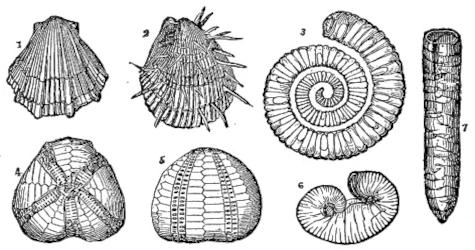
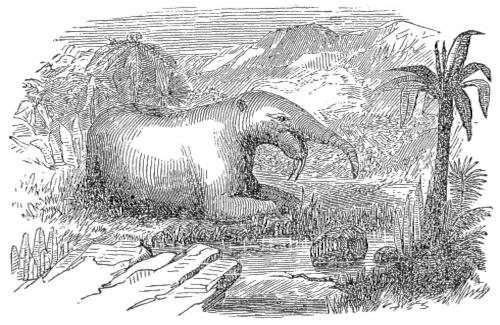
“In these morning-days of existence, Nature at once stamped, with her plastic
hand, her lineaments of beauty and adaptation on everything she made. There is
nothing omitted to be afterward supplied—nothing formed defective in a single part
or organ that required to be corrected. The first discoveries in Geology at once speak
conclusively of a plan or Course of Creation devised from the beginning—a power,
not delegated, but linked forever with the first intelligent Cause—a world, through
all its changes, continually presided over and ruled by Him who made it.”
CINCINNATI:
WM. H. MOORE & CO., PUBLISHERS, 118 MAIN STREET.
1851.
Entered, according to Act of Congress, in the year 1851, by
WM. H. MOORE & CO.,
In the Clerk’s Office of the District Court for the District of Ohio.
E. MORGAN & CO.,
STEREOTYPERS, PRINTERS AND BINDERS, 111 Main Street.
PREFACE.
It is no mitigation of an author’s temerity in publishing,
that he can say for himself he had no intention,
when collecting and arranging his materials, of
ever submitting them to the eye of the public, or of
provoking criticism by his speculations. Certain it
is, however, I have often, and with severity at times,
questioned myself as to the propriety of my geological
pursuits, my ardent love of them, and their compatibility
with the strict discharge of professional duty.
My answer generally was, I sought not these things
of themselves; they were hung up and displayed before
me, wherever I went on pleasure, on business,
or on duty. I simply inquired after their names;
and of all the geological phenomena that have passed
under my review, I can safely affirm of them, in their
darkest, deepest places, they have uniformly led me
“from nature up to nature’s God,” and have inscribed
upon them in brightest characters—Benedictum sit
nomen Dei.
How often, I have argued, in the leisure hours of
life do we find men idling away their time, wasting it
in vain talk, or consuming it in the most trifling
pursuits, when a most interesting branch of science
can be learned by wandering over the green fields,
the rocky dell, the mountain side, or by the walk
at even-tide, and there to hold converse with the Creator’s
works and the records of his will? I have recalled
the list of great and good men, whose names
are imperishably connected with the science of geology,
who have given much of their time to these researches,
and who have reaped laurels from their discoveries.
Can Buckland, Conybeare, Sedgwick, Sumner,
Smith, Fleming, and Chalmers—all either explorers
or expositors—and other eminent divines,
have been engaged in improper pursuits, or have
given the sanction of their authority to tenets and
views connected with the scheme of nature that do
not accord with the religious principle? Often on such
occasions have I dwelt upon, and compared with my
own humble pursuits, the lofty and impassioned descriptions
of the Psalmist, where, sometimes in a single
piece, he takes a magnificent sweep of the great
master-keys of creation—the foundations of the steadfast
earth—the course of the fluid waters—the revolutions
of the sun and moon—the vicissitude of the
seasons—the habits and instincts of the lower animals—the
earthquake and volcano—and all recited
as demonstrations of Divine wisdom and goodness,
and all calculated to awaken and to sustain the devotional
feelings of the heart.
Having, under the influence of such impressions,
gathered, and now put together in this form, the
notes of my researches, I do not mean to aver that
I have visited every locality referred to, or personally
observed everything noticed in the publication.
Where so much has been done by others I have
carefully examined their works. Where the field is so
boundless, and the course of illustration necessarily so
discursive, I have freely made use of their collected
materials. Still, I have been chiefly induced to adopt
the line of description from the Grampians to the Alps,
because, at sundry though often distant periods, I have
examined the various suites of rocks comprised betwixt
these mountain boundaries. If there be any novelty
in the volume, it will be found, not in the subject-matter
itself nor in the mode of treating it, but
by following the geographical sequence in the descriptions
of the several geological formations, and their relations
to each other in the countries passed over.
I have to express my acknowledgments to Messrs.
W. and R. Chambers for a considerable number of
the figures contained in the volume, and which have
already appeared in one or other of their numerous
publications. To Mr. David Page, than whom I do
not know a better practical geologist, I am indebted for
much valuable information, gleaned by him in an extensive
acquaintance with most of the ground passed
under review. The errors of the volume are my own,
and these, I doubt not, in a science subject to such
daily mutations and receiving daily such additions as
the science of geology, will be found neither few nor
venial.
The Carboniferous System—continued.—Geographical
Distribution of Coal.—The Great Coal-Field of Pennsylvania,
Virginia, and Ohio.—Coal Deposits of Kentucky, Indiana,
Illinois, and Michigan.—Economic History of Coal.—Conditions
of Formation,
The Permian System.—The New Red Sandstone.—Foot-Prints near
Pottsville, Pennsylvania—In Connecticut, Massachusetts, and
Virginia.—Rock-Salt.—Exhumation of immense Skeletons of Birds,
Geology is that branch of science which comprehends the
knowledge of all that relates to the form, structure, mineral and
fossil constituents, of the earth. The Scottish Grampians, it is
generally admitted, form part of the lowest sections of its crust,
to which the researches of geologists extend. We must go to
other countries for any coeval, and, to North America for any older,
competing land: and still, there, the rocks are of the same mineral
qualities and arrangement. The Ben-Mac-Dhui group form the
highest and most prominent masses in the whole range of these
crystalline mountains.
When I first stood on the broad flat top of Ben-Mac-Dhui, I
had no thought or purpose of ever recording its geological history.
The excursion was undertaken simply for recreation, and a delightful
one it proved. I longed to plunge into the deep recesses of
the old forest, and to see the trees which nature had strewed
with careless hand, ere, perhaps, Caledonia was tenanted by the
human family. I looked down from its rugged sides, as I ascended,
with awe and wonder—snatched a little alpine as I drew
breath for the next spring—chipped a piece of granite as I obtained
a footing over a yawning chasm, or breasted along by
jagged precipitous defile,—and when, having fairly scaled the
summit, I gazed out upon the world beneath, the feeling which
for a moment flitted across my mind was one of no merely vain
complacency, that I was then the most elevated subject of all the
twenty-six or twenty-seven millions inhabiting the British Islands—and
the lowest, too, in their stony regions! The mountains of
the earth serve to inspire some of the loftiest sentiments that can
fill the breast of its intelligent inhabitants. Imbosomed in their
deep solitudes, man feels his own littleness, and is forced to inquire
who made these wonders, and who sustains them? We are all
the better, morally speaking, for leaving occasionally our daily-trodden
haunts, where we see only human things, and hear only
of the triumphs of human craft, the excitement of human passions,
the littleness and vanity of even the noblest human daring. There
is an image of Jehovah’s greatness impressed upon the outward
face of nature, which for a time will awaken and sustain the most
salutary reflections, breathing, as it were, a new life into the soul
of the wayfarer. A man escapes from himself, forgetting the
burden of a thousand petty cares, and rising above his sensual
condition, when he looks upon the physical world in these its
grander features and secluded scenes, which irresistibly speak to
the inner sense of divinity, wisdom, and omnipotence.
The philosophy of the mountains, in the classic ages of Greece
and Rome, inclined but little to any analysis of their grosser materials
of earth and stone. The poetic and ideal were exclusively
associated with their structures and form. The dii majores dwelt
upon, and thundered from, their lofty summits. The clouds
hovered in peaceful majesty over their council of sage or fierce
debate. The elements were the ready ministers of their will; and
Oreads, Dryads, and Naiads, peopling all the hills, forests, and
streams, were the creations of that principle of the inner man,
which has always searched for the spiritual behind and beyond
the tangible attributes of Nature. Hence, too, the gnomes of the
caverns, the spirits of the mists, the fairies of the glens, the kelpies
of the torrents, were all the embodiment of forms, which fancy,
in her later superstitions, has cast around the mountain landscape,
with the witchery at once of the terrible and beautiful. The
charm that spell-bound the human mind for ages, is not dissolved
when, with ruder intent, we traverse these rocky solitudes, listening
to the echo of our obedient hammer, learning the secrets of
the universe amidst the voices of the everlasting hills, and seeing
the wonders of the material world throwing light on the wonders
of the spiritual.
We are reminded, among the mountains, of one of the first and
loveliest of all material things, the creation of light. Loving
them for their own sakes, as well as for the legends of the old
world with which they are everywhere inscribed, the geologist
takes to the hills with the first faint fresh streak of dawn. Emerging
with earliest day from the somber shades of the forest which,
like night, invests the prospects with its own sadness and gloom,
speedily a scene of joy and activity bursts upon the sight. The
light comes upon you like a real tangible thing. You see it glinting
and breaking on the lofty ridge, then nearing down along the
brown slope of the mountain, here projecting in long bright lines
through the trees, and there—delicious, golden morn! first-born
of Nature’s children, harbinger of life and gladness. How beautiful
are thy first footsteps upon the heath-clad mountains! What
a brood of gloomy thoughts thou dispellest, chasing them before
thee, like yonder envious mists rising lazily from the plains, valleys,
and streams, which they would fain hide from the eyes that
now revel amid their exuberant loveliness. These lofty peaks are
worthy altars for the beacon-fires of the orb of day, after he has
finished his journey through the nations; and comes back to us,
over the floating splendor of the sea, in the eastern heavens.
And see! he hath lit a hundred on these splintered summits, which
blaze now as they blazed centuries ago, and diminish not!
The view from this remarkable group of mountains—the most
remarkable by far in the island—differs much from any other
with which I am acquainted. The impressions at first are all
very confused, and some time is required to resolve into distinct
pictures the wondrous panorama before you. We have stood
upon Skiddaw, where everything is clear, distinct, and palpable
in distance and form; on Ben Lomond, where the far-stretch of
perspective over lakes, rivers, and plains, is like a first lesson in
painting; on Ben Lawers, where the eye sweeps rapidly over well
known, familiar objects, spots of wood, glen, and mansion; on Ben
Nevis, where you fancy yourself in mid-air, every object is so
separate and apart, and so disposed the whole you are looking on,
that the view is all downward upon the picture. But here, these
dark giant masses crowd as it were against you. There is a struggle
for the post of elevation. You are highest, no doubt of that;
but so jealous all are these proud somber peaks, that every one
seems to overlook, though yet actually beneath, the broad ample
table-head of the center of the group. Sometimes one is tempted
to leap across the narrow dells of separation, and at once master
the geology of the district, so near seems every hill-top as almost
to be touched. But as you approach their several positions, expanding
valleys, deep fathomless chasms, and the channels of
noble rivers, bar farther approach, and attest the wide, independent
domains of each. They are monarchs every one of them—Brae-Riach,
Cairn-Toul, Cairn-Gorm, Ben-Avon, Ben-y-Bourd—each
holds his own regal court, over tarn, lake, and stream; torrents,
cataracts, and all the appurtenances of the boldest mountain
scenery.
After one has time to gather up his thoughts and perceptions,
the scene resolves itself, still indeed as of one whole, but of distinct
component parts. In the far distance you attempt in vain to
number the peaks that everywhere rise against the sky line; but
more closely around, five or six summits are seen to spring from
a single root; a common circumference marks out the limits of the
group; and, by no unreasonable liberty with the imagination, you
easily replace the old materials into the vacant interstices, before
the water had begun its work of abrasion, or the earthquake coming
to its assistance shivered their solid rounded forms into these
hideous, precipitous gorges and chasms. The great hills here
stand, every one of them, upward of four thousand feet above the
level of the sea; and when entire, one aggregated whole, as possibly
they originally were, the center mass may have towered
thousands more into the overhanging firmament. The scene is
utterly unmatched, as it cannot be described, by any other in
Great Britain: and make your ascent when you may, there are
sights and objects to be met with at every step, in every salient
dell, that will cause you evermore to rejoice you commenced your
travels among the Aiguilles of Ben-Muich-Dhui.
It is in the great mountain groups that the true key is to be
found to the science of geology, as well as all those collateral
circumstances which impart so much charm to it as a healthful
and invigorating exercise to mind and body. Here, amidst these
piled-up masses, we are furnished with the lowest ascertained sections
of the earth’s crust, from which we can at once study the
nature of its rocky divisions, and the laws which prevail in the
order of their superposition. When the world was in its primeval
state of chaos, without form and void, we are warranted to assume
that the mountains as yet had no place on its surface, but subsequently
arose out of the bosom of the deep; and lifted up, as they
emerged above the waters, the rocky strata already enveloping the
globe. These strata are still to be seen folded round the central
masses, disrupted and torn like a garment too tight for the body,
and displaying through innumerable cracks and fissures the inclosed
rocks. This fact lies at the foundation of all geological inquiries,
gives to the subject all its pretensions as a science, and
before proceeding on our “Course” a word of explanation will be
in place.
The first condition of the earth, of which we have any historical
notice, is that which is represented in Genesis, where, after the
initial declaration that God was creator of all things, we are told
of a period when the whole of its materials were as yet unarranged,
“and darkness was upon the face of the deep.” The Divine
Spirit moved upon the surface of the shapeless mass, when the various
elements of air, earth, and water gradually assumed their respective
positions. The form which the earth had impressed upon
it, as philosophy has demonstrated, was that of a spherical body,
flattened at the poles, a figure resembling as nearly as possible
that of an orange. There is reason to believe, therefore, that
every part of the solid mass of earth is symmetrically arranged,
and that every individual particle occupies the position which Divine
wisdom has assigned it.
Rocks, let the reader be assured, have not been indiscriminately
heaped together. Everything here, amidst all the apparent confusion
which surrounds us, is in the most perfect order, following
one uniform law of superposition. When God fixed the foundations
of the earth, stretched his compass “upon the face of the
deep,” and laid “the beams of his chambers in the waters,” he
completed the mighty edifice agreeably to the plan which he had
determined upon “from the beginning:” the different portions of
the building rise one above another in regular succession; and the
work, so far as we can survey the interior, displays the several
courses into which the materials have been thrown. These constitute
what geologists call the strata of the earth, layers of varying
thickness, such as our slates, sandstones, and limestones exhibit,
and which nearly envelope the circumference of the globe. The
order in which the strata are disposed is uniform from below upward,
and this order is never inverted. From the blue slates of
the Grampians to the Chalk cliffs at Dover, there is a regular succession
of intermediate rocks, piled one upon another like the
mason-work of our houses; and while to many there appears
nothing but confusion, to the scientific eye every portion of the series,
although the same ingredients enter into several classes of
rocks, is as well defined and as easily recognized, as the two members
at the extreme points are by the common observer.
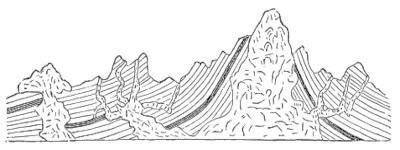
But beside the stratified rocks, there is another class of rocks
equally extensive, and which occupy an important place in the
economy of nature. These are the granites and whinstones of
which the highest mountain ranges are usually composed. There
are many subordinate varieties belonging to both classes, which
are characterized by slight shades of texture and composition and
distinguished by different names. One thing is common to the
members of each group. They are not disposed in layers, and
exhibit no lines of stratification, except in the granite rarely,
throughout the entire mountain chain. These rocks occupy no
fixed place in the order of superposition, but seem to be intruded
in the most irregular manner among the stratified rocks, separating
one bed from another, filling up fissures and rents; and
binding and interlacing the various deposits more closely and
firmly together. They are often composed of the fragments of
other rocks, agglutinated into a compound mass by a base of clay.
Remarkable changes are also produced upon all the strata where
they come in contact with granite and whinstone—chalk being
converted into crystalline limestone—limestone into chert—clay
and sandstone into a substance as hard and compact as flint—and
coal is deprived of its bitumen or the quality which renders it so
useful as a combustible body.
From these, and other appearances, geologists have been led
to the conclusion, that these rocks are of later origin than those
which are stratified, that they have been injected among them in
a state of fusion; and by the expansive force of internal heat, that
they have burst through the stony crust of the earth, and elevated
and disrupted the strata which compose it. They are, if
we may use the expression, the levers which the Almighty has
employed in bringing up the lower deposits to the surface, in
laying open the interior chambers, and in producing all that infinite
variety in our earthly habitation which ministers to the comfort
and well-being of man. Much seeming confusion and disturbance
mark everywhere the course of these rocks, similar, though upon
a more extensive scale, to the disorders attendant upon the irruption
of a modern volcano; but throughout the whole there reigns
such a harmony of purpose, that the conclusion is irresistible,
these operations could only have taken place by Divine permission,
and are in accordance with the Divine plan, controlling the most
refractory agencies of nature, and causing them to contribute to
the general good.
These eruptive rocks have been produced under the sea, at a
period, many of them, when the waters and the dry land were
not as yet separated from each other. They are therefore termed
sub-aqueous products, and are, in consequence of the pressure to
which they have been subjected, hard, compact, and heavy.
They differ in this respect from the products of modern volcanoes,
which are light and porous, as being formed under the simple
pressure of atmosphere, and are denominated sub-aerial. The
most prevailing ingredient both in ancient and modern lavas is
feldspar: this, combined with hornblende, quartz, and augite,
characterizes the whole of the two families of the trap and granitic
rocks; and completely establishes their claim to be regarded as
originating in submarine volcanoes. Geology is thus in its first
step, and initial principles, in perfect accordance with the scripture
record; and, in walking over the varied fields of creation, we shall
tread all the firmer, and enjoy our recreations all the more, that
we find the word and works of God illustrative of each other,
revelation never contradicted, and science bearing enlightened
testimony to the wonderful truth—that the hills melted like wax
before the Lord.
Two reasons, therefore, are to be assigned for the starting
point of our investigations, and the route fixed upon in following
them out. This center group of mountains comprises the first or
lowest phenomena connected with the science of geology: here
the earliest lessons are inscribed; and here, developed on a great
scale, we are presented with the axis of elevation which has given
character and outline to the whole surrounding district. Ben-Mac-Dhui
is the most prominent type of our primary mountains,
and has been mainly instrumental in lifting up a large portion of
the Grampian range. Looking abroad from its summit, over all
that varied landscape of plain and valley, and further than the
eye can reach, summoning in imagination before us the successive
strata as they recede in the far distance, a diagram which would
faithfully represent the order of the rocks and their relation and
proximity to the granite, would be quite correct in making Ben-Mac-Dhui
a pyramidal basis, and the other formations as steps to
the apex of the pyramid.
This lofty chain of primary rocks on the one hand, and the
Alpine region of Switzerland on the other, may likewise be regarded
as constituting the barriers or edges of one great basin,
within which are inclosed members of almost every rock formation,
fossiliferous as well as non-fossiliferous, existing anywhere
on the face of the earth. Along the line of tour indicated, you
pass over every intermediate deposit, from below upward; and
have laid before you, for inspection, specimens of all that is interesting
and curious in the science. Betwixt the two points, selected
as our termini, lie strata upon strata, organic bed upon bed, not
piled up in one colossal mass, but drawn out and slipped over the
edges of one another, and so arranged and disposed at successive
intervals as most happily to suit the convenience and successive
stages of the journey. This is one of the most remarkable facts
in descriptive geology, whereby we learn that a depth of nearly
ten miles of solid rock can be duly examined, every particle and
fossil of it, not by perforation downward to the bottom, but by
the natural inclination of the beds, and their several outcrops rising
to the surface like the inverted tiles on a roof. In consequence
of this persistent arrangement, objects, both new and strange, will
at every step meet the view. There the whole system of geology,
page after page, is spread out before you. Every day opens up
a new chapter geographically, as well as mineralogically divided.
And when you have gained the summit of Mount Blanc, you can
leisurely, in the mind’s eye, look back over the whole Course of
Creation.
It is a reproach, I am aware, sometimes cast upon geological
researches, that the portion of the earth’s surface exposed to view
is as nothing compared with the entire mass, and that another
portion, by far the largest segment, is concealed by the ocean,
and its own debris. In addition to these disadvantages, it may
now be objected that the line of description indicated narrows the
field of research still farther, and that a few disconnected materials
only are all that can therefrom be extracted. It may be answered,—“That
the earth is constructed with such a degree of uniformity,
that a tract of no very large extent may afford instances, in
all the leading facts, that we can ever observe in the mineral kingdom.
The variety of geological appearances which a traveler
meets with, is not at all in proportion to the extent of country he
traverses; and if he take in a portion of land sufficient to include
primitive and secondary strata, together with mountains, rivers,
and plains, and unstratified bodies, in veins and in masses, though
it be not a very large part of the earth’s surface, he may find
examples of all the most important facts in the history of fossils.”[1]
We shall, however, along with our lineal descriptions of the mineral
kingdom, notice the occurrence, position, and fossil contents
of the strata as represented in other parts of the world.
CHAPTER II. NATURE AND STRUCTURE OF THE GRAMPIANS. PRIMARY ROCKS.
In beginning a description of the earth, every one is prepared
for the information, that it must have existed in some form or other
antecedent to the development of life upon its surface. Revelation
asserts a succession in the objects created, as well as in all the
cosmical arrangements connected with the early history of our
planet. Things were not perfected at once, and brought simultaneously
into adaptation and form; a preparation and a fitting up, as
it were, of the inorganic preceded the introduction of the organic
structures of creation; and, accordingly, the solid framework of
the globe gives corroborative evidence of this anterior condition
of its history. The rocks of the period are, from this circumstance,
denominated Primary, because they not merely denote the
absence, but are assumed to have been formed before the existence,
of any types of organic matter, vegetable or animal.
Nowhere can this first lesson in geology be more forcibly taught
than by an examination of the sterile rocks and rapidly decomposing
precipices of this bleak and hoary region. Once through
the glens, and fairly commencing the ascent of the center mountain,
every symptom of existing life has disappeared; and amid
the huge, tabular masses that accompany you in the upward journey,
there is no trace of organic forms in these vestiges of the
past. The nucleus of the whole group is granite, one dense aggregation
of crystals; now rent and furrowed by a thousand
seams, the heart and penetralia bared and open, a convulsed sea
of molten matter still and motionless as the grave! The associated
rocks, all of the primary class, are gneiss, mica-slate, quartz-rock,
chlorite-slate, and limestone; and these inclose no relic of a living
thing. Geology thus ascends the stream of Time; but it gives no
farther tidings of a scene like this, save that it arose from the
depth beneath at the Creator’s bidding.
The Structure of the District.—The mountain of Ben-Mac-Dhui,
according to recent measurements, is 4,418 feet in
height, and covers a superficial area of nearly forty miles in extent.
It occupies a central position in the Grampian range, being
about equidistant betwixt Aberdeen on the German Sea and the
western coast, so ribbed and indented by the Atlantic. Ranges
of granitoid rocks, of the primary class, diverge for nearly forty
miles south and north of Ben-Mac-Dhui, thereby giving this
mountain a prominence in position possessed by no other within
the boundaries of the island.
The valleys by which this monarch is surrounded, open in every
direction, and run toward every point of the compass. Two great
rivers, the Don and Dee, take their rise in some of the deep gullies
of the mountain, while the Spey is fed by the innumerable
streams that issue from its sides. These rivers have each an easterly
direction, which, by their water-shed, give shape and character
to the whole district. A hundred lateral glens, with their
tributary streams, and all their tarn-head or loch, debouch upon
the three principal straths, whereby their deepest solitudes are
reached, and the very foundations of their loftiest peaks bared and
laid open. There, remote from human habitation, the geologist
sees as it were two conditions of the world,—the one, the shattered
framework and fragments of its early convulsions, huge mountains
prostrate and crumbling beneath his feet,—and the other,
the spring-heads of renewed vitality collecting in countless dripping
rills, each to sustain its own little plot of pasturage and flowerets,
not the less welcome that they are all so rare and alpine,
and looking in their freshness as if they were there purposely
to cicatrize and heal up the deep scars in the rugged precipices
around.
Loch-na-gar on the south-east, and Ben-y-gloe on the south-west,
have also their separate congeries of lofty hills and precipitous
defiles, inclosing tarns, lochs, and rivers; likewise their own
peculiar grouping of glens and straths, whose inner recesses are
all most speedily attained through the velvet pathways of their
moss and crow-berry. From the poetic peak the prospect is
worthy of its fame. All around is a vast rolling surface of mountains,
with steep mural precipices, and separated by deep ravines,
while immediately underneath a cliff of 1,300 feet lies the lake,
contracted to a span, and rendered even darker in its gloom by the
snowy glaciers that sparkle here and there on the overhanging
rocks.
From Loch-na-gar eastward to Craigdarroch and the more distant
Morven, and through the great forests of Balloch-bowie,
Glentanner, and Glenesk, granite is the prevailing rock. Around
Balmoral, immediately under “these steep frowning glories,” the
granite rises into a number of smaller and beautifully dome-shaped
hills. Cloch-na-bein and Mount Battock, washed by the Feugh
and the Dye, are likewise composed of granite. Gneiss, mica-schist,
quartz-rock, and clay-slate hang on the southern slopes,
training down into the plains of Kincardine and Forfarshire. To
the west of Loch-na-gar, and intermediate betwixt that range and
the granitoid masses which cluster round Ben-Mac-Dhui, the same
alternating series of stratified rocks occur. From Castleton to the
head of Loch Callater, and along by Glen-clunie to the junction
with Glen-beg, where the counties of Aberdeen and Perth meet,
the strike of these rocks is again passed over in a walk of a few
miles; the beds penetrated and tilted up by veins of granite and
feldspar. Several dykes of the latter mineral, of an extremely
deep-red color and glassy crystalline texture, traverse the district,
extending over a vast range of country, penetrating indifferently
the granites and schists, and always forming attractive objects in
the beds of the rivers.
In the immediate vicinity of Castleton and Invercauld, the geological
phenomena of the district are very accessible as well as
instructive, in consequence of the comparative smallness of the
mountains, and isolated position into which they are thrown. A
magnificent amphitheater of hill and plain is spread out before the
traveler, through which the Dee, after a course of upward of
twenty miles from its wells—mysterious as the fountains of the
Nile—rolls its waters, now joined by the Quioch, Clunie, Candlie,
and all the tributaries of the surrounding peaks. Some of the
hills present bare precipitous cliffs, as Craig Koynach and the
Lion’s Face, where the granite, schistose, and calcareous rocks
are finely exposed to view. Their strike is continued westward,
when they are severally crossed in the easy ascent of Morne, half
of whose dome-shaped top is covered with quartz-rock, which
here, as in most of the neighboring heights, attains to an enormous
thickness, and shows in weathering the yellow granular texture
of sandstone. So remarkably like are some specimens we
picked up by the roadside, that for a time we imagined ourselves
to be approaching a region of secondary deposits. Internally,
however, the bright crystalline structure is uninvaded by decay.
Ben-Beck, Cairn-a-drochel, and Ben-Viach behind Mar Lodge, are
chiefly composed of gneiss, passing into a slaty micaceous schist.
The same character of rock continues upward through Glen-lui
until its junction with Glen-lui-beg and Glen-derry, where the
granite maintains its sovereignty over all that primitive lofty
region.
The geologist, in penetrating these primeval wilds, has but little
choice left him as to the comforts of his pathway. Arrived at
the top of Glen-lui, the two diverging passes, right and left, are
equally desolate, savage, and grand. He may make his selection
as the feeling of the moment prompts, but he will not be able to
congratulate himself as the traveler in a different field—
Hic locus est, partes ubi se via fundit in ambas:
Dextera, quæ ditis magni sub mænia tendit;
Hac iter Elysium nobis: ut læva malorum
Exercet pænas, et ad impia Tartara mittit.
No “fiends,” indeed, as Dryden renders it, are here, unless the
belated traveler may allow his fancy to shape these gnarled withered
stumps of the old forest, as it well may, into grisly living
forms; or the red deer breaking from their coverts, and gazing
in wild amazement from the crags, startle him from his propriety.
Still Loch Avon, black as pitch, and imbosomed in horrid rocks,
is not an unfitting emblem of the Tartarean lake.
Pursuing his route to Strathspey, either through the desolate
openings of Ben-Avon, or by the wild passes of Brae-Riach and
Cairn-gorm, the geologist again drops down among the gneiss,
schists, limestone, and quartz. These types of rock line the
trough of the Spey, on both sides, as far as the granite district of
Ericht and Laggan, presenting the usual phenomena of granitic
and feldspathic dykes, and in some places, as at Loch-an-Eilan,
remarkable twistings and flexures in the mica-schist around this
eagle-haunted lake. Glen Tilt, on the south-west, is distinguished
by a singular display of granitic veins, appearing to radiate from
a common center—the well-known phenomena which the philosophers
of the Hutton and Playfair school pressed so keenly and
successfully into the service of their theory. The gneiss is
generally to be observed in the form of low ridges, interstratified
with quartz-rock, and approaching in mineral qualities to the
mica-slate.
The bearing of all these stratified rocks is, on the main, sufficiently
indicated by the outline of the Grampian range. The
quartz, mica, and chlorite slates, are nearly continuous along the
chain, traversing in a S. W. by N. E. direction the breadth of the
island, from sea to sea. The line of strike, however, is often interrupted,
either by the eruptive veins above mentioned, or by
the upheaval of the central axis, which, as it rose with greater
violence, or was parted into higher and unequal ridges, would
necessarily occasion corresponding changes in the lie and direction
of their coverings. This principle in geological dynamics
has been satisfactorily established by Mr. Hopkins of Cambridge,
who has shown, that in the production of any great line of elevatory
disturbance, whether affecting straight, curvilinear, or
ellipsoidal masses, the strata would frequently be broken by fissures
at various angles to the chief line of strain or elevation.
Hence these interminable glens, transverse straths, cul-de-sacs,
and countless depressions, forming tarns and lochs, all inosculating
into each other, and which give such variety and grandeur
to this alpine region. The pent up ebullient matter beneath the
crust would thereby force its way to the surface—now in the
form of veins—now in long narrow ridges—and in other quarters
assuming the contour of broad mountain domes. The dip, in
like manner, corresponding to these partial strikes, as well as
great axis of the chain, is often various—as at the Linn of Dee,
and along the braes of Corry Mulzie, the beds being almost
horizontal, while generally they are so highly inclined as to be
nearly vertical.
There are also numerous examples where the crystalline strata
dip inward toward the granite ridges, and in this manner form an
acute angle with the base, instead of being infolded over and
welded to them. The only admissible explanation in these instances
of the dip is, that the ends of the strata adjacent to the
eruptive masses have sunk into depressions occasioned by the
evolution of igneous matter, while their upper edges have been
tilted backward. Hence the schists often rise into independent
elevated crests all along the chain, and even where no granite
appears at the surface. The rocks in Glen-Beg and Glen-Clunie
afford examples of this kind, where, as in Cairn-na-well, and the
other mountains here, they are highly inclined, and plunge in the
direction of the principal range. Geology, viewed in this light,
becomes an auxiliary to physical geography, explains many anomalous
appearances on the earth’s surface, and successfully accounts
for all the flexures, breaks, undulations, and inequalities,
that constitute such marked features in the primary strata.
Until very recently, the doctrine maintained was, that nearly all
the inequalities on the earth’s surface were produced by the
erosive and denuding effects of water; that not merely the small
lateral valleys and branches of rivers, but likewise all their main
trunks, were caused by the slow and gradual working of the
stream, cutting the most solid and massive rocks in the same way
and almost with the same instrument by which the lapidary divides
a block of marble or granite. Nay, with such a ready agent,
acting through incalculably remote and indefinite periods of time,
the conclusion was arrived at, that “on our continents there is no
spot on which a river may not formerly have run.” A sounder
philosophy, and one far more accordant with the facts, is now
beginning to prevail, namely, that nearly all transverse gorges,
by which rivers escape across ridges from one water basin to another,
are nothing more than ancient apertures in the crust of the
earth, which have resulted from the former disruption and denudation
of the rocks: and that rivers, properly so called, have never
cut sections through chains, but simply flow in chasms prepared
for them.
Nature and Qualities of the Rocks.—The granite is the
most prevailing, as well as the most striking in its appearance and
texture, in the whole range. Mineralogically considered, every
specimen is a gem. Granite is a compound, aggregate rock, here
of a lively flesh or rose color, consisting of perfectly formed crystals
of quartz, feldspar, mica, and in some instances hornblende,
when it merges into what is termed syenite. The sparkling film
is mica. It is not metallic; but it shines with metallic luster; and
in some places of the chain, as at Rothes on the Spey side, it is
found in plates so large as to become a substitute for glass. The
component parts of mica are silex, alumine, potash, iron, manganese,
and traces of other substances. The colors of the mineral
are various, according to the proportions of some of the ingredients.
The laminæ are divisible into plates no thicker than
1/300,000th part of an inch. Entering into the composition of almost
every rock from the oldest to the newest, it abounds chiefly
in granite and schist, but also occurs in sandstones, and the slaty
shales of the coal formation.
I never look at a piece of granite, fragments of which are
strewed on every heath, without being reminded of Paley’s inaccurate
and disparaging comparison betwixt “the stone” and “the
watch,” in his celebrated argument for the existence of Deity.
Take a specimen fresh and living from the rock, or from any
bowlder that meets you on the way. There is not a stain in all
that composite mass: how bright every ingredient! No workmanship
of man can rival it in its closeness of texture, beauty of
color, distinctness and delicacy of shading and outline. What
chemistry elaborated these particles as they separated and united?
What scales weighed their impalpable elements? What hands
constructed their nicely harmonizing proportions? Whence derived
their principle of cohesion as they cooled and inosculated in
the burning crucible? As that fragment of rock, so is the whole
interior of the mighty range—the whole basis of the continents
of the world—countless myriads of sparkling gems wrought into
symmetry and form; the foundations of our earthly habitation
literally “garnished with all manner of precious stones.”
Paley, forgetful of every law or purpose so conspicuously
developed in the whole of these beautiful arrangements, thus
commences his great work on Natural Theology:—“In crossing
a heath, suppose I pitched my foot against a stone, and were asked
how the stone came to be there, I might possibly answer, that,
for anything I knew to the contrary, it had lain there forever:
nor would it perhaps be very easy to show the absurdity of this
answer. But, suppose I had found a watch upon the ground,
and it should be inquired how the watch happened to be in that
place, I should hardly think of the answer which I had before
given, that for anything I knew, the watch might have always
been there.”
How many fallacies are there in this statement so far as mention
is made of the stone? The science of geognosie, not so far
advanced in Paley’s time, now clearly establishes the “absurdity”
of supposing its having lain from “eternity” in the place where
it is found. The relative ages of mountains, and therefore their
succession in Time, are now demonstrable and well understood.
Then, the component parts of the mineral are as well defined, as
accurately proportioned, and arranged in manner and order as
precisely, as the several parts of the watch. The mica, the quartz,
the feldspar, have each their law or order of structure, as well as
their principle of aggregation; and they have taken their respective
forms and no other, and have assumed their compound structure
and no other, in obedience to chemical affinities and an atomic
adjustment, as certain and unalterable as are the conditions and
requirements of dynamics.
Nay, more, the parent rock, from which that stone was taken,
has its own place in the system; its position, amidst the upheaved
disrupted strata around, has been assumed for a purpose; and
the very size, form, and outline of the giant mass, are all shaped
to an end. Rocks are as easily distinguished as trees or animals,
which have not risen up by accident, but have been constructed
out of certain materials, and arranged each according to its own
class. Their internal characters, and even outward shape, are
marked and defined. The gnarled oak in fiber and texture differs
not more from the soft, pendulous, graceful willow, than are the
differences of rocks and minerals in their normal arrangement of
particles; in their diversity of fracture, cleavage, luster, and
density. We see at once the mechanism of the watch, the growth
and expansion of plants and animals. But so, upon gaining the
least knowledge of its frame-work and structure, we cannot open
our eyes upon any part of the external world, without being impressed
with the conviction, that all which we see and admire,
must be the work of a higher power. Design is stamped upon
everything. Will, order, and might are everywhere visible.—Geology,
discovering harmony amidst apparent confusion, renovation
in decay, shows that every rock is fitted to its place; that
systems and series of formations are arranged upon a principle of
utility; and so thoroughly calculated to exercise their assigned
functions have all the parts been formed, that the most elaborate
machinery of man’s contrivance falls infinitely short of the beauty
and perfection everywhere displayed in the material creation.
Lain forever! No; such a scene of mountain, valley, river, plain,
and ocean—all related to each other—does not exist by chance,
is not conserved nor arranged by accident.
Theory of Formation.—When we examine a piece of granite,
nothing appears less likely, to a common observer, than that it
was once in a molten state through the action of fire, and that its
crystalline structure was assumed in process of cooling. Now,
the fact of its crystallization, the beautiful and perfect arrangement
of its parts, the impress of the one crystal upon the other
reciprocally communicating their respective shapes to each other,
and the compact, agglutinated state of the whole, is regarded as
the strongest proof of the igneous origin of this remarkable rock.
Granite is not a mere congeries of parts, which, after being separately
formed, was somehow brought together and united; but it
is certain that the quartz, at least, was fluid when it was molded
on the feldspar. In some granites, the impressions of the substances
on one another are observed in a different order, and the
quartz gives its form to the feldspar. The ingredients of granite
were therefore fluid when mixed; and this fluidity was not the
effect of solution in a menstruum, as in that case one kind of crystal
does not impress another, but each retains its own peculiar
shape; and the conclusion is, that they crystallized from a state of
simple fluidity, such as, of all known causes, heat alone is able to
produce.
This is the account given in the Huttonian theory, as expressed
nearly in the words of Playfair, which, along with the position of
veins, the disruption of superincumbent strata, and other phenomena,
has resulted in the universally received admission of the
Plutonic character of this class of rocks. Dr. Macculloch has extended
the principle, and has satisfactorily proved, that granite is
but one term in the series of igneous products, the passages from
which are distinctly traceable into granitoid syenite, and syenitic
greenstone, and thence into greenstone, basalt, and lava. Professor
Forchhammer considers granite, when melted, as one simple
compound, and which only on cooling becomes separated into the
different minerals that compose it.
Granite, wherever it is found, is inferior to every other rock;
and as it composes many of the greatest mountain chains, it has
the pre-eminence of being elevated the highest into the atmosphere
and sunk the deepest under the surface, of all the mineral
constituents of the globe to which our researches extend. The
associated primary rocks in this upland region overlie the granite,
and possess a distinctly stratified structure. They are not now in
their original position. They have been tilted up, traversed, and
interlaced by the granite while in fusion, and have been altered
greatly in their texture and qualities by their contact with the
heated mass. Hence they are called Metamorphic Rocks, because
of the change to which they have been subjected.
The rocks that immediately overlie the granite are gneiss, mica-slate,
quartz-rock, and limestone. They all partake of the crystalline
structure, and all, except the last, possess the same ingredients,
and assume interchangeably the same aspect. Of gneiss
there are three varieties, each composed of feldspar, quartz, and
mica, and distinguished by the size and form of the crystals that
constitute the mass. This rock, consisting in all cases of thin
lenticular plates, has a ribbon-like appearance, and, according to
the predominance of one of the parts, becomes glandular, slaty,
or aggregate. Mica-slate consists of quartz and mica—the latter
predominating—and feldspar frequently entering as an adjunct.
Quartz-rock, as the term implies, is formed of the pure siliceous
matter, nearly homogeneous in many instances—but scales of
mica are often present—and feldspar not always absent. The
limestone, again, differs from all the above in the excess of the
calcareous element, while, along with talc, steatite, actynolite,
asbestus, and other simple minerals, mica, quartz, and feldspar are
likewise to be numbered among the imbedded crystals. These
rocks, over the entire surface of the globe, are of one family, and
generally associated. They are always the lowest of the stratified
series, and follow in the order now described. They are essentially
one and the same in their constituent mineral qualities—different
in the form and proportions in which they are aggregated—and
geographically connected with the granite in their
distribution. Thus these crystalline rocks not only constitute the
floor of our earth, but have in all probability supplied the materials
under whose plutonic agency, when fused and molten, the
massive pavement was raised above the waters and tempered into
its present consistency.
Granite, the derivative rock, is found, accordingly, in every
region of the globe—the lowest as well as the most universally
distributed—the basis as well as the apex of every great mountain
chain. No true Highland scenery is anywhere to be found that
does not embrace granite as the most prominent feature in the
picture. Not a hill in Scotland, two thousand feet high, but incloses
a portion of this rock. The beauties of the English lake
country are all derived from this source. The lofty serrated
peaks of Wales have been raised upon its crystal foundations.
The north-west and central portions of France, the Swiss and
Tyrolese Alps, the vast expanse betwixt Dresden and Vienna, the
Caucasus, great part of the Himalayan, Uralian, and Altai mountains,
and large elevated districts in China, are all less or more
of granite formation. Through Northern Russia and Scandinavia
the granite may be regarded as merely a continuation of our Scottish
range—one great stony girdle, which forms the primary
mineral boundary of Northern Europe. America, Africa, Australia,
possess not a single ridge of celebrity through which the
same fundamental rock is not traceable in every district. How
simple, uniform, universal the component elements of the globe!
One and the same atmosphere surrounds it, one ocean washes it,
one system of massive pillars supports it, one sun enlightens it.
How direct and irresistible the inference, that one intelligent, all-powerful
Being fashioned and framed it!
The separation of the dry land from the waters was, doubtless,
effected through the instrumentality of means. The igneous
theory of granite, and other amorphous rocks, is in accordance
with this supposition, which thereby imparts a sacred and peculiar
interest to all our investigations respecting the origin and elevation
of mountains. The range of geological investigation is thus
wide as the circumference of the globe—deep as the foundations
of the earth—and sublime thoughts are everywhere awakened of
Him—
Whose dwelling is the light of setting suns,
And the round ocean, and the living air,
And the blue sky, and in the mind of man:
A motion and a spirit that impels
All thinking things, all objects of all thought,
And rolls through all things!
CHAPTER III. THE SILURIAN SYSTEM. FIRST TRACES OF LIFE.
The group of rocks on which we next enter are termed fossiliferous,
that is, there is contained in their hard stony substance the
impressions and actual remains of organic bodies. As we proceed
upward through the series in their ascending order, we will find
different rocks distinguished by different classes of fossils, and
characterized by distinct lithological appearances. They are in
consequence divided into different formations, and called by particular
names. Hence the origin of systems, of which there are
five or six recognized by geologists, separable into their respective
groups of strata. Descending from the primary, the highest as
well as lowest in the series of rocky combinations, the group which
first invites attention is the Silurian; so denominated because the
strata are widely spread over the districts in England and Wales,
anciently inhabited by a people called the “Silures.” They are
found in various quarters of the world, and occupy a large area
on the southern frontiers of Scotland.
The rocks of this class consist of a group of argillaceous, calcareous,
and arenaceous deposits, varying in color and texture. They
are of great thickness and severally impressed with their own
written story, the fossil memoranda of the changes and events
that occurred betwixt the formation of each. These are the transition
rocks of Werner. The newly-adopted term of Silurian implies
no peculiar theory as to their origin. It simply expresses
the fact that in the district in question a complete succession of
fossiliferous strata is interpolated between the oldest slaty crystalline
rocks and the old red sandstone. The system is divided
by their discoverer and historian, Sir R. I. Murchison, under the
ascending series, into the Cambrian System, Llandeilo-flags, Caradoc
Sandstone, Wenlock Shales and Limestones, and Lower and
Upper Ludlow Rocks.
Do the equivalents of all, or of any, of these groups exist in
the Grampian range? Geologists for the most part have been
answering these questions in the negative. Hitherto no true silurian
deposits have been recognized as existing among the northern
Scottish mountains, and no well-authenticated organism of the
system has been detected in any of their localities. This, however,
will hardly be taken as a conclusive argument after the
admission into the family of the Skiddaw slate, in which the
faintest traces of organized matter have only very recently been
observed, while the over-lying series consisting of chlorite-slate,
and alternating beds of porphyry and greenstone, from twenty to
thirty thousand feet thick, have not yet been proved to contain a
single fossil. “Good fossil groups,” Professor Sedgwick argues,
“are the foundation of all geology; and are out of all comparison
the most remarkable monuments of the past physical history of
our globe, so far as it is made out in any separate physical
region.”
We are convinced that the clayslates and graywackes which repose
on the southern flank of the Grampians, as well as abundantly
in the interior, will, upon strict examination, have their
place assigned among the Silurian class. Mr. Nicol, who has
done so much for the Lammermuir deposits, will find ample scope
for his investigations, and all his ingenious speculations, in determining
the true position of these argillaceous beds, which are of
prodigious thickness and vast extent. This is not the place to
enter into details, but in support of the view now advanced, the
following among other reasons may be given.
First of all, the clayslate of the Grampians resembles in its
lithology the slates of Wales and Cumberland, admitted to be
silurian. In hand specimens they cannot easily be distinguished
from each other: practical men consider the slates of Dunkeld
and Glenalmond as softer and less flinty than those of the south.
They pass from extremely coarse into the finest grained varieties,
when the graywacke character is entirely lost in the homogeneous
mass. Their position in reference to the crystalline rocks, in the
next place, is very distinct, never alternating with, nor lying conformable
to, either the gneiss or mica-schists. They form the
outer zone, from east to west, of the Grampian range, where feldspar,
porphyries, and trappean rocks are along the whole line
mixed up or associated with them. Then overlying the clayslate,
precisely as in Cumberland, the old red sandstone is found in
immediate succession and resting unconformably. Shall we add
that, even in a topographical point of view, these beds will be admitted
to vindicate their claim to Silurian origin, constituting, as
they do, in extension, a portion of the great primary belt that
encompasses the western shores of Great Britain, and beyond the
channel, stretches through Brittany and Normandy?
From considerations such as these there are sufficient grounds,
we think, for constituting the clayslates and porphyries of the
Grampians into a “physical group,” existing in a “separate physical
region.” The absence of organic remains may be accounted
for by the fact of the vast disturbance prevailing in the seas at
the period, and indicated by the prodigious quantity of igneous
matter spread repeatedly over their bottom. These causes would
act in so far in preventing the existence and increase of living
things, over all these parts, and most certainly in obliterating the
traces of their remains, if any were deposited. But as future explorers
may yet detect them in abundance we proceed to consider
the nature and classes of fossils elsewhere discovered in the Silurian
strata.
Animal Remains. Here, in this series of rocks, we are carried
back to the beginning of life upon the globe, in which we see the
very dawn and commencement of earthly enjoyment, the first
forms and races of creatures which were privileged to eat at the
banquet of creation. As matter of history, therefore, nothing can
be more interesting; as a subject of mere curiosity concerning
ancient relics, the most ardent archæologist will be amply gratified;
and as showing the manner of the divine actings in replenishing
the earth with living things, the word and the works of
Deity are again to the devout inquiring mind brought into pleasing
harmonious comparison.
We find that the creatures belonging to this first epoch of organic
existence are, generally, low in the scale of animated being.
The rocks in which their remains are imbedded are, in some instances
almost entirely composed of organic matter, showing that
life at first was not bestowed sparingly, or, through some hidden
mysterious processes, stealthily introduced upon the stage; it rather
appears in an abundance and variety, speaking of a purpose
in obedience to a designing creative act. As suitable to the condition
of the planet, not at once but by successive arrangements
brought into a state of adaptation for sustaining life, the animals
now formed appear to have been chiefly of the invertebrate division,
that is, animals of comparatively simple structure, destitute
of a bony skeleton, suited to live in shallow waters and muddy
bottoms, and to be content with such fare as an infant state of
things over the young earth could produce. Among these ancient
families are graptolites,—many of them zoophytic bodies,
allied to the modern sea-pen; crinoids, or lily-shaped animals, of
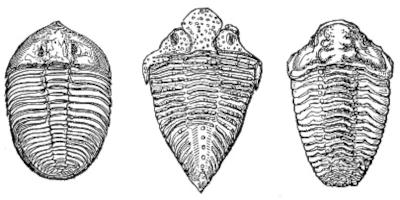
beautifully-developed forms; and trilobites, crustacean creatures
divided into three dorsal lobes. There are several species of each.
And so accurately has nature adhered to her plan of operations,
that we find the corals of that early age doing the same offices,
and piling up similar submarine reefs, by which these busy little
architects are still distinguished. The mollusca of the period are
very numerous, embracing almost every order and form of shell
that are found in our present seas, though wholly of different species;
conchifera, brachiopoda, gasteropoda, cephalopoda, pteropoda,
beside the heteropoda, of which there are no existing
analogues. The habits of all these orders must have been nearly
the same as those of our modern types. The cephalopoda, embracing
the nautilus and orthoceras tribes, were then as they are
now, the tyrants of the deep, furnished with eyes and ears, and
armed with powers that enabled them to roam and prey at will in
the bays and estuaries of the primeval world. There have
been named and catalogued of these first forms of the moving
creatures of the deep about three hundred and fifty distinct
species.
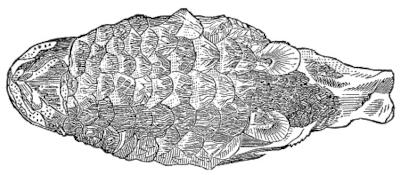
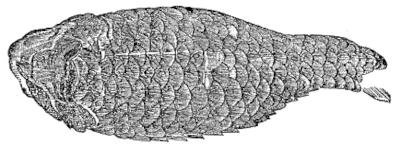
But, beside these, there have been discovered in the silurian
rocks six or seven genera, involving a still greater number of species,
of fishes of the order of the Placoids, so denominated from
the broad scales or plates with which they are covered. The
probability is, that more of these higher organisms will yet be
brought to light, as all the strata of the system consist of marine
deposits, and only the most limited sections have anywhere been
explored. They constitute the lowest of the fossiliferous beds;
are generally found, except in Russia, in a vertical or highly inclined
position, and consequently but little of their superficial area
is exposed. Here, however, geologists have named and described
an Onchus Murchisoni, a Thelodus parvidens, and other four genera
of equally erudite-sounding names. The onchus type is
continued, and greatly multiplied in species, in the two succeeding
formations, when it dies out, or at least no trace of the genus
is found in later times; while the rest appear to come and to depart
within their own geological epoch. These organisms are all
as yet termed Ichthyolites, that is, simply fossil fragments of fish,
as no entire animal has been anywhere detected, while of their
true class M. Agassiz affirms with confidence. Teeth, fins, spines,
occur so abundantly in a stratum of the Upper Ludlow series in
Wales as now to be termed “the bone-bed,” giving assurance
that the seas were thus early stocked with the finny tribes. The
families of most of these fishes have yet to be determined. But
nature, though in her operations “simpler than man’s wit would
make her,” was still pretending enough to be shaping out thus
early the higher types of life.
The science which introduces to such sights and studies, occupies
no mean place among the various branches of human inquiry.
To neglect to decipher what is so indelibly recorded on these
pages of creation, is willfully to shut oneself out from what has
been actually preserved for information—a voice from the past,
which speaks in the same distinct articulate language as the present
of the fiat of Omnipotence. No object is mean or contemptible
which divine wisdom has formed, and no subject is unworthy
of investigation which illustrates His ways and works during any
period of creation.
The mind, at this starting point of life, is curious to know what
amount of information can be obtained as to the organic structure
and specific characters of these first denizens of earth, so as
to compare them with the forms and species of the analogous families
now existing. The information derived from this first
chapter in palæontology, we believe is, that the earliest specimens
of organization are as perfect as the latest, each after its kind;
and that, in these morning-days of existence, nature at once
stamped, with her plastic hand, her lineaments of beauty and
adaptation on everything she made. There is nothing omitted
to be afterward supplied—nothing formed defective in a single
part or organ that requires to be corrected. The first discoveries
in geology at once speak conclusively of a plan or course of creation
derived from the beginning—a power, not delegated, but
linked forever with the first intelligent cause—a world, through
all its changes, continually presided over and ruled by Him who
made it.
Vegetable Remains were long wanting, and sought for in vain,
to complete during this period the picture of the ancient world,
as described in the pages of revelation. Geology, indeed, had
everywhere sternly held back the required evidence, and animals
were announced to be the first of living things. This, though contrary
to all analogy with regard to the conditions of animal subsistence,
was generally received as a well established dogma; and
the earliest book of history was laid aside, or its statements in
these circumstances regarded as irrelevant. Vegetable remains,
however, have been detected in the oldest fossiliferous group of
rocks, and this apparent discrepancy has been forevermore disproved.
Fucoid plants are found in great abundance in the transition
series of Scandinavia as well as in the silurian strata of our
own island. That they are not more widely distributed is satisfactorily
accounted for by experiments which show that some
species of plants entirely disappear in water. A productive flora,
therefore, may have existed from the earliest period, but, unable
to resist decomposition, all traces thereof have long disappeared
from the tablets of the earth.
Nay, so abundant in some quarters of the globe has vegetable
matter been at this period, that there are traces of beds, approximating
to coal, entirely composed of it, and the rocks inclosing
these beds so charged with bitumen and carbon as to be used as
fuel. “The silurian strata of the Scandinavian peninsula and the
Island of Bornholm, contain,” says Professor Forchhammer, “in
their oldest parts, large beds of aluminous slate, which is used in
a great number of manufactories for making alum; and this
aluminous slate has the great advantage over those slates of the
carboniferous system of Germany and a part of France, that it
contains the sufficient quantity of potash which is required to
make alum.” It is well known that potash constitutes an ingredient
in most vegetable bodies; and that when a plant is
burned there remains a skeleton of this substance. Hence, possibly,
the origin of the potash in the alum slate. But the argument
does not rest upon inference. The same authority relates,
that in Bornholm and in Scania, the southernmost part of Sweden,
this slate contains a great number of impressions of a fucoidal
plant, of which Liebmann has given minute botanical descriptions.
Then, pursuing his interesting tale of this first flora of creation,
he says,—“According to Professor Keilhau, Professor Bock, and
M. Esmark, the same ceramites occurs frequently in the aluminous
silurian slate of Southern Norway. Recently M. Hisinger has
figured an imperfect specimen of it from Berg, in the province of
Ostergothland, in Sweden. Thus this fucus appears to be characteristic
of the alum slate of Scandinavia: and I can scarcely
doubt that the most characteristic properties of the alum slate, as
depending upon its carbon, its sulphur, and its potash, are derived
from the great quantity of sea-weed which has been mixed
up with the clay, and whose carbonaceous matter so affects the
whole rock, that the slate is used as fuel for boiling the aluminous
liquor, and burning lime; and in some parts of the province of
Westergothland in Sweden, even small courses of true coal occur.
There can hardly remain any doubt that this coal is derived from
sea-weeds, of which fossil parts have been found, for not the
slightest trace of land plants has ever been discovered.”
These are instructive facts, yet greatly to be extended, when,
we question not, the land will also contribute of its flora to
complete our knowledge of the most ancient fossiliferous strata.—But
recently, bands of true coal have been discovered completely
inclosed in this group of rocks near Oporto, the town of which
stands on a ridge of granite, four or five miles wide, with mica-slate
and gneiss resting on both sides. To the eastward, these
again are overlaid by sedimentary rocks, chiefly clayslate; which,
commencing on the coast about thirty miles north of Oporto, run
down and cross the Douro, about sixteen miles above that town.—To
the south of Vallango, the strata overlie a deposit of anthracite
in several beds, some of them from four to six feet thick.—This
coal is now worked in several pits, and principally sent to
Oporto. Along with it are beds of red sandstone and black carbonaceous
slates, with vegetable impressions too indistinct to be
determined, but strongly resembling ferns of the coal measures.
In the shales above this coal Mr. Sharpe, the discoverer, found
many fossils, as orthides, trilobites, and graptolites, most of them
new species, but others well known in the lower silurian rocks of
Northern Europe. It would thus appear that the coal deposits of
Oporto are included in the silurian formation, and are far below
the usual level of the coal.
We cannot overvalue the theoretic importance of these discoveries,
which do not indeed bring to light any exuberant variety
of the vegetable tribes, such as the earth afterward threw out of
her affluent bosom. But they mark sufficiently the period when
plants, according to the geological reading of the history, first
make their appearance on these lithological pages: fucoids and
algæ are there in abundance, to give the vegetable portion of the
narrative, as trilobites and molluscs form unquestionably the predominating
features of the animal department. The coal-beds
of Oporto—should their position turn out to be truly defined—show
the dawning of a terrestrial flora, not sparingly but luxuriantly
developed: and thus the silurian period may be regarded
throughout as sufficiently characterized by well-marked types of
vegetation, more doubtful in the higher forms, but determinate in
the acotyledonous and cryptogamic tribes which prevail indifferently
from the lower to the upper beds of the system. Nor do
we require to overstrain the statement, by questioning nature or
revelation as to the species, genera, orders, and classes of vegetables
referred to in their respective pages. They are coincident as
to the great truth itself, that Plants did exist in the earliest
“days” of the earth’s history. As a science, nothing is taught
in the Sacred Record. None of the technicalities of physical inquiry
are employed. But a beautiful progression, and elimination
of one thing after another, are intimated. The light is
separated from the darkness. A firmament is set in the midst of
the waters. The first plant that burst from the soil had thus
every element provided which its nature and habits required—the
light, to which it turns and ever yearns after—the air, in which
to perform its respiratory functions—the water, from which to secrete
the juices of circulation—and a dry land, out of which to
elaborate materials for its structure. This is a Wisdom which is
above all philosophy, instructing in the elements and principles of
things, long before botanical arrangements were dreamed of, or
“bushy dell” there was, where
“hoary-headed frosts
Fall in the fresh lap of the crimson rose.”
The silurian group of rocks is very widely extended, as in
Britain, France, Russia, the north-west of Asia; in South Africa,
North and South America, the Falkland Islands, and Australia.
The most ancient physical features of the Old World can almost
be recalled, as we thus trace the outline of the deposit, marking
out, by its geographical distribution, the primary islands and
mountain peaks of the aboriginal land. How changed the very
face of things—continuity between states and kingdoms where
seas now roll—and all the great continents occupying the sites
over which the waters held unbounded sway!
Trilobites of the Silurian System.
CHAPTER IV. THE DEVONIAN SYSTEM, OR OLD RED SANDSTONE.
A geologist requires not, like the tourist, to be told of the various
conflicting roads that run among the mountains, in what precise
course he is to wend his way. He will follow his own pathways,
roads of nature’s forming, guided by the strike and lie of the
rocks rather than by the beaten tracks of every-day life. But
come whither he will—through Glentilt, Glenericht, Glenbeg, and
the Spittal, Glenisla, and Clova,—or along the Dee, the heights
of Glentanner, and penetrating to the sources of the Esks—sure
we are, when he reaches by any of those passes the frontiers of
the Grampians, he will pause and gaze wistfully, thoughtfully, admiringly,
ere he descends, upon the magnificent prospect that
stretches before him, unrivaled by any on the terraqueous globe.
The Gran-pen, celticé, the shelvy or precipitous summit, Romanized
into Grampius, has its own inner charms, peaceful rock-girt
valleys where princes dwell, and happy as Rasselas ever trod.—And
escaped from these, what an outer world beneath, fertile,
abundant, replete with everything that can charm the eye or interest
the student. Looming in the far distance, the Lammermuirs,
of silurian origin, can just be descried as a dark-blue line
on the verge of the horizon; the Ochils and Lomonds, of carboniferous
age, repose like islets on the pendant sky; while, in the foreground
of the picture, there is the most charming variety of woodland,
meadow, farmstead, town, and mansion, all as I now gaze
upon them in their autumn coloring, invested with a Claud-like
mellowness that speaks with a moral yet romantic sympathy
to the heart. The round tower of Brechin, the moldering walls
of Edzell, the frowning battlements of Glammis, the worn-out
and now verdant ramparts of Dunsinane, have each their crowds
of visitants, and are all within the compass of a single day’s
journey.
The eye of the geologist is in search of another object as it
wanders over that lovely scene: Kinnordie, the birth-place of Sir
Charles Lyell, must ever be classic ground in the history of our
science. It rests on the old red sandstone, and furnishes some
of the most valuable illustrations in Sir Charles’s early sketches.
What influences, may we here ask, gave being and shape to the
ingenious and splendid generalizations of this accomplished geologist?
Is it too much to assume that the philosopher, as well as
the poet, is all his life-long captive to first impressions, that the
scenes of his boyhood claim “a local habitation” for many of his
future speculations, and that his most matured trains of thinking
have been dependent upon casual circumstances? Born and educated
in the shadow of the Grampians, who can doubt that the
spirit within was early stirred to lofty views as he gazed upon
their elevated forms, and wondered how their peaks rose so high
in air, and were thus lifted above the valleys? May it not be
presumed, though the philosopher himself may have no recollection
of the matter, that his speculations regarding the alternate
elevation and depression of land and sea had its germ in some
such happy moment of mountain inspiration? Byron owned the
influence in all its power, when, in the rocky defiles and dark pine
forests of Lochnagar, he had early communings with spiritual
beings, the wreathe-forms and kelpies of the streams; and in
visions imparted amidst the wilds of the Dee, prepared his mind
for the daring flights of the Alps. The geologist had here all
the materials of after-thought, which in his various essays and
works he has so skillfully expanded—from his explorations of
Bakie-loch with its alluvions, peat, marl, shells, and horns, in
which he had the type of some of his Alpine tertiaries—the old
canoe and ripple-mark here too, the representatives of their far-sundered
ages and onward to his bold speculations on the elevatory
hypothesis, of which the Grampians, as well as Sidlaws,
supplied him with ample illustrations.
The descent from the mountains upon the series of rocks that
occupy the plains, is one not merely of space, but likewise of
time. A geological epoch has vanished, and a new order of
things has been called into existence. This implies a change in
the animal as well as in the mineral kingdom. The change may
not have been sudden, but it has been thorough and pervading,
accompanied by circumstances that show a general shift in the
sea-bottom, and causes that have been nearly uniform in their
operation over the surface of the globe. The shift in the sea-bottom
is detected in the elevation of the silurian group of rocks,
which have been lifted from a horizontal into a highly-inclined
position: in some instances they are nearly vertical; and in most
cases where the igneous rocks occur, they are bent and twisted,
greatly altered and disrupted, by the process of upheaval to which
they have been subjected.
Geology notes in this an epoch or age of organic existence.
The superjacent series of rocks are seen lying unconformably upon
the silurians, that is, the older series had been consolidated and
upheaved, and a period of intervening time had elapsed before
the deposition of the newer. The fossils imbedded are likewise
distinct and peculiar—one and the same over the superficial area
of the globe—and thus we learn to mark the great and interesting
cosmical changes which had already begun to be effected. We
are now among the Old Red Sandstone, or Devonian system of
rocks, so denominated from their great development in that district
of the sister kingdom.
As contrasted with the former system, the rocks of this period
indicate considerable disturbance in the waters of the ocean, currents
and agitations widely prevailing, and perhaps also deeper
seas. The crust of the earth was still rising, and the mountains
becoming higher, and these effects would necessarily follow. A
superior order of animals were introduced. The fishes, which
begin to appear in the upper beds of the silurian group, are now
increased both in numbers and in variety of structures. The invertebrata
were the prevailing types of the former age. The old red
sandstone is pre-eminently characterized by the vertebrata, when,
completely adapted to the element to be inhabited, mailed and
plated over with thick horny scales, huge bony heads, fins and
tails of corresponding strength and size; the Sauroid family appear
upon the stage, capable all of buffeting the waves and fulfilling
their destiny amid the greatest commotions. The fish of this
early period are generally well preserved, even better than those
of the tertiary age, in consequence of their osseous scales being
harder than the bones, and which, from their interlocked arrangement,
have contributed to preserve the general form of the body
when the inner skeleton has disappeared and every other part and
organ have been destroyed.
The old red sandstone formation is very extensively distributed
in the northern counties, forming a great belt round the coast
from Caithness-shire to Aberdeenshire, and consisting of three
well-marked divisions, the lower, middle, and upper series of beds.
The strata flank the northern walls of the Grampians and their
out-liers, traversing the great central or Caledonian valley for a
hundred miles, and training round the western coast by Oban,
the shores of Mull and Morven. They are of great thickness in
many places; and in some of the beds, as at Cromarty, Lethen-bar,
and Gamrie, contain nearly all the fossils peculiar to the
formation.
The order of Ganoid fishes, which afterward fulfill so distinguished
a part in the kingdom of nature, is wholly absent from
the silurian group, while, in the Devonian, nearly thirty genera,
and considerably above sixty species, have been described and
named. The scales of these creatures would appear to have been
richly ornamented, enameled, and shining, and hence the term
Ganoid applied to the order. In the northern districts, beyond
Ben Mac-Dhui, the following genera, with several species belonging
to each, have been found, namely, coccosteus, cheiracanthus,
cheirolepis, dipterus, diplopterus, diplocanthus, glyptolepis, osteolepis,
pterichthys. The principal localities of these fossils are—the
Dipple on the Spey, Tynet Burn in Banffshire, Seat-Craig
near Elgin, Altyre on the Findhorn, Clune, and Lethen-bar in
Nairnshire, Gamrie, Cromarty, and various places in Sutherland
and Caithness. Shetland is chiefly composed of the old red sandstone,
which yields abundantly the fossils peculiar to the deposit.
The formation extends through the Orkney islands, inexhaustibly
fertile in organic remains, and among which have been found
plates and fragments of the Asterolepis, the largest of all the genera
belonging to the period: the head and jaws, at least, appear
to have been of enormous dimensions, and portions of the inner
skeleton must have been bony, contrary to the general cartilaginous
structure of the class. The Placoids of the subjacent rocks
have many resemblances to the cestracions, centrinæ, and spinaxes
of our present seas, their scales being set like plates at irregular
distances over the body. The Ganoids, on the other hand,
whose scales were continuous, and enveloped the entire animal,
have no affinities to any living types.
Specimens of vegetable organisms are very common in some
of the flagstones of Orkney, resembling, in some instances, the
Lycopodiaceæ, or club-mosses, so abundant in the carboniferous
strata: and branching fucoid plants, of which portions have been
found from two to three feet in length, and of nearly the same
diameter of stem throughout. But in tracing the course of creation
in this department of her works, the most important fact to
relate is, the discovery of a coniferous lignite, imbedded in the
old red sandstone of Cromarty. This interesting relic was obtained
from these beds, several years ago, by Mr. Miller; and,
though still of that remote age an instantia solitaria of its kind,
like the foot-print of Robinson Crusoe, it is the sure token of a
race that inhabited the island, and harbinger of a luxuriant flora
then waving along the shores of the boundless waters. These
northern localities, on the mainland, as well as in the islands, are
also remarkable for their shell-beds in this deposit, while very
few of such organisms have yet been detected in any of the Scottish
rocks of the system to the south of the Grampians. The
relics are confined to one species of shell, resembling in general
appearance the form of the Cyclas, and are found in various
quarries in the district.
What a revolution in letters, knowledge, and civilization since
the days of the Romans! This, their Ultima Thule! and a science
in the very rocks of which they never even dreamed.
Proud they were of their fabled origin from the twin boys suckled
by the wolves. Here are the spoils of ages long anterior to their
myths of remotest genealogy—families of creatures that had fulfilled
their destiny—buried in the sand, and upheaved into lofty
mountains, while the Seven Hills of their proud city slept beneath
the waves.
We now proceed to trace the order of the formation southward
of the Grampian chain.
1. The conglomerate, a deep red and well-marked deposit,
skirts the base of the mountains, and in some places is of vast
thickness, betwixt Stonehaven and Blairgowrie. This rock is
composed of fragments of the primary series, gneiss, mica-slate,
quartz, and porphyry; the granite constitutes the paste in which
these are set and agglutinated together. Excellent sections are
to be seen in those localities, where the principal rivers, the North
and South Esks, the Wast Water, the Isla, and the Ericht, make
their passage in debouching upon the plains. In all these defiles
the cliffs are precipitous, and often very picturesque, their variegated
and bright flesh-colored sides forming a pleasing contrast
with the dark waters as they eddy into pools, or dash headlong
over their broken ledges. A momentary inspection of this composite
rock leaves not the shadow of a doubt upon the mind as to
its derivative origin, while its vicinity to the great chain where its
several ingredients are to be found as directly points to the quarry
whence it was hewn: not, it may be, slowly accumulating, as
generally asserted, during the lapse of indefinite periods of time,
but rapidly brought together and consolidated, as so many of the
sharp angular edges of the materials most unequivocally attest.
The finer beds that occur in the vicinity would seem to have been
the talus or outgoing of the coarser conglomerate, formed of the
minute particles of the same ingredients which had accumulated
in the more tranquil hollows of the sea-bottom. The slaty fissile
sandstone of Coventry Quarry near Fettercairn (so remarkably
tilted up and welded literally to the igneous dyke), stretching
throughout the north-east and south-west parts of the counties
of Kincardine and Forfar, and prevailing over the districts of
Auchtergaven, Crieff, and Callander, may be mistaken in many
places for the clay-slate itself slightly altered in texture and appearance.
These conclusions as to the derivative origin of the conglomerate
are fully confirmed and borne out by the fact, that the deposit is
everywhere found precisely where such materials would be collected,
all around the shores of the Scottish Highlands, overlying
or fringing the base of the crystalline rocks, filling up the creeks
and bays of the primeval world. After thousands of years the
massive blocks of syenite, chiseled and half-dressed, are still
lying in the quarries of Upper Syria, while the cities for which
they were preparing are heaps of ruins in the desert. Nature,
left to her own operations, treasures up the waste occasioned by
the elements and other forces, and by thus raising outworks and
buttresses protects her crystal foundations against the inroads of
consuming time.
2. Forming an outer zone or rampart, and overlapping the conglomerate,
a gray fossiliferous sandstone constitutes the next member
of the Devonian group. This deposit is widely extended, and
consists of several beds. One of these is a fine-grained, compact
building stone. Another, the well-known flag-stone, is of a more
slaty texture, of a dark-blue color, and abounds in mica. These
sandstones occupy a great part of the sea-ward barrier by Montrose,
Arbroath, and the high grounds of Carmylie. They fold
over the Sidlaws on both acclivities of the range, where they form
a well defined example of what geologists term the anticlinal and
synclinal axes, that is, the rock curves and reduplicates, like a
soft flexible substance, according to the undulations of the surface.
The several beds cross the Tay in the direction of Dundee,
and emerge on the opposite banks at Wormit-bay, Parkhill, and
Newburgh; ranging eastward along the northern slope of the
Ochils by Norman’s Law and the high table-land of Balmerino.
3. A limestone rock, termed cornstone, from its practical application
to grinding purposes in England, occupies a place among
the old red sandstone series. This deposit occurs in thin bands
of a dull yellowish or blue-colored stone, containing numerous
cherty nodules, and, where compact, is of a sub-crystalline texture.
The cornstone generally contains more of silicious than of
calcareous matter, and is consequently not much prized for building
or agricultural purposes. In Scotland no organisms have been
as yet detected in it, but in England it yields abundantly remains
of the cephalaspis and various crustaceans. This rock is not co-extensive
with the other members of the group, nor do we find it
continuous in any part of the district which it occupies. It is
generally found in small detached patches, as at Glen-Finlay,
Meigle, Cargill, on the north of the Sidlaws; at Ballendean, Rait,
Meurie, in the Carse of Gowrie; at Parkhill, Newburgh, Clunie,
Kinnaird, on the south bank of the Tay; and at Newton and
Craigfoodie, on the southern face of the Ochils. At the Newburgh
station of the Edinburgh and Northern Railway the cornstone
is inclosed among the eruptive rocks, partaking of their
common induration, and, except in its distinct lamination, cannot
be distinguished in color or texture from the traps.
4. A rock-marl underlies the cornstone in the form of a reddish,
variegated sandstone, and contains about fifteen per cent. of lime.
Deep sections of this calcareo-arenaceous deposit are displayed
along the basin of the Tay, on both sides, from the confluence of
the Isla to Stanley, at Pitcairn Green on the Almond, and occupy
the ridge from Methven to Crieff. A remarkable vein of serpentine
skirts the base of the Grampians in a south-east and north-west
direction, of a beautiful dark olive-green, in some places of
a blue and whitish color, and at Cortachie Bridge, where it crosses
the Esk, containing crystals of diallage. This dyke widens in
some parts to nearly ninety feet, of a hard compact texture, and,
as the marble of the district on the lakes of Clunie, it is extensively
used for ornamental purposes.
5. The geologist, as he pursues his journey by either of the
lines of railway that intersect Forfarshire, has still many interesting
localities and objects before him. Traversing “the fertile
plains of Gowrie” by the Perth and Dundee Junction, he enters
at Inchture upon a higher member of the old red sandstone, a
fine-grained yellow-spotted bed. The deposit first appears to the
eastward of Inchture, in the den of Balruddery, where its outcrop
is seen immediately to overlie the gray fossiliferous beds.—The
same variety emerges on the opposite bank of the Tay at
Birkhill; at Abernethy, where it abuts at nearly right angles
against the trap in a small ravine to the south of the village;
whence it skirts the base of the Ochils, and occupies the center
of Strathearn at Dumbarnie. The Clash-bennie sandstone, doubly
interesting from having furnished the first and best specimen
of holoptychius, the type of its age, may be regarded as an extension
of the Balruddery and Inchture rock. The beds vary a
little in their lithological characters, as well as in the deep flesh-color
predominant in the latter; still the spherical markings are
there, and, as their organic remains are identical, their position in
the series may be considered as one and the same. The yellow
or upper beds of the old red sandstone fall next to be considered;
but these, from their geographical limits, are deferred to the subsequent
chapter.
6. Approaching Perth by the Midland Junction, the geologist
cannot fail to be arrested by the vast accumulations of sand and
gravel, which everywhere present themselves, sometimes in the
deep cuttings and railway sections; sometimes in the shape of
rounded hillocks or long narrow ridges; and at other places as extended
plateaux or sea-margins of different elevations. Along the
whole western and southern slopes that overhang the city, these
objects give a pleasing variety to the landscape, and form interesting
subjects of speculation as to their origin, doubtless the
gathered wreck of all the rocks we have been contemplating; for
after a careful examination of their contents the conclusion cannot
be avoided, that with much of the spoil of the primary rocks,
we have here the detrital waste of the entire old red sandstone
series. The Carpow cutting, in Strathearn near Newburgh, contains
large rounded masses of all the varieties, with their peculiar
ichthyolites; the gray, red, and yellow deposit that prevails in
Fifeshire, and one solitary patch of which still exists in situ, near
the Kirk of Dron, as if on purpose to mark its ancient and more
extended boundaries. Nodules and bowlders of the cornstone are
likewise abundant. In the vicinity of Perth, the waste of the
yellow sandstone is to be found, unmixed in several spots, consisting
of thick beds of fine argillaceous sand.
Similar masses of gravelly debris are spread over the middle-basin
of the Earn, from Forteviot to Muthil. The Scottish Central
cleaves its way for ten miles through scarcely any other material.
The dreary monotony of these endless hillocks, around Auchterarder
and Blackford, is relieved in part by the fine undulating
grassy braes of the Ochils, and the richly-wooded rising grounds
skirting the left bank of the river. The geologist’s eye wanders
eastward, through the district occupied by the lower basin of the
Tay, where the whole was one great estuary or strait, and these
the shoals covered by the ancient waters. The eastern shores,
from Wormit-bay to Leuchars, are accordingly characterized by
vast accumulations of sand and gravel, originating in the same
causes and deposited at the same period.
It will excite no surprise, therefore, should we remark that the
various beds of old red sandstone now so disjoined, or appearing
only as patches, once covered the greater part of the district
traced above, extending from the Ochils across the Sidlaws to the
Grampians. Nor can there be difficulty in finding an adequate
cause for their up-break, especially in the upper members of the
group. Consider not merely the constant waste arising from
aqueous abrasion and meteroic influences, but also the tearing
effects occasioned by the convulsive throes and elevatory movements
of the Grampian, Sidlaw, and Ochil ranges, either singly,
or, as it may have happened, in combination, when the overlying
rocks must have been shattered and broken in every direction,
and rendered capable of easy transportation. Although belonging
to a posterior geological epoch, these hillocks of gravel and
sand are thus the collected records of primeval times, attesting
that mighty agencies have been at work in rending the globe, re-adjusting
its materials, and preparing them for future combinations.
How speedily, in these first days of creation, does geology
make us acquainted with the liability to change and mutation
stamped upon all earthly things! The mountains are raised up,
and their earliest struggles are to get down again. Nor is it the
law of matter, if we may use the expression, to rise. The waters
seek the hollows of the earth, because they are material. The
rocks, more solid, are subject to the same principle of gravitation,
and their course is downward, and their natural place the bottom
of the waters. When the rocks were separated from and elevated
above the waters, it was not by any virtue or power in themselves
to assume these positions. The separation as well as the elevation
were the results of direct arrangement; both certainly provided
for in the original plan, and yet not the less brought about
against their own material tendencies by a special agency. Geology
thereby establishes the fact, that the mountains were raised
up and the dry land commanded to appear. And now, decomposing
and wasting down, we see them seeking back to their old
places, to be there re-constructed, and to subserve other purposes.
The Organic Remains, which fall next to be described, are
confined to three of the beds, as enumerated above. The first of
these, in the order of superposition, is the micaceous flagstone of
Carmylie and Arbroath, likewise extending along the south bank
of the Tay, and distinguished by the vegetable culmiferous impressions
with which it abounds. These, in some places, are so
numerous, as to cover the entire surface of the rock. The idea
of an ancient marsh is immediately called up in the mind, as one
sees stone after stone split up, and all the interstices mottled and
streaked over with the stems and leaves of the plants which were
fed by its waters. While we write, every pond, and every lake
in the neighborhood has crept quietly under its carpeting of ice, a
congelation of the living with the dead. How beautiful and distinctly
delineated the culms and leaves of the chara locked in its
crystal embrace; the flower of the juncus yet lingers on the stalk;
and there, how gracefully float the long broad continuous stems of
the scirpus lacustris! The pike and perch, both typified in the olden
rocks, may be seen motionless as a stone, or softly buoyant as the
down, in the clear depths below. Not so brightly, but now as
fixedly set, and as minutely preserved, are the fragments of the
flora of the Devonian age: if blackened and jetty in their hoary
antiquity, these films of mica give light and relief to the darker
background of the picture; and shapes, too, were there sporting in
the waters,—the seraphim and buckler-headed cephalaspis,—which
painter never conceived, nor poet feigned.
These fossils are not in a state of petrifaction, but generally
consist in the form of an easily-separated film of carbonaceous
matter, or more frequently as a simple coaly marking. Sometimes,
but very rarely, the plant is found betwixt the slaty layers,
as it were in a dried state, and still perfectly flexible; and the impressions
not unfrequently resemble the narrow striated leaves of
the alopecurus geniculatus, the floating foxtail-grass, with its
knotted culms. There are other specimens, that look like the
bark of trees, or the branches of the gnarled oak, ribbed and
jointed crosswise. The round dotted patches, varying from the
size of a garden pea to an inch in diameter, not unlike, in shape
and appearance, the form of a compressed strawberry, are very
plentiful. Dr. Fleming, in Cheek’s “Edinburgh Journal” for February,
1831, has figured this organism in connection with the stem,
which thereby forms a graceful and well-defined flowering plant,
while Sir Charles Lyell considers these berry-shaped forms to be
the relics of the ova of some gasteropoda of the period. But at
Wormit and Parkhill they are so uniformly, and in such numbers,
associated with the culmiferous and leaf impressions, as most
strongly to vindicate their claim to a vegetable origin. We have
in our collection several specimens, with this organism separated
certainly from the culm, but still in such closeness and proportionate
size, as, with little aid from the imagination, to infer their
former connection, and assign to them a place among the phanerogamous
and seed-yielding plants. If so, we cannot too highly
prize these relics, regarding them, as they undoubtedly are,
among the oldest of organic substances—the first of the green
herbs that sprung from the earth—the fragile flower, that withers
often in a day, there to attest the mandate of primeval creation.
How many seasons have returned; how many seed-times and
harvests have covered the fields; what revolutions and changes
over all these hills and plains, since that flinty rock formed the
soil, and these vegetables sprung from its fertility! They are
not admitted among the economic order of the gramineæ; nor
whether of marine, semi-marine, or lacustrine origin, have geologists
been able to determine.
Of the Animal Remains of fishes belonging to the gray sandstone,
the Cephalaspis Lyellii was one of the earliest discovered,
as it still constitutes one of the most remarkable of these fossil
relics. The head of this creature, and hence the name buckler-headed,
is large in proportion to the body, forming nearly one-third
of its length. The outline is rounded in the form of a crescent,
the lateral horns inclining slightly toward each other, while
the anterior or central parts project considerably outward; this
peculiarity of structure is occasioned by the intimate anchylosis
of all the plates which compose the cranium. The body resembles
in appearance an elongated spindle, swelling out on the ridge
of the back, and narrowing to the extremity of the tail, which
terminates in a long slender point. How like, peradventure, the
very dagger with which the murderous Thane of Glammis threatened
to render—
“The multitudinous seas incarnadine,
Making the green one red!”
The sanguineous fluid, in those days, was not indeed very plentiful;
but the sharp-horned orthoceræ, and the swift predaceous
nautili were cotemporaries; and hence, either for protection or
attack, we find that, while the head of the Cephalaspis was one
entire plate of enameled bone in the upper division, the body was
wrapped in a closely woven net-work of bony scales, of peculiar
form, and differing from the scales of every other genus of ganoids.
The scales along the center of the sides are so high, that
their breadth exceeds their length eight or ten times, occupying
more than half the height of the animal. Everywhere meshed in
smaller but equally impervious nettings, there are of the larger
scales, from twenty-six to thirty covering the sides, thereby completing
a mail-clad figure of a singularly warlike aspect, and bidding
defiance, like his great anti-type, to all his foes,—“let fall
thy blade on vulnerable crests”—but now, like Banquo’s ghost,
“the bones are marrowless.”
These curious fossils were first detected in the quarries at
Glammis, by Sir Charles Lyell, and from their striking resemblance
to the cephalic shield of certain trilobites, were supposed,
for a time, to belong to the class of crustaceans. The beds of
Carmylie and Balruddery, yield these organisms in the greatest
abundance. One solitary specimen, a fragment of two inches in
length, of the smaller scaly net-mesh, has been obtained by me
in the gray rock, on the south bank of the Tay. The heads are
uniformly in the best state of preservation; indeed hundreds of
these lie entire, where no part of the body has left the trace of an
impression. M. Agassiz assigns, as the reason of this, the great
difference that exists in the structure of these two parts, and especially
in the disproportion of their dimensions and forms, which
would offer a distinct resistance to the pressure to which the animals
must have been exposed. “If, on the other hand,” he
adds, “the heads usually present their superior surface to us, it
is because their inferior surface, the cavity of the mouth, the
branchial arch and sinuosities of the inferior bones of the cranium,
are points of support comparatively more solid, and more adapted
for sustaining the matter which has filtered into them, than a
larger surface slightly convex, which would naturally be detached
from the rock wherever a separation was found in it.”
The Den of Balruddery presents us with a group of very
remarkable fossils, comprising, in an area of the gray sandstone
of a few square yards, innumerable impressions of the plant-markings
already noticed, multitudes of the Cephalaspis, spines,
and other ichthyolites, along with two entirely new genera of
fishes of the order of Placoids. The sandstone here is of a very
slaty character, splitting up into thin layers, betwixt every one of
which some organism or other has impressed its form; and the
different kinds are often so promiscuously huddled together, as
to suggest the idea of some violent commotion in the element
which collected and destroyed them. In the “Synoptical Table
of British Fossil Fishes,” by M. Agassiz, we find inserted a Parexus
recurvus, and a Clematius reticulatus, from this locality; they
are represented simply as ichthyodorulites, no complete specimens
of the creatures having been presented to him, nor indeed have
any been as yet obtained. One of the specimens in the Balruddery
collection, when returned by M. Agassiz, was labeled as a
Palæocarcinus alatus: and in the 14th Livraison of his “Poisson
Fossiles,” he thus writes:—“Enfin j’en dois aussi plusieurs
espèces à M. Webster de Balruddery. Parmi ses échantillons
j’en ai trouvé plusieurs d’un grand intérêt, parce qu’ils m’ont
fait connaître que le genre Pterygotus que j’avais établi, il y a
plusieurs années, sur des fragmens très-imparfaits, n’appartient
point à la classe de poissons, mais bien en celle des crustaces.
Une pareille erreur semble à peine possible, et cependant elle
paraît excusable lorsque je ferai connaître les caractères de ce
fossile; des botanistes célèbres n’avaient pas hésité à les ranger
parmi les Algues. Les Seraphius fossiles des carrières de Forfarshire,
que M. Lyell a soumit à la Section de Geologie de
l’Association Britannique réunie à Edinbourg en 1834, sont des
ces mêmes crustaces gigantesques du terrain Dévonien. Ils offrent
des rapports éloignés avec les Entomestracés gigantesques du
terrain houiller, décrits sous les noms d’Edotea et d’Eurypterus.”
The Lobster, accordingly, of Balruddery is the first discovery of
its fossil kind; portions of nearly every organ of the body have
been found, so as to make the restoration of the crustacean complete:
a creature of at least four feet in length, and as in the
fishes of this epoch, the shelly covering is dotted all over with
enameled scale-like markings. This magnificent collection remains
still undescribed, hundreds of the specimens, from the
minute to the gigantic, and of the greatest diversity of character,
being only detached fragments of the structures to which they
belonged; but enough have we there to testify as to the early
prolific abundance of Nature, and that, throughout all ages, her
types and forms of life are wonderfully allied.
The interesting locality of Balruddery is succeeded by another in
the ascending order of the strata, but lower on the plain of the
Carse of Gowrie,—Clashbennie, situated about six miles to the
westward. This rock is well entitled to be denominated the Holoptychius
Bed, as here the first complete specimen of that remarkable
genus was obtained, and of which there are three species in
the deposit, namely, H. Giganteus, Noblissimus, and Murchisoni.
Three other genera, of the ganoid order of fishes, have left their
relics in this bed, some of them in a beautiful state of preservation:
these are Glyptosteus reticulatus, Phyllolepis concentricus,
and Glyptolepis elegans, all named and described by M. Agassiz.
The Holoptychius ranks among the family of Cœlacanthes, and
the term Holoptychius (holos, entire; and ptyche, a wrinkle) is
applied to the fossil from the circumstance of the scales being
covered with wrinkled dots or markings, the enameled surface of
which is indented with deep undulating furrows. Another characteristic
feature of this genus consists in the distant position of
the ventrical fins, being considerably removed toward the tail,
and in the arrangement of the branchial organs, which form two
large plates between the branches of the inferior ray, as in the
genus Megalichthys. The structure of the “nageoirs,” the
rounded form of the ventrical fin, and the manner in which the
rays of its anterior edge are insensibly prolonged, in connection
with their relative thinness, are also marked distinctions. The
head of the Holoptychius is remarkably small in comparison with
the size of the body, which, in the Clashbennie specimen measures
thirty inches in length by twelve in breadth. The scales are still
disproportionately larger than either the head or body, some of
them being nearly three inches in length by two and a half in
breadth, with a corresponding thickness. The structure of the
dermal covering is beautiful in the extreme; it is composed of
these scale-plates, articulating, and laced together in such a way
as to combine the greatest possible strength with the highest degree
of flexibility; and, protected by a rich coating of enamel, it
must have been capable of the greatest endurance, and of resisting
any pressure. Two thickly set rows of teeth; one inner, and
extremely minute, the other large and pointed, completed the
equipments of a mouth adapted to seize and crush to powder any
intruder upon its pasturage. The vertebral column extended to
the extremity of the tail, which was forked or divided into two
unequal lobes, a contrivance of nature that enabled the animal to
turn quickly on its back before striking its prey. This form of
the tail is called the Heterocercal; it is characteristic of most
of the fishes of the period, and prevailed during the palæozoic
age; when it gave way, at the era of the chalk formation, to what
is termed the Homocercal structure, and which still exists in the
fishes of the current epoch.
The Phyllolepis is a very striking genus of the same family,
and has also been noticed at considerable length by the Swiss
naturalist. The scales, or other plates, which covered the body
of this fish are of enormous dimensions, being nearly half a foot
in diameter, and rounded to an obtuse angle. What distinguishes
them from all other scales, and particularly from those of the
Holoptychius, with which they have certain external resemblances,
is their extreme tenuity, consisting simply of a film of
enamel spread over a thin osseous membrane, scarcely so thick
as the blade of a knife, and varying from three to five inches in
diameter. Their surface is smooth, or slightly marked with concentric
wrinkles parallel to the edge of the scale. Two species
of this genus have been found, one in the old red, and the other
in the coal formation. In the Clashbennie sandstone only a few
detached scales have been detected, but sufficiently well preserved
to show the superposition, or imbrication, perhaps, in which they
stood relatively to each other, the wrinkles serving as grooves by
which their adhesion was more firmly effected. One decided
characteristic of this organ in the Phyllolepis concentricus is, that
it is a little raised toward the middle, whence it again declines or
sinks on all sides, after the manner of a roof.
The sandstones flanking the hill of Kinnoul, and stretching
along the left bank of the Tay, by Scone and Lethendy, appear to
be a continuation of the Clashbennie beds, as also those occupying
the ridges by Ruthven and Dupplin, where they assume much
of the fissile character and micaceous aspect of the Carmylie flag-stone,
but everywhere destitute of organic remains in the whole
western district from Perth to Callander. The absence of fossils
from particular beds has been accounted for in various ways. But
even in the same series of rocks, and where there is no break in
the continuity of the strata, it is a maxim of geology that the
range of fossils is not always co-extensive with the mineral deposits.
Then, as now, the explanation is, that the slightest physical
changes affected the tastes and habits of the animal kingdom; the
direction and strength of a current; the depth of water; the character
and qualities of the sea-bottom; the force of tidal action;
the season of the year, being, it is well known, singly sufficient to
produce great differences as to the migrations and favorite haunts
of almost every aquatic race. And hence it is laid down as a
recognized principle in the science, that a particular bed of rock
within certain limits is not to be excluded from its place in a system,
and another substituted therein, by the mere presence or absence
of a certain class of fossils. Individuals, too, will often
outlive the family to which they belong, and be found in certain
localities intermixed with the races of a higher group of rocks.—And
these remarks are applicable to all the formations, less or
more, from the lowest fossiliferous strata to the latest of the tertiaries.
Applied to the old red sandstone, they serve to explain
the fact that, while the precise relative position of the western
beds in the district under review cannot in every instance be determined,
large spaces or areas are entirely destitute of organic
remains which in the eastern, and not distant, localities are detected
in the greatest abundance and variety. The system of rocks
is unquestionably the same, but neither cephalaspis, parexus,
clematius, holoptychius, glyptosteus, phyllolepis, nor glyptolepis,
ever would seem to have frequented these parts; whether for the
reasons above assigned, or for any other local cause, or simply
that they did not like the region—as the grouse and ptarmigan,
even now, will not descend to the plains—is one of the recondite
problems of animal life connected with the new as well as the
older state of things. These beds may yet, however, be discovered
to be fossiliferous, as the smallest space in local distance
may reveal their hidden stores, to reward the diligent observer,
and add to our knowledge of the aboriginal fauna of the district.
The lesson farther taught by the varied phenomena which have
passed under review in this chapter would seem to be, that there
is nothing fixed or permanent in such arrangements of nature.—These
are the beginnings of creation, and both as respects organic
and inorganic matter, change and re-construction have prevailed
from the earliest periods to which our researches can penetrate.—The
Divine Architect did not complete things as we now see
them, in one initial act; nor, as we regard quiescence and stability,
were the elements and forces of nature so balanced as not to
interfere even in violent collision with one another. A world is
called into existence. Storms and commotions rend its frame.—Sea
and land contend for mastery. And everything within its
bounds, like the flux of time, like day and night, summer and
winter, life and death, is observed to have emerged into being and
form, to have assumed new arrangements, then to have perished;
or gradually, as its nature might be, to have consumed away.
No reason can be assigned for all this, as the law or order of
events, except the appointment of Him who made and continues
the constitution of nature as it is. No adequate cause of creation
can ever be conceived but that of the Divine Goodness; and
while we never can expect fully to comprehend the wisdom that
planned, and the power that carried into effect, the purposes of
that wisdom, still the very effort to attain knowledge concerning
them, fulfills one great object for which man is made curious
about the works of his Maker. In contemplating the wonders of
those days, the variety, adaptation and perfection of everything
in itself as then constructed, he will always refer to that Infinite
Intelligence through whose goodness he is permitted to enjoy
knowledge. In becoming wiser he will become better. His increasing
knowledge will be made subservient to a more exalted
faith in that everlasting “Word” who framed the worlds; and in
proportion as the vail becomes thinner through which he sees the
origin and course of things, he will admire all the more the brightness
of Him who was the true light which lighteth every man that
cometh into the world.
Holoptychius Noblissimus.
CHAPTER V. YELLOW SANDSTONE.
Dura Den, whither the scene of our explorations now shifts,
occupies a central position in Fifeshire, and lies equidistant betwixt
St. Andrews and Cupar, the county town. This classic
field of geology is therefore of the easiest access. The railway
traverses the opening to the ravine, a lovely valley of choice
archæological as well as fossil remains, where parliaments have
assembled and a scepter was contended for, the retreat of learned
churchmen, and a refuge in the caverns of its rock for persecuted
saints. A day’s excursion to such a place cannot fail to be
a profitable as well as agreeable one, where the students of geology,
or of botany, or of history, will severally meet with objects
suitable to their taste; and, if lovers of the tragic, a short detour
to the left will furnish a sight of Magus Muir, of cruel memory
and most indefensible policy.
The geological structure of Dura Den is more than ordinarily
interesting, presenting, as it does within a limited distance, and in
close juxtaposition, the two series of the old red sandstone and
carboniferous systems, an included mass of overlying trap, a
greenstone dyke, and a vein of galena. The whole length of
the dell, with its windings, from the ruins of the castle resting on
the conglomerate red, to the outgoing on the south into Ceres
basin of the coal formation, does not exceed a mile and a half.
The rocks overhang the road which passes through the valley,
the sandstone in some places rising precipitously into bold mural
cliffs of a hundred feet in height, and presenting colored and
well-defined sections of the different layers of which it is composed.
These constitute the fish beds of the yellow sandstone
group, lying toward the northern extremity of the den, and consist
of beds of variegated marls, intermixed with friable arenaceous
bands, and hard, compact, fine-grained building stone.
The carboniferous series are separated from those of the yellow
sandstone by the greenstone dyke referred to, which immediately,
and inconveniently for sight of the junction, interposes betwixt
the two systems. The lower beds of the independent coal formation
are here thrown up to an angle of 26°, the yellow sandstone
adjacent being nearly horizontal, and in no place exceeding an
inclination of eight or ten degrees. The coal beds have been
lifted up by and repose anticlinally upon the trap, where the
cutting for the road has exposed the outcrop of the seams; and
thus, in a narrow space and lying on the surface, we may mark the
outgoing and the incoming of a vast revolutionary epoch, organic
and inorganic, in the earth’s history. The strata, consisting of
alternating bands of coal, shale, ironstone, and sandstone, assume
toward the head of the valley a nearly horizontal position, abutting
against a mass of trap which separates the lower from the
upper workable beds of the bituminous mineral in the Ceres basin.
Dura Den, in addition to the interest arising from lithological
structure, presents an excellent example of a valley of erosion.
The river which traverses it rises at times into considerable
volume, and sweeps with violence through the pass; connected
above, at one period, with a lake, and acting continuously on soft
friable matter, the abrading powers of the instrument are sufficiently
adequate to the production of the effect. The qualities of
the rocks penetrated may be easily inferred from the windings of
the stream—the harder substances occasioning a divergence from
the straight course—the soft and marly scooped out into wider
and more extended areas. A section of any one of them is
thereby labeled for the fullest inspection, which are arranged,
not perpendicularly one upon another, but drawn out in longitudinal
succession on the floor and sidewalls of the valley, and exhibiting
to the geologist, after so many types and forms of the
old red sandstone, the first break and most northern limit of the
coal metals in the great central basin of Scotland.
The Yellow Sandstone, as it is termed from its prevailing
color, though not uniformly so, belongs to the old red or devonian
system of rocks, of which the cornstone and conglomerate beds
are in the immediate vicinity, and the position and relation of the
three to one another easily determinable. The upper or yellow
deposit occupies the valley of Stratheden nearly throughout its
entire length and breadth, and ranges along the base of the
heights of Nydie, Cults, the Lomonds, Binnarty, and the Cleish
hills, dipping under the carboniferous lower group, and generally
separated by overlying masses of trap. The sandstones, indeed,
of both systems, resemble each other so much in color and texture,
that in many instances along the line now indicated the trap
must be taken as a guide by which to ascertain the qualities and
respective positions of the two series. Glenvale, a beautiful
ravine which intersects the Lomond range, presents admirable
sections of the whole group, in their regular order of superposition
and finely displaying their contrasting mineral characters.
Organic Remains. These are abundantly distributed in scales,
teeth, spines, coprolites, and other remains, and are to be found
in every opening and quarry throughout the range of the deposit.
It is only in Dura Den, however, that any entire animal forms
have as yet been obtained, and these all confined to a portion of
the rock not exceeding thirty yards by three in breadth, a narrow
trough excavated for the purpose of forming a water-shed to
the mill, which stands in the center of the valley. The fossils
derived from this single spot consist of four new genera, and seven
or eight new species, that have been added to our catalogue of
extinct animals. These remains were all in a state of beautiful
preservation; the scales and fins are brightly enameled, and
contrasted with the matrix in which they are set, the colors are
as vivid and glistening as when the animals were sporting in their
native element. The specimens, I believe, of the various collections
made in this rich depository by different parties were all
submitted to the examination of M. Agassiz, who has figured
several of them in his “Monograph” on the old red sandstone,
but without completing, it is much to be regretted, his descriptions
of the various fossils. We give the following abridgment of
such descriptions as are contained in the work.
There are two new species of Holoptychius represented, namely,
Andersoni and Flemingii, and these are distinguished entirely by
the form and tracery of their respective scales. The H. Andersoni
is described as a small spindle-shaped (fusiforme) fish, thick
and short, and narrowing rapidly toward the tail.
Holoptychius Andersoni.
The scales are much less than those of the other species, as deep
as they are broad, and resembling in general form the scales of
the H. Murchisoni found in Clashbennie. What peculiarly distinguishes
them is the figure of the ornaments (le dessin des ornemens)
of the surface, which are parallel, horizontal, very marked
and distant in the A. and never extending in the striæ to the
posterior edge. The scales, again, of H. Flemingii are on the
sides of the fish deeper than they are broad, and on the belly
they become rounder. Their ornaments are also very distinct in
the F., consisting of a system of waving lines, which run horizontally
toward the outer edge without any perceptible ramification,
while the wrinkles of the scale rise from a series of little hills
(collines) ranged parallel over the length of the inner edge, undulating
and very close. This specimen is represented as very imperfect.
The other is nearly entire, the plates of the head and several
of the teeth are well preserved, every scale is in its place, and
the fins are only wanting to restore the normal outline of the fish.
This fossil has been figured and erroneously described in the
author’s “Geology of the County of Fife” under the name of
gyrolepis (holoptychius now) giganteus, from which, says M.
Agassiz, it differs specifically.
From the fossils of this locality has been established the new
genus of glyptopomus, the specimen of which being originally
mistaken by Agassiz for a platygnathus, but since found by him
to differ from that genus in several material points. The scales
of the platygnathus, for example, are round and imbricated, possessing
in this respect all the characteristics of the scales of the
cœlacanthes, while on the other hand those of the glyptopomus
resemble the scales of the sauroids, which are rhomboidal or
square (ou carrées), closely set and never imbricated, as shown in
the subjoined illustration.
Glyptopomus Minor.
Moreover, the platygnathes are lengthy (allongés) in the body,
likewise long (longue) in the tail, which is furnished with a very
strong fin, whereas the body of the glyptopomes is very thick,
and the tail short. The ornaments of the scales of G. bear a
close affinity to those generally of the cœlacanthes. Only one species
as yet has been found, the glytopomus minor, and figured in the
tab. 26 of the “Monograph” under the name of platygnathus minor.
The glyptopomus minor, says M. Agassiz, found in Dura Den,
and of which there is but one specimen, is possessed of a body
broad and thick, approaching in form to that of the holoptychius.
The fish is lying on the belly, and turned slightly to the left, so
that it is the back and right side which are represented in the
plate. The head is proportionally small, covered with bones very
irregularly carved, presenting a dense and diversified granular
aspect. On the side of the head there is a large enameled plate,
which shows that the cheek was covered, as in the polypterus,
with one single osseous plate, on the under edge of which was
fixed the large masticatory muscle. The scales on the body of the
fish are large, high on the sides, and nearly square on the back,
where in the middle they form an oblique series converging to an
acute angle. The scales are very thick set on the side of each
other, and apparently connected only by means of the skin to
which they are attached. The enameled surface is not smooth,
but rather marked with a fine granulation, which imparts a rich
velvet gloss to the scale. Traces only of the fins are preserved,
partly of the ventral, partly of the dorsal or caudal, and the rays
of which are all apparently short and slender. This specimen
forms a part of the author’s collection, but inadvertently described
as belonging to that of Professor Jameson.
Another genus, established from the fossils of Dura Den by M.
Agassiz, is the Pamphractus, of which there are two species,
Hydrophilus and Andersoni. These are both in the collection of
the author, and have a special history of their own, from which,
when read in all its details, it would appear they have suffered as
roughly at the hands of geologists in simply determining their
class, order, or genus, as they ever did from the physical revolutions
amidst which their lot was originally cast.
Before the type of a new and strange form called Pterichthys,
had been determined by this learned palæontologist, collectors
were everywhere puzzled by the specimens of the animal that,
from time to time were casting up. The winged appendages of
the sides of the head, as movable fins, had easily given rise to a
variety of opinions concerning their true affinities, and which, says
M. Agassiz, “have been regarded by the most able naturalists
successively as Tortoises, Fishes, Crustacea, and even Coleoptera.”
The fossils of Dura Den were at first regarded by him as belonging
to the type as well as genus Pterichthys, and my specimens
were actually returned from Neufchâtel so named—the
“broad” and “narrow” species—and the label still remains
attached. Meanwhile, five or six species of the genus Pterichthys
had been already determined and described by him, from the fossils
of Cromarty and Morayshire—these in the collection chiefly
of Mr. Hugh Miller; and Mr. Miller being, about the same period,
engaged in the preparation of his work, “The Old Red Sandstone,”
speedily under the new nomenclature, as he was so opportunely
furnished with the materials, gave the public the benefit
of M. Agassiz’s discovery and version of their true and authentic
history. What we had hastily, certainly, but still influenced much
in the matter by the judgment of others, referred to the order of
Coleoptera, he was enabled at once, upon the inspection of a Dura
Den specimen, and from its very striking resemblance to his own,
to pronounce to be a Pterichthys. A few pages before he had
stated that he could make nothing of the creature, although some
specimens of the fossil had been in his possession for a period of
nearly ten years; but now, he was able to record,—“I very lately
enjoyed the pleasure of examining the bona fide ichthyolite itself,—one
of the specimens of Dura Den, and apparently one of the
more entire, in the collection of Professor Fleming. Its character
as a Pterichthys I found very obvious.” But short-lived, indeed,
are all mundane enjoyments. The most intellectual, in the revolutions
of science, are not exempt from their general character of
vanity. While the two northern sages were thus gazing, in all
the raptures of a new discovery, “upon the bona fide ichthyolite
itself,” the philosopher, under the shelter of the Jura, was doubting,
re-examining, and finally correcting, his own first judgment;
and, while the virgin pages of “The Old Red Sandstone” had
scarcely time to reach their author, the “Monograph” was announcing
to the world the determination of a new genus, and that the
fossil of Dura Den was a Pamphractus, and no Pterichthys at all.
“I had at first,” says Agassiz, “connected with pterichthys the
only species known of that genus, by calling it pterichthys hydrophilus,
but a more profound study and attentive comparison of
that species with the genus coccosteus, have proved that it ought
to form a distinct genus, intermediate betwixt pterichthys and
coccosteus, which I have named pamphractus, in consequence of
the divided form of the carapace. The pectoral fins of pamphractus
resemble very much those of the pterichthys in their form,
being slender, elongated, and crooked (courbée). But the plates of
the carapace are all differently arranged. The central plate is
very large (énorme); it covers two-thirds of the whole carapace,
and unites the anterior articulation of the head with the carapace.
The lateral plates, which acquire so great a development in the
pterichthys, are here reduced to narrow stripes, stretching to the
edge of the carapace; while, on the other hand; the posterior
plates are of very great size, and form with a small intercalated
plate the extremity of the carapace. The disposition of the plates
of the head is likewise very different from that of the pterichthys,
in which we discern no thoracic cincture as in that genus, but a
transverse line, which separates in a striking manner the plates of
the head from those of the carapace. We see not any portion of
the tail; but I presume that it would bear a resemblance to the
form of that of pterichthys.” Agassiz thus concludes his description
of pamphractus, which we have partly abridged:—“The excessive
development of the central plate of the carapace which
reaches the articulation of the head—the absence of a thoracic
cincture making the round of the body—and the distinct separation
of the occipital articulation, will always distinguish this genus
from that of pterichthys.”
Again, however, the ashes of the dead have been disturbed,
the history has been recast, and the old genealogy attempted to
be restored. Sir P. G. Egerton, in a paper read before the Geological
Society of London, on the 19th April, 1848, and a copy
of which he did me the honor to transmit, has examined very
minutely every organ and portion of the animal as delineated in
the “Monograph,” and is satisfied that it is, indeed, still to be
regarded as a genuine pterichthys. However, Sir Philip very
cautiously adds,—“Having never seen a specimen of pamphractus,
I should not be justified in expressing any positive opinion respecting
this genus, but I cannot help thinking that it is founded on a
specimen, showing the true dorsal arrangement of the lorication
of the Pterichthys.” Accordingly, Mr. Miller, who supplies a
considerable portion of the paper in question, affirms, with abundant
confidence, that he has been able to penetrate the mystery of
the error. “I have succeeded,” he says, “in tracing to its origin
the Pamphractus of Agassiz. The specimens which he figures
could never have furnished the materials of his restoration—These
materials he evidently derived from the print of a Pterichthys
of the upper Old Red (showing the dorsal superficies of the
creature), given by the Rev. Dr. Anderson of Newburgh, in his
Essay on the Geology of Fifeshire (‘Quarterly Journal of Agriculture,’
Vol. XI, 1840), as that of a fossil beetle.” Now, with all
submission, this hypothesis is wide of the fact. While Mr. Miller
was inspecting, at Aberdeen, “the bona fide ichthyolite itself,”
and which, as we shall immediately see, was not a Pterichthys,
Agassiz had both the print and the real specimens lying before
him. The impressions on the slab are eleven in number, three
of the “broad” and eight of the “narrow” species; and, comparing
the one with the other, the print with the fossil, he records,
“They have been figured very fairly by Mr. Anderson, in his
interesting Memoir on the Geology of Fifeshire.” “But,” adds
Mr. Miller, “I have ascertained, by the examination of the greater
number of specimens of this species yet found, in the general outline
of the carapace, which was longer in proportion to its breadth
than in the print, and not defined by such regular curves.” ...
The print is a perfect transcript of the fossil, as if taken in a
mold,—curves, projections, and tubercles all duly and “fairly”
preserved, as in the original; and, with all the materials, and so
many actual impressions before him, Agassiz hesitated not to
change his views, and to feel assured that it was really a Pamphractus,
not a Pterichthys, that he was examining. Farther, we
have only to add, that in the Essay in the Quarterly Journal of
Agriculture, it is not true that the print of a Pterichthys is there
“given as that of a fossil beetle;” the higher patronymic had, ere
the publication of the prize essay, been withdrawn; and the
author, along with all others, states, he was waiting the judgment
of the highest and most competent authority from the blue
lake of Neufchâtel.
And thither also, it would now appear, that other inquiries had
been transmitted respecting the organisms of Dura Den, to be
famed by modern, as it had already been by ancient, genealogical
claims. We suspect, at least, it is of “the bona fide ichthyolite
itself” that M. Agassiz, in the “Monograph,” speaks in
the following extract:—“Dr. Fleming m’a communiqué le dessin
d’une pétrifaction recueillie par lui à Dura Den, qui resemble
beaucoup, quant à la forme du Pamphractus hydrophilus. La
tête est courte, arrondie, large, presque en forme de croissant, le
corps est allongé, formant avec la tête un ovale qui se termine en
pointe en arrière. Les pectorales sont grêles, courbées et aussi
longues que le corps. L’articulation de la tête avec le corps est
très-nettement marquée, d’une manière qu’a la forme de la carapace
près, qui est beaucoup plus pointue, on croirait voir un Pamphractus.
Mais ce qui distingue surtout ce fossile (à en juger du
moins d’après le dessin qui n’est, à vrai dire, qu’une esquisse)
c’est qu’il n’y a pas de plaques separées, et que toute la surface de
sa carapace ne montre qu’une granulation uniforme et continue,
si toutefois la délinéation des plaques n’a pas été omise par le dessinateur.
Nous aurions donc dans ce fossile un genre nouveau
de cephalaspide, caractérisé par la forme de sa tête et par sa carapace
uniforme. Quoi qu’il en soit, j’attends de plus amples informations
sur ce sujet, avant de préciser davantage les caractères
de ce type, et je me borne à reproduire les contours de ce
dessin, Tab. 31, fig. 6, afin de fixer d’une manière plus particulière
l’attention sur ce fossile.”
Now, making every allowance for the imperfection of the sketch
of Dr. Fleming, (qu’une esquisse), and which had not the aggravation
of being a “print,” only see how many marvels have been
successively evolved out of “the bona fide ichthyolite itself:”—it
is not a Pamphractus, though very much resembling it in
form—it is not a Pterichthys, of which alliance there is not a hint
even dropped by Agassiz, though its character as a Pterichthys Mr.
Miller “found very obvious;” but “we have in that fossil a new
kind (genre) of cephalaspis, characterized by the form of its head,
and by its uniform carapace,” all which characters have been
overlooked in “the pleasure of examining the bona fide ichthyolite
itself—one of the specimens of Dura Den, and apparently one of
the more entire.” Has this creature undergone a still further
metamorphosis, numerous as those of the Pterichthys itself? Or
what specimen is it which now rejoices in the appellation of
Homothorax Flemingii, also again challenged or suspected at least
by Sir P. Egerton, not to be its true designation! But, quocunque
nomine gaudeat, the cabinet of science is enriched by the addition
of a new and remarkable fossil fish.
Repeatedly, since the notice in Mr. Miller’s work of the Dura
Den fossil, and his fanciful commentary on the truth and accuracy
of the plate in the “Geology of Fifeshire,” have I examined, compared,
and recompared the design and the original, and never
have I been able to detect the slightest disagreement, even in the
minutest feature. Others, and parties innumerable have examined
them freely in my presence, have pronounced as to the
fairness of the representation. There are five figures in all upon
the plate of the Dura Den fossils; they were all, fossils and figures,
under the ocular inspection of M. Agassiz; one of these, Holoptychius
Andersoni, he has figured in the “Monograph;” the representations
are identical, and all are declared to be “figured very
fairly.” True, the pamphractus had not been able to preserve
the tail, nor any trace even of that member. Agassiz did not
think himself justified in supplying the deficiency. I added none
either, “carefully sinking” the nonentity. But Mr. Miller had a
point to establish: the fossil must be one and the same with the
bona fide ichthyolite itself, which appears to have retained the
caudal appendage. It will not certainly account for the obliteration
of this organ in all the specimens of Dura Den, that, in common
with Pterichthys and Coccosteus, the Pamphractus was not
possessed of the heterocercal structure, so characteristic of the fishes
of the period. But yet it is not there. Then, “the tubercles
seen in profile,” are exaggerated: Agassiz thought fit, upon examination,
to retain the exaggeration, as Nature, he perceived,
had designed. And now, Mr. Miller finds it proper to communicate
to Sir P. Egerton, that after examining the specimens (presented
by me) in the Museum of the Highland and Agricultural
Society in Edinburgh, “one of the most striking specific distinctions
of the creature consists in the length and bulk of the arms,
and the comparatively great prominence of those angular projections
by which they are studded on the edges—projections which
seem to be but exaggerations of those confluent lines of tubercles
by which the arms of all the other species are fringed.” So, Nature
has her “exaggerations,” likewise! and the first of the genus
which ever rose to the stroke of the hammer, has in no degree
been misrepresented in its fair proportions, except that the angular
projections referred to are not so prominently developed as in
other specimens in the author’s collection.
It will readily be inferred from all this that the locality of Dura
Den is entitled to much consideration in consequence of the variety
of its interesting remains, not to speak of the diversity of
views which the remains themselves have occasioned in so many
quarters. The Pterichthys, Pamphractus, Homothorax, and
Cephalaspis are all of the family Lépidöides, and have such a
close affinity in outward form as readily, in mutilated specimens
at least, to be mistaken for each other. The appendages of the
head, having the appearance of wings, suggested the term pterichthys,
the winged fish: the plates covering the body, according to
their number and form, gave rise to the generic distinctions; and
the species of each have subsequently been determined by minor
differences. The external organs in all were enameled, and discover,
like the fish of the period, the tuberculated surface. The
Pterichthys of the more northern counties vary in size from nearly
a foot to an inch in length, and generally the wings of these, so
far as they have been figured in works, are extended horizontally
and perpendicularly to the body. The Pamphractus of Dura
Den are all nearly of a size—about two inches and a half in
length,—the wings in every instance depressed and inclined to
the sides, and in no instance of the twenty to thirty specimens
exhumed from the rock, has the tail been appended, or a fragment
of the caudal organ detected. The cephalaspis has only
been found in the lower beds of the system, and highly important
would be its discovery in the upper, where, however, we
have reason to think the new genus Homothorax has been substituted
in its place. Mrs. Dalgliesh of Dura, in whose collection
we found a Glyptopomus, and a slab containing several impressions
of the Pamphractus, has kindly, and with a commendable
love of science, informed us that her quarries are freely open for
the researches and explorations of geologists, and that every facility
will be afforded them in their interesting task.
In addition to the fossils already referred to, I find in the specimens
of my collection returned from Neufchâtel, that two are labeled
as Diplopterus, new species; two as Glypticus, new species;
and one as Holoptychius, new species. This last is now figured
in the “Monograph” as the Platygnathus Jamesoni. None of
these are described in the narrative of the work, so that until his
return from America, where palæontology will unquestionably
reap much from his indomitable perseverance, his almost instinctive
skill, and vast learning, we cannot expect that M. Agassiz will
have leisure either to supplement the deficiencies of his great
work, or confirm his former conclusions against the alterations
suggested in his absence—suggested certainly in no small degree
upon fanciful organization and mistaken assumption.
Platygnathus Jamesoni.
In closing our review of the old red sandstone, we shall briefly
state the principles of classification of fossil fishes, as determined
by M. Agassiz, from which it will be seen by the earliest types of
the marine vertebrata, while admirably suited to the perturbed
condition of the element in which the strata were formed, differ
widely in their structure from all existing races.
The fishes of the present era, it is well known, are divided into
two great classes, the cartilaginous and the osseous. In the
former are comprehended the sharks, rays, and sturgeons of our
present seas; the latter embrace the salmon, cod, herring, and the
various kinds possessed of similar forms. The bony structure in
all the cartilaginous class is soft, destitute of fibers, and contains
scarcely a trace of earthy or calcareous matter. The osseous
fishes, on the other hand, are constructed internally of true bone,
composed of calcareous matter, like that of birds and quadrupeds,
which is possessed of a fibrous arrangement, of great hardness
and capable of long endurance. Now, it would appear that the
fishes of the old red sandstone belong almost exclusively to the
cartilaginous class. The internal frame was composed chiefly of
this soft, soluble substance; hence it is that no portion of the
inner body of the fish, in any of the fossil specimens, remains.—The
teeth and scales, with fragments of the bones of the head,
are all that have survived, but so hard and enduring has been the
scaly outer coating, that the figure and contour of the animal
have been preserved entire. The specimen of Holoptychius Andersoni,
from Dura Den, is still enveloped in its original covering,
not a scale in the whole body displaced or missing, the head and
belly slightly compressed, while the posterior ridge of the back
and tail is sharp and angular.
Here, then, in this class of animal life, we find that what is defective
in the internal structure—if it be a defect—is completely
supplied in the outer appendages, whereby the fishes which have
the softest bodies are possessed of hard, horny skins, coated with
enamel. Their bones are thus all on the surface, sometimes in
the form of scales; sometimes assuming the shape of spines and
tubercles; now in small, now in large plates; and often disposed
in the most singular and grotesque arrangements, as in the genus
coccosteus, or the osteolepis, whose entire skull consisted of shining
naked bone, and in the cheiracanthus, a creature possessed of
fins scaled and enameled all over.
The Swiss naturalist, accordingly, in adopting a new principle
of classification, so essential in the case of the fossils of the old
red sandstone, has made the scales and external organs the
groundwork of his system. The classification of Cuvier and the
older naturalists proceeds mainly upon the character and disposition
of the fins. Hence the order of the Acanthopterygii, or
thorny-finned; and the Malacopterygii, or the soft finned order.—The
classification of M. Agassiz, proceeding upon the characters
of the scales and plates, has given rise to the following orders,
namely, the Placoid, or broad-plated scale; the Ganoid, or the
shining-scale; the Ctenoid, or comb-shaped scale; and the Cycloid,
or marginated scale. Upon the simple basis of these four
orders, he has constructed his system and composed his “Poissons
Fossiles,” the standard authority in fossil ichthyology, and
elaborate monument of his learning and genius.
The relations, as well as distinguishing peculiarities, of the
fishes of the old red, are thus described by Agassiz:—“Of the
Placoidian order,” he says, “the genera ctenacanthus, onchus,
ctenoptychius, and ptychacanthus, are provided with spinous rays
to the dorsal fins, resembling the gigantic ichthyodorulites of the
carboniferous and jurassic formations, but differing in their less
considerable size; they are distinguished among themselves by
the forms and ornaments of their rays. In the order of ganoid
fishes, the genera acanthodes, diplacanthus, cheiracanthus, and
cheirolepis present themselves at first sight as a separate group;
for although covered, like the others, with enameled scales, these
are so small, that they impart to the skin the appearance of shagreen.
The manner in which the fins are sustained by spinous
rays, or the absence of these rays, and the position of the fins
themselves, have served as characters in the establishing of these
genera. The genera pterichthys, coccosteus, and cephalaspis,
form a second group exceedingly curious: the considerable development
of the head, its size, large plates which cover it, and
which likewise extend over the greater portion of the trunk, and
the movable appendages in the form of a wing, placed on the
side of the head, give to them the most remarkable appearance.
It is these peculiarities, indeed, which caused the class to which
these genera belong for a long time to be misunderstood. The
large bony and granulated plates of coccosteus, led to their being
considered as belonging to trionyx: and it will be sufficient excuse
for this error to call to recollection, that the greatest anatomist of
our age had sanctioned this approximation. The form of the disc
of the head of the cephalaspides, which has the appearance of a
large crescent, and their more numerous, but very elevated scales,
resembling the transverse articulations of the body, explain how
it was possible to see in these fishes the trilobites of a particular
genus. Lastly, the winged appendages of the sides of the head
of pterichthys, as movable as fins, have easily given rise to the
variety of opinions concerning the true affinity of these singular
creatures, and has caused them to be taken at one time for gigantic
coleoptera, at another for crustacea, or small marine tortoises;
so little do the types of the classes appear fixed in certain respects
at these remote times. Another singularity of these genera is the
association to the bony plates of the head of a vertebral appendage,
which is far from having acquired the same solidity; but
appears, on the contrary, to have remained fibro-cartilaginous
during the whole life of the animal—resembling in this respect
the skeleton of the sturgeon.
“It would be difficult to find among recent fishes, types
presenting any direct analogy with the genera pterichthys, coccosteus,
and cephalaspis; it is only from afar that they can be compared
to some abnormal genera of our epoch.... The
analogy which they offer, on the one hand, in form with the dorsal
cord of the embryo of fishes, together with the inferior position of
their mouth, which is equally met with in the embryos; and on
the other hand, the distant resemblance of these fishes to certain
types of reptiles, present the most curious assemblage of characters
that can possibly be conceived. A third group of fishes
belonging to this formation, comprises those genera whose vertical
fins are double on the back and under the tail, and which approach
very near to the caudal. These are the genera dipterus, osteolepis,
diplopterus, and glyptolepis, which differ from one another by
the form of their scales and their dentition. And lastly, it seems
necessary to regard as a fourth group of this order, the genera
which are characterized by large conical teeth, situated on the
margin of the jaws, between which are alternately smaller, and
indeed very small ones, in the form of a brush. Such are the
genera holoptychius and platygnathus, and the genus recently
established by Mr. Owen under the name of dendrodus, and respecting
which this learned anatomist has given some exceedingly
interesting microscopical details.”
The philosopher here, in these views as to the primitive diversity
of the ichthyoid types in the old red sandstone, adduces such
illustrations and others not quoted, as subversive of the theory of
the successive transformation of species, and of the descent of organized
beings now living, from a small number of primitive
forms. He asserts the doctrine that the characteristic fossils of
each well-marked geological epoch are the representatives of so
many distinct creations, and affirms that he has demonstrated by
a vast number of species that the presumed identifications are exaggerated
approximations of species, resembling one another, but
nevertheless specifically distinct. M. Agassiz introduces the same
doctrine in his latest great work, the “Iconographie,” wherein he
goes the length of saying, that, even when species are, so far as
the eye can judge, identical, they may not be so—that there may
exist species so nearly allied, as to render it impossible to distinguish
them—and reiterates that each geological epoch is characterized
by a distinct system of created beings (the results of a new
intervention of creative power), including not only different species
from those of the preceding system, but also new types. Under
his safe guidance we have glanced at the earliest groups and forms
of life upon the globe, and have seen the simple structures of the
beginning succeeded by higher, if not more perfect or more complex,
at least by creatures capable of a wider range of action and
enjoyment. The deductions and sweeping inferences of geologists
may be often vague and uncertain; but a science, whose
direct aim is to decipher the records of the past and compare the
successive types of animal life upon the earth, deals with important
objects, and leads to salutary trains of thought, keeping continually
before the view the Fountain-Head of all being; and
adding a new proof to the sublime doctrine, that Man who is
privileged so to range through creation and time will himself outlive
a term of existence, measurable by a few points of space and
a few moments of eternity.
Pamphractus Andersoni.
CHAPTER VI. TRAP ROCKS.
We do not select the rocks which form the title of this chapter
from mere arbitrary choice, or because they are geographically
connected with the district under review, but because they are immediately
the next in the chronological order of our course. The
Sidlaws and Ochils have their position as precisely determined in
relation to time as to space, for difficult often as it may be to fix
the sequence of events within the historical era, there is generally
no lack of evidence by which to ascertain, in the far remoter
times, when the several strata and the igneous masses assumed
their respective places on the surface of the globe. The proofs
here are of a cumulative character, and irresistibly conclusive.
The animate and inanimate things of earth, the living and the
dead, are both admissible witnesses in the question, and their testimony
is alike unexceptionable. The saurian seas had been disturbed
upon the upheaval of their beds; these with their organic
contents were elevated by the irruption of plutonic matter, and in
their altered position gave a bolder contour and additional bulk to
the primitive land. New accumulations were forming during the
devonian period in the waters still mightily agitated along the lines
of disturbance; new races of scale-enameled creatures occupied
their depths, and huge crustaceans anchored among their rocky
shallows. The interior regions again let loose their giant forces,
and these chains of hills rose above the surface, disrupting and
heaving into day the various deposits of the old red sandstone.
Hence the formation of the one set of rocks preceded, in the order
of time, the elevation of the other: not an islet appeared over all
these parts while the sedimentary strata were accumulating beneath:
plants and trees covered the flanks of the Grampians, algæ
and fuci abounded in the waters, and myriads of fishes sported
amid their luxuriance; but as yet there was no basin of the Tay,
no fertile Carse of Gowrie, no kingdom of Fife stored to repletion
with its precious metals of iron, lime, and coal. The Sidlaws and
Ochils, therefore, become invested with even a romantic interest,
when we thus view them in their geological relations—their age
precisely defined—and themselves, flinty and weather-stained, the
memorials of the vast convulsions and changes of nature. They
mark the outgoing of a period comparatively barren of vegetable
life, and the incoming of the exuberant products of the carboniferous
epoch.
I. The structure of the Sidlaw and Ochil ranges, from the
amorphous character of the rocks, furnishes little or no room for
geological description. These nearly parallel chains of hills, separated
only by an interval of from two to five miles, and forming
the lower water-shed of the basin of the Tay, consist of the various
members of the trap family usually denominated whinstone,
and whose structure is very different, upon a glance, from that of
the sandstones and other sedimentary deposits we have been considering.
This class of rocks have all a tendency, in mineralogical
phraseology, to a spathose structure, and discover at least the
rudiments of crystallization: there is no lamination in their internal
texture, and the lines of stratification which they sometimes
exhibit are assumed, or impressed by the previously consolidated
strata among which they have been injected. They are not lavas,
which are sub-aërial products, nor are they aqueous formations,
whose materials have been deposited in water. These rocks are
the results of igneous fusion deep under the crust of the earth,
poured over the bottom of the sea, and protruded into the diversified
dome-shaped forms which they generally present.
Trap-rock consists of several varieties, as porphyry, clinkstone,
compact feldspar, amygdaloid, greenstone, and basalt. These all
pass into each other by insensible gradations, often forming one
continuous mass, for the most part composed of the same ingredients,
and have in consequence been regarded by geologists as
belonging to one group, produced under similar circumstances, and
elevated at intervals about the same period. The porphyritic
structure prevails generally in both chains, and “porphyry has
the peculiarity of being rarely found in any but the primary
strata: it seems to be the whinstone of the Old World, or at least
that which is of highest antiquity in the present.”[2] But not only
are both ranges characterized by the same qualities and texture
of rocks in hand-specimens, one hill answering to another; they
also preserve the same general features of outline, and the same
relations to the disrupted sandstones among which they have been
injected. The highest point, for instance, in the eastern division
of the Ochils, is Norman’s Law, attaining an elevation of nearly
one thousand feet above the level of the sea: in its uprise the mass
has brought along with it the lower beds of the gray sandstone,
which flank its northern and eastern sides, within three hundred
feet of the summit. To the north and west of Dundee the highest
points of the Sidlaws are encompassed in like manner with their
analogous beds of the gray rock. And so in every locality, whether
along their base lines, or among the numerous ravines and valleys
that intersect their cultivated slopes, the strata may be seen cropping
out, bearing testimony to the convulsive movements to which
they have been exposed, and the altered positions they have in
consequence assumed.
A remarkable bed of conglomerate or tufaceous trap intersects
the chains at different, but generally corresponding, points of elevation,
varying from two to four hundred feet above the sea-level.
On the Ochil side this bed crosses the chain of hills from Letham
school-house to Lindores Loch, where, along the line of the Edinburgh
and Northern Railway, the out-crop may be observed at
various places—very interestingly on the western slope of Clatchart—and
again appearing at intervals toward Abernethy, whence
it is traceable through the glen. In the ravines of the Sidlaws,
behind Rossie Priory, in the den of Pitroddy, on the face of Kinnoul
and Moncrieffe Hills, and across the ridge intersected by the
Perth tunnel, indications of the same tufaceous bed can be traced,
consisting, for the most part, of quartz rock, schist, and rounded
masses of the different varieties of the trap, mixed not unfrequently
with bowlders and smaller pieces of the gray and red sandstones.
This formation has, doubtless, been produced on the bottom of a
troubled sea, where the crust has been exposed to violent action—much
of it comminuted and broken into fragments, rolled and
fashioned into nodules, large portions of it torn up, but retaining
their continuity for a space—when the molten flood has poured
from below, and diffusing itself through the mass, the whole, after
successive eruptions, has been lifted to its present elevation.
II. The amygdaloidal portion of these hills forms an interesting
feature, and prevails very widely in both chains. This rock has a
conglomerated stratified appearance in some places; but generally
the matrix is very compact, rather porphyritic, of a dark
brown or greenish hue, and when exposed to weathering, the innumerable
small cavities or vesicular tissue by which it is laminated
are prominently exposed. These cavities are filled with
zeolites, carbonate of lime, chalcedony, prebnite, and various other
crystalline silicious deposits. The green hue is derived from the
decomposition, on the exposed surfaces, of the imbedded substances.
This rock forms the true habitat of the richest and most
beautiful specimens of the agate and jasper family, of the purest
Scottish pebble, and of large sparkling geodes of amethystine
crystals. The agates of Kinnoul and Moncrieffe are prized by lapidaries,
as they are admired by amateurs, and no mineralogist
should fail to visit the romantic pass of Glen Farg—illustrated by
the classic pens of Galt, Lauder, and Scott—adorned and stored,
in every niche of its serpentine course, with calc-spars, analcime,
chabasie, stilbite, heulandite, konilite, and the entire family of
the zeolites, presenting often fasciculi of crystals several inches in
length, thin as silken threads, and rivaling frost-work in the transparency
and brilliancy of their texture. The mass of rock constituting
Bein Hill, and intersected by the turnpike for miles,
appears as a simple agglutination of nodules of the size and color
of garden peas, and consisting principally of analcime, zeolite, and
chalcedonic pebbles.
What account is given of these curious formations—of their
color, structure, and qualities—all so different from those of the
surrounding matrix? Assuming the igneous origin of the trap
family of rocks, and against which there can scarcely exist the
possibility of an argument, it is supposed that, when in the act
of cooling, cavities would necessarily be produced in the heated
molten mass by the expansive power of gases, and that upon their
escape silicious and other deposits would be formed in the empty
spaces. All the ingredients of the included crystals, of every
genus, are plentifully diffused through nature, mixed up with the
matter of every kind of rock; air and water are nowhere wanting,
and substances sufficiently porous, for their transmission; a lamination
or separation of coating, layer upon layer, is discernible in
every agate; while the still partially existing hollows in some
nodules, and the concentric nature of the bands of earthy matter
which lines their surface, clearly demonstrate the deposition of the
outer prior to that of the inner layer, and prove that at the very
time when the crystallization had commenced, the cavities had
assumed the form and shape which they now retain. Sometimes,
too, the nodules have a compressed or flattened appearance; and
the explanation in such cases is, that the cavities, if formed during
the cooling of the beds, must have been altered in their shape by
pressure either before the deposition of the silicious matter, or
during the successive formation of the layers. Other, and indeed
many, theories are broached, among which the most plausible is,
that the cavities in which the agates are now found were caused
by the “molecular aggregation of the silicious particles compelling
the surrounding matter to yield in proportion to the attraction
of these homogeneous particles.” The former explanation, however,
is the most generally adopted, the most obvious in its conditions,
and the most accordant with the existing processes of
nature, the laws of heat, and the order of crystallization. The
porosity and fibrous structure of agates, consisting of a congeries
of minute radiating fibers at right angles to the rings or concentric
layers, have also been established from microscopical examination,
and hence the diversity of their colors, whether from
vegetable matter or metallic oxides everywhere so abundant in
the soils and crust of the globe.
The same law or mode of formation applies to crystallized
minerals generally, and has continued to operate from primitive
times to our own in their production. The sparkling topazes of
Cairngorm and gigantic crystals of the Alps—the semi-opal of
Iceland and the heliotrope of Kinnoul—the dazzling emeralds of
Brazil and Ethiopia—the stupendous garnets of Fahlun—the delicately-colored
fluors and calc-spars of Derbyshire and Cumberland—the
gorgeous rubies and sapphires of India and Ceylon—the
beautiful prismatic idocrase of Vesuvius and Etna—the
splendid amethystine geodes of Oberstein, Siberia, and Spain,
little grottoes lined with polished geometrical figures, all declare
a common birth as they all nestle in rocks of a common origin.
The diamond, the richest as it is the rarest of all, belongs to a
totally different class of crystallized bodies, and owes its formation
to the agency of entirely different causes.
III. The dykes or veins form another striking feature among
the geological phenomena of these hills, and seem as if nature
intended them for lacings or bands to give greater cohesion and
stability to its parts. They consist of long narrow strips of rock,
which have made their way through the previously consolidated
strata, intersecting the planes of their several beds at nearly right
angles, and constituting among themselves a system of parallel
and vertical partitions in the rock. Once observed in any district,
these dykes are of too marked a character not to excite inquiries
as to their uses and mode of formation; and occurring, as they do,
in every region and among all classes, from the oldest primary to
the newest tertiary deposits, they are obviously designed for
some great purpose in the plan of Creation.
Veins may be described as tabular masses that penetrate the
earth’s crust to an unknown depth, and almost invariably consist
of different materials from the rocks they traverse. They are supposed
to have all been in a state of fusion, and either themselves
to have produced rents and fissures in their pressure upward, or
to have filled with their molten ingredients such as from other
causes were already existing. When detected in sandstone or
other stratified formations, they are readily distinguished, and
acknowledged to be of foreign origin as well as of posterior date.
The matter of them consists generally, among the secondary formations,
of basalt or greenstone; more frequently of porphyry and
feldspar among the older and crystalline rocks. In their passage
through whinstone the sides of the veins are usually smoothed and
polished as if by the action of another body rubbing against them;
the sandstones and other sedimentary rocks are indurated, or discoloration
may be traced for a considerable space inward from
the walls of the vein. There is no mixing up of the materials of
the dyke, nor any approach to incorporation with those of the
including mass. After exposure on the surface to atmospheric
influences, the basalt or greenstone splits up into large tabular
blocks, which become extremely friable, and scale off in thin layers,
leaving a central ball, which exfoliates in like manner, and gradually
molders into dust. These dykes are very numerous in
the Grampians, occurring everywhere, and diverging in every direction
through the primary rocks. They traverse the lower
district on the south of the range, five or six crossing the Tay,
and running nearly parallel in a north-westerly course. They
rise above the sandstone in various places of Strathearn, forming
mural ridges, furrowed into broad jointed masses, or piled loosely
above each other. The outgoing of some of these remarkable concretions
can be traced into the German ocean. From St. Andrews
westward, their line of bearing may be detected, both among the
trap-hills and the sandstones which flank them, and like well-run
stags, after debouching from the Ochills and Sidlaws, converging
upon the forest of Glenartney. Doubling, winding, and dragging
out and in among the passes from Crieff to Comrie, two of them may
be descried on the steep face of Aberuchill, fairly scaling its lofty
summits; and driving onward, may others be observed on the
south of the Ruchle, to the far heights of Uam-Var.
The etymology of the term Ochil, would seem to be connected
in some way with these geological phenomena. A tradition exists
that, from time immemorial, the earthquakes of Comrie were cotemporaneous
with subterranean movements or noises in the Ochil
range, near Devon. The Gælic word ochain, or ochail, signifies,
according to Armstrong, “moaning, wailing, howling;” and
hence it is inferred that the name of the “Moaning Hills” may
have been given to the range, from the sounds so frequently heard
in the district. There can be no question as to the probability of
a subterranean sympathy betwixt the two localities, through the
instrumentality of these dykes, or otherwise; and, though the
series of events referred to above belong to an anterior age—far
remote, indeed, from the human and all its traditions—a plausible
origin is thus given to the name, in connection with an analogous
series of events that did happen within the human period.
IV. A vast historical interest, therefore, is to be attached to
these hills, and their phenomena of veins, connected as they are
with the first elevatory movements of the globe, and when form
and outline were being given to its massive fullness. The hand of
the Creator is clearly seen in raising them up from the depths
below. Not a particle of the entire volume is in its original position,
or that which it would of itself statically assume. God
formed everything for use, while beauty and agreeableness of
shape are inseparably combined. When viewed in the light of
causation, it is not enough merely to say, and there to stop short,
that we see in the outward face of nature the impress of power,
wisdom, and goodness—that none of these things made themselves—that
the rocks and mountains are an image of Jehovah’s
greatness—the streams, plains, trees, corns, animals, the effect of
His love and care. All this they unquestionably are, but they
are more. Their arrangement and disposition, beside their mere
existence, evince a continued superintendence—a purpose and a
will to maintain an order and construction of elements which
would otherwise separate and dissolve—a keeping together, and
as one, each after their own kind, the inorganic and organic parts
of creation. The philosophy, as well as theology, of these arrangements
have been thus beautifully recorded: Thou coveredst the
earth with the deep as with a garment, the waters stood above
the mountains; at thy rebuke they fled, at the voice of thy thunder
they hastened away into the place thou hast prepared for
them. Thou hast set a bound that they may not pass over; that
they turn not again to cover the earth.—It is demonstrable that,
were all the rocks which compose our mountain ranges and dry
land to be dissolved and carried into the sea, the waters of the
globe are sufficient again to cover and conceal from view their
vast and multiform materials, and to replace them in those depths
whence they originally arose.
Dr. Chalmers, in his work on natural theology,[3] has not, we
think, correctly apprehended the bearings of the argument for
the existence of a God drawn from the fact of the existence of a
material world. “We do not perceive,” he says, “how, on the
observation of an unshapen mass, there can from its being alone,
be drawn any clear or strong inference in favor of its non-eternity:
or that simply because it now is, a time must have been when it
was not. We cannot thus read in the entity of matter, a prior
non-entity, or an original commencement for it: and something
more must be affirmed of matter than merely that it is, ere we can
discern that either an artist’s mind or an artist’s hand has at all
been concerned with it.” Is this either sound reasoning or good
philosophy? The fact of the entity of matter does, necessarily
and directly, lead to the inference that it had a beginning. It
could not originate itself, and just the more as it is viewed in its
mere materiality, so much the stronger and irresistible the conclusion
that there was no potentiality inherent in itself to cause it to
begin to exist. Strip these hills of all their verdure—remove from
the mind all consideration of their beauty, variety, and softness of
outline—divest that landscape of its ebb and flow of tide—of all
that constitutes the scene one of the most charming on the face of
the earth, and in its desolation and sterility you would still in idea
revert to a period when it was not. These shapeless, inert, barren
masses of rock, and soil, and sand, did not place themselves there
by any power of their own. Whether on Mount Horeb or Bencleugh,
the mind will learn, from its own inner voice, that the traces
of Jehovah are there—a Power, beyond and above, that called
these rude piles into being—the absence of all form and vitality
in themselves the proof and the witness of the Creator’s mind and
the Creator’s hand. Death cannot originate anything into life.
Matter, as matter, cannot constitute nor begin of itself to be. A
scene like this could not now commence its own being, and at no
period in the past did it possess a single property of self-existence.
The entity and eternity of matter are, therefore, two physically
impossible things, as nothing but the one supreme intelligent God
can be at once self-existent and eternal, and that which is God
cannot be material.
But, if the reasoning here is bad, the philosophy is still worse.
It is not philosophy at all to speak of anything in nature as unshapen.
Matter is never presented to us in its simple elements.
What we see of the visible, material world, is something in combination
with something else, substance united with substance, and
the union and combination are not accidental or chancework.
There are law, order, and definite proportion in every compound
body. Things go together by determinate arrangement. When
first summoned into being, the elements of the universe had each
separately their own communicated properties; they took their
places in the mass, each according to their natures; and now the
little and the great, the bowlder on the heath and the orbs on
high, the concrete rock and our whole planetary system, are
modeled upon a plan, and all subservient to a purpose. In decomposition
none of them waste or decay. Resolved into their
primary atoms, they unite in new arrangements, and collect into
new bodies; and in the putrid corrupting mass, the law of order,
symmetry, and beauty, reigns in active operation, eliminating new
structures and establishing new harmonies.
Men have long been acquainted with the fact, that in all combinations
of two or more substances, there are certain proportions
which obtain among the different ingredients, and that the best
mixtures are those which are regulated according to a scale. The
arts have flourished, and improved in one age above those in another,
just in proportion as this principle has been attended to, and
the degree in which the properties of compounds have been ascertained.
We hence learn to imitate the crystal in its clearness, and
to rival the colors of gems and flowers. The metals are thus tempered
for the use and benefit of society. The acids are neutralized,
and salts are formed, and the health of man is restored or
preserved. Dalton discovered the law of combination in definite
and multiple proportions to be constant in the thin air we breathe—that
water, in all conditions and situations, consists of the two ingredients
oxygen and hydrogen, and that these in weight are
always as eight of the former to one of the latter—that even the
most elastic gases are composed of particles of real, ponderable,
definable matter—and that through all substances, palpable or impalpable,
gross or ethereal, the principle of aggregation, according
to the atomic theory, is universal. Science has not, indeed, as yet
determined what is the law of connection between the chemical
composition and the crystalline forms of bodies; although Sir David
Brewster has clearly established that there is an exact correspondence
between their optical properties and their crystalline
forms,—the law of the transmission of light through specific substances.
Sir Isaac Newton had long before cone to the conclusion—and
from the heavens brought down a philosophy to explain
the theory of the earth—that “All things considered, it seems
probable that God, in the beginning, formed matter in solid,
massy, hard, impenetrable particles, of such sizes, figures, and
with such other properties, and in such proportion to space, as
most conduced to the end for which he formed them; and that
these primitive particles, being solids, are incomparably harder
than any porous bodies compounded of them; even so very hard
as never to wear or break to pieces, no ordinary power being able
to divide what God made one in the first creation.” Philosophy
such as this, verified, much of it, by an induction of rigid experiments,
discovers a universe of matter worthy of its author, and
like him—a God, not of confusion, but of order; things framed,
every one of them, according to rule and method, and all stamped
with the indelible impress of utility, design and loveliness. The
“unshapen” has no place in the physical world.
“It is not,” continues Dr. Chalmers, “from some matter being
harder than others, that we infer a God; but when we behold the
harder placed where it is obviously the most effective for a beneficial
end, as in the nails, and claws, and teeth of animals, in this
we see evidence of a God.”
Now, this is precisely what has been done in the construction
and disposition of the several parts of our planet. The hardest
matter is placed where it can subserve a beneficial end, on the
bottom of the sea, the shores of a continent, the hills that border
the valleys of a country. The framework of the globe is in itself
of the most durable materials, and these materials have been all
so arranged as to render the earth solid, fertile, and beautiful
diversity of climate, combined with diversity of soil, moisture,
and shelter. These rocks may have been molten in the depths
beneath; but no innate powers of nature raised them unto mountains,
and separated the hard from the soft, lifting the heavier
substance into the highest places, and scooping out the hollows for
the lighter. These are acts, all of them, of divine might, directed
to a purpose, and what alone could render this world a fitting
abode for living things. Wonderfully made are all the creatures
of our earth,—every bone, sinew, and muscle in its appropriate
place—and so constructed as best to perform their respective
functions. But equally wonderful the adjustment and adaptation,
through all its parts, of that earth on which they are domiciled,
and which ministers so admirably to the various wants and requirements
of its diversified tribes of plants and animals. Not
more significant of design, nor more effective for a beneficial end,
the bony heads and enameled scales of the finny inhabitants of
the period, the cephalaspes and holoptychii of the stratified rocks,
than the indurated texture of the traps as a solid casement in
which their waters were to be retained, and a storehouse of well-assorted
materials, whence substance and nutriment were to be
extracted for the land. The argument, in short, so far as fitness
and utility are concerned, is one and the same in both classes of
objects—the house and its inmates alike illustrative of contrivance
and skill—equally eloquent in praise of the artist’s mind or the
artist’s hand.
And in this way it is, that the story of our earth should be
read, and the course of creation should be traced. In the first
ordering of things, we see the interposition of a great First Cause;
and the farther back we go in our geological researches, the more
closely do we discern the chain that connects our globe, and all
that is in it, with the throne of the Eternal. The everlasting hills,
we are constantly reminded in Scripture, are the witnesses of his
power. They are appealed to as the evidences of his ever-active,
ever-sustaining presence. What wonderful manifestations of his
might and wisdom have they been called to testify! Mount Ararat,
the symbol of his saving interposition—Mount Sinai, for the
giving of the law, and surrounded with the thunder and terror of
his great name—Horeb, proclaiming his mercy and the gentleness
of his love—Gilboa, drenched in the blood of his swift vengeance—Hermon,
a token of the minuteness of his care and the sweetness
of his grace—Tabor, Olivet, and Calvary! scenes of the
mystery of incarnation and awful purity of inflexible justice.—And
these very hills and mountains around, standing memorials
through all ages and their revolutions, that at his bidding they
arose, and by his sustaining agency they are still upheld and preserved
on high.
We regard as utterly untenable the doctrine, therefore, that
from the “entity” of matter we cannot infer the existence of a
God. Matter, as mere matter, we do not see, and know nothing
of. All the matter that is brought under our notice, is either organized
or elaborated into arrangement and disposition of parts,
as nicely harmonized and adjusted as organic shape and form.—The
organic and inorganic structure may differ, but the difference
is one of degree, as much as of kind. The argument, from the
existence and composition of the atmosphere, the salubrious mixture
of gases in the formation of water, the capacity and adaptation
of soils for the germination of seeds and the growth of plants,
is equally pointed as to the proof of design and beneficial end, as
that which is derived from the fleece of the sheep, the feathers of
the bird, and the silicious coating of the wheat-stalk. The uses
of these things are obvious, and seen and appreciated at once.—But
so is every molecule of matter and aggregation of rock, in
the largest amorphous mass as in the polished crystallized gem,
assimilated by law and indurated for use. And when we see the
structure of the entire globe so directly conducive to the well being
of its numerously diversified families, we have the argument
the same in the whole as in the parts, in the lumpish mass as in the
order and symmetry of the bones, muscles, and organs of the
animal frame. But for these hills the rain would fall perniciously,
and the dews distill in vain. Of what use the return of the seasons,
with no variety of climate? and while the ocean encompassed
the globe, where would be the courses of the rivers, the mists
and exhalations of the valleys? We may often mistake the uses
of things, the end and purpose of particular arrangements; but
the doctrine of Final Causes we ought never to leave out of our
calculations. They pervade all nature. They permeate all bodies.
The world as constituted, the creation which we contemplate and
admire, is in all its parts and dispositions a system of means and
ends, a combination of instruments end skillfully-balanced agencies,
a bright ever-discoursing record of the Eternal Mind, which
yet shrouds itself in light inaccessible and utterly unfathomable to
the comprehension of all created, finite intelligences, whether human
or angelic.
Thus geology takes us up to the beginnings of creation—shows us
the ingredients and arrangements of matter—lays bare the foundations
of our earthly dwelling, the divisions and conveniences of
its apartments—and seeing wisdom in adaptation, design in endurance
and suitability, we infer, upon equally irresistible grounds,
that the earth is of God, and manifests in everything the perfections
of its Author. The scheme of creation, in all its parts and
relations, we may never know; its course and order we can distinctly
trace through many of its arrangements.
Relative Positions of Trap.
CHAPTER VII. THE CARBONIFEROUS SYSTEM—PERIOD OF GIGANTIC VEGETABLES.
The system of rocks termed the Carboniferous constitutes the
most remarkable, as well as the most valuable, group in the whole
range of geological investigation. The strata of which this system
is composed, evince design in the clearest and the most unequivocal
manner, testifying to the mandate given on the third
day of Creation, that the earth was to bring forth grass, the
herb yielding seed, and the fruit-tree yielding fruit after its
kind; and which, in the prodigious development of vegetable
matter that so early and rapidly ensued, demonstrate such productive
powers of nature to have been chiefly prospective, and
preparatory to the still higher development of life that was to
follow.
Milton has finely imagined a tradition in heaven, long subsisting,
concerning the creation of a new world, and of man for
whose habitation it was intended:
“Space may produce new worlds, whereof so rife,
There went a fame in heaven, that He ere long
Intended to create, and therein plant
A generation, whom his choice regard
Should favor equal to the sons of heaven;
The happy seat
Of some new race, called Man.”
The idea here so beautifully expressed is, that the cosmical
arrangements of the earth were, from the beginning, so conducted
as to be subservient to man’s well-being; and, certainly, nothing
could show more the dignity of the new race, or the interest
taken in them by their Creator, than this tradition which ran of
them in other spheres. But geology, more to be relied on than
poetry, furnishes demonstrative evidence of the anterior designs
and purposes of Omnipotent Wisdom in actually fitting up “the
happy seat,” and in storing it beforehand with materials suited
to the wants and comfortable subsistence of him who was to be
its loftiest inhabitant. The coal-metals, in the discovery of their
history and position, alone vindicate the importance of geology as
a science. The whole group with which they are associated, in
their mineral and vegetable contents, their place in the system,
and the means provided at once for protection and excavation,
manifest a series of contrivances so expressive of design, as
cannot fail, when read aright, to draw forth our gratitude and
wonder.
I. The Mineral Ingredients, Position, and Arrangement
of the Carboniferous System.—The rocks belonging to this
formation, in the order of superposition, succeed the old red sandstone,
consisting of a series of deposits of great thickness, of an
infinite number of alternations and varieties, and nearly the same
in every coal-field all over the earth. They constitute one great
group of marked physical characters, formed under similar conditions,
and produced during the same epoch or period of time.
The out-crop of the beds meets the eye along the ridge of which
the Lomonds may be taken as the center, ranging eastward by
St. Andrews to Fifeness Point, and extending indefinitely westward
by Stirling, Campsie Hills, Port-Glasgow, to the coast of
Arran. The southern lip of the great coal basin of Scotland
stretches from the German Ocean, near Dunbar, to the Ayrshire
coast in the North Channel, flanked by the old red sandstone and
Silurian rocks almost continuously throughout. And within the
space now indicated are situated all the principal coal-fields of the
northern part of the empire.
The lower beds of the formation consist generally of coarse-grained
sandstone, termed by the English geologists millstone
grit, and inclose a few thin unworkable seams of coal. Bands of
ironstone, shale, and sandstone are superimposed in repeated
alternations. A thick massive limestone lines the edges, feathering
in and out through the area of the basin which contains the
coal metals. This is the mountain limestone, the most of which
is supposed to have once existed as coral reefs, raised on the
bottom of shallow seas, so subdivided as to form suitable compartments
for receiving and retaining the matter of the coal. Accordingly,
corals, encrinites, and shells everywhere prevail in the rocks
of this deposit, and, in some instances, present the appearance of
a homogeneous, agglutinated mass of the remains of these marine
animals—the first of living creatures which the waters were
charged to bring forth, and with which they were now swarming.
The bituminous beds, the true coal, generally occupy a central
position in the group, firmly caked and inclosed between the arenaceous
and shaly strata. The number of seams vary in different
basins, ranging in Scotland from eleven to thirty-two or thirty-three,
and comprising an average thickness of the useful mineral
of a hundred and twenty feet. The varieties of coal—as anthracite
or blind-coal, cannel or parrot, and the common house or
glance-coal—are occasioned chiefly by the different proportions
of the bituminous elements which enter into their composition.
Compared with Scotland, the coal-measures of England and Wales
are of a greater average thickness, lie far beneath the surface,
and contain in general a greater proportion of bitumen.
The basin containing the coals, as defined above, is inclosed
within the great chains of primary and secondary mountains of
the central district of Scotland, which were upheaved into dry
land before the coal-measures were formed. A period of violent
disturbance had thus passed away, when the carboniferous formation
bears evident tokens of having been begun and completed
in tranquil waters. But after being collected, the coal-metals
were exposed to the action of disturbing forces: eruptive masses,
of igneous origin, have invaded their domain; basalts and greenstone,
trap dykes and veins, are everywhere found within their
inclosure; and apparently the utmost disorder and irregularity
now reign, where order and stillness once prevailed. But look a
little closer: examine the length and breadth of any coal-field in
any part of the world, and you will discern proofs of a purpose,
not only in the quality of their materials, but in the position,
arrangement, and grouping of the metals; those very disturbing
forces, to which they and all earthly things have been exposed,
giving unequivocal testimony of an overruling intelligence continuing,
through all ages, to superintend and guide their various
operations.
Study any coal-field in your neighborhood, and observe the
place of the mineral. It does not lie exposed upon the surface,
but is placed at a considerable depth in the earth; of which many
are apt to complain, thinking that, if a different arrangement had
prevailed, much needless labor and expense would have been
saved. But the constituent elements of coal are such, that by
exposure on the surface the mineral would, in a comparatively
short period of time, have run to waste and decay. Even a
thick covering of earthy mold would not have been sufficient to
protect it; and therefore was the treasure purposely hid in the
earth, and so inclosed that the floods could not wash it away.
Then consider the quality of the rocks by which the coal is protected,
and along with which it is invariably associated. These
consist of limestone, sandstone, shale, and clay ironstone, which
always occupy the same basins, and alternate with the coal
sometimes in a series of more than a hundred beds. Such a
group of well-characterized rocks not only act as a guide for determining
the localities of the valuable mineral, but they serve
the double purpose of facilitating the excavation, by affording at
once a safe roofing to the mine, and an easy passage for the
drainage of the water which accumulates in the pits. No other
class of rocks would have been so suitable. The granite and
crystalline rocks would have been inconvenient, or wholly unfit:
no borings could have been effected through such materials to any
extent; the operations underneath would have been equally difficult
and unmanageable; and through such hard compact substances
the drainage must have been impracticable. But a still
more remarkable indication of contrivance arises from the elevated
and inclined position into which the coal strata have been thrown.
Had they remained in the position which they originally occupied,
and been covered with the vast accumulations which have subsequently
taken place, their depth would have been utterly beyond
the industry of man to have reached. Hence the waters have
disappeared, having accomplished the purpose for which they
were, in this instance, spread over the earth, and the rocks formed
beneath them have lifted up their heads; not uniformly, or in one
continuous unbroken mass, but divided into small sections, and
inclined in every possible direction. The wisdom of this appears
from two considerations: From their inclined position, the various
beds of coal are worked with greater facility than if they had
been horizontal, a level is produced for the drainage of the water,
and the edges of the coal bent upward are brought nearer the
surface. But these advantages are, every one of them, increased
incalculably by the division of the coal-field into limited sections,
whereby less water is allowed to accumulate than if the beds had
been indefinitely extended; their lower extremities are prevented
from being plunged to a depth that would be inaccessible; and
their several portions arranged in a series of tables, like the steps
of a stair, rising one behind another, and gradually inclining outward
from the lower to the upper seams of the basin. Again,
every coal-field is furnished with a system of checks, in the shape
of faults or dykes, against floodings, fire-blaze, and other accidents
that occur in the operations of mining. These faults or dykes
consist of clay, the detritus of the associated rocks, or of intruded
whinstone, with which the fractures produced at the period of the
disruption and elevation of the coal-field have been filled up, and
the various sections of the metal insulated, and contracted to more
workable dimensions. They present the appearance of a vertical
wall, cutting the strata at right angles; and, though often occasioning
much inconvenience and interruption, yet, as every experienced
collier well knows, forming upon the whole his greatest
safeguard, and essential every way to his operations. To all
which add, as constants in every coal-field, the minerals of lime
and iron, gifts, both of them, of inestimable value: the former in
the amelioration of the soil and construction of every social edifice;
the latter ductile and plastic as wax, capable of being welded,
and yet, by a slight chemical change, possessed of adamantine
hardness; and the coal always there, in juxta-position, to serve as
a fuel for the reduction of the limestone and ironstone into their
economic properties—properties starting into agency as if by a
miracle.
These are a few of the facts connected with the arrangement
and distribution of the coal-measures, in whatever quarter of the
globe they are found. Is it possible to resist the conclusion, that,
in such a disposition of things, there are the clearest indications
of contrivance and design? Nay, that the argument derived from
the construction and positions of the solid parts of the earth is the
same in kind, if not in degree, with that which is so irresistibly
demonstrative in the case of the organic structure of the living
frame? The dance of atoms imagined by the philosopher of
antiquity, could never have terminated in the perfect order and
harmony of the heavenly bodies—innumerable systems of worlds
maintained,—each hung upon nothing, and duly preserved all of
them in their respective spheres. Equally impossible is it to contemplate
a disposition of things so adapted, and indeed so indispensable,
for availing ourselves of the mineral treasures of the
earth—essential to our wants, and ministering so directly to our
social comfort and improvement—and yet to refer the whole, or
any part, to the blind operation of fortuitous causes. Impossible,
indeed, it ever will be, for the human mind to embrace or unravel
all the mysteries of creation; but thus admitted to the mighty
wonders of the interior, we are almost enabled to trace the history
of the moving atoms from their chaotic disorder into their places
and arrangement in the visible universe—to see dead matter assuming
the forms of life and organization—clothing the earth for a
season with luxuriance and beauty—buried for ages under the
solid rock—and again, out of coldness and death, affording light,
and warmth, and power to the successive generations of men.
II. Origin of the Carboniferous Rocks.—The strata comprised
within the coal-measures are variously estimated; being, in
some instances, about eleven thousand feet in thickness; in other
cases, of much greater depth; and of this mass of matter, the coal
itself does not occupy more than a maximum average of one
hundred and fifty feet. The shales consist of thin beds of mud,
washed down by the rivers from the neighboring heights, and
would appear to have formed the soil on which subsisted a rank
vegetation; the impressions of plants, roots, and trunks of trees
being still found in a standing position. It is from these bands
of mudstone that the best specimens of the flora of the period are
derived; every thin splitting presenting the most entire and
beautifully-preserved figures of fronds and stems. The ironstone is
usually mixed up or associated with the shales, and consists, like
them, of comparatively thin beds of ferruginous clay. The sandstones,
of which the greater proportion of the mass consists, have
clearly resulted in the continued action of the same causes that
produced the old red deposit of the anterior period. But the two
remarkable products of the age are the calcareous and coaly strata,
which give character to the system as well as the epoch in which
they were formed; the one showing a sudden development of
carbonate of lime, and the other an increase of vegetable matter,
whose enduring monuments point them out as the most striking
cotemporaneous and co-extensive formations on the surface of the
globe, or connected with the history of our planet. The bituminous
products of the Silurian period, if the anachronism may
be pardoned, are but as the gleanings after the full harvest.
The limestone is unquestionably of marine origin, as the countless
myriads of testacea inclosed in it testify, and was probably
constructed by the primeval families of those island-making architects
by which the coral-reefs of our present seas are raised, and
whose instincts have found them similar employment in all ages
of the world. The limestones of the earlier systems may have
been formed in the same manner; and then, as in the subsequent
period, we must go to the great original storehouse of Nature for
the materials on which they worked. The spoils of the primary
rocks could not supply them, as the quantity of the carbonate of lime
therein contained bears no proportion to the masses which constitute
the mountain limestone group. But the calcareous substance
was already, in some elementary form, in combination or otherwise,
in existence—the animals capable of secreting and arranging
it anew, as the secondary instruments of creation, were abounding
in the seas—shallow bottoms over the subjacent sandstones of the
devonian system, and within the required conditions of life, were
prepared for their operations. The waters had now brought forth
abundantly the moving creatures, which, at first more scantily
distributed, produced the limestone of the silurian rocks, as the
arborial remains of the land, in like stinted measure, are inclosed
in the older palæozoic deposits. Their day of increase as it advanced,
each after their kind, is recorded in the vast accumulations
of animal and vegetable matter which compose the strata of
the carboniferous system, both of an order and quality purposely
so arranged, and never upon the same scale of magnitude to be
repeated in the combustible mineral.
This account, as given by geologists, of the origin of the
mountain limestone, is rendered not only probable, but almost
certain, by the manner in which we find these little insects, the
coral-builders, constructing their piles of masonry at the present
day. For example, certain species of polyps, of solitary habits,
work alone, each rearing a single stem or stalk, from which others
project; then more stems are produced, until, upon the completion
of the whole, there results one of those beautiful arborescent
structures so much prized as ornaments for cabinets and drawing-rooms.
Some, again, attach themselves to the loose stones, upon
which they form their little tree or flower-top; others adhere to
the solid rock, from which there springs a stony vegetation, rivaling
often, in variety, luxuriance, and brilliancy, the most showy
vegetable productions of tropical climes. But a certain class are
gregarious, and will only work in company. Myriads of these
inhabit the Pacific, constructing entire islands, and throwing up
mighty barriers of rock, and threading over vast areas of the sea
with inosculating lines of coral reef. The calcareous accumulation,
known as the Great Barrier Reef, extends for about a thousand
miles in length, by about thirty in mean breadth, filling up, with
its various reticulations, the whole intermediate space betwixt the
coast of Australia and Bristow Island, off the coast of New
Guinea. The works of these minute creatures thus occupy an
area which may be roughly estimated at thirty thousand square
miles; the different branches forming compartments of variable
extent, which are divided into linear, outer, and inner reefs, and
embracing within their ample folds the entire spoils of ocean living
or floating in these parts.
The mountain limestone of our own country, formed in like
manner on the sea-bottom of corallines, has a wide geographical
range, extending from the bay of St. Andrew’s on the north, to
the extremity of Wales on the south; passing into Ireland,
where it is elevated into long ridges, or occupies the mountain-slopes;
and forming outliers or extended barriers in all the
southern counties of Scotland, and in the greater portion of the
northern, the middle, and the south-western districts of England.
These were the coral reefs of an ocean now raised into dry land,
divided, too, into outer and inner compartments, or arranged into
systems of lines and branches, which diverged from or inosculated
with each other. Nor does the resemblance between the recent
and the more ancient formations stop here, but extends to the
structure of the deposits, lithologically considered, the mechanical,
sub-crystalline, and crystalline texture being exhibited in both
sets of rocks. Thus, in the examination of Heron Island, the
coral beds, one to two feet thick, are found to have a tendency to
split into slabs, and joints are observed to cross each other at
right angles, parallel to the dip and strike, respectively, giving to
the still living coral rock the jointings, cleavage, and stratification
of the greater palæozoic deposits. Naturalists divide these
polyps into existing and extinct races. But whether extinct and
specifically different, or otherwise, they are creatures of a family,
possessed of the same habits and performing the same operations,
now as of old; and if, as geologists say, millions of ages have
elapsed between the actings of the first and last generations, our
admiration will be only all the more unbounded by thus witnessing
the harmony of creation through indefinite time, and the accuracy
of the Book which contains the record of it.
The coal itself, as now universally admitted, is of vegetable
origin. Under the microscope, in the most compact specimens,
the tissues by which all the coal plants are more or less distinguished
can be distinctly traced. Chemically considered, its
vegetable origin is equally well established. Carbon constitutes
the principal ingredient of the mineral the quality of which enters
most abundantly into the composition of vegetables. One theory
of its formation is, that vegetable matter, carried to the sea or
extensive lakes, has undergone a process of decomposition, by
which, while some of its principles may have escaped or been
evolved in new combinations, the carbon, with a portion of the
hydrogen, has remained; this, mixed with more or less earthy
matter, has in its soft state been consolidated by the force of
aggregation simply, or by compression from the superincumbent
strata, and the action of a higher degree of temperature than now
exists. Others are of opinion that coal is the altered residuum of
trees and smaller plants that have grown on the spot where we
now find them—that the forests were submerged and covered by
detrital matter, which was upraised to form a foundation and a
soil for another forest, to be in its turn submerged and converted
into coal—and that thus the alternations which the vertical section
of a coal-field exhibits are to be accounted for. The former
views are maintained by Sir R. Murchison and other eminent geologists.
The latter have been adopted by Sir Charles Lyell, in
consequence mainly of the arrangements and structure observed
in the remarkable coal-field of Nova Scotia, where he states that
there is a range of perpendicular cliffs in the Bay of Fundy, composed
of regular coal-measures, inclined at an angle between
twenty-four and thirty degrees, whose united thickness is between
four and five miles. By neither theory, perhaps, nor by any
other yet advanced, is it possible to reconcile all the appearances
which that singular compound, a coal-field exhibits—the various
changes which the vegetable matter has undergone to convert it
into lignite, jet, common coal, cannel coal, and anthracite, two or
more of these varieties often occurring in the same coal-measures—in
one quarter the clearest indications that the sea has let in its
floods and mingled its spoils with those of the land, and in another
quarter, through fourteen thousand feet, for example, of the drift
accumulations in Nova Scotia, that there is not a trace even of
any substance of a marine character, all appearing to have been
deposited in fresh water. But while no explanation yet given of
the phenomena can be regarded as satisfactory, while Nature
withholds much, and ever will, of the wonderful processes through
which she attains her ends, the vegetable source of the product
cannot be questioned; nay, the origin of coal from the extinct
forests, from the trees and plants of a former age, is so very probable,
that some beds sound like wood under the beat of the
hammer; and large areas, when thin slices are placed under the
microscope, are found in every portion to retain the woody-fibrous
structure.
III. The Botanical Characters of the flora of the coal period
form of themselves an interesting subject of study, and suggest
some very important considerations as to the history and purpose of
the formation. These will be best understood by a reference to the
structure and habits of plants in general. Those of the coal, it
will thence be seen, belong exclusively to one or two families,—as
ferns, palms, and coniferæ,—which seem to have grown
in every soil, and to have been adapted to every climate.
The most general divisions of existing plants are into the vasculares
and cellulares. The former kinds all bear flowers, possess
a system of spiral vessels, and are termed phonogamous. The
latter, on the other hand, are flowerless, have no spiral vessels,
and are denominated cryptogamous.
Another extensive subdivision of plants proceeds upon their
anatomical structure, and the laws which regulate their mode of
growth. Thus one class, it has been observed, increase in bulk
by additional increments to the outside of all the parts which compose
the plant, as the roots, stems, and branches; another, by additions
to the inside of all these members: and for this reason the
former are called exogenous, and the latter endogenous. In the
one case the new or youngest growth is always exterior to the old;
and if thus left unprotected, it will be readily admitted that the
growth of all such plants would be greatly and constantly endangered
by atmospheric as well as innumerable other causes. The
remedy provided by nature against this, is a covering of the substance
called bark, which is folded round the entire exterior, stem
and branches, of the whole exogens, and within which the newly-formed
tissue is all safely deposited. No plant, on the other hand,
whose growth is from within, needs any such protection, and
accordingly none of them—as all the grasses, corns, canes, and
fungi—are possessed of bark, or any analogous membrane. The
bark is an ephemeral substance, which lasts only for a year, and
has annually to be renewed.
The additions to all exogenous plants are indicated in the stem
or trunk, by concentric lines or circles. In the center there is
a cellular substance called pith. When you take, therefore, a
cross section of the trunk of this class, the structure and parts
will be arranged thus—bark on the outside, pith in the center,
and between these, concentric deposits of woody matter, and all
connected into a solid mass by plates of comb-like tissue, radiating
from the interior to the circumference, and termed medullary
rays. A structure like this, so closely and firmly united, and filled
up through all its parts, was surely intended for endurance; and
yet out of this class of the vegetable tribes, nature has selected
few of her carboniferous models. The plants of the period, as
yet detected, are composed chiefly of cellular tissue, mixed up
with the substance of the stem, and without pith, medullary rays,
concentric woody deposits, or the binding ligament of bark. The
hardy oak and tall slender cane may be taken as examples of the
two modes of structure—the former allied to existing, the latter
to extinct families.
Another ground of distinction among plants consists in the
leaves or flattened expansions, from which they derive all their
grace and symmetry. This is farther connected with the seed
and rudimentary organs, and gives rise to the division into
cotyledonous and acotyledonous plants. The non-flowering or cryptogamous
are all of the latter kind. The flowering or phonogamous
not only belong to the former, but are again subdivided into
monocotyledonous or dicotyledonous, according as their seed-vessels
are possessed of one or of two lobes. Where there are two
lobes the expansion of the germ upon bursting from the ground
terminates in two imperfect leaves, by which the botanist can at
once determine the class to which it belongs. The corns and
grasses have single cotyledons, from one extremity of which descend
the roots, and from the other the stem springs up, terminated
with a single leaf.
The leaves perform important functions in all those orders of
plants with which they are connected, and serve as interesting
guides in fossil botany, which seldom derives any assistance from
the more destructible and “fleeting flower.” The leaves of plants
consist of a complicated net-work of vessels, filled up in the interstices
by cellular tissue, and covered over with a thin epidermis or
skin. Those belonging to the monocotyledonous sub-class are
traversed by a number of parallel veins, while dicotyledonous
leaves are divided into regular compartments, some of which upon
withering display the most perfect and beautiful system of reticulation,
rivaling in delicacy of texture the wing of the gossamer.
Leaves which outlast the season, as in evergreens, are termed
non-deciduous, and are covered or interwoven with a thin crust of
silex, which at once serves to protect and communicate to these
ornamental shrubs their bright enameled appearance. The grasses
possess this property, and some of them can elaborate in their
joints crystals of considerable magnitude. The leaves of ferns are
called fronds, and differ from true leaves in bearing the reproductive
organs on the surface, while the slightest inspection of their
form and mode of expansion readily distinguishes them from all
others. Fronds, properly so termed, originate in the stem and are
part of it; there is no distinct line of demarkation between them:
stem, leaf, and spori, or seed; are all as one body; and thus, as
being of one piece, these membranous organs have been quaintly
likened to a garment without a seam.
From this brief description it will be seen that all plants and
trees arrange themselves under two great classes, namely, the soft
and spongy, or the hard and fibrous-woody structure. The remains
of such as have been detected in the carboniferous rocks
belong almost exclusively to the former class, the cryptogamiæ
and endogenæ, while of the three hundred and upward of fossil
species which have been described and figured, not more than
ten, and some of these still of doubtful characters, can be regarded
as of exogenous and true woody growth. Ferns, mosses, palms,
and gigantic succulent plants, now all allied to those of tropical
climates, constitute the vast preponderancy of the fossil flora of
the age in question. Are we to infer from this that the other
families and tribes which at present so abundantly cover the earth
were not then in existence? The botanist can now refer to his
catalogue of eighty to a hundred thousand species of existing
plants, growing in the different regions of the globe, and of widely
distinguished habits and forms; and were few or none of these in
being then? We possess not, as yet, sufficient data for the solution
of this very interesting problem, although in the progress of
geological discovery, every year is adding to the list, and giving
us a more extended acquaintance with the vegetable products of
the coal period. An important experiment recently made by Professor
Lindley would seem to favor the probability that a far more
numerically abundant flora had then existed. One hundred and
seventy plants were thrown into a vessel containing fresh water,
and among them were species belonging to all the natural orders
of which the flora of the coal-measures consists, and also to other
natural orders which it might have been expected would be found
associated with them. In the course of two years, one hundred
and twenty-one species had disappeared, being entirely decomposed,
and of the fifty which remained, the most perfect specimens
were those of coniferous plants, ferns, palms, lycopodiaceæ,
and the like—the families, all of them, most allied to those preserved
in the coal-measures.
Now the important fact to be attended to in this experiment is,
the wide geographical distribution during the carboniferous era of
those tribes of plants which enter most certainly and abundantly
into the composition of the coal metals. Many others may, and
doubtless did, flourish within the period of the formation. But
that the plants, possessed of the most conservative vegetable
qualities, and the most capable of resisting solution in water,
should be precisely the kinds which had then a universal range
over the earth’s surface, can be ascribed to nothing else than to a
wise predetermined purpose and arrangement. These plants were
growing in every region. Every clime favored them—every soil
nourished them. The bituminous product was intended for man’s
use, whose family was destined to inhabit the whole earth. How
irresistible the conclusion, corroborative of all the proofs of design
derived from the nature and structure of the coal-measures, that,
anticipating his wants and providing for his improvement, nature
purposely constructed such forms of vegetable life, possessed, like
the watch, with a compensation balance so as to suit every condition,
and to thrive in every land; or, what is equally probable
and consonant to the requirements of the problem, that there was
such a uniformity of climate and temperature, and other chemical
adjustments, as were most adapted to the peculiar and prevailing
vegetation of the period.
IV. The Organic Remains we proceed to consider more in detail,
where a remarkable contrast will be observed between the
vegetable and animal types presented, so far as they have been
respectively fossilized and preserved. The vegetables are nearly
all of terrestrial, the animals are as generally and predominantly
of marine, characters. Is this the result of blind chance, or of
contrivance and foresight?
The plants of the coal epoch consist chiefly of the cryptogamia,
and of these the ferns are the most abundant, composing, according
to the estimate of M. Brongniart, about two-thirds of the
entire carboniferous flora.
The number of known existing ferns amounts to between seven
and eight hundred, of which about fifty species belong to Great
Britain, and upward of two hundred to the inter-tropical island of
Jamaica. Nearly two hundred fossil species have been discovered
in the British coal strata alone. The fossil genera most common
to the district around, and occurring in every section of the great
valley of the Scottish lowlands, are cyclopteris, neuropteris, pecopteris,
and sphenopteris. The shales and clay-ironstones in which
these beautiful plants are detected, are generally of a dark brownish
color, while the impressions are all of the deepest jet, bringing
out in lively contrast the complete cast of the fronds. There is a
great resemblance between the specimens of extinct ferns and the
existing families of our filices, now growing on every hill, brae, or
mountain corrie; and, if this were all the difference, nature would
seem to have departed but little from her original models. But
the presumption is that most, if not all, the ferns of the coal era
were trees which attained to a great height, and similar to the
tree-ferns now growing so abundantly in the islands of the Pacific.
The decorticated stems and trunks are deeply indented with scars,
the markings, it is supposed, of the fronds which dropped from
their feathery sides. This inference is borne out by the additional
circumstance, that the fossils are generally much flattened and
compressed, as would necessarily happen to succulent plants and
such trees as consisted of the cellular tissue of the endogenous
class. What a striking change in the vegetation of our country,
where purple heaths, and cheerful grasses, and luxuriant corns,
and forests of every tint and structure, have replaced the long
green stems, and dark somber hues of the fern-clad regions of the
olden times! The remains of this tribe are so numerous as to
have stinted, one would suppose, or utterly to have prevented the
growth and increase of every other order of plants, bringing before
the imagination the scenes of our Australian colonies, so wild
and wondrous to European eyes—and carrying back the mind to
the vision of primeval ages, through a long succession of times
and their events, the vista of an infant world.
The lycopodia, or club-moss tribe, are also very widely distributed
among the coal-measures, and attained in the earlier ages
of the earth’s history an equally gigantic size with the tree-ferns.
At the present day, they are all weak, prostrate plants, of from
two to three feet in length, and, following the same laws as the
mosses and ferns, they are most abundant in hot, humid situations
within the tropics, and especially in the smaller islands. As respects
their botanical affinities, the lycopodiums are intermediate
between ferns and coniferæ on the one hand, and ferns and mosses
on the other; related to the first of those families in the abundance
of annular ducts contained in their axis, and to the second
in the whole aspect and outline of the stem of the larger kinds.
Indeed, so great is the resemblance between lycopodia and certain
coniferæ, that there is no other external character, except
size, by which they can be distinguished; and, according to Professor
Lindley, it is, at least, as probable that some of those specimens
detected in the ancient flora of the world, which have
been considered gigantic club-mosses, are really and truly pines,
as that they are flowerless plants.
Another family of fossil plants abundant in the coal formation
are the calamites, so named from their jointed reed-like structure.
They attained to the size of trees, trunks upward of a foot in
diameter being often met with, but still of such a soft succulent
texture as to maintain the character of being, if reeds, easily
shaken by the winds. These, and various specimens of the palm
tribe, are to be found in every coal-field, and often in such vast
masses as to show that they constituted no inconsiderable proportion
of the flora of the period. Palms now only flourish within
the regions of the tropics, where, from their various properties,
as well as great productiveness as fruit-bearers, they constitute
the chief source of dependence to the inhabitants for all their supplies
of the necessaries, luxuries, and medicines of life. A single
spathe of the date contains about 12,000 male flowers: another
species has been computed to have 207,000 in a spathe, or 600,000
upon a single individual. The spathe constitutes the raceme
or flower-stem of the tree, and on a single raceme of a Seje palm,
Humboldt estimated the flowers at forty-four thousand, and the
fruits at eight thousand. When these magnificent productions of
nature covered the plains and marshes of our northern climes,
there were no roaming tribes to gather their fruits, inhale their
fragrance, or bask in their shades. And yet they were not
formed in vain. Buried in the rocks, their collected remains now
yield a product as useful and valuable to the human family—as
contributive to intellectual improvement, as they would have been
to mere animal enjoyment.
The genus sigillaria, one of the most common of the coal plants,
possessed the singular properties of being apparently hollow in the
center, yet with an inner woody axis floating in a woody succulent
jelly, and inclosed in a thick outer coating of bark. The trunk is
beautifully fluted with longitudinal parallel lines, regularly arranged
along the surface, and dotted all over with small scars, as
if impressed by the leaves penetrating through the bark into the
central woody axis. The stigmariæ, once supposed to be a distinct
genus, are now generally regarded as simply the roots of the
sigillariæ; they are, for the most part, found resting in their
natural position, in large clusters often; and forming with their
dense matted fibers a floor of considerable thickness, on which,
season after season, the leaves fell as the coaly matter accumulated.
This tree grew to an enormous size, specimens of four feet
in diameter by fifty feet in length being frequently met with;
traces of a vascular and fibrous structure can be observed in the
stems—also the annular wood layers are sometimes beautifully
defined; and, combined with a coating of bark of an inch in thickness,
the probability is, that the sigillaria belonged to the exogenous
class of vegetables.
Calamite.
But of all the plants found in the coal-measures, the coniferæ
or pine tribe, distinguished by their punctated woody tissue, are
the most interesting, whether we consider their characteristic properties,
extensive distribution, antiquity, and consistency of habit
through all the epochs and changes of creation. Unlike the tree-forms
already noticed, the pines grow now as they grew before,
inhabiting the same places, and preserving the same appearances
in bulk and figure. In structure the coniferæ occupy a place intermediate
between cellurares and vasculares, connected with the
former through the lycopodiums, and with the latter by the
myriceæ, or aromatic gale tribe. The scales of the cones are
regarded by botanists as true foliage or reduced leaves, and in
this respect they approximate to the genus zamia, of the order
cycadeæ, where these organs are distinctly developed as carpellary
leaves. Thus widely connected through the chain of vegetable
life, the fossil pines, discovered in our coal-fields, form also the
most interesting link between the present and the remote past,
showing similar conditions of vegetable existence and forest landscape.
No class of plants have been more useful to man than the
whole pine family; none are more universal in their distribution
over the face of the globe; none are possessed of such powers of
endurance, existing through all time, and natives of every part of
the world, from the perpetual snows of Arctic America, to the
hottest regions of the Indian Archipelago. These trees differ as
remarkably in form as in size, ranging through every gradation
from the stinted juniper of the Grampians to the stately cedars of
Lebanon. And the fossil specimens, huge in dimensions as those
of Craigleith are, do not excel the existing races. The araucaria,
or Norfolk Island pine, attains a height of two hundred feet; and
in the Oregon territory of North-West America, there are species
of the fir tribe (P. Lambertiana and P. Douglasii), which rise
to even still more gigantic proportions. Figuratively, it is said
of the cedar, that its branches shall cover the earth, and in the
shadow thereof all fowl of every wing shall dwell: literally and
truly we find, that members of the same family have existed in
all lands, and flourished in the mountains through all ages.
Compared with the present condition of things, New Zealand
bears the most striking resemblance in the character of its vegetation
to the flora of the ancient carboniferous age. “The number
of species of plants at present known is 632, of which 314 are
dicotyledonous, and the rest, or 318, are monocotyledonous and
cellular. The number of monocotyledonous is very small in comparison
with the cellular; there are 76 species. The grasses have
given way to ferns, for the ferns and fern-like plants are the most
numerous in New Zealand, and cover immense districts. They
replace the gramineæ or grasses of other countries, and give a
character to all the open land of the hills and plains. Some of
the arborescent species grow to thirty feet and more in height,
and the variety and elegance of their forms, from the minutest
species to the giants of their kind, are most remarkable.”[4]
These few types of the flora of the ancient world clearly indicate
the course and progress of creation. A dense vegetable
covering already existed over all the earth. No grasses, indeed,
as yet are found to have clothed the plains. But marsh plants
grew luxuriantly in the waters. Fucoids and algæ abounded in
the seas. The hills and mountains raised high in air their pines,
palms, and fern-trees; nor would creepers and parasites be wanting,
climbing to their topmost branches and mingling their bright
enlivening hues with the dark somber shades of the forest. Earth
heard the voice of its Maker, and everything good and seasonable
sprang from its teeming bosom.
The carboniferous limestones are everywhere loaded with
animal remains. Every member of the series, the ironstones,
sandstones, shales, and even the coal itself, all abound in relics
of the past; and, as was to be expected, the fossils chiefly belong
to marine forms of life. And in these there is no great departure,
as might likewise be inferred, from the orders, and even
generic types, we have been surveying in the lower formations.
But there is an increase in the species of some of them, as well
as the introduction of new and distinct creations altogether.
Thus the corals and encrinites remain with scarcely a change
in outward form, but of increasing variety, and in countless
myriads. The trilobites are nearly extinct, while the annelidæ,
which appear not in the devonian system, return to the stage in
greater numbers and diversity of structure. The conchiferæ are
likewise enlarged in every order; as also the crustaceæ, which
are more than quadrupled. Pteropodæ present four genera in
the silurian group, decline to one in the devonian, which genus is
not found in the carboniferous, but a new one takes its place.
The brachiopodæ are again very abundant, as they were in the
two former groups. The most characteristic shells of the order
and period are the productus, spirifer, terebratula. One genus
of heteropoda, the bellerophon, appeared in the silurian rocks, of
which there were eleven species. Eight species occur in the
devonian system along with a new genus, porcellia. The bellerophon
numbers nineteen species in the carboniferous rocks, and
the porcellia, which occurs also, contains three.
The cephalopods, the most predaceous of their kind, lose generically,
while they multiply prodigiously in species during the
latter epoch. Thus the goniatites alone amount to fifty-four, the
nautili to forty-two, and the orthoceratites, which had declined to
twelve in the devonian, swell to thirty-two species in the carboniferous
series.
But the fishes in this group of rocks exhibit, unquestionably,
the largest amount, both in number and form, of new types.
Here the sharks and sauroids appear, for the first time, not small,
or attenuated in bulk, but vigorous, robust specimens of their
kind, strong and expert swimmers, armed with enlarged destructive
organs, and every way equipped for maintaining the due
proportion of numbers, and the free trade of the ocean. Thus
of the order of placoids, there are twenty-eight genera, and
ninety-four species; of ganoids there are five genera, and twelve
species; and sauroids enumerate thirteen genera, and twenty-four
distinct and entirely new specific creations. A specimen of
reptilian life has here also been detected; and what is of still
greater theoretic importance, in tracing the course of creation,
the immediately overlying sandstones have yielded up impressions
of the winged tribes that “fly in the open firmament of
heaven.” This interesting fact will, in its proper place in the
order of superposition, be more fully alluded to.
The genus holoptychius, which began in the old red sandstone,
again occurs in the carboniferous system, under eight new specific
forms. Along with the megalichthys, afterward noticed, these
constitute the two great natural families of fishes of carnivorous
propensities, which give a marked character to the period. The
prodigious increase of the shark-like creatures, of which not less
than sixty species have been described from thousands of teeth,
fins, detached vertebræ, and other fragments, is equally striking.
Thus, in all, the faunæ of the carboniferous period amount to
upward of a thousand species, which have been either figured or
described.
In contemplating the period of creation under review, we are
struck not more with the forms of life which actually existed,
than with the absence of races which were afterward so abundant.
No quadruped or true terrestrial animal is found so low in the
series of rocks, or mixed up in any way with all this profusion of
marine exuviæ. Fossil insects and indications of other winged
tribes have been detected; but no bone nor foot-print of beast, or
inhabitant of land, has anywhere been discovered. The fact
is all-important, as showing not only a plan, but a progress and
succession in the work of creation. A vegetation, so rank and
luxuriant as has been traced, trees towering hundreds of feet into
the sky, and branches of the densest foliage stretching on every
side, was amply fitted to afford shelter and food to families of
terrestrial creatures of every kind. But in the circumstance,
that during this period there were repeated alternations of marine
and fresh water deposits, and consequently repeated submergence
and elevation of land, we see a reason why the terrestrial races
were not yet called into being. Great continents, comparatively
speaking, did not exist; and there was no ark of safety provided
to float them over the billows. Race after race would have
violently perished during every shift or subsidence of the sea
bottom: and hence, until the carboniferous series was completed
and a statical equilibrium established between the land and waters,
few or none of the races which afterward swarmed in our plains
and forests were introduced upon the scene.
Fragment of Encrinital Limestone.
CHAPTER VIII. GEOGRAPHICAL DISTRIBUTION OF COAL—GREAT COAL FIELD OF PENNSYLVANIA, VIRGINIA AND OHIO—COAL DEPOSITS OF ILLINOIS, INDIANA AND KENTUCKY—ECONOMIC HISTORY—CONDITIONS OF FORMATION.
Considered mineralogically, and now demonstrated beyond a
doubt, coal and the diamond are found to be one and the same in
substance, and nearly also in their modes of formation. Newton
detected the properties of the diamond in its refractive power
over the rays of light, and inferred that, like amber, it was an
unctuous body crystallized. In the crucible he reduced it to a
state of pure carbon, burning, volatilizing, and resulting in the
same elementary products as charcoal. Liebig goes a step farther,
and declares the diamond to be a crystalline residuum from
decayed vegetables. The action of fire could not produce the
mineral, but would rather have the effect of drawing out its inflammable
tendencies. “Science,” he adds, “can point to no
process capable of accounting for the origin and formation of diamonds,
except that of decay. And there is the greatest reason
for believing that they have been formed in a liquid.” Sir
David Brewster, in his beautiful optical analysis, has arrived at
the same general conclusions.
Coal is also a product of vegetable decay, collected and formed
in a liquid. It has not crystallized, and therefore wants the
sparkle and the luster of the diamond. It retains all the carbon, and
more of the hydrogen, and is in consequence infinitely more useful
and valuable than even the precious gem. It is carefully
incased and preserved among the rocks of the earth, and thereby
in like manner akin to the glittering idol, whose true habitat has
been found to be the sandstones[5] immediately overlying the carboniferous
formation. Thus far the parallel can be traced
between the two apparently very dissimilar and unequally prized
minerals: in extent of substance and geographical distribution,
the history of each stands apart.
I. The Geographical Distribution of the Coal Metals.—Our
knowledge on this subject is increasing with every new geographical
detail connected with the history of the earth. Until
very recently the carboniferous system was supposed to be of very
limited extent. The return of every vessel, engaged in a voyage
of discovery or otherwise, brings tidings of some new island or
continent on which it is found. The same tribes of plants and
animals are everywhere observed to accompany the deposit—all
presenting the same generic and often the same specific characters—and
uniformly on the same great scale of development.
This circumstance alone bespeaks a universal formation, when
every region was capable of producing all the requisite conditions
in climate, vegetables, corallines, and sea-bottom, and prepares
the mind for the ready admission of the existence of the mineral
in every unexplored quarter of the globe. Accordingly, all the
great continents of the old world abound in coal. In Russia, the
carboniferous system occupies, betwixt the Dnieper and the Don,
an area of about eleven thousand square miles. India, China,
and the Australian archipelago give up yearly more and more of
the bituminous substance. Egypt is not destitute of the jetty mineral:
for recently beds several feet thick have been discovered near
Asuan, on the right bank of the Nile. The vast continent of
America has it in proportion to its own vastness. And man, go
where he will with the knowledge of the arts, and the diffusive
blessings of religion and civilization, will always find that a wise
Providence has anticipated his wants, and prepared the treasure
for his use.
The coal formation in Scotland has been already traced as occupying
the great central valley of the Lowlands, which separates
the primitive crystalline and feldspathic rocks of the north from the
silurian series of the southern border, and traversing the mainland
from sea to sea. The middle and northern coal basins of
England have an average uninterrupted stretch of about two
hundred miles in length, by forty in breadth. The Bristol and
Welsh coal-fields, are also very extensive. That of South Wales
forms an immense double trough, comprised within a great oval
elongated tract, betwixt St. Bride’s Bay, and Pontypool, with an
anticlinal axis ranging east and west, and embracing an area of
one thousand and fifty-five square miles. This is the largest coal-field
in Britain, in which there are sixty-four seams of coal, of all
qualities, from the highest bituminous to the purest anthracite,
and having an aggregate thickness of one hundred and ninety-feet.
In Ireland the coal basins are comparatively small, and isolated
from one another: the principal workable seams are in the
counties of Kilkenny, Tipperary, Cork, Tyrone, and the northern
extremity of Roscommon.
The coal metals immediately present themselves on the French
coast at Boulogne, more inland at Mons, and in the central district
at St. Etienne, betwixt the valleys of the Loire and Rhone.
This last basin is of small extent, but possesses great geological
interest from its position among the primary and metamorphic
rocks, and the materials of which the series is composed. The
metals are inclosed in a long narrow trough, of about twenty-five
miles by less than a mile at its greatest breadth. Granite, gneiss,
mica-slate, underlie them throughout: instead of shales, and
sandstones of the usual kind, the coals are imbedded in micaceous
grit, and the detrital alluvia of the crystalline rocks. It has been
described as a self contained repository, with its own furnishings
and equipments all, as it were, self-originating: the vegetable
matter is of native growth, the trees are still vertical, and in
one part of the field present the appearance of a suddenly
petrified forest; the iron, too, is native, and seems to have
been actually smelted on the spot, by subterranean self-combustion.
The coal, underlying one of the bands of ironstone, has
undergone fusion, and been changed into coke; while sulphur
and crystals of sulphate of lime have been separated in the crucible
by the process of sublimation, as if to complete this scene of marvels.
In the low countries, at Namur and Liege, and other places
along the banks of the Meuse—in Germany, Silesia, Moravia,
Poland, the Carpathian Mountains—on the banks of the Volga,
the Dnieper, and the Don, the coal-measures are found to occupy
tracts of greater or lesser extent. These are sometimes accompanied
with the usual alternating series entire and unbroken,
sometimes with the absence of one or more members. In Russia
the metals are imbedded in the middle mountain limestone series
in one field, while in another district they are situated in the lower
part of the series, or beneath the calcareous deposit, as in the
thin beds of Fifeshire. The Liege coal-basin is of a remarkably
complex structure—the metals lying in small hollows of contorted
strata, which are bent and twisted like a sapling—elevated
into every varying position and degree of inclination—and
thus, by obtaining cross or horizontal sections, you pass repeatedly
over the edges of the same beds. An enterprising Scotchman
has long been lessee of one of these coal-fields, out of whose iron
bands he has molded cannon and ball for every nation in Europe;
and whose locomotives, forged from the same strata, now ply in
pleasure excursions along every railway of the Netherlands and
vine-clad banks of the Rhine and Moselle.
The American coal-fields, like its interminable forests, endless
rivers, and everything in that vast continent, are all on the gigantic
scale. The basin of the Mississippi, extending from the Rocky
Mountains to the Alleghanies, forms an area equal to two-thirds
of the states of Europe, almost every part of which is covered
with the carboniferous limestone, supporting the coal metals and
the newer palæozoic rocks. The great coal-field of Pennsylvania,
Virginia, and Ohio, extends, according to Sir Charles Lyell, continuously
from north-east to south-west for a distance of 207
miles, its breadth being in some places 180 miles. The basin of
Illinois, Indiana, and Kentucky, is not much inferior in dimensions
to the whole of England, while another coal deposit, 170 by 100
miles, lies farther to the north, between lakes Michigan and Huron.
Mr. Logan, in his report on the geology of Canada, states that the
coal-measures occupy nearly the whole of New Brunswick, a
great part of Nova Scotia, Cape Breton island, and the south-west
district of Newfoundland. And in the most remote northern regions,
along the shores of the frozen sea, and the various rivers
and their tributaries which fall into it, the carboniferous rocks
with their inclosed beds of coal, some of considerable thickness,
are found to prevail. A single seam, of an average thickness of
ten feet, occurs in Pennsylvania, in the district of Pittsburgh, covering
a superficial extent of about 14,000 square miles; which
shows how inexhaustible the resources, and how limitless the
means, of social advancement, of progress in the arts and sciences,
garnered up for the generations to come in that mighty continent.
Upon the authority of Sir Charles Lyell we learn, that all the
floral fossil phenomena are substantially the same as in Europe—a
great preponderance of stigmariæ, ferns, lepidodendra, and
calamites—some consisting of trees in an erect position, and of
broken trunks, with their rootlets attached, and extending in all
directions; and the same grits or sandstones, are found, as those
used for building near Edinburgh and Newcastle. Of forty-eight
species of fossil plants or trees, detected in the strata of
Nova Scotia, thirty-seven are identical with those discovered in
the British beds; and, in the United States, thirty-five out of
fifty-three species are described as specifically the same with the
European fossils. But the most remarkable of Sir Charles’s discoveries
is that, in the prodigious thickness and singular structure
of the coal-basin in Nova Scotia, there are the remains of more
than ten forests which rose up successively one over the other, and
which, with their interposed layers of clays and solid stone, deposited
at intervals, constitute a series of beds, whose vertical thickness
is 14,570 feet.
II. The Economic History of Coal.—It does not appear, from
any well authenticated records, at what precise period man availed
himself of this useful mineral, either for the purposes of art, or
of domestic comfort. The early history of nations is traditionary;
but there is no tradition from very remote times, in any of
them, as to the discovery of coal—no philosopher speculating
about the importance of the fact and its bearings on the progress
of civilization—no poet extolling the genius of the new Prometheus,
that brought up the fiery combustible from the bowels of
earth. The aborigines who dwelt amidst the primeval forests had
no occasion to seek farther for fuel, when every hill and plain supplied
them with all that was needed, and more than was convenient,
as the cultivation of the soil engaged attention. Accident,
doubtless, would first lead to the knowledge of the virtues of the
hidden treasure. As the ground was cleared, and cities became
populous, and the arts advanced, more diligence would be exercised
in its search; and in proportion as it came, from the destruction
of the woods, to be regarded as a necessary or luxury of
life, coal would be sought for as an article of barter, or of commerce.
Thus many ages might elapse before coal was introduced
into general consumption, and though stored up specially for man,
it was wisely ordered that the supplies and incumbrances on the
surface should first be exhausted or removed, ere the inner chambers
of his habitation were broken into and explored.
Bituminous matter, if not the carboniferous system itself, exists
abundantly on the banks of the Euphrates. In the basin of the
Nile coal has been recently detected. It occurs sparingly in some
of the states of Greece: and Theophrastus, in his “History
of Stones,” refers to mineral coal (lithanthrax) being found in
Liguria, and in Elis, and used by the smiths; the stones are
earthy, he adds, but kindle and burn like wood coals (the anthrax).
But by none of the oriental nations does it appear that the vast
latent powers and virtues of the mineral were thus early discovered,
so as to render it an object of commerce or of geological
research. What the Romans termed lapis ampelites, is generally
understood to mean our cannel coal, which they used not as fuel,
but in making toys, bracelets, and other ornaments; while their
carbo, which Pliny describes as “vehementer perlucet,” was simply
the petroleum or naphtha, which issues so abundantly from
all the tertiary deposits. Coal is found in Syria, and the term
frequently occurs in the sacred writings. But there is no reference
anywhere in the inspired record as to digging or boring for
the mineral—no directions for its use—no instructions as to its
constituting a portion of the promised treasures of the land. In
their burnt-offerings, wood appears uniformly to have been employed;
in Leviticus, the term is used as synonymous with fire,
where it is said that “the priests shall lay the parts in order upon
the wood, that is, on the fire which is upon the altar.” And in
the same manner for all domestic purposes, wood and charcoal
were invariably made use of. Doubtless the ancient Hebrews
would be acquainted with natural coal, as in the mountains of
Lebanon, whither they continually resorted for their timber,
seams of coal near Beirout were seen to protrude through the
superincumbent strata in various directions. Still there are no
traces of pits or excavations into the rock to show that they duly
appreciated the extent and uses of the article. Their term גחל,
which properly signifies charcoal, appears to have passed into the
northern languages, as in the Islandic gloa; the Danish gloe; the
Welsh glo, a coal, golen to give light; the Irish o-gual; and the
Cornish kolan—terms all expressive of the act of burning or of
giving light.
For many reasons it would seem that, among modern nations,
the primitive Britons were the first to avail themselves of the valuable
combustible. The word by which it is designated is not of
Saxon, but of British extraction, and is still employed to this day
by the Irish, in their form of o-gual, and in that of kolan by the
Cornish. In Yorkshire stone hammers and hatchets have been
found in old mines, showing that the early Britons worked coals
before the invasion of the Romans. Manchester,[6] which has
risen upon the very ashes of the mineral, and grown to all its
wealth and greatness under the influence of its heat and light,
next claims the merit of the discovery. Portions of coal have
been found under or imbedded in the sand of a Roman way,
excavated some years ago for the construction of a house, and
which, at the time, were ingeniously conjectured by the local antiquaries
to have been collected for the use of the garrison, stationed
on the route of these warlike invaders at Mancenion, or the
Place of Tents. Certain it is, that fragments of coal are being
constantly, in the district, washed out and brought down by the
Medlock and other streams, which break from the mountains
through the coal strata. The attention of the inhabitants would,
in this way, be the more early and readily attracted by the glistening
substance.
Nevertheless, for long after, coal was but little valued or appreciated,
turf and wood being the common articles of consumption
throughout the country. About the middle of the ninth century,
a grant of land was made by the Abbey of Peterborough, under
the restriction of certain payments in kind to the monastery,
among which are specified sixty carts of wood, and as showing
their comparative worth, only twelve carts of pit-coal. Toward
the end of the thirteenth century, Newcastle is said to have traded
in the article, and by a charter of Henry III, of date 1284, a
license is granted to the burgesses to dig for the mineral. About
this period, coals, for the first time, began to be imported into
London, but were made use of only by smiths, brewers, dyers,
and other artisans, when, in consequence of the smoke being regarded
as very injurious to the public health, Parliament petitioned
the king, Edward I, to prohibit the burning of coal, on the ground
of being an intolerable nuisance. A proclamation was granted,
conformable to the prayer of the petition; and the most severe inquisitorial
measures were adopted to restrict or altogether abolish
the use of the combustible, by fine, imprisonment, and destruction
of the furnaces and workshops! They were again brought
into common use in the time of Charles I, and have continued to
increase steadily with the extension of the arts and manufactures,
and the advancing tide of population, until now, in the metropolis
and suburbs, coals are annually consumed to the amount of about
three millions of tons. The use of coal in Scotland seems to be
connected with the rise of the monasteries, institutions which were
admirably suited to the times, the conservators of learning, and
pioneers of art and industry all over Europe, and in whose most
rigorous exactions evidences can always be traced of a judicious
and enlightened concern for the general improvement of the country.
Under the regime of monastic rule at Dunfermline, coals
were worked in the year 1291—at Dysart, and other places along
the coast, about half a century later—and, generally, in the fourteenth
and fifteenth centuries the inhabitants were assessed in
coals to the churches and chapels, which, after the Reformation,
have still continued to be paid in many parishes. Boëthius records
that, in his time, the inhabitants of Fife and the Lothians dug “a
black stone,” which, when kindled, gave out a heat sufficient to
melt iron.
How long will the coal-metals of the British isles last at the
present, or even an increased expenditure of the fuel? So great
has been the discrepancy, and so little understood the data on
which to form a calculation, that the authorities variously estimate
from two hundred to two thousand years. For home consumption
the present rate is about thirty-two millions of tons
annually. The export is about six millions: and yet such is the
enormous mass of this combustible inclosed in one field alone, that
no boundary can be fixed, even the most remote, for its exhaustion.
The coal trade of Great Britain is nearly in the proportion
of three to two of that of all the other nations of the world;
while in superficial area her coal measures are to those of the
United States only as 11,859 square miles to 133,132 square
miles. What a vision of the future is hereby disclosed! If rightly
employed, if the arts and progressive development of society at
all keep pace with the means provided, the human race in the
New World have a destiny to run, and a work of civilization to
accomplish, to which the Old, in its brightest achievements, can
furnish but a faint analogy. Scarcely two centuries have elapsed
since coal was employed as an article of domestic use, or introduced
upon the most limited scale into the manufactures; its now
ascertained extent and boundless latent powers were not dreamt
of or imagined even but half a century ago; and very recently
the lamentation was general, that no coal-measures existed in the
mighty continent of America. Who now can fancy a limit to the
social movement with which that vast hemisphere is heaving all
over—the advancing tide of its population spreading in every region—the
forests cleared and covered with a net-work of railways,
the rivers bridged from end to end with a navy of steamships—and
all vivified and in motion through the agency of this long undiscovered
product of the earth? Geological time rolled on, and
the surface of our planet was replenished with the hidden treasure,
and the man of science has no numbers to reckon the years that
are past. More agreeable far to look through the vista of coming
events, where a moral era has commenced out of which a mightier
series of phenomena will emerge, the purposes of a wise Providence
be illustrated in so transmuting and preserving the entombed
relics of distant ages, and the glories of the latter day arise, when
the desert place shall teem with a new life, and the wilderness give
praise to the Creator of all.
III. Universal, and shall we add, synchronous as a formation,
there is a very interesting question connected with this subject,
namely, is coal now forming? The general opinion among
geologists leans to the affirmative side of the question, and that
here, as in all the other cosmical arrangements going forward on
the earth’s surface, time is the grand requisite. The necessary
agencies are all at work, the other conditions are all admitted, and
in the course of some future untold ages a new bituminous product
will arise, similar in all respects to the old. The subject and
the conclusions arrived at are not, however, free of many and
great difficulties, to some of which we shall merely advert.
Reverting to all the circumstances connected with the geographical
distribution of the coal metals, we are inclined to think that
the era which produced them was not only peculiar in the wide
geographical distribution of its families of plants, but equally, if
not more so, in its limitation of all those physical conditions which
were necessary for their conversion into coal. The basins, it will
be observed, in which the vegetable matter was deposited, were,
as compared with the existing ocean, small and shallow; for most
of the plants and trees grew within their area or their immediate
neighborhood, and are still found in their erect position, uninjured
by roughing or transport in their smallest veinlets and even minute
fructifications.
Then it is highly probable, that the great continents were not
yet formed, but that a series of islands, barrier reefs, and inland
seas, prevailed generally over the earth’s surface, being still chiefly
oceanic. Consequently no great rivers could, in such circumstances,
be in existence, rolling down like the Ganges, Nile, and
Mississippi more stony detritus and mud than arborescent matter,
and all to be mixed and confounded in one indiscriminate mass.
Atmospheric influences, too, must have been widely different from
what they now are; for all the cast-off apparel of a summer’s
luxuriance is, we see year after year, speedily dissipated by the
droughts, or absorbed back as humus into the earth, and when
spring returns the ground is parched and bare. A difference of
temperature must also be taken into the list of modifying causes;
for the plants, during the coal era, are nearly of a class—a few
great types with little variety of structure—one and the same in
every region—and approaching the characters, most of them, of
the existing tropical flora. The climate, according to Mr. Bunbury,
was characterized by excessive moisture, by a mild and steady
temperature, and the entire absence of frost; and it has been
established by Mr. Darwin’s interesting observations on Chiloe and
other islands of the southern temperate zone, that extreme heat is
not necessary to the existence of a very luxuriant and quasi-tropical
vegetation. Mr. Austen, on the other hand, thinks that the temperature
of Great Britain has not much changed since the coal
period, because few of the fossil-ferns, found in the coal-measures,
present any fructification, while those in more southern latitudes
possess it; and, by experiments made by himself, it appears that
the existing ferns of tropical climates would not fructify at a low
temperature. Still, the great general fact remains unquestioned,
that tree-ferns during the carboniferous age grew gigantically and
in vast forests, where they do not grow at present over all the
zones of the earth; and where now growing, in three out of the
four zones, that the whole family are reduced to the size of small
herbaceous plants.
Now, is it not a legitimate inference from all this, that, out of
so many concurring circumstances, not one of which is similar in
all respects now, a determinate effect was intended to be produced,
and which cannot, in the altered condition of things, be
produced again? The argument is cumulative, and bears the
strongest presumptive evidence on its side. The carboniferous
series cannot be repeated—not for want of vegetable or animal
matter, for there is a hundred times more of both at present on
the surface of the earth than perhaps ever existed in any former
period—but because there are so many new causes now in operation,
so many changes in the relative position of sea and land, to
modify its distribution and qualities, and to influence its place in
the system generally, that the same conservative arrangements
and chemical appliances cannot occur, nor any similar bituminous
compound as a geological formation issue from Nature’s laboratory.
Leonard Horner, in enumerating the difficulties connected with
the formation of the coal deposit upon the theory of the whole of
the matter, vegetable and earthy, being spread over the sea-bottom,
says—“That the terrestrial vegetable matter, from which
coal has been formed, has in very many instances been deposited
in the sea, is unquestionable, from their alternations with limestones
containing marine remains.” Such deposits and alternations
in an estuary at the mouth of a great river are conceivable; but
whether such enormous beds of limestone, with the corals and
molluscs which they contain, could be formed in an estuary, may
admit of doubt. But it is not so easy to conceive the very distinct
separation of the coal and the stony matter, if formed of drifted
materials brought into the bay by a river. It has been said that
the vegetable matter is brought down at intervals, in freshets, in
masses united together, like the rafts in the Mississippi. But
there could not be masses of matted vegetable matter of uniform
thickness, 14,000 square miles in extent, like the Brownsville bed
on the Monongahela and Ohio (the Pittsburgh seam): and freshets
bring down gravel, and sand, and mud, as well as plants and
trees. They must occur several times a year in every river; but
many years must have elapsed during the gradual deposit of the
sandstones and shales that separate the seams of coal. Humboldt
tells us (“Cosmos,” p. 295),—That in the forest lands of the
temperate zone, the carbon contained in the trees on a given surface
would not, on an average of a hundred years, form a layer
over that surface more than seven lines in thickness. If this be a
well-ascertained fact, what an enormous accumulation of vegetable
matter must be required to form a coal-seam of even moderate
dimensions! It is extremely improbable that the vegetable matter
brought down by rivers could fall to the bottom of the sea in
clear unmixed layers; it would form a confused mass with stones,
sand, and mud. Again, how difficult to conceive, how extremely
improbable in such circumstances, is the preservation of delicate
plants, spread out with the most perfect arrangement of their
parts, uninjured by the rude action of rapid streams and currents,
carrying gravel and sand, and branches and trunks of trees?”
Nor, according to Mr. Horner, are the objections to the lacustrine
theory, requiring so many oscillations of land and water, of
less magnitude. “In the theory,” he says, “which accounts for
the formation of beds of coal, by supposing that they are the remains
of trees and other plants that grew on the spot where the
coal now exists, that the land was submerged to admit of the
covering of sandstones or shale being deposited, and again elevated,
so that the sandstone or shale might become the subsoil of
a new growth, to be again submerged, and this process repeated
as often as there are seams of coal in the series—these are demands
on our assent of a most startling kind. The materials of
each of these seams, however thin (and there are some not an inch
thick, lying upon and covered by great depths of sandstones and
shales), must, according to this theory, have grown on land, and
the covering of each must have been deposited under water.—There
must thus have been an equal number of successive upward
and downward movements, and these so gentle, such soft heavings,
as not to break the continuity, or disturb the parallelism of
horizontal lines spread over hundreds of square miles; and the
movements must, moreover, have been so nicely adjusted, that
they should always be downward when a layer of vegetable matter
was to be covered up; and, in the upward movements, the
motion must always have ceased so soon as the last layers of sand
or shale had reached the surface, to be immediately covered by
the fresh vegetable growth; for otherwise we should have found
evidence, in the series of successive deposits, of some being furrowed,
broken up, or covered with pebbles or other detrital matter
of land, long exposed to the waves breaking on a shore, and
to meteoric agencies. These conditions, which seem to be inseparable
from the theory in question, it would be difficult to find
anything analogous to in any other case of changes in the relative
level of sea and land with which we are acquainted.”
While these statements show that we are still but imperfectly
acquainted with all the conditions and circumstances under which
coal was formed, two deductions may be made from them, not
only as against the rival theories themselves, of Murchison and
Lyell, but still more strongly against the application of either
theory to existing causes in the formation of the true bituminous
product. In the first place, the vegetable matter brought down
by the rivers, and spread over the bottom of the sea, does not
amount to an infinitesimal fraction of what constitutes the enormous
compound of the carboniferous age; and a different effect,
according to the laws of nature of which we have experience, will
necessarily result from the causes now in operation. Secondly,
whatever, as a question of fact, it may have been with our coal-basins
in the times gone by, certain it is that NOW there are no
such oscillatory movements, causing the required changes in the
relative level of sea and land, in those quarters of the globe the
most densely covered with forests and jungle, and out of which
the new coal-measures are expected to rise. The thin accumulations
of woody residuum, observed by Sir Charles Lyell, in the
sections exposed along the banks of rivers, railways, and other
passages through American prairies and forests, are all unfavorably
circumstanced—firm as the everlasting hills on their rocky
foundations.
We may be reminded of the numberless ages required for the
production of coal, that man’s experience is but of yesterday, and
himself an ephemeral of a moment as compared with the revolutions
of time recorded on the fabric of the globe. This record,
we have reason to think, should be vastly abridged. But grant
it, for the sake of argument, in all its indefinite dimensions, and
still the answer is, that a moment in a question of this kind is just
as instructive as the lapse of a million of years. Time, while it
witnesses change, does not create or of itself produce anything. It
is rather a passive than an active agent. Time marks on its
horoscope the effects of existing causes, but the causes themselves
it neither fashions or eliminates. Geologists enter into minute calculations
as to the annual decay of vegetables, and the transporting
powers of water, the waste of forests and the uptearing of
hurricanes. Grant them all to be correct, and the data in these respects
to be unchallengeably sound, we again beg them to consider
that the Mississippi bears on its bosom the earthy spoils of half a
continent—that the Ganges mixes in its fabled flood the varied
wreck of all the Himalaya,—and when all are duly borne onward
by these and the mighty rivers elsewhere on the globe, that
the arrangement of the mingled composite has yet to be effected—the
clays, sands, coals, conglomerates, all in their serial superposition—the
separation of the clean from the unclean—and where
is the agency thus to dispose and to proportion? The deep says,
it is not in me. The rivers show it is not in them. Are there
any cosmical affinities in the things themselves to cause each to
each, kind to kind, to take their respective places?
When we are told, that we know not what is going on in the
depths of ocean, and other hollow places of the earth, our answer
is two-fold. For first we reply, there were depths and hollows,
lakes, estuaries, and seas, during all the intermediate succeeding
epochs to the present age, and no true coal was produced: accumulation
after accumulation of detrital alluvia followed, lapidified,
and was distributed over extensive areas, and common to every
region of the globe; but the real bituminous treasure has not been
uniformly an accompaniment. A second answer is, that when
and where vegetable matter, in any quantity, did accumulate, the
result of the process was not coal. The lignites of the tertiary
deposits, and many of the oolites, have been subjected to the first
and second stages only in those changes which plants undergo in
their transition into the bituminous combustible. Nature in these
instances, if we may use the expression, has made the effort, but
the same results have not followed; the process is incomplete,
and the product is only in patches. If we are reminded of the
great oolitic deposit of Richmond, in Virginia, re-examined and
pronounced to be so by Sir C. Lyell, some may still say non-content,
that the problem is not yet solved as to the true position of
the coal there. Many anomalies in geognostic arrangements
occur in that vast continent: many of the intermediate series up
to the chalk are absent altogether, and the sandstones, discriminating
the new from the old red, are not fully determined. Lignite,
in considerable quantity, exists among the tertiary deposits of the
Alps, and has recently been found in the north-west provinces of
India, in the vicinity of Kalibag; but all partaking of the usual
qualities—wood, only partially altered by inhumation, and imperfectly
adapted for domestic purposes.
One overwhelming consideration with us, in the discussion of
this question, is the position which man occupies, and the part he
now plays on the theater of creation. The beasts and quadrupeds
of the earth do not appear to have been formed so early as
the carboniferous epoch. Had they existed at the period it is
impossible to say what effects would have resulted from their
graminivorous propensities in modifying the amount of the vegetable
exuviæ. But man has appeared, modifying, changing, controlling
everything—the earth and all its stores under his dominion—and
all submissive to his will. He has little influence, indeed,
over the more solid departments or structure of the globe—the
form of its continents—the direction of its oceanic currents—the
rise of islands and depression of land—the movements of the
earthquake, and fiery torrents of the volcano; but over all its living
products, especially its vegetable and terrestrial animal tribes, his
influence is immense—increasingly incalculable. And, the geologist
says, had this new denizen left the earth to itself, and nature
to her own arrangements—were there no tilling, draining, and reaping—were
the jungle and the wilderness to be still uninvaded—the
marsh and the lagoon to welter in their dreary desolation—a
vast coal deposit would be preparing in all the great lakes and
seas of the globe. These postulates and conditions, however, can
no longer be granted. Every day and every season they are all
curtailed and limited in their influences. Man cuts down the
forest, and applies it in its green, woody state to his own use.—The
waste is reclaimed. The desert he makes his habitation; a
place of beauty and civilization. The moral triumphs over the
material, the spiritual over the earthy, and his charter-right is to
subdue all things to himself. Thus the geologist cannot, if he
would, forget or overlook the remarkable human epoch in which
his own lot has been cast. As regards the future, there is a new
element to which a due place must be assigned in his speculations;
and all the great revolutions, and after-phases of our globe, he
must henceforth read and interpret in the revealed destiny of his
own race.
Finally, let it be assumed, in the argument for the geologists,
that vast masses of vegetable matter are already stored up and
duly arranged over the sea-bottom, that more is continually
accumulating, and that there is heat enough under the earth’s
crust to bituminize and indurate the whole. A new coal epoch
is thus approaching, or rather, even now, we are living within
its influences. But the question occurs, when completed, of what
avail would it be to man, who would inevitably be swept off the
earth in the elevation and breaking up of the strata from the
depths beneath? Geology makes known the undoubted fact,
that our planet has been subjected to many and most extensive
changes before it was reduced to its present condition. These,
from the beginning, have been all found subservient to the improvement
and well-being of the human family. The next, upon
a similar scale of magnitude, would inevitably prove the destruction
of the race.
CHAPTER IX. GEOLOGICAL STRUCTURE OF FIFESHIRE—DIVISIONS OF THE COAL-FIELD.
The general remarks on the coal deposit, in which we have
been led to indulge in the two last chapters, may be verified by,
as they all receive the most ample illustrations from, the admirable
arrangement, position, and distribution of the metals in the
counties of Fife, Clackmannan, Stirling, Lanark, and Renfrew,
which are extensions of one great basin. Fifeshire alone contains
an epitome of the system, divided as it is into numerous compartments,
the encrinital limestone cropping out and marking their
several boundaries. Indeed, the whole series of the carboniferous
rocks are here laid open for examination on every hill-side, in the
numerous ravines which intersect the district, and along the eastern
and southern coast-lines. Approaching the coal-field from the
north, a panoramic section at once fills the eye, and will rivet the
attention, as, stepping from the strata of the antecedent epoch,
you find, in immediate superposition as well as contrast of color,
the multiplied and more diversified reliquiæ of the coal-measures.
The eruptive rocks will also be here studied to great advantage,
where they have played no insignificant part in giving shape and
outline to the landscape, and in laying open the inclosed minerals.
It is impossible to convey any adequate idea, in mere description,
of the marvelous display of plutonic action of which this
peninsula has once been the theater: subterranean movements
crushing and grinding into fragments the solid strata, parting and
heaving them asunder, or crumpling into complicated folds the
tougher and more unyielding beds, as if it had been some fabric
of manufacture tossed and twisted by the wind. The bituminous
breccia at Pettycur, Elie, Balcarras Den, and which appears again
at the Rock and Spindle near St. Andrews, affords a remarkable
instance of the action of the intrusive rocks in breaking, and
transmuting into a composite paste, the series of beds constituting
the coal-measures, in which every one of the strata has its representative
in fragments, from the size of a garden pea to masses a
foot in diameter or even upward. The storm lifts the ocean into
lofty curling billows, leaving long narrow troughs and frightful
yawning chasms beneath. Here, in like manner, and all over the
surface, the crust has been broken up, and the minerals tossed
about, or agitated like wreck upon the waves, and, upon subsiding,
have been cast into the form of ridges, or broad tabular
masses. The ridges, with their serrated outcrops, in the interior
of the county, have been gradually rounded off and covered with
soil; while, by the shore, they still present the effects of the violent
commotions to which they have been subjected, exposed and
laid bare by the action of the sea, upon the lower levels of the
disrupted strata. The Ochils, Lammermuirs, and Pentlands,
were already above the waters, calmly contemplating the troubled
scene, as an inner circle of basalt and greenstone hills arose—the
Lomonds, Largo Law, the Binn, and Binnarty, on the north;
Stirling rock, Corstorphine hill, Arthur’s Seat, Berwick Law, and
the Bass, on the south—which were severally lifted into view, to
be stationed as so many sentinels on the outposts of the field.
The coal metals shared in the general elevation of the hills,
where they are either folded round their bases, or are depending,
drapery-wise, from their tops. Thus the members of the inferior
carboniferous series are raised about eleven hundred feet along
the Lomond ridge, encompassing the east and west cones, and
training westward by Binnarty and the Cleish hills. Largo and
Kellie Laws have each their coal basins, of workable minerals,
stretched along their eminences, and dipping toward the Teasses
and Ceres basins. On the low grounds which skirt them on the
south, the metals dip rapidly into the Forth, and are collected in
various hollows or independent bands by the shore. The intermediate
coal-fields, which occupy the center of the basin, are
regulated in their strike and inclination by the dykes and outbursts
of trap by which the strata have been invaded. A limestone
traverses the county at right angles from north to south,
emerging at Ravenscrag, which forms a line of demarkation
betwixt the number of the coal seams on its opposite sides.
The Lochgellic, Cowdenbeath, and Dunfermline basins, on the
west, average about twelve to fourteen workable coal-bands, while
on the east of the limestone, the Dysart, Wemyss, Teasses, and
Ceres basins run from twenty to thirty-three of various quality
and thickness. The Clackmannan coal-field recovers in numerical
proportion, where there are twenty-four seams of coal, from two
inches to nine feet thick, and two great slips, which raise the
metals successively 700 and 1230 feet, as they abut against the
Ochil range. In the Elgin basin there are twenty-seven beds of
coal, with a thickness of fifty-six feet.
Fifeshire thus owes its diversified shape and contour, and
access to all its vast mineral treasures, to the early disturbances
by which it has been so thoroughly dislocated and furrowed.
Every district has a section, separate and independent, of its own.
The ground you tread on is, every foot of it, a cabinet of wonders—literally
a necropolis, a city of the dead. Go where you
will, chronicles of the olden time are before and around you,
while everywhere—
“and at your side
Rises a mountain-rock in rugged pride,
And in that rock are shapes of shells, and forms
Of creatures in old worlds.”
The cuttings of the Edinburgh and Perth Railway give excellent
sections of the various minerals of the county, from the gray
sandstone to the uppermost coverings of the coal-field. Entering
Fifeshire from the west, your course lies deep among the detritus
of the various members of the old red series already noticed. At
the Newburgh Station, and under the cliffs of Clatchart, the gray
sandstone and cornstone may be observed—the latter is regularly
stratified; the former is embraced among the igneous rocks,
broken, isolated, and inclined at every possible degree to the
horizon. Clatchart Crag itself has been stirred to its foundations;
the huge mass, reverberating now to the passage of other fires,
rests on highly inclined beds of the gray sandstone; the black
transverse dyke of basalt, a few hundred yards on the west, may
be conjectured to have been the instrument of upheaval, as in
fancy we can still discern in the half-raised, half-suspended
position of the rock, the enormous pressure required for its
elevation.
The Lomonds and Cults hills are conspicuous objects in the
landscape. The line traverses for miles the yellow sandstone
and overlaying grits which form their base. Greenstone and
augitic trap in both ranges cap the summits, bursting through
the coal metals, and elevating the various beds of limestone.
The encrinital limestone sweeps round the peaks of the Lomonds,
filling up the intermediate plateau, in some places bare of herbage
or any covering of soil, and the fossils are lying exposed on
the surface fresh as when washed by the waves, about eleven
hundred feet above their ancient sea-bottom. A vein of galena
occurs on the south side of the hill, intersecting the limestone at
right angles to the plain of stratification, and is described in the
notices of the period of its discovery as rich in silver ore. But it
has no great claim, we believe, to be regarded as argentiferous.
Two similar veins traverse the county, one already noticed in
Dura Den, and the other in the parish of Inverkeithing, situated
among the same series of rocks, and having the same general
line of bearing from nearly north-east by south-west. The lead
ore in all of them is partly massive, and partly in regular hexahedral
crystals. Lead, copper, cobalt, and silver are likewise
found in the Ochil range, but in no great quantities, in the culminating
heights betwixt Dollar, Bencleugh, and Dalmyat.
On approaching the river Leven at Markinch, the out-crop of
the central coal-basin comes to the surface. After crossing the
viaduct the line lies deep among the metals—a repetition of faults,
upheavals, and depressions, where in succession the edges of the
same beds are several times passed over. The dip is various,
the strike generally to the south-east, and under the sea at
Dysart the metals are wrought at the depth of several hundred
feet.
The igneous rocks along the coast will not fail to call forth
surprise and admiration, unrivaled as they probably are in the
number of alternations with the deposits of the carboniferous
series, and all the interesting phenomena which accompany their
intrusion. No description, indeed, can do justice to the interlacings
and alternations presented of the two classes of rocks, so
different in their origin, as those of the traps and coal-measures;
where, through the agency of the former, the latter series are
bent, twisted, re-united, altered, and lying at every angle betwixt
the horizontal and perpendicular. Nearing Kirkaldy the coal is
split up, and the fused matter injected between the layers, converting
them into cinder. Within the distance of a mile, from
Seaforth to Kinghorn, there are from forty to fifty alternations
of the igneous and sedimentary rocks; and again, on the west,
toward Pittycur, there is a recurrence of as many, with examples
of the jointed columnar basalt reposing on sandstones rendered
quartzose, or converted into chert, and on shales baked into brick.
The outburst at the Burntisland terminus, in three parallel ridges,
throws up the strata, inclining them toward the north, whence
trending round the town they dip under the Binn-hill. Orrock-hill,
lying immediately to the north-east of Binn-hill, furnishes a
beautiful example of jointed basalt: the entire rock, three hundred
feet high, and nearly a mile long, by half-a-mile in breadth,
is composed of regularly constructed columns, which divide into
concretionary masses from one to three feet in length, and presenting
generally the pentagonal or hexagonal form. The columns
are grouped into distinct clusters, which, inclining at various
angles, impart to the exposed face of the rock a pleasing picturesque
effect. The erosive action of water, or swell of the ocean
tide, is all that is required here to shape another Staffa—“that
wondrous dome”—out of these magnificent materials.
A fresh-water, or rather perhaps an estuary, limestone is an object
of considerable geological interest in this locality, mixed up
and altered in many places by the igneous matter. The best sections
occur a little back from Pittycur harbor, and on the western
slope of Binn-hill, where it is extensively quarried. Scales of
fishes and other ichthyolites are very abundant: also innumerable
microscopic shells, belonging to the order of entomostraca and the
genus cypris. Several species of palæoniscus have been found in
good preservation, namely, P. ariolatis, P. ornatissimus, and P.
Robisoni. The Pygopteris Jamesoni and specimens of the Eurynotus
and Crenatis have likewise been detected in the deposit.
Vegetable remains are very plentiful, especially of the fern tribe
and the lycopodiums: the impressions of the sphenopteris, of
which there are several species, are extremely numerous, fresh,
and beautiful. This limestone is of a dull, earthy aspect, acquired
obviously from the bituminous matter diffused through the mass;
not crystalline, though very compact in texture, and possessed of
great hardness. Wardie beach, on the opposite shore, displays a
bed having many points of resemblance, which abounds in nodular
masses, inclosing coprolites and fishes; and inland, the celebrated
Burdiehouse limestone is an extension of the Fifeshire
deposit.
Thus varied and important is this small peninsula, a speck on
the face of the globe, and affording so much room for speculation
and detail. Inclosed between the estuaries of the Tay and Forth
are to be found some of the most legible and remarkable chronicles
of our planet’s history. Fifeshire has been stirred and upheaved
all over, abounding in all the life-moving and plutonic
energies of the carboniferous age. The vegetable and animal
kingdoms supply a vast proportion of the materials of the sedimentary
rocks, while the fires of the interior have mainly contributed
to the production of the rest. Shall we look across the
waters, and replace them, in imagination, by the former continuity
of land, when the center of the coal-basin was raised above them,
and their numerous islets were high and dry upon the surface?
Certain it is, that the erupted matter so abundantly scattered along
the shores and piled up in such masses landward, would leave
room for subsidence, while the outgoing of the deposits on both
sides shows such an affinity in quality and strike as to demonstrate
an ancient union and geological connection.
Diplopterus—new species.
CHAPTER X. THE CARBONIFEROUS ROCKS— Continued .
The geology of the northern division of Scotland is, almost in
every particular in the series of rocks that have been described,
the counterpart of the southern, which now falls to be noticed.
The fossils so richly imbedded in the former are here repeated,
more sparingly in some, more abundantly in other families, and,
in several instances, in the introduction of entirely new forms of
organic life. Along the west and south border counties, the
granites, with their associated crystalline group, are sparingly developed,
stretching, at intervals, from the island of Arran through
Galloway and Kirkcudbright into Dumfries-shire. The silurians
follow in their order of superposition, occupying an extensive area
from sea to sea across the island. The devonian system, chiefly
in the upper and middle beds, wraps round the base of the older
formation, and rests unconformably on its highly-inclined strata.
The carboniferous deposits are widely distributed, some in isolated
basins, and enveloped by the old red, and pregnant all of
them with the fossils of the period. The ignigenous rocks, the
traps and porphyries, are also very abundant, some in the form
of detached cones, some in extensive ranges, and all demonstrative
of their character as the agents that have lifted up, disrupted,
and twisted the strata of the district.
In passing over this section of our course, it will not be necessary,
therefore, to dwell in any minute or lengthened descriptions.
I. The geological student, in commencing his researches at
Edinburgh, is immediately arrested by the more prominent objects
that everywhere rise into view—the Castle Rock—the Calton
Hill—Salisbury Crag—Arthur’s Seat—and the Pentlands. A
wondrous, glorious scene, every one involuntarily exclaims, upon
reaching any of these heights, thrown, as if by the hand of an
enchanter, in and around this lovely city. Geology here has its
favorite residence—the birth-place and cradle of the Huttonian
Theory—Arthur’s seat there to attest its truth. What a history
of bygone times recorded in these two words! What a revolution
produced in the sentiments of mankind as to the science of
world-making! And, still more, how deeply were men’s minds
agitated, and the foundations of religious truth stirred, by the
novel views which were then announced! The assumption lying
at the foundation of the rival, or Wernerian theory, is, that the
materials of which the various strata of the globe consist were
originally dissolved or suspended in water: they were thus in a
condition to assume any form which their physical qualities and
the laws of matter might determine; and, accordingly, in this
fluid menstruum they were consolidated into various combinations,
partly by means of crystallization, and partly by mechanical deposition.
The Huttonian theory, on the other hand, employs the
force of subterraneous fire as its principal machinery, which is
placed at immense depths, and the materials on which it operates
are under a vast pressure; and, consequently, while they are indurated
into limestone, sandstone, and coal, along with their
included fossils, their essential qualities are but very slightly
affected, and the arrangement and disposition of their particles
but little disturbed. The hills around, by which this theory was
to be tested, and to whose singular structure it owed its origin,
consist of an alternating series of tabular masses of trap and the
sedimentary deposits, basalt forming generally the central nucleus,
with tufa, greenstone, and sandstone variously disposed and folded
over. All the conditions of upheaval, tortion, angularity, induration,
fracture, and dislocation, are amply furnished; the columnar,
jointed structure is well defined in Samson’s Ribs; the very
momentum of pressure, forcing the sandstone into the perpendicular,
may be studied as a nice dynamical problem on the Castle
rock; and when Sir James Hall brought from his crucible a reconstructed
whinstone, regularly jointed and with no trace of
vitreous fusion, the demonstration of the theory was felt and acknowledged,
in its leading features, to be complete.
Palæontology has added its living wonders to the mere lithological
speculations which were then in vogue and engrossed all
attention. And geologists can now afford to smile at the misinterpretations,
made by both parties, of established facts and well-ascertained
things—nay, at the eagerness with which they
irrelevantly pressed facts to bend to their conflicting views—the
vehemence with which the Wernerian declared whinstone to contain
organisms, and to be no exception to the law of mechanical
deposition; while the Huttonian as deliberately set himself to
prove that the nodules in chalk could only be the product of fire—the
formation itself, as now determined, being merely a concretion
of shells of the most perfect structure and undiminished
luster. Truth, like light, emerges slowly, feeble in its dawnings
when objects are obscurely seen or readily mistaken, a portion
of the view half in shade, and half in brightness. And thus it
has happened with both systems, as in the progress of the science
errors have been detected and deficiencies supplied, peculiar to
each. The acrimony of the contest, too, has passed away. Theology
has been disentangled, and declared by the divine to be in
no way affected by the issue. And while the scurrilities of the
indiscreet abettors of both are utterly forgotten, the deductions of
Hutton and the masterly expositions of his illustrator are in the
main adopted as the basis of the only true system of geology.
II. In the general structure of the environs of the Scottish
metropolis this plutonic machinery is deeply impressed, as it has
been most vigorously exerted. There is everywhere the greatest
derangement existing among the sedimentary deposits, everything
is tossed out of its original place, and divided into small sections
and detached groups. The connections and relative positions are
very difficult to trace. Still, amidst all the disorder, the more
general bearings of the different formations may be ascertained.
Mr. Charles Maclaren, indeed, has examined everything with a
pains-taking care, and described them with a minuteness and
fidelity of detail, which cannot be surpassed, as they need scarcely
be repeated. His “Geology of Fife and the Lothians,” will be
in every student’s hands who desires to be acquainted with the
structure of the district, conversant more especially as this learned
geologist is with the position, fragments, and medal-stamp of
every rock—their relations to each other, historical value, and
bearings in the science—and illustrated with such diversity of
section and diagram, that we feel as we accompany him,—
“Panditur interea domus Omnipotentis.”
The general contour of the city, so picturesque and remarkable
in its grouping of streets, may be taken as a pretty safe guide in
determining the nature of the geology. The town is built over
two parallel ridges, which completely expose the character of the
inferior minerals. The northern division rests upon a series of
beds, which appear immediately to underlie the true workable
coal seams; the Old Town ridge and Castle rock bear up the
lower members of the carboniferous deposit, while along the extended
plateau on the south the yellow sandstone of the old red
has been brought to the surface. The whole would thus seem to
occupy the upraised floor of the great coal basin of Mid Lothian,
dislocated and separated by the igneous matter of Arthur’s Seat
and the Calton, whence the metals all plunge to the eastward.—The
flat, extending from Restalrig toward Granton and Craigleith,
consists of the same series of beds as those upon which the New
Town stands, and which have been elevated by the dykes and
bosses of trap that so frequently intersect the strata.
The range of the yellow deposit, supposed to belong to the old
red, is well defined; it commences on the northern slope and face
of Salisbury Crags, and covers nearly the whole eastern side, depending
to the Hunter’s Bog. The same series of beds, readily
distinguished by their reddish hue, train round by Samson’s Ribs,
thence proceeding by St. John’s Hill, Heriot’s Hospital, Burntsfield
Links, they bear toward the New Cemetery on the estate of
Grange. The beds here, exposed in several quarries, consist of
an alternating series of marls, concretionary limestone, and sandstone,
similar in all their lithological characters to the deposits of
Dura Den and Glenvale. Not a fragment, indeed, of scale or
organism has yet, so far as we know, been detected in the locality
now defined, so as unequivocally to determine the position of the
group in question. But is not the absence of the fossil test as
fatal to its connection with the carboniferous series? while, considering
its remote geographical distance from the undisputed domain
of the new red, and its proximity to a surrounding belt of
the true silurian, flanked with the old red, the presumption is that
the deposit will yet be classed with the upper or yellow sandstone
division of the devonian family. Still we merely indicate an
unpresuming judgment, leaving it to so much gifted local research
to confirm or disprove the correctness of the proposed classification.
III. The Mid Lothian coal-basin, so rich in minerals, forms
part of the great carboniferous valley of Scotland, and may be
considered as simply an extension of the coal-field of Fifeshire,
the metals dipping on both sides toward the middle of the Frith.
The out-crop rises toward the Lammermuirs and the Pentlands.—The
area occupied by the coal-measures includes a space of about
eighteen miles in length, by twelve in breadth. The series of
beds composing the formation, are nearly five thousand feet thick,
or about a mile in depth from the upper to the lower strata, and
the whole fractured and dislocated in every part of the field.
There are fifty-two slips, indeed, enumerated by the miners,
which occasion a depression toward the north to the extent of
5,196 feet; the metals are again raised by a series of thirty-seven
slips to the height of 2,412 feet; thereby causing a change of relative
level in the strata, corresponding to the altitude of the
highest points in the Lammermuir range, namely, 2,757 feet. The
disturbances above and below thus approximate to each other.
Have they been directed and modified by the same agencies, the
silurian group rising higher and higher as the carboniferous subsided
into the depressions occasioned by the evolution of the igneous
matter? The Bass, North Berwick Law, and Arthur’s Seat,
are the products of the change, though indeed these scattered
points of igneous rock on the surface can give no idea of its
subterranean extent, since basalt and greenstone are met with
at unvarying depths in a great portion of the coal district in
question.
The whole field is prolific in organic remains. But Burdiehouse
Limestone claims a separate notice, not only from the
abundance but the very remarkable characters of the fossils contained
in it, many of them met with for the first time in the progress
of our sketches. This rock immediately underlies the
encrinital limestone beds of Gilmerton, and is about twenty-seven
feet thick, of a dark dingy color, arising from so much bituminous
matter mixed up with the calcareous. The vegetable remains are
very numerous, and in a state of beautiful preservation. Nowhere,
indeed, in the best arranged herbarium, have we anything
so graceful, so minutely and skillfully delineated, as are the
figures of these plants upon the stone. There are several species
of lycopodium; also stigmaria, sigillaria, equisetum, calamus, and
cyclopteris, in great abundance. The fronds of the fossil sphenopteris
furnish exquisite tracings of nature’s penciling. Nor are the
relics belonging to the animal kingdom less remarkable for their
freshness and variety. Here are the extremes of organic life,
microscopic shells innumerable, with the claws, eyes, slender
feelers of their occupants, all entire; and the gigantic Megalichthys,
with a body sixty feet long, teeth of four to six inches still sparkling
with luster, and scales of corresponding magnitude brightly
enameled. There are also the bones and plates of another huge
creature, the Gyracanthus, along with the jaws of sauroid fishes,
measuring from a foot to a foot and half in length, thickly studded
with teeth. And there, too, lovely trout-like animals, the
Palæoniscus—with all the fins and organs and body fresh and
glistering, as if ready to leap to their prey, strewed in countless
myriads around. Nor is the enumeration complete as to the kind
and quality of the fossils of this curious deposit: there coprolites
mark the habits of the predaceous monsters of the period—fæcal
excrements composed of the remains of their victims—and in some
places so numerous as to outweigh the calcareous matrix in which
they are imbedded.
M. Agassiz, in his synoptical table of British fossil fishes, 1843,
gives the following list belonging to the Burdiehouse limestone.
In the Order of Placoids, Ichthyodorulites, there is a Ptychacanthus
sublævis, Sphenacanthus serrulatus, and Gyracanthus formosus:
of Cestraciontes, Otenoptychius pectinatus and denticulatus,
and Ctenodus Robertsoni: of Hybodontes, Cladodus acutus, parrus,
and Hibberti, and Diplodus gibbosus, and minutus. In the
Order of Ganoids the following occur: of Lepidoides, Palæoniscus
ornatissimus, Robisoni, and striolatus, and Eurynotus crenatus,
and fimbriatus; of Sauroids, Megalichthys Hibberti, Diplopterus
Robertsoni, Pygopterus Bucklandi and Jamesoni; of Cœlacanthes,
Holoptychius Hibberti, sauroides, and striatus, Uronemus lobatus,
and a Phyllolepis tenuissimus. Since this list was drawn up,
many additional fossils have been obtained from the same locality;
some of them exhibit characters which will establish, in all probability,
new genera as well as species. The collection in the
Edinburgh College Museum contains gigantic specimens in the
highest condition of preservation, exciting our wonder at the
strange forms which peopled our ancient seas, and admiration of
those singular processes by which they have been embalmed by
the chemistry of nature, surviving so many changes and disturbances
in the history of our planet.
The comparative history of the fishes enumerated, in relation to
the systems of rocks through which they extend, is both interesting
and curious. For example, the genus ptychacanthus begins
in the devonian and ends in the carboniferous period, one species
peculiar to each formation. Palæoniscus begins in the carboniferous,
and continues through the permian age, in five new specific
forms. The megalichthys begins in the devonian and becomes
extinct in the carboniferous types; diplopterus, holoptychius, and
phyllolepis have each the same terms of existence; and again the
pygopterus begins in the carboniferous, and survives, in two new
species, through the permian era. Thus five genera are common
to the devonian and carboniferous systems; two to the carboniferous
and permian; eight belong exclusively to and become extinct
in the carboniferous. These results clearly manifest an adaptation
on the part of nature, as well as some arbitrary principle in
the order of her creations, and all speak to the fact of progression
in the course of events and of direct interposition in the successive
origin of organic existence. Look again into these rocks.
Consider the causes which so filled them with these memorials of
warfare and death. Two families only, the least predaceous of
their kind, survived the age which produced them—one wide
revolution covered with its spoils the surface of the earth—the
wreck is closed over and silted beneath the waves—and the carboniferous
era, teeming with animal and vegetable life, forever
passed away.
The deposit, so fruitful in these organisms, has, with much probability,
been regarded as a fresh-water limestone, from the circumstance
that it contains no corallines or marine shells. The
plants, too, are all of a terrestrial or fluviatile kind, and so perfectly
entire as to warrant the inference that they have not been
tossed and drifted about in an ocean nor transported from a distance,
but have perished in situ, and dropped amid still waters.
It may have been an estuary on the borders of an ancient sea,
whither the Megalichthys resembling the crocodile family in bulk,
and the Gyracanthi akin to the sharks in voracity, may have roamed
in quest of food, gamboled for pleasure amidst a luxuriance of
tropical vegetation, or indolently reposed by the umbrageous
shades of slimy lagoons. How different the scene over which
they maintained undisputed sway from all that is now in these
parts subject to man’s dominion. Transpose the zones of the
earth, and then only could there be an approximation to the more
ancient condition of things.
Basin Form of Coal-fields. 1.1. Mountain Limestone.
IV. The Mid Lothian coal-basin is bounded on the west and
north-west by the Pentlands, the Braid, and Blackford Hills. The
Corstorphine Hills stand out in bold relief above the plain, and
are remarkable of their kind; they consist of a sandstone basis,
capped by an enormous mass of greenstone, in which the groovings
and polish of diluvial or glacial action have long been familiar
to the geologist. The carboniferous beds occupy, at intervals,
the district toward Falkirk and Stirling, much broken and intersected
by the igneous rocks. Stirling, like Edinburgh, is greatly
indebted to its physical features, the Abbey-Crag, the dome-shaped
and wooded rock of Cragforth, the Castle-Hill, and the Gillies
Hill, overlooking and sharing in the glories of the plain of Bannockburn.
These all consist of greenstone or dolerite trap, resting
on sandstone, or often alternating in nearly conformable beds
with sandstone, ironstone, and limestone. The Pentlands stretch
about sixteen miles in length by six in their extreme breadth, the
axis of the chain bearing almost due N. E. and S. W. The eastern
division presents the different varieties of feldspathic rocks—in the
center or middle group of hills the graywacke series are more
developed—and on the west the old red sandstone and carboniferous
deposits prevail. The axis of the chain in some of the higher
points is capped with the sedimentary rocks, and along the entire
range the phenomena of upheaval, dislocation, subsidence, and
denudation all present themselves in turn, and in most instructive
forms. The Carlops and Kaim-Valley coal-basin exhibits some
remarkable appearances; within a trough-shaped, narrow space,
beds of feldspar, porphyry, greenstone, and conglomerate are
mixed up with the coal metals, all less or more denuded, separated
by transverse openings, and irregularly broken off at their outcrop.
Fossils, though sparingly, are found in the graywacke, as
trilobites and orthoceratites. The Braid and Blackford Hills are
outliers of the Pentlands, and present the same varieties of rock
and general lithological structure.
Rapid and brief as the above sketch is, let the reader be assured
there is much, very much, in the district to interest and instruct.
Make the circuit of the Pentlands when he may, and he will not
be satisfied until he has penetrated every valley, scaled every
height, and become familiar as household words with every name
and calling through the length and breadth of their varied range.
Habbie’s How, a very pastoral in the sound, Carlops, Kaim-Valley,
Mount-Maw, Deerhoperigg, Dalmahoy-Crags, the Mendick
Hills, how dear to every lover of nature in their sweet retreats
and cool shady banks! And Tintock, rich in prophetic lore, to
be understood must be ascended, the eye ranging over the whole
central valley of Scotland, embracing both oceans in its field of
vision, and numbering all over the lofty granite peaks of the
Grampians. Resting-spots like these impart a delicious charm to
the geologist amidst his wanderings. If pregnant with the materials
of doubtful reasonings, perplexing arrangements, and intricate
soundings, the science has its sunny sides and cheerful fields
of recreation. And if compelled to traverse regions of dangerous
stepping, dark profound abysses, he is speedily again by the side
of sparkling rivers, among grassy holms and pastoral dales, redolent
with the bracing airs of crag and mountain.
Nor are the moral influences of such speculations of a less
healthful and refreshing kind. Geology, which deals with the
cycles of time, is yet the youngest of the sciences. One exclusively
of observation, all its objects lie scattered around the daily
pathways of men. And still, but as yesterday, has it been looked
upon with a favorable eye, as a means of investigating and establishing
truth, and its truths themselves recognized as of good
character and tendency. Herein, until very recently, the tree of
knowledge was supposed to yield of its fruits of good and evil,
most abundantly of the latter, and men long pertinaciously refused
to partake of, or even to look at, the precious things that dropped
from its numerous well-laden branches. Hume had attempted to
demonstrate that there was no external world at all. Researches
into the structure of mind, metaphysics, the domain of “common
sense” as distinguished from the abstractions of the ideal philosophy,
engaged and confounded alike the learned and the unlearned.
Beneath, in the strata of the earth, lay the records and
memorials, it was said, of vast untold ages, and all shrunk from
an abyss on whose brink it was perilous to walk. The interior
was literally regarded as unhallowed ground, from whose Pandora
recesses, open who might, nothing but evils could issue, at utter
variance with every fixed and established principle.
“Hic specus horrendum et sævi spiracula ditis.”
Religion and science thus stood in direct antagonism to each other,
divorced by general consent from an unnatural alliance; and men,
in those days, in the Scottish metropolis, were grouped into coteries
who eyed each other with a bitter jealousy. Some more
liberal mind, indeed, a Blair and a Robertson, would pass occasionally
into the hostile camp, but returned again to his own
ranks, to be received with no very cordial embrace or flattering
approval.
But now, were one of the sages of scarcely half a century ago
permitted to rise from the dust, and to take his place among the
intellectuals of the present time, nothing would be more likely to
excite his wonder than the controversies, and their subjects, which
figure in their works. Theory there is scarcely any among those
who now give law in Modern Athens in letters and science.—Whether
in the regions of mental philosophy, the walks of physical
science, or the sacred precincts of religion, men’s minds are
nearly at one as to the objects and distinctive province of each.
They do not fear or dread the pursuits in which they are respectively
engaged, assured that skepticism, or any desire to maintain
it, has now neither party nor standing; or come to what conclusion
they may, the Wisdom from above will in its own pure and
elevated region remain scathless against any or all the bolts with
which it may be assailed. The everlasting hills are still there on
their old foundations—the remarkable variety of structure, which,
all around the city they so marvelously present, still speaks in
impressive language of order and disruption, stability and change—and
underneath, in the imperishable forms of buried generations,
are the records of a history in which man has no part, and with
which his destiny would seem in no wise concerned. But the
language written thereon, and the leaves on which it is impressed,
are divested of the awful sibylline mystery in which they were
then involved. The saint is scared not away by the frightful
characters and dark meanings which the sage pretends he can
trace in them. Nor is the sage himself startled at the alchemy of
his own art, and the singular forms he can summon to his presence
from his subterranean domains.
A delightful repose all this from the fierce personal controversies
of a few years ago. Healthful truths are brought to light.
On one and the same page, penetrate as deep as they may, all
professions and their abettors join alike in admiration of the ineffaceable
impress of the order, wisdom, and goodness everywhere
to be traced in the structure of the globe. There is no longer the
metaphysician vainly attempting to resolve the whole concrete
mass into the ideal; or ridiculously striving to raise a structure of
materialism, on the assumption that all our ideas, whatever we
know and all we excogitate about, are derived through the medium
of our sensations. The regions of infinite space are explored, and
the devotional tendencies of the age have become the more decided
and intense in proportion as the mental vision has been
enlarged. The mind seizes with a firmer grasp, and advances
with a steadier pace over the fields of creation, because there is
a Creator whose invisible Godhead is understood from the things
which are made. And now, in search of truth, one and the same
through all things, religion and science go hand in hand, sanctified
and enlightened by the union, and imparting the most salutary
lessons from the physical and moral revelations of Him whose
path is in the deep places of the earth, and who for the display
of his own glory has become the Instructor and Redeemer of the
world.
CHAPTER XI. THE LAMMERMUIRS—THE BORDER LAND—GENERAL STRUCTURE OF SCOTLAND.
The interest which attaches to this division of our sketches of
Scottish geology is in no degree impaired by the consideration
that the rocks, all of them, belong to one or other of the systems
which have already passed under review. A belt of undisputed
Silurian deposit here meets us for the first time, flanked on all
sides, and nearly throughout its length, by the old red sandstone.
Porphyritic hills, greenstone bosses and dykes, and the various
phenomena of trap intrusion and dislocation, are again presented
in many and very striking illustrative details. “The border
land,” physically as well as morally, could not well be without
its points of contention; and, accordingly, geologists have made
“raide across the marches,” and claimed as of Scottish origin
an extensive domain of the English new red sandstone, or Permian
system. Corncockle Moor, too, and the quarries near
Dumfries, unfold as curious a page in the history of the old
world as does the Crigup Lynn, hewn out of the same family of
rocks, of the stern warfare and fierce contendings which adorn,
as they likewise disgrace, the annals of the seventeenth century.
The general structure of the district, as now indicated, is
determined in the main by the Lammermuirs, a high mountain-range
of sedimentary rocks, which formed the northern barrier
of an extensive inland basin or sea, and of which the Solway
and Tweed occupy the central stretch or depression. The old
red sandstone was herein deposited, the strata of which rest
unconformably upon the older rocks. The carboniferous beds
succeeded, but at a period when the floor of the basin was elevated,
and the dimensions contracted; hence these beds, though
reposing conformably for the most part on those of the old red
and not separable on physical grounds, do not occupy the same
extent of surface. Creeks and bays existed around the silurian
shores, into which the materials of the sandstone were carried,
and thus along the southern slope, from St. Abb’s Head to Portpatrick,
the old red is traceable in every opening and indentation,
running up in long narrow tongues, or detached stripes,
among the mountains. The coal series appear at various intervals
in small isolated basins, forming on the west the coal-field
of Whitehaven, which dips into the Solway, and on the east occupying
from Kelso to Berwick, the valley of the Tweed, where the
metals lie in very thin bands, and underneath the mountain limestone.
Here are porphyries, which have disrupted and broken
through the old red sandstone, and therefore, corresponding in
age to those of the Sidlaws, Ochils, and Pentlands; and augite
traps and greenstone, scattered over the coal-measures, which are
as clearly the product of the movements that issued in the elevation
of Arthur’s Seat and the Lomonds.
The Lammermuirs have an extent of nearly one hundred and
fifty miles in length, by an average breadth of twenty-five to
thirty miles. The axis of the chain runs from E.N.E. to W.S.W.,
broken at intervals by rivers and their divergent valleys, and
constituting the great frontier barrier of Scotland. The Lowthers,
Corston-cone, Queensberry, and the high grounds along the
upper right bank of the Nith, form outliers or extensions of the
general mass. Long regarded as furnishing a true type of
Graywacke rock, the Lammermuirs are now, by general consent,
admitted into the family of Silurians, bearing affinities both to
the Upper and Lower series, and partaking likewise in some of the
characteristics of the Cambrian group. The eastern division of
the chain consists of very thick beds of a coarse brecciated rock,
covered on the southern side by a fine-grained clay slate. In
Kirkcudbrightshire, the slate-band and conglomerate, seen on
the main land, and at White Bay, in Little Ross Island, are very
closely allied in their mineralogical characters. And in the center
division, about Innerleithen, the intrusive traps constitute a marked
and interesting feature, more particularly as they there assume a
subcrystalline granite structure, and convert the sedimentary
deposits into hard flinty slates, or Lydian stone. The organic
remains are not abundant: they are scattered, too, at wide intervals,
but still sufficiently characteristic of the formation. They
consist of graptolites, encrinites, trilobites, and several genera of
shells. The list of conchiferæ, in some beds, is almost entirely
Lower Silurian, while the smooth Asaphi would seem to connect
this range of hills with the lower Silurian rocks of Tyrone and
Fermanagh, in Ireland, which have furnished the only other specimens
yet detected in Britain. The fossil localities are the lime
quarries of Wrae, near Broughton, Greiston slate quarry, near
Traquair, St. Mary’s Isle, Kirkcudbright, Loch Ryan, and Little
Ross Island; and in certain graywacke beds in Liddesdale,
Mr. Nicol records the discovery of “fragments of plants, not
unlike the broken reeds, and other imperfect vegetable remains,
seen on some carboniferous sandstones.” The collection of Lord
Selkirk, from the vicinity of his residence, consists according to
Mr. Salter, of—Terebratula semisulcata, Leptæna sarcinulata, Atrypa
reticularis, Bellerophon trilobatus, Natica, Turritellæ, Murchisonia,
Avicula lineata, Orthonaia cingulata, Phacops caudatus, Beyrichia
tuberculata, and Graptolites ludensis. These characteristic Upper
Silurian fossils are accompanied by a Leptæna sericea, and Orthoceras
tenuicinctum of Portlock, and appear to be of the date of
Wenlock shale. Their latest historian, indeed, ascribes a vast
indefinite antiquity to the whole range, and considers that the
depository matter has been twice reduced to a muddy arenaceous
state: that a chain of hills existed in these parts at an age long
anterior to the Lammermuirs, and that another stratified formation
has to be intercalated in this district, between the oldest
existing strata and the parent rock, whence the sediment was
derived. This opinion is founded chiefly on the circumstance,
that in none of the beds have there ever been observed any fragments
of granite, or the associated crystalline gneiss and schists,
while fragments of clay-slate and graywacke are not uncommon
amongst the conglomerate or coarser varieties. But, admitting
the truth of the statement, does it warrant the inference deduced?
The clay-slates and graywacke of the Highlands are equally
destitute of the inclosed granitoid portions so abundant in the
superimposed conglomerates of the old red; and, upon the supposition
of an intensely but unequally heated sea-bottom, and
partial outbursts of irruptive matter, these appearances in the
Lammermuirs, where certain strata contain included fragments of
similar consolidated rock, receive an intelligible and less extravagant
explanation. We more willingly accede to the conclusion
of Mr. Nicol, that we have still here much of the original shape
and contour of this ancient land; that the rivers and valleys are
all in their olden places, and that since the elevation of the group
there has been no important change in their general character
and physical outline. The Lammermuirs, too, connected as they
are with the great silurian deposits of England, Wales, and Ireland,
lend confirmation to the theory, repeatedly adverted to,
that these mountains, as well as those of the preceding epoch,
formed the land on which grew part at least of the exuberant
vegetation entombed in the coal formations of Great Britain. It
may have been a peninsula projecting into a sea, whose waves
washed the Grampians on the north, covered all the midland and
eastern districts of England on the south, and were bounded by
the primary and silurian girdle of rocks on the west. Through
these depths roamed the successive races of holoptychius, palæoniscus,
gyracanthus, and megalichthys; the shallows and bottom
teemed with swarms of molluscs, trilobites, cephalaspes, pamphracti;
while the dense forests of ferns, palms, and pines, which
clothed the shores and uplands, have been distributed among the
various basins of the coal-measures.
Ascend the Eildons, or, as the route may be, Carterfell, Hartfell,
or Criffel, and witness the changes, as the different systems
of rocks were drifted into their places, and rose above that expanse
of waters. Criffel, the loftiest mountain on the west, is
composed of granite, and formed a solitary islet there, or one of
a series of islands, of the primary crystalline formation. The
silurian chains, in their respective positions, are next elevated to
the surface. The old red sandstones collect and form along their
bases, spreading over vast areas all around. These are lifted into
day by the Eildons, and the numerous hills of claystone porphyry,
which give such diversity of character through Liddesdale, Lauderdale,
Cheviotdale, and the whole border landscape. Carterfell,
which consists of a dark greenstone trap, resting on a white or
light reddish sandstone, marks the upheaval of the carboniferous
strata, and probable retirement of the sea from these districts,
where we find no traces of any of the secondary or newer systems
of rocks. Thus the line of the Scottish Border, from Annan to
Roxburghshire, consists of the under series of the coal formation
passing down the Tweed, by Kelso, Sprouston, Coldstream, to
Berwick. The old red sandstone is largely developed by Chester,
Hawick, Melrose, Greenlaw, Dunse; and again, after an interruption
of trap and the coal-measures, it resumes its course by
Chirnside, Foulden, and Mornington, to the sea. Scales of the
Holoptychius and Dendrodus are found in the strata at Prestonhaugh,
near Jedburgh, and likewise at the Knock Hill, in Berwickshire.
On the higher grounds, from the Eildons to Hartfell
and Peebles, the graywacke and slate beds everywhere prevail,
presenting at St. Abb’s Head, Selkirk, and Ettrick Bridge, interesting
specimens of crumpled and bent strata. Remarkable veins
of trap and calc-spar are to be observed near St. Mary’s Loch;
silver and other metallic ores are said to have been found in the
neighboring hills: near Moffat, gypsum, pyritous graywacke, and
alum slate, are very abundant—formations probably connected
with the mineral waters of Moffat Well and Hartfell spa. At
Glendinning, in the parish of Westerkirk, an antimony mine has
been long wrought, which is about twenty inches wide, and once
rich in the valuable mineral. A vein of galena or lead, lined
with heavy-spar, crosses the Esk at Broomholm, below Langholm,
and here the usual series of shales, limestone, sandstone, and thin
bands of coal, are developed for miles, resting on the graywacke
of Hermitage, Ernton, and Witterhope Burn hills.
The valley of the Nith, from the pass of Dalveen to Barjarg,
incloses a space of nearly ten miles in length by four in breadth,
filled with red sandstone and beds of limestone, and exhibits one
of those original creeks or bays in the primary and silurian rocks
which characterize this ancient belt. The lower basin, toward
Dumfries and the Solway, presents the same series of extremely
fine-grained strata. The small isolated basin of red sandstone
near Lochmaben, and which contains the celebrated impressions
of foot-marks in the beds at Corncockle Moor, as well as the very
limited patch of sandstone in the vale of the Annan near Moffat,
are probably referable to one and the same system with the above.
And what is that system—the Devonian or Permian? The position
of all these beds, and of others in Annandale, has long formed
a fruitful subject of discussion with geologists and practical engineers,
whether to regard them as an extension of the English
new red, or to refer them to the predominant rock of the country.
The latter view is borne out so far by the fact, that no borings,
which have been both numerous and deep, have penetrated to the
coal metals. On Greenough’s map, on the other hand, the former
theory is adopted, where the coal-measures are represented as extending
underneath from Canobie, through Annandale to Arkit
Muir, and as again emerging at Arbigland near Criffel. It has
likewise been argued, that the foot-impressions on the slabs near
Dumfries and at Corncockle Moor, have no analogues anywhere
in the true old red of Scotland, while they are abundantly represented
by the foot-prints of the newer sandstones of England and
America. But now indeed such proofs are not wanting in America,
that wide field of all organic things; the discovery has been made
and assented to by the most competent authorities, that, in the
old red sandstone of Pennsylvania, and 8,500 feet below the upper
part of the coal formation, reptilian foot-prints are numerously and
distinctly impressed, allied in form to the tread of the existing alligator.
Then the larger orthoceræ and other testaceæ, found so
plentifully in the limestones of Closeburn and Barjarg, also at Linburn
and Shielgreen, would seem to claim very clearly and
decidedly for the deposit in the middle basin of Nithsdale a Devonian
origin.
We must refrain from entering upon the details of the extensive
geological fields which have just been glanced at. A volume
would not suffice to exhaust the subject. But, rapid as our
sketch has necessarily been, enough has been advanced to show
how intimately connected with the great fundamental principles of
the science, and with the original configuration of our planet more
especially, are all the deeply-interesting phenomena of the region
in question. If at times the reader, as well as explorer, is apt to
complain of the dryness of particulars, that the nomenclature is
harsh and scholastic, how delightful to close, even in imagination,
the day’s excursion amid these lovely valleys, to be steeped in
fairy lore by St. Mary’s Loch, to dream of legends and minstrelsy
until morning dawn by Newark’s Tower. Nith, Gala, Ettrick,
Yarrow, Teviot, silvery Tweed!—who, indeed, will ever associate
with the minerals, sections, and technicalities of geology. Still
how refreshing to lie down, traveled and weary-worn, by their
green pastures and pure waters. How beautifully do these rivers,
all of them with an origin so remote, hold on in their pebbly
courses—winding and gathering from so many rills amidst the
pastoral uplands—“making sweet music with th’ enameled
stones”—and anon with all their affluents sweeping in placid
majesty to the main. Hither will men of all professions and pursuits,—the
sportsman, poet, philosopher,—eagerly and rejoicingly
resort, each with his own object or his own care. Finely, in
imperishable verse, has the truth been expressed of that many-colored
tide of human life on which all are embarked—
“Which, though it change in ceaseless flow,
Retains each grief, retains each crime”—
—but now these streams, dales, and hills retain no impress of
strife or blood; and hence will the wish, age after age, breathe
from many a heart—
“By Yarrow’s stream still let me stray,
Though none should guide my feeble way:
Still feel the breeze down Ettrick break,
Although it chill my withered cheek;
Still lay my head by Teviot stone,
Though there forgotten and alone.”
And so human life will glide away, a new epoch will come, and
the development of man’s immortal being will be accomplished in
the new and brighter earth that is to arise.
We here close our review, over Scottish ground, of the earliest
lessons to which we have access of the mineral structure of our
globe. All the primary, palæozoic, and older class of the secondary
rocks, are largely developed, leading us, indeed, a very little
way into the inner chambers of the earth, but back through periods
of time into the records of its history, for which the science
itself furnishes no real standard of measurement. Vast, inconceivable
cycles pass before the imagination, and fascinate the
speculatist, while the sober inquirer pauses, doubts—nay, startles—at
such remote undefined annals of creation. The legends and
chronicles of Scotland are old indeed; but give geologists their
own way, and what an antiquity would they assign to the mountains,
valleys, and rivers of ancient Caledon! And yet, true it is,
no rocks on the face of the earth can claim a deeper origin, an
earlier arrangement, a more ancient ascent above the waters, than
those whose nature and position we have so cursorily described.
Leaving for the present the question as to Time, geology has
this advantage, in facilitating an acquaintance with its principles,
that its lessons are as general as they are particular. Go where
you will the record is before you, so that, generally speaking,
what is observed of its subject in one district or country, or even
continent, has its counterpart in some other place near or remote.
The rocks of Scotland are all on the great scale, not solitary and
individual specimens, but wide-spread formations along the face
of the country. With scarcely a single exception, every class of
rocks described in our course stretches from sea to sea over the
island. The structure of Scotland is peculiar in this, that the
bearing and the strike of the various strata, are correspondent
and continuous. Hence the parallelism of the great straths and
valleys. The principal rivers are observant of the same law.
The several formations, from the primary crystalline to the coal
and upper sandstones, have a common axis of elevation from
nearly E. N. E. to W. S. W., partaking more of an equatorial than
of a meridional direction. The porphyries and chains of the older
traps maintain a similar direction. The greenstones and basalts,
polygonal and jointed, or otherwise, are for the most part to be
found within the area of the coal measures, or rising along the
out-crop of the basins. Hence a description of any one locality
will generally, in respect of the same series of rocks, be found
applicable to another. The student may indifferently begin his
researches as his convenience or sojourn for the time may direct.
And whether it be the granite on the coasts of Aberdeen or
of Arran—the schists of Glenisla or the Mull of Cantire—the
silurian of St. Abb’s Head or Portpatrick—the devonian of
Stonehaven or Girvan—the porphyries of Dundee or Largs—the
shales and limestones of St. Andrews, Glasgow, or Ayr—the
columnar basalts of Earlsferry, Orrock, Campsie, or Staffa—the
lesson throughout will be one and the same, either as respects the
mineral texture or the geological position of the rocks examined.
A section, therefore, commencing at Ben Nevis and terminating
at Kirkcudbright on the Solway, would present the very same
series in all the main phenomena of superposition, structure, dislocation,
and fossil remains, as the section adopted from Ben-Mac-Dhui
to the Cheviots. Granite, gneiss, quartz rock, mica schist,
and clay slate, underlie the old red sandstone which traverses the
upper district of Stirlingshire. The traps of the Campsie Hills
have thrown up, and form the boundary of the great coal-basin,
of which Glasgow constitutes the center, and within whose area
and suburbs are exhibited all the most striking features of the
basalt and greenstone family—the elevation at the Necropolis
beautifully showing the effects of their intrusion, and the induration
of the sedimentary deposits. On the south, the coal metals
are again succeeded by the old red sandstone and the porphyries,
which in their turn are replaced by the silurian or graywacke
rocks of the border counties. The section throughout is of the
most varied and instructive character, diversified by the grandest
mountain scenery, the loveliest of the Scottish lakes, and a development
of the arts and sciences over inexhaustible coal and iron
treasures which has rendered the name of the western metropolis
illustrious among the cities of the world.
Should the geologist desire to extend his researches along the
western coast and among the islands, he will experience an additional
interest, arising chiefly from the numerous junctions of the
different formations or sets of rocks which the constant erosion of
the Atlantic has everywhere exposed to view. Gigantic isolated
portions of granite or syenite, bared all around, are to be seen on
every headland. The twistings and flexures of gneiss and the
schists are frequent and remarkable. Columnar basalt, similar to
Staffa, fringes the base of every islet and promontory; and from
appearances like these, he will invariably infer the presence of the
carboniferous deposits, which, in small detached patches are
of common occurrence. Here, likewise, are to be found the lias
and oolites, in marginal stripes on several of the islands, easily distinguished
by their characteristic fossils, and giving unequivocal
indications of a far greater extension, and continuity with the main
land, ere the inroads of the sea had broken up and parted so much
of the aboriginal structure of the district. The vi et sæpe cadendo
of geological agency—the convulsions of subterranean forces, and
the destroying powers of water—are exhibited in all their grandeur,
where, in the face of cliffs exposed to their foundations, the
hardest rocks may be observed yielding to every wave, and the
whole inner machinery of granitic and basaltic dykes which upheaved
them from their basis traced in their most varying forms
and complicity. Out of the Ægean a finer group of islands is
nowhere to be threaded—some scarcely raised above sea-level—some
towering into the clouds, as in the lofty peaks of Mull, Jura,
and Rum, with an altitude almost equal to their length—most of
them glorying in names soft and euphonious as the choicest of
classic Greece—and yet, all fragmentary and disrupted, as if but
yesterday shivered by the thunder cloud. Skye exhibits an epitome
not of the islands only, but nearly of our whole British geology,
in which there is every variety of trap, combined with the
primary series—coal, white sandstone, and limestone—the lias
and oolites of secondary formation—and mountains 3,300 feet in
height, composed of Labrador feldspar and hypersthene, whose
crystals in the dark composite mass rival in structure, if not in
beauty, the stalactitic concretions of the Spar Cave itself. Rocks,
too, are here, of metamorphic texture, to which a Macculloch did
not venture to assign a name or position in his list. And the serrated
jagged pinnacles of the Coolin ridge, with the black Coruisk
inclosed as in a crater, who will attempt to describe—unlike to
everything else in bleak, naked, precipitous grandeur! The poet
of the Isles has sketched the picture—
“Such are the scenes, where savage grandeur wakes
An awful thrill that softens into sighs;
Such feelings rouse them by dim Rannoch’s lakes,
In dark Glencoe such gloomy raptures rise:
Or farther, where, beneath the northern skies,
Chides wild Loch-Eribol, his caverns hoar—
But, be the minstrel judge, they yield the prize
Of desert dignity to that dread shore
That sees grim Coolin rise, and hears Coriskin roar.”
ENGLAND. PART II.
CHAPTER I. ENGLAND—GENERAL SKETCH.
Differing as England does in people, manners, language, laws,
and institutions from Scotland, a still greater difference will be
found to exist in the physical structure, the mineral qualities, the
organic remains, and in all the other phenomena of her geological
development. In the ascending series of rocks, Scotland furnishes
only a few steps of the building—the lower courses of a gigantic
pyramid; across the borders, strata upon strata follow each other
in regular gradation, until they attain their apex of elevation in
the center of the capital. Another distinction exists in the quantity
and extent of those rocks which are common to both countries.
All the primary, transition, and igneous formations are
more abundant in the northern division of the island, constituting
nearly three-fourths of its surface, while in the southern division
they do not amount to a fiftieth part; but, on the other hand, the
secondary and tertiary formations, which in Scotland are scarcely
recognized, or only found in patches, form in England about two-thirds
of its superficial area. Hence, on English ground, a new
interest begins as a totally new series of mineral strata rises into
view, and all charged with types and families of creatures of
equally new and marvelous organization.
The new series of rocks to be described, are termed the Permian,
triassic, oolitic, cretaceous, and tertiary systems. Some of
these deposits are of vast thickness and extent. They all abound
in fossils, some in the greatest profusion, others only in the rarest
and most remarkable types. In consequence of these accumulations,
England, as compared with her sister kingdom, may be described
as the full organic form in bones, muscles, and fleshy
appendages, plump and rounded all over, where one sees little of
the framework or internal ossification. The great masses are so
covered over, the ribs and members are so silted up, that the
ridges and hills of the country, save on the outskirts, dwindle into
insignificance. Every original depression has been concealed, new
increments of matter are everywhere added, layer upon layer superinduced,
until the older fabric is nearly obliterated, or only at
wide intervals observed to rise above the surface. Scotland exhibits
the huge trunk, stripped and laid bare; every yielding thing
has been eroded and torn off; and little remains, except the giant
skeleton, the lineamentary fragments of the primeval world.
What is common to the two countries, among the primary
and crystalline rocks, occupies the whole western line of coast.
The eastern shores of Ireland, correspond in mineralogical character
with the opposite shores of Scotland, England, and Wales,
where a great silurian belt covers, almost continuously, both lines
of coast. These districts have thus all a common origin, are
all of the same geological epoch, and were probably at one period
more united than appearances now indicate. The Cumbrian group
is isolated from the other portions of the system, and, as described
by Professor Sedgwick, comprehends the lowest fossiliferous beds
in the island, or perhaps as yet known in the crust of the globe.
The elaborate work of Sir R. I. Murchison on “The Silurian
System,” has made every one acquainted with the extensive deposits
in Wales and Cornwall, in which the divisions of the system
are fully pointed out, their fossil contents amply detailed, and their
relations to analogous deposits in other parts of the world satisfactorily
demonstrated. Through all these regions, therefore, we
are again carried back among the earlier records already noticed.
Coincident with the same are the old red sandstone deposits which
stretch along the base of the more highly-inclined silurians, covering
the greater portion of Herefordshire and Devonshire; and
here, as in Scotland, the sandstones and conglomerates are immediately
succeeded by the rich treasures of the carboniferous age.
In the rocks of the three families lie, in profuse abundance, the
organic remains of the epochs which produced them—cast like
wreck among the silts and sands now hardened and upheaved into
mountains—the peaks of Skiddaw and Snowdon, of Plinlimmon
and Helvellyn, once the beaches or floors of our ancient seas.
The Cumberland group of mountains, with its varied scenery
and lakes, is surrounded with the carboniferous rocks—as bright
and lovely a picture, set in a framework of jet or ebony, as the
mind can contemplate. The great scar, or mountain limestone,
constitutes the base of the coal series, resting on the old red conglomerate.
This calcareous deposit is of vast thickness, range,
and extent—a concrete mass of animal remains of five or six
hundred feet. It presents the outline of a great coral reef which
anciently fringed the center cluster of the lake mountains: and is
still, with a few breaks, traceable along their wide and irregular
circumference. The sublime gorge of Gordale, the fine gray precipices
at the foot of Ingleborough, the caverns of Chapel-le-Dale
and Clapham, the rocks of Kirby Londsdale Bridge, and the great
white terrace of Whitbarrow, all derive their peculiar features
from the effects of erosive action on this formation. Diverging
from the great terminal group of the Cumbrians, the same deposit
rises along the center of the district into an independent ridge,
taking up the most commanding positions—the towering summit
of Cross Fell on the one hand, and the celebrated High Peak of
Derby on the other, with all its wondrous caves and sparkling
fluor-crystals. The intermediate range of the Penine Alps, so denominated
by the Romans, is chiefly composed of the formation.
The caves of Kirkdale, the haunt of the British hyena and other
extinct carnivora, are situated in the same limestone, which is
also the repository of numerous lead mines, distinguished for their
splendid metallic concretions and fluor-spars. And here, too, are
rivers which are lost in its dark caverns; and that wonder of
wonders, an astronomical paradox, where, from the peculiar conformation
of the hills and ravines, the sun does not rise upon the
inhabitants of Narrowdale, until he has passed his meridian, and,
as if to repair the loss, twice sets upon their horizon in the course
of every evening.
The coal-measures on the eastern side of this chain consist of
the Northumberland, Durham, Yorkshire, Nottingham, and Derby
fields; on the west and north, Whitehaven, Lancashire, Manchester,
and North Stafford; and on the south lie the basins of Ashborne,
Loughborough, Wolverhampton, and Dudley. The limestone
skirts the out-crop of the metals in all these localities, and
thus serves to define the relations of the several basins, and the
cause of so many divisions in the field, occasioned by the net-work
of coral reef with which it has been originally penetrated. The
Wolverhampton basin is remarkable for the number of roots and
stumps of fossil trees found “in situ;” in the Derby field the
railway tunnel has exposed to view a group of sigillaria, forty in
number, standing at right angles to the plane of the beds, and
not more than three or four feet apart. Many of the tree fossils
occupy a similar position in the Northumberland and Newcastle
coal-measures, reminding us of the submerged forests of which,
within the modern epoch, our sea-coasts furnish so many examples.
The Newcastle coal-field embraces an area of nearly eight
hundred square miles, being forty-eight miles in length by twenty-four
in breadth; the depth of the shaft is about three hundred
fathoms, from which are annually brought to the surface an average
of six million tons of coal. Sixty thousand persons are employed
in the mining operations; and fourteen hundred vessels
are engaged in carrying the mineral to London and its environs.
The iron trade, connected with the different English coal-fields, is
upon a corresponding scale of magnitude, there being little short
of a million and a half tons of the metal annually smelted and
brought to the market, estimated to be worth, upon an average,
twenty millions of pounds sterling, and comprising within the dimensions
of this small island, as much as is exhumed by all the
other nations of the globe. The Newcastle coal-measures have
been singularly disturbed. A basaltic dyke, in some places eighteen
yards wide, crosses the southern part of the field, throwing
down the metals on one side ninety fathoms, and reducing the
coal, at the distance of fifty yards, to a state of cinder. This great
dyke is traceable through a course of seventy miles. As an example
of the prodigious power with which these subterranean
forces have acted in the district, suffice it to mention, that the
limestone which underlies the coal metals has been elevated nearly
to the summit of Cross Fell, a mountain three thousand feet in
height; and estimating the thickness of the formation at four
thousand feet, the limestone, it will thus appear, has been raised
above its original position upward of six thousand feet.
The “green rock,” or basaltic greenstone of the South Staffordshire
coal-field, presents an interesting subject of geological
research. The center of the formation, as also that of the eruptive
agency of the tract, may be considered to be in the Rowley
Hills, from which the latter diverges on all sides, setting off
innumerable veins or vertical dykes, which are subdivided into
smaller veins of a white color, and everywhere penetrating and
altering the shales, sandstones, and coal metals. This igneous
mass is more of an underground than super-surface rock, occupying
an area of twenty-five square miles, and rising only into
slightly-elevated and detached ridges. It corresponds, in mineral
characters and position, with another extensive effusion of trap in
the northern coal-fields, termed the “Whinsill.” This consists of
a bed of basalt, which has been injected among the strata of the
coal-measures, or, as some conjecture, has been poured over them
as a cotemporaneous formation—an overflood of lava produced
during the deposition of the mountain limestone group, and overlaid
in turn by the succeeding series of upper strata. Nearly the
entire coal-measures of the north of England have been more or
less influenced by the eruption of the Whinsill, from which dykes
are thrown off in every direction, accompanied by phenomena
precisely similar to those exhibited in the coal districts of Scotland.
In both countries the same agencies are thereby demonstrated to
have been at work, originating in the same causes and producing
similar effects, and doubtless cotemporaneous in their operations
over these and other immense areas of the globe.
The rocks which constitute the secondary and tertiary divisions
in the great geological series remain to be described. These,
generally, all range eastward from the older formations, to which
they succeed in the order of superposition. The line of section of
the whole bears from Whitehaven on the north-west, to Newhaven
on the German Ocean by south-east, where, along this course,
every formation in the island is intersected, ascending from the
granite of the Cumbrian mountains through all the intermediate
series to the London clay and upper tertiaries. The strata of
which these formations consist are all, more or less, inclined to the
horizon, dipping under each other, and emerging in succession to
the surface. The outcrop is at right angles to the line of section,
so that each class of rocks rises to and faces the north-west, meeting
the eye of the geologist as they are in turn approached, and
narrowing in extent and receding in proportion as they are vertically
removed from the older systems.
Hence, were our researches to begin here, instead of in the
Grampian range, the starting point would necessarily be in the
Lake mountains. The crystalline primary rocks are developed,
though sparingly, in this district; and these, again, are surrounded
and overlaid by the lowest fossiliferous deposits, termed by
their explorer and historian, “The Cumbrian System.” All the
driest details of the science are here too amply relieved by the
charming and magnificent scenery amidst which they fall to be
wrought out, where the inner and outer arrangements of Nature,
in the disposition of her works, are alike fitted to call forth our admiration
and delight. The author of “Elia,” who had spent his
days in a city life and had a prejudice against every other mode
of consuming time, upon his first excursion so far into the country,
describes Coleridge as “dwelling upon a small hill by the
side of Keswick, in a comfortable house, quite enveloped on
all sides by a net of mountains; great floundering bears and monsters
they seemed, all couchant and asleep.” It was enough;
the soul of the man of genius was stirred. He clambered up to
the top of Skiddaw; and he waded up the bed of the Lodore;
and he satisfied himself, “that there is such a thing as tourists
call romantic.” But Lamb was never meant for a geologist, and
for science of any kind he had no aptitude. The athletic Wordsworth
is of a different mold, compacted of different elements, a
mind stored with the loveliest images; an understanding capable
of sounding the depths of any subject, and a thirst after knowledge
from all and every source of visible creation; and yet, mark
how disparagingly he pronounces judgment upon the student of
unquestionably the most poetical of all the branches of physical
inquiry—“that fellow wanderer”—
“He who with pocket hammer smites the edge
Of luckless rock or prominent stone,
The substance classes by some barbarous name,
And hurries on;
and thinks himself enriched,
Wealthier, and doubtless wiser, than before.”
But men, it would seem, can no more command their moods of
thought than their prejudices. The poetical vein, like the geological,
will burst through all restraints to illustrate and vindicate
the principles of truth. We have often repeated, recalling them
from memory, as the index of our own frame of mind, while
searching in the crypts of the primeval world, the beautiful lines—a
hymn to Nature’s works, and the study of them—
“These barren rocks, our stern inheritance,
These fertile fields, that recompense our pains,
The shadowy vale, the sunny mountain top,
Woods waving in the wind their lofty heads,
Or hushed; the roaring waters, and the still.
They see the offering of my lifted hands—
They hear my lips present their sacrifice—
They know if I be silent, morn or even.”
Nor does it rest here, for directly is our science under a deep
debt of gratitude to the author of the “Excursion,” who sought
for and obtained the aid of the geologist’s pencil to fill up the outline
of his own sweet picture of the “Scenery of the Lakes.”
Read side by side, one may well ask, whether the descriptions of
the poet, or the sketches of the philosopher, are the more buoyant
in diction, diversified in illustration, or pregnant with devotional
inspiration. The work of Wordsworth and Sedgwick as a companion
of travel is without a rival, in which, and out of the darkest
pages of creation, we see the light of science falling upon, as
if intending in verity to produce, an illuminated volume, and over
which, at one and the same moment imagination is throwing her
gayer and softer colorings. The physical structure of the district,
in fact, furnishes the key to all its picturesque and delicious
scenery. The geology and the poetry are the counterparts of each
other. Wordsworth has drank deep at the fountains, and told the
story of the one: the lessons of the other have been read by a
kindred spirit, who has heard the mighty voice muttered in the
dark recesses of the earth, and, in his own eloquently impassioned
diction, Sedgwick has recorded the truths “of wisdom, of inspiration,
and of gladness; telling us of things unseen by vulgar
eyes—of the mysteries of creation—of the records of God’s will
before man’s being—of a spirit breathing over matter before a
living soul was placed within it—of laws as unchangeable as the
oracles of nature.” And out of all the apparent confusion, and multiplicity
of objects so blended together, he has brought “harmonies”
to light, which are to have “their full consummation only in
the end of time, when all the bonds of matter shall be cast
away, and there shall begin the reign of knowledge and universal
love.”
Structure of the Cumbrian Group.
1. Granite.
2. Skiddaw Slate.
3. Green Roofing Slate, Porphyry, &c.
4. Coniston Limestone.
5. Silicious Grits.
6. Ireleth Slates.
7. Slaty Flagstone.
8. Old Red Sandstone.
9. Carboniferous Limestone.
10. Magnesian Limestone, and New Red Sandstone.
Thus, as seen in the preceding section, four geological systems
are, in this charming district of lakes and mountains, all clustered
together and rolled up for the convenient inspection of a few days’
rambles: The Silurian, Devonian, Carboniferous, and Permian:
and to these are to be added the Granites, Porphyries, and Plutonic
family of greenstones and basalts.
CHAPTER II. THE PERMIAN SYSTEM—NEW RED SANDSTONE.
The geological formations described are succeeded in the ascending
order by the Permian system of deposits—a term borrowed
from the department of Perm in Russia, where the strata cover
an area about twice the size of France. This constitutes the new
red sandstone of English geology, and has many equivalents in
other countries. Thus, in the lower division of the group or true
Permian, there occurs the Zechstein and Lower Bunter series of
strata: in the upper or triassic division, the equivalents are the
Upper Bunter and Grés Bigarré, or variegated sandstone, the
Muschelkalk and Keuper of French and German authors. The
system is largely developed in America, Africa, India and China;
where, as in Britain, the deposits are of extremely varied mineral
characters, consisting of grits, sandstones, marls, limestones, gypsum,
and rock-salt, each presenting its own family types of vegetable
and animal life.
The new red sandstone extends across England without interruption,
through the medial or central counties, and ranges nearly
north-east by south-west. The two great divisions of which
it consists are everywhere well marked, the dolomitic or magnesian
limestone forming the base, and giving character to the
lower permian group; the upper triassic group is sufficiently
distinguished by the rock-salt deposit which is wholly included in
this part of the formation. Each, too, has its own peculiar set
of fossils. Those of the former are allied to animals that flourished
during the carboniferous period; two genera of fishes, the
palæoniscus and pylopterus, are common to both. The fauna
and flora of the triassic group are regarded as entirely new,
neither borrowing from nor imparting anything to illustrate the
organisms of the older families of rocks. The one series of strata
thus represents the coming of a new, the other records the
departure of a past state of things.
In the central counties of England this deposit expands into a
great plain, surrounded on all sides by the coal-measures, while
within its own area several basins—as those of Leicester, Warwick,
and South Stafford—are included, being completely isolated
by the new red. An interesting economic question hence
arises—Do the coal minerals occupy the whole or any considerable
portion, of the extensive area covered by this formation? An
equally important geological problem is connected with the solution
of the question—namely, What are the general relations of
the older to the newer deposits of the district? The researches of
Sir R. I. Murchison, and more recently, of the geological survey,
have shown that the three groups of stratified rocks in South
Staffordshire, the new red sandstone, coal-measures, and silurian
beds, are each unconformable to the other—that the upper rests
indifferently upon the two lower formations—and that where the
old red occurs, the new is sometimes in immediate contact. It is
inferred from this, that there was an uplifting of the silurian
rocks, along with considerable denudation, previous to the deposition
of the carboniferous strata. Mr. Jukes has observed pebbles
of coal, in great abundance, in the lower beds of the new
red sandstone, and thence deduces the following conclusions:—1.
That there was a movement and denudation of the coal-measures,
amounting, in some localities, to their entire destruction
and removal, before the deposition of the new red sandstone.
2. That, subsequently to the deposition of the new red sandstone,
there was a very great movement of all these rocks, producing
their present faults and inclined positions. 3. That the boundaries
of the South Staffordshire coal-field, as far as examined, present
examples of three kinds of relation between the coal-measures
and new red sandstones; i. e., by conformable succession; by
fault, the coal-measures being present on the downcast side; and,
thirdly, where the destruction of the coal-measures has brought
the new red sandstone into immediate contact with the silurian
strata. The author of this paper is farther of opinion that, while
there is a great probability that the larger part of the new red
sandstone plain conceals productive coal-measures, there is the
presumption that these will not be found at a depth of less than
500 or 600 yards below the surface.
Corresponding with these views it will be remembered that,
after the deposition of the coal-measures, there succeeded a period
of violent plutonic action, whereby the formation was dislocated,
broken up into smaller sections or basins, and pierced by the
igneous rocks. There would, consequently, during this season of
paroxysm, be a vast destruction of animal and vegetable life.
The indurated crust would everywhere undergo great trituration.
Gravel, sand, and mud of every quality would be cast along the
shores, or silted up in the deeper hollows. And then again
would come a term of general repose, as the angry elements subsided,
exhausted by their own violence. The scene was actually
or nearly as described; and, in the aspect of the older denuded
and uplifted rocks, as above represented, there are the most striking
evidences of the agitations of the period. The exuberant
flora of the carboniferous age, suffered prodigiously, or became
utterly extinct. Conglomerates were formed which exhibit few
traces of organic life. To these succeeded the vast areas of the
fine-grained sandstones, and gypseous and saliferous marls, everywhere
nearly horizontal, and still undisturbed on their ancient
beds. The tribes of animals were abridged in numbers, changed
or modified in structure, so as to suit the altered state of things.
The rain-drop, ripple-mark, and foot-print are all witnesses to be
adduced of the mighty change, as they are all proofs of the
doings of Him who holds the waters in the hollow of his hand,
makes the clouds to distill in showers, issues his command to the
hurricane and the earthquake, and restores in renovated beauty
the face of nature.
The lowest bed of the formation is the magnesian limestone,
which derives its name from the quantity of carbonate of magnesia
distributed through the matter of the rock, amounting in
some instances to as much as sixty per cent. It is likewise called
the dolomitic limestone, from M. Dolomieu, who first investigated
its granular crystalline structure. This limestone is generally of
a yellow color, glimmering luster, passing occasionally into blue
and brick-red varieties, and exfoliates in thin plates, or breaks up
in large botryoidal masses. In this form it occurs at the cliffs of
Durham, where it assumes the grouping and arrangement of
chain-shot; and, as the beds are distinctly stratified, the face of
the rock has a very striking and pleasing effect. In the more
southern counties, this formation exists generally in the form of a
conglomerate, supposed to be derived from the debris of the older
carboniferous limestone united by a dolomitic paste; thus illustrating
the source and mode of the deposit, while in the organic
remains there has been traced a regular gradation between the
types of the older sub-carboniferous and the successive newer
strata.
Let us consider some of the more remarkable forms, tracings,
and ingredients of the formation.
I. The Organic Remains are scanty as compared with those
of the age immediately anterior. The vegetable forms, as yet
detected, are new and distinct. The fishes consist of six or seven
genera, and about as many different species. And here commences,
it is supposed, the singular change in their ossification,
for which science can assign no reason, as it cannot detect the
least appearance of graduation into the new, for the first time,
begun and completed change. The fishes of the formation present
the Homocercal—that is, the equally-lobed, or one-lobed tail-fin,—a
structure peculiar to existing races, with the exception of the
shark, sturgeon, and a few others, and form a striking contrast to
those in the antecedent groups, which were all possessed of the
Heterocercal, or unequally-lobed tail-fin.
Heterocercal. Homocercal.
The Permian system of strata has hitherto been noted for the
introduction of walking, air-breathing animals; hence it has been
a canon of the science, that in these deposits lie entombed the last
links of that ancient chain of organic life which prevailed from
the beginning, and also the first terms of the new series which
attained to such monstrosities and prolific exuberance in the succeeding
epoch. Doubtful as to the existence of reptilian and
ornithic creatures during the carboniferous period, both forms of
creation are here distinctly manifested; and, in the higher members
of the triassic group, birds and reptiles have left traces of
their path. Thus remarkably defined, in an invariable chronological
series, was the new red sandstone formation; all the ancient
types of organic life were disappearing; completely new forms had
just begun to replace them. But, while we are writing, the discovery
has been announced that, so old as the devonian age,
reptiles existed; alligator-like foot-prints, in regular alternating
order, have been found impressed in the old red sandstone, near
Pottsville in Pennsylvania, and by Mr. Lea, their discoverer
and American conchologist, the animal which owned them has
been named the Sauropus Primævus. A revolution in geology
is decreed in the words. Many divisions in the systems of rocks
will have to be revised, many distinctions altogether obliterated,
theories of development and of many other things are now sadly
misplaced, and out of keeping with the newly-declared order and
progress of organic life.[7]
But without venturing at present to enter upon the consequences
to palæontology involved in this important discovery, we proceed
with the known and recognized history of the formation in question.
The organic remains contained in the upper, or triassic group,
differ considerably from those of the lower division of beds.—While
the same families of vegetable fossils are preserved which
characterized the coal-measures, the particular species and genera
have disappeared. About twenty species of ferns and coniferæ, a
few calamites, several fucoid plants, and a gigantic genus named
Voltzia, and resembling the Araucaria or Norfolk Island fir, comprise
the thinly-scattered specimens of the flora of the period.
The quarries at Coventry yield some undetermined stems of trees,
and leaves like those of our thick-ribbed cabbages have been
found in the strata near Liverpool. The animal remains are
more numerous as well as varied in their structures; some, indeed,
altogether anomalous in their organization, and foot-prints of the
most puzzling characters and dimensions. There are several new
types of mollusca and crinoidea, among the latter the Encrinus
formosus, one of the most beautiful forms in any department of
the animal kingdom. The fishes of the placoid order consist of
seven genera and fourteen species, of ganoids three genera and
seven species. The reptilia supply the marvels of the period.
Prof. Owen has described six distinct genera from these singular
fossils, in which he has established an affinity to the batrachia.
From the curiously-complicated texture of the teeth, the term labyrinthodon
has been given to one genus, while the same authority
suggests, that the foot-impressions to which the term cheirotherium
had already been applied, might belong to this animal. The two
genera, claydyodon and rhyncosaurus, are remarkable specimens of
organic structure, the latter combining the lacertian type of skull,
with edentulous jaws, which impart to the forepart of the head
the profile of a parrot.
II. The Ichnolites, or foot-prints, constitute a marked feature
of the formation. These geological phenomena were first introduced
to the notice of the public, about twenty years ago, by the
late Dr. Duncan of Ruthwell, when his announcement of the
tracks and foot-marks of animals along the ancient shores of Dumfries-shire
created a sensation among all classes hitherto unprecedented
in the history of the fossil department of the science.
Robinson Crusoe was not more moved at the discovery of a human
foot-print on the sands of his lonely island in the distant main,
than were men of science, that traces of organic life should thus
be stereotyped in a deposit believed to be utterly destitute of fossil
relics. The creatures which had traced them, so like to existing
walking things, greatly increased the interest and the wonder excited
by the picture—the tread in all the freshness of yesterday
of the inhabitants of the antediluvian world! The phenomenon,
however, is now one of very general and common occurrence,
several quarries in the same locality—various places in England—in
Saxony—in the states of Connecticut, Massachusetts, and Virginia—having
since been found to yield the impressions in the
greatest abundance, and of numerous types and forms. And so
well delineated and perfect are the impressions, that, in the absence
of any other reminiscence of the animal, these characters
have supplied the same aid to the skillful palæontologist that the
fragment of a bone, a fin, or a scale, did to Cuvier and Agassiz,
in the reconstruction of their organic models, and determination
of extinct genera and species. Birds and reptilian quadrupeds
have all contributed their share in the production of these curious
lithographs. Small toe-looking scratches, deep-palmy impressions,
cloven hoof-like indentations, and large gigantic hollows,
have all been pictured in clear distinct outline, covered up, and
now again laid patent before you as by the removal of the coverlit
of your album. The Boston “Journal of Natural History” communicates
the following interesting account of the researches of
Dr. Deane:—“I have in my possession,” he says, “consecutive
impressions of tridactyle feet, which measure eighteen inches in
length, by fourteen in breadth, between the extremities of the
lateral toes. Each footstep will hold half a gallon of water, and
the stride is four feet. The original bird must have been four or
five times larger than the African ostrich, and therefore could not
have weighed less than 600 pounds. Every step the creature
took sank deep, and the substrata bent beneath the enormous
load. If an ox walk over stiffened clay, he would not sink so
deeply as did this tremendous bird.” Sir C. Lyell has examined
most of the foot-print districts in America, and found the markings
so numerous in some places as to resemble the puddled stand
of a sheep-fold or market-place; the very spots, doubtless, whither
the animals had resorted to quench their thirst, or screen them at
mid-day from the scorching heat. The various tracings become
more distinct in proportion to the distance from the scene of common
rendezvous, and the several routes by which they would return
to their respective haunts, or fields of pasturage, are clearly defined.
A considerable doubt hung over the accounts from time to time
detailed in the American journals and other publications, concerning
these novel and extraordinary discoveries, until they were
more than matched by the actual exhumation of the entire skeletons
of the feathery tribes, far exceeding in dimensions anything
hitherto dreamed of in the science of ornithology. The collections
of Mr. Williams, and of Mr. W. Mantell, from the alluvial deposits
of New Zealand, utterly confounded all previous calculations
as to the size and bulk attainable by the bird tribe. The tibia of
a Dinornis, in the collection of the University of Edinburgh, measures
thirty-one inches in length, a femur seventeen inches, the
average circumference of both being nearly twelve inches. From
the foot to the top of the clavicle, the animal must have stood at least
thirteen feet in height. With the strut of the turkey, or the pride of
the peacock—head and neck of corresponding altitude—what a
denizen for the wilds and forests of this region of the new world!
When animals of similar dimensions, but of an earlier epoch, frequented
the beaches of Great Britain, we have to imagine the
Cumbrian mountains, the Penine chain, Derby Peak, and the
lofty cliffs of Avon, surrounded by an inland sea stretching by
central France, the Black Forest, and the Hartz mountains, and
the shores all round silted with the materials which now constitute
the triassic group. Tortoises, turtles, bird-headed lizards, birds
themselves, salamander and frog-like creatures larger than crocodiles,
resorted as now to the sea-shore, in the cool fresh of the
evening or as tide-mark permitted, and regaled themselves at
will on the food which an ever-bounteous element furnished to
their various wants.
The science which, from such indicia as these, has succeeded in
determining not only the class, but the very form and habits, of
the animals which impressed them—no other traces remaining
than those petrified footsteps, covered up and hidden for ages—presents
subjects of study to the inquiring mind, which may well
rank among the most valuable, as well as curious, of human research.
Is it not wonderful enough, that organic impressions
merely should have been transmitted so fresh and entire, as to
admit of classification, equal in scientific precision to that of the
families of living things? What matter of suggestive reflection,
inscribed on every page of that history? The tribes which were
created and flourished during the Permian-triassic age perished,
their earthy parts in most cases were all again absorbed by the
earth, dissipated or melted into the viewless air. Still there are
memorials of their existence, enduring and indelible, not of bones
and sinews, but of actions and habits, which the waters cannot
obliterate, nor the floods wash away! Man, a being of a different
mold,—and with him
“Will all great Neptune’s ocean wash this blood
Clean from my hand?”
was the cry of instinctive dread—the foreboding of an assured
conscience, that the foul and guilty deed could never be effaced
from the memory, nor blotted from the records of creation.
The foot-tread of the robber has tracked him to his den; the
minutest stain of blood has established the crime of murder; a
dream or vision of the night has pointed to the mangled corse;
a word uttered years after all was forgotten, or a rude ditty
chanted, have recalled the pictures of infancy, and the wanderer
to his home. Here we behold, stamped upon the rock, legible as
the law upon the tablets of the heart, intimations of the great universal
law, that an act once committed cannot be canceled; that
a cause will be followed by a sequence of effects; indefinite and
ever-extending; and that the Divine Spirit, which drew illustrations
from the fields and taught wisdom among the rocks of Horeb,
still points the moral in these ineffaceable memorials—that
the recording angel so traces in the book of life the story of every
age, of every generation, of every individual, never to be lost nor
forgotten in that eternity whither their works do all follow them.
III. Other singular records of the age under review have been
preserved in a similar manner; for the ocean itself has not failed
to impress its own movements on the sands laved by its waters.
Hence the ripple-mark has been detected, a recognized object of
the science, and a phenomenon to be seen in the sandstones of all
ages and in all countries. The new red, from the stiller waters
perhaps in which it was formed, contains everywhere beautifully
minute and perfect delineations of the kind. The furrowed sandstones
form a class by themselves, being selected in the neighborhood
of Brighton, as paving-stones for the streets, and in the
stable-yards as a protection for the horses against slipping. The
traces often of the more destructive violence of the sea, even of
recent date, in leveling villages, sweeping down plains, undermining
cliffs, overwhelming proud navies, are completely obliterated
or forgotten, while here the records of its still voice are indelibly
engraven on the rock.
Observe other markings as you walk along the sea-shore on a
summer’s eve; how every wavelet that breaks upon the beach
leaves its tiny indentation, until the whole surface becomes furrowed
as the reflex of the ever-shifting flood; there spring up on
every side innumerable hillocks of sand, little blisters through
which you detect the movements of a creature within, and then
the trail of the sea-worm is visible all over. These were vermes
and annelides burrowing in the sands, in those ancient times, with
instincts and habits precisely the same. “We find,” says Dr.
Buckland, “on the surface of slabs, both of the calcareous grit,
and Stonesfield slate, near Oxford, and on sandstones of the
Wealden formation, in Sussex and Dorsetshire, perfectly-preserved
and petrified castings of marine worms, at the upper extremity of
holes bored by them in the sand, while it was yet soft at the bottom
of the water; and within the sandstones, traces of tubular
holes in which the worms resided.” Nature here has changed
little from her first models; the same element, which is now
chaffing upon the same materials of sand and rock, has possessed
through all time the same ingredients of life-stirring action.
IV. Nor has the atmosphere—that twin ocean of upper earth—failed
to give evidence of the properties and laws by which it
was then governed. The rain-drop, a singular unmistakeable
marking, has also been detected upon the sandstones of the
period. These impressions have been described and adopted by
men of science as the true veritable indices of the showers and
cloud-falls of the old world. The very size of the drop may be
measured, the thick pattering of the rain compared with the scanty
or copious showers of the present day, and the very point detected
from which the wind blew on the day that these showers fell.
What a curious tale is thus disclosed, by a record, no modern
version of which any one will stay to read a moment longer than
he can escape to shelter from its influences. Astronomers tell us,
upon the faith of the Herschels, the measurements of Strüve,
Bessel, and Mädler, that, notwithstanding that light travels at the
inconceivable speed of two hundred and thirteen thousand miles in
a second, the light from Uranus, one of our own planetary system,
does not reach our earth until two hours after it has been emitted
from its orb; that, from the edge of the Milky Way, a star of the
twelfth magnitude, careering in all the effulgence of that luminous
ether, cannot be descried until four thousand years after the ray
has begun its journeyings; and yet more, as the results of the
most rigid induction, it is revealed to us that the spots of clouds,
which under the resolving power of the best telescopes seem more
oval flakes or small specks of whiteness, are really distinct and
independent systems, floating at such an immeasurable distance
that the light has to wander millions of years before it can break
in its faintest morning-streak upon our horizon. Mark the analogy,
therefore, ere you scoff at the credulity of the geologist, or the
power of the rain-drop to transmit an image of itself through so
many revolutions and ages of the earth’s history. How impalpable
a substance is light! how readily effaced its impressions, or intercepted
its brilliant colorings, by the interposition of the frailest
creation of matter—an insect’s wing, the covering of a leaf, the
disc of a flower-petal. But the light, thus easily obliterated or
dimmed on earth, has been maintaining its own solitary independent
course through every medium, every change, of upper and
netherworlds. The moment of its efflux from remotest orb, in depth
of infinite space, gave to every particle of that feebly or intensely
luminous beam, a separate being and direction, with no return
back to its parent source. And now, says the intelligent astronomer,
as it drops gently into the searcher of his telescope, that is a
ray from yon far distant unresolvable cluster of stars, or of astral
systems, for millions of years traveling through these incalculable
heights, when as yet the Chaldee sages had pointed no instrument
to the heavens, nor the learned of Memphis recorded an observation.
Can you deny to other matter, argues the geologist, a similar
tenacity of self-preservation, the vitality of impress which
merely records the uniformity of the laws and constitution of nature,
and which intimates that, through all past time, there were
showers to cheer and to refresh the products of the earth? Truth
becomes more marvelous than fiction when traced in researches
such as these—showing the illimitable range over time and space
permitted to human inquiry—and producing, at the same time,
things both of heaven and of earth scarcely to be dreamt of in
human philosophy.
V. But the economic and practically useful, no less than the
speculative or fanciful, form constituents of the new red sandstone
formation. The strata are not only indented with impressions of
strange and doubtful origin; they inclose, like those of the carboniferous
system, treasures of the greatest value; and nature,
in ceasing to abound in one kind of product, has been no less
exuberant in others, equally contributive to the comfort and convenience
of man. In this class of rocks are situated our great
deposits of rock-salt and gypsum, of the former of which, beside
supplying the demands of the home market, the mines of
Cheshire alone export from Liverpool upward of half a million of
tons weight. The distribution of the saline mineral is very general
over the earth, and by no means constant in its geognostic
position; as, for example, in Galicia, it is found among the tertiary
deposits; in New York, it occupies the middle of the silurians;
while in Hungary, Poland, and England, it is uniformly
associated with the new red sandstone. Rock-salt has been long
known to and prized by mankind; it became an object of taxation
or tribute six hundred and forty years before the Christian era, as
narrated of Ancus Martins, “salinarum vectigal instituit;” and
hence centuries afterward, when Great Britain was in possession
of the Romans, the legions received salt as part of their pay or
“salary.” Our richest mines are in Cheshire, and along the districts
watered by the Dee, the Weaver, and the Mersey. The beds,
or rather masses, are imperfectly stratified, and vary in thickness
from a few inches to 120 feet and upward: gypsum and variegated
marls may be regarded as constants in the formation, the gypseous
deposits sometimes attaining the enormous depth of 150 feet.
We speak of the beds of gypsum as deposits, in common with
those of the sandstone matrix in which they are imbedded. It
appears, however, on inquiring into the theory of their origin,
that they are not strictly such in the true sense of deposits—originally
as gypseous deposits—but altered limestones, metamorphosed
by the action of gases which have escaped from beneath, and permeated
the calcareous mass. The carbonates of lime have been
converted into the sulphates of lime, by means of gaseous emanations
produced in unknown volcanic depths. Even the dolomitic
member of the group is supposed to have a like metamorphic
origin; the needful elementary agencies having entered into the
parent limestone, and converted it into the magnesian type. Why
nature should not have done these things directly, at the first off-throw,
science could not, perhaps, very satisfactorily answer the
skeptically inquiring mind; but, as the ingredients are all chemically
well known, and more especially as there is a vast laboratory
ever at work, filled with all kinds of elements, in her subterranean
regions, any hypothesis of formation is as rapidly established
as it is conceived, and the interest of the subject humanly speaking
augmented. The celebrated Berzelius, when questioned on
the point, had his ready solution of the problem, easily derived
from his unparalleled stores of chemical knowledge:—“Give me
a substance containing sulphur—admit the presence of the vapors
of sulphur, or sulphurous or sulph-hydrous vapors,—let limestone
be also present, and water on the surface or in the atmosphere,
and we shall readily have gypsum.” The origin of the saltness
of the ocean is still a mystery in science; equally involved in
doubt and conjecture is that of the other member of the series,
the rock-salt formation. The generally adopted theory, however,
is, that it was dependent on volcanic agency for development, as
it both contains, and is uniformly associated with, the acids, and
other materials found in connection with volcanoes. The chlorides
of sodium and gypsum, for example, are at present sublimed from
volcanic vents; vapors charged with sulphuric acid are constantly
issuing from the same sources; and these passing through or associated
with the saline waters of the period, must have aided in
the formation of rock-salt and gypsum, which occur more frequently
in irregular masses than in true stratified deposits. An
additional corroboration of the theory is inferred from the circumstance,
that the gypsum accompanying the rock-salt is anhydrous,
that is, free from water before exposure to the action of the atmosphere.
Hence the conclusion, that the consolidation of both the
rock-salt and the gypsum must have been effected by the agency
of heat, as, by means of aqueous deposition, a hydrometric influence
would have been sensibly perceived.
Wonderful certainly is all this—the inclosing, the consolidation,
the arrangement of these remarkable substances. The sea, in the
first instance, may readily and abundantly have supplied all the
elements of the formation; but how collected and retained, crystallized
and incrusted, layer upon layer, over the rocky bottom
and volcanic inner chambers, are points still of nice geological
inquiry. The celebrated salt mines of Cracow, in Poland, are
wondrous operations of the art of man, into the still more
wondrous products and recesses of nature. Here the entire
arrangements of a city are almost perfected; the streets, marketplace,
chapel, rivers, reservoirs, grottoes, and all the requirements
of comfort and safety gleaming in a blaze of saline crystals.
“Scoop’d in the briny rock long streets extend
Their hoary course, and glittering domes ascend;
Down the bright steeps, emerging into day,
Impetuous fountains burst their headlong way,
O’er milk-white vales in ivory channels spread,
And wondering seek their subterraneous bed.
Long lines of lusters pour their trembling rays,
And the bright vault returns the mingled blaze.”
The deposit near Cracow is worked on four different levels or
stories, divided into innumerable compartments, with thousands
of excavations in every direction, and descending to the vast depth
of one thousand feet below the surface. The length of the several
passages, in their windings and turnings, is calculated to be
nearly three hundred miles; about two thousand men are constantly
employed in the mining operations; and, though the operations
have been carrying on for the known period at least of six
hundred years, the mass of rock-salt in the locality is still of inexhaustible
extent.
The mines in our own land are equally remarkable after their
kind, and cannot fail to interest, if not to astonish, the neophyte
who ventures a descent. From the mode in which they are worked,
the huge pillars left to support the roof, the thousand lights that
illuminate the caverns, the reverberations from the blasting which
at intervals ring through their depths, a grandeur and impressiveness
are imparted to a scene which scarcely any other combination
of objects could produce. And another world—a world of
coal and iron—in all its magnificence and riches, lies interred
under these glistering stores of lime and salt! How strangely
contrasting in their qualities and structure the two formations.
But except that a wise and far-seeing Providence collected and
garnered up the waste and decay of both for man’s use, no principle
have we to guide us when speculating on their mineral properties
and arrangement—no natural law certainly, self-acting
upon matter and evolving new creations of its own, organic or
inorganic, to reveal His inscrutable purposes.
CHAPTER III. THE OOLITIC OR JURASSIC SYSTEM—AGE OF REPTILES.
When one is about to travel, or to undertake a journey of any
distance from the daily beat of home, it is very seldom indeed
that he puts into his pocket a book of science. Voyages, travels,
a review at most, or the newest novel, may fill up a spare place
in the portmanteau: anything that requires study, or would draw
upon the reflective faculties, can be no fitting companion for the
occasion, with at least nine-tenths of our moving public.
If the preceding pages have been perused with any attention
at all, it is to be hoped that other things will be considered as
worthy of a passing glance, as sure we are they cannot fail to be
replete with lessons of instructive wisdom. On the ground of
mere ephemeral curiosities by the way, geological matters claim
consideration. They are exhaustless, too, and ever varying as
you proceed. When you imagine that the last mountain rock or
quarry contained the whole catalogue of Natural History, and
showed you more than Goldsmith, or Buffon, you find that over
the next ridge, or in the neighboring field, there are new subjects
for study, and still renewing matters for wonder.
If you have taken up your abode for the night at classic Rugby,
at sporting Melton-mowbray, or among the academic bowers
of Oxford, there are objects all around, in every hill-side, ravine,
or railway section, to fill you at once with admiration and
astonishment. Go, inquire of that rock. It is the lias limestone;
beyond it, and at no great distance, lies the oolite; and there, in
the immediate vicinity of both, you have the Stonesfield slate. We
invite you to examine any one of these common-place looking
stones; and not in Gulliver, not in the history of the Knight of
La Mancha, not in all the Mysteries of Udolpho, not in the
Romance of the Forest whose harmonious periods so charmed
our youth, will you find anything to compare with the marvels
therein to be disclosed. The machinery of a tale may
require the aid of giants and genii, but here is “truth without
fiction,” more startling, marvelous, and so beyond the bounds
of nature as now felt and seen, that the most daring fancy is
utterly outstripped in its loftiest flights into the regions of the
ideal. The series of beds which constitute the mineral features
of this extensive district contains the full development of the reptilian
type to which we were introduced in the last chapter. Animals
there are in these rocks, with forms and features, so fantastic,
and apparently disproportioned, that the tales of the most
unscrupulous traveler would suffer in comparison. And in truth,
there is no page in the book of nature—none, certainly, in all
the works of man—so fraught with wonders, or remarkable for
stirring incident, as the epoch of animal life whose history is there
inscribed.
I. The Nature of the Rocks. The oolitic or Jurassic system,
like that of the new red sandstone, comprises the subdivisions of
two well-marked natural groups, in which the lias or lower series
is included. In point of geographical range, the oolite formation
is extensively distributed over the surface of the globe; in
mineral character it is varied in every possible degree of texture
and composition; in geognostic arrangement there are intercalations,
without end, of marine and terrestrial detritus; the organic
remains are in the greatest profusion, both as to diversity of type
and increase of new creations; and, locally, such has been the
appreciation of its various members, that there is scarcely a town
or parish in the south-eastern part of England, that has not
received from or given habitations and name to, some one of its
numerous subdivisions.
Resting upon the triassic formation, there are bands of lias
shales, limestones, sandy and ferruginous strata, and upper shales,
including nodular concretions and beds of limestone. This series
is distributed over the counties of York, Northampton, Somerset,
and Dorset. The next are the lower oolites, which comprise an
extensive series of calcareous, concretionary sands and sandstones,
limestone, thin seams of coal and ligneous clays, and the Cornbrash
limestone, which in many localities is a mere aggregation
of shells and other marine exuviæ. The Stonesfield slate, the
Forest marble, and the Fuller’s earth beds, are included in the
group, ranging along the Yorkshire coast, through Northampton,
Oxford, and Gloucester shires; and in Scotland we have their
equivalents in the Brora coal and oolitic limestone of Sutherlandshire,
Skye, and the adjacent islands. The middle oolite succeeds,
which includes the Oxford clay, the Kelloway rock, and
the coral-rag, all more or less distinguished by their profusion
and peculiarity of fossils, chiefly shells, echini, and corals. The
whole formation terminates in two well known deposits, the Kimmeridge
clay and Portland oolite, with its bands of green and red
sands, layers of chert and drift-wood. This group prevails in
Oxfordshire, Berks, Wilts, Bucks, and the Isle of Portland; the
matrix of fossilized reptilia, fishes, and cycadeous plants.
The term Oolite or roestone, as applied to the whole of the
groups enumerated above, is derived from the resemblance between
the small rounded grains of which the limestones are generally
composed, and the roe of a fish. The Jura mountains,
which divide France from Switzerland, consist mainly of these deposits,
and hence Jurassic—the Terrains Jurrassiques of continental
geologists. The word lias is simply a corruption of liers (layers),
and has from time immemorial been applied to the rocks of this
group. Their relation and order of superposition are fully brought
out along the sections of the Great Western Railway from London
to Bath. The Birmingham line from Derby by Rugby to the
metropolis intersects nearly every member of the series, until they
are covered about Wallingford by the chalk.
When one looks at these innumerable bands of rock, and the
great diversity of earthy matter of which they are composed, the
mind becomes utterly overwhelmed by the rapidity and vastness
of the changes which, during this epoch, occurred upon the surface
of the globe. A turbid, and often agitated, condition of the
waters in which they were deposited is very clearly indicated.
The animals of the period were manifestly of a class peculiarly
adapted to the impregnated element, the slimy banks, and shallows
which prevailed. The flora was abundant, of a kind, and
produced in circumstances, favorable for the formation of a lignite
coal. The spasmodic action which prevailed after the deposition
of the carboniferous beds had not entirely subsided at the Permian
period. The change was of too violent a kind to have been
brought about without great internal, as well as external, commotion.
We find, accordingly, in most districts, that the rocks
of this class are upturned and disrupted. The detritus of the
new red sandstone and magnesian limestone, thereby occasioned,
would go to form new land during the submergence of such
portions of the surface as were retained beneath the waters. The
oscillations were numerous and frequent, corresponding with the
aggregate of beds which compose the system; while the quality
and arrangement of the sediment point to changes and alterations
in sea-levels, river courses, land boundaries, estuaries, the size
and distribution of the basins into which the alluvia were transported.
The geographic extent, combined with the frequently
insulated position of the oolitic series, clearly demonstrates a vast
alteration in the bed of the ocean, as well as in the ridges and
elevations which gave diversity to the land. The oolites, in fact,
constitute vast calcareous reefs, raised upon the inverted strata of
the older formations, which formed the cliffs and headlands of a
sea swarming with lizards and crocodilians, and over whose thick
umbrageous banks roamed the flying pterodactyle, watching or
perhaps escaping from, the singular saurians that reposed in the
thickets beneath. The substitution of the pyritous clays for the
saliferous marls; the dark argillaceous oolites and blue mottled
lias for the yellow crystalline dolomite, is in harmony and keeping
with the plants and animals which now, for the first time,
sprang into existence.
II. The Organic Remains are very abundant, and in both
plants and animals there are various new kinds. Of the former
are the cycadeæ, allied to the existing pine-apple; also the lilaceæ,
and some other undescribed genera. With regard to animals,
this has been emphatically called “the age of reptiles,” along
with which there are new families of fishes, crustacea, mollusca,
and corals. The warm-blooded animals now for the first time appear,
of which there are two genera, the Amphitherium and Phascolotherium,
found in the Stonesfield slate near Oxford, and
considered, by analogy of structure, to be allied to the marsupials
that inhabit the Australian continent. The same interesting
locality has furnished two new genera of insects, the Prionus
Ooliticus and Coccinella Wittsii; in the lias, of different places,
eleven genera and species have been discovered, but of which
only wings and fragments have been obtained. A perfect specimen
of this order has recently been found, by the Rev. P. B. Brodie,
in the upper lias, near Cheltenham, resembling the genus
diplax; but so shattered in the head, that its precise character
cannot be determined. The reptilians supply alike new terrestrial
and marine tortoises and turtles—lizards, whose arms and legs
were provided with a filmy membrane, like bats, to enable them
to fly—amphibious saurians, and water saurians unlike anything
now in existence.
Contrast this catalogue with the few organic remains to be met
with in the preceding period, and ask what called such a newly-inhabited
world into being? The face of nature, so remarkably
elaborated out of the waste and decay of these old stony materials,
is moving all over with life—replenished, so far as yet discovered,
with seventy-five generic and specific forms of new
vegetation—a hundred and ten new forms of hard-working corallines—seven
hundred and thirteen genera and species of the
shelly tribes, from the simplest to the most complicated of the
chambered orders—a hundred and sixty distinct races of fishes,
placoids and ganoids—three varieties of the most strangely constructed
mammalian quadrupeds, with thirteen kinds of insects to
titillate and keep them in action—and all this array of organic life
moving side by side with forty families of gigantic reptiles, herbivorous
and carnivorous, creeping, swimming, and flying! The
wonders of art have nothing to compare with this. The structure
of a blade of grass will not suffer an atheist to live. During the
six thousand years of man’s existence, one new living thing, of
any order or type, has not been called into being. Astronomy is
daily adding to her achievements, and penetrating farther among
the systems of the universe; but the nebular theory of creation
is gone, and the new-world germs will not expand at its fanciful
bidding. Geology nobly bears testimony in every page to the
rule of one supreme intelligent Creator—an exuberance of life
and forms which announces the authoritative interposition of Him
“Whose word leaps forth at once to its effect;
Who calls for things that are not—and they come.”
And the mandate goes forth, in that awful simplicity of Omnipotence,
which learning cannot mystify nor ignorance overlook.
This formation abounds in the remains of radiata, mollusca, and
crustacea,—all of them differing specifically from those of the
older secondary strata. The gigantic crinoidea of the carboniferous
age have disappeared, succeeded only by a few dwarfish specimens
of the apiocrinite and pentacrinite, while the ammonites
mark an increase of nearly two hundred species, preserved in
the most perfect state in the shales and limestones of the lias and
oolite.
1. Ammonites obtusus; 2. Section of Ammonites obtusus, showing the interior
chambers and siphuncle; 3. Ammonites nodosus.
The term Ammonite has been bestowed upon this remarkable
shell-fish from its fancied resemblance to the curved horn on the
head of the statue of Jupiter-Ammon. The spiral form of the
shell is divided into several chambers or compartments, all of
which are connected by means of an interior tube or siphuncle.
It belongs to the order of Cephalopoda, among which are included
ancyloceros, belemnites, nautilus, orthoceratite, and other
many-chambered shells. Like the nautilus, the ammonite was
gifted with a singular apparatus by which it could pursue its instincts
either at the bottom or on the surface of the element in
which it lived. The organs of motion were arranged round the
head (hence the name cephalopoda); and, by the nicely adaptive
arrangements of nature, the outer chamber of the shell was capable
of retaining the entire body of the animal, while the interior
chambers were hollow, thereby rendering the whole structure of
nearly the same specific gravity with the waters in which it moved.
An elastic tube passing through the siphuncle connected the cavity
of the heart with the extremity of the shell, which enabled the
animal to contract or expand itself as its exigencies required.
Being filled with a dense fluid, excreted by the glandular organs,
the creature, when alarmed or wishing to descend, withdrew itself
within the outer chamber, whereby the contraction of the tube
forced the fluid from the heart into the siphuncle, and increasing
the gravity enabled it to descend to the bottom. Upon a reversal
of the process—the simple projection of the arms of the head,
and the consequent expansion of the body—the ammonite rose
with equal facility to the surface, disporting itself at will in its
native element. With a view to resist the pressure, when at the
bottom, a provision was made by means of the arch-form in the
structure of the shell; and, additionally, by the insertion of a
series of transverse ribs, which comprise all the mechanical contrivances
for giving strength and solidity which are sought by
the divisions and subdivisions in the vaulted roofs of our Gothic
architecture. The geographical distribution of the ammonite partakes
of the universality so marked in the vegetable economy of
the carboniferous age, the same species even being common to
Europe, Asia, North and South America; and always, along with
all its numerous congeners, manifesting the most striking examples
of that adaptation of means to ends which prevails in every department
of creation.
We shall now select a few details of the more remarkable of the
reptilian types of this period, referring the reader to the ample
and graphic descriptions of Buckland, Conybeare, Mantell, Phillips,
and more especially to the Reports of Professor Owen, in the
volumes published by the British Association in 1840-’1.
Ichthyosaurus communis.
1. The first genus to be noticed is termed the Ichthyosaurus,
which partakes at once of the characters of crocodiles, lizards,
and fishes. So lavish has nature been in providing for the accommodation
and wants of this anomalous creature, that to the paddles
of a whale, is added the sternum of an ornithorhynchus; the
head of a lizard is joined to the vertebræ of a fish; and the snout
of a porpoise is combined with the jaws and teeth of a crocodile.
The magnitude of the eye is prodigious, and the jaws, sometimes
exceeding six feet in length, are studded with an apparatus of
teeth, amounting in some instances, to a hundred and eighty.
“From the quantity of light admitted in consequence of the prodigious
size of the eye,” says Dr. Buckland, “it must have possessed
very great powers of vision: we have also evidence that it
had both microscopic and telescopic properties. We find on the
front of the orbital cavity, in which this eye was lodged,”—a
cavity sometimes fourteen inches in diameter,—“a circular series
of petrified thin bony plates, ranged round a central aperture,
where once was placed the pupil; the form and thickness of each
of these plates very much resembles that of the scales of the artichoke.
It also tends to associate the animal in which it existed,
with the family of lizards, and exclude it from that of fishes.”
These bony plates gave strength to the surface of the eye-ball,
which required protection above and below, from the dashing of
the waves when it reared its head to the storm, and from the pressure
of deep water when it scoured the bottom. The nostrils, it
would seem, were placed so close to the anterior angle of the eye,
as to render it impossible to breathe without raising the organs of
sight to the surface of the water. An ocean, peopled with such
monsters! Imagine so many eyes, larger than a man’s head
studding its surface, and illuminating, as with fire-balls, their terrific
jaws, glaring out from the briny flood; and what a scene to
gaze upon, so different from all that now covers these rich alluvial
plains!
Plesiosaurus.
2. The Plesiosaurus is allied in some respects to the former, but
in other points differs so materially, and possesses characters so
strange, as to claim for it a degree of monstrosity unparalleled,
even amid the ruins of the old world. Here we have the union
of the serpent and chameleon, with a trunk and tail having the
proportions of an ordinary quadruped. The mechanism of the
lungs and ribs is peculiar, showing that the animal must have
breathed with such force and rapidity, as to have rendered the
color of the skin changeable, like the chameleon or dying dolphin.
The neck bore a resemblance to that of the swan; the feet and
motions were allied to those of the turtle; and, from the varied
intensity of its inspirations, it is conjectured that the creature inhabited
the shallow pools and marshy waters along the coast.
The body would thus be concealed among the rank vegetable
aquatics; while, with its long flexible neck, it would be prepared
suddenly to pounce upon its prey. Mr. Conybeare compares the
Plesiosaurus to a turtle stripped of its shell; and the ribs, being
connected by transverse abdominal processes, present a close
analogy to those of the chameleon. Ichthyosauri and Plesiosauri
have been found in the secondary strata, from the lias to the
chalk inclusive; of the former, twelve species are known and described,
and nearly twenty of the latter. The most remarkable
of the enalio-saurii or marine reptiles, is the Plesiosaurus-dolichodeirus,
discovered in the lias of Lyme-Regis, and which is fertile
in the remains of all the animals of that remote and wonder-producing
epoch.
Pterodactyle.
3. Another example, taken from the lias, is of its kind even
more startling than either of the preceding. This consists of the
remains of an animal called the Pterodactyle, or flying reptile,
which, more than anything ever conceived or bred in poet’s
brain, resembles what Milton must have intended, when to the
great arch-fiend he gave a form and flexibility of body, that
“Swims, or sinks, or wades, or creeps, or flies.”
Certainly each and one of all these evolutions the Pterodactyle
could execute, and he was amply provided with the fitting instruments
to perform them. This animal possessed a head intermediate
betwixt that of a bird and a reptile, which in both cases is
comparatively small, and offering the least resistance to the medium
through which it passed, in quest whether of pleasure or
subsistence. The hands were of the most prehensile character,
adapted by the claws attached at once to fix and firmly grasp its
prey, and, when needed for pursuit, to swing itself squirrel-like
from branch to branch, and from tree to tree. The wings resembled
those of the bat, but in length and size allied to nothing
in existing nature, and finding their match only among the dragons
of romance. Then, as to feet and limbs, these were of such
a construction as to allow the animal safely to repose after its toils
in a standing position on the ground, or to perch on trees, or to
climb on rocks, or disport from cliff to cliff. The eyes were large;
the wings terminated in fingers, from which projected long hooks;
the beak was furnished with about sixty sharp piercing teeth. No
wonder that naturalists were astonished at such heterogenous
combinations, as they rose upon their sight—
“That look not like the inhabitants o’ the earth;
And yet are on’t;”
and knew not whether to ascribe them to the air, or the earth, or
the domain of waters. But, in the hands of Cuvier, the entire
structure and relations of the several parts of the framework have
been explained and developed; the libellulæ and other insects on
which they fed have been detected in the same rocks with their
own relics; and out of that apparent mass of inconsistencies and
contradictions, the genius of the skillful anatomist has produced
one of the most striking examples of the harmony that pervades
all nature, that has been extended through all ages, and that
manifests the bounteous care of the common Creator in adapting
all living things, each after its kind, to the conditions of its existence.
4. The Stonesfield strata belong to the lower division of the
great oolite. The slate of the district has been long known and
prized for roofing purposes. The village of Stonesfield lies about
twelve miles to the north-west of Oxford, beautifully situated on
the brow of a valley, both sides of which have been deeply excavated
for the extraction of the slate. Woodstock and Blenheim
are both in the vicinity, neither of whose remarkable heroes ever
dreamed of the mighty wars, waged in a far distant age from
their own, by the fierce assailants whose remains have now been
disturbed by these operations. Here are abundant the remains
of palms, aborescent ferns, seed-vessels, leaves, stems of several
genera of coniferæ, and traces of reeds and grasses. Wings and
their cases, the elytra of beetles, and other relics of insects, are
mingled with the teeth, scales, fin-bones, rays of fishes, in the
greatest profusion. And here, on the site of this ancient menagerie
or battle-field, are the only known vestiges of mammalian
animals in the secondary formations. One set of these remains
resembles the Wombat, a marsupial didelphys of New South
Wales; the other remains indicate a small insectivorous mammal,
the Amphitherium, with thirty teeth in the lower jaw. Australia,
therefore, supposed to furnish evidence of an entirely new order
of things, has been long anticipated in all its types of plants and
animals by the denizens of our own land—our waters swarming
with cestraceonts, trigoniæ, and terebratulæ—and our fields
clothed with araucariæ and cycadeous plants—when perhaps but
little of that continent rose above the waters.
5. The Dinosauria constitute a tribe or sub-order of the lacertians,
characterized by the large development of the sacrum, the
dorsal vertebræ, the bones of the extremities, which are all provided
with large medullary cavities. Of this tribe there are
three well established genera—the Megalosaurus, the Hylæosaurus,
and the Iguanodon. These were the gigantic crocodile
lizards of the dry land, whose peculiarities of osteological structure
distinguish them as clearly from the modern terrestrial and
amphibious sauria, as the opposite modifications for an aquatic life,
characterize the extinct enaliosauria, or marine lizards. The
Dinosaurians belong properly to the Wealden fresh water formations,
which may be regarded as the true habitat of this order of
terrestrial fossil reptiles.
The Megalosaurus was first described by Cuvier, and the
family determined; he calculated the dimensions of the animal
at from forty to fifty feet in length. Professor Owen, from better
preserved specimens, has reduced it to thirty feet long: the head
is five feet, the length of trunk with sacrum thirteen feet, and
the tail about the same, allowing the Megalosaur to have had
the same number of caudal vertebræ as the crocodile. The sacrum
consisted of five anchylosed vertebræ, new in saurian
anatomy: the hind-legs measure two yards, a metatarsal bone
thirteen inches; the teeth are of corresponding dimensions, and
curve backward in the form of a pruning-knife. The structure
of the jaw indicates a long projecting snout, while the curvature
of the teeth fitted them to retain like barbs the prey which they
had once penetrated. All the organs of the monster declare
the Megalosaur to have been a land animal, of carnivorous propensities,
and in all probability performed, as headsman the same
office upon the smaller herd of reptiles, sometimes making a
snatch at a Plesiosaur, as both in turn did upon fishes and crustaceans.
The sport of an Indian jungle is child’s play compared
to the onslaught of these grim kings amidst their ancient preserves.
The remains occur in the deposits at Malton in Yorkshire,
Cuckfield in Sussex, Bath, the Purbeck limestone, Tilgate
Forest, and the Wealden.
The next genus of the land reptiles was remarkable for the size
of the horny plates by which the body was protected. This is
the Hylæosaurus—that is, forest-reptile—about twenty-five feet
long, and covered with a series of large, flat, and pointed bones.
These vary in length from five to seventeen inches, and are from
three to seven and a half inches in breadth. In addition, as
showing the kind of warfare to which he was exposed, a ridge
of thick thorny scales pass along the back, and form an enormous
dermal fringe, like the spines on the back of the living iguana
tribes. The skeleton of the Hylæosaur has been found nearly
entire, and all the parts in almost natural juxtaposition. The
Wealden of Tilgate Forest, the deposits at Bolney and Battle of
the same formation, contain the remains in considerable abundance.
What shall be said of the next figure that crosses the tragic
stage, during this age of tyrant prodigies? The Iguanodon—a
gigantic herbivorous lizard—is related to a family of harmless
creatures (Iguana), which swarm in the West Indies, and in all
the tropical forests of America, in certain peculiarities of the
teeth greatly differing from those of other reptiles. The largest
of living Iguanas, do not exceed five feet in length: the extinct
genus attained a longitude of upward of twenty-eight to thirty
feet. The caudal member was about thirteen, head three, trunk
with sacrum twelve, and the girth of the body about fifteen feet.
The teeth resemble the teeth of the rhinoceros as to bulk and
general appearance, and, consisting as they do of incisors and
molars, were recognized to belong to the order of herbivorous
quadrupeds. The thigh-bone exceeds that of the largest-sized
elephant, being from four to five feet in height, and presenting a
circumference of nearly two feet in its smallest part. This animal,
at its first discovery, was supposed to have attained the
exaggerated proportions of nearly a hundred feet in length. But
even under the reduced dimensions and more accurate deductions
of Professor Owen, confirmed by those of Dr. Mantell, there is
still size sufficient, as well as peculiarities of structure, to lead us
to regard it as one of the wonders of geology. One femur of a
recently-discovered Iguanodon is twenty-seven inches in circumference,
and must have been nearly five feet in length; and a
tibia, found with the same, is four feet long. Dr. Melville has
established the important physiological fact, that the cervical
and anterior dorsal vertebræ were convexo-concave,—that is,
convex in front and concave behind, as in the existing pachyderms;
while the reverse form, the concavo-convex, predominates
in the existing crocodilians and lizards. It is farther established,
that in the Iguanodon, as in many fossil and recent reptiles, the
anterior extremities were much shorter and less bulky than the
posterior. As in the existing family, so in the extinct, the huge
body was ornamented with a horn of bone which projected from
the nose. This nasal organ seems to have been worn more for
decoration than for use; unless, perhaps, to assist in perforating
its way through the thickets of vegetation on which it subsisted,
to push aside an unwelcome intruder upon his pasturage, or as a
mere set-off against the unprecedented length of tail. Imagine a
herd of these monsters feeding in a prairie—the denizens of a
period when all things partook of the gigantic! “The concurrence
of peculiarities so remarkable,” says Buckland, “as the
union of this nasal horn with a mode of dentition of which there
is no example, except in the Iguanas, affords one of the many
proofs of the universality of the laws of co-existence, which prevailed
no less constantly throughout the extinct genera and species
of the fossil world, than they do among the living members of the
animal kingdom.” Professor Owen writes—“No reptile now
exists which combines a complicated and thecodont dentition with
limbs so proportionally large and strong, having such well-developed
marrow-bones, and sustaining the weight of the trunk by
sychondrosis or anchylosis to so long and complicated a sacrum, as in
the order Dinosauria. The Megalosaurus and Iguanodons, rejoicing
in these undeniably most perfect modifications of the reptilian
type, attained the greatest bulk, and must have played the most
conspicuous parts, in their respective characters as devourers of
animals and feeders upon vegetables, that this earth has ever witnessed
in oviparous and cold-blooded creatures. They were as
superior in organization and in bulk to the crocodiles that preceded
them as to those which came after them.”
6. We close our enumeration of these fossils by simply stating,
that the crocodilians also flourished at this period. The living
species are twelve in number, all remarkable for the size of their
mouth, and their exuberant abundance of teeth. The extinct
species were nearly as numerous, but all more allied to the gavials
of New Holland than to the other members of the family.
They seem chiefly to have subsisted on fishes, while their modern
congeners are furnished with powers which enable them to prey
upon mammalia and other quadrupeds. When Hobbes, the
philosopher of Malmesbury—the old haunt of all these monsters—adopted
the title “leviathan” for his political and anti-Christian
views, he did it more in derision of the name than from any belief
that such things as the term represents had ever or could ever
have existed “in rerum natura.” Persons, even now, to whom
the subject is presented for the first time, will turn with aversion
from its details under the influence of the very opposite feelings
from those of the infidel metaphysician. The evidence of facts
however, will yield neither to prejudices nor to theories. And,
while we dream not of representing the patriarch of Uz as drawing
his inferences from geology, still his mind was alive to convictions
of the grandeur and diversity of the works of creation—to a sense
of his own ignorance—and filled at the same time with awe and
veneration at the unsearchable wisdom of the ways of Providence.
“Stand still and consider the wondrous works of God.
Hast thou entered into the springs of the sea? Hast
thou perceived the breadth of the earth? Declare, if
thou knowest it all.”
CHAPTER IV. THE WEALDEN FORMATION.
The Wealden formation is more local than any of the deposits
we have yet considered. The term has a particular reference to
the district features of Kent, Surrey, Sussex, and Hampshire,
known as the Wolds, from the German wald, signifying a wood
or forest: and as the geological position of the group is in immediate
superior connection with the oolites, and inferior to the chalk,
the character and history of the Wealden fall to be given in this
place. The Specton clay of Yorkshire, displayed along the cliffs
adjoining Filey Bay, is considered to belong to the same series as
the gault or blue and gray marls of Cambridge, Kent and Sussex;
but it contains some characteristic indications of the Kimmeridge
clay, and, therefore, we should expect that, in Yorkshire, these
two strata are not separated as in the south of England.
I. Nature and Extent of the Deposit. The Wealden is a
fresh water or estuary formation, as is clearly established by its
fossils as well as by its lithology. The group consists of layers of
clay, sand, shale, with subordinate beds of limestone, grit, and
friable sandstone. The Hastings sands, Tilgate Forest beds,
Tunbridge Wells deposits, and the Ashburn lignite shales and
ferruginous sands, are all constituents of the series. The Dover
Railway traverses the formation between Red Hill and Ashford:
the branch leading to Tunbridge Wells affords excellent sections
of the clay and sands. Thus occupying, in an irregular triangular
form, the south-east of England, the wealden again emerges
in the principality of Hanover, and other places in the north of
Germany: continuing in the same course, it is again found on the
British shores, occurring at Linksfield, near Elgin.
It would not be easy to restore, in imagination, the surrounding
aspect of the superficial area now occupied by patches of the
wealden formation. Take your station on the Peak of Derby, or
Shotover Hill, or the heights of Ivanhoe—not so perilous adventure
as that of the heroine of the tale on the battlements of Malvoisin—and
you overlook a vast extent of vale and woodland, all
then one broad expanse of water. This inland sea filled the whole
intermediate district traced above, studded, in all probability,
with islands, and fringed with shallows and rich arborescent headlands.
Sharks prowled and darted in every direction; pterodactyles
may be descried looming along the waste; while in terror or
in joy, the plesiosaurus reared aloft his far-stretching neck, and
then withdrew into his fenny retreats. The saurians, with their
strong muscular jaws, are actively engaged, each according to his
kind, by the shores or in the waters; while over the busy scene,
the fierce-weltering ichthyosaurus looks in wild amazement, his
large eyes leaping in their sockets, and spreading dismay among
the tenants of the deep, as even now, when a kite enters a thorny
brake, or pursues his stealthy flight over the meadows and green
fields of timid nestling bird.
Nor would the land animals be less actively employed in maintaining
the laws of their creation. No skeletons of birds have yet
been detected; but their foot-prints, we have seen, are numerous.
These clouds of insects, and other brilliant objects that flit with
such rapidity across the sky, have all been stirred, and are leaping
they know not whither, for the tread of a monster’s feet is
heard through the forest, mailed in plated horn thicker than
Ajax’s shield, and, pursued by another, presses and plunges onward
in reckless haste. Imagine the many encounters during a
single season between one set of the terrestrials only, the saurians;
of the class, there are the remains of the megalosaurus, the great
saurian—of the geosaurus, the land saurian—of the hylæosaurus,
the forest saurian—of the teleosaurus, the perfect saurian,—all
fitted with jaws and teeth, most cruelly bent on mischief, and restrained
by no brotherly sympathies when accident or bold defiance
bring them in the way of each other. The fell onslaughts
of generous man, tribe against tribe, clan to clan, nation to nation,
for some inconceivable nothing or unintended provocation, recorded
within the brief historical epoch, may reconcile one to a picture
of the irrationals similarly engaged, and throughout periods of
time sufficient for the deposition of the entire oolitic series, before
which the rule of earthly dynasties shrinks into utter insignificance.
These depositions accomplished, and successive races entombed
within them, there is evidence that the floor of the ocean was
raised above the waters, and that central Europe presented, all
around, a breast of high land. There are various intercalations,
in the series of marine and terrestrial deposits as well as of fresh
and salt water fossils. Violent internal convulsions prevailed
throughout the period, and the animals were all of a kind to care
little for the war of the elements. Meanwhile a fresh water formation
is completed in many places a thousand feet in thickness, and
consisting of a series of beds; not continuous all round the shores
of the oolitic detritus, but confined to a few localities, and characterized
everywhere by its own group of organisms. This is the
wealden formation. And the question arises, How this series of
fresh water clays, and sands, and grits, was produced at a time
when the sea prevailed so universally over the whole of continental
Europe, and the eastern division of Great Britain? The
solution is simpler than at first sight might appear, when viewed
in connection with the existing distribution of all our great primary
formations. The extent of dry land was such as to furnish watershed
for numerous rivers. The mountains supplied the detrital
matter. This was brought to the river’s mouth, where it formed
deltas; or spread out on the floor of estuaries, where it received
the few marine fossils which are found in the formation. Cast
your eye along the geological map of western Europe, and—in
the mountains of Wales, the silurian district of the north-west of
France, the primary rocks of the tributaries of the Elbe, the Hartz
mountains, and the gneiss and granites of Sutherland and Caithness—we
have all the materials and requisites that are necessary
for the silting process of the wealden, its accumulation, and geographical
distribution as referred to in its range and extent.
The continuity of the coasts of France and England is herein
supposed, and, upon geological data, this is a matter of far simpler
inference than the framing even of a political constitution that will
stand a decade of the years of our fleeting pilgrimage. The
vision of Plato’s Atlantis in the great ocean becomes in the geologist’s
creed a reality, who believes that a vast continent must
have existed on our south and west, all now sunk and whelmed
in the deep abyss. A chain of islands would just indicate the
positions of the Alps, the Pyrenees, the Carpathians, and the
Caucasian ranges, all then overlooking central and eastern Europe,
not yet elevated above the waves. “At this period,” says Professor
Ansted, “it is most probable that no great east and west
subterranean movement had acted on the part of the earth’s crust
now above the water in the northern hemisphere, and possibly the
first intimation of such a disturbing force, may be traced, though
faintly, in the existence of a considerable estuary, in which our
wealden beds were deposited. From the condition of the upper
Portland beds, we find, that, just at the close of the oolitic period,
there were very numerous changes of level induced over a small
area in the south-east of England, then, most likely, not far from
the coast line of a large continent.”
It may seem to many presumptuous, and beyond all the usual
latitude of exaggerated description to attempt to dwell thus
minutely on physical arrangements, and a vegetable and animal
economy, so remote and beyond the sphere of observation. Remarkable
enough that our great healing springs of Bath, Cheltenham,
Leamington, Tunbridge, and Harwich, are all situated
among, or have their origin in, the series of deposits we have been
considering. But the judgment, more than the fancy, is employed
in studying the geography of the ancient world, in looking out
from the heights around, and trying again to unite the waters and
the dry land, to recall the vanishing traces of former sea-marks,
and from the disinterred remains of the remarkable races that
inhabited the island, and swarmed around its coasts, to contemplate
the ways and doings of
“That Eternal Mind,
Who built the spacious universe, and decked
Each part so richly with whate’er pertains
To life, to health, to pleasure.”
And these three blessings all are striving to maintain, to restore,
or to acquire. Life, health, pleasure—these are the great stimulants
to all human exertion, and how best to promote them ought
to be the aim of human study. The suite of rocks which compose
the carboniferous system is one clearly of pre-arrangement,
and designed for man’s use. The strata, now beneath us, as
undeniably evince a like beneficent purpose. The treasures of
saline rock, gypseous marls, iron sands, and pyritous clays, may
be mysterious all, in their origin: but their uses and their ends,
human wants and frailties have long since established. The
cravings of appetite satisfied, every creature has an instinct, which
unerringly leads it to seek a remedy against injury and disease;
and a provision for the one equally with the other, has been made
by Him who notices the sparrow in his fall, and careth for the
ravens of the desert. Slow of apprehension the mind, that cannot
discern in the strata under review, a striking instance of foresight,
a gift of benevolent wisdom, recesses long since stored with medicaments
and restoratives for human frailties; and, though no
angel now is there to trouble the waters, a kind Providence has
designed them, and a good heart will use them, as tokens of its
love.
II. The Organic Remains are chiefly of a fluviatile and terrestrial
character. The beds in which they occur were deposited in
the channel, or delta, of a river of great breadth, and demonstrate
the existence of a large extent of neighboring country. These
beds range from Hastings into Dorsetshire, but are not found to
the north of the Thames. In Portland and the Isle of Wight they
likewise exist with all their peculiar organisms in the greatest
abundance. In the latter locality, the wealden beds form the cliffs
between Atherfield Point and Compton Bay; they also overhang
the Bay of Sandown. The Purbeck beds and sands are well displayed
at Durdle Cove, Warbarrow, and Swanage Bays; and in
the Vale of Wardour the same strata are developed. In every
one of these beautiful, picturesque, accessible, and very limited
districts, you have congregated specimens of the fauna and flora
of rivers, groves, forests, and plains, which have no longer a place
on the terraqueous globe. Compared with the living or extinct
races they constitute a chapter in natural history nowhere else to
be seen or studied.
Thus of eight genera of plants in the wealden, there are
only four common to it and the oolites, but not a single species.
Of the hundreds of zoophytes in the older formation, not one
occurs in the newer. Twenty genera of insects existed in the
period of the wealden, one only of which is prolonged from the
antecedent period of oolitic life; one new genus of Crustacean
(the Cypris), and five species; while the conchifera have little in
common, save the mytilus and unio, and both of which, generically,
have been transmitted from the carboniferous era. The
fishes of the wealden consist of seven genera, of which only one
is new, the Sphenonchus. The reptilians amount to eleven genera,
three of which present remains in the oolitic group, Cetiosaurus,
Chelonia, and Megalosaurus—same species in both. The Cetiosaurus
belongs to the whale race of animals, and it is singular to
find the tribe exhibiting the same stupidity, or hardihood it may
be, in forsaking, then as now, their briny element, and seeking a
grave in the clays and sands of fresh water shoals! The Hylæosaurus
and Iguanodon were both found in the Tilgate Forest beds,
but have been noticed under the fauna of the oolite series, as
probably living in the age of, as they approach so closely in structure
and size to, the reptilian types of the deposit; frequenting the
woods and pastures, while their mighty cotemporaries were following
their instincts in the seas and lakes of the district.
It would thus appear that the close of the oolitic period of the
earth’s history resembles the close of the carboniferous period, in
the sudden transition from an exuberant to a remarkably barren
display of vegetable fossils. In the comparative scantiness of the
sauroid family of fishes, by which the outgoing of the coal era is
likewise distinguished, we may fancy another point of analogy in
the diminution of the monstrous reptilians that appears to have
taken place after this series of deposits. May it be inferred that
these two periods enjoyed a higher degree of temperature than
has prevailed, either before or since, generally over the earth’s
surface, and more certainly in these northern latitudes? Interred
among the strata of both lie the remains of races, vegetable and
animal, which have perished: and what we describe by kindred
names are confined to climes and regions basking near the equator,
and enlightened by other constellations. Then the alternating
deposits of clay, lime, ironstone, coal, salt, gypsum, speak of
lakes and estuaries, rolling rivers and high lands no longer existing
in these parts. A few leaves of their annals are inscribed
with forms of grotesque life, and stirring activities, which are
there to attest the majesty of their revolutions. Geology, in little
more than twenty years, has made the discovery, collected the
facts, arranged and systematized the knowledge of the character
and habits of the successive generations whose domain, whether
of land or water, was so different from ours, and now all passed
away.
A higher temperature, from central heat, will not explain these
facts, for that should have prevailed more in the devonian, and
still more in the silurian periods,—and of this we have no evidence.
Appearances would rather support an opposite conclusion.
The sweep of the comet again, resorted to upon occasions, may
have destroyed, but could not maintain, such a state of things.
A change of the polar axis, of the most inconsiderable extent, is
demonstrated to be highly improbable, or almost impossible. And
now, in the unwearied march of science, often baffled but never
cast down, it has been announced as the probable solution of all
the changes of the past, the progression of the whole solar
system, whereby the earth, and all the sister planets, are dragged
through infinite space, and brought successively within the sphere
of new constellations—now in a hotter and now in a milder efflux
of ether—combining its own with a more general movement in a
universal whirl—and thus constantly subjected, in all its parts, to
ever-varying external influences! This, at least, is the ingenious
theory of M. Poisson, which, he thinks, will account for the central
heat of the globe, dipped for a time into a burning atmosphere,
and cooling off more rapidly on the surface, and will give
a no less plausible explanation as to the extent and frequency of
change effected on the surface. Geology and astronomy become,
when viewed in this light, correlative sciences, and impart an illustrative
interest to the researches of each other. The lofty flights
of the one are brought down, as it were, to more earthly things;
while the geologist, on the other hand, is lifted from his miry pit
and downward studies, to meditate on the “sweet influences and
bands” that harmonize and link all the planets in their orbits, and
rejoices to see his own earth taking part in the eternal music of the
spheres. He is pleased to believe, according to the view of the
astronomer, that this ball of stone and clay enjoys at times a
vitality all over, which warms and cherishes into life natant forms,
and creeping things, and flying dragons, whose development of
powers could not have been sustained, on so great a scale, in the
lower and less favored regions.
But while the cause may be adequate to the effect—and in the
approximation to the truth there is a feeling of satisfaction, an
elevation of vision and elasticity of thought, as
“Rays divine dart round the globe,”
—still the speculation referred to belongs rather to the poetry than
to the philosophy of science, influencing the imagination more than
the judgment, and trenching on relations that lie beyond the field
of legitimate research.
CHAPTER V. THE CRETACEOUS SYSTEM.
The history of our globe during the deposition of the Chalk
Formation, and the changes therewith connected, have now to be
considered. By whatever causes effected—from whatever sources
derived the materials—the line of demarkation is here complete.
The sands of Africa, suddenly converted into or drifted over by
the snows of the Alps, would not present a greater diversity of
outline than is the transition to the geologist, when for the first
time he steps into a chalk district, and marks the obvious contrast
with all the surrounding scenery. From Gloucester into Wiltshire
we pass, as it were, into a new zone of latitude.
The details contained in the two last chapters are in strict conformity
with the laws of nature: the animals connected with the
epoch possessed functions of life and an external adaptation of
things suited to each other. Similar arrangements exist at present
under nearly similar circumstances: the tropical animals bear
a close affinity to the extinct races; and show that, however nature
may contrive to display her exhaustless powers of invention
in her forms of living creatures, she still conforms to a type, and
has her limits of divergence. The past and the present so agree
in all essential points as clearly to demonstrate a wise and controlling
agency, a measure of enjoyment combined with an adjustment
of figure, which, though approaching the marvelous, has
resulted from design and the profoundest intelligence. Accordingly,
the symptoms of the change we now witness are cotemporaneous.
With the cretaceous system are introduced new mineral
conditions, and along with these there are new forms of existence.
The animals of the chalk and oolite periods are essentially different—still
generically shading, indeed, into each other—but so
differing in species, and the appearance for the first time of new
creations, as again to announce to us that we tread on sacred
ground, and witness in its arrangement and contents the direct
agency of Omnipotence. We can form no opinion, no notion
whatever, in these changes, of the modus operandi. We remark
simply the effects; and science, amidst all its otherwise barren
and useless details, then achieves its loftiest purposes when it thus
traces the footsteps and actings of the Great First Cause.
1. Range and Structure of the Chalk Formation. Considered
mineralogically, this rock can never fail to arrest attention
or inquiries, even among the least observant, as to its nature and
origin. There is no trace of it in the northern portion of the
island; and when one for the first time sees whole mountains of
it, his sensations are not a little exciting. For our own part, we
felt as if we entered a new world when we gazed upon hills, and
their long-furrowed escarpments, of this calcareous snow-drift.
Our acquaintance with the mineral had hitherto been limited to
the fragments with which we were wont to trace the lines of our
schoolboy pastimes. We got no deeper into its mysteries when,
on a higher scale of action, we saw it delineate the diagram, or
run over the fluxional problem on the black-board in academy and
college-hall. But here! and half an island is covered with these
stores of knowledge and of industry. Nine or ten counties on a
stretch, from Dorset to Flamborough Head, and from Bridport to
Deal, are covered over, and for hundreds of feet in depth, with
the milk-white earth; and, whichever way you turn and bend toward
the Capital, there are ample opportunities for the study of
this curious page of geological history.
The chalk beds are not composed of one uniform compact mass
of the useful mineral itself, which consists of nearly pure carbonate
of lime, of soft earthy texture. Geologically considered, the
cretaceous system comprises a series of green and ferruginous
sands, clays, marls, gray and white limestones; and these again
are arranged under three leading groups—chalk, gault, and
green sand. The chalk—properly so called—is subdivided into the
upper and lower,—containing in the upper numerous veins and
nodules of flint, and varies in color through several intermediate
hues, until, in its contact with trap, it assumes a deep red. The
gault is an argillaceous deposit of stiff, dark blue clays, highly
calcareous, and effervesces freely with acids. The green sand is a
triple alternation of sands, cherty limestone, and friable sandstone,
with beds, in some places of ocher and Fuller’s earth. The whole
series may be estimated at nearly two thousand feet in thickness,
formed in a deep sea basin, the materials floating in very still
waters, and aggregated successively through the combined influence
of mechanical, chemical, and organic agencies.
The mechanical influence is very apparent in the sands and marls,
which are evidently the spoils of islands and continents, washed
down by currents and floods of fresh water, and deposited over
an ancient ocean bed. The chemical composition of the flints or
concretionary nodules, which give such a remarkable character
and appearance often to the chalk, is equally demonstrable; from
fifty to a hundred beds of chalk, pure and beautifully white, will
sometimes be seen alternating with as many bands of dark-colored
flints, all regularly arranged as cannon-shot of all sizes on
a floor, and presenting, for miles along the cliffs of the sea-shore,
lines of beautifully defined fortifications. The organic agent is
visible in the nucleus of these round masses, which consists of an
animal or vegetable substance, as a coral, a shell, a piece of flustra,
or sponge. The nodules assume various shapes, that seem to
be molded according to the cavities of the matrix in which they
are imbedded, but are actually the forms of the bodies or organic
substances to which they are attached. The explanation given is,
that a chemical attraction has taken place between the vegetable
or animal remains, strewed abundantly through the waters, and
the silicious matter held in solution. The silex in solution gradually
incrusts, or incorporates with, the organized substance,—and
thus were produced at once the flinty concretions and the
wonderful petrifactions contained in them. Break any one of
these nodular masses, and minute drops of moisture will, if immediately
inspected, be seen to ooze out from its pores: thus clearly
furnishing a proof of the state of solution in which it originally
existed, and the watery menstruum in which it was produced.
The mineralogical history and arrangement of the chalk group
of rocks are therefore in many respects very interesting. The
chalk overlies the wealden, which was a mere delta at the river’s
mouth. The bed of the river suddenly disappears, and now
there rests upon it a deep sea formation. How stupendous and
overwhelming the forces of nature through all her operations!
How vast her affluence and prodigality, which could so thoroughly
alter all her exterior and interior arrangements, and fill the seas
with this new matter.
II. The Organic Remains display the boundless profusion
of animal life which prevailed during the cretaceous period.
The wealden furnishes no grounds of comparison, as that is
simply a local fresh water deposit, and consequently can furnish
no test of the general condition of life upon the surface of the
globe. But when we go back to the oolitic period we obtain a
standard by which to measure the doings of nature in the interval,
what new creations started into being, and what provisions were
made for their subsistence. The state of the temperature cannot
be determined, as the products, with the rarest possible exceptions,
are wholly marine, and therefore affected by atmospheric
influences in a very small degree. Neither can much be conjectured
concerning the state of the land, as scarcely a fragment of
true terrestrial life has been detected in the deposit; and yet,
from the stillness and comparatively small dimensions of sea-basins
into which the earthy ingredients were floated, the probability
is that the land was both lofty and widely extended.
One mammalian, and the remains of a solitary bird, and a meager
sprinkling of vegetables, constitute the whole, and even dubious,
amount of contributions from this department of nature. To
Neptune, therefore, the palæontologist turns his undivided attention;
and, comparing one period with another, he finds the following
results:
The cretaceous deposits all lie within the area of the oolites.
They are conformable generally in position, and display, in proportion
to their extent, a like superabundance of calcareous earth.
Hence a return to polyp and shelly types of life, which we find so
characteristic and diversified in both epochs.
Thus of the first order, Amorphozoa, the oolitic age produced
only one genus; in the cretaceous we find thirteen genera, in the
list Spongia, which is common to both. Of Zoophytes, there
are twenty-three genera in the former, and seventeen in the latter—of
which nine are common to both periods. The Echinodermata
number eighteen in the oolite, and twenty-five in the
chalk—five only common. The genus Foraminifera is entirely
new in the latter formation, and consists of twelve ascertained
genera, and nearly double the number of species. Of Annelida
there are four genera in the oolite, and six in the chalk, in which
the new order of Cirrhipeda occurs likewise. The Astacus is the
only crustacean in the oolitic group: this and three new genera
are found in the chalk. The Conchifera are very numerous in
both deposits; forty-six in the older, and thirty-eight genera in
the newer, of which eight are peculiar to the chalk. Monymaria
are nearly in the same relative proportions. Rudistes occurs, as
a new order, for the first time in the chalk, while again the Brachiopods,
Gasteropods, and Cephalopods, are about equally
abundant in both formations, with additions in the chalk to the
generic models. And here too the new order Pteropoda, of a
single genus and species, is introduced to our contemplation.
Ammonites and Belemnites do not pass this age.
1. Pecten quinque-costatus.
2. Plagiostoma Spinosum.
3. Hamites intermedius.
4. Spatangus cor-anguinum.
5. Galerites albogalerus.
6. Scaphites Striatus.
7. Belemnites mucronatus.
The fishes of the two periods are equally striking in their contrasts;
the two orders of Ganoids and Placoids are common to
both, while the Ctenoids and Cycloids appear for the first time in
the history of our planet, and which were afterward to contribute
so largely to the sustenance and comforts of man. The Reptilians
show a declension in the latter period in numbers, with the
introduction, however, of four new genera—one of which (the
Iguanodon Mantelli), is also found in the wealden.
The Cimoliornis Diomedeus, described by Professor Owen, is
the only specimen of the order Aves or bird-tribe that as yet
appears over this waste of waters. The term cimoliornis means
simply the chalk-bird, and is allied, in some of its osseous processes,
to the albatross, but also differs in too many points to be
regarded as the ancestor of that courageous storm-braving animal.
The claims of this fossil, indeed, to its true place in the
system, have not yet been fully established. “Of the few actually
fossilized remains of birds,” says Professor Owen, “that
have been discovered in England, the most complete and characteristic
are those from the London clay. Some fragmentary
Ornitholites have been discovered in the older pliocene crag, and
in the newer pliocene fresh water deposits and bone caves. Extremely
scanty have hitherto been the recognizable remains of
birds from the chalk formations. The fossil from the wealden,
which I formerly believed, with Cuvier and Dr. Mantell, to belong
to a wading bird, I have since adduced reasons for referring to
the extinct genus of flying reptiles called Pterodactyle.” The
fossil bones of the Cimoliornis were obtained by the Earl of Enniskillen
from the chalk beds near Maidstone, and resemble the
humerus of the albatross in form, proportions and size; there are
no distinct traces of the attachments of the quill-feathers in any
of the fragments; but in other points there are analogies to the
osseous structure of birds; and there are bones so gigantic as
will assign them a place, if the proofs are completed, among the
enormous foot-print class of the permian age, and go almost to
realize the fabulous “roc” of the Arabian romance.
Our attention in this group of deposits, however, is riveted
more by the little than the great—by the microscopic than the
gigantic forms of life. It is astounding, indeed, to contemplate
the myriads of creatures which swarmed in the seas during this
period. A fragment of chalk, the size of a garden pea, contains
thousands of perfect shells; these shells inclose still, in many
instances, the pulpy animal matter; and consist of a series of
distinct well-defined chambers. In a cubic inch of the rock it is
calculated that there are upward of a million of infusorial animalcules.
Yet their orders are determined, their genera fixed,
their very species are described, so perfect is the structure, and
so thoroughly preserved all the parts of their minute shelly
coverlets. The microscope has restored, under the action of
certain dilute acids, the contour and shape of entire hosts of these
creatures. Some specimens, so positively can it speak of them,
appear to consist of tubes placed edgewise,—one projecting sometimes
beyond another. Others are seen to possess a series of
tubular organs placed parallel, and disposed in long lines of fragile
reticulated riband. Some are oblong figures. Others are
complicated, exhibiting numerous projecting processes, and of
every variety of shape. Some resemble the shell of the nautilus;
others are still detected with the skin adhering to the
skeleton; while in the stomachs and digestive sacs of others the
more minute infusoria, which the diminutive monster had swallowed,
are made palpable to the sight.
All this may be called trifling, a misapplication of talent, a
waste of ingenuity. What terms too grand to describe the lofty
speculations of the astronomer, who points his telescope to some
dark point in the blue sky, and descries in its infinite depths a
cluster of closely aggregated shining particles, minute as the motes
in the sunbeam, and hails it as the discovery of a new system of
worlds. He cannot count them, for they are innumerable. He
cannot measure them, for they have no dimensions. He cannot
tell their relations, nor describe their orbits of motion, for a sparkling
heap of star-dust is all that flits before the reflector. But the
boundaries of knowledge are enlarged, and though man nor any
of the arts may ever be benefited thereby, the fortunate discoverer
will have his name inscribed in that distant region of the universe,
and transmitted from generation to generation with increasing
luster.
The discoveries of the geologist may be inferior in grandeur,
but are they practically less illustrative in their bearings on existing
arrangements? He sees the past in the present, the near and
the distant in time brought together. A charm is thereby thrown
over studies and speculations which would otherwise be useless.
Thus, in the mineral structures resulting from the agencies of
these invisible organic bodies, the mind is struck with the resemblance
to similar processes that may be now going forward in the
ocean: it sees in the discoloration of the waves, as the voyager
steers his vessel over the main, a light by which to decipher the
story of an age; and, while no voice issues from the countless
myriads of animals which thicken the waters, rocks are elaborating
and depositions made that will yet be raised into islands or
continents. “On the coast of Chili, a few leagues north of Conception,
the Beagle,” says Dr. Darwin, “one day passed through
great bands of muddy water, which, when taken up in a glass, was
found to be slightly stained as if by red dust, and after leaving it
for some time quiet, a cloud collected at the bottom. With a lens
of one-fourth of an inch focal distance, small hyaline points could
be seen, darting about with great rapidity, and frequently exploding.
Examined with a much higher power, their shape was
found to be oval, and contracted by a ring round the middle, from
which line curved little setæ proceeded on all sides; and these
were the organs of motion. The animals move with the narrow
apex forward, by the aid of their vibratory cilia, and generally
by rapid starts. Their numbers were infinite, and in one day we
passed through two spaces of water thus stained, one of which
alone must have extended over several square miles. The color
of the water, as seen at some distance, was like that of a river
which has flowed through a red clay district; but under the shade
of the vessel’s side, it was quite as dark as chocolate.”
These are the foundation-builders of future islands, of the very
color and size, it may be, as those which piled up these masses of
the brick-red chalk. In an ounce of sea-sand, from three to four
millions of these minute bodies have been enumerated. Twenty-two
thousand can be placed side by side on a linear inch of surface.
One single individual, in the course of a month in summer,
will produce as many as 800,000,000. In a globule of water, a
cubic inch contains more inhabitants than are now existing of the
human family on the face of the globe. The skeletons of the
animalcula are transported through the air in the form of a fine
impalpable dust, covering the decks of vessels, and darkening the
atmosphere many hundred miles distant at sea. The eye can
trace nothing of structure—not even of granular form—and
while clothes, rigging, and every crevice is filled and discolored
with the organic nebulæ, it is not until the highest microscopic
powers are applied, that it becomes resolvable and demonstrated
to be a system of living creatures, moving through space, and
fulfilling their destiny!
The views of nature thus opened up are boundless and infinite,
in either terms of the scale, ascending or descending. The
immensity of things on the one side, and their minuteness on the
other, carry them equally beyond the reach of direct observation,
and the intervention of means must in both cases be provided, ere
they can become the subjects of human perception and examination.
But what is it to me, some will reason, if there lie within
the depths of space myriads of rolling worlds, when I see them
not, and whose revolutions can in no way affect my condition on
earth? These rocks around are but obstacles in my way, or
stones for which I have no regard, as I can apply them to no useful
purpose. I know that every blade of grass, every leaf in the
forest, every drop of water, every grain of sand, teem with living
creatures. And, in the air I breathe, systems more, beyond the
ken of human view “both when we wake and when we sleep,”
revel in the irresponsible enjoyment of sentient existence. Science,
viewed in this light, and calculated upon the rule of mere statistical
enumeration, may be reckoned as utterly valueless, and
knowledge as but a term for Materialism.
But neither astronomy nor geology will permit our speculations
thus to terminate. A principle of causation is involved in both,
and to trace this through a chain of sequences and effects, whether
in the great or little, in the remote or near, is the one grand aim of
philosophy. If I can perceive no bounds to the vast expanse in
which natural causes operate, and can fix no border or termination
of the universe; and if I am equally at a loss to discern
things in their elements, and to discover the limits which terminate
the subdivisions of organic matter, my inquiries will not here
cease. The mind will not be satisfied so to close and to shut
up the thesis propounded. I am compelled to advance onward,
even as the objects recede from the view, or expand in magnitude
beyond the grasp of comprehension. The soul is filled with the
idea of immensity, as it familiarizes itself to the thought of the
highest mountains of the earth being but specks on its surface—the
terraqueous globe as an atom compared with the sun—the
sun itself dwindling to a star from some point in the distant fields
of space—and even all the systems that sparkle in the clearest
sky only as faint streaks of light, or not discernible even for millions
of years after their creation, in the systems that replenish
and shine in the still remoter void. Speculations, lofty as these,
do leave something behind—something nobler than arithmetical
calculation—and knowledge becomes spiritualized by them.
The same result follows, when we descend in the scale of nature
toward the other limit, when we perceive a like gradation from
minute bodies to others incomprehensibly more minute, and are
led as far below sensible measures of perception, as we were before
carried beyond them, until vision is lost in utter vacuity and
obliteration of all organic form. But the more attenuated and
fragile the structure, the more the manifestation of Omnipotence
and superintending care. If from microscopical observation we
discover animals, thousands of which scarce form an atom perceptible
to unassisted sense—each of which are endowed with a
system of vessels, and fluids circulating in those vessels—if we
can trace the propagation, nourishment, and growth of these
animals—observe their motions, capacities of action, limits and
conditions of existence—all this through countless millions and
multiplications of tribes and generations—and, finally, after their
term of being ended, now find them entombed in rocks, and elaborated
into useful minerals;—knowledge thus pursued becomes
again the handmaid of religion, and terminates in the conviction,
that we live in a universe over which the eye of Omniscience and
love has been ever wakeful and predominant. The telescope leads
to one verge of infinity, the microscope brings us to another; and
in the discoveries of both there is the firmest assurance, that as
nothing is too distant and vast for the Creator’s control, so nothing
is too minute for His wise and fatherly care.
CHAPTER VI. THE TERTIARY SYSTEM.
The Tertiary System forms the last great subdivision of the
rocky strata of the earth—the last in the creative, as well as geographical,
distribution of organic and inorganic matter—antecedent
to the human epoch. All the European and partly Asiatic
chains of mountains were again farther elevated toward the close
of the preceding period. Europe itself assumed a more distinctive
shape and contour, a bolder coast-line, higher plateaux,
deeper and more extensive lakes. Great Britain was rounded into
form, settled upon new foundations, and already stood out, in her
western and northern belt of granitic and primary rocks, the empress
of the ocean.
In thus recalling the features of the old world, and marking
the configuration of a newer state of things, geology furnishes indubitable
evidence upon which to establish these and other more
general conclusions. The physical geography of the globe is
inseparably connected with the series of changes we have been
contemplating. The elevation, small and isolated as it appears,
of the formation termed the wealden, supplies a key by which
to measure the rivers and deltas of our own island. The chalk,
forming at the time the bed of the ocean, remained for a period
in undisturbed repose, as evidenced by the hollows and erosive
action seen on its surface. Then a series of convulsive movements,
over a vast area, are indicated by the disrupted and altered position
of the strata, when the bottom of the sea was lifted up, and
its whole marine fauna completely changed. The secondary era
passed away: the new tertiary arrangements, animate and inanimate,
from henceforth commence.
Thus rolls on the mighty course of time. A continent is the
gift of one age: half a globe is shattered and wasted in the next.
All living things become extinct and entombed in this quarter: in
that, there are new and more abundant creations. The face of
nature is again redolent with beauty: life, profusion, and enjoyment
are everywhere abounding.
“Look down on earth. What seest thou? Wondrous things,
Terrestrial wonders that eclipse the skies.
Nor can the eternal rocks His will withstand—
What leveled mountains, and what lifted vales!
High through mid air, here streams are taught to flow—
Whole rivers there, laid by in basins, sleep—
Here plains turn oceans; there vast oceans join,
Through kingdoms, channel’d deep from shore to shore.”
The geological district upon which we now enter, embraces
London as nearly the center of its range, from which in every
direction, along every line of railway, sections of the tertiary deposits
are laid open: cabinets of conchology are to be met with in
every pit for forty miles around; and what facilities to visit and
examine them all with the speed of the wind. Not a spot but
may be reached at a wish, sections more than can be numbered
are in every locality, and in half the time one makes the ascent
of Schehalion, he has taken the circuit of several counties.
London! what can it be likened or compared to? Nothing is
so unlike as a simile, and we need not try to describe this emporium
of the world by a comparison. It is not Rome nor Thebes,
nor Nineveh, nor Babylon, but more than them all in the stirring
activities of mere animal existence—more boundless in wealth—more
dominant in conquests—more all-embracing in commerce;
as deep in its sins, arrogant in its pride, haughty in its supremacy,
as Queen City of the nations. About twelve hundred souls are
every week added to that dense mass of human beings. As many,
nearly, are every week blotted from the sum of mortal existence.
No metropolis on this mundane scene ever stood in a similar relation
to all other nations and cities of the world, whose every wish,
for weal or woe, so affected the destinies of all the families of
men. A part of every one of them is therein concentrated. Not
a tribe but has its representative. Not a specimen or production
of human skill but is borne thither. Genius, wit, industry,
ingenuity, are in all their most beautiful creative efforts indelibly
embalmed; and were that mighty pile to be ingulfed in the
bosom of the waters, out of which its foundations were recently
lifted up, the genus homo would, in all its entireness, be conserved
together—the type and wonder of our own geological epoch.
This city, too, contains everything else that the world contains.
A specimen of every living thing is here; and things which cannot
live, but pine and die away from their native haunts, have
been carefully preserved and skillfully arranged for the inspection
of the curious. The kaleidoscope, in all its phantasmagoria of
change and infinite diversity of hues, can display nothing half so
various as the realities of nature; and types of the entire modern
era, from the extinct Dodo to the recently-discovered Moas of
Wanganui, are before you in all their diversified forms, from the
misshapen and fantastic to the loveliest of earthly creations.
When Adam gave names to the creatures of the field, they are
simply said to have been “brought unto him to see what he would
call them;” every tree pleasant to the sight grew out of the
ground; and Eve, Milton beautifully represents
“went forth among her fruits and flowers,
To visit how they prosper’d, bud and bloom,
Her nursery; they at her coming sprung.”
Here are all things once more assembled, and as the tree of knowledge
no longer bars from the tree of life, we can innocently search
into all the mysteries, and see all the qualities and shapes, of
every earthly object.
Nor is London less privileged and distinguished by its geological
treasures and multifarious condition of things beneath. The
capital stands on the tertiary Eocene strata, or last of the rocky
series of the island. The pre-Adamic arrangements all here
cease, the boundaries betwixt the old and the new world are here
drawn. The age of humanity dawns. And, interred in the deposits
immediately below, lie the last of a series of monsters which
preceded man’s introduction upon the stage, and between whom
and all his race an unequal war of merciless extermination must
have prevailed. The reasoning animal, indeed, at once the most
helpless and most potent of nature’s offspring, could but ill have
existed under a constitution of the elements which fostered the
Palæotheriums and Chæropotami of the tertiary age.
Neither the romance of geology nor the era of prodigies, therefore,
are yet over. The curtain once more requires to be lifted
from the dark regions of the past, ere we approach the arrangements,
forms, and distribution of animal and vegetable life, of the
epoch in which our own lot has been cast.
I. The Tertiary Group consists of a series of well-marked and
closely connected beds of clays, sands, gravel, brecciated conglomerate,
marls, and limestones; some of which are of marine,
and some of fresh water origin—points only to be determined by
their respective fossil remains. Some lithological distinctions may
also be established; the marine deposits are less minutely laminated
than those of the fresh water; and also, in general, the beds
are thicker, and their sediments more confused in their arrangement.
“Limestones, and fine light-colored clays,” says Mr. Phillips,
“constitute the principal mass of the fresh water sediments;
while sands, and blue and variously-colored clays, more particularly
mark the marine depositions. The latter appear like the
products of littoral agitation, as if the wearing of cliffs of older
strata had furnished the materials of these newer rocks; while
the former resemble the accumulations from the wasting surface
of chalky and argillaceous countries.”
These deposits lie in hollows and depressions of the chalk formation,
and constitute what is termed the London basin. A similar
series of materials occur in Hampshire, separated from the
former by the upraised edges of the subjacent strata, which, cropping
out in like manner on the south, inclose them also in a basin-shaped
area. The same arrangement prevails across the channel,
where a suite of rocks referable to the same age lie within the
chalks, and constitute the well-known Paris basin, whose remarkable
remains were first brought to light from their tomb of ages in
Montmartre by M. Brongniart and Cuvier, upward of thirty years
ago. The Auvergne basins, in central France, are equally well
characterized. And, stretching onward through southern Europe,
the tertiary deposits occupy positions nearly similar; and all
composed, with slight local variations, of kindred fossils and sediments.
Geology has been compared to history. We also see how it
embraces the whole range of physical geography, restoring the
land-marks of the past, and presenting pictures of the earth’s
surface which the mere traveler can no longer detect. The rolling
Thames, with town, spire, and villa nestling in every slope, and
tunnel, bridges, and
“Crowded ports,
Where rising masts an endless prospect yield,”—
we seek in vain for on the geological map of the period. There
were spice islands, with aromatic gales, palm trees, dates, turtles
lazily pacing the sands, and crocodiles heavily climbing the banks,
or plunging and gamboling in the deeper pools. A Polynesia,
with a tropical climate and corresponding luxuriance of vegetable
and animal life, occupied the intermediate regions of Europe and
Western Asia. On the south and west a vast continent loomed
over the main, whence, in part at least, the detrital matter of the
several basins alluded to was derived; and there, too, in all probability,
the source of the spasmodic action which successively
elevated and depressed the bed of the sea on which were accumulating
the tertiary deposits, and whose throes finally terminated
in its own submergence, and upheaval of the south-east coast of
Britain, and the whole of central Europe. Gulliver returned with
a report of strange people, flying islands, and fertile descriptions
of impossible monstrosities. Geology deals in a simple shifting
of the scenes, new arrangements in the drama of creation, and is
entitled to credit in its boldest assumptions, furnishing proof, as it
abundantly does, from the existing wreck of those vanished realities
to which it now assigns local habitation and name. London
occupies the bottom of an ancient sea, whose spoils, six or seven
hundred feet in thickness, are there to attest the fact; and for
miles around, every excavation into the marine mass multiplies
the evidence, and repeats the story of its existence.
The plastic and London clays constitute the lower beds of the
series immediately above the chalk, and are nearly co-extensive in
their range. From Reading on the west, these sediments stretch
eastward through the valley of the Thames along the right bank
to Margate; on the left, they cover the entire district to Ipswich;
and constitute a very large part of the soil of the adjacent counties
from Norfolk to Hampshire, prevailing more especially through
the central and eastern districts. Mr. Prestwick has recently
shown, that the lower English tertiaries form several distinct subdivisions,
each marked by different conditions, and these conditions
indicating ancient hydrographical and palæontological
changes of importance. A conglomerate bed of round flint pebbles,
mixed with yellow, green, or ferruginous sands, extends
almost uninterruptedly from the Isle of Wight to Woodbridge, in
Suffolk; this bed underlies the London clay, intercalated betwixt
it and the plastic clay, and forms a well-marked geological horizon,
dividing this formation from the older Eocene deposits. It
contains thirty known, and eight or ten still undescribed species
of testacea, twenty of which are not found in the lower deposits,
while all are nearly identical with those of the superior and London
clay beds. The plastic formation thus embraces the London
clay, as the chalk does both, which again in its turn is embraced
by the oolites; whence the older and inferior systems all widen,
and extend successively as the bed of the sea was elevated; and
hence the basins were gradually narrowed and contracted as they
approached the last and closing ante-human epoch.
A kind of convergency in all this can be distinctly traced in the
superficies of the earth to the state which it has now assumed. A
similar approximation in its living inhabitants, as will immediately
appear, can as clearly be pointed out to its present occupants. Intelligent
will and design are equally manifest in the arrangements;
for, however great the amount of change, the restraining hand of
foresight is visibly present in them all, and, in every successive
advance to the present order of things, a purpose is discernible in
making the more effectual provision for the permanent stability of
the human system.
II. The Organic Remains of the tertiary deposits, if they possess
not so much of antiquity as those which have already passed
in review, are all the more interesting and worthy of attention, as
they admit of a closer comparison with the established order of
things, and the laws now regulating the distribution of animal and
vegetable life. The locality most fertile in the organic remains of
this period is the small island of Sheppey, situated near the mouth
of the Thames, which is not more welcomely descried by the
home-bound mariner as a Pharos of light and safety from the
howling waste of waters, than it has proved to the palæontologist
a repository and beacon-light for determining the most recondite
mysteries connected with almost every living thing, in sea or land,
during the Eocene age. It consists entirely of the London clay
deposit, of an average thickness of five hundred feet, and displaying
in the cliffs vertical faces two hundred feet high. The fossils
in both localities are almost identical; in the isle of Sheppey they
are more abundant, as well as accessible; and, in consequence,
they have been more minutely and generally described.
1. The shells are very abundant. A few genera have survived
the changes and disturbances succeeding the upheaval of the
chalk, and a single species of Gasteropodes (Actæon elongatus),
is common to both formations. The Belemnites and Ammonites,
swarming in the seas of the secondary period, are now entirely
withdrawn. The Nautilus is but sparingly represented. The
new genus Cerithium is introduced, a long, tapering, spiral-formed
shell, and apparently of strong predaceous habits. Lobsters resembling
existing species are very abundant. The Nummulites,
of which entire rocks were formed during the secondary age, still
survive. And, as an index to the state of temperature, it requires
to be mentioned, that many species, now found only in tropical
seas, are mixed with the testaceous fossils of these localities.
2. The fishes are equally peculiar and characteristic of the era
upon which we enter. Nothing can more strikingly show the
violence and universality of the change that was cotemporaneous
with the tertiary arrangements, than the total disappearance of
the old tribes of fishes, and their replacement by entirely new
specific, and a large infusion likewise of new generic, types. The
change is no less remarkable when viewed in its relation to existing
races, every one of which, with the solitary exception of the
salmon family, have here their representatives. Perch, cod, herring,
mackerel, eels, had all become occupants of the seas of this
period, and their remains deposited in the clays of Sheppey are in
the greatest profusion. “The number of fossil fish from the London
clay,” says Agassiz, “amounts to ninety-two in the one single
locality of Sheppey, without counting ten species to which I have
not yet assigned names, not having hitherto been able to characterize
them in a satisfactory manner.” The difficulty arises from
two causes—the imperfect and fragmentary state of the fossils
themselves, and the new principle adopted by him for their classification.
Most of the fishes belonging to the tertiary era are of the Cycloid
and Ctenoid orders, with thin fragile scales, which, unlike
the Ganoids whose cuirassed bodies were protected by a thick
covering of plates, have been unable to preserve the integrity of
their form and outline. The greater number of these interesting
remains, accordingly, have rotted in the matrix, their bones separating,
and the soft parts all replaced by clay. The scales are disaggregated
(leur sécailles désagrégées), and the cranium alone of
the osseous structure remaining entire, owing to the soldering of
the pieces composing it, the ingenious naturalist has adopted this
single organ as the basis of the new system. “The characteristic
features of the skulls of the mammalia and reptilia are known;
the variations which such a bone, such a crest, such a groove may
undergo in such and such a family are understood; and already,
at the first glance, it is possible to ascertain whether the animal
under consideration is carnivorous, ruminant, or solipedal. But
nothing is more variable than the forms of the cranium and of
the heads of fish. The multitude of bones and of spines which
serve for the attachment of the muscles, the infinite variety of
forms in the families themselves, impart such a diversity to the
crania of the fish, that the ichthyologist frequently despairs of
being able to reduce them to their respective types, and in fact a
comparative craniology of fish does not exist. There is no one,
that I know, who can tell at first sight, whether such and such a
cranium belongs to a percoid, to a sparoid, or to a chetodontal
type.”[8]
Isolated crania and detached vertebræ are nearly all that remain
of the Sheppey fossils, and the conclusions established from them
by M. Agassiz, are as follows, throwing new and important light
upon the two last great and approximating geological epochs.
The English coasts, at present, are inhabited by one hundred
and sixty-three species of fish, of which there are eighty-one
genera, divided among six predominant families, while two or
three are only occasionally domiciled. Sixty species belong to the
order of Ctenoids, fifty to that of the Cycloids, and eleven to the
Ganoids. The fossil distribution establishes the following results:
of Ctenoids twelve species, eleven genera, and three families, of
which the perch tribe is the most numerous; three genera of the
Teuthiæ, a family essentially meridional, and occurring only in
southern seas, a fact which shows a higher climatic condition of
temperature than now exists in this latitude; thirty-two species of
the Cycloid order, twenty-six genera, and eleven families—of
these the cod and mackerel tribes are the most numerous. While
no trace of the family Salmonidæ has been detected in the tertiary
deposit, a family exclusively tropical, the Characidæ, is found
to have had congeners of very considerable size in the more ancient
epoch. The haddock, cod, and ling races are very abundant—a
fact, says Agassiz, which proves that, notwithstanding the more
meridional physiognomy of the Sheppey deposit as a whole, there
is nevertheless already an approximation in the fish of this interesting
locality toward the actual character of the ichthyological
fauna of England.
The living representatives of most of these fossils are, if anywhere,
to be looked for in southern and tropical latitudes; for,
notwithstanding of an approximation, there is not much of real
identity of type between the existing and extinct races of the
British seas. In fact, there are but four genera, Megalops, Cybium,
Tetrapterus, and Myripristis, whose families are still known in the
current epoch; and but very few species, from the rich prolific
beds of Sheppey, have been as yet rendered into living forms.—The
fishes most nearly related to the present inhabitants of
warmer climes are those which are obtained from the fossil tertiary
deposits of Monte Bolca in northern Italy, and in the little
explored region of Mount Lebanon. Much remains to be done,
therefore, before wider generalizations can be fully established.
The knowledge already acquired in this department of ichthyology
confirms every previous inference relating to periodic physical
changes of the globe, and their convergency to the order and
arrangements of nature which now prevail over the earth.
3. The reptiles and semi-natants of the tertiary period lead to
the same general conclusions. The intercourse now so closely
established betwixt this country and Borneo throws new light,
every day more and more, upon the ancient condition of our
island. The resemblance, both in the fauna and flora of these
remote places, is striking throughout; when, for space on the one
hand we substitute time on the other, we have nearly a transcript
of their respective conditions. The northern swarmed with the
crocodiles of the southern hemisphere: the boa constrictor has his
representatives in the serpents of the London clay; and turtles,
both of marine and fresh water characters, are equally abundant.
The Pythonic monster is also there, represented by reptilians
which now only inhabit tropical countries, and prey on quadrupeds
and birds, both of which became abundant during the tertiary
age.
4. The mammalia consisted of large pachyderms or thick-skinned
animals, now represented by the rhinoceros, tapir, and
elephant. Wolves, foxes, and raccoons, mice, rats, rabbits, hogs,
even monkeys, began also to flit over the stage of stirring life. The
existence of the order Quadrumana and the ape genus Macacus,
during the earlier tertiary period, was determined by the discovery
of the fragment of a lower jaw, including the socket of the last
molar tooth, in a stratum of blue clay in Suffolk, and described in
the “Magazine of Natural History,” for 1839, by Professor Owen.
Other remains have been detected of the same animal in France,
the East Indies, and South America, establishing beyond a doubt
the co-existence of four different genera of apes and monkeys
with the extinct mammalians of the English tertiary deposits.—That
these creatures were anterior to Man, in point of creation,
is in accordance with all geological evidence regarding the animal
kingdom. The progressive development theory avails itself of
the fact, but can establish less upon it than if it took the example
of the bat—which, in anatomical structure, resembles the human
family scarcely less than the monkey! But geographically
considered, it furnishes a striking instance of the wonderful revolution
which this island has undergone since the comparatively
recent epoch of the tertiary formation. Images and pictures of
life are thus called up in the vista of the past, which at once transport
the mind into the bosom of the wilderness or remote Afric
forest; and long ere man had betaken himself to cities, or a stone
of all that huge capital had been dug out of the earth, or a sail
of all its vast commercial greatness had been wafted over the
waters, the very spot on which he has developed the greatest
resources of his power, enterprise, and genius, was tenanted by
those tribes which approach him nearest in form, which philosophers
have mistaken for his type, but in which the semblance of
external figure is lamentably contrasted by the absence of all that
moral framework, mind, and spirit, which pre-eminently distinguish
and glorify the human race!
A remarkable peculiarity in the mammalian remains of the tertiary
period is the total absence of the ruminating animals, which
do not appear until the modern epoch, when we recognize them
at once as the companions and useful contributors to the comforts
of man. These still retain “the names” which Adam bestowed
upon them. The more ancient creations rejoice in the mythical
nomenclature of science, of which between fifty and sixty species
have been determined. The greater proportion are from the
Paris basin; but the district under review contains, in its lower
and middle divisions, the remains of some of the more remarkable
of the group—as the Palæotherium, Anoplotherium, Lophiodon,
Chœropotamus, Didelphis, Balœenodon, and the huge Mastodon.—These
animals are specifically different from everything now in
existence; even Macacus Eocenus will find no lineal descendant in
Ceylon, Madagascar, or the Cape; and no Celtic pedigree will
meet the case. The race have left our island, and departed from
the earth; and to restore them in imagination, we must seek their
nearest analogies in the impenetrable fastnesses and prairies of
unreclaimed nature.
5. Birds are distinctly traceable in this formation. The Eocene
clays of the Isle of Sheppey have produced materials sufficiently
indicative of the class, in which the true affinities of the aerial
inhabitants are detected, and a new genus completely established.
The specimens found bear a resemblance to the osteology of the
smaller kinds of vultures, and one has been designated Lithornis
Vulturinus. The ‘Icones fossilium sectiles’ of Kœnig contains a
description of some other ornitholites found in the same locality,
considered by the author as belonging to a natatorial or long-toed
bird, and denominated Bucklandium Diluvii. The Paris basin is
more fruitful in these fossils than the London; from these several
species have been determined—more or less allied to the pelican,
the sea-lark, curlew, woodcock, buzzard, owl, and quail; thus
clearly establishing the link in the chain of being, but still at a
wide interval from the gay choristers and domesticated tribes
which minister so much to the solace and happiness of man.
The geologist traces the connection, and sees in the expanse of
ages, as race after race emerge upon the scene, a gradual preparation
and tendency of all things to a final result; sea, earth,
and air successively possessed by creatures approximating as
they advance to those of the human epoch; and man proudly or
presumptuously concludes, that all has been “worked solely for
his good.” But as the poet has sung—may we not ask, and ask
concerning the humblest life which man often despises and as
often terribly destroys, but which is never overlooked by Him
who made man and all things, and whose tender care is over all
his works?—
“Is it for thee, the lark ascends and sings?
Joy tunes his voice, joy elevates his wings.
Is it for thee, the linnet pours his throat?
Loves of his own, and raptures swell the note.
Is thine alone, the seed that strews the plain?
The birds of Heaven shall vindicate their grain.”
6. And in the Flora which then decked the plains, fringed
the marshes, or clothed the heights, “the birds of heaven” had
ample provision in seed, fruit, and herbage for all their wants.
Remarkable indeed the adaptation of the animal tribes referred to
in the previous section to the lacustrine condition of the surface
which still so generally prevailed. The plants of the period are
such as are now exclusively confined to warm or tropical latitudes.
The palms and cocoa-nut bearing trees are abundant and
of different kinds. One family belongs to the Nipadites, which
are found in Japan and the Spice Islands, generally in the
estuaries of rivers, or along the tracts of damp marshy grounds.
The lovely Acacia was here naturalized. Pepper, dates, and
cucumbers added to the variety of the sylvan banquet, which
tall branching pines shaded from the scorching heat. If we are
no longer in possession of the luxurious fruits and condiment-bearing
plants of this early age, the change has led to other and
better productions. For deep lakes we have these verdant meadows
and corn plains; the stagnant marshes are drained of their
mephitic vapors; the theroid monsters are supplanted by the laboring
ox and the industrial horse; and with all the arts flourishing,
and carried to the highest pitch along her borders, the proudest
achievements of science wafted on her bosom—the “fruitful
Thame” may challenge the nations of the earth for every product
which climate yields or genial suns ripen.
Such was the dawn or introduction to the present order of
things. In the language of geology it is called the eocene age
of the world, because it approaches in its organic productions to
those which are now existing, and containing a very few recent
species, not more than three or four per cent. Nature did not all
at once leap from one epoch to another. In the tertiary deposits
there is evidence of successive creations, rests and pauses, as
it were, before the final and crowning consummation of her
works. More and more analogies begin to manifest themselves
in the ascending series of the group. The Miocene, or middle
period, develops a yet larger proportion, though not a majority,
of the present inhabitants of the sea. The Pleiocene arrangements
follow; and in the shells and terrestrial products of this
group the modern characters and types are still more clearly discernible.
When we reach the highest members, the difficulties
of separation from the modern deposits begin to multiply; the
mineral qualities and mere earthy beds are not distinguishable;
while, on the other hand, in all the animal forms and huge colossal
proportions of Mastodons and Theriums, there are the unequivocal
markings of an extinct anterior age.
CHAPTER VII. THE MAMMOTH PERIOD.
The tertiary deposits are referable to three great divisions, containing
subdivisions, some of marine, some of fresh water origin,
and severally characterized by their fossil remains. The terms
Eocene, Miocene, and Pleiocene, are applied to them in their
respective order of superposition, as the lower, middle, and upper
groups. The London basin belongs to the first of these divisions.
When these congeries of beds were completed, and the bottom of
the sea was elevated, a fresh water occupation of the district
appears to have prevailed. And during the supremacy of this
reign of the Naïads it was, that England was tenanted by herds
of large quadrupeds, tigers, hyenas, and the companions of the
untamable class, whose haunts are now in the Indian jungle, or
the forests and prairies of America.
This has been denominated the Mammoth Epoch, when the
elephant race literally swarmed over northern Europe, from Italy
to the Arctic regions. Great Britain at this era formed part of
the continent, or rather of the great series of lakes and marshy
swamps which then prevailed. Hence only can geologists account
for the identity of fossils scattered over this area. The
organisms are all of a type, all of the remarkable orders now confined
to warmer climes. And when we find these fossils cast up
in every field from the same series of deposits—in Switzerland,
on the banks of the Danube, through the plains of Siberia, and
northern Russia—in the basins of the Rhine, and the whole of
lower Germany—in the Netherlands, over central and northern
France, the entire south and east coasts of England—we decipher
in all this, not only the organic characters of the same period of
time, but the connecting links of one and the same superficial portion
of the globe.
This is a very remarkable chapter in the history of our island,
whether we consider the mineral or animal arrangements that
prevailed, and their relations to continental Europe. Here we
contemplate the relics of herds of the larger mammals which then
ranged over a quarter of the earth’s surface, all now extinct;
while, toward the close of the epoch, everything conspires to
favor the notion, that our insular position was then, for the first
time, established.
The type of the period is the Mammoth, or the Elephas Primogenius.
There are only two existing species, namely, the Asiatic,
which is limited to within 31° north latitude, and the African,
whose range extends to the shores of the Pacific, as far south as
the Cape of Good Hope. America, through all its forests and
boundless wastes, possesses not a single individual of the modern
family, while the remains of the extinct race are to be found in
every prairie, along the banks of the Missouri, and abundantly
in the great salt marshes, whither they had resorted in vast herds
in quest of the salt, and been mired, as heavy animals are frequently
at the present day. The intertropical plains of the new
world, and the polar regions of the old, were equally congenial
to their habits. Nay, so adaptive were they in their nature and
tastes—these gigantic pachyderms of the middle tertiary period—that
in every intermediate country, they have left in their huge
skeletons unequivocal traces of their sojourn or migration.
From the British strata alone, no less than three thousand and
upward of fossil teeth have been dug up belonging to this colossal
animal. These are found chiefly in the drift along the east
coast of England, from Robin Hood’s Bay, near Whitby, to Holderness.
In a period of little more than thirteen years, the fishermen
of the village of Happisburgh have dragged up more than
two thousand grinders of the mammoth. In the valley of the
Thames the relics have been discovered very numerously, at
Sheppey, Woolwich, the Isle of Dogs, Lewisham,—in the gravel
beneath the streets of London,—at Kensington, Kew, Wallingford,
Oxford,—and all around the south-east coast from Brighton to
Lyme-Regis, in Dorsetshire. The central counties of Stafford,
Northampton, Warwick, and York, are everywhere strewed a few
feet under ground with these remains. At Stroud, a railway
section laid open a tusk, measuring nine feet in length; and
everywhere in the British Channel the fishery of the extinct
quadruped is as ardently pursued, and often is as remunerative,
as the fishery of the finny tribes themselves now existing on our
shores.
These animals, once filling the plains of England with herds
equaled only by those of the buffalo race which now darken the
prairies of America, have fulfilled their destiny, and have perished
from the earth. “The difference,” says Professor Owen,
“between the extinct and existing species of elephant in regard
to the structure of the teeth, has been more or less manifested by
every specimen of fossil elephant’s tooth that I have hitherto
seen from the British strata; and those now amount to upward
of three thousand. Very few of them could be mistaken, by a
comparative anatomist, for the tooth of an Asiatic elephant, and
they are all obviously distinct from the peculiar molars of the
African elephant.” Cuvier ascertained like distinctions between
the extinct and the existing Indian elephants; and concluded, from
the reconstruction of the complete framework, that the mammoth
type is no longer in being.
The proof that the elephant race actually inhabited this country
is as satisfactory, and as well established, as that the species
were different from any now existing. Little, indeed, can it be
wondered at, upon the first discovery of their remains, that the
accounts given by geologists and others were received with the
greatest distrust. Their appearance, in these high latitudes, was
attributed to the inroad of armies rather than to any indigenous
connection with the soil that covers them. Cæsar, it was remembered,
brought many elephants with him into Gaul. According
to Polinæus, one at least was transported across the channel into
Britain: hence an easy and ready explanation of the fossils, as
Voltaire, in his time, fancied the shells found on mountain tops to
be the stray specimens dropped by pious pilgrims or superstitious
monks on their journeyings. But as their numbers increased—some
from Ireland where the soldiers of Rome never set foot,
along with the bones of the rhinoceros and hippopotamus which
could be instructed in no military tactics, and all over the length
and breadth of the land bones and entire skeletons began to be
exhumed—all grounds for skepticism against their aboriginal
national descent were forever swept away. And Britain, it was
admitted, literally and truly, had once been stocked, among its
most recently extinct families, with these monster tenants of the
wilderness.
An entire carcass, it is well known, covered with long woolly
hair, was found at the mouth of the river Lena, as far north as
the 74th degree of latitude, imbedded in ice. This discovery
opened up more enlarged and correct views as to the history and
habits of these animals. Subsequent years increased prodigiously
the stock of fossils, entire and perfect in hide and fleshy muscle;
and now, so abundant are the remains of the fossil mammalia in
the arctic regions, that they have not only become an article of
commercial traffic to man, but serve as an unfailing repository of
food to the present denizens of those countries, the hordes of
marauding wolves, foxes, and bears, which prey amid the polar
regions and sterility. It has farther been ascertained that, where
the lichen and the scanty moss now only grow, a rich arboreal vegetation
once flourished in these latitudes; birch trees, of large
dimensions, are everywhere imbedded in the sandy cliffs; and it is
conjectured, with the greatest probability, that herds of elephants
migrated from the warm interior, during the summer months, to
the embouchures of the rivers and borders of the arctic sea, covered
as they were with sheltering forests, or shrubby brushwood
steppes. “As we advance,” says Murchison, “into the plains of
Siberia, or descend into the valleys of Tobol and the Obe, the
bones are in greater quantities, and in a better state of preservation;
and the farther the Siberian rivers are followed to their
mouths, the more do the mammalian remains increase, until at
length whole skeletons, and even carcasses, are found. The
single fact of the very wide diffusion of the mammoth bones, over
enormous regions, in itself indicates that those creatures had long
been inhabitants of such countries, living and dying there for
ages; while their final destruction may have resulted from aqueous
débacles dependent on oscillations of the land, the elevation
of mountain-chains, and the formation of much local detritus.”
The same causes will account for their destruction in this country—causes,
whose effects are still traceable over the whole of
continental Europe. Doubtless, these causes extended across the
channel, and may have been cotemporaneous with the movements
which resulted in separating us from France, occasioning débacles
by the alternate upheaval and depression of the sea-bottom, which
even the largest animals would be unable to contend against. In
the midst of these movements, multitudes would resort to the
higher protected grounds, in quest of food, or retire for shelter to
caves and other concealments that were elevated above the waters.
Remains, accordingly, of nearly all the quadrupeds of the period,
the rhinoceros, hippopotamus, lion, tiger, hyena, bear, elk, are to be
found in such places, associated with bones of the elephant family,
and mixed, for the most part, with the alluvia and detrital
gravel of the district. These animals appear not to have perished
simultaneously or suddenly; but from the condition of the celebrated
Kirkdale caves, when first discovered, it would rather seem
that they had long haunted these places, the caverns being generally
at a considerable elevation, with an entrance on the side of
the valley. The floors were entirely covered with mud, teeth,
bones, and stalagmitic incrustations, several feet deep—a den of
monsters that were devouring each other, while the common enemy
of destruction was approaching to seal the fate of all! The
“Reliquiæ Diluvianæ” of Buckland, which first introduced the
notice of these caves to the public, assumed the Mosaic deluge as
the cause of the catastrophe: other hypotheses have been resorted
to, as that certainly would not apply to all the circumstances
of the case. Bones of a species of hare or rabbit, the water-rat,
mouse, weasel, with fragments of the skeletons of ravens, pigeons,
larks, and ducks, are also included among the relics of the fiercer
tribes; and many have supposed that these were drifted in by
subaqueous currents, or dropped through the fissures, which are
both numerous and large in the limestone in which the caverns,
for the most part, are situated.
The Mastodon, that is, the mammillary-toothed elephant, was
another of the extinct pachyderm class then inhabiting the island.
Remains of this animal have been found in the Norwich Crag;
there are several species, all of gigantic proportions, some of
which have been detected in North America only, and others in
Europe. The tigers of the period were larger than the largest of
the Bengal race, as is proved by the fossil teeth and bones of the
extremities that have been discovered, both at Kirkdale and other
places. And so, generally, of all the extinct carnivora, in the
qualities of strength and size, superior to all existing types, and
cast in the mold of, as they had to contend with, the mammoths
and monster theria among which their destiny was cast.
And again, and again, will the questions recur to every curious
reader of these details—when, and how, were these huge quadrupeds
exterminated, or driven from this island, some of them
now utterly extinct, and some of them only generically allied to
existing tropical races? The epoch of their rule, according to the
geological testimony, verges on the human age, if it does not
actually run into it. Terror-stricken, shall we suppose, by the
terrene and subaqueous movements which severed Great Britain
from the continent—the rush of waters—the rending of the
rocks—and the drying up of lakes, consequent on the change—they
sought a refuge above the general wreck, where the weak
were preyed upon by the strong, and a fierce carnival, for a season,
was maintained? On the continent, while similar alterations were
taking place over large superficial areas, and the tertiary deposits
were being drifted up, many of the animals, and whole families,
would escape into southern and warmer countries, and some of the
species, in consequence, might long survive the destruction of
others. But here, insulated and deprived of the means of performing
their annual migrations, the races of every kind would all
more speedily perish, preying more easily upon each other, and
weakened by alteration of habits, and the great physical changes
to which they were subjected. On the Ararat of Yorkshire, and
other favored heights, they found a temporary resting-place!
But, it was only temporary; for, as the island approximated to its
present condition, it proved no longer a suitable dwelling to creatures
of their mold—their course was run—and a new creation
was to occupy their place.
In closing these sketches of the geology of Great Britain, one
may well marvel at the vast changes over the face of this island
and of all its productions, as read in the varied and multiform disclosures
which the interior structure, formation upon formation,
makes known to us.
1. Mark the distinct character of the geological evidence of all
the changes, organic and inorganic, to which the island and its inhabitants
have been subjected. The evidence rests upon direct
observation. The registers are graven as with a pen of iron, and
in characters which to be understood have only to be read. The
historical period, beyond two decades of centuries, is an utter
blank. When Cæsar came into the island, painted savages peopled
the land, Druids immolated in thousands their human victims,
and, the brief occupation of the invaders past, we are again
involved in the darkness of barbarous annals and exterminating
wars of unknown tribes. Whence the migrations of its first inhabitants?
who were the Cymri that spoke the language of Cwm
Llewelyn, and of Cefn y Bêdd? who were the Silures, the Trinobantes,
the Cantii, and the Atribates? and whither and what the
ever-conflicting lines betwixt the territories of Picts, Celts, and
Scots?—questions these that will ever puzzle and disturb the
slumbers of the unhappy wight who deals in chronicle lore and
archæological history. What now of the oldest civilized states of
the old world who gave law, literature, science, art, language, and
blood, to all the families of the earth, as the tide of population
rolled westward, and the Quadrumana and the Bimana contended
for mastery amid the dense aboriginal forests on the banks of the
Danube, the Rhine, the Rhone, the Seine, the Thames, the mountains
of Cambria and Caledonia? Rome sits in ruined majesty
by the waters of the Tiber. Greece knows not, and mourns not,
the buried ashes of her mighty dead. Carthage has been blotted
out. Tyre has fulfilled her destiny—“a place for the spreading
of nets in the midst of the sea.” The shepherd kings of the
pyramids have not a name even among men; and Thebes, Luxor,
and Carnac, lie as fossils in the desert. What of Babylon and
her Tower on the plains of Shinar, that was to reach unto the
heavens? and of Nineveh, “a city of three days’ journey” to be
compassed? Mounds of earth and rubbish, over which the Arab
has pitched his rude tent, and into which the prying antiquary, at
the risk of his life, digs for fragments, while the Tigris and
Euphrates pursue their heedless course through the waste slimy
borders of Uz and Mesopotamia. Thus mark how many illustrious
heroes, scholars, lawgivers, who once filled the world with their
fame, have, with all their splendid or useful benefactions to their
race, passed under the thick cloud of oblivion! The very names
of the most noted of them is matter of dispute. And of the multitudes
who panted after glory in these ancient days, not an incident
in the life of millions has reached the present times.
But geology, as history, is truthful in the oldest as in the most
recent of its narrations. How generally accurate in its family
genealogies: their relations, kindreds, alliances, and individual
peculiarities; the length and strength of body, contour of face,
size, structure, and capacity of head, eye, and stomach—all as
precisely determined and described in regard to the “habitans”
of the most ancient fossiliferous rocks, as the living possessors of
earth, sea, or air. Look into our museums, cabinets, monographs,
and palæontological lists, and types of organic life are there, from
which not only to number the tribes, but to tell of their own varying
states and conditions. Wonders there are in geology. But
its most seeming fables are realities. The placoids and ganoids
of the silurian and devonian age, the exuberant flora of the carboniferous,
the giant birds of the triassic, the matchless reptilian
forms of the oolite, the microscopic organisms of the chalk, the
colossal mammoths and mammalia of the tertiaries, were all as
veritable productions of the island as the most familiar grains,
grasses, and domesticated breeds which minister to our daily
wants. How obscure, uncertain, and limited the range of human
history! How extensive, and boundless, and minute the pursuits
of geology, which touches on the history of all creatures that ever
lived through all their species, genera, orders, and classes, and
even remounts to the primeval condition of the planet itself during
all the periods, phases, and revolutions of its existence! But of
man there is no trace. No voice from the past, issuing out of the
solid framework of the globe, intimates the existence of the
human family anterior to the last of those great physical changes
which we have been contemplating, and over the wreck of whose
organic tribes the epoch of the tertiary sections of its crust closes.
2. The teachings of this science in physical geography are no
less definite than the astounding disclosures which it makes in
history—shadowing out, where mountain chains now rise, the
seats of ancient sea bottoms—creeks and bays by lines of mudstones
and conglomerates—continents that have been formed from
islands, and islands disrupted from continents—lakes, estuaries,
and rivers displaced and silted up, and now become the richest
depositories of our mineral treasures. The connection of Great
Britain with France is a matter almost of demonstration. A zone
of primary crystalline rocks encompasses the western coast of both
countries, whence geology follows them from Wales and Cornwall
into Brittany and Normandy. The silurian, devonian, and carboniferous
systems are arranged in the same order on both sides of the
channel. Their chalk coasts are identical. A succession of elevating
movements, depressions, and dislocations, is traceable
everywhere along the southern counties of England, where the
line of disturbance, from east to west, has separated the chalk on
the north and south, and elevated the Wealden into an anticlinal
axis on the Sussex coast. The Isle of Wight has been so shaken
by the convulsion, as to have been literally tumbled over, the
whole cretaceous formation, and every inferior deposit subjacent
to the tertiaries, being in an inverted position. The existence, too,
of a vast connecting stretch of land in the Atlantic is far from
being improbable, whence the rivers of the Wealden may have
issued, as well as much of the detrital matter been transported
which now constitutes, with their remarkable and varied organic
exuviæ, the basins of London, Hampshire, and Paris.
Very recently botany has come to the assistance of geology, in
a manner as remarkable as it was unsuspected. It appears that,
along the coast line of Great Britain and Ireland, there are several
distinct floras or groups of plants, and all geographically
related to existing families on the opposite coasts of the Continent.
The flora of the west of Ireland corresponds to that on the north-west
of Spain—the south-west of England, and also of Ireland,
presents groups allied to those on the north-west of France,—and,
again, one is common to the north coast line of France, and south-east
of England,—while the fourth and fifth have their types in
the alpine flora developed in the Scottish and Welsh mountains,
and the mixed and diversified tribes more generally distributed
over Ireland, England, and Germany. The assumption implied
in this botanic speculation is, that these are the remains of a state
of things no longer enduring, proofs of the existence of hotter or
colder climates than now prevail, and the indications of a configuration
of land and sea when a great mountain barrier extended
across the Atlantic from Ireland to Spain. The distribution of
the second and third sets of vegetation depended on the connection
of England with France and Germany, when a sea covered a
large portion of the south of Europe, and the upheaval of whose
bed, which constitutes the latest of the tertiary deposits, gave rise
to a vast continent, comprising Spain, Ireland, the north of Africa,
the Azores, and the Canaries. The alpine flora of Scotland and
Wales was effected during the glacial period—to be afterward
noticed—when the mountain summits of Britain were low islands
or members of an archipelago extending over the Frozen Ocean,
and clothed with an arctic vegetation which, in the gradual upheaval
of those islands and consequent change of climate, became
limited to the summits of the still existing mountains. Professor
Edward Forbes, adopting in this curious speculation the views of
Mr. Hewet Watson, finds a corroboration of them in the peculiar
distribution of endemic animals, especially of the marine and terrestrial
mollusca. And he justly concludes that all the changes
required for the events which he would connect with the distribution
of the British flora, are borne out by the geological phenomena
that prevailed during the epoch of the several tertiary
deposits.
3. Geology, moreover, in deciphering the evidences of those
stupendous operations which resulted in the statical, mineral,
and organic arrangements merging in the modern epoch, inculcates
some important truths connected with the science of natural
theology. The mind, indeed, can never escape, in these investigations,
from theistic conclusions. Step by step, as we ascended
through the component strata of the globe, witnessed the modifications
to which they were subjected, and observed the successive
introduction and extinction of so many types of animal and vegetable
life, we were just furnished with so many incontestable
proofs of the direct interposition of Almighty power. If, indeed,
I can read anything more clearly than another in these constantly
recurring geological phenomena, termed epochs and formations,
it is that of interference with the established order of things.
I am conscious that matter did not originate itself. I can see no
power in what is termed a law of matter to constitute organic
bodies. The originator of matter must be the disposer of all its
forms. And when I see these forms so repeatedly changed, assuming
new shapes, and giving new scope for varied and multiplied
degrees of enjoyment, I have only the more evidences and
illustrations before me, that creation and change are, in these
instances, correlative terms. The quadrupeds of the tertiary age
are like nothing that preceded them in any of the orders or sections
of animal existence. Their size, structure, and abundance,
equally rivet the attention. And, however long or short the
period assigned them on earth, they constitute a group of organic
statuary, too remarkable to have been slid in and out by the
simple operations of material law. The geological fact, of formation
after formation, and of life after life, lies at the foundation of
the sublime truth, that God is potentially in, arranging and disposing
anew, the entire series of his works: and when I see this
mundane scene shifted in all its parts, one system subverted, and
another so very different introduced; and, again, the organic and
inorganic condition of things readjusted, and in keeping as before,
I at once rise in the contemplation of the change “from nature
up to nature’s God.”
Geology, I should thus conclude, admits us a step nearer than
any of the other sciences, even than astronomy itself, to the
actings of the divine Architect. The revolution of every season
demonstrates a providence—the workings of a perpetual miracle—in
its sustaining energies. But geology shows us, not the mere
annual renovation of things already existing, but the circumstances
under which they began to exist. The fiat of Omnipotence
peals through the bounds of creation. The earth and the
seas obey. We see new things starting into being. We are
present, as it were, at the moment of their birth. We see the
molds out of which they are fashioned, and the first provision
made to sustain them. Geology, in a word, hangs up before us
one of the brightest and most diversified pages in the book of
nature, inducing habits of thinking, and constantly reminding us
of the facts and relations, that bodily and vividly keep before
the mind the ever-active impress of the Divinity at whose
bidding—
“Awakening nature hears
The new creating word, and starts to life
In every heighten’d form.”
FRANCE AND SWITZERLAND. PART III.
CHAPTER I. GEOLOGICAL STRUCTURE OF FRANCE—BASIN OF PARIS. ORGANIC REMAINS.
On the continental side of the Channel it will not be necessary
to dwell, in minute details, upon any of the systems of rocks
which are here presented. What is France? The tourist will
say—A two hours’ voyage from the sister isle—a salt lake separates
them—a pleasure trip is the measure of their estrangement.
The geologist will add—And when safely landed, one finds himself
among the sights and objects, the rocks and fossils, which
engaged his attention on the coast of Albion, the cliffs and downs
of both countries being composed of the self-same materials.
I. The Physical Union of France and England, although
already adverted to, falls again to be noticed.
The geographical distribution of the respective rocks of France
and Great Britain forms a remarkable coincidence in giving shape
and contour to their general outline. Thus, the primary systems
in both stretch along their western shores, presenting a vast barrier-wall
of the oldest and hardest rock against the incessant
encroachments of the Atlantic. Britanny and Normandy consist
almost entirely of granite, gneiss, mica-schist, and silurian rocks;
on these repose the upper suites of the secondary strata,—the lias,
oolite, and chalk—training to the south and east. On the tertiary
formations rest the secondary, narrowing in their basins, and
preserving the same general line of bearing with the English beds,
and in both cases reaching their maximum of thickness and exuberance
of fossils around the capitals of Paris and London. The old red
sandstone is not indicated on the maps, nor is it clearly ascertained
to possess a habitat in the district in question. The coal-measures
are of very limited dimensions, but in their due order of position
at Hardinger, near Boulogne, and passing under the chalk and
green sand, continue in an easterly direction by Valenciennes,
Mons, Namur, and Liege, to Eschweiler, near Aix-la-Chapelle.
The new red sandstone, of both divisions, is amply developed
along the eastern boundaries from Semoy in Ardennes to Langrés
and the borders of Switzerland. On the west again, the
tertiaries prevail from the mouth of the Gironde to Bayonne on
the Adour, where they are exposed to the constant tearing and
erosion of the rude surges of the Bay of Biscay, while in the interior,
and over the district of Auvergne, the granites and gneiss
are widely overlaid by the overflowings of the most recent extinct
volcanoes; the oldest and the newest plutonic rocks thus lying in
immediate superposition and contact.
The rocks on this side of the channel are not indeed everywhere
so well displayed, nor do they crop out with the same
successive regularity as in Britain. Over extensive districts some
disappear altogether, while in other places patches are seen lying
out of their due order of superposition; not that in these instances
the order is ever violated, but that some of the intermediate
members seem to be wanting, and the remoter ones are in consequence
found in contact. Still they conform to each other in their
great line of section, and occupy the same constant relative position
in their respective basins. Here, as in England, the Oolitic
system embraces the Cretaceous, and extends in a larger semicircle
round Paris as a common center, stretching from Ardennes
to Normandy. The Lias, again, is inferior to the Oolite, and, filling
a wider space, reposes on the transition slates of Virreville on
the western coast. The Plastic clay, London Clay, and freshwater
beds emerge in succession, and maintain each their corresponding
dimensions. A remarkable grouping of rocks, illustrative
of the order of superposition, occurs within the circuit of a few
miles in the immediate vicinity of Boulogne, where resting upon
the mountain limestone the following series may be observed:
Coal, Oolitic marble, Purbeck and Portland stone, Iron-sand,
Wealden clay, Chalk marl, Green sand, and Chalk. The Plastic
clay reposes upon the chalk at Calais on the east of this group,
and on the west stretches along the coast from Etaples to Treport.
The period during which the two countries continued to be
united superficially, extended down at least to the last great
upheaval of the bed of the ocean, subsequent to the Pleiocene
deposits, and probably even after the establishment of the current
epoch. The different formations we have been tracing are geologically
connected over vast tracts of country; these tracts once
formed basins or inland seas, into which their several suites of
materials were drifted; the extensive regions of the older formations
were amply fitted to inclose them; and, when the uppermost
or pleiocene series of the English beds were deposited, one and
the same shores and waters must have been common to the two
countries—to the now insular as well as to the continental basins
of the closing tertiary age.
One feels a real and enhanced pleasure in his researches, and
his speculations assume a wider and a loftier range, as he casts a
glance back to the white shores of Britain, and around upon the
aspect of the country before him, and sees that he is still treading
the same soil, threading his way among the same rocks, ascending
and descending the slopes and valleys of the same earthy
accumulations, varied only by slight local causes. Embarked
upon the Seine, and along the banks of that lovely river, there is
laid open for inspection a series of deposits, with every one of
which we are already acquainted. The resemblance is even more
striking when we examine the vast undulating plains around, and
find the depressions, elevations, hills, and general outline of surface
all of a class; and when we observe also the rocky foundations
beneath to be one and the same—extensions merely of the same
series of deposits, and forming at no very distant geological period
integral portions of one great continent.
Combined with the subterranean movements which occasioned
the dislocations, and inversions often, of the strata on both sides
of the channel, the action of oceanic currents and incessant beating
of the waves may be looked to as the instruments which
produced their severance. The proofs are ample of the encroachments
of the sea upon the eastern coast of England, the sites of
towns, villages, and extensive fields, as marked on maps, now
forming sand-banks, islands, and marshy swamps. The promontories
and cliffs of Yorkshire, Norfolk, and Suffolk are still, as
they were in Pennant’s time, “perpetually preyed on by the fury
of the German sea;” the whole site of ancient Cromer is now
under its waves; the towns of Shipden, Wimpwell, and Eccles,
have entirely disappeared; large manors and even parishes have,
piece after piece, been swallowed up; nor has there been any
intermission, from time immemorial, in the inroads of the sea
along a line of coast twenty miles in length, in which these places
stood.[9] The ravages, from the same cause, have been equally if
not more violent on the shores of the channel, the Straits of Dover,
and the whole south coast; where slips of enormous magnitude
are frequently recorded, cliffs undermined, and lands of considerable
extent carried into the sea. The Isle of Wight, the peninsulas
of Purbeck and Portland, the promontories of Devonshire
and Cornwall, have all received their shape from the destructive
agency, as they are still preyed upon and consumed by the tides
and currents to which they are incessantly exposed. The French
coast bears similar testimony to the inroads of the sea. From
Calais to Cherbourg, with its magnificent dock-yard, the line of
shore is everywhere indented and stripped bare, the strata undermined,
and huge masses toppling over the abyss or rising into
lofty pyramids of the most grotesque and varied forms. Britanny
lies open, on every side, to the full swell of the Atlantic,
where very recent as well as more ancient history attests the
ravages of the waters in the destruction of towns and woods, the
inundation of whole parishes, the severance of the hill of
St. Michael from the main land, and, according to tradition,
in the obliteration of the south-western district, of unknown
extent.
Familiarized to facts such as these, and their necessary deductions,
the mind no longer startles at the notion of the former physical
union of the two countries. The agency seen in operation
is demonstrably adequate to the effect. The straits are narrow.
Their greatest depth between Dover and Calais is twenty-nine
fathoms. The bed throughout is composed of the same stratum
of chalk-rock, while a submarine chain extending from Boulogne
to Folkestone is only a few fathoms under low water. Accordingly
the wave of the mighty “ocean stream,” parted on the
western coast, met tide after tide on the opposite banks of the
connecting peninsula or narrow tongue of land, the one portion
winding round by the Orcades and rolling up the German Sea,
and the other portion beating on the line of cliffs facing to the
west. The softer sedimentary deposits of the tertiaries would
rapidly yield to the constant erosive action; the harder strata of
the chalk, bared and undermined, would speedily follow; and
thus, in a period comparatively short, the entire mass would be
carried away, and the gulf of separation be irrevocably effected.
As a proof that France and England were united, and that these
operations were continued within the human epoch, M. Desmarest,
in his prize essay on this subject, proposed in 1753 by a society
at Amiens, adduces the fact, that the noxious animals in both
countries are identical, creatures which were not fitted to swim
across the straits, and were not of a kind to be willingly introduced
by man. But Desmarest in this only followed the views
of an older writer, and from whose work, “Restitution of Decayed
Intelligence,” all his facts and reasonings are obviously borrowed.
This curious volume is the production of Richard Verstegan,
written about two hundred and fifty years ago, and dedicated to
James I. of Great Britain. The principal object of the author
is to trace out the origin of the western nations, and more especially
of “the most noble and renowned English nation,” as discoverable
in their language and other antiquities. The fourth
chapter of this quaint work is entitled, “How the Isle of Albion
is showed to have been continent or firm land with Gallia, now
named France, since the Flood of Noah.” Verstegan holds the
doctrine that “in whatever manner and form it pleased Almighty
God, in the beginning of the world, to divide the sea from the
dry land, is unto us wholly unknown; but altogether unlikely it
is that there were any isles before the deluge;” and to this event
he ascribes the disruption of much of the dry land and the formation
of islands. The connection of France and England continued
long after this, and their severance, he believes, was produced by
the operation of existing causes. The narrow isthmus by which
they were conjoined extended across the Straits of Dover, just
as Africa is united to Asia by the Isthmus of Suez, or North and
South America by the Isthmus of Panama. This isthmus was
breached by the action of the sea on both sides, but the sea being
lower on the west side, the current swept with greater violence
through this new channel, “toward the most huge Western
Ocean, the greater divider of Europe and Africa, from the late
found America.” He notices the identity of cliffs on the opposite
sides of the straits, the submarine ridge which extends from
Folkestone to Boulogne, the existence of marine shells all over the
Netherlands and adjacent countries, and their consequent submergence
before the sea was permitted to retreat through the new
course produced in the isthmus, “and no way is there else to be
found or imagined, whereby these seas might be drained or
drawn away.” He refers to the identity also of the noxious
animals in England and France, when our isle, continuing since
the flood fastened by nature to the great continent, these wicked
beasts did of themselves pass over; nor is the earthquake omitted
by the writer, in his enumeration of causes whereby the sea,
first breaking through, might afterward by little and little enlarge
her passage; and the labor of man, too, had its share, when the
inhabitants of the one side or the other by occasion of war did
cut it, thereby to be sequestered and freed from their enemies.
Such is the train of illustration employed by Richard Verstegan,
at a time when the state of the science of geology could
furnish him with few helps; and but little indeed has been added
by subsequent observers, except a few additional facts and inferences,
which serve to confirm his conclusions. He remarks that
such too had been the opinions of others, as of Antonius Volscus,
Marius Niger, Servius Honoratus, the French poet Bartas, and
our own countrymen, John Twin and Dr. Richard White; but
these simply held the connection of the two countries as a matter
of opinion, without laboring to find out “by sundry frequent
reasons, that so it was indeed.”[10] England long dominated in
France, crowned her princes Sovereigns of Navarre and the adjacent
provinces, and Agincourt, Cressy, and Poictiers tell where
man waged war against his fellow-man, over the remains of races
long extinct, denizens of the same land, and propelled by instincts
fierce alike for mastery or destruction. What a moral effect has
been produced by the physical severance of the two nations, not
only to themselves, but to the rest of the world! Great Britain,
freed from the connection, can well afford to repose in peaceful
majesty on her own shores, improving the arts, extending her
commerce, and communicating, as the most noble and renowned
nation the blessings of religion to the remotest parts of the globe.
II. Organic Remains. There are three districts in France
which claim the special consideration of the geologist. The first
comprises the basin of the Seine, of which Paris may be regarded
as the center; the second is the basin of the Loire, extending in
the direction of the rivers Gironde and Adour; the third is the
volcanic district of Auvergue, embracing the tertiary and lacustrine
formations, which have excited much geological speculation.
The Silurian beds of Britanny are in many places absolutely loaded
with Trilobites, which have found an able expositor in M. Marie
Rouault; and the New Red Sandstone, which skirts the Vosges
mountains, is equally remarkable for the fossils, vegetable and
animal, peculiar to the Permian system.
The Basin of the Seine. The series of rocks included in
this district, are described as the Paris basin formation, where,
amidst their fossiliferous remains, the genius of Cuvier shone forth
and captivated the world by his wonderful disclosures in the
science of comparative anatomy. The deposits occupy a depression
in the chalk upon which they rest unconformably, like those
of the London basin: they agree generally in their organisms,
but differ considerably in the quality of their respective materials.
Blue clay with imbedded calcareous and argillaceous bands
characterize the London formation, while that of Paris is distinguished
by a superabundance of white limestones, marls, and
gypsum. These rocks range over a vast extent of superficial
area, being in their greatest length from N. E. to S. W. about one
hundred and eighty miles, and from E. to W. about ninety miles.
They belong to the Eocene period, consist of alternating groups
of marine and fresh water strata, and have been arranged in the
following order, according to the corrected diagram of M. Constant
Prevost, who has considerably modified the earlier tabular
arrangements of Cuvier and Brongniart:—Plastic clay, Calcaire
grossier, Calcaire silicieux, Gypsum, Marls, Marine and fresh
water strata.
The plastic clay and sand consist of intercalating argillaceous
and gritty beds, containing a considerable quantity of lignite and
fresh water shells. This deposit is not continuous throughout
the basin, nor is it always lowest in position. In some places
it rests upon a marine calcaire grossier, and in other places it is
mixed up and imbedded in it, clearly showing that a river
charged with argillaceous sediment entered a bay of the sea and
drifted down, from time to time, wood and fresh water shells.
No remains of mammalia have been detected in the plastic clay
reposing on the chalk. The Calcaire grossier is composed of a
coarse limestone, often passing into sand, and extremely rich in
testacea, a locality near Gignon alone furnishing about four
hundred distinct species. The Calcaire silicieux is a compact
silicious limestone, almost destitute of organisms, and from its
strong resemblance to the precipitates of mineral springs, as well
as the fact that the few fossils contained in it are all of the land
and fresh water species, it is justly inferred that the deposit is of
fresh water origin. The Gypsum, with its associated Marls, is a
saccharoid rock of considerable thickness, and constitutes the hill
of Montmartre and other elevations toward the center of the basin.
Here occur the remarkable variety as well as abundance of those
organic remains which have given so much celebrity to the Paris
basin. Fishes, reptiles, crocodiles, tortoises, birds, bats, mice,
squirrels, opossums, gigantic mammoths, Anoplotheriums, and
palm-wood, are all interred in this receptacle of the extinct dead.
The remains of about fifty species of quadrupeds alone have
been detected in the deposit, some of them, to the minutest
organ, in the highest state of preservation—all of them extinct—and
nearly four-fifths belonging to a division Pachydermata or
thick-skinned animals. Immediately above the gypseous formation
is an oyster-bed, of great superficial extent; this is succeeded
by beds of sand, entirely destitute of fossils, forming a suitable
covering to the countless millions which lie interred beneath.
Reader! pause and reflect upon this enumeration of the rocky
strata, and their contents, which compose the Paris basin. What
vast accumulations, now of terrestrial floods, now of inroads
from the ocean—here a deposit, testifying to the fact of some
great inland lake, with huge monsters browsing on its banks or
reposing in its shallows—there another, bearing witness to “the
strength of a mountain river,” combating with the waves of an
estuary, and each wearying of the conflict and mingling their
spoils from land and sea in one common mass. Neptune is again
triumphant, and leaves as the trophies of victory whole families
and tribes of his own domains. Silvanus now asserts and establishes
his reign, and the Genet, Raccoon, Opossom, the Squirrel,
Woodcock, and Buzzard are there to proclaim his sway. The
Nereids too had their doings, and both genera and species of
seven extinct nondescript fishes show their powers. And, last
of all, come the Naïads of the streams, presenting you with their
offering in the Quail, Curlew, and Pelican, along with Tortoises
and Crocodilians. Count and enter upon your list, as found in
the gypseous formation alone, eleven or twelve species of the
Palæotherium, an animal partaking of the respective structures
of the rhinoceros, the horse, and the tapir; of the Anoplotherium
five species, commingling the light and graceful form of the
gazelle with the conformation of the camel; fifteen species of the
Lophiodon, closely allied to the former, but partaking also of the
qualities of the hippopotamus; seven species of the Anthracotherium,
a creature whose dimensions through the various members
of the family swell out from the size of the hog to that of the
hippopotamus; the Chæropotamus, allied to the suidæ, and forming
a link between the Anoplotherium and the existing Peccary;
and, lastly, as closing the list of this remarkable race of thick-skinned
animals, we are presented with specimens of the Adapis,
of hedgehog appearance, but in size three times larger, and
uniting in characters the insectivorous carnivora with the Pachydermata.
It is recorded of Newton, that, toward the close of his wonderful
calculations, when it seemed that the arithmetical results were
to be in harmony with the dynamical problem to be solved, when
he felt on the verge of determining one of the most important
laws ever discovered by man, and which forever would bind the
heavens to the earth—the nerves of the calculator gave way for
a time, and he was unable to finish his task. He called in the
aid of a friend, pacing the room in tumultuous agitation while the
few last terms were being added. It is impossible for any other
mind to realize the intensity of the geometer’s feelings when the
result was announced! Knowing how trifling a novelty will at
times agitate the finest minds, no wonder need be that Newton
was affected by an uncontrollable tremor, when he saw that the
discovery was made and tested, not only of the law that binds
together the particles of matter which compose our earth, but
also that which unites the heavenly orbs in all their majesty with
the simplest of terrestrial phenomena; and demonstrates that, over
the descent of a leaf in the forest—the drooping of a blade of
grass—a pebble tossed upon the shore—a mote rising and falling
in the sunbeam—a drop issuing from the rain-cloud—there is the
same regulating power as that which retains the planets in
their orbits, and determines their course through infinite space.
Cuvier, in simple but eloquent words, has recorded, in the Introduction
to his “Ossemens Fossiles,” the state of his feelings as
he established his discoveries, and proceeded in his task of reconstructing
his singular menagerie from the dry bones of Montmartre
in the basin of Paris. “I at length,” he says, “found myself as
if placed in a charnel-house, surrounded by mutilated fragments
of many hundred skeletons, of more than twenty kinds of animals,
piled confusedly around me; and the task assigned me was to
restore them all to their original position. At the voice of comparative
anatomy, every bone and fragment of a bone resumed its
place. I cannot find words to express the pleasure I experienced
in seeing, as I discovered one character, how all the consequences
which I predicted from it were successively confirmed;
the feet were found in accordance with the characters announced
by the teeth; the teeth in harmony with those indicated beforehand
by the feet; the bones of the legs and thighs, and every
connecting portion of the extremities, were found set together
precisely as I had arranged them before my conjectures were
verified by the discovery of the parts entire; in short, each
species was, as it were, reconstructed from a single one of its
component elements.”
Cuvier proceeded upon the principle, that every organized individual
forms an entire system of its own, all the parts of which
mutually correspond, and that none of these separate parts can
change their forms without a corresponding change on the other
parts of the same individual body. Where the viscera, for example,
are so constructed as only to be fitted for the digestion of
recent flesh, it is requisite that the jaws should be so formed as to
fit them for devouring prey—the claws for seizing and tearing it
to pieces—the teeth for cutting and dividing its flesh—the limbs
or organs of motion for pursuing and overtaking it—and the
organs of sense for discovering it at a distance. But under this
general principle in the structure of carnivorous animals, the
ingenious anatomist further discovered that there are several particular
modifications, depending upon the size, the manners, and
the haunts of prey for which each species is destined or fitted by
nature; and that, from each of these particular modifications,
there result certain differences in the more minute conformations
of particular parts. Hence it follows, that there will exist distinct
indications in every one of their parts, not only of the classes
and orders of animals, but also of their genera and species.
Thus, in order that the jaw may be well adapted for laying
hold of objects, it is necessary that its condyle should have a certain
form; that the resistance, the moving power, and the fulcrum,
should all have a certain relative position with respect to each
other. To enable the animal to carry off its prey when seized, a
corresponding force is requisite in the muscles which elevate the
head; and this again gives rise to a determinate form of the
vertebræ to which these muscles are attached, and of the occiput
into which they are inserted. The teeth of a carnivorous animal
require to be sharp, in proportion to the greater or less quantity
of flesh that they have to cut; their roots to be solid and strong,
in proportion to the quantity and the size of the bones that have
to be broken; and these conditions of structure will necessarily
influence the development and form of the several parts that contribute
to move the jaws.
The strength of the claws, in like manner, and the mobility of
the paws and toes, have a necessary relation to the forms of the
bones in the feet, and the distribution of the muscles and tendons
by which they are moved. As the bones of the forearm are
articulated with the humerus, no change can be made in the form
and structure of the former without occasioning correspondent
changes in the form of the latter. The shoulder-blade also, or
scapula, requires a correspondent degree of strength in all carnivorous
animals, while the play and action of the several parts
are dependent on the muscles which set them in motion, and the
impressions formed by these muscles still further determine the
forms of all these bones. Again, the shape and structure of the
teeth regulate the forms of the condyle, of the scapula, and of the
claws, in the same manner as the equation of a curve regulates
all its other properties;—and, as in regard to any particular curve,
all its properties may be ascertained by assuming each separate
property as the foundation of a particular equation, in the same
manner a claw, a shoulder-blade, a condyle, a leg or arm bone,
or any other bone separately considered, leads to the discovery
of the characters of teeth to which they have belonged; and
reciprocally from the teeth we are enabled to discover the structure
and forms of the other bones.
Thus, conducting his investigations by a careful survey of the
bones and organs individually and separately, the skillful anatomist
was enabled to reconstruct the whole animal to which they
severally had belonged. The orders likewise and subdivisions of
herbivorous, ruminant, hoofed, and cloven-hoofed animals, he
determined with equal precision, and found to result from the
same constant laws of organization. By employing the method
of observation, where theory was no longer able to direct his views,
Cuvier was furnished with other astonishing results. The smallest
fragment of bone, even the most apparently insignificant
apophysis, he found to possess a fixed and determinate character,
relative to the class, order, and genus of the animal to which it
belonged; insomuch that, when he observed merely the articulating
extremity of a well-preserved bone, he could at once ascertain
the species as certainly as if the entire animal had been before
him. Proceeding after this method, assisted by analogy and
exact comparison, Cuvier has been enabled to determine the fossil
remains of seventy-eight different quadrupeds, in the viviparous
and oviparous classes. Of these, forty-nine are distinct species
hitherto unknown, twenty-seven of which are referable to seven
new genera, and the other twenty-two new species belong to sixteen
genera, or sub-genera, already known; while the whole
number of genera and sub-genera, to which the fossil remains of
quadrupeds investigated belong, are thirty-six, including those
both of known and unknown species; some hoofed animals not
ruminant, and some ruminant—others gnawers and others carnivorous—two,
of the sloth genus, toothless—and two, amphibious
animals, of two distinct genera.
Such are the triumphs of science, which always lead to a profounder
admiration of the works of Nature, in the immensity and
constancy of those laws that have prevailed through all time, and
where her wisdom and foresight are demonstrated by a series of
systematic contrivances and mutual adaptations to which she invariably
adheres. In the remote invisible depths of space, slight
oscillations have from time to time been detected, and following
up the researches, astronomy, as announced beforehand, is rewarded
by the discovery of a new planet. The earth gives up its
dead, entombed for ages in its stony matrix. At the bidding of
science their figures are restored, their habits determined, their
very food ascertained, their characters for ferocity or otherwise
brought to light, and they are all, each after their kind, called by
their names. What a mastery in all this over the extinct forms of
organic nature, as Newton manifested in a different way in his
wonderful deductions and calculations respecting the molecules of
inorganic nature and the physical heavens!
III. The Paris basin, which consists of the lower or eocene
series of the tertiary system, is inclosed nearly on all sides by the
middle or miocene group of strata. These, however, are most
fully developed along the district of the Loire and its tributaries,
as the former are chiefly confined to the water-shed of the Seine
and the environs of Paris. We thus advance a step upward in
the Course of Creation, while so far as geology has been able to
mark the progress, the last stages of the stupendous work, prior
to the introduction of its noblest inhabitant, are to be discovered
in the pleiocene deposits that immediately succeed, stretching
over the western shores from Bordeaux to Bayonne.
The Basin of the Loire. The rocks which compose these
upper layers of the earth’s crust, have all a family resemblance to
the tertiaries already described. In the district of the Loire the
miocene beds consist generally of quartzose sand, gravel, and
broken shells, mostly loose and earthy, but in many places agglutinated
by a calcareous or ferruginous cement, so as to be fit
for building purposes. The “faluns,” as they are provincially
termed, resemble the crag of England, abounding in shells, and
mammiferous remains incrusted with serpulæ, flustra, and balani,
The deposit is seldom above seventy feet in its greatest thickness.
Betwixt Sologne and the sea, patches are found to rest successively
upon gneiss, clayslate, the coal-measures, Jura limestone, greenstone
trap, chalk, and the upper beds of the eocene series. The
pleiocene beds are not materially different in their lithological characters
from those of the miocene group: blue clays, marls, and
osseous breccias are among the prevailing strata; and siltings of
sand and gravel, only distinguishable by their organic remains
from the alluvia and superficial drifts of the current era. Volcanic
products are often largely mixed up with these pleiocene
beds, and in districts where, in addition to the fossil evidence,
they clearly establish that they belong to the class of extinct volcanoes,
as the sedimentary deposits are themselves determined to
belong to the pleiocene age.
Restored Form of Dinotherium.
The interesting peculiarity connected with these two groups of
the tertiary system is, that here all animal as well as vegetable
life approaches a step nearer to the existing family types. Analogous
species of molluscs are more numerous, the testacea in
many instances being identical with those of our modern seas.
The mammalia are likewise more akin to those of our domesticated
tribes, where the horse is strikingly prefigured in the hippotherium,
the dog in the agnotherium, and the cat in feline forms
as large as lions. The glutton and the bear have also their compeers,
nor are the fox, hare, and mouse, without their representatives.
But the marvel of the formation is the Dinotherium or
gigantic tapir, whose dimensions in every organ and member are
stupendous. The dinotherium was seemingly possessed of powers
which enabled him at once to exercise the digging propensities of
the mole and amphibious habits of the walrus, a trunk projecting
nearly as long as that of the elephant, and two enormous tusks
depending from the lower jaw. This animal was partly terrestrial
and partly aquatic, and hence, says Dr. Buckland, the tusks may
also have been applied to hook on the head to the bank, with the
nostrils sustained above the water, so as to breathe securely
during sleep, while the body remained floating at ease beneath
the surface. Thus would he repose, moored to the margin of a
lake or river—the huge body, of eighteen feet in length, with a
corresponding thickness, indolently basking in the sun-beams, or
quietly cooling after exertion in the limpid wave—and these
enormous tusks, ready to release him at a bound, when attacked
by the enemy beneath. The dinotherium existed during the
miocene period, and constitutes an intermediate link between the
tapir and the mastodon. It has left abundant remains in the
basin of the Rhine, in Bavaria and Austria, and in several districts
of the formation in France.
The tertiaries have a wide geographical distribution, and cover
a vast extent of superficial area. Stretching from the Rhone to
the Danube, they are found in every part of central and southern
Europe, along the Julian Alps, and over the interior of Italy, from
Ancona to Turin. The eocene group is ascertained, from the
character of its fossils, and especially by its nummulites and echinoderms,
to extend from the Mediterranean, through Egypt, Asia-Minor,
and Persia, to Hindostan, and there to occupy large regions
forming the western and northern limits of British India. This
enormous mass of tertiary strata was drifted into lakes or estuaries,
whereby the mind is carried back to a period when Europe
was chiefly lacustrine, and all these countries eastward were as
yet submerged in their waters. What explanation can geology
give of their elevation to the surface? A scene of volcanic agency,
now and before the modern epoch extinct, remains to be noticed,
which in part at least will furnish a probable solution of the
changes then in operation or completed.
Central France, consisting of the districts of Auvergne, Velay,
and Viverais, is universally admitted by geologists to be of
volcanic origin. The most cursory glance at the dome-shaped
hills, the basalt, trachyte, and scoriaccous ingredients of which
they are composed, at once satisfies the student of nature as to
the class of rocks among which he here treads. This region lies
upon the river Rhone, nearly in the angle formed by it with the
Mediterranean, and covers an area of forty or fifty leagues in
diameter. Here are associated, perhaps, the earliest and the latest
products of Plutonic action, the primary granites, and the basaltic
lavas of comparatively recent times. The granite is flanked on
the south and west by immense overliers of gneiss. It may be
described as the highlands of the country, whence all the great
rivers, the Seine, the Loire, the Gironde, and their principal
feeders, take their rise. The mountains, though not remarkable
for elevation, now that we are approaching true Alpine peaks,
reach the height of four, five, and six thousand, and the Aurillac
group to nearly seven thousand feet above the level of the sea;
but what a geological series of events is embraced within the
period of their physical history! The great depository arrangements
of the globe have, one and all, succeeded to those paroxysmal
movements that raised their tops above the primeval seas.
Race after race of living creatures have enjoyed their span of existence,
to be mixed up with the strata which during the interval
have been collected and arranged in their various systems. The
crust of the earth from time to time was disrupted. The depressions
and fissures were as repeatedly replaced with new matter.
The tertiary period dawned upon Creation, when plain, lake, and
seas, were all teeming with an exuberance of terrestrial and aquatic
life,—and when again all in the region of Central France was
disturbed, and these newer molten rocks were erupted from beneath.
The subterranean fires, wherever seated, were thus, after
the lapse of geological epochs, still glowing with intense vigor.
And, just bordering on the advent of man, the two classes of
rocks would seem to have been placed in the closest proximity, as
if to remind him, that the same Omnipotent agency which created
every single atom of his earthly habitation, likewise determines
every movement and advance of the structure, and makes the
near and the remote equally manifest the thunder of his power.
There cannot exist a doubt that the district in question was the
seat of an extensive chain of lakes, imbosomed amidst the primary
rocks, and silted up during the currency of the tertiary age, partly
by sedimentary and partly by igneous matter. The unstratified
masses which encircled their waters, still stand out in bold relief
from the well-defined strata that now occupy their basins. A walk
up any one of these valleys—and they are innumerable—or among
the cones, hundreds of which are scattered over the high grounds
in the vicinity of Gergovia, will present to you in striking contrast
these extremes of natural masonry. One can almost trace, in
some localities, the very fissures which opened in the sides of the
granite rocks, whence issued the molten flood that first perturbed
the waters of the pure silent lakes. No straining of the imagination
is indeed required to trace the whole progress of their silting—now
in the dark lava-current from the bowels of the earth, and
now in the collected debris from the mountain sides, hurried down
by the torrent or by their own convulsive throes—here the fine
comminuted sand, gently carried in by the stream, and there the
waste of animal life forming entire beds of calcareous marls of
still unsullied freshness. In the whole range of geology there is
not, in fact, to be found anything more instructive and interesting
than is displayed in these lacustrine deposits, the extreme thinness
often of the beds, and the beautiful regularity of their superposition.
The lavas intermix, and alternate repeatedly, with the alluvial
and organic strata. A myriad of trickling rills fling themselves from
the upheaved ridges, so green and flowery to their summits; they
are collected into streams in the different ravines, and sweeping
through the deep-cut gorges, lay open the interior to the depth of
many hundred feet. Here the various igneous and aqueous
groups can be read and studied in detail, as they were quietly
deposited or violently strewn upon one another.
The hill of La Roche, in the Puy de Jussat, presents a face of
a variegated quartzose grit of nearly seven hundred feet in thickness.
At Chamalières, near Clermont, the same deposit is equally
well exposed. Green and white foliated marls are very abundant,
attaining a thickness sometimes of six to seven hundred feet, and
consisting chiefly throughout this immense depth of the shells of
Cypris, a genus which comprises several species, some of which
are recent, and still existing in the waters of our stagnant pools
and ditches. The structure of these beds, in this volcanic region,
is as remarkable as the materials of their composition. The strata
divide into plates thin as paper, which are piled up into laminated
masses of several hundred feet, of various colors, but the white
and green prevailing, and the whole sometimes covered by rocky
currents of trachytic or basaltic lava. Gypseous marls, similar to
those of Montmartre, have also contributed to the silting up of the
lakes, where, as at St. Romain, they are worked, and extensively
used for ornamental purposes. A remarkable deposit occurs
among the series, termed the indusial limestone, from the circumstance
of its containing the cases or inducia of a tubular-form
species of insects; a creature that not only assisted individually
toward the increment of the rock, but possessed the power, like
its existing analogues, of attaching to its body a load of shelly molluscs,
in some cases no less than a hundred of these minute shells
being arranged around one tube, while ten or twelve tubes are
packed within the compass of a cubic inch. Some beds of this
limestone are six feet thick, and may be traced over a considerable
area, showing the countless number of insects and molluscs
which contributed their integuments and shells to compose this
singularly constructed rock. The fibular coralline rocks of the
Keelan islands bear some faint resemblance to these ancient
organic deposits, where the insects build from beneath, and gradually
mount to the surface of the ocean when their work is done,
and they perish. The Phryganeæ of the tertiary age enjoyed
their brief hour in the sunshine, fulfilled their destiny, sank into
the waters, and contributed to form rocks over their bottom.
They weaved not, like the existing races of builders, their own
shroud, though the materials in which they are entombed are
mainly of their own construction—concretionary plates of the
finest texture, and indestructible as marble.
The lacustrine deposits in the department of the Haute Loire
are nearly identical with those now described, but concealed very
much by the lava and scoriæ that have flowed out in immense
quantities in the trough of the river. The best sections are exposed
near the town of Le Puy, where the sedimentary and erupted
rocks are beautifully interstratified. The Aurillac basin, in
Cantal, is filled with similar materials, although there is a greater
proportion of silicious strata mixed with the calcareous marls.
Indeed, so much in this district does the silex predominate, that
a bed of tertiary limestone is covered with nodules of flint, and
resembling in appearance the upper chalks of England. The
fossil remains, however, clearly mark the distinction, where we
have the shells of the Planorbis for those of the Echinus, and
other fresh water testacea instead of the marine types of the Cretaceous
formation.
IV. General Conclusions. This district has been the theater
of great volcanic action. The epoch of its activity is clearly determined
by the undoubted tertiary character of the formations
with which its porous lavas and scoriæ are intermixed. Basalts
and trachytes, of the same age, texture, and qualities, are to be
found in the various countries through which the deposits have
been traced. The granites, porphyries, and greenstones we have
seen successively employed in raising up the symmetrical rocks of
the grand palæozoic systems, and thereby giving shape, stability,
and access to the economic and gradually-augmenting volume of
the crust of the globe. Can we see in these last extinct throes
of the interior, the operations of the same great Final Cause—the
overruling hand of power, wisdom, and goodness in the
mineral arrangements and diversified ingredients of our earthly
habitation?
Take a glance at the extent and geographical situation of this
family of rocks. Everywhere among the Andes and Cordilleras,
there are evidences of the elevation of large mountain-tracts,
through the agency of volcanoes now extinct, and probably of the
age in question. A volcanic region in the north of Spain, extending
over twenty square leagues, from Amer to Massanet in Catalonia,
is situated among the lower beds of the system, penetrating
a nummulitic limestone and other strata, conjectured to belong to
the age of our green sand and chalk. The Drachenfels on the
Rhine and the Eifel chain of hills near Bonn, are likewise referable
to this class of volcanic ejections. The Katakekaumene tract
of mountains, in Asia-Minor, is composed of comparatively recent
volcanoes, where Mr. Hamilton conceives the great cones of Mont
Dore, the Cantal, and Mont Mezen in central France are represented
by Ak Dàgh, Morad Dàgh, the trachytic hills east of
Takmak, Hassan Dàgh, and Mount Argæus. Similar eruptive
indications have been traced by Mr. Grant in the district of Cutch,
situated near the eastern branch of the Indus, and consisting of
large tracts of tertiary deposits. The elevated regions of the
Tyrol, the flanks of the Bernese and Swiss Alps, have been the
scene of violent disturbance, during and since the deposition of
the tertiary formations; and, in the peninsula of Italy, there are
numerous groups of volcanic origin, as in Tuscany the igneous
rocks of Radicofani, Viterbo, and Aquapendente, and those of the
Campagna di Roma, which are of the same chronological series,
or probably not later than the pleiocene period. The West India
Islands, the Azores, Iceland, Owhyhee where the peaks of
Mauna-Roa and Mouna-Kaa rise to the height of between 15,000
and 16,000 feet above the sea, belong to the same class of phenomena.
Thus in every quarter of the globe there have existed Phlegræan
fields of ancient as well as of modern date, whose convulsions
anterior to all historic records are still traceable in the submergence
and closing up of lakes, the drainage of large tracts of land, the
upheaval of mountains, and the reduction of the earth to existing
superficial arrangements.
The products of these tertiary extinct volcanoes are indeed
vastly inferior in amount to the ejections of the more ancient periods,
whose stupendous monuments are seen in the primary and
secondary mountain-chains of granite, porphyry, and greenstone;
but still they had force enough to influence very extensive tracts
of country, to convulse and move large portions of the crust of
the earth. Even now it is impossible to guess through how wide
an extent, in the subterranean regions, the shock of earthquakes
is simultaneously felt. Not less than 100,000 square miles of
country were permanently elevated by the Chili earthquake of
1822, from two to six feet above its former level, and part of the
bottom of the sea remained dry at high water, with beds of oysters,
muscles, and other shells adhering to the rocks on which
they grew. The contemplation of volcanic phenomena in South
America, has led Mr. Darwin to remark that, in order to comprehend
the vast surface which was affected by the earthquake in
Chili, and which destroyed Conception, in February 1835, it had
a north and south range equal in extent to the distance between
the North Sea and the Mediterranean—that we must imagine the
eastern coast of England to be permanently raised, and a train of
volcanoes to become active in the southern extremity of Norway—also
that a submarine volcano burst forth near the northern
extremity of Ireland—and that the long dormant volcanoes of the
Cantal and Auvergne, each sent up a column of smoke. It need,
therefore, excite no wonder that geologists have felt themselves
warranted to ascribe the elevation not only of the sedimentary
formations in central France to the volcanic movements of the district,
but likewise those of the Paris and London basins, as well
as the general rise and dislocation of the strata along the southern
and eastern coasts of England. The cause, as compared with
recent and still daily observed phenomena, was abundantly adequate
to effect the results. Other districts would be simultaneously
influenced; the tertiary deposits in their various successive
groups were all arranged under similar circumstances and
exposed to similar changes; and hence a doubt can scarcely
exist, that all these geological basins, and this vast superficies
of tertiary matter, were cotemporaneously elevated, as well
as subjected to one and the same range of subterranean convulsion.
As an approximation to the period when this district was last
subject to volcanic action, it may be noticed that the craters of
Auvergne and the Cantal had all ceased to emit fire or were just
expiring, when those of Etna and Vesuvius began their operations.
From whatever cause, it would appear that the incandescent
elements had here parted with their caloric or had shifted
their position, and that new vents were opened for them in the
basin of the Mediterranean. These latter volcanoes may have been
in activity before the historical epoch, although the evidence must
still be regarded as inconclusive, and the violent efforts to fasten
a collision upon revelation have utterly failed. But in Auvergne,
on the contrary, little doubt exists of the priority of all the
volcanic emissions to the human epoch. When Cæsar encamped
among these narrow defiles, his Commentary is silent as to any
eruptions save the irruption of his own legions. The inhabitants,
as now, were cultivating the vine or peacefully engaged in rural
occupations, as little dreaming of any disturbances from the interior,
as they were unprepared to resist the torrent of mail-clad
warriors that poured through their valleys and devastated their
fields. The poet Sidonius Apollinaris had his residence on the
borders of Lake Aidat, but he sung not of the “sublime” in
these upthroes of his native province. Nevertheless, an immense
degree of historic interest must ever attach to these volcanic rocks,
inasmuch as they are infinitely modern when compared with the
primary and secondary formations, the granites and the traps of
Britain. They keep continually, too, before our eyes the fact of
a succession of igneous operations, and remind us that plutonic
agencies have prevailed through all time, and over regions which
have only recently been liberated from their ravages; that
at any moment, and at any place, they may again burst forth,
when islands will be raised, continents submerged, the fertile
plain laid waste, and lakes, estuaries, and seas converted into dry
land.
Nor are there evidences wanting, in existing volcanoes, of the
intensity of the fires which still glow within the interior of our
earth. There are at present more than two hundred volcanoes
in active operation; these are not confined to any particular zone,
but are distributed like those of the older families through the
different quarters of the world. The greater centers of action are
situated in the mountain-ranges of South America, along the
western coast of North America, and in the numerous islands of
the Southern Pacific; but at the same time there is scarcely a
portion of the earth’s crust that is not subjected to the shock of
volcanic influence and the movement of earthquakes. There are
two theories by which all volcanic phenomena are attempted to be
explained. The more prevailing one among geologists is that
which connects them with one great source of central heat—interior
lakes of molten stone—the residue of that incandescent condition
in which the globe originally appeared, and out of which
the primary crystalline strata were formed. The other mode of
explanation is that which supposes the internal heat to be the
result of chemical and galvanic action among the materials composing
the earth’s crust. The metallic and earthy bases, upon
contact with water, everywhere transmitted through fissures and
apertures on the surface, burn, melt, and are converted into lavaform
matter, and which acting again as fuel, serve to fuse the
rocks among which they occur. Hence various gases will be
generated sufficient to occasion much local disturbance; though
certainly not upon a scale to correspond with the magnitude, universality,
and perpetuity of those changes that have resulted in
the igneous products of the primary, secondary, or even tertiary
formations.
But whatever be the source or cause, the heat and the elements
of heat have been in constant activity, volcanoes and earthquakes,
like the hurricane and disease, subserving important necessary
purposes in the economy of nature. Humboldt was the first to
remark the linear distribution of volcanic domes, which he considered
as vents placed along the edge of vast fissures, communicating
with reservoirs of igneous matter, and extending across
whole continents. Lyell, considering that the earthquake and
the volcano are probably the effects of the same subterranean
process, and that the subterranean movements are least violent
in the immediate proximity of volcanic vents, observes, “that
if the fused matter has failed several times to reach the surface,
the consolidation of the lava first raised and congealed
will strengthen the earth’s crust, and become an additional
obstacle to the protrusion of other fused matter during subsequent
convulsions.” Thus, needful in all past time, these
igneous phenomena are needful still—in supplying and indurating
new lands—in repairing the waste and continual encroachments
of the sea—in keeping up a salutary degree of heat over the
earth’s crust, and thereby perhaps essential toward maintaining
the necessary volume of the earth’s bulk. Nor will the fires
within have fulfilled their law and purpose of inclosure until the
ordinance of Heaven in its creation be completed, when the earth
and the works therein shall be burnt up.
CHAPTER II. THE ALPS—MONT BLANC.
The Pennine or Western Alps constitute the loftiest group of
mountains in Europe. They consist of a vast chain of isolated
peaks, all of which are elevated above the region of perpetual
snow. Mont Blanc, Mont Cervin, and Mont Combin attain respectively
to the heights of fifteen thousand seven hundred and
thirty-two feet, fourteen thousand eight hundred and fifty-five
feet, and fourteen thousand one hundred and twenty-five feet,
above the level of the sea. This group is succeeded by that of
the Bernese Alps, of which the Jungfrau is the most conspicuous,
reaching the altitude of thirteen thousand seven hundred and
eighteen feet. The Helvetian Alps lie to the east and south of
these two ranges, rising in Mont Rosa to the height of fifteen
thousand one hundred and fifty feet into the same aerial frozen
regions. The rivers Rhine and Rhone spring from the glaciers
which occupy the valleys intermediate betwixt the Bernese and
Helvetian mountains, while the Po, rising among the Cottian Alps
on the south-west, derives its principal tributaries from the same
alpine sources with its larger twin-sisters.
Switzerland, thus bounded on the south, is walled in along the
entire northern frontier by the range of the Jura mountains, whose
loftiest point, the Le Reculet, is five thousand six hundred and
twenty-seven feet above the sea level. The mountains of Savoy
stretch along the left bank of the Lake of Geneva. Mont Pilatus,
the Rigi, and other noted hills of tourists, occupy the eastern
central division of the country, among which are situated the
largest cluster as well as the most celebrated of the lakes. The
great valley of Switzerland, the territory proper of the cantons
Vaud, Fribourg, Berne, and Soleure—within which lie all the
principal towns, those of the old Roman and all of modern times—forms
an extended plateau or basin, inclosed by an amphitheater
of mountain land, diversified at intervals by low swelling ridges,
undulating hills, precipitous ravines, the deep-set channels of turbid
streams, and lovely lakes imbosomed in orchards, vineyards,
and meadows of the most luxuriant pasturage.
The two great rivers, embracing the entire drainage of the
country and of all the lakes, debouch through narrow gorges at
opposite sides of the Swiss territory, and pursue, nearly at right
angles to each other, their respective courses until they mingle
their waters—the one in the Mediterranean, and the other in the
Northern Ocean.
The little town of Neufchâtel, so often alluded to, lies on the
north bank of the lake of the same name, the Jura mountains
gently sloping up behind. In the suburbs, forming one of a row
of detached unpretending houses, is situated the neat château of
M. Agassiz in the middle of a small garden, which rests against
the hills, and is bounded on the south by the waters of the lake.
A most fitting habitation for the great ichthyologist, surrounded
as it is with the noblest scenery, and replete in every locality with
the richest treasures of his favorite study. I visited the place in
the autumn of 1846, unfortunately when M. Agassiz had just left
for America: in a beautiful evening strolled through the garden
and adjoining inclosures, and was pleased to observe numerous
traces in the rocks, and in some fossil relics lying about, of his
studies and researches.
The geology of the Alps, the last stage in our self-elected
course, is of the most complicated character. The researches of
Studer, Escher, and Brunner, natives of the country, have served
to establish the general superposition and normal arrangement of
the various groups of strata, as those of the illustrious De Saussure
had long before been directed to determine their mineral
distinctions, and chiefly their classification upon mineralogical
principles, into separate crystalline masses. The labors again of
Brongniart, Deshayes, Agassiz, D’Orbigny, and Brown, have
been mainly employed upon their organic remains, with a view to
ascertain the geological epochs within which the several suites of
rocks have originated. Our own countrymen, Buckland, Lyell,
Sedgwick, and Murchison, have attempted to systematize still further
the alpine deposits, as well as those of Italy and Germany,
by showing their relations to the well-marked divisions of our
British systems; and the result is, that over all these widely-extended
regions, and amidst all the metamorphism, contortion,
dislocation, and upheaval of such lofty ranges, there is a true
transition from the Silurian, Devonian, and Carboniferous rocks
existing in the eastern Alps into the higher secondary and tertiary
strata of the western or Swiss Alps.
It would be impossible within our limits to furnish even a
moiety of the details and evidences by which the intricate structure
of the Alps has been so successfully unraveled, and the
arrangement of nature in the due order of superposition so persistently
maintained. We shall simply advert to the equivalents
of the English strata which have been satisfactorily ascertained,
and shall then consider some of the more interesting phenomena
connected with the age, elevation, erratic blocks, and glaciers of
this Alpine country.
I. General Structure. The great central axis of the Alpine
region, stretching from the Rhone to the Danube, consists mainly
of the primary crystalline rocks. The granite is everywhere accompanied
by gneiss, mica-schist, chlorite-schist, silicious and
serpentine limestones. The upper silurian, devonian, and carboniferous
systems are distinctly represented in the eastern Alps;
but no traces of the Permian deposits have been detected in them
or in any part of southern Europe; while again in following the
central parts of the chain from Austria into Switzerland and
Savoy, all fossil evidences of the four sedimentary systems disappear.
The conclusion arrived at by geologists, therefore, is that
for these palæozoic and triassic formations there exist no representatives
among any of the vast piles of strata of the western
Alps; or, if they ever had a place in this part of the chain, that
they have been obliterated by the powerful transmuting action of
metamorphism, or plunged to inaccessible depths beneath the upraised
edges of the primary series. Coal plants, and anthracite
coal itself, have both indeed been found in the valley of the Arve
in Savoy, at Tarentaise, Maurienne, and along the base of Mont
Blanc; but as they occur in connection with belemnites, these
beds have been referred by M. E. de Beaumont and others to the
Lias formation, which is clearly determined by its numerous animal
fossils to exist in this part of the chain. The remarkable
picturesque rocks of Varennes, Duron, and the Col de Balme
belong to the lias deposit—the grandest specimens, perhaps, of
natural architecture anywhere to be seen.
But, making allowance for all the uncertainties of their lithological
complement, and quitting all points of a doubtful character,
it has been satisfactorily established that the flanks of the
Swiss Alps are covered by a series of sedimentary deposits of vast
thickness, which form a true transition from the newer secondary
into the older tertiary strata. The normal arrangement of rocks
within these limits is complete, beginning with the lias and terminating
in distinctly recognized beds of the tertiary pleiocene
group.
The lias formation is largely developed along the northern,
eastern, and south-western side of the chain, forming an immense
belt from near the foot of the Jungfrau, in the central district of
Switzerland, to Savona in the Gulf of Genoa. The oolitic formation
succeeds, on a scale of still greater magnitude, having
a continuous stretch from the Mediterranean at Toulon to Vienna,
on the Danube; again constituting an enormous deposit along the
Jura range of mountains; and then by Ulm, Altmuhl, and
Amberg, to Beyruth, with its celebrated bone caves, in the heart
of Germany. The Oxfordian group are represented by the
“Neocomian” limestones, a series of hard subcrystalline strata,
abounding in fossils of the gault and upper green-sand. To these
succeed beds of red, gray, and white marly limestones, containing
Gryphææ, Inocerami, and Ananchytes, and regarded as the
equivalents, as they are undoubtedly in the position, of the white
chalks of England. A supercretaceous group, consisting of nummulitic
and shelly rocks, the “flysch” of the Swiss, constitutes
the close of the secondary, and graduates conformably and insensibly
upward, by mineral and zoological passages, into the eocene
system. The vast beds of strata, which are termed the “molasse”
and “nagelflue,” contain in the lower series a large proportion
of living species of marine shells, while the associated and overlaying
strata of terrestrial origin are loaded with forms all of
which are extinct. In this group there is nevertheless shadowed
forth a type of rocks characteristic both of a miocene and pleiocene
age; but so anomalous is their arrangement, that the younger are
often found to dip under the older rocks out of which they have
been formed. And as of these, so generally of the entire Alpine
series now referred to, the position of the various groups in particular
localities can only be unraveled in their flexures, dislocations,
and displacements, by means of the organic remains with
which they severally abound.
II. The Superficial Accumulations embrace a wide-spread
class of geological phenomena. These have originated in causes
some of which are still in active operation, others are dormant,
and others again may be considered as belonging to agencies
which may be termed extraordinary, or permitted only at intervals
to display themselves. The effects of their operations are
visible, less or more, in every part of the surface of the globe.
They have been termed the Pleistocene group, and consist of
both marine and fresh water materials. To these are referred
the bowlder-clay formation, the vast deposits of sand and gravel
heaped up in valleys, the erratic blocks spread over hill-tops, and
the various kinds of detrital matter which, although often laminated,
is loose and unstratified, and clearly distinguishable from
the more indurated and subjacent beds composing the earth’s
crust. Nor in gathering up the links of this extended field of
review, will it be possible to omit all mention of glaciers and their
moraines, so intimately connected with Alpine scenery.
The sand, gravel, and drift accumulations of every kind are
common to every country where waters flow or valleys exist.
They cover the great straths of Scotland, the low steppes of Russia,
the lofty gorges of the Himalaya, the desert wastes of Africa,
and the elevated plateaux of North and South America. Among
the Rocky Mountains they are of the most varied character, and
are spread over extensive areas in those sterile regions, high up
among the sources of the great American rivers. Wherever
a stream falls into another stream, a stream into a lake, a lake
into a river, or a river into the sea, bars, gravelly shoals, and
deltas are found to exist, or to be in the act of formation. Accumulations
of this class, therefore, are to be regarded as of
various periods, as they are evidently the results of causes of
continual operation, ordinary as well as extraordinary. Many
of such phenomena, however, are as clearly the indication of a
state of things which no longer exists. Whether by a subsidence
in the sea-bottom, or an elevation of the land, they are
now raised far above the influence of the element within which
they were collected, and to whose abrading powers they owe
their laminated structure. Such, in particular, are those regular-shaped
terraces as well as detached hillocks of sand and gravel,
several hundred feet in depth, so common in the straths of Scotland
and valleys of Switzerland, through which arms of the sea
or of great inland lakes once penetrated, and over whose shores
and bottoms the debris of the mountains gradually accumulated.
“The Sea Margins,” the work of the accomplished Robert Chambers,
contains a minute and interesting detail of these facts,
gleaned from varied sources of reading and most extensive personal
observation, and clearly warranting the inference that the
sea at no very remote period covered vast districts of country
from which it has now receded.
The Bowlder Clay immediately underlies the gravelly beds
which have been noticed. Betwixt the two classes of drift there
is a clear line of demarkation, although both sand and gravel are
often in considerable masses included in the plastic mud which
chiefly characterizes the bowlder clay. This formation is of great
extent, covering the whole of the north of Europe, a large portion
of northern Asia, and in America extending from the Arctic Sea
to Boston; massed up in every ravine, and ranging from the
lowest valleys to two thousand feet on the mountain slopes, where
it is often accumulated to a great depth. One striking peculiarity
of the bowlder clay is, that huge blocks of stones of all ages are
imbedded in the mass in every region and country where it is
found: hence the name. The bowlders are not always of local
origin; on the contrary, the parent rock is more generally situated
at remote distances, even from five to eight hundred miles. Thus
the Scottish Grampians furnish the greater proportion of the huge
blocks which are scattered over the lowland and midland counties
of Scotland. The Lammermuirs, the Cheviots, the Lake Mountains
of Cumberland, have strewed their wreck over the vales of
the Tweed and Northumberland, through Yorkshire and the midland
plains of England. The chalks of Denmark and Norway are
spread out on every shoal and bank in the German Ocean to the
British shores; while again, through all Friesland and central
Germany, the primary rocks of Scandinavia are as distinctly to
be traced. The erratic-block family have in like manner traveled
over France, those of Britanny and Normandy penetrating to the
basin of the Loire; the Cantal down even to the shores of the Mediterranean.
Switzerland, perhaps, contains the most interesting
specimens of this universal drift-wreck; as, on the sides of the
Jura, at an elevation of four thousand feet, at Monthey, where
they give a feature to the landscape, and on the east bank of
the lake of Geneva, lies the celebrated Pierre de Gouté, which
figures in the Huttonian controversy, measuring about ten feet
in height by fifteen to twenty in breadth and length. Mont Blanc
is conjectured to have been the source of most of these pierres
roulés, which have been transported across the valley of the
Rhone, or lifted sheer over the mountains of Savoy, and are now
at the distance of sixty and seventy miles, lying in all the passes
and ridges of the Jura.
Various explanations have been given of the origin and deposition
of the bowlder-clay formation, as well as of the erratic
block-drift, for the two can scarcely be separated in the question
of cause and effect. The bowlders, for example, are sometimes
in the mass of clay itself, sometimes they are lying loose on the
surface, in many instances they are spread over areas where
no clay exists; but in most cases maintaining their unmistakable
character of being water-worn, rounded, and covered with striæ.
Both classes of phenomena, therefore, are supposed to be referable
to the same period of time, as they probably have originated
in the same series of causes. One theory advanced in explanation
of both, is the agency of powerful currents that swept over
Britain and the adjacent continents, generally in a north and
north-westerly direction, bearing along with them soil, gravel, and
the larger debris of rocks; and as obstructions occurred, or the
violence of the currents subsided, the heterogenous materials
were deposited in the various countries and at the different elevations
in which they are found. The direction of the currents,
often from different centers, is indicated clearly by the position
and lithology of the mountains from which the blocks have been
transported, no less than by the fact that the greatest accumulations
of drift and bowlders are to be observed at the south-eastern
extremities of such gorges and valleys as were open to the diluvial
action. But the hypothesis fails in giving a satisfactory
account of the transport of the larger blocks, often of sixty to a
hundred tons weight, over a course of many hundreds of miles,
plunging through hollows, and now stranded on mountain slopes
several thousand feet above. The theory of icebergs, as the
transporting agency, meets this difficulty; and accordingly, in
one form or other, such a cause or agent, of widely-prevailing
influence, is almost universally adopted into the creed of geologists.
This theory implies, that those portions of Europe now
covered with the bowlder-clay formation were submerged after
the deposition and consolidation of the tertiary strata—that this
submergence was the result of a change in the earth’s axis or
some extraordinary alteration in its planetary relations—that a
great arctic glacial continent subsided and disappeared beneath
the waters—and that vast floating masses of ice, inclosing rock
loosened from the sinking land, penetrated southward, grazing and
polishing the harder substances that lay in their course, or carrying
along with them the more yielding and transportable materials.
Admit all or even a limited number of such assumptions, and we
know from what is occurring in recent times, that the cause is
quite adequate to the production of the effect. Sir James Ross,
in his late humane exploratory expedition, encountered in the
polar regions icebergs from a hundred to three hundred feet in
height, and from a quarter to half a mile in length. Two-thirds
of every iceberg float beneath the water. What a carrier power,
at once for erosion and transport, in every one of these frozen
floating mountains! The Polar ocean still maintains its great
southward current to the equatorial seas, modified by the headlands
and inequalities of bottom which occur in its progress; and
then, as now, the icebergs driven along this highway of waters
would drop, at intervals, portions of their stony load, to take up
at other stations whatever was prepared to adhere to them.
Hence the difficulty vanishes as to the large detached blocks
so often found on the elevated sides of mountains. Hence,
too, the explanation of those collected groups which are entirely
free from any admixture of clay. And hence, upon the retreat
of the waters and the elevation of the land, it is reasonable to infer
that many districts would be swept bare again of their mud,
while the bowlders would remain, and that in other quarters
ridges and the deeper accumulations would be formed. “Both
theories,” however, as stated by Mr. Page in his excellent treatise,
“Rudiments of Geology,” “are beset with difficulties; and
though the latter accounts more satisfactorily for most of the
phenomena of the erratic block group, still there are many points
respecting the distribution and extent of the deposit to be investigated
before either can be finally adopted. All that can be
affirmed in the present state of the science is the composition and
nature of the clay, gravel, and bowlders—the course of the
currents concerned in their deposition—the fact of the land
having a configuration of hill and valley, not differing much from
what now exists—and the peculiar scantiness, if not total absence,
of organic remains.”
Whether this mysterious cataclysm occurred before or within the
modern epoch is a question which, as yet, has not by any means
been determined. The few organic remains detected in the deposit
are of marine origin—one or two species of shells—but all
identical with species now existing. The presumption is that the
climate which prevailed over these northern regions during the
period was extremely low. But how long it lasted, and why
there are no types preserved, in all that congeries of materials of
the terrestrial fauna and flora of the period, are points both of
them of a very perplexing kind. Whether just dawning upon
the advent of man, or within the actual era of his history, certain
it is that these are the results of a chaotic condition over a large
portion of our planet, of which, if we except the deluge, we have
no record nor memorials in any of the after changes and modifications
of its surface. Shall we add, as indicative of a final cause
appearing in and overruling the tumultuous agitation, that to this
source is to be traced great part of the soil which covers the
valleys and mountain sides of all the submerged districts? that
hereby extensive lakes were silted up, the flinty rock concealed
by fertile earth, and the steep acclivity made accessible to the
husbandman? One thing is clear, that all the latest tertiary
strata in this alpine region have, after their consolidation, been
disturbed and broken up: it is upon their inverted edges that the
superficial accumulations have been deposited and now rest: and
whether the submergence of Europe, and other parts of the globe,
was simultaneous or not with the cause of their movement and
overthrow, a superintending wisdom and purpose are unquestionably
discernible in those accessions of soil and other economic
arrangements that resulted from the change.
There is another theory, however, which has been applied to
the explanation of these phenomena—namely, the theory of
glaciers, as illustrated in the works of Venetz, Charpentier,
Agassiz, and Forbes.
A glacier is a moving stream of ice formed in the transverse
valleys and furrowed gorges of alpine chains. They are of great
depth and indefinite length; and as they proceed slowly but progressively
in their courses they carry along with them all the
loose and prehensible mountain debris with which they come in
contact. On their surface they bear every falling splinter, small
and great, from the overhanging rocks. The sides and bottom
of the ravines through which they pass are stripped, polished, and
striated. The avalanche breaks upon them with its accumulated
load; and every mountain rill, upon the melting of the snows in
summer, deposits over their flanks the materials with which they
are charged. Immense masses of matter are, in these various
ways, collected and transported from the higher into the lower
valleys: these at the outgoing of the glacier generally assume a
ridge shaped form, and are termed moraines. The underlying
blocks are all rounded and grooved: those borne on the surface
are sharp and angular, until they are swept away by the torrents
into the rivers, where they are in turn subjected to their smoothing
operations. There can be no doubt, therefore, either as to
the disintegrating or transporting power of this mighty agent.
When I stood upon the Mer de Glace I saw before me, in one
gorge of the mountain, a continuous stretch of icy machinery fourteen
miles in length by two to three in breadth, and several
hundred feet in depth. The whole was in motion; and, whether
we adopt as the principle of translation the mechanical pressure
of Agassiz, or the hydraulic law of Forbes, the instrument of an
incalculable carriage-power was there. And yet, upon the first
glance, it shrank into a span, or appeared but as a small lake, as
we viewed the glacier pouring down that deep gorge of Mont
Blanc; a sheer depth of dark perpendicular rocks rising on its
edges many thousand feet in height; several of the sharp-pointed
Aiguilles, the Grandes Mullets, and above all, the Peak de Dru,
unrivaled in symmetrical grandeur, penetrating still higher into
the clear sky above. How many such glaciers are dispersed
through that vast alpine chain; and how immense, upon any
rule of calculation, have been the earthy and rocky materials
which they have borne downward in the lapse of time!
Familiarized to such gigantic operations among his native Alps,
M. Agassiz came to the conclusion that not only the bowlder drift
of Switzerland, but nearly all the superficial accumulations of
northern Europe, were to be ascribed to glacial action. In the
straths and glens of Scotland he fancied a moraine in every talus
of a mountain, and in every bar of a river. He saw the polishing
of glaciers in the pass of Killiecrankie, on the sides of Ben Nevis,
and the steep promontories of Morven. The parallel roads of
Glenroy originated in the same cause. From the Mediterranean
to the Arctic zone a polar climate universally prevailed, and the
whole was covered with a mantle of ice; vast fields of ice, too,
depending from the mountains penetrated into the adjacent valleys;
the plains in succession were invaded, and erratic blocks
were scattered in every direction; when at last, upon a change of
temperature consequent upon other changes in the planetary relations
of the earth, all these erosive influences were for a time
increased, and the glacial power attained its maximum. Not only
the upper and transverse furrows in the Alps but all the lower
and great longitudinal valleys of the Cantons were the seats of
glaciers during this period. Along the passes of the Rhine, the
Rhone, the Drance, the Doire, the Arve, and the Isêre, the irrepressible
tide of ice maintained its course, leaving portions of the
drift at different elevations, and dropping bowlders on the intermediate
hills and on the more distant and loftier barriers of the
Jura. Sir R. Murchison opposes all these speculations of Agassiz
and others. The elevation of the alpine chain, of which there is
abundant evidence in comparatively recent times, he regards as
cotemporaneous with the translation of the bowlder-drift, and
considers that during the sub-aqueous condition of northern
Europe, the Alps and the Jura were from two to three thousand
feet below their present altitude. He finds that the famous blocks
of Monthey opposite Bex are composed exclusively of the granite
of Mont Blanc—that they have been transported on ice-rafts
through the gorge of St. Maurice to their present locality—and
reasons with justice that had they formed part of a moraine the
debris of all the intervening rocks, along the valley through which
the glacier passed, must have been associated with them. None
of the glaciers of the Alps, he thinks, could have been of the
extent implied in the transport through their agency of the Jura
blocks, nor have ever the upper longitudinal and flanking valleys
around Mont Blanc been filled with general ice-streams. The
materials, likewise, of true glacier moraines he conceives can be
readily distinguished, on the one hand, from the more ancient
alluvia, and, on the other, from tumultuous accumulations of
gravel bowlders and far-transported erratic blocks. And, looking
at the various causes which have affected the surface, Sir
Roderick concludes, that all the chief difficulties of the bowlder-clay
formation are removed, when it is admitted that frequent and
vast changes of the land and waters have taken place since the
distribution of large erratics—that a great northern glacial continent
has subsided—that the bottom of the sea over Britain and
the adjacent continent has been raised into dry land, while the
Alps and Jura, formerly at lower levels, have been considerably
and irregularly elevated.
The elevation of this stupendous chain of rocks, not by one but
by a succession of upheavals and depressions ere they assumed
their present position and grouping, is a point generally admitted,
and not difficult to demonstrate. The Alps, for example, are
folded all round with successive belts or zones of sedimentary
matter, marking, as so many milestones at different points of altitude,
the measure of increment attained during the intervals of
their deposition. These belts contain each their own peculiar
class of fossils which determine their relative ages. In succession,
the several suites or families of rocks rest upon the inverted
outcrop or inclined edges of the older groups. Thus the history
of organic life upon the globe, the incoming of new races and the
extinction of old ones, as contained in these deposits, becomes a
scale of measurement of the elevations, disruptions, and ever-varying
conditions of the inorganic crust, while in the inverted,
dislocated state of the crust itself, we mark the several throes by
which it was lifted above the waters. Not one of the fossiliferous
beds enveloping the granitic and crystalline nucleus of the chain
of the Alps but has been shifted out of its original horizontal position,
and the shift of the subjacent having always preceded the
deposition of the overlying formation, it follows that, in addition
to the intumescence of the chain, there must have been a series
of oscillatory and elevatory movements before attaining its final
altitude. But after the consolidation of the whole rocky strata,
and while the waters were still many thousands of feet in depth,
the superficial accumulations were being deposited—the bowlder
drift, and erratic blocks, either by icebergs or other causes, were
floated into position—and it was not until every one of these traveled
stones, fresh even now as when torn from the living rock,
were quietly settled down into the bottom of the sea, that Mont
Blanc had displayed a moiety of its massive outline, or towered
to one-half of its present colossal grandeur. The elevation of
Ben-Mac-Dhui dates from the era of the old red sandstone
formation. Mont Blanc was invaded on all sides by a sea that
received the latest of the tertiary deposits. Both were submerged
during the cataclysm which produced the bowlder clay;
but as no increment to its bulk was derived from this cause, Ben-Mac-Dhui
falls geologically to be reckoned a completed, and
therefore a far older, mountain than Mont Blanc, which had not
attained its full altitude and bulk until the expiration of the Pleiocene
age!
Such are the mighty agencies contemplated by the geologist in
the various later changes which have affected the surface of our
globe. The rill, the river, the torrent, the glacier, the earthquake,
the volcano, are still in operation, but only as faint images of the
enormous powers which in the more ancient times have been at
work. That the earth has been repeatedly encroached upon by
the waters every principle of his science goes to establish; but
out of every convulsion he sees a better and more stable condition
of things to have emerged. If the bowlder drift and the cold
plastic clay formation point to a continuance of sunless, lifeless
seasons, he forgets not, as the products of the period, that two-thirds
of the soil of Great Britain and of the grain-bearing lands
of the continent, have been derived from these accumulations—the
industrial monuments of their invasion in every quarter of the
world.
CHAPTER III. THICKNESS OF THE EARTH’S CRUST—CENTRAL HEAT.
The question arises, since upon geological grounds it is demonstrable
that the crust of the earth has been repeatedly
upheaved and broken, have we reason to conclude that similar
states of paroxysm and convulsion may not again return? This
brings us to the consideration of two very interesting problems,
namely,—The Thickness of the Earth’s Crust—And the Doctrine
Of Central Heat. Have we any means of determining
either of these points? The doctrine of the igneous origin of
granite and other rocks proceeds upon the assumption of a vast
reservoir of heat existing somewhere within the interior; and the
question to be solved is—What is the thickness of the solid crust
beneath which the molten rocks have their origin? and what the
cause of their fusion?
I. An opinion has long prevailed among geologists of a certain
school, that the crust of the earth is of very limited dimensions.
A thin coating of primary crystalline rock is interposed betwixt the
sedimentary strata above, and the intensely incandescent mass of
which the interior is composed. The experiments of Fourier
establish a formula of increasing temperature of the strata in a
descending series, and from the rate of this increase, it is inferred,
that about one hundred miles below the surface the entire nucleus
is in a state of complete fusion. Some have even assumed the
melting point to be less than thirty miles, when “the next contiguous
matter is in a state of fusion, at a temperature probably
higher than any that man can produce by artificial means, or any
natural heat that can exist on the surface.”[11] Sir John Leslie
attempted a demonstration of the ultimate resolution of the materials
into light, as the only element capable of resisting the vast
pressure of the outer crust; and, erroneously assuming the
modulus of compressibility of air, water, the metals, and all
known earthy substances to be invariable, however greatly the
pressure may be increased, this ingenious philosopher came to the
conclusion, that, instead of Tartarean darkness, the offspring of
superstition, the inner chambers of the earth are filled with luminous
ether, the most pure, concentrated, and resplendent. Darwin
believes that much of the vast continent of South America
is suspended over an inner sea of liquid fire, and says, that,
“daily it is forced home on the mind of the geologist, that nothing,
not even the wind that blows, is so unstable as the level of
the crust of the earth.”
With the fires of Etna and Vesuvius raging on the one side, and
the recent though extinct volcanoes of Auvergne and the Cantal
seated so near on the other side, what security is there, amidst so
many undoubted facts of the mobility of the land, that these vast
piles of Alpine mountains may not again, through mere mechanical
weight, break through the film of crust on which they rest,
and sink into the abyss from which they so lately emerged! The
doctrine of central heat, it may be replied, does not necessarily
imply the universal fluidity of the central mass, an opinion supported
by Lyell, Poisson, and other eminent philosophers; while
there is reason to infer, as repeatedly stated, that there is no identity
of scale and mechanism between volcanoes now active, and
the igneous causes which gave birth to these and other stupendous
mountain-chains.
But astronomy gives a different and more comfortable solution
of the problem. The influence of the moon alone, it would appear,
acting upon our planet, requires a thickness of crust of at
least one thousand miles, to prevent the fabric of the globe
from being severed into fragments. The earth, considered in
connection with its own planetary system, has three distinct motions
in space, a fact in science usually illustrated by the movements
of the common spinning-top. A more striking illustration
may be seen in the steam-vapor which has aided you onward,
that living cloud of light and heat which towers and floats away
in these beautifully curling wreaths. Like the trail of the comet,
how gracefully it sweeps over the plains in its forward movement:
then it turns to the right or left in the direction of the wind: and
then, in a third convolution, every globule of the airy mass is
twirling on an axis of its own. Equally buoyant is the earth,
hung upon nothing, and cleaving the liquid firmament. It turns
on its axis, causing the vicissitude of day and night; it moves
through its orbit, making the circuit of the sun and the diversity
of the seasons; and, in addition, there is an oscillatory motion
like the unsteady zig-zag twistings of the carriage-train, occasioned
by the excess of the equatorial over the polar diameter. This
excess amounts to about a three-hundredth part. But, small as it
is, it exerts an assignable influence over the cohesion or attraction
of the solid framework. Now, by a nice mathematical demonstration,
resting on the sun and moon’s attraction, Mr. Hopkins
infers, as indicated by the phenomena of precession and nutation,
that the minimum thickness of the earth’s crust cannot be less
than one-fourth or one-fifth of the earth’s radius. The theorem
is of too abstract a nature to be here introduced; but it appears
from it that the observed amount of precession requires this degree
of solid matter, which gives a clear depth of solid arch over
either vacuum, resplendent light, or fiery fluid, of from eight
hundred to a thousand miles. This may well allay the fears of
the most timid as to the stability of the ground beneath his feet,
whatever be the state of the interior, or under whatever modifications
the materials therein may exist.
II. But if this thickness of crust is required now, it must have
been equally required in all past time: hence, it may be argued,
no security is thereby afforded against the bursting out of the
pent-up fires, or disruption of the outer crust? Now, it has
been questioned whether there be such a thing as a central
fluid heat at all, while the solidity of the earth throughout has
been maintained as more in unison with the principles of established
science.
The doctrine of a central heat is as old as the days of Bishop
Burnet, who imagined that the internal fire, pre-existent in the
bowels of the earth, was the agent employed in breaking up the
fountains of the deep for the production of the deluge. Leibnitz
and Buffon regarded the earth as an extinguished sun or vitrified
globe, which, according to the calculations of the latter, required
seventy-five thousand years to cool down to its present temperature;
and that, in ninety-eight thousand years more, the heat will
be utterly exhausted, and productive nature extinguished. Whiston
fancied that the earth was created from the atmosphere of one
blazing comet, and deluged by the humid tail of another. And
Whitehurst, one of the oldest of modern geologists, regarded all
the strata of every formation, as concentrically arranged over the
surface of the globe, and then employed the expansive agency of
internal fire to account for their upheaved disrupted condition.
These cosmogonies, it is needless to remark, all now rank with the
speculations of the alchemists, and that Behmen and their authors
are considered as of equal authority in the sciences of chemistry
and geology.
The searching tests of experiment, as already noticed, have
been brought to illustrate the subject of internal heat, but the
results have not been decisive, nor very satisfactory. It has been
stated, as a general rule in the mines examined, that, in proportion
to their depth, the heat increases as we descend; and the
mean result of all the best observations, as given by Cordier,
amounts to one degree of heat for every forty-five feet of depth.
Different mines, however, it has been ascertained, vary in their
degrees of downward temperature; as in the Durham and Newcastle
coal-pits, the increase is estimated at one degree for every
forty-four feet,—in the Cornwall iron-mines at one in seventy-five
feet,—and in Saxony some of the mines give an increase of only
one degree in one hundred and eighty or one hundred and ninety
feet of perpendicular descent. Much of this difference may, indeed,
be readily accounted for by the nature of the contents of
the mines themselves, their position in the system, and the quality
of the rocks among which they are situated. But a difficulty will
remain, how to dispose of the increasing ratio of temperature, and
the changes that must necessarily result from it in the bowels of
the earth. Thus, assuming it to be a uniformly increasing ratio
in proportion to the depth, it will follow from this law of increase
that we reach a point, about twenty-four miles down, hot enough
to melt iron: at double that distance, such a heat as will fuse
every substance with which we are acquainted: and at a hundred
miles, that a temperature will exist, of whose resolving powers
we have no experience, and cannot even conjecture. The astronomical
theory of a thousand miles of crust melts into airy
nothing in its presence, and the formula of Fourier, before it has
reached the required hundred, will have found a nucleus in complete
fusion, acting intensely upon the thin external crust, and
seeking through every crevice of these “flagrantia mœnia mundi,”
to issue forth in torrents of fire.
It has been farther objected to a central fluidity, that such a
fluid must be in constant circulation by the cooling of its exterior—a
fact ascertained in the case of all fused metals. Tides too, it
has been argued, would be produced in the fluid matter, however
deeply seated, through the influence of the sun and moon, and
which tides would necessarily occasion such oscillatory and expansive
movements as astronomy has neither noticed nor accounted
for. Again, the supposition of a central heat of the earth, prevailing
from the beginning and through all the phases of its history,
implies that its cooling is still going on; and that, in consequence,
a contraction in the mass or bulk of the earth will follow
the law observed by all other bodies in parting with their heat.
Hence this contraction might lead to the shortening of the day and
other mechanical results. But Laplace satisfied himself, by reference
to ancient astronomical records, that there had been no
alteration in the length of the day, even to the smallest calculable
degree or point of a second; and that thence, the hypothesis
of a fluid, or even primitive heat of the earth, had here no confirmation.
An objection to the theory has likewise been urged, from the
well-known property and tendency of heat to become equally diffused
through all the particles of any body in which it exists.
Thus, it is an established principle, that heat not only diffuses
itself on all sides, but passes continually from bodies in which the
temperature is greater to those in which it is less; and that if a
body be placed in a medium having a temperature different from
its own, the momentary variations of its temperature will be as
the differences between the temperature of the body and of the
medium. Hence, when the heat beneath the surface of the earth,
at whatever depth, becomes of sufficient intensity to melt iron, it
cannot pass beyond this until the whole surrounding mass is
heated to the same degree of intensity. The law of increment
and transmission of caloric, it is argued, must be the same below
as above; and, assuming the nucleus of the earth to be fluid, no
solid crust could thus be formed upon the surface until every particle
of the heated fluid mass was cooled down to the point of
consolidation. This principle is well understood in the formation
of a crust of ice upon water. If extendible to other bodies, and
to subterranean distances, then the simple fact of an existing outer
crust, solid and cooled down to the existing temperature, militates
against the probability of a central fire, and is utterly repugnant
to the hypothesis of a liquid central mass.
It is maintained, however, on the other hand, that the central
caloric, however intense at any depth, has long ago arrived at the
point at which the conducting power of the rocky crust has either
entirely ceased or permits no further sensible decrease; that this
point was reached some time before the creation of man, when
the process of cooling had acquired a maximum or stationary condition,
and that it formed a part of the processes by which the earth
was adapted to its high destination among the works of God.
But may not the adaptation have been effected by the gradual
conduction of the heat outwardly, not by suffering it to remain
and glow in opposition to its known properties in the inner regions?
It may be maintained as a safe principle in physical science, that
if there be heat in the center of the globe, it must have the properties
of heat and none other. No geologist hesitates to admit,
upon evidence amounting to demonstration, that a vast source of
heat exists in the interior of the earth, widely spread beneath the
stony pavement, and that it has existed at all times. But whether
that heat is local or generally diffused—whether it is central or
infra-superficial—whether it is constantly maintained, or is excited
at intervals by certain combinations—are questions as yet of mere
speculation, and for the solution of which we have no data to lead
us, beyond probable inferences.
Upon the whole, as the known density of the earth is considerably
greater than that of a solid sphere, composed of any such
rocks as we are acquainted with, the presumption is, that heavier
materials, in an increasing ratio, than any constituting the superficial
crust, enter into the composition and structure of the central
parts. All the great mountain systems in the different zones of the
globe are the product of palæozoic times. The fires which cast
them out have gradually diminished by every succeeding effort.
A steadier equilibrium betwixt the conflicting elements of the
upper and the lower world, appears to have taken place—once
only disturbed, at the deluge, since man’s occupation—and for the
repetition of which there exists no preparation in the established
course of nature. The very convulsions which have shattered
the earth to its foundations, while they are evidences of benevolent
wisdom, furnish, at the same time, the best guarantee against
blind fortuitous derangements to come; the result, as they are,
of periodical causes, acting in a way and with an intensity of
which we have no experience, and for which, indeed, we have no
expression in any of the sciences.
GENERAL PRINCIPLES. PART IV.
CHAPTER I. RÉSUMÉ.
Geology, as will be seen from the preceding details, is among
the most comprehensive of the sciences. It invades the province
of every one of them, and lays them all under contribution while
following out its own peculiar researches. A dry description of
rocks, in their simple mineral qualities, does not limit or exhaust
its ample resources. Botany, zoology, meteorology—a part, in
short, of every branch of natural history, as well as chemistry,
physics, and astronomy, are severally enlisted in its service, and
all give interest and importance to its discursive investigations.
And thus, receiving gifts from every walk of science, geology
gives back in turn, and imparts to each, illustrations new and
rare, from its own wonderful storehouse.
Geology, considered in itself, may be pursued in three different
ways, as it resolves into three great leading branches of investigation.
Observing the arrangement and superposition of
rocks, as exhibited in the crust of the earth, along with their
mineral distinctions and fossil contents, we embrace all the objects
included in descriptive or phenomenal geology. The exposition,
again, of the general principles by which such phenomena can
be produced, constitutes what has been termed geological dynamics,—by
which are traced the laws of action of known causes,
and their relation to such changes as those which geology considers.
The last branch leads to a consideration of the causes in
which the phenomena have originated and the doctrines deducible
from them. This has been called physical geology, and embraces
all that is theoretic in the science. These three branches, while
thus definitively distinct in themselves, are yet frequently combined
in the works of writers on the subject; nor is it easy, or
even possible, in practice, to separate them, as few will be content
to describe without attempting also to explain.
It has been no part of our vocation in these investigations to
inquire into the origin of a material universe;—what was its pre-existent
state, and by what process this globe at first was brought
into an earthy concrete form. Astronomy has tried various
solutions. But whether by the splintering of other worlds, or
the evolution of matter from a Saturnian ring, or by the condensation
of gaseous star-dust diffused through infinite space, no astronomical
hypothesis has proved satisfactory. Geology is better employed
when she assumes a beginning to her researches upon the
visible crust of the globe. The mystery of creation is not within the
range of her legitimate territory; and, while the investigation of
laws and of the influence of secondary causes falls within the province
of both, it may be safely admitted that neither astronomy nor
geology are, of themselves, capable of giving us any real or precise
account of the origin of the universe, or of any of its parts.
That we have begun with the primary rocks of the Grampians,
as the most ancient division of systematic lithology, was more
with a view to have some ‘principia’ for description than assumptions
for theory, and because no geological research has penetrated
deeper. The crust of the earth, as far as observation
extends, is proved to consist in its lower parts of a series of crystalline
rocks, some of which are stratified, and others unstratified,
intercalating one with another, and maintaining the same relative
position, each to each, as a system, in every region of the globe.
Granite, gneiss, micha-schist, quartz-rock, and limestone, constitute
these first outwork courses of creation; one uniform cause
acting simultaneously over the earth, appears to have placed
them all in position; and as no breathing animal or blossoming
plant witnessed this morn-dawn of nature, the rocks belonging to
the period are termed the primary or azoic series. The fossiliferous
deposits follow in their due order of superposition, arranged
into groups and systems according to the organic remains by
which they are respectively characterized, and preserving, in their
geographical distribution, the same uniform and persistent vertical
arrangement as the former. Amorphous rocks, of all ages and
extent, are distributed among the stratified portions of the crust,
whether crystalline or sedimentary, whereby the latter are dislocated
and upheaved, and the inequalities of the surface, and all
the pleasing diversity of plain, hill, and mountain have been produced.
It is the special object of descriptive or phenomenal
geology to note all the facts connected with these appearances
and changes, to collate and compare them one with another, and
finally, to systematize them according to their natural affinities
and relations.
Dynamical and theoretical geology, again, inquires into the
supposed principles and causes in which all these arrangements
have originated, and by which they have been modified.
The agencies, processes, and changes which we now
observe in the existing course of nature, furnish the grounds and
analogies by which alone we can speculate respecting the past
condition of things, subject always to the consideration that, in
proportion to the difference of effects and changes in the two
periods, so are the causes and agencies which produced them, as
well in relation to time as to force. The enormous magnitude of
the results witnessed during the more ancient geological epochs,
demonstrates the intensity of the causes then in operation; and,
admitting these causes to be the same in kind with such as prevail
at present, we are yet warranted to infer their more violent
activity, as likewise to assume a more rapid increment in their
effects. Thus the geologist, from observation of the laws of crystallization
now manifested in the aggregation of the elementary
particles of bodies, reverts to the existence of similar forces,
whatever they be, which produced the crystalline texture of the
primary rocks, their fissile structure, and the separation of all
those materials which exist among them in the form of gems,
agates and metalliferous veins. Igneous causes he still finds in
operation, as volcanoes, earthquakes, and chemical agencies
closely connected with both; and the same forces he hesitates not
to connect with the elevation of mountain-chains, the vast masses
of plutonic matter everywhere diffused through the earth’s crust,
and the disturbance, dislocation, and other changes produced
upon all the stratified rocks through which this matter has penetrated.
A mighty power in continual action, he further perceives
in the waters of the ocean, of the atmosphere, of the rills and
rivers that issue from the mountains’ side: and to such aqueous
causes, operative in the past as in the present day, he refers the
transport, lamination, and detrital structure of the materials of
all the sedimentary deposits. Nor does he leave out of estimation
the effect of assumed cosmical changes upon the temperature
of the planet, and the laws that regulate the distribution of heat
over the surface: causes such as these the geologist sees greatly
to influence, at present, the conditions of organic life in every
quarter of the globe; and hence, he justly calls for their assistance
in explaining the history of those remarkable organic remains
which characterize the several geological epochs.
When the geologist proceeds systematically to trace the series
of these phenomena, to ascertain their causes, and to connect
together all the indications of change that are found in the
organic and inorganic kingdoms of nature, he attempts the structure
of a Theory of creation, which shall embrace the whole
course of the world, from the earliest to the present times; and
which, it may reasonably be concluded, may be resolved into
one great cycle, yet unfinished. But for this the materials of the
science are by no means prepared, nor is its progress sufficiently
advanced.
The history of organic remains forms an interesting branch of
descriptive geology, where, it may be said, we find the medal-stamps
of creation in the first forms of organic life that came
from the hands of the Creator. The fact is all important, and the
science is prepared to announce it, that in the lowest fossiliferous
strata of the earth, vegetables appear among the first of all living
things: the impressions of plants, and entire beds of carbonaceous
matter, are found in the most ancient strata of the Silurian
group of rocks. Nor less important is the fact, that the fossils
which next arrest the attention are the remains of marine animals,
myriads of shells, and vast numbers of fishes. Then, in the
ascending series of strata, the foot-prints of birds are lower down
than the impressions of the beasts of the earth. The sea, it is
next discovered, swarmed with huge reptilian bodies, before
mammalian quadrupeds and cattle had yet a place on dry land;
and man, the noblest specimen of organic structure, the crowning
apex of the pyramid of terrestrial being, is, according to the
geological narrative, precisely in his place—no bone nor fragment
of his kind, having been detected in the solid frame of the
globe.
Such is the vista into the past opened up through these rocky
entablatures of the globe. Compared with other branches of
knowledge, in point of mere exciting topics of interest, geology
occupies a distinguished position. Nay, the truth here, to those
not conversant with the science, is even more incredible than
fiction. As a study into the records of creation, geology has disclosed
views, and elicited discoveries, of the works of the Divine
Architect of the world, which the religious inquirer will as cordially
embrace, as ignorance only can overlook or misapprehend.—Newton
imagined, so porous is all earthy matter, that this terrene
globe could be crushed into the size of two or three cubic inches
of solid substance. Geology now shows that the most concrete
rocks, chains of hills and even of mountains, the soft clays of
Virginia, and loose floating deserts of sand, are many of them
composed of the shields and skeletons of animalcules; evidences,
through all past time, of the wondrous prodigality of nature, and
of the superabundant goodness of its Author. Nothing, indeed,
at first sight can appear more barren of every point of interesting
illustration than the rocky masses of the earth. Tear off
the grassy covering which conceals, while it freshens, the outer
crust of the globe, and to mere disorder and confusion there
seems to be superadded the more repulsive features of sterility
and death. But examine a little deeper, and you will see order,
symmetry, and beauty; what is now frigid and motionless, was
once animated with the breath of life; these stony chambers beneath,
the necropolis of a buried world. The study of the Course
of Creation, therefore, when read aright—whether in its organic
or inorganic lessons—cannot fail to present the most varied and
sublime illustrations of the power, wisdom, and goodness of Him
who reared the stupendous fabric, and made our earth one of the
bright rolling planets of the universe.
There are many points, however, and questions of the deepest
importance, that are far from being satisfactorily determined.—The
progress of vegetable and animal life, for example, is supposed
to correspond with the varying conditions and changes of
the earth’s surface, when the races are summoned into existence,
not at once, nor after short intervals, but successively, and after
ages of unfathomable extent. The record, even as a chronicle of
mere life and death, is a marvelous one, full of singular revelations,
and disclosing types of organized being that have long been
obliterated. But when as yet there was no rational head in this
mundane scene, the assumption is, that the inferior tribes were for
millions of years the sole living occupants of the planet! Can
all the data be sound, rightly understood, and properly interpreted,
that lead to such conclusions? The epic of this lengthened
series of events is yet, it may be said, without a hero. The
tragedy of wild revolution and carnage lacks romance in the very
monotony of its devastation. And destitute alike of a moral, and
of a fitting audience, the brilliancy of the representation loses half
its attractions in losing all its humanity.
One established principle of the science connected with this
point is, that there are certain groups of animal species found
fossil in the different sets of strata which compose the earth’s
crust, and that these demonstrate something like a series of distinct
faunas corresponding to the number of formations. Seven
or eight sets of rocks, at least, are as distinctly characterized by
particular sets of fossils. But the exceptions to the law are likewise
very numerous, inasmuch as both species and genera have
been carried forward, and are identically the same, from one formation
and epoch into another. Hence, points neither of difference
nor of resemblance, from age to age, are absolute, and cannot
very minutely be applied as regards the several formations and
their organic contents. The types of one formation are repeatedly
mingled with those of another. And the value of all the evidence
collected from fossil remains, while it establishes undeniably
a succession in the mineral deposits, leaves the question as to
the limits of the epochs, and their relation to Time, still partially
undetermined. The theory too of progressive development, or
that of independent acts of creation—the causes of the extinction
of old, and the introduction of new races—the extent of time
implied or indicated in the whole series of events—and the all-important
point involved in this chronology, whether all or any of
the geological series are alluded to in the Mosaic account of creation—are
questions that necessarily press upon the attention, as
we would solve or not the inquiries suggested. The sounding-line
of geology is not to be despised, or cast at once aside, should
it fail in furnishing a just estimate and measure of such profound
investigations. Every failure will only prove a stimulus to renewed
exertion, as every discovered path of error leads one step in advance
toward the path of truth, and that in turn to harmony with
the Book of all truth.
CHAPTER II. THEORIES OF ORGANIC LIFE.
After inquiring into their order of succession, the relation
which organic fossils have to each other, as genera and species,
falls naturally to be considered. How have these various families
of creatures, brought to light by geology, been formed? In
what manner have they become extinct? Have they all proceeded
from a few original types, which have been modified by
circumstances, increased in variety, and perfected in form, as
they advance from the older to the newer formations? And does
geology furnish any data on which to build a theory of their
extinction as the higher and succeeding kinds emerged into being?
A learned author, Professor Pictet of Geneva, has spoken of these
speculations in terms of a rule or law, as follows:—“The faunas
of the most ancient formations are made up of the less perfectly organized
animals, and the degree of perfection increases as we approach
the more recent epochs.”
This was long held as a favorite dogma among geologists,
when, in proportion to the scantiness of facts, there was an
increasing eagerness to magnify their value, and to build upon
them the widest generalizations. But now, since accurate observations
are more and more multiplied, and the principles of palæontology
are better understood, the doctrine of a gradual advance
of animal organization toward higher and more perfect forms as
we ascend through the successive deposits of the earth’s crust, is
daily losing ground among the cultivators of the science. The
notion is based upon the theory of a scale of beings, in which all
animals are supposed to form a series, or to constitute links of an
unbroken chain, whereof each species is more perfect than that
which precedes it, and the varying degrees of perfection constantly
increasing until they reach their maximum in man, the
highest link in the chain. M. Pictet himself regards this theory
as vague and unsupported by facts, as well in the organization of
the extinct as of the existing races of animals. These beings, he
says, are divided into a certain number of groups, each of which
exhibits a peculiar type; but while some of the groups are manifestly
superior to others when we consider their organization
generally, it happens also that the result of a comparison sometimes
fails to establish any real superiority. The faunas of the
more ancient formations he holds to be far less imperfect than has
been often supposed, where the vertebrate type is represented by
the fishes, and whose structure is as complicated and finished as
the most recent of their kind; while the invertebrate again furnishes
numerous examples of fossilized gasteropoda and cephalopoda,
the most perfect orders of the molluscous class. As with
these, so with the relics of every succeeding epoch, in which all
the types, the genera, and species of every family of the animal
kingdom, are represented by organic structures as perfect as those
of the present day.
We quote the following important cautionary remark by the
same author:—“We ought not,” says Professor Pictet, “to be
too hasty in assuming the absence of certain more perfect types
in the older faunas, merely because we have not yet discovered
any remains of them. We hardly know anything of these faunas,
except with regard to some of the inhabitants of the sea; and it
is well known, that in the present condition of the globe, those
animals living on land exhibit the higher forms of structure. Is
it not possible that in these first ages of the world, terrestrial
animals also existed, more highly organized than their marine
cotemporaries, although their remains either have not been preserved,
or are still to be discovered? The existence of didelphine
mammals in the oolites has been made out by the discovery
of a very small number of fragments; and the remains of land
animals generally are hardly fossilized, except by sudden deluges
and inundations, which are always trifling in their results, compared
with the slow but unceasing deposits from the water of the
sea. May we not yet expect new discoveries in these ancient
strata, revealing to us the existence of primeval animals at present
little suspected?”
The same mode of reasoning may be extended to the ancient
floras, or terrestrial plants of the primeval ages. What a revelation,
for instance, is made in the recently discovered coal deposits
of Oporto and the Upper Douro, where, along with the orthides,
trilobites, and graptolites of the lower silurian rocks, are found
vegetable impressions strongly resembling the ferns of the carboniferous
age? The Cromarty fossil pine, from the lower old
red sandstone, has been already noticed. While these pages
have been passing through the press we have to record the discovery
of a specimen, nearly two feet in length and half a foot in
thickness, from the beds of the middle old red and immediately
underlying the yellow sandstone of Dura Den. This fossil is
considerably flattened and furred with the scars or markings so
characteristic of the decorticated trees belonging to the coal
formation. Does not this warrant the expectation of a richer
harvest to be yet gleaned in these ancient fields than the marine
fuci and algæ that have hitherto been mainly gathered in by the
geological sickle?
Another mode of accounting for the succession of organized
beings on the surface of the globe, and consequently also their
successive extinction and outgoing, as seen in the fossiliferous
rocks, is that which is termed the theory of development, or
the doctrine of the transmutation of species. The same has been
a very ancient and favorite notion among mankind. Early in this
century it assumed the form of a system, under the adaptive
principle of Lamarck, who conceived that animals, according to
the circumstances in which they are placed, by the use or disuse
of certain organs, the frequency and degree of exertion or strain
upon particular parts of the body, were themselves the agents in
inducing all the variety of structures by which they are distinguished
into so many orders and families. The aquatic fowl, for
example, is attracted to the waters in quest of food, and so in
time becomes web-footed. The heron dislikes to plunge into the
flood, or will only venture into the shoals, and hence he becomes
a wader, and is equipped with long legs. The woodpecker
rejoices in those little aphides and creatures that nestle under the
bark of trees, and thus, from constant exercise, acquires his
strength of bill. The eagle seeks the blaze of the sun, and soars
to the gates of heaven, and hence his penetrating eye and speed
of descent upon his all-unconscious victim beneath. And, in like
manner, through the whole range of animated nature, and in all past
ages, genera and species have all acquired their adaptive powers,
and distinctive forms of organization, arising from a certain plastic
character in their different constitutions, and their own voluntary
attempts to supply their constantly increasing wants. There
were a few great leading stamps or dies of nature’s own molding;
but all the rest—even man himself—are merely offsets from the
primitive type, with such extension of organs and modification of
excrescences as were required in each particular case; succeeding
races always retaining a strong affinity to their immediate predecessors,
and a tendency to impress their own features on their
kindred which succeed them. There is a limit of divergence;
but within that limit, the human family have their place assigned
them among the monkeys and wild men of the woods.
It is the same extravagant idea, that of a constant progression
toward animal perfection, which has become so popularized in
“The Vestiges of the Natural History of Creation.” This author,
indeed, has taken a wider and bolder flight than even the French
philosopher, M. Lamarck. He brings the rudimentary elements
and molecular forms of all creation before him. He expatiates
through infinite space, and amidst the original fire-mist of the astral
worlds. He finds but one grand law pervading the whole universe
of being, operating in the self-same way in the production
of planets and suns, as in the germination of insects and animalcules,
the life-impregnating principle in the one being only a
modification of the aggregating and rotary tendencies that rule
in the other—the blind and casual evolution of some agency of a
material system, substituted for the creative will of an intelligent
ever-active First Cause. “A nucleated vesicle” is the fundamental
form of all organization, as nuclei of luminous matter are
the sources of the stars; this is the meeting point between the
organic and the inorganic, the end of the mineral and beginning
of the vegetable and animal kingdoms; whence they start in different
directions, but in a general parallelism and analogy. Assuming
the vast indefinite periods of the geological epochs to be correct,
the author makes great account of time, and the mighty changes
which will be produced in the lapse of countless ages, and thus
rebuts the argument against his theory that is so obviously furnished
from the fixed unaltered characters of organization that have
prevailed throughout the entire modern epoch. This he argues is
merely a point, an infinitesimal fraction, when compared with the
epochs of geology. The eye detects not the changes which all
specific forms are slowly but unceasingly undergoing within
limited portions of time, even as the nicest instruments cannot
always enable the astronomer to note the changes of position
among the heavenly bodies. Hence the appearance of so many
of the stars as unchangingly fixed in their relations to each other.
The whole solar system, too, upon the ground of imperfect unrecording
vision, seems to be anchored in one portion of space.
And hence likewise the argument against the motion of the earth
itself, which so long prevailed, derived from the fact of there
being no sensible parallax, and now so easily accounted for by
the insignificant smallness of its orbit, as compared with the
remoteness of the stars. Limited, in like manner, to the narrow
field of observation afforded within the human period, the modifications
of species and their transmutations into the higher grades
of animals are not appreciable, because its six thousand years are
as a moment, in comparison with those incalculable ages of
geology which have been concerned in the phenomenon!
Thus does the author of the “Vestiges” revel amidst the sublimities
and copious materials of his subject. Time and space,
the elements of the astral heavens and the earth, are alike indefinitely
in his grasp. That he has failed to frame a better system
of things than the one we see actually around us, is a necessary
consequence of the restraints imposed on human investigation.
Facts will not be supplanted by any heights, or depths, or ingenuities
of speculation. And as existing nature is all against the
doctrine of transmutation and development, so the discoveries of
geology through all its formations are equally opposed to such
views of creation. A short sketch of both will abundantly illustrate
this.
As to the course of living nature, the development theory is
there at once repudiated in the now clearly established fact, that
the first germinal vesicles are different in the different tribes of
animals. A non-identity of type is discoverable in the minutest
microscopical beginnings of organic life. And “by no change of
conditions can two ova of animals of the same species be developed
into different animal species; neither by any provision of identical
conditions can two ova of different species be developed into animals
of the same kind.” Corresponding to these differences in
their fœtal forms, there are in all the stages toward parturition a
similarity of progress in the various organs and appendages in the
same kinds of animals. Fishes, birds, quadrupeds, all manifest a
divergence from each other in the first action of the respirating
organs—in the nervous system—and in all the apparatus connected
with the movements of the heart and blood-vessels. There
is no structural interchange, in the minutest part, that distinguishes
the orders of the perfect animal in any of the antecedent fœtal
conditions; the organic contrivances within the egg being as complete
and as thoroughly prospective to the future use and habits
of the bird, as are the petals of the flower inclosed within the
bud, the arms of the giant oak within the acorn, or man in his
evolving capacity toward intellectual being.
What is thus true in all the rudimentary stages of organic development
is strikingly confirmed by the unalterable condition of
all living nature. Plants and animals never diverge, beyond
small ascertained limits, from the fixed characters of their families,
resisting the effects of every kind of influence, whether proceeding
from natural causes or human interference. The lapse of three
thousand years has left the embalmed carcasses of men and animals,
in Egypt, wrapped and swathed in a material woven from
the same species of plants which still flourish on the banks of the
Nile. The crocodile and the ibis still drink of its waters. Nothing
changed in form or appearance, the swarthy Arab repairs
to its cooling fountains to quench his thirst. Nature has been
tortured in a thousand ways, to cause her to depart from her long
beaten paths; but she is obdurate on every point. Man would
improve her kinds, and hybrids are produced; but there the variety
ends. Crosses are constantly attempted; but “the hitherto and
no farther” is soon approached. Our fruit-bearing trees are
coaxed with all the appliances of horticultural skill; and yet in all
their seminal and floral organs, the texture of their leaves and
bark, the structure of their roots and stem, the rudimentary stock
remains one and the same. Domestication has, indeed, wrought
wonderful changes and improvements in the breed of many creatures.
Horses, oxen, sheep, pigs, dogs, and poultry of all sorts,
are increased in bulk, tamed, ameliorated in habit and disposition.
But the skeletons of all continue essentially as they were in their
natural state; and even the individuals the most widely removed
from the primitive type, as exemplified in the canine race, never
present any real difference of form in the important organs.—When
again abandoned to their own guidance, and the restraints
imposed by man are removed, the domesticated animals, one and
all, return to their former condition, and speedily resume the instincts
and appearance of the jungle and the forest.
If such are the unvarying laws of physiology now, the presumption
is that they have been the same in all past ages. Creatures
are brought from the extremities of the earth—the polar, temperate,
and tropical denizens, all mixed up and crossed with each
other—food, climate, and treatment, all changed—and, through
all, the type of every species continues as before—no transmutation
of one kind into another under all the violent tutoring agencies
to which they have been subjected. For thousands of years
such has been the unswerving course of nature. Would it not
clearly be a solecism in reasoning to argue differently over the
geological epochs, however indefinite in extent, because, in the
far-off regions of space, our eyes can note no change in the relative
position of the stars? The things will not compare. Time
and space are not co-ordinate terms. And an appeal from positive
knowledge to supposed, assumed ignorance does not meet the
question.
Meanwhile, the amplitude of the current epoch, if we may so
speak, gives scope and verge enough for all the requirements of
the problem to be solved, the conditions of the argument to be
established, the process of reasoning to be employed. An experience
not merely of six thousand years, but an experience
embracing a uniformity of results in all the hundreds of thousands
of instances into which animate nature is divided, in all the countless
species of plants and animals which have existed successively
throughout the whole of that period, furnishes proof of such a
cumulative kind as approaches, if not to demonstration, at least to
the nearest possible degree of certainty. There is no instance of
a single transmutation of a vegetable species into another species,
of algæ into fuci or conversely, of grasses into cereals, of endogens
into exogens, of the pine into the oak; and the same of animal
species, where, through all the living tribes, the fixity of family
law has maintained its steady, unchanging course since Adam
gave names to them, down to the present hour. What link in the
chain is wanting? The course of creation is verified and complete.
The exception would be a miracle. And we are not at
liberty, upon just principles of ratiocination, to refuse our assent,
where all the facts, indefinite as to number, are exclusively on
one side, and none upon the other. Our belief in the case is defined
and restrained by the absolute uniformity of stubborn, unbending
nature; and an appeal from the known to the unknown,
from the human to the geological epochs, is just to relinquish reason
for the dominion of imagination, the evidences of the senses for
the visions of fancy. The shark, rapacious as ever, holds the
empire of the seas—the lion, the domain of the forest—the eagle,
the region of the air—and man, progressive man, alone looks unto
the heavens and blesses his Maker.
Hume was so impressed with the force of this argument, as to
maintain, upon the ground of it, the absolute impossibility of
establishing the truth of a single miraculous event, or of any
event that did not harmonize with the existing course of nature.
The Laws of Nature have been so uniform, within the entire
range of human experience, as that no testimony or reasoning of
man, says that subtile dialectitian, can invalidate their authority, or
render credible any alleged case of discrepancy or of deviation.—The
author of the “Vestiges,” for the first time, has cast the
whole weight of this evidence aside, or holds it as even scarcely
relevant in a question of proof. And thus outstripping, as he
does, both the measure and the requirements of the Christian’s
faith, he may be safely left to the logic of its most merciless adversary
in dealing with the phenomenal or imaginary transmutations
of the geological epochs.
But the facts of geology, from its remotest periods, are in
themselves no less strongly opposed to this extravagant, untenable
hypothesis. This might be presumed from the distinct teachings
of geology, as already stated, against the theory of a scale
of beings becoming more perfect as we ascend from the faunas of
the older to those of the newer formations. The families of the
various formations are distinct, and consist of real non-interchanging
forms of structure, whether they die out and disappear with a
particular formation, or are carried forward and intermixed with
the fossils of another. The fishes of the silurian rocks, are as
perfect after their kind as those of the Devonian, Carboniferous,
or Cretaceous deposits; and not less perfect than they are genuine
types of all their successors. The sauroids of the old red sandstone
have reptilian resemblances, but yet the saurians of the
oolite age have no affinities of true kindred descent; while, again,
of all the mammalia of the tertiary period, there is not one that
boasts a likeness, in habit or organization, to a single creature of
an antecedent or posterior epoch. “Thus between the palæotherium
and the species of our own days,” says Cuvier, “we should
be able to discover some intermediate forms: and yet no such
discovery has ever been made. Since the bowels of the earth
have not preserved monuments of this strange genealogy, we have
a right to conclude, that the ancient and now extinct species were
as permanent in their forms and characters as those which exist at
present: or at least, that the catastrophe which destroyed them
did not leave sufficient time for the production of the changes
that are alleged to have taken place.” Agassiz, in his own department
of fishes, is equally opposed in all his deductions to the
transformation of species from one formation to another, which he
asserts, “the imagination invents with as much facility as the
reason refutes.” Professor Owen, after minutely examining the
organic structure of the nine orders of fossil reptiles, declares no
less strongly against the theory, and adds—“The nearest approximation
to the organization of fishes is made by the Ichthyosaurus,
an extinct genus which appears to have been introduced into the
ancient seas subsequent to the deposition of the strata inclosing
the remains of the thecodont lizards. But by no known forms of
the fossil animals can we diminish the wide interval which divides
the most sauroid of fishes from an Ichthyosaurus.”[12]
The development theory is not more at fault in the rudimentary
structure and primitive size of animals, as brought to light by the
deepest researches of geology, than it is in the perfection and
complication of the several organs with which they were endowed.
These organs in the earlier types ought, upon the principles of this
theory, to have all partaken of the simplicity and sameness of the
germinal vesicles; varying, indeed, in their complexity, as in their
completeness, in proportion as we ascend among the fossiliferous
strata. But the facts are not so. Nay, so far otherwise, that in
the very earliest specimens of Nature’s workmanship we find the
mechanism of the parts as minute, varied, and multiplied, as in
those of her most recent productions. Examine the eye of the
Trilobite, the oldest of crustaceans, and the distinguishing type
of the lowest of the fossiliferous rocks. These creatures swarmed
in the Silurian seas. Their destiny was not fulfilled by the
close of the tertiary periods, for they still exist. But in none of
her subsequent creations has Nature displayed greater elaboration
in the parts, or more skillful adaptive contrivance in their arrangement,
than in the visual organ of this palæozoic family. The eye
of the trilobite is formed of four hundred spherical lenses, arranged
in distinct compartments on the surface of the cornea, which
again projects conically upward, so as to enable the animal while
resting, or seeking its food at the bottom of the waters, to take in
the largest possible field of view—this, as it might require, either
for the purpose of defense or attack. Fishes, birds, and mammals,
have all, it is well known, an optical apparatus precisely
adjusted to their respective habits and the element in which they
live. Fishes and fowls have their eyes differently constructed.—The
bat, which preys in the dark,—the eagle, which soars in the
blaze of the sun,—and the mole, which burrows in the earth, have
each peculiar and appropriate organisms. But in none is there
greater complication or perfection, than what is manifested in the
eye of these earliest and still living tribes of the waters.
The number of plates or cylinders which compose the eyes of
insects, a higher and more gifted class, differs in different species,
amounting in the ant, so provident and wise, to only fifty, in the
house-fly to eight thousand, and in the mordella to the amazing
number of twenty-five thousand and eighty-eight. And yet how
much is all this surpassed by the astounding mechanism displayed
in the eye of the cod-fish, in whose crystalline lens there have
been detected about five million fibers, every fiber containing
about twelve thousand five hundred teeth; and the total number
of these teeth or processes reaching the numerical, though to us
utterly inconceivable, amount of sixty-two billions five hundred
thousand millions! But more than all this. Look at the multiplied
appliances furnished to the humblest and lowest of all living
creatures for performing the functions of an existence scarcely
removed above the vegetable. “The tentacula of polypi,” says
Dr. Roget, “are exquisitely sensible, and are frequently seen,
either singly or altogether, bending their extremities toward the
mouth, when any minute floating body comes in contact with
them. When a polypi is expanded, a constant current of water
is observed to take place, directed toward the mouth. These
currents are never produced by the motions of the tentacula
themselves; but are invariably the effects of the rapid vibrations
of the cilia placed on the tentacula. Now, of these organs
a single flustra foliacæa has been calculated to possess about
400,000,000.” Thus much for the Zoophyte class of animals—placed
on the extreme verge of organized bodies—and members
of a system of being, according to the development theory, whose
primitive productions are of the simplest kind, the monads of a
germinating vesicle!
Nor will the development theory do better, when it would
account for the diversity of instincts which prevail in the animal
kingdom. The instincts, indeed, it assumes as the cause of all
their diversity of structural organization. But this is to beg the
whole question. Geology carries us back to the beginnings of
organic life, when animals, each after their kind, were already
perfected, and endowed with a ready-made apparatus for the particular
sphere of existence assigned them. The polypi are still a
distinct race, unvarying in their instincts, not the least improved
in the building art, still piling up reefs, and doing the same thing
which they did when first created. The nautilus has lived through
all time, swimming his fragile bark as dextrously over the Silurian
seas as he now does amidst the breakers of the Pacific. The
cephalopoda and the finny tribes then warred against each other,
and ever since they meet in mortal conflict. The same with all
the great families which were successively brought upon the stage:
species and genera have changed, the old withdrawn, and new
ones introduced; but in their respective orders—reptiles, insects,
birds, and quadrupeds—the type ever continues, and the instincts
remain; and there is no nearer an approximation to or crossing
of each other’s domains now, than when first summoned into
being. Were the development theory true in nature, and the
epochs of geology the myriads of ages assumed, the presumption
would be, that the old primitive forms would have been all obliterated
and figures of creatures substituted, all of the most remote
and indistinct analogies. The monodal races, why have they not
all passed away? Had the reptiles sprung from fishes, why, upon
the principle of progression, should there be fishes still? Had
man derived his parentage from the monkey, why are there so
many species of the one class, and only a single great family of
the other? The vegetable tribes have been equally true to their
kind—the fucoids and algæ, still abundant in the seas—the pines
of Mar forest, rivaling in coniferous qualities the most gigantic of
the oldest relics—and the palms and fern trees of Australia maintaining
the very types that flourished in the carboniferous era.
The scheme of creation, moreover, implied in the development
theory, proceeds, as it appears to us, upon an inconsistency of
assumption that is completely at variance with its own leading
cardinal principle, namely, a continuous progression from the less
to the more perfect forms of organic existence. If this be true
with the particulars, why not also in the generals of all that is
endowed with the mystery of life? Every great type or class of
being, whose remains are detected in the most ancient rocks of the
earth, has still its representatives in living nature. The two ends
of the chain, the infusorial and mammalian families, are still produced
distinct, and each perfect after its kind. The course of
creation is thus always, through indefinite time, returning upon
itself like the fallacy in dialectics of reasoning in a circle, instead
of advancing from the successively higher standards of the perfected
models to still more varied and perfect degrees of excellence.
The circumstances and conditions, too, of the planet are
different from what they were in the palæozoic times, and yet the
tribes developed then are all developed still; different in the
species and genera, but of the same forms and families; not
larger, but more frequently less, in size, and not of better or more
complex workmanship. The principle is, therefore, inconsistent
with itself, while it leaves unexplained its own assumption of progression
in one particular direction only, instead, as it ought to be,
in all the primitive types of organic existence. The theory is imperfect
beside, in attempting no explanation of the inorganic
structures of creation; for the original molecules of matter which
assimilated, aggregated, and produced the primary rocks of
granite, gneiss, schist, limestone, should have had their law in
this direction as well as in the other, of progressive perfection.
But these rocks, in no such sense as this, have been repeated or
reproduced: matter, essentially the same, according to the theory
of the “Vestiges,” whether organic or inorganic, has here retrograded
rather than progressed; and if we would contemplate its
most elaborate and beautiful forms, either igneous or sedimentary,
we must go, not to the secondary and tertiary formations
for our specimens, but to the crystalline groups of the primary
epoch.
Whatever it may have been with Lamarck, it is certain, in the
case of the author of the “Vestiges,” that the speculations originating
in the nebular hypothesis lie at the foundation of all his
philosophy. This Essay would never have been executed, as it
could not even have been imagined, but for the data so abundantly
supplied by a universal star-dust lettering, filling all space and inscribed
over all time. But change the names, and it is only the
atoms of Democritus and the vortices of Descartes that constitute
the elements, one and all, of the modern cosmogony. Cicero in
his first and second books “De Natura Deorum,” has given a full
and ample refutation of the former; and his merit is the greater,
when it is considered that the inductive methods of philosophizing
were not in use nor even guessed at in his time. The argument,
as quaintly translated in Ray’s “Wisdom of Creation,” is thus
stated—“If the works of nature are better, more exact and perfect,
than the works of art, and art effects nothing without reason,
neither can the works of nature be thought to be effected without
reason; for is it not absurd and incongruous, that when thou beholdest
a statue or curious picture, thou shouldst acknowledge
that art was used to the making of it; or, when thou seest the
course of a ship upon the waters thou shouldst not doubt but the
motion of it is regulated and directed by reason and art; or,
when thou considerest a sun-dial or clock, thou shouldst understand
presently, that the hours are shown by art and not by
chance; and yet imagine or believe, that the world, which comprehends
all these arts and artificers, was made without counsel
or reason? If one should carry into Scythia or Britain such a
sphere as our friend Posidonius lately made, each of whose conversions
did the same thing in the sun and moon and other five
planets, which we see effected every night and day in the heavens,
who among those barbarians would doubt that that sphere was
composed by reason and art?”
The inhabitants of this island are no longer the “barbarians.”
The Scythians still are so, and have ever been. Upon the development
hypothesis, might we not pause to ask, has our intellectual,
and moral, and social progress affected our physical condition so
as in aught to change the organic relation of the two nations, barbarous
both in the time of Cicero?
But we proceed:—“A wonder then it must needs be,” continues
the philosopher, “that there should be any man found so stupid and
forsaken of reason, as to persuade himself that this most beautiful
and adorned world was or could be produced by the fortuitous
concourse of atoms. He that can prevail with himself to believe
this, I do not see why he may not as well admit, that if there were
made innumerable figures of the one-and-twenty letters,—in gold
suppose or any other metal,—and these well shaken and mixed
together, and thrown down from some high place to the ground,
they, when they lighted upon the earth, would be so disposed and
ranked, that a man might see and read in them Ennius’s Annals;
whereas, it were a great chance if he should find one verse thereof
among them all: for if this concourse of atoms could make a
whole world, why may it not sometimes make, and hath it not
somewhere or other in the earth made, a temple, or a gallery, or
a portico, or a house, or a city? which yet it is so far from doing,
and every man so far from believing, that should any one of us
be cast, suppose upon a desolate island, and find there a magnificent
palace, artificially contrived according to the exactest rules
of architecture, and curiously adorned and furnished, it would
never once enter into his head that this was done by an earthquake,
or the fortuitous shuffling together of its component materials, or
that it had stood there ever since the construction of the world, or
first cohesion of atoms; but would presently conclude that there
had been some intelligent architect there, the effect of whose art
and skill it was. Or, should he find there but one single sheet of
parchment or paper, an epistle or oration written full of profound
sense, expressed in proper and significant words, illustrated and
adorned with elegant phrase,—it were beyond the possibility of
the wit of man to persuade him that this was done by the temerarious
dashes of an unguided pen, or by the rude scattering of ink
upon the paper, or by the lucky projection of so many letters at
all adventures; but he would be convinced, by the evidence of
the thing at first sight, that there had been not only some man,
but some scholar, there.”
Now, here let there be but the substitution of a few terms—“fortuitous
concourse” for the “nucleated vesicle”—“atoms”
that whirl in mazy dance through indefinite time, for the “stardust”
revolving through infinite space—“transmutation of species”
for “the lucky projection of so many letters”—and the
overthrow of the one hypothesis is as ruinously complete as the
demolition of the other.
Thus geology, while it reveals a succession of animal types,
pronounces each after its kind perfect in its own degree and
measure of organic development. The oldest known fossil fish
(the Onchus Murchisoni, and inhumed in the lowest fossiliferous
beds), belongs to the highest type of the Cestraciont division of
the vertebrata. What they were made at first, they all vindicate
their capacity of continuing to the end. The various tribes and
orders had their own limits of organization, their own sphere
within which the functions of each were to be performed, and
adapted to the condition in which they were placed, each reaped
the full enjoyment that divine benevolence had appointed. Man
was the last in the course of successive creation, endowed with
the highest and most enlarged capacities, and, allied to none, was
constituted the priest of nature, that he might collect the silent
praises of the universe, and offer them to the Creator in intelligent
devotion.
But here it is, when we have reached this link of the chain,
that the most vitiating element in the whole doctrine of progressive
development is manifested. The anti-theism and materialism,
involved inevitably and undisguisedly in the noxious dogma,
are brought out in bold relief. This dogma implies, that the
cosmical arrangements and all the organic transmutations of living
types, are none of them directly the result of any personal, immediate
creative actings on the part of Deity. These arrangements,
from the beginning, are all dependent on one unchanging law, applicable
alike to organic and inorganic bodies, to the mysterious
principle of life, and to things inanimate,—to mind as to matter.
The simple effect of this may appear to be, the removal of the
Creator merely a step farther from his own works, which he can
still hold in the hollow of his hand, and bend whither He will.
But the statement goes a great deal farther. It strikes directly
at the root of all moral distinctions as well as of all revealed truth.
The creature man, upon this hypothesis, the last link in the terrestrial
chain, comes not from his Maker’s hands “made in his own
likeness.” He too is the product of a natural law, evolved after
a long series of metamorphoses, to whose operation the moral and
the physical are equally subject,—the soul and the body alike the
result of its rigid inflexible agency. Front the fire-mist and
electro-nebulous matter, which is assumed to have originally filled
all space, Man, along with suns and stars, and all planetary
bodies, derived the first germ of his being. At first gaseous, it
became in process of time concrete. There was no life until the
electric spark, struck in some mysterious way from the dance of
atoms and wild whirl of the elements, vivified the germ with this
newly-developed principle. Then the germinal vesicle became a
self-moving, self-acting thing—not at first, but after a series of
changes, adapted into the type of the human family, whose life
was but the life for ages of the animals that have perished, and
are now fossilized in their various formations. The principle of
life, in short, as implied in this account of its origin, is the same
essentially with the light and heat that sparkle and glow in the
rolling orbs which deck the firmament!
Much of the development theory is built upon the influence of
the instincts as manifested in the lower tribes. Let its abettors
listen to the indignant cry of the whole family of man against
this theory of his origin; and say, if there is not an instinct here,
peculiar and distinct, to vindicate his claim to a separate and distinct
position in the great system of being. “Quanta ad eam
rem vis,” says Cicero, “ut in suo quoque genere permaneat.”
The continental philosophy, at no time for the last century,
has partaken of a religious, healthy tone. It has been profoundly
subtile in its speculations and analysis, but never truly spiritual.
The author of the “Vestiges,” from his own turn of mind, has
been all the more enamored of it, and, unwittingly dragged into
its vortex, has been carried far beyond the ken of all rightful philosophies.
These are not the subjects of legitimate investigation.
Man has no plummet-line, in all his armory of science, wherewith
to sound them. Grant that in the manner now described,
the human race originated, and became living creatures—destined,
it may be, to undergo new changes and to ascend into new orders
of being—the animal nature to be perfected in the progressive
modifications of his type. But the divine ethereal spark, as men
vulgarly dream of themselves, what account is given of this?
The soul, what? and whence derived? The thinking principle
of mind,—where its place, and what provision made for its efflux,
in the nebulous ether? The inference unquestionably is, that if
such be its source, the human understanding must be of the
essence of matter out of which it evolved,—glorious as the sun
and fair as the moon,—but not the heavenly element, animate
with the immaterial, incorruptible being of Divinity. But this is
not the teaching of geology. Through all the story of its undefinable
epochs, and in the myriad sarcophagi of its extinct generations,
there is no record, no trace of man. He stands, utterly
and far apart, from every fossilized thing, while—
“The most distant star’s invisible beam,
Or comet on his farthest journeyings,
Or all the extent which philosophic ken
Has given to infinite space, the elastic soul
Springs over”——
and claims kindred with the image of the heavenly, whence it
came, and whither it seeks and aspires to return.
While, therefore, to wild speculations like these nature and
geology give no countenance, but demonstrate the reverse to have
been the course of creation in all the present, and in every past
epoch,—that races, like individuals, have their terms of existence,—that
all die out or are violently exterminated,—and that
new families are created, adapted to the changes which have
taken place, and organically distinct from all that preceded
them,—there is, at the same time, a theory of progression and
development distinctly traceable in all the divine actings in this
world. This view of things is in every stage of it visibly
dependent upon His will, as it emanates directly from His appointment,
and stands in pleasing contrast to the rationalist phasis of
creation.
“Wisdom’s artful aim
Disposing every part, and gaining still
By means proportioned, her benignant end.”
CHAPTER III. ANALOGICAL ORDER—PHYSICAL AND MORAL—OF PROGRESSION.
The author of the “Vestiges” devotes two chapters to what
he terms general and particular considerations respecting the origin
of the animated tribes. He regards it as a thing completely
demonstrated, or as requiring so little proof as to be taken for
granted, that the inorganic elements all took together by a process
of natural law, which Deity was not required to superintend, but
simply to begin. He supposes, hypothetically, that this also
would be the case with the organic structures, that, in the originating
of the first tribes, God supplied the materials, and that natural
law assimilated and fashioned them into their different orders
and families. This might be predicated of the Creator, he fancies,
as the mode in which he would act; and by removing him a
step away from his own works, and allowing all the subsequent
genera and species of the epochs of geology to go out and to come
in according to the same process, his special interference in such
arrangements is rendered unnecessary; and the greater honor
is reflected upon operations in themselves so complicated and vast,
and yet all so minutely, orderly, and prospectively ordained.
We need not employ more than a sentence in reply to this mode
of reasoning. Hypothetically I would say, if God was to create
a world at all, and to store it with living creatures, he would do
all these things directly of Himself. He created every individual
particle of the original matter, in all their infinitesimally minute
and myriad atoms. We do not know how, nor the manner thereof.
But every one of them required his special interference singly, as
in combination and a whole; and had not Deity so specially acted
with the parts as with the mass in willing them into being, none
of them, of any kind or quality, would have been in existence.—Why
not the same manner of creating as to the species, genera,
and orders of the animated tribes? These required not less His
direct personal interference than the elementary particles and minims
out of which they were formed; and superintendence in the
one case is as dignified, if the term may be so applied, as in the
other. Admit the omnipotence, omniscience, and omnipresence
of Deity—and the author admits them all—and any other mode
of reasoning is wholly nugatory—as useless in science as it is
inadmissible in fact—as inconsistent with the subtilties of the
profoundest analysis as with the conclusions of the most confiding
theology.
But the creation of the world by God being admitted, it is no
less true, and it is equally a necessary truth, that the arrangement
and disposition of its parts, the order and succession of its events,
are each immediately an effect of the great First Cause. As no
material substance could originate itself, so neither could it impart
the principle of life, or construct the organization through which
that principle is manifested and maintained in the exercise of its
functions. Equally impossible is it for the course of events, the
motion of the elements, the growth of plants and animals, and all
those subtile processes in nature by which objects are produced
and distinguished, each after their kind, to be the results of
chance, or of any inherent, underived properties existing in the
things themselves. Whether God acts mediately by a course of
nature originally established, or immediately and constantly, by the
same divine agency which produced all things at first, and impressed
upon each its peculiar properties, may be a question in
philosophy, but none in theology. We indeed may speculate respecting
the manner of the Divine acting, and may speak of that
manner as the laws according to which the system of nature proceeds;
but we cannot doubt the source whence the chain of events
takes its rise, or wherefore it is that there are order and regularity
in the arrangements of the universe. And while everything is of
God, and the course of nature precisely such as He intends upon
whom the whole is dependent, it is interesting to find the closest
analogy subsisting between the actings of the Divine Being in
every department of his supreme and universal government. The
scheme of revelation manifests itself to be of God, not only by
the peculiar testimony of prophesy and miracle to which it appeals,
but by the resemblance which it bears, in the order and character
of its dispensations, to the established constitution of creation and
providence;—so intimate and striking as, in fact, to leave no
doubt, in every impartial mind, that the author of the one must
be the author of both.
We have already stated that a progression is manifested in the
order and arrangement of the rocky masses which compose the
earth’s crust—in the nature and qualities of its mineral contents—and
in the various revolutions which are indicated by the fossil organic
remains that lie entombed in the strata of the interior. Take
the most useful of all the sections of the earth’s crust, namely,
what is denominated the carboniferous or coal formation, here we
have a regular sequence or series of beds resting one upon another,
and all so disposed, from the lowest to the highest, as to be most
suitably adapted for reaching and bringing to the surface the
inclosed treasure. Nor did nature all at once bring to maturity those
prodigious masses of plants and vegetables of which this wonderful
deposit is composed. Her flora seems to have been upon a limited
scale at first, until the earth, being prepared for its accumulation
and preservation, throws from its teeming bosom, with a profusion
unknown before or since, the vegetable matter out of which
our coal is formed. Consider, again, the dip and dislocation of
the strata connected with it, and you have a proof of a new
order of causes being brought, subsequently, into operation, before
coal could be available for man’s use. Examine, next, the
vast accumulations which repose upon the coal—the curious relics
which are imbedded in them—the evidences thereby afforded of
relative changes in the sea and land—of the elevation of mountains,
the denudation and formation of valleys—and you cannot
fail to infer, from all this, that the surface of the earth was not
always as it now is; that there was a period when man could not
have existed on it; and that for him who was the last in the order
of all God’s creations, it was gradually and progressively prepared
as a suitable habitation.
When, again, we advert to the course of creation, there is a
gradual progression from the little to the great, from the insignificant,
if we may apply such a term comparatively to any of the
works of God, to the noble and the grand. Each of the links
that compose the mighty chain is perfect in its kind; each serves
to connect and illustrate the link that borders next to it; each is
adapted to its place in the system, so that the lowest could not be
exalted, nor could the highest be brought down, to answer the
purposes of any inferior member of the series. A pebble has
more attraction to the eye than any of the colorless particles which
compose the soil; but from the pebble the fruits of the earth can
derive no nourishment. The lichen or the moss which adheres to
the solid rock may be inferior in beauty and attraction to the lily
of the valley, or the lofty cedars of Lebanon; but the latter will
not grow in the barren regions of the north, and without the
former, hundreds of insect and animal tribes would perish. Man
constitutes the principal link in the chain of visible creation; he
is higher than the highest of the animal race; and do not the
superior endowments and blessings of man, however eminent in
themselves, appear still more eminent and valuable by contrasting
them with the inferior powers, the ruder enjoyments, the meaner
and more sordid passions, of the lower creatures? which yet
amply display the wisdom and goodness of their Author, both in
their frame and state, in the relation which they have, and the
connection which they hold with the orders above and below them.
Looking upward, again, what is man but a lower link of that
chain of beings which, like its Author, reacheth through immensity?
Thousands, nay, millions of spiritual orders may possibly
fill up the chasm, if that be possible, between the human and
Divine nature, and who, by the very contrast with man’s estate,
may have a juster knowledge and a more grateful relish of their
own refined and spiritual natures. Take away, indeed, “the
human face divine,” and there would be one note of praise less in
the great temple of Jehovah; but, while angels could not fulfill
the purposes of man in the order of creation, the perfections of
the Godhead are infinitely more exalted by their activity in a
purer sphere—their keener visions and juster apprehensions—their
unclouded faculties—and their sublime and lofty contemplations,
all corresponding with the clearer manifestations of divine
truth, light, and glory, vouchsafed to them.
Descend, in short, as low, or rise as high as we may, in the
scale of being, we will still find something inferior, something
superior; and not more remote from each other in the extreme
points are the minims of nature intimated to us by the microscope,
and the magnificent systems above which the telescope has
disclosed to view, than are the wonderful differences and infinite
range subsisting among living organized substances, from the
vegetable to the animal, from the irrational to the intellectual, and
from the intellectual to the spiritual and divine. But one class
cannot complain of the superior advantages of the class above it.
The constitutions of all are precisely adapted to their respective
places in the scheme of things, and the desires of all, according
to their various capacities, are suitably gratified. Each is happy
in its sphere, and still subservient to the higher happiness of
others. The garden is the insect’s paradise, man is lord of the
brute creation, angels are principalities and powers when compared
to the knowledge and the happiness of man. “Consider,” says
the author of “Paradise Lost,”
“that great
Or bright infers not excellence: the earth
Though, in comparison of heaven, so small,
Nor glistering, may of solid good contain
More plenty than the sun that barren shines:
Whose virtue on itself works no effect,
But on the fruitful earth.”
When we turn to the dispensations of providence, we find the
same principle prevailing in the communication of all its gifts—of
them all, whether evolved in the natural or moral course of
events. The many blessings which the mere diffusion of the solar
rays imparts are not obtained all at once; the early dawn, the
meridian splendor, the softening shades of twilight, are each accompanied
with distinct and peculiar enjoyments to man and
beast. Observe the course of the seasons: after winter come the
gentle zephyrs of spring, the glowing heat of summer, to be again
succeeded by the rich though milder beams of autumn. The
seed which is deposited in the ground scarcely at first exhibits
signs of life; but from that seed the green stalk gradually ascends,
the ear is formed, the corn is produced in the ear, and man gathers
from it his daily bread. Behold the new-born infant—the most
helpless and imbecile of all nature’s productions—what labor,
watchfulness, and care, before he comes to the maturity of manhood!
how slowly do the powers of intellect expand! what diligence
requisite for the moral culture of the heart! how gradual
and progressive the whole steps by which he has been trained for
the business and enterprises of life! Look now into the crowded
city, where thousands and tens of thousands of rational beings
have passed, and are all passing, through a similar process of
discipline; consider how many generations have passed away
before it attained to its present greatness; its wealth, its buildings,
its schools of instruction, its temples of solemn worship; its philosophers,
poets, orators, and statesmen; its laws, manners, sciences,
and fine arts, are the accumulation, the work, and the growth of
centuries. It is the same with nations as with individuals, and
with all nations and countries as with one; the blessings of civilization
are gradually diffused, sometimes retarded, and often
buried for ages beneath the inroads of barbarism; but again
emerging in greater abundance, taking a firmer step, and advancing
onward and wider than before. And at last, from the favored
position on which we have been placed, we see before us the
certain prospect, in the increased facilities and means of communication
which are now opened up, that they will be still more universally
imparted, until truth, righteousness, and peace, cover the
face of the whole earth.
Consider now, under the same progressive aspect, the scheme
of revelation. Here we find the same analogy prevailing from the
less to the greater, from the smallest tokens of the Divine favor,
to the full and boundless manifestations of inexhaustible love and
mercy.
From the fall to the restoration of man, the expressions of God’s
interest in our condition are limited and obscure; but the plan is
defined and the means arranged in the only way that was proper
to display his goodness and make us sensible of his mercies. The
blessings conferred upon the people of God, before the law and
under the law, were chiefly temporal. Hence the rites and ceremonies
of their worship were purposely of such a nature, and so
multiplied, as principally to operate through the medium of the
senses. Hence the various symbols of the Divine presence, when
God personally, as it were, descended among them, and over-awed
them by his visible glory. Hence the giving of the law
amidst thunders, and lightnings, and shakings of the mountains,
when external nature under its most appalling aspects bore testimony
to the severe justice of the Divine character, and seemed
to intimate, in a way which even the most hardened sinners would
understand, how dreadful must be the judgments of their incensed
and supreme Lawgiver. The Israelites were not sufficiently
removed from their natural state to be as yet capable of a religion
purely spiritual, like the Christian; and hence it was, that every
later dispensation of God excelled the former, even as the trumpet
on Mount Sinai “waxed louder and louder,” every succeeding
blast transcending those that went before. The prophets rose
above the ritual law, and showed men a more excellent way of
worshiping God than by external performances, thereby preparing
their minds for the reception of the Gospel. The tabernacle was
no longer used after Solomon’s temple was built, but was laid
aside, as the temple itself was “when the fullness of the time was
come;” and as the sanctuary and tabernacle preceded the temple,
so the glory of the latter was to be greater than that of the former,
by the appearance of Him who was greater than the temple,
whose mission was distinguished by more numerous miracles, and
by sublimer and more important truths than had been before
manifested to the world. Behold a higher dispensation still,
when, after the state of grace ends, the state of glory shall commence;
where all knowledge shall be imparted and all truth
unvailed, where imperfection and sin shall no more adhere to us,
and where, after the experience of millions of ages spent in the
enjoyment of heavenly happiness, we shall be still advancing in
glory and felicity, and attaining to higher measures of the increasing
strength and ever-growing splendor of the sons of God.
These analogies may be extended. The wisdom and goodness
of a God, for example, equally appear in the late and partial promulgation
of Christianity, which is sometimes considered an objection
against its truth, but which, in fact, is in perfect accordance
with the same principle of progression which we have been
illustrating in the general economy and arrangements of all God’s
proceedings.
The gifts of nature are not imparted universally, nor in the
same measure to all. The discoveries of science are the result of
long and patient investigation. Herbs have been allowed to run
waste for centuries upon centuries, of which the medicinal virtues
have only recently been discovered. Through how many ages
had mankind been left in ignorance of the properties of the magnet,
and the simple apparatus of the compass-box, braving all the
perils, and tossed about on the unknown wastes of the ocean?
How much did the progress of knowledge and education suffer,
during the lapse of so many generations, for want of the printing-press?
What oppressions and cruelties have been practiced upon
the different nations of the earth, through means of bad laws and
bad government, of which even yet many are learning but the
elements? And how is it that of one and all these things—the
truths of science, the art of healing, the principles of navigation,
the discipline of wholesome instruction, the enactment of good
laws, and the various blessings of civilized life—more than two-thirds
of the human race are in these latter ages still entirely destitute?
God governs both in the kingdom of nature and in the
kingdom of grace, and any objection, therefore, against the truth
of revelation that may be built upon these grounds, goes equally
to dethrone the Almighty from any share of interest in the government
of the universe. But the Gospel, in fact, would have been
premature before the actual time of its appearance; the history of
providence in former ages could not have been appealed to, the
sacrifice of the Redeemer had not been understood without the
legal sacrifices preceding, the prophesies would have been unfulfilled,
and the world would have been unprepared for a worship
so pure and spiritual, a morality so searching and uncompromising,
and a faith so lofty and exalted, had there not been
much previous training and discipline, through the instrumentality
of patriarchs, prophets, and legislators. One of the most striking
proofs, in short, of the Divine wisdom in the dispensation of grace,
is its harmonizing so exactly with the established course of nature.
This is manifested more especially in the manner in which the
heavenly blessings with which it is fraught have been
communicated—slowly, gradually, and partially at first, more fully and
generally diffused as men were prepared to receive them, and,
when “the fullness of the time” had arrived, imparted freely and
in the richest abundance unto all; light after light, truth after
truth, and mercy upon mercy, all in such order of succession, that
the former illustrate and recommend the latter, while the last are
only a preparation for future and still greater mercies.
And so it has been with the whole Course of Creation—the succession
of strata, of animal and vegetable tribes, and with man
and the adaptive provision for his higher destiny. This is a
doctrine of development and of progression, widely different from
that of the “Vestiges,” more in unison with the Creator’s wisdom
and the Creator’s care:—a speculation worthy of a separate
treatise, namely, the progress and development of man’s intelligent,
moral, and spiritual being as indicated in the course of
revelation.
CHAPTER IV. CAUSES OF EXTINCTION OF ORGANIC LIFE.
When the palæontologist has completely established his position,
that all the organic phenomena of primeval times have resulted
from the impress of original structure, in opposition to the
theory of progressive development and transmutation of species;
and when he can trace, also, corresponding changes in the mineral
formations in which the fossil remains are imbedded, the important
inquiry has still to be made into the causes of the extinction
of so many races of the animal and vegetable kingdoms. Introduced
successively upon the surface of the earth, was there always
a physical and necessary relation betwixt the living tribes and the
varying conditions of the surrounding media in which their lot
was cast? And do the differences in the one explain the changes
in the organic functions of the other?
When we look back to the earliest of the fossiliferous rocks we
can discover something in the nature of their materials themselves
which would cause the destruction of their organic tribes. The
Silurian strata have been violently disturbed, and much molten
matter, during the period of their deposition, injected among them;
and by causes such as these, life would suffer greatly, and whole
races be suddenly destroyed. Even the strong incased ganoids
and placoids of the Devonian period could not always be able to
subsist and bear up against the spasmodic throes that produced
the conglomerates. Animals preyed likewise upon each other,
and by this means kept up then, as now, the general average and
balance of life. But in none of these modes can anything like a
law be inferred, any stated provision be detected, for the outgoing
and the incoming of the different genera and species which
successively peopled the globe. The rocks differ, as the organisms
differ, age to age, from each other: but the series of changes
traced in the one class of phenomena, furnish only a few data by
which to determine as to the alterations that would be produced
in the class cotemporaneous.
No land animals have been found in any of the formations
beneath the new red sandstone. No quadrupeds existed before
the tertiary age. And the monster lizards which so exuberantly
sprang into existence during the middle secondary epoch, had all
disappeared when these terrestrials occupied the stage. Wisdom
we can trace in all the arrangements; care and goodness are everywhere
apparent. The seas swarmed with marine animals, while
the terrestrials could scarcely have subsisted on an upheaving
earth and new forming land. Quadrupeds roamed not over fields
so diversified by the lakes and slimy lagoons in which the Saurians
found their convenient habitation. And beyond the simple
fact, that Divine will so ordained that such things should be, both
in the animal and mineral changes in the history of our planet,
we have only a ray of light to guide us in interpreting the revolutions
and destructions which are therein so indelibly recorded.
The mollusca and shell families appear and depart along with
the calcareous deposits which inclose their remains; but we know
as much of the source of the one as of the range and limit of, or
the causes which destroyed, the other. Orthoceræ and nautili
have survived all changes, and have maintained in the types by
which they are represented their old instincts and predaceous
propensities. The holoptychii and dipteri perished, just as the
materials of the new red sandstone were being deposited, and
whose identity, in all essential mineral qualities, differs in nothing
from the old red in which they are entombed. The flora of the
carboniferous age came and went with the suddenness and entireness
of an eastern dynasty, the gorgeous spoils of which are all
that remain to attest its former greatness. The mammoths,
dinotheriums, and kindred pachyderms of the tertiary groups had
all left the earth on the dawn of the human epoch. And now,
since the commencement of that epoch, we find that entire families
have become extirpated, that species of others have been
driven from their former localities, and that generally, both of
vegetables and animals, the geographical distribution is being,
year by year, greatly modified. During the last century, the
introduction into Germany of some new species of insects, and
their multiplication, utterly destroyed forests of vast extent; and
every year, in some quarter of the globe, we hear of equally
mighty catastrophes produced by equally minute insidious causes.
The organic things of earth, it would thus appear, have their
terms of existence of longer and shorter duration, and the race
at last dies out equally with the individuals which compose it.
No better reason for this can be assigned, than that such is, and
has always been, the course of nature. Particular families of
plants and animals are cotemporaneous with particular groups
of rocks: with these they are observed for the first time; at the
close of the deposit, all farther traces of their remains are lost;
and, in so far, there is ground for arguing that the same general
causes were concerned in effecting the successive changes, organic
as well as inorganic, of the periods and formations in question.
What these causes were, it may never be permitted to science
fully to determine. It was indeed, the opinion of Cuvier, that in
the mammoth epoch a change of climate effected the destruction
of this giant family of pachyderms. This change of climate has
been accounted for by Murchison and others, especially in Siberia,
where so many remains are found, by an elevation of the country
to the height of one or two hundred-feet above its former level.
And doubtless, by such a change, animal as well as vegetable life
must, in many specific forms, have been greatly affected.
There can be little doubt, however, of the most perfect adaptive
arrangements prevailing through all the geological epochs,
some of which have been plausibly conjectured. As reptiles, for
instance, differ from birds and mammals, in having a lower and
simpler structure of the lungs and heart, and therefore a less
active performance of the respiratory functions, they become less
dependent on the atmosphere or oxygen for existence. “Hence,”
says Professor Owen, “from their extraordinary prevalence in the
secondary periods, under varied modifications of size and structure,
severally adapting them to the performance of those tasks in
the economy of organic nature which are now assigned to the
warm-blooded and quick-breathing classes, the physiologist is led
to conjecture that the atmosphere had not undergone those
changes, which the consolidation and concentration of certain of
its elements in subsequent additions to the earth’s crust may
have occasioned during the long lapse of ages during which the
extinction of so large a proportion of the reptilian class took place.
And if the chemist, by wide and extended views of his science in
relation to geology, and mineralogy, should demonstrate, as the
botanist from considerations of the peculiar features of the extinct
flora has been led to suspect, that the atmosphere of this globe
formerly contained more carbon and less oxygen than at present,
then the anatomist might, à priori, have concluded that the highest
classes of animals suited to the respiration of such a medium must
have been the cold-blooded fishes and reptiles. And beside, the
probability of such a condition of the zoological series being connected
with the chemical modifications of the air, the terrestrial
reptiles, from the inferior energy of their muscular contractions,
and still more from the greater irritability of the fibers and
power of continuing their actions, would constitute the highest
organized species, best adapted to exist under greater atmospheric
pressure than operates on the surface of the earth at the
present time.”
By parity of reasoning it may be inferred, that as great
changes would be effected in the waters of the globe as in the
constituents of the atmosphere; and, while thus preparing for
the introduction of new families of animals, the destruction of
already existing tribes may be as conclusively imagined. The
various calcareous deposits in the mountain limestone, magnesian,
oolite, and chalk periods, would imply very different qualities in
the condition of the ocean; an infusion or abstraction of ingredients
as favorable to the existence of one kind of animal life as
they would be destructive of another. A period of great plutonic
action, too, when vast masses of melted matter, charged with
metallic and other substances, were poured over the bed of the
sea, could not fail to have considerable influence upon many of
the inhabitants of the deep; and while providence was making
arrangements for an increase, or diversity, or for higher types of
animal life, the existence of other forms and classes was ordained
to terminate.
The introduction of new and higher races upon the earth has
thus been accounted for. “Through such a medium as the air,”
says the authority quoted above, “approaching in a corresponding
degree to the physical properties of water, a cold-blooded
animal might even rise above the surface, and wing its heavy
flight, since this would demand less energetic muscular actions
than are now requisite for such a kind of locomotion: and thus we
may conceive why the atmosphere of our planet, during the earlier
oolite periods, may have been traversed by creatures of no higher
organization than saurians. If we may presume to conjecture
that atmospheric pressure has been diminished, by a change in
the composition, as well as by a diminution of the general mass of
the air, the beautiful adaptation of the structure of birds to a
medium thus rendered both lighter and more invigorating, by
the abstraction of carbon and an increase of oxygen, must be
appreciable by every physiologist. And it is not without interest
to observe, that the period when such change would be thus indicated
by the first appearance of birds in the Wealden strata, is
likewise characterized by the prevalence of those dinosaurian reptiles,
which in structure most nearly approach mammalia, and
which in all probability, from their correspondence with crocodiles
in the anatomy of the thorax, enjoyed a circulation as
complete as that of the crocodile when breathing freely on dry
land.”
Again, it is conjectured—“The first indications of the warm-blooded
classes would appear, if introduced into the reptilian era,
under the form of such small insectivorous mammals as are known
at the present day to have a lower amount of respiration than the
rest of the class; and the earliest discovered remains of mammalia,—as,
for example, those in the Stonesfield oolite,—are actually
the jaws of such species, with which are combined the characters
of that order, Marsupialia, which is most nearly related to
the oviparous vertebrata.”
It has been seen that igneous and aqueous agents have remodeled,
from time to time, the physical geography of the globe.
Can it admit of a doubt that changes in the physical structure of
the earth’s surface will be accompanied with other changes in the
organic productions of extensive areas? Species, it is well known,
both of plants and animals, are limited to particular localities of
variable, and often of no great, extent. If marine, an alteration in
the sea bottom will prove fatal to many. If terrestrial, an increase
of altitude, the conversion of dry land into marshes and lakes, or
of lakes and marshes into meadow and arid loamy soil, will completely
alter the flora and fauna of the district in question. Look
into any estuary or rocky pool along the shore of the ocean,
swarming with testacea, and crustacea; every bowlder incrusted
with corallines; the rocks carpeted all over with fuci, waving with
every ripple their long graceful branches, or smoothing and polishing
their sides in the violent currents; creeping things, too, innumerable
shy stealthy creatures, darting amid the shingle, or
burrowing in the sands; and the finny tribes, of all forms, glancing
and sparkling like living gems in the dark green thickets.
This is one description only of tens of thousands of such phenomena
around the islands of Great Britain. An elevation of a few
feet, and what myriads of animals, whose only habitat are these
ocean caves, would perish, and their races be forever blotted from
the things that were! These shores have witnessed many such
upheavals. Not a plain, hill, or rock, in the whole continent of
Europe, but once formed the bed of the sea. Even now, what a
vast influence does mineralogical structure alone exercise over the
economy of life, both as to the number of individuals and the
character of species frequenting particular localities. Trees as
well as plants have an adaptation to certain kinds of soil, and once
firmly rooted, birds, insects, and creeping things, will also resort
thither in quest of shelter or of food. Aquatic fowl, the waders
and swimmers of our sea-shores, have their favorite haunt among
the breakers or calm bays, whose submarine rocks furnish pasturage
and shelter to molluscs, crustaceans, and fishes; while,
again, over the marshy, the oozy, the sandy, the gravelly, or the
rocky beach, other families, both terrestrial and marine, maintain
their respective ascendency.
M. Agassiz is just now pursuing his favorite researches in exploring
the lakes and rivers of America, where he has already
detected many things new and old to enlighten the western savans
in the boundless riches of their mighty dominions. He has succeeded
in capturing, on Lake Superior, species of fishes hitherto
unnamed. He has likewise been able to dredge up from the same
deep waters, specimens of the garpike (Lepidosteus), whose representatives
have been found in the oldest palæozoic deposits, and in
the deposits of all succeeding times. Suppose these lakes to be
suddenly drained of their waters—and which, according to the
chronometrical details of Niagara, must one day come to pass—and
many species of animals and plants would cease to exist, not
merely by the violence of the action, but by the simple alteration
of the aqueous character of the districts. Many animals, indeed,
will be able to escape, and to betake themselves to other localities
amidst slow or even rapid superficial changes. The camels and
antelopes of the desert may sink under the sirocco and be buried
in the sand; but, in other circumstances, they will be able to bear
up and carry themselves to fertile lands, as the steady, irresistible
march of the sand-flood invades their former pastures. The Sahara
of Africa has been gradually extending and widening in its
desolating sterility, until it now covers a region of about 582,000
square miles; how many, in consequence, of the vegetable and
animal races, have thus been deprived of their appropriate nutriment,
and become extinct? How many examples of similar devastations,
but upon a far greater scale, does almost every one of
the geological epochs furnish? The central region of France
abounded with lakes, attracting to their arborescent banks the
huge pachyderms of the tertiary age, when the Auvergne cones
blazed out, pouring floods of lava over lake, marsh, and plain;
and thus obliterating and silting up entire races, the great and the
small, terrestrial and lacustrine, and now constituting the pictorial
wonders of the age that produced, and the convulsions that destroyed
them.
There is reason to believe that species in the ancient world were
possessed of a wider geographical range than in after periods.
But the causes of extirpation were also of wider operation. The
old formations are all greater than the new, receding in extent as
they descend in time. And if we are to regard alterations of
climate, changes in the constituents of the atmosphere, subsidence
of land and elevation of sea-bottom, intrusion of igneous rocks,
the escape and circulation of noxious gaseous matter, as among
the causes which have led to the extinction of the successive
organic tribes in the several geological epochs, so do we find the
effects approximating to a scale of corresponding magnitude. But
the real terms and boundaries of all are in the hands of Him who
made them. We see but a part, and know only in part, of the
secondary means of destruction.
CHAPTER V. TIME, AND THE GEOLOGICAL EPOCHS.
The speculations of geology respecting the arrangement and
position of the mineral masses of the earth are matters of direct
observation, falling immediately under the cognizance of the
senses, and whose verifications are both numerous and conclusive.
But a question thereupon arises which is not so easily dealt with,
namely, as to the periods of time that have elapsed during the
various successive epochs or formations described. Looking at
the current operations of the laws of nature, and supposing their
uniformity in past ages, a scale of increment is laid down for the
several deposits of which the earth’s crust is composed. An approximation
is made as to the number of years required for each,
and the result is, that the geological estimate embraces an inconceivably
lengthened and bewildering series. The calculation proceeds
not by hundreds, or thousands, but by millions of the terms
of our numerical notation: and, as the fossiliferous strata alone
are reckoned at about seven or eight miles in thickness, the time
that has elapsed since the first appearance of life upon the planet,
has also been made a matter of measurement. Accuracy as to
any precise definite amount, is not, indeed, pretended; but no estimate,
it is said, made upon purely geological data, falls short of
vast enormous periods, which will only bear to be compared with
the cycles of astronomical phenomena, and not with the brief fleeting
days of man’s existence.
What account, then, is to be made of this reckoning according to
the popular opinions respecting the origin of the world? Will it be
accepted by the Christian, who confides in the Mosaic chronology
of the work of creation? What is that chronology? Can the geological
and the sacred be compared or reconciled with one another?
I. There is one important deduction to be established from
these investigations which meets us at the threshold of the inquiry,
namely, that geology clearly and distinctly shows there is a
beginning to the course of creation as respects the crust of the earth
and its organic forms of life. The stratified rocks all manifest succession
in their order of deposition, and, therefore, also succession
in time. Some are prior to and older in formation than others;
and all of every class and quality, demonstrate principles of arrangement
in conformity with law and design. We never, for
example, get back to a period, however deep we go into the interior,
in which we find the matter of the earth assuming, as it were,
different modes of existence, or arranging itself according to affinities
of which we have no experience. Over every material substance,
the rocks of the oldest as of the newest formation, the
same physical forces are seen to be operative. The granites, with
all the molten amorphous masses of every age, are composed of
ingredients brought together and aggregated in proportional quantities,
and according to definite principles of attraction. But
throughout the whole series and succession of deposits, we never
come to a point at which matter has been formless, or free from
the operation of law, endlessly quiescent, or when no controlling
designing hand was rendering it plastic and obedient to its will.—As
with the arrangements of matter, therefore, so likewise with
its origin. We revert in both cases to a necessarily prior cause.
And geology, vast and inconceivably great as may be its cycles,
proclaims over all its past antecedents and depths of accumulation,
that time, not eternity, is indelibly recorded.
This truth is rendered still more apparent and intelligible, when
we consider the various families of plants and animals of which
the earth has been the theater. These organic structures at once
speak to the mind of creative interference. No principle that we
know of inherent in nature could, of itself, originate these forms.
The first thing of life indicates an intelligent Creator. But epoch
after epoch passes away, and along with them their living tribes
generally perish. Succeeding races, of different characters and
habits, are called into existence. The earth is again peopled—again
to be swept of all its garniture—the land and ocean to
change places—creatures of another mold, suited to both, again
to be brought into existence. These phenomena all speak, not
only of a beginning, of successive periods of time, but also of
direct superintendence over the course of events from age to
age.
It is the same with the formations themselves in which the
organic things are imbedded. The course of creation progresses,
but always under such breaks and renewals as clearly to manifest,
that the same power which watches over the organic, is operative
also in respect of the inorganic structures of the earth. Various
are the genera and species of once animate forms, imbedded in
the different strata beneath our feet; but equally various are the
strata themselves; as a new race arises, so are there new forms
of rocks produced along with them. And when we compare the
two extremes of the fossiliferous strata, the silurian and the tertiary,
or any of the intermediate—the old red sandstone and the
oolites, the carboniferous and the chalk—we find that the rocks
are just as various in quality, structure, and appearance, as are
the animals which existed and perished during their respective
epochs. The lines of demarkation are distinct. They may sometimes
run into each other, so as to leave it doubtful where the one
series ends and the other begins; but so it is with the organic
remains themselves, a few of an antecedent epoch living into and
invading the province of another, when the limit is reached, and
the family altogether disappears. The same law holds in the
great mineral masses of the earth’s crust. Rocks are of different
families, even as plants and animals are; and over the entire surface
of the globe, they display in their various suites such changes
and diversities as demonstrate an interfering hand and a new creative
energy. Indeed, there is, it may be avowed, a much greater
diversity of type in the mineral groups themselves than in their
organisms, the living genera and species of one formation differing,
often, less from each other than do the rocky matrices in
which their remains are imbedded.
II. But, in estimating the time that elapsed during the formation
of the various sedimentary strata, are geologists warranted in
assuming such principles of calculation as have been adopted?—There
are two aspects under which the subject may be approached—the
one, as respects the formative process of rocks—the
other, the probable duration of life in the different epochs, or
rather, as connected with the formations which indicate the
epochs.
1. Of the Formative Process. How long the earth existed
before being brought into a habitable condition for either vegetable
or animal bodies, geology has no means of determining. The
primary crystalline beds are the oldest rocks of which we have
any knowledge: we can penetrate at least to no antecedent matter,
bearing the record of its own age, out of which these rocks were
produced. We are warranted, therefore, in accounting for their
origin, to remount at once to the initial creative act which called
them into being, and the presumption is, that no great length of
time was occupied in this arrangement. The Divine will commanded,
every particle obeyed, and all took their places. The
eruptive rocks are of comparatively sudden growth: they are not
the result of a gradual deposition, but of igneous fusion in the
interior of the earth, and elevated to the surface through the operation
of forces of rapid activity. How long our planet was in
thus assuming form, and the dry land appearing, we have no certain
means of judging, except by looking to the end of its creation,
and assuming that the “void” was not permitted indefinitely to
continue. The occupancy of life at once exalts the work and
illustrates its purpose.
The fossiliferous strata were formed in different circumstances
and under different conditions, when the course of nature, if we
may so speak, was fully established, and the train of events under
the operation of physical law commenced its onward march. The
oldest of the fossiliferous deposits is the Silurian. It likewise
constitutes one of the greatest depth, as well as of extent, on the
surface of the globe. The position, generally, of the silurian
beds, is along the line of the great mountain-chains, except in
Russia, where they spread over the interior, and thin out into
smaller dimensions, and where, from the absence of the intrusive
rocks, they are only semi-indurated. This system of rocks
was, therefore, formed in circumstances the most favorable for
rapid accumulation, amidst such primal operations of nature as
have never been repeated upon the same scale of magnitude. The
first shaping-out, if we may so speak, of the earth’s surface, in the
elevation of its mountain-ranges and corresponding depressions
of the sea-bottom, bears all the marks of a single cotemporaneous
act, not completed in a moment of time indeed, but continued
through a period of unparalleled spasmodic agency. Every region
shared in the convulsive movements, and the whole earth, in one
and the same age, was begirt with mountains. These violent
throes were accompanied everywhere with violent action upon
the already consolidated masses. Disintegration would keep pace
upon them with the rate of uprise. And as the bare jagged
rocks unprotected with herbage, friable and just rending from
the fire, were lifted suddenly above the waters, the waters in turn
would dash violently upon their sides and broken serrated crests,
and so become as rapidly filled again with all the waste and spoils
of the period. The changes now going on, and the rate of increment
of the land above sea-level, the occasional appearance
and disappearance of an island, the slow but constant action of the
waves upon the coast, and the detrital matter borne down by the
rivers, can be no measure of the effects of forces and agencies
such as were then in operation. The Mississippi, within a quarter
of a century, it has been ascertained, brings down little more than
a half of its former spoils. The organic remains, accordingly,
which have survived the silurian period, belong chiefly to the
molluscous classes, and thin filmy fucoid vegetables; the structures,
in short, which were best calculated to live during the
period in question, and to remain undestroyed throughout its agitations.
The old red sandstone series is likewise of vast extent, both in
depth and superficial area. The scale of its mass corresponds
with the scale of the forces which produced it—the magnificent
operations amidst which it was accumulated. This was a period
of great and frequent trappean eruption. Hence the conglomerate
red offers a splendid specimen of rapid formation. This member
of the devonian suite consists of large masses of gneiss, quartz,
mica-slate, and hornblende rock, cemented in a paste of silicious
sand, probably the debris of dissolved granite. The included
portions bear all the marks of attrition, of violent tossing about in
a troubled sea. Estimate the thickness of the whole deposit at
its maximum of nearly ten thousand feet—consider what vast
agencies were still at work, in tearing up and carrying off the
spoils of the mountains—probably with but little pause or intermission
in the violence of the action—and thus, not so much in
the light of remote antecedents as of comparatively associated
formations, will we be warranted in regarding these early courses
in the work of creation. The fishes of the period all speak of its
spasmodic character, mailed, plated, and completely inclosed in
strong horny integuments; their heads, some of them, of entire
uncovered bone, and their caudal fins propelling with the whole
force of the vertebral column,—conditions of structure which give
indications of the stormy seas whose waves they had to buffet,
and of the conserving properties by which their forms and outlines
have been transmitted to us so wonderfully entire.
The carboniferous class of rocks have all the marks of a very
peculiar formation, constructed for a special purpose, and elaborated
amidst an extraordinary state of things. Here we meet with
vast accumulations of vegetable, calcareous, and metallic substances,
for which we detect no anterior preparations. The coming
on and the outgoing of the whole coal series are as distinct as
they are surprising. To what are we to compare them? By what
scale of time are we to adjust the terms of their growth? Proceeding
upon the existing laws of nature, calculations have been
made as to the rate of increase, for a year, of pure vegetable
matter, over a given area. The Ganges, Nile, Amazon, Mississippi,
La Plata, and the other mighty rivers of the earth, have
been appealed to as to the quantities with which they are annually
charged. The forests, with their load of every revolving season,
have been weighed, when their decadence of leaves, fruits,
branches, and all the gatherings from the flood and storm have
been duly taken into account. The result is, according to this
method of solving the problem, that about six hundred thousand
years were occupied in the production of the whole coal series.—It
must be admitted, in any attempt to reduce this number, that
the violent forces of the antecedent periods cannot be admitted as
data of circulation; throughout the whole of the carboniferous
era, a state of repose seems to have universally prevailed. But
then all the living productive powers of nature were just as violently
in operation as the others were quiescent, and the result in
the one case bears a proportion to the result in the other. If inorganic
matter was rapidly collected by the action of violent
causes, so under an extraordinary state of things, of climate,
moisture, atmosphere, and other physical arrangements, organized
bodies, vegetable and animal, would multiply as rapidly. A condition
of nature that produced uniformity of vegetation over the
entire surface of the globe, as the coal deposit everywhere manifests,
and all of gigantic dimensions in every family of plants, is
not merely to be denominated tropical, and its results calculated
by a scale of existing weights and measures. In many places of
the earth, even now, several harvests are reaped within the year.
Who can set bounds to their number, or guess the prodigious
increase, when the whole earth was covered with a flora, not only
of unrivaled exuberance, but of uniform distribution nearly on
every part of its surface? But a test of indisputable value, for
ascertaining the rate of increase in the sandstones and shales embraced
within the coal-measures, occurs in the case of those fossil
trees which are so frequently found in an upright position, or but
little inclined to the plane of stratification. These are numerous
in every coal-field, and are often traced through several layers or
beds of rock. The fossil trees of Craigleith and Granton were
about fifty feet in length, and lying at an angle of scarcely twenty
degrees to the strata in which they were imbedded. Their passage
through the solid rock, therefore, cannot be estimated at less
than fifteen to twenty feet, that is, a mass of sandstone of corresponding
depth must have been formed, during the comparatively
short period that trees of lofty stature were able to resist the
destroying action of the elements, to say nothing of the chances
of currents, hurricanes, and other agents breaking them in pieces.
This instantia crucis may be extended to every sandstone bed of
the formation, and thus serve to exercise a salutary restraint upon
the mind in its imaginary conceptions of the enormous periods of
time required for the accumulation of the whole series.
The carboniferous epoch was immediately succeeded by a
period of great violence and of vast disturbance in the solid
crust of the earth. Hence the broken inclined position of the
coal strata, and the injection of so much igneous matter, forming
often ridges and hills of considerable elevation. The new red
sandstone, the overlying deposits, would share in all the activity
of the time. A celerity of increase, on a scale of more rapid accumulation
than existing causes could produce, must consequently
fall to be admitted to the rocks of this family: so much, indeed,
was the plutonic agency then in force, that the rock-salt and gypseous
beds are ascribed to its influence. From this period downward,
the formations are all of more contracted dimensions, the
basins narrowing in superficial area to the upper tertiaries, which
partake of the character of local rather than of universal deposits;
while the evidences here are innumerable that, until the globe settled
into its present form, and assumed its present arrangement
of seas, continents, and mountains, the land and water were continually
changing places, the crust and framework subject to constant
upheaval. The Cordilleras and Himalaya constituted, in
those days, the bed of the ocean. What law of nature was not
in violent activity ere they attained their sublime altitudes! How
many rivers changed their courses! how many mountains were
washed to their summits! how many hills melted like wax at the
voice of their Creator, amidst convulsions which swept the earth
so repeatedly of its living tribes, and bared as often the bosom
of the great deep!
We have not, in this enumeration of the mineral strata of the
earth’s crust, as yet spoken of any of the calcareous deposits.
They are very numerous, some of them of prodigious thickness,
and belong to the formations of every epoch. There is not one,
but many, alternations of limestone connected with every such
formation. Whence the source of all this material? The primary
beds are not in sufficient mass to have furnished supplies for every
succeeding age. The mountain limestone alone, of the middle
secondary epoch, contains more calcareous matter than is to be
found in the three antecedent periods. The lias, oolites, and
chalks are likewise of vast thickness. The beds of the tertiary
group are less considerable; but in the gypseous marls, and numerous
alternating bands throughout the clays and sands of the
formation, there is the clearest evidence that the stores of nature
were still abundant. Nor are they yet exhausted. What supplies
in every river, sea, and ocean of the world! What countless
myriads of living animals are now employed in elaborating
the material! And when we again inquire, whence is it all? the
answer is, that throughout all time, a wise and bountiful Providence
has thereby provided the pabulum for its successive creations
of organized bodies—the law of their nature is to pile up
rocks—and in all the monuments of the past, we discern the style
and architecture of the builders of the present. Look, then, to
your still active, living, working chronometer. With what incredible
swiftness do these minute creatures ply their labors! how many
fathoms of coral reef will they rear in a season! When the hapless
mariner returns, after a brief short interval, what hazards to
run from structures which now for the first time appall him with
their formidable barriers! Millions of years! Not even thousands
are needed to construct islands, and to pillar the floor of the
ocean, over vast expanded areas, with broad, massive, indurated
rock.[13]
2. The probable duration of life in the different epochs.
The geologist will tell us not to look at one but at the various
families, of all kinds and of all habits, which his science has
brought to light, and so many of whose remains he has disinterred
from the earth. Every formation abounds with them. They
flourished through every epoch. The epochs are many. The tribes
which existed and perished in them are many. To allow time for
the coming in and the going out, and the fulfillment of their various
destinies, what an untold, incalculable amount of ages must
have elapsed! Now, give the millions of years supposed, and
the wonder some may not hesitate to confess is, that there are
so few, and not so many, of the former creatures of the earth
which have re-appeared in our geological catalogues. The fossil
regions of Great Britain, an epitome of the world, have been well
explored, and the statement of fact stands nearly as follows:—Leaving
out of consideration all the shelly and lime-building tribes,
the numbers of the other families of animals hitherto found and
described are, in the various groups of the silurian system, eight
genera of only one order of fishes; in the devonian, of two orders,
there are under forty genera, and not many more species of fishes,
in the carboniferous, of three orders, there are about fifty genera,
and a hundred species of fishes; in the permian and triassic, of
three orders, there are twenty genera, and fifty species of fishes
and reptiles; in the oolitic, of four orders, there are sixty genera,
and two hundred and twenty species of fishes, reptiles, and mammals;
in the wealden, there are, of three orders, twenty-five
genera, and thirty-eight species of fishes and reptiles; in the cretaceous,
of six orders, there are fifty genera, and eighty species
of fishes, reptiles, and birds; in the tertiaries, of seven orders, the
genera are about one hundred and fifty, and two hundred and
twenty species of fishes, reptiles, birds, and mammals: thus
making in all about four hundred genera, and seven hundred
species of the larger families of living creatures during the whole
currency of the geological epochs. The current epoch contains,
exclusive of microscopic organisms, nearly two millions of species
of vegetable and animal bodies existing on the terraqueous globe;
and of which there are about eight thousand species of fish alone
existing in our present seas.
When we take, instead of Great Britain, the whole explored
geological field of the world, the result, so far as the argument is
concerned, will be strengthened, not weakened. The formations
of other lands are simply, with slight variations, a repetition of
our own. The same genera of animals are everywhere prevalent.
The specific types are likewise in many instances identical. The
silurian organisms of Russia are so like those in our own island,
that “no English geologist,” says Murchison, “acquainted with
the organic contents of the Wenlock limestone, can view the Calymena
Blumenbachii, C. macrophthalma, C. variolaria, and other
Trilobites associated with the Leptœna depressa, L. euglypha,
Terebratula reticularis, and many corals most familiar to him,
without at once recognizing in the upper strata the distinct representative
of that British formation.” Various other fossiliferous
identities are farther alluded to, when it is added—“In taking
leave of Scandinavia, we must specially advert to the close relations
which exist between its lower and upper silurian groups, and
those of Great Britain and distant parts of the world. Of 133
silurian fossils which we brought back or noted on the spot, at
least eighty-four are British, and from twenty-five to twenty-seven
are North American species. In this comparison the identity of
the upper silurian groups of the Baltic and Great Britain is,
indeed, most surprising; for, among seventy-four Scandinavian
species, upward of sixty are common to the strata of this age in
both countries, and of these, fifteen to sixteen species are also
found in the upper silurian rocks of America.” The devonian
fossils are equally striking in their resemblances and extensive
geographical distribution. Similar representatives are detected,
and still more abundantly, in the carboniferous formation—universal
specific types of the fauna of the epoch. One remarkable
instance has been stated—upon the authority of M. L. Von Buch—that
the Leptœna lata, so typical of the silurian rocks of Britain, is
specifically the same with the Leptœna sarcinulata, which is no less
prevalent in the Russian carboniferous strata, and continued even
throughout its uppermost members. Our field of review, therefore,
contains a fair proportion of the various fossils of the world,
specific and generic. The formations lying before us throughout
our base-line, give a true indication of the state and conditions
of life during the several epochs, while in number and variety of
individual forms they are above the average.
Need it then be urged, that no such incalculable cycles of ages
would be required for the whole of this catalogue of animals fulfilling
in their several epochs their allotted destiny upon the
earth? Compared with the mass of inorganic matter in which
they are entombed, their relics are literally as nothing. Only
here and there, of certain classes, at remote intervals often, there
is a fossil or its impression. And so entire and well-preserved are
these organisms, that we have reason to presume there has been
no great obliteration, absorption, or utter waste of the races to
which they belonged. On the contrary, as their distribution is so
persistent in their respective formations throughout the globe,—the
same genera and species being common to the four quarters
of the world,—the presumption is, that specimens of nearly all
the tribes that ever dwelt on the earth or swarmed in its waters
have been handed down to us; and thus the number of the actual
relics found becomes, as it were, a chronometer or measure of the
ages during which they subsisted.
Look again at the demands of geology. Upward of sixteen
millions of years[14] are supposed to have elapsed since the creation
of life upon the earth. The lowest of the rocks, in which
that life has found its grave, have been reached. Their contents,
upward, have been examined and catalogued. How many generations
of animals must have subsisted within that period? How
many individual skeletons must have been entombed and preserved,
seeing that things of the filmiest texture, plants and
animals, have been inclosed and handed down to us entire?
Quadruple the ages of every one of the existing denizens of sea
and land, and still, what countless millions of generations, succeeding
each other, have lived and died during the eras that were
to run? Geology presents us with her list, her whole lengthened
organic roll, of scarcely four hundred generic, and less than eight
hundred specific forms, gathered out of all the past cemeteries of
the dead. The cemeteries themselves, of such vast walls and
dimensions, may, according to the present mordant powers of the
elements and the capacity of rivers for the transport of mud, have
required the calculations usually assigned for their erection. But
where, the question will ever recur, where is there anything like
a corresponding amount of animal exuviæ apart from the calcareous
supplies, to be found in the successive formations, conforming
in any approximation to the existing powers and capacities of parturient
nature? The fossil remains, inclosed from the beginning
to the end of the inconceivable cycles of time, are the remains
only of a few great families: their skeletons are admirably preserved,
or their casts are minutely and accurately engraven on
the rock; and do they not look as if they were the identical individuals
which rose in the dawn and were buried in the setting of
their own geological epoch!
If we go still farther into details, the results will be found
startling enough. Let us select one of the periods, the old red
sandstone, for illustrating our views. The period assigned for this
formation embraces a term of about, we shall suppose, according
to the geological distribution of time, a million or two of years.
This formation consists of three great subdivisions, every one of
which contains their distinct specific forms, and hence their separation
into the lower, middle, and upper groups. This was pre-eminently
the fish epoch—finners which roamed in undisturbed
possession of every sea on the surface of the globe. Dropping
into the waters, and speedily silted up in the sands, the skeletons
were in the best of all possible circumstances for preservation;
and accordingly, the specimens of the period constitute the wonder
of the geologist, for their enameled freshness and perfect outline
of figure. The productiveness of fish is prodigious, the cod-fish
multiplying at the rate of three millions and a-half, mackerel at
about half a million, and most of the other tribes at a corresponding
high ratio. Count now how many generations, of every one
of the species of the separate groups of the old red sandstone
series, would exist and multiply during a period of so many hundred
thousand years. The modern epoch and its breeders have
scarcely reached their six thousand. When six times six have
been added, and sixty times more have been added to these, they
will still be a third short of the term allotted to the favored denizens
of the olden time. And where, amidst the well-protected
few that have yielded up their remains, are the traces of the
myriads upon myriads that perished and were buried along with
them? To the genus Homo, the head of creation, few think of
the earth, as it now is, being the abode for periods reckoned by
millions of years. Nay, within his as yet brief period, how many
of his cotemporaries have already passed from the stage, extirpated,
many of them, by his own direct agency? The dodo, and
his fellow islander the solitaire, and other brevipennate birds,—probably,
too, the elk and the urus,—certainly from this island
the beaver, the wolf, and the bear, and just as certainly, at no
distant day, the extinction of many other races will follow in the
onward progress of civilization. But as now, so in all past ages,
superior power, or a more dextrous instinct, have led to their
extirpation. Their destiny was fulfilled, and the race perished.
And as we are reasoning upon the known laws of nature, whence
the geologist only seeks a footing for his vast cycles of time, so,
we venture to affirm, is he bound to abide by the test of his own
selection, and to read therein the terms of life granted to the
families of earth. The modern epoch shows the outgoing of
genera as well as of species within the limited compass of a few
thousand years—gives reasonable indications of the probable
extinction, speedily and at no distant period, of hundreds of
others,—these families possessed, all of them, of as enduring
structures, and of higher types of existence, than those of the
older epochs,—and, therefore, upon every fair ground of analogy,
are we justified in concluding that there can be no such diversity
of ages, under one and the same system of nature, as that of
hundreds of thousands of years to the living tribes of earth.
When such premises are made the grounds of such inferences,
and, again, when the geologist reiterates the statement that these
great periods of time correspond wonderfully with the gradual
increase of animal life, and the successive creation and extinction
of numberless orders of being, and with the incredible quantity
of organic remains buried in the crust of the earth, we have just
to remind him that betwixt great periods of time, and the gradual
increase of animal life, there is no necessary connection. However
long and indefinite the time connected with the rocky formations,
certain it is that the successive organic tribes were created within
a period that admits, and can admit, of no calculation whatever,
not even of any analogical illustration from experience or the
known laws of nature. The species, however numerous, of every
epoch were called at once into being, not gradually but instantly,
by the fiat of an all-creative act. Their multiplication and increase
depended upon the law of their nature; but how long they were
to be privileged to multiply, in one unvarying specific form,
according to that law, is a point that comes legitimately within the
range of experience and the calculations of existing life. Let not
things which differ, therefore, be mixed together. The organic
and the inorganic types, in the act of formation, cannot be compared.
And no argument can be adduced from the fact of the
mere numbers of animal species, or of their individual increase,
in support of the assumed length of any geological epoch. Species
as well as individuals have perished, and gone out within the narrow
limits of our own epoch, and yet have multiplied in progeny
through countless myriads.
The same course of argument applies to every one of the formations,
to some of them of vast thickness, even more conclusively,
where we find the same species persistent throughout the group,
and the same genus often extending over two or three entire
formations, embracing periods of geological time of as many millions
of years. Thus the Leptœna lata of the Silurian age lives on
to the close of the Carboniferous; the trilobite, earliest of living
creatures, has its representatives still in our modern seas; the mail-clad
holoptychius existed through the whole of the Devonian and
Carboniferous eras; and equally remarkable is the fact that the
Onchus Marchisoni, the oldest fish yet detected in the rocks of the
earth, is a creature more allied to the existing genus Spinax (the
dog-fish) than to any other family of relics inclosed in all the
intermediate ascending series of deposits. Among the infusoria
it is ascertained that there’ are two kinds of living Gallionellæ
identical with the fossil species in the Richmond clays of Virginia;
while again, in geological botany, we have all the types of the
coal formation still flourishing with the sane gigantic forms in the
continents and islands washed by the Pacific.
3. The superficial Accumulations. The argument of the
geologists, for their indefinite periods of time, proceeds mainly
upon the assumption that the present and the past operations of
the laws of nature are nearly uniform; or, in other words, that
the existing rate of increment of detrital and alluvial matter, in
seas, deltas, and rivers, is to be taken as the standard throughout
the various geological epochs. Tried by the test of the superficial
accumulations, the subject is brought within a manageable
compass, the definite is substituted for the indefinite, and the scale
of accumulative power in the ancient will be in the ratio of its
erosive and transporting agency in the modern epoch. The products
of volcanoes also fall to be considered in estimating the
effects of causes now in operation.
The bowlder clay comes first and legitimately within the scope
of this estimate; for, whatever theory of its formation be adopted,
whether by the sudden submergence of a vast arctic continent
and consequent upbreaking of the icy regions of the polar seas,
by the sweep of a universal deluge, or a violent upheaval of the
bed of the ocean, certain it is that the materials were brought
together by rapid spasmodic action. This deposit covers the
whole of Northern Europe, much of Asia, and extends over the
vast continent of North America, as far as the 42° of latitude:
it varies from a hundred to several hundred feet in depth: and
thus, so far as quantity and extent of superficial area are concerned,
the bowlder clay formation may be compared with any of
the older rocky formations of the interior. But no geologist has
ventured to speculate about an indefinite cycle of years, as the
condition of the planet during the drift and accumulation of these
rude and plastic materials.
The sands and gravels which succeed are likewise of great
depth, spread over extensive valleys, and rise on the acclivities of
hills five and six hundred feet above the level of the sea. This
may be regarded, all of it, as the collect of the current epoch;
and within the period of civilization and history and the arts,
what sand-floods have been carried to every quarter of the globe,
covering entire regions, devastating cities, and obliterating the
very traces of man’s dominion over countries once subject to his
use. Nor would fossils be wanting to complete the analogy, as
the dunes along the shores of every continent, and especially
on the coast of the North Sea in Norway, Denmark, Holland
and Belgium, only require consolidation in order to represent
with living instead of extinct species, the fossiliferous deposits of
anterior times; more particularly the Molasse and Nagelflue of
the Swiss Alps. Near Tours, in France, there is a bed of oyster-shells
which is twenty-seven miles long, with a corresponding
breadth, and twenty feet thick. And in the United States there
are beds far exceeding this: a stratum, nearly continuous, has
been traced from the Eutaw Springs in South Carolina, to the
Chickasaw country—being six hundred miles in length by ten to a
hundred miles in breadth.
When we descend from the land to the sea we find equally
extensive accumulations, spread over the bottom, or raised along
the tide-level in the form of bars, shoals, and banks. The whole
eastern coast of the United States[15] is bordered throughout by a
line of sand-banks and islands, of various forms and outline, but
very uniform in their mineral ingredients, being composed for the
most part of a fine, white, and quartzose sand. On the coasts of
the southern states, the Carolinas and Virginia, they form a chain
of low islands, separated from the coast by a series of lagoons;
while higher up, on the southern coasts of New England, they
occur as submarine ridges, parallel to the coast, and separated
from each other by wide channels. To the north, these arenaceous
deposits are still more extensive, forming vast submarine
plateaux, such as the St. George and Newfoundland banks. And
at the bottom of all the bays and creeks of that much indented
land, prodigious siltings are going forward, not under the form of
narrow ridges, but as broad connected strata or flats; consisting
seaward of very fine sand, and more inward of a coarse gravel,
and in not a few instances of calcareous mud, where the deposit
takes place in the vicinity of coral reefs. The same processes are
in operation around every island and by the shores of every continent
where tidal action favors the deposition of the materials—the
result as now ascertained, not so much of rivers, as of oceanic
currents. The depth of these sands it is impossible to determine;
but thousands of feet may not reach their soundings. And as
to organic remains, they are most favorably situated and composed
for attracting and sustaining every kind of marine creature:
it is upon the banks that border the coast of North America that
the most extensive fisheries are carried on, because these are the
abodes of those myriads of invertebral animals—the molluscs,
annelides, and zoophytes, types of the older formations—which
serve for the food of fishes, the ctenoids and cycloids of maritime
enterprise. And thus, co-extensive with the littoral territories of
the ocean, we have all the elements and ingredients of a formation,
completing within the human epoch, that may almost rival
the Old Red Sandstone itself.
Nor does the analogy terminate in the production, whether of
one or many beds, of sand and gravel deposits. Simultaneously
with these, there will be siltings and accumulations of various
kinds of materials arranging themselves, at different depths, over
the bottom of the ocean. The beds, too, will have their edges
slid over each other, and where maintaining a degree of parallelism,
the inclination of the more remote members of the suite
will correspond with the increasing depth of the sea bottom.
Then the imbedded remains will be as various as the different
kinds, genera, and species of animals that frequent the different
localities; nor will eruptive matter be always wanting to give
diversity to the scene, indurating, dislocating, and disarranging
the relative position of the deposits: Until we have formed, within
our present seas, the whole complement of a geological formation—the
calcareous, muddy, sandy, gravelly suites, cotemporaneous
in origin and growth, with all their diversity of fossils,
living and imbedded at the same period—some beds consisting
entirely of microscopic or other marine bodies—some composed
of vegetable and other mixed materials—some where the land
and waters have mingled their spoils together—and all to be
united and agglutinated into one great composite system by the
dykes and eruptions of submarine volcanoes.
These processes are all now in active operation; and, without
straining the argument, the clear undeniable inference is, that, as
the amount of materials accumulated and arranged in the modern,
so will be the ratio of increase in the more ancient periods of the
earth’s history and revolutions. And hence thousands, not millions
of years, would, upon such inductions, be the scale of reckoning
as to time.
But to state the argument in this form is vastly to underrate
the forces of nature in the primeval times. There are, on the
contrary, the strongest reasons for believing that the two classes of
phenomena can bear no proportion to each other, either as to the
manner of or the periods occupied in their formation. The bulk
of dry land, compared with water, was then, as all geological
appearances testify, perhaps only a twentieth instead of a third
part, as now, of the supermarine area of the globe. How infinitely
greater, therefore, would be the action of the waters over
all the materials subject to their disintegrating power, whether
upon the islands and continents already raised above their waves,
or upon the immense submarine tracks of rock just lifting up their
peaks and waiting to be elevated into air? Nor in alluding to
volcanic products can we fail to perceive how immensely inferior
are the modern to those of the palæozoic ages, when all the great
mountain-ranges were bursting into position; the American continent,
not as now with a few isolated eruptive centers, but rending
all over, as the mighty Andes and Cordilleras were rising above
the deep and assuming outline; and in every quarter of the globe
the plutonic, erosive, and denuding agencies were upon a scale of
corresponding magnitude. Leibnitz, in his “Protogæa,” has long
ago anticipated these views, where, in the masterly sketch of his
leading geological canons, he distinctly refers to the more intensive
energy with which physical causes must have acted in
primordial times; and considers that these disruptions of the
earth’s crust, from the disturbances communicated to the incumbent
waters, must have been attended with diluvial action on the
largest scale. The maximæ secutæ inundationes, thereby occasioned,
had produced their natural effects, when the period of
repose succeeded—the quiescentibus causis, atque aequilibratis, consistentior
emergeret rerum status, as he so beautifully describes one
out of many recurring stages of paroxysm and repose during the
Course of Creation.
Whatever views may be adopted on this momentous question,
I shall conclude by observing that it is not necessary, in support
of the one here advocated, to assume that the secondary causes
which have produced the geological phenomena referred to, were
different in kind from those in operation at the present day. But
it is asserted that such physical causes must have been immensely
increased, in the degree and intensity of their action, by the very
different condition of the planet, and the circumstances under which,
in consequence, they began to operate. As to the millionade doctrine,
if I may so term it, there are in every view the greatest
difficulties in the way of its adoption,—errors of calculation somewhere
to be corrected, inconsistencies to be reconciled, conditions
of organic life gratuitously assumed and to be rectified. It matters
not, indeed, whether we take the organic or the inorganic
structures of the several periods as the gauge of their probable
duration—the living tribes that existed throughout such periods,
and whose relative ages we can approximate to—or the dead rock
in which the remains are interred, and in the accumulation and
arrangement of which so many extraordinary agencies have been
demonstratively concerned. The laws of nature, in the one case,
are nearly uniform; species as well as individuals have their
limited terms of existence; and experience establishes the fact,
that the living tribes of the modern epoch have, in several
instances, become extinct within a comparatively short period of
time. The operations of nature, in the other case, are subject to
vast diversity, great and sudden changes, and apparently limited
by no ascertained maximum of development. And thus combined,
so far as our present state of knowledge extends, the inference
is warrantable, that in the geological register the error may
be one—of millions of years’ reckoning!
CHAPTER VI. THE MOSAIC RECORD—ACCOUNT OF CREATION.
The conclusion attempted to be established by the preceding
mode of reasoning, is not of the kind, nor will it be so satisfactory
as, many desiderate. The sacred chronology, according to the
common interpretation, remains as it was; and no harmony can
thus be established betwixt it and the deductions of geology.
Bring down the epochs to thousands instead of millions of years,
and still the days of Scripture are not explained. The historical
and the scientific accounts of the course of creation are just where
they were, the one based on the word of its Author, the other
resting on rash or doubtful interpretations of the phenomena of
nature. Leave us, says the geologist, to grope our own way:
mystical as our records are, we disturb no established truth, and
imagination delights to lose itself in the far-distant past. Let not,
says the divine, the speculations of a new science—a science of
yesterday—be mixed up with more important matters of religion:
we are within the sacred precincts of revelation, and our oracles
give forth no dubious meanings—no isoteric doctrines for the
initiated only.
The marvels of geology certainly are, in every view that can
be taken of them, deeply interesting to the mind. The volume
of creation, read in the light of its discoveries, is traced back
through pages which have been long hid from day; and these
now make known to us a story of life and death, of activities and
enjoyments, of catastrophes and revolutions, which surpass in
wonder the inventions of the mere romance writer, or all that regulated
genius can pour “from pictured urn” of her most fascinating
lore. But be the time occupied in the elaboration of these records
what it may, the records themselves have an actual being, and a
language of intelligence indelibly impressed upon them. They
are genuine, authentic documents of their author. They may be
misinterpreted. Inferences may be deduced from them for which
there is no warrant; constructions put upon passages which they
will not legitimately bear; or the true key of the volume, in its
great leading truths, may not as yet have been found. Still the
work is of God, wholly and entirely the writing of his own hand.
Revelation is also His work; and, claiming to be from the same
authority as the other, rests its pretensions to be received as an
authentic document upon the ground of creation. It gives details,
and enters into explanations of the nature and origin of creation;
and it declares that the same Divine Being who made the heavens
and the earth, has also recorded their history and revealed his will
to man. It is by no mere casualty, therefore, or as a matter of
indifference, that the Bible commences its narrative by an account
of creation. That account is there as the foundation of one of its
own claims to belief, testifying to its credibility that it is of God;
that He placed it there, not as a skillful writer would do his preface,
but because of the fact, that the invisible things of his nature
are to be seen and understood by the things which are made.—What
is thus declared upon the subject of creation, is likewise
liable to misinterpretation. It may not be read aright. But of
the account itself there can be no question,—that it is given as a
real, as it ever must be regarded a true one, of the Divine operations.
In order, therefore, to arrive at any just conclusions respecting
the comparison to be instituted betwixt the geological and the
revealed account of creation, we shall first inquire into the kind,
as well as amount, of information contained in the Mosaic
record. The rendering of the term “day” will then fall to be
considered in relation to the order of events indicated in both
accounts.
I. The narrative proceeds with a fullness and minuteness of
detail, which clearly show a purpose in the writer. Did Moses
actually mean to trace the whole of creation in its primordial
course and outline? Assuming that he did, the phraseology is
pointed and admirably suited to its subject. Admitted into the
presence-chamber of the Creator, he sees the instruments with
which he works, the rapidity with which he executes, the subserviency
of all being to his will, the arrangement and disposition of
all things at his pleasure. Knowing, as we now do from the highest
authority, what was the work of creation, and whence it originated,
the intelligent mind discerns also the suitableness of the
description, and the Divine selection of words employed to record
it. There is inspiration in the pencil, as well as omnipotence in
the hand, which traced out the plan of creation, and brought it
into existence. The Cause willed, and the effect immediately
was,—in the beginning God created the heaven and the
earth.
Here, betwixt God and his work there are no intermediate
agencies,—no pause or rest in the act of coming into being. A
material universe is designed, and the substance of it is instantly
produced. The inspired historian proves that he was inspired, by
the brevity of the history of the event, by the employment of
words so perfectly adapted to the nature of the act. He proves
farther, that we have here indicated the precise course of creation,
and that he meant so to represent it—that the heavens and the
earth are of one and the same act—that the physical universe,
through all its dominions and remotest spheres, started at one and
the same time into being. The sun, moon, and stars were now
all formed, as well as our own planet. The stellar systems were
everywhere arranged; and the worlds of matter had their places
all assigned them through infinite space. This part of the Divine
actings must not be confounded with the farther evolution of creation
as described in the work of the fourth day, which has reference
manifestly to the division of time and the appointment of the
seasons, through the revolution of the planetary worlds.
The condition of the earth as it first came from the hand of its
framer is next alluded to. It was “without form and void,” and
involved in darkness; that is, the arrangements necessary to constitute
a habitable globe, were not completed. There was no diversity
of surface—no division into hill and valley, into seas and
rivers; the air, the dry land, and the waters, had not yet assumed
their respective places. Form was not yet stamped upon the
matter of the globe. Consequently it was also void, or without
inhabitants. Neither vegetables nor animals were there. They
could not exist before these necessary adaptations for life were adjusted.
Let the reader note this stage of the work. Marking
the precise, definite phraseology of the inspired writer, let him
seriously reflect whether he has here before him the first state of
the new world, or the shapeless ruined aspect of one of its subsequent
geological transformations? None of the elements, he will
not fail to observe, have been described as yet existing in separation.
The course of creation has not advanced so far; and, if it
had done so, no geologist pretends to assert, that at the close of
any one of his epochs, the laws of nature were abolished, and all
things reverted to their pristine formless condition. With what
propriety, then, may it be asked, can an opening be made in this
part of the narrative wide enough to embrace, or to have intercalated
into it, all the phases of an archaic earth under his numerous
formations, and the vast cycles of time in which they had
been evolving? The language employed admirably represents
what we can well suppose the original physical state of the planet
to have been; and that state accords better with the first than
with the last, or any of the intermediate series of the geological
changes. And the earth was without form and void; and darkness
was upon the face of the deep; and the Spirit of God moved
upon the face of the waters; and thus gave shape and outline to
the planetary mass.
The light was thereupon produced. We are not told whence,
nor out of what. Like all the matter of the universe, it started
into being at the call of the Creator, suddenly, as its own brilliant
flashing emanations over the darkness at this hour. Then
came day and night; and this implies, that there came along
with them the revolution of the globe and the commencement of
motion in the astral universe. The production of a firmament or
atmosphere is next alluded to, and in immediate connection with
this part of the work, whereby a medium was provided for the
diffusion of the light and the play of all that beauty and variety
of coloring by which the earth was to be adorned. “And God
said, Let there be light: and there was light; and God divided
the light from the darkness. And God called the light day, and
the darkness he called night. And God said, Let there be a
firmament in the midst of the waters, and let it divide the waters
from the waters.”
Light, the subtilest and fleetest of all elements, has nearly
eluded every effort of man to detect or analyze its essence. It
travels swift as thought through infinite space. It spreads its
ethereal force over every opposing obstacle. It gives brilliancy to
the gem, form to the crystal, color to the flower, health to animal
life, and is so indispensable to every existing condition of existing
physical nature, that, were the mandate of its creation revoked,
we know just as much of its principle as to see in its annihilation
a relapse into that state of chaos when all things were without form
and void. Not only the beauty of organic structure, but the molecular
arrangement of the mineral mountain masses of the earth,
would, in all probability, have been an impossible condition of
matter without the existence and agency of light. And light,
whether glowing in the solar disc, gleaming in remotest stars,
or breaking and sparkling in the rain-drop, what revelation has
science made of it beyond its properties of luster and activity?—We
trace its effects; we discern its influence upon all bodies; but
when we would go deeper, and seek to know it essentially and in
itself, we can only speak of it as the utterance of Him who said,—Let
there be light.
Nor has science made any attempt, at least no successful one, to
account for the origin of the atmosphere. Its constituent elements
are known. They are every day made the subject of direct experiment.
The solution and ascent of water in the air is also a
matter of daily visible occurrence. But by what process this
great mass of impalpable fluid was brought together, enveloping
the entire earth, and suspended as a curtain over our heads, no
ingenuity or dexterity of man has been able to determine. There
is no evidence by which to explain it upon the principles of natural
law, slowly elaborating the materials, and piling them high in
the starry vault. The atmosphere, indeed, must ever stand in the
original formation, the result of the immediate creative act, brought
together in all its volume and vast incredible capacity of receiving
and holding in its grasp the gaseous residue of all earthly things.
And what of its electricity, its magnetism, the aurora and its
streaming meteors,—its thunder, lightning, clouds, and rain,—all,
shall we say, the instantaneous effect of the authoritative command?
And God said, Let there be a firmament in the midst
of the waters!
We every day see the conversion of water into steam, and steam
into air; and the air, like the ocean, receiving every substance
into itself. But, nevertheless, it is not inferred that there is any
augmentation to the volume of the atmosphere, any increase or
essential change upon its original mass. Without the existence
of this fluid, the earth would have been no suitable place for any
of its living inhabitants, vegetable or animal. Therefore was it
created; therefore does the account of its creation stand in the
order in which we find it in the Mosaic narrative; and, therefore,
from this very circumstance, are we not warranted to infer that
we have before us a description of the actual genesis of things—that
it is not a remodeling or transformation of the old, but the
veritable course under which all creation was at first brought
into being, form, and parts, that the inspired writer intends to
record?
We cannot refuse, by parity of reasoning, to conclude the same
as to the immediately succeeding act in the Divine operations.
The arrangement of the surface of the earth was now to be effected;
and, just as one portion of the waters was lifted and expanded into
air, so, in consequence of a different proportion in the elements,
and evolution of new principles, the seas were formed and gathered
into the depressions occasioned by the raising up of the dry land,
its consolidation into rocks and mountains. This is the starting
point of geology. The science can get no deeper. It begins all
its researches, and builds all its calculations, upon that crystalline
crust which is termed primary, which is co-extensive with the
superficial area of the globe, which is found in every region, and
beneath which no explorations have anywhere been made. And
wherefore not assume this as an immediate formation, as a direct
preparatory arrangement, like the seas and atmosphere, for the
life that was just to be provided with a habitation upon it? A
beginning for organic bodies is demonstrable upon geological evidence.
The lowest fossiliferous rocks have been reached, and
everywhere they are found to maintain the same relative position.
The inference, therefore, is legitimate, nay, probable, that the
primary formations of geologists constituted the first dry land, as
herein described; and that Time, calculated according to the
operations of natural mechanical laws, can enter in no way into
our speculations as to their origin. “And God said, Let the
waters under the heaven be gathered together in one place, and
let the dry land appear: and it was so.”
The course of creation proceeds. “And God called the dry
land earth, and the gathering together of the waters called he
seas.” The globe was thus divided into land and ocean. An
atmosphere embraces the whole, tempering the heat and cold of
the one, receiving the exhalations of the other, and both prepared
for the ministrations required of them. The dry earth is represented
as being first the seat of organic life. The new and bare
surface is covered with herbage. The grasses, shrubs, and trees
all start into being, prepared each for the diffusion and continuance
of their kind, by yielding seed and fruit. And then commenced
on the theater of our globe the successive evolution of the
principle of life, subtile, active, prolific, in all the boundless prodigality
of nature, and mysterious still as the essence and fount of
all-creative Being.
At this part of the narrative it is generally supposed, according
to the common reading, that there is a retrograde step, as it were,
introduced. The day and night have been made to precede the
creation of the sun and moon; and now to supply the deficiency
we are told of the appointment of these luminaries in the heavens
“to give light upon the earth.” But three days and three nights
have already revolved. Doubtless they have, but not without
light, for light has been created; and not without a provision for
the night, for the light has been divided from the darkness. The
earth has been revolving upon its own axis; that occasioned the
succession of day and night then as now. Another motion is
communicated, whereby it revolves in its orbit and circles round
the sun; that causes the variety of the seasons, and the divisions
of the year. The luminous matter diffused through space, and
equally shining upon all bodies, has been assembled into the great
central orbs, to be the dispensers each of light and heat to their respective
systems; and upon these arrangements being established,
both days and nights, seasons and years, are all dependent upon,
as they all arise from, the revolution of the planets round the central
luminary. “And God said, Let there be lights in the firmament
of the heaven, to divide the day from the night; and let
them be for signs and for seasons, and for days and for years.”
“And God made two great lights; he made the stars also.”
The original does not bear out the sense of there being in these
instances an act of creation; neither does the English term itself
always imply that meaning. Light-bearers, or the depositories
of illumination, is the true rendering of the Hebrew. The Septuagint
translators have used similar relative terms, and in our
own language the expression “made” often signifies fashioned,
formed, used, constrained. And so the phrase here refers not to
the creation, but to the uses of bodies already described as being
in existence, and created along with all matter in the beginning.
But now they are invested with new properties, are arranged so
as to perform new functions, and stand in relations each to each,
at the bidding of Him who brought them into being. Next to
the summoning of the universe into existence, this was the most
stupendous act of Divine power, and we know as much of the one
as of the other. Some of the properties of matter we are acquainted
with. The laws of motion we can define in some measure,
and calculate also their effects. But whence the one, and
how the arbitrary appointment of the other, through all the infinite
diversity of systems and spheres—precise, harmonious, and
orderly—baffles all the ingenuity of science to determine. Mark,
too, the order of the introduction of this new class of facts, just
in the due course and regulation of nature. When life is mentioned,
and the earth is clothed with verdure, the seasons begin
their round, and the divinely-instructed historian acquaints us
with the cause. “And God set them in the firmament of the
heaven to give light upon the earth; and to rule over the day
and over the night, and to divide the light from the darkness.”
The waters are now replenished with their stores of animal life,
and by the same act of creation the air receives its stock of winged
tribes. Then follows, as the work of another distinct period
of time, the introduction of the terrestrial races—the living creature
after his kind—the cattle—and creeping thing—and beast of
the earth after his kind. The description here is general. The
orders, genera, and species are not named. Still the catalogue is
large and amply descriptive. The various types of organic structure
are alluded to, and each term or epithet of the quadruple list
is elastic enough to embrace one and all the diversified families of
the most methodical naturalist. “And God made the beast of
the earth after his kind, and cattle after their kind, and every
creeping thing that creepeth upon the earth, each after his kind.”
Such is the account, the order, and course of creation, as set
forth in the inspired record. The description of the various generative
acts is simple, distinctive, and consonant with the energies
of the Will by which they are performed. The whole narrative
is one of many, within the compass of the sacred volume, in
which a strict adherence to the letter leads to a sound interpretation.
The wisdom of man will be confounded when it tries to
fathom the methods and devices of the divine Artificer in originating
his works. His safety will often be in distrusting his own
understanding, in not magnifying overmuch the ingenuity of his
own speculations, and in sometimes believing that even science
will be exalted by approximating to, rather than by departing
from, the literalities of Scripture.
II. Compare now the epochs of geology with the days of
Scripture, and there will be observed at least a remarkable coincidence
between them. The fossiliferous systems of the one are
nearly the same in number with the descriptive paragraphs in
the other. The order in the creation of organized bodies, the
progression of life upon the earth, are also wonderfully striking
in the records of both. The lowest of our fossiliferous deposits
contain the impressions of plants—these stand at the beginning
of the Mosaic list. The same groups, and the whole of the next
in succession, are characterized by the prevailing abundance of
marine tribes—the waters, according to the sacred narrative,
then received their command, and multiplied abundantly the
moving creature that hath life. Vegetables and animals, still of
the waters, continue to increase during the carboniferous era,
when a new system succeeds, and in this the foot-prints of birds
are distinctly traced—so it was in the same order of succession
that the winged fowl is sent forth into the open firmament of
heaven. The Lias and Oolite formations immediately follow,
filled with monsters of the deep, saurians and flying lizards,—the
text speaks of the “great whales” of the period, as distinguished
among the productions of the waters. The Wealden Chalk, and
Tertiaries are replete with all kinds of reptiles, mammals, and
quadrupeds—the horse, urus, and other forms of cattle—and
so, in like manner, the last in the Mosaic list, as the highest in
the geological strata, are the types of every beast, cattle, and
creeping thing.
Now, can this running parallel be accidental or intended?
Did the writer of the one record know anything of the contents
of the other? Does the course of creation, as detailed in the
strata of the earth, follow as a necessary consequence from the
nature of things? or as the arbitrary appointment of Him who
made them? Would plants, fishes, reptiles, fowl, mammals, all
emerge in this precise order of succession, by any known law
of organic structure? Or could not the first and last, or any of
the intermediate kinds, have been at once, and as adaptively,
brought together in one and the same period of time? Was
the writer of the Genesis acquainted with the rich exuberant flora
of the carboniferous age? and was it meant as a true exposition
of its history that there were as yet no beasts or quadrupeds
upon the earth to enjoy it? And knowing of it, as well as of all
the other superficial arrangements,—the upheaval of the crust,
the rise of mountains, the alternate shifting of sea and land,—does
he describe the progress of organic creation precisely as it
occurred, and as the changes of the planet became adaptive?
The series of creative acts terminates in the introduction of
Man upon the stage of terrestrial being. “And God said, Let us
make man in our image, after our likeness; and let them have
dominion over the fish of the sea, and over the fowl of the air,
and over the cattle, and over all the earth, and over every creeping
thing that creepeth upon the earth.”
Here both narratives are completely at one as to man’s place
in the course as well as system of creation. No fragment of
his race has been detected in any of the rocky strata of the earth.
Every other organic thing, of every class, and order, and tribe,
has its representative in one or other of the geological epochs.
Man stands apart and alone in the geology as in the history. No
mere link in the chain of organic existence, not a being of mere
earthy mold, but fashioned in the image of his Maker, and fitted
to explore, to understand, and to exercise dominion over the
works of his creation. How much, again, in all this last and
highest evolution of creative might, is the conclusion confirmed,
and arrived at from so many converging lines, that the sacred
record was intended to embody an actual account of the creation
of our globe, in its various primordial arrangements as well as
in all its consecutive events, until its majestic close in the human
epoch? For, looking back and comparing the whole narrative
with the facts of geology, is it not highly probable that we have
in that account distinctly shadowed forth the progressive researches
of the science, the great physical truths of creation, as
symbolized in the rocks? The brilliant vista through millions of
untold ages, and upon scenes supposed to be unnoticed and unrecorded,
vanishes indeed at the admission of this principle of
interpretation. But a more consistent view of the world’s history—of
the comparative longevity of its successive tribes—of
the various changes and alterations which its surface has undergone—and
a less violence far to the obvious import of the sacred
text—form no unpleasing substitutes on which, amidst such lures
to doubt, bewilderment, and error, faith and reason will equally
incline to repose.
III. The conclusions which have been, or which may be,
deduced from a comparative examination of geology and the
Mosaic record, fall to be noticed.
1. In order to preserve the literal rendering of the six days of
creation, it is maintained that the Mosaic record takes no account
whatever of any of the geological formations described. After
the intimation, “In the beginning God created the heaven and
the earth; and the earth was without form and void; and darkness
was upon the face of the deep”—the close of the epochs,
with all their complement of strata and fossils, was accomplished;
and then, as descriptive of the era of man, with all his living
cotemporaries, and the several days with the works therein
accomplished, the new order of events referred to in the text
commences with the declaration, “and the Spirit of God moved
upon the face of the waters.” The discoveries of geology are
thus all cast back upon unrecorded anterior periods, and with
regard to which the sacred record is silent; while of the new
series of events, in precisely the same order of succession and
enlarged amount of normal organic being, there is a defined
literal account. This may be regarded as the generally received
interpretation among the leading geologists as well as of a large
class of eminent divines. It was early and eagerly adopted by
Dr. Chalmers. The proof of its soundness is made to hinge upon
certain ingenious criticisms regarding the terms bara, asah, yatzan,
which in the common version of the Hebrew text are translated
created, made, formed. According to the new rendering, wherever
any of these words occur in any of the verses after the second,
they are to be restricted to the simple act of fashioning, arranging,
and constructing new bodies out of pre-existing matter.
Hence, all the initial and secondary actings noticed in the narrative
are in this manner clearly distinguishable. It is farther
argued, that all the secondary class of arrangements are distinctively
pointed to, and separated from the primordial, by the
formula of expression, “and God said,” which is introduced at
the commencement of each of the six days, but not prefixed to
the initial creative act of all matter in the beginning.
Now, against this mode of argument it may be objected that
much of it does not bear upon the question at issue. The discrepancy
is one more of things than of words. It is the physical
solution, rather than the critical, that is the important matter of
inquiry; and this no mere verbal emendations of the text will
altogether and consistently help out. Observe the character of
the acts spoken of after the second verse and introduction of the
expression, “and God said;”—the calling light into being, the
separation of the darkness, the division of day and night, the
formation of an atmosphere, the fixed position of the firmament
above and the waters beneath, and the separation of the dry land.
These are the acts of the first and second days. But what of
them before this? These elements and their arrangement were all
required, and must have all existed, during the epochs recorded
in geology. That is admitted. The light needed no renewal
after any geological transposition of the land and sea. The revolutions
of the heavenly bodies would be equally unaffected, and
days, seasons, and years would remain and proceed in the same
order of succession. The firmament and atmosphere would continue
to occupy their relative positions. And so, according to the
usus loquendi and legitimate import of all the terms employed in
the text, we are reading of things that were neither in being nor
in operation before, but which now for the first time are represented
as being summoned into existence. We are equally
unprepared for the admission made by some of the friends of
revelation, that Moses knew not the full amount and nature of the
knowledge conveyed in his narrative, just as “he was not aware
of the profound spiritual meaning of much of the ritual which he
was employed to institute. It was an obscure text, which awaited
the Divine commentary of the christian dispensation.”[16] There is
no analogy between the subjects. The law was confessedly a
preparatory, incompleted dispensation. The order of creation as
traced by Moses embraces substantively everything which creation
contains—the elements, disposition, and collocation of its parts—and
that he saw not through the whole of a future, unfulfilled
plan, furnishes no good ground for the assumption that he was
ignorant of or purposely passes over the history of millions of
years of the very subject on which he was inspired to write, and
on which he was to build his whole system of theism and of grace.
This mode of interpretation, beside, assumes a hiatus in the text
for which there is no just warrant, either in the verbal structure
of the narrative, or in the physical character and order of the
events described. It has always appeared to us to proceed upon
principles of explication which violate all the canons of a pure and
severe criticism, which indulgently gives way to new and gratuitously
assumed difficulties, and which would leave nothing in any
writing except what the reader chooses to find in it.
2. The principle of interpreting the days in Genesis as periods
of indefinite time, and within which the several geological formations
were successively evolved. They who adopt this hypothesis
can plausibly argue that the order of creative acts as revealed in
the sacred record, harmonizes in a very remarkable manner with
the course of creation as detailed in the researches of geology.
Hereby a comparison can be distinctly instituted, and a parallelism
observed betwixt the peculiar work of each day and the leading
phenomena displayed in the earth’s crust—from the first appearance
of dry land, when organic bodies had not been as yet created,
and the primary rocks in which none have been detected—up
through the silurian, devonian, and carboniferous series, in all
which plants and marine organisms only are found—and onward
until we reach the tertiary strata, where, in succession, the revealed
order of animal life is so remarkably coincident. The details of
the science are not indeed to be all, and minutely, read in the
narrative. But the main truths and the leading dogmata are
there; and if any departure from the literal rendering of the text
can be permitted, so as to fit in and adjust the geological phenomena,
it may be justly contended that there is less of violence and
straining by the substitution of periods for days, than by casting
aside the whole genetic description as having no bearing whatever
upon the primary cosmogony of the globe. Then the various
events, it may be farther argued, as recorded in the text—the
creation of light—the formation of a firmament—the division of
day and night—the appointment of seasons and years—the
gathering together of the waters, and the elevation of the dry
land—are all so described and placed in such juxta-position as
can only be applicable to primary creative acts, to things which
were not before, and which now for the first time were brought
into being and condition.
The abettor of this view and mode of reconciliation will likewise
avail himself, in defense of its being an orthodox interpretation,
of the latitude of meaning ascribed to the term “day,” in
the Scriptures themselves. Even in the second chapter of the
Divine word, and applied to the very subject in question—the
order of creation—he finds the term to be used in an indefinite
sense: “These are the generations of the heavens and of the
earth, when they were created in the day that the Lord God made
the earth and the heavens, and every plant of the field.” The
solemn announcement at the close of this world’s drama will not
fail also to be adverted to—“in the last days perilous times shall
come”—wherein periods of longer or shorter duration are implied
as existing in the midst of days. Frequently too there occur the
expressions: the day of grace—the day of salvation—the day of
the Lord—the day of trial—the day of redemption—terms all of
unlimited import and not to be defined by the planetary diurnal
calendar, but to be determined by the arrangements of a dispensation
in which man is viewed as a moral accountable being, and
not by any necessities in which his physical condition and the
world he inhabits are concerned. Thus by adopting this hypothesis,
which assumes the entire narrative as a consecutive
description of the order of creation, every day as bearing the
initiative of its own class of phenomena, the plan and quality of
the Divine works as all delineated and shadowed out, the progressive
succession of the whole organic and inorganic historically
described, and the phenomena, and the terms descriptive of them,
are asserted to be in their proper places, and in harmony each
with each.
3. There is another mode of defending the text in consistency
with the general facts of the science, by assuming that the course of
creation indicated through the epochs was in all its characteristic
features reproduced, and substantially represented in the cosmogonic
period of the Mosaic account. We have noticed from time
to time, in the different stages of our description, in what the
analogies consisted. In the earliest, as well as in the last, organic
fossil types, there is the most perfect identity with all the vegetable
and animal forms described in the narrative. The order of their
reappearance is likewise similar. Moses, it is here supposed, saw
the casting of the same molds, the agency of the same hand,
and the “day” to be successively the period for the reproduction
of the work.
Read now consecutively the whole account, and observe how
the Historian passes in review the entire series of the Divine acts,
and runs over again the great master-keys of this harmonious
system. He is present, so to speak, when, in the beginning, the
matter of the heaven and the earth was created. He witnesses
the arrangement of the parts, which before were without form and
void. He hears the command,—Let there be light. And now,
as the mighty structure expands in vision before the eye of his
mind, the firmament and the waters and the dry land separating
and drawing off to their respective places, he introduces a record
of the period within which the several operations were effected.
How long is that period? Just the division of time with which
he was acquainted, and which he knew was amply sufficient for
the completion of all the operations in question. The acts are
successive. The will that performed them is omnipotent. Everything
followed in its order and in the time that all creative power
commanded it to be. Hence the days, with regard to all the initial
acts, both of creation and arrangement, were literally of the
duration assigned in the text. After the introduction of organic
life on the third day, geology speaks definitively as to the successive
order of the kinds and families of the structural forms created.
But it gives no sign, and can give none, as to the portion of time
required for their creation. It may have been an instant or a
day,—a week or a period. The revealed account speaks positively
upon the point; and shows how, at the bidding of the
Divine will, the various elements—the water, the earth, the air—were
replenished with their respective tribes in the old as in the
new world, and under all the phases and epochs of their being.
The inspired narrative, it may be alleged, according to this view,
is not only consistent with itself, but becomes a sublime illustrative
introduction to the book of revelation. The matter of the heaven
and the earth was the effect of a single command. The separation
of its elements was the instantaneous effect of another.—Upon
the creation of light, a division is given to time, and the
morning and the evening hours were established. The arrangements
of the second day followed, and were all completed in the
period assigned. So with the remanent days and their respective
included operations. The eye of the historian sees nothing intervening
betwixt the cause and the effect; his mind is fixed upon
the action, not the manner of its accomplishment; and knowing
the whole to be the result of the same power and the arrangement
of the same providence, he combines in one cycle or week the
entire series of events, one day of which unto the Eternal is as a
thousand, and a thousand, but as one day. The work all accomplished,
the immediately revolving period of time was established
as the Sabbath of the Lord. Having made man in his own image,
with knowledge to apprehend and adore the author of his being,
the divine Architect rested; he ceased from any farther acts of
creation; nothing of any material existence, nor of any living
thing, has been added to his works since the completion of the six
days, and so the rest has continued and will continue to the end
of time—a Sabbath hallowed by the structure of the globe and
the beneficence of the Creator.
These are some of the methods by which the geologist aims in
bringing the conclusions of his science within the scope of the
Mosaic record, and in freeing his speculations from all their incumbrances
and responsibilities. There is still a great deal to be
accomplished, even with all these approximations, toward a right
and full and literal comparison with the sacred text. There is
indeed no real conflict between the discoveries of geology and the
declarations of the divine oracles; and, with so many doors of
retreat from or avenues of approach into the inviting fields of
its research, no friend of the truth need be afraid of an excursion
through the most intricate depths of creation’s works. Meanwhile,
the metaphysicians have all been driven from the field, with
all their untenable dogmas about the eternity of matter. Geologists
repudiate the doctrine, and their science refutes it. But
there is such a thing as others rashly rushing to conclusions,
wherever they can see tendencies or leanings to countenance their
impious materialism. In this direction, many think that geology,
however falsely, wholly inclines. And even now it is better, infinitely
better, to rest with unhesitating confidence in the received
interpretation of Scripture than be borne away by sweeping
generalizations, built most certainly somewhere upon loose conflicting
elements of calculation. Countless millions of years are,
we admit, as nothing in the records of eternity—of no account
with the Everlasting of days. Nevertheless, if the time can be
reduced, as unquestionably there are data for the reduction, the
epochs and the days approximate all the closer; the speculations
of the science are brought into better keeping with the dicta of
revelation; farther discoveries will lead to farther adjustments;
until what was done for the interests of the one by detecting the
miscalculations of Hindoo astronomy, will again be effected for
the other by scanning more intelligibly the geological horoscope.—And
thus removing every ground of suspicion or offense, will
serve to bring this interesting branch of knowledge from the
outer court of the Gentiles to the innermost shrine of the Temple
of truth.
The father of the Inductive Philosophy thus expresses his
views: “In the works of creation, we behold a twofold emanation
of the Divine virtue; of which the one relates to its power, the
other to its wisdom. The former is especially observed in the
creating the material mass; the latter, in the disposing the beauty
of its form. This being established, it is to be remarked, that
there is nothing in the history of creation to invalidate the fact,
that the mass and substance of heaven and earth was created,
confusa, undistinguishable, in one moment of time; but that the
six days were assigned for disposing and adjusting it.”[17] This
was emitted at a time when geology was in its nonage; the strata
of the earth and their singular fossil contents were as yet unexplored;—still
it is the oracular voice of one who had looked
through the physical universe with the glance of science and of
genius, and who knew and sought it only in relation to the Creator
and his Word.
CONCLUSION. THE CREATOR.
The magnificent work of creation, whose course we have been
tracing in some of its primordial arrangements, in the geological
phenomena of the earth’s crust, and in its relations to the vast
planetary system of which it is a member, is the result over all
of design and intelligence. The changes wrought in the earth’s
structure and framework, from period to period, have not been
brought about by merely mechanical changes of physical conditions.
There are order and method in the inorganic, no less than
in the organic forms, into which matter in any of the earth’s revolutions
has been cast. There is prospective contrivance each for
each. The alterations made in the outward surface, whether of
sea or land, have been always such as were best adapted to the
habits and requirements of successive living tribes. And the
whole amount of change, in both departments of nature, has ever
been in such measure and degree as to show, from the beginning,
a persistent principle of stability in the system, and a wise, all-controlling
arm to be regulating and directing everything. The
invisible things of God, from the creation of the world, are clearly
seen; and we cannot, if we would, rid ourselves of the thought,
that somewhere and beyond, there is, not a “primitive cause”[18]
only, but a Divine Being, the master of the universe, potentially
in and present through all things.
Aristotle concludes his treatise “De Mundo,” with observing,
that to treat of the world without saying anything of its Author
would be impious, and he proceeds to show, on various grounds,
the traces of an all-governing Deity. Newton concludes his
great work, the “Principia,” by some reflections on the nature of
the Supreme Cause, and infers from the structure of the visible
world, “that it is governed by one almighty and all-wise Being,
who rules the world, not as its soul, but as its Lord, exercising an
absolute sovereignty over the universe, not as over his own body,
but as over his work; and acting in it according to his pleasure,
without suffering anything from it.” Speaking of the laws by
which God governs the world, and giving his definition of the
term Law, Boyle says, “I look upon a law as a moral, not physical
cause, as being, indeed, but a rational thing, according to
which an intelligent and free agent is bound to regulate its actions.
But inanimate bodies are utterly incapable of understanding what
it is, or what it enjoins, or when they act conformably or unconformably
to it: therefore, the actions of inanimate bodies, which
cannot incite or moderate their own actions, are produced by real
power, not by laws.” “Hence,” says Whewell, in his Bridgewater
Treatise, “hence we infer that the intelligence by which the law
is ordained, the power by which it is put in action, must be present
at all times, and in all places where the effects of the law
occur: that thus the knowledge and the agency of the Divine Being
pervade every portion of the universe, producing all action and
passion, all permanence and change. The laws of nature are the
laws which He, in his wisdom, prescribes to his own acts; his universal
presence is the necessary condition of any course of events,
his universal agency the only origin of any efficient force.”
The researches of science, the deeper they go into the secrets
of nature, issue in the surest and brightest disclosures of the Divine
Architect of the universe. We are enabled, by the lights
which are furnished by the various branches of ascertained knowledge,
to read in some degree the mind and purpose of God in the
creations of his hand. We see in many instances what is actually
intended by certain arrangements and combinations,—why, and
for what end, objects are constructed in a particular way, and how
it is that trains of events are made to follow in one uniform order
rather than in any other. The universe, we discover, is not only
bound by laws permanent and unchanging: the laws themselves
have an end to serve, a particular result to accomplish. Accumulations
of matter are brought together with a definite precise
view; living substances are constructed with organs suited to
their conditions of existence; relations of air, earth, and water,
are established, which nicely answer the functions to be performed;
and in ten thousands of cases are manifested the form, size,
position, qualities of hardness, softness, and cohesion in the individual
parts which can best secure their own special well-being
along with the general conservation of the framework to which
they are attached. How admirably, from age to age, do the
organic as well as the inorganic structures of the geological narrative
illustrate the truth of these remarks, where the manifestations
of design are as numerous as the objects of creation, and as
legible as if God had written their import by his own finger? The
oldest, equally with the newest, book of nature, discloses the records
of his will. We read them in the varied language traced
and stereotyped upon their stony leaves. And in perusing the
diversified contents of this wonderful volume, we cannot rise
without the conviction that the being, attributes, and character
of its Author, are brightly and indelibly impressed on every
page.
The argument for the existence of a designing agent in the
creation and arrangements of a material world, may be thus illustrated:
A rude, unshapely piece of stone—say the “stone upon
the heath”—does not at once impress the spectator with the conviction
that it was made and placed where it is, by a designing
intelligent being. But let it be chiseled into form, give it symmetry
and proportion, and he immediately concludes that this is
the result of skill and intention. Look at a piece of machinery—its
framework of wood—its springs of iron—its wheels, beams and
axles, composed of different metals, and arranged in different
forms—and the inference is irresistible, that neither the forest, nor
the quarry, nor the mine, yielded the materials in their present
shape, nor combined among themselves to put them together.—Reason
seeks for a different kind of agency, and experience tells
that the mind and the hand of man have been there. We see
water converted into steam, the steam brought into contact with
a piece of metal, the vapor confined within an inclosure and acted
upon by a condenser; and through means of this simple arrangement
and the application of this natural power, duly regulated
and sustained, we discern the triumph of mind over matter—the
marvels which human industry and intelligence have been able to
achieve. This combination of materials is not a thing of life.—Chance
has produced none of these arrangements. The whole is
the result of design, of aiming intention, of calculating intelligence.
Examine the telescope, its apparatus of lenses, reflectors,
and mirrors: look through that narrow tube as it is pointed in a
clear starry night to the azure vault; and your shout of astonishment,
when you first behold the increased magnitude of these
orbs—their separation into systems and clusters—firmaments
ascending in gradations of brilliancy, one above another—and
the infinitely remote, studded and glowing with higher and higher
galaxies—will partake of a mingled feeling of admiration at the
immensity and grandeur of the universe—the wisdom and skill
which combined to frame the instrument that brings within your
ken, and enables you to gaze on, the glorious vision.
Now, in nature, we find the same indications of design, the
same surprising combinations of skill, instruments framed with
matchless wisdom and the most exquisite contrivance. Nay, all
here, in every department of creation, leaves human ingenuity at
an immeasurable distance. No statuary can rival that which is
exhibited in the rocks, gems, and crystals of the earth. Machinery
is transcendently surpassed, in the forms of every organic
thing beneath or around, in minuteness, adaptation, and balancing
of parts,—the steam-engine in energy and power—the ship by a
more refined and skillful equipment of ropes, pulleys, and sails—and
the telescope is not for a moment to be compared with the
human eye in the beauty of its construction, the power of its
movements, the amazing swiftness and variety of its glance.—But
there is design and intelligence manifested in the works
of man. They could not arrange themselves. They must have
had an artificer. Draw near, look unto the works of creation,
what cumulative evidence of their intelligent author, conclusive as
the severest demonstrations of science. Man asks for a sign from
heaven. Ten thousand intimations are given—millions, indeed,
of miraculous contrivances meet him in every department of the
universe.
This earth, however, is not an isolated body in the universe;
it forms one of a system of worlds, and its geological history
cannot be regarded as complete until we have viewed it in some
of its more extended relations. The course of creation is traced
in the planetary system, a series of masses of matter assuming
one form, moving in one plane, following in one orbital path, revolving
around a common center, enlightened and warmed by a
common sun, and obedient, one and all, to the same great law of
gravitation. The mighty problem of the universe has been solved
upon the simple assumption, that a piece of our earth is like a
piece of the other planets; that the properties of matter here are
as the properties of matter above; and as the laws of motion
and attraction below, so are they on high, and throughout infinite
space. Astronomy thus derives all its achievements as a science
from the earth, and the cause of the motions of the heavenly
orbs is ascertained from experiments on the matter of the earth,
which first led to the knowledge of regular dynamical laws. The
field of astronomical research, in consequence, is not only the
most wonderful, but it is also that in which our knowledge is the
most accurate. Distant and infinitely remote as are the objects
of the science, there is yet in no other department of natural philosophy
results of investigation so completely satisfactory. With
the precision of geometry, and the minute accuracy of numbers,
the astronomer calculates the particular place of every one of the
bodies of the solar system, at any particular hour and moment of
the day. He determines the precise rate of their motions, and
positions which they occupied in relation to the earth, in every
past period of their history however remote, and even corrects
the notations of former observers. He shows their relative distances,
weights, dimensions, and influences upon one another;
estimates the length of their days and years, eccentricities and
perturbations; and describes the orbits in which they severally
move, in their steady unwearied march through the heavens.—The
undeniable effect of results like these, is to impress deeper
upon the inquiring mind the conviction of foresight, method, and
design in the vast system of which the earth is but a part; and
as the earth gives lead to, and indicates some of the first lessons
in, astronomy, so we derive in return a fuller knowledge of its
various relations and past history than its own single geological
tables can unfold.
When we proceed to speculate about the manner of Deity’s
actings, difficulties at once meet us in every quarter, partly from
our utter incapacity to comprehend and partly from the imperfections
of human language to express—even were our comprehension
adequate to the task—the essential qualities of Deity
himself. As the anima mundi, the ancients represented the Divine
Being, as both the active and self-moving principle in nature, and
likewise as passive, and acted upon by the external world. Newton,
in order to express his idea of the Divine omnipresence, employed
the term sensorium, as denoting the mode in which he was
enabled to perceive whatever passed in space fully and intimately.
And while nothing was farther from the mind of the great philosopher
than the ascription of bodily organs to the Divinity, he
had to defend himself from much bitter and vehement controversy
in consequence. Equally liable to misrepresentation, and from
the sane cause—the imperfection of language—was the manner
in which Newton spoke of the eternity or infinity of the Supreme
Being, as if he regarded him as present in all parts of time and
space by diffusion: whereas his notion simply was, that since He
is necessarily and essentially present in all parts of space and
duration, space and duration must also necessarily exist. Durat
semper, et adest ubique, et existendo semper et ubique, durationem
et spatium constituit,—is the tenet which he held.
No less difficult is it to express correctly the inference which
we may legitimately deduce of the personality of the Godhead
from the works and course of creation. And yet the idea is
immediately consequent upon the conviction of a Divine existence,
and is inseparable from it. The conception of both is necessarily
involved in the same process of thought. Wherever we trace
the actings of mind or of intelligence, the impress of design or
the operations of a discriminating, discerning cause, reference is
at one and the same instant made to a distinct personal subsistence.
Power, wisdom, and goodness, may, indeed, be regarded
in one way as abstract qualities. We can reason about them,
and hold them up to our contemplation, as something distinct or
different from the bodies in which they reside. Hence all our
speculations respecting the laws of nature, the primary and
secondary qualities of matter, the relations of cause and effect, to
which principle of abstraction in man the various sciences owe
their origin. The inductive philosophy is entirely built upon it.
The creations of poetry, the peopling of the streams, groves, and
mountains, with the ideal impersonations of fancy, are derived
from the same source; while, by lifting us above the dominion
of mere sense and attention to our physical wants, our spiritual
energies are thereby awakened, and the soul enabled by its own
inner visions to hold communings with new worlds, and to anticipate
a new life.
But the principle of abstraction does not stop here. It both
separates and combines. While it deals with the inferior manifestations
of ideal qualities, it unites and embodies into one—links
the universe to its Creator—represents him as the cause of all
causes, the source of all power, and the fountain of all life; out
of whose boundless, illimitable essence is the efflux of all being
and existence. The ancients erroneously clothed their conceptions
of Godhead in human shape, and multiplied the number of
divinities to accord to the varieties of human passion, making
gods many, as there were principles of good or evil in their own
hearts; but still their superstition had a reality and foundation in
nature. Their mythology had its origin in a true, though corrupted,
theism; and giving form and locality to their numerous
divinities, they but obeyed the dictates of that sentiment of the
inner man, which, in unison with the voice of all creation, proclaims
the existence of a Being whose personal subsistence and
personal superintendence we necessarily associate with the laws
and management of nature. He is there among his works, their
Director as well as author.
The Unity of the Divine Being follows, in like manner, from
an extended observation of the course of creation. There is but
one God, as there is but one system of nature—one universe
where the same law which acts upon all terrestrial bodies pervades
all space, rules over the planets, and guides systems of
worlds in their courses. Our deepest researches into the structure
of the earth show, that the same forces have been operative
there, as are still traced in passing changes on the surface.
Similar organic forms were from the earliest periods in being,
endowed with similar instincts, performing the self-same functions
in the economy of nature, with their living types of the present
day. The air, the sea, the earth; plants, animals, and man, are
under one scheme of providence. The seasons are uniformly
successive. Year to year we see the same causes in operation.
Time rolls on; changes, vast and progressive, have been effected
in the moral as well as physical aspect of the world, while bodies
remain essentially what they were before, the conditions of sentient
existence unaltered, and man occupies the same high intellectual
position in the great scale of being. The same government thus
maintains over all; the parts shifting and changing, the whole
stable and collectively advancing; bound together by one invisible
chain, and moving in obedience to one great principle of
destiny and superintending will. Hence, upon the presumption
that the character of the works determines the character of their
author, the intelligent power which presides over all this must
necessarily be one. Since creation in its elements, arrangements,
and means of general harmony, is constructed upon a plan,
and since that plan manifests the most perfect order—deviations
controlled within limits, and convulsions only contributive to
its greater stability—the inference cannot be resisted, that the
Creator is essentially one in his being, as he is undivided in his
purposes and actings.
When we narrow the field of inquiry, and look to man alone,
in his relation to the external world, and the character of his
moral constitution, the conclusion becomes still more decided and
apparent. Here we see that the last of created beings is not only
the highest in the scale, but likewise in the most perfect and
extensive unison with the general scheme of nature. He spreads
himself over the whole face of creation, is capable of enduring all
climes, of deriving sustenance from the products of all countries,
conveniences and the means of improvement from the rocks of all
ages. If we cannot demonstrate that this earth was made exclusively
for man’s use, we can still clearly show that he participates
more largely in its various products than any of its other inhabitants,
while it furnishes, not only to the individual, but to the
race, generation after generation, the amplest field of mental
and moral cultivation of which their natures are capable. The
God of the outward world is also, and pre-eminently, the God of
man’s inner being. He who created the light, likewise formed
the human body. The potter of the clay fashioned and quickened
the immaterial spirit. The controller of universal nature
reigns supreme in the dominion of the soul. The power that
binds the planets in their orbits, gives law to the conscience, constraining
it to acknowledge in its perception of truth and homage
to virtue the reverence that is due to the One Righteous Governor
over all.
Contemplated under this latter and most important aspect of our
nature, we are brought, in fact, into immediate communication
with the undivided Author of our being. The idea of many is
excluded in the conviction that truth and duty are one and unalterable.
The gravitating principle in matter is not more universal
in its operation, nor more distinct in its constraining influence over
all bodies, than is the principle of conscience in referring the good
and evil of all actions to the standard of rectitude and tribunal
of a righteous judge. Tribes, the most remote from each other—the
most debased in ignorance—the most polluted in guilt—agree
in this common attribute of humanity. Mankind do not, indeed,
acknowledge one and the same standard of morality, and in
religious observances there is the utmost diversity of opinion and
practice. But the sense of duty, the feeling of moral and religious
obligation, is universally discriminative of the human family; the
sentiment of right and wrong is engraven indelibly on all human
hearts. And, amidst all the ignorance or misconceptions that
may prevail as to the merit or demerit of particular actions, the
moral principle points but to one foundation of truth—the One
Supreme—the Lord of conscience as of creation.
The perfections of the Supreme Being are, in like manner, as
distinctly notified in the works of creation as the fact of the mere
existence of a designing Creator. The immensity of the universe
clearly demonstrates the power in which it originated, and by
which all its movements are still sustained, guiding the infinite
systems of celestial bodies and the geological revolutions of our
own planet with the same ease that it watches over and upholds
the minutest objects in existence. There is no exhausting nor
wearing out of the energies of nature: the arm that reared, still
directs the stupendous fabric; and as skill and contrivance are manifest
in every part, the greatest simplicity combined with the most
exquisite adjustments, the utmost regularity prevailing in every
department, and no failure in the operations of a single law
throughout the vastness of creation, the conviction of consummate
wisdom and of infinite omniscience irresistibly strikes upon the
mind. No less clear and convincing are the evidences of goodness
in the system of creation which we have been contemplating. The
works, formed by the Divine hand, and which now occupy the
Divine care, are boundless in extent, and of infinite variety; and
they appear, to the eye of the common observer, as well as to the
searching intellect, all formed for use, all rich in beauty, all indicative
of beneficence. There is not utility alone interwoven, but
an inimitable loveliness painted on the face and stamped on every
department of nature; while creatures innumerable, of various
orders and of different structures, present themselves to our view,
which, by their creation and preservation—by the powers they
possess, and the enjoyments they attain—proclaim the liberality
of their author to be boundless. Nay, the inanimate parts of
nature bear testimony to the same truth; the sun warms and fertilizes
the earth; the earth affords nourishment, and furnishes a
convenient dwelling-place to the various living creatures that
inhabit it; and thus dead matter, in all its arrangements and
under all its past changes, by being framed in subserviency to the
happiness of living and intelligent beings, clearly evinces the
goodness of its Creator. But to Man, in addition, the inspiration
of the Almighty has given understanding, and has constituted
him supreme in this lower world. Whoever considers his nature
and condition, the make of his body and the constitution of his
mind, the provision that is furnished for the supply of his animal
wants, the objects that are provided for the improvement of his
intellectual faculties, and the scope that is afforded for the exercise
of his moral affections, must acknowledge that, if the goodness
of God be manifestly displayed in the other works of his hands,
it shines with peculiar luster in the creation and preservation of
man.
Thus, step by step, we rise to the loftiest conception which the
human mind can embrace—the conception of a God—the personality,
unity, and perfection of his being. How the conception of
a Creator is formed, we cannot otherwise describe than by saying,
that it springs up in the mind immediately upon the perception
of an external world. It is not so much an exercise of reason, or
elaborate effort of the understanding; but is rather a direct
impression, traced at once upon the soul, as the image of Deity
reflected from his works. All men possess it, for all men are so
constituted, that they cannot look upon creation without the idea
of a Creator accompanying and flowing from the act. The conception
will be obscure, vague, and indistinct, according to the
capacity, improvement, and general knowledge of the individual.
But the conception is there, as necessarily as the effect follows the
cause, the shadow the substance, the image the object which
occasioned it. The heavens declare the glory of God, the firmament
shows his handiwork, the earth bears the traces of his path.
And just in the degree in which we study and examine his
works—their uses and adaptations—their infinite variety, proportions,
regularity, and magnitude—are our convictions of his
existence deepened, our admiration of his being and attributes
enhanced, our feeling of security under his rule strengthened,
and our sense of obligation and responsibility increased and
solemnized. Ignorance does not obliterate the sense of Deity; it
confuses and multiplies the image of his existence: it leads to
polytheism. Knowledge brightens the picture, and represents
the Creator, as reflected in his works, excellent, glorious, and
infinitely perfect.
[5] The diamonds found in the Ural chain are supposed to be connected
with the carbonaceous grits of the devonian and carboniferous periods,
which have been transmuted into metamorphic micaceous rocks, and contain
the diamonds between the flakes of mica, just as garnets occur in
mica-schist. Captain Franklin discovered diamonds in Bundelkund, imbedded
in sandstone, with coal beneath, and supposed to belong to the true
carboniferous system.
[7] The strata in which these tracks occur have since been carefully investigated
by Prof. H. D. Rogers, who has ascertained that they belong truly to
the carboniferous red shale, and are, therefore, of an age essentially later
than that attributed to them. In a communication made to the American
Association, Prof. Rogers says:—They occur, indeed, in a geological horizon,
only a few hundred feet below the conglomerate which marks the beginning
of the productive coal series, in which series similar foot-prints,
attributed to batrachian reptiles, had been previously met with in Western
Pennsylvania. Instead, therefore, of constituting a register of the antique
life earlier than any hitherto discovered, by at least a whole chapter in the
geological book, they carry back its age only by a single leaf. The surfaces
upon which these interesting foot-prints abound are the smooth, divisional
plains separating the beds of red sandstone, and are invariably coated with
a fine impalpable material of a once slimy and soft mud; and everything in
the texture of these surfaces goes to prove that they were in contact with
the air, and were the stages of rest between the alternate depositions of the
strata. Many of them are covered with ripple-lines and water-marks, suggestive
of the shelving shore, and, with few exceptions, they are spotted
over with little circular impressions, imputed to the pattering of rain. All
over the successive floors of this ancient world, as delicate and impressible
in their texture as so much wax or parchment, are the footsteps and the
trails of various creeping things,—the prints of some unknown four-footed
creature, thought to be reptilian in its nature, but of whose true affinities
the Professor expressed his doubts, trails analogous to those of worms and
molluscs, and various other marks, written in hieroglyphics too ancient to
be interpreted. The larger foot-prints are, for the most part, five-toed, alternate
in the steps, and with the fore feet as large nearly as the hind ones;
marks of the scratching and slipping of the feet, and the half effacing passage
of the tail, or of some soft portion of the body, are often distinctly
legible.
Prof. Agassiz stated his doubts as to the reptilian character of the foot-prints
noticed, and, after describing the difference in the arrangement of the
locomotive organs of the modern and the ancient fishes, gave it as his belief,
that in those early periods there were fishes of a structure which permitted
them to walk upon all fours.
[8] Rapport sur les Poissons Fossiles de l’Argile de Londres.
[9] Lyell’s Principles of Geology, vol. i, p. 269.
[10] Restitution of Decayed Intelligence, by Richard Verstegan. London,
8vo, 1605. Noticed in “Chambers’ Journal,” June, 1846.
[12] This branch of the argument has also been minutely and ingeniously
extended in the last work of Mr. Hugh Miller, “Foot-prints of the Creator,”
where the author dwells particularly on the comparative measurements
of the different fossils found in different formations; a masterly and felicitous
addition to the side of truth.
[13] “There is no doubt that coral, under favorable conditions of growth, increases
to an enormous extent, and very rapidly: and although there are
many instances on record of reefs which have not increased for many years,
there are others telling a very different tale. The case of Matilda Atoll,
described by Captain Beechy, is quoted as an example of this latter kind,
this atoll having been converted in thirty-four years from being a reef of
rocks into a lagoon island, fourteen miles in length, with one of its sides
covered nearly all the way with high trees. Some experiments were also
mentioned, in which it has been attempted to measure the rate of increase
of different kinds of corals, and as one result of these, is an instance of a
growth of two feet thick of coral, accumulated on the copper bottom of a
vessel in the course of twenty months.”—Geology of the Voyage of the Beagle,
by Charles Darwin.
Accretion. Increase of size or
growth by the mechanical addition
of new particles.
Aclinic Line. The magnetic equator.
Acotyledonous. Plants having no
seed-lobes. Mosses and ferns belong
to this division, and most of
the coal plants are acotyledonous.
Actynolite. A green mineral found
chiefly in primitive formations often
crystallized in six sided prisms.
Aerolites. Stones which appear to
have fallen from the higher parts
of the atmosphere. They are sometimes
called Meteorites.
Algæ. A division of plants including
the common sea-weeds.
Aluminous. Containing alumina, or
rather silicate of alumina, which is
the base of pure clay. Thus, aluminous
means clayey. The word
is, however, sometimes used in the
sense of containing alum, a sulphate
of alumina and potash.
Ammonite. A fossil genus of many-chambered
shells allied to the Nautilus,
named from their resemblance
to the horns on the statues of Jupiter
Ammon.
Amorphous. Without regular form.
Amorphozoa. Animals without definite
form—sponges.
Amygdaloid. Almond-shaped. Any
rock is called by this name which
contains rounded or elongated minerals
imbedded in some simple
mineral or base.
Amygdaloidal (in mineralogy). A
conglomerate.
Analcime is found in granite and
gneiss rock—generally in cubes of
various colors.
Ananchytes. A genus of fossil echini
or sea-urchins—in the chalk, &c.
Anchylosis. (Gr., crooked), a joint is
said to be anchylosed, when so diseased
as to become, or when it becomes,
stiff or immovable.
Annelidæ. (Annulus, a ring)—Lamarck’s
worm-shaped animals, as
Serpula, vermilia, &c.
Anoplotherium. The name given to
a characteristic genus of a group of
extinct quadrupeds found fossil in
the older Tertiary deposits, and
nearly allied to the tapir and pig.
Anticlinal. Or Anticlinal axis. A
saddle-shaped position of rocks, the
result of disturbance.
Aqueous. That which is dependent
on water. Aqueous rocks are those
produced by deposit from water.
Arborescent. Branching like a tree.
Arenaceous. Sandy.
Argentiferous. Containing silver.
Argillaceous. Clayey.
Articulata. A natural division of animals
having their limbs articulated
or jointed together, like the lobster.
Asaphus. An obscure genus of trilobites.
Asbestus. A fibrous mineral of
which an incombustible cloth is
sometimes made.
Asterolepis. (Gr., star scale). It is
the largest fish yet found in the Old
Red Sandstone.
Augite. (Gr., luster)—a mineral.
Basalt. An igneous rock, often columnar
and supposed to be ancient
volcanic lava. It is the most common
of the group called Trap-rocks.
Bed or Stratum. A layer of material
the whole of which exhibits some
common character.
Belemnite. A dart-shaped shell,
probably the ancient representative
of some of our cuttle-fish. The
shell is conical and chambered.
Bellerophon. A small chambered-shell
like the Nautilus.
Botryoidal (in Mineralogy). Clustered
like a bunch of grapes.
Brachiopoda. A group of shell-bearing
animals having two long spiral
arms serving to assist in locomotion
and for other purposes.
Brevipennate. Short-winged.
Cælacanthus. A fish of the Devonian
formation.
Calamite. A fossil from the coal-measures
resembling a gigantic
reed.
Calamus. A fossil reed-like plant.
Calcaire grossier. A coarse limestone
of the Older Tertiary period,
found in the Paris basin.
Calcaire siliceux. A compact silicious
limestone sometimes replacing
the calcaire grossier.
Calcareous. Containing lime.
Cambrian. Belonging to Wales. The
“Cambrian system” in Geology, is
a name suggested by Professor
Sedgwick, to designate part of the
Silurian series of North Wales.
Carapace. The upper shell of reptiles.
Carboniferous. Containing carbon.
Carnivorous. Flesh-eating. The
“Carnivora” in Zoology consist of
a group of animals eminently carnivorous.
Caudal. Connected with the tail.
Cephalopoda. A group of animals
of which the Nautilus and Cuttlefish
are examples, having the locomotive
apparatus immediately over
the head and stomach.
Cephalaspis (Buckler-head). A fish.
Cestracion. A fish, a genus of an
extinct family of sharks.
Cetaceans. The whale tribe.
Chalcedony. A silicious mineral,
like Cornelian.
Chalybeate. Water holding iron in
solution.
Chara, Characidæ. An aquatic plant
fossilized.
Cheirolepis (Thorny scale). A fossil
fish.
Chelonia. Sea tortoise.
Chert. A silicious mineral, resembling
common flint, but of coarser
texture.
Chœropotamus. An extinct quadruped
found in the Eocene of England.
Cheiracanthus (thorny hand). A fish
of the Old Red Sandstone.
Cirrhipeda (hair feet). Balanus-Coronula;
Anatifa are of this
family.
Clinometer. An instrument for measuring
the dip and determining the
strike of beds or strata.
Coal-measures. The whole group of
deposits, consisting chiefly of sands
and shales, with which coal is usually
found.
Coccosteus. (Gr., berry on bone)—a
Ganoid fish.
Coleoptera. Beetles whose wings
are covered with a hard sheath.
Columnar. Arranged in columns.
Conchifera. One of the great divisions
of Conchology.
Conchoidal. Resembling a shell.
Used in Mineralogy to designate a
particular kind of fracture.
Condyle. A knob at the end of a
bone, a joint.
Conformable. When the planes of
bedding of two successive beds or
strata are parallel to each other
they are said to be conformable;
when not parallel they are unconformable.
Congeners. Species belonging to the
same genus.
Conglomerate or Puddingstone. A
rock made up of rounded water-worn
fragments of rock or pebbles
cemented together by another mineral
substance.
Coniferæ. Trees that bear cones, as
the pine.
Coprolite. The fossil remains of excrement.
Cosmical. Relating to the universe.
Cosmogony. The word formerly applied
to speculations concerning
the earth’s age and history.
Cotyledonous. Plants whose seeds
have but one lobe.
Crag. The name given to certain
Tertiary deposits in Norfolk and
Suffolk.
Cretaceous. Belonging to the chalk.
Crinoid. Belonging to the encrinite
family.
Cropping out. The out-crop of a bed
is its first appearance at the surface.
Crustaceans. Belonging to the crab
or lobster family, &c.
Cryptogamous. Plants without apparent
flowers.
Crystal. The regular form in which
a mineral is presented when that
form can be described mathematically.
A mineral is said to be crystalline
when its atoms are arranged
with reference to some definite
form.
Ctenacanthus. Belonging to the
Placoids.
Ctenoids. Fishes with comb-shaped
scales.
Ctenoptychius. A fish of the chalk
formation.
Culm. An impure kind of coal.
Cumbrian. Occurring in Cumberland.
The “Cumbrian System” of Prof.
Sedgwick is a part of the Silurian
series of the Lake district of Cumberland
and Westmoreland.
Cycadeæ. Fossil plants of the coal-measures.
Cyclas. A small bivalve shell recent
and fossil.
Cycloid. Marginated scales.
Debris. The fragments of rocks removed
by the action of weathering
or by water.
Decorticated. Stripped of bark.
Deflection. Deviation from a straight
course.
Degradation. The wearing away of
rocks, generally effected by aqueous
action.
Deliquescent. Becoming fluid by
the attraction of water from the atmosphere.
Delta. The alluvial land formed by
a river at its mouth, usually expanded
in a fan shape like the
fourth letter of the Greek alphabet
(Δ), and thence called Delta.
Denudation. The act of laying bare
rocks formerly covered up, the removal
of the overlying masses being
effected by water.
Dermal. Belonging to the skin.
Detritus. Matter rubbed off by mechanical
action from other rocks.
Diallage. A mineral.
Didelphys. A pouched animal, as
the Opossum.
Dinosauria. Land lizards—only
found fossil.
Dip (in Geology). The angle of inclination
which the plane of a bed
makes with the plane of the horizon.
Diplopterus, Diplodus, and Diplocanthus.
Fishes of the Devonian
or Old red sandstone.
Dipterus (having two wings). A fish
of the Old red sandstone.
Dodo. A large bird once found in
the Isle of France, but now extinct.
Dolomite. Crystalline carbonate of
lime and magnesia.
Dyke. A rock, generally crystalline,
occupying a rent or fissure in some
other and older rock. A dyke differs
from a mineral vein chiefly in
its greater magnitude and in the
absence of ramifications.
Dynamics (Gr., power). Used in mechanics.
Echinodermata. Having a skin like
a hedgehog.
Efflorescence. The term used to
describe the falling to powder of
certain minerals on exposure.
Embouchure. The mouth of a great
river.
Enaliosauria, Plesiosaurus and Pliosaurus.
Marine Saurians, as the
Ichthyosaurus.
Encrinite. Stone lily.
Endogenous. Plants that increase
from within, as lilies, grasses, and
among trees, palms.
Entomostracea. One of Cuvier’s sections
of Crustaceans.
Eocene. The name given by Sir C.
Lyell to the lowest and oldest division
of the Tertiary series of rocks.
Equisetum. A plant, fossil and recent.
Escarpment. The steep face of a
mountain chain or a ridge of high
land.
Exogenous. Plants which increase
their wood by external additions or
rings of growth.
Exuviæ. A name sometimes given
to all fossil remains found in the
earth’s crust.
Fauna. The whole group of animals
peculiar to a country or natural
region at some one period.
Feldspar. A hard silicious rock.
Ferruginous. Irony, or containing
iron.
Fern. (Lat., Felices), a class of cryptogamous
plants.
Fissile. Capable of being split asunder.
Flustra. A parasitic zoophyte or
polyparia, which covers sea-weeds
and shells.
Fæcal sediment. Dregs, excrement.
Foraminifera. The name given to a
group of many-chambered shells,
generally microscopic, the chambers
communicating by a small
open orifice (foramen).
Fossil. A word originally applied to
all substances dug out of the earth,
including therefore all minerals,
but now limited in its application
to the remains of organic beings,
whether vegetable or animal, buried
beneath the surface.
Fossiliferous. Containing fossils or
organic remains.
Frith. A deep and comparatively
narrow arm of the sea.
Fronds. The leaf of a fern is called
a frond.
Fucoid. That which resembles a fucus,
or seaweed:—fossil remains of
fuci are called fucoids.
Fusiform. Spindle-shaped.
Galena. Sulphuret of lead.
Ganoid. A group of fishes having
enameled scales.
Gasteropoda. A group of shell-bearing
animals covered by one valve,
and having a fleshy foot attached
to the belly.
Gault. A bluish clay underlying the
Chalk and Upper green sand in
England.
Gavial. A species of shark found in
the Ganges.
Geodes (in mineralogy) a round hollow
stone whose cavity is usually
filled with crystals.
Glacis. A gently sloping bank.
Glyptolepis. (Gr., carved scale.)
Glyptopomus. A Devonian fossil fish.
Gneiss. The name given to mixtures
of quartz, feldspar, and mica, in
which there is a laminated arrangement
of the different ingredients.
Goniatites. Chambered fossil shells.
Granite. A rock consisting generally
of crystals of feldspar and
mica imbedded in a quartzy base.
Graminæ. Grasses.
Graptolites or Sea-Pens. Fossils of
the lower Silurian system.
Grauwacke or Graywacke. The
name given by German geologists
to some of the older fossiliferous
rocks, and generally of a gray color,
sandy composition, and fissile nature.
Gryphiæ. Fossil bivalve shells found
in the Lias, &c.
Habitat. The natural district to
which a species of animals or vegetables
is confined in its distribution.
Hexahedral. Having six equal sides.
Heterocercal. Applied to the tail
of a fish, means that the upper
lobe extends farther than the
under.
Heteropoda. An order of univalve
molluscs, whose feet form a kind
of fin.
Holoptychius. A Ganoid fish of the
coal-measures.
Hornblende. An important mineral
in the composition of some rocks.
Homocercal. Applied to fishes
having equal lobed tails.
Hornstone. A variety of quartz
found in volcanic districts.
Hyaline. Transparent like glass.
Hybodentes. Fossil fish.
Hylæosaurus. Fossil lizard of the
Wealden.
Hypersthene. A mineral.
Hypogene Rocks. Rocks formed beneath
others or which are assumed
to have obtained their present aspect
underneath the earth’s surface.
Ichthyodorulite. The fossil spine
of certain fishes resembling sharks.
Ichthyolites. Fragments of the
bones of fossil fishes.
Ichthyology. The study and description
of fishes.
Ichthyosaurus. A marine reptile
(fish-lizard), whose remains are
very abundant in rocks of the
Secondary period.
Igneous rocks. Rocks, such as lava,
trap, and some others which have
been fused by volcanic heat.—Granite
and other porphyritic rocks
are sometimes called crystalline.
Ignigenous. Produced by fire.
Iguanodon. Extinct gigantic lizard.
Imbricated. Covered with scales
overlapping each other like tiles on
the roof of a house.
Inoceramus. A bivalve of the chalk
formation.
Inorganic. Not produced by vital
action.
Invertebrata. Animals not furnished
with a back bone.
Juncus (in botany). A rush.
Lacertians. Lizards.
Lacustrine. Belonging to a lake.
Lagoon. A salt-water lake, or part
of a sea nearly inclosed by a strip
of land.
Laminated. Arranged in thin plates
or laminæ.
Lenticular. Lens-shaped.
Lepidoides. Extinct fish of the
Oolite formation.
Llandeilo flags. A division of the
lower silurian formation of Murchison.
Lias. A provincial name now generally
adopted to designate the calcareous
clay or clayey limestone
occurring between the Upper new
red sandstone and the Oolite.
Ligneous. Woody.
Lignite. Wood converted into an
imperfect kind of coal.
Lithology (lithos, a stone; logos, a
discourse). Description of stones.
Littoral. Belonging to the shore.
Lophiodon. A fossil animal allied to
the tapir.
Lycopodium. A cryptogamous plant.
Macauco. A four-handed animal allied
to the Ape family.
Mammalia. Animals that suckle
their young.
Marl. A mixture of clay and lime.
Marsupial. An animal having a
pouch, as the kangaroo.
Mastodon. A gigantic extinct quadruped
resembling the elephant.
Matrix. The earthy or stony matter
in which a mineral or fossil is imbedded.
Mechanical Rocks. Rocks formed
by deposition from water.
Megalosaurus. A gigantic extinct
lizard.
Megalichthys. Megas, great; ichthus,
fish.
Metamorphic Rocks. Rocks that
have undergone change or metamorphosis
since their original formation.
Metatarsal. The part of the foot
between the ankle and toes.
Meteorology. The science of the
phenomena of the atmosphere.
Mica slate. Is the lowest stratified
rock except gneiss—it is unfossiliferous.
Miocene. The middle of the three
divisions of tertiary rocks, according
to Sir C. Lyell.
Molasse. A provincial name for a
sandstone associated with marl
and conglomerates, found abundantly
in the great valley of Switzerland.
It belongs to the middle
tertiary period.
Molecules. The ultimate particles
or atoms of bodies.
Mollusca. A division in Conchology.
Monomyaria. Bivalve shells having
but one adductor muscle.
Moraine. A Swiss term for the débris
of rocks brought down into
valleys by glaciers.
Myricaciæ. Plants of the Gale family.
Mytilus. A marine shell, the mussel.
Neuropteris. A fossil fern of the
coal-measures.
Nodule. A rounded irregular-shaped
mass.
Nucleus. The solid center, about
which matter is often collected to
form solids.
Nummulites. A group of foraminiferous
shells, some of them of large
size and very abundant, occurring
in rocks chiefly of the oldest tertiary
period.
Oolite. A limestone composed of
rounded particles, like the roe of a
fish. The name Oolitic is applied
to a considerable group of deposits
in which this limestone occurs.
Organic. Exhibiting organization,
or the results of vital force. Organic
remains, or fossils, are the
remains of the animals and vegetables
of a former state of existence
found buried in rocks.
Ornithic. Relating to birds.
Ornithorhynchus. A singular animal,
found in New Holland, called
also the water-mole.
Orthocera. A straight-chambered
shell of the Silurian formation.
Osseous. Bony: Osseous breccia is
a conglomerate made up of bones
cemented together by lime, and
mixed with earthy matter.
Osteolepis (bone-scale). A fish of
the Old red sandstone.
Osteological. Relating to bones.
Outcrop. The line at which a stratum
first shows itself at the surface in
inclined deposits.
Oviparous. Egg-laying animals.
Pachydermata. A group of animals
so called from the thickness of their
skin. The elephant and pig are
well known examples.
Palæoniscus. A fossil fish of the
Magnesian limestone of England.
Palæontology. The science which
treats of fossil organic remains; it
is the zoology and botany of the
ancient conditions of the earth.
Palæotherium. A genus of Pachydermata
allied to the Tapir.
Pecopteris. A fern of the coal-measures.
Pelagian. Belonging to the sea.
Pentacrinite. A stone lily with five-sided
foot-stalk.
Petroleum. Mineral pitch.
Phænogamous, or Phanerogamic
plants. Those in which the reproductive
organs are apparent.
Phryganea. A family of insects
which breed in water.
Phyllolepis. Leaf-scale.
Physical. Literally natural, but used
in scientific language in treating
of the higher and wider views of
various departments with reference
to the whole external world, and
not to mere human objects.
Phytology. The department of
Natural History which relates to
plants. Botany.
Placoid. A group of fishes, so called
from the structure of their scales.
Planorbis. A fresh water univalve.
Fossil and recent.
Platygnathus. (Greek; platus, wide,
and gnathos, jaw or mouth.)
Plesiosaurus. An extinct genus of
reptiles.
Pliocene, Older and Newer. The
upper part of the Tertiary series,
so called by Sir C. Lyell from the
preponderance of recent shells in
them.
Plumbago (Black lead). The name
commonly given to graphite, a form
of carbon.
Plutonic rocks. Rocks supposed to
be due to igneous action at great
depths below the earth’s surface,
have been thus named by older
geologists. The igneous action is
not manifest in such rocks, but
presumed, as in the case of granite.
Polyparia. A group of animals of
which the coral animal is a well
known example.
Porcellia. The papaw, a plant now
called asimina.
Porphyry. Any rock having crystals
imbedded in a base of other
mineral composition. Thus granite
is a porphyritic rock, having crystals
of feldspar and mica imbedded
in a quartz base.
Predaceus. Preying upon other animals.
Prehnite. A mineral.
Primary, or Primitive. This name
is commonly applied to the rocks
which underlie those that are manifestly
of mechanical origin and contain
fossils.
Prodectus. A bivalve shell.
Pterichthys. (Winged fish.) A fossil
of the Old red sandstone.
Pterodactyl. A remarkable genus
of reptiles adapted for flight; its remains
have been found in a fossil
state throughout the Secondary
rocks.
Pteropoda. Marine animals having
wing-like fins.
Pudding stone. The name often
given to coarse conglomerates in
which the fragments or pebbles are
rounded.
Pyrites. A name given to the combinations
of certain metals with
sulphur.
Qua-qua-versal. The dip of beds in
every direction from an elevated
central point. The beds on the
flanks of a volcanic cone dip in this
way.
Quartz. The common form of silica;
rock-crystal and flint are examples.
Raceme (in botany). When the
florets are arranged along the sides
of a general peduncle.
Radiata. A division of the animal
kingdom so called because the body
is frequently presented in a radiated
form like the common star-fish.
Reticulated. A structure of crossed
fibers, like a net, is said to be reticulated.
Rock (in Geology). Any mass of
mineral matter of considerable or
indefinite extent and nearly uniform
character, is called in geological
language a rock, without regard
to its hardness or compactness:
thus, loose sand and clay, as
well as sandstone and limestone,
are spoken of under this name.
Rock salt. Common salt occurring
in a crystalline state in rocks.
Roe-stone. The name sometimes
given to Oolite.
Ruminantia. An important group
of quadrupeds including those
which chew the cud, as the ox,
deer, &c.
Saccharoid. Having the texture of
loaf sugar.
Saliferous system. The new red
sandstone system, so called from
the salt with which it is associated
in parts of England.
Saurian (reptilian). Any animal
of the lizard tribe, and many extinct
reptiles only distantly allied
to these.
Sauroids. Marine fishes resembling
lizards.
Salmonoides. Resembling the salmon.
Schist. A name often used as synonymous
with slate, but more commonly,
and very conveniently,
limited to those rocks which do
not admit of indefinite splitting,
like slate, but are only capable of
a less perfect separation into layers
or laminæ. Of this kind are gneiss,
mica-schist, &c., often more or less
crystalline.
Scirpus (in Botany). A rush.
Scoriæ. The name given to volcanic
ashes. The word means any kind
of cinders, but its scientific use is
thus limited.
Shale. An indurated clay, less fissile
than schist, but splitting with tolerable
facility in plates parallel to
each other, and to the original
planes of bedding.
Shell marl. A deposit of clay, peat,
and silt, mixed with shells, which
collects at the bottom of fresh-water
lakes.
Serpula (in Conchology). A worm-like
marine shell.
Serrated. Having points like a saw.
Sigillaria. Fossil plants found in
the coal-measures.
Silex, Silica. The name given by
Mineralogists to a pure earth, more
commonly spoken of as flint, and,
when crystallized, called rock-crystal.
Silt. The name usually given to the
muddy deposit found at the bottom
of running streams.
Silurian. The name given by Sir
R. Murchison to an important series
of fossiliferous rocks well developed
in, and first described from,
a district in Wales and Shropshire
formerly inhabited by the Siluri, a
tribe of Ancient Britons.
Siphuncle. A small tube passing
through an orifice in the septum of
a chambered shell.
Sphenopteris. Fossilfern (leaf wedge-shaped).
Spheroid. Having a shape nearly
resembling that of a sphere or globe.
Spirifer. An extinct bivalve.
Stalactite and Stalagmite. Concretions
of carbonate of lime and sometimes
of other minerals, as quartz
or even malachite, deposited by
water dropping from the roof of a
cavern or other vacant space.
Steatite. Soapstone.
Stigmaria. A coal fossil, an aquatic
plant.
Stratification. The condition of
rocks or accumulated minerals deposited
in layers, beds, or strata.
Strike. The line of bearing of strata,
or the direction of any horizontal
line on a stratum.
Superposition. An expression very
commonly employed by Geologists
to describe the order of arrangement
when one bed or stratum reposes
upon another.
Supra-cretaceous. A term applied
by Sir H. de la Bèche to rocks overlying
the chalk. The term Tertiary
is now universally adopted for this
group.
Syenite. The granite of the quarries
of Syene in Egypt. It is usual to
call by this name any combination
of quartz, feldspar, and hornblende.
Synclinal axis. The line of depression
between two anticlinal axes.
Syncondrosis. Connection of bones
by cartilage.
Terebratula. A fossil shell.
Tertiary strata. The series of sedimentary
rocks overlying the chalk,
or other representative of the Secondary
period, and extending
thence to the rocks of the Recent
period.
Testacea. Molluscous or soft animals
having a shelly covering.
Thecodont. A fossil saurian or marine
lizard.
Thermal. Hot. Thermal Springs are
springs whose temperature is above
the mean annual temperature of the
place where they break out.
Tetrapterous. Four-winged.
Tibia. The principal bone of the
leg.
Toad-stone. The name given by
miners to beds of basalt, occurring
in Derbyshire.
Trachyte. A feldspathic variety of
lava.
Trap. Crystalline rocks, composed
chiefly of feldspar, augite and hornblende,
combined in many ways,
and exhibiting great varieties of
aspect, are frequently called by this
name.
Trias. The name given on the continent
to the beds of the New red
sandstone series.
Trilobite. A common fossil in the
Dudley limestone, so named from
the characteristic species having
the body divided into three lobes.
Trilobites are the remains of a remarkable
extinct family of Crustaceans,
of which the crab, lobster,
&c., are modern representatives.
Trionyx. A genus of tortoise, having
three claws.
Tufaceous, Tuff. An Italian name
for a variety of volcanic rock of
earthy texture, and made up chiefly
or entirely of fragments of volcanic
ashes.
Turbinated. Shells which have a
spiral or screw-like structure are
thus named.
Unconformable superposition (instratification).
The condition of strata
when one has been deposited horizontally
upon the upturned edges
of those immediately below.
Unio. Fresh water bivalve.
Vertebrata, or Vertebrated Animals.
A large and most important division
of the animal kingdom, including
all those animals provided with
a back bone. Each separate bone
of the back is called a vertebra.
Vertex. The summit or upper part
of a solid.
Vitreous. Glassy. Used in Mineralogy
to designate a peculiar luster.
Viviparous. Bearing young alive.
Warp. The deposit of muddy waters.
Wealden. The name given to an
important fresh-water formation,
occurring between the Cretaceous
and Oolitic rocks, chiefly in the
Wealds of Kent and Sussex.
Whin-stone. A provincial term applied
to some trap rocks.
Zamia. A plant allied to the palm,
plentiful east of the Cape of Good
Hope.
Zeolite. A group of minerals which
swell and boil up when exposed to
the blow-pipe flame.
Zoophyte. The term applied to some
animals of low organization, which,
during the greater part of their
lives, are attached to some foreign
substance, and are incapable of
locomotion.