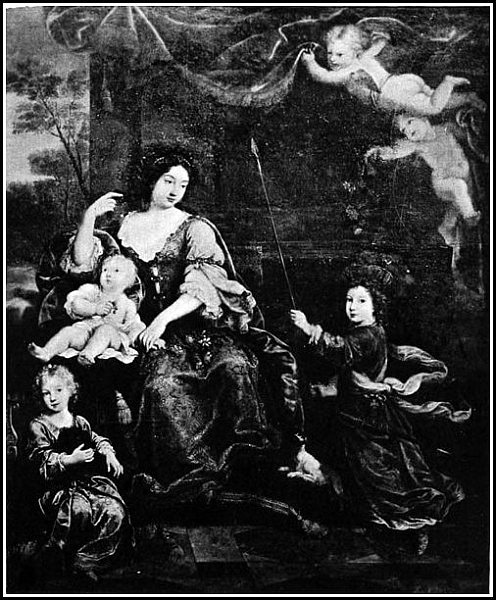
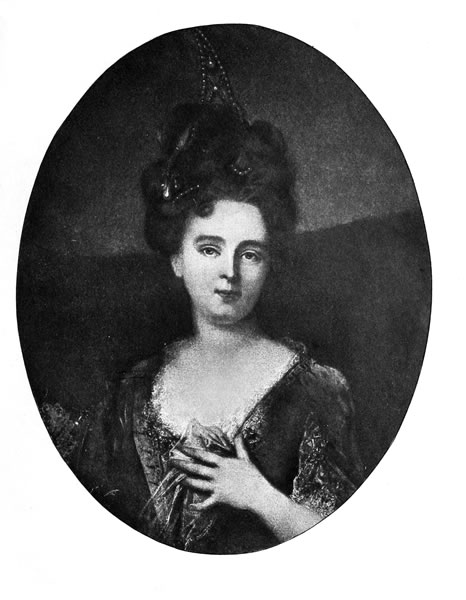
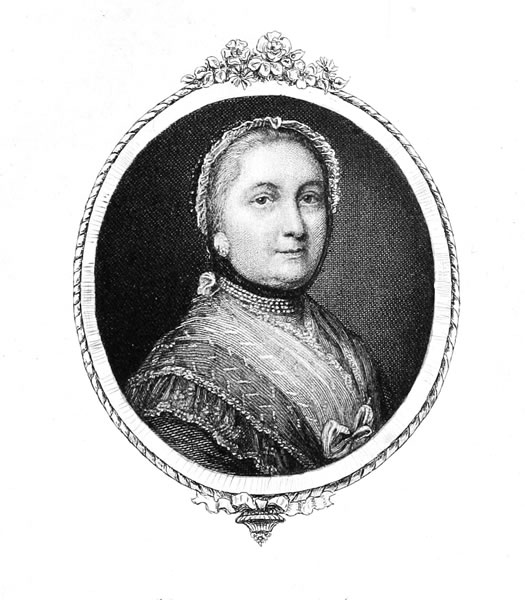
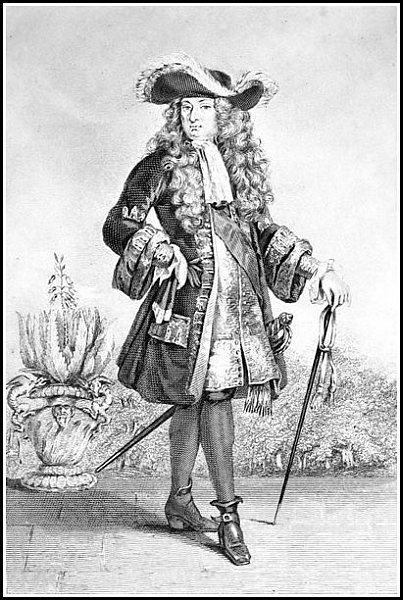
Marie-Adélaïde de Savoie, Duchesse de Bourgogne,
who was married to the grandson of Louis XIV. and was
the mother of Louis XV., has left a very gracious memory
behind her. She flitted through the world like one of those
bright, rapid apparitions which the imagination of contemporaries
delights to embellish. Born in 1685, daughter of
the Duc de Savoie, who transmitted to her his ability and
possibly his craft, grand-daughter by her mother of that
amiable Henrietta of England (first wife of Monsieur, Louis
XIV.’s brother), whose death Bossuet immortalized, and
whose charm she resuscitated, Marie-Adélaïde came to
France when eleven years old to marry the Duc de Bourgogne,
who was then thirteen. The marriage took place the
following year, but in form only; and for several years the
education of the young princess was the occupation of her
life. Mme. de Maintenon applied herself to that purpose
with all the care and consistency of which she was so capable.
It was not her fault if the Duchesse de Bourgogne did not
become the most exemplary of the pupils of Saint-Cyr. The
vivacity and lively spirits of the princess disconcerted at
times the well-laid schemes of prudence, and she constantly
broke from the frame in which it was designed to hold her.
Nevertheless, she profited through it all; serious thoughts slipped in among her pleasures. It was for her that sacred
plays, some by Duché, but especially Racine’s “Athalie,”
were acted in Mme. de Maintenon’s apartment. In “Athalie,”
the Duchesse de Bourgogne played a part.
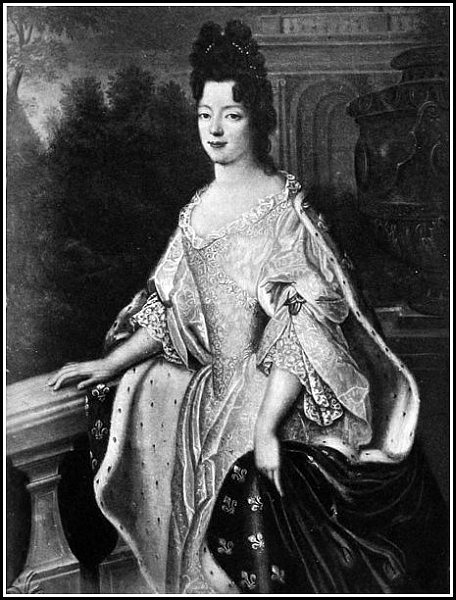
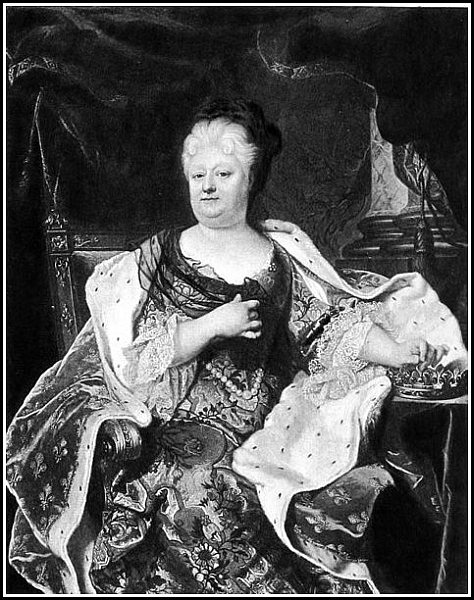
The Duchesse de Bourgogne
The princess had already received in Savoie a certain
education, especially in that so necessary to princes and
which nature itself gives to women, namely, the desire and
the effort to please. She arrived at Montargis on Sunday,
November 4, 1696. Louis XIV. had left Fontainebleau after
dinner and gone to Montargis with his son [Monseigneur],
his brother [Monsieur, the little Adélaïde’s grandfather], and
all the principal seigneurs of his Court, in order to receive
her. Before going to bed that night the king concludes an
important letter to Mme. de Maintenon in which he gives
her an account in the fullest detail of the person and slightest
action of the little princess; it was the affair of State of
the moment. The original of this letter of Louis XIV. exists
in the library of the Louvre, and it is here given textually.
Let us now read Louis XIV. undisguised, or rather, let
us listen to the great monarch conversing and relating; language
excellent, phrases neat, exact, and perfect, terms appropriate,
good taste supreme in all that concerns externals
and visible appearance; whatever, in short, contributes to
regal presentation. As for the moral basis, that is slim and
mediocre enough, we must allow, or rather, it is absent.
But let us read the letter:—
“I arrived here [Montargis] before five o’clock,” writes the
king; “the princess did not come till nearly six. I went to
receive her at the carriage; she let me speak first, and afterwards
she replied extremely well, but with a little embarrassment
that would have pleased you. I led her to her room
through the crowd, letting her be seen from time to time by
making the torches come nearer to her face. She bore that march and the lights with grace and modesty. At last we
reached her room, where there was a crowd, and heat enough
to kill us. I showed her now and then to those who approached
us, and I considered her in every way in order to
write you what I think of her. She has the best grace and
the prettiest figure I have ever seen; dressed to paint, and
hair the same; eyes very bright and very beautiful, the lashes
black and admirable; complexion very even, white and red,
all that one could wish; the finest blond hair that was ever
seen, and in great quantity. She is thin, but that belongs to
her years; her mouth is rosy, the lips full, the teeth white,
long, and ill-placed; the hands well shaped, but the colour of
her age. She speaks little, so far as I have seen; is not embarrassed
when looked at, like a person who has seen the
world. She curtseys badly, with a rather Italian air. She
has also something of an Italian in her face; but she pleases;
I saw that in the eyes of those present. As for me, I am
wholly satisfied. She resembles her first portrait, not the
second. To speak to you as I always do, I must tell you that
I find her all that could be wished; I should be sorry if she
were handsomer.
“I say it again: everything is pleasing except the curtsey.
I will tell you more after supper, for there I shall observe
many things which I have not been able to see as yet. I forgot
to tell you that she is short rather than tall for her age.
Up to this time I have done marvels; I hope I can sustain a
certain easy air I have taken until we reach Fontainebleau,
where I greatly desire to find myself.”
At ten o’clock that night, before going to bed, the king
added the following postscript:—
“The more I see of the princess, the more satisfied I am.
We had a public conversation, in which she said nothing, and
that is saying all. Her waist is very beautiful, one might
say perfect, and her modesty would please you. We supped
and she did not fail in anything, and has a charming politeness
to every one; but to me and my son she fails in nothing,
and behaves as you might have done. She was much looked at and observed; and all present seemed in good faith to be
satisfied. Her air is noble, her manners polished and agreeable;
I have pleasure in telling you such good of her, for I
find that, without prepossession or flattery, I can do so and
that everything obliges me to do so.”
Now, shall I venture to express my thought? There is
certainly a mention of modesty in one or two places in the
letter; but it is of the modest air, the good effect produced,
the grace that depended on it. For all the rest it is impossible
to find on these pages anything other than a charming
physical, external, and mundane description, without the
slightest concern as to inward and moral qualities. Evidently
the king is as little concerned about those as he is
deeply anxious about externals. Let the princess succeed
and please, let her charm and amuse, let her adorn the
Court and enliven it, give her a good confessor, a sound
Jesuit, and for all the rest let her be and do what pleases
her; the king asks nothing else: that is the impression left
upon me by that letter.
If there had entered into this letter written from Montargis
even a flash of moral solicitude in the midst of the
record of those external graces and perfect proprieties, Louis
XIV. would not have been, after twelve years’ hourly
intimacy, the odious and hard grandfather of the scene at
Marly near the carp basin, to the mother of his expected
heir. I send the reader for the details and the accessories of
that singular scene to Saint-Simon, who in this instance is
our Tacitus, the Tacitus of a king not naturally cruel, but
who was so that day by force of egotism and selfishness.
That first letter from Montargis, so elegant, so smiling
on the outward surface, covered in its depths the vanity
and egotism of a master, solicitude solely for decorum and
curtseying—the scene at the basin of carp concludes it.
I shall not reproduce here the divers portraits of the
Duchesse de Bourgogne; I should have to take them from
many sources, but above all from Saint-Simon. She was
neither handsome nor pretty, she was better than either.
Each feature of her face taken separately might seem defective,
even ugly, but from all these uglinesses, these defects,
these irregularities arranged by the hand of the Graces, came
a nameless harmony of her person, a delightful ensemble, the
movement and airy whirl of which enchanted both eyes and
soul. In moral qualities it was the same.
She played a part in “Athalie;” why should I not tell
what she thought of that play, capricious child that she was?
Apropos of its representation at Saint-Cyr, Mme. de Maintenon
writes: “Here is ‘Athalie’ again breaking down. Ill-luck
pursues all that I protect and care for. Mme. la
Duchesse de Bourgogne tells me it can never succeed, that
the piece is cold, that Racine regretted it, that I am the only
person who likes it, and a number of other things which
enable me to perceive, through the knowledge I have of this
Court, that her part displeases her. She wants to play
Josabeth, which she cannot play as well as the Comtesse
d’Ayen.”[16] As soon as they gave her the rôle she liked, the
point of view was changed in a moment; such were the
coulisses of Saint-Cyr! “She is delighted,” continues Mme.
de Maintenon, “and now thinks ‘Athalie’ marvellous. Let
us play it, then, inasmuch as we have agreed to do so; but,
in truth, it is not agreeable to mix in the pleasures of the
great.” The Duchesse de Bourgogne came of that race of the great which will soon be a race departed. She deserves to remain in the vista as a true representative in her
transitory life of its lightest and most seductive charm.
The letters of the duchess which have been published up
to this time are mere notes, adding nothing to the idea that
we form of her mind. La Fare, in his memoirs written
about the year 1699, has very well remarked that after the
death of Madame, Henrietta of England (grandmother of
Marie-Adélaïde) in 1670, the taste for things of intellect was
greatly lowered in that brilliant Court of Louis XIV. “It
is certain,” he says, “that in losing that princess the Court
lost the only person of her rank who was capable of liking
and distinguishing real merit; since her death, nothing is
seen but gambling, confusion, and impoliteness.” Towards
the close of the reign of Louis XIV. a taste for matters of
mind and even for the refinements of wit reappeared no doubt
and found favour in the little circles of Saint-Maur and
Sceaux, but the body of the Court during that period was a
victim to bassette, lansquenet, and other excesses, in which
wine bore its fair share. The Duchesse de Berry, daughter
of the future regent, was not the only young woman to
whom it happened to be drunk. The Duchesse de Bourgogne
herself, entering such society, found it difficult sometimes not
to fall into the vices of the day, into those nets of which lansquenet was the best known and the most ruinous. More
than once the king or Mme. de Maintenon paid her debts.
But she asked for pardon with such good grace and submission
by letter, and by word of mouth with such pretty
and coaxing ways that she was sure to obtain it.
Those who judged her with the most severity are all
agreed that she corrected herself with age, and that her
will, her rare spirit, her sense of the rank she was about to
hold, triumphed in the end over her first impetuosity and
petulance. “Three years before her death,” writes Madame, mother of the regent, honest and terrible woman who says
all things bluntly, “the dauphine had entirely changed, to
her great advantage; she no longer made escapades or drank
too much. Instead of behaving like an intractable being,
she became sensible and polite, behaved according to her
rank, and no longer allowed her young ladies to be familiar
with her, and put their fingers in her dish.” Uncomfortable
praises, perhaps, with which we could dispense. But at this
distance of time we can hear all without scruple, and, while
doing homage to a person who had the gift of charm, we may
dare to look on manners and customs as they were.[17] We
must resolve, whatever it costs us, to leave the chamber of
Mme. de Maintenon and the twilight of its sanctuary. The
Duchesse de Bourgogne has been pictured to us in the garb
of Saint-Cyr; it is not in that habit that she is, to my thinking,
most natural or truest.
A delicate question presents itself,—more delicate than
that of lansquenet: did the Duchesse de Bourgogne have
weaknesses of the heart? Adored by her young husband,
and knowing how to take in hand his interests under all
attacks, it does not seem that she had for his person a very
warm or tender liking. Hence one does not see what there
was to guarantee her from some other penchant. Saint-Simon,
who is in no way malevolent to the Duchesse de
Bourgogne, relates with great detail and as if receiving the
confidences of well-informed persons, the slight weaknesses
of the princess for M. de Nangis, M. de Maulévrier, and the
Abbé de Polignac. “At Marly,” he says, “the dauphine
would run about the gardens with other young people till three and four o’clock in the morning. The king never knew
of these nocturnal expeditions.” Nevertheless, I do not
desire to do otherwise than agree with Mme. de Caylus,
who, while admitting the liking of the princess for M. de
Nangis, makes haste to add: “The only thing I doubt is
whether the affair ever went so far as people thought; I am
convinced that the whole intrigue took place in looks, and,
at most, in a few letters.”
In the midst of all her levity and childish frivolity the
Duchesse de Bourgogne had serious good qualities, which
increased as the years went on. She said very sweetly one
day to Mme. de Maintenon: “Aunt, I am under infinite
obligations to you; you have had the patience to wait for
my reason.” She would no doubt have proved capable of
State business and politics. The manner in which she
knew how to defend the prince, her husband, against the
cabal of the Duc de Vendôme, the striking revenge she
took upon the latter at Marly, and the back-handed stroke
by which she ousted him, show us plainly what she could
do that was able and persistent when a matter came close
to her heart. The few letters which she wrote to the Duc
de Noailles, in which she says she knows nothing of politics,
go to prove, on the contrary, that, if she could have talked
about them instead of writing, she would have liked very
well to take part in them. There is a more serious matter,
which I see no reason for disguising. According to Duclos
[author of “The Secret Memoirs of the reign of Louis XIV.,”
etc.], this fascinating child, so dear to the king, did, nevertheless,
betray France by informing her father, the Duc
de Savoie, then become our enemy, of military plans which
she was able to discover when, with playful familiarity and
the liberty of entering the king’s cabinet at all hours, she
had the opportunity to read and learn those plans at their source. The king, adds the historian, found the proofs of
this treachery, after the death of the princess, in her desk.
“The little rogue,” he is reported to have said to Mme. de
Maintenon, “deceived us after all.”
In spite of all, we find ourselves regretting that this
princess, taken from us at the age of twenty-six, whose
natural fairy-like presence bewitched all hearts, did not
live to reign beside the virtuous pupil of Fénelon. The
reign of their son, that Louis XV. who was only a pretty
child at their deaths and became the most contemptible of
kings, would at least have been postponed. But what good
is there in re-making history and in setting up a mere idea
of what might have been?
[Sainte-Beuve does not show his usual justice and careful
discrimination in his foregoing semi-acceptance of Duclos’
tale of “perfidy.” The whole story of Marie-Adélaïde’s
position at the French Court should have been more clearly
sifted. The two daughters of Vittorio Amadeo, Duke of
Savoie, were, in a sense, hostages given by him to Louis
XIV. in 1696 and 1701 as an earnest of faithful alliance.
Circumstances, however, forced the duke in 1703 (during the
war of the Spanish Succession) into the coalition against
France.
From the tenth century the princes of the ancient house
of Savoie had been, for various reasons geographical and
political, the upholders of Italian unity, or, as one might
better say, of Italian existence. France had felt this under
all her attempts to master Italy, until finally her wisest statesmen,
Henri IV., Richelieu, and Mazarin, saw that their true
policy was to use Piedmont against the extension of the
two branches of the House of Austria. The whole history
of the Princes of Savoie is a romance, hitherto neglected, which ought to be traced out and written by a sympathetic
hand.
The alliance of France and Piedmont, so useful to the
former by enabling her to maintain her conquests on the
northern frontier, was converted by Louis XIV. into a
species of vassalage, to which the indolent nature of Carlo
Emmanuele submitted. The latter died in 1675, leaving
one son, Vittorio Amadeo, aged nine, under the regency of
his mother, Jeanne de Nemours, an ambitious and powerful
woman. It is impossible to give here even a brief sketch
of the House of Savoie, an heroic history, which should
be rescued from the archives of Turin and elsewhere—in
it will be found, we may add parenthetically, the story
of the Waldenses and the secret of the Iron Mask.
Vittorio Amadeo married Anne, daughter of Monsieur,
Louis XIV.’s brother, by his first wife, Henrietta, daughter
of Charles I., King of England. The grandmother to
whom the following letters are chiefly addressed was the
father’s mother, Jeanne de Nemours.
These letters, which seem to us very short, were laborious
undertakings to the princess, who was never able to write
easily. The first, in a childish round text hand, filling a
sheet of paper twenty-three centimetres long by sixteen
centimetres wide, is better written than those of her after
life. The grammar and the spelling improved somewhat
in later years, though never keeping pace with the improvement
in the diction. They are signed with a sort of hieroglyphic,
seldom with her name, and tied by a silken thread,
the seal being a lozenge with the arms of Savoie, or sometimes
the impression of a little dog.
Returning to the charge of Duclos (an historian of gossip
rather than of history), it seems enough to say: (1) that his
story has never been supported in any way; (2) that the tone of the princess’s letters refutes it; (3) that what we
know from Madame about the opening of letters makes
it certain that the little duchess, surrounded as she was,
could not have sent documents and plans undetected;
(4) that Madame, that lynx for evil tales, and who did not
like the dauphine, though she did her justice, makes no
allusion to this story; and (5) that Saint-Simon, in a position
to know everything, states the contrary.
The little princess arrived in France, and was met by
the king at Montargis, November 4, 1696. The following
is her first letter to her grandmother, Jeanne de Nemours,
dowager Duchess of Savoie. This letter and one written
two years later are here given in the French as amusing
specimens of her spelling and punctuation.]
De Versaie ce 13 Novembre [1696]
Vous me pardonere Madame si ie ne uous est pas ecrit la
peur de uous anuier me la fait fair ie fini Madame uous
embrasan.
Tres humble tres obeisantes petite fille
M. Adéläide de Sauoie.
Versailles, November 13 [1696].
You will pardon me, Madame, if I have not written you,
the fear of ennuying you made me do it. I end, Madame,
embracing you.
Very humble, very obedient grand-daughter,
M. Adélaïde de Savoie.
[1696].
The trip to Marly prevented me from writing to you by
the last courier as I had planned, my dear grandmamma.
It is not to be believed how little time I have. I do what
you ordered me about Madame de Maintenon. I have much affection for her, and confidence in her advice. Believe, my
dear grandmamma, all that she writes you about me, though
I do not deserve it; but I would like you to have the pleasure
of it, for I count on your love [amitié], and I never forget
all the marks you have given me of it.
Versailles, August, 1697.
I have had great joy in the taking of Barcelona, my dear
grandmamma, for I am a good Frenchwoman, and I feel for
all that pleases the king, to whom I am attached as much
as you can wish. Though I do not enter much into affairs
of State, I understand that we shall soon have peace, and
that will be another joy to me, for I have many in this
country, my dear grandmamma, and I am very certain you
share my happiness because of all your goodness to me.
December 3 [three days before the marriage ceremony].
I am well assured, my dear grandmamma, that you take
part in the accomplishment of my happiness; do me the
same justice on the feelings that I have for you, which will
always be full of tenderness and respect. I assure you in
my change of state I shall be always the same through life.
Versailles, February 28, 1698.
I hope to repair, when I know how to write, the faults
that I make now, and to let you see, my dear grandmamma,
that I write to you rarely because I write so badly; but I
love you tenderly, none the less. I am going to a ball.
Versailles, March 25, 1698.
I hope I write pretty well, my dear grandmamma; I have
a master who takes such pains I should do very wrong not
to profit by the care they take of everything concerning me.
The Duchesse du Lude has come to me; which delights me, and it is true that Mme. de Maintenon sees me as often
as she can. I think I can assure you that those two ladies
love me. Never doubt, my dear grandmamma, that I love
you as much as I should.
Versaile ce 25 Mars. 1698
Iespere que iescrire assez bien, ma chere grandmaman jai
un maitre qui se donne beaucoup de paine iaurois grans tort
de ne pas profitter des soins qu’on prend de tout ce que me
regarde la D du Lude estre venue auprais de moy dont je
suis ravie et il est vrai que Mme. de Mentenon me voit le
plus souvent qui lui est possible ie croye pouvoir vous assurer
sans saut [trop?] me flatter que ces deux dames
maimen. Ne douttes iamais ma chere gran maman que ie
ne vous aime tous jours autan que ie le dois.
May 26, 1698.
It is time, my dear grandmamma, that I knew how to
write; they often reproach me here for the shame of a married
woman [æt. 13] who has a master for such a common
thing.
July 2, 1698.
They are working on my menagerie. The king has ordered
Mansart to spare nothing. Imagine, my dear grandmamma,
what it will be. But I shall only see it on my
return from Fontainebleau. It is true that the king’s kindnesses
to me are wonderful; but also, I love him well.
Compiègne, September 13, 1698.[18]
I never thought, my dear grandmamma, that I should find
myself in a besieged town, and be waked by the sound of
cannon as I was this morning. I hope we shall soon get out of this state. It is true that I have great pleasures here. I
shall be delighted to go back to Versailles and to the menagerie
at Saint-Cyr. Certainly one has no leisure to be
bored. I am convinced that you share my happiness, because
of the love you have for me.
Fontainebleau, October 31, 1698.
The stay at Fontainebleau is very agreeable to me, especially
as it is the second place where I had the honour of
seeing the king; and I hope, my dear grandmamma, that I
shall be happy not only at Fontainebleau but everywhere,
being resolved to do all that depends on me to be so.
Those who love me have every reason to be glad with me
in the king’s kindness, for he gives me every day fresh
marks of it. I have reason to think it will increase; at any
rate I shall forget nothing on my part to deserve it. I am
going to try a new pleasure,—that of travelling. But I
shall love you everywhere, my dear grandmamma.
Versailles, December, 1698.
I could not write you by the last courier, my dear grandmamma,
because I am out continually, and every evening I
go to the king. I am sure that excuse will not displease
you, and that you will think my time well spent if near the
king. His kindness to me can never be expressed; and as I
know the interest you take in my happiness I am very glad
to assure you it is perfect, and that I shall never forget the
tenderness I ought to have and do have for you.
January 10, 1699.
I am not yet free enough, my dear grandmamma, with
M. le Duc de Bourgogne to do the honours of him. I am
only very glad that you are content with his letter. I wish
that mine could express what I desire for your happiness during this year and many other years, and how much I
hope that you will love me always.
Marly, July 3, 1699.
I am very glad, my dear grandmamma, that you are not
tired of telling me of your friendship, for I always receive
the assurance of it with fresh joy. I wish I could tell you
of the beauty of this place and of the pleasures we have
here. I am delighted to be on the footing of coming here
on all the trips, for I like these as well as I do those of the
Marly-Bourgogne. I embrace you, my dear grandmamma,
and I am going to bathe.
December 27, 1699.
It is true, my dear grandmother, that I have a good friend
in Mme. de Maintenon, and it will not be her fault if I am
not perfect and happy. M. le Cardinal d’Estrées wishes to
carry a letter to you from me, and I give it to him willingly.
I shall trust to his informing you of all that concerns me;
but he cannot tell you how I love you, nor to what point I
am touched by your kindness. I go about in mask the
last few days, and so, sleeping very late, I have little time
for the rest.
To Vittorio Amadeo, Duc de Savoie.
January 3, 1700.
Be pleased to approve, my dear father, that, according to
custom, I should renew at the beginning of this year the
assurances of my respect, my gratitude, and my tenderness
for you, and I beg you to love me always. M. de Brionne
tells me things as to that which give me great pleasure, as
proving to me that my removal has not diminished your
affection for me.
If I do not write oftener, my dear father, believe, I entreat
you, that the fear of importuning you prevents it, also the confidence I have that you will never doubt the feelings of
tenderness, respect, and gratitude which I owe to the best
father in the world. I should be grieved indeed if I did
not do you justice in that respect; you could not think
otherwise without having a bad opinion of me, who indeed
deserve the tenderness I ask of you.
March 20, 1700.
There is never a time that I do not receive your letters
with pleasure, my dear grandmamma; but it is true that
the carnival keeps me occupied, and the balls lead to other
occupations that take all my time. That is what has hindered
me from writing. I am delighted that the reports
made to you of me have been agreeable; for I desire to
please you in everything and preserve the affection you have
always had for me.
November 16, 1700.
I am delighted, my dear grandmamma, that you approve
of what I am doing; I have no stronger passion than that of
doing nothing wrong and thus deserving the esteem of honourable
people. Yours, my dear grandmamma, is precious
to me.
Perhaps you will think this discourse very serious; but I
warn you I am no longer a child; even my gayety is a little
diminished. The more reasonable I become, the more I
know, my dear grandmamma, how much I ought to love you.
December 27, 1701.
I am ashamed, my dear grandmamma, to have been so
long without writing to you. It may be partly my fault,
and for that I beg your pardon; but I assure you we lead a
life of great irregularity, changing continually from place to
place.
I am delighted to tell you that my sister is very happy and that the King of Spain is extremely content with her.
[Marie-Louise de Savoie, married to Philippe V.] What she
did about her women was only a piece of childishness, and
had no consequences. I hope that she and I, my dear
grandmamma, will give you nothing but joy, and that my
irregularities will never make you doubt the affection that I
have for you.
January 9, 1702.
I am very irregular, my dear grandmother, in not having
wished you a happy year, but I have been unwell with inflammations
and headaches. Forgive me, dear grandmother,
and do not think that I love you less tenderly. The Marquis
de Coudray is returning to Turin. You can hear more
about me in detail from him. He seems charmed with this
country. I have spared no pains to make him satisfied with
me, and I think I have succeeded. He will tell you that
your grand-daughter has grown tall. It seems to me that I
am no longer young; my childhood has lasted but a short
time!
[The correspondence with her mother, Anne, daughter of
Monsieur and Henrietta of England, was doubtless voluminous,
but it has disappeared. Four letters remain for the
month of January of this year, showing their rapid intercourse,
but only three for the rest of Marie-Adélaïde’s short
lifetime.]
January 2, 1702.
I think with you, my dear mother, that news from Spain
comes slowly. I would like to know all that She does from
morning till night, to satisfy the interest that I feel. I am,
however, more easy now that I feel the true affection that
exists between the King of Spain and Her. I hope, my dear
mother, that we shall have in that direction sources of joy
only.
I pique myself now on being a great personage, and I
think that “Mamma” is not suitable. But I shall love still
more my dear mother than my dear mamma, because I now
understand better what your value is, and what I owe
to you.
Versailles, January 9, 1702.
I have no news from you this week, my dear mother, for
which I am sorry: but I think the ice and snow are the
reason. The wretched weather prevents our going to Marly,
for it is not fit weather for the country. I fear this winter
will give us no amusement that I can write about; on
account of the mourning there may be no balls, theatres, or
any pleasures. I do not regret it much, for the carnival
is very short this year, and consequently more easy to do
without.
January 23, 1702.
I send you the plan which M. Mansart has returned to me.
It seems to me very pretty, if the works are well executed.
He begs me to ask if you would like him to send you a man
to execute them. You have only to tell me what you wish.
I will gladly take charge of it, my dear mother, desiring nothing
so much as to please you in all things.
The King of Spain’s journey to Italy is decided on. This
gives me great pleasure, and I see at the same time that they
are still greatly satisfied with my sister. I will tell you
more by the next courier.
I am now going to see the Queen of England, and thence
to Marly, where we shall dance. On this trip we played a
comedy [this was the time when they played “Athalie”];
the king was much pleased with it, and so was Monseigneur.
Forgive me, my dear mother, if I write badly; it is because
I am so hurried. You know well that I love best to write
to you and amuse you for a moment.
Adieu, my very dear mother; I embrace you with all my
heart, my dear mother, with all my heart.
Marly, January 30, 1702.
Thank God, I am rid of inflammation, my dear mother,
after having my cheek swelled for a week, with fever at
night. The great cold prevented them from giving me
remedies, of which I was very glad; they wanted at all
risks to bleed me, assuring me that the inflammation would
continue if it were not done. However, I am rid of the swelling
without it, and, provided it does not return, I am content.
I am very sorry, my dear mother, that you do not receive
my letters regularly; yours do not play me the same trick.
The prospect of peace continues wonderfully good, and it
makes me hope that we shall soon have it. I own to you,
my dear mother, that I await it with great impatience, for I
think we shall all have reason then to be satisfied. It will be
a great consolation to me to see no more of this vile war
which has lasted for so long a time.
Adieu, my dear mother; love me always, and be assured
of the tender feelings that I have for you.
Versailles, July 4, 1702.
We have been much afflicted, my dear grandmother [by
the death of Monsieur, her maternal grandfather] and I have
felt for my own sake much more than I expected. I loved
Monsieur very much and I think he loved me. His death
was unexpected, at least by us, and all the circumstances
were painful. I am convinced, my dear grandmother, that
you have felt it also, and I count on your affection under all
events. Never doubt that which I have for you.
April 2, 1703.
I am delighted, my dear grandmother, that you have given
me a commission. I send you a sample of tea, which they assure me is excellent. If you find it so I will send you
more. The king does not take it; M. Fagon orders him sage
tea, which agrees with him. I hope the use of this tea will
do the same with you; no one in the world feels more interest
in you than I, my dear grandmother.
[Only two letters of the year 1704 have been preserved.
The health of the princess caused such anxiety that she was
made (according to Dangeau’s Journal) to keep her bed from
February 8th until after the birth of her first child, the
Duc de Bretagne, born June 25, 1704. She was then
eighteen years old.]
September 1, 1704.
I am ashamed, my dear grandmother, to have been so long
without writing to you; but I have had many ailments that
prevented it. You will surely believe that I would not
otherwise have been all this time without assuring you of
my tenderness and begging you for that you have always
shown me.
I cannot help telling you about my son, who is very well;
he would be rather pretty if he did not have an eruption,
but I am in hopes when we get to Fontainebleau he will
have no more of it.
April 25, 1705.
I cannot, my dear grandmother, be longer without comforting
myself with you in the sorrow that has befallen me
[death of her son]. I am convinced that you have felt it, for
I know the affection you have for me. If we did not take all
the sorrows of this life from God, I do not know what would
become of us. I think He wants to draw me to Him, by overwhelming
me with every sort of grief. My health suffers
greatly, but that is the least of my troubles.
I have received one of your letters, my dear grandmother,
which gave me great pleasure; the assurances of your affection bring me consolation. I have great need of it in my
present state. Adieu; I write so slowly that the shortest
letters take me a great deal of time.
[At the close of the year 1703 her father, Vittorio Amadeo,
had entered the alliance against France; the battle of Ramillies
was fought May 23, 1706, and the French were defeated
at Turin September 7 of the same year.]
Marly, June 21, 1706.
I can be no longer, my dear grandmother, without sharing
all our troubles with you. Imagine my anxiety as to what
is happening with you, loving you as I do very tenderly and
having all possible affection for my father, my mother, and
my brothers. I cannot think of them in so unhappy a position
without tears in my eyes, for assuredly, my dear grandmother,
I feel for all that concerns you, and I see by all that
is in me to what point my love for my family goes.
My health is not so much injured as it might be; I am
pretty well, but in a state of sadness which no amusement
can lessen, and which will never leave me, my dear grandmother,
for it serves to comfort me in my present state.
Do not deprive me, I conjure you, of your letters. They
give me much pleasure; I need them in the state I am in.
Send me news of all that is dearest to me in the world.
Marly, July 25, 1706.
I have not written, my dear grandmother, not knowing
if you are still with my mother, being unable to obtain
the slightest information. You know my heart; imagine
therefore the state I am in. I feel for yours; I cannot be
reconciled to your trials; I see them increasing with extreme
sorrow; there is not a day when I do not feel them keenly,
and weep in thinking of what my dear family—whom I
would give my life to comfort—is suffering.
I am glad, my dear grandmother, that the fatigues of so
sad and painful a journey [the removal of the royal family
from Turin before the siege] has not injured your health.
I pity my mother, who, for additional sorrow, is anxious
about the illness of her children and yet is obliged to travel
with them in such excessive heat and over such dreadful
roads.
I have no other comfort, my dear grandmother, than in
receiving your letters and the assurance of your affection.
We all need great courage to sustain such violent griefs as
those we have had of late. God is trying me by ways in
which I feel it most; I must resign myself to His will, and
pray that He will soon withdraw us from the state in which
we are. As for me, I feel I cannot bear it longer if He does
not give me strength.
Versailles, March, 1707.
I am delighted, my dear grandmother, that you exhort
me to give you frequent news of my son [the second Duc
de Bretagne, born January 7, 1707]; I assure you I do not
need to be urged to do so. He is very well, thank God.
I found him much grown and changed for the better on my
return to Marly. He is not handsome, up to this time,
but very lively, and much healthier than he was when he
came into the world. He is only two months old, and I
should not be surprised if, a few months hence, he became
pretty. I don’t know whether it is that I am beginning
to blind myself about him and therefore hope it. But I
believe that I shall never be blind about my children, and
that the love I have for them will make me see their
defects and so try in good season to correct them.
I go very seldom to see my son, in order not to grow too
attached to him; also to note the changes in him. He
is not old enough to play with as yet, and as long as I know he is in good health, I am satisfied; that is all I need
wish for as yet.
To Mme. de Maintenon.
Versailles, July, 1707.
I am in despair, my dear aunt, to be always doing foolish
things and giving you reason to complain of me. I am
thoroughly resolved to correct myself, and not play any
longer at that miserable game, which only injures my
reputation, and diminishes your affection, which is more
precious to me than all. I beg you, my dear aunt, not to
speak of this in case I keep the resolution I have made.
If I break it only once, I should be glad that the king
would forbid me to play, and I would bear whatever impression
it might make against me in his mind. I shall
never console myself for being the cause of your troubles,
and I will not forget that cursèd lansquenet. All that I
desire in the world is to be a princess esteemed for my
conduct; and that I will endeavour to deserve in the
future. I flatter myself that my age is not too advanced,
or my reputation too much tarnished, to enable me with
time to succeed.
Versailles, January 2, 1708.
Here we are, my dear grandmother, at the beginning of
another year, which I hope may be as prosperous as you
can desire it. It will be so for me if you continue to love
me; I ask it with all the respect and tenderness I have
for you.
We are much occupied here with a grand ball which
will take place the night before the Epiphany. I am prepared
to amuse myself much. Every day I practise getting
my breath to dance well, which I think will be very difficult,
for I have absolutely forgotten how to do so, and I
have grown very heavy, which is not good for dancing.
Versailles, April 2, 1708.
I have a great desire to know what you think of the
portrait of my son. His health is better and better, and
he thrives on his new milk. He begins to give me a
good deal of pleasure, for he knows much and has very
amiable manners, which I hope will go on increasing.
Marly, May 7, 1708.
I believe you have heard of the accident which happened
to me, and which has prevented me from writing sooner,
my dear grandmother; but I am now quite recovered and
beginning to pick up my strength.[19]
Fontainebleau, July 5, 1708.
I am afraid, my dear grandmother, that if you have the
same weather that we do you will suffer from inflammation.
There is not a day that it does not rain and that causes
great humidity. The milk I am taking does me good,
but if I come in late I have toothache during the night.
But my health is coming back to its usual state. You
are very kind in wishing to be informed of it; I feel all
your kindnesses.
Fontainebleau, July 31, 1708.
The milk I have taken did not do me as much good as
I hoped during the time I took it; but since I left it off I
think I am the better for it. [It was probably asses’ milk, a
great remedy in those days.] I have taken it with all possible
regularity; for when I do take remedies I do it
thoroughly. My face is coming to itself, and I am beginning
to fatten, but I have to take great care to avoid the
twilight dampness.
[It was during this summer that the cabal of Vendôme, or as Saint-Simon calls it, the cabal of Meudon, made its great
attempt to ruin the Duc de Bourgogne during the campaign
in Flanders, and that his wife proved her brave spirit in defending
him. The princess’s own letters say nothing of
all this; but a letter exists from the Duc de Bourgogne
to Mme. de Maintenon, who seems to have written to
him to counteract some attack upon his wife, which is as
follows:—]
Camp of Lowendeghem, August 27, 1708.
It is not very difficult to justify Madame la Duchesse de
Bourgogne to me as to matters on which I do not place entire
faith, and I am only too much inclined to be favourable
to her in everything. But the affection of which she has
now given me such signal marks made me apprehend that
she might have gone a little too far in certain speeches. I
have already told her several times that I am satisfied with
what she has replied to me as to this, and my present fear
is that I may have pained her a little by what I wrote to
her. I beg you to tell her so once more, madame, and to
make her see how charmed I am with her affection and confidence.
I flatter myself that I deserve them, and I shall
endeavour more and more to merit her esteem.
To-day is not the first time that I have known of persons
at Court who do not like her, and who see with annoyance
the affection that the king shows for her. I believe I am
not ignorant of their names. It will be for you, madame,
when I see you, to enlighten me more particularly, that
proper precautions may be taken to save Madame la Duchesse
de Bourgogne from falling into certain very dangerous
traps, which I have often seen you dread. As for mischief-making,
it would be most unjust to accuse her of that; she
sovereignly despises it, and her spirit is far indeed from
being what is called the woman’s spirit. She has assuredly a solid mind, much good sense, an excellent and very noble
heart—but you know her better than I, and this portrait is
useless. Perhaps the pleasure that I have in speaking of
her prevents me from perceiving that I do it too often and
at too great length.
Louis.
To Vittorio Amadeo, Duc de Savoie.
Versailles, Dec. 31, 1708.
The assurances, my dear father, that my mother gives me
of your continued affection for me have caused me too much
pleasure not to make me tell you myself of my gratitude,
and how sensible I am of your remembrance. Nothing can
ever diminish my respect and tenderness for you. Blood,
my dear father, makes itself warmly felt under all circumstances,
and in spite of my destiny—unfortunate because it
puts me in a party opposed to yours—your interests are so
strongly imprinted in my heart that nothing can make me
wish the contrary. But this very tenderness only increases
my grief when I think that we are among the number of
your enemies. I own that affection may feel somewhat
wounded by seeing you arrayed against both your daughters.
But as for me, I will never be against you, and I can only
regard you as the father whom I love as my own life. But
that is not saying enough; I would willingly sacrifice my
life for you; your interests are the sole object of my
present desires.
Permit me, therefore, my dear father, to forestall by a day
the coming year and to wish that it may lead us to the end
of my sorrow and reunite us in a manner that shall crown
us with joy. I venture to tell you that it depends on you
alone to make me the happiest person in the world.
I fear to importune you by the length of this letter; but
you will pardon me the liberty I take. I cannot prevent myself from assuring you at least once a year of my tenderness
and respect, asking you at the same time for the continuation
of your affection. I think I deserve it, and shall
never make myself unworthy of it.
[With the year 1709 the letters begin to show distress at
the sorrowful results of the war, at the terrible winter, her
failing health, and, above all, the reserve she was forced to
maintain towards her family.]
Versailles, February 4, 1709.
Would to God, my dear grandmother, that your prayers
could be granted. We should then, each of us, have reason
to be content, for though we live now in different lands we
could then think alike on many subjects.
It appears that the excessive cold prevails everywhere.
They say it is two hundred years since such a severe winter
has been known here. It is thought impossible to keep Lent
because all vegetables are frozen, and the archbishop will be
obliged to allow three meat days a week. As for me, I am
not interested, for my health does not allow me to fast; fish
makes me ill.
I have a strong desire to drive out on a sledge; for I never
did so; a very pleasant idea of it is in my mind from having
seen my mother do it. But I own I have not enough courage
on account of the bitter cold. I shall not have much
trouble in giving you an account of the amusements of
this carnival. It has been very dull up to this time, and I
think it will end in the same way. There can be no balls,
for there is no one to dance. Several ladies are pregnant,
and those who are lately married come from convents and
do not know how to dance. There are but nine ladies
who can do so, and half of those are little girls. I should
be the old woman of a ball [æt. 23], which takes away all
my desire for one. I do not know what folly possesses the women now, but at thirty years of age they think they
are past dancing; if the fashion lasts, I ought to make the
most of the time that is left to me.
September 23, 1709.
I have been for three days very ill, having vomited at
intervals, which fatigues me greatly, not being accustomed
to it. Otherwise, my health is good. I hope very much to
give you another grandson, and I do not doubt it, for I am
as I was with the two others.
I have been in the greatest anxiety the last week; but
never was a lost battle so advantageous and glorious
[Malplaquet]. That is to me a great consolation. You will
hear, my dear grandmother, from my sister the anxiety she,
too, has been in about the King of Spain, who started hurriedly
to put himself at the head of his army because he was
not satisfied with the manœuvring of the man who commanded
it.
I do not know, my dear grandmother, who has written
you such marvels of my son. It is true that he is pretty in
manners and mind, but not in looks.
December 9, 1709.
When, my dear grandmother, when will come the long
desired day when we can speak frankly on so many things
about which we are forced to keep silence now? This war
has lasted so long! I believe that all of those who are making
it desire its end; and yet in spite of that it continues.
The more you could look into the bottom of my heart, the
better you would know, my dear grandmother, that it is
what it should be, and full of feeling—which does not contribute
to my tranquillity. But I have no regret for what I
suffer, for I know that blood and duty ordain it for me.
I have spent my day in the church, which is no small
matter in my present condition. Now that I have passed the eighth month I am very languishing. The changes of
month always affect me in my pregnancies, so that I hope in
a few days I shall be over it.
March 24, 1710.
I was most agreeably mistaken, my dear grandmother,
in giving you another grandson [Louis XV., then called Duc
d’Anjou]. He is the prettiest child in the world, and I believe
he will become a great beauty. Though it is of no
consequence after they grow up, one likes better to have a
pretty child than an ugly one.
Versailles, June 23, 1710.
There is no talk of anything here, my dear grandmother,
but the marriage of the Duc de Berry. Though it will take
place without any ceremony (for the times do not allow
amusements or great expenses), all the ladies are none the
less busy with their finery. This does not render conversation
very lively, nor does it give much matter for a letter,
for really nothing is talked of but head-dresses, costumes,
petticoats, and milliners, and though I am a woman, I never
take much pleasure in such discussions. I have a great
desire for the wedding to take place and end all discussions
about it. They are waiting for the dispensation from Rome.
I hope in ten or twelve days to send you a brief account of
the event.
Every one tells me that my father will begin the campaign
on the first of next month. Judge, therefore, my dear
grandmother, of my uneasiness; it is the last stroke. But
in whatever state I am, be sure that you have a grand-daughter
who loves you tenderly.
July 7, 1710.
M. le Duc de Berry was married yesterday. It was all as
magnificent as the season and the times would allow. There
was no fête; and that is all I can tell you to-day, being
completely wearied out.
November 17, 1710.
I am always afraid, my dear grandmother, to bore you by
talking of my children, but since you order me to give you
news of them, I obey you with pleasure. I shall begin by
telling you that the elder is getting sense enough to know
he has a grandmother, and that he loves you. He grows
immensely and, consequently, is very thin; he is well-made,
but rather ugly. The little one is not the same; he is a fat
dumpling and very handsome; he will soon have four teeth,
and is in fine health. As soon as he is one year old I will
send you his portrait; I dare not have it painted any earlier,
for they say it brings ill-luck. I do not believe that; but
the case of my eldest makes me prefer to risk nothing.
To her father.
Marly, February 16, 1711.
I am so charmed, my dear father, with the letter you
have written me that I cannot prevent myself from telling
you how sensitive I am to the assurances you give me of
your affection. I assure you that I deserve it through the
tenderness that I shall feel for you throughout my life.
Would to God, my dear father, that this year might be to me
as happy as you have been kind enough to wish it.
There is but one thing lacking to my happiness, but it is
a thing that is very near my heart. I shall never accustom
myself to be in other interests than yours, and I own to you
that my duty in vain compels me to be so; nature will have
the upper hand, and I cannot keep myself from continually
praying for you. But, indeed, my dear father, is it not high
time to end our sorrows? The advantages we have won
in Spain made me hope that peace would follow. But the
only peace that I can have can come through you alone.
I would not end my letter so soon, for I have many things to say to you, if I did not fear to say too much on a topic
which is not suitable for me in any way. Forgive it, my
dear father, in favour of a daughter whose tenderness alone
inclines her to speak, and who longs to see you both content
and glorious.
[No letters exist concerning the most important event in
the Duchesse de Bourgogne’s life, the death of Monseigneur,
which made her dauphine, April 10, 1711. From that moment
she felt more deeply the importance of fitting herself
for the great post she expected soon to fill.]
To her mother.
Versailles, May 3, 1711.
I have had no letters from you by this courier, my very
dear mother; I hope, however, they may reach me within a
few days.
We have had very good news from Barcelona, and from
all sides pleasant things are reaching us. All that is taking
place in Italy causes me to make many reflections and gives
me many hopes. I confess the truth, my very dear mother,
it would be the greatest happiness I could have in this life
if I could see my father brought back to reason. I cannot
comprehend how it is that he does not make terms, above
all in the unfortunate position in which he now finds himself,
and without any hope whatever of succour. Will he
let them take Turin again? The rumour is afloat here that
it will not be long before that siege is laid. Judge, therefore,
my dear mother, of the state I must be in,—I, so
sensitive to all that concerns you. I am in despair at the
position to which my father is reduced by his own fault.
Is it possible that he really thinks we will not give him
good terms? I assure you that all the king wants is to see
his kingdom tranquil, and that of his grandson, the King of Spain, secure. It seems to me that my father ought to desire
the same thing for himself, and when I consider that he
is master of making it so, I am astonished that he does not
do it.
I fear, my very dear mother, that you will think me too daring
in what I say, but I cannot restrain myself under the view
I take of my father’s position. I feel that he is my father,
and a father whom I deeply love. Therefore, my very dear
mother, forgive me if I write too freely. It is the desire I
have that we should all escape these difficult moments that
makes me write as I do. I send you a letter from my sister,
who is just as vexed as I am at what is now going on.
Versailles, December 13, 1711.
It is sad, my dear mother, that my brother and I have
the same sympathy in toothache. I hope he has not had
anything like that which I had last night; it made me suffer
horribly, not being rid of it one moment. For more than
two months it has seized me from time to time. I have
ceased taking care of it, for keeping my room does me no
good, and during the time I am not in it I am thinking and
always hoping the pain may not return. I merely avoid the
wind in my ears, and eating anything which may hurt me.
I think the dreadful weather contributes to these face-aches.
As for me, my dear mother, I cannot be as reserved as you
in speaking about the peace; I absolutely must tell you
what I think of it. We have to-day another courier from
England which confirms the hopes I feel. The conferences
will be held at Utrecht, and will begin on the twelfth of next
month. [The peace she longed for was not signed at Utrecht
until a year after her death.] They would not make such
advances if they were not veritably resolved to conclude a
peace so desired by all and so necessary to Europe. It is only the emperor who still will not listen to it; but when
he finds himself alone he will surely come into it. They say
it is his usual way to make difficulties, and that the last
time he made as many as he makes now. I hope that soon
you will not be so reserved with me, and that we shall all
have every reason to rejoice together.
I look forward to the great pleasure of once more seeing
the Piedmontese in this country, and of being able to talk to
them of you, of all my dear family, and of the country, the
mere recollection of which is so pleasant to me.
Poor Mme. du Lude is again attacked with gout in the
breast and feet; she suffers much. I am very much afraid
that in the end it will play her some bad trick. Madame is
taking remedies; she was bled two days ago and has taken
medicine to-day. It was not before she wanted it, for she
drops asleep everywhere, which gives much anxiety to all
those who take an interest in her. She must have felt the
need of remedies to have brought herself to take them.
Adieu, my dear mother, I embrace you with all my heart.
Versailles, December 18, 1711.
It is in order not to miss a week in assuring you myself
of my tenderness that I write to-day. For the last seven
days I have been, my dear mother, in a state of great
exhaustion which has prevented me from dressing; for the
inflammation that I had in my teeth has spread now over
my whole body. I can scarcely move; and my head feels
a horrible weight.
I wanted to forestall the first day of the year by offering
to all my family the wishes I desire for them; not being
able to do so, I content myself, my dear mother, by embracing
you with all my heart.
[The above is the last letter of the dauphine which has
been preserved in the State Archives of Turin. She died two
months later, February 12, 1712, aged twenty-six years and
two months; her husband, the dauphin, died on the 18th,
and her eldest son, the Duc de Bretagne, the little dauphin,
died a week later. See “Memoirs of the Duc de Saint-Simon,”
Vol. III., translated edition.]