HISTORICAL INTRODUCTION — THE CAUSES OF THE CORONADO EXPEDITION, 1528–1539 — ALVAR NUÑEZ CABEZA DE VACA — THE GOVERNORS OF NEW SPAIN, 1530–1537 — THE RECONNOISSANCE OF FRIAR MARCOS DE NIZA — THE EFFECT OF FRIAR MARCOS’ REPORT
p345
The American Indians are always on the move. Tribes shift the
location of their homes from season to season and from year to year,
while individuals wander at will, hunting, trading or gossiping. This is
very largely true today, and when the Europeans first came in contact
with the American aborigines, it was a characteristic feature of Indian
life. The Shawnees, for example, have drifted from Georgia to the
great lakes, and part of the way back, during the period since their
peregrinations can first be traced. Traders from tribe to tribe, in
the days when European commercial ideas were unknown in North
America, carried bits of copper dug from the mines in which the aboriginal
implements are still found, on the shores of Lake Superior, to
the Atlantic coast on the one side and to the Rocky mountains on the
other. The Indian gossips of central Mexico, in 1535, described to
the Spaniards the villages of New Mexico and Arizona, with their many-storied
houses of stone and adobe. The Spanish colonists were always
eager to learn about unexplored regions lying outside the limits of the
white settlements, and their Indian neighbors and servants in the valley
of Mexico told them many tales of the people who lived beyond the
mountains which hemmed in New Spain on the north. One of these
stories may be found in another part of this memoir, where it is preserved
in the narrative of Pedro Castañeda, the historian of the Coronado
expedition. Castañeda’s hearsay report of the Indian story, which
was related by an adventurous trader who had penetrated the country
far to the north, compares not unfavorably with the somewhat similar
stories which Marco Polo told to entertain his Venetian
friends.1
But whatever may have been known before, the information which led to
the expedition of Friar Marcos de Niza and to that of Francisco Vazquez
Coronado was brought to New Spain late in the spring of 1536 by
Alvar Nuñez Cabeza de Vaca.
In 1520, before Cortes, the conqueror of Motecuhzoma, had made his
peace with the Emperor Charles V and with the authorities at Cuba,
Panfilo de Narvaez was dispatched to the Mexican mainland, at the
p346
head of a considerable force. He was sent to subdue and supersede
the conqueror of Mexico, but when they met, Cortes quickly proved
that he was a better general than his opponent, and a skillful politician
as well. Narvaez was deserted by his soldiers and became a prisoner
in the City of Mexico, where he was detained during the two years
which followed. Cortes was at the height of his power, and Narvaez
must have felt a longing to rival the successes of the conqueror, who
had won the wealth of the Mexican empire. After Cortes resumed
his dutiful obedience to the Spanish crown, friends at home obtained
a royal order which effected the release of Narvaez, who returned to
Spain at the earliest opportunity. Almost as soon as he had established
himself anew in the favor of the court, he petitioned the King
for a license which should permit him to conduct explorations in the
New World. After some delay, the desired patent was granted. It
authorized Narvaez to explore, conquer, and colonize the country
between Florida and the Rio de Palmas, a grant comprising all that
portion of North America bordering on the Gulf of Mexico, which is
now included within the limits of the United States. Preparations
were at once begun for the complete organization of an expedition suitable
to the extent of this territory and to the power and dignity of its
governor.
On June 17, 1527, Narvaez, governor of Florida, Rio de Palmas and
Espiritu Santo—the Rio Grande and the Mississippi on our modern
maps—sailed from Spain. He went first to Cuba, where he refitted his
fleet and replaced one vessel which had been lost in a hurricane during
the voyage. When everything was ready to start for the unexplored
mainland, he ordered the pilots to conduct his fleet to the western limits
of his jurisdiction—our Texas. They landed him, April 15, 1528, on
the coast of the present Florida, at a bay which the Spaniards called
Bahia de la Cruz, and which the map of Sebastian Cabot enables us to
identify with Apalache bay. The pilots knew that a storm had driven
them out of their course toward the east, but they could not calculate
on the strong current of the gulf stream. They assured the commander
that he was not far from the Rio de Palmas, the desired destination, and
so he landed his force of 50 horses and 300 men—just half the number
of the soldiers, mechanics, laborers, and priests who had started with,
him from Spain ten months before. He sent one of his vessels back to
Cuba for recruits, and ordered the remaining three to sail along the
coast toward the west and to wait for the army at the fine harbor of
Panuco, which was reported to be near the mouth of Palmas river. The
fate of these vessels is not known.
Narvaez, having completed these arrangements, made ready to lead
his army overland to Panuco. The march began April 19. For a while,
the Spaniards took a northerly direction, and then they turned toward
the west. Progress was slow, for the men knew nothing of the country,
and the forests and morasses presented many difficulties to the soldiers
p347
unused to woodcraft. Little help could be procured from the Indians,
who soon became openly hostile wherever the Spaniards encountered
them. Food grew scarce, and no persuasion could induce the natives
to reveal hidden stores of corn, or of gold. On May 15, tired and discouraged,
the Spaniards reached a large river with a strong current
flowing toward the south. They rested here, while Cabeza de Vaca,
the royal treasurer accompanying the expedition, took a small party of
soldiers and followed the banks of the river down to the sea. The
fleet was not waiting for them at the mouth of this stream, nor could
anything be learned of the fine harbor for which they were searching.
Disappointed anew by the report which Cabeza de Vaca made on his
return to the main camp, the Spanish soldiers crossed the river and
continued their march toward the west. They plodded on and on, and
after awhile turned southward, to follow down the course of another
large river which blocked their westward march. On the last day of
July they reached a bay of considerable size, at the mouth of the river.
They named this Bahia de los Cavallos, perhaps, as has been surmised,
because it was here that they killed the last of their horses for food.
The Spaniards, long before this, had become thoroughly disheartened.
Neither food nor gold could be found. The capital cities, toward
which the Indian captives had directed the wandering strangers, when
reached, were mere groups of huts, situated in some cases on mounds
of earth. Not a sign of anything which would reward their search,
and hardly a thing to eat, had been discovered during the months of
toilsome marching. The Spaniards determined to leave the country.
They constructed forges in their camp near the seashore, and hammered
their spurs, stirrups, and other iron implements of warfare into nails and
saws and axes, with which to build the boats necessary for their escape
from the country. Ropes were made of the tails and manes of the
horses, whose hides, pieced out with the shirts of the men, were fashioned
into sails. By September 22, five boats were ready, each large
enough to hold between 45 and 50 men. In these the soldiers
embarked. Scarcely a man among them knew anything of navigation,
and they certainly knew nothing about the navigation of this
coast. They steered westward, keeping near the land, and stopping
occasionally for fresh water. Sometimes they obtained a little food.
Toward the end of October they came to the mouth of a large river
which poured forth so strong a current that it drove the boats out to
sea. Two, those which contained Narvaez and the friars, were lost.
The men in the other three boats were driven ashore by a storm, somewhere
on the coast of western Louisiana or eastern
Texas.2
This was p348
in the winter of 1528–29. Toward the end of April, 1536, Cabeza de
Vaca, Alonso del Castillo Maldonado, Andres Dorantes, and a negro
named Estevan, met some Spanish slave catchers near the Rio de Petatlan,
in Sinaloa, west of the mountains which border the Gulf of California.
These four men, with a single exception,3
were the only survivors
of the three hundred who had entered the continent with Narvaez
eight years before.
Cabeza de Vaca and his companions stayed in Mexico for several
months, as the guests of the viceroy, Don Antonio de Mendoza. At
first, it was probably the intention of the three Spaniards to return to
Spain, in order to claim the due reward for their manifold sufferings.
Mendoza says, in a letter dated December 10, 1537,4
that he purchased
the negro Estevan from Dorantes, so that there might be someone left
in New Spain who could guide an expedition back into the countries
about which the wanderers had heard. An earlier letter from the
viceroy, dated February 11, 1537, commends Cabeza de Vaca and Francisco
Dorantes—he must have meant Andres, and perhaps wrote it so
in his original manuscript—as deserving the favor of the Empress.
Maldonado is not mentioned in this letter, and no trace of him has
been found after the arrival of the four survivors in Mexico. All that
we know about him is that his home was in Salamanca.5
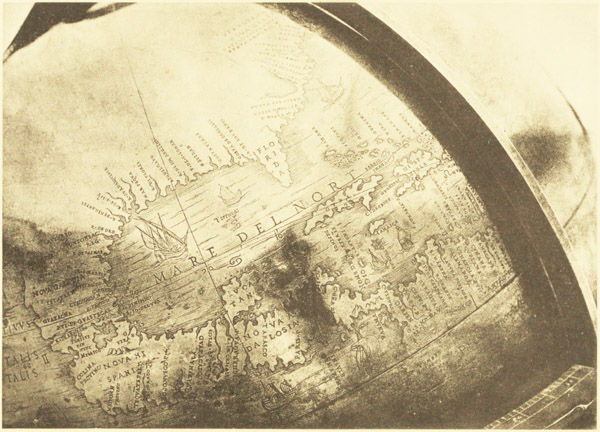
XXXIX.
The Ulpius Globe of 1542
◊
in Possession of the New York
Historical Society
Cabeza de Vaca and Dorantes started from Vera Cruz for Spain in
October, 1536, but their vessel was stranded before it got out of the
harbor. This accident obliged them to postpone their departure until
the following spring, when Cabeza de Vaca returned home alone. He
told the story of his wanderings to the court and the King, and was
rewarded, by 1540, with an appointment as adelantado, giving him the
command over the recently occupied regions about the Rio de la Plata.
The position was one for which he was unfitted, and his subordinates p349
sent him back to Spain. The complaints against him were investigated
by the Council for the Indies, but the judgment, if any was given,
has never been published. He certainly was not punished, and soon
settled down in Seville, where he was still living, apparently, twenty
years later.6
While Dorantes was stopping at Vera Cruz during the winter of
1536–37, he received a letter from Mendoza, asking him to return to the
City of Mexico. After several interviews, the viceroy induced Dorantes
to remain in New Spain, agreeing to provide him with a party of
horsemen and friars, in order to explore more thoroughly the country
through which he had wandered. Mendoza explains the details of his
plans in the letter written in December, 1537, and declares that he
expected many advantages would be derived from this expedition which
would redound to the glory of God and to the profit of His Majesty the
King. The viceroy was prepared to expend a large sum—3,500 or 4,000
pesos—to insure a successful undertaking, but he promised to raise the
whole amount, without taking a single maravedi from the royal treasury,
by means of a more careful collection of dues, and especially by
enforcing the payment of overdue sums, the collection of which hitherto
had been considered impossible. This reform in the collection of rents
and other royal exactions and the careful attention to all the details of
the fiscal administration were among the most valuable of the many
services rendered by Mendoza as viceroy. The expedition under Dorantes
never started, though why nothing came of all the preparations,
wrote Mendoza in his next letter to the King, “I never could find out.”7
The three Spaniards wrote several narratives of their experiences on
the expedition of Narvaez, and of their adventurous journey from the
gulf coast of Texas to the Pacific coast of Mexico.8
These travelers,
who had lived a savage life for so long that they could wear no clothes,
and were unable to sleep except upon the bare ground, had a strange
tale to tell. The story of their eight years of wandering must have
been often repeated—of their slavery, their buffalo-hunting expeditions,
of the escape from their Indian masters, and their career as
traders and as medicine men. These were wonderful and strange p350
experiences, but the story contained little to arouse the eager interest of
the colonists in New Spain, whose minds had been stirred by the
accounts which came from Peru telling of the untold wealth of the
Incas. A few things, however, had been seen and heard by the wanderers
which suggested the possibility of lands worth conquering. “A
copper hawks-bell, thick and large, figured with a face,” had been given
to Cabeza de Vaca, soon after he started on his journey toward Mexico.
The natives who gave this to him said that they had received it from
other Indians, “who had brought it from the north, where there was
much copper, which was highly esteemed.” After the travelers had
crossed the Rio Grande, they showed this bell to some other Indians,
who said that “there were many plates of this same metal buried in
the ground in the place whence it had come, and that it was a thing
which they esteemed highly, and that there were fixed habitations
where it came from.”9
This was all the treasure which Cabeza de Vaca
could say that he had seen. He had heard, however, of a better region
than any he saw, for the Indians told him “that there are pearls and
great riches on the coast of the South sea (the Pacific), and all the
best and most opulent countries are near there.” We may be sure that
none of this was omitted whenever he told the Spanish colonists the
story of the years of his residence in Texas and of the months of his
journey across northern Mexico.10
Don Antonio de Mendoza, “the good viceroy,” had been at the head
of the government of New Spain for two years when Cabeza de Vaca
arrived in Mexico. The effects of his careful and intelligent administration
were already beginning to appear in the increasing prosperity
of the province and the improved condition of the colonists and of
their lands. The authority of the viceroy was ample and extensive,
although he was limited to some extent by the audiencia, the members of
which had administered the government of the province since the retirement
of Cortes. The viceroy was the president of this court, which had
resumed more strictly judicial functions after his arrival, and he was
officially advised by his instructions from the King to consult with his
fellow members on all matters of importance.
Nuño de Guzman departed for New Spain in 1528, and became the
head of the first audiencia. Within a year he had made himself so
deservedly unpopular that when he heard that Cortes was coming back
to Mexico from Spain, with the new title of marquis and fresh grants
of power from the King, he thought it best to get out of the way of his
rival. Without relinquishing the title to his position in the capital p351
city, Guzman collected a considerable force and marched away toward
the west and north, determined to win honor and security by new conquests.
He explored and subdued the country for a considerable distance
along the eastern shores of the Gulf of California, but he could
find nothing there to rival the Mexico of Motecuhzoma. Meanwhile
reports reached Charles V of the manner in which Guzman had been
treating the Indians and the Spanish settlers, and so, March 17, 1536,11
the King appointed the Licentiate Diego Perez de la Torre to take the
residencia12
of Guzman. At the same time Torre was commissioned to
replace Guzman as governor of New Galicia, as this northwestern province
had been named. The latter had already determined to return to
Spain, leaving Don Christobal de Oñate, a model executive and administrative
official, in charge of his province. Guzman almost succeeded
in escaping, but his judge, who had landed at Vera Cruz by the end of
1536, met him at the viceroy’s palace in Mexico city, and secured his
arrest before he could depart. After his trial he was detained in Mexico
until June 30, 1538, when he was enabled to leave New Spain by an
order which directed him to surrender his person to the officers of the
Casa de Contratacion,13
at Seville. Guzman lost no time in going to
Spain, where he spent the next four years in urging his claims to a right
to participate in the northern conquests.
Torre, the licentiate, had barely begun to reform the abuses of Guzman’s
government when he was killed in a conflict with some revolted
Indian tribes. Oñate again took charge of affairs until Mendoza
appointed Luis Galindo chief justice for New Galicia. This was merely
a temporary appointment, however, until a new governor could be
selected. The viceroy’s nomination for the position was confirmed by
the King, in a cedula dated April 18, 1539, which commissioned Francisco
Vazquez Coronado as governor.14
Cortes had been engaged, ever since his return from Spain, in fitting
out expeditions which came to nothing,15
but by which he hoped to
accomplish his schemes for completing the exploration of the South sea.
His leisure was more than occupied by his efforts to outwit the agents
of the viceroy and the audiencia, who had received orders from the
King to investigate the extent and condition of the estates held by
Cortes. In the spring of 1535, Cortes established a colony on the opposite
coast of California, the supposed Island of the Marquis, at Santa p352
Cruz,16
near the modern La Paz. Storms and shipwreck, hunger and
surfeiting, reduced the numbers and the enthusiasm of the men whom
he had conducted thither, and when his vessels returned from the
mainland with the news that Mendoza had arrived in Mexico, and
bringing letters from his wife urging him to return at once, Cortes
went back to Mexico. A few months later he recalled the settlers
whom he had left at Santa Cruz, in accordance, it may be, with the
command or advice of Mendoza.17
When the stories of Cabeza de Vaca
suggested the possibility of making desirable conquests toward the
north, Cortes possessed a better outfit for undertaking this work than
any of the others who were likely to be rivals for the privilege of
exploring and occupying that region.
Pedro de Alvarado was the least known of these rival claimants.
He had been a lieutenant of Cortes until he secured an independent
command in Guatemala, Yucatan and Honduras, where he subdued the
natives, but discovered nothing except that there was nowhere in these
regions any store of gold or treasures. Abandoning this field, he
tried to win a share in the conquests of Pizarro and Almagro. He
approached Peru from the north, and conducted his army across the
mountains. This march, one of the most disastrous in colonial history,
so completely destroyed the efficiency of his force that the conquerors
of Peru easily compelled him to sell them what was left of his expedition.
They paid a considerable sum, weighed out in bars of silver
which he found, after his return to Panama, to be made of lead with
a silver veneering.18
Alvarado was ready to abandon the work of conquering
America, and had forwarded a petition to the King, asking
that he might be allowed to return to Spain, when Mendoza, or the
audiencia which was controlled by the enemies of Alvarado, furthered
his desires by ordering him to go to the mother country and present
himself before the throne. This was in 1536. While at court Alvarado
must have met Cabeza de Vaca. He changed his plans for making a
voyage to the South seas, and secured from the King, whose favor he
had easily regained, a commission which allowed him to build a fleet
in Central America and explore the South sea—the Pacific—toward
the west or the north. He returned to America early in 1539, bringing
with him everything needed in the equipment of a large fleet.
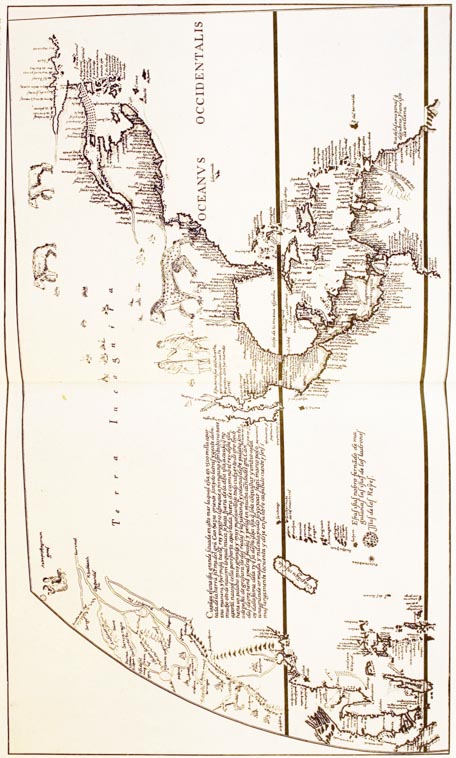
XL. Sebastian Cabot’s Map of 1544
◊
After Kretschmer
Mendoza, meanwhile, 1536–1539, had been making plans and preparations.
He had not come to the New World as an adventurer, and he
lacked the spirit of eager, reckless, hopeful expectation of wealth and
fame, which accomplished so much for the geographical unfolding of the
two Americas. Mendoza appears to have arranged his plans as carefully
as if he had been about to engage in some intrigue at court. He p353
recognized his rivals and their strength. Nuño de Guzman was in disgrace
and awaiting a trial, but he was at the court, where he could urge his
claims persistently in person. Cortes was active, but he was where
Mendoza could watch everything that he tried to do. He might succeed
in anticipating the viceroy’s plans, but his sea ventures heretofore
had all been failures. So long as he kept to the water there seemed
to be little danger. Mendoza’s chief concern appears to have been to
make sure that his rivals should have no chance of uniting their
claims against him. Representing the Crown and its interests, he felt
sure of everything else. The viceroy had no ambition to take the field
in person as an explorer, and he selected Alvarado as the most available
leader for the expedition which he had in mind, probably about the
time that the latter came back to the New World. He wrote to
Alvarado, suggesting an arrangement between them, and after due
consideration on both sides, terms and conditions mutually satisfactory
were agreed on. Mendoza succeeded in uniting Alvarado to his interests,
and engaged that he should conduct an expedition into the country
north of Mexico. This arrangement was completed, apparently, before
the return of Friar Marcos from his reconnoissance, which added so
largely to the probabilities of success.
Mendoza did not confine himself to diplomatic measures for bringing
about the exploration and conquest which he had in mind. In his
undated “première lettre” the viceroy wrote that he was prepared to
send Dorantes with forty or fifty horses and everything needed for an
expedition into the interior; but nothing was done.
About this time, 1537–38, Friar Juan de la Asuncion seems to have
visited the inland tribes north of the Spanish settlements. Mr Bandelier
has presented all the evidence obtainable regarding the labors of
this friar.19
The most probable interpretation of the statements which
refer to his wanderings is that Friar Juan went alone and without
official assistance, and that he may have traveled as far north as
the river Gila. The details of his journey are hopelessly confused. It
is more than probable that there were a number of friars at work
among the outlying Indian tribes, and there is no reason why one or
more of them may not have wandered north for a considerable distance.
During the same year the viceroy made an attempt, possibly
in person, to penetrate into the country of Topira or Topia, in northwestern
Durango,20
but the mountains and the absence of provisions
forced the party to return. It may be that this fruitless expedition was
the same as that in which, according to Castañeda, Coronado took part,
while Friar Marcos was on his way to Cibola. It is not unlikely, also, p354
that Friar Marcos may have made a preliminary trip toward the north,
during the same year, although this is hardly more than a guess to explain
statements, made by the old chroniclers, which we can not understand.
As yet nothing had been found to verify the reports brought by
Cabeza de Vaca, which, by themselves, were hardly sufficient to justify
the equipment of an expedition on a large scale. But Mendoza was
bent on discovering what lay beyond the northern mountains. He still
had the negro Estevan, whom he had purchased of Dorantes, besides
a number of Indians who had followed Cabeza de Vaca to Mexico and
had been trained there to serve as interpreters. The experience which
the negro had gained during the years he lived among the savages
made him invaluable as a guide. He was used to dealing with the
Indians, knew something of their languages, and was practiced in the
all-important sign manual.
Friar Marcos de Niza was selected as the leader of the little party
which was to find out what the viceroy wanted to know. Aside from
his reconnoitering trip to Cibola, very little is known about this friar.
Born in Nice, then a part of Savoy, he was called by his contemporaries
a Frenchman. He had been with Pizarro in Peru, and had witnessed
the death of Atahualpa. Returning to Central America, very likely
with Pedro de Alvarado, he had walked from there barefooted, as was
his custom, up to Mexico. He seems to have been somewhere in the
northwestern provinces of New Spain, when Cabeza de Vaca appeared
there after his wanderings. A member of the Franciscan brotherhood,
he had already attained to some standing in the order, for he
signs his report or personal narration of his explorations, as vice-commissary
of the Franciscans. The father provincial of the order,
Friar Antonio de Ciudad-Rodrigo, on August 26, 1539,21
certified to the
high esteem in which Friar Marcos was held, and stated that he was
skilled in cosmography and in the arts of the sea, as well as in
theology.
This choice of a leader was beyond question an excellent one, and
Mendoza had every reason to feel confidence in the success of his undertaking.
The viceroy drew up a set of instructions for Friar Marcos,
which directed that the Indians whom he met on the way should receive
the best of treatment, and provided for the scientific observations
which all Spanish explorers were expected to record. Letters were to
be left wherever it seemed advisable, in order to communicate with a
possible sea expedition, and information of the progress of the party
was to be sent back to the viceroy at convenient intervals. These
instructions are a model of careful and explicit directions, and show
the characteristic interest taken by Mendoza in the details of everything
with which he was concerned. They supply to some extent, p355
also, the loss of the similar instructions which Coronado must have
received when he started on his journey in the following February.22
Friar Marcos, accompanied by a lay brother, Friar Onorato, according
to Mendoza’s “première lettre,” left Culiacan on March 7, 1539.
Coronado, now acting as governor of New Galicia, had escorted them
as far as this town and had assured a quiet journey for a part of the
way beyond by sending in advance six Indians, natives of this region,
who had been “kept at Mexico to become proficient in the Spanish
language and attached to the ways of the Christians.”23
The friars
proceeded to Petatlan, where Friar Onorato fell sick, so that it was
necessary to leave him behind. During the rest of the journey, Friar
Marcos was the only white man in the party, which consisted of the
negro Estevan, the Indian interpreters, and a large body of natives who
followed him from the different villages near which he passed. The
friar continued his journey to “Vacapa,” which Mr Bandelier identifies
with the Eudeve settlement of Matapa in central Sonora, where he
arrived two days before Passion Sunday, which in 1539 fell on March 23.24
At this place he waited until April 6, in order to send to the seacoast
and summon some Indians, from whom he hoped to secure further
information about the pearl islands of which Cabeza de Vaca had
heard.
The negro Estevan had been ordered by the viceroy to obey Friar
Marcos in everything, under pain of serious punishment. While the friar
was waiting at Vacapa, he sent the negro toward the north, instructing
him to proceed 50 or 60 leagues and see if he could find anything
which might help them in their search. If he found any signs of a
rich and populous country, it was agreed that he was not to advance
farther, but should return to meet the friar, or else wait where he heard
the good news, sending some Indian messengers back to the friar, with
a white cross the size of the palm of his hand. If the news was very
promising, the cross was to be twice this size, and if the country about
which he heard promised to be larger and better than New Spain, a
cross still larger than this was to be sent back. Castañeda preserves
a story that Estevan was sent ahead, not only to explore and pacify
the country, but also because he did not get on well with his superior,
who objected to his eagerness in collecting the turquoises and other
things which the natives prized and to the moral effect of his relations
with the women who followed him from the tribes which they met on
their way. Friar Marcos says nothing about this in his narrative, but
he had different and much more important ends to accomplish by his
report, compared with those of Castañeda, who may easily have gathered
the gossip from some native. p356
Estevan started on Passion Sunday, after dinner. Four days later
messengers sent by him brought to the friar “a very large cross, as tall
as a man.” One of the Indians who had given the negro his information
accompanied the messengers. This man said and affirmed, as the
friar carefully recorded, “that there are seven very large cities in the
first province, all under one lord, with large houses of stone and lime;
the smallest one-story high, with a flat roof above, and others two and
three stories high, and the house of the lord four stories high. They
are all united under his rule. And on the portals of the principal houses
there are many designs of turquoise stones, of which he says they
have a great abundance. And the people in these cities are very well
clothed. . . . Concerning other provinces farther on, he said that
each one of them amounted to much more than these seven cities.” All
this which the Indian told Friar Marcos was true; and, what is more,
the Spanish friar seems to have correctly understood what the Indian
meant, except that the Indian idea of several villages having a common
allied form of government was interpreted as meaning the rule of a
single lord, who lived in what was to the Indians the chief, because the
most populous, village. These villages of stone and lime—or rather of
stone and rolls or balls of adobe laid in mud mortar and sometimes
whitened with a wash of gypsum25—were very large and wondrous
affairs when compared with the huts and shelters of the Seri and some
of the Piman Indians of Sonora.26
The priest can hardly be blamed for
translating a house entrance into a doorway instead of picturing it as
a bulkhead or as the hatchway of a ship. The Spaniards—those who
had seen service in the Indies—had outgrown their earlier custom of
reading into the Indian stories the ideas of government and of civilization
to which they were accustomed in Europe. But Friar Marcos was
at a disadvantage hardly less than that of the companions of Cortes,
when they first heard of Moctecuhzoma, because his experience with
the wealth of the New World had been in the realm of the Incas. He
interpreted what he did not understand, of necessity, by what he had
seen in Peru.
The story of this Indian did not convince the friar that what he heard
about the grandeur of these seven cities was all true, and he decided
not to believe anything until he had seen it for himself, or had at least
received additional proof. The friar did not start immediately for the
seven cities, as the negro had advised him to do, but waited until he
could see the Indians who had been summoned from the seacoast.
These told him about pearls, which were found near their homes. Some
“painted” Indians, living to the eastward, having their faces, chests,
and arms tattooed or decorated with pigments, who were perhaps the
Pima or Sobaipuri Indians, also visited him while he was staying at
Vacapa and gave him an extended account of the seven cities, very
similar to that of the Indian sent by Estevan.
p357
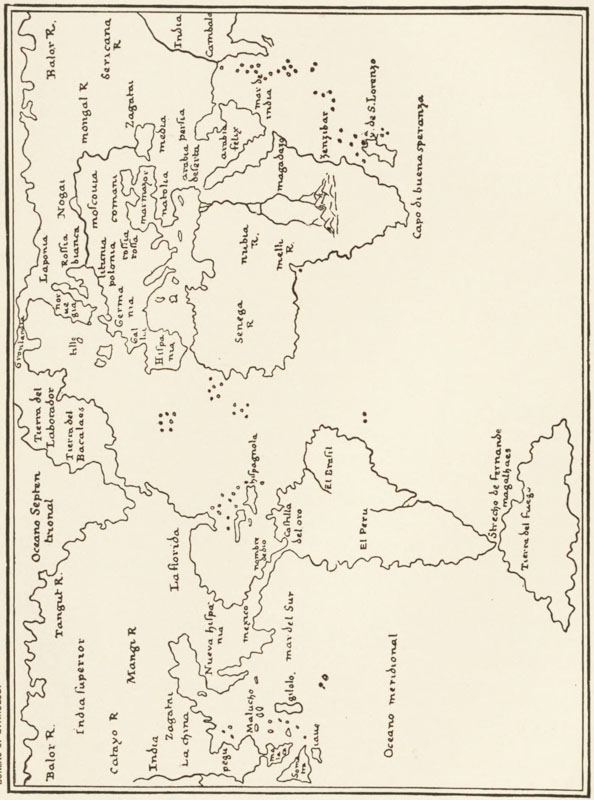
XLI. Map of the World by Ptolemy, 1548
◊
Friar Marcos started on the second day following Pascua Florida, or
Easter, which came on April 6, 1539. He expected to find Estevan
waiting at the village where he had first heard about the cities. A
second cross, as big as the first, had been received from the negro, and
the messengers who brought this gave a fuller and much more specific
account of the cities, agreeing in every respect with what had previously
been related. When the friar reached the village where the
negro had obtained the first information about the cities, he secured
many new details. He was told that it was thirty days’ journey from
this village to the city of Cibola, which was the first of the seven. Not
one person alone, but many, described the houses very particularly and
showed him the way in which they were built, just as the messengers
had done. Besides these seven cities, he learned that there were
other kingdoms, called Marata, Acus, and Totonteac. The linguistic
students, and especially Mr Frank Hamilton Cushing, have identified
the first of these with Matyata or Makyata, a cluster of pueblos about
the salt lakes southeast of Zuñi, which were in ruins when Alvarado
saw them in 1540, although they appeared to have been despoiled not
very long before. Acus is the Acoma pueblo and Totonteac was in all
probability the province of Tusayan, northwestward from Zuñi. The
friar asked these people why they went so far away from their homes,
and was told that they went to get turquoises and cow skins, besides
other valuable things, of all of which he saw a considerable store in
the village.
Friar Marcos tried to find out how these Indians bartered for the
things they brought from the northern country, but all he could understand
was that “with the sweat and service of their persons they went
to the first city, which is called Cibola, and that they labored there by
digging the earth and other services, and that for what they did they
received turquoises and the skins of cows, such as those people had.”
We now know, whatever Friar Marcos may have thought, that they
doubtless obtained their turquoises by digging them out of the rocky
ground in which they are still found in New Mexico, and this may
easily have seemed to them perspiring labor. It is not clear just how
they obtained the buffalo skins, although it was doubtless by barter.
The friar noticed fine turquoises suspended in the ears and noses of
many of the people whom he saw,27
and he was again informed that
the principal doorways of Cibola were ceremonially ornamented with
designs made of these stones. Mr Cushing has since learned, through
tradition, that this was their custom. The dress of these people of
Cibola, including the belts of turquoises about the waist, as it was
described to the friar, seemed to him to resemble that of the Bohemians,
or gypsies. The cow skins, some of which were given to him,
were tanned and finished so well that he thought it was evident that
they had been prepared by men who were skilled in this work. p358
At this point in his narrative Friar Marcos first uses
the word pueblo,
village, in referring to the seven cities, a point which would be of
some interest if only we could be sure that the report was written
from notes made as he went along. He certainly implies that he kept
some such record when he speaks of taking down the statements of
the Indian who first told him about the seven cities. It looks as if the
additional details which he was obtaining gradually dimmed his vision
of cities comparable to those into which he had seen Pizarro gather the
golden ransom of Atahualpa.
Friar Marcos had not heard from Estevan since leaving Vacapa, but
the natives told him that the negro was advancing toward Cibola, and
that he had been gone four or five days. The friar started at once to
follow the negro, who had proceeded up Sonora valley, as Mr Bandelier
traces the route. Estevan had planted several large crosses along
the way, and soon began to send messengers to the friar, urging the
latter to hasten, and promising to wait for him at the edge of the wilderness
which lay between them and the country of Cibola. The friar
followed as fast as he could, although constantly hindered by the
natives, who were always ready to verify the stories he had already
heard concerning Cibola. They pressed him to accept their offers of
turquoises and of cow skins in spite of his persistent refusals. At one
village, the lord of the place and his two brothers greeted the friar,
having collars of turquoises about their necks, while the rest of the
people were all encaconados, as they called it, with turquoises, which
hung from their ears and noses. Here they supplied their visitor with
deer, rabbits, and quail, besides a great abundance of corn and piñon
seed. They also continued to offer him turquoises, skins, fine gourds,
and other things which they valued. The Sobaipuri Indians, who were
a branch of the Papago, among whom the friar was now traveling,
according to Bandelier, seemed to be as well acquainted with Cibola
as the natives of New Spain were with Mexico, or those of Peru with
Cuzco. They had visited the place many times, and whatever they
possessed which was made with any skill or neatness had been brought,
so they told him, from that country.
Soon after he encountered these people, the friar met a native of
Cibola. He was a well-favored man, rather old, and appeared to be
much more intelligent than the natives of this valley or those of any of
the districts through which the friar had passed in the course of his
march. This man reported that the lord of Cibola lived and had his
seat of government in one of the seven cities called Ahacus, and that
he appointed men in the other cities who ruled for him. Ahacus is
readily identified with Hawikuh, one of the present ruins near K’iapkwainakwin,
or Ojo Caliente, about 15 miles southwest of Zuñi. On
questioning this man closely, the friar learned that Cibola—by which,
as Bandelier and Cushing maintain, the Indian meant the whole range
occupied by the Zuñi people—was a large city, in which a great many p359
people dwelt and which had streets and open squares or plazas. In some
parts of it there were very large houses, which were ten stories high,
and the leading men met together in these on certain days of the year.
Possibly this is one of the rare references in the accounts of these early
visits to Zuñi, to the ceremonials of the Pueblo Indians, which have
been studied and described with so much care by later visitors, notably
by Mrs M. C. Stevenson and by Dr J. Walter Fewkes of the Hemenway
Southwestern Archeological Expedition.
This native of Cibola verified all the reports which the friar had
already heard. Marata, he said, had been greatly reduced by the lord
of Cibola during recent wars. Totonteac was a much larger and richer
place, while Acus was an independent kingdom and province. The
strange thing about all these reports is not that they are true, and that
we can identify them by what is now known concerning these Indians,
but the hard thing to understand is how the Spanish friar could have
comprehended so well what the natives must have tried to tell him.
When one considers the difficulties of language, with all its technicalities,
and of radically different conceptions of every phase of life and of
thought, the result must be an increased confidence in the common sense
and the inherent intelligence of mankind.
On his way up this valley of Sonora, Friar Marcos heard that the seacoast
turned toward the west. Realizing the importance of this point,
he says that he “went in search of it and saw clearly that it turns to
the west in 35 degrees.” He was at the time between 31 and
3112
degrees
north, just opposite the head of the Gulf of California. If Bandelier’s
identification of the friar’s route is accepted—and it has a great
deal more in its favor than any other that can be proposed with any due
regard to the topography of the country—Friar Marcos was then near
the head of San Pedro valley, distant 200 miles in a direct line from the
coast, across a rough and barren country. Although the Franciscan
superior testified to Marcos’ proficiency in the arts of the sea, the friar’s
calculation was
312
degrees out of the way, at a latitude where the usual
error in the contemporary accounts of expeditions is on the average a
degree and a half. The direction of the coast line does change almost
due west of where the friar then was, and he may have gone to some
point among the mountains from which he could satisfy himself that
the report of the Indians was reliable. There is a week or ten days,
during this part of the journey, for which his narrative gives no specific
reckoning. He traveled rather slowly at times, making frequent stops,
so that the side trip is not necessary to fill this gap. The point is a
curious one; but, in the absence of any details, it is hardly likely that
the friar did more than secure from other Indians stories confirming
what he had already been told.
Friar Marcos soon reached the borders of the wilderness—the country
in and about the present White Mountain Apache reservation in Arizona.
He entered this region on May 9, and twelve days later a young man p360
who had been with Estevan, the son of one of the Indian chiefs accompanying
the friar, met him and told the story of the negro’s death.
Estevan had hastened to reach Cibola before the friar, and just prior to
arriving at the first city he had sent a notice of his approach to the
chief of the place. As evidence of his position or authority, he sent a
gourd, to which were attached a few strings of rattles and two plumes,
one of which was white and the other red.
While Cabeza de Vaca and his companions were traveling through
Texas, the natives had flocked to see these strange white men and soon
began to worship them, pressing about them for even a touch of their
garments, from which the Indians trusted to receive some healing power.
While taking advantage of the prestige which was thus obtained,
Cabeza de Vaca says that he secured some gourds or rattles, which were
greatly reverenced among these Indians and which never failed to
produce a most respectful behavior whenever they were exhibited. It
was also among these southern plains Indians that Cabeza de Vaca
heard of the permanent settlements toward the north. Castañeda says
that some of these plains Indians came each year to Cibola to pass the
winter under the shelter of the adobe villages, but that they were distrusted
and feared so much that they were not admitted into the villages
unless unarmed, and under no conditions were they allowed to spend
the night within the flat-roof houses. The connection between these
Indian rattles and the gourd which Estevan prized so highly can not
be proven, but it is not unlikely that the negro announced his arrival
to the Cibola chiefs by sending them an important part of the paraphernalia
of a medicine man of a tribe with which they were at enmity.
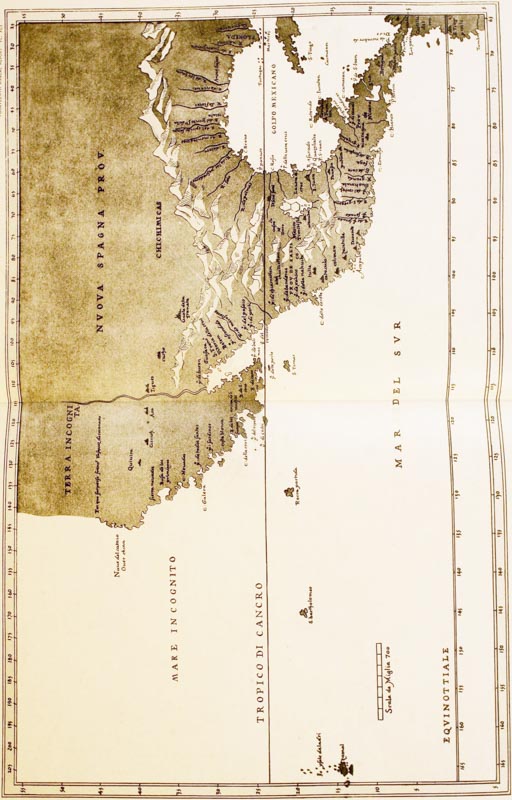
XLII. Battista Agnese’s New Spain, Sixteenth
Century
◊
After Kretschmer
There are several versions of the story of Estevan’s death, besides
the one given in Friar Marcos’ narrative, which were derived from the
natives of Cibola. Castañeda, who lived among these people for a while
the next year, states that the Indians kept the negro a prisoner for
three days, “questioning him,” before they killed him. He adds that
Estevan had demanded from the Indians treasures and women, and
this agrees with the legends still current among these people.28
When
Alarcon ascended Colorado river a year later, and tried to obtain news
of Coronado, with whom he was endeavoring to cooperate, he heard
of Estevan, who was described as a black man with a beard, wearing
things that sounded, rattles, bells, and plumes, on his feet and arms—the
regular outfit of a southwestern medicine man.29
Friar Marcos was
told that when the messengers bearing the gourd showed it to the chief
of the Cibola village, he threw it on to the ground and told the messengers
that when their people reached the village they would find out
what sort of men lived there, and that instead of entering the place
they would all be killed. Estevan was not at all daunted when this
answer was reported to him, saying that everything would be right p361
when he reached the village in person. He proceeded thither at once,
but instead of being admitted, he was placed under guard in a house
near by.30
All the turquoises and other gifts which he had received
from the Indians during his journey were taken from him, and he was
confined with the people who accompanied him, over night, without
receiving anything to eat or drink. The next morning Estevan tried to
run away, but was overtaken and killed. The fugitives who brought
this news to Friar Marcos said that most of their companions also had
been killed. The Indians who had followed the friar forthwith began
to mourn for three hundred of their relations and friends, who had perished,
they declared, as a result of their confidence in his forerunner.
This number was undoubtedly an exaggeration. Castañeda heard that
the natives of Cibola kept a few lads from among those who were with
the negro, “and sent back all the rest, numbering about sixty.” The
story of Estevan’s death is reputed to have been preserved among the
legends of the Indians of Zuñi. According to this tradition, the village
at which the “Black Mexican” was killed was K’iakima, a village now
in ruins, situated on a bluff at the southwestern angle of Thunder
mountain mesa; but this is totally at variance with the historical evidence,
which seems to point quite conclusively to Hawikuh, the first
village encountered from the southwest, as the scene of Estevan’s
death.31
One of the Indian stories of Estevan’s death is that their wise
men took the negro out of the pueblo during the night, and “gave him
a powerful kick, which sped him through the air back to the south,
whence he came!”
The killing of Estevan made it impossible for Friar Marcos, alone and
unprepared for fighting, to enter the Cibola region. The first reports
of the disaster, as is usually the custom, told of the death of all who
accompanied the negro, and in consequence there was much wailing
among the Indians who had followed the friar. They threatened to
desert him, but he pacified them by opening his bundles and distributing
the trinkets brought from Mexico. While they were enjoying
these, he withdrew a couple of stone-throws for an hour and a half to
pray. Meanwhile, the Indians began again to think of their lost friends,
and decided to kill the friar, as the indirect cause of the catastrophe.
But when he returned from his devotions, reinvigorated, and learned of
their determination, he diverted their thoughts by producing some of
the things which had been kept back from the first distribution of the
contents of his packs. He expounded to them the folly of killing him,
since this would do him no hurt because he was a Christian and so would
go at once to his home in the sky, while other Christians would come
in search of him and kill all of them, in spite of his own desires to
prevent, if possible, any such revenge. “With many other words” he p362
succeeded at last in quieting them and in persuading two of the chief
Indians to go with him to a point where he could obtain a view of the
“city of Cibola.” He proceeded to a small hill, from which he saw
that it was situated on a plain on the slope of a round height. “It has
a very fine appearance for a village,” he writes, “the best that I have
seen in these parts. The houses, as the Indians had told me, are all of
stone, built in stories, and with flat roofs. Judging by what I could see
from the height where I placed myself to observe it, the settlement is
larger than the city of Mexico. . . . It appears to me that this
land is the best and largest of all those that have been discovered.”
“With far more fright than food,” the friar says he retraced his way
toward New Spain, by hasty marches. During his journey to Cibola,
he had heard of a large and level valley among the mountains, distant
four or five days from the route which he followed, where he
was told that there were many very large settlements in which the
people wore clothes made of cotton. He showed his informants some
metals which he had, in order to find out what there was in that region,
and they picked out the gold, saying that the people in the valley had
vessels made of this material and some round things which they hung
from their ears and noses. They also had some little shovels of this
same metal, with which they scraped themselves to get rid of their
sweat. On his way back, although he had not recovered from his fright,
the friar determined to see this valley. He did not dare to venture
into it, because, as he says, he thought that those who should go to
settle and rule the country of the seven cities could enter it more
safely than he. He did not wish to risk his own life, lest he should be
prevented from making the report of what he had already seen. He
went as far as the entrance to the valley and saw seven good-looking
settlements at a distance, in a very attractive country, from which
arose a great deal of smoke. He understood from the Indians that
there was much gold in the valley, and that the natives used it for vessels
and ornaments, repeating in his narrative the reports which he had
heard on his outward journey.
The friar then hastened down the coast to Culiacan, where he hoped,
but failed, to find Coronado, the governor of the province. He went
on to Compostela, where Coronado was staying. Here he wrote his
report, and sent the announcement of his safe return to the viceroy.
A similar notification to the provincial of his order contained a request
for instructions as to what he should do next. He was still in Compostela
on September 2, and as Mendoza and Coronado also were there,
he took occasion to certify under oath before them to the truth of all
that he had written in the report of his expedition to Cibola.
In his official report it is evident that Friar Marcos distinguished
with care between what he had himself seen and what the Indians had
told him. But Cortes began the practice of attacking the veracity and p363
good faith of the friar, Castañeda continued it, and scarcely a writer
on these events failed to follow their guidance until Mr Bandelier
undertook to examine the facts of the case, and applied the rules of
ordinary fairness to his historical judgment. This vigorous defender
of the friar has successfully maintained his strenuous contention that
Marcos neither lied nor exaggerated, even when he said that the Cibola
pueblo appeared to him to be larger than the City of Mexico. All the
witnesses agree that these light stone and adobe villages impress one
who first sees them from a distance as being much larger than they
really are. Mexico in 1539, on the other hand, was neither imposing
nor populous. The great communal houses, the “palace of Montezuma,”
had been destroyed during or soon after the siege of 1521. The
pueblo of Hawikuh, the one which the friar doubtless saw, contained
about 200 houses, or between 700 and 1,000 inhabitants. There is something
naïve in Mr Bandelier’s comparison of this with Robert Tomson’s
report that the City of Mexico, in 1556, contained 1,500
Spanish households.32
He ought to have added, what we may be quite sure was true,
that the population of Mexico probably doubled in the fifteen years preceding
Tomson’s visit, a fact which makes Niza’s comparison even more
reasonable.33
The credit and esteem in which the friar was held by the viceroy,
Mendoza, is as convincing proof of his integrity as that derived from
a close scrutiny of the text of his narrative. Mendoza’s testimony was
given in a letter which he sent to the King in Spain, inclosing the
report written by Friar Marcos, the “première lettre” which Ternaux
translated from Ramusio. This letter spoke in laudatory terms of
the friar, and of course is not wholly unbiased evidence. It is at least
sufficient to counterbalance the hostile declarations of Cortes and Castañeda,
both of whom had far less creditable reasons for traducing
the friar than Mendoza had for praising him. “These friars,” wrote
Mendoza of Marcos and Onorato, “had lived for some time in the
neighboring countries; they were used to hard labors, experienced in
the ways of the Indies, conscientious, and of good habits.” It is possible
that Mendoza felt less confidence than is here expressed, for
before he organized the Coronado expedition, late in the fall of this
year 1539, he ordered Melchior Diaz to go and see if what he could discover
agreed with the account which Friar Marcos gave.34
However careful the friar may have been, he presented to the viceroy
a report in which gold and precious stones abounded, and which
stopped just within sight of the goal—the Seven Cities of Nuño de Guzman
and of the Indian traders and story tellers. Friar Marcos had p364
something to tell which interested his readers vastly more than the
painful, wonderful story of Cabeza de Vaca. The very fact that he
took it for granted, as he says in his report, that they would go to
populate and rule over this land of the Seven Cities, with its doorways
studded with turquoises, was enough to insure interest. He must,
indeed, have been a popular preacher, and when the position of father
provincial to the Franciscans became vacant, just now, brother Marcos,
already high in the order and with all the fresh prestige of his latest
achievements, was evidently the subject for promotion. Castañeda,
who is not the safest authority for events preceding the expedition,
says that the promotion was arranged by the viceroy. This may have
been so. His other statement is probable enough, that, as a result of
the promotion, the pulpits of the order were filled with accounts of such
marvels and wonders that large numbers were eager to join in the conquest
of this new land. Whatever Friar Marcos may have sacrificed
to careful truth was atoned for, we may be sure, by the zealous, loyal
brethren of blessed Saint Francis.
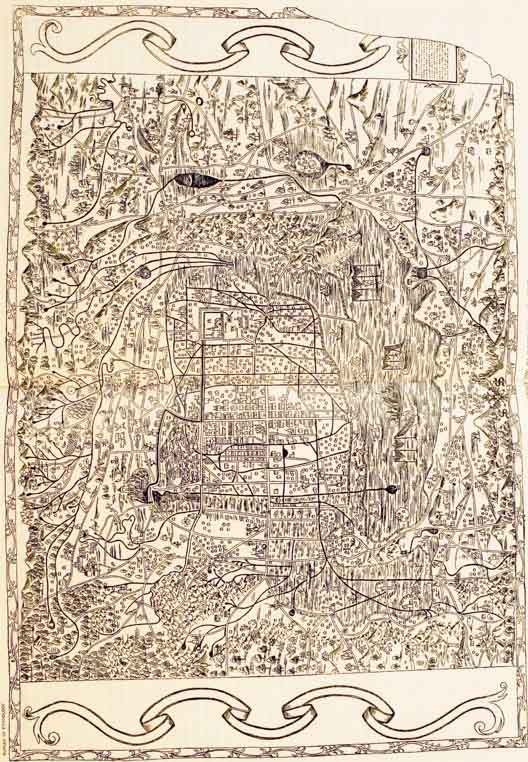
XLIII. The City of Mexico about 1550,
by Alonzo de Santa Cruz
◊
Don Joan Suarez de Peralta was born, as Señor Zaragoza shows in
his admirable edition of the Tratado del Descubrimiento de las Yndias
y su Conquista, in Mexico between 1535 and 1540, and probably nearer
the first of these five years. In the Tratado, Suarez de Peralta gives a
most interesting description of the effect produced in Mexico by the
departure and the return of the Coronado expedition. He can hardly
have had very vivid personal recollections of the excitement produced
by the reports of Friar Marcos, yet his account is so clear and circumstantial
that it evidently must be the narrative of an eyewitness, though
recorded, it may be, at secondhand. He tells us that “the country
was so stirred up by the news which the friar had brought from the
Seven Cities that nothing else was thought about. For he said that
the city of Cibola was big enough to contain two Sevilles and over,
and the other places were not much smaller; and that the houses
were very fine edifices, four stories high; and in the country there are
many of what they call wild cows, and sheep and goats and rich
treasures. He exaggerated things so much, that everybody was for
going there and leaving Mexico depopulated. . . . . The news
from the Seven Cities inspired so eager a desire in every one that not
only did the viceroy and the marquis (Cortes) make ready to start for
there, but the whole country wanted to follow them so much that they
traded for the licenses which permitted them to go as soldiers, and people
sold these as a favor, and whoever obtained one of these thought
that it was as good as a title of nobility at the least. For the friar
who had come from there exaggerated and said that it was the best
place in the world; the people in that country very prosperous, and
all the Indians wearing clothes and the possessors of much cattle;
the mountains like those of Spain, and the climate the same. For
wood, they burnt very large walnut trees, which bear quantities of p365
walnuts better than those of Spain. They have many mountain grapes,
which are very good eating, chestnuts, and filberts. According to the
way he painted it, this should have been the terrestrial paradise. For
game, there were partridges, geese, cranes, and all the other winged
creatures—it was marvelous what was there.” And then Suarez adds,
writing half a century later, “He told the truth in all this, because
there are mountains in that country, as he said, and herds, especially
of cows. . . . . There are grapes and game, without doubt, and a
climate like that of Spain.”35
Second-hand evidence, recorded fifty years after the occurrence, is
far from conclusive. Fortunately, we are able to supplement it by
legal testimony, taken down and recorded under oath, with all the formalities
of the old Spanish law customs. When the news of Friar
Marcos’ journey reached Spain there was much rivalry among those
who claimed the privilege of completing the discovery. Much evidence
was presented and frequent pleas were entered by all the men
who had an active part and leadership in the conquest of the northern
portion of the New World. In the course of the litigation the representative
of the adelantado Hernando de Soto, presented some testimony
which had been given in the town of San Cristobal de la Habana
de la Isla Fernandina—Habana and Cuba—dated November 12, 1539.
There were seven witnesses, from a ship which had been obliged to put
into this port in order to procure water and other supplies, and also
because some persons aboard had become very sick. Each witness
declared that a month or more before—Friar Marcos arrived back
in Mexico before the end of August, 1539—he had heard, and that
this was common talk in Mexico, Vera Cruz, and in Puebla de los Angeles,
that a Franciscan friar named Fray Marcos, who had recently
come from the inland regions, said that he had discovered a very rich
and very populous country 400 or 500 leagues north of Mexico. “He
said that the country is rich in gold, silver and other treasures, and
that it contains very large villages; that the houses are built of stone,
and terraced like those of Mexico, and that they are high and imposing.
The people, so he said, are shrewd, and do not marry more than one
wife at a time, and they wear coarse woolen cloth and ride on some animals,”
the name of which the witness did not know. Another testified
that the common report was that this country “was very rich and populous
and had great walled cities, and that the lords of the cities were
called kings, and that the people were very shrewd and use the Mexican
language.” But the witness to whose deposition we are most indebted
was Andrés Garcia. This man declared that he had a son-in-law who
was a barber, who had shaved the friar after he came back from the new
country. The son-in-law had told the witness that the friar, while
being p366
shaved, had talked about the country which he had discovered beyond
the mountains. “After crossing the mountains, the friar said there
was a river, and that many settlements were there, in cities and towns,
and that the cities were surrounded by walls, with their gates guarded,
and were very wealthy, having silversmiths, and that the women wore
strings of gold beads and the men girdles of gold and white woolen
dresses; and that they had sheep and cows and partridges and slaughterhouses
and iron forges.”36
Friar Marcos undoubtedly never willfully told an untruth about the
country of Cibola, even in a barber’s chair. But there seems to be
little chance for doubting that the reports which he brought to New
Spain were the cause of much talk as well as many sermons, which
gave rise to a considerable amount of excitement among the settlers,
whose old-world notions had been upset by the reputed glory of
the Montezumas and the wealth of the Incas. Very many, though
perhaps not all, of the colonists were stirred with an eager desire to
participate in the rich harvest awaiting the conquerors of these
new p367
lands. Friar Marcos was not a liar, but it is impossible to ignore the
charges against him quite as easily as Mr Bandelier has done.
Pedro Castañeda makes some very damaging statements, which are not
conclusive proof of the facts. Like the statements of Suarez de Peralta,
they represent the popular estimation of the father provincial, and they
repeat the stories which passed current regarding him, when the later
explorations had destroyed the vision that had been raised by the
reports of the friar’s exploration. The accusations made by Cortes
deserve more careful consideration. Cortes returned to Spain about
the time that the preparations for the Coronado expedition were definitely
begun. Soon after his arrival at court, June 25, 1540,37
he
addressed a formal memorial to the King, setting forth in detail the
ill treatment which he had received from Mendoza. In this he declared
that after the viceroy had ordered him to withdraw his men from their
station on the coast of the mainland toward the north—where they
were engaged in making ready for extended inland explorations—he
had a talk with Friar Marcos. “And I gave him,” says Cortes, “an
account of this said country and of its discovery, because I had determined
to send him in my ships to follow up the said northern coast
and conquer that country, because he seemed to understand something
about matters of navigation. The said friar communicated this to the
said viceroy, and he says that, with his permission, he went by land
in search of the same coast and country as that which I had discovered,
and which it was and is my right to conquer. And since his
return, the said friar has published the statement that he came within
sight of the said country, which I deny that he has either seen or discovered;
but instead, in all that the said friar reports that he has seen,
he only repeats the account I had given him regarding the information
which I obtained from the Indians of the said country of Santa Cruz,
because everything which the said friar says that he discovered is just
the same as what these said Indians had told me: and in enlarging
upon this and in pretending to report what he neither saw nor learned,
the said Friar Marcos does nothing new, because he has done this
many other times, and this was his regular habit, as is notorious in the
provinces of Peru and Guatemala; and sufficient evidence regarding
this will be given to the court whenever it is necessary.”38
This is a serious charge, but so far as is known it was never substantiated.
Cortes was anxious to enforce his point, and he was not always
scrupulous in regard to the exact truth. The important point is that
such charges were made by a man who was in the position to learn all p368
the facts, and that the accusations were made before anyone knew how
little basis there was for the stories which were the cause of the whole
trouble. Without trying to clear the character of Cortes, it is possible
to suggest the answer to the most evident reply to his accusations—that
he never published the stories which he says he received from the
Indians. Cortes certainly did persist in his endeavors to explore the
country lying about the head of the Gulf of California. If he ever
heard from the Indians anything concerning the Cibola region—which
is doubtful, partly because Cortes himself complains that if Mendoza
had not interfered with the efficiency of his expeditions, he would have
secured this information—it would still have been the best policy for
Cortes to keep the knowledge to himself, so that possible rivals might
remain ignorant of it until he had perfected his own plans. It may be
questioned how long such secrecy would have been possible, but we
know how successfully the Spanish authorities managed to keep from
the rest of the world the correct and complete cartographical information
as to what was being accomplished in the New World, throughout
the period of exploration and conquest.
The truce—it can hardly be called a friendship—between Mendoza
and Cortes, which prevailed during the first years of the viceroy’s administration,
could not last long. Mendoza, as soon as he was fairly settled
in his position in New Spain,39
asked the King for a license to make
explorations. Cortes still looked on every rival in the work of extending
this portion of the Spanish world as an interloper, even though he
must have recognized that his prestige at the court and in the New
World was rapidly lessening. The distrust with which each of the two
regarded the other increased the trouble which was inevitable so soon
as the viceroy, urged on by the audiencia, undertook to execute the
royal orders which instructed him to investigate the extent of the
estates held by Cortes, and to enumerate the Indians held to service by
the conqueror. Bad feeling was inevitable, and the squabbles over
forms of address and of precedence, which Suarez de Peralta records,
were only a few of many things which reveal the relations of the two
leading men in New Spain. p369
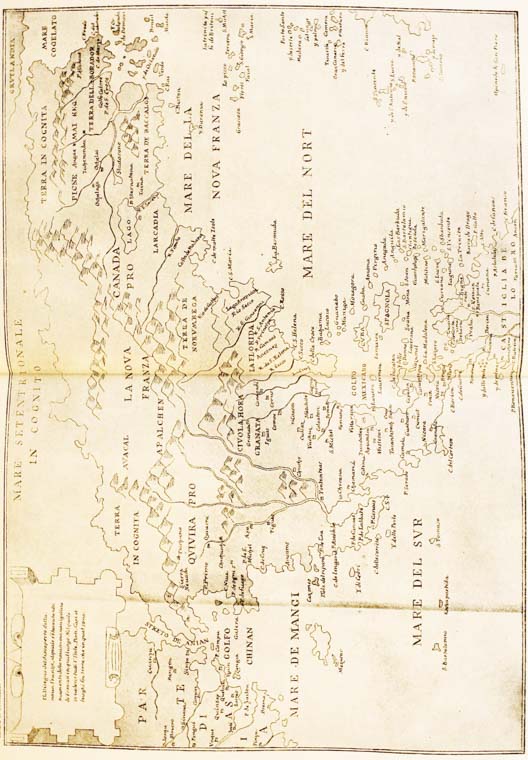
XLIV. Zaltieri’s Karte, 1566
◊
We can not be certain what the plans of Cortes were, nor can we
tell just how much he did to carry his schemes into execution, during
the years from 1537 to 1540. Shortly after the men whom Cortes had
established at Santa Cruz were recalled, a decree was issued, in the
name of the audiencia, to forbid the sending of any expedition for
exploration or conquest from New Spain. Cortes declared that he had
at this time, September, 1538, nine good ships already built. He was
naturally unwilling to give up all hope of deriving any benefit from
his previous undertakings, as would be inevitable if Mendoza should
succeed in his projects for taking advantage of whatever good things
could be found toward the north. The danger must have seemed clear
so soon as he learned of the departure of Friar Marcos and the negro
on their journey toward the Seven Cities. There is no means of knowing
whether Cortes had learned of the actual discovery of Cibola, when
he suddenly ordered Francisco de Ulloa to take three vessels and sail
up the coast toward the head of the Gulf of California. The friar may
have sent Indian messengers to the viceroy so soon as he heard the
native reports about the seven cities of Cibola, and it is possible that
the news of his approaching return may have reached New Spain before
the departure of Ulloa, which took place July 8, 1539, from Acapulco.40
It seems clear that this action was unexpected, and that it was a successful
anticipation of preventive measures. In the statement of his
grievances, Cortes declares that Mendoza not only threw every possible
obstacle in his way, seizing six or seven vessels which failed to get away
with Ulloa, but that even after Ulloa had gone, the viceroy sent a strong
force up the coast to prevent the ships from entering any of the ports.
When stress of weather forced one of the ships to put into Guatulco,
the pilot and sailors were imprisoned and the viceroy persistently
refused to return the ship to its owner. About the same time, a messenger
who had been sent to Cortes from Santiago in Colima was seized
and tortured, in the hope of procuring from him information about the
plans of Cortes.41
After Friar Marcos came back from the north and filled the people in
New Spain with the desire of going to this new country, Cortes realized
that he could do nothing, even in the city which he had won for his
King and for Europe, to prevent the expedition which Mendoza was
already organizing. Early in 1540—we know only that he was on his
way when he wrote to Oviedo from Habana42
on February 5—the conqueror
of Motecuhzoma’s empire left Mexico for the last time, and went
to see what he could gain by a personal application at the court of His
Majesty the Emperor, Charles V. p370
Mendoza had guarded against rival expeditions from his own territory,
and so soon as he knew that Friar Marcos had succeeded in his
quest, he took precautions to prevent the news of the discovery from
reaching other portions of the New World. His chief fear, probably,
was lest De Soto, who had recently received a license to explore the
country between the Rio de las Palmas, in the present Texas, and
Florida,43
might direct his expedition toward the western limits of his
territory, if he should learn of the rich prospects there. Although
Mendoza probably did not know it, De Soto had sailed from Habana in
May, 1539, and in July, sending back his largest ships, he began the long
march through the everglades of Florida, which was to end in the Mississippi.
Mendoza, with all the formality of the viceregal authority, ordered
that no vessel sailing from New Spain should touch at any port in the
New World on its way back to the home peninsula, and this notice was
duly served on all departing shipmasters by the secretaries of the
viceroy. By the middle of November, however, despite all this care, a
ship from Vera Cruz sailed into the harbor of Habana. The master
declared, on his oath, that he had been forced to put in there, because
sickness had broken out aboard his vessel soon after the departure from
New Spain and because he had discovered that his stock of provisions
and water was insufficient for the voyage across the Atlantic. Curiously
enough, one of the crew, possibly one of those who had been seized
with the sickness, had in his possession some letters which he had been
asked to deliver to Hernando De Soto, in Habana. Apparently the
agent or friend of De Soto living in Mexico, one Francisco de Billegas,
did not know that the adelantado had left Cuba, although he had
arranged to have the letters carried to Spain and given to the representative
of the adelantado there if De Soto was not found at Habana.
De Soto had taken care that his interests should be watched and protected,
in Spain as well as in the New World, when he started on his
search for the land of wealth north of the Gulf of Mexico, the search
on which Ayllon and Narvaez had failed so sadly.
It was the regular practice of all the governors and successful
explorers in the colonies of the empire to maintain representatives in
Spain who should look after their interests at court and before the
administrative bureaus. When the news of Friar Marcos’ discovery
reached Europe, accompanied by reports of the preparations which
Mendoza was making for an expedition to take possession of the new
territory, protests and counterclaims were immediately presented in
behalf of all those who could claim any right to participate in this
new field of conquest. The first formal statements were filed with the
Council for the Indies, March 3, 1540, and on June 10, 1541, the factor
or representative of Cortes, whose petition is first among the papers
relating to the case, asked for an extension of six days. This
ends the p371
documents concerning the litigation, so far as they have been printed.44
Petitions, testimony, narratives of explorations and discoveries, acts
taking possession of new lands, notifications and decisions, appeals
and countercharges, were filed and referred, each claimant watching his
rivals so closely and objecting to their claims so strenuously that the
fiscal, Villalobos, in his report on the case, May 25, 1540, gives as one of
the most conclusive reasons in favor of the advice which he offers to the
Council, that each of the parties has clearly proved that none of the
others have any right to claim a share in the newly discovered region
by virtue of any grants, licenses, or achievements whatsoever.
Of the various claimants, the representative of the adelantado Hernando
De Soto offered perhaps the best argument. The territory
granted to De Soto extended on the west to the Rio de las Palmas, and
this grant was the same as that previously made to Narvaez. The discovery
had grown out of the expedition of Narvaez, to whose rights
De Soto had succeeded, through the reports which Cabeza de Vaca
carried to New Spain. The newly discovered region was evidently
inland, and this fact disposed of the two prominent rivals, Cortes and
Alvarado. The adelantado had expended large sums in preparing for
this undertaking—a claim advanced with equal vigor by all the parties,
and usually supported by specific accounts, which unfortunately
are not printed—and it was only right that he should be given every
opportunity to reap the full advantage from these outlays. Most important
of all was the fact that De Soto was already in the country north
of the gulf, in command of a large and well equipped force, and presumably
on his way toward the region about which they were disputing.
Because De Soto was there, urged his representative with strong and
persistent emphasis, all other exploring expeditions ought to be kept
away. It was clearly probable that great and notorious scandals would
ensue unless this was guarded against, just as had happened in Peru.
If this precaution was not taken, and two expeditions representing
conflicting interests should be allowed to come together in the country
beyond the reach of the royal restraint, many lives would inevitably be
lost and great damage be done to the Spaniards, and to the souls of
the Indians as well, while the enlargement of the royal patrimony
would be hindered.45
Cortes reached Spain some time in April, 1540,46
and was able to direct
his case in person for much of the time. He urged the priority
of his p372
claims under the royal license, dating from 1529.47
He told of his many
efforts to enlarge the Spanish domain, undertaken at great expense,
personal sacrifice and danger, and resulting in the loss of relations
and friends. From all of this, as he carefully pointed out, neither
His Majesty nor himself had received any proper benefit, though this
was not the result of any fault or lack of diligence on his part, as he
hastened to explain, but had been caused by the persistent and ill-concealed
hostility of the audiencia and the viceroy in New Spain,
“concerning all of which His Majesty must have been kept heretofore
in ignorance.”
Nuño de Guzman presented his case in person, though perhaps this
was not so much because it was more effective as because his resources
must have been limited and his time little occupied. He was able,
indeed, to make out a very good argument, assuming his right to the governorship
of New Galicia, a province which had been greatly enlarged
by his conquests. These conquests were toward the north, and he
had taken possession of all the land in that direction in behalf of
His Catholic Majesty. He would have extended the Spanish territory
much farther in the same direction, if only his zealous efforts had not
been abruptly cut short by his persecutors, through whose malicious
efforts he was even yet nominally under arrest. Nor was this all, for
all future expeditions into the new region must go across the territory
which was rightfully his, and they could only succeed by the assistance
and resources which would be drawn from his country. Thus he was
the possessor of the key to all that lay beyond.
The commission or license which Pedro de Alvarado took with him
from Spain the year before these proceedings opened, granted him permission
to explore toward the west and the north—the latter provision
probably inserted as a result of the reports which Cabeza de Vaca
brought to Spain. Alvarado had prepared an expedition at great
expense, and since the new region lay within his grant, his advocate
pleaded, it would evidently pertain to him to conquer it. Moreover, he
was in very high favor at court, as is shown by the ease with which he
regained his position, in spite of the attack by the Mexican audiencia,
and also by the ease with which he obtained the papal permission
allowing him to marry the sister of his former wife. But Alvarado
figures only slightly in the litigation, and he may have appeared as a
party in order to maintain an opposition, rather than with any hope
or intention of establishing the justice of his claims. Everything seems
to add to the probability of the theory that Mendoza effected an alliance
with him very early. It is possible that the negotiations may
have begun before Alvarado left Spain, although there is no certainty
about anything which preceded the written articles of agreement.
Some of the contemporary historians appear to have been ignorant
even of these. p373
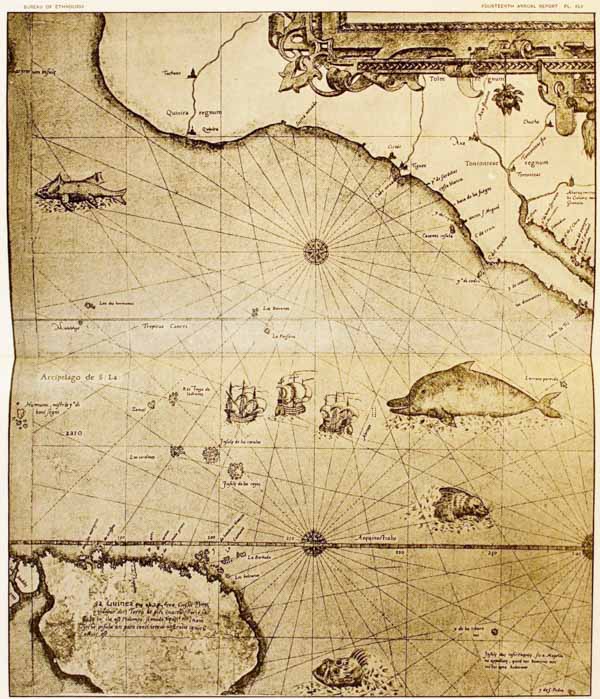
XLV. Mercator’s Northwestern
Part of New Spain, 1569
◊
The Council for the Indies referred the whole matter of the petitions
and accompanying evidence to the fiscal, the licentiate Villalobos, April
21, 1540. He made a report, which virtually decided the case, May 25.
The parties were given an opportunity of replying to this, and they
continued to present evidence and petitions and countercharges for a
year longer. The final decision, if any was made, has not been printed,
so far as I know, but the Council could hardly have done anything
beyond formally indorsing the report of Villalobos. The duty of the
fiscal was plain, and his report advises His Majesty not to grant any of
the things asked for by the petitioners. He states that this discovery
ought to be made by and in behalf of His Majesty, since the region
was not included in any previous grant. Although the Crown had
forbidden any further unlicensed explorations, this would not prevent
expeditions being undertaken on the part of the Crown, which is always
at liberty to explore at will. In effect, of course, the report sanctioned
the exploration by Mendoza, who represented the royal interests and
power. An objection was at once entered in behalf of De Soto, using
the very good argument that Mendoza’s expedition would be sent out
either at the expense of the Crown or of his private fortune. If the
former, it was claimed that as the explorer would have the glory in any
event, the Crown ought to save the expense by allowing De Soto, who
had already undertaken the same thing at his own cost, to make these
discoveries, which he promised should redound to as great an extent to
the glory and advantage of the Emperor. If Mendoza was undertaking
this at his own expense, it was evident that he would desire to
recover his outlay. Here he was merely on the same footing as De
Soto, who was prepared to make a better offer to his Royal Master than
Mendoza could possibly afford. In either case there was the danger of
scandal and disaster, in case the two expeditions should be allowed to
come together beyond the range of the royal oversight. No answer to
this appeal is recorded, and the parties continued to argue down their
opponents’ cases, while the viceroy in New Spain started the expedition
which, under the command of Francisco Vazquez Coronado, discovered
the Pueblo Indians of New Mexico, the Grand canyon of the Colorado,
and the bison of the great plains.
THE EXPEDITION TO NEW MEXICO AND THE GREAT PLAINS — THE ORGANIZATION OF THE EXPEDITION — THE DEPARTURE OF THE EXPEDITION — THE EXPEDITION BY SEA UNDER ALARCON — THE JOURNEY FROM CULIACAN TO CIBOLA
Two classes of colonists are essential to the security and the permanent
prosperity of every newly opened country. In New Spain in the
sixteenth century these two classes, sharply divided and almost antagonistic—the
established settlers and the free soldiers of fortune—were
both of considerable importance. Cortes, so soon as he had conquered
the country, recognized the need of providing for its settlement by a
stable population. In the petitions and memorials which he
wrote in p374
1539 and 1540 he continually reiterates the declaration of the pains
and losses sustained on account of his efforts to bring colonists from
Spain to populate the New World. Whether he accomplished all that
these memorials claim is doubtful, for there are comparatively few references
to this class of immigrants during the years when Cortes was
in a position to accomplish his designs. Mendoza declared that the
increase of the European population in New Spain came largely after
his own arrival there, in 1535, and this was probably true. The “good
viceroy” unquestionably did more than anyone else to place the province
on a permanent basis.48
Mendoza supervised with great care the assignment of land to the
newcomers, and provided tools and stock for those who had not the
means of equipping their farms. As a royal decree forbade the granting
of land to unmarried men, besides directing an increase of royal
favor and additional grants proportionate to the increase of children,
the viceroy frequently advanced the money which enabled men who
were desirous of settling down to get married. When he came from
Spain in 1535, he brought with him a number of eligible spinsters, and
it is quite probable that, after these had found husbands, he maintained
the supply of maids suitable to become the wives of those colonists
who wished to experience the royal bounty and favor. Alvarado
engaged in a similar undertaking when he came out to Guatemala in
1539, but with less success than we may safely hope rewarded the
thoughtfulness of Mendoza.49
A royal order in 1538 had decreed that
all who held encomiendas should marry within three years, if not
already possessed of a wife, or else forfeit their estates to married men.
Some of the bachelor landholders protested against the enforcement of
this order in Guatemala, because eligible white women could not be
found nearer than Mexico. To remove this objection, Alvarado brought
twenty maidens from Spain. Soon after their arrival, a reception was
held, at which they were given a chance to see their prospective husbands.
During the evening, one of the girls declared to her companions
that she never could marry one of these “old fellows, . . . who
were cut up as if they had just escaped from the infernal regions, . . .
for some of them are lame, some have only one hand, others
have no ears or only one eye, and some of them have lost half their
faces. The best of them have one or two scars across
their foreheads.” p375
The story is that one of the “old fellows” overheard this outburst,
reported it to his friends, and promptly went off and married the
daughter of a powerful cacique.
Besides assisting his colonists to get wives, Mendoza did a great deal
to foster the agricultural interests of the province. He continued the
importation of cattle, which Cortes had begun, and also procured
horses and sheep from Spain. He writes in one of his letters of the especial
satisfaction that he felt because of the rapid increase of his merino
sheep, in spite of the depredations of the natives and of wild animals.
The chief concern of the officials of the audiencia had been the gold
mines, which yielded a considerable revenue in certain districts; but
Mendoza, without neglecting these, proved how large and reliable was
the additional revenue which could be derived from other sources.
The viceroy’s success in developing the province can not be shown
more clearly than by repeating the description of New Spain in 1555,
written by Robert Tomson, an English merchant engaged in the Spanish
trade. In the course of a business tour Tomson visited the City
of Mexico. His commercial friends in the city entertained him most
hospitably, and did their best to make his visit pleasant. He refused,
however, to heed their warnings, and his indiscreet freedom of speech
finally compelled the officials of the Inquisition to imprison him, thus
adding considerably to the length of his residence in the city. After
he returned home, he wrote a narrative of his tour, in which he says of
New Spain:
“As for victuals in the said Citie, of beefe, mutton, and hennes, capons, quailes,
Guiñy-cockes, and such like, all are very good cheape: To say, the whole quarter of
an oxe, as much as a slaue can carry away from the Butchers, for fine Tomynes, that
is, fine Royals of plate, which is iust two shillings and sixe pence, and a fat sheepe
at the Butchers for three Royals, which is 18. pence and no more. Bread is as good
cheape as in Spaine, and all other kinde of fruites, as apples, peares, pomegranats,
and quinces, at a reasonable rate. . . . [The country] doth yeeld great store of
very good silke, and Cochinilla. . . . Also there are many goodly fruits, whereof
we haue none such, as Plantanos, Guyanes, Sapotes, Tunas, and in the wildernes
great store of blacke cheries, and other wholsome fruites. . . . Also the Indico
that doeth come from thence to die blew, is a certaine hearbe. . . . Balme,
Salsaperilla, cana fistula, suger, oxe hides, and many other good and seruiceable
things the Countrey doeth yeeld, which are yeerely brought into Spaine, and there
solde and distributed to many nations.”50
The other class among the colonists of New Spain in the second
quarter of the sixteenth century “floated like cork on the water” on
those who had established their homes in the New World.51
The men p376
who made it possible to live in security on the farms and ranches
of the province had rendered many and indispensable services, and
there was much that they might still do to enlarge its boundaries and
make the security more certain. They were, nevertheless, a serious
hindrance to the prosperity of the settlements. For the most part they
were young men of all sorts and degrees. Among them were many
sons of Spanish noblemen, like Mendoza the viceroy, whose brother
had just succeeded his father as Marquis de Mondejar. Very much of
the extension of the Spanish world by discovery and conquest was due
to the sons of men of rank, who had, perhaps generally, begun to sow
their wild oats in Spain and were sent across the Atlantic in order to
keep them out of mischief at home, or to atone, it may be, for mischief
already done. In action, these young caballeros were most efficient.
By personal valor and ability, they held the positions of leadership
everywhere, among men who followed whom and when they chose, and
always chose the man who led them most successfully. When inactive,
these same cavaliers were a most trying annoyance to any community
in which they happened to be. Armed with royal letters and comprehensive
introductions, they had to be entertained, at heavy charges.
Masters of their own movements, they came as they liked, and very
often did not go away. Lovers of excitement, they secured it regardless
of other men’s wives or property.
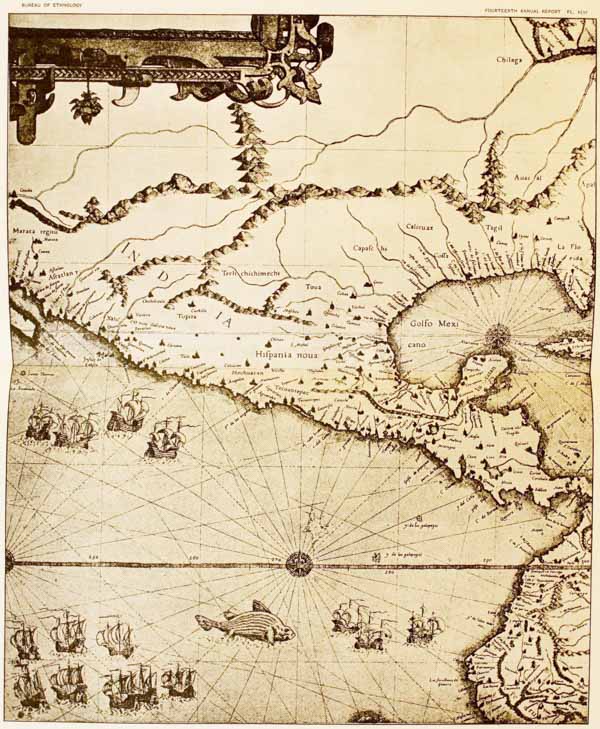
XLVI. Mercator’s Interior of New Spain, 1589
◊
There had been few attractions to draw these adventurers away
from Mexico, the metropolis of the mainland, for some time previous
to 1539. Peru still offered excitement for those who had nothing to
gain or lose, but the purely personal struggle going on there between
Pizarro and Almagro could not arouse the energies of those who were
in search of glory as well as of employment. A considerable part of
the rabble which followed Nuño de Guzman during the conquest of
New Galicia went to Peru after their chief had been superseded by the
Licentiate de la Torre, so that one town is said to have disappeared
entirely from this cause; but among these there were few men of good
birth and spirit. Mendoza had been able, at first, to accommodate
and employ those who accompanied him from Spain, like Vazquez
Coronado, “being chiefly young gentlemen.” But every vessel coming
from home brought some companion or friend of those who were
already in New Spain, and after Cabeza de Vaca carried the reports of
his discoveries to the Spanish court, an increasing number came each
season to join the already burdensome body of useless members of the
viceregal household. The viceroy recognized the necessity of relieving
the community of this burden very soon after he had established himself
in Mexico, and he was continually on the watch for some suitable
means of freeing himself from these guests. By 1539 the problem of
looking after these young gentlemen—whose number is determined
quite accurately by the two hundred and fifty or three hundred “gentlemen
on horseback” who left New Spain with Coronado in the p377
spring of 1540—had become a serious one to the viceroy. The most
desirable employment for all this idle energy would be, of course, the
exploration and conquest of new country, or the opening of the border
territory for permanent settlement. But no mere work for work’s sake,
no wild-goose chase, would do. These young gentlemen had many
friends near to Charles V, who would have resented any abuse of
privilege or of confidence. A suitable expedition could be undertaken
only at considerable expense, and unless the cost could all be made
good to the accountants in Spain, complaints were sure to be preferred
against even the best of viceroys. So Mendoza entertained his guests
as best he could, while they loafed about his court or visited his stock
farms, and he anxiously watched the reports which came from the officials
of the northwestern province of New Galicia and from the priests
who were wandering and working among the outlying Indian tribes.
When, late in the summer of 1539, Friar Marcos returned from the north,
bringing the assurance that Cibola was a desirable field for conquest,
the viceroy quickly improved the opportunity for which he had been
waiting. Within a month and a half Mendoza had begun to organize
the force which was to conquer this new country.
Compostela, on the Pacific coast, was announced as the place at
which the force should assemble. The viceroy desired to have the
army begin its march so soon as the roads were passable in the spring,
and he wished also to relieve the Indians living in the districts between
Mexico and the coast from as much as possible of the annoyance and loss
which would be inevitable if the army started from Mexico and marched
through this territory in a body. How much this forethought for the
Indians was needed appears from Mendoza’s reply to the accusations
against him filed during the visita of 1547, which showed that all his
care had not saved the Indians of Michoacan from needless injury at
the hands of those who were on their way to join the gathering at Compostela.
Incidentally, this arrangement also gave the capital city an
earlier relief from its unwelcome guests.
Popular as was the expedition to the Seven Cities, there was a little
opposition to the undertaking. When it became evident that a large
force was about to leave the country, some of those who were to remain
behind complained that all New Spain was being depopulated,
and that no one would be left to defend the country in case of an
Indian uprising. When Mendoza reached Compostela, by the middle
of February, 1540, Coronado asked him to make an official investigation
of these complaints. The formal request is dated February 21,
and on the following day, Sunday, the viceroy held a grand review of
the whole array, with everyone ready equipped for the march. As the
men passed before the viceregal party the secretaries made an exact
count and description of the force, but this document is not now known.
Its loss is partly supplied by the sworn testimony of the officials who
were best acquainted with the inhabitants of all parts of
New Spain, p378
recorded a few days after the departure of the expedition. They declare
that in the whole army there were only two or three men who had ever
been settled residents in the country; that these few were men who had
failed to make a living as settlers, and that, in short, the whole force
was a good riddance.52
The men who assembled at Compostela to start for the Seven Cities
numbered, Mendoza stated at the time of the visita in 1547, “about
two hundred and fifty Spaniards on horseback, . . . and about
three hundred Indians, a few more or less.” Mota Padilla, who
must have used documents of the very best authority, nearly all of
which have since disappeared, gives the number of the force as “two
hundred and sixty horsemen, . . seventy footmen, . . and more
than a thousand friendly Indians and Indian servants.” Herrera, who
used official documents, says that there were one hundred and fifty
horsemen and two hundred footmen. Mendoza’s statement of the number
of Indians may be explained, if we suppose him to have referred
only to the friendly Indians who went on the expedition as native
allies. His statement is made in the course of a defense of his administration,
when he was naturally desirous of giving as small a number
as possible. Castañeda says that there were three hundred horsemen,
and this number occurs in other early narratives.
Mendoza spared neither pains nor expense to insure the success of the
expedition. Arms, horses, and supplies were furnished in abundance;
money was advanced from the royal chest to any who had debts to pay
before they could depart, and provision was made for the support of
those who were about to be left behind by fathers, brothers, or husbands.
The equipment of the force was all that the viceroy could
desire. Arms and military supplies had been among the things greatly
needed in New Spain when Mendoza reported its condition in his first
letters to the home government. In 1537 he repeated his request for
these supplies with increased insistence. The subject is not again mentioned
in his letters, and we may fairly suppose that he had received the
weapons and munitions of war, fresh from the royal arsenals of Spain,
with which he equipped the expedition on whose success he had staked
so much. It was a splendid array as it passed in review before Mendoza
and the officials who helped and watched him govern New Spain, on this
Sunday in February, 1540. The young cavaliers curbed the picked
horses from the large stock farms of the viceroy, each resplendent in
long blankets flowing to the ground. Each rider held his lance erect,
while his sword and other weapons hung in their proper places at his
side. Some were arrayed in coats of mail, polished to shine like that of
their general, whose gilded armor with its brilliant trappings was to
bring him many hard blows a few months later. Others wore iron helmets
or vizored headpieces of the tough bullhide for which the
country p379
has ever been famous. The footmen carried crossbows and harquebuses,
while some of them were armed with sword and shield. Looking on at
these white men with their weapons of European warfare was the crowd
of native allies in their paint and holiday attire, armed with the club and
the bow of an Indian warrior. When all these started off next morning,
in duly ordered companies, with their banners flying, upward of a thousand
servants and followers, black men and red men, went with them,
leading the spare horses, driving the pack animals, bearing the extra
baggage of their masters, or herding the large droves of “big and little
cattle,” of oxen and cows, sheep, and, maybe, swine,53
which had been
collected by the viceroy to assure fresh food for the army on its march.
There were more than a thousand horses in the train of the force,
besides the mules, loaded with camp supplies and provisions, and carrying
half a dozen pieces of light artillery—the pedreros, or swivel
guns of the period.
After the review, the army assembled before the viceroy, who
addressed to them an exhortation befitting the occasion. Each man,
whether captain or foot soldier, then swore obedience to his commander
and officers, and promised to prove himself a loyal and faithful vassal
to his Lord the King. During the preceding week the viceroy had
divided the force into companies, and now he assigned to each its captain,
as Castañeda relates, and announced the other officers of the army.
Francisco Vazquez Coronado—de Coronado it is sometimes written—was
captain-general of the whole force. “Who he is, what he has
already done, and his personal qualities and abilities, which may be
made useful in the various affairs which arise in these parts of the
Indies, I have already written to Your Majesty,” writes Mendoza to
the Emperor, in the letter of December 10, 1537. This previous letter
is not known to exist, and there is very little to supply the place of
its description of the character and antecedents of Vazquez Coronado.
His home was in Salamanca,54
and he came to America in the retinue
of Mendoza in 1535. His relations with his patron, the viceroy, previous
to the return of the expedition from Cibola, appear always to have
been most cordial and intimate. In 1537 Coronado married Beatrice
de Estrada, a cousin by blood, if gossip was true, of the Emperor,
Charles V. Her father, Alonso, had been royal treasurer of New Spain.
From his mother-in-law Coronado received as a marriage gift a considerable
estate, “the half of Tlapa,” which was confirmed to him by a
royal grant. Cortez complained that the income from this estate was
worth more than 3,000 ducados, and that it had been unduly and inconsiderately
alienated from the Crown. Coronado obtained also the
estate of one Juan de Búrgos, apparently one of those
who forfeited p380
their land because they persisted in the unmarried state. This arrangement
likewise received the royal approval.55
When, however, “the
new laws and ordinances for the Indies” came out from Spain in 1544,56
after Coronado’s return from the northern expedition, one of the sections
expressly ordered an investigation into the extent and value of
the estates held by Francisco Vazquez de Coronado, since it had been
reported to the King that the number of Indians held to service on these
estates was very excessive. Mendoza had to answer the same charge
at his visita in 1547.
Mendoza sent Coronado, in 1537, to the mines at Amatepeque, where
the negroes had revolted and “elected a king,” and where they threatened
to cause considerable trouble. The revolt was quelled, after some
fighting, with the help of the Indians of the district. A couple of
dozen of the rebels were hung and quartered at the mines or in the City
of Mexico.57
In the following August, Coronado was legally recognized as a citizen
of the City of Mexico, where he was one of three witnesses chosen to
testify to the formal recognition by Cortes of the royal order which
permitted De Soto to explore and conquer Florida.58
A month later,
September 7, 1538, the representative of De Soto, Alvaro de Sanjurjo,
summoned Coronado himself to recognize and promise obedience to the
same royal order, “as governor, as the said Sanjurjo declared him to
be, of New Galicia.” Coronado readily promised his loyal and respectful
obedience to all of His Majesty’s commands, but observed that this
matter did not concern him at all, “since he was not governor, nor did
he know that His Majesty desired to have him serve in such a position;
and if His Majesty should desire his services in that position, he would
obey and submit to the royal provision for him whenever he was called
on, and would do what was most serviceable to the royal interests.”
He adds that he knows nothing about the government of Ayllon or
that of Narvaez, which were mentioned in the license to De Soto. This
part of his statement can hardly have been strictly true. The answer
was not satisfactory to Sanjurjo, who replied that he had received
information that Coronado was to be appointed governor of New Galicia.
The latter stated that he had already given his answer, and thereupon
Sanjurjo formally protested that the blame for any expenditures, damages,
or scandals which might result from a failure to observe the royal
order must be laid at the door of the one to whom they rightfully
belonged, and that they would not result from any fault or omission on
the part of De Soto. Sanjurjo may have received some hint or suggestion
of the intention to appoint Coronado, but it is quite certain that
no definite steps had yet been taken to supplant the
licentiate, De la p381
Torre, as governor of New Galicia. Coronado’s answer shows plainly
that he intentionally refused to commit himself when so many things
were uncertain, and when nothing was definitely known about the
country of which Cabeza de Vaca had heard. Mendoza may have suggested
his appointment at an earlier date, but the King apparently
waited until he learned of De la Torre’s untimely death before approving
the selection. The confirmation was signed April 18, 1539, and at
the same time Coronado was appointed to take the residencia of his
predecessor. The King agreed to allow the new governor a salary of
1,000 ducats from the royal treasure chests and 1,500 more from the
province, with the proviso that the royal revenues were not to be held
responsible for this latter sum in case New Galicia proved too poor to
yield so large an amount. Coronado probably went at once to his
province when he received the notice of his nomination, for he was in
Guadalajara on November 19, 1538, where he approved the selection of
judges and magistrates for the ensuing year by the city of Compostela,
which had held its election before his arrival. At the same time he
appointed the judges for Guadalajara.
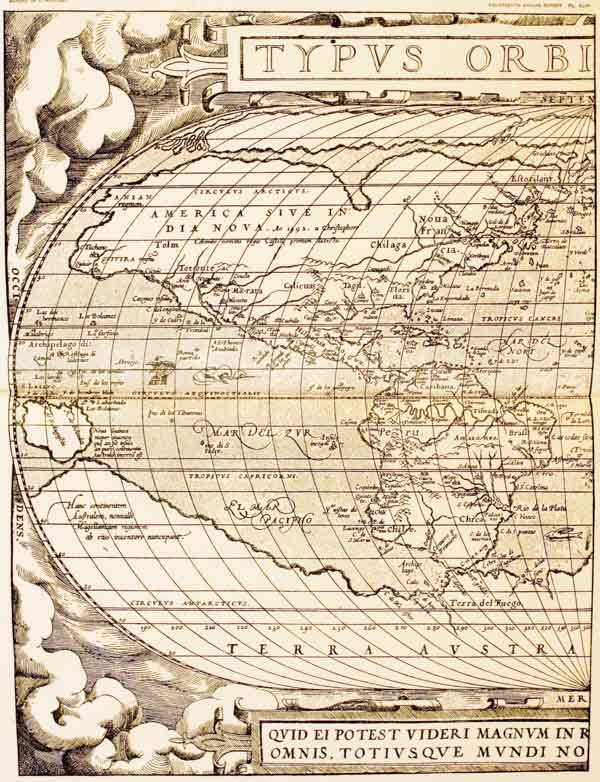
XLVII. Abr. Ortelius’
Theatrum Orbis Terrarum, 1570
◊
Coronado probably spent the winter of 1538–39 in New Galicia,
arranging the administration and other affairs of his government. He
entertained Friar Marcos, when the latter passed through his province
in the spring of 1539, and accompanied the friar as far as Culiacan, the
northernmost of the Spanish settlements. Here he provided the friar
with Indians, provisions, and other things necessary for the journey to
the Seven Cities. Later in the spring, the governor returned to Guadalajara,
and devoted considerable attention to the improvement and
extension of this city, so that it was able to claim and obtain from the
King a coat of arms and the title of “city” during the following summer.59
He was again here on January 9, 1540, when he promulgated
the royal order, dated December 20, 1538, which decreed that inasmuch
as it was reported that the cities in the Indies were not built with sufficient
permanency, the houses being of wood and thatched with straw,
so that fires and conflagrations were of frequent occurrence, therefore
no settler should thereafter build a house of any material except stone,
brick, or unbaked brick, and the houses should be built after the fashion
of those in Spain, so that they might be permanent, and an adornment
to the cities. Between these dates it is very likely that Coronado
may have made some attempt to explore the mountainous regions
north of the province, as Castañeda says, although his evidence is by
no means conclusive.
About midsummer of 1539, Friar Marcos came back from Cibola.
Coronado met him as he passed through New Galicia, and together they
returned to Mexico to tell the viceroy what the friar had seen and
heard. Coronado remained at the capital during the autumn
and early p382
winter, taking an active part in all the preparations for the expedition
which he was to command. After the final review in Compostela, he
was placed in command of the army, with the title of captain-general.
Monday, February 23, 1540, the army which was to conquer the
Seven Cities of Cibola started on its northward march from Compostela.60
For 80 leagues the march was along the “much-used roads”
which followed the coast up to Culiacan.61
Everyone was eager to reach the wonderful regions which were to
be their destination, but it was impossible to make rapid progress.
The cattle could not be hurried, while the baggage animals and the carriers
were so heavily laden with equipments and provisions that it was
necessary to allow them to take their own time. Several days were
lost at the Centizpac river, across which the cattle had to be p383
transported one at a time. At Chiametla there was another delay. Here
the army camped in the remains of a village which Nuño de Guzman
had established. The settlers had been driven away by a pestilence
caught from the Indians, and by the fierce onslaught of the natives
who came down upon them from the surrounding mountains. The food
supply of Coronado’s force was beginning to fail, and as the tribes hereabout
were still in rebellion, it became necessary to send a force into
the mountains to obtain provisions. The army master, Samaniego, who
had been warden of one of the royal fortresses,62
commanded the foraging
party. The men found themselves buried in the thick underbrush
as soon as they passed beyond the limits of the clearing. One of the
soldiers inadvertently, but none the less in disregard of strict orders,
became separated from the main party, and the Indians, who were nowhere
to be seen, at once attacked him. In reply to his cries, the watchful
commander hastened to his assistance. The Indians who had tried
to seize him suddenly disappeared. When everything seemed to be
safe, Samaniego raised his visor, and as he did so an arrow from among
the bushes pierced his eye, passing through the skull. The death of
Samaniego was a severe loss to the expedition. Brave and skillful, he
was beloved by all who were with him or under him. He was buried
in the little chapel of the deserted village. The army postponed its departure
long enough to capture several natives of the district, whose
bodies were left hanging on the trees in order to counteract the bad
augury which followed from the loss of the first life.63
A much more serious presage was the arrival at Chiametla, as the
army was preparing to leave, of Melchior Diaz and Juan de Saldivar,
or Zaldivar, returning from their attempt to verify the stories told by
Friar Marcos. Melchior Diaz went to New Galicia with Nuño de Guzman,
and when Cabeza de Vaca appeared in that province, in May
1536, Diaz was in command of the outpost of Culiacan. He was still
at Culiacan, in the autumn of 1539, when Mendoza directed him to take
a mounted force and go into the country toward the north “to see if
the account which Friar Marcos brought back agreed with what he
could observe.” He left Culiacan November 17, with fifteen horsemen,
and traveled as far north as the wilderness beyond which Cibola was
situated, following much the same route as the friar had taken, and
questioning the Indians with great care. Many of the statements made
by Friar Marcos were verified, and some new facts were obtained, but
nowhere could he find any foundation for the tales of a wealthy and
attractive country, except in the descriptions given by the Indians.
The cold weather had begun to trouble his men seriously before he
reached the limit of his explorations. He pushed on as far as Chichilticalli,
however, but here the snows and fierce winds from across
the p384
wilderness forced him to turn back. At Chiametla he encountered
Coronado’s force. He joined the army, sending his lieutenant, Saldivar,
with three other horsemen, to carry his report to the viceroy. This was
delivered to Mendoza on March 20, and is embodied in the letter to the
King, dated April 17, 1540.
Coronado did not allow Diaz to announce the results of his reconnoissance
to the soldiers, but the rumor quickly spread that the visions inspired
by Friar Marcos had not been substantiated. Fortunately, the
friar was himself in the camp. Although he was now the father provincial
of the Franciscan order in New Spain, he had determined to accompany
the expedition, in order to carry the gospel to the savages
whose salvation had been made possible by his heroic journey of the
preceding spring. The mutterings of suspicion and discontent among
the men grew rapidly louder. Friar Marcos felt obliged to exhort them
in a special sermon to keep up a good courage, and by his eloquence he
succeeded in persuading them that all their labors would soon be well
repaid.
From Chiametla the army resumed its march, procuring provisions
from the Indians along the way. Mendoza stated, in 1547, that he
took every precaution to prevent any injury or injustice being done to
the Indians at the time of Coronado’s departure, and that he stationed
officials, especially appointed for this purpose, at convenient points on
the road to Culiacan, who were ordered to procure the necessary provisions
for the expedition. There are no means of telling how well this
plan was carried into execution.
A day or two before Easter, March 28, 1540, the army approached
Culiacan. The journey had occupied a little over a month, but when
Coronado, from his lodging in the Cibola village of Granada, three
months later, recalled the slow and tedious marches, the continual
waiting for the lazy cattle and the heavily loaded baggage trains, and
the repeated vexatious delays, we can hardly wonder that it seemed to
him to have been a period of fourscore days’ journey.
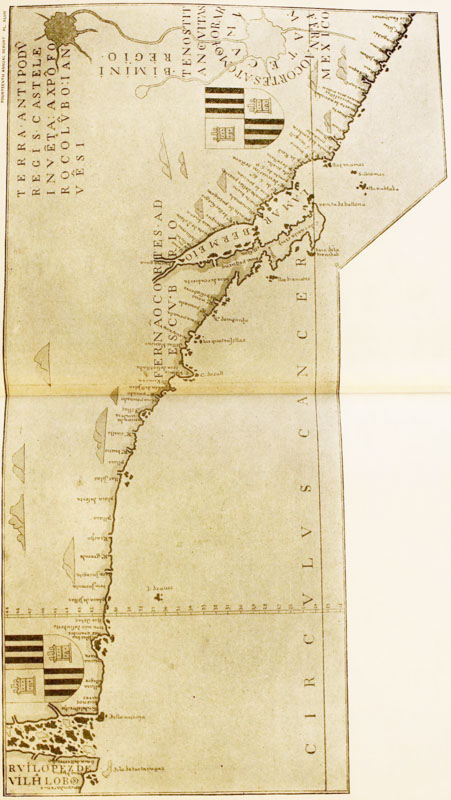
XLVIII. Dourado’s Terra Antipodv Regis
Castele Inveta, 1580
◊
The town of San Miguel de Culiacan, in the spring of 1540, was one
of the most prosperous in New Spain. Nuño de Guzman had founded
the settlement some years before, and had placed Melchior Diaz in
charge of it. The appointment was a most admirable one. Diaz was
not of gentle birth, but he had established his right to a position of
considerable power and responsibility by virtue of much natural ability.
He was a hard worker and a skillful organizer and leader. He inspired
confidence in his companions and followers, and always maintained the
best of order and of diligence among those who were under his charge.
Rarely does one meet with a man whose record for every position and
every duty assigned to him shows such uniform and thorough efficiency.
The settlement increased rapidly in size and in wealth, and when Coronado’s
force encamped in the surrounding fields, the citizens of the town
insisted on entertaining in their own homes all of the
gentlemen who p385
were with the expedition. The granaries of the place were filled with
the surplus from the bountiful harvests of two preceding years, which
sufficed to feed the whole army for three or four weeks, besides providing
supplies sufficient for more than two months when the expedition
resumed its march. These comfortable quarters and the abundant
entertainment detained the general and his soldiers for some weeks.64
This was the outpost of Spanish civilization, and Coronado made sure
that his arrangements were as complete as possible, both for the army
and for the administration of New Galicia during his absence.
The soldiers, and especially the gentlemen among them, had started
from Compostela with an abundant supply of luxurious furnishings
and extra equipment. Many of them were receiving their first rough
lessons in the art of campaigning, and the experiences along the way
before reaching Culiacan had already changed many of their notions
of comfort and ease. When the preparations for leaving Culiacan
began, the citizens of the town received from their guests much of the
clothing and other surplus baggage, which was left behind in order that
the expedition might advance more rapidly, or that the animals might
be loaded with provisions. Aside from what was given to the people
of the place, much of the heavier camp equipage, with some of the
superfluous property of the soldiers, was put on board a ship, the San
Gabriel, which was waiting in the harbor of Culiacan. An additional
supply of corn and other provisions also was furnished for the vessel by
the generous citizens.
A sea expedition, to cooperate with the land force, was a part of
Mendoza’s original plan. After the viceroy left Coronado, and probably
while he was at Colima, on his way down the coast from Compostela,
he completed the arrangements by appointing Hernando de
Alarcon, his chamberlain according to Bernal Diaz, to command a fleet
of two vessels. Alarcon was instructed to sail northward, following
the coast as closely as possible. He was to keep near the army, and
communicate with it at every opportunity, transporting the heavy
baggage and holding himself ready at all times to render any assistance
which Coronado might desire. Alarcon sailed May 9, 1540, probably
from Acapulco.65
p386
This port had been the seat of the shipbuilding operations of Cortes
on the Pacific coast, and it is very probable that Alarcon’s two ships
were the same as those which the marquis claimed to have equipped
for a projected expedition. Alarcon sailed north to Santiago, where he
was obliged to stop, in order to refit his vessels and to replace some
artillery and stores which had been thrown overboard from his companion
ship during a storm. Thence he sailed to Aguaiauale, as Ramusio
has it, the port of San Miguel de Culiacan. The army had already
departed, and so Alarcon, after replenishing his store of provisions,
added the San Gabriel to his fleet and continued his voyage. He followed
the shore closely and explored many harbors “which the ships of
the marquis had failed to observe,” as he notes, but he nowhere succeeded
in obtaining any news of the army of Coronado.
Melchior Diaz had met with so many difficulties in traveling through
the country which the army was about to enter, on its march toward the
Seven Cities, and the supply of food to be found there was everywhere so
small, that Coronado decided to divide his force for this portion of the
journey. He selected seventy-five or eighty horsemen, including his
personal friends, and twenty-five or thirty foot soldiers. With these
picked men, equipped for rapid marching, he hastened forward, clearing
the way for the main body of the army, which was to follow more
slowly, starting a fortnight after his own departure. With the footmen
in the advance party were the four friars of the expedition, whose
zealous eagerness to reach the unconverted natives of the Seven Cities
was so great that they were willing to leave the main portion of the army
without a spiritual guide. Fortunately for these followers, a broken leg
compelled one of the brethren to remain behind. Coronado attempted
to take some sheep with him, but these soon proved to be so great a
hindrance that they were left at the river Yaquimi, in charge of four
horsemen, who conducted them at a more moderate pace.
Leaving Culiacan on April 22, Coronado followed the coast, “bearing
off to the left,” as Mota Padilla says, by an extremely rough way, to
the river Cinaloa. The configuration of the country made it necessary
to follow up the valley of this stream until he could find a passage
across the mountains to the course of the Yaquimi. He traveled alongside
this stream for some distance, and then crossed to
Sonora river.66
p387
The Sonora was followed nearly to its source before a pass was discovered.
On the northern side of the mountains he found a stream—the
Nexpa, he calls it—which may have been either the Santa Cruz or the
San Pedro of modern maps. The party followed down this river valley
until they reached the edge of the wilderness, where, as Friar Marcos
had described it to them, they found Chichilticalli.67
Here the party camped for two days, which was as long as the general
dared to delay, in order to rest the horses, who had begun to give out
sometime before as a result of overloading, rough roads, and poor feed.
The stock of provisions brought from Culiacan was already growing
dangerously small, although the food supply had been eked out by the
large cones or nuts of the pines of this country, which the soldiers found
to be very good eating. The Indians who came to see him, told Coronado
that the sea was ten days distant, and he expresses surprise, which
Mr Bandolier has reëchoed, that Friar Marcos could have gone within
sight of the sea from this part of the country.
Coronado entered the wilderness, the White Mountain Apache country
of Arizona, on Saint John’s eve, and in the quaint language of
Hakluyt’s translation of the general’s letter, “to refresh our former
trauailes, the first dayes we founde no grasse, but worser way of mountaines
and badde passages.”68
Coronado, following very nearly the line
of the present road from Fort Apache to Gila river, proceeded until he
came within sight of the first of the Seven Cities. The first few days of
the march were very trying. The discouragement of the men increased
with the difficulties of the way. The horses were tired, and the slow
progress became slower, as horses and Indian carriers fell down and
died. The corn was almost gone, and as a result of eating the fruits
and herbs which they found along the way, a Spaniard and some of the
servants were poisoned so badly that they died. The skull and horns
of a great mountain goat, which were lying on the ground, filled the
Europeans with wonder, but this was hardly a sign to inspire them
with hopes of abundant food and gold. There were 30 leagues of this
travailing before the party reached the borders of the inhabited country,
where they found “fresh grass and many nutte and mulberrie trees.”
The day following that on which they left the wilderness, the advance
guard was met, in a peaceable manner, by four Indians. The Spaniards
treated them most kindly, gave them beads and clothing,
and “willed p388
them to return unto their city and bid them stay quiet in their houses
fearing nothing.” The general assured them that they need have no
anxiety, because the newcomers had been sent by His Spanish Majesty,
“to defend and ayde them.”
THE EXPLORATION OF THE COUNTRY — THE MARCH OF THE ARMY FROM CULIACAN TO TIGUEX — THE WINTER OF 1540–1541 ALONG THE RIO GRANDE — THE JOURNEY ACROSS THE BUFFALO PLAINS
THE SPANIARDS AT ZUÑI
Some of the inhabitants of Hawikuh-Granada returned to the village,
bringing gifts, while Coronado was recovering from his wounds. The
general faithfully exhorted them to become Christians and to submit
themselves to the sovereign over-lordship of His Majesty
the Spanish p390
King. The interview failed to reassure the natives, for they packed
all their provisions and property on the following day, and with their
wives and children abandoned the villages in the valley and withdrew
to their stronghold, the secure fastness on top of Taaiyalone or Thunder
mountain.
As soon as he was able, Coronado visited the other villages of Cibola-Zuñi,
observing the country carefully. He reassured the few Indians
whom he found still living in the valley, and after some hesitation on
their part succeeded in persuading the chiefs to come down from the
mesa and talk with him. He urged them to return to their homes
below, but without success. He was more fortunate in obtaining information
regarding the surrounding country, which was of much use to
him in directing further exploration. Then as now the rule held good
that the Indians are much more likely to tell the truth when giving
information about their neighbors than about themselves.
THE DISCOVERY OF TUSAYAN AND THE GRAND CANYON
A group of seven villages, similar to those at Cibola, was reported
to be situated toward the west, “the chief of the towns whereof they
have knowledge.” Tucano was the name given to these, according to
Ramusio’s version of Coronado’s letter, and it is not difficult to see in
this name that of Tusayan, the Hopi or Moki settlements in northeastern
Arizona.
As soon as everything was quiet in the Cibola country, about the
middle of July, Don Pedro de Tovar was ordered to take a few horsemen
and his company of footmen and visit this district. Don Pedro
spent several days in the Tusayan villages, and after he had convinced
the people of his peaceable designs, questioned them regarding the
country farther west. Returning to the camp at Cibola within the
thirty days to which his commission was limited, Tovar reported that
the country contained nothing to attract the Spaniards. The houses,
however, were better than those at Cibola. But he had heard stories of
a mighty river and of giant peoples living toward the west, and so Don
Garcia Lopez de Cardenas was instructed to go and verify these reports.
Cardenas started, perhaps on August 25. He had authority for eighty
days, and within this term he succeeded in reaching the Grand canyon
of Colorado river, which baffled his most agile companions in their
efforts to descend to the water or to discover some means of crossing
to the opposite side. He returned with only the story of this hopeless
barrier to exploration westward.
THE RIO GRANDE AND THE GREAT PLAINS
The first expedition toward the east was sent out August 29 in charge
of Don Hernando de Alvarado. Passing the rock of Acuco or Acoma—always
a source of admiration—Alvarado reached the village and river
of Tiguex—the Rio Grande—on September 7. Some time was
spent in p391
visiting the villages situated along the stream. The headquarters of
the party were at Tiguex, at or near the site of the present town of
Bernalillo, and here a list was drawn up and sent to the general giving
the names of eighty villages of which he had learned from the natives
of this place. At the same time Alvarado reported that these villages
were the best that had yet been found, and advised that the winter
quarters for the whole force should be established in this district. He
then proceeded to Cicuye or Pecos, the most eastern of the walled
villages, and from there crossed the mountains to the buffalo plains.
Finding a stream which flowed toward the southeast—the Canadian
river, perhaps—he followed its course for a hundred leagues or more.
Many of the “humpback oxen” were seen, of which some of the men
may have remembered Cabeza de Vaca’s description.
On his return, Alvarado found the army-master, Garcia Lopez de
Cardenas, at Tiguex, arranging winter quarters sufficient to accommodate
the whole force in this region.71
Coronado, who had made a trip
to examine the villages farther south, along the Rio Grande, soon joined
his lieutenants, leaving only a small force at Cibola to maintain the post.
The whole of the advance party was now in Tiguex, and orders had
been left at Cibola for the main body to proceed to the eastern settlements
so soon as they should arrive from Culiacan and Corazones.
The main portion of the army remained at Culiacan, under the
command of Don Tristan de Arellano, when the general started for
Cibola with his small party of companions. The soldiers completed
the work of loading the San Gabriel with their surplus equipment
and with provisions, and busied themselves about the town for a
fortnight after the departure of their general. Some time between the
first and middle of May, the army started to follow the route of the
advance party. The whole force marched on foot, carrying their lances
and other weapons, in order that the horses and other beasts, numbering
more than six hundred, might all be loaded with provisions. It had
taken Coronado and his party of horsemen, eager to push on toward
their destination, more than a month to make the journey to Corazones
or Hearts valley. We can only guess how much longer it took the
slowly marching army to cover this first half of the distance to Cibola.
The orders which the general had left with Arellano were that
he should p392
take the army to this valley, where a good store of provisions had been
found by Melchior Diaz, and there wait for further instructions. Coronado
promised to send for his soldiers as soon as he was sure that there
was a country of the Seven Cities for them to conquer and settle.
In the valley of Corazones, which had been given its name by Cabeza
de Vaca because the natives at this place offered him the hearts of
animals for food, Arellano kept the soldiers busy by building a town
on Suya river, naming it San Hieronimo de los Corazones—Saint
Jerome of the Hearts. A small force was sent down the river to the
seacoast, under the command of Don Rodrigo Maldonado, in the hope
of communicating with the ships of Alarcon. Maldonado found neither
signs nor news of the fleet, but he discovered a tribe of Indian “giants,”
one of whom accompanied the party back to the camp, where the soldiers
were filled with amazement at his size and strength.
Thus the time passed until early in September, when Melchior Diaz
and Juan Gallego brought the expected orders from the general. Gallego,
who carried the letter which Coronado had written from Granada-Hawikuh
on August 3, with the map and the exhibits of the country
which it mentions, continued on to Mexico. He was accompanied by
Friar Marcos. Diaz had been directed to stay in the new town of San
Hieronimo, to maintain this post and to open communication with the
seacoast. He selected seventy or eighty men—those least fitted for the
hardships and struggles of exploration and conquest—who remained to
settle the new town and to make an expedition toward the coast. The
remainder of the army prepared to rejoin their general at Cibola, and
by the middle of September the start was made.
After a long, rough march, in which little occurred to break the daily
monotony, the soldiers reached the pueblo settlements. The bad
weather had already begun, but the men were eager to continue their
journey in spite of the snow and the fierce, cold winds. After a short
rest, the force proceeded to Tiguex, where comfortable quarters were
awaiting them, and in these they quickly settled for the winter.
THE INDIAN REVOLT
The first winter spent by white men in the pueblos of New Mexico
was a severe one. Fortunately for the strangers, however, they were
comfortably domiciled in the best houses of the country, in which the
owners had left a plentiful supply of food, and this was supplemented
by the livestock brought from New Spain.
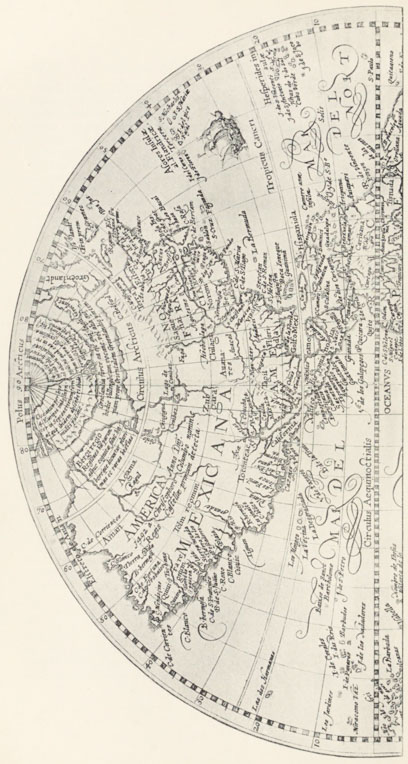
L. Northern Half of De Bry’s
“America Sive Novus Orbis,” 1596
◊
During the late autumn the Indians assumed a hostile attitude
toward their visitors, and were reduced to peaceful inactivity only after
a protracted struggle, which greatly aggravated the conquerors. The
Spanish story of this revolt is clear—that the Indians suddenly surprised
the Europeans by attacking the horses and mules of the army,
killing or driving off a number of them, after which the
natives p393
collected their fighting force into two of the strongest villages, from one of
which they were able to defy the soldiers until thirst compelled them
to abandon the stronghold. The defenders attempted to escape by
stealth, but the sentries of the besieging force discovered them and
aroused the camp. Many of the Indians were killed by the soldiers during
the flight which followed, while others perished in the icy waters of
the Rio Grande. During an attack on the second village, a few of the
Spaniards who had succeeded in making their way to the highest portion
of the buildings, escaped from their perilous position by inducing
the native warriors to surrender. The Indians received an ample
promise of protection and safety, but the captain of the attacking
party was not informed of this, and in obedience to the general’s
orders that no prisoners should be taken, he directed that the captives
should be burned as a warning to the neighboring tribes. This affair
is a terrible blot on the record of the expedition and of those who composed
it. In condemning it most severely, however, English readers
should remember that they are only repeating the condemnations which
were uttered by most of the men of rank who witnessed it, which were
repeated in New Spain and in old Spain, and which greeted the commander
when he led his expedition back to Mexico, to receive the cold
welcome of the viceroy.
The Spaniards have told us only one side of the story of what was
happening along the Rio Grande in the fall of 1540. The other side
will probably never be heard, for it disappeared with the traditions of
the Indian villagers. Without pretending to supply the loss, it is at
least possible to suggest that the preparations by which the army-master
procured the excellent accommodations for the force must have
appeared very differently to the people in whose homes Cardenas
housed the soldiers, and to those who passed the winter in these snug
quarters. Castañeda preserved one or two interesting details which
are as significant as is the striking fact that the peaceful natives who
entertained Alvarado most freely in September were the leaders of the
rebellion three months later.
As soon as Coronado’s men had completed the reduction of the
refractory natives, and the whole country had been overawed by the
terrible punishment, the general undertook to reestablish peaceful relations
and confident intercourse between his camp and the surrounding
villages. The Indians seem to have been ready to meet him almost
half-way, although it is hardly surprising to find traces of an underlying
suspicion, and a readiness for treacherous retaliation.
THE STORIES ABOUT QUIVIRA
While this reconciliation was being effected, Coronado heard from
one of the plains Indians,72
held as a slave in the village
of Cicuye p394
or Pecos, the stories about Quivira, which were to add so much to the
geographic extent of the expedition. When the Spaniards were about
to kill this Indian—“The Turk,” they called him73—he told them that
his masters, the people of Cicuye, had induced him to lead the strangers
away to the pathless plains, where water was scarce and corn
was unknown, to perish there, or, if ever they should succeed in finding
the way back to the village settlements, tired and weak, to fall an
easy prey to their enemies.
This plan was shrewdly conceived, and it very nearly succeeded.
There is little reason why we should doubt the truth of the confession,
made when the Indian could scarcely have hoped to save his life, and
it affords an easy explanation of the way in which the exaggerated
stories of Quivira originated and expanded. The Turk may have
accompanied Alvarado on the first visit to the great plains, and he
doubtless told the white men about his distant home and the roving
life on the prairies. It was later, when the Spaniards began to question
him about nations and rulers, gold and treasures, that he received,
perhaps from the Spaniards themselves, the hints which led him to tell
them what they were rejoiced to hear, and to develop the fanciful pictures
which appealed so forcibly to all the desires of his hearers. The
Turk, we can not doubt, told the Spaniards many things which were not
true. But in trying to trace these early dealings of Europeans with the
American aborigines, we must never forget how much may be explained
by the possibilities of misinterpretation on the part of the white men,
who so often heard of what they wished to find, and who learned, very
gradually and in the end imperfectly, to understand only a few of the
native languages and dialects. And besides this, the record of their
observations, on which the students of today have to depend, was
made in a language which knew nothing of the things which it was
trying to describe. Much of what the Turk said was very likely true
the first time he said it, although the memories of home were heightened,
no doubt, by absence and distance. Moreover, Castañeda, who
is the chief source for the stories of gold and lordly kings which are
said to have been told by the Turk, in all probability did not know
anything more than the reports of what the Turk was telling to the
superior officers, which were passed about among the common foot soldiers.74
The present narrative has already shown the wonderful power
of gossip, and when it is gossip recorded twenty years afterward, we
may properly be cautious in believing it.
Coronado wrote to the King from Tiguex, on April 20, 1541, as he
says in his next letter, that of October 20. The April letter, written
just before the start for Quivira, must have contained a full and official
account of all that had been learned in regard to the
country toward p395
the east, as well as more reliable details than we now possess, of what
had happened during the preceding fall and winter. But this April
letter, which was an acknowledgment and answer to one from Charles
V, dated in Madrid, June 11, 1540, has not been found by modern
students. When the reply was dispatched, the messenger—probably
Juan Gallego, who had perhaps brought the Emperor’s letter from
Mexico—was accompanied by Pedro de Tovar, who was going back
to Corazones valley for reinforcements. Many mishaps had befallen
the town of San Hieronimo during the year, and when the messengers
arrived there they found it half deserted. Leaving Don Pedro here,
Gallego hastened to Mexico, where he raised a small body of recruits.
He was leading these men, whose number had been increased by some
stragglers and deserters from the original force whom he picked up at
Culiacan, toward Cibola and Quivira, when he met the expedition
returning to New Spain. It was during this, probably his fifth trip
over the road from Mexico to our New Mexico, that he performed the
deeds of valor which Castañeda so enthusiastically recounts at the
very end of his book.
April 23, 1541, Coronado left the Tiguex country and marched toward
the northeast, to the plains where lay the rich land of Quivira. Every
member of the army accompanied the general, for no one was willing to
be left behind when such glorious prospects of fame and fortune lay
before them. A few of the officers suggested the wisdom of verifying
these Indian tales in some measure before setting the whole force in
motion and abandoning their only sure base of supplies. It seems as
if there must have been other reasons influencing Coronado beyond
those revealed in Castañeda’s narrative; but, if so, we do not know
what they were. The fear lest he might fail to accomplish any of the
things which had been hoped for, the absence of results on which to
base a justification for all the expense and labor, the thought of what
would await him if he should return empty handed, are perhaps enough
to account for the determination to risk everything and to allow no
possible lack of zeal or of strength to interfere with the realization of
the hopes inspired by the stories of Quivira.
Guided by the Turk, the army proceeded to Cicuye, and in nine days
more they reached the buffalo plains. Here began the long march
which was to be without any guiding landmarks. Just where, or how,
or how far the Spaniards went, I can not pretend to say. After a month
and more of marching—very likely just thirty-five days—their patience
became exhausted. A second native of the plains, who accompanied
the Spaniards from the pueblo country, had declared from the first
that the Turk was lying, but this had not made them trust the latter
any less. When, however, the Indians whom they found living among
the buffalo herds began to contradict the stories of their guide, suspicion
was aroused. The Turk, after much persuasive cross-questioning, p396
was at last induced to confess that he had lied. Quivira, he still
insisted, existed, though it was not as he had described it. From the
natives of the plains they learned that there were no settlements
toward the east, the direction in which they had been traveling, but
that toward the north, another good month’s journey distant, there
were permanent settlements. The corn which the soldiers had brought
from Tiguex was almost gone, while the horses were tired and weak
from the constant marching and buffalo chasing, with only grass for food.
It was clearly impossible for the whole force to attempt this further
journey, with the uncertain prospect of finding native tribes like those
they had already seen as the only incentive. The general held a council
of his officers and friends, and decided to select 30 of the best
equipped horsemen who should go with him and attempt to verify the
new information.
After Coronado had chosen his companions, the rest of the force was
sent back to Tiguex, as Castañeda relates. The Indians whom they
met on the plains furnished guides, who led the soldiers to the Pueblo
settlements by a more direct route than that which the Turk had taken.
But the marches were short and slow, so that it was the middle of July
before they were again encamped alongside the Rio Grande. So far
as is known, nothing of interest happened while they were waiting there
for the return of the general.
Coronado and his companion horsemen followed the compass needle
for forty-two days after leaving the main force, or, as he writes, “after
traveling across these deserts for seventy-seven days in all,” they
reached the country of Quivira. Here he found some people who lived
in permanent settlements and raised a little corn, but whose sustenance
came mainly from the buffalo herds, which they hunted at regular
seasons, instead of continuously as the plains Indians encountered previously
had done.75
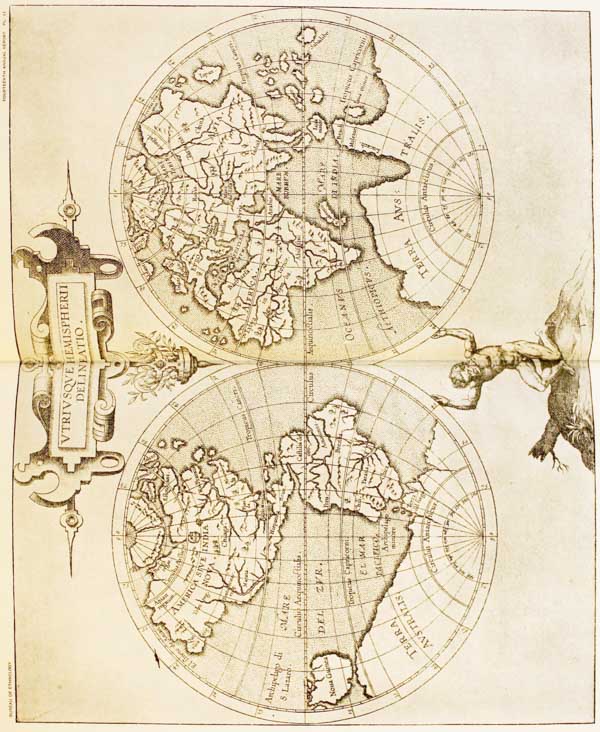
LI. Wytfliet’s “Vtrivsqve
Hemispherii Delineatio,” 1597
◊
Twenty-five days were spent among the villages at Quivira, so that
Jaramillo, one of the party, doubtless remembered correctly when he
said that they were there after the middle of August.76
There was p397
nothing here except a piece of copper hanging from the neck of a chief,
and a piece of gold which one of the Spaniards was suspected of having
given to the natives, which gave any promise of mineral wealth, and
so Coronado determined to rejoin his main force. Although they had
found no treasures, the explorers were fully aware of the agricultural
advantages of this country, and of the possibilities for profitable farming,
if only some market for the produce could be found.
Students of the Coronado expedition have very generally accepted
the location of Quivira proposed by General Simpson, who put the
northern point reached by Coronado somewhere in the eastern half of
the border country of Kansas and Nebraska. If we take into account
the expeditions which visited the outer limits of the Quivira settlements,
this is not inconsistent with Bandelier’s location of the main seat of
these Indians “in northeastern Kansas, beyond the Arkansas river,
and more than 100 miles northeast of Great Bend.”77
It is impossible to ignore the question of the route taken by Coronado
across the great plains, although the details chiefly concern local
historians. The Spanish travelers spent the summer of 1541 on the
prairies west of the Mississippi and south of the Missouri. They left
descriptions of these plains, and of the people and animals inhabiting
them, which are of as great interest and value as any which have
since been written. Fortunately it is not of especial importance for
us to know the exact section of the prairies to which various parts of
the descriptions refer.
From Cicuye, the Pecos pueblo, Coronado marched northeast until
he crossed Canadian river, probably a little to the east of the present
river and settlement of Mora.78
This was about the 1st of May, 1541.
From this point General Simpson, whose intimate knowledge of the
surface of the country thirty-five years ago makes his map of the
route across the plains most valuable, carried the line of march nearly
north, to a point halfway between Canadian and Arkansas rivers.
Then it turned east, or a trifle north of east, until it reached one of the
tributaries of the Arkansas, about 50 miles or so west of Wichita, Kansas.
The army returned by a direct route to Cicuye or Pecos river,
striking that stream nearly east of Bernalillo-Tiguex, while Coronado
proceeded due north to Quivira on the Kansas-Nebraska boundary.
Mr. Bandelier has traced a route for the march across the plains
which corresponds with the statements of the contemporary narratives
somewhat more closely than does that of General
Simpson.79
Crossing p398
Canadian river by a bridge, just south, of where Mora river enters it,
the Spaniards, according to Bandelier, marched toward the northeast
for ten days, until they met the first of the plains Indians, the Querecho
or Tonkawa. Thence they turned almost directly toward the
rising sun. Bandelier thinks that they very soon found out that the
guides had lost their reckoning, which presumably means that it became
evident that there was some difference of opinion among the Indians.
After marching eastward for thirty-five days or so, the Spaniards
halted on the banks of a stream which flowed in the bottom of a broad
and deep ravine. Here it was computed that they had already traveled
250 leagues—650 miles—from Tiguex. They had crossed no other
large river since leaving the bridge over the Canadian, and as the
route had been south of east, as is distinctly stated by one member
of the force, they had probably reached the Canadian again. There is
a reference to crossing what may have been the North Fork of the
Canadian, in which case the army would now be on the north bank of
the main river, below the junction of the two forks, in the eastern part
of Indian Territory. Here they divided. The Teya guides conducted
the main force directly back to the Rio Grande settlements. Coronado
went due north, and a month later he reached a larger river. He
crossed to the north bank of this stream, and then followed its course
for several days, the direction being northeast. This river, manifestly,
must be the Arkansas, which makes a sharp turn toward the northeast
at the Great Bend, east of Fort Dodge, flowing in that direction for
75 miles. Jaramillo states that they followed the current of the river.
As he approached the settled country, Coronado turned toward the
north and found Quivira, in northeastern Kansas, not far south of the
Nebraska boundary.80
The two texts of the Relacion del Suceso differ on a vital point;81
but in spite of this fact, I am inclined to accept the evidence of this anonymous
document as the most reliable testimony concerning the direction
of the army’s march. According to this, the Spaniards
traveled p399
due east across the plains for 100 leagues—265 miles82—and then 50
leagues either south or southeast. The latter is the reading I should
prefer to adopt, because it accommodates the other details somewhat
better. This took them to the point of separation, which can hardly
have been south of Red river, and was much more likely somewhere
along the North Fork of the Canadian, not far above its junction with
the main stream. From this point the army returned due west to
Pecos river, while Coronado rode north “by the needle.” From these
premises, which are broad enough to be safe, I should be inclined to
doubt if Coronado went much beyond the south branch of Kansas river,
if he even reached that stream. Coronado probably spent more days
on his march than General Simpson allowed for, but I do not think that
he traveled nearly so far as General Simpson supposed. Coronado also
returned to Cicuye by a direct route, which was about two-thirds as
long as that of the outward march. The distances given for various
portions of the journey have a real value, because each day’s march
was paced off by a soldier detailed for the purpose, who carefully
recorded the distance covered.
SOME RESULTS OF THE EXPEDITION—1540–1547 — THE DISCOVERY OF COLORADO RIVER
THE VOYAGE OF ALARCON
Coronado found no gold in the land of the Seven Cities or in Quivira,
but his search added very much to the geographical knowledge of the
Spaniards.85
In addition to the exploration of the Pueblo country of
New Mexico and Arizona, and of the great plains as far north as
Kansas or Nebraska, the most important subsidiary result of the expedition
of 1540–1542 was the discovery of Colorado river. Hernando de
Alarcon, who sailed from Acapulco May 9, 1540, continued his voyage
northward along the coast, after stopping at the port of Culiacan to
add the San Gabriel to his fleet, until he reached the shoals
and sand-bars
at the head of the Gulf of California. The fleet
which Cortes p404
had sent out under the command of Ulloa the previous summer, turned
back from these shoals, and Alarcon’s sailors begged him not to venture
among them. But the question of a passage by water through to the
South, or Pacific, sea, which would make an island of the California
peninsula, was still debated, and Alarcon refused to return until he had
definitely determined the possibility of finding such a passage. His
pilots ran the ships aground, but after a careful examination of the
channel, the fleet was floated across the bar in safety, with the aid of
the rising tide. Alarcon found that he was at the mouth of a large
river, with so swift and strong a current that it was impossible for the
large vessels to make any headway against it. He determined to explore
the river, and, taking twenty men in two boats, started upstream on
Thursday, August 26, 1540, when white men for the first time floated on
the waters of the Colorado. Indians appeared on the river banks during
the following day. The silence with which the strangers answered
the threatening shouts of the natives, and the presence of the Indian
interpreters in the boats, soon overcame the hostile attitude of the savages.
The European trifles which had been brought for gifts and for
trading completed the work of establishing friendly relations, and the
Indians soon became so well disposed that they entirely relieved the
Spaniards of the labor of dragging the boats up the stream. A crowd
of Indians seized the ropes by which the boats were hauled against the
current, and from this time on some of them were always ready to
render this service to their visitors. In this fashion the Spaniards continued
northward, receiving abundant supplies of corn from the natives,
whose habits and customs they had many excellent opportunities for
observing. Alarcon instructed these people dutifully in the worship
of the cross, and continually questioned them about the places whose
names Friar Marcos had heard. He met with no success until he had
traveled a considerable distance up the river, when for the first time he
found a man with whom his interpreter was able to converse.
This man said that he had visited Cibola, which was a month’s journey
distant. There was a good trail by which one might easily reach
that country in forty days. The man said he had gone there merely
to see the place, since it was quite a curiosity, with its houses three
and four stories high, filled with people. Around the houses there was
a wall half as high again as a man, having windows on each side. The
inhabitants used the usual Indian weapons—bows and arrows, clubs,
maces, and shields. They wore mantles and ox hides, which were
painted. They had a single ruler, who wore a long shirt with a girdle,
and various mantles over this. The women wore long white cloaks
which completely covered them. There were always many Indians
waiting about the door of their ruler, ready in case he should wish for
anything. They also wore many blue stones which they dug out of a
rock—the turquoises of the other narratives. They had but one wife,
and when they died all their effects were buried with them.
When p405
their rulers ate, many men waited about the tables. They ate with
napkins, and had baths—a natural inference from any attempt to
describe the stuffy underground rooms, the estufas or kivas of the
Pueblos.
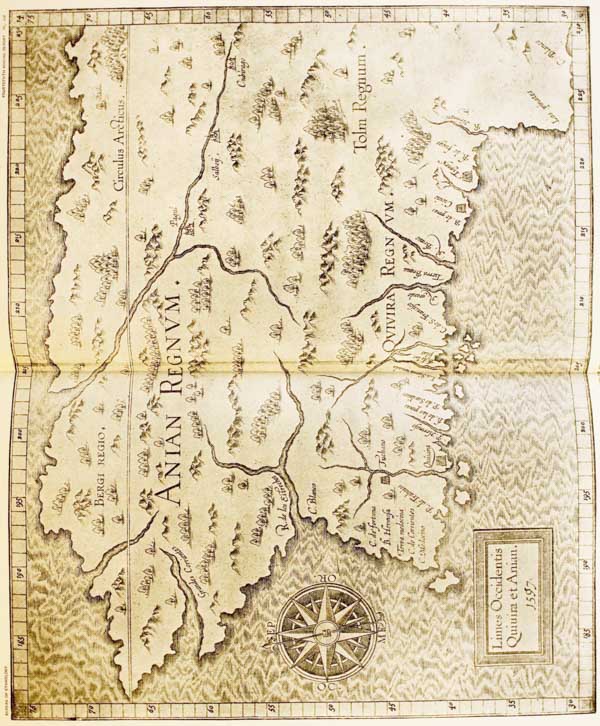
LIII. Wytfliet’s Kingdoms of
Quivira, Anian and Tolm, 1597
◊
Alarcon continued to question the Indian, and learned that the lord
of Cibola had a dog like one which accompanied the Spaniards, and that
when dinner was served, the lord of Cibola had four plates like those used
by the Spaniards, except that they were green. He obtained these at the
same time that he got the dog, with some other things, from a black man
who wore a beard, whom the people of Cibola killed. A few days later,
Alarcon obtained more details concerning the death of the negro “who
wore certain things on his legs and arms which rattled.” When asked
about gold and silver, the Indians said that they had some metal of the
same color as the bells which the Spaniards showed them. This was
not made nor found in their country, but came “from a certain mountain
where an old woman dwelt.” The old woman was called Guatuzaca.
One of Alarcon’s informants told him about people who lived
farther away than Cibola, in houses made of painted mantles or skins
during the summer, and who passed the winter in houses made of wood
two or three stories high. The Indian was asked about the leather
shields, and in reply described a very great beast like an ox, but more
than a hand longer, with broad feet, legs as big as a man’s thigh, a head
7 hands long, and the forehead 3 spans across. The eyes of the beast
were larger than one’s fist, and the horns as long as a man’s leg, “out
of which grew sharp points an handful long, and the forefeet and hindfeet
about seven handfuls big.” The tail was large and bushy. To
show how tall the animal was, the Indian stretched his arms above his
head. In a note to his translation of this description, Hakluyt suggests,
“This might be the crooke backed oxe of Quivira.” Although
the height and the horns are clearly those of a buck deer, the rest of
the description is a very good account of the bison.
The man who told him all this was called ashore, and Alarcon noticed
an excited discussion going on among the Indians, which ended in the
return of his informant with the news that other white men like himself
were at Cibola. Alarcon pretended to wonder at this, and was told
that two men had just come from that country, where they had seen
white men having “things which shot fire, and swords.” These latest
reports seemed to make the Indians doubt Alarcon’s honesty, and especially
his statements that he was a child of the Sun. He succeeded in
quieting their suspicions, and learned more about Cibola, with which
these people appeared to have quite frequent intercourse. He was told
that the strangers at Cibola called themselves Christians, and that they
brought with them many oxen like those at Cibola “and other little
blacke beastes with wooll and hornes.” Some of them also had animals
upon which they rode, which ran very swiftly. Two of the party that
had recently returned from Cibola, had fallen in with two of the p406
Christians. The white men asked them where they lived and whether they
possessed any fields sown with corn, and gave each of them little caps
for themselves and for their companions. Alarcon did his best to induce
some of his men to go to Cibola with a message to Coronado, but all
refused except one negro slave, who did not at all want to go. The
plan had to be given up, and the party returned to the ships. It had
taken fifteen days and a half to ascend the river, but they descended
with the swift current in two and a half. The men who had remained
in the ships were asked to undertake the mission of opening communication
with Coronado, but proved as unwilling as the others.
Much against the will of his subordinates, Alarcon determined to
make a second trip up the river, hoping to obtain further information
which might enable him to fulfill the purposes of his voyage. He took
“three boats filled with wares of exchange, with corne and other seedes,
hennes and cockes of Castille.” Starting September 14, he found the
Indians as friendly as before, and ascended the river, as he judged,
about 85 leagues, which may have taken him to the point where the
canyons begin. A cross was erected to inform Coronado, in case an
expedition from Cibola should reach this part of the river,86
that he had
tried to fulfill his duty, but nothing more was accomplished.87
While Alarcon was exploring the river, one of the ships was careened
and repaired, and everything made ready for the return voyage. A
chapel was built on the shore in honor of Nuestra Señora de Buenaguia,
and the river was named the Buenaguia, out of regard for the
viceroy, who carried this as his device.
The voyage back to Colima in New Spain was uneventful.
THE JOURNEY OF MELCHIOR DIAZ
In September, 1540, seventy or eighty of the weakest and least reliable
men in Coronado’s army remained at the town of San Hieronimo,
in the valley of Corazones or Hearts. Melchior Diaz was placed
in command of the settlement, with orders to maintain this post and
protect the road between Cibola and New Spain, and also to attempt to
find some means of communicating with the fleet under Alarcon. After
he had established everything in the town as satisfactorily as possible,
Diaz selected twenty-five of these men to accompany him on an exploring
expedition to the seacoast. He started before the end of September,
going into the rough country west of Corazones valley, and
finding only a few naked, weak-spirited Indians, who had come, as he
understood, from the land on the farther side of the
water, i. e., Lower p407
California. He hurried across this region and descended the mountains
on the west, where he encountered the Indian giants, some of whom
the army had already seen. Turning toward the north, or northwest,
he proceeded to the seacoast, and spent several days among Indians
who fed him with the corn which they raised and with fish. He traveled
slowly up the coast until he reached the mouth of a river which was
large enough for vessels to enter. The country was cold, and the
Spaniards observed that when the natives hereabouts wished to keep
warm, they took a burning stick and held it to their abdomens and
shoulders. This curious habit led the Spaniards to name the river
Firebrand—Rio del Tizon. Near the mouth of the river was a tree on
which was written, “A letter is at the foot of this.” Diaz dug down
and found a jar wrapped so carefully that it was not even moist. The
inclosed papers stated that “Francisco de Alarcon reached this place
in the year ’40 with three ships, having been sent in search of Francisco
Vazquez Coronado by the viceroy, D. Antonio de Mendoza; and
after crossing the bar at the mouth of the river and waiting many
days without obtaining any news, he was obliged to depart, because
the ships were being eaten by worms,” the terrible
Teredo navalis.88
Diaz determined to cross the river, hoping that the country might
become more attractive. The passage was accomplished, with considerable
danger, by means of certain large wicker baskets, which the
natives coated with a sort of bitumen, so that the water could not leak
through. Five or six Indians caught hold of each of these and swam
across, guiding it and transporting the Spaniards with their baggage,
and being supported in turn by the raft. Diaz marched inland for four
days, but not finding any people in the country, which became steadily
more barren, he decided to return to Corazones valley. The party
made its way back to the country of the giants without accident, and
then one night while Diaz was watching the camp, a small dog began to
bark and chase the flock of sheep which the men had taken with them
for food. Unable to call the dog off, Diaz started after him on horseback
and threw his lance while on the gallop. The weapon stuck up in
the ground, and before Diaz could stop or turn his horse, which was
running loose, the socket pierced his groin. The soldiers could do
little to relieve his sufferings, and he died before they reached the settlement,
where they arrived January 18, 1541. A few months later,
Alcaraz, who had been placed in charge of the town when Diaz went
away, abandoned Corazones valley for a more attractive situation on
Suya river, some distance nearer Cibola. The post was
maintained here p408
until late in the summer, when it became so much weakened by dissensions
and desertions that the Indians had little difficulty in destroying
it. The defenders, with the exception of a few who were able to make
their way back to Culiacan, were massacred.
THE INDIAN UPRISING IN NEW SPAIN, 1540–1542 — FURTHER ATTEMPTS AT DISCOVERY
Of the arguments advanced by those who wished to hinder the expedition
which Mendoza sent off under Coronado, none was urged
more persistently than the claim that this undertaking would require
all the men available for the protection of New Spain. It was suggested
by all the parties to the litigation in Spain, was repeated by
Cortes again and again, reappeared more than once during the visita
of 1547, and was the cause of the depositions taken at Compostela on
February 26, 1540. These last show the real state of affairs. The men
who were withdrawn constituted a great resource in case of danger,
but they were worse than useless to the community when things were
peaceful. The Indians of New Spain had been quiet since the death
of De la Torre, a few years before, but signs of danger, an increasing
restlessness, unwilling obedience to the masters and encomenderos,
and frequent gatherings, had been noticed by many besides Cortes.
There were reasons enough to justify an Indian outbreak, some of them
abuses which dated from the time of Nuño de Guzman, but there is
every reason to suppose that the withdrawal of Coronado’s force,
following the irritation which was inevitably caused by the necessity
of collecting a large food supply and many servants, probably brought
matters to a crisis. Oñate, to whom the administration of New Galicia
had again been intrusted during the absence of his superior, began to
prepare for the trouble which he foresaw almost as soon as Coronado
was gone from the province. In April he learned that two tribes had
rebelled and murdered one of their encomenderos. A force was sent
to put down the revolt. The rebels requested a conference, and then,
early next morning, surprised the camp, which was wholly unprepared
for defense. Ten Spaniards, including the unwary commander, and
nearly two hundred native allies were killed. Thus began the last and
the fiercest struggle of the Indians of New Spain against their European
conquerors—the Mixton war.
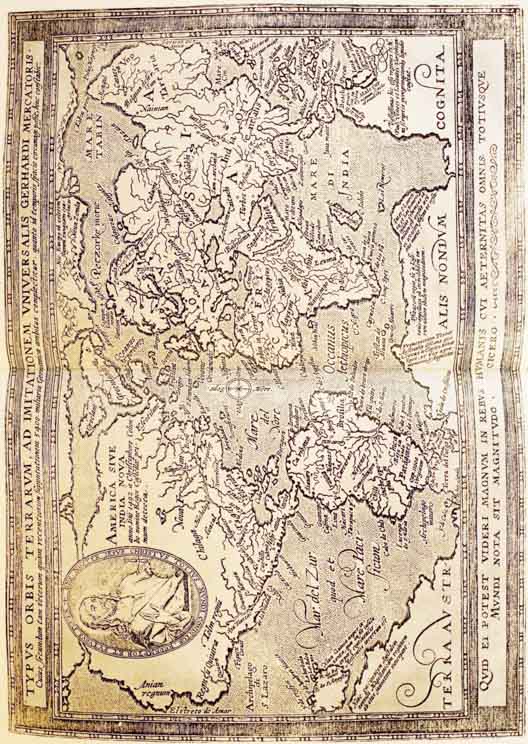
LIV. Matthias Quadus’ Fasciculus
Geographicus, 1608
◊
After Nordenskiold
Oñate prepared to march against the victorious rebels, as soon as the
news of the disaster reached him, but when this was followed by additional
information from the agents among the Indians, showing how
widespread were the alliances of those who had begun the revolt, and
that the Indians throughout the province of New Galicia were already
in arms, he retired to Guadalajara. The defenses of this town were
strengthened as much as possible, and messengers were dispatched to
Mexico for reenforcements. The viceroy sent some soldiers and supplies,
but this force was not sufficient to prevent the Indians—who were
animated by their recent successes, by their numbers, by the knowledge
of the weak points as well as of the strong ones in their
oppressors, and p409
who were guided by able leaders possessing all the prestige of religious
authority—from attacking the frontier settlements and forcing the Spaniards
to congregate in the larger towns.
There was much fighting during the early summer of 1540, in which
the settlers barely held their own. In August, the adelantado Pedro
de Alvarado sailed into the harbor of La Natividad. As the news of his
arrival spread, requests were sent to him from many directions, asking
for help against the natives. One of the most urgent came from those
who were defending the town of Purificacion, and Alvarado was about
to start to their assistance, when a message from Mendoza changed his
plans. The two men arranged for a personal interview at Tiripitio in
Michoacan, where the estate of a relative afforded Alvarado a quasi
neutral territory. After some difficulties had been overcome, the terms
of an alliance were signed by both parties November 29, 1540. Each was
to receive a small share in whatever had already been accomplished
by the other, thus providing for any discoveries which might have
rewarded Coronado’s search before this date. In the future, all conquests
and gains were to be divided equally. It was agreed that the
expenses of equipping the fleet and the army should offset each other,
and that all future expenses should be shared alike. Each partner was
allowed to spend a thousand castellanos de minas yearly, and all expenditure
in excess of this sum required the consent of the other party.
All accounts were to be balanced yearly, and any surplus due from one
to the other was to be paid at once, under penalty of a fine, which was
assured by the fact that half of it was to go into the royal treasury.
Mendoza secured a half interest in the fleet of between nine and
twelve vessels, which were then in the ports of Acapulco and of Santiago
de Colima. Cortes accused the viceroy of driving a very sharp bargain
in this item, declaring that Alvarado was forced to accept it
because Mendoza made it the condition on which he would allow the
ships to obtain provisions.89
Mendoza, as matters turned out, certainly
had the best of the bargain, although in the end it amounted to nothing.
Whether this would have been true if Alvarado had lived to
prosecute his schemes is another possibility. Alvarado took his
chances on the results of Coronado’s conquests, and it is very likely
that, by the end of November, the discouraging news contained in
Coronado’s letter of August 3 was not generally known, if it had even
reached the viceroy.
The contract signed, Alvarado and Mendoza went to Mexico, where
they passed the winter in perfecting arrangements for carrying out their
plans. The cold weather moderated the fury of the Indian war somewhat,
without lessening the danger or the troubles of the settlers in New
Galicia, all of whom were now shut up in the few large towns. Alvarado
returned to the Pacific coast in the spring of 1541, and as
soon as p410
Oñate learned of this, he sent an urgent request for help, telling of the
serious straits in which he had been placed. The security of the province
was essential to the successful prosecution of the plans of the
new alliance. Alvarado immediately sent reinforcements to the different
garrisons, and at the head of his main force hastened to Guadalajara,
where he arrived June 12, 1541. Oñate had received reports from
the native allies and the Spanish outposts, who were best acquainted
with the situation and plans of the hostile Indians, which led him to
urge Alvarado to delay the attack until he could be certain of success.
An additional force had been promised from Mexico, but Alvarado felt
that the glory and the booty would both be greater if secured unaided.
Scorning the advice of those who had been beaten by savages, he
hastened to chastise the rebels. The campaign was a short one. On
June 24 Alvarado reached the fortified height of Nochistlan, where he
encountered such a deluge of men and of missiles that he was not able
to maintain his ground, nor even to prevent the precipitate retreat of
his soldiers. It was a terrible disaster, but one which reflected no discredit
on Alvarado after the fighting began. The flight of the Spaniards
continued after the Indians had grown tired of the chase. It
was then that the adelantado tried to overtake his secretary, who
had been one of those most eager to get away from the enemy. Alvarado
was afoot, having dismounted in order to handle his men and
control the retreat more easily, but he had almost caught up with his
secretary, when the latter spurred his jaded horse up a rocky hill.
The animal tried to respond, fell, and rolled backward down the hill,
crushing the adelantado under him. Alvarado survived long enough
to be carried to Guadalajara and to make his will, dying on the 4th
of July.
This disaster did not fully convince the viceroy of the seriousness of
the situation. Fifty men had already started from Mexico, arriving in
Guadalajara in July, where they increased the garrison to eighty-five.
Nothing more was done by Mendoza after he heard of the death of
Alvarado. The Indians, emboldened by the complete failure of their
enemies, renewed their efforts to drive the white men out of the land.
They attacked Guadalajara on September 28, and easily destroyed all
except the chief buildings in the center of the city, in which the garrison
had fortified themselves as soon as they learned that an attack
was about to be made. A fierce assault against these defenses was
repulsed only after a hard struggle. The miraculous appearance of
Saint Iago on his white steed and leading his army of allies, who
blinded the idolatrous heathen, alone prevented the destruction of his
faithful believers, according to the record of one contemporary chronicler.
At last Mendoza realized that the situation was critical. A force
of 450 Spaniards was raised, in addition to an auxiliary body of between
10,000 and 50,000 Aztec warriors. The native chieftains were rendered
loyal by ample promises of wealth and honors, and the warriors were
granted, for the first time, permission to use horses
and Spanish p411
weapons. With the help of these Indians, Mendoza eventually succeeded
in destroying or reducing the revolted tribes. The campaign
was a series of fiercely contested struggles, which culminated at the
Mixton peñol, a strongly fortified height where the most bitter enemies
of the Spanish conquerors had their headquarters. This place was surrendered
during the Christmas holidays, and when Coronado returned
in the autumn of 1542, the whole of New Spain was once more quiet.
THE VOYAGE OF CABRILLO
Mendoza took possession of the vessels belonging to Alvarado after
the death of the latter. In accordance with the plans which the two
partners had agreed on, apparently, the viceroy commissioned Juan
Rodriguez Cabrillo to take command of two ships in the port of La
Natividad and make an exploration of the coast on the western side of
the peninsula of Lower California. Cabrillo started June 27, 1542, and
sailed north, touching the land frequently. Much bad weather interfered
with his plans, but he kept on till the end of December, when he
landed on one of the San Lucas islands. Here Cabrillo died, January
3, 1543, leaving his chief pilot, Bartolome Ferrel or Ferrelo, “a native
of the Levant,” in command. Ferrel left the island of San Miguel,
which he named Isla de Juan Rodriguez, on January 29, to continue
the voyage. In a little more than a month the fleet had reached the
southern part of Oregon or thereabouts, allowing for an error of a
degree and a half in the observations, which said that they were 44°
north. A severe storm forced the ships to turn back from this point.
The report of the expedition is little more than an outline of distances
sailed and places named, although there are occasional statements which
give us valuable information regarding the coast Indians.90
Among the
most interesting of these notes are those showing that the news of the
expeditions to Colorado river, and perhaps of the occupancy of the
Pueblo country by white men, had reached the Pacific coast. About
September 1, 1542, a party from the fleet went ashore near the southern
boundary of California. Five Indians met the Spanish sailors at a
spring, where they were filling the water casks. “They appeared like
intelligent Indians,” and went on board the ships without hesitation.
“They took note of the Spaniards and counted them, and made signs
that they had seen other men like these, who had beards and who
brought dogs and cross-bows and swords . . . and showed by their
signs that the other Spaniards were five days’ journey distant. . . .
The captain gave them a letter, which he told them to carry to the
Spaniards who they said were in the interior.” September 28,
at San p412
Pedro bay, Ferrel again found Indians who told him by signs that
“they had passed people like the Spaniards in the interior.” Two
days later, on Saturday morning, “three large Indians came to the
ship, who told by signs that men like us were traveling in the interior,
wearing beards, and armed and clothed like the people on the ships,
and carrying cross-bows and swords. They made gestures with the
right arm as if they were throwing lances, and went running in a posture
as if riding on horseback. They showed that many of the native
Indians had been killed, and that this was the reason they were afraid.”
A week later, October 7, the ships anchored off the islands of Santa
Cruz and Anacapa. The Indians of the islands and also of the mainland
opposite, near Santa Barbara or the Santa Clara valley, gave the
Spaniards additional descriptions of men like themselves in the interior.
The rest of the year 1542 was spent in this locality, off the coast of
southern California, and then the voyage northward was resumed.
Many points on the land were touched, although San Francisco bay
quite escaped observation. Just before a severe storm, in which one
of the vessels was lost, forcing him to turn back, Ferrel observed floating
drift and recognized that it meant the neighborhood of a large river, but
he was driven out to sea before reaching the mouth of the Columbia.
The return voyage was uneventful, and the surviving vessel reached
the harbor of Natividad in safety by April 14, 1543.
VILLALOBOS SAILS ACROSS THE PACIFIC
Cortes and Alvarado had both conceived plans more than once to
equip a great expedition in New Spain and cross the South sea to the
isles of the Western ocean. After the death of Alvarado, Mendoza
adopted this scheme, and commissioned Ruy Lopez de Villalobos to
take command of some of the ships of Alvarado and sail westward. He
started on All Saints day, the 1st of November, 1542, with 370 Spanish
soldiers and sailors aboard his fleet. January 22, 1547, Friar Jeronimo
de Santisteban wrote to Mendoza “from Cochin in the Indies of the
King of Portugal.” He stated that 117 of the men were still with the
fleet, and that these intended to keep together and make their way as
best they could home to Spain. Thirty members of the expedition had
remained at Maluco, and twelve had been captured by the natives of
various islands at which the party had landed. The rest, including
Ruy Lopez, had succumbed to hunger and thirst, interminable labors
and suffering, and unrelieved discouragement—the record of the previous
months. This letter of Friar Jeronimo is the only published
account of the fate of this expedition.
The brief and gloomy record of the voyage of Villalobos is a fit ending
for this story of the Coronado expedition to Cibola and Quivira, of
how it came about, of what it accomplished, and of what resulted from
it. Nothing is the epitome of the whole story. The lessons which it
teaches are always warnings, but if one will read history rightly, every
warning will be found to be an inspiration.
PRIMERA PARTE. 92
Capitulo primero donde se trata como se supo la primera poblacion de
las siete çiudades y como Nuño de guzman hiço armada
para descubrirlla.
en el año y quinientos y treinta siendo presidente de la nueba españa
Nuño de guzman ubo en su poder un indio natural del ualle o ualles de
oxitipar a quien los españoles nombran tejo este indio dixo que el era
hijo de un mercader y su padre era muerto pero que siendo el chiquito
su padre entraua la tierra adentro a mercadear con plumas ricas de
aues para plumages y que en retorno traya un mucha cantidad de oro
y plata que en aquella tierra lo ay mucho y que el fue con el una o dos
ueçes y que bido muy grandes pueblos tanto que los quiso comparar
con mexico y su comarca y que auia uisto siete pueblos muy grandes
donde auia calles de plateria y que para ir a ellos tardauan desde su
tierra quarenta dias y todo despoblado y que la tierra por do
yban no p417
tenia yerba sino muy chiquita de un xeme y que el rumbo que lleuaban
era al largo de la tierra entre las dos mares siguiendo la lauia del norte
debaxo de esta notiçia Nuño de guzman junto casi quatrosientos hombres
españoles y ueinte mill amigos de la nueua españa y como se hallo
a el presente en mexico atrabesando la tarasca que es tierra de mechuacan
para hallandose el aparejo quel indio deçia boluer atrabesando
la tierra hacia la mar del norte y darian en la tierra que yban a buscar
a la qual ya nombrauan las siete ciudades pues conforme a los quarenta
dias quel texo decia hallaria que abiendo andado doçientas leguas
podrian bien atrabesar la tierra quitado a parte algunas fortunas que
pasaron en esta jornada desque fueron llegados en la prouincia de
culiacan que fue lo ultimo de su gouernaçion que es agora el nueuo
reyno de galiçia quisieron atrabesar la tierra y ubo muy gran dificultad
porque la cordillera de la sierra que cae sobre aquella mar estan agra
que por mucho que trabajo fue inposible hallar camino en aquella
parte y a esta causa se detubo todo su campo en aquella tierra de culiacan
hasta tanto que como yban con el hombres poderosos que tenian
repartimientos en tierra de mexico mudaron las boluntades y de cada
dia se querian boluer fuera de esto Nuño de guzman tubo nueua como
auia benido de españa el marques del ualle don fernando cortes con el
nueuo titulo y grandes fabores y prouinçiones y como nuño de guzman
en el tiempo que fue presidente le ubiese sido emulo muy grande y
hecho muchos daños en sus haciendas y en las de sus amigos temiose
que don ferdo cortes se quisiese pagar en otras semejantes obras o
peores y determino de poblar aquella uilla de culiacan y dar la buelta
con la demas gente sin que ubiese mas efecto su jornada y de buelta
poblo a xalisco que es la çiudad de conpostela y atonala que llaman
guadalaxara y esto es agora el nuebo reyno de galicia la guia que lleuaban
que se decia texo murio en estos comedios y ansi se quedo el
nombre de estas siete ciudades y la demanda de ellas hasta oy dia que
no sean descubierto.
Capitulo segundo como bino a ser gouernador françisco uasques coronado
y la segunda relaçion que dio cabeça de uaca.
pasados que fueron ocho años que esta jornada se auia hecho por Nuño
de guzman abiendo sido preso por un juez de residençia que uino de
españa para el efecto con prouiçiones bastantes llamado el licdo diego
de la torre que despues muriendo este juez que ya tenia en si la gouernaçion
de aquella tierra el buen don Antonio de mendoça uisorey de la
nueua españa puso por gouernador de aquela gouernaçion a francisco
uasques de coronado un cauallero de Salamanca que a la sacon era
casado en la çiudad de mexico cõ una señora hija de Alonso de estrada
thesorero y gouernador que auia sido de mexico uno por quien el bulgo
dice ser hijo del rey catholico don fernando y muchos lo afirman por
osa sierta digo que a la sacon que francisco uasques fue probeydo por
gouernador andaba por uisitador general de la nueua españa
por donde p418
tubo amistad y conuersaçiones de muchas personas nobles que despues
le siguieron en la jornada que hiço aconteçio a la saçon que llegaron a
mexico tres españoles y un negro que auian por nombre cabeça de uaca
y dorantes y castillo maldonado los quales se auian perdido en la armada
que metio pamfilo de narbaes en la florida y estos salieron por la uia de
culiacan abiendo atrabesado la tierra de mar a mar como lo beran los que
lo quisieren saber por un tratado que el mismo cabeça de uaca hiço dirigido
a el principe don phelipe que agora es rey de españa y señor
n o
y estos dieron notiçia a el buen don Antonio de mendoça en como por las
tierras que atrabesaron tomaron lengua y notiçia grande de unos poderosos
pueblos de altos de quatro y çinco doblados y otras cosas bien diferentes
de lo que pareçio por berdad esto comunico el buen uisorey con
el nuebo gouernador que fue causa que se apresurase dexando la bisita
que tenia entre manos y se partiese para su gouernaçion lleuando consigo
el negro que auia bendido con los tres frayles de la orden do san
franco el uno auia por nombre fray marcos de niça theologo y saserdote
y el otro fray daniel lego y otro fray Antonio de santa maria y
como llego a la prouincia de culiacan luego despidio a los frayles ya
nonbrados y a el negro que auia por nombre esteuan para que fuesen
en demanda de aquella tierra porque el fray marcos de niça se prefirio
de llegar a berla por que este frayle se auia hallado en el peru a el
tienpo que don pedro de albarado passo por tierra ydos los dichos
frayles y el negro esteuan pareçe que el negro no yba a fabor de los
frayles porque lleuaba las mugeres que le daban y adquiria turquesas
y haçia balumen de todo y aun los indios de aquellos poblados por do
yban entendiasen mejor con el negro como ya otra uez lo auian uisto que
fue causa que lo ubieron hechar delante que fuese descubriendo y pacificando
para que quando ellos llegasen no tubiesen mas que entender
de en tomar la relacion de lo que buscauan.
Capitulo terçero como mataron
los de cibola a el negro esteuan y fray
marcos bolbio huyendo.
apartado que se ubo el esteuan de los dichos frayles presumio ganar
en todo reputacion y honra y que se le atribuyese la osadia y atrebimiento
de auer el solo descubierto93
aquellos poblados de altos tan nombrados
por aquella tierra y lleuando consigo de aquellas gentes que le
seguian procuro de atrabesar los despoblados que ay entre cibola y lo
poblado que auia andado y auiase les adelantado tanto a los frayles que
quando ellos llegaron a chichieticale ques principio del despoblado ya
el estaua a cibola que son ochenta leguas de despoblado que ay desde
culiacan a el principio del despoblado docientas y ueinte leguas y en el
despoblado ochenta que son trecientas diez mas o menos digo ansi que
llegado que fue el negro esteuan a cibola llego cargado de grande
numero de turquesas que le auian dado y algunas mugeres hermosas
que le auian dado y lleuauan los indios que le acompañauan y
le seguian p419
de todo lo poblado que auia pasado los quales en yr debajo de su amparo
creyan poder atrabesar toda la tierra sin riesgo ninguno pero como
aquellas gentes de aquella tierra fuesen de mas raçon que no los que seguian
a el esteuan aposentaronlo en una sierta hermita que tenian fuera
del pueblo y los mas uiejos y los que gouernauan oyeron sus raçones
y procuraron saber la causa de su benida en aquella tierra y bien informados
por espaçio de tres dias entraron en su consulta y por la notiçia
quel negro les dio como atras uenian dos hombres blancos embiados
por un gran señor que eran entendidos en las cosas del cielo y que
aquellos los uenian a industriar en las cosas diuinas consideraron que
debia ser espia o guia de algunas naçiones que los querian yr a conquistar
porque les pareçio desbario decir que la tierra de donde uenia era
la gente blanca siendo el negro y enbiado por ellos y fueron a el y como
despues de otras raçones le pidiese turquesas y mugeres parecioles
cosa dura y determiaronse a le matar y ansi lo hicieron sin que matasen
a nadie de los que con el yban y tomaron algunos muchachos y a
los de mas que serian obra de sesenta personas dexaron bolber libres a
sus tierras pues como estos que boluian ya huyendo atemorisados llegasen
a se topar y ber con los frayles en el despoblado sesenta leguas de
çibola y les diesen la triste nueba pusieron los en tanto temor que aun
no se fiando de esta gente con aber ydo en compañia del negro abrieron
las petacas que lleuaban y les repartieron quanto trayan que no les
quedo salbo los hornamentos de deçir misa y de alli dieron la buelta sin
ber la tierra mas de lo que los indios les deçian antes caminaban dobladas
jornadas haldas en sinta.
Capitulo quarto como el buen don Antonio de mendoça hiço jornada
para el descubrimiento de Cibola.
despues que francisco uasques coronado ubo embiado a fray marcos
de niça y su conpaña en la demanda ya dicha quedando el en culiacan
entendio en negocios que conbenian a su gouernaciō tubo sierta relaçion
de una prouinçia que corria en la trabesia de la tierra de culiacan
a el norte que se decia topira y luego salio para la ir a descubrir con
algunos conquistadores y gente de amigos y su yda hiço poco efecto
por que auian de atrabesar las cordilleras y fue les muy dificultoso y la
notiçia no la hallaron tal ni muestra de buena tierra y ansi dio la
buelta y llegado que fue hallo a los frayles que auian acabado de llegar
y fueron tantas las grandeças que les dixeron de lo que el esteuan el
negro auia descubierto y lo que ellos oyeron a los indios y otras noticias
de la mar del sur y de ylas que oyeron deçir y de otras riquesas quel
gouernador sin mas se detener se partio luego para la ciudad de
mexico lleuando a el fray marcos consigo para dar notiçia de ello a el
bisorey en grandesiendo las cosas con no las querer comunicar con
nadie, sino de baxo de puridad y grande secreto a personas particula res
y llegados a mexico y bisto con don Antonio de mendoça luego se
començo a publicar como ya se abian descubierto las
siete çiudades p420
que Nuño de guzman buscaba y haçer armada y portar gente para
las yr a conquistar el buen birrey tubo tal orden con los frayles de la
orden de san françisco que hicieron a fray marcos prouincial que fue
causa que andubiesen los pulpitos de aquella orden llenos de tantas
marabillas y tan grãdes que en pocos dias se juntaron mas de tresientos
hombres españoles y obra de ochocientos indios naturales de la nue
(ua) españa y entre los españoles honbres de gran calidad tantos y
tales que dudo en indias aber se juntado tan noble gente y tanta en
tam pequeño numero como fueron treçientos hombres y de todos ellos
capitan general francisco uasques coronado gouernador de la nueba
galiçia por aber sido el autor de todo hico todo esto el buen uirey don
Antonio porque a la saçon era franco uasques la persona mas allegada
a el por pribança porque tenia entendido era hombre sagaz abil y de
buen consejo allende de ser cauallero como lo era tenido tubiera mas
atençion y respecto a el estado en que lo ponia y cargo que llebaua que
no a la renta que dexaba en la nueba españa o a lo menos a la honra
que ganaba y auia de ganar lleuando tales caualleros de baxo de su
bando pero no le salio ansi como a delante se bera en el fin de este
tratado ni el supo conserbar aquel estado ni la gouernacion que tenia.
Capitulo quinto que trata
quienes fueron por capitanes a cibola.
ya quel bisorey don Antonio de mendoça bido la muy noble gente
que tenia junta y con los animos y uoluntad
 todos se le auian ofreçido
cognoçiendo el ualor de sus personas a cada uno de ellos quisiera haçer
capitan de un exerçito pero como el numero de todos era poco no pudo
lo que quisiera y ansi ordeno las conductas y capitanias que le pareçio
porque yendo por su mano ordenado era tam obedecido y amado que
nadie saliera de su mandado despues que todos entẽdieron quien era
su general hiço alferez general a don pedro de touar cauallero mançebo
hijo de don fernando de tobar guarda y mayordomo mayor de la reyna
doña Juana
na
natural señora que sea en gloria y maestre de campo a
lope de samaniego alcayde de las ataraçanas de mexico cauallero para el
cargo bien sufiçiente capitanes fueron don tristan de arellano don pedro
de gueuara hijo de don juan de gueuara y sobrino del conde de oñate
don garçi lopes de cardenas don rodrigo maldonado cuñado del duque
del infantado diego lopes ueinte y quatro de seuilla diego gutierres de
la caualleria todos los demas caualleros yban debajo del guion del general
por ser peronas señaladas y algunos de ellos fueron despues capitanes
y permanecieron en ello por ordenaçion del birey y otros por el
general francisco uasques nombrare algunos de aquellos de que tengo
memoria que fueron françisco de barrio nuebo un cauallero de granada
juan de saldibar françisco de auando juan gallego y melchior dias capitan
y alcalde mayor que auia sido de culiacan,
aunque no era cauallero
mereçia de su persona el cargo que tubo los demas caualleros que
fueron sobresalientes fueron don Alonso manrique de lara don lope de
urrea cauallero aragones gomes suares de figueroa luis ramires
de uargas p421
juan de sotomayor francisco gorbalan el factor riberos y otros caualleros
de que agora no me acuerdo y hombres de mucho calidad capitan
de infanteria fue pablo de melgosa burgales y de la artilleria hernando
de albarado cauallero montañes digo que con el tiempo e perdido la
memoria de muchos buenos hijos dalgo que fuera bueno que los nombrara
por que se biera y cognoçiera la racon que tengo de decir que
auia para esta jornada la mas lucida gente que sea juntado en indias
para yr en demandas de tierras nuebras sino fueran desdichados en lleuar
capitan que dexaba rentas en la nueba españa y muger moça noble y
generosa que no fueron pocas espuelas para lo que bino a haçer.
Capitulo sexto como se juntaron en conpostela todas las capitanias y
salieron en orden para la jornada.
hecho y ordenado por el birey don Antonio de mendoça lo que abemos
dicho y hechas las capitanias o capitanes dio luego a la gente de guerra
socorros de la caxa de su magestad a las personas mas menesterosas y
por pareçerle que si salia el campo formado desde mexico haria algunos
agrauios por las tierras de los amigos ordeno que se fuesen a juntar a
la ciudad de conpostela cabeça del nuebo reyno de galicia ciento y
diez leguas de mexico para que desde alli ordenadamente comencasen
su jornada lo que paso en este uiaje no ay para que dar de ello relaçion
pues al fin todos se juntaron en conpostela el dia de carnes tollendas
del año de quarenta y uno y como ubo hechado toda la gente de Mexico
dio orden en como pedro de alarcon saliese con dos nauios que estaban
en el puerto de la nabidad en la costa del sur y fuese a el puerto de
xalisco a tomar la ropa de los soldados que no la pudiesen lleuar para
que costa a costa fuese tras del campo porque se tubo entendido que
segun la notiçia auian de ir por la tierra çerca de la costa de el mar y
que por los rios sacariamos los puertos y los nauios siempre tendrian
noticia del campo lo qual despues pareçio ser falso y ansi se perdio toda
la ropa o por mejor deçir la perdio cuya era como adelante se dira asi
que despachado y concluido todo el uisorey se partio para conpostela
acompañado de muchos caualleros y ricos honbres y tubo el año nuebo
de quarenta y uno en pasquaro que es cabeça del obispado de mechuacan
y de alli con mucha alegria y placer y grandes reçebimientos atrabeso
toda la tierra de la nueba españa hasta Conpostela que son
como tengo dicho çiento y diez leguas adonde hallo toda la gente junta
y bien tratada y hospedada por christobal de oñate que era a la saçon
la persona que tenia enpeso aquella gouernaçion y la auia sostenido y
era capitan de toda aquella tierra puesto que francisco uasques era
gouernador y llegado con mucha alegria de todos hiço alarde de la gēte
que embiaba y hallo toda la que abemos señalado y repartio las capitanias
y esto hecho otro dia despues de misa a todos juntos ansi capitanes
como a soldados el uisorey les hico una muy eloquente y breue
oraçion encargandoles la fidelidad
debian a su general dandoles bien
a entender el probecho que de haçer aquella jornada podia
redundar a p422
si a la conuerçion de aquellas gentes como en pro de los que conquistasen
aquella tierra y el seruicio de su magestad y la obligaçion en que le
auian puesto para en todo tiempo los faborecer y socorrer y acabada
tomo juramento sobre los euãgelios en un libro misala todos generalmente
asi a capitanes como a soldados aunque por orden que siguirian
a su general y harian en aquella jornada y obedecerian todo aquello que
por el les fuese mandado lo qual despues cumplieron fielmente como se
bera y esto hecho otro dia salio el campo con sus banderas tendidas y
el uirey don Antonio le acompaño dos jornados y de alli se despidio
dando la buelta para la nueua españa aconpañado de sus amigos.
Capitulo septimo como el campo llego a
chiametla y mataron a el maestre
de canpo y lo que mas acaeçio hasta llegar a culiacan.
partido que fue el uirey don Antonio el campo camino por sus jornadas
y como era forçado lleuar cada uno sus aberes en cauallos y no
todos los sabian aparejar y los cauallos salian gordos y holgados en las
primeras jornadas ubo grande dificultad y trabajo y muchos dexaron
muchas preseas y las daban de gracia a quien las queria por no las cargar
y a el fin la necesidad que es maestra con el tiempo los hiço maestros
donde se pudierã ber muchos caualleros tornados harrieros y que el que
se despreciaba del officio no era tenido por hombre y con estos trabajos
que entonçes tubieron por grandes llego el canpo en chiametla donde
por fastar bastimentos fue forçado de tenerse alli algunos dias en los
quales el maestre de campo lope de samaniego con sierta compañia fue
a buscar bastimentos y en un pueblo por entrar indiscretamente por un
arcabuco en pos de los enemigos lo flecharon por un ojo y le pasaron el
celebro de que luego murio alli y flecharon otros cinco o seis compañeros
y luego como fue muerto diego lopes ueinte y quatro de seuilla recogio
la gente y lo embio a haçer saber a el general y puso guarda en el pueblo
y en los bastimentos sabido dio gran turbacion en el campo y fue enterrado
y hicieron algunas entradas de dõde truxeron bastimentos y algunos
presos de los naturales y se ahorcaron a lo menos los que parecieron ser
de a quella parte a do murio el maestre de campo.
parece que a el tiempo que el general françisco uasques partio de
culiacan con fray marcos a dar la noticia ya dicha a el bisorey don Antonio
de mendoça auia dexado ordenado que saliese el capitan melchior dias
y juan de saldibar con una doçena de buenos hombres de culiacan en
demada de lo que fray marcos auia bisto y oydo los quales salieron y
fueron hasta chichilticale que es principio del despoblado doçientas y
ueinte leguas de Culiacan y no hallaron cosa de tomo bolbieron y a el
tiempo que el campo queria salir de chiametla llegaron y hablaron a el
general y por secreto que se trato la mala nueua luego suena ubo algunos
dichos que aunque se doraban no dexaban de dar lustre de lo que
eran fray marcos de niça cognociendo la turbaçion de algunos deshaçia
aquellos nublados prometiendo ser lo que bieron lo bueno y que el
yba alli y poruia el campo en tierra donde hinchesen las
manos y con p423
esto se aplaco y mostraron buen semblante y de alli camino el campo
hasta llegar a culiacan haçiendo algunas entradas en tierra de
guerra por tomar bastimentos llegaron a dos leguas de la uilla de
culiacan uispera de pasqua de resureçion a donde salieron los uecinos
a reçebir a su gouernador y le rogaron no entrase en la uilla hasta el
segundo dia de pasqua.
Capitulo otauo como el campo entro en la uilla de culiacan y el recebimiento
que se hiço y lo que mas acaeçio hasta la partida.
como fuese segundo dia de pasqua de resureçion el campo salio de
mañana para entrar en la uilla y en la entrada en un campo esconbrado
los de la uilla ordenados anso de guerra a pie y a cauallo por sus exquadrones
teniendo asẽtada su artilleria que eran siete pieças de bronce
salieron en muestra de querer defender la uilla estaban con ellos alguna
parte de
n os
soldados
no
campo por la misma orden comencaron con
ellos una escaramuça y ansi fueron romprendo despues de aber jugado
el artilleria de ambas partes de suerte que les fue tomada la uilla por
fuerça de armas que fue una alegre demostraçion y reçebimiento aun
que no para el artillero que se llebo una mano por aber mandado poner
fuego antes que acabase de sacar el atacador de un tiro tomada la uilla
fueron luego bien aposentados y hospedados por los ueçinos que como
eran todos hombres muy honrados en sus propias posadas metieron a
todos los caualleros y personas le calidad que yban en el campo aunque
auia aposento hecho para todos fuera de la uilla y no les fue algunos
uecinos mal gratificado este hospedaje por que como todos benian aderesados
de ricos atabios y de alli auian de sacar bastimentos en sus bestias
y de fuerça auian de dejar sus preseas muchos quisieron antes dar las a
sus huespedes que no ponerlas a la bentura de la mar ni que se las llebase
los nabios que auian benido por la costa siguiendo el campo para tomar
el fardaje como ya se dixo ansi que llegados y bien aposentados en la
uilla el general por orden del bisorey don Antonio puso alli por capitan
y tiniente a fernandarias de saabedra tio de hernandarias de saabedra
conde del castellar que fue alguaçil mayor de seuilla y alli reposo el
canpo algunos dias porque los ueçinos auian cogido aquel año muchos
bastimentos y partieron con la gente de
no
campo con mucho amor
especial cada uno con sus huespedes de manera que no solamente ubo
abudançia para gastar alli mas aun ubo para sacar que a el tiempo de la
partida salieron mas de seiçientas bestias cargadas y los amigos y
seruiçio que fueron mas de mill personas. pasados quinse dias el general
ordeno de se partir delante con hasta sinquenta de acauallo y pocos
peones y la mayor parte de los amigos y dexar el campo que le siguiese
desde a quinse dias y dexo por su teniente a don tristan de arellano.
en este comedio antes que se partiese el general aconteçio un caso
donoso y yo por tal lo quento y fue que un soldado mançebo que se
decia trugillo fingio aber bisto una biçion estando bañandose en el rio
y façiendo del disfigurado fue traydo ante el general adonde
dio a p424
entender que le auia dicho el demonio que matase a el general y lo casaria con
doña beatris su muger y le daria grandes thesoros y otras cosas bien
donosas por donde fray marcos de niça hiço algunos sermones atribuyendolo
a que el demonio con embidia del bien que de aquella jornada auia
de resultar lo queria desbaratar por aquella uia y no solamente paro en
esto sino que tambien los frayles que yban en la jornada lo escribieron
a sus conbentos y fue causa que por los pulpitos de mexico se dixesen
hartas fabulas sobre ello.
El general mando quedar a el truxillo en aquella uilla y que no hiciese
la jornada que fue lo que el pretendio quando hiço aquel embuste
segun despues pareçio por berdad el general salio con la gente ya dicha
siguiendo su jornada y despues el campo como se dira.
Capitulo nueue como el canpo salio de culiacan y llego el general a
çibola y el campo a señora y lo que mas acaeçio.
el general como esta dicho salio del ualle de culiacan en seguimiento
de su uiaje algo a la ligera lleuando consigo los frayles que ninguno
quiso quedar con el campo y a tres jornados un frayle llamado fray
Antonio uictoria se quebro un pierna y este frayle era de misa y para
que se curase lo bolbieron del camino y despues fue con el campo que no
fue poca consolaçion para todos el general y su gente atrabesaron la
tierra sin contraste que todo lo que hallaron de pax porque los indios
cognoçian a fray marcos y algunos de los que auian ydo con el capitan
melchior dias quando auia ydo el y juan de saldibar a descubrir como
el general ubo atrabesado lo poblado y llegado a chichilticale principio
del despoblado y no bio cosa buena no dexo de sentir alguna tristesa
porque aunque la notiçia de lo de adelante era grande no auia quien lo
ubiese uisto sino los indios que fueron con el negro que ya los auian tomado
en algunas mentiras por todos se sintio mucho ber que la fama de
chichilticale se resumia en una casa sin cubierta aruynada puesto que
pareçia en otro tiempo aber sido casa fuerte en tiempo que fue poblada
y bien se cognoçia ser hecha por gentes estrangeras puliticas y guerras
benidas de lejos era esta casa de tierra bermeja desde alli prosiguieron
el despoblado y llegaron en quinse dias a ocho leguas de çibola a un
rio que por yr el agua turbia y bermeja le llamaron el rio bermejo en
este rio se hallaron barbos como en españa a qui fue adonde se bieron los
primeros indios de aquella tierra que fueron dos que huyeron y fueron
a dar mandado y otro dia a dos leguas del pueblo siendo de noche algunos
indios en parte segura dieron una grita que aunque la gente estaba
aperçebida se alteraron algunos en tanta manera que ubo quien hecho
la silla a el rebes y estos fueron gente nueba que los diestros luego
caualgaron y corrieron el campo los indios huyeron como quien sabia la
tierra que ninguno pudo ser abido.
otro dia bien en orden entraron por la tierra poblada y como bieron
el primer pueblo que fue çibola fueron tantas las maldiciones que
algunos hecharon a fray marcos quales dios no permita
le comprehendan. p425
el es un pueblo pequeño ariscado y apeñuscado que de lejos ay estancias
en la nueua españa que tienen mejor aparençia es pueblo de hasta
doçientos hombres de guerra de tres y de quatro altos y las casas chicas
y poco espaciosas no tienen patios un patio sirue a un barrio auia se
juntado alli la gente de la comarca porque es una prouinçia de siete
pueblos donde ay otros harto mayores y mas fuertes pueblos que no
çibola estas gentes esperarõ en el campo hordenados con sus exquadrones
a uista del pueblo y como a los requerimientos que le hicieron
con las lenguas no quisieron dar la pax antes se mostraban brauos diese
santiago en ellos y fueron desbaratados luego y despues fueron a tomar
el pueblo que no fue poco dificultoso que como tenian la entrada angosta
y torneada a el entrar deribaron a el general con una gran piedra tendido
y ansi le mataran sino fuera por don garci lopes de cardenas y hernando
de albarado que se deribaron sobre el y le sacaron recibiendo
ellos los golpes de piedras que no fueron pocos pero como a la primera
furia de los españoles no ay resistençia en menos de una ora se entro y
gano el pueblo y se descubrieron los bastimentos que era de lo que
mas necesidad auia y de ay adelante toda la prouincia bino de pax.
el campo quo auia quedado a don tristan de arellano partio en seguimiento
del general cargados todos de bastimentos las lanças en los
onbros todos a pie por sacar cargados los cauallos y no con pequeño
trabajo de jornadas en jornadas llegaron a una prouinçia que cabeça de
uaca puso por nombre coraçones a causa que alli les ofrecieron muchos
coraçones de animales y luego la començo a poblar una uilla y poner le
nombre sant hieronimo de los coraçones y luego la començo a poblar y
bisto que no se podia sustentar la paso despues a un ualle que llamã
persona digo señora y los españoles le llamaron señora y ansi le llemare
de aqui adelante desde alli se fue a buscar el puerto el rio abajo a la
costa de la mar por saber de los nabios y no los hallaron don rodrigo
maldonado que yba por caudillo en busca de los nabios de buelta truxo
consigo un indio tam grande y tam alto que el mayor honbre y tan alto
quel mayor hombre del campo no le llegaua a el pecho deciase que en a
quella costa auia otros indios mas altos alli reposaron las aguas y despues
paso el campo y la uilla señora por que auia en aquella comarca
bastimentos para poder aguardar mandado del general.
mediado el mes de otubre melchior dias y juan gallego capitanes
binieron de çibola el juan gallego para nueba españa y melchior dias
para quedar por capitan en la nueba uilla de los coraçones con la gente
que alli quedase y para que fuese a descubrir los nabios por aquella
costa.
Capitulo deçimo como el campo salio de la uilla de señora quedando la
uilla poblada y como llego a çibola y lo que le a uino en el camino a el capitan
melchior dias yendo en demanda de los nabios y como descubrio el rio del
tison.
luego como fue llegado en la uilla de señora melchior dias y juan
gallego se publico la partida del campo para
cibola y como auia de p426
quedar en aquella uilla melchior dias por capitan con ochenta honbres y
como juan gallego yba con mensaje para la nueba españa a el bisorey y
llebaba en su compañia a fray marcos que no se tubo por seguro quedar
en cibola biendo que auia salido su relaçion falsa en todo porque ni se
hallaron los reynos
deçia ni ciudades populosas ni riquesas de oro ni
pedreria rica que se publico ni brocados ni otras cosas que se dixeron
por los pulpitos pues luego que esto se publico se repartio la gente que
auia de quedar y los demas cargaron de bastimentos y por su orden
mediado setiembre se partieron la uia de çibola siguiendo su general
don tristan de arellano quedo en esta nueba uilla con la gente de menos
estofa y asi nunca dexo de aber de alli adelante motines y contrastes
porque como fue partido el canpo el capitan melchoir dias tomo uiente
y çinco hombres de los mas escogidos dexando en su lugar a un diego
de alcaraz hombre no bien acondicionado para tener gente debaxo de
su mando y el salio en demanda de la costa de la mar entre norte y
poniente con guias y abiendo caminado obra de çiēto y sinquenta leguas
dieron en una prouinçia de gētes demasiadamente de altos y membrudos
ansi como gigantes aunque gente desnuda y que hacia su abitaçion en
choças de paja largas a manera de sa hurdas metidas debaxo de tierra
que no salia sobre la tierra mas de la paja entraban por la una parte de
largo y salian por la otra dormian en una chosa mas de cien personas
chicos y grandes lleuaban de peso sobre las cabeças quando se cargauan
mas de tres y de quatro quintales biose querer los
nos
traer un madero
para el fuego y no lo poder traer seis hombres y llegar uno de aquellos
y leuantarlo en los braços y ponerselo el solo en la cabeça y lleuallo
muy liuianamente.
comen pan de mais cosidoso el rescoldo de la senisa tam grandes como
hogasas de castilla grandes. para caminar de unas partes a otras por
el gran frio sacan un tison en una mano con que se ban calentãdo la
otra y el cuerpo y ansi lo ban trocando a trechos y por esto a un gran
rio que ba por aquella tierra lo nōbran el rio del tison es poderoso rio y
tiene de boca mas de dos leguas por alli tenia media legua de trabesia
alli tomo lengua el capitā como los nabios auian estado tres jornadas de
alli por bajo hacia la mar y llegados adonde los nabios estubieron que
era mas de quinçe leguas el rio arriba de la boca del puerto y hallaron
en un arbol escripto aqui llego alarcon a el pie de este arbol ay cartas
sacaronse las cartas y por ellas bieron el tiempo que estubieron aguardando
nuebas de el campo y como alarcon auia dado la buelta desde
alli para la nueba españa con los nabios porque no podia correr adelante
porque aquella mar era ancõ que tornaba a bolber sobre la isla del
marques que diçen California y dieron relaçion como la california no era
isla sino punto de tierra firme de la buelta de aquel ancon.
uisto esto por el capitan torno a bolber el rio arriba sin ber la mar
por buscar bado para pasar a la otra banda para seguir la otra costa y
como andubieron cinco o seis jornadas parecioles podrian pasar con balsas
y para esto llamaron mucha gente de los de la tierra
los quales p427
querian ordenar de hacer salto en los
nos
y andaban buscando ocaçion
oportuna y como bieron que querian pasar acudieron a haçer las balsas
con toda prestesa y diligençia por tomar los ansi en el agua y ahogarlos
o dibidos de suerte que no se pudiesen faboreçer ni ayudar y en este
comedio que las balsas se hacian un soldado que auia ydo a campear
bido en un mõte atrabesar gran numero de gente armada que aguardaban
a que pasase la gente dio de ello notiçia y secretamente se ençerro
un indio para saber de el la berdad y como le apretasen dixo toda la
orden que tenian ordenada para quando pasasen
era que como ubiesen
pasado parte de los
nos
y parte fuesen por el rio y parte quedasen por
pasar que los de las balsas procurasen a hogar los que lleuaban y las
demas gente saliese a dar en ambas partes de la tierra y si como tenian
cuerpos y fuerças tubieran discriçion y esfuerço ellos salierã con su
empresa. bisto su intento el capitan hiço matar secretamente el indio
que confeso el hecho y aquella noche se hecho en el rio con una pesga
porque los indios no sintiesen que eran sentidos y como otra dia sintieron
el reçelo de los
nos
mostraronse de guerra hechãdo roçiadas de
flechas pero como los cauallos los començaron a alcançar y las lanças los
lastimaban sin piadad y los arcabuçeros tambien hacian buenos tiros
ubieron de dexar el campo y tomar el monte hasta que no pareçio honbre
de ellos bino por alli y ansi paso la gente a buen recaudo siendo los
amigos balseadores y españoles a las bueltas pasando los cauallos a la
par de las balsas donde los dexaremos caminando.
por contar como fue el campo que caminaba para çibola que como
yba caminando por su orden y el general lo auia dexado todo de pax
por do quiera hallaban la gente de la tierra alegre sin temer y que se
dexaban bien mandar y en una prouinçia que se diçe uacapan auia
gran cantidad de tunas que los naturales haçen conserua de ellas en
cantidad y de esta conserua presentaron mucha y como la gente del
campo comio de ella todos cayeron como amodoridos con dolor de
cabeça y fiebre de suerte que si los naturales quisieran hicieran gran
daño en la gente duro esto ueinti y quatro oras naturales despues que
salieron de alli caminando llegaron a chichilticale despues que salierõ
de alli un dia los de la guardia bieron pasar una manada de carneros y
yo los bi y los segui eran de grande cuerpo en demasia el pelo largo los
cuernos muy gruesos y grandes para correr enhiestran el rostro y hechā
los cuernos sobre el lomo corren mucho por tierra agra que no los pudimos
alcançar y los ubimos de dexar.
entrando tres jornadas por el despoblado en la riuera de un rio que
esta en unas grandes honduras de barrancas se hallo un cuerno quel
general despues de aber lo uisto lo dexo alli para que los de su canpo
le biesen que tenia de largo una braça y tam gordo por el naçimiento
como el muslo de un hombre en la faieron pareçia mas ser de cabron
que de otro animal fue cosa de ber pasando adelante y a quel canpo
yba una jornada de çibola començo sobre tarde un gran torbellino de
ayre frigidissimo y luego se signio gran lubia de niebe que
fue harta p428
con friçion para la gente de seruiçio el campo camino hasta llegar a
unos peñascos de socareñas donde se llego bien noche y con harto
riesgo de los amigos que como eran de la nueba españa y la mayor
parte de tierras calientes sintieron mucho la frialdad de aquel dia tanto
que ubo harto que haçer otro dia en los reparar y llebar a cauallo yendo
los soldados a pie y con este trabajo llego el campo a çibola donde
los aguardaba su general hecho el aposento y alli se torno a jũtar aunque
algunos capitanes y gente faltaua que auian salido a descubrir otras
prouinçias.
Capitulo onçe como don pedro de touar descubrio a tusayan o tutahaco
y don garci lopes de cardenas bio el rio del tison y
lo que mas acaecion.
en el entre tanto que las cosas ya dichas pasaron el general franco
uasques como estaba en cibola de pax procuro saber de los de la tierra
que prouincias le cayan en comarca y que ellos diesen noticia a sus
amigos y uecinos como eran benidos a su tierra cristianos y que no
querian otra cosa salbo ser sus amigos y aber notiçia de buenas tierras
que poblar y que los biniesen aber y comunicar y ansi lo hiçieron luego
saber en aquellas partes que se comunicaban y trataban con ellos y
dieron notiçia de una prouincia de siete pueblos de su misma calidad
aunque estaban algo discordes que no se trataban con ellos esta prouincia
se diçe tusayan esta de cibola ueinte y çinco leguas son pueblos
de altos y gente belicosa entre ellos.
el general auia embiado a ellos a don pedro de touar con desisiete
hombres de a cauallo y tres o quatro peones fue con ellos un fray juan
de padilla frayle françisco que en su mosedad auia sido hombre belicoso
llegados que fueron entraron por la tierra tam secretamente que no
fueron sentidos de ningun honbre la causa fue que entre prouincia y
prouinçia no ay poblados ni caserias ni las gentes salen de sus pueblos
mas de hasta sus heredades en espeçial en aquel tienpo que tenian
noticia de que çibola era ganada por gentes ferosissimas que andaban
en unos animales que comian gentes y entre los que no auian bisto
cauallos era esta notiçia tam grande que les ponia admiraçion y tanto
que la gente de los
nos
llego sobre noche y pudieron llegar a encubrirse
se debajo de la barranca del pueblo y estar alli oyendo hablar los
naturales en sus casas pero como fue de mañana fueron descubiertos y
se pusieron en orden los de la tierra salieron a ellos bien ordenados de
arcos y rodelas y porras de madera en ala sin se desconsertar y ubo
lugar que las lenguas hablasen con ellos y se les hiçiese requerimientos
por ser gente bien entendida pero con todo esto hacian rayas requiriendo
que no pasasen los nuestros aquellas rayas hacia sus pueblos que
fuesen porte pasaronse algunas rayas andando hablando con ellos bino
a tanto que uno se ellos de desmesuro y con una porra dio un golpe
a un cauallo en las camas del freno. el fray juan enojado del tiempo
que se mal gastaba con ellos dixo a el capitan en berdad yo no se a que
benimos aca bisto esto dieron santiago y fue tam supito que derribaron
muchos indios y luego fueron desbaratados y huyeron a
el pueblo y a p429
otros no les dieron ese lugar fue tanta la prestesa con que del pueblo
salieron de pax con presentes que luego se mando recoger la gente y que
no se hiciese mas dano el capitan y los que con el se hallaron buscaron
sitio para asentar su real çerca del pueblo y alli se hallaron digo se
apearon dõde llego la gente de pax diciendo que ellos benian a dar la
obidençia por toda la prouinçia y que los queria tener por amigos que
recibiesen aquel presente que les daban que era alguna ropa de algodon
aunque poca por no lo aber por aquella tierra dieron algunos cueros
adobados y mucha harina y piñol y mais y abes de la tierra despues
dieron algunas turquesas aunque pocas aquel dia se recogio la gente de
la tierra y binieron a dar la obidençia y dieron abiertamente sus pueblos
y que entrasen en ellos a tratar comprar y bender y cambiar.
rigese como çibola por ayuntamiento de los mas ançianos tenien sus
gouernadores y capitanes seria lados aqui se tubo notiçia de un gran
rio y que rio abajo a algunas jornadas auia gẽtes muy grandes de cuerpo
grande.
como don pedro de touar no llebo mas comiçion bolbio de alli y dio
esta notiçia al general que luego despacho alla a don garçi lopes de
cardenas con hasta doçe conpañeros para ber este rio que como llego a
tusayan siendo bien reçebido y hospedado de los naturales le dieron
guias para proseguir sus jornadas y salieron de alli cargados de bastimentos
por que auian de yr por tierra despoblada hasta el poblado que
los indios deçian que eran mas de ueinte jornadas pues como ubieron
andado ueinte jornadas llegaron a las barrancas del rio que puestos a
el bado de ellas pareçia al otro bordo que auia mas de tres o quatro
leguas por el ayre esta tierra era alta y llena de pinales bajos y encorbados
frigidissima debajo del norte que con ser en tiempo caliente no se
podia biuir de frio en esta barranca estubieron tres dias buscando la
bajada para el rio que pareçia de lo alto tendria una braçada de trabesia
el agua y por la notiçia de los indios tendria media legua de ancho fue
la baxada cosa inposible porque acabo de estos tres dias pareçiendo
les una parte la menos dificultosa se pusieron a abajar por mas ligeros
el capitan melgosa y un juan galeras y otro conpañero y tadaron
baxando a bista de ellos de los de arriba hasta que los perdieron de
uista los bultos quel biso no los alcansaba aber y bolbieron a ora de las
quatro de la tarde que no pudieron acabar de bajar por grandes dificultades
que hallaron porque lo que arriba parecia façil no lo era antes
muy aspero y agro dixeron que auian baxado la terçia parte y que
desde donde llegaron parecia el rio muy grande y que conforme a lo
que bieron era berdad tener la anchura que los indios deçian de lo alto
determinaban unos peñol sillas desgarados de la baranca a el parecer
de un estado de hombre juran los que baxaron que llegaron a ellos que
eran mayores que la torre mayor de seuilla no caminaron mas arrimados
a la barranca de el rio porque no auia agua y hasta alli cada dia se
desbiaban sobre tarde una legua o dos la tierra adentro en busca de
las aguas y como andubiesen otras quatro jornadas las
guias dixeron p430
que no era posible pasar adelante porque no auia agua en tres ni quatro
jornadas porque ellos quando caminauan por alli sacaban mugeres
cargadas de agua en calabaços y que en aquellas jornadas enterraban
los calabaços del agua para la buelta y que lo que caminaban los nuestros
en dos dias lo caminaban ellos en uno.
este rio era el del tison mucho mas hacia los nacimientos del que no
por donde lo auian pasado melchior dias y su gente estos indios eran
de la misma calidad segun despues pareçio desde alli dieron la buelta
que no tubo mas efecto aquella jornado y de camino bieron un descolgadero
de aguas que baxaban de una peña y supieron de las guias
que unos rasimos que colgauan como sinos de christal era sal y fueron
alla y cogieron cantidad de ella que trugeron y repartieron quando
llegaron en çibola donde por escripto dieron quenta a su general de lo
que bieron por que auia ydo con don garçi lopes un pedro de sotomayor
que yba por coronista de el campo aquellos pueblos de aquella
prouinçia quedaron de paz que nunca mas se biçitaron ni se supo ni
procuro buscar otros poblados por aquella uia.
Capitulo doçe como binieron a çibola gentes de cicuye a ber los christianos
y como fue herdo de aluarado a ber las uacas.
en el comedio que andaban en estos descubrimientos binieron a
çibola siertos indios de un pueblo que esta de alli setenta leguas
la tierra adentro al oriente de aquella prouincia a quien nombran
cicuye benia entre ellos un capitan a quien los
nos
pusieron por
nombre bigotes por que traya los mostachos largos era mançebo
alto y bien dispuesto y robusto de rostro este dixo al general como
ellos benian a le seruir por la noticia que les auian dado para que se
les ofreçiese por amigos y que si auian de yr por su tierra los tubiesen
por tales amigos hicieron sierto presente de cueros adobados y rodelas
y capaçetes fue reçebido con mucho amor y dio les el general basos de
bidrio y quẽtas margaritas y caxcabeles que los tubieron en mucho
como cosa nunca por ellos uista dieron notiçia de uacas que por una
que uno de ellos traya pintada en las carnes se saco ser uaca que por
los cueros no se podia entender a causa quel pelo era merino y burelado
tanto que no se podia saber de que eran aquellos cueros ordeno el general
que fuese con ellos hernando de aluarado con ueinte compañeros y
ochenta dias de comiçion y quien bolbiese a dar relaçion de lo que
hallauan este capitan aluarado prosiguio su jornada y a çinco jornadas
llegaron a un pueblo que estaba sobre un peñol deciase acuco era de
obra de doçientos hombres de guerra salteadores temidos por toda la
tierra y comarca el pueblo era fortissimo porque estaba sobre la entrada
del peñol que por todas partes era de peña tajada en tan grande altura
que tubiera un arcabuz bien que haçer en hechar una pelota en lo alto
del tenia una sola subida de escalera hecha a mano que comencaba sobre
un repecho que hacia aquella parte haçia la tierra esta escalera era ancha
de obra de doçientos escalones hasta llegar a la peña auia
otra luego p431
angosta arrimada a la peña de obra de cien escalones y en el remate de
ella auian de subir por la peña obra de tres estados por agugeros dõde
hincaban las puntas de los pies y se asian con las manos en lo alto auia
una albarrada de piedra seca y grãde que sin se descubrir podian derribar
tanta que no fuese poderoso ningun exerçito a les entrar en lo alto
auia espaçio pa sembrar y coger gran cantidad de maix y cisternas para
recoger nieue y agua esta gente salio de guerra abajo en lo llano y no
aprobechaba con ellos ninguna buena raçon haçiendo rayas y queriendo
defender que no las pasasen los nuestros y como bieron que se les dio
un apreton luego dieron la plaça digo la pax antes que se les hiçiese
daño hicieron sus serimonias de pax que llegar a los cauallos y tomar
del sudor y untarse con el y hacer cruçes con los dedos de las manos y
aun que la pax mas figa es trabarse las manos una con otra y esta
guardan estos inbiolablemente dieron gran cantidad de gallos de papada
muy grandes mucho pan y cueros de benado adobados y piñoles y harina
y mais.
de alli en tres jornadas llegaron a una prouinçia que se dice triguex
salio toda de pax biendo que yban con bigotes hombres temido por
todas aquellas prouinçias de alli embio aluarado a dar auiso a el general
para que se biniese a inbernar aquella tierra que no poco se holgo
el general con la nueba que la tierra yba mejorando de alli a cinco jornadas
llego a cicuye un pueblo muy fuerte de quatro altos los del pueblo
salieron a recebir a herdo de aluarado y a su capitan con muestras de
alegria y lo metieron en el pueblo con atambores y gaitas que alli ay
muchos a manera de pifanos y le hiçieron grãde presente de ropa y turquesas
que las ay en aquella tierra en cantidad alli holgaron algunos
dias y tomaron lengua de un indio esclabo natural de la tierra de
aquella parte que ba hacia la florida ques la parte que don ferdo de
soto descubrio en lo ultimo la tierra adentro este dio notiçia que no
debiera de grandes poblados llebolo hernando de aluarado por guia
para las uacas y fueron tantas y tales cosas las que dixo de las riqueças
de oro y plata que auia en su tierra que no curaron de buscar las uacas
mas de quanto bieron algunas pocas luego bolbieron por dar a el general
la rica notiçia a el indio llamaron turco porque lo pareçia en el
aspecto y a esta sacon el general auia embiado a don garcia lopes de
lopes de cardenas a tiguex con gente a haçer el aposẽto para lleuar alli
a inbernar el campo que a la sason auia llegado de señora y quando
hernando de albarado llego a tiguex de buelta de cicuye hallo a don
garcia lopes de cardenas y fue neçesario que no pasase adelante y como
los naturales les inportase que biesen digo diesen a donde se aposentasen
los españoles fue les forçado desamparar un pueblo y recogerse
ellos a los otros de sus amigos y no llebaron mas que sus personas y
ropas y alli se descubrio notiçia de muchos pueblos debajo del norte que
creo fuera harto mejor seguir aquella uia que no a el turco que fue causa
de todo el mal suseso que ubo. p432
Capitulo trece como el general llego con poca gente la uia de tutahaco y
dexo el campo a don tristan que lo llebo a tiguex.
todas estas cosas ya dichas auian pasado quando don tristan de arellano
llego de señora en cibola y como llego luego el general por noticia
que tenia de una prouincia de ocho pueblos tomo treinta hombres de
los mas descansados y fue por la uer y de alli tomar la buelta de tiguex
con buenas guias que lleuaba y dexo ordenado que como descansase la
gente ueinte dias don tristan de arellano saliese con el campo la uia
derecha de tiguex y asi siguio su camino donde le acontecio que desde
un dia
salieron de un aposento hasta terçero dia a medio dia que
bieron una sierra nebada donde fueron a buscar agua no la bebieron
ellos ni sus cauallos ni el seruicio pudo soportala por el gran frio aun
que con gran trabajo en ocho jornadas llegaron a tutahaco y alli se supo
que aquel rio abaxo auia otros pueblos estos salieron de pax son pueblos
de terrados como los de tiguex y del mismo traje salio el general
de alli bisitando toda la probinçia el rio arriba hasta llegar a tiguex
donde hallo a hernando de aluarado y a el turco que no pocas fueron
las alegrias que hiço con tam buena nueba porque deçia que auia en su
tierra un rio en tierra llana que tenia dos leguas de ancho a donde auia
peçes tan grandes como cauallos y gran numero de canoas grandissimas
de mas de a ueinte remeros por banda y que lleuaban uelas y que
los señores yban a popa sentados debajo de toldos y en la proa una
grande aguila de oro deçia mas quel señor de aquella tierra dormia la
siesta debajo de un grande arbol donde estaban colgados gran cantidad
de caxcabeles de oro que con el ayre le dabã solas deçia mas quel comun
seruicio de todos en general era plata labrada y los jarros platos y escudillas
eran de oro llamaba a el oro Acochis diose le a el presente credito
por la eficaçia con que lo deçia y porque le enseñaron joyas de alaton
y oliolo y deçia que no era oro y el oro y la plata cognoçia muy bien y
de los otros metales no hacia caso de ellos. embio el general a hernando
de albarado otra bez a cicuye a pedir unos brasaletes de oro que
deçia este turco que le tomaron a el tiempo que lo prendieron albarado
fue y los del pueblo recibieron como amigo y como pidio los bracaletes
negaron los por todas uias diciendo quel turco los engañaba y que mentia
el capitan aluarado biendo que no auia remedio procuro que biniese
a su tienda el capitan bigotes y el gouernador y benidos prendio les en
cadena los del pueblo lo salieron de guerra hechando flechas y denostando
a hernando de albarado diçiendole de honbre que quebrantaba la fee
y amistad herdo de albarado partio con ellos a tiguex al general donde
los tubieron presos mas de seis meseis despues que fue el principio de
desacreditar la palabra que de alli adelante se les daba de paz como
se uera por lo que despues suçedio.
Capitulo catorce como el campo salio de sibola para tiguex y lo que les
acaeçio en el camino con niebe.
ya abemos dicho como quando el general salio de çibola dexo mandado
a don tristan de arellano saliese desde a ueinte dias lo
qual se hiço p433
que como bido que la gente estaba ya descansada y probeydos de bastimentos
y ganosos de salir en busca de su general salio con su gente
la buelta de tigues y el primero dia fueron a haçer aposento a un pueblo
de aquella probinçia el mejor mayor y mas hermoso solo este pueblo
tiene casas de siete altos que son casas particulares que siruen en el
pueblo como de fortaleças que son superiores a las otras y salen por
encima como torres y en ellas ay troneras y saeteras para defender
los altos por que como los pueblos no tienen calles y los terrados son
parejos y comunes anse de ganar primero los altos y estas casas mayores
es la defença de ellos alli nos començo a nebar y faboreçiose la gente
solas las aues digo alaues del pueblo que salen a fuera unos como balcones
con pilares de madera por baxo por que comunmẽte se mandan por
escaleras que suben a aquellos balcones que por baxo no tienen puertas.
como dexo de nebar salío de alli el campo su camino y como ya el
tiempo lo lleuaba que era entrada de diçiembre en diez dias que tardo
el canpo no dexo de nebar sobre tarde y casi todas las noches de suerte
que para haçer los aposentos donde llegaban auian de apalancar un
coldo de niebe y mas no se bio camino empero las guias atino guiaban
cognociendo la tierra ay por toda la tierra sauinas y pinos haciase de
ello grandes hogueras quel humo y calor haçia a la niebe que caya que
se desbiase una braça y dos a la redonda del fuego era nieue seca que
aunque cay medio estado sobre el fardaje no mojaba y con sacudilla
caya y quedaba el hato linpio como caya toda la noche cubria de tal
manera el fardaje y los soldados en sus lechos que si de supito alguien
diera en el campo no biera otra cosa que montones de niebe y los cauallos
aunque fuese medio estado se soportaba y antes daba calor a los que
estaban debajo.
paso el campo por Acuco el gran peñol y como estaban de paz hiçieron
buen hospedaje dando bastimentos y abes aũque ella es poca gente como
tengo dicho a lo alto subieron muchos compañeros por lo ber y los pasos
de la peña con gran dificultad por no lo aber usado porque los naturales
lo suben y bajan tam liberalmente que ban cargados de bastimentos y
las mugeres con agua y parece que no tocan las manos y los
nos
para
subir auian de dar las armas los unos a los otros por el paso arriba.
desde alli pasaron a tiguex donde fueron bien recebidos y aposentados
y la tam buena nueba del turco que no dio poca alegria segun alibiaba
los trabajos aunque quando el campo llego hallamos alcada aquella
tierra o probincia por ocaçion que para ello ubo que no fue pequeña
como se dira y auian ya los
nos
quemado un pueblo un dia antes que el
campo llegase y bolbian a el aposento.
Capitulo quinçe como se alço tiguex y el castigo que en ellos ubo sin que
lo ubiese en el causador.
dicho sea como el general llego a tiguex donde hallo a don garci lopes
de cardenas y a hernando de albarado y como lo torno a embiar a cicuye
y truxo preso a el capitan bigotes y a el gouernador del
pueblo que p434
era un hombre ançiano de esta pricion los tiguex no sintieron bien juntose
con esto
el general quiso recoger alguna ropa para repartir a la
gente de guerra y para esto hiço llamar a un indio principal de tiguex
que ya se tenia con el mucho conosimiento y conbersaçion a quien los
nuestros llamauan juan aleman por un juan aleman que estaba en mexico
a quien deçian pareçer a queste hablo el general diciendo que le probeyese
de tresientas pieças de ropa o mas que auia menester para dar a su gente
el dixo que aquello no era a el haçer lo sino a los gouernadores y que
sobre ello era menester entrar en consulta y repartirse por los pueblos y
que era menester pedir lo particularmente a cada pueblo por si ordenolo
ansi el general y que lo fuesen a pedir siertos hombres señalados de los
que con el estaban y como eran doçe pueblos que fuesen unos por la una
parte del rio y otros por la otra y como fuese de manos aboca no les
dieron lugar de se consultar ni tratar sobre ello y como llegaria a el pueblo
luego se les pedia y lo abian de dar porque ubiese lugar de pasar adelante
y con esto no tenian mas lugar de quitarse los pellones de ençima
y darlos hasta que llegase el numero que se les pedia y algunos soldados
de los que alli yban que los cogedores les daban algunas mantas o
pellones sino eran tales y bian algun indio con otra mejor trocabanse la
sin tener mas respecto ni saber la calidad del que despojaban que no poco
sintieron esto allende de lo dicho del pueblo del aposento salio un sobre
saliente que por su honra no le nombrare y fue a otro pueblo una legua
de alli y biendo una muger hermosa llamo a su marido que le tubiese el
cauallo de rienda en lo bajo y el subio a lo alto y como el pueblo se mandaba
por lo alto creyo el indio que yba a otra parte y detenido alli ubo
sierto rumor y el bajo y tomo su cauallo y fuese el indio subio y supo
que auia forçado o querido forçar a su muger y juntamente con las personas
de calidad del pueblo se uino a quexar diçiendo que un hombre
le auia forçado a su muger y conto como auia pasado y como el general
hiço pareçer todos los soldados y personas que con el estaban y el indio
no lo conoçio o por aberse mudado la ropa o por alguna otra ocaçion
que para ello ubo pero dixo que conoçeria el cauallo
por
lo tubo de
rienda fue lleuado por las cauallerisas y hallo un cauallo enmantado
hobero y dixo que su dueño de aquel cauallo era el dueño nego biendo
quel no abia conoçido y pudo ser que se herro en el cauallo finalmente
el se fue sin aber en mienda de lo que pedia otra dia uino un indio del
canpo que guardaba los cauallos herido y huyendo diciendo que le auian
muerto un compañero y que los indios de la tierra se llebarian los cauallos
ante cogidos hacia sus pueblos fueron a recoger los cauallos y faltaron
muchos y siete mulas del general.
otro dia fue don garci lopes de cardenas a ber los pueblos y tomar
de ellos lengua y hallo los pueblos serrados con palenques y gran grita
dẽtro corriendo los cauallos como en coso de toros y flechandolos y
todos de guerra no pudo haçer cosa por que no salieron a el campo que
como son pueblos fuertes no les pudieron enojar luego ordeno el general
que don garçi lopes de cardenas fuese a çercar un pueblo con
toda la p435
demas gente y este pueblo era donde se hiço el mayor daño y es donde
acaeçio lo de la india fueron muchos capitanes que auian ydo delante
con el general como fue juan de saldiuar y barrio nuebo y diego lopes
y melgosa tomaron a los indios tam de sobresalto que luego les ganaron
los altos con mucho riesgo porque les hicieron muchos de los nuestros
por saeteras que hacian por de dentro de las casas estubieron los nuestros
en lo alto a mucho riesgo el dia y la noche y parte de otro dia haçiendo
buenos tiros de ballestas y arcabuçes la gente de a cauallo en el
campo con muchos amigos de la nueba españa y daban por los sotanos
que auian aportillado grandes humasos de suerte que pidieron la paz
hallaronse aquella parte pablos de melgosa y diego lopes ueinti quatro
de seuilla y respondieronles cõ las mismas señales que ellos haçian de
paz que es haçer la cruz y ellos luego soltaron las armas y se dieron
a md llebabanlos a la tienda de don garçia el qual segun se dixo no
supo de la paz y creyo que de su boluntad se daban como hombres
benzidos y como tenia mandado del general que no los tomase a uida
porque se hiciese castigo y los demas temiesen mando que luego hincasen
doçientos palos para los quemar biuos no ubo quien le dixese de
la paz que les auian dado que los soldados tan poco lo sabian y los que
la dieron se lo callaron que no hiçieron caso de ello pues como los enemigos
bieron que los yban atando y los començaban a quemar obra
de çien hombres que estaban en la tienda se començaron a haçer fuertes
y defenderse con lo que estaba dentro y con palos que salian a tomar
la gente nuestra de a pie dan en la tiẽda por todas partes estocadas
que los hacian desmanparar la tienda y dio luego la gente de a cauallo
en ellos y como la tierra era llana no les quedo hombre a uida sino
fueron algunos que se auian quedado escondidos en el pueblo que huyeron
a quella noche y dieron mandado por toda la tierra como no les
guardaron la paz que les dieron que fue despues harto mal y como esto
fue hecho y luego les nebase desampararon el pueblo y bolbieronse a el
aposento a el tiẽpo que llegaba el campo de cibola.
Capitulo desiseis como
se puso çerco a tiguex y se gano y lo que mas
acontencio mediante el cerco.
como ya e contado quando acabaron de gañar aquel pueblo començo
a nebar en aquella tierra y nebo de suerte que en aquellos dos meses no
se pudo haçer nada salbo yr por los caminos a les abisar que biniesen
de pax y que serian perdonados dandoles todo seguro a lo qual ellos respondieron
que no se fiarian de quien no sabia guardar la fe que daban
que se acordasen que tenian preso a bigotes y que en el pueblo quemado
no les guardaron la paz fue uno de los que fueron a les haçer estos
requerimientos don garcia lopes de cardenas que salio con obra de
treinta compañeros un dia y fue a el pueblo de tiguex y a hablar con
juan aleman y aunque estaban de guerra binieron a hablalle y le dixeron
que si queria hablar con ellos
se apease y se llegauan a el a hablar de
paz y que se desbiase la gente de a cauallo y harian apartar
su gente p436
y llegaron a el el juan aleman y otro capitan del pueblo y fue hecho
ansi como lo pedian y a que estaba çerca de ellos dixeron que ellos no
trayan armas que se las quitase don garcia lopes lo hiço por mas los
asegurar cõ gana que tenia de los traer de paz y como llego a ellos el
juan aleman lo bino a abraçar en tanto los dos que con el benian sacaron
dos maçetas que secretamente trayan a las espaldas y dieronle sobre
la çelada dos tales golpes que casi lo aturdieron hallaron dos soldados
de a cauallo çerca que no se auian querido apartar aunque les fue mandado
y arremetieron con tanta presteça que lo sacaron de entre sus
manos aunque no puedieron enojar a los enemigos por tener la acogida
çerca y grandes rosiadas de flechas que luego binieron sobre ellos y a
el uno le atrabesaron el cauallo por las narises la gente de acauallo llego
toda de tropel y sacaron a su capitan de la priesa sin poder dañar a los
enemigos antes salieron muchos de los
nos
mal heridos y asi se retiraron
quedando algunos haçiendo rostro don garçia lopes de cardenas
con parte de la gente paso a otro pueblo que estaba media legua adelante
porque en estos dos lugares se auia recogido toda la mas gente de
aquellos pueblos y como de los requerimientos que les hiçieron no hiçieron
caso ni de dar la paz antes con grandes gritos tiraban flechas de
lo alto y se bolbio a la compañia que auia quedado haciendo rostro a
el pueblo de tiguex entonçes salieron los del pueblo en gran cantidad
los
nos
a media rienda dieron muestra que huyan de suerte que sacaron
los enemigos a lo llano y rebulbieron sobre ellos de manera que se tendieron
algunos de los mas señalados los demas se recogieron al pueblo
y a lo alto y ansi se bolbio este capitan a el aposento.
el general luego como esto paso ordeno delos yr açercar y salio un
dia con su gente bien ordenada y con algunas escalas llegado asento su
real junto a el pueblo y luego dieron el combate pero como los enemigos
auia muchos dias que se pertrechaban hecharon tanta piedra sobre los
nos
que a muchos tendieron en tierra y hirieron de flechas çerca de
çien hombres de que despues murieron algunos por mala cura de un
mal surugano que yba en el campo el çerco duro sinquenta dias en los
quales algunas ueces se les dieron sobresaltos y lo que mas les aquexo
fue que no tenian agua y hiçieron dentro del pueblo un poso de grandissima
hondura y no pudieron sacar agua antes se les derrumbo a el
tiempo que lo hacian y les mato treinta personas murieron de los çercados
doçientos hombres de dentro en los combates y un dia que se les
dio un combate recio mataron de los
nos
a francisco de obando capitan
y maestre de campo que auia sido todo el tiempo que don garcia lopes
de cardenas andubo en los descubrimientos ya dichos y a un francisco
de pobares buen hidalgo a francisco de obando metieron en el pueblo
que los
nos
no lo pudieron defender
no poco se sintio por ser como era
persona señalada y por si tam honrado afable y bien quisto que era
marauilla antes que se acabase de ganar un dia llamaron a habla y
sabida su demanda fue deçir que tenian cognoçido que las mugeres ni
a los niños no haciamos mal que querian dar sus mugeres y
hijos por p437
que les gastaban el agua no se pudo acabar con ellos que se diesen de paz
diçiendo que no les guardaria la palabra y asi dieron obra de çien personas
de niños y mugeres que no quisieron salir mas y mientras las
dieron estubieron los
nos
a cauallo en ala delante del pueblo don lope de
urrea a cauallo y sin çelada andaba reçibiendo en los braços los niños y
niñas y como ya no quisieron dar mas el don lope les inportunaba que
se diesen de pax haçiendo les grandes promeças de seguridad ellos le
dixeron que se desbiase que no era su uoluntad de se fiar de gente que
no guardaba la amistad ni palabra que daban y como no se quisiese
desbiar salio uno con un arço a flechar y con una flecha y amenasolo
con ella que se la tiraria sino se yba de alli y por boçes que le dieron
que se pusiese la çelada no quiso diçiendo que mientras alli estubiese
no le harian mal y como el indio bido que no se queria yr tiro y hincole
la flecha par de las manos de el cauallo y en arco luego otra y torno le
a deçir que se fuese sino que le tirarian de beras el don lope se puso su
çelada y paso ante paso se uino a meter entre los de a cauallo sin que
recibiese enojo de ellos y como le bieron que ya estaba en salbo con
gran grita y alarido comencaron arroçiar flecheria el general no quiso
que por a quel dia se les diese bateria por ber si los podian traer por
alguna uia de paz lo qual ellos jamas quisieron.
desde a quinçe dias determinaron de salir una noche y ansi lo
hicieron y tomando en medio las mugeres salieron a el quarto de la
modorra uelauan aquel quarto quarenta de a cauallo y dando aclarma
los del quartel de don rodrigo maldonado dieron en ellos los enemigos
derribaron un español muerto y un cauallo y hirieron a otros pero
ubieron los de romper y haçer matança en ellos hasta que retirandose
dieron consigo en el rio que yba corriente y frigidissimo y como la gente
del real acudio presto fueron pocos los que escaparon de muertos o
heridos otro dia pasaron el rio la gente del real y hallaron muchos
heridos que la gran frialdad los auia deribado en el campo y trayan los
para curar y siruirse de ellos y ansi se acabo aquel çerco y se gano el
pueblo aun que algunos que quedaron en el pueblo se rrecibieron en un
barrio y fueron tomados en pocos dias.
el otro pueblo grande mediãte de çerco le auian ganado dos capitanes
que fueron don diego de gueuara y juo de saldibar que yendo les una
madrugada a echar una çelada para coger en ella sierta gente de guerra
que acostumbraba a salir cada mañana a haçer muestra por poner algun
temor en
no
real las espias que teniã puestas para quando los biesen
benir bieron como saliã gentes y caminaban haçia la tierra salieron de
la çelada y fueron para el pueblo y bieron huir la gente y siguieron la
haciendo en ellos matança como de esto se dio mandado salio gente del
real que fueron sobre el pueblo y lo saquearon prẽdiendo toda la gente
que en el hallaron en que ubo obra de çien mugeres y niños acabose este
çerco en fin de marco del año de quarenta y dos en el qual tiempo acaecieron
otras cosas de que podria dar notiçia que por no cortar el hilo
las he dexado pero deçir sean agora porque conbienese sepan para entender
lo de adelante. p438
Capitulo desisiete como binieron a el campo mensajeros del ualle de señora
y como murio el capitan melchior dias en la jornada de tizon.
ya diximos como melchior dias el capitan auia pasado en balsas el rio
del tiçon para proseguir adelante el descubrimiento de aquella costa
pues a el tiempo que se acabo de ercollegaron mensajeros a el canpo de
la uilla de san hieronimo con cartas de diego de alarcon que auia quedado
alli en lugar del melchior dias trayan nuebas como melchior dias
auia muerto en la demanda que lleuaba y la gente se auia buelto sin
ber cosa de lo que deseaban y paso el caso desta manera.
como ubieron pasado el rio caminaron en demanda de la costa que
por alli ya daba la buelta sobre el sur o entre sur y oriente porque
aquel ancon de mar entra derecho al norte y este rio entre en el remate
del ancon trayendo sus corrientes debaxo del norte y corre a el sur yẽdo
como yban caminando dieron en unos medaños de çenisa ferbiente que
no podia nadie entrar a ellos porque fuera entrarse a hogar en la mar
la tierra que hollaban temblaba como tenpano que pareçia que estaban
debaxo algunos lagos parecio cosa admirable que asi herbia la çenisa en
algunas partes que parecia cosa infernal y desbiando se de aqui por el
peligro que parecia que llebauan y por la falta del agua un dia un lebrel
que lleuaba un soldado antojo se le dar tras de unos carneros que
llebauan para bastimento y como el capitan lo bido arronjole la lança
de enquentro yendo corriendo y hincola en tierra y no pudiendo detener
el cauallo fue sobre la lança y enclabose la por el muslo que le salio el
hierro a la ingle y le rompio la begiga bisto esto los soldados dieron la
buelta con su capitan siendo teniendo cada dia refriegas con los indios
que auian quedado rebelados bibio obra de ueinte dias que por le traer
pasaron gran trabajo y asi bolbieron hasta que murio con buena orden
sin perder un honbre ya yban saliendo de lo mas trabajoso llegados
a señora hiço alcaraz los mensajeros ya dichos haciendolo saber y como
algunos soldados estaban mal asentados y procuraban algunos motines
y como auia sentenciado a la horca a dos que despues se le auian huydo
de la priçion.
el general bisto esto enbio a quella uilla a don pedro de touar para
que entresacase alguna gente y para que llebase consigo mensajeros
que embiaba a el uisorey don Antonio de mendoça con recaudos de lo
aconteçido y la buena nueba del turco.
don pedro de touar fue y llegado alla hallo que auian los naturales de
aquella probinçia muerto con una flecha de yerba a un soldado de una
muy pequeña herida en una mano sobre esto auian ydo alla algunos
soldados y no fueron bien recebidos don pedro de tobar embio a diego de
alcaraz con gente aprender a los prinçipales y señores de un pueblo que
llaman el ualle de los uellacos que esta en alto llegado alla los prendieron
y presos parecio le a diego de alcaraz de los soltar a trueque de que
diesen algun hilo y ropa y otras cosas de que los soldados tenian necesidad
biendose sueltos alsarose de guerra y subieron a ellos y como
estaban fuertes y tenian yerba mataron algunos españoles y hirieron
otros que despues murieron en el camino bolbiendose
retirandose para p439
su uilla y sino lleuaran consigo amigos de los coraçones lo pasaron peor
bolbieron a la uilla dexando muertos desisiete soldados de la yerba que
con pequeña herida morian rabiando rompiendose las carnes con un
pestelencial hedor inconportable bisto por don pedro de touar el daño
pareçiendoles que no quedaban seguros en aquella uilla la paso quarenta
leguas mas haçia çibola al ualle del suya donde los dexaremos por contar
lo que a bino a el general con el campo despues del cerco de tiguex.
Capitulo desiocho como el general procuro dexar asentada la tierra para ir
en demanda de quisuira donde deçia el turco auia el prinçipio de la riqueça.
mediante el çerco de tiguex el general quiso yr a cicuye llebando consigo
a el gouernador para lo poner en libertad con promesas que quando
saliese para quiuira daria libertad a bigotes y lo dexaria en su pueblo y
como llego a cicuye fue reçibido de paz y entro en el pueblo con algunos
soldados ellos reçibieron a su gouernador con mucho amor y fiesta bisto
que ubo el pueblo y hablado a los naturales dio la buelta para su canpo
quedando cicuye de paz con esperança de cobrar su capitan bigotes.
acabado que fue el çerco como ya abemos dicho embio un capitan a
chia un buen pueblo y de mucha gente que auia embiado a dar la
obidençia que estaba desbiado del rio al poniente quatro leguas y
hallaronle de paz a qui se dieron aguardar quatro tiros de bronçe questaban
mal acondiçionados tambien fueron a quirix probincia de siete
pueblos seis compañeros y en el primer pueblo que seria de çien ueçinos
huyeron que no osaron a esperar a los
nos
y los fueron atajar arrienda
suelta y los bolbieron a el pueblo a sus casas con toda seguridad y de
alli abisaron a los demas pueblos y los aseguraron y asi poco a poco se
fue asegurando toda la comarca en tanto quel rio se deshelaba y se
dexaba badear para dar lugar a la jornada aunque los doçe pueblos de
tiguex nunca en todo el tiempo que por alli estubo el campo se poblo
ninguno por seguridad ninguna que se les diese.
y como el rio fue deshelado que lo auia estado casi quatro meses que
se pasaba por ençima del yelo a cauallo ordenose la partida para
quibira donde decia el turco que auia algun oro y plata aunque no tanto
como en Arche [Arehe?] y los guaes ya auia algunos del campo sospechosos
del turco porque mediante el cerco tenia cargo del un español que
se llamaua seruantes y este español juro con solenidad que auia bisto a
el turco hablar en una olla de agua con el demonio y que teniendolo el
debaxo de llaue que nadie podia hablar con el le auia preguntado el
turco a el que a quien auian muerto de los cristianos los de tiguex y el
le dixo que a no nadie y el turco le respondio mientes que çinco christianos
an muerto y a un capitan y que el çeruantes biendo que deçia
berdad se lo conçedio por saber del quien se lo auia dicho y el turco le
dixo quel lo sabia por si y que para aquello no auia neçesidad que
nadie se lo dixese y por esto lo espio y bio hablar con el demonio en la
olla como e dicho.
con todo esto se hiço alarde para salir de tiguex a este tiempo llegaron
gentes de cibola a ber a el general y el general les encargo el
buen p440
tratamiento de los españoles que biniesen de señora con don pedro de touar
y les dio cartas que le diesen a don pedro en que le daba abiso de lo
que debia de haçer y como abia de yr en busca del campo y que hallaria
cartas debajo de las cruçes en las jornadas que el campo abia de haçer
salio el campo de tiguex a çinco de mayo la buelta de cicuyc que como
tengo dicho son ueinte y cinco jornadas digo leguas de alli lleuando de
alli a bigotes llegado alla les dio a su capitan que ya andaba suelto con
guardia el pueblo se holgo mucho con el y estubieron de paz y dieron
bastimentos y bigotes y el gouernador dieron a el general un mancebete
que se deçia xabe natural de quiuira para que del se informasen de
la tierra este deçia que abia oro y plata pero no tanto como deçia el
turco toda uia el turco se afirmaua y fue por guia y asi salio el campo
de alli.
Capitulo desinueue como salieron en demanda de quiuira y lo que acontecio
en el camino.
salio el campo de cicuye dexando el pueblo de paz y a lo que pareçio
contento y obligado a mantener la amistad por les aber restituydo su
gouernador y capitan y caminando para salir a lo llano que esta pasada
toda la cordillera a quatro dias andados de camino dieron en un rio de
gran corriente hondo que baxaba de hacia cicuyc y a queste se puso
nombre el rio de cicuyc detubieron se aqui por haçer puente para le pasar
acabose en quatro dias con toda diligençia y prestesa hecha paso todo
el campo y ganados por ella y a otras diez jornadas dieron en unas
racherias de gente alarabe que por alli son llamados querechos y auia
dos dias que se auian uisto uacas esta gente biuen en tiendas de cueros
de uacas adobados andan tras las uaças haçiendo carne estos aun que
bieron
no
campo no hiçieron mudamiento ni se alteraron antes salieron
de sus tiendas a ber esentamente y luego binieron a hablar con la auanguardia
y dixeron que se a el campo y el general hablo con ellos y como
ya ellos auian hablado con el turco que yba en la auanguardia cõformaron
con el en quanto deçia era gente muy entendida por señas que
pareçiã que lo decian y lo daban tan bien a entender que no auia mas
necesidad de interprete estos dixeron que baxando haçia do sale el sol
auia un rio muy grande y que yria por la riuera del por poblados nouenta
dias sin quebrar de poblado en poblado deçian quese decia lo
primero del poblado haxa y que el rio era de mas de una legua de ancho
y que auia muchas canoas estos salieron de alli otro dia con harrias de
perros en que llebabã sus aberes desde a dos dias que todauia caminaba
el campo a el rumbo que auian salido de lo poblado que era entre norte
y oriente mas haçia el norte se bieron otros querechos rancheados y
grande numero de uacas que ya pareçia cosa increibble estos dieron
gradissima notiçia de poblados todo a el oriente de donde nos hallamos
a qui se quebro don garçia un braço y se perdio un español que salio a
casa y no aserto a boluer al real por ser la tierra muy llana decia el
turco que auia a haya una o dos jornadas el general embio
adelante a p441
el capitan diego lopes a la ligera con diez compañeros dandole rumbo
por una guia de mar haçia adonde salia el sol que caminase dos dias a
toda priesa y descubriese a haxa y bolbiese a se topar con el canpo otro
dia salio por el mesmo rumbo y fue tanto el ganado que se topo que los
que yban en la auanguardia cogierõ por delante un gran numero de toros
y como huyan y unos a otros serrenpugaban dieron en una barranca y
cayo tanto ganado dentro que la emparejaron y el demas ganado paso
por ençima la gēte de a cauallo que yba en pos de ellos cayeron sobre
el ganado sin saber lo que haçian tres cauallos de los que cayeron ensillados
y enfrenados se fueron entre las bacas que no pudieron mas ser
abidos.
Como a el general le parecio que seria ya de buelta diego lopes hiço
que seis compañeros siguisen una ribera arriba de un pequeño rio y
otros tantos la riuera abajo y que se mirase por el rastro de los cauallos
en las entradas o las salidas del rio porque por la tierra no es posible
hallarse rastro porque la yerua en pisandola se torna a leuantar
hallose por donde auian ydo y fue bentura que a las bueltas auian ydo
indios del campo en busca de fruta una gran legua de donde se hallo
rastro y toparon con ellos y ansi bajaron el rio abajo a el real y dieron
por nueua a el general que en ueinte leguas que auian andado no auian
uisto otra cosa sino uacas y çielo yba en el campo otro indio pintado
natural de quiuira que se deçia sopete este indio siempre dixo que el
turco mentia y por esto no haçian caso del y aunque en esta saçon
tambien lo deçia como los querechos auian informado con el y el y sopete
no era creydo.
desde aqui embio el general delante a don rodrigo maldonado con su
compañia el qual camino quatro dias y llego a una barranca grande
como las de colima y hallo en lo bajo de ella gran rancheria de gente
por aqui auia atrabesado cabeça de uaca y dorantes aqui presẽtaron a
don rodrigo un monton de cueros adobados y otras cosas y una tienda
tan grande como una casa en alto lo qual mando que asi la guardasen
hasta quel campo llegase y embio cõpañeros que guiasen el campo haçia
aquella parte porque no se perdiesen aunque auian ydo haçiendo mojones
de guesos y boñigas para que el campo se siguiese y desta manera
se guiaba ya el campo tras la abanguardia.
llego el general con su campo y como bio tan gran multitud de
cueros penso los repartir cõ la gente y hiço poner guardas para que
mirasen por ellos pero como la gente llego y bieron los companeros que
el general embiaba algunos hombres particulares con señas para que
les diesen las guardas algunos cueros y los andaban a escoger enojados
de que no se repartia cõ orden dan saco mano y en menos de quarto de
ora no dexaron sino el suelo limpio.
los naturales que bieron aquello tambien pusieron las manos en la obra
las mugeres y algunos otros quedaron llorando porque creyeron que no
les auian de tomar nada sino bendeçirse lo como auian hecho cabeça de
uaca y dorantes quando por alli pasaron aqui se hallo una
india tam p442
blanca como muger de castilla saluo que tenia labrada la barua como
morisca de berberia que todas se labran en general de aquella manera
por alli se ahogolan los ojos.
Capitulo ueinte como cayeron grandes piedras en el campo y como se
descubrio otra barranca donde se dibidio el campo en dos partes.
estando descansando el campo en esta barranca que abemos dicho
una tarde començo un torbellino con grandissimo ayre y graniço y en
pequeño espaçio bino tam grande multitud de piedra tam grandes como
escudillas y mayores y tam espesas como lubia que en parte cubrieron
dos y tres palmos y mas de tierra y uno dexo el cauallo digo que ningun
cauallo ubo que no se solto sino fueron dos o tres que acudieron a los
tener negros enpabesados y conseladas y rrodelas que todos los demas
llebo por delante hasta pegallos con la barranca y algunos subio donde
con grã trabajo se tornaron abajar y si como los tomo alli dentro fuera
en lo llano de arriba quedara el campo a gran rriesgo sin cauallos que
muchos no se pudieran cobrar rrompio la piedra muchas tiendas y abollo
muchas çeladas y lastimo muchos cauallos y quebro toda la losa del
canpo y calabaços que no puso poca neçesidad porque por alli no ay
losa ni se haçe ni calabaços ni se siembra maiz ni comen pan salbo carne
cruda o mal asada y fructas.
desde alli embio el general a descubrir y dieron en otras rancherias
Alexeres a quatro
jornadas a manera de alixares era tierra muy poblada
adonde auia muchos frisoles y siruelas como las de castilla y
parrales duraban estos pueblos de rancherías tres jornadas desiase cona
desde aqui salieron con el campo algunos teyas porque asi se deçian
aquellas gentes y caminaron con sus harrias de perros y mugeres y hijos
hasta la prostera jornada de las otras donde dieron guias para pasar
adelante a donde fue el canpo a una barranca grande estas guias no las
dexaban hablar con el turco y no hallauan las notiçias que de antes
deçian que quiuira era hacia el norte y que no hallauamos buena derrota
con esto se començo a dar credito a ysopete y ansi llego el campo a la
prostera barrãca que era una legua de borbo a bordo y un pequeño rio
en lo bajo y un llano lleno de arboleda con mucha uba morales y rosales
que es fruta que la ay en françia y sirue de agraz en esta barranca la auiã
madura abia nueses y galinas de la calidad de las de la nueba españa
y siruelas como las de castilla y en cantidad en este camino se bio a un
teya de un tiro pasar un toro por ambas espaldas que un arcubuz tiene
bien que haçer es gẽte bien entendida y las mugeres bien tratadas y de
berguença cubren todas sus carnes traen çapatos y borseguiez de cuero
adobado traen mantas las mugeres sobre sus faldellines y mangas cogidas
por las espaldas todo de cuero y unos como sanbenitillos con rapasejos
que llegan a medio muslo sobre los faldellines.
LXXXIII. Facsimile of Pages of Castañeda’s Relacion
◊
From the Manuscript in the Lenox Library
en esta barranca holgo el campo muchos dias por buscar comarca
hicieronse hasta aqui treinta y siete jornadas de camino de a seis y de
a siete leguas porque se daba cargo a quien fuese tasanda y
un con p443
tando por pasos deçian que auian a el poblado do doçientas y sinquenta
leguas bisto ya y cognoçido por el general franco uasques como hasta
alli auian andado engañados por el turco y que faltauan los bastimentos
a el campo y que por alli no auia tierra dõde se pudiesen probeer llamo
a los capitanes y alferes a junta para acordar lo que les paresiese se
debiese haçer y de acuerdo de todos fue quel general contreinta de a
cauallo y media doçena de peones y fuese en demanda de quiuira y
quedõ tristan de arellano bolbiese con todo el campo la buelta de tiguex
sabido esto por la gente del canpo y como ya se sabia lo acordado suplicaron
de ello a su general y que no los dexase de lleuar adelante que
todos querian morir con el y no bolber atras esto no aprobecho aunque
el general les conçedio que les embiaria mensajeros dentro de ocho dias
si cõbiniese seguirle o no y con esto se partio con las guias que lleuaba
y con ysopete el turco yba arrecando en cadena.
Capitulo ueinte y uno como el campo bolbio a tiguex y el general llego a
quiuira.
partio el general de la barranca con las guias que los teyas le auian
dado hiço su maestre de campo a el ueinte y quatro diego lopes y llebo
de la gẽte que le pareçio mas escogida y de mejores cauallos el campo quedo
con alguna esperança que embiaria por el general y tornaron se lo a
embiar a suplicar a el general con dos hombres de a cauallo a la ligera
y por la posta. el general llego digo que se le huyeron las guias en las
primeras jornadas y ubo de bolber diego lopes por guias a el campo y
con mandado quel cãpo bolbiese a tiguex a buscar bastimentos y a aguardar
a el general dieronle otras guias que les dieron los teyas de boluntad
aguardo el campo sus mensajeros y estubo alli quinçe dias haçiendo
carnaje de bacas para lleuar tubose por quenta que se mataron en estos
quinse dias quinientos toros era cosa increyble el numero de los que
auia sin bacas perdiose en este comedio mucha gente de los que salian
a caça y en dos ni tres dias no tornaban a bolber a el campo andando
desatinados a una parte y a otra sin saber bolber por donde auian ydo
y con aber aquella barranca que arriba o abaxo auian de atinar y como
cada noche se tenia quenta con quien faltaua tirauan artilleria y tocauan
trompetas y a tambores y haçian grandes hogaredas y algunos se hallaron
tam desbiados y abian desatinado tanto que todo esto no les aprobechaua
nada aunque a otros les balio el remedio era tornar adonde
mataban el ganado y haçer una uia a una parte y a otra hasta que daban
con la barranca o topaban con quien los encaminaua es cosa de notar
que como la tierra es tam llana en siendo medio dia como an andado
desatinados en pos de la caça a una parte y a otra sean de estar cabe la
caça quedos hasta que decline el sol para ber a que rumbo an de bolber
a donde salieron y aun estos auian de ser hombres entendidos y los que
no lo eran se auian de encomendar a otros.
el general siguio sus guias hasta llegar a quiuira en que gasto quarenta
y ocho dias de camino por la grande cayda que auian hecho sobre p444
la florida y fue reçebido de paz por las guias que lleuaba preguntaron
a el turco que porque auia mẽtido y los auia guiado tam abieso dixo que
su tierra era haçia aquella parte y que allende de aquello los de cicuye
le auian rogado que los truxese perdidos por los llanos por que faltando
les el bastimento se muriesen los cauallos y ellos flacos quando bolbiesen
los podrian matar sin trabajo y bengarse de lo que auian hecho
y que por esto los abia desrumbado creyendo que no supieran caçar ni
mantenerse sin maiz y que lo del oro que no sabia adonde lo auia esto
dixo ya como desesperado y que se hallaba corrido que auain dado credito
a el ysopete y los auia guiado mejor que no el y temiendose los que
alli yban que no diese algun abiso por donde les biniese algun daño le
dieron garrote de que el ysopete se holgo porque siẽpre solia deçir que
el ysopete era un bellaco y que no sabia lo que se decia y siempre le
estorban ban que no hablase con nadie no se bio entre aquella gente
oro ni plata ni noticia de ello el señor traya al cuello una patena de
cobre y no la tenia en poca.
los mensajeros quel campo embio en pos del general bolbieron como
dixe y luego como no truxeron otro recaudo que el que el ueinti quatro
auia dicho el campo salio de la barranca la buelta de los teyas a donde
tomaron guias que los bolbiesen por mas derecho camino ellos las dieron
de boluntad porque como es gente que no para por aquellas tierras en
pos del ganado todo lo saben guiaban desta manera luego por la mañana
mirabã a donde salia el sol y tomaban el rumbo que auian de tomar y
tiraban una flecha y antes de llegar a ella tirauan otra por ençima y desta
manera yban todo el dia hasta las aguas adonde se auia de haçer jornada
y por este orden lo que se auia andado a la yda en treinta y siete jornadas
se bolbio en ueinte y çinco caçãdo en el camino uacas hallaronse
en este camino muchas lagunas de sal que la auia en gran cantidad auia
sobre el agua tablones della mayores que mesas de quatro y de çinco
dedos de grueso debajo del agua a dos y tres palmos sal en grano mas
sabrosa que la de los tablones por que esta amargaba un poco era cristalina
auia por aquellos llanos unos animales como hardillas en gran
numero y mucha suma de cueuas de ellas uino en esta buelta a tomar el
campo el rio de cicuye mas de treinta leguas por bajo de ella digo de la
puente que se auia hecho a la yada y subiose por el arriba que en general
casi todas sus riueras tenian rosales que son como ubas moscateles
en el comer naçen en unas uaras delgadas de un estado tiene la oja como
peregil auia ubas en agraz y mucho uino y oregano deçian las guias que
se juntaba este rio con el de tiguex mas de ueinte jornadas de alli y
que boluian sus corrientes a el oriente creese que ban a el poderoso rio
del espiritu santo que los de don hernando de soto descubrieron en la
florida en esta jornada a la yda se hundio una india labrada a el capitan
juan de saldibar y fue las barrancas abajo huyendo que reconoçio la
tierra por que en tiguex donde se ubo era esclaua esta india ubieron a
las manos siertos españoles de los de la florida que auian entrado descubriendo
hacia aquella parte yo les oy deçir quãdo bolbieron a la nueba p445
españa que les auia dicho la india que auia nuebe dias que se auia huydo
de otros y que nombro capitanes por donde se debe creer que no
llegamos lejos de lo que ellos descubrieron aunque dicen que estaban
entonçes mas de dosientas leguas la tierra adentro creese que tiene la
tierra de trabesia por aquella parte mas de seicientas leguas de mar a
mar.
pues como digo el rio arriba fue el campo hasta llegar a el pueblo de
cicuye el qual se hallo de guerra que no quisieron mostrarse de paz
ni dar ningun socorro de bastimento de alli fueron a tiguex que ya
algunos pueblos se auian tornado a poblar que luego se tornaban a
despoblar de temor.
Capitulo ueinte y dos como el general bolbio de quiuira y se hiçieron otras
entradas debajo del norte.
luego que don tristan de arellano llego en tiguex mediado el mes de
jullio del año de quarenta y dos hiço recoger bastimentos para el inbierno
benidero y enbio a el capitan francisco de barrio nuebo con alguna gẽte
el rio arriba debajo del norte en que bio dos prouinçias que la una se
decia hemes de siete pueblos y la otra yuqueyunque los pueblos de
hemes salieron de paz y dieron bastimentos los de yuqueyunque en
tanto que el real se asentaba despoblaron dos muy hermosos pueblos
que tenian el rio en medio y se fueron a la sierra a donde tenian quatro
pueblos muy fuertes en tierra aspera que no se podia yr a ellos a cauallo
en estos dos pueblos se ubo mucho bastimento y loça muy hermoça y
bedriada y de muchas labores y hechuras tambien se hallaron muchas
ollas llenas de metal escogido reluciente con que bedriaban la losa era
señal que por aquella tierra auia minas de plata si se buscaran.
ueinte leguas adelante el rio arriba auia un poderoso y grande rio
digo pueblo que se decia braba a quien los
nos
pusieron ualladolid
tomaba el rio por medio pasabase por puentes de madera de muy largos
y grandes pinos quadrados y en este pueblo se bieron las mas grandes
y brabas estufas que en toda aquella tierra porque eran de doçe pilares
que cada uno tenia dos braças de ruedo de altura de dos estados este
pueblo auia uisitado hernando de aluarado quando descubrio a çicuye
es tierra muy alta y figridissima el rio yba hondo y de gran corriente
sin ningun uado dio la buelta el capitan barrio nuebo dexando de pax
aquellas prouinçias.
otro capitan fue el rio abajo en busca de los poblados que deçian los
de tutahaco auia algunas jornadas de alli este capitan bajo ochenta leguas
Rio que se hundi. y hallo quatro
pueblos grandes que dexo de paz y andubo
hasta que hallo quel rio se sumia debaxo de tierra como guadiana
en extremadura no paso adelãte donde los indios decian
salia muy
poderoso por no llebar mas comiçion de ochẽta leguas de camino y
como bolbio este capitan y se llegaba el plaço en que el capitan abia de
bolber de quiuira y no bolbia don tristan señalo quarenta conpañeros y
dexando el campo a franco de barrio nuebo salio con ellos a
buscar el p446
general y como llego a cicuye los del pueblo salieron de guerra que fue
causa que se detubiesen alli quatro dias por les haçer algun daño como
se les hiço que con tiros quese asentaron a el pueblo les mataron alguna
gēte por que no salian a el canpo a causa quel primer dia les mataron
dos hombres señalados.
en este comedio llegaron nuebas [niebas?] como el general benia y por
esto tambien ubo de aguardar alli don tristan para asegurar aquel paso
llegado el general fue bien reçebido de todos con grande alegria el
indio xabe que era el mançebo que auian dado los de cicuye a el
general quando yba en demanda de quiuira estaba con don tristan de
arellano y como supo que el general benia dando muestras que se
holgaba dixo agora que biene el general bereis como ay oro y plata en
quiuira aunque no tanta como deçia el turco y como el general llego y
bio como no auian hallado nada quedo triste y pasmado y afirmādo
que la auia hiço creer a muchos que era asi porque el general no entro
la tierra adentro que no oso por ser muy poblado y no se hallar
poderoso y dio la buelta por lleuar sus gentes pasadas las aguas
porque ya por alla llobia que era entrada de agosto quando salio tardo
en la buelta quarenta dias con buenas guias con benir a la ligera
como bolbieron decia el turco quando salio de tiguex el canpo que
para que cargauan los cauallos tanto de bastimētos que se cansarian y
no podrian despues traer el oro y la plata donde parese bien andaba
con engaño.
llegado el general con su gēte a cicuye luego se partio para tiguex
dexando mas asentado el pueblo por que a el luego salieron de paz y le
hablaron llegado a tiguex procuro de inbernar alli para dar la buelta
con todo el campo porque deçia traya noticia de grandes poblaciones
y rios poderossissimos y que la tierra era muy pareciente a la de
españa en las frutas y yerbas y temporales y que no benian satisfechos
de creer que no auia oro antes trayan sospecha que lo auia la tierra
adentro porque puesto que lo negauan entendian que cosa era y tenia
nombre entre ellos que se deçia acochis con lo qual daremos fin a esta
primera parte y trataremos en dar relaçion de las prouincias.
SEGUNDA PARTE EN QUE SE TRATA DE LOS PUEBLOS Y PROUINCIAS DE ALTOS Y DE SUS RITOS Y COSTUMBRES RECOPILADA POR PEDRO DE CASTAÑEDA UEÇINO DE LA ÇIUDAD DE NAXARA. 94
no me parece que quedara satisfecho el lector em aber bisto y entendido
lo que e contado de la jornada aunque en ello ay bien que notar
en la discordançia de las notiçias porque aber fama tan grande de
grandes thesoros y en el mismo lugar no hallar memoria ni aparençia
de aberlo cosa es muy de notar en lugar de poblados hallar grandes
despoblados y en lugar de ciudades populosas hallar pueblos
de p447
doçientos uecinos y el mayor de ocho cientos
o mill no se si esto les dara materia
para considerar y pẽsar en la bariedad de esta uida y para poderlos
agradar les quiero dar relaçion particular de todo lo poblado que se bio
y descubrio en esta jornada y algunas costunbres que tienen y ritos
conforme a lo que de ellos alcançamos a saber y en que rumbo cae cada
prouinçia para que despues se pueda entender a que parte esta la florida
y a que parte cae la india mayor y como esta tierra de la nueba
españa es tierra firme con el peru ansi lo es con la india mayor o de la
china sin que por esta parte aya entrecho que la dibida ante es estan
grande la anchura de la tierra que da lugar a que aya tan grandes
despoblados como ay entre las dos mares por que la costa del norte
sobre la florida buelbe sobre los bacallaos y despues torna sobre la
nuruega y la del sur a el poniente haciendo la otra punta debaxo del
sur casi como en arco la buelta de la india dando lugar a que las tierras
que siguen las cordilleras de anbas costas se desbien en tanta manera
unas de otras que dexen en medio de si grandes llanuras y tales que
por ser inabitables sõ pobladas de ganados y otros muchos animales de
dibersas maneras aunque no de serpientes por ser como son esentos y
sin montes antes de todo genero de caça y aues como adelante se dira
dexando de contar la buelta quel campo dio para la nueba españa hasta
que se beã la poca ocaçion que para ello ubo començaremos a tratar de
la uilla de culiacan y bersea la diferençia que ay de la una tierra a la
otra para que meresca lo uno estar poblado de españoles y lo otro no
abiendo de ser a el contrario quanto a cristianos porque en los unos ay
raçon de hombres y en los otros barbaridad de animales y mas que de
bestias.
Capitulo primero de la prouincia de Culiacan y de sus ritos
y costumbres.
Culiacan es lo ultimo del nuebo reyno de galiçia y fue lo primero que
poblo Nuño de guzman quando conquisto este reyno esta a el poniente de
mexico doçientas y diez leguas en esta prouinçia ay tres lẽguas prinçipales
sin otras bariables que de ella responden la primera es de tahus
que era la mejor gente y mas entendida y los que en esta saçon estan
mas domesticos y tienen mas lumbre de la fe estos ydolatraban y haçian
presentes a el demonio de sus aberes y requeças que era ropa y turquesas
no comian carne humana ni la sacrificauan aconstumbraban a
criar muy grandes culebras y tenian las en beneraçion auia entre ellos
hombres en abito de mugeres que se casaban con otros hombres y les
seruian de mugeres canonicaban con gran fiesta a las mugeres que
querian bibir solteras con un grande areyto o bayle en quese juntaban
todos los señores de la comarca y sacaban la a baylar en cueros y desque
todos abian baylado con ella metian la en un rancho que para aquel
efecto estaba bien adornado y las señoras la adereçaban de ropa y braçaletes
de finas turquesas y luego entrabran a usar con ella los señores
uno a uno y tras de ellos todos los demas que querian y desde alli adelante
no abian de negar a nadie pagandoles sierta paga que estaba p448
constituyda para ello y aunque despues tomaban maridos no por eso eran
reseruadas de cũplir con quien se lo pagaba sus mayores fiestas son
mercados auia una costumbre que las mugeres que se casaban los maridos
las compraban a los padres y parientes por gran preçio y luego la
llebaban a un señor que lo tenian como por saserdote para que las desbirgase
y biese si estaba donçella y si no lo estaba le abian de bolber
todo el preçio y estaba en su escoger si la queria por muger o no o
dexalla para que fuese canoniçada haçian grandes borracheras a sus
tiempos.
la segunda lengua es de pacaxes que es la gente que abitan en la
tierra que esta entre lo llano y las serranias estos son mas barbara
gente algunos comen carne humana que son los que confinan con las
serranias son grandes someticos toman muchas mugeres aunque sean
hermanas adoran en piedras pintados de entalladura son grandes abuçioneros
y hechiçeros.
la tercera lengua son acaxes aquestos pose en gran parte de la tierra
por la serrania y toda la cordillera y asi andan a caça de hombres como
a caça de benados comen todos carne humana y el que tiene mas guesos
de hombre y calaberas colgadas a el rededor de su caça es mas temido
y en mas tenido biben a barrios y en tierra muy aspera huyen de lo
llano para pasar de un barrio a otro a de aber quebrada en medio que
aunque se hablē no puedan pasar tam ligeramēte a una grita se juntan
quinientos hombres y por pequeña ocaçion se matan y se comen estos
an sido malos de sojuzgar por la aspereça de la tierra que es muy
grande.
an se hallado en esta tierra muchas minas de plata ricas no ban a lo
hondo acabãse en breue desde la costa de esta prouinçia comiença el
ancon que mete la mar debajo del norte que entra la tierra adentro
doçientas y sinquentas leguas y fenese en la boca del rio del tiçon esta
tierra es la una punta a el oriente la punta del poniente es la California
ay de punta a punta segun he oydo a hombres que lo an nabegado
treinta leguas porque perdiendo de bista a esta tierra ben la otra el
ancon diçen es ancho dentro a tener de tierra a tierra çiento y sinquenta
leguas y mas desde el rio del tiçon da la buelta la costa a el sur
haçiendo arco hasta la California que buelue a el poniente haçiendo
aquella punta que otro tiempo se tubo por isla por ser tierra baxa y
arenosa poblada de gente bruta y bestial desnuda y que comen su
mismo estiercol y se juntaban hombre y muger como animales poniendose
la hembra en quatro pies publicamente.
Capitulo segundo de la prouincia de petlatlan y todo lo poblado hasta
chichilticale.
petlatlan es una poblaçion de casas cubiertas con una manera de
esteras hechas de causo congregadas en pueblos que ban a el luego
de un rio desde la sierras hasta la mar son gente de la calidad y ritos
de los tahues culhacaneses ay entre ellos muchos someticos tienen grande
poblaçion y comarca de otros pueblos a la serrania difieren
en la lengua p449
de los tahues algun tanto puesto que se entienden los unos a los otros
dixose petlatlan por ser las casas de petates dura esta manera de casas
por aquella parte docientas y quarenta leguas y mas que ay hasta el
principio del despoblado de cibola desde petlatlan hace raya aquella
tierra cognoçidamente la causa porque desde alli para adelante no ay
arbol sin espina ni ay frutas sino son tunas y mesquites y pitahayas
ay desde culiacan alla ueinte leguas y desde petlatlan a el ualle de
señora ciento y treinta ay entre medias muchos rios poblados de gente
de la misma suerte como son sinoloa, boyomo, teocomo, y aquimi yotros
mas pequeños estan tambien los coraçones ques nuestro caudal abajo
del ualle de señora.
senora es un rio y ualle muy poblado de gente muy dispuesta las
Nagues mugeres
bisten naguas de cuero adobado de benados y sanbenitillos
hasta medio cuerpo los que son señores de los pueblos se
ponen a las mañanas en unos altillos que para aquello tienen hechos y
a manera de pregones o pregoneros estan pregonando por espaçio de
una ora como administrando les en lo que an de haçer tienē unas casillas
pequeñas de adoratorios en que hincan muchas flechas que las
ponen por de fuera como un eriso y esto haçen quando asperan tener
guerra a el rededor de esta prouincia hacia las sierras ay grandes poblaçiones
en probincillas apartadas y congregadas de diez y doçe pueblos
y ocho o siete de ellos que se los nombres sõ com u patrico, mochilagua
y arispa, y el uallecillo ay otros que no se bieron.
desde señora a el ualle de suya ay quarenta leguas en este ualle se
uino a poblar la uilla de san hieronimo que despues se alcaron y mataron
parte de la gente que estaba poblada como se bera adelante en lo
terçera parte en este ualle ay muchos pueblos que tienen en su torno
son las gentes de la calidad de los de señora y de un traje y lengua
ritos y costumbres con todo los demas que ay hasta el despoblado de
chichilticale las mugeres se labran en la barba y los ojos como moriscas
de berberia ellos son grandes someticos beben bino de pitahayas que
es fruta de cardones que se abre como granadas hacen se con el bino
tontos haçen conserua de tunas en gran cantidad conseruanse en su
sumo en gran cantidad sin otra miel haçen pan de mesquites como
quesos conseruase todo el año ay en esta tierra melones de ella tam
grandes que tiene una persona que lleuar en uno haçen de ellos tasajos
y curan los a el sol son de comer del sabor de higos pasado guisados son
muy buenos y dulces guardanse todo el año asi pasado.
y por esta tierra se bieron aguilas candoles tienen las los señores por
grandeça en todos estos pueblos no se bieron gallinas de ninguna suerte
salbo en este ualle de suya que se hallaron gallinas como las de castilla
que no se supo por donde entraron tanta tierra de guerra teniendo como
todos tienen guerra unos con otros entre suya y chichilticale ay muchos
carneros y cabras montesas grandissimas de cuerpos y de cuernos
españoles ubo que afirman aber bisto manada de mas de çiento juntos
corren tanto que en brebe se desparesen. p450
en chichilticale torna la tierra a hacer raya y pierde la arboleda
espinosa y la causa es que como el Ancon llega hasta aquel paraje y da
buelta la costa asi da buelta la cordillera de las sierras y alli se biene
a trabesar la serrania y se rompe para pasar a lo llano de la tierra.
Capitulo tercero de lo ques chichilticale y el despoblado de çibola sus
costumbres y ritos y de otras cosas.
chichilticale dixose asi porque hallaron los frayles en esta comarca
una casa que fue otros tiempos poblada de gentes que rresquebraban
de çibola era de tierra colorado o bermeja la casa era grande y bien
pareçia en ella aber sido fortaleça y debio ser despoblada por los de la
tierra que es la gente mas barbara de las que se bieron hasta alli biuen en
rancherias sin poblados biben de casar y todo lo mas es despoblado y de
grandes pinales ay piñones en gran cantidad son los pinos donde se dan
parrados de hasta de dos a tres estados de alto ay ençinales de bellota
dulce y fanonas que dan una fruta como confites de culantro seco es
muy dulce como asucar ay berros en algunas fuẽtes y rosales y poleo y
oregano.
en los rios deste despoblado ay barbos y picones como en españa ay
leones pardos que se bieron desde el principio del despoblado siempre
se ba subiendo la tierra hasta llegar a çibola que son ochenta leguas
la uia del norte y hasta llegar alli desde culiacan se auia caminado
lleuando el norte sobre el ojo isquierdo.
çibola son siete pueblos el mayor se dice maçaque comunmente son
de tres y quatro altos las casas en maçaque ay casas de quatro altos y
de siete estas gentes son bien entendidas andan cubiertas sus berguenças
y todas las partes deshonestas con paños a manera de serbilletas
de mesa con rapasejos y una borla en cada esquina atan los sobre el
quadril bisten pellones de plumas y de pelo de liebres mãtas de algodon
las mugeres se bisten de mantas que las atan o añudan sobre el honbro
isquierdo y sacan el braço derecho por ençima siriense las a el cuerpo
traen capotes de cuero pulidos de buena fayçion cogen el cabello sobre
las dos orejas hechos dos ruedas que paresen papos de cosia.
esta tierra es un ualle entre sierras a manera de peñones siembran a
hoyos no crese el maiz alto de las maçorcas desdel pie tres y quatro
cada caña gruesas y grandes de a ocho çiẽtos granos cosa no bista en
estas partes ay en esta prouincia osos en gran cantidad leones gatos
çeruales y nutrias ay muy finas tratan turquesas aunque no en la
cantidad que deçian recogen y entrogan piñones para su año no tiene
un hombre mas de una muger ay en los pueblos estufas que estan en
los patios o placas donde se juntan a consulta no ay señores como por
la nueba españa rigense por consejo de los mas biejos tienen sus saserdotes
a quien llaman papas que les predican estos son uiejos subense
en el terrado mas alto del pueblo y desde alli a manera de pregoneros
predican a el pueblo por las mañanas quando sale el sol estando todo
el pueblo en silençio asentados por los corredores
escuchando dicen les p451
como an de bibir y creo que les diçen algunos mandamientos que an
de guardar porque entre ellos no ay borrachera ni sodomia ni sacrificios
ni comen carne humana ni hurtan de comun trabajan en el pueblo la
estufas son comunes es sacrilegio que las mugeres entren a dormir en
las estufas por señal de paz dar cruz queman los muertos hechan con
ellos en el fuego los instrumentos que tienen para usar sus officios.
tienen a tusayan entre norte y poniente a ueinte leguas es prouinçia
de siete pueblos de la misma suerte trajes ritos y costumbres que los
de çibola abra en estas dos prouinçias que son catorçe pueblos hasta
tres o quatro mill hombres y ay hasta tiguex quarenta leguas o mas la
buelta del norte ay entre medias el peñon de acuco que contamos en la
primera parte.
Capitulo quarto como se tratan los de tiguex y de la prouincia de tiguex
y sus comarcas.
tiguex es prouincia de doçe pueblos riberas de un rio grande y caudaloso
unos pueblos de una parte y otros de otra es ualle espaçioso de
dos leguas en ancho tiene a el oriente una sierra nebada muy alta y
aspera a el pie de ella por las espaldas ay siete pueblos quatro en llano
y los tres metidos en la halda de la sierra.
tiene a el norte a quirix siete pueblos a siete leguas tiene a el nordeste
la prouincia de hemes siete pueblos a quarenta leguas tiene a el norte o
leste a Acha a quatro leguas a el sueste a tutahaco prouinçia de ocho
pueblos todos estos pueblos en general tienen unos ritos y costumbres
aunque tienen algunas cosas en particulares que no las tienen los otros
gobiernanse por acuerdo de los mas uiejos labran los edificios del pueblo
de comun las mugeres entienden en haçer la mescla y las paredes los
hombres traen la madera y la asientan no ay cal pero haçen una mescla
de çenisa de carbon y tierra ques poco menos que de cal porque con
aber de tener quatro altos la casa no hacen la pared de mas gordor que
de media bara juntan gran cantidad de rama de tomillos y corriso y
ponen le fuego y como esta entre carbon y çenisa hechan mucha tierra
y agua y haçen lo mescla y de ella hacen pellas redondas que ponen en
lugar de piedra despues de seco y traban con la misma mescla de suerte
que despues es como argamasa los mançebos por casar siruen a el pueblo
en general y traen la leña que se a de gastar y la ponen en rima en los
patios de los pueblos de donde la toman las mugeres para lleuar a sus
casas su abitaçion de los mançebos es en las estufas que son en los
patios de el pueblo debajo de tierra quadrados o redondos con pilares
de pino algunas se bieron de doçe pilares y de quatro por nabe de gordor
de dos braças los comunes eran de tres o quatro pilares los suelos
de losas grandes y lisas como los baños que se usan ẽ europa tienen
dentro un fogon a manera de una bitacora de nabio donde ensienden un
puño de tomillo con que sustentan la calor y pueden estar dentro como
en baño lo alto en pareja con la tierra alguna se bio tan espaciosa que
tendra juego de bola quando alguno se a de casar a de ser
por orden de p452
los que gobiernan a de hilar y texer una manta el baron y ponerle la
muger delante y ella cubre con ella y queda por su muger las casas son
de las mugeres las estufas de los hombres si el uaron repudia la muger
a de ir a ello a la estufa es biolable cosa domir las mugeres en la estufa
ni entrar a ningun negoçio mas de meter de comer a el marido o a los
hijos los hombres hilan y texen las mugeres crian los hijos y guisan de
comer la tierra es tan fertil que no desyerban en todo el año mas de para
sembrar porque luego cae la niebe y cubre lo senbrado y debajo de la
niebe cria la maçorca cogen en un año para siete ay grādissimo numero
de guillas y de ansares y cuerbos y tordos que se mantienen por los sembrados
y con todo esto quando bueluen a sembrar para otro año estan
los campos cubiertos de maiz que no lo an podido acabar de encerrar.
auia en estas prouincias grā cantidad de gallinas de la tierra y gallos
de papada sustentabanse muertos sin pelar ni abrir sesenta dias sin
mal olor y los hombres muertos lo mismo y mas tiempo siendo inbierno
los pueblos son limpios de inmundiçias porque salen fuera a estercolar
y desaguan en basijas de barro y las sacan a basiar fuera del pueblo
tienen bien repartidas las casas en grande limpieça donde guisan de
comer y donde muelen la harina que es un apartado o retrete donde
tienen un farnal con tres piedras asentado con argamasa donde entran
tres mugeres cada una en su piedra que la una frangolla y la otra muele
y la otra remuele antes
entren dentro a la puerta se descalçan los
sapatos y cogen el cabello y sacuden la ropa y cubrē la cabeça mientras
que muelẽ esta un hombre sentado a la puerta tañedo con una gayta
al tono traen las piedras y cantã a tres boçes muelen de una bez mucha
cantidad porque todo el pan haçen de harina desleyda con agua caliente
a manera de obleas cogen gran cantidad de yeruas y secan las para
guisar todo el año para comer no ay en la tierra frutas saluo piñones
tienen sus predicadores no se hallo en ellos sodomia ni comer carne
humana ni sacrificarlla no es gente cruel porque en tiguex estubieron
obra de quarenta dias muerto a françisco de ouando y quando se acabo
de ganar el pueblo lo hallaron entero entre sus muertos sin otra liçion
mas de la herida de que murio blanco como niebe sin mal olor de un
indio de los nuestros que auia estado un año catibo entre ellos alcanse
a saber algunas cosas de sus costumbres en especial preguntãdole yo
que porque causa en aquella prouinçia andaban las mugeres moças en
cueros haçiendo tam gran frio dixome que las donçellas auian de andar
ansi hasta que tomasen maridos y que en cognoçiendo uaron se cubrian
trayan los hombres por alli camisetas de cuero de benado adobado y
ençima sus pellones ay por todas estas prouincias loca bedriada de
alcohol y jarros de extremadas labores y de hechuras que era cosa de
ber.
Capitulo quinto de cicuye y los pueblos de su contorno y de como unas
gentes binieron a conquistar aquella tierra.
ya abemos dicho de tiguex y de todas las prouinçias que estan en la
costa de aquel rio por ser como son todos de una calidad de
gente y una p453
condiçion y costumbres no sera menester en ellos particulariçar ninguna
cosa solo quiero deçir del açiento de cicuye y unos pueblos despoblados
que le caen en comarca en el camino derecho quel campo llebo para alla
y otros que estan tras la sierra nebada de tiguex que tambien caen en
aquella comarca fuera del rio.
cicuye es un pueblo de hasta quinientos hombres de guerra es temido
por toda aquella tierra en su sitio es quadrado asentado sobre peña
en medio un gran patio o plaça con sus estufas las casas son todas
parejas de quatro altos por lo alto se anda todo el pueblo sin que aya
calle que lo estorbe a los dos primeros doblados es todo çercado de
corredores que se anda por ellos todo el pueblo son como balcones que
salen a fuera y debajo de ellos se pueden amparar no tienen las casas
puertas por lo bajo con escaleras leuadisas se siruen y suben a los corredores
que son por de dentro del pueblo y por alli se mandan que las
puertas de las casas salen a aquel alto al corredor sirue el corredor por
calle las casas que salen a el campo haçen espaldas con las de dentro
del patio y en tiempo de guerra se mandan por las de dentro es çercado
de una çerca baja de piedra tiene dentro una fuente de agua que se la
pueden quitar la gente deste pueblo se preçiā de que nadie los a podido
sojuzgar y los sojuzgan los pueblos que quieren son de la misma condiçion
y costumbres que los otros pueblos tambien andan las doncellas
desnudas hasta que tomā maridos por que diçen que si hacen maldad
que luego se bera y ansi no lo haran ni tienē de que tener berguença
pues andan qual naçieron.
ay entre cicuye y la prouinçia de quirix un pueblo chico y fuerte a
quien los españoles pusieron nonbre ximena y otro pueblo casi despoblado
que no tiene poblado sino un barrio este pueblo era grande segun
su sitio y fresco parecia aber sido destruydo aqueste se llamo el pueblo
de los cilos porque se hallaron en el grandes silos de maiz.
adelante auia otro pueblo grande todo destruido y asolado en los
patios del muchas pelotas de piedras tan grandes como botijas de arroba
que pareçia aber sido hechadas con ingenios o trabucos con que destruyeron
aquel pueblo lo que de ello se alcanso a saber fue que abria
desiseis años que unas gentes llamados teyas en gran numero auian
benido en aquella tierra y auian destruydo aquellos pueblos y auian
tenido çercado a cicuye y no lo auian podido tomar por ser fuerte y que
quando salieron de aquella tierra auian hecho amistades con toda la
tierra pareçio debio de ser gente poderosa y que debiā de tener ingenios
para derriba los pueblos no saben decir de que parte binieron mas de
señalar debajo del norte generalmente llaman estas gentes teyas por
gentes ualiẽtes como diçen los mexicanos chichimecas o teules porque los
teyas que el campo topo puesto que eran ualientes eran cognoçidos de la
gente de los poblados y sus amigos y que se ban a inbernar por alla los
inbiernos debaxo de los alaues de lo poblado porque dētro no se atreben
a los reçebir porque no se deben fiar de ellos y puesto que los reçiben
de amistad y tractan con ellos de noche no quedan en
los pueblos sino p454
fuera solas alaues y los pueblos se belanabo çina y grito grito como las
fortaleças de españa.
otros siete pueblos ay a la orilla deste camino hacia la sierra nebada
que el uno quedo medio destruydo de estas gentes ya dichas que estan
debaxo de la obidiençia de cicuye esta cicuye en un pequeño ualle entre
sierras y montañas de grandes pinales tiene una pequeña riuera que
lleba muy buenas truchas y nutrias crianse por aqui muy grandes osos
y buenos halcones.
Capitulo sexto en que se declara quantos fueron los pueblos que se uieron
en los poblados de terrados y lo poblado de ello.
pareçiome antes que salga deçir de los llanos de las bacas y lo poblado
y rancheado de ellos que sera bien que se sepa que tanto fue lo poblado
que se bio de casas de altos en pueblos congregados y en que tanto
espaçio de tierra digo que çibola es lo primero.
çibola siete pueblos
tucayan siete pueblos
el peñon de acuco uno
tiguex doçe pueblos
tutahaco ocho pueblos
por abajo del rio estauan estos pueblos.
quirix siete pueblos
a la sierra nebeda siete pueblos
ximena tres pueblos.
cicuye uno pueblo.
hemes siete pueblos
aguas calientes tres pueblos.
yuqueyunque de la sierra seis pueblos.
ualladolid dicho braba un pueblo.
chia un pueblo.
por todos son sesenta y seis pueblos como parece tiguex es el riñon de
los pueblos ualladolid lo mas alto el rio arriba a el nordeste los quatro
pueblos a el rio abaxo al sueste porque el rio boltea haçia leuante que
desde la una punta de lo que se bio el rio abaxo a la otra que se bio el rio
arriba en que esta todo lo poblado ay çiento y treinta leguas diez mas
o menos que por todos los pueblos con los de las trabesias son sesenta
y seis como tengo dicho en todos ellos puede auer como ueinte mill
hombres lo qual se puede bien considerar y entender por la poblaçion
de los pueblos y entre medias de unos y otros no ay caserias ni otra
abitacion sino todo despoblado por donde se be que segun son poca gente
y tan diferençiados en trato gouierno y poliçia de todas las naçiones que
se an bisto y descubierto en estas partes de poniente son benediços de
aquella parte de la india mayor que cae su costa debaxo del poniente
de esta tierra que por aquella parte pueden aber baxado atrabesando
aquellas cordilleras baxando por aquel rio abajo poblando en lo mejor
que les pareçia y como an ydo multiplicando an ydo poblando
hasta que p455
no hallaron rio porque se sume debaxo de tierra haciendo sus corrientes
haçia la florida baxando del nordeste donde se hallaua notiçia todauia
de pueblos quese dexo de seguir al turco que lo deçiã sin aquellas cordilleras
do nace aquel rio se atrabesaran yo creo se tomaran ricas noticias
y se entrara en las tierras de donde aquellas gentes proçeden que
segun el rũbo es principio de la india mayor aun que partes innotas y
no sabidas ni cognosidas porque segun la demostraçion de la costa es
muy la tierra adentro entre la nuruega y la china en el comedio de la
tierra de mar a mar es grande anchura segun de muestran los rumbos
de ambas costas asi lo
descubrio el capitan uillalobos yendo por esta
mar de poniente en demanda de la china como lo que sea descubierto
por la mar del norte la buelta de los bacallaos que es por la costa de la
florida arriba hacia la nuruega.
ansi que tornado a el proposito de lo començado digo
en espaçio de
setenta leguas en el ancho de aquella tierra poblada y de ciento y
treinta leguas al luego del rio de tiguex no se bieron ni hallaron mas
poblados ni gentes de los ya dichas que ay repartimientos en la nueba
españa no uno sino muchos de mayor numero de gentes en muchos pueblos
de ellos se hallaron metales de plata que los tenian para bedriar y
pintar los rotro.
Capitulo septimo que trata de los llanos que se atrabesaron de bacas y
de las gentes que los habitan.
dicho abemos de lo poblado de altos que segun parese esta en el
comedio de la cordillera en lo mas llano y espaçioso de ella porque tiene
de atrabesia çiento y sinquenta leguas hasta entrar en la tierra llana
que esta entre las dos cordilleras digo la que esta a la mar del norte y
la que esta a la mar del sur que por esta costa se podria mejor deçir a
la mar de poniente esta cordillera es la que esta a el mar del sur pues
para entender como lo poblado que digo es ba en el comedio de la cordillera
digo que desde chichilticale que es el principio de la trabesia a
çibola ay ochenta leguas de çibola que es el primer pueblo a cicuye que
es el prostero en la trabesia ay setenta leguas de cicuye a los llanos ay
treinta leguas hasta el prinçipio de ellos puede ser aberse atrabesado
algo por trabesia o a el sesgo por do parece aber mas tierra que si se
atrabesara por medio y pudiera ser mas dificultoso y aspero y esto no
se puede biē entender por la buelta que la cordillera haçe tras de su costa
del Ancon del rio del tizon.
agora diremos de los llanos que es una tierra llana y espaçiosa que
tiene en anchura mas de quatro cientas leguas por aquella parte entre
las dos cordilleras la una la que atrabeso francisco uasques coronado a la
mar del sur y la otra la que atrabeso la gente de don fernando de soto
a la mar del norte entrando por la florida lo que de estos llanos se bio
todo era despoblado y no se pudo ber la otra cordillera ni çerro ni çierra
que tubiese de altura tres estados con andar doçientas y sinquenta
leguas por ellos atrechos se hallauan algunas lagunas
redondas como p456
platos de un tiro de piedra de ancho y mayores algunas dulçes y algunas
de sal en estas lagunas ay alguna yerba cresida fuera de ellas toda
es muy chica de un geme y menos es la tierra de hechura de bola que
donde quiera que un hombre se pone lo çerca el çielo a tiro de ballesta
no tiene arboleda sino en los rios que ay en algunas barrancas que
son tam encubiertas que hasta que estan a el bordo de ellas no son
bistas son de tierra muerta tienen entradas que haçen las bacas para
entrar a el agua que esta honda por estos llanos andan gentes como
tengo dicho en la primera parte en pos de las bacas haçiendo caça y
adobãdo cueros para lleuar a bender a los poblados los inbiernos porque
ban a inbernar a ellos cada compañia a donde mas çerca se halla unos
a los poblados de cicuye otros haçia quiuira otros haçia la florida a los
poblados que estan haçia aquella parte y puerto estan gentes que los
llamā querechos y teyas dan relaçion de grandes poblados y segun lo
que de estas gentes se bio y de otros que ellos daban notiçia que auia
por otras partes ella es harto mas gente que no la de los poblados mas
dispuesta y mayores hombres de guerra y mas temidos andan como
alarabes con sus tiendas y harrias de perros aparejados con lomillos y
en xalmas y sincha quando se les tuerçe la carga aullan llamando quien
los aderese comen esta gente la carne cruda y beben la sagre no comen
carne humana es gente amoroso y no cruel tienen fiel amistad son muy
entendidos por señas secan la carne a el sol cortandola delgada como
una oja y seca la muelen como harina para guardar y haçer maçamorras
para comer que con un puño que hechan en una olla se hinche por
que creçe mucho guisan lo con manteca que siempre procuran traer
quando matan la baca uaçian una gran tripa y hinchen la de sangre y
hechan la a el cuello para beber quando tienen sed quando an abierto
la pança de la baca aprietan para abajo la yerua mascada y el sumo
que queda arriba lo beben que diçen que esto da la sustançia de el
bientre abren las bacas por el lomo y deshaçen los por sus coyunturas
con un pedernal grande como un dedo atado en un palito cō tanta
façilidad como si fuese con una muy buena herramienta dando les los
filos en sus propios dientes es cosa de ber y de notar la presteça con
que lo haçen.
ay por estos llanos muy gran cantidad de lobos que andā tras de las
bacas tienen el pelo blanco los sieruos son remendados de blanco el pelo
ancho y que muriendo ansi con la mano se pelan en caliente y quedan
como puerco pelado las liebres que son en gran numero andan tan
abobadas que yendo a cauallo las matan con las lanças esto es de andar
hechas entre las bacas de la gente de pie huyen.
Capitulo ocho de quiuira y en que rumbo esta y la notiçia que dan.
quiuira es a el poniente de aquellas barrancas por el medio de la tierra
algo arrimada a la cordillera de la mar porque hasta quiuira es tierra
llana y alli se començan a ber algunas sierras la tierra es muy poblada
segun el principio de ella se bio ser esta tierra muy
aparente a la de p457
españa en su manera de yeruas y frutas ay siruelas como las de castilla
ubas nueçes moras uallico y abena poleo oregano lino en gran cantidad
no lo benefficiā porque no saben el uso de ello la gente es casi de la
manera y traje de los teyas tienen los pueblos a la manera como los de
la nueba españa las casas son redondas sin çerca tienen unos altos a
manera de balbacoas por baxo la techũbre adonde duermen y tienen sus
aberes las techumbres son de paja ay en su contorno otras prouincias
muy pobladas en grande numero de gente y aqui en esta prouinçia quedo
un frayle que se deçia fray juo de padilla y un español portugues y
un negro y un mestiso y siertos indios de la prouinçia de capothan de
la nueba españa a el frayle mataron porque se queria yr a la prouinçia
de los guas que eran sus enemigos el español escapo huyendo en una
yegua y despues aporto en la nueba españa saliendo por la uia de panuco
los indios de la nueba españa que yban con el frayle lo enterraron con
consentimiento de los matadores y se binieron en pos del español hasta
que lo alcançaron este español era portugues auia por nombre campo.
LXXXII. Facsimile of Pages of Castañeda’s Relacion
◊
From the Manuscript in the Lenox Library
el gran rio del espiritu santo que descubrio don ferdo de soto en la
tierra de la florida lleua sus corrientes de aquesta tierra pasa por una
prouinçia que se diçe arache segun alli tubo por noticia berdadera que
no se bieron sus naçimientos porque segun deçian bienen de muy lejos
tierra de la cordillera del sur de la parte que desagua a los llanos y atrabiesa
toda la tierra llana y rompe la cordillera del norte y sale adonde
lo nauegaron los de don fernando de soto esto es mas de treçientas
leguas de donde el ba a salir a la mar y por esto y por las grandes
acogidas que tiene sale tam poderosa a el mar que an perdido la uista
de la tierra y no el agua de ser dulçe.
hasta esta tierra de quiuira fue lo ultimo que se bio y de lo que ya
puedo dar noticia o relaçion y agora me conbiene dar la buelta a hablar
del campo que dexe en tiguex reposando el inbierno para poder pasar
o bolber a buscar estos poblados de quiuira lo qual despues no suçedio
ansi porque fue dios seruido que estos descubrimientos quedasen para
otras gentes y que nos contentasemos los que alla fuimos con deçir que
fuimos los primeros que lo descubrimos y tubimos notiçia de ello.
como hercules conoçer el sitio adonde jullio çesar auia de fundar a
seuilla o hispales plega a el señor todo poderoso se sirua con todo que
sierto es que si su uoluntad fuera ni franco uasques se bolbiera a la
nueba españa tan sin causa ni raçon ni los de don fernando de soto
dexaran de poblar tan buena tierra como tenian y tambien poblada y
larga mayormente abiendo tenido como tubieron notiçia de nuestro
campo. p458
TERCERA PARTE COMO Y EN QUE SE TRATA AQUELLO QUE ACONTEÇIO A FRANCISCO UASQUES CORONADO ESTANDO INBERNANDO Y COMO DEXO LA JORNADA Y SE BOLBIO A LA NUEBA ESPAÑA. 95
laus deo.
Capitulo primero como bino de Señora don pedro de touar con gente y
se partio para la nueba españa don garci lopes
de cardenas.
en el fin de la primera parte de este libro diximos como francisco
uasques coronado buelto de quiuira auia ordenado de inbernar en
tiguex y benido el inbierno dar la buelta con todo su canpo para
descubrir todos aquellos poblados en estos comedios don pedro de
touar que como diximos auia ydo a sacar gente de la uilla de san hieronimo
llego con la gente que traya y a la berdad considerando que pa
ir en demanda de su general a la tierra del indio que llemauan turco le
conbenia lleuar buena gente no saco de alla los cediçiosos ni reboltosos
sino los mas exprimentados y mejores soldados hombres de confiança
que pudo y llegados a tiguex aunque hallaron alli el campo no les
plugo mucho por que benian ya el pico a el biento creyendo hallar a el
general en la tierra rica del indio que deçian turco consolaronse con la
esperança de la buelta que se auia de haçer y biuian en gran plaçer y
alegria con la esperanca de la buelta que se auia de hacer y de que
presto yria el campo a quiuira con don pedro de touar binieron cartas
de la nueba españa ansi del uirrey don Antonio de mendoça como de
particulares entre los quales dieron una a don garçia lopes de cardenas
en que le hiçieron saber la muerte de un su hermano mayorazgo llamandole
fuese a heredar a españa por donde ubo liçençia y salio de
tiguex con algunas otras personas que ubieron liçençia para se yr a
reposar a sus casas otros muchos se quisieran yr que lo dexaron por
no mostrar flaqueça procuraba en estos comedios a pasiguar algunos
pueblos de la comarca que estaban no bien asentados y llamar a los de
tiguex a paz y buscar alguna ropa de la tierra porque andaban ya los
soldados desnudos y mal tratados llenos de piojos y no los podian
agotar ni deshechar de si.
el general francisco uasques coronado auia sido entre sus capitanes
y soldados el mas bien quisto y obedeçido capitan que podia auer salido
en indias y como la necesidad careçe de ley y los capitanes que recogian
la ropa la repartiesen mal tomando para si y sus amigos y criados lo
mejor y a los soldados se les repartiese el deshecho comẽço a aber algunas
murmuraçiones y desabrimentos unos por lo dicho y otros por ber
que algunos sobre salientes eran reseruados del trabajo y de las uelas
y mejor repartidos en lo que se repartia asi de ropa como de bastimentos
par do se cree praticaban y a no aber en la tierra para que bolber a
quiuira que no fue pequeña ocaçion para lo de adelante
como se uera. p459
Capitulo segundo como cayo el general y se hordeno la buelta para la
nueba españa.
pasado que fue el inuierno se publico la buelta para quiuira y la gente
se comẽcaua a perçebir de las cosas necesarias y como ninguna cosa
esta en esta uida a la dispusiçion de los hombres sino a la ordenaçion
de dios todo poderoso fue su uoluntad que los
nos
no se efectuasen y
fue el caso quel general un dia de fiesta se salio a holgar a cauallo como
solia y corriendo parejas con el capitan don rodrigo maldonado el yba
en un poderoso cauallo y sus criados auian le puesto una çincha nueba
que del tiempo debia de estar podrida en la carrera rebento y bino a
caer de lado a la parte que yba don rodrigo y a el pasar a el cansole el
cauallo con el pie en la cabeça de que llego a punto de muerte y su cura
fue larga y temida.
en este comedio quel estaba en la cama don garci lopes de cardenas
que auia salido para salir a la nueba españa bolbio de suya huyendo que
hallo despoblada la uilla y muerta la gente y cauallos y ganados y llego
a tiguex y sabida la triste nueba como el general estaba en los terminos
ya dichos no se lo osaron deçir hasta que estubiese sano y al cabo y a
que se lebantaua lo supo y sintio lo tanto que ubo de tornar a recaer y
por uentura para benir a haçer lo que hiço segun despues se creyo y fue
que como se bio de aquella suerte bino le a la memoria que en salamanca
un mathematico su amigo le auia dicho que se auia de ber en tierras
estrañas señor y poderoso y abia de dar un cayda de que no se auia de
poder leuantar y con esta inmaginaçion de su muerte le dio deseo de
boluer a morir a donde tenia muger y hijos y como del mismo fiçico y
su surujano que lo curaua y seruia tambien de chismoso suprese las
murmuraçiones que andaban entre los soldados trato secreta y ocultamente
con algunos caualleros de su opinion pusieron en pratica la
buelta de la nueua españa entre los soldados haçiendo juntas y corrillos
y que se hiciesen consultas y lo pidiesen con sus alferes a el general
cō carteles
firmados de todos sus soldados lo qual ellos trataron muy por
entero y no fue menester gastar mucho tienpo segun ya muchos lo
tenian en uoluntad el general mostro des que se lo pidieron que no lo
queria haçer sino lo confirmauan todos los caualleros y capitanes dando
su pareçer firmado y como algunos eran en ello dieron lo luego y aun
persuadieron a los otros a haçer lo mismo y ansi dieron pareçer que se
deuian de boluer a la nueba españa pues no se auia hallado cosa rica
ni auia poblado en lo descubrierto donde se pudiesen haçer repartimientos
a todo el campo y como les cogio las firmas luego se publico la
buelta para la nueua españa y como no puede aber cosa encubierta
comēçose a descubrir el trato doble y hallaronse muchos de los caualleros
faltos y corridos y procuraron por todas uias tornar a cobrar sus
firmas del general el qual las guardo tanto que no salia de una camara
haçiendo su dolençia muy mayor poniendo guardas en su persona y
camara y de noche en los altos a donde dormia con todo esto le hurtaron
el cofre y se dixo no hallaron en el sus firmas que las tenia
en el colchon p460
por otro cabo se dixo que las cobraron ellos pidieron quel general les
diese sesenta hombres escogidos y que ellos quedarian y sustentarian
la tierra hasta que el uirrey les embiase socorro o a llamar o que el general
dexase el campo y escogiese sesenta hombres con que se fuese pero
los soldados ni de una ni de otra manera no quisieron quedar lo uno por
aber ya puesto la proa a la nueba españa y lo otro por que bieron clara
la discordia que se auia de leuantar sobre quien auia de mandar los
caualleros no se sabe si porque auian jurado fidelidad o por tener creydo
que los soldados no los faboreçerian aunque agrabiados lo ubieron de
su fin y pasar por lo determinado aunque desde alli no obedeçian al
general como solian y el era dellos mal quisto y haçia caudal de los
soldados y honraba los que fue a benir a el efecto de lo quel queria y
que se efetuase la buelta de todo el campo.
Capitulo terçero como se alço Suya y las causas que para ello dieron los
pobladores.
ya diximos en el capitulo pasado como don garcia lopes de cardenas
bolbio huyendo de suya desque hallo alçada la tierra y que de deçir
como y porque se despoblo a la aquella uilla lo qual paso como contare
y fue el caso que como ya en aquella uilla no auia quedado sino la gente
ruyn entereçada honbres reboltosos y sediciosos puesto que quedaron
algunos honrados en los cargos de republica y para gouernar a los demas
podia mas la maliçia de los ruynes y cada dia hacian munipudios y tratos
diciendo que estaban bendidos y no para ser aprobechados pues en
aquella tierra se mandaba por otra parte mas aproposito de la nueba
españa que no aquella estaua y ellos quedaban casi por derecho y con
esto mouidos sierta compañia haciendo caudillo a un pedro de auila se
amotinaron y fueron la buelta de culiacan dexando a diego de alcaraz
su capitan con poca gente doliente en aquella uilla de sant hieronimo
que no ubo quiẽ los pudiese seguir para los apremiar a que bolbiesẽ en
el camino en algunos pueblos les mataron alguna gente y al cabo
saabedra salieron
a culiacan adonde hernando arias de saya bendra los detubo
entretenidos con palabras porque aguardaba a juan gallego
que auia de benir alli con gente de la nueua españa y que los bolberia
algunos temiendolo que auia de ser se huyan de noche para la nueba
españa diego de alcaraz que auia quedado con poca gente y doliente
aunque quisiera no podia alli sustentarse por el peligro de la yerua mortal
que por alli usan traer los naturales los quales sintiendo la flaqueça
de los españoles ya no se dexaban tratar como solian abian se ya descubierto
antes desto mineros de oro y como estaban en tierra de guerra y
no tenian posibilidad no se labrauan estando en esta confuçion no se
dexaban de belar y recatar mas que solian.
la uilla estaba poblada çerca de un rio pequeño y una noche a desora
bieron fuegos no usados ni acostumbrados que fue causa que doblaron
las uelas pero como en toda la noche no sintieron nada a la madrugada
se descuidarō y los enemigos entraron tan callados por
el pueblo que no p461
fueron uistos hasta que andaban matando y robando algunas gentes
salieron a lo llano que tubieron lugar y a el salir hirieron de muerte a el
capitan y como algunos españoles se rehiçieron en algunos cauallos
bolbieron sobre los enemigos y socorrieron alguna gente aunque fue poca
y los enemigos se fueron con la presa sin reçebir daño dexando muertos
tres españoles y mucha gente de seruiçio y mas de ueinto cauallos.
los españoles que quedaron salieron aquel dia a pie sin cauallos la
buelta de culiacan por fuera de caminos y sin ningun bastimento hasta
llegar a los coraçones adonde aquellos indios los socorrieron de bastimentos
como amigos que siempre fueron y de alli cõ grandes trabajos que
pasaron llegaron a culiacan adonde hernandarias de saabedra alcalde
mayor los reçibio y hospedo lo mejor que pudo hasta que juan gallego
llego con el socorro que traya para pasar adelante en busca del campo
que no poco le peso se obiese despoblado aquel paso creyendo quel
campo estaba en la tierra rica que auia dicho el indio que llamaron turco
porque lo parecia en su aspeto.
Capitulo quarto como se quedo fray juan de padilla y fray luis en la
tierra y el campo se aperçibio la buelta de mexico.
ya quel general francisco uasques uido que todo estaba pacifico y
que sus negoçios se auian encaminado a su uoluntad mando que para
entrado el mes de abril del año de quinientos y quarenta y tres estubiesen
todos aperçebidos para salir la buelta de la nueba españa.
biendo esto un fray juan de padilla frayle de misa de la orden de los
menores y otro fray luis lego dixeron a el general que ellos querian
quedarse en aquella tierra el fray juan de padilla en quiuira porque le
parecia haria alli fructo su dotrina y el fray luis en cicuye y para esto
como era quaresma a la saçon predico un domingo aquel sermon del
padre de las compañas y fundo su proposito con autoridad de la sagrada
escritura y como su celo era combertir aquellas gentes y traer los a la
fe y como tubieron liçençia que para esto no era menester embio el general
con ellos una compañia que los sacasen hasta cicuye donde se quedo
el fray luis y el fray juan paso la buelta de quiuira lleuando el portugues
que diximos y el negro y el mestiso y indios de la nueba españa
con las guias que auia traydo el general donde en llegando alla dentro
de muy poco tiempo lo martiriçaron como contamos en la segunda parte
ca otauo y ansi se puede creer murio martir pues su çelo era santo y
bueno.
el fray luis se quedo en cicuye no se a sabido del mas hasta oy aun
que antes quel campo saliese de tiguex lleuandole sierta cantidad de
obejas para que se le quedasen los que las llebauan toparon acompañado
de gente que andaba uiçitando otros pueblos que estaban a quinçe
y a ueinte leguas de cicuye y no dio poca buena esperanca que estaba
en graçia del pueblo y haria fruto su dotrina aũque se quexaba que los
uiejos lo desamparaban y creyo al fin lo matarian yo para mi tengo que
como era hombre de buena y santa uida
no
señor lo
guardaria y daria p462
gracia que conbirtiese algunas gentes de aquellas y dexase despues
de sus dias quien los administrase en la fee y no es de creer otro cosa
porque la gente de por alli es piadosa y ninguna cosa cruel antes son
amigos o enemigos de la crueldad y guardan la fee y lealtad a los amigos.
el general despachados los frayles temiendo no le dañase el traer
gente de aquella tierra a la nueba españa mādo quel seruiçio que los
soldados tenian de los naturales lo dexasen yr libres a sus pueblos
adonde quisiesen que a mi ber no lo a serto que mas ualiera se dotrinaran
entre christianos.
andaba ya el general alegre y contento llegado el plaço y todos probeydos
de lo necesario para su jornada el campo salio de tiguex la buelta
de cibola aconteçio en este camino una cosa no poco de notar y fue que
con salir los cauallos exerçitados a el trabajo gordos y hermosos en diez
dias que se tardo en llegar a cibola murieron mas de treinta que no ubo
dia que no muriesen dos y tres y mas y despues hasta llegar a culiacan
murieron gran numero de ellos cosa no aconteçida en toda la jornada.
llegado que fue el campo a çibola se rehiço para salir por el despoblado
por ser alli lo ultimo de los poblados de aquella tierra quedando
toda aquella tierra pacifica y llana y que se quedaron algunos amigos
entre ellos de los nuestros.
Capitulo quinto como el canpo salio del poblado y camino a culiacan y
lo que aconteçio en el camino.
dexando ya por popa podemos deçir los poblados que se auian descubierto
en la tierra nueba que como tengo dicho eran los siete pueblos
de cibola lo primero que se bio y lo prostero que se dexo salio el campo
caminando por el despoblado y en dos o tres jornadas nunca dexaron
los naturales de seguir el campo tras la retaguardia por coger algun
fardaje o gente de seruiçio porque aunque que dabā de paz y auian sido
buenos y le a les amigos todauia como bieron que se les dexaba la tierra
libre se holgauan de ber en su poder gente de la nuestra a aunque se
cre no para los enojar como se supo de algunos que no quiseron yr con
ellos que fueron de ellos inportunados y rogados todauia lleuaron
alguna gente y otros que se auian quedado uoluntariamẽte de los
quales el dia de oy abra buenas lenguas el despoblado se camino sin
contraste y como salieron en chichilticale en la segunda jornada llego
a el campo juan gallego que yba de la nueba españa con socorro de
gente y cosas neçesarias para el campo pensando de lo hallar en la
tierra del indio que llamaran turco y como juan gallego bido que el
canpo se bolbia la prime[ra] palabra que dixo no fue deçir norabuena
bengais y no lo sintio tan poco que despues de aber hablado al general
y llegados a el campo digo a el aposento no ubiese algunos mobimientos
en los caualleros con aquel nuebo socorro que no con poco trabajo auian
allegado tras ta alli teniendo cada dia recuentros con los indios de
aquellas partes como se a dicho que estaban alcados ubo algunos tratos
y platicas de poblar por alli en alguna parte hasta
dar relaçion a el p463
bisorey de lo que pasaba la gente de los soldados que uenian de la
tierra nueba a ninguna cosa daban consentimiento sino en bolber a la
nueba españa por donde no ubo efecto nada de lo que se proponia en
sus consultas y aunque ubo algunos alborotos al cabo se apasiaguarõ
yban con juan gallego algunos de los amotinados que despoblaron la
uilla de los coraçones asegurados por el y debajo de su palabra y puesto
que el general quisiera haçer algun castigo era poco su poder porque
ya era desobe desobedecido y poco acatado y de alli adelante de nuebo
començo a temer y haciase doliente andando con guarda en algunas
partes ubo algunas gritas y de indios y de heridos y muertes de cauallos
hasta llegar a batuco donde salieron a el campo indios amigos del ualle
del coraçon por ber a el general como amigos que sienpre fueron y ansi
auiā tratado a todos los españoles que por sus tierras auian pasado
probeyendoles en sus neçesidades de bastimentos y gente si necesario
era y ansi fueron de los
nos
siempre muy bien tratados y gratificados
en esta jornada se aprobo del agua del menbrillo ser buena contra la
yerba de estas partes porque en un paso algunas jornadas antes de
llegar a el ualle de señora los indios enemigos hirieron a un español
llamado mesa y con ser la herida mortal de yerba fresca y tardarse mas
de dos oras en curar con el agua no murio puesto que quedolo que la
yerba auia infiçionado podrido y se cayo la carne hasta dexar los
guesos y nierbos desnudos con pestilençial hedor que fue la herida en
la muñeca y auia llegado la ponsoña hasta la espalda quando se uino a
curar y todo esto desamparo la carne.
caminaba el campo sin tomar reposo porque ya en esta saçon auia
falta de bastimentos que como aquellas comarcas estaban alçadas las
bituallas no auia adonde las tomar hasta que llego a petlatlan haçiendo
algunas entradas en las trabesias por buscar bastimentos patlatlan es
de la prouinçia de culiacan y a esta causa estaba de paz aunque despues
aca a bido algunas nobedades alli descanso el campo algunos dias
por se basteçer y salidos de alli con mayor presteça que de antes procuraron
pasar aquellas treinta leguas que ay el ualle de culiacan donde
de nuebo los acogieron como gente que benia con su gouernador mal
tratado.
Capitulo sexto como el general salio de culiacan para dar quenta a el
uisorey del campo que le encargo.
ya parece que en aber llegado a el ualle de culiacan se da fin a los
trabajos de esta jornada lo uno por ser el general gouernador y lo otro
por estar en tierra de christianos y ansi se començaron luego asentar
algunos de la superioridad y dominio que sobre ellos tenian sus capitanes
y aun algunos capitanes de la obidencia del general y cada uno
haçia ya cabeça de su juego de manera que pasando el general a la
uilla que estaua de alli diez leguas mucha de la gente o la mas de ella
se le quedo en el ualle reposando y algunos con proposito de no le
seguir bien sintio el general que por uia de fuerça
ya no era poderoso p464
aunque la autoridad de ser gouernador le daba otra nueba autoridad
determino llebar lo por otra mejor uia que fue mandar prober a todos
los capitanes de bastimentos y carne de lo que auia en algunos pueblos
que como gouernador estaban en su cabeça y mostrose estar doliente
haçiendo cama porque los que con el ubiesen de negoçiar pudiesen
hablarle o el con ellos mas libremente sin enpacho ni obenpacion y no
dexaba de embiar a llamar algunos particulares amigos para les rogar
y encargar hablasen a los soldados y los animasen a salir de alli en su
compañia la buelta de la nueba españa y les dixesen lleuaba muy a
cargo de los faboreçeran si con el uisorey don Antonio de mendoça
como en su gouernaçion a los que con el quisiesen quedar en ella y
desque ubo negociado salio con su campo en tiempo reçio y principio
de las aguas que era por san juan en el qual tiempo lluebe brabamẽte y
los rios de aquel despoblado que se pasan hasta conpostela sõ muchos
y muy peligrosos y caudalosos de grandes y brauos lagartos en un rio
de los quales estando asentado el campo pasando un soldado de la una
parte a la otra a bista de todos fue arrebatado de un lagarto y llebado
sin poder ser socorrido el general camino dexando por todas partes
gentes que no le querian seguir y llego a mexico con menos de çien
hombres a dar quenta a el uisorey don Antonio de mendoça no fue del
bien recebido aun que dio sus descargos y desde alli perdio reputaçion
y gouerno poco tiempo la gouernaçion que se le auiã encargado de la
nueba galiçia porque el uisorey la tomo en si hasta que uino a el la audiençia
como a el presente lo ay y este fue el fin que ubieron aquellos descubrimientos
y jornada que se hiço de la tierra nueba.
quedanos agora deçir por que uia se podria entrar y por mas
derecho camino en ella aunque digo que no ay atajo sin trabajo y siempre
es lo mejor lo que se sabe porque prebienen bien los hombres lo que
saben que a de benir y necesidades en que ya otra uez se bieron y decir
sea a que parte cae quiuira ques el rumbo que llebo el campo y a qual
parte cae la india mayor que era lo que se pretendia buscar quando el
campo salio para alla que agora por aber uillalobos descubierto esta
costa de la mar del sur que es por esta uia de poniente se cognoçe y be
claramente que se auia de bolber estando como estabamos debajo del
norte a el poniente y no haçia oriente como fuimos y con esto dexaremos
esta materia y daremos fin a este tratado como ay a hecho relaçion de
algunas cosas notables que dexe de contar por las tratar particularmente
en los dos capitulos siguientes.
Capitulo septimo de las cosas que le aconteçieron al capitan Juan gallego
por la tierra alçada lleuando el socorro.
bien se sufrira pues en el capitulo pasado pase en silençio las haçañas
quel capitan juan gallego hiço con ueinte compañeros que lleuabase
diga en el presente capitulo para que en los tiempos benideros los que
lo leyeren y de ello dieren notiçia tengan autor sierto con quien aprobar
y que no escribe fabulas como algunas cosas que en
nos
tiempos p465
leemos en los libros de cauallerias que si no fuese por lleuar aquellas
fabulas de encãtamientos ay cosas el dia de oy acontesidas en estas
partes por
nos
españoles en conquistas y recuentros abidos con los
naturales que sobrepujan en hechos de admiraçion no solo a los libros
ya dichos sino a los que se escriben de los doçe pares de françia porque
tanteado y mirado la fatales fuerças que los autores de aquellos tienpos
les atribuyen y las lucidas y resplandesientes armas de que los adornan
y las pequeñas estaturas de que agora son los hombres de
nos
tiempos
y las pocas y ruynes armas de en estas partes mas es de admirar las
cosas estrañas que con tales armas los
nos
acometen y hacen el dia de
oy que las que escribē de los antiguos pues tambien peleaban ellos con
gentes barbaras y desnudas como los
nos
con indios donde no dexa de
aber hombres que entre ellos sõ esforcados y ualientes y muy çerteros
flecheros pues le abemos uisto derribar las aues que ban bolando y corriendo
tras las liebres flecharlas todo esto he dicho a el fin que algunas
cosas que tenemos por fabulosas pueden ser berdaderas y pues cada
dia bemos en
nos
tiempos cosas mayores como an sido las de don
ferdo cortes en los benideros tienpos que con tresientos hombres osa
se entrar en el riñon de la nueba españa donde tan grande numero de
gentes como es mexico y con quinientos españoles la acabase de ganar
y señorear en dos años cosa de grande admiraçion.
los hechos de don pedro de aluarado en la conquista de guatimala y
lo de montejo en tabasco las conquistas de terra firme y del peru cosas
eran todas estas para que yo ubiera de callar y pasar en silençio lo que
agora quiero contar pero por que estoy obligado a dar relacion de las
cosas en esta jornada acontecidas e querido se sepan tambien
las que agora dire con las demas que tengo dicho.
y es ansi quel capitan juan gallego llego a la uilla de culiacan con
bien poca gente y alli recogio la que pudo de la que se auia escapado de
la uilla de los coraçones o por mejor decir de suya que por todos fueron
ueinte y dos hombres y con estos camino por toda aquella tierra poblada
en que andubo doçientas leguas y de tierra de guerra y gente alçada que
auian estado ya en el amistad de los españoles teniendo cada dia o poco
menos recuentros con los enemigos y siempre caminaua dexando atras
el fardaje con las dos partes de las gentes lleuando continuamente la
auangardia con seis o siete españoles sin otros amigos que los lleuaban
entrando en los pueblos por fuerça matando y destruyendo y poniendo
fuego dando en los enemigos tam de supito y con tanta presteça y
denuedo que no les daban lugar a que se juntasen ni entendiesen de
suerte que eran tan temidos que no auia pueblo que esperar los osase
que ansi huyan de ellos como de un poderoso exercito tanto que les
aconteçio yr diez dias todo por poblado que no tenian ora de descanso
y todo lo haciã con siete compañeros que quando llegaua el fardaje con
toda la demas gente no tenian en que entender saluo en robar que ya
ellas auian muerto y preso la gente que auian podido auer a las manos
y la demas auia huydo y como no paraban aunque los pueblos
de p466
adelante tenian algun abiso eran con ellos tam presto que no les daban
lugar a se recoger en espeçial en aquella parte donde auia sido la uilla
de los coraçones que alli mato y ahorco buena cantidad de gente en
castigo de su rebelion y en todo esto no perdio compañero sin se lo
hirieron saluo uno que por despojar a un indio que casi estaba muerto
le hirio en el parpalo del ojo quando le ronpio el pelejo y por ser con
yerba obiera de morir sino fuera socorrido con el agua del membrillo y
perdio el ojo fueron tales estos hijos digo hechos que aquella gente
tendra en memoria todo quanto la uida les durare en espeçial quatro o
cinco indios amigos que salieron con ellos de los coraçones que quedaron
desto tam admirados que los tenian mas por cosa diuina que humana y
si como nro
campo los topo no los topara obieran de llegar a la tierra del
indio que llamauan turco do yban encaminados y lo pasaran sin riesgo
segũ la buena orden y gouierno lleuaba y bien dotrinada y exerçitada
en la guerra de los quales algunos quedaron en esta uilla de culiacan
donde yo a el presente escribo esta relaçion y notiçia a donde ansi ellos
como yo y los demas que en esta prouincia paramos no nos a faltado
trabajos apasiguando y sustentando esta tierra tomando rebeldes y
biniendo en probeça y neçesidad y en esta ora mas por estar la tierra
mas probe y alcançada que nunca lo fue.
Capitulo otauo en que se quentan algunas cosas admirables que se bieron
en los llanos con la façion de los toros.
no sin misterio calle y dicimule en la segunda parte deste libro en
el capitulo septimo que habla de los llanos las cosas de que hare mençion
en este capitulo particular adonde se hallase todo junto pues eran
cosas señaladas y no uistas en otras partes y atrebome a las escrebir
porque escribo en tiempo que son oy biuos muchos hombres que lo bieron
y haran berdadera mi escriptura quien podra crer que caminando por
aquellos llanos mill cauallos y quinientas uacas de las nuestras y mas de
çinco mill carneros y obejas y mas de mill y quinientas personas de los
amigos y seruiçio que acabando de pasar no dexaban mas rastro que si
nunca por alli ubieran pasado nadie tanto que era menester haçer
montones de guesos y boñigas de uacas a trechos para que la retaguardia
guiase tras del canpo y no se perdiesen la yerba aunque menuda
en pisandola se enhiestaua tam limpia y derecha como de antes lo
estaba.
otra cosa que se hallo a la orilla de una laguna de sal a la parte del
sur un grande ayuntamiento de guesos de uacas que tenia de largo un
tiro de ballesta o muy poquito menos y de esto casi dos estados en partes
y en ancho tres braças y mas en parte donde no ay gente que lo pudiese
haçer lo que de ello se entendio fue que con la reseca que debe de haçer el
lago o laguna en tiempo de nortes los a juntado de el ganado que muere
dentro en la laguna que de uiejo y flaco entrando no puede salir lo que
se a de notar es que numero de ganado seria menester para
tanta osamenta. p467
LXXXIV. Facsimile of Pages of Castañeda’s Relacion
◊
From the Manuscript in the Lenox Library
pues querer contar la façion de los toros tambien es de admirar que
ningun cauallo ubo a los principios que los biese de cara que no huyese
de su bista porque ellos tienen el rrostro ancho y corto de ojo a ojo dos
palmos de frente los ojos salidos por el lado que yendo huyendo ben a
quien los sigue tienen barbas como cabrones muy grandes quando huyen
lleuan la cabeca baxa la barba arrastrando por el suelo del medio cuerpo
para atras son señidos el pelo muy merino como de ouejas muy finas y
de la sinta para adelante el pelo muy largo de faicion de leon raspante
y una grã corcoba mayor que de camello los cuernos cortos y gordos que
se descubren poco por cima del pelo mudan el pelo de medio cuerpo atras
por mayo en un bellon y quedan perfectos leones para mudarse arrimã
a algunos arboles pequeños que ay en algunas barranquillas y alli se
rrefriegan hasta que dexan el bellon como la culebra el pelejo tienen la
cola corta y un pequeño y sopo a el cabo lleuan la quando corren alta
a manera de alacrã es cosa de ber que quando son beçerricos son bermejos
y de la manera de los nuestros y con el tiempo y la edad se mudan
en color y faiçion.
ay otra cosa que todos los toros que se mataron tenian a la oreja
isquierda hendida teniendolas sanas quando chiquitos este fue un
secreto que no se pudo alcançar la causa de ello de la lana segun la
finesa se harian buenos paños aunque no de colores por ser ella de color
de buriel.
otra cosa es de notar que andan los toros sin bacas en tanto numero
que no ay quien los pueda numerar y tam apartados de las uacas que
desde donde començamos a ber toros jasta adonde començamos a ber
uacas auia mas de quarenta leguas y la tierra adonde andaban era tan
llana y esconbrada que por do quiera que los mirasen se bia el cielo por
entre las piernas de suerte que si estaban algo lejos pareçian escombrados
pinos que juntaban las copas por lo alto y si un solo toro estaba
pareçia quatro pinos y por serca que estubiese no se podia mirando
por encima ber tierra de la otra parte causaba todo esto ser la tierra
tam redonda que do quiera que un hombre se ponia pareçia que estaba
en la cumbre y uia el çielo a el rededor de si a tiro de ballesta y por
poca cosa que se le ponia delante le quitaba la uista de la tierra.
otras cosas se bieron que por no ser de tanta calidad no las escribo ni
hago de ellas minçion aunque no parece es de callar el tener como tienen
en beneraçion en algunas partes de los poblados de altos la señal de la
cruz por que en acuco en una fuente que estaba en lo llano tenian una
cruz de dos palmos de alto de gordor de un dedo hecha de palo con su
peña de una uara de quadro y muchos palitos adornados de plumas a el
rededor y muchas flores secas desmenuçadas.
en tutahaco en un sepulcro fuera del pueblo parecia aber se enterrado
en el frescamente alguien estaua otra cruz a la cabeçera de dos palitos
atados con hilo de algodon y flores desmenusadas secas yo digo que a
mi pareçer por alguna uia tienen alguna lunbre de cruz de christo
nuestro redentor y podria ser por la uia de la india de
do ellos proçeden. p468
Capitulo nono que trata el rumbo que llebo el campo y como se podria yr
a buscar otra uia que mas derecha fuese abiendo de boluer aquella tierra.
mucho quisiera yo agora que para dar a entender lo que quiero deçir
ubiera en mi alguna parte de cosmografia o jumetria para que pudiera
tantear o compasar la bentaja que puede aber y ay si otra uez saliesen de
la nueba españa gentes en demanda de aquella tierra en yr alla por el
riñon de la tierra o seguir el camino quel campo llebo pero ayudandome
la graçia del señor dire lo que alcanso dandolo a entender lo mejor que
a mi sea posible.
ya me pareçe que se tiene entendido quel portugues campo fue el
soldado que se escapo quando los de quiuira mataron a fray juan de
padilla el quel uino a salir a la nueba españa por panuco abiendo andado
por la tierra de los llanos hasta que uino atrabesar la cordillera de la
mar del norte dexando siempre la tierra que descubrio don hernando
de soto sobre mano isquierda porque este nombre nunca bio el rio del
espiritu santo y quando bino acabar de atrabesar la cordillera de la
mar del norte cayo sobre panuco de manera que si no se pusiera a
demandar por la mar del norte ubiera de salir por la comarca de la
marca o tierra de los sacatecas de que ya agora se tiene lumbre.
y para aber de boluer en demanda de quiuira seria aquella uia harto
mejor y mas derecha pues ay guias en la nueba españa de las que
binieron con el portugues aunque digo que seria mejor y mas derecho
por la tierra de los guachichules arrimandose siempre a la cordillera
de la mar del sur porque es mas poblada y abria bastimento porque
engolfarse en la tierra llana seria perderse por la gran anchura que
tiene y ser esteril de comidas aunque sea berdad que dando en las
uacas no se pasaria mucha necesidad y esto es solamente para yr en
demanda de quiuira y de aquellos pueblos que decia el indio que
llemauan turco porque yr por donde fue el campo de francco uasques
coronado el grandissimo rodeo porque salen de mexico a el poniente
siento y diez leguas y despues a el nordeste cien leguas y a el norte
docientas y sinquenta y todo esto es hasta los barrancos de las uacas
y con aber andado ochoçientas y sinquenta leguas por rumbo derecho
no se an desbiado de mexico quatro sientas leguas si es querer yr a la
tierra de tiguex para desde alli bolber a el poniente en demanda de la
tierra de la india a se de lleuar el camino quel campo llebo porque aunque
se quiera tomar otro camino no lo ay que no da lugar el ancon de mar
que entra por esta costa adentro hacia el norte sino es que se ubiese de
hacer armada de mar que fuese atrabesando este ancon de mar a
desembarcar en el paraje de la isla de negros y por alli entrar la tierra
adentro atrabesando la cordillera en busca de la tierra do proçeden los
de tiguex o de otras gentes que tengan aquella poliçia porque aber de
entrar por tierra de la florida por la mar del norte ya se a uisto y
conosido que quantas jornadas por alli se an hecho an sido infeliçes y
no bien afortunadas allende de ques la tierra de aquella parte llena de
cienegas y ahogadiça esteril y la mas mala que calienta
el sol sino ban p469
a desembarcar pasado el rio del espiritu santo como hiço don hernando
de soto y con todo me afirmo que aunque se pase mucho trabajo es lo
mejor por la tierra que aya andado y se sepan los aguajes porque se
lleuauan las cosas necesarias con mas façilidad y mas abundosamente
y en las tierras nueuas los cauallos es lo mas neçesario y lo que mas
haçe temer a los enemigos y los que son señores del campo tambien
es temida el artilleria donde no saben el uso de ella y para poblados
como los que franco uasques descubrio fuera buena alguna pieça de
artilleria gruesa para derribar porque el no llebo sino uersillos menores
y no hombre ingenioso para que hiciese un trabuco ni otra maquina
que los atemorisas el qual es muy necesario.
digo pues que con la lunbre que el dia de oy se tiene de los rumbos
que an corrido los nauios por esta costa de la mar del sur an andado
descubriẽdo por esta parte de poniẽte y lo que se sabe de la mar del
norte haçia la nuruega ques la costa de la florida arriba los que agora
entrasen a descubrir por donde franco uasques entro y se hallasen en
tierra de çibola o de tiguex bien sabrian a que parte auiã de yr en demanda
de la tierra quel marques del ualle don hernando cortes buscaba
y la buelta que da el ancon del tiçon para tomar el rumbo berdadero y
esto bastara para dar fin a nuestra relaçion en todo lo demas probe a
aquel poderoso señor de todas las cosas dios omnipotente quel sabe el
como y quando estas tierras seran descubiertas y para quien esta guardada
esta buena uentura.
laus deo.
Acabose de tresladar sabado a ueinte y seis de otubre de mill y quinientos
y nouẽta y seis anos en seuilla.
TRANSLATION OF THE NARRATIVE OF CASTAÑEDA — PREFACE
p470
Account of the Expedition to Cibola which
took place in the year 1540, in which all those settlements, their
ceremonies and customs, are described. Written by Pedro de Castañeda of
Najera.96
To me it seems very certain, my very noble lord, that it is a worthy
ambition for great men to desire to know and wish to preserve for posterity
correct information concerning the things that have happened
in distant parts, about which little is known. I do not blame those
inquisitive persons who, perchance with good intentions, have many
times troubled me not a little with their requests that I clear up for
them some doubts which they have had about different things that
have been commonly related concerning the events and occurrences
that took place during the expedition to Cibola, or the New Land, which
the good viceroy—may he be with God in His glory97—Don Antonio de
Mendoza, ordered and arranged, and on which he sent Francisco Vazquez
de Coronado as captain-general. In truth, they have reason for
wishing to know the truth, because most people very often make things
of which they have heard, and about which they have perchance no
knowledge, appear either greater or less than they are. They make
nothing of those things that amount to something, and those that do
not they make so remarkable that they appear to be something impossible
to believe. This may very well have been caused by the fact that,
as that country was not permanently occupied, there has not been anyone
who was willing to spend his time in writing about its peculiarities,
because all knowledge was lost of that which it was not the pleasure
of God—He alone knows the reason—that they should enjoy. In truth,
he who wishes to employ himself thus in writing out the things that
happened on the expedition, and the things that were seen in those
lands, and the ceremonies and customs of the natives, will have matter
enough to test his judgment, and I believe that the result can not fail
to be an account which, describing only the truth, will be so remarkable
that it will seem incredible. p471
And besides, I think that the twenty years and more since that
expedition took place have been the cause of some stories which are
related. For example, some make it an uninhabitable country, others
have it bordering on Florida, and still others on Greater India, which
does not appear to be a slight difference. They are unable to give any
basis upon which to found their statements. There are those who tell
about some very peculiar animals, who are contradicted by others
who were on the expedition, declaring that there was nothing of the
sort seen. Others differ as to the limits of the provinces and even in
regard to the ceremonies and customs, attributing what pertains to one
people to others. All this has had a large part, my very noble lord,
in making me wish to give now, although somewhat late, a short general
account for all those who pride themselves on this noble curiosity,
and to save myself the time taken up by these solicitations. Things
enough will certainly be found here which are hard to believe. All or the
most of these were seen with my own eyes, and the rest is from reliable
information obtained by inquiry of the natives themselves. Understanding
as I do that this little work would be nothing in itself, lacking
authority, unless it were favored and protected by a person whose
authority would protect it from the boldness of those who, without
reverence, give their murmuring tongues liberty, and knowing as I do
how great are the obligations under which I have always been, and am,
to your grace, I humbly beg to submit this little work to your protection.
May it be received as from a faithful retainer and servant. It
will be divided into three parts, that it may be better understood. The
first will tell of the discovery and the armament or army that was
made ready, and of the whole journey, with the captains who were
there; the second, of the villages and provinces which were found, and
their limits, and ceremonies and customs, the animals, fruits, and
vegetation, and in what parts of the country these are; the third, of
the return of the army and the reasons for abandoning the country,
although these were insufficient, because this is the best place there is
for discoveries—the marrow of the land in these western parts, as will
be seen. And after this has been made plain, some remarkable things
which were seen will be described at the end, and the way by which,
one might more easily return to discover that better land which we did
not see, since it would be no small advantage to enter the country
through the land which the Marquis of the Valley, Don Fernando Cortes,
went in search of under the Western star, and which cost him no
small sea armament. May it please our Lord to so favor me that with
my slight knowledge and small abilities I may be able by relating the
truth to make my little work pleasing to the learned and wise readers,
when it has been accepted by your grace. For my intention is not to
gain the fame of a good composer or rhetorician, but I desire to give a
faithful account and to do this slight service to your grace, who will, I
hope, receive it as from a faithful servant and soldier, who
took part in p472
it. Although, not in a polished style, I write that which happened—that
which I heard, experienced, saw, and did.
I always notice, and it is a fact, that for the most part when we have
something valuable in our hands, and deal with it without hindrance,
we do not value or prize it as highly as if we understood how much we
would miss it after we had lost it, and the longer we continue to have it
the less we value it; but after we have lost it and miss the advantages
of it, we have a great pain in the heart, and we are all the time imagining
and trying to find ways and means by which to get it back again.
It seems to me that this has happened to all or most of those who
went on the expedition which, in the year of our Savior Jesus Christ
1540, Francisco Vazquez Coronado led in search of the Seven Cities.
Granted that they did not find the riches of which they had been told,
they found a place in which to search for them and the beginning of a
good country to settle in, so as to go on farther from there. Since they
came back from the country which they conquered and abandoned, time
has given them a chance to understand the direction and locality in which
they were, and the borders of the good country they had in their hands,
and their hearts weep for having lost so favorable an opportunity. Just
as men see more at the bullfight when they are upon the seats than
when they are around in the ring,98
now when they know and understand
the direction and situation in which they were, and see, indeed, that
they can not enjoy it nor recover it, now when it is too late they enjoy
telling about what they saw, and even of what they realize that they
lost, especially those who are now as poor as when they went there.
They have never ceased their labors and have spent their time to no
advantage. I say this because I have known several of those who came
back from there who amuse themselves now by talking of how it would
be to go back and proceed to recover that which is lost, while others
enjoy trying to find the reason why it was discovered at all. And now
I will proceed to relate all that happened from the beginning.
FIRST PART.
Chapter 1, which treats of the way we first came to know about the Seven
Cities, and of how Nuño de Guzman made an expedition to
discover them.
In the year 1530 Nuño de Guzman, who was President of New
Spain,99
had in his possession an Indian, a native of the valley or valleys of
Oxitipar, who was called Tejo by the Spaniards. This Indian said he
was the son of a trader who was dead, but that when he was a little
boy his father had gone into the back country with fine feathers to trade
for ornaments, and that when he came back he brought a large amount
of gold and silver, of which there is a good deal in that
country. He p473
went with him once or twice, and saw some very large villages, which
he compared to Mexico and its environs. He had seen seven very
large towns which had streets of silver workers. It took forty days
to go there from his country, through a wilderness in which nothing
grew, except some very small plants about a span high. The way
they went was up through the country between the two seas, following
the northern direction. Acting on this information, Nuño de Guzman
got together nearly 400 Spaniards and 20,000 friendly Indians of
New Spain, and, as he happened to be in Mexico, he crossed Tarasca,
which is in the province of Michoacan, so as to get into the region
which the Indian said was to be crossed toward the North sea, in this
way getting to the country which they were looking for, which was
already named “The Seven Cities.”100
He thought, from the forty days
of which the Tejo had spoken, that it would be found to be about 200
leagues, and that they would easily be able to cross the country. Omitting
several things that occurred on this journey, as soon as they had
reached the province of Culiacan, where his government ended, and
where the New Kingdom of Galicia is now, they tried to cross the
country, but found the difficulties very great, because the mountain
chains which are near that sea are so rough that it was impossible, after
great labor, to find a passageway in that region. His whole army had
to stay in the district of Culiacan for so long on this account that some
rich men who were with him, who had possessions in Mexico, changed
their minds, and every day became more anxious to return. Besides
this, Nuño de Guzman received word that the Marquis of the Valley,
Don Fernando Cortes, had come from Spain with his new title,101
and with great favors and estates, and as Nuño de Guzman had been a great
rival of his at the time he was president,102
and had done much damage
to his property and to that of his friends, he feared that Don Fernando
Cortes would want to pay him back in the same way, or worse. So he
decided to establish the town of Culiacan there and to go back with
the other men, without doing anything more. After his return from
this expedition, he settled at Xalisco, where the city of Compostela is
situated, and at Tonala, which is called Guadalaxara,103
and now this is
the New Kingdom of Galicia. The guide they had, who was called
Tejo, died about this time, and thus the name of these Seven Cities
and the search for them remains until now, since they have not been
discovered.104
p474
Chapter 2, of how Francisco Vazquez Coronado came to be governor, and
the second account which Cabeza de Vaca gave.
Eight years after Nuño de Guzman made this expedition, he was put
in prison by a juez de residencia,105
named the licentiate Diego de la
Torre, who came from Spain with sufficient powers to do this.106
After
the death of the judge, who had also managed the government of that
country himself, the good Don Antonio de Mendoza, viceroy of New
Spain, appointed as governor of that province Francisco Vazquez de
Coronado, a gentleman from Salamanca, who had married a lady in the
city of Mexico, the daughter of Alonso de Estrada, the treasurer and
at one time governor of Mexico, and the son, most people said, of His
Catholic Majesty Don Ferdinand, and many stated it as certain. As
I was saying, at the time Francisco Vazquez was appointed governor,
he was traveling through New Spain as an official visitor, and in this
way he gained the friendship of many worthy men who afterward went
on his expedition with him. It happened that just at this time three
Spaniards, named Cabeza de Vaca, Dorantes, and Castillo Maldonado,
and a negro, who had been lost on the expedition which Pamfilo de
Narvaez led into Florida, reached Mexico.107
They came out through
Culiacan, having crossed the country from sea to sea, as anyone who
wishes may find out for himself by an account which this same Cabeza
de Vaca wrote and dedicated to Prince Don Philip, who is now King
of Spain and our sovereign.108
They gave the good Don Antonio de Mendoza
an account of some large and powerful villages, four and five stories
high, of which they had heard a great deal in the countries they had
crossed, and other things very different from what turned out to be
the truth. The noble viceroy communicated this to the new governor,
who gave up the visits he had in hand, on account of this, and hurried
his departure for his government, taking with him the negro who had
come [with Cabeza de Vaca] with the three friars of the order of Saint
Francis, one of whom was named Friar Marcos of Nice, a regular priest,
and another Friar Daniel, a lay brother, and the other Friar Antonio
de Santa Maria. When he reached the province of Culiacan he sent the
friars just mentioned and the negro, who was named Stephen, off in
search of that country, because Friar Marcos offered to go and see it,
because he had been in Peru at the time Don Pedro de Alvarado went
there overland. It seems that, after the friars I have mentioned and
the negro had started, the negro did not get on well with the friars,
because he took the women that were given him and collected turquoises,
and got together a stock of everything. Besides, the Indians
in those places through which they went got along with the negro better,
because they had seen him before. This was the reason
he was sent p475
on ahead to open up the way and pacify the Indians, so that when the
others came along they had nothing to do except to keep an account of
the things for which they were looking.
Chapter 3, of how they killed the negro Stephen at Cibola, and Friar
Marcos returned in flight.
After Stephen had left the friars, he thought he could get all the
reputation and honor himself, and that if he should discover those
settlements with such famous high houses, alone, he would be considered
bold and courageous. So he proceeded with the people who
had followed him, and succeeded in crossing the wilderness which lies
between the country he had passed through and Cibola. He was so
far ahead of the friars that, when these reached Chichilticalli, which is
on the edge of the wilderness, he was already at Cibola, which is 80
leagues beyond. It is 220 leagues from Culiacan to the edge of the
wilderness, and 80 across the desert, which makes 300, or perhaps 10
more or less. As I said, Stephen reached Cibola loaded with the large
quantity of turquoises they had given him and several pretty women
who had been given him. The Indians who accompanied him carried
his things. These had followed him from all the settlements he had
passed, believing that under his protection they could traverse the whole
world without any danger. But as the people in this country were
more intelligent than those who followed Stephen, they lodged him in a
little hut they had outside their village, and the older men and the governors
heard his story and took steps to find out the reason he had
come to that country. For three days they made inquiries about him
and held a council. The account which the negro gave them of two
white men who were following him, sent by a great lord, who knew
about the things in the sky, and how these were coming to instruct
them in divine matters, made them think that he must be a spy or a
guide from some nations who wished to come and conquer them, because
it seemed to them unreasonable to say that the people were white in
the country from which he came and that he was sent by them, he
being black. Besides these other reasons, they thought it was hard of
him to ask them for turquoises and women, and so they decided to
kill him. They did this, but they did not kill any of those who went
with him, although they kept some young fellows and let the others,
about 60 persons, return freely to their own country. As these, who
were badly scared, were returning in flight, they happened to come
upon the friars in the desert 60 leagues from Cibola, and told them the
sad news, which frightened them so much that they would not even
trust these folks who had been with the negro, but opened the packs
they were carrying and gave away everything they had except the
holy vestments for saying mass. They returned from here by double
marches, prepared for anything, without seeing any more of the country
except what the Indians told them. p476
Chapter 4, of how the noble Don Antonio de Mendoza, made an expedition
to discover Cibola.
After Francisco Vazquez Coronado had sent Friar Marcos of Nice
and his party on the search already related, he was engaged in Culiacan
about some business that related to his government, when he heard
an account of a province called Topira,109
which was to the north of the
country of Culiacan. He started to explore this region with several
of the conquerors and some friendly Indians, but he did not get very
far, because the mountain chains which they had to cross were very
difficult. He returned without finding the least signs of a good country,
and when he got back, he found the friars who had just arrived,
and who told such great things about what the negro Stephen had discovered
and what they had heard from the Indians, and other things
they had heard about the South sea and islands and other riches, that,
without stopping for anything, the governor set off at once for the City
of Mexico, taking Friar Marcos with him, to tell the viceroy about it.
He made the things seem more important by not talking about them
to anyone except his particular friends, under promise of the greatest
secrecy, until after he had reached Mexico and seen Don Antonio de
Mendoza. Then he began to announce that they had really found the
Seven Cities, which Nuño de Guzman had tried to find, and for the conquest
of which he had collected a force. The noble viceroy arranged
with the friars of the order of Saint Francis so that Friar Marcos was
made father provincial, as a result of which the pulpits of that order
were filled with such accounts of marvels and wonders that more than
300 Spaniards and about 800 natives of New Spain collected in a
few days.110
There were so many men of such high quality among the
Spaniards, that such a noble body was never collected in the Indies,
nor so many men of quality in such a small body, there being 300 men.
Francisco Vazquez Coronado, governor of New Galicia, was captain-general,
because he had been the author of it all. The good viceroy
Don Antonio did this because at this time Francisco Vazquez was his
closest and most intimate friend, and because he considered him to be
wise, skillful, and intelligent, besides being a gentleman. Had he paid
more attention and regard to the position in which he was placed and
the charge over which he was placed, and less to the estates he left
behind in New Spain, or, at least, more to the honor he had and might
secure from having such gentlemen under his command, things would
not have turned out as they did. When this narrative is ended, it
will be seen that he did not know how to keep his position nor the
government that he held. p477
Chapter 5, concerning the captains who went to Cibola.
When the viceroy, Don Antonio de Mendoza, saw what a noble company
had come together, and the spirit and good will with which they
had all presented themselves, knowing the worth of these men, he
would have liked very well to make every one of them captain of an
army; but as the whole number was small he could not do as he would
have liked, and so he appointed the captains and officers, because it
seemed to him that if they were appointed by him, as he was so well
obeyed and beloved, nobody would find fault with his arrangements.
After everybody had heard who the general was, he made Don Pedro
de Tovar ensign general, a young gentleman who was the son of Don
Fernando de Tovar, the guardian and lord high steward of the Queen
Doña Juana, our demented mistress—may she be in glory—and Lope
de Samamego, the governor of the arsenal at Mexico,111
a gentleman
fully equal to the charge, army-master. The captains were Don Tristan
de Arellano; Don Pedro de Guevara, the son of Don Juan de
Guevara and nephew of the Count of Oñate; Don Garcia Lopez de Cardenas;
Don Rodrigo Maldonado, brother-in-law of the Duke of the
Infantado; Diego Lopez, alderman of Seville, and Diego Gutierres, for
the cavalry. All the other gentlemen were placed under the flag of the
general, as being distinguished persons, and some of them became
captains later, and their appointments were confirmed by order of the
viceroy and by the general, Francisco Vazquez. To name some of them
whom I happen to remember, there were Francisco de Barrionuevo,
a gentleman from Granada; Juan de Saldivar, Francisco de Ovando,
Juan Gallego, and Melchior Diaz—a captain who had been mayor of
Culiacan, who, although he was not a gentleman, merited the position
he held. The other gentlemen, who were worthy substitutes, were Don
Alonso Manrique de Lara; Don Lope de Urrea, a gentleman from
Aragon; Gomez Suarez de Figueroa, Luis Ramirez de Vargas, Juan de
Sotomayor, Francisco Gorbalan, the commissioner Riberos, and other
gentlemen, men of high quality, whom I do not now recall.112
The infantry
captain was Pablo de Melgosa of Burgos, and of the artillery, Hernando
de Alvarado of the mountain district. As I say, since then I
have forgotten the names of many good fellows. It would be well if I
could name some of them, so that it might be clearly seen what cause
I had for saying that they had on this expedition the most brilliant
company ever collected in the Indies to go in search of new lands.
But they were unfortunate in having a captain who left in New Spain
estates and a pretty wife, a noble and excellent lady, which were not
the least causes for what was to happen. p478
Chapter 6, of how all the companies collected in Compostela and set off
on the journey in good order.
When the viceroy Don Antonio de Mendoza had fixed and arranged
everything as we have related, and the companies and captaincies had
been arranged, he advanced a part of their salaries from the chest of
His Majesty to those in the army who were in greatest need. And as
it seemed to him that it would be rather hard for the friendly Indians
in the country if the army should start from Mexico, he ordered them to
assemble at the city of Compostela, the chief city in the New Kingdom
of Galicia, 110 leagues from Mexico, so that they could begin their
journey there with everything in good order. There is nothing to tell
about what happened on this trip, since they all finally assembled at
Compostela by shrove-tide, in the year (fifteen hundred and) forty-one.113
After the whole force had left Mexico, he ordered Don Pedro de Alarcon
to set sail with two ships that were in the port of La Natividad on the
South sea coast, and go to the port of Xalisco to take the baggage which
the soldiers were unable to carry,114
and thence to sail along the coast near
the army, because he had understood from the reports that they would
have to go through the country near the seacoast, and that we could
find the harbors by means of the rivers, and that the ships could always
get news of the army, which turned out afterward to be false, and so
all this stuff was lost, or, rather, those who owned it lost it, as will
be told farther on. After the viceroy had completed all his arrangements,
he set off for Compostela, accompanied by many noble and rich
men. He kept the New Year of (fifteen hundred and) forty-one at Pasquaro,
which is the chief place in the bishopric of Michoacan, and from
there he crossed the whole of New Spain, taking much pleasure in enjoying
the festivals and great receptions which were given him, till he
reached Compostela, which is, as I have said, 110 leagues. There he
found the whole company assembled, being well treated and entertained
by Christobal de Oñate, who had the whole charge of that government
for the time being. He had had the management of it and was in command
of all that region when Francisco Vazquez was made governor.115
All were very glad when he arrived, and he made an examination of the
company and found all those whom we have mentioned. He assigned
the captains to their companies, and after this was done, on the next day,
after they had all heard mass, captains and soldiers together, the viceroy
made them a very eloquent short speech, telling them of the fidelity they
owed to their general and showing them clearly the benefits which this
expedition might afford, from the conversion of those peoples as well as
in the profit of those who should conquer the territory,
and the p479
advantage to His Majesty and the claim which they would thus have on
his favor and aid at all times. After he had finished, they all, both
captains and soldiers, gave him their oaths upon the Gospels in a
Missal that they would follow their general on this expedition and
would obey him in everything he commanded them, which they faithfully
performed, as will be seen. The next day after this was done, the
army started off with its colors flying. The viceroy, Don Antonio, went
with them for two days, and there he took leave of them, returning
to New Spain with his friends.116
Chapter 7, of how the army reached, Chiametla, and the killing of the
army-master, and the other things that happened up to the arrival at
Culiacan.
After the viceroy Don Antonio left them, the army continued its
march. As each one was obliged to transport his own
baggage and p480
all did not know how to fasten the packs, and as the horses started off
fat and plump, they had a good deal of difficulty and labor during the
first few days, and many left many valuable things, giving them to
anyone who wanted them, in order to get rid of carrying them. In the
end necessity, which is all powerful, made them skillful, so that one
could see many gentlemen become carriers, and anybody who despised
this work was not considered a man. With such labors, which they
then thought severe, the army reached Chiametla, where it was obliged
to delay several days to procure food. During this time the army-master,
Lope de Samaniego, went off with some soldiers to find food,
and at one village, a crossbowman having entered it indiscreetly in
pursuit of the enemies, they shot him through the eye and it passed
through his brain, so that he died on the spot.117
They also shot five or
six of his companions before Diego Lopez, the alderman from Seville,
since the commander was dead, collected the men and sent word to the
general. He put a guard in the village and over the provisions. There
was great confusion in the army when this news became known. He
was buried here. Several sorties were made, by which food was obtained
and several of the natives taken prisoners. They hanged those
who seemed to belong to the district where the army-master was killed.
It seems that when the general Francisco Vazquez left Culiacan
with Friar Marcos to tell the viceroy Don Antonio de Mendoza the
news, as already related, he left orders for Captain Melchior Diaz and
Juan de Saldivar to start off with a dozen good men from Culiacan and
verify what Friar Marcos had seen and heard. They started and went
as far as Chichilticalli, which is where the wilderness begins, 220 leagues
from Culiacan, and there they turned back, not finding anything important.
They reached Chiametla just as the army was ready to leave,
and reported to the general. Although the bad news was kept as
secret as possible, some things leaked out which did not seem to add
luster to the facts.118
Friar Marcos, noticing that some were feeling disturbed,
cleared away these clouds, promising that what they would see
should be good, and that the army was on the way to a country where
their hands would be filled, and in this way he quieted them so that
they appeared well satisfied. From there the army marched to Culiacan,
making some detours into the country to seize provisions. They
were two leagues from the town of Culiacan at Easter
vespers, when the p481
inhabitants came out to welcome their governor and begged him not to
enter the town till the day after Easter.
Chapter 8, of how the army entered the town of Culiacan and the reception
it received, and other things which happened before the departure.
When the day after Easter came, the army started in the morning to
go to the town and, as they approached, the inhabitants of the town
came out on to an open plain with foot and horse drawn up in ranks as
if for a battle, and having its seven bronze pieces of artillery in position,
making a show of defending their town. Some of our soldiers were
with them. Our army drew up in the same way and began a skirmish
with them, and after the artillery on both sides had been fired they
were driven back, just as if the town had been taken by force of arms,
which was a pleasant demonstration of welcome, except for the artilleryman
who lost a hand by a shot, from having ordered them to fire
before he had finished drawing out the ramrod. After the town was
taken, the army was well lodged and entertained by the townspeople,
who, as they were all very well-to-do people, took all the gentlemen
and people of quality who were with the army into their own apartments,
although they had lodgings prepared for them all just outside the
town. Some of the townspeople were not ill repaid for this hospitality,
because all had started with fine clothes and accouterments, and as
they had to carry provisions on their animals after this, they were obliged
to leave their fine stuff, so that many preferred giving it to their hosts
instead of risking it on the sea by putting it in the ship that had followed
the army along the coast to take the extra baggage, as I have said. After
they arrived and were being entertained in the town, the general, by
order of the viceroy Don Antonio, left Fernandarias de Saabedra, uncle
of Hernandarias de Saabedra, count of Castellar, formerly mayor of
Seville, as his lieutenant and captain in this town. The army rested
here several days, because the inhabitants had gathered a good stock
of provisions that year and each one shared his stock very gladly with
his guests from our army. They not only had plenty to eat here, but
they also had plenty to take away with them, so that when the departure
came they started off with more than six hundred loaded animals,
besides the friendly Indians and the servants—more than a thousand
persons. After a fortnight had passed, the general started ahead with
about fifty horsemen and a few foot soldiers and most of the Indian
allies, leaving the army, which was to follow him a fortnight later,
with Don Tristan de Arellano in command as his lieutenant.
At this time, before his departure, a pretty sort of thing happened
to the general, which I will tell for what it is worth. A young soldier
named Trugillo (Truxillo) pretended that he had seen a vision while he
was bathing in the river which seemed to be
something extraordinary,119
p482
so that he was brought before the general, whom he gave to understand
that the devil had told him that if he would kill the general, he could
marry his wife, Doña Beatris, and would receive great wealth and other
very fine things. Friar Marcos of Nice preached several sermons on
this, laying it all to the fact that the devil was jealous of the good which
must result from this journey and so wished to break it up in this way.
It did not end here, but the friars who were in the expedition wrote to
their convents about it, and this was the reason the pulpits of Mexico
proclaimed strange rumors about this affair.
The general ordered Truxillo to stay in that town and not to go on
the expedition, which was what he was after when he made up that
falsehood, judging from what afterward appeared to be the truth. The
general started off with the force already described to continue his
journey, and the army followed him, as will be related.
Chapter 9, of how the army started from Culiacan and the arrival of the
general at Cibola and of the army at Señora and of other things that happened.
The general, as has been said, started to continue his journey from
the valley of Culiacan somewhat lightly equipped, taking with him the
friars, since none of them wished to stay behind with the army. After
they had gone three days, a regular friar who could say mass, named
Friar Antonio Victoria, broke his leg, and they brought him back from
the camp to have it doctored. He stayed with the army after this,
which was no slight consolation for all. The general and his force
crossed the country without trouble, as they found everything peaceful,
because the Indians knew Friar Marcos and some of the others who had
been with Melchior Diaz when he went with Juan de Saldibar to investigate.
After the general had crossed the inhabited region and came
to Chichilticalli, where the wilderness begins, and saw nothing favorable,
he could not help feeling somewhat downhearted, for, although
the reports were very fine about what was ahead, there was nobody who
had seen it except the Indians who went with the negro, and these had
already been caught in some lies. Besides all this, he was much affected
by seeing that the fame of Chichilticalli was summed up in one tumble-down
house without any roof, although it appeared to have been a
strong place at some former time when it was inhabited, and it was very
plain that it had been built by a civilized and warlike race of strangers
who had come from a distance. This building was made of red earth.
From here they went on through the wilderness, and in fifteen days
came to a river about 8 leagues from Cibola, which they called Red
river,120
because its waters were muddy and reddish. In this river they
found mullets like those of Spain. The first Indians from that country
were seen here—two of them, who ran away to give the
news. During p483
the night following the next day, about 2 leagues from the village, some
Indians in a safe place yelled so that, although the men were ready for
anything, some were so excited that they put their saddles on hind-side
before; but these were the new fellows. When the veterans had
mounted and ridden round the camp, the Indians fled. None of them
could be caught because they knew the country.
The next day they entered the settled country in good order, and
when they saw the first village, which was Cibola, such were the curses
that some hurled at Friar Marcos that I pray God may protect him
from them.
It is a little, unattractive village, looking as if it had been crumpled all
up together. There are mansions in New Spain which make a better
appearance at a distance.121
It is a village of about 200 warriors, is
three and four stories high, with the houses small and having only a few
rooms, and without a courtyard. One yard serves for each section.
The people of the whole district had collected here, for there are seven
villages in the province, and some of the others are even larger and
stronger than Cibola. These folks waited for the army, drawn up by
divisions in front of the village. When they refused to have peace on
the terms the interpreters extended to them, but appeared defiant, the
Santiago122
was given, and they were at once put to flight. The Spaniards
then attacked the village, which was taken with not a little difficulty,
since they held the narrow and crooked entrance. During the
attack they knocked the general down with a large stone, and would
have killed him but for Don Garcia Lopez de Cardenas and Hernando
de Alvarado, who threw themselves above him and drew him away,
receiving the blows of the stones, which were not few. But the first
fury of the Spaniards could not be resisted, and in less than an hour
they entered the village and captured it. They discovered food there,
which was the thing they were most in need of.123
After this the whole
province was at peace.124
p484
The army which had stayed with Don Tristan de Arellano started
to follow their general, all loaded with provisions, with lances on their
shoulders, and all on foot, so as to have the horses loaded. With
no slight labor from day to day, they reached a province which
Cabeza de Vaca had named Hearts (Corazones), because the people
here offered him many hearts of animals.125
He founded a town here
and named it San Hieronimo de los Corazones (Saint Jerome of the
Hearts). After it had been started, it was seen that it could not be
kept up here, and so it was afterward transferred to a valley which
had been called Señora.126
The Spaniards call it Señora, and so it will
be known by this name.
From here a force went down the river to the seacoast to find the
harbor and to find out about the ships. Don Rodrigo Maldonado, who
was captain of those who went in search of the ships, did not find them,
but he brought back with him an Indian so large and tall that the best
man in the army reached only to his chest. It was said that other
Indians were even taller on that coast. After the rains ceased the army
went on to where the town of Señora was afterward located, because
there were provisions in that region, so that they were able to wait
there for orders from the general.
About the middle of the month of October,127
Captains Melchior Diaz
and Juan Gallego came from Cibola, Juan Gallego on his way to New
Spain and Melchior Diaz to stay in the new town of Hearts, in command
of the men who remained there. He was to go along the coast
in search of the ships.
Chapter 10, of how the army started from the town of Señora, leaving it
inhabited, and how it reached Cibola, and of what happened to Captain
Melchior Diaz on his expedition in search of the ships and how he discovered
the Tison (Firebrand) river.
After Melchior Diaz and Juan Gallego had arrived in the town of
Señora, it was announced that the army was to depart for Cibola; that
Melchior Diaz was to remain in charge of that town with 80 men; that
Juan Gallego was going to New Spain with messages for the viceroy,
and that Friar Marcos was going back with him, because he did not
think it was safe for him to stay in Cibola, seeing that
his report had p485
turned out to be entirely false, because the kingdoms that he had told
about had not been found, nor the populous cities, nor the wealth of
gold, nor the precious stones which he had reported, nor the fine clothes,
nor other things that had been proclaimed from the pulpits. When
this had been announced, those who were to remain were selected and
the rest loaded their provisions and set off in good order about the middle
of September on the way to Cibola, following their general.
Don Tristan de Arellano stayed in this new town with the weakest
men, and from this time on there was nothing but mutinies and strife,
because after the army had gone Captain Melchior Diaz took 25 of the
most efficient men, leaving in his place one Diego de Alcaraz, a man
unfitted to have people under his command. He took guides and went
toward the north and west in search of the seacoast. After going
about 150 leagues, they came to a province of exceedingly tall and strong
men—like giants. They are naked and live in large straw cabins built
underground like smoke houses, with only the straw roof above ground.
They enter these at one end and come out at the other. More than a
hundred persons, old and young, sleep in one cabin.128
When they carry
anything, they can take a load of more than three or four hundredweight
on their heads. Once when our men wished to fetch a log for the fire,
and six men were unable to carry it, one of these Indians is reported to
have come and raised it in his arms, put it on his head alone, and carried
it very easily.129
They eat bread cooked in the ashes, as big as the
large two-pound loaves of Castile. On account of the great cold, they
carry a firebrand (tison) in the hand when they go from one place to
another, with which they warm the other hand and the body as well,
and in this way they keep shifting it every now and then.130
On this
account the large river which is in that country was called Rio
del Tison (Firebrand river). It is a very great river and is more than
2 leagues wide at its mouth; here it is half a league across.
Here the p486
captain heard that there had been ships at a point three days down,
toward the sea. When he reached the place where the ships had been,
which was more than 15 leagues up the river from the mouth of the
harbor, they found written on a tree: “Alarcon reached this place;
there are letters at the foot of this tree.” He dug up the letters and
learned from them how long Alarcon had waited for news of the army
and that he had gone back with the ships to New Spain, because he was
unable to proceed farther, since this sea was a bay, which was formed
by the Isle of the Marquis,131
which is called California, and it was
explained that California was not an island, but a point of the mainland
forming the other side of that gulf.
After he had seen this, the captain turned back to go up the river,
without going down to the sea, to find a ford by which to cross to the
other side, so as to follow the other bank. After they had gone five or
six days, it seemed to them as if they could cross on rafts. For this
purpose they called together a large number of the natives, who were
waiting for a favorable opportunity to make an attack on our men, and
when they saw that the strangers wanted to cross, they helped make
the rafts with all zeal and diligence, so as to catch them in this way on
the water and drown them or else so divide them that they could not
help one another. While the rafts were being made, a soldier who had
been out around the camp saw a large number of armed men go across
to a mountain, where they were waiting till the soldiers should cross
the river. He reported this, and an Indian was quietly shut up, in
order to find out the truth, and when they tortured him he told all the
arrangements that had been made. These were, that when our men
were crossing and part of them had got over and part were on the river
and part were waiting to cross, those who were on the rafts should
drown those they were taking across and the rest of their force should
make an attack on both sides of the river. If they had had as much
discretion and courage as they had strength and power, the attempt
would have succeeded.
When he knew their plan, the captain had the Indian who had confessed
the affair killed secretly, and that night he was thrown into the
river with a weight, so that the Indians would not suspect that they
were found out. The next day they noticed that our men suspected
them, and so they made an attack, shooting showers of arrows, but
when the horses began to catch up with them and the lances wounded
them without mercy and the musketeers likewise made good shots, they
had to leave the plain and take to the mountain, until not a man of
them was to be seen. The force then came back and crossed all right,
the Indian allies and the Spaniards going across on the rafts and the
horses swimming alongside the rafts, where we will leave them to continue
their journey.132
p487
To relate how the army that was on its way to Cibola got on: Everything
went along in good shape, since the general had left everything
peaceful, because he wished the people in that region to be contented
and without fear and willing to do what they were ordered. In a
province called Vacapan there was a large quantity of prickly pears, of
which the natives make a great deal of preserves.133
They gave this
preserve away freely, and as the men of the army ate much of it, they
all fell sick with a headache and fever, so that the natives might have
done much harm to the force if they had wished. This lasted regularly
twenty-four hours. After this they continued their march until
they reached Chichilticalli. The men in the advance guard saw a flock
of sheep one day after leaving this place. I myself saw and followed
them. They had extremely large bodies and long wool; their horns
were very thick and large, and when they run they throw back their
heads and put their horns on the ridge of their back. They are used to
the rough country, so that we could not catch them and had to leave
them.134
Three days after we entered the wilderness we found a horn on the
bank of a river that flows in the bottom of a very steep, deep gully,
which the general had noticed and left there for his army to see, for it
was six feet long and as thick at the base as a man’s thigh. It seemed
to be more like the horn of a goat than of any other animal. It was
something worth seeing. The army proceeded and was about a day’s
march from Cibola when a very cold tornado came up in the afternoon,
followed by a great fall of snow, which was a bad combination for the
carriers. The army went on till it reached some caves in a rocky ridge,
late in the evening. The Indian allies, who were from New Spain, and
for the most part from warm countries, were in great danger. They
felt the coldness of that day so much that it was hard work the next
day taking care of them, for they suffered much pain and had to be
carried on the horses, the soldiers walking. After this labor the army
reached Cibola, where their general was waiting for them, with their
quarters all ready, and here they were reunited, except some captains
and men who had gone off to discover other provinces.
Chapter 11, of how Don Pedro de Tovar
discovered Tusayan or Tutahaco135
and Don Garcia Lopez de Cardenas saw the Firebrand river and the
other things that had happened.
While the things already described were taking place, Cibola being at
peace, the General Francisco Vazquez found out from the
people of the p488
province about the provinces that lay around it, and got them to tell
their friends and neighbors that Christians had come into the country,
whose only desire was to be their friends, and to find out about good
lands to live in, and for them to come to see the strangers and talk with
them. They did this, since they know how to communicate with one
another in these regions, and they informed him about a province with
seven villages of the same sort as theirs, although somewhat different.
They had nothing to do with these people. This province is called
Tusayan. It is twenty-five leagues from Cibola. The villages are high
and the people are warlike.
The general had sent Don Pedro de Tovar to these villages with
seventeen horsemen and three or four foot soldiers. Juan de Padilla, a
Franciscan friar, who had been a fighting man in his youth, went with
them. When they reached the region, they entered the country so
quietly that nobody observed them, because there were no settlements
or farms between one village and another and the people do not leave
the villages except to go to their farms, especially at this time, when
they had heard that Cibola had been captured by very fierce people,
who traveled on animals which ate people. This information was generally
believed by those who had never seen horses, although it was so
strange as to cause much wonder. Our men arrived after nightfall
and were able to conceal themselves under the edge of the village,
where they heard the natives talking in their houses. But in the morning
they were discovered and drew up in regular order, while the
natives came out to meet them, with bows, and shields, and wooden
clubs, drawn up in lines without any confusion. The interpreter was
given a chance to speak to them and give them due warning, for they
were very intelligent people, but nevertheless they drew lines and
insisted that our men should not go across these lines toward their
village.136
While they were talking, some men acted as if they would
cross the lines, and one of the natives lost control of himself and struck
a horse a blow on the cheek of the bridle with his club. Friar Juan,
fretted by the time that was being wasted in talking with them, said
to the captain: “To tell the truth, I do not know why we came here.”
When the men heard this, they gave the Santiago so suddenly that
they ran down many Indians and the others fled to the town in confusion.
Some indeed did not have a chance to do this, so quickly did
the people in the village come out with presents, asking for peace.137
The
captain ordered his force to collect, and, as the natives did not do any
more harm, he and those who were with him found a place to establish
their headquarters near the village. They had dismounted here when
the natives came peacefully, saying that they had come to give in the
submission of the whole province and that they wanted him to be
friends with them and to accept the presents which
they gave him. p489
This was some cotton cloth, although not much, because they do not
make it in that district. They also gave him some dressed skins and
corn meal, and pine nuts and corn and birds of the country. Afterward
they presented some turquoises, but not many. The people of
the whole district came together that day and submitted themselves,
and they allowed him to enter their villages freely to visit, buy, sell,
and barter with them.
It is governed like Cibola, by an assembly of the oldest men. They
have their governors and generals. This was where they obtained the
information about a large river, and that several days down the river
there were some people with very large bodies.
As Don Pedro de Tovar was not commissioned to go farther, he
returned from there and gave this information to the general, who dispatched
Don Garcia Lopez de Cardenas with about twelve companions
to go to see this river. He was well received when he reached Tusayan
and was entertained by the natives, who gave him guides for his journey.
They started from here loaded with provisions, for they had to
go through a desert country before reaching the inhabited region,
which the Indians said was more than twenty days’ journey. After
they had gone twenty days they came to the banks of the river, which
seemed to be more than 3 or 4 leagues above the stream which flowed
between them.138
This country was elevated and full of low twisted
pines, very cold, and lying open toward the north, so that, this being the
warm season, no one could live there on account of the cold. They
spent three days on this bank looking for a passage down to the river,
which looked from above as if the water was 6 feet across, although the
Indians said it was half a league wide. It was impossible to descend,
for after these three days Captain Melgosa and one Juan Galeras
and another companion, who were the three lightest and most agile
men, made an attempt to go down at the least difficult place, and went
down until those who were above were unable to keep sight of them.
They returned about 4 oclock in the afternoon, not having succeeded
in reaching the bottom on account of the great difficulties which they
found, because what seemed to be easy from above was not so, but
instead very hard and difficult. They said that they had been down
about a third of the way and that the river seemed very large from the
place which they reached, and that from what they saw they thought
the Indians had given the width correctly. Those who stayed above
had estimated that some huge rocks on the sides of the cliffs seemed to
be about as tall as a man, but those who went down swore that when
they reached these rocks they were bigger than the great tower of
Seville. They did not go farther up the river, because they could not
get water. Before this they had had to go a league or two inland
every day late in the evening in order to find water, and the guides
said that if they should go four days farther it would
not be possible p490
to go on, because there was no water within three or four days, for when
they travel across this region themselves they take with them women
loaded with water in gourds, and bury the gourds of water along the
way, to use when they return, and besides this, they travel in one day
over what it takes us two days to accomplish.
This was the Tison (Firebrand) river, much nearer its source than
where Melchior Diaz and his company crossed it. These were the
same kind of Indians, judging from what was afterward learned.
They came back from this point and the expedition did not have any
other result. On the way they saw some water falling over a rock and
learned from the guides that some bunches of crystals which were
hanging there were salt. They went and gathered a quantity of this
and brought it back to Cibola, dividing it among those who were
there. They gave the general a written account of what they had
seen, because one Pedro de Sotomayor had gone with Don Garcia Lopez
as chronicler for the army. The villages of that province remained
peaceful, since they were never visited again, nor was any attempt
made to find other peoples in that direction.
Chapter 12, of how people came from Cicuye to Cibola to see the Christians,
and how Hernando de Alvarado went to see the cows.
While they were making these discoveries, some Indians came to
Cibola from a village which was 70 leagues east of this province, called
Cicuye. Among them was a captain who was called Bigotes (Whiskers)
by our men, because he wore a long mustache. He was a tall, well-built
young fellow, with a fine figure. He told the general that they had
come in response to the notice which had been given, to offer themselves
as friends, and that if we wanted to go through their country
they would consider us as their friends. They brought a present of
tanned hides and shields and head-pieces, which were very gladly received,
and the general gave them some glass dishes and a number of
pearls and little bells which they prized highly, because these were
things they had never seen. They described some cows which, from
a picture that one of them had painted on his skin, seemed to be
cows, although from the hides this did not seem possible, because the
hair was woolly and snarled so that we could not tell what sort of skins
they had. The general ordered Hernando de Alvarado to take 20 companions
and go with them, and gave him a commission for eighty days,
after which he should return to give an account of what he had found.139
Captain Alvarado started on this journey and in five days reached a
village which was on a rock called Acuco140
having a population of about
200 men. These people were robbers, feared by the
whole country p491
round about. The village was very strong, because it was up on a rock
out of reach, having steep sides in every direction, and so high that it
was a very good musket that could throw a ball as high. There was
only one entrance by a stairway built by hand, which began at the top
of a slope which is around the foot of the rock. There was a broad
stairway for about 200 steps, then a stretch of about 100 narrower
steps, and at the top they had to go up about three times as high as a
man by means of holes in the rock, in which they put the points of their
feet, holding on at the same time by their hands. There was a wall of
large and small stones at the top, which they could roll down without
showing themselves, so that no army could possibly be strong enough
to capture the village. On the top they had room to sow and store a
large amount of corn, and cisterns to collect snow and water. These
people came down to the plain ready to fight, and would not listen to
any arguments. They drew lines on the ground and determined to
prevent our men from crossing these, but when they saw that they
would have to fight they offered to make peace before any harm had
been done. They went through their forms of making peace, which is
to touch the horses and take their sweat and rub themselves with it,
and to make crosses with the fingers of the hands. But to make the
most secure peace they put their hands across each other, and they keep
this peace inviolably. They made a present of a large number of [turkey-]
cocks with very big wattles, much bread, tanned deerskins, pine
[piñon] nuts, flour [corn meal], and corn.
From here they went to a province called Triguex,141
three days distant.
The people all came out peacefully, seeing that Whiskers was
with them. These men are feared throughout all those provinces. Alvarado
sent messengers back from here to advise the general to come and
winter in this country. The general was not a little relieved to hear
that the country was growing better. Five days from here he came to
Cicuye,142
a very strong village four stories high. The people came out
from the village with signs of joy to welcome Hernando de Alvarado and
their captain, and brought them into the town with drums and pipes
something like flutes, of which they have a great many. They made
many presents of cloth and turquoises, of which there are quantities
in that region. The Spaniards enjoyed themselves here for several days
and talked with an Indian slave, a native of the country toward Florida,
which is the region Don Fernando de Soto discovered. This fellow said
that there were large settlements in the farther part of that country.
Hernando de Alvarado took him to guide them to the cows; but he told
them so many and such great things about the wealth of gold and silver
in his country that they did not care about looking for cows, but returned
after they had seen some few, to report the rich news
to the general. p492
They called the Indian “Turk,” because he looked like one.143
Meanwhile
the general had sent Don Garcia Lopez de Cardenas to Tiguex with men
to get lodgings ready for the army, which had arrived from Señora
about this time, before taking them there for the winter; and when
Hernando de Alvarado reached Tiguex, on his way back from Cicuye,
he found Don Garcia Lopez de Cardenas there, and so there was no
need for him to go farther. As it was necessary that the natives should
give the Spaniards lodging places, the people in one village had to
abandon it and go to others belonging to their friends, and they took
with them nothing but themselves and the clothes they had on. Information
was obtained here about many towns up toward the north, and
I believe that it would have been much better to follow this direction
than that of the Turk, who was the cause of all the misfortunes which
followed.
Chapter 13, of how the general went toward Tutahaco with a few men
and left the army with Don Tristan, who took it to Tiguex.
Everything already related had happened when Don Tristan de Arellano
reached Cibola from Señora. Soon after he arrived, the general,
who had received notice of a province containing eight villages, took
30 of the men who were most fully rested and went to see it, going
from there directly to Tiguex with the skilled guides who conducted
him. He left orders for Don Tristan de Arellano to proceed to Tiguex
by the direct road, after the men had rested twenty days. On this
journey, between one day when they left the camping place and midday
of the third day, when they saw some snow-covered mountains,
toward which they went in search of water, neither the Spaniards
nor the horses nor the servants drank anything. They were able
to stand it because of the severe cold, although with great difficulty.
In eight days they reached Tutahaco,144
where
they learned that p493
there were other towns down the river. These people were peaceful.
The villages are terraced, like those at Tiguex, and of the same style.
The general went up the river from here, visiting the whole province,
until he reached Tiguex, where he found Hernando de Alvarado and
the Turk. He felt no slight joy at such good news, because the Turk
said that in his country there was a river in the level country which
was 2 leagues wide, in which there were fishes as big as horses, and
large numbers of very big canoes, with more than 20 rowers on a side,
and that they carried sails, and that their lords sat on the poop under
awnings, and on the prow they had a great golden eagle. He said also
that the lord of that country took his afternoon nap under a great tree
on which were hung a great number of little gold bells, which put him
to sleep as they swung in the air. He said also that everyone had
their ordinary dishes made of wrought plate, and the jugs and bowls
were of gold. He called gold acochis. For the present he was believed,
on account of the ease with which he told it and because they
showed him metal ornaments and he recognized them and said they
were not gold, and he knew gold and silver very well and did not care
anything about other metals.
The general sent Hernando de Alvarado back to Cicuye to demand
some gold bracelets which this Turk said they had taken from him at
the time they captured him. Alvarado went, and was received as a
friend at the village, and when he demanded the bracelets they said
they knew nothing at all about them, saying the Turk was deceiving
him and was lying. Captain Alvarado, seeing that there were no other
means, got the captain Whiskers and the governor to come to his tent, and
when they had come he put them in chains. The villagers prepared to
fight, and let fly their arrows, denouncing Hernando de Alvarado, and
saying that he was a man who had no respect for peace and friendship.
Hernando de Alvarado started back to Tiguex, where the general kept
them prisoners more than six months. This began the want of confidence
in the word of the Spaniards whenever there was talk of peace
from this time on, as will be seen by what happened afterward.
Chapter 14, of how the army went from Cibola to Tiguex and what
happened to them on the way, on account of the snow.
We have already said that when the general started from Cibola, he
left orders for Don Tristan de Arellano to start twenty days later. He
did so as soon as he saw that the men were well rested and provided
with food and eager to start off to find their general. He set off with
his force toward Tiguex, and the first day they made their camp in the
best, largest, and finest village of that (Cibola) province.145
This is the
only village that has houses with seven stories. In this village certain
houses are used as fortresses; they are higher than the
others and set p494
up above them like towers, and there are embrasures and loopholes in
them for defending the roofs of the different stories, because, like the
other villages, they do not have streets, and the flat roofs are all of a
height and are used in common. The roofs have to be reached first,
and these upper houses are the means of defending them. It began to
snow on us there, and the force took refuge under the wings of the
village, which extend out like balconies, with wooden pillars beneath,
because they generally use ladders to go up to those balconies, since
they do not have any doors below.
The army continued its march from here after it stopped snowing, and
as the season had already advanced into December, during the ten days
that the army was delayed, it did not fail to snow during the evenings
and nearly every night, so that they had to clear away a large amount
of snow when they came to where they wanted to make a camp. The
road could not be seen, but the guides managed to find it, as they
knew the country. There are junipers and pines all over the country,
which they used in making large brushwood fires, the smoke and heat
of which melted the snow from 2 to 4 yards all around the fire. It
was a dry snow, so that although it fell on the baggage and covered
it for half a man’s height it did not hurt it. It fell all night long, covering
the baggage and the soldiers and their beds, piling up in the
air, so that if anyone had suddenly come upon the army nothing would
have been seen but mountains of snow. The horses stood half buried
in it. It kept those who were underneath warm instead of cold. The
army passed by the great rock of Acuco, and the natives, who were
peaceful, entertained our men well, giving them provisions and birds,
although there are not many people here, as I have said. Many of the
gentlemen went up to the top to see it, and they had great difficulty in
going up the steps in the rock, because they were not used to them, for
the natives go up and down so easily that they carry loads and the
women carry water, and they do not seem even to touch their hands,
although our men had to pass their weapons up from one to another.
From here they went on to Tiguex, where they were well received
and taken care of, and the great good news of the Turk gave no little
joy and helped lighten their hard labors, although when the army
arrived we found the whole country or province in revolt, for reasons
which were not slight in themselves, as will be shown, and our men had
also burnt a village the day before the army arrived, and returned to
the camp.146
Chapter 15, of why Tiguex revolted, and how they were punished, without
being to blame for it.
It has been related how the general reached Tiguex, where he found
Don Garcia Lopez de Cardenas and Hernando de Alvarado,
and how he p495
sent the latter back to Cicuye, where he took the captain Whiskers and
the governor of the village, who was an old man, prisoners. The people
of Tiguex did not feel well about this seizure. In addition to this, the
general wished to obtain some clothing to divide among his soldiers,
and for this purpose he summoned one of the chief Indians of Tiguex,
with whom he had already had much intercourse and with whom he
was on good terms, who was called Juan Aleman by our men, after
a Juan Aleman147
who lived in Mexico, whom he was said to resemble.
The general told him that he must furnish about three hundred or more
pieces of cloth, which he needed to give his people. He said that he
was not able to do this, but that it pertained to the governors; and that
besides this, they would have to consult together and divide it among
the villages, and that it was necessary to make the demand of each
town separately. The general did this, and ordered certain of the
gentlemen who were with him to go and make the demand; and as
there were twelve villages, some of them went on one side of the river
and some on the other. As they were in very great need, they did
not give the natives a chance to consult about it, but when they came
to a village they demanded what they had to give, so that they could
proceed at once. Thus these people could do nothing except take off
their own cloaks and give them to make up the number demanded of
them. And some of the soldiers who were in these parties, when the
collectors gave them some blankets or cloaks which were not such
as they wanted, if they saw any Indian with a better one on, they
exchanged with him without more ado, not stopping to find out the
rank of the man they were stripping, which caused not a little hard
feeling.
Besides what I have just said, one whom I will not name, out of regard
for him, left the village where the camp was and went to another village
about a league distant, and seeing a pretty woman there he called her
husband down to hold his horse by the bridle while he went up; and
as the village was entered by the upper story, the Indian supposed he
was going to some other part of it. While he was there the Indian
heard some slight noise, and then the Spaniard came down, took his
horse, and went away. The Indian went up and learned that he had
violated, or tried to violate, his wife, and so he came with the important
men of the town to complain that a man had violated his wife, and he
told how it happened. When the general made all the soldiers and the
persons who were with him come together, the Indian did not recognize
the man, either because he had changed his clothes or for whatever
other reason there may have been, but he said that he could tell the
horse, because he had held his bridle, and so he was taken to the
stables, and found the horse, and said that the master of the horse
must be the man. He denied doing it, seeing that he had not been
recognized, and it may be that the Indian was
mistaken in the horse; p496
anyway, he went off without getting any satisfaction.148
The next day
one of the Indians, who was guarding the horses of the army, came
running in, saying that a companion of his had been killed, and that
the Indians of the country were driving off the horses toward their
villages. The Spaniards tried to collect the horses again, but many
were lost, besides seven of the general’s mules.149
The next day Don Garcia Lopez de Cardenas went to see the villages
and talk with the natives. He found the villages closed by palisades
and a great noise inside, the horses being chased as in a bull fight and
shot with arrows. They were all ready for fighting. Nothing could be
done, because they would not come down onto the plain and the villages
are so strong that the Spaniards could not dislodge them. The general
then ordered Don Garcia Lopez de Cardenas to go and surround one
village with all the rest of the force. This village was the one where the
greatest injury had been done and where the affair with the Indian
woman occurred. Several captains who had gone on in advance with
the general, Juan de Saldivar and Barrionuevo and Diego Lopez and
Melgosa,150
took the Indians so much by surprise that they gained the
upper story, with great danger, for they wounded many of our men
from within the houses. Our men were on top of the houses in great
danger for a day and a night and part of the next day, and they made
some good shots with their crossbows and muskets. The horsemen on
the plain with many of the Indian allies from New Spain smoked them
out from the cellars151
into which they had broken, so that they begged
for peace.152
Pablo de Melgosa and Diego Lopez, the alderman from
Seville, were left on the roof and answered the Indians with the same
signs they were making for peace, which was to make a cross. They
then put down their arms and received pardon. They were taken
to the tent of Don Garcia, who, according to what he said, did not
know about the peace and thought that they had given themselves
up of their own accord because they had been conquered. As he
had been ordered by the general not to take them alive, but to make
an example of them so that the other natives would fear the Spaniards,
he ordered 200 stakes to be prepared at once to
burn them alive. p497
Nobody told him about the peace that had been granted them, for the
soldiers knew as little as he, and those who should have told him about
it remained silent, not thinking that it was any of their business. Then
when the enemies saw that the Spaniards were binding them and
beginning to roast them, about a hundred men who were in the tent
began to struggle and defend themselves with what there was there
and with the stakes they could seize. Our men who were on foot
attacked the tent on all sides, so that there was great confusion around
it, and then the horsemen chased those who escaped. As the country
was level, not a man of them remained alive, unless it was some who
remained hidden in the village and escaped that night to spread throughout
the country the news that the strangers did not respect the peace
they had made, which afterward proved a great misfortune. After this
was over, it began to snow, and they abandoned the village and returned
to the camp just as the army came from Cibola.153
Chapter 16, of how they besieged Tiguex and took it and of what happened
during the siege.
As I have already related, it began to snow in that country just after
they captured the village, and it snowed so much that for the next two
months it was impossible to do anything except to go along the roads
to advise them to make peace and tell them that they would be pardoned
and might consider themselves safe, to which they replied that
they did not trust those who did not know how to keep good faith after
they had once given it, and that the Spaniards should remember that
they were keeping Whiskers prisoner and that they did not keep their
word when they burned those who surrendered in the village. Don
Garcia Lopez de Cardenas was one of those who went to give this notice.
He started out with about 30 companions and went to the village of
Tiguex to talk with Juan Aleman. Although they were hostile, they
talked with him and said that if he wished to talk with them he must dismount
and they would come out and talk with him about
a peace, and p498
that if he would send away the horsemen and make his men keep away,
Juan Aleman and another captain would come out of the village and
meet him. Everything was done as they required, and then when
they approached they said that they had no arms and that he must
take his off. Don Garcia Lopez did this in order to give them confidence,
on account of his great desire to get them to make peace. When
he met them, Juan Aleman approached and embraced him vigorously,
while the other two who had come with him drew two mallets154
which
they had hidden behind their backs and gave him two such blows over
his helmet that they almost knocked him senseless. Two of the soldiers
on horseback had been unwilling to go very far off, even when he ordered
them, and so they were near by and rode up so quickly that they rescued
him from their hands, although they were unable to catch the
enemies because the meeting was so near the village that of the great
shower of arrows which were shot at them one arrow hit a horse and
went through his nose. The horsemen all rode up together and hurriedly
carried off their captain, without being able to harm the enemy,
while many of our men were dangerously wounded.155
They then withdrew,
leaving a number of men to continue the attack. Don Garcia
Lopez de Cardenas went on with a part of the force to another village
about half a league distant, because almost all the people in this region
had collected into these two villages. As they paid no attention to the
demands made on them except by shooting arrows from the upper
stories with loud yells, and would not hear of peace, he returned to his
companions whom he had left to keep up the attack on Tiguex. A
large number of those in the village came out and our men rode off
slowly, pretending to flee, so that they drew the enemy on to the plain,
and then turned on them and caught several of their leaders. The rest
collected on the roofs of the village and the captain returned to his camp.
After this affair the general ordered the army to go and surround the
village. He set out with his men in good order, one day, with several
scaling ladders. When he reached the village, he encamped his force
near by, and then began the siege; but as the enemy had had several
days to provide themselves with stores, they threw down such quantities
of rocks upon our men that many of them were laid out, and they
wounded nearly a hundred with arrows, several of whom afterward
died on account of the bad treatment by an unskillful surgeon who was
with the army. The siege lasted fifty days, during
which time several p499
assaults were made. The lack of water was what troubled the Indians
most. They dug a very deep well inside the village, but were not able
to get water, and while they were making it, it fell in and killed 30 persons.
Two hundred of the besieged died in the fights. One day when
there was a hard fight, they killed Francisco de Obando, a captain
who had been army-master all the time that Don Garcia Lopez de Cardenas
was away making the discoveries already described, and also
Francisco Pobares, a fine gentleman. Our men were unable to prevent
them from carrying Francisco de Obando inside the village, which was
regretted not a little, because he was a distinguished person, besides
being honored on his own account, affable and much beloved, which
was noticeable.156
One day, before the capture was completed, they
asked to speak to us, and said that, since they knew we would not
harm the women and children, they wished to surrender their women
and sons, because they were using up their water. It was impossible
to persuade them to make peace, as they said that the Spaniards
would not keep an agreement made with them. So they gave up about
a hundred persons, women and boys, who did not want to leave them.
Don Lope de Urrea157
rode up in front of the town without his helmet
and received the boys and girls in his arms, and when all of these had
been surrendered, Don Lope begged them to make peace, giving them
the strongest promises for their safety. They told him to go away, as
they did not wish to trust themselves to people who had no regard for
friendship or their own word which they had pledged. As he seemed
unwilling to go away, one of them put an arrow in his bow ready to
shoot, and threatened to shoot him with it unless he went off, and they
warned him to put on his helmet, but he was unwilling to do so, saying
that they would not hurt him as long as he stayed there. When the
Indian saw that he did not want to go away, he shot and planted his
arrow between the fore feet of the horse, and then put another arrow
in his bow and repeated that if he did not go away he would really
shoot him. Don Lope put on his helmet and slowly rode back to where
the horsemen were, without receiving any harm from them. When they
saw that he was really in safety, they began to shoot arrows in showers,
with loud yells and cries. The general did not want to make an
assault that day, in order to see if they could be brought in some way
to make peace, which they would not consider.
Fifteen days later they decided to leave the village one night, and
did so, taking the women in their midst. They started about the
fourth watch, in the very early morning, on the side where the cavalry
was.158
The alarm was given by those in the camp of
Don Rodrigo p500
Maldonado. The enemy attacked them and killed one Spaniard and
a horse and wounded others, but they were driven back with great
slaughter until they came to the river, where the water flowed swiftly
and very cold. They threw themselves into this, and as the men had
come quickly from the whole camp to assist the cavalry, there were few
who escaped being killed or wounded. Some men from the camp went
across the river next day and found many of them who had been overcome
by the great cold. They brought these back, cured them, and
made servants of them. This ended that siege, and the town was
captured, although there were a few who remained in one part of the
town and were captured a few days later.159
Two captains, Don Diego de Guevara and Juan de Saldivar, had
captured the other large village after a siege. Having started out
very early one morning to make an ambuscade in which to catch some
warriors who used to come out every morning to try to frighten our
camp, the spies, who had been placed where they could see when they
were coming, saw the people come out and proceed toward the p501
country. The soldiers left the ambuscade and went to the village and saw
the people fleeing. They pursued and killed large numbers of them.
At the same time those in the camp were ordered to go over the town,
and they plundered it, making prisoners of all the people who were
found in it, amounting to about a hundred women and children. This
siege ended the last of March, in the year ’42.160
Other things had
happened in the meantime, which would have been noticed, but that
it would have cut the thread. I have omitted them, but will relate
them now, so that it will be possible to understand what follows.
Chapter 17, of how messengers reached the army from the valley of Señora
and how Captain Melchior Diaz died on the expedition to the Firebrand
river.
We have already related how Captain Melchior Diaz crossed the
Firebrand river on rafts, in order to continue his discoveries farther in
that direction. About the time the siege ended, messengers reached
the army from the city of San Hieronimo with letters from Diego de
Alarcon,161
who had remained there in the place of Melchior Diaz. These
contained the news that Melchior Diaz had died while he was conducting
his search, and that the force had returned without finding any of
the things they were after. It all happened in this fashion:
After they had crossed the river they continued their search for the
coast, which here turned back toward the south, or between south and
east, because that arm of the sea enters the land due north and this river,
which brings its waters down from the north, flowing toward the south,
enters the head of the gulf. Continuing in the direction they had been
going, they came to some sand banks of hot ashes which it was impossible
to cross without being drowned as in the sea. The ground they
were standing on trembled like a sheet of paper, so that it seemed as
if there were lakes underneath them. It seemed wonderful and like
something infernal, for the ashes to bubble up here in several places.
After they had gone away from this place, on account of the danger
they seemed to be in and of the lack of water, one day a greyhound
belonging to one of the soldiers chased some sheep which they were
taking along for food. When the captain noticed this, he threw his
lance at the dog while his horse was running, so that it stuck up in the
ground, and not being able to stop his horse he went over the lance
so that it nailed him through the thighs and the iron came out behind,
rupturing his bladder. After this the soldiers turned back with their
captain, having to fight every day with the Indians, who had remained
hostile. He lived about twenty days, during which they proceeded
with great difficulty on account of the necessity of
carrying him.162
They p502
returned in good order without losing a man, until he died, and after
that they were relieved of the greatest difficulty. When they reached
Señora, Alcaraz dispatched the messengers already referred to, so that
the general might know of this and also that some of the soldiers were
ill disposed and had caused several mutinies, and that he had sentenced
two of them to the gallows, but they had afterward escaped
from the prison.
When the general learned this, he sent Don Pedro de Tovar to that
city to sift out some of the men. He was accompanied by messengers
whom the general sent to Don Antonio de Mendoza the viceroy, with an
account of what had occurred and with the good news given by the
Turk. When Don Pedro de Tovar arrived there, he found that the
natives of that province had killed a soldier with a poisoned arrow,
which had made only a very little wound in one hand. Several soldiers
went to the place where this happened to see about it, and they were
not very well received. Don Pedro de Tovar sent Diego de Alcaraz
with a force to seize the chiefs and lords of a village in what they call
the Valley of Knaves (de los Vellacos), which is in the hills. After
getting there and taking these men prisoners, Diego de Alcaraz decided
to let them go in exchange for some thread and cloth and other things
which the soldiers needed. Finding themselves free, they renewed
the war and attacked them, and as they were strong and had poison,
they killed several Spaniards and wounded others so that they died
on the way back. They retired toward the town, and if they had not
had Indian allies from the country of the Hearts, it would have gone
worse with them. They got back to the town, leaving 17 soldiers dead
from the poison. They would die in agony from only a small wound,
the bodies breaking out with an insupportable pestilential stink. When
Don Pedro de Tovar saw the harm done, and as it seemed to them that
they could not safely stay in that city, he moved 40 leagues toward
Cibola into the valley of Suya, where we will leave them, in order to
relate what happened to the general and his army after the siege of
Tiguex.
Chapter 18, of how the general managed to leave the country in peace so
as to go in search of Quivira, where the Turk said there was the most
wealth.
During the siege of Tiguex the general decided to go to Cicuye and
take the governor with him, in order to give him his liberty and to
promise them that he would give Whiskers his liberty and leave him
in the village, as soon as he should start for Quivira. He was received
peacefully when he reached Cicuye, and entered the village with several
soldiers. They received their governor with much joy and gratitude.
After looking over the village and speaking with the
natives163
he returned p503
to his army, leaving Cicuye at peace, in the hope of getting back their
captain Whiskers.
After the siege was ended, as we have already related, he sent a
captain to Chia, a fine village with many people, which had sent to
offer its submission. It was 4 leagues distant to the west of the river.
They found it peaceful and gave it four bronze cannon, which were in
poor condition, to take care of. Six gentlemen also went to Quirix, a
province with seven villages. At the first village, which had about a
hundred inhabitants, the natives fled, not daring to wait for our men;
but they headed them off by a short cut, riding at full speed, and then
they returned to their houses in the village in perfect safety, and then
told the other villagers about it and reassured them. In this way the
entire region was reassured, little by little, by the time the ice in the
river was broken up and it became possible to ford the river and so to
continue the journey. The twelve villages of Tiguex, however, were
not repopulated at all during the time the army was there, in spite of
every promise of security that could possibly be given to them.
And when the river, which for almost four months had been frozen
over so that they crossed the ice on horseback, had thawed out, orders
were given for the start for Quivira, where the Turk said there was some
gold and silver, although not so much as in Arche and the Guaes.
There were already some in the army who suspected the Turk, because
a Spaniard named Servantes,164
who had charge of him during the siege,
solemnly swore that he had seen the Turk talking with the devil in a
pitcher of water, and also that while he had him under lock so that no
one could speak to him, the Turk had asked him what Christians had
been killed by the people at Tiguex. He told him “nobody,” and then
the Turk answered: “You lie; five Christians are dead, including a
captain.” And as Cervantes knew that he told the truth, he confessed
it so as to find out who had told him about it, and the Turk said he
knew it all by himself and that he did not need to have anyone tell him
in order to know it. And it was on account of this that he watched him
and saw him speaking to the devil in the pitcher, as I have said.
While all this was going on, preparations were being made to start
from Tiguex. At this time people came from Cibola to see the general,
and he charged them to take good care of the Spaniards who were
coming from Señora with Don Pedro de Tovar. He gave them letters
to give to Don Pedro, informing him what he ought to do and how he
should go to find the army, and that he would find letters under the
crosses which the army would put up along the way. The army left
Tiguex on the 5th of May165
and returned to Cicuye, which, as I have said,
is twenty-five marches, which means leagues, from there, taking Whiskers
with them. Arrived there, he gave them, their captain, who already
went about freely with a guard. The village was very glad to see him,
and the people were peaceful and offered food.
The governor and p504
Whiskers gave the general a young fellow called Xabe, a native of
Quivira, who could give them information about the country. This fellow
said that there was gold and silver, but not so much of it as the
Turk had said. The Turk, however, continued to declare that it was
as he had said. He went as a guide, and thus the army started off
from here.
Chapter 19, of how they started in search of Quivira and of what
happened on the way.
The army started from Cicuye, leaving the village at peace and, as it
seemed, contented, and under obligations to maintain the friendship
because their governor and captain had been restored to them. Proceeding
toward the plains, which are all on the other side of the mountains,
after four days’ journey they came to a river with a large, deep
current, which flowed down toward Cicuye, and they named this the
Cicuye river.166
They had to stop here to make a bridge so as to cross it.
It was finished in four days, by much diligence and rapid work, and as
soon as it was done the whole army and the animals crossed. After
ten days more they came to some settlements of people who lived like
Arabs and who are called Querechos in that region. They had seen
the cows for two days. These folks live in tents made of the tanned
skins of the cows. They travel around near the cows, killing them
for food. They did nothing unusual when they saw our army, except
to come out of their tents to look at us, after which they came to
talk with the advance guard, and asked who we were. The general
talked with them, but as they had already talked with the Turk, who
was with the advance guard, they agreed with what he had said. That
they were very intelligent is evident from the fact that although they
conversed by means of signs they made themselves understood so well
that there was no need of an interpreter.167
They said that there was a
very large river over toward where the sun came from, and that one
could go along this river through an inhabited region for ninety days
without a break from settlement to settlement. They said that the first
of these settlements was called Haxa, and that the river was more than
a league wide and that there were many canoes on it. These folks
started off from here next day with a lot of dogs which dragged their
possessions. For two days, during which the army marched in the
same direction as that in which they had come from the settlements—that
is, between north and east, but more toward
the north168—they saw p505
other roaming Querechos and such great numbers of cows that it
already seemed something incredible. These people gave a great deal of
information about settlements, all toward the east from where we were.
Here Don Garcia broke his arm and a Spaniard got lost who went off
hunting so far that he was unable to return to the camp, because the
country is very level. The Turk said it was one or two days to Haya
(Haxa). The general sent Captain Diego Lopez with ten companions
lightly equipped and a guide to go at full speed toward the sunrise for
two days and discover Haxa, and then return to meet the army, which
set out in the same direction next day. They came across so many
animals that those who were on the advance guard killed a large number
of bulls. As these fled they trampled one another in their haste
until they came to a ravine. So many of the animals fell into this that
they filled it up, and the rest went across on top of them. The men
who were chasing them on horseback fell in among the animals without
noticing where they were going. Three of the horses that fell in
among the cows, all saddled and bridled, were lost sight of completely.
As it seemed to the general that Diego Lopez ought to be on his way
back, he sent six of his companions to follow up the banks of the little
river, and as many more down the banks, to look for traces of the
horses at the trails to and from the river. It was impossible to find
tracks in this country, because the grass straightened up again as soon
as it was trodden down. They were found by some Indians from the
army who had gone to look for fruit. These got track of them a good
league off, and soon came up with them. They followed the river down
to the camp, and told the general that in the 20 leagues they had been
over they had seen nothing but cows and the sky. There was another
native of Quivira with the army, a painted Indian named Ysopete. This
Indian had always declared that the Turk was lying, and on account
of this the army paid no attention to him, and even now, although he
said that the Querechos had consulted with him, Ysopete was not
believed.169
The general sent Don Rodrigo Maldonado, with his company, forward
from here. He traveled four days and reached a large ravine
like those of Colima,170
in the bottom of which he found a large settlement
of people. Cabeza de Vaca and Dorantes had passed through
this place, so that they presented Don Rodrigo with a pile of tanned
skins and other things, and a tent as big as a house, which he directed
them to keep until the army came up. He sent some of his companions
to guide the army to that place, so that they should not get lost,
although he had been making piles of stones and cow dung for the
army to follow. This was the way in which the army was guided by
the advance guard. p506
When the general came up with the army and saw the great quantity
of skins, he thought he would divide them among the men, and placed
guards so that they could look at them. But when the men arrived and
saw that the general was sending some of his companions with orders
for the guards to give them some of the skins, and that these were
going to select the best, they were angry because they were not going
to be divided evenly, and made a rush, and in less than a quarter of
an hour nothing was left but the empty ground.
The natives who happened to see this also took a hand in it. The
women and some others were left crying, because they thought that
the strangers were not going to take anything, but would bless them
as Cabeza de Vaca and Dorantes had done when they passed through
here. They found an Indian girl here who was as white as a Castilian
lady, except that she had her chin painted like a Moorish woman. In
general they all paint themselves in this way here, and they decorate
their eyes.
Chapter 20, of how great stones fell in the camp, and how they discovered
another ravine, where the army was divided into two parts.
While the army was resting in this ravine, as we have related, a
tempest came up one afternoon with a very high wind and hail, and in
a very short space of time a great quantity of hailstones, as big as bowls,
or bigger, fell as thick as raindrops, so that in places they covered
the ground two or three spans or more deep. And one hit the horse—or
I should say, there was not a horse that did not break away, except
two or three which the negroes protected by holding large sea nets
over them, with the helmets and shields which all the rest wore;171
and some of them dashed up on to the sides of the ravine so that they
got them down with great difficulty. If this had struck them while
they were upon the plain, the army would have been in great danger
of being left without its horses, as there were many which they
were not able to cover.172
The hail broke many tents, and battered
many helmets, and wounded many of the horses, and broke all the
crockery of the army, and the gourds, which was no small loss, because
they do not have any crockery in this region. They do not make gourds,
nor sow corn, nor eat bread, but instead raw meat—or only half cooked—and
fruit. p507
From here the general sent out to explore the country,173
and they
found another settlement four days from there174 . . . The country
was well inhabited, and they had plenty of kidney beans and prunes
like those of Castile, and tall vineyards. These village settlements
extended for three days. This was called Cona. Some Teyas,175
as
these people are called, went with the army from here and traveled as far
as the end of the other settlements with their packs of dogs and women
and children, and then they gave them guides to proceed to a large
ravine where the army was. They did not let these guides speak with
the Turk, and did not receive the same statements from these as they
had from the others. These said that Quivira was toward the north,
and that we would not find any good road thither. After this they
began to believe Ysopete. The ravine which the army had now reached
was a league wide from one side to the other, with a little bit of a river
at the bottom, and there were many groves of mulberry trees near it,
and rosebushes with the same sort of fruit that they have in France.
They made verjuice from the unripe grapes at this ravine, although
there were ripe ones.176
There were walnuts and the same kind of fowls
as in New Spain, and large quantities of prunes like those of Castile.
During this journey a Teya was seen to shoot a bull right through both
shoulders with an arrow, which would be a good shot for a musket.
These people are very intelligent; the women are well made and modest.
They cover their whole body. They wear shoes and buskins made of
tanned skin. The women wear cloaks over their small under petticoats,
with sleeves gathered up at the shoulders, all of skin, and some wore
something like little sanbenitos177
with a fringe, which reached half-way
down the thigh over the petticoat.
The army rested several days in this ravine and explored the country.
Up to this point they had made thirty-seven days’
marches, traveling p508
6 or 7 leagues a day. It had been the duty of one man to measure and
count his steps. They found that it was 250 leagues to the settlements.178
When the general Francisco Vazquez realized this, and saw that they
had been deceived by the Turk heretofore, and as the provisions were
giving out and there was no country around here where they could
procure more, he called the captains and ensigns together to decide on
what they thought ought to be done. They all agreed that the general
should go in search of Quivira with thirty horsemen and half a dozen
foot-soldiers, and that Don Tristan de Arellano should go back to Tiguex
with all the army. When the men in the army learned of this decision,
they begged their general not to leave them to conduct the further
search, but declared that they all wanted to die with him and did not
want to go back. This did not do any good, although the general
agreed to send messengers to them within eight days saying whether
it was best for them to follow him or not, and with this he set off with
the guides he had and with Ysopete. The Turk was taken along in
chains.
Chapter 21, of how the army returned to Tiguex and the general reached
Quivira.
The general started from the ravine with the guides that the Teyas
had given him. He appointed the alderman Diego Lopez his army-master,
and took with him the men who seemed to him to be most efficient,
and the best horses. The army still had some hope that the
general would send for them, and sent two horsemen, lightly equipped
and riding post, to repeat their petition.
The general arrived—I mean, the guides ran away during the first
few days and Diego Lopez had to return to the army for guides, bringing
orders for the army to return to Tiguex to find food and wait there
for the general. The Teyas, as before, willingly furnished him with
new guides. The army waited for its messengers and spent a fortnight
here, preparing jerked beef to take with them. It was estimated that
during this fortnight they killed 500 bulls. The number of these
that were there without any cows was something incredible. Many
fellows were lost at this time who went out hunting and did not get
back to the army for two or three days, wandering about the country
as if they were crazy, in one direction or another, not knowing how to
get back where they started from, although this ravine extended in
either direction so that they could find it.179
Every night they took
account of who was missing, fired guns and blew trumpets and beat
drums and built great fires, but yet some of them went off so far and
wandered about so much that all this did not give them any help,
although it helped others. The only way was to go back where they had
killed an animal and start from there in one direction
and another until p509
they struck the ravine or fell in with somebody who could put them on
the right road. It is worth noting that the country there is so level that
at midday, after one has wandered about in one direction and another
in pursuit of game, the only thing to do is to stay near the game quietly
until sunset, so as to see where it goes down, and even then they have
to be men who are practiced to do it. Those who are not, had to trust
themselves to others.
The general followed his guides until he reached Quivira, which took
forty-eight days’ marching, on account of the great detour they had
made toward Florida.180
He was received peacefully on account of the
guides whom he had. They asked the Turk why he had lied and had
guided them so far out of their way. He said that his country was in
that direction and that, besides this, the people at Cicuye had asked him
to lead them off on to the plains and lose them, so that the horses would
die when their provisions gave out, and they would be so weak if they
ever returned that they could be killed without any trouble, and thus
they could take revenge for what had been done to them. This was the
reason why he had led them astray, supposing that they did not know
how to hunt or to live without corn, while as for the gold, he did not
know where there was any of it. He said this like one who had given
up hope and who found that he was being persecuted, since they had
begun to believe Ysopete, who had guided them better than he had, and
fearing lest those who were there might give some advice by which some
harm would come to him. They garroted him, which pleased Ysopete
very much, because he had always said that Ysopete was a rascal and
that he did not know what he was talking about and had always hindered
his talking with anybody. Neither gold nor silver nor any trace of either
was found among these people. Their lord wore a copper plate on his
neck and prized it highly.
The messengers whom the army had sent to the general returned, as
I said, and then, as they brought no news except what the alderman
had delivered, the army left the ravine and returned to the Teyas,
where they took guides who led them back by a more direct road.
They readily furnished these, because these people are always roaming
over this country in pursuit of the animals and so know it thoroughly.
They keep their road in this way: In the morning they notice where
the sun rises and observe the direction they are going to take, and
then shoot an arrow in this direction. Before reaching this they shoot
another over it, and in this way they go all day toward the water
where they are to end the day. In this way they
covered in 25 days p510
what had taken them 37 days going, besides stopping to hunt cows on
the way. They found many salt lakes on this road, and there was a
great quantity of salt. There were thick pieces of it on top of the
water bigger than tables, as thick as four or five fingers. Two or three
spans down under water there was salt which tasted better than that
in the floating pieces, because this was rather bitter. It was crystalline.
All over these plains there were large numbers of animals like
squirrels and a great number of their holes. On its return the army
reached the Cicuye river more than 30 leagues below there—I mean
below the bridge they had made when they crossed it, and they followed
it up to that place. In general, its banks are covered with a sort
of rose bushes, the fruit of which tastes like muscatel grapes.181
They
grow on little twigs about as high up as a man. It has the parsley leaf.
There were unripe grapes and currants (?)182
and wild marjoram. The
guides said this river joined that of Tiguex more than 20 days from here,
and that its course turned toward the east. It is believed that it flows
into the mighty river of the Holy Spirit (Espiritu Santo), which the
men with Don Hernando de Soto discovered in Florida. A painted
Indian woman ran away from Juan de Saldibar and hid in the ravines
about this time, because she recognized the country of Tiguex where
she had been a slave. She fell into the hands of some Spaniards
who had entered the country from Florida to explore it in this direction.
After I got back to New Spain I heard them say that the Indian
told them that she had run away from other men like them nine days,
and that she gave the names of some captains; from which we ought
to believe that we were not far from the region they discovered,
although they said they were more than 200 leagues inland. I believe
the land at that point is more than 600 leagues across from sea to sea.
As I said, the army followed the river up as far as Cicuye, which it
found ready for war and unwilling to make any advances toward peace
or to give any food to the army. From there they went on to Tigeux
where several villages had been reinhabited, but the people were afraid
and left them again.
Chapter 22, of how the general returned from Quivira and of other
expeditions toward the North.
After Don Tristan de Arellano reached Tiguex, about the middle of
July, in the year ’42,183
he had provisions collected for the coming winter.
Captain Francisco de Barrionuevo was sent up the river toward the
north with several men. He saw two provinces, one of which was
called Hemes and had seven villages, and the other Yuqueyunque.184
The inhabitants of Hemes came out peaceably and furnished provisions.
At Yuqueyunque the whole nation left two very fine
villages which p511
they had on either side of the river entirely vacant, and went into
the mountains, where they had four very strong villages in a rough,
country, where it was impossible for horses to go. In the two villages
there was a great deal of food and some very beautiful glazed earthenware
with many figures and different shapes. Here they also found
many bowls full of a carefully selected shining metal with which they
glazed the earthenware. This shows that mines of silver would be
found in that country if they should hunt for them.
There was a large and powerful river, I mean village, which was called
Braba, 20 leagues farther up the river, which our men called Valladolid.185
The river flowed through the middle of it. The natives crossed it by
wooden bridges, made of very long, large, squared pines. At this village
they saw the largest and finest hot rooms or estufas that there were
in the entire country, for they had a dozen pillars, each one of which
was twice as large around as one could reach and twice as tall as a
man. Hernando de Alvarado visited this village when he discovered
Cicuye. The country is very high and very cold. The river is deep
and very swift, without any ford. Captain Barrionuevo returned from
here, leaving the province at peace.
Another captain went down the river in search of the settlements
which the people at Tutahaco had said were several days distant from
there. This captain went down 80 leagues and found four large villages
which he left at peace. He proceeded until he found that the river sank
into the earth, like the Guadiana in Estremadura.186
He did not go on to
where the Indians said that it came out much larger, because his commission
did not extend for more than 80 leagues march. After this captain
got back, as the time had arrived which the captain had set for his
return from Quivira, and as he had not come back, Don Tristan selected
40 companions and, leaving the army to Francisco de Barrionuevo, he
started with them in search of the general. When he reached Cicuye
the people came out of the village to fight, which detained him there
four days, while he punished them, which he did by firing some volleys
into the village. These killed several men, so that they did not come out
against the army, since two of their principal men had been killed on
the first day. Just then word was brought that the general was coming,
and so Don Tristan had to stay there on this account also, to keep
the road open.187
Everybody welcomed the general on his arrival, with
great joy. The Indian Xabe, who was the young fellow who had been
given to the general at Cicuye when he started off in search of Quivira,
was with Don Tristan de Arellano and when he learned
that the p512
general was coming he acted as if he was greatly pleased, and said, “Now
when the general comes, you will see that there is gold and silver in
Quivira, although not so much as the Turk said.” When the general
arrived, and Xabe saw that they had not found anything, he was sad and
silent, and kept declaring that there was some. He made many believe
that it was so, because the general had not dared to enter into the
country on account of its being thickly settled and his force not very
strong, and that he had returned to lead his army there after the rains,
because it had begun to rain there already, as it was early in August
when he left. It took him forty days to return, traveling lightly
equipped. The Turk had said when they left Tiguex that they ought
not to load the horses with too much provisions, which would tire them
so that they could not afterward carry the gold and silver, from which
it is very evident that he was deceiving them.
The general reached Cicuye with his force and at once set off for
Tiguex, leaving the village more quiet, for they had met him peaceably
and had talked with him. When he reached Tiguex, he made his
plans to pass the winter there, so as to return with the whole army,
because it was said that he brought information regarding large settlements
and very large rivers, and that the country was very much like
that of Spain in the fruits and vegetation and seasons. They were not
ready to believe that there was no gold there, but instead had suspicions
that there was some farther back in the country, because, although this
was denied, they knew what the thing was and had a name for it among
themselves—acochis. With this we end this first part, and now we
will give an account of the provinces.
SECOND PART, WHICH TREATS OF THE HIGH VILLAGES AND PROVINCES AND OF THEIR HABITS AND CUSTOMS, AS COLLECTED BY PEDRO DE CASTAÑEDA, NATIVE OF THE CITY OF NAJARA.
It does not seem to me that the reader will be satisfied with having
seen and understood what I have already related about the expedition,
although that has made it easy to see the difference between the report
which told about vast treasures, and the places where nothing like this
was either found or known. It is to be noted that in place of settlements
great deserts were found, and instead of populous cities villages of
200 inhabitants and only 800 or 1,000 people in the largest. I do not
know whether this will furnish grounds for pondering and considering
the uncertainty of this life. To please these, I wish to give a detailed
account of all the inhabited region seen and discovered by this expedition,
and some of their ceremonies and habits, in accordance with
what we came to know about them, and the limits within which each
province falls, so that hereafter it maybe possible to understand in
what direction Florida lies and in what direction Greater
India; and p513
this land of New Spain is part of the mainland with Peru, and with
Greater India or China as well, there not being any strait between to
separate them. On the other hand, the country is so wide that there
is room for these vast deserts which lie between the two seas, for the
coast of the North sea beyond Florida stretches toward the Bacallaos188
and then turns toward Norway, while that of the South sea turns
toward the west, making another bend down toward the south almost
like a bow and stretches away toward India, leaving room for the lands
that border on the mountains on both sides to stretch out in such a
way as to have between them these great plains which are full of cattle
and many other animals of different sorts, since they are not inhabited,
as I will relate farther on. There is every sort of game and fowl there,
but no snakes, for they are free189
from these. I will leave the account
of the return of the army to New Spain until I have shown what slight
occasion there was for this. We will begin our account with the city
of Culiacan, and point out the differences between the one country and
the other, on account of which one ought to be settled by Spaniards
and the other not. It should be the reverse, however, with Christians,
since there are intelligent men in one, and in the other wild animals
and worse than beasts.
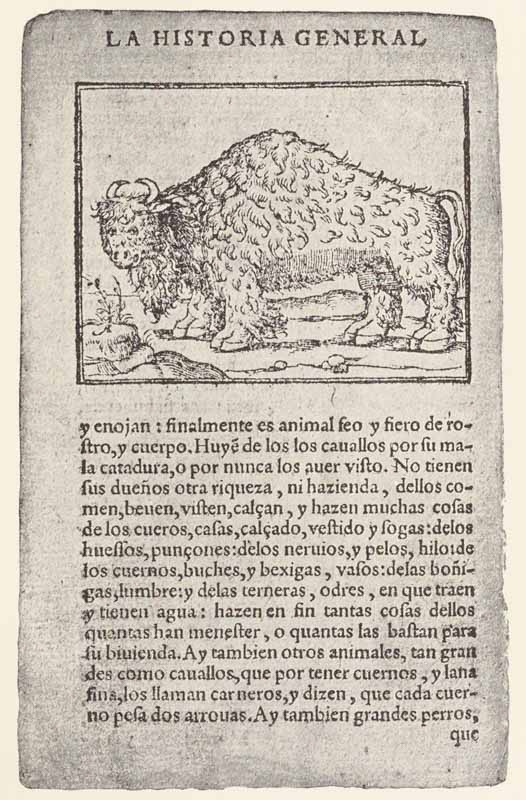
LV. The Buffalo of Gomara, 1554
Chapter 1, of the province of Culiacan
and of its habits and customs.
Culiacan is the last place in the New Kingdom of Galicia, and was
the first settlement made by Nuño de Guzman when he conquered this
kingdom. It is 210 leagues west of Mexico. In this province there are
three chief languages, besides other related dialects. The first is that
of the Tahus, who are the best and most intelligent race. They are
now the most settled and have received the most light from the faith.
They worship idols and make presents to the devil of their goods and
riches, consisting of cloth and turquoises. They do not eat human flesh
nor sacrifice it. They are accustomed to keep very large snakes, which
they venerate. Among them there are men dressed like women who
marry other men and serve as their wives. At a great festival they
consecrate the women who wish to live unmarried, with much singing
and dancing,190
at which all the chiefs of the locality gather and dance
naked, and after all have danced with her they put her in a hut that
has been decorated for this event and the chiefs adorn her with clothes
and bracelets of fine turquoises, and then the chiefs go in one by one to
lie with her, and all the others who wish, follow them. From this time
on these women can not refuse anyone who pays them a certain amount
agreed on for this. Even if they take husbands, this does not exempt
them from obliging anyone who pays them. The greatest festivals are
on market days. The custom is for the husbands to buy the women
p514
whom they marry, of their fathers and relatives at a high price, and
then to take them to a chief, who is considered to be a priest, to deflower
them and see if she is a virgin; and if she is not, they have to return
the whole price, and he can keep her for his wife or not, or let her be
consecrated, as he chooses. At these times they all get drunk.
The second language is that of the Pacaxes, the people who live in
the country between the plains and the mountains. These people are
more barbarous. Some of them who live near the mountains eat human
flesh.191
They are great sodomites, and have many wives, even when
these are sisters. They worship painted and sculptured stones, and are
much given to witchcraft and sorcery.
The third language is that of the Acaxes, who are in possession of a
large part of the hilly country and all of the mountains. They go hunting
for men just as they hunt animals. They all eat human flesh, and
he who has the most human bones and skulls hung up around his house
is most feared and respected. They live in settlements and in very
rough country, avoiding the plains. In passing from one settlement to
another, there is always a ravine in the way which they can not cross,
although they can talk together across it.192
At the slightest call 500 men
collect, and on any pretext kill and eat one another. Thus it has been
very hard to subdue these people, on account of the roughness of the
country, which is very great.
Many rich silver mines have been found in this country. They do
not run deep, but soon give out. The gulf of the sea begins on the coast
of this province, entering the land 250 leagues toward the north and
ending at the mouth of the Firebrand (Tizon) river. This country
forms its eastern limit, and California the western. From what I have
been told by men who had navigated it, it is 30 leagues across from point
to point, because they lose sight of this country when they see the other.
They say the gulf is over 150 leagues broad (or deep), from shore to
shore. The coast makes a turn toward the south at the Firebrand river,
bending down to California, which turns toward the west, forming that
peninsula which was formerly held to be an island, because it was a low
sandy country. It is inhabited by brutish, bestial, naked people who
eat their own offal. The men and women couple like animals, the female
openly getting down on all fours.
Chapter 2, of the province of Petlatlan and all the inhabited country as
far as Chichilticalli.
Petlatlan is a settlement of houses covered with a sort of mats made
of plants.193
These are collected into villages, extending along a river
from the mountains to the sea. The people are of the
same race and p515
habits as the Culuacanian Tahues. There is much sodomy among them.
In the mountain district there is a large population and more settlements.
These people have a somewhat different language from the
Tahues, although they understand each other. It is called Petlatlan
because the houses are made of petates or palm-leaf mats.194
Houses of
this sort are found for more than 240 leagues in this region, to the
beginning of the Cibola wilderness. The nature of the country changes
here very greatly, because from this point on there are no trees except
the pine,195
nor are there any fruits except a few tunas,196
mesquites,197
and
pitahayas.198
Petlatlan is 20 leagues from Culiacan, and it is 130 leagues from here
to the valley of Señora. There are many rivers between the two, with
settlements of the same sort of people—for example, Smoloa, Boyomo,
Teocomo, Yaquimi, and other smaller ones. There is also the Corazones
or Hearts, which is in our possession, down the valley of Señora.199
Señora is a river and valley thickly settled by able-bodied people.
The women wear petticoats of tanned deerskin, and little san benitos
reaching half way down the body.200
The chiefs of the villages go up on
some little heights they have made for this purpose, like public criers,
and there make proclamations for the space of an hour, regulating
those things they have to attend to. They have some little huts for
shrines, all over the outside of which they stick many arrows, like a
hedgehog. They do this when they are eager for war. All about this
province toward the mountains there is a large population in separate
little provinces containing ten or twelve villages. Seven or eight
of them, of which I know the names, are Comupatrico, Mochilagua,
Arispa, and the Little Valley.201
There are others which we did not see.
It is 40 leagues from Señora to the valley of Suya. The town of Saint
Jerome (San Hieronimo) was established in this valley,
where there was p516
a rebellion later, and part of the people who had settled there were killed,
as will be seen in the third part. There are many villages in the neighborhood
of this valley. The people are the same as those in Señora and
have the same dress and language, habits, and customs, like all the rest
as far as the desert of Chichilticalli. The women paint their chins and
eyes like the Moorish women of Barbary. They are great sodomites.
They drink wine made of the pitahaya, which is the fruit of a great
thistle which opens like the pomegranate. The wine makes them
stupid. They make a great quantity of preserves from the tuna; they
preserve it in a large amount of its sap without other honey. They
make bread of the mesquite, like cheese, which keeps good for a whole
year.202
There are native melons in this country so large that a person
can carry only one of them. They cut these into slices and dry them
in the sun. They are good to eat, and taste like figs, and are better
than dried meat; they are very good and sweet, keeping for a whole
year when prepared in this way.203
In this country there were also tame eagles, which the chiefs esteemed
to be something fine.204
No fowls of any sort were seen in any of these
villages except in this valley of Suya, where fowls like those of Castile
were found. Nobody could find out how they came to be so far inland,
the people being all at war with one another. Between Suya and Chichilticalli
there are many sheep and mountain goats with very large bodies
and horns. Some Spaniards declare that they have seen flocks of more
than a hundred together, which ran so fast that they disappeared very
quickly.
At Chichilticalli the country changes its character again and the
spiky vegetation ceases. The reason is that the gulf reaches as far up
as this place, and the mountain chain changes its direction at the same
time that the coast does. Here they had to cross and pass through the
mountains in order to get into the level country.
Chapter 3, of Chichilticalli and the desert, of Cibola, its customs and
habits, and of other things.
Chichilticalli is so called because the friars found a house at this place
which was formerly inhabited by people who separated from Cibola. It
was made of colored or reddish earth.205
The house was large and appeared
to have been a fortress. It must have been destroyed by the people of
the district, who are the most barbarous people that have yet been seen.
They live in separate cabins and not in settlements.
They live by p517
hunting. The rest of the country is all wilderness, covered with pine forests.
There are great quantities of the pine nuts. The pines are two or three
times as high as a man before they send out branches. There is a sort of
oak with sweet acorns, of which they make cakes like sugar plums with
dried coriander seeds. It is very sweet, like sugar. Watercress grows
in many springs, and there are rosebushes, and pennyroyal, and wild
marjoram.
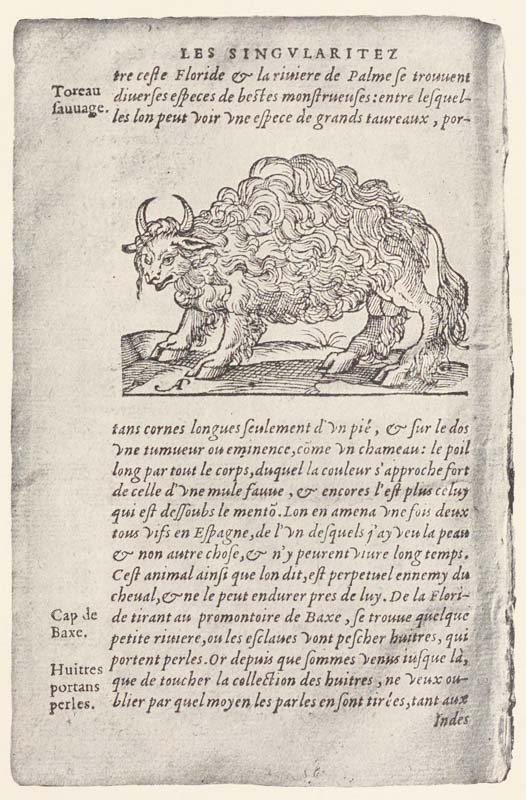
LVI. The Buffalo of Thevet, 1558
There are barbels and picones,206
like those of Spain, in the rivers of
this wilderness. Gray lions and leopards were seen.207
The country
rises continually from the beginning of the wilderness until Cibola is
reached, which is 85 leagues, going north. From Culiacan to the edge
of the wilderness the route had kept the north on the left hand.
Cibola208
is seven villages. The largest is called Maçaque.209
The
houses are ordinarily three or four stories high, but in Maçaque there
are houses with four and seven stories. These people are very intelligent.
They cover their privy parts and all the immodest parts with
cloths made like a sort of table napkin, with fringed edges and a tassel
at each corner, which they tie over the hips. They wear long robes of
feathers and of the skins of hares, and cotton blankets.210
The women
wear blankets, which they tie or knot over the left shoulder, leaving the
right arm out. These serve to cover the body. They wear a neat
well-shaped outer garment of skin. They gather their hair over the
two ears, making a frame which looks like an old-fashioned
headdress.211
p518
This country is a valley between rocky mountains. They cultivate
corn, which does not grow very high. The ears start at the very foot,
and each large fat stalk, bears about 800 grains, something not seen
before in these parts.212
There are large numbers of bears in this province,
and lions, wild-cats, deer, and otter. There are very fine turquoises,
although not so many as was reported. They collect the pine nuts each
year, and store them up in advance. A man does not have more than
one wife. There are estufas or hot rooms in the villages, which are the
courtyards or places where they gather for consultation. They do not
have chiefs as in New Spain, but are ruled by a council of the oldest men.213
They have priests who preach to them, whom they call papas.214
These
are the elders. They go up on the highest roof of the village and preach
to the village from there, like public criers, in the morning while the sun
is rising, the whole village being silent and sitting in the galleries to
listen.215
They tell them how they are to live, and I believe that they
give certain commandments for them to keep, for there is no drunkenness
among them nor sodomy nor sacrifices, neither do they eat human
flesh nor steal, but they are usually at work. The estufas belong to
the whole village. It is a sacrilege for the women to go into the estufas
to sleep.216
They make the cross as a sign of peace. They burn their
dead, and throw the implements used in their work into the fire with
the bodies.217
p519
It is 20 leagues to Tusayan, going northwest. This is a province
with seven villages, of the same sort, dress, habits, and ceremonies as
at Cibola. There may be as many as 3,000 or 4,000 men in the fourteen
villages of these two provinces. It is 40 leagues or more to Tiguex,
the road, trending toward the north. The rock of Acuco, which we
described in the first part, is between these.
Chapter 4, of how they live at Tiguex, and of the province of Tiguex and
its neighborhood.
Tiguex is a province with twelve villages on the banks of a large,
mighty river; some villages on one side and some on the other. It is a
spacious valley two leagues wide, and a very high, rough, snow-covered
mountain chain lies east of it. There are seven villages in the ridges
at the foot of this—four on the plain and three situated on the skirts
of the mountain.
There are seven villages 7 leagues to the north, at Quirix, and the
seven villages of the province of Hemes are 40 leagues northwest. It
is 40 leagues north or east to Acha,218
and 4 leagues southeast
to p520
Tutahaco, a province with eight villages. In general, these villages all have
the same habits and customs, although some have some things in particular
which the others have not.219
They are governed by the opinions
of the elders. They all work together to build the villages, the women
being engaged in making the mixture and the walls, while the men
bring the wood and put it in place.220
They have no lime, but they make
a mixture of ashes, coals, and dirt which is almost as good as mortar,
for when the house is to have four stories, they do not make the walls
more than half a yard thick. They gather a great pile of twigs of
thyme and sedge grass and set it afire, and when it is half coals and
ashes they throw a quantity of dirt and water on it and mix it all
together. They make round balls of this, which they use instead of
stones after they are dry, fixing them with the same mixture, which
comes to be like a stiff clay. Before they are married the young men
serve the whole village in general, and fetch the wood that is needed
for use, putting it in a pile in the courtyard of the villages, from which
the women take it to carry to their houses.
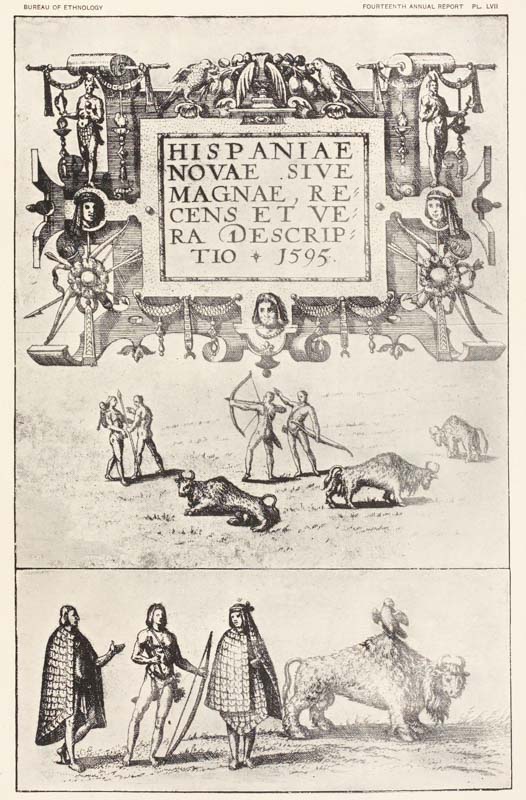
LVII. The Buffalo of De Bry, 1595
The young men live in the estufas, which are in the yards of the
village.221
They are underground, square or round, with
pine pillars. p521
Some were seen with twelve pillars and with four in the center as large
as two men could stretch around. They usually had three or four pillars.
The floor was made of large, smooth stones, like the baths which
they have in Europe. They have a hearth made like the binnacle or
compass box of a ship,222
in which they burn a handful of thyme at a time
to keep up the heat, and they can stay in there just as in a bath. The
top was on a level with the ground. Some that were seen were large
enough for a game of ball. When any man wishes to marry, it has to be
arranged by those who govern. The man has to spin and weave a blanket
and place it before the woman, who covers herself with it and becomes
his wife.223
The houses belong to the women, the estufas to the men. If
a man repudiates his woman, he has to go to the estufa.224
It is forbidden
for women to sleep in the estufas, or to enter these for any purpose
except to give their husbands or sons something to eat. The men spin
and weave. The women bring up the children and prepare the food.
The country is so fertile that they do not have to break up the ground
the year round, but only have to sow the seed, which is presently
covered by the fall of snow, and the ears come up under the snow.
In one year they gather enough for seven. A very large number of
cranes and wild geese and crows and starlings live on what is sown,
and for all this, when they come to sow for another year, the fields are
covered with corn which they have not been able to finish gathering.
There are a great many native fowl in these provinces, and cocks
with great hanging chins.225
When dead, these keep for sixty days, and
longer in winter, without losing their feathers or opening, and without
any bad smell, and the same is true of dead men.
The villages are free from nuisances, because they go outside to
excrete, and they pass their water into clay vessels, which
they empty p522
at a distance from the village.226
They keep the separate houses where
they prepare the food for eating and where they grind the meal, very
clean. This is a separate room or closet, where they have a trough with
three stones fixed in stiff clay. Three women go in here, each one having
a stone, with which one of them breaks the corn, the next grinds
it, and the third grinds it again.227
They take off their shoes, do up
their hair, shake their clothes, and cover their heads before they enter
the door. A man sits at the door playing on a fife while they grind, moving
the stones to the music and singing together. They grind a large
quantity at one time, because they make all their bread of meal soaked
in warm water, like wafers. They gather a great quantity of brushwood
and dry it to use for cooking all through the year. There are no fruits
good to eat in the country, except the pine nuts. They have their
preachers. Sodomy is not found among them. They do not eat human
flesh nor make sacrifices of it. The people are not cruel, for they had
Francisco de Ovando in Tiguex about forty days, after he was dead,
and when the village was captured, he was found among their dead, whole
and without any other wound except the one which killed him, white as
snow, without any bad smell. I found out several things about them
from one of our Indians, who had been a captive among them for a
whole year. I asked him especially for the reason why the young
women in that province went entirely naked, however cold it might be,
and he told me that the virgins had to go around this way until they
took a husband, and that they covered themselves after they had known
man. The men here wear little shirts of tanned deerskin and their long
robes over this. In all these provinces they have earthenware glazed
with antimony and jars of extraordinary labor and workmanship, which
were worth seeing.228
p523
Chapter 5, of Cicuye and the villages in its neighborhood, and of how
some people came to conquer this country.
We have already said that the people of Tiguex and of all the provinces
on the banks of that river were all alike, having the same ways
of living and the same customs. It will not be necessary to say anything
particular about them. I wish merely to give an account of Cicuye
and some depopulated villages which the army saw on the direct road
which it followed thither, and of others that were across the snowy
mountains near Tiguex, which also lay in that region above the river.
Cicuye229
is a village of nearly five hundred warriors, who are feared
throughout that country. It is square, situated on a rock, with a large
court or yard in the middle, containing the estufas. The houses are all
alike, four stories high. One can go over the top of the whole village
without there being a street to hinder. There are corridors going all
around it at the first two stories, by which one can go around the whole
village. These are like outside balconies, and they are able to protect
themselves under these.230
The houses do not have doors below, but they
use ladders, which can be lifted up like a drawbridge, and so go up to
the corridors which are on the inside of the village. As the doors of the
houses open on the corridor of that story, the corridor serves as a street.
The houses that open on the plain are right back of those that open
on the court, and in time of war they go through those behind them.
The village is inclosed by a low wall of stone. There is a spring of
water inside, which they are able to divert.231
The people of this village
boast that no one has been able to conquer them and that they conquer
whatever villages they wish. The people and their customs are like
those of the other villages. Their virgins also go nude until they take
husbands, because they say that if they do anything wrong then it will
be seen, and so they do not do it. They do not need to be ashamed
because they go around as they were born.
There is a village, small and strong, between Cicuye and the province
of Quirix, which the Spaniards named Ximena,232
and another village
almost deserted, only one part of which is inhabited.233
This was a large
village, and judging from its condition and newness it appeared to have
been destroyed. They called this the village of the granaries or silos,
because large underground cellars were found here stored with corn.
There was another large village farther on, entirely
destroyed and p524
pulled down, in the yards of which there were many stone balls, as
big as 12-quart bowls, which seemed to have been thrown by engines
or catapults, which had destroyed the village. All that I was able to
find out about them was that, sixteen years before, some people called
Teyas,234
had come to this country in great numbers and had destroyed
these villages. They had besieged Cicuye but had not been able to capture
it, because it was strong, and when they left the region, they had
made peace with the whole country. It seems as if they must have
been a powerful people, and that they must have had engines to knock
down the villages. The only thing they could tell about the direction
these people came from was by pointing toward the north. They
usually call these people Teyas or brave men, just as the Mexicans say
chichimecas or braves,235
for the Teyas whom the army saw were brave.
These knew the people in the settlements, and were friendly with them,
and they (the Teyas of the plains) went there to spend the winter
under the wings of the settlements. The inhabitants do not dare to
let them come inside, because they can not trust them. Although they
are received as friends, and trade with them, they do not stay in the villages
over night, but outside under the wings. The villages are guarded
by sentinels with trumpets, who call to one another just as in the fortresses
of Spain.
There are seven other villages along this route, toward the snowy
mountains, one of which has been half destroyed by the people already
referred to. These were under the rule of Cicuye. Cicuye is in a little
valley between mountain chains and mountains covered with large pine
forests. There is a little stream which contains very good trout and
otters, and there are very large bears and good falcons hereabouts.
Chapter 6, which gives the number of villages which were seen in the
country of the terraced houses, and their population.
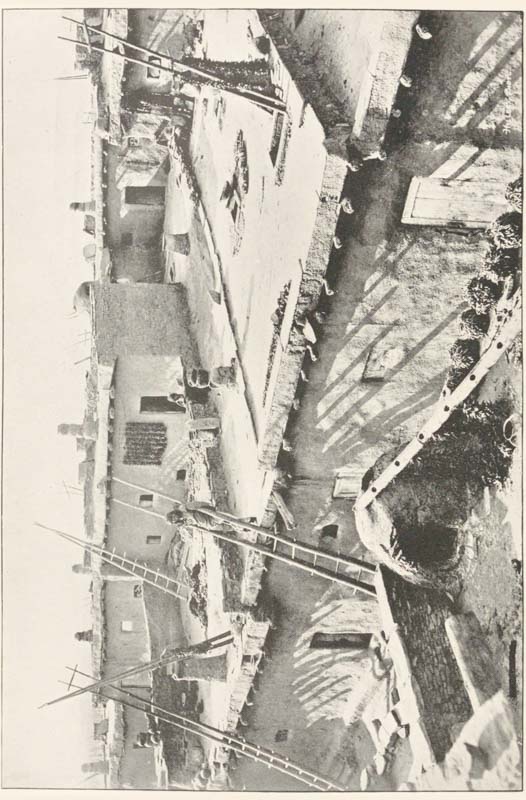
LVIII. On the Terraces at Zuñi
Before I proceed to speak of the plains, with the cows and settlements
and tribes there, it seems to me that it will be well for the reader to
know how large the settlements were, where the houses with stories,
gathered into villages, were seen, and how great an extent of country
they occupied.236
As I say, Cibola is the first:
Cibola, seven villages.
Tusayan, seven villages.
The rock of Acuco, one. p525
Tiguex, twelve villages.
Tutahaco,237
eight villages.
These villages were below the river.
Quirix,238 seven villages.
In the snowy mountains, seven villages.
Ximena,239
three villages.
Cicuye, one village.
Hemes,240
seven villages.
Aguas Calientes,240
or Boiling Springs, three villages.
Yuqueyunque,241
in the mountains, six villages.
Valladolid, called Braba,242
one village.
Chia,243
one village.
In all, there are sixty-six villages.244
Tiguex appears to be in the
center of the villages. Valladolid is the farthest up the river toward
the northeast. The four villages down the river are toward the southeast,
because the river turns toward the east.245
It is 130 leagues—10
more or less—from the farthest point that was seen down the river to
the farthest point up the river, and all the settlements are within this
region. Including those at a distance, there are sixty-six villages in all,
as I have said, and in all of them there may be some 20,000 men, which
may be taken to be a fair estimate of the population of the villages.
There are no houses or other buildings between one village and another,
but where we went it is entirely uninhabited.246
These people, since they
are few, and their manners, government, and habits are so different from
all the nations that have been seen and discovered in these western
regions, must come from that part of Greater India, the coast of which
lies to the west of this country, for they could have come down from that
country, crossing the mountain chains and following down, the river,
settling in what seemed to them the best place.247
As they multiplied,
they have kept on making settlements until they lost the river when it
buried itself underground, its course being in the direction of Florida.
It comes down from the northeast, where they248
could certainly have
found signs of villages. He preferred, however, to follow
the reports of p526
the Turk, but it would have been better to cross the mountains where
this river rises. I believe they would have found traces of riches and
would have reached the lands from which these people started, which
from its location is on the edge of Greater India, although the region is
neither known nor understood, because from the trend of the coast it
appears that the land between Norway and China is very far up.249
The
country from sea to sea is very wide, judging from the location of both
coasts, as well as from what Captain Villalobos discovered when he went
in search of China by the sea to the west,250
and from what has been discovered
on the North sea concerning the trend of the coast of Florida
toward the Bacallaos, up toward Norway.251
To return then to the proposition with which I began, I say that the
settlements and people already named were all that were seen in a
region 70 leagues wide and 130 long, in the settled country along the
river Tiguex.252
In New Spain there are not one but many establishments,
containing a larger number of people. Silver metals were found
in many of their villages, which they use for glazing and painting their
earthenware.253
Chapter 7, which treats of the plains that were crossed, of the cows,
and of the people who inhabit them.
We have spoken of the settlements of high houses which are situated
in what seems to be the most level and open part of the mountains,
since it is 150 leagues across before entering the level country between
the two mountain chains which I said were near the North sea and the
South sea, which might better be called the Western sea along this coast.
This mountain series is the one which is near the South sea.254
In order
to show that the settlements are in the middle of the mountains, I will
state that it is 80 leagues from Chichilticalli, where we began to cross
this country, to Cibola; from Cibola, which is the first village, to
Cicuye, which is the last on the way across, is 70 leagues; it is 30
leagues from Cicuye to where the plains begin. It may be we went
across in an indirect or roundabout way, which would make it seem as
if there was more country than if it had been crossed in a direct line,
and it may be more difficult and rougher. This can not be known certainly,
because the mountains change their direction above the bay at
the mouth of the Firebrand (Tizon) river. p527
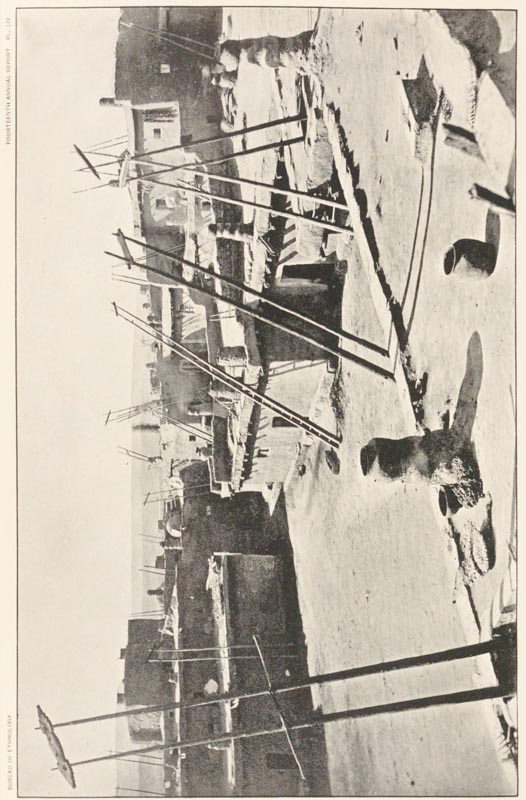
LIX. Middle Court at Zuñi
Now we will speak of the plains. The country is spacious and level,
and is more than 400 leagues wide in the part between the two mountain
ranges—one, that which Francisco Vazquez Coronado crossed, and
the other that which the force under Don Fernando de Soto crossed,
near the North sea, entering the country from Florida. No settlements
were seen anywhere on these plains.
In traversing 250 leagues, the other mountain range was not seen,
nor a hill nor a hillock which was three times as high as a man. Several
lakes were found at intervals; they were round as plates, a stone’s
throw or more across, some fresh and some salt. The grass grows tall
near these lakes; away from them it is very short, a span or less. The
country is like a bowl, so that when a man sits down, the horizon surrounds
him all around at the distance of a musket shot.255
There are no
groves of trees except at the rivers, which flow at the bottom of some
ravines where the trees grow so thick that they were not noticed until
one was right on the edge of them. They are of dead earth.256
There
are paths down into these, made by the cows when they go to the water,
which is essential throughout these plains. As I have related in the
first part, people follow the cows, hunting them and tanning the skins
to take to the settlements in the winter to sell, since they go there to
pass the winter, each company going to those which are nearest, some
to the settlements at Cicuye,257
others toward Quivira, and others to the
settlements which are situated in the direction of Florida. These people
are called Querechos and Teyas. They described some large settlements,
and judging from what was seen, of these people and from the
accounts they gave of other places, there are a good many more of
these people than there are of those at the settlements.258
They have
better figures, are better warriors, and are more feared. They travel
like the Arabs, with their tents and troops of dogs loaded with poles259
and having Moorish pack saddles with girths.260
When the load gets
disarranged, the dogs howl, calling some one to fix them right. These
people eat raw flesh and drink blood. They do not eat human flesh.
They are a kind people and not cruel. They are faithful friends. They
are able to make themselves very well understood by means of signs.
They dry the flesh in the sun, cutting it thin like a leaf, and when dry
they grind it like meal to keep it and make a sort of sea soup of it to
eat. A handful thrown into a pot swells up so as to
increase very p528
much. They season it with fat, which they always try to secure when
they kill a cow.261
They empty a large gut and fill it with blood, and
carry this around the neck to drink when they are thirsty. When
they open the belly of a cow, they squeeze out the chewed grass and
drink the juice that remains behind, because they say that this contains
the essence of the stomach. They cut the hide open at the back and
pull it off at the joints, using a flint as large as a finger, tied in a little
stick, with as much ease as if working with a good iron tool. They
give it an edge with their own teeth. The quickness with which they
do this is something worth seeing and noting.262
There are very great numbers of wolves on these plains, which go
around with the cows. They have white skins. The deer are pied with
white. Their skin is loose, so that when they are killed it can be pulled
off with the hand while warm, coming off like pigskin.263
The rabbits,
which, are very numerous, are so foolish that those on horseback killed
them with their lances. This is when they are mounted among the
cows. They fly from a person on foot.
Chapter 8, of Quivira, of where it is and some information about it.
Quivira is to the west of those ravines, in the midst of the country,
somewhat nearer the mountains toward the sea, for the country is level
as far as Quivira, and there they began to see some mountain chains.
The country is well settled. Judging from what was seen on the borders
of it, this country is very similar to that of Spain in the varieties
of vegetation and fruits. There are plums like those of Castile, grapes,
nuts, mulberries, oats, pennyroyal, wild marjoram, and large quantities
of flax, but this does not do them any good, because they do not know
how to use it.264
The people are of almost the same sort and appearance
as the Teyas. They have villages like those in New Spain. The
houses are round, without a wall, and they have one story like a loft,
under the roof, where they sleep and keep their belongings.
The roofs p529
are of straw. There are other thickly settled provinces around it containing
large numbers of men. A friar named Juan de Padilla remained
in this province, together with a Spanish-Portuguese and a negro and
a half-blood and some Indians from the province of Capothan,265
in New
Spain. They killed the friar because he wanted to go to the province
of the Guas,266
who were their enemies. The Spaniard escaped by taking
flight on a mare, and afterward reached New Spain, coming out by way
of Panuco. The Indians from New Spain who accompanied the friar
were allowed by the murderers to bury him, and then they followed
the Spaniard and overtook him. This Spaniard was a Portuguese,
named Campo.267
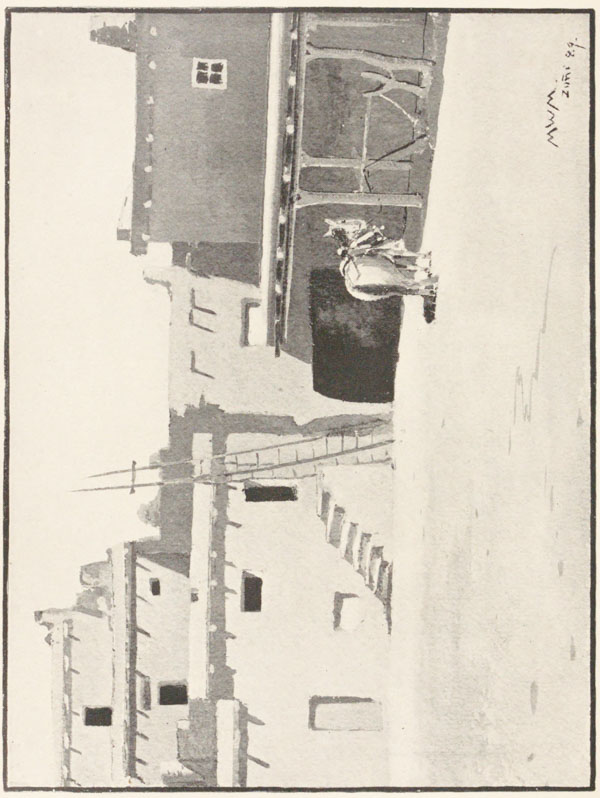
LX. Zuñi Court, Showing “Balcony”
The great river of the Holy Spirit (Espiritu Santo),268
which Don Fernando
de Soto discovered in the country of Florida, flows through this
country. It passes through a province called Arache, according to the
reliable accounts which were obtained here. The sources were not
visited, because, according to what they said, it comes from a very
distant country in the mountains of the South sea, from the part that
sheds its waters onto the plains. It flows across all the level country
and breaks through the mountains of the North sea, and comes out
where the people with Don Fernando de Soto navigated it. This is
more than 300 leagues from where it enters the sea. On account of
this, and also because it has large tributaries, it is so mighty when it
enters the sea that they lost sight of the land before the water ceased
to be fresh.269
This country of Quivira was the last that was seen, of which I am able
to give any description or information. Now it is proper for me to return
and speak of the army, which I left in Tiguex, resting for the winter, so
that it would be able to proceed or return in search of these settlements
of Quivira, which was not accomplished after all, because
it was p530
God’s pleasure that these discoveries should remain for other peoples
and that we who had been there should content ourselves with saying
that we were the first who discovered it and obtained any information
concerning it, just as Hercules knew the site where Julius Cæsar was
to found Seville or Hispales. May the all-powerful Lord grant that
His will be done in everything. It is certain that if this had not been
His will Francisco Vazquez would not have returned to New Spain without
cause or reason, as he did, and that it would not have been left for
those with Don Fernando de Soto to settle such a good country, as they
have done, and besides settling it to increase its extent, after obtaining,
as they did, information from our army.270
THIRD PART, WHICH DESCRIBES WHAT HAPPENED TO FRANCISCO VAZQUEZ CORONADO DURING THE WINTER, AND HOW HE GAVE UP THE EXPEDITION AND RETURNED TO NEW SPAIN.
Laus Deo.
Chapter 1, of how Don Pedro de Tovar came from
Señora with some men, and, Don Garcia Lopez de Cardenas started back
to New Spain.
At the end of the first part of this book, we told how Francisco
Vazquez Coronado, when he got back from Quivira, gave orders to
winter at Tiguex, in order to return, when the winter was over, with his
whole army to discover all the settlements in those regions. Don Pedro
de Tovar, who had gone, as we related, to conduct a force from the city
of Saint Jerome (San Hieronimo), arrived in the meantime with the men
whom he had brought. He had not selected the rebels and seditious
men there, but the most experienced ones and the best soldiers—men
whom he could trust—wisely considering that he ought to have good
men in order to go in search of his general in the country of the Indian
called Turk. Although they found the army at Tiguex when they arrived
there, this did not please them much, because they had come with great
expectations, believing that they would find their general in the rich
country of the Indian called Turk. They consoled themselves with the
hope of going back there, and lived in anticipation of the pleasure of
undertaking this return expedition, which the army would soon make to
Quivira. Don Pedro de Tovar brought letters from New Spain, both
from the viceroy, Don Antonio de Mendoza, and from individuals.
Among these was one for Don Garcia Lopez de Cardenas, which
informed him of the death of his brother, the heir, and summoned
him to Spain to receive the inheritance. On this account he was
given permission, and left Tiguex with several other
persons who p531
received permission to go and settle their affairs. There were many
others who would have liked to go, but did not, in order not to appear
faint-hearted. During this time the general endeavored to pacify several
villages in the neighborhood which were not well disposed, and to
make peace with the people at Tiguex. He tried also to procure some of
the cloth of the country, because the soldiers were almost naked and
poorly clothed, full of lice, which they were unable to get rid of or avoid.
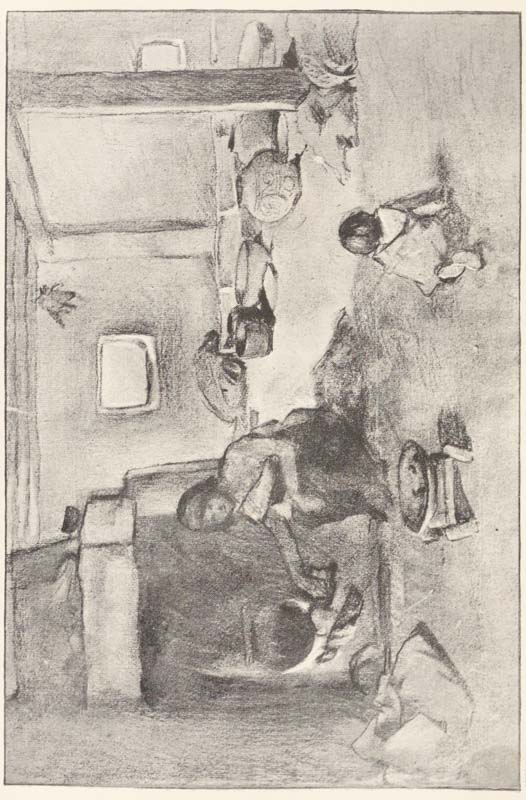
LXI. Zuñi Interior
The general, Francisco Vazquez Coronado, had been beloved and
obeyed by his captains and soldiers as heartily as any of those who
have ever started out in the Indies. Necessity knows no law, and the
captains who collected the cloth divided it badly, taking the best for
themselves and their friends and soldiers, and leaving the rest for the
soldiers, and so there began to be some angry murmuring on account
of this. Others also complained because they noticed that some
favored ones were spared in the work and in the watches and received
better portions of what was divided, both of cloth and food. On this
account it is thought that they began to say that there was nothing
in the country of Quivira which was worth returning for, which was
no slight cause of what afterward happened, as will be seen.
Chapter 2, of the general’s fall, and of how the return to New Spain was
ordered.
After the winter was over, the return to Quivira was announced, and
the men began to prepare the things needed. Since nothing in this life
is at the disposition of men, but all is under the ordination of Almighty
God, it was His will that we should not accomplish this, and so it happened
that one feast day the general went out on horseback to amuse
himself, as usual,271
riding with the captain Don Rodrigo Maldonado.
He was on a powerful horse, and his servants had put on a new girth,
which must have been rotten at the time, for it broke during the race
and he fell over on the side where Don Rodrigo was, and as his horse
passed over him it hit his head with its hoof, which laid him at the
point of death, and his recovery was slow and doubtful.272
During this time, while he was in his bed,273
Don Garcia Lopez de Cardenas,
who had started to go to New Spain, came back in flight from
Suya, because he had found that town deserted and the people and horses
and cattle all dead. When he reached Tiguex and learned the
sad news p532
that the general was near his end, as already related, they did not dare to
tell him until he had recovered, and when he finally got up and learned
of it, it affected him so much that he had to go back to bed again. He
may have done this in order to bring about what he afterward accomplished,
as was believed later. It was while he was in this condition
that he recollected what a scientific friend of his in Salamanca had
told him, that he would become a powerful lord in distant lands, and
that he would have a fall from which he would never be able to recover.
This expectation of death made him desire to return and die where he
had a wife and children. As the physician and surgeon who was doctoring
him, and also acted as a talebearer,274
suppressed the murmurings
that were going about among the soldiers, he treated secretly and underhandedly
with several gentlemen who agreed with him. They set the
soldiers to talking about going back to New Spain, in little knots and
gatherings, and induced them to hold consultations about it, and had
them send papers to the general, signed by all the soldiers, through
their ensigns, asking for this. They all entered into it readily, and not
much time needed to be spent, since many desired it already. When
they asked him, the general acted as if he did not want to do it, but all
the gentlemen and captains supported them, giving him their signed
opinions, and as some were in this, they could give it at once, and they
even persuaded others to do the same.275
Thus they made it seem as
if they ought to return to New Spain, because they had not found any
riches, nor had they discovered any settled country out of which estates
could be formed for all the army. When he had obtained their signatures,
the return to New Spain was at once announced, and since nothing
can ever be concealed, the double dealing began to be understood,
and many of the gentlemen found that they had been deceived and had
made a mistake. They tried in every way to get their signatures back
again from the general, who guarded them so carefully that he did not
go out of one room, making his sickness seem very much worse, and
putting guards about his person and room, and at night about the floor
on which he slept. In spite of all this, they stole his chest, and it is
said that they did not find their signatures in it, because he kept them
in his mattress; on the other hand, it is said that they did recover them.
They asked the general to give them 60 picked men, with whom they
would remain and hold the country until the viceroy could send them
support, or recall them, or else that the general would leave them the
army and pick out 60 men to go back with him. But the soldiers did
not want to remain either way, some because they had turned their prow
toward New Spain, and others because they saw clearly the trouble
that would arise over who should have the command. The gentlemen,
I do not know whether because they had sworn fidelity or
because they p533
feared that the soldiers would not support them, did what had been
decided on,276
although with an ill-will, and from this time on they did
not obey the general as readily as formerly, and they did not show any
affection for him. He made much of the soldiers and humored them,
with the result that he did what he desired and secured the return of
the whole army.
Chapter 3, of the rebellion at Suya and the reasons the settlers gave for it.
We have already stated in the last chapter that Don Garcia Lopez
de Cardenas came back from Suya in flight, having found that country
risen in rebellion. He told how and why that town was deserted, which
occurred as I will relate. The entirely worthless fellows were all who
had been left in that town, the mutinous and seditious men, besides a
few who were honored with the charge of public affairs and who were
left to govern the others. Thus the bad dispositions of the worthless
secured the power, and they held daily meetings and councils and
declared that they had been betrayed and were not going to be rescued,
since the others had been directed to go through another part of the
country, where there was a more convenient route to New Spain, which
was not so, because they were still almost on the direct road. This talk
led some of them to revolt, and they chose one Pedro de Avila as their
captain. They went back to Culiacan, leaving the captain, Diego de
Alcaraz, sick in the town of San Hieronimo, with only a small force.
He did not have anyone whom he could send after them to compel them
to return. They killed a number of people at several villages along
the way. Finally they reached Culiacan, where Hernando Arias de
Saabedra, who was waiting for Juan Gallego to come back from New
Spain with a force, detained them by means of promises, so that Gallego
could take them back. Some who feared what might happen to them
ran away one night to New Spain. Diego de Alcaraz, who had remained
at Suya with a small force, sick, was not able to hold his position,
although he would have liked to, on account of the poisonous herb
which the natives use. When these noticed how weak the Spaniards
were, they did not continue to trade with them as they formerly had
done. Veins of gold had already been discovered before this, but they
were unable to work these, because the country was at war. The disturbance
was so great that they did not cease to keep watch and to be
more than usually careful.
The town was situated on a little river. One night all of a sudden277
they saw fires which they were not accustomed to, and on this account
they doubled the watches, but not having noticed anything during the
whole night, they grew careless along toward morning, and the enemy
entered the village so silently that they were not seen until they began
to kill and plunder. A number of men reached the plain
as well as p534
they could, but while they were getting out the captain was mortally
wounded. Several Spaniards came back on some horses after they
had recovered themselves and attacked the enemy, rescuing some,
though only a few. The enemy went off with the booty, leaving three
Spaniards killed, besides many of the servants and more than twenty
horses.
The Spaniards who survived started off the same day on foot, not
having any horses. They went toward Culiacan, keeping away from
the roads, and did not find any food until they reached Corazones,
where the Indians, like the good friends they have always been, provided
them with food. From here they continued to Culiacan, undergoing
great hardships. Hernandarias de Saabedra,278
the mayor, received
them and entertained them as well as he could until Juan Gallego
arrived with the reinforcements which he was conducting, on his way
to find the army. He was not a little troubled at finding that post
deserted, when he expected that the army would be in the rich country
which had been described by the Indian called Turk, because he looked
like one.
Chapter 4, of how Friar Juan de Padilla and Friar Luis remained in
the country and the army prepared to return to Mexico.
When the general, Francisco Vazquez, saw that everything was now
quiet, and that his schemes had gone as he wished, he ordered that
everything should be ready to start on the return to New Spain by the
beginning of the month of April, in the year 1543.279
Seeing this, Friar Juan de Padilla, a regular brother of the lesser
order,280
and another, Friar Luis, a lay brother, told the general that
they wanted to remain in that country—Friar Juan de Padilla in Quivira,
because his teachings seemed to promise fruit there, and Friar
Luis at Cicuye. On this account, as it was Lent at the time, the father
made this the subject of his sermon to the companies one Sunday,
establishing his proposition on the authority of the Holy Scriptures.
He declared his zeal for the conversion of these peoples and his desire
to draw them to the faith, and stated that he had received permission
to do it, although this was not necessary. The general sent a company
to escort them as far as Cicuye, where Friar Luis stopped, while Friar
Juan went on back to Quivira with the guides who had conducted the
general, taking with him the Portuguese, as we related, and the half-blood,
and the Indians from New Spain. He was martyred a short
time after he arrived there, as we related in the second part, chapter 8.
Thus we may be sure that he died a martyr, because his zeal was holy
and earnest.
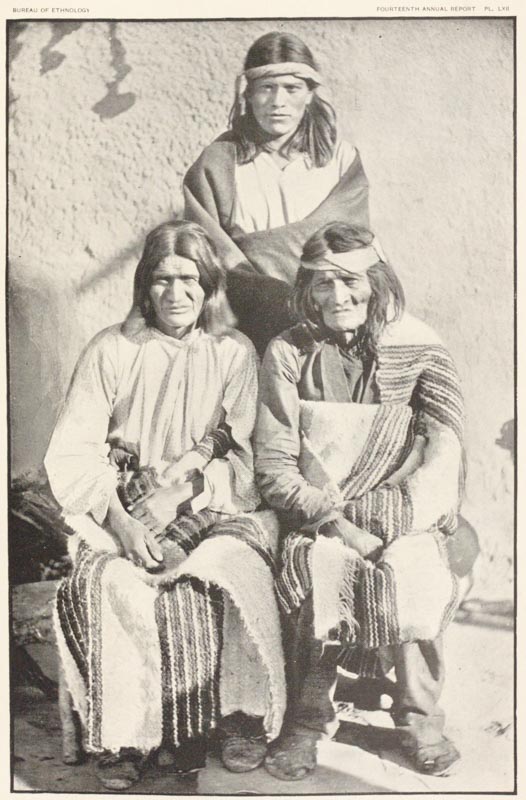
LXII. Zuñis in Typical Modern Costume
Friar Luis remained at Cicuye. Nothing more has been heard about
him since, but before the army left Tiguex some men who
went to take p535
him a number of sheep that were left for him to keep, met him as he
was on his way to visit some other villages, which were 15 or 20 leagues
from Cicuye, accompanied by some followers. He felt very hopeful
that he was liked at the village and that his teaching would bear
fruit, although he complained that the old men were falling away from
him. I, for my part, believe that they finally killed him. He was a
man of good and holy life, and may Our Lord protect him and grant
that he may convert many of those peoples, and end his days in guiding
them in the faith. We do not need to believe otherwise, for the
people in those parts are pious and not at all cruel. They are friends,
or rather, enemies of cruelty, and they remained faithful and loyal
friends.281
p536
After the friars had gone, the general, fearing that they might be
injured if people were carried away from that country to New Spain,
ordered the soldiers to let any of the natives who were held as servants
go free to their villages whenever they might wish. In my opinion,
though I am not sure, it would have been better if they had been kept
and taught among Christians.
The general was very happy and contented when the time arrived
and everything needed for the journey was ready, and the army started
from Tiguex on its way back to Cibola. One thing of no small note
happened during this part of the trip. The horses were in good condition
for their work when they started, fat and sleek, but more than,
thirty died during the ten days which it took to reach Cibola, and there
was not a day in which two or three or more did not die. A large number
of them also died afterward, before reaching Culiacan, a thing that
did not happen during all the rest of the journey.
After the army reached Cibola, it rested before starting across the
wilderness, because this was the last of the settlements in that country.
The whole country was left well disposed and at peace, and several of
our Indian allies remained there.282
p537
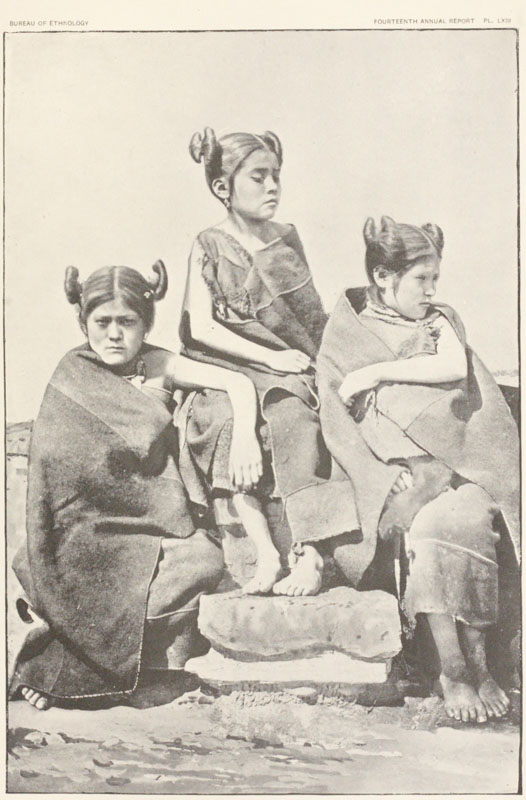
LXIII. Hopi Maidens, Showing
Primitive Pueblo Hairdressing
Chapter 5, of how the army left the settlements and marched to Culiacan,
and of what happened on the way.
Leaving astern, as we might say, the settlements that had been discovered
in the new land, of which, as I have said, the seven villages of
Cibola were the first to be seen and the last that were left, the army
started off, marching across the wilderness. The natives kept following
the rear of the army for two or three days, to pick up any baggage or
servants, for although they were still at peace and had always been
loyal friends, when they saw that we were going to leave the country
entirely, they were glad to get some of our people in their power,
although I do not think that they wanted to injure them, from what I
was told by some who were not willing to go back with them when they
teased and asked them to. Altogether, they carried off several people
besides those who had remained of their own accord, among whom good
interpreters could be found today. The wilderness was crossed without
opposition, and on the second day before reaching Chichilticalli Juan
Gallego met the army, as he was coming from New Spain with reenforcements
of men and necessary supplies for the army, expecting that he
would find the army in the country of the Indian called Turk. When
Juan Gallego saw that the army was returning, the first thing he said
was not, “I am glad you are coming back,” and he did not like it any
better after he had talked with the general. After he had reached the
army, or rather the quarters, there was quite a little movement among
the gentlemen toward going back with the new force which had made
no slight exertions in coming thus far, having encounters every day
with the Indians of these regions who had risen in revolt, as will be
related. There was talk of making a settlement somewhere in that
region until the viceroy could receive an account of what had occurred.
Those soldiers who had come from the new lands would not agree to
anything except the return to New Spain, so that nothing came of the
proposals made at the consultations, and although there was some
opposition, they were finally quieted. Several of the mutineers who
had deserted the town of Corazones came with Juan Gallego, who had
given them his word as surety for their safety, and even if the general
had wanted to punish them, his power was slight, for he had been disobeyed
already and was not much respected. He began to be afraid
again after this, and made himself sick, and kept a guard. In several
places yells were heard and Indians seen, and some of the horses were
wounded and killed, before Batuco283
was reached, where the friendly
Indians from Corazones came to meet the army and see the general.
They were always friendly and had treated all the Spaniards who passed
through their country well, furnishing them with what food they needed,
and men, if they needed these. Our men had always treated them well
and repaid them for these things. During this journey the juice of the
quince was proved to be a good protection against the
poison of the p538
natives, because at one place, several days before reaching Señora,284
the
hostile Indians wounded a Spaniard called Mesa, and he did not die,
although the wound of the fresh poison is fatal, and there was a delay
of over two hours before curing him with the juice. The poison, however,
had left its mark upon him. The skin rotted and fell off until it
left the bones and sinews bare, with a horrible smell. The wound was
in the wrist, and the poison had reached as far as the shoulder when
he was cured. The skin on all this fell off.285
The army proceeded without taking any rest, because the provisions
had begun to fail by this time. These districts were in rebellion, and
so there were not any victuals where the soldiers could get them until
they reached Petlatlan, although they made several forays into the cross
country in search of provisions. Petlatlan is in the province of Culiacan,
and on this account was at peace, although they had several surprises
after this.286
The army rested here several days to get provisions. After
leaving here they were able to travel more quickly than before, for the
30 leagues of the valley of Culiacan, where they were welcomed back
again as people who came with their governor, who had suffered ill
treatment.
Chapter 6, of how the general started from Culiacan to give the viceroy
an account of the army with which he had been intrusted.
It seemed, indeed, as if the arrival in the valley of Culiacan had ended
the labors of this journey, partly because the general was governor
there and partly because it was inhabited by Christians. On this
account some began to disregard their superiors and the authority which
their captains had over them, and some captains even forgot the obedience
due to their general. Each one played his own game, so that while
the general was marching toward the town, which was still 10 leagues
away, many of the men, or most of them, left him in order to rest in the
valley, and some even proposed not to follow him. The general understood
that he was not strong enough to compel them, although his
position as governor gave him fresh authority. He determined to accomplish
it by a better method, which was to order all the captains to provide
food and meat from the stores of several villages that were under
his control as governor. He pretended to be sick, keeping his bed, so
that those who had any business with him could speak to him
or he with p539
them more freely, without hindrance or observation, and he kept sending
for his particular friends in order to ask them to be sure to speak
to the soldiers and encourage them to accompany him back to New
Spain, and to tell them that he would request the viceroy, Don Antonio
de Mendoza, to show them especial favor, and that he would do so himself
for those who might wish to remain in his government. After this
had been done, he started with his army at a very bad time, when the rains
were beginning, for it was about Saint John’s day, at which season it rains
continuously. In the uninhabited country which they passed through
as far as Compostela there are numerous very dangerous rivers, full of
large and fierce alligators. While the army was halting at one of these
rivers, a soldier who was crossing from one side to the other was seized,
in sight of everybody, and carried off by an alligator without it being
possible to help him. The general proceeded, leaving the men who did
not want to follow him all along the way, and reached Mexico with less
than 100 men. He made his report to the viceroy, Don Antonio de
Mendoza, who did not receive him very graciously, although he gave
him his discharge. His reputation was gone from this time on. He
kept the government of New Galicia, which had been entrusted to him,
for only a short time, when the viceroy took it himself, until the arrival
of the court, or audiencia, which still governs it. And this was the end
of those discoveries and of the expedition which was made to these
new lands.287
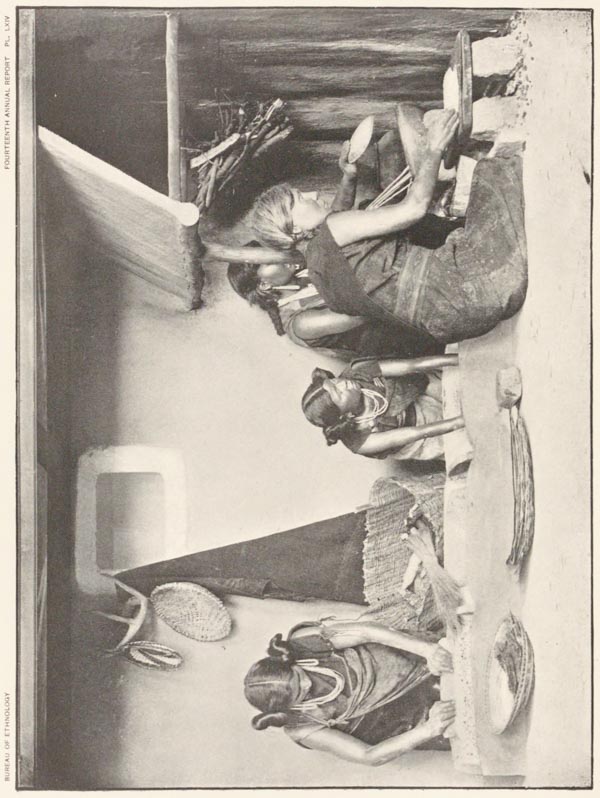
LXIV. Hopi Grinding and Paper-bread
Making (From photograph of a model
in the National Museum)
It now remains for us to describe the way in which to enter the
country by a more direct route, although there is never a short cut
without hard work. It is always best to find out what those know
who have prepared the way, who know what will be needed.288
This
can be found elsewhere, and I will now tell where Quivira lies, what
direction the army took, and the direction in which Greater India
lies, which was what they pretended to be in search of, when the
army started thither. Today, since Villalobos has discovered that this
part of the coast of the South sea trends toward the west, it is clearly
seen and acknowledged that, since we were in the north, we ought to
have turned to the west instead of toward the east, as we did. With
this, we will leave this subject and will proceed to finish this treatise,
since there are several noteworthy things of which I must give an
account, which I have left to be treated more extensively in the two
following chapters. p540
Chapter 7, of the adventures of Captain Juan Gallego while he was
bringing reenforcements through the revolted country.
One might well have complained when in the last chapter I passed
in silence over the exploits of Captain Juan Gallego with his 20 companions.
I will relate them in the present chapter, so that in times to
come those who read about it or tell of it may have a reliable authority
on whom to rely. I am not writing fables, like some of the things
which we read about nowadays in the books of chivalry. If it were
not that those stories contained enchantments, there are some things
which our Spaniards have done in our own day in these parts, in their
conquests and encounters with the Indians, which, for deeds worthy
of admiration, surpass not only the books already mentioned, but also
those which have been written about the twelve peers of France,
because, if the deadly strength which the authors of those times
attributed to their heroes and the brilliant and resplendent arms with
which they adorned them, are fully considered, and compared with
the small stature of the men of our time and the few and poor weapons
which they have in these parts,289
the remarkable things which our people
have undertaken and accomplished with such weapons are more to be
wondered at today than those of which the ancients write, and just
because, too, they fought with barbarous naked people, as ours have with
Indians, among whom there are always men who are brave and valiant
and very sure bowmen, for we have seen them pierce the wings while
flying, and hit hares while running after them. I have said all this in
order to show that some things which we consider fables may be true,
because we see greater things every day in our own times, just as in
future times people will greatly wonder at the deeds of Don Fernando
Cortez, who dared to go into the midst of New Spain with 300 men
against the vast number of people in Mexico, and who with 500
Spaniards succeeded in subduing it, and made himself lord over it in
two years.
The deeds of Don Pedro de Alvarado in the conquest of Guatemala,
and those of Montejo in Tabasco, the conquests of the mainland and
of Peru, were all such as to make me remain silent concerning what
I now wish to relate; but since I have promised to give an account of
what happened on this journey, I want the things I am now going to
relate to be known as well as those others of which I have spoken.
The captain Juan Gallego, then, reached the town of Culiacan with
a very small force. There he collected as many as he could of those
who had escaped from the town of Hearts, or, more correctly, from
Suya, which made in all 22 men, and with these he marched through
all of the settled country, across which he traveled 200 leagues with the
country in a state of war and the people in rebellion, although they had
formerly been friendly toward the Spaniards, having
encounters with p541
the enemy almost every day. He always marched with the advance
guard, leaving two-thirds of his force behind with the baggage. With
six or seven Spaniards, and without any of the Indian allies whom he
had with him, he forced his way into their villages, killing and destroying
and setting them on fire, coming upon the enemy so suddenly and
with such quickness and boldness that they did not have a chance to
collect or even to do anything at all, until they became so afraid of him
that there was not a town which dared wait for him, but they fled
before him as from a powerful army; so much so, that for ten days, while
he was passing through the settlements, they did not have an hour’s
rest. He did all this with his seven companions, so that when the rest
of the force came up with the baggage there was nothing for them to do
except to pillage, since the others had already killed and captured all
the people they could lay their hands on and the rest had fled. They
did not pause anywhere, so that although the villages ahead of him
received some warning, they were upon them so quickly that they did
not have a chance to collect. Especially in the region where the town of
Hearts had been, he killed and hung a large number of people to punish
them for their rebellion. He did not lose a companion during all this, nor
was anyone wounded, except one soldier, who was wounded in the eyelid
by an Indian who was almost dead, whom he was stripping. The
weapon broke the skin and, as it was poisoned, he would have had to
die if he had not been saved by the quince juice; he lost his eye as it
was. These deeds of theirs were such that I know those people will
remember them as long as they live, and especially four or five friendly
Indians who went with them from Corazones, who thought that they
were so wonderful that they held them to be something divine rather
than human. If he had not fallen in with our army as he did, they
would have reached the country of the Indian called Turk, which they
expected to march to, and they would have arrived there without danger
on account of their good order and the skill with which he was
leading them, and their knowledge and ample practice in war. Several
of these men are still in this town of Culiacan, where I am now writing
this account and narrative, where they, as well as I and the others who
have remained in this province, have never lacked for labor in keeping
this country quiet, in capturing rebels, and increasing in poverty and
need, and more than ever at the present hour, because the country is
poorer and more in debt than ever before.
Chapter 8, which describes some remarkable things that were seen on the
plains, with a description of the bulls.
My silence was not without mystery and dissimulation when, in chapter
7 of the second part of this book, I spoke of the plains and of
the things of which I will give a detailed account in this chapter,
where all these things may be found together; for these things were
remarkable and something not seen in other parts. I dare
to write p542
of them because I am writing at a time when many men are still
living who saw them and who will vouch for my account. Who could
believe that 1,000 horses and 500 of our cows and more than 5,000
rams and ewes and more than 1,500 friendly Indians and servants, in
traveling over those plains, would leave no more trace where they had
passed than if nothing had been there—nothing—so that it was necessary
to make piles of bones and cow dung now and then, so that the
rear guard could follow the army. The grass never failed to become
erect after it had been trodden down, and, although it was short, it was
as fresh and straight as before.
Another thing was a heap of cowbones, a crossbow shot long, or a very
little less, almost twice a man’s height in places, and some 18 feet or more
wide, which was found on the edge of a salt lake in the southern part,290
and this in a region where there are no people who could have made it.
The only explanation of this which could be suggested was that the
waves which the north winds must make in the lake had piled up the
bones of the cattle which had died in the lake, when the old and weak
ones who went into the water were unable to get out. The noticeable
thing is the number of cattle that would be necessary to make such a
pile of bones.
Now that I wish to describe the appearance of the bulls, it is to be
noticed first that there was not one of the horses that did not take flight
when he saw them first, for they have a narrow, short face, the brow
two palms across from eye to eye, the eyes sticking out at the side, so
that, when they are running, they can see who is following them. They
have very long beards, like goats, and when they are running they throw
their heads back with the beard dragging on the ground. There is a
sort of girdle round the middle of the body.291
The hair is very woolly,
like a sheep’s, very fine, and in front of the girdle the hair is very long
and rough like a lion’s. They have a great hump, larger than a camel’s.
The horns are short and thick, so that they are not seen much above
the hair. In May they change the hair in the middle of the body for a
down, which makes perfect lions of them. They rub against the small
trees in the little ravines to shed their hair, and they continue this
until only the down is left, as a snake changes his skin. They have a
short tail, with a bunch of hair at the end. When they run, they carry
it erect like a scorpion. It is worth noticing that the little calves are
red and just like ours, but they change their color and appearance with
time and age.
Another strange thing was that all the bulls that were killed had
their left ears slit, although these were whole when young. The reason
for this was a puzzle that could not be guessed. The wool
ought to p543
make good cloth, on account of its fineness, although, the color is not
good, because it is the color of buriel.292
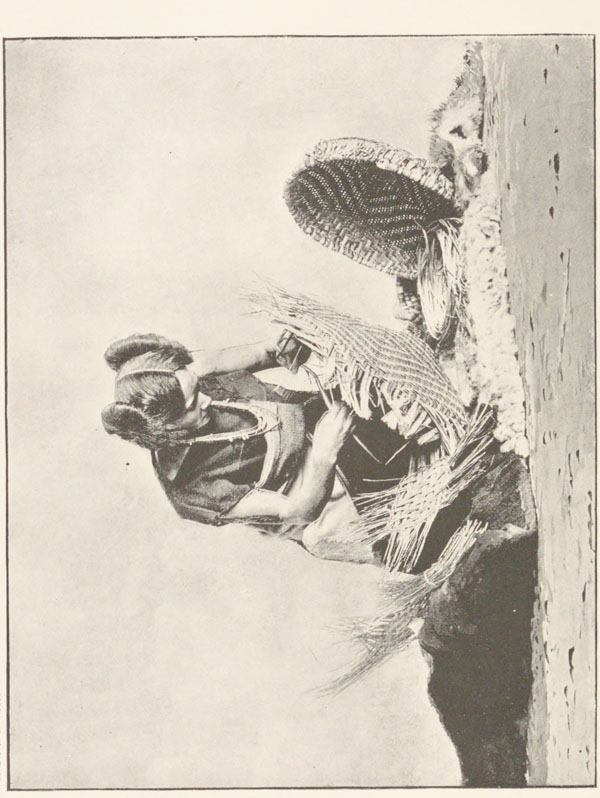
LXV. Hopi Basket Maker
(From photograph of a model
in the National Museum)
Another thing worth noticing is that the bulls traveled without cows
in such large numbers that nobody could have counted them, and so far
away from the cows that it was more than 40 leagues from where we
began to see the bulls to the place where we began to see the cows.
The country they traveled over was so level and smooth that if
one looked at them the sky could be seen between their legs, so that if
some of them were at a distance they looked like smooth-trunked pines
whose tops joined, and if there was only one bull it looked as if there
were four pines. When one was near them, it was impossible to see
the ground on the other side of them. The reason for all this was that
the country seemed as round as if a man should imagine himself in a
three-pint measure, and could see the sky at the edge of it, about a
crossbow shot from him, and even if a man only lay down on his back
he lost sight of the ground.293
p544
I have not written about other things which were seen nor made any
mention of them, because they were not of so much importance,
although it does not seem right for me to remain silent concerning the
fact that they venerate the sign of the cross in the region where the
settlements have high houses. For at a spring which was in the plain
near Acuco they had a cross two palms high and as thick as a finger,
made of wood with a square twig for its crosspiece, and many little
sticks decorated with feathers around it, and numerous withered flowers,
which were the offerings.294
In a graveyard outside the village at
Tutahaco there appeared to have been a recent burial. Near the head
there was another cross made of two little sticks tied with cotton
thread, and dry withered flowers. It certainly seems to me that in
some way they must have received some light from the cross of Our
Redeemer, Christ, and it may have come by way of India, from whence
they proceeded.
Chapter 9, which treats of the direction which the army took, and of
how another more direct way might be found, if anyone was to return to
that country.
I very much wish that I possessed some knowledge of cosmography
or geography, so as to render what I wish to say intelligible, and so that
I could reckon up or measure the advantage those people who might go
in search of that country would have if they went directly through the
center of the country, instead of following the road the army took.
However, with the help of the favor of the Lord, I will state it as well
as I can, making it as plain as possible.
It is, I think, already understood that the Portuguese, Campo, was
the soldier who escaped when Friar Juan de Padilla was killed at Quivira,
and that he finally reached New Spain from Panuco,295
having traveled
across the plains country until he came to cross the North Sea
mountain chain, keeping the country that Don Hernando de Soto discovered
all the time on his left hand, since he did not see the river
of the Holy Spirit (Espiritu Santo) at all.296
After he had crossed the
North Sea mountains, he found that he was in Panuco, so that if he
had not tried to go to the North sea, he would have come
out in the p545
neighborhood of the border land, or the country of the Sacatecas,297
of
which we now have some knowledge.
This way would be somewhat better and more direct for anyone
going back there in search of Quivira, since some of those who came
with the Portuguese are still in New Spain to serve as guides. Nevertheless,
I think it would be best to go through the country of the
Guachichules,298
keeping near the South Sea mountains all the time, for
there are more settlements and a food supply, for it would be suicide
to launch out on to the plains country, because it is so vast and is barren
of anything to eat, although, it is true, there would not be much
need of this after coming to the cows. This is only when one goes in
search of Quivira, and of the villages which were described by the
Indian called Turk, for the army of Francisco Vazquez Coronado went
the very farthest way round to get there, since they started from Mexico
and went 110 leagues to the west, and then 100 leagues to the northeast,
and 250 to the north,299
and all this brought them as far as the ravines
where the cows were, and after traveling 850 leagues they were not more
than 400 leagues distant from Mexico by a direct route. If one desires to
go to the country of Tiguex, so as to turn from there toward the west in
search of the country of India, he ought to follow the road taken by the
army, for there is no other, even if one wished to go by a different way,
because the arm of the sea which reaches into this coast toward the north
does not leave room for any. But what might be done is to have a fleet
and cross this gulf and disembark in the neighborhood of the Island of
Negroes300
and enter the country from there, crossing the mountain chains
in search of the country from which the people at Tiguex came, or other
peoples of the same sort. As for entering from the country of Florida
and from the North sea, it has already been observed that the many
expeditions which have been undertaken from that side have been
unfortunate and not very successful, because that part of the country
is full of bogs and poisonous fruits, barren, and the very worst country
that is warmed by the sun. But they might disembark after passing
the river of the Holy Spirit, as Don Hernando de Soto did. Nevertheless,
despite the fact that I underwent much labor, I still think that the
way I went to that country is the best. There ought to be river courses,
because the necessary supplies can be carried on these
more easily in p546
large quantities. Horses, are the most necessary things in the new
countries, and they frighten the enemy most. . . . Artillery is also
much feared by those who do not know how to use it. A piece of heavy
artillery would be very good for settlements like those which Francisco
Vazquez Coronado discovered, in order to knock them down, because
he had nothing but some small machines for slinging and nobody skillful
enough to make a catapult or some other machine which would
frighten them, which is very necessary.
I say, then, that with what we now know about the trend of the
coast of the South sea, which has been followed by the ships which
explored the western part, and what is known of the North sea toward
Norway, the coast of which extends up from Florida, those who now
go to discover the country which Francisco Vazquez entered, and reach
the country of Cibola or of Tiguex, will know the direction in which
they ought to go in order to discover the true direction of the country
which the Marquis of the Valley, Don Hernando Cortes, tried to find,
following the direction of the gulf of the Firebrand (Tizon) river. This
will suffice for the conclusion of our narrative. Everything else rests
on the powerful Lord of all things, God Omnipotent, who knows how
and when these lands will be discovered and for whom. He has guarded
this good fortune.
Laus Deo.
Finished copying, Saturday the 26th
of October, 1596, in Seville.
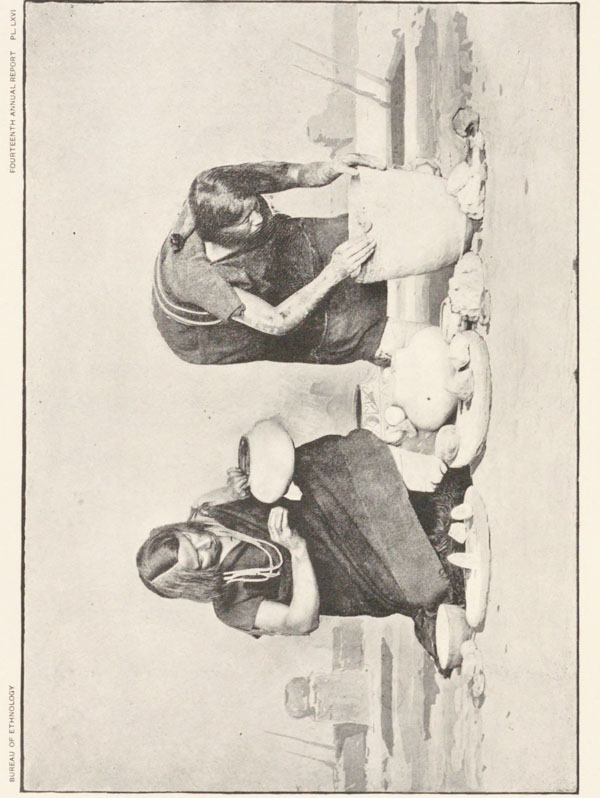
LXVI. Pueblo Pottery Making
(From photograph of a model
in the National Museum)
TRANSLATION OF THE LETTER FROM MENDOZA TO THE KING, APRIL 17, 1540. 301
p547
S.C.C.M.:
I wrote to Your Majesty from Compostela the last of February,
giving you an account of my arrival there and of the departure of
Francisco Vazquez with the force which I sent to pacify and settle in
the newly discovered country, and of how the warden, Lope de Samaniego,
was going as army master, both because he was a responsible
person and a very good Christian, and because he has had experience in
matters of this sort; as Your Majesty had desired to know. And the
news which I have received since then is to the effect that after they
had passed the uninhabited region of Culuacan and were approaching
Chiametla, the warden went off with some horsemen to find provisions,
and one of the soldiers who was with him, who had strayed from the
force, called out that they were killing him. The warden hastened
to his assistance, and they wounded him in the eye with an arrow, from
which he died. In regard to the fortress,302
besides the fact that it is
badly built and going to pieces, it seems to me that the cost of it is
excessive, and that Your Majesty could do without the most of it,
because there is one man who takes charge of the munitions and artillery,
and an armorer to repair it, and a gunner, and as this is the way it
was under the audiencia, before the fortresses were made conformable
to what I have written to Your Majesty, we can get along without the
rest, because that fortress was built on account of the brigantines, and
not for any other purpose.303
And as the lagoon is so dry that it can do
no good in this way for the present, I think that, for this reason, the
cost is superfluous. I believe that it will have fallen in before a reply
can come from Your Majesty.
Some days ago I wrote to Your Majesty that I had ordered Melchior
Diaz, who was in the town of San Miguel de Culuacan, to take some
horsemen and see if the account given by the father, Friar Marcos,
agreed with what he could discover. He set out from Culuacan with
fifteen horsemen, the 17th of November last. The 20th of
this present p548
March I received a letter from him, which he sent me by Juan de Zaldyvar
and three other horsemen. In this he says that after he left
Culuacan and crossed the river of Petatlan he was everywhere very
well received by the Indians. The way he did was to send a cross to
the place where he was going to stop, because this was a sign which the
Indians received with deep veneration, making a house out of mats in
which to place it, and somewhat away from this they made a lodging
for the Spaniards, and drove stakes where they could tie the horses,
and supplied fodder for them, and abundance of corn wherever they had
it. They say that they suffered from hunger in many places, because
it had been a bad year. After going 100 leagues from Culuacan, he
began to find the country cold, with severe frosts, and the farther he
went on the colder it became, until he reached a point where some
Indians whom he had with him were frozen, and two Spaniards were in
great danger. Seeing this, he decided not to go any farther until the
winter was over, and to send back, by those whom I mentioned, an
account of what he had learned concerning Cibola and the country
beyond, which is as follows, taken literally from his letter:
“I have given Your Lordship an account of what happened to me
along the way; and seeing that it is impossible to cross the uninhabited
region which stretches from here to Cibola, on account of the heavy
snows and the cold, I will give Your Lordship an account of what I have
learned about Cibola, which I have ascertained by asking many persons
who have been there fifteen and twenty years; and I have secured this
in many different ways, taking some Indians together and others separately,
and on comparison they all seem to agree in what they say.
After crossing this large wilderness, there are seven places, being a
short day’s march from one to another, all of which are together called
Cibola. The houses are of stone and mud, coarsely worked. They are
made in this way: One large wall, and at each end of this wall some
rooms are built, partitioned off 20 feet square, according to the description
they give, which are planked with square beams. Most of the
houses are reached from the flat roofs, using their ladders to go to the
streets. The houses have three and four stories. They declare that
there are few having two stories. The stories are mostly half as high
again as a man, except the first one, which is low, and only a little
more than a man’s height. One ladder is used to communicate with
ten or twelve houses together. They make use of the low ones and
live in the highest ones. In the lowest ones of all they have some
loopholes made sideways, as in the fortresses of Spain. The Indians
say that when these people are attacked, they station themselves in
their houses and fight from there; and that when they go to make
war, they carry shields and wear leather jackets, which are made of
cows’ hide, colored, and that they fight with arrows and with a sort of
stone maul and with some other weapons made of sticks, which I have
not been able to make out. They eat human flesh, and they keep those
whom they capture in war as slaves. There are many
fowls in the p549
country, tame. They have much corn and beans and melons [squashes].
In their houses they keep some hairy animals, like the large Spanish
hounds, which they shear, and they make long colored wigs from the
hair, like this one which I send to Your Lordship, which they wear, and
they also put this same stuff in the cloth which they make.304
The men
are of small stature [plate LXII]; the women are light colored and of
good appearance, and they wear shirts or chemises which reach down
to their feet. They wear their hair on each side done up in a sort of
twist [plate LXIII], which leaves the ears outside, in which they hang
many turquoises, as well as on their necks and on the wrists of their
arms. The clothing of the men is a cloak, and over this the skin of
a cow, like the one which Cabeza de Vaca and Dorantes brought,
which Your Lordship saw; they wear caps305
on their heads; in summer
they wear shoes made of painted or colored skin, and high buskins in
winter.306
“They were also unable to tell me of any metal, nor did they say that
they had it. They have turquoises in quantity, although not so many
as the father provincial said. They have some little stone crystals,
like this which I send to Your Lordship, of which Your Lordship has
seen many here in New Spain. They cultivate the ground in the same
way as in New Spain. They carry things on their heads,
as in Mexico. p550
The men weave cloth, and spin cotton. They have salt from a marshy
lake, which is two days from the province of Cibola.307
The Indians
have their dances and songs, with some flutes which have holes on
which to put the fingers. They make much noise. They sing in unison
with those who play, and those who sing clap their hands in our fashion.
One of the Indians that accompanied the negro Esteban, who
had been a captive there, saw the playing as they practiced it, and
others singing as I have said, although not very vigorously. They
say that five or six play together, and that some of the flutes are
better than others.308
They say the country is good for corn and beans,
and that they do not have any fruit trees, nor do they know what
such a thing is.309
They have very good mountains. The country lacks
water. They do not raise cotton, but bring it from Totonteac.310
They
eat out of flat bowls, like the Mexicans. They raise considerable corn
and beans and other similar things.311
They do not know what sea fish
is, nor have they ever heard of it. I have not obtained any information
about the cows, except that these are found beyond the province of
Cibola. There is a great abundance of wild goats, of the color of bay
horses; there are many of these here where I am, and although I have
asked the Indians if those are like these, they tell me no. Of the
seven settlements, they describe three of them as very large; four not
so big. They describe them, as I understand, to be about three crossbow
shots square for each place, and from what the Indians say, and
their descriptions of the houses and their size, and as these are close
together, and considering that there are people in each house, it ought to
make a large multitude. Totonteac is declared to be seven short days
from the province of Cibola, and of the same sort of houses and people,
and they say that cotton grows there. I doubt this, because they tell
me that it is a cold country. They say that there are twelve villages,
every one of which is larger than the largest at Cibola. They also tell
me that there is a village which is one day from Cibola, and that the
two are at war.312
They have the same sort of houses and people and
customs. They declare this to be greater than any of those described;
I take it that there is a great multitude of people there. They are very
well known, on account of having these houses and abundance of food
and turquoises. I have not been able to learn more than
what I have p551
related, although, as I have said, I have had with me Indians who
have lived there fifteen and twenty years.
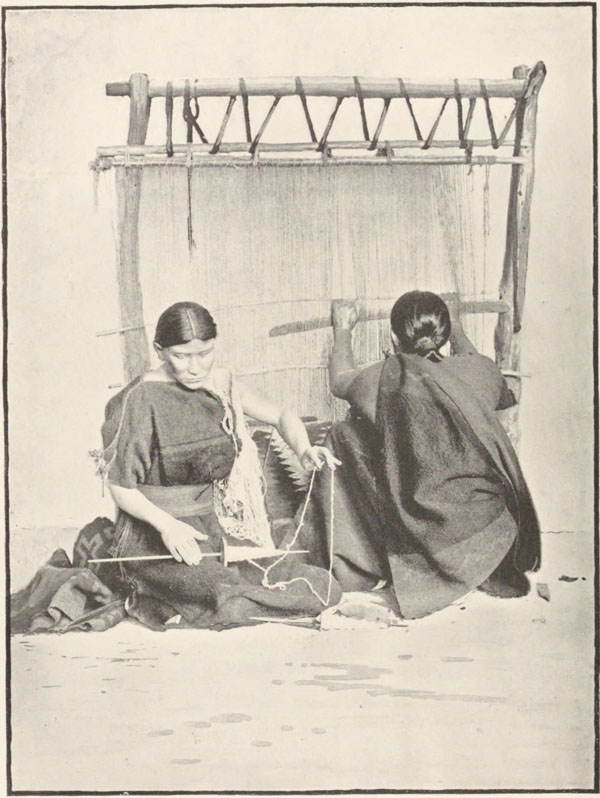
LXVII. Pueblo Spinning and Weaving
(From photograph of a
model in the National Museum)
“The death of Esteban the negro took place in the way the father,
Friar Marcos, described it to your lordship, and so I do not make a
report of it here, except that the people at Cibola sent word to those of
this village and in its neighborhood that if any Christians should come,
they ought not to consider them as anything peculiar, and ought to kill
them, because they were mortal—saying that they had learned this
because they kept the bones of the one who had come there; and that,
if they did not dare to do this, they should send word so that those (at
Cibola) could come and do it. I can very easily believe that all this has
taken place, and that there has been some communication between
these places, because of the coolness with which they received us and
the sour faces they have shown us.”
Melchior Diaz says that the people whom he found along the way do
not have any settlements at all, except in one valley which is 150
leagues from Culuacan, which is well settled and has houses with
lofts, and that there are many people along the way, but that they are
not good for anything except to make them Christians, as if this was
of small account. May Your Majesty remember to provide for the
service of God, and keep in mind the deaths and the loss of life and of
provinces which has taken place in these Indies. And, moreover, up
to this present day none of the things Your Majesty has commanded,
which have been very holy and good, have been attended to, nor priests
provided, either for that country or for this. For I assure Your Majesty
that there is no trace of Christianity where they have not yet
arrived, neither little nor much, and that the poor people are ready to
receive the priests and come to them even when they flee from us like
deer in the mountains. And I state this because I am an eyewitness,
and I have seen it clearly during this trip. I have importuned Your
Majesty for friars, and yet again I can not cease doing it much more,
because unless this be done I can not accomplish that which I am bound
to do.
After I reach Mexico, I will give Your Majesty an account of everything
concerning these provinces, for while I should like to do it today,
I can not, because I am very weak from a slow fever which I caught in
Colima, which attacked me very severely, although it did not last more
than six days. It has pleased Our Lord to make me well already, and
I have traveled here to Jacona, where I am.
May Our Lord protect the Holy Catholic
Cæsarian person of Your Majesty and aggrandize it with increase of
better kingdoms and lordships, as we your servants desire.
From Jacona, April 17, 1540.
S.C.C.M.
Your Holy Majesty’s humble servant, who salutes your royal feet
and hands,
D.
ANTONIO
de
MENDOZA.
TRANSLATION OF THE LETTER FROM CORONADO TO MENDOZA, AUGUST 3, 1540. 313 — THE ACCOUNT GIVEN BY FRANCISCO VAZQUEZ DE CORONADO, CAPTAIN-GENERAL OF THE FORCE WHICH WAS SENT IN THE NAME OF HIS MAJESTY TO THE NEWLY DISCOVERED COUNTRY, OF WHAT HAPPENED TO THE EXPEDITION AFTER APRIL 22 OF THE YEAR MDXL, WHEN HE STARTED FORWARD FROM CULIACAN, AND OF WHAT HE FOUND IN THE COUNTRY THROUGH WHICH HE PASSED.
p552
Francisco Vazquez starts from Culiacan with his army, and after suffering
various inconveniences on account of the badness of the way, reaches
the Valley of Hearts, where he failed to find any corn, to procure which
he sends to the valley called Señora. He receives an account of the
important Valley of Hearts and of the people there, and of some lands
lying along that coast.
On the 22d of the month of April last, I set out from the province of
Culiacan with a part of the army, having made the arrangements of
which I wrote to Your Lordship. Judging by the outcome, I feel sure
that it was fortunate that I did not start the whole of the army on this
undertaking, because the labors have been so very great and the lack
of food such that I do not believe this undertaking could have been
completed before the end of this year, and that there would be a great
loss of life if it should be accomplished. For, as I wrote to Your Lordship,
I spent eighty days in traveling to Culiacan,314
during which time I
and the gentlemen of my company, who were horsemen, carried on our
backs and on our horses a little food, in such wise that after leaving this
place none of us carried any necessary effects weighing more than a
pound. For all this, and although we took all possible care and forethought
of the small supply of provisions which we carried, it gave out.
And this is not to be wondered at, because the road is rough and long,
and what with our harquebuses, which had to be carried up the mountains
and hills and in the passage of the rivers, the greater
part of the p553
corn was lost. And since I send Your Lordship a drawing of this route,
I will say no more about it here.
Thirty leagues before reaching the place which the father provincial
spoke so well of in his report,315
I sent Melchior Diaz forward with fifteen
horsemen, ordering him to make but one day’s journey out of two, so
that he could examine everything there before I arrived. He traveled
through some very rough mountains for four days, and did not find anything
to live on, nor people, nor information about anything, except that
he found two or three poor villages, with twenty or thirty huts apiece.
From the people here he learned that there was nothing to be found in
the country beyond except the mountains, which continued very rough,
entirely uninhabited by people. And, because this was labor lost, I did
not want to send Your Lordship an account of it. The whole company
felt disturbed at this, that a thing so much praised, and about which
the father had said so many things, should be found so very different;
and they began to think that all the rest would be of the same sort.
When I noticed this, I tried to encourage them as well as I could, telling
them that Your Lordship had always thought that this part of the
trip would be a waste of effort, and that we ought to devote our attention
to those Seven Cities and the other provinces about which we had
information—that these should be the end of our enterprise. With this
resolution and purpose, we all marched cheerfully along a very bad way,
where it was impossible to pass without making a new road or repairing
the one that was there, which troubled the soldiers not a little, considering
that everything which the friar had said was found to be quite
the reverse; because, among other things which the father had said and
declared, he said that the way would be plain and good, and that there
would be only one small hill of about half a league. And the truth is,
that there are mountains where, however well the path might be fixed,
they could not be crossed without there being great danger of the horses
falling over them. And it was so bad that a large number of the animals
which Your Lordship sent as provision for the army were lost along
this part of the way, on account of the roughness of the rocks. The
lambs and wethers lost their hoofs along the way, and I left the greater
part of those which I brought from Culiacan at the river of Lachimi,316
because they were unable to travel, and so that they might proceed more
slowly. Four horsemen remained with them, who have just arrived.
They have not brought more than 24 lambs and 4 wethers; the rest died
from the toil, although they did not travel more than two leagues daily.
I reached the Valley of Hearts at last, on the 26th day of the month of
May, and rested there a number of days. Between Culiacan and this
place I could sustain myself only by means of a large supply of corn
bread, because I had to leave all the corn, as it was not yet ripe. In this
Valley of Hearts we found more people than in any part
of the country p554
which we had left behind, and a large extent of tilled ground. There
was no corn for food among them, but as I heard that there was some in
another valley called Señora, which I did not wish to disturb by force,
I sent Melchior Diaz with goods to exchange for it, so as to give this to
the friendly Indians whom we brought with us, and to some who had
lost their animals along the way and had not been able to carry the food
which they had taken from Culiacan. By the favor of Our Lord, some
little corn was obtained by this trading, which relieved the friendly
Indians and some Spaniards. Ten or twelve of the horses had died of
overwork by the time that we reached this Valley of Hearts, because
they were unable to stand the strain of carrying heavy burdens and
eating little. Some of our negroes and some of the Indians also died
here, which, was not a slight loss for the rest of the expedition. They
told me that the Valley of Hearts is a long five-days’ journey from the
western sea. I sent to summon Indians from the coast in order to learn
about their condition, and while I was waiting for these the horses
rested. I stayed there four days, during which the Indians came from
the sea, who told me that there were seven or eight islands two days’
journey from that seacoast, directly opposite, well populated with people,
but poorly supplied with food, and the people were savages.317
They
told me they had seen a ship pass not very far from the land. I do not
know whether to think that it was the one which was sent to discover
the country, or perhaps some Portuguese.318
They come to Chichilticale; after having taken two days’ rest, they enter a
country containing very little food and hard to travel for 30 leagues,
beyond which the country becomes pleasant, and there is a river called
the River of the Flax (del Lino); they fight against the Indians, being
attacked by these; and having by their victory secured the city, they
relieve themselves of the pangs of their hunger.
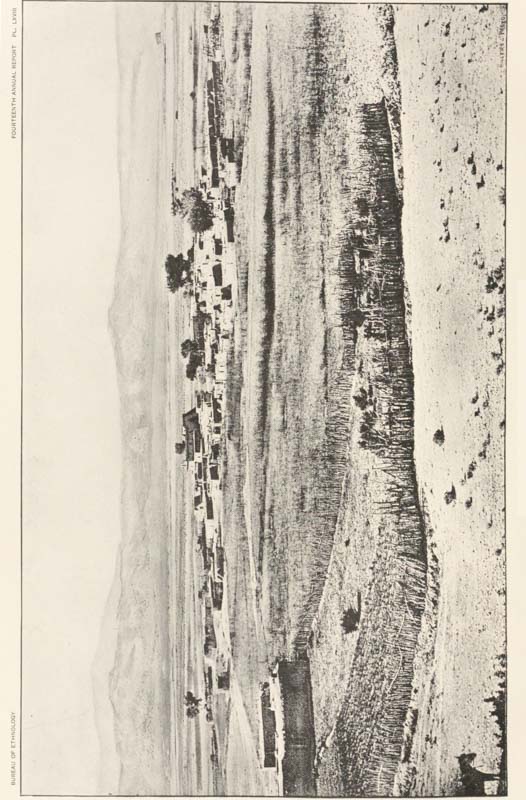
LXVIII. The Tewa Pueblo of P’o-who-gi or San Ildefonso
I set out from the Hearts and kept near the seacoast as well as I
could judge, but in fact I found myself continually farther off, so that
when I reached Chichilticale I found that I was fifteen days’ journey
distant from the sea,319
although the father provincial had said that it
was only 5 leagues distant and that he had seen it. We all became very
distrustful, and felt great anxiety and dismay to see that everything
was the reverse of what he had told Your Lordship. The Indians of
Chichilticale say that when they go to the sea for fish, or for anything
else that they need, they go across the country, and that
it takes them p555
ten days; and this information which I have received from the Indians
appears to me to be true. The sea turns toward the west directly opposite
the Hearts for 10 or 12 leagues, where I learned that the ships of
Your Lordship had been seen, which had gone in search of the port of
Chichilticale, which the father said was on the thirty-fifth degree. God
knows what I have suffered, because I fear that they may have met with
some mishap. If they follow the coast, as they said they would, as long
as the food lasts which they took with them, of which I left them a
supply in Culiacan, and if they have not been overtaken by some misfortune,
I maintain my trust in God that they have already discovered
something good, for which the delay which they have made may be
pardoned. I rested for two days at Chichilticale, and there was good
reason for staying longer, because we found that the horses were becoming
so tired; but there was no chance to rest longer, because the food
was giving out. I entered the borders of the wilderness region on Saint
John’s eve, and, for a change from our past labors, we found no grass
during the first days, but a worse way through mountains and more
dangerous passages than we had experienced previously. The horses
were so tired that they were not equal to it, so that in this last desert
we lost more horses than before; and some Indian allies and a Spaniard
called Spinosa, besides two negroes, died from eating some herbs
because the food had given out. I sent the army-master, Don Garcia
Lopez de Cardenas, with 15 horsemen, a day’s march ahead of me, in
order to explore the country and prepare the way, which he accomplished
like the man that he is, and agreeably to the confidence which
Your Lordship has had in him. I am the more certain that he did so,
because, as I have said, the way is very bad for at least 30 leagues and
more, through impassable mountains. But when we had passed these
30 leagues, we found fresh rivers and grass like that of Castile, and
especially one sort like what we call Scaramoio; many nut and mulberry
trees, but the leaves of the nut trees are different from those of
Spain. There was a considerable amount of flax near the banks of one
river, which was called on this account El Rio del Lino. No Indians
were seen during the first day’s march, after which four Indians came
out with signs of peace, saying that they had been sent to that desert
place to say that we were welcome, and that on the next day the tribe
would provide the whole force with food. The army-master gave them
a cross, telling them to say to the people in their city that they need
not fear, and that they should have their people stay in their own houses,
because I was coming in the name of His Majesty to defend and help
them. After this was done, Ferrando Alvarado came back to tell me
that some Indians had met him peaceably, and that two of them were
with the army-master waiting for me. I went to them forthwith and
gave them some paternosters and some little cloaks, telling them to
return to their city and say to the people there that they could stay
quietly in their houses and that they need not fear.
After this I ordered p556
the army-master to go and see if there were any bad passages which
the Indians might be able to defend, and to seize and hold any such
until the next day, when I would come up. He went, and found a very
bad place in our way where we might have received much harm.
He immediately established himself there with the force which he was
conducting. The Indians came that very night to occupy that place so
as to defend it, and finding it taken, they assaulted our men. According
to what I have been told, they attacked like valiant men, although
in the end they had to retreat in flight, because the army-master was
on the watch and kept his men in good order. The Indians sounded a
little trumpet as a sign of retreat, and did not do any injury to the
Spaniards. The army-master sent me notice of this the same night, so
that on the next day I started with as good order as I could, for we
were in such great need of food that I thought we should all die of hunger
if we continued to be without provisions for another day, especially
the Indians, since altogether we did not have two bushels of corn, and
so I was obliged to hasten forward without delay. The Indians lighted
their fires from point to point, and these were answered from a distance
with as good understanding as we could have shown. Thus notice was
given concerning how we went and where we had arrived. As soon
as I came within sight of this city, I sent the army-master, Don Garcia
Lopez, Friar Daniel and Friar Luis, and Ferrando Vermizzo, with
some horsemen, a little way ahead, so that they might find the Indians
and tell them that we were not coming to do them any harm, but to
defend them in the name of our lord the Emperor. The summons, in
the form which His Majesty commanded in his instructions, was made
intelligible to the people of the country by an interpreter. But they,
being a proud people, were little affected, because it seemed to them
that we were few in number, and that they would not have any difficulty
in conquering us. They pierced the gown of Friar Luis with an arrow,
which, blessed be God, did him no harm. Meanwhile I arrived with
all the rest of the horse and the footmen, and found a large body of
the Indians on the plain, who began to shoot with their arrows. In
obedience to the orders of Your Lordship and of the marquis,320
I did not
wish my company, who were begging me for permission, to attack them,
telling them that they ought not to offend them, and that what the enemy
was doing was nothing, and that so few people ought not to be insulted.
On the other hand, when the Indians saw that we did not move, they
took greater courage, and grew so bold that they came up almost to the
heels of our horses to shoot their arrows. On this account I saw that it
was no longer time to hesitate, and as the priests approved the action,
I charged them. There was little to do, because they suddenly took to
flight, part running toward the city, which was near and well fortified,
and others toward the plain, wherever chance led them.
Some Indians p557
were killed, and others might have been slain if I could have allowed
them to be pursued. But I saw that there would be little advantage
in this, because the Indians who were outside were few, and those who
had retired to the city were numerous, besides many who had remained
there in the first place. As that was where the food was, of which we
stood in such great need, I assembled my whole force and divided them
as seemed to me best for the attack on the city, and surrounded it.
The hunger which we suffered would not permit of any delay, and so I
dismounted with some of these gentlemen and soldiers. I ordered the
musketeers and crossbowmen to begin the attack and drive back the
enemy from the defenses, so that they could not do us any injury. I
assaulted the wall on one side, where I was told that there was a scaling
ladder and that there was also a gate. But the crossbowmen broke
all the strings of their crossbows and the musketeers could do nothing,
because they had arrived so weak and feeble that they could scarcely
stand on their feet. On this account the people who were on top were
not prevented at all from defending themselves and doing us whatever
injury they were able. Thus, for myself, they knocked me down to the
ground twice with countless great stones which they threw down from
above, and if I had not been protected by the very good headpiece which
I wore, I think that the outcome would have been bad for me. They
picked me up from the ground, however, with two small wounds in my face
and an arrow in my foot, and with many bruises on my arms and legs,
and in this condition I retired from the battle, very weak. I think that
if Don Garcia Lopez de Cardenas had not come to my help, like a good
cavalier, the second time that they knocked me to the ground, by placing
his own body above mine, I should have been in much greater danger
than I was. But, by the pleasure of God, these Indians surrendered, and
their city was taken with the help of Our Lord, and a sufficient supply
of corn was found there to relieve our necessities. The army-master
and Don Pedro de Tovar and Ferrando de Alvarado and Paulo de
Melgosa, the infantry captain, sustained some bruises, although none
of them were wounded. Agoniez Quarez was hit in the arm by an
arrow, and one Torres, who lived in Panuco, in the face by another, and
two other footmen received slight arrow wounds. They all directed their
attack against me because my armor was gilded and glittered, and on
this account I was hurt more than the rest, and not because I had done
more or was farther in advance than the others; for all these gentlemen
and soldiers bore themselves well, as was expected of them. I praise
God that I am now well, although somewhat sore from the stones. Two
or three other soldiers were hurt in the battle which we had on the
plain, and three horses were killed—one that of Don Lopez and another
that of Vigliega and the third that of Don Alfonso Manrich—and seven
or eight other horses were wounded; but the men, as well as the horses,
have now recovered and are well. p558
Of the situation and condition of the Seven Cities called the kingdom of
Cevola, and the sort of people and their customs, and of the animals
which are found there.
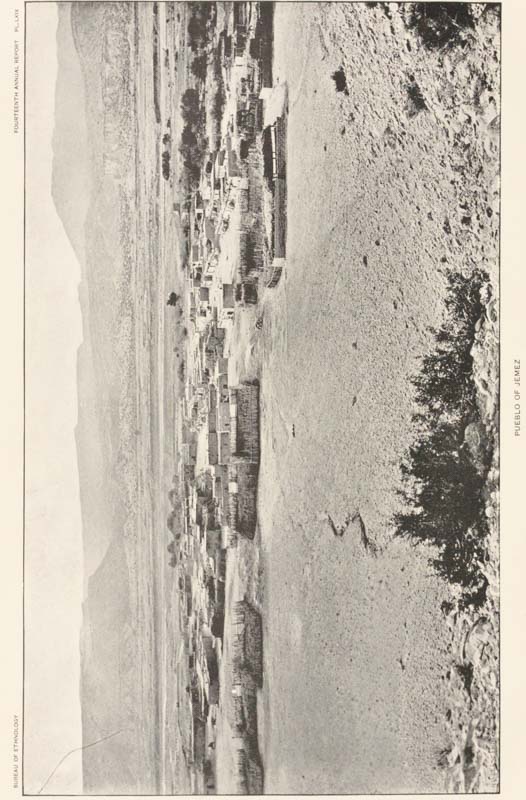
LXIX. Pueblo of Jemez
It now remains for me to tell about this city and kingdom and province,
of which the Father Provincial gave Your Lordship an account.
In brief, I can assure you that in reality he has not told the truth in a
single thing that he said, but everything is the reverse of what he said,
except the name of the city and the large stone houses. For, although
they are not decorated with turquoises, nor made of lime nor of good
bricks, nevertheless they are very good houses, with three and four
and five stories, where there are very good apartments and good rooms
with corridors,321
and some very good rooms under ground and paved,
which are made for winter, and are something like a sort of hot baths.322
The ladders which they have for their houses are all movable and portable,
which are taken up and placed wherever they please. They are
made of two pieces of wood, with rounds like ours. [See plates LVIII,
LVIX.] The Seven Cities are seven little villages, all having the kind
of houses I have described. They are all within a radius of 5 leagues.
They are all called the kingdom of Cevola, and each has its own name
and no single one is called Cevola, but all together are called Cevola.
This one which I have called a city I have named Granada, partly
because it has some similarity to it,323
as well as out of regard for Your
Lordship. In this place where I am now lodged there are perhaps 200
houses, all surrounded by a wall, and it seems to me that with the other
houses, which are not so surrounded, there might be altogether 500
families. There is another town near by, which is one of the seven, but
somewhat larger than this, and another of the same size as this, and
the other four are somewhat smaller. I send them all to Your Lordship,
painted with the route. The skin on which the painting is made,
was found here with other skins. The people of the towns seem to me
to be of ordinary size and intelligent, although I do not think that they
have the judgment and intelligence which they ought to have to
build these houses in the way in which they have, for most of them are
entirely naked except the covering of their privy parts, and they have
painted mantles like the one which I send to Your Lordship. They do
not raise cotton, because the country is very cold, but they wear
mantles, as may be seen by the exhibit which I send. It is also true
that some cotton thread was found in their houses. They wear the
hair on their heads like the Mexicans. They all have good figures,
and are well bred. I think that they have a quantity of turquoises,
which they had removed with the rest of their goods, except the corn,
when I arrived, because I did not find any women here
nor any men p559
under 15 years or over 60, except two or three old men who remained
in command of all the other men and the warriors. Two points of
emerald and some little broken stones which approach the color of
rather poor garnets324
were found in a paper, besides other stone crystals,
which I gave to one of my servants to keep until they could be sent to
Your Lordship. He has lost them, as they tell me. We found fowls,
but only a few, and yet there are some. The Indians tell me that they
do not eat these in any of the seven villages, but that they keep them
merely for the sake of procuring the feathers.325
I do not believe this,
because they are very good, and better than those of Mexico. The
climate of this country and the temperature of the air is almost like
that of Mexico, because it is sometimes hot and sometimes it rains. I
have not yet seen it rain, however, except once when there fell a little
shower with wind, such as often falls in Spain. The snow and the
cold are usually very great, according to what the natives of the country
all say. This may very probably be so, both because of the nature
of the country and the sort of houses they build and the skins and
other things which these people have to protect them from the cold.
There are no kinds of fruit or fruit trees. The country is all level, and
is nowhere shut in by high mountains, although there are some hills
and rough passages.326
There are not many birds, probably because of
the cold, and because there are no mountains near. There are no trees
fit for firewood here, because they can bring enough for their needs from
a clump of very small cedars 4 leagues distant.327
Very good grass is
found a quarter of a league away, where there is pasturage for our horses
as well as mowing for hay, of which we had great need, because our
horses were so weak and feeble when they arrived. The food which
they eat in this country is corn, of which they have a great abundance,
and beans and venison, which they probably eat (although they say
that they do not), because we found many skins of deer and hares and
rabbits. They make the best corn cakes I have ever seen anywhere,
and this is what everybody ordinarily eats. They have the very best
arrangement and machinery for grinding that was ever seen [plate LXIV].
One of these Indian women here will grind as much as four of the Mexicans.
They have very good salt in crystals, which they bring from a
lake a day’s journey distant from here. No information can be obtained
among them about the North sea or that on the west, nor do I know
how to tell Your Lordship which we are nearest to. I should judge that
it is nearer to the western, and 150 leagues is the nearest that it seems
to me it can be thither. The North sea ought to be much farther away.
Your Lordship may thus see how very wide the country is.
They have p560
many animals—bears, tigers, lions, porcupines, and some sheep as big
as a horse, with very large horns and little tails. I have seen some of
their horns the size of which was something to marvel at.328
There are
also wild goats, whose heads I have seen, and the paws of the bears and
the skins of the wild boars. For game they have deer, leopards, and
very large deer,329
and every one thinks that some of them are larger
than that animal which Your Lordship favored me with, which belonged
to Juan Melaz. They inhabit some plains eight days’ journey toward
the north. They have some of their skins here very well dressed, and
they prepare and paint them where they kill the cows, according to
what they tell me.
Of the nature and situation of the kingdoms of Totonteac, Marata, and
Acus, wholly different from the account of Friar Marcos. The conference
which they had with the Indians of the city of Granada, which
they had captured, who had been forewarned of the coming of Christians
into their country fifty years before. The account which was obtained
from them concerning seven other cities, of which Tucano is the chief,
and how he sent to discover them. A present sent to Mendoza of various
things found in this country by Vazquez Coronado.
These Indians say that the kingdom of Totonteac, which the father
provincial praised so much, saying that it was something marvelous,
and of such a very great size, and that cloth was made there, is a
hot lake, on the edge of which there are five or six houses.330
There
used to be some others, but these have been destroyed by war. The
kingdom of Marata can not be found, nor do these Indians know anything
about it. The kingdom of Acus is a single small city, where they
raise cotton, and this is called Acucu.331
I say that this is the country,
because Acus, with or without the aspiration, is not a word in this
region; and because it seems to me that Acucu may be derived from
Acus, I say that it is this town which has been converted into the
kingdom of Acus. They tell me that there are some other small ones
not far from this settlement, which are situated on a river which I have
seen and of which the Indians have told me. God knows that I wish
I had better news to write to Your Lordship, but I must give you the
truth, and, as I wrote you from Culiacan, I must advise you of the
good as well as of the bad. But you may be assured that if there had
been all the riches and treasures of the world, I could not have done
more in His Majesty’s service and in that of Your Lordship than I have
done, in coming here where you commanded me to go, carrying, both
my companions and myself, our food on our backs
for 300 leagues, and p561
traveling on foot many days, making our way over hills and rough
mountains, besides other labors which I refrain from mentioning. Nor
do I think of stopping until my death, if it serves His Majesty or Your
Lordship to have it so.
Three days after I captured this city, some of the Indians who lived
here came to offer to make peace. They brought me some turquoises
and poor mantles, and I received them in His Majesty’s name with as
good a speech as I could, making them understand the purpose of my
coming to this country, which is, in the name of His Majesty and by
the commands of Your Lordship, that they and all others in this province
should become Christians and should know the true God for
their Lord, and His Majesty for their king and earthly lord. After
this they returned to their houses and suddenly, the next day, they
packed up their goods and property, their women and children, and fled
to the hills, leaving their towns deserted, with only some few remaining
in them. Seeing this, I went to the town which I said was larger than
this, eight or ten days later, when I had recovered from my wounds. I
found a few of them there, whom I told that they ought not to feel any
fear, and I asked them to summon their lord to me. By what I can
find out or observe, however, none of these towns have any, since I
have not seen any principal house by which any superiority over others
could be shown.332
Afterward, an old man, who said he was their
lord, came with a mantle made of many pieces, with whom I argued
as long as he stayed with me. He said that he would come to see me
with the rest of the chiefs of the country, three days later, in order to
arrange the relations which should exist between us. He did so, and
they brought me some little ragged mantles and some turquoises. I
said that they ought to come down from their strongholds and return
to their houses with their wives and children, and that they should
become Christians, and recognize His Majesty as their king and lord.
But they still remain in their strongholds, with their wives and all
their property. I commanded them to have a cloth painted for me,
with all the animals that they know in that country, and although they
are poor painters, they quickly painted two for me, one of the animals
and the other of the birds and fishes. They say that they will bring
their children so that our priests may instruct them, and that they
desire to know our law. They declare that it was foretold among them
more than fifty years ago that a people such as we are should come,
and the direction they should come from, and that the whole country
would be conquered. So far as I can find out, the water is what these
Indians worship, because they say that it makes the corn grow and
sustains their life, and that the only other reason they know is because
their ancestors did so.333
I have tried in every way to find out from the
natives of these settlements whether they know of any
other peoples p562
or provinces or cities. They tell me about seven cities which are at a
considerable distance, which are like these, except that the houses
there are not like these, but are made of earth [adobe], and small,
and that they raise much cotton there. The first of these four places
about which they know is called, they say, Tucano. They could not
tell me much about the others. I do not believe that they tell me the
truth, because they think that I shall soon have to depart from them
and return home. But they will quickly find that they are deceived
in this. I sent Don Pedro de Tobar there, with his company and some
other horsemen, to see it. I would not have dispatched this packet to
Your Lordship until I had learned what he found there, if I thought that
I should have any news from him within twelve or fifteen days. However,
as he will remain away at least thirty, and, considering that this
information is of little importance and that the cold and the rains are
approaching, it seemed to me that I ought to do as Your Lordship commanded
me in your instructions, which is, that as soon as I arrived
here, I should advise you thereof, and this I do, by sending you the
plain narrative of what I have seen, which is bad enough, as you may
perceive. I have determined to send throughout all the surrounding
regions, in order to find out whether there is anything, and to suffer
every extremity before I give up this enterprise, and to serve His
Majesty, if I can find any way in which to do it, and not to lack in
diligence until Your Lordship directs me as to what I ought to do. We
have great need of pasture, and you should know, also, that among all
those who are here there is not one pound of raisins, nor sugar, nor
oil, nor wine, except barely half a quart, which is saved to say mass,
since everything is consumed, and part was lost on the way. Now, you
can provide us with what appears best; but if you are thinking of
sending us cattle, you should know that it will be necessary for them to
spend at least a year on the road, because they can not come in any other
way, nor any quicker. I would have liked to send to Your Lordship,
with this dispatch, many samples of the things which they have in this
country, but the trip is so long and rough that it is difficult for me to
do so. However, I send you twelve small mantles, such as the people
of this country ordinarily wear, and a garment which seems to me to be
very well made. I kept it because it seemed to me to be of very good
workmanship, and because I do not think that anyone has ever seen in
these Indies any work done with a needle, unless it were done since the
Spaniards settled here. And I also send two cloths painted with the
animals which they have in this country, although, as I said, the painting
is very poorly done, because the artist did not spend more than one day
in painting it. I have seen other paintings on the walls of these houses
which have much better proportion and are done much better.
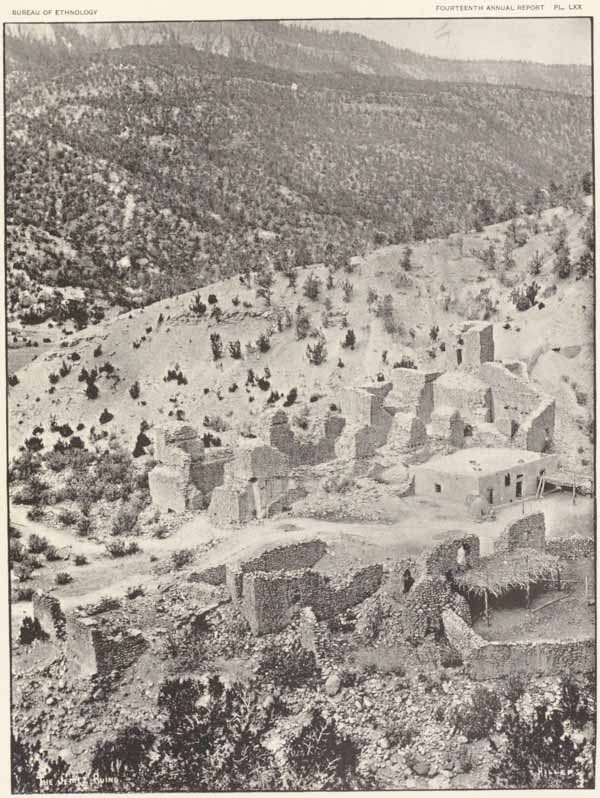
LXX. Ruins of Spanish Church Above Jemez
I send you a cow skin, some turquoises, and two earrings of the
same, and fifteen of the Indian combs,334
and some plates decorated with
these turquoises, and two baskets made of wicker, of which the Indians
have a large supply. I also send two rolls, such as the women usually
wear on their heads when they bring water from the
spring, the p563
same way that they do in Spain. One of these Indian women, with one
of these rolls on her head, will carry a jar of water up a ladder without
touching it with her hands. And, lastly, I send you samples of the
weapons with which the natives of this country fight, a shield, a hammer,
and a bow with some arrows, among which there are two with
bone points, the like of which have never been seen, according to what
these conquerors say. As far as I can judge, it does not appear to me
that there is any hope of getting gold or silver, but I trust in God that,
if there is any, we shall get our share of it, and it shall not escape us
through any lack of diligence in the search.335
I am unable to give Your
Lordship any certain information about the dress of the women, because
the Indians keep them guarded so carefully that I have not seen any,
except two old women. These had on two long skirts reaching down
to their feet and open in front, and a girdle, and they are tied together
with some cotton strings. I asked the Indians to give me one of those
which they wore, to send to you, since they were not willing to show
me the women. They brought me two mantles, which are these that I
send, almost painted over. They have two tassels, like the women of
Spain, which hang somewhat over their shoulders. The death of the
negro is perfectly certain, because many of the things which he wore
have been found, and the Indians say that they killed him here because
the Indians of Chichilticale said that he was a bad man, and not like
the Christians, because the Christians never kill women, and he killed
them, and because he assaulted their women, whom the Indians love
better than themselves. Therefore they determined to kill him, but
they did not do it in the way that was reported, because they did not
kill any of the others who came with him, nor did they kill the lad from
the province of Petatlan, who was with him, but they took him and
kept him in safe custody until now. When I tried to secure him, they
made excuses for not giving him to me, for two or three days, saving
that he was dead, and at other times that the Indians of Acucu had
taken him away. But when I finally told them that I should be very
angry if they did not give him to me, they gave him to me. He is an
interpreter; for although he can not talk much, he understands very
well. Some gold and silver has been found in this place, which those
who know about minerals say is not bad. I have not yet been able to
learn from these people where they got it. I perceive that they refuse
to tell me the truth in everything, because they think that I shall have
to depart from here in a short time, as I have said. But I trust in God
that they will not be able to avoid answering much longer. I beg Your
Lordship to make a report of the success of this expedition to His
Majesty, because there is nothing more than what I have already said.
I shall not do so until it shall please God to grant that we find what
we desire. Our Lord God protect and keep your most illustrious
Lordship. From the province of Cevola, and this city of Granada,
the 3d of August, 1540. Francisco Vazquez de Coronado kisses the
hand of your most illustrious Lordship.
TRANSLATION OF THE TRASLADO DE LAS NUEVAS 336 — COPY OF THE REPORTS AND DESCRIPTIONS THAT HAVE BEEN RECEIVED REGARDING THE DISCOVERY OF A CITY WHICH IS CALLED CIBOLA, SITUATED IN THE NEW COUNTRY.
p564
His grace left the larger part of his army in the valley of Culiacan,
and with only 75 companions on horseback and 30 footmen, he set out
for here Thursday, April 22. The army which remained there was to
start about the end of the month of May, because they could not find
any sort of sustenance for the whole of the way that they had to go,
as far as this province of Cibola, which is 350 long leagues, and on
this account he did not dare to put the whole army on the road. As
for the men he took with him, he ordered them to make provision
for eighty days, which was carried on horses, each having one for himself
and his followers. With very great danger of suffering hunger,
and not less labor, since they had to open the way, and every day discovered
waterways and rivers with bad crossings, they stood it after a
fashion, and on the whole journey as far as this province there was not a
peck of corn.337
He reached this province on Wednesday, the 7th of July
last, with all the men whom he led from the valley very well, praise be
to Our Lord, except one Spaniard who died of hunger four days from
here and some negroes and Indians who also died of hunger and thirst.
The Spaniard was one of those on foot, and was named Espinosa. In
this way his grace spent seventy-seven days on the road before reaching
here, during which God knows in what sort of a way we lived, and
whether we could have eaten much more than we ate the day that his
grace reached this city of Granada, for so it has been named out of
regard for the viceroy, and because they say it resembles the Albaicin.338
The force he led was not received the way it should have been, because
they all arrived very tired from the great labor of the journey. This,
and the loading and unloading like so many muleteers, and not eating
as much as they should have, left them more in need of resting several
days than of fighting, although there was not a man in the army who
would not have done his best in everything if the horses, who suffered
the same as their masters, could have helped them.
The city was deserted by men over sixty years and under twenty, and
by women and children. All who were there were
the fighting p565
men who remained to defend the city, and many of them came out,
about a crossbow shot, uttering loud threats. The general himself went
forward with two priests and the army-master, to urge them to surrender,
as is the custom in new countries. The reply that he received
was from many arrows which they let fly, and they wounded Hernando
Bermejo’s horse and pierced the loose flap of the frock of father Friar
Luis, the former companion of the Lord Bishop of Mexico. When this
was seen, taking as their advocate the Holy Saint James,339
he rushed
upon them with all his force, which he had kept in very good order, and
although the Indians turned their backs and tried to reach the city, they
were overtaken and many of them killed before they could reach it.
They killed three horses and wounded seven or eight.
When my lord the general reached the city, he saw that it was surrounded
by stone walls, and the houses very high, four and five and
even six stories apiece, with their flat roofs and balconies. As the
Indians had made themselves secure within it, and would not let anyone
come near without shooting arrows at him, and as we could not obtain
anything to eat unless we captured it, his grace decided to enter the
city on foot and to surround it by men on horseback, so that the Indians
who were inside could not get away. As he was distinguished among
them all by his gilt arms and a plume on his headpiece, all the Indians
aimed at him, because he was noticeable among all, and they knocked
him down to the ground twice by chance stones thrown from the flat
roofs, and stunned him in spite of his headpiece, and if this had not
been so good, I doubt if he would have come out alive from that enterprise,
and besides all this—praised be Our Lord that he came out on
his own feet—they hit him many times with stones on his head and
shoulders and legs, and he received two small wounds on his face and
an arrow wound in the right foot; but despite all this his grace is as
sound and well as the day he left that city. And you340
may assure my
lord of all this, and also that on the 19th of July last he went 4 leagues
from this city to see a rock where they told him that the Indians of this
province had fortified themselves,341
and he returned the same day, so
that he went 8 leagues in going and returning. I think I have given
you an account of everything, for it is right that I should be the authority
for you and his lordship, to assure you that everything is going well
with the general my lord, and without any hesitation I can assure you
that he is as well and sound as the day he left the city. He is located
within the city, for when the Indians saw that his grace was determined
to enter the city, then they abandoned it, since they let them go
with their lives. We found in it what we needed more than gold and
silver, and that was much corn and beans and fowls, better than those
of New Spain, and salt, the best and whitest that I have seen in all
my life.
RELACIÓN POSTRERA DE SIVOLA 342 — ESTA ES LA RELACIÓN POSTRERA DE SIVOLA, Y DE MÁS DE CUATRO-CIENTAS LEGUAS ADELANTE. — TRANSLATION THIS IS THE LATEST ACCOUNT OF CIBOLA, AND OF MORE THAN FOUR HUNDRED LEAGUES BEYOND.
p566
Desde Culhuacán á Sívola hay más de trescientas leguas; poco del
camino poblado: hay muy poca gente: es tierra estéril: hay muy malos
caminos: la gente anda del todo desnuda, salvo las mujeres, que de la
cintura abajo traen cueros de venados adobados, blancos, á manera de
faldíllas hasta los pies. Las casas que tienen son de petlatles hechos
de cañas: son las casas redondas y pequeñas, que apenas cabe un
hombre en pie dentro. Donde están congregados y donde siembran
es tierra arenosa: cogen maiz, aunque poco, y frisoles y calabazas, y
también se mantienen de caza, conejos, liebres y venados. No tienen
sacrificios. Esto es desde Culhuacan á Síbola.
Sívola es un pueblo de hasta ducientas casas: son á dos y tres y
cuatro y cinco sobrados: tienen las paredes de un palmo de ancho: los
palos de la maderación son tan gruesos como por la muñeca, y redondos;
por tablazón tienen cañas muy menudas con sus hojas, y encima tierra
presada: las paredes son de tierra y barro: las puertas de las casas son
de la manera de escotillones de navíos: están las casas juntas, asidas
unas con otras: tienen delante de las casas unas estufas de barro de
tierra donde se guarecen en el invierno del frio, porque le hace muy
grande, que nieva seis meses del año. De esta gente algunos traen
mantas de algodón y de maguey, y cueros de venados adobados, y traen
zapatos de los mismos cueros, hasta encima de las rodillas. También
hacen mantas de pellejos de liebres y de conejos, con que se cubren.
Andan las mujeres vestidas de mantas de maguey hasta los pies: andan
ceñidas: traen los cabellos cogidos encima de las orejas, como rodajas:
cogen maíz y frisoles y calabazas, lo que les basta para su mantenimiento,
porque es poca gente. La tierra donde siembran es toda arena; son las
aguas salobres: es tierra muy seca: tienen algunas gallinas, aunque
pocas; no saben qué cosa es pescado. Son siete pueblos en esta provincia
de Sivola en espacio de cinco leguas: el mayor será de ducientas
casas, y otros dos, de á ducientas, y los otros á sesenta y á cincuenta
y á treinta casas.
Desde Sívola al rio y provincia de Tibex hay sesenta leguas: el primer
pueblo es cuarenta leguas de Sivola: llámase Acuco. Este pueblo está
encima de un peñol muy fuerte: será de duzientas casas,
asentado á la p567
manera de Sívola que es otra lengua. Desde allí al rio de Tiguex hay
veinte leguas. El rio es cuasi tan ancho como el de Sevilla, aunque no
es tan hondo: va por tierra llana: es buen agua: tiene algún pescado:
nace al norte. El que esto dice vió doce pueblos en cierto compás del
río: otros vieron más: dicen el río arriba: abajo todos son pueblos
pequeños, salvo dos que ternán á ducientas casas: estas casas con las
paredes como á manera de tapías de tierra é arena, muy recias: son tan
anchas como un palmo de una mano. Son las casas de á dos y tres terrados:
tienen la maderación como en Sivola. Es tierra muy fria: tiene
sus estufas como en Sivola; y hiélase tanto el río, que pasan bestias
cargadas por él, y pudieran pasar carretas. Cogen maiz lo que han
menester, y frisoles y calabazas: tienen algunas gallinas, las cuales
guardan para hacer mantas de la pluma. Cogen algodón, aunque poco:
traen mantas de ello, y zapatos de cuero como en Sívola. Es gente que
defiende bien su capa, y desde sus casas, que no curan de salir fuera.
Es tierra toda arenosa.
Desde la provincia y río de Tiguex, á cuatro jornadas toparon cuatro
pueblos. El primero terná treinta casas. El segundo es pueblo grande
destruido de sus guerras: tenía hasta treinta y cinco casas pobladas:
el tercero [sic] hasta. Estos tres son de la manera de los del río en todo.
El cuarto es un pueblo grande, el cual está entre unos montes: llámase
Cicuic: tenía hasta cincuenta casas con tantos terrados como los de
Sívola: son las paredes de tierra y barro como las de Sívola. Tienen
harto maiz y frisoles y calabazas y algunas gallinas. A cuatro jornadas
de este pueblo toparon una tierra llana como la mar, en los cuales
llanos hay tanta multitud de vacas, que no tienen número. Estas
vacas son como las de Castilla, y algunas mayores que tienen en la
cruz una corva pequeña, y son más bermejas, que tiran á negro: cuélgales
una lana más larga que un palmo entre los cuernos y orejas y
barba, y por la papada abajo y por las espaldas, como crines, y de las
rodillas abajo todo lo más es de lana muy pequeñita, á manera de
merino: tienen muy buena carne y tierna, y mucho sebo. Andando
muchos dias por estos llanos, toparon con una ranchería de hasta
duzientas casas con gente: eran las casas de los cueros de las vacas
adobados, blancas, á manera de pabellones ó tiendas de campo. El
mantenimiento ó sustentamiento de estos indios es todo de las vacas,
porque ni siembran ni cogen maiz: de los cueros hacen sus casas, de
los cueros visten y calzan, de los cueros hacen sogas y también de la
lana: de los niervos hacen hilo con que cosen sus vestiduras y también
las casas: de los huesos hacen alesnas: las boñigas les sirven de leña;
porque no hay otra en aquella tierra: los buches les sirven de jarros y
vasijas con que beben: de la carne se mantienen: cómenla medio asada
é un poco caliente encima de las boñigas, la otra cruda, y tomándola
con los dientes, tiran con la una mano, y en la otra tienen un navajon
de pedernal y cortan el bocado; ansi lo tragan como aves medio mascado:
comen el sebo crudo, sin calentallo: beben la sangre,
ansi como p568
sale de las vacas, y otras veces después de salida, fria y cruda: no
tienen otro mantenimiento. Esta gente tiene perros como los de esta
tierra, salvo que son algo mayores, los cuales perros cargan como á
bestias, y las hacen sus enjalmas como albardillas, y las cinchan con sus
correas, y andan matados como bestias, en las cruces. Cuando van á
caza cárganlos de mantenimientos; y cuando se mueven estos indios,
porque no están de asiento en una parte, que se andan donde andan las
vacas para se mantener, estos perros les llevan las casas, y llevan los
palos de las casas arrastrando, atados á las albardillas, allende de la
carga que llevan encima: podrá ser la carga, según el perro, arroba y
media y dos. Hay de este Síbola á estos llanos adonde llegaron, treinta
leguas, y aun más. Los llanos proceden adelante, ni se sabe qué tanto.
El capitán Francisco Vázquez fué por los llanos adelante con treinta
de á caballo, y Fr. Juan de Padilla con él: toda la demás gente se volvieron
á la población del río, para esperar á Francisco Vázquez, porque
ansi se lo mandó: no se sabe sí es vuelto &c.
Es la tierra tan llana, que se pierden los hombres apartándose media
legua, como se perdió uno á caballo, que nunca más pareció, y dos caballos
ensillados y enfrenados que nunca más parecieron. No queda rastro
ninguno por donde van, y á esta causa tenían necesidad de amojonar
el camino por donde iban, para volver, con boñigas de vacas, que no
había piedras ni otra cosa.
Marco Polo, veneciano, en su tratado, en el cap. xv, trata y díce que
[ha visto?] las mesmas vacas, y de la mesma manera en la corcova; y en
el mesmo capitulo dice que también hay carneros tamaños como caballos.
Nicolás, veneciano, dió relación á Micer Pogio, florentino, en el libro
segundo, cerca del fin, dice como en la Etiopia hay bueyes con corcova,
como camellos, y tienen los cuernos largos de tres codos, y echan los
cuernos encima sobre el espinazo, y hace un cuerno de estos un cántaro
de vino.
Marco Polo, en el capítulo ciento y treinta y cuatro dice que en la
tierra de los tártaros, hácia el norte, se hallan canes tan grandes ó poco
menos que asnos; á los cuales echan uno como carro y entran con ellos
en una tierra muy lodosa, toda cenagales, que otros animales no podrian
entrar ni salir sin se anegar, y por eso llevan perros.
[Scripsi et contuli, México,
Marzo 11, 1893.
Joaqn.
Garcia Icazbalceta.]
It is more than 300 leagues from Culiacan to Cibola, uninhabited
most of the way. There are very few people there; the country is
sterile; the roads are very bad. The people go
around entirely naked, p569
except the women, who wear white tanned deer skins from the waist
down, something like little skirts, reaching to the feet. Their houses
are of mats made of reeds; the houses are round and small, so that
there is hardly room inside for a man on his feet. The country is sandy
where they live near together and where they plant. They raise corn,
but not very much, and beans and melons, and they also live on game—rabbits,
hares, and deer. They do not have sacrifices. This is between
Culiacan and Cibola.
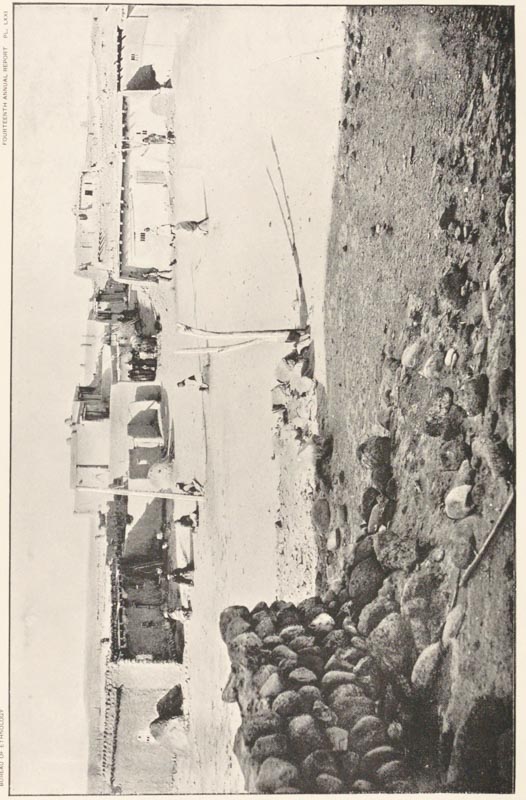
LXXI. The Keres Pueblo of Sia
Cibola is a village of about 200 houses. They have two and three and
four and five stories. The walls are about a handbreadth thick; the
sticks of timber are as large as the wrist, and round; for boards, they
have very small bushes, with their leaves on, covered with a sort of
greenish-colored mud; the walls are of dirt and mud, the doors of the
houses are like the hatchways of ships. The houses are close together,
each joined to the others. Outside of the houses they have some hothouses
(or estufas) of dirt mud, where they take refuge from the cold in
the winter—because this is very great, since it snows six months in the
year. Some of these people wear cloaks of cotton and of the maguey
(or Mexican aloe) and of tanned deer skin, and they wear shoes made
of these skins, reaching up to the knees. They also make cloaks of the
skins of hares and rabbits, with which they cover themselves. The
women wear cloaks of the maguey, reaching down to the feet, with
girdles; they wear their hair gathered about the ears like little wheels.
They raise corn and beans and melons, which is all they need to live on,
because it is a small tribe. The land where they plant is entirely sandy;
the water is brackish; the country is very dry. They have some fowls,
although not many. They do not know what sort of a thing fish is.
There are seven villages in this province of Cibola within a space of 5
leagues; the largest may have about 200 houses and two others about
200, and the others somewhere between 60 or 50 and 30 houses.
It is 60 leagues from Cibola to the river and province of Tibex
[Tiguex]. The first village is 40 leagues from Cibola, and is called
Acuco. This village is on top of a very strong rock; it has about 200
houses, built in the same way as at Cibola, where they speak another
language. It is 20 leagues from here to the river of Tiguex. The river
is almost as wide as that of Seville, although not so deep; it flows
through a level country; the water is good; it contains some fish; it
rises in the north. He who relates this, saw twelve villages within a
certain distance of the river; others saw more, they say, up the river.
Below, all the villages are small, except two that have about 200 houses.
The walls of these houses are something like mud walls of dirt and
sand, very rough; they are as thick as the breadth of a hand. The
houses have two and three stories; the construction is like those at
Cibola. The country is very cold. They have hot-houses, as in Cibola,
and the river freezes so thick that loaded animals cross it, and it would
be possible for carts to do so. They raise as much corn
as they need, p570
and beans and melons. They have some fowls, which they keep so as to
make cloaks of their feathers. They raise cotton, although not much;
they wear cloaks made of this, and shoes of hide, as at Cibola. These
people defend themselves very well, and from within their houses, since
they do not care to come out. The country is all sandy.
Four days’ journey from the province and river of Tiguex four villages
are found. The first has 30 houses; the second is a large village
destroyed in their wars, and has about 35 houses occupied; the third
about These three are like those at the river in every way. The
fourth is a large village which is among some mountains. It is called
Cicuic, and has about 50 houses, with as many stories as those at Cibola.
The walls are of dirt and mud like those at Cibola. It has plenty of
corn, beans and melons, and some fowls. Four days from this village
they came to a country as level as the sea, and in these plains there was
such a multitude of cows that they are numberless. These cows are
like those of Castile, and somewhat larger, as they have a little hump
on the withers, and they are more reddish, approaching black; their
hair, more than a span long, hangs down around their horns and ears
and chin, and along the neck and shoulders like manes, and down from
the knees; all the rest is a very fine wool, like merino; they have very
good, tender meat, and much fat. Having proceeded many days
through these plains, they came to a settlement of about 200 inhabited
houses. The houses were made of the skins of the cows, tanned
white, like pavilions or army tents. The maintenance or sustenance of
these Indians comes entirely from the cows, because they neither sow
nor reap corn. With the skins they make their houses, with the skins
they clothe and shoe themselves, of the skins they make rope, and also
of the wool; from the sinews they make thread, with which they sew
their clothes and also their houses; from the bones they make awls; the
dung serves them for wood, because there is nothing else in that country;
the stomachs serve them for pitchers and vessels from which they
drink; they live on the flesh; they sometimes eat it half roasted and
warmed over the dung, at other times raw; seizing it with their fingers,
they pull it out with one hand and with a flint knife in the other they
cut off mouthfuls, and thus swallow it half chewed; they eat the fat
raw, without warming it; they drink the blood just as it leaves the
cows, and at other times after it has run out, cold and raw; they have
no other means of livelihood. These people have dogs like those in
this country, except that they are somewhat larger, and they load these
dogs like beasts of burden, and make saddles for them like our pack
saddles, and they fasten them with their leather thongs, and these make
their backs sore on the withers like pack animals. When they go
hunting, they load these with their necessities, and when they move—for
these Indians are not settled in one place, since they travel wherever
the cows move, to support themselves—these dogs carry their houses,
and they have the sticks of their houses dragging along tied
on to the p571
pack-saddles, besides the load which they carry on top, and the load
may be, according to the dog, from 35 to 50 pounds. It is 30 leagues,
or even more, from Cibola to these plains where they went. The plains
stretch away beyond, nobody knows how far. The captain, Francisco
Vazquez, went farther across the plains, with 30 horsemen, and Friar
Juan de Padilla with him; all the rest of the force returned to the settlement
at the river to wait for Francisco Vazquez, because this was his
command. It is not known whether he has returned.
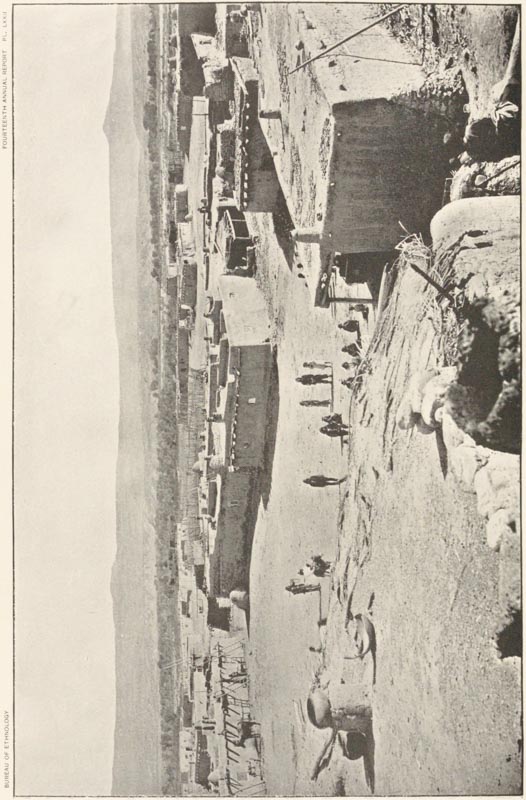
LXXII. The Keres Pueblo of Cochiti
The country is so level that men became lost when they went off half
a league. One horseman was lost, who never reappeared, and two
horses, all saddled and bridled, which they never saw again. No track
was left of where they went, and on this account it was necessary to
mark the road by which they went with cow dung, so as to return,
since there were no stones or anything else.
Marco Polo, the Venetian, in his treatise, in chapter 15, relates and
says that (he saw) the same cows, with the same sort of hump; and in
the same chapter he says that there are sheep as big as horses.
Nicholas, the Venetian, gave an account to Micer Pogio, the Florentine,
in his second book, toward the end, which says that in Ethiopia
there are oxen with a hump, like camels, and they have horns 3 cubits
long, and they carry their horns up over their backs, and one of these
horns makes a wine pitcher.
Marco Polo, in chapter 134, says that in the country of the Tartars,
toward the north, they have dogs as large or little smaller than asses.
They harness these into a sort of cart and with these enter a very miry
country, all a quagmire, where other animals can not enter and come
out without getting submerged, and on this
account they take dogs.
TRANSLATION OF THE RELACION DEL SUCESO 343 — ACCOUNT OF WHAT HAPPENED ON THE JOURNEY WHICH FRANCISCO VAZQUEZ MADE TO DISCOVER CIBOLA.
p572
When the army reached the valley of Culiacan, Francisco Vazquez
divided the army on account of the bad news which was received
regarding Cibola, and because the food supply along the way was small,
according to the report of Melchor Diaz, who had just come back from
seeing it. He himself took 80 horsemen and 25 foot soldiers, and a small
part of the artillery, and set out from Culiacan, leaving Don Tristan de
Arellano with the rest of the force, with orders to set out twenty days
later, and when he reached the Valley of Hearts (Corazones) to wait
there for a letter from him, which would be sent after he had reached
Cibola, and had seen what was there; and this was done. The Valley
of Hearts is 150 leagues from the valley of Culiacan, and the same
distance from Cibola.344
This whole distance, up to about 50 leagues before reaching Cibola,
is inhabited, although it is away from the road in some places. The
population is all of the same sort of people, since the houses are all of
palm mats, and some of them have low lofts. They all have corn,
although not much, and in some places very little. They have melons
and beans. The best settlement of all is a valley called Señora, which
is 10 leagues beyond the Hearts, where a town was afterward settled.
There is some cotton among these, but deer skins are what most of
them use for clothes.
Francisco Vazquez passed by all these on account of the small crops.
There was no corn the whole way, except at this valley of Señora, where
they collected a little, and besides this he had what he took from Culiacan,
where he provided himself for eighty days. In seventy-three
days we reached Cibola, although after hard labor and the loss of many
horses and the death of several Indians, and after we saw it these were
all doubled, although we did find corn enough. We found the natives
peaceful for the whole way. p573
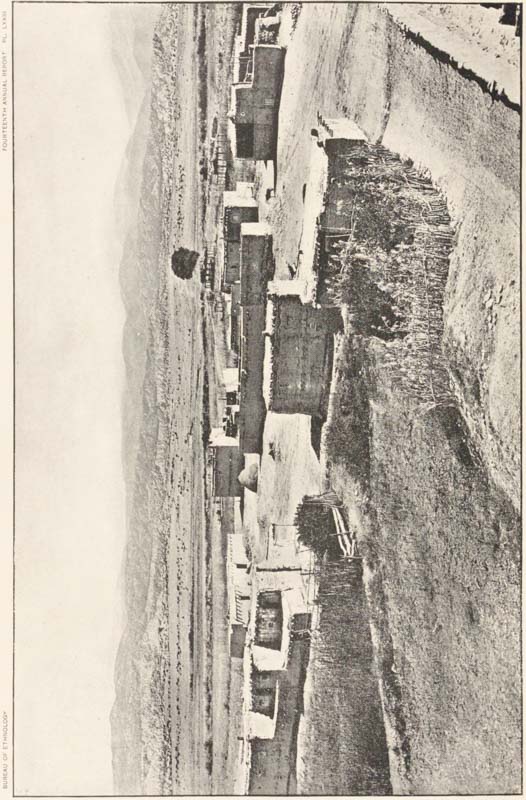
LXXIII. the Tewa Pueblo of Nambe
The day we reached the first village part of them came out to fight
us, and the rest stayed in the village and fortified themselves. It was
not possible to make peace with these, although we tried hard enough,
so it was necessary to attack them and kill some of them. The rest
then drew back to the village, which was then surrounded and attacked.
We had to withdraw, on account of the great damage they did us from
the flat roofs, and we began to assault them from a distance with the
artillery and muskets, and that afternoon they surrendered. Francisco
Vazquez came out of it badly hurt by some stones, and I am certain,
indeed, that he would have been there yet if it had not been for the
army-master, D. Garcia Lopez de Cardenas, who rescued him. When
the Indians surrendered, they abandoned the village and went to the
other villages, and as they left the houses we made ourselves at home
in them.
Father Friar Marcos understood, or gave to understand, that the
region and neighborhood in which there are seven villages was a single
village which he called Cibola, but the whole of this settled region
is called Cibola. The villages have from 150 to 200 and 300 houses;
some have the houses of the village all together, although in some villages
they are divided into two or three sections, but for the most part
they are all together, and their courtyards are within, and in these are
their hot rooms for winter, and they have their summer ones outside
the villages. The houses have two or three stories, the walls of stone
and mud, and some have mud walls. The villages have for the most
part the walls of the houses; the houses are too good for Indians, especially
for these, since they are brutish and have no decency in anything
except in their houses.
For food they have much corn and beans and melons, and some fowls,
like those of Mexico, and they keep these more for their feathers than
to eat, because they make long robes of them, since they do not have
any cotton; and they wear cloaks of heniquen (a fibrous plant), and of
the skins of deer, and sometimes of cows.
Their rites and sacrifices are somewhat idolatrous, but water is what
they worship most, to which they offer small painted sticks and feathers
and yellow powder made of flowers, and usually this offering is made
to springs. Sometimes, also, they offer such turquoises as they have,
although poor ones.
From the valley of Culiacan to Cibola it is 240 leagues in two directions.
It is north to about the thirty-fourth-and-a-half degree, and
from there to Cibola, which is nearly the thirty-seventh degree, toward
the northeast.
Having talked with the natives of Cibola about what was beyond,
they said that there were settlements toward the west. Francisco
Vazquez then sent Don Pedro de Tobar to investigate, who found seven
other villages, which were called the province of
Tuzan;345
this is p574 35
leagues to the west. The villages are somewhat larger than those of
Cibola, and in other respects, in food and everything, they are of the
same sort, except that these raise cotton. While Don Pedro de Tobar
had gone to see these, Francisco Vazquez dispatched messengers to
the viceroy, with an account of what had happened up to this point.346
He also prepared instructions for these to take to Don Tristan, who as
I have said, was at Hearts, for him to proceed to Cibola, and to leave
a town established in the valley of Señora, which he did, and in it he
left 80 horsemen of the men who had but one horse and the weakest
men, and Melchor Diaz with them as captain and leader, because
Francisco Vazquez had so arranged for it. He ordered him to go from
there with half the force to explore toward the west; and he did so, and
traveled 150 leagues, to the river which Hernando de Alarcon entered
from the sea, which he called the Buenaguia. The settlements and
people that are in this direction are mostly like those at the Hearts,
except at the river and around it, where the people have much better
figures and have more corn, although the houses in which they live
are hovels, like pig pens, almost under ground, with a covering of
straw, and made without any skill whatever. This river is reported
to be large. They reached it 30 leagues from the coast, where, and as
far again above, Alarcon had come up with his boats two months before
they reached it. This river runs north and south there. Melchor Diaz
passed on toward the west five or six days, from which he returned for
the reason that he did not find any water or vegetation, but only many
stretches of sand; and he had some fighting on his return to the river
and its vicinity, because they wanted to take advantage of him while
crossing the river. While returning Melchor Diaz died from an accident,
by which he killed himself, throwing a lance at a dog.
After Don Pedro de Tobar returned and had given an account of
those villages, he then dispatched Don Garcia Lopez de Cardenas, the
army-master, by the same road Don Pedro had followed, to go beyond
that province of Tuzan to the west, and he allowed him eighty days in
which to go and return, for the journey and to make the discoveries.
He was conducted beyond Tuzan by native guides, who said there were
settlements beyond, although at a distance. Having gone 50 leagues
west of Tuzan, and 80 from Cibola, he found the edge of a river down
which it was impossible to find a path for a horse in any direction, or
even for a man on foot, except in one very difficult place, where there
was a descent for almost 2 leagues. The sides were such, a steep rocky
precipice that it was scarcely possible to see the river, which looks like
a brook from above, although it is half as large again as that of Seville,
according to what they say, so that although they sought for a passage
with great diligence, none was found for a long distance, during which
they were for several days in great need of water, which could not be
found, and they could not approach that of the river,
although they p575
could see it, and on this account Don Garcia Lopez was forced to return.
This river comes from the northeast and turns toward the south-southwest
at the place where they found it, so that it is without any doubt
the one that Melchor Diaz reached.
Four days after Francisco Vazquez had dispatched Don Garcia
Lopez to make this discovery, he dispatched Hernando de Alvarado to
explore the route toward the east. He started off, and 30 leagues
from Cibola found a rock with a village on top, the strongest position
that ever was seen in the world, which was called Acuco347
in their
language, and father Friar Marcos called it the kingdom of Hacus.
They came out to meet us peacefully, although it would have been easy to
decline to do this and to have stayed on their rock, where we would not
have been able to trouble them. They gave us cloaks of cotton, skins
of deer and of cows, and turquoises, and fowls and other food which
they had, which is the same as in Cibola.
Twenty leagues to the east of this rock we found a river which
runs north and south,348
well settled; there are in all, small and large,
70 villages near it, a few more or less, the same sort as those at Cibola,
except that they are almost all of well-made mud walls. The food is
neither more nor less. They raise cotton—I mean those who live near
the river—the others not. There is much corn here. These people do
not have markets. They are settled for 50 leagues along this river,
north and south, and some villages are 15 or 20 leagues distant, in one
direction and the other. This river rises where these settlements end
at the north, on the slope of the mountains there, where there is a larger
village different from the others, called Yuraba.349
It is settled in this
fashion: It has 18 divisions; each one has a situation as if for two
ground plots;350
the houses are very close together, and have five or six
stories, three of them with mud walls and two or three with thin wooden
walls, which become smaller as they go up, and each one has its little
balcony outside of the mud walls, one above the other, all around, of
wood. In this village, as it is in the mountains, they do not raise cotton
nor breed fowls; they wear the skins of deer and cows entirely. It is
the most populous village of all that country; we estimated there were
15,000 souls in it. There is one of the other kind of villages larger
than all the rest, and very strong, which is called Cicuique.351
It has four
and five stories, has eight large courtyards, each one with its balcony,
and there are fine houses in it. They do not raise cotton nor keep fowls,
because it is 15 leagues away from the river to the east, toward the
plains where the cows are. After Alvarado had sent an
account of this p576
river to Francisco Vazquez, he proceeded forward to these plains, and
at the borders of these he found a little river which flows to the southwest,
and after four days’ march he found the cows, which are the most
monstrous thing in the way of animals which has ever been seen or read
about. He followed this river for 100 leagues, finding more cows every
day. We provided ourselves with some of these, although at first, until
we had had experience, at the risk of the horses. There is such a quantity
of them that I do not know what to compare them with, except with
the fish in the sea, because on this journey, as also on that which the
whole army afterward made when it was going to Quivira, there were so
many that many times when we started to pass through the midst of
them and wanted to go through to the other side of them, we were
not able to, because the country was covered with them. The flesh of
these is as good as that of Castile, and some said it was even better.
The bulls are large and brave, although they do not attack very
much; but they have wicked horns, and in a fight use them well,
attacking fiercely; they killed several of our horses and wounded
many. We found the pike to be the best weapon to use against them,
and the musket for use when this misses.
When Hernando de Alvarado returned from these plains to the river
which was called Tiguex, he found the army-master Don Garcia Lopez
de Cardenas getting ready for the whole army, which was coming there.
When it arrived, although all these people had met Hernando de Alvarado
peacefully, part of them rebelled when all the force came. There
were 12 villages near together, and one night they killed 40 of our
horses and mules which were loose in the camp. They fortified themselves
in their villages, and war was then declared against them. Don
Garcia Lopez went to the first and took it and executed justice on many
of them. When the rest saw this, they abandoned all except two of the
villages, one of these the strongest one of all, around which the army was
kept for two months. And although after we invested it, we entered
it one day and occupied a part of the flat roof, we were forced to abandon
this on account of the many wounds that were received and because it
was so dangerous to maintain ourselves there, and although we again
entered it soon afterward, in the end it was not possible to get it all,
and so it was surrounded all this time. We finally captured it because
of their thirst, and they held out so long because it snowed twice when
they were just about to give themselves up. In the end we captured it,
and many of them were killed because they tried to get away at night.
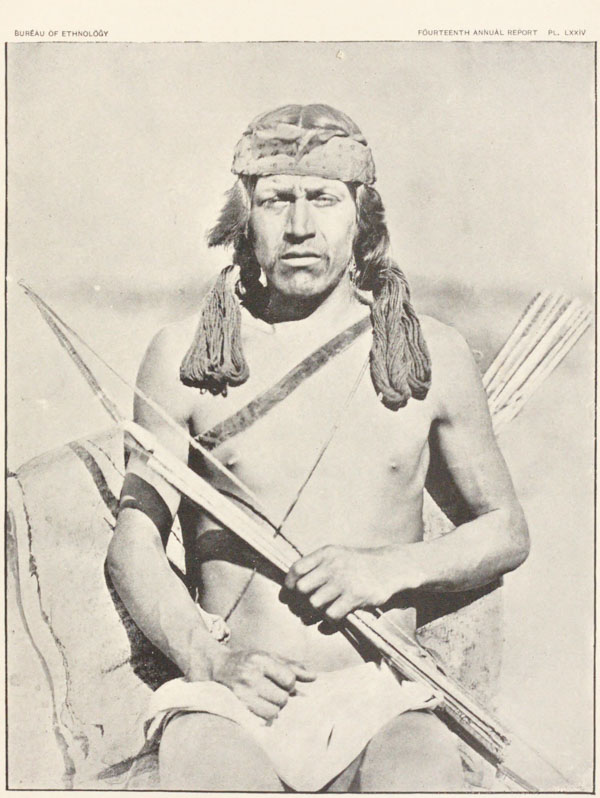
LXXIV. A Nambe Indian in War Costume
Francisco Vazquez obtained an account from some Indians who were
found in this village of Cicuique, which, if it had been true, was of the
richest thing that has been found in the Indies. The Indian who gave
the news and the account came from a village called Harale, 300 leagues
east of this river. He gave such a clear account of what he told, as if
it was true and he had seen it, that it seemed plain afterward that it
was the devil who was speaking in him. Francisco Vazquez
and all of p577
us placed much confidence in him, although he was advised by several
gentlemen not to move the whole army, but rather to send a captain to
find out what was there. He did not wish to do this, but wanted to take
every one, and even to send Don Pedro de Tobar to the Hearts for
half the men who were in that village. So he started with the whole
army, and proceeded 150 leagues, 100 to the east and 50 to the south,352
and the Indian failing to make good what he had said about there being
a settlement there, and corn, with which to proceed farther, the other
two guides were asked how that was, and one confessed that what the
Indian said was a lie, except that there was a province which was called
Quivira, and that there was corn and houses of straw there, but that
they were very far off, because we had been led astray a distance from
the road. Considering this, and the small supply of food that was left,
Francisco Vazquez, after consulting with the captains, determined to
proceed with 30 of the best men who were well equipped, and that the
army should return to the river; and this was done at once. Two days
before this, Don Garcia Lopez’ horse had happened to fall with him,
and he threw his arm out of joint, from which he suffered much, and
so Don Tristan de Arellano returned to the river with the army. On
this journey they had a very hard time, because almost all of them had
nothing to eat except meat, and many suffered on this account. They
killed a world of bulls and cows, for there were days when they brought
60 and 70 head into camp, and it was necessary to go hunting every day,
and on this account, and from not eating any corn during all this time,
the horses suffered much.
Francisco Vazquez set out across these plains in search of Quivira,
more on account of the story which had been told us at the river than
from the confidence which was placed in the guide here, and after proceeding
many days by the needle (i.e., to the north) it pleased God that
after thirty days’ march we found the river Quivira, which is 30 leagues
below the settlement. While going up the valley, we found people
who were going hunting, who were natives of Quivira.
All that there is at Quivira is a very brutish people, without any
decency whatever in their houses nor in anything. These are of straw,
like the Tarascan settlements; in some villages there are as many as
200 houses; they have corn and beans and melons; they do not have
cotton nor fowls, nor do they make bread which is cooked, except
under the ashes. Francisco Vazquez went 25 leagues through these
settlements, to where he obtained an account of what was beyond, and
they said that the plains come to an end, and that down the river there
are people who do not plant, but live wholly by hunting.
They also gave an account of two other large villages, one of which
was called Tareque353
and the other Arae, with straw houses at Tareque,
and at Arae some of straw and some of skins. Copper
was found here, p578
and they said it came from a distance. From what the Indian had said,
it is possible that this village of Arae contains more,354
from the clear
description of it which he gave. We did not find any trace or news of
it here. Francisco Vazquez returned from here to the river of Tiguex,
where he found the army. We went back by a more direct route,
because in going by the way we went we traveled 330 leagues, and it
is not more than 200 by that by which we returned. Quivira is in the
fortieth degree and the river in the thirty-sixth. It was so dangerous
to travel or to go away from the camp in these plains, that it is as if
one was traveling on the sea, since the only roads are those of the
cows, and they are so level and have no mountain or prominent landmark,
that if one went out of sight of it, he was lost, and in this way we
lost one man, and others who went hunting wandered around two or
three days, lost. Two kinds of people travel around these plains with
the cows; one is called Querechos and the others Teyas; they are very
well built, and painted, and are enemies of each other. They have no
other settlement or location than comes from traveling around with the
cows. They kill all of these they wish, and tan the hides, with which
they clothe themselves and make their tents, and they eat the flesh,
sometimes even raw, and they also even drink the blood when thirsty.
The tents they make are like field tents, and they set them up over
some poles they have made for this purpose, which come together and
are tied at the top, and when they go from one place to another they
carry them on some dogs they have, of which they have many, and
they load them with the tents and poles and other things, for the
country is so level, as I said, that they can make use of these, because
they carry the poles dragging along on the ground. The sun is what
they worship most. The skin for the tents is cured on both sides,
without the hair, and they have the skins of deer and cows left over.355
They exchange some cloaks with the natives of the river for corn.
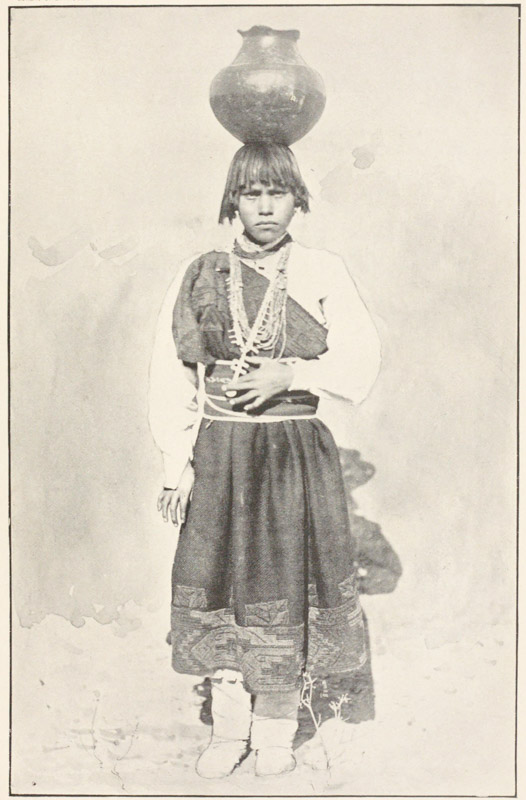
LXXV. A Nambe Water Carrier
After Francisco Vazquez reached the river, where he found the army,
Don Pedro de Tobar came with half the people from the Hearts, and
Don Garcia Lopez de Cardenas started off for Mexico, who, besides the
fact that his arm was very bad, had permission from the viceroy on
account of the death of his brother. Ten or twelve who were sick went
with him, and not a man among them all who could fight. He reached
the town of the Spaniards and found it burned and two Spaniards and
many Indians and horses dead, and he returned to the river on this
account, escaping from them by good fortune and great exertions. The
cause of this misfortune was that after Don Pedro started and left 40
men there, half of these raised a mutiny and fled, and the Indians, who
remembered the bad treatment they had received, attacked them one
night and overpowered them because of their carelessness and weakness,
and they fled to Culiacan. Francisco Vazquez fell
while running p579
a horse about this time and was sick a long time, and after the winter
was over he determined to come back, and although they may say something
different, he did so, because he wanted to do this more than anything,
and so we all came together as far as Culiacan, and each one went
where he pleased from there, and Francisco Vazquez came here to Mexico
to make his report to the viceroy, who was not at all pleased with his
coming, although he pretended so at first. He was pleased that Father
Friar Juan de Padilla had stayed there, who went to Quivira, and a
Spaniard and a negro with him, and Friar Luis, a very holy lay brother,
stayed in Cicuique. We spent two very cold winters at this river, with
much snow and thick ice. The river froze one night and remained so
for more than a month, so that loaded horses crossed on the ice. The
reason these villages are settled in this fashion is supposed to be the
great cold, although it is also partly the wars which they have with one
another. And this is all that was seen and found out about all that
country, which is very barren of fruits and groves. Quivira is a better
country, having many huts and not being so cold, although it is more
to the north.
TRANSLATION OF A LETTER FROM CORONADO TO THE KING, OCTOBER 20, 1541 356 — LETTER FROM FRANCISCO VAZQUEZ CORONADO TO HIS MAJESTY, IN WHICH HE GIVES AN ACCOUNT OF THE DISCOVERY OF THE PROVINCE OF TIGUEX.
HOLY
CATHOLIC
CÆSARIAN
MAJESTY:
On April 20 of this year I
wrote to Your Majesty from this province of Tiguex, in reply to a letter
from Your Majesty dated in Madrid, June 11 a year ago. I gave
a detailed account of this expedition, which the viceroy of New Spain
ordered me to undertake in Your Majesty’s name to this country which
was discovered by Friar Marcos of Nice, the provincial of the order of
Holy Saint Francis. I described it all, and the sort of force I have, as
Your Majesty had ordered me to relate in my letters; and stated that
while I was engaged in the conquest and pacification of the natives
of this province, some Indians who were natives of other provinces
beyond these had told me that in their country there were much larger
villages and better houses than those of the natives of this country,
and that they had lords who ruled them, who were served with dishes
of gold, and other very magnificent things; and although, as I wrote
Your Majesty, I did not believe it before I had set eyes on it, because
it was the report of Indians and given for the most part by means of
signs, yet as the report appeared to me to be very fine and that it was
important that it should be investigated for Your Majesty’s service, I
determined to go and see it with the men I have here. I started from
this province on the 23d of last April, for the place where the Indians
wanted to guide me. After nine days’ march I reached some plains, so
vast that I did not find their limit anywhere that I went, although I
traveled over them for more than 300 leagues. And I found such a quantity
of cows in these, of the kind that I wrote Your Majesty about,
which they have in this country, that it is impossible to number them,
for while I was journeying through these plains, until I returned to
where I first found them, there was not a day that I lost sight of them.
And after seventeen days’ march I came to a settlement of Indians
who are called Querechos, who travel around with these cows, who do
not plant, and who eat the raw flesh and drink the blood of the cows
they kill, and they tan the skins of the cows, with which
all the people p581
of this country dress themselves here. They have little field tents made
of the hides of the cows, tanned and greased, very well made, in which
they live while they travel around near the cows, moving with these.
They have dogs which they load, which carry their tents and poles and
belongings. These people have the best figures of any that I have seen
in the Indies. They could not give me any account of the country
where the guides were taking me. I traveled five days more as the
guides wished to lead me, until I reached some plains, with no more
landmarks than as if we had been swallowed up in the sea, where they
strayed about, because there was not a stone, nor a bit of rising ground,
nor a tree, nor a shrub, nor anything to go by. There is much very fine
pasture land, with good grass. And while we were lost in these plains,
some horsemen who went off to hunt cows fell in with some Indians who
also were out hunting, who are enemies of those that I had seen in
the last settlement, and of another sort of people who are called Teyas;
they have their bodies and faces all painted, are a large people like the
others, of a very good build; they eat the raw flesh just like the Querechos,
and live and travel round with the cows in the same way as these.
I obtained from these an account of the country where the guides were
taking me, which was not like what they had told me, because these made
out that the houses there were not built of stones, with stories, as my
guides had described it, but of straw and skins, and a small supply of
corn there. This news troubled me greatly, to find myself on these limitless
plains, where I was in great need of water, and often had to drink
it so poor that it was more mud than water. Here the guides confessed
to me that they had not told the truth in regard to the size of the houses,
because these were of straw, but that they had done so regarding the
large number of inhabitants and the other things about their habits.
The Teyas disagreed with this, and on account of this division between
some of the Indians and the others, and also because many of the men
I had with me had not eaten anything except meat for some days,
because we had reached the end of the corn which we carried from this
province, and because they made it out more than forty days’ journey
from where I fell in with the Teyas to the country where the guides were
taking me, although I appreciated the trouble and danger there would
be in the journey owing to the lack of water and corn, it seemed to me
best, in order to see if there was anything there of service to Your Majesty,
to go forward with only 30 horsemen until I should be able to see
the country, so as to give Your Majesty a true account of what was to
be found in it. I sent all the rest of the force I had with me to this
province, with Don Tristan de Arellano in command, because it would
have been impossible to prevent the loss of many men, if all had gone
on, owing to the lack of water and because they also had to kill bulls
and cows on which to sustain themselves. And with only the 30 horsemen
whom I took for my escort, I traveled forty-two days after I left
the force, living all this while solely on the flesh of the bulls and cows
which we killed, at the cost of several of our horses
which they killed, p582
because, as I wrote Your Majesty, they are very brave and fierce animals;
and going many days without water, and cooking the food with
cow dung, because there is not any kind of wood in all these plains,
away from the gullies and rivers, which are very few.
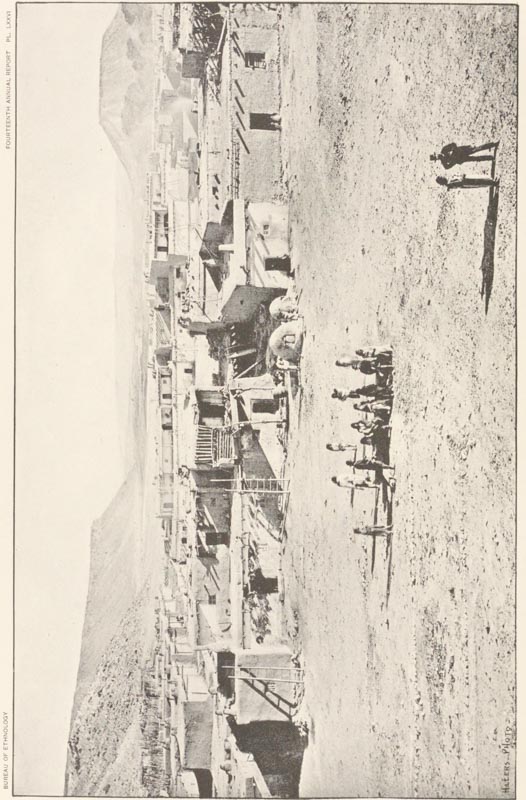
LXXVI. The Keres Pueblo
of Katishtya or San Felipe
It was the Lord’s pleasure that, after having journeyed across these
deserts seventy-seven days, I arrived at the province they call Quivira,
to which the guides were conducting me, and where they had described
to me houses of stone, with many stories; and not only are they not of
stone, but of straw, but the people in them are as barbarous as all those
whom I have seen and passed before this; they do not have cloaks, nor
cotton of which, to make these, but use the skins of the cattle they kill,
which they tan, because they are settled among these on a very large
river. They eat the raw flesh like the Querechos and Teyas; they are
enemies of one another, but are all of the same sort of people, and these
at Quivira have the advantage in the houses they build and in planting
corn. In this province of which the guides who brought me are natives,
they received me peaceably, and although they told me when I set out
for it that I could not succeed in seeing it all in two months, there are
not more than 25 villages of straw houses there and in all the rest of the
country that I saw and learned about, which gave their obedience to Your
Majesty and placed themselves under your royal overlordship. The people
here are large. I had several Indians measured, and found that they
were 10 palms in height; the women are well proportioned and their features
are more like Moorish women than Indians. The natives here gave
me a piece of copper which a chief Indian wore hung around his neck;
I sent it to the viceroy of New Spain, because I have not seen any other
metal in these parts except this and some little copper bells which I
sent him, and a bit of metal which looks like gold. I do not know
where this came from, although I believe that the Indians who gave it
to me obtained it from those whom I brought here in my service, because
I can not find any other origin for it nor where it came from. The
diversity of languages which exists in this country and my not having
anyone who understood them, because they speak their own language in
each village, has hindered me, because I have been forced to send captains
and men in many directions to find out whether there was anything
in this country which could be of service to Your Majesty. And
although I have searched with all diligence I have not found or heard
of anything, unless it be these provinces, which are a very small affair.
The province of Quivira is 950 leagues from Mexico. Where I reached
it, it is in the fortieth degree. The country itself is the best I have ever
seen for producing all the products of Spain, for besides the land itself
being very fat and black and being very well watered by the rivulets
and springs and rivers, I found prunes like those of Spain [or I found
everything they have in Spain] and nuts and very good sweet grapes
and mulberries. I have treated the natives of this province, and all
the others whom I found wherever I went, as well as
was possible, p583
agreeably to what Your Majesty had commanded, and they have received
no harm in any way from me or from those who went in my
company.357
I remained twenty-five days in this province of Quivira, so as to see and
explore the country and also to find out whether there was anything
beyond which could be of service to Your Majesty, because the guides
who had brought me had given me an account of other provinces beyond
this. And what I am sure of is that there is not any gold nor any other
metal in all that country, and the other things of which they had told
me are nothing but little villages, and in many of these they do not
plant anything and do not have any houses except of skins and sticks,
and they wander around with the cows; so that the account they gave me
was false, because they wanted to persuade me to go there with the whole
force, believing that as the way was through such uninhabited deserts,
and from the lack of water, they would get us where we and our horses
would die of hunger. And the guides confessed this, and said they had
done it by the advice and orders of the natives of these provinces. At
this, after having heard the account of what was beyond, which I have
given above, I returned to these provinces to provide for the force I
had sent back here and to give Your Majesty an account of what this
country amounts to, because I wrote Your Majesty that I would do so
when I went there. I have done all that I possibly could to serve
Your Majesty and to discover a country where God Our Lord might be
served and the royal patrimony of Your Majesty increased, as your
loyal servant and vassal. For since I reached the province of Cibola,
to which the viceroy of New Spain sent me in the name of Your Majesty,
seeing that there were none of the things there of which Friar Marcos
had told, I have managed to explore this country for 200 leagues and
more around Cibola, and the best place I have found is this river of
Tiguex where I am now, and the settlements here. It would not be
possible to establish a settlement here, for besides being 400 leagues
from the North sea and more than 200 from the South sea, with which
it is impossible to have any sort of communication, the country is so
cold, as I have written to Your Majesty, that apparently the winter
could not possibly be spent here, because there is no wood, nor cloth
with which to protect the men, except the skins which the natives wear
and some small amount of cotton cloaks. I send the viceroy of New
Spain an account of everything I have seen in the countries where I
have been, and as Don Garcia Lopez de Cardenas is going to kiss Your
Majesty’s hands, who has done much and has served Your Majesty very
well on this expedition, and he will give Your Majesty an account of
everything here, as one who has seen it himself, I give way to him.
And may Our Lord protect the Holy Imperial Catholic person of Your
Majesty, with increase of greater kingdoms and powers, as your loyal
servants and vassals desire. From this province of Tiguex, October
20, in the year 1541. Your Majesty’s humble servant and vassal,
who would kiss the royal feet and hands:
FRANCISCO
VAZQUEZ
CORONADO.
TRANSLATION OF THE NARRATIVE OF JARAMILLO — ACCOUNT GIVEN BY CAPTAIN JUAN JARAMILLO OF THE JOURNEY WHICH HE MADE TO THE NEW COUNTRY, ON WHICH FRANCISCO VAZQUEZ CORONADO WAS THE GENERAL. 358
We started from Mexico, going directly to Compostela, the whole way
populated and at peace, the direction being west, and the distance 112
leagues. From there we went to Culiacan, perhaps about 80 leagues;
the road is well known and much used, because there is a town inhabited
by Spaniards in the said valley of Culiacan, under the government
of Compostela. The 70 horsemen who went with the general went in
a northwesterly direction from this town. He left his army here, because
information had been obtained that the way was uninhabited and
almost the whole of it without food. He went with the said horsemen
to explore the route and prepare the way for those who were to follow.
He pursued this direction, though with some twisting, until we crossed
a mountain chain, where they knew about New Spain, more than 300
leagues distant. To this pass we gave the name of Chichilte Calli,
because we learned that this was what it was called, from some Indians
whom we left behind.
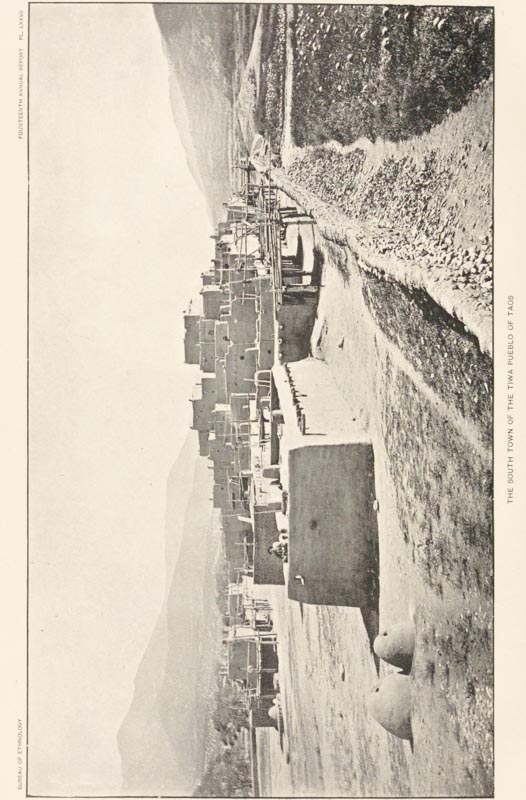
LXXVII. The South Town of the Tiwa
Pueblo of Taos
Leaving the said valley of Culiacan, he crossed a river called Pateatlan
(or Peteatlan), which was about four days distant. We found these
Indians peaceful, and they gave us some few things to eat. From
here we went to another river called Cinaloa, which was about three
days from the other. From here the general ordered ten of us horsemen
to make double marches, lightly equipped, until we reached the
stream of the Cedars (arroyo de los Cedros), and from there we were to
enter a break in the mountains on the right of the road and see what
there was in and about this. If more time should be needed for this
than we gained on him, he would wait for us at the said Cedros stream.
This was done, and all that we saw there was a few poor Indians in
some settled valleys like farms or estates, with sterile soil. It was
about five more days from the river to this stream. From there we
went to the river called Yaquemi, which took about three days. We
proceeded along a dry stream, and after three days more of marching,
although the dry stream lasted only for a league, we reached another
stream where there were some settled Indians, who had straw huts and
storehouses of corn and beans and melons. Leaving here,
we went to p585
the stream and village which is called Hearts (Corazones), the name
which was given it by Dorantes and Cabeza de Vaca and Castillo and
the negro Estebanillo, because they gave them a present of the hearts
of animals and birds to eat.
About two days were spent in this village of the Hearts. There is an
irrigation stream, and the country is warm. Their dwellings are huts
made of a frame of poles, almost like an oven, only very much better,
which they cover with mats. They have corn and beans and melons
for food, which I believe never fail them. They dress in deerskins.
This appeared to be a good place, and so orders were given the
Spaniards who were behind to establish a village here, where they
lived until almost the failure of the expedition. There was a poison
here, the effect of which is, according to what was seen of it, the worst
that could possibly be found; and from what we learned about it, it is
the sap of a small tree like the mastick tree, or lentisk, and it grows in
gravelly and sterile land.359
We went on from here, passing through
a sort of gateway, to another valley very near this stream, which
opens off from this same stream, which is called Señora. It is also
irrigated, and the Indians are like the others and have the same
sort of settlements and food. This valley continues for 6 or 7 leagues,
a little more or less. At first these Indians were peaceful; and afterward
not, but instead they and those whom they were able to
summon thither were our worst enemies. They have a poison with
which they killed several Christians. There are mountains on both
sides of them, which are not very fertile. From, here we went along
near this said stream, crossing it where it makes a bend, to another
Indian settlement called Ispa.360
It takes one day from the last of
these others to this place. It is of the same sort as those we had
passed. From here we went through deserted country for about four
days to another river, which we heard called Nexpa, where some poor
Indians came out to see the general, with presents of little value, with
some stalks of roasted maguey and pitahayas. We went down this
stream two days, and then left the stream, going toward the right to the
foot of the mountain chain in two days’ journey, where we heard news
of what is called Chichiltic Calli. Crossing the mountains, we came to a
deep and reedy river, where we found water and
forage for the horses. p586
From this river back at Nexpa, as I have said, it seems to me that the
direction was nearly northeast. From here, I believe that we went in
the same direction for three days to a river which we called Saint John
(San Juan), because we reached it on his day. Leaving here, we went
to another river, through a somewhat rough country, more toward the
north, to a river which we called the Rafts (de las Balsas), because
we had to cross on these, as it was rising. It seems to me that we
spent two days between one river and the other, and I say this because
it is so long since we went there that I may be wrong in some days,
though not in the rest. From here we went to another river, which we
called the Slough (de la Barranca.) It is two short days from one to
the other, and the direction almost northeast. From here we went to
another river, which we called the Cold river (el rio Frio), on account
of its water being so, in one day’s journey, and from here we went by
a pine mountain, where we found, almost at the top of it, a cool spring
and streamlet, which was another day’s march. In the neighborhood
of this stream a Spaniard, who was called Espinosa, died, besides two
other persons, on account of poisonous plants which they ate, owing to
the great need in which they were. From here we went to another river,
which we called the Red river (Bermejo), two days’ journey in the
same direction, but less toward the northeast. Here we saw an Indian
or two, who afterward appeared to belong to the first settlement of
Cibola. From here we came in two days’ journey to the said village,
the first of Cibola. The houses have flat roofs and walls of stone and
mud, and this was where they killed Steve (Estebanillo), the negro
who had come with Dorantes from Florida and returned with Friar
Marcos de Niza. In this province of Cibola there are five little villages
besides this, all with flat roofs and of stone and mud, as I said. The
country is cold, as is shown by their houses and hothouses (estufas).
They have food enough for themselves, of corn and beans and melons.
These villages are about a league or more apart from each other,
within a circuit of perhaps 6 leagues. The country is somewhat sandy
and not very salty (or barren of vegetation361), and on the mountains the
trees are for the most part evergreen. The clothing of the Indians is
of deerskins, very carefully tanned, and they also prepare some tanned
cowhides, with which they cover themselves, which are like shawls,
and a great protection. They have square cloaks of cotton, some
larger than others, about a yard and a half long. The Indians wear
them thrown over the shoulder like a gipsy, and fastened with one end
over the other, with a girdle, also of cotton. From this first village of
Cibola, looking toward the northeast and a little less, on the left hand,
there is a province called Tucayan, about five days off, which has seven
flat-roof villages, with a food supply as good as or better
than these, and p587
an even larger population; and they also have the skins of cows and
of deer, and cloaks of cotton, as I described.362
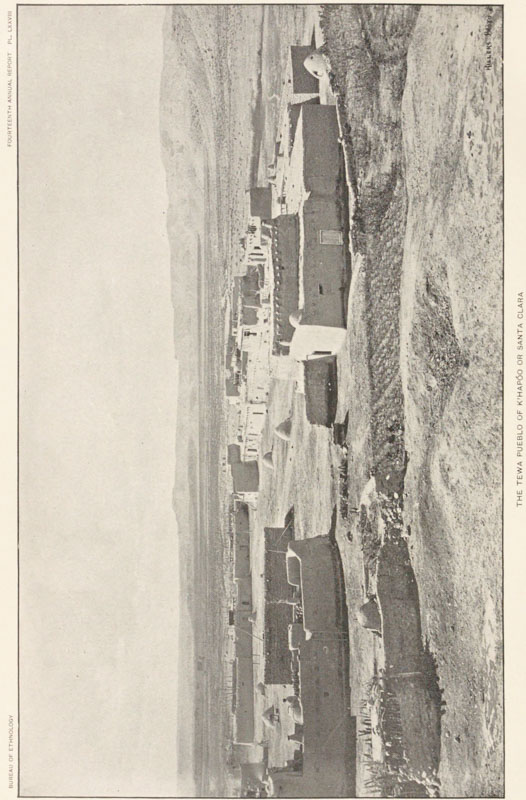
LXXVIII. The Tewa Pueblo of K’hapóo
or Santa Clara
All the waterways we found as far as this one at Cibola—and I do not
know but what for a day or two beyond—the rivers and streams run
into the South sea, and those from here on into the North sea.
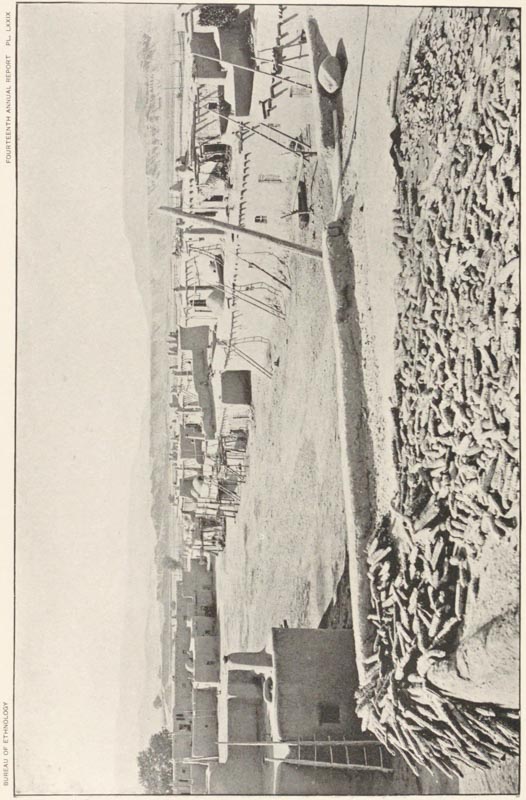
LXXIX. The Tewa Pueblo of Ohke or San Juan
From this first village of Cibola, as I have said, we went to another
in the same province, which was about a short day’s journey off, on
the way to Tihuex. It is nine days, of such marches as we made, from
this settlement of Cibola to the river of Tihuex. Halfway between, I do
not know but it maybe a day more or less, there is a village of earth and
dressed stone, in a very strong position, which is called Tutahaco.363
All
these Indians, except the first in the first village of Cibola, received us
well. At the river of Tihuex there are 15 villages within a distance
of about 20 leagues, all with flat-roof houses of earth, instead of stone,
after the fashion of mud walls. There are other villages besides these
on other streams which flow into this, and three of these are, for
Indians, well worth seeing, especially one that is called Chia,364
and another
Uraba,365
and another Cicuique.366
Uraba and Cicuique have many
houses two stories high. All the rest, and these also, have corn and
beans and melons, skins, and some long robes of feathers which they
braid, joining the feathers with a sort of thread; and they also make
them of a sort of plain weaving with which they make the cloaks with
which they protect themselves. They all have hot rooms underground,
which, although not very clean, are very warm.367
They raise and have
a very little cotton, of which they make the cloaks which I have
spoken of above. This river comes from the northwest and flows about
southeast, which shows that it certainly flows into the North sea.
Leaving this settlement368
and the said river, we passed two other villages
whose names I do not know,369
and in four days came to Cicuique,
which I have already mentioned. The direction of this is toward the
northeast. From there we came to another river, which the Spaniards
named after Cicuique, in three days; if I remember rightly, it
seems to me that we went rather toward the northeast to reach this
river where we crossed it, and after crossing this,
we turned more to p588
the left hand, which would be more to the northeast, and began to
enter the plains where the cows are, although, we did not find them for
some four or five days, after which we began to come across bulls, of
which there are great numbers, and after going on in the same direction
and meeting the bulls for two or three days, we began to find
ourselves in the midst of very great numbers of cows, yearlings and
bulls all in together. We found Indians among these first cows, who
were, on this account, called Querechos by those in the flat roof
houses. They do not live in houses, but have some sets of poles
which they carry with them to make some huts at the places where
they stop, which serve them for houses. They tie these poles together
at the top and stick the bottoms into the ground, covering them with
some cowskins which they carry around, and which, as I have said,
serve them for houses. From what was learned of these Indians, all
their human needs are supplied by these cows, for they are fed and
clothed and shod from these. They are a people who wander around
here and there, wherever seems to them best. We went on for eight
or ten days in the same direction, along those streams which are
among the cows. The Indian who guided us from here was the one
that had given us the news about Quevira and Arache (or Arahei) and
about its being a very rich country with much gold and other things,
and he and the other one were from that country I mentioned, to
which we were going, and we found these two Indians in the flat-roof
villages. It seems that, as the said Indian wanted to go to his own
country, he proceeded to tell us what we found was not true, and I do
not know whether it was on this account or because he was counseled
to take us into other regions by confusing us on the road, although
there are none in all this region except those of the cows. We understood,
however, that he was leading us away from the route we ought
to follow and that he wanted to lead us on to those plains where he
had led us, so that we would eat up the food, and both ourselves and
our horses would become weak from the lack of this, because if we
should go either backward or forward in this condition we could not
make any resistance to whatever they might wish to do to us. From
the time when, as I said, we entered the plains and from, this settlement
of Querechos, he led us off more to the east, until we came to be in
extreme need from the lack of food, and as the other Indian, who was
his companion and also from his country, saw that he was not taking
us where we ought to go, since we had always followed the guidance
of the Turk, for so he was called, instead of his, he threw himself
down in the way, making a sign that although we cut off his head he
ought not to go that way, nor was that our direction. I believe we
had been traveling twenty days or more in this direction, at the end
of which we found another settlement of Indians of the same sort and
way of living as those behind, among whom there was an old blind
man with a beard, who gave us to understand, by signs
which he made, p589
that he had seen four others like us many days before, whom he had
seen near there and rather more toward New Spain, and we so understood
him, and presumed that it was Dorantes and Cabeza de Vaca
and those whom I have mentioned. At this settlement the general,
seeing our difficulties, ordered the captains, and the persons whose
advice he was accustomed to take, to assemble, so that we might
discuss with him what was best for all. It seemed to us that all the
force should go back to the region we had come from, in search of food,
so that they could regain their strength, and that 30 picked horsemen
should go in search of what the Indian had told about; and we decided
to do this. We all went forward one day to a stream which was down
in a ravine in the midst of good meadows, to agree on who should go
ahead and how the rest should return. Here the Indian Isopete, as
we had called the companion of the said Turk, was asked to tell us
the truth, and to lead us to that country which we had come in search
of. He said he would do it, and that it was not as the Turk had said,
because those were certainly fine things which he had said and had given
us to understand at Tihuex, about gold and how it was obtained, and
the buildings, and the style of them, and their trade, and many other
things told for the sake of prolixity, which had led us to go in search of
them, with the advice of all who gave it and of the priests. He asked
us to leave him afterward in that country, because it was his native
country, as a reward for guiding us, and also, that the Turk might
not go along with him, because he would quarrel and try to restrain
him in everything that he wanted to do for our advantage; and the
general promised him this, and said he would be with one of the thirty,
and he went in this way. And when everything was ready for us to
set out and for the others to remain, we pursued our way, the direction
all the time after this being toward the north, for more than thirty
days’ march, although not long marches, not having to go without water
on any one of them, and among cows all the time, some days in larger
numbers than others, according to the water which we came across,
so that on Saint Peter and Paul’s day we reached a river which we
found to be there below Quibira. When we reached the said river, the
Indian recognized it and said that was it, and that it was below the
settlements. We crossed it there and went up the other side on the
north, the direction turning toward the northeast, and after marching
three days we found some Indians who were going hunting, killing the
cows to take the meat to their village, which was about three or four
days still farther away from us. Here where we found the Indians
and they saw us, they began to utter yells and appeared to fly, and
some even had their wives there with them. The Indian Isopete
began to call them in his language, and so they came to us without
any signs of fear. When we and these Indians had halted here, the
general made an example of the Indian Turk, whom we had brought
along, keeping him all the time out of sight among
the rear guard, and p590
having arrived where the place was prepared, it was done in such a
way that the other Indian, who was called Isopete, should not see it,
so as to give him the satisfaction he had asked. Some satisfaction
was experienced here on seeing the good appearance of the earth, and
it is certainly such among the cows, and from there on. The general
wrote a letter here to the governor of Harahey and Quibira, having
understood that he was a Christian from the lost army of Florida,
because what the Indian had said of their manner of government
and their general character had made us believe this. So the Indians
went to their houses, which were at the distance mentioned, and we
also proceeded at our rate of marching until we reached the settlements,
which we found along good river bottoms, although without
much water, and good streams which flow into another, larger than
the one I have mentioned. There were, if I recall correctly, six or
seven settlements, at quite a distance from one another, among which
we traveled for four or five days, since it was understood to be uninhabited
between one stream and the other. We reached what they said
was the end of Quibira, to which they took us, saying that the things
there were of great importance.370
Here there was a river, with more
water and more inhabitants than the others. Being asked if there
was anything beyond, they said that there was nothing more of Quibira,
but that there was Harahey, and that it was the same sort of a place,
with settlements like these, and of about the same size. The general
sent to summon the lord of those parts and the other Indians who
they said resided in Harahey, and he came with about 200 men—all
naked—with bows, and some sort of things on their heads, and their
privy parts slightly covered. He was a big Indian, with a large body
and limbs, and well proportioned. After he had heard the opinion of
one and another about it, the general asked them what we ought to do,
reminding us of how the army had been left and that the rest of us
were there, so that it seemed to all of us that as it was already almost
the opening of winter, for, if I remember rightly, it was after the middle
of August, and because there was little to winter there for, and we were
but very little prepared for it, and the uncertainty as to the success of
the army that had been left, and because the winter might close the
roads with snow and rivers which we could not cross, and also in order
to see what had happened to the rest of the force left behind, it seemed
to us all that his grace ought to go back in search of them, and when he
had found out for certain how they were, to winter there and return to
that country at the opening of spring, to conquer and cultivate it. Since,
as I said, this was the last point which we reached, here the Turk saw
that he had lied to us, and one night he called on all these people to
attack us and kill us. We learned of it, and put him under guard and
strangled him that night so that he never waked up.
With the plan p591
mentioned, we turned back it may have been two or three days, where
we provided ourselves with picked fruit and dried corn for our return.
The general raised a cross at this place, at the foot of which he made
some letters with a chisel, which said that Francisco Vazquez de
Coronado, general of that army, had arrived here.
This country presents a very fine appearance, than which I have
not seen a better in all our Spain, nor Italy, nor a part of France, nor,
indeed, in the other countries where I have traveled in His Majesty’s
service, for it is not a very rough country, but is made up of hillocks
and plains, and very fine appearing rivers and streams, which certainly
satisfied me and made me sure that it will be very fruitful in
all sorts of products. Indeed, there is profit in the cattle ready to the
hand, from the quantity of them, which is as great as one could imagine.
We found a variety of Castilian prunes which are not all red,
but some of them black and green; the tree and fruit is certainly like
that of Castile, with a very excellent flavor. Among the cows we
found flax, which springs up from the earth in clumps apart from one
another, which are noticeable, as the cattle do not eat it, with their tops
and blue flowers, and very perfect although small, resembling that of
our own Spain (or and sumach like ours in Spain). There are grapes
along some streams, of a fair flavor, not to be improved upon. The
houses which these Indians have were of straw, and most of them round,
and the straw reached down to the ground like a wall, so that they did
not have the symmetry or the style of these here; they have something
like a chapel or sentry box outside and around these, with an entry,
where the Indians appear seated or reclining.371
The Indian Isopete
was left here where the cross was erected, and we took five or six of
the Indians from these villages to lead and guide us to the flat-roof
houses.372
Thus they brought us back by the same road as far as where
I said before that we came to a river called Saint Peter and Paul’s,
and here we left that by which we had come, and, taking the right
hand, they led us along by watering places and among cows and by
a good road, although there are none either one way or the other
except those of the cows, as I have said. At last we came to where
we recognized the country, where I said we found
the first settlement, p592
where the Turk led as astray from the route we should have followed.
Thus, leaving the rest aside, we reached Tiguex, where we found the
rest of the army, and here the general fell while running his horse,
by which he received a wound on his head which gave symptoms of
turning out badly, and he conceived the idea of returning, which ten
or twelve of us were unable to prevent by dissuading him from it.
When this return had been ordered, the Franciscan friars who were
with us—one of them a regular and the other a lay brother—who
were called, the regular one Friar Juan de Padilla and the lay one
Friar Luis de Escalona, were told to get ready, although they had permission
from their provincial so that they could remain. Friar Luis
wished to remain in these flat-roof houses, saying that he would raise
crosses for those villagers with a chisel and adze they left him, and would
baptize several poor creatures who could be led, on the point of death,
so as to send them to heaven, for which he did not desire any other company
than a little slave of mine who was called Christopher, to be his
consolation, and who he said would learn the language there quickly
so as to help him; and he brought up so many things in favor of this
that he could not be denied, and so nothing more has been heard from
him. The knowledge that this friar would remain there was the reason
that many Indians from hereabouts stayed there, and also two negroes,
one of them mine, who was called Sebastian, and the other one of Melchor
Perez, the son of the licentiate La Torre. This negro was married
and had his wife and children. I also recall that several Indians
remained behind in the Quivira region, besides a Tarascan belonging to
my company, who was named Andrew. Friar Juan de Padilla preferred
to return to Quivira, and persuaded them to give him those Indians
whom I said we had brought as guides. They gave him these, and he
also took a Portuguese and a free Spanish-speaking Indian, who was
the interpreter, and who passed as a Franciscan friar, and a half-blood
and two Indians from Capottan (or Capotean) or thereabouts, I believe.
He had brought these up and took them in the habits of friars, and he
took some sheep and mules and a horse and ornaments and other
trifles. I do not know whether it was for the sake of these or for what
reason, but it seems that they killed him, and those who did it were the
lay servants, or these same Indians whom he took back from Tiguex,
in return for the good deeds which he had done. When he was dead,
the Portuguese whom I mentioned fled, and also one of the Indians
that I said he took in the habits of friars, or both of them, I believe.
I mention this because they came back to this country of New Spain
by another way and a shorter route than the one of which I have told,
and they came out in the valley of Panico.373
I have given Gonzalo
Solis de Meras and Isidore de Solis an account of this, because it seemed
to me important, according to what I say I
have understood, that p593
His Majesty ordered Your Lordship to find or discover a way so as to
unite that land to this. It is perhaps also very likely that this Indian
Sebastian, during the time he was in Quivira, learned about its territory
and the country round about it, and also of the sea, and the road
by which he came, and what there is to it, and how many days’ journey
before arriving there. So that I am sure that if Your Lordship acquires
this Quivira on this account, I am certain that he can confidently bring
many people from Spain to settle it according to the appearance and
the character of the land.
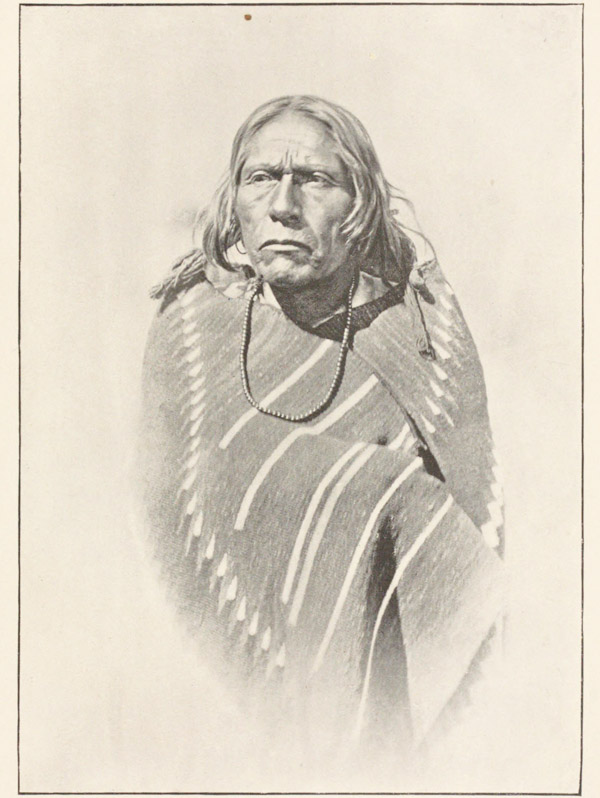
LXXX. A Native of San Juan
TRANSLATION OF THE REPORT OF HERNANDO DE ALVARADO — ACCOUNT OF WHAT HERNANDO DE ALVARADO AND FRIAR JUAN DE PADILLA DISCOVERED GOING IN SEARCH OF THE SOUTH SEA. 374
p594
We set out from Granada on Sunday, the day of the beheading of
Saint John the Baptist, the 29th of August, in the year 1540, on the
way to Coco.375
After we had gone 2 leagues, we came to an ancient
building like a fortress, and a league beyond this we found another, and
yet another a little farther on, and beyond these we found an ancient
city, very large, entirely destroyed, although a large part of the wall
was standing, which was six times as tall as a man, the wall well made
of good worked stone, with gates and gutters like a city in Castile.
Half a league or more beyond this, we found another ruined city, the
walls of which must have been very fine, built of very large granite
blocks, as high as a man and from there up of very good quarried
stone. Here two roads separate, one to Chia and the other to
Coco; we took this latter, and reached that place, which is one of the
strongest places that we have seen, because the city is on a very high
rock, with such a rough ascent that we repented having gone up to
the place. The houses have three or four stories; the people are the
same sort as those of the province of Cibola; they have plenty of
food, of corn and beans and fowls like those of New Spain. From
here we went to a very good lake or marsh, where there are trees like
those of Castile, and from there we went to a river, which we named
Our Lady (Nuestra Señora), because we reached it the evening before
her day in the month of
September.376
We sent the cross by a guide to
the villages in advance, and the next day people came from twelve villages,
the chief men and the people in order, those of one village behind
those of another, and they approached the tent to the sound of a pipe,
and with an old man for spokesman. In this fashion they came into
the tent and gave me the food and clothes and skins they had brought,
and I gave them some trinkets, and with this they went off.
This river of Our Lady flows through a very wide open plain sowed
with corn plants; there are several groves, and there
are twelve p595 villages.
The houses are of earth, two stories high; the people have a
good appearance, more like laborers than a warlike race; they have a
large food supply of corn, beans, melons, and fowl in great plenty; they
clothe themselves with cotton and the skins of cows and dresses of the
feathers of the fowls; they wear their hair short. Those who have the
most authority among them are the old men; we regarded them as
witches, because they say that they go up into the sky and other things
of the same sort. In this province there are seven other villages,
depopulated and destroyed by those Indians who paint their eyes, of
whom the guides will tell Your Grace; they say that these live in the
same region as the cows, and that they have corn and houses of straw.
Here the people from the outlying provinces came to make peace
with me, and as Your Grace may see in this memorandum, there are
80 villages there of the same sort as I have described, and among them
one which is located on some streams; it is divided into twenty divisions,
which is something remarkable; the houses have three stories
of mud walls and three others made of small wooden boards, and on
the outside of the three stories with the mud wall they have three balconies;
it seemed to us that there were nearly 15,000 persons in this
village. The country is very cold; they do not raise fowls nor cotton;
they worship the sun and water. We found mounds of dirt outside of
the place, where they are buried.
In the places where crosses were raised, we saw them worship these.
They made offerings to these of their powder and feathers, and some
left the blankets they had on. They showed so much zeal that some
climbed up on the others to grasp the arms of the cross, to place
feathers and flowers there; and others bringing ladders, while some
held them, went up to tie strings, so as to fasten the flowers and the
feathers.
TESTIMONY CONCERNING THOSE WHO WENT ON THE EXPEDITION WITH FRANCISCO VAZQUEZ CORONADO 377
p596
At Compostela, on February 21, 1540, Coronado presented a petition
to the viceroy Mendoza, declaring that he had observed that certain
persons who were not well disposed toward the expedition which was
about to start for the newly discovered country had said that many of
the inhabitants of the City of Mexico and of the other cities and towns
of New Spain, and also of Compostela and other places in this province of
New Galicia were going on the expedition at his request or because
of inducements offered by him, as a result of which the City of Mexico
and New Spain were left deserted, or almost so. Therefore, he asked
the viceroy to order that information be obtained, in order that the
truth might be known about the citizens of New Spain and of this
province who were going to accompany him. He declared that there
were very few of these, and that they were not going on account of
any attraction or inducement offered by him, but of their own free will,
and as there were few of them, there would not be any lack of people
in New Spain. And as Gonzalo de Salazar, the factor or royal agent,
and Pero Almidez Cherino, the veedor or royal inspector of His Majesty
for New Spain, and other citizens of Mexico who knew all the facts and
had the necessary information, were present there, Coronado asked His
Grace to provide and order that which, would best serve His Majesty’s
interests and the welfare and security of New Spain.
The viceroy instructed the licenciate Maldonado, oidor of the royal
audiencia,378
to procure this information. To facilitate the hearing he
provided that the said factor and veedor and the regidores, and others
who were there, should attend the review of the army, which was to be
held on the following day. Nine of the desired witnesses were also
commanded by Maldonado to attend the review and observe those
whom they knew in the army.
On February 26379
the licentiate Maldonado took the oaths of the witnesses
in proper form, and they testified to the following effect:
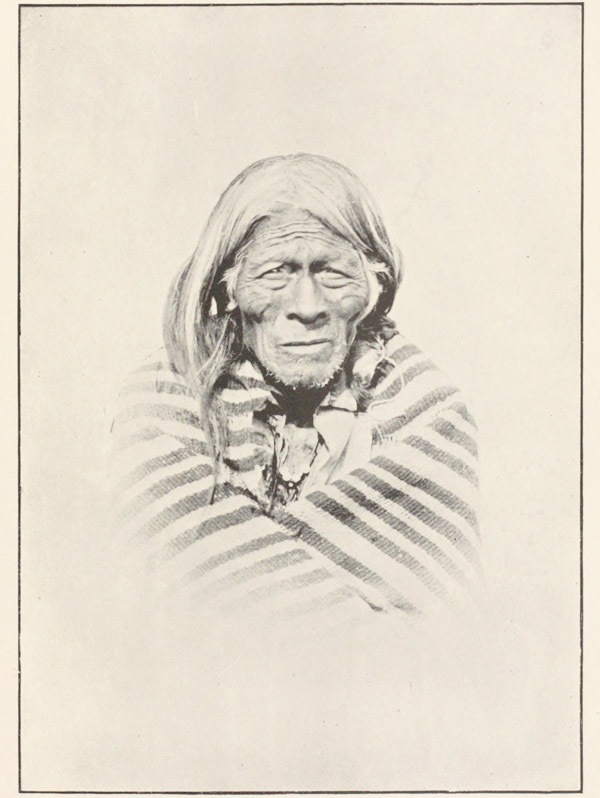
LXXXI. A Native of Pecos
Hernand Perez de Bocanegra, a citizen of Mexico, stated that he had
been present on the preceding Sunday, at the review of the force which
the viceroy was sending for the pacification of the country recently
discovered by the father provincial, Fray Marcos de Niza,
and that he p597
had taken note of the force as the men passed before him; and at his
request he had also been allowed to see the list of names of those who
were enrolled in the army; and he declared that in all the said force he
did not recognize any other citizens of Mexico who were going except
Domingo Martin, a married man, whom he had sometimes seen living
in Mexico, and provided him with messengers; and one Alonso Sanchez,
who was going with his wife and a son, and who was formerly a shoemaker;
and a young man, son of the bachiller Alonso Perez, who had
come only a few days before from Salamanca, and who had been sent to
the war by his father on account of his restlessness; and two or three
other workmen or tradespeople whom he had seen at work in Mexico,
although he did not know whether they were citizens there; and on his
oath he did not see in the whole army anyone else who was a citizen of
Mexico, although for about fourteen years he had been a citizen and
inhabitant of that city, unless it was the captain-general, Francisco
Vazquez de Coronado, and Lopez de Samaniego the army-master; and,
moreover, he declared that he felt certain that those above mentioned
were going of their own free will, like all the rest.
Antonio Serrano de Cardona, one of the magistrates of Mexico, who
was present from beginning to end of the review of the preceding
Sunday, testified in similar form. He said that Alonso Sanchez had
formerly been a citizen of Mexico, but that for a long time his house
had been empty and he had traveled as a trader, and that he was going
in search of something to live on; and one Domingo Martin was also
going, who formerly lived in Mexico, and whose residence he had not
known likewise for a long time, nor did he think that he had one,
because he had not seen him living in Mexico. He did not think it
would have been possible for any citizens of Mexico to have been there
whom he did not know, because he had lived in Mexico during the
twenty years since he came to Mexico, and ever since the city was
established by Christians, and besides, he had been a magistrate for
fifteen years. And besides, all those whom he did see who were going,
were the most contented of any men he had ever seen in this country
starting off for conquests. After the force left the City of Mexico, he
had been there, and had noticed that it was full of people and that
there did not seem to be any scarcity on account of those who had
started on this expedition.
Gonzalo de Salazar, His Majesty’s factor for New Spain, and also a
magistrate of the City of Mexico, declared that the only person on the
expedition who possessed a repartimiento or estate in New Spain was
the captain-general, Vazquez de Coronado, and that he had noticed
one other citizen who did not have a repartimiento. He had not seen
any other citizen of Mexico, nor of New Spain, although one of the
greatest benefits that could have been done New Spain would have
been to draw off the young and vicious people who were in that city
and all over New Spain. p598
Pedro Almidez Cherino, His Majesty’s veedor in New Spain, had,
among other things, noted the horses and arms of those who were
going, during the review. He had noticed Coronado and Samaniego,
and Alonso Sanchez and his wife, whom he did not know to be a
citizen, and Domingo Martin, who was away from Mexico during most
of the year. All the rest of the force were people without settled
residences, who had recently come to the country in search of a living.
It seemed to him that it was a very fortunate thing for Mexico that the
people who were going were about to do so because they had been
injuring the citizens there. They had been for the most part vicious
young gentlemen, who did not have anything to do in the city nor in
the country. They were all going of their own free will, and were very
ready to help pacify the new country, and it seemed to him that if the
said country had not been discovered, almost all of these people would
have gone back to Castile, or would have gone to Peru or other places
in search of a living.
Servan Bejarano, who had been in business among the inhabitants
of Mexico ever since he came to that city, added the information that
he knew Alonso Sanchez to be a provision dealer, buying at wholesale
and selling at retail, and that he was in very great need, having nothing
on which to live, and that he was going to that country in search of
a living. He was also very sure that it was a great advantage to Mexico
and to its citizens to have many of the unmarried men go away,
because they had no occupation there and were bad characters, and
were for the most part gentlemen and persons who did not hold any
property, nor any repartimientos of Indians, without any income, and
lazy, and who would have been obliged to go to Peru or some other
region.
Cristobal de Oñate had been in the country about sixteen years, a
trifle more or less, and was now His Majesty’s veedor for New Galicia.
He knew the citizens of Mexico, and also declared that not a citizen of
Compostela was going on the expedition. Two citizens of Guadalajara
were going, one of whom was married to an Indian, and the other was
single. As for the many young gentlemen and the others who were
going, who lived in Mexico and in other parts of New Spain, it seemed
to him that their departure was a benefit rather than a disadvantage,
because they were leading vicious lives and had nothing with which to
support themselves.
When these statements and depositions had all been duly received,
signed, and attested, and had been shown to his most illustrious lordship,
the viceroy, he ordered an authorized copy to be taken, which
was made by Joan de Leon, clerk of Their Majesties’ court and of the
royal audiencia of New Spain, the 27th of February, 1540, witnessed
by the secretary, Antonio de Almaguer, and sent to His Majesty, to be
laid before the lords of the council, that they might provide and order
that which should be most serviceable to their interests.
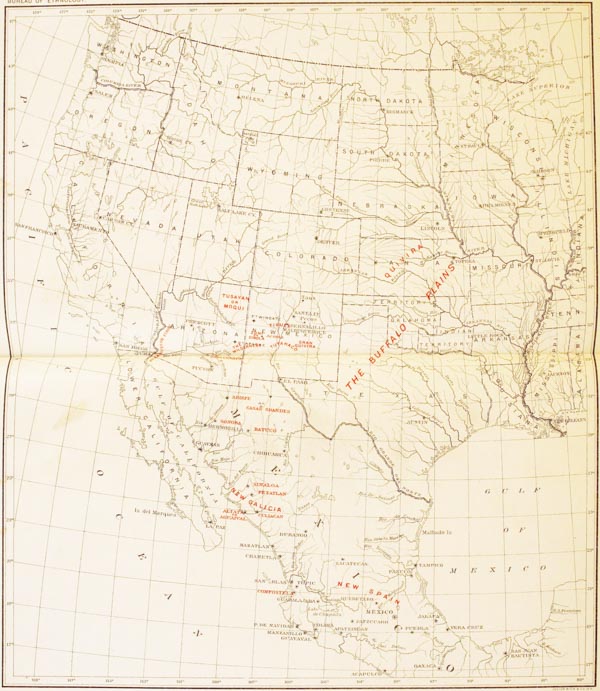
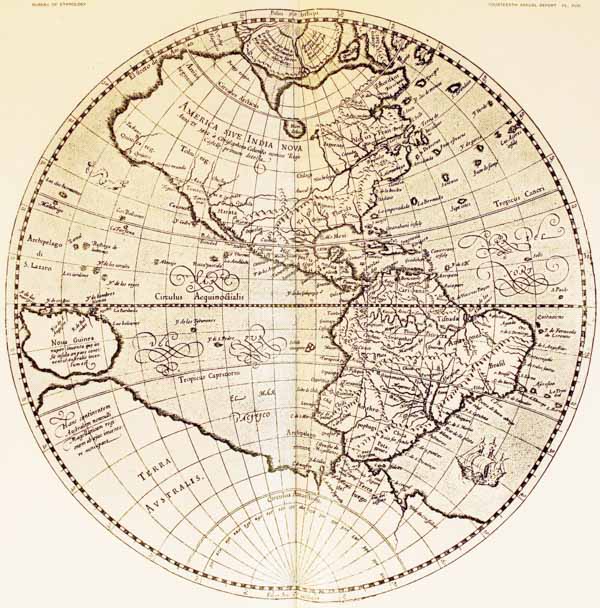
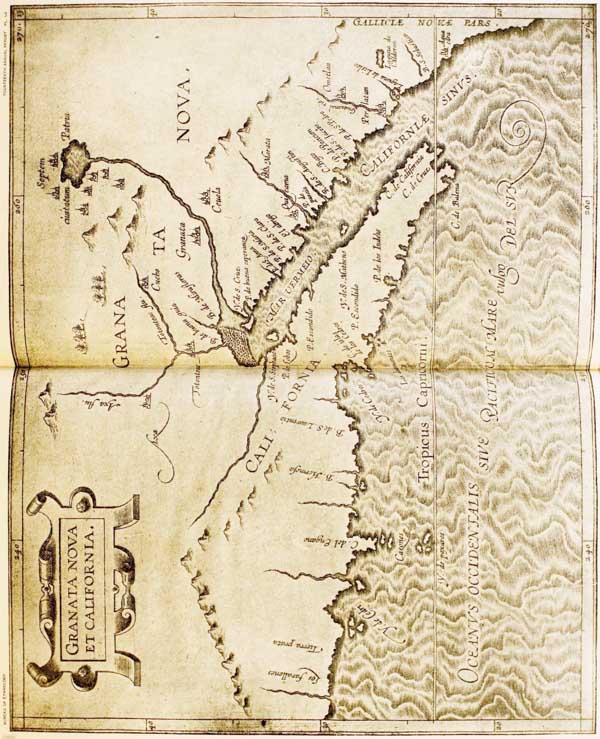
 I
 ”—latin


