The Cornhill Magazine (Vol. XLII, No. 251 New Series, May 1917)
Whole book · 11 sections
THE CORNHILL MAGAZINE.
[All rights, including the right of publishing Translations of
Articles in this Magazine are reserved.]
Registered for Transmission to Canada and Newfoundland by
Magazine Post.
A PAYING HOBBY
QUICK AND EASY TO EXECUTE
A PLEASANT OCCUPATION
STENCILLING
IN OIL COLOURS
Will not run or spoil delicate fabrics.
NECESSARY OUTFIT 5/- ALL MATERIALS.
Large Stock of Designs for Curtains, Table Covers, Lamp Shades,
Cushions, Fire Screens, Table Centres, Blouses, &c.
Illustrated List of all Leading Artists’ Colourmen, Stationers & Stores.
WINSOR & NEWTON, Ltd., RATHBONE PLACE, W.1.
By Special Appointment to Their Majesties the King and
Queen and H.M. Queen Alexandra.
THE CHURCH ARMY
HAS MANY HUNDREDS OF RECREATION HUTS,
TENTS, AND CLUBS,
which are giving REST, COMFORT and
RECREATION to men of both the Services
(all are welcomed), at home and on the
Western Front (many of them actually under
the enemy’s shell-fire), at ports and bases
in France, in Malta, Egypt, Macedonia,
East Africa, Mesopotamia, and India. Light
refreshments, games, music, provision for
drying clothing, baths, letter-writing, &c.,
&c.; also facilities for Sunday and weekday
services.
MORE ARE URGENTLY NEEDED,
especially in the devastated area captured
from the enemy on the West Front.
You do not miss
Potatoes and Tomatoes
so much when you use
PAN YAN THE WORLD’S BEST PICKLE
It adds 50% to the
value of your Meat
Purchases.
On sale everywhere
at Popular Prices.
Maconochie Bros., Ltd. London
MAY 1917.
BRING UP THE GUNS.
BY BOYD CABLE.
When Jack Duncan and Hugh Morrison suddenly had it brought
home to them that they ought to join the New Armies, they lost
little time in doing so. Since they were chums of long standing
in a City office, it went without saying that they decided to join
and ‘go through it’ together, but it was much more open to argument
what branch of the Service or regiment they should join.
They discussed the question in all its bearings, but being as
ignorant of the Army and its ways as the average young Englishman
was in the early days of the war, they had little evidence except
varied and contradictory hearsay to act upon. Both being about
twenty-five they were old enough and business-like enough to
consider the matter in a business-like way, and yet both were
young enough to be influenced by the flavour of romance they
found in a picture they came across at the time. It was entitled
‘Bring up the Guns,’ and it showed a horsed battery in the wild
whirl of advancing into action, the horses straining and stretching
in front of the bounding guns, the drivers crouched forward or
sitting up plying whip and spur, the officers galloping and waving
the men on, dust swirling from leaping hoofs and wheels, whip-thongs
streaming, heads tossing, reins flying loose, altogether a
blood-stirring picture of energy and action, speed and power.
‘I’ve always had a notion,’ said Duncan reflectively, ‘that I’d
like to have a good whack at riding. One doesn’t get much chance
of it in city life, and this looks like a good chance.’
‘And I’ve heard it said,’ agreed Morrison, ‘that a fellow with
any education stands about the best chance in artillery work.
We’d might as well plump for something where we can use the bit
of brains we’ve got.’
‘That applies to the Engineers too, doesn’t it?’ said Duncan.
‘And the pottering about we did for a time with electricity might
help there.’
‘Um-m,’ Morrison agreed doubtfully, still with an appreciative
eye on the picture of the flying guns. ‘Rather slow work though—digging
and telegraph and pontoon and that sort of thing.’
‘Right-oh,’ said Duncan with sudden decision. ‘Let’s try for
the Artillery.’
‘Yes. We’ll call that settled,’ said Morrison; and both stood
a few minutes looking with a new interest at the picture, already
with a dawning sense that they ‘belonged,’ that these gallant
gunners and leaping teams were ‘Ours,’ looking forward with a
little quickening of the pulse to the day when they, too, would go
whirling into action in like desperate and heart-stirring fashion.
‘Come on,’ said Morrison. ‘Let’s get it over. To the recruiting-office—quick
march.’
And so came two more gunners into the Royal Regiment.
When the long, the heart-breakingly long period of training
and waiting for their guns, and more training and slow collecting
of their horses, and more training was at last over, and the battery
sailed for France, Morrison and Duncan were both sergeants and
‘Numbers One’ in charge of their respective guns; and before
the battery had been in France three months Morrison had been
promoted to Battery Sergeant-Major.
The battery went through the routine of trench warfare and
dug its guns into deep pits, and sent its horses miles away back,
and sat in the same position for months at a time, had slack spells
and busy spells, shelled and was shelled, and at last moved up
to play its part in The Push.
Of that part I don’t propose to tell more than the one incident—an
incident of machine-pattern sameness to the lot of many
batteries.
The infantry had gone forward again and the ebb-tide of battle
was leaving the battery with many others almost beyond the water-mark
of effective range. Preparations were made for an advance.
The Battery Commander went forward and reconnoitred the new
position the battery was to move into, everything was packed
up and made ready, while the guns still continued to pump out
long range fire. The Battery Commander came in again and
explained everything to his officers and gave the necessary detailed
orders to the Sergeant-Major, and presently received orders of
date and hour to move.
This was in the stages of The Push when rain was the most
prominent and uncomfortable feature of the weather. The guns
were in pits built over with strong walls and roofing of sand-bags
and beams which were weather-tight enough, but because the
floors of the pits were lower than the surface of the ground, it was
only by a constant struggle that the water was held back from
draining in and forming a miniature lake in each pit. Round and
between the guns was a mere churned-up sea of sticky mud. As
soon as the new battery position was selected a party went forward
to it to dig and prepare places for the guns. The Battery Commander
went off to select a suitable point for observation of his
fire, and in the battery the remaining gunners busied themselves
in preparation for the move. The digging party were away all
the afternoon, all night, and on through the next day. Their
troubles and tribulations don’t come into this story, but from all
they had to say afterwards they were real and plentiful enough.
Towards dusk a scribbled note came back from the Battery
Commander at the new position to the officer left in charge with the
guns, and the officer sent the orderly straight on down with it to
the Sergeant-Major with a message to send word back for the
teams to move up.
‘All ready here,’ said the Battery Commander’s note. ‘Bring
up the guns and firing battery waggons as soon as you can. I’ll
meet you on the way.’
The Sergeant-Major glanced through the note and shouted
for the Numbers One, the sergeants in charge of each gun. He
had already arranged with the officer exactly what was to be done
when the order came, and now he merely repeated his orders rapidly
to the sergeants and told them to ‘get on with it.’ When the
Lieutenant came along five minutes after, muffled to the ears in a
wet mackintosh, he found the gunners hard at work.
‘I started in to pull the sand-bags clear, sir,’ reported the
Sergeant-Major. ‘Right you are,’ said the Lieutenant. ‘Then
you’d better put the double detachments on to pull one gun out
and then the other. We must man-handle ’em back clear of the
trench ready for the teams to hook in when they come along.’
For the next hour every man, from the Lieutenant and Sergeant-Major
down, sweated and hauled and slid and floundered in slippery
mud and water, dragging gun after gun out of its pit and back a
half dozen yards clear. It was quite dark when they were ready,
and the teams splashed up and swung round their guns. A fairly
heavy bombardment was carrying steadily on along the line, the
sky winked and blinked and flamed in distant and near flashes of
gun fire, and the air trembled to the vibrating roar and sudden
thunder-claps of their discharge, the whine and moan and shriek of
the flying shells. No shells had fallen near the battery position
for some little time, but, unfortunately, just after the teams had
arrived, a German battery chose to put over a series of five-point-nines
unpleasantly close. The drivers sat, motionless blotches
of shadow against the flickering sky, while the gunners strained
and heaved on wheels and drag-ropes to bring the trails close enough
to drop on the hooks. A shell dropped with a crash about fifty
yards short of the battery and the pieces flew whining and whistling
over the heads of the men and horses. Two more swooped down
out of the sky with a rising wail-rush-roar of sound that appeared
to be bringing the shells straight down on top of the workers’
heads. Some ducked and crouched close to earth, and both shells
passed just over and fell in leaping gusts of flame and ground-shaking
crashes beyond the teams. Again the fragments hissed and whistled
past and lumps of earth and mud fell spattering and splashing and
thumping over men and guns and teams. A driver yelped suddenly,
the horses in another team snorted and plunged, and then out of
the thick darkness that seemed to shut down after the searing light
of the shell-burst flames came sounds of more plunging hoofs,
a driver’s voice cursing angrily, threshings and splashings and
stamping. ‘Horse down here ... bring a light ... whoa, steady,
boy ... where’s that light?’
Three minutes later: ‘Horse killed, driver wounded in the arm,
sir,’ reported the Sergeant-Major. ‘Riding leader Number Two gun,
and centre driver of its waggon.’
‘Those spare horses near?’ said the Lieutenant quickly. ‘Right.
Call up a pair; put ’em in lead; put the odd driver waggon centre.’
Before the change was completed and the dead horse dragged
clear, the first gun was reported hooked on and ready to move, and
was given the order to ‘Walk march’ and pull out on the wrecked
remnant of a road that ran behind the position. Another group
of five-nines came over before the others were ready, and still the
drivers and teams waited motionless for the clash that told of the
trail-eye dropping on the hook.
‘Get to it, gunners,’ urged the Sergeant-Major, as he saw some
of the men instinctively stop and crouch to the yell of the
approaching shell. ‘Time we were out of this.’
‘Hear, bloomin’ hear,’ drawled one of the shadowy drivers.
‘An’ if you wants to go to bed, Lanky’—to one of the crouching
gunners—‘just lemme get this gun away fust, an’ then you can curl
up in that blanky shell-’ole.’
There were no more casualties getting out, but one gun stuck
in a shell-hole and took the united efforts of the team and as many
gunners as could crowd on to the wheels and drag-ropes to get
it moving and out on to the road. Then slowly, one by one, with a
gunner walking and swinging a lighted lamp at the head of each
team, the guns moved off along the pitted road. It was no road
really, merely a wheel-rutted track that wound in and out the
biggest shell-holes. The smaller ones were ignored, simply because
there were too many of them to steer clear of, and into them the
limber and gun wheels dropped bumping, and were hauled out
by sheer team and man power. It took four solid hours to cover
less than half a mile of sodden, spongy, pulpy, wet ground, riddled
with shell-holes, swimming in greasy mud and water. The ground
they covered was peopled thick with all sorts of men who passed
or crossed their way singly, in little groups, in large parties—wounded,
hobbling wearily or being carried back, parties stumbling
and fumbling a way up to some vague point ahead with rations
and ammunition on pack animals and pack-men, the remnants
of a battalion coming out crusted from head to foot in slimy wet
mud, bowed under the weight of their packs and kits and arms;
empty ammunition waggons and limbers lurching and bumping
back from the gun line, the horses staggering and slipping, the
drivers struggling to hold them on their feet, to guide the wheels
clear of the worst holes; a string of pack-mules filing past, their
drivers dismounted and leading, and men and mules ploughing
anything up to knee depth in the mud, flat pannier-pouches swinging
and jerking on the animals’ sides, the brass tops of the 18-pounder
shell-cases winking and gleaming faintly in the flickering lights of
the gun flashes. But of all these fellow wayfarers over the battlefield
the battery drivers and gunners were hardly conscious. Their
whole minds were so concentrated on the effort of holding and
guiding and urging on their horses round or over the obstacle of
the moment, a deeper and more sticky patch than usual, an extra
large hole, a shattered tree stump, a dead horse, the wreck of a
broken-down waggon, that they had no thought for anything
outside these. The gunners were constantly employed manning
the wheels and heaving on them with cracking muscles, hooking
on drag-ropes to one gun and dragging it clear of a hole, unhooking
and going floundering back to hook on to another and drag it in
turn out of its difficulty.
The Battery Commander met them at a bad dip where the track
degenerated frankly into a mud bath—and how he found or kept
the track or ever discovered them in that aching wilderness is one
of the mysteries of war and the ways of Battery Commanders. It
took another two hours, two mud-soaked nightmare hours, to
come through that next hundred yards. It was not only that the
mud was deep and holding, but the slough was so soft at bottom that
the horses had no foothold, could get no grip to haul on, could little
more than drag their own weight through, much less pull the guns.
The teams were doubled, the double team taking one gun or waggon
through, and then going back for the other. The waggons were
emptied of their shell and filled again on the other side of the slough;
and this you will remember meant the gunners carrying the rounds
across a couple at a time, wading and floundering through mud over
their knee-boot tops, replacing the shells in the vehicle, and wading
back for another couple. In addition to this they had to haul guns
and waggons through practically speaking by man-power, because
the teams, almost exhausted by the work and with little more
than strength to get themselves through, gave bare assistance to
the pull. The wheels, axle deep in the soft mud, were hauled round
spoke by spoke, heaved and yo-hoed forward inches at a time.
When at last all were over, the teams had to be allowed a brief
rest—brief because the guns must be in position and under cover
before daylight came—and stood dejectedly with hanging ears,
heaving flanks, and trembling legs. The gunners dropped prone
or squatted almost at the point of exhaustion in the mud. But
they struggled up, and the teams strained forward into the breast
collars again when the word was given, and the weary procession
trailed on at a jerky snail’s pace once more.
As they at last approached the new position the gun flashes
on the horizon were turning from orange to primrose, and although
there was no visible lightening of the Eastern sky, the drivers were
sensible of a faintly recovering use of their eyes, could see the dim
shapes of the riders just ahead of them, the black shadows of the
holes, and the wet shine of the mud under their horses’ feet.
The hint of dawn set the guns on both sides to work with trebled
energy. The new position was one of many others so closely set
that the blazing flames from the gun muzzles seemed to run out to
right and left in a spouting wall of fire that leaped and vanished,
leaped and vanished without ceasing, while the loud ear-splitting
claps from the nearer guns merged and ran out to the flanks in a
deep drum roll of echoing thunder. The noise was so great and
continuous that it drowned even the roar of the German shells
passing overhead, the smash and crump of their fall and burst.
But the line of flashes sparkling up and down across the front
beyond the line of our own guns told a plain enough tale of the
German guns’ work. The Sergeant-Major, plodding along beside
the Battery Commander, grunted an exclamation.
‘Boche is getting busy,’ said the Battery Commander.
‘Putting a pretty solid barrage down, isn’t he, sir?’ said the
Sergeant-Major. ‘Can we get the teams through that?’
‘Not much hope,’ said the Battery Commander, ‘but, thank
Heaven, we don’t have to try, if he keeps barraging there. It is
beyond our position. There are the gun-pits just off to the left.’
But, although the barrage was out in front of the position, there
were a good many long-ranged shells coming beyond it to fall
spouting fire and smoke and earth-clods on and behind the line
of guns. The teams were flogged and lifted and spurred into
a last desperate effort, wrenched the guns forward the last
hundred yards and halted. Instantly they were unhooked,
turned round, and started stumbling wearily back towards the
rear; the gunners, reinforced by others scarcely less dead-beat
than themselves by their night of digging in heavy wet soil, seized
the guns and waggons, flung their last ounce of strength and energy
into man-handling them up and into the pits. Two unlucky
shells at that moment added heavily to the night’s casualty list,
one falling beside the retiring teams and knocking out half a dozen
horses and two men, another dropping within a score of yards of
the gun-pits, killing three and wounding four gunners. Later, at
intervals, two more gunners were wounded by flying splinters
from chance shells that continued to drop near the pits as the guns
were laboriously dragged through the quagmire into their positions.
But none of the casualties, none of the falls and screamings of the
high-explosive shells, interrupted or delayed the work, and without
rest or pause the men struggled and toiled on until the last gun
was safely housed in its pit.
Then the battery cooks served out warm tea, and the men drank
greedily, and then, too worn out to be hungry or to eat the biscuit
and cheese ration issued, flung themselves down in the pits under
and round their guns and slept there in the trampled mud.
The Sergeant-Major was the last to lie down. Only after
everyone else had ceased work, and he had visited each gun in turn
and satisfied himself that all was correct, and made his report to the
Battery Commander, did he seek his own rest. Then he crawled
into one of the pits, and before he slept had a few words with the
‘Number One’ there, his old friend Duncan. The Sergeant-Major,
feeling in his pockets for a match to light a cigarette,
found the note which the Battery Commander had sent back and
which had been passed on to him. He turned his torch light on
it and read it through to Duncan—‘Bring up the guns and firing
battery waggons ...’ and then chuckled a little. ‘Bring up the
guns.... Remember that picture we saw before we joined, Duncan!
And we fancied then we’d be bringing ’em up same fashion. And,
good Lord, think of to-night.’
‘Yes,’ grunted Duncan, ‘sad slump from our anticipations.
There was some fun in that picture style of doing the job—some
sort of dash and honour and glory. No honour and glory about
“Bring up the guns” these days. Na poo to-night anyway.’
The Sergeant-Major, sleepily sucking his damp cigarette,
wrapped in his sopping British Warm, curling up in a corner on the
wet cold earth, utterly spent with the night’s work, cordially agreed.
Perhaps, and anyhow one hopes, some people will think they
were wrong.
FRANCE AND BRITAIN: THEIR COMMON MEMORIES. — II. — III. — IV. — V. — VI. — VII. — FOOTNOTES
‘France and England, whose very shores look pale
With envy of each other’s happiness.’
Shakespeare, Henry V., Act v. sc. ii.
‘Each the other’s mystery, terror, need and love.’
Rudyard Kipling.
Our common memories? Well, are they so many of this nature
which brings closer those who recollect them together? They are
indeed! Let this article be a friendly protest, a grounded protest
against the idea which is no doubt, still, the prevalent popular idea
on both sides of the Channel, I mean this one: ‘The Entente
Cordiale is something splendid, but when one comes to think about
it, how wonderful, how new!’ Yes, when we think about it
superficially, how wonderful, how new, but when we think somewhat
more deeply and with a little more knowledge of the past, how
natural! Not a miracle: the logical result, only too long deferred,
of the long centuries of our common history. It is not mere pastime
to show it. How important on the contrary, how practically
important for the present and for the future of our alliance, to
make conscious again the old moral ties and to reawaken the sleeping
sense of historical fellowship!
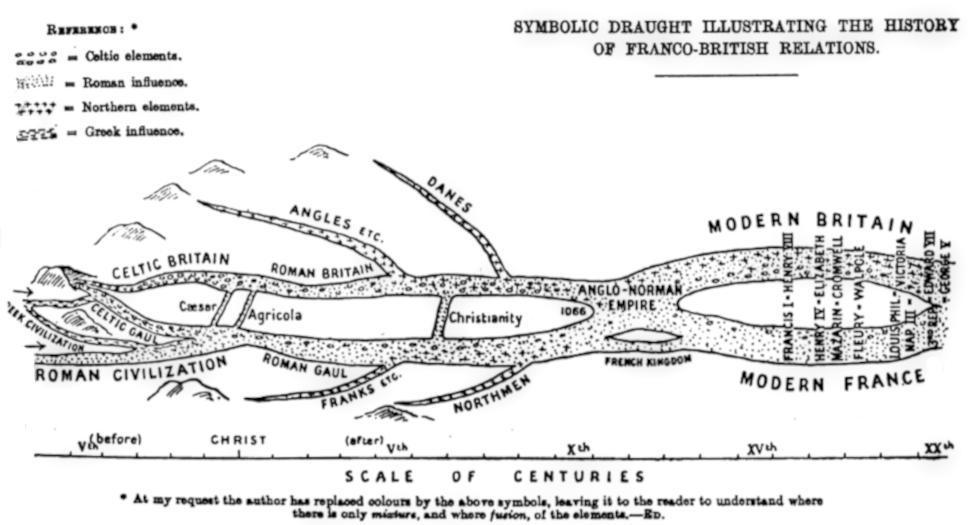
To make that fellowship apparent, at a glance, at least from
certain points of view, I have devised the appended diagram. There
you see represented, as it were, the streams of the history of our
two nations from their farthest origins down to our own times.
Please note the scale of centuries. See both streams rising about
eight or six centuries before Christ in the same mountain—if I
may say so figuratively—in the same mountain of the Celtic race.
They spring, as you see, from the same source, and, though geographically
divided, their waters remain a long time of the same
colour—green in my draught.
SYMBOLIC DRAUGHT ILLUSTRATING THE HISTORY
OF FRANCO-BRITISH RELATIONS.
We have, on that point of their origins, very interesting and
very numerous testimonies, chiefly in the contemporary Greek and
Roman writers. Very striking in particular was the fellowship
of ancient Britons and Gauls with regard to religion. If you
open one—I may say any one—of our French history text-books,
you will see that it begins exactly as one of yours, with the same
story, and pictures, of Druids, priests, teachers, and judges—some
of them bards; the same story of the solemn gathering of the
mistletoe verdant in winter on the bare branches of oaks, symbol
of the cardinal creed of the race: the immortality of the soul.
Caesar, who had a Druid among his best friends, observes that the
young Gauls who wanted to go deeper into the study of their religion
generally used to go over to Britain in order to graduate, if I may
say so, in this mysterious and lofty science.[1] It appears, therefore,
that, though the Celts had passed originally from Gaul into Britain,
yet Britain had become and remained the sanctuary of their
common religion. Note that nothing of the sort was to be found
elsewhere. Here we have characteristics of ancient Britain and
ancient Gaul and of them alone. Now observe that though this
Celtic colour is to be later on—in fact much later—modified by
waters from other sources, yet it will never completely disappear.
The Celtic element remains visible to our day in our two nations:
you have your green Celtic fringe in Cornwall, Wales, part of
Scotland, and the greater part of Ireland;—we have something of
the kind in Brittany.
During the first century B.C. a very big event took place
which was to stamp the whole of our ulterior history on this side
of the Channel with its principal character: I am referring to the
Romanisation of Gaul.
For many reasons which I omit, the advent of the Romans,
though of course it met with some strenuous and even splendid
resistance for a short time, could hardly be called a conquest in the
odious meaning of the word. Now, you know that Caesar in the
very midst of his campaigns in Gaul found time to carry out two bold
expeditions into Britain. It is very interesting to note his motives.
He was not, as one could easily imagine, impelled by an appetite
of conquest. This appetite, by the way, was much less among the
Romans than is generally imagined, and Caesar himself had enough
to do at that time with the turbulent Gallic tribes without entering,
if it could be avoided, upon a doubtful enterprise beyond the
Channel. But he could not do otherwise, and he gives us himself
his motives, which are extremely interesting from the point of
view of the history of our early relations. He felt that he could
not see an end to his Gallic war if he did not at least intimidate
the British brothers of the Gauls always ready to send them help!
Let me quote his own words (remember that he speaks of himself
in the third person):
‘Though not much was left of the fine season—and winter comes
early in those parts—he resolved to pass into Britain, at least, to
begin with, for a reconnoitring raid, because he saw well that in
almost all their wars (the Romans’ wars) with the Gauls, help came
from that country to their enemies.’[2]
His two bold raids into Britain had some of the desired effect.
His successors achieved more, leisurely, without too much trouble,
but very incompletely too, both as regards extent of territory and
depth of impression. You see how I have expressed all this in
my draught.
In Gaul, on the contrary, the transformation was complete and
lasting, lasting to our days. The civilisation of Rome, which had
already fascinated Gaul from afar, was so eagerly and so
unanimously adopted all over the country that, in the space of a
few decades, this country was nearly as Roman as Rome. The
fame of the Gallo-Roman schools, the great number of Latin writers
and orators of Gallic origin, the numberless remains of theatres,
temples, bridges, aqueducts—some in marvellous state of preservation—which
are even now to be found in hundreds of places, not
only in the south but even in the north of this country, from the
Mediterranean to the Rhine, and still more than anything else
our language, so purely Romanic, abundantly testify to the willingness,
nay to the enthusiasm, with which Gaul made her own the
civilisation of Rome.
But why do I insist on this fact? Because much of all this
we were to transmit to you later on, chiefly on the Norman
vehicle. The direct impression of Rome on your country was to
remain superficial—though it would be a mistake to overlook it
altogether—but the indirect influence through us was nearly to
balance any other influence and to become one of the chief factors
of your moral and intellectual history.
But before we reach that time we have to take note of two
nearly simultaneous events. In the fifth century the Franks
established themselves in Roman Gaul and the Angles and Saxons
in Roman Britain. You see in my draught each of these rivers—English
and Frankish—flowing respectively into the streams of
British and Gallic history. I have given about the same bluish
colour to these new rivers to point out that Anglo-Saxons and Franks
were originally cousins and neighbours. Their establishment
was more or less attended with some rough handling, but even in
their case, and chiefly in our case, the strict propriety of the word
conquest to describe their coming can be questioned. There had
been previous and partial agreements with the old people to come
over, besides they were few in numbers. Yet the results were
strikingly different. On our side the Franks were gradually
absorbed, though giving their name to the country—France—and
constituting, specially in the north, a small aristocracy of soldiers.
On your side, on the contrary, the Anglo-Saxons converted the old
country into a new one. Instead of giving up their own language
they imposed it, at least to a large extent. Between them and
their Frankish cousins established in old Roman Gaul relations
remained quite cordial. A king of Kent, who had married a
Christian daughter of a king of Paris, showed remarkable good
will for the second introduction of Christianity into Britain. He
and his Anglo-Saxon comrades would not accept Christianity from
the ancient Britons who had already become Christian, more or
less, under the Romans, but they accepted it eagerly at the recommendation
of the Romanised and Christianised Franks. May
I say that the Franks went so far as to provide the Mission under
Augustine with the necessary interpreters! Very soon the Anglo-Saxons
became so eager themselves for Christianity that they
became foremost in the spreading of it to the last country which
remained to be converted to the new faith, I mean Germany. This
is a very interesting story, though an old one, and, I am afraid,
much forgotten: your Winfrid—he and his pupils—with the
recommendation and support of Charles Martel—the founder of
our Carolingian dynasty—Christianising Germany, founding there
a dozen bishoprics, with British bishops, becoming himself the
first archbishop of Mayence, and then dying a martyr on German
soil.... Is not it interesting, this now forgotten story, in which
we see early England and early France friendly co-operating to
Christianise and to civilise Germany?
The next stage in the history of both countries was again
analogous. About the same time—the ninth century—we, and
you, had troubles from the same people: the Northmen. They
were few in numbers, but gave much annoyance for some time.
The result was the same on both sides: you practically turned
your Northmen into Anglo-Saxons, and we turned ours into
Romanised Frenchmen of the best sort. The process was much
more rapidly completed on our side than on yours, and you were
still engaged in it when our Romanised Normans arrived in Britain
and nearly succeeded in achieving what the Romans themselves
had failed to achieve. And more than that—more from the point
of view of our relations—they very nearly succeeded in building
out of our two countries a practically unified but short-lived empire.
In 1180 the whole of the present United Kingdom of Great
Britain and Ireland and nearly two-thirds of France were practically
acknowledging, under one title or another, only one sovereign:
Henry II. Plantagenet. Let me say—though I own it is not
the view which is generally prevalent in our schools, and far from
it!—that it is a pity they did not succeed altogether! Henry II.
had against him untoward circumstances and, above all, Philip
Augustus! He had finally to give up that fine dream. Now,
union failing to be achieved that way, it is a pity, I think, that it
failed also the other way, a little time after in 1216. Then the far
greater part of your people, barons and clergy, revolting against
one of the unworthiest rulers ever known, King John, agreed to
invite over the eldest son, and heir, of the French king to be their
own king. He came over, of course, was received at Westminster,
accepted and confirmed Magna Charta, the charter of your liberties,
and was going to be acknowledged in all parts of the kingdom when
John—allow me these strong terms—did the stupidest and wickedest
thing of his stupid and wicked life by dying at the wrong time!
at that time! He died when by living a little longer he might have
been the occasion of joining our two countries into one empire!
Fancy for a moment what this would have meant, the course our
common history would have taken for our common glory and the
future of the whole human race! But, dying, he left an heir, a
boy of nine years of age, and the idea of innocent legitimacy, with
the strenuous support of the Papal legate, prevailed over the half-accomplished
fact! And thus this splendid chance was lost!
Another occasion presented itself hardly more than a century
afterwards, when the Capetian line of our own kings became extinct
and the nearest heir was the English king Edward III. In fact,
he was as much French as English, and the king of a country whose
official language was still French and whose popular language
was now permeated with French. I think it was no more difficult
for France, in 1328, to accept this king, and be united with England
under the same sovereign while remaining herself, than for England
in 1603 to accept a king from Scotland. Well, there was some
hesitation among the French barons and clergy, and a solemn
discussion was held on the point of law. In fact, there was no law
at all on the subject and they had a free choice. To my mind the
interest of the country pointed to the recognition of Edward,
that is to union. No doubt, on the other hand, that it was the way
pointed to by civil and by canon laws. They preferred the other
course. No doubt they meant well, but to be well-meaning and
far-seeing are two things, and I for one, in the teeth of all adverse
and orthodox teaching, lament the decision which they took and
the turn which they gave to national feelings yet in their infancy.
The other decision would have spared the two countries not only
one, but several hundred years’ wars, and would have secured to
the two sister countries all the mutual advantages of peaceful
development and cordial co-operation.
I can only briefly refer to the famous Treaty of Troyes, 1420,
by which in the course of the Hundred Years’ War our King—insane
literally speaking—and his German wife, disinherited their
son to the profit of their son-in-law, the English king, and handed
over to him, at once, as Regent, the crown of France. This treaty
of course, under such circumstances, and when national feelings
had been roused—however unfortunately—in the contrary
direction, had little moral and political value. Yet, had your
Henry V. lived—he died two years after the treaty—he might
possibly have got it accepted by France. Professor A. Coville
in his contribution to what is presently the latest, the leading,
history of France, commenting on Henry’s love of justice and the
stern discipline he maintained in his army—the Army of Agincourt—concludes
in the following remarkable terms, which I beg to translate:
‘After so many years of strife the people of this Kingdom [the
French Kingdom] looked up to his stern government to turn this
anarchy into order. Paris accepted as a deliverance this yoke,
heavy no doubt but protective.’[3]
It is interesting to observe that this view of this French historian
is in complete agreement with Shakespeare’s ‘Henry V.’ Such
an agreement between an English poet and a French scientist is
certainly worthy of attention!
Well, Henry V. died, and national feelings being decidedly
roused, flaming into the stupendous miracle of Joan of Arc, decided
otherwise.
What about this otherwise, I mean this definitive political
separation and these centuries of hostility which fill our history
text-books? We can speak of it without the slightest uneasiness,
not only because all this seems now to be so far in the past, a past
which can never revive, but, above all, because of the remarkable
characters of this hostility and of its brilliant interludes.
I say that this hostility had, on the whole, this remarkable
character, to be lofty rivalry, not low hatred. It may have been—it
was indeed at times—fierce and passionate, but it was all along
accompanied by mutual respect. Our two countries aimed at
surpassing much more than at destroying each other. It was
more like a world race for glory than a grip for death. Its spirit
was quarrelsome animosity taking immense delight in stupid pinpricks
and daring strokes, not cold hate dreaming of mortal stabs
to the heart.
Your great poet Rudyard Kipling has expressed this very
finely in the poem he wrote three years ago on the occasion, if I
remember well, of your King’s first visit to Paris. Let me quote
from this poem:
‘We stormed the seas tack for tack and burst
Through the doorways of new worlds, doubtful which was first.’
‘Ask the wave that has not watched war between us two ...
Each the other’s mystery, terror, need, and love.’
‘O companion, we have lived greatly through all time.’
I could illustrate this spirit by many stories. One of the most
typical is about the encounter on the battlefield of Fontenoy, in
1745, of the massive English column and of the French centre.
There is in that story a mixture of fine legend and historical truth,
but anyway it is illustrative of the spirit. The very fact that the
legend could grow out of the truth is a proof of the spirit by itself.
There is another story much less known, but which is as much
illuminating. It was at the beginning of the American war, thirty-four
years after Fontenoy, in 1779. Your famous seaman Rodney
was in Paris, which he could not leave on account of certain debts,
yet he was perfectly free to walk about as any ordinary private
man, though France and England were at war. Concentration
camps had not been invented as yet! One day, then, as he was
dining with some French military friends—always remember,
please, that we were at war—they came to talk of some recent
successes we had just had at sea, among them the conquest of
Grenada in the West Indies. Rodney expressed himself on these
successes with polite disdain, saying that if he was free—he Rodney—the
French would not have it so easy! Upon which old Marshal
de Biron paid for his debts and said: ‘You are free, sir, the French
will not avail themselves of the obstacles which prevent you from
fighting them.’ Well, it cost us very dear to have let him go, but
was not it fine!
I am glad to hear from my friend, your Oxford countryman,
Mr. C.R.L. Fletcher, the author of a brilliantly written ‘Introductory
History of England’ in four volumes, that the story is told in substantially
the same terms on your side, by all the authorities on
the subject: Mundy’s ‘Life and Correspondence of Lord Rodney’
(vol. i. p. 180); Laughton in the ‘Dictionary of National
Biography’; Captain Mahan in his ‘Influence of Sea Power in
History,’ p. 377.
We could tell many, many stories of that kind, but let these two
be sufficient for our purpose to-day. And yet, even with all these
extenuating circumstances, how pitiful it would have been if this
enmity had been continuous! But it was not, and even far from
it! Even the worst of all our wars, the Hundred Years’ War, was
interrupted by very numerous and very long truces lasting years
and even decades of years! In fact, that war consisted generally
of mere raids with handfuls of men, though it must be said that they
often did harm out of all proportion to their numbers. As to the
other wars in more modern times they were pleasantly intermingled
with interludes of co-operation and alliance. The simple enumeration
of them is instructive and may even appear surprising.
In the sixteenth century there was a temporary alliance between
your Henry VIII. and our Francis the First, against the Emperor
of Germany, Charles V. In fact Henry VIII., at first, had allied
himself with the German Emperor against the French king, but
when the latter, attacked from all cardinal points (Spain and most
of Italy were then in the hands of the Emperor), had been beaten
at Pavia and taken prisoner to Madrid, your King perceived his
mistake, i.e. England’s ultimate danger. He consequently offered
his alliance to Francis for the restoration of this balance of power,
which, for want of something better, was the guarantee of the
independence of all states. In Mignet’s study[4] of these times I
find this extract from your King’s instructions to his ambassadors
in France, in March 1526, as to the conditions forced upon the
French king, in his Spanish prison, by the Emperor of Germany:
‘They [the English ambassadors] shall infer what damage
the crown of France may and is likely to stand in by the said conditions—this
be the way to bring him [Charles] to the monarchy
of Christendom.’
You know that, after all, the world-wide ambition of the then
Emperor of Germany was defeated, to the point that he resigned
in despair and ended his life in a monastery.
Again, towards the end of the same century Queen Elizabeth
was on quite friendly terms with our Henry the Fourth. They
had the same enemy: Philip the Second of Spain, son of Charles
the Fifth and heir to the greater part of his dominions. This
friendship ripened into alliance, and there was a very strong English
contingent in the French army which retook Amiens, from the
Spaniards, in 1597. Both sovereigns united also in helping the
Low Countries in their struggle for independence against Spain.
In the seventeenth century your Cromwell and our Mazarin
renewed the same alliance against Spain, and in 1657 a Franco-British
army under the ablest of the French soldiers of that time,
Marshal Turenne, beat the Spaniards near Dunkirk and took
Dunkirk itself, which was handed over to you as the price previously
agreed upon of the alliance.
After the Restoration your Stuarts were on so friendly terms
with the French Government that they were accused, sometimes
with some show of justice, of forgetting the national interests.
There is no doubt that they tried, and to a certain extent successfully,
to evade the just demands and control of your Parliament
by becoming pensioners of the King of France. Their selling
Dunkirk to France in 1662, five years after its capture from Spain,
made them particularly unpopular. Of course, when they were
finally expelled by your revolutions of 1688, they found, with
hundreds of followers, a hospitable reception at the French court,
causing thereby on the other hand a revival of hostility between
our government and your new one. May I observe, by the way,
that the head of this new government of yours was the Prince of
Orange—French Orange, near Avignon—and that this little,
practically self-governing principality was suffered to remain his
until his death, in 1702, when Louis XIV. annexed it to France?
In the eighteenth century itself, marked by so keen a rivalry,
there were temporary periods of understanding, specially during
the two or three decades following the peace of Utrecht, with a
view of preserving the peace of Europe. The names of Sir Robert
Walpole and Cardinal Fleury are attached to this period.
In the nineteenth century, from the fall of Napoleon, the
improvement of our relations—down to the present day—has been
nearly continuous and marked by a series of remarkable facts.
It was first the union of our navies, with that of Russia, for the destruction
of the Turkish fleet at Navarino, in 1827, thereby securing
the independence of Greece—an independence which was completed
in the ensuing years by French and Russian armies—(we wish the
present Greek Government, the Royal government, remembered
this better!). It was then the union of our policies for the liberation
of Belgium from Dutch vassalage, a liberation which Prussia
wanted to oppose but durst not, seeing that France and England
had made up their minds about it. Then came the union of our
armies for the mistaken object of protecting Turkey against Russia
(how strange it sounds now!), or of opening China to the European
trade. Chief of all, how could we forget that—some way or
other—France and Britain have been godmothers to Italian
unity!
Well, all this is rather a long record and it may appear surprising
to many as an aggregate, though nearly each component part of
it is well known! The reason for this impression of surprise is
this: in spite of this political co-operation, and side by side with
it, much of the acrimonious spirit long survived, unwilling to die.
The twentieth century, thank God! and the present alliance have
given it the ‘coup de grâce’!
I have adverted until now to the political side only of our
relations, but if we look at our past relations from another standpoint—the
standpoint of the mind, of moral progress, of civilisation—we
have a somewhat simpler story to tell, yet a chequered
story too. Whatever our political relations may have been—with
perhaps the only exception of the time when you opposed all reforms,
because we were making revolutionary, disconcerting reforms!—we
have been generally emulating for all that ennobles the life of
man: higher thought, justice, and liberty. There is here such a
formidable accumulation of interesting facts that I can scarcely
refer to them except in very general terms, lest I should lose sight
of the limits within which I must compress this article.
French and English writers rarely took much account of the
political hostility which prevailed between the two countries.
Your writers have generally paid, from Chaucer’s time down to
our own, the closest attention to our literature, whether they have
followed its lead or reacted against its influence. On the other
hand, all our political philosophers have always found in the study
of your institutions a source of inexhaustible interest, whether
they have been admirers of them like Montesquieu or sharp critics
like Rousseau. And let no one imagine that this side of the question
is devoid of practical interest. It is owing to this continuous
interchange of ideas that both countries have been equipped for
these intellectual, moral and political achievements by which, in
spite of all their shortcomings, they have won the glory of being
generally acknowledged, on so many points, as the joint leaders
of modern civilisation. It is the fact that they have been more
or less conscious all along, or nearly so, of this joint leadership,
which has so happily counteracted and at the end got the better
of political acrimony and popular prejudices. The Entente Cordiale
between our two countries is largely a triumph of the mind, the
finest in history and certainly the most far-reaching. Let us not
underestimate therefore the influence of intellectual workers.
It has been the glory of most of them in this country and in yours
to plead for the noblest ideals: for liberty and justice at home,
and also, abroad, for a cordial understanding of all nations, for
harmony between national interests and the rights of humanity.
In modern Germany, on the contrary, most of those who are supposed
to be the representatives of the mind have not been ashamed
of ministering, long before this war, to the brutal appetites of a
feudal and military caste by spreading among their own people a
monstrous belief in the divine right of the German race to oppress
all the world. The best of them, with extremely rare exceptions,
have done nothing to oppose this dangerous fanaticism and to
maintain the nobler traditions of German thought. Both instances
therefore, ours and theirs—I mean French and British intellectual
history on one side, German later intellectual history on the other
side—sufficiently illustrate the power of spiritual factors for good
or for evil. The only thing to be deplored in our case is that our
Entente was so long deferred. Things would have turned otherwise
if our Entente had ripened somewhat earlier into a closer
association, gradually extending by a moral attraction to all
peace-loving nations. Had it been so who would have dared to
attack them? At least let the bitter lesson be turned to account
for the future!
And chief of all let us think of the new chapter of our common
history. There is being written on the banks and hills of the Somme
such a chapter of our common history as will live eternally in the
souls of Britons and Frenchmen. Let the memory of it, added to
all those I have recounted, bind together in eternal alliance the
hearts and the wills of the two nations. Let it be known to all the
world that this present alliance is not like so many of the past a
temporary combination of governments, but the unanimous and for
ever fixed will of both nations as the crowning and logical conclusion
of their glorious history. Let this close and intimate association
include all our noble allies, and all such nations as may be worthy
to join it; let it become the Grand Alliance, the only one really and
completely deserving of this name, to which it will have been
reserved to establish, at last, the reign of Right and Peace on earth.
[3] See Histoire de France publiée sous la direction de Mr. Lavisse: Tome IV. par
A. Coville, Recteur de l’Académie de Clermont-Ferrand, Professeur honoraire de
l’Université de Lyon.
[4] Mignet, Rivalité de François 1er et de Charles-Quint, II ch. ix.
OLD WAYS AT WESTMINSTER.
RECALLED BY SIR HENRY LUCY.
To the July number of Cornhill I last year contributed an
article gleaned from the Recollections of an anonymous observer
of the House of Commons from the year 1830 to the close of the
session of 1835. It contained a series of thumb-nail personal
sketches of eminent members long since gone to ‘another place,’
leaving names that will live in English history. A portion of the
musty volume was devoted to descriptions of Parliamentary surroundings
and procedure interesting by comparison with those
established at the present day.
‘Q,’ as for brevity I name the unknown recorder, describes
the old House of Commons destroyed by fire in 1834 as dark,
gloomy and badly ventilated, so small that not more than 400 out
of the 658 members could be accommodated with any measure
of comfort. In those days an important debate was not unfrequently
preceded by ‘a call of the House,’ which brought
together a full muster. On such occasions members were, ‘Q’
says, ‘literally crammed together,’ the heat of the House recalling
accounts of the then recent tragedy of the Black Hole of
Calcutta. Immediately over the entrance provided for members
was the Strangers’ Gallery; underneath it were several rows of
seats for friends of members. This arrangement exists in the new
House. Admission to the Strangers’ Gallery was obtained on
presentation of a note or order from a member. Failing that, the
payment of half a crown to the doorkeeper at once procured
admittance.
When the General Election of 1880 brought the Liberals into
power, parties in the House of Commons, in obedience to immemorial
custom, crossed over, changing sides. The Irish members,
habitually associated with British Liberals, having when in Opposition
shared with them the benches to the left of the Speaker,
on this occasion declined to change their quarters, a decision ever
since observed. They were, they said, free from allegiance to
either political party and would remain uninfluenced by their
movements. This was noted at the time as a new departure.
Actually they were following a precedent established half a
century earlier.
In the closing sessions of the unreformed Parliament, a group
of extreme Radicals, including Hume, Cobbett and Roebuck,
remained seated on the Opposition Benches whichever party was
in power. Prominent amongst them was Hume, above all others
most constant in attendance. He did not quit his post even
during the dinner hour. He filled his pockets with fruit—pears
by preference—and at approach of eight o’clock publicly ate them.
In the old House of Commons a bench at the back of the
Strangers’ Gallery was by special favour appropriated to the
reporters. The papers represented paid the doorkeepers a fee
of three guineas a session. As they numbered something over
threescore this was a source of snug revenue in supplement to
the strangers’ tributary half-crown. Ladies were not admitted to
the Strangers’ Gallery. The only place whence they could partly
see, and imperfectly hear, what was going on was by looking down
through a large hole in the ceiling immediately above the principal
candle-stocked chandelier. This aperture was the principal means
of ventilating the House, and the ladies circled round it regardless
of the egress of vitiated air. Mr. Gladstone, who sat in the old
House as member for Newark, once told me that during progress
with an important debate he saw a fan fluttering down from the
ceiling. It had dropped from the hand of one of the ladies, who
suddenly found herself in a semi-asphyxiated condition. Something
more than half a century later Mr. Gladstone was unconsciously the
object of attention from another group of ladies indomitable in
desire to hear an historic speech. On the night of the introduction
of the first Home Rule Bill there was overflowing demand
for seats in the Ladies’ Gallery. When accommodation was exhausted,
the wife of the First Commissioner of Works happily
remembered that the floor of the House is constructed of open iron
network, over which a twine matting is laid. These cover the
elaborate machinery by which fresh air is constantly let into the
Chamber, escaping by apertures near the ceiling. Standing or walking
along the Iron Gallery that spans the vault, it is quite easy to
hear what is going on in the House. Here, on the invitation of the
First Commissioner’s wife, were seated a company of ladies who,
unseen, their presence unsuspected, heard every word of the
Premier’s epoch-making speech.
‘Q’ incidentally records details of procedure in marked contrast
with that of to-day. In these times, on the assembling of a newly
elected Parliament, the Oath is administered by the Clerk to members
standing in batches at small tables on the floor of the House.
In the old Parliament, members were sworn in by the Lord Steward
of His Majesty’s Household. At the same period a new Speaker
being duly elected or re-elected was led by the Mover and Seconder
from his seat to the Bar, whence he was escorted to the Chair.
To-day he is conducted direct to the Chair. When divisions
were taken in Committee of the whole House, members did not,
as at present, go forth into separate lobbies. The ‘ayes’ ranged
themselves to the right of the Speaker’s Chair, the ‘noes’ to the
left, and were counted accordingly. The practice varied when
the House was fully constituted, the Speaker in the Chair and the
Mace on the Table. In such circumstances one only of the contending
parties, the ‘ayes’ or the ‘noes’ according to the nature
of the business in question, quitted the Chamber. The tellers
first counted those remaining in the House, and then, standing in
the passage between the Bar and the door, counted the others as
they re-entered. The result of the division was announced in the
formula: ‘The ayes that went out are’ so many. ‘The noes who
remained are’ so many, or otherwise according to the disposition
of the opposing forces. A quorum then as now was forty, but when
the House was in Committee the presence of eight members sufficed.
‘Q’ makes no reference to the use of a bell announcing divisions.
But he mentions occasions on which the Mace was sent to Westminster
Hall, the Court of Request, or to the several Committee
Rooms to summon members to attend.
At the period of Parliamentary history of which ‘Q’ is the
lively chronicler, the ceremony of choosing a Speaker and obtaining
Royal Assent to the choice was identical with that first used on
the occasion of Sir Job Charlton’s election to the Chair in the time
of Charles II. The title of Speaker was bestowed because he
alone had the right to speak to or address the King in the name
and on behalf of the House of Commons. Of this privilege he
customarily availed himself at considerable length. On being summoned
to the presence of the Sovereign in the House of Lords he,
in servile terms, begged to be excused from undertaking the duties
of Speaker, ‘which,’ he protested, ‘require greater abilities than I
can pretend to own.’ The Lord Chancellor, by direction of the
Sovereign, assured the modest man that ‘having very attentively
heard your discreet and handsome discourse,’ the King would not
consent to refusal of the Chair. Thereupon the Speaker-designate
launched forth into a fresh, even more ornate, address, claiming
‘renewal of the ancient privileges of Your most loyal and dutiful
House of Commons.’ Whereto His Majesty, speaking again by the
mouth of the Lord Chancellor, remarked, not without a sense of
humour, that ‘he hath heard and well weighed your short and
eloquent oration and in the first place much approves that you
have introduced a shorter way of speaking on these occasions.’
Up to 1883 the Speaker’s salary was, as it is to-day, £5000 a
year. In addition to his salary he received fees amounting to £2000
or £3000 per session. On his election he was presented with 2000
ounces of plate, £1000 of equipment money, two hogsheads of
claret, £100 per annum for stationery, and a stately residence
in convenient contiguity to the House. These little extras made
the post worth at least £8000 per annum.
In the present and recent Parliament an ancient tradition is
kept up by a member for the City of London seating himself on
the Treasury Bench. Two members are privileged to take their
places there, but after his election for the City Mr. Arthur Balfour
left Sir Frederick Banbury in sole possession of the place. To-day,
by the strange derangement of party ties consequent on the war,
the ex-Prime Minister has permanently shifted his quarters to the
Treasury Bench under the leadership of a Radical Premier. In
the first third of the nineteenth century the City of London returned
four members, who not only sat on the Treasury Bench on the
opening day of the new Parliament, but arrayed themselves in
scarlet gowns. Sir Frederick Banbury stopped short of acquiring
that distinction.
During the first two sessions of the reformed Parliament the
Commons met at noon for the purpose of presenting petitions and
transacting other business of minor importance. These morning
sittings, precursors of others instituted by Disraeli and since abandoned,
usually lasted till three o’clock, the House then adjourning
till five, when real business was entered upon. Subsequently this
arrangement was abandoned, the Speaker taking the Chair at
half-past three. Even then the first and freshest hour and a half
of the sitting were spent in the presentation of petitions or in
debate thereupon. The interval can be explained only upon the
assumption that the petitions were read verbatim.
In the Parliamentary procedure of to-day petitions play a part
of ever decreasing importance. Their presentation takes precedence
of all other business. But the member in charge of one is not
permitted to stray beyond briefest description of its prayer and a
statement of the number of signatories. Thereupon, by direction
of the Speaker, he thrusts the petition into a sack hanging to the
left of the Speaker’s chair, and there an end on’t. There is, it is
true, a Committee of Petitions which is supposed to examine every
document. As far as practical purposes are concerned, petitions
might as well be dropped over the Terrace into the Thames as into
the mouth of the appointed sack.
At times of popular excitement round a vexed question—by
preference connected with the Church, the sale of liquor, or, before
her ghost was laid, marriage with the deceased wife’s sister—the
flame systematically fanned is kept burning by the presentation of
monster petitions. Amid ironical cheers these are carried in by
two elderly messengers, who lay them at the foot of the Table.
Having been formally presented, they are, amid renewed merriment,
carried forth again and nothing more is heard of them, unless the
Committee on Petitions reports that there is suspicious similarity in
the handwriting of blocks of signatures, collected by an energetic
person remunerated by commission upon the aggregate number.
The most remarkable demonstration made in modern times
happened during the short life of the Parliament elected in 1892.
Members coming down in time for prayers discovered to their
amazement the floor of the House blocked with monster rolls, such
as are seen in the street when the repair of underground telegraph
wires is in progress. The member to whose personal care this trifle
had been submitted rising to present the petition, Mr. Labouchere,
on a point of order, objected that sight of him was blocked by the
gigantic cylinders. ‘The hon. gentleman,’ he suggested, ‘should
mount one and address the Chair from the eminence.’ The suggestion
was disregarded, and in time the elderly messengers put
their shoulders to wheels and rolled the monsters out of the
House.
‘Q,’ whose eagle eye nothing escapes, comments on the preponderance
of bald heads among Ministers. Occupying an idle
moment, he counted the number of bald heads and found them
to amount to one-third of the full muster. ‘Taking the whole
658,’ he writes in one of his simple but delightful asides, ‘I should
think that perhaps a fourth part are more or less baldheaded. The
number of red heads,’ he adds, ‘is also remarkable. I should think
they are hardly less numerous than bald ones. When I come to
advert to individual members of distinction it cannot fail to strike
the reader how many are red-headed.’
This interesting inference is, if it be accepted as well-founded,
damaging to the status of the present House of Commons. I do not,
on reflection, recall a single member so decorated.
As to baldheadedness—which in the time of the prophet Elisha
was regarded as an undesirable eccentricity, public notice of which,
it will be remembered, condemned the commentators to severe
disciplinary punishment—it was, curiously enough, a marked
peculiarity among members of the House of Commons in an early
decade of the nineteenth century. I have a prized engraving
presenting a view of the interior of the House of Commons during
the sessions of 1821-3. Glancing over the crowded benches, I
observe that the proportion of baldheaded men is at least equal
to that noted by ‘Q’ in the Parliament sitting a dozen years later.
What are known as scenes in the House were not infrequent in
‘Q’s’ time. He recalls one in which an otherwise undistinguished
member for Oxford, one Hughes Hughes, was made the butt.
It was a flash of the peculiar, not always explicable, humour of
the House of Commons, still upon occasion predominant, to refuse
a gentleman a hearing. ‘Hughes’s rising was the signal for continuous
uproar,’ ‘Q’ writes. ‘At repeated intervals a sort of
drone-like drumming, having the sound of a distant hand organ
or bagpipes, arose from the back benches. Coughing, sneezing and
ingeniously extended yawning blended with other sounds. A voice
from the Ministerial benches imitated very accurately the yelp of
a kennelled hound.’
For ten minutes the double-barrelled Hughes faced the music,
and when he sat down not a word save the initial ‘Sir’ had been
heard from his lips.
The nearest approach to this scene I remember happened in
the last session of the Parliament of 1868-74, when, amidst similar
uproar, Cavendish Bentinck, as one describing at the time the
uproar wrote, ‘went out behind the Speaker’s Chair and crowed
thrice.’ This was the occasion upon which Sir Charles Dilke made
his Parliamentary début. In Committee of Ways and Means he,
in uncompromising fashion that grated on the ears of loyalists,
called attention to the Civil List of Queen Victoria and moved a
reduction. Auberon Herbert, now a staid Tory, at that time suspected
of a tendency towards Republicanism, undertook to second
the amendment. Sir Charles managed amid angry interruptions
to work off his speech. Herbert, following him, was met by a storm
of resentment that made his sentences inaudible.
After uproar had prevailed for a full quarter of an hour a shamefaced
member, anxious for the dignity of the Mother of Parliaments,
called attention to the presence of strangers. Forthwith, in accordance
with the regulation then in force, the galleries were cleared.
As the occupants of the Press Gallery reluctantly departed, they
heard above the shouting the sound of cock-crowing. Looking
over the baluster they saw behind the Chair Little Ben, as Cavendish
Bentinck was called to distinguish him from his bigger kinsman,
vigorously engaged upon a vain effort to preserve order by a passable
imitation of Chanticleer saluting the happy morn.
From ‘Q’s’ report of another outbreak of disorder it would
appear that in the House meeting in the ‘thirties of the nineteenth
century, exchange of personalities went far beyond modern experience.
The once heated Maynooth question was to the fore. In
the course of an animated set-to between a Mr. Shaw and Daniel
O’Connell, the former shouted ‘The Hon. Member has charged me
with being actuated by spiritual ferocity. My ferocity is not of
the description which takes for its symbol a death’s head and
cross bones.’ O’Connell, as a certain fishwife locally famous for
picturesque language discovered, was hard to beat in the game of
vituperation. Turning upon Shaw, he retorted ‘Yours is a calf’s
head and jaw bones.’
‘Q’ records that the retort was greeted with deafening cheers
from the Ministerial side where O’Connell and his party were seated.
Mr. Shaw’s polite, but perhaps inconsequential, remark had been
received with equal enthusiasm by the Opposition.
AFTER THE BATTLE.
BY BENNET COPPLESTONE.
‘Caesar,’ said a Sub-lieutenant to his friend, a temporary Lieutenant
R.N.V.R., who at the outbreak of war had been a classical
scholar at Oxford, ‘you were in the thick of our scrap yonder off
the Jutland coast. You were in it every blessed minute with the
battle cruisers, and must have had a lovely time. Did you ever,
Caesar, try to write the story of it?’
It was early in June of last year, and a group of officers had
gathered near the ninth hole of an abominable golf course which
they had themselves laid out upon an island in the great landlocked
bay wherein reposed from their labours long lines of silent ships. It
was a peaceful scene. Few even of the battleships showed the scars
of battle, though among them were some which the Germans claimed
to be at the bottom of the sea. There they lay, coaled, their
magazines refilled, ready at short notice to issue forth with every
eager man and boy standing at his action station. And while all
waited for the next call, officers went ashore, keen, after the restrictions
upon free exercise, to stretch their muscles upon the infamous
golf course. It was, I suppose, one of the very worst courses in
the world. There were no prepared tees, no fairway, no greens.
But there was much bare rock, great tufts of coarse grass greedy of
balls, wide stretches of hard, naked soil destructive of wooden clubs,
and holes cut here and there of approximately the regulation size.
Few officers of the Grand Fleet, except those in Beatty’s Salt of the
Earth squadrons, far to the south, had since the war began been
privileged to play upon more gracious courses. But the Sea Service,
which takes the rough with the smooth, with cheerful and profane
philosophy, accepted the home-made links as a spirited triumph of
the handy-man over forbidding nature.
‘Yes,’ said the naval volunteer, ‘I tried many times, but gave
up all attempts as hopeless. I came up here to get first-hand
material, and have sacrificed my short battle leave to no purpose.
The more I learn the more helplessly incapable I feel. I can describe
the life of a ship, and make you people move and speak like live
things. But a battle is too big for me. One might as well try
to realise and set on paper the Day of Judgment. All I did was to
write a letter to an old friend, one Copplestone, beseeching him to
make clear to the people at home what we really had done. I wrote
it three days after the battle, but never sent it. Here it is.’
Lieutenant Caesar drew a paper from his pocket and read as
follows:
‘My dear Copplestone,—Picture to yourself our feelings.
On Wednesday we were in the fiery hell of the greatest naval
action ever fought. A real Battle of the Giants. Beatty’s and
Hood’s battle cruisers—chaffingly known as the Salt of the Earth—and
Evan Thomas’s squadron of four fast Queen Elizabeths had
fought for two hours the whole German High Seas Fleet. Beatty,
in spite of his heavy losses, had outmanœuvred Fritz’s battle
cruisers and enveloped the German line. The Fifth Battle Squadron
had stalled off the German Main Fleet, and led them into the net
of Jellicoe, who, coming up, deployed between Evan Thomas and
Beatty, though he could not see either, crossed the T of the Germans
in the beautifullest of beautiful manœuvres, and had them for a
moment as good as sunk. But the Lord giveth and the Lord
taketh away; it is sometimes difficult to say Blessed be the Name
of the Lord. For just when we most needed full visibility the mist
came down thick, the light failed, and we were robbed of the fruits
of victory when they were almost in our hands. It was hard, hard,
bitterly hard. But we had done the utmost which the Fates permitted.
The enemy, after being harried all night by destroyers, had
got away home in torn rags, and we were left in supreme command
of the North Sea, a command more complete and unchallengeable
than at any moment since the war began. For Fritz had put out
his full strength, all his unknown cards were on the table, we knew
his strength and his weakness, and that he could not stand for a
moment against our concentrated power. All this we had done,
and rejoiced mightily. In the morning we picked up from Poldhu
the German wireless claiming the battle as a glorious victory—at
which we laughed loudly. But there was no laughter when in
the afternoon Poldhu sent out an official message from our own
Admiralty which, from its clumsy wording and apologetic tone,
seemed actually to suggest that we had had the devil of a hiding.
Then when we arrived at our bases came the newspapers with
their talk of immense losses, and of bungling, and of the Grand
Fleet’s failure! Oh, it was a monstrous shame! The country
which depends utterly upon us for life and honour, and had trusted
us utterly, had been struck to the heart. We had come back glowing,
exalted by the battle, full of admiration for the skill of our leaders
and for the serene intrepidity of our men. We had seen our ships go
down and pay the price of sea command—pay it willingly and ungrudgingly
as the Navy always pays. Nothing that the enemy
had done or could do was able to hurt us, but we had been mortally
wounded in the house of our friends. It will take days, weeks,
perhaps months, for England and the world to be made to understand
and to do us justice. Do what you can, old man. Don’t
delay a minute. Get busy. You know the Navy, and love it
with your whole soul. Collect notes and diagrams from the scores of
friends whom you have in the Service; they will talk to you and
tell you everything. I can do little myself. A Naval Volunteer
who fought through the action in a turret, looking after a pair of
big guns, could not himself see anything outside his thick steel
walls. Go ahead at once, do knots, and the fighting Navy will
remember you in its prayers.’
The attention of others in the group had been drawn to the reader
and his letter, and when Lieutenant Caesar stopped, flushed and
out of breath, there came a chorus of approving laughter.
‘This temporary gentleman is quite a literary character,’ said
a two-ring Lieutenant who had been in an exposed spotting top
throughout the whole action, ‘but we’ve made a Navy man of him
since he joined. That’s a dashed good letter, and I hope you
sent it.’
‘No,’ said Caesar. ‘While I was hesitating, wondering whether
I would risk the lightning of the Higher Powers, a possible court
martial, and the loss of my insecure wavy rings, the business was
taken out of my hands by this same man to whom I was wanting to
write. He got moving on his own account, and now, though the
battle is only ten days old, the country knows the rights of what we
did. When it comes to describing the battle itself, I make way for
my betters. For what could I see? On the afternoon of May 31,
we were doing gun drill in my turret. Suddenly came an order
to put lyddite into the guns and follow the Control. During the
next two hours as the battle developed we saw nothing. We were
just parts of a big human machine intent upon working our own
little bit with faultless accuracy. There was no leisure to think of
anything but the job in hand. From beginning to end I had no
suggestion of a thrill, for a naval action in a turret is just gun drill
glorified, as I suppose it is meant to be. The enemy is not seen;
even the explosions of the guns are scarcely heard. I never took
my ear-protectors from their case in my pocket. All is quiet,
organised labour, sometimes very hard labour when for any reason
one has to hoist the great shells by the hand purchase. It is extraordinary
to think that I got fifty times more actual excitement out
of a squadron regatta months ago than out of the greatest battle
in naval history.’
‘That’s quite true,’ said the Spotting Officer, ‘and quite to be
expected. Battleship fighting is not thrilling except for the very
few. For nine-tenths of the officers and men it is a quiet, almost
dull routine of exact duties. For some of us up in exposed positions
in the spotting tops or on the signal bridge, with big shells banging
on the armour or bursting alongside in the sea, it becomes
mighty wetting and very prayerful. For the still fewer, the real
fighters of the ship in the conning tower, it must be absorbingly
interesting. But for the true blazing rapture of battle one has
to go to the destroyers. In a battleship one lives like a gentleman
until one is dead, and takes the deuce of a lot of killing. In a
destroyer one lives rather like a pig, and one dies with extraordinary
suddenness. Yet the destroyer officers and men have their reward
in a battle, for then they drink deep of the wine of life. I would
sooner any day take the risks of destroyer work, tremendous
though they are, just for the fun which one gets out of it. It was
great to see our boys round up Fritz’s little lot. While you were
in your turret, and the Sub. yonder in control of a side battery,
Fritz massed his destroyers like Prussian infantry and tried to
rush up close so as to strafe us with the torpedo. Before they could
get fairly going, our destroyers dashed at them, broke up their
masses, buffeted and hustled them about exactly like a pack of
wolves worrying sheep, and with exactly the same result. Fritz’s
destroyers either clustered together like sheep or scattered flying
to the four winds. It was just the same with the light cruisers
as with the destroyers. Fritz could not stand against us for a
moment, and could not get away, for we had the heels of him and
the guns of him. There was a deadly slaughter of destroyers and
light cruisers going on while we were firing our heavy stuff over
their heads. Even if we had sunk no battle cruisers or battleships,
the German High Seas Fleet would have been crippled for months
by the destruction of its indispensable “cavalry screen.”’
As the Spotting Officer spoke, a Lieutenant-Commander holed
out on the last jungle with a mashie—no one uses a putter on the
Grand Fleet’s private golf course—and approached our group,
who, while they talked, were busy over a picnic lunch.
‘If you pigs haven’t finished all the bully beef and hard tack,’
said he, ‘perhaps you can spare a bite for one of the blooming
’eroes of the X Destroyer Flotilla.’ The speaker was about twenty-seven,
in rude health, and bore no sign of the nerve-racking strain
through which he had passed for eighteen long-drawn hours. The
young Navy is as unconscious of nerves as it is of indigestion.
The Lieutenant-Commander, his hunger satisfied, lighted a pipe
and joined in the talk.
‘It was hot work,’ said he, ‘but great sport. We went in sixteen
and came out a round dozen. If Fritz had known his business,
I ought to be dead. He can shoot very well till he hears the shells
screaming past his ears, and then his nerves go. Funny thing
how wrong we’ve been about him. He is smart to look at, fights
well in a crowd, but cracks when he has to act on his own without
orders. When we charged his destroyers and ran right in he
just crumpled to bits. We had a batch of him nicely herded up,
and were laying him out in detail with guns and mouldies, when
there came along a beastly intrusive Control Officer on a battle
cruiser and took him out of our mouths. It was a sweet shot,
though. Someone—I don’t know his name, or he would hear of his
deuced interference from me—plumped a salvo of twelve-inch
common shell right into the brown of Fritz’s huddled batch. Two
or three of his destroyers went aloft in scrap-iron, and half a dozen
others were disabled. After the first hour his destroyers and
light cruisers ceased to be on the stage; they had flown quadrivious—there’s
an ormolu word for our classical volunteer—and we could
have a whack at the big ships. Later, at night, it was fine. We
ran right in upon Fritz’s after-guard of sound battleships and
rattled them most tremendous. He let fly at us with every bally
gun he had, from four-inch to fourteen, and we were a very pretty
mark under his searchlights. We ought to have been all laid out,
but our loss was astonishingly small, and we strafed two of his
heavy ships. Most of his shots went over us.’
‘Yes,’ called out the Spotting Officer, ‘yes, they did, and ricochetted
all round us in the Queen Elizabeths. There was the devil
of a row. The firing in the main action was nothing to it. All
the while you were charging, and our guns were masked for fear
of hitting you, Fritz’s bonbons were screaming over our upper
works and making us say our prayers out loud in the Spotting Tops.
You’d have thought we were at church. I was in the devil of
a funk, and could hear my teeth rattling. It is when one is fired
on and can’t hit back that one thinks of one’s latter end.’
‘Did any of you see the Queen Mary go?’ asked a tall
thin man with the three rings of a Commander. ‘Our little lot saw
nothing of the first part of the battle; we were with the K.G.
Fives and Orions.’
‘I saw her,’ spoke a Gunnery Lieutenant, a small, quiet man
with dreamy, introspective eyes—the eyes of a poet turned gunner.
‘I saw her. She was hit forward, and went in five seconds. You
all know how. It was a thing which won’t bear talking about.
The Invincible took a long time to sink, and was still floating bottom
up when Jellicoe’s little lot came in to feed after we and the Salt
of the Earth had eaten up most of the dinner. I don’t believe
that half the Grand Fleet fired a shot.’
There came a savage growl from officers of the main Battle
Squadrons, who, invited to a choice banquet, had seen it all cleared
away before their arrival. ‘That’s all very well,’ grumbled one
of them; ‘the four Q.E.s are getting a bit above themselves because
they had the luck of the fair. They didn’t fight the High
Seas Fleet by their haughty selves because they wanted to, you
bet.’
The Gunnery Lieutenant with the dreamy eyes smiled. ‘We
certainly shouldn’t have chosen that day to fight them on. But
if the Queen Elizabeth herself had been with us, and we had had
full visibility—with the horizon a hard dark line—we would have
willingly taken on all Fritz’s twelve-inch Dreadnoughts and thrown
in his battle cruisers.’
‘That’s the worst of it,’ grumbled the Commander, very sore
still at having tasted only of the skim milk of the battle; ‘naval
war is now only a matter of machines. The men don’t count as
they did in Nelson’s day.’
‘Excuse me, sir,’ remarked the Sub-Lieutenant; ‘may I say
a word or two about that? I have been thinking it out.’
There came a general laugh. The Sub-Lieutenant, twenty
years of age, small and dark and with the bright black eyes of his
mother—a pretty little lady from the Midi de la France whom his
father had met and married in Paris—did not look like a philosopher,
but he had the clear-thinking, logical mind of his mother’s
people.
‘Think aloud, my son,’ said the Commander. ‘As a living incarnation
of l’Entente Cordiale, you are privileged above those
others of the gun-room.’
The light in the Sub’s eyes seemed to die out as his gaze turned
inwards. He spoke slowly, carefully, sometimes injecting a word
from his mother’s tongue which could better express his meaning.
He looked all the while towards the sea, and seemed scarcely to
be conscious of an audience of seniors. His last few sentences were
spoken wholly in French.
‘No—naval war is a war of men, as it always was and always will
be. For what are the machines but the material expression of the
souls of the men? Our ships are better and faster than the German
ships, our guns heavier and more accurate than theirs, our gunners
more deadly than their gunners, because our Navy has the greater
human soul. The Royal Navy is not a collection of lifeless ships and
guns imposed upon men by some external power as the Kaiser sought
to impose a fleet upon the Germans, a nation of landsmen. The
Navy is only a matter of machines in so far as human beings can only
achieve material ends by material means. I look upon the ships
and guns as secreted by the men just as a tortoise secretes its shell.
They are the products of naval thought, and naval brains, and,
above all, of that ever-expanding naval soul (l’esprit) which has
been growing for a thousand years. Our ships yonder are materially
new, the products almost of yesterday, but really they are old,
centuries old; they are the expression of a naval soul working,
fermenting, always growing through the centuries, always seeking
to express itself in machinery. Naval war is an art, the art of men,
and where in the world will one find men like ours, officers like ours?
Have you ever thought whence come those qualities which one sees
glowing every day in our men, from the highest Admiral to the
smallest ship boy—have you ever thought whence they come?’
He paused, still looking out to sea. His companions, all of them
his superiors in rank and experience, stared at him in astonishment,
and one or two laughed. But the Commander signalled for silence.
‘Et après,’ he asked quietly; ‘d’où viennent ces qualités?’
Unconsciously he had sloughed the current naval slang and spoke
in the native language of the Sub.
The effect was not what he had expected. At the sound of
the Commander’s voice speaking in French the Sub-Lieutenant
woke up, flushed, and instantly reverted to his English self. ‘I
am sorry, sir. I got speaking French, in which I always think, and
when I talk French I talk the most frightful rot.’
‘I am not so sure that it was rot. Your theory seems to be
that we are, in the naval sense, the heirs of the ages, and that no
nation that has not been through our centuries-old mill can hope
to stand against us. I hope that you are right. It is a comforting
theory.’
‘But isn’t that what we all think, sir, though we may not put
it quite that way? Most of us know that our officers and men are
of unapproachable stuff in body and mind, but we don’t seek for a
reason. We accept it as an axiom. I’ve tried to reason the thing
out because I’m half French; and also because I’ve been brought
up among dogs and horses and believe thoroughly in heredity. It’s
all a matter of breeding.’
‘The Sub’s right,’ broke in the Gunnery Lieutenant with the
poet’s eyes; ‘though a Sub who six months ago was a snotty has
no business to think of anything outside his duty. The Service
would go to the devil if the gun-room began to talk psychology. We
excuse it in this Sub here for the sake of the Entente Cordiale,
of which he is the living embodiment; but had any other jawed at
us in that style I would have sat upon his head. Of course he is
right, though it isn’t our English way to see through things and
define them as the French do. No race on earth can touch us for
horses or dogs or prize cattle—or Navy men. It takes centuries
to breed the boys who ran submarines through the Dardanelles and
the Sound and stayed out in narrow enemy waters for weeks together.
Brains and nerves and sea skill can’t be made to order even by a
German Kaiser. Navy men should marry young and choose their
women from sea families, and then their kids won’t need to be
taught. They’ll have the secret of the Service in their blood.’
‘That’s all very fine,’ observed a Marine Lieutenant reflectively;
‘but who is going to pay for it all? We can’t. I get 7s. 6d. a day,
and shall have 11s. in a year or two; it sounds handsome, but would
hardly run to a family. Few in the Navy have any private money,
so how can we marry early?’
‘Of course we can’t as things go now,’ said the Gunnery
Lieutenant. ‘But some day even the Admiralty will discover that
the English Navy will become a mere list of useless machines unless
the English naval families can be kept up on the lower deck as
well as in the ward-room and gun-room. Why, look at the names
of our submarine officers whenever they get into the papers for
honours. They are always salt of the sea, names which have been in
the Navy List ever since there was a List. You may read the same
names in the Trafalgar roll and back to the Dutch wars. Most
of us were Pongos before that—shore Pongos who went afloat with
Blake or Prince Rupert—but then we became sailors, and so
remained, father to son. I can only go back myself to the Glorious
First of June, but some of us here in the Grand Fleet date from
the Stuarts at least. It is jolly fine to be of Navy blood, but not all
plum jam. One has such a devil of a record to live up to. In my
term at Dartmouth there was a poor little beast called Francis
Drake—a real Devon Drake, a genuine antique—but what a load
of a name to carry! Thank God, my humble name doesn’t shine out
of the history books. And as with the officers, so with the seamen.
Half of them come from my own county of Devon—the cradle
of the Navy. They are in the direct line from Drake’s buccaneers.
Most of the others come from the ancient maritime counties of the
Channel seaboard, where the blood of everyone tingles with Navy
salt. The Germans can build ships which are more or less accurate
copies of our own, but they can’t breed the men. That is the whole
secret.’
The Lieutenant-Commander, whose war-scarred destroyer lay
below refitting, laughed gently. ‘There is a lot in all that, more
than we often realise when we grumble at the cursed obstinacy of
our old ratings, but even you do not go back far enough. It is the
old blood of the Vikings and sea-pirates in us English which makes
us turn to the sea; the rest is training. In no other way can you
explain the success of the Fringes, the mine-sweepers, and patrols,
most of them manned by naval volunteers who, before the war,
had never served under the White Ensign nor seen a shot fired.
What is our classical scholar here, Caesar, but a naval volunteer
whom Whale Island and natural intelligence have turned into a
gunner? But as regards the regular Navy, the Navy of the Grand
Fleet, you are right. Pick your boys from the sea families, catch
them young, pump them full to the teeth with the Navy Spirit—l’esprit
marine of our bi-lingual Sub here—make them
drunk with it. Then they are all right. But they must never
be allowed to think of a darned thing except of the job in hand.
The Navy has no use for men who seek to peer into their own
souls. They might do it in action and discover blue funk. We want
them to be no more conscious of their souls than of their livers.
Though I admit that it is devilish difficult to forget one’s liver
when one has been cooped up in a destroyer for a week. It is not
nerve that Fritz lacks so much as a kindly obedient liver. He is
an iron-gutted swine, and that is partly why he can’t run destroyers
and submarines against us. The German liver is a thing to wonder
at. Do you know—’ but here the Lieutenant-Commander became
too Rabelaisian for my delicate pen.
The group had thinned out during this exercise in naval analysis.
Several of the officers had resumed their heart-and-club-breaking
struggle with the villainous golf course, but the Sub, the
volunteer Lieutenant, and the Pongo (Marine) still sat at the feet of
their seniors. ‘May I say how the Navy strikes an outsider like
me?’ asked Caesar diffidently. Whale Island, which had forgotten
all other Latin authors, had given him the name as appropriate
to one of his learning.
‘Go ahead,’ said the Commander generously. ‘All this stuff is
useful enough for a volunteer; without the Pongos and the Volunteers
to swallow our tall stories, the Navy would fail of an audience.
The snotties know too much.’
‘I was going to speak of the snotties,’ said Caesar, ‘who seem
to me to be even more typical of the Service than the senior officers.
They have all its qualities emphasised, almost comically exaggerated.
I do not know whether they are never young or that they never
grow old, but there is no essential difference in age and in knowledge
between a snotty six months out of cadet training and a
Commander of six years’ standing. They rag after dinner with
equal zest, and seem to be equally well versed in the profound
technical details of their sea work. Perhaps it is that they are
born full of knowledge. The snotties interest me beyond every
type that I have met. Their manners are perfect and in startling
contrast with those of the average public school boy of fifteen or
sixteen—even in College at Winchester—and they combine their
real irresponsible youthfulness with a grave mask of professional
learning which is delightful to look upon. I have before me the
vision of a child of fifteen with tousled yellow hair and a face as
glum as a sea-boot, sitting opposite to me in the machine which
took us back one day to the boat, smoking a “fag” with the clumsiness
which betrayed his lack of practice, in between bites of “goo”
(in this instance Turkish Delight), of which I had seen him consume
a pound. He looked about ten years old, and in a husky, congested
voice, due to the continual absorption of sticky food, he described
minutely to me the method of conning a battleship in manœuvres
and the correct amount to allow for the inertia of the ship when
the helm is centred; he also explained the tactical handling of a
squadron during sub-calibre firing. That snotty was a sheer joy,
and the Navy is full of him. He’s gone himself, poor little chap—blown
to bits by a shell which penetrated the deck.’
‘In time, Caesar,’ said the Commander, ‘by strict attention
to duty you will become a Navy man. But we have talked enough
of deep mysteries. It was that confounded Sub, with his French
imagination, who started us. What I really wish someone would
tell me is this: what was the “northern enterprise” that Fritz
was on when we chipped in and spoilt his little game?’
‘It does not matter,’ said the Gunnery Lieutenant. ‘We
spoilt it, anyhow. The dear old newspapers talk of his losses in
big ships as if they were all that counted. What has really crippled
him has been the wiping out of his destroyers and fast new cruisers.
Without them he is helpless. It was a great battle, much more
decisive than most people think, even in the Grand Fleet itself.
It was as decisive by sea as the Marne was by land. We have
destroyed Fritz’s mobility.’
The men rose and looked out over the bay. There below them
lay their sea homes, serene, invulnerable, and about them stretched
the dull, dour, treeless landscape of their northern fastness. Their
minds were as peaceful as the scene. As they looked a bright
light from the compass platform of one of the battleships began
to flicker through the sunshine—dash, dot, dot, dash. ‘There
goes a signal,’ said the Commander. ‘You are great at Morse,
Pongo. Read what it says, my son.’
The Lieutenant of Marines watched the flashes, and as he read
grinned capaciously. ‘It is some wag with a signal lantern.’ said he.
‘It reads: Question—Daddy,—what—did—you—do—in—the—Great—War?’
‘I wonder,’ observed the Sub-Lieutenant, ‘what new answer
the lower deck has found to that question. Before the battle
their reply was: “I was kept doubling round the decks, sonny.”’
‘There goes the signal again,’ said the Pongo; ‘and here comes
the answer.’ He read it out slowly as it flashed word after word:
‘“I laid the guns true, sonny.”’
‘And a dashed good answer, too,’ cried the Commander heartily.
‘That would make a grand fleet signal before a general action,’
remarked the Gunnery Lieutenant. ‘I don’t care much for Nelson’s
Trafalgar signal. It was too high-flown and sentimental for the
lower deck. It was aimed at the history books, rather than at
old tarry-breeks of the fleet a hundred years ago. No—there
could not be a better signal than just “Lay the Guns True”—carry
out your orders precisely, intelligently, faultlessly. What
do you say, my Hun of a classical volunteer?’
‘It could not be bettered,’ said Caesar.
‘I will make a note of it,’ said the Gunnery Lieutenant, ‘against
the day when, as a future Jellicoe, I myself shall lead a new Grand
Fleet into action.’
L’ILE NANCE.
BY ROWLAND CRAGG.
Nance was a tomboy, or whatever may be the equivalent of this
type in the doggy world, and she looked it. An ungainly body,
clad in a rough coat of silver and grey on a foundation of brown,
carried a head that appeared ill-shaped because of the unusual
width of skull. Over her forehead continually straggled a tangle
of hairs that mixed with others growing stiffly above her snout,
and through this cover were to be seen two pearly eyes that were
wondrously bright and intelligent. She had a trick, too, of tossing
her head in a manner suggestive of nothing so much as a girl
throwing back the curls from face and shoulders, and it seemed to
emphasise the tomboy in Nance. But she had sterling qualities,
of which her broad skull and quick eyes gave more than a hint.
If ungainly, her little body was untiring and as supple as a whiplash,
and her legs were as finely tempered steel springs. She had,
too, a rare turn of speed, and it was the combination of these gifts
with her remarkable intelligence that in later days made her the
most noted dog in Craven.
Her puppyhood was unpromising. Indeed, for one born on
a farm, where is lack neither of shelter nor food, her earliest hours
were doubly perilous, for, in addition to the prospect of a watery
grave in a bucket, her existence, and that of the whole litter, was
threatened by negligent nursing. Fate had given the little family
a mother not only herself young, but of all dogs that ever worked
on a farm the most irresponsible. It was quite in keeping with her
reputation that Lucy should bring her children to birth in the
exposed hollow trunk of a tree and then forget the blind, sprawling,
whimpering puppies for hours together. It was going hard with
the weaklings when fate again took a hand in their welfare, this
time in the person of young Zub.
It had become evident to the farm folk, to whom matters of
birth and reproduction are commonplaces of daily life, that Lucy’s
new duties had come upon her, and it was plainly evident, too,
before the third day had run, that she was neglecting them. It
was then that young Zub, or Zubdil, as he was indifferently called,
either name serving to distinguish him from Owd Zub, his father,
actively bestirred himself. Hitherto he had done no more than keep
his eyes and ears open as he moved about the farm buildings,
but neither soft whimper nor the sound of tender noses nuzzling
against a warm body had rewarded him. His first deliberate
efforts were to watch Lucy’s comings and goings, in the hope of
tracing her hiding-place. But the mother dog, a poacher at heart
and with all a four-footed poacher’s cunning, had easily beaten
him at this game. When he recognised this, angry at the thought
that somewhere a small family was suffering, he soundly cuffed her
about the ears in the hope that she would bolt for her hiding-place
and her blind charges. But the graceless one, howling, raced no
further than to her kennel, and from its depths kept one watchful
eye open for further developments.
‘Drat thee,’ cried Zubdil, as his experiment went wrong, ‘but
I’ll find ’em yet.’ He turned and slowly entered the kitchen, where
Owd Zub was quietly chuckling to himself.
‘Shoo’s bested thee, reight an’ all, this time,’ he said. ‘Doesn’t
thy books tell thee owt?’
It was a thrust he was fond of making. Zubdil’s strongly developed
taste for reading was something beyond the old farmer’s
understanding. He would have given but occasional heed to it had
not the younger man taken up works on scientific farming and breeding,
and also studied these subjects in a course of postal lessons
with the Agricultural Department at the Northern University.
New ideas thus acquired often clashed with the father’s ingrained
conservative methods, and they left him sore. A chance to get in
a sly dig at this ‘book larning’ was too good to be missed. He
chuckled again as he asked the question.
The younger man laughed. He was broadening in more ways
than one, and he bore no malice. ‘Happen they do,’ he said.
‘Yo just watch, fayther, an’ happen yo’ll leearn summat.’
He reached up to the blackened oak beam that spanned the
ceiling, took down his gun, and strolled casually out across the yard.
In a moment Lucy had tumultuously burst out of the kennel and
was dancing about him, all animation and keenness. Graceless
she might be, and lacking in the discharge of her mothering duties,
but heart and soul she was a lover of sport. At the sight of the
gun she was in transports. Unheeding her, young Zub passed on
through the gate. Wriggling through ere it closed, Lucy was after
him and away in front of him like a streak, making river-wards.
There, as well she knew, were the plumpest rabbits. When the old
dalesman, his curiosity whetted, reached a point where he could
see without being seen, the two were ranging the low field where
runs the Wharfe. Steadily they passed along through Dub End
and into Lang Pasture, the gun still hooked in the curl of the man’s
arm, then as they came through the field gate together into the
High Garth Lucy’s tail suddenly drooped. She hesitated, turned
about in indecision, and finally, disregarding the sharp whistle
calling her to heel, slid off up the hill under the wall-side and vanished
by the riven oak.
‘Dang it,’ said Owd Zub, greatly interested, and understanding,
‘I owt to ha’ knawn shoo’d ha’ gooan to ’em if they came owt near
’em.’
By the time he arrived on the spot, and he walked across the
field with a great show of carelessness, Zubdil had the whimpering
youngsters on the grass and was examining them. Couched near
by, her tail going in great pride, Lucy was mothering each one as
it was laid down again.
‘They’re a poor lot,’ said the elder man, eyeing them critically,
and discreetly making no reference to the finding of them; ‘put
’em ivvery one i’ t’ pail.’
Zubdil did not reply immediately. He was watching one
puppy, more vigorous than any of the rest, trying to prop itself
up on its forelegs. Its sightless eyes were turned towards him,
its tiny nostrils were working, and there was a decided quiver—it
was an immature wagging—in its wisp of a tail. He picked it up
again. A tiny patch of red slid out and licked his hand, and there
were faint noises that brought Lucy’s ears to the prick. Zubdil
laughed.
‘Sitha for pluck, fayther,’ he cried. ‘This is best o’ t’ lot.
I’se keeping this for mysen.’
‘Thou’ll drown t’ lot,’ said his father, sharply. ‘We’ve dogs
enough on t’ farm. Besides, they’re hawf deead.’
They are sparing of speech, these Craven dalesmen, but their
words are ever to the point. They have also a stiff measure of
obstinacy in their constitution, as have all men whose forebears
for generations have lived and died amid the everlasting hills.
Obstinacy now showed in the younger man. He put the youngster
down beside the mother dog, gathered up the others into a bag that
he took from his capacious pocket, and rose. Lucy was up in an
instant, ears cocked. Zubdil checked her sternly.
‘Lig thee theer,’ he ordered, and she resumed her nursing under
constraint. Young Zub turned to the elder.
‘I’se keeping it,’ he announced, briefly.
The other knew that tone, and gave in. ‘Well,’ grudgingly,
‘I’se heving nowt to do wi’ it, then. An’ if theer’s another licence
to get, tha pays for it thysen.’
So the pup was spared, and she flourished and grew apace.
Nance, he called her, after one from a neighbouring farm, thoughts
of whom had been occupying his mind a good deal of late. He
ventured to tell her what he had done when one evening, by chance
that had been occurring frequently of late, he met her by the old
bridge. The girl reddened with pleasure at the implied compliment,
giggled a little, and gave him a playful nudge with her elbow. It was
a nudge that would have upset many a city-bred man. ‘Thou’s
a silly fond fellow,’ she said, but there was no reproach in her
words. Rather was it that in turn he was pleased. It was a little
incident that marked a distinct advance in their relations.
It was also an incident that led young Zub to take more interest
in the dog’s welfare than otherwise he might have done. Dimly
floating at the back of his mind, tinged with romance, was the idea
that the four-footed Nance ought to be worthy of the name she
bore. It led him to take her education in hand seriously, and to
the task he brought all his fieldcraft, his native shrewdness, and
his great patience. He began early, when she was not yet half
grown and still a playful puppy; but, early as he was, someone was
before him. Whatever her demerits as a mother, Lucy excelled
in woodcraft and the art of the chase. She had the soul of an
artist for it, which was perhaps why, as an ordinary working farm
dog, she was an indifferent success. And what she knew she taught
her daughter, taking the young one with her as soon as Nance
was strong enough to stand these excursions. Their favourite
time was dawn of day, and their hunting-ground the woods that
mantled the breast of the moors high above the farm, or the sandy
stretches along Wharfe side, where fat rabbits were abundant.
Nance was an apt pupil. She learned to stalk, to obliterate herself
behind seemingly inadequate cover, to crawl almost without
action visible to the eye, and her instinct for choosing the moment
for the final fatal rush was not bettered even in the older dog.
Thus it happened that when Zubdil took up her training the
ground had been prepared for him better than ever he knew. Yet
he began his task opportunely, for Nance was at the parting of the
ways. Lucy was a clever dog, but her best and finest qualities,
neglected through want of recognition, had deteriorated until she
was now no more than a cunning hunter. The little dog—l’ile Nance
she was to everybody—inherited all her mother’s cleverness, and,
happily for her, Zubdil took her in hand while yet she was in her
plastic, impressionable days. He made her his constant companion.
If he went no further than the length of the field to fasten up the
chickens safe from the predatory fox, he called her to accompany
him. If he went on to the moor, or to the village, or to a neighbouring
farm, she was with him. And she was taught to do strange
things. Sometimes she was sent chasing round a field and brought
back to heel in zigzag tracings. At other times she was bidden
to crouch by a gate and to stir not at all until his return. Sometimes
she was sent ahead at full gallop and then made to stop
dead and lie prone, when he would overtake and pass her, man and
dog alike apparently unconscious of each other’s presence, save
for the way in which those pearly eyes of hers watched his every
movement.
It was all done with no more language than can be conveyed in
a whistle. But expressive! With his ash stick tucked under
one arm Zubdil would thrust the better part, as it seemed, of both
hands into his mouth, whence would proceed now a single piercing
call, now a prolonged high-pitched note, now a series of staccato
commands, and ever and again fluty modulations as if a blackbird
had joined in the business. And every note had a definite meaning.
It was a great game for Nance, who at these times was nothing
more than two bright eyes and a pair of ever-working ears. She
strove to please and worked hard, and when it dawned upon the
deliberately moving mind of the young dalesman that he had
a dog of unusual parts it stimulated him to greater efforts. It
also stimulated him to secrecy, though why he could not have
explained.
He gave her experience in the rounding-up of the half-wild,
hardy, half-bred sheep on the moorlands, and here she learned to
work dumbly, without yielding to the temptation to nip the flying
legs of the nervous fleeces. It was on these uplands, too, that he
received his first meed of praise, and it fired the smouldering pride
in his heart and lifted him out of the ordinary workaday rut. For
it gave him an idea. It was dipping-time, when the moors had to
be thoroughly scoured for the sheep, and from a dozen farms in the
dale below men had gathered together to co-operate in the work.
With them came their dogs; dogs that barked and fought, dogs
that raced hither and thither irresolutely trying to obey the many
and confusing whistlings, doing their best to please all and giving
satisfaction to none. Young Zub stood on a knoll a little apart,
and at his bidding a silver and grey-brown form flashed among the
bracken and the ling, sometimes buried from sight, at times only the
tips of pricked ears visible, but always making a wider and further
stretching circle than the others. And wherever Nance ranged sheep
came into view and were deftly piloted to the common gathering-ground.
It was Long Abram who first recognised what she was doing.
‘That theer young dog o’ thy lad’s is doing weel,’ he said, turning
to Owd Zub. ‘It’ll mak a rare ’un i’ time.’
It was luncheon-time, and the men had halted in their work
to discuss the contents of the baskets that had been sent up from
the farms. Owd Zub helped himself to another piece of cold apple
pie before answering.
‘It’s a gooid dog nah,’ he said presently, speaking with deliberation,
‘if t’ lad doesn’t get it ower fond.’
‘Ower fond?’ It was Nance the woman who spoke. She had
brought up her father’s luncheon and was sitting near at hand.
There was a sparkle in her eye, and her resolute little chin was thrust
forth aggressively. ‘Ower fond,’ she repeated, scornfully. ‘Some
o’ yo think us younger end can’t do owt reight. Why, Zubdil’s
trained that dog reight, an’ all. It’s good enough for t’ trials.’
The men laughed good-humouredly. The girl’s relations with
Zubdil were now well established and recognised, and her quick
intervention was to be expected. But good enough for the trials—well,
working it on the moors was one thing, but to direct an inexperienced
dog on an enclosed field under the eyes of a crowd, and
in competition with some of the best and most experienced trial
working animals, was another matter altogether. They laughed
at the girl’s warmth, and let it go at that. But young Zub, happening
to walk past at the time while counting up the sheep, heard the
words. They quickened him and gave birth to the idea, while
Long Abram’s praise, which, if brief, went a long way, emboldened
him. He thought deeply, but kept his counsel; not even to Nance
did he open his mind for some time. But he worked the young
dog even more regularly and watched her keenly. Then one day he
wrote a letter, and the girl, face flushed, looked on.
A few weeks later the two, with Owd Zub, were units in the
crowd that had gathered in a large field in a village some miles
higher up the dale. It was the dale’s annual agricultural show
and gala day, and all the farming community that could toddle,
walk, or ride, to say nothing of visitors, had converged upon the
spacious pasture. On the back of the right hand of each and all of
them was an impression in purple ink; it was the pass-out check,
imprinted upon each one with a rubber date stamp by a stalwart,
red-faced policeman, who stood guard at the gate. They have
little use for gloves, these folk of the Craven dales.
The three, with l’ile Nance stretched at ease at their feet, stood
somewhat apart from the crowd. Owd Zub was uneasy and a
trifle wrathful, and also, having already paid several visits to the
refreshment booth, inclined to be querulous. Not until that morning,
as they were packing into the farm gig, had he learned that
l’ile Nance had been entered for the sheep-dog trials. For years
these trials had been the feature of the show, and they attracted
good dogs, and knowing this, and being convinced that the little
dog would not shine against such opponents, he was sore. Deep
down in his heart he was proud of his son, and he did not relish
seeing him beaten before his fellows of the dale.
‘What chance hes shoo?’ he growled. ‘Theer’s lots o’ first-class
dogs here. There’s Tim Feather wi’ his, ’at’s run i’ theease
trials for t’ past six year. An’ theer’s Ike Thorpe, thro’t’ Lancashire
side. He’s ta’en t’ first prize here this last two year. He’s
owd hand at t’ game, an’ soa is his dog.’
‘Well,’ said his son, ‘if he wins it ageean he can hev it.’
He spoke somewhat abstractedly. The trials had already begun,
and he was more intent on watching his rivals and in familiarising
himself with the course than in listening to the elder man. It was
a long field and of good breadth, so that there was plenty of room
for the sheep to run. Along the farther side, close to the bank
of the river, were three sets of upright posts, like goal-posts, but
lacking the net and cross-bar. Through these the sheep had to be
driven, and whilst this was being done the owner of the dog had to
stay near the judges; he was, in fact, looped to a rope attached to
a stake to prevent him, in his eagerness, going to the assistance of
his animal. As a consequence, all his commands had to be given
in whistles or by word of mouth. Near the head of the enclosure
was the second set of obstacles—a cross-road made of hurdles. The
sheep had to be piloted through each road and then driven to a
little hurdle enclosure and penned there. The competing owners
were allowed to drop their rope and go to the help of their dogs
at the cross-roads and the pen, and the winning dog was the
one that penned the sheep in the shortest time with the fewest
mistakes.
Young Zub was the last to compete, and so far the best performance
had been done by Ike’s dog, which had penned its three
allotted sheep in fine style in nine-and-a-half minutes. As the
young farmer looped the rope about his arm he took stock of his
three sheep, held by as many perspiring attendants at the far end
of the enclosure. They were fresh from the moors that morning,
and their fear and wildness were manifest. Zubdil saw that there
would be trouble if once they broke away, but he was cool and
unflurried as he nodded to the time-keeper to indicate that he was
ready.
‘Time,’ said that official, and dropped a white handkerchief. It
was the signal for the men to let go the sheep, which, once released,
ran a little way, and then began to nibble the rich luscious grass.
It was grand fare for them after what the moors had provided. At
the same instant Zubdil waved his stick. As if galvanised into
life, Nance, who had been stretched lazily at his feet snapping at
the flies, shot up the field like an arrow from a bow. Young Zub,
straining hard at the rope, his fingers in his mouth, watched her
every stride, judging both pace and distance. A moment later
a shrill whistle, a long-drawn-out rising cadence, went up, and with
one ear cocked by way of reply the young dog closed in on the rear
of the nibbling sheep. They threw up their heads and broke towards
the river in a swift rush. A series of sharp notes stabbed the air,
and l’ile Nance, belly flat almost, such was her speed, swung round
them and headed them off. Back they came in a huddled group
to the very mouth of the first lot of posts. For a second they
hesitated, uncertain where to run, but Nance was coming up on their
rear and they broke through. Hard on their heels she followed,
swinging now right, now left, as one or other made as if to burst
away, and so skilful her piloting that she took them straight away
through the second line of posts at the run. A loud cheer went
up from the onlookers; it was a neat bit of work. But not a man
but knew that things were going too well; it is not in the nature of
driven sheep to keep the proper course for long together.
True to their traditions of stupidity and contrariness, they
broke away fan-wise when nearing the last posts. Zubdil, straining
on loop until he was drawn sideways, sent out clear, quick calls, a
Morse code of commands. Nance was as if making circles on her
two near legs. With ears laid flush, body stretching and closing
like a rubber cord, she flashed round the heads of the straying ones,
collected them and hustled them through the posts at panic speed.
Once again that rising note rang out, and in response she swept
them round in a wide circle towards the cross-roads. This was the
danger point, for the hurdles stood close to the ring of spectators,
and here, if anywhere, the sheep were most likely to bolt out of
hand.
What happened was the unexpected. A fussy fox-terrier,
excited by the tumult and its nerves snapping at the sight of the
racing sheep, broke loose from its owner and, open-mouthed and
noisy, sprang in to take a hand. It caught the nearest sheep and
nipped its leg. A roar of anger went up; an interruption like this
was against all tradition. Young Zub, who was racing across the
field to join l’ile Nance, rapped out an excusable ‘damn,’ and half
a dozen farmers on the edge of the ring loudly expressed a wish to
break the neck of the terrier, and to ‘belt’ the careless owner of
that animal. On the slope above the crowd Owd Zub was dancing
with rage.
‘They done it a’ purpose,’ he roared, his voice booming above
the din. ‘Sumbody’s done it a’ purpose. They knawed t’ l’ile
dog ’ud win. We’ll hev another trial. We’ll tak all t’ dogs i’
England an’ back wer own for a ten-pun noat. We’ll hev another
trial.’
In deep wrath he was making his way to the enclosure, one
hand fumbling meanwhile to get into the pocket where lay his
old-fashioned purse, securely tied and buttoned up, when a hand
gripped him firmly. Another, equally decided in its action, closed
over his mouth.
‘Ho’d thi din,’ cried Nance, for it was she. ‘It’s all reight.
Sitha, look at t’ l’ile dog nah. Well done, Zubdil.’
It was all over in a moment, but it was a stirring moment.
L’ile Nance had dealt with the intruder. Taking it in her stride, she
had seized the terrier by the back of the neck, flung it from her
with a toss of her head, and was about her business. She and her
master had to deal with a serious situation, for one sheep, in mad
panic at the terrier’s attack and at the feel of its teeth in her leg,
had bolted blindly through the crowd, clearing the fence in one
fine leap. A silver-and-grey streak flew through the opening thus
made, and in a second both dog and sheep were swallowed up among
the onlookers. Zub, down on his knees the better to see through
the legs of the huddled spectators, was whistling until he was well-nigh
black in the face, but he never lost his head. His calls were
wonderful, articulate almost. They were thrilling, short, but
infinitely encouraging and coaxing. Many a man would have
deeply cursed his dog; every ounce of Zubdil went into encouraging
the little animal. ‘Over, over, over,’ said the whistles, as plainly
as could be, and at the moment that the other Nance on the slope
had stayed the wrathful old farmer, her four-footed namesake
came back over the fence in the rear of the missing sheep.
The prodigal, bearing down upon its fellows, who had stopped
to graze the moment they found they were not being harried,
alarmed them, and they fled. By good luck they bore down
straight upon the cross-road hurdles. With Zubdil on one flank, l’ile
Nance on the other, there was no escape, and they bolted straight
through. All the precious seconds lost by the incident of the fox-terrier
were thus won back, with more to them. Nance awaited
the panting fleeces at the exit, and with her tongue lolling, and
her bright eyes just visible through the tangled fringe of hair, she
appeared to be grinning them a welcome. The sheep spun round
to avoid her, and were brought up opposite the second entrance by
the long form of the young farmer. His arms were swaying, gently,
unhurriedly, waving them into the entrance. There was need now
of patience and tact, for seconds were becoming precious, and an
over-alarmed sheep is a—mule. He whistled softly with pursed
lips while yet they hesitated what to do. Nance sank prone.
Save that there was a dark patch against the green of the grass,
she had disappeared. Without any visible movement the patch
drew nearer the hesitating sheep. It was pretty work, and the
crowd marked their admiration by their dead silence. The sheep
sighted the dog, backed round to face her, and crowded with their
hind-quarters against the hurdle. Zubdil was silent, motionless,
save for the slow movement of his arms. Nance slid a little nearer,
nearer yet. The sheep crowded further back against the opening.
She was not now a yard away. Suddenly she sat up and panted
hard. One of the animals, turning sharply to escape, found an
opening, pushed along it in dread haste. The other two struggled
for next place, and the cross-roads were won.
Again was l’ile Nance there to meet them as they gained the
open, and collecting them smartly she raced them off towards the
pen. They broke away, but their wild rush ended in their being
brought up exactly against the opening of the pen. Zubdil was
there, too, his arms going like the sails of a windmill on an almost
breezeless day. They pushed past the opening, and Nance rose
up out of the grass to greet them. They spun about and raced off,
but in a trice she was doing trick running about their heads and
flanks, and when they stopped for breath the mouth of the pen
was again before them. Zubdil drew a cautious step nearer, arms
outspread, his lips puckered. Just wide of him a pair of ears pricked
up above the grass. There was a moment’s hesitation; one of the
sheep poked its head through the mouth of the pen. Nance glided
a little nearer, and the other two animals crowded against the first.
Another step into the pen; the dog was only a yard away. There
was a flurried movement about the opening. L’ile Nance sat up and
lolled out a red tongue. She appeared to be laughing. There was
a crush, a scramble, the sheep burst in, and Nance slid across the
opening, lay down, and fixed her pearly eyes on her master. What
wonder if she appeared to be grinning cheerfully?
Before the cheering had subsided, a stolid-faced judge stepped
towards Zubdil. The pink rosette which denoted the first prize
was in his hand, and at the sight of it there was more cheering.
The other Nance on the slope clutched the arm of Owd Zub. For
his part he was smiling broadly, and ecstatically slapping his
leggings hard with his ash stick.
‘Nine-an’-a-quarter minutes,’ said the judge, handing the
rosette to the young farmer. ‘By gum, but it wor a near do.
Shoo’s a rare ’un, that dog o’ thine, an’ nobbut a young ’un, too.’
But Zubdil’s greatest reward came later. It was not the
hearty congratulations of so doughty an opponent as Ike, nor the
incoherent remarks of Owd Zub. It was when an arm slid through
his, when eyes dimmed with the moisture of genuine pride looked
into his, and a low voice said:
‘I’se reight glad, lad. I is.’
He laughed, gladly. Then openly, unashamed, he stooped and
took toll of her lips. Nor was he denied. And the other Nance,
looking up from where she lay at their feet, tossed back a lock of
hair and wagged her tail in approval.
FRAGMENTS FROM GERMAN EAST.
BY A SOLDIER’S WIFE.
A still lagoon of veld, mile upon mile. Nowhere in the world,
I should suppose, does the tide of battle ebb and flow so almost
imperceptibly. Sometimes, only in echo, we hear the thunder
of the overwhelming seas—sometimes, just now and then, the
ripple at our feet breaks in a little cloud of spray and for a moment
dims the eyes that are used to vast spaces, with sudden yearning
for an island home beneath the far horizon, and perhaps hands
tremble a little in tearing the wrapper from the daily newspaper.
But enough for us, so far, has been our all unequal struggle
with Nature, who turns our skies to steel and with fierce winds
scatters the hovering clouds, while the young crops shrivel and
the watersprings are dry and the eyes of the beasts wait upon
us who can give them no meat in due season.
A Kaffir boy comes round one evening and sings a doggerel he
has fashioned from an old nigger melody, and others join in the
foolish refrain:
‘I come to Basutoland,
I come through lands and sea,
I kill five thousand Germans,
With my banjo on my knee.’
We laugh and throw him a tickey, and turn again to watch the
skies—to-morrow, perhaps, the rains will come and we can plough
and sow. For the dread hand that writes upon the wall has formed
no fearful word for us—as yet—and sympathy, deep and very
real as it is, stands in our lexicon as ‘a feeling for’ rather than
‘a feeling with.’
And then a cable calls me in haste to Durban to meet a returning
transport and suddenly there is nothing in the world but war
and its magnificence and its horror. The clusters of people at
various stations who come to meet the mail train—the event of
the day—the youths who slouch up and down the platform with
loud voices and noisy jests, the girls who laugh with them, the
groups of farmers talking of the crops—all these rouse me to a
feeling of irritation, then to an impotent anger.
‘Come with me,’ I want to urge, ‘and I will take you where
men are heroes in life and death.’ And again, ‘Is it nothing
to you that your brothers agonise? Will you jest while the earth
opens under your feet?’—and something ominous creeps into
the meaningless laughter.
And then at last comes Durban, and I am surrounded with
war activities and what was sinister has vanished in the wholesomeness
of sacrifice and strenuous work.
To hundreds here war work has become their daily life. The
town is always full of soldiers—Australians, New Zealanders,
South Africans—coming and going. Here is a company of New
Zealanders winding up the street. From a balcony I watch them
marching with a fine swing—well set-up, stalwart fellows. Someone
comes with a tray of cigarettes and we throw packets down
amongst them, and their upturned, laughing boyish faces ask for
more. Youngsters all of these, eager for happiness, eager for a
slap at the Germans, and to ‘see life’—and their destination is
the battlefield of Flanders! At the corner they dismiss and there
is a race for the rickshaws; three crowd into one, and the Zulu
boy gladly sweats up the incline and capers and leaps when the
downward slope relieves him, knowing that for his brief exertion
he will ask and get six times his lawful fee. His ostrich feathers
wave, his black limbs flash, and the passengers lean back and
laugh.
And the other side of the picture—a shipload of returning
Australians, on crutches, arms in slings, helpless on wheeled chairs,
with the look of the trenches on the brave faces that smile their
grateful thanks. For to each and all Durban has a warm welcome.
While they still lie off the Point, a girl signaller bids them come to
the Y.M.C.A. Hut for all that they want, ladies from the Patriotic
League wait on the wharf with supplies of cigarettes and fruit,
motor-cars and carriages stop to pick up stragglers and carry them
home to dinner, to a concert or theatre, and the Hut itself tempts
with open doors to the comforts within, to the tables strewn with
magazines and papers, to the letter-writing facilities and varied
games, to the most excellent meals, where one penny will give a
hungry man a liberal helping of cold meat or an appetising plate of
fish mayonnaise, while a second penny provides the steaming cup.
Down on the Point a little crowd has gathered. The steamer
is a day late, and wives and mothers sit and wait, or restlessly
ply any and all with endless reiterate questions, or hold impatiently
to a telephone receiver. And the night falls, and along the beach
gardens the coloured lights hang in jewelled strings against the
dark. A drizzle of rain makes a halo of their blurred radiance,
the band plays, the few wanderers—the last of the holiday-makers—talk
of their homeward journey, for the summer and the beginning
of the season of rains are with us. Far out in the bay a mast-head
light springs up, then more lights, a stir of excitement in
the gathering crowd at the Point, and slowly the tug leads the
transport to her moorings.
‘Stand back—stand back! Make way there!’ and with a whir of
starting engines, the motor ambulances steer their way through the
pressing crowd, and slowly the stretcher-bearers carry their freight
along the lower deck and round the difficult angle of the lowered
gangway. In silence this, and the greetings are very quiet as the
waiting women meet their loved ones again—for this great steamer
with her rows of decks and wide accommodation holds but the remnant
of a regiment. Fifteen hundred strong they marched through
Durban nine months ago, and how many have not returned! Fever,
dysentery, debility, starvation, wounds and death—these have
all taken their toll.
I suppose there are few parts of the world which nature has
made more difficult to the intruder than German East Africa.
In the forest the thorny creepers join tree to tree in close high
walls until the very stars—man’s only guide—are hidden, nearly
all the trees also are a-bristle with protecting spears, sharp as needles
to pierce and tear the flesh, and to leave behind, it may be, a poisoned
festering sore. Mountain ranges throw their boulders and tear
their gaping chasms in the way, the streams, too few and far between
for thirsty man, are torrents to be crossed on fallen logs, on slimy
boulders where one sees the sudden agony flash in the eyes of a
laden mule that slips, and with a struggle of frantic hoofs is tossed
to death. A herd of elephants crashes like thunder through the
scrub, trumpeting their suspicion of man’s presence, the lions
prowling unheard startle with a sudden hungry roar and seek their
meat from God.
Then come the swamps where the crocodile lies in the slime,
and snakes coil, and the mosquito goes about its deadly work. Men
sink to their waists in mud, the transports break down—all are
tried in vain, ox waggons, mule carts, motor-cars, ‘and then we
go hungry,’ said one man to me. Gaunt and weak, with eyes too
bright for health, he smiled and spoke lightly—a least trembling of
the hands, a twitch of a muscle, a look behind the smiling eyes which
no laugh could quite conceal, these the only signs of the over-strained,
still quivering nerves. He told me the story of how the
flour supply ran out, of how the pangs of hunger were eased with
the flesh of donkey or rhinoceros. For eight days the hungry men
waited and watched and then a transport laden with sacks appeared—and
the sacks held newspapers!
Another spoke. ‘The worst thing that ever I went through
was in the ⸺ valley. Will you ever forget it, Mike? We were
going into action along one of those awful winding elephant tracks
through grass above our heads—sort of maze, and you don’t know
where you’ll find yourself next minute, perhaps back where you
came from, or perhaps in a clearing, looking into the muzzle of a
machine gun—can’t see a foot ahead. Suddenly the Boches opened
fire, and at the very same moment we were attacked by a swarm of
bees. Sounds funny, but I can tell you it wasn’t. There were
millions of ’em, going for us all they were worth. The horses and
pack-mules went near mad and there were we, blind and dazed,
stumbling along trying to keep the brutes from our faces and the
enemy’s fire dropping around. Pretty sights we were when they’d
finished with us—my two eyes were bunged up so I’d just a slit to
see through, and hands so stiff and swollen I could scarce bend my
fingers.’
‘My worst day,’ and another took up the tale, ‘was just when
we were at our worst off for food—fair starved we were, and just
at daybreak a family of rhinos came charging through our camp—Pa
and Ma and a lot of rum little coves scooting after them. Well,
thinks I, a slice of Pa would come in very handy grilled, so off I
treks with two or three chaps after me, and there, far below the
rise, was a vlei and a whole lot of rhinos standing round. Worse
luck, as we got down, we found it just chock-a-block with crocodiles.
You hardly see them at first, but just look close and you see a mud-bank
sort of heave and here and there you’ll get the glimpse of a
great wide jaw, the colour of the mud and as still, never moving an
inch, but with eyes watching the rhinos all the time. I tell you we
didn’t go any too close, but we were mortal hungry, so we tried to
edge round to the rhinos, keeping well clear of the mud and slime.
One huge awkward-looking brute was a bit away from the others and
the swamp, so we let fly and brought him down, staggering and
falling not very far from us—but by God, if these crocs hadn’t
ripped out and got him before we had a show, and so we didn’t get
dinner that day. As nasty brutes as you’d care to see, those crocs.
A chap of ours shot one of ’em one day and cut it open, and inside
he found an anklet ornament and a ring. How’s that for an ugly
story? At another camp a horse went down to the river to drink
all serene, no sign of another living thing—when sudden up
comes a grinning jaw, and like a flash of light, it snaps on the
poor beast’s nose and pulls him in, and there was an end of him.’
In the more open country grows the giant grass, waving over
a man’s head, dense and resistant as sugar-cane, and once a source
of deathly peril. The regiment had dug itself in some 300 yards
from the enemy trenches, when the wind, blowing in their faces,
brought to the men a smell of burning, and with a sudden roar a
sea of flames came sweeping down upon them—the enemy had set
fire to the tall grass. There was not a second to spare. The men
leaped up and, weak and exhausted as they were, forced their failing
strength into clearing the ground and cutting a fire belt. It
was done with the speed of demons, for a fiercer demon was upon
them; the men with their tattered garments that would have
flared up so easily, put half a life into those few seconds.
The heat of the fire was on their faces, blinding their eyes, the
flames reached out tongues towards their store of ammunition.
Under cover of the fire and smoke the enemy came out and
attacked heavily. Our men leaped back, turned the full strength
of their fire on the enemy through the blinding smoke, and suddenly,
miraculously—the wind changed! It is gratifying to know
that in a few moments the enemy survivors were hurried back to
their trenches before the flames, to find their grass shelters on fire,
and under a withering storm from every rifle, maxim, and gun a
grim silence fell upon their trenches.
And so Nature, whose gigantic forces have joined our enemy’s
in this war against us, for once played him false; but the Hun is
always quick to turn her help to his best advantage. He sees to
it that every post, detached house, village, kraal, &c., has the
protection of a ‘boma’—a thick impenetrable fence made of thorn
trees, with the huge strong spikes thrust outwards and the smooth
butts inside the shelter, made of such height and depth as is
necessary to resist the onslaught of elephant and rhinoceros and the
cunning of the lion. All around a wide thorn carpet is spread
to pierce the feet of the intruder. Imagine such a ‘boma’ flanked
by rifle and machine-gun fire from deep trenches concealed by
cover and by a ‘false boma’ in rear which makes the boma line
apparently continuous—and a frontal attack by infantry becomes
a hazardous undertaking.
‘Could not the artillery destroy them?’ I asked, and was told
of the difficulties of locating the trenches for this purpose and of
the unlimited supply of high-explosive shells that would be required.
All approaches to defended posts have lanes cut through the bush,
and these are so arranged in irregular shape that every open piece
of ground can be covered by machine-gun and cross rifle fire.
Of the hardships of the march, of the hunger and thirst—once
a battle was fought for two days before a drop of water could be
obtained—of the fever and exhaustion, I could guess from watching
the speakers, and from the men’s talk to each other I heard
of the skilfully posted machine guns alert for a fleeting glimpse
of troops grouped, perhaps, round a wounded man, of the snipers
in the trees, of the maxims fired from the backs of animals clothed
in grass, of the danger of horrors and mutilation should a wounded
man fall into the hands of the Askari. All of this I was told freely;
but of the endurance, the magnificent self-oblation, the comradeship
and devotion, these came to my ears only from those who
had commanded troops and who could barely speak of these things
for a catch in the throat.
The actual warfare, the battles, the bayonet charges, the fervour
and courage of attack—these are described by newspaper correspondents
in cables and despatches; but of the more human side—‘the
soul of the war’—few tales reach the outside world. The
courage of endurance, the absence of one word of complaint from
men so weak, latterly, that five miles a day sometimes had to be
the limit of their march—who shall tell of these?
Hear one last story from an outsider.
‘That regiment of yours is very thick with its companion regiment,
the Nth,’ he said. ‘A chap who is in the Nth told me the
one regiment never loses a chance of doing the other a good turn.
Once, he said, the Nth were in the first firing line, only 150 yards
from the enemy. There had been no chance of getting water-bottles
filled, and the men’s tongues were swollen with thirst. The
other chaps were suffering a lot too, but what do you think they
did? All the regiment, officers and men, sent up every bottle that
had a drain left in it to the fellows of the Nth, and mind you this
was done under continuous fire. Pretty fine, wasn’t it?’
A bugle call, a whistle, and the short breathing space is past.
Faces lean over the bulwarks, pink and boyish beside the thin
and often haggard brown, hands are waved and with songs and
cheers the old regiment, reinforced with its recruits, sways slowly
and steams into the blue.
Were the whole history of the war ever to be written, were
the myriad glorious deeds ever to be chronicled, would the world
itself contain the books that should be written?
COQ-D’OR: A LETTER TO A SOUL.
BY R. C. T.
My dear Dick,—When you went out from the breastwork that
night, along the little muddy path, and whispered me a laughing
au revoir, I thought no more of it than of a hundred similar episodes
that made up day and night in these mad, half-romantic, unbelievable
times. There was nothing especial to make the incident
memorable. It was ten o’clock at night and the second relief for
the sniper pits had gone out half an hour or so. A frost had started
after the previous day’s cold rain, the water-filled crump holes had
iced over and the so-called paths through the wood were deceptively
firm looking, though in reality one’s feet and legs sank through the
ice a foot deep into that ghastly, sticky foot-trodden mud.
I knew your job—to visit the listening patrols and the snipers
on the edge of the wood—and I remember thinking that your habit
of going out alone without an orderly was foolish, near though the
posts might be to the breastworks. However, you were young—four
and twenty isn’t a great age, Dick—and I recalled your saying
that you would no more think of taking an orderly than of asking
a policeman to pilot you across Piccadilly Circus.
The wood was fairly quiet that night, though there were the
usual bursts of machine-gun fire, the stray ping of high rifle shots
against the branches of the trees, and the noisy barking of that
fussy field battery of ours which always seemed to want to turn night
into day. The light of the moon let me see you disappear into the
shadows, and I heard the scrunch of your feet as you picked between
the tree trunks a gingerly way. Then I went along the breastwork
line, saw that all was right, found Peter munching chocolate and
reading a month-old copy of The Horse-Breeders’ Gazette!—fellows
read such funny literature in war time—in his dug-out—and myself
turned down the corduroy path to the splinter-proof hut that you
so excellently named ‘The Château.’
Dennis and Pip had already turned in and had left me an uncomfortably
narrow space to lie down beside them, and they were
daintily snoring. Through the partition beyond I heard our
company servants doing the same, only with greater vigour in their
snore. But my bed was already prepared, the straw was only
moderately dirty and odorous, and after ridding my boots with a
scraper of some portion of the mud, I thrust my feet into the sand-bags,
lay down, coiled myself up comfy in my bag and blankets and
went to sleep.
For ten minutes only. Then I suddenly awakened into full
consciousness and found myself sitting up staring into the darkness,
and the chinks of moonlight coming in below and at the sides of the
ill-fitting door. I was listening intently too, and I did not know
why. The wood was absolutely quiet at the moment, and Dennis,
Pip, and the servants had all settled off into their second sleep where
snoring is an intrusion.
I had not dreamt, or I had no recollection of any dream if I had.
But upon me was a curious ill-defined sensation of uneasiness. No,
I am wrong—uneasiness is not the word. The feeling was merely
that something had happened. I did not know where or how or
to whom.
Now the one thing one ought not to be in war time is fidgety.
It is a bad habit and yet a habit into which it is very easy to drift.
So with this thought upon me I deliberately lay quietly down again
and attempted to renew the sleep from which I had so suddenly
been wakened. Of course I failed. Sleep had gone from me
completely, absolutely, and moreover there was a force—that
indefinite word best describes it—impelling me to be up and doing.
Doing what Heaven only knew! I struggled against the feeling
for a minute or two, then I definitely gave in to it. Fidgety or not,
I was going out of the hut.
Dennis wakened momentarily as I rose and untied the sand-bags
off my legs and made for the door. He muttered ‘What’s the
matter?’ heard my ‘Nothing, go to sleep again,’ and did as he was
told.
The night was beautiful outside and I stood at the door of the
hut shivering a little with the cold, but thinking what a madness it
was that had turned this wonderful wood into a battlefield! The
sound of a rifle shot knocking off a twig of a tree three or four
feet above me recalled my thoughts. Mechanically I felt to see
that I had my revolver, and then with my trusty walking-stick in
my hand I went up to the front breastworks.
I went along them and found all correct—the sentries alert and
at their posts. They were in the third night of their spell in the
trenches and in the moonlight they gave one the impression of sandstone
statues, their khaki a mass of dried yellow clay. Then I
peeped in at Peter and found the youth still munching chocolate,
and afterwards I went along to your abode expecting to find you
asleep, and found instead that your tiny dug-out was untenanted.
The curious feeling that had wakened me from my sleep had
disappeared while I had been making my tour of the breastworks
and only now did it reappear. There was no especial reason why
I should have been anxious, for a score of things might have taken
you elsewhere, but I nevertheless found myself striding quickly
back to the little gap between No. 2 and 3 breastworks, the spot
where I had last seen you and where you had bidden me good-night.
I questioned the sentry. It happened to be Rippon, that quaint
little five-foot-three cockney, who, I honestly believe, really likes
war and chuckles because he is genuinely amused when a shell hits
the ground ten yards in rear and misses the trench itself. He had
seen nothing of you since we parted.
‘Mr. Belvoir,’ he said—and you know how he mutilates the
pronunciation of your name—‘never comes back the same way
as he goes out.’ He gave me the information with a trace of reproof
in his voice, as though I ought to have remembered better the
principal points of my own lectures on Outposts, which I had so
often given the company in peace time. I nodded, walked along
to the other sentries and questioned them. They had none of them
seen you return. They were all quite confident that you had not
passed by them.
I returned to Rippon and stood behind him a moment or two.
The cold was increasing and he was stamping his feet on the plank
of wood beneath him, and humming to himself quietly. I did
not want to seem anxious, but I was. I could not understand what
had become of you, where you had gone. I took a pace or two
towards Rippon and spoke to him.
‘Things been quiet to-night?’ I said casually.
He started at the sound of my voice, for he had not heard my
approach.
‘Quieter than usual, sir,’ he answered. ‘There was a bit of a
haroosh on the left half an hour ago and the Gerboys opposite us
took it up for a minute or so, but they’ve quieted down since. Funny
creatures, them Gerboys,’ he ruminated—‘good fighters and yet
always getting the wind up. I remember at Ligny when we was
doin’ what wasn’t too elegant a retirement, me and Vinsen was
in a farm’ouse....’
I stopped him hurriedly. When Rippon gets on to the subject
of Ligny his garrulity knows no bounds.
‘I’m going out ahead, Rippon,’ I said. ‘I’ll come back again
this way. Warn the next sentry that I shall be doing so. Give
me an orderly, too.’ Rippon looked at me curiously. Perhaps
my tone was not normal. Then he bent down and stirred a man
snoring in the breastwork beside him. The man stirred uneasily
and then suddenly jumped up and clutched at the rifle through
the sling of which his right arm was thrust.
‘What’s up?’ he murmured. Rippon smiled.
‘It ain’t no attack,’ he answered. ‘The Captain wants you
as his orderly.’
A minute later we had left the breastwork line and were out
in front in the wood, our feet breaking through the thin film of ice
and sinking over our ankles in the mud beneath. Belgian mud
may not be any different from other mud, but to my dying day
I shall always imagine it so. It clasps you as though it wants to
pull and keep you down, as though, with so many of your friends
lying beneath it, you too should be there. We tugged our feet
out each step, treading on fallen branches where we could. I tried
to trace by footsteps the path you had taken, but failed. I could
not think of anything better to do than go out to the sniping pits
and question the men there to know if you had visited them.
I turned to the left then and made for number one group, Bell,
my orderly, following a pace or two behind. A cloud came over
the face of the moon, the night became suddenly dark, and the
next moment I had stumbled and almost fallen over what I imagined
for a second to be a stray sand-bag.
It was not a sand-bag, God knows it was not! The moon reappeared
and I saw it was you, Dick, lying on your side, with your
legs outstretched. I bent down when I realised that it was a
body, turned you over on your back and with Bell’s assistance
ripped open your Burberry, your tunic and your vest. A bullet
had gone straight through your heart, there was a little spot of
congealed blood on your breast, and—you had died—well, as
suddenly and as easily as you deserved to do, Dick. On your face
was a smile.
I am not good at analysing feelings and there is no purpose in
trying to analyse mine. Indeed, I cannot remember exactly what
my sensations were. I had no sorrow for you, as I have never had
sorrow for those killed in this war. I do not suppose two men
have ever been closer friends than you and I, yet I was not even
sorry for myself. I remember that I turned to Bell and said half
angrily: ‘I told him to take an orderly, I was always telling him
to take an orderly!’
I heard Bell’s irrelevant reply, ‘Damn them Bosches, sir.’ (The
men in your platoon had an affection for you, Dick.) Then together
we raised you, your wet clothes frozen, your hair matted with mud,
and picking up your cap and rifle from the ground, carried you
slowly back to the breastwork line, and there wakened a couple
of stretcher bearers.
Oh! I’m sick of this war, Dick, dully, angrily sick of it. This
world can’t be anything, I know, otherwise fellows like you would
be kept in it. For a week or two the fighting is all right; it is
amazing, and wonderful and elemental. Then as month after
month goes by, when there is nothing in your brain but making
your line stronger, when you think in sand-bags and machine guns
and barbed wire and bombs, when the stray shot or the casual
shell kills or lacerates some sergeant or corporal whom you have
had since his recruit days in your company, given C.B. to, spoken
to like a father, recommended step by step for promotion and at
length grown to trust and rely on—then it begins to show its
beastliness and you loathe it with a prolonged and fervent intensity.
Down at the field dressing station half a mile away, the young
doctor did what he could to preserve the decencies of death. I stood
at the door of the little cottage and looked out into the night. I
remember that my thoughts flew back to the immediate days before
the war and to a night a little party of us spent at the Russian
Opera at Drury Lane, when we saw that wonderful conceit ‘Coq-d’Or.’
You, your sister, I and that young Saxon friend of yours—and
of your sister’s too! We had dined at The Carlton and were
ever so pleased with life. We had chuckled delightedly at the
mimic warfare on the stage, the pompous King, the fallen heroes.
Now the mimic warfare had turned to reality and here you were—dead
in a ruined Belgian cottage.
I left after a quarter of an hour and returned to the wood, my
feelings numb, my brain a blank. The corduroy path seemed interminably
long. Sleep was not for me that night and the morning
would do to tell Peter, Dennis and Pip that you were killed. Unaccompanied
by any orderly this time, I went through the breastwork
line to the spot where we had found you. The impress of
your body was on the ground; your loaded revolver, which for
some reason or other you must have had in your hand, was lying
a yard or two away. I picked it up, examined it and noticed that
a round had been fired.
I wondered why. You must have aimed at somebody and that
somebody must have shot back at you, and the somebody must
have been close. You were not the sort of man to blaze off into
the blue. I leant against a tree and tried to think the matter out.
Our snipers were out on your left, so the shot could not have come
from that direction, and a hundred yards on the right was the
machine-gun emplacement and the first of the outworks. In
between was Potsdam House, that no-man’s habitation into which,
before the outskirts of the wood had become definitely ours, sometimes
the German patrols had wandered and sometimes ours. We
had had a working party there the night before sand-bagging the
shell-shattered walls and making the place a defensive or a jumping-off
spot, as one might wish.
It was almost unthinkable that any German or Germans could
have reached it, for we had a listening patrol fifty yards ahead,
but it was just possible that a brave man might have avoided the
patrol and have done so. At the thought I made up my mind to
move forward, and took my revolver from my holster. My wits
suddenly became keen again, my lassitude left me, the sight of the
outline of your body on the frozen mud made me angry, wild.
I had only fifty yards to go, but I went as cautiously and silently
as I could. I did not intend to be killed if I could help it. I was
out to avenge, not to add another life to the German bag. I chose
the spot for each step with excessive care. I stopped and listened
if my feet were making too much noise on the frozen ground.
Then just as I was about twenty yards from my objective
I heard a sound. Stopping suddenly, I listened. Someone was
talking in a confused, halting sort of way. A snatch of conversation,
a long pause, and then another remark. The voice was so
low that I could not make out words, but I had the impression that
it was not English that was being spoken. The tone was uniform
too, as though it were not two people but one speaking—a curious,
pointless monologue it sounded like.
My heart was beating a little more quickly, my fingers clutched
my revolver a little more tightly. I knelt down, wondering what
to do. The voice came from the ruined Potsdam House, and if
indeed a small German patrol had got in there it seemed foolhardy
to go alone to meet them. On the other hand, it might be but one
person there, though why he should be talking thus to himself
I could not imagine. Anyhow, foolhardy or not, I was going to
find out.
I moved forward therefore over the intervening yards slowly
and as quietly as might be. The voice broke off at times, then
continued, and each time that it stopped I halted too, lest in the
stillness I should be betrayed.
You remember the little pond at the side of the house, the pond
that has at the bottom of it, to our knowledge, a dead Bavarian and
an Argyll and Sutherland Highlander? At the edge of it I must
have stopped a full five minutes, lying flat upon my stomach and
listening to the intermittent sound of the voice. It was clearer
now, low but distinct, and at last I knew for a certainty that the
words came from a German throat. Occasionally a light laugh
broke out which sounded uncannily in the still air. Laughter is not
often heard from patrols between the lines, and I was puzzled and
interested too.
A minute later I had clambered over the broken-down wall and
was in what we used to think must have been the drawing-room
of the house. Some time after this war is over I shall return and
make straight for this house. I want to see what it looks like in
daytime. I want to be able to stand in front of it and look out on
the country beyond. I’ve crawled into it a dozen times at night,
I’ve propped up its shelled, roofless walls with sand-bags, I’ve made
a look-out loophole in the broken-down chimney. I’ve seen dim
outlines from its glassless windows of hills and houses, but I am
sure, quite sure, that when I see it and the country beyond it in
the full glare of a summer sun I shall give a gasp of astonishment at
what it is and what I thought it was.
Once inside the house I paused no longer, but, my revolver
ready, my finger on the trigger, made straight for the spot from
which came the voice.
My revolver was not needed, Dick. In the furthest corner of
what we used to think must be the living-room, just near the spot
where we found that photograph of the latest baby of the family
in its proud mother’s arms and the gramophone record and the
broken vase with the artificial flowers still in it—you remember what
trophies they were to us—just there was the man. He was seated
with his back propped up against the sand-bags where the two walls
of the room make a corner, his legs angled out and his arms hanging
limply down. It did not take a second glance to see that I had to
do with a badly wounded German, but I took a look round first to
make sure that there were no others either in the shell of the house
or near it. When I had made certain, I returned to him and,
putting my revolver within my reach on the floor beside me, knelt
down and examined the man. He was plastered with mud, his cap
was off his head, his breath was coming in little heavy jerks, and
on the blue-grey uniform, just below the armpit on the right side,
was a splash of blood mingling with the mud.
What I had done for your dead body I did for his barely living
one, opened the tunic and by the aid of my electric torch—it was
safe enough in the angle of the walls—examined the wound. It
did not need a doctor to see that the man’s spirit was soon going to
set out on the same voyage of adventure as yours, but I did what
I could. I ripped my field dressing out of the lining of my coat and
bound up the wound. Then I took out my flask and poured some
brandy into his mouth. He had winced once or twice as I had
dressed the wound but had not spoken; I think he was scarcely
conscious.
But the spirit revived him and in a minute or so his eyes slowly
opened and looked into mine. There was no such thing for him
then as enemy or friend. He was simply a dying man and I was
someone beside him helping him to die. His head turned over to
one side and he murmured some German words. You used to
laugh at me, Dick, for my hatred of the German language and my
refusal to learn a word of it, but I wished heartily I knew some
then. I answered him in English in the futile way one does.
‘That’s all right, old man,’ I said. ‘Feeling a bit easier now, eh?’
He looked at me fixedly for a moment or two and then suddenly
summed up the International situation in a phrase.
‘This damned silly war!’ he said.
The remark, made with a strong German accent, was delivered
with a little smile, and there was consciousness in his eyes. He
finished it with a weary sigh and his hand moved slightly and
rested on mine as I bent over him. There was a pool of water
beside us in a hole in the hearth and I dipped my not too clean
handkerchief in it and wiped some of the mud off his face. If
I had felt any enmity against him for killing you, it was gone now.
A war of attrition those beautiful war critics term it, and here was
the attrition process in miniature. He had killed you and you had
killed him, an officer apiece, and the Allies could stand the attrition
longer than the Germans. I knew the argument and I have not
the slightest doubt it is sound. In the meantime here was a man
dying rather rapidly, very weary and only too ready for the last
trench of all.
I chatted to him and have no notion what I said. I dare say
it is a comfort to have, at the hour of death, a human being by you
and a human voice speaking to you. He was quite conscious, the
water on his face had refreshed him and had revealed clear-cut,
aristocratic features, that had nothing bestial or cruel about them.
Just as I had thought about you, so I thought about him. Waste!
waste! I felt as though I had met him before, and certainly I knew
his type if not the individual. Perhaps too, sitting opposite one
another week after week, in trenches two hundred yards apart, the
spirits bridge a gap the bodies cannot. I do not know, I do not
greatly care.
His voice was feeble, but he seemed to wish to speak to me and
his English was that of an educated man, precise and at times
idiomatic. He accounted for that almost in his first words.
‘I have been in England on long visits, twice, three times,’ he
said. ‘I like England. Germany and England are worth dying
for. Also I am Saxon, and Saxony is a great country. Anglo-Saxons,
is it not?’
‘Anglo-Saxons,’ I repeated lightly. ‘We have the same blood
in us.’
‘Good blood, too,’ he said, glancing down at the little splash
of it on his tunic. ‘A pity to spill so much. Will you bathe my
face again, it helps me, and I would like to die clean.’
‘Don’t talk nonsense,’ I said. ‘To-morrow morning you will
be in our lines—another man.’ He did not answer for a moment,
then he said, almost with humour in his voice, ‘That is quite true,
to-morrow morning I will surely be in your lines—a dead man.’
Again there was silence between us. He spoke the truth and
knew that I knew it. His arm moved: the fingers of his hand
pawed aimlessly at the rubble by his side. I half rose and told him
that I was going to our breastworks to bring some bearers with a
stretcher.
He shook his head and spoke in a voice almost strong. ‘No,
please, no! You shall go in half, in a quarter of an hour. I am
quite easy here. In no great pain. Death is, sometimes, quite
easy. I would like you to stay if you will.’
‘Of course I will stay if you wish.’
‘Yes. Also I would like to speak to you ... I ... I ...
killed ... one of your officers ... just now?’
‘Yes,’ I said.
‘I ... saw him fall. As he fell he fired at me too. I am
sorry I killed him. Will you tell his ... his ... people so?
And tell them, too, that it is just war ... silly, wasteful war. He
was a soldier, was he, by profession I mean?’
‘Yes, a soldier.’
‘Then it is his death ... I am only a soldier as all of us are
soldiers. In peace I make music, compose you call it. Music is
better than war.’
‘Far better,’ I answered grimly enough.
‘If I had lived I would have written great things. I had vowed
it. I had in my head ... I have it still ... a ... wonderful
ballet. It would have been finer than Petrouchka—as great as
Coq-d’Or. And the ballet of our enemies, the Russians, would have
performed it.... Enemies! how silly it is.’ He smiled.
My heart beat a little faster. This was madness, sheer madness,
for us to be discussing music and the Russian ballet on the battlefield
and with him dying. But at the words ‘Coq-d’Or’ my memory
had suddenly stirred, and I carried on the conversation eagerly.
‘Coq-d’Or is wonderful, isn’t it?’ I said. ‘Where have you
seen it?’
‘Where have I not?’ he answered. ‘In Moscow, Berlin, Paris,
in London. It is great, astonishing.’
‘In London?’
‘But a short time ago—just before the war. I ... I ...
had a friend. I was staying with him. He, too, was a soldier.
I forget in what regiment. I was not interested in armies then.’
He stirred uneasily and partially turned over on his side. I put
my arm beneath him, moistened his lips with the water. He
sighed and began to wander in his talk, the words German, beyond
my comprehension. Yet one kept recurring that told me all,
everything. He must not, should not die yet!
Only for a minute or two did his delirium last. Then his
senses returned and quite suddenly he pressed my hand, and though
his voice was fainter the words were distinct and spoken very
slowly as though he wished to be sure I understood.
‘I ... I want you to do something for me.... I am sure
you will. We are both gentlemen....’ His hand moved to his
breast and he made as if to take something from his tunic.
‘In the pocket of my coat, inside, there is a little leather case.
Inside that ... a photograph of a lady, of an English lady too.’
(Oh! little world, O narrow little world!) ‘It has been with me
through the war. I dare not and would not have shown it to one
of my comrades.... When I die I want you to take it out and
send it to the Honourable Richard Belvoir. He was a lord’s son,
my friend, and the photograph is of his sister. I ... she did not
know it, you understand?... I loved her.’
Did she not? I wonder. My thoughts rushed back again to
Drury Lane, to the crowded house, to the little quartette of us,
you, I, the young Saxon, and Peggy, standing together in the foyer
during the entr’acte. Every one of her twenty years had added
something to her beauty, and as you and I strolled away and left
the other two together, I remember I wondered if we were making
a proper division of the quartette and if it was quite fair to the
Saxon to leave him to such an inevitable result. I spoke my
thought to you and I recall your laughing comment.
Of course I promised to perform the simple duty the dying man
gave me. I was glad he had not recognised me. It made the duty
easier. Once I had spoken the promise he thanked me and seemed
contented. He had little strength left and the end was very near.
His body slipped lower down, he tried to speak no more—his
breath came more feebly.
The next day we buried you and him side by side in the little
clearing at the back of the road. In your pocket is the little
leather case with your sister’s photograph in it. I have given it
to you as I was asked to do. The crosses in the clearing daily are
added to in number. Some day your sister will come to visit the
spot. I am writing to her telling her of your death and of the
Saxon’s too. But of how closely they hung upon each other I shall
not speak. It is enough that she should think a strange chance
brought you together in the same part of the line, that death came
to both of you and that you now lie side by side.
Chance! What a word it is. It explains nothing, it evades
all. I can imagine you, knowing now so much more than we do,
smiling at the idea of such a thing as coincidence. I have said that
I am weary beyond words of this war. I am sure you and the
Saxon were weary of it too. I am not guessing, for I am in some
way absolutely sure that the twin shots which disturbed the silence
of the night were mercifully winged; that you and he, who must
have had more in common than I knew, were sending each other
unwittingly the final gift of good fellowship.
Good-night. I am sitting in the dug-out you and I shared.
The sound of the artillery has died down. The divisional guns have
fired their final salvos at the enemy’s cross roads and dumps. The
Germans for once have not even troubled to reply. Pip and Dennis
are out with working parties. The new machine-gun emplacement
on the right of Madden’s mound, which you were so anxious to
have finished, is done. Whatever you may say, I am still not sure
that it is rightly placed. Perhaps you know that it does not matter
where it is placed!
Some day, somewhere, we shall meet. Till then good-bye, Dick.
Yours ever
Philip.
THE PRAGMATIC PRINCIPLE: AN APPLICATION. — FOOTNOTES
It was said of the historic centipede that he was so embarrassed
by his multitude of legs that locomotion became impossible.
Similarly perhaps it may be said of Pragmatism that it suffered
principally from the numerous formulations of its principles, all
of which sought to explain it, but many of which left it obviously
unexplained. Perhaps that is the reason why the vogue which it
had seven years ago, following upon Professor James’ brilliant
‘popular lectures,’ was scarcely maintained. On the other hand,
this was probably foreseen by some of the most loyal pragmatists.
As one said of it, ‘If Pragmatism is going to live and give life, it
will be by its spirit and not by any magic contained in pragmatic
dicta.’ And it will be generally agreed that as a contribution to
the thought of the twentieth century, it has lived and has perhaps
quickened other established modes of thought and feeling. ‘On
the pragmatic side,’ writes Professor James, ‘we have only one
edition of the universe, unfinished, growing in all sorts of places,
especially in the places where thinking beings are at work.’
Meanwhile many people were at work endeavouring to compress
the pragmatic point of view into a formula. The most generally
accepted definition stated that it represented theory as subordinate
to practice. Another popular formula gives it as the doctrine
that the truth of an assertion is decided by its consequences. And
again—this with the authority of Dr. Schiller—‘the making of
truth is necessarily and ipso facto also a making of reality.’ But
inasmuch as none of these definitions cover the whole ground, and
as we are here concerned with a modern and vital application of
the pragmatic issue, it may perhaps be worth our while to retrace
the history of the matter in the first place to its source, craving
the patience of the reader meanwhile.
In the year 1878, at Balliol, there were three men who were
destined to exercise strong influence upon the intellectual life of
their generation: Benjamin Jowett, the Master; Nettleship, the
tutor; and Thomas Hill Green. ‘I do not forget,’ says Professor
Wallace, in speaking of the last-named in the preface to his
Hegel, ‘what I and others owe to him,—that example of high-souled
devotion to truth, and of earnest and intrepid thinking on
the deep things of Eternity.’ In his own day perhaps Green was
not greatly understood. He was known as the eccentric College
tutor; a lecturer in metaphysics (and dry at that) ‘Obscurum per
obscurius,’ said a witty undergraduate, though of course a witty
undergraduate will say anything. Moreover an idealist, though
a member of the City Council; a man of dreams, but a pioneer of
evening schools for working men. Such was Green as Oxford knew
him, but it is—briefly—with his position in philosophy that we are
at the moment concerned.
Like all English idealists,—like Hegel also and the German
School,—he built upon the rough foundations once laid down by
the philosophers of Asia Minor. The Greeks had seen one thing
plainly; that the spiritual entities of Science, Art, morality, or
religion were of intrinsic value in themselves as expressions of the
self-conscious spirit; but the one thing that lay hidden in the
womb of Christianity they lacked, the conception of human brotherhood.
So the philosophy of the later centuries, while still reaping
where the ancient world had sown, has included the developed
ideals of citizenship as well as the life of co-operation made possible
therein. When we find one of Green’s works headed ‘Popular
Philosophy in its Relation to Life,’ we realise the gist of his teaching.
He was in fact a practical mystic, which, as Lord Rosebery said
of Cromwell, is a ‘formidable combination.’ To Green, the most
solid and practical things about a man were the ideals which he
put into practice. That in his philosophy was the one permanent
use of any philosophical idea; its working power as a basis for
human effort. It will be seen that here we are not very far off from
those ‘thinking beings at work’ in the adventurous world of the
pragmatist.
The idealism of Green was of a robuster type than some other
kindred systems. He never maintained that we as human beings
were unnecessary to the working out of the Divine plan. He
never denied that by the application of human reason new
possibilities may be brought to light, and that out of the treasure-house
of the Eternal may be brought forth things at once old and
new. And so, consistently, when we consider the personality of
this man who was so vivid a directing force in thought and action,
we find at the one end a professor of moral philosophy, and at the
other the town councillor and worker in the slums.
Thus far Green and his influence in the English schools of 1878.
But in that same year, in an American journal, there appeared
an article by Charles Sanders Pierce, concerning ‘our ideas and
“how to make them clear,”’ and entitled ‘The Principle of
Pragmatism.’
The article did not attract very great attention on this side of
the water. English scholars are apt to be a little shy of the swift
and arresting methods of the American; and perhaps if pragmatism
had remained the original contribution of Charles Sanders Pierce,
it might have sunk into oblivion. But, as everybody knows, it
found its ‘vates sacer’ in after years in the late Professor James
of Harvard, who ushered it sixteen years ago, with some pomp and
circumstance, into the world of English philosophy. Meanwhile,
some apt maker of epigram, considering the works of Professor
James and his brilliant brother, summed them up as ‘the
philosopher who writes novels, and the novelist who writes
psychology.’
To do him justice, James said at the outset that pragmatism
was no new thing. He took Aristotle indeed to his ancestor, and
claimed relationship with the English idealists and even with Hume.
He then, by virtue of his vivid and stimulating style, achieved for
his subject a certain popularity, and a small following began to
arise. When, however, people had learnt to speak of the British
pragmatists, they discovered that the other people who spoke of
the American pragmatists did not always seem to find their systems
identical. And time has emphasised this difference. The pragmatism
imported from America by Professor James has remained
what it always professed to be—a method,—and, withal, a gentle
and peaceable method,—not only of airing its own ideas, but of
persuading everybody else that just as M. Jourdain had spoken
prose all his life without knowing it, so they, too, had been pragmatists
all their lives. The method is, perhaps, at times a little
superior, and at times a little irreverent; nor can it clearly claim
to have produced a ‘philosophy’ as such. It is, in truth, as its
votaries have claimed, a spirit and an attitude towards philosophical
problems and towards life. As such it would seem to be a
characteristic product of the Anglo-Saxon genius which is essentially
practical and values things for their use. ‘In pragmatic principles,’
says James, ‘we cannot reject any hypothesis if consequences useful
to life flow from it.’ And elsewhere, ‘Beliefs are rules for actions.’
And again, ‘An idea is true so long as it is profitable to our lives
to believe it.’ In all these cases the act, the consequence, the deed
are placed, so to speak, in the predicative position. The whole
force of the sentence is concentrated upon the consequence, the
deed. ‘The proof of the pudding,’ says our homely proverb, ‘is
in the eating.’ And we have been reminded that ‘Honesty is the
best policy’ from our copy-book days. Here, however, there is
a difference between the established ethic—whether idealistic or
religious—and the pragmatic view. Honesty, it seems, would
win the ‘pragmatic sanction’ because of its results:—it ‘works’
satisfactorily. Therefore it is ‘true.’ There is a shifting of attention
from the intrinsic beauty of honesty as a virtue to its consequences;
from its moral value to its face value; from the ideal
to the actual and empirical. The impartial observer may come to
the conclusion that after all the inquiry comes to the same thing.
Honesty has been twice blessed: by the pragmatic sanction of its
results, and by the moral sanction for those who identify the virtue
with the moral imperative of religion. Nevertheless, this attitude
of pragmatism is an exceedingly interesting one, and its application
to human life and activities is undeniable. It is, in essence,
the doctrine of the survival of the fittest, carried into the field of
philosophy. The test of an idea, of an ideal, of a ‘movement’
is its working. If it worked well, it was fitted to survive; it was,
at any rate, ‘true’ for the epoch wherein it did survive or flourish.
On the other hand, a thing cannot be judged until it is tried. It
must be known by its results. There must be evolution, shifting,
experiment. ‘The universe is always pursuing its adventures’;
and truth is always ‘in the making,’—especially where the ‘thinking
beings’ are getting to work. Which brings us to the application
aforesaid. For assuredly among all the many ‘movements’
which have stirred the surface of the body politic during the last
forty years, the so-called ‘woman’s movement’ may in its deeper
aspects lay claim to the ‘pragmatic sanction.’ In it undoubtedly
many thinking and adventurous persons have been at work. And
there are passages in James’ book speaking of ‘our acts as the
actual turning places in the great workshop of being where we
catch truth in the making,’ to which the hearts of many of our
modern women doctors and nurses will respond. On the other
hand, the attitude of the many who at every stage have sought
to oppose a professional career for women has never been more
aptly summed up than in the words of the pragmatist: ‘They are
simply afraid: afraid of more experience, afraid of life.’
A few years ago the Minority Report of the Poor Law Commission
published a weighty record of the usefulness of women in
municipal work, suggesting further outlets for their energies; but
the writers certainly did not foresee the astonishing influx of
female labour into the many departments of public service consequent
upon the exigencies of the present time. On the face of
it we must own that some of these occupations seem little suited
to the worker’s capacity. One can imagine the chorus of disapproval
that would have risen from the ranks of the acutely
feminine if such innovations as women postmen, ’bus conductors,
and window-cleaners had offered themselves a few years ago.
Even now it is probably only the most seasoned philosophers who
regard them with perfect equanimity; the rest comfort themselves
with the reflection that they are the unnatural products of an abnormal
time: a sort of epiphenomena thrown up from an underworld
of chaos and destined to disappear again in the natural course
of things. There is little doubt that this will be so in the end.
Post delivery and window cleaning will scarcely become common
occupations for girls any more than it will be usual for them to go
into the trenches in the firing line, as some gallant Russian women
have been doing in order to succour the starving Poles. All these
things are exceptional, and exceptional things are generally the
outcome of a strong emotion. As Professor Jebb has observed,
‘The feeling that covers a thousand square miles must, we instantly
perceive, be a strong feeling.’ We have had many opportunities
for such observation during the present war, but nowhere more
emphatically than among women. In adapting themselves to the
requirements of social service they have taken to heart that excellent
advice of Mr. Wells: they have ‘flung themselves into their
job, and have done it with passion.’ But now after eliminating
the exceptional, after allowing moreover for a natural ebb in the
warm flowing tide of patriotic emotion, there undoubtedly remains
a record of efficiency which is destined to have far-reaching results.
The women whose former status in the industrial world was so
precarious and unsatisfactory have now been swept into that world
in increasing thousands because the industries of the country
could not be maintained without them. The Government appeal
of 1915 offered a curious comment upon the popular axiom that
the woman’s ‘sphere is the home.’ In the face of the wholesale
slaughter of the bread-winners, and the consequent invitation to
all unoccupied women to rise to the country’s need, this unimpeachable
motto has a pathetic look like that of a picture turned
face to the wall. Pathetic because it was always true, even obviously
true; but the relativity of truth makes so many isolated
truths look out of focus. Anyhow, the fact remains that, in this
universe which just now is ‘pursuing its adventures’ at a remarkably
accelerated pace, women have been called out of their homes
into very unexpected places; and it is with the result that we are
just now especially concerned. Evidence at first hand is not far to
seek. It comes from all quarters, from the magnificently organised
hospitals of the Scottish women in Serbia, from the railway companies,
from the Women’s Service Aircraft Department, from the
engineers’ shops in some of the industrial centres, and from the
munition factories themselves. As to the hospitals, it is doubtful
whether the public entirely realise the extent of the work that
has been done.
At the Knightsbridge Exhibition in November 1915, one of the
most interesting exhibits was that representing the Anglo-Russian
hospital which, with its eight surgeons and thirty nurses, and complete
unit of bedding and outfit, was sent as a gift to Petrograd; and
several delightful articles have been written about the beautiful
old Cistercian Abbey in Northern France which was turned into
a hospital and staffed entirely by women for the necessities of the
war. Of these institutions there has been an ever-increasing number
both at home and abroad; one of the Suffrage societies has to its
credit the financing and equipment of eight hospital units in
France and Serbia. But all this is still the acknowledged sphere of
women. As nurses and even doctors they are accepted as a matter
of course by a generation which has scarcely heard of the criticisms
once thrown at Florence Nightingale. It is in the other departments
of social service that they are challenging the public estimates
of their capacity, and here the facts must speak for themselves.
Some of the factories have published statistics regarding their
output of work; and the following comparisons were made in
one of the engineers’ shops of the Midland Railway Company.
Average percentage earned by men on Group No. 17 by the
week, 42·5.
Average percentage earned by women on Group No. 17 by the
week, 49·6.
The two hundred women thus employed had only lately displaced
the male workers, and Sir Guy Granet, manager of the
Midland Railway, remarked that ‘the efficiency of women in
certain directions had been a revelation to him.’ Something
must be added for the absence of any organised ‘restrictions of
outputs,’ but in fact there has been a reiterated note of surprise
in most of the testimonials to the women workers’ capacity, as
though we were being faced with a new phenomenon, uncaused
and spontaneous, instead of the outcome of underlying forces in
the vanished world before the war.
‘I am not sure,’ wrote Mr. A. G. Gardiner in the Daily News,
‘that the future will not find in the arrival of women the biggest
social and economic result of the war.... Woman has won her
place in the ranks beyond challenge.’
In Manchester, last June, one of the great attractions was
the ploughing demonstration made by women ‘on the land.’
Lancashire criticism was sparing of words, but here again it was
appreciative. ‘Ay, they frame well,’ said the men. The same
results are recorded from clerks’ offices, from the tramcars, from
motor driving, and, perhaps most unexpectedly, from the factories
where women are in charge of delicate and intricate machinery.
In all these branches of manual and intellectual labour, the women
workers have risen to their opportunities and have made good.
The comment by Punch gave to the general view its own
characteristic expression.
‘Whenever he sees one of the new citizens or whenever he hears
fresh stories of their ability Mr. Punch is proud and delighted. “It
is almost worth having a war,” he says, “to prove what stuff our
women are made of. Not,” he adds gallantly, “that it wanted
proof.”’
On the other hand, it must, we think, be admitted that proof
was in fact the one essential thing which the world needed. On
November 2, 1915, the Prime Minister, referring in the House of
Commons to the death of Nurse Cavell, said:
‘She has taught the bravest men among us a supreme lesson
of courage.... In this United Kingdom there are thousands of
such women, and a year ago we did not know it.’
At first sight the saying was a strange one, for the supreme
crises of life are commonly those which call forth the highest response
in human nature; but on reflection the words are just: we do
not practically ‘know’ what we have not had an opportunity of
proving. We had to wait for the experience furnished by a national
crisis in opening the gates of industry to over three hundred
thousand new recruits, bringing up the total of women workers, according
to Mr. Sidney Webb’s calculation, to six million and a half:
figures and results which forced the Prime Minister at a later date
into the acknowledgment that women’s claim to the privileges
of full citizenship was now ‘unanswerable.’
‘They have been put to many kinds of work,’ said Mr. Webb,
‘hitherto supposed to be within the capacity of men only, and they
have done it on the whole successfully.’
Now, both these figures and these achievements must surely
be recognised as a result of the trend of the last forty or fifty
years. Without long preparation it could not have sprung into
being. As the ripple is sustained by the weight of ocean, so the
self-respecting work of the modern woman in the higher department
of service has only been made possible by the education and
tradition at her back; while even the factory worker has imbibed
a sense of responsibility which is not the mark of the unfree. The
new type is therefore, as is usual in the evolutionary process,
found to be suited to its age. It was not enough that the women
of the country should be, as always, eager to help, willing for
sacrifice: it was necessary that they should have had the training
in work, in business habits, and in self-control which gives to
inherent good-will its market value.
Briefly then, we see in this record of women’s service, which
is coming as a surprise to many, an instance wherein the pragmatic
philosophy has come to its own. In the early days of the Crimean
War the people who were ‘afraid of experience, afraid of life,’
were shocked at the initiative of Florence Nightingale. No really
‘nice’ women, they said, would want to go out to nurse soldiers.
The incredible insults heaped upon the first women doctors are
remembered by many to-day. The advocates of the ‘movement’
were charged at every new departure with the desire to change
the character of woman herself, whereas all that has been changed
is her position in the national life; and that change has undoubtedly
been rendered more conspicuous since the war.
To all reasonable persons, whether pragmatists or not, the
record of experience is worth a great deal of theory. There are
many cautious but fair-minded people who have regarded women’s
capacity for difficult administrative offices as unproven until now.
There are many more who would have hastily judged them unfit
for the responsible work which they are doing in the aircraft and
munition departments. For all such there is a message in the
principle of pragmatism. ‘It preserves,’ says its genial apologist,
‘a cordial relation with facts.... The pragmatist turns towards
concreteness and adequacy, towards facts, towards action and
towards power.... That means the open air and possibilities
of nature as against dogma, artificiality and the pretence of finality
in truth.’
And Truth, to quote again from a former passage, can just now
be vividly observed ‘in the making’ in the great workshop of
the world. She can be caught in the grip of the philosopher,
and submitted to the most searching inquiry which the mind of
man can desire: she can be traced through the past, as Green
desired to trace her, to her eternal source in the ‘ideas’ which are
a ‘basis for human effort’: she can be brought to the bar of
Reality. In this way, it may be added, the method of Pragmatism
may exercise a wholesome bracing effect upon one’s thought.
It clears away the cobwebs of abstractions; it watches Truth at
its daily work in particulars whence only careful generalisations
should be drawn. It brings all theory to the test of experiment.
And finally recurring to our starting point, it lays stress upon the
power of every idea in action, insisting upon the vital correlation
of thought and deed. For in the words of the old Greek dramatist,[5]
‘The word and the deed should be present as one thing, to dispatch
that end whereto the counselling mind moveth.’
For the first time in a fortnight there had been a few hours of really
good visibility, and, as a consequence, the artillery of both sides
were endeavouring to make up for lost time with an increase of
activity, just as a pet Pomeranian begins to cut capers the instant
it is freed from its restraining leash. For some reason, a goodly
share of the Austrian fire appeared to be directed to the vicinity of a
certain road along which we had to pick our way in returning from
an advanced Italian position we had just visited.
A road under heavy gun fire is not a comfortable place to be at
large upon on any of the battle fronts of Europe, and least of all
that of the stony Carso, where flying rock fragments increase the
casualties three and four-fold over what they would be if the hurtling
shells were burying themselves in eight or ten feet of soft earth
before accumulating enough resistance to detonate their charges of
high explosive. The ‘cave-men’ who held the plateau had all
disappeared into their burrows on the ‘lee’ side of the dolinas or
sink-holes which pit the repulsive face of the Carsic hills, but here
and there along the road there were evidences—mostly pools of
blood and scattered kit—that some whom recklessness or duty had
kept from cover had met with trouble. Plainly there was going to
be work for the Red Cross, and one of the first things I began to
wonder about after we had passed on to the comparative shelter of
a side-hill, was whether or not they would see fit to risk one of their
precious ambulances up there on the shell-torn plateau where,
from the rattle and roar, it was evident that, in spite of the failing
light, things were going to be considerably worse before they began
to be better. Picking up our waiting car in the niche of a protecting
cliff, we coasted down across the face of a hillside honeycombed
with dug-outs to the bottom of a narrow valley, a point
which appeared, for the time being at least, the ‘head of navigation’
for motor traffic. Here we found ourselves stopped by the jam
that had piled up on both sides of a hulking ‘210’ that was being
warped around a ‘hairpin’ turn. Suddenly I noticed a commotion
in the wriggling line of lorries, carts, and pack-mules that wound
down from the farther side of the jam, and presently there wallowed
into sight a couple of light ambulances, plainly—from the purposeful
persistence with which they kept plugging on through the blockade—on
urgent business.
Now the very existence of a jam on a road is in itself evidence of
the fact that there is an impasse somewhere, and until this is broken
the confusion only becomes confounded by any misdirected attempts
to push ahead from either direction. But the ambulance is largely
a law unto itself, and when it signals for a right-of-way there is
always an attempt to make way for it where any other vehicle
(save, of course, one carrying reinforcements or munitions at the
height of a battle) would have to wait its turn. Mules and carts
and lorries crowded closer against each other or edged a few more
precarious inches over the side, and by dint of good luck and skilful
driving, the two ambulances finally filtered through the blockade
and came to a halt alongside our waiting car on the upper end.
Then I saw that their cool-headed young drivers were dressed in
khaki, and knew, even before I read in English on the side of one of
the cars that it was the gift of some Indian province—that they
belonged to a unit of the British Red Cross.
‘Plucky chaps those,’ remarked the Italian officer escorting me.
‘Ready to go anywhere and at any time. But it’s hardly possible
they’re going to venture up on to the plateau while that bombardment’s
going on. That’s work for the night-time, after the guns
have quieted down. But there is one of them coming back now;
perhaps they’re going to discuss the situation before going on.’
I leaned out to eavesdrop on that momentous debate, and this is
what I heard:
‘Jolly awful tobacco this,’ said the one on the ground, after
filling his pipe from his companion’s pouch.
‘Poisonous,’ agreed the other, ‘and nothing better in sight for
a week. Your engine isn’t missing any more, is it?’
‘Nu-u,’ mumbled the first, continuing to puff at the pipe he
was lighting. ‘Goin’—like a—top.’
‘Right-o, then; better be getting on.’
‘Hu-u’; and so the ‘discussion’ ended.
Without another word the boy on the ground pulled on his
gloves, walked back to his car, cranked up, climbed into his seat, and
led the way off up the empty road.
‘They’re not much on “dramatics,” these young Britons,’ said
my companion, ‘but they’re always on hand when they’re wanted,
and they take danger and emergencies—and there isn’t much else
to work on the Carso—just about as much of a matter of course as
they do afternoon tea. The actual work they’ve done for us here
with their ambulances and hospital has been very considerable;
but even more importance attaches to the fact that they have come
to stand in the minds of the Italian army as the tangible expression
of British sympathy for our country. The good they have done,
and will continue to do, on this score is beyond reckoning.’
It has been well said, now that the absolute superiority of the
Allies in men, material, and moral has been established beyond a
doubt, that the only eventuality that can conceivably intervene to
prevent their obtaining a sweeping victory over the Central Powers
is one which might arise as a consequence of trouble among themselves.
It is for this reason that every effort calculated to promote
better feeling between, and a fuller appreciation of each other’s
efforts and ideals among, the various peoples of the Entente nations
is so highly desirable; and it is on this account that the work of the
British Red Cross Mission to Italy has an importance incalculably
greater than that which attaches to it merely as a material
contribution.
The work of this Mission comes nearer, perhaps, to being a pure
labour of love than any other comprehensive piece of international
effort called forth by the war. Duty, sympathy, pity—these are
the mainsprings of the American Commission for Belgian Relief,
and the splendid work is carried on by men to whom Belgium was
but little more than a name before the invading Germans began
trampling it under foot; and in the American ambulances and
flying squadron in France the spirit of adventure vies with affection
for France in bringing those devoted workers and fighters across
the sea. The Red Cross and other British work for the comfort and
welfare of the Italian army is almost entirely under the direction of
those who have seized the opportunity to pay back with present
effort the accumulated debts of past years of residence or study
in a country which occupies only a lesser place in their hearts, and a
slighter claim on their services, than their own.
Mr. George M. Trevelyan, essayist and historian and author of the
works on the life of Garibaldi, had been with the Relief Committee
in Servia prior to Italy’s entry into the war. As soon as that event
took place he hastened to England, and was fortunately able to unite
the efforts of a number of persons, all equally anxious to demonstrate
in a practical form their friendship for Italy. There resulted the
formation of a Red Cross ambulance unit for service on the Italian
front. With the help of the British Red Cross authorities at home,
and Lord Monson, their Commissioner in Italy, this unit came out in
September 1915, under Mr. Trevelyan as commandant; forming the
original nucleus of the present Mission of the British Red Cross and
Order of St. John, which, united under the direction of Lt.-Col.
Lord Monson, now consists of three ambulance and two X-ray units
and an English-staffed hospital of 110 beds. Two other hospitals of
320 and 150 beds respectively are also being equipped for the Italian
Sanitary Service.
From the inception of the movement all of the British residents
in Italy threw themselves into it heart and soul; and not only these,
but also those then resident in England who, through past acquaintance
or study, felt that the land of Michael Angelo and Raphael,
of Dante and Tasso, of Garibaldi and Mazzini, was deserving of a
fitting testimonial of sympathy. Voluntary contributions of money
and service poured in for the Red Cross Mission from all sides, while
various auxiliary organisations were formed to help in other ways.
Over 20,000 garments and over 12,000 bandages have been made in
the Joint War Committee’s ten War Hospital Supply Depots in
Italian cities, where 500 ladies are engaged in making comforts for
the sick and wounded. The total of garments supplied through
the Commissioner’s Stores Department is in excess of 60,000, and
that of bandages 113,000. A number of Posti di Ristoro, or refreshment
depots, are conducted by English ladies at various railway
stations near and on the way to the front, while more recently a
movement has been inaugurated for starting a system of recreation
huts patterned after those conducted with such success by the
Y.M.C.A. in France and Flanders.
To return to the Red Cross work. Mr. Trevelyan’s pioneer unit
is the largest of the three now in operation. It consists of an 110-bed
hospital, working as a regular part of the Italian army corps,
and of some thirty ambulances and twelve other cars, which are
attached to several army corps in Gorizia and neighbourhood. The
hospital is under the charge of Dr. George S. Brock, the medical
doctor of the British Embassy in Rome, and Colonel Sir Alexander
Ogston, the celebrated Scotch surgeon, and Dr. W. E. Thompson of
Edinburgh. The personnel of the hospital consists of about twenty
English nurses, the matron, Miss Power, having marched through
the snow in the retreat of the Servian army, with which she worked
in 1915. There are sixty English drivers and mechanics, one of
whom has been severely wounded and another slightly. The King
of Italy has made personal presentation of the Silver Medal for
Military Valour to the commandant as a testimony to the services
of the whole unit under fire during its year and a half of service on
the Italian front.
The Second Unit, with a smaller number of cars, under the
command of Mr. F. Sargant, has been working in the rough and
difficult Carnic Alps for fifteen months. This is the most isolated
of all the units, and its work under conditions calling for unusual
resource and initiative has resulted in its being commended in a
special Order of the Day issued by General Lequio, who at the time
commanded the unit to which it is attached. This, the highest
honour an Italian General can confer on the troops under his
command, reads as follows:
‘H.Q. Carnia Zone, ‘July 23, 1916.
‘General Orders N. 72.
‘I wish to draw the attention of the troops under my command
to the courageous behaviour, the never-failing cheerfulness, and
the single-hearted devotion of the officers and men of the British
Red Cross Unit serving in the Carnia Zone.
‘This Unit, which arrived at Tolmezzo on October 26, 1915,
has from that date worked with untiring zeal and devotion. Wherever
duty has called its members—in the neighbourhood of the
first lines, frequently under heavy bombardment—they have
one and all devoted themselves to the removal of our wounded
who were exposed to the merciless fire of the enemy’s artillery.
‘It is, therefore, a great pleasure to me to confer on them all
l’encomio solenne, adding thereto my sincerest good wishes and
gratitude.
‘(Signed) C. Lequio,
‘Lieut.-General Commanding.’
Mr. Douglas Cooper, of this unit, has received the Bronze Medal
for Military Valour for his services under fire.
The ambulances of the Third Unit, which is under the command
of Mr. F. Alexander, were a gift of the British Coal Owners’ and
Miners’ Committee for service in Italy. This unit has now completed
a year of service on the Carso front, especially distinguished
for the extremely heavy fighting which has taken place there. No
more conclusive proof is required of the high opinion held by the
Italian Sanitary Service of the judgment and consideration of the
British driver than the fact that over one-third of the wounded
carried by the ambulances of this Third Unit have been stretcher
cases.
The Fourth Unit is a radiographic one, under the joint command
of Countess Helena Gleichen and Mrs. Hollings, who realised early
in the war the incalculably valuable work that radiography could
fulfil in the immediate vicinity of the front. The apparatus, which
combines both power and mobility, is one of the most up-to-date
yet devised. For over a year now, without the briefest leave of
absence, these ladies have carried on their work close up to the
firing line, where their devotion, unselfishness, and disdain of all
danger have won for them the Italian Bronze Medal for Military
Valour, to say nothing of the undying gratitude, not alone of the
wounded who have passed through their hands, but of the whole
army corps under whose eyes they have laboured.
The Fifth Unit, recently formed, is also devoted to ‘close-up’
radiography. It is under the command of Mr. Cecil Pisent.
The following grimly amusing, but highly illuminative anecdote
is told to illustrate the resourcefulness and energy of the British
ambulance driver in an emergency hardly covered by his instructions
or previous experience.
One of the voluntary drivers was bringing down, over an
especially difficult piece of road, an ambulance full of wounded
from a lofty sector of the Alpine front, when he encountered a
soldier in a desperate condition from a gaping bullet-wound in the
throat. Realising that the man was in imminent danger of bleeding
to death, the driver lifted the inert body to his seat, propping it up
the best he could next to where he sat behind his steering-wheel.
Driving with his right hand, while with a finger of his left he maintained
a firm pressure on the severed carotid artery, he steered
his ambulance down the slippery, winding mountain road to the
clearing station at the foot of the pass. The laconic comment
of the astonished but highly pleased Italian doctor on the incident
was direct but comprehensive.
‘Well, young man,’ he said, as he took hasty measures further
to staunch the gushes of blood, ‘you’ve saved his life, but in five
minutes more you would have throttled him.’
It will hardly be necessary to enlarge on the effect upon the
Italian wounded of the devoted care they have received while in
charge of the British Red Cross Ambulance and Hospital Units;
nor yet on the admiration awakened throughout the Italian army
by the presence in their midst of these quietly energetic and modestly
brave workers of mercy. Reciprocally, too, it has given to hundreds
(to be passed on to thousands) of Britons an experience of Italian
courage and fortitude which could never have been gained except
through the medium of hospital and ambulance work. I do not
believe I have heard a finer tribute of one Ally to another than that
which a member of the British Red Cross Mission paid to the
Italians as he had observed them under the terrible trial of the
especially aggravated Austrian gas attack of June 30, 1916.
‘The gas employed on this occasion,’ he said, ‘was the deadliest
of which there has been any experience; much deadlier than the
Germans employed against us at Ypres. It was, as General
Cadorna’s dispatch admitted, very destructive of life, although
the valour of the Italian soldier prevented the enemy from reaping
any military advantage from the foul sowing. Our cars were
summoned early, and we worked all night at Sagrado. The
trenches on the Carso were at that time close at hand, and the
soldiers who were not overcome at their posts came staggering
into the hospitals for many hours after the horror was released.
Several hundred of them died that night in the court and
garden.
‘It was a scene of heartrending suffering—much the same
sort of horror the British went through in Flanders a year before—and
the Italians were, very naturally, in a rage with the savagery
of the Austrian methods of war. If there ever was a moment when
they might have been capable of cruelty or roughness with their
prisoners, this was the one when their fury would have carried
them away. Their comrades, racked with unspeakable agony,
were dying around them by scores. Yet even on that night I
observed with admiration that they medicated the Austrian
wounded prisoners with exactly the same kindness and attention
they showed to their own, passing them on to our waiting cars
in due time without injury or insult.’
Under the leadership of Geoffrey Young, Alpine climber and
poet, the ambulances of the British Red Cross were the first motor
vehicles to enter Gorizia following its capture in August 1916.
Perhaps I cannot convey a better idea of the conditions under which
the drivers work, and the spirit in which that work is carried out,
than by quoting from Mr. Young’s report to Mr. Trevelyan, the
commander of his unit, a copy of which has kindly been put at
my disposal.
‘On August 8, 6.30 P.M.,’ he writes, ‘I picked up at Lucinico
and carried back two cavalry officers, still wet from the ride across
the Isonzo. All August 9 Bersaglieri, &c., passed, moving on
to cross the river. At 7.50 P.M. Captain Z⸺, who had just moved
with us from the Osteria to Vallisella, informed me that he had
an urgent call from Gorizia to fetch in cavalry wounded. He asked
me if I could get an ambulance across. I selected the light touring
car, loaded with bandages (Driver Sessions), and the Ford
Ambulance, as that could pass where heavier cars might not be
able to; also the Crossley (Watson) as the next in size, and the
No. 14 Buick, in case the bridge would allow it.
‘... The roads were still full of shell holes and blocked by
munition carts and guns. We reached the Iron Bridge just as
darkness fell. Here the cars had to halt, as the holes in the bridge
were making it necessary to unharness the artillery horses and man-handle
the guns across. At the worst passages the shells were
being unloaded from the carts and reloaded beyond the obstacles.
‘I walked across ahead by moonlight. Every ten feet or so
there were shell breaches through the bridge. At night it was
next to impossible to see them, and even after some twenty crossings
I found the greatest circumspection necessary. In various places
soldiers, mules, and carts severally fell through during the night.
In two places nearly two-thirds of the bridge had been blown away,
leaving only narrow passages along the edge. These were slightly
but insecurely inclosed by a few loose planks. Again and again
the heavy artillery carts broke through, gradually paring away
the edge of the remaining galleries. Each of our cars had to be
piloted across on foot, inch by inch. In the block it was impossible
to keep them together ... and long waits and many retraversings
were necessary before all four were steered safely over. There
had been no time as yet even to clear away the bodies of the soldiers
killed in the first passage of the morning.
‘We then wound up into the town, again impeded by shell holes
in the road, fallen trees, and by remains of carts, horses, and mules.
The town was utterly deserted. The only occupation was by
squadrons of cavalry. The Austrians were still being cleared
out of the outskirts, and stray bullets announced any open gaps
in the line of houses to the east of us.
‘We traversed the town in convoy, visiting the Municipio
and the principal Piazzas. We failed to find any cavalry aid-post
with wounded. We were informed by a colonel of cavalry, who
received us most cordially, that no aid-posts had as yet been
established, and that we were the first motor ambulances to cross
the bridge.
‘In passing and repassing, however, we had constant appeals
from the corner-posts of regimental stretcher-bearers, and had
soon filled our ambulance with wounded and distributed most of
the stores of bandages, &c., with which the touring car had been
loaded.
‘We then started to return. The moon had now sunk. The
gaps in the Iron Bridge had opened farther. The traffic was all
from the other bank, and the munition carts were all successively
breaking through and necessitating lengthy rescue operations.
It was fully an hour before I secured passage for the touring car.
Sessions then returned with me to drive the Ford Ambulance.
Another hour passed before he could be started. I left him half-way
across, and returned to fetch the other cars. On recrossing
I found the Ford with one wheel through. Sessions’ coolness
and the car’s lightness enabled us to extract the latter and its
load. It was then clear that passage for a wider car had now
become impossible. On our return on foot we saw that another
portion of one of the narrow galleries had opened out (the footway
separating from the roadway), carrying with it a mule. No course
lay open but to leave the heavier cars, with their wounded, on
the Gorizia side, and to try to get the others back to Vallisella,
returning later with another car to which the wounded could be
carried across the bridge. The night was cold, and we left all
available coats, &c., to cover the wounded in their long wait.
The drivers accepted the situation with the coolness one could
expect from them.
‘On reaching the Italian side again we found a block, three
carts wide, extending back almost to Lucinico. We were forced
to abandon, therefore, the remaining Ford Ambulance, for which
it proved impossible to make a passage. After a few hundred
yards of slow progress in the block, the touring car fell over the
side of the road into a shell hole. It was extricated, but a few
yards further the block became impracticable. We left it, half
in a trench, and walked to Vallisella. On the way we met our two
remaining cars, loaded with the material of the hospitals to which
we were attached, also completely locked in the block.
‘At Vallisella we filled rucksacks with food and thermos, and
with our adjutant, Kennedy, to help, trudged back for the bridge.
Fortunately, our tramp-like appearance only led to one “hold-up”
in the kindly darkness.
‘My anxiety to return was emphasised by the certainty that
the Austrians would begin shelling the bridge as soon as daylight
revealed the block. Day broke as we approached it. The risk
had also appealed to the drivers, and we met the lorries, cars, &c.,
all breaking out of the jam and racing for the cover of Lucinico.
Glaisyer was able to move off just as we reached him. The two
cars that were still on the near side got down to the protection of
the Galleria with their hospital staff.
‘As I walked up to the bridge, I was just in time to see Woolmer
ably rushing the Crossley over the holes, across which the Genio
had thrown a few loose planks and beams. The heavier Buick
had to be carefully piloted over, Christie winding through the
gaps and rushing the awkward narrow traverses with skill and
nerve. The Buick was the last heavy car to recross before the
bridge, under fire, was repaired about mid-day. It had also been
the first to cross.
‘We were barely clear of the bridge—perhaps four minutes—when
the first big shell exploded at the Italian end.’
From the time of the capture of Gorizia down to the present
the cars of the First Unit have been stationed there, picking up
their wounded within a mile of the Austrian first-line trenches.
At the time of my visit to the British Red Cross Hospital one of
the drivers had just suffered a broken leg and other injuries sustained
when the walls of his quarters in Gorizia were blown down upon
him by an Austrian shell.
‘They’re talking about sending me home on a bit of a leave
to rest up a bit,’ he told me; ‘but—much as I should like to go—I’m
not too keen on it. It’s more men we need here, rather than
less. So, unless they insist upon it, I think my leave can wait
better than our wounded.’
That seems to me fairly typical of the spirit imbuing every
member of the Mission with whom I talked.
UNCONQUERED: AN EPISODE OF 1914. — CHAPTER XIII. — CHAPTER XIV. — CHAPTER XV.
BY MAUD DIVER.
Copyright, 1917, by Mrs. Diver, in the United States of America.
‘I am the Fact,’ said War, ‘and I stand astride the path of Life.... There
can be nothing else and nothing more in human life until you have reckoned with
me.’—H. G. Wells.
That same evening, a good deal later on, Lady Forsyth sat at her
dressing-table, brushing out her hair, recalling, with pride, Mark’s
vivid speech, the cheers, the record ‘bag’ of recruits, and wondering
if he would forget to come for his usual good-night.
His room opened out of hers; and the door between stood
chronically ajar—a companionable habit begun in her first days of
loneliness after his father’s death. He rarely missed the little
ceremony of early tea, when he would establish himself at the foot
of the bed and argue, or read aloud, or simply ‘rag’ her, as the
spirit moved him. Then he would wander in and out, in the later
stages of dressing, hindering and delighting her in about equal
measure. Or they would carry on a violent argument through the
open door, a pair of disembodied voices, till some climax would
bring one or other gesticulating to the threshold. These morning
and evening hours were the times of their most formidable encounters,
their wildest nonsense, their utmost joy in each other’s
society, exhibited in a manner peculiar to themselves. At night
the ‘hair-brush interview’ had become a regular institution. It
might be over in ten minutes or last till midnight, according to
their mood. This was the time for graver matters, for the give
and take of advice; and although there might be little outward
show of sentiment, those hours of comradeship were among the
most sacred treasures of the mother’s heart.
To-night she brushed till her arm ached, listening for his footstep;
and the moment she put the hated thing down, he came,
bringing with him the whiff of cigarette smoke she loved.
Standing behind her, he took her head between his hands,
lightly passed his fingers through her hair and smiled at her in the
glass. She was responsive as a cat when her hair was caressed;
and he knew it.
‘Poor deserted little Mums!’ he said. ‘Had you given me
up in despair?’
‘Absolutely.’
‘And how long would you have hung on past despair point?’
he asked with a twinkle.
‘Probably half an hour.... What have you done with your
lady-love?’
‘Ordered her to bed.’
‘So early? All for my benefit? I scent an ulterior motive.’
He laughed and pulled her hair. ‘Your instinct’s infallible!
It’s this marrying business. I know I promised to wait; but the
whole face of the world has changed since then.’
He detected the faint compression of her lips.
‘Mums, you’re incorrigible. She’s a delicious thing.’
‘Who says otherwise?’
‘You do—internally! Not a mite of use throwing dust
in my eyes. When you’re converted I shall know it, to the tick
of a minute. Meantime’—he moved over to the window and
stood there facing her—‘the question is, in a war like this,
oughtn’t one to marry, if possible, before going out? She got on
to war weddings this evening, and I was tongue-tied. That mustn’t
happen again. What’s your notion? D’you still think—wait?’
A pause. She dreaded, as he did, the possibility of Wynchcombe
Friars passing into the hands of Everard Forsyth and his
son, whose views were not their views, except in matters political.
Had the wife in question been Sheila, her answer would have been
unhesitating. As it was, she parried his awkward question with
another.
‘What do you think yourself, Mark?’
He laughed.
‘Oh, you clever woman! I have my answer. And in this
case ... I believe you’re right. Personally, I’m game to marry
her at once. But ... there are other considerations. Seems her
precious Harry’s been rubbing into her that these war marriages
aren’t fair on women—that it’s a bigger shadow on their lives
losing a husband than a lover. It’s a tragic sort of start, I admit;
and once we’re married the wrench of separation would surely be
harder for both. Then, as regards myself, you know how this
coming struggle has obsessed my mind; how we’ve doubted, both
of us, the spirit of modern England—the selfish, commercial spirit of
the red-necktie brand. And now that I see the old country shaming
our doubts, I simply want to fling myself into this business—heart
and brain and body. And, frankly, I’ve a feeling I could
give myself to things with a freer mind ... as a bachelor. That’s
the truth—for your very private ear. Thirdly and lastly, if we
married, she ought to be here with you. And I’m doubtful if you’d
either of you relish that arrangement, lacking me to do buffer
state. See?’
‘I do see, very clearly,’ she answered, smiling at him
with grave tenderness, her elbows on the table, her chin in her
hands.
‘Thought you would. There’s only one thing worries me.
As my wife—if the worst happened, she’d at least be well provided
for. Seems she has literally no money, and a very fair gift for
spending it.’
Helen’s quick brain—lightened by her relief—sprang to instant
decision. ‘You could settle that by adding a codicil to your will.
Those investments of father’s that are not tied up with the place
would give her quite a comfortable income.’
‘Capital! Fool I was not to think of it. Simply forestall
my instructions about her marriage settlement. We’ll fix it up
at once and I’ll talk things over with her to-morrow. See how
she feels about it herself.’
They discussed details for another half-hour; then, in his
peremptory fashion, he ordered her to bed.
‘God bless you,’ she whispered as he shed a kiss on her hair.
‘This afternoon I was the proudest mother in England.’
‘O fool woman—just because I’ve caught the gift of the gab!
With practice I might even degenerate into a politician. Just as
well I’m in for a few years of the silent service. Go to sleep quick,
and don’t let yourself be bogey-ridden by German devilments.’
But though wisdom endorsed his command, she disobeyed it
flatly. There was no sleep in her brain; and instead of going to
bed, she sat down in the window-seat, leaned against the woodwork
and looked out upon the still serenity of garden, terrace and pinewood,
softly illumined by an unclouded moon. The very peace
and beauty of those moonlit August nights had an uncanny power
of intensifying the inner visions that daylight and ceaseless occupation
kept partially in check. She could not now look upon the
moon without seeing the sacked villages, the human wreckage
of battle that the same impartial goddess illumined, over there,
on the shell-battered fields of Belgium and France.
Earlier in the day her spirit had been uplifted by Miss Sorabji’s
beautiful letter ‘England in Earnest’; by her exhortation, from
the Gita, ‘Think of this not as a war, but as a sacrifice of arms
demanded of the gods.’ But now, in the peace and silence of night,
it was the anguish of the flight from Tirlemont that lived before her
eyes and chilled her blood. Too vividly, she pictured the flaming
town; the rush of panic-stricken people; women and children,
shot, bayonetted, ruthlessly ridden down. And already there
were whispers of things infinitely worse than killing—things unnamable,
at thought of which imagination blenched⸺
From that great, confused mass of misery there emerged the
pathetic figure of one fugitive peasant woman and five children
who stood bewildered in the Place de la Gare, crying all of them
as if their hearts would break. That morning the German soldiery
had killed the woman’s husband and trampled two of her children
to death before her face—a minor item in an orgy of horrors. But
it is the poignant personal detail that pierces the heart: and the
acute realisation of one mother’s anguish brought sudden tears to
Helen’s eyes.
So blurred was the moonlit garden, when she looked down into
it, that a shadow moving at the end of the terrace set her heart
fluttering in her throat.
Spy hunting and spy mania were in the air. Almost every
day brought its crop of tales, credible and incredible: horses
poisoned wholesale at Aldershot, mysterious gun-emplacements,
hidden arms and ammunition in the least expected places. Even
allowing for exaggeration, these tales were sufficiently disturbing.
They gave a creepy, yet rather thrilling sense of insecurity to
things as perennially and unshakably secure as the Bank of England
or Westminster Abbey. Nor could even those symbols of stability
be reckoned immune, with the financial world in convulsions
and a mysterious fleet of Zeppelins threatening to bombard
London!
In the over-civilised and over-legislated world that came by
a violent end in July 1914, the uncertainty of life had been little
more than a pious phrase, spasmodically justified by events. Now
it was an impious fact, vaguely or acutely felt almost every hour
of the day—by none more acutely than by Helen Forsyth with her
quick sensibilities and vivid brain. Even Mark admitted that she
was keeping her head creditably on the whole; but in certain moods
she was capable of demanding a drastic search for gun-emplacements
in her own grounds or suspecting a secret store of ammunition
among the ruins of Wynchcombe Abbey, all on the strength of a
semi-German gardener dismissed years ago. Only last week a
suspicious, Teutonic-looking individual had come to the back door
and put the cook ‘all in a tremor’ by asking superfluous questions
about the neighbourhood. And now this mysterious wanderer
in the garden—at such an hour⸺!
She was on her feet, brushing aside the tears that obscured her
vision. But the shadow had vanished behind a bush and did not
seem disposed to reappear. For a second she stood hesitating.
If she called Mark, he would either laugh at her or scold her for not
being in bed. The creature was probably harmless. She would
creep downstairs quietly and explore. For all her nerves and
fanciful fears, she was no coward in the grain. Hastily twisting
up her hair, she slipped on a long opera coat and crept noiselessly
down into the drawing-room. There she found that the French
window leading on to the terrace had been left unlocked.
‘How careless of Mark!’ she murmured; and, with fluttering
pulse, stepped out into the moonlight.
There he was again! Summoning all her courage she went
forward, uncertain even now what she meant to say.
The shadowy figure had turned. It was coming towards her.
Then—with a start of recognition she stopped dead.
‘Keith!’ she exclaimed softly, and could have laughed aloud in
her relief.
‘Helen—what are you doing out here?’ he asked, an odd thrill
in his low voice.
‘What are you doing?’ she retorted. ‘Frightening me out of
my life! I saw a suspicious-looking shadow; and—don’t laugh
at me—I thought it might be a spy.’
‘And you came down to tackle him alone! Just like you.
Supposing it had been?’
‘Oh—thank goodness it’s not! But don’t you ever give me
away.’ Helen’s laugh ended in an involuntary shiver.
‘Cold?’ he asked quickly.
‘No—no. Let’s walk a little and feel normal.’
He moved on beside her, anxious, yet deeply content. Then:
‘Helen,’ he said suddenly, ‘if you’re going to let things get on
your nerves like this, you’ll be done for. Your best chance is to
take up some absorbing war-work; the harder the better.’
‘What work? And where?’ He caught a note of desperation
in her tone. ‘Scrubbing hospital floors? Or playing about with
Belgians and invalids here, while Sheila is at Boulogne, you scouring
France in our car, and Mark in the thick of it all? He wants me
to stay here, I know. But, Keith, I simply can’t. What else,
though, can a useless woman of fifty do?’
‘To start with, she can refrain from calling herself useless,
which is a libel! To go on with⸺’ He paused, regarding her.
The supposed spy was meditating a bold suggestion. ‘Helen—could
you ... would you ... come out with me as my orderly?
If so, I could confine my activities to the Base. I verily believe
you’d find the real thing less nerve-racking than the nightmares
of an imagination like yours. But, could you stand it, physically?
And ... would the conventions permit?’
Her low laugh answered him straight away. ‘My dear Keith,
talk of inspiration! It would just save my soul alive. I can act
infinitely better than I can endure. I should feel nearer to Mark.
And as for the conventions, I hanged them all years ago. What
harm, if the poor dead things are drawn and quartered?’ She
checked herself and looked up at him. ‘Will you take your Bible
oath that I shouldn’t simply be in the way?’
‘I’ll take it on as many Bibles as you like to produce,’ he
answered, with becoming gravity. ‘But I’m thinking ... for
your sake ... another woman.... How about Sheila?’
‘Sheila! Lovely.’
‘Would she give up her precious massage?’
‘If I wanted her, she’d give up anything. But—the massage
wouldn’t bring her up against the worst horrors. Your work would.
And she’s full young—barely three and twenty.’
‘She is that. Though, if I’m any good at observation, I should
say the stature of her spirit is far in advance of her years. She
gives me the impression of great reserve power, that girl. She
never seems to put out her full strength, or to waste it in kicking
against the pricks.’
‘One for me!’ Lady Forsyth murmured meekly.
‘Yes, one for you! And I make bold to prophesy she would
be worth five of you in a painful emergency.’
He made that unflattering statement in a tone of such extraordinary
tenderness that she beamed as at a compliment.
‘Let the righteous smite me friendly—when I deserve it!
You seem to have made a close study of my Sheila. It only remains
to secure her services and Mark’s consent⸺’
‘Mother!’ His deep voice called suddenly from the window.
‘I’m ashamed of you. Come in at once!’
‘Coming!’ she called back, adding under her breath: ‘Keith,
remember I only came down for a book. And you found me
locking you out.’
Then she hurried away, obedient always to the voice of her son.
Nightmares had been effectually dispelled.
Bel’s hope that the War Office would be merciful was not fulfilled.
The Great Man, who worked day and night, creating new
armies, had need of every promising semblance of an officer he
could lay hands on; and Mark’s name was a recommendation
in itself.
Bel was given little more than a week in which to be ‘heavenly
good’; and it must be admitted that she made the most of
it. She took kindly, on the whole, to Mark’s solution of the
marriage problem. How far her acquiescence was due to his
exceeding thoughtfulness in the matter of money it might be
invidious to inquire. There remained the fact that Harry O’Neill—scenting
a possible war wedding—had skilfully put forward her
own pronounced views on the subject; while, incidentally, spoiling
her idol more egregiously than ever. And the girl herself leaned
towards a more auspicious beginning of her married life. Mark
found her oddly superstitious on the subject; and, with her gift for
evading unpleasant facts, she had risen readily to the optimistic
conviction that the war would be over by Christmas or the New
Year. Apparently it did not occur to her, or to others of her
persuasion, that a short war could only mean victory for Germany.
But there seemed little use in dispelling an illusion that kept her
happy; and, in her case, could do no harm.
So she clung unchallenged to her comforting belief; and, the
great question being settled, Mark was free to consider other matters.
To start with, there was Keith’s amazing proposition to enlist
Mums—a project that did not square with Mark’s private plan
for keeping her safely wrapped in cotton wool and harmless war-activities
at Wynchcombe Friars. Son-like, he had scarce realised
how infinitely dear she was to him, till her eagerness to cross the
Channel had driven him to consider the possibility in all its bearings.
And the inclusion of Sheila in the programme brought to light his
hidden tenderness for her that seemed in no way diminished by his
passion for Bel. Why the deuce couldn’t the women be reasonable,
and stay in England where there would be work enough for all?
And what business had Keith to go encouraging them? But so
plainly were the three enamoured of their idea that in the end he
had not the heart to damp them.
In the privacy of his thoughts, he thanked goodness that Bel
could be trusted not to emulate them; though her attitude towards
the war was now less hostile than it had been. The very air she
breathed was impregnated with war-fever, war-talk and war-realities.
It was increasingly evident that new activities were
going to become the fashion; and she was of those who unquestioningly
follow a fashion, lead it where it may. Having no taste for
the menial work of hospitals or for tending the sick and wounded,
she had elected to help in some sort of women’s work engineered
by Harry, ‘the Cause’ being temporarily extinct. So far as
possible she turned away her eyes from beholding and her heart
from feeling the full measure of the invisible horror, which, to more
imaginative minds, became too acutely visible and audible during
that critical last week of August 1914.
For by now, across the Channel, the Great Retreat had begun.
Days that, at Wynchcombe Friars, slipped by all too fast, seemed
over there, to have neither beginning nor end. Common standards
of time were lost in that ceaseless, sleepless nightmare of dogged
marching and still more dogged fighting, whenever Prussian hordes
gave the broken remnant of an army a chance to turn and smite,
as the British soldier can smite even in retreat.
It was from Le Cateau that an officer friend sent a pencil scrawl
to Mark.
‘It is quite evident that we have taken the knock badly. With
any other army one would say we’re beaten. But Tommy doesn’t
understand the word. You can only beat him by knocking the
life out of him. And even when you think he’s dead, chances are
he’ll get up and kick you. People at home simply haven’t begun
to know what heroes these chaps are. Makes me sick even to think
of certain supercilious folk, I seem to remember, who thought the
worst of any man in uniform on principle. Great Scott, they’re
not fit to lick Tommy’s boots.’
Mark handed that letter to Bel.
‘There’s one in the eye for your precious Maitland,’ he remarked
coolly. ‘Copy it out verbatim, please, and send it to him with
my compliments!’
And Bel obeyed with exemplary meekness. She had rather
objected to the tone of Maitland’s last letter; and, in her own
fashion, she was very much impressed. Heroism, a long way off
and entirely unconnected with one’s self, was an admirable thing
in man.
It was near the end of August, when the Channel ports were
being evacuated and the fall of Paris seemed merely a matter of
days, that Mark at last found his name in the Gazette coupled
with that of a distinguished Highland regiment; and in record
time he was ready—uniform, equipment, parting presents and
all.
Like most of his race and kind, he would have preferred an
informal departure—casual ‘good-byes,’ as though he were going
off on business for a week or so. But he had won the hearts of his
people by justice, understanding, and the personal touch that was
a tradition at Wynchcombe Friars: he had inspired them, by
precept and exhortation, to give of their best ungrudgingly; and
he could not deny them the legitimate thrill of speeding his departure
with congratulations and cheers.
Only on Sunday, his last day, he evaded one ordeal by limiting
his attendance at church to early service with his mother. Bel
had little taste for early rising, and Mark did not press the point.
In the afternoon he delighted his humbler friends—wives of
the gamekeeper, the coachman and the manager of his industrial
colony—by calling on them in full uniform. Though he occasionally
wore the kilt and glengarry at Inveraig, his Hampshire folk
had never seen him thus attired; and their open admiration was
so embarrassing that, after several hours of it, he returned limp
and exhausted, clamouring for whisky and soda and the society
of Bel, who could always be trusted to keep her admiration within
bounds.
To her he devoted the evening; and early on Monday the more
personal farewells must be said; the cheerful, casual note vigorously
maintained. It was not ‘the real thing’ yet; and the women,
in their hearts, prayed that ‘the real thing’ might be deferred for
many months to come. Meantime, unless England was favoured
with an invasion, he would be safe enough on the south-east coast
of Scotland; and later on, if rooms were available, he would permit
his mother and Bel to intrude upon his violent industry for a week.
Keith drove them all to the station, and behold, outside the
gray stone gateway, an impromptu guard of honour lined the road
to Westover: villagers and farm hands, weavers and metal-workers,
women, children and ineligible men. At sight of the
motor, they broke into shouts and ragged cheers that would have
moved a heart many degrees less responsive than the heart of Mark
Forsyth.
‘Drive slower, man,’ he said to Keith; and, standing up in
the car, he waved his glengarry—giving them shout for shout—till
he could no more.
That vision of him, so standing, with the morning light in his
eyes, the sun upon his chestnut-red hair and his kilt blown back by
the wind, remained stamped indelibly upon his mother’s brain....
‘Hearts that are as one high heart,
Withholding nought from doom or bale,
Burningly offered up—to bleed,
To beat, to break, but not to fail.’
Laurence Binyon.
The dream of that coveted week at Mark’s war station came true
about the middle of September. More: it was a success—a
blessed memory unspoiled by any jarring note—and it brought the
two women nearer to each other than they had been yet.
They found Mark in charge of a double company, chiefly armed
with broomsticks, handling his Highlanders to some purpose;
giving his spare hours to revolver practice, with plump German
targets in view. His Colonel, who lost no time in making friends
with Lady Forsyth, spoke of him in glowing terms, and gave his
womenfolk every facility for seeing the coast defences prepared
against the promised invasion. They wandered, shivering inwardly,
through a maze of genuine trenches, heavily sandbagged,
that, in the event of a landing, were to be held ‘at all costs.’ They
inspected cunning entanglements of barbed wire on the beach and
underground forts that looked more like heat bumps on the face
of the earth than strong defensive positions; and they heard
amazing stories of spies, though the Government had nominally
demolished the system.
Everything conspired to make those few September days an
untarnished memory. The tide of retreat had turned. The
miracle had happened, and the Germans, flung back from the gates
of Paris, had been brilliantly defeated on the Marne. Hopeful
souls dreamed again of a swift and decisive issue. But the Great
Brain piling up armies in Whitehall still pinned his faith on England’s
‘last million men.’
In fact, there was only one flaw in the week of their content: it
passed too soon. Then the price must be paid in the renewed
wrench of parting, and for the first time Lady Forsyth saw tears
in Bel’s eyes. They were not allowed to fall, but they were unmistakably
there.
Of course they must come again, Mark assured them at the
last. ‘The C.O. has fallen in love with Mums! He’d be heart-broken
if I didn’t give him another chance. And he’s a useful chap
to please. So that settles it!’
But towards the end of September, before there was time even
to think of another chance, Mark had his orders. A decimated
battalion was clamouring for reinforcements; and a message
flashed to Wynchcombe Friars that he would be home next day
on forty-eight hours’ leave, picking up Bel in town.
That blunt announcement drove the blood from Lady Forsyth’s
face. Sheila was back with her again, and Keith had just
returned from a week’s absence on business connected with the
Forsyth-Macnair car.
‘He’s got his wish,’ was all she said: and went quickly out of
the room.
Next morning they arrived—the two of them—Mark rather
defiantly cheerful, Bel more than a little subdued. Lady Forsyth
had never liked the girl better than in those two days.
To the women it seemed hard that so many of his precious hours
at home must be squandered on business. But Mark had to face
the fact that he might never return, and to make his dispositions
accordingly. It had always been his wish to emulate his father
and be practically his own land agent. But four years of minority
and the long absence in Europe had obliged him to employ a trustworthy
man of experience; and he was thankful for it now. George
Russell, happily well over forty, had proved as capable as he was
devoted, which is saying a good deal for his capacity. He
possessed, moreover, a shrewder business head than either mother
or son; and on occasion, to Mark’s huge delight, he would assume
a tenderly protective attitude, as of one whose mission in life was
to save them from themselves.
In the matter of Belgian refugees, he regretted to report that
Lady Forsyth was not sufficiently discriminating. They were
proving, as was natural, ‘a very mixed lot,’ and Russell had a
positive flair for the wrong sort. It was not fair on Sir Mark to
crowd up his cottages with ‘foreign riff-raff’: the deserving would
make a quite sufficient drain on his limited resources. The good
fellow learnt with unconcealed relief that Lady Forsyth would soon
be going to Boulogne with Miss Melrose and that he would be left
practically in charge of everything.
Mark himself was thankful for business details that relieved the
underlying strain. But he refused on this occasion to bid any
official ‘good-byes.’ He had taken leave of his people when he
joined the army. This final wrench was his own most private and
personal affair, as they would doubtless understand.
Tea on the terrace was a creditably cheerful meal; and it was
not till near dinner-time that Mark managed to slip away by himself
for an hour of quiet communing with the land he loved—the woods,
the river and the lordly ruins that, for him, were written all over
with the inner history of his own brief twenty-seven years. Bel
had asked him more than once how he could bear to leave it all;
and to-night, as he saw the red sun tangled among his pine-tops,
that question so shook his fortitude that he challenged it with
another. Could he bear to think of German troops defiling the
fair and stately face of it, terrorising with torture and outrage the
men and women whose welfare was his main concern in life?
Confronted with that challenge, the coward question fled
ashamed.
After dinner he had half an hour’s talk with Sheila, into whose
hands he solemnly commended his more mercurial mother. ‘She’s
a jewel of price,’ he added frankly, ‘but in certain moods she takes
some managing. And on the whole you’re better at it than old
Keith. Don’t let her crock up from the strain of it all. And
write to me. Promise.’
She promised—and his mind felt more at rest.
Later on he took Bel out on to the terrace, where they paced
up and down in the starlight, talking fitfully. Time was too short
for all they had to say; and for that very reason they could not
say one half of it. Interludes of silence increased. At last came
one so prolonged that, by a mutual impulse, they came to a standstill,
near a low stone bench, confronting each other and the inexorable
fact.
‘Oh Mark—to-morrow!’ Bel breathed unsteadily, her dim face
close to his. ‘It seems impossible.’
For answer he took hold of her, and sitting down, gathered her
on to his knees. Then, amazed, he heard her whisper at his ear:
‘Darling—I’m horribly afraid. I keep feeling—I shall never get
you back.’
It was spoken at last, the fear of perpetual parting that knocked
at both their hearts. But the man knew that spectre must be
ignored.
‘I’ll come back with any luck, my Bel,’ he said, kissing her,
‘to claim you for good, and worry your life out! I vote we
marry the first leave I get.’
He passed his hand slowly down her bare arm. ‘Darling, you’re
cold,’ he said. ‘There’s a dew and a half falling. Come in at
once. Are we down-hearted?—No!’
The light of the hall showed her on the verge of tears. But
she pulled herself together and he dismissed her with a blessing that
meant more to him than to her.
In the drawing-room he found Keith alone, with a solitary
electric light switched on, smoking by the open window; a
privilege Helen permitted him for the sake of his company.
‘Hullo! Gone—both of ’em?’ Mark asked in surprise.
‘Yes. I ordered them off. They looked strained and tired.
Couldn’t read. Couldn’t talk. Your mother has some letters to
write, I think. She left word—would you look in?’
‘Bless her, she takes things beastly hard.’
‘She does,’ Keith assented briefly; and Mark proceeded to
fill his pipe.
During the process Keith watched him, appraising his straight,
clean manhood and cursing the devilish nature of modern war.
Presently, when Mark had finished with his pipe, he spoke.
‘Keith, old chap, on the strength of peculiar circumstances and
the general uncertainty of things, I’m going to make an infernally
impertinent remark. To begin with, mother’s most distractingly
on my mind. I’ve fixed up most things, with a view to—possible
contingencies. But I don’t seem able to fix up her. If I’m knocked
out—she’s simply done for. Not even this precious work of hers
for consolation. It all goes to Uncle Everard, who’ll make an end
of our colony straight away. She’ll lose everything at a stroke,
except Inveraig. And she—alone there⸺!’
He set his teeth hard, and Keith passed a long thin hand across
his eyes. ‘That’s the tragedy of it,’ he said, adding, with forced
lightness. ‘Where does the impertinence come in?’
‘It’s jolly well coming in now. Don’t bite my head off. Truth
is, I’m not stone blind; and just lately—I’ve been wondering ...
why the deuce don’t you make a match of it? You and Mums!’
Macnair started, and his face looked rather a queer colour in
the dim light.
‘Great heavens, Mark! Talk of explosives!’
For the moment he could get no further, and Mark was puzzled.
‘You mean—it’s never occurred to you?’
‘I mean nothing of the sort.’
‘Then I bet you do want to bite my head off⸺’
‘I’m not ... so sure,’ he said slowly. His voice was more
natural now. ‘I always like your sledge-hammer directness. At
the same time⸺’ He rose and paced the length of the room,
revolving that amazing proposition.
‘If I thought there was a ghost of a chance,’ Mark persisted, as
Keith turned in his stride, ‘it would take a ton weight off my
mind.’
‘Not to mention mine,’ Keith answered smiling; and when he
reached the window he put a hand on Mark’s shoulder. ‘As it
seems a case of plain speaking to-night, I may as well admit the
truth. She’s been the star of my life for fifteen years—and I’d
give all I possess to marry her.’
Mark’s eyebrows went up.
‘And she ten years a widow! Why not have a shot at it, old
chap, and make this Boulogne trip a sort of war honeymoon⸺’
‘My dear boy! The pace you young fellows travel! And you
ignore ... there’s Helen herself to be reckoned with⸺’
For the first time in his life Mark saw the blood mount into
Keith’s face and heard him hesitate over his mother’s name—phenomena
that checked his fluency a little but rather increased
his zeal.
‘Well, if you don’t have a try,’ he said, ‘hanged if the C.O.
won’t forestall you. He’s dead smitten. Two lovers at fifty—she
ought to be ashamed of herself!’
But Keith seemed no way perturbed by the possibility of a
rival.
‘If she ever marries again,’ he said quietly, ‘it will be myself.
But, Mark, is it possible you’ve never realised that, for her, your
father is still as much alive as when he walked this earth? There’s
a modest percentage of human beings so made, and a good few of
them are Scots. For them there is actually neither death, nor
separation. I believe your father still bars my way, as much as
he did when—I first loved her. Of course ... I may exaggerate!’
‘Hope you do!’ Mark was deeply moved. ‘She doesn’t
often speak of him to me.’
‘Nor to me. But—when she does, it’s quite clear.’
‘’M. Rough luck. All the same, if the worst happens, give
me your word you’ll have a try ... for her sake and mine as well
as your own. No one would dream there’s ten years between
you.’
Keith simply held out his hand and Mark’s closed on it hard.
The good understanding that had always existed between them
was complete.
Mark found his mother writing letters in bed. He had accused
her more than once of writing them in her bath. She looked
strained and tired, as Keith said; but in her blue dressing-jacket,
with hair demurely parted and a thick plait over her shoulder, she
appeared younger, if anything, than the man he had left downstairs.
‘Incurable woman!’ he said lightly. ‘Who’s your victim
this time?’
She told him; and while she read out snatches of her letter,
Mark—watching her with new eyes—wondered, had she the least
inkling? Would a word from him be of any service to Keith?
Curiosity impelled him to talk of the Boulogne trip, to enlarge
on his confidence in Keith, and even to touch on the unconventional
character of the whole plan. Neither in look nor tone could he
detect a glimmer of after-thought or shadow of self-consciousness.
The causes of her satisfaction were clear as daylight: longing to be
in the same country as himself, candid pleasure in Keith’s and
Sheila’s company, and her innate love of getting off the beaten
track.
‘It’s just one of the many beautiful things that a genuine,
understanding friendship makes possible,’ she concluded, stamping
and sealing her letter: and Mark began to feel rather sorry for
Keith. But he wisely refrained from any hint of his own knowledge.
It would probably do no good and would certainly spoil
her pleasure in going.
Instead, he commandeered her writing-board, an act of tyranny
that would normally have involved a fight. Her unnatural meekness
hurt him more sharply than any words of love, could she have
brought herself to speak them. When he came back to the
bed, she indicated a little pile of Active Service Compendiums
and a pocket Red-letter Testament on the table beside her. She
had already given him his wrist-watch and a silver flask.
‘That from me,’ she said, touching the Book, ‘and those for
me. I shall be hungry for news, remember, and out of touch with
Bel, who will get it all.’
‘Not quite all—faithless and unbelieving!’ he answered,
echoing her lightness. Then he added with decision: ‘You’re not
coming up to town, Mums; not even to the station—understand?
It’ll be bad enough having Bel. But she’s cooler all through. No
matter how brave you are, I can always feel you quivering inside.
And I couldn’t stand it. Nor could you.’
She shook her head. ‘It was only—a temptation. Not to
miss....’
A spasm crossed her face, and he went down on his knees beside
her.
‘Darling, if we are going to make fools of ourselves,’ he said
huskily, ‘I’d better be off. It’s near midnight. Time you were
asleep.’ No answer; and he spoke still lower. ‘Give me your
blessing, Mums—like when I went to school.’
Still without speaking, she laid her hands on his bowed head;
and from his heart he echoed her passionate silent plea for his safe
return.
Then he stood up and kissed her good-night.
For sheer misery and discomfort nothing could exceed the
actual hour or two before departure. Bel could be with him in his
room while he ‘completed his mobilisation.’ The rest could only
hang about aimlessly, making futile talk or inventing futile occupations
to keep thought at bay. In the background several maids
and a grey-haired butler hovered fitfully; and Bobs, a picture
of abject misery, lay awaiting his master at the foot of the stairs.
He came at last, in a violent hurry, shouting an order to Keith
and springing clean over the prostrate Bobs.
Bel followed more leisurely, flushed a little, but controlled.
Then the hovering servants came forward and Helen slipped quietly
into her husband’s study.
There, at last, Mark came to her—followed by an apparently
tailless Bobs.
Somehow she contrived to smile. Then his arms were round
her, crushing her to him.
‘God bless you,’ he whispered. ‘Don’t fret. It’s going to be
all right. And—if it isn’t ... it’ll still be all right.’
Then he kissed her again and let her go.
From the threshold he waved to her, smiling resolutely, though
tears stood in his eyes. She waved back to him. The door shut
between them. He was gone.
As she stood motionless, fighting back her grief, she was startled
by that sharp, familiar pang in the region of her heart, and a
momentary darkness as if a raven’s wing had brushed across her
eyes. She shivered and kneeled hastily down to comfort the
desolate Bobs, while her tears fell, unchecked now, upon his rough
brown head.
‘Here is the hard paradox: war ... this devilish, bestial, senseless thing,
produces in masses—as peace distinctly does not produce them—brothers and
sisters to Christ.’—G. A. B. Dewar.
Wynchcombe Friars without Mark was no place to tarry in,
but there seemed no end to the delays; and Keith turned even
these to good account by teaching Sheila to drive the Forsyth-Macnair
car. Two drivers with one orderly would get through
twice the work.
It was near the middle of October when, at last, they found themselves
speeding towards Folkestone. Keith, who had laid aside
philosophy ‘for the duration of the war,’ delighted in his own small
ark of salvation as a captain delights in his ship. From ‘stem to
stern’ she was perfect as skill and money could make her; fitted
up with four stretchers and bedding; crammed to the limit of her
capacity with first-aid appliances and a minimum of luggage.
Here and there autumn had laid a fiery finger on the woods.
Birches and elms were tipped with gold. Otherwise the October
sun, riding in a cloudless heaven, suggested high summer. Mark
had been gone nearly a fortnight. Two brief cheerful letters
assured his mother he was alive and well. Till she could see him
again, those simple facts were all that vitally concerned herself;
though pessimists prophesied invasion by Zeppelin and transport;
and over there across the Channel, Belgium continued her heroic
stand against the all-devouring, all-defiling German Army.
The fall of Antwerp had resounded through Europe like the
knell of doom. For a time, even the bravest were shaken with
dismay, and the stream of refugees increased daily. The streets
of Folkestone overflowed with that pitiful flotsam of wrecked
cities. Some wept; some cursed; some prayed; but the prevailing
expression was a terrible stunned indifference, as though
shock on shock had hammered them into automata that could
move and eat and sleep, but could no longer feel.
In Boulogne—when they reached it—the flotsam of wrecked
battalions was more in evidence. Things were still primitive
here as regards organisation, but already the place was an English
colony. The British Red Cross Society was beginning to make
things move and owners of private cars were doing splendid service.
To these were now added the unrelated trio from Wynchcombe
Friars. But their first objective was Rouen, where a young Stuart
nephew lay badly wounded, craving for the sight of a face from
home. His invalid mother could not get to him; so Lady Forsyth
went in her stead, only to find on arrival that the boy had been dead
an hour. For the sake of that far-away mother she asked to see
him, though privately she dreaded the ordeal. She was aware,
suddenly, of a very unheroic shrinking from close contact with the
awful actualities of war. But that shrinking in no way affected her
zeal for the work in hand.
News that a train-load of casualties was expected that evening
sent them full speed to the station. It was dusk when they arrived
to find the train in and the process of unloading begun. At the
entrance, a group of Red Cross officials stood talking and laughing,
hardened by habit to the painful scene. As the car drew up they
crowded round, admiring it and questioning Macnair, while tragic
burdens were carried past them in the half light.
Helen, too overwrought to make allowances, wondered how
Keith had the patience to answer them.
Presently, her attention was caught by a number of black
shadows, like wheelbarrows abnormally large and high.
‘What are those?’ she asked a porter, and discovered
that they were severely wounded men, on wheeled stretchers,
either too brave or too exhausted to utter a sound of complaint.
At that she could restrain herself no longer.
‘Keith,’ she exclaimed, flagrantly interrupting a Medical
Authority with a passion for cars, ‘why are those unfortunate
men kept hanging about in this noisy place? Can’t we get four of
them away?’
But Medical Authority checked her impatience in a tone of
mild reproof.
‘Those fellows are all right where they are, Lady Forsyth,’
he said. ‘They’re not fit to be moved off their stretchers. So
we’re waiting for the trams. If you like to back into the station,
you may pick up some milder cases who’ll be glad of a lift.’
They backed in accordingly and picked up two maimed men and
a remarkably cheerful subaltern with his left arm in a sling and a
bandage across one eye. As they passed out, Keith offered to
return for another load; and, to Helen’s disgust, the offer was
politely declined.
By the time they reached the field hospital—a collection of
marquees, fitted up with electric light—it was nearly ten o’clock.
‘Quite early; but as we don’t seem to be wanted, I suppose we
must go to bed,’ Helen remarked with doleful emphasis, as they
re-settled the car. ‘I feel distinctly snubbed. Four out of three
hundred! What’s that?’
‘A beginning—and no bad one!’ Keith answered placidly,
filling his pipe. ‘Fanshawe says if we report ourselves at Boulogne
we shall get all the work we want. There’s heavy fighting on the
north—a big battle developing for Ypres and Calais.’
To Boulogne they returned accordingly, and had no cause
this time to feel either snubbed or superfluous. There was still
a famine of cars at the Base and the wounded were arriving in
thousands: their bodies mangled and mutilated; their spirits,
in the main, unquenched.
Macnair and his party drove up to their hotel at noon, and
their greeting from the Red Cross Authority was very much to the
point.
‘All available cars wanted immediately at the Gare Maritime.
Better get some lunch first.’
That lunch was of the briefest. Keith dumped their luggage in
the hall without so much as asking if there were rooms to be had.
Helen did not even open the coveted letter from Mark till they
were back in the motor, speeding towards the bare unsheltered
gare, where impromptu and comfortless hospital trains disgorged
their tragic loads. Mercifully the sun of that miraculous autumn
still shone unclouded; and, by the time autumn gave place to the
wettest winter in decades, better arrangements had been made.
All that afternoon they worked unceasingly, and late into the
night. Back and forth, back and forth between station and
hospital, jolting inevitably over railway lines, and a strip of
merciless cobble pavement that, for men with shattered limbs,
hurriedly dressed, involved several minutes of excruciating agony.
‘Keith, couldn’t they possibly take up that cruel bit of
pavé?’ Helen pleaded after their seventh journey with three
men at death’s door. ‘Even a raw road would be better than
those stones.’
‘I’ll move heaven and earth to get it improved,’ he assured
her, little guessing that he had pledged himself to a labour of
Hercules.
By the time they could take breath and think about finding
beds, they were all dead weary, sustained only by the knowledge
that they had given their mite of service to the utmost of their
power. In Mark’s letter, which Helen had scarcely found time to
read, there was a sentence on this head that had haunted her brain
throughout those strenuous hours.
‘Oh Mums, if only the good casual folk at home could be made
see even the half of what we see in the way of wanton destruction
and calculated brutality, wherever the gentle German has left his
trail, they’d possibly begin to realise the powers of evil we’re up
against in this war, and things in general would march to a different
tune. But they can’t see. That’s the trouble. And hearing about
such things isn’t the same at all. If we’re ever going to win through
hell to human conditions again, it won’t be merely by signing
cheques and making speeches, but by the individual personal
service of every man and woman in whatever capacity; and I’m
proud to feel you three are giving it like Trojans. God bless you
all!’
She stood gleaning a few more scraps under an electric light,
when Keith came up to say he had secured a room for her and
Sheila; and a friendly Irish doctor had offered him a bed in his
hospital train.
‘I’m in great luck with my two assistants,’ he added, smiling
down at her eager, tired face. ‘Sheila betters my expectation,
which is saying a good deal. Her self-possession to-day astonished
me. She’d have the nerve for advance ambulance work in the
firing line, I do believe. But I’m glad we’ve got her safe here.’
He glanced towards her where she sat at a writing-table, scribbling
a hurried letter to Mark in praise of their mutually beloved Mums.
Then he went up and touched her shoulder.
‘Good-night, Sheila,’ he said. ‘Get to bed sharp, both of
you. I’ll call for you to-morrow.’
‘We’ll be ready early,’ she answered, looking up at him; and
he discovered, to his surprise, that her eyes were swimming in
tears.
There was a certain monotony about the days of unremitting
work that followed—a monotony tinged with its own peculiar high
lights and shadows; with beauty and terror, fortitude and anguish,
the incoming and outgoing pulse-beat of life at the Base. Scarcely
a day passed without some minor incident, some flash of human
revelation that none of them would forget while they lived.
For Helen—with every nerve responsive to the suffering around
them—the strain of it all proved no light matter; yet, in retrospect,
she counted those terrible days as among the richest experiences
of her life.
To her it was distracting that wounded men should suffer
additional miseries from the fact that even in two and a half months
of war it had been impossible to cope with all the complex needs of
the situation. Hospitals were few and quite inadequate. The
magnificent ambulance trains of later days were still in the workshops
at home; while untiring men on the spot did the best they
could with the high, comfortless passenger coaches of France.
Even the more luxurious sleeping carriages were too cramped for
the ingress and egress of badly wounded men; and when, at last,
these were landed, like so many bales of goods, on the unsheltered
platform of the gare, shortage of ambulance cars and trained
stretcher-bearers added the finishing touch to their nightmare
journey. But soon after Keith’s arrival, the zeal and organisation
of the British Red Cross began to make themselves felt, in this
respect as in others. Every ambulance that could be raised in
London was rushed across to Boulogne, till in a few days there
were eighty of one kind or another plying between train and hospital
and ship.
For all that, there was still need of superhuman exertion to
cope, even inadequately, with the terrible stream of wounded—the
backwash, as it were, from the Homeric struggle round Ypres.
In that region the Belgians were making their last desperate stand,
and war-worn British divisions—haggard, sleepless, cruelly depleted—were
still miraculously holding their own against army corps
on army corps of fresh German troops heartened by an overwhelming
superiority in guns and shells. There—during those
awful days—whole battalions of the finest troops on earth practically
ceased to exist; and thence came the main influx of comfortless,
overcrowded trains.
Steadily the tale of wounded swelled, till it reached an average
of two thousand a day. And what were eighty cars among so
many? Little better than the five loaves and two small fishes
in Galilee; and here was no hope of miraculous intervention. The
outstanding miracle of that golden October—when England neither
knew her peril nor the full cost of her salvation—was the superhuman
fortitude of those that were broken on the wheel and the
untiring energy of those who served them in the teeth of baffling
conditions.
Day after day the open platform was thronged with men on
stretchers in all stages of mental and bodily collapse: British,
Indian, French, Belgian, German—brothers all, for the moment,
in suffering if in nothing else. Some stared wildly and talked
nonsense; some were apathetic; some incurably cheerful, though
often their wounds had not been dressed for days.
The lack of trained stretcher-bearers was a serious difficulty
till St. John Ambulance Association came to the rescue. Porters,
willing but unskilful, did what they could. Keith himself, and
others like him, helped to carry scores of men. From early morning
till near midnight the cars of rescue ran to and fro; but in spite
of every effort there were unavoidable delays. Men died there
on the stretchers, or in draughty cars, while red-tape regulations
kept them waiting outside hospitals and ships. And that cruel
strip of pavé remained unsmoothed, though Keith had pressed the
point with unauthorised persistence. And Helen cursed—so far
as her ladyhood permitted—every time they crossed it with patients
in the last extremity.
The unceasing rush of work left small leisure for nightmares,
or even for anxiety; but the strain and pain of it were taxing her
nerves to breaking-point. Always, as they drew near the familiar
crowded station, there sprang the inevitable question: ‘Will it
be Mark this time?’ But, though the passing days brought many
from his regiment, Mark was not found among them.
As for Sheila, her sensitive spirit felt the test more acutely than
either of the elders, who kept watchful eyes on her, were allowed
to suspect. Only by clinging desperately to her childhood’s code
of courage could she save herself, at times, from the ignominy of
collapse. It was sustaining, too, to feel that Keith trusted her,
that Helen relied on her; and Mark’s occasional letters—full of
a brotherly tenderness that showed little in his speech—made it
seem possible to win through anything without flinching visibly.
The fact that she could face this inferno of pain and death and
mental anguish without a sense of bitterness or rebellion was more
of an asset than she knew. It was, in fact, the keystone of her
character, the secret of her spiritual poise. For to accept, actively
to accept, spells capacity to transcend; but that she had still to
discover.
They had little time, any of them, for abstract or personal
thought. The war, and its pressing demands on them, constituted
their life. Keith had secured a small private sitting-room, where
they could enjoy an occasional evening of quiet and rest. But
as work was seldom over till near eleven, such oases were rare indeed.
At times their heads felt stunned with the eternal rattling to and
fro, their hearts numbed by contact with the awful harvest of a
modern battlefield. But on the whole they loved their work, and
would not have been otherwhere for a kingdom.
They grew skilled in the art of talking the men’s minds away
from their sufferings; and Sheila—‘Mouse’ though she was—showed
so notable a gift for this form of spiritual healing, that
Lady Forsyth finally christened her ‘Queen of the Poor Things.’
Some mother-quality in her touch and tone seemed to go straight
to their hearts. Men who left the station groaning and clenching
their teeth, to keep the curses back, would surprisingly soon be
conjured into recounting their adventures, or, better still, talking
of wives and children at home.
Keith himself confessed that he had never properly appreciated
the British Tommy till he carried him wounded, and Helen lost
her heart a dozen times over. More than once, when they chanced
upon men shattered and bandaged past human recognition, she
came very near losing her head; but only once did she disgrace
herself by fainting outright.
On that occasion Keith carried her straight back to their hotel,
laid her on the sofa and stayed by her till she was sufficiently recovered
to feel very much ashamed of herself.
‘Promise I won’t do it again,’ she assured him, as he stood
leaning over her.
‘No, that you certainly won’t,’ he said sternly. ‘If ever
you do, I shall pack you straight off home. To-night, for a
punishment, you’ll go early to bed. Sheila will be quite safe
with me.’
Argument and rebellion were useless. Moreover, she was
honestly exhausted, and before ten o’clock she was sound asleep.
But even weariness could not break the habit of short rest, and
by one of the morning she was amazingly wide awake.
Some distant sound had roused her, and now it drew nearer—footsteps
and voices; men cheering and singing of ‘la gloire’
and ‘la mort.’ Nearer still they came, tramping along the pavement,
till they were almost under her open window.
Then she was aware of a discordant note in that gallant chorus.
One voice, raised in terror and remonstrance, was trying to dominate
those other voices that were obviously shouting it down.
‘J’ai peur! Mon Dieu, camarades, j’ai peur!’
The words reached her distinctly now. But the rest, unheeding,
sang louder than ever of ‘la mort’ and ‘la gloire.’
Possibly they were sorry for him. The coward is the unhappiest
of men. Yet he too, being ‘enfant de la patrie,’ must go, even as
others went; and Helen Forsyth, hearing him go, found the tears
streaming down her face—not for the coercion of one reluctant
citizen, but for the unending horror and misery of it all: the fear
and the anguish and the calculated cruelty that were so infinitely
worse than death.
Sheila, sleeping the profound sleep of healthily exhausted
youth, stirred not an eyelash even when the noise was at its height.
But for Helen that pitiful interlude had put an end to rest and
had opened the door to nightmare memories and her own most
private fears.
Since the letter that greeted her, there had been one barren
field post-card. Even that was ten days old. And away there, in
the trenches, the struggle seemed to wax fiercer every hour.
The blank parallelogram of her window gleamed pale grey
before, in spite of herself, she fell asleep.
The strain of Mark’s sudden silence told upon the others also.
It was tacitly assumed that postal arrangements were disorganised.
Each hoped that the rest believed in that consoling fiction; but
privately, they were sceptics all.
Helen continued to post his paper and her own thick envelope
every other day in the hope that he was still to be found somewhere
in the terrible maze of trenches that drew England’s best and
bravest as a magnet draws steel.
Meantime they were thankful for unremitting work—for the
constant movement and interest of life at the Base. Young
officers, eager for action, might be bored to extinction by a few
weeks in camp or in one of the crowded hotels; but an observer,
blessed with humour and a large love of human nature, could not
fail to find at every turn food for thought, for laughter and for
tears.
War is neither all horror, nor all heroism, or it could not be
waged by flesh and blood. Soldiers who can die like gods, or fight
as the beasts that perish, are, in the intervals, men of like passions
with their kind. And genuine soldiers were scarce among those who
now poured into Boulogne, to fill the gaps in that dangerously thin
line round Ypres—Territorials and schoolmasters, clergymen and
clerks, lords of commerce and lords of the land; dissimilar in almost
every essential, yet welded together by one common resolve, one
common faith: a crusade indeed, as Mark had said.
And the manifold needs of a host undreamed of by the wildest,
wickedest ‘militarists,’ demanded the existence of that other army
chiefly congregated at the Base: doctors, nurses, chaplains,
ambulance folk, owners of private cars, and those sorrowful birds of
passage—relations of dying or dangerously wounded men. On the
quays, in streets and hotels they thronged, those incongruous
fragments of the world’s greatest drama; and Lady Forsyth never
tired of watching them or listening to their snatches of talk.
Neither weariness, nor nightmare visions, nor anxiety, even, could
blunt the edge of her keen interest in the human panorama.
‘Oh, Sheila, my lamb,’ she exclaimed one evening after a day of
very varied emotions, ‘aren’t people—all sorts and kinds of them—passionately
interesting? Even when I’m laid on the uttermost
shelf I shall still be always peeping over the edge!’
‘And you’ll always find me peeping up at you,’ the girl
answered, smiling at the quaint conceit. ‘It’s simply wonderful,
being with you—through all this!’
A temporary lull in the stream of wounded was followed, too
soon, by a renewed rush of hospital trains filled to overflowing—the
harvest of a fresh German onslaught. But by this time there
were more cars and more stretcher-bearers. Ambulance trains,
splendidly equipped, were being hurried out from England; and
the Customs sheds at the station had become a great shelter,
roughly partitioned into dressing-stations, for those who had need of
immediate care. From this seed of voluntary effort there sprang
up, in time, a big stationary hospital; but by then the Forsyth-Macnair
car was needed elsewhere.
Meantime, in every effort to minimise the sufferings of the men
he served, Keith was actively to the fore. Helen herself was amazed
at his energy and versatility—he whom she had hitherto regarded
as a man wedded entirely to books and thought. But among
all the surprises of a war rich in surprise, good and evil, were none
more remarkable than such unlooked-for revelations of human
capacity and character.
Day in, day out, the work went on. There were strange
discoveries, sad and glad, on that ever-crowded platform; but of
the three they looked for—Mark, Maurice and Ralph—never a
sign, as yet.