The above Company has been formed for the purpose of supplying the
Nobility, Gentry, and Private Families with PURE WINES of the highest
character, at a saving of at least 30 Per Cent.
SOUTH AFRICAN SHERRY
20s. & 24s. per doz.
SOUTH AFRICAN PORT
20s. & 24s. ”
THE FINEST EVER INTRODUCED INTO THIS COUNTRY.
ROYAL VICTORIA SHERRY
32s. per doz.
(A truly Excellent and Natural Wine)
SPLENDID OLD PORT
42s.
(Ten years in the wood.)
PALE COGNAC BRANDY
52s. and 60s.
SPARKLING EPERNAY CHAMPAGNE,
38s.
(Equal to that usually charged 60s. per doz.)
ST. JULIEN CLARET
28s.
(Pure and without acidity.)
Bottles and Packages included.
Delivered free to any London Railway Station. Terms, Cash, or Reference.
Country Orders to be accompanied with a Remittance. Price Lists sent Free on application.
Cheques to be crossed Barclay & Co.; and Post Office Orders made payable to
WILLIAM REID TIPPING, Manager.
BY ROYAL COMMAND.
METALLIC PENMAKER
TO THE QUEEN.
JOSEPH GILLOTT
Respectfully invites the attention of the Public to the following Numbers of his
PATENT METALLIC PENS,
which, for Quality of Material, Easy Action, and Great Durability, will ensure
universal preference.
For General Use.—Nos. 2, 164, 166, 168, 604. In Fine Points.
For Bold Free Writing.—Nos. 8, 164, 166, 168, 604. In Medium Points.
For Gentlemen’s Use.—FOR LARGE, FREE, BOLD WRITING.—The Black Swan Quill, Large
Barrel Pen, No. 808. The Patent Magnum Bonum, No. 263. In Medium and Broad Points.
For General Writing.—No. 263. In Extra-Fine and Fine Points. No. 262. In Fine Points.
Small Barrel. No. 810. New Bank Pen. No. 840. The Autograph Pen.
For Commercial Purposes.—The celebrated Three-hole Correspondence Pen, No. 382.
The celebrated Four-hole Correspondence Pen, No. 202. The Public Pen, No. 292. The Public Pen, with
Bead, No. 404. Small Barrel Pens, fine and free, Nos. 392, 405, 603.
To be had of every respectable Stationer in the World.
WHOLESALE AND FOR EXPORTATION, AT THE
Manufactory: Victoria Works, Graham-street; and at 99, New-street,
Birmingham; 91, John-street, New York; and of
WILLIAM DAVIS, at the London Depôt, 37, Gracechurch-street, E.C.
MARCH, 1860.
CONTENTS. — THE CORNHILL MAGAZINE. — CONTENTS of No. 1. January, 1860. — CONTENTS of No. 2. February, 1860. — NOTICE TO CORRESPONDENTS. — THE CORNHILL MAGAZINE.
Chapter III.—A garden wall, and
its traces of past life—Not a breath perishes—A bit of dry moss and its
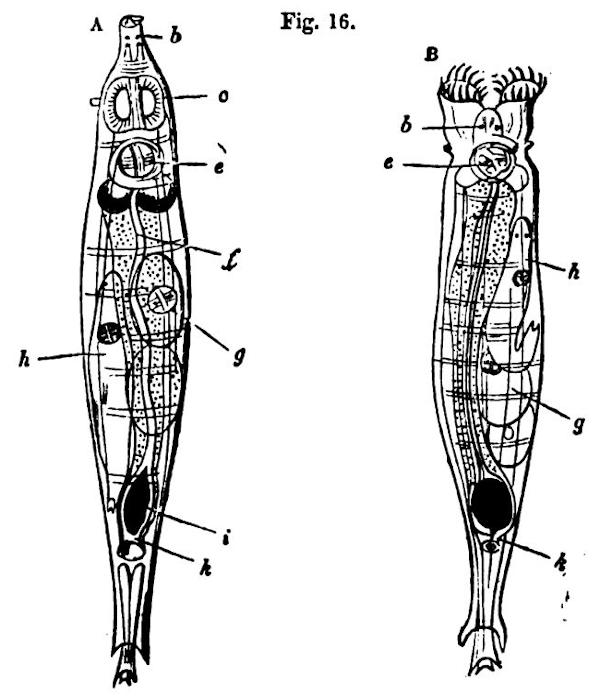
inhabitants—The “Wheel-bearers”—Resuscitation of Rotifers: drowned into
life—Current belief that animals can be revived after complete
desiccation—Experiments contradicting the belief—Spallanzani’s
testimony—Value of biology as a means of culture—Classification of
animals: the five great types—Criticism of Cuvier’s arrangement.
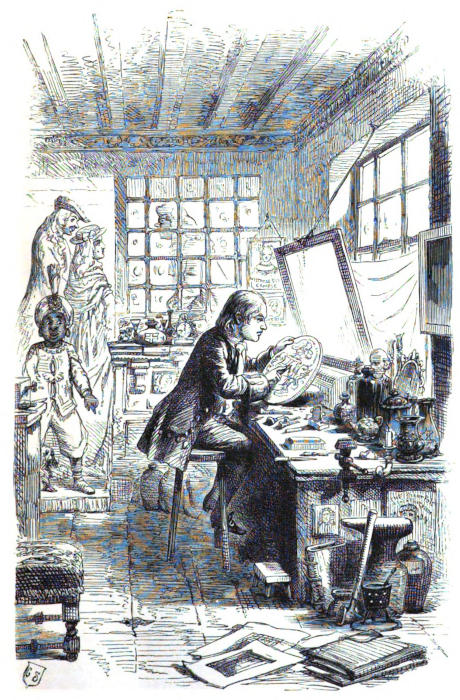
Lovel the Widower. Chapter 1. (With an Illustration.)
Studies in Animal Life. Chapter 1.
Father Prout’s Inaugurative Ode to the Author of “Vanity Fair.”
Our Volunteers.
A Man of Letters of the last Generation.
The Search for Sir John Franklin (from the Private Journal of an Officer of the Fox). (With an Illustration and Map.)
The First Morning of 1860.
Roundabout Papers.—No. 1. On a Lazy Idle Boy.
Nil Nisi Bonum.
Invasion Panics.
To Goldenhair (from Horace). By Thomas Hood.
Framley Parsonage. Chapters 4, 5 and 6.
Tithonus. By Alfred Tennyson.
William Hogarth: Painter, Engraver, and Philosopher. Essays on the Man, the Work, and the Time.—I. Little Boy Hogarth.
Unspoken Dialogue. By R. Monckton Milnes. (With an Illustration.)
Studies in Animal Life. Chapter 2.
Curious if True. (Extract from a Letter from Richard Whittingham, Esq.)
Life among the Lighthouses.
Lovel the Widower. Chapter 2. (With an Illustration.)
As Essay without End.
⁂ Communications for the Editor should be addressed to the care of Messrs. Smith, Elder and Co.,
65, Cornhill, and not to the Editor’s private residence. The Editor cannot be responsible for
the return of rejected contributions.
MARCH, 1860.
A Few Words on Junius and Macaulay.
The “secret of Junius” has been kept until, like over-ripe wines, the
subject has lost its flavour. Languid indeed is the disposition of mind in
which any, except a few veterans who still prefer the old post-road to
the modern railway, take up an essay or an article professing to throw
new light on that wearisome mystery, or to add some hitherto unknown
name to the ghostly crowd of candidates for that antiquated prize. And
yet there is a deep interest about the inquiry, after all, to those who, from
any special cause, are induced to overcome the feeling of satiety which it
at first excites, and plunge into the controversy with the energy of their
grandfathers. The real force and virulence of those powerful writings,
unrivalled then, and scarcely equalled since, let critics say what they may;
the strangeness of the fact that none of the quick-sighted, unscrupulous,
revengeful men who surrounded Junius at the time of his writing, who
brushed past him in the street, drank with him at dinner, sat opposite him
in the office, could ever attain to even a probable conjecture of his identity;
the irresistible character of the external evidence which fixes the authorship
on Francis, contrasted with those startling internal improbabilities which
make the Franciscan theory to this day the least popular, although the
learned regard it as all but established—the eccentric, repulsive, “dour”
character of Francis himself, and the kind of pertinacious longing which
besets us to know the interior of a man who shuts himself up against his
fellow-men in fixed disdain and silence:—these are powerful incentives,
and produce an attraction, of which we are sometimes ourselves ashamed,
towards the occupation of treading over and over again this often beaten
ground of literary curiosity.
Never have I felt this more strongly, than when accident led me, a few
years ago, into Leigh and Sotheby’s sale-room, when the library of Sir
Philip Francis was on view previous to auction. I know not whether any
reader will sympathize with me in what I am about to say: but to me
there is a solemn and rather oppressive feeling, which attends these exposures
of books for sale, where the death is recent, and where the owner and
collector was a man of this world, taking an interest in the everyday
literature which occupies myself and those around me. There stands his
copy of a memoir of some one whom both he and I knew well—he had
just had time to read it, as I see by the date, and with interest, as I judge
by the pencil marks—in what mysteriously separate relation do he and I
now respectively stand towards that common acquaintance? There is his
copy of the latest volume of Travels—he had only accompanied the adventurer,
I see, as far as the First Cataract—what matters now to him the
problem of the Source of the Nile? There is his last unbound number of
the Quarterly—he had studied it for many a year: at such a page, the
paper-cutter rested from its work, the marginal notes ended, the influx of
knowledge stopped, the chain of thought was snapped, the mental perceptions
darkened. Can it be, that the active mind of our fellow-worker ceased then
and there from that continuous exertion of so many years, and became that
we wot not of—a living Intelligence, it may be, but removed into another
sphere, with which its habitual region of labour—the cycle in which it
moved and had its being—had no connection whatever? Must it be (as
Charles Lamb so quaintly expresses it) that “knowledge now comes to
him, if it comes at all, by some awkward experiment of intuition, and no
longer by this familiar process of reading?”
But I do not wish to dally, here and now, with fancies like these. I
only introduced the subject, because Sir Philip Francis’ library was a good
deal calculated to suggest this class of thoughts. He was a great marginal
note-maker. He criticized all that came under his eye, and especially
what related to political events, even to his latest hour. And—singular
enough, yet in accordance with much that we know of him, and with all
that we must suppose, if Junius he was—he had avoided keeping up, in
this way, his connection with the time in which his sinister and anonymous
fame was achieved. So far as I remember, his books of the Junian period
were little noted. He seemed to have exercised his memory and judgment
on the records of Warren Hastings’ trial, the French Revolution, the revolutionary
war—not on those of Burke and Chatham.
This, however, is all by the way, and I must crave pardon for the
digression. I lost myself, and wandered off, it seems, just when I was
reminding the reader that the subsidiary features of the Junian controversy
have now become much more interesting than the old question of authorship
itself, and that it is an admirable exercise for the intellectual faculties
to trace the way in which different lines of reasoning, wholly distinct and
yet severally complete, converge towards the “Franciscan” conclusion. It
was in this light, especially, that the subject appeared to captivate the
mind of that great historical genius whom we have lost: whom we have
just seen in the ample enjoyment of most rare faculties, the fulness of
fame, and the height of fortune, committed to the soft arms of an euthanasia
such as has rarely waited on man. The “Junian controversy” was with
Macaulay an endless subject of ingenious talk. It suited certain peculiarities
of his mind. As he was the very clearest of writers, so he was also,
in a special sense and manner, the most acute of reasoners. In limited, close
historical argument—in the power to infer a third proposition from a
second, a second from a first—the power to expand a fact, either proved
or assumed as a trifling postulate, into a series of facts, with undeniable
cogency—I think we must go far to find his equal.
If you gave Cuvier a tarsal bone, he constructed you, with unerring
certainty, a humming-bird or an elephant. If you gave Macaulay a casual
passage from a letter, he would divine, with strange precision, the circumstances
of that letter: the occasion of its writing, the reason of its publication
or non-publication, the way in which the writer was connected
with some great event of the time, and in which the letter bore on that
event. But his judgment of the character of the man, or character of the
event, was another matter altogether, and tasked a different order of faculties,
with which we are not now concerned. If we were to seek a rival
to Macaulay in this peculiar province of clear and cogent reasoning from
fact A to fact X, imparting to conjecture the force of truth, we should
probably find him rather among lawyers than writers. In truth, the
historian always retained, and to his great advantage, many of the mental
habits, as well as many of the tastes and joyous recollections of the bar. He
was at once the most Paleyan and the most forensic of historical inquirers.
When he entered the arena of controversy, you might doubt whether he had
donned his armour in the Senate House of Cambridge or the Assize Court
of Lancaster. We may assume (as Coke assumed, lamentingly, of Bacon)
that had he only stuck to the law he would have made a great lawyer.
But it is open to doubt whether, as a judge, he would have done more of
service by the marvellous lucidity with which he would have drawn out
a series of circumstantial evidence before a jury, or more of harm by his
tendency to force the various considerations attending a complicated case
into conformity with his own too complete and too vivid ideal of that case.
There is no better way towards appreciating the intensity of this
peculiar faculty in Macaulay, than to study the various controversies into
which his essays and his history led him: both the few in which he
vouchsafed a reply, and the many more in which he rested contented with
his first statement—his issues with Dixon, Paget, the High Churchmen,
the Scotch, the Quakers, and the like—and to contrast his method with
that of his antagonists. They all beat the bush, more or less, and flounder
in every variety of historical fallacy. They beg the question, frame
“vicious processes” from their premisses, “pole” themselves on self-created
dilemmas, commit, in short, every error which logicians denounce in their
fantastic terminology—in Macaulay’s reasoning, simply as such, you will
never detect a flaw. His conclusion follows his premisses as surely and safely
as “the night the day.” You may agree with his antagonist, and not with
him; but you will find that what you consider to be his error lies quite in
another direction, and consists, not in misusing his own facts, but in
ignoring or neglecting true and material facts adduced by his opponents.
And beware, O young and ardent Reader, too readily pleased with seeing
a hole picked in a great man’s coat, lest the triumphant crow, with which
these opponents invariably trumpet their supposed victory, seduce you into
premature acquiescence. By-and-by, when cooler and steadier, you may
be inclined to conjecture that Macaulay’s piercing instinct was right after
all, and that the facts evoked against him are in reality either doubtful or
immaterial to the argument.
It was, as I have said, this fondness and aptitude for following up with
accuracy converging lines of evidence, which gave Macaulay so great an
interest in the Junian controversy, and made him so ready to allude to it
incidentally both in writing and conversation. He contributed, himself,
two, at least, of the most remarkable collateral proofs which tend to fix the
authorship on Francis—the curious error of the English War-office clerk
about the rules of Irish pensions, in the correspondence with Sir William
Draper—the personal hostility of the Francis family towards the Luttrells,
which accounts for the savage treatment by Junius of such obscure offenders.
And now, having used the great historian’s name, somewhat
unfairly, by way of shoeing-horn, to draw on a fresh chapter on the old
controversy, let me place before you another singular instance of this class
of collateral proofs, which, I believe, has not been made public before,
but which greatly excited the curiosity of Macaulay, and which he would
have followed out—if ever he had taken up the question again—with all
the force of his inductive mind.
In one of the early letters of Woodfall’s collection, under the signature
“Bifrons” (April 23, 1768: vol. ii. p. 175, of Bohn’s Edition), the writer,
after accusing the Duke of Grafton of being a ‘casuist,’ proceeds as follows:—
“I am not deeply read in authors of that professed title: but I
remember seeing Busenbaum, Suares, Molina, and a score of other Jesuitical
books, burnt at Paris, for their sound casuistry, by the hand of the common
hangman.”
I shall assume at once that Bifrons was the same writer as Junius. The
general reasons for the assumption are familiar to those versed in the controversy.
And even were those general grounds of identity less strong
than they are, every one would allow that to prove that Francis was
Bifrons, would go a long way towards proving him Junius.
A passage so pregnant with suggestion has of course provoked abundant
comment: but all of the loosest description. No one seems to have taken
the pains to follow out for himself a hint pointing to conclusions of so much
importance, both negative and affirmative.
Mr. W. H. Smith, the recent editor of the Grenville Papers, thus
presses it into the service of his theory, attributing the authorship of
Junius to Lord Temple:
“The ceremony here alluded to probably took place in or about the
year 1732, when the disputes between the King of France and his parliaments,
relative to the Jesuits, had arrived at the highest point of acrimony.
Several burnings of obnoxious and prohibited books and writings are
described by cotemporary authorities at this time; and as Lord Temple,
then Richard Grenville, was in France, and chiefly at Paris, from the
autumn of 1731 to the spring of 1733, he had, consequently, many opportunities
of witnessing the ceremonies of the burning of ‘scores of Jesuitical
books’ by the common hangman, as described by Junius.”—(Introductory
notes relating to the authorship of Junius, p. cxliv.)
Mr. Smith is scarcely so familiar with the details of French as of
English history. No doubt books were publicly burnt in Paris about the
time he mentions: but the books were Jansenist, not Jesuit: the letters
concerning the Miracles of M. de Paris, the Nouvelles Ecclésiastiques, and
the like—not the works of the Casuists. In 1732, the Jesuits were the
executioners: their turn, as victims, came a generation later.
A writer, who endeavours to establish a claim for Lord Lyttelton, is
nearer the mark: but, unluckily, just misses it:——
“We may assume,” says he, “that this burning took place in 1764,
as it was in that year that Choiseul suppressed the Jesuits. Thomas
Lyttelton was on the continent during the whole of 1764, and for part of
the time resided at Paris.”
The burning of books, so accurately described by Bifrons, took place,
beyond a doubt, as we shall presently see, on August the 7th, 1761. Now
this date raises a curious question, which is indicated, but in a very careless
manner, by Mr. Wade (in his notes to Junius, Bohn’s edition):——
“It may be doubted, indeed, whether Bifrons was an Englishman, or
even an Irishman: he certainly could not have been a British subject in
1761, unless he was a prisoner of war: for in that year we were at war
with France. But if a prisoner of war, how unlikely that he could be at
Paris to witness an auto-da-fé of heretical works: he would have been
confined in the interior of the kingdom, not left at large to indulge his
curiosity in the capital.”
Now, assuming (as all these writers do), that Bifrons-Junius actually
saw what he says he saw, how does the circumstance bear on the claims of
the several candidates?
What was Lyttelton in August, 1761? An Eton boy, enjoying his
holidays.
Where was Lord Temple? At Stowe (see the Grenville Letters) caballing
with Pitt.
Where was Burke? At Battersea, preparing to join Gerard Hamilton
in Ireland.
Where were Burke the younger, Lord George Sackville, and the rest of
the illustrious persons implicated in some people’s suspicions? Not in
Paris, we may safely answer, without pursuing our inquiry farther.
But it is undoubtedly possible that Bifrons-Junius, after all, did not
himself see the auto-da-fé in question: he may have heard of it, or read
of it, and may have described himself as a witness for effect, by way of a
flourish, or even by way of false lure to throw inquirers off the scent.
It would then only remain to inquire, in what way, by what association
of ideas, Bifrons-Junius came to give so circumstantial a description, and in
so prominent a manner, of an occurrence which had passed in a time of
war, almost unmarked by the English public, and which had excited in
England but very little attention or interest since?
Now let us see how either supposition bears on the “Franciscan theory.”
Francis was a very young clerk in Mr. Pitt’s department (which
answered to the Foreign Office of these days) in 1759. In that year he
accompanied Lord Kinnoul on his special mission to Portugal. His lordship
returned in November, 1760, with all his staff, and the youthful
Francis (in all probability) returned to his desk at the same time.
He was certainly at work in the same office between October, 1761,
and August 1768; for he says of himself (Parl. Debates, xxii. 97), that he
“possessed Lord Egremont’s favour in the Secretary of State’s Office.”
That nobleman came into office in October, 1761, and died in August,
1763. In the latter year Francis was removed to the War Office, where
he remained until 1772.
Where was he in August, 1761?
According to all reasonable presumption, at work in Pitt’s department.
And yet Lady Francis, in that biographical account of her husband
which was published by Lord Campbell—an account evidently incorrect in
some details, yet authentic in striking particulars, as might be expected
from a lady’s reminiscences of what she heard from an older man—says,
“He was at the Court of France in Louis XV.’s time, when the Jesuits were
driven out by Madame de Pompadour.”
This, it will be at once allowed, is a strange instance of coincidence
between Bifrons and the lady. The more striking, because the particulars
of disagreement show that the two stories do not come from the same source.
But how can we account for either story? How came Francis to be in
Paris—if in Paris he were—in time of war?
With a view to solve this question to my own satisfaction, I once consulted
the State Paper Office. It happens that during the summer of 1761,
Mr. Hans Stanley was in Paris, on a diplomatic mission, to negotiate terms
of peace with Choiseul. He failed in that object—some folks thought Mr.
Pitt never meant he should succeed—and returned home in September of
that year. His correspondence with Pitt, as Secretary of State, is preserved
in the office aforesaid. He seems to have had the ordinary staff of
assistants from Pitt’s department: but I could not find any record of their
names. His despatches are entirely confined to the subject of the negotiation
on which he was engaged, with one exception. He seems, for some
reason or other, to have taken much interest in the affair of the Jesuits.
On August 10, he writes at length on the whole of that matter. To his
despatch is annexed a careful précis, in Downing Street language, of the
history of the Jesuits’ quarrel with the parliament: evidently drawn up by
one of his subordinates. Enclosed in this précis is the original printed
Arrêt de la Cour du Parlement, du 6 Août, 1761, condemning Molina, de
Justitiâ et Jure; Suares, Defensio Fidei Catholicæ; Busenbaum, Theologia
Moralis; and several other books of the same class, to be lacérés et
brûlés en la cour du Palais. And a MS. note at the foot of the Arrêt
states that the books were burnt on the 7th accordingly.
Thus much, therefore, is all but certain; some member of Mr. Stanley’s
mission, or other confidential subordinate, was present in the Cour du
Palais when that arrêt was executed, and reported it to his principal, who
reported it to Mr. Pitt: and Francis was at that time a clerk in Pitt’s
office, which was in constant communication with Stanley’s mission. We
do not know the names of the individual clerks who were attached to that
mission, or passed backwards and forwards between Paris and London in
connection with it. But we do know that Francis had been twice employed
in a similar way (to accompany General Bligh’s expedition to Cherbourg,
and Lord Kinnoul’s mission to Portugal). Evidently, therefore, he was very
likely to be thus employed again. He may then assuredly have witnessed
with his own bodily eyes what no Englishman, unconnected with that
mission, could well have witnessed: may have stood on the steps of the
Palais de Justice, watched the absurd execution taking place in the courtyard
below, and treasured up the details as food for his sarcastic spirit;
or (to take the other supposition) he may have read at his desk in the
office that curious despatch of Mr. Stanley’s; may have retained it in his
tenacious memory; and, writing a few years afterwards, may have thought
proper, for the sake of effect, to represent himself as an eye-witness of
what he only knew by reading.
All this I once detailed to Macaulay, who, as I have said, was much
interested by the argument, and took an eager part in discussing it. But
one circumstance (I said) perplexed me, and seemed to interfere with the
probabilities of the case. How came Junius, whose excessive fear of
detection betrays itself throughout so much of his correspondence, and led
him to employ all manner of shifts and devices for the sake of concealment,
to give the public, as if in mere bravado, such a key to his identity as this
little piece of autobiography affords?
The answer is plain, replied Macaulay on the instant, with one of those
electric flashes of rapid perception which seemed in him to pass direct from
the brain to the eye. The letter of Bifrons is one of Junius’s earliest
productions—its date, half-a-year before the formidable signature of Junius
was adopted at all. The first letter so signed is dated in November, 1768.
In April, the writer had neither earned his fame, nor incurred his personal
danger. A mere unknown scatterer of abuse, he could have little or no
fear of directing inquiry towards himself.
But (he added) I much prefer your first supposition to your second.
It is not only the most picturesque, but it is really the most probable.
And unless the contrary can be shown, I shall believe in the actual
presence of the writer at the burning of the books. Remember, this fact
explains what otherwise seems inexplicable, Lady Francis’s imperfect
story, that her husband “was at the court of France when Madame de
Pompadour drove out the Jesuits.” Depend on it, you have caught Junius
in the fact. Francis was there.
William Hogarth: PAINTER, ENGRAVER, AND PHILOSOPHER. Essays on the Man, the Work, and the Time. — II.— Mr. Gamble’s Apprentice. — FOOTNOTES
How often have I envied those who—were not my envy dead and buried—would
now be sixty years old! I mean the persons who were born at
the commencement of the present century, and who saw its glories evolved
each year with a more astonishing grandeur and brilliance, till they culminated
in that universal “transformation scene” of ’15. For the appreciation
of things began to dawn on me only in an era of internecine frays and
feuds:—theological controversies, reform agitations, corporation squabbles,
boroughmongering debates, and the like: a time of sad seditions and
unwholesome social misunderstandings; Captain Rock shooting tithe-proctors
in Ireland yonder; Captain Swing burning hayricks here; Captains
Ignorance and Starvation wandering up and down, smashing machinery,
demolishing toll-bars, screeching out “Bread or blood!” at the carriage-windows
of the nobility and gentry going to the drawing-room, and
otherwise proceeding the wretchedest of ways for the redress of their
grievances. Surely, I thought, when I began to think at all, I was born
in the worst of times. Could that stern nobleman, whom the mob hated,
and hooted, and pelted—could the detested “Nosey,” who was beset by a
furious crowd in the Minories, and would have been torn off his horse, perchance
slain, but for the timely aid of Chelsea Pensioners and City Marshalmen,—and
who was compelled to screen his palace windows with iron shutters
from onslaughts of Radical macadamites—could he be that grand Duke
Arthur, Conqueror and Captain, who had lived through so much glory, and
had been so much adored an idol? Oh, to have been born in 1800! At six,
I might just have remembered the mingled exultation and passionate grief
of Trafalgar; have seen the lying in state at Greenwich, the great procession,
and the trophied car that bore the mighty admiral’s remains to his last
home beneath the dome of Paul’s. I might have heard of the crowning
of the great usurper of Gaul: of his putting away his Creole wife, and
taking an emperor’s daughter; of his congress at Erfurt,—and Talma, his
tragedian, playing to a pit full of kings, of his triumphal march to Moscow,
and dismal melting away—he and his hosts—therefrom; of his last defeat
and spectral appearance among us—a wan, fat, captive man, in a battered
cocked hat, on the poop of an English war-ship in Plymouth Sound—just
before his transportation to the rock appointed to him to eat his heart upon.
I envied the nurse who told upon her fingers the names of the famous
victories of the British army under Wellington in Spain; Vimieira,
Talavera, Vittoria, Salamanca, Ciudad Rodrigo, Badajos, Fuentes
d’Onore,—mille e tre; in fine—at last, Waterloo. Why had I not lived in that
grand time, when the very history itself was acting? Strong men there
were who lived before Agamemnon; but for the accident of a few years,
I might have seen, at least, Agamemnon in the flesh. ’Tis true, I knew
then only about the rejoicings and fireworks, the bell-ringings, and thanksgiving
sermons, the Extraordinary Gazettes, and peerages and ribbons
bestowed in reward for those deeds of valour. I do not remember that I
was told anything about Walcheren, or about New Orleans; about the
trade driven by the cutters of gravestones, or the furnishers of funeral
urns, broken columns, and extinguished torches; about the sore taxes, and
the swollen national debt. So I envied; and much disdained the piping
times of peace descended to me; and wondered if the same soldiers I
saw or heard about, with scarcely anything more to do than lounge on
Brighton Cliff, hunt up surreptitious whisky-stills, expectorate over
bridges, and now and then be lapidated at a contested election, could
be the descendants of the heroes who had swarmed into the bloody
breach at Badajos, and died, shoulder to shoulder, on the plateau of Mont
St. Jean.
MR. GAMBLE’S APPRENTICE.
Came 1848, with its revolutions, barricades, states of siege, movements
of vast armies, great battles and victories, with their multiplied hecatombs
of slain even; but they did not belong to us; victors and vanquished were
aliens; and I went on envying the people who had heard the Tower guns
fire, and joybells ring, who had seen the fireworks, and read the Extraordinary
Gazettes during the first fifteen years of the century! Was I
never to live in the history of England? Then, as you all remember, came
the great millennium or peace year ’51. Did not sages deliberate as to
whether it would not be better to exclude warlike weapons from the
congress of industry in Hyde Park? By the side of Joseph Paxton with
his crystal verge there seemed to stand a more angelic figure, waving wide
her myrtle wand, and striking universal peace through sea and land. It
was to be, we fondly imagined, as the immortal blind man of Cripplegate
sang:—
“No war or battle’s sound
Was heard the world around:
The idle spear and shield were high uphung,
The hookèd chariot stood
Unstain’d with hostile blood,
The trumpet spake not to the armèd throng;
And kings sate still with awful eye,
As if they sorely knew their Sovereign Lord was by.”
O blind man! it was but for an instant. The trodden grass had
scarcely begun to grow again where nave and transept had been, when
the wicked world was all in a blaze; and then the very minstrels of peace
began to sharpen swords and heat shot red-hot about the Holy Places; and
then the Guards went to Gallipoli, and farther on to Bulgaria, and farther
on to Old Fort; and the news of the Alma, Inkermann, Balaklava, the
Redan, the Tchernaya, the Mamelon, the Malakhoff came to us, hot and
hot, and we were all living in the history of England. And lo! it was
very much like the history of any other day in the year—or in the
years that had gone before. The movements of the allied forces were
discussed at breakfast, over the sipping of coffee, the munching of
muffins, and the chipping of eggs. Newspaper-writers, parliament-men,
club-orators took official bungling or military mismanagement as their
cue for the smart leader of the morrow, the stinging query to Mr.
Secretary at the evening sitting, or the bow-window exordium in the
afternoon; and then everything went on pretty much as usual. We
had plenty of time and interest to spare for the petty police case, the
silly scandal, the sniggering joke of the day. The cut of the coat
and the roasting of the mutton, the non-adhesiveness of the postage-stamp,
or the misdemeanors of the servant-maid, were matters of as
relative importance to us as the great and gloomy news of battle and
pestilence from beyond sea. At least I lived in actual history, and my
envy was cured for ever.
I have often thought that next to Asclepiades, the comic cynic,[1]
Buonaparte Smith was the greatest philosopher that ever existed. B.
Smith was by some thought to have been the original of Jeremy
Diddler. He was an inveterate borrower of small sums. On a certain
Wednesday in 1821, un sien-ami accosted him. Says the friend:
“Smith, have you heard that Buonaparte is dead?” To which retorts
the philosopher: “Buonaparte be ——!” but I disdain to quote his
irreverent expletive—“Buonaparte be somethinged. Can you lend me
ninepence?” What was the history of Europe or its eventualities to
Buonaparte Smith? The immediate possession of three-fourths of a
shilling was of far more importance to him than the death of that
tremendous exile in his eyrie in the Atlantic Ocean, thousands of miles
away. Thus, too, I daresay it was with a certain small philosopher, who
lived through a very exciting epoch of the history of England: I mean
Little Boy Hogarth. It was his fortune to see the first famous fifteen
years of the eighteenth century, when there were victories as immense as
Salamanca or Waterloo; when there was a magnificent parallel to Arthur
Wellesley, Duke of Wellington, existent, in the person of John Churchill,
Duke of Marlborough. I once knew a man who had lived in Paris, and
throughout the Reign of Terror, in a second floor of the Rue St. Honoré.
“What did you do?” I asked, almost breathlessly, thinking to hear of
tumbrils, Carmagnoles, gibbet-lanterns, conventions, poissarde-revolts, and
the like. “Eh! parbleu,” he answered, “je m’occupais d’ornithologie.”
This philosopher had been quietly birdstuffing while royalty’s head was
rolling in the gutter, and Carrier was drowning his hundreds at Nantes.
To this young Hogarth of mine, what may Marlborough and his great
victories, Anne and her “silver age” of poets, statesmen, and essayists,
have been? Would the War of the Succession assist young William in
learning his accidence? Would their High Mightinesses of the States-General
of the United Provinces supply him with that fourpence he
required for purchases of marbles or sweetmeats? What had Marshal
Tallard to do with his negotiations with the old woman who kept the apple-stall
at the corner of Ship Court? What was the Marquis de Guiscard’s
murderous penknife compared with that horn-handled, three-bladed one,
which the Hebrew youth in Duke’s Place offered him at the price of
twentypence, and which he could not purchase, faute de quoi? At most,
the rejoicings consequent on the battles of Blenheim or Ramillies, or
Oudenarde or Malplaquet, might have saved William from a whipping
promised him for the morrow; yet, even under those circumstances, it is
painful to reflect that staying out too late to see the fireworks, or singeing
his clothes at some blazing fagot, might have brought upon him on that
very morrow a castigation more unmerciful than the one from which he
had been prospectively spared.
Every biographer of Hogarth that I have consulted—and I take
this opportunity to return my warmest thanks to the courteous book
distributor at the British Museum who, so soon as he sees me enter the
Reading Room, proceeds, knowing my errand, to overwhelm me with
folios, and heap up barricades of eighteenth century lore round me—every
one of the biographers, Nichols, Steevens, Ireland, Trusler, Phillips, Cunningham,
the author of the article “Thornhill,” in the Biographia
Britannica—the rest are mainly copyists from one another, often handing
down blunders and perpetuating errors—every Hogarthian Dryasdust
makes a clean leap from the hero’s birth and little schoolboy noviciate
to the period of his apprenticeship to Ellis Gamble the silversmith.
Refined Mr. Walpole, otherwise very appreciative of Hogarth, flirting
over the papers he got from Vertue’s widow, indites some delicate manuscript
for the typographers of his private press at Strawberry Hill, and
tells us that the artist, whom he condescends to introduce into his
Anecdotes of Painting, was bound apprentice to a “mean engraver of
arms upon plate.” I see nothing mean in the calling which Benvenuto
Cellini (they say), and Marc Antonio Raimondi (it is certain), perhaps
Albert Durer, too, followed for a time. I have heard of great
artists who did not disdain to paint dinner plates, soup tureens, and
apothecary’s jars. Not quite unknown to the world is one Rafaelle
Sanzio d’Urbino, who designed tapestry for the Flemish weavers, or a
certain Flaxman, who was of great service to Mr. Wedgwood, when he
began to think that platters and pipkins might be brought to serve some
very noble uses. Horace Walpole, cleverest and most refined of dilettanti—who
could, and did say the coarsest of things in the most elegant of
language—you were not fit to be an Englishman. Fribble, your place
was in France. Putative son of Orford, there seems sad ground for the
scandal that some of Lord Fanny’s blood flowed in your veins; and that
Carr, Lord Hervey, was your real papa. You might have made a collection
of the great King Louis’s shoes, the heels and soles of which
were painted by Vandermeulen with pictures of Rhenish and Palatinate
victories. Mignon of arts and letters, you should have had a petite maison
at Monçeaux or at the Roule. Surrounded by your abbés au petit collet,
teacups of pâte tendre, fans of chicken-skin painted by Leleux or Lantara,
jewelled snuff-boxes, handsome chocolate girls, gems and intaglios, the
brothers to those in the Museo Borbonico at Naples, che non si mostrano
alle donne, you might have been happy. You were good enough to admire
Hogarth, but you didn’t quite understand him. He was too vigorous,
downright, virile for you; and upon my word, Horace Walpole, I don’t
think you understood anything belonging to England—nor her customs,
nor her character, nor her constitution, nor her laws. I don’t think that
you would have been anywhere more in your element than in France, to
make epigrams and orange-flower water, and to have your head cut off in
that unsparing harvest of ’93, with many more noble heads of corn as
clever and as worthless for any purpose of human beneficence as yours,
Horace.
For you see, this poor Old Bailey schoolmaster’s son—this scion of
a line of north-country peasants and swineherds, had in him pre-eminently
that which scholiast Warton called the “ἩΘΟΣ,” the strong sledgehammer
force of Morality, not given to Walpole—not given to you,
fribbles of the present as of the past—to understand. He was scarcely
aware of the possession of this quality himself, Hogarth; and when
Warton talked pompously of the Ethos in his works, the painter went about
with a blank, bewildered face, asking his friends what the doctor meant,
and half-inclined to be angry lest the learned scholiast should be quizzing
him. It is in the probabilities, however, that William had some little Latin.
The dominie in Ship Court did manage to drum some of his grammar
disputations into him, and to the end of his life William Hogarth preserved
a seemly reverence for classical learning. Often has his etching-needle
scratched out some old Roman motto or wise saw upon the gleaming copper.
A man need not flout and sneer at the classics because he knows them not.
He need not declare Parnassus to be a molehill, because he has lost his
alpenstock and cannot pay guides to assist him in that tremendous ascent.
There is no necessity to gird at Pyrrha, and declare her to be a worthless
jade, because she has never braided her golden hair for you. Of
Greek I imagine W. H. to have been destitute; unless, with that ingenious
special pleading, which has been made use of to prove that Shakspeare was
a lawyer, apothecary, Scotchman, conjuror, poacher, scrivener, courtier—what
you please—we assume that Hogarth was a Hellenist because he
once sent, as a dinner invite to a friend, a card on which he had sketched
a knife, fork, and pasty, and these words, “Come and Eta Beta Pi.” No
wonder the ἩΘΟΣ puzzled him. He was not deeply learned in anything
save human nature, and of this knowledge even he may have been half
unconscious, thinking himself to be more historical painter than philosopher.
He never was a connoisseur. He was shamefully disrespectful
to the darkened daubs which the picture-quacks palmed on the curious
of the period as genuine works of the old masters. He painted “Time
smoking a picture,” and did not think much of the collection of Sir
Luke Schaub. His knowledge of books was defective; although another
scholiast (not Warton) proved, in a most learned pamphlet, that he had
illustrated, sans le savoir, above five hundred passages in Horace, Virgil,
Juvenal, and Ovid. He had read Swift. He had illustrated and evidently
understood Hudibras. He was afraid of Pope, and only made a timid,
bird-like, solitary dash at him in one of his earliest charges; and,
curiously, Alexander the Great of Twickenham seemed to be afraid of
Hogarth, and shook not the slightest drop of his gall vial over him.
What a quarrel it might have been between the acrimonious little scorpion
of “Twitnam,” and the sturdy bluebottle of Leicester Fields! Imagine
Pope versus Hogarth, pencil against pen; not when the painter was old
and feeble, half but not quite doting indeed, as when he warred with
Wilkes and Churchill, but in the strength and pride of his swingeing
satire. Perhaps William and Alexander respected one another; but I
think there must have been some tacit “hit me and I’ll hit you” kind
of rivalry between them, as between two cocks of two different schools
who meet now and then on the public promenades—meet with a
significant half-smile and a clenching of the fist under the cuff of the
jacket.
To the end of his life Hogarth could not spell; at least, his was not
the orthography expected from educated persons in a polite age. In
almost the last plate he engraved, the famous portrait of Churchill as a
Bear, the “lies,” with which the knots of Bruin’s club are inscribed, are
all “lyes.” This may be passed over, considering how very lax and
vague were our orthographical canons not more than a century ago, and
how many ministers, divines, poets—nay, princes, and crowned heads, and
nabobs—permitted themselves greater liberties than “lye” for “lie” in the
Georgian era. At this I have elsewhere hinted, and I think the biographers
of Hogarth are somewhat harsh in accusing him of crass
ignorance, when he only wrote as My Lord Keeper, or as Lady Betty, or as
his grace the Archbishop was wont to write. Hogarth, too, was an author.
He published a book—to say nothing of the manuscript notes of his life
he left. The whole structure, soul, and strength of the Analysis of Beauty
are undoubtedly his; although he very probably profited by the assistance—grammatical
as well as critical—of some of the clerical dignitaries who
loved the good man. That he did so has been positively asserted; but it
is forestalling matters to trot out an old man’s hobby, when our beardless
lad is not bound ’prentice yet. I cannot, however, defend him from the
charges of writing “militia,” “milicia,” “Prussia,” “Prusia”—why didn’t
he hazard “Prooshia” at once?[2]—“knuckles,” “nuckles”—oh, fie!—“Chalcedonians,”
“Calcidonians;” “pity,” “pitty;” and “volumes,”
“volumns.” It is somewhat strange that Hogarth himself tells us that
his first graphic exercise was to “draw the alphabet with great correctness.”
I am afraid that he never succeeded in writing it very correctly.
He hated the French too sincerely to care to learn their language; and
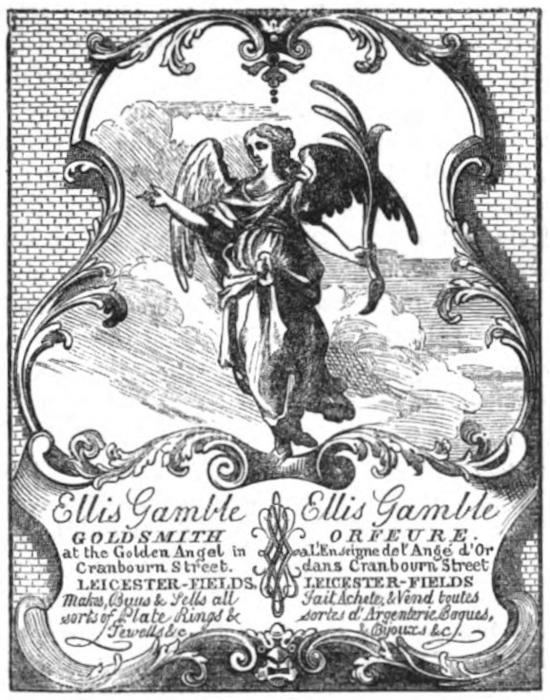
it is not surprising that in the first shop card he engraved for his master
there should be in the French translation of Mr. Gamble’s style and titles
a trifling pleonasm: “bijouxs,” instead of “bijoux.”
No date of the apprenticeship of Hogarth is anywhere given. We
must fix it by internal evidence. He was out of his time in the South
Sea Bubble year, 1720. On the 29th of April[3] in the same year, he
started in business for himself. The neatness and dexterity of the shop
card he executed for his master forbid us to assume that he was aught
but the most industrious of apprentices. The freedom of handling, the
bold sweep of line, the honest incisive play of the graver manifested in this
performance could have been attained by no Thomas Idle; and we must,
therefore, in justice grant him his full seven years of ’prentice servitude.
Say then that William Hogarth was bound apprentice to Mr.
Ellis Gamble,[4] at the Golden Angel, in Cranbourn Street, Leicester
Fields, in the winter of the year of our Lord, Seventeen hundred and
twelve. He began to engrave arms and cyphers on tankards, salvers,
and spoons, at just about the time that it occurred to a sapient legislature
to cause certain heraldic hieroglyphics surmounted by the Queen’s
crown, and encircled by the words “One halfpenny,” to be engraven
on a metal die, the which being the first newspaper stamp ever known
to our grateful British nation, was forthwith impressed on every single
half-sheet of printed matter issued as a newspaper or a periodical.
“Have you seen the new red stamp?” writes his reverence Doctor
Swift. Grub Street is forthwith laid desolate. Down go Observators,
Examiners, Medleys, Flying Posts, and other diurnals, and the undertakers
of the Spectator are compelled to raise the price of their entertaining
miscellany.
One of the last head Assay Masters at Goldsmith Hall told one of
Hogarth’s biographers, when a very—very old man, that he himself had
been ’prentice in Cranbourn Street, and that he remembered very well
William serving his time to Mr. Gamble. The register of the boy’s indenture
should also surely be among the archives of that sumptuous structure
behind the Post Office, where the worthy goldsmiths have such a sideboard
of massy plate, and give such jovial banquets to ministers and city magnates.
And, doubt it not, Ellis Gamble was a freeman, albeit, ultimately,
a dweller at the West-end, and dined with his Company when the goldsmiths
entertained the ministers and magnates of those days. Yes, gentles;
ministers, magnates, kings, czars, and princes were their guests, and King
Charles the Second did not disdain to get tipsy with Sir Robert Viner,
Lord Mayor and Alderman, at Guildhall. The monarch’s boon companion
got so fond of him as to lend him, dit-on, enormous sums of money. More
than that, he set up a brazen statue of the royal toper in the Stocks
flower-market at the meeting of Lombard Street and the Poultry.
Although it must be confessed that the effigy had originally been cast
for John Sobieski trampling on the Turk. The Polish hero had a
Carlovingian periwig given to him, and the prostrate and miscreant
Moslem was “improved” into Oliver Cromwell. [Mem.:—A pair of
correctional stocks having given their name to the flower-market; on
the other hand, may not the market have given its name to the pretty, pale,
red flowers, very dear to Cockneys, and called “stocks?”]
How was William’s premium paid when he was bound ’prentice? Be
it remembered that silver-plate engraving, albeit Mr. Walpole of Strawberry
Hill calls it “mean,” was a great and cunning art and mystery.
These engravers claimed to descend in right line from the old ciseleurs and
workers in niello of the middle ages. Benvenuto, as I have hinted, graved
as well as modelled. Marc Antonio flourished many a cardinal’s hat and
tassels on a bicchiére before he began to cut from Rafaelle and Giulio
Romano’s pictures. The engraver of arms on plate was the same artist
who executed delightful arabesques and damascenings on suits of armour of
silver and Milan steel. They had cabalistic secrets, these workers of the
precious, these producers of the beautiful. With the smiths, “back-hammering”
and “boss-beating” were secrets;—parcel-gilding an especial
mystery; the bluish-black composition for niello a recipe only to be
imparted to adepts. With the engravers, the “cross-hatch” and the
“double cypher,” as I cursorily mentioned at the end of the last chapter,
were secrets. A certain kind of cross-hatching went out with Albert
Durer, and had since been as undiscoverable as the art of making the real
ruby tint in glass. No beggar’s brat, no parish protégé, could be apprenticed
to this delicate, artistic, and responsible calling. For in graving deep,
tiny spirals of gold and silver curl away from the trenchant tool, and
there is precious ullage in chasing and burnishing—spirals and ullage
worth money in the market. Ask the Jews in Duke’s Place, who sweat
the guineas in horsehair bags, and clip the Jacobuses, and rasp the new-milled
money with tiny files, if there be not profit to be had from the
minutest surplusage of gold and silver.
Goldsmiths and silversmiths were proud folk. They pointed to George
Heriot, King James’s friend, and the great things he did. They pointed to
the peerage. Did not a Duke of Beaufort, in 1683, marry a daughter of
Sir Josiah Child, goldsmith and banker? Was not Earl Tylney, his
son, half-brother to Dame Elizabeth Howland, mother of a Duchess of
Bedford, one of whose daughters married the Duke of Bridgewater,
another, the Earl of Essex? Was not Sir William Ward, goldsmith,
father to Humble Ward, created Baron Ward by Charles I.? and from
him springs there not the present Lord Dudley and Ward?[5] O you
grand people who came over with the Conqueror, where would you be
now without your snug city marriages, your comfortable alliances with
Cornhill and Chepe? Leigh of Stoneleigh comes from a lord mayor of
Queen Bess’s time. Fulke Greville, Lord Brooke, married an alderman’s
daughter two years ere Hogarth was apprenticed. The ancestor to the
Lords Clifton was agent to the London Adventurers in Oliver’s time, and
acquired his estate in their service. George the Second’s Earl of Rockingham
married the daughter of Sir Henry Furnese, the money-lender
and stock-jobber. The great Duke of Argyll and Greenwich married a
lord mayor’s niece. The Earl of Denbigh’s ancestor married the daughter
of Basil Firebrace, the wine merchant. Brewers, money-scriveners,
Turkey merchants, Burgomasters of Utrecht’s daughters,—all these
married blithely into the haute pairie. If I am wrong in my genealogies,
’tis Daniel Defoe who is to blame, not I; for that immortal drudge of
literature is my informant. Of course such marriages never take place
now. Alliances between the sacs et parchemins are never heard of.
Mayfair never meets the Mansion House, nor Botolph Lane Belgravia,
save at a Ninth of November banquet. I question if I am not inopportune,
and impertinent even, in hinting at the dukes and belted earls who
married the rich citizens’ daughters, were it not that by and by ’prentice
Hogarth will paint some scenes from a great life drama full of Warton’s
ἩΘΟΣ, called Marriage à la Mode. Ah! those two perspectives seen
through the open windows! In the first, the courtyard of the proud
noble’s mansion; in the last, busy, mercantile London Bridge: court and
city, city and court, and which the saddest picture!
Dominie Hogarth had but a hard time of it, and must have been
pinched in a gruesome manner to make both ends meet. That dictionary
of his, painfully compiled, and at last with infinite care and labour completed,
brought no grist to the mill in Ship Court. The manuscript
was placed in the hands of a bookseller, who did what booksellers often
do when one places manuscripts in their hands. He let it drop. “The
booksellers,” writes Hogarth himself, “used my father with great cruelty.”
In his loving simplicity he tells us that many of the most eminent and
learned persons in England, Ireland, and Scotland, wrote encomiastic
notices of the erudition and diligence displayed in the work, but all to
no purpose. I suppose the bookseller’s final answer was similar to that
Hogarth has scribbled in the Manager Rich’s reply to Tom Rakewell, in
the prison scene:—“Sir, I have read your play, and it will not doo.” A
dreadful, heartrending trade was average authorship, even in the “silver
age” of Anna Augusta. A lottery, if you will: the prizeholders secretaries
of state, ambassadors, hangers-on to dukes and duchesses, gentlemen
ushers to baby princesses, commissioners of hackney coaches or plantations;
but innumerable possessors of blanks. Walla Billa! they were in
evil case. For them the garret in Grub or Monmouth Street, or in Moorfields;
for them the Welshwoman dunning for the milkscore; for them the
dirty bread flung disdainfully by bookselling wretches like Curll. For
them the shrewish landlady, the broker’s man, the catchpole, the dedication
addressed to my lord, and which seldom got beyond his lacquey;—hold!
let me mind my Hogarth and his silver-plate engraving. Only a little
may I touch on literary woes when I come to the picture of the Distressed
Poet. For the rest, the calamities of authors have been food for
the commentaries of the wisest and most eloquent of their more modern
brethren, and my bald philosophizings thereupon can well be spared.
But this premium, this indenture money, this ’prentice fee for young
William: unde derivatur? In the beginning, as you should know, this
same ’prentice fee was but a sort of “sweetener,” peace-offering, or pot de
vin to the tradesman’s wife. The ’prentice’s mother slipped a few pieces
into madam’s hand when the boy put his finger on the blue seal. The
money was given that mistresses should be kind to the little lads; that
they should see that the trenchers they scraped were not quite bare, nor
the blackjacks they licked quite empty; that they should give an eye to
the due combing and soaping of those young heads, and now and then
extend a matronly ægis, lest Tommy or Billy should have somewhat more
cuffing and cudgelling than was quite good for them. By degree this
gift money grew to be demanded as a right; and by-and-by comes thrifty
Master Tradesman, and pops the broad pieces into his till, calling them
premium. Poor little shopkeepers in this “silver age” will take a ’prentice
from the parish for five pounds, or from an acquaintance that is broken,
for nothing perhaps, and will teach him the great arts and mysteries of
sweeping out the shop, sleeping under the counter, fetching his master
from the tavern or the mughouse when a customer comes in, or waiting at
table; but a rich silversmith or mercer will have as much as a thousand
pounds with an apprentice. There is value received on either side. The
master is, and generally feels, bound to teach his apprentice everything he
knows, else, as worthy Master Defoe puts it, it is “somewhat like Laban’s
usage to Jacob, viz. keeping back the beloved Rachel, whom he served
seven years for, and putting him off with a blear-eyed Leah in her stead;”
and again, it is “sending him into the world like a man out of a ship set
ashore among savages, who, instead of feeding him, are indeed more ready
to eat him up and devour him.” You have little idea of the state, pomp,
and circumstance of a rich tradesman, when the eighteenth century was
young. Now-a-days, when he becomes affluent, he sells his stock and
good-will, emigrates from the shop-world, takes a palace in Tyburnia or a
villa at Florence, and denies that he has ever been in trade at all. Retired
tailors become country squires, living at “Places” and “Priories.” Enriched
ironmongers and their families saunter about Pau, and Hombourg,
and Nice, passing for British Brahmins, from whose foreheads the yellow
streak has never been absent since the earth first stood on the elephant, and
the elephant on the tortoise, and the tortoise on nothing that I am aware of,
save the primeval mud from which you and I, and the Great Mogul, and
the legless beggar trundling himself along in a gocart, and all humanity,
sprang. But then, Anna D. G., it was different. The tradesman was nothing
away from his shop. In it he was a hundred times more ostentatious.
He may have had his country box at Hampstead, Highgate, Edmonton,
Edgeware; but his home was in the city. Behind the hovel stuffed with
rich merchandise, sheltered by a huge timber bulk, and heralded to passers
by an enormous sheet of iron and painters’ work—his Sign—he built
often a stately mansion, with painted ceilings, with carved wainscoting or
rich tapestry and gilt leather-work, with cupboards full of rich plate, with
wide staircases, and furniture of velvet and brocade. To the entrance of
the noisome cul-de-sac, leading to the carved and panelled door (with its
tall flight of steps) of the rich tradesman’s mansion, came his coach—yes,
madam, his coach, with the Flanders mares, to take his wife and daughters
for an airing. In that same mansion, behind the hovel of merchandise,
uncompromising Daniel Defoe accuses the tradesman of keeping servants in
blue liveries richly laced, like unto the nobility’s. In that same mansion the
tradesman holds his Christmas and Shrovetide feasts, the anniversaries of
his birthday and his wedding-day, all with much merrymaking and junketing,
and an enormous amount of eating and drinking. In that same
mansion, in the fulness of time and trade, he dies; and in that same
mansion, upon my word, he lies in state,—yes, in state: on a lit de
parade, under a plumed tester, with flambeaux and sconces, with blacks
and weepers, with the walls hung with sable cloth, et cætera, et cætera,
et cætera.[6] ’Tis not only “Vulture Hopkins” whom a “thousand lights
attend” to the tomb, but very many wealthy tradesmen are so buried, and
with such pomp and ceremony. Not till the mid-reign of George the Third
did this custom expire.
[I should properly in a footnote, but prefer in brackets, to qualify the
expression “hovel,” as applied to London tradesmen’s shops at this time,
1712-20. The majority, indeed, merit no better appellation: the windows
oft-times are not glazed, albeit the sign may be an elaborate and even
artistic performance, framed in curious scroll-work, and costing not
unfrequently a hundred pounds. The exceptions to the structural poverty
of the shops themselves are to be found in the toymen’s—mostly in Fleet
Street,—and the pastrycooks’—mainly in Leadenhall. There is a mania
for toys; and the toyshop people realize fortunes. Horace Walpole bought
his toy-villa at Strawberry Hill—which he afterwards improved into a
Gothic doll’s-house—of a retired Marchand de Joujoux. The toy-merchants
dealt in other wares besides playthings. They dealt in cogged
dice. They dealt in assignations and billet-doux. They dealt in masks and
dominos. Counsellor Silvertongue may have called at the toyshop coming
from the Temple, and have there learnt what hour the countess would
be at Heidegger’s masquerade. Woe to the wicked city! Thank Heaven
we can go and purchase Noah’s arks and flexible acrobats for our children
now, without rubbing shoulders with Counsellor Silvertongue or Lord
Fanny Sporus, on their bad errands. Frequented as they were by rank
and fashion, the toyshops threw themselves into outward decoration.
Many of these shops were kept by Frenchmen and Frenchwomen, and it
has ever been the custom of that fantastic nation to gild the outside of
pills, be the inside ever so nauseous. Next in splendour to the toyshops
were the pastrycooks. Such a bill as can be seen of the charges for fresh
furnishing one of these establishments about Twelfth Night time! “Sash
windows, all of looking-glass plates; the walls of the shop lined up with
galley-tiles in panels, finely painted in forest-work and figures; two large
branches of candlesticks; three great glass lanterns; twenty-five sconces
against the wall; fine large silver salvers to serve sweetmeats; large high
stands of rings for jellies; painting the ceiling, and gilding the lanterns,
the sashes, and the carved work!” Think of this, Master Brook! What
be your Cafés des Mille Colonnes, your Véfours, your Vérys, your
Maisons-dorées, after this magnificence? And at what sum, think you, does
the stern censor, crying out against it meanwhile as wicked luxury and
extravagance, estimate this Arabian Nights’ pastrycookery? At three
hundred pounds sterling! Grant that the sum represents six hundred of
our money. The Lorenzos the Magnificent, of Cornhill and Regent Street,
would think little of as many thousands for the building and ornamentation
of their palaces of trade. Not for selling tarts or toys though. The tide
has taken a turn; yet some comfortable reminiscences of the old celebrity
of the city toy and tart shops linger between Temple Bar and Leadenhall.
Farley, you yet delight the young. Holt, Birch, Button, Purssell, at your
sober warehouses the most urbane and beautiful young ladies—how pale
the pasty exhalations make them!—yet dispense the most delightful of
indigestions.]
So he must have scraped this apprenticeship money together, Dominie
Hogarth: laid it by, by cheeseparing from his meagre school fees, borrowed
it from some rich scholar who pitied his learning and his poverty, or
perhaps become acquainted with Ellis Gamble, who may have frequented
the club held at the “Eagle and Child,” in the little Old Bailey. “A
wonderful turn for limning has my son,” I think I hear Dominie Hogarth
cry, holding up some precocious cartoon of William’s. “I doubt not, sir,
that were he to study the humanities of the Italian bustos, and the just
rules of Jesuit’s perspective, and the anatomies of the learned Albinus, that
he would paint as well as Signor Verrio, who hath lately done that noble
piece in the new hall Sir Christopher hath built for the blue-coat children
in Newgate Street.” “Plague on the Jesuits,” answers honest (and supposititious)
Mr. Ellis Gamble. “Plague on all foreigners and papists, goodman
Hogarth. If you will have your lad draw bustos and paint ceilings,
forsooth, you must get one of the great court lords to be his patron, and send
him to Italy, where he shall learn not only the cunningness of limning, but
to dance, and to dice, and to break all the commandments, and to play on the
viol-di-gamby. But if you want to make an honest man and a fair tradesman
of him, Master Hogarth, and one who will be a loyal subject to the Queen,
and hate the French, you shall e’en bind him ’prentice to me; and I will
be answerable for all his concernments, and send him to church and
catechize, and all at small charges to you.” Might not such a conversation
have taken place? I think so. Is it not very probable that the lad
Hogarth being then some fourteen years old, was forthwith combed his
straightest, and brushed his neatest, and his bundle or his box of needments
being made up by the hands of his loving mother and sisters, despatched
westward, and with all due solemnity of parchment and blue seal, bound
’prentice to Mr. Ellis Gamble? I am sure, by the way in which he
talks of the poor old Dominie and the dictionary, that he was a loving
son. I know he was a tender brother. Good Ellis Gamble—the lad
being industrious, quick, and dexterous of hand—must have allowed him
to earn some journeyman’s wages during his ’prentice-time; for that
probation being out, he set not only himself, but his two sisters, Mary
and Ann, up in business. They were in some small hosiery line, and
William engraved a shop-card for them, which did not, I am afraid,
prosper with these unsubstantial spinsters any more than did the celebrated
lollipop emporium established in The House with the Seven Gables.
One sister survived him, and to her, by his will, he left an annuity of
eighty pounds.
Already have I spoken of the Leicester Square gold and silver
smith’s style and titles. It is meet that you should peruse them in
full:—
So to Cranbourn Street, Leicester Fields, is William Hogarth bound for
seven long years. Very curious is it to mark how old trades and old types
of inhabitants linger about localities. They were obliged to pull old
Cranbourn Street and Cranbourn Alley quite down before they could get rid
of the silversmiths, and even now I see them sprouting forth again round
about the familiar haunt; the latest ensample thereof being in the shop of a
pawnbroker—of immense wealth, I presume, who, gorged and fevered by
multitudes of unredeemed pledges, has suddenly astonished New Cranbourn
Street with plate-glass windows, overflowing with plate, jewellery,
and trinkets; buhl cabinets, gilt consoles, suits of armour, antique china,
Pompadour clocks, bronze monsters, and other articles of virtù. But don’t
you remember Hamlet’s in the dear old Dædalean, bonnet-building Cranbourn
Alley days?—that long low shop whose windows seemed to have no
end, and not to have been dusted for centuries; those dim vistas of dish-covers,
coffee biggins and centre-pieces. You must think of Crœsus when
you speak of the reputed wealth of Hamlet. His stock was said to be
worth millions. Seven watchmen kept guard over it every night. Half
the aristocracy were in his debt. Royalty itself had gone credit for plate
and jewellery at Hamlet’s. Rest his bones, poor old gentleman, if he be
departed. He took to building and came to grief. His shop is no more,
and his name is but a noise.
In our time, Cranbourn Street and Cranbourn Alley were dingy
labyrinths of dish-covers, bonnets, boots, coffee-shops, and cutlers; but
what must the place have been like in Hogarth’s time? We can have no
realizable conception; for late in George the Third’s reign, or early in
George the Fourth’s, the whole pâté of lanes and courts between Leicester
Square and St. Martin’s Lane had become so shamefully rotten and
decayed, that they half tumbled, and were half pulled down. The
labyrinth was rebuilt; but, to the shame of the surveyors and architects
of the noble landlord, on the same labyrinthine principle of mean
and shabby tenements. You see, rents are rents, little fishes eat sweet,
and many a little makes a mickle. Since that period, however, better
ideas of architectural economy have prevailed; and, although part of
the labyrinth remains, there has still been erected a really handsome
thoroughfare from Leicester Square to Long Acre. As a sad and
natural consequence, the shops don’t let, while the little tenements in
the alleys that remain are crowded; but let us hope that the example of
the feverish pawnbroker who has burst out in an eruption of jewellery and
art fabrics, may be speedily followed by other professors of bricabrac.
Gay’s Trivia, in miniature, must have been manifest every hour in the
day in Hogarth’s Cranbourn Alley. Fights for the wall must have taken
place between fops. Sweeps and small coalmen must have interfered with
the “nice conduct of a clouded cane.” The beggars must have swarmed
here: the blind beggar, and the lame beggar, the stump-in-the-bowl,
and the woman bent double: the beggar who blew a trumpet—the
impudent varlet!—to announce his destitution;—the beggar with a beard
like unto Belisarius, the beggar who couldn’t eat cold meat, the beggar
who had been to Ireland and the Seven United Provinces—was this
“Philip in the tub” that W. H. afterwards drew?—the beggar in the blue
apron, the leathern cap, and the wen on his forehead, who was supposed
to be so like the late Monsieur de St. Evremonde, Governor of Duck
Island; not forgetting the beggar in the ragged red coat and the black
patch over his eye, who by his own showing had been one of the army
that swore so terribly in Flanders, and howled Tom D’Urfey’s song, “The
Queene’s old souldiers, and the ould souldiers of the Queene.” Then there
was the day watchman, who cried the hour when nobody wanted to hear
it, and to whose “half-past one,” the muddy goose that waddled after
him, cried “quack.” And then there must have been the silent mendicant,
of whom Mr. Spectator says (1712), “He has nothing to sell, but very
gravely receives the bounty of the people for no other merit than the
homage due to his manner of signifying to them that he wants a subsidy.”[7]
Said I not truly that the old types will linger in the old localities?
What is this silent mendicant but the “serious poor young man”
we have all seen standing mute on the edge of the kerb, his head downcast,
his hands meekly folded before him, himself attired in speckless but
shabby black, and a spotless though frayed white neckerchief?
Mixed up among the beggars, among the costermongers and hucksters
who lounge or brawl on the pavement, undeterred by fear of barrow-impounding
policemen; among the varlets who have “young lambs to sell”—they
have sold those sweet cakes since Elizabeth’s time;—among the
descendants and progenitors of hundreds of “Tiddy Dolls,” and “Colly
Molly Puffs;” among bailiffs prowling for their prey, and ruffian cheats
and gamesters from the back-waters of Covent Garden; among the fellows
with hares-and-tabors, the matchsellers, the masksellers—for in this inconceivable
period ladies and gentlemen wanted vizors at twelve o’clock at
noon—be it admitted, nevertheless, that the real “quality” ceased to wear
them about the end of William’s reign—among the tradesmen, wigs awry,
and apron-girt, darting out from their shops to swallow their matutinal
pint of wine, or dram of strong waters; among all this tohu-bohu, this
Galimatias of small industries and small vices, chairmen come swaggering
and jolting along with the gilded sedans between poles; and lo! the periwigged,
Mechlin-laced, gold-embroidered beau hands out Belinda, radiant,
charming, powdered, patched, fanned, perfumed, who is come to Cranbourn
Alley to choose new diamonds. And more beaux’ shins are wounded by
more whalebone petticoats, and Sir Fopling Flutter treads on Aramanta’s
brocaded queue; and the heavens above are almost shut out by the great
projecting, clattering signs. Conspicuous among them is the “Golden
Angel,” kept by Ellis Gamble.
Mark, too, that Leicester Fields were then as now the favourite resort
of foreigners. Green Street, Bear Street, Castle Street, Panton Street,
formed a district called, as was a purlieu in Westminster too, by the
Sanctuary, “Petty France.” Theodore Gardelle, the murderer, lived about
Leicester Fields. Legions of high-dried Mounseers, not so criminal as he,
but peaceable, honest, industrious folk enough, peered out of the garret
windows of Petty France with their blue, bristly gills, red nightcaps, and
filthy indoor gear. They were always cooking hideous messes, and
made the already unwholesome atmosphere intolerable with garlic. They
wrought at water-gilding, clock-making, sign-painting, engraving for book
illustrations—although in this department the Germans and Dutch were
dangerous rivals. A very few offshoots from the great Huguenot colony
in Spitalfields were silk-weavers. There were then as now many savoury,
tasting and unsavoury-smelling French ordinaries; and again, then as now,
some French washerwomen and clearstarchers. But the dwellers in
Leicester Fields slums and in Soho were mainly Catholics frequenting the
Sardinian ambassador’s chapel in Duke Street, Lincoln’s Inn Fields. French
hairdressers and perfumers lived mostly under Covent Garden Piazza, in
Bow Street and in Long Acre. Very few contrived to pass Temple Bar.
The citizens appeared to have as great a horror of them as of the players,
and so far as they could, by law, banished them their bounds, rigorously.
French dancing, fencing, and posture masters, and quack doctors, lived at
the court end of the town, and kept, many of them, their coaches. Not a
few of the grinning, fantastic French community were spies of the magnificent
King Louis. Sunday was the Frenchmen’s great day, and the Mall in
St. James’s park their favourite resort and fashionable promenade. It
answered for them all the purposes which the old colonnade of the Quadrant
was wont to serve, and which the flags of Regent Street serve now. On
Sunday the blue, bristly gills were clean shaven, the red nightcaps replaced
by full-bottomed wigs, superlatively curled and powdered. The filthy
indoor gear gave way to embroidered coats of gay colours, with prodigious
cuffs, and the skirts stiffened with buckram. Lacquer-hilted swords stuck
out behind them. Paste buckles glittered in their shoon. Glass rings
bedecked their lean paws. They held their tricornes beneath their arms,
flourished their canes and inhaled their snuff with the best beaux on town.
We are apt to laugh at the popular old caricatures of the French Mounseer,
and think those engravings unkind, unnatural, and overdrawn; but just
shave me this bearded, moustached, braided and be-ringed Jules, Gustave,
or Adolphe who comes swaggering to-day from the back of Sherrard Street
or Marylebone Street, round by the County Fire Office into Regent Street;
shave me the modern Mounseer quite clean, clap a periwig on his head,
a chapeau bras beneath his arm, a sword by his side; clothe his shrunken
limbs in eighteenth century costume; or better, see the French comedian
in some old comedy at the Français or the Odéon, and you will cry out
at once: “There is the Mounseer whom Hogarth, Gilray, Bunbury,
and Rowlandson drew.” And yet I owe an apology, here, to the Mounseers;
for it was very likely some courteous, albeit grimacing denizen
of Petty France who supplied our Hogarth with the necessary French
translation of the gold and silver smith’s style and titles to engrave on his
shop-card.
I am to be pardoned, I hope, for lingering long in Leicester Fields. I
shall have to return to the place often, for William Hogarth much affected
it. In Leicester Fields he lived years afterwards when he was celebrated
and prosperous. Where Pagliano’s Hotel is now, had he his house, the
sign, the “Golden Head,” and not the “Painter’s Head,” as I have elsewhere
put it. There he died. There his widow lived for many—many
years afterwards, always loving and lamenting the great artist and good
man, her husband. It was about Leicester Fields too—nay, unless I
mistake, in Cranbourn Alley itself, that old nutcracker-faced Nollekens
the sculptor pointed out William to Northcote the painter. “There,”
he cried, “see, there’s Hogarth.” He pointed to where stood a little
stout-faced sturdy man in a sky-blue coat, who was attentively watching a
quarrel between two street boys. It was Mr. Mulready’s “Wolf and the
Lamb” story a little before its time. The bigger boy oppressed the
smaller; whereupon Hogarth patted the diminutive victim on the head,
and gave him a coin, and said with something like a naughty word that
he wouldn’t stand it, if he was the small boy: no, not he.
Seven years at cross-hatch and double cypher. Seven years turning
and re-turning salvers and tankards on the leathern pad, and every month
and every year wielding the graver and burnisher with greater strength
and dexterity. What legions of alphabets, in double cypher, he must have
“drawn with great correctness;” what dictionary loads of Latin and
Norman-French mottoes he must have flourished beneath the coats of
arms! Oh, the scutcheons he must have blazoned in the symbolism of
lines! Blank for argent, dots for or, horizontal for azure, vertical for gules,
close-chequer for sable. The griffins, the lions, the dragons, rampant,
couchant, regardant, langued, gorged, he must have drawn! The chevrons,
the fesses, the sinoples of the first! He himself confesses that his just
notions of natural history were for a time vitiated by the constant contemplation
and delineation of these fabulous monsters, and that when he
was out of his time he was compelled to unlearn all his heraldic zoology.
To the end his dogs were very much in the “supporter” style, and the
horses in the illustrations in Hudibras strongly resemble hippogriffs.
He must have been studying, and studying hard, too, at drawing, from
the round and plane during his ’prentice years. Sir Godfrey Kneller had
a kind of academy at his own house in 1711; but Sir James Thornhill did
not establish his till long after Hogarth had left the service of Ellis Gamble.
Hogarth tells us that as a boy he had access to the studio of a neighbouring
painter. Who may this have been? Francis Hoffmann; Hubertz;
Hulzberg, the warden of the Lutheran Church in the Savoy; Samuel
Moore of the Custom House? Perhaps his earliest instructor was
some High Dutch etcher of illustrations living eastwards to be near the
booksellers in Paternoster Row; or perhaps the “neighbouring painter”
was an artist in tavern and shop signs. Men of no mean proficiency
wrought in that humble but lucrative line of emblematic art in Anna’s
“silver age.”
That Hogarth possessed considerable graphic powers when he engraved
Ellis Gamble’s shop-card, you have only to glance at the angel holding
the palm above the commercial announcement, to be at once convinced.
This figure, however admirably posed and draped, may have been copied
from some foreign frontispiece. The engraving, however, as an example
of pure line, is excellent. We are left to wonder whether it was by
accident or by design of quaint conceit that the right hand of the angel
has a finger too many.
Of Hogarth’s adventures during his apprenticeship, with the single
exception of his holiday excursion to Highgate, when there was a battle-royal
in a suburban public-house, and when he drew a capital portrait of
one of the enraged combatants, the Muse is dumb. He led, very probably,
the life of nineteen-twentieths of the London ’prentices of that period:
only he must have worked harder and more zealously than the majority
of his fellows. Concerning the next epoch of his life the Muse deigns to
be far more explicit, and, I trust, will prove more eloquent on your
worships’ behalf. I have done with the mists and fogs that envelop the
early part of my hero’s career, and shall be able to trace it now year by
year until his death.
[1] According to Tertullian, Asclepiades, the comic cynic, advocated riding on cow-back
as the most healthful, and especially the most independent means of locomotion in
the world; for, said he, she goes so slowly that she can never get tired. Wherever
there is a field, there is her banquet; and you may live on her milk all the way. But
I think that the most economical and the merriest traveller on record was the Giant
Hurtali (though the Rabbins will have that it was Og, King of Basan), who sat astride
the roof of Noah’s ark à la cockhorse, steering that great galleon with his gigantic
legs, getting his washing for nothing, and having his victuals handed up to him
through the chimney.—See Menage and Le Pelletier; l’Arche de Noé, c. 25.
[2] This “Prusia” occurred in the dedication of the “March to Finchley” to
Frederick the Great. His friends quizzed him a good deal about the error, and he
undertook to correct it by hand in every proof of the plate sold. But he soon grew
tired of making the mark ~ with a pen over the single s, and at last had the offensive
“Prusia” burnished out of the copper, and the orthodox “Prussia” substituted. But
even then the quizzers were not tired, and showed him a Prussian thaler bearing
Frederick’s effigy, and the legend of which spoke of him as Borussiæ Rex. ’Twas the
story of the old man and his donkey over again.
[3] Till the legislature deprives the people of their “eleven days,” I am using the
old-style calendar.
[4] I have seen it somewhere stated that Gamble was a “silversmith of eminence,”
residing on or near Snow Hill. “Cela n’empêche pas,” as the Hanoverian Queen on
her death-bed said to her repentant husband. I see no reason why Gamble should not
have been originally of Snow Hill, and have emigrated before 1720 to the Court end of
the town.
[6] “Let it be interred after the manner of the country, and the laws of the place,
and the dignity of the person. And Ælian tells us that excellent persons were buried in
purple, and men of an ordinary fortune had their graves only trimmed with branches of
olive and mourning flowers.” So Bishop Taylor in Holy Dying. The tide of feeling
in this age of ours sets strongly against mortuary pomp; yet should we remember that
with the old pomps and obsequies of our forefathers much real charity was mingled. All
the money was not spent in wax-tapers and grim feastings. At the death of a wealthy
citizen, hundreds of poor men and women had complete suits of mourning given to
them, and the fragments of the “funeral baked meats” furnished forth scores of pauper
tables before evensong. Lazarus had his portion when Dives passed away. Now,
who profits by a funeral beyond half a dozen lacqueys, and Messrs. Tressel and
Hatchment, the undertakers?
[7] I can’t resist the opportunity here to tell a story of a Beggar, the more so, that
it made me laugh, and was told me by an Austrian officer; and Austrian officers are
not the most laughter-compelling people in the world. My informant happened to
alight one day at some post town in Italy, and was at once surrounded by the usual
swarm of beggars, who, of course, fought for the honour (and profit) of carrying his
baggage. Equally, of course, each beggar took a separate portion of the impedimenta—one
a hat-box, one an umbrella, and so on—so that each would claim a separate
reward. At the expenditure of much patience, and some small change, the traveller
had at last paid each extortionate impostor that which was not due to him; when there
approached a reverend, but ragged-looking man, with a long white beard, and who,
with an indescribable look of dirty dignity, held out his hand like the rest. The
traveller had remarked that this patriarch had stood aloof during the squabble for the
luggage, and had moved neither hand nor foot in pretending to carry it. Naturally,
before the traveller disbursed more coin, he briefly desired the man with the white
beard to define his claim. The reply was, I think, incomparable for cool and dignified
impudence. The patriarch drew himself up to his full height, placed his right hand
on his breast, and in slow and solemn accents made answer:—“Ed anche io sono stato
presente.” “I, too, was present!” Sublime beggar!
Mabel.
I.
In the sunlight:—
Little Mab, the keeper’s daughter, singing by the brooklet’s side,
With her playmates singing carols of the gracious Easter-tide;
And the violet and the primrose make sweet incense for the quire,
In the springlight, when the rosebuds hide the thorns upon the briar.
II.
In the lamplight:—
With a proud defiant beauty, Mab, the fallen, flaunts along,
Speaking sin’s words, wildly laughing, she who sang that Paschal song,
And a mother lies a-dying in the cottage far away,
And a father cries to Heaven, “Thou hast said, ‘I will repay.’”
III.
In the moonlight:—
By the gravestone in the churchyard, Mabel, where her mother sleeps,
Like the tearful saint of Magdala, an Easter vigil keeps:—
There, trailing cruel thorns, storm-drenched, plaining with piteous bleat,
The lost lamb (so her mother prayed) and the Good Shepherd meet.
S. R. H.
Studies in Animal Life. — CHAPTER III. — FOOTNOTES
“Authentic tidings of invisible things;
Of ebb and flow, and ever-during power,
And central peace subsisting at the heart
Of endless agitation.”—The Excursion.
A garden wall, and its traces of past life—Not a breath perishes—A bit of dry moss
and its inhabitants—The “Wheel-bearers”—Resuscitation of Rotifers: drowned
into life—Current belief that animals can be revived after complete desiccation—Experiments
contradicting the belief—Spallanzani’s testimony—Value of biology
as a means of culture—Classification of animals: the five great types—Criticism of
Cuvier’s arrangement.
Pleasant, both to eye and mind, is an old garden wall, dark with age,
gray with lichens, green with mosses of beautiful hues and fairy elegance
of form: a wall shutting in some sequestered home, far from “the din of
murmurous cities vast:” a home where, as we fondly, foolishly think,
Life must needs throb placidly, and all its tragedies and pettinesses be
unknown. As we pass alongside this wall, the sight of the overhanging
branches suggests an image of some charming nook; or our thoughts
wander about the wall itself, calling up the years during which it has
been warmed by the sun, chilled by the night airs and the dews, and
dashed against by the wild winds of March: all of which have made it
quite another wall from what it was when the trowel first settled its
bricks. The old wall has a past, a life, a story; as Wordsworth finely
says of the mountain, it is “familiar with forgotten years.” Not only
are there obvious traces of age in the crumbling mortar and the battered
brick, but there are traces, not obvious, except to the inner eye, left by
every ray of light, every raindrop, every gust. Nothing perishes. In
the wondrous metamorphosis momently going on everywhere in the
universe, there is change, but no loss.
Lest you should imagine this to be poetry, and not science, I will
touch on the evidence that every beam of light, or every breath of air,
which falls upon an object, permanently affects it. In photography we
see the effect of light very strikingly exhibited; but perhaps you will
object that this proves nothing more than that light acts upon an iodized
surface. Yet in truth light acts upon, and more or less alters, the structure
of every object on which it falls. Nor is this all. If a wafer be laid
on a surface of polished metal, which is then breathed upon, and if, when
the moisture of the breath has evaporated, the wafer be shaken off, we
shall find that the whole polished surface is not as it was before, although
our senses can detect no difference; for if we breathe again upon it, the
surface will be moist everywhere except on the spot previously sheltered
by the wafer, which will now appear as a spectral image on the surface.
Again and again we breathe, and the moisture evaporates, but still the
spectral wafer reappears. This experiment succeeds after a lapse of many
months, if the metal be carefully put aside where its surface cannot be
disturbed. If a sheet of paper, on which a key has been laid, be exposed
for some minutes to the sunshine, and then instantaneously viewed in the
dark, the key being removed, a fading spectre of the key will be visible.
Let this paper be put aside for many months where nothing can disturb
it, and then in darkness be laid on a plate of hot metal, the spectre of the
key will again appear. In the case of bodies more highly phosphorescent
than paper, the spectres of many different objects which may have been
laid on in succession will, on warming, emerge in their proper order.[8]
This is equally true of our bodies, and our minds. We are involved
in the universal metamorphosis. Nothing leaves us wholly as it found us.
Every man we meet, every book we read, every picture or landscape we
see, every word or tone we hear, mingles with our being and modifies it.
There are cases on record of ignorant women, in states of insanity,
uttering Greek and Hebrew phrases, which in past years they had heard
their masters utter, without of course comprehending them. These tones
had long been forgotten: the traces were so faint that under ordinary
conditions they were invisible; but the traces were there, and in the
intense light of cerebral excitement they started into prominence, just as
the spectral image of the key started into sight on the application of heat.
It is thus with all the influences to which we are subjected.
If a garden wall can lead our vagabond thoughts into such speculations
as these, surely it may also furnish us with matter for our Studies in
Animal Life? Those patches of moss must be colonies. Suppose we
examine them? I pull away a small bit, which is so dry that the dust
crumbles at a touch; this may be wrapped in a piece of paper—dirt and
all—and carried home. Get the microscope ready, and now attend.
I moisten a fragment of this moss with distilled water. Any water will
do as well, but the use of distilled water prevents your supposing that the
animals you are about to watch were brought in it, and were not already
in the moss. I now squeeze the bit between my fingers, and a drop of
the contained water—somewhat turbid with dirt—falls on the glass slide,
which we may now put on the microscope stage. A rapid survey assures
us that there is no animal visible. The moss is squeezed again; and this
time little yellowish bodies of an irregular oval are noticeable among the
particles of dust and moss. Watch one of these, and presently you
will observe a slow bulging at one end, and then a bulging at
the other end. The oval has elongated itself into a form not
unlike that of a fat caterpillar, except that there is a tapering at one
end. Now a forked tail is visible; this fixes on to the glass, while
the body sways to and fro. Now the head is drawn in—as if it were
swallowed—and, suddenly, in its place are unfolded two broad membranes,
having each a circle of waving cilia. The lifeless oval has become a living
animal! You have assisted at a resuscitation, not from death by drowning,
but by drying: the animal has been drowned into life! The
unfolded membranes, with their cilia, have so much the appearance of
wheels that the name of “Wheel-bearer” (Rotifera) or “Wheel Animalcule”
has been given to the animal.
The Rotifera (also—and more correctly—called Rotatoria) form an
interesting study. Let us glance at their organization:—
Fig. 16.
Rotifer Vulgaris.
A, with the wheels drawn in (at c). B, with wheels
expanded; b, eye spots; c, jaws and teeth;
f, alimentary canal; g, embryo; h, embryo
further developed; i, water-vascular system; k,
vent.
There are many different kinds of Rotifers, varying very materially in
size and shape; the males, as was stated in the last chapter, being more
imperfectly organized than the females. They may be seen either swimming
rapidly through the water by means of the vibratile cilia called
“wheels,” because the optical effect is very much that of a toothed-wheel;
or crawling along the side of the glass, fastening to it by the head, and
then curving the body till the tail is brought up to the spot, which is then
fastened on by the tail, and the head is set free. They may also be seen
fastened to a weed, or the glass, by the tail, the body waving to and fro, or
thrusting itself straight out, and setting the wheels in active motion. In
this attitude the aspect of the jaws is very striking. Leuwenhoek mistook
it for the pulsation of a heart, which its incessant rhythm much
resembles. The tail, and the upper part of the body, have a singular
power of being drawn out, or drawn in, like the tube of a telescope.
There is sometimes a shell, or carapace, but often the body is covered only
with a smooth firm skin, which, however, presents decided indications of
being segmented.
The first person who described these Rotifers was the excellent old Leuwenhoek;[9]
and his animals were got from the gutter of a house-top.
Since then, they have been minutely studied, and have been shown to be,
not Infusoria, as Ehrenberg imagined, but Crustacea.[10] Your attention is
requested to the one point which has most contributed to the celebrity of
these creatures—their power of resuscitation. Leuwenhoek described—what
you have just witnessed, namely—the slow resuscitation of the animal
(which seemed as dry as dust, and might have been blown about like any
particle of dust,) directly a little moisture was brought to it. Spallanzani
startled the world with the announcement that this process of drying and
moistening—of killing and reviving—could be repeated fifteen times in
succession; so that the Rotifer, whose natural term of life is about
eighteen days, might, it was said, be dried and kept for years, and at any
time revived by moisture. That which seems now no better than a grain
of dust will suddenly awaken to the energetic life of a complex organism,
and may again be made as dust by evaporation of the water.
This is very marvellous: so marvellous that a mind, trained in the
cultivated caution of science, will demand the evidence on which it is
based. Two months ago I should have dismissed the doubt with the
assurance that the evidence was ample and rigorous, and the fact indisputable.
For not only had the fact been confirmed by the united
experience of several investigators: it had stood the test of very severe
experiment. Thus in 1842, M. Doyère published experiments which
seemed to place it beyond scepticism. Under the air-pump he set some
moss, together with vessels containing sulphuric acid, which would absorb
every trace of moisture. After leaving the moss thus for a week, he
removed it into an oven, the temperature of which was raised to 300°
Fahrenheit. Yet even this treatment did not prevent the animals from
resuscitating when water was added.
In presence of testimony like this, doubt will seem next to impossible.
Nevertheless, my own experiments leave me no choice but to doubt.
Not having witnessed M. Doyère’s experiment, I am not prepared to say
wherein its fallacy lies; but that there is a fallacy, seems to me capable of
decisive proof. In M. Pouchet’s recent work[11] I first read a distinct denial
of the pretended resuscitation of the Rotifers; this denial was the more
startling to me, because I had myself often witnessed the reawakening of
these dried animals. Nevertheless, whenever a doubt is fairly started, we
have not done justice to it until we have brought it to the test of experiment;
accordingly I tested this, and quickly came upon what seems to
me the source of the general misconception. Day after day experiments
were repeated, varied, and controlled, and with results so unvarying that
hesitation vanished; and as some of these experiments are of extreme
simplicity, you may verify what I say with little trouble. Squeeze a
drop from the moss, taking care that there is scarcely any dirt in it;
and, having ascertained that it contains Rotifers, or Tardigrades,[12] alive
and moving, place the glass-slide under a bell-glass, to shield it from
currents of air, and there allow the water to evaporate slowly, but
completely, by means of chloride of calcium, or sulphuric acid, placed
under the bell-glass; or, what is still simpler, place a slide with the
live animals on the mantelpiece when a fire is burning in the
grate. If on the day following you examine this perfectly dry glass, you
will see the contracted bodies of the Rotifers, presenting the aspect of
yellowish oval bodies; but attempt to resuscitate them by the addition
of a little fresh water, and you will find that they do not revive, as they
revived when dried in the moss: they sometimes swell a little, and elongate
themselves, and you imagine this is a commencement of resuscitation; but
continue watching for two or three days, and you will find it goes no
further. Never do these oval bodies become active crawling Rotifers;
never do they expand their wheels, and set the œsophagus at work. No:
the Rotifer once dried is dead, and dead for ever.
But if, like a cautious experimenter, you vary and control the experiment,
and beside the glass-slide place a watch-glass containing Rotifers
with dirt, or moss, you will find that the addition of water to the contents
of the watch-glass will often (not always) revive the animals. What you
cannot effect on a glass-slide without dirt, or with very little, you easily
effect in a watch-glass with dirt, or moss; and if you give due attention you
will find that in each case the result depends upon the quantity of the dirt.
And this leads to a clear understanding of the whole mystery; this reconciles
the conflicting statements. The reason why Rotifers ever revive is,
because they have not been dried—they have not lost by evaporation that
small quantity of water which forms an integral constituent of their tissues;
and it is the presence of dirt, or moss, which prevents this complete evaporation.
No one, I suppose, believes that the Rotifer actually revives after
once being dead. If it has a power of remaining in a state of suspended
animation, like that of a frozen frog, it can do so only on the condition
that its organism is not destroyed; and destroyed it would be, if the water
were removed from its tissues: for, strange as it may seem, water
is not an accessory, but a constituent element of every tissue; and this
cannot be replaced mechanically—it can only be replaced by vital processes.
Every one who has made microscopic preparations must be aware that
when once a tissue is desiccated, it is spoiled: it will not recover its
form and properties on the application of water; because the water was
not originally worked into the web by a mere process of imbibition—like
water in a sponge—but by a molecular process of assimilation, like albumen
in a muscle. Therefore, I say, that desiccation is necessarily death; and
the Rotifer which revives cannot have been desiccated. This being granted,
we have only to ask, What prevents the Rotifer from becoming completely
dried? Experiment shows that it is the presence of dirt, or moss,
which does this. The whole marvel of the Rotifer’s resuscitation, therefore,
amounts to this:—that if the water in which it lives be evaporated,
the animal passes into a state of suspended animation, and remains so, as
long as its own water is protected from evaporation.
I am aware that this is not easily to be reconciled with M. Doyère’s
experiments, since the application of a temperature so high as 300° Fahr.
(nearly a hundred degrees above boiling water) must, one would imagine,
have completely desiccated the animals, in spite of any amount of protecting
dirt. It is possible that M. Doyère may have mistaken that previously-noted
swelling-up of the bodies, on the application of water, for a return
to vital activity. If not, I am at a loss to explain the contradiction; for
certainly in my experience a much more moderate desiccation—namely,
that obtained by simple evaporation over a mantelpiece, or under a large
bell-glass—always destroyed the animals, if little or no dirt were present.
The subject has recently been brought before the French Academy of
Sciences by M. Davaine, whose experiments[13] lead him to the conclusion
that those Rotifers which habitually live in ponds will not revive after
desiccation: whereas those which live in moss always do so. I believe
the explanation to be this: the Rotifers living in ponds are dried without
any protecting dirt, or moss, and that is the reason they do not
revive.
After having satisfied myself on this point, I did what perhaps would
have saved me some trouble if thought of before. I took down Spallanzani,
and read his account of his celebrated experiments. To my surprise and
satisfaction, it appeared that he had accurately observed the same facts,
but curiously missed their real significance. Nothing can be plainer than
the following passage: “But there is one condition indispensable to the
resurrection of wheel-animals: it is absolutely necessary that there should
be a certain quantity of sand; without it they will not revive. One day
I had two wheel-animals traversing a drop of water about to evaporate,
which contained very little sand. Three quarters of an hour after evaporation,
they were dry and motionless. I moistened them with water to
revive them; but in vain, notwithstanding that they were immersed in
water many hours. Their members swelled to thrice the original size,
but they remained motionless. To ascertain whether the fact was accidental,
I spread a portion of sand, containing animals, on a glass slide,
and waited till it became dry in order to wet it anew. The sand was
carelessly scattered on the glass, so as to be a thin covering on some parts,
and on others in a very small quantity: here the animals did not revive:
but all that were in those parts with abundance of sand revived.”[14] He
further says that if sand be spread out in considerable quantities in some
places, much less in others, and very little in the rest, on moistening it the
revived animals will be numerous in the first, less numerous in the second,
and none at all in the third.
It is not a little remarkable that observations so precise as these should
have for many years passed unregarded, and not led to the true explanation
of the mystery. Perhaps an inherent love of the marvellous made
men greedily accept the idea of resuscitation, and indisposed them to
attempt an explanation of it. Spallanzani’s own attempt is certainly not
felicitous. He supposes that the dust prevents the lacerating influence of
the air from irritating and injuring the animals. And this explanation is
accepted by his Translator.
[Since the foregoing remarks were in type, M. Gavarret has published
(Annales des Sciences Naturelles, 1859, xi. p. 315) the account of his
experiments on Rotifers and Tardigrades, in which he found that after
subjecting the moss to a desiccation the most complete according to our
present means, the animals revived after twenty-four hours’ immersion of
the moss in water. This result seems flatly to contradict the result I
arrived at; but only seems to contradict it, for in my experiments the
animals, not the moss, were subjected to desiccation. Nevertheless, I
confess that my confidence was shaken by experiments so precise, and
performed by so distinguished an investigator, and I once more resumed
the experiments, feeling persuaded that the detection of the fallacy,
wherever it might be, would be well worth the trouble. The results of
these controlling experiments are all I can find room for here:—Whenever
the animals were completely separated from the dirt, they perished; in two
cases there was a very little dirt—a mere film, so to speak—in the watch-glass,
and glass-cell, and this, slight as it was, sufficed to protect two out
of eight, and three out of ten Rotifers, which revived on the second day;
the others did not revive even on the third day after their immersion.
In one instance, a thin covering-glass was placed over the water on the
slide, and the evaporation of the water seemed complete, yet this glass-cover
sufficed to protect a Rotifer, which revived in three hours.
If we compare these results with those obtained by M. Davaine, we
can scarcely avoid the conclusion that it is only when the desiccation of
the Rotifers is prevented by the presence of a small quantity of moss, or
of dirt—between the particles of which they find shelter—that they
revive on the application of water. And even in the severe experiments
of M. Doyère and M. Gavarret, some of the animals must have been thus
protected; and I call particular attention to the fact that, although
some animals revived, others always perished. But if the organization of
the Rotifer, or Tardigrade, is such that it can withstand desiccation—if
it only needs the fresh applications of moisture to restore its activity—all,
or almost all, the animals experimented on ought to revive; and the
fact that only some revive leads us to suspect that these have not been
desiccated—a suspicion which is warranted by direct experiments. I
believe, then, that the discrepancy amounts to this: investigators who
have desiccated the moss containing animals, find some of the animals
revive on the application of moisture; but those who desiccate the animals
themselves, will find no instances of revival.]
The time spent on these Rotifers will not have been misspent if it has
taught us the necessity of caution in all experimental inquiries. Although
Experiment is valuable—nay, indispensable—as a means of interrogating
Nature, it is constantly liable to mislead us into the idea that we
have rightly interrogated, and rightly interpreted the replies; and this
danger arises from the complexity of the cases with which we are dealing,
and our proneness to overlook, or disregard, some seemingly trifling condition—a
trifle which may turn out of the utmost importance. The one
reason why the study of Science is valuable as a means of culture, over
and above its own immediate objects, is that in it the mind learns to
submit to realities, instead of thrusting its figments in the place of realities—endeavours
to ascertain accurately what the order of Nature is, and not
what it ought to be, or might be. The one reason why, of all sciences,
Biology is pre-eminent as a means of culture, is, that owing to the great
complexity of all the cases it investigates, it familiarizes the mind with
the necessity of attending to all the conditions, and it thus keeps the mind
alert. It cultivates caution, which, considering the tendency there is in
men to “anticipate Nature,” is a mental tonic of inestimable worth. I
am far from asserting that biologists are more accurate reasoners than other
men; indeed, the mass of crude hypothesis which passes unchallenged by
them, is against such an idea. But whether its advantages be used or
neglected, the truth nevertheless is, that Biology, from the complexity of
its problems, and the necessity of incessant verification of its details, offers
greater advantages for culture than any other branch of science.
I have once or twice mentioned the words Mollusc and Crustacean,
to which the reader unfamiliar with the language of Natural History will
have attached but vague ideas; and although I wanted to explain these,
and convey a distinct conception of the general facts of Classification, it
would have then been too great an interruption. So I will here make an
opportunity, and finish the chapter with an indication of the five Types, or
plans of structure, under one of which every animal is classed. Without
being versed in science, you discern at once whether the book before you
is mathematical, physical, chemical, botanical, or physiological. In like
manner, without being versed in Natural History, you ought to know
whether the animal before you belongs to the Vertebrata, Mollusca,
Articulata, Radiata, or Protozoa.
Fig. 17.
Male Triton, or Water-Newt.
A glance at the contents of our glass vases will yield us samples of
each of these five divisions of the animal kingdom. We begin with this
Triton. It is a representative of the Vertebrate division, or sub-kingdom.
You have merely to remember that it possesses a backbone and an
internal skeleton, and you will at once recognize the cardinal character
which makes this Triton range under the same general head as men,
elephants, whales, birds, reptiles, or fishes. All these, in spite of their
manifold differences, have this one character in common:—they are all
backboned; they have all an internal skeleton; they are all formed
according to one general type. In all vertebrate animals the skeleton is
found to be identical in plan. Every bone in the body of a triton has its
corresponding bone in the body of a man, or of a mouse; and every bone
preserves the same connection with other bones, no matter how unlike
may be the various limbs in which we detect its presence. Thus, widely
as the arm of a man differs from the fin of a whale, or the wing of a bird,
or the wing of a bat, or the leg of a horse, the same number of bones, and
the same connections of the bones, are found in each. A fin is one
modified form of the typical limb; an arm is another; a wing another.
That which is true of the limbs, is also true of all the organs; and it is
on this ground that we speak of the vertebrate type. From fish to man
one common plan of structure prevails; and the presence of a backbone is
the index by which to recognize this plan.
The Triton has been wriggling grotesquely in our grasp while we have
made him our text, and, now he is restored to his vase, plunges to the
bottom with great satisfaction at his escape. This water-snail, crawling
slowly up the side of the vase, and cleaning it of the green growth of
microscopic plants, which he devours, shall be our representative of the
second great division—the Mollusca. I cannot suggest any obvious
character so distinctive as a backbone, by which the word Mollusc may at
once call up an idea of the type which prevails in the group. It won’t do
to say “shell-fish,” because many molluscs have no shells, and many
animals which have shells are not molluscs. The name was originally
bestowed on account of the softness of the animals. But they are not
softer than worms, and much less so than jelly-fish. You may know that
snails and slugs, oysters and cuttlefish, are molluscs; but if you want
some one character by which the type may be remembered, you must fix
on the imperfect symmetry of the mollusc’s organs. I say imperfect
symmetry, because it is an error, though a common one, to speak of the
mollusc’s body not being bilateral—that is to say, of its not being composed
of two symmetrical halves. A vertebrate animal may be divided
lengthwise, and each half will closely resemble the other; the backbone
forms, as it were, an axis, on either side of which the organs are disposed;
but the mollusc is said to have no such axis, no such symmetry. I admit
the absence of an axis, but I deny the total absence of symmetry. Many
of its organs are as symmetrical as those of a vertebrate animal—i.e. the
eyes, the feelers, the jaws—and the gills in Cuttlefish, Eolids, and Pteropods;
while, on the other hand, several organs in the vertebrate animal are
as unsymmetrical as any of those in the mollusc, i.e. the liver, spleen,
pancreas, stomach, and intestines.[15] As regards bilateral structure, therefore,
it is only a question of degree. The vertebrate animal is not entirely
symmetrical, nor is the mollusc entirely unsymmetrical. But there is a
characteristic disposition of the nervous system peculiar to molluscs: it
neither forms an axis for the body—as it does in the Vertebrata and
Articulata—nor a centre—as it does in the Radiata—but is altogether
irregular and unsymmetrical. This will be intelligible from the following
diagram of the nervous systems of a Mollusc and an insect, with which
that of a Star-fish may be compared (Fig. 18). Here you perceive how
the nervous centres, and the nerves which issue from them, are irregularly
disposed in the molluscs, and symmetrically in the insect.
But the recognition of a mollusc will be easier when you have learned
to distinguish it from one of the Articulata, forming the third great
division,—the third animal Type. Of these, our vases present numerous
representatives: prawns, beetles, water-spiders, insect-larvæ, entomostraca,
and worms. There is a very obvious character by which these may be
recognized: they have all bodies composed of numerous segments, and
their limbs are jointed, and they have mostly an external skeleton from
which their limbs are developed. Sometimes the segments of their bodies
are numerous, as in the centipede, lobster, &c.; sometimes several segments
are fused together, as in the crab; and sometimes, as in worms,
they are indicated by slight markings or depressions of the skin, which
give the appearance of little rings, and hence the worms have been named
Annelida, or Annulata, or Annulosa. In these last-named cases the segmental
nature of the type is detected in the fact that the worms grow, segment
by segment; and also in the fact that in most of them each segment
has its own nerves, heart, stomach, &c.—each segment is, in fact, a zöoid.[16]
Fig. 18.
Nervous System of Sea-Hare
(A) and Centipede (B).
Just as we recognize a vertebrate by the presence of a backbone and
internal skeleton, we recognize an articulate by its jointed body and
external skeleton. In both, the nervous system forms the axis of the
body. The Mollusc, on the contrary, has no skeleton, internal or external;[17]
and its nervous system does not form an axis. As a rule, both
vertebrates and articulates have limbs—although there are exceptions in
serpents, fishes, and worms. The Molluscs have no limbs. Backboned,—jointed,—and
non-jointed,—therefore, are the three leading characteristics
of the three types.
Let us now glance at the fourth division—the Radiata,—so called
because of the disposition of the organs round a centre, which is the
mouth. Our fresh-water vases afford us only one representative of this
type—the Hydra, or fresh-water Polype, whose capture was recorded in
the last chapter. Is it not strange that while all the Radiata are aquatic,
not a single terrestrial representative having been discovered, only one
should be found in fresh water? Think of the richness of the seas, with
their hosts of Polypes, Actiniæ, Jelly-fish, Star-fishes, Sea-urchins, Sea-pens
(Pennatulæ), Lily-stars (Comatulæ), and Sea-cucumbers (Holothuriæ),
and then compare the poverty of rivers, lakes, and ponds, reduced to their
single representative, the Hydra. The radiate structure may best be
exhibited by this diagram of the nervous system of the Star-fish.[18]
Fig. 19.
Nervous System of Star-Fish.
Cuvier, to whom we owe this
classification of the animal kingdom
into four great divisions, would
have been the first to recognize the
chaotic condition in which he left
this last division, and would have
acquiesced in the separation of the
Protozoa, which has since been
made. This fifth division includes
many of the microscopic animals
known as Infusoria; and receives
its name from the idea that these
simplest of all animals represent, as
it were, the beginnings of life.[19]
But Cuvier’s arrangement is open to a more serious objection. The
state of science in his day excused the imperfection of classing the Infusoria
and parasites under the Radiata; but it was owing, I conceive, to an unphilosophical
view of morphology, that he placed the molluscs next to the
Vertebrata, instead of placing the Articulata in that position. He was
secretly determined by the desire to show that there are four very
distinct types, or plans of structure, which cannot by any transitions
be brought under one law of development. Lamarck and Geoffroy
St. Hilaire maintained the idea of unity of composition throughout
the animal kingdom;—in other words, that all the varieties of
animal forms were produced by successive modifications: and several
of the German naturalists maintained that the vertebrata in their
embryonic stages passed through forms which were permanent in the
lower animals. This idea Cuvier always opposed. He held that the four
types were altogether distinct; and by his arrangement of them, their
distinctness certainly appears much greater than would be the case on
another arrangement. But without discussing this question here, it is
enough to point out the fact of the enormous superiority in intelligence, in
sociality, and in complexity of animal functions, which insects and spiders
exhibit, when compared with the highest of the molluscs, to justify the
removal of the mollusca, and the elevation of the articulata to the second
place in the animal hierarchy. Nor is this all. If we divide animals into
four groups, these four naturally dispose themselves into two larger groups:
the first of these, comprising Vertebrata and Articulata, is characterized by
a nervous axis and a skeleton; the second, comprising Mollusca and Radiata,
is characterized by the absence of both nervous axis and skeleton. It is
obvious that a bee much more closely resembles a bird, than any mollusc
resembles any vertebrate. If there are many and important differences
between the vertebrate and articulate types, there are also many and
important resemblances; if the nervous axis is above the viscera, and forms
the dorsal line of the vertebrate, whereas it is underneath the viscera, and
forms the ventral line in the articulate, it is, nevertheless, in both, the
axis of the body, and in both it sends off nerves to supply symmetrical
limbs; in both it has similar functions. And while the articulata thus
approach in structure the vertebrate type, the mollusca are not only
removed from that type by many diversities, but a number of them have
such affinities with the Radiate type, that it is only in quite recent days
that the whole class of Polyzoa (or Bryozoa, as they are also called) has
been removed from the Radiata, and ranged under the Mollusca.
To quit this topic, and recur once more to the five divisions, we have
only the broad outlines of the picture in Vertebrata, Mollusca, Articulata,
Radiata, and Protozoa; but this is a good beginning, and we can now proceed
to the further sub-divisions. Each of these five sub-kingdoms is divided
into Classes; these again into Orders; these into Families; these into
Genera; these into Species; and these finally into Varieties. Thus
suppose a dwarf terrier is presented to us with a request that we should
indicate its various titles in the scheme of classification: we begin by
calling it a vertebrate; we proceed to assign its Class as the mammalian;
its Order is obviously that of the carnivora; its Family is that of the fox,
wolf, jackal, &c., named Canidæ; its Genus is, of course, that of Canis;
its Species, terrier; its Variety, dwarf-terrier. Inasmuch as all these
denominations are the expressions of scientific research, and not at all
arbitrary or fanciful, they imply an immense amount of labour and
sagacity in their establishment; and when we remember that naturalists
have thus classed upwards of half a million of distinct species, it becomes
an interesting inquiry,—What has been the guiding principle of this
successful labour? on what basis is so large a superstructure raised?
This question we shall answer in the next chapter.
[9]Leuwenhoek: Select Works, ii. p. 210. His
figures, however, are very incorrect.
[10] See Leydig: Ueber den Bau und die systematische
Stellung der Räderthiere, in SieboldundKölliker’sZeitschrift, vi., and Ueber Hydatina
Senta, in Müller’sArchiv: 1857.
[11]Pouchet: Hétérogénie, ou Traité de la
Génération Spontanée, 1859, p. 453.
[12] The Tardigrade, or microscopic Sloth,
belongs to the order of Arachnida, and is occasionally found in
moss, stagnant ponds, &c. I have only met with four specimens in all my
investigations, and they were all found in moss. Spallanzani
described and figured it (very badly), and M. Doyère has given a
fuller description in the Annales des Sciences, 2nd series, vols.
xiv. xvii. and xviii.
[13]Davaine in Annales des Sciences Naturelles,
1858, x. p. 335.
[14]Spallanzani: Tracts on the Natural History of
Animals and Vegetables: Translated by Dalyell, ii. p. 129.
[15] In some cases of monstrosity, these organs are transposed,
the liver being on the left, and the pancreas on the right side. It was
in allusion to a case of this kind, then occupying the attention of
Paris, that Molière made his Médecin malgré Lui describe
the heart as on the right side, the liver on the left; on the mistake
being noticed, he replies: “Oui, autrefois; mais nous avons changé
tout cela.”
[17] In the cuttlefish there is the commencement of an internal
skeleton in the cartilage-plates protecting the brain.
[18] It is right to add, that there are serious doubts
entertained respecting the claim of a star-fish to the possession of a
nervous system at all; but the radiate structure is represented in the
diagram; as it also is, very clearly, in a Sea-anemone.
[19] Protozoa, from proton, first, and zoon,
animal.
Framley Parsonage. — CHAPTER VII. Sunday Morning. — CHAPTER VIII. Gatherum Castle. — CHAPTER IX. The Vicar’s Return.
It was, perhaps, quite as well on the whole for Mark Robarts, that he did
not go to that supper party. It was eleven o’clock before they sat down,
and nearly two before the gentlemen were in bed. It must be remembered
that he had to preach, on the coming Sunday morning, a charity sermon
on behalf of a mission to Mr. Harold Smith’s islanders; and, to tell the
truth, it was a task for which he had now very little inclination.
When first invited to do this, he had regarded the task seriously
enough, as he always did regard such work, and he completed his sermon
for the occasion before he left Framley; but, since that, an air of ridicule
had been thrown over the whole affair, in which he had joined without
much thinking of his own sermon, and this made him now heartily wish
that he could choose a discourse upon any other subject.
He knew well that the very points on which he had most insisted, were
those which had drawn most mirth from Miss Dunstable and Mrs. Smith,
and had oftenest provoked his own laughter; and how was he now to
preach on those matters in a fitting mood, knowing, as he would know, that
those two ladies would be looking at him, would endeavour to catch his eye,
and would turn him into ridicule as they had already turned the lecturer?
In this he did injustice to one of the ladies, unconsciously. Miss
Dunstable, with all her aptitude for mirth, and we may almost fairly say
for frolic, was in no way inclined to ridicule religion or anything which
she thought to appertain to it. It may be presumed that among such
things she did not include Mrs. Proudie, as she was willing enough to laugh
at that lady; but Mark, had he known her better, might have been sure
that she would have sat out his sermon with perfect propriety.
As it was, however, he did feel considerable uneasiness; and in the
morning he got up early with the view of seeing what might be done in
the way of emendation. He cut out those parts which referred most
specially to the islands,—he rejected altogether those names over which they
had all laughed together so heartily,—and he inserted a string of general
remarks, very useful, no doubt, which he flattered himself would rob his
sermon of all similarity to Harold Smith’s lecture. He had, perhaps,
hoped, when writing it, to create some little sensation; but now he would
be quite satisfied if it passed without remark.
But his troubles for that Sunday were destined to be many. It had
been arranged that the party at the hotel should breakfast at eight and
start at half-past eight punctually, so as to enable them to reach Chaldicotes
in ample time to arrange their dresses before they went to church. The
church stood in the grounds, close to that long formal avenue of lime-trees,
but within the front gates. Their walk therefore, after reaching Mr.
Sowerby’s house, would not be long.
Mrs. Proudie, who was herself an early body, would not hear of her
guest—and he a clergyman—going out to the inn for his breakfast on a
Sunday morning. As regarded that Sabbath-day journey to Chaldicotes,
to that she had given her assent, no doubt with much uneasiness of mind;
but let them have as little desecration as possible. It was, therefore, an
understood thing that he was to return with his friends; but he should
not go without the advantage of family prayers and family breakfast. And
so Mrs. Proudie on retiring to rest gave the necessary orders, to the great
annoyance of her household.
To the great annoyance, at least, of her servants! The bishop himself
did not make his appearance till a much later hour. He in all things now
supported his wife’s rule; in all things now, I say; for there had been a
moment, when in the first flush and pride of his episcopacy other ideas
had filled his mind. Now, however, he gave no opposition to that good
woman with whom Providence had blessed him; and in return for such
conduct that good woman administered in all things to his little personal
comforts. With what surprise did the bishop now look back upon that
unholy war which he had once been tempted to wage against the wife of
his bosom?
Nor did any of the Miss Proudies show themselves at that early hour.
They, perhaps, were absent on a different ground. With them Mrs. Proudie
had not been so successful as with the bishop. They had wills of their
own which became stronger and stronger every day. Of the three with
whom Mrs. Proudie was blessed one was already in a position to exercise
that will in a legitimate way over a very excellent young clergyman in the
diocese, the Rev. Optimus Grey; but the other two, having as yet no such
opening for their powers of command, were perhaps a little too much
inclined to keep themselves in practice at home.
But at half-past seven punctually Mrs. Proudie was there, and so was
the domestic chaplain; so was Mr. Robarts, and so were the household
servants,—all excepting one lazy recreant. “Where is Thomas?” said she
of the Argus eyes, standing up with her book of family prayers in her
hand. “So please you, ma’am, Tummas be bad with the tooth-ache.”
“Tooth-ache!” exclaimed Mrs. Proudie; but her eye said more terrible
things than that. “Let Thomas come to me before church.” And then
they proceeded to prayers. These were read by the chaplain, as it was
proper and decent that they should be; but I cannot but think that
Mrs. Proudie a little exceeded her office in taking upon herself to pronounce
the blessing when the prayers were over. She did it, however, in
a clear, sonorous voice, and perhaps with more personal dignity than was
within the chaplain’s compass.
Mrs. Proudie was rather stern at breakfast, and the vicar of Framley
felt an unaccountable desire to get out of the house. In the first place she
was not dressed with her usual punctilious attention to the proprieties of
her high situation. It was evident that there was to be a further toilet
before she sailed up the middle of the cathedral choir. She had on a large
loose cap with no other strings than those which were wanted for tying it
beneath her chin, a cap with which the household and the chaplain were
well acquainted, but which seemed ungracious in the eyes of Mr. Robarts
after all the well-dressed holiday doings of the last week. She wore also
a large, loose, dark-coloured wrapper, which came well up round her neck,
and which was not buoyed out, as were her dresses in general, with an
under mechanism of petticoats. It clung to her closely, and added to the
inflexibility of her general appearance. And then she had encased her
feet in large carpet slippers, which no doubt were comfortable, but which
struck her visitor as being strange and unsightly.
“Do you find a difficulty in getting your people together for early
morning-prayers?” she said, as she commenced her operations with the
teapot.
“I can’t say that I do,” said Mark. “But then we are seldom so
early as this.”
“Parish clergymen should be early, I think,” said she. “It sets a
good example in the village.”
“I am thinking of having morning prayers in the church,” said Mr.
Robarts.
“That’s nonsense,” said Mrs. Proudie, “and usually means worse than
nonsense. I know what that comes to. If you have three services on
Sunday and domestic prayers at home, you do very well.” And so
saying she handed him his cup.
“But I have not three services on Sunday, Mrs. Proudie.”
“Then I think you should have. Where can the poor people be so
well off on Sundays as in church? The bishop intends to express a very
strong opinion on this subject in his next charge; and then I am sure you
will attend to his wishes.”
To this Mark made no answer, but devoted himself to his egg.
“I suppose you have not a very large establishment at Framley?”
asked Mrs. Proudie.
“What, at the parsonage?”
“Yes; you live at the parsonage, don’t you?”
“Certainly—well; not very large, Mrs. Proudie; just enough to do the
work, make things comfortable, and look after the children.”
“It is a very fine living,” said she; “very fine. I don’t remember
that we have anything so good ourselves,—except it is Plumstead, the
archdeacon’s place. He has managed to butter his bread pretty well.”
“His father was bishop of Barchester.”
“Oh, yes, I know all about him. Only for that he would barely have
risen to be an archdeacon, I suspect. Let me see; yours is 800l., is it
not, Mr. Robarts? And you such a young man! I suppose you have
insured your life highly.”
“Pretty well, Mrs. Proudie.”
“And then, too, your wife had some little fortune, had she not? We
cannot all fall on our feet like that; can we, Mr. White?” and Mrs. Proudie
in her playful way appealed to the chaplain.
Mrs. Proudie was an imperious woman; but then so also was Lady
Lufton; and it may therefore be said that Mr. Robarts ought to have
been accustomed to feminine domination; but as he sat there munching
his toast he could not but make a comparison between the two. Lady
Lufton in her little attempts sometimes angered him; but he certainly
thought, comparing the lay lady and the clerical together, that the rule
of the former was the lighter and the pleasanter. But then Lady Lufton
had given him a living and a wife, and Mrs. Proudie had given him
nothing.
Immediately after breakfast Mr. Robarts escaped to the Dragon of
Wantly, partly because he had had enough of the matutinal Mrs. Proudie,
and partly also in order that he might hurry his friends there. He was
already becoming fidgety about the time, as Harold Smith had been on
the preceding evening, and he did not give Mrs. Smith credit for much
punctuality. When he arrived at the inn he asked if they had done
breakfast, and was immediately told that not one of them was yet down.
It was already half-past eight, and they ought to be now under weigh on
the road.
He immediately went to Mr. Sowerby’s room, and found that gentleman
shaving himself. “Don’t be a bit uneasy,” said Mr. Sowerby.
“You and Smith shall have my phaeton, and those horses will take you
there in an hour. Not, however, but what we shall all be in time. We’ll
send round to the whole party and ferret them out.” And then Mr.
Sowerby having evoked manifold aid with various peals of the bell sent
messengers, male and female, flying to all the different rooms.
“I think I’ll hire a gig and go over at once,” said Mark. “It would
not do for me to be late, you know.”
“It won’t do for any of us to be late; and it’s all nonsense about hiring
a gig. It would be just throwing a sovereign away, and we should pass
you on the road. Go down and see that the tea is made, and all that;
and make them have the bill ready; and, Robarts, you may pay it too,
if you like it. But I believe we may as well leave that to Baron
Borneo—eh?”
And then Mark did go down and make the tea, and he did order the
bill; and then he walked about the room, looking at his watch, and
nervously waiting for the footsteps of his friends. And as he was so
employed, he bethought himself whether it was fit that he should be so
doing on a Sunday morning; whether it was good that he should be
waiting there, in painful anxiety, to gallop over a dozen miles in order
that he might not be too late with his sermon; whether his own snug
room at home, with Fanny opposite to him, and his bairns crawling on
the floor, with his own preparations for his own quiet service, and the
warm pressure of Lady Lufton’s hand when that service should be over,
was not better than all this.
He could not afford not to know Harold Smith, and Mr. Sowerby, and
the Duke of Omnium, he had said to himself. He had to look to rise in
the world, as other men did. But what pleasure had come to him as yet
from these intimacies? How much had he hitherto done towards his
rising? To speak the truth he was not over well pleased with himself, as
he made Mrs. Harold Smith’s tea and ordered Mr. Sowerby’s mutton
chops on that Sunday morning.
At a little after nine they all assembled; but even then he could
not make the ladies understand that there was any cause for hurry; at
least Mrs. Smith, who was the leader of the party, would not understand
it. When Mark again talked of hiring a gig, Miss Dunstable indeed
said that she would join him; and seemed to be so far earnest in the
matter that Mr. Sowerby hurried through his second egg in order to
prevent such a catastrophe. And then Mark absolutely did order the gig;
whereupon Mrs. Smith remarked that in such case she need not hurry
herself; but the waiter brought up word that all the horses of the hotel
were out, excepting one pair neither of which could go in single harness.
Indeed, half of their stable establishment was already secured by Mr.
Sowerby’s own party.
“Then let me have the pair,” said Mark, almost frantic with delay.
“Nonsense, Robarts; we are ready now. He won’t want them,
James. Come, Supplehouse, have you done?”
“Then I am to hurry myself, am I?” said Mrs. Harold Smith.
“What changeable creatures you men are! May I be allowed half a cup
more tea, Mr. Robarts?”
Mark, who was now really angry, turned away to the window. There
was no charity in these people, he said to himself. They knew the nature
of his distress, and yet they only laughed at him. He did not, perhaps,
reflect that he had assisted in the joke against Harold Smith on the previous
evening.
“James,” said he, turning to the waiter, “let me have that pair of
horses immediately, if you please.”
“Yes, sir; round in fifteen minutes, sir: only Ned, sir, the post-boy,
sir; I fear he’s at his breakfast, sir; but we’ll have him here in less than
no time, sir!”
But before Ned and the pair were there, Mrs. Smith had absolutely got
her bonnet on, and at ten they started. Mark did share the phaeton with
Harold Smith, but the phaeton did not go any faster than the other carriages.
They led the way, indeed, but that was all; and when the vicar’s
watch told him that it was eleven, they were still a mile from Chaldicotes’
gate, although the horses were in a lather of steam; and they had only just
entered the village when the church bells ceased to be heard.
“Come, you are in time, after all,” said Harold Smith. “Better time
than I was last night.” Robarts could not explain to him that the entry of
a clergyman into church, of a clergyman who is going to assist in the
service, should not be made at the last minute, that it should be staid and
decorous, and not done in scrambling haste, with running feet and scant
breath.
“I suppose we’ll stop here, sir,” said the postilion, as he pulled up his
horses short at the church-door, in the midst of the people who were congregated
together ready for the service. But Mark had not anticipated
being so late, and said at first that it was necessary that he should go on to
the house; then, when the horses had again begun to move, he remembered
that he could send for his gown, and as he got out of the carriage he gave
his orders accordingly. And now the other two carriages were there, and
so there was a noise and confusion at the door—very unseemly, as Mark
felt it; and the gentlemen spoke in loud voices, and Mrs. Harold Smith
declared that she had no prayer-book, and was much too tired to go in at
present;—she would go home and rest herself, she said. And two other
ladies of the party did so also, leaving Miss Dunstable to go alone;—for
which, however, she did not care one button. And then one of the party,
who had a nasty habit of swearing, cursed at something as he walked in
close to Mark’s elbow; and so they made their way up the church as the
absolution was being read, and Mark Robarts felt thoroughly ashamed of
himself. If his rising in the world brought him in contact with such things
as these, would it not be better for him that he should do without rising?
His sermon went off without any special notice. Mrs. Harold Smith
was not there, much to his satisfaction; and the others who were did not
seem to pay any special attention to it. The subject had lost its novelty,
except with the ordinary church congregation, the farmers and labourers of
the parish; and the “quality” in the squire’s great pew were content to
show their sympathy by a moderate subscription. Miss Dunstable, however,
gave a ten-pound note, which swelled up the sum total to a respectable
amount—for such a place as Chaldicotes.
“And now I hope I may never hear another word about New Guinea,”
said Mr. Sowerby, as they all clustered round the drawing-room fire after
church. “That subject may be regarded as having been killed and buried;
eh, Harold?”
“Certainly murdered last night,” said Mrs. Harold, “by that awful
woman, Mrs. Proudie.”
“I wonder you did not make a dash at her and pull her out of the
arm-chair,” said Miss Dunstable. “I was expecting it, and thought that
I should come to grief in the scrimmage.”
“I never knew a lady do such a brazen-faced thing before,” said Miss
Kerrigy, a travelling friend of Miss Dunstable’s.
“Nor I—never; in a public place, too,” said Dr. Easyman, a medical
gentleman, who also often accompanied her.
“As for brass,” said Mr. Supplehouse, “she would never stop at
anything for want of that. It is well that she has enough, for the poor
bishop is but badly provided.”
“I hardly heard what it was she did say,” said Harold Smith; “so I
could not answer her, you know. Something about Sundays, I believe.”
“She hoped you would not put the South Sea islanders up to Sabbath
travelling,” said Mr. Sowerby.
“And specially begged that you would establish Lord’s-day schools,”
said Mrs. Smith; and then they all went to work and picked Mrs. Proudie
to pieces, from the top ribbon of her cap down to the sole of her slipper.
“And then she expects the poor parsons to fall in love with her
daughters. That’s the hardest thing of all,” said Miss Dunstable.
But, on the whole, when our vicar went to bed he did not feel that he
had spent a profitable Sunday.
On the Tuesday morning Mark did receive his wife’s letter and the ten-pound
note, whereby a strong proof was given of the honesty of the post-office
people in Barsetshire. That letter, written as it had been in a hurry,
while Robin post-boy was drinking a single mug of beer,—well, what of
it if it was half filled a second time?—was nevertheless eloquent of his
wife’s love and of her great triumph.
“I have only half a moment to send you the money,” she said, “for
the postman is here waiting. When I see you I’ll explain why I am so
hurried. Let me know that you get it safe. It is all right now, and Lady
Lufton was here not a minute ago. She did not quite like it; about
Gatherum Castle I mean; but you’ll hear nothing about it. Only remember
that you must dine at Framley Court on Wednesday week. I have promised
for you. You will: won’t you, dearest? I shall come and fetch you
away if you attempt to stay longer than you have said. But I’m sure you
won’t. God bless you, my own one! Mr. Jones gave us the same sermon
he preached the second Sunday after Easter. Twice in the same year is
too often. God bless you! The children are quite well. Mark sends a
big kiss.—Your own F.”
Robarts, as he read this letter and crumpled the note up into his
pocket, felt that it was much more satisfactory than he deserved. He
knew that there must have been a fight, and that his wife, fighting loyally
on his behalf, had got the best of it; and he knew also that her victory had
not been owing to the goodness of her cause. He frequently declared to
himself that he would not be afraid of Lady Lufton; but nevertheless these
tidings that no reproaches were to be made to him afforded him great relief.
On the following Friday they all went to the duke’s, and found that
the bishop and Mrs. Proudie were there before them; as were also sundry
other people, mostly of some note, either in the estimation of the world at
large or of that of West Barsetshire. Lord Boanerges was there, an old man
who would have his own way in everything, and who was regarded by all men—apparently
even by the duke himself—as an intellectual king, by no means
of the constitutional kind,—as an intellectual emperor rather, who took
upon himself to rule all questions of mind without the assistance of any
ministers whatever. And Baron Brawl was of the party, one of her Majesty’s
puisne judges, as jovial a guest as ever entered a country house; but given
to be rather sharp withal in his jovialities. And there was Mr. Green
Walker, a young but rising man, the same who lectured not long since on
a popular subject to his constituents at the Crewe Junction. Mr. Green
Walker was a nephew of the Marchioness of Hartletop, and the Marchioness
of Hartletop was a friend of the Duke of Omnium’s. Mr. Mark Robarts
was certainly elated when he ascertained who composed the company of
which he had been so earnestly pressed to make a portion. Would it
have been wise in him to forego this on account of the prejudices of
Lady Lufton?
As the guests were so many and so great the huge front portals of
Gatherum Castle were thrown open, and the vast hall adorned with
trophies—with marble busts from Italy and armour from Wardour Street,—was
thronged with gentlemen and ladies, and gave forth unwonted echoes
to many a footstep. His grace himself, when Mark arrived there with
Sowerby and Miss Dunstable—for in this instance Miss Dunstable did
travel in the phaeton while Mark occupied a seat in the dicky—his grace
himself was at this moment in the drawing-room, and nothing could exceed
his urbanity.
“O Miss Dunstable,” he said, taking that lady by the hand, and leading
her up to the fire, “now I feel for the first time that Gatherum Castle has
not been built for nothing.”
“Nobody ever supposed it was, your grace,” said Miss Dunstable. “I
am sure the architect did not think so when his bill was paid.” And
Miss Dunstable put her toes up on the fender to warm them with as much
self-possession as though her father had been a duke also, instead of a quack
doctor.
“We have given the strictest orders about the parrot,” said the
duke—
“Ah! but I have not brought him after all,” said Miss Dunstable.
“And I have had an aviary built on purpose,—just such as parrots
are used to in their own country. Well, Miss Dunstable, I do call that
unkind. Is it too late to send for him?”
“He and Dr. Easyman are travelling together. The truth was, I could
not rob the doctor of his companion.”
“Why? I have had another aviary built for him. I declare, Miss
Dunstable, the honour you are doing me is shorn of half its glory. But
the poodle—I still trust in the poodle.”
“And your grace’s trust shall not in that respect be in vain. Where is
he, I wonder?” And Miss Dunstable looked round as though she expected
that somebody would certainly have brought her dog in after her. “I
declare I must go and look for him,—only think if they were to put him
among your grace’s dogs,—how his morals would be destroyed!”
“Miss Dunstable, is that intended to be personal?” But the lady
had turned away from the fire, and the duke was able to welcome his
other guests.
This he did with much courtesy. “Sowerby,” he said, “I am glad
to find that you have survived the lecture. I can assure you I had fears
for you.”
“I was brought back to life after considerable delay by the administration
of tonics at the Dragon of Wantly. Will your grace allow me to
present to you Mr. Robarts, who on that occasion was not so fortunate. It
was found necessary to carry him off to the palace, where he was obliged
to undergo very vigorous treatment.”
And then the duke shook hands with Mr. Robarts, assuring him that
he was most happy to make his acquaintance. He had often heard of him
since he came into the county; and then he asked after Lord Lufton,
regretting that he had been unable to induce his lordship to come to
Gatherum Castle.
“But you had a diversion at the lecture, I am told,” continued the
duke. “There was a second performer, was there not, who almost eclipsed
poor Harold Smith?” And then Mr. Sowerby gave an amusing sketch
of the little Proudie episode.
“It has, of course, ruined your brother-in-law for ever as a lecturer,”
said the duke, laughing.
“If so we shall feel ourselves under the deepest obligations to Mrs.
Proudie,” said Mr. Sowerby. And then Harold Smith himself came up, and
received the duke’s sincere and hearty congratulations on the success of his
enterprise at Barchester.
Mark Robarts had now turned away, and his attention was suddenly
arrested by the loud voice of Miss Dunstable who had stumbled across
some very dear friends in her passage through the rooms, and who by no
means hid from the public her delight upon the occasion.
“Well—well—well!” she exclaimed, and then she seized upon a very
quiet-looking, well-dressed, attractive young woman who was walking
towards her, in company with a gentleman. The gentleman and lady, as it
turned out, were husband and wife. “Well—well—well! I hardly hoped
for this.” And then she took hold of the lady and kissed her enthusiastically,
and after that grasped both the gentleman’s hands, shaking them
stoutly.
“And what a deal I shall have to say to you!” she went on. “You’ll
upset all my other plans. But, Mary my dear, how long are you going to
stay here? I go—let me see—I forget when, but it’s all put down in a
book upstairs. But the next stage is at Mrs. Proudie’s. I shan’t meet
you there, I suppose. And now, Frank, how’s the governor?”
The gentleman called Frank declared that the governor was all right—“mad
about the hounds, of course, you know.”
“Well, my dear, that’s better than the hounds being mad about him,
like the poor gentleman they’ve put into a statue. But talking of hounds,
Frank, how badly they manage their foxes at Chaldicotes! I was out
hunting all one day——”
“You out hunting!” said the lady called Mary.
“And why shouldn’t I go out hunting? I’ll tell you what, Mrs. Proudie
was out hunting, too. But they didn’t catch a single fox; and, if you
must have the truth, it seemed to me to be rather slow.”
“You were in the wrong division of the county,” said the gentleman
called Frank.
“Of course I was. When I really want to practise hunting I’ll go to
Greshamsbury; not a doubt about that.”
“Or to Boxall hill,” said the lady; “you’ll find quite as much zeal
there as at Greshamsbury.”
“And more discretion, you should add,” said the gentleman.
“Ha! ha! ha!” laughed Miss Dunstable; “your discretion indeed!
But you have not told me a word about Lady Arabella.”
“My mother is quite well,” said the gentleman.
“And the doctor? By-the-by, my dear, I’ve had such a letter from
the doctor; only two days ago. I’ll show it you upstairs to-morrow.
But mind, it must be a positive secret. If he goes on in this way
he’ll get himself into the Tower, or Coventry, or a blue-book, or some
dreadful place.”
“Why; what has he said?”
“Never you mind, Master Frank: I don’t mean to show you the letter,
you may be sure of that. But if your wife will swear three times on a
poker and tongs that she won’t reveal, I’ll show it to her. And so you’re
quite settled at Boxall hill, are you?”
“Frank’s horses are settled; and the dogs nearly so,” said Frank’s wife;
“but I can’t boast much of anything else yet.”
“Well, there’s a good time coming. I must go and change my
things now. But Mary, mind you get near me this evening; I have
such a deal to say to you.” And then Miss Dunstable marched out of
the room.
All this had been said in so loud a voice that it was, as a matter of
course, overheard by Mark Robarts—that part of the conversation of
course I mean which had come from Miss Dunstable. And then Mark
learned that this was young Frank Gresham of Boxall hill, son of old Mr.
Gresham of Greshamsbury. Frank had lately married a great heiress; a
greater heiress, men said, even than Miss Dunstable; and as the marriage
was hardly as yet more than six months old the Barsetshire world was still
full of it.
“The two heiresses seem to be very loving, don’t they?” said Mr.
Supplehouse. “Birds of a feather flock together, you know. But they
did say some little time ago that young Gresham was to have married Miss
Dunstable himself.”
“Miss Dunstable! why she might almost be his mother,” said Mark.
“That makes but little difference. He was obliged to marry money,
and I believe there is no doubt that he did at one time propose to Miss
Dunstable.”
“I have had a letter from Lufton,” Mr. Sowerby said to him the next
morning. “He declares that the delay was all your fault. You were to
have told Lady Lufton before he did anything, and he was waiting to write
about it till he heard from you. It seems that you never said a word to
her ladyship on the subject.”
“I never did, certainly. My commission from Lufton was to break the
matter to her when I found her in a proper humour for receiving it. If
you knew Lady Lufton as well as I do, you would know that it is not every
day that she would be in a humour for such tidings.”
“And so I was to be kept waiting indefinitely because you two between
you were afraid of an old woman! However I have not a word to say
against her, and the matter is settled now.”
“Has the farm been sold?”
“Not a bit of it. The dowager could not bring her mind to suffer
such profanation for the Lufton acres, and so she sold five thousand
pounds out of the funds and sent the money to Lufton as a present;—sent
it to him without saying a word, only hoping that it would suffice for his
wants. I wish I had a mother I know.”
Mark found it impossible at the moment to make any remark upon
what had been told him, but he felt a sudden qualm of conscience and a
wish that he was at Framley instead of at Gatherum Castle at the present
moment. He knew a good deal respecting Lady Lufton’s income and the
manner in which it was spent. It was very handsome for a single lady,
but then she lived in a free and open-handed style; her charities were
noble; there was no reason why she should save money, and her annual
income was usually spent within the year. Mark knew this, and he knew
also that nothing short of an impossibility to maintain them would induce
her to lessen her charities. She had now given away a portion of her
principal to save the property of her son—her son, who was so much more
opulent than herself,—upon whose means, too, the world made fewer
effectual claims.
And Mark knew, too, something of the purpose for which this money
had gone. There had been unsettled gambling claims between Sowerby
and Lord Lufton, originating in affairs of the turf. It had now been going
on for four years, almost from the period when Lord Lufton had become of
age. He had before now spoken to Robarts on the matter with much
bitter anger, alleging that Mr. Sowerby was treating him unfairly, nay,
dishonestly—that he was claiming money that was not due to him; and
then he declared more than once that he would bring the matter before
the Jockey Club. But Mark, knowing that Lord Lufton was not clear-sighted
in these matters, and believing it to be impossible that Mr. Sowerby
should actually endeavour to defraud his friend, had smoothed down the
young lord’s anger, and recommended him to get the case referred to some
private arbiter. All this had afterwards been discussed between Robarts
and Mr. Sowerby himself, and hence had originated their intimacy. The
matter was so referred, Mr. Sowerby naming the referee; and Lord Lufton,
when the matter was given against him, took it easily. His anger was over by
that time. “I’ve been clean done among them,” he said to Mark, laughing;
“but it does not signify; a man must pay for his experience. Of course,
Sowerby thinks it all right; I am bound to suppose so.” And then there
had been some further delay as to the amount, and part of the money had
been paid to a third person, and a bill had been given, and heaven and the
Jews only know how much money Lord Lufton had paid in all; and now it
was ended by his handing over to some wretched villain of a money-dealer,
on behalf of Mr. Sowerby, the enormous sum of five thousand pounds,
which had been deducted from the means of his mother, Lady Lufton!
Mark, as he thought of all this, could not but feel a certain animosity
against Mr. Sowerby—could not but suspect that he was a bad man. Nay,
must he not have known that he was very bad? And yet he continued
walking with him through the duke’s grounds, still talking about Lord
Lufton’s affairs, and still listening with interest to what Sowerby told him
of his own.
“No man was ever robbed as I have been,” said he. “But I shall
win through yet, in spite of them all. But those Jews, Mark”—he had
become very intimate with him in these latter days—“whatever you do,
keep clear of them. Why, I could paper a room with their signatures; and
yet I never had a claim upon one of them, though they always have claims
on me!”
I have said above that this affair of Lord Lufton’s was ended; but it
now appeared to Mark that it was not quite ended. “Tell Lufton, you
know,” said Sowerby, “that every bit of paper with his name has been
taken up, except what that ruffian Tozer has. Tozer may have one bill, I
believe,—something that was not given up when it was renewed. But I’ll
make my lawyer Gumption get that up. It may cost ten pounds or
twenty pounds, not more. You’ll remember that when you see Lufton,
will you?”
“You’ll see Lufton in all probability before I shall.”
“Oh, did I not tell you? He’s going to Framley Court at once; you’ll
find him there when you return.”
“Find him at Framley!”
“Yes; this little cadeau from his mother has touched his filial heart.
He is rushing home to Framley to pay back the dowager’s hard moidores in
soft caresses. I wish I had a mother; I know that.”
And Mark still felt that he feared Mr. Sowerby, but he could not make
up his mind to break away from him.
And there was much talk of politics just then at the castle. Not that
the duke joined in it with any enthusiasm. He was a whig—a huge
mountain of a colossal whig—all the world knew that. No opponent would
have dreamed of tampering with his whiggery, nor would any brother whig
have dreamed of doubting it. But he was a whig who gave very little
practical support to any set of men, and very little practical opposition to
any other set. He was above troubling himself with such sublunar
matters. At election time he supported, and always carried, whig candidates;
and in return he had been appointed lord lieutenant of the
county by one whig minister, and had received the Garter from another.
But these things were matters of course to a Duke of Omnium. He was
born to be a lord lieutenant and a knight of the Garter.
But not the less on account of his apathy, or rather quiescence, was it
thought that Gatherum Castle was a fitting place in which politicians might
express to each other their present hopes and future aims, and concoct
together little plots in a half-serious and half-mocking way. Indeed it was
hinted that Mr. Supplehouse and Harold Smith, with one or two others,
were at Gatherum for this express purpose. Mr. Fothergill, too, was a
noted politician, and was supposed to know the duke’s mind well; and
Mr. Green Walker, the nephew of the marchioness, was a young man whom
the duke desired to have brought forward. Mr. Sowerby also was the
duke’s own member, and so the occasion suited well for the interchange
of a few ideas.
The then prime minister, angry as many men were with him, had not
been altogether unsuccessful. He had brought the Russian war to a close,
which, if not glorious, was at any rate much more so than Englishmen at
one time had ventured to hope. And he had had wonderful luck in that
Indian mutiny. It is true that many of those even who voted with him
would declare that this was in no way attributable to him. Great men
had risen in India and done all that. Even his minister there, the governor
whom he had sent out, was not allowed in those days any credit for the
success which was achieved under his orders. There was great reason to
doubt the man at the helm. But nevertheless he had been lucky. There
is no merit in a public man like success!
But now, when the evil days were well nigh over, came the question
whether he had not been too successful. When a man has nailed fortune
to his chariot-wheels he is apt to travel about in rather a proud fashion.
There are servants who think that their masters cannot do without them;
and the public also may occasionally have some such servant. What if
this too successful minister were one of them!
And then a discreet, commonplace, zealous member of the Lower
House does not like to be jeered at, when he does his duty by his constituents
and asks a few questions. An all-successful minister who cannot
keep his triumph to himself, but must needs drive about in a proud
fashion, laughing at commonplace zealous members—laughing even
occasionally at members who are by no means commonplace, which is
outrageous!—may it not be as well to ostracize him for awhile?
“Had we not better throw in our shells against him?” says Mr. Harold
Smith.
“Let us throw in our shells, by all means,” says Mr. Supplehouse,
mindful as Juno of his despised charms. And when Mr. Supplehouse
declares himself an enemy, men know how much it means. They know
that that much-belaboured head of affairs must succumb to the terrible
blows which are now in store for him. “Yes, we will throw in our shells.”
And Mr. Supplehouse rises from his chair with gleaming eyes. “Has not
Greece as noble sons as him? ay, and much nobler, traitor that he is.
We must judge a man by his friends,” says Mr. Supplehouse; and he
points away to the East, where our dear allies the French are supposed to
live, and where our head of affairs is supposed to have too close an intimacy.
They all understand this, even Mr. Green Walker. “I don’t know
that he is any good to any of us at all, now,” says the talented member
for the Crewe Junction. “He’s a great deal too uppish to suit my
book; and I know a great many people that think so too. There’s my
uncle——”
“He’s the best fellow in the world,” said Mr. Fothergill, who felt,
perhaps, that that coming revelation about Mr. Green Walker’s uncle
might not be of use to them; “but the fact is one gets tired of the same
man always. One does not like partridge every day. As for me, I have
nothing to do with it myself; but I would certainly like to change the dish.”
“If we’re merely to do as we are bid, and have no voice of our own,
I don’t see what’s the good of going to the shop at all,” said Mr. Sowerby.
“Not the least use,” said Mr. Supplehouse. “We are false to our
constituents in submitting to such a dominion.”
“Let’s have a change, then,” said Mr. Sowerby. “The matter’s pretty
much in our own hands.”
“Altogether,” said Mr. Green Walker. “That’s what my uncle
always says.”
“The Manchester men will only be too happy for the chance,” said
Harold Smith.
“And as for the high and dry gentlemen,” said Mr. Sowerby, “it’s
not very likely that they will object to pick up the fruit when we shake
the tree.”
“As to picking up the fruit, that’s as may be,” said Mr. Supplehouse.
Was he not the man to save the nation; and if so, why should he not pick
up the fruit himself? Had not the greatest power in the country pointed
him out as such a saviour? What though the country at the present
moment needed no more saving, might there not nevertheless be a good
time coming? Were there not rumours of other wars still prevalent—if
indeed the actual war then going on was being brought to a close without
his assistance, by some other species of salvation? He thought of that
country to which he had pointed, and of that friend of his enemies, and
remembered that there might be still work for a mighty saviour. The
public mind was now awake, and understood what it was about. When a
man gets into his head an idea that the public voice calls for him, it is
astonishing how great becomes his trust in the wisdom of the public. Vox
populi vox Dei. “Has it not been so always?” he says to himself, as he gets
up and as he goes to bed. And then Mr. Supplehouse felt that he was the
master mind there at Gatherum Castle, and that those there were all
puppets in his hand. It is such a pleasant thing to feel that one’s friends
are puppets, and that the strings are in one’s own possession. But what if
Mr. Supplehouse himself were a puppet?
Some months afterwards, when the much-belaboured head of affairs was
in very truth made to retire, when unkind shells were thrown in against
him in great numbers, when he exclaimed, “Et tu, Brute!” till the words
were stereotyped upon his lips, all men in all places talked much about the
great Gatherum Castle confederation. The Duke of Omnium, the world
said, had taken into his high consideration the state of affairs, and seeing
with his eagle’s eye that the welfare of his countrymen at large required
that some great step should be initiated, he had at once summoned to his
mansion many members of the Lower House, and some also of the House
of Lords,—mention was here especially made of the all-venerable and
all-wise Lord Boanerges; and men went on to say that there, in deep
conclave, he had made known to them his views. It was thus agreed
that the head of affairs, whig as he was, must fall. The country
required it, and the duke did his duty. This was the beginning, the
world said, of that celebrated confederation, by which the ministry
was overturned, and—as the Goody Twoshoes added,—the country saved.
But the Jupiter took all the credit to itself; and the Jupiter was
not far wrong. All the credit was due to the Jupiter—in that, as in
everything else.
In the meantime the Duke of Omnium entertained his guests in the
quiet princely style, but did not condescend to have much conversation on
politics either with Mr. Supplehouse or with Mr. Harold Smith. And as
for Lord Boanerges, he spent the morning on which the above-described
conversation took place in teaching Miss Dunstable to blow soap-bubbles
on scientific principles.
“Dear, dear!” said Miss Dunstable, as sparks of knowledge came
flying in upon her mind. “I always thought that a soap-bubble was a
soap-bubble, and I never asked the reason why. One doesn’t, you know,
my lord.”
“Pardon me, Miss Dunstable,” said the old lord, “one does; but
nine hundred and ninety-nine do not.”
“And the nine hundred and ninety-nine have the best of it,” said Miss
Dunstable. “What pleasure can one have in a ghost after one has seen
the phosphorus rubbed on?”
“Quite true, my dear lady. ‘If ignorance be bliss, ’tis folly to be wise.’
It all lies in the ‘if.’”
Then Miss Dunstable began to sing:—
“‘What tho’ I trace each herb and flower
That sips the morning dew—’
—you know the rest, my lord.”
Lord Boanerges did know almost everything, but he did not know that;
and so Miss Dunstable went on:—
“‘Did I not own Jehovah’s power
How vain were all I know.’”
“Exactly, exactly, Miss Dunstable,” said his lordship; “but why not
own the power and trace the flower as well? perhaps one might help the
other.”
Upon the whole I am afraid that Lord Boanerges got the best of it.
But then that is his line. He has been getting the best of it all his life.
It was observed by all that the duke was especially attentive to young
Mr. Frank Gresham, the gentleman on whom and on whose wife Miss
Dunstable had seized so vehemently. This Mr. Gresham was the richest
commoner in the county, and it was rumoured that at the next election
he would be one of the members for the East Riding. Now the duke had
little or nothing to do with the East Riding, and it was well known that
young Gresham would be brought forward as a strong conservative. But
nevertheless, his acres were so extensive and his money so plentiful that he
was worth a duke’s notice. Mr. Sowerby also was almost more than civil to
him, as was natural, seeing that this very young man by a mere scratch of his
pen could turn a scrap of paper into a bank-note of almost fabulous value.
“So you have the East Barsetshire hounds at Boxall hill; have you
not?” said the duke.
“The hounds are there,” said Frank. “But I am not the master.”
“Oh! I understood——”
“My father has them. But he finds Boxall hill more centrical than
Greshamsbury. The dogs and horses have to go shorter distances.”
“Boxall hill is very centrical.”
“Oh, exactly!”
“And your young gorse coverts are doing well?”
“Pretty well—gorse won’t thrive everywhere I find. I wish it would.”
“That’s just what I say to Fothergill; and then where there’s much
woodland you can’t get the vermin to leave it.”
“But we haven’t a tree at Boxall hill,” said Mrs. Gresham.
“Ah, yes; you’re new there, certainly; you’ve enough of it at
Greshamsbury in all conscience. There’s a larger extent of wood there
than we have; isn’t there, Fothergill?”
Mr. Fothergill said that the Greshamsbury woods were very extensive,
but that, perhaps, he thought——
“Oh, ah! I know,” said the duke. “The Black Forest in its old
days was nothing to Gatherum woods, according to Fothergill. And then
again, nothing in East Barsetshire could be equal to anything in West
Barsetshire. Isn’t that it; eh, Fothergill?”
Mr. Fothergill professed that he had been brought up in that faith
and intended to die in it.
“Your exotics at Boxall hill are very fine, magnificent!” said
Mr. Sowerby.
“I’d sooner have one full-grown oak standing in its pride alone,”
said young Gresham, rather grandiloquently, “than all the exotics in the
world.”
“They’ll come in due time,” said the duke.
“But the due time won’t be in my days. And so they’re going to cut
down Chaldicotes forest; are they, Mr. Sowerby?”
“Well, I can’t tell you that. They are going to disforest it. I have
been ranger since I was twenty-two, and I don’t yet know whether that
means cutting down.”
“Not only cutting down, but rooting up,” said Mr. Fothergill.
“It’s a murderous shame,” said Frank Gresham; “and I will say one
thing, I don’t think any but a whig government would do it.”
“Ha, ha, ha!” laughed his grace. “At any rate I’m sure of this,”
he said, “that if a conservative government did do so, the whigs would be
just as indignant as you are now.”
“I’ll tell you what you ought to do, Mr. Gresham,” said Sowerby:
“put in an offer for the whole of the West Barsetshire crown property;
they will be very glad to sell it.”
“And we should be delighted to welcome you on this side of the
border,” said the duke.
Young Gresham did feel rather flattered. There were not many men
in the county to whom such an offer could be made without an absurdity.
It might be doubted whether the duke himself could purchase the Chase
of Chaldicotes with ready money; but that he, Gresham, could do so—he
and his wife between them—no man did doubt. And then Mr. Gresham
thought of a former day when he had once been at Gatherum Castle. He
had been poor enough then, and the duke had not treated him in the most
courteous manner in the world. How hard it is for a rich man not to lean
upon his riches! harder, indeed, than for a camel to go through the eye of
a needle.
All Barsetshire knew—at any rate all West Barsetshire—that Miss
Dunstable had been brought down in those parts in order that Mr. Sowerby
might marry her. It was not surmised that Miss Dunstable herself had
had any previous notice of this arrangement, but it was supposed that the
thing would turn out as a matter of course. Mr. Sowerby had no money,
but then he was witty, clever, good-looking, and a member of parliament.
He lived before the world, represented an old family, and had an old
place. How could Miss Dunstable possibly do better? She was not so
young now, and it was time that she should look about her.
The suggestion as regarded Mr. Sowerby was certainly true, and was
not the less so as regarded some of Mr. Sowerby’s friends. His sister,
Mrs. Harold Smith, had devoted herself to the work, and with this view
had run up a dear friendship with Miss Dunstable. The bishop had
intimated, nodding his head knowingly, that it would be a very good
thing. Mrs. Proudie had given in her adherence. Mr. Supplehouse had
been made to understand that it must be a case of “Paws off” with him,
as long as he remained in that part of the world; and even the duke himself
had desired Fothergill to manage it.
“He owes me an enormous sum of money,” said the duke who held
all Mr. Sowerby’s title-deeds, “and I doubt whether the security will be
sufficient.”
“Your grace will find the security quite sufficient,” said Mr. Fothergill;
“but nevertheless it would be a good match.”
“Very good,” said the duke. And then it became Mr. Fothergill’s
duty to see that Mr. Sowerby and Miss Dunstable became man and wife
as speedily as possible.
Some of the party, who were more wide awake than others, declared
that he had made the offer; others, that he was just going to do so; and one
very knowing lady went so far at one time as to say that he was making it
at that moment. Bets also were laid as to the lady’s answer, as to the
terms of the settlement, and as to the period of the marriage,—of all which
poor Miss Dunstable of course knew nothing.
Mr. Sowerby, in spite of the publicity of his proceedings, proceeded in
the matter very well. He said little about it to those who joked with him,
but carried on the fight with what best knowledge he had in such matters.
But so much it is given to us to declare with certainty, that he had not
proposed on the evening previous to the morning fixed for the departure of
Mark Robarts.
During the last two days Mr. Sowerby’s intimacy with Mark had
grown warmer and warmer. He had talked to the vicar confidentially
about the doings of these bigwigs now present at the castle, as though
there were no other guest there with whom he could speak in so free a
manner. He confided, it seemed, much more in Mark than in his brother-in-law,
Harold Smith, or in any of his brother members of parliament,
and had altogether opened his heart to him in this affair of his anticipated
marriage. Now Mr. Sowerby was a man of mark in the world, and all this
flattered our young clergyman not a little.
On that evening before Robarts went away Sowerby asked him to
come up into his bedroom when the whole party was breaking up, and
there got him into an easy-chair while he, Sowerby, walked up and down
the room.
“You can hardly tell, my dear fellow,” said he, “the state of nervous
anxiety in which this puts me.”
“Why don’t you ask her and have done with it? She seems to me
to be fond of your society.”
“Ah, it is not that only; there are wheels within wheels;” and then he
walked once or twice up and down the room, during which Mark thought
that he might as well go to bed.
“Not that I mind telling you everything,” said Sowerby. “I am
infernally hard up for a little ready money just at the present moment. It
may be, and indeed I think it will be, the case that I shall be ruined in
this matter for the want of it.”
“Could not Harold Smith give it you?”
“Ha, ha, ha! you don’t know Harold Smith. Did you ever hear of
his lending a man a shilling in his life?”
“Or Supplehouse?”
“Lord love you! You see me and Supplehouse together here, and he
comes and stays at my house, and all that; but Supplehouse and I are no
friends. Look you here, Mark. I would do more for your little finger
than for his whole hand, including the pen which he holds in it. Fothergill
indeed might—but then I know Fothergill is pressed himself at the
present moment. It is deuced hard, isn’t it? I must give up the whole
game if I can’t put my hand upon 400l. within the next two days.”
“Ask her for it, herself.”
“What, the woman I wish to marry! No, Mark, I’m not quite come
to that. I would sooner lose her than that.”
Mark sat silent, gazing at the fire and wishing that he was in his own
bedroom. He had an idea that Mr. Sowerby wished him to produce
this 400l.; and he knew also that he had not 400l. in the world, and
that if he had he would be acting very foolishly to give it to Mr.
Sowerby. But nevertheless he felt half fascinated by the man, and half
afraid of him.
“Lufton owes it to me to do more than this,” continued Mr. Sowerby;
“but then Lufton is not here?”
“Why, he has just paid five thousand pounds for you.”
“Paid five thousand pounds for me! Indeed he has done no such
thing: not a sixpence of it came into my hands. Believe me, Mark, you
don’t know the whole of that yet. Not that I mean to say a word against
Lufton. He is the soul of honour; though so deucedly dilatory in money
matters. He thought he was right all through that affair, but no man
was ever so confoundedly wrong. Why, don’t you remember that that
was the very view you took of it yourself?”
“I remember saying that I thought he was mistaken.”
“Of course he was mistaken. And dearly the mistake cost me. I
had to make good the money for two or three years. And my property
is not like his. I wish it were.”
“Marry Miss Dunstable, and that will set it all right for you.”
“Ah! so I would if I had this money. At any rate I would bring it to
the point. Now, I tell you what, Mark; if you’ll assist me at this strait
I’ll never forget it. And the time will come round when I may be able
to do something for you.”
“I have not got a hundred, no, not fifty pounds by me in the
world.”
“Of course you’ve not. Men don’t walk about the streets with 400l.
in their pockets. I don’t suppose there’s a single man here in the house
with such a sum at his bankers’, unless it be the duke.”
“What is it you want then?”
“Why, your name to be sure. Believe me, my dear follow, I would
not ask you really to put your hand into your pocket to such a tune as
that. Allow me to draw on you for that amount at three months. Long
before that time I shall be flush enough.” And then, before Mark could
answer, he had a bill stamp and pen and ink out on the table before
him, and was filling in the bill as though his friend had already given his
consent.
“Upon my word, Sowerby, I had rather not do that.”
“Why! what are you afraid of?”—Mr. Sowerby asked this very
sharply. “Did you ever hear of my having neglected to take up a bill
when it fell due?” Robarts thought that he had heard of such a thing;
but in his confusion he was not exactly sure, and so he said nothing.
“No, my boy; I have not come to that. Look here: just you
write, ‘Accepted, Mark Robarts,’ across that, and then you shall never
hear of the transaction again;—and you will have obliged me for ever.”
“As a clergyman it would be wrong of me,” said Robarts.
“As a clergyman! Come, Mark! If you don’t like to do as much as
that for a friend, say so; but don’t let us have that sort of humbug. If
there be one class of men whose names would be found more frequent on
the backs of bills in the provincial banks than another, clergymen are that
class. Come, old fellow, you won’t throw me over when I am so hard
pushed.”
Mark Robarts took the pen and signed the bill. It was the first time
in his life that he had ever done such an act. Sowerby then shook him
cordially by the hand, and he walked off to his own bedroom a wretched
man.
The next morning Mr. Robarts took leave of all his grand friends with a
heavy heart. He had lain awake half the night thinking of what he had
done and trying to reconcile himself to his position. He had not well left
Mr. Sowerby’s room before he felt certain that at the end of three months
he would again be troubled about that 400l. As he went along the
passage all the man’s known antecedents crowded upon him much quicker
than he could remember them when seated in that armchair with the bill
stamp before him, and the pen and ink ready to his hand. He remembered
what Lord Lufton had told him—how he had complained of having
been left in the lurch; he thought of all the stories current through the
entire county as to the impossibility of getting money from Chaldicotes;
he brought to mind the known character of the man, and then he knew
that he must prepare himself to make good a portion at least of that
heavy payment.
Why had he come to this horrid place? Had he not everything at
home at Framley which the heart of man could desire? No; the heart of
man can desire deaneries—the heart, that is, of the man vicar; and the
heart of the man dean can desire bishoprics; and before the eyes of the
man bishop does there not loom the transcendental glory of Lambeth?
He had owned to himself that he was ambitious; but he had to own to
himself now also that he had hitherto taken but a sorry path towards the
object of his ambition.
On the next morning at breakfast-time, before his horse and gig
arrived for him, no one was so bright as his friend Sowerby. “So you
are off, are you?” said he.
“Yes, I shall go this morning.”
“Say everything that’s kind from me to Lufton. I may possibly see
him out hunting; otherwise we shan’t meet till the spring. As to my
going to Framley, that’s out of the question. Her ladyship would look
for my tail, and swear that she smelt brimstone. By-bye, old fellow!”
The German student when he first made his bargain with the devil
felt an indescribable attraction to his new friend; and such was the case
now with Robarts. He shook Sowerby’s hand very warmly, said that he
hoped he should meet him soon somewhere, and professed himself specially
anxious to hear how that affair with the lady came off. As he had made
his bargain—as he had undertaken to pay nearly half-a-year’s income for
his dear friend, ought he not to have as much value as possible for his
money? If the dear friendship of this flash member of Parliament did
not represent that value, what else did do so? But then he felt, or fancied
that he felt, that Mr. Sowerby did not care for him so much this morning
as he had done on the previous evening. “By-bye,” said Mr. Sowerby,
but he spoke no word as to such future meetings, nor did he even promise
to write. Mr. Sowerby probably had many things on his mind; and it
might be that it behoved him, having finished one piece of business,
immediately to look to another.
The sum for which Robarts had made himself responsible—which he so
much feared that he would be called upon to pay, was very nearly half-a-year’s
income; and as yet he had not put by one shilling since he had been
married. When he found himself settled in his parsonage, he found also
that all the world regarded him as a rich man. He had taken the dictum
of all the world as true, and had set himself to work to live comfortably.
He had no absolute need of a curate; but he could afford the 70l.—as
Lady Lufton had said rather injudiciously; and by keeping Jones in the
parish he would be acting charitably to a brother clergyman, and would
also place himself in a more independent position. Lady Lufton had
wished to see her pet clergyman well-to-do and comfortable; but now, as
matters had turned out, she much regretted this affair of the curate.
Mr. Jones, she said to herself, more than once, must be made to depart
from Framley.
He had given his wife a pony-carriage, and for himself he had a saddle-horse,
and a second horse for his gig. A man in his position, well-to-do
as he was, required as much as that. He had a footman also, and a
gardener, and a groom. The two latter were absolutely necessary, but
about the former there had been a question. His wife had been decidedly
hostile to the footman; but, in all such matters as that, to doubt is to be
lost. When the footman had been discussed for a week it became quite
clear to the master that he also was a necessary.
As he drove home that morning he pronounced to himself the doom of
that footman, and the doom also of that saddle-horse. They at any rate
should go. And then he would spend no more money in trips to Scotland;
and above all, he would keep out of the bedrooms of impoverished members
of parliament at the witching hour of midnight. Such resolves did he
make to himself as he drove home; and bethought himself wearily how
that 400l. might be made to be forthcoming. As to any assistance in the
matter from Sowerby,—of that he gave himself no promise.
But he almost felt himself happy again as his wife came out into the
porch to meet him, with a silk shawl over her head, and pretending to
shiver as she watched him descending from his gig.
“My dear old man,” she said, as she led him into the warm drawing-room
with all his wrappings still about him, “you must be starved.” But
Mark during the whole drive had been thinking too much of that transaction
in Mr. Sowerby’s bedroom to remember that the air was cold. Now he
had his arm round his own dear Fanny’s waist; but was he to tell her of
that transaction? At any rate he would not do it now, while his two boys
were in his arms, rubbing the moisture from his whiskers with their kisses.
After all, what is there equal to that coming home?
“And so Lufton is here. I say, Frank, gently old boy,”—Frank was
his eldest son—“you’ll have baby into the fender.”
“Let me take baby; it’s impossible to hold the two of them, they are
so strong,” said the proud mother. “Oh, yes, he came home early
yesterday.”
“Have you seen him?”
“He was here yesterday, with her ladyship; and I lunched there to-day.
The letter came, you know, in time to stop the Merediths. They
don’t go till to-morrow, so you will meet them after all. Sir George is
wild about it, but Lady Lufton would have her way. You never saw her
in such a state as she is.”
“Good spirits, eh?”
“I should think so. All Lord Lufton’s horses are coming and he’s to
be here till March.”
“Till March!”
“So her ladyship whispered to me. She could not conceal her triumph
at his coming. He’s going to give up Leicestershire this year altogether.
I wonder what has brought it all about?” Mark knew very well what
had brought it about; he had been made acquainted, as the reader has
also, with the price at which Lady Lufton had purchased her son’s visit.
But no one had told Mrs. Robarts that the mother had made her son a
present of five thousand pounds.
“She’s in a good humour about everything now,” continued Fanny;
“so you need say nothing at all about Gatherum Castle.”
“But she was very angry when she first heard it; was she not?”
“Well, Mark, to tell the truth she was; and we had quite a scene
there up in her own room up-stairs,—Justinia and I. She had heard
something else that she did not like at the same time; and then—but
you know her way. She blazed up quite hot.”
“And said all manner of horrid things about me.”
“About the duke she did. You know she never did like the duke; and
for the matter of that, neither do I. I tell you that fairly, Master Mark!”
“The duke is not so bad as he’s painted.”
“Ah, that’s what you say about another great person. However, he
won’t come here to trouble us, I suppose. And then I left her, not in the
best temper in the world; for I blazed up too, you must know.”
“I am sure you did,” said Mark, pressing his arm round her waist.
“And then we were going to have a dreadful war, I thought; and I
came home and wrote such a doleful letter to you. But what should
happen when I had just closed it, but in came her ladyship—all alone,
and——. But I can’t tell you what she did or said, only she behaved
beautifully; just like herself too; so full of love and truth and honesty.
There’s nobody like her, Mark; and she’s better than all the dukes that
ever wore—whatever dukes do wear.”
“Horns and hoofs; that’s their usual apparel, according to you and Lady
Lufton,” said he, remembering what Mr. Sowerby had said of himself.
“You may say what you like about me, Mark, but you shan’t abuse
Lady Lufton. And if horns and hoofs mean wickedness and dissipation,
I believe it’s not far wrong. But get off your big coat and make yourself
comfortable.” And that was all the scolding that Mark Robarts got from
his wife on the occasion of his great iniquity.
“I will certainly tell her about this bill transaction,” he said to himself;
“but not to-day; not till after I have seen Lufton.”
That evening they dined at Framley Court, and there they met the
young lord; they found also Lady Lufton still in high good humour.
Lord Lufton himself was a fine bright-looking young man; not so tall as
Mark Robarts, and with perhaps less intelligence marked on his face; but
his features were finer, and there was in his countenance a thorough appearance
of good humour and sweet temper. It was, indeed, a pleasant
face to look upon, and dearly Lady Lufton loved to gaze at it.
“Well, Mark, so you have been among the Philistines?” that was his
lordship’s first remark. Robarts laughed as he took his friend’s hands,
and bethought himself how truly that was the case; that he was, in very
truth, already “himself in bonds under Philistian yoke.” Alas, alas, it is very
hard to break asunder the bonds of the latter-day Philistines. When a
Samson does now and then pull a temple down about their ears, is he not
sure to be engulfed in the ruin with them? There is no horseleech that
sticks so fast as your latter-day Philistine.
“So you have caught Sir George, after all,” said Lady Lufton, and
that was nearly all she did say in allusion to his absence. There was
afterwards some conversation about the lecture, and from her ladyship’s
remarks, it certainly was apparent that she did not like the people among
whom the vicar had been lately staying; but she said no word that was
personal to him himself, or that could be taken as a reproach. The little
episode of Mrs. Proudie’s address in the lecture-room had already reached
Framley, and it was only to be expected that Lady Lufton should enjoy
the joke. She would affect to believe that the body of the lecture had
been given by the bishop’s wife; and afterwards when Mark described her
costume at that Sunday morning breakfast-table, Lady Lufton would
assume that such had been the dress in which she had exercised her
faculties in public.
“I would have given a five-pound note to have heard it,” said
Sir George.
“So would not I,” said Lady Lufton. “When one hears of such
things described so graphically as Mr. Robarts now tells it, one can hardly
help laughing. But it would give me great pain to see the wife of one of
our bishops place herself in such a situation. For he is a bishop after all.”
“Well, upon my word, my lady, I agree with Meredith,” said Lord
Lufton.—“It must have been good fun. As it did happen, you know,—as
the church was doomed to the disgrace, I should like to have heard it.”
“I know you would have been shocked, Ludovic.”
“I should have got over that in time, mother. It would have been
like a bull fight I suppose, horrible to see no doubt, but extremely interesting—And
Harold Smith, Mark; what did he do all the while?”
“It didn’t take so very long, you know,” said Robarts.
“And the poor bishop,” said Lady Meredith; “how did he look? I
really do pity him.”
“Well, he was asleep, I think.”
“What, slept through it all?” said Sir George.
“It awakened him; and then he jumped up and said something.”
“What, out loud too?”
“Only one word or so.”
“What a disgraceful scene!” said Lady Lufton. “To those who remember
the good old man who was in the diocese before him it is perfectly
shocking. He confirmed you, Ludovic, and you ought to remember him.
It was over at Barchester, and you went and lunched with him afterwards.”
“I do remember; and especially this, that I never ate such tarts in
my life, before or since. The old man particularly called my attention to
them, and seemed remarkably pleased that I concurred in his sentiments.
There are no such tarts as those going in the palace now, I’ll be bound.”
“Mrs. Proudie will be very happy to do her best for you if you will
go and try,” said Sir George.
“I beg that he will do no such thing,” said Lady Lufton, and that was
the only severe word she said about any of Mark’s visitings.
As Sir George Meredith was there, Robarts could say nothing then to
Lord Lufton about Mr. Sowerby and Mr. Sowerby’s money affairs; but
he did make an appointment for a tête-à-tête on the next morning.
“You must come down and see my nags, Mark; they came to-day.
The Merediths will be off at twelve, and then we can have an hour together.”
Mark said he would, and then went home with his wife under
his arm.
“Well, now, is not she kind?” said Fanny, as soon as they were out
on the gravel together.
“She is kind; kinder than I can tell you just at present. But did
you ever know anything so bitter as she is to the poor bishop? And
really the bishop is not so bad.”
“Yes; I know something much more bitter; and that is what she
thinks of the bishop’s wife. And you know, Mark, it was so unladylike,
her getting up in that way. What must the people of Barchester think
of her?”
“As far as I could see the people of Barchester liked it.”
“Nonsense, Mark; they could not. But never mind that now. I want
you to own that she is good.” And then Mrs. Robarts went on with
another long eulogy on the dowager. Since that affair of the pardon-begging
at the parsonage Mrs. Robarts hardly knew how to think well
enough of her friend. And the evening had been so pleasant after the
dreadful storm and threatenings of hurricanes; her husband had been so
well received after his lapse of judgment; the wounds that had looked so
sore had been so thoroughly healed, and everything was so pleasant. How
all of this would have been changed had she had known of that little bill!
At twelve the next morning the lord and the vicar were walking
through the Framley stables together. Quite a commotion had been made
there, for the larger portion of these buildings had of late years seldom
been used. But now all was crowding and activity. Seven or eight very
precious animals had followed Lord Lufton from Leicestershire, and all of
them required dimensions that were thought to be rather excessive by the
Framley old-fashioned groom. My lord, however, had a head man of his
own who took the matter quite into his own hands.
Mark, priest as he was, was quite worldly enough to be fond of a good
horse; and for some little time allowed Lord Lufton to descant on the
merit of this four-year-old filly, and that magnificent Rattlebones colt,
out of a Mousetrap mare; but he had other things that lay heavy on his
mind, and after bestowing half an hour on the stud, he contrived to get his
friend away to the shrubbery walks.
“So you have settled with Sowerby,” Robarts began by saying.
“Settled with him; yes, but do you know the price?”
“I believe that you have paid five thousand pounds.”
“Yes, and about three before; and that in a matter in which I did
not really owe one shilling. Whatever I do in future, I’ll keep out of
Sowerby’s grip.”
“But you don’t think he has been unfair to you.”
“Mark, to tell you the truth I have banished the affair from my
mind, and don’t wish to take it up again. My mother has paid the money
to save the property, and of course I must pay her back. But I think I
may promise that I will not have any more money dealings with Sowerby.
I will not say that he is dishonest, but at any rate he is sharp.”
“Well, Lufton; what will you say when I tell you that I have put my
name to a bill for him, for four hundred pounds.”
“Say; why I should say——; but you’re joking; a man in your
position would never do such a thing.”
“But I have done it.”
Lord Lufton gave a long low whistle.
“He asked me the last night that I was there, making a great favour of
it, and declaring that no bill of his had ever yet been dishonoured.”
Lord Lufton whistled again. “No bill of his dishonoured! Why the
pocket-books of the Jews are stuffed full of his dishonoured papers! And
you have really given him your name for four hundred pounds?”
“I have certainly.”
“At what date?”
“Three months.”
“And have you thought where you are to get the money?”
“I know very well that I can’t get it; not at least by that time. The
bankers must renew it for me, and I must pay it by degrees. That is, if
Sowerby really does not take it up.”
“It is just as likely that he will take up the national debt.”
Robarts then told him about the projected marriage with Miss
Dunstable, giving it as his opinion that the lady would probably accept
the gentleman.
“Not at all improbable,” said his lordship, “for Sowerby is an
agreeable fellow; and if it be so, he will have all that he wants for life. But
his creditors will gain nothing. The duke, who has his title-deeds, will
doubtless get his money, and the estate will in fact belong to the wife.
But the small fry, such as you, will not get a shilling.”
Poor Mark! He had had an inkling of this before; but it had hardly
presented itself to him in such certain terms. It was, then, a positive
fact, that in punishment for his weakness in having signed that bill he
would have to pay, not only four hundred pounds, but four hundred
pounds with interest, and expenses of renewal, and commission, and bill
stamps. Yes; he had certainly got among the Philistines during that
visit of his to the duke. It began to appear to him pretty clearly that it
would have been better for him to have relinquished altogether the glories
of Chaldicotes and Gatherum Castle.
And now, how was he to tell his wife?
Sir Joshua and Holbein. — FOOTNOTES
Long ago discarded from our National Gallery, with the contempt logically
due to national or English pictures,—lost to sight and memory for many
a year in the Ogygian seclusions of Marlborough House—there have reappeared
at last, in more honourable exile at Kensington, two great
pictures by Sir Joshua Reynolds. Two, with others; but these alone
worth many an entanglement among the cross-roads of the West, to see for
half-an-hour by spring sunshine:—the Holy Family, and the Graces,
side by side now in the principal room. Great, as ever was work wrought
by man. In placid strength, and subtlest science, unsurpassed;—in sweet
felicity, incomparable.
If you truly want to know what good work of painter’s hand is,
study those two pictures from side to side, and miss no inch of them
(you will hardly, eventually, be inclined to miss one): in some respects
there is no execution like it; none so open in the magic. For the work of
other great men is hidden in its wonderfulness—you cannot see how it
was done. But in Sir Joshua’s there is no mystery: it is all amazement.
No question but that the touch was so laid; only that it could have been
so laid, is a marvel for ever. So also there is no painting so majestic in
sweetness. He is lily-sceptred: his power blossoms, but burdens not.
All other men of equal dignity paint more slowly; all others of equal
force paint less lightly. Tintoret lays his line like a king marking the
boundaries of conquered lands; but Sir Joshua leaves it as a summer wind
its trace on a lake; he could have painted on a silken veil, where it fell
free, and not bent it.
Such at least is his touch when it is life that he paints: for things lifeless
he has a severer hand. If you examine that picture of the Graces
you will find it reverses all the ordinary ideas of expedient treatment.
By other men flesh is firmly painted, but accessories lightly. Sir Joshua
paints accessories firmly,[20] flesh lightly;—nay, flesh not at all, but spirit.
The wreath of flowers he feels to be material; and gleam by gleam
strikes fearlessly the silver and violet leaves out of the darkness.
But the three maidens are less substantial than rose petals. No flushed
nor frosted tissue that ever faded in night wind is so tender as they; no
hue may reach, no line measure, what is in them so gracious and so fair.
Let the hand move softly—itself as a spirit; for this is Life, of which it
touches the imagery.
“And yet——”
Yes: you do well to pause. There is a “yet” to be thought of. I
did not bring you to these pictures to see wonderful work merely,
or womanly beauty merely. I brought you chiefly to look at that Madonna,
believing that you might remember other Madonnas, unlike her;
and might think it desirable to consider wherein the difference lay:—other
Madonnas not by Sir Joshua, who painted Madonnas but seldom.
Who perhaps, if truth must be told, painted them never: for surely this
dearest pet of an English girl, with the little curl of lovely hair under
her ear, is not one.
Why did not Sir Joshua—or could not—or would not Sir Joshua—paint
Madonnas? neither he, nor his great rival-friend Gainsborough? Both
of them painters of women, such as since Giorgione and Correggio had not
been; both painters of men, such as had not been since Titian. How is
it that these English friends can so brightly paint that particular order of
humanity which we call “gentlemen and ladies,” but neither heroes, nor
saints, nor angels? Can it be because they were both country-bred boys,
and for ever after strangely sensitive to courtliness? Why, Giotto also
was a country-bred boy. Allegri’s native Correggio, Titian’s Cadore, were
but hill villages; yet these men painted, not the court, nor the drawing-room,
but the Earth: and not a little of Heaven besides: while our good
Sir Joshua never trusts himself outside the park palings. He could not
even have drawn the strawberry girl, unless she had got through a gap
in them—or rather, I think, she must have been let in at the porter’s
lodge, for her strawberries are in a pottle, ready for the ladies at the Hall.
Giorgione would have set them, wild and fragrant, among their leaves,
in her hand. Between his fairness, and Sir Joshua’s May-fairness, there
is a strange, impassable limit—as of the white reef that in Pacific isles
encircles their inner lakelets, and shuts them from the surf and sound
of sea. Clear and calm they rest, reflecting fringed shadows of the
palm-trees, and the passing of fretted clouds across their own sweet
circle of blue sky. But beyond, and round and round their coral bar,
lies the blue of sea and heaven together—blue of eternal deep.
You will find it a pregnant question, if you follow it forth, and leading
to many others, not trivial, Why it is, that in Sir Joshua’s girl, or Gainsborough’s,
we always think first of the Ladyhood; but in Giotto’s, of the
Womanhood? Why, in Sir Joshua’s hero, or Vandyck’s, it is always the
Prince or the Sir whom we see first; but in Titian’s, the man.
Not that Titian’s gentlemen are less finished than Sir Joshua’s; but
their gentlemanliness[21] is not the principal thing about them; their manhood
absorbs, conquers, wears it as a despised thing. Nor—and this is
another stern ground of separation—will Titian make a gentleman of every
one he paints. He will make him so if he is so, not otherwise; and this
not merely in general servitude to truth, but because in his sympathy
with deeper humanity, the courtier is not more interesting to him than
any one else. “You have learned to dance and fence; you can speak
with clearness, and think with precision; your hands are small, your
senses acute, and your features well-shaped. Yes: I see all this in you,
and will do it justice. You shall stand as none but a well-bred man
could stand; and your fingers shall fall on the sword-hilt as no fingers
could but those that knew the grasp of it. But for the rest, this grisly
fisherman, with rusty cheek and rope-frayed hand, is a man as well as
you, and might possibly make several of you, if souls were divisible. His
bronze colour is quite as interesting to me, Titian, as your paleness, and
his hoary spray of stormy hair takes the light as well as your waving
curls. Him also I will paint, with such picturesqueness as he may
have; yet not putting the picturesqueness first in him, as in you I
have not put the gentlemanliness first. In him I see a strong human
creature, contending with all hardship: in you also a human creature,
uncontending, and possibly not strong. Contention or strength, weakness
or picturesqueness, and all other such accidents in either, shall have
due place. But the immortality and miracle of you—this clay that burns,
this colour that changes—are in truth the awful things in both: these
shall be first painted—and last.”
With which question respecting treatment of character we have to
connect also this further one: How is it that the attempts of so great
painters as Reynolds and Gainsborough are, beyond portraiture, limited
almost like children’s. No domestic drama—no history—no noble natural
scenes, far less any religious subject:—only market carts; girls with pigs;
woodmen going home to supper; watering-places; grey cart-horses in
fields, and such like. Reynolds, indeed, once or twice touched higher
themes,—“among the chords his fingers laid,” and recoiled: wisely; for,
strange to say, his very sensibility deserts him when he leaves his courtly
quiet. The horror of the subjects he chose (Cardinal Beaufort and
Ugolino) showed inherent apathy: had he felt deeply, he would not
have sought for this strongest possible excitement of feeling,—would not
willingly have dwelt on the worst conditions of despair—the despair of
the ignoble. His religious subjects are conceived even with less care
than these. Beautiful as it is, this Holy Family by which we stand has
neither dignity nor sacredness, other than those which attach to every
group of gentle mother and ruddy babe; while his Faiths, Charities or
other well-ordered and emblem-fitted virtues are even less lovely than
his ordinary portraits of women.
It was a faultful temper, which, having so mighty a power of realization
at command, never became so much interested in any fact of human
history as to spend one touch of heartfelt skill upon it;—which, yielding
momentarily to indolent imagination, ended, at best, in a Puck, or a
Thais; a Mercury as Thief, or a Cupid as Linkboy. How wide the interval
between this gently trivial humour, guided by the wave of a
feather, or arrested by the enchantment of a smile,—and the habitual
dwelling of the thoughts of the great Greeks and Florentines among the
beings and the interests of the eternal world!
In some degree it may indeed be true that the modesty and sense of
the English painters are the causes of their simple practice. All that they
did, they did well, and attempted nothing over which conquest was
doubtful. They knew they could paint men and women: it did not
follow that they could paint angels. Their own gifts never appeared to
them so great as to call for serious question as to the use to be made of
them. “They could mix colours and catch likeness—yes; but were they
therefore able to teach religion, or reform the world? To support themselves
honourably, pass the hours of life happily, please their friends, and
leave no enemies, was not this all that duty could require, or prudence
recommend? Their own art was, it seemed, difficult enough to employ
all their genius: was it reasonable to hope also to be poets or
theologians? Such men had, indeed, existed; but the age of miracles
and prophets was long past; nor, because they could seize the trick
of an expression, or the turn of a head, had they any right to think
themselves able to conceive heroes with Homer, or gods with Michael
Angelo.”
Such was, in the main, their feeling: wise, modest, unenvious, and
unambitious. Meaner men, their contemporaries or successors, raved of
high art with incoherent passion; arrogated to themselves an equality
with the masters of elder time, and declaimed against the degenerate tastes
of a public which acknowledged not the return of the Heraclidæ. But
the two great—the two only painters of their age—happy in a reputation
founded as deeply in the heart as in the judgment of mankind, demanded
no higher function than that of soothing the domestic affections; and
achieved for themselves at last an immortality not the less noble, because
in their lifetime they had concerned themselves less to claim it than to
bestow.
Yet, while we acknowledge the discretion and simple-heartedness
of these men, honouring them for both: and the more when we compare
their tranquil powers with the hot egotism and hollow ambition of their
inferiors: we have to remember, on the other hand, that the measure
they thus set to their aims was, if a just, yet a narrow one; that
amiable discretion is not the highest virtue, nor to please the frivolous,
the best success. There is probably some strange weakness in the painter,
and some fatal error in the age, when in thinking over the examples of
their greatest work, for some type of culminating loveliness or veracity,
we remember no expression either of religion or heroism, and instead of
reverently naming a Madonna di San Sisto, can only whisper, modestly,
“Mrs. Pelham feeding chickens.”
The nature of the fault, so far as it exists in the painters themselves,
may perhaps best be discerned by comparing them with a man who
went not far beyond them in his general range of effort, but who did all
his work in a wholly different temper—Hans Holbein.
The first great difference between them is of course in completeness
of execution. Sir Joshua’s and Gainsborough’s work, at its best, is only
magnificent sketching; giving indeed, in places, a perfection of result
unattainable by other methods, and possessing always a charm of grace
and power exclusively its own: yet, in its slightness addressing itself,
purposefully, to the casual glance, and common thought—eager to arrest
the passer-by, but careless to detain him; or detaining him, if at
all, by an unexplained enchantment, not by continuance of teaching, or
development of idea. But the work of Holbein is true and thorough;
accomplished, in the highest as the most literal sense, with a calm entireness
of unaffected resolution, which sacrifices nothing, forgets nothing, and
fears nothing.
In the portrait of the Hausmann George Gyzen,[22] every accessory is
perfect with a fine perfection: the carnations in the glass vase by his
side—the ball of gold, chased with blue enamel, suspended on the wall—the
books—the steelyard—the papers on the table, the seal-ring, with
its quartered bearings,—all intensely there, and there in beauty of
which no one could have dreamed that even flowers or gold were
capable, far less parchment or steel. But every change of shade is felt,
every rich and rubied line of petal followed; every subdued gleam in
the soft blue of the enamel and bending of the gold touched with
a hand whose patience of regard creates rather than paints. The jewel
itself was not so precious as the rays of enduring light which form
it, and flash from it, beneath that errorless hand. The man himself,
what he was—not more; but to all conceivable proof of sight—in all
aspect of life or thought—not less. He sits alone in his accustomed
room, his common work laid out before him; he is conscious of no
presence, assumes no dignity, bears no sudden or superficial look of care
or interest, lives only as he lived—but for ever.
The time occupied in painting this portrait was probably twenty
times greater than Sir Joshua ever spent on a single picture, however
large. The result is, to the general spectator, less attractive. In some
qualities of force and grace it is absolutely inferior. But it is inexhaustible.
Every detail of it wins, retains, rewards the attention with a
continually increasing sense of wonderfulness. It is also wholly true.
So far as it reaches, it contains the absolute facts of colour, form, and
character, rendered with an unaccuseable faithfulness. There is no
question respecting things which it is best worth while to know, or things
which it is unnecessary to state, or which might be overlooked with
advantage. What of this man and his house were visible to Holbein,
are visible to us: we may despise if we will; deny or doubt, we shall
not; if we care to know anything concerning them, great or small,
so much as may by the eye be known is for ever knowable, reliable,
indisputable.
Respecting the advantage, or the contrary, of so great earnestness in
drawing a portrait of an uncelebrated person, we raise at present no
debate: I only wish the reader to note this quality of earnestness, as
entirely separating Holbein from Sir Joshua,—raising him into another
sphere of intellect. For here is no question of mere difference in style or
in power, none of minuteness or largeness. It is a question of Entireness.
Holbein is complete in intellect: what he sees, he sees with his whole
soul: what he paints, he paints with his whole might. Sir Joshua
sees partially, slightly, tenderly—catches the flying lights of things,
the momentary glooms: paints also partially, tenderly, never with half
his strength; content with uncertain visions, insecure delights; the
truth not precious nor significant to him, only pleasing; falsehood also
pleasureable, even useful on occasion—must, however, be discreetly
touched, just enough to make all men noble, all women lovely: “we
do not need this flattery often, most of those we know being such; and
it is a pleasant world, and with diligence—for nothing can be done
without diligence—every day till four” (says Sir Joshua)—“a painter’s
is a happy life.”
Yes: and the Isis, with her swans, and shadows of Windsor Forest, is
a sweet stream, touching her shores softly. The Rhine at Basle is of
another temper, stern and deep, as strong, however bright its face:
winding far through the solemn plain, beneath the slopes of Jura, tufted
and steep: sweeping away into its regardless calm of current the waves of
that little brook of St. Jakob, that bathe the Swiss Thermopylæ;[23] the low
village nestling beneath a little bank of sloping fields—its spire seen white
against the deep blue shadows of the Jura pines.
Gazing on that scene day by day, Holbein went his own way, with the
earnestness and silent swell of the strong river—not unconscious of the
awe, nor of the sanctities of its life. The snows of the eternal Alps giving
forth their strength to it; the blood of the St. Jakob brook poured into it
as it passes by—not in vain. He also could feel his strength coming from
white snows far off in heaven. He also bore upon him the purple stain
of the earth sorrow. A grave man, knowing what steps of men keep
truest time to the chanting of Death. Having grave friends also;—the
same singing heard far off, it seems to me, or, perhaps, even low in the
room, by that family of Sir Thomas More; or mingling with the hum of
bees in the meadows outside the towered wall of Basle; or making the
words of the book more tuneable, which meditative Erasmus looks upon.
Nay, that same soft Death-music is on the lips even of Holbein’s Madonna.
Who, among many, is the Virgin you had best compare with the one
before whose image we have stood so long.
Holbein’s is at Dresden, companioned by the Madonna di San Sisto;
but both are visible enough to you here, for, by a strange coincidence,
they are (at least so far as I know) the only two great pictures in the
world which have been faultlessly engraved.
The received tradition respecting the Holbein Madonna is beautiful;
and I believe the interpretation to be true. A father and mother have
prayed to her for the life of their sick child. She appears to them, her
own Christ in her arms. She puts down her Christ beside them—takes
their child into her arms instead. It lies down upon her bosom, and
stretches its hand to its father and mother, saying farewell.
This interpretation of the picture has been doubted, as nearly all the
most precious truths of pictures have been doubted, and forgotten. But
even supposing it erroneous, the design is not less characteristic of
Holbein. For that there are signs of suffering on the features of the child
in the arms of the Virgin, is beyond question; and if this child be
intended for the Christ, it would not be doubtful to my mind, that, of the
two—Raphael and Holbein—the latter had given the truest aspect and
deepest reading of the early life of the Redeemer. Raphael sought to
express His power only; but Holbein His labour and sorrow.
There are two other pictures which you should remember together
with this (attributed, indeed, but with no semblance of probability, to the
elder Holbein, none of whose work, preserved at Basle, or elsewhere,
approaches in the slightest degree to their power), the St. Barbara and
St. Elizabeth.[24] I do not know among the pictures of the great sacred
schools any at once so powerful, so simple, so pathetically expressive
of the need of the heart that conceived them. Not ascetic, nor quaint,
nor feverishly or fondly passionate, nor wrapt in withdrawn solemnities
of thought. Only entirely true—entirely pure. No depth of glowing
heaven beyond them—but the clear sharp sweetness of the northern
air: no splendour of rich colour, striving to adorn them with better
brightness than of the day: a gray glory, as of moonlight without
mist, dwelling on face and fold of dress;—all faultless-fair. Creatures
they are, humble by nature, not by self-condemnation; merciful by habit,
not by tearful impulse; lofty without consciousness; gentle without weakness;
wholly in this present world, doing its work calmly; beautiful with
all that holiest life can reach—yet already freed from all that holiest death
can cast away.
[20] As showing gigantic power of hand, joined with utmost accuracy and rapidity,
the folds of drapery under the breast of the Virgin are, perhaps, as marvellous a piece
of work as could be found in any picture, of whatever time or master.
[21] The reader must observe that I use the word here in a limited sense, as meaning
only the effect of careful education, good society, and refined habits of life, on average
temper and character. Of deep and true gentlemanliness—based as it is on intense
sensibility and sincerity, perfected by courage, and other qualities of race; as well as of
that union of insensibility with cunning, which is the essence of vulgarity, I shall have
to speak at length in another place.
[23] Of 1,200 Swiss, who fought by that brookside, ten only returned. The battle
checked the attack of the French, led by Louis XI. (then Dauphin) in 1444; and was
the first of the great series of efforts and victories which were closed at Nancy by the
death of Charles of Burgundy.
Lovel the Widower. — CHAPTER III. In which I Play the Spy.
The room to which Bedford conducted me I hold to be the very pleasantest
chamber in all the mansion of Shrublands. To lie on that comfortable,
cool bachelor’s bed there, and see the birds hopping about on the lawn;
to peep out of the French window at early morning, inhale the sweet air,
mark the dewy bloom on the grass, listen to the little warblers
performing their chorus, step forth in your dressing-gown and slippers,
pick a strawberry from the bed, or an apricot in its season; blow one, two,
three, just half-a-dozen puffs of a cigarette, hear the venerable towers of
Putney toll the hour of six (three hours from breakfast, by consequence),
and pop back into bed again with a favourite novel, or review, to set you
off (you see I am not malicious, or I could easily insert here the name
of some twaddler against whom I have a grudgekin): to pop back into bed
again, I say, with a book which sets you off into that dear invaluable second
sleep, by which health, spirits, appetite are so prodigiously improved:—all
these I hold to be most cheerful and harmless pleasures, and have partaken
of them often at Shrublands with a grateful heart. That heart may have
had its griefs, but is yet susceptible of enjoyment and consolation. That
bosom may have been lacerated, but is not therefore and henceforward a
stranger to comfort. After a certain affair in Dublin—nay, very soon
after, three months after—I recollect remarking to myself: “Well, thank
my stars, I still have a relish for 34 claret.” Once at Shrublands I heard
steps pacing overhead at night, and the feeble but continued wail of an
infant. I wakened from my sleep, was sulky, but turned and slept again.
Biddlecombe the barrister I knew was the occupant of the upper chamber.
He came down the next morning looking wretchedly yellow about the
cheeks, and livid round the eyes. His teething infant had kept him on the
march all night, and Mrs. Biddlecombe, I am told, scolds him frightfully
besides. He munched a shred of toast, and was off by the omnibus to
chambers. I chipped a second egg; I may have tried one or two other
nice little things on the table (Strasbourg pâté I know I never can resist,
and am convinced it is perfectly wholesome). I could see my own sweet
face in the mirror opposite, and my gills were as rosy as any broiled salmon.
“Well—well!” I thought, as the barrister disappeared on the roof of the
coach, “he has domus and placens uxor—but is she placens? Placetne
to walk about all night with a roaring baby? Is it pleasing to go
to bed after a long hard day’s work, and have your wife nagnagging you
because she has not been invited to the Lady Chancelloress’s soirée, or
what not? Suppose the Glorvina whom you loved so had been yours?
Her eyebrows looked as if they could scowl; her eyes as if they could
flash with anger. Remember what a slap she gave the little knife-boy
for upsetting the butter-boat over her tabinet. Suppose parvulus aulâ, a
little Batchelor, your son, who had the toothache all night in your bedroom?”
These thoughts passed rapidly through my mind as I helped
myself to the comfortable meal before me. “I say, what a lot of muffins
you’re eating!” cried innocent Master Lovel. Now the married, the
wealthy, the prosperous Biddlecombe only took his wretched scrap of dry
toast. “Aha!” you say, “this man is consoling himself after his misfortune.”
O churl! and do you grudge me consolation? “Thank you,
dear Miss Prior. Another cup, and plenty of cream, if you please.” Of
course, Lady Baker was not at table when I said, “Dear Miss Prior,” at
breakfast. Before her ladyship I was as mum as a mouse. Elizabeth
found occasion to whisper to me during the day in her demure way: “This
is a very rare occasion. Lady B. never allows me to breakfast alone with
Mr. Lovel, but has taken her extra nap, I suppose, because you and
Mr. and Mrs. Biddlecombe were here.”
“WHERE THE SUGAR GOES.”
Now it may be that one of the double doors of the room which I
inhabited was occasionally open, and that Mr. Batchelor’s eyes and ears
are uncommonly quick, and note a number of things which less observant
persons would never regard or discover; but out of this room, which I
occupied for some few days, now and subsequently, I looked out as from
a little ambush upon the proceedings of the house, and got a queer little
insight into the history and characters of the personages round about me.
The two grandmothers of Lovel’s children were domineering over that
easy gentleman, as women—not grandmothers merely, but sisters, wives,
aunts, daughters, when the chance is given them—will domineer. Ah!
Glorvina, what a grey mare you might have become had you chosen Mr.
Batchelor for your consort! (But this I only remark with a parenthetic
sigh.) The two children had taken each the side of a grandmamma, and
whilst Master Pop was declared by his maternal grandmother to be a
Baker all over, and taught to despise sugar-baking and trade, little Cecilia
was Mrs. Bonnington’s favourite, repeated Watts’s hymns with fervent
precocity, declared that she would marry none but a clergyman; preached
infantine sermons to her brother and maid about worldliness; and somewhat
wearied me, if the truth must be told, by the intense self-respect
with which she regarded her own virtues. The old ladies had that love
for each other, which one may imagine that their relative positions would
engender. Over the bleeding and helpless bodies of Lovel and his worthy
and kind stepfather, Mr. Bonnington, they skirmished, and fired shots at
each other. Lady B. would give hints about second marriages, and second
families, and so forth, which of course made Mrs. Bonnington wince.
Mrs. B. had the better of Lady Baker, in consequence of the latter’s
notorious pecuniary irregularities. She had never had recourse to her
son’s purse, she could thank Heaven. She was not afraid of meeting any
tradesman in Putney or London: she had never been ordered out of the
house in the late Cecilia’s lifetime: she could go to Boulogne and enjoy
the fresh air there. This was the terrific whip she had over Baker.
Lady B., I regret to say, in consequence of the failure of remittances, had
been locked up in prison, just at a time when she was in a state of violent
quarrel with her late daughter, and good Mr. Bonnington had helped her
out of durance. How did I know this? Bedford, Lovel’s factotum, told
me: and how the old ladies were fighting like two cats.
There was one point on which the two ladies agreed. A very wealthy
widower, young still, good-looking and good-tempered, we know can
sometimes find a dear woman to console his loneliness, and protect his
motherless children. From the neighbouring Heath, from Wimbledon,
Roehampton, Barnes, Mortlake, Richmond, Esher, Walton, Windsor, nay,
Reading, Bath, Exeter, and Penzance itself, or from any other quarter of
Britain, over which your fancy may please to travel, families would have
come ready with dear young girls to take charge of that man’s future
happiness: but it is a fact that these two dragons kept all women off from
their ward. An unmarried woman, with decent good looks, was scarce
ever allowed to enter Shrublands gate. If such an one appeared, Lovel’s
two mothers sallied out, and crunched her hapless bones. Once or twice
he dared to dine with his neighbours, but the ladies led him such a life
that the poor creature gave up the practice, and faintly announced his
preference for home. “My dear Batch,” says he, “what do I care for
the dinners of the people round about? Has any one of them got a
better cook or better wine than mine? When I come home from business,
it is an intolerable nuisance to have to dress and go out seven or eight
miles to cold entrées, and loaded claret, and sweet port. I can’t stand it, sir.
I won’t stand it” (and he stamps his foot in a resolute manner). “Give
me an easy life, a wine-merchant I can trust, and my own friends, by my
own fireside. Shall we have some more? We can manage another bottle
between us three, Mr. Bonnington?”
“Well,” says Mr. Bonnington, winking at the ruby goblet, “I am
sure I have no objection, Frederick, to another bo——”
“Coffee is served, sir,” cries Bedford, entering.
“Well—well, perhaps we have had enough,” says worthy Bonnington.
“We have had enough; we all drink too much,” says Lovel, briskly.
“Come into coffee?”
We go to the drawing-room. Fred and I, and the two ladies,
sit down to a rubber, whilst Miss Prior plays a piece of Beethoven
to a slight warbling accompaniment from Mr. Bonnington’s handsome
nose, who has fallen asleep over the newspaper. During our play,
Bessy glides out of the room—a grey shadow. Bonnington wakens up
when the tray is brought in. Lady Baker likes that good old custom: it
was always the fashion at the Castle, and she takes a good glass of negus too;
and so do we all; and the conversation is pretty merry, and Fred Lovel
hopes I shall sleep better to-night, and is very facetious about poor
Biddlecombe, and the way in which that eminent Q.C. is henpecked by
his wife.
From my bachelor’s room, then, on the ground floor; or from my
solitary walks in the garden, whence I could oversee many things in the
house; or from Bedford’s communications to me, which were very friendly,
curious, and unreserved; or from my own observation, which I promise
you can see as far into the mill-stones of life as most folks’, I grew to find
the mysteries of Shrublands no longer mysterious to me; and like another
Diable Boiteux, had the roofs of a pretty number of the Shrublands
rooms taken off for me.
For instance, on that very first day of my stay, whilst the family
were attiring themselves for dinner, I chanced to find two secret cupboards
of the house unlocked, and the contents unveiled to me. Pinhorn, the
children’s maid, a giddy little flirting thing in a pink ribbon, brought some
articles of the toilette into my worship’s apartment, and as she retired did
not shut the door behind her. I might have thought that pert little
head had never been made to ache by any care; but ah! black care sits
behind the horseman, as Horace remarks, and not only behind the horseman,
but behind the footman; and not only on the footman, but on the
buxom shoulders of the lady’s maid. So with Pinhorn. You surely
have remarked respecting domestic servants that they address you in
a tone utterly affected and unnatural—adopting, when they are amongst
each other, voices and gestures entirely different to those which their
employers see and hear. Now, this little Pinhorn, in her occasional
intercourse with your humble servant, had a brisk, quick, fluttering toss of
the head, and a frisky manner, no doubt capable of charming some persons.
As for me, ancillary allurements have, I own, had but small temptations.
If Venus brought me a bedroom candle, and a jug of hot-water—I should
give her sixpence, and no more. Having, you see, given my all to one
wom—— Psha! never mind that old story.—Well, I daresay this little
creature may have been a flirt, but I took no more notice of her than if
she had been a coal-scuttle.
Now, suppose she was a flirt. Suppose, under a mask of levity, she
hid a profound sorrow. Do you suppose she was the first woman who ever
has done so? Do you suppose because she has fifteen pounds a year, her
tea, sugar, and beer, and told fibs to her masters and mistresses, she had
not a heart? She went out of the room, absolutely coaxing and leering
at me as she departed, with a great counterpane over her arm; but in the
next apartment I heard her voice quite changed, and another changed
voice too—though not so much altered—interrogating her. My friend
Dick Bedford’s voice, in addressing those whom Fortune had pleased to
make his superiors, was gruff and brief. He seemed to be anxious to
deliver himself of his speech to you as quickly as possible; and his tone
always seemed to hint, “There—there is my message, and I have delivered
it; but you know perfectly well that I am as good as you.” And so he
was, and so I always admitted: so even the trembling, believing, flustering,
suspicious Lady Baker herself admitted, when she came into communication
with this man. I have thought of this little Dick as of Swift at
Sheen hard by, with Sir William Temple: or Spartacus when he was as
yet the servant of the fortunate Roman gentleman who owned him. Now
if Dick was intelligent, obedient, useful, only not rebellious, with his
superiors, I should fancy that amongst his equals he was by no means
pleasant company, and that most of them hated him for his arrogance, his
honesty, and his scorn of them all.
But women do not always hate a man for scorning and despising
them. Women do not revolt at the rudeness and arrogance of us their
natural superiors. Women, if properly trained, come down to heel at the
master’s bidding, and lick the hand that has been often raised to hit them.
I do not say the brave little Dick Bedford ever raised an actual hand to
this poor serving girl, but his tongue whipped her, his behaviour trampled
on her, and she cried, and came to him whenever he lifted a finger.
Psha! Don’t tell me. If you want a quiet, contented, orderly home,
and things comfortable about you, that is the way you must manage your
women.
Well, Bedford happens to be in the next room. It is the morning-room
at Shrublands. You enter the dining-room from it, and they are in
the habit of laying out the dessert there, before taking it in for dinner.
Bedford is laying out his dessert as Pinhorn enters from my chamber,
and he begins upon her with a sarcastic sort of grunt, and a “Ho! suppose
you’ve been making up to B., have you?”
“Oh, Mr. Bedford, you know very well who it is I cares for!” she
says, with a sigh.
“Bother!” Mr. B. remarks.
“Well, Richard then!” (here she weeps.)
“Leave go my ’and!—leave go my a-hand, I say!” (What could she
have been doing to cause this exclamation?)
“Oh, Richard, it’s not your ’and I want—it’s your ah-ah-art, Richard!”
“Mary Pinhorn,” exclaims the other, “what’s the use of going on
with this game? You know we couldn’t be a-happy together—you know
your ideers ain’t no good, Mary. It ain’t your fault. I don’t blame you
for it, my dear. Some people are born clever, some are born tall:
I ain’t tall.”
“Oh, you’re tall enough for me, Richard!”
Here Richard again found occasion to cry out: “Don’t, I say!
Suppose Baker was to come in and find you squeezing of my hand in this
way? I say, some people are born with big brains, Miss Pinhorn, and
some with big figures. Look at that ass Bulkeley, Lady B.’s man! He
is as big as a Life-guardsman, and he has no more education, nor no more
ideas, than the beef he feeds on.”
“La! Richard, whathever do you mean?”
“Pooh! How should you know what I mean? Lay them books
straight. Put the volumes together, stupid! and the papers, and get the
table ready for nussery tea, and don’t go on there mopping your eyes
and making a fool of yourself, Mary Pinhorn!”
“Oh, your heart is a stone—a stone—a stone!” cries Mary, in a burst
of tears. “And I wish it was hung round my neck, and I was at the
bottom of the well, and—there’s the hupstairs bell!” with which signal
I suppose Mary disappeared, for I only heard a sort of grunt from
Mr. Bedford; then the clatter of a dish or two, the wheeling of chairs
and furniture, and then came a brief silence, which lasted until the entry
of Dick’s subordinate Buttons, who laid the table for the children’s and
Miss Prior’s tea.
So here was an old story told over again. Here was love unrequited,
and a little passionate heart wounded and unhappy. My poor little Mary!
As I am a sinner, I will give thee a crown when I go away, and not a
couple of shillings, as my wont has been. Five shillings will not console
thee much, but they will console thee a little. Thou wilt not imagine
that I bribe thee with any privy thought of evil? Away! Ich habe
genossen das irdische Glück—ich habe—geliebt!
At this juncture I suppose Mrs. Prior must have entered the apartment,
for though I could not hear her noiseless step, her little cracked
voice came pretty clearly to me with a “Good afternoon, Mr. Bedford!
O dear me! what a many—many years we have been acquainted. To
think of the pretty little printer’s boy who used to come to Mr. Batchelor,
and see you grown such a fine man!”
Bedford. “How? I’m only five foot four.”
Mrs. P. “But such a fine figure, Bedford! You are—now indeed
you are! Well, you are strong and I am weak. You are well, and I am
weary and faint.”
Bedford. “The tea’s a-coming directly, Mrs. Prior.”
Mrs. P. “Could you give me a glass of water first—and perhaps a
little sherry in it, please. Oh, thank you. How good it is! How it revives
a poor old wretch!—And your cough, Bedford? How is your cough? I
have brought you some lozenges for it—some of Sir Henry Halford’s own
prescribing for my dear husband, and——”
Bedford (abruptly). “I must go—never mind the cough now, Mrs. P.”
Mrs. Prior. “What’s here? almonds and raisins, macaroons, preserved
apricots, biscuits for dessert—and—la bless the man! how you sta—artled
me!”
Bedford. “Dont! Mrs. Prior: I beg and implore of you, keep your
’ands out of the dessert. I can’t stand it. I must tell the governor if this
game goes on.”
Mrs. P. “Ah! Mr. Bedford, it is for my poor—poor child at home:
the doctor recommended her apricots. Ay, indeed, dear Bedford; he did,
for her poor chest!”
Bedford. “And I’m blest if you haven’t been at the sherry-bottle
again! Oh, Mrs. P., you drive me wild—you do. I can’t see Lovel
put upon in this way. You know it’s only last week I whopped the
boy for stealing the sherry, and ’twas you done it.”
Mrs. Prior (passionately). “For a sick child, Bedford. What won’t a
mother do for her sick child!”
Bedford. “Your children’s always sick. You’re always taking things
for ’em. I tell you, by the laws, I won’t and mustn’t stand it, Mrs. P.”
Mrs. Prior (with much spirit). “Go and tell your master, Bedford!
Go and tell tales of me, sir. Go and have me dismissed out of this house.
Go and have my daughter dismissed out of this house, and her poor
mother brought to disgrace.”
Bedford. “Mrs. Prior—Mrs. Prior! you have been a-taking the
sherry. A glass I don’t mind: but you’ve been a-bringing that bottle
again.”
Mrs. P. (whimpering). “It’s for Charlotte, Bedford! my poor delicate
angel of a Shatty! she’s ordered it, indeed she is!”
Bedford. “Confound your Shatty! I can’t stand it, I mustn’t, and
won’t, Mrs. P!”
Here a noise and clatter of other persons arriving interrupted the
conversation between Lovel’s major-domo and the mother of the children’s
governess, and I presently heard master Pop’s voice saying, “You’re going
to tea with us, Mrs. Prior?”
Mrs. P. “Your kind dear grandmammas have asked me, dear Master
Popham.”
Pop. “But you’d like to go to dinner best, wouldn’t you? I daresay
you have doocid bad dinners at your house. Haven’t you, Mrs. Prior?”
Cissy. “Don’t say doocid. Its a naughty word, Popham!”
Pop. “I will say doocid. Doo-oo-oocid! There! And I’ll say
worse words too, if I please, and you hold your tongue. What’s there for
tea? jam for tea? strawberries for tea? muffins for tea? That’s it: strawberries
and muffins for tea! And we’ll go into dessert besides: that’s
prime. I say, Miss Prior?”
Miss Prior. “What do you say, Popham?”
Pop. “Shouldn’t you like to go into dessert?—there’s lots of good
things there,—and have wine? Only when grandmamma tells her story
about—about my grandfather and King George the what-d’ye-call-’em:
King George the Fourth——”
Cis. “Ascended the throne 1820; died at Windsor 1830.”
Pop. “Bother Windsor! Well, when she tells that story, I can tell
you that ain’t very good fun.”
Cis. “And it’s rude of you to speak in that way of your grandmamma,
Pop!”
Pop. “And you’ll hold your tongue, Miss! And I shall speak as I
like. And I’m a man, and I don’t want any of your stuff and nonsense.
I say, Mary, give us the marmalade!”
Cis. “You have had plenty to eat, and boys oughtn’t to have so
much.”
Pop. “Boys may have what they like. Boys can eat twice as much
as women. There, I don’t want any more. Anybody may have the
rest.”
Mrs. Prior. “What nice marmalade! I know some children, my
dears, who——”
Miss P. (imploringly). “Mamma, I beseech you——”
Mrs. P. “I know three dear children who very—very seldom have
nice marmalade and delicious cake.”
Pop. “I know whom you mean: you mean Augustus, and Frederick,
and Fanny—your children? Well, they shall have marmalade and cake.”
Cis. “Oh, yes, I will give them all mine.”
Pop. (who speaks, I think, as if his mouth was full). “I won’t give
’em mine: but they can have another pot, you know. You have always
got a basket with you; you know you have, Mrs. Prior. You had it the
day you took the cold fowl.”
Mrs. P. “For the poor blind black man! Oh, how thankful he was to
his dear young benefactors! He is a man and a brother, and to help him
was most kind of you, dear Master Popham!”
Pop. “That black beggar my brother? He ain’t my brother!”
Mrs. P. “No, dears, you have both the most lovely complexions in
the world.”
Pop. “Bother complexions! I say, Mary, another pot of marmalade.”
Mary. “I don’t know, Master Pop——”
Pop. “I will have it, I say. If you don’t, I’ll smash everything,
I will.”
Cis. “Oh, you naughty, rude boy!”
Pop. “Hold your tongue, stupid! I will have it, I say.”
Mrs. P. “Do humour him, Mary, please. And I’m sure my dear
children at home will be better for it.”
Pop. “There’s your basket. Now put this cake in, and this bit of
butter, and this sugar on the top of the butter. Hurray! hurray! Oh,
what jolly fun! Here’s some cake—no, I think I’ll keep that; and, Mrs.
Prior, tell Gus, and Fanny, and Fred, I sent it to ’em, and they shall
never want for anything, as long as Frederick Popham Baker Lovel,
Esquire, can give it them. Did Gus like my gray greatcoat that I didn’t
want?”
Miss P. “You did not give him your new greatcoat?”
Pop. “It was beastly ugly, and I did give it him; and I’ll give him
this if I choose. And don’t you speak to me; I’m going to school, and I
ain’t going to have no governesses soon.”
Mrs. Prior. “Ah, dear child! what a nice coat it is; and how well
my poor boy looks in it!”
Miss Prior. “Mother, mother! I implore you—mother!”
Mr. Lovel enters. “So the children at high tea! How d’ye do, Mrs.
Prior? I think we shall be able to manage that little matter for your
second boy, Mrs. Prior.”
Mrs. Prior. “Heaven bless you,—bless you, my dear, kind benefactor!
Don’t prevent me, Elizabeth: I must kiss his hand. There!”
And here the second bell rings, and I enter the morning-room, and
can see Mrs. Prior’s great basket popped cunningly under the table-cloth.
Her basket?—her porte-manteau, her porte-bouteille, her porte-gâteau, her
porte-pantalon, her porte-butin in general. Thus I could see that every
day Mrs. Prior visited Shrublands she gleaned greedily of the harvest.
Well, Boaz was rich, and this ruthless Ruth was hungry and poor.
At the welcome summons of the second bell, Mr. and Mrs. Bonnington
also made their appearance; the latter in the new cap which Mrs. Prior
had admired, and which she saluted with a nod of smiling recognition:
“Dear madam, it is lovely—I told you it was,” whispers Mrs. P., and the
wearer of the blue ribbons turned her bonny, good-natured face towards
the looking-glass, and I hope saw no reason to doubt Mrs. Prior’s sincerity.
As for Bonnington, I could perceive that he had been taking a little nap
before dinner,—a practice by which the appetite is improved, I think,
and the intellect prepared for the bland prandial conversation.
“Have the children been quite good?” asks papa, of the governess.
“There are worse children, sir,” says Miss Prior, meekly.
“Make haste and have your dinner; we are coming into dessert!”
cries Pop.
“You would not have us go to dine without your grandmother?”
papa asks. Dine without Lady Baker, indeed! I should have liked to
see him go to dinner without Lady Baker.
Pending her ladyship’s arrival, papa and Mr. Bonnington walk to the
open window, and gaze on the lawn and the towers of Putney rising over
the wall.
“Ah, my good Mrs. Prior,” cries Mrs. Bonnington, “those grandchildren
of mine are sadly spoiled.”
“Not by you, dear madam,” says Mrs. Prior, with a look of commiseration.
“Your dear children at home are, I am sure, perfect models
of goodness. Is Master Edward well, ma’am? and Master Robert, and
Master Richard, and dear, funny little Master William? Ah, what
blessings those children are to you! If a certain wilful little nephew of
theirs took after them!”
“The little naughty wretch!” cried Mrs. Bonnington; “do you know,
Prior, my grandson Frederick—(I don’t know why they call him Popham
in this house, or why he should be ashamed of his father’s name)—do you
know that Popham spilt the ink over my dear husband’s bands, which he
keeps in his great dictionary, and fought with my Richard, who is three
years older than Popham, and actually beat his own uncle!”
“Gracious goodness!” I cried; “you don’t mean to say, ma’am, that
Pop has been laying violent hands upon his venerable relative?” I feel
ever so gentle a pull at my coat. Was it Miss Prior who warned me not
to indulge in the sarcastic method with good Mrs. Bonnington?
“I don’t know why you call my poor child a venerable relative,”
Mrs. B. remarks. “I know that Popham was very rude to him; and
then Robert came to his brother, and that graceless little Popham took a
stick, and my husband came out, and do you know Popham Lovel actually
kicked Mr. Bonnington on the shins, and butted him like a little naughty
ram; and if you think such conduct is a subject for ridicule—I don’t,
Mr. Batchelor!”
“My dear—dear lady!” I cried, seizing her hand; for she was going
to cry, and in woman’s eye the unanswerable tear always raises a deuce of a
commotion in my mind. “I would not for the world say a word that should
willingly vex you; and as for Popham, I give you my honour, I think
nothing would do that child so much good as a good whipping.”
“He is spoiled, madam; we know by whom,” says Mrs. Prior. “Dear
Lady Baker! how that red does become your ladyship.” In fact, Lady B.
sailed in at this juncture, arrayed in ribbons of scarlet; with many
brooches, bangles, and other gimcracks ornamenting her plenteous person.
And now her ladyship having arrived, Bedford announced that dinner was
served, and Lovel gave his mother-in-law an arm, whilst I offered mine
to Mrs. Bonnington to lead her to the adjoining dining-room. And the
pacable kind soul speedily made peace with me. And we ate and drank
of Lovel’s best. And Lady Baker told us her celebrated anecdote of George
the Fourth’s compliment to her late dear husband, Sir George, when his
Majesty visited Ireland. Mrs. Prior and her basket were gone when we
repaired to the drawing-room: having been hunting all day, the hungry
mother had returned with her prey to her wide-mouthed birdikins.
Elizabeth looked very pale and handsome, reading at her lamp. And
whist and the little tray finished the second day at Shrublands.
I paced the moonlit walk alone when the family had gone to rest;
and smoked my cigar under the tranquil stars. I had been some thirty
hours in the house, and what a queer little drama was unfolding itself
before me! What struggles and passions were going on here—what
certamina and motus animorum! Here was Lovel, this willing horse;
and what a crowd of relations, what a heap of luggage had the honest
fellow to carry! How that little Mrs. Prior was working, and scheming,
and tacking, and flattering, and fawning, and plundering, to be sure!
And that serene Elizabeth, with what consummate skill, art, and prudence,
had she to act, to keep her place with two such rivals reigning over her.
And Elizabeth not only kept her place, but she actually was liked by
those two women! Why, Elizabeth Prior, my wonder and respect for
thee increase with every hour during which I contemplate thy character!
How is it that you live with those lionesses, and are not torn to pieces?
What sops of flattery do you cast to them to appease them? Perhaps I
do not think my Elizabeth brings up her two children very well, and,
indeed, have seldom become acquainted with young people more odious.
But is the fault hers, or is it Fortune’s spite? How, with these two
grandmothers spoiling the children alternately, can the governess do
better than she does? How has she managed to lull their natural
jealousy? I will work out that intricate problem, that I will, ere many
days are over. And there are other mysteries which I perceive. There
is poor Mary breaking her heart for the butler. That butler, why does
he connive at the rogueries of Mrs. Prior? Ha! herein lies a mystery,
too; and I vow I will penetrate it ere long. So saying, I fling away the
butt-end of the fragrant companion of my solitude, and enter into my
room by the open French window just as Bedford walks in at the door.
I had heard the voice of that worthy domestic warbling a grave melody
from his pantry window as I paced the lawn. When the family goes to
rest, Bedford passes a couple of hours in study in his pantry, perusing the
newspapers and the new works, and forming his opinion on books and
politics. Indeed I have reason to believe that the letters in the Putney
Herald and Mortlake Monitor, signed “A Voice from the Basement,”
were Mr. Bedford’s composition.
“Come to see all safe for the night, sir, and the windows closed before
you turn in,” Mr. Dick remarks. “Best not leave ’em open, even if you
are asleep inside—catch cold—many bad people about. Remember
Bromley murder!—Enter at French windows—you cry out—cut your
throat—and there’s a fine paragraph for papers next morning!”
“What a good voice you have, Bedford,” I say; “I heard you
warbling just now—a famous bass, on my word!”
“Always fond of music—sing when I’m cleaning my plate—learned
in Old Beak Street. She used to teach me,” and he points towards the
upper floors.
“What a little chap you were then!—when you came for my proofs
for the Museum,” I remark.
“I ain’t a very big one now, sir; but it ain’t the big ones that do the
best work,” remarks the butler.
“I remember Miss Prior saying that you were as old as she was.”
“Hm! and I scarce came up to her—eh—elbow.” (Bedford had constantly
to do battle with the aspirates. He conquered them, but you
could see there was a struggle.)
“And it was Miss Prior taught you to sing?” I say, looking him full
in the face.
He dropped his eyes—he could not bear my scrutiny. I knew the
whole story now.
“When Mrs. Lovel died at Naples, Miss Prior brought home the
children, and you acted as courier to the whole party?”
“Yes, sir,” says Bedford. “We had the carriage, and of course
poor Mrs. L. was sent home by sea, and I brought home the young ones,
and—and the rest of the family. I could say, Avanti! avanti! to the
Italian postilions, and ask for des chevaux when we crossed the Halps—the
Alps,—I beg your pardon, sir.”
“And you used to see the party to their rooms at the inns, and call
them up in the morning, and you had a blunderbuss in the rumble to
shoot the robbers?”
“Yes,” says Bedford.
“And it was a pleasant time?”
“Yes,” says Bedford, groaning, and hanging down his miserable head.
“Oh, yes, it was a pleasant time.”
He turned away; he stamped his foot; he gave a sort of imprecation;
he pretended to look at some books, and dust them with a napkin which
he carried. I saw the matter at once. “Poor Dick!” says I.
“It’s the old—old story,” says Dick. “It’s you and the Hirish girl
over again, sir. I’m only a servant, I know; but I’m a——. Confound
it!” And here he stuck his fists into his eyes.
“And this is the reason you allow old Mrs. Prior to steal the sherry
and the sugar?” I ask.
“How do you know that?—you remember how she prigged in Beak
Street?” asks Bedford, fiercely.
“I overheard you and her just before dinner,” I said.
“You had better go and tell Lovel—have me turned out of the house.
That’s the best thing that can be done,” cries Bedford again, fiercely,
stamping his feet.
“It is always my custom to do as much mischief as I possibly can,
Dick Bedford,” I say, with fine irony.
He seizes my hand. “No, you’re a trump—everybody knows that;
beg pardon, sir; but you see I’m so—so—dash!—miserable, that I hardly
know whether I’m walking on my head or my heels.”
“You haven’t succeeded in touching her heart, then, my poor Dick?”
I said.
Dick shook his head. “She has no heart,” he said. “If she ever
had any, that fellar in India took it away with him. She don’t care for
anybody alive. She likes me as well as any one. I think she appreciates
me, you see, sir; she can’t ’elp it—I’m blest if she can. She
knows I am a better man than most of the chaps that come down
here,—I am, if I wasn’t a servant. If I were only an apothecary—like
that grinning jackass who comes here from Barnes in his gig, and
wants to marry her—she’d have me. She keeps him on, and encourages
him—she can do that cleverly enough. And the old dragon fancies
she is fond of him. Psha! Why am I making a fool of myself?—I
am only a servant. Mary’s good enough for me; she’ll have me
fast enough. I beg your pardon, sir; I am making a fool of myself;
I ain’t the first, sir. Good-night, sir; hope you’ll sleep well.” And
Dick departs to his pantry and his private cares, and I think, “Here
is another victim who is writhing under the merciless arrows of the
universal torturer.”
“He is a very singular person,” Miss Prior remarked to me, as, next
day, I happened to be walking on Putney Heath by her side, while her
young charges trotted on and quarrelled in the distance. “I wonder
where the world will stop next, dear Mr. Batchelor, and how far the
march of intellect will proceed! Any one so free, and easy, and cool, as
this Mr. Bedford I never saw. When we were abroad with poor Mrs.
Lovel, he picked up French and Italian in quite a surprising way. He
takes books down from the library now: the most abstruse works—works
that I couldn’t pretend to read, I’m sure. Mr. Bonnington says he has
taught himself history, and Horace in Latin, and algebra, and I don’t
know what besides. He talked to the servants and tradespeople at Naples
much better than I could, I assure you.” And Elizabeth tosses up her
head heavenwards, as if she would ask of yonder skies how such a man
could possibly be as good as herself.
She stepped along the Heath—slim, stately, healthy, tall—her firm,
neat foot treading swiftly over the grass. She wore her blue spectacles,
but I think she could have looked at the sun without the glasses and
without wincing. That sun was playing with her tawny, wavy ringlets,
and scattering gold-dust over them.
“It is wonderful,” said I, admiring her, “how these people give
themselves airs, and try to imitate their betters!”
“Most extraordinary!” says Bessy. She had not one particle of
humour in all her composition. I think Dick Bedford was right; and she
had no heart. Well, she had famous lungs, health, appetite, and with
these one may get through life not uncomfortably.
“You and Saint Cecilia got on pretty well, Bessy?” I ask.
“Saint who?”
“The late Mrs. L.”
“Oh, Mrs. Lovel:—yes. What an odd person you are! I did not
understand whom you meant,” says Elizabeth the downright.
“Not a good temper, I should think? She and Fred fought?”
“He never fought.”
“I think a little bird has told me that she was not averse to the
admiration of our sex?”
“I don’t speak ill of my friends, Mr. Batchelor!” replies Elizabeth
the prudent.
“You must have difficult work with the two old ladies at Shrublands?”
Bessy shrugs her shoulders. “A little management is necessary in
all families,” she says. “The ladies are naturally a little jealous one of
the other; but they are both of them not unkind to me in the main;
and I have to bear no more than other women in my situation. It was
not all pleasure at Saint Boniface, Mr. Batchelor, with my uncle and aunt.
I suppose all governesses have their difficulties; and I must get over mine
as best I can, and be thankful for the liberal salary which your kindness
procured for me, and which enables me to help my poor mother and my
brothers and sisters.”
“I suppose you give all your money to her?”
“Nearly all. They must have it; poor mamma has so many mouths
to feed.”
“And notre petit cœur, Bessy?” I ask, looking in her fresh face.
“Have we replaced the Indian officer?”
Another shrug of the shoulder. “I suppose we all get over those
follies, Mr. Batchelor. I remember somebody else was in a sad way too,”—and
she looks askance at the victim of Glorvina. “My folly is dead
and buried long ago. I have to work so hard for mamma, and my brothers
and sisters, that I have no time for such nonsense.”
Here a gentleman in a natty gig, with a high-trotting horse, came
spanking towards us over the common, and with my profound knowledge
of human nature, I saw at once that the servant by the driver’s side was a
little doctor’s boy, and the gentleman himself was a neat and trim general
practitioner.
He stared at me grimly, as he made a bow to Miss Bessy. I saw
jealousy and suspicion in his aspect.
“Thank you, dear Mr. Drencher,” says Bessy, “for your kindness
to mamma and our children. You are going to call at Shrublands? Lady
Baker was indisposed this morning. She says when she can’t have Dr.
Piper, there’s nobody like you.” And this artful one smiles blandly on
Mr. Drencher.
“I have got the workhouse, and a case at Roehampton, and I shall be
at Shrublands about two, Miss Prior,” says that young doctor, whom
Bedford had called a grinning jackass. He laid an eager emphasis on the
two. Go to! I know what two and two mean as well as most people, Mr.
Drencher! Glances of rage, he shot at me from out his gig. The serpents
of that miserable Æsculapius unwound themselves from his rod, and were
gnawing at his swollen heart!
“He has a good practice, Mr. Drencher?” I ask, sly rogue as I am.
“He is very good to mamma and our children. His practice with them
does not profit him much,” says Bessy.
“And I suppose our walk will be over before two o’clock?” remarks
that slyboots who is walking with Miss Prior.
“I hope so. Why, it is our dinner-time; and this walk on the Heath
does make one so hungry!” cries the governess.
“Bessy Prior,” I said, “it is my belief that you no more want spectacles
than a cat in the twilight.” To which she replied, that I was such
a strange, odd man, she really could not understand me.
We were back at Shrublands at two. Of course we must not keep
the children’s dinner waiting: and of course Mr. Drencher drove up at
five minutes past two, with his gig-horse all in a lather. I who knew the
secrets of the house was amused to see the furious glances which Bedford
darted from the sideboard, or as he served the doctor with cutlets.
Drencher, for his part, scowled at me. I, for my part, was easy, witty,
pleasant, and I trust profoundly wicked and malicious. I bragged about
my aristocratic friends to Lady Baker. I trumped her old-world stories
about George the Fourth at Dublin with the latest dandified intelligence
I had learned at the club. That the young doctor should be dazzled and
disgusted was, I own, my wish; and I enjoyed his rage as I saw him
choking with jealousy over his victuals.
But why was Lady Baker sulky with me? How came it, my fashionable
stories had no effect upon that polite matron? Yesterday at dinner
she had been gracious enough: and turning her back upon those poor
simple Bonningtons, who knew nothing of the beau monde at all, had
condescended to address herself specially to me several times with an “I
need not tell you, Mr. Batchelor, that the Duchess of Dorsetshire’s
maiden name was De Bobus;” or, “You know very well that the etiquette
at the Lord Lieutenant’s balls, at Dublin Castle, is for the wives of
baronets to—” &c. &c.
Now whence, I say, did it arise that Lady Baker, who had been kind
and familiar with me on Sunday, should on Monday turn me a shoulder
as cold as that lamb which I offered to carve for the family, and which
remained from yesterday’s quarter? I had thought of staying but two
days at Shrublands. I generally am bored at country-houses. I was
going away on the Monday morning, but Lovel, when he and I and the
children and Miss Prior breakfasted together before he went to business,
pressed me to stay so heartily and sincerely that I agreed, gladly enough,
to remain. I could finish a scene or two of my tragedy at my leisure;
besides, there were one or two little comedies going on in the house
which inspired me with no little curiosity.
Lady Baker growled at me, then, during lunch-time. She addressed
herself in whispers and hints to Mr. Drencher. She had in her own man
Bulkeley, and bullied him. She desired to know whether she was to have
the barouche or not: and when informed that it was at her ladyship’s
service, said it was a great deal too cold for the open carriage, and that
she would have the brougham. When she was told that Mr. and Mrs.
Bonnington had impounded the brougham, she said she had no idea of
people taking other people’s carriages: and when Mr. Bedford remarked
that her ladyship had her choice that morning, and had chosen the
barouche, she said, “I didn’t speak to you, sir; and I will thank you
not to address me until you are spoken to!” She made the place so hot
that I began to wish I had quitted it.
“And pray, Miss Prior, where is Captain Baker to sleep,” she asked,
“now that the ground-floor room is engaged?”
Miss Prior meekly said, “Captain Baker would have the pink room.”
“The room on my landing-place, without double doors? Impossible!
Clarence is always smoking. Clarence will fill the whole house with his
smoke. He shall not sleep in the pink room. I expected the ground-floor
room for him, which—a—this gentleman persists in not vacating.”
And the dear creature looked me full in the face.
“This gentleman smokes, too, and is so comfortable where he is, that
he proposes to remain there,” I say, with a bland smile.
“Haspic of plovers’ eggs, sir,” says Bedford, handing a dish over my
back. And he actually gave me a little dig, and growled, “Go it—give
it her.”
“There is a capital inn on the Heath,” I continue, peeling one of my
opal favourites. “If Captain Baker must smoke, he may have a
room there.”
“Sir! my son does not live at inns,” cries Lady Baker.
“Oh, grandma! Don’t he though? And wasn’t there a row at the
Star and Garter; and didn’t Pa pay uncle Clarence’s bill there, though?”
“Silence, Popham. Little boys should be seen and not heard,” says
Cissy. “Shouldn’t little boys be seen and not heard, Miss Prior?”
“They shouldn’t insult their grandmothers. O my Cecilia—my
Cecilia!” cries Lady Baker, lifting her hand.
“You shan’t hit me! I say, you shan’t hit me!” roars Pop, starting
back, and beginning to square at his enraged ancestress. The scene was
growing painful. And there was that rascal of a Bedford choking with
suppressed laughter at the sideboard. Bulkeley, her ladyship’s man,
stood calm as fate; but young Buttons burst out in a guffaw; on which,
I assure you, Lady Baker looked as savage as Lady Macbeth.
“Am I to be insulted by my daughter’s servants?” cries Lady Baker.
“I will leave the house this instant.”
“At what hour will your ladyship have the barouche?” says Bedford,
with perfect gravity.
If Mr. Drencher had whipped out a lancet and bled Lady B. on the
spot, he would have done her good. I shall draw the curtain over
this sad—this humiliating scene. Drop, little curtain! on this absurd
little act.
The National Gallery Difficulty Solved. — FOOTNOTES
Just half a century ago, the pictures now in the Dulwich Gallery were
offered to the Government as the commencement of a National Gallery,
by Sir Francis Bourgeois, who had been a soldier, but became a painter,
and was subsequently elected Royal Academician. He inherited these
pictures, which Stanislaus, king of Poland, had purposed to form the
nucleus of a national collection in that country. But the Government
refused the proffered gift. The thoughts of England were then turned
not to pictures, but in very different directions. The little four-paged
broad-sheets of The Times brought their morning news of the victories
of Wellington in Spain and Napoleon’s invasion of Russia; of
war declared against England by America; of the Prime Minister’s
assassination in the House of Commons; of bread riots, when corn was
not to be bought until landlords had secured their eighty shillings a
quarter; of the insanity of George the Third and the regency of his
unpopular son. There was no inclination in such times to think of
National Galleries of Art.
After ten years of peace, with Napoleon at St. Helena, Peterloo riots
suppressed, and Thistlewood hanged, George the Fourth was making his
investments in Dutch paintings, Goutier cabinets and Sèvres porcelain,
and the government (Sir Charles Long says), prompted by the king,
induced the House of Commons, in 1824, to vote fifty-seven thousand
pounds for the purchase of thirty-eight pictures collected by Mr. Angerstein,
the banker. Thus began our National Collection of Pictures.
These were shown to the public in a small, dingy, ill-lighted house on
the south side of Pall Mall, until 1833, when it was proposed to erect
a special building for them. The site chosen was in Trafalgar Square,
on which had stood the “King’s Mews,” where, from the days of the
Plantagenets, the royal falcons had been kept and “mewed” or moulted
their feathers. In our own time, Mr. Cross’s lions and wild beasts from
Exeter ’Change have been lodged there; there, also, the first exhibitions
of machinery were held, and the public records were eaten by rats in
these “Mews,” which were pulled down to make way for the present
National Gallery.
From its first conception to the present time, no building has ever
been a more lively subject for public criticism than this unlucky National
Gallery. Poor Mr. Wilkins, the architect, was sorely perplexed with conditions.
The building was not to intercept the view of St. Martin’s portico;
it must not infringe on the barrack space in the rear; the public
must have one right of way through it, and the Guards another; the old
columns of Carlton House were to be used up; and true faith in architecture
insisted on having porticos, dome, and cupolas; moreover, the
building, by no means too large for a National Gallery, was to be shared
with the Royal Academy. With such instructions, Mr. Wilkins prepared
his plans and estimates. The building was to cost 50,000l., but no architect
is to be bound by his estimate; and judging from late instances, the
public got well out of this job in having to pay only 76,867l.
The structure was scarcely occupied before it was discovered to be
much too small. The National Gallery had no space to display its
additional purchases and bequests, and the Royal Academy found itself
obliged to close its schools of art whenever its annual exhibition was open.
For these inconveniences parliaments and governments have been for nearly
twenty years trying to find a remedy. In 1848, Lord John Russell, Sir
Robert Peel, Mr. Hume, and others, forming one House of Commons Committee,
“after careful deliberation, unanimously concurred in the opinion”
that the present National Gallery should be enlarged and improved. In
1850, Lord John Russell, Sir Robert Peel, Mr. Hume, and others, constituting
another Commons Committee, reported that they could not
“recommend that any expenditure should be at present incurred for the
purpose of increasing the accommodation of a National Gallery on the
present site,” and “were not prepared to state that the preservation of the
pictures and convenient access for the purpose of study and improvement
of taste would not be better secured in a gallery farther removed from the
smoke and dust of London.”
The result of this recommendation was to instigate architects and
dilettanti to bore an ungrateful public, year after year, with different
solutions of the vexed question. A few specimens of them may be amusing.
One suggestion was to put a third story on the top of the Greek porticos
and columns of the British Museum, and invite the public to climb a
hundred stairs to get to the picture gallery; another was to pull down
Burlington House, which Sir William Chambers characterizes as “one of
the finest pieces of architecture in Europe,” and turn out the Royal Society.
The “ring” in Hyde Park, and the inner circle of the Regent’s Park, were
in turn recommended as eligible sites for a picture gallery; it was proposed
to convert Marlborough House and St James’s Palace into a great National
Gallery; also to pull down Kensington Palace—a favourite idea with The
Times and “H. B.” My Lord Elcho proposed to build on the site of the
Exhibition of 1851 in Hyde Park, and the Duke of Somerset, when
First Commissioner of Works, caused one plan to be prepared for appropriating
a part of Kensington Gardens in the Bayswater Road, and a
second for erecting a building opposite the Kensington Road. Finally,
the House of Commons voted 167,000l., and the Prince Consort added
to that sum the surplus of the Exhibition of 1851, with which was bought
the land opposite and outside Hyde Park, at Kensington Gore,—a site the
government had previously commenced negotiations for with the same
object, and failed to secure. The House of Commons, however, rejected
the plan for removing the National Gallery to this site; and the present
conclusion seems to be that the pictures will remain where they are.
Is it possible to render the structure in Trafalgar Square suitable for
a National Picture Gallery? And, if so, how is this desirable object to be
effected? We submit, for the consideration of our readers, a very practical
answer to these questions.
But first, let us take a view of the extent of the national possessions
in pictures. Since the nation acquired the thirty-eight pictures of
Mr. Angerstein, its possessions have increased above twenty-five fold: and
they would probably have been even much larger, had suitable arrangements
been made to exhibit them. To Sir George Beaumont, the Rev.
Holwell Carr, Mr. Coningham, and others, the nation is indebted for many
fine pictures of the older masters; whilst to Sir John Soane, Mr. Vernon,
Mr. Jacob Bell, and Mr. Sheepshanks the country owes its numerous and
choice selection of the works of British artists. The collection of his
own paintings and drawings bequeathed by the great landscape painter,
J. M. W. Turner, would fill a gallery of itself; and in a few years,
Chantrey’s bequest of 2,000l. a year to buy modern works will come
into operation.
It would be a misappropriation of these artistic treasures to accumulate
them all in one gallery, fatiguing the visitor with acres of
painted canvas. As national possessions, it would be out of all reason
that the metropolis alone should monopolize the enjoyment of them. Since
the formation of the National Gallery, the State has aided in the erection
of picture-galleries in Dublin and Edinburgh. Even if the principle of
centralization were admitted, it would be impossible to find any centre of
London equally accessible to its three millions of inhabitants. In the
abstract, the central spot would be Smithfield; but no one would be bold
enough to say that the public would frequent that spot in greater numbers
than they do Trafalgar Square.
The wise and liberal course of dealing with the national pictures would
be to render them as useful as possible to the whole of the United Kingdom;
to retain in the metropolis a selection, and to circulate the others
wherever localities shall provide suitable accommodation for the reception
and exhibition of pictures. It would be more useful and interesting
that there should be a change of pictures in the provincial localities than
fixed collections.[25] The idea of circulation is not new. The public, of
its own accord, brings together exhibitions of modern pictures every
year in the large towns; and choice works of the old masters, lent by
their possessors, and sent from mansions in all parts of the kingdom,
are every year entrusted to the managers of the British Institution in
Pall Mall. There could be no real administrative difficulties in the
State’s dealing with the national pictures in the same way. Of course,
legislative powers to remove antiquated obstructions must be obtained,
and a proper authority, directly responsible to Parliament, instead of
being screened through different Boards of Trustees, would have to be
created.
In the metropolis, the head-quarters for the old masters should be at
the National Gallery in Trafalgar Square. The British School might
remain where it is now well displayed, at South Kensington. On the
South of London, there is already the Dulwich Gallery; whilst on the
north side in Finsbury or Islington, and on the east in Victoria Park,
suitable suburban galleries, with accommodation for schools of Art, might
be erected at a cost not exceeding 3,000l. each. Besides the two
metropolitan galleries of Dublin and Edinburgh, excellent accommodation
for exhibiting and receiving pictures is provided in connection
with the Schools of Art at Manchester, Sheffield, Liverpool, Bristol,
Wolverhampton, &c. And in all future buildings for schools of Art,
towards the cost of which the State is asked to contribute, such aid
will only be given upon the condition that provision is made for a
suitable exhibiting room.
With these views, the first practical point is to decide what shall be
done to supply the present deficiencies of the building in Trafalgar Square.
Although Parliament and various administrations have often changed
their minds about the locality of the National Gallery, it may be
assumed that the present decision is to retain it in Trafalgar Square.
Proposals have been discussed for gaining more space by turning out the
Royal Academy;[26] which, from its creation, has been housed at the public
expense:—not a very large contribution towards its gratuitous teaching
of young artists. Last year Mr. Disraeli invited the Royal Academy to
transport itself to Burlington House; but it is said that the present
government have not renewed the offer of that site. If it can be shown
that much better as well as increased accommodation, can be found for the
National Pictures, without displacing the Royal Academy, and without
necessitating the expenditure of 200,000l. for the purchase of ground and
St. Martin’s workhouse, or incurring the cost of removing the barracks, it
would seem to be a waste of public money to adopt such measures.
Besides, it would not be very convenient for art-students to attend the
schools of the Royal Academy in Piccadilly, nor for the public to visit
its exhibitions there. Nor should the advantage to the students of their
contiguity to the pictures of the old masters be overlooked.
Our proposal, therefore, is to keep both National Gallery and Royal
Academy where they now are, and to demonstrate, with the aid of the
ingenious constructor of the new Gallery at South Kensington—which for
its lighting both by day and night may fairly challenge any other gallery
in Europe—how this may be done. The reader, if sufficiently curious,
may find on the votes of the House of Commons of last year, in the
month of March, a notice as follows:—“22º die Martis 1859:—9.
Mr. Adderley. National Gallery. Address for copies of plans and estimates
for the alteration of the National Gallery, prepared by Captain
Fowke, R.E., and submitted to the Lords of the Committee of Council on
Education.”
Owing to a change of Ministry, or some other cause, these plans were
not published, but only talked about. The Cornhill Magazine, in laying
them before the public, invites discussion and consideration of their
merits.
The defects of the present building are many, and are thus summed up
by Captain Fowke: “The first object of the building ought to be the proper
exhibition of pictures, but by its present arrangements the valuable top-lighted
space (the picture space par excellence) to the extent of 8,000
square feet, out of the entire area of 22,000 square feet, is thrown away
upon the central hall and passages. The tinted portion on the plan (Fig. 2)
shows at a glance the wasted space. The interior of the building is not
worthy of the purposes to which it is applied, the entrance-hall being
large and unimposing, whilst the approach to the galleries, up a dark stair
enclosed between two walls, is singularly wanting in dignity. The communications
from room to room are small, and unfitted for the reception of
great crowds. There is no space of sufficient dimensions for the proper
exhibition of the largest class of pictures. Another point, which must
strike every one who has visited continental galleries, is the want of any
tribune, or great central point for the reception of the choicest works.
The absence of this gives the National Gallery the air of a mere set of
rooms, which seem to require to be in some way connected with one
another, and with one grand focussing point to give them the unity of a
great gallery.”
[To face p. 351.]
Proposed Plan of the First or Principal Floor
of the Gallery. Fig. 1.
Present Plan of Gallery. Fig. 2
The two accompanying plans of the first-floors show how the existing
building may, at a comparatively small cost, be altered so as to remove
the objections stated, while at the same time its accommodation will be
largely increased (Figs. 1 and 2). To begin with the entrance. It will
be seen from the section (Fig. 3), that the floor of the present picture
galleries is 23 feet 6 inches above the foot pavement of the street. If
the floor of the central hall then be raised to this level, there will be
sufficient height for an entrance-hall under the additional gallery; that
is, keeping the floor of the entrance-hall three inches above the pavement,
and allowing one foot for the thickness of the floor of the gallery
above, there will be a clear height of 22 feet 3 inches for a noble entrance-hall.
By removing the present external steps, the entrance from the
street will be at each side under the present portico floor, the flagging
of which will be replaced by a light glass and iron ceiling, so constructed
as not to be seen from the square in front; the space under the
portico will then form a well-lighted vestibule to the hall. The hall will
be carried back into the present Royal Academy sculpture-room, from the
enlarged skylight of which, and from a series of windows over the floor
of the portico in front, it would be amply lighted. The apsidal end
under the skylight would afford a good position for the few pieces of
sculpture belonging to the National Collection. By this arrangement the
visitor may at once step from a carriage across the pavement into a warm
hall, instead of having to ascend a flight of steps, and in rainy weather
get wet before he reaches even the portico.
Four staircases, each stair eight feet wide, will lead from either side
of this hall to the galleries above; of which the central one would consist
of a tribune, or salon carré, of nobler proportions than that at the Louvre.
From a deep recess at the sides of this tribune, openings would lead each
way into an uninterrupted series of rooms, and by bringing the doorways
of these rooms into one line, and increasing them to twelve feet in width,
an effective vista the entire length of the building (450 feet) would be
obtained, which might be decorated with columns and arches, as in
similar openings in the galleries of the Vatican. (See Fig. 5.)
By bringing the retired portion of the wings forward to the line of
their projecting front, and throwing each wing into two good rooms in line
with those above named, it will then be seen that the entire top-lighted
area of the building is made available, with the exception of the small
spaces actually occupied by the stairs. The saving in space, in square
feet, will be apparent from the following table of the floor areas of the top-lighted
part of the building as it is at present, and as now proposed:—
Total area.
Picture space top-lighted.
Space lost.
As at present (including Royal Academy)
22,540
14,090
8,450
As proposed
23,560
22,488
1,071
From which it appears that while at present the lost space is three-fifths
of that reserved for exhibition, in the proposed plan the loss would be
reduced to one twenty-second part of the available space; the exhibition
area being increased by more than one-half its present quantity.
View of Interior of National Gallery as Proposed. Fig. 5.
In measuring the superficial contents of wall space for hanging pictures
in the present and proposed galleries, the same proportion holds good.
The hanging space in the present National Gallery is 10,000 square feet,
which would be increased to 20,000 square feet, whilst the 10,000 square
feet of the Royal Academy would be increased 10,194 square feet.
On the lower floor, the only room now available for exhibition is that
in which the Turner drawings are stored away—a room containing 900
square feet of floor area; and from the unfortunate circumstance, not to
say absurd arrangement of the entrance being down a descending and dark
stair, the public impression has been that the lower rooms were merely a
superior kind of cellars. The public will recollect the dismal impression
which the Vernon pictures made in these rooms.
[To face p. 352.]
Longitudinal Section through Central Hall. Fig. 3.
*Present Level of Floor of Central Hall.
Revised Elevation. Fig. 4.
By the arrangement proposed, a space of 3,300 square feet will be
available for exhibiting drawings of the old masters; and these rooms will
be entered at once from the entrance-hall, by an ascending staircase, by
which the disagreeable impression above alluded to would be avoided.
The proposed changes would also greatly benefit both the exhibitions
and the schools of the Royal Academy. They would increase and improve
the exhibiting space; giving five large rooms, instead of seven
small ones, as at present: two large rooms being obtained by the suppression
of four small ones. (See Figs. 1 and 2.) The Royal Academy, at
present, has a room appropriated to sculpture, which has long been
designated “the Cellar,” and in which works are deposited, rather than
exhibited: the loss of such a room is almost a gain. Next, it would
lose the dark little octagon room; which, after many efforts to make it a
room for exhibition, has lapsed into the condition of an ante-room, containing
a few prints. The other two rooms suppressed by the new plan
are the two small side rooms at present appropriated to the architectural
drawings and the miniatures; though they are confessedly far too small
for their purpose.
The distribution of the increased space available for the exhibitions of
the Royal Academy might be as follows:—The first great room at the
top of the new staircase might be devoted to the sculptors; visitors
would then pass through it, and examine the works of sculpture, instead
of having to diverge to a “cellar,” as at present, or quitting the Exhibition
without seeing the sculpture, as many do. As the entrance would be in
the centre of the building, and lighted from the top, the sculpture might
be arranged in two noble semicircles, forming a grand art entrance into
the collections, and giving that importance to the sculpture which it
deserves. The sculptors would thus at least double the number of their
visitors. From this room the visitors would proceed into the next, where
the space on the left might be devoted to architectural drawings, and that
on the right to miniatures and water-colour paintings. These works, especially
the architectural, would be appropriately placed, and the miniatures
and pictures in water-colours would gain in richness by being viewed
after the colourless marbles, and before the eye had become accustomed
to the fuller richness of the paintings in oil. After thus greatly improving
the exhibitions of sculpture, architecture, and water-colour paintings,
there would still remain the same amount of exhibiting space as at present
for oil pictures. Thus far the change is clearly a great gain to all
the exhibitors.
The advantages that would accrue to the students of the Royal
Academy have now to be considered, and are, perhaps, even still more
important. It is hardly known to the world outside that in the schools of
the Royal Academy almost all the rising artists of the country receive a
free education in art. At present, however, the schools are subject to the
disadvantage of being closed during the months when the exhibition is
open. This has long been deplored, equally by the students and academicians,
but it was unavoidable, since the rooms used for exhibition
are those also used as schools of art. By the new arrangements of
the plan of the lower story, three excellent rooms may be provided
which could be used throughout the year without interruption: the
first as an antique school, the second as a life school, the third as a
painting school; and thus there would be no necessity to close these
schools during nearly five months in the year. In order to give the
schools the advantage of an uninterrupted north light, it would be desirable
that the Royal Academy should occupy the west end of the building,
and the National Gallery the east. The National Gallery would not
be prejudiced in the least by this change, as all the galleries are lighted
from the top. The rooms below, if used for the exhibition of the drawings
of the old masters, as proposed, would be lighted quite sufficiently
from windows at the side, as the best authorities prescribe a light
not too glaring, since drawings are liable to fade, if exposed to too much
light.
As will be seen from the elevation (Fig. 4), the alterations of the exterior
of the building are of no great extent, the principal being (in addition
to that already described in the wings) the removal of the central and two
secondary domes, and the substitution of an attic story, carried over the
central portion of the building; the general effect of which would be improved
by the removal of the small secondary four-column porticos. If any
one will stand in the front of the building, which is only 450 feet in length,
he will be able to count no less than thirteen different fronts, none of them
differing much in extent; the composition is thus broken up, the unity
and mass of the building are lost, and the repose and dignity which should
characterize an important public edifice are entirely wanting. By the
proposed arrangement, the whole façade would be thrown into an imposing
centre, with two massive wings connected with it by unbroken
curtains. That impression of meanness and want of height, produced by
the puny and meagre dome and insignificant cupolas, would be removed
by the substitution of the attic, which would have the effect of elevating
the entire mass of the building.
In the proposed alterations it is presumed that there would be no
difficulty in closing up the two passages which lead from the square to
Duke’s Court and to the barracks; though if it were thought desirable,
one or both of these could be retained. The entrance to these passages
is now effected by an ascending flight of ten steps; by simply reversing
this arrangement and substituting a descending flight, the passages could
be carried through the building below the floor of the present lower
rooms.
The estimated cost of the entire alteration is under 34,000l., which
has been verified by a responsible builder; but to provide for additional
decorations and contingencies a sum of (say) 50,000l. might be allowed;
and even this, to accomplish the objects proposed, would be a moderate
and justifiable outlay, which the public would scarcely grudge for such
results; and the Royal Academy might not object to share the expense,
as they would participate in the advantages of the improvements.
These alterations and improvements, moreover, could be effected
without closing the Gallery for a day.
By using the entrance under the western side portico as a temporary
entrance for the public, the centre part could be finished without interfering
with the National Gallery, and by moving the pictures into the
portion completed (a work of a few hours) the wing might be in like
manner finished, the public being then admitted through the new
entrance-hall.
Briefly to sum up, the advantages to be gained are—
1. The whole of the top-lighted space will be utilized.
2. The lower floors will also be made available for exhibition and
schools.
3. The means of access and of internal communication will be
improved.
4. The picture space for the National Gallery will be doubled, without
disturbing the Royal Academy.
5. The space available for exhibiting drawings, &c. will be increased
about fourfold.
6. The appearance of the building both externally and internally
will be improved.
7. The whole alteration can be completed within six months, and
without moving a single picture out of the building, or closing the National
Gallery to the public for a single day.
8. The cost of the entire work would not exceed 50,000l.
Any other plan than the above will delay the settlement of this vexed
question interminably, and will lead to an expenditure of hundreds of
thousands of pounds; whereas the adoption of the present proposal, coupled
with the principle of local circulation rather than metropolitan centralization,
will promote a taste for art throughout the United Kingdom, and
enlist the sympathies and assistance of all in the conservation and extension
of a National Collection of Pictures, thus rendered accessible to the
population of the most remote districts.
[25] Mr. T. Fairbairn is usefully striving to establish a public Gallery of Art at
Manchester; but however rich it may become in local resources, specimens of Beato
Angelicos, Raffaelles, and the like, successively introduced, for a season, from time to
time, would have a very beneficial influence on the tastes of the visitors.
[26] So much doubt and ignorance exists on the subject of the tenure by which the
Royal Academy holds its premises, that the official answer of Henry Howard, the
Keeper, has been exhumed from parliamentary records to remove them. Mr. Howard
says:—
“There are no expressed conditions on which the apartments at Somerset House
were originally bestowed on the Royal Academy. The Royal Academy of Arts took
possession of the apartments which they occupy in Somerset House, in April 1780, by
virtue of a letter from the Lords Commissioners of the Treasury to the Surveyor
General, directing him to deliver over to the Treasurer of the Royal Academy,
all the apartments allotted to his Majesty’s said Academy in the new buildings
at Somerset House, which are to be appropriated to the uses specified in the several
plans of the same heretofore settled.”
“The Royal Academy received these apartments as a gift from their munificent
founder, George the Third; and it has always been understood by the members that
his Majesty, when he gave up to the government his palace of old Somerset House
(where the Royal Academy was originally established), stipulated that apartments
should be erected for that establishment in the new building. The Royal Academy
remained in the old palace till those rooms were completed which had been destined
for their occupation; plans of which had been submitted to their approval, and signed
by the president, council, and officers.”
A Winter Wedding-Party in the Wilds.
“I’m sorry for the lasses’ disappointment, wife, but they can’t go. It would
be madness to think of it. The phaeton would be broken to bits, if the
grey mare could do the distance, in such weather, which she couldn’t; and
if we were to send into Winton to ask, there’s not one of the inns would
let a chaise go out of the yard after last night’s fall of snow.”
For two or three minutes there was a blank silence round the breakfast
table; Anne’s eyes grew tearfully bright, Sophy looked rebellious, and I
began to experience a painful difficulty in swallowing as I stared out of
the window at the hopeless prospect of a great drift, which levelled the
garden hedge with the fields beyond, and went sloping up in a snowy
undulation to the brow of the Langhill.
“If a phaeton can’t pull through the snow, how will Cousin Mary get
to church to be married?” proposed Sophy.
“She’ll ride as your father and mother did on the same occasion, Miss.”
“I wore a plum-coloured cloth habit, faced with velvet, and sugar-loaf
buttons, and a hat with a gold band on it,” said Mrs. Preston. “I
believe, father, it was a morning to the full as bad as this, was our
wedding; and yet didn’t all the folks come over from Appley Moor? To
be sure they did, every one of them!”
“And the road from Appley Moor to Rookwood Grange is worse than
the road we should have to go, isn’t it, mother?” insinuated Sophy.
“Couldn’t be worse than Binks’ Wold,” replied her father; and to
spare himself any further aggravation from our faces of reproach and
mortification, he marched away, after his ample breakfast, out of the room,
and out of the house. Mrs. Preston disappeared also, and we three young
ones were left alone to bewail our disappointment.
And a cruel disappointment it was; perhaps more cruel to me than to
my school-friends, for I was a town-bred girl, only staying my Christmas
holidays at Ripstone Farm, and never in my life had I been to any entertainment
more exciting than a breaking-up dance all of girls. The
wedding at the Grange was known of before I came, and so I had been
sent from home provided with crisp white muslin, tucked ever so high,
with rose-coloured bows and sash; and only the Saturday previous, Anne’s
and Sophy’s new frocks had come from the dressmaker’s, by the Winton
carrier, and had been pronounced, with their sky-blue trimmings, so
pretty, so sweetly pretty! When Mr. Preston had said we could not go to
the wedding-party, my first thought had been of my frock, and when we
came to compare notes, Anne’s and Sophy’s regrets proved to have taken
the same direction. With one consent we adjourned up-stairs, to indulge
the luxury of woe over our sacrificed finery, but that mournful exercise
palling upon us fast, Sophy and I found our way, by a swept foot-path,
into the garden, where the two boys of the family were constructing a
snow-man of grand proportions. Shovels were proposed to us to help, and
we were cavalierly dismissed to find them in the tool-house for ourselves,
when we unexpectedly met the foreman at the door. Sophia told him
how that, on account of the snow, we could not go to the wedding-party
at the Grange, and appealed to him if it were really and truly out of the
question to attempt it.
“Unpossible, Miss Sophy, quite unpossible for the pheyton an’ grey
mear, but I could get yo there,” replied foreman, with a confidential
wag of his head.
“How, John, how?”
“Why, Miss, I’ll tell ’ee. I’ th’ broad-wheeled wagon wi’ fower hosses,
an’ a tilt ower-head. Put a mattruss an’ plenty o’ rugs iv’ th’ insoide, an’
yo’d goa as cosy as cosy could be. Long Tom to lead, an’ me to foller.”
“I’ll ask father if we mayn’t?” cried Sophy, and away she flew in
search of him.
In a few minutes she came speeding back, clapping her hands, and
announcing that he would see about it; so in we ran to tell Anne.
“When father says he’ll see about anything he means it shall be done,”
replied Anne; “let us go and begin packing our frocks!”
And so it was decided that we should go to the wedding-party after
all! We were in exuberant spirits at our early dinner, for at two o’clock
we were to start. John and Tom were fixing the tilt upon the wagon
then, and the horses were eating double feeds of corn in preparation for the
work that was before them. We had full ten miles to go, and Mr. Preston
thought it might be done by six o’clock, when we should have plenty of
time to get warmed, and make ourselves grand before tea, at seven.
“And I expect you’ll bring us word you’ve each found a beau; you
too, Miss Poppy,” said the farmer, addressing me.
“I think Cousin Joseph will just suit her,” cried Sophy.
“As you lasses always go by the rule of contraries, perhaps he will.
He’s as tall as a house-end, and as thin as a whipping-post, Miss Poppy.
Do you think you’ll match?”
I did not like the allusion to my own brevity of stature, and determined
to hate the lanky Joseph on the spot.
Dinner was a mere fiction for us that day, and when we were free to
quit the table, away we scampered to be swathed up. About Sophy and
Anne I cannot undertake to speak; but for myself, I know I could not
stir a limb for weight of cloaks, skirts, boots, and comforters, when I was
finished off in the hall, and yet I was in a breathless state of eagerness to
be in the wagon, and experiencing the delicious sensations of actually
setting off. There were, of course, twenty little things to be done at the
last—the lanterns to be fitted with fresh candles, the great wooden
mallets to be found, to stop the wheels from slipping down hill when the
horses had to rest going up, and a bottle of rum-and-water, to be mixed
for the refreshment of John and Long Tom on the way.
The wagon looked quite pictorial, as I remember it, standing in the
slanting, winterly sunshine, with the team of ponderous black horses which
no other farmer in the district could match, and the water-proof tilt used
to cover the loads of corn when they were carried to the miller at Winton,
set upon an arched framework, and closed like curtains, back and front.
Inside, the wagon was made comfortable with a mattress and a supply of
pillows and blankets, amongst which we were charged to go to sleep as we
were returning home in the morning. Sophy was the first to set foot on
the step, but her father stopt her.
“Let’s have you in dry-shod, at all events—lift them in at the back,
John;” and accordingly, like three bundles of hay, we were hoisted under
the tilt, received our final messages, cautions, and counsels; after which
all was made secure in the rear, to shut out the wind, only a peep-hole
being allowed us in front, over the horses’ broad backs. Then wagoner
cracked his long whip, uttered a hoarse gee-whoa, and the heavy procession
moved slowly off across the home-pastures.
What a merry trio we were under the tilt; how we laughed, and
chattered, and sang! and only a dozen years ago! Lord! what a change
a dozen years can make amongst the liveliest of us!
It was, I cannot deny it, a cold and tedious journey. Before one-half
of it was accomplished the pale sunshine had faded from the snow, and the
gray twilight was coming down upon the hills under a leaden vault of sky
which promised another storm before the morning. Long Tom plodded
patiently on at the leader’s head, now cracking his whip, now cheering his
horses forward with a gruff encouragement, but never vouchsafing a word
to anybody else. Foreman was more sociably disposed; he took brief
rides on the shafts and the front of the wagon, and from time to time put
his broad brown face in at the opening of the tilt, and inquired how we
were getting on. Before it grew dark, there was a pretty long stoppage
for a consultation, and Anne and Sophy were taken into council. John
was spokesman, and addressed himself to Sophy, who was the imperative
mood of the Preston family, and ruled many things both in-doors and out
at Ripstone Farm, though she was only the younger daughter.
“We’ve split, Long Tom and me, Miss Sophy, and I want to know
what you says, and Miss Anne. There’s two ways to Rookwood, and
Tom’s for going by t’ Scaur, but I votes for Binks’ Wold:—it’s a stiffish
pull, but it’s safest. Now, if we goes by t’ Scaur, an’ we finds a drift
across t’ hollow, as most likelings we should, turn back we must; we
couldn’t haul through it nohow—an’ there’s Dimple Quarries—I never
likes passing them quarries after dark.”
“Binks’ Wold, John,” pronounced Sophy, imperially; “we’ll have
nothing to say to the Scaur or the Quarries after daylight. We should not
be worth picking up, Tom, if you drove us over the cliff.”
Long Tom did not attempt to argue the point, but cracked his whip
sharply, and again the horses moved on; more slowly now than before, for
the road, such as it was, wound circuitously up-hill for nearly half a mile.
Four times during the ascent we stopped to breathe the horses, but at last
John, looking in on us, announced in mysterious terms that “we had
brokken t’ neck o’ t’ journey, an’ should be at the Grange i’ no time.” I
could not resist the temptation to crawl to the opening, and look out; Anne
and Sophy joining me. There we were on the crest of Binks’ Wold: far
as eye could see, one undulation of snow; the black horses, with their
heads a little turned from the road, smoking in the frosty air, like four
masked furnaces. Long Tom, with his lantern, stood at the leader’s head,
throwing a grotesque shadow across the whitened road, and John clumped
up and down, with his pipe in his mouth, to warm his nose, as he said.
Foreman’s “no time” proved to be full an hour and a half; and in
that dusky interval, spite of our excited anticipations, we all began to feel
drowsy. At last, Sophy declared, yawning, that we must be nearly there;
and, looking out, she announced the tower of Rookwood Church, where
Cousin Mary was married in the morning; upon which, we all brisked up,
and became excessively wide-awake. The Grange was only a mile and a
quarter further, and as Sophy held the tilt open, by-and-by we could see
it; three long ruddy shining windows on the ground floor, and two in the
chamber story, peeping out from amongst the great white trees. Another
ten minutes, and we stopped at the gate; but before we stopped, we saw
the house door opened, and, against the bright glow within, half a dozen or
more dark figures appeared coming out to meet us.
“Capital, lasses! we were beginning to think Uncle Preston wouldn’t
let you come!” cried a jolly voice.
“He would have had hard work to keep some of us, Cousin David,”
responded Sophy, and, having extricated her limbs from some of her most
cumbrous swathements, she proffered herself to be lifted out first.
I thought I was going to be forgotten, and carted away to the stables,
for when Sophy and Anne were gone, the noisy group marched back to the
house in double quick time, and the door was just being shut when Sophy
shrieked out, “Cousin David, you’ve not brought in Poppy!” and the
young giant tore down the path, pulled me out of the wagon, much
bedazed and on the verge of tears, carried me roughly off, and plumped
me down on my feet in the midst of the sonorous gathering, crying, in a
voice enough to blow a house-roof off, “Who’s this little body?”
The Babel that ensued for the next ten minutes, when everybody
spoke at once to everybody else, each in a voice big enough for ten, united
to the pricking sensation which I now began to experience in coming out
of the frost into a thoroughly heated house, finished the prostration of my
faculties, and I remember nothing more until I found myself with Anne,
Sophy, and two strangers in a large bedroom, where a fire of logs blazed
in the grate, and a wide-mouthed damsel was unpacking our white frocks.
“Well, Cousin Mary, good luck to you!” cried Sophy, kissing the taller of
the two strangers very heartily; “and you got all safely married this
morning, I suppose?”
I looked, and beheld the bride. Never, to my recollection, had I seen
a bride before, and I romantically anticipated a glorified vision, quite
distinct in appearance from all other womankind; but I only beheld a large
young person, plump, fair, and ruddy, with eyes of a soft expression as
she stood on the hearth with the light shining up into them, and a quantity
of very wavy dark hair, which the wind in the hall had blown all off her
face: an uncommonly pretty, attractive, loveable face it was; but it was
only a woman’s after all, and she talked something about tea-cakes!
I believe I was disappointed.
The bride’s sister was Kate; younger and livelier, at present, than
Mary, though not so handsome. She was Sophy’s peculiar friend amongst
the cousins, and the pair now betook themselves for private conversation
and the decorative process to Kate’s room. Mary and Anne had some
low-voiced chat apart, to which I was carefully deaf; but, when their
secrets were told, Mary, chancing to look round, saw me fumbling, with
benumbed fingers, at buttons and hooks and eyes, and took me under hand
immediately, hugging me up in her warm arms, with the exclamation,
that the little mite was half frozen. I found her very nice and comfortable
then; better by far than anything more angelic and exalted.
We were not long in arranging ourselves, and then Sophy and Kate
being routed out from their retreat, we formed a procession downstairs;
Mary and Anne arm-in-arm, and I under Mary’s other wing, and Sophy
and Kate in an affectionate feminine entanglement behind. All the
cousins got up and roared at us again, in those big voices of theirs,
chorussed by various guests, and put us into the warmest seats; mine
being a footstool by Mary at one side of the fire-place, where I felt most
cosily arranged for getting toasted, and seeing everybody. And there were
plenty of people to see. It was a very long room in which we were,
having on one side the three windows which we had seen shining from the
road, and seats in them where the girls had stowed themselves in
knots, the red curtains making a background for their figures, which was
as pictorial as need be. The men folk were mostly young, and mostly sons
of Anak, like the cousins, but there were a few elders, contemporaries of
Mary’s father, who was a white-haired, handsome old man; and there were
also several matronly women, mothers of the occupants of the window-seats,
and of the young men their brothers. Everybody called everybody
else by his or her Christian name in the most friendly way, and it was not
until the evening was half over that I began to find out who was who, for such
a ceremony as introduction seemed quite unheard of. To be sure, Sophy
brought up a long rail of a boy to me who seemed to have a difficulty with his
arms, and said significantly, “Poppy, this is Cousin Joseph; now, Joseph, you
are to be polite to Miss Poppy;” but no civilities ensued, and my attention
was called away by hearing Mary say in a soft, half-laughing tone, “George,
look at your boots.” She must have meant something else, for glancing at
the person whom she addressed, I saw that he had turned his trousers up to
come out into the snow when we arrived, and that he was now sitting with
them stretched out before him in that inappropriate arrangement. He
coolly stooped and put them right, and then looked at Mary, and smiled.
“Who is it?” whispered I.
“It’s George!” said she, and blushed a little, from which I guessed
George must be the bridegroom—George Standish, whose name and
description Sophy had given me before we came; and given very
accurately. He was tall, but not so tall as the cousins, and broad-shouldered,
but he would never carry anything like their weight. Then
he had blue-black hair, beard, and brows, and a clever-looking face; very
broad and white as to the forehead, and very brown as to all below it. I
had heard him praised as a most kind and skilful country surgeon, and
the best rider ’cross country in that or any ten parishes of the Wolds,
and he looked as if both encomiums must be true. It was quite a love-match,
everybody said. Mary might have married more money, but she
preferred George, like a wise woman. Two of her ancient aspirants
were present and pointed out to me by Sophy: old Mr. Jewson, of
Harghill Farm, who was rich enough to have kept her a carriage if she
would have taken him for that; and young Philip Murgatroyd, a man
with a fierce face, who might have been a melodramatic villain, but was
not—only a young farmer with innovating ideas.
The unsuppressed noise did not cease for a moment, and I saw the
wide-mouthed damsel at the door thrice announce tea as ready before she
made herself heard by her mistress; but once heard, a simultaneous
hungry movement took place, and Cousin David came and roared at
me, “Now, little Miss Poppy, we will go in together, and you shall sit
by me.” So I rose up, proposing to stiffen my back and lay my hand
lightly on the young giant’s arm, as we had been laboriously taught to do
at dancing-school, when I felt that powerful masculine member encircling
me behind, and I saw the biggest boots that had ever met my eyes break
into an uncouth step to which I was perforce compelled to keep a measure
with my own toes in the air; they only alighted once, and that was on
one of the boots aforesaid, which they would have delighted to crush into
mummy if they had been able.
Finally I was landed breathless and shaken, like a kitten that a terrier
has had in its mouth for frolic rather than mischief, in a chair very broad
in the beam, which I was expected to share in part with my big cavalier,
for, long as was the table, each individual of the company took up so
much room that hardly was there found accommodation for all. But at
last everybody was shaken into place, and the business of the hour began.
And a most weighty business it was. My eyes have never since beheld
such a tea; a cold sirloin of beef, ham boiled and ham frizzled, game pie
and game roast, and every kind of tart and cake that the ingenuity of
cook with unlimited materials could devise. Cousin David swiftly supplied
me with provisions for a week, and then Cousin Joseph, who happened to
be on the other side of me, hospitably wished to add more, on which
Cousin David leant across and said, “No poaching on my manor, Master
Joseph; attend you to your left-hand neighbour. Now, Miss Poppy, I
am going to give you a pretty little wing of this partridge,”—which he
did, and then took the rest of the bird to his own share.
It vanished quickly, as did an extensive miscellaneous collection of the
other good things, and notwithstanding continuous relays from the kitchen,
the table presently showed signs of devastation. The bride and bridegroom,
Anne, and Sophy, were out of my sight, but directly opposite,
with Cousin Kate dividing them, were two young men, one fair, florid,
and with curly pate, called Dick, the other dark, with long, straight,
black hair, and a most lugubrious countenance, called Bob Link. Yet if
that lugubrious countenance had not much signs of mirth in itself, it was
the cause of mirth in others, for he never opened his lips but all those
within hearing of him laughed. Bob Link was a medical student with
Mr. Standish, and, as Cousin David explained, a regular wag.
Tea was a prolonged ceremony, and was only ended by the shrill
sound of a violin, when somebody cried, “Come!” and again Cousin
David executed his pas de terrier, with me in his hand, down the broad
stone passage until we came to the Grange kitchen, which was a vast
place with an open raftered roof, now hidden under garlands of Christmas
green, and a white flagged floor which was cleared for a dance. It looked
so bright and gay! Such a mighty fire of logs roared in the chimney, wide
as an ordinary room, with cushioned settles in its arched recess; the
great dresser glittered with metal trenchers and tankards, glinting back
sparkles of light from the little oil lamps which had been ingeniously
mixed amongst the evergreens where they shone like glowworms.
My young toes tingled to begin, and when the fiddles and other instruments
of music tuned up in a frolicsome country dance, the swains began
to pick out favourite partners. The bride and bridegroom stood top
couple, and I don’t know who came next, for while I was hoping and
fearing whether anybody would ask me, Cousin David arrived and spun
me up to the end of a long rank of girls. The fiddles started, and Sophy
shrieked out franticly, “Now, Poppy, Poppy, be ready! It’s hands
across and back again, down the middle and up again—Cousin Mary and
David, and you and George Standish!” and then away we went!
We shall never dance a country dance like that again! Cousin David
emulated his royal Hebrew namesake, and I should have thought him a
delightful partner if he would not quite so often have made me do my
steps on nothing. That was glorious exercise for a frosty winter’s evening,
and made all our cheeks rosy and all our eyes bright.
When that set was finished, curly Mr. Dick came and asked me to
dance the next with him, which I did, and then to the tune of “Merrily
danced the Quaker’s wife, and merrily danced the Quaker,” Bob Link was
my partner. That medical youth had missed his vocation in not going as
clown to a circus, for the grotesquerie of his actions, and the inimitable
solemnity of his visage, kept everybody in roars of laughter all through
his performance, and we never had to meet and take hold of hands that he
did not address me with some absurd speech that made me peal out just
like the rest. I never sat out once. It was great fun. We had the
“Lancers,” in which everybody was perfect, and common quadrilles, and
sarabandes, and one or two tried a waltz, but country dances were the
favourites, and there the elders joined in. Uncle and Aunt Preston
danced, and old Mr. Jewson, who chose me for his partner, and took
snuff at intervals, through the set, and nodded his wig at me, but never
spoke.
Just before supper somebody called out for a game of forfeits, and
“My Lady’s Toilet” was fixed upon. Do you know how to play “Lady’s
Toilet?” It is an old-fashioned game that all our revered grandmothers
played at, though exploded in polite society now, but I daresay it still
survives at wold weddings. And this is the way of it. Each person in
the company chooses the name of some article of a lady’s dress, and all
sit round the room in order except one, who stands in the middle with a
trencher which he begins to spin on the floor, singing out monotonously—
“My lady went to her toilet,
In her chamber so pretty and neat,
And said to her damsel Oyclet,
‘Bring me my bracelet, sweet.’”
And then the person called Bracelet must dash in and catch the trencher
before it ceases to spin, on the penalty of a forfeit, which may be glove,
handkerchief or what not. All the forfeits are kept until the close of the
game, and then the penalties are exacted.
This part of the game is generally considered the most amusing, for the
penalties, as at Rookwood Grange, are generally the most whimsical and
ridiculous that can be devised. Bob Link was elected to the office of
sentencer on this occasion, and when I saw what he inflicted, I began to
quake for myself, as I remembered the one white glove of mine that lay in
the confiscated heap before him. He took up a silk handkerchief and
began—“Here is a thing, and a very pretty thing, whose, let me know, is
this pretty thing?” Curly Mr. Dick acknowledged it, whereupon he was
ordered to lie flat on the floor and repeat the following absurd lines:—
“Here lies the length of a long, lazy lubber,
And here must he lie
Till the lass he loves best comes and kisses him.”
There seemed every chance of his continuing to decorate the floor all
night, for in spite of his touching and laughable appeals, of course no
one went near him; so, at last, up he sprang, and catching Cousin Kate,
he kissed her; Kate not testifying any reliable signs of wrath, but only
knitting her brows, while her eyes and lips laughed. Then lanky Cousin
Joseph was ordered to “bow to the wittiest, kneel to the prettiest, and
kiss the lass he loved best,” all of which ceremonies he performed before
one and the same person—namely, Cousin Sophy, who was unfeignedly
indignant thereat—Cousin Joseph always testified for her a loutish but
most sincere and humble admiration. Another young man had to sing a
song, which he did in the dolefulest manner, ending each verse with an
unsupported chorus of “If we fall, we’ll get up again, we always did
yet!” which was every word of the ditty that I could distinguish. Then
I saw my own poor little glove drawn out, and Mr. Bob Link repeated
his incantation—“Here is a thing, and a very pretty thing, whose, let me
know, is this pretty thing?” and when I quivered out that it was mine,
he said, “Oh! little Miss Poppy, it is yours, is it? Well, then, you
must stand in the middle of the kitchen, under that green bush you see
hanging down, and spell opportunity with Mr. David——” I thought I
could do that, being well up in dictation-class at school, so when Cousin
David laughing took me off to the public station, where the penalty was
to be performed, I began breathlessly—“O-p op, p-o-r por;” when he
cried, “No, no, that’s wrong; I must teach you,” and bending down his
face, he was actually proposing to kiss me between each syllable, when I
flung up one of my little paws and clutched his hair, ducked my own
head down, finished the word, broke loose, and scurried back to my place
in much less time than it has taken me to record the feat, while Cousin
David, in the midst of a shout of laughter, cried out: “You little vixen!”
while I asseverated vehemently, “I spelt it, I spelt it, I spelt it!” in
answer to an outcry, that it would not do, and I must go back again. I
would not do that, however, and Cousin David came and sat down by me
feeling his nose reproachfully, and saying, “She scratches!” and I had
scratched him, and I was glad of it; but Curly Dick said it was all for love,
and that he had seen me hide the handful of hair I had torn off David’s
pate, that I might carry it off home to have it made into a locket.
Before the forfeits were well paid, supper was ready, and in spite of my
ill-usage, Cousin David would be my cavalier again; he was a good-humoured
young giant, very like his sister Mary, and I began to feel a
little triumphant over him, in spite of his size, after my recent exploit,
and when he talked, I talked again in my little way, except when I was
listening to the healths being drunk, and thanks returned, after the country
fashion at marriage festivities. Cousin Mary was in her place, with George
Standish beside her, and I saw her give a little start and blush when “Mr.
and Mrs. George Standish” were coupled together, but of all the fun to me
old Mr. Jewson was now the greatest. He never raised his glass to his
lips, which he did pretty frequently, without giving utterance to a sentiment:
“May the man never grow fat who wears two faces under one hat!”
or something of a similar character, and on the name of an individual,
who was not popular in the district, being mentioned, he drunk again,
prefacing it with, “Here’s a porcupine saddle and a high trotting horse
to that fellow!” to which several responded with gruff “Amens!”
Supper did not last so long as tea, and when it was over, some one said
Cousin Mary and George Standish were going home, and when most of us
returned to the kitchen and parlour, they disappeared; Mary going upstairs
with her mother, sister, and cousins to make ready. But we
watched the start from one of the windows, where we had drawn the
curtains back. The moon was up, and the wind had broken and scattered
the clouds, so we saw them mount their horses, for they had three miles
to ride, and David and Joseph were to set them part of the way. In the
midst of a chorus of “good-byes,” and “God bless you, Marys,” they
rode away, Mary never looking up, that I could see, from the moment
her husband had lifted her into the saddle; but I don’t think she was
crying. Her mother cried, though, but not long; the duties of hostess
soon dried her tears, and she was busy trying to set us all dancing again,
while Curly Dick marched up and down the room, trolling out a love-song
in the mellowest voice I ever remember to have heard.
There were more dances, and more games, and then the cousins returned
frosty-faced and livelier than ever to join us, and so we went on
and on, the hours slipping by uncounted, until a message came from Long
Tom that our time was up, and he was wanting to take his horses home.
So there was the re-swathing against the cold to be done, and then
our grand team came creaking to the gate, and the dark figures poured
out into the snow again; our hands were shaken, and the cousins all
kissed in a cousinly way, as good-nights were said. Then Cousin Joseph
lifted Sophy into the wagon, and somebody else, who had been very constant
all night at Anne’s elbow, did the same kindness for her, and Cousin
David, before I was aware, had hold of me.
“Now, Miss Poppy, you’re going to give me a kiss, I know,” said he
persuasively, to which I responded, “No, I was not.” “Then I shan’t let
you go without;” and immediately he took unfair advantage of his strength
to the extortion of half-a-dozen, and then put me carefully into the wagon.
“Are you cross, Poppy? If you don’t like to keep Cousin David’s
kisses, give him them back again,” said Sophy, and then foreman looked
to see that all was right, Long Tom cracked his whip, and away we went
through the dark and frosty morning. Three struck by Rookwood church
clock just as we passed it.
After a little gossip over the events of the evening, we began to be
drowsy, and dropt off, one by one, into the sound sleep of youth and
health, waking no more until Mr. Preston’s jolly voice greeted us from
his bedroom window, with “All safe and sound, lasses?” Then we were
bundled in-doors, and set down to hot coffee, and an early breakfast by the
kitchen fire, after which we pronounced ourselves as fresh as daisies; had
a good ducking, re-dressed, and were ready to help in finishing off the
great snow-man, when the boys came down. Ah! we can’t dance six
hours on end now, take a nap in a wagon, and make a snow-man after it
with unwearied zest! That trio under the tilt, that merry trio, will never
in this world meet again. Lively Sophy is under the sod, and quiet Anne
with father and mother, brothers, and husband, is far away over the seas,
leading a new life in a new country; and, as for Miss Poppy, in recalling
the merry days when she was young, she sees so many shadows amongst
the living figures, that if the winter wedding in the wolds could come
again, half the dancers on the floor would be only dim and doleful ghosts,—’Tis
a dozen years ago!
Student Life in Scotland. — FOOTNOTES
I fear that this paper will sadly resemble the well-known chapter on the
snakes of Iceland. There are no snakes in that ill-at-ease island, and there
is little student life in Scotland. It may smack of the emerald phraseology
of our Irish friends to say, that in a country abounding in students, and
not backward in study, there is little of student life; but that is because,
in common parlance, life is used to signify one of the forms of life—society.
It shows clearly enough how thoughts run, when the name of student life
is not given to the solitary turning of pages and wasting of midnight oil—to
the mastering of Greek particles and the working of the differential
calculus, but to the amusements of young men when they have thrown
aside their books, to the alliances which they form, to the conversations they
start, to their hunting, to their boating, to their fencing, to their drinking,
to their love-making,—in a word, to their social ways. Read any account
of student life in England, in Ireland, or in Germany, and tell me whether
the studies of the young fellows are not the least part of what is regarded
in a university education. It is very sad to hear of a pluck; and a
novelist is a cruel-hearted wretch who will introduce that incident, after
showing us to our content how debts should be incurred, how foxes are
run down, how wine-parties are conducted, how Julia loses her heart, and
how the proctor loses his temper; but it is only in this way—it is only by
introducing the academical guillotine upon the stage, that we discover the
university, as it appears in a novel, to be the sacred haunts of the Muses.
Shall we go to Germany? It is not the subjective and the objective—it is
not the identity of the identical and the non-identical—it is not lexicons
and commentaries that we hear of. The song of the Burschen is in our
ears; we move in a world that is made up of but two elements—beer and
smoke; duels are fought for our edification; riots are raised for the express
purpose of amusing us; the girl at the beerhouse is of more account than
Herr Professor; and, on the whole, it seems as if the university were a
glorious institution, to teach young men the true art of merrymaking. Nor
are the novelists altogether wrong in declaring that these doings are a fair
sample of university life. What is it that draws men to the university?
The chance of a fellowship, and the other prizes of a successful university
career, will no doubt attract some men; but we know that independently of
prizes and honours, a university education has a very high value in this
country. And why? Is it because of the knowledge of books acquired?
Is it because a young man cannot coach for his degree in Manchester, or
in the Isle of Wight, or in the Isle of Dogs, as well as in Oxford or
Cambridge? Is there no balm save in Gilead? Are mathematics confined
to the reeds of Cam, and classics to the willows of Isis? May we
not read but in Balliol or Trinity? Doubtless, the education provided
in these ancient seminaries is of the very highest quality; but learning may
be obtained elsewhere than at college. For that matter, indeed, most men
are self-educated. What they acquire from a teacher is as nothing to what
they acquire from their own researches. What a university or a great
public school gives, that cannot be obtained elsewhere, is society—the
society of equal minds. A boy is taken from under the parental wing, is
sent to school and thrown upon his own resources. He can no longer sing
out when he is worsted—“I’ll tell mamma;” he has to hold his own in a
little world that is made up entirely of boys; he must learn independence;
he must fight his way: he must study the arts of society before he has
well laid aside his petticoats. So at college—it is in the clash of wit and
the pulling of rival oars, it is in the public life and the social habit, it is in
the free-and-easy measuring of man with man, that the chief value of a
residence in the university lies. The system no doubt has its drawbacks.
We must take the bad with the good; and no man who has had experience
of it will deny that almost nothing in after life can make up for the want of
that early discipline, which is to be obtained only in the rough usage of a
school and the wild play of a university. Society, in these haunts, may
exist chiefly in its barbaric elements, but they are elements that bring out
the man; and the great glory of our universities is not so much that they
make us scholars (though they have this also to boast of), as that they
make us men.
To Englishmen these are truisms, but in Scotland they are scarcely
recognized even as truths. A great deal of nonsense has been talked on both
sides of the Tweed about the defects of the Scottish universities. It has been
said that they do not turn out scholars. One might as well blame the
University of Oxford for not turning out mathematicians. Prominence is
given in every university to certain branches of learning; and in Scotland
there has always been a greater admiration of thinkers than either of
scholars or mathematicians. We all value most what we ourselves have
learnt; but where no line of study is absolutely neglected, probably it does
not much matter which one receives the most attention. We are apt to
overrate the importance of the thing acquired, and to underrate the most
important point of all—the mental discipline. The real defect of the
Scottish universities is that they have no student life. They have an immense
number of students, and nowhere is the higher sort of education
more valued; but just in proportion as it has been valued and rendered
accessible to all classes, no matter how poor, it has lost its finer qualities—it
has lost—and especially in the greater universities—the student life.
Suppose a young man at Islington, another at St. John’s Wood, a third at
Bayswater, a fourth in Pimlico, and a fifth at Brixton, studying at University
College: what sort of feeling exists among them? what are the ties
that bind them together? what society do they form? what student life
can they enjoy? All the better for their studies, the genius of grinding
and cramming will say; and it may be so; but the loosening of the social ties
among students may also be an irreparable injury to qualities that are
even more important than a thirst for knowledge. The college in Gower
Street is in this respect a type of the Scottish university system. The
students attend lectures every day in a certain venerable building, but
they live in their own homes; they live where they choose; it may be
several miles away from the college. Nobody knows in what strange out-of-the-way
places some of them build their nests. One poor fellow who
makes a very decent appearance in the class lives in a garret raised thirteen
stories over the Cowgate, while the man who sits next to him comes out
clean cut, and beautifully polished every day from a palace in the West
End. When the lecture is over all these students disperse, and they have
no more cohesion than the congregation of a favourite preacher after the
sermon is finished. They go off into back streets, and into queer alleys;
they are lost round the corner; they go a little way into the country;
they rush to the seaside; they burst into pieces like a shell. Nor is it very
long since this unsociable system superseded the old plan of living together
and dining at a common table. Perhaps Lord Campbell could give a very
pretty picture of college life in his days, when at the university of
St. Andrew’s the students dined in common hall. He was a fellow
student of Dr. Chalmers, and only a few years ago Tom Chalmers’ room
within St. Salvator’s College was shown to visitors, while the janitor, with
a peculiar chuckle, described the wild pranks in which the youthful divine
employed his leisure moments, to the terror of the townspeople.
This state of things, although so recent, is almost forgotten in Scotland.
There is no such thing as opposition between town and gown. In
Edinburgh, indeed, there is no gown—no badge of studentship whatever.
Worse than this, the student, after he has gone through his academical
course, has nothing further to do with the university. Why should he
take a degree? It is a bootless honour. It gives him no privileges.
A.M. after a man’s name on a title-page may look very pretty, but who is
going to write books? “Not I,” says the student; “and why should I
run the chance of a pluck, besides going to the expense of the fees, when
the certainty of success can bring me no advantage?”[27] Thus the bond
between the student and the university, has been weakened to the utmost.
What else are we to expect, when a great university, with all its venerable
associations, is planned on the model of a day-school? In Scotland all
schools are day-schools, from the very highest to the very lowest.
The parental and domestic influence is esteemed so much, that no boy is
allowed to escape from it, and the young man is kept under it as long as
possible. The boy who is at school all day returns home in the evening
to be kissed by his mamma and to be questioned by his papa. The student
who has all the morning been dissecting dead bodies or devouring dissertations
on the Epistles of Phalaris, returns to dine with his sisters and to
kneel down at evening prayer with his grey-haired sire. The system has
its advantages (filial reverence, for example, being much stronger in
Scotland than it is in England, just as in England it is much stronger
than in America, where early independence is the ideal of life)—but
the advantages are purchased at the cost of the student life, and
ultimately at the cost of the university. Alas! for the university which
does not make its students feel that they are sons, which does not
nurse the corporate feeling, which loses its hold on the students after they
have gone into the world! It is mainly through neglect of this kind that
the Scottish universities have drooped in public esteem. The education
afforded is not poor, and the examinations are not easy, as some imagine,
going quite off the scent, in their endeavour to account for such a falling-off.
The real reason is, that men leaving the university are cut adrift;
they are not associated with it in any way; they forget it; they are in
no way called upon to support it. Not so in England. In Pall Mall we have
two clubs, which clearly enough illustrate the abiding influence of Oxford
and Cambridge upon their graduates, an influence that reacts upon the
universities, building up and continually enhancing the reputation of Alma
Mater. A Scottish university club in Pall Mall would be almost an
impossibility, and the reputation of Alma Mater languishes because she
sends forth into the world no bands of men who cherish her memory, and
by right of living membership have a vested interest in her good name.
Lord Stanhope tells a story of a Scotchman who, in the good old days
of gambling and hard drinking, was heard to say,—“I tell you what, sir, I
just think that conversation is the bane of society.” The story is intended
as a commentary on the supposed jollity of wine-bibbing. It shows
how little the social arts were understood by the honest gentleman who
spoke it. Perhaps, even in the present day the arts of society are not
much better understood. With all their warmth of heart, Scotchmen
have an astonishing reserve, which, if not fatal, is at least injurious to
society. They pride themselves on their firmness in friendship; and, it
is wonderful to see how they stick to each other. But has not this
tenacity its weak side as well as its strong? Is not the adhesion to old
alliances accompanied with disinclination or inability to form new ones?
And is not this a social defect? The Germans and the French speak
of Englishmen as reserved, but the Scotch are worse than the English—they
are the most reserved people in Europe. And this brings me to
the point at which I have been driving. The most reserved people in
Europe, the people that of all others require most to cultivate the social
habit, are singular in refusing to give their youth the opportunity of
learning the arts of society. The student life is as much as possible repressed,
in order that the family life may be sustained. The family is a very noble
institution—but it is not everything, and certainly it is not society. The
young man longs to leave his home and to be his own master in a little
world peopled only with young men like himself. Even the small boy
who has but newly attained the honour of breeches-pockets, longs to be
free; he runs up to another boy, as dogs run to nose each other; he
sneers at “these girls,” as he calls his sisters; he will quit father,
mother, and all for the dear delights of school. In a country where the
puritan feeling predominates, it is feared that these social instincts may
lead to harm; and for the better preservation of his morals the youth is
not allowed that free mingling with his fellows, and with them alone, which
he most ardently desires. He is systematically taught to be chary of his
companions, whether at school or college. There are men sitting daily on
the same benches who would not think of speaking to each other without
a formal introduction. And I suppose it is owing to these social distances
by which they are separated that they Mister each other as they do. A
little urchin of fifteen is called Mr. Milligan; and when Jack wants Sandy
to lend him a penknife, he says, “Will you lend me your knife, Mr.
Ramsay?” Sandy replying, “There it is, Mr. Frazer; but I have blunted
it with cutting a portrait of the Professor on the desk, which the old boy
has painted with a solution of sand for the express purpose of blunting
knives and discouraging art.” To hear young men who are in the wood-carving
stage of existence, some of them mere boys, addressing each
other in this formal way, reminds one strangely of Sir Harry and My Lord
Duke in the servants’ hall.
Which is cause and which effect? Is it from natural reserve and
deficient sociability that the Scotch came to undervalue the student life
and to abolish it? or is it the want of the student life and school life,
such as it exists in England, that has produced reserve? There is something
in both views; but if we are looking for causes, there are others
that could be given for the decay of student life. One of these I have
already indicated in speaking of the puritanic distrust of society, or, as it is
called, “the world.” A worthy elder of the Kirk has got a son, who
is the greatest little rascal of his age, the admiration of the parish dogs,
the terror of the parish cats, curiously acquainted with the nature of
the fruit in all the gardens and orchards around, impudent as a monkey,
and idle as a fly, but who, in consequence of sundry floggings, carries
himself so demurely in the presence of his fond parent, that he is supposed
to be a chosen vessel—not far from the kingdom of heaven—a child of
grace. The pious Mr. Alister Macalister feels that in sending forth his
gracious young sinner into a mixed society of boys at a public school, or
young men at college—he is sending his precious one into a den of thieves
who will rob him of his innocence, is ushering him into the world and
the things of the world, is imperilling his immortal interests. And while
the puritanic tendencies of the Scotch have gone thus far to undermine the
student life by degrading it in public esteem, another influence, even more
important, has been at work in the same direction—poverty. Nowhere,
I have said, has a good education been so highly prized as in Scotland;
but in the attempt to place a good education within reach of every man,
however poor, it has been necessary to cheapen it. The cheapness of it
has not lowered the character of the education as far as mere learning
goes, but has effectually stript it of the social life which ought to accompany
it. “Tenui musam meditamur avenâ,” the Scottish student may
say with Jeffrey and Sydney Smith. But if it is possible to cultivate
letters on a little oatmeal, it is not possible to cultivate society on such
attenuated resources. Society, even when it is laid out on the most thrifty
principles, costs a good deal more than some men can afford. How would
it be possible for the poor fellow who hopes to get through his terms for
30l. a year to dine at the same table with the student who could afford
four or five times the sum? The college year generally consists of about
five months, and I have known men cover all the expenses of this period
with 22l. It is true that this was in St. Andrew’s, where a hundred fresh
herrings used to go for sixpence, and a splendid dinner of fish might be
purchased for a penny; but if it is remembered that the sum I have
mentioned covered the fees for the various classes, amounting to about 10l.,
and that it was upon the balance of 12l. that the student continued to
subsist for these dreary five months, the feat will appear sufficiently
marvellous. It is the students who live in this sort of way that are the
most interesting characters in the Scottish universities, and it is their
necessities that have gone to extinguish the student life. This will be
evident if we consider their position a little minutely.
I suppose that fully one-third of the Scottish students are steeped in
poverty. The struggle of some of these men upwards, in the face of terrific
odds, is almost sublime. When we look at the struggle in cold blood, we
say that it is a mistake, that these men ought never to have dreamt of
the university, that theirs is a false ambition, and that it would have been
better if they had never left the plough or the smithy, if they had gone
into the grocery line, or had taken kindly to confectionery. But has not
every form of ambition its weak side?—and are we to stop sympathizing
in a man’s honest endeavours when we discover that he might be doing
much better in a different fashion? Are we not to admire the man
wrestling with the waves, because he has no business to be in the water?
One of the 22-pounders I have mentioned was a very humble individual;
but he fought like a hero, and his life was a constant marvel. He was
so poor, indeed, that before one came near the question—How on earth
does this man keep soul and body together, besides paying his college
fees, with so small a sum?—the previous question presented itself as even
more difficult—Where did he get his 22l.? He had been a carpenter; he
had curtailed his hours in order to devote them to study; he got the
cast-off clothes of the parish minister, and somebody else made him the
present of an old gown, St. Andrew’s delighting in red gowns. At the
commencement of his first session, several small exhibitions, or, as they
are called, bursaries, the value of each being only 10l., were to be competed
for, and he had the skill to obtain one. It was a little fortune
to him—an annuity of 10l. for four years to come. When he saw his
name on the list of winners, he made such queer faces to conceal his
emotions that all eyes were turned upon him, and it was ever afterwards
a joke against him. For the remaining 12l. he managed in this
way: He worked four hours a day in a carpenter’s shop, at 3d. an hour,
and thus earned from 6l. to 7l. during his residence at the university, to
which he was able to add 5l. from previous savings. He got friends to
lend him books; and I have an idea that he earned something on Sundays
by acting as precentor in one of the city churches. I happened to call
upon him one day. It was his dinner hour, and his landlady came in to
him with something on an old black rusty tray. “Not just yet, Mrs.
Todd,” he said, in great embarrassment, and that lady forthwith departed.
“Don’t go away,” he then said to me; “now, don’t; my dinner is never
done enough, and, if you stay a little, I’ll get it properly done to-day.”
I left him three minutes afterwards, and outside his door there was his
dinner getting cold—a herring and three potatoes. He lived in a box
of a room, his bed being in one corner of it; and this accommodation he
shared with another man, who worked even harder than he. This man
earned a few shillings by teaching. He went out to assist boys in learning
their lessons for the following day at school; and the price which he and
all such teachers charged was half-a-guinea a month for an hour every
night. As the pay was at the rate of about 5d. an hour, it would seem
that the teacher had an advantage over our friend the carpenter; but
it must be remembered that the pay of the latter was obtained by physical
labour,—therefore, by a healthy relief from mental toil,—while that of the
former was earned by the continued and unhealthy strain of the mind.
In Edinburgh there are men who work at bookbinding or printing, who
make pills and potions in druggists’ shops, who are copying-clerks in
lawyers’ offices, who report for the newspapers, who keep the butterman’s
books,—in order to maintain themselves at college.
Men in these narrow circumstances go naturally in pairs—divide the same
potato, and share the same bed. They unite without ever having previously
known each other, and, for the sake of a small saving, are chained
together while the session lasts. In the desperate struggle of existence and
pinch of poverty, these necessitated marriages are often embittered with
rivalry and hatred. There are cases in which a nail has been driven into
the middle of the chimney-piece, a string tied to it, drawn across the
room, and attached to the middle of the opposite wall, so as to divide the
chamber into two equal parts. “This is my territory—that shall be
yours. Nemo me impune lacessit—that’s what I say.” “And I say, Noli
me tangere—that’s all.” The fellows sit on opposite aides of their diminutive
fire, “glowering” at each other over their books—the one smoking
and the other snuffing the strongest tobacco procurable, to keep their
hunger down while forcing the brain through the weary night-watches.
The professors make a point of inviting them to breakfast or supper as
often as they can, and give them a great feed. It is their only
chance of a hearty meal during the whole of the session. And yet, in
spite of all that they have to contend with, they make a very creditable
appearance in the class, even by the side of men who have been well
coached the night before by competent tutors. The odds, however, are
dead against them, and they suffer for it in the end. They have very
seldom been regularly educated, and when they go to college they devote
much of that energy which ought to be given to their studies to earning
their daily bread by teaching or by manual labour. Overworked and
underfed, many of them go home, at the end of the session, shadows of
their former selves, and death written in their faces—almost all of them
have made acquaintance with disease. The number of men at the
Scottish universities who run the course of Henry Kirke White is prodigious.
Friends write their biographies; their college essays and
school poems are published; their fellow-students are told to beware,
and everybody takes an interest in their fate, about which a certain
air of romance hangs. Year after year, however, one hears of so many
cases that, at last, one becomes callous and feels inclined to ask—Why
did not this young Kirke White remain in the butcher’s shop? It
would have been better for him to have slaughtered oxen, sold mutton-chops,
and ridden the little pony all his life, giving such leisure as he
could really afford to books, than die in the vain endeavour to take
the position of a gentleman and a clergyman. Most of these men, if
they survive their period of study, go into the Church, and the result
is that the Scottish clergy are notorious for their ill-health. How can it
be otherwise? The fearful struggle which they have to maintain at college
has to be kept up for eight long years before a licence to preach the
Gospel can be obtained. Eight years of the university is an exorbitant
demand, and it would be impossible to satisfy it, save, in the first place,
by cheapening the course of study as much as possible, and secondly, by permitting
the students to enter at a comparatively early age. The average
age of students in Scotland is not less than in England; but if in the one
country the ordinary course of study is extended over four years, while
in the other it is limited to three, the freshmen must evidently in the
former be a year younger than in the latter, in order to be of the same
age at the time of graduating. If after graduating, another four years
must be devoted to the Divinity Hall before one can have the chance of
a living, it is clear that the student destined for the Church must begin
his studies even earlier. He must, therefore, at the most critical period
of his life, when most he requires physical strength, enter upon his
suicidal course, and keep it up without intermission for eight long years.
His only relief occurs in the vacation which fortunately for him lasts
seven months. Then he recruits a little, while the student who went up
to College better prepared both by previous education, and with the
means of living, chafes at the delay, and longs for the introduction of a
system, which, by the expedient of a summer session, would reduce the
compulsory period of study, as in the English universities, to three years.
The effect of these arrangements on the student life may easily
be conceived. A society formed on these conditions must evidently be a
very mixed society; therefore, a society extremely suspicious of its
members; therefore, also a society which has little cohesion and tends to
destroy itself. What becomes of student life, where so many men must
toil like slaves to keep the wolf from the door—must sit up half the
night poring over their books, and plunging their heads every hour into
cold water to keep away sleep? These give the tone to the university till
it is no longer regarded as the centre of certain social influences, and
becomes a mere mill for grinding gerunds and chopping logic. It is
because Englishmen have criticized chiefly the art of gerund-grinding
and the method of logic-chopping pursued in the Scottish universities,
that hitherto their criticisms have fallen flat. It is not so much the
educational as the social element of the universities that is at fault. To
all the statistics of competitive examinations, and to all the sneers about
their having produced no great scholar, the Scotch have a ready answer.
It is thought more than scholarship; it is the power of reasoning, more
than that of acquiring facts, that the Scottish universities foster; and
English candidates, passing before Scotch examiners, would be as certainly
floored as Scottish candidates now are before English examiners. This
is what the Scotch reply to an attack upon their educational system;
but they will confess at once the social deficiencies of their universities.
It is a bad system, defensible only by disparaging the importance of the
student life and overlooking the advantages of society.
Bad though the system be, it has its compensations. Among these
may be reckoned the fact that a university education is within reach of all
classes, and covers a much larger area of the population in Scotland than
it does in England. This is the poor man’s view of the case. Those who
are in good circumstances think little of such an advantage. They are
more impressed with the disadvantages of making a university education
too cheap. They are alarmed, in the first place, by the influx of the
humbler classes, which of itself must tend to lower the tone of society,
and to disintegrate the student life. Then it appears that in order to
favour these humbler classes, the time given in each year to the university
is shortened as much as possible, and the curriculum of study is unnaturally
lengthened. From this it follows, that if a house were started
in Edinburgh, attached to the university, on the model of one of the English
colleges, for the benefit of those students who can afford it, the scheme
would be unprofitable. The house would be vacant seven months of the
year, and would have to be maintained for the twelve months on the proceeds
of the five during which the yearly session lasts. The thing would
be impossible unless such an extravagant rate were charged for these five
months as would effectually deter the undergraduates from residence.
This is the rich man’s view of the case; and admitting it fully, there is still
this to be said, that if the Scottish universities are too cheap, the English
universities are too dear. If Scottish students do not get much congenial
society, it is possible for almost any man to be a student. Whether a
university is intended for the peasantry I do not pretend to say; but, at
all events, there is the fact, which may be taken for whatever it is worth, that
a Scottish university education is open to the peasant not less than to the
peer, and that both peasant and peer take advantage of it. The benefits of a
good education thus penetrate to a much lower class in Scotland than in
England. There is not a small tradesman, or farmer, or gamekeeper in
Scotland who, if his son displays any symptoms of “book-learning,” does
not think of the university as the proper field for the lad, and does not
look forward to the day when he shall call his son “Doctor,” or see him
in a pulpit thumping the gospel out of the Bible.
It is another redeeming point of the system, that it does not crush the
individuality of the student by too much contact with his fellows; only,
as this advantage is so negative that it might be still better secured by not
going to the university at all, it would be absurd to make too much
of it. Rather let us dwell on whatever social good is to be found in the
system. When 1,500 young men are congregated together with a
common object, they will break up into knots and clusters, and form themselves
as they can into something that may pass for society, although it
more strongly resembles the town life of young men than what is understood
by student life. It is less as students than as young men with time
upon their hands, with no prospect of chapel in the morning, and with no
fear of being shut out at night, that these herd together: and if I were to
describe their doings it would be the description of what youths generally
are who live in lodgings by themselves—with this only difference, that the
talk would be rather argumentative and the anecdotes rather erudite. A
certain amount of social intercourse is organized in this way for those who
wish it or can afford it; but that species of society which we call public
life is scarcely possible save in the debating clubs. These are legion.
There are speculative societies, and diagnostic societies, and critical societies,
and dialectic societies, and historical societies; and if with these I
class innumerable missionary societies and prayer unions, it is because they
are all more or less calculated for rhetorical display. It is in these associations,
to which a student may belong or not just as he pleases, that the
public life and the best student life of the Scottish universities are to be
found. The society meets weekly, fortnightly, or monthly, as the case
may be. An essay is read by some one appointed to do so, and the members
of the society criticize it freely. Or a debate is started, the two men
who are to lead in the affirmative and the negative having previously been
named; the members take part in it as they please; the speaker who commenced
has the right of reply; the chairman sums up, and the question is
put to the vote. Any one who consults a certain quarto volume in the
British Museum, devoted to the transactions of the Speculative Society of
Edinburgh, will find it recorded, that on the evening on which Lord Lansdowne,
then Lord Henry Petty, attained to the dignity of honorary membership,
the youthful debaters decreed, by a majority of eleven over
eight, that suicide is not justifiable! This was in 1798, when Brougham,
Jeffrey, and Walter Scott, were among the leading members; and one
would like to have some statistics of the eight who voted suicide to be
justifiable. The Archbishop of Dublin, some years ago, wrote a letter
to W. Cooke Taylor, in which he criticized very severely the habits of
such societies, condemning them in the most emphatic manner, as fostering
an absurd spirit of pride and dogmatism in youthful minds. If his views
are sound, and if that vote of the Speculative Society may be taken as a
specimen of the rest, then it must be confessed that the Scottish students
are in a very bad way, for they work in these societies more perhaps than
the students of any other country. Through the want of society they form
societies, and sedulously set themselves to cultivate the great social faculties
of speaking and writing. Perhaps Dr. Whately overrates the amount of
dogmatism and precipitancy which come of these youthful debates, while
he most certainly undervalues the mental stimulus and the advantage of
early training in the art of expression. His remarks, moreover, had no
special reference to Scotland; and even he would probably admit, that
considering the unsatisfied craving of the Scottish undergraduate for
student life, these debating societies render an important service which
may well cover a multitude of faults.
In the educational system itself, however, there will be found compensations
for the defects of the social system. Here I refer to the study
of the human mind, which is pursued with great ardour in the Scottish
universities. It is supposed in England, that Scotch students are fed on
metaphysics, and the mistake receives a colour from the fact that there are
so many professors of metaphysics. The title is a misnomer. The whole
of Scotch philosophy is a protest against metaphysics as an impossible, or at
least a useless study. What a professor, in the chair of metaphysics,
teaches, is simply psychology—that is to say, the natural history of the
human mind, the delineation of human character. All the processes of
thought, all the motives to action are examined in turn. Ideas are traced
to their origin, feelings are carefully scrutinized, words are weighed,
character is dissected, and in its theory the whole of human life and of the
human heart is laid bare to the student. Call this philosophy, if you
please—just as a discussion on guano is called the philosophy of manure—but
what is it in reality? It is generalized biography. It is a
means of supplying in theory what the Scottish students have, at their
time of life, few opportunities of acquiring in practice—a knowledge of
men. Not enjoying the social advantages of English students, they have,
as a compensation, educational advantages which are not to be found
in the English universities. It is useless to inquire which is better—a
knowledge of men obtained in the contact of society, or a knowledge of
men obtained in the scientific analysis of the class-room. Neither the one
nor the other is complete in itself; but the great advantage of studying
character systematically in early life is this—that it is putting a key into
a young man’s hand by which afterwards, when he mixes with men, he
will more easily understand them, and unlock the secrets of their
hearts. Without that key, he will long knock about amongst his
fellows, mistaking motives, misinterpreting acts, confounding affections,
and failing to form a correct estimate of the persons he meets—until,
at last, after much experience and many errors, he learns to
hit the mark without knowing how he does it. The study of the human
mind, as pursued in the Scottish universities, has such an effect, that in
after life it is an object of incessant interest to all Scotchmen. The
average Scotchman will give a shrewder guess than the average Englishman
as to a man’s character, and a better description of it. He has
studied the anatomy of character so minutely that he delights in portraiture
and excels in biography. The proper study of mankind is man—everybody
admits. Whether the best way of prosecuting that study is
in reading through the classics, and piling up algebraic formulas, I do not
know; but, at all events, the Scottish universities have something to say
for themselves, not if they neglect the classics and the mathematics, but if
they simply elevate above these branches of knowledge a direct acquaintance
with the mysteries of human nature, in thought and in feeling, in
expression and in act. Apart from all comparison between English and
Scottish university life, the psychology and moral philosophy of the North
are at least worthy of the highest praise, as an antidote and recompence
for the evil that is felt in the absence of student life.
Yet another compensation for the defects of the social system will be
found in the professorial method of teaching, when it is conducted with
spirit. The common idea of a professor is, that of a man wearing a gown,
and reading dull lectures every day for an hour to students, some of whom
are taking notes, while the rest are dozing. Professor Blackie, Professor
Aytoun, Professor Ferrier, and the late Sir William Hamilton would give
to any one entering their class-rooms a very different idea of what a professor
ought to be. Sir William Hamilton’s class was perhaps the most
marvellously conducted class in any university. About 150 students were
ranged on seats before the professor, who lectured three days in the week,
and on two days held a sort of open conference with his pupils, which was
conducted in this wise:—Sir William dipped his hand into an urn and took
out a letter of the alphabet—say M. Any student whose name began with
M was then at liberty to stand up and comment on the professor’s lectures—attack
them—illustrate them—report them—say almost anything,
however far-fetched, which had any relation to them. A couple of
Macs get up at once. The first merely raises a laugh by topping
one of his William’s philosophical anecdotes with another which he
fancies to be still better. The second gets up, and has a regular tussle
with his master about the action of the mind in sleep, and in a state of
semi-consciousness. It is all over in five minutes, the student at length
sitting down in a state of profuse perspiration, highly complimented by
Sir William for his ingenuity, and feeling that he has done a plucky
thing which thoroughly deserves the cheers of 149 fellow-students. These
exhibitions are quite voluntary, and it appears that among the M’s there
is no more heart to get up and speak. The letter C is therefore next
taken out of the urn, but the C’s give no response to the call. The next
letter that turns up is R, and hereupon Mr. Rowan, who has been
fidgeting from the commencement of the hour, rises up to give a quotation
from Bishop Berkeley, illustrating a passage in one of Sir William’s
lectures. The sly fellow fancies that he has detected the professor in a
plagiarism, but quotes the passage ostensibly as confirming the lecture.
When he has sat down, Sir W. Hamilton, who sees distinctly through
the youngster’s game, directs his attention to a dozen passages in a dozen
different authors, where he will find statements to the same effect,
which he might equally have quoted. So the hour passes, each letter
of the alphabet being presented in turn, and all the students who
desire it, having a chance of speaking. Sometimes the exercise was
varied by essays being read, or by Sir William Hamilton suddenly
propounding a difficult question as to the use of a term—say the term
dialectic, among the Platonists,—or as to some definition of Aristotle’s in
the Posterior Analytics. Anybody might answer that knew. No written
account was taken of these answers and other displays, but gradually a
public opinion was formed as to the best man in the class, and at the
end of the sessions the honours went by vote, the professor voting in
perfect equality with his students, and almost always finding that the
general voice coincided with his own opinions as to the order in which
the ten best men should stand. The system perfectly succeeded. Never
was there a class in which so much enthusiasm manifested itself. An
immense interest was excited in the lectures, but the chief thing to be
observed here is, that by turning his class two days a week into a
sort of authoritative debating club, he established a public life, which,
if it is not society, is at least the scaffolding of society. So it is
more or less in all the classes that are conducted with spirit. It
was not so much felt in the class-room of Professor Wilson, who kept all
the talk to himself; and surely it was quite enough to hear such a man
discourse on human life in his own way. What Christopher North knew
of human nature he told to his pupils in the most glowing terms; but
literally the students sat down before him day after day without knowing
each other’s names, and without having an idea as to the amount of work
performed by each in prospect of a place in the class list. He was a
splendid lecturer—but he was only a lecturer; and lecturing is little more
than half the work of a professorship. To succeed in that work requires
peculiar tact and knowledge of men who are in what Mr. Disraeli has
described as the “curly” period of life. Very soon “the curled darlings
of our nation” find out the weak places of the professor. He may implore
silence, but the more noise prevails. If he threatens, revenge follows
the next day, for suddenly and unaccountably half the students in the
class turn lame, and hobble into the lecture-room leaning on bludgeons,
with which, knocked against the seats, they interrupt the speaker until
his voice is drowned in the uproar. One poor old professor (who, by the
way, lived in continual terror of a very painful disease) had so completely
lost the control of his students, that he had to sit before them in mute
despair, and had the pleasure of hearing one of them invite him by his
Christian name, “Sandy,” to lay himself upon the table, in order that he—the
curled darling—might attempt a little lithotomy. Generally, however,
these uproars are got up good-humouredly to bring out the professor, who
perfectly understands what the students want. They are tired of the
hypothenuse, the sine and the cosine, and they want a little fun. There
never was a better hand at this sort of work than the late Dr. Thomas
Gillespie, a brother-in-law of Lord Campbell. He was not only professor
of Latin, but a devotee of the fishing-rod, a poet of much pathos, a
minister of much eloquence, and a talker boiling over with jest and
anecdote. He would lay down his Horace, which he knew by heart, and
joke with the students till the tears rolled down their cheeks. Regularly
every year he told the same pet anecdotes, and they knew what was
coming; but his manner was always irresistible. One of his anecdotes
was about a dial. He had a dial in his garden which required mending.
He got a mason to do the job, and the bill of charge ran as follows:
“For mending the deil—1s.” The old fellow enjoyed it more and more
every time he told the story, and after five minutes of this kind of play he
would return to his Latin sapphics, and stand over the stream of poetry
with all the patient gravity of an angler.
How long the present system will last, nobody knows. The Scotch
are not satisfied with their universities, but scarcely know what it is that
is in fault. In the view of some, their chief fault is, that they are not
faulty enough; and in this view it is supposed that if there were less of
study and more of scandal in them, they would be greatly improved.
That is an ugly way of stating the case, which we desire to avoid, though
probably it means nothing more than this—that scandal is one of the
necessary evils of society, and that it would be well if there were more of
society in the Scottish universities, even at the expense of occasional
excesses. It is boasted that the Scottish students are very good—almost
irreproachable in their lives. This may be only seeming, and if they led
a more public life perhaps their good conduct would be more frequently
called in question. But granting that such praise is thoroughly deserved,
is it not possible that it may signify the stagnation of life even more than
a victory over Apollyon? Heaven forbid that we in Cornhill should
glorify wild-oats! they are an unprofitable kind of grain, which are not
admitted into our granary. Strange to say, however, people don’t dislike
to see a little innocent crop of wild-oats sown by young men, as showing
that the social life is fully enjoyed; and it is worth considering whether the
Scottish students might not do well if in this sense they found a new reading
in the motto suggested by Sydney Smith,—“Tenui musam meditamur avenâ.”
With Lord Brougham and Mr. Gladstone at the head of the University of
Edinburgh, it is hoped that a good deal may be compassed in the way
of University Reform. It ought to be remembered, however, that the
arts of reading and lecturing, cramming and examining, are not the only
things to be comprised in a University Reform: but that the art of living
requires just as much regulation as the art of learning.
[27] There are about 1,500 students at the Edinburgh University; of these only about
eleven take the Bachelor’s degree every year, about nine take the Master’s degree, and
about sixty are capped as medical doctors. It is expected, however, that the new
regulations will increase the number of graduates.
Roundabout Papers.—No. II. — ON TWO CHILDREN IN BLACK.
Montaigne and Howel’s Letters are my bedside books. If I wake at night,
I have one or other of them to prattle me to sleep again. They talk about
themselves for ever, and don’t weary me. I like to hear them tell their
old stories over and over again. I read them in the dozy hours, and only
half remember them. I am informed that both of them tell coarse stories.
I don’t heed them. It was the custom of their time, as it is of Highlanders
and Hottentots, to dispense with a part of dress which we all wear
in cities. But people can’t afford to be shocked either at Cape Town or at
Inverness every time they meet an individual who wears his national airy
raiment. I never knew the Arabian Nights was an improper book until
I happened once to read it in a “family edition.” Well, qui s’excuse....
Who, pray, has accused me as yet? Here am I smothering dear good old
Mrs. Grundy’s objections, before she has opened her mouth. I love, I say,
and scarce ever tire of hearing, the artless prattle of those two dear old
friends, the Perigourdin gentleman and the priggish little Clerk of King
Charles’s Council. Their egotism in nowise disgusts me. I hope I shall
always like to hear men, in reason, talk about themselves. What subject
does a man know better? If I stamp on a friend’s corn, his outcry is
genuine,—he confounds my clumsiness in the accents of truth. He is
speaking about himself, and expressing his emotion of grief or pain in a
manner perfectly authentic and veracious. I have a story of my own, of
a wrong done to me by somebody, as far back as the year 1838: whenever
I think of it, and have had a couple glasses of wine, I cannot help
telling it. The toe is stamped upon: the pain is just as keen as ever: I
cry out, and perhaps utter imprecatory language. I told the story only
last Wednesday at dinner:—
“Mr. Roundabout,” says a lady sitting by me, “how comes it
that in your books there is a certain class (it may be of men, or it
may be of women, but that is not the question in point)—how comes
it, dear sir, there is a certain class of persons whom you always attack
in your writings, and savagely rush at, goad, poke, toss up in the air, kick,
and trample on?”
I couldn’t help myself. I knew I ought not to do it. I told her the
whole story, between the entrées and the roast. The wound began to
bleed again. The horrid pang was there, as keen and as fresh as ever.
If I live half as long as Tithonus, that crack across my heart can never be
cured. There are wrongs and griefs that can’t be mended. It is all very
well of you, my dear Mrs. G., to say that this spirit is unchristian, and
that we ought to forgive and forget, and so forth. How can I forget at
will? How forgive? I can forgive the occasional waiter, who broke my
beautiful old decanter at that very dinner. I am not going to do him any
injury. But all the powers on earth can’t make that claretjug whole.
So, you see, I told the lady the inevitable story. I was egotistical.
I was selfish, no doubt; but I was natural, and was telling the truth. You
say you are angry with a man for talking about himself. It is because you
yourself are selfish, that that other person’s Self does not interest you.
Be interested by other people and with their affairs. Let them prattle
and talk to you, as I do my dear old egotists just mentioned. When you
have had enough of them, and sudden hazes come over your eyes, lay
down the volume; pop out the candle, and dormez bien. I should like to
write a nightcap book—a book that you can muse over, that you can
smile over, that you can yawn over—a book of which you can say,
“Well, this man is so and so and so and so; but he has a friendly heart
(although some wiseacres have painted him as black as Bogey), and you
may trust what he says.” I should like to touch you sometimes with a
reminiscence that shall waken your sympathy, and make you say, Io anche
have so thought, felt, smiled, suffered. Now, how is this to be done
except by egotism? Linea recta brevissima. That right line “I” is the very
shortest, simplest, straightforwardest means of communication between us,
and stands for what it is worth and no more. Sometimes authors say,
“The present writer has often remarked;” or, “The undersigned has
observed;” or, “Mr. Roundabout presents his compliments to the gentle
reader, and begs to state,” &c.: but “I” is better and straighter than all
these grimaces of modesty: and although these are Roundabout Papers,
and may wander who knows whither, I shall ask leave to maintain the
upright and simple perpendicular. When this bundle of egotisms is bound
up together, as they may be one day, if no accident prevents this tongue
from wagging, or this ink from running, they will bore you very likely;
so it would to read through Howel’s Letters from beginning to end, or to
eat up the whole of a ham: but a slice on occasion may have a relish: a
dip into the volume at random and so on for a page or two: and now and
then a smile; and presently a gape; and the book drops out of your hand;
and so, bon soir, and pleasant dreams to you. I have frequently seen men
at clubs asleep over their humble servant’s works, and am always pleased.
Even at a lecture I don’t mind, if they don’t snore. Only the other day
when my friend A. said, “You’ve left off that Roundabout business, I see;
very glad you have,” I joined in the general roar of laughter at the
table. I don’t care a fig whether Archilochus likes the papers or no. You
don’t like partridge, Archilochus, or porridge, or what not? Try some other
dish. I am not going to force mine down your throat, or quarrel with
you if you refuse it. Once in America a clever and candid woman said
to me, at the close of a dinner, during which I had been sitting beside
her, “Mr. Roundabout, I was told I should not like you; and I don’t.”
“Well, ma’am,” says I, in a tone of the most unfeigned simplicity, “I
don’t care.” And we became good friends immediately, and esteemed
each other ever after.
So, my dear Archilochus, if you come upon this paper, and say, “Fudge!”
and pass on to another, I for one shall not be in the least mortified. If
you say, “What does he mean by calling this paper On Two Children in
Black, when there’s nothing about people in black at all, unless the ladies
he met (and evidently bored) at dinner, were black women. What is all
this egotistical pother? A plague on his I’s!” My dear fellow, if you
read Montaigne’s Essays, you must own that he might call almost any one
by the name of any other, and that an essay on the Moon or an essay on
Green Cheese would be as appropriate a title as one of his on Coaches, on
the Art of Discoursing, or Experience, or what you will. Besides, if I have
a subject (and I have), I claim to approach it in a roundabout manner.
You remember Balzac’s tale of the Peau de Chagrin, and how every
time the possessor used it for the accomplishment of some wish the fairy
Peau shrank a little and the owner’s life correspondingly shortened? I
have such a desire to be well with my public that I am actually giving up
my favourite story. I am killing my goose, I know I am. I can’t tell my
story of the children in black after this; after printing it, and sending it
through the country. On the first of March next, these little things
become public property. I take their hands. I bless them. I say,
“Good-bye, my little dears.” I am quite sorry to part with them: but
the fact is, I have told all my friends about them already, and don’t
dare to take them about with me any more.
Now every word is true of this little anecdote, and I submit that there
lies in it a most curious and exciting little mystery. I am like a man
who gives you the last bottle of his 25 claret. It is the pride of his
cellar; he knows it, and he has a right to praise it. He takes up the
bottle, fashioned so slenderly—takes it up tenderly, cants it with care,
places it before his friends, declares how good it is, with honest pride, and
wishes he had a hundred dozen bottles more of the same wine in his
cellar. Si quid novisti, &c., I shall be very glad to hear from you. I
protest and vow I am giving you the best I have.
Well, who those little boys in black were, I shall never probably know
to my dying day. They were very pretty little men, with pale faces, and
large, melancholy eyes; and they had beautiful little hands, and little
boots, and the finest little shirts, and black paletots lined with the richest
silk; and they had picture-books in several languages, English, and
French, and German, I remember. Two more aristocratic-looking little
men I never set eyes on. They were travelling with a very handsome,
pale lady in mourning, and a maid-servant dressed in black, too; and on
the lady’s face there was the deepest grief. The little boys clambered and
played about the carriage, and she sate watching. It was a railway-carriage
from Frankfort to Heidelberg.
I saw at once that she was the mother of those children, and going to
part from them. Perhaps I have tried parting with my own, and not
found the business very pleasant. Perhaps I recollect driving down (with
a certain trunk and carpet-bag on the box) with my own mother to the
end of the avenue, where we waited—only a few minutes—until the
whirring wheels of that “Defiance” coach were heard rolling towards us
as certain as death. Twang goes the horn; up goes the trunk; down
come the steps. Bah! I see the autumn evening: I hear the wheels
now: I smart the cruel smart again: and, boy or man, have never been
able to bear the sight of people parting from their children.
I thought these little men might be going to school for the first time in
their lives; and mamma might be taking them to the doctor, and would
leave them with many fond charges, and little wistful secrets of love,
bidding the elder to protect his younger brother, and the younger to be
gentle, and to remember to pray God always for his mother, who would
pray for her boy too. Our party made friends with these young ones
during the little journey; but the poor lady was too sad to talk except to
the boys now and again, and sate in her corner, pale, and silently looking
at them.
The next day, we saw the lady and her maid driving in the direction
of the railway station, without the boys. The parting had taken place,
then. That night they would sleep among strangers. The little beds at
home were vacant, and poor mother might go and look at them. Well,
tears flow, and friends part, and mothers pray every night all over the world.
I daresay we went to see Heidelberg Castle, and admired the vast shattered
walls, and quaint gables; and the Neckar running its bright course through
that charming scene of peace and beauty; and ate our dinner, and drank
our wine with relish. The poor mother would eat but little Abendessen
that night; and, as for the children—that first night at school—hard bed,
hard words, strange boys bullying, and laughing, and jarring you with
their hateful merriment—as for the first night at a strange school, we most
of us remember what that is. And the first is not the worst, my boys,
there’s the rub. But each man has his share of troubles, and, I suppose,
you must have yours.
From Heidelberg we went to Baden-Baden: and I daresay, saw
Madame de Schlangenbad and Madame dela Cruchecassée, and Count
Punter, and honest Captain Blackball. And whom should we see in the
evening, but our two little boys, walking on each side of a fierce, yellow-faced,
bearded man! We wanted to renew our acquaintance with them,
and they were coming forward quite pleased to greet us. But the father
pulled back one of the little men by his paletot, gave a grim scowl, and
walked away. I can see the children now looking rather frightened away
from us and up into the father’s face, or the cruel uncle’s—which was he?
I think he was the father. So this was the end of them. Not School as
I at first had imagined. The mother was gone, who had given them the
heaps of pretty books, and the pretty studs in the shirts, and the pretty
silken clothes, and the tender—tender cares; and they were handed to this
scowling practitioner of Trente et Quarante. Ah! this is worse than
school. Poor little men! poor mother sitting by the vacant little beds!
We saw the children once or twice after, always in Scowler’s company; but
we did not dare to give each other any marks of recognition.
From Baden we went to Bale, and thence to Lucerne, and so over the
St. Gothard into Italy. From Milan we went to Venice; and now comes
the singular part of my story. In Venice there is a little court of which
I forget the name: but there is an apothecary’s shop there, whither I went
to buy some remedy for the bites of certain animals which abound in
Venice. Crawling animals, skipping animals, and humming, flying animals;
all three will have at you at once; and one night nearly drove me into
a strait-waistcoat. Well, as I was coming out of the apothecary’s with the
bottle of spirits of hartshorn in my hand (it really does do the bites
a great deal of good), whom should I light upon but one of my little
Heidelberg-Baden boys!
I have said how handsomely they were dressed as long as they were
with their mother. When I saw the boy at Venice, who perfectly recognized
me, his only garb was a wretched yellow cotton gown. His little
feet, on which I had admired the little shiny boots, were without shoe or
stocking. He looked at me, ran to an old hag of a woman, who seized his
hand; and with her he disappeared down one of the thronged lanes of the
city.
From Venice we went to Trieste (the Vienna railway at that time
was only opened as far as Laybach, and the magnificent Semmering Pass
was not quite completed). At a station between Laybach and Graetz, one
of my companions alighted for refreshment, and came back to the carriage
saying:—
“There’s that horrible man from Baden, with the two little boys.”
Of course, we had talked about the appearance of the little boy at
Venice, and his strange altered garb. My companion said they were pale,
wretched-looking, and dressed quite shabbily.
I got out at several stations, and looked at all the carriages. I could not
see my little men. From that day to this I have never set eyes on them.
That is all my story. Who were they? What could they be? How can
you explain that mystery of the mother giving them up; of the remarkable
splendour and elegance of their appearance while under her care; or
their bare-footed squalor in Venice, a month afterwards; of their shabby
habiliments at Laybach? Had the father gambled away his money, and
sold their clothes? How came they to have passed out of the hands of a
refined lady (as she evidently was, with whom I first saw them) into the
charge of quite a common woman like her with whom I saw one of the
boys at Venice? Here is but one chapter of the story. Can any man
write the next, or that preceding the strange one on which I happened to
light? Who knows: the mystery may have some quite simple solution.
I saw two children, attired like little princes, taken from their mother and
consigned to other care; and a fortnight afterwards, one of them bare-footed
and like a beggar. Who will read this riddle of The Two Children in
Black?