THE CORNHILL MAGAZINE. FEBRUARY, 1860. — CONTENTS.
Transcriber’s Note
Larger versions of most illustrations may be seen by right-clicking them
and selecting an option to view them separately, or by double-tapping and/or
stretching them.
Cover image created by Transcriber, using an illustration
from the original magazine, and placed into the Public Domain.
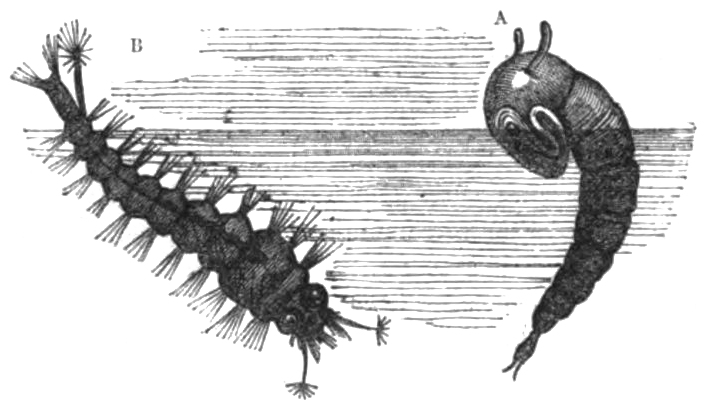
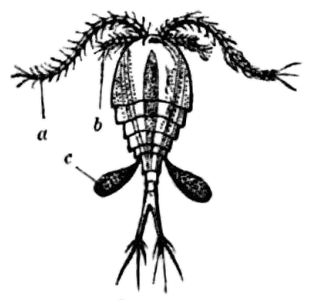
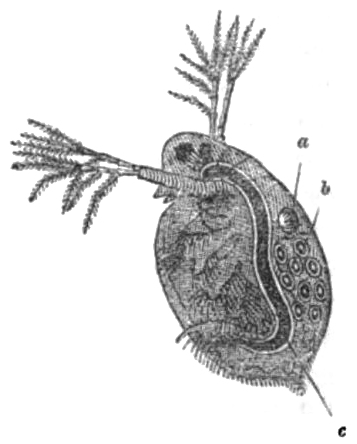
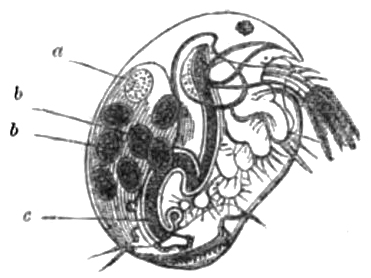
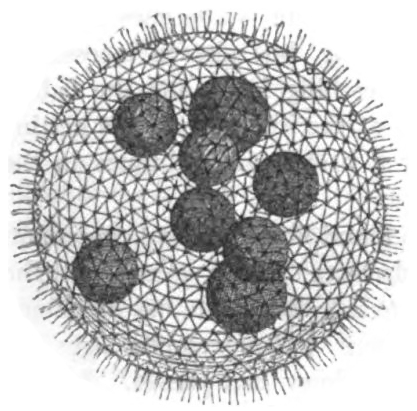
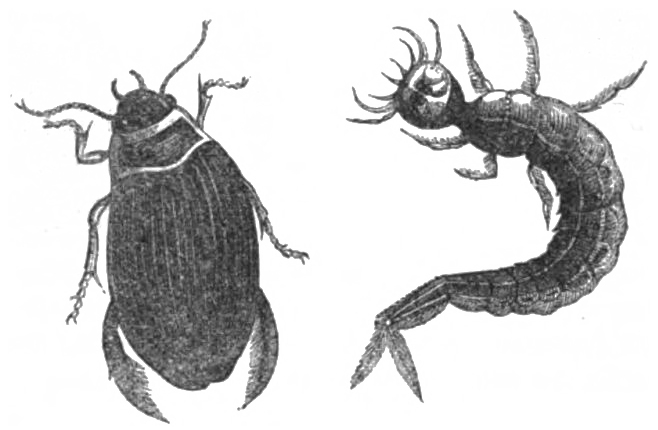
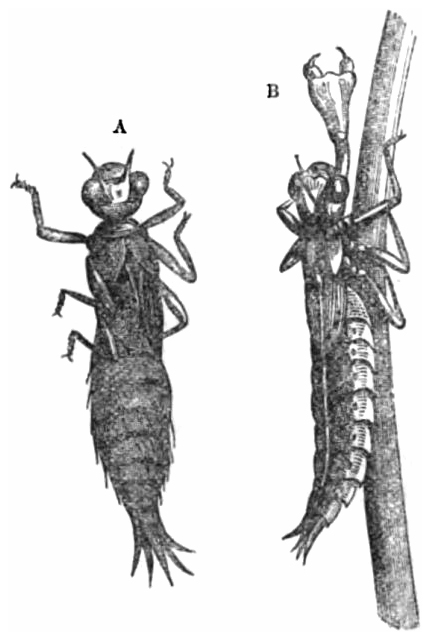
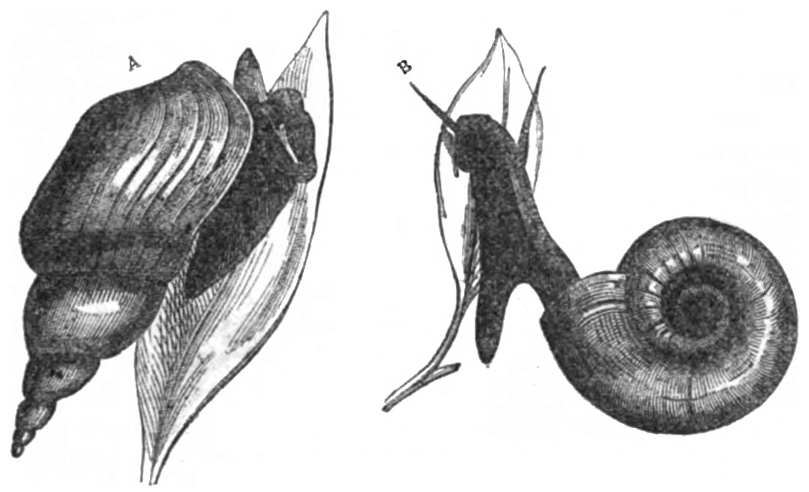
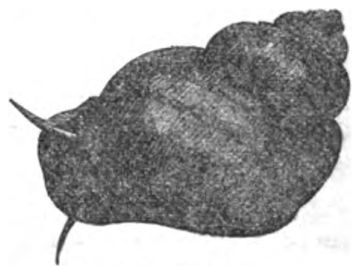
Chapter II.— Ponds and rock-pools— Our necessary tackle— Wimbledon Common— Early memories— Gnat larvæ— Entomostraca and their paradoxes— Races of animals dispensing with the sterner sex— Insignificance of males— Volvox globator: is it an animal?— Plants swimming like animals— Animal retrogressions— The Dytiscus and its larva— The dragon-fly larva— Molluscs and their eggs— Polypes, and how to find them— A new polype, Hydra rubra— Nest-building fish— Contempt replaced by reverence.
Curious, if True. (Extract from a Letter from Richard Whittingham, Esq.)
THE CORNHILL MAGAZINE. FEBRUARY, 1860. — Nil Nisi Bonum. — FOOTNOTES:
Almost the last words which Sir Walter spoke to Lockhart, his biographer,
were, “Be a good man, my dear!” and with the last flicker of breath on his
dying lips, he sighed a farewell to his family, and passed away blessing them.
Two men, famous, admired, beloved, have just left us, the Goldsmith
and the Gibbon of our time. Ere a few weeks are over, many a critic’s
pen will be at work, reviewing their lives, and passing judgment on their
works. This is no review, or history, or criticism: only a word in
testimony of respect and regard from a man of letters, who owes to his own
professional labour the honour of becoming acquainted with these two
eminent literary men. One was the first ambassador whom the New World
of Letters sent to the Old. He was born almost with the republic; the
pater patriæ had laid his hand on the child’s head. He bore Washington’s
name: he came amongst us bringing the kindest sympathy, the most artless,
smiling goodwill. His new country (which some people here might be
disposed to regard rather superciliously) could send us, as he showed in
his own person, a gentleman, who, though himself born in no very high
sphere, was most finished, polished, easy, witty, quiet; and, socially, the
equal of the most refined Europeans. If Irving’s welcome in England
was a kind one, was it not also gratefully remembered? If he ate our
salt, did he not pay us with a thankful heart? Who can calculate the amount
of friendliness and good feeling for our country which this writer’s generous
and untiring regard for us disseminated in his own? His books are read by
millions1 of his countrymen, whom he has taught to love England, and why to
love her. It would have been easy to speak otherwise than he did: to inflame
national rancours, which, at the time when he first became known as a public
writer, war had just renewed: to cry down the old civilization at the
expense of the new: to point out our faults, arrogance, shortcomings,
and give the republic to infer how much she was the parent state’s
superior. There are writers enough in the United States, honest and otherwise,
who preach that kind of doctrine. But the good Irving, the peaceful,
the friendly, had no place for bitterness in his heart, and no scheme but
kindness. Received in England with extraordinary tenderness and friendship
(Scott, Southey, Byron, a hundred others have borne witness to their
liking for him), he was a messenger of goodwill and peace between his
country and ours. “See, friends!” he seems to say, “these English are
not so wicked, rapacious, callous, proud, as you have been taught to believe
them. I went amongst them a humble man; won my way by my pen;
and, when known, found every hand held out to me with kindliness and
welcome. Scott is a great man, you acknowledge. Did not Scott’s king
of England give a gold medal to him, and another to me, your countryman,
and a stranger?”
Tradition in the United States still fondly retains the history of the feasts
and rejoicings which awaited Irving on his return to his native country from
Europe. He had a national welcome; he stammered in his speeches,
hid himself in confusion, and the people loved him all the better. He had
worthily represented America in Europe. In that young community a
man who brings home with him abundant European testimonials is still
treated with respect (I have found American writers of wide-world reputation,
strangely solicitous about the opinions of quite obscure British
critics, and elated or depressed by their judgments); and Irving went home
medalled by the king, diplomatized by the university, crowned, and honoured
and admired. He had not in any way intrigued for his honours, he had
fairly won them; and, in Irving’s instance, as in others, the old country
was glad and eager to pay them.
In America the love and regard for Irving was a national sentiment.
Party wars are perpetually raging there, and are carried on by the press with
a rancour and fierceness against individuals which exceed British, almost
Irish, virulence. It seemed to me, during a year’s travel in the country, as if
no one ever aimed a blow at Irving. All men held their hand from that
harmless, friendly peacemaker. I had the good fortune to see him at
New York, Philadelphia, Baltimore and Washington,2 and remarked how
in every place he was honoured and welcome. Every large city has its
“Irving House.” The country takes pride in the fame of its men of letters.
The gate of his own charming little domain on the beautiful Hudson River
was for ever swinging before visitors who came to him. He shut out no
one.3 I had seen many pictures of his house, and read descriptions of it,
in both of which it was treated with a not unusual American exaggeration.
It was but a pretty little cabin of a place; the gentleman of the press who
took notes of the place, whilst his kind old host was sleeping, might have
visited the whole house in a couple of minutes.
And how came it that this house was so small, when Mr. Irving’s books
were sold by hundreds of thousands, nay, millions, when his profits were
known to be large, and the habits of life of the good old bachelor were
notoriously modest and simple? He had loved once in his life. The
lady he loved died; and he, whom all the world loved, never sought to
replace her. I can’t say how much the thought of that fidelity has touched
me. Does not the very cheerfulness of his after life add to the pathos of
that untold story? To grieve always was not in his nature; or, when he
had his sorrow, to bring all the world in to condole with him and bemoan
it. Deep and quiet he lays the love of his heart, and buries it; and grass
and flowers grow over the scarred ground in due time.
Irving had such a small house and such narrow rooms, because there
was a great number of people to occupy them. He could only afford to
keep one old horse (which, lazy and aged as it was, managed once or twice
to run away with that careless old horseman). He could only afford to
give plain sherry to that amiable British paragraph-monger from New
York, who saw the patriarch asleep over his modest, blameless cup, and
fetched the public into his private chamber to look at him. Irving could
only live very modestly, because the wifeless, childless man had a number
of children to whom he was as a father. He had as many as nine nieces,
I am told—I saw two of these ladies at his house—with all of whom the
dear old man had shared the produce of his labour and genius.
“Be a good man, my dear.” One can’t but think of these last words
of the veteran Chief of Letters, who had tasted and tested the value of
worldly success, admiration, prosperity. Was Irving not good, and, of his
works, was not his life the best part? In his family, gentle, generous,
good-humoured, affectionate, self-denying: in society, a delightful example
of complete gentlemanhood; quite unspoiled by prosperity; never obsequious
to the great (or, worse still, to the base and mean, as some public
men are forced to be in his and other countries); eager to acknowledge
every contemporary’s merit; always kind and affable with the young
members of his calling; in his professional bargains and mercantile dealings
delicately honest and grateful; one of the most charming masters of
our lighter language; the constant friend to us and our nation; to men of
letters doubly dear, not for his wit and genius merely, but as an exemplar
of goodness, probity, and pure life:—I don’t know what sort of testimonial
will be raised to him in his own country, where generous and enthusiastic
acknowledgment of American merit is never wanting: but Irving was in
our service as well as theirs; and as they have placed a stone at Greenwich
yonder in memory of that gallant young Bellot, who shared the perils and
fate of some of our Arctic seamen, I would like to hear of some memorial
raised by English writers and friends of letters in affectionate remembrance
of the dear and good Washington Irving.
As for the other writer, whose departure many friends, some few most
dearly-loved relatives, and multitudes of admiring readers deplore, our
republic has already decreed his statue, and he must have known that he
had earned this posthumous honour. He is not a poet and man of letters
merely, but citizen, statesman, a great British worthy. Almost from the
first moment when he appears, amongst boys, amongst college students,
amongst men, he is marked, and takes rank as a great Englishman. All
sorts of successes are easy to him: as a lad he goes down into the arena
with others, and wins all the prizes to which he has a mind. A place in
the senate is straightway offered to the young man. He takes his seat
there; he speaks, when so minded, without party anger or intrigue, but
not without party faith and a sort of heroic enthusiasm for his cause. Still
he is poet and philosopher even more than orator. That he may have
leisure and means to pursue his darling studies, he absents himself for a
while, and accepts a richly-remunerated post in the East. As learned a
man may live in a cottage or a college common-room; but it always seemed
to me that ample means and recognized rank were Macaulay’s as of right.
Years ago there was a wretched outcry raised because Mr. Macaulay dated
a letter from Windsor Castle, where he was staying. Immortal gods!
Was this man not a fit guest for any palace in the world? or a fit companion
for any man or woman in it? I daresay, after Austerlitz, the old
K. K. court officials and footmen sneered at Napoleon for dating from
Schönbrunn. But that miserable “Windsor Castle” outcry is an echo out
of fast-retreating old-world remembrances. The place of such a natural
chief was amongst the first of the land; and that country is best, according
to our British notion, at least, where the man of eminence has the best
chance of investing his genius and intellect.
If a company of giants were got together, very likely one or two of the
mere six-feet-six people might be angry at the incontestable superiority of
the very tallest of the party: and so I have heard some London wits, rather
peevish at Macaulay’s superiority, complain that he occupied too much of
the talk, and so forth. Now that wonderful tongue is to speak no more,
will not many a man grieve that he no longer has the chance to listen? To
remember the talk is to wonder: to think not only of the treasures he had in
his memory, but of the trifles he had stored there, and could produce with
equal readiness. Almost on the last day I had the fortune to see him, a
conversation happened suddenly to spring up about senior wranglers, and
what they had done in after life. To the almost terror of the persons
present, Macaulay began with the senior wrangler of 1801–2–3–4, and so
on, giving the name of each, and relating his subsequent career and rise.
Every man who has known him has his story regarding that astonishing
memory. It may be he was not ill-pleased that you should recognize it;
but to those prodigious intellectual feats, which were so easy to him, who
would grudge his tribute of homage? His talk was, in a word, admirable,
and we admired it.
Of the notices which have appeared regarding Lord Macaulay, up to
the day when the present lines are written (the 9th of January), the reader
should not deny himself the pleasure of looking especially at two. It is a
good sign of the times when such articles as these (I mean the articles in
The Times and Saturday Review) appear in our public prints about our
public men. They educate us, as it were, to admire rightly. An uninstructed
person in a museum or at a concert may pass by without recognizing
a picture or a passage of music, which the connoisseur by his side
may show him is a masterpiece of harmony, or a wonder of artistic skill.
After reading these papers you like and respect more the person you have
admired so much already. And so with regard to Macaulay’s style there
may be faults of course—what critic can’t point them out? But for the
nonce we are not talking about faults: we want to say nil nisi bonum.
Well—take at hazard any three pages of the Essays or History;—and,
glimmering below the stream of the narrative, as it were, you, an average
reader, see one, two, three, a half-score of allusions to other historic facts,
characters, literature, poetry, with which you are acquainted. Why is this
epithet used? Whence is that simile drawn? How does he manage, in
two or three words, to paint an individual, or to indicate a landscape?
Your neighbour, who has his reading, and his little stock of literature
stowed away in his mind, shall detect more points, allusions, happy
touches, indicating not only the prodigious memory and vast learning
of this master, but the wonderful industry, the honest, humble previous
toil of this great scholar. He reads twenty books to write a sentence; he
travels a hundred miles to make a line of description.
Many Londoners—not all—have seen the British Museum Library.
I speak à cœur ouvert, and pray the kindly reader to bear with me. I have
seen all sorts of domes of Peters and Pauls, Sophia, Pantheon,—what not?—and
have been struck by none of them so much as by that catholic dome in
Bloomsbury, under which our million volumes are housed. What peace,
what love, what truth, what beauty, what happiness for all, what generous
kindness for you and me, are here spread out! It seems to me one cannot
sit down in that place without a heart full of grateful reverence. I own
to have said my grace at the table, and to have thanked heaven for this
my English birthright, freely to partake of these bountiful books, and to
speak the truth I find there. Under the dome which held Macaulay’s brain,
and from which his solemn eyes looked out on the world but a fortnight
since, what a vast, brilliant, and wonderful store of learning was ranged! what
strange lore would he not fetch for you at your bidding! A volume of law,
or history, a book of poetry familiar or forgotten (except by himself who
forgot nothing), a novel ever so old, and he had it at hand. I spoke to him
once about Clarissa. “Not read Clarissa!” he cried out. “If you have
once thoroughly entered on Clarissa, and are infected by it, you can’t
leave it. When I was in India, I passed one hot season at the hills, and
there were the governor-general, and the secretary of government, and the
commander-in chief, and their wives. I had Clarissa with me: and, as
soon as they began to read, the whole station was in a passion of excitement
about Miss Harlowe and her misfortunes, and her scoundrelly Lovelace!
The governor’s wife seized the book, and the secretary waited for it, and
the chief justice could not read it for tears!” He acted the whole scene: he
paced up and down the Athenæum library: I daresay he could have spoken
pages of the book—of that book, and of what countless piles of others!
In this little paper let us keep to the text of nil nisi bonum. One paper
I have read regarding Lord Macaulay says “he had no heart.” Why, a
man’s books may not always speak the truth, but they speak his mind in
spite of himself: and it seems to me this man’s heart is beating through
every page he penned. He is always in a storm of revolt and indignation
against wrong, craft, tyranny. How he cheers heroic resistance; how he
backs and applauds freedom struggling for its own; how he hates scoundrels,
ever so victorious and successful; how he recognizes genius, though selfish
villains possess it! The critic who says Macaulay had no heart, might say
that Johnson had none: and two men more generous, and more loving, and
more hating, and more partial, and more noble, do not live in our history.
The writer who said that Lord Macaulay had no heart could not know
him. Press writers should read a man well, and all over, and again; and
hesitate, at least, before they speak of those αἰδοἴα. Those who knew Lord
Macaulay knew how admirably tender, and generous,4 and affectionate he
was. It was not his business to bring his family before the theatre footlights,
and call for bouquets from the gallery as he wept over them.
If any young man of letters reads this little sermon—and to him, indeed,
it is addressed—I would say to him, “Bear Scott’s words in your mind, and
‘be good, my dear.’” Here are two literary men gone to their account, and,
laus Deo, as far as we know, it is fair, and open, and clean. Here is no need of
apologies for shortcomings, or explanations of vices which would have been
virtues but for unavoidable &c. Here are two examples of men most
differently gifted: each pursuing his calling; each speaking his truth as
God bade him; each honest in his life; just and irreproachable in his
dealings; dear to his friends; honoured by his country; beloved at his fireside.
It has been the fortunate lot of both to give uncountable happiness
and delight to the world, which thanks them in return with an immense
kindliness, respect, affection. It may not be our chance, brother scribe, to be
endowed with such merit, or rewarded with such fame. But the rewards of
these men are rewards paid to our service. We may not win the baton or
epaulettes; but God give us strength to guard the honour of the flag!
1 See his Life in the most remarkable Dictionary of Authors, published lately at
Philadelphia, by Mr. Alibone.
2 At Washington, Mr. Irving came to a lecture given by the writer, which Mr.
Filmore and General Pierce, the president and president elect, were also kind enough
to attend together. “Two Kings of Brentford smelling at one rose,” says Irving,
looking up with his good-humoured smile.
3 Mr. Irving described to me, with that humour and good humour which he always
kept, how, amongst other visitors, a member of the British press who had carried his
distinguished pen to America (where he employed it in vilifying his own country) came
to Sunnyside, introduced himself to Irving, partook of his wine and luncheon, and in
two days described Mr. Irving, his house, his nieces, his meal, and his manner of dozing
afterwards, in a New York paper. On another occasion, Irving said, laughing: “Two
persons came to me, and one held me in conversation whilst the other miscreant took
my portrait!”
4 Since the above was written, I have been informed that it has been found, on
examining Lord Macaulay’s papers, that he was in the habit of giving away more than
a fourth part of his annual income.
Invasion Panics. — FOOTNOTES:
When, about the year 1899, Field-marshal Dowbiggin, full of years and
honours, shall edit, with copious notes, the Private Correspondence of his
kinsman, Queen Victoria’s celebrated War Minister during England’s
bloody struggle with Russia in 1854–5, the grandchildren of the present
generation may probably learn a good deal more respecting the real causes
of the failures and shortcomings of that “horrible and heartrending” period
than we, their grandfathers, are likely to know on this side our graves.
And when some future Earl of Pembroke shall devote his splendid
leisure, under the cedar groves of Wilton, to preparing for the information
of the twentieth century the memoirs of his great ancestor, Mr. Secretary
Herbert, posterity will then run some chance of discovering—what is kept
a close secret from the public just now—whether any domestic causes exist
to justify the invasion-panic under which the nation has recently been
shivering.
The insular position of England, her lofty cliffs, her stormy seas, her
winter fogs, fortify her with everlasting fortifications, as no other European
power is fortified. She is rich, she is populous, she contains within herself
an abundance of coal, iron, timber, and almost all other munitions of war;
railways intersect and encircle her on all sides; in patriotism, in loyalty,
in manliness, in intelligence, her sons yield to no other race of men.
Blest with all these advantages, she ought, of all the nations of Europe,
to be the last to fear, the readiest to repel invasion; yet, strange to say, of
all the nations of Europe, England appears to apprehend invasion most!
There must be some good and sufficient reason for this extraordinary
state of things. Many reasons are daily assigned for it, all differing from
each other, all in turn disputed and denied by those who know the real
reason best.
The statesman and the soldier declare that the fault lies with parliament
and the people. They complain that parliament is niggardly in placing
sufficient means at the disposal of the executive, and that the people are
distrustful and over-inquisitive as to their application; ever too ready to
attribute evil motives and incapacity to those set in authority over them.
Parliament and the people, on the other hand, reply, that ample means are
yearly allotted for the defence of the country, and that more would readily
be forthcoming, had they reason to suppose that what has already been
spent, has been well spent; their Humes and their Brights loudly and
harshly denounce the nepotism, the incapacity, and the greed, which,
according to them, disgrace the governing classes, and waste and weaken
the resources of the land. And so the painful squabble ferments—no
probable end to it being in view. Indeed, the public are permitted to know
so little of the conduct of their most important affairs—silence is so
strictly enjoined to the men at the helm—that the most carefully prepared
indictment against an official delinquent is invariably evaded by the introduction
of some new feature into his case, hitherto unknown to any but his
brother officials, which at once casts upon the assailant the stigma of having
arraigned a public servant on incomplete information, and puts him out
of court.
But if, in this the year of our Lord 1860, we have no means of
discovering why millions of strong, brave, well-armed Englishmen should
be so moved at the prospect of a possible attack from twenty or thirty
thousand French, we have recently been placed in possession of the means
of ascertaining why, some sixty years ago, this powerful nation was afflicted
with a similar fit of timidity.
The first American war had then just ended—not gloriously for the
British arms. Lord Amherst, the commander-in-chief at home, had been
compelled by his age and infirmities to retire from office, having, it was
said, been indulgently permitted by his royal master to retain it longer
than had been good for the credit and discipline of the service. The Duke of
York, an enthusiastic and practical soldier, in the prime of life, fresh from
an active command in Flanders, had succeeded him. In that day there were
few open-mouthed and vulgar demagogues to carp at the public expenditure
and to revile the privileged classes; and the few that there were had
a very bad time of it. Public money was sown broadcast, both at home
and abroad, with a reckless hand; regulars, militia, yeomanry, and volunteers,
fearfully and wonderfully attired, bristled in thousands wherever a
landing was conceived possible; and, best of all, that noble school of
Great British seamen, which had reared us a Nelson, had reared us many
other valiant guardians of our shores scarcely less worthy than he. But
in spite of her Yorks and her Nelsons, England felt uneasy and unsafe.
Confident in her navy, she had little confidence in her army, which at
that time was entirely and absolutely in the hands and under the
management of the court; parliament and the people being only permitted
to pay for it.
Yet the royal commander-in-chief was declared by the general officers
most in favour at court to know his business well, and to be carrying
vigorously into effect the necessary reforms suggested by our American
mishaps; his personal acquaintance with the officers of the army was said
to have enabled him to form his military family of the most capable men
in the service;5 his exalted position, and his enormous income, were
supposed to place him above the temptation of jobbing: in short, the
Duke of York was universally held up to the nation by his military
friends—and a royal commander-in-chief has many and warm military
friends—as the regenerator of the British army, which just then happened
to be sadly in need of regeneration.
A work has recently been published which tells us very plainly now
many things which it would have been treasonable even to suspect sixty
years ago. It is entitled The Cornwallis Correspondence, and contains the
private papers and letters of the first Marquis Cornwallis, one of the
foremost Englishmen of his time. Bred a soldier, he served with distinction
in Germany and in America. He then proceeded to India in the
double capacity of governor-general and commander-in-chief. On his
return from that service he filled for some years the post of master-general
of the Ordnance, refused a seat in the Cabinet, offered him by Mr. Pitt;
and, although again named governor-general of India, on the breaking out
of the Irish rebellion of 1798 was hurried to Dublin as lord-lieutenant
and commander-in-chief. He was subsequently employed to negotiate
the peace of Amiens, and, in 1805, died at Ghazeepore, in India, having
been appointed its governor-general for the third time.
From the correspondence of this distinguished statesman and soldier,
we may now ascertain whether, sixty years ago, the people of England had
or had not good grounds for dreading invasion by the French, and whether
the governing classes or the governed were most in fault on that occasion
for the doubtful condition of their native land.
George the Third was verging upon insanity. So detested and despised
was the Prince of Wales, his successor, that those who directed his Majesty’s
councils, as well as the people at large, clung eagerly to the hopes of the
king’s welfare; trusting that the evil days of a regency might be postponed.
And it would seem from the Cornwallis Correspondence, that the
English were just in their estimation of that bad man. H. R. H. having
quarrelled shamefully with his parents, and with Pitt, had thrown himself
into the hands of the Opposition, and appears to have corresponded occasionally
with Cornwallis, who had two votes at his command in the
Commons, during that nobleman’s first Indian administration. In 1790,
Lord Cornwallis, writing to his brother, the Bishop of Lichfield and
Coventry, says: “You tell me that I am accused of being remiss in my
correspondence with a certain great personage. Nothing can be more false,
for I have answered every letter from him by the first ship that sailed from
hence after I received it. The style of them, although personally kind
to excess, has not been very agreeable to me, as they have always pressed
upon me some infamous and unjustifiable job, which I have uniformly been
obliged to refuse, and contained much gross and false abuse of Mr. Pitt, and
improper charges against other and greater personages, about whom, to me
at least, he ought to be silent.”6
The intimacy which had existed from boyhood between General
Richard Grenville, military tutor to the Duke of York, and Lord Cornwallis,
and the correspondence which took place between them, to which we have
now access, afford ample means of judging of the real capacity of that royal
soldier, to whose charge the military destinies of England, both at home and
abroad, were intrusted by the king at such a critical moment.
At seventeen years of age the duke became, per saltum, as the usage is
with royal personages, a colonel in the British army. After attending for
two or three years the great Prussian reviews, by way of studying his profession,
he was, on attaining his majority, raised to the rank of general, and
appointed colonel of the Coldstream Guards. Various notices of H. R. H.
are to be found in the numerous confidential letters which passed about that
time between Cornwallis and Grenville. They were both warmly attached
to him; both most anxious for his own sake, and for that of their profession,
that he should turn out well.
They describe H. R. H. as brave, good-humoured, and weak; utterly
destitute of military talent, incapable of attending to business, much given
to drink, and more to dice, hopelessly insolvent, and steeped in debauchery
and extravagance of all kinds. In 1790, Grenville writes to Cornwallis
in India: “The conduct of a certain great personage, who has so cruelly
disappointed both you and myself, still continues to give me great uneasiness;
more especially as I see no hopes of amendment.” The duke was at
that date twenty-seven years of age.
In 1791, the Duke of York married, and but two years afterwards
Lord Cornwallis, on his return from India, actually found his friend
Grenville’s unpromising pupil in Flanders, at the head of a considerable
English force, acting in conjunction with the Austrians, Russians, and
Dutch, against the French. His utter want of military talent, his inexperience,
his idleness, and his vices had not prevented his being intrusted by
his royal parent with the lives of a large body of brave men, and with the
honour of England. Great difficulties soon arose in this allied army, its
chiefs mutually accusing each other, possibly not without good reason, of
incapacity. At last, a person, whose name is not even now divulged, but
who possessed the entire confidence of both Pitt and Cornwallis, wrote
as follows, from the British head-quarters at Arnheim, on the 11th Nov.
1794:—
“We are really come to such a critical situation, that unless some
decided, determined, and immediate steps are taken, God knows what may
happen. Despised by our enemies, without discipline, confidence, or
exertion among ourselves, hated and more dreaded than the enemy, even
by the well-disposed inhabitants of the country, every disgrace and misfortune
is to be expected. You must thoroughly feel how painful it must be
to acknowledge this even to your lordship, but no honest man who has any
regard for his country can avoid seeing it. Whatever measures are adopted
at home, either removing us from the continent or remaining, something
must be done to restore discipline, and the confidence that always attends
it. The sortie from Nimeguen, on the 4th, was made entirely by the
British, and executed with their usual spirit; they ran into the French
without firing a single shot, and, consequently, lost very few men,—their
loss was when they afterwards were ordered to retire. Yet from what I
have mentioned in the first part of my letter, I assure you I dread the
thought of these troops being attacked or harassed in retreat.”7
Upon the receipt of this grave intelligence, Mr. Pitt at once communicated
to the king the absolute necessity of the duke’s immediate recall. His
Majesty had no choice but to consent, which he reluctantly did; and
H. R. H. returned home, was immediately created a field-marshal, and
placed in command of all the forces of the United Kingdom!
Lord Cornwallis’s bitter remark upon this astounding appointment is—“Whether
we shall get any good by this, God only knows; but I think
things cannot change for the worse at the Horse Guards. If the French
land, and that they will land I am certain, I should not like to trust the
new field-marshal with the defence of Culford.”8
Having thus practically ascertained, at an enormous cost of blood and
treasure, that the best-tempered and bravest general cannot command with
success a British army in the field, if he happens, as was the case with
the Duke of York, to be a weak man of high social position, destitute of
military talent and habits of business, and much addicted to pleasure, an
examination of Lord Cornwallis’s correspondence during the next few years
will show how it fared with the British army when it was directed by such
an officer at home.
In expressing his conviction that the French were determined to invade
us, Lord Cornwallis proved a true prophet. Late in 1796, a fleet,
commanded by Admiral De Galle, sailed from Brest for Ireland, carrying
General Hoche and 15,000 men. Furious December gales dispersed the
French ships,—only a portion of the expedition reached Bantry Bay; the
vessel in which De Galle and Hoche were, was missing. Admiral Boivet,
the second in command, hesitated to disembark the troops without the
orders of his superiors. The United Irishmen, who had promised instant
co-operation, made no sign; the weather rendered even Bantry Bay insecure;
and, finally, such of the ships as escaped wreck or capture, straggled
back to France, where Hoche and De Galle, after cruising about for many
days in fog and storm on the banks of Newfoundland, had had the good
luck to arrive before them. On that occasion, our natural defences may
indeed be said to have stood us in good stead. But it was not consolatory
to those who feared invasion to reflect that such a large force should
have succeeded in reaching our shores unperceived and unmolested by the
British cruisers; and that, had the weather been tolerable, 15,000 French
bayonets would have landed without opposition on Irish ground.
The next year passed over in constant alarms; our information respecting
the local preparations of the French being unfortunately very
vague. The military defence of England appears to have been at that time
mainly intrusted to Sir David Dundas, an unlucky pedant of the German
school of tactics, of whom the king and court had the highest opinion, so
tightly had he dressed and so accurately had he drilled the Guards. Lord
Cornwallis, writing early in 1798 to the Hon. Col. Wesley,9 says:—“We
are brought to the state to which I have long since looked forward, deserted
by all our allies, and in daily expectation of invasion, for which the French
are making the most serious preparations. I have no doubt of the courage
and fidelity of our militia; but the system of David Dundas, and the total
want of light infantry, sit heavy on my mind, and point out the advantages
which the activity of the French will have in a country which
is for the most part enclosed.”
At this juncture, the rebellion of 1798 broke out in Ireland, and at the
urgent request of Ministers, who appear to have considered Lord Cornwallis
the man for every difficulty, his lordship consented to undertake the joint
duties of lord-lieutenant and commander-in-chief in that unhappy country,
then as disturbed and disloyal as conflicting races and religions, and the
most savage misgovernment, could make it.
His lordship’s letters to the Duke of Portland and others, from Dublin,
evince far more apprehension at the violence, cruelty, and insubordination
of the army under his command, than at the rebels who were up in arms
against him. His words are:—“The violence of our friends, and their
folly in endeavouring to make this a religious war, added to the ferocity
of our troops, who delight in murder, most powerfully counteract all plans
of conciliation.” Nevertheless his judgment, firmness, and temper soon
prevailed; by midsummer the insurrection was suppressed with far less
bloodshed than was pleasing to the supporters of the government; and
Lord Cornwallis was endeavouring to concentrate his attention on the
reorganization of the military mob, which then, under the name of
soldiers, garrisoned Ireland against foreign and domestic foes, when the
invader actually arrived.10
On the 22nd of August, three frigates under English colours anchored
in Killala Bay, co. Mayo, carrying a force of about 1,100 French troops,
commanded by General Humbert. They were the vanguard of a larger
force under General Hardy, which was to have sailed at the same time,
but which had been detained by unforeseen difficulties at Brest.
There being no sufficient force to oppose them, the French easily took
possession of Killala, and established their head-quarters in the palace
of the bishop, Dr. Stock, who has left a most interesting journal of what
occurred whilst the French occupied the town.
Humbert had brought with him a large supply of arms, ammunition,
and uniforms, to be distributed amongst the United Irishmen, who he had
been led to suppose would instantly rally round his standard. But he soon
discovered that he had been deceived, that he had landed in the wrong place,
and that he had arrived too late. The peasantry of Mayo, a simple and
uncivilized race, ignorant of the use of fire-arms, crowded round the invaders
as long as they had anything to give, and as long as there was no enemy
to fight; but, at the first shot, they invariably ran away. Besides, the neck
of the rebellion had been already dislocated by the judicious vigour of
Cornwallis. Had the landing been effected earlier, and farther north, the
result might have been different; as it was, the French general found that
he had a losing game to play—and most manfully and creditably did
he play it.
Professing to wage no war against the Irish, he assured the bishop that
neither pillage nor violence should be permitted, and that his troops should
only take what was absolutely necessary for their subsistence; and on these
points, the bishop tells us, the Frenchman “religiously kept his word;”
not only controlling his own soldiers, but actually protecting the bishop and
his little Protestant flock from the rapacity of the Irish rebels who for a
time joined the invaders.
The bishop’s account of the French soldiery is notable; they appear to
have been an under-sized and mean-looking set of men, whom Sir David
Dundas would have held in no account on parade; yet they did the work
they had to do, hopeless and fatal as it was, as well as the Duke of York’s
own gigantic regiment of guards could have done it.
“The French,” says the bishop, “are a nation apt enough to consider
themselves as superior to any people in the world; but here, indeed, it
would have been ridiculous not to prefer the Gallic troops in every respect
before their Irish allies. Intelligence, activity, temperance, patience to a
surprising degree, appeared to be combined in the soldiery that came over
with Humbert, together with the exactest obedience to discipline. Yet, if
you except their grenadiers, they had nothing to catch the eye: their
stature for the most part was low, their complexions pale and sallow, their
clothes much the worse for wear; to a superficial observer they would
have appeared incapable of enduring almost any hardship. These were the
men, however, of whom it was presently observed that they could be well
content to live on bread and potatoes, to drink water, to make the stones of
the street their bed, and to sleep in their clothes, with no covering but the
canopy of heaven. One half of their number had served in Italy under
Buonaparte, the rest were from the army of the Rhine, where they had
suffered distresses that well accounted for thin persons and wan looks.”
Humbert himself, who had accompanied the Bantry Bay expedition in
1796, had risen from the ranks, and had brought himself into notice by his
brilliant conduct in La Vendée.
The day after landing, the French advanced towards Ballina, leaving
at Killala six officers and two hundred men to guard a quantity of ammunition
which they had no means of carrying with them. The English
garrison of Ballina fled on their approach, and Humbert, stationing there
one hundred more of his men, pushed on to Castlebar, where General Lake
was prepared to meet him. The latter had previously ascertained, by means
of a flag of truce, the exact number of the French, and had sent a message
privily to the bishop, telling him to be of good cheer, inasmuch as the great
superiority of his own numbers would speedily enable him to give a good
account of the invading force. What did occur when the French and
English met is, perhaps, best told in the words of General Hutchinson,
Lake’s second in command during the affair. Contemporary authorities,
however, prove that Hutchinson has very much understated the numbers
of the English force:—
“On Monday morning, 27th August, about an hour before sunrise, a
report was received from the outposts, distant about six miles, that the
enemy was advancing. The troops were immediately assembled, having
the night before received orders to be under arms two hours before day-break.
The troops and cannon were then posted on a position previously
taken, where they remained until seven o’clock. They were 1,600 or
1,700 cavalry and infantry, ten pieces of cannon and a howitzer. The
ground was very strong by nature; the French were about 700, having
left 100 at Ballina and 200 at Killala. They did not land above 1,000
rank and file. They had with them about 500 rebels, a great proportion
of whom fled after the first discharge of cannon. The French had only
two 4-pounders and from thirty to forty mounted men.
“Nothing could exceed the misconduct of the troops, with the exception
of the artillery, which was admirably served, and of Lord Roden’s
Fencibles, who appeared at all times ready to do their duty. There is too
much reason to imagine that two of the regiments had been previously
tampered with; the hope of which disaffection induced the French to
make the attack, which was certainly one of the most hazardous and
desperate ever thought of against a very superior body of troops, as their
retreat both on Killala and Ballina was cut off by Sir Thomas Chapman
and General Taylor.
“When the troops fell into confusion without the possibility of rallying
them, there was scarcely any danger; very few men had at that time
fallen on our part: the French, on the contrary, had suffered considerably.
They lost six officers and from 70 to 80 men, which was great, considering
how short a time the action lasted and the smallness of their numbers.
I am convinced that had our troops continued firm for ten minutes longer,
the affair must have been over to our entire advantage, but they fired
volleys without any orders at a few men before they were within musket-shot.
It was impossible to stop them, and they abandoned their ground
immediately afterwards.”
Although the French did not attempt to pursue, the defeated army of
Lake never halted till they reached Tuam, nearly forty English miles from
the field of battle. On the evening of the same day they renewed
their flight, and retired still farther towards Athlone, where an officer of
Carabineers, with sixty of his men, arrived at one o’clock on Tuesday,
the 29th August, having achieved a retreat of above seventy English
miles in twenty-seven hours! All Lake’s artillery fell into the hands of
the French. As soon as Lord Cornwallis heard of the invasion, conscious
of the uncertain temper of the troops upon whom he had to rely, he
determined to march in person to the west, collecting, as he came, such
a force as must at once overwhelm the enemy.
Meantime the victorious French were met on the 5th of September at
Colooney by Colonel Vereker, of the Limerick Regiment, an energetic
officer, who had hastened from Sligo to attack them with 200 infantry,
30 dragoons, and two guns. After a gallant struggle he was compelled
to retire with the loss of his guns, and the French advanced into Leitrim,
hoping to find elsewhere stouter and more helpful allies than they had
hitherto found amongst the half-starved cottiers of Mayo.
Crawford, afterwards the celebrated leader of the light division in
Spain, rashly attacked them on the 7th of September with an inferior
force near Ballynamore, and was very roughly handled by them; but on
the 8th, Humbert, closely followed by Lake and Crawford, found himself
confronted at Ballynamuck by Cornwallis and the main army. In this
desperate situation, surrounded by upwards of 25,000 men, Humbert
coolly drew up his little force, with no other object, it must be presumed,
than to maintain the honour of the French flag. His rearguard, again
attacked by Crawford, surrendered, but the remainder of the French continued
to defend themselves for about half-an-hour longer, and contrived
to take prisoner Lord Roden and some of his dragoons. They then, on
the appearance of the main body of General Lake’s army, laid down
their arms—746 privates and 96 officers; having lost about 200 men
since their landing at Killala, on the 22nd of August.
The loss of the British at the battle of Ballynamuck was officially
stated at three killed, and thirteen wounded. Their losses at Castlebar
and elsewhere were never communicated to the public.
Plowden, who gives a detailed account of Humbert’s invasion in his
Historical Review of the State of Ireland, published but five years after
the event, observes:—“It must ever remain a humiliating reflection upon
the power and lustre of the British arms that so pitiful a detachment as
that of 1,100 French infantry should, in a kingdom in which there was an
armed force of above 150,000 men, have not only put to rout a select
army of 6,000 men prepared to receive the invaders, but also provided
themselves with ordnance and ammunition from our stores, taken several
of our towns, marched 122 Irish (above 150 English) miles through the
country, and kept arms in their victorious hands for seventeen days in the
heart of an armed kingdom. But it was this English army which the
gallant and uncompromising Abercromby had, on the 26th of the preceding
February, found ‘in such a state of licentiousness as must render
it formidable to every one but the enemy.’”
Although the private letters of Lord Cornwallis, General Lake and
Captain Herbert Taylor, which are now submitted to us, breathe nothing
but indignation and disgust at the misconduct, insubordination, and cruelty
of their panic-stricken troops, the public despatches, as the custom is,
contain unalloyed praise.
A lengthy despatch penned by General Lake, on the evening of the
surrender of Humbert’s little band, is worded almost as emphatically as
Wellington’s despatch after Waterloo; about thirty officers are especially
mentioned in it by name, and the conduct of the cavalry is sub-sarcastically
described as having been “highly conspicuous.” Lord Cornwallis’s general
order, too, dated on the following day, declares “that he cannot too much
applaud the zeal and spirit which has been manifested by the army from
the commencement of the operations against the invading enemy until the
surrender of the French forces.” Such is too often the real value of official
praise.
Notwithstanding this public testimony to the worth of the large army
which surrounded and captured the handful of French invaders of 1798,
the information which we now glean from The Cornwallis Correspondence
serves but little to establish the Duke of York’s character as a successful
military administrator, if a commander-in-chief is to be judged of by the
effective state of the officers and troops under his direction.
Tired of the parade-ground and the desk, or, possibly, feeling that he
did not shine at them, H. R. H. again tried his hand at active campaigning
in 1799, and again failed. On the 9th of September of that year he once
more sailed for Holland, and was actually permitted to assume the direction
of the most considerable expedition that ever left the British shores. In
conjunction with Russia, its object was to expel the French from Holland.
After several bloody battles, fought with doubtful success, the duke found
himself, in less than five weeks, so situated as to render it advisable for him
to treat with the enemy. He proposed that the French should allow the
allied army under his command to re-embark, threatening to destroy the
dykes and ruin the surrounding country if his proposal was not entertained.
After some discussion the French agreed to the re-embarkation of the allies,
provided they departed before the 1st of November, left behind them all
the artillery they had taken, and restored 8,000 French and Batavian
prisoners who had been captured on former occasions. On these terms
“a British king’s son, commanding 41,000 men, capitulated to a French
general who had only 30,000,”11 and the duke, fortunately for England,
sheathed his sword, to draw it no more on the field of battle.
Lord Cornwallis writes on the 24th October: “By private letters which
I have seen from Holland, our troops in general seem to have been in the
greatest confusion, and on many occasions to have behaved exceedingly ill.
There may be some exception in the corps belonging to Abercromby’s
division. Considering the hasty manner in which they were thrown
together, and the officers by whom they were commanded, I am not
surprised at this. Would to God they were all on board! I dread the
retreat and embarkation. David Dundas will never be like Cæsar, the
favourite of fortune; hitherto, at least, that fickle goddess has set her face
very steadily against him.” “I see no prospect of any essential improvement
in our military system, for I am afraid that a buttoned coat, a heavy
hat and feather, and a cursed sash tied round our waist will not lead the
way to victory.”
The abortive expeditions against Ostend and Ferrol, which had terminated
in the capture and disgrace of the troops employed in them, appear to
have induced Lord Cornwallis to draw up a memorandum on the subject,
and to submit it to the duke. The following is an extract from it:—
“I admit that while we are at war, and have the means of acting, we
should not remain entirely on the defensive, but at the same time I would
not go lightly in quest of adventures, with regiments raised with extreme
difficulty, without means of recruiting, and commanded principally by
officers without experience or knowledge of their profession. The expense,
likewise, of expeditions is enormous, and the disgrace attending upon ill
success is not likely to promote that most desirable object—a good peace.”
After the re-embarkation of the Ferrol expedition, he writes: “The
prospect of public affairs is most gloomy. What a disgraceful and what an
expensive campaign have we made! Twenty-two thousand men, a large
proportion not soldiers, floating round the greater part of Europe the scorn
and laughing-stock of friends and foes.”
In the spring of 1801, Lord Cornwallis, replaced in Ireland by Lord
Hardwicke and Sir W. Medows, assumed the command of the eastern
district in England—invasion appearing imminent. His letters to his
friend Ross at this period are most desponding. Our best troops were
abroad upon expeditions. One barren success in Egypt, with which
ministers attempted to gild half-a-dozen failures, had cost us the gallant
Abercromby. The defence of the country was intrusted to the militia.
The Duke of York had actually proposed to introduce a Russian force
to coerce and civilize Ireland, and would have done so had not the better
sense and feeling of Cornwallis prevailed. “My disgrace must be
certain,” writes he to Ross, “should the enemy land. What could
I hope, with eight weak regiments of militia, making about 2,800
firelocks, and two regiments of dragoons?”... “In our wooden
walls alone must we place our trust; we should make a sad business of it
on shore.”... “If it is really intended that —— should defend
Kent and Sussex, it is of very little consequence what army you place
under his command.”... “God send that we may have no occasion
to decide the matter on shore, where I have too much reason to apprehend
that the contest must terminate in the disgrace of the general and the
destruction of the country.”... “I confess that I see no prospect of
peace, or of anything good. We shall prepare for the land defence of
England by much wild and capricious expenditure of money, and if the
enemy should ever elude the vigilance of our wooden walls, we shall after
all make a bad figure.”12
Bad as matters had been at the time of Humbert’s invasion, it is clear
that Lord Cornwallis believed our military affairs to be in a much worse
condition in 1801.
In Ireland, in 1798, he had under him a few officers on whom he could
depend, and although his army, thanks to Lord Amherst and the Duke of
York, was in a deplorable state of discipline, he, a good and practised
general, was at its head, to make the best of it.
The Duke of Wellington has since taught us, on more than one
occasion, that there are some extraordinary workmen who can do good
work with any tools, and who can even make their own tools as they
require them.—But in England, in 1801, the military workmen in court
employ were all so execrably bad, that it mattered little what was the
quality of the tools supplied to them. The Duke of York, David Dundas,
and Lord Chatham had everything their own way: the most important posts,
the most costly expeditions, were intrusted, not to the officers most formidable
to the enemy, but to the friends and protégés of the military courtiers who
stood best at Windsor and St. James’s. It is no small proof of Cornwallis’s
tact in judging of men, that whilst we find him deprecating the employment
in independent commands of such generals as the Dukes of Gloucester and
Cumberland, Dundas, Burrard (of Cintra), Coote (of Ostend), Pulteney (of
Ferrol), Whitelock (of Buenos Ayres), and Lord Chatham (of Walcheren), he
had always a word of approval for Lake and Abercromby, and in an introductory
letter to Sir John Shore, speaks of the lieutenant-colonel of his own
regiment, the Hon. Arthur Wesley, as a “sensible man and a good officer.”
Throughout the whole of The Cornwallis Correspondence, there is no
single hint of stinted means for the defence of the country, there is no
single doubt cast upon the personal bravery of our officers and our men;
but there are many out-spoken complaints of utter incompetence and
reckless extravagance on the part of those who had the chief conduct of
our military affairs. From 1795 to 1805—that time of fear—we have
now incontrovertible testimony that both England and Ireland were in
an indefensible condition, had an invader landed with a very moderate
body of such soldiers as Humbert led; and that that condition was owing
in no degree to any want of manliness or liberality on the part of the
British nation, but solely and entirely to the want of capacity of the men
whom it pleased the court, in spite of repeated disgrace and defeat, perversely
to maintain in the management and command of the army.13
Mr. Pitt survived Lord Cornwallis but a few months, dying early in
1806, and Lord Grenville, when invited by George III. to succeed him,
positively declined to do so, unless the army was placed under ministerial
control. To this innovation the poor crazy king demurred. It had been
an amusement and an occupation to him in his lucid intervals, “to transact
military business with Frederick,” with what deplorable results to the
resources and credit of the nation we now know.14 His Majesty objected,
that ever since the time of the first Duke of Cumberland, the army had
been considered as under the exclusive control of the sovereign, without
any right of interference on the part of his ministers, save in matters
relating to levying, clothing, feeding, and paying it; and he expressed a
strong disinclination to make any concession which should fetter himself,
and the Duke of York, in doing as they pleased with their own.
Lord Grenville, however, remained firm; for, in the opinion of himself
and his friends, the safety of the kingdom required that he should be so,
and, ultimately, the king gave way, on condition that no changes should be
carried into effect at the Horse Guards without his knowledge and approval.
But other and more complaisant advisers soon replaced Lord Grenville,
and circumstances, entirely corroborative of the estimate which Grenville
and Cornwallis had formed of his character, rendered it advisable that the
Duke of York should retire from public life.15 Sir David Dundas, notoriously
one of the most incapable and unfit general officers in the service, was
selected by the court as H. R. H.’s successor; and, about two years afterwards,
George III. finally disappeared from the scene, and the Regency commenced.16
Then the duke, in spite of all that had transpired, was instantly
recalled by his royal brother to Whitehall, where he remained until his
death. The Regent was not the man to waive one iota of what he held to
be his prerogative. During his reign, the right of the Crown to the irresponsible
direction of the British army was fully asserted; and, in spite
of five years of almost unvaried success in the Peninsula, and of the
crowning glory of Waterloo, a fantastically dressed, luxurious, and unpopular
body it became under the royal auspices. To the present day,
regimental officers, fond of their glass, bless his Majesty for what is
called “the Prince Regent’s allowance,” a boon which daily ensures to
them a cheap after-dinner bottle of wine, at a cost to their more abstemious
brother officers, and to taxpayers in general, of 27,000l. a year.
Happily for the present generation, matters have changed since those
corrupt times, in many—many respects for the better. The British army
is no longer looked upon by the people as a costly and not very useful toy,
chiefly maintained for the diversion of royalty; we now recognize and
respect in it an important national engine, for the proper condition and
conduct of which—as for that of the navy—a Secretary of State is directly
responsible to Parliament. But a change of such magnitude has not been
carried out without much peevish remonstrance and factious opposition on
the part of the many whose patronage it has diminished, and whose power
it has curtailed; and there are still not a few who offer what opposition
they dare to its harmonious consummation.
It is to be feared that a slight leaven of the same spirit which, sixty
years ago, wasted the resources and paralyzed the energies of this powerful
nation, may, perchance, still linger around the precincts of Whitehall and
St. James’s,—and it is not impossible that when the Smith and Elder of the
twentieth century present to the public their first editions of the Panmure
Papers and the Herbert Memoirs, facts, bearing on the disasters of the
Crimean war, and on the invasion panic of 1859–60, may for the first
time be made known—not entirely different from those with which we
have recently become acquainted through The Cornwallis Correspondence.
5 “The duke has very unwisely taken over three or four boys of the Guards as his
aides-de-camp: which will be of great disservice to him, and can be of no use to them.”—Lord
Cornwallis to Lt.-Col. Ross, 1784.
6 Three or four of the Prince of Wales’s letters are given at length. They all prove
“the first gentleman and scholar of his day” to have been a very illiterate and unscrupulous
jobber. In one of them he proposed to the Governor-General to displace “a
black, named Alii Cann,” who was chief criminal judge of Benares, in order that a
youth, named Pellegrine Treves, the son of a notorious London money-lender, might be
appointed to that office.
Lord Cornwallis replied, that Ali Ibrahim Khan, though a native, was one of the
most able and respected public servants in India, and that it would be a most difficult
and unpopular step to remove him; and that even if his post were vacant, the youth
and inexperience of the money-lender’s son rendered him utterly ineligible for such an
important trust. One of the causes of complaint which H. R. H. urged against his
royal parent was, that he, also, was not intrusted with high military command.
7 The sufferings of the British soldiers in Holland, in 1794–5, from the incompetence
and negligence of their superior officers, and the waste of public money from the
same causes, have scarcely been exceeded during the Crimean war. In Lord Malmesbury’s
Diary we find the following entry on the 7th Dec. 1793: “Lord Herbert came
to see me. Complained much of the insubordination of the army; that it was greater
than could be believed, and that the Guards were so beyond measure. Condemned the
conduct of Gage, who had resigned on being refused leave of absence.” On the 16th
of Feb. 1794, the Duke of Portland writes to Lord Malmesbury: “The Duke of York
will return to the army the latter end of next week. But I cannot help saying that
unless the licentious, not to say mutinous, spirit which prevails among our troops, and
which originated in, I am sorry to say, and is cultivated by the Guards, is not subdued
and extinguished, there is an end of the army.”
10 The following letter, addressed by a subaltern to his commanding officer, is
given by the editor of the Cornwallis Papers, as a specimen of the habits, education
and discipline of the British army about the year 1800:—
“To Lieut.-Col. ——, — Foot.
“Sir,—I believe (I am a member of the —— mess), if so, I will take the liberty to
submit the following argument, viz., every gentleman under the immediate propensity
of liquor has different propensities; to prove which, I have only to mention the present
instance with respect to myself and Lieut. ——. My propensity is noise and riot—his
sleep.
“I ever conceived that in a public mess-room, three things were certain: first, that
it was open to every officer who chose to pay the subscription; second, that he
might indulge himself with liquor as much as he pleased; and third, that if a gentleman
and a member of the mess chose to get intoxicated in the mess-room, that no other
officer (however high his rank in the regiment) had a right, or dare order to restrain
(not being president) his momentary propensity in the mess-room.
“As such, and this being the case, I must inform you that you have acted in a most
unprecedented and unknown (not to say ungentlemanlike) way, in presuming to enter
the mess-room as a commanding officer, and to bring a sentry at your back (which you
asserted you had) to turn out the amusement (a hand organ) of the company (a stranger
being present), and thereby prevent the harmony which it is supposed ought to exist
in a mess-room.
“I appeal to you as a gentleman, and if you will answer this letter as such, you at all
times know how to direct to
12 Lieut.-Col. Gordon (Sir Willoughby), Military Secretary to the Duke of York,
speaks of Lord Cornwallis as “an officer whose estimation in the army could not be
exceeded.”—Lieut.-Col. Gordon to Sir A. Wellesley, 1807.
13 “The staff in Kent seems to be calculated solely for the purpose of placing the
defence of the country in the hands of Sir D. Dundas. However he may succeed with
other people, I think he cannot persuade Mr. Pitt and Lord Melville that he is a clever
fellow; and surely they must have too much sense to believe that it is possible that a
man without talents, and who can neither write nor talk intelligibly, can be a good
general.”—Lord C. to Lt.-Gen. Ross.
14 “April 12, 1800. The king much improved. Saw the Duke of York for two
hours yesterday, on military matters.
“April 13. The king not so well. Over-excited himself yesterday.”—Diary of the
Right Hon. Sir George Rose.
15 “The Duke of York is certainly in a bad way. All that we can do will be to
acquit him of corruption; and indeed I doubt whether we shall be able to carry him so
far as to acquit him of suspecting Mrs. Clarke’s practices and allowing them to go on.
If we should succeed in both these objects, the question will then turn upon the point
whether it is proper that a prince of the blood, who has manifested so much weakness
as he has, and has led such a life (for that is material in these days), is a proper person
to be intrusted with the duties of a responsible office.
“We shall be beat upon this question, I think. If we should carry it by a small
majority, the duke will equally be obliged to resign his office, and most probably the
consequence of such a victory must be that the government will be broken up.”—Sir A.
Wellesley to the Duke of Richmond, 1809.
16 “General Dundas is, I understand, appointed commander-in-chief, I should imagine
much against the inclination of the king’s ministers; but I understand that it is expected
that the Duke of York will be able to resume his situation by the time Sir David is
quite superannuated, and it might not be so easy to get a younger or a better man out of
office at so early a period.”—Sir A. W. to the Duke of R., 1809.
To Goldenhair. (FROM HORACE.)
Ah, Pyrrha—tell me, whose the happy lot
To woo thee on a couch of lavish roses—
Who, bathed in odorous dews, in his fond arms encloses
Thee, in some happy grot?
For whom those nets of golden-gloried hair
Dost thou entwine in cunning carelessnesses?
Alas, poor boy! Who thee, in fond belief, caresses
Deeming thee wholly fair!
How oft shall he thy fickleness bemoan,
When fair to foul shall change—and he, unskilful
In pilotage, beholds—with tempests wildly wilful—
The happy calm o’erthrown!
He, who now hopes that thou wilt ever prove
All void of care, and full of fond endearing,
Knows not that varies more, than Zephyrs ever-veering,
The fickle breath of Love.
Ah, hapless he, to whom, like seas untried,
Thou seemest fair! That my sea-going’s ended
My votive tablet proves, to those dark Gods suspended,
Who o’er the waves preside.
Thomas Hood.
Framley Parsonage. — CHAPTER IV. A Matter of Conscience. — CHAPTER V. Amantium Iræ Amoris Integratio. — CHAPTER VI. Mr. Harold Smith’s Lecture.
It is no doubt very wrong to long after a naughty thing. But nevertheless
we all do so. One may say that hankering after naughty things is the
very essence of the evil into which we have been precipitated by Adam’s
fall. When we confess that we are all sinners, we confess that we all long
after naughty things.
And ambition is a great vice—as Mark Antony told us a long
time ago—a great vice, no doubt, if the ambition of the man be with
reference to his own advancement, and not to the advancement of others.
But then, how many of us are there who are not ambitious in this vicious
manner?
And there is nothing viler than the desire to know great people—people
of great rank I should say; nothing worse than the hunting of titles
and worshipping of wealth. We all know this, and say it every day of our
lives. But presuming that a way into the society of Park Lane was open
to us, and a way also into that of Bedford Row, how many of us are there
who would prefer Bedford Row because it is so vile to worship wealth and
title?
I am led into these rather trite remarks by the necessity of putting
forward some sort of excuse for that frame of mind in which the Rev.
Mark Robarts awoke on the morning after his arrival at Chaldicotes. And
I trust that the fact of his being a clergyman will not be allowed to press
against him unfairly. Clergymen are subject to the same passions as other
men; and, as far as I can see, give way to them, in one line or in another,
almost as frequently. Every clergyman should, by canonical rule, feel a
personal disinclination to a bishopric; but yet we do not believe that such
personal disinclination is generally very strong.
Mark’s first thoughts when he woke on that morning flew back to
Mr. Fothergill’s invitation. The duke had sent a special message to say
how peculiarly glad he, the duke, would be to make acquaintance with
him, the parson! How much of this message had been of Mr. Fothergill’s
own manufacture, that Mark Robarts did not consider.
He had obtained a living at an age when other young clergymen are
beginning to think of a curacy, and he had obtained such a living as middle-aged
parsons in their dreams regard as a possible Paradise for their old
years. Of course he thought that all these good things had been the results
of his own peculiar merits. Of course he felt that he was different from
other parsons,—more fitted by nature for intimacy with great persons,
more urbane, more polished, and more richly endowed with modern
clerical well-to-do aptitudes. He was grateful to Lady Lufton for what
she had done for him; but perhaps not so grateful as he should have
been.
At any rate he was not Lady Lufton’s servant, nor even her dependant.
So much he had repeated to himself on many occasions, and had gone so
far as to hint the same idea to his wife. In his career as parish priest he
must in most things be the judge of his own actions—and in many also it
was his duty to be the judge of those of his patroness. The fact of Lady
Lufton having placed him in the living, could by no means make her the
proper judge of his actions. This he often said to himself; and he said as
often that Lady Lufton certainly had a hankering after such a judgment-seat.
Of whom generally did prime ministers and official bigwigs think
it expedient to make bishops and deans? Was it not, as a rule, of those
clergymen who had shown themselves able to perform their clerical duties
efficiently, and able also to take their place with ease in high society? He
was very well off certainly at Framley; but he could never hope for
anything beyond Framley, if he allowed himself to regard Lady Lufton as
a bugbear. Putting Lady Lufton and her prejudices out of the question,
was there any reason why he ought not to accept the duke’s invitation?
He could not see that there was any such reason. If any one could be a
better judge on such a subject than himself, it must be his bishop. And
it was clear that the bishop wished him to go to Gatherum Castle.
The matter was still left open to him. Mr. Fothergill had especially
explained that; and therefore his ultimate decision was as yet within his
own power. Such a visit would cost him some money, for he knew that a
man does not stay at great houses without expense; and then, in spite of
his good income, he was not very flush of money. He had been down this
year with Lord Lufton in Scotland. Perhaps it might be more prudent for
him to return home.
But then an idea came to him that it behoved him as a man and a
priest to break through that Framley thraldom under which he felt that he
did to a certain extent exist. Was it not the fact that he was about to
decline this invitation from fear of Lady Lufton? and if so, was that a
motive by which he ought to be actuated? It was incumbent on him to
rid himself of that feeling. And in this spirit he got up and dressed.
There was hunting again on that day; and as the hounds were to meet
near Chaldicotes, and to draw some coverts lying on the verge of the chase,
the ladies were to go in carriages through the drives of the forest, and
Mr. Robarts was to escort them on horseback. Indeed it was one of those
hunting-days got up rather for the ladies than for the sport. Great nuisances
they are to steady, middle-aged hunting men; but the young fellows
like them because they have thereby an opportunity of showing off their
sporting finery, and of doing a little flirtation on horseback. The bishop,
also, had been minded to be of the party; so, at least, he had said on the
previous evening; and a place in one of the carriages had been set apart
for him: but since that, he and Mrs. Proudie had discussed the matter
in private, and at breakfast his lordship declared that he had changed
his mind.
Mr. Sowerby was one of those men who are known to be very poor—as
poor as debt can make a man—but who, nevertheless, enjoy all the
luxuries which money can give. It was believed that he could not live in
England out of jail but for his protection as a member of Parliament; and
yet it seemed that there was no end to his horses and carriages, his servants
and retinue. He had been at this work for a great many years, and
practice, they say, makes perfect. Such companions are very dangerous.
There is no cholera, no yellow-fever, no small-pox more contagious than
debt. If one lives habitually among embarrassed men, one catches it to a
certainty. No one had injured the community in this way more fatally
than Mr. Sowerby. But still he carried on the game himself; and now
on this morning carriages and horses thronged at his gate, as though he
were as substantially rich as his friend the Duke of Omnium.
“Robarts, my dear fellow,” said Mr. Sowerby, when they were well
under way down one of the glades of the forest,—for the place where the
hounds met was some four or five miles from the house of Chaldicotes,—“ride
on with me a moment. I want to speak to you; and if I stay behind
we shall never get to the hounds.” So Mark, who had come expressly to
escort the ladies, rode on alongside of Mr. Sowerby in his pink coat.
“My dear fellow, Fothergill tells me that you have some hesitation
about going to Gatherum Castle.”
“Well, I did decline, certainly. You know I am not a man of pleasure,
as you are. I have some duties to attend to.”
“Gammon!” said Mr. Sowerby; and as he said it he looked with a
kind of derisive smile into the clergyman’s face.
“It is easy enough to say that, Sowerby; and perhaps I have no right
to expect that you should understand me.”
“Ah, but I do understand you; and I say it is gammon. I would be
the last man in the world to ridicule your scruples about duty, if this
hesitation on your part arose from any such scruple. But answer me
honestly, do you not know that such is not the case?”
“I know nothing of the kind.”
“Ah, but I think you do. If you persist in refusing this invitation
will it not be because you are afraid of making Lady Lufton angry? I do
not know what there can be in that woman that she is able to hold both
you and Lufton in leading-strings.”
Robarts, of course, denied the charge and protested that he was not to
be taken back to his own parsonage by any fear of Lady Lufton. But
though he made such protest with warmth, he knew that he did so ineffectually.
Sowerby only smiled and said that the proof of the pudding
was in the eating.
“What is the good of a man keeping a curate if it be not to save him
from that sort of drudgery?” he asked.
“Drudgery! If I were a drudge how could I be here to-day?”
“Well, Robarts, look here. I am speaking now, perhaps, with more of
the energy of an old friend than circumstances fully warrant; but I am an
older man than you, and as I have a regard for you I do not like to see
you throw up a good game when it is in your hands.”
“Oh, as far as that goes, Sowerby, I need hardly tell you that I
appreciate your kindness.”
“If you are content,” continued the man of the world, “to live at
Framley all your life, and to warm yourself in the sunshine of the dowager
there, why, in such case, it may perhaps be useless for you to extend the
circle of your friends; but if you have higher ideas than these, I think
you will be very wrong to omit the present opportunity of going to the
duke’s. I never knew the duke go so much out of his way to be civil to a
clergyman as he has done in this instance.”
“I am sure I am very much obliged to him.”
“The fact is, that you may, if you please, make yourself popular in the
county; but you cannot do it by obeying all Lady Lufton’s behests. She
is a dear old woman, I am sure.”
“She is, Sowerby; and you would say so, if you knew her.”
“I don’t doubt it; but it would not do for you or me to live exactly
according to her ideas. Now, here, in this case, the bishop of the
diocese is to be one of the party, and he has, I believe, already expressed
a wish that you should be another.”
“He asked me if I were going.”
“Exactly; and Archdeacon Grantley will be there.”
“Will he?” asked Mark. Now, that would be a great point gained,
for Archdeacon Grantley was a close friend of Lady Lufton.
“So I understand from Fothergill. Indeed, it will be very wrong of
you not to go, and I tell you so plainly; and what is more, when you talk
about your duty—you having a curate as you have—why, it is gammon.”
These last words he spoke looking back over his shoulder as he stood
up in his stirrups, for he had caught the eye of the huntsman who was
surrounded by his hounds, and was now trotting on to join him.
During a great portion of the day, Mark found himself riding by the
side of Mrs. Proudie, as that lady leaned back in her carriage. And Mrs.
Proudie smiled on him graciously though her daughter would not do so.
Mrs. Proudie was fond of having an attendant clergyman; and as it was
evident that Mr. Robarts lived among nice people—titled dowagers,
members of parliament, and people of that sort—she was quite willing to
instal him as a sort of honorary chaplain pro tem.
“I’ll tell you what we have settled, Mrs. Harold Smith and I,” said
Mrs. Proudie to him. “This lecture at Barchester will be so late on
Saturday evening, that you had all better come and dine with us.”
Mark bowed and thanked her, and declared that he should be very
happy to make one of such a party. Even Lady Lufton could not object
to this, although she was not especially fond of Mrs. Proudie.
“And then they are to sleep at the hotel. It will really be too late for
ladies to think of going back so far at this time of the year. I told Mrs.
Harold Smith, and Miss Dunstable too, that we could manage to make
room at any rate for them. But they will not leave the other ladies; so
they go to the hotel for that night. But, Mr. Robarts, the bishop will
never allow you to stay at the inn, so of course you will take a bed at the
palace.”
It immediately occurred to Mark that as the lecture was to be given on
Saturday evening, the next morning would be Sunday; and, on that Sunday,
he would have to preach at Chaldicotes. “I thought they were all
going to return the same night,” said he.
“Well, they did intend it; but you see Mrs. Smith is afraid.”
“I should have to get back here on the Sunday morning, Mrs. Proudie.”
“Ah, yes, that is bad—very bad, indeed. No one dislikes any interference
with the Sabbath more than I do. Indeed, if I am particular
about anything it is about that. But some works are works of necessity,
Mr. Robarts; are they not? Now you must necessarily be back at
Chaldicotes on Sunday morning!” and so the matter was settled. Mrs.
Proudie was very firm in general in the matter of Sabbath-day observances;
but when she had to deal with such persons as Mrs. Harold
Smith, it was expedient that she should give way a little. “You can
start as soon as it’s daylight, you know, if you like it, Mr. Robarts,” said
Mrs. Proudie.
There was not much to boast of as to the hunting, but it was a very
pleasant day for the ladies. The men rode up and down the grass roads
through the chase, sometimes in the greatest possible hurry as though
they never could go quick enough; and then the coachmen would drive
very fast also though they did not know why, for a fast pace of movement
is another of those contagious diseases. And then again the sportsmen
would move at an undertaker’s pace, when the fox had traversed and the
hounds would be at a loss to know which was the hunt and which was the
heel; and then the carriage also would go slowly, and the ladies would
stand up and talk. And then the time for lunch came; and altogether
the day went by pleasantly enough.
“And so that’s hunting, is it?” said Miss Dunstable.
“Yes, that’s hunting,” said Mr. Sowerby.
“I did not see any gentleman do anything that I could not do myself,
except there was one young man slipped off into the mud; and I shouldn’t
like that.”
“But there was no breaking of bones, was there, my dear?” said
Mrs. Harold Smith.
“And nobody caught any foxes,” said Miss Dunstable. “The fact is,
Mrs. Smith, that I don’t think much more of their sport than I do of their
business. I shall take to hunting a pack of hounds myself after this.”
“Do, my dear, and I’ll be your whipper-in. I wonder whether Mrs.
Proudie would join us.”
“I shall be writing to the duke to-night,” said Mr. Fothergill to Mark,
as they were all riding up to the stable-yard together. “You will let me
tell his grace that you will accept his invitation—will you not?”
“Upon my word, the duke is very kind,” said Mark.
“He is very anxious to know you, I can assure you,” said Fothergill.
What could a young flattered fool of a parson do, but say that he
would go? Mark did say that he would go; and, in the course of the
evening his friend Mr. Sowerby congratulated him, and the bishop joked
with him and said that he knew that he would not give up good company
so soon; and Miss Dunstable said she would make him her chaplain as
soon as parliament would allow quack doctors to have such articles—an
allusion which Mark did not understand, till he learned that Miss Dunstable
was herself the proprietress of the celebrated Oil of Lebanon, invented by
her late respected father, and patented by him with such wonderful results
in the way of accumulated fortune; and Mrs. Proudie made him quite one
of their party, talking to him about all manner of church subjects; and
then at last, even Miss Proudie smiled on him, when she learned that he
had been thought worthy of a bed at a duke’s castle. And all the world
seemed to be open to him.
But he could not make himself happy that evening. On the next
morning he must write to his wife; and he could already see the look of
painful sorrow which would fall upon his Fanny’s brow when she learned
that her husband was going to be a guest at the Duke of Omnium’s. And
he must tell her to send him money, and money was scarce. And then, as
to Lady Lufton, should he send her some message, or should he not? In
either case he must declare war against her. And then did he not owe
everything to Lady Lufton? And thus in spite of all his triumphs he
could not get himself to bed in a happy frame of mind.
On the next day, which was Friday, he postponed the disagreeable task
of writing. Saturday would do as well; and on Saturday morning, before
they all started for Barchester, he did write. And his letter ran as
follows:—
“Chaldicotes,—November, 185—.
“Dearest Love,—You will be astonished when I tell you how gay we all are
here, and what further dissipations are in store for us. The Arabins, as you supposed,
are not of our party; but the Proudies are,—as you supposed also. Your suppositions
are always right. And what will you think when I tell you that I am to sleep at the
palace on Saturday? You know that there is to be a lecture in Barchester on that day.
Well; we must all go, of course, as Harold Smith, one of our set here, is to give it.
And now it turns out that we cannot get back the same night because there is no moon;
and Mrs. Bishop would not allow that my cloth should be contaminated by an hotel;—very
kind and considerate, is it not?
“But I have a more astounding piece of news for you than this. There is to be a
great party at Gatherum Castle next week, and they have talked me over into accepting
an invitation which the duke sent expressly to me. I refused at first; but everybody
here said that my doing so would be so strange; and then they all wanted to know my
reason. When I came to render it, I did not know what reason I had to give. The
bishop is going, and he thought it very odd that I should not go also, seeing that I was
asked.
“I know what my own darling will think, and I know that she will not be pleased,
and I must put off my defence till I return to her from this ogre-land,—if ever I do get
back alive. But joking apart, Fanny, I think that I should have been wrong to stand
out, when so much was said about it. I should have been seeming to take upon myself
to sit in judgment upon the duke. I doubt if there be a single clergyman in the
diocese, under fifty years of age, who would have refused the invitation under such circumstances,—unless
it be Crawley, who is so mad on the subject that he thinks it
almost wrong to take a walk out of his own parish.
“I must stay at Gatherum Castle over Sunday week—indeed, we only go there on
Friday. I have written to Jones about the duties. I can make it up to him, as I know
he wishes to go into Wales at Christmas. My wanderings will all be over then, and he
may go for a couple of months if he pleases. I suppose you will take my classes in the
school on Sunday, as well as your own; but pray make them have a good fire. If this
is too much for you, make Mrs. Podgens take the boys. Indeed I think that will
be better.
“Of course you will tell her ladyship of my whereabouts. Tell her from me, that as
regards the bishop, as well as regarding another great personage, the colour has been
laid on perhaps a little too thickly. Not that Lady Lufton would ever like him. Make
her understand that my going to the duke’s has almost become a matter of conscience
with me. I have not known how to make it appear that it would be right for me to
refuse, without absolutely making a party matter of it. I saw that it would be said,
that I, coming from Lady Lufton’s parish, could not go to the Duke of Omnium’s.
This I did not choose.
“I find that I shall want a little more money before I leave here, five or ten pounds—say
ten pounds. If you cannot spare it, get it from Davis. He owes me more than
that, a good deal.
“And now, God bless and preserve you, my own love. Kiss my darling bairns for
papa, and give them my blessing.
“Always and ever your own,
“M. R.”
And then there was written, on an outside scrap which was folded
round the full-written sheet of paper, “Make it as smooth at Framley
Court as possible.”
However strong, and reasonable, and unanswerable the body of Mark’s
letter may have been, all his hesitation, weakness, doubt, and fear, were
expressed in this short postscript.
And now, with my reader’s consent, I will follow the postman with that
letter to Framley; not by its own circuitous route indeed, or by the same
mode of conveyance; for that letter went into Barchester by the Courcy
night mail-cart, which, on its road, passes through the villages of Uffley
and Chaldicotes, reaching Barchester in time for the up mail-train to
London. By that train, the letter was sent towards the metropolis as far
as the junction of the Barset branch line, but there it was turned in its
course, and came down again by the main line as far as Silverbridge; at
which place, between six and seven in the morning, it was shouldered by
the Framley footpost messenger, and in due course delivered at the Framley
Parsonage exactly as Mrs. Robarts had finished reading prayers to the four
servants. Or, I should say rather, that such would in its usual course
have been that letter’s destiny. As it was, however, it reached Silverbridge
on Sunday, and lay there till the Monday, as the Framley people
have declined their Sunday post. And then again, when the letter was
delivered at the parsonage, on that wet Monday morning, Mrs. Robarts
was not at home. As we are all aware, she was staying with her ladyship
at Framley Court.
“Oh, but it’s mortial wet,” said the shivering postman as he handed
in that and the vicar’s newspaper. The vicar was a man of the world, and
took the Jupiter.
“Come in, Robin postman, and warm theeself awhile,” said Jemima
the cook, pushing a stool a little to one side, but still well in front of the
big kitchen fire.
“Well, I dudna jist know how it’ll be. The wery ’edges ’as eyes and
tells on me in Silverbridge, if I so much as stops to pick a blackberry.”
“There bain’t no hedges here, mon, nor yet no blackberries; so sit
thee down and warm theeself. That’s better nor blackberries I’m
thinking,” and she handed him a bowl of tea with a slice of buttered
toast.
Robin postman took the proffered tea, put his dripping hat on the
ground, and thanked Jemima cook. “But I dudna jist know how it’ll be,”
said he; “only it do pour so tarnation heavy.” Which among us, O my
readers, could have withstood that temptation?
Such was the circuitous course of Mark’s letter; but as it left Chaldicotes
on Saturday evening, and reached Mrs. Robarts on the following
morning, or would have done, but for that intervening Sunday, doing all
its peregrinations during the night, it may be held that its course of
transport was not inconveniently arranged. We, however, will travel by a
much shorter route.
Robin, in the course of his daily travels, passed, first the post-office at
Framley, then the Framley Court back entrance, and then the vicar’s house,
so that on this wet morning Jemima cook was not able to make use of
his services in transporting this letter back to her mistress; for Robin had
got another village before him, expectant of its letters.
“Why didn’t thee leave it, mon, with Mr. Applejohn at the Court?”
Mr. Applejohn was the butler who took the letter-bag. “Thee know’st as
how missus was there.”
And then Robin, mindful of the tea and toast, explained to her
courteously how the law made it imperative on him to bring the letter to
the very house that was indicated, let the owner of the letter be where she
might; and he laid down the law very satisfactorily with sundry long-worded
quotations. Not to much effect, however, for the housemaid
called him an oaf; and Robin would decidedly have had the worst of it
had not the gardener come in and taken his part. “They women knows
nothin’, and understands nothin’,” said the gardener. “Give us hold of the
letter. I’ll take it up to the house. It’s the master’s fist.” And then
Robin postman went on one way, and the gardener, he went the other.
The gardener never disliked an excuse for going up to the Court gardens,
even on so wet a day as this.
Mrs. Robarts was sitting over the drawing-room fire with Lady
Meredith, when her husband’s letter was brought to her. The Framley
Court letter-bag had been discussed at breakfast; but that was now nearly
an hour since, and Lady Lufton, as was her wont, was away in her own
room writing her own letters, and looking after her own matters; for
Lady Lufton was a person who dealt in figures herself, and understood
business almost as well as Harold Smith. And on that morning she also
had received a letter which had displeased her not a little. Whence arose
this displeasure neither Mrs. Robarts nor Lady Meredith knew; but her
ladyship’s brow had grown black at breakfast time; she had bundled up an
ominous-looking epistle into her bag without speaking of it, and had left
the room immediately that breakfast was over.
“There’s something wrong,” said Sir George.
“Mamma does fret herself so much about Ludovic’s money matters,”
said Lady Meredith. Ludovic was Lord Lufton,—Ludovic Lufton,
Baron Lufton of Lufton, in the county of Oxfordshire.
“And yet I don’t think Lufton gets much astray,” said Sir George, as
he sauntered out of the room. “Well, Justy; we’ll put off going then
till to-morrow; but remember, it must be the first train.” Lady Meredith
said she would remember, and then they went into the drawing-room, and
there Mrs. Robarts received her letter.
Fanny, when she read it, hardly at first realized to herself the idea that
her husband, the clergyman of Framley, the family clerical friend of Lady
Lufton’s establishment, was going to stay with the Duke of Omnium. It
was so thoroughly understood at Framley Court that the duke and all
belonging to him was noxious and damnable. He was a Whig, he was a
bachelor, he was a gambler, he was immoral in every way, he was a man
of no church principle, a corrupter of youth, a sworn foe of young wives, a
swallower up of small men’s patrimonies; a man whom mothers feared for
their sons, and sisters for their brothers; and worse again, whom fathers
had cause to fear for their daughters, and brothers for their sisters;—a man
who, with his belongings, dwelt, and must dwell, poles asunder from Lady
Lufton and her belongings!
And it must be remembered that all these evil things were fully
believed by Mrs. Robarts. Could it really be that her husband was going
to dwell in the halls of Apollyon, to shelter himself beneath the wings of
this very Lucifer? A cloud of sorrow settled upon her face, and then she
read the letter again very slowly, not omitting the tell-tale postscript.
“Oh, Justinia!” at last she said.
“What, have you got bad news, too?”
“I hardly know how to tell you what has occurred. There; I suppose
you had better read it;” and she handed her husband’s epistle to Lady
Meredith,—keeping back, however, the postscript.
“What on earth will her ladyship say now?” said Lady Meredith, as
she folded the paper, and replaced it in the envelope.
“What had I better do, Justinia? how had I better tell her?” And
then the two ladies put their heads together, bethinking themselves how
they might best deprecate the wrath of Lady Lufton. It had been arranged
that Mrs. Robarts should go back to the parsonage after lunch, and she
had persisted in her intention after it had been settled that the Merediths
were to stay over that evening. Lady Meredith now advised her friend to
carry out this determination without saying anything about her husband’s
terrible iniquities, and then to send the letter up to Lady Lufton as soon as
she reached the parsonage. “Mamma will never know that you received it
here,” said Lady Meredith.
But Mrs. Robarts would not consent to this. Such a course seemed to
her to be cowardly. She knew that her husband was doing wrong; she
felt that he knew it himself; but still it was necessary that she should
defend him. However terrible might be the storm, it must break upon
her own head. So she at once went up and tapped at Lady Lufton’s
private door; and as she did so Lady Meredith followed her.
“Come in,” said Lady Lufton, and the voice did not sound soft and
pleasant. When they entered, they found her sitting at her little writing
table, with her head resting on her arm, and that letter which she had
received that morning was lying open on the table before her. Indeed
there were two letters now there, one from a London lawyer to herself, and
the other from her son to that London lawyer. It needs only be explained
that the subject of those letters was the immediate sale of that outlying
portion of the Lufton property in Oxfordshire, as to which Mr. Sowerby
once spoke. Lord Lufton had told the lawyer that the thing must be
done at once, adding that his friend Robarts would have explained the
whole affair to his mother. And then the lawyer had written to
Lady Lufton, as indeed was necessary; but unfortunately Lady Lufton
had not hitherto heard a word of the matter.
In her eyes, the sale of family property was horrible; the fact that a
young man with some fifteen or twenty thousand a year should require
subsidiary money was horrible; that her own son should have not written
to her himself was horrible; and it was also horrible that her own pet, the
clergyman whom she had brought there to be her son’s friend, should be
mixed up in the matter,—should be cognizant of it while she was not cognizant,—should
be employed in it as a go-between and agent in her son’s
bad courses. It was all horrible, and Lady Lufton was sitting there with
a black brow and an uneasy heart. As regarded our poor parson, we may
say that in this matter he was blameless, except that he had hitherto
lacked the courage to execute his friend’s commission.
“What is it, Fanny?” said Lady Lufton as soon as the door was opened;
“I should have been down in half-an-hour, if you wanted me, Justinia.”
“Fanny has received a letter which makes her wish to speak to you
at once,” said Lady Meredith.
“What letter, Fanny?”
Poor Fanny’s heart was in her mouth; she held it in her hand, but
had not yet quite made up her mind whether she would show it bodily to
Lady Lufton.
“From Mr. Robarts,” she said.
“Well; I suppose he is going to stay another week at Chaldicotes.
For my part I should be as well pleased;” and Lady Lufton’s voice was
not friendly, for she was thinking of that farm in Oxfordshire. The
imprudence of the young is very sore to the prudence of their elders.
No woman could be less covetous, less grasping than Lady Lufton; but
the sale of a portion of the old family property was to her as the loss of
her own heart’s blood.
“Here is the letter, Lady Lufton; perhaps you had better read it;”
and Fanny handed it to her, again keeping back the postscript. She had
read and re-read the letter downstairs, but could not make out whether her
husband had intended her to show it. From the line of the argument she
thought that he must have done so. At any rate he said for himself more
than she could say for him, and so, probably, it was best that her ladyship
should see it.
Lady Lufton took it, and read it, and her face grew blacker and blacker.
Her mind was set against the writer before she began it, and every word
in it tended to make her feel more estranged from him. “Oh, he is going
to the palace, is he—well; he must choose his own friends. Harold Smith
one of his party! It’s a pity, my dear, he did not see Miss Proudie before
he met you, he might have lived to be the bishop’s chaplain. Gatherum
Castle! You don’t mean to tell me that he is going there? Then I tell
you fairly, Fanny, that I have done with him.”
“Oh, Lady Lufton, don’t say that,” said Mrs. Robarts, with tears in
her eyes.
“Mamma, mamma, don’t speak in that way,” said Lady Meredith.
“But my dear, what am I to say? I must speak in that way. You
would not wish me to speak falsehoods, would you? A man must choose
for himself, but he can’t live with two different sets of people; at least,
not if I belong to one and the Duke of Omnium to the other. The bishop
going indeed! If there be anything that I hate it is hypocrisy.”
“There is no hypocrisy in that, Lady Lufton.”
“But I say there is, Fanny. Very strange, indeed! ‘Put off his
defence!’ Why should a man need any defence to his wife if he acts in a
straightforward way. His own language condemns him: ‘Wrong to stand
out!’ Now, will either of you tell me that Mr. Robarts would really have
thought it wrong to refuse that invitation? I say that that is hypocrisy.
There is no other word for it.”
By this time the poor wife, who had been in tears, was wiping them
away and preparing for action. Lady Lufton’s extreme severity gave her
courage. She knew that it behoved her to fight for her husband when he
was thus attacked. Had Lady Lufton been moderate in her remarks Mrs.
Robarts would not have had a word to say.
“My husband may have been ill-judged,” she said, “but he is no
hypocrite.”
“Very well, my dear, I dare say you know better than I; but to me
it looks extremely like hypocrisy: eh, Justinia?”
“Oh, mamma, do be moderate.”
“Moderate! That’s all very well. How is one to moderate one’s
feelings when one has been betrayed?”
“You do not mean that Mr. Robarts has betrayed you?” said
the wife.
“Oh, no; of course not.” And then she went on reading the letter:
“‘Seem to have been standing in judgment upon the duke.’ Might he not
use the same argument as to going into any house in the kingdom, however
infamous? We must all stand in judgment one upon another in that sense.
‘Crawley!’ Yes; if he were a little more like Mr. Crawley it would be a
good thing for me, and for the parish, and for you too, my dear. God
forgive me for bringing him here; that’s all.”
“Lady Lufton, I must say that you are very hard upon him—very
hard. I did not expect it from such a friend.”
“My dear, you ought to know me well enough to be sure that I shall
speak my mind. ‘Written to Jones’—yes; it is easy enough to write to
poor Jones. He had better write to Jones, and bid him do the whole duty.
Then he can go and be the duke’s domestic chaplain.”
“I believe my husband does as much of his own duty as any clergyman
in the whole diocese,” said Mrs. Robarts, now again in tears.
“And you are to take his work in the school; you and Mrs. Podgens.
What with his curate and his wife and Mrs. Podgens, I don’t see why he
should come back at all.”
“Oh, mamma,” said Justinia, “pray, pray don’t be so harsh to her.”
“Let me finish it, my dear,—oh, here I come. ‘Tell her ladyship my
whereabouts.’ He little thought you’d show me this letter.”
“Didn’t he?” said Mrs. Robarts, putting out her hand to get it back,
but in vain. “I thought it was for the best; I did indeed.”
“I had better finish it now, if you please. What is this? How does
he dare send his ribald jokes to me in such a matter? No, I do not
suppose I ever shall like Dr. Proudie; I have never expected it. A
matter of conscience with him! Well—well, well. Had I not read it
myself, I could not have believed it of him; I would not positively have
believed it. ‘Coming from my parish he could not go to the Duke of
Omnium!’ And it is what I would wish to have said. People fit for
this parish should not be fit for the Duke of Omnium’s house. And I
had trusted that he would have this feeling more strongly than any one
else in it. I have been deceived—that’s all.”
“He has done nothing to deceive you, Lady Lufton.”
“I hope he will not have deceived you, my dear. ‘More money;’ yes,
it is probable that he will want more money. There is your letter, Fanny.
I am very sorry for it. I can say nothing more.” And she folded up the
letter and gave it back to Mrs. Robarts.
“I thought it right to show it you,” said Mrs. Robarts.
“It did not much matter whether you did or no; of course I must
have been told.”
“He especially begs me to tell you.”
“Why, yes; he could not very well have kept me in the dark in such
a matter. He could not neglect his own work, and go and live with
gamblers and adulterers at the Duke of Omnium’s without my knowing
it.”
And now Fanny Robarts’s cup was full, full to the overflowing. When
she heard these words she forgot all about Lady Lufton, all about Lady
Meredith, and remembered only her husband,—that he was her husband,
and, in spite of his faults, a good and loving husband;—and that other fact
also she remembered, that she was his wife.
“Lady Lufton,” she said, “you forget yourself in speaking in that way
of my husband.”
“What!” said her ladyship; “you are to show me such a letter as that,
and I am not to tell you what I think?”
“Not if you think such hard things as that. Even you are not justified
in speaking to me in that way, and I will not hear it.”
“Heighty-tighty,” said her ladyship.
“Whether or no he is right in going to the Duke of Omnium’s, I will
not pretend to judge. He is the judge of his own actions, and neither
you nor I.”
“And when he leaves you with the butcher’s bill unpaid and no
money to buy shoes for the children, who will be the judge then?”
“Not you, Lady Lufton. If such bad days should ever come—and
neither you nor I have a right to expect them—I will not come to you in
my troubles; not after this.”
“Very well, my dear. You may go to the Duke of Omnium if that
suits you better.”
“Fanny, come away,” said Lady Meredith. “Why should you try to
anger my mother?”
“I don’t want to anger her; but I won’t hear him abused in that way
without speaking up for him. If I don’t defend him, who will? Lady
Lufton has said terrible things about him; and they are not true.”
“Oh, Fanny!” said Justinia.
“Very well, very well!” said Lady Lufton. “This is the sort of
return that one gets.”
“I don’t know what you mean by return, Lady Lufton: but would
you wish me to stand by quietly and hear such things said of my husband?
He does not live with such people as you have named. He does
not neglect his duties. If every clergyman were as much in his parish, it
would be well for some of them. And in going to such a house as the
Duke of Omnium’s it does make a difference that he goes there in
company with the bishop. I can’t explain why, but I know that it does.”
“Especially when the bishop is coupled up with the devil, as Mr.
Robarts has done,” said Lady Lufton; “he can join the duke with them
and then they’ll stand for the three Graces, won’t they, Justinia?” And
Lady Lufton laughed a bitter little laugh at her own wit.
“I suppose I may go now, Lady Lufton.”
“Oh, yes, certainly, my dear.”
“I am sorry if I have made you angry with me; but I will not allow
any one to speak against Mr. Robarts without answering them. You have
been very unjust to him; and even though I do anger you, I must say so.”
“Come, Fanny; this is too bad,” said Lady Lufton. “You have been
scolding me for the last half-hour because I would not congratulate you on
this new friend that your husband has made, and now you are going to
begin it all over again. That is more than I can stand. If you have
nothing else particular to say, you might as well leave me.” And Lady
Lufton’s face as she spoke was unbending, severe, and harsh.
Mrs. Robarts had never before been so spoken to by her old friend;
indeed she had never been so spoken to by any one, and she hardly knew
how to bear herself.
“Very well, Lady Lufton,” she said; “then I will go. Good-bye.”
“Good-bye,” said Lady Lufton, and turning herself to her table she
began to arrange her papers. Fanny had never before left Framley Court
to go back to her own parsonage without a warm embrace. Now she was
to do so without even having her hand taken. Had it come to this, that
there was absolutely to be a quarrel between them,—a quarrel for ever?
“Fanny is going, you know, mamma,” said Lady Meredith. “She will
be home before you are down again.”
“I cannot help it, my dear. Fanny must do as she pleases. I am not
to be the judge of her actions. She has just told me so.”
Mrs. Robarts had said nothing of the kind, but she was far too proud
to point this out. So with a gentle step she retreated through the door,
and then Lady Meredith, having tried what a conciliatory whisper with
her mother would do, followed her. Alas, the conciliatory whisper was
altogether ineffectual!
The two ladies said nothing as they descended the stairs, but when
they had regained the drawing-room they looked with blank horror into
each other’s faces. What were they to do now? Of such a tragedy as
this they had had no remotest preconception. Was it absolutely the case
that Fanny Robarts was to walk out of Lady Lufton’s house as a declared
enemy,—she who, before her marriage as well as since, had been almost
treated as an adopted daughter of the family?
“Oh, Fanny, why did you answer my mother in that way?” said Lady
Meredith. “You saw that she was vexed. She had other things to vex
her besides this about Mr. Robarts.”
“And would not you answer any one who attacked Sir George?”
“No, not my own mother. I would let her say what she pleased, and
leave Sir George to fight his own battles.”
“Ah, but it is different with you. You are her daughter, and Sir
George——she would not dare to speak in that way as to Sir George’s
doings.”
“Indeed she would, if it pleased her. I am sorry I let you go up
to her.”
“It is as well that it should be over, Justinia. As those are her
thoughts about Mr. Roberts, it is quite as well that we should know them.
Even for all that I owe to her, and all the love I bear to you, I will not
come to this house if I am to hear my husband abused;—not into any
house.”
“My dearest Fanny, we all know what happens when two angry people
get together.”
“I was not angry when I went up to her; not in the least.”
“It is no good looking back. What are we to do now, Fanny?”
“I suppose I had better go home,” said Mrs. Robarts. “I will go and
put my things up, and then I will send James for them.”
“Wait till after lunch, and then you will be able to kiss my mother
before you leave us.”
“No, Justinia; I cannot wait. I must answer Mr. Robarts by this
post, and I must think what I have to say to him. I could not write that
letter here, and the post goes at four.” And Mrs. Robarts got up from her
chair, preparatory to her final departure.
“I shall come to you before dinner,” said Lady Meredith; “and if I can
bring you good tidings, I shall expect you to come back here with me. It
is out of the question that I should go away from Framley leaving you and
my mother at enmity with each other.”
To this Mrs. Robarts made no answer; and in a very few minutes
afterwards she was in her own nursery, kissing her children, and teaching
the elder one to say something about papa. But, even as she taught him,
the tears stood in her eyes, and the little fellow knew that everything was
not right.
And there she sat till about two, doing little odds and ends of things
for the children, and allowing that occupation to stand as an excuse to her
for not commencing her letter. But then there remained only two hours
to her, and it might be that the letter would be difficult in the writing—would
require thought and changes, and must needs be copied, perhaps
more than once. As to the money, that she had in the house—as much,
at least, as Mark now wanted, though the sending of it would leave her
nearly penniless. She could, however, in case of personal need, resort to
Davis as desired by him.
So she got out her desk in the drawing-room and sat down and wrote
her letter. It was difficult, though she found that it hardly took so long as
she expected. It was difficult, for she felt bound to tell him the truth;
and yet she was anxious not to spoil all his pleasure among his friends.
She told him, however, that Lady Lufton was very angry, “unreasonably
angry I must say,” she put in, in order to show that she had not sided
against him. “And indeed we have quite quarrelled, and this has made
me unhappy, as it will you, dearest; I know that. But we both know how
good she is at heart, and Justinia thinks that she had other things to
trouble her; and I hope it will all be made up before you come home;
only, dearest Mark, pray do not be longer than you said in your last letter.”
And then there were three or four paragraphs about the babies and two
about the schools, which I may as well omit.
She had just finished her letter, and was carefully folding it for its
envelope, with the two whole five-pound notes imprudently placed within it,
when she heard a footstep on the gravel path which led up from a small
wicket to the front door. The path ran near the drawing-room window,
and she was just in time to catch a glimpse of the last fold of a passing
cloak. “It is Justinia,” she said to herself; and her heart became disturbed
at the idea of again discussing the morning’s adventure. “What
am I to do,” she had said to herself before, “if she wants me to beg her
pardon? I will not own before her that he is in the wrong.”
And then the door opened—for the visitor made her entrance without
the aid of any servant—and Lady Lufton herself stood before her.
“Fanny,” she said at once, “I have come to beg your pardon.”
“Oh, Lady Lufton!”
“I was very much harassed when you came to me just now;—by more
things than one, my dear, But, nevertheless, I should not have spoken to
you of your husband as I did, and so I have come to beg your pardon.”
Mrs. Robarts was past answering by the time that this was said,—past
answering at least in words; so she jumped up and, with her eyes full of
tears, threw herself into her old friend’s arms. “Oh, Lady Lufton!” she
sobbed forth again.
“You will forgive me, won’t you?” said her ladyship, as she returned
her young friend’s caress. “Well, that’s right. I have not been at all
happy since you left my den this morning, and I don’t suppose you have.
But, Fanny, dearest, we love each other too well and know each other too
thoroughly, to have a long quarrel, don’t we?”
“Oh, yes, Lady Lufton.”
“Of course we do. Friends are not to be picked up on the road-side
every day; nor are they to be thrown away lightly. And now sit down,
my love, and let us have a little talk. There, I must take my bonnet off.
You have pulled the strings so that you have almost choked me.” And
Lady Lufton deposited her bonnet on the table and seated herself comfortably
in the corner of the sofa.
“My dear,” she said, “there is no duty which any woman owes to any
other human being at all equal to that which she owes to her husband,
and, therefore, you were quite right to stand up for Mr. Robarts this
morning.”
Upon this Mrs. Robarts said nothing, but she got her hand within that
of her ladyship and gave it a slight squeeze.
“And I loved you for what you were doing all the time. I did,
my dear; though you were a little fierce, you know. Even Justinia
admits that, and she has been at me ever since you went away. And
indeed, I did not know that it was in you to look in that way out of those
pretty eyes of yours.”
“Oh, Lady Lufton!”
“But I looked fierce enough too myself, I dare say; so we’ll say
nothing more about that; will we? But now, about this good man of
yours?”
“Dear Lady Lufton, you must forgive him.”
“Well: as you ask me, I will. We’ll have nothing more said about
the duke, either now or when he comes back; not a word. Let me see—he’s
to be back;—when is it?”
“Wednesday week, I think.”
“Ah, Wednesday. Well, tell him to come and dine up at the house
on Wednesday. He’ll be in time, I suppose, and there shan’t be a word
said about this horrid duke.”
“I am so much obliged to you, Lady Lufton.”
“But look here, my dear; believe me, he’s better off without such
friends.”
“Oh, I know he is; much better off.”
“Well, I’m glad you admit that, for I thought you seemed to be in
favour of the duke.”
“Oh, no, Lady Lufton.”
“That’s right, then. And now, if you’ll take my advice, you’ll use
your influence, as a good, dear sweet wife as you are, to prevent his going
there any more. I’m an old woman and he is a young man, and it’s very
natural that he should think me behind the times. I’m not angry at that.
But he’ll find that it’s better for him, better for him in every way, to stick
to his old friends. It will be better for his peace of mind, better for his
character as a clergyman, better for his pocket, better for his children and
for you,—and better for his eternal welfare. The duke is not such a companion
as he should seek;—nor if he is sought, should he allow himself to
be led away.”
And then Lady Lufton ceased, and Fanny Robarts kneeling at her
feet sobbed, with her face hidden on her friend’s knees. She had not a
word now to say as to her husband’s capability of judging for himself.
“And now I must be going again; but Justinia has made me promise,—promise,
mind you, most solemnly, that I would have you back to dinner
to-night,—by force if necessary. It was the only way I could make my
peace with her; so you must not leave me in the lurch.” Of course,
Fanny said that she would go and dine at Framley Court.
“And you must not send that letter, by any means,” said her ladyship
as she was leaving the room, poking with her umbrella at the epistle which
lay directed on Mrs. Robarts’s desk. “I can understand very well what it
contains. You must alter it altogether, my dear.” And then Lady Lufton
went.
Mrs. Robarts instantly rushed to her desk and tore open her letter.
She looked at her watch and it was past four. She had hardly begun
another when the postman came. “Oh, Mary,” she said, “do make him
wait. If he’ll wait a quarter of an hour I’ll give him a shilling.”
“There’s no need of that, ma’am. Let him have a glass of beer.”
“Very well, Mary; but don’t give him too much, for fear he should
drop the letters about. I’ll be ready in ten minutes.”
And in five minutes she had scrawled a very different sort of a letter.
But he might want the money immediately, so she would not delay it for
a day.
On the whole the party at Chaldicotes was very pleasant and the time
passed away quickly enough. Mr. Robarts’s chief friend there, independently
of Mr. Sowerby, was Miss Dunstable, who seemed to take a great
fancy to him, whereas she was not very accessible to the blandishments of
Mr. Supplehouse, nor more specially courteous even to her host than good
manners required of her. But then Mr. Supplehouse and Mr. Sowerby
were both bachelors, while Mark Robarts was a married man.
With Mr. Sowerby Robarts had more than one communication
respecting Lord Lufton and his affairs, which he would willingly have
avoided had it been possible. Sowerby was one of those men who are
always mixing up business with pleasure, and who have usually some
scheme in their mind which requires forwarding. Men of this class have,
as a rule, no daily work, no regular routine of labour; but it may be
doubted whether they do not toil much more incessantly than those
who have.
“Lufton is so dilatory,” Mr. Sowerby said. “Why did he not arrange
this at once, when he promised it? And then he is so afraid of that old
woman at Framley Court. Well, my dear fellow, say what you will; she
is an old woman and she’ll never be younger. But do write to Lufton
and tell him that this delay is inconvenient to me; he’ll do anything for
you, I know.”
Mark said that he would write, and, indeed, did do so; but he did not
at first like the tone of the conversation into which he was dragged. It
was very painful to him to hear Lady Lufton called an old woman, and
hardly less so to discuss the propriety of Lord Lufton’s parting with his
property. This was irksome to him, till habit made it easy. But by
degrees his feelings became less acute and he accustomed himself to his
friend Sowerby’s mode of talking.
And then on the Saturday afternoon they all went over to Barchester.
Harold Smith during the last forty-eight hours had become crammed to
overflowing with Sarawak, Labuan, New Guinea, and the Salomon Islands.
As is the case with all men labouring under temporary specialities, he for
the time had faith in nothing else, and was not content that any one near
him should have any other faith. They called him Viscount Papua and
Baron Borneo; and his wife, who headed the joke against him, insisted on
having her title. Miss Dunstable swore that she would wed none but a
South Sea islander; and to Mark was offered the income and duties of
Bishop of Spices. Nor did the Proudie family set themselves against these
little sarcastic quips with any overwhelming severity. It is sweet to
unbend oneself at the proper opportunity, and this was the proper opportunity
for Mrs. Proudie’s unbending. No mortal can be seriously wise at
all hours; and in these happy hours did that usually wise mortal, the
bishop, lay aside for awhile his serious wisdom.
“We think of dining at five to-morrow, my Lady Papua,” said the
facetious bishop; “will that suit his lordship and the affairs of State? he!
he! he!” And the good prelate laughed at the fun.
How pleasantly young men and women of fifty or thereabouts can
joke and flirt and poke their fun about, laughing and holding their sides,
dealing in little innuendoes and rejoicing in nicknames when they have
no Mentors of twenty-five or thirty near them to keep them in order.
The vicar of Framley might perhaps have been regarded as such a Mentor,
were it not for that capability of adapting himself to the company immediately
around him on which he so much piqued himself. He therefore
also talked to my Lady Papua, and was jocose about the Baron,—not altogether
to the satisfaction of Mr. Harold Smith himself.
For Mr. Harold Smith was in earnest and did not quite relish these
jocundities. He had an idea that he could in about three months talk the
British world into civilizing New Guinea, and that the world of Barsetshire
would be made to go with him by one night’s efforts. He did not understand
why others should be less serious, and was inclined to resent somewhat
stiffly the amenities of our friend Mark.
“We must not keep the Baron waiting,” said Mark, as they were
preparing to start for Barchester.
“I don’t know what you mean by the Baron, sir,” said Harold Smith.
“But perhaps the joke will be against you, when you are getting up into
your pulpit to-morrow and sending the hat round among the clodhoppers
of Chaldicotes.”
“Those who live in glass houses shouldn’t throw stones; eh, Baron?”
said Miss Dunstable. “Mr. Robarts’s sermon will be too near akin to your
lecture to allow of his laughing.”
“If we can do nothing towards instructing the outer world till it’s
done by the parsons,” said Harold Smith, “the outer world will have to
wait a long time, I fear.”
“Nobody can do anything of that kind short of a member of parliament
and a would-be minister,” whispered Mrs. Harold.
And so they were all very pleasant together, in spite of a little fencing
with edge tools; and at three o’clock the cortége of carriages started for
Barchester, that of the bishop, of course, leading the way. His lordship,
however, was not in it.
“Mrs. Proudie, I’m sure you’ll let me go with you,” said Miss
Dunstable, at the last moment, as she came down the big stone steps. “I
want to hear the rest of that story about Mr. Slope.”
Now this upset everything. The bishop was to have gone with his
wife, Mrs. Smith, and Mark Robarts; and Mr. Sowerby had so arranged
matters that he could have accompanied Miss Dunstable in his phaeton.
But no one ever dreamed of denying Miss Dunstable anything. Of course
Mark gave way; but it ended in the bishop declaring that he had no
special predilection for his own carriage, which he did in compliance with
a glance from his wife’s eye. Then other changes of course followed, and,
at last, Mr. Sowerby and Harold Smith were the joint occupants of the
phaeton.
The poor lecturer, as he seated himself, made some remark such as
those he had been making for the last two days—for out of a full heart the
mouth speaketh. But he spoke to an impatient listener. “D—— the
South Sea islanders,” said Mr. Sowerby. “You’ll have it all your own
way in a few minutes, like a bull in a china-shop; but for Heaven’s sake
let us have a little peace till that time comes.” It appeared that Mr.
Sowerby’s little plan of having Miss Dunstable for his companion was not
quite insignificant; and, indeed, it may be said that but few of his little
plans were so. At the present moment he flung himself back in the
carriage and prepared for sleep. He could further no plan of his by a
tête-à-tête conversation with his brother-in-law.
And then Mrs. Proudie began her story about Mr. Slope, or rather
recommenced it. She was very fond of talking about this gentleman, who
had once been her pet chaplain but was now her bitterest foe; and in
telling the story, she had sometimes to whisper to Miss Dunstable, for
there were one or two fie-fie little anecdotes about a married lady, not
altogether fit for young Mr. Robarts’s ears. But Mrs. Harold Smith
insisted on having them out loud, and Miss Dunstable would gratify that
lady in spite of Mrs. Proudie’s winks.
“What, kissing her hand, and he a clergyman!” said Miss Dunstable.
“I did not think they ever did such things, Mr. Robarts.”
“Still waters run deepest,” said Mrs. Harold Smith.
“Hush-h-h,” looked, rather than spoke, Mrs. Proudie. “The grief
of spirit which that bad man caused me nearly broke my heart, and all
the while, you know, he was courting—” and then Mrs. Proudie whispered
a name.
“What, the dean’s wife!” shouted Miss Dunstable, in a voice which
made the coachman of the next carriage give a chuck to his horses as he
overheard her.
“The archdeacon’s sister-in-law!” screamed Mrs. Harold Smith.
“What might he not have attempted next?” said Miss Dunstable.
“She wasn’t the dean’s wife then, you know,” said Mrs. Proudie,
explaining.
“Well, you’ve a gay set in the chapter, I must say,” said Miss Dunstable.
“You ought to make one of them in Barchester, Mr. Robarts.”
“Only perhaps Mrs. Robarts might not like it,” said Mrs. Harold Smith.
“And then the schemes which he tried on with the bishop!” said Mrs.
Proudie.
“It’s all fair in love and war, you know,” said Miss Dunstable.
“But he little knew whom he had to deal with when he began that,”
said Mrs. Proudie.
“The bishop was too many for him,” suggested Mrs. Harold Smith,
very maliciously.
“If the bishop was not, somebody else was; and he was obliged to
leave Barchester in utter disgrace. He has since married the wife of some
tallow chandler.”
“The wife!” said Miss Dunstable. “What a man!”
“Widow, I mean; but it’s all one to him.”
“The gentleman was clearly born when Venus was in the ascendant,”
said Mrs. Smith. “You clergymen usually are, I believe, Mr. Robarts.”
So that Mrs. Proudie’s carriage was by no means the dullest as they drove
into Barchester that day; and by degrees our friend Mark became accustomed
to his companions, and before they reached the palace he acknowledged
to himself that Miss Dunstable was very good fun.
We cannot linger over the bishop’s dinner, though it was very good of
its kind; and as Mr. Sowerby contrived to sit next to Miss Dunstable,
thereby overturning a little scheme made by Mr. Supplehouse, he again
shone forth in unclouded good humour. But Mr. Harold Smith became
impatient immediately on the withdrawal of the cloth. The lecture was to
begin at seven, and according to his watch that hour had already come.
He declared that Sowerby and Supplehouse were endeavouring to delay
matters in order that the Barchesterians might become vexed and impatient;
and so the bishop was not allowed to exercise his hospitality in true
episcopal fashion.
“You forget, Sowerby,” said Supplehouse, “that the world here for the
last fortnight has been looking forward to nothing else.”
“The world shall be gratified at once,” said Mrs. Harold, obeying a
little nod from Mrs. Proudie. “Come, my dear,” and she took hold of
Miss Dunstable’s arm, “don’t let us keep Barchester waiting. We shall
be ready in a quarter-of-an-hour, shall we not, Mrs. Proudie?” and so
they sailed off.
“And we shall have time for one glass of claret,” said the bishop.
“There; that’s seven by the cathedral,” said Harold Smith, jumping
up from his chair as he heard the clock. “If the people have come it
would not be right in me to keep them waiting, and I shall go.”
“Just one glass of claret, Mr. Smith; and we’ll be off,” said the bishop.
“Those women will keep me an hour,” said Harold, filling his glass,
and drinking it standing. “They do it on purpose.” He was thinking of
his wife, but it seemed to the bishop as though his guest were actually
speaking of Mrs. Proudie!
It was rather late when they all found themselves in the big room of
the Mechanics’ Institute; but I do not know whether this on the whole
did them any harm. Most of Mr. Smith’s hearers, excepting the party
from the palace, were Barchester tradesmen with their wives and families;
and they waited, not impatiently, for the big people. And then the lecture
was gratis, a fact which is always borne in mind by an Englishman when
he comes to reckon up and calculate the way in which he is treated. When
he pays his money, then he takes his choice; he may be impatient or not
as he likes. His sense of justice teaches him so much, and in accordance
with that sense he usually acts.
So the people on the benches rose graciously when the palace party
entered the room. Seats for them had been kept in the front. There
were three arm-chairs, which were filled, after some little hesitation, by the
bishop, Mrs. Proudie, and Miss Dunstable—Mrs. Smith positively declining
to take one of them; though, as she admitted, her rank as Lady Papua
of the islands did give her some claim. And this remark, as it was made
quite out loud, reached Mr. Smith’s ears as he stood behind a little table
on a small raised dais, holding his white kid gloves; and it annoyed him
and rather put him out. He did not like that joke about Lady Papua.
And then the others of the party sat upon a front bench covered with
red cloth. “We shall find this very hard and very narrow about the
second hour,” said Mr. Sowerby, and Mr. Smith on his dais again overheard
the words, and dashed his gloves down to the table. He felt that
all the room would hear it.
And there were one or two gentlemen on the second seat who shook
hands with some of our party. There was Mr. Thorne of Ullathorne, a
good-natured old bachelor, whose residence was near enough to Barchester
to allow of his coming in without much personal inconvenience; and next
to him was Mr. Harding, an old clergyman of the chapter, with whom
Mrs. Proudie shook hands very graciously, making way for him to seat
himself close behind her if he would so please. But Mr. Harding did not
so please. Having paid his respects to the bishop he returned quietly to
the side of his old friend Mr. Thorne, thereby angering Mrs. Proudie, as
might easily be seen by her face. And Mr. Chadwick also was there, the
episcopal man of business for the diocese; but he also adhered to the two
gentlemen above named.
And now that the bishop and the ladies had taken their places, Mr.
Harold Smith relifted his gloves and again laid them down, hummed
three times distinctly, and then began.
“It was,” he said, “the most peculiar characteristic of the present era
in the British islands that those who were high placed before the world in
rank, wealth, and education were willing to come forward and give their
time and knowledge without fee or reward, for the advantage and amelioration
of those who did not stand so high in the social scale.” And then he
paused for a moment, during which Mrs. Smith remarked to Miss Dunstable
that that was pretty well for a beginning; and Miss Dunstable replied, “that
as for herself she felt very grateful to rank, wealth, and education.” Mr.
Sowerby winked to Mr. Supplehouse, who opened his eyes very wide and
shrugged his shoulders. But the Barchesterians took it all in good part
and gave the lecturer the applause of their hands and feet.
And then, well pleased, he recommenced—“I do not make these
remarks with reference to myself——”
“I hope he’s not going to be modest,” said Miss Dunstable.
“It will be quite new if he is,” replied Mrs. Smith.
“——so much as to many noble and talented lords and members of
the lower house who have lately from time to time devoted themselves to
this good work.” And then he went through a long list of peers and
members of parliament, beginning, of course, with Lord Boanerges, and
ending with Mr. Green Walker, a young gentleman who had lately been
returned by his uncle’s interest for the borough of Crew Junction, and had
immediately made his entrance into public life by giving a lecture on the
grammarians of the Latin language as exemplified at Eton school.
“On the present occasion,” Mr. Smith continued, “our object is to
learn something as to those grand and magnificent islands which lie far
away, beyond the Indies, in the Southern Ocean; the lands of which
produce rich spices and glorious fruits, and whose seas are imbedded with
pearls and corals, Papua and the Philippines, Borneo and the Moluccas.
My friends, you are familiar with your maps, and you know the track
which the equator makes for itself through those distant oceans.” And
then many heads were turned down, and there was a rustle of leaves; for
not a few of those “who stood not so high in the social scale” had brought
their maps with them, and refreshed their memories as to the whereabouts
of these wondrous islands.
And then Mr. Smith also, with a map in his hand, and pointing
occasionally to another large map which hung against the wall, went into
the geography of the matter. “We might have found that out from our
atlases, I think, without coming all the way to Barchester,” said that unsympathizing
helpmate Mrs. Harold, very cruelly—most illogically too, for
there be so many things which we could find out ourselves by search, but
which we never do find out unless they be specially told us; and why
should not the latitude and longitude of Labuan be one—or rather two of
these things?
And then, when he had duly marked the path of the line through
Borneo, Celebes, and Gilolo, through the Macassar strait and the Molucca
passage, Mr. Harold Smith rose to a higher flight. “But what,” said he,
“avails all that God can give to man, unless man will open his hand to
receive the gift? And what is this opening of the hand but the process of
civilization—yes, my friends, the process of civilization? These South Sea
islanders have all that a kind Providence can bestow on them; but that all
is as nothing without education. That education and that civilization it is
for you to bestow upon them—yes, my friends, for you; for you, citizens
of Barchester as you are.” And then he paused again, in order that the
feet and hands might go to work. The feet and hands did go to work,
during which Mr. Smith took a slight drink of water.
He was now quite in his element and had got into the proper way of
punching the table with his fists. A few words dropping from Mr.
Sowerby did now and again find their way to his ears, but the sound of
his own voice had brought with it the accustomed charm, and he ran
on from platitude to truism, and from truism back to platitude, with an
eloquence that was charming to himself.
“Civilization,” he exclaimed, lifting up his eyes and hands to the
ceiling. “Oh, civilization——”
“There will not be a chance for us now for the next hour and a half,”
said Mr. Supplehouse groaning.
Harold Smith cast one eye down at him, but it immediately flew back
to the ceiling.
“Oh, civilization! thou that ennoblest mankind and makest him equal
to the gods, what is like unto thee?” Here Mrs. Proudie showed evident
signs of disapprobation, which no doubt would have been shared by the
bishop, had not that worthy prelate been asleep. But Mr. Smith continued
unobservant; or, at any rate, regardless.
“What is like unto thee? Thou art the irrigating stream which
makest fertile the barren plain. Till thou comest all is dark and dreary;
but at thy advent the noontide sun shines out, the earth gives forth her
increase; the deep bowels of the rocks render up their tribute. Forms
which were dull and hideous become endowed with grace and beauty, and
vegetable existence rises to the scale of celestial life. Then, too, genius
appears clad in a panoply of translucent armour, grasping in his hand the
whole terrestrial surface, and making every rood of earth subservient to
his purposes;—Genius, the child of civilization, the mother of the Arts!”
The last little bit, taken from the Pedigree of Progress, had a great
success and all Barchester went to work with its hands and feet;—all
Barchester, except that ill-natured aristocratic front-row together with the
three arm-chairs at the corner of it. The aristocratic front-row felt itself
to be too intimate with civilization to care much about it; and the three
arm-chairs, or rather that special one which contained Mrs. Proudie, considered
that there was a certain heathenness, a pagan sentimentality almost
amounting to infidelity, contained in the lecturer’s remarks, with which she,
a pillar of the church, could not put up, seated as she was now in public
conclave.
“It is to civilization that we must look,” continued Mr. Harold Smith,
descending from poetry to prose as a lecturer well knows how, and thereby
showing the value of both—“for any material progress in these islands;
and——”
“And to Christianity,” shouted Mrs. Proudie, to the great amazement
of the assembled people and to the thorough wakening of the bishop, who,
jumping up in his chair at the sound of the well-known voice, exclaimed,
“Certainly, certainly.”
“Hear, hear, hear,” said those on the benches who particularly
belonged to Mrs. Proudie’s school of divinity in the city, and among the
voices was distinctly heard that of a new verger in whose behalf she had
greatly interested herself.
“Oh, yes, Christianity of course,” said Harold Smith, upon whom the
interruption did not seem to operate favourably.
“Christianity and Sabbath-day observance,” exclaimed Mrs. Proudie,
who now that she had obtained the ear of the public seemed well inclined
to keep it. “Let us never forget that these islanders can never prosper
unless they keep the Sabbath holy.”
Poor Mr. Smith, having been so rudely dragged from his high horse,
was never able to mount it again, and completed the lecture in a manner
not at all comfortable to himself. He had there, on the table before him,
a huge bundle of statistics with which he had meant to convince the
reason of his hearers after he had taken full possession of their feelings.
But they fell very dull and flat. And at the moment when he was interrupted
he was about to explain that that material progress to which he
had alluded could not be attained without money; and that it behoved
them, the people of Barchester before him, to come forward with their
purses like men and brothers. He did also attempt this; but from the
moment of that fatal onslaught from the arm-chair, it was clear to him
and to every one else, that Mrs. Proudie was now the hero of the hour.
His time had gone by, and the people of Barchester did not care a straw
for his appeal.
From these causes the lecture was over full twenty minutes earlier than
any one had expected, to the great delight of Messrs. Sowerby and Supplehouse,
who, on that evening, moved and carried a vote of thanks to Mrs.
Proudie. For they had gay doings yet before they went to their beds.
“Robarts, here one moment,” Mr. Sowerby said, as they were standing
at the door of the Mechanics’ Institute. “Don’t you go off with Mr. and
Mrs. Bishop. We are going to have a little supper at the Dragon of
Wantly, and after what we have gone through upon my word we want
it. You can tell one of the palace servants to let you in.”
Mark considered the proposal wistfully. He would fain have joined
the supper-party had he dared; but he, like many others of his cloth, had
the fear of Mrs. Proudie before his eyes.
And a very merry supper they had; but poor Mr. Harold Smith was
not the merriest of the party.
Tithonus.
Ay me! ay me! the woods decay and fall,
The vapours weep their burthen to the ground,
Man comes and tills the earth and lies beneath,
And after many a summer dies the swan.
Me only cruel immortality
Consumes: I wither slowly in thine arms,
Here at the quiet limit of the world,
A white-hair’d shadow roaming like a dream
The ever silent spaces of the East,
Far-folded mists, and gleaming halls of morn.
Alas! for this gray shadow, once a man—
So glorious in his beauty and thy choice,
Who madest him thy chosen, that he seem’d
To his great heart none other than a God!
I ask’d thee, “Give me immortality.”
Then didst thou grant mine asking with a smile,
Like wealthy men who care not how they give.
But thy strong Hours indignant work’d their wills,
And beat me down and marr’d and wasted me,
And tho’ they could not end me, left me maim’d
To dwell in presence of immortal youth,
Immortal age beside immortal youth,
And all I was, in ashes. Can thy love,
Thy beauty, make amends, tho’ even now,
Close over us, the silver star, thy guide,
Shines in those tremulous eyes that fill with tears
To hear me? Let me go: take back thy gift:
Why should a man desire in any way
To vary from the kindly race of men,
Or pass beyond the goal of ordinance
Where all should pause, as is most meet for all?
A soft air fans the cloud apart; there comes
A glimpse of that dark world where I was born.
Once more the old mysterious glimmer steals
From thy pure brows, and from thy shoulders pure,
And bosom beating with a heart renew’d.
Thy cheek begins to redden thro’ the gloom,
Thy sweet eyes brighten slowly close to mine,
Ere yet they blind the stars, and that wild team
Which love thee, yearning for thy yoke, arise,
And shake the darkness from their loosen’d manes,
And beat the twilight into flakes of fire.
Lo! ever thus thou growest beautiful
In silence, then before thine answer given
Departest, and thy tears are on my cheek.
Why wilt thou ever scare me with thy tears,
And make me tremble lest a saying learnt,
In days far-off, on that dark earth, be true?
“The Gods themselves cannot recall their gifts.”
Ay me! ay me! with what another heart
In days far-off, and with what other eyes
I used to watch—if I be he that watch’d—
The lucid outline forming round thee, saw
The dim curls kindle into sunny rings,
Changed with thy mystic change, and felt my blood
Glow with the glow that slowly crimson’d all
Thy presence and thy portals, while I lay,
Mouth, forehead, eyelids, growing dewy-warm
With kisses balmier than half-opening buds
Of April, and could hear the lips that kiss’d
Whispering I knew not what of wild and sweet,
Like that strange song I heard Apollo sing
While Ilion like a mist rose into towers.
Yet hold me not for ever in thine East:
How can my nature longer mix with thine?
Coldly thy rosy shadows bathe me, cold
Are all thy lights, and cold my wrinkled feet
Upon thy glimmering thresholds, when the steam
Floats up from those dim fields about the homes
Of happy men that have the power to die,
And grassy barrows of the happier dead.
Release me, and restore me to the ground;
Thou seëst all things, thou wilt see my grave:
Thou wilt renew thy beauty morn by morn;
I earth in earth forget these empty courts,
And thee returning on thy silver wheels.
Alfred Tennyson.
William Hogarth: PAINTER, ENGRAVER, AND PHILOSOPHER. Essays on the Man, the Work, and the Time. — I.— Little Boy Hogarth.
“The Life and Adventures of William Hogarth,”—that would be a
taking title, indeed! To do for the great painter of manners that which
Mr. Forster has done for their great describer, would be a captivating
task; and, successfully accomplished, might entitle a man to wear some
little sprig of laurel in his cap, and rest, thenceforth, on his oars. It is
not my fortune to have the means of writing such a book; and, for many
reasons, this performance must be limited to a series of Essays upon the
genius and character of the Man Hogarth; upon the Work he was permitted,
by a healthful, sanguine constitution and by great powers of will
and self-reliance backboning an unflagging industry, to get through in his
appointed span here below; and upon the curious quaint Time in which he
lived and did his work. Hogarth’s life, away from his works and times,
would be but a barren theme. Those old Italian painting men had
strange adventures and vicissitudes. Rafaelle’s life was one brief glorious
romance. Leonardo had a king’s arms to die in. Buonarotti lived amidst
battles and sieges, and held flouting matches with popes. Titian’s pencil
was picked up by an emperor. The Germans and Dutchmen, even,
were picturesque and eventful in their careers. Was not Rubens an ambassador?
Are there not mysterious dealings between Rembrandt and the
Jews that have not yet been fathomed? Did not Peter de Laar kill a
monk? But in what manner is the historian to extract exciting elements
from the history of a chubby little man in a cocked hat and scarlet roque-laure,
who lived at the sign of the “Painter’s Head” in Leicester Fields,
and died in his bed there in competence and honour; who was the son of
a schoolmaster in the Old Bailey, and the descendant of a long line of north
country yeomen, of whom the prime progenitor is presumed to have kept
pigs and to have gone by the rude name of “Hogherd”—whence Hogard
and Hogart, at last liquefied into Hogarth? Benvenuto Cellini worked for
the silversmiths, but at least he had poniarded his man and lain for his
sins in the dungeons of St. Angelo; our Hogarth was a plain silversmith’s
apprentice, in Cranbourn Alley. He kept a shop afterwards, and engraved
tankards and salvers, and never committed a graver act of violence than to
throw a pewter pot at the head of a ruffian who had insulted him during
an outing to Highgate. Honest man! they never sent him to Newgate or
the Tower. Only once he was clapped up for an hour or so in a Calais
guardhouse, and, coming home by the next packet-boat, took a stout revenge
on the frog-eaters with his etching needle upon copper. He was no
great traveller; and beyond the Calais ship just spoken of, does not appear
to have undertaken any journeys more important than the immortal excursion
to Rochester, of which the chronicle, illustrated by his own sketches,
is still extant, (those doughty setters-forth from the Bedford Head were decidedly
the first Pickwickians,) and a jaunt to St. Alban’s after Culloden, to
sketch the trapped fox Simon Fraser Lord Lovat, as he sate in the inn-room
under the barber’s hands, counting the dispersed Highland clans and their
available forces of caterans and brae-men on his half-palsied, crooked,
picking and stealing fingers.
William Hogarth did but one romantic thing in his life, and that was,
to run away with Sir James Thornhill’s pretty daughter; and even that
escapade soon resolved itself into a cheery, English, business-like, house-keeping
union. Papa-in-law—who painted cathedral cupolas at forty
shillings a yard—forgave William and Jane. William loved his wife
dearly—she had her tempers, and he was not a man of snow—took a
country house for her, and set up a coach when things were going
prosperously and he was Sergeant Painter to King George; and when
William (not quite a dotard, as the twin-scamps Wilkes and Churchill
called him) died, Jane made a comfortable living by selling impressions of
the plates he had engraved. These and the writing of the Analysis of
Beauty, the dispute concerning Sigismunda, the interest taken in the
welfare of the Foundling Hospital, the dedication [in a pique against the
king who hated “boets and bainters,”] of the March to Finchley to
Frederick the Great, and the abortive picture auction scheme, are very
nearly all the notable events in the life of William Hogarth. And yet the
man left a name remembered now with affection and applause, and which
will be remembered, and honoured, and glorified when, to quote the self-conscious
Unknown who used the Public Advertiser as a fulcrum for that
terrible lever of his, “kings and ministers are forgotten, the force and
direction of personal satire are no longer understood, and measures are felt
only in their remotest consequences.”
By the announcement, then, that I do not contemplate, here, a complete
biography of Hogarth: that I do not know enough to complete a reliable
and authentic life: “nec, si sciam, dicere ausim:” these papers are to be
considered but as “Mémoires pour servir;” little photographs and chalk
studies of drapery, furniture, accessories of costume and snuff-box, cocked
hat and silver buckle detail, all useful enough in their place and way, but
quite subordinate and inferior to the grand design and complete picture of
the hero. I am aware that high critical authorities have been inveighing
lately against the employment of the costumiers and bric a brac shop-keepers
and inventory takers’ attributes in biography; and writers are
enjoined, under heavy penalties, to be, all of them, Plutarchs, and limn
their characters in half a dozen broad vigorous dashes. It can conduce
little, it has been argued, towards our knowledge of the Seven Years’ War
to be told that Frederick the Great wore a pigtail, and that to his jackboots
“Day and Martin with their soot-pots were forbidden to approach;” and
it has been asked whether any likelihood exists of our knowing more of the
character of Napoleon Bonaparte from the sight of his cocked hat and toothbrush
at Madame Tussaud’s. Presuming to run counter to the opinion of
the high critical authorities, I would point out that the very best biographies
that have ever been written—those of Samuel Johnson, Samuel Pepys
[his diary being eminently biographical], Lord Herbert of Cherbury, and
Jean Jacques Rousseau [in the Confessions, and bating the lies and madnesses
with which that poor crazed wanderer disfigures an otherwise limpid
narrative]—are full of those little scraps and fragments of minute cross-hatching,
chronicles of “seven livres three sols, parisis,” lamentable records
of unpaid-for hose, histories of joyous carouses, anecdotes of men and
women’s meannesses and generosities, and the like. On the other hand,
how cold, pallid, unhuman, is the half-dozen-line character, with all its
broad vigorous dashes! Certain Roman emperors might have come out far
better fellows from the historian’s alembic if their togas and sandals had
been more scrupulously dwelt upon. Is our awful veneration for St.
Augustine one whit diminished by the small deer he condescends to hunt
in the history of his youth? The heaviest blow and greatest discouragement
to the composition of admirable biographies, are in the fact that
strength and delicacy, vigour and finish, are seldom combined; and that a
Milton with a dash of the macaroni in him is a rara avis indeed. Now
and then we find an elephant that can dance on the tight-rope without
being either awkward or grotesque; now and then we find a man with a
mind like a Nasmyth’s steam hammer, that can roll out huge bars of iron,
and anon knock a tin-tack into a deal board with gentle accurate taps.
These are the men who can describe a Revolution, and by its side the
corned beef and carrots which country parsons were once glad to eat; who
can tell us how the Bastille was stormed, and, a few pages on, what manner
of coat and small clothes wore Philip Egalité at his guillotining. When we
find such men we christen them Macaulay or Carlyle.
The latitude, therefore, I take through incapacity for accuracy, saves
me from inflicting on you a long prolegomena; saves me from scoring
the basement of this page with foot-notes, or its margins with references;
saves me from denouncing the “British Dryasdust,” from whom I have
culled the scanty dates and facts, the mile and year stones in William
Hogarth’s life. Indeed, he has been very useful to me, this British
Dryasdust, and I should have made but a sorry figure without him. He
or they—Nichols, Steevens, Trusler, Rouquet, Ireland, Ducarel, Burn—have
but little to tell; but that which they know, they declare in a
frank, straightforward manner. Among commentators on Hogarth,
Ireland is the best; Trusler, the worst. T. Clerk and T. H. Horne also
edited (1810) a voluminous edition of Hogarth’s works, accompanied by
a sufficiently jejune Life. Allan Cunningham, in the British Painters,
has given a lively, agreeable adaptation of all who have come before him,
spiced and brightened by his own clear appreciation of, and love for, art
and its professors. Half a day’s reading, however, will tell you all that
these writers know. Horace Walpole for criticism on Hogarth is admirable;
lucid, elegant, and—a wonder with the dilettante friend of Madame
du Deffand—generous. The mere explicatory testimony as to the principal
Hogarthian series or engraved dramas by the Sire Rouquet [he was a
Swiss] cited above, is valuable; the more so, that he was a friend of the
painter, and, it is conjectured, took many of his instructions viva voce from
William Hogarth himself. The Germans have not been indifferent to the
merits of the great humoristic painter; and a certain Herr Von Fürstenburg
has found out some odd things connected with suggestive objects in
one of the most famous scenes of the first series—the Kate Hackabout,
Mother Needham, and Colonel Charteris epopœiœ—never dreamt of previously
in the good people of England’s philosophy. Occasionally, too, in
a French Revue, you meet with an Etude on La vie et les ouvrages de
Hogarth, giving us little beyond a fresh opportunity to be convinced that,
if there exist on earth a people of whose manners and customs the French
know considerably less than about those of the man in the moon, that
people are the English.
By his own countrymen, William Hogarth has ever been justly and
honourably treated. He was an outspoken man, and his pencil and graver
were as unbridled as his tongue. His works have a taint of the coarseness,
but not of the vice of his age. Most at home would be many
of his works, perhaps, in low tap-rooms and skittle-alleys; but he was no
Boucher or Fragonard to paint alcoves or dessus de portes for the contemporary
Cotillons I. and Cotillons II., for the Pompadours and Dubarrys
of Louis the well-beloved. He was vulgar and ignoble frequently, but the
next generation of his countrymen forgave him these faults—forgave him
for the sake of his honesty, his stern justice, his unbending defence of right
and denunciation of wrong. This philosopher ever preached the sturdy
English virtues that have made us what we are. He taught us to fear
God and honour the King; to shun idleness, extravagance, and dissipation;
to go to church, help the poor, and treat dumb animals with kindness; to
abhor knavery, hypocrisy, and avarice. For this reason is it that Sectarianism
itself (though he was hard against tub-thumping) has raised but
a very weak and bleating voice against Hogarth’s “improprieties;” that
cheap and popular editions of his works have been multiplied, even in this
fastidious nineteenth century; that in hundreds of decorous family libraries
a plump copy of Hogarth complete may be found [yes: I have heard
the stateliest old ladies chat about the history of Kate Hackabout, and I
have seen age explaining to youth and beauty—that came in a carriage to
Marlborough House—the marvellous Marriage à la Mode in the Vernon
collections]; that, finally—and which may be regarded as a good and gratifying
stamp of the man’s excellence and moral worth—the Church of
England have always been favourable to William Hogarth. An Anglican
bishop wrote the poetic legends to the Rake’s Progress; and Hogarth has
been patronized by the beneficed and dignified clergy ever since.
So come, then, William Hogarth, and let me in these essays strive to
glorify thy painting, thy engraving, and thy philosophy. Let me stand
over against thee, and walk round thee—yea, and sometimes wander
for a little while quite away from thee, endeavouring to explore the
timeous world as thou knew it. But be thou always near: the statue on
the pedestal, the picture on the wall, the genius of the place, to recall me
when I stray, to remind me when I am forgetful, to reprove me when
I err!
Born in the Old Bailey, and the ninth year of William the Dutchman,
that should properly be my starting point; but the reader must first come
away with me to Westmoreland, and into the Vale of Bampton—to a village
sixteen miles north of Kendal and Windermere Lake. In this district
had lived for centuries a family of yeomen, called Hogart or Hogard:
the founder of the family, as I have hinted, may have been Hogherd,
from his vocation—a guardian of swine. His father, perchance, was that
Gurth, the son of Beowulph, erst thrall to Cedric the Saxon, and who,
after his emancipation by the worthy but irascible Franklin for good suit
and service rendered in the merry greenwood, gave himself, or had given to
him in pride and joy, that which he had never had before—a surname; and
so, emigrating northwards, became progenitor of a free race of Hogherds.
In this same Bampton Vale, the Hogarts possessed a small freehold; and
of this tenement, the other rude elders being beyond my ken, the grandfather
of the painter was holder in the middle of the seventeenth century.
To him were three sons. The eldest succeeded to the freehold, and was no
more heard of, his name being written in clods. He tilled the earth, ate
of its fruits, and, his time being come, died. The two remaining sons, as
the custom of Borough English did not prevail in Bampton, had to provide
for themselves. Son intermediate—my William’s uncle—was a genius.
Adam Walker, writer on natural philosophy, and who was the friend and
correspondent of Nicholls of the Anecdotes, called him a “mountain Theocritus;”
his contemporaries, with less elegance but more enthusiasm,
dubbed him “Auld Hogart.” He was a poet, humorist, satirist, and
especially a dramatist; and coarse plays of his, full of coarse fun, rough
and ready action, and sarcastic hard hitting, yet linger, more by oral tradition
than by any manuscript remains of his, among the Westmoreland
fells. These were all written, too, in the very hardest, thickest, and
broadest Westmoreland dialect; a patois to which Tim Bobbin’s Lancashire
dialect is as mellifluous as the langue d’oc; a patois which has been
compared to the speech of Demosthenes before his course of pebbles, but
which, to my ears, offers more analogy to that which may have proceeded
from the famous Anti-Philippian orator during the pebble probation; and
in order to speak which patois fluently (after the pebbles), an admirable
apprenticeship is to fill your mouth as full as possible of the gritty oatcake,
or “clapt bread,” which is kept in the “cratch,” or rack suspended from
the ceiling in Westmoreland farmhouses. In this Scythian speech, however,
“auld Hogart” concocted a famous drama, quite in the Lope de
Vega’s manner, called Troy Taken. I do not compare the play unadvisedly
with those of the prolific Spanish playwright. You know how
artfully Lope’s plays begin: with what immediate action and seduction
of its audience to a foregone conclusion. The curtain draws up. A man
in a cloak crosses the stage. A masked cavalier rushes after him with
a drawn sword. There is a rixe at once established; the audience begin
to imagine all sorts of terrible things, and the success of the piece is half
assured. So “auld Hogart’s” play of Troy Taken, begins with a rixe.
Paris is seen in the very act of running away with Helen; and Menelaus
runs after them, calling “Stop thief!” With such an auspicious commencement,
and plenty of good boisterous episodes throughout: Hector
dragged about by the heels; Thersites cudgelled within an inch of his
life; Achilles storming for half an hour at the loss of Patrocles, and a real
wooden horse to finish up with: the whole spiced with “auld Hogart’s”
broadest jokes: who can wonder that Troy Taken achieved immense
popularity, and that years after the death of the facetious author, natural
philosopher Adam Walker saw the piece performed from recollection by
the Troutbeck rustics, the stage a greensward, the auditorium a grassy
knoll, the canopy, Heaven? The proceedings were inaugurated by a grand
cavalcade, headed by the minstrels of five parishes, and a lusty yeoman
mounted on a bull’s back and playing on the fiddle; and as a prologue to
Troy Taken, there was a pilgrimage of the visitors to a stone dropped by
the enemy of mankind in an unsuccessful attempt to build a bridge across
Windermere!
The brother of the “auld” dramatist of the Iliad, and third son of the
Bampton yeoman, was Richard Hogart. Without being dogmatical, I trust
that I am justified in the assumption that the “liquefaction” of the
patronymic into Hogarth was due partly to the more elegant education of
this yeoman’s son, partly to our painter’s formation of a “genteel” connection,
when he married Jane Thornhill. I have not seen his indentures;
and take the authority of Ireland for the registry of his birth; but it is
certain that he was at one period called,—ay, and pretty well known—as
Hogart: witness Swift, in his hideously clever satire of the Legion Club:—
“How I want thee, hum’rous Hogart,
Thou, I hear, a pleasant rogue art”—
Now Swift wrote this in Ireland, at a distance from means of accuracy,
and the “pleasant rogue’s” name was not likely to be found in a calendar
of the nobility and gentry. If Bolingbroke or Pope had written to the
dean about the rogue and his pleasantries, it is very probable that they
might have spelt his name “Hogart,” “Hogard,” “Hoggert,” or
“Hogarth.” You must remember that scores of the most distinguished
characters of the eighteenth century were of my Lord Malmesbury’s
opinion concerning orthography, that neither the great Duke of Marlborough,
nay, nor his duchess, the terrible “old Sarah,” nay, nor Mrs. Masham,
nay, nor Queen Anne herself, could spell, and that the young Pretender
(in the Stuart papers) writes his father’s name thus: “Gems” for “James.”
Again, Swift may have suppressed the “th” for mere rhythmical reasons;
just as Pope, aux abois between dactyls and spondees, barbarized a name
which undeniably before had been pronounced “Saint John” into
“Sinjin.” But, on the other hand, Jonathan Swift was not so dizzy
when he wrote the Legion Club to have lost one pin’s point of his
marvellous memory; and he was too rich in rhymes to have resorted to
the pusillanimous expedient of cutting off a letter. If ever a man lived
who could have found an easy rhyme to “Hippopotamus,” it was the Dean
of St. Patrick’s. I opine, therefore, that when Swift first heard of Hogarth—in
the early days of George I.—he was really called “Hogart;” that
such a name was carried by the dean with him to Dublin, and that the
change to “Hogart” only took place when the great Drapier was dying
“in a rage, like a poisoned rat in a hole.”
Richard Hogart—whatever he called himself in the scholastic Latinity
that converted “Saumaise” into “Salmasius,” and a Dutch logician,
“Smygel” into “Smeglesius,”—was educated at St. Bees’ College, in
Westmoreland; was too poor, it is thought, after his college course to take
orders, and kept school for a time in his native county. His classical
accomplishments were considerable. In the manuscript department of the
British Museum are preserved some Latin letters by him; and he wrote
besides a Latin-English dictionary, and a school-book entitled Grammar
Disputatations, which has not attained the fame or immortality of the works
of Cocker and Walkingame. It is stated that Richard Hogart was occasionally
employed as a corrector of the press; an office then frequently
discharged by trustworthy scholars quite extraneous to the recognized staff
of the printing-office.
It is certain that, William and Mary reigning, Dominic Hogart came to
London, and established himself as a schoolmaster, in Ship Court, Old
Bailey. He had married, as it is the wont of poor schoolmasters to do,
and his wife bare him two daughters and one son. The girls were Mary
and Anne; and have only to be mentioned to pass out of this record:—Who
cares about Joseph Mallard Turner’s nephews and nieces? The boy,
William Hogarth, was born on the 10th of November, 1697, and stands
in the parish register of St. Bartholomew the Great, as having been
baptized, November the 28th.
You do not expect me to tell who nursed little chubby-baby Hogarth,
whether he took to his pap kindly, and at what age he first evinced an
affection for sweet-stuff? Making, however, a very early halt in his
nonage, I am compelled to shake my head at a very pretty legend about
him, and as prettily made into a picture, some years ago. According to
this, little boy Hogarth was sent to a dame’s school, where he much
vexed the good woman who boasted “unruly brats with birch to tame,”
by a persistence in drawing caricatures on his slate. The picture represents
him in sore disgrace, mounted on the stool of repentance, crowned
with the asinine tiara of tribulation, holding in one hand the virgal rod of
anguish, and in the other the slate which has brought him to this evil
estate: a slate much bechalked with libellous representations of his dame.
In the background is that Nemesis in a mob-cap, inflexible; around, an
amphitheatre of children-spectators; the boys, as suits their boisterous
character, jeering and exultant; the girls, as beseems their softer nature,
scared and terrified. A very pretty, naïve picture, but apocryphal, I fear.
There were no slates in dame-schools in those days. The hornbook,
Pellucid, with its Christ Cross Row, was the beginning of knowledge, as
the “baleful twig” that “frayed” the brats was the end thereof. If little
boy Hogarth had been born at Kirby Thore, I would have admitted the
dame-school theory in an instant; but it is far more feasible that he learnt
his hornbook at his mother’s knee, and in due time was promoted to a bench
in the school his father taught, and an impartial share in the stripes which
the good pedagogue distributed. Nor need Dominie Hogart have been by
any means a cruel pedagogue. In none of his pictures does Hogarth display
any rancour against scholastic discipline (what school-scenes that pencil
might have drawn!), and it generally happens that he who has suffered
much in the flesh as a boy, will have a fling at the rod and the ferule when
he is a man; even if he have had Orbilius for his father. And be it kept
in mind, that, although the awful Busby, who called the birch “his sieve,”
through which the cleverest boys must pass, and who of the Bench of
Bishops taught sixteen mitred ones, was but just dead. Mr. John Locke
was then also publishing his admirable treatise on Education, a treatise that
enjoins and inculcates tenderness and mercy to children.
Ship Court, Old Bailey, is on the west side of that ominous thoroughfare,
and a few doors from Ludgate Hill. By a very curious coincidence, the
house No. 67, Old Bailey, corner of Ship Court, was occupied, about forty
years ago, by a certain William Hone, an odd, quaint, restless man,
but marvellously bustling and energetic: a man not to be “put down”
by any magnates, civic, Westmonasterian, or otherwise; and who, at 67,
had a little shop, where he sold prints and pamphlets, so very radical
in their tendencies as to be occasionally seditious, and open to some
slight accusation of ribaldry and scurrility. Here did Hone publish, in
1817, those ribald parodies of the Litany and Catechism for which he
stood three trials before the then Lord Ellenborough, who vehemently
assumed the part of public prosecutor (staining his ermine by that act),
and tried his utmost to have Hone cast, but in vain. As to William
Hone, the man drifted at last, tired, and I hope ashamed, out of sedition
and sculduddry, and, so far as his literary undertakings went, made a
good end of it. To him we owe those capital table-books, every-day
books, and year-books, full of anecdote, quaint research, and folk-lore,
which have amused and instructed so many thousands, and have done
such excellent service to the book-making craft. Be you sure that I
have Mr. Hone’s books for the table, day and year, before me, as I
write, and shall have them these few months to come. Without such
aids; without Mr. Cunningham’s Handbook and Mr. Timbs’ Curiosities of
London; without Walpole, Cibber, and “Rainy-day Smith;” without
Ned Ward and Tom Brown; without the Somers Tracts and the Sessions
Papers; without King and Nicholls’ anecdotes and the lives of Nollekens and
Northcote; without a set of the British Essayists, from Addison to Hawkesworth;
without the great Grub-street Journal and the Daily Courant;
without Gay’s Trivia and Garth’s Dispensary; without Aubrey, Evelyn,
and Luttrell’s diaries; without the London Gazette and Defoe’s Complete
English Tradesman; without Swift’s Journal to Stella, and Vertue and
Faithorne’s maps, and Wilkinson, Strype, Maitland, Malcolm, Gwynn, and
the great Crowle Pennant; with plenty of small deer in the way of tracts,
broadsides, and selections from the bookstall-keepers’ sweepings and the
cheesemongers’ rejected addresses; without these modest materials, how is
this humble picture to be painted?
After this little glance behind the scenes of a book-maker’s workshop,
you will be wondering, I dare say, as to what was the curious coincidence
I spoke of in connection with William Hone’s sojourn in Ship Court,
Old Bailey. Simply this. Three years after his Litany escapades, the
restless man went tooth and nail into the crapulous controversy between
George IV. and his unhappy wife; who, though undoubtedly no better
than she should be, was undoubtedly used much worse than she or
any other woman, not a Messalina or a Frédégonde, should have been.
From Hone’s shop issued those merry, rascally libels against the fat potentate
late of Carlton House, and which, under the titles of “The Green
Bag,” “Doctor Slop,” the “House that Jack built,” and the like, brought
such shame and ridicule upon the vain, gross old man, that all Mr.
Theodore Hook’s counter-scurrilities in the high Tory John Bull could
not alleviate or wipe away the stains thereof. Ah! it was a nice time—a
jocund, Christian time. Reformers calling their king “knave, tyrant, and
debauchee;” loyalists screaming “hussey,” and worse names, after their
queen. That was in the time of the Consul Unmanlius I should think.
Hone’s clever rascalities sold enormously, especially among the aristocracy of
the “Opposition.” But Mr. Hone’s disloyal facetiæ from Ship Court were relieved
and atoned for by the illustrations, engraved from drawings executed
with quite an astonishing power of graphic delineation and acuteness of
humour, by a then very young artist named George Cruikshank: a gentleman
whose earliest toys, I believe, had been a strip of copper and an etching-needle;
who has, since those wild days of ’21, achieved hundreds of successes
more brilliant, but not more notorious, than those he won by working for
restless Mr. Hone; and whom I am proud to speak of here, with Hogarth’s
name at the head of my sheet, now that he, our George, is old, and
honoured, and famous. Do I attach too much importance to the works of
these twin geniuses, I wonder, because I love the style of art in which
they have excelled with a secret craving devotion, and because I have
vainly striven to excel in it myself? Am I stilted or turgid when I paraphrase
that which Johnson said of Homer and Milton in re the Iliad and
the Paradise Lost, and say of Hogarth and Cruikshank that George is not
the greatest pictorial humorist our country has seen only because he is
not the first? At any rate, you will grant the coincidence—won’t you?—between
the lad George Cruikshank and little boy Hogarth, toddling about
Ship Court and perchance scrawling caricatures on the walls, exaggerating
in rollicking chalk (I allow him as many brick walls as you like, but no
slates) the Slawkenbergian nose of William the Deliverer, or adding abnormal
curls to the vast wig of the detested clerical statesman, Burnet.
Little boy Hogarth is yet too young to see these things; but he may be
at Gilbert Burnet’s turbulent funeral yet. First, we must get him out of
the Old Bailey, where he dwells for a good dozen years at least. Dominie
Hogarth has the school upstairs, where he drums Lilly’s Accidence, or
perhaps his own Grammatical Disputations into his scholars. Of what
order may these scholars have been? The gentry had long since left the
Bailey; and you may start, perhaps, to be told that British Brahmins had
ever inhabited that lowering precinct of the gallows, and parvyse of the
press-room. Yet, in the Old Bailey stood Sydney House, a stately
mansion built for the Sydneys, Earls of Leicester, and which they abandoned
[circa 1660] for the genteeler locality of Leicester Fields. I don’t
know what Sydney House could have been like, or by whom it was inhabited
when Hogarth was a little boy; but it was to all likelihood in a
tumbledown, desolate condition. In Pennant’s time it was a coachmaker’s
shop. The keeper of Newgate may have had children, too, for schooling,
but his corporation connections would probably have insured his boy’s
admission to Christ’s Hospital, or to Paul’s, or Merchant Taylors’ School,
for the keeper of Newgate was then a somebody; and it was by times his
privilege to entertain the sheriffs with sack and sugar. Dominie Hogarth’s
pupils must have been sons of substantial traders in the Bailey itself—where
were many noted booksellers’ shops—or from the adjacent Ludgate,
whilom Bowyers Hill, and from Fleet Street, or, perchance, Aldersgate
Street; which, not then purely commercial or shopkeeping, was the site of
many imposing mansions superbly decorated within, formerly the property
of the nobility, but then (1697) occupied by stately Turkey and Levant
merchants. And to the dominie’s may have come the offspring of the
wealthy butchers of Newgate Market, whose rubicund meat-wives are
libellously declared to have been in the habit of getting “over-taken by
burnt sherry” by eight o’clock in the morning; and while in that jovial
but prematurely matutinal condition, rivalling the flat-caps of the Dark
House, Billingsgate, and the pease-pottage sellers of Baldwin’s Gardens—to
say nothing of the cake and comfit purveyors to the Finsbury archers—in
voluble and abusive eloquence. Bonny dames were these butchers’
wives; lusty, rotund, generous to the poor, loud, but cheery with their
apprentices and journeymen, great (as now) in making fortunes for their
beast-buying-and-killing husbands; radiant in gold-chains, earrings, and
laced aprons, and tremendous at trades-feasts and civic junketings.
And I am yet in the year 1697, and in the Old Bailey with a child in
my arms. Were this an honest plain-sailing biography, now, what would
be easier for me than to skip the first twelve or thirteen years of the boy’s
life, assume that he got satisfactorily through his teething, thrush, measles,
and chicken-pox perils, and launch him comfortably, a chubby lad, in the
midst of the period of which the ruthless Doctor Swift will write a history—the
last four years of the reign of Queen Anne—and make up his little
bundle for him, ready for his apprenticeship to Mr. Ellis Gamble, silver-plate
engraver of Cranbourne Alley, Leicester Fields. He may have been
sent out to nurse at Tottenham or Edmonton, or, may be, distant Ware,
as children of his degree were wont to be sent out (Mr. John Locke’s
Education, and Mr. Daniel Defoe’s Family Instructor, passim). But, in
good sooth, I am loth to turn over my William to the tender mercies of
the eighteenth century and the Augustan age. I fear great “Anna” and
her era, and for a double reason: first, that people know already so much
about the reign of Queen Anne. No kindly book a’ bosom but can follow
Sir Roger de Coverley and his tall silent friend the Spectator in their
rambles; but has seen Swift walking across the park in mighty fear of the
Mohocks; but has taken a dish of coffee at Miss Vanhomrigh’s; but has
lounged in the elegant saloon, among the China monsters and the black
boys, with Belinda or Sir Plume; but has accompanied Steele from coffee-house
to coffee-house, and peeped over his shoulder while he scribbled
those charming little billets to his wife; but has seen Queen Anne herself,
the “stately lady in black velvet and diamonds,” who touched little Sam
Johnson for the evil, and hung round his neck that broad piece of angel
gold, which in its more earthly form of a guinea the poor doctor wanted
so often and so badly at a subsequent stage of his career. The humorists
and essayists of Queen Anne’s days have made them as crystal-clear to us
as Grammont and Pepys made those of the Second Charles; and—there!
bah! it is mock modesty to blink the truth because my pen happens to be
enlisted under such a banner. I could have gone swaggeringly enough into
all the minutiæ of Anne’s days, all the glories and meannesses of John
Churchill, all the humours, and tyrannies, and quarrels of Pope, and Gay,
and Harley, and St. John, if a book called Esmond had never been written.
Yet finding myself in this cleft stick, between the historian who wrote of the
state of manners at the close of the reign of Charles II., and the novelist, who
has made the men and women of Queen Anne’s court and city and army
live again, I feel slightly relieved. There is just one little niche left for me.
Just three years to dwell upon, while little boy Hogarth is in his swaddling
clothes, or is consorting with divers other little brats as diminutive
as he, on the doorsteps or the pavement of Ship Court. Three years,—’97,
’98, ’99. Ah! laissez-moi pleurer ces années mortes. Let me linger over
these three ignored years. They were a transition time. They are lost
in the deeper shadow cast by the vicious bonfire that Charles’s roués and
beauties lighted up—a shadow shortly to be dispelled by the purer radiance
of an Augustan era of literature. Pepys and Evelyn are so minute, so
lifelike, that between their word-paintings, and those of the Spectator and
Tatler, there seems a great black blank.
No seven-league boots are necessary for me to stride back to my subject,
and to the time when my little-boy-hero is forming his earliest acquaintance
with the Old Bailey stones. I said that I wanted those last three dying
years of the seventeenth century. Let me take them, and endeavour to
make the best of them, even when I compress some of their characteristics
within the compass of a single London day.
The century, then, is on its last legs. The town seems to have quite
done with the Stuarts, socially speaking, although politically another Stuart
will reign: a dethroned Stuart is actually at St. Germains, maundering
with his confessors, and conspiring with his shabby refugee courtiers; thinking
half of assassinating the abhorred Dutchman, and making Père la Chaise
Archbishop of Canterbury in partibus, and half of slinking away to La
Trappe, wearing a hair shirt, and doing grave-digging on his own account
for good and all. Politically, too, this crooked-wayed, impracticable Stuart’s
son and grandson will give the world some trouble till the year 1788, when,
a hundred years after the Revolution, a worn-out, blasé sensualist, called the
Young Pretender, dies at Rome, leaving a brother, the Cardinal of York,
who survived to be a pensioner of George the Third, and bequeathed to
him those Stuart papers, which, had their contents been known at the
Cockpit, Westminster, half a century before, would have caused the fall of
many a head as noble as Derwentwater’s, as chivalrous as Charles Ratcliffe’s,
and broken many a heart as loving and true as Flora Macdonald’s or Lady
Nithisdale’s. But with the Restoration-Stuart period, London town has
quite done. Rochester has died penitent, Buckingham bankrupt and
forlorn. Archbishop Tenison has preached Nelly Gwynn’s funeral sermon;
Portsmouth, Davies, are no more heard of; Will Chiffinch can procure for
kings no more: the rigid Dutchman scorns such painted children of dirt;
Barbara, Duchess of Cleveland, has married one Fielding, a swindling
caricature of a “beau;” Wycherly is old and broken, and the iron of the
Fleet has entered into his soul; and poor noble old John Dryden, twitted
as a renegade, neglected, unpensioned, and maligned, is savagely writing
the finest “copy” that has issued yet from that grand fertile brain, writing it
with a Spartan fortitude and persistence, and ever and anon giving left-legged
Jacob Tonson a sound verbal trouncing, when the publisher would
palm on the poet clipped moidores for milled Jacobuses. Ah, little boy
Hogarth, you will see Johnson fifty years hence, listen to him behind the
curtain in the twilight room, as the Jacobite schoolman raves against the
cruelty of government in hanging Doctor Cameron; but you will never
behold John Dryden in the flesh, little boy, or hear him at Wills’s on
golden summer afternoons, the undisputed oracle of wits, and critics, and
poets. The horrible Chancellor Jeffries (however could the ruffian have
found patience and temper to deliver a decree in Chancery!) is dead, but
he has a son alive, a rake-hell, Mohock Lord Jeffries, who, four years
hence, will be implicated in a scandalous disturbance at Dryden’s house,
in Gerrard Street; the poet’s corpse lying there. There are brave men
hard at work for the nineteenth century. Isaac Newton is working; in
’95 he was appointed Master of the Mint. Pope is beginning to feel his
poetic feet. Mr. Joseph Addison is at college. Swift has had the run of
Temple’s library. Lely has thrown down the pencil; Knelier has taken
it up; and James Thornhill is preparing for vast sprawlings on ceilings,
after the model of Verrio and Laguerre.
Away with Restoration reminiscences, for the more decent century that
is to come. By 8th and 9th William III., Alsatia is ruined, and its
privileges of sanctuary wholly taken away. A dreadful outpouring and
scattering of ragged rogues and ruffians, crying out in what huff-cap cant
and crambo they can command, that delenda est Carthago, takes place. Foul
reeking taverns disgorge knavish tatterdemalions, soddened with usquebaugh
and spiced Hollands, querulous or lachrymose with potations of
“mad dog,” “angel’s food,” “dragon’s milk,” and “go-by-the-wall.”
Stern catchpoles seize these inebriated and indebted maltbugs, and drag
them off to the Compters, or to Ludgate, “where citizens lie in durance,
surrounded by copies of their freedom.” Alewives accustomed to mix beer
with rosin and salt deplore the loss of their best customers; for their creed
was Pistol’s advice to Dame Quickly, “Trust none;” and the debased
vagabonds who crowded the drinking-shops—if they drank till they were
as red as cocks and little wiser than their combs, if they occasionally cut
one another’s throats in front of the bar, or stabbed the drawer for refusing
to deliver strong waters without cash—could sometimes borrow, and sometimes
beg, and sometimes steal money, and then they drank and paid. No
use was there in passing bad money in Alsatia, when every sanctuary man
and woman knew how to coin and to clip it. You couldn’t run away from
your lodgings in Alsatia, for so soon as you showed your nose at the
Whitefriars’ gate, in Fleet Street, the Philistines were upon you. Oh! for
the ruffianly soldados, the copper captains, the curl’d-pate braggarts, the
poltroons who had lost their ears in the pillory, and swore they had been
carried off by the wind of a cannon-shot at Sedgemoor! Oh! for the
beauteous slatterns, the Phrynes and Aspasias of this Fleet Street Athens,
with their paint and their black visor masques; their organ-pipe head-dresses,
their low stomachers, and their high-heeled shoes; the tresses of
dead men’s hair they thatched their poor bald crowns withal; the live
fools’ rings and necklaces they sported between taking out and pawning in!
Beggars, cut-purses, swindlers, tavern-bilks, broken life-guardsmen, foreign
counts, native highwaymen, and some poor honest unfortunates, the victims
of a Draconic law of debtor and creditor, all found their Patmos turn out
to be a mere shifting quicksand. The town does not long remain troubled
with these broken spars and timbers of the wrecked ship—once a tall
caravel—Humanity. Don’t you remember when the “Holy Land” of
St. Giles’s was pulled down to build New Oxford Street, what an outcry
arose as to where the dispossessed Gilesians were to find shelter? and don’t
you remember how quickly they found congenial holes and corners into
which to subside—dirt to dirt, disease to disease, squalor to squalor, rags to
rags? So with the Alsatians. A miserable compensation is made to
them for their lost sanctuary by the statute which quashes all foregone
executions for debts under fifty pounds; but they soon get arrested again—often
for sums not much more than fifty pence—and, being laid up in
hold, starve and rot miserably. There are debtors in Newgate, there are
debtors in Ludgate; in the Clink, the Borough, Poultry, and Wood Street
Compters, the Marshalsea, the King’s Bench, and at Westminster Gate
houses, besides innumerable spunging houses, or “spider’s webs,” with
signs like inns, such as the “Pied Bull” in the Borough, and the “Angel”
in Cursitor Street. Little boy Hogarth will have much to observe about
prisons and prisoners when he is grown to be a man. Many
Alsatians take refuge in the Southwark Mint, likewise, and by the
same statute deprived of its sanctuary; but which, in some underhand
manner—perhaps from there being only one bridge into Southwark, and
that rotten—contrives to evade it till late in the reign of George I. Coining
flourishes thenceforth more than ever in the Mint; the science of
Water Lane being added to the experience of St. Mary Overy, and both
being aided, perhaps, by the ancient numismatic traditions of the place.
More of the Alsatians are caught up by alguazils of the criminal law, and,
after a brief sojourn at Newgate, “patibulate” at Justice Hall, and
eventually make that sad journey up Holborn Hill in a cart, stopping for a
refresher at the Bowl House, St. Giles’s Pound—alas! it is not always
staying for his liquor that will save the saddler of Bawtree from hanging—and
so end at Tyburn. Some, too, go a-begging in Lincoln’s Inn, and
manufacture some highly remunerative mutilations and ulcers. And some,
a very few, tired of the draff and husks in Alsatia, go back to their fathers,
and are forgiven. In this hard world, whose members only see the application
of parables that teach us love and mercy on Sundays, it is easier to
find prodigals to repent than fathers to forgive. But for our hope and
comfort, that parable has another and a higher meaning.
Alsatia was linked hand in glove with the Court of the Restoration.
’Twas often but a chapel of ease to the backstairs of Whitehall, and many a
great courtier, ruined at basset with the king and his beauties the night
before, found his level on the morrow in this vile slum-playing butt,
playing cards on a broken pair of bellows. But now, 1697, Whitehall
itself is gone. The major part of the enormous pile went by fire in ’91;
now the rest, or all but Holbein’s Gate, and the blood-stained Banqueting-house,
has fallen a prey to the “devouring element.”
Whitehall, then, has gone by the board. In vain now to look for Horn
Chamber, or Cabinet Room, or the stone gallery that flanked Privy Garden,
where the imperious, depraved Louise de la Quérouaille, Duchess
of Portsmouth, lived amid “French tapestry, Japan cabinets, screens, pendule
clocks, great vases of wrought plate, table stands, chimney furniture,
sconces, branches, braseners, all of massive silver, and out of number.” All
these things, worthy Master Evelyn, of Sayes Court, Deptford (who about
this time has let his said mansion and ground to Peter Velikè, czar of
Muscovy, and thinks him but an evil tenant, with his uncouth, uncleanly
Russian fashions, his driving of wheelbarrows through neatly-trimmed
hedges, and spitting over polished andirons, and gorging himself with
raw turnips sliced in brandy)—worthy, sententious Evelyn shall see these
things no more. Nay, nor that “glorious gallery,” quoted from his description
innumerable times, where was the dissolute king “sitting toying
with his concubines, Portsmouth, Cleveland, and Mazarine, &c.; a French
boy singing love-songs, whilst about twenty of the great courtiers and others
were at basset round a large table, a bank of at least 2,000l. in gold before
them. Six days after, all was in the dust.” And worse.
Little boy Hogarth, you shall often pass by the banqueting-house—ay,
and admire Hans Holbein’s wondrous gate of red brick, tesselated
in quaint and beauteous design; of which the fragments, when
the gate was pulled down in 1760, were begged by William, Duke of
Cumberland, and the pieces numbered, with the project of having them
transferred to Windsor park and there re-erected as a royal ducal lodge.
But the project was never carried out, and the duke probably forgot
all about it, or found something more worth begging for than a lot of old
building materials. So exit Whitehall palace: buttery, bakehouse, wood
and coal yards, spicery, charcoal-house, king’s privy cellar, council chamber,
hearth-money office, and other fripperies in stone. It must have been
a grand place, even as the heterogeneous pile that existed in William
Dutchman’s time; but if James or Charles had possessed the funds to
rebuild it according to Inigo Jones’s magnificent plan, of which the
banqueting-house is but an instalment, the palace of Whitehall would
have put to the blush the Baths of Diocletian, the golden house of Nero—yea,
and the temple which Erostratus burnt, to prove that all things
were vanity, even to incendiarism.
Will it please you to walk into the city, now that we have done with
Westminster, any day in these three years of the moribund seventeenth
century. London is busy enough, noisy enough, dirty enough; but not so
smoky. There is little or no foot pavement; but there are plenty of posts
and plenty of kennels—three hundred and eleven, I think, between Newgate
and Charing Cross. When the humorous operation, resorted to with
ugly frequency about this time, of whipping a man at the cart’s tail, takes
place, the hangman gives the poor wretch a lash at every kennel the near
wheel of the cart grates against. Newgate to Ludgate, Charing Cross to
the “Cockpit” at Westminster, are considered the mildest pilgrimages to
be undergone by these poor flagellated knaves; but Charing to Newgate is
the real via dolorosa of stripes. That pilgrimage was reserved for the
great objects of political hatred and vengeance in James II.’s reign—for
Titus Oates and Thomas Dangerfield. The former abominable liar and
perjurer, stripped of his ambrosial periwig and rustling silk canonicals,
turned out of his lodgings in Whitehall, and reduced to the very last of the
last, is tried and sentenced, and is very nearly scourged to death. He is
to pay an enormous fine besides, and is to lie in Newgate for the remainder
of his life. I wonder that like “flagrant Tutchin,” when shuddering
under a sentence almost as frightful, he did not petition to be hanged: yet
there seems to be an indomitable bull-headed, bull-backed power of endurance
about this man Oates—this sham doctor of divinity, this Judas spy
of Douai and St. Omer, this broken chaplain of a man-of-war, this living,
breathing, incarnate Lie—that enables him to undergo his punishment, and
to get over its effects somehow. He has not lain long in Newgate, getting
his seared back healed as best he may, when haply, in “pudding-time,”
comes Dutch William the Deliverer. Oates’s scourging was evidently
alluded to when provision was made in the Bill of Rights against “cruel
and unusual punishments.” The heavy doors of Newgate open wide for Titus,
who once more dons his wig and canonicals. Reflective persons do not believe
in the perjured scoundrel any more, and he is seldom sworn, I should
opine, of the common jury or the crowner’s quest. He has “taken the book
in his right hand,” and kissed it once too often. By a section of the
serious world, who yet place implicit faith in all Sir Edmondbury Godfrey’s
wounds, and take the inscription on the Monument of Fish Street
Hill as law and gospel, Titus Oates is regarded as a species of Protestant
martyr—of a sorry, slippery kind, may be, but, at all events, as one who
has suffered sorely for the good cause. The government repension him;
he grows fat and bloated, and if Tom Brown is to be believed (Miscellanies,
1697), Doctor Oates, about the time of Hogarth’s birth, marries a
rich city widow of Jewin Street.
Different, and not so prosperous, is the end of the assistant villain,
Dangerfield. He, too, is whipped nearly out of his skin, and within a
tattered inch of his miserable life; but his sentence ends before Newgate
is reached, and he is being taken to that prison in a hackney-coach,
when the hangman’s assistants stop the vehicle at the Gray’s Inn Coffee-house,
to give the poor, tired, mangled wretch a drink. Steps out of
the coffee-house one Mr. Francis, a counsel learned in the law of Gray’s
Inn aforesaid, and who has probably been taking a flask too much at
the coffee-house. He is an ardent anti-plot man, and in a railing tone
and Newmarket phrase asks Dangerfield whether he has “run his
heat and how he likes it.” The bleeding object in the coach, revived to
pristine ruffianism by the liquor his gaolers have given him, answers with
a flood of ribald execrations—bad language could surely be tolerated in
one so evilly intreated as he had been that morning—whereupon the
barrister in a rage makes a lunge at Dangerfield’s face, with a bamboo
cane, and strikes one of his eyes out. In the fevered state of the man’s
blood, erysipelas sets in, and Dangerfield shortly afterwards gives the world
a good riddance (though it were better the hangman had done it outright
with a halter) and dies. The most curious thing is, that Francis was tried
and executed at Tyburn for the murder of this wretched, scourged, blinded
perjurer. He was most likely tried by a strong Protestant jury, who (very
justly) found him guilty on the facts, but would very probably have found
him guilty against the facts, to show their Protestant feeling and belief in
the Popish plot; but I say the thing is curious, seeing that the Crown did
not exercise its prerogative of mercy and pardon to Francis, who was a
gentleman of good family, and manifestly of the court way of thinking.
The conclusion is: either that there was more impartial justice in the
reign of James II. than we have given that bad time credit for, or that the
court let Francis swing through fear of the mob. You see that the mob in
those days did not like to be baulked of a show, and that the mob derived
equal pleasure from seeing Francis hanged as from seeing Dangerfield
whipped. The moral of this apologue is, that Oates and Dangerfield being
very much alike in roguery, especially Oates, one got not quite so much
as he deserved, and the other not quite enough; which has been the
case in many other instances that have occurred in society, both vulgar
and polite, since the days of William III.
There, I land you at Temple Bar, on whose gory spikes are the heads of
the last conspirators against William the Dutchman’s life. “Forsitan et
nobis,” whispered Goldsmith slyly to Johnson as they gazed up at the
heads which, late in the reign of George III., yet rotted on those fatal
spikes. We will not linger at Temple Bar now. Little boy Hogarth,
years hence, will take us backwards and forwards through it hundreds of
times. The three last years of century seventeen glide away from me.
Plumed hats, ye are henceforth to be cocked. Swords, ye shall be worn
diagonally, not horizontally. Puffed sleeves, ye must give place to ruffles.
Knickerbocker breeches, with rosettes at the knees, ye must be superseded
by smalls and rolled stockings. Shoe-bows, the era of buckles is coming.
Justaucorps, flapped waistcoats will drive you from the field. Falling
bands, your rivals are to be cravats of Mechlin lace. Carlovingian periwigs,
the Ramillies’ wig is imminent. Elkanah Settles, greater city poets
are to sing the praise of city custards. Claude du Val and Colonel Jack,
greater thieves will swing in the greater reign that is to come. And
wake up, little boy Hogarth, for William the Dutchman has broken
his collar-bone, and lies sick to death at Kensington. The seventeenth
century is gone and passed. In 1703 William dies, and the Princess of
Denmark reigns in his stead. Up, little boy Hogarth! grow stout and
tall—you have to be bound ’prentice and learn the mystery of the cross-hatch
and the double cypher. Up, baby Hogarth, there is glorious work
for you to do!
Unspoken Dialogue.
Above the trailing mignonette
That deck’d the window-sill,
A lady sat, with lips firm-set,
And looks of earnest will:
Four decades o’er her life had met,
And left her lovely still.
Not to the radiant firmament,
Not to the garden’s grace,
The courses of her mind were bent,
But where, with sweetest face,
Forth from the other window leant
The daughter of the place.
Thus ran her thoughts: “O wretched day!
When She was born so fair:
Well could I let my charms decay,
If she were not their heir;
I loathe the sunbeams as they play
About her golden hair.
“Yet why? she is too good, too mild,
So madly to aspire;
He is no boy to be beguil’d
By sparks of colour’d fire:
I will not dream a pretty child
Can mar my deep desire.
“Her fatherless and lonely days
Are sere before their time:
In scenes of gaiety and praise
She will regain her prime,
And cease to haunt these wooded ways
With sentimental rhyme.”
“Dear child! he comes.—Nay, blush not so
To have your secret known:”
On to the conscious maiden pass’d
Those words without the tongue;
Half petulantly back she cast
The glist’ning curls that hung
About her neck, and answer’d fast:
“Yes, I am young—too young:
“Yet am I graver than my wont,
Gravest when he is here;
Beneath the glory of his front
I tremble—not with fear:
But as I read, Bethesda’s font
Felt with the Angel near.
“Must I mate only with my kind,
With something as unwise
As my poor self; and never find
Affection I can prize
At once with an adoring mind,
And with admiring eyes?”
“My mother trusts to drag me down
To some low range of life,
By pleasures of the clam’rous town,
And vanity’s mean strife;
And in such selfish tumult drown
My hope to be his wife.”
Then darker round the lady grew
The meditative cloud,—
And stormy thoughts began to brew
She dar’d not speak aloud;
For then without disguise she knew
That rivalry avow’d.
“What is my being if I lose
My love’s last stake? while she
Has the fair future where to choose
Her woman’s destiny—
Free scope those means and powers to use,
Which time denies to me.
“Was it for this her baby arms
About my neck were flung?
Was it for this I found such charms
In her uncertain tongue?
Was it for this those vain alarms
My mother-soul unstrung?
“Oh, horrible! to wish my child—
My sole one left—unborn,
And, seeing her so meek and mild,
To hold such gifts in scorn;
My nature is grown waste and wild,
My heart with fury torn!”
Speechless—enchanted to the spot—
The girl could scarce divine
The whole disaster of her lot,—
But without sound or sign
She cried, “O Mother! love him not;—
Oh! let his love be mine!
“You have had years of full delight,
Your girlhood’s passion-dream
Was realized to touch and sight
As bright as it could seem;—
And now you interpose, like Night,
Before my life’s first gleam.
“Yet you were once what I am now,—
You wore your maiden prize;
You told me of my Father, how
You lived but in his eyes;—
You spoke of the perpetual vow,
The troth that never dies.
“Dear Mother! dearer, kinder far,
If by my childhood’s bed
Your care had never stood to bar
Misfortune from my head;—
But laid me where my brothers are,
Among the quiet dead.
“Ah! why not die? This cruel strife,
Can thus—thus only—cease?
Dear God! take home this erring life—
This struggling soul release:
From Heaven, perchance, upon his wife
I might look down in peace.”
That prayer—like some electric flame,
Struck with resistless force
The lady’s agitated frame,—
Nor halted in its course,
Till her hard pride was turn’d to shame,
Her passion to remorse.
She spoke—her words were very low,
But resolute in tone—
“Dear child! he comes.—Nay, blush not so
To have your secret known:
’Tis best, ’tis best, that I should go—
And leave you here alone.”
Then, as his steps grew near and fast,
Her hand was on the door,
Her heart by holy grace had cast
The demon from its core,—
And on the threshold calm she pass’d
The man she loved no more.
R. Monckton Milnes.
Studies in Animal Life. — CHAPTER II. — FOOTNOTES:
“Authentic tidings of invisible things;—
Of ebb and flow, and ever-during power,
And central peace subsisting at the heart
Of endless agitation.”—The Excursion.
Ponds and rock-pools—Our necessary tackle—Wimbledon Common—Early memories—Gnat
larvæ—Entomostraca and their paradoxes—Races of animals dispensing with
the sterner sex—Insignificance of males—Volvox globator: is it an animal?—Plants
swimming like animals—Animal retrogressions—The Dytiscus and its
larva—The dragon-fly larva—Molluscs and their eggs—Polypes, and how to find
them—A new polype, Hydra rubra—Nest-building fish—Contempt replaced by
reverence.
The day is bright with a late autumn sun; the sky is clear with a keen
autumn wind, which lashes our blood into a canter as we press against
it, and the cantering blood sets the thoughts into hurrying excitement.
Wimbledon Common is not far off; its five thousand acres of undulating
heather, furze, and fern tempt us across it, health streaming in at every
step as we snuff the keen breeze. We are tempted also to bring net and
wide-mouthed jar, to ransack its many ponds for visible and invisible
wonders.
Ponds, indeed, are not so rich and lovely as rock-pools; the heath is
less alluring than the coast—our dear-loved coast, with its gleaming mystery,
the sea, and its sweeps of sand, its reefs, its dripping boulders. I admit
the comparative inferiority of ponds; but, you see, we are not near the
coast, and the heath is close at hand. Nay, if the case were otherwise, I
should object to dwarfing comparisons. It argues a pitiful thinness of
nature (and the majority in this respect are lean) when present excellence
is depreciated because some greater excellence is to be found elsewhere.
We are not elsewhere; we must do the best we can with what is here.
Because ours is not the Elizabethan age, shall we express no reverence for
our great men, but reserve it for Shakspeare, Bacon, and Raleigh, whose
traditional renown must overshadow our contemporaries? Not so. To
each age its honour. Let us be thankful for all greatness, past or present,
and never speak slightingly of noble work, or honest endeavour, because it
is not, or we choose to say it is not, equal to something else. No comparisons
then, I beg. If I said ponds were finer than rock-pools, you
might demur; but I only say ponds are excellent things, let us dabble in
them; ponds are rich in wonders, let us enjoy them.
And first we must look to our tackle. It is extremely simple. A landing-net,
lined with muslin; a wide-mouthed glass jar, say a foot high and
six inches in diameter, but the size optional, with a bit of string tied under
the lip, and forming a loop over the top, to serve as a handle which will let
the jar swing without spilling the water; a camel-hair brush; a quinine
bottle, or any wide-mouthed phial, for worms and tiny animals which
you desire to keep separated from the dangers and confusions of the
larger jar; and when to these a pocket lens is added, our equipment is
complete.
As we emerge upon the common, and tread its springy heather, what a
wild wind dashes the hair into our eyes, and the blood into our cheeks!
and what a fine sweep of horizon lies before us! The lingering splendours
and the beautiful decays of autumn vary the scene, and touch it with a certain
pensive charm. The ferns mingle harmoniously their rich browns with
the dark green of the furze, now robbed of its golden summer-glory, but
still pleasant to the eye, and exquisite to memory. The gaunt windmill on
the rising ground is stretching its stiff, starred arms into the silent air: a
landmark for the wanderer, a landmark, too, for the wandering mind, since
it serves to recall the dim early feelings and sweet broken associations of a
childhood when we gazed at it with awe, and listened to the rushing of
its mighty arms. Ah! well may the mind with the sweet insistance of
sadness linger on those scenes of the irrecoverable past, and try, by lingering
there, to feel that it is not wholly lost, wholly irrecoverable, vanished for
ever from the Life which, as these decays of autumn and these changing
trees too feelingly remind us, is gliding away, leaving our cherished
ambitions still unfulfilled, and our deeper affections still but half expressed.
The vanishing visions of elapsing life bring with them thoughts which lie
too deep for tears; and this windmill recalls such visions by the subtle
laws of association. Let us go towards it, and stand once more under its
shadow. See the intelligent and tailless sheep-dog which bounds out at
our approach, eager and minatory; now his quick eye at once recognizes
that we are neither tramps, nor thieves, and he ceases barking to commence
a lively interchange of sniffs and amenities with our Pug, who seems also
glad of a passing interchange of commonplace remarks. While these
dogs travel over each other’s minds, let us sun ourselves upon this bench,
and look down on the embrowned valley, with its gipsy encampment,—or
abroad on the purple Surrey hills, or the varied-tinted trees of
Combe Wood and Richmond Park. There are not many such prospects
so near London. But, in spite of the sun, we must not linger here: the
wind is much too analytical in its remarks; and, moreover, we came out
to hunt.
Here is a pond with a mantling surface of green promise. Dip the jar
into the water. Hold it now up to the light, and you will see an immense
variety of tiny animals swimming about. Some are large enough to be recognized
at once; others require a pocket-lens, unless familiarity has already
enabled you to infer the forms you cannot distinctly see. Here (Fig. 7)
are two larvæ (or grubs) of the common gnat. That large-headed
fellow (A) bobbing about with such grotesque movements, is very near the
last stage of his metamorphosis; and to-morrow, or the next day, you may
see him cast aside this mask (larva means a mask), and emerge a perfect
insect. The other (B) is in a much less matured condition, but leads an
active predatory life, jerking through the water, and fastening to the stems
of weed or sides of the jar by means of the tiny hooks at the end of its
tail. The hairy appendage forming the angle is not another tail, but a
breathing apparatus.
Fig. 7.
Larvæ of the Gnat in two different stages of development (Magnified).
Fig. 8.
Cyclops a large antennæ; b smaller do.; c egg-sacs (Magnified).
Fig. 9.
Daphnia: a pulsatile sac, or heart; b eggs; c digestive tube (Magnified).
Observe, also, those grotesque Entomostraca,17 popularly called “water-fleas,”
although, as you perceive, they have little resemblance in form or
manners to our familiar (somewhat too familiar) bedfellows. This (Fig. 8)
is a Cyclops, with only one eye in the centre of its forehead, and carrying
two sacs, filled with eggs, like panniers. You observe he has no legs;
or, rather, legs and arms are hoisted up to the head, and become
antennæ (or feelers). Here (Fig. 9) is a Daphnia, grotesque enough,
throwing up his arms in astonished awkwardness, and keeping his legs
actively at work inside the shell—as respirators, in fact. Here (Fig. 10)
is an Eurycercus, less grotesque, and with a much smaller eye.
Talking of eyes, there is one of these
Entomostraca named Polyphemus, whose
head is all eye; and another, named
Caligus, who has no head at all. Other
paradoxes and wonders are presented
by this interesting group of animals;18
but they all sink into insignificance beside
the paradox of the amazonian entomostracon,
the Apus—a race which dispenses
with masculine services altogether, a race
of which there are no males!
Fig. 10.
Eurycercus: a heart; b eggs;
c digestive tube (Magnified).
I well remember the pleasant evening
on which I first made the personal
acquaintance of this amazing amazon. It was at Munich, and in the
house of a celebrated naturalist, in whose garden an agreeable assemblage
of poets, professors, and their wives, sauntered in the light of a setting
sun, breaking up into groups and têtes-à-têtes, to re-form into larger
groups. We had taken coffee under the branching coolness of trees,
and were now loitering through the brief interval till supper. Our host
had just returned from an expedition of some fifty miles to a particular
pond, known to be inhabited by the Apus. He had made this journey
because the race, although prolific, is rare, and is not to be found in every
spot. For three successive years had he gone to the same pond, in quest
of the male: but no male was to be found among thousands of egg-bearing
females, some of which he had brought away with him, and was showing
us. We were amused to see them swimming about, sometimes on their
backs, using their long oars, sometimes floating, but always incessantly
agitating the water with their ten pairs of breathing legs; and the ladies,
gathered round the jar, were hugely elated at the idea of animals getting
rid altogether of the sterner sex—clearly a useless incumbrance in the
scheme of things!
The fact that no male Apus has yet been found is not without precedent.
Léon Dufour, the celebrated entomologist, declares that he never found the
male of the gall insect (Diplolepis gallæ tinctoriæ), though he has examined
thousands: they were all females, and bore well-developed eggs on
emerging from the gall-nut in which their infancy had passed. In two
other species of gall insect—Cynips divisa and Cynips folii—Hartig says
he was unable to find a male; and he examined about thirteen thousand.
Brogniart never found the male of another entomostracon (Limnadia gigas),
nor could Jurine find that of our Polyphemus. These negatives prove, at
least, that if the males exist at all, they must be excessively rare, and their
services can be dispensed with; a conclusion which becomes acceptable
when we learn that bees, moths, plant-lice (Aphides), and our grotesque
friend Daphnia (Fig. 9) lay eggs which may be reared apart, will develop
into females, and these will produce eggs which will in turn produce other
females, and so on, generation after generation, although each animal be
reared in a vessel apart from all others.
While on this subject, I cannot forbear making a reflection. It must
be confessed that our sex cuts but a poor figure in some great families.
If the male is in some families grander, fiercer, more splendid, and more
highly endowed than the female, this occasional superiority is more than
counterbalanced by the still greater inferiority of the sex in other families.
The male is often but a contemptible partner, puny in size, insignificant in
powers, stinted even of a due allowance of organs. If the peacock and the
pheasant swagger in greater splendour, what a pitiful creature is the male
falcon—no falconer will look at him. And what is the drone compared
with the queen bee, or even with the workers? What figure does the
male spider make beside his large and irascible female,—who not unfrequently
eats him? Nay, worse than this, what can be said for the male
Rotifer, the male Barnacle, the male Lernæa—gentlemen who cannot even
boast of a perfect digestive apparatus, sometimes not of a digestive organ
at all? Nor is this meagreness confined to the digestive system only. In
some cases, as in some male Rotifers, the usual organs of sense and locomotion
are wanting;19 and in a parasitic Lernæa, the degradation is moral
as well as physical: the female lives in the gills of a fish, sucking its juices,
and the ignoble husband lives as a parasite upon her!
Fig. 11.
Volvox Globator, with eight volvoces
enclosed (Magnified).
But this digression is becoming
humiliating, and meanwhile our hands
are getting benumbed with cold. In
spite of that, I hold the jar up to the
light, and make a background of my
forefingers, to throw into relief some
of the transparent animals. Look at
those light green crystal spheres sailing
along with slow revolving motion, like
planets revolving through space, except
that their orbits are more eccentric.
Each of these spheres is a Volvox
globator. Under the microscope it
looks like a crystalline sphere, studded
with bright green specs, from each
of which arise two cilia (hairs), serving
as oars to row the animal through the water. The specs are united by a
delicate network, which is not always visible, however. Inside this sphere
is a fluid, in which several dark-green smaller spheres are seen revolving,
as the parent-sphere revolved in the water. Press this Volvox gently under
your compressorium, or between the two pieces of glass, and you will
see these internal spheres, when duly magnified, disclose themselves as identical
with their parent; and inside them, smaller Volvoces are seen. This
is one of the many illustrations of Life within Life, of which something
was said in the last chapter.
Nor is this all. Those bright green specs which stud the surface,
if examined with high powers, will turn out to be not specs, but animals,20
and as Ehrenberg believes (though the belief is little shared), highly
organized animals, possessing a mouth, many stomachs, and an eye. It
is right to add that not only are microscopists at variance with Ehrenberg
on the supposed organization of these specs, but the majority deny that
the Volvox itself is an animal. Von Siebold in Germany, and Professor
George Busk and Professor Williamson in England, have argued with so
much force against the animal nature of the Volvox, which they call a
plant, that in most modern works you will find this opinion adopted. But
the latest of the eminent authorities on the subject of Infusoria, in his
magnificent work just published, returns to the old idea that the Volvox
is an animal after all, although of very simple organization.21
The dispute may perhaps excite your surprise. You are perplexed at
the idea of a plant (if plant it be) moving about, swimming with all the
vigour and dexterity of an animal, and swimming by means of animal
organs, the cilia. But this difficulty is one of our own creation. We
first employ the word Plant to designate a vast group of objects which
have no powers of locomotion, and then ask, with triumph, How can a
plant move? But we have only to enlarge our knowledge of plant-life to
see that locomotion is not absolutely excluded from it; for many of the
simpler plants—Confervæ and Algæ:—can, and do, move spontaneously in
the early stages of their existence: they escape from their parents as free
swimming rovers, and do not settle into solid and sober respectability till
later in life. In their roving condition they are called, improperly enough,
“zoospores,”22 and once gave rise to the opinion that they were animals
in infancy, and became degraded into plants as their growth went on. But
locomotion is no true mark of animal-nature, neither is fixture to one spot
the true mark of plant-nature. Many animals (Polypes, Polyzoa, Barnacles,
Mussels, &c.), after passing a vagabond youth, “settle” once and for ever
in maturer age, and then become as fixed as plants. Nay, human animals
not unfrequently exhibit a somewhat similar metempsychosis, and make
up for the fitful capriciousness of wandering youth, by the steady severity
of their application to business, when width of waistcoat and smoothness
of cranium suggest a sense of their responsibilities.
Whether this loss of locomotion is to be regarded as a retrogression on
the part of the plant, or animal, which becomes fixed, may be questioned;
but there are curious indications of positive retrogression from a higher
standard in the metamorphoses of some animals. Thus the beautiful
marine worm, Terebella, which secretes a tube for itself, and lives in it,
fixed to the rock, or oyster-shell, has in early life a distinct head, eyes,
and feelers; but in growing to maturity, it loses all trace of head, eyes,
and even of feelers, unless the beautiful tuft of streaming threads which it
waves in the water be considered as replacing the feelers. There are the
Barnacles, too, which in the first stage of their existence have three pairs
of legs, a very simple single eye, and a mouth furnished with a proboscis.
In the second stage they have six pairs of legs, two compound eyes,
complex in structure, two feelers, but no mouth. In the third, or final
stage, their legs are transformed into prehensile organs, they have recovered
a mouth, but have lost their feelers, and their two complex eyes
are degraded to a single and very simple eye-spot.
Fig. 12.
Water Beetle and its larva.
But to break up these digressions, let us try a sweep with our net.
We skim it along the surface, and draw up a quantity of duckweed, dead
leaves, bits of stick, and masses of green thread, of great fineness, called
Conferva by botanists. The water runs away, and we turn over the
mass. Here is a fine water-beetle, Dytiscus, and a larva of the same
beetle, called the “Water-tiger,” from its ferocity (Fig. 12). You
would hardly suspect that the slim, big-headed, long-tailed Water-tiger
would grow into the squat, small-headed, tailless beetle: nor would you
imagine that this Water-tiger would be so “high fantastical” as to
breathe by his tail. Yet he does both, as you will find if you watch
him in your aquarium.
Fig. 13.
Dragon-fly larvæ: A ordinary aspect;
B with the huge nipper-like jaw extended.
Fig. 14.
ALimnæca Stagnalis, or water snail.
BPlanorbis.
Fig. 15.
Paludina Vivipara.
Continuing our search, we light
upon the fat, sluggish, ungraceful
larva of the graceful and brilliant
Dragon-fly, the falcon of insects
(Fig. 13). He is useful for dissection,
so pop him in. Among the dead
leaves you perceive several small
leeches, and flat oval Planariæ, white
and brown; and here also is a
jelly-like mass, of pale yellow colour,
which we know to be a mass of
eggs deposited by some shell-fish;
and as there are few objects of
greater interest than an egg in course
of development, we pop the mass
in. Here (Fig. 14) are two molluscs,
Limnæus and Planorbis, one of which
is probably the parent of those
eggs. And here is one which lays
no eggs, but brings forth its young
alive: it is the Paludina vivipara (Fig. 15), of which we learned some
interesting details last month. Scattered
over the surface of the net and dead
leaves, are little dabs of dirty-looking
jelly—some of them, instead of the dirty
hue, are almost blood-red. Experience
makes me aware that these dirty dabs
are certainly Polypes—the Hydra fusca
of systematists. I can’t tell how it is I
know them, nor how you may know them
again. The power of recognition must be acquired by familiarity: and
it is because men can’t begin with familiarity, and can’t recognize these
Polypes without it, that so few persons really ever see them. But the
familiarity may be acquired by a very simple method. Make it a rule to pop
every unknown object into your wide-mouthed phial. In the water it will
probably at once reveal its nature: if it be a Polype, it will expand its
tentacles; if not, you can identify it at leisure on reaching home, by the aid of
pictures and descriptions. See, as I drop one of these into the water, it at
once assumes the well-known shape of the Polype. And now we will see
what these blood-red dabs may be; in spite of their unusual colour, I cannot
help suspecting them to be Polypes also. Give me the camel-hair brush.
Gently the dab is removed, and transferred to the phial. Shade of
Trembley! it is a Polype!23 Is it possible that this discovery leaves you
imperturbable, even when I assure you it is of a species hitherto undescribed
in text-books? Now, don’t be provokingly indifferent! rouse yourself to
a little enthusiasm, and prove that you have something of the naturalist in
you by delighting in the detection of a new species. “You didn’t know
that it was new?” That explains your calmness. There must be a basis
of knowledge before wonder can be felt—wonder being, as Bacon says,
“broken knowledge.” Learn, then, that hitherto only three species of
fresh-water Polypes have been described: Hydra viridis, Hydra fusca,
and Hydra grisea. We have now a fourth to swell the list; we will
christen it Hydra rubra, and be as modest in our glory as we can. If any
one puts it to us, whether we seriously attach importance to such trivialities
as specific distinctions resting solely upon colour, or size, we can look
profound, you know, and repudiate the charge. But this is a public and
official attitude. In private, we can despise the distinctions established by
others, but keep a corner of favouritism for our own.24
I remember once showing a bottle containing Polypes to a philosopher,
who beheld them with great calmness. They appeared to him as insignificant
as so many stems of duckweed; and lest you should be equally
indifferent, I will at once inform you that these creatures will interest you
as much as any that can be found in ponds, if you take the trouble of
studying them. They can be cut into many pieces, and each piece will
grow into a perfect Polype; they may be pricked, or irritated, and the
irritated spot will bud a young Polype, as a plant buds; they may be
turned inside out, and their skin will become a stomach, their stomach
a skin. They have acute sensibility to light (towards which they always
move), and to the slightest touch; yet not a trace of a nervous tissue is to
be found in them. They have powers of motion, and locomotion, yet their
muscles are simply a network of large contractile cells. If the water in
which they are kept be not very pure, they will be found infested with
parasites; and quite recently I have noticed an animal, or vegetal, parasite—I
know not which—forming an elegant sort of fringe to the tentacles:
clusters of skittle-shaped bodies, too entirely transparent for any structure
whatever to be made out, in active agitation, like leaves fluttering on a
twig. Some day or other we may have occasion to treat of the Polypes in
detail, and to narrate the amusing story of their discovery; but what has
already been said will serve to sharpen your attention and awaken some
curiosity in them.
Again and again the net sweeps among the weed, or dredges the bottom
of the pond, bringing up mud, stones, sticks, with a fish, worms, molluscs,
and tritons. The fish we must secure, for it is a stickleback—a pretty and
interesting inhabitant of an aquarium, on account of its nest-building propensities.
We are surprised at a fish building a nest, and caring for its
young, like the tenderest of birds (and there are two other fishes, the
Goramy and the Hassar, which have this instinct); but why not a fish, as
well as a bird? The cat-fish swims about in company with her young,
like a proud hen with her chickens; and the sun-fish hovers for weeks
over her eggs, protecting them against danger.
The wind is so piercing, and my fingers are so benumbed, I can
scarcely hold the brush. Moreover, continual stooping over the net makes
the muscles ache unpleasantly, and suggests that each cast shall be the
final one. But somehow I have made this resolution and broken it
twenty times: either the cast has been unsuccessful, and one is provoked
to try again, or it is so successful that, as l’appétit vient en mangeant, one
is seduced again. Very unintelligible this would be to the passers-by, who
generally cast contemptuous glances at us, when they find we are not
fishing, but are only removing Nothings into a glass jar. One day an Irish
labourer stopped and asked me if I were fishing for salmon. I quietly
answered, “Yes.” He drew near. I continued turning over the weed,
occasionally dropping an invisible thing into the water. At last, a large
yellow-bellied Triton was dropped in. He begged to see it; and seeing at
the same time how alive the water was with tiny animals, became curious,
and asked many questions. I went on with my work; his interest and
curiosity increased; his questions multiplied; he volunteered assistance;
and remained beside me till I prepared to go away, when he said seriously:
“Och! then, and it’s a fine thing to be able to name all God’s
creatures.” Contempt had given place to reverence; and so it would be
with others, could they check the first rising of scorn at what they do not
understand, and patiently learn what even a roadside pond has of Nature’s
wonders.
17Entomostraca (from entomos, an insect, and ostracon, a shell) are not really insects,
but belong to the same large group of animals as the lobster, the crab, or the shrimp,
i.e. crustaceans.
18 The student will find ample information in Baird’sBritish Entomostraca, published
by the Ray Society.
19 Compare Gegenbaur: Grundzüge der vergleichende Anatomie, 1859, pp. 229
und 269; also Leydigüber Hydatina senta, in Müller’s Archiv, 1857, p. 411.
20 To avoid the equivoque of calling the parts of an animal, which are capable of
independent existence, by the same term as the whole mass, we may adopt Huxley’s
suggestion, and call all such individual parts zöoids, instead of animals. Duge’s
suggested zöonites in the same sense.—Sur la Conformité Organigue, p. 13.
21Stein: Der Organismus der Infusionsthiere, 1859, pp. 36–38.
22 Zoospores, from zoon, an animal, and sporos, a seed.
23Trembley in his admirable work. Mémoires pour servir à l’histoire d’une genre de
Polypes d’eau douce, 1744, furnished science with the fullest and most accurate account
of fresh-water Polypes; but it is a mistake to suppose that he was the original discoverer
of this genus: old Leuwenhoek had been before him.
24 The editors of the Annals of Natural History append a note to the account I sent
them of this new Polype, from which it appears that Dr. Gray found this very species
and apparently in the same spot nearly thirty years ago. But the latest work of authority,
Van der Hoeven’sHandbook of Zoology, only enumerates the three species.
Curious, if True. (EXTRACT FROM A LETTER FROM RICHARD WHITTINGHAM, ESQ.)
You were formerly so much amused at my pride in my descent from that
sister of Calvin’s, who married a Whittingham, Dean of Durham, that I
doubt if you will be able to enter into the regard for my distinguished
relation, that has led me to France, in order to examine registers and
archives, which, I thought, might enable me to discover collateral descendants
of the great reformer, with whom I might call cousins. I shall not
tell you of my troubles and adventures in this research; you are not
worthy to hear of them; but something so curious befell me one evening
last August, that if I had not been perfectly certain I was wide awake, I
might have taken it for a dream.
For the purpose I have named it was necessary that I should make
Tours my head-quarters for a time. I had traced descendants of the
Calvin family out of Normandy into the centre of France; but I found it
was necessary to have a kind of permission from the bishop of the diocese
before I could see certain family papers, which had fallen into the possession
of the Church; and, as I had several English friends at Tours, I
awaited the answer to my request to Monseigneur de ——, at that town.
I was ready to accept any invitation; but I received very few; and was
sometimes a little at a loss what to do with my evenings. The table d’hôte
was at five o’clock; I did not wish to go to the expense of a private sitting-room,
disliked the dinnery atmosphere of the salle à manger, could not
play either at pool or billiards, and the aspect of my fellow guests was
unprepossessing enough to make me unwilling to enter into any tête-à-tête
gamblings with them. So I usually rose from table early, and tried to
make the most of the remaining light of the August evenings in walking
briskly off to explore the surrounding country; the middle of the day was
too hot for this purpose, and better employed in lounging on a bench in the
Boulevards, lazily listening to the distant band, and noticing with equal
laziness the faces and figures of the women who passed by.
One Thursday evening, the 18th of August it was, I think, I had gone
farther than usual in my walk, and I found that it was later than I had
imagined when I paused to turn back. I fancied I could make a round;
I had enough notion of the direction in which I was, to see that by turning
up a narrow straight lane to my left I should shorten my way back to
Tours. And so I believe I should have done, could I have found an outlet
at the right place, but field-paths are almost unknown in that part of
France, and my lane, stiff and straight as any street, and marked into
terrible vanishing perspective by the regular row of poplars on each side,
seemed interminable. Of course night came on, and I was in darkness.
In England I might have had a chance of seeing a light in some cottage
only a field or two off, and asking my way from the inhabitants; but here
I could see no such welcome sight; indeed, I believe French peasants go
to bed with the summer daylight, so if there were any habitations in the
neighbourhood I never saw them. At last—I believe I must have walked
two hours in the darkness,—I saw the dusky outline of a wood on one side
of the weariful lane, and, impatiently careless of all forest laws and
penalties for trespassers, I made my way to it, thinking that if the worst
came to the worst, I could find some covert—some shelter where I could
lie down and rest, until the morning light gave me a chance of finding my
way back to Tours. But the plantation, on the outskirts of what appeared
to me a dense wood, was of young trees, too closely planted to be more
than slender stems growing up to a good height, with scanty foliage on
their summits. On I went towards the thicker forest, and once there I
slackened my pace, and began to look about me for a good lair. I was as
dainty as Lochiel’s grandchild, who made his grandsire indignant at the
luxury of his pillow of snow: this brake was too full of brambles, that
felt damp with dew; there was no hurry, since I had given up all hope of
passing the night between four walls; and I went leisurely groping about,
and trusting that there were no wolves to be poked up out of their summer
drowsiness by my stick, when all at once I saw a château before me, not a
quarter of a mile off, at the end of what seemed to be an ancient avenue
(now overgrown and irregular), which I happened to be crossing, when
I looked to my right, and saw the welcome sight. Large, stately, and dark
was its outline against the dusky night-sky; there were pepper-boxes and
tourelles and what-not fantastically going up into the dim starlight. And
more to the purpose still, though I could not see the details of the building
that I was now facing, it was plain enough that there were lights in many
windows, as if some great entertainment was going on.
“They are hospitable people at any rate,” thought I. “Perhaps they
will give me a bed. I don’t suppose French propriétaires have traps and
horses quite as plentiful as English gentlemen; but they are evidently
having a large party, and some of their guests may be from Tours, and
will give me a cast back to the Lion d’Or. I am not proud, and I am
dog-tired. I am not above hanging on behind, if need be.”
So, putting a little briskness and spirit into my walk, I went up to
the door, which was standing open, most hospitably, and showing a large
lighted hall, all hung round with spoils of the chase, armour, &c., the
details of which I had not time to notice, for the instant I stood on the
threshold a huge porter appeared, in a strange, old-fashioned dress, a kind
of livery which well befitted the general appearance of the house. He
asked me, in French (so curiously pronounced that I thought I had hit
upon a new kind of patois), my name, and whence I came. I thought he
would not be much the wiser, still it was but civil to give it before I made
my request for assistance; so in reply I said—
“My name is Whittingham—Richard Whittingham, an English gentleman,
staying at ——.” To my infinite surprise a light of pleased
intelligence came over the giant’s face; he made me a low bow, and
said (still in the same curious dialect) that I was welcome, that I was long
expected.
“Long expected!” What could the fellow mean? Had I stumbled
on a nest of relations by John Calvin’s side, who had heard of my genealogical
inquiries, and were gratified and interested by them? But I was
too much pleased to be under shelter for the night to think it necessary to
account for my agreeable reception before I enjoyed it. Just as he was
opening the great heavy battants of the door that led from the hall to the
interior, he turned round and said,—
“Apparently Monsieur le Géanquilleur is not come with you.”
“No! I am all alone; I have lost my way,”—and I was going on
with my explanation, when he, as if quite indifferent to it, led the way up
a great stone staircase, as wide as many rooms, and having on each
landing-place massive iron wickets, in a heavy framework; these the
porter unlocked with the solemn slowness of age. Indeed, a strange,
mysterious awe of the centuries that had passed away since this château
was built came over me as I waited for the turning of the ponderous keys
in the ancient locks. I could almost have fancied that I heard a mighty
rushing murmur (like the ceaseless sound of a distant sea, ebbing and
flowing for ever and for ever), coming forth from the great vacant galleries
that opened out on each side of the broad staircase, and were to be dimly
perceived in the darkness above us. It was as if the voices of generations
of men yet echoed and eddied in the silent air. It was strange, too, that
my friend the porter going before me, ponderously infirm, with his feeble
old hands striving in vain to keep the tall flambeau he held steadily before
him,—strange, I say, that he was the only domestic I saw in the vast halls
and passages, or met with on the grand staircase. At length we stood
before the gilded doors that led into the saloon where the family—or it
might be the company, so great was the buzz of voices—was assembled.
I would have remonstrated when I found he was going to introduce me,
dusty and travel-smeared, in a morning costume that was not even my
best, into this grand salon, with nobody knew how many ladies and
gentlemen assembled; but the obstinate old man was evidently bent upon
taking me straight to his master, and paid no heed to my words.
The doors flew open, and I was ushered into a saloon curiously full of
pale light, which did not culminate on any spot, nor proceed from any
centre, nor flicker with any motion of the air, but filled every nook and
corner, making all things deliciously distinct; different from our light of
gas or candle, as is the difference between a clear southern atmosphere and
that of our misty England.
At the first moment my arrival excited no attention, the apartment was
so full of people, all intent on their own conversation. But my friend
the porter went up to a handsome lady of middle age, richly attired in
that antique manner which fashion has brought round again of late years,
and, waiting first in an attitude of deep respect till her attention fell upon
him, told her my name and something about me, as far as I could guess
from the gestures of the one and the sudden glance of the eye of the
other.
She immediately came towards me with the most friendly actions of
greeting, even before she had advanced near enough to speak. Then,—and
was it not strange?—her words and accent were that of the commonest
peasant of the country. Yet she herself looked high-bred, and would have
been dignified had she been a shade less restless, had her countenance
worn a little less lively and inquisitive expression. I had been poking
a good deal about the old parts of Tours, and had had to understand the
dialect of the people who dwelt in the Marché an Vendredi and similar
places, or I really should not have understood my handsome hostess, as she
offered to present me to her husband, a henpecked, gentlemanly man, who
was more quaintly attired than she in the very extreme of that style of
dress. I thought to myself that in France, as in England, it is the provincials
who carry fashion to such an excess as to become ridiculous.
However, he spoke (still in the patois) of his pleasure in making my
acquaintance, and led me to a strange uneasy easy-chair, much of a piece
with the rest of the furniture, which might have taken its place without
any anachronism by the side of that in the Hôtel Cluny. Then again
began the clatter of French voices, which my arrival had for an instant
interrupted, and I had leisure to look about me. Opposite to me sat a
very sweet-looking lady, who must have been a great beauty in her youth
I should think, and would be charming in old age, from the sweetness of
her countenance. She was, however, extremely fat, and on seeing her feet
laid up before her on a cushion, I at once perceived that they were so
swollen as to render her incapable of walking, which probably brought on
her excessive embonpoint. Her hands were plump and small, but rather
coarse-grained in texture, not quite so clean as they might have been, and
altogether not so aristocratic-looking as the charming face. Her dress was
of superb black velvet, ermine-trimmed, with diamonds thrown all abroad
over it.
Not far from her stood the least little man I had ever seen; of such
admirable proportions no one could call him a dwarf, because with that
word we usually associate something of deformity; but yet with an
elfin look of shrewd, hard, worldly wisdom in his face that marred the
impression which his delicate regular little features would otherwise have
conveyed. Indeed, I do not think he was quite of equal rank with the
rest of the company, for his dress was inappropriate to the occasion (and
he apparently was an invited, while I was an involuntary guest); and one
or two of his gestures and actions were more like the tricks of an uneducated
rustic than anything else. To explain what I mean: his boots had
evidently seen much service, and had been re-topped, re-heeled, re-soled
to the extent of cobbler’s powers. Why should he have come in them if
they were not his best—his only pair? And what can be more ungenteel
than poverty? Then again he had an uneasy trick of putting his hand up
to his throat, as if he expected to find something the matter with it; and
he had the awkward habit—which I do not think he could have copied from
Dr. Johnson, because most probably he had never heard of him—of trying
always to retrace his steps on the exact boards on which he had trodden to
arrive at any particular part of the room. Besides, to settle the question, I
once heard him addressed as Monsieur Poucet, without any aristocratic
“de” for a prefix; and nearly every one else in the room was a marquis
at any rate.
I say, “nearly every one;” for some strange people had the entrée;
unless indeed they were like me benighted. One of the guests I should
have taken for a servant, but for the extraordinary influence he seemed
to have over the man I took for his master, and who never did anything
without, apparently, being urged thereto by this follower. The master, magnificently
dressed, but ill at ease in his clothes, as if they had been made
for some one else, was a weak-looking, handsome man, continually sauntering
about, and I almost guessed an object of suspicion to some of the
gentlemen present, which, perhaps, drove him on the companionship of
his follower, who was dressed something in the style of an ambassador’s
chasseur; yet it was not a chasseur’s dress after all; it was something
more thoroughly old-world; boots half way up his ridiculously small legs,
which clattered as he walked along, as if they were too large for his little
feet; and a great quantity of grey fur, as trimming to coat, court-mantle,
boots, cap—everything. You know the way in which certain countenances
remind you perpetually of some animal, be it bird or beast! Well,
this chasseur (as I will call him for want of a better name) was exceedingly
like the great Tom-cat that you have seen so often in my chambers, and
laughed at almost as often for his uncanny gravity of demeanour. Grey
whiskers has my Tom—grey whiskers had the chasseur: grey hair overshadows
the upper lip of my Tom—grey mustachios hid that of the
chasseur. The pupils of Tom’s eyes dilate and contract as I had thought
cats’ pupils only could do, until I saw those of the chasseur. To be sure,
canny as Tom is, the chasseur had the advantage in the more intelligent
expression. He seemed to have obtained most complete sway over his
master or patron, whose looks he watched, and whose steps he followed
with a kind of distrustful interest that puzzled me greatly.
There were several other groups in the more distant part of the saloon,
all of the stately old school, all grand and noble, I conjectured from their
bearing. They seemed perfectly well acquainted with each other, as if
they were in the habit of meeting. But I was interrupted in my observations
by the tiny little gentleman on the opposite side of the room coming
across to take a place beside me. It is no difficult matter to a Frenchman
to slide into conversation, and so gracefully did my pigmy friend keep up
the character of the nation, that we were almost confidential before ten
minutes had elapsed.
Now I was quite aware that the welcome which all had extended to me,
from the porter up to the vivacious lady and meek lord of the castle, was
intended for some other person. But it required either a degree of moral
courage, of which I cannot boast, or the self-reliance and conversational
powers of a bolder and cleverer man than I, to undeceive people who had
fallen into so fortunate a mistake for me. Yet the little man by my side
insinuated himself so much into my confidence, that I had half a mind to
tell him of my exact situation and to turn him into a friend and an ally.
“Madame is perceptibly growing older,” said he, in the midst of my
perplexity, glancing at our hostess.
“Madame is still a very fine woman,” replied I.
“Now, is it not strange,” continued he, lowering his voice, “how women
almost invariably praise the absent, or departed, as if they were angels of
light, while as for the present, or the living”—here he shrugged up his
little shoulders, and made an expressive pause. “Would you believe it!
Madame is always praising her late husband to monsieur’s face; till, in
fact, we guests are quite perplexed how to look: for you know, the late
M. de Retz’s character was quite notorious,—everybody has heard of
him.” All the world of Touraine, thought I, but I made an assenting
noise.
At this instant, monsieur our host came up to me, and with a civil
look of tender interest (such as some people put on when they inquire after
your mother, about whom they do not care one straw) asked if I had
heard lately how my cat was? “How my cat was!” What could the
man mean? My cat! Could he mean the tailless Tom, born in the Isle
of Man, and now supposed to be keeping guard against the incursions of
rats and mice into my chambers in London? Tom is, as you know, on
pretty good terms with some of my friends, using their legs for rubbing-posts
without scruple, and highly esteemed by them for his gravity of
demeanour, and wise manner of winking his eyes. But could his fame
have reached across the Channel? However, an answer must be returned
to the inquiry, as monsieur’s face was bent down to mine with a look
of polite anxiety; so I, in my turn, assumed an expression of gratitude, and
assured him that, to the best of my belief, my cat was in remarkably
good health.
“And the climate agrees with her?”
“Perfectly,” said I, in a maze of wonder at this deep solicitude in a
tailless cat who had lost one foot and half an ear in some cruel trap. My
host smiled a sweet smile, and, addressing a few words to my little
neighbour, passed on.
“How wearisome these aristocrats are!” quoth my neighbour with a
slight sneer. “Monsieur’s conversation rarely extends to more than two
sentences to any one. By that time his faculties are exhausted, and he
needs the refreshment of silence. You and I, monsieur, are at any rate
indebted to our own wits for our rise in the world!”
Here again I was bewildered! As you know, I am rather proud of
my descent from families which, if not noble themselves, are allied to
nobility,—and as to my “rise in the world”—if I had risen, it would have
been rather for balloon-like qualities than for mother-wit, to being unencumbered
with heavy ballast either in my head or my pockets. However,
it was my cue to agree: so I smiled again.
“For my part,” said he, “if a man does not stick at trifles, if he knows
how to judiciously add to, or withhold facts, and is not sentimental in his
parade of humanity, he is sure to do well; sure to affix a de or von to his
name, and end his days in comfort. There is an example of what I am
saying”—and he glanced furtively at the weak-looking master of the sharp,
intelligent servant, whom I have called the chasseur.
“Monsieur le Marquis would never have been anything but a miller’s
son, if it had not been for the talents of his servant. Of course you know
his antecedents?”
I was going to make some remarks on the changes in the order of the
peerage since the days of Louis XVI.—going, in fact, to be very sensible
and historical—when there was a slight commotion among the people
at the other end of the room. Lacqueys in quaint liveries must have
come in from behind the tapestry, I suppose (for I never saw them enter,
though I sate right opposite to the doors), and were handing about the
slight beverages and slighter viands which are considered sufficient refreshments,
but which looked rather meagre to my hungry appetite.
These footmen were standing solemnly opposite to a lady,—beautiful,
splendid as the dawn, but—sound asleep in a magnificent settee. A
gentleman who showed so much irritation at her ill-timed slumbers, that
I think he must have been her husband, was trying to awaken her with
actions not far removed from shakings. All in vain; she was quite
unconscious of his annoyance, or the smiles of the company, or the
automatic solemnity of the waiting footmen, or the perplexed anxiety of
monsieur and madame.
My little friend sat down with a sneer as if his curiosity was quenched
in contempt.
“Moralists would make an infinity of wise remarks on that scene,”
said he. “In the first place note the ridiculous position into which their
superstitious reverence for rank and title puts all these people. Because
monsieur is a reigning prince over some minute principality the exact
situation of which no one has as yet discovered, no one must venture to
take their glass of eau sucré till Madame la Princesse awakens; and,
judging from past experience, those poor lacqueys may have to stand for a
century before that happens. Next—always speaking as a moralist, you
will observe—note how difficult it is to break off bad habits acquired in
youth!”
Just then the prince succeeded, by what means I did not see, in
awaking the beautiful sleeper. But at first she did not remember where
she was, and looking up at her husband with loving eyes, she smiled
and said:
“Is it you, my prince!”
But he was too conscious of the suppressed amusement of the spectators
and his own consequent annoyance, to be reciprocally tender, and turned
away with some little French expression best rendered into English by
“Pooh pooh, my dear!”
After I had had a glass of delicious wine of some unknown quality, my
courage was in rather better plight than before, and I told my cynical little
neighbour—whom I must say I was beginning to dislike—that I had lost
my way in the wood, and had arrived at the château quite by mistake.
He seemed mightily amused at my story; said that the same thing had
happened to himself more than once; and told me that I had better luck
than he had had on one of these occasions, when, from his account, he must
have been in considerable danger of his life. He ended his story by
making me admire his boots, which he said he still wore, patched though
they were, and all their excellent quality lost by patching,—because they
were of such a first-rate make for long pedestrian excursions. “Though
indeed,” he wound up by saying, “the new fashion of railroads would seem
to supersede the necessity for this description of boots.”
When I consulted him as to whether I ought to make myself known to
my host and hostess as a benighted traveller, instead of the guest whom
they had taken me for, he exclaimed, “By no means! I hate such squeamish
morality.” And he seemed much offended by my innocent question,
as if it seemed by implication to condemn something in himself. He was
offended and silent; and just at this moment I caught the sweet, attractive
eyes of the lady opposite,—that lady whom I named at first as being no
longer in the bloom of youth, but as being somewhat infirm about the feet,
which were supported on a raised cushion before her. Her looks seemed
to say, “Come here, and let us have some conversation together;” and with
a bow of silent excuse to my little companion, I went across to the lame
old lady. She acknowledged my coming with the prettiest gesture of
thanks possible; and half apologetically said, “It is a little dull to be
unable to move about on such evenings as this; but it is a just punishment
to me for my early vanities. My poor feet, that were by nature so small,
are now taking their revenge for my cruelty in forcing them into such little
slippers.... Besides, monsieur,” with a pleasant smile, “I thought
it was possible you might be weary of the malicious sayings of your little
neighbour. He has not borne the best character in his youth, and such
men are sure to be cynical in their old age.”
“Who is he?” asked I, with English abruptness.
“His name is Poucet, and his father was, I believe, a wood-cutter, or
charcoal-burner, or something of the sort. They do tell sad stories of
connivance at murder, ingratitude, and obtaining money on false pretences—but
you will think me as bad as he if I go on with my slanders. Rather
let us admire the lovely lady coming up towards us, with the roses in her
hand—I never see her without roses, they are so closely connected with her
past history, as you are doubtless aware. Ah beauty!” said my companion to
the lady drawing near to us, “it is like you to come to me, now that I can
no longer go to you.” Then turning to me, and gracefully drawing me
into the conversation, she said, “You must know that although we never
met until we were both married, we have been almost like sisters ever
since. There have been so many points of resemblance in our circumstances,
and I think I may say in our characters. We had each two elder
sisters—mine were but half-sisters, though—who were not so kind to us as
they might have been.”
“But have been sorry for it since,” put in the other lady.
“Since we have married princes,” continued the same lady, with an
arch smile that had nothing of unkindness in it, “for we both have married
far above our original stations in life; we are both unpunctual in our
habits, and in consequence of this failing of ours we have both had to suffer
mortification and pain.”
“And both are charming,” said a whisper close behind me. “My
lord the marquis, say it—say, ‘And both are charming.’”
“And both are charming,” was spoken aloud by another voice. I
turned, and saw the wily cat-like chasseur, prompting his master to make
civil speeches.
The ladies bowed with that kind of haughty acknowledgment which
shows that compliments from such a source are distasteful. But our trio of
conversation was broken up, and I was sorry for it. The marquis looked as
if he had been stirred up to make that one speech, and hoped that he would
not be expected to say more; while behind him stood the chasseur, half
impertinent and half servile in his ways and attitudes. The ladies, who
were real ladies, seemed to be sorry for the awkwardness of the marquis,
and addressed some trifling questions to him, adapting themselves to the
subjects on which he could have no trouble in answering. The chasseur,
meanwhile, was talking to himself in a growling tone of voice. I had
fallen a little into the background at this interruption in a conversation
which promised to be so pleasant, and I could not help hearing his words.
“Really, De Carabas grows more stupid every day. I have a great
mind to throw off his boots, and leave him to his fate. I was intended for
a court, and to a court I will go, and make my own fortune as I have made
his. The emperor will appreciate my talents.”
And such are the habits of the French, or such his forgetfulness of good
manners in his anger, that he spat right and left on the parquetted floor.
Just then a very ugly, very pleasant-looking man, came towards the
two ladies to whom I had lately been speaking, leading up to them a
delicate fair woman dressed all in the softest white, as if she were vouée au
blanc. I do not think there was a bit of colour about her. I thought I
heard her making, as she came along, a little noise of pleasure, not exactly
like the singing of a tea-kettle, nor yet like the cooing of a dove, but
reminding me of each sound.
“Madame de Mioumiou was anxious to see you,” said he, addressing
the lady with the roses, “so I have brought her across to give you a
pleasure!” What an honest good face! but oh! how ugly! And yet I
liked his ugliness better than most persons’ beauty. There was a look of
pathetic acknowledgment of his ugliness, and a deprecation of your too
hasty judgment, in his countenance that was positively winning. The soft
white lady kept glancing at my neighbour the chasseur, as if they had
had some former acquaintance, which puzzled me very much, as they were
of such different rank. However, their nerves were evidently strung to
the same tune, for at a sound behind the tapestry, which was more like
the scuttering of rats and mice than anything else, both Madame de
Mioumiou and the chasseur started with the most eager look of anxiety
on their countenances, and by their restless movements—madame’s panting,
and the fiery dilation of his eyes—one might see that commonplace
sounds affected them both in a manner very different to the rest of the
company. The ugly husband of the lovely lady with the roses now
addressed himself to me.
“We are much disappointed,” he said, “in finding that monsieur is
not accompanied by his countryman—le grand Jean d’Angleterre; I cannot
pronounce his name rightly”—and he looked at me to help him out.
“Le grand Jean d’Angleterre!” now who was le grand Jean d’Angleterre?
John Bull? John Russell? John Bright?
“Jean—Jean”—continued the gentleman, seeing my embarrassment.
“Ah, these terrible English names—‘Jean de Géanquilleur!’”
I was as wise as ever. And yet the name struck me as familiar, but
slightly disguised. I repeated it to myself. It was mighty like John the
Giant-killer, only his friends always call that worthy “Jack.” I said the
name aloud.
“Ah, that is it!” said he. “But why has he not accompanied you to
our little reunion to-night?”
I had been rather puzzled once or twice before, but this serious
question added considerably to my perplexity. Jack the Giant-killer had
once, it is true, been rather an intimate friend of mine, as far as (printer’s)
ink and paper can keep up a friendship, but I had not heard his name
mentioned for years; and for aught I knew he lay enchanted with King
Arthur’s knights, who lie entranced until the blast of the trumpets of four
mighty kings shall call them to help at England’s need. But the question
had been asked in serious earnest by that gentleman, whom I more wished
to think well of me than I did any other person in the room. So I
answered respectfully that it was long since I had heard anything of my
countryman; but that I was sure it would have given him as much
pleasure as it was doing myself to have been present at such an agreeable
gathering of friends. He bowed, and then the lame lady took up the
word.
“To-night is the night when, of all the year, this great old forest surrounding
the castle is said to be haunted by the phantom of a little peasant
girl who once lived hereabouts; the tradition is that she was devoured by a
wolf. In former days I have seen her on this night out of yonder window
at the end of the gallery. Will you, ma belle, take monsieur to see the
view outside by the moonlight (you may possibly see the phantom-child);
and leave me to a little tête-à-tête with your husband?”
With a gentle movement the lady with the roses complied with the
other’s request, and we went to a great window, looking down on the forest,
in which I had lost my way. The tops of the far-spreading and leafy trees
lay motionless beneath us in that pale, wan light, which shows objects
almost as distinct in form, though not in colour, as by day. We looked
down on the countless avenues, which seemed to converge from all quarters
to the great old castle; and suddenly across one, quite near to us, there
passed the figure of a little girl, with the “capuchon” on, that takes the
place of a peasant girl’s bonnet in France. She had a basket on one arm,
and by her, on the side to which her head was turned, there went a wolf.
I could almost have said it was licking her hand, as if in penitent love, if
either penitence or love had ever been a quality of wolves,—but though
not of living, perhaps it may be of phantom wolves.
“There, we have seen her!” exclaimed my beautiful companion.
“Though so long dead, her simple story of household goodness and
trustful simplicity still lingers in the hearts of all who have ever heard of
her; and the country-people about here say that seeing that phantom-child
on this anniversary brings good luck for the year. Let us hope
that we shall share in the traditionary good fortune. Ah! here is
Madame de Retz—she retains the name of her first husband, you know,
as he was of higher rank than the present.” We were joined by our
hostess.
“If monsieur is fond of the beauties of nature and art,” said she, perceiving
that I had been looking at the view from the great window, “he
will perhaps take pleasure in seeing the picture.” Here she sighed, with
a little affectation of grief. “You know the picture I allude to,” addressing
my companion, who bowed assent, and smiled a little maliciously,
as I followed the lead of madame.
I went after her to the other end of the saloon, noting by the way with
what keen curiosity she caught up what was passing either in word or
action on each side of her. When we stood opposite to the end wall, I
perceived a full-length picture of a handsome peculiar-looking man, with—in
spite of his good looks—a very fierce and scowling expression. My
hostess clasped her hands together as her arms hung down in front, and
sighed once more. Then, half in soliloquy, she said—
“He was the love of my youth; his stern yet manly character first
touched this heart of mine. When—when shall I cease to deplore his
loss!”
Not being acquainted with her enough to answer this question (if,
indeed, it were not sufficiently answered by the fact of her second marriage),
I felt awkward; and, by way of saying something, I remarked,—
“The countenance strikes me as resembling something I have seen
before—in an engraving from an historical picture, I think; only, it is
there the principal figure in a group: he is holding a lady by her hair,
and threatening her with his scimitar, while two cavaliers are rushing up
the stairs, apparently only just in time to save her life.”
“Alas, alas!” said she, “you too accurately describe a miserable
passage in my life, which has often been represented in a false light. The
best of husbands”—here she sobbed, and became slightly inarticulate
with her grief—“will sometimes be displeased. I was young and curious,
he was justly angry with my disobedience—my brothers were too hasty—the
consequence is, I became a widow!”
After due respect for her tears, I ventured to suggest some commonplace
consolation. She turned round sharply:—
“No, monsieur: my only comfort is that I have never forgiven the
brothers who interfered so cruelly, in such an uncalled-for manner, between
my dear husband and myself. To quote my friend Monsieur
Sganarelle—‘Ce sont petites choses qui sont de temps en temps nécessaires
dans l’amitié; et cinq ou six coups d’épée entre gens qui s’aiment ne
font que ragaillardir l’affection.’ You observe the colouring is not quite
what it should be?”
“In this light the beard is of rather a peculiar tint,” said I.
“Yes: the painter did not do it justice. It was most lovely, and gave
him such a distinguished air, quite different from the common herd. Stay,
I will show you the exact colour, if you will come near this flambeau!”
And going near the light, she took off a bracelet of hair, with a magnificent
clasp of pearls. It was peculiar, certainly. I did not know what to say.
“His precious lovely beard!” said she. “And the pearls go so well with
the delicate blue!”
Her husband, who had come up to us, and waited till her eye fell upon
him before venturing to speak, now said, “It is strange Monsieur Ogre is
not yet arrived!”
“Not at all strange,” said she tartly. “He was always very stupid,
and constantly falls into mistakes, in which he comes worse off; and it is
very well he does, for he is a credulous and cowardly fellow. Not at all
strange! If you will”—turning to her husband, so that I hardly heard
her words, until I caught—“Then everybody would have their rights, and
we should have no more trouble. Is it not, monsieur?” addressing me.
“If I were in England, I should imagine madame was speaking of the
reform bill, or the millennium,—but I am in ignorance.”
And just as I spoke, the great folding-doors were thrown open wide,
and every one started to their feet to greet a little old lady, leaning on a
thin black wand—and—
“Madame la Féemarraine,” was announced by a chorus of sweet shrill
voices.
And in a moment I was lying in the grass close by a hollow oak tree,
with the slanting glory of the dawning day shining full in my face, and
thousands of little birds and delicate insects piping and warbling out their
welcome to the ruddy splendour.
Life among the Lighthouses.
A minister of state, whose duties brought him into constant attendance
upon royalty, once made a memorandum in his diary to watch the king
into a good humour, that he might ask him for a Lighthouse. It is probable
that the wish of Lord Grenville (for it was he) was not to learn what
living in a lighthouse would be like, but rather to realize the very considerable
living to be got out of one.
Whether his lordship ever got what he desired, we do not know; but
could he have foreseen the serious penalties the nation would have to pay
for having the “well-beloved cousins and councillors” of its kings quartered
in this free and easy way upon its mercantile marine, surely he would
have been too generous to seek it. Henry VIII. and his daughter
Elizabeth were alive to the true policy in such matters, for he put the
custody of such things into the charge of a chartered body, whose interests
were made identical with the public welfare; and she, making her Lord
High Admiral Howard surrender his authority in regard to beacons,
buoys, marks and signs for the sea to their custody, gave the Elder
Brethren of the Trinity House their first Act of Parliament, and set them
forward upon an ever-widening career of usefulness, which has resulted
in our channels being almost as well lighted as our streets.
Not but what among the proprietors of “private lights,” as those
not under the control of the Trinity House were called, there were
men of sagacity, energy, and self-devotion. Men who were proud of
the means whereby they lived, and took the same pleasure in having
their lighthouse a credit to them that an opulent manufacturer does in
having his mills up to the mark with all the most recent improvements.
But the same motive did not exist in the one case as does in the
other. If a manufacturer does not keep in the front rank as regards
machinery, the character of his goods is degraded in the market. He
must choose between spinning well or not at all. But with the private
manufacturers of light for bewildered sailors the case was different: they
were authorized to levy tolls on all vessels passing, using, or deriving
benefit from the light in question; a certain range of distance appears to
have been assumed within which the vessel was liable; and although at
one lighthouse the oil might be bad, at another the candles unsnuffed,
whilst at a third the coal fire would be reeking in its embers, still so long
as the light was there the dues were chargeable.
Things came to a crisis at last. In districts where at the time when
the king’s good-humour had been availed of vessels from fishing-village to
fishing-village crept round by twos and threes, the waters got crowded
daily and hourly with ships of mighty tonnage, and every ton had to pay.
It was difficult to tell what the recipients of the royal benevolence were
making; but from the style in which their mere collectors throve, it was
evidently something far too good to be talked about. It must have been
very hard to have been insulted with an offer of three hundred and fifty
thousand pounds for a barren rock in the ocean, nothing like that number
of feet square, subjecting the proprietor to the necessity of making a pathetic
rejoinder to the effect “that if he must sell, it must be for five hundred
and fifty thousand pounds, and that would not pay him;” but a jury was
appealed to, and four hundred and forty-five thousand pounds was carried
off as the vested right in one lighthouse, with a heavy sigh that it was so
little. Another leviathan of the deep realized three hundred thousand
pounds; and if these were whales among the tritons, the tritons and the
minnows too, all plethoric of their kind, fared well. The scale was freighted
heavily with compulsory purchase-money before they were all bought out,
and the shipping interest had to pay surplus light dues for many years
before the official custodians of the lighthouse fund had got quit of their
huge debt.
Even on these terms it was the right thing to do. When the lighthouse
on the Smalls rock in the Bristol Channel was in private hands, the annual
consumption of oil, which is another way of stating the annual amount of
light produced, was as little as two hundred gallons; at this present time
fifteen hundred gallons are burnt within the year. The dues payable in
those days were twopence per ton, whilst now vessels pay at the rate of one
halfpenny per ton over-sea, and one-sixteenth part of a penny per ton for
coasting voyages, less an abatement in the latter cases of thirty-five per
cent. But bad lighting, private proprietorship, public debt, and, to a great
extent, even surplus light dues, have gone for ever, and lighthouses have
got back to what Queen Elizabeth meant them to be—public trusts in
public hands for public uses.
And yet it was private enterprise that built and rebuilt, and again
rebuilt the Eddystone, and it was private courage that established that
which will soon be a thing of the past, the strange wooden-legged Malay-looking
barracoon of a lighthouse in the Bristol Channel, on a rock called
the “Smalls.”
The wooden structure at the Smalls was conceived originally by a Mr.
Phillips, of Liverpool, a member of the Society of Friends. He set
himself to establish “a great holy good to serve and save humanity,” and
even in this world he had his reward; for sixty years afterwards, when his
representatives had to surrender it to the Trinity House, they got one
hundred and seventy thousand pounds by way of compensation for it.
Like most sagacious men, he knew how to choose his instruments. At
that time there resided in Liverpool a young man of the name of Whiteside,
a maker of “violins, spinettes, and upright harpsichords,” with a strongly
marked mechanical genius.
In the summer of 1772, this young fiddle-maker found himself at Solva,
twenty miles from the rock, with a gang of Cornish miners, who were to
quarry sockets into the stone, into which it was originally intended that
iron pillars should be soldered. The first essay was sufficiently appalling.
The surface of the rock is called twelve feet above the level of high water,
that is, in smooth weather; but in tempestuous seas, and when the waves
are rolling in from the south-west, it is as many feet below it. The party
had landed from their cutter, and had got a long iron rod worked a few
feet into the rock, when the weather suddenly got “dirty.” The wind and
the sea rose together, and the cutter had to sheer off lest she should be
wrecked. The men on the rock clung, as best they might, to the half-fastened
shaft, and a desperate struggle ensued between brute nature and
that passive fortitude which is greater than brute nature,—all through the
night into the morning, all through the day into the night again, until the
third day, when the storm abated and they were saved.
Nothing daunted, it was agreed that it was just as well to know the
worst. One hint was immediately taken, and rings and holding bars were
let into various parts of the rock, to which the men could lash themselves
and each other on similar occasions. It was soon found that iron pillars
would not do, that they were not sufficiently elastic; and great pains were
taken to find heart of oak that would be equal to resist the angry forces of
the waters. That the present structure would stand for ever, may be
doubted, except by a process analogous to the repair of the Irishman’s
stocking,—first a new foot, and then a fresh leg. Anyhow, it has been
recently thought better to build a granite tower, which, once well done,
may be said, humanly speaking, to be done for ever. The light will be
exhibited at a greater elevation, which gives it an extended range, and
the size of the lantern will admit of a larger and more powerful apparatus.
The mode of procedure is of course very different from that adopted by
Mr. Whiteside. Where formerly there was a poor fiddle-maker, with
half-a-dozen Cornish miners, and a ship’s carpenter or two, there is now a
civil engineer, a clerk, thirty-eight granite masons, four carpenters, eight
smiths, thirteen seamen, four bargemen, two miners and eight labourers; a
commodious wharf, a steam vessel, a tender, and some barges. There may
be nothing so pathetic or so heroic as that long cling of nine forlorn human
creatures round the first iron bar; it would be shame to the engineer if it
should be so; but there is real work to do, and it is being thoroughly
well done.
The story of the present structure at the Eddystone has been told
with quaint simplicity by the man who raised it. Smeaton had this
advantage over Whiteside, that he had precursors in his work: but
then the work was harder, and was done more enduringly. Whiteside’s
work at the Smalls is coming away in the course of a season or
two; Smeaton’s, at the Eddystone, is to remain the pattern lighthouse of
the world for ever. The first Eddystone, built in 1696, was a strange
affair—something like a Chinese pagoda, or a belvedere in some suburban
tea-gardens, with open galleries and projecting cranes. The architect was
Henry Winstanley, and he has depicted himself complacently fishing out
of his kitchen window; but how he ever expected his queer mansion to
stand the winter storms is simply a marvel. It was completed in 1699,
and it was destroyed in 1703. The necessity for repairs had taken him
to the rock at the time, a dreadful storm set in on the 26th November,
and the next morning there was nothing left of the lighthouse or its
occupants but some of the large irons whereby the work had been fixed
in the rock. A narrative of the occurrence, printed in the following year,
states:—“It was very remarkable that, as we are informed, at the same
time the lighthouse abovesaid was blown down, the model of it, in Mr.
Winstanley’s house at Littlebury, in Essex, above 200 miles from the
lighthouse, fell down and was broke to pieces.” Upon which, Smeaton
shrewdly remarks: “This, however, may not appear extraordinary, if
we consider, that the same general wind that blew down the lighthouse
near Plymouth might blow down the model at Littlebury.”
The next structure at the Eddystone, commenced in 1706, was a very
different thing. Mr. John Rudyerd was doomed by fortune to be a silk
mercer, and keep a shop on Ludgate Hill; but Nature had made him an
engineer. Smeaton speaks with great admiration of many of his arrangements;
and if the lighthouse had not been destroyed by fire, about forty-six
years after its erection, there appears no reason why it should not have
been standing to this day. While Winstanley’s was all external ornament,
with numberless nooks and angles for the wind and sea to gripe it by,
Rudyerd’s was a snug, smooth, solid cone, round which the sea might rage,
but on which it could hardly fasten. But fire conquered what the water
could not. Luckily for the keepers, it broke out in the very top of the
lantern, and burnt downwards, and there was time to save the men, although
one of them, looking upwards at the burning mass, not only got burnt on
the shoulders and head with some molten lead, but while gazing upwards
with his mouth open, received some of the liquid metal down his throat,
and yet survived, to the incredulity of all Plymouth, for twelve days,
when seven ounces of lead, “of a flat, oval form,” was taken from his
stomach.
The lessees of the Eddystone, in those days, seem to have been liberal-minded
people. The tolls ceased with the extinction of the light, and could
not be renewed until it was again exhibited. It was their apparent interest,
therefore, to get a structure run up on the old model as quickly as possible.
It was true it had been destroyed by fire, but a little modification of the
old arrangements would probably have prevented such a calamity recurring,
and it had proved itself stable and seaworthy. Nevertheless, they not
only consulted the ablest engineer of the day, but submitted to the delay
and extra cost involved in the adoption of his advice to build of stone
and granite.
The point of most enduring interest connected with the present Eddystone
is the peculiarity of its form, which is familiar, probably, to everybody
in the kingdom, from the child, who has seen it in a magic-lantern,
to the civil engineer who knows Smeaton’s stately folio by heart. Until
he built so, the form was almost unknown to us; and since he built so, all the
ocean lighthouses have been modifications of it. It is interesting to contrast
the reasoning of Mr. Alan Stevenson, the builder of the “Skerryvore,”
another of these deep-sea lamp-posts, as they have been called, off the
western coast of Scotland,—with the instincts of Smeaton, so to speak, on
the same subject. It may not be very edifying to the general reader to
learn “that, as the stability of a sea-tower depends, cæteris paribus, on the
lowness of its centre of gravity, the general notion of its form is that of a
cone; but that, as the forces to which its several horizontal sections are
opposed decrease towards its top in a rapid ratio, the solid should be generated
by the revolution of some curve line convex to the axis of the tower,
and gradually approaching to parallelism with it; and that this, in fact,
is a general description of the Eddystone Tower, devised by Smeaton.”
Neither is it a thing likely to be remembered, without saying it
over a good many times to oneself, that “the shaft of the Skerryvore
pillar is a solid, generated by the revolution of a rectangular
hyperbola about its asymptote as a vertical axis.” But if we understand
the respective narratives of the constructors rightly, Smeaton
worked from analogy, and Stevenson from mathematical calculation.
Smeaton tells us of his desire to make his lighthouse resemble the
trunk of a stately tree, and he gives drawings both of a trunk and of a
branch, to show how they start, the one from the ground, and the other
from the main stem. He is also constantly recurring to the idea of the
elasticity of stone, and he quotes a report from one of the keepers, that on
one occasion “the house did shake as if a man had been up in a great
tree.” Certainly, the effect to the eye in looking at the Eddystone, corroborates
the conception with which his mind was evidently possessed; it
emerges from the sea; the curve of the natural rock is continued in a singularly
felicitous manner; the Skerryvore is a fine shaft, but one sees that
it has been stuck in a hole, thoroughly well fastened in, and (relying on its
weight and coherence) likely to remain there till doomsday; but the Eddystone
is homogeneous to the rock, as well as to itself; and gazing on it, one
gets into the same train of contemplation as Topsy did upon her wickedness,
and supposes it grew there. Nevertheless the Skerryvore is a noble
structure, and the memoir of its construction by Mr. Stevenson is almost
exhaustive of all that is at present known about lighthouses and lighthouse
illumination.
And if these be the lighthouses, and the mode of life among those by
whom they are builded, let us try to realize the daily work of those by
whom the structures are inhabited. “You are to light the lamps every
evening at sun-setting, and keep them constantly burning, bright and clear,
till sun-rising.” That is the first article of instructions to light-keepers,
as may be seen by any visitors to a station. Whatever else happens, you
are to do that. It may be you are isolated, through the long night-watches,
twenty miles from land, fifty or a hundred feet above the level of the sea,
with the winds and waves howling round you, and the sea-birds dashing
themselves to death against the gleaming lantern, like giant-moths against
a candle; or it may be a calm, voluptuous, moonlight night, the soft landairs
laden with the perfumes of the highland heather or the Cornish gorse,
tempting you to keep your watch outside the lantern, in the open gallery,
instead of in your watch-room chair within; the Channel may be full of
stately ships, each guided by your light, or the horizon may be bare of all
sign of life, except, remote and far beneath you, the lantern of some
fishing-boat at sea,—but, whatever may be going on outside, there is
within for you the duty, simple and easy, by virtue of your moral method
and orderly training, “to light the lamps every evening at sun-setting,
and keep them constantly burning, bright and clear, till sun-rising.” You
shall be helped to do this easily and well by abundant discipline, first, on
probation, at head-quarters, where you shall gain familiarity with all your
materials—lamps, oil, wicks, lighting apparatus, revolving machinery, and
cleaning stores; you shall be looked at, and over, and through, by keen
medical eyes, before you can be admitted to this service, lest, under the
exceptional nature of your future life, you, not being a sound man, should
break down, to the public detriment and your own; you shall be enjoined
“to the constant habit of cleanliness and good order in your own person,
and to the invariable exercise of temperance and morality in your habits
and proceedings, so that, by your example, you may enforce, as far as lies
in your power, the observance of the same laudable conduct by your wife
and family.” You shall be well paid while you are hale and active, and
well pensioned when you are past work; you shall be ennobled, by compulsion,
into provident consideration for your helpmate and your children
by an insurance on your life; but when all this is done for you, and the
highest and completest satisfaction that can fall to the best of us on this side
the grave—the sense of being useful to our fellows—is ordered for you in
abundant measure, it all recurs to what, as regards the specialty of your
life, is the be-all and the end-all of your existence, and this is the burden
to the ballad of your story:—“You are to light the lamps every evening
at sun-setting, and keep them constantly burning, bright and clear, till
sun-rising.”
To do this implies a perpetual watch. “He whose watch is about to
end is to trim the lamps and leave them burning in perfect order before he
quits the lantern and calls the succeeding watch, and he who has the
watch at sun-rise, when he has extinguished the lamps, is to commence
all necessary preparations for the exhibition of the light at the ensuing
sunset;” and, moreover, “no bed, sofa, or other article on which to recline,
can be permitted, either in the lantern, or in the apartment under the
lantern, known as the watch-room.”
Thus far we have a common denominator to the life of every light-keeper;
but in other respects it varies much. At such stations as the
Forelands or Harwich, where there are gardens to cultivate and plenty of
land room for the men to stretch their legs and renovate themselves after
the night watches; where visitors from neighbouring watering-places are
constantly coming and going, to talk, to praise, to listen, and, perhaps, to
fee, it is all very well; but there are also places “remote, unfriended,
melancholy, slow,” where the walk is limited to the circle of the gallery-railing,
or the diameter of the lighthouse column; where the only incidents
are the inspections of the committee, the visits of the district
superintendent, or the monthly relief which takes the men back to shore.
At these stations, when the sea is making fun of them, it sweeps up clean
over the roof, and makes the lantern-glasses ring again, and in calmer
weather the men may creep carefully out upon the rock to solace themselves
with a little fishing; or if of more nervous temperament, may do it, as
Winstanley did, with greater security from the kitchen window.
Not but what some people like that sort of life. Smeaton tells a story
of a shoemaker who went out as light-keeper to the Eddystone because he
did not like confinement, having found himself in effect a greater prisoner
at his lapstone than he would be at the rock; but then Smeaton confesses
a few pages farther on that at times the keepers have been so short of
provisions as to be compelled to eat the candles.
In the old days of private proprietorship, when every owner had his
system of management, and when the desire to make a profit set the aims
of efficiency and economy into antagonism, exceptional cases of very
terrible tragic significance occasionally occurred. For instance, here is a
letter from the heroic fiddle-maker himself, dated “Smalls, 1st February,
1777,” written in triplicate, put into a corked bottle, and that into a
cask inscribed, “Open this, and you will find a letter:”—
“To Mr. Williams.
“Smalls, February 1st, 1777.
“Sir,—Being now in a most dangerous and distressed condition upon the Smalls, do
hereby trust Providence will bring to your hand this, which prayeth for your immediate
assistance to fetch us off the Smalls before the next spring, or we fear we shall perish;
our water near all gone, our fire quite gone, and our house in a most melancholy
manner. I doubt not but you will fetch us from here as fast as possible; we can be got
off at some part of the tide almost any weather. I need say no more, but remain
your distressed,
“Humble servant, “Hy. Whiteside.
“We were distressed in a gale of wind upon the 13th of January, since which have
not been able to keep any light; but we could not have kept any light above sixteen
nights longer for want of oil and candles, which make us murmur and think we are
forgotten.
“Ed. Edwardes.
“Geo. Adams.
“Jno. Price.
“We doubt not but that whoever takes up this will be so merciful as to cause it
to be sent to Thos. Williams, Esq., Trelethin, near St. David’s, Wales.”
Again, a quarter of a century later, the watch was kept by two keepers;
and for four months the weather shut them off from all communication
with the land. The method of talking by signals was not developed anywhere
into the complete system it has now become, and does not appear to
have been in use at all among the lighthouse people; but in the course of
a week or two after the storm had set in, it was rumoured at several of the
western ports that something was wrong at the Smalls. Passing vessels
reported that a signal of distress was out, but that was all they knew.
Many attempts to approach the rock were made, but fruitlessly. The
boats could not get near enough to hail, they could only return to make
the bewildered agent and the anxious relatives of the keepers more
bewildered and more anxious by the statement that there was always what
seemed to be the dim figure of a man in one corner of the outside gallery,
but whether he spoke or moved, or not, they could not tell. Night after
night the light was watched for with great misgiving whether it would ever
show again. But the light failed not. Punctually as the sun set it seemed
to leave a fragment of its fire gleaming in the lantern glasses, which burnt
there till it rose again, showing this much at least, that some one was alive
at the Smalls; but whether both the men, or which, no anxious mother or
loving wife could tell. Four months of this, and then, in calmer weather,
a Milford boat brought into the agency at Solva one light-keeper and one
dead man.
What the living man had suffered can never now be known. Whether,
when first he came distinctly to believe his comrade would die he stood in
blank despair, or whether he implored him on his knees, in an agony of
selfish terror, to live; whether when, perhaps for the first time in his life,
he stood face to face, and so very close, to death, he thought of immediate
burial, or whether he rushed at once to the gallery to shout out to the
nearest sail, perhaps a mile away;—at what exact moment it was that the
thought flashed across him that he must not bury the body in the sea, lest
those on shore should question him as Cain was questioned for his brother,
and he, failing to produce him, should be branded with Cain’s curse and
meet a speedier fate—is unrecorded. What he did was to make a
coffin. He had been a cooper by trade, and by breaking up a bulk-head
in the living room, he got the dead man covered in; then, with infinite
labour he took him to the gallery and lashed him there. Perhaps with an
instinctive wisdom he set himself to work, cleaned and re-cleaned his
lamps, unpacked and packed his stores. Perhaps he made a point of
walking resolutely up to the coffin three or four times a day, perhaps he
never went near it, and even managed to look over it rather than at it,
when he was scanning the whole horizon for a sail. In his desperation it
may have occurred to him that as his light was a warning to keep vessels
off, so its absence would speedily betray some ship to a dangerous vicinity
to his forlornness, whose crew would be companions to him even though
he had caused them to be wrecked. But this he did not do. No lives
were risked to alleviate his desolation, but when he came on shore with his
dead companion he was a sad, reserved, emaciated man, so strangely worn
that his associates did not know him.
The immediate result of this sad occurrence was, that three men were
always kept at the lighthouse, and this wise rule pertains in the public
service.
Among the minor miseries of life at the Smalls would be such things
as a storm, in which the central flooring was entirely displaced, the stove
thrown from its position “into the boiling surf below, and the time-piece
hurled into a sleeping berth opposite the place it usually hung.”
Midway between a rock lighthouse and a shore station, both as to
structure and as to the experiences of life in it, is that mongrel breed
amongst edifices, the Pile Lighthouse. There are many sands at the
mouths of tidal rivers where the water is not deep enough, nor are the
channels sufficiently wide to make a light-vessel suitable, and which yet
need marking, and marking, too, at a spot where not only the ordinary
foundations of masonry, but even the pile foundations used for many
purposes, would be at fault. Here it is that two very ingenious plans
have been of service. The one is to fit the lower extremity of piles with
broad-flanged screws, something like the screw of a steam-vessel, and then
setting them upright in the sand, screw them down with capstans worked
from the decks of dumb lighters. These bottom piles once secured, the
spider legs are bolted on to them, and the spider bodies on the top; a
ladder draws up, and a boat swings ready to be lowered. The other mode
of meeting the difficulty of mud or loose silt and sand, is by hollow
cylinders, which, placed upright on the sand, have the air exhausted from
the inside of them, and on the principle that nature abhors a vacuum (at
all events in cylinders), the weight of the atmosphere on the sand outside
forces it up into the exhausted receiver, and the pile sinks at a rate
which, until one gets accustomed to it, is rather surprising. Here, as in
the screw pile, the foundation once established, the superstructure, whether
of straight shafts or spider legs, is only a matter of detail.
These, then, be the variations of lighthouse structure: rock lighthouses,
solitary giants rising from the ocean deeps; pile lighthouses, stuck
about the shallow estuaries on long red legs, like so many flamingoes
fishing; safer, but with less of dignity and more of ague;—and lastly, the
real bonâ fide shore lighthouse, with its broad sweep of down, its neat
cottages, and trim inclosures. If my Lord Grenville had had any thought
of occupying the residence that he calculated to eliminate from the king’s
good-humour, we take it there is very little doubt on which class in the
foregoing category he would have fixed his choice.
The remaining contribution to the complement of the lighting service
is the light-vessel. There are, unfortunately, too many outlying dangers
on our coasts where it is either impossible to fix a lighthouse, or where,
from the shifting character of the shoal, it is necessary to move the light
from time to time. Of these the most notable are the Goodwin Sands.
There are constantly propositions for lighthouses on the Goodwin; and
some men, mortified that dry lands once belonging to the men of Kent
should be water-wastes for ever, have proposed boldly to reclaim them,
believing that the scheme would pay, not merely by the acreage added to
the county, but by the buried treasures to be exhumed. At present they
are marked with three light-vessels, one at each end and one in the middle.
There are other floating stations still farther remote from land; and at one—the
Seven Stones, between the Scilly Islands and the main—the vessel is in
forty fathoms water. These light-ships ride by chains of a peculiarly
prepared and toughened iron; and in heavy weather the strain on the
moorings is relieved by paying out fathom after fathom, until sometimes
the whole cable (at the Seven Stones, 315 fathoms) is in the water. These
vessels, of course, are manned by sailors, and the discipline is that of shipboard;
but here, as on shore, the burden of the main story meets us at the
first clause of the instructions—“You are to light the lamps every evening
at sun-setting, and keep them constantly burning, bright and clear, till sun-rising,”
unless you break adrift, and then, if you have shifted your position
before you could bring up with your spare anchor, you are to put them out
and wait till you can be replaced.
Among the curiosities of lighthouse experience are these two. The
one that it is an occupation in which the modern claim for feminine
participation has been forestalled. There is at this moment a woman
light-keeper, and as she retains her employment it may be inferred that
she does her duty properly. The other is an odd fact, namely, that so far
back as the last century the rationale of the cod-liver oil fashion was foreshadowed
at the “Smalls.” As in the wool-combing districts of Yorkshire,
where the wool is dressed with oil, consumption and strumous affections
of the like character are rare, so it is said that people going out to the
“Smalls” as keepers, thin, hectic and emaciated, have returned plump,
jocund, and robust, on account of living in an unctuous atmosphere, where
every breath was laden with whale oil, and every meal might be enriched
with fish.
The French, from economical reasons, early gave their attention to the
use of seed oils, and the first developments of the moderator lamp of the
drawing-room are exclusively French. There were many difficulties in the
way of applying it to lighthouses until it had been greatly simplified,
because the fact of the carcel lamp being a somewhat complicated piece of
machinery was against its use in places where, if anything went wrong, it
might be a month or two before the weather would admit of the light-keepers
being relieved, and give them an opportunity of exchanging old
lamps for new. The thing was done at last by a simple but very beautiful
adjustment of the argand reservoir, under which the prime condition for
all good combustion was attained, namely, that the oil just about to be
burnt, should be rarefied and prepared for burning by the action of the
heat of that which is at the moment being consumed. And so great is
the quantity of oil used in the three kingdoms, that this change from
sperm to rapeseed oil must have made a saving of many thousands a year.
But if oil from its portability and comparative simplicity has become
the standard material for light in lighthouses, and has been the object of
a thousand and one nice adaptations in regard to its preparation and the
machinery by which it is consumed, the attention of very able men has
been given to other sources of illumination.
One of these was known as the Bude light, and consisted of jets
of oxygen introduced into the centre of oil wicks, producing an intense
combustion, which turned steel wire into fireworks, but requiring great
management to avoid smoking and charring. It was finally regarded as
unsuitable on account of the manufacture of the gas and its niceties of
chemical manipulation.
The Lime lights, of which there are several, are substantially the same
in this, that oxygen and hydrogen gases have to be made (in the vicinity of
gas-works, the common gas will do for the hydrogen) and are burnt together
upon lime or some analogous preparation; and there is a magnificent
adaptation of the Electric light at this moment at the South Foreland.
The first electric lights were galvanic. The light, developed between
carbon points, was generated by a galvanic battery. Flickering, intermittent,
and uncertain, the light was yet sufficiently astonishing, and
when it came to be discovered that the residuum from the decomposition
was valuable for making costly colours, “The Electric Power Light and
Colour Company” offered to sell the mere light at a very low rate; but the
difficulties in the way were insuperable, the manipulation of the batteries
was somewhat nice and markedly unhealthy, the flickering was objectionable,
and the light, though intense, was so extremely minute that the
shadows of the framework of the lantern-glasses widened outwards in a
way that would have covered the horizon seaward with broad bands of
dark.
But the matter was not to stop here. In 1831 it had been discovered
by Faraday that when a piece of soft iron surrounded by a metallic wire
was passed by the poles of a magnet, an electric current was produced in
the wire, which could be exalted so as to give a spark; and upon this
hint an apparatus has been constructed, consisting of an accumulation of
powerful magnets and iron cores with surrounding coils. This apparatus,
driven by steam-engines, and fitted with a subtle ingenuity of resource
always tending to simplicity that seems a marked feature in the mind
of the patentee, is, as we have said, at this moment at work, and very
glorious it is to the eye of the observer; a piece of sunlight poured out
upon the night.
The chief point to be determined is its power over fogs. That any
light will penetrate through some fogs is out of the question. The Sun
himself can’t do it. But the artificial light that can hold out longest and
pierce the farthest is clearly the light at all costs for the turning points in
the great ocean highways.
A success of this kind would create something of a revolution in a
branch of lighthouse art on which a vast amount of ingenuity and even
genius has been expended; that is, the apparatus by which the light
should be exhibited. There may be divisions among scientific men as to
the abstract nature and action of light, but sufficient of its secondary laws
are known to make various arrangements in regard to the management of
a generated light most valuable.
The old plan known in scientific nomenclature as the Catoptric system
is by reflection.
Take a bowl of copper, something like a wash-hand basin, and having
shaped it carefully into a parabolic curve, and then silvered and polished
the interior, set it up on its side and introduce an argand lamp into it, so
that the flame of the lamp shall be in true focus, and we have a reflecting
apparatus. These may be multiplied in double and triple rows, and may
be either placed upon flat faces, or curved to the circle, but a lamp in the
centre of a reflector is the basis of the arrangement.
If a light were put upon a rock in the ocean without a reflector, it would
be seen dimly, but all round. Dimly, because the light, spreading in all
directions, would be weak and diluted, but visible all round because there
would be nothing to obstruct it. But put this light into a twenty-one
inch reflector, and we have two distinct consequences;—one that we
obstruct the radiation of all the rays except those that escape from the
mouth of the reflector; the other, that we reflect into the same direction
as the rays that are escaping all those we have obstructed from their
natural radiation.
A twenty-one inch reflector allows the rays issuing from it to diverge
fifteen degrees. So that we have the light of the 360 degrees (the
whole of the circle) gathered into fifteen (a twenty-fourth part of the
circle). It does not quite follow that within that area the light will be
twenty-four times as strong as if allowed to dissipate itself all round,
because something must be allowed for absorption and waste; but we
believe this allowance has been greatly overstated, and that where there are
no mechanical difficulties in the way, the reflecting system is decidedly the
best. Of course where it is necessary to light more than fifteen degrees
of the circle, it will be necessary to use more reflectors, placing them side
by side round a shaft, and if these are set into revolving motion, focus
after focus of each reflector comes before the eye of the mariner, and the
effect is all that can be desired.
The dioptric or refracting system of lighting is the reverse of this. In
the reflector the light is caught into a basin and thrown out again. In
the refracting system, in its passage through the glass prisms, it is bent
up or down and falls full upon the eye of the mariner, instead of
wasting itself among the stars or down among the rocks at the lighthouse
foot. For light, falling upon glass at a certain angle, does not go
straight on, but gets deflected and transmitted in an altered line, as
it does through water. And here comes the weakness of the dioptric
system, in close vicinity to its strength. It is true that prisms and lenses
send the light in the direction which is desired, but they charge a
toll for the transmission; the glass is thick, and somewhat of the nature
of a sponge. If we write on blotting-paper the marks appear on the
other side, but some of the ink has soaked sideways, and there is very
little doubt, that when light is transmitted through glass, a good deal of it
is absorbed and retained.
To those who have never seen a dioptric apparatus, or a diagram of one, it
would be very difficult to make any written description intelligible. The
reader must imagine a central lamp, with three or four circular wicks, making
up a core of light four inches across, and as many high. Round this, and
on a level with it, at a distance of three feet from it, go belts of glass.
From these belts, or panels, the light goes straight out to sea, but as there
is a great quantity of light which goes up to the ceiling and down to the
floor, rings of prisms are put above and below the main panels, and these
catch the upper and lower light, and bend it out to sea, parallel to the
main central beam. When a revolving light has to be made by the
dioptric apparatus, the lenses are so constructed that the light, in going
through them, is gathered up into the exact similitude of a ray, as it
would leave the mouth of a reflector, and of course with the same result;
the central lamp remains stationary, and the lenses move round it, and
focus after focus, flash after flash, come upon the eye of the mariner. Both
the systems admit of peculiar adaptations, and they have been occasionally
combined into a hybrid apparatus, called Cata-dioptric.
This, then, is, in brief, the history of the development of the lighthouse
system of the United Kingdom. We think it has fairly kept pace with the
development of the mercantile marine. When there were coal fires at
some lighthouses, and wax candles at others, the vessels that passed them,
and were guided by them, were not such as modern shipwrights would
look at with much complacency. But the age that has produced the Great
Eastern can also point to the Skerryvore and the Bishop Rock lighthouses,
to the Electric light, and to a first-class Lighting apparatus.
Whatever the future in store for the English lighthouse system, one
thing is certain, that it cannot, and was never meant to supersede seamanship.
No amount of lighting will dispense with the necessity for eyes, no
extent of warning is so good as the capacity for grappling with a danger.
The lighthouse authorities may cheer a sailor on his way with leading
lights and beacon warnings, but he must still be a sailor to turn their
warnings to account.
When Rudyerd’s Eddystone was building, Louis XIV. was at war
with England, and a French privateer took the men at work upon the
rock, and carried them to a French prison. When that monarch heard of
it, he immediately ordered them to be released, and the captors to be put
in their place; declaring that, though at enmity with England, he was not
at war with mankind. Extremes meet. The most gorgeous monarch in
Europe and the plain Quaker of Liverpool had one point in common;—they
both agreed that the erection of a Lighthouse was “a great holy good,
to serve and save humanity.”
BESSY’S SPECTACLES.
Lovel the Widower. — CHAPTER II. In which Miss Prior is kept at the Door.
Of course we all
know who she was,
the Miss Prior of
Shrublands, whom
papa and grandmamma
called to
the unruly children.
Years had
passed since I had
shaken the Beak
Street dust off my
feet. The brass
plate of “Prior”
was removed from
the once familiar
door, and screwed,
for what I can tell,
on to the late reprobate
owner’s
coffin. A little
eruption of mushroom-formed
brass
knobs I saw on the
door-post when I
passed by it last
week, and Café
des Ambassadeurs
was thereon inscribed, with three fly-blown blue teacups, a couple of
coffee-pots of the well-known Britannia metal, and two freckled copies of
the Indépendance Belge hanging over the window blind. Were those
their Excellencies the Ambassadors at the door, smoking cheroots?
Pool and Billiards were written on their countenances, their hats, their
elbows. They may have been ambassadors down on their luck, as the
phrase is. They were in disgrace, no doubt, at the court of her imperial
majesty Queen Fortune. Men as shabby have retrieved their disgraces
ere now, washed their cloudy faces, strapped their dingy waistcoats with
cordons, and stepped into fine carriages from quarters not a whit more
reputable than the Café des Ambassadeurs. If I lived in the Leicester
Square neighbourhood, and kept a café, I would always treat foreigners
with respect. They may be billiard-markers now, or doing a little shady
police business; but why should they not afterwards be generals and
great officers of state? Suppose that gentleman is at present a barber,
with his tongs and stick of fixature for the mustachios, how do you know
he has not his epaulettes and his bâton de maréchal in the same pouch?
I see engraven on the second-floor bell, on my rooms, “Plugwell.” Who
can Plugwell be, whose feet now warm at the fire where I sate many a
long evening? And this gentleman with the fur collar, the straggling
beard, the frank and engaging leer, the somewhat husky voice, who is
calling out on the door-step, “Step in, and ’ave it done. Your correct
likeness, only one shilling”—is he an ambassador, too? Ah, no: he is
only the Chargé d’affaires of a photographer who lives upstairs: no doubt
where the little ones used to be. Law bless me! Photography was an
infant, and in the nursery, too, when we lived in Beak Street.
Shall I own that, for old time’s sake, I went upstairs, and “’ad it
done”—that correct likeness, price one shilling? Would Some One (I have
said, I think, that the party in question is well married in a distant island)
like to have the thing, I wonder, and be reminded of a man whom she
knew in life’s prime, with brown curly locks, as she looked on the effigy
of this elderly gentleman, with a forehead as bare as a billiard ball? As I
went up and down that darkling stair, the ghosts of the Prior children
peeped out from the banisters; the little faces smiled in the twilight: it
may be wounds (of the heart) throbbed and bled again,—oh, how freshly
and keenly! How infernally I have suffered behind that door in that
room—I mean that one where Plugwell now lives. Confound Plugwell!
I wonder what that woman thinks of me as she sees me shaking my fist at
the door? Do you think me mad, madam? I don’t care if you do. Do
you think when I spoke anon of the ghosts of Prior’s children, I mean
that any of them are dead? None are, that I know of. A great hulking
Bluecoat boy, with fluffy whiskers, spoke to me not long since, in an awful
bass voice, and announced his name as “Gus Prior.” And “How’s Elizabeth?”
he added, nodding his bullet head. Elizabeth, indeed, you great
vulgar boy! Elizabeth,—and, by the way, how long we have been keeping
her waiting!
You see, as I beheld her, a heap of memories struck upon me, and I
could not help chattering; when of course—and you are perfectly right,
only you might just as well have left the observation alone: for I knew
quite well what you were going to say—when I had much better have held
my tongue. Elizabeth means a history to me. She came to me at a critical
period of my life. Bleeding and wounded from the conduct of that other
individual (by her present name of Mrs. O’D—her present O’D-ous name—I
say, I will never—never call her)—desperately wounded and miserable on
my return from a neighbouring capital, I went back to my lodgings in
Beak Street, and there there grew up a strange intimacy between me and
my landlady’s young daughter. I told her my story—indeed, I believe I
told anybody who would listen. She seemed to compassionate me. She
would come wistfully into my rooms, bringing me my gruel and things
(I could scarcely bear to eat for awhile after—after that affair to which I
may have alluded before)—she used to come to me, and she used to pity
me, and I used to tell her all, and to tell her over and over again. Days
and days have I passed tearing my heart out in that second-floor room
which answers to the name of Plugwell now. Afternoon after afternoon
have I spent there, and poured out my story of love and wrong to Elizabeth,
showed her that waistcoat I told you of—that glove (her hand wasn’t so
very small either)—her letters, those two or three vacuous, meaningless
letters, with “My dear sir, mamma hopes you will come to tea;” or, “If
dear Mr. Batchelor should be riding in the Phœnix Park near the Long
Milestone, about 2, my sister and I will be in the car, and,” &c.; or, “Oh,
you kind man! the tickets (she called it tickuts—by heaven! she did) were
too welcome, and the bouquays too lovely” (this word, I saw, had been
operated on with a penknife. I found no faults, not even in her spelling—then);
or—never mind what more. But more of this puling, of this humbug,
of this bad spelling, of this infernal jilting, swindling, heartless hypocrisy
(all her mother’s doing, I own; for until he got his place, my rival was
not so well received as I was)—more of this RUBBISH, I say, I showed
Elizabeth, and she pitied me!
She used to come to me day after day, and I used to talk to her. She
used not to say much. Perhaps she did not listen; but I did not care for
that. On—and on—and on I would go with my prate about my passion,
my wrongs, and despair; and untiring as my complaints were, still more
constant was my little hearer’s compassion. Mamma’s shrill voice would
come to put an end to our conversation, and she would rise up with an
“Oh, bother!” and go away: but the next day the good girl was sure to
come to me again, when we would have another repetition of our tragedy.
I daresay you are beginning to suppose (what, after all, is a very common
case, and certainly no conjuror is wanted to make the guess) that out of all
this crying and sentimentality, which a soft-hearted old fool of a man
poured out to a young girl—out of all this whimpering and pity, something
which is said to be akin to pity might arise. But in this, my good madam,
you are utterly wrong. Some people have the small-pox twice, I do not.
In my case, if a heart is broke, it’s broke: if a flower is withered, it’s
withered. If I choose to put my grief in a ridiculous light, why not?
Why do you suppose I am going to make a tragedy of such an old, used-up,
battered, stale, vulgar, trivial, every-day subject as a jilt who plays
with a man’s passion, and laughs at him, and leaves him? Tragedy indeed!
Oh, yes! poison—black-edged note-paper—Waterloo Bridge—one more
unfortunate, and so forth! No: if she goes, let her go!—si celeres quatit
pennas, I puff the what-d’ye-call away! But I’ll have no tragedy,
mind you!
Well! it must be confessed that a man desperately in love (as I fear I
must own I then was, and a good deal cut up by Glorvina’s conduct) is a
most selfish being: whilst women are so soft and unselfish that they can
forget or disguise their own sorrows for awhile, whilst they minister to a
friend in affliction. I did not see, though I talked with her daily, on
my return from that accursed Dublin, that my little Elizabeth was pale
and distraite, and sad, and silent. She would sit quite dumb whilst I
chattered, her hands between her knees, or draw one of them over her
eyes. She would say, “Oh, yes! Poor fellow—poor fellow!” now and again,
as giving a melancholy confirmation of my dismal stories; but mostly she
remained quiet, her head drooping towards the ground, a hand to her chin,
her feet to the fender.
I was one day harping on the usual string. I was telling Elizabeth
how, after presents had been accepted, after letters had passed between us
(if her scrawl could be called letters, if my impassioned song could be so
construed), after everything but the actual word had passed our lips—I was
telling Elizabeth how, on one accursed day, Glorvina’s mother greeted me
on my arrival in M-rr-n Square, by saying, “Dear—dear Mr. Batchelor,
we look on you quite as one of the family! Congratulate me—congratulate
my child! Dear Tom has got his appointment as Recorder of Tobago;
and it is to be a match between him and his cousin Glory.”
“His cousin What!” I shriek with a maniac laugh.
“My poor Glorvina! Sure the children have been fond of each other
ever since they could speak. I knew your kind heart would be the first to
rejoice in their happiness!”
And so, say I—ending the story—I, who thought myself loved, was
left without a pang of pity: I, who could mention a hundred reasons why
I thought Glorvina well disposed to me, was told she regarded me as an
uncle! Were her letters such as nieces write? Whoever heard of an
uncle walking round Merrion Square for hours of a rainy night, and
looking up to a bedroom window, because his niece, forsooth, was behind
it? I had set my whole heart on the cast, and this was the return I got
for it. For months she cajoles me—her eyes follow me, her cursed smiles
welcome and fascinate me, and at a moment, at the beck of another—she
laughs at me and leaves me!
At this, my little pale Elizabeth, still hanging down, cries, “Oh, the
villain! the villain!” and sobs so that you might have thought her little
heart would break.
“Nay,” said I, “my dear, Mr. O’Dowd is no villain. His uncle, Sir
Hector, was as gallant an old officer as any in the service. His aunt was
a Molloy, of Molloy’s Town, and they are of excellent family, though, I
believe, of embarrassed circumstances; and young Tom——”
“Tom?” cries Elizabeth, with a pale, bewildered look. “His name
wasn’t Tom, dear Mr. Batchelor; his name was Woo-woo-illiam!” and
the tears begin again.
Ah, my child! my child! my poor young creature! and you, too, have
felt the infernal stroke. You, too, have passed the tossing nights of pain—have
heard the dreary hours toll—have looked at the cheerless sunrise
with your blank sleepless eyes—have woke out of dreams, mayhap in
which the beloved was smiling on you, whispering love-words—oh! how
sweet and fondly remembered! What!—your heart has been robbed,
too, and your treasury is rifled and empty!—poor girl! And I looked
in that sad face, and saw no grief there! You could do your little
sweet endeavour to soothe my wounded heart, and I never saw yours was
bleeding! Did you suffer more than I did, my poor little maid? I hope
not. Are you so young, and is all the flower of life blighted for you?
the cup without savour, the sun blotted, or almost invisible over your
head? The truth came on me all at once: I felt ashamed that my own
selfish grief should have made me blind to hers.
“What!” said I, “my poor child. Was it...?” and I pointed with
my finger downwards.
She nodded her poor head.
I knew it was the lodger who had taken the first floor shortly after
Slumley’s departure. He was an officer in the Bombay Army. He had
had the lodgings for three months. He had sailed for India shortly before
I returned home from Dublin.
Elizabeth is waiting all this time—shall she come in? No, not yet.
I have still a little more to say about the Priors.
You understand that she was no longer Miss Prior of Beak Street, and
that mansion, even at the time of which I write, had been long handed
over to other tenants. The captain dead, his widow with many tears pressed
me to remain with her, and I did, never having been able to resist that kind
of appeal. Her statements regarding her affairs were not strictly correct.—Are
not women sometimes incorrect about money matters?—A landlord
(not unjustly indignant) quickly handed over the mansion in Beak Street
to other tenants. The Queen’s taxes swooped down on poor Mrs. Prior’s
scanty furniture—on hers?—on mine likewise: on my neatly-bound
college books, emblazoned with the effigy of Bonifacius, our patron, and
of Bishop Budgeon, our founder; on my elegant Raphael Morghen prints,
purchased in undergraduate days—(ye Powers! what did make us boys
go tick for fifteen-guinea proofs of Raphael, Dying Stags, Duke of Wellington
Banquets, and the like?); my harmonium, at which SOME ONE has
warbled songs of my composition—(I mean the words, artfully describing
my passions, my hopes, or my despair); on my rich set of Bohemian
glass, bought on the Zeil, Frankfort O. M.; on my picture of my father,
the late Captain Batchelor (Hopner), R.N., in white ducks, and a telescope,
pointing, of course, to a tempest, in the midst of which was a naval
engagement; on my poor mother’s miniature, by old Adam Buck, in
pencil and pink, with no waist to speak of at all; my tea and cream
pots (bullion), with a hundred such fond knicknacks as decorate the
chamber of a lonely man. I found all these household treasures in possession
of the myrmidons of the law, and had to pay the Priors’ taxes
with this hand, before I could be redintegrated in my own property.
Mrs. Prior could only pay me back with a widow’s tears and blessings
(Prior had quitted ere this time a world where he had long ceased to be of
use or ornament). The tears and blessings, I say, she offered me freely,
and they were all very well. But why go on tampering with the tea-box,
madam? Why put your finger—your finger?—your whole paw—in the
jam-pot? And it is a horrible fact that the wine and spirit bottles
were just as leaky after Prior’s decease as they had been during his disreputable
lifetime. One afternoon, having a sudden occasion to return to
my lodgings, I found my wretched landlady in the very act of marauding
sherry. She gave an hysterical laugh, and then burst into tears. She
declared that since her poor Prior’s death she hardly knew what she said
or did. She may have been incoherent; she was; but she certainly spoke
truth on this occasion.
I am speaking lightly—flippantly, if you please—about this old Mrs.
Prior, with her hard, eager smile, her weazened face, her frowning look, her
cruel voice; and yet, goodness knows, I could, if I liked, be serious as a
sermonizer. Why, this woman had once red cheeks, and was well-looking
enough, and told few lies, and stole no sherry, and felt the tender passions
of the heart, and I daresay kissed the weak old beneficed clergyman her
father very fondly and remorsefully that night when she took leave of
him to skip round to the back garden-gate and run away with Mr. Prior.
Maternal instinct she had, for she nursed her young as best she could
from her lean breast, and went about hungrily, robbing and pilfering for
them. On Sundays she furbished up that threadbare black silk gown and
bonnet, ironed the collar, and clung desperately to church. She had a
feeble pencil drawing of the vicarage in Dorsetshire, and silhouettes of her
father and mother, which were hung up in the lodgings wherever she went.
She migrated much: wherever she went she fastened on the gown of the
clergyman of the parish; spoke of her dear father the vicar, of her wealthy
and gifted brother the Master of Boniface, with a reticence which implied
that Dr. Sargent might do more for his poor sister and her family, if he
would. She plumed herself (oh! those poor moulting old plumes!) upon
belonging to the clergy; had read a good deal of good sound old-fashioned
theology in early life, and wrote a noble hand, in which she had been used
to copy her father’s sermons. She used to put cases of conscience, to
present her humble duty to the Rev. Mr. Green, and ask explanation of
such and such a passage of his admirable sermon, and bring the subject
round so as to be reminded of certain quotations of Hooker, Beveridge,
Jeremy Taylor. I think she had an old commonplace book with a score of
these extracts, and she worked them in very amusingly and dexterously
into her conversation. Green would be interested: perhaps pretty young
Mrs. Green would call, secretly rather shocked at the coldness of old
Dr. Brown, the rector, about Mrs. Prior. Between Green and Mrs. Prior
money transactions would ensue: Mrs. Green’s visits would cease: Mrs.
Prior was an expensive woman to know. I remember Pye of Maudlin,
just before he “went over,” was perpetually in Mrs. Prior’s back parlour
with little books, pictures, medals, &c. &c.—you know. They called poor
Jack a Jesuit at Oxbridge; but one year at Rome I met him (with a
half-crown shaved out of his head, and a hat as big as Don Basilio’s);
and he said, “My dear Batchelor, do you know that person at your
lodgings? I think she was an artful creature! She borrowed fourteen
pounds of me, and I forget how much of—seven, I think—of Barfoot,
of Corpus, just—just before we were received. And I believe she absolutely
got another loan from Pummel, to be able to get out of the hands
of us Jesuits. Are you going to hear the Cardinal? Do—do go and hear
him—everybody does: it’s the most fashionable thing in Rome.” And
from this I opine that there are slyboots in other communions besides
that of Rome.
Now Mamma Prior had not been unaware of the love passages between
her daughter and the fugitive Bombay captain. Like Elizabeth, she
called Captain Walkingham “villain” readily enough; but, if I know
woman’s nature in the least (and I don’t), the old schemer had thrown her
daughter only too frequently in the officer’s way, had done no small portion
of the flirting herself, had allowed poor Bessy to receive presents from
Captain Walkingham, and had been the manager and directress of much of
the mischief which ensued. You see, in this humble class of life, unprincipled
mothers will coax and wheedle and cajole gentlemen whom they
suppose to be eligible, in order to procure an establishment for their
darling children! What the Prioress did was done from the best motives
of course. “Never—never did the monster see Bessy without me, or one or
two of her brothers and sisters, and Jack and dear Ellen are as sharp children
as any in England!” protested the indignant Mrs. Prior to me; “and if one
of my boys had been grown up, Walkingham never would have dared to
act as he did—the unprincipled wretch! My poor husband would have
punished the villain as he deserved; but what could he do in his shattered
state of health? Oh! you men,—you men, Mr. Batchelor! how unprincipled
you are!”
“Why, my good Mrs. Prior,” said I, “you let Elizabeth come to my
room often enough.”
“To have the conversation of her uncle’s friend, of an educated man, of
a man so much older than herself! Of course, dear sir! Would not a
mother wish every advantage for her child? and whom could I trust,
if not you, who have ever been such a friend to me and mine?” asks
Mrs. Prior, wiping her dry eyes with the corner of her handkerchief, as
she stands by my fire, my monthly bills in hand,—written in her neat old-fashioned
writing, and calculated with that prodigal liberality which she
always exercised in compiling the little accounts between us. “Why, bless
me!” says my cousin, little Mrs. Skinner, coming to see me once when I
was unwell, and examining one of the just-mentioned documents,—“bless
me! Charles, you consume more tea than all my family, though we are
seven in the parlour, and as much sugar and butter,—well, it’s no wonder
you are bilious!”
“But then, my dear, I like my tea so very strong,” says I; “and you
take yours uncommonly mild. I have remarked it at your parties.”
“It’s a shame that a man should be robbed so,” cried Mrs. S.
“How kind it is of you to cry thieves, Flora!” I reply.
“It’s my duty, Charles!” exclaims my cousin. “And I should like to
know who that great, tall, gawky red-haired girl in the passage is!”
Ah me! the name of the only woman who ever had possession of this
heart was not Elizabeth; though I own I did think at one time that my little
schemer of a landlady would not have objected if I had proposed to make
Miss Prior Mrs. Batchelor. And it is not only the poor and needy who
have this mania, but the rich, too. In the very highest circles, as I am
informed by the best authorities, this match-making goes on. Ah woman—woman!—ah
wedded wife!—ah fond mother of fair daughters! how strange
thy passion is to add to thy titles that of mother-in-law! I am told, when
you have got the title, it is often but a bitterness and a disappointment.
Very likely the son-in-law is rude to you, the coarse, ungrateful brute!
and very possibly the daughter rebels, the thankless serpent! And yet
you will go on scheming: and having met only with disappointment from
Louisa and her husband, you will try and get one for Jemima, and
Maria, and down even to little Toddles coming out of the nursery in her
red shoes! When you see her with little Tommy, your neighbour’s child,
fighting over the same Noah’s ark, or clambering on the same rocking-horse,
I make no doubt, in your fond silly head, you are thinking, “Will
those little people meet some twenty years hence?” And you give Tommy
a very large piece of cake, and have a fine present for him on the Christmas
tree—you know you do, though he is but a rude, noisy child, and has
already beaten Toddles, and taken her doll away from her, and made her
cry. I remember, when I myself was suffering from the conduct of a
young woman in—in a capital which is distinguished by a viceregal court—and
from her heartlessness, as well as that of her relative, who I once
thought would be my mother-in-law—shrieking out to a friend who happened
to be spouting some lines from Tennyson’s Ulysses:—“By George!
Warrington, I have no doubt that when the young syrens set their green
caps at the old Greek captain and his crew, waving and beckoning him
with their white arms and glancing smiles, and wheedling him with their
sweetest pipes—I make no doubt, sir, that the mother syrens were behind
the rocks (with their dyed fronts and cheeks painted, so as to resist water),
and calling out—‘Now, Halcyone, my child, that air from the Pirata! Now,
Glaukopis, dear, look well at that old gentleman at the helm! Bathykolpos,
love, there’s a young sailor on the maintop, who will tumble right down
into your lap if you beckon him!’ And so on—and so on.” And I laughed
a wild shriek of despair. For I, too, have been on the dangerous island,
and come away thence, mad, furious, wanting a strait-waistcoat.
And so, when a white-armed syren, named Glorvina, was bedevilling
me with her all too tempting ogling and singing, I did not see at the time,
but now I know, that her artful mother was egging that artful child on.
How when the captain died, bailiffs and executions took possession of
his premises, I have told in a previous page, nor do I care to enlarge much
upon the odious theme. I think the bailiffs were on the premises before
Prior’s exit: but he did not know of their presence. If I had to buy them
out, ’twas no great matter: only I say it was hard of Mrs. Prior to represent
me in the character of Shylock to the Master of Boniface. Well—well! I
suppose there are other gentlemen besides Mr. Charles Batchelor who have
been misrepresented in this life. Sargent and I made up matters afterwards,
and Miss Bessy was the cause of our coming together again. “Upon my
word, my dear Batchelor,” says he one Christmas, when I went up to the old
college, “I did not know how much my—ahem!—my family was obliged to
you! My—ahem!—niece, Miss Prior, has informed me of various acts of—ahem!—generosity
which you showed to my poor sister, and her still more
wretched husband. You got my second—ahem!—nephew—pardon me if
I forget his Christian name—into the what-d’you-call’em—Bluecoat school;
you have been, on various occasions, of considerable pecuniary service to
my sister’s family. A man need not take high university honours to have
a good—ahem!—heart; and, upon my word, Batchelor, I and my—ahem!—wife,
are sincerely obliged to you!”
“I tell you what, Master,” said I, “there is a point upon which you
ought really to be obliged to me, and in which I have been the means of
putting money into your pocket too.”
“I confess I fail to comprehend you,” says the Master, with his
grandest air.
“I have got you and Mrs. Sargent a very good governess for your
children, at the very smallest remuneration,” says I.
“Do you know the charges that unhappy sister of mine and her
family have put me to already?” says the Master, turning as red as
his hood.
“They have formed the frequent subject of your conversation,” I
replied. “You have had Bessy as a governess....”
“A nursery governess—she has learned Latin, and a great deal more,
since she has been in my house!” cries the Master.
“A nursery governess at the wages of a housemaid,” I continued, as
bold as Corinthian brass.
“Does my niece, does my—ahem!—children’s governess, complain of
my treatment in my college?” cries the Master.
“My dear Master,” I asked, “you don’t suppose I would have
listened to her complaints, or, at any rate, have repeated them,
until now?”
“And why now, Batchelor, I should like to know?” says the Master,
pacing up and down his study in a fume, under the portraits of Holy
Bonifacius, Bishop Budgeon, and all the defunct bigwigs of the college.
“And why now, Batchelor, I should like to know?” says he.
“Because, though after staying with you for three years, and having
improved herself greatly, as every woman must in your society, my dear
Master, Miss Prior is worth at least fifty guineas a year more than you
give her, I would not have had her speak until she had found a better
place.”
“You mean to say she proposes to go away?”
“A wealthy friend of mine, who was a member of our college, by the
way, wants a nursery governess, and I have recommended Miss Prior to
him, at seventy guineas a year.”
“And pray who’s the member of my college who will give my niece
seventy guineas?” asks the Master, fiercely.
“You remember Lovel, the gentleman-pensioner?”
“The sugar-baking man—the man who took you out of ga...?”
“One good turn deserves another,” says I, hastily. “I have done as
much for some of your family, Sargent!”
The red Master, who had been rustling up and down his study in his
gown and bands, stopped in his walk as if I had struck him. He looked
at me. He turned redder than ever. He drew his hand over his eyes.
“Batchelor,” says he, “I ask your pardon. It was I who forgot myself—may
heaven forgive me!—forgot how good you have been to my family,
to my—ahem!—humble family, and—and how devoutly thankful I ought to
be for the protection which they have found in you.” His voice quite fell
as he spoke; and of course any little wrath which I might have felt was
disarmed before his contrition. We parted the best friends. He not only
shook hands with me at the study door, but he actually followed me to the
hall door, and shook hands at his lodge porch, sub Jove, in the quadrangle.
Huckles, the tutor (Highlow Huckles we used to call him in our time),
and Botts (Trumperian professor), who happened to be passing through the
court at the time, stood aghast as they witnessed the phenomenon.
“I say, Batchelor,” asks Huckles, “have you been made a marquis by
any chance?”
“Why a marquis, Huckles?” I ask.
“Sargent never comes to his lodge-door with any man under a marquis,”
says Huckles, in a low whisper.
“Or a pretty woman,” says that Botts (he will have his joke).
“Batchelor, my elderly Tiresias, are you turned into a lovely young lady
par hasard?”
“Get along, you absurd Trumperian professor!” say I. But the
circumstance was the talk not only in Compotation Room that evening
over our wine, but of the whole college. And further, events happened
which made each man look at his neighbour with wonder. For that whole
term Sargent did not ask our nobleman Lord Sackville (Lord Wigmore’s
son) to the lodge. (Lord W.’s father, you know, Duff, was baker to the
college.) For that whole term he was rude but twice to Perks, the junior
tutor, and then only in a very mild way: and what is more, he gave his niece
a present of a gown, of his blessing, of a kiss, and a high character, when she
went down;—and promised to put one of her young brothers to school—which
promise, I need not say, he faithfully kept: for he has good principles,
Sargent has. He is rude: he is ill-bred: he is bumptious beyond almost
any man I ever knew: he is spoiled not a little by prosperity;—but he is
magnanimous: he can own that he has been in the wrong; and oh me!
what a quantity of Greek he knows!
Although my late friend the captain never seemed to do aught but
spend the family money, his disreputable presence somehow acted for good
in the household. “My dear husband kept our family together,” Mrs.
Prior said, shaking her lean head under her meagre widow’s cap. “Heaven
knows how I shall provide for these lambs now he is gone.” Indeed, it
was not until after the death of that tipsy shepherd that the wolves of the
law came down upon the lambs—myself included, who have passed the age
of lambhood and mint sauce a long time. They came down upon our fold
in Beak Street, I say, and ravaged it. What was I to do? Could I leave
that widow and children in their distress? I was not ignorant of misfortune,
and knew how to succour the miserable. Nay, I think, the little
excitement attendant upon the seizure of my goods, &c., the insolent vulgarity
of the low persons in possession—with one of whom I was very near
coming to a personal encounter—and other incidents which occurred in the
bereft household, served to rouse me, and dissipate some of the languor and
misery under which I was suffering, in consequence of Miss Mulligan’s
conduct to me. I know I took the late captain to his final abode. My
good friends the printers of the Museum took one of his boys into their
counting-house. A blue coat and a pair of yellow stockings were procured
for Augustus; and seeing the Master’s children walking about in Boniface
gardens with a glum-looking old wretch of a nurse, I bethought me of
proposing to him to take his niece Miss Prior—and, heaven be good to me!
never said one word to her uncle about Miss Bellenden and the Academy.
I daresay I drew a number of long bows about her. I managed about the
bad grammar pretty well, by lamenting that Elizabeth’s poor mother had
been forced to allow the girl to keep company with ill-educated people:
and added, that she could not fail to mend her English in the house of one
of the most distinguished scholars in Europe, and one of the best-bred
women. I did say so, upon my word, looking that half-bred stuck-up
Mrs. Sargent gravely in the face; and I humbly trust, if that bouncer
has been registered against me, the Recording Angel will be pleased to
consider that the motive was good, though the statement was unjustifiable.
But I don’t think it was the compliment: I think it was the temptation
of getting a governess for next to nothing that operated upon Madam Sargent.
And so Bessy went to her aunt, partook of the bread of dependence,
and drank of the cup of humiliation, and ate the pie of humility,
and brought up her odious little cousins to the best of her small power,
and bowed the head of hypocrisy before the don her uncle, and the
pompous little upstart her aunt. She the best-bred woman in England,
indeed! She, the little vain skinflint!
Bessy’s mother was not a little loth to part with the fifty pounds
a year which the child brought home from the Academy; but her departure
thence was inevitable. Some quarrel had taken place there, about which
the girl did not care to talk. Some rudeness had been offered to Miss
Bellenden, to which Miss Prior was determined not to submit: or was it
that she wanted to go away from the scenes of her own misery, and to try
and forget that Indian captain? Come, fellow-sufferer! Come, child of
misfortune, come hither! Here is an old bachelor who will weep with
thee tear for tear!
I protest here is Miss Prior coming into the room at last. A pale face,
a tawny head of hair combed back, under a black cap: a pair of blue
spectacles, as I live! a tight mourning dress, buttoned up to her white
throat; a head hung meekly down: such is Miss Prior. She takes my
hand when I offer it. She drops me a demure little curtsey, and answers
my many questions with humble monosyllabic replies. She appeals constantly
to Lady Baker for instruction, or for confirmation of her statements.
What! have six years of slavery so changed the frank daring young girl
whom I remember in Beak Street? She is taller and stouter than she was.
She is awkward and high-shouldered, but surely she has a very fine figure.
“Will Miss Cecy and Master Popham have their teas here or in the
schoolroom?” asks Bedford, the butler, of his master. Miss Prior looks
appealingly to Lady Baker.
“In the sch——” Lady Baker is beginning.
“Here—here!” bawl out the children. “Much better fun down here:
and you’ll send us out some fruit and things from dinner, papa!” cries Cecy.
“It’s time to dress for dinner,” says her ladyship.
“Has the first bell rung?” asks Lovel.
“Yes, the first bell has rung, and grandmamma must go, for it always
takes her a precious long time to dress for dinner!” cries Pop. And,
indeed, on looking at Lady Baker, the connoisseur might perceive that her
ladyship was a highly composite person, whose charms required very much
care and arrangement. There are some cracked old houses where the
painters and plumbers and puttyers are always at work.
“Have the goodness to ring the bell!” she says, in a majestic manner,
to Miss Prior, though I think Lady Baker herself was nearest.
I sprang towards the bell myself, and my hand meets Elizabeth’s there,
who was obeying her ladyship’s summons, and who retreats, making me
the demurest curtsey. At the summons, enter Bedford the butler (he was
an old friend of mine, too) and young Buttons, the page under that butler.
Lady Baker points to a heap of articles on a table, and says to Bedford:
“If you please, Bedford, tell my man to give those things to Pinhorn, my
maid, to be taken to my room.”
“Shall not I take them up, dear Lady Baker?” says Miss Prior.
But Bedford, looking at his subordinate, says: “Thomas! tell
Bulkeley, her ladyship’s man, to take her ladyship’s things, and give
them to her ladyship’s maid.” There was a tone of sarcasm, even of
parody, in Monsieur Bedford’s voice; but his manner was profoundly grave
and respectful. Drawing up her person, and making a motion, I don’t know
whether of politeness or defiance, exit Lady Baker, followed by page, bearing
bandboxes, shawls, paper parcels, parasols—I know not what. Dear Popham
stands on his head as grandmamma leaves the room. “Don’t be vulgar!”
cries little Cecy (the dear child is always acting as a little Mentor to her
brother). “I shall, if I like,” says Pop; and he makes faces at her.
“You know your room, Batch?” asks the master of the house.
“Mr. Batchelor’s old room—always has the blue room,” says Bedford,
looking very kindly at me.
“Give us,” cries Lovel, “a bottle of that Sau....”
“... Terne, Mr. Batchelor used to like. Château Yquem. All right!”
says Mr. Bedford. “How will you have the turbot done you brought
down?—Dutch sauce?—Make lobster into salad? Mr. Bonnington likes
lobster salad,” says Bedford. Pop is winding up the butler’s back at this
time. It is evident Mr. Bedford is a privileged person in the family. As
he had entered it on my nomination several years ago, and had been ever
since the faithful valet, butler, and major-domo of Lovel, Bedford and I
were always good friends when we met.
“By the way, Bedford, why wasn’t the barouche sent for me to the bridge?”
cries Lovel. “I had to walk all the way home, with a bat and stumps for
Pop, with the basket of fish, and that bandbox with my lady’s——”
“He—he!” grins Bedford.
“‘He—he!’ Confound you, why do you stand grinning there? Why
didn’t I have the carriage, I say?” bawls the master of the house.
“You know, sir,” says Bedford. “She had the carriage.” And he
indicated the door through which Lady Baker had just retreated.
“Then why didn’t I have the phaeton?” asks Bedford’s master.
“Your ma and Mr. Bonnington had the phaeton.”
“And why shouldn’t they, pray? Mr. Bonnington is lame: I’m at
my business all day. I should like to know why they shouldn’t have the
phaeton?” says Lovel, appealing to me. As we had been sitting talking
together previous to Miss Prior’s appearance, Lady Baker had said to
Lovel, “Your mother and Mr. Bonnington are coming to dinner of
course, Frederick;” and Lovel had said, “Of course they are,” with a
peevish bluster, whereof I now began to understand the meaning. The
fact was, these two women were fighting for the possession of this child;
but who was the Solomon to say which should have him? Not I. Nenni.
I put my oar in no man’s boat. Give me an easy life, my dear friends, and
row me gently over.
“You had better go and dress,” says Bedford sternly, looking at his
master; “the first bell has rung this quarter of an hour. Will you have
some 34?”
Lovel started up; he looked at the clock. “You are all ready, Batch, I
see. I hope you are going to stay some time, ain’t you?” And he disappeared
to array himself in his sables and starch. I was thus alone with Miss
Prior, and her young charges, who resumed straightway their infantine
gambols and quarrels.
“My dear Bessy!” I cry, holding out both hands, “I am heartily
glad to——”
“Ne m’appelez que de mon nom paternel devant tout ce monde s’il vous
plait, mon cher ami, mon bon protecteur!” she says, hastily, in very good
French, folding her hands and making a curtsey.
“Oui, oui, oui! Parlez-vous Français? J’aime, tu aimes, il aime!” cries
out dear Master Popham. “What are you talking about? Here’s the
phaeton!” and the young innocent dashes through the open window on
to the lawn, whither he is followed by his sister, and where we see the
carriage containing Mr. and Mrs. Bonnington rolling over the smooth walk.
Bessy advances towards me, and gives me readily enough now the hand
she had refused anon.
“I never thought you would have refused it, Bessy,” said I.
“Refuse it to the best friend I ever had!” she says, pressing my hand.
“Ah, dear Mr. Batchelor, what an ungrateful wretch I should be, if
I did!”
“Let me see your eyes. Why do you wear spectacles? You never
wore them in Beak Street,” I say. You see I was very fond of the child.
She had wound herself around me in a thousand fond ways. Owing to a
certain Person’s conduct my heart may be a ruin—a Persepolis, sir—a
perfect Tadmor. But what then? May not a traveller rest under its
shattered columns? May not an Arab maid repose there till the morning
dawns and the caravan passes on? Yes, my heart is a Palmyra, and once
a queen inhabited me (O Zenobia! Zenobia! to think thou shouldst have
been led away captive by an O’D.!) Now, I am alone, alone in the
solitary wilderness. Nevertheless, if a stranger comes to me I have a spring
for his weary feet, I will give him the shelter of my shade. Rest thy cheek
awhile, young maiden, on my marble—then go thy ways, and leave me.
This I thought, or something to this effect, as in reply to my remark,
“Let me see your eyes,” Bessy took off her spectacles, and I took them
up and looked at her. Why didn’t I say to her, “My dear brave
Elizabeth! as I look in your face, I see you have had an awful deal of
suffering. Your eyes are inscrutably sad. We who are initiated, know
the members of our Community of Sorrow. We have both been wrecked
in different ships, and been cast on this shore. Let us go hand-in-hand, and
find a cave and a shelter somewhere together.” I say, why didn’t I say
this to her? She would have come, I feel sure she would. We would
have been semi-attached as it were. We would have locked up that room
in either heart where the skeleton was, and said nothing about it, and
pulled down the party-wall and taken our mild tea in the garden. I live
in Pump Court now. It would have been better than this dingy loneliness
and a snuffy laundress who bullies me. But for Bessy? Well—well,
perhaps better for her too.
I remember these thoughts rushing through my mind whilst I held
the spectacles. What a number of other things too? I remember two
canaries making a tremendous concert in their cage. I remember the voices
of the two children quarrelling on the lawn, the sound of the carriage-wheels
grinding over the gravel; and then of a little old familiar cracked
voice in my ear, with a “La, Mr. Batchelor! are you here?” And a sly
face looks up at me from under an old bonnet.
“It is mamma,” says Bessy.
“And I’m come to tea with Elizabeth and the dear children; and
while you are at dinner, dear Mr. Batchelor, thankful—thankful for all
mercies! And, dear me! here is Mrs. Bonnington, I do declare! Dear
madam, how well you look—not twenty, I declare! And dear Mr. Bonnington!
Oh, sir! let me—let me, I must press your hand. What a
sermon last Sunday! All Putney was in tears!”
And the little woman, flinging out her lean arms, seizes portly Mr.
Bonnington’s fat hand: as he and kind Mrs. Bonnington enter at the
open casement. The little woman seems inclined to do the honours of
the house. “And won’t you go upstairs, and put on your cap? Dear
me, what a lovely ribbon! How blue does become Mrs. Bonnington! I
always say so to Elizabeth,” she cries, peeping into a little packet which
Mrs. Bonnington bears in her hand. After exchanging friendly words and
greetings with me, that lady retires to put the lovely cap on, followed by
her little jackal of an aide-de-camp. The portly clergyman surveys his
pleased person in the spacious mirror. “Your things are in your old
room—like to go in, and brush up a bit?” whispers Bedford to me. I
am obliged to go, you see, though, for my part, I had thought, until
Bedford spoke, that the ride on the top of the Putney omnibus had left
me without any need of brushing; having aired my clothes, and given my
young cheek a fresh and agreeable bloom.
My old room, as Bedford calls it, was that snug apartment communicating
by double doors with the drawing-room, and whence you can walk
on to the lawn out of the windows.
“Here’s your books, here’s your writing-paper,” says Bedford, leading
the way into the chamber. “Does sore eyes good to see you down here
again, sir. You may smoke now. Clarence Baker smokes when he comes.
Go and get some of that wine you like for dinner.” And the good fellow’s
eyes beam kindness upon me as he nods his head, and departs to superintend
the duties of his table. Of course you understand that this
Bedford was my young printer’s boy of former days. What a queer
fellow! I had not only been kind to him, but he was grateful.
An Essay without End. — FOOTNOTES:
To some reader, perhaps, an essay without end may appear odd, and opposed
to the regular order of things; but if he will kindly imagine the line
written on his gravestone—and it is an epitaph which my own ghost
would regard with particular satisfaction—he will at once see that it is by
no means singular. And whatever propriety there may be in its application
to human life, extends to any process of thought; for thought, like
life, is essential, without beginning and without end.
It is this which makes abstract reflection so unsatisfying. An abstract
thought is a sort of disembodied spirit; and when matched with its kind,
the result is generally a progeny of ghosts and chimeras—numerous, but
incapable. In fact, we do not often get so much as that out of it.
Abstract thought generally travels backward. Childless itself, it goes upon
its own pedigree; and as that becomes mysterious in proportion as it is
remote, we soon find ourselves in a company of shadows, too vast to
contemplate and too subtle for apprehension.
Again it is with thought as it is with life (I should say “soul,” if
the word had not been hackneyed out of all endurance—but then the poets
have exhausted nature)—it must be married to something material before
you can hope to get good fruit from it—capable of continuing the species.
Luckily, anything will do. It seems to have been foreseen from the
creation that thought would scarcely prove prolific, unless it might be
kindled at every sense and by every object in the world. Experience more
than proves the justness of that foresight, and thus we have sermons in
stones. By a bountiful provision, the human mind is capable of immediate
and fruitful alliance with a bough, a brook, a cloud—all that the eye may
see or the ear echo. It may be observed, too, that just as Sir Cassian
Creme strengthens the blood of his ancient and delicate house by an
alliance with his dairy-woman, so a cultivated mind may produce more
vigorous progeny by intimacy with an atom than with any long-descended
speculation on the Soul, say. Coleridge’s method of thinking is much to
the purpose, and what came of it as a whole?
For amusement’s sake, let us carry theory into practice. Let us try
what course of reflection we may get by contemplating the first natural
object that comes to hand. The field is wide enough: there is Parnassus,
and there is Holborn Hill. But there are too many squatters on the
former eminence already, perhaps; and besides, a kind of Bedlam is said to
have arisen about the base of it lately, beyond which few adventurers are
known to proceed. Our aspirations are humble—we may choose the
lesser hill.
“Alas, then!” says the dear reader, “we are to have some antiquarian
reflections. Better Parnassus and Bedlam!”—Fear not. Providence, which
has otherwise been very good to me, gave me a Protestant mind; and
while therein exists no disposition to adore St. Botolph’s toes, or to worship
St. Pancras’s well-preserved tibia, I am equally unenthusiastic about Pope’s
nightcap, I don’t care a fig for Queen Anne’s farthings, and I would not go
round the corner to behold the site of the Chelsea bunhouse. There is
little, after all, in bricks, bones, and the coffins of men; but a glimpse into
the lives of men, or into the eyes of nature—that is another thing.
The one may always be had in London, the other never could be had,
were it not for Holborn Hill. Circumstances permitting, every city ought
to be built on a hill; for reasons of morality, and therefore for reasons of
state. No doubt, there is a certain agreeable monotony in levels, gentle
gradients, and a perspicuous network of streets; they may even impose
a wholesome contrast upon the minds of well-to-do citizens, who go “out of
town.” But what of the ill-to-do citizen, who never leaves its walls?
Not only do the bare hard streets present to him no natural thing, but
with strait lines of brick on every side, a stony plane at his feet, and a flat
dull roof over all, he gets no hint of a natural thing; and all that is
artificial in him is hardened and encouraged. But suppose the city streets
wind up and down and round about a hill? Then by no devices of brick
or stone can you keep out the country. Then Nature defies your macadamization
and your chimney stacks; it is impossible to forget her, or to
escape her religious gaze.
When did it occur to any ordinary person walking Bond Street, that
once there had been turf there, and a running about of beetles? On the
other hand, what man of any kind looks over the little Fleet valley to
where Holborn Hill rises on the other side, without wondering how the
houses came there—without feeling that they are only another sort of tents,
pitched upon the earth for a time? “They, too, have to be struck,” says
he, “and there is everywhere wandering away!”
The result is, then, that he hits upon a reflection, which is, I do not
say profound, but at the bottom of all profundity, so far as we have
plumbed it. This reflection is to be found in the sap, fibre, and fruit of all
morality, all law, philosophy, and religion. There is nothing like it to
move the hearts of men; the heart it cannot move belongs to an atheist
(which creature, and not the ape, as some have supposed, is the link
between brutes and men), the heart which it has not moved, to one quite
unawakened. For instance, those who fill the gaols; the society of thieves;
the scum of the population, as it is termed, fermenting in alleys and
poisoning the state. We have reformatories for the young of this breed,
whom we endeavour to reclaim by reading, writing, and arithmetic—attendance
at chapel, and book-keeping by double entry. But when you
have put the young reprobate through all these exercises, you have only
succeeded in making gravel walks in a wilderness; and though from those
trim avenues you may scatter good seed enough, it perishes on the soil, or
withers in a tangle of weeds. After all our labour and seed-scattering, we
still complain that it is so hard to reach the heart. Now here we have the
best means of touching it, perhaps. Let there be found some Professor of
Time and Eternity, skilled to show how the world goes—and is going:
who should exhibit, as in a wizard’s glass, the unending procession of
human life. The Roman in his pride, a hundred million Romans in their
pride—all perished; millions of elegant Greeks, with their elegant wives
and mistresses, all perished; Attila’s thundering hosts riding off the
scene—vanished: the clatter of their spears, the fury of their eyes, the
tossing of their shaggy hair, the cloud of thoughts that moved upon their
faces—they and all that belonged to them.
Not that these personages make the most affecting groups in the series
of dissolving views which illustrate the history of the world. I would
rather confine myself to Holborn Hill, were I professor, in a penitentiary,
of Time and Eternity; and between the period when it lay solitary in the
moonlight, clothed with grass, crowned with trees, bitterns booming by the
river below, while some wild mother lay under the branches singing to her
baby in a tongue dead as herself now—from that time to the present there
has been a very pretty striking of tents and wandering away. Quite
enough for any professor’s purpose. Quite enough, if impressed upon an
ignorant vicious heart, to prepare it for a better—certainly for a more
responsible life. Your young reprobate will never perceive his relations
to his Creator, till he has discovered the relations of mankind to creation,
and his own place among mankind. You desire him to contemplate the
Future: he cannot do it till he is shown the Past.
There is a Scripture text apropos of this, which I have longed many a
day to sermonize upon, but we are far enough from Holborn Hill already;
and apart from moral and mental considerations, it is a sufficient reason for
building cities in hilly places, if the hard-worked, captive people are thus
kept in remembrance of the country, and its peace and health. This is a
luxury as well as a good; delight to the senses, as well as medicine for the
mind. Some of us love nature with a large and personal love. I am sure
I do, for one. Thinking of her, immured in London as I am, I think also
of that prisoner in the Bastille, who prayed Monseigneur for “some
tidings of my poor wife, were it only her name upon a card.” Were I a
prisoner long, I should pray not only for that, but for some tidings of my
mistress Nature, were it only her name in a leaf. And whereas some of
us who have sweethearts go prowling about the dear one’s house, searching
through the walls for her, so at favourable opportunities I search for my
mistress through the bricks and stones of Holborn Hill. In the noon of a
midsummer day, with the roar of carts, waggons, Atlas and other omnibusses
rattling in my ears, with that little bill of Timmins’s on my mind,
how have I seen it clad in green, the stream running in the hollow, and
white dandelion tufts floating in the air. There a grasshopper chirped; a
bee hummed, going his way; and countless small creatures, burrowing in
the grass, buzzed and whirred like a company of small cotton-spinners
with all their looms at work. Practically, there is no standing timber
within several miles of the place; but if I have not seen trees where an
alamode beef business is supposed to be carried on, I am blind. I have
seen trees, and heard the blackbird whistle.
There is much significance, under the circumstances, in hearing the
blackbird whistle. It is a proof that to me there was perfect silence. The
peculiarity of this animal is, that he makes silence. The more he whistles,
the more still is all nature beside. It is not difficult to imagine him a sort
of fugleman, herald, or black rod, going between earth and heaven in the
interest of either. Take a case: an evening in autumn. About six o’clock
there comes a shower of rain, a bountiful shower, all in shilling drops.
The earth drinks and drinks, holding its breath; while the trees make a
pleasant noise, their leaves kissing each other for joy. Presently the rain
ceases. Drops fall one by one, lazily, from the satisfied boughs, and sink
to the roots of the grass, lying there in store. Then the blackbird, already
on duty in his favourite tree, sounds his bugle-note. “Attention!” sings
he to the winds big and little; “the earth will return thanks.” Whereupon
there is a stillness deep as—no, not as death, but a silence so profound
that it seems as if it were itself the secret of life, that profoundest thing.
This your own poor carcase appears to recognize. The little life therein—not
more than a quart pot full—knows the presence of the great ocean from
which it was taken, and yearns. It stirs in its earthen vessel; you feel
it moving in your very fingers; you may almost hear your right hand
calling to the left, “I live! I live!” Silence proclaimed, thanksgiving
begins. There is a sensation of the sound of ten thousand voices, and the
swinging of ten thousand censers; besides the audible singing of birds, the
humming of beetles, and the noise of small things which praise the Lord by
rubbing their legs together.
This bird seems to take another important part in the scheme of nature,
worth mentioning.
Everybody—everybody at least who has watched by a sick-bed—knows
that days have their appointed time, and die as well as men. There
is one awful minute in the twenty-four hours when the day palpably
expires, and then there is a reach of utter vacancy, of coldness and
darkness; and then a new day is born, and earth, reassured, throbs again.
This is not a fancy; or if so, is it from fancy that so many people die in
this awful hour (“between the night and the morning,” nurses call it),
or that sick men grow paler, fainter, more insensible? I think not. To
appearance they are plainly washed down by the ebbing night, and plainly
stranded so near the verge of death that its waters wash over them. Now,
in five minutes, the sick man is floated away and is gone; or the new day
comes, snatches him to its bosom, and bears him back to us; and we know
that he will live. I hope I shall die between the night and the morning,
so peacefully do we drift away then. But ah! blessed Morning, I am not
ungrateful. That long-legged daughter of mine, aged eight at present,
did you not bring her back to me in your mysterious way? At half-past
two, we said, “Gone!” and began to howl. Three minutes afterward, a
breath swept over her limbs; five minutes afterward there was a blush like
a reflected light upon her face; seven minutes, and whose eyes but hers
should open, bright and pure as two blue stars? We had studied those
stars; and read at a glance that our little one had again entered the
House of Life.
Our baby’s dying and her new birth is an exact type of the death and
birth of the day. One description serves for both. As she sank away,
fainting and cold, so night expires. This takes place at various times,
according to the season; but generally about two o’clock in the morning in
these latitudes. If you happen to be watching or working within doors,
you may note the time by a coldness and shuddering in your limbs, and
by the sudden waning of the fire, in spite of your best efforts to keep it
bright and cheerful. Then a wind—generally not a very gentle one—sweeps
through the streets—once: it does not return, but hurries straight
on, leaving all calm behind it: that is the breath that passed over the
child. Now a blush suffuses the East, and then open the violet eyes of the
day, bright and pure as if there were no death in the world, nor sin. All
which the blackbird seems to announce to the natural world below. The
wind we spoke of warns him; whereupon he takes his head from under
his wing, and keeps a steady look-out toward the East. As soon as the
glory of the morning appears, he sings his soldierly song; as soon as he
sings, smaller fowl wake and listen, and peep about quietly; when—there
comes the day overhead, sailing in the topmost air, in the golden boat with
the purple sails. And the little winds that blow in the sails—here come
they, swooping over the meadows, scudding along hedgerows, bounding into
the big trees, and away to fill those purple sails again, not only with a
wind, but with a hundred perfumes, and airs heavy with the echoes of a
hundred songs.25
I wish I were a poet; you should have a description of all this in
verses, and welcome. But if I were a musician! Let us see what we
should do as musicians. First, you should hear the distant sound of a
bugle, which sound should float away: that is one of the heralds of the
morning, flying southward. Then another should issue from the eastern
gates; and now the grand reveillé should grow, sweep past your ears (like
the wind aforesaid), and go on, dying as it goes. When as it dies, my
stringed instruments come in. These to the left of the orchestra break
into a soft slow movement, the music swaying drowsily from side to side,
as it were, with a noise like the rustling of boughs. It must not be much
of a noise, however, for my stringed instruments to the right have begun
the very song of the morning. The bows tremble upon the strings, like
the limbs of a dancer, who, a-tiptoe, prepares to bound into her ecstacy of
motion. Away! The song soars into the air as if it had the wings of a
kite. Here swooping, there swooping, wheeling upward, falling suddenly,
checked, poised for a moment on quivering wings, and again away. It is
waltz time, and you hear the Hours dancing to it. Then the horns. Their
melody overflows into the air richly, like honey of Hybla; it wafts down
in lazy gusts, like the scent of the thyme from that hill. So my stringed
instruments to the left cease rustling, listen a little while, catch the music
of those others, and follow it. Now for the rising of the lark! Henceforward
it is a chorus, and he is the leader thereof. Heaven and earth
agree to follow him. I have a part for the brooks—their notes drop, drop,
drop, like his: for the woods—they sob like him. At length, nothing
remains but to blow the hautboys; and just as the chorus arrives at its
fulness, they come maundering in. They have a sweet old blundering
“cow-song” to themselves—a silly thing, made of the echoes of all pastoral
sounds. There’s a warbling waggoner in it, and his team jingling their
bells. There’s a shepherd driving his flock from the fold, bleating; and
the lowing of cattle.—Down falls the lark like a stone: it is time he looked
for grubs. Then the hautboys go out, gradually; for the waggoner is far
on his road to market; sheep cease to bleat and cattle to low, one by one;
they are on their grazing ground, and the business of the day is begun.
Last of all, the heavenly music sweeps away to waken more westering
lands, over the Atlantic and its whitening sails.
And to think this goes on every day, and every day has been repeated
for a thousand years! Generally, though, we don’t like to think about
that, as Mr. Kingsley has remarked, among others; for when he wrote,
“Is it not a grand thought, the silence and permanence of nature amid the
perpetual noise and flux of human life!—a grand thought, that one generation
goeth and another cometh, and the earth abideth for ever?” he
also meant, “Isn’t it a melancholy thought?” For my part, I believe this
reflection to be the fount of all that melancholy which is in man. I speak
in the broadest sense, meaning that whereas whenever you find a man you
find a melancholy animal, this is the secret of his melancholy. The thought
is so common and so old; it has afflicted so many men in so many generations
with a sort of philosophical sadness, that it comes down to us like an
hereditary disease, of which we have lost the origin, and almost the
consciousness. It is an universal disposition to melancholy madness, in
short. Savages who run wild in woods are not less liable to its influence than
we who walk in civilized Pall Mall. On the contrary, a savage of any
brains at all is the most melancholy creature in the world. Not Donizetti, nor
Mendelssohn, nor Beethoven himself ever composed such sad songs as are
drummed on tom-toms, or piped through reeds, or chanted on the prairies
and lagoons of savage land. No music was ever conceived within the walls
of a city so profoundly touching as that which Irish pipers and British
harpers made before an arch was built in England. Now this bears out
our supposition; for the savage with the tom-tom, the piper with his pipe,
the harper with his harp, lived always in sight of nature. Their little fussy
lives and noisy works were ever in contrast with its silence and permanence;
change and decay with the constant seasons and the everlasting hills. Who
cannot understand the red man’s reverence for inanimate nature read by
this light—especially his reverence for the setting sun? For the night
cometh, reminding him of his own little candle of an existence, while he
knows that the great orb has risen upon a hundred generations of hunters,
and will rise upon a hundred more. As for him and his works, his knife
will be buried with him, and there an end of him and his works.
And we Europeans to-day are in the same case with regard to the
silence and permanence of Nature, contrasted with the perpetual flux and
noise of human life. Who thinks of his death without thinking of it?
who thinks of it without thinking of his death? Mother, whose thoughts
dwell about her baby in churchyard lying; Mary, of sister Margaret who
died last year, or of John who was lost at sea, say first and last—“There
the sea rolls, ever as ever; and rages and smiles, and surges and sighs just
the same; and were you and I and the whole world to be drowned to-day,
and all the brave ships to go down with standing sails, to-morrow there
would not be a drop the more in the ocean, nor on its surface a smile
the less. Doesn’t the rain rain upon my baby’s grave, and the sun shine
upon it, as indifferent as if there were neither babies nor mothers in
the world?” Why, this strain is to be found in all the poetry that ever
was written. Walter Mapes may be quoted, with his, “I propose to end
my days in a tavern drinking,” but his and all such songs merely result
from a wild effort to divorce this “grand thought” from the mind.
But we need not go to America for a red Indian, nor afield to the
hills for illustration; that is to be found in the impression produced on
many thoughtful minds by the contemplation of social life in any two
periods. We behold Sir Richard Steele boozing unto maudlinness in
purple velvet and a laced hat; Captain Mohock raging through Fleet
Street with a drawn rapier; reprobate old duchesses and the damsels who
were to be our grandmothers sitting in the same pew, and then looking
about us, say—“Here we are again!—the duchess on the settee, Mohock
lounging against the mantelpiece, Dick Steele hiccuping on the stairs in
a white neckcloth. There they go through the little comedy of life, in
ruffles and paste buckles; here go we in swallow-tails and patent leathers.
Mohock married, and was henpecked: young Sanglant is to be married
to-morrow. The duchess being dead, one of those demure little damsels
takes up the tradition, and certain changes of costume having been
accomplished, becomes another wicked old woman; and so it goes on.
They die, and we die; and meanwhile the world goes steadily round.
There is sowing and reaping, and there are select parties, and green
peas in their season, and oh! this twopenny life!”
Mind you, I have other ideas. What is all this melancholy, at bottom,
but stupidity and ingratitude? Are we miserable because He who
made all beautiful things preserves them to us for ever? True, He has
set bounds to intellect, and to aspirations which, when they are most largely
achieved, do not always work for pure and useful ends; true, He does not
permit us to become too impious in our pride by giving eternity to the
Parthenons and telegraphs that we make such a noise about; but, all that
is really good, and beautiful, and profitable for man, is everlastingly his.
The lovely world that Adam beheld is not only the same to-day, it is
created and given to us anew every day. What have we said about
morning, which is born again (for us, for little ones, the ignorant, the
blind, who could not see at all yesterday) three hundred and sixty-five
times in a year—every time as fresh, and new, and innocent as that which
first dawned over Eden? Now, considering how much iniquity and blindness
all the nights have fallen upon, I must think this a bountiful
arrangement, and one which need not make us unhappy. I love to think
the air I breathe through my open window is the same that wandered
through Paradise before our first mother breathed; that the primroses
which grow to-day in our dear old woods are such as decked the bank on
which she slept before sin and death came into the world; and that our
children shall find them, neither better nor worse, when our names are
clean forgotten. And is it nothing that if we have all death, we have all
youth?—brand-new affections and emotions—a mind itself a new and
separate creation, as much as is any one star among the rest? In the
heavens there is a tract of light called the Milky Way, which to the
common eye appears no more than a luminous cloud. But astronomers
tell us that this vast river of light is a universe, in which individual stars
are so many that they are like the sands on the shore. We cannot see each
grain of sand here on Brighton beach, we cannot see the separate stars
of the Milky Way, nor its suns and great planets, with all our appliances;
and yet each of those orbs has its path, rolling along on its own business—a
world. On learning which we are bewildered with astonishment and
awe. But here below is another shifting cloud, called “the human race.”
Thousands of years it has swept over the earth in great tracts, coming
and going. And this vast quicksand is made up of millions and
millions of individual I’s, each a man, a separate, distinct creation; each
travelling its path, which none other can travel; each bearing its own life,
which is no other’s—a world. I think this ought to strike us with as
much awe as that other creation. I think we ought to be filled with
as much gratitude for our own planetary being as astonishment at the
spectacle of any Milky Way whatever. And I only wish that we, the
human race, shone in the eyes of heaven with the light of virtue like
another Milky Way.
Created, then, so purely of ourselves, this is the result with regard to
the natural world about us: that with our own feelings and affections, we
discover, each for himself, all the glory of the universe. And therefore is
nature eternal, unchangeable—that all men may know the whole goodness
of God. Whose eyes but mine first saw the sun set? Some old Chaldean,
some dweller in drowned Atlantis, imagined the feelings of Adam when he
first saw the sun go down; ever since when, this poetical imagining has
been going about the world, and people have envied Adam that one
grandest chance of getting a “sensation.” Why, the Chaldean was Adam!
I’m Adam! The sun was created with me, with you; and by and by,
when we had got over the morning of infancy, we sat on a wall, in a field,
on a hill, at our own little bedroom window, and our childish eyes being
by that time opened, we saw the sun go down for the first time.
Nor are these pleasures and advantages confined to the external world,
to the sensations it inspires, or the influence it exerts upon us. No human
passion, no emotion, the fiercest or the tenderest, comes to us at second
hand. The experience and observation of a thousand years, all the metaphysical,
and poetical, and dramatic books that ever were written, cannot
add a jot to the duration or intensity of any emotion of ours. They may
exercise it, but they cannot form it, nor instruct it; nor, were they fifty
times as many and as profound, could they dwarf it. It lies in our hearts
an original creation, complete, alone: like my life and yours. Now see
how this arrangement works. When, dear madam, your little Billy was
born, all that wondering delight, that awful tremor of joy, which possessed
the heart of the first mother, was yours. You may have seen a piece of
sculpture called the First Cradle. There sits Eve, brooding over her two
boys, rocking them backward and forward in her arms and on her knees—wondering,
awe-full, breathless with joy, drowned in a new flood of love.
“Ah!” says the tender, child-loving female spectator, “what would not
one give to have been that first mother, to have made with one’s arms the
first cradle!” Ignorant soul! One would think, to hear her talk, that
the gifts of heaven grow threadbare by course of time, and that in 1860 we
have only the rags thereof! Don’t believe it, for there is another side to
the question! If the gifts and rewards of heaven are paid in new coin,
minted for you, with your effigies stamped upon it, so are the punishments.
The flight of Cain when Abel was killed—Bill Sykes’s was every way as
terrible; and any incipient poisoner who may happen to read this page
may assure himself, that his new and improved process of murder—whatever
advantages it may otherwise offer—is not specific against the torments
of him who first shed blood: no, nor against any one of them.
25 This paper was written a year ago. Mr. Mattieu Williams, in his book
Through Norway with a Knapsack, has since confirmed my fancy that every day
dies a natural death. In Scandinavia, there is a midnight sun; and Mr. Williams says
that although the altitude of the sun is the same ten minutes before twelve as ten
minutes after, there is a perceptible difference in atmospheric tone and colour—“the
usual difference between evening and morning, sunset and sunrise; the light having a
warmer tint before than after midnight.”
Transcriber’s Notes
Punctuation, hyphenation, and spelling were made
consistent when a predominant preference was found
in the original book; otherwise they were not changed. This
magazine uses colons in places where modern text uses semi-colons.
Possible spelling and typographical errors were not changed;
unbalanced quotation marks were remedied when the change
was obvious, and otherwise left unbalanced.
Illustrations in this eBook have been positioned
between paragraphs.
Footnotes, originally at the bottoms of pages,
have been renumbered and placed at the ends of
the articles that reference them.