“Omnes omnia bona dicere.”
When young Mark Robarts was leaving college, his father might well
declare that all men began to say all good things to him, and to extol
his fortune in that he had a son blessed with so excellent a disposition.
This father was a physician living at Exeter. He was a gentleman
possessed of no private means, but enjoying a lucrative practice, which
had enabled him to maintain and educate a family with all the advantages
which money can give in this country. Mark was his eldest son and
second child; and the first page or two of this narrative must be consumed
in giving a catalogue of the good things which chance and conduct together
had heaped upon this young man’s head.
His first step forward in life had arisen from his having been sent,
while still very young, as a private pupil to the house of a clergyman,
who was an old friend and intimate friend of his father’s. This clergyman
had one other, and only one other, pupil—the young Lord Lufton, and,
between the two boys, there had sprung up a close alliance.
While they were both so placed, Lady Lufton had visited her son, and
then invited young Robarts to pass his next holidays at Framley Court.
This visit was made; and it ended in Mark going back to Exeter with a
letter full of praise from the widowed peeress. She had been delighted,
she said, in having such a companion for her son, and expressed a hope
that the boys might remain together during the course of their education.
Dr. Robarts was a man who thought much of the breath of peers and
peeresses, and was by no means inclined to throw away any advantage
which might arise to his child from such a friendship. When, therefore,
the young lord was sent to Harrow, Mark Robarts went there also.
That the lord and his friend often quarrelled, and occasionally fought,—the
fact even that for one period of three months they never spoke to
each other—by no means interfered with the doctor’s hopes. Mark again
and again stayed a fortnight at Framley Court, and Lady Lufton always
wrote about him in the highest terms.
And then the lads went together to Oxford, and here Mark’s good
fortune followed him, consisting rather in the highly respectable manner in
which he lived, than in any wonderful career of collegiate success. His
family was proud of him, and the doctor was always ready to talk of him
to his patients; not because he was a prizeman, and had gotten medals and
scholarships, but on account of the excellence of his general conduct. He
lived with the best set—he incurred no debts—he was fond of society, but
able to avoid low society—liked his glass of wine, but was never known to
be drunk; and, above all things, was one of the most popular men in the
university.
Then came the question of a profession for this young Hyperion, and
on this subject, Dr. Robarts was invited himself to go over to Framley
Court to discuss the matter with Lady Lufton. Dr. Robarts returned with
a very strong conception that the Church was the profession best suited to
his son.
Lady Lufton had not sent for Dr. Robarts all the way from Exeter for
nothing. The living of Framley was in the gift of the Lufton family, and
the next presentation would be in Lady Lufton’s hands, if it should fall
vacant before the young lord was twenty-five years of age, and in the
young lord’s hands if it should fall afterwards. But the mother and the
heir consented to give a joint promise to Dr. Robarts. Now, as the
present incumbent was over seventy, and as the living was worth 900l.
a year, there could be no doubt as to the eligibility of the clerical
profession.
And I must further say, that the dowager and the doctor were justified
in their choice by the life and principles of the young man—as far as any
father can be justified in choosing such a profession for his son, and as far
as any lay impropriator can be justified in making such a promise. Had
Lady Lufton had a second son, that second son would probably have had
the living, and no one would have thought it wrong;—certainly not if that
second son had been such a one as Mark Robarts.
Lady Lufton herself was a woman who thought much on religious
matters, and would by no means have been disposed to place any one in
a living, merely because such a one had been her son’s friend. Her tendencies
were High Church, and she was enabled to perceive that those of
young Mark Robarts ran in the same direction. She was very desirous that
her son should make an associate of his clergyman, and by this step she would
insure, at any rate, that. She was anxious that the parish vicar should be
one with whom she could herself fully co-operate, and was perhaps unconsciously
wishful that he might in some measure be subject to her influence.
Should she appoint an older man, this might probably not be the case to
the same extent; and should her son have the gift, it might probably not
be the case at all.
And therefore it was resolved that the living should be given to young
Robarts.
He took his degree—not with any brilliancy, but quite in the manner
that his father desired; he then travelled for eight or ten months with Lord
Lufton and a college don, and almost immediately after his return home was
ordained.
The living of Framley is in the diocese of Barchester; and, seeing what
were Mark’s hopes with reference to that diocese, it was by no means
difficult to get him a curacy within it. But this curacy he was not allowed
long to fill. He had not been in it above a twelvemonth, when poor old
Dr. Stopford, the then vicar of Framley, was gathered to his fathers, and
the full fruition of his rich hopes fell upon his shoulders.
But even yet more must be told of his good fortune before we can come
to the actual incidents of our story. Lady Lufton, who, as I have said,
thought much of clerical matters, did not carry her High Church principles
so far as to advocate celibacy for the clergy. On the contrary,
she had an idea that a man could not be a good parish parson without a
wife. So, having given to her favourite a position in the world, and an
income sufficient for a gentleman’s wants, she set herself to work to find
him a partner in those blessings.
And here also, as in other matters, he fell in with the views of his
patroness—not, however, that they were declared to him in that marked
manner in which the affair of the living had been broached. Lady Lufton
was much too highly gifted with woman’s craft for that. She never told
the young vicar that Miss Monsell accompanied her ladyship’s married
daughter to Framley Court expressly that he, Mark, might fall in love with
her; but such was in truth the case.
Lady Lufton had but two children. The eldest, a daughter, had been
married some four or five years to Sir George Meredith, and this Miss
Monsell was a dear friend of hers. And now looms before me the novelist’s
great difficulty. Miss Monsell,—or, rather, Mrs. Mark Robarts,—must be
described. As Miss Monsell, our tale will have to take no prolonged note
of her. And yet we will call her Fanny Monsell, when we declare that she
was one of the pleasantest companions that could be brought near to a man,
as the future partner of his home, and owner of his heart. And if high
principles without asperity, female gentleness without weakness, a love of
laughter without malice, and a true loving heart, can qualify a woman
to be a parson’s wife, then was Fanny Monsell qualified to fill that
station.
In person she was somewhat larger than common. Her face would
have been beautiful but that her mouth was large. Her hair, which was
copious, was of a bright brown; her eyes also were brown, and, being so,
were the distinctive feature of her face, for brown eyes are not common.
They were liquid, large, and full either of tenderness or of mirth. Mark
Robarts still had his accustomed luck, when such a girl as this was
brought to Framley for his wooing.
And he did woo her—and won her. For Mark himself was a handsome
fellow. At this time the vicar was about twenty-five years of age, and the
future Mrs. Robarts was two or three years younger. Nor did she come
quite empty-handed to the vicarage. It cannot be said that Fanny Monsell
was an heiress, but she had been left with a provision of some few
thousand pounds. This was so settled, that the interest of his wife’s money
paid the heavy insurance on his life which young Robarts effected, and
there was left to him, over and above, sufficient to furnish his parsonage
in the very best style of clerical comfort,—and to start him on the road of
life rejoicing.
So much did Lady Lufton do for her protégé, and it may well be
imagined that the Devonshire physician, sitting meditative over his parlour
fire, looking back, as men will look back on the upshot of their life, was
well contented with that upshot, as regarded his eldest offshoot, the Rev.
Mark Robarts, the vicar of Framley.
But little has as yet been said, personally, as to our hero himself, and
perhaps it may not be necessary to say much. Let us hope that by degrees
he may come forth upon the canvas, showing to the beholder the nature of
the man inwardly and outwardly. Here it may suffice to say that he was
no born heaven’s cherub, neither was he a born fallen devil’s spirit. Such
as his training made him, such he was. He had large capabilities for good—and
aptitudes also for evil, quite enough: quite enough to make it
needful that he should repel temptation as temptation only can be repelled.
Much had been done to spoil him, but in the ordinary acceptation of the
word he was not spoiled. He had too much tact, too much common sense,
to believe himself to be the paragon which his mother thought him. Self-conceit
was not, perhaps, his greatest danger. Had he possessed more of
it, he might have been a less agreeable man, but his course before him might
on that account have been the safer.
In person he was manly, tall, and fair-haired, with a square forehead,
denoting intelligence rather than thought, with clear white hands, filbert
nails, and a power of dressing himself in such a manner that no one should
ever observe of him that his clothes were either good or bad, shabby or
smart.
Such was Mark Robarts when at the age of twenty-five, or a little
more, he married Fanny Monsell. The marriage was celebrated in his
own church, for Miss Monsell had no home of her own, and had been
staying for the last three months at Framley Court. She was given away
by Sir George Meredith, and Lady Lufton herself saw that the wedding
was what it should be, with almost as much care as she had bestowed on
that of her own daughter. The deed of marrying, the absolute tying of
the knot, was performed by the Very Reverend the Dean of Barchester, an
esteemed friend of Lady Lufton’s. And Mrs. Arabin, the Dean’s wife, was
of the party, though the distance from Barchester to Framley is long, and
the roads deep, and no railway lends its assistance. And Lord Lufton was
there of course; and people protested that he would surely fall in love with
one of the four beautiful bridesmaids, of whom Blanche Robarts, the
vicar’s second sister, was by common acknowledgment by far the most
beautiful.
And there was there another and a younger sister of Mark’s—who did
not officiate at the ceremony, though she was present—and of whom no
prediction was made, seeing that she was then only sixteen, but of whom
mention is made here, as it will come to pass that my readers will know
her hereafter. Her name was Lucy Robarts.
And then the vicar and his wife went off on their wedding tour, the
old curate taking care of the Framley souls the while.
And in due time they returned; and after a further interval, in due
course, a child was born to them; and then another; and after that came
the period at which we will begin our story. But before doing so, may
not assert that all men were right in saying all manner of good things to
the Devonshire physician, and in praising his luck in having such a son?
“You were up at the house to-day, I suppose?” said Mark to his
wife, as he sat stretching himself in an easy chair in the drawing-room,
before the fire, previously to his dressing for dinner. It was a November
evening, and he had been out all day, and on such occasions the aptitude
for delay in dressing is very powerful. A strong-minded man goes direct
from the hall-door to his chamber without encountering the temptation
of the drawing-room fire.
“No; but Lady Lufton was down here.”
“Full of arguments in favour of Sarah Thompson?”
“Exactly so, Mark.”
“And what did you say about Sarah Thompson?”
“Very little as coming from myself; but I did hint that you thought,
or that I thought that you thought, that one of the regular trained schoolmistresses
would be better.”
“But her ladyship did not agree?”
“Well, I won’t exactly say that;—though I think that perhaps she
did not.”
“I am sure she did not. When she has a point to carry, she is very
fond of carrying it.”
“But then, Mark, her points are generally so good.”
“But, you see, in this affair of the school she is thinking more of her
protégée than she does of the children.”
“Tell her that, and I am sure she will give way.”
And then again they were both silent. And the vicar having thoroughly
warmed himself, as far as this might be done by facing the fire, turned
round and began the operation à tergo.
“Come, Mark, it is twenty minutes past six. Will you go and dress?”
“I’ll tell you what, Fanny: she must have her way about Sarah
Thompson. You can see her to-morrow and tell her so.”
“I am sure, Mark, I would not give way, if I thought it wrong. Nor
would she expect it.”
“If I persist this time, I shall certainly have to yield the next; and
then the next may probably be more important.”
“But if it’s wrong, Mark?”
“I didn’t say it was wrong. Besides, if it is wrong, wrong in some
infinitesimal degree, one must put up with it. Sarah Thompson is very
respectable; the only question is whether she can teach.”
The young wife, though she did not say so, had some idea that her
husband was in error. It is true that one must put up with wrong, with
a great deal of wrong. But no one need put up with wrong that he can
remedy. Why should he, the vicar, consent to receive an incompetent
teacher for the parish children, when he was able to procure one that was
competent? In such a case,—so thought Mrs. Robarts to herself,—she
would have fought the matter out with Lady Lufton.
On the next morning, however, she did as she was bid, and signified
to the dowager that all objection to Sarah Thompson would be withdrawn.
“Ah! I was sure he would agree with me,” said her ladyship, “when he
learned what sort of person she is. I know I had only to explain;”—and
then she plumed her feathers, and was very gracious; for, to tell the truth,
Lady Lufton did not like to be opposed in things which concerned the
parish nearly.
“And, Fanny,” said Lady Lufton, in her kindest manner, “you are not
going anywhere on Saturday, are you?”
“No, I think not.”
“Then you must come to us. Justinia is to be here, you know”—Lady
Meredith was named Justinia—“and you and Mr. Robarts had
better stay with us till Monday. He can have the little book-room all to
himself on Sunday. The Merediths go on Monday; and Justinia won’t
be happy if you are not with her.”
It would be unjust to say that Lady Lufton had determined not to invite
the Robarts’s if she were not allowed to have her own way about Sarah
Thompson. But such would have been the result. As it was, however,
she was all kindness; and when Mrs. Robarts made some little excuse,
saying that she was afraid she must return home in the evening, because
of the children, Lady Lufton declared that there was room enough at
Framley Court for baby and nurse, and so settled the matter in her own
way, with a couple of nods and three taps of her umbrella.
This was on a Tuesday morning, and on the same evening, before dinner,
the vicar again seated himself in the same chair before the drawing-room
fire, as soon as he had seen his horse led into the stable.
“Mark,” said his wife, “the Merediths are to be at Framley on Saturday
and Sunday; and I have promised that we will go up and stay over
till Monday.”
“You don’t mean it! Goodness gracious, how provoking!”
“Why? I thought you wouldn’t mind it. And Justinia would think
it unkind if I were not there.”
“You can go, my dear, and of course will go. But as for me, it is
impossible.”
“But why, love?”
“Why? Just now, at the school-house, I answered a letter that was
brought to me from Chaldicotes. Sowerby insists on my going over there
for a week or so; and I have said that I would.”
“Go to Chaldicotes for a week, Mark?”
“I believe I have even consented to ten days.”
“And be away two Sundays?”
“No, Fanny, only one. Don’t be so censorious.”
“Don’t call me censorious, Mark; you know I am not so. But I am
so sorry. It is just what Lady Lufton won’t like. Besides, you were
away in Scotland two Sundays last month.”
“In September, Fanny. And that is being censorious.”
“Oh, but, Mark, dear Mark! don’t say so. You know I don’t mean
it. But Lady Lufton does not like those Chaldicotes people. You know
Lord Lufton was with you the last time you were there; and how annoyed
she was!”
“Lord Lufton won’t be with me now, for he is still in Scotland. And
the reason why I am going is this: Harold Smith and his wife will be
there, and I am very anxious to know more of them. I have no doubt
that Harold Smith will be in the government some day, and I cannot afford
to neglect such a man’s acquaintance.”
“But, Mark, what do you want of any government?”
“Well, Fanny, of course I am bound to say that I want nothing;
neither in one sense do I; but nevertheless, I shall go and meet the
Harold Smiths.”
“Could you not be back before Sunday?”
“I have promised to preach at Chaldicotes. Harold Smith is going
to lecture at Barchester, about the Australasian archipelago, and I am to
preach a charity sermon on the same subject. They want to send out
more missionaries.”
“A charity sermon at Chaldicotes!”
“And why not? The house will be quite full, you know; and I dare
say the Arabins will be there.”
“I think not; Mrs. Arabin may get on with Mrs. Harold Smith,
though I doubt that; but I’m sure she’s not fond of Mrs. Smith’s brother.
I don’t think she would stay at Chaldicotes.”
“And the bishop will probably be there for a day or two.”
“That is much more likely, Mark. If the pleasure of meeting
Mrs. Proudie is taking you to Chaldicotes, I have not a word more to
say.”
“I am not a bit more fond of Mrs. Proudie, than you are, Fanny,”
said the vicar, with something like vexation in the tone of his voice, for
he thought that his wife was hard upon him. “But it is generally thought
that a parish clergyman does well to meet his bishop now and then. And
as I was invited there, especially to preach while all these people are staying
at the place, I could not well refuse.” And then he got up, and taking
his candlestick, escaped to his dressing-room.
“But what am I to say to Lady Lufton?” his wife said to him, in the
course of the evening.
“Just write her a note, and tell her that you find I had promised to
preach at Chaldicotes next Sunday. You’ll go, of course?”
“Yes: but I know she’ll be annoyed. You were away the last time
she had people there.”
“It can’t be helped. She must put it down against Sarah Thompson.
She ought not to expect to win always.”
“I should not have minded it, if she had lost, as you call it, about
Sarah Thompson. That was a case in which you ought to have had your
own way.”
“And this other is a case in which I shall have it. It’s a pity that
there should be such a difference; isn’t it?”
Then the wife perceived that, vexed as she was, it would be better that
she should say nothing further; and before she went to bed, she wrote the
note to Lady Lufton, as her husband recommended.
The Framley Set, and the Chaldicotes Set.
It will be necessary that I should say a word or two of some of the
people named in the few preceding pages, and also of the localities in which
they lived.
Of Lady Lufton herself enough, perhaps, has been written to introduce
her to my readers. The Framley property belonged to her son; but as
Lufton Park—an ancient ramshackle place in another county—had heretofore
been the family residence of the Lufton family, Framley Court had
been apportioned to her for her residence for life. Lord Lufton himself
was still unmarried; and as he had no establishment at Lufton Park—which
indeed had not been inhabited since his grandfather died—he lived
with his mother when it suited him to live anywhere in that neighbourhood.
The widow would fain have seen more of him than he allowed her
to do. He had a shooting-lodge in Scotland, and apartments in London,
and a string of horses in Leicestershire—much to the disgust of the county
gentry around him, who held that their own hunting was as good as any
that England could afford. His lordship, however, paid his subscription
to the East Barsetshire pack, and then thought himself at liberty to follow
his own pleasure as to his own amusement.
Framley itself was a pleasant country place, having about it nothing of
seignorial dignity or grandeur, but possessing everything necessary for the
comfort of country life. The house was a low building of two stories,
built at different periods, and devoid of all pretensions to any style of
architecture; but the rooms, though not lofty, were warm and comfortable,
and the gardens were trim and neat beyond all others in the county.
Indeed, it was for its gardens only that Framley Court was celebrated.
Village there was none, properly speaking. The high road went winding
about through the Framley paddocks, shrubberies, and wood-skirted
home fields, for a mile and a half, not two hundred yards of which ran in
a straight line; and there was a cross-road which passed down through the
domain, whereby there came to be a locality called Framley Cross. Here
stood the “Lufton Arms,” and here, at Framley Cross, the hounds occasionally
would meet; for the Framley woods were drawn in spite of the
young lord’s truant disposition; and then, at the Cross also, lived the shoemaker,
who kept the post-office.
Framley church was distant from this just a quarter of a mile, and stood
immediately opposite to the chief entrance to Framley Court. It was but
a mean, ugly building, having been erected about a hundred years since,
when all churches then built were made to be mean and ugly; nor was
it large enough for the congregation, some of whom were thus driven to
the dissenting chapels, the Sions and Ebenezers, which had got themselves
established on each side of the parish, in putting down which Lady Lufton
thought that her pet parson was hardly as energetic as he might be. It
was, therefore, a matter near to Lady Lufton’s heart to see a new church
built, and she was urgent in her eloquence, both with her son and with the
vicar, to have this good work commenced.
Beyond the church, but close to it, were the boys’ school and girls’
school, two distinct buildings, which owed their erection to Lady Lufton’s
energy; then came a neat little grocer’s shop, the neat grocer being the
clerk and sexton, and the neat grocer’s wife, the pew-opener in the church.
Podgens was their name, and they were great favourites with her ladyship,
both having been servants up at the house.
And here the road took a sudden turn to the left, turning, as it were,
away from Framley Court; and just beyond the turn was the vicarage, so
that there was a little garden path running from the back of the vicarage
grounds into the churchyard, cutting the Podgens’s off into an isolated
corner of their own;—from whence, to tell the truth, the vicar would have
been glad to banish them and their cabbages, could he have had the power
to do so. For has not the small vineyard of Naboth been always an eyesore
to neighbouring potentates?
The potentate in this case had as little excuse as Ahab, for nothing in
the parsonage way could be more perfect than his parsonage. It had all
the details requisite for the house of a moderate gentleman with moderate
means, and none of those expensive superfluities which immoderate gentlemen
demand, or which themselves demand—immoderate means. And then
the gardens and paddocks were exactly suited to it; and everything was
in good order;—not exactly new, so as to be raw and uncovered, and
redolent of workmen; but just at that era of their existence in which
newness gives way to comfortable homeliness.
Other village at Framley there was none. At the back of the Court,
up one of those cross-roads, there was another small shop or two, and there
was a very neat cottage residence, in which lived the widow of a former
curate, another protégé of Lady Lufton’s; and there was a big, staring
brick house, in which the present curate lived; but this was a full mile
distant from the church, and farther from Framley Court, standing on
that cross-road which runs from Framley Cross in a direction away from
the mansion. This gentleman, the Rev. Evan Jones, might, from his age,
have been the vicar’s father; but he had been for many years curate of
Framley; and though he was personally disliked by Lady Lufton, as being
low church in his principles, and unsightly in his appearance, nevertheless,
she would not urge his removal. He had two or three pupils in that large
brick house, and if turned out from these and from his curacy, might find
it difficult to establish himself elsewhere. On this account, mercy was
extended to the Rev. E. Jones, and, in spite of his red face and awkward
big feet, he was invited to dine at Framley Court, with his plain daughter,
once in every three months.
Over and above these, there was hardly a house in the parish of
Framley, outside the bounds of Framley Court, except those of farmers
and farm labourers; and yet the parish was of large extent.
Framley is in the eastern division of the county of Barsetshire, which,
as all the world knows, is, politically speaking, as true blue a county as
any in England. There have been backslidings even here, it is true; but
then, in what county have there not been such backslidings? Where, in
these pinchbeck days, can we hope to find the old agricultural virtue in all
its purity? But, among those backsliders, I regret to say, that men now
reckon Lord Lufton. Not that he is a violent Whig, or perhaps that he is
a Whig at all. But he jeers and sneers at the old county doings; declares,
when solicited on the subject, that, as far as he is concerned, Mr. Bright
may sit for the county, if he pleases; and alleges, that being unfortunately
a peer, he has no right even to interest himself in the question. All this
is deeply regretted, for, in the old days, there was no portion of the county
more decidedly true blue than that Framley district; and, indeed, up to the
present day, the dowager is able to give an occasional helping hand.
Chaldicotes is the seat of Nathaniel Sowerby, Esq., who, at the moment
supposed to be now present, is one of the members for the Western
Division of Barsetshire. But this Western Division can boast none of the
fine political attributes which grace its twin brother. It is decidedly Whig,
and is almost governed in its politics by one or two great Whig families.
It has been said that Mark Robarts was about to pay a visit to Chaldicotes,
and it has been hinted that his wife would have been as well
pleased had this not been the case. Such was certainly the fact; for she,
dear, prudent, excellent wife as she was, knew that Mr. Sowerby was not
the most eligible friend in the world for a young clergyman, and knew, also,
that there was but one other house in the whole county, the name of which
was so distasteful to Lady Lufton. The reasons for this were, I may say,
manifold. In the first place, Mr. Sowerby was a Whig, and was seated in
Parliament mainly by the interest of that great Whig autocrat the Duke
of Omnium, whose residence was more dangerous even than that of Mr.
Sowerby, and whom Lady Lufton regarded as an impersonation of Lucifer
upon earth. Mr. Sowerby, too, was unmarried—as indeed, also, was Lord
Lufton, much to his mother’s grief. Mr. Sowerby, it is true, was fifty,
whereas the young lord was as yet only twenty-six, but, nevertheless, her
ladyship was becoming anxious on the subject. In her mind, every man was
bound to marry as soon as he could maintain a wife; and she held an idea—a
quite private tenet, of which she was herself but imperfectly conscious—that
men in general were inclined to neglect this duty for their own selfish
gratifications, that the wicked ones encouraged the more innocent in this
neglect, and that many would not marry at all, were not an unseen coercion
exercised against them by the other sex. The Duke of Omnium was the
very head of all such sinners, and Lady Lufton greatly feared that her son
might be made subject to the baneful Omnium influence, by means of Mr.
Sowerby and Chaldicotes.
And then Mr. Sowerby was known to be a very poor man, with a very
large estate. He had wasted, men said, much on electioneering, and more
in gambling. A considerable portion of his property had already gone
into the hands of the Duke, who, as a rule, bought up everything around
him that was to be purchased. Indeed it was said of him by his enemies,
that so covetous was he of Barsetshire property, that he would lead a
young neighbour on to his ruin, in order that he might get his land.
What—oh! what if he should come to be possessed in this way of any of
the fair acres of Framley Court? What if he should become possessed of
them all? It can hardly be wondered at that Lady Lufton should not like
Chaldicotes.
The Chaldicotes set, as Lady Lufton called them, were in every way
opposed to what a set should be according to her ideas. She liked cheerful,
quiet, well-to-do people, who loved their Church, their country, and their
Queen, and who were not too anxious to make a noise in the world. She
desired that all the farmers round her should be able to pay their rents
without trouble, that all the old women should have warm flannel petticoats,
that the working men should be saved from rheumatism by healthy
food and dry houses, that they should all be obedient to their pastors
and masters—temporal as well as spiritual. That was her idea of loving
her country. She desired also that the copses should be full of pheasants,
the stubble-field of partridges, and the gorse covers of foxes;—in that way,
also, she loved her country. She had ardently longed, during that Crimean
war, that the Russians might be beaten—but not by the French, to the
exclusion of the English, as had seemed to her to be too much the case;
and hardly by the English under the dictatorship of Lord Palmerston.
Indeed, she had had but little faith in that war after Lord Aberdeen had
been expelled. If, indeed, Lord Derby could have come in!
But now as to this Chaldicotes set. After all, there was nothing so very
dangerous about them; for it was in London, not in the country, that Mr.
Sowerby indulged, if he did indulge, his bachelor mal-practices. Speaking
of them as a set, the chief offender was Mr. Harold Smith, or perhaps his
wife. He also was a member of Parliament, and, as many thought, a rising
man. His father had been for many years a debater in the House, and had
held high office. Harold, in early life, had intended himself for the
cabinet; and if working hard at his trade could ensure success, he ought
to obtain it sooner or later. He had already filled more than one subordinate
station, had been at the Treasury, and for a month or two at the
Admiralty, astonishing official mankind by his diligence. Those last-named
few months had been under Lord Aberdeen, with whom he had
been forced to retire. He was a younger son, and not possessed of any
large fortune. Politics as a profession was therefore of importance to him.
He had in early life married a sister of Mr. Sowerby; and as the lady was
some six or seven years older than himself, and had brought with her but
a scanty dowry, people thought that in this matter Mr. Harold Smith had
not been perspicacious. Mr. Harold Smith was not personally a popular
man with any party, though some judged him to be eminently useful. He
was laborious, well-informed, and, on the whole, honest; but he was conceited,
long-winded, and pompous.
Mrs. Harold Smith was the very opposite of her lord. She was a clever,
bright woman, good-looking for her time of life—and she was now over
forty—with a keen sense of the value of all worldly things, and a keen relish
for all the world’s pleasures. She was neither laborious, nor well-informed,
nor perhaps altogether honest—what woman ever understood the necessity
or recognized the advantage of political honesty? but then she was neither
dull nor pompous, and if she was conceited, she did not show it. She was
a disappointed woman, as regards her husband; seeing that she had
married him on the speculation that he would at once become politically
important; and as yet Mr. Smith had not quite fulfilled the prophecies of
his early life.
And Lady Lufton, when she spoke of the Chaldicotes set, distinctly
included, in her own mind, the Bishop of Barchester, and his wife and
daughter. Seeing that Bishop Proudie was, of course, a man much
addicted to religion and to religious thinking, and that Mr. Sowerby himself
had no peculiar religious sentiments whatever, there would not at first
sight appear to be ground for much intercourse, and perhaps there was not
much of such intercourse; but Mrs. Proudie and Mrs. Harold Smith were
firm friends of four or five years’ standing—ever since the Proudies came
into the diocese; and therefore the bishop was usually taken to Chaldicotes
whenever Mrs. Smith paid her brother a visit. Now Bishop Proudie was
by no means a High Church dignitary, and Lady Lufton had never forgiven
him for coming into that diocese. She had, instinctively, a high respect
for the episcopal office; but of Bishop Proudie himself she hardly thought
better than she did of Mr. Sowerby, or of that fabricator of evil, the Duke
of Omnium. Whenever Mr. Robarts would plead that in going anywhere
he would have the benefit of meeting the bishop, Lady Lufton would
slightly curl her upper lip. She could not say in words, that Bishop
Proudie—bishop as he certainly must be called—was no better than he
ought to be; but by that curl of her lip she did explain to those who
knew her that such was the inner feeling of her heart.
And then it was understood—Mark Robarts, at least, had so heard, and
the information soon reached Framley Court—that Mr. Supplehouse was
to make one of the Chaldicotes party. Now Mr. Supplehouse was a worse
companion for a gentlemanlike, young, High Church, conservative county
parson than even Harold Smith. He also was in Parliament, and had
been extolled during the early days of that Russian war by some portion
of the metropolitan daily press, as the only man who could save the
country. Let him be in the ministry, the Jupiter had said, and there
would be some hope of reform, some chance that England’s ancient glory
would not be allowed in these perilous times to go headlong to oblivion.
And upon this the ministry, not anticipating much salvation from Mr.
Supplehouse, but willing, as they usually are, to have the Jupiter at their
back, did send for that gentleman, and gave him some footing among
them. But how can a man born to save a nation, and to lead a people, be
content to fill the chair of an under-secretary? Supplehouse was not
content, and soon gave it to be understood that his place was much higher
than any yet tendered to him. The seals of high office, or war to the
knife, was the alternative which he offered to a much-belaboured Head of
Affairs—nothing doubting that the Head of Affairs would recognize the
claimant’s value, and would have before his eyes a wholesome fear of the
Jupiter. But the Head of Affairs, much belaboured as he was, knew that
he might pay too high even for Mr. Supplehouse and the Jupiter; and the
saviour of the nation was told that he might swing his tomahawk. Since
that time he had been swinging his tomahawk, but not with so much effect
as had been anticipated. He also was very intimate with Mr. Sowerby, and
was decidedly one of the Chaldicotes set.
And there were many others included in the stigma whose sins were
political or religious rather than moral. But they were gall and wormwood
to Lady Lufton, who regarded them as children of the Lost One, and
who grieved with a mother’s grief when she knew that her son was among
them, and felt all a patron’s anger when she heard that her clerical protégé
was about to seek such society. Mrs. Robarts might well say that Lady
Lufton would be annoyed.
“You won’t call at the house before you go, will you?” the wife asked
on the following morning. He was to start after lunch on that day, driving
himself in his own gig, so as to reach Chaldicotes, some twenty-four miles
distant, before dinner.
“No, I think not. What good should I do?”
“Well, I can’t explain; but I think I should call: partly, perhaps,
to show her that as I had determined to go, I was not afraid of telling
her so.”
“Afraid! That’s nonsense, Fanny. I’m not afraid of her. But I don’t
see why I should bring down upon myself the disagreeable things she will
say. Besides, I have not time. I must walk up and see Jones about the
duties; and then, what with getting ready, I shall have enough to do to
get off in time.”
He paid his visit to Mr. Jones, the curate, feeling no qualms of conscience
there, as he rather boasted of all the members of Parliament he was
going to meet, and of the bishop who would be with them. Mr. Evan
Jones was only his curate, and in speaking to him on the matter he could
talk as though it were quite the proper thing for a vicar to meet his bishop
at the house of a county member. And one would be inclined to say that
it was proper: only why could he not talk of it in the same tone to Lady
Lufton? And then, having kissed his wife and children, he drove off, well
pleased with his prospect for the coming ten days, but already anticipating
some discomfort on his return.
On the three following days, Mrs. Robarts did not meet her ladyship.
She did not exactly take any steps to avoid such a meeting, but she did
not purposely go up to the big house. She went to her school as usual,
and made one or two calls among the farmers’ wives, but put no foot within
the Framley Court grounds. She was braver than her husband, but even
she did not wish to anticipate the evil day.
On the Saturday, just before it began to get dusk, when she was thinking
of preparing for the fatal plunge, her friend, Lady Meredith, came
to her.
“So, Fanny, we shall again be so unfortunate as to miss Mr. Robarts,”
said her ladyship.
“Yes. Did you ever know anything so unlucky? But he had promised
Mr. Sowerby before he heard that you were coming. Pray do not
think that he would have gone away had he known it.”
“We should have been sorry to keep him from so much more
amusing a party.”
“Now, Justinia, you are unfair. You intend to imply that he has
gone to Chaldicotes, because he likes it better than Framley Court; but
that is not the case. I hope Lady Lufton does not think that it is.”
Lady Meredith laughed as she put her arm round her friend’s waist.
“Don’t lose your eloquence in defending him to me,” she said. “You’ll
want all that for my mother.”
“But is your mother angry?” asked Mrs. Robarts, showing by
her countenance, how eager she was for true tidings on the subject.
“Well, Fanny, you know her ladyship as well as I do. She thinks so
very highly of the vicar of Framley, that she does begrudge him to those
politicians at Chaldicotes.”
“But, Justinia, the bishop is to be there, you know.”
“I don’t think that that consideration will at all reconcile my mother
to the gentleman’s absence. He ought to be very proud, I know, to find
that he is so much thought of. But come, Fanny, I want you to walk back
with me, and you can dress at the house. And now we’ll go and look
at the children.”
After that, as they walked together to Framley Court, Mrs. Robarts
made her friend promise that she would stand by her if any serious attack
were made on the absent clergyman.
“Are you going up to your room at once?” said the vicar’s wife, as
soon as they were inside the porch leading into the hall. Lady Meredith
immediately knew what her friend meant, and decided that the evil day
should not be postponed. “We had better go in, and have it over,” she
said, “and then we shall be comfortable for the evening.” So the drawing-room
door was opened, and there was Lady Lufton alone upon the sofa.
“Now, mamma,” said the daughter, “you mustn’t scold Fanny much
about Mr. Robarts. He has gone to preach a charity sermon before the
bishop, and under those circumstances, perhaps, he could not refuse.”
This was a stretch on the part of Lady Meredith—put in with much good
nature, no doubt; but still a stretch; for no one had supposed that the
bishop would remain at Chaldicotes for the Sunday.
“How do you do, Fanny?” said Lady Lufton, getting up. “I am
not going to scold her; and I don’t know how you can talk such nonsense,
Justinia. Of course, we are very sorry not to have Mr. Robarts; more
especially as he was not here the last Sunday that Sir George was with us.
I do like to see Mr. Robarts in his own church, certainly; and I don’t like
any other clergyman there as well. If Fanny takes that for scolding,
why——”
“Oh! no, Lady Lufton; and it’s so kind of you to say so. But Mr.
Robarts was so sorry that he had accepted this invitation to Chaldicotes,
before he heard that Sir George was coming, and——”
“Oh, I know that Chaldicotes has great attractions which we cannot
offer,” said Lady Lufton.
“Indeed, it was not that. But he was asked to preach, you know;
and Mr. Harold Smith——” Poor Fanny was only making it worse.
Had she been worldly wise, she would have accepted the little compliment
implied in Lady Lufton’s first rebuke, and then have held her
peace.
“Oh, yes; the Harold Smiths! They are irresistible, I know. How
could any man refuse to join a party, graced both by Mrs. Harold Smith
and Mrs. Proudie—even though his duty should require him to stay
away?”
“Now, mamma—” said Justinia.
“Well, my dear, what am I to say? You would not wish me to tell
a fib. I don’t like Mrs. Harold Smith—at least, what I hear of her; for
it has not been my fortune to meet her since her marriage. It may be
conceited; but to own the truth, I think that Mr. Robarts would be better
off with us at Framley than with the Harold Smiths at Chaldicotes,—even
though Mrs. Proudie be thrown into the bargain.”
It was nearly dark, and therefore the rising colour in the face of
Mrs. Robarts could not be seen. She, however, was too good a wife to
hear these things said without some anger within her bosom. She could
blame her husband in her own mind; but it was intolerable to her that
others should blame him in her hearing.
“He would undoubtedly be better off,” she said; “but then, Lady
Lufton, people can’t always go exactly where they will be best off. Gentlemen
sometimes must——”
“Well—well, my dear, that will do. He has not taken you, at any
rate; and so we will forgive him.” And Lady Lufton kissed her. “As it
is,”—and she affected a low whisper between the two young wives—“as
it is, we must e’en put up with poor old Evan Jones. He is to be here to-night,
and we must go and dress to receive him.”
And so they went off. Lady Lufton was quite good enough at heart
to like Mrs. Robarts all the better for standing up for her absent lord.
Chaldicotes.
Chaldicotes is a house of much more pretension than Framley Court.
Indeed, if one looks at the ancient marks about it, rather than at those of
the present day, it is a place of very considerable pretension. There is an
old forest, not altogether belonging to the property, but attached to it,
called the Chase of Chaldicotes. A portion of this forest comes up close
behind the mansion, and of itself gives a character and celebrity to the
place. The Chase of Chaldicotes—the greater part of it, at least—is, as
all the world knows, Crown property, and now, in these utilitarian days, is
to be disforested. In former times it was a great forest, stretching half
across the country, almost as far as Silverbridge; and there are bits of it,
here and there, still to be seen at intervals throughout the whole distance;
but the larger remaining portion, consisting of aged hollow oaks, centuries
old, and wide-spreading withered beeches, stands in the two parishes of
Chaldicotes and Uffley. People still come from afar to see the oaks
of Chaldicotes, and to hear their feet rustle among the thick autumn
leaves. But they will soon come no longer. The giants of past ages are
to give way to wheat and turnips; a ruthless Chancellor of the Exchequer,
disregarding old associations and rural beauty, requires money returns
from the lands; and the Chase of Chaldicotes is to vanish from the earth’s
surface.
Some part of it, however, is the private property of Mr. Sowerby, who
hitherto, through all his pecuniary distresses, has managed to save from the
axe and the auction-mart that portion of his paternal heritage. The house
of Chaldicotes is a large stone building, probably of the time of Charles
the Second. It is approached on both fronts by a heavy double flight of
stone steps. In the front of the house a long, solemn, straight avenue
through a double row of lime-trees, leads away to lodge-gates, which
stand in the centre of the village of Chaldicotes; but to the rear the windows
open upon four different vistas, which run down through the forest:
four open green rides, which all converge together at a large iron gateway,
the barrier which divides the private grounds from the Chase. The
Sowerbys, for many generations, have been rangers of the Chase of Chaldicotes,
thus having almost as wide an authority over the Crown forest as over
their own. But now all this is to cease, for the forest will be disforested.
It was nearly dark as Mark Robarts drove up through the avenue of
lime-trees to the hall-door; but it was easy to see that the house, which
was dead and silent as the grave through nine months of the year, was now
alive in all its parts. There were lights in many of the windows, and a
noise of voices came from the stables, and servants were moving about,
and dogs barked, and the dark gravel before the front steps was cut up
with many a coach-wheel.
“Oh, be that you, sir, Mr. Robarts?” said a groom, taking the parson’s
horse by the head, and touching his own hat. “I hope I see your reverence
well.”
“Quite well, Bob, thank you. All well at Chaldicotes?”
“Pretty bobbish, Mr. Robarts. Deal of life going on here now, sir.
The bishop and his lady came this morning.”
“Oh—ah—yes! I understood they were to be here. Any of the
young ladies?”
“One young lady. Miss Olivia, I think they call her, your reverence.”
“And how’s Mr. Sowerby?”
“Very well, your reverence. He, and Mr. Harold Smith, and
Mr. Fothergill—that’s the duke’s man of business, you know—is getting
off their horses now in the stable-yard there.”
“Home from hunting—eh, Bob?”
“Yes, sir, just home, this minute.” And then Mr. Robarts walked
into the house, his portmanteau following on a footboy’s shoulder.
It will be seen that our young vicar was very intimate at Chaldicotes;
so much so that the groom knew him, and talked to him about the people
in the house. Yes; he was intimate there: much more than he had given,
the Framley people to understand. Not that he had wilfully and overtly
deceived any one; not that he had ever spoken a false word about Chaldicotes.
But he had never boasted at home that he and Sowerby were near
allies. Neither had he told them there how often Mr. Sowerby and Lord
Lufton were together in London. Why trouble women with such matters?
Why annoy so excellent a woman as Lady Lufton?
And then Mr. Sowerby was one whose intimacy few young men would
wish to reject. He was fifty, and had lived, perhaps, not the most salutary
life; but he dressed young, and usually looked well. He was bald, with
a good forehead, and sparkling moist eyes. He was a clever man, and a
pleasant companion, and always good-humoured when it so suited him.
He was a gentleman, too, of high breeding and good birth, whose ancestors
had been known in that county—longer, the farmers around
would boast, than those of any other landowner in it, unless it be the
Thornes of Ullathorne, or perhaps the Greshams of Greshamsbury—much
longer than the De Courcys at Courcy Castle. As for the Duke of
Omnium, he, comparatively speaking, was a new man.
And then he was a member of Parliament, a friend of some men in
power, and of others who might be there; a man who could talk about
the world as one knowing the matter of which he talked. And moreover,
whatever might be his ways of life at other times, when in the presence of
a clergyman he rarely made himself offensive to clerical tastes. He neither
swore, nor brought his vices on the carpet, nor sneered at the faith of the
church. If he was no churchman himself, he at least knew how to live
with those who were.
How was it possible that such a one as our vicar should not relish the
intimacy of Mr. Sowerby? It might be very well, he would say to himself,
for a woman like Lady Lufton to turn up her nose at him—for Lady
Lufton, who spent ten months of the year at Framley Court, and who
during those ten months, and for the matter of that, during the two months
also which she spent in London, saw no one out of her own set. Women
did not understand such things, the vicar said to himself; even his own
wife—good, and nice, and sensible, and intelligent as she was—even she
did not understand that a man in the world must meet all sorts of men;
and that in these days it did not do for a clergyman to be a hermit.
’Twas thus that Mark Robarts argued when he found himself called
upon to defend himself before the bar of his own conscience for going
to Chaldicotes and increasing his intimacy with Mr. Sowerby. He did
know that Mr. Sowerby was a dangerous man; he was aware that he
was over head and ears in debt, and that he had already entangled young
Lord Lufton in some pecuniary embarrassment; his conscience did tell
him that it would be well for him, as one of Christ’s soldiers, to look out
for companions of a different stamp. But nevertheless he went to Chaldicotes,
not satisfied with himself indeed, but repeating to himself a great
many arguments why he should be so satisfied.
He was shown into the drawing-room at once, and there he found
Mrs. Harold Smith, with Mrs. and Miss Proudie, and a lady whom he had
never before seen, and whose name he did not at first hear mentioned.
“Is that Mr. Robarts?” said Mrs. Harold Smith, getting up to greet
him, and screening her pretended ignorance under the veil of the darkness.
“And have you really driven over four-and-twenty miles of Barsetshire
roads on such a day as this to assist us in our little difficulties? Well, we
can promise you gratitude at any rate.”
And then the vicar shook hands with Mrs. Proudie, in that deferential
manner which is due from a vicar to his bishop’s wife; and Mrs. Proudie
returned the greeting with all that smiling condescension which a bishop’s
wife should show to a vicar. Miss Proudie was not quite so civil. Had
Mr. Robarts been still unmarried, she also could have smiled sweetly;
but she had been exercising smiles on clergymen too long to waste them
now on a married parish parson.
“And what are the difficulties, Mrs. Smith, in which I am to assist
you?”
“We have six or seven gentlemen here, Mr. Robarts, and they always
go out hunting before breakfast, and they never come back—I was going
to say—till after dinner. I wish it were so, for then we should not have to
wait for them.”
“Excepting Mr. Supplehouse, you know,” said the unknown lady,
in a loud voice.
“And he is generally shut up in the library, writing articles.”
“He’d be better employed if he were trying to break his neck like the
others,” said the unknown lady.
“Only he would never succeed,” said Mrs. Harold Smith. “But
perhaps, Mr. Robarts, you are as bad as the rest; perhaps you, too, will
be hunting to-morrow.”
“My dear Mrs. Smith!” said Mrs. Proudie, in a tone denoting slight
reproach, and modified horror.
“Oh! I forgot. No, of course, you won’t be hunting, Mr. Robarts;
you’ll only be wishing that you could.”
“Why can’t he?” said the lady with the loud voice.
“My dear Miss Dunstable! a clergyman hunt, while he is staying in
the same house with the bishop? Think of the proprieties!”
“Oh—ah! The bishop wouldn’t like it—wouldn’t he? Now, do tell
me, sir, what would the bishop do to you if you did hunt?”
“It would depend upon his mood at the time, madam,” said Mr. Robarts.
“If that were very stern, he might perhaps have me beheaded before the
palace gates.”
Mrs. Proudie drew herself up in her chair, showing that she did not
like the tone of the conversation; and Miss Proudie fixed her eyes
vehemently on her book, showing that Miss Dunstable and her conversation
were both beneath her notice.
“If these gentlemen do not mean to break their necks to-night,” said
Mrs. Harold Smith, “I wish they’d let us know it. It’s half-past six
already.”
And then Mr. Robarts gave them to understand that no such catastrophe
could be looked for that day, as Mr. Sowerby and the other sportsmen
were within the stable-yard when he entered the door.
“Then, ladies, we may as well dress,” said Mrs. Harold Smith. But
as she moved towards the door, it opened, and a short gentleman, with
a slow, quiet step, entered the room; but was not yet to be distinguished
through the dusk by the eyes of Mr. Robarts. “Oh! bishop, is that you?”
said Mrs. Smith. “Here is one of the luminaries of your diocese.” And
then the bishop, feeling through the dark, made his way up to the vicar
and shook him cordially by the hand. “He was delighted to meet
Mr. Robarts at Chaldicotes,” he said—“quite delighted. Was he not going
to preach on behalf of the Papuan Mission next Sunday? Ah! so he, the
bishop, had heard. It was a good work, an excellent work.” And then
Dr. Proudie expressed himself as much grieved that he could not remain
at Chaldicotes, and hear the sermon. It was plain that his bishop thought
no ill of him on account of his intimacy with Mr. Sowerby. But then
he felt in his own heart that he did not much regard his bishop’s
opinion.
“Ah, Robarts, I’m delighted to see you,” said Mr. Sowerby, when
they met on the drawing-room rug before dinner. “You know Harold
Smith? Yes, of course you do. Well, who else is there? Oh! Supplehouse.
Mr. Supplehouse, allow me to introduce to you my friend
Mr. Robarts. It is he who will extract the five-pound note out of your
pocket next Sunday for these poor Papuans whom we are going to Christianize.
That is, if Harold Smith does not finish the work out of hand at
his Saturday lecture. And, Robarts, you have seen the bishop, of course:”
this he said in a whisper. “A fine thing to be a bishop, isn’t it? I wish
I had half your chance. But, my dear fellow, I’ve made such a mistake;
I haven’t got a bachelor parson for Miss Proudie. You must help me out,
and take her in to dinner.” And then the great gong sounded, and off they
went in pairs.
At dinner Mark found himself seated between Miss Proudie and the
lady whom he had heard named as Miss Dunstable. Of the former he was
not very fond, and, in spite of his host’s petition, was not inclined to play
bachelor parson for her benefit. With the other lady he would willingly
have chatted during the dinner, only that everybody else at table seemed to
be intent on doing the same thing. She was neither young, nor beautiful,
nor peculiarly ladylike; yet she seemed to enjoy a popularity which must
have excited the envy of Mr. Supplehouse, and which certainly was not
altogether to the taste of Mrs. Proudie—who, however, fêted her as much
as did the others. So that our clergyman found himself unable to obtain
more than an inconsiderable share of the lady’s attention.
“Bishop,” said she, speaking across the table, “we have missed you so
all day! we have had no one on earth to say a word to us.”
“My dear Miss Dunstable, had I known that——But I really was
engaged on business of some importance.”
“I don’t believe in business of importance; do you, Mrs. Smith?”
“Do I not?” said Mrs. Smith. “If you were married to Mr. Harold
Smith for one week, you’d believe in it.”
“Should I, now? What a pity that I can’t have that chance of improving
my faith. But you are a man of business, also, Mr. Supplehouse; so
they tell me.” And she turned to her neighbour on her right hand.
“I cannot compare myself to Harold Smith,” said he. “But perhaps I
may equal the bishop.”
“What does a man do, now, when he sets himself down to business?
How does he set about it? What are his tools? A quire of blotting
paper, I suppose, to begin with?”
“That depends, I should say, on his trade. A shoemaker begins by
waxing his thread.”
“And Mr. Harold Smith——?”
“By counting up his yesterday’s figures, generally, I should say; or
else by unrolling a ball of red tape. Well-docketed papers and statistical
facts are his forte.”
“And what does a bishop do? Can you tell me that?”
“He sends forth to his clergy either blessings or blowings-up, according
to the state of his digestive organs. But Mrs. Proudie can explain all that
to you with the greatest accuracy.”
“Can she, now? I understand what you mean, but I don’t believe a
word of it. The bishop manages his own affairs himself, quite as much as
you do, or Mr. Harold Smith.”
“I, Miss Dunstable?”
“Yes, you.”
“But I, unluckily, have not a wife to manage them for me.”
“Then you should not laugh at those who have, for you don’t know
what you may come to yourself, when you’re married.”
Mr. Supplehouse began to make a pretty speech, saying that he would
be delighted to incur any danger in that respect to which he might be
subjected by the companionship of Miss Dunstable. But before he was
half through it, she had turned her back upon him, and began a conversation
with Mark Robarts.
“Have you much work in your parish, Mr. Robarts?” she asked.
Now, Mark was not aware that she knew his name, or the fact of his
having a parish, and was rather surprised by the question. And he had
not quite liked the tone in which she had seemed to speak of the bishop
and his work. His desire for her further acquaintance was therefore
somewhat moderated, and he was not prepared to answer her question
with much zeal.
“All parish clergymen have plenty of work, if they choose to do it.”
“Ah, that is it; is it not, Mr. Robarts? If they choose to do it? A
great many do—many that I know, do; and see what a result they have.
But many neglect it—and see what a result they have. I think it ought
to be the happiest life that a man can lead, that of a parish clergyman,
with a wife and family, and a sufficient income.”
“I think it is,” said Mark Robarts, asking himself whether the contentment
accruing to him from such blessings had made him satisfied at all
points. He had all these things of which Miss Dunstable spoke, and yet
he had told his wife, the other day, that he could not afford to neglect the
acquaintance of a rising politician like Harold Smith.
“What I find fault with is this,” continued Miss Dunstable, “that
we expect clergymen to do their duty, and don’t give them a sufficient
income—give them hardly any income at all. Is it not a scandal, that
an educated gentleman with a family should be made to work half his
life, and perhaps the whole, for a pittance of seventy pounds a year?”
Mark said that it was a scandal, and thought of Mr. Evan Jones and
his daughter;—and thought also of his own worth, and his own house, and
his own nine hundred a year.
“And yet you clergymen are so proud—aristocratic would be the
genteel word, I know—that you won’t take the money of common, ordinary
poor people. You must be paid from land and endowments, from tithe and
church property. You can’t bring yourself to work for what you earn, as
lawyers and doctors do. It is better that curates should starve than
undergo such ignominy as that.”
“It is a long subject, Miss Dunstable.”
“A very long one; and that means that I am not to say any more
about it.”
“I did not mean that exactly.”
“Oh! but you did though, Mr. Robarts. And I can take a hint of that
kind when I get it. You clergymen like to keep those long subjects for
your sermons, when no one can answer you. Now if I have a longing
heart’s desire for anything at all in this world, it is to be able to get up
into a pulpit, and preach a sermon.”
“You can’t conceive how soon that appetite would pall upon you, after
its first indulgence.”
“That would depend upon whether I could get people to listen to me.
It does not pall upon Mr. Spurgeon, I suppose.” Then her attention was
called away by some question from Mr. Sowerby, and Mark Robarts found
himself bound to address his conversation to Miss Proudie. Miss Proudie,
however, was not thankful, and gave him little but monosyllables for his
pains.
“Of course you know Harold Smith is going to give us a lecture about
these islanders,” Mr. Sowerby said to him, as they sat round the fire
over their wine after dinner. Mark said that he had been so informed, and
should be delighted to be one of the listeners.
“You are bound to do that, as he is going to listen to you the day
afterwards—or, at any rate, to pretend to do so, which is as much as you
will do for him. It’ll be a terrible bore—the lecture I mean, not the
sermon.” And he spoke very low into his friend’s ear. “Fancy having to
drive ten miles after dusk, and ten miles back, to hear Harold Smith talk
for two hours about Borneo! One must do it, you know.”
“I daresay it will be very interesting.”
“My dear fellow, you haven’t undergone so many of these things as
I have. But he’s right to do it. It’s his line of life; and when a man
begins a thing he ought to go on with it. Where’s Lufton all this
time?”
“In Scotland, when I last heard from him; but he’s probably at Melton
now.”
“It’s deuced shabby of him, not hunting here in his own county.
He escapes all the bore of going to lectures, and giving feeds to the neighbours;
that’s why he treats us so. He has no idea of his duty, has he?”
“Lady Lufton does all that, you know.”
“I wish I’d a Mrs. Sowerby mère to do it for me. But then Lufton
has no constituents to look after—lucky dog! By-the-by, has he spoken
to you about selling that outlying bit of land of his in Oxfordshire? It
belongs to the Lufton property, and yet it doesn’t. In my mind it gives
more trouble than it’s worth.”
Lord Lufton had spoken to Mark about this sale, and had explained to
him that such a sacrifice was absolutely necessary, in consequence of certain
pecuniary transactions between him, Lord Lufton, and Mr. Sowerby. But
it was found impracticable to complete the business without Lady Lufton’s
knowledge, and her son had commissioned Mr. Robarts not only to inform
her ladyship, but to talk her over, and to appease her wrath. This commission
he had not yet attempted to execute, and it was probable that this
visit to Chaldicotes would not do much to facilitate the business.
“They are the most magnificent islands under the sun,” said Harold
Smith to the bishop.
“Are they, indeed?” said the bishop, opening his eyes wide, and
assuming a look of intense interest.
“And the most intelligent people.”
“Dear me!” said the bishop.
“All they want is guidance, encouragement, instruction——”
“And Christianity,” suggested the bishop.
“And Christianity, of course,” said Mr. Smith, remembering that he
was speaking to a dignitary of the Church. It was well to humour such
people, Mr. Smith thought. But the Christianity was to be done in the
Sunday sermon, and was not part of his work.
“And how do you intend to begin with them?” asked Mr. Supplehouse,
the business of whose life it had been to suggest difficulties.
“Begin with them—oh—why—it’s very easy to begin with them.
The difficulty is to go on with them, after the money is all spent. We’ll
begin by explaining to them the benefits of civilization.”
“Capital plan!” said Mr. Supplehouse. “But how do you set about it,
Smith?”
“How do we set about it? How did we set about it with Australia
and America? It is very easy to criticize; but in such matters the great
thing is to put one’s shoulder to the wheel.”
“We sent our felons to Australia,” said Supplehouse, “and they began
the work for us. And as to America, we exterminated the people instead
of civilizing them.”
“We did not exterminate the inhabitants of India,” said Harold Smith,
angrily.
“Nor have we attempted to Christianize them, as the bishop so properly
wishes to do with your islanders.”
“Supplehouse, you are not fair,” said Mr. Sowerby, “neither to
Harold Smith nor to us;—you are making him rehearse his lecture,
which is bad for him; and making us hear the rehearsal, which is bad
for us.”
“Supplehouse belongs to a clique which monopolizes the wisdom of
England,” said Harold Smith; “or, at any rate, thinks that it does.
But the worst of them is that they are given to talk leading articles.”
“Better that, than talk articles which are not leading,” said Mr.
Supplehouse. “Some first-class official men do that.”
“Shall I meet you at the duke’s next week, Mr. Robarts,” said the
bishop to him, soon after they had gone into the drawing-room.
Meet him at the duke’s!—the established enemy of Barsetshire mankind,
as Lady Lufton regarded his grace! No idea of going to the duke’s
had ever entered our hero’s mind; nor had he been aware that the duke
was about to entertain any one.
“No, my lord; I think not. Indeed, I have no acquaintance with
his grace.”
“Oh—ah! I did not know. Because Mr. Sowerby is going; and so
are the Harold Smiths, and, I think, Mr. Supplehouse. An excellent man
is the duke;—that is, as regards all the county interests,” added the bishop,
remembering that the moral character of his bachelor grace was not the
very best in the world.
And then his lordship began to ask some questions about the church
affairs of Framley, in which a little interest as to Framley Court was also
mixed up, when he was interrupted by a rather sharp voice, to which he
instantly attended.
“Bishop,” said the rather sharp voice; and the bishop trotted across
the room to the back of the sofa, on which his wife was sitting.
“Miss Dunstable thinks that she will be able to come to us for a couple
of days, after we leave the duke’s.”
“I shall be delighted above all things,” said the bishop, bowing low
to the dominant lady of the day. For be it known to all men, that Miss
Dunstable was the great heiress of that name.
“Mrs. Proudie is so very kind as to say that she will take me in, with
my poodle, parrot, and pet old woman.”
“I tell Miss Dunstable, that we shall have quite room for any of her
suite,” said Mrs. Proudie. “And that it will give us no trouble.”
“‘The labour we delight in physics pain,’” said the gallant bishop,
bowing low, and putting his hand upon his heart.
In the meantime, Mr. Fothergill had got hold of Mark Robarts. Mr.
Fothergill was a gentleman, and a magistrate of the county, but he occupied
the position of managing man on the Duke of Omnium’s estates. He was
not exactly his agent; that is to say, he did not receive his rents; but he
“managed” for him, saw people, went about the county, wrote letters,
supported the electioneering interest, did popularity when it was too much
trouble for the duke to do it himself, and was, in fact, invaluable. People
in West Barsetshire would often say that they did not know what on earth
the duke would do, if it were not for Mr. Fothergill. Indeed, Mr. Fothergill
was useful to the duke.
“Mr. Robarts,” he said, “I am very happy to have the pleasure of
meeting you—very happy, indeed. I have often heard of you from our
friend Sowerby.”
Mark bowed, and said that he was delighted to have the honour of
making Mr. Fothergill’s acquaintance.
“I am commissioned by the Duke of Omnium,” continued Mr. Fothergill,
“to say how glad he will be if you will join his grace’s party at
Gatherum Castle, next week. The bishop will be there, and indeed nearly
the whole set who are here now. The duke would have written when he
heard that you were to be at Chaldicotes; but things were hardly quite
arranged then, so his grace has left it for me to tell you how happy he
will be to make your acquaintance in his own house. I have spoken to
Sowerby,” continued Mr. Fothergill, “and he very much hopes that you
will be able to join us.”
Mark felt that his face became red when this proposition was made to
him. The party in the county to which he properly belonged—he and his
wife, and all that made him happy and respectable—looked upon the Duke
of Omnium with horror and amazement; and now he had absolutely
received an invitation to the duke’s house! A proposition was made to
him that he should be numbered among the duke’s friends!
And though in one sense he was sorry that the proposition was made to
him, yet in another he was proud of it. It is not every young man, let his
profession be what it may, who can receive overtures of friendship from
dukes without some elation. Mark, too, had risen in the world, as far as
he had yet risen, by knowing great people; and he certainly had an ambition
to rise higher. I will not degrade him by calling him a tuft-hunter;
but he undoubtedly had a feeling that the paths most pleasant for a
clergyman’s feet were those which were trodden by the great ones of
the earth.
Nevertheless, at the moment he declined the duke’s invitation. He was
very much flattered, he said, but the duties of his parish would require him
to return direct from Chaldicotes to Framley.
“You need not give me an answer to-night, you know,” said Mr. Fothergill.
“Before the week is past, we will talk it over with Sowerby and
the bishop. It will be a thousand pities, Mr. Robarts, if you will allow
me to say so, that you should neglect such an opportunity of knowing his
grace.”
When Mark went to bed, his mind was still set against going to the
duke’s; but, nevertheless, he did feel that it was a pity that he should not
do so. After all, was it necessary that he should obey Lady Lufton in all
things?
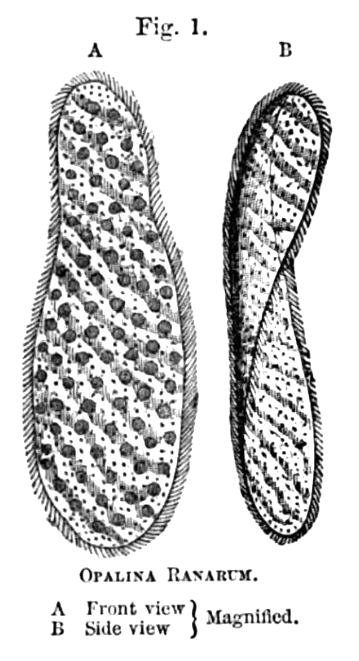 now awaiting the removal of its spinal cord, will serve us as a text from
which profitable lessons may be drawn. We snip out a portion of its
digestive tube, which from its emptiness seems to promise little; but a
drop of the liquid we find in it is placed on a glass slide, covered with a
small piece of very thin glass, and brought under the microscope. Now
look. There are several things which might
occupy your attention; but disregard them now
to watch that animalcule which you observe
swimming about. What is it? It is one of the
largest of the Infusoria, and is named Opalina.
When I call this an Infusorium I am using the
language of text-books; but there seems to be a
growing belief among zoologists that the Opalina
is not an Infusorium, but the infantile condition
of some worm (Distoma?). However, it will
not grow into a mature worm as long as it
inhabits the frog; it waits till some pike, or
bird, has devoured the frog, and then, in the
stomach of its new captor, it will develop into
its mature form: then, and not till then. This
surprises you? And well it may; but thereby
hangs a tale, which to unfold—for the present,
however, it must be postponed, because the
Opalina itself needs all our notice.
 should be considered a parasite; why may it not have been swallowed by
the frog in a gulp of water? Certainly, nothing would have been easier.
But to remove your doubts, I open the skull of this frog, and carefully
remove a drop of the liquid found inside, which, on being brought under
the microscope, we shall most probably find containing some animalcules,
especially those named Monads. These were not swallowed. They live
in the cerebro-spinal fluid, as the Opalina lives in the digestive tube. Nay,
if we extend our researches, we shall find that various organs have their
various parasites. Here, for instance, is a parasitic worm from the frog’s
bladder. Place it under the microscope, with a high power, and behold!
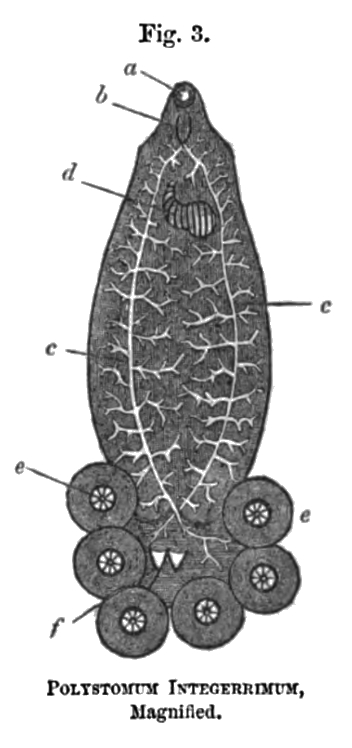
It is called Polystomum—many-mouthed, or,
more properly, many-suckered. You are looking
at the under side, and will observe six large
suckers with their starlike clasps (e), and the
horny instrument (f), with which the animal
bores its way. At a there is another sucker,
which serves also as a mouth; at b you perceive
the rudiment of a gullet, and at d the
reproductive organs. But pay attention to the
pretty branchings of the digestive tube (c)
which ramifies through the body like a blood-vessel.
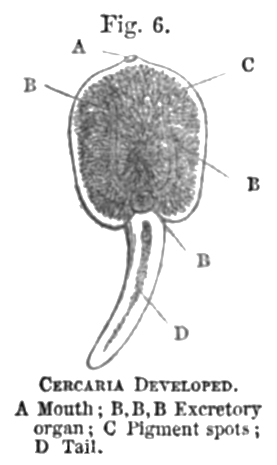
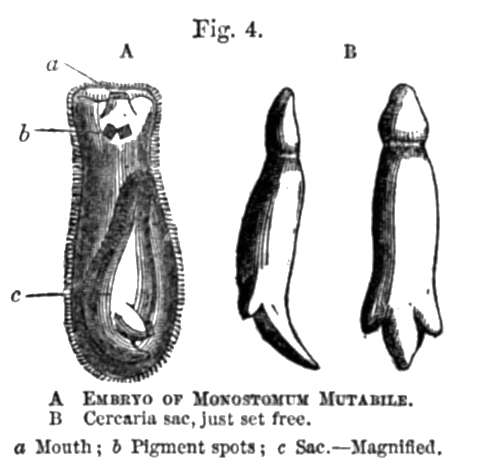 water-snail, the animalcule’s part in
the drama is at an end. It dies, and
in dying liberates the sac, which is
very comfortably housed and fed by
the snail. If you examine this sac
(Fig. 5), you will observe that it has
a mouth and digestive tube, and is,
therefore, very far from being, what
its name imports, a mere receptacle;
it is an independent animal, and
lives an independent life. It feeds
generously on the juices of the snail,
and having fed, thinks generously of
the coming generations. It was born
inside the animalcule; why should it not in turn give birth to children of
its own? To found a dynasty, to scatter progeny over the bounteous earth,
is a worthy ambition. The mysterious agency of Reproduction
begins in this sac-animal; and in a short while
a brood of Cercariæ move within it. The sac bursts,
and the brood escapes. But how is this? The children
are by no means the “very image” of their parent.
They are not sacs, nor in the least resembling sacs, as
you see. (Fig. 6.)
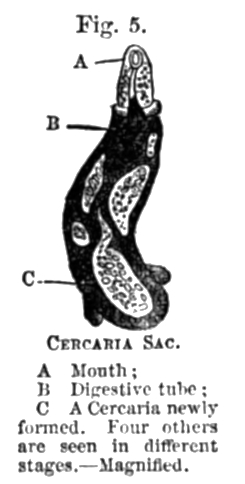 without. To look at them you would as soon suspect
a shrimp to be the progeny of an oyster, as these to be
the progeny of the sac-animal. And what makes the
paradox more paradoxical is, that not only are the
Cercariæ unlike their parent, but their parent was
equally unlike its parent the embryo of Monostomum (compare fig. 4).
However, if we pursue this family history, we shall
find the genealogy rights itself at last, and that this
Cercaria will develop in the body of some bird into
a Monostomum mutabile like its ancestor. Thus the
worm produces an animalcule, which produces a sac-animal,
which produces a Cercaria, which becomes a
worm exactly resembling its great-grandfather.