Mr. Howbridge came by request to the Corner
House the next morning. Ruth had slept all night
with the papers found in the old secretary under
her pillow.
Mr. Howbridge came into the dining-room where
the four Corner House girls were assembled, smiling
and evidently in right good humor. “I understand
you have made a wonderful discovery,
Miss Kenway?” he said.
“It was Aunt Sarah,” said Agnes, excitedly.
“She knew where the papers were.”
“Indeed?” said the lawyer, interested.
“We have found some of Uncle Peter’s papers,
that is sure,” said Ruth. “And among them is
one that I think must be the will you spoke of.”
“Good! we shall hope it is the paper we have
been looking for,” said Mr. Howbridge, accepting
the packet Ruth handed him. “And I have made a
discovery, too.”
“What is that, sir?” asked Ruth, politely.
“It refers to Mrs. Treble’s claim to the estate
of Mr. Peter Stower.”
“If little Lillie bears any relationship to Uncle
Peter, she must have her just share of the estate.
We could agree to nothing else,” Ruth hastened
to say.
“Oh, Ruth!” exclaimed Agnes.
Mr. Howbridge adjusted his glasses and looked
at Ruth quizzically. “Miss Kenway,” he said,
“you are a remarkable girl. Lillie Treble is the
daughter of John Augustus Treble, without a
doubt. His mother went west from Milton, years
ago, as is claimed. But she was not Peter Stower’s
sister.”
“Oh, goody!” ejaculated Agnes, clapping her
hands.
“Who was she?” asked Ruth.
Mr. Howbridge laughed softly. “She was the
sister of a man named Peter Stover. The names
are similar, but there is a difference of one letter—and
many other differences, it seems. Peter
Stover was a poor man all his days. He was an
‘odd job’ man most of his life, working about the
farms on the outskirts of Milton, until he grew infirm.
He died last winter at the poorfarm.
“Mrs. Bean, even, remembers the name right
now. These Trebles evidently heard of the wealth
of your Uncle Peter, and thought he was their
Uncle Peter. The names were so much alike, you
see.”
“Then—then Mrs. Treble and Lillie have no
claim upon Uncle Peter’s estate at all?” asked
Ruth.
“No more than the Man in the Moon,” said Mr.
Howbridge, still smiling.
“And you know he isn’t any relation,” whispered
Tess, to Dot, with great importance.
“The poor things!” Ruth sighed. “Whatever
will they do?”
“Why, Ruth Kenway!” exclaimed Agnes, in
great excitement. “What are you thinking of?
I should think you had done enough for them.”
Ruth only looked at her, and went on talking to
the lawyer. “You see, sir,” she said, “they are
quite penniless. I know, for Mrs. Treble broke
down and cried about it last night, when I read
to her the provisions of what I supposed to be
Uncle Peter’s will.
“She spent the last money she had in getting
here from Ypsilanti. She has thoroughly believed
that Lillie was to come into the money. Now,
what can she do?”
“Go back to Ypsilanti,” put in Agnes, sharply.
“I wonder if her relatives will take her in again
if she goes back?” said Ruth slowly.
“Ahem!” said Mr. Howbridge, clearing his
throat. “I have been in correspondence with a
Mr. Noah Presley, her brother-in-law. He says
he was opposed to her coming east without knowing
more of the situation here and her own rights.
Now he says she and Lillie may come back, if——wait!
I will read you exactly what he says,” and
Mr. Howbridge drew forth the letter in question.
He cleared his throat again and read:
“‘Tell Emily she can come back here if she
wants, providing she’ll mind her own business
and keep that dratted young one of hers from turning
the house upside down. I can’t pay her fare
to Ypsilanti, but I won’t refuse her a home.’”
“You can easily see what he thinks of them,”
declared Agnes, grimly.
“Do hush, dear,” begged Ruth. “Then you
will pay their fare back for them, will you not,
Mr. Howbridge?” pursued Ruth. “And we shall
see that they are comfortably clothed. I do not
think they have many frocks.”
“You are really a very remarkable girl, Miss
Kenway,” said Mr. Howbridge again. That was
the settlement of the Trebles’ affairs. Two weeks
later the Corner House girls saw the Ypsilanti
lady and her troublesome little girl off on the train
for the west.
At this particular Monday morning conference,
the lawyer made it clear to the Kenway girls that,
now the will had been found, the matters of the
estate would all be straightened out. Unless they
objected, he would be appointed guardian as well
as administrator of the estate. There was plenty
of cash in the bank, and they were warranted in
living upon a somewhat better scale than they
had been living since coming to the old Corner
House.
Besides, Ruth, as well as the other girls, was
to go to school in the autumn, and she looked forward
to this change with delight. What she and
her sisters did at school, the new friends they
made, and how they bound old friends to them
with closer ties, will be set forth in another volume,
to be called “The Corner House Girls at
School.”
A great many things happened to them before
schooldays came around. As Tess declared:
“I never did see such a busy time in this family—did
you, Dot? Seems to me we don’t have time
to turn around, before something new happens!”
“Well, I’m glad things happen,” quoth Dot,
gravely. “Suppose nothing ever did happen to
us? We just might as well be asleep all the time.”
First of all, with the mystery of Uncle Peter’s
will cleared away, and the status of Mrs. Treble
and Lillie decided, Ruth went at the mystery which
had frightened them so in the garret. Even Agnes
became brave enough on that particular Monday
to go “ghost hunting.”
They clambered to the garret and examined the
window at which they thought they had seen the
flapping, jumping figure in the storm. There was
positively nothing hanging near the window to
suggest such a spectral form as the girls had seen
from the parade ground.
“And this is the window,” said Ruth, thoughtfully.
“To the right of the chimney——Oh! goodness
me, what a foolish mistake!”
“What’s the matter now?” asked the nervous
Agnes, who did not dare approach very near the
window.
“Why, it wasn’t this window at all,” Ruth said.
“Don’t you see? It was to the right of the
chimney from the outside! So it is on the left of the
chimney up here. It is the other window.”
She marched around the big bulge of the chimney.
Agnes held to her sleeve.
“I don’t care,” she said, faintly. “It was a
ghost just the same——”
There was another window just like the one they
had formerly looked at. Only, above the window
frame was a narrow shelf on which lay a big,
torn, home-made kite—the cloth it was covered
with yellowed with age, and the string still
fastened to it. In cleaning the garret, this kite
had been so high up that none of them had lifted
it down. Indeed, the string was fastened to a
nail driven into a rafter, above.
Even now there was a draught of air sucking
in around the loose window frame, and the kite
rustled and wabbled on its perch. Ruth ran forward
and knocked it off the shelf.
“Oh, oh!” shrieked Agnes.
The kite dangled and jumped right before the
window in such a manner that it must have looked
positively weird from the outside. It was more
than half as tall as a man and its crazy motions
might well be taken for a human figure, from a
distance.
Suddenly the boisterous wind seized it again
and jerked it back to its perch on the shelf. There
it lay quivering, until the next gust of wind should
make it perform its ghostly dance before the garret
casement.
“Oh, isn’t that great!” gasped Agnes. “And
it must have been there for years and years—ever
since Uncle Peter was a boy, perhaps. Now! what
do you suppose Eva Larry will say?”
“And other people who have been afraid to come
to the old Corner House?” laughed Ruth. “Oh,
I know! we’ll give a ghost party up here in the
garret.”
“Ruth!” screamed Agnes in delight. “That
will be just scrumptious!”
“We shall celebrate the laying of the ghost.
No! don’t touch it, Agnes. We’ll show the girls
when they come just what made all the trouble.”
This the Corner House girls did. They invited
every girl they had become acquainted with in
Milton—little and big. Even Alfredia Blossom
came and helped Uncle Rufus and Petunia Blossom
wait upon the table.
For the first time in years, the old Corner House
resounded to the laughter and conversation of a
great company. There was music, too, and Ruth
opened the parlors for the first time. They all
danced in those big rooms.
Mr. Howbridge proved to be a very nice guardian
indeed. He allowed Ruth to do pretty much
everything she wanted. But, then, Ruth Kenway
was not a girl to desire anything that was not good
and sensible.
“It’s dreadfully nice to feel settled,” said Tess
to Dot and Maria Maroni, and Margaret and
Holly Pease, and the three Creamer girls, as they
all crowded into the summer house the afternoon
of the ghost laying party.
“Now we know we’re going to stay here, so we
can make plans for the future,” pursued Tess.
“Yes,” observed Dot. “I’m going right to work
to make my Alice-doll a new dress. She hasn’t had
anything fit to wear since that awful time she was
buried alive.”
“Buried alive!” shrieked Mabel Creamer.
“How was that?”
“Yes. And they buried her with some dried
apples,” sighed Dot. “She’s never been the same
since. You see, her eyes are bad. I ought to
take her to an eye and ear infernery, I s’pose; but
maybe even the doctors there couldn’t help her.”
“I don’t think it’s infernery, Dot,” said Tess,
slowly. “That doesn’t sound just right. It
sounds more like a conservatory than a hospital.”
“Well, hospital, then!” exclaimed Dot. “And
poor Alice! I don’t suppose she ever will get the
color back into her cheeks.”
“Shouldn’t think she would, if she’s been buried
alive,” said Mabel, blankly.
The two youngest Kenways had been very glad
to see Lillie Treble go away, but this was almost
the only comment they ever made upon that angel-faced
child, before company. Tess and Dot were
polite!
That was a lovely day, and the Corner House
girls all enjoyed the party immensely. Good Mrs.
McCall was delighted, too. She had come to love
Ruth and Agnes and Tess and Dot, almost as
though they were her own. Ruth had already engaged
a strong girl to help about the kitchen work,
and the widow had a much easier time at the old
Corner House than she had at first had.
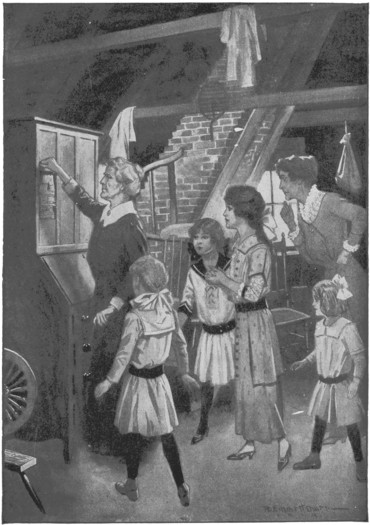
Aunt Sarah appeared at the party, when the
dancing began, in a new cap and with her knitting.
She had subsided into her old self again, immediately
after her discovery of Uncle Peter’s secret
panel in the old secretary in the garret. She
talked no more than had been her wont, and her
knitting needles clicked quite as sharply. Perhaps,
however, she took a more kindly interest in
the affairs of the Corner House girls.
She was not alone in that. All the neighbors,
and the church people—indeed everybody in Milton
who knew Ruth Kenway and her sisters at all—had
a deep interest in the fortunes of the Corner
House girls.
“They are a town institution,” said Mr. Howbridge.
“There is no character sweeter and finer
than that of Ruth Kenway. Her sisters, too, in
their several ways, are equally charming.
“Ruth—Agnes—Tess—Dot! For an old bachelor
like me, who has known no family—to secure
the confidence and liking of such a quartette of
young folk, is a privilege I fully appreciate. I
am proud of them!”
THE END
Charming Stories for Girls
THE CORNER HOUSE GIRLS SERIES
By GRACE BROOKS HILL
Four girls from eight to fourteen
years of age receive word that a rich
bachelor uncle has died, leaving
them the old Corner House he occupied.
They move into it and then
the fun begins. What they find and
do will provoke many a hearty
laugh. Later, they enter school and
make many friends. One of these invites
the girls to spend a few weeks
at a bungalow owned by her parents,
and the adventures they meet with
make very interesting reading.
Clean, wholesome stories of humor
and adventure, sure to appeal to all
young girls.
1 CORNER HOUSE GIRLS.
2 CORNER HOUSE GIRLS AT SCHOOL.
3 CORNER HOUSE GIRLS UNDER CANVAS.
4 CORNER HOUSE GIRLS IN A PLAY.
5 CORNER HOUSE GIRLS’ ODD FIND.
6 CORNER HOUSE GIRLS ON A TOUR.
7 CORNER HOUSE GIRLS GROWING UP.
8 CORNER HOUSE GIRLS SNOWBOUND.
9 CORNER HOUSE GIRLS ON A HOUSEBOAT.
10 CORNER HOUSE GIRLS AMONG THE GYPSIES.
11 CORNER HOUSE GIRLS ON PALM ISLAND.
12 THE CORNER HOUSE GIRLS SOLVE A MYSTERY.
BARSE & HOPKINS
New York, N. Y.—Newark, N. J.
THE POLLY PENDELTON SERIES
By DOROTHY WHITEHILL
Polly Pendleton is a resourceful,
wide-awake American girl
who goes to a boarding school
on the Hudson River some miles
above New York. By her pluck
and resourcefulness, she soon
makes a place for herself and
this she holds right through the
course. The account of boarding
school life is faithful and pleasing
and will attract every girl in
her teens.
1 POLLY’S FIRST YEAR AT BOARDING SCHOOL
2 POLLY’S SUMMER VACATION
3 POLLY’S SENIOR YEAR AT BOARDING SCHOOL
4 POLLY SEES THE WORLD AT WAR
5 POLLY AND LOIS
6 POLLY AND BOB
7 POLLY’S REUNION
Cloth. Large 12mo. Illustrated.
BARSE & HOPKINS
Publishers
New York, N. Y.—Newark, N. J.
CHICKEN LITTLE JANE SERIES
By LILY MUNSELL RITCHIE
Chicken Little Jane is a
Western prairie girl who
lives a happy, outdoor life
in a country where there
is plenty of room to turn
around. She is a wide-awake,
resourceful girl
who will instantly win her
way into the hearts of
other girls. And what
good times she has!—with
her pets, her friends, and
her many interests.
“Chicken Little” is the affectionate
nickname given to her when she is
very, very good, but when she misbehaves it is
“Jane”—just Jane!
Adventures of Chicken Little Jane
Chicken Little Jane on the “Big John”
Chicken Little Jane Comes to Town
With numerous illustrations in pen and ink
By CHARLES D. HUBBARD
BARSE & HOPKINS
New York, N. Y.—Newark, N. J.
THE MARY JANE SERIES
By CLARA INGRAM JUDSON
Cloth, 12mo. Illustrated.
Mary Jane is the typical American
little girl who bubbles over
with fun and the good things in
life. We meet her here on a visit
to her grandfather’s farm where
she becomes acquainted with
farm life and farm animals and
thoroughly enjoys the experience.
We next see her going to kindergarten
and then on a visit to
Florida, and then—but read the
stories for yourselves.
Exquisitely and charmingly
written are these books which
every little girl from five to nine years old will want
from the first book to the last.
1 MARY JANE—HER BOOK
2 MARY JANE—HER VISIT
3 MARY JANE’S KINDERGARTEN
4 MARY JANE DOWN SOUTH
5 MARY JANE’S CITY HOME
6 MARY JANE IN NEW ENGLAND
7 MARY JANE’S COUNTRY HOME
8 MARY JANE AT SCHOOL
9 MARY JANE IN CANADA
BARSE & HOPKINS
Publishers
New York, N. Y.—Newark, N. J.
DOROTHY WHITEHILL SERIES
For Girls
Here is a sparkling new
series of stories for girls—just
what they will like,
and ask for more of the
same kind. It is all about
twin sisters, who for the
first few years in their
lives grow up in ignorance
of each other’s existence.
Then they are at
last brought together and
things begin to happen.
Janet is an independent
go-ahead sort of girl;
while her sister Phyllis is—but meet the twins
for yourself and be entertained.
6 Titles, Cloth, large 12mo.,
Covers in color.
1. JANET, A TWIN
2. PHYLLIS, A TWIN
3. THE TWINS IN THE WEST
4. THE TWINS IN THE SOUTH
5. THE TWINS’ SUMMER VACATION
6. THE TWINS AND TOMMY JR.
BARSE & HOPKINS
PUBLISHERS
NEWARK, N. J.—NEW YORK, N. Y.
FAMOUS AMERICANS FOR YOUNG READERS
“Life Stories with the Charm of Fiction”
“This new series is timely. As an urgent civic need, our
schools should be vivified more by the spirit of the founders
and builders of the Republic.”
WALTER E. RANGER, Commissioner of Education, Rhode Island.
“I regard the series one of rare usefulness for young
readers, and trust it will become a formidable rival for much
of the fiction now in circulation among the young.”
JOHNSON BRIGHAM, State Librarian, Iowa.
Titles Ready
“GEORGE WASHINGTON” Joseph Walker
“JOHN PAUL JONES” Chelsea C. Fraser
“BENJAMIN FRANKLIN” Clara Tree Major
“DAVID CROCKETT” Jane Corby
“THOMAS JEFFERSON” Gene Stone
“ABRAHAM LINCOLN” J. Walker McSpadden
“ROBERT FULTON” Inez N. McFee
“THOMAS A. EDISON” Inez N. McFee
“HARRIET BEECHER STOWE” Ruth Brown MacArthur
“MARY LYON” H. Oxley Stengel
“THEODORE ROOSEVELT” J. Walker McSpadden
Illustrated. Size 5-1/8 × 7-5/8. Cloth.
OTHER VOLUMES IN PREPARATION
BARSE & HOPKINS
Publishers
New York, N. Y.—Newark, N. J.