Sometimes Mr. Howbridge called her “Martha,”
because she was so cumbered with family
cares. Sometimes he called her “Minerva,” and
acclaimed her to be wise. He so frequently joked
with her in this way that Ruth Kenway was not
at all sure the lawyer was in earnest on this occasion.
“Twins?” she repeated, smiling up at him over
the top of her muff. “Twin what? Twin puppies,
or kittens, or even fish? I suppose there are
twin fish?”
“You joke me, and I am serious,” he said, while
the younger ones shouted and sang amid the straw
behind. “I really have had a pair of twins given
to me. I am their guardian, the administrator of
their estate, just as I was made administrator of
the Stower estate and guardian of you girls. It
is no joke, I assure you,” and he finished rather
ruefully.
“Goodness me! you don’t mean it?” cried Ruth.
“Yes, I do. I mean it very much. I do, indeed,
think it rather mean. If all my friends who
die and go to a better world leave me their children
to take care of, I shall be in a worse pickle
than the Little Old Woman Who Lived in the
Shoe.”
“Like old Mrs. Bobster at Pleasant Cove,”
laughed Ruth. “But even she did not have twins.
And if your new family is as troublesome as the
Corner House crowd, what will you ever do?”
“That is what I am asking you, Minerva,” he
said seriously. “What would you do if you had
had twins left to you?”
“What are they, Mr. Howbridge? Boys or
girls?”
“Both.”
“Both? Oh! You mean one is a boy and one is
a girl.”
“Ralph and Rowena Birdsall.”
“That is better than having two of either sex,
I should say,” Ruth observed with more gravity.
“They sort of—sort of balance each other.”
“I guess they are ‘some kids,’ as our friend
Neale would say,” suddenly laughed Mr. Howbridge.
“I knew Birdsall very well. I might
say we were very close friends, both socially and
in business. Poor fellow! The last two years
of his life were very sad indeed.”
“Has he left plenty for the twins?” asked Ruth.
“More than ‘plenty,’” said Mr. Howbridge.
“He was very, very wealthy. Ralph and Rowena
will come into very large fortunes when they are
of age. The money is well invested.”
“Then you need not worry about that,” Ruth
said sedately.
“No? The more money, the more worry for
the administrator and guardian,” Mr. Howbridge
said succinctly. “I can assure you that is true.
But it is what to do for, and with, the twins themselves
that bothers me most just at first.”
“How old are they?”
“About twelve. Nice age! All legs and arms
and imagination.”
“Dear me! Do you know them well?”
“Haven’t seen them since they were two little
red mites in their cradle.”
“Then you merely imagine they are so very terrible.”
“I heard enough about them from Frank, Frank
Birdsall. That was their father’s name. He
used to be very fond of talking about them. Proud
as Lucifer, he was, of Ralph and Rowena. And
his wife—”
“Oh! Of course, the mother is dead, too.”
“That was what killed Frank, I verily believe,”
said Mr. Howbridge gravely. “She died two
years ago at a camp he owned up near the Canadian
border. Red Deer Lodge it is called. Mrs.
Birdsall was flung from her horse.
“It crushed her husband. He brought the children
away from there (they had spent much of
their time up in the wilderness, for they loved it)
and never went back again.
“That’s another piece of work he’s left me.
Because he did not want ever to see the Lodge
again, I have to go up there—now, in mid-winter—and
attend to something that’s been hanging
fire too long already. It is a nuisance.”
“A camp in the woods in mid-winter must be
an enjoyable place,” Ruth said thoughtfully.
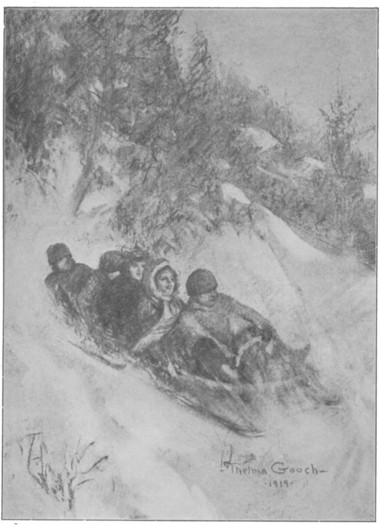
“You can take your guns; and you can snowshoe;
can skate; maybe—”
“And, as our good Mrs. Mac would say, eat
fried snowballs and icicle soup!” finished Mr.
Howbridge. “Ugh! It’s a fine place, Red Deer
Lodge, but I shall take only my man and we’ll
have to depend on some old guide or trapper to
do for us. No, I look forward to no pleasant
time at Red Deer Lodge, I assure you.”
This conversation was not carried on in sequence.
The party in the body of the sleigh frequently
interrupted. Sammy managed to dance
all over the sleigh, and half a dozen times he was
on the point of pitching out into the drifts.
“Let him!” snapped Agnes at last. “Let him
be buried in the snow, and we won’t stop for him—not
until we come back.”
“The poor kid would be an icicle then,” objected
Neale O’Neil.
“And he’d miss the nice hot chocolate and buns
Mr. Howbridge says we are to have at Crowder’s
Inn,” put in Tess, the thoughtful.
Dot squeezed her Alice-doll close to her little
bosom and made up her mind that that precious
possession should not pop out by accident into a
drift and be left behind.
“I don’t suppose I should have brought her,”
Dot confessed to Tess. “I should have given the
sailor-boy baby an airing instead.”
“Oh, yes! Nosmo King Kenway,” murmured
her sister.
Dot hurried on, ignoring the suggestive name of
the sailor-boy baby who had been inadvertently
christened after a sign on a barn door.
“You know,” the smallest Corner House girl
said, “Alice’s complexion is so delicate. Of
course, Neale had her all made over in the doll’s
hospital; but I am always afraid that the wind
will crack it.”
“I wouldn’t worry so about her, Dot,” advised
Tess.
“You would if Alice were your baby,” declared
Dot. “And you know she is delicate. She’s
never been the same since Lillie Treble buried
her with the dried apples in our back yard.”
Meanwhile Neale O’Neil had caught a sentence
or two flung back by the wind from the high front
seat. He bobbed up between Mr. Howbridge and
Ruth.
“What’s all this about red deer, and snowshoes,
and eating icicle soup?” he asked. “Sounds awfully
interesting. Are you planning to go hunting,
Mr. Howbridge?”
“I’ve got to go to a hunting lodge, clear up
state, my boy,” said the lawyer. “And I dread
it just as much as you young folks would enjoy
it.”
“It would be fine, I think,” murmured Ruth.
“Oh, bully!” shouted Agnes, suddenly standing
up in the straw and clinging to Neale for support.
“To a regular, sure-enough winter camp?
Then Carrie and Lucy Poole, and Trix Severn
can’t crow over us any more! They went, last
year, to Letterbeg Camp, up beyond Hoosac.”
“But, goodness, Agnes, wait till we are asked,
do!” admonished Ruth. “I never saw or heard of
such precipitate young ones.”
“Young one yourself!” grumbled Agnes.
“It’s my fault,” said the good-natured Neale.
“Aggie misunderstood what I said.”
“No need to worry about it,” said Mr. Howbridge
cheerfully. “If you young folks really
want to come with me—”
“Oh, Mr. Howbridge!” exclaimed Ruth, in a
tone that showed she, herself, had been much
taken with the idea.
“Why, I hate to go alone. I can send up some
servants to open the Lodge. Frank was always
begging me to make use of it. After Mrs. Birdsall
was killed he never would go near the place, as I
said. Though I believe the twins, Ralph and
Rowena, have been up there with a caretaker and
a governess, or somebody to look out for them.”
“Where are they now?” asked Ruth.
“The Birdsall place in Arlington was closed
soon after Frank died, three months ago. His old
butler and his wife live in a nice home near by,
and they have the children and their governess
with them.”
“With just servants?” murmured Ruth.
“They are very suitable people,” declared Mr.
Howbridge, as though he felt the faint criticism
in the girl’s words. “I went myself and saw
Rodgers and Mrs. Rodgers. The governess and
the twins were out for a drive, so I did not see
them.”
“The poor things!” sighed Ruth.
“My!” exclaimed Agnes, “those children are
worse off than we Kenways were. They haven’t
got anybody like Ruth, Mr. Howbridge.”
“That is true,” agreed the lawyer. “But what
am I to do? Separate them? Send them to
boarding school—the boy one way and the girl
another?”
“Gee! that would be tough, Mr. Howbridge,”
declared Neale O’Neil, with considerable feeling
for the unfortunate twins.
“I don’t see what I’m to do,” complained the
lawyer.
“They should have a real home,” Ruth stated,
with some severity. “Sending them to boarding
school is dodging the issue. So is leaving them
wholly in the care of servants.”
“Who would take in two tearing and wearing
children, twelve years old?” demanded Mr. Howbridge,
on the defensive.
“Perhaps the fault does go back to the parents—to
the father, at least,” admitted Ruth. “He
should have made provision for his children before
he died.”
“I suppose you think the duty devolves upon
me,” said Mr. Howbridge, rather grumpily.
“Should I take them into my house? Should I
break up the habits of years for two half-wild
children?”
“Oh, I don’t know that,” Ruth told him brightly.
“It’s one of those things one must decide for oneself,
isn’t it?”
There was not much more said after that during
the ride about the twins, Ralph and Rowena
Birdsall. But Red Deer Lodge!
The idea of going to a real camp in winter was
taken up by everybody in the party, for even Tom
Jonah barked. In the depths of the wilderness,
with wild woods, and wild animals, and perhaps
wild men! (this in Sammy’s mind) all about the
Lodge! The freckled boy considered the idea even
superior to his long cherished desire to run away
to be a pirate.
“I’ll get me a bow-arrer and learn to shoot before
we start,” Sammy declared, deluding himself,
as he always did, with the idea that he was to
be a member of the party in any case.
“But you don’t even know if your mother’ll let
you go, Sammy Pinkney!” cried Tess.
“She’ll let me go if Aggie says I may,” declared
Sammy. “I can, can’t I, Aggie?” grabbing
her by her plaid skirt and almost pulling her
over backwards.
“Stop! You can can that!” declared the next-to-the-oldest
Corner House girl slangily. “What
do you think I am—a bell rope, that you yank me
that way?”
“I can go to that Red Deer Lodge, can’t I?”
insisted the youngster.
“You can start right now, for all I care,” said
Agnes, rather grumpily, and giving Sammy no
further attention.
But that was enough for Sammy Pinkney. He
considered that he had a particular invitation to
accompany the party into the woods, and he would
tell his mother so when he reached home.
But Dot began to be worried.
“Just see here, Tess Kenway!” she exclaimed
suddenly. “Do you suppose my Alice-doll—or
any of the other dollies—can stand it?”
“Stand what?” her sister, quite excited, asked.
“Living in tents in winter?”
“In what tents?” asked the amazed Tess.
“Up there at Red Darling Camp—”
“Red Deer!”
“Well, I knew it was some nice word,” Dot, undisturbed,
said. “But Alice is so delicate.”
“Why, Dot Kenway! we won’t have to live in
tents,” said Tess.
“We did in that other camp we went to,” said
the smaller girl. “Don’t you ’member? And
the tent ’most blowed over one night, and you
and I and Tom Jonah went sailing in a boat?
And that clam man—”
“But, Dot!” cried Tess, “that was a summer
camp. This is a winter one. And it’s all made
of logs, and there are doors and windows and fireplaces
and—and everything!”
“Oh!” murmured Dot. “I wondered how
they’d keep Jack Frost out. And he’s stinging
my ears right now, Tess Kenway.”
The roadside inn was in sight now, and presently
the big sleigh pulled up before it with the
bells jangling and the horses steaming, as Dot
remarked, “just as though they had boiling water
in ’em and the smoke was leaking out.”
The whole party ran into the grillroom and
chased Jack Frost away with hot chocolate and
cakes. There the idea of going to Red Deer
Lodge for the Christmas holidays was well
thrashed out.
“Of course, I will send up my own servants and
supplies. Being administrator of the estate, there
will be no question of my using the Lodge as I see
fit,” Mr. Howbridge said cheerfully. “And I
shall be delighted to have you young folks with me.
“I am really going to confer with an old timber
cruiser about the standing timber contracted for
by the Neven Lumber Company before Frank
Birdsall died. This timber cruiser—”
“It sounds like a sea-story!” interrupted Agnes,
roguishly.
“What is a timber cruiser?” demanded Ruth,
quite as puzzled as her sister.
“It is not a ‘what’ but a ‘who,’” laughed Mr.
Howbridge. “In his way, Ike M’Graw is quite
a famous character up there. A timber cruiser
is a man who knows timber so well that just by
walking through a wood lot and looking he can
number and mark down the trees that are sound
and will make good timber.
“Ike has written me through a friend (for the
old man cannot use a pen himself, save to make
his cross) that he has been over the entire Birdsall
estate and that his figures and the figures of the
Nevens people are too far apart. I fear that the
lumber company is trying to put something over
on me, and as administrator of the estate I must
look out for the twins’ interests.”
“You are more careful of their money, Mr. Howbridge,
than you are of the twins themselves, are
you not?” Ruth suggested, in a low voice.
“Now, don’t tell me that!” he cried. “I really
cannot take those children into my house.”
“Well, you know,” she told him, smiling, “you
brought this on yourself by asking my advice.
And you intend to fill that Lodge up there with us
‘young ones.’”
“But I shall have you to manage for me, Miss
Ruth,” declared the lawyer. “That is different.”
“Perhaps we might take the twins along with
us, and you’d get used to them,” Ruth said.
“You say they like it up there in the wilderness.”
“Frank said they were crazy about it.”
“Well?”
“You don’t know what you are letting yourselves
in for. Ralph and Rowena are young savages.”
“Can’t be much worse than Sammy, yonder,”
chuckled Neale, who, with Agnes, was much interested
in this part of the planning.
“Oh, Ruthie!” exclaimed the second Kenway
sister suddenly, clasping her hands. “There’s
Cecile and Luke!”
“Where—what—?”
“I mean we invited them to come to the Corner
House for the holidays.”
“Ah-ha!” exclaimed Mr. Howbridge promptly.
“The Shepards? Of course! I had already included
them—in my mind.”
“Mr. Howbridge! It will be more than a party.
It will be a convention,” gasped Ruth.
“It’s such a lonely place that we’ll need a big
crowd to make it worth while going at all,” the
lawyer laughed. “Yes. Cecile and Luke are invited.
I will have them written to at once—in
addition to your own invitation to them, Miss
Ruth.”
“Dear me! you are just the best guardian, Mr.
Howbridge,” sighed Agnes ecstatically.
“And I think,” Ruth added, “that you ought
to think seriously of taking the Birdsall twins
with us.”
That was not decided at that time, however.
And when the party got back to the old Corner
House, just across from the Parade Ground at
the head of Main Street, Mr. Howbridge was met
with a piece of news that shocked him much more
than had the thought of the twins making their
home with him in his quiet bachelor residence.
A clerk from the lawyer’s office awaited Mr.
Howbridge. There was a telegram from Rodgers,
the Birdsalls’ ex-butler. It read:
“Ralph and Rowena away since yesterday noon. Hospitals searched.
Cannot have pond dragged. Two feet of ice. Wire instructions.
—Rodgers.”
CHAPTER IV—ANTICIPATIONS
Mr. Howbridge, before he hurried away to his
office, asked Ruth:
“What do you think of that? And you suggest
my keeping those twins—those two wild youngsters—in
my home!”
“I will tell you what I think of that telegram,”
said the oldest Kenway girl, handing the yellow
sheet of paper back to him. “I think that man
Rodgers is not a fit person to have charge of the
boy and girl.”
“Why not?” he asked in surprise.
“Imagine thinking of dragging a pond in mid-winter—or
at any other time of the year—for two
healthy children! First idea the man seems to
have. I guess the twins had reason for running
away.”
“Hear! Hear!” cried Agnes, who deliberately
listened.
“Why, they have known Rodgers all their
lives!”
“Perhaps that is why they have run away,”
said Ruth, smiling. “Rodgers sounds to me—from
his telegram—as though he had one awful
lack.”
“You frighten me. What lack?”
“Lack of a sense of humor. And that is fatal
in the character of anybody who has a pair of twins
on his hands.”
Mr. Howbridge threw up his own hands in
amazement. “I must lack that myself,” he said.
“I see nothing funny, at least, in the idea of having
Ralph and Rowena Birdsall in my house.”
“It helps,” said Ruth. “A sense of humor is
what has kept me going all these years,” she
added demurely. “If you think a pair of twins
can be compared to Tess and Dot and Sammy
Pinkney—to say nothing of Aggie and Neale—”
“Oh! Oh!” shouted the two latter in chorus.
“You have a mean mind, Ruthie Kenway,” declared
the blonde beauty.
“I knew I wasn’t much liked,” admitted Neale
O’Neil. “But that is the unkindest cut of all.”
“You have had experience, I grant you,” said
Mr. Howbridge, about to take his departure.
“But I foresee much trouble in the case of these
Birdsall twins.”
And he was a true prophet there. The twins
had utterly disappeared. The Arlington police—indeed,
all the county officers together—could find
no trace of the orphaned brother and sister.
Mr. Howbridge put private detectives on the
case. The twins seemed to have disappeared as
utterly as though they really were under the two
feet of ice on Arlington Pond.
The lawyer searched personally, advertised in
the newspapers, and even offered a reward for the
apprehension of the children. A fortnight passed
without success.
The governess, Miss Mason, was discharged,
for it seemed unnecessary to pay her salary when
there were no children for her to teach. Rodgers
and his wife could give no aid in the search. They
were rather relieved, if the truth were told, to be
free of the twins.
“Master Ralph was hard enough to get along
with,” the ex-butler admitted. “But Miss Rowena
was worse. They wanted to go back into
their own house to live. They could not understand
why it was shut up, sir,” and the old serving
man shook his head.
“They seemed to have taken a dislike to you,
sir,” he added to Mr. Howbridge. “They said
you ‘hadn’t any right to boss.’ That is the way
they put it.”
“But I never even saw them,” returned the
lawyer. “I didn’t try ‘to boss’ them.”
“Well, you know, sir,” Rodgers explained, “I
had to give ’em reasons for things. You have to
with children like Master Ralph and Miss Rowena.
So I had to tell ’em you said they were to do this
and that.”
“Oh! Ah! I see!” muttered the guardian.
He began to believe that perhaps Ruth Kenway
was right. He should have taken more of
a personal interest in Ralph and Rowena. They
had evidently gained from the ex-butler an
entirely wrong impression of what a guardian was.
But the disappearance of the Birdsall twins did
not make any change in the plans for the mid-winter
visit to Red Deer Lodge. Mr. Howbridge
had to go there in any case, and he would not
disappoint the Kenways and their friends.
As it chanced, full three weeks were given the
Milton schools at the Christmas Holiday time.
There were repairs to make in the heating arrangements
of both high and grammar school
buildings. The schools would close the week before
Christmas and not open again until the week
following New Year’s Day.
If Sammy Pinkney had had his way, the schools
would never have opened again!
“I don’t see what they have to learn you things
for, anyway,” complained the youngster. “You
can find things out for yourself.”
“That’s rather an expensive way to learn, I’ve
always heard,” said Ruth, admonishingly.
“Huh!” grumbled Sammy, “teachers don’t
know much, anyway. Look! There’s what Miss
Grimsby told us in physics the other day—all
about what you’re made of, and how you’re made,
and the names you can call yourself—if you want
to.
“You know: Your legs and arms are limbs—and
all that. She told us the middle part of our
bodies is the trunk, and she asked us all if we understood
that. Some said ‘yes,’ and some didn’t
say nothing,” went on the excited boy.
“‘Don’t you know the middle of the body is
the trunk?’ she asked Patsy Roach. And what do
you suppose he told Miss Grimsby?”
“I can’t imagine,” said Agnes, for this was in
the evening and the young people were gathered
about the sitting-room table with their lesson
books.
“He told her: ‘You ought to go to the circus,
Miss Grimsby, and see the elephant,’” giggled
Sammy. “And I guess Patsy was right. Huh!
Trunk!” he added with scorn.
“Association of ideas,” chuckled Neale O’Neil,
who was likewise present as usual during home
study hour. “I heard that one of the kids in
Dot’s grade gave Miss Andrews an extremely
bright answer the other day.”
“What was that, Neale?” asked Agnes, who
would rather talk than study at any time.
“History. Miss Andrews asked one little girl
who discovered America, and the answer was,
‘Ohio’!”
“Oh! Oh!” murmured Agnes, while even Ruth
smiled.
“Yes,” chuckled Neale. “Miss Andrews said,
‘No; Columbus discovered America,’ and the kid
said: ‘Yes’m. That was his first name.’”
“She got her geography and history mixed,”
said Ruth, smiling.
“That was Sadie Goronofsky’s half-sister,
Becky,” explained Dot. “She isn’t very bright.”
“You bet she isn’t bright!” snorted Sammy
Pinkney. “Her pop’s got a little tailor shop with
another man down on Meadow Street, and they
are always fighting.”
“Who are always fighting?” asked Neale quizzically.
“Becky and her father or Becky and her
father’s partner?”
“Smartie! Becky’s pop and the other man,”
answered Sammy. “And their landlord was putting
in a new store-front, and Becky’s father put
out a sign telling folks they were still working—you
know. Becky said it read: ‘Business going
on during altercations,’ instead of ‘alterations.’
And ‘altercations’ means fights,” concluded the
wise Sammy.
“Just see,” remarked Ruth quietly, “how satisfied
you children should be that you know so much
more than your little mates. You so frequently
bring home tales about them.”
“Aw, now, Ruth,” mumbled Sammy, who was
bright enough to note her characteristic criticism.
“I would try,” the oldest Kenway said admonishingly,
“to bring home only the pleasant stories
about my little school friends.”
“Oh! I know a nice story about Allie Newman’s
little brother,” declared Dot eagerly.
“That little terror!” murmured Agnes.
“He is one tough little kid,” admitted Neale
O’Neil, in an undertone.
“What about the little Newman boy?” asked
Ruth indulgently. “And then we must all study.”
“Why,” said Dot, big-eyed and very much in
earnest, “you know Robbie Newman doesn’t go to
school yet; and he’s an awful trial to his mother.”
“That is gossip, Dot,” Tess interposed severely.
But the smallest Corner House girl was not to
be derailed from the main line of her story, and
went right on:
“He was naughty the other day and his mamma
told him she’d shut him up somewhere all by himself.
‘If you do, Mamma,’ he said, ‘I’ll just smash
ev’rything in the room.’”
“Oh-oo!” gasped Tess, proving herself to be
quite as much interested in the “gossip” as the
others around the evening lamp. “What a wicked
boy!”
“But he didn’t smash anything,” Dot was quick
to explain. “For his mother put him right out
in the henhouse.”
“The henhouse! Fancy!” said Agnes.
“There wasn’t anything for him to smash
there,” said Dot. “But when she had locked him
in, Robbie put his head out of the little door
where the hens go in and out, and he called after
her:
“‘Mamma, you can lock me in here all you want
to; but I won’t lay any eggs!’”
“I am not sure that it isn’t gossip,” chuckled
Agnes, when the general laugh had subsided.
“That will be all now,” Ruth said with severity.
“Study time is here.”
But there was another and more important
subject in all their minds than either school happenings,
the eccentricities of their friends, or the lesson
books themselves.
The holidays! The thought of going to Red
Deer Lodge! A winter vacation in the deep
woods, and to live in “picnic” fashion, as they
supposed, lent a charm to the plan that delighted
every member of the Corner House party.
Ruth and Agnes wrote to the Shepards—to Cecile
at home with her Aunt Lorena, and to Luke
at college—and they were immediately enamored
of the plan and returned enthusiastic acceptances
of the invitation, thanking Mr. Howbridge, of
course, as well.
The lawyer was having a great deal to do at this
time, and he came to the old Corner House more
than once to talk about the Birdsall twins to Ruth
and the others. As he said, it gave him comfort
to talk over something he did not know anything
about with the oldest Corner House sister.
He sat one stormy day in the cozy sitting-room,
with Dot and the Alice-doll on one knee and Tess
and Almira, who was now a quite grown-up cat
and had kittens of her own, on his other knee.
All the Corner House cats were pets, no matter
how grown-up they were.
“It is worrying me a great deal, Ruthie,” he
said to the sympathetic girl. “Look at a day like
this. We don’t know where those poor children
are. Rodgers says they could have had but little
money. In fact, they scarcely knew what money
was for, having always had everything needful
supplied them.”
“Twelve-year-old children nowadays, Mr. Howbridge,”
said Ruth, “are usually quite capable of
looking after themselves.”
“You think so?” queried the worried guardian.
“You remember what Agnes was at twelve.
And look at our Tess.”
The lawyer pinched Tess’ cheek. “I see what
she is. And she is going to be twelve some day,
I suppose,” he agreed. “But what would she
and—say—Sammy Pinkney do, turned out alone
into the world?”
“Oh!” cried Dot, the little pitcher with the big
ears, “Sammy and I went off alone to be pirates.
And I’m younger than Tess.”
“I hope I shouldn’t run away with Sammy!”
said Tess, in some disdain.
“Why,” Dot put in, “suppose Sammy was your
brother? I felt quite sisterly to him that time
we were hid in the canalboat.”
“I guess that we all feel ‘sisterly’ to Sammy,”
laughed Ruth. “And I am sure, Tess, you would
know what to do if you were away from home
with him.”
“I guess I would,” agreed Tess severely. “I’d
march him right back again.”
The lawyer joined in the laugh. But he was
none the less anxious about Ralph and Rowena
Birdsall. There was an undercurrent of feeling
in his mind, too, that he had been derelict in his
duty toward his wards.
“Three months after their father died, and I
had not seen them,” he said more than once. “I
blame myself. As you say, Ruth, I should have
won their confidence in that time.”
“Oh, Mr. Howbridge, you are not to blame for
that! You are unused to children, anyway.”
“But it was selfishness on my part—arrant selfishness,
Frank’s children should have been my
personal care. But, twins!” and he groaned.
One might have been amused by his bachelor
horror of the thought of two children in his quiet
home; only the situation was really too serious
to breed laughter. Two twelve-year-old children
striking out into the world for themselves might
get into all sorts of mischief and trouble.
The lawyer had done all he could, however, toward
recovering the runaways. The police of two
States were on the watch for them, and private detectives
were likewise hunting for them. The advertisements
Mr. Howbridge put in the papers
brought no helpful replies. There seemed to be
many children wandering about the country, singly
and in pairs, but none of them answered at
all the description of the Birdsall twins.
Meanwhile the Christmas holidays were approaching.
Cecile Shepard arrived at the old
Corner House a week ahead of the date set for
the closing of school. Luke, however, would join
the party at Culberton, at the foot of Long Lake,
nearly at the far end of which, and deep in the
woods, was Red Deer Lodge.
Cecile was a very pretty girl, as dark as Agnes
was light. She went to school every day with
Agnes and sat beside her as a “visitor” during
the remainder of the term.
Of course, there was much to do to prepare for
this mid-winter venture into the woods. And,
too, there were certain plans for Christmas to be
carried out by the Corner House girls, whether
they were to be at home on Christmas Day or not.
The Stower estate tenants on Meadow Street
must not be forgotten.
CHAPTER V—MERRY TIMES
Uncle Peter Stower, in dying and leaving his
four grandnieces the Milton property, had left
them, in addition (or so Ruth Kenway and her
sisters concluded), the duty of overlooking the
welfare of certain poor people who occupied the
Stower tenements on Meadow Street, over toward
the canal.
These tenants were mostly poor people; but Mrs.
Kranz, who kept a delicatessen store and grocery,
and Joe Maroni, whom Dot said was “both an ice
man and a nice man” were two of the tenants
who were well-to-do.
Joe Maroni, whose family lived in the corner
cellar under Mrs. Kranz’s store, sold coal and
wood, as well as ice, and had a vegetable and
fruit stand on the sidewalk. Mrs. Kranz, the
large German woman, was one of the Kenway
girls’ staunchest friends. Both these shopkeepers
were sure to aid the Corner House sisters in their
plans for Christmas.
The year before the children of the Stower estate
tenants had appeared under the bedroom windows
of the old Corner House early on Christmas
morning and sung Christmas chants.
“Agnes said, just as though it was in old fuel
times,” Dot eagerly told Cecile Shepard. “And
Aggie wanted to throw large yeast cakes among
’em. You know, like Lady Bountiful did, and—”
“Oh! Oh! OH!” gasped Tess, in horror and
amazement. “Why will you, Dot, mix up your
words so? It wasn’t fuel times, it was feudal
times.”
“And why throw away the yeast cakes?” demanded
Cecile, in amused wonder.
“Dear me!” exclaimed Tess, with vast disdain.
“She means largess. That means gifts. Dot
thought it was ‘large yeast.’ I never did hear
of such a child!”
“Well, I don’t care!” wailed Dot, who did not
like to be taken to task for mispronouncing words,
or for other mistakes in English. “I don’t think
you are at all polite, Tessie Kenway, and I’m going
to tell Ruth—so now!”
Which proved that even the little Corner House
girls had their little spats. Everything did not
always go smoothly.
However, the plans for the entertainment of the
Meadow Street families were made without any
trouble. It was decided to have a great tree for
the whole crowd, and to set it up in a small hall
on Meadow Street, where certain lodges held their
meetings, the date set for the entertainment being
a week in advance of Christmas Eve—the night before
the Corner House party was to start for Red
Deer Lodge.
Mrs. Kranz took charge of the dressing of the
tree, for when she was a child in the old country
a Christmas tree was the great annual feast. Not
a child among those belonging in the Stower tenements
was forgotten—nor the grown folk, either,
for that matter.
Tess and Dot did their share in the purchasing
of the presents and preparing them for the tree.
They both delighted in shopping, and their favorite
mart of trade was the five and ten cent
store on Main Street.
Such a jumble of things as they bought! The
beauty of buying in the five and ten cent store is
(or so the children declared) that one can get so
much for a dollar.
Every afternoon for a week before the day set
for the pre-Christmas celebration, the little folks
trudged down to their favorite emporium and
came back with their arms laden with a variety
of articles to delight the hearts and eyes of the
Meadow Street children.
Dolls and dolls’ toys were of course Dot’s favorite
purchases. Tess went in for the more practical
things—some to be hung on the tree marked
with her own private card for the grown-up members
of the expected audience.
In any case, and altogether, there was gathered
at the old Corner House to be hung on the Christmas
tree for the Meadow Street people a two-bushel
basket of little packages, mostly from the
five and ten cent store.
Ruth and Agnes saw to it that there were plenty
of practical things for the poor children, too: warm
coats, caps, leggings, shoes, mittens—a dozen
other useful things which would be needed by the
younger Goronofskys, the Pedermans, the O’Harras,
and all the rest of the conglomerate crew occupying
the Stower tenements.
And they had four “Santa Clauses”! Although,
more properly speaking, they were “the
Misses Santa Claus.” The Kenway sisters, in the
prescribed uniforms of the good St. Nicholas, presided
over the distribution of the presents from
the illuminated tree.
Dot had every faith in the reality of Santa
Claus, nor would her sisters disabuse her of that
cheerful belief.
“But, of course,” the smallest Corner House
girl said, “I know Santa can’t be everywhere at
once. And this is a week too early for him,
anyway. And on Christmas Eve he does
have to rush around so to get to everybody’s
house!
“We’re just going to make believe to be Santa,
Sammy,” she explained to that small boy. “And
we’re not going to be like you were last Christmas,
Sammy, and fall down the chimney and
frighten everybody so.”
“Huh!” grumbled Sammy, to whom his fiasco
as a Santa Claus in the old Corner House chimney
was a sore subject. “If that old brick hadn’t
fallen I wouldn’t have come down so sudden.
And my mom burned my Santa Claus suit up in
the furnace because it was all over soot.”
This night in the Meadow Street hall was long
to be remembered. Mr. Howbridge made a
speech. It was a winter when work was hard to
get, and at Ruth’s personal request he announced
that a dollar a month would be taken off every
tenant’s rent during the “hard times.”
Mrs. Kranz and Joe Maroni, being in so much
better circumstances than the majority of the
Stower estate tenants, gave many things for the
Christmas tree, too. There was candy, and cakes,
and popcorn, and nuts for the little folk, and hot
drinks and cake and sandwiches for the adults.
Altogether it was a night long to be remembered
by the Corner House girls. Even the little
ones had begun to understand their duty toward
these poor people who helped swell the Kenway
family bank account. The estate might not now
draw down the fifteen per cent. that Uncle Peter
Stower always demanded; but the income from
the Meadow Street tenements was considerable,
and the tenants were now happier and more content.
“It must be lovely,” Cecile Shepard confessed
to Ruth and Agnes, “to have so many folks to
look out for, and be kind to, and who like you.
And Ruthie has such a way with her. I can see
the women all admire her.”
Agnes began to giggle. “Who wouldn’t admire
her?” she said. “Ruth believes in helping folks
just the way they want to be helped. She doesn’t
furnish only flannels and cough sirup to the poor.
Oh, no!”
“Now, Agnes!” admonished the older girl,
blushing.
“I don’t care! It’s too good a joke, and it
shows just why those people over on Meadow
Street worship Ruth,” went on the younger sister.
“Did you see that biggest Pederman girl?
Olga, the one with the white eyebrows and no
lashes?”
“Yes,” said Cecile. “Her face looks almost
like a blank wall.”
“And a white-washed wall at that,” went on
Agnes. “She’s a grown woman, but she hasn’t
any too much intelligence. She was awfully sick
with diphtheria last spring, and Ruth went to see
her—carrying gifts, of course.”
“Things to eat don’t much appeal to you when
you have diphtheria and can’t swallow,” put in
Ruth.
“I know that,” chuckled Agnes. “And what
do you think, Cecile? Ruthie asked Olga what
she would like to have—if she could get her anything
special?
“‘Yes, Miss Wuth,’ she croaked. Olga can’t
pronounce her ‘R’s’ very well. ‘Yes, Miss Wuth,
I’ve been wantin’ a pair of them dangly jet eawin’s
for so long!’ And what do you suppose?” Agnes
exploded in conclusion. “Ruth went and bought
them for her! She had them on tonight.”
“I don’t care,” Ruth said, with conviction.
“The earrings came nearer to curing Olga than
all Dr. Forsyth’s medicine. He said so himself.”
“What do you think of that?” giggled Agnes.
“I think it was awfully sweet of our Ruth,”
declared Cecile, hugging the oldest Kenway sister.
Mrs. MacCall, for her part, was not at all sure
that the Kenway sisters did not “encourage pauperism”
in thus helping their tenants. Mrs. MacCall
was conservative in the extreme.
“No,” Ruth said earnestly, “the dear little babies,
and the little folks with empty ‘tummies,’
are not paupers, Mrs. MacCall. Nor are their
parents such. We haven’t a lazy tenant family in
the Stower houses.”
“That may be as may be,” said the housekeeper,
shaking her head. “But they are too frequently
out o’ work to suit me. And guidness knows
there’s plenty to do in the world.”
“They’re just unfortunate,” reiterated Ruth.
“We have been lucky. We never did a thing, we
Kenways, to get Uncle Peter’s wealth. We’ve
had better luck than the Pedermans and Goronofskys.”
“Hush, my lassie! If you undertake to level
things in this world for all, you’ve a big job cut
out for you. Nae doot of that.”
Although the housekeeper was often opposed
both in opinion and practice to Ruth and her sisters,
the latter were eager to have Mrs. MacCall
go with the vacation party as chaperone and
manager. And, indeed, had Mrs. MacCall not agreed,
it is doubtful if Ruth would have accepted Mr.
Howbridge’s invitation to go into the North
Woods to Red Deer Lodge.
Mrs. MacCall sacrificed her own desires and
some comfort to accompany the young folks; but
she did it cheerfully because of her love for the
Corner House girls.
Aunt Sarah Maltby would remain at home to
oversee things at the Corner House; and of course
Linda and Uncle Rufus would be with her.
Trunks had been packed the day before the
early celebration of Christmas in the Meadow
Street lodge room, and had been sent on by train
with the serving people that Hedden, Mr. Howbridge’s
butler and factotum, had engaged to go
ahead of the vacation party and prepare Red Deer
Lodge for occupancy over the holidays.
Of course, Neale O’Neil and the older girls had
their bags to carry with them, and Sammy Pinkney
came over to the old Corner House bright and
early on the morning of departure, lugging his
bulging suitcase.
“And I hope,” Agnes said with severity, “that
you haven’t worms in that suitcase, with a lot of
other worthless truck, as you had when you went
on our automobile tour, Sammy.”
“Huh! where’d I dig fishworms this time of
year?” responded the boy with scorn. “Besides,
mom packed this bag, and she’s left out a whole
lot of things I’ll need up there in the woods. She
won’t even let me take my bow-arrer and a steel
trap I got down at the blacksmith shop by the
canal. Of course, the latch of the trap was broke,
but we might have fixed it and used it to catch
wolves with.”
“Oh, my!” squealed Dot. “Wolves? Why,
they are savage!”
“Course they are savage,” said Sammy.
“But—but Mr. Howbridge, our guardian,
wouldn’t let any wolves stay around that Darling
Lodge. They might eat my Alice-doll!”
“Sure,” agreed the boy, as Agnes was not
within hearing. “Like enough the wolf pack will
chase us when we are sleighing, and you’ll have
to throw that doll over to pacificate ’em so we
can escape with our lives. They do that in
Russia. Throw the babies away to save folks’
lives.”
“Well!” exclaimed Tess, half doubting this
bold statement. “Babies must be awful cheap in
Russia. Cheaper than they are here. You know
we can’t get a baby in this house, and we all would
like to have one.”
But Dot had been stricken dumb by Sammy’s
wild statement. She hugged the Alice-doll to her
breast, and her eyes were wide with fear.
“Do you suppose that may happen, Tess?” she
whispered.
“What may happen?”
“That we get chased by wolfs and—and have
to throw somebody overboard to ’em?”
“I don’t believe so,” said Tess, after all somewhat
impressed by Sammy’s assurance.
“Well, anyway,” said Dot, “I was only going
to take Alice up there to that Lodge; but I’ll take
the sailor-doll, too. He can stand being thrown
to the wolves better than Alice. He’s tougher.”
If it had not already been decided to take Tom
Jonah, the big Newfoundland, along on this winter
trip, Dot might really have balked at going.
CHAPTER VI—ON THE WINGS OF THE WIND
However, aside from Dot’s disturbance of mind
over the trip into the deep woods where, on occasion,
babies had to be flung to wolves, there was
something that disturbed Ruth on this morning
which almost made her doubt the advisability of
starting for Red Deer Lodge.
Ruth had been up as early as Linda, the Finnish
maid. There was still much to do, and the sleigh
would be at the door at eight-thirty. When
Linda came down, however, she stopped at Ruth’s
door and said she had heard Uncle Rufus groaning
most of the night. The old colored man was
undoubtedly suffering from one of his recurrent
rheumatic attacks.
Ruth hurried up to the third story of the house
and to Uncle Rufus’ room.
“Yes’m, Missie Ruth,” groaned the old man.
“Ah’s jes’ knocked right down ag’in. Ah don’
believe Ah’s goin’ to be able to git up a-tall to
see yo’ off dis mawnin’.”
“Poor Uncle Rufus!” said the oldest Corner
House girl, commiseratingly. “I believe I’d better
telephone to Dr. Forsyth and let him come—”
“No’m. Ah don’ want dat Dr. Forsyth to come
a-near me, Missie Ruth,” interrupted Uncle Rufus.
“Why, of course you do,” said the girl. “He
gave you something before that helped you.
Don’t you remember?”
“Ah don’ say he don’ know he’s business, Missie
Ruth,” said the old man, shaking his head.
“Mebbe his med’cine’s jest as good as de nex’
doctor’s med’cine. But Ah don’ want Dr. Forsyth
no mo’.”
“Why not?”
“Dr. Forsyth done insulted me,” said the old
man, with rising indignation. “He done talk
about me.”
“Why, Uncle Rufus!”
“Sho’ has!” repeated the black man. “An’
Ah nebber did him a mite o’ harm. He done say
things about me dat I can’t nebber overlook—no,
ma’am!”
“Why, Uncle Rufus!” murmured the worried
Ruth, “I think you must be mistaken. I can’t
imagine Dr. Forsyth being unkind, or saying unkind
things about one.”
“He sho’ did,” declared the obstinate old man.
“And he done put it in writin’. You jes’ reach
me ma best coat, Missie Ruth. It’s all set down
dar on ma burial papers.”
Of course, Uncle Rufus, like most frugal colored
people, belonged to a “burial association”—an
insurance scheme by which one must die to win.
“What could Dr. Forsyth have said about you
that you think is unkind, Uncle Rufus?” repeated
Ruth, as she came into the room to get the coat.
“Ah tell yo’ what he done said!” exclaimed the
old man, indignantly. “Dr. Forsyth say Ah was
a drunkard an’ a joy-rider! Dat’s what he say!
An’ de goodness know, Missie Ruth, I ain’t tetch
a drap of gin fo’ many a long year, and I ain’t
nebber step foot in even your automobile. No’m!
He done insulted me befo’ de members of ma
burial lodge, an’ I don’ want nothin’ mo’ to do
wid dat white man—no’m!”
He spread out the insurance policy with a flourish
and pointed to the examining doctor’s notation
regarding Uncle Rufus’ former illness: “Autotoxication.”
“Ah’s a respectable man,” urged Uncle Rufus,
evidently hurt to the quick by what he thought was
Dr. Forsyth’s uncalled-for criticism. “Ah don’t
get drunk in no auto—no’m! An’ I don’t go
scootin’ roun’ de country in one o’ dem ’bominations.
Dere is niggers w’at owns one o’ dem flivvers
an’ drinks gin wid it. But not Unc’ Rufus—no’m!”
“I never would accuse you of such reprehensible
habits,” Ruth assured him, having considerable
difficulty in suppressing after all a desire to
laugh. “Nor does Dr. Forsyth mean anything
like that.”
She explained carefully to the old negro that
“autotoxication” meant “self-poisoning”—the
poisoning of the body by unexpelled organic
matter. This poison, in the form of an acid in the
blood, was the cause of Uncle Rufus’ pains and
aches.
“Fo’ de lan’s sake!” murmured Uncle Rufus.
“Is dat sho’ ’nough so, Missie Ruth?”
“You know I would not mislead you, Uncle Rufus.”
“Dat’s right. You would not,” agreed the old
man. “An’ is dat what dat fool white doctor
mean? Ah jes’ got rheumatics, like Ah always
has?”
“Yes, Uncle Rufus.”
“Tell me, Missie Ruth,” he asked, “what do
dem doctors want to use sech wo’ds fo’, when dere
is common wo’ds to use dat a pusson kin understan’?”
“Just for that reason, I fancy,” laughed Ruth.
“So the patient cannot understand. The doctors
think it isn’t well for the patient to know too much
about what ails him, so they call ordinary illnesses
by hard names.”
“Ain’t it a fac’? Ain’t it a fac’?” repeated
Uncle Rufus, shaking his head. “Ah reckon if we
knowed too much, we wouldn’t want doctors a-tall,
eh? Well, now, Missie Ruth, you let dat Lindy
gal git ma’ medicine bottle filled down to de drug
store, and Ah’ll dose up like Ah done befo’. If
dat white doctor’s medicine was good fo’ one time,
it ought to be good fo’ another time.”
Uncle Rufus remained in bed, however, and the
little girls and Sammy, as well as Neale and Agnes,
trooped up to say good-bye to him before they
started for the railway station.
The north-bound express train halted at Milton
at three minutes past nine, and the Corner House
party were in good season for it. Mr. Howbridge
joined them on the station platform. Hedden, the
lawyer’s man, having gone ahead to make the path
smooth for his employer and his friends, Mr. Howbridge
and Neale attended to getting the tickets
and to the light baggage; and they made the three
older girls, Mrs. MacCall, and the children comfortable
in the chair car. Tom Jonah, of course,
rode in the baggage car.
It was two hundred miles and more to Culberton,
at the foot of Long Lake. The train made
very good time, but it was past one o’clock when
they alighted at the lake city. There was a narrow
gauge road here that followed the line of the
lake in a northerly direction; but it was little more
than a logging road and the trains were so slow,
and the schedule so poor, that Mr. Howbridge had
planned for other and more novel means of transportation
up the lake to the small town from which
they would have to strike back into the wilderness
by “tote-road” to Red Deer Lodge. But this new
means of transportation, he told the young people,
depended entirely upon the wind.
“Goodness!” gasped Agnes, “are we going up
the lake by kite?”
“In a balloon, maybe?” Cecile laughed.
“Oh!” murmured Tess, who was much
interested in air traffic, “I hope it’s a big aeroplane.”
“Nothing like that,” Neale assured her. “But
if we have a good wind you’ll think we’re flying,
Tess.”
Mr. Howbridge had taken the ex-circus boy into
his confidence; but the rest of the party were so
busy greeting Luke Shepard, who was waiting for
them at this point, that they did not consider much
how they were to get up the lake. There was no
train leaving Culberton over the Lake Branch
until evening. Neale disappeared immediately
after greeting Luke, and took Tom Jonah with
him.
In a few minutes Neale returned to the waiting
room of the Culberton railroad station, and said
to Mr. Howbridge:
“They are about ready. Man says the wind is
good, and likely to be fresher, if anything. Favorable
time. He’s making ’em ready.”
“What’s going on?” asked Luke, who was a
handsome young collegian particularly interested
in Ruth Kenway, and not too serious to be enthusiastic
over the secret the lawyer and Neale had
between them.
“Come on and we’ll show you,” Neale said,
grinning.
“No, no!” exclaimed Mr. Howbridge. “Let us
have lunch first. We have a long, cold ride before
us.”
“In what?” Agnes asked. “We don’t take to
the sleigh yet, do we?”
“Aren’t the cars on the branch line heated?”
Ruth asked. “You know, we must not let the
children get cold—and Mrs. MacCall.”
“Don’t mind about me, lassie,” returned the
Scotchwoman. “I’ll trust myself to Mr. Howbridge.”
“We’ll go to the hotel first of all,” said the
lawyer. “Hedden will have arranged for our
comfort there—and other things, as well. Do not
be afraid for the children, Martha.”
But “Martha” could not help being a bit worried,
even if Mrs. MacCall was along. And
Neale’s grin was too impish to be comforting.
“I know you men folks are cooking up something,”
she sighed. “And I am not at all sure,
Mr. Howbridge, that you consider the needs of
small children like Tess and Dot and Sammy.”
“Huh!” grunted Sammy, who overheard this.
“I suppose if I had taken my twins home three
months ago when Frank Birdsall died, you think
I would have learned something about the needs
and care of young persons by this time?” suggested
the lawyer.
“Oh, I am sure you would have learned a great
deal,” agreed Ruth, unable to suppress a smile.
“I wish I had!” groaned Mr. Howbridge.
The mystery of the disappearance of Ralph and
Rowena Birdsall weighed on Mr. Howbridge’s
mind continually. He did not often let the trouble
come to the surface, however, being desirous of
giving the young people with him a good time.
The surprise in store for them added zest to the
enjoyment of the nice luncheon at the Culberton
hotel. At half past two they all trooped out of
the hotel, bags in hand, and instead of returning
to the railway station, set off down the hill toward
the docks.
“Are we going by steamer?” Agnes wanted to
know. “Is there a channel open through the ice?
I never did!”
“If there were two feet of ice on the Arlington
Pond so that they could not drag it for the poor
Birdsall twins,” Ruth said, “surely this lake must
be frozen quite as thick.”
“But there’s a sailboat! I see one!” cried Tess,
pointing between the buildings as they approached
the waterfront.
“And there’s another,” said Sammy. “Oh, Je-ru-sa-lem!
Looky, Aggie! That boat’s sailing
on the ice!”
“Oh-ee!” squealed Agnes, clasping her hands
and letting her bag fall to the ground. “Ice-boats!
Neale! Are they really ice-boats?”
“And are we going to sail on them?” murmured
Ruth.
“For mercy’s sake!” gasped the housekeeper.
“Here’s a fine thing! Have you gone daft, Mr.
Howbridge?”
“It will be a new experience for you and me,
Mrs. MacCall,” said the lawyer calmly. “But
they tell me it is very invigorating.”
“It’s the nearest thing to flying, as far as the
sensation goes, that there is, I guess,” Luke Shepard
put in.
“I used to have a scooter when we were in
winter quarters,” said Neale O’Neil to Agnes.
“Don’t be afraid, Aggie.”
“Oh, I won’t be afraid if you are along, Neale,”
promptly declared the little beauty. “I know you
will take care of me.”
“You bet!” responded Neale, his eyes shining.
As they came down to the big wharf the party
got a better view of the lake front. There were at
least a dozen ice-boats, large and small, in motion.
Those farthest out from the shore had caught the
full sweep of the wind and were darting about, as
Mrs. MacCall said, like water-bugs on the surface
of a pond.
Ruth looked around keenly as they came out on
the wharf.
“Why!” she said to Mr. Howbridge, “this is the
lumber company’s wharf. The company you said
had bought the timber on the Birdsall Estate.”
“It is the Neven Lumber Company, as you can
see by the sign over the offices yonder,” agreed
their guardian. “And here comes Neven himself.”
A red-faced man with a red vest on which were
small yellow dots and some grease spots, and who
chewed a big and black cigar and wore his hard
hat on one side of his head, approached the group
as Mr. Howbridge spoke. He hailed the latter
jovially.
“Hey, Howbridge! Glad to see you. So these
are your folks, are they? Hope you’ll have a
merry Christmas up there in the woods. Nice
place, Birdsall’s Lodge.”
“Thank you,” said the lawyer quietly.
“Which of ’em’s Birdsall’s young ones?” continued
the lumber dealer, staring about with very
bold eyes, and especially at Ruth Kenway and
Cecile Shepard.
“I am sorry to say, Mr. Neven,” said the lawyer,
“that the Birdsall twins are not with us.
The children have run away from their home—a
home with people who have known them since they
were born. It is a very strange affair, and is causing
me much worry.”
“You don’t say!” exclaimed Neven. “Too
bad! Too bad! But they’ll turn up. Young
’uns always do. I ran away myself when I was a
kid; and look at me now,” and the lumberman
puffed out his chest proudly, as though satisfied
that Lem Neven was a good deal of a man.
“I reckon,” pursued the lumberman, “that you
think it’s your duty to go up to the Birdsall place
and look over the piece I’ve got stumpage on. But
you don’t re’lly need to. My men are scientific, I
tell you. I don’t hire no old has-beens like Ike
M’Graw. Those old timber cruisers are a hundred
years behind the times.”
“They have one very good attribute. At least,
Ike has,” Mr. Howbridge said quietly.
“What’s that?” asked Neven.
“He is perfectly honest,” was the dry response.
“I shall base my demands for the Birdsall estate
on Ike’s report. I assure you of that now, Mr.
Neven, so that you need build no false hopes upon
the reports of your own cruisers. As the contract
stands we can close it out and deal with another
company if it seems best to do so. And some company—either
yours or another—will go in there
right after New Year’s and begin to cut.”
He turned promptly away from the red-faced
man and followed his party along the wharf to its
end. Here lay two large ice-boats. There was a
boxlike cockpit on each that would hold four passengers
comfortably, besides the tiller men and the
boy who “trimmed ship.” A crew of two went
with each boat.
“How will the other two of our party travel?”
asked Ruth, when these arrangements were explained.
Already Neale O’Neil had beckoned Agnes to
one side. There lay behind the two big boats a
skeleton-like arrangement, with a seat at the stern
no wider than a bobsled, and another on the “outrigger,”
or crossbeam. This scooter carried a
huge boom for a leg-o’-mutton sail, and it was a
type of the very fastest ice-boats on the lake.
Neale helped the eager Agnes down a rude ladder
to the ice. She was just reckless enough to
desire to try the new means of locomotion. Her
exclamations of delight drew Ruth to the edge of
the wharf over their heads.
“What are you two doing down there?” asked
the older girl.
“Oh, now, Ruthie!” murmured Agnes, “do let
me go with Neale in this pretty boat. There isn’t
room for us in the bigger boats. Do!”
Ruth knew very little about racing ice-boats.
The scooter looked no more dangerous to her than
did the lumbering craft that Hedden had engaged
for the rest of the party.
These bigger boats, furnished with square sails
rather than the leg-o’-muttons they now flaunted,
were commonly used to transfer merchandise, or
even logs up and down the lake. They were lumbering
and slow.
“Well, if Mr. Howbridge says you can,” the
oldest Corner House girl agreed, still somewhat
doubtful.
Neale had already begged permission of Mr.
Howbridge. The lawyer was quite as ignorant regarding
ice-boating as Ruth herself. Neither of
them considered that any real harm could come to
Neale and Agnes in the smaller craft.
The crews of the larger ice-boats were experienced
boatmen. They got their lumbering craft
under way just as soon as the passengers were
settled with their light baggage in the cockpits.
There were bear robes and blankets in profusion.
Although the wind was keen, the party did not
expect that Jack Frost would trouble them.
“Isn’t this great?” cried Cecile, who was in one
of the boats with Ruth, her brother, and Sammy
Pinkney. “My! we always manage to have such
very nice times when we are with you Corner
House girls, Ruthie.”
“This is all new to me,” admitted her friend.
“I hope nothing will happen to wreck us.”
“Wreck us! Fancy!” laughed Cecile.
“This wind is very strong, just the same,” said
Ruth.
“Hold hard!” cried Luke, laughing. “Low
bridge!”
The boom swung over, and they all stooped
quickly to avoid it. The next moment the big
sail filled, bulging with the force of the wind.
The heavy runners began to whine over the powdered
ice, and they went swiftly onward toward
the middle of the lake.
“On the wings of the wind! How delightful!”
cried Cecile. Then she said again: “Isn’t this
great?”
CHAPTER VII—THE SCOOTER
Sammy Pinkney had desired greatly to go with
Neale and Agnes on the smaller ice-boat; but they
would not hear to the proposal. He struck up an
acquaintance with the “crew” of the big boat to
which he was assigned, and gave Ruth and Luke
Shepard no trouble.
In the other large boat Mr. Howbridge, Mrs.
MacCall and the two smallest Corner House girls,
as well as Tom Jonah, were very cozily ensconced.
Dot clutched the Alice-doll very tightly and Tom
Jonah barked loudly when the barge slithered out
upon the lake and began to gather speed as the
fresh wind filled the big sail.
Mrs. MacCall continued to have her doubts regarding
the safety of this strange means of locomotion.
“There’s one good thing about it,” she chattered,
as the sledge jarred over a few hummocks.
“There’s nae so far to fall if we do fall out.”
“It’s perfectly safe, they tell me,” Mr. Howbridge
assured her.
“Aye. It may look so,” the good woman admitted.
“But ’tis like Tam Taggart goin’ to
London.”
“How was that?” the lawyer asked, smiling.
“Tam was one o’ these canny Highlanders, and
he made up his mind after muckle thought to spend
a week in London. He went to ‘broaden his mind,’
as they call it. Truly, to prove to himself that
London and the English were quite as bad as he’d
believed all his life.
“So he goes to London, and he comes home
again—very solemn like. Nobody could get a
word out of him at first,” pursued Mrs. MacCall.
“Finally the folks, they gathered around him at
the post-office and one says:
“‘What ails ye, Tam? Ye’ve no told us anything
aboot Lunnon. Is it nae the fine place
they’d have us believe?’
“‘Oo, aye, ’tis nae so bad,’ says Tam. ‘But
they are nae honest up there.’
“‘Whit way air they no honest, Tam?’ asks his
friends.
“‘Weel,’ says Tam, ‘I aye had my doots all the
time; but I made sure the day I bought me a
penny-packet of needles. On the outside o’ it, it
said there was one thousand needles inside.’
“‘Oh, aye?’
“‘I coonted ’em,’ says Tam, ‘an’—wad ye believe
it?—there was only nine hundred and ninety-three!’
And this boat-sliding may look all right,”
concluded the Corner House housekeeper, “but,
like Tam, ‘I have me doots!’”
As the boat gathered speed, following the one
on which Ruth and her companions sailed out into
the open lake, the little girls squealed their delight.
Even Dot forgot her fears. And Tom
Jonah “smiled” just as broadly as he could.
“Oh, Tessie!” Dot gasped. “It is like flying!
My breath’s too big for my mouth—just like I was
in a swing.”
“I guess you must feel like poor Sandyface did
when Sammy sent her with her kittens from our
house to his in the fly-a-majig. You remember?”
said Tess.
“I should say I did!” agreed Dot in her old-fashioned
way. “What an awful time that was,
wasn’t it? And Sammy got spanked.”
“Sammy’s always getting spanked,” Tess said
coolly.
“Ye-as. He is. But I guess he’s never got
used to it yet,” responded the smallest Corner
House girl thoughtfully.
The wind, when they faced forward, almost took
their breath. The little girls cowered down under
the warm robes, looking astern. So their bright
eyes were the first to catch sight of the scooter
shooting out into the lake behind them.
The wharves and dun-colored houses of Culberton
were already far astern. And how fast the
town was receding!
The smaller ice-boat, however, overtook the big
boats almost as though the latter were standing
still! The others caught sight of the careening
ice-racer soon after Dot and Tess first shouted.
But neither of the little girls nor the other
members of the party realized that Neale and Agnes
were aboard the craft that came, meteor-like, up
the lake.
They had started sedately enough, Neale O’Neil
at the stern with the tiller ropes in his mittened
hands and Agnes strapped into the seat on the outrigger,
with the bight of the running sheet in her
charge.
Neale had told her plainly what to do ordinarily,
and had instructed her to look to him for orders
in any emergency. It looked to be very simple,
this working out an ice-scooter that had in it the
possibility of sailing at any speed up to a hundred
miles an hour!
Somebody had started the creaking boat with
the purchase of a pike pole at the rear. The
peavy bit into the ice, and the scooter rocked out
from the wharf. The big sail was already spread.
They had wabbled out of the confinement of the
dock slowly and sedately enough.
Suddenly the wind puffed into the sail and bellied
it. The stick bent and groaned. It seemed
as though the runners stuck to the surface of the
ice and the mast would be torn from the framework
of the craft.
Then she really started!
The powerful on-thrust of the wind in the sail
shot the scooter away from the shore. She
swooped like a gull across the ice. The whining
of steel on ice rose to a painful shriek in Agnes’
ears.
She was scared. Oh, yes, she was scared! But
she would not admit it—not for worlds! Faster
and faster the scooter moved. The girl looked
back once at Neale and caught a glimpse of his
confident smile. It heartened her wonderfully.
“Hold hard, Aggie!” his strong voice shouted,
and she nodded, blinking the water out of her eyes.
They had headed up Long Lake as they left the
shore, and they could travel on the wind, and without
tacking, for a long way. They overhauled the
two big barges in which the rest of the party
sailed, in a way that fairly made Agnes gasp.
She had never traveled so fast before in all her
life.
The scooter struck a hummock in the ice. It
was not six inches above the general level of the
crystal surface of the lake. But the impetus it
gave the ice-boat sent that seemingly fragile craft
up into the air! She left the ice for a long, breathtaking,
humming jump. It seemed to Agnes as
though they were going right up into the air, very
much as an aeroplane soars from the earth.
Indeed, had the ice-boat a movable tail like an
aeroplane, surely it would completely take to the
air. Next to piloting an aeroplane, ice-boat racing
is the greatest sport in the world.
Spang! The scooter took to the ice again and
ran like a scared rabbit. The stays sang a new
tune. Had the sheet not had a simple cast about a
peg beside her, Agnes would surely have lost the
bight of it.
But Neale had told her certain things to do, and
she would not fail him. Through half-blinded
eyes she cast another glance at him over her shoulder.
The boy showed no evidence of panic, and
Agnes was ashamed to display her own inner feelings.
When Neale said, “You’re a regular little sport,
Aggie!” it was the finest tribute to character that
Agnes Kenway knew anything about. She was
determined to win his approval now, if never before.
Ruth saw them coming, but had no idea at first
that the careening ice-racer was the small boat
that Neale and her sister had engaged for the run
up the lake. The schooner came on like, and with,
the wind!
“See that boat, Cecile!” cried the oldest Corner
House girl. “How reckless it is to ride so fast.
Suppose the mast should snap or a skate should
break? My!”
“But look how they fly!” agreed her friend.
“Hey!” exclaimed Luke. “That’s Neale
O’Neil steering that thing.”
“Oh! Mercy! Agnes!” shrieked Ruth, her
eyes suddenly opened to the identity of the two
on the scooter.
“Hoorah!” yelled Luke. “What speed!”
The party on the other big boat had recognized
the two on the scooter. The fur-trimmed coat and
brilliant-hued hood Agnes wore could not be mistaken.
“Stop them! Stop them!” moaned Ruth, really
alarmed.
It seemed to her that the boat she was riding in
was going much too fast for safety; but the scooter
flew up the lake at a pace that made the big boats
seem to stand still.
Neale plainly knew how to handle the racer. He
passed the two barges and then tacked, aiming to
cross the bows of the bigger craft.
Instantly, as the boom swung around, Agnes’
end of the crossbeam went into the air! They saw
her sail upward, the flashing steel runners at least
four feet above the ice!
The girl’s wind-whipped face was still smiling.
Indeed, that smile seemed frozen on. As the
racer rushed by Agnes looked down upon her sisters
and other friends and waved one hand to
them.
Then, like a huge kite, the big-bellied sail raced
off across the lake, taking the reckless pair almost
instantly out of earshot.
CHAPTER VIII—THE VILLAGE ON THE ICE
The wild plunge of the scooter across the lake
carried it, before a wind-squall, far out of hearing
of Ruth Kenway’s voice. Yet she shouted long
and loud after her sister. Luke pulled her back
into her seat when she would have stood up to
watch the careening scooter.
“They are in no danger,” he urged. “Take it
easy, Ruth.”
“Why, they must be in peril! Did you see
her—Agnes—up in the air?”
“Well, she’s down again all right now, Ruthie,”
said Cecile Shepard soothingly.
“Oh, if I had only known!”
“Known what?” asked Luke, inclined to grin if
the truth was told.
“That the small boat would sail like that. Why,
it is worse than a racing automobile!”
“Faster, I guess. Almost as fast as a motorcycle,”
Luke agreed. “But Neale’s managed one
of those things before. He told me all about it.”
“But why didn’t somebody tell me about it?”
demanded Ruth rather stormily.
“Tell you about what?” asked Cecile.
“About how fast that reckless thing would sail?
Why! I’d never have allowed Aggie to ride on it
in this world.”
In the other big ice-boat there was much anxiety
as well. Mr. Howbridge and Mrs. MacCall would
have stopped the reckless ones could they have
done so, and Tom Jonah was barking his head off.
He, too, had recognized Agnes and Neale and believed
that all was not right with them.
The scooter, however, was clear across the lake
again; they saw it tack once more, and this time,
because of the favoring breeze, Neale headed her
directly up the lake. Every minute he and Agnes
on their racer were leaving the rest of the party
behind.
These scooters cannot be sailed at a slow pace.
The skeleton craft is so light, and the sail so big,
that the least puff of breeze drives it ahead at railroad
speed.
Now with a pretty steady breeze behind them,
the scooter was bound to “show off.” Nor did the
young people realize just how fast they sailed, or
how perilous their course looked to their friends.
“We’re running away from them!” Agnes managed
to throw back over her shoulder at Neale.
“Can’t help it!” he cried in return. “This old
scooter has taken the bit in its teeth.”
Agnes had begun to enjoy the speed to the full
now. Why! this was better than motoring over
the finest kind of oiled road. And the young girl
did like to travel fast.
She began to see that the farther they went up
Long Lake the wilder the shores appeared to be
and the fewer houses there were visible. Here
and there was a little village, with a white-steepled
church pointing heavenward among the almost
black spruce and pine. Again, a cleared farm
showed forth, its fields sheeted with snow.
The lake was quite ten miles broad in most
places, and occasionally it spread to a width of
more than twice that number of miles. Then they
could barely see the hazy shoreline at all.
“We could not be lonesomer,” thought Agnes,
“if we were sailing on the ocean!”
The sails behind them had all disappeared.
Once a squad of timber barges with square sails
was passed. The barges were going up empty to
the head of the lake there to be loaded and await
a favoring breeze to bring them back to Culberton
again. It was much cheaper for the lumber concerns
to sail the logs down the lake if they could,
than to load them on the narrow gauge railroad
and pay freight to Culberton. The sticks had to
be handled at the foot of the lake, anyway.
The scooter went past these slowly sailing
barges almost as rapidly as they had passed the
two boats in which sailed the remainder of the
Corner House party. The stays creaked and the
steel whined on the ice, while the wind boomed in
the big sail like a muffled drum.
The sun, hazy and red like the face of a haymaker
in harvest time, was going westward and
would soon disappear behind the mountain ridge
which followed the shoreline of the lake, but at a
distance. It was up in the foothills of those mountains
that Red Deer Lodge was located.
After passing the empty barges the boy and girl
on the scooter saw no other sail nor anything
which excited their attention until Agnes suddenly
beheld a group of objects on the ice near the
western shore of the lake, not many miles ahead.
She began almost immediately to wonder what
these things could be, but she could not make
Neale O’Neil understand the question she shouted
to him. By and by, however, she saw for herself
that the objects were a number of little huts, and
that they really were built upon the frozen surface
of the lake.
Agnes was naturally very much interested in
this strange sight. A village on the ice was something
quite novel to her mind. She desired very
much to ask questions of Neale, but the wind was
too great and they were sailing too fast for her to
make her desire known to her boy friend.
So she just used her eyes (when they did not
water too much) and stared at the strange collection
of huts and its vicinity with all her might.
Why! from lengths of stove pipe through some of
the slanting roofs, smoke was climbing into the
hazy atmosphere.
Back of the ice-village, on the steep western
shore of the lake, was built a regular town of slab
shanties, with a slab church, stores, and the like.
Quite a village, this, and when Agnes looked back
at Neale questioningly and pointed to them, he
shouted: “Coxford.” So she knew it was their
destination.
Mr. Howbridge had said they would disembark
from the ice-boats at Coxford, and there would
take sledges into the woods. It was fast growing
toward evening, however, and Agnes knew it would
be too late when they landed to continue the journey
to Red Deer Lodge before the next morning.
The ice-village was about two miles out from the
shore. There were half a hundred huts, some a
dozen feet square. But for the most part they
were much smaller. They had doors, but no windows,
and, as the scooter drew swiftly nearer,
Agnes could see that the structures were little
more than wind-breaks.
There were a number of people moving about
the settlement of huts, however, and not a few
children among them, as well as dogs. As the
scooter drew near she saw, too, a team of horses
drawing a sledge. This sledge was being loaded
with boxes, or crates; and what those boxes could
contain began to puzzle Agnes as much as anything
else she saw about the queer village.
Neale steered outside the line of the ice settlement;
but once beyond it he brought the scooter up
into the wind and yelled at Agnes to let go the
sheet and falls. She loosened the lines from the
pegs and allowed them to slip. Down came the
shaking canvas, the wooden hoops clattering together
as they slid down the greased mast. In a
moment the speed of the scooter was lost and they
were all but smothered in the fallen canvas.
“Get out from under!” Neale’s voice shouted.
He dropped off at the stern and ran to the girl’s
aid. He unbuckled the belt that had secured
Agnes to her seat on the outrigger all this while,
and fairly dragged her from under the flapping
sail.
“Fine work!” Neale shouted, his voice full of
laughter. “We made record time. But I’ll let
somebody else furl that sail.”
“Oh, Neale!” gasped the girl, hobbling like a
cripple. “I ca—can’t walk. I’m frozen stiff!”
“Come on to the shanties. We’ll get warm.
Take hold here, Aggie. You’ll be all right in a
few minutes.”
“Oh, dear!” she said. “I did not know I was
so cold. But what a race it was, Neale! Ruth
will give us fits.”
“Won’t she?” chuckled Neale.
“But what is this place, Neale?” Agnes went
on. “What are these people doing here?”
“Fishing. Those are frozen fish they are loading
on that sledge. Oh! There it goes! We
can’t get ashore on that, after all.”
“‘Fishing’?” repeated the amazed girl. “How
do they fish through the ice? I don’t see any
holes.”
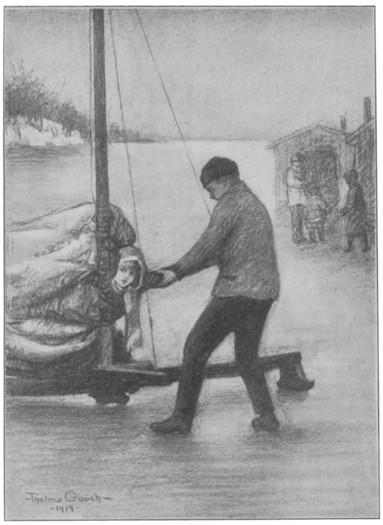
“He fairly dragged her from under the flapping sail.”
“No. The holes wouldn’t stay open long, as
cold as it is out here. It’s about twenty below
zero right now, my lady, and I’m keeping a sharp
eye on your nose.”
“Oh! Oh!” gasped Agnes, putting her mittened
hand tentatively to her nose. “Is that why
you told me to keep my collar up over my mouth
and nose?”
“It is!” declared the boy, rubbing his own face
vigorously. “If you see any white spot on anybody’s
face up here in this weather, grab a handful
of snow and begin rubbing the spot.”
“Mercy!” Agnes murmured, with a gay little
laugh. “Lucky Trix Severn doesn’t come up
here. She uses rice powder dreadfully, and folks
would think she was being frost-bitten.”
“Uh-huh!” agreed Neale.
“But you haven’t told me how they fish,” said
the girl, as they approached nearer to the huts and
she was able to walk better.
“Through the ice of course,” he laughed.
“Only you don’t see the holes. They are inside
the huts.”
“You don’t mean it, Neale?”
“To be sure I mean it! Some of those big
shanties house whole families. You see there are
children and dogs. They have pot stoves which
warm the huts to a certain degree, and on which
they cook. And they have bunks built against the
walls, with plenty of bedding.”
“Why, I should think they would get their death
of cold!” gasped the girl.
“That’s just what they don’t get,” Neale rejoined.
“You can bet there are no ‘white plague’
patients here. This atmosphere will kill tubercular
germs like a hammer kills a flea.”
“Goodness, Neale!” giggled Agnes. “Did you
ever kill a flea with a hammer?”
“Yep. Sand-flea,” he assured her, grinning.
“Oh! I’m one quick lad, Aggie.”
She really thought he was joking, however, until
she had looked into two or three of the huts. People
really did live in them, as she saw. In the
middle of the plank floors was a well, with open
water kept clear of frost. The set-lines were fastened
to pegs in the planks and the “flags” announced
when a fish was on the hook.
A smiling woman, done up like an Eskimo, invited
them into one shack. She had evidently not
seen the scooter arrive from down the lake and
thought the boy and girl had walked out from
Coxford.
“Hello!” she said. “Goin’ to try your hands
at fishin’? You’re town folks, ain’t you?”
“Yes,” said Agnes, politely. “We come from
Milton.”
“Lawsy! That’s a fur ways,” said the woman.
She was peeling potatoes, and a kettle was boiling
on the stove at one side. The visitors knew
by the odor that there was corned beef in the pot.
“You goin’ to try your hands?” the woman repeated.
“No,” said Neale. “We are with a party that
is going up to Red Deer Lodge.”
“Oh! That’s the Birdsall place. You can’t
git up there tonight. It’s too fur.”
“I guess we shall stay in Coxford,” admitted
Neale.
“Didn’t know but you an’ your sister wanted to
fish. Old Manny Cox got ketched with rheumatics
so that he had to give up fishin’ this season. I can
hire you his shanty.”
“No, thank you!” murmured Agnes, her eyes
round with interest.
“I let it for a week or more to two gals,” said
the woman complacently. “Got five dollars out of
’em for Manny. He’ll be needin’ the money.
Better stay awhile and try the fishin’.”
“Goodness! Two girls alone?” asked Agnes.
“Yes. Younger’n you are, too. But they
knowed their way around, I guess,” said the
woman. “Good lookin’ gals. Nice clo’es. Town
folks, I guess. Mebbe they wasn’t older’n my
Bob, and he’s just turned twelve.”
“Twelve years old! And two girls alone?”
murmured Agnes.
“Oh, there ain’t nobody to hurt you here. We
don’t never need no constable out here on the ice.
There’s plenty of women folks—Miz’ Ashtable,
and Hank Crummet’s wife, and Mary Boley and
her boys. Oh, lots o’ women here. We can help
make money in the winter.
“There! See that set-line bob?”
She dropped the potato she was paring and
crossed to the well. One of the flags had dipped.
With a strong hand she reeled in the wet line. At
its end was a big pickerel—the biggest pickerel
the visitors had ever seen.
“There!” exclaimed the woman. “Sorry I
didn’t git that before Joe Jagson went with his
load of fish. That’s four pound if it weighs an
ounce.”
She shook the flopping fish off the hook into a
basket and then hung the basket outside the door.
In the frosty air the fish did not need to be packed
in ice. It would literally be ice within a very
few minutes.
“Got to hang ’em up to keep the dogs from
gettin’ them,” said the woman, rebaiting the hook
and then returning to her potato paring. “Can’t
leave ’em in a creel in the water, neither; pike
would come along an’ eat ’em clean to the bone.”
“Oh!” gasped Agnes.
“Yes. Regular cannibals, them pike,” said the
woman. “But all big fish will eat little ones.”
“What kind of fish do you catch?” Neale asked.
“Pickerel and pike, whitebait (we calls ’em
that), perch, some lake bass and once in a while
a lake trout. Trout’s out o’ season. We don’t
durst sell ’em. But we eat ’em. They ain’t no
‘season,’ I tell ’em, for a boy’s appetite; and I got
three boys and my man to feed.”
At that moment there was a great shouting and
barking of dogs outside, and Neale and Agnes
went out of the hut to learn what it meant. The
Corner House girl whispered to the boy:
“What do you think about those two twelve
year old girls coming here to stay and fish through
the ice?”
“Great little sports,” commented Neale.
“Well,” exclaimed Agnes, “that’s being too
much of a sport, if you ask me!”
CHAPTER IX—A COLD SCENT
The barking of the dogs was in answer to the
booming note that Tom Jonah sent echoing across
the ice. Agnes and Neale found that the two big
ice-boats were near at hand.
As one of the crew of Mr. Howbridge’s boat
owned the scooter that Neale and Agnes had come
up the lake on, that owner wished to recover his
abandoned ice-boat. Besides, it was not more
than two miles over the ice to Coxford, and the
wind was going down with the sun. The big boats
would have made slow work of it beating in to the
slab-town on the western shore of the lake.
Neale and Agnes ran out across the ice to meet
their friends. Most of the party were glad indeed
to get on their feet, for the ride up the lake had
been a cold one.
In fact, Tess could scarcely walk when she got
out of her seat, and Dot tumbled right down on the
ice, almost weeping.
“I—I guess I haven’t got any feet,” the smallest
Corner House girl half sobbed. “I can’t feel
’em.”
“Course you’ve got feet, Dot,” said Sammy,
staggering a good deal himself when he walked
toward her. “Just you jump up and down like
this,” and he proceeded to follow his own advice.
“But won’t we break through the ice?” murmured
the smallest Corner House girl.
“Why, Dot! do you s’pose,” demanded Tess,
“that you can jump hard enough to break through
two feet of ice?”
“Well, I never tried it before, did I?” demanded
Dot. “How should I know what might happen to
the old ice?”
Agnes hurried the little ones over to the shanty
of the friendly fisher-woman, where they could get
warm and be sheltered from the raw wind that still
puffed down in gusts from the hills.
Tom Jonah had jumped out of the cockpit of the
ice-boat and found himself immediately in the
middle of what Luke Shepard called “a fine ruction.”
“Canines to right of him, canines to left of
him, volleyed and thundered!” laughed the college
youth. “Hey! call off your fish-hounds, or Tom
Jonah will eat them up.”
One cur was already running away yelping and
limping; the others took notice that the old dog
had powerful jaws. But Ruth insisted that Tom
Jonah be put on a leash, and Luke meekly obeyed.
Indeed, he was likely to do almost anything that
the oldest Corner House girl told him to do, “right
up to jumping through the ring of a doughnut!”
his sister whispered to Mrs. MacCall in great
glee.
“Well, my lassie,” was the housekeeper’s comment,
“he might be mindin’ a much worse mistress
than our Ruthie.”
Nothing that Ruth could or did do in most matters
was wrong in Mrs. MacCall’s opinion, even if
she did criticize the Kenways’ charity. If Luke
Shepard some day expected to get Ruth for his
wife, the housekeeper considered that it was only
right he should first learn to obey Ruth’s behests
in all things.
Ruth had a word to say to Neale and Agnes at
this time. She pointed out to those two restless
and reckless younger ones that there must be no
such venturesome escapades during the remainder
of this winter vacation as that connected with the
ice-scooter.
“If you have no respect for your own bones,
think of our feelings,” she concluded. “Why! I
almost had heart disease when I saw that horrid
scooter fly past with Agnes up in the air as though
she were on a flying trapeze.”
“Shucks, Ruth!” said Neale, “you know I
wouldn’t let any harm come to Aggie.”
“Now, Neale,” returned the older girl, “how
would you keep her from getting hurt if that ice-boat
broke in two, for instance?”
“Oh, well—”
“That’s what I thought!” snapped Ruth.
“You had not thought of that.”
“Don’t scold him! Don’t scold Neale!” begged
Agnes. “He’s all right.”
“Oh, no, he isn’t,” said Ruth grimly. “One
side of him is left! And you will promise to be
good or I’ll make Mr. Howbridge send Neale home,
right from here.”
“Oh!” cried her sister. “You would not be so
mean, Ruthie Kenway.”
“I don’t know but I would,” Ruth rejoined. “I
don’t think so much of boys, anyway—”
“Not until they get to be collegians,” whispered
Neale shrilly from behind his hand.
Ruth’s eyes snapped at that, and she marched
away without another word. Mr. Howbridge refrained
from commenting upon the incident, for
he saw that Ruth had said quite all that was necessary.
Neale and Agnes were much abashed. They
followed the others slowly toward the village on
the ice. Neale said:
“Well, if she says I can’t go any farther I’ll
stay right here and fish until you come back,
Aggie.”
“Oh, Neale! You wouldn’t!”
“Why not? Maybe I’d make a little money. If
two twelve year old girls could stand it for a week
here, I don’t see why I couldn’t stand it for three
weeks.”
“I’ve been thinking about those two girls that
woman told us about,” said Agnes with sudden
eagerness.
“What about ’em?”
“Do you s’pose they were girls, Neale O’Neil?”
“Why! what do you mean? How do I know?
The woman said they were.”
“But two girls—and only twelve! It doesn’t
seem probable. I should think the police—”
“Didn’t you hear that woman say there were no
constables out here on the ice?” said Neale.
“I don’t care! I’m suspicious,” declared
Agnes.
“Not of that fisher-woman?” asked the boy,
puzzled indeed.
“No, no! But no two girls in this world would
ever have considered coming out here on the ice
to fish. How ridiculous!”
“Say! what are you trying to get at, Agnes
Kenway?” demanded her friend. “You do have
the craziest ideas!”
“Do I, Mr. Smartie?” she returned. “At least
they are ideas. You never seem to suspect a living
thing, Neale O’Neil.”
“Oh! I give it up,” he groaned. “You are too
much for me. I’m lashed to the post and you have
left me behind.”
“Oh, do come on!” exclaimed Agnes, hastily
dragging at his jacket sleeve. “If you don’t know
what I’m about, just keep still and listen.”
“Oh, I’ll do that little thing for you,” returned
Neale. “I can be as dumb as a mute quahog with
the lockjaw—just watch me!”
He tagged on behind Agnes with much interest.
The girl hurried to the shack into which the little
folks had been taken for warmth. Mrs. MacCall
was there with them, talking with the genial fisher-woman.
“Hech!” exclaimed the housekeeper, warming
her blue hands, “but this is a strange way to live.
’Tis worse than sheep herding in the Highlands.
’Tis so!”
“’Tain’t so bad,” said the woman. “And
there’s good money in the fish. We are mostly all
Coxford people here—or folks from back in the
hills. Few stragglers come here to bother us.”
“But you said two strangers had been here this
winter,” Agnes interposed, eagerly.
“I said so,” the woman agreed. “Two stragglers.
Two girls,” and she laughed. “But they
didn’t stay long. They kept to themselves like,
and never did us any harm.”
“Say, Maw!” The voice came out of a shadowy
corner. It was gloomy in the shack, for the
sun had now dipped below the hills and twilight
had come.
“That’s my Bob,” said the woman. “He’s
about the age of them two gals.”
“They wasn’t two gals, Maw,” said Bob from
the darkness.
“What d’you mean?”
“One was a boy. Yes, she was—a boy! We
kids found it out, and that’s why them two lit out
over night.”
“Good gracious, Bob! What are you sayin’?”
“That’s right,” said the voice from the dark
corner, stubbornly. “They was brother and
sister. They owned up. Run away from somewhere,
I guess. And then they run away from
here.”
Agnes pinched Neale’s arm. “What did I tell
you?” she whispered.
“Ouch! I don’t know. You’ve told me so
many things, Aggie,” he complained.
“Don’t you remember what Mr. Howbridge told
us about the Birdsall twins and the picture he sent
out to the police? He showed us that, too.”
“Jumping Jupiter!” gasped the amazed Neale.
“Why—why, she,” pointing to the fisher-woman,
“didn’t say anything about the twins.”
“Listen!” exclaimed Agnes again; and as Mrs.
MacCall had taken the three younger children out
of the shack, Agnes began to interrogate the
woman as to the appearance of the strange girls
who had remained for a week at the village on the
ice.
Yes, they were both slim, and dark, and looked
boyish enough—both of them. They seemed well
behaved. She didn’t believe Bob—
“I tell you I know,” put in Bob from his corner.
“One was a boy. He called the other by a
girl name all right. Rowly—or Rowny—or
sumpin’—”
“Rowena!” cried Agnes.
“Mebbe,” admitted Bob.
“For the land of liberty’s sake!” exclaimed his
mother suddenly, “I’d like to know how you are so
sure ’bout one bein’ a boy?”
“Well, I’ll tell you,” grumbled Bob. “’Cause
he licked me! Yes, he did. Licked me good and
proper. No girl could ha’ done that, you bet!”
said the disgruntled Bob.
“Now, Bob! I am ashamed of you!” said his
mother.
“You needn’t be. He could fight, that fellow!”
“But did you think they were both girls till you
got into this fight?” Neale asked, now becoming
interested.
“Bet you. We thought we could get some of
their lines. They had more’n enough. We went
over there to Manny Cox’s shack, and she that
was a girl was alone. So we took the lines.”
“Now, Bob!” murmured his mother.
“Guess a constable here wouldn’t be a bad thing
after all,” chuckled Neale.
“Go on,” ordered Agnes.
“Why, that girl just cried and scolded. But the
other one came back before me and Hank and
Buddie got away.”
“The one you think was a boy?” asked Agnes.
“One I know was a boy—since he fought me.
He didn’t do no cryin’. He squared right off,
skirts an’ all, and jest lambasted me. And when
Hank tried to put in an oar, he lambasted him.
Buddie run, or he’d ’ve been licked, too, I guess.”
“Well!” exclaimed Bob’s mother. “I never
did! And you never said a word about it!”
“What was the use?” asked her son. “We was
licked. And the next morning that boy-girl and
his sister was gone. We didn’t see ’em no more.”
“That is right,” said the woman thoughtfully.
“They got away jest like that. I never did know
what become of ’em or what they went for.”
Agnes dragged Neale out of the shack. She
was excited.
“Let’s find Mr. Howbridge!” she cried. “He
ought to know about this. I just feel sure those
twins have been here in this fisher-town.”
CHAPTER X—INTO THE WILDERNESS
But the lawyer and guardian of the runaway
Birdsall twins was not so easily convinced that
Agnes had found the trail of the lost Ralph and
Rowena. It seemed preposterous that the twins
should have joined these rough fisherfolk and lived
with them in the ice-village.
The party from Milton waited at the village for
an hour while the lawyer cross-questioned the
inhabitants. It was not that any of these people
wished to hobble Mr. Howbridge’s curiosity regarding
the “stragglers,” as they called the
strangers who sometimes joined the community;
but nobody had considered it his or her business
to question or examine in any way the two unknown
girls (if they were girls) who had occupied
Manny Cox’s shack for a week.
After all, the boy, Bob, and his mates, gave the
most convincing testimony regarding the strangers.
He was positive that one of the stragglers
had been a boy—a very sturdy and pugilistic one
for a twelve-year-old lad.
“And that might fit young Ralph Birdsall’s
reputation, as I got it from Rodgers, the butler,”
said Mr. Howbridge. “Ralph has to be stirred
by Rowena to fight; but, once stirred, Rodgers
says he can fight like a wildcat.”
“Why, what a horrid boy!” murmured Tess,
who heard this. “I guess I’m glad those twins
didn’t come with us after all.”
“But, Mr. Howbridge,” asked Ruth, “does it
seem possible that they could get away up here
alone?”
“That is difficult to say. Nobody knows how
much money they had when they left Arlington.
They might have come as far as this. If they had
wished to, I mean.”
It was getting quite dark, now, and the children
were tired and hungry. The party could spend
no more time at the fishing village. They set out
across the ice for Coxford.
Neale took Dot pick-a-pack and Luke shouldered
Tess, although the latter felt much embarrassed by
this proceeding. Ruth had to urge her to remain
upon the collegian’s shoulder.
“Really, I’m quite too big to play this way,” she
objected.
But she was tired—she had to admit that.
Sammy made no complaint; but his short legs
were weary enough before they reached the shore.
Oil lamps on posts lit the few streets of Coxford.
Most of the slab houses looked as though
the wind, with a good puff, could blow them down.
The forest came down to the edge of the village.
If there should be a forest fire on this side of the
mountain range, the slab-town would surely be
destroyed.
Hedden, Mr. Howbridge’s man, had prepared
things here for the party, as well as at Culberton.
On the main street of the little town was what
passed for a hotel. At this time of year it was
but little patronized.
Therefore the lawyer’s man had chartered the
house, as well as the family that owned it, to make
the holiday vacation party comfortable over one
night.
Roaring fires, hot supper, feather beds, and
plenty of woolen blankets awaited the crowd from
Milton at this backwoods hostelry. Mr. Dan Durkin,
who was the proprietor of the Coxford Hotel,
and his hospitable wife and daughters, could not
do too much for the comfort of Mr. Howbridge and
his friends.
“We don’t have enough strangers here in winter
time to keep us in mind of what city folks are
like,” the hotel-keeper declared. “When Miz’
Birdsall was alive, she and her man and the kids
used to come through here three-four times ’twixt
the first snow flurries an’ the spring break-up.
They liked to see their camp up there in the hills
durin’ the winter. But after Miz’ Birdsall died,
he never came.”
“And the children?” asked Mr. Howbridge,
thoughtfully.
“They did come in summer,” said Durkin; “but
not in the winter.”
“You haven’t seen them of late, have you?”
questioned the lawyer.
“Them twins? No. Nary hide nor hair of ’em.
I tell you, ain’t nobody—scurcely—gets up here
this time’ o’ year. ’Ceptin’ a few stragglers for
the fishin’, perhaps. But we don’t see them here
at the hotel. We don’t take in stragglers.”
But he and his family, as has been said, did their
very best for the party from Milton. The young
folks slept soundly, and warmly, as well, and were
really sorry to crawl out of the feather beds at
seven o’clock the next morning when they were
called to get ready for breakfast.
The cold and the long ride of the day before
seemed to have done nobody any harm. The balsam-laden
air, when they went to the hotel porch
for a breath of it before breakfast, seemed to
search right down to the bottom of their lungs and
invigorate them all. Surely, as Neale had told
Agnes, no tubercular germ could live in such an
atmosphere.
“Just the same,” said Ruth, wisely, when
Agnes mentioned this scientific statement fathered
by the ex-circus boy, “you children keep well
wrapped up. What is one man’s medicine is another
man’s poison, Mrs. Mac often says. And
it is so with germs, I guess. What will kill one
germ, another germ thrives on. A bad cold up
here will be almost sure to turn into pneumonia.
So beware!”
“Don’t keep talking about being sick,” cried
Cecile. “You are almost as bad as Neighbor.”
“Neighbor” Henry Northrup lived next door to
the Shepards and their Aunt Lorena, and was
Luke’s very good friend. “Neighbor is forever
talking about symptoms and diseases. After a
half hour visit with him I always go home feeling
as though I needed to call the doctor for some
complaint.”
They made a hearty and hilarious breakfast of
country fare—fried pork and johnnycakes, with
eggs and baked beans for “fillers.” Mrs. MacCall
should not have tried to eat the crisply fried
“crackling” as the farmers call the pork-rind;
but she did. And one of the teeth on her upper
plate snapped right off!
“Oh, dear me, Mrs. Mac!” gasped Agnes.
“And not a dentist for miles and miles, I suppose!”
“Oh, well, I can get along without that one
tooth.”
“My pop’s got a new set of false teeth,” Sammy
said soberly. “He’s just got ’em—all new and
shiny.”
“What did he do with the old ones he had?”
asked Tess, interested.
“Huh! I dunno. Throwed ’em away, I hope.
Anyway,” said Sammy, who had had much experience
in wearing made over clothing, “mom can’t
cut them down and make me wear ’em!”
The jangling of sleighbells hurried the party
through breakfast. The little folks were first out
upon the porch to look at the two pungs, filled
with straw, and each drawn by a pair of heavy
horses. The latter did not promise from their
appearance a swift trip to Red Deer Lodge; but
they were undoubtedly able to draw a heavy load
through the deepest drifts in the forest.
They set out very gayly from the little lakeside
town. It was not a brilliantly sunshiny day, for
a haze wrapped the mountain tops about and was
creeping down toward the ice-covered lake.
“There’s a storm gathering,” declared one of
the men engaged to drive the Milton party into
the woods. “I reckon you folks will git about all
the snow you want for Christmas.”
“At any rate, it won’t be a green Christmas up
here,” Agnes said to Neale, who sat beside her in
the second sled. “I don’t think it is nice at all
not to have plenty of snow over Christmas and
New Year’s.”
“I’m with you there,” agreed the boy. “But
I’m glad I haven’t got to shovel paths through
these drifts,” he added, with a quick grin.
They found the tote-road, as the path was called,
quite filled with snow in some places. There were
only the marks of the sleds that had gone up two
days before with the servants and baggage and
returned—these same two pungs in which the
party now rode.
The drifts were packed so hard that the horses
drew the sleds right over the drifts, without breaking
through more than an inch or two with their
big hoofs. In some places they could trot heavily,
jerking the sleds along at rather a good pace; but
for most of the way the road was uphill, and the
horses plodded slowly.
The boys got out now and then to stretch their
legs. Agnes, too, demanded this privilege, and
tramped along beside Neale after the sleds on the
uphill grades. Mainly the party was warm and
comfortable, and cheerful voices, laughter, and
song rang through the spruce woods as they traversed
the forest-clad hills.
Red Deer Lodge, it proved, was a long day’s
journey from the lakeside into the wilderness.
Never before had the Corner House girls and their
friends visited so wild a place. But they foresaw
no trouble in store for them—not even from the
gathering storm.
“Of course,” Agnes said, when she was tramping
on one occasion with the boys behind the second
sled, “there must be bears, and wolves, and
catamounts, and all those, in these woods in summer.
But they are all hidden away for the winter
now, aren’t they, Neale?”
“The bears are holed up,” he granted. “But
the other varmints—”
“What are those?”
“That is what Uncle Bill Sorber calls most carnivorous
animals,” laughed Neale. “Creatures
that prey—”
“Je-ru-sa-lem!” ejaculated the wide-eared
Sammy. “You don’t mean to say wild animals
pray, do you? I never knew they were that religious!”
“Good-night!” laughed Neale. “I mean those
that prey on other animals—live on ’em, you know.
Prey on ’em.”
“Je-ru-sa-lem!” murmured Sammy. “Just
like the fleas on my bulldog, Buster?”
“That’s enough! That’s enough!” groaned
Neale. “No use trying to teach this boy anything.”
“Huh!” grumbled Sammy Pinkney. “They
make me learn enough in school. Don’t you begin
to pick on me out here in the woods, Neale
O’Neil.”
Just then Tom Jonah, who, his tongue hanging
out, had been padding on ahead, suddenly uttered
a loud bark and leaped out of the path. He went
tearing away across the tops of the drifts and
through the open wood through which the tote-road
then passed.
Out of a close-branched spruce just ahead of the
big dog shot a tawny-gray body, and a fearsome
yowl drowned the barking of the dog. But the
creature that had created Tom Jonah’s excitement
was running away.
“Call off that dog!” shouted the head driver.
“Want him all chawed up?”
Tess stood up and began to scream for Tom
Jonah to return. The old dog would obey her
voice if no other.
“Oh! What is that?” cried Ruth.
“Link,” said the driver, succinctly, as the beast
uttered another angry howl which made the returning
Tom Jonah turn to snarl in the stranger’s
direction.
“Oh!”
“He means lynx,” said Mr. Howbridge.
“Don’t, nuther,” snorted the driver. “There’s
only one of him, so he’s a link. If they was two
or more they’d be links.”
“Oh! Ah!” chuckled Luke Shepard. “And
that one is now the ‘missing link.’ He was making
tracks for the port of ‘missing links’ when he
disappeared.”
“He’s goin’ some. That dog give him a scare,”
admitted the driver, as a third and more distant
yowl floated back to them from the depths of the
forest.
The whole party, however, was impressed by the
incident. More than Dot were disturbed by the
thought of danger.
“Just the same,” the smallest Corner House
girl murmured in Tess’ ear. “I’m not going to
throw my Alice-doll overboard, either for wolfs
or linkses—so there!”
CHAPTER XI—EMBERS IN THE GRATE
Mr. Durkin of the Coxford Hotel had furnished
the party with a hearty lunch to eat while they
were en route to Red Deer Lodge, and Ruth had
brought two big thermos bottles of hot tea, likewise
prepared at the hotel. The drivers had their
own lunches, and at noon the party halted in the
shelter of a windbreak to breathe the horses and
allow them to eat their oats.
Mrs. MacCall and the older girls complained of
stiffness from sitting so long in the sledges. Riding
so far in the cold was not altogether pleasant;
there was no sunshine at all now. The gathering
storm had overcast the entire sky, and as they went
on after lunch a rising wind began moaning
through the forest.
“I don’t see why the trees have to make such
a meachin’ noise,” sighed Dot, as they climbed a
steep hill so slowly that the rueful sound of the
rising gale was quite audible.
“Where did you get such a word, Dot?” demanded
Ruth, smiling at her.
“It is a good word. Uncle Rufus uses it,” declared
the smallest Corner House girl. “And
Uncle Rufus never uses bad words.”
“Granted,” Ruth said. “But what does
‘meachin’ mean?”
“Why, just as though the wind felt bad and was
whimpering about it,” said Dot, with assurance.
“It makes you all shivery to listen to it. And
after we heard that link, and know that there
are bears and wolfs about—O-o-oh! what’s that,
Ruthie?”
Something white had flashed right up in front of
the noses of the first team of horses, and with
great leaps broke away from the road. Tom
Jonah was at the rear of the procession and did
not at first see this bounding shape.
Neale stood up in the second sleigh and clapped
his hands sharply together. The white ball
stopped—halting right in a snow-patch; being so
much like the snow itself in color that those in
the sledges could scarcely see it. The sharp
crack of Neale’s ungloved palms seemed to make
the creature cower in the snow. It halted for a
moment only, however.
“Oh! The bunny!” gasped Tess, standing up
to see.
“A big white hare,” Mr. Howbridge said. “I
had no idea there were such big ones around here.”
The hare burst into high speed again and disappeared,
almost before Tom Jonah set out for
him.
“Come back, Tom Jonah!” shouted Tess.
“Why, you couldn’t catch that bunny if you had
started ahead of him.”
“Wow! that’s a good one,” said Neale O’Neil.
“Tell you what, Aggie, those small sisters of yours
are right full of new ideas.”
“That is what teacher says is the matter with
Robbie Foote,” remarked Sammy, thoughtfully.
“How is that?” asked Agnes, expecting some
illuminating information from the standpoint of
a lower grade pupil.
“Why,” Sammy explained, “teacher asked Rob
what was the plural of man. Rob told her ‘men.’
Then, of course, she had to keep right on at it. If
you do answer her right she goes right at you
again,” scoffed Sammy. “That’s why I don’t
often answer her right if I can help it. It only
makes you trouble.”
“Oh! Oh!” chuckled Neale. “A Daniel come
to judgment.”
“Wait. Let’s hear the rest of Sam’s story,”
begged Agnes. “What was Robbie Foote’s
idea?”
“That’s what teacher said—he was full of ideas,
only they were silly,” went on Sammy. “When
he’d told her ‘men’ was the plural of ‘man,’ she
said: ‘What is the plural of child?’ He told her
‘twins.’ What d’you know about that? She said
his ideas were silly.”
“I’m not so sure he was silly,” laughed Neale.
“I wonder what has become of those Birdsall
twins,” Agnes said thoughtfully. “Up here in
this wild country—”
“Nonsense!” exclaimed Neale. “You don’t
know anything of the kind. Those two girls that
fisher-woman spoke about—”
“One of them was a boy.”
“Well, that doesn’t prove anything. We don’t
even know that the two at the fisher-village were
twins.”
“But they were brother and sister roaming
about—runaways and alone.”
“Oh, Aggie!” he cried, “don’t make up your
mind a thing is so without getting some real evidence
first. Mr. Howbridge asked, and he is not
at all sure those stragglers were the twins.”
“Somehow I just feel that they were,” sighed
the second Corner House girl, with a confidence
that Neale saw it was useless to try to shake.
When Agnes Kenway made up her mind to a
thing Neale wagged his head and gave it up.
The party was quite too jolly, however, to bother
much about the lost Birdsall twins just then.
Even Mr. Howbridge had said nothing about them
since his cross-examination of the hotel-keeper
back at Coxford.
If the twins had come this way, for instance,
attempting to reach Red Deer Lodge, surely some
of the people of Coxford or the woodsmen going
back and forth on the tote-road would have met
and recognized them. And if Ralph was dressed
in some of his sister’s clothing, they would have
been the more surely marked.
Two girls of twelve or so traveling into the
woods? It seemed quite ridiculous.
For this was indeed a wild country through
which the tote-road ran. The fact of its being a
wilderness was marked even to the eyes of those
so unfamiliar with such scenes.
Now and then a fox barked from the brakes in
the lowland. Jays in droves winged across the
clearings with raucous cries. More than one
trampled place beside the thickets of edible brush
showed where the deer herd had browsed within
stone’s throw of the tote-road.
And then, as the party came closer to the ridge
on which Red Deer Lodge was built, and the twilight
began to gather, the big white owls of these
northern forests went flapping through the tree-lanes,
skimming the snowcrust for the rabbits and
other small animals that might be afoot even this
early in the evening.
The spread of the wings of the first of these
monster owls that they saw was quite six feet from
tip to tip, and it almost scared Dot Kenway.
With an eerie “Hoo! Hoo! Hoo-oo!” and a swish
of wings it crossed the road just ahead of the
horses, and made even those plodding beasts toss
their heads and prick up their ears.
“Oh, look at that ’normous great white
chicken!” shouted Dot. “Did you ever?”
“It is an owl, child,” said Tess.
“An owl as big as that?” gasped the smaller
girl. “Why—why—it could carry you right off
like the eagle that Mr. Lycurgus Billet set his
Sue for bait! Don’t you ’member?”
“I guess I do remember!” Tess declared.
“But an owl isn’t like an eagle. It isn’t so savage.”
The party had come a long way, and the steaming
horses were now weary. As evening approached
the cold increased in intensity, while
the mournfully sounding wind promised stern
weather. The members of the party from Milton
began to congratulate each other that they were
arriving at the Lodge before a big storm should
sweep over this northern country.
“And suppose we get snowed in and aren’t able
to get out of the woods till spring?” suggested
Cecile, not without some small fear that such
might be a possibility.
“There goes little Miss Fidget!” cried her
brother. “Always worrying over the worst that
may happen.”
“But I suppose we could be snowbound up
here?” suggested Ruth, although scarcely with
anxiety.
“Yes!” agreed Luke, laughing. “And pigs
might fly. But they tell me they are awful uncertain
birds.”
“Don’t listen to him, Ruthie,” said Cecile.
“We may have to stay here all winter long.”
“Then I only hope Mr. Howbridge sent up grub
enough to see us through till spring,” put in the
collegian gayly. “For I can foresee right now
that this keen air is going to give me the appetite
of an Eskimo.”
It was a long climb to the top of the ridge on
which the Birdsalls had built their rustic home.
When the party came in sight of it the lamps
were already lighted and these beckoned cheerfully
to the arrivals while they were still a long
way off.
The private road which had branched off from
the regular tote-road at the foot of the ridge was
easy to ascend beside some of the hills they had
climbed. The teams, however, were not to be
urged out of a walk.
There was a sudden flare of sulphurous light
over the wooded caps of the mountains to the west
of the ridge; but this lasted only a few minutes.
The sun was then smothered in the mists as it
sank to rest. Dusk almost at once filled the aisles
of the forest.
On the summit of the ridge about the big,
sprawling, rustic house only shade trees had been
allowed to stand. The land was cleared and tilled
to some extent. At least, there was plenty of open
space around the Lodge and the log barns and the
outbuildings.
Somebody was on watch, for the big entrance
door opened before the sleds reached the steps,
and yellow lamplight shone out across the porch.
Hedden stood in the doorway, while another man
ran down to assist with the bags and bundles.
“Oh, what a homelike looking place!” Ruth
cried, quite as amazed as the other visitors by the
appearance of the Lodge.
Aside from the fact that the house was built of
round logs with the bark peeled off, it did not seem
to be at all rough or of crude construction. There
were two floors and a garret. The entrance hall
seemed as big as a barn.
It was cozy and warm, however, despite its size.
There was a gallery all around this hall at the
level of the second floor, and a stairway went up
on either side. At the rear was a huge fireplace,
and this was heaped with logs which gave off both
light and heat. There was a chandelier dropped
from the ceiling, however, and acetylene gas flared
from the burners of this fixture.
The whole party crowded to the hearth where
benches and chairs were drawn up in a wide circle
before the flames. The maids relieved Mrs. MacCall
and the girls of their outer wraps and overshoes.
The boys had been shown where they were
to leave their caps and coats.
Such a hilarious crowd as they were! Jokes
and cheerful gossip were the order of this hour of
rest. With all but one member of the party!
There was one very serious face, and this was the
countenance of the youngest of the four Kenway
sisters.
“Dorothy Kenway! what is the matter with
you?” demanded Tess, at last seeing the expression
on the face of her little sister.
Dot had been gazing all about the room with
amazed eyes until this question came. Then with
gravity she asked:
“Tessie! didn’t Mr. Howbridge say this was a
lodge?”
“Why, yes; this is Red Deer Lodge, child,” rejoined
Tess.
“But—but, Tess! you know it isn’t a lodge, nor
a room where they have lodges! Now, is it?!”
“Why—why—”
“It can’t be!” went on the smaller girl with
great insistence. “You know that was a lodge
where we went night before last to have our
Christmas tree on Meadow Street.”
“A lodge?” gasped Tess.
“Yes. You know it was. And there was a
pulpit and chairs on a platform at both ends of
the lodge. And lodges are held there. I know,
’cause Becky Goronofsky’s father belongs to one
that meets there. She said so. And he wears a
little white apron with a blue border and a sash
over his shoulder.
“Now,” said the earnest Dot, “there’s nothing
like that here, so it’s not a lodge at all. I don’t
see why they call it a red lodge for deers.”
Tess would have been tempted to call on Mr.
Howbridge himself for an explanation of this
seeming mystery had the lawyer not been just
then in conference with Hedden in a corner of the
room. The butler had beckoned his employer
away from the others.
“What is it, Hedden?” asked the lawyer.
“Has something gone wrong?”
“Not with the arrangements for the comfort of
your party, Mr. Howbridge,” the man assured
him. “But when we came in here yesterday (and
I unlocked the door myself with the key you gave
me) I found that somebody had recently occupied
the Lodge.”
“You don’t mean it! Somebody broken in!
Some thief?”
“No, sir. I went around to all the windows and
doors. Nobody had broken in. Whoever it was
must have had a key, too.”
“But who was it? What did the intruder do?”
“I find nothing disturbed, sir. Nothing of importance.
But one room, at least, had been used
recently. It is a sitting-room upstairs—right
near this main hall. There had been a fire in the
grate up there. When we came in yesterday the
embers were still glowing. But I could find no
intruder anywhere about the Lodge, sir.”
CHAPTER XII—MYSTERY AND FUN
Mr. Howbridge was evidently somewhat impressed
by Hedden’s report. He stared gravely
for a minute at his grizzled butler. Then he
nodded.
“Take me upstairs and show me which room
you mean, Hedden,” he said.
“Yes, sir. This way, sir.”
He led the lawyer toward the nearest stairway.
They mounted to the gallery. Then the man led
his employer down a passage and turned short
into a doorway. The room they entered was
really on the other side of the chimney from the
big entrance hall.
It was a small, cozy den. Mr. Howbridge looked
the place over keenly, scrutinizing the furnishings
before he glanced at the open coal grate to which
Hedden sought to draw his attention first of all.
“Ah. Yes,” said the lawyer, thoughtfully.
“A work-basket. Low rocker. A dressing table.
Couch. This, Hedden, was Mrs. Birdsall’s private
sitting-room when she was alive. I never
saw the house before, but I have heard Birdsall
describe it.”
“Yes, sir?”
“Mrs. Birdsall spent a good deal of her time
indoors in this room, and the children with her.
So he said. And you found live embers in the
grate there?”
“Yes, sir,” said the butler, his own eyes big
with wonder.
“No other signs of anybody having been here?”
“Not that I could see,” said Hedden.
“Strange—if anybody had been in here who had
a key. Have you seen Ike M’Graw?”
“No, sir. The men who brought us up here
said the man had gone away—had been away for
a week, sir—but would return tonight.”
“Then he was not the person who built the fire
the embers of which you found. The coals would
not have burned for a week. He is the person
who has a key to the Lodge, and nobody else.”
“Yes, sir.”
“Whoever got in here, of course, either departed
when you came, Hedden, or before. Did
you notice any tracks about the house?”
“Plenty, sir. But only of beasts and birds.”
“Ah-ha! Are the animals as tame as that up
here?”
“There were footprints that the men from town
assured me were those of a big cat of some kind,
and there were dog footprints; only the men said
they were those of wolves. They say the beasts
are getting hungry early in the season, because
of the deep and early snow, sir.”
“Humph! Better say nothing to the children
about that,” said Mr. Howbridge. “Of course,
this party’s being here will keep any marauding
animals at a distance. We won’t care for that
sort of visitor.”
“I think there is no danger, sir. I will tell the
chef to throw out no table-scraps, and to feed that
big dog we have brought in the back kitchen.
Then there will be nothing to attract the wild
creatures to the door.”
“Good idea,” Mr. Howbridge said. “And I
will warn them all tomorrow not to leave the
vicinity of the Lodge alone. When Ike M’Graw
arrives we shall be all right. This vicinity is his
natural habitat, and he will know all that’s right
to do, and what not to do.”
Mr. Howbridge still looked about the room.
The thing that interested him most was the mystery
of the intruder who had built the fire in the
grate. Mrs. Birdsall’s sitting-room! And the
lawyer knew from hearing the story repeated
again and again by the sorrowing widower, that
the woman had been brought in here after her
fall from the horse and had died upon the couch in
the corner of the room.
He wondered.
Meanwhile the crowd of young people below
were comforted with tea and crackers before they
went to their bedrooms to change their clothes for
dinner. Mr. Howbridge had brought the customs
of his own formal household to Red Deer Lodge,
and, knowing how particular the lawyer was, Ruth
Kenway had warned the others to come prepared
to dress for dinner.
Mrs. MacCall, after drinking her third cup of
tea, went off with the chief maid to view the house
and learn something about it. The Scotch woman
was very capable and had governed Mr. Howbridge’s
own home before she went to the old Corner
House to keep straight the household lines
there for the Kenways.
Her situation here at the Lodge was one between
the serving people and the family; but the latter,
especially the smaller girls, would have been woeful
indeed had Mrs. MacCall not sat at the table
with them and been one of the family as she was
at home in Milton.
The girls were shown to their two big rooms on
the second floor, and found them warm and cozy.
They were heated by wood fires in drum-stoves.
Ike M’Graw, general caretaker of the Lodge, had
long since piled each wood box in the house full
with billets of hard wood.
Neale and Luke and Sammy were given another
room off the gallery above the main hall. There
they washed, and freshened up their apparel, and
otherwise made themselves more presentable.
Even Sammy looked a little less grubby than
usual when they came down to the big fire again.
It was black dark outside by this time. The
wind was still moaning in the forest, and when
they went to the door the fugitive snowflakes
drifted against one’s cheek.
“Going to be a bad night, I guess,” Neale said,
coming back from an observation, just as the girls
came down the stairway. “Oh, look! see ’em all
fussed up!”
The girls had shaken out their furbelows, and
now came down smiling and preening not a little.
Mr. Howbridge appeared in a Tuxedo coat.
“Wish I’d brought my ‘soup to nuts,’” admitted
Luke Shepard. “This is going to be a
dress-up affair. I thought we were coming into
the wilderness to rough it.”
“All the roughing it will be done outside the
house, young man,” said Cecile to her brother.
“You must be on your very best behavior inside.”
Hedden’s assistant announced dinner, and Mr.
Howbridge offered his arm to Mrs. MacCall, who
had just descended the stairway in old-fashioned
rustling black silk.
Immediately Luke joined the procession with
Ruth on his arm, and Neale followed with Agnes,
giggling of course. Cecile made Sammy walk beside
her, and he was really proud to do this, only
he would not admit it. At the end of the procession
came the two little girls.
They had not seen the dining-room before. It
was big enough for a banquet hall, and the table
without being extended would have seated a dozen.
There was an open fireplace on either side of this
room. The acetylene lamps gave plenty of light.
There were favors at each plate. There were
even flowers on the table. Aside from the
unplastered walls and raftered ceiling, one might have
thought this dinner served in Mr. Howbridge’s
own home.
They all (the older ones at least) began to realize
how great a cross it would have been for the
lawyer to take into his home in Milton two harum-scarum
children like the Birdsall twins. If all
tales about them were true, they were what Neale
O’Neil called “terrors.”
Such children would surely break every rule of
the lawyer’s well-ordered existence. And bachelors
of Mr. Howbridge’s age do not take kindly
to changes.
“Think of bringing the refinements of his own
establishment away up here into the woods for a
three weeks’ vacation!” gasped Cecile afterwards
to Ruth.
To-night at dinner every rule of a well-furnished
and well-governed household was followed. Hedden
and his assistant served. The food was deliciously
cooked and the sauce of a good appetite
aided all to enjoy the meal.
And the fun and laughter! Mr. Howbridge and
Mrs. MacCall enjoyed the jokes and chatter as
much as the younger people themselves. Dot’s
discovery that this was not at all like the lodge
room on Meadow Street delighted everybody.
“If you think that red deer ever held lodge
meetings in this house, you are much mistaken,
honey,” Agnes told the smallest Corner House
girl.
Tom Jonah was allowed to come in and “sit up”
at table. The old dog was so well trained that his
table manners (and this was Ruth’s declaration)
were far superior to those of Sammy Pinkney.
But Sammy was on his best behavior this evening.
The grandeur of the table service quite overpowered
him.
When they all filed back into the hall, which was
really the living-room and reception hall combined,
Tom Jonah went with them and curled down on a
warm spot on the hearth. One of the men staggered
in with a great armful of chunks for the
evening fire. Hedden found a popper and popcorn.
There was a basket of shiny apples, and
even a jug of sweet cider appeared, to be set down
near the fire to take the chill off it.
“Now, this,” said Mr. Howbridge, sitting in
a great chair with his slippered feet outstretched
toward the fire, “is what I call country comfort.”
“Whist, man!” exclaimed Mrs. MacCall. “’Tis
plain to be seen you ken little about country comforts,
or discomforts either. You were born in
the city, Mr. Howbridge, and you have lived in
the city most of your days. ’Tis little you know
what it means to live away from towns and from
luxuries.”
“Why,” laughed the lawyer, “I always go away
for a vacation in the summer, and I usually choose
some rustic neighborhood.”
“Aye. Where they have piped water in the
house, and electricity, an’ hair mattresses. Aye.
I know your kind of ‘country,’ too, Mr. Howbridge.
But when I was a child at home we lived
in the real country—only two farms in the vale
and the shepherds’ cots. My feyther was a shepherd,
you know.”
“You must be some relation of ours, then, Mrs.
MacCall,” Luke said, smiling.
“Oh, aye. By Adam,” said the housekeeper
coolly. “I’ve nae doot we sprang from the same
stock the Bible speaks of.”
“Now will you be good?” cried Cecile, shaking
a finger at her brother. “Go on, Mrs. MacCall.
Tell us about your Highland home.”
“Hech! There’s very little to tell,” said the
housekeeper, shaking her head, “save that ’twas
a very lonely vale we lived in, and forbye in winter.
Then we’d not see a strange body from end
to end of the snows. And the snow came early
and went late.
“If we had not a grand oat bin and a cow in the
stable we bairns would oft go hungry. Why, our
mother would sometimes keep us abed in stormy
weather to save turf. A fire like yon,” she added,
nodding toward the blazing pile in the chimney,
“would have been counted a sin even in a laird’s
house.”
“Ah, Mrs. MacCall,” said the lawyer, “we’re
all lairds over here.”
“Aye, that can pay the price can have the luxuries.
’Tis so. But luxuries we knew naught
about where I was born and bred.”
“I suppose the people right around us here—the
residents of this neighborhood—have few luxuries,”
Ruth said thoughtfully.
“There aren’t many neighbors, I guess,” said
Neale, laughing.
“But those people living in that fishing village—and
even at Coxford—never saw a tenth of the
things which we consider necessary at home,”
Ruth pursued.
“Suppose!” exclaimed Cecile eagerly. “Just
suppose we were snowed in up here and could not
get out for weeks, and nobody could get to us. I
guess we would have to learn to go without luxuries!
Maybe without food.”
“Oh, don’t suggest such a thing,” begged
Agnes. “And this cold air gives one such an
appetite!”
“Don’t mention a shortage of food,” put in
Neale, chuckling, “or Aggie will be getting up in
the night and coming down to rob the pantry.”
There might have been a squabble right then and
there had not Hedden appeared, and, in his grave
way, announced:
“Mr. M’Graw has arrived, sir. Shall I bring
him in here?”
“Ah!” exclaimed the lawyer, waking up from
a brown study. “Ike M’Graw? I understood
from Birdsall that he is a character. Has he had
supper, Hedden?”
“Yes, sir. I knew that you would wish him
served. He has been eating in the servants’ dining-room,
sir.”
“Send him in,” the lawyer said. “Now, young
folks, here is the man who can tell us more about
Red Deer Lodge and the country hereabout, and
all that goes on in it, than anybody else. Here—”
The door opened again. Hedden announced
gravely:
“Mr. Ike M’Graw, sir.”
There strode over the threshold one of the tallest
men the young people, at least, had ever seen.
And he was so lean that his height seemed more
than it really was.
“Why,” gasped Neale to Agnes, “he’s so thin
he doesn’t cast a shadow, I bet!”
“Sh!” advised the girl warningly.
They were all vastly interested in the appearance
of Mr. Ike M’Graw.
CHAPTER XIII—THE TIMBER CRUISER
Mr. Howbridge got up from his chair and advanced
to meet the backwoodsman with hospitable
hand. The roughly dressed, bewhiskered
forester did not impress the young folks at first
as being different from the men who had driven
the sledges to the camp or those who had brought
the party up Long Lake in the ice-boats.
Ike M’Graw had an enormous moustache (“like
that of a walrus,” Cecile whispered), but his iron-gray
beard was cropped close. His face was long
and solemn of expression, but his gray eyes, surrounded
by innumerable wrinkles, had a humorous
cast, and were as bright as the eyes of a much
younger person.
He seized Mr. Howbridge’s hand and pumped it
warmly. His grip was strong, and Mr. Howbridge
winced, but he continued to smile upon the
old man.
“Mr. Birdsall told me that if I wanted to know
anything up here, or wanted anything done, to
look to you, Mr. M’Graw,” said the lawyer, as
their hands fell apart.
“I bet he didn’t say it jest that way, Mr. Howbridge,”
chuckled the man. “No. I reckon he
jest called me ‘Ike.’ Now, didn’t he? And ‘Old
Ike,’ at that!”
Mr. Howbridge laughed. “Well, he did speak
of you in that way, yes,” he admitted.
“I reckoned so,” M’Graw said. “Yep, I’m
‘Old Ike’ to my friends, and what my enemies
call me don’t matter at all—not at all.”
“I fancy you don’t make many enemies up here
in the woods, M’Graw,” said Mr. Howbridge, waving
the visitor to a comfortable seat before the
fire.
“Nor friends, nuther,” chuckled the man.
“No, sir, there ain’t sech a slather of folks up
here to mix in with, by any count.”
Before the woodsman took his seat the lawyer
introduced him to Mrs. MacCall and to Ruth, individually,
and to the rest of the group in general.
“Hi gorry!” exclaimed Ike M’Graw, “you’ve
got a right big fam’ly, haven’t you? You won’t
be lonesome up here—no, you won’t be lonesome.”
“And that is what I should think you would
be,” Mr. Howbridge said. “Lonesome. If you
get snowed in you don’t see anybody for weeks,
I suppose?”
“Better say ‘months,’ Mister,” declared
M’Graw. “I’ve been snowed into my cabin back
yonder in the valley from the day before Christmas
till come St. Patrick’s Day. That’s right.”
“I understood you lived near the Lodge, here,
Ike?” said the lawyer.
“Oh, I do in winter, since Mr. Birdsall asked
me to,” the man said. “But sometimes—’specially
when there was visitors up here—the population
of this here ridge got too thick for Old
Ike. Then I’d hike out for my old cabin in the
valley.”
Quickly Mr. Howbridge put in a query that had
formed in his mind early in the evening:
“Have you been troubled with visitors up here
this winter?”
“No, sir! It’s been right quiet here, you might
say.”
“Nobody here at all until my party came yesterday?”
“Well, not many. Some timbermen went
through for Neven. His company’s got a camp
over beyond the Birdsall line. Yes, sir.”
“Strangers have not been here, then?”
“Why, no. Not to my knowledge,” said
M’Graw, with a keener look at the lawyer. “You
wasn’t meanin’ nothin’ special, was you? I’ve
been away over to Ebettsville for a week. Nothin’
stirring here before I went.”
The conversation had become general again
among the main party. Mr. Howbridge drew
his chair nearer to the old man’s ear.
“Listen,” he said. “When my men came up
yesterday and opened the house with the key I
had given them, they found somebody had been
in here not many hours before they arrived.”
“How’d they know?”
“The fire had scarcely died out in one of the
grates upstairs.”
“Hum! Fire, eh? And I hadn’t been inside
this Lodge since b’fore Thanksgiving. Kinder
funny, heh?”
“Yes.”
“Anything stole?”
“Not a thing touched as far as we know. No
other traces but the embers in that grate—”
“Hold on, Mister!” exclaimed M’Graw, but in
a low voice. “What grate are you referrin’ to?
Which room was this fire in?”
Mr. Howbridge told him. The old man’s face
was curious to look upon. His brows drew down
into a frown. His sharp eyes lost their humorous
cast. Of a sudden he was very serious indeed.
“That thar room,” he said slowly, and at
length, “was Miz’ Birdsall’s.”
“So I believed from the way it was furnished
and from what Frank had told me of the house.”
“Yes, Mister. That was her room. She
thought a heap of sittin’ in that room; ’specially
in stormy weather. And the little shavers used
to play there with her, too.”
“Yes?”
“Them little shavers thought a sight of their
mom,” pursued M’Graw.
“I gathered as much from what Frank told
me,” Mr. Howbridge said seriously.
“By the way, Mr. Howbridge,” said M’Graw
in a different tone, “where are the little shavers?”
“You mean the twins, of course? Ralph and
Rowena?”
“Yes, sir.”
The guardian of the Birdsall twins rather hesitatingly
told the old man just why he had not
brought Ralph and Rowena to Red Deer Lodge
at this time.
“Ran away? Now listen to that!” murmured
the old man. “That don’t sound right. Wasn’t
they with folks able to take keer of ’em?”
“I thought they were,” said Mr. Howbridge.
“Rodgers, the butler, and his wife.”
“Whoof!” exclaimed the backwoodsman, expelling
his breath in a great snort of disgust.
“That butler! Wal, what for a man wants to
buttle for, I don’t know. I never could make it
out that it was a real man’s job, anyway. And
that Rodgers was one useless critter. I don’t
blame them little shavers for runnin’ away from
Rodgers an’ that sour-apple wife of his. I know
’em both.”
“If that is the case,” said the lawyer sadly, “I
wish I had known them as well as you appear to.
Then I should have made other provision for the
twins right at the start.”
“But shucks!” said M’Graw, suddenly grinning.
“Them two little shavers will turn up all
right. Ralph and Roweny are right smart kids.”
“That may be. But we don’t know where they
have gone to. Of course, Ike, they couldn’t have
got up here to Red Deer Lodge, could they?”
“I don’t know ’bout that,” said the old man.
“I reckon they could have got here if they’d
wanted to. But I know well ’nough they didn’t—not
before I went away to Ebettsville a week
ago.”
“Of course not! Somebody would have seen
them at Coxford. And then, if they had come
here, where are they now?”
“That’s right, Mister,” agreed Ike M’Graw.
“But—but who started that fire in the grate?”
“If it had been the children wouldn’t they have
been found here?”
“Mebbe. Tell you the truth”—and the old
man’s weather-beaten face reddened a little.
“Well, to tell you the truth, when you spoke of
the fire in the grate, I was some took aback. Miz’
Birdsall bein’ killed here. And she likin’ that
room so. And she finally dyin’ in it—well, I don’t
know—”
“Ike! you are superstitious, I do believe,” said
the lawyer.
“Mebbe. But that never killed nobody,” said
the man. “And funny things do happen. Howsomever—Say!”
he exclaimed suddenly, “how’d
these folks that made the fire get into the house
and out again?”
“Hedden, my man, says he found nothing
broken or burst open. It must have been by the
use of a key. And the only key I knew of up
here was yours, Ike.”
“That’s right,” said the backwoodsman, nodding.
“Mine’s the only key up here.”
“But the intruders couldn’t have used that.”
“Yes, they could, too! I didn’t take it with me
when I went away from here.”
“Who would know where it was?”
“Anybody might have seen it that looked into
my shack,” admitted the old man. “I ain’t in
the habit of hidin’ things. We don’t have burglars
up here, Mister. That key, and others, hung
right on a nail beside my chimley-place. Yes,
sir!”
“Then any person passing by could have found
the key and entered the Lodge?” asked Mr. Howbridge.
“Only we don’t have many folks passin’ by,”
returned Ike thoughtfully.
“I can’t understand it.”
“It is a puzzle,” admitted M’Graw. “Hi
gorry! I ain’t been to my shack yet since comin’
back from Ebettsville. Mebbe the key ain’t thar
no more.”
“To what door was it?” asked the lawyer.
“This here,” replied M’Graw, jerking a thumb
toward the main entrance. “Padlock on the outside
of the door. All the other doors was barred
on the inside. Oh, she was locked up hard and
fast!”
“I don’t understand it,” said the lawyer.
“You look when you go home and see if the key
is hanging where you left it.”
“Hi gorry! I will,” promised the backwoodsman.
“I’d better bring the key over here tomorrow,
anyway. And I reckon you want them
figgers on the timber Neven wants to cut?”
“Yes. Of course, Ike, you have made no mistake
in cruising the timberland?”
“I never make mistakes, Mister,” said the old
man. “That wouldn’t do in the woods. The man
that’s brought up, as I was, with wildcats an’
bears an’ sech, can’t afford to make mistakes.
This was a lots wilder country when I was a boy
from what ’tis now.”
“I find that Neven’s figures are very different
from yours.”
“Likely. And I reckon they’re in his favor,
ain’t they?” and M’Graw chuckled. “Ye-as? I
thought so. Well, you take it from me, Mister:
I’m working for Birdsall’s youngsters, not for
Neven.”
“I believe that to be a fact,” the lawyer agreed
warmly. “I have already told Neven that there
are other companies that will make a contract
with us if he doesn’t care to accept your report.”
“I b’lieve I know this Birdsall strip a leetle better’n
any other feller in these parts. I’ve lived
on it twenty year, and knowed it well before that
time. I’ve seen some o’ this timber grow.
Reckon I ain’t fooled myself none.”
After that Mr. Howbridge drew the old
into the general conversation. Ike approved
vastly of the young people, it was evident. Agnes
and the smaller children were popping corn.
There were apples roasting on the hearth. The
cider was handed about in glasses which one of
the servants brought.
“We shall look to you for help in amusing these
young people, Ike,” Mr. Howbridge said. “Is it
going to snow enough tonight to keep them indoors
tomorrow?”
“No, no,” the old woodsman assured them.
“It’s snowing some, but not much yet awhile.
This here storm that’s comin’ has got to gather
fust. We’ll get a heavy fall, I don’t doubt, in the
end; but not yet. Like enough, ’twill be purty
fair tomorrow.”
Reassured by this prophecy, the little folks soon
after went to bed. Nor were the older members
of the party long behind them. They had had a
long and wearying day, and the beds beckoned
them.
CHAPTER XIV—BY THE LIGHT OF THE MOON
Ike M’Graw, the timber cruiser, was an excellent
weather prophet; and this was proved to be
a fact before all of those at Red Deer Lodge had
gone to bed on this first night.
Neale O’Neil chanced to raise the shade of one
of the windows in the boys’ room before undressing,
and exclaimed to Luke:
“Hey! who said it snowed? Look at that moon
up there!”
Luke Shepard joined him and looked out, too,
at the rather misty orb of night that peered
through the breaking clouds. But little snow had
fallen during the evening.
“Going to be a good day, just as that old codger
said it would,” agreed Luke. “My, how white
everything is—really, silver! And a lonely place,
isn’t it?”
“You said it,” agreed Neale. He was feeling
in his pockets, and suddenly added: “Crackey!
I’ve lost my knife.”
“You had it down there peeling apples for the
girls,” said Luke, who was beginning to undress.
Sammy was already in bed and sound asleep.
Neale started for the door.
“I don’t want to lose that knife,” he said. “I
am going to run down and get it.”
The serving people had gone to bed, but there
were dim lights on the gallery and one below in
the big hall. Neale ran lightly down the carpeted
stairs on his side of the house. The light was
so dim that he fumbled around a good while hunting
for the missing knife.
Suddenly something clattered about his ears—some
missiles that came from above, but were not
much heavier than snowflakes, it would seem.
Neale jumped, and then stared around.
He could not see a thing moving or hear anything.
Where the white objects had come from
he could not understand. Finally he found one
that had rolled on the floor.
“Popcorn! Say! it’s not snowing popcorn
in here—not by any natural means,” the boy told
himself, immediately suspicious.
Suddenly he spied his knife, and he pocketed
that. As he did so there came another baptism
of popcorn. He dropped down below the edge of
a table which stood in the middle of the room under
the chandelier. All the light came from above,
and there was not much of that; so it was dark
under the table.
He heard a faint giggle. “Ah-ha!” thought
Neale. “I smell a mouse! That is a girl’s giggle.”
He saw that the way to the foot of the stairs
that were nearest the girls’ rooms, was quite dark.
He ran out from under the table, but softly and on
his hands and knees, and reached the stairway
without making a sound.
The popcorn rattled again upon the table top,
and once more he heard the giggle. He wormed
his way up the stairs in the shadow and reached
the gallery. Here a jet of gas from the side wall
gave some light. He saw the robed figure hanging
over the bannister and in the act of throwing
another handful of popcorn at the spot where the
boy was supposed to be crouching.
Neale O’Neil crept forward from the top of the
stairs, still on his hands and knees. He was likewise
in the shadow, although he could see the figure
ahead of him plainly.
“Meow!” crooned the boy, imitating a cat with
remarkable ingenuity. “Meow!”
“Oh, mercy!” hissed a startled voice.
“Ma-ro-o-ow!” urged Neale O’Neil, repeating
his feline success.
“Mercy!” ejaculated the whisperer. “That’s
a strange cat.”
“Ma-row-ro-o-ow!” continued Neale, with a lingering
wail.
“Here, kitty! kitty! kitty!” murmured the girl
crouching by the bannister. “Oh, where are you?
Poor kitty!”
Immediately Neale changed his tone and produced
a growl that not only sounded savage but
seemed so near that the startled girl jumped up
with a cry:
“Oh! Oh! Neale!”
“Ma-row-ro-o-ow! Ssst!” continued what purported
to be a cat, and one that was very much annoyed.
“Oh! Oh! OH!” shrieked Agnes, springing
up and leaning over the railing. “Neale! Come
quick!”
And there Neale was right beside her! He appeared
so suddenly that she would have shrieked
again, and perhaps brought half the household
to the spot, had not the boy grabbed her quickly
and placed a hand over her mouth, stifling the cry
about to burst forth.
“Hush!” he commanded. “Want to get Mrs.
Mac or Mr. Howbridge out here to see what is the
matter?”
“Oh, Neale!” sputtered Agnes. “I thought
you were a cat.”
“And I thought you were a hailstorm of popcorn.”
“You horrid boy! To scare me so!”
“You horrid girl! To shower me with popcorn!”
“I don’t care—”
“Neither do I.”
Agnes began to giggle. “What were you doing
down there?” she asked.
“I was looking for my pocketknife. Wouldn’t
lose it for a farm Down East with a pig on it!”
declared the boy. “What are you doing out
here?”
“I went to Mrs. Mac’s room to give her her
nightcap. It was in my bag. Oh, Neale! do you
suppose it will be clear by morning, as that funny
old man says?”
“It’s clear now.”
“You don’t mean it?”
“Come along here to the window and look for
yourself,” the boy said, and led her toward the
front of the house along the gallery.
There was a broad and deep-silled window over
the front door of the Lodge. Neale drew back the
hangings. They could see out into the night which
was now all black and silver.
The forest that edged the clearing in which
stood the Lodge was as black as ever an evergreen
forest could be. The tops of the trees were
silvered by the moonbeams, but the shadows at
the foot of the trees were like ink.
In the open the new-fallen snow glittered as
though the moonlight fell on precious stones. It
was so beautiful a scene that for a moment Agnes
could only grip Neale O’Neil’s arm and utter an
ecstatic sigh.
“Scrumptious, isn’t it?” said the boy, understanding
her mood.
“Lovely!” sighed Agnes. “Ruth and Cecile
ought to see this.”
“Hold on!” warned the boy. “Get them out
here and we’ll both be sent to bed in a hurry.
Ruth’s got her bossing clothes on—has had ’em
on ever since we left Milton.”
“Te-he!” giggled Agnes suddenly. “She feels
her responsibility.”
“Guess she does,” chuckled Neale. “But
there’s no need to add to her troubles. Believe
me! the less I am bossed around by her the better
I like it.”
“Oh, Neale,” said Agnes, “she only does it for
your good.”
“Don’t you fret,” returned the boy, with a
sniff. “I can get along without Ruth or anybody
else worrying about whether I’m good, or
not. Believe me!”
“Oh!” squealed Agnes suddenly. “What’s
that?”
“Huh! Seen a rat? Scared to death?”
scoffed Neale O’Neil.
“Look at that thing out there! It’s no rat,”
declared the girl eagerly.
Neale then looked in the direction she pointed.
Not twenty yards from the house, and sitting on
its haunches in the snow, was an object that at
first Neale thought was a dog. The shadow it
cast upon the moon-lit snow showed pointed ears,
however, and a bushy tail.
“Crackey, Aggie!” gasped Neale, “that’s a
fox.”
“A fox? Right here near the house? Just
like that?” gasped the girl. “Why—why, he
must be wild!”
“Crackey!” returned Neale, smothering his
laughter, “you didn’t suppose he was tame, did
you?”
“But—but,” stammered the girl, “if a wild fox
comes so near the house, one of those dreadful
lynxes may come—or a bear. I never! Why, we
might be besieged by wolves and bears and wildcats.
Did you ever?”
“No, I never was,” scoffed Neale. “Not yet.
But, really, I am willing to be. I’ll try anything—once.”
“I guess you wouldn’t be so smart, young man,
if the animals really did come here and serenade
us. Why—”
“Listen! That fellow is serenading us now,”
declared Neale, much amused.
The sharp, shrill yap of the fox reached their
ears. Then, from the rear of the house where
Tom Jonah was confined in the back kitchen, the
roar of the old dog’s bark answered the fox’s yapping.
And then from somewhere—was it from above
and inside the house, or outside and in the black
woods?—there sounded a sharp explosion. Agnes
flashed a questioning glance at Neale; but the boy
pointed, crying:
“Quick! Look! The fox!”
The little animal with the bushy tail that had
raised its pointed nose to yap mournfully at the
moon, had suddenly sprung straight up into the
air. It cleared the snow at least four feet. One
convulsive wriggle it gave with its whole body,
and fell back, a black heap, on the snow.
“Oh, Neale! what happened to it?” gasped
Agnes, amazed.
“Shot,” said the youth, a curious note in his
voice.
“Oh, who shot it?”
“Ask me an easier one.”
“Why—what—I think that was sort of cruel,
after all,” sighed the girl. “He wasn’t really doing
any harm.”
“I thought you were afraid he might eat us all
up,” said Neale, dropping the curtain which he
had been holding back, and turning away from
the window.
“Oh—but—I am serious now,” she said.
“Who do you suppose shot him?”
“I could not say.”
“That old woodsman, perhaps? There is none
of our party out there with a gun, of course. Oh,
dear! I hope I don’t dream of it. I don’t like
to see things killed.”
But the thought of dreaming about seeing the
fox shot did not trouble Neale O’Neil when he
parted with Agnes and went back to his room.
Nor was it anything about the death of the creature
that absorbed his attention.
It was who the huntsman was and from where
the shot was fired that puzzled Neale O ’Neil. Had
the shot been made from outside or inside the
house?
For it seemed to the boy that the explosion had
been above their heads; and he chanced to know
that none of the party from Milton—not even the
servants—were quartered on the third floor of Red
Deer Lodge.
Who, then, could be up there shooting out of one
of the small windows at the yapping fox? He
said nothing about this to Agnes; but he determined
to make inquiry regarding it the first thing
in the morning.
CHAPTER XV—A VARIETY OF HAPPENINGS
They were near the shortest day of the year
and the sun rose very late indeed; so nobody at
Red Deer Lodge got up early, unless it was the
kitchen man who had to light the fires and bring
in much wood. He tramped paths through the
new-fallen snow to the outbuildings before sunrise.
By the time Neale O’Neil, his head filled with the
puzzling thoughts of the night before, reached the
rear premises, the yard of the Lodge was marked
and re-marked with footsteps.
He sought Hedden, however, having seen that
the snow in front of the Lodge showed no footprint.
The fox lay just where it had been shot.
“Does any of our party sleep in the garret,
Hedden?” Neale asked the butler.
“No, young man. We all have rooms at the
back of the house.”
The boy told the man about the shooting of the
fox. “Of course, one of the men was not out with
a small rifle, and plugged old Reynard when he
was howling at the moon, was he?”
“No,” replied the butler. “Neither John nor
Lawrence knows how to use a gun, I’m sure. Perhaps
it was that tall man, Ike M’Graw.”
“Well, seems to me he ought to have come and
got the pelt,” said Neale, ruminatingly. “It’s
worth something all right, when furs are so high.
Say, Hedden, how do you get upstairs into the
garret?”
Hedden told him, presuming that it was merely
a boy’s curiosity that caused him to ask. But
Neale had a deeper reason than that for wishing
to find the way upstairs.
He could not understand from what angle the
fox had been shot while he and Agnes were looking
out of the window, if the hunter had been in
the wood. There had been no flash or sign of
smoke from the edge of the forest, and Neale’s
vision swept the line of black shadow for hundreds
of yards at the moment of the report.
“Smokeless powder is all right,” muttered the
boy. “But they can’t overcome the flash of the
exploding shell in the dark. No, sir! That
marksman was not in the wood. And the report
sounded right over our heads!”
He said nothing more to Hedden, but found
the upper stairs at the rear of the house. At the
top was a heavy door, but it was not locked. He
thrust it open rather gingerly, and looked into the
great, raftered loft.
The sun was above the treetops now and shone
redly into the front windows. There was light
enough for him to see that as far as human occupants
went, the garret of the Lodge was empty.
There was not much up here, anyway. Several
boxes, some lumber, and a heap of rubbish in one
corner.
Neale O’Neil stepped into the place and walked
to the front of the building. The windows were
square and swung inward on hinges. He knew
that this row of front windows was directly over
that at which he and Agnes stood looking out
upon the moon-lit lawn at bedtime.
The windows were all fastened with buttons.
As far as he could see none gave evidence—at least
on the inside—of having been recently opened.
Neale shivered in the chill, dead air of the loft.
If the marksman that had shot the fox was up
here, from which window did he shoot? Neale
could not find any mark along the window sill or
on the floor.
Suddenly the boy began opening the windows,
one after the other. Some of them stuck, but he
persisted until each one swung open. Outside
the snow that had fallen the evening before lay
in a fluffy layer on the window sill.
At the third window he halted. In this layer of
light snow was a mark. Neale uttered a satisfied
exclamation.
It was the matrix of a round tube—the barrel
of the gun that had fired the shot which had finished
Reynard, the fox!
“Can’t be anything else,” thought the boy.
“He knelt right here and rested his gun across the
sill. Yes! it points downward—pressed heavier
at the outer end than near the window. Yes!”
The boy got down and squinted along the mark
in the snow. His keen eye easily brought the
huddled, sandy object on the snow down below into
range.
“Now, what do you know about that?” Neale
O’Neil asked aloud. “Who was up here with a
gun last night and popped over that fox? I wonder
if I ought to tell Mr. Howbridge.”
Had he done so the lawyer would quickly have
pieced together what Hedden had told him about
the live embers in the grate and Neale’s discovery.
Whether he would have arrived at a correct conclusion
in the matter, was another thing.
However that might be, Neale O’Neil was sure
that somebody had access to the garret and had
shot the fox therefrom. After the rear premises
of the Lodge had been tracked up so before daylight,
half a dozen people might have left the
house by the rear door without their footprints
being seen. If the marksman had no business in
the Lodge he could easily have got away.
Puzzling over these thoughts, Neale descended
to find most of the party before the fire in the
living-room, waiting for breakfast. Agnes was
eagerly telling of the fox she had seen shot at bedtime.
Neale added no details to her story, save that
the fox still lay on the snow outside.
“Whoever hit him didn’t care for the pelt,”
said the boy. “Now that it is frozen, it will be
hard to skin. A fox hide is worth something.
I’m going to thaw out the body and try to save
the skin—for Aggie, of course.”
“Oh, my!” cried the beauty, “won’t it be fine
to have a collar or a muff made out of a fox that
I saw shot with my own eyes?”
“Odd about that,” said Mr. Howbridge thoughtfully.
“I wonder who could have been so near
the Lodge last evening. And then, to have left
the fox there!”
The breakfast call interrupted him. Neale said
nothing further about it. After the meal, however,
the young people all got into their warm
wraps and overshoes and went out of doors.
Tom Jonah was turned loose, and he almost at
once dashed around the house to the spot where
the body of the fox lay. The children gathered
around the fuzzy animal in great excitement.
“Oh, it looks like Mrs. Allen’s spitz dog—only
this is reddish and Sambo, the spitz, is white,”
Tess said. “The poor—little—thing!”
“This is no ‘expectorates’ dog,” chuckled Neale,
grabbing the creature by the tail. “‘Expectorates’
is a much better word than ‘spits,’ Tess.
Now, I am going to take this fellow and hang him
up in the back kitchen where he will thaw out.
No, Tom Jonah! you are not going to worry him.”
“What lovely long fur!” murmured Agnes.
“Do you suppose you can really cure the skin for
me, Neale?” she demanded.
“What’s the matter with the skin?” demanded
Sammy, in wonder. “Is it sick?”
“Good gracious!” exclaimed Agnes. “These
children have to be explained to every minute. I
hope that fox skin has no disease, Sammy.”
Luke and Ruth and Cecile had gone for a tramp
through the wood. The little folks set to work
building a snow man which was to be of wondrous
proportions when completed. Naturally Neale
and Agnes kept together.
Agnes had been wandering along the edge of
the wood in front of the house while Neale carried
the fox indoors. Tom Jonah came back with Neale
and began snuffing about the spot where the fox
had laid.
“See here, Neale O’Neil,” cried Agnes, “I can’t
find anybody’s footprints over here. Where do
you suppose that man shot the fox from?”
“Humph!” grunted Neale noncommittally.
“But here’s just the cunningest hoofprints!
See them!” cried Agnes.
The boy joined her. Two rows of marks made
by split-hoofed animals ran along the edge of the
wood.
“Crackey!” ejaculated the boy. “Those are
deer.”
“You don’t mean it?”
“Must be. Red deer, I bet. And right close
to the Lodge! How tame these creatures are.”
“Well, deer won’t hurt us,” said Agnes, decidedly.
“Let’s see where they went to.”
Neale was nothing loath. One direction was as
good as another. He wanted much to talk to
somebody about the discovery he had made in the
loft of the Lodge; but he did not wish to frighten
Agnes, so he did not broach the subject.
The two rows of hoof marks went on, side by
side, along the edge of the clearing. They followed
them to the very end of the opening which
had been cleared about Red Deer Lodge—the
northern end.
Here began a narrow path into the woods. The
spoor of the two animals led into this path, and
the boy and girl tramped along after them.
“I guess nothing frightened them,” said Neale,
“for they appear to be trotting right along at an
easy gait. They must have passed this way in
the night. And that’s kind of funny, too.”
“What is funny?” asked Agnes.
“Why, deer—especially two, alone—ought to
have been hiding in some clump of brush during
the night. They don’t go wandering around much
unless they are hungry. And there is plenty of
brush fodder for them to eat along the edge of
the swamps, that is sure.”
“Are you sure they are deer?” asked Agnes.
“They couldn’t be anything else, could they?”
“I reckon not,” laughed Neale. “I say! who
lives here?”
They caught a glimpse of an opening in the forest
ahead. Then a cabin appeared, from the chimney
of which a curl of blue smoke rose into the
air. There were several smaller buildings in the
clearing, too.
“Guess we have struck that old timber cruiser’s
place,” Neale said, answering his own question.
“Oh! Mr. Ike M’Graw!” cried Agnes. “Now
we can ask him if he shot the fox last night.”
“But where did these deer go?” exclaimed
Neale, stopping on the edge of the little clearing
and staring all around.
For here the tracks they had followed seemed
to cross and criss-cross all about the clearing.
That wild deer should frolic so about an occupied
house was indeed puzzling. He saw, too, that
there were human footprints over-running the
marks of the split hoofs.
Suddenly from around the corner of the cabin
appeared the long, slablike figure of the woodsman.
He saw them almost immediately.
“Hullo, there!” he cried. “Ain’t you out
early? I wouldn’t have been up near so early
myself, if it hadn’t been for those confounded
shoats of mine.”
“What happened to the pigs?” asked Neale,
smiling.
“They broke out o’ their pen. Always doin’
that!” returned M’Graw. “Run off through the
woods somewhere, and then come back and made
sech a racket around my shanty that I can’t sleep.
Confound ’em!”
Neale suddenly saw a great light. He seized
Agnes’ hand and squeezed it in warning. With
his other hand he pointed to the marks in the
snow.
“Are those the pigs’ footprints?”
“Yes. I just got ’em shut up again,” said the
woodsman. “Come in, won’t you? I guess my
coffee’s biled sufficient, and I’m about to fry me
a mess of bacon and johnnycake.”
“What do you know about that?” murmured
Neale to the giggling Agnes. “We followed those
pig tracks for deer tracks. Aren’t we great hunters—I
don’t think!”
CHAPTER XVI—THE KEY
The interior of Ike M’Graw’s cabin was a place
of interest to Neale and Agnes. There was not
much room, but it was neat and clean. There
were two bunks, one over the other at one end
of the room. At the other end was the big, open
fireplace.
There were andirons, a chimney crane for a
pot, a dutch oven, and a sheet-iron shelf that could
be pushed over the coals, on which the old man
baked his johnnycake, or pan-bread.
The coffee pot was already bubbling on this
shelf and gave off a strong odor of Rio. The
bacon was sliced, ready for the frying pan. Ike
wanted to cut more and give his two young visitors
a second breakfast; but they would not hear
to that.
“We’ll take a cup of coffee with you,” Agnes
said brightly. “But I know I could not possibly
eat another thing. Could you, Neale?”
“Not yet,” agreed the boy. “And anyway,”
he added, with a smile, “if we are going to have
a big storm as they say we are, Mr. M’Graw will
need to conserve his food.”
“Don’t you fret, son,” said M’Graw; “I’ve got
enough pork and bacon, flour, meal and coffee, to
last me clean into spring. I never stint my stomach.
Likewise, as long as I can pull the trigger
of Old Betsey there, I shan’t go hungry in these
here woods. No, sir!”
Neale stepped to the rack in the corner where
stood the brown-barreled rifle the woodsman called
“Old Betsey,” as well as a single and a double-barreled
shotgun.
“Which of these did you use last night, Mr. M’Graw,
when you shot that fox?” Agnes asked.
“Heh? What fox?”
“Maybe it wasn’t you,” said the Corner House
girl. “But somebody shot a fox right up there
in front of the Lodge.”
“When was this?” demanded the old man, looking
at her curiously.
Neale told him the time. The woodsman shook
his head slowly.
“I was buried in my blankets by that time,” he
declared. “Are you sure the fox was shot, young
feller?”
“I’ve got it hung up to get the frost out so I
can skin it,” said Neale quietly.
“Shot, eh?”
“Yes, sir.”
“What sort of a ball killed it?”
“A small bullet. It was no large rifle bullet,”
said Neale confidently. “I should think it was
no more than a twenty-two caliber.”
“Pshaw! that’s only a play-toy,” returned the
old man. “Who’d have a gun like that up here
in the woods? Guess you’re mistook, young feller.”
“When you come up to the house you take a
look at the fox,” said Neale.
“I’ll do that. Where’d the feller stand when
he shot the fox?”
“Why,” put in Agnes, as Neale hesitated, “we
couldn’t find his footprints at all.”
“Humph!” muttered the old fellow.
He poured out the coffee. The cups were deep,
thick, and had no handles. He poured his own
into the deep saucer, blew it noisily, and sipped
it in great, scalding gulps. Agnes tried not to
give this operation any attention.
Neale meanwhile was examining several fine
skins hung upon the log walls. There was a wolf
skin among them, and a big, black bear robe was
flung over the lower bunk for warmth.
“I got him,” said the woodsman, “five year ago.
He was in a berry patch over against the mountain,
yonder. And he was as fat as butter.”
“And the wolf?” asked Agnes, with considerable
interest.
“I trapped him. Last winter. He was a tremendous
big feller,” said M’Graw, heaping a tin
plate with johnnycake and pouring bacon grease
over it. “There’s a small pack living up in the
hills, and I’m likely to get more this winter.
These heavy snows will no doubt be driving ’em
down.”
“Oh! Wolves!” gasped the girl.
“They won’t bother you none,” said M’Graw.
“Don’t go off by yourself, and if any of your
party takes a long tramp, carry a gun. Like
enough you’ll get a shot at something; but not
wolves. They’re too sly.”
The conversation of the old backwoodsman was
both illuminating and amusing. And his hunting
trophies were vastly interesting, at least to Neale.
There was a big photograph on the wall of Ike
and another man standing on either side of a
fallen moose. The great, spoon-shaped horns of
the creature were at least six feet across.
“You’ll see that head up over the main mantelpiece
up to the Lodge,” said M’Graw. “That’s
Mr. Birdsall. He an’ me shot that moose over the
line in Canady. But we brought the head home.”
Over his own fireplace was a handsome head—that
of a stag of the red deer.
“Got him,” Ike vouchsafed between bites,
“down in the east swamp, ten year ago come
Christmas. Ain’t been a bigger shot in this part
of the country, I reckon, ’ceptin’ the ghost deer
Tom Lawrence shot three winters ago over towards
Ebettsville.”
“Ghost deer!” exclaimed Neale and Agnes together.
“What does that mean?” added the boy.
“Surely you don’t believe there are spirits of
deer returned to earth, do you, Mr. M’Graw?”
asked Agnes, smiling.
M’Graw grinned. “Ain’t no tellin’. Mebbe
there is. I’m mighty careful what I say about
ghosts,” he rejoined. “But this here ghost deer,
now—”
He had finished breakfast and was filling his
pipe. “Lemme tell you about it,” he said. “I
will say, though, ’twasn’t no spirit, for I eat some
of the venison from that ghost deer.
“But for two seasons the critter had had the
whole of Ebettsville by the ears. The hunters
couldn’t get a shot, and some folks said ’twas a
sure-enough ghost.
“But if ’twas a ghost, it was the fust one that
ever left footprints in the snow. That’s sure,”
chuckled M’Graw. “I went over there with Old
Betsey once; but never got a shot at it. Jest the
same I seen the footprints, and I knowed what
it was.”
“What was it?”
“Looked like a ghost flying past in the twilight.
It was an albino—white deer. I told ’em so. And
fin’ly Tom Lawrence, as I said, shot it. Why they
hadn’t got it before, I guess, was because them
that shot at it shivered so for fear ’twas a ghost
they couldn’t hit the broad side of a barn!”
and M’Graw broke into a loud laugh.
“I did not know that deer were ever white,”
Agnes said.
“One o’ the wonders of nature,” Ike assured
her. “And not frequent seen. But that critter
was one—and a big one. Weighed upwards of
two hundred pound. Tom give me a haunch, and
when it was seasoned some, ’twasn’t much tougher
than shoe-leather. Me, I kill me a doe when I
want tender meat. My teeth is gettin’ kind of
wore down,” chuckled the old man.
“Was it really all white?” asked Neale.
“Well, that buck’s horns an’ hoofs was considerable
lighter in color than ordinary. With
them exceptions, and a few hairs on the forehead
and a tuft on the hind leg, that critter was perfectly
white. Queer. Jest an albino, as I said,”
M’Graw concluded between puffs.
Beside the chimney on a big nail driven into a
log, hung a string of rusty keys, with one big shiny
brass one by itself. Agnes said:
“I guess you have to lock everything up when
you leave home, don’t you, Mr. M’Graw?”
“Me? Never lock a thing. We don’t have no
tramps. And if I leave home I always leave a
fire laid and everything so that a visitor can come
right in and go to housekeeping. It’s a purty
mean man that’ll lock up his cabin in the woods.
No, ma’am. I never lock nothin’.”
“But those keys?” the Corner House girl suggested
curiously.
“Oh! Them? Just spare keys I picked up.
All but this,” and he reached for the brass key
briskly. “This is the key to the Lodge padlock,
I’m goin’ to take it up to that Mr. Howbridge of
yours and tell him something about it. I’ll walk
back with you.”
He slipped into his leather jacket and buckled
up his leggings. Then banking the fire on the
hearth, he said he was ready to go. He put the
big brass key in his pocket, but as he had intimated,
he left the cabin door unlocked.
Once outside, they saw that the sun was clouded
over again. “That storm is surely a-coming,”
Ike observed. “I shouldn’t wonder, when it does
get here, if it turns out to be a humdinger. ‘Long
threaten, long last,’ they say.”
When they arrived at the Lodge the old man
took a look at the fox Neale had hung up. He
examined the small hole under the ear where the
bullet had gone into the animal’s head.
“Nice shot,” he muttered. “Dropped him
without a struggle, I reckon. And you sure are
right, boy,” he added to Neale. “It was a twenty-two.
Nothin’ bigger. Humph! mighty funny,
that.
“Well, you let it hang here and I’ll skin it for
you before I go back home. Fust off I want to
see your Mr. Howbridge.”
As M’Graw went through the hall to find the
lawyer, Neale and Agnes were called by Luke from
one of the sheds. His voice and beckoning hand
hurried them to the spot.
“What do you know about this?” cried Luke.
“Here are two perfectly good sleds—a big one
and a smaller. And one of those drivers that
have just started back for Coxford, told me where
there was a dandy slide.”
“Crackey, that’s fine!” agreed the eager Neale.
Agnes, too, was delighted. The other girls were
eager to try the coasting.
“But we must get away without the children.
It is too far for them to go,” Ruth said. “At
least, we must try it out before we let them join
us.”
“They are all right at the front with their snow
man. I just saw them,” Agnes said. “Come
on!” Agnes was always ready for sport.
They started away from the house, the two boys
dragging the bobsled. There were about four
inches of fluffy, dry snow on top, and under that
the drifts were almost ice-hard.
“Ought to make the finest kind of sledding,”
Luke declared.
Meanwhile Ike M’Graw had found Mr. Howbridge
reading a book in a corner of one of the
comfortable settees in the big living-room. He
dropped the book and stood up to greet the woodsman
with a smile.
“How are you, this morning, M’Graw?” asked
the lawyer. “How about the key?”
“Here ’tis,” said the guide. “Found it just
where it should be. Looked as though it had
never been touched since I was gone. But, of
course, as I tell you, anybody might have been in
my cabin. I don’t lock nothin’ up.”
“If the key was used, it was by somebody who
knew it was the key and where to find it,” Mr.
Howbridge said reflectively.
“You struck it there,” agreed Ike. “And
there’s only two keys to that big padlock. Unless
there’s been one made since Mr. Birdsall
died,” he added.
“If anybody borrowed the key and got in here,
they got out again and locked the front door and
returned the key.”
“So ’twould seem. You say there wasn’t no
marks in the snow when your folks fust came?”
“No.”
“It snowed the day after I went away from here
to Ebettsville. They must have come here and
gone before that snow then. That snow covered
their tracks. How’s that?”
“Not so good,” the lawyer promptly told him.
“You forget the live embers in the grate. Those
embers would not have stayed alive for five days.”
“Ain’t that a fac’?” muttered the old man.
They pondered in silence for a moment.
Hedden suddenly entered the room. He seemed
flurried, and his employer knew that something of
moment had occurred.
“What is the matter, Hedden?” the latter
asked.
“I have to report, sir, that somebody has been
at the goods in the pantry—the canned food and
other provisions that we brought up.”
“What do you mean?” asked Mr. Howbridge
curiously.
“The chef, sir, says that quite a good deal of
food has been stolen. He put the stuff away.
There is a lot of it gone, sir—and that since last
night at dinner time.”
“Humph! Isn’t that strange?” murmured the
lawyer.
M’Graw grunted and started for the front door.
“Where are you going, M’Graw?” asked Mr.
Howbridge.
“I’m going to find out who shot that fox,” was
the woodsman’s enigmatical answer.
CHAPTER XVII—ALL DOWN HILL
The party of young people with the bobsled
was very merry indeed just as soon as they got
out of hearing of the Lodge. By striking into a
path which opened into the wood right behind
the barns, they cut off any view the two little girls
and Sammy Pinkney might have caught of their
departure.
“I feel somewhat condemned for leaving them
behind,” Ruth said. “Yet I know it is too far for
such little people to go along and get back for
lunch.”
“Oh, they are having a good time,” Cecile said.
“You make yourself a slave to your young family,
Ruthie,” and she laughed.
“We will make it up to the kids,” Luke joined
in. “After we have tried the slide they can have
a shot at it.”
“That’s all right,” grinned Neale O’Neil.
“But if Tess Kenway thinks she has been snubbed
or neglected—well! you will not hear the last of
it in a hurry, believe me.”
This part of the wood into which the young
people had entered was a sapling growth. Not
many years before the timber had been cut and
there were only brush clumps and small trees here
now.
Flocks of several different kinds of birds—sparrows,
buntings, jays, swamp robins, and
others—flew noisily about. There were berries
and seeds to be found in the thickets. The birds
had begun to forage far from the swamps—a sign
that the snow was heavy and deep in their usual
winter feeding places.
“The dear little birdies!” cooed Agnes, waving
her gloved hand at a flock that spread out fan-wise
in the covert, frightened by the approach of
the young people.
Suddenly there arose a vast racket—a whirring
and trampling sound, as though it were of runaway
hoofs. Agnes shrieked and glanced about
her. The other girls looked startled.
“That horse! It’s running away!” cried
Agnes. “Oh, Neale!”
“Shucks!” said that youth, scornfully. “‘The
dear little birdies!’ Ho, ho! I thought you liked
’em, Aggie?”
“Liked what?” she demanded, as the noise
faded away into the wood.
“The birdies. That was a flock of partridges.
They can make some noise, can’t they? Food in
the swamps must be getting mighty scarce, or they
would not be away up here.”
“Who ever would have thought it?” murmured
Cecile. “Partridges!”
“Wish I had a gun,” said Luke.
“Don’t be afraid. They won’t bite,” chuckled
Neale O’Neil. “And we won’t be likely to meet
anything much more dangerous than birds in the
day time.”
“Yet we saw that big cat yesterday,” Ruth
said.
“It ran all right. We might have brought Tom
Jonah; only he was playing with the kids,” said
Neale. “Anyway, the best he would do would
be to scare up creatures in the thickets that we
otherwise would not know were there.”
“Now, stop that, Neale O’Neil!” cried Agnes.
“Are you trying to frighten us?”
“Shucks, Aggie!” he returned. “You know the
kind of wild animal we scared up this morning
when we found Ike M’Graw’s place.”
“Oh! Oh!” cried Agnes, with laughter.
“What’s the joke?” asked Luke.
So Neale told the rest of the party how he and
Agnes had followed the footprints of the “deer”
clear to the old man’s cabin.
“And there we could hear them squealing in
their pen,” was the way Neale finished it.
“Two mighty hunters, you!” chuckled Luke.
The road over which they dragged the sled soon
became steep. They were now climbing a long hill
through heavier timber. It was a straight path,
and the crown of the ascent was more than a mile
from Red Deer Lodge.
Half way up they passed a fork in the timber
road. The roads were not rutted at all, for they
were full of firm snow. This second road dipped
to the north, running down the steep hill and out
of sight.
“That chap who told me about this slide told
me to ’ware that road,” Luke said. “Around that
curve he said it was steep and there’d be no stopping
the sled for a long way. If we stick to the
right track, we’ll slide back almost to the Lodge
itself.”
“That’ll help some,” Cecile said. “I am getting
tired tramping over this snow. It’s a
harder pull than I imagined it would be.”
“We were very wise not to let the children
come,” Ruth remarked.
Uphill for all of a mile was, in truth, no easy
climb.
Agnes and Neale O’Neil began to bicker.
“I’m no horse,” said Neale rather grumpily,
when Agnes suggested that the boys could drag
the girls on the sled.
“No; your ears are too long,” she retorted impishly.
“Now, children!” admonished Ruth, “How is
it you two always manage to fight?”
“They’re only showing off,” chuckled Luke
Shepard. “In secret they have a terrible crush
on each other.”
“Such slang!” groaned his sister.
“Real college brand,” said Agnes cheerfully.
“I do love slang, Luke. Tell us some more.”
“I object! No, no!” cried Ruth. “She learns
quite enough high-school slang. Don’t teach her
any more of the college brand, Luke.”
They puffed up the final rise and arrived at the
top of the ascent. This was the very peak of the
ridge on which Red Deer Lodge was built.
Because it was winter and all but the evergreens
and oaks were denuded of leaves, they could see
much farther over the surrounding landscape than
would have been possible in the leafy seasons;
however, on all sides the forest was so thick at
a distance that a good view of the country was not
easily obtained.
The valley toward the north was black with
spruce and hemlock. One could not see if there
were clearings in the valley. It seemed there to
be an unbroken and primeval forest.
This valley was included in the Birdsall estate,
and the timber which the Neven Lumber Company
wished to cut practically lay entirely in that wild
valley.
The hills to the west were plainly visible. Their
caps were either bald and snow covered, or
crowned with the black-green forest. Toward the
lakeside the slopes were alternately tree covered
and of raw stumpage where the timber had recently
been cut. These “slashes” were ugly looking
spots.
“That is what all that part yonder of this estate
will look like when the lumbermen get through,”
said Ruth. “Isn’t it a shame?”
“But trees have to be cut down some time. I
heard M’Graw say that much of the timber on this
place was beginning to deteriorate,” Luke said in
reply.
“Shucks!” exclaimed Neale O’Neil, “if a tree
is beautiful, why not let it stand? Why slaughter
it?”
“There speaks the altruistic spirit of the young
artist,” laughed Luke. “Ask Mr. Howbridge.
How about the money value of the tree?”
“Shucks!” Neale repeated, but with his eyes
twinkling. “Is money everything?”
“Let me tell you, boy,” said Luke a little bitterly;
“it buys almost everything that is worth
while in this world. I want beautiful things, too;
but I know it will cost a slew of money to buy
them. I am going to set out and try for money
first, then!”
“Hear the practical youth!” said Cecile.
“That is what he learns at college. Say! aren’t
we going to slide downhill? Or did we come up
here to discuss political economy?”
Luke, holding up his hand in affirmation, declared:
“I vow to discuss neither polit, bugs,
pills, psyche, trig—”
“Oh, stop!” commanded Ruth, yet with curiosity.
“What are all those horrid sounding
things?”
“Pshaw!” cried the collegian’s sister, “I
know that much of his old slang. ‘Trig’ is trigonometry,
of course; ‘psyche’ is psychology;
‘pills’ means physics; ‘bugs’ is biology; and
‘polit,’ of course, is political economy. Those college
boys are awfully smart, aren’t they?”
“I want to sli-i-ide!” wailed Agnes, stamping
her feet in the snow. “I am turning into a lump
of ice, standing here.”
“Get aboard, then,” answered Neale.
She plumped herself on the sled. Luke straddled
the seat just behind the steering wheel. The
other girls took their places in rotation after
Agnes, while Neale made ready to push off and
then jump on himself at the rear.
“Ready?” he cried.
“Let her go!” responded the steersman.
“Hang on, girls!” commanded Neale, as he
started the sled with a mighty shove.
The bobsled moved slowly. The runners
grunted and strained over the soft snow that
packed under them and, at first, retarded the
movement of the sled. But soon the power of
gravitation asserted itself. Neale settled himself
on the seat. The wind began to whistle past their
ears. In front a fine mist of snow particles was
thrown up.
Faster and faster they rushed down the descent.
The young people had thought this trail very
smooth as they climbed it; but now they found
there were plenty of “thank-you-ma’ams” in the
path. The bobsled bumped over these, gathering
speed, and finally began to leave the snow and
fairly fly into the air when it struck a ridge.
The girls screamed when these hummocks
arrived. But they laughed between them, too! It
was a most exciting trip.
Like an arrow the sled shot past the fork in the
road, keeping to the left. But it would have been
a very easy matter, as Luke Shepard saw, to turn
the sled into the steeper descent.
They started up a gray and white rabbit beside
the path, and it raced them in desperate fright for
several hundred yards, before it knew enough to
turn off the road and leap into the brush. Luke’s
head was down and his eyes half closed as he
stared ahead. But Neale gave voice to his delight
in reëchoed shouts.
There were slides in Milton. The selectmen
gave up certain streets to the young folk for coasting.
But those streets were nothing like this.
On and on the bobsled flew, its pace increasing
with every length. Although this wood road was
in no place really steep, the hill was so long, and
its slant so continuous that the momentum the
sled gathered carried it over any little level that
there might be, and at the foot of the decline still
shot the merry crew over the snow at a swift pace
and for a long distance.
Indeed, when the sled stopped they were almost
at the back of the Red Deer Lodge premises. A
mellow horn was calling them to lunch when they
alighted.
“Oh! wasn’t it bully?” gasped the delighted
Agnes. “I never did have such a sled-ride!”
“How about your trip up the lake!” Cecile
asked.
“Oh! But that scooter was different.”
The other girls were quite as pleased with the
slide as Agnes; and the three ran into the house
to dress for lunch, chattering like magpies, while
the boys put the sled away under the shed.
When Luke and Neale went into the house they
found Ike M’Graw skinning the fox in the back
kitchen, Tom Jonah being a much interested spectator.
The woodsman beckoned Neale to him.
“Look here, young feller,” he said. “You seen
this critter shot last night, you say?”
“Yes,” replied the boy.
“Where was it shot from? I’m derned if I can
find any place where the feller stood along the edge
of the woods to shoot him.”
“No. I couldn’t find any footprints either,”
Neale confessed.
“Not knowing from which direction the bullet
came—”
“Oh, but I do know that, Mr. M’Graw. I am
pretty positive, at least. I have been doubtful
whether to say anything about it or not—and
that’s a fact.”
“What d’you mean?” demanded the old man,
eyeing him shrewdly.
“Well, I thought when I heard the shot and the
fox was killed that the explosion was right over
my head.”
“What’s that? Over your head! In the attic?”
“That is where the shot came from—yes.”
“Air you positive?” drawled the old man.
“I went up there this morning and saw the place
where the fellow had rested the barrel of his gun
across the window sill to shoot.”
“My! My!” muttered Ike thoughtfully.
“And there wasn’t nobody up there this morning?”
“No. And I asked Hedden, and he said neither
of the other men knew how to use a gun and that
they all were in bed at the time the fox was shot.”
“Do tell!” muttered the woodsman. “Then
they—well, the feller that shot the fox was up
there in the attic about bedtime, was he?”
“Yes. Who do you suppose he was, Mr.
M’Graw?” asked Neale curiously.
“Well, I wouldn’t want to make a guess. This
here man workin’ in the kitchen tells me that there
wasn’t a foot mark in the snow at all when he
got up and went out of the back door here the
fust time this morning. And, of course, there
wasn’t no footprints at the front of the house, was
there?”
“Oh, no! Not until after breakfast time.”
“Uh-huh! Well, after this John had tramped
back an’ forth to the woodshed and the like half
a dozen times, anybody could have gone out of
here without their footprints being noticed.
Ain’t that a fac’?”
He said this to himself more than to Neale, who
had become vastly interested in the subject. He
eagerly watched the old man’s weather-beaten
face.
Suddenly the woodsman raised his head and
looked at Neale thoughtfully. He asked a question
that seemed to have nothing at all to do with
the subject in hand.
“What kind of a dog is this here Tom Jonah?”
Ike demanded. “Ain’t he got no nose?”
CHAPTER XVIII—FIGURING IT OUT
Of course Ike M’Graw could see for himself
very easily that Tom Jonah had a nose. It was
pointed just then at the fox pelt in the old woodsman’s
hands, and was wrinkled as the dog sniffed
at the skin.
So Neale O’Neil knew that the man meant something
a little different from what he said. He,
in fact, wanted to know if Tom Jonah was keen
on the scent, and Neale answered him to that
end.
“We think he’s got a pretty good nose, Mr.
M’Graw, for a Newfoundland. Of course, Tom
Jonah is not a hunting dog. If he runs a rabbit
he runs him by sight, not by scent. But give him
something that one of the children wears, and
he’ll hunt that child out, as sure as sure! They
play hide and seek with him just as though he
were one of themselves—only Tom Jonah is always
‘it.’”
“Uh-huh?” grunted the old man. Then he
said: “Don’t seem as though any stranger could
have come down from the attic and got through
that hall yonder without this dog making some
sort of racket.”
“I never thought of Tom Jonah,” admitted
Neale.
“He was in here all night, they tell me,” went
on Ike.
“Yes. But didn’t the kitchen man, John, let
him out when he first came downstairs this
morning?”
“No. I asked him. He said the dog didn’t
seem to want to go out. He opened that door
yonder into this back kitchen and called the dog.
This here dog come to the door, but he did not
want to go out and turned away. So John shut
the door again.”
“Crackey!” exclaimed Neale. “Then there
was somebody in here, and don’t you forget it,
Mr. M’Graw!”
“Uh-huh? But why didn’t the dog give tongue?
Was it somebody the dog knowed? You see, son,
there’s been food stole from that pantry yonder
durin’ the night. Could it be the feller that shot
the fox from the attic winder was right in here
when John called the dog, loadin’ up his knapsack
with grub?”
“Why—why—”
“This dog must ha’ knowed him—eh?”
“I—I suppose so. But who could it be?”
demanded Neale with wondering emphasis.
“Surely it was none of our servants. And Luke
Shepard and Sammy and I were in bed in one
room. The girls—Mr. Howbridge—Mrs. MacCall—”
“I guess,” said the old man, grinning, “that
the lady and that lawyer man can be counted out
of it. None of you brought a twenty-two rifle with
you, anyway.”
“No.”
“That’s what the fox was shot with. Here’s
the pellet,” and Ike brought the little flattened
lead bullet out of his vest pocket. “If it hadn’t
been a good shot—spang through the brain—’twould
never have killed the fox. He had his
head on one side, yappin’, and that bullet took him
right.
“Now, better keep still about this. No use
frightening the ladies. Girls an’ women is easy
frightened, I expect. I’ll speak again to Mr. Howbridge
about it. But this here dog—”
He shook his head over Tom Jonah’s shortcomings,
while Neale ran away to wash his hands and
face before appearing at the lunch table.
The children around the table were in something
of an uproar. Mrs. MacCall and Ruth were
obliged to be firm in order to quiet Sammy, and
Tess, and Dot.
For Agnes, unable to keep anything to herself,
had blurted out all about the lovely sled-ride the
older ones had enjoyed. Immediately the three
younger children decided that they had been
cheated.
“We wanted to go tobogganing, too,” Tess declared.
“I just love sliding downhill,” wailed Dot.
“Huh!” sniffed Sammy Pinkney. “A feller
can’t have no fun where there’s big fellers and
big girls. They always put you down, and leave
you out of the best things.”
“You shall go sliding tomorrow if the snow
holds off,” Ruth promised.
“Why not this afternoon, Ruthie?” begged
Tess.
“Sister’s got something else to do this afternoon.
Wait until tomorrow,” the oldest Kenway
replied.
“It’s snowing already,” muttered Sammy disconsolately.
There were a few flakes in the air. But it did
not look as though any heavy fall had begun.
“I don’t see why we need to have you go with
us to slide,” Tess said, pouting. “We go sliding
without you in Milton.”
“This is different, Tess,” Ruth said firmly.
“Now, let us hear no more about it! You will
annoy Mr. Howbridge.”
Sammy winked slyly at the two little girls.
“Just you wait!” he mouthed so that only Tess
and Dot heard him.
“Oh, Sammy!” murmured Dot. “What’ll you
do?”
“Just you wait!” repeated the boy, and that
mysterious statement comforted Dot a good deal,
if it did not Tess Kenway. Dot believed that
Sammy was fertile in expedient. She had run
away with him once “to be pirates.”
Before the meal was over, Hedden came in and
bent beside Mr. Howbridge to whisper into his
ear.
“Oh! Has he come back again? I wondered
where he went so suddenly,” said the lawyer.
“Yes. Tell him I’ll come out to see him as soon
as I am through.”
Neale knew that he referred to M’Graw.
Bright-eyed and interested, he bent forward to
say to Mr. Howbridge:
“I just told Mr. M’Graw something that I guess
you’d wish to know, too, Mr. Howbridge. May I
go with you when you speak to him?”
“Certainly, my boy. There’s nothing secret
about it—not really. We are only puzzled about
a suspicion that we have—”
“That there was somebody in the house that
ought not to be here,” whispered the boy.
“That’s it. How did you know?”
“I’ll tell you later,” returned Neale O’Neil.
Agnes was glaring at him in a most indignant
fashion. It always angered the second Corner
House girl if Neale seemed to have any secret that
she did not share.
“What’s the matter with you?” she hissed,
when Neale turned away from their host. “Don’t
you know it isn’t polite to whisper at table, Neale
O’Neil?”
“What are you doing it for, then?” he asked
her, grinning, and would vouchsafe no further
explanation of the secret between Mr. Howbridge
and himself.
As soon as the lawyer arose from the table to
go out to the kitchen to interview Ike, Neale
jumped up to go with him. Agnes saw him depart
with sparkling eyes and a very red face.
She was really angry with Neale O’Neil.
The boy was too much interested in the mystery
of the shooter of the fox and how he had got in
and out of Red Deer Lodge to be much bothered
by Agnes’ vexation. He and the lawyer found the
old woodsman sitting in the servants’ dining-room
where he had been eating.
“Well, sir,” he began, when Mr. Howbridge and
the boy entered, “’twixt us all, I reckon we’re
gettin’ to the bottom of this here mystery. Did
I tell you I couldn’t find no place where the feller
stood out there in the snow last evening to shoot
that fox from?”
“No.”
“But it’s a fac’. Now you tell him, sonny, what
you told me about what you found in the attic.
I’ve been up and made sure ’twas so.”
Neale told the surprised Mr. Howbridge of the
proved fact that the fox was shot from one of the
attic windows.
“And ’twas a play-toy rifle that done it—a
twenty-two,” said the woodsman, as though to
clinch some fact that had risen in his own mind,
if not in the minds of the others.
“Now, let’s figger it out. We got enough fac’s
now to point purty conclusive to who done it.
Yes, sir.”
“Why, Ike, I don’t see that,” observed Mr.
Howbridge.
“But you will, Mister, in a minute or so,” declared
the old man, nodding with confidence.
“Now, look you: Whoever was in this here house
and made that fire in Miz’ Birdsall’s sittin’-room,
was here when your people came day before yesterday.”
“No!” ejaculated Mr. Howbridge.
“Yes!” repeated M’Graw with decision.
“But you found that key in your cabin, did you
not?”
“Yes. But I tell you I’ve figgered that out.
Whoever ’twas come here, got the key, come in
here, opened the back door, and then locked the
front door on the outside same as always.”
“But—”
“Wait! No buts about it,” interrupted the
woodsman. “I got it figgered to a fare-you-well,
I tell you. Now! The feller locked the front
door, went back to my shanty and hung up the key,
and then came back in by the rear door. See?
He—ahem!—was in here when that man, Hedden,
of yours, and the others, come.”
“But there were no footprints of human beings
about the house in the snow.”
“That’s all right. The feller that built the fire
upstairs had done all his walking around before
the snow fell the day after I went to Ebettsville.
Don’t you see? He didn’t leave here because his
footprints would be seen, and he couldn’t lock the
house up behind him if he did leave and make it
look as though it had never been opened.”
“You are guessing at a lot of this!” exclaimed
the lawyer, not at all convinced.
“No. I’m jest figgerin’. Now, this Neale boy
here heard that shot fired upstairs that killed the
fox. He went up this mornin’ and saw where the
shot was fired from. I seen it, too. So the feller
that opened the Lodge and that lit the fire was
up there at ten or half past last evening, for
sure.”
“Well?” murmured the lawyer.
“He didn’t go out during the night, or his footprints
would have been seen by John this morning
in the new-fallen snow.”
“That sounds right.”
“It is right!” said the old man vigorously.
“Now we come to this here dog you brought.”
“Oh, yes!” cried Mr. Howbridge. “How about
Tom Jonah? Surely if there had been a stranger
about—one who stole food from the pantry—he
would have interfered.”
“Mebbe he would. And mebbe again he
wouldn’t. He’s a mighty friendly dog.”
“But he is a splendid watchdog,” interposed
Neale O’Neil.
“That may be, too,” Ike said, quite unshaken
in his opinion. “If anybody had come in from
outside and undertaken to disturb anything, that
old dog would probably have been right on the
job.”
“I see your point,” Mr. Howbridge admitted.
“But this person who came down from the garret
must have been a stranger.”
“Now we’re gittin’ to it. Let’s figger some
more,” said M’Graw, with a chuckle. “If you
think hard, an’ figger close enough, I guess ’most
any puzzle can be solved.”
CHAPTER XIX—SAMMY TAKES THE BIT IN HIS TEETH
M’Graw began slowly to fill his pipe. Mr. Howbridge
saw that it was useless to hurry him, so
he smiled at Neale and waited. When the tobacco
was alight to suit him, Ike continued his
“figgerin’.”
“When this here dog,” he said, looking at Neale
in turn, “is at home, I guess he knows everybody
in the neighborhood, don’t he?”
“Yes. But surely, you don’t think anybody
from Milton is up here at Red Deer Lodge, except
just these people that Mr. Howbridge brought?”
“Hold on. I’m doin’ the askin’. You just answer
me, sonny,” chuckled Ike. “Now, let’s see.
He does know lots o’ folks—especially young
folks—around where he lives when he’s at home,
don’t he?”
“Why, Tom Jonah,” said Neale, “knows every
boy and girl that comes past the old Corner
House. He’s a great friend of the kids.”
“Jest so,” said M’Graw, as Mr. Howbridge
started and was about to speak. But the woodsman
put up a hand and said to the lawyer:
“Wait a minute. This man, Hedden, has looked
over the stuff you brought up here in the line of
canned goods and sech. He says what was stole
was mostly sweets—canned peaches, an’ pears,
an’ pineapple, an’ sugar-stuff, besides condensed
milk. Jest what children would like.”
“The twins!” exclaimed Mr. Howbridge. “Do
you think it could be possible, after all, Ike?”
“Goodness!” gasped Neale.
“Looks mighty like children’s work,” said the
woodsman reflectively. “I knowed little Ralph
had a twenty-two rifle. I taught him to shoot with
it. He does me proud when it comes to shootin’.
Yes, sir.”
“But to get clear up here—”
“Them is purty smart children,” said the old
man. “And it looks, as I say, like their work.
Who else would give themselves dead away by
shootin’ that fox out of the winder? No grown
person would have done that if they didn’t want
to be caught in the house.
“Then, Ralph and Rowena would have knowed
where that key hung. They’d be more’n likely to
build the fire in their ma’s sittin’-room. Now,
when they sneaked out o’ the house this mornin’,
they’d take just this kind of stuff that’s been took
from the pantry.”
“I see. I see.”
“And the dog clinches it. He’s a friend to all
children. He’d never have stopped them, especially
as they was in the house and didn’t come
from outside.”
“I believe you are right,” admitted Mr. Howbridge.
“I’m great on figgerin’,” said the woodsman.
“Now, let’s see what sort of a nose that there
dog’s got.”
“You mean Tom Jonah?”
“Yes. I ain’t got no dog. There ain’t none
nearer’n Sim Hackett’s beagle at Ebettsville that’s
wuth anything on the trail. Them youngsters
must have gone somewhere, Mr. Howbridge. And
they can’t be fur off. We’ve got to find ’em before
this here storm that’s breedin’ comes down
on us. There must be tracks somewheres, and
a trail a good dog can sniff.”
“I understand what you mean. But how shall
we start the dog on their trail! We have nothing
the twins have worn,” said Mr. Howbridge.
“Let’s look around,” suggested Ike. “Up-stairs
in that sittin’-room, where you found the
live coals—or, your man did—there’s a closet
where some of the twins’ clo’es used to hang.
Mebbe there’s some there now. If that there dog
has got a nose at all, an’ he sniffed them children
good this mornin’, he’ll know the smell of ’em
again. Yes, sir.”
“That is a good idea,” admitted Mr. Howbridge.
“You go out and see if you can find any
impressions of the children’s feet in the snow, Ike.
I will hunt in the rooms upstairs for something
the twins may have worn.”
“Stockin’s are best—stockin’s that ain’t been
washed,” said the woodsman. “Or mittens, or
gloves. Come on, sonny,” he added to Neale
O’Neil. “You come with me and we’ll try to
find some trail marks in the snow.” He glanced
at the window. “And we’ve got to hurry. It’s
snowin’ right hard now, and will smother marks
and everything if it keeps on this way for long.”
Just then, while there was so much interest being
felt in the Birdsall twins and the possibility
of their having been at Red Deer Lodge, somebody
should have felt a revived interest in three
other children—Sammy Pinkney and the two
youngest Corner House girls.
They had gone out after lunch, presumably to
continue the building of the snow man in front of
the Lodge. The older girls and Luke were engaged
in their own matters, and thought not at
all of the little folks. But Sammy, Tess and Dot
had quite tired of playing in the snow.
“They’re awful mean not to have taken us
slidin’ with them,” declared Sammy, sitting on the
front step and making no effort to continue the
work of snow man building.
“I love to slide,” repeated Dot, sadly.
“And now it’s going to snow,” said Tess, biting
her lip. “If it snows a lot we can’t slide tomorrow.”
“Awful mean,” reiterated Sammy. “Say!
Aggie said there was a small sled back there where
they found the big one. Let’s go and see it.”
Any idea seemed good to the disappointed little
girls. Even just looking at the sled they could
use, if nothing happened, was interesting. They
followed Sammy.
But Sammy had more in his mind than just the
idea of looking at the sled. Only, from past experience,
he knew that to get Tess and Dot Kenway
to leave the path of rectitude took some sharp
“figuring.” So he, like Ike M’Graw, was exercising
his faculties.
They came to the shed.
“Oh, what a nice sled!” cried Dot, as Sammy
drew out a shiny sled, big enough for three or four
little folks, and with a steering arrangement in
front.
“It’s a better sled than the one I have at home,”
admitted Sammy.
“I guess we could slide all right on that,” said
Tess slowly.
“Guess we could!” agreed the boy.
“I’d like a ride on it,” said Dot wistfully.
“Get on, kid. Me and Tess will drag you,” said
Sammy.
Dot overlooked the objectionable way in which
Sammy had addressed her and hurried to seat
herself on the sled. Sammy and Tess took hold of
the rope. It was not very hard to pull such a light
body as that of the fairylike Dot through the soft
snow.
Sammy wisely turned away from the Lodge and
followed the tracks of the bobsled. In two minutes
they were out of sight of the Lodge, and even
of the sheds. At that time Neale and the old
woodsman had not come out for the purpose of
searching the vicinity of the Lodge for the footprints
of the Birdsall twins.
Sammy and the two smallest Corner House girls
moved up the woods path which the other sledding
party had found and followed. If Ruth and the
others had gone this way, surely they could safely
follow the same route. Although the snow was
increasing, even the cautious Tess Kenway saw no
danger menacing the trio.
But at first she had no idea just what Sammy
had determined upon. In fact, Sammy Pinkney
had taken the bit in his teeth, and he was determined
to do exactly what they had been forbidden
to do. If the older ones could slide downhill, why
could he and the little girls not have the same
pleasure?
He and Tess drew Dot for a long way, much to
that little girl’s delight. Then the uphill grade
tired Tess so much that she had to stop.
“Shift with Dot,” Sammy said. “Come on,
Dot. You and I will drag Tess a piece.”
The little girl was willing, and she and her sister
changed places. Dot could not do much to aid
Sammy, but he buckled down to the work and
pulled manfully.
When he had to stop, puffing, they were then so
far up the hill that his suggestion that they keep
on to the top and slide back, met with even Tess’
approval.
“We’ve come so far, we might’s well finish it,”
she said.
“Well, I hope it isn’t much farther,” said Dot,
“for it’s awful hard walking in this snow. And
it’s snowing harder, too.”
“Don’t be a ’fraid-cat, Dottie,” snorted Sammy.
“I never saw such a girl!”
“Am not a ’fraid-cat!” declared the smallest
Corner House girl, prompt to deny such an impeachment.
“Snow don’t hurt. But you can’t
see where you are going when it snows so thick,”
“Shucks!” said Sammy. “We can’t get lost
on this road, can we, Tess?”
“No-o,” agreed Tess. “I guess we can’t. We
can’t get off the path, that’s sure. And we can
see the marks the big sled made all the way.”
These tracks, however, were rapidly being effaced.
The children were not cold, for as the snow
increased it seemed to become warmer, and the
hard walking helped to keep them warm.
They had to put Dot back on the sled and draw
her the final two or three hundred yards to the top
of the hill. There, fast as the snow was gathering,
they could see where the other coasters had turned
the bobsled around and prepared to launch themselves
from the top of the hill.
“I guess they slid almost all the way home,”
said Tess, with some anxiety. “I hope we can do
as well, Sammy.”
“Sure,” agreed Sammy. “Ain’t no need to
worry about that. Now I’m goin’ to lie right
down, and Dot can straddle me. Then you push
off and hang on at the back end of the sled, Tess.
Don’t you kids fall off.”
“I wish you wouldn’t call me a kid, Sammy
Pinkney,” complained Dot. “And don’t wiggle
so if I’ve got to sit on you.”
“Well, I got to get fixed,” Sammy rejoined.
“Hang on now. All ready, Tess?”
“Yes. My! how the wind blows this snow into
your face.”
“Put your head down when we get started.
I’ve got to keep lookin’ ahead. Bet this is a
dandy slide—and such a long one!”
“Here we go!” cried Tess, pushing with vigor.
The sled started. It seemed to slide over the
soft snow very nicely. She scrambled on, and,
sitting sideways, clung with both hands to the
rails. Dot was hanging to Sammy’s shoulders.
“Choo! Choo! Choo! Here we go!” yelled
Sammy, wriggling with eagerness.
“Do keep still, Sammy!” begged Dot.
But the sled did not gain speed. The gathering
snow impeded the craft even on the down grade.
“Kick! Kick behind, Tess!” yelled Sammy.
“Kick hard.”
“I—I am kicking,” panted his friend. “Why
don’t the old thing go better?”
“This snow is loadin’ right up in front of it,”
sputtered Sammy. “It’s too de-e-ep! Aw—shucks!”
The sled almost stopped. Then it went over a
thank-you-ma’am and slid a little faster. The
slide was nowhere near as nice as they had expected.
Why! they were not going downhill much
faster than they had come up.
The snow was sifting down now very thickly,
and in a very short time the trio was likely to have
to drag the empty sled through deep drifts. Even
Sammy was secretly sorry they had come such a
long way from the Lodge. Although it was barely
mid-afternoon, it seemed to be growing dark.
They struggled to make the sled slide, however;
neither Sammy nor Tess was a child who easily
gave up when circumstances became obstinate.
Tess continued to dig her heels into the snow, and
when the sled almost stopped, Sammy plunged his
arms elbow deep into the snow to aid in its movement.
But suddenly they went over a hummock. It
seemed a steep descent on the other side. In spite
of the gathering snow the sled got under better
headway.
“Hurrah, Tess!” yelled Sammy. “We’re all
right now.”
“I—I hope so!” gasped the older girl.
“Oh! Oh!” shrieked Dot. “We’re going!”
They really were going—or, so it seemed.
Faster and faster ran the sled, for the hill had
suddenly become steep. It was snowing too
thickly for any of them to notice that this part of
the track was entirely new to them.
They shot around a turn and took another dip
toward the valley. Sammy did not mind the snow
beating into his face now. He yelled with pleasure.
The little girls hung on, delighted. The sled
sped downward.
All marks of the bobsled’s runners were long
since lost under the new snow. The hill grew
steeper. Sammy’s yells were half stifled by the
wind and snow.
It did seem as though that slide was a very long
one! In climbing the hill the trio had had no idea
they had walked so far. And how steep it was!
Over a level piece the sled would travel at a
moderate rate, and then shoot down a sudden decline
that almost took their breath. Surely they
must have traveled almost to the Lodge from
which they had started.
Finally the path became level. Great trees rose
all about them. They could see but a short distance
in any direction because of the falling snow.
The sled stopped. The girls hopped off and
Sammy struggled to his feet and shook the snow
out of his eyes.
“Je-ru-sa-lem!” he choked. “What a slide!
Did you ever, Tess?”
“No, I never did,” admitted Tess quite seriously.
“Oh!” cried Dot. “Let’s go home. I’m co-co-o-old.
Why—why—” she gasped suddenly,
looking about on all sides.
“Well, don’t cry about it,” snorted Sammy.
“Of course we’ll go home. We must be almost
there now—we slid so far.”
“Oh, yes. We must be near Red Deer Lodge,”
agreed Tess.
It did not look like any place they had ever
seen before. The trees were much taller than any
they had noticed about the Lodge. Yet there was
the open path ahead of them. They set Dot upon
the sled again, and Tess helped Sammy drag it and
her sister straight ahead. Somewhere in that direction
they were all three sure Red Deer Lodge
was situated.
CHAPTER XX—FOLLOWING ANOTHER TRAIL
After all the activities of the forenoon both by
the older boys and girls of the vacation party at
Red Deer Lodge, and by the children as well, the
soft snow was considerably marked up by footprints
around the premises.
Ike M’Graw and Neale O’Neil, searching for
prints of the feet of those who they thought had
left the vicinity of the house early that morning,
struck directly off for the edge of the clearing.
“The best we can do,” M’Graw declared, “is to
follow the line of the woods clean around the
clearing. Somewhere, whoever ’tis got that fox
and lifted the canned goods, must have struck into
the woods. They ain’t hidin’ in the barns or anywhere
here. I’ve been searchin’ them. That’s
certain.”
Neale had very bright eyes, and not much could
escape them; but the snow was coming down fast
now and even he could not distinguish marks many
yards ahead.
Here and there they beheld footprints; but always
examination proved them to be of somebody
who belonged at the Lodge. The prints in the
snow Luke and his sister and Ruth had made soon
after breakfast fooled Neale for a moment, but
not for long.
They saw the woodsman’s big prints, too, where
he had been looking for the marks of the fox
hunter. There were the marks Neale himself and
Agnes had made when they had followed the
“deer.”
All these various marks bothered the searchers;
and all the time, too, the snow was falling and
making the identification of the various prints of
feet the more difficult.
“This here’s worse than nailing the animals
that they say went into the ark that time Noah
set sail for Ararat,” declared Ike, chuckling.
“Whoever followed them critters up to the gangplank
must have been some mixed up—
“Hello! What’s this?”
They had come around behind the sheds. Here
was the entrance to the road on which Neale and
Luke with the three older girls had coasted that
forenoon. The woodsman was pointing to marks
in the snow, now being rapidly filled in. Neale
said:
“Oh, we were sliding on this hill, you know.”
“Uh-huh? Who was?”
“Five of us. With a big bobsled.”
“Now, you don’t tell me that bobsled made them
marks,” interposed the old man. “I know that
bobsled.”
“Why—I—”
“Them runner marks was made by little Ralph
Birdsall’s scootin’ sled. I know that, too. Who’s
gone up to slide this afternoon?”
“That must be the kids!” exclaimed Neale. “I
wonder if Ruth knows they are out here playing!
I remember now I didn’t see them at the front of
the house.”
“You don’t suppose they’ve gone far?”
“Oh, I guess they will come to no harm around
here. Ruth would not let them go away from the
Lodge to play.”
“Humph!” muttered the old man.
But he went on. There was really no reason
for Neale to be worried about the children. They
were almost always well behaved. At least, they
seldom disobeyed.
Besides, it was only a few minutes later when
Mr. Howbridge, well muffled against the storm, appeared
with Tom Jonah on a leash. The old
woodsman had just got down on his knees in the
snow to examine two lines of faint impressions
that left the path John’s footprints had made to
the farther shed.
“Now, what’s this? A deer jumped out here—or
what?”
Neale waited and Mr. Howbridge held the dog
back. Ike got up and followed the half-filled impressions
a little farther. They headed directly
for the thicker woods to the north of the Lodge
premises.
“Might have been feet—small feet. And two
sets of ’em,” said Ike. “Hi, Mister! did you find
anything up in that closet belongin’ to the twins?”
“Here is a pair of bed slippers. Knitted ones.
They are much too small for a grown person,” the
lawyer declared.
M’Graw took the articles thoughtfully into his
big hands. “Humph! Look like little Missie’s
slippers. Certainly do. Roweny, you know.
Wonder if this old dog knows anything.”
He offered the slippers to Tom Jonah to sniff.
The dog had been used to following a scent in
times past; often they would send him after Dot
or Tess or Sammy. He snuffed eagerly at the
knitted shoes.
“Don’t know how strong the scent is on ’em.
It’s been some time, p’r’aps, since little Roweny
wore ’em. But—”
Tom Jonah whined, sniffed again, and then lifted
up his muzzle and barked, straining at the leash.
“Looks like he understands,” said the old man,
reaching for the leash and taking the bight of it
from Mr. Howbridge’s hand. “Good dog! Now,
go to it. These here footprints—if that’s what
they are—are fillin’ in fast.”
Tom Jonah put his nose to the marks in the
snow. He sniffed, threw some of the light snow
about with his nose, and started off. He followed
the faint trail into the woods. But Neale doubted
if the dog followed by scent.
Once in the thicket the marks were only visible
here and there. The fresh snow was sifting down
faster and faster. The dog leaped from one spot
to another, whining, and eagerly seeking to pick
up the scent.
“It’s awful unlucky this here snow commenced
as it has. Hi! I don’t see what we can do,”
sighed Ike.
“Do you really believe those marks were the
twins’ footsteps?”
“I do. I believe they was in the house when
your folks came, Mr. Howbridge,” M’Graw said.
“But now—”
Tom Jonah halted, threw up his shaggy head,
and howled mournfully.
“Oh, don’t, Tom Jonah!” cried Neale O’Neil.
“It sounds like—like somebody was dead!”
“Or lost, eh?” suggested Ike. “Ain’t no use.
He—nor a better dog—couldn’t follow a scent
through such snow. We’re too late. But I’d like
to know where them children went, if these is
them!”
They turned back toward the Lodge, rather disheartened.
If the two Birdsall children, who had
been left to the care of Mr. Howbridge, were really
up here alone in the wilderness—and perhaps shelterless
at this time—what might not happen to
them? What would be the end of this strange
and menacing situation?
Nobody spoke after M’Graw expressed himself
until they came to the path on which they had
previously seen the marks of the small sled and
the footprints of Sammy and the two youngest
Corner House girls. These traces were now
entirely obliterated. It was snowing heavily and the
wind was rising.
“Hi gorry!” ejaculated the old woodsman,
“how about those other children? Are they at
home where they ought to be?”
“Whom do you mean?” asked the lawyer, rather
startled.
But Neale understood. He looked sharply
about. Not an impression in the snow but that of
their own feet was visible.
“I’ll go and see if the sled is returned to the
place they got it from,” he said, and dashed away
to the shed.
Before Mr. Howbridge and M’Graw had reached
the Lodge Neale O’Neil came tearing after them.
“Oh, wait! Wait!” he shouted. “They
haven’t come back with the sled. What do you
suppose can have happened to Sammy and Tess
and Dot?”
CHAPTER XXI—ROWDY
About the time Neale O’Neil was asking his
very pertinent question about the whereabouts of
Sammy and Tess and Dot, that trio had stopped,
breathless and not a little frightened, in a big
drift at what seemed the bottom of a deep hole.
The snow swirled about them so, and they
seemed to have come so far down from the place
where they had pushed off on the sled, that they
believed it was a deep hole; and there seemed no
possibility of getting out of it.
“I—I guess,” quavered Dot, “that we’ll just
have to lie right down here and let the snow cover
us all—all up.”
“I do wish, child, when you get into trouble that
you wouldn’t give up all hope, right first off!”
exclaimed Tess, rather exasperated at her sister.
“Of course we are not going to give up and lie
down in this snow.”
“Of course not!” echoed Sammy Pinkney.
Nevertheless, Sammy experienced a chill up and
down his spine, and the short hairs at the back of
his neck stiffened. It was borne upon his mind
all of a sudden that they were lost—utterly lost!
He could not understand how they had got off of
the straight path to Red Deer Lodge; but he was
very sure that they had done so and, as far as he
knew, they were miles and miles away from that
shelter and from their friends.
Yet there seemed nothing to do but keep on
through the snow—as long as they could press forward.
Tess was quite as plucky as he made believe
to be. And they could haul Dot a little way
at a time on the sled.
“But we’re going on, Sammy, without getting
anywhere,” was Tess’ very wise observation. “I
think we ought to scrouge down under something
until the snow stops.”
“Just like the Babes in the Woods,” wailed Dot,
who knew all the nursery stories.
“Do be still!” cried her sister, quite tartly.
“Sammy and I are going to find you a nice place
to stop, Dot.”
“Well, I hope it’s a place with a fire in it, ’cause
I’m cold,” complained the smallest Corner House
girl.
They all wished for a fire and shelter, but the
older ones feared with reason that both comforts
would not be immediately found. Sammy had not
ventured forth this time prepared for all emergencies,
as he had the time that Dot and he ran
away to sail piratically the canal. He had no
means of making a fire, even if he could find fuel.
Sammy was not without fertility of ideas, however;
and these to a practical end. It must never
be said of him, when the lost party got back to Red
Deer Lodge, that he had not done his duty toward
his companions.
He saw that the lower branches of some of the
big spruce trees swept the snow—indeed, their
ends were drifted over in places. Under those
trees were shelters that would break both the wind
and the snow. He said this to Tess, and she
agreed.
“But we must keep a hole open to look out of,”
she said. “Otherwise we won’t see the folks when
they come hunting for us.”
“Je-ru-sa-lem! If they come along this road
while it’s snowing like this lookin’ for us, we’d
never see ’em,” muttered the boy.
But he kept this opinion to himself. Vigorous
action claimed Sammy Pinkney almost immediately.
While Dot “sniffled,” as he called it, on the
half-buried sled, Sammy started to dig under the
boughs of a tree near at hand.
The wind seemed to be less boisterous here, but
the snow was drifting rapidly. Back of the tree
the steep hillside rose abruptly, somewhat sheltering
the spot.
Sammy burrowed through the drift like a dog
seeking a rabbit. He found a way between two
branches of the spruce, over which the snow had
packed hard at a previous fall. He had to break
away fronds of the tough branches to open a hole
into the dark interior.
“Come on!” he shouted, half smothered by the
snow he was pawing out. “Here’s a hole.”
“Oh, Sammy! suppose there should be something
in there?” gasped Tess, her lips close to his
ear.
At this suggestion Master Sammy drew back
with some precipitation.
“Aw, Tess! what d’you want to say such things
to a feller for?” he growled. “If there is anything
in there we’ll find it out soon enough.”
Dot’s sharp ears had heard something of this.
She shrieked:
“Oh! Is it mice? I am afraid of mice, and I
won’t go in there till you drive them all out,
Sammy.”
“Je-ru-sa-lem!” murmured Sammy, with vast
disgust. “Don’t girls beat everything?”
“I don’t care! I don’t like mice,” reiterated
the smallest Corner House girl.
“Huh!” declared Sammy, wickedly, “maybe
there’ll be wolves under there.”
“Wolfs? Well, I haven’t my Alice-doll here,
so I don’t care about wolfs. But mice I am afraid
of!”
At that Sammy took a deep breath, gritted his
teeth, and dived out of sight. He found that there
was quite a sharp incline over hard snow to the
bottom of the hole. All around the trunk of the
tree, and next to it, was bare, hard ground. It
made a roomy shelter, and it was just as warm
as any house could be without a fire.
There was a quantity of dry and dead branches
under here to scratch him and tear at his clothing.
Sammy broke these off as he crawled around the
tree, making the way less difficult for the little
girls when they should enter.
A little light entered by the hole down which he
had plunged. It made the interior of the strange
shelter of a murky brownness, not at all helpful
in “seeing things.”
Sammy was quite sure there was no wolf housed
in here; but about the mice or other small rodents
he was not so sure.
However, he called to the little girls cheerfully
to come down, and Dot immediately scrambled in,
feet first. Tess followed her sister with less precipitation.
Like Sammy, she felt the burden of
their situation much more than did Dot. “Sufficient
unto the day is the evil thereof,” was Dot’s
opinion.
Sammy crawled out again and rescued the sled
which was already buried in the snow. He
dragged it to the opening and left it right over
the hole so as to keep the snow from drifting in
upon them.
“But it makes it so dark, Sammy!” said Tess,
a little sharply.
“Wait a while. You can see better pretty soon.
Your eyes get used to the dark—just like you went
down cellar at night for a hod of coal.”
“Oh, I wouldn’t!” declared Dot. “But I’m not
afraid of the dark. It’s nothing you can feel.”
So they were very cozy and fairly warm under
the tree. Soon the snow had heaped so thickly
over the mouth of their shelter that they could
not even hear the wind.
They had eaten a good lunch. Sammy had some
nuts in his pockets. It was now about four
o’clock. They were not likely to suffer for anything
needful for some time. And, of course,
neither of the three thought that their stay under
the spruce tree would be for long.
“If the snow doesn’t stop pretty soon, and so
we can get out and find the way home, Neale
O’Neil and Aggie will come for us,” Dot said, with
considerable cheerfulness for her. “I’m all warm
now, and I don’t care.”
Sammy did not feel altogether as sure that they
would escape from the difficulty so easily; but he
did not openly express his belief. He was, like
the little girls, glad to have found shelter. With
provisions and a fire, he said, they could stay here
like Crusoes.
“You know, Robinson Crusoe lived in a cave,
and in a hut. And he was all alone till he got
some goats and a Man Friday.”
“We might have brought Billy Bumps along,”
said Dot thoughtfully.
“I guess I wouldn’t want to live with an old
goat,” Tess observed, with scorn.
They had no means of measuring the passage of
time, and of course it seemed that “hours and
hours” must have passed before Sammy tried to
look out through the opening the first time.
And this was no easy work. The snow had
gathered so quickly and packed down so hard upon
the sled that the boy could scarcely raise it.
Finally, by backing under the sled and rising up
with it on his shoulders, the sturdy little fellow
broke through the drift.
“I got it!” he shouted back to Tess and Dot.
“But, oh, Je-ru-sa-lem! ain’t it snowin’ though?
Bet it never snowed so hard before. I guess we’ll
have to stay here till they dig us out.”
“Oh, Sammy! All night?” gasped Dot.
“Well, I don’t know about that. But until this
old snow stops, anyway.”
He, nor the little girls, scarcely appreciated the
fact that the worst blizzard of the winter had
broken over that territory, and that trails and
paths were being utterly obliterated. The keenest
scented dog, and the most experienced woodsman,
could not have traced the three children to
their present shelter.
Sammy came in and fixed the sled again to keep
out the snow. He felt pretty serious—for him.
Sammy Pinkney was not in the habit of looking
for the worst to happen. Quite the contrary.
Yet he could not throw off anxiety as easily as
Dot could. As long as she was not hungry, and
was warm, the smallest Corner House girl felt
quite cheerful.
They could see a little better in their cozy nest
now, and being assured that there were no mice,
thought of other wild creatures of the forest did
not disturb Dot Kenway.
“Let’s play something,” said Dot. “Cum-ge-cum!”
“What do you come by?” asked Tess quickly.
This was an old, old game of guessing that Aunt
Sarah Maltby had taught the little folks.
“I come by the letter ‘S,’” declared Dot.
“Snow,” guessed Sammy promptly.
“No.”
“It’s got to be the ’nitial of something in this—this
house,” Tess observed. “Shoes, Dottie?”
“No. ’Tisn’t shoes. And ’tis in the house—if
you call this a house.”
“Shirt,” Sammy declared.
“Nopy!”
“Sled?” guessed Tess.
“No, it is not ‘sled,’” said the littlest girl.
“Stockin’s?” suggested Sammy. “I’ve got a
hole in one o’ mine. Feels like my big toe was
stranglin’ to death, so it does.”
“S-s-s—”
“Oh, stop!” shrieked Dot suddenly. “What’s
that at the door?”
The two little girls shrieked again and scrambled
behind the trunk of the tree. Sammy was
just as scared as a child could be, but he sat right
where he was and watched the dim light grow at
the hole over which he had pulled the sled.
Something was scratching there, dragging the
sled away from over the hole in the snowdrift.
Sammy did not know that even the hungriest animal
in the forest was snugly housed during this
storm. The creatures of the wild do not hunt
when the weather is so boisterous.
It might have been a wolf, or a bear, or a lynx,
or a tiger, as far as the small boy knew. Just the
same, having the responsibility of Tess and Dot
on his mind, he had to stay and face the unknown.
Suddenly a voice spoke from without. It said
with much disgust:
“Oh, shut up your squalling. I’m not going to
bite you.”
“Je-ru-sa-lem!” murmured Sammy. “What’s
this?”
In a minute he was reassured, for the sled was
torn away and a head and shoulders appeared
down the opening through the drift.
“Hello!” exclaimed the voice again. “How
did you get here? How many of you are there?”
“Two girls and a boy. And we slid here,” said
Sammy, gulping down a big lump in his throat.
“Girls?” gasped the stranger, who seemed to be
very little older than Sammy himself. “Girls out
in this blizzard?”
“No. We’re all safe in here under the tree,”
said Sammy, with some indignation. “I wouldn’t
let ’em stay out in the storm.”
“Oh!” exclaimed the stranger. “And do you
intend to stay here till it stops snowing?”
“Why not?” demanded Sammy.
“That won’t be until tomorrow—maybe next
day,” was the cheerful response. “I guess you
don’t know much about storms up here in the
woods.”
“Nope. We come from Milton.”
“Oh!” exclaimed the other. “You’re some of
that bunch from Red Deer Lodge, aren’t you?”
“Ye—yes, sir,” Tess interposed politely. “Do
you suppose you could show us the way home?”
“Just now I couldn’t,” said the other, wriggling
his way into the shelter. “This is pretty good in
here. But you’d better come to my cave.”
“Oh! do you live in a cave?” asked Sammy.
“Isn’t it dark?” asked Tess.
“Are there fishes in it with blind eyes?” demanded
Dot, who had heard something about the
fish of the streams in the Mammoth Cave, and
thought all caves were alike.
“Fish?” snorted the newcomer. “I guess not!
Wish there were. We’d eat them. And we need
meat.”
“Is—is your cave far?” asked Sammy, in some
doubt.
“No. Just back of this tree. And we’d better
get back there quick, or the door will be all snowed
under. This is a big, big storm.”
“Who are you?” Tess asked. “If you don’t
mind telling us. This is Sammy Pinkney; and
I’m Tess Kenway; and this is my sister, Dot.”
“Huh!” said the stranger. “I—I’m Rowdy.”
“Rowdy?” repeated Tess, wonderingly.
“That’s what they call me,” said the other
hastily. “Just Rowdy. And we’d better go to
my cave.”
“But you don’t live out here in the woods all
by yourself, do you?” asked Sammy, in much surprise.
“No. But—but my father’s gone a long way
off.” The boy hesitated a moment, and then
added: “Gone to Canada—trapping. Won’t be
back for ever so long. So I live in the cave.”
“Oh, my!” murmured Tess.
“Je-ru-sa-lem!” exclaimed Sammy. “Ain’t
you afraid to live here alone?”
“I’m not afraid,” said their new friend. “And
there’s nobody to boss you all the time here.
Come on. You follow me. Drag along the sled.
We might need that after the snow’s stopped.”
He started to crawl out through the hole into the
storm again, and the trio from Red Deer Lodge
decided that there was nothing better to do than
to follow him.
CHAPTER XXII—IN THE CAVE
The snow beat down upon them so when they
were outside of the shelter that the little girls
could scarcely get their breath. Dot clung to
Tess’ hand and bleated a few complaining words.
But the strange boy said sharply:
“Don’t be blubbering. We’ll be all right in a
minute. I want to hunt for something around
here. That’s what I come out of the cave for.”
“Am not blubbering!” muttered Dot, quite indignant.
“But this old snow—”
“Oh, I’ve got it!” shouted the strange boy,
leaping ahead through the snow with great vigor.
“Come on! Don’t lose sight of me.”
“You bet we won’t,” said Sammy, urging Tess
and Dot on ahead of him and dragging the sled
after.
“What is it?” asked Tess, curiously.
“A trap,” said the other.
“Oh!”
“What kind of a trap?” asked the eager
Sammy.
“Rabbit trap. Box trap. Rafe and I brought
it down here with us and set it this morning. I
put a handful of corn in it and I saw rabbit tracks
all about just before it began to snow so hard.
Here it is.”
The speaker had knelt down in the snow and was
uncovering some long, narrow object with his
hands.
“It’s sprung, anyway. You see, the door’s
dropped,” he said. “The rabbit pokes right in
after the corn, and when he begins to eat the
bait clear at the end of the box, he trips the trigger
and the door falls. Yes! He’s here!”
“Oh, Je-ru-sa-lem! A real rabbit?” gasped
Sammy Pinkney.
“A poor little bunny?” murmured Tess, her
tender heart at once disturbed at the thought of
the trapped animal.
“Huh! If we are snowed up in that cave for a
week or so,” said the boy called Rowdy, “you’ll
be mighty glad I caught this rabbit.”
He had lifted the door and thrust in his left
hand to seize the animal.
“Oh! Oh!” squealed Dot. “Won’t it bite
you?”
“It doesn’t bite with its hind legs,” said Rowdy
with scorn. “Ah! I got him.”
He drew forth the rabbit, kicking and squirming.
The little mouse-like cry the poor beast made
sounded very pitiful to Tess. She murmured:
“Oh, don’t hurt him!”
“Je-ru-sa-lem!” exclaimed Sammy to Rowdy.
“Ain’t girls the worst ever?”
“Huh!” said the strange boy, suddenly glaring
at Sammy Pinkney, “what do you know about
girls?”
He was a dark boy, with ragged black hair that
had evidently been sheared off roughly by an amateur
barber. He was dressed warmly and in good
clothes. He wore leggings that came up to his
hips. He was bigger, and must have been older
than Sammy.
He stood up now, with the kicking rabbit held
by the hind legs. The trapped animal was fat and
was of good size.
“Oh! Oh!” cried Dot. “He’ll get away from
you.”
“Like fun he will.”
“How are you going to kill him?” Sammy, the
practical, asked.
“Break its neck,” was the prompt reply.
“Oh! How awful!” gasped Tess. “Won’t it
hurt him?”
“It won’t know anything about it,” said Rowdy.
He was already holding the rabbit away from
him almost at arm’s length and poised his right
hand, edge out, for the blow that was to finish the
creature. Sharp and quick was the blow, the
outer edge of the boy’s hand striking across the
back of the rabbit’s neck just at the base of the
brain. The vertebra was snapped in this way and
the creature instantly killed—a merciful and sudden
death. The rabbit kicked but once, and then
was still.
“Oh! Oh!” murmured Tess.
“Oh, don’t worry,” said Rowdy. “Ike M’Graw
showed me how to do that.”
“Oh!” cried Dot. “We know Mr. Ike M’Graw—so
we do.”
“How did you come to know him?” demanded
Rowdy, quickly and suspiciously, it seemed. “He
isn’t at home now.”
“Yes, he is,” said Sammy. “He was up at Red
Deer Lodge last night and he was there again this
morning.”
“Oh!” ejaculated Rowdy, standing and holding
the rabbit as though the information gave him
considerable mental disturbance. “I—I thought
he’d gone away for good.”
Then he turned suddenly and plunged into the
drifting snow. “Come on!” he exclaimed again.
“This snow is drifting awfully.”
Sammy drove the little girls ahead of him
again. “Aw, go on!” he muttered. “He’s all
right. He’s got some kind of a hide-out.”
“I don’t believe I like that Rowdy,” said Tess
softly. “He—he’s real cruel. All boys are, I
s’pose.”
“They have to be,” returned Sammy.
“Why?” demanded Tess, in wonder.
“’Cause girls are such softies,” declared the
impolite Sammy.
They plunged ahead, wading far above their
waists now. Behind the trees the hillside rose
abruptly. It towered so above their heads in the
snow that the children were almost scared.
Suppose that hill of snow should tumble right down on
top of them!
“Goodness!” exclaimed Tess, with some exasperation.
“Where is your old cave?”
“Come on,” said Rowdy, patiently. “It’s here
somewhere. But the old snow—Ye-e—yi, yi!”
he suddenly yelled.
Faintly there came an answering voice—half
smothered, wholly eerie sounding.
“Oh! Who’s that?” demanded Sammy.
“Him,” said Rowdy shortly.
“Then don’t you live alone?” Tess demanded.
“I have my brother with me,” said Rowdy,
plunging on to the right.
The snow beat into their faces and eyes, almost
blinding them and wholly stopping their chatter.
Above their heads the huge trees rocked, limbs
writhing as though they were alive and in pain.
And from these writhing limbs the snow was
shaken down in avalanches.
One great blob of snow fell square on Sammy,
trudging on behind the procession, and he went
down with a howl like a wolf, buried to his ears.
“Oh, Sammy! Sammy!” shrieked Tess, above
the wind. “Are you hurt?”
“I—I’m smothered!” groaned the boy, struggling
to get out of the heap of snow. “Hey, you
Rowdy! Get us out of this, or we’ll be buried and
lost.”
“Come on!” sang out the bigger boy from up
ahead. “O-ee! Rafe!” he shouted.
A figure appeared before them—the figure of a
boy not much bigger than Rowdy.
“What have you there?” a hoarse voice demanded.
“A rabbit.”
“I mean who are those behind you?” and the
hoarse voice was very tart now.
“A couple of girls and a boy,” said Rowdy. “I
picked ’em up back there by the trap.”
“Well! But we don’t keep a hotel,” said the
second boy.
“Hush!” commanded Rowdy. “Where are
your manners? And they come from the Lodge,”
he added.
“How are we going to feed so many people?”
was the rather selfish demand of the second boy
from the cave.
“Mercy! you’re a regular pig, Rafe,” exclaimed
Rowdy. “Go on. Take this rabbit. I’ll help the
little girl. She’s almost done for.”
Dot Kenway really was breathless and almost
exhausted. She was glad to be taken in the strong
arms of Rowdy. He staggered along behind the
one called Rafe, and so came to an opening behind
a bowlder which seemed to have been rolled by
nature against the hillside.
The hole was sheltered from the direct effect of
the wind that was drifting the snow in a huge
mound against the bowlder. Rafe, with the rabbit,
dived first into the hole. Rowdy followed, with
Dot in his arms.
“Oh! Oh!” cried the littlest girl with delight.
“Here’s a fire.”
“Isn’t that splendid?” demanded Tess, who
came next and saw the blaze at the back of the
cave, between two stones. “Why! what a nice
cave you’ve got here.”
The fire lit up the cave, for it was only about a
dozen feet square. Only, it was not really square,
being of a circular shape at the back. The smoke
from the fire rose straight up and disappeared
through a hole in the low roof through which there
must have been considerable draught.
Of course, there was a strong smell of wood
smoke in the cave; but not enough smoke to make
one’s eyes smart. There were some old blankets
and rugs on the floor for carpet. Against one
side wall was a great heap of balsam boughs, over
which were flung robes.
When Sammy came staggering in with the sled
he fairly shouted his approval of the cave.
“Je-ru-sa-lem! what a jim-dandy place. Say!
I bet Neale O’Neil would like to see this.”
“Well, you needn’t be bringing anybody here
and showing it. This is our own particular hideout—Rowdy’s
and mine. So now,” observed
Rafe, who seemed to be less friendly than his
brother.
“Oh, hush,” pleaded the latter. “Do be hospitable,
Rafe. Don’t you know these kids are our
guests?”
“‘Guests!’” snorted the other.
“Yes, they are.”
“Oh, please don’t quarrel about us,” urged Tess
Kenway gently. “We’ll go right away as soon as
it stops snowing, and we’ll never tell anybody
about this cave if you don’t want us to.”
“Don’t mind him,” said Rowdy. “He’s got a
cold and a grouch. Come on, Rafe; help me pluck
this rabbit.”
“Oh, I’ll do that!” cried the red-faced Sammy.
“Let me!”
While the little girls were glad to sit before the
fire on the blankets, he wished to make himself
useful. Besides, to help skin a real rabbit was a
height of delight to which Sammy Pinkney had
never before risen.
“All right,” said Rowdy. “You get the potatoes
and onions ready, Rafe. We have salt and
pepper and we can have a nice rabbit stew.”
“Just fry it,” recommended the other cave
dweller. “That’s less trouble.”
“You do as I say!” exclaimed Rowdy, sternly.
“There are five of us instead of two to eat, and
we’ve got to make this rabbit go a long way.”
“Well, who brought them in? I didn’t,” said
Rafe, angrily. “You knew we didn’t have any
too much to eat.”
“You are a nice one!” began Rowdy, when Tess
broke in with:
“I’m awful sorry we came if we are going to
make trouble. We can go back under that tree—can’t
we, Sammy?”
“I’m not going back there,” Dot said stubbornly.
“There’s no fire there. If this other
boy doesn’t like us because we are girls, can’t he
go out and live under the tree himself?”
This idea seemed to amuse Rowdy a good deal.
He laughed aloud—and the laugh did not sound
just like a boy’s laugh, either. Tess stared at
him wonderingly.
“If Rafe’s going to be so mean,” he said, “he
ought to be put out. Go ahead and peel the potatoes
and onions, Rafe.”
“Sha’n’t. That’s girl’s work,” growled Rafe.
“Oh! If you’ve got a knife I’ll peel them,”
said Tess. “I don’t mind.”
“All right,” Rowdy said. “Give her the knife,
Rafe. Put over the pot with some snow in it.
The little girl can feed that till there is a lot of
water ready. We’ll want some for tea.”
“Don’t want tea,” growled Rafe. “I want coffee.”
“Oh, stop that, Rafe, or I’ll slap you good!”
promised Rowdy, his vexation finally boiling over.
“I never saw such a boy. Come on here, Sammy.
Hold this rabbit by the hind legs and I’ll skin it in
a jiffy.”
With the help of a knife to start the rabbit’s
hide, Rowdy “plucked” the bunny very handily.
It was drawn and cleaned, too, and soon Rowdy
was disjointing it as one would a chicken, using a
flat stone for a butcher block.
“It—it looks so much like a kitten,” murmured
Tess. “Do you suppose it is really good to eat?”
“You wait till you taste it,” chuckled Rowdy,
who seemed to be a very practical boy indeed.
“I’m going to make dumplings with it, too. I
have flour and lard. We’ll have a fine supper by
and by. Then Rafe will feel better.”
Rafe merely coughed and grunted. He seemed
determined not to be friendly, or even pleasant.
Tess was an experienced potato peeler. She
often helped Linda or Mrs. MacCall at home in
Milton. In the matter of the onions she was quite
as successful, although she confessed that they
made her cry.
“I don’t see why onions act so,” Dot said, wiping
her own eyes. “There ought to be some way
of smothering ’em while you take their jackets off.
Oh, Tess, that one squirted right into my face!”
“You’ll have to take your face away from me,
then,” said her sister. “I can’t tell where the
onion’s going to squirt next. They are worse than
those clams we got down at Pleasant Cove, about
squirting.”
“Goodness’ sake!” exclaimed Rowdy. “Clams
and onions! Never heard them compared before.
Did you, Rafe?”
“Don’t bother me,” growled Rafe, from the bed
where he had lain down.
Rowdy kept right on with his cooking. There
being plenty of snow melted, he put down the disjointed
rabbit with a little water and pepper and
salt to simmer. Later he put in the onions and
the potatoes. But they all had to simmer slowly
for some time before the dumplings were made and
put into the covered pot with the rabbit stew.
The children were all very hungry indeed (all
save Rafe, the grouch) before Rowdy pronounced
the stew ready to be eaten. By that time it was
late in the evening. It seemed to the younger
children as though they had been living in the
cave already for a long, long time!
CHAPTER XXIII—ANXIETY
In this valley into which Sammy and the two
youngest Corner House girls had coasted without
realizing their unfortunate change of direction,
the blizzard that had swept down from the north-east
upon the wilderness about Red Deer Lodge
did not reveal to the castaways its greatest velocity.
The wind was mild in the valley compared to
the way it swept across the ridge on which the
Birdsalls’ home had been built. Already, when
Neale O’Neil discovered the absence of the small
sled Sammy and Tess and Dot had taken, the storm
was becoming threatening in the extreme.
Urged by Mr. Howbridge, Neale ran into the
house to make sure that Sammy and the little girls
were really gone. Nobody indoors knew anything
about the trio. Instantly anxiety was aroused in
the minds of every one.
Hedden, John and Lawrence, as well as Luke
Shepard, soon joined in the search. Ike M’Graw
of course took the lead. He knew the locality, and
he knew the nature of the storm that had now
developed after forty-eight hours of threatening.
“No use lookin’ for them twins,” he had told
Mr. Howbridge bluntly. “If they got away from
here this mornin’ with grub and a gun, they’ll
likely be all right for a while. They know where
to hole up, it’s likely, over this storm. ’Tain’t as
though they hadn’t lived in the woods a good
deal, winter and summer. When this storm is
over I’ll have a look for them twins, and like
enough I’ll find ’em all right. They air smart
young shavers—’specially little Missie.
“But these here young ones you brought with
you—well, they don’t know nothin’ about the
woods. If they started up that road to have a
slide, no knowin’ where they are now. They’ve
got to be found and brought home. Yes, sir!”
Ruth and the other girls had come running to
the back kitchen where the party was making ready
for departure. Agnes and Cecile were in tears;
but although Ruth felt even more keenly that she
had neglected the little folks, and because of that
neglect they were lost, she kept her head.
The oldest Kenway hurried matters in the
kitchen, and before Ike was ready to start with his
crew, she brought two big thermos bottles, one
with hot milk and the other with hot coffee.
“That’s a good idee, Miss,” said the woodsman,
buttoning up his leather coat. “But we’ll probably
get them youngsters so quick they won’t be
much cold. Scared, mostly.”
All the members of the searching party did not
feel so confident as Ike’s expression pictured his
feelings. And perhaps Ike said this only to help
ease the minds of those who remained at the
Lodge.
Neale and Luke walked side by side as they set
forth against the wind that now blew so hard.
The snow sheeted them about so quickly that they
were lost to the vision of the girls and Mr. Howbridge
before they had gone twenty yards.
The boys were right behind M’Graw. The other
men trailed them.
“Don’t you fellers stray off the road we’re goin’
to follow,” advised the old woodsman. “This is
a humdinger of a storm, and it’s goin’ to get worse
and worse from now on.”
“Those poor kids will be buried in it,” Luke
shouted in Neale’s ear.
“We’ll dig ’em out, then,” returned Neale, confidently.
“Don’t give up the ship before we’ve
even started.”
But there was not much talk after getting into
the road up which they knew Sammy and the little
girls had started with the sled. In fact, they
could not talk. By this time the blizzard was at
its height, and it was blowing directly in their
faces as they advanced.
Over boot-tops, over knees, even leg-deep where
the drifts were, the searchers pressed on. Hedden
overtook the backwoodsman and shouted:
“Hadn’t we better separate, Mr. M’Graw, and
beat the bushes on either side of this road?”
“No. Don’t believe it’s safe. And I don’t
think them little shavers separated. They’ve
holed-in together somewhere by this time, or—”
He did not finish his remark, but plowed on.
He did not pass a hummock or snow-covered stump
beside the road that he did not kick into and quite
thoroughly examine. Every time Neale O’Neil
saw one of these drifts he felt suddenly ill. Suppose
the little folks should be under that heap of
snow? Nor did Luke bear the uncertainty in
lighter vein. There were tears frozen on his
cheeks as they pressed on.
The falling snow and sleet, driven by the wind,
seemed like a solid wall ahead of them. This buffeted
the searchers with tremendous power. It
took all their individual force to stand against the
storm.
When they finally reached the summit of the
road, where the young people had started the bobsled
for the long slide that forenoon, they had
found no sign of Sammy and the little girls.
Lawrence, one of the men, was completely exhausted.
Ike made him sit down in the shelter of
a tree and dosed him with a big draught of the
hot coffee.
“Don’t want to have to lug you back in our
arms, young man,” snorted the old woodsman.
“You city fellers ain’t got much backbone, I
allow.”
Meanwhile the other members of the searching
party examined every brush pile and heap of snow
for a circle of twenty yards around the point
where Ike and Lawrence waited. Neale and Luke
shrieked themselves hoarse calling the names of
the trio of lost children.
“Do you suppose any wild animal has attacked
them, or frightened them, Mr. M’Graw?” Hedden
asked.
“Lynx and them is holed up, all right,” declared
the backwoodsman with conviction.
“Nothing would bother them while this storm
lasts. But I declare I don’t see why we ain’t
found ’em,” he added, shaking his head. “Not if
they come this way.”
“I don’t think they would have gone beyond this
spot, do you?” Neale asked. “Here’s the top of
the hill. They must have started for this place
with the sled.”
“’Twould seem so,” agreed Ike M’Graw.
“I doubt if they could have walked so far from
the house,” said Luke.
“’Twasn’t snowin’ like this when they was on
the way. But if they come up here and slid down
again, why didn’t we find ’em on our way up?
Beats me!”
“Perhaps we should have brought Tom Jonah
with us,” Neale observed. “He might have nosed
them out.”
“The old dog couldn’t scurcely git through this
here snow,” said M’Graw. “I don’t guess he can
help us much till the storm’s over. But let’s go
back. Them young ones must have turned out o’
this road somewheres. Stands to reason the snow
scared ’em and they started back. They must
have got out o’ this woodroad, and then—”
He slowly shook his head. His anxiety was
shared by all. Wherever the children had gone,
they were surely overtaken by the storm. If they
had found some shelter they might be safely
“holed up” till the storm stopped. But if not,
neither Ike M’Graw nor the others knew where to
look for them.
And the blizzard was now sweeping so desperately
across the ridge that the sturdiest of the
party could scarcely stand against it. Had it not
been at their backs as they headed for Red Deer
Lodge again, it is doubtful if they would have got
to their destination alive.
The last few hundred yards the party made by
holding hands and pulling each other through the
drifts. It was a tremendous task, and even
M’Graw was blown when Red Deer Lodge was
reached.
Lawrence was the worst off of them all. Neale
and Luke literally dragged him through the storm
from the sheds to the rear door of the Lodge. He
would probably have died in the drifts had he
been alone.
The girls and Mrs. MacCall, as well as Mr. Howbridge,
were awaiting the return of the searchers
with the utmost anxiety. Not only were they disturbed
over the loss of the three children, but the
possibility of the men themselves not returning
had grown big in their minds. The rapidity with
which the snow was gathering and the fierceness
of the gale threatened disaster to the searchers.
When M’Graw fell against the storm door at
the rear of the house and burst it open, everybody
within hearing came running to the back kitchen.
When Ruth saw that they did not bring with them
the two little girls and Sammy, she broke down
utterly.
Her despair was pitiful. She had held in
bravely until now. To think that they had come
up here to Red Deer Lodge for a jolly vacation
only to have this tragedy occur!
For that it was tragedy even Ike M’Graw now
admitted. There was no knowing when the storm
would cease. If the children had not been providentially
sheltered before the gale reached this
high point, it was scarcely possible that they would
be found alive after the blizzard was over.
At this hour no human being could live for long
exposed to the storm which gripped the whole
countryside.
There was anxiety in the cave in the valley as
well as at Red Deer Lodge about this same hour.
But it must be confessed that the children who had
taken refuge in the cave were mostly anxious about
that rabbit stew!
Was there going to be enough to go around?
And had Rowdy made the dumplings all right and
seasoned the stew so that it would be palatable?
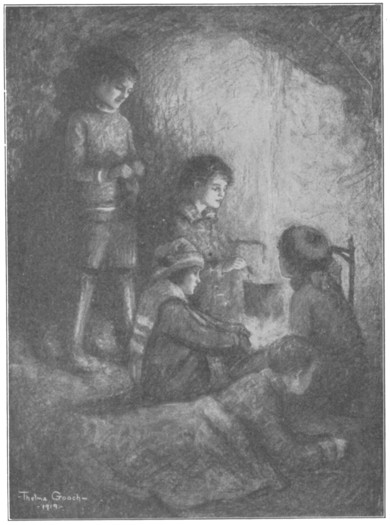
“The housekeeping arrangements of the cave were primitive.”
“Why, you’re all sitting around here and
sniffing at that stew every time I lift the pot cover
like hungry dogs,” declared Rowdy. “I guess if
it doesn’t turn out right, you’ll eat me.”
“Oh, no,” said Dot. “We wouldn’t like to do
that, for we aren’t cannon balls.”
“You aren’t what?” cried the boy, amazed.
“Oh, dear, Dot! Why will you get so mixed up
in your words?” Tess wailed. “She doesn’t
mean ‘cannon balls,’ Rowdy; she means cannibals.
And we aren’t. It is bad enough to have
to eat rabbit when it looks so much like a cat.”
This very much amused Rowdy and Sammy
Pinkney; but Rafe, the grouchy brother, would
not be even friendly enough to laugh at the smallest
Corner House girl.
“I don’t know what’s got into him,” said
Rowdy. “He never was this way before.”
Rafe lay on the bed of balsam branches, and
when his brother tried to stir him up he growled
and said: “Let me alone!” But when the stew
was done he was ready for his share.
The housekeeping arrangements of the cave
were primitive. There were a few odd plates and
dishes. But knives and forks were not plentiful,
and the tea had to be drunk out of tin cups, and
there were only three of them.
There was condensed milk for the tea; and besides
the dumplings which Rowdy had made, there
were crackers and some cold cornbread left from
a previous meal.
Rowdy seemed to be a pretty good cook for a boy
of his age. And he was just as handy with dishes
and in housekeeping matters as a girl.
The visitors praised his rabbit stew. They
really had to do that because they ate so much
of it. Rafe grumbled that they took more than
their share.
“I’d like to know what’s got into you!” Rowdy
said to his brother in great disgust. “You are
just as mean as poison ivy—so there!”
“I am not!”
“Yes, you are. And what are you scratching
that way for?”
“Because my chest itches. What does anybody
scratch for?” growled Rafe.
After eating, Rafe rolled up in a robe and went
to sleep at one end of the bed. The others helped
Rowdy clean up; and, as he said, “just to pay
Rafe off for being so mean,” they had dessert
which Rafe had no part in. Rowdy produced a
can of pears and they opened and ate them all!
“Je-ru-sa-lem!” ejaculated Sammy, when this
was finished, “ain’t it fun living in a cave? I’d
rather be here than up to that Red Deer Lodge
place. Hadn’t you, Tess?”
“No-o,” admitted the honest but polite little
girl. “I can’t say just that. But I think
Rowdy’s cave is very nice, and we are having a
very nice time here.”
Dot frankly yawned. She had been doing that,
off and on, all through supper.
“I’m afraid there won’t be anybody to put my
Alice-doll to bed tonight,” she said. “And I
haven’t any nightgown with me. Why, Tess!
what shall we do?”
“I guess you wouldn’t want to take off your
clothes here. It isn’t warm enough,” said Rowdy.
“But can’t we say our prayers?” murmured the
startled Dot. “Of course, Tess and I spent the
night once right out under a tree—didn’t we, Tessie?
Last summer, you know, when we went on
that tour in our automobile. But we said our
prayers first.”
“I guess we’d all better say our prayers and go
to bed,” said Rowdy. “This is a pretty big storm,
and maybe it won’t stop snowing for ever so long.
The more we sleep, the less we’ll know about it.”
Therefore, a little later, the four joined the already
slumbering Rafe upon the heaped up
branches; wrapping themselves as best they could
in the torn robes and pieces of carpet.
It was not a very comfortable bed or very nice
bedding; but they were all too weary to criticize
the shortcomings of Rowdy’s cave. At least, it
was shelter from the storm.
CHAPTER XXIV—RAFE IS CROSS
Sammy Pinkney awoke to hear barking. But it
was not Tom Jonah, as he had dreamed it was.
He was chilly, too, and when his eyes got
used to the semi-darkness of the cave he was sleeping
in, Sammy discovered that Rafe had deliberately
removed the share of the bedclothes that
had been over Sammy and spread them over himself.
“Aw, say!” muttered Sammy. “Ain’t he
fresh?”
Then Rafe barked again.
“He certainly has one fierce cold!” muttered
Sammy. “I ain’t got the heart to start nothing
on him.”
Instead he got up and crept over to the fireplace
where there were still some red embers.
Rowdy, or somebody, had evidently been up more
than once to put fuel on the fire, and now Sammy
did the same and blew the coals until the wood
caught and blazed.
Beside the fireplace was a great stack of billets
of seasoned wood. Evidently this cave had been
used as a living place for a long time; or perhaps
it had merely been stocked with fuel for a long
time.
Sammy hoped it was well stocked with food, too.
For Sammy was hungry, right then! It seemed
to him that the rabbit stew had been eaten a long
time before. There was no clock; but judging
from the way he felt he thought he must have
slept the clock around.
He wondered if the storm had ceased. Was
there likelihood of their being able to get back to
Red Deer Lodge this morning (if it was morning),
or would they have to remain until some one came
to dig them out?
The fire having sprung up now, and the flickering
light aiding him to see his way about the cavern,
Sammy moved toward the entrance. This
aperture beside the huge bowlder was scarcely
higher than Sammy himself. Before it Rowdy
and Rafe, the two strange boys, had hung a piece
of matting. When Sammy pulled this matting
away he saw snow—snow that filled the hole
“chock-er-block,” as he expressed it.
“Je-ru-sa-lem!” muttered the startled Sammy,
“I guess it did snow some. How are we ever
going to dig out of here?”
There was a slab of wood standing beside the
opening, leaning against the rock. Sammy seized
this and began to dig desperately at the snow.
So interested did he become in digging through
the bank that filled the cave entrance that he did
not pay much attention to where he flung the snow
behind him. He was still digging like a woodchuck
when Rowdy’s voice reached him:
“What are you trying to do? Going to fill this
cave with snow?”
“Say!” said Sammy, “it’s getting-up time.
And there’s an awful lot of snow here. I guess
we’re buried alive, that’s what I guess!”
Just then Rafe coughed again, and his brother
hopped up and went to him.
“Don’t scatter that snow all about, Sammy,”
he commanded. Then to Rafe: “What’s the
matter, Rafe, dear? Don’t you feel any better?”
“I’m—I’m chilly,” chattered the boy with the
cough.
“I’ll cover you up better,” said Rowdy, getting
his own blanket. “And we’ll have more fire and
some breakfast. Are you hungry, Rafe?”
“I’m thirsty,” said Rafe, rather whiningly.
“I want some—some coffee.”
“I’ll make some right away. Don’t be sick,
now, Rafe. I don’t see what we should do for you
if you got sick. What are you scratching for?”
“Because I itch,” replied Rafe drowsily.
But he snuggled down under the coverings until
the coffee should be made. He seemed in a pleasanter
humor, at least, than on the evening before.
Rowdy bustled about, making coffee and stirring
up some kind of bread by the light of the fire.
Soon the fuel heaped upon the blaze made the cave
warm again, although the smoke set them all to
coughing.
The two little girls woke up. Dot demanded a
light.
“I don’t like this old smoky fire to see by,”
she complained. “Why don’t you keep your fire
in a stove, Rowdy?”
“Haven’t a stove,” replied Rowdy promptly.
“How did you girls sleep?”
“All right, I guess,” Tess replied. “What are
you doing, Sammy? Can we go home this morning?”
Sammy was still digging. He tramped the snow
into a corner behind him. But the more snow he
dug out of the hole the more there seemed to be.
He took a round stick as tall as he was himself and
pushed it up through the snowbank, and it let in no
light at all.
“Je-ru-sa-lem!” he cried. “There’s all the
snow in the world blown into this hole, I guess.
We’ll never get out of here!”
“Oh!” squealed Dot, “don’t say that, Sammy.
Of course we must get out. It’s coming Christmas,
you know, and I’ve got to finish my motto
that I’m making for Ruthie. It’s got to be done,
and I didn’t bring it with me.”
“But,” said Tess, yet with some hesitation now,
“the folks will surely come to find us. Don’t you
say so, Rowdy?”
“If they know where you are,” said Rowdy.
“But we didn’t tell ’em,” growled Sammy, coming
to the fire to get warm.
“That’ll be all right,” Dot declared, seeing no
difficulty. “Tom Jonah will find us. You know,
we never can hide from Tom Jonah.”
Tess explained to Rowdy that Tom Jonah was a
dog, and a very good dog, too. But she secretly
had some doubts, as did Sammy, that the old dog
would be able to find them away down at the bottom
of this hole where they had coasted. She
was careful to say nothing to frighten Dot, or to
discourage her.
They were all much interested in Rowdy’s preparations
for breakfast. He produced a strip of
bacon and he fried some of this in a pan while the
bread was cooking. There was no butter, and the
coffee was rather muddy; but not even Dot complained,
as long as she got her share.
While they ate, they talked. At least, Rowdy
and the visitors talked. Rafe drank the coffee
and ate his share of the breakfast, and then went
back to the bed and heaped almost all the coverings
over him. He had little red specks on his
chest and arms, and he said he could not get warm.
Sammy was desirous of getting out through the
cave entrance to see if it had stopped snowing
and what the prospect was for clear weather. But
he dug for an hour after breakfast without accomplishing
much. Then Rowdy came to help him.
“I tell you what I think,” said the Milton boy,
in a low voice, so the girls would not hear. “I
b’lieve all that snow that was up on that hill has
just come tumbling down before this cave—so
there!”
“An avalanche!” gasped Rowdy.
“I don’t know what you call it. But that’s
what I think,” repeated Sammy. “We’ll never
dig out of here in this world.”
“But I guess we’ve got to,” said Rowdy
sharply. “We can’t live here long.”
“It ain’t a bad sort of a place,” said Sammy
cheerfully. “I guess Robinson Crusoe didn’t
have a better cave.”
“He had more food than we have,” said Rowdy
thoughtfully. “And you kids do eat a lot. If I’d
known you were coming here to live I’d have
brought more stuff to eat—I surely would!”
“Can’t we catch any more rabbits?” suggested
Sammy.
“How are you going to catch rabbits when we
can’t get outside this cave?” returned Rowdy. “I
guess all boys are foolish. That sounds just like
Rafe.”
“Say! You’re a boy yourself,” said Sammy, in
surprise. “You needn’t talk.”
“Oh!” rejoined Rowdy, and said nothing more
for a time.
But they gave up digging through the snowbank.
The snow seemed packed very hard, and it was difficult
to dig with a slab of wood. If there had
been an avalanche over the mouth of the cave
their chances for digging out were small, indeed.
Luckily none of the children realized just what
that meant.
Living in the cave was some fun, as Sammy
declared. At least, it had the virtue of novelty.
The time did not drag. They played games, paid
forfeits, and Tess told stories, and Rowdy sang
songs. He had a very sweet voice, and Tess told
him that he sang almost as well as Agnes did.
“And Agnes sings in the church chorus,” explained
Tess.
“And I think you cook ’most as good as a girl,”
said Dot. “I guess you cook ’most as good as
our Linda, at home, in Milton.”
If Rowdy considered these statements compliments
he did not say so. Indeed, he seemed to be
very silent after they were made. He sat beside
Rafe on the bed for some time, and they whispered
together. Rafe seemed to get no better, and he
slept a good deal.
So did the other children sleep, after a while.
Having no means of telling whether one day or
two had passed, after eating a second time they all
curled down, covering themselves as best they
could, and found in slumber a panacea for their
anxiety.
It was not Sammy who awoke the next time, but
Tess. She became wide awake in a moment, hearing
a sound from somewhere outside of the cave.
She sat up to hear it repeated.
Something was scrambling and scratching in the
snow. She even heard a “woof! woof!” just as
though some animal tossed aside the snow and
blew through it. Tess was badly frightened.
“Sammy! Rowdy! Oh, please!” she cried.
“Is it a bear?”
“Is what a bear?” demanded Rowdy, waking
up in some confusion. “I guess you’ve been
dreaming, Tess.”
“That isn’t any dream!” cried the Corner
House girl, and she sprang up, seizing Dot in her
arms.
Rowdy screamed now; not at all like a boy would
cry out. He leaped from the bed and ran to the
other side of the room. There, hanging on two
pegs, was a small rifle. Sammy had eyed it with
longing. But Rafe, awakened as well, shouted:
“No good taking that, Rowdy! It isn’t loaded.
You know I shot away the last cartridge at that
old fox.”
“Oh, Rafe! I told you then you were foolish,”
said Rowdy. “What shall we do?”
“What is it?” yelled Sammy, tumbling out of
bed.
“It’s a wolf!” replied Rowdy. “I can hear
it! Listen!”
Dot added her voice to the din. “Tell that wolf
we haven’t anything to throw to him, so he might’s
well go away,” she declared.
Rowdy ran to the hole in the snow. It seemed
to be suddenly lighter there. Was the beast that
was scratching through letting daylight into the
cave?
Rafe shrieked and leaped out from under his
coverings.
“You’ll be killed, Rowdy! Don’t go there!”
he cried.
Dashing across the floor of the cave, he seized
Rowdy and pulled him out of the way.
“Give me the gun!” he ordered, wresting it
from Rowdy’s hands. He seized it by the barrel
and poised it as a club.
“Get out, Rowdy!” he commanded. “This
isn’t any place for a girl!”
At that amazing statement the little girls from
the old Corner House and Sammy Pinkney were
so utterly surprised that they quite forgot the
savage animal that seemed to be trying to dig
into the cave to attack them.
CHAPTER XXV—HOLIDAYS—CONCLUSION
It was rather fortunate that Ralph Birdsall had
shot way his last cartridge in killing the fox three
nights before from the garret window of Red
Deer Lodge. Otherwise he might have hurt Tom
Jonah.
For the old dog scrambled through the drift
ahead of the searching party that had started out
as soon as the gale ceased. Tom Jonah was pretty
near crazy—or he acted so.
Barking and leaping, the dog threw himself upon
Ralph and tumbled him over. He was prodigal
with his expressions of joy and affection, going
from one to the other of the five children, and in
his boisterousness tumbling them in heaps.
“I never did! Tom Jonah! why don’t you behave?”
demanded Tess. “And I have been telling
Rowdy and Rafe, these nice boys, just how
good and smart you are.”
“Je-ru-sa-lem!” gasped Sammy, finally getting
his breath. “They ain’t boys!”
“Who aren’t boys?” asked Tess, wonderingly.
“Well—well, this one isn’t,” said Sammy,
pointing at Rowdy. “He’s a girl, that’s what
he is.”
“Why, Rowdy! I thought there was something
funny about you,” Tess Kenway said. “You—you
were so much nicer than boys are. I declare!”
But this point was discussed no further at the
time. For into the entrance to the cave came
tumbling Neale O’Neil and Luke Shepard, covered
with snow and shouting their joy, while behind
them was Ike M’Graw.
“Ralph! Roweny!” shouted the old timber
cruiser. “Jest what sort of doin’s do you call
this?”
Neale and Luke greeted the three lost Milton
children with vehemence. Afterward Sammy confessed
that maybe it was a good thing to get lost,
for then you found out how much folks thought of
you.
These three, with Tom Jonah, made up the
searching party this time. They had come away
from Red Deer Lodge without letting the others
know where they were going.
It was really Agnes who started them off on the
right trail. While the gale still rocked Red Deer
Lodge in its arms and nobody could go out of
doors, Agnes remembered about the fork in the
road where she and her friends had coasted.
“If the little ones tried to slide, they might have
taken that wrong road,” she said. “They could
have slid right into it without knowing. Where
does it go, Mr. M’Graw?”
It did not take Ike long to study out what she
meant. Then he did some more “figgering.” He
knew exactly where the branch road led to.
He was so successful in this figuring that he
encouraged the young people from Milton to believe
as he did. He saw a chance for the three
little folks who had gone sliding to be safely
housed in the cave that he called “Ralph and little
Missie’s playhouse.”
The Birdsall twins had often camped out in that
cave hollowed in the hillside at the bottom of the
valley. If Sammy and Tess and Dot had slid
down there, more than likely, so Ike said, they
had found the cave and had taken refuge there.
In addition (but this was his own secret) the
timber cruiser believed that the twins, having been
in Red Deer Lodge, had started for that very cave
some hours before the gale broke.
If the young Birdsalls were there, the lost children
would be safe enough. This had proved to be
the case.
Nevertheless, the old woodsman scolded Ralph
and Rowena heartily.
“What d’you mean?” he demanded, “by running
way from your guardian! Mr. Howbridge is
as fine a man as ever stepped in shoe-leather.
I’m ashamed of you children. And when you did
come clean up here, why didn’t you come to my
shack and stay?”
“We did go there; but you were away. Then
we thought we had a right to live in our own house.
You know papa built it,” said Rowena, bravely.
“We didn’t know anybody was coming there this
winter. And we brought some food with us from
Coxford. Then those people came, and we waited
till we could get out without being caught at it.”
“Some young ones! Some young ones!”
groaned M’Graw. “Well, now, you’ll go back to
the Lodge and see what Mr. Howbridge has to say
to you. And you dressed like a boy, Roweny!”
“I don’t care,” said “Rowdy.” “Ralph
dressed up like a girl at first. We came up here
that way. But other kids picked on us so that I
thought I’d better be a boy as well as Ralph. And
we had these clothes at Red Deer Lodge. I make
as good a boy as he does a girl.”
“Say!” asked Neale O’Neil, vastly interested,
“you two stopped a week at the village on the ice
and fished, didn’t you?”
“Yes,” said Rowena.
“And you were girls there?”
“Yes.”
“Well,” said Neale, laughing now, “what I want
to know is, which of you it was that thrashed those
two boys that tried to steal your set-lines?”
“That was Rowena!” croaked Ralph from the
bed. “I acted just like a girl ought to and let
them take the lines; but Rowena fought them, and
licked them good, too!”
There was a deal of talk after that, but most of
it was done following the arrival of the party at
Red Deer Lodge. As soon as that had occurred,
however, and Mrs. MacCall had heard Ralph cough
and heard about the itching, she made an examination.
“There!” she declared, half an hour later after
she had put the boy between blankets and given
him a hot drink, “I might have known something
would happen if we came up to this out-of-the-world
place.”
“I should think something had happened!”
murmured Ruth, who still held Dot in her lap and
hugged her as though she could not let her go
again. “What is the matter with Ralph?”
“Chickenpox. And it’s coming out thick on
him right this minute.”
“Oh! Oh! Chickens?” gasped the smallest
Corner House girl. “Are they roosting on him?
No wonder Rafe scratched.”
“And like enough you’ll be scratching my lassie,”
said the Scotch woman. “One an’ all of you.
I never knew it to fail. If one bairn gets it, all the
others in the neighborhood catches it.”
Nor was she a poor prophet. All the little
folks, even Rowena, developed mild cases of chickenpox
and were kept in the house for most of the
holidays.
Holidays they were, nevertheless. Perhaps the
little Corner House folk had never had so good a
time over Christmas and New Year’s. Ralph and
Rowena Birdsall proved to be rollicking, good-natured
children, and they felt themselves at home
at Red Deer Lodge and could entertain Tess and
Dot and Sammy Pinkney.
“We won’t blame them for giving us chicken
scratches,” said Dot to Tess. “At least, Ralph
did. But he couldn’t help it. And mine’s most
gone, anyway.”
The “older young folks,” as Mr. Howbridge
called them, had most delightful times out of
doors, as well as in. There was four or five feet
of snow on the ground, on the level, and it was
packed hard enough to make splendid snow-shoeing.
Ike M’Graw had plenty of snowshoes, and he
taught them all how to use them. When they became
adept he led them in short jaunts all about
the section in which Red Deer Lodge was situated.
The boys went out with him at night, hunting.
Neale and Luke both killed rabbits, and Neale shot
a bigger fox than the one Ralph Birdsall had
knocked over.
Those were wonderful days; but the nights were
still more wonderful, for they were moon-lighted
for most of the holiday time.
There is nothing better than coasting by moonlight,
and of that sport Ruth, Agnes and Cecile,
as well as the two boys, had their fill.
Nor did they overlook the two holidays, Christmas
and New Year’s. Ike cut and trimmed a
huge Christmas tree and that was set up in the
main hall of the Lodge and decorated in a most
beautiful manner. Presents had been brought up
from Milton for everybody. And although Ralph
and Rowena Birdsall and Ike M’Graw were
“added entries,” as Luke said, they were not allowed
to feel slighted when the presents were
given out on Christmas night.
A big sledge came through from Coxford two
days after Christmas, and this brought additional
supplies for the party at Red Deer Lodge. There
came on the sledge, too, the red-faced Mr. Neven
who wished to buy the standing timber on a part
of the Birdsall tract.
There was much talk between the lumberman,
Mr. Howbridge and M’Graw regarding the timber.
But Ike proved himself a good “figgerer”
in more ways than one. The lawyer remained
determined to accept the old timber cruiser’s report
as correct and finally Neven came to their
terms.
Before the holiday of the Milton party was
ended, a big gang of lumbermen came up the tote-road
from Coxford and the lake, ready to set up a
camp in the valley near the twins’ cave, and finish
the season by cutting over several acres of the
Birdsall piece.
“I won’t want to see our place up here again
until the new timber is grown,” cried Rowena,
mournfully.
“Then you’ll have to wait till we get through
college,” Ralph told her. “Mr. Howbridge is going
to have us live with him till we go to college.
But I expect he’ll bring us up here once in a
while if you change your mind, Rowdy, and want
to come.”
“Don’t call me ‘Rowdy,’ Ralph,” said his sister.
“That was only for our trip up here. And,
anyhow, I am not going to be a boy—never—any
more!”
“We’re going to have a lot to tell the kids back
home,” remarked Sammy Pinkney one day before
they left Red Deer Lodge. “Je-ru-sa-lem! think
of that long slide, Tess.”
“But it ended bad,” said Tess.
“It ended good!” cried the boy. “Didn’t we
find Ralph and Rowena, and live in a cave, and eat
rabbit stew, and—”
“And get chicken scratches,” put in Dot. “But
mine don’t scratch any now. The chickens went
away quick.”
THE END
CHARMING STORIES FOR GIRLS
(From eight to twelve years old)
THE CORNER HOUSE GIRLS SERIES
BY GRACE BROOKS HILL
Four girls from eight to fourteen years of age receive word that a rich
bachelor uncle has died, leaving them the old Corner House he occupied.
They move into it and then the fun begins. What they find and do will
provoke many a hearty laugh. Later, they enter school and make many
friends. One of these invites the girls to spend a few weeks at a
bungalow owned by her parents; and the adventures they meet with make
very interesting reading. Clean, wholesome stories of humor and
adventure, sure to appeal to all young girls.
1. CORNER HOUSE GIRLS.
2. CORNER HOUSE GIRLS AT SCHOOL.
3. CORNER HOUSE GIRLS UNDER CANVAS.
4. CORNER HOUSE GIRLS IN A PLAY.
5. CORNER HOUSE GIRLS’ ODD FIND.
6. CORNER HOUSE GIRLS ON A TOUR.
7. CORNER HOUSE GIRLS GROWING UP.
8. CORNER HOUSE GIRLS SNOWBOUND.
9. CORNER HOUSE GIRLS ON A HOUSEBOAT.
10. CORNER HOUSE GIRLS AMONG THE GYPSIES.
11. CORNER HOUSE GIRLS ON PALM ISLAND.
BARSE & HOPKINS, PUBLISHERS
NEWARK, N. J.—NEW YORK, N. Y.
THE POLLY PENDLETON SERIES
BY DOROTHY WHITEHILL
Polly Pendleton is a resourceful, wide-awake American girl who goes to a
boarding school on the Hudson River some miles above New York. By her
pluck and resourcefulness, she soon makes a place for herself and this
she holds right through the course. The account of boarding school life
is faithful and pleasing and will attract every girl in her teens.
1. POLLY’S FIRST YEAR AT BOARDING SCHOOL
2. POLLY’S SUMMER VACATION
3. POLLY’S SENIOR YEAR AT BOARDING SCHOOL
4. POLLY SEES THE WORLD AT WAR
5. POLLY AND LOIS
6. POLLY AND BOB
Cloth, Large 12mo., Illustrated.
BARSE & HOPKINS, PUBLISHERS
NEWARK, N. J.—NEW YORK, N. Y.
CHICKEN LITTLE JANE SERIES
By LILY MUNSELL RITCHIE
Chicken Little Jane is a Western prairie girl who lives a happy, outdoor
life in a country where there is plenty of room to turn around. She is a
wide-awake, resourceful girl who will instantly win her way into the
hearts of other girls. And what good times she has!—with her pets, her
friends, and her many interests. “Chicken Little” is the affectionate
nickname given to her when she is very, very good, but when she
misbehaves it is “Jane”—just Jane!
Adventures of Chicken Little Jane
Chicken Little Jane on the “Big John”
Chicken Little Jane Comes to Town
With numerous illustrations in pen and ink
By CHARLES D. HUBBARD
BARSE & HOPKINS, PUBLISHERS
NEWARK, N. J.—NEW YORK, N. Y.
DOROTHY WHITEHILL SERIES FOR GIRLS
Here is a sparkling new series of stories for girls—just what they will
like, and ask for more of the same kind. It is all about twin sisters,
who for the first few years in their lives grow up in ignorance of each
other’s existence. Then they are at last brought together and things
begin to happen. Janet is an independent go-ahead sort of girl; while
her sister Phyllis is—but meet the twins for yourself and be
entertained.
6 Titles, Cloth, large 12mo.
Covers in color.
1. JANET, A TWIN
2. PHYLLIS, A TWIN
3. THE TWINS IN THE WEST
4. THE TWINS IN THE SOUTH
5. THE TWINS’ SUMMER VACATION
6. THE TWINS AND TOMMY JR.
BARSE & HOPKINS, PUBLISHERS
NEWARK, N. J.—NEW YORK, N. Y.