The fireboard before the great chimney-place in
the spacious dining room of the old Corner House
in Milton had been removed by Uncle Rufus, and
in the dusk of the winter’s afternoon the black pit
of it yawned, ogre-like, upon the festive room.
The shadows were black under the big tree, the
tip of which touched the very high ceiling and
which had just been set up in the far corner and
not yet festooned. The girls were all busy bringing
tinsel and glittering balls and cheery red bells
and strings of pink and white popcorn, while yards
and yards of evergreen “rope,” with which to
trim the room itself, were heaped in a corner.
It was the day but one before Christmas, and
without the gaslight—or even the usual gas-log
fire on the hearth—the dining room was gloomy
even at mid-afternoon. Whenever Dot Kenway
passed the black opening under the high and ornate
mantel, she shuddered.
It was a creepy, delicious shudder that the smallest
Corner House girl experienced, for she said to
10
Tess, her confidant and the next oldest of the four
sisters:
“Of course, I know it’s the only way Santa
Claus ever comes. But—but I should think he’d
be afraid of—of rats or things. I don’t see why
he can’t come in at the door; it’d be more respecterful.”
“I s’pose you mean respectable,” sighed Tess.
“But where would he hitch his reindeer? You
know he has to tie them to the chimney on the
roof.”
“Why does he?” demanded the inquisitive Dot.
“There’s a perfectly good hitching post by our
side gate on Willow Street.”
“Who ever heard of such a thing!” exclaimed
Tess, with exasperation. “Do you s’pose Santa
Claus would come to the side door and knock like
the old clo’s man? You are the most ridiculous
child, Dot Kenway,” concluded Tess, with her
most grown-up air.
“Say,” said the quite unabashed Dot, reflectively,
“do you know what Sammy Pinkney
says?”
“Nothing very good, I am sure,” rejoined her
sister, tartly, for just at this time Sammy Pinkney,
almost their next-door neighbor, was very
much in Tess Kenway’s bad books. “What can
you expect of a boy who wants to be a pirate?”
“Well,” Dot proclaimed, “Sammy says he
doesn’t believe there is such a person as Santa
Claus.”
11
“Oh!” gasped Tess, startled by this heresy.
Then, after reflection, she added: “Well, when
you come to think of it, I don’t suppose there is
any Santa for Sammy Pinkney.”
“Oh, Tess!” almost groaned the smaller girl.
“No, I don’t,” repeated Tess, with greater confidence.
“Ruthie says if we don’t ‘really and
truly’ believe in Santa, there isn’t any—for us!
And he only comes to good children, anyway.
How could you expect Sammy Pinkney to have a
Santa Claus?”
“He says,” said Dot, eagerly, “that they are
only make believe. Why, there is one in Blachstein
& Mapes’, where Ruth trades; and another
in Millikin’s; and there’s the Salvation Army
Santa Clauses on the streets—”
“Pooh!” exclaimed Tess, tossing her head.
“They are only representations of Santa Claus.
They’re men dressed up. Why! little boys have
Santa Claus suits to play in, just as they have Indian
suits and cowboy suits.”
“But—but is there really and truly a Santa
Claus?” questioned Dot, in an awed tone. “And
does he keep a book with your name in it? And
if you don’t get too many black marks through
the year do you get presents? And if you do behave
too badly will he leave a whip, or something
nasty, in your stocking? Say, Tess, do you s’pose
’tis so?”
That was a stiff one—even for Tess Kenway’s
abounding faith. She was silent for a moment.
12
“Say! do you?” repeated the smallest Corner
House girl.
“I tell you, Dot,” Tess said, finally, “I want to
believe it. I just do. It’s like fairies and elfs.
We want to believe in them, don’t we? It’s just
like your Alice-doll being alive.”
“Well!” exclaimed Dot, stoutly, “she’s just as
good as alive!”
“Of course she is, Dottie,” said Tess, eagerly.
“And so’s Santa Claus. And—and when we
stop believing in him, we won’t have near so much
fun at Christmas!”
Just then Agnes came in from the kitchen with
a heaping pan of warm popcorn.
“Here, you kiddies,” she cried, “run and get
your needles and thread. We haven’t near enough
popcorn strung. I believe Neale O’Neil ate more
than he strung last night, I never did see such a
hungry boy!”
“Mrs. MacCall say it’s ’cause he’s growning,”
said Dot, solemnly.
“He, he!” chuckled Agnes. “He should be
‘groaning’ after all he gobbled down last night.
And I burned my finger and roasted my face,
popping it.”
She set down the dish of flaky white puff-balls
on a stool, so it would be handy for the little
girls. Both brought their sewing boxes and
squatted down on the floor in the light from a long
window. Tess was soon busily threading the popcorn.
13
“What’s the matter with you, Dot Kenway?”
she demanded, as the smallest Corner House girl
seemed still to be fussing with her thread and
needle, her face puckered up and a frown on her
small brow. “You’re the slowest thing!”
“I—I believe this needle’s asleep, Tess,” wailed
Dot, finally.
“Asleep?” gasped the other. “What nonsense!”
“Yes, ’tis—so now!” ejaculated Dot. “Anyway,
I can’t get its eye open.”
A low laugh sounded behind them, and a tall girl
swooped down on the floor and put her arms
around the smallest Corner House girl.
“Let sister do it for you, honeybee,” said the
newcomer. “Won’t the eye open? Well! we’ll
make it—there!”
This was Ruth, the oldest of the four Kenway
sisters. She was dark, not particularly pretty,
but, as Tess often said, awfully good! Ruth had
a smile that illuminated her rather plain face and
won her friends everywhere. Moreover, she had
a beautiful, low, sweet voice—a “mother voice,”
Agnes said.
Ruth had been mothering her three younger sisters
for a long time now—ever since their real
mother had died, leaving Agnes and Tess and
Dot, to say nothing of Aunt Sarah Maltby, in the
older girl’s care. And faithfully had Ruth Kenway
performed her duty.
Agnes was the pretty sister (although Tess, with
14
all her gravity, promised to equal the fly-away in
time) for she had beautiful light hair, a rosy complexion,
and large blue eyes, of an expression most
innocent but in the depths of which lurked the
Imps of Mischief.
Little Dot was dark, like Ruth; only she was
most lovely—her hair wavy and silky, her little
limbs round, her eyes bright, and her lips as red
as an ox-heart cherry!
The little girls went on stringing the popcorn,
and Ruth and Agnes began to trim the tree, commencing
at the very top. Nestling among the
pointed branches of the fir was a winged cupid,
with bow and arrow.
“That’s so much better than a bell. Everybody
has bells,” said Agnes, from the step-ladder,
as she viewed the cupid with satisfaction.
“It’s an awfully cunning little fat, white baby,”
agreed Dot, from the floor. “But I should be
afraid, if I were his mother, to let him play with
bows-an’-arrows. Maybe he’ll prick himself.”
“We’ll speak to Venus about that,” chuckled
Agnes. “Don’t believe anybody ever mentioned
it to her.”
“‘Venus’?” repeated Dot, gravely. “Why,
that’s the name of the lady that lives next to Uncle
Rufus’ Petunia. She couldn’t be that little baby’s
mother for she’s—oh!—awful black!”
“Aggie was speaking of another Venus, Dot,”
laughed Ruth. “Fasten those little candle-holders
securely, Aggie.”
15
“Sure!” agreed the second, and slangy, sister.
“I really wish we could light the whole room
with candles, and not have the gas at all,” Ruth
said. “It would be much nicer. Don’t you think
so?”
“It would be scrumptious!” Aggie cried. “And
you’ve got such a lot of those nice, fat, bayberry
candles. Let’s do it!”
“But there are not enough candlesticks.”
“You can get ’em at the five-and-ten-cent store,”
proposed Tess, who favored that busy emporium,
“because you can get such a lot for your money!”
“Goosey!” exclaimed Agnes. “We don’t want
cheap ones. How would they look beside those
lovely old silver ones of Uncle Peter Stower’s?”
and she turned to look at the great candelabra on
the highboy.
Just then the door from the butler’s pantry
opened slowly and a grizzled, kinky head, with a
shiny, brown, bald spot on top, was thrust into
the room.
“I say, missie!” drawled the voice belonging
to the ancient head, “is yo’ done seen anyt’ing ob
dat denim bag I has fo’ de soiled napkins?
Pechunia, she done comin’ fo’ de wash, an’ I got t’
collect togeddah all I kin fin’ dis week. Dat fool
brack woman,” Uncle Rufus added with disgust,
“won’t do but dis one wash twill happen New
Years—naw’m! She jes’ got t’ cel’brate, she say.
Ma’ soul! what’s a po’, miserble nigger woman
got t’ cel’brate fo’ Ah asks ye?”
16
“Why, Uncle Rufus!” cried Agnes. “Christmas
is a birthday that everybody ought to celebrate.
And I’m sure Petunia has many things to
make her happy.”
“Just look at all her children!” put in Tess.
“Alfredia, and Jackson Montgomery Simms,
and little Burne-Jones Whistler and Louise Annette,”
Dot began to intone, naming the roll of
Petunia Blossom’s piccaninnies.
“Don’t! Stop!” begged Agnes, with her hands
over her ears and sitting down on the top step
of the ladder.
“Ma soul!” chuckled Uncle Rufus, “if chillens
come lak’ Chris’mus presents, all de rich w’ite
folks would hab ’em an’ de po’ nigger folks would
be habbin’ wot de paper calls ‘race sooincide’—sho’
would!”
“I haven’t seen the laundry bag, Unc’ Rufus,”
said Ruth, deep in thought.
Here Dot spoke up. “I ‘spect I know where it
is, Unc’ Rufus,” she said.
“Wal! I ‘spected some ob yo’ chillen done had
it.”
“You know,” said Dot, seriously, “my Alice-doll
is real weakly. The doctors don’t give me
much ’couragement about her. Her lungs are
weak—they have been, you know, ever since that
awful Trouble girl buried her with the dried
apples.”
“Dat Lillie Treble. Ah ‘members hit—sho!”
chuckled Uncle Rufus, the Corner House girls’
17
chief factotum, who was a tall, thin, brown old
negro, round shouldered with age, but “spry and
pert,” as he said himself.
“And the doctors,” went on Dot, waxing serious,
and her imagination “working over time,” as
Neale O’Neil would have said, “say it’s best for
folks with weak lungs to sleep out of doors. So
Neale’s built her a sleeping porch outside one
of the windows in our bedroom—Tess’ and mine—and—and
I used your napkin bag, Unc’ Rufus, for
a sleeping-bag for my Alice-doll! I couldn’t find
anything else that fitted her,” confessed the smallest
Corner House girl.
“Well! of all the children!” cried Agnes, having
taken her hands down from her ears to hear this.
“You shouldn’t have taken the bag without permission,”
Ruth gravely told Dot.
But Uncle Rufus chuckled over it to a great
extent. “Nebber did see de beat of dese young-uns!”
he gasped finally. “If yo’ Uncle Peter was
alive he sartain sho’ would ha’ laffed hisself up
out’n hes sick-bed. Ma soul an’ body! W’y
didn’t he know enough t’ hab yo’uns yere in de
ol’ Corner House w’ile he was alive, ‘stid o’ waitin’
till he was daid t’ gib it t’ yo’?”
He would have gone out chuckling, only Ruth
called after him: “Unc’ Rufus! Do you know if
there are any more candlesticks around the house?
Nice, heavy ones, I mean—good enough to put
in the dining room here, and for company to
see.”
18
“Candlesticks, missie? I ’spect dere is,” said
the old negro man.
“Do you know where?” Ruth asked quickly.
“Bress yo’, honey! I ‘speck dey is up in de attic,”
he said. “I don’ jes’ know whar—”
“Oh, I know! I know!” cried Agnes, suddenly.
“Over in that corner of the garret that we never
cleaned, Ruth.”
“Did we fail to clear up any part of the garret?”
asked the older girl, doubtfully.
“The place Tommy Rooney hid in when he was
the attic goat,” Dot said solemnly.
“Ghost!” admonished Tess. “I do wish you’d
get your words right, Dot Kenway.”
“I remember seeing some old brass candlesticks
there,” Agnes went on to explain to Ruth. “They
can be polished, I should think. They’re all green
now.”
“Of course,” said Ruth, cheerfully. “Let’s go
and look for them.”
“Oh, I want to go!” cried Dot, at once.
“May we all go, sister?” asked Tess.
“Of course you may come, kiddies,” said Agnes,
hopping down from her perch.
They all trooped up the three flights of stairs
to the huge garret, Dot leaving her “sleeping”
needle sticking in a puff-ball of popcorn.
The front hall of the old Corner House, as Milton
folk called the Stower homestead on the corner
of Willow Street, opposite the Parade Ground,
was two stories high.
19
Broad stairs, dividing when half way up into
two separate flights, rose out of the middle of the
reception hall, lined with its old-fashioned, walnut,
haircloth furniture. A gallery ran all around
the stair-well, off which opened the guest chambers
of the house. Only one of these was in use. Aunt
Sarah Maltby had it. Aunt Sarah was determined
to have the best there was of everything.
The girls slept in rooms in one of the two ells,
on this second floor. Above, in the third story
of the same ell, slept Mrs. MacCall, their good
Scotch housekeeper, and Linda, the Finnish girl.
Uncle Rufus was stowed away in the other ell, in
a little room he had occupied for almost twenty-six
years. Uncle Rufus had been Uncle Peter
Stower’s only retainer for many, many years before
the Kenway girls came to live at the old
Corner House.
Up another flight of stairs, the girls trooped
to the garret, that extended the entire length and
breadth of the main portion of the house. This
was their playroom on rainy days, and a storeroom
of wonderful things. The Kenways had
never entirely exhausted the wonders of this place.
Agnes led the way to the far corner, lamp in
hand. There some Revolutionary uniforms hung
from the low rafters. On a broken-legged chest
of drawers, held up by a brick in place of the missing
leg, stood a row of heavy brass candlesticks.
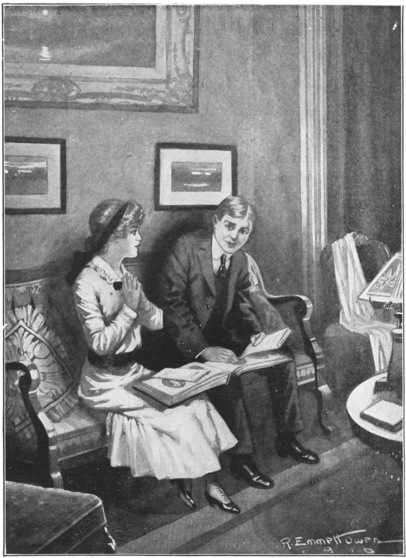
“And see here!” cried Agnes, snatching up a
faded, fat, plush-covered volume, moth-eaten and
20
shabby, from which Ruth had just removed two
of the candlesticks. “What can this be? The
family album, I declare!”
She flirted several of the leaves. Others stuck
together. There seemed to be some kind of illustrations,
or pictures, between the pages.
“Throw that dusty old thing down, Aggie,” said
Ruth, “and help me carry these heavy candlesticks.
They are just the things.”
“I’ll help carry them,” agreed her sister.
“Here, Dottums. You can just about lug this old
book. I want to look at it. I shouldn’t wonder
if it held daguerreotypes and silhouettes of all the
Stowers since Adam.”
“What are da—da-gert-o-tops and—and silly-hats,
Aggie?” demanded Dot, toiling along at the
end of the procession with the big book, as the
four girls started down stairs again. “Are—are
they those awful animals Ruth was reading about
that used to in—infest the earth so long ago?”
“Oh, mercy me!” gasped Agnes, laughing.
“Pterodactyls and the giant sloth! See what it
means to tell these kids about the Paleozoic age
and ‘sich,’ Ruthie! Yes, child. Maybe you’ll find
pictures in that old book of those ‘critters,’ as
Mrs. Mac calls them.”
Dot sat right down on the upper flight and
spread the book out upon her small lap. She had
heard just enough about the creatures of the
ancient world to be vitally curious.
But there were no pictures of animals. Dot
21
hurriedly turned the pages. In the back were engravings
on green paper, stuck into the old book.
The green slips of paper had pictures on them,
but nothing that interested Dot.
“Pooh!” she thought to herself, did the smallest
Corner House girl, “old money—that’s all it
is. Just like the money Mr. Howbridge gives
Ruth every month to pay bills with. I s’pose it’s
money that’s no good any more.”
She shut the book, disappointed, and clattered
down stairs after her sisters. Nobody else had
time to look at the family album just then. Agnes
tossed her “find” into a corner until some more
convenient occasion for looking at it. She and
Ruth got the metal cleaning paste and rags and a
chamois, and began to polish the candlesticks.
The smaller girls returned to the stringing of popcorn.
Suddenly they all stopped work. With upraised
hands and astonished looks, the four listened
for a repetition of the sound that had startled
them.
It came again, immediately. It was in the chimney.
There was a muffled shout, then a scratching
and a scraping, coming rapidly down the brick-and-mortar
tunnel.
“Oh! Oh! OH!” squealed Dot, in crescendo.
“Santa Claus has come ahead of time!”
“If that’s Santa Claus,” declared Agnes, jumping
up to run to the open fireplace, “he’s missed
his footing and is falling down the chimney!”

 Four girls from eight to fourteen years of age receive word that
a rich bachelor uncle has died, leaving them the old Corner House
he occupied. They move into it and then the fun begins. What they
find and do will provoke many a hearty laugh. Later, they enter
school and make many friends. One of these invites the girls to
spend a few weeks at a bungalow owned by her parents, and the
adventures they meet with make very interesting reading. Clean,
wholesome stories of humor and adventure, sure to appeal to all
young girls.
Four girls from eight to fourteen years of age receive word that
a rich bachelor uncle has died, leaving them the old Corner House
he occupied. They move into it and then the fun begins. What they
find and do will provoke many a hearty laugh. Later, they enter
school and make many friends. One of these invites the girls to
spend a few weeks at a bungalow owned by her parents, and the
adventures they meet with make very interesting reading. Clean,
wholesome stories of humor and adventure, sure to appeal to all
young girls.
 Elizabeth Ann is a little girl whom we first meet on a big train,
traveling all alone. Her father and mother have sailed for
Japan, and she is sent back East to visit at first one relative’s
home, and then another. Of course, she meets many new friends,
some of whom she is quite happy with, while others—but you must
read the stories for yourself. Every other girl who reads the
first of these charming books will want all the rest; for
Elizabeth Ann is certainly worth the cultivating.
Elizabeth Ann is a little girl whom we first meet on a big train,
traveling all alone. Her father and mother have sailed for
Japan, and she is sent back East to visit at first one relative’s
home, and then another. Of course, she meets many new friends,
some of whom she is quite happy with, while others—but you must
read the stories for yourself. Every other girl who reads the
first of these charming books will want all the rest; for
Elizabeth Ann is certainly worth the cultivating.
 “The trouble with Linda Lane,” said Mrs. Quincy, “was that she
’couldn’t get along with folks.’” As everyone knows, a girl needs
friends to love her and believe in her. It isn’t to be
wondered at that Linda wasn’t happy. Then little Miss Gilly came
to the rooms of the Society, the only home Linda knew, and took
the girl home with her. A new life begins for Linda, and she
finds, to her surprise and delight, how to get along with people,
how to make friends, and slowly and surely how to be happy.
“The trouble with Linda Lane,” said Mrs. Quincy, “was that she
’couldn’t get along with folks.’” As everyone knows, a girl needs
friends to love her and believe in her. It isn’t to be
wondered at that Linda wasn’t happy. Then little Miss Gilly came
to the rooms of the Society, the only home Linda knew, and took
the girl home with her. A new life begins for Linda, and she
finds, to her surprise and delight, how to get along with people,
how to make friends, and slowly and surely how to be happy.
 Polly Pendleton is a resourceful, wide-awake American girl who
goes to a boarding school on the Hudson River some miles above
New York. By her pluck and resourcefulness, she soon makes a
place for herself and this she holds right through the course.
The account of boarding school life is faithful and pleasing and
will attract every girl in her teens.
Polly Pendleton is a resourceful, wide-awake American girl who
goes to a boarding school on the Hudson River some miles above
New York. By her pluck and resourcefulness, she soon makes a
place for herself and this she holds right through the course.
The account of boarding school life is faithful and pleasing and
will attract every girl in her teens.