Of all traditions relating to the history of primitive humanity, by
far the most universal is that of the Deluge. Our present purpose
is to pass under review the principal versions of it extant among the
leading races of men. The concordance of these with the Biblical
narrative will bring out their primary unity, and we shall thus be
able to recognize the fact of this tradition being one of those which
date before the dispersion of peoples, go back to the very dawn of the
civilized world, and can only refer to a real and definite event.
But we have previously to get rid of certain legendary recollections
erroneously associated with the Biblical Deluge, their essential features
forbidding sound criticism to assimilate them therewith. We allude to
such as refer to local phenomena, and are of historic and comparatively
recent date. Doubtless the tradition of the great primitive cataclysm
may have been confused with these, and thus have led to an exaggeration
of their importance; but the characteristic points of the narrative
admitted into the Book of Genesis are wanting, and even under the
legendary form it has assumed these events retain a decidedly special
and restricted character. To group recollections of this nature with
those that really relate to the Deluge would be to invalidate, rather
than confirm, the consequences we are entitled to draw from the latter.
Take, for instance, the great inundation placed by the historic books
of China in the reign of Yao. This has no real relation, or even
resemblance, to the Biblical Deluge; it is a purely local event, the
date of which, spite of the uncertainty of Chinese chronology previous
to the eighth century B.C., we may yet determine as long subsequent
to the fully historic periods of Egypt and
Babylon.[31]
Chinese authors
describe Yu, minister and engineer of the day, as restoring the course
of rivers, raising dykes, digging canals, and regulating the taxation of
every province throughout China. A learned Sinologist, Edouard Biot,
has proved, in a treatise on the changes of the lower course of the
Hoang-ho, that it was to one of its frequent inundations the above
catastrophe was due, and that the early Chinese settlements on its
banks had had much to suffer from this cause. These works of Yu were
but the beginning of embankments necessary to contain its waters,
carried on further in following ages. A celebrated inscription graven
on the rocky face of one of the mountain peaks of Ho-nan passes for
contemporaneous with these works, and is consequently the most
ancient specimen of Chinese epigraphy extant. This inscription appears
to present an intrinsically authentic character, sufficient to dispel the
doubts suggested by Mr. Legge, although there is this rather suspicious
fact connected with it, that we are only acquainted with it through
ancient copies, and that for many centuries past the minutest research
has failed to re-discover the original.
Nor is the character of a mere local event less conspicuous in the
legend of Botchica, such as we have it reported by the Muyscas, the
ancient inhabitants of the province of Cundinamarca, in South America,
although here mythological fable is mingled much more largely with
the fundamental historic element.
Huythaca, the wife of a divine man, or rather a god, called Botchica,
having practised abominable witchcraft in order to make the river
Funzha leave its bed, the whole plain of Bogota is devastated by its
waters; men and beasts perish in the inundation, and only a few
escape by flight to the loftiest mountains. The tradition adds that
Botchica broke asunder the rocks inclosing the valley of Canoas and
Tequendama, in order to facilitate the escape of the waters, next
reassembled the dispersed remnant of the Muyscas, taught them Sun-worship,
and went up to heaven, after having lived 500 years in
Cundinamarca.
Chaldean and Biblical Narratives.—Of the traditions relating to the
great cataclysm the most curious, no doubt, is that of the Chaldeans.
Its influence has stamped itself in an unmistakable manner on the
tradition of India; and, of all the accounts of the Deluge, it comes
nearest to that in Genesis. To whoever compares the two it becomes
evident that they must have been one and the same up to the time
when Terah and his family left Ur of the Chaldees to go into
Palestine.
We have two versions of the Chaldean story—unequally developed
indeed, but exhibiting a remarkable agreement. The one most anciently
known, and also the shorter, is that which Berosus took from the
sacred books of Babylon and introduced into the history that he wrote
for the use of the Greeks.[32]
After speaking of the last nine antediluvian
kings, the Chaldean priest continues thus:—
"Obartès Elbaratutu being dead, his son Xisuthros (Khasisatra) reigned
eighteen sares (64,800 years). It was under him that the Great Deluge took
place, the history of which is told in the sacred documents as follows:—Cronos
(Êa) appeared to him in his sleep, and announced that on the fifteenth of
the month of Daisios (the Assyrian month Sivan—a little before the summer
solstice), all men should perish by a flood. He therefore commanded him to
take the beginning, the middle, and the end of whatever was consigned to
writing,[33]
and to bury it in the City of the Sun, at Sippara; then to build a
vessel, and to enter into it with his family and dearest friends; to place in this
vessel provisions to eat and drink, and to cause animals, birds, and quadrupeds
to enter it; lastly, to prepare everything for navigation. And when Xisuthros
inquired in what direction he should steer his bark, he was answered, 'towards
the gods,' and enjoined to pray that good might come of it for men.
"Xisuthros obeyed, and constructed a vessel five stadia long and five broad;
he collected all that had been prescribed to him, and embarked his wife, his
children, and his intimate friends.
"The Deluge having come, and soon going down, Xisuthros loosed some of
the birds. These finding no food nor place to alight on returned to the ship.
A few days later Xisuthros again let them free, but they returned again to the
vessel, their feet full of mud. Finally, loosed the third time the birds came no
more back. Then Xisuthros understood that the earth was bare. He made an
opening in the roof of the ship, and saw that it had grounded on the top of a
mountain. He then descended with his wife, his daughter, and his pilot,
worshipped the earth, raised an altar, and there sacrificed to the gods; at the
same moment he vanished with those who accompanied him.
"Meanwhile those who had remained in the vessel not seeing Xisuthros return,
descended too and began to seek him, calling him by his name. They
saw Xisuthros no more; but a voice from heaven was heard commanding them
piety towards the gods; that he, indeed, was receiving the reward of his
piety in being carried away to dwell thenceforth in the midst of the gods, and
that his wife, his daughter, and the pilot of the ship shared the same honour.
The voice further said that they were to return to Babylon, and conformably to
the decrees of fate, disinter the writings buried at Sippara in order to transmit
them to men. It added that the country in which they found themselves was
Armenia. These, then, having heard the voice, sacrificed to the gods and
returned on foot to Babylon. Of the vessel of Xisuthros, which had finally
landed in Armenia, a portion is still to be found in the Gordyan Mountains in
Armenia, and pilgrims bring thence asphalte that they have scraped from its
fragments. It is used to keep off the influence of witchcraft. As to the
companions of Xisuthros, they came to Babylon, disinterred the writings left at
Sippara, founded numerous cities, built temples, and restored Babylon."
By the side of this version, which, interesting though it be, is, after
all, second hand, we are now able to place an original Chaldeo-Babylonian
edition, which the lamented George Smith was the first to decipher on
the cuneiform tablets exhumed at Nineveh and now in the British
Museum. Here the narrative of the Deluge appears as an episode in
the eleventh tablet, or eleventh chaunt of the great epic of the town of
Uruk. The hero of this poem, a kind of Hercules, whose name has not as
yet been made out with
certainty,[34]
being attacked by disease (a kind of leprosy), goes, with a view to its cure, to consult the patriarch saved
from the Deluge, Khasisatra, in the distant land to which the gods
have transported him, there to enjoy eternal felicity. He asks Khasisatra
to reveal the secret of the events which led to his obtaining the
privilege of immortality, and thus the patriarch is induced to relate the
cataclysm.
By a comparison of the three copies of the poem that the library of
the palace of Nineveh contained, it has been possible to restore the narrative with hardly any
breaks.[35]
These three copies were, by order of the King of Assyria, Asshurbanabal,
made in the eighth century B.C.,
from a very ancient specimen in the sacerdotal library of the town of
Uruk, founded by the monarchs of the first Chaldean empire. It is
difficult precisely to fix the date of the original, copied by Assyrian
scribes, but it certainly goes back to the ancient empire, seventeen
centuries, at least, before our era, and even probably beyond; it was
therefore much anterior to Moses, and nearly contemporaneous with
Abraham. The variations presented by the three existing copies prove
that the original was in the primitive mode of writing called the
hieratic, a character which must have already become difficult
to decipher in the eighth century B.C., as the copyists have differed as
to the interpretation to be given to certain signs, and in other cases have
simply reproduced exactly the forms of such as they did not understand.
Finally, it results from a comparison of these variations, that the
original, transcribed by order of Asshurbanabal, must itself have been a
copy of some still more ancient manuscript, in which the original text
had already received interlinear comments. Some of the copyists
have introduced these into their text, others have omitted them. With
these preliminary observations I proceed to give integrally the narrative
ascribed in the poem to Khasisatra:—
"I will reveal to thee, O Izdhubar, the history of my preservation—and tell to
thee the decision of the gods.
"The town of Shurippak, a town which thou knowest, is situated on the
Euphrates—it was ancient and in it [men did not honour] the gods. [I alone,
I was] their servant, to the great gods—[The gods took counsel on the appeal
of] Anu—[a deluge was proposed by] Bel—[and approved by Nabon, Nergal
and] Adar.
"And the god [Êa] the immutable lord,—repeated this command in a
dream.—I listened to the decree of fate that he announced, and he said to me:—'Man
of Shiruppak, son of Ubaratutu—thou, build a vessel and finish it
[quickly].—[By a deluge] I will destroy substance and life.—Cause thou to go
up into the vessel the substance of all that has life.—The vessel thou shall
build—600 cubits shall be the measure of its length—and 60 cubits the amount
of its breadth and of its height.—[Launch it] thus on the ocean and cover it
with a roof.'—I understood, and I said to Êa, my lord:—'[The vessel] that
thou commandest me to build thus—[when] I shall do it,—young and old [shall
laugh at me.]'—[Êa opened his mouth and] spoke.—He said to me, his
servant:—'[If they laugh at thee] thou shalt say to them: [shall be punished]
he who has insulted me, [for the protection of the gods] is over me.— ...
like to caverns ... —— ... I will exercise my judgment on that which
is on high and that which is below ... —— ... Close the vessel ...
—— ... At a given moment that I shall cause thee to know,—enter into it
and draw the door of the ship towards thee.—Within it, thy grains, thy
furniture, thy provisions,—thy riches, thy men-servants, and thy maid-servants,
and thy young people—the cattle of the field and the wild beasts of the plain
that I will assemble—and that I will send thee, shall be kept behind thy door.'—Khasisatra
opened his mouth and spoke;—he said to Êa, his lord:—'No one
has made [such a] ship.—On the prow I will fix....—I shall see ...
and the vessel ...—the vessel thou commandest me to build [thus]—which
in....[36]
"On the fifth day [the two sides of the bark] were raised.—In its covering
fourteen in all were its rafters—fourteen in all did it count above.—I placed its
roof and I covered it.—I embarked in it on the sixth day; I divided its floors
on the seventh;—I divided the interior compartments on the eighth. I stopped
up the chinks through which the water entered in;—I visited the chinks and
added what was wanting.—I poured on the exterior three times 3,600 measures
of asphalte,—and three times 3,600 measures of asphalte within.—Three times
3,600 men, porters, brought on their heads the chests of provisions.—I kept 3,600
chests for the nourishment of my family,—and the mariners divided among
themselves twice 3,600 chests.—For [provisioning] I had oxen slain;—I instituted
[rations] for each day.—In [anticipation of the need of] drinks, of barrels and
of wine—[I collected in quantity] like to the waters of a river, [of provisions]
in quantity like to the dust of the earth.—[To arrange them in] the chests I set
my hand to.— ... of the sun ... the vessel was completed.— ...
strong and—I had carried above and below the furniture of the ship.—[This
lading filled the two-thirds.]
"All that I possessed I gathered together; all I possessed of silver I gathered
together; all that I possessed of gold I gathered—all that I possessed of the
substance of life of every kind I gathered together.—I made all ascend into the
vessel; my servants male and female,—the cattle of the fields, the wild beasts of
the plains, and the sons of the people, I made them all ascend."
"Shamash (the sun) made the moment determined and——he announced
it in these terms: 'In the evening I will cause it to rain abundantly from
heaven; enter into the vessel and close the door.'——The fixed moment had
arrived, which he announced in these terms: 'In the evening I will cause it to
rain abundantly from heaven.'——When the evening of that day arrived, I was
afraid,——I entered into the vessel and shut my door.——In shutting the vessel,
to Buzur-shadi-rabi, the pilot——I confided this dwelling, with all that it
contained.
"Mu-sheri-ina-namari[37]—rose
from the foundations of heaven in a black
cloud;—Ramman[38]
thundered in the midst of the cloud—and Nabon and Sharru
marched before;—they marched, devastating the mountain and the
plain;—Nergal[39]
the powerful, dragged chastisements after
him;—Adar[40]
advanced, overthrowing before him;—the Archangels of the abyss brought destruction—in
their terrors they agitated the earth.—The inundation of Ramman swelled
up to the sky—and [the earth] became without lustre, was changed into a
desert.
"They broke ... of the surface of the earth like ...;—[they destroyed]
the living beings of the surface of the earth.—The terrible [Deluge] on men
swelled up to [heaven].—The brother no longer saw his brother; men no
longer knew each other. In heaven—the gods became afraid of the water-spout,
and—sought a refuge; they mounted up to the heaven of
Anu.[41]—The
gods were stretched out motionless, pressing one against another like dogs.—Ishtar
wailed like a child,—the great goddess pronounced her discourse:—'Here
is humanity returned into mud, and—this is the misfortune that I have announced
in the presence of the gods.—So I announced the misfortune in the presence of
the gods,—for the evil I announced the terrible [chastisement] of men who are
mine.—I am the mother who gave birth to men, and—like to the race of fishes,
there they are filling the sea;—and the gods by reason of that—which the
archangels of the abyss are doing, weep with me.'—The gods on their seats were
seated in tears—and they held their lips closed, [revolving] future things.
"Six days and as many nights passed; the wind, the water-spout, and the
diluvian rain were in all their strength. At the approach of the seventh day
the diluvian rain grew weaker, the terrible water-spout—which had assailed
after the fashion of an earthquake—grew calm, the sea inclined to dry up, and the
wind and the water-spout came to an end. I looked at the sea, attentively
observing—and the whole of humanity had returned to mud; like unto seaweeds
the corpses floated. I opened the window, and the light smote on my
face. I was seized with sadness; I sat down and I wept;—and my tears came
over my face.
"I looked at the regions bounding the sea; towards the twelve points of the
horizon; not any continent.—The vessel was borne above the land of Nizir—the
mountain of Nizir arrested the vessel, and did not permit it to pass over.—A
day and a second day the mountain of Nizir arrested the vessel, and did
not permit it to pass over;—the third and fourth day the mountain of Nizir
arrested the vessel, and did not permit it to pass over;—the fifth and sixth
day the mountain of Nizir arrested the vessel, and did not permit it to pass
over.—At the approach of the seventh day, I sent out and loosed a dove. The
dove went, turned, and—found no place to light on, and it came back. I sent
out and loosed a swallow; the swallow went, turned, and—found no place to
light on, and it came back. I sent out and loosed a raven; the raven went and
saw the corpses on the waters; it ate, rested, turned and came not back.
"I then sent out (what was in the vessel) towards the four winds, and I offered
a sacrifice. I raised the pile of my burnt offering on the peak of the mountain;
seven by seven I disposed the measured
vases,[42]—and
beneath I spread rushes, cedar, and juniper wood. The gods were seized with the desire of it—the gods were
seized with a benevolent desire of it;—and the gods assembled like flies above the
master of the sacrifice. From afar, in approaching, the great goddess raised
the great zones that Anu has made for their glory
(the gods).[43] These gods,
luminous crystal before me, I will never leave them; in that day I prayed that
I might never leave them. 'Let the gods come to my sacrificial pile!—but never
may Bel come to my sacrificial pile! for he did not master himself, and he has
made the water-spout for the Deluge, and he has numbered my men for the pit.'
"From far, in drawing near, Bel—saw the vessel, and Bel stopped;—he was
filled with anger against the gods and the celestial archangels:—
"'No one shall come out alive! No man shall be preserved from the abyss!'—Adar
opened his mouth and said; he said to the warrior Bel:—'What other
than Êa should have formed this resolution?—for Êa possesses knowledge and
[he foresees] all.'—Êa opened his mouth and spake; he said to the warrior
Bel:—'O thou, herald of the gods, warrior,—as thou didst not master thyself,
thou hast made the water-spout of the deluge.—Let the sinner carry the weight
of his sins, the blasphemer the weight of his blasphemy.—Please thyself with this
good pleasure and it shall never be infringed; faith in it never [shall be
violated.]—Instead of thy making a new deluge, let lions appear and reduce
the number of men; instead of thy making a new deluge, let hyenas appear
and reduce the number of men;—instead of thy making a new deluge, let there
be famine and let the earth be [devastated];—instead of thy making a new
deluge, let Dibbara[44]
appear, and let men be [mown down]. I have not revealed
the decision of the great gods;—it is Khasisatra who interpreted a dream and
comprehended what the gods had decided.'
"Then, when his resolve was arrested, Bel entered into the vessel.—He took
my hand and made me rise.—He made my wife rise and made her place herself
at my side.—He turned around us and stopped short; he approached our
group.—'Until now Khasisatra has made part of perishable humanity;—but lo,
now, Khasisatra and his wife are going to be carried away to live like the gods,—and
Khasisatra will reside afar at the mouth of the rivers.'—They carried me
away and established me in a remote place at the mouth of the streams."
This narrative follows with great exactness the same course as that,
or rather as those of Genesis, and the analogies are on both sides
striking. It is well known, and has long been critically demonstrated,
that chapters vi., vii., viii. and ix. of Genesis contain two different
narratives of the Deluge, the one taken from the Elohist document, the
other from the Jehovist, both being skilfully combined by the final editor.
Reverencing their text, which he evidently considered sacred, he omitted
no fact given by either, so that we have the whole story twice narrated in
different terms; and, in spite of the way the verses are mixed up, it is
easy so to disentangle the two versions as that each should form a continuous
and unbroken narrative. Some critics have recently pretended
that, with regard to the stories of the Creation and Deluge, both cuneiform
documents disproved the distinction between the two sources of
Genesis, and proved the primitive unity of its composition; that the same
repetitions, in effect, were to be found there. This was a premature
conclusion, drawn from translations very imperfect as yet, and requiring
thorough revision; and, indeed, confining ourselves to the story of the
Deluge, such revision, carried on according to strict philological principles,
does away with the arguments that had been based on the
version of George Smith. None of the repetitions of the final text of
Genesis are observable in the Chaldean poem; which, on the contrary,
decisively confirms the distinction made between the two narratives,
the Elohist and Jehovist, interwoven by the last compiler of the Pentateuch.
It is with each of these separately—when disentangled and
compared—that the Chaldean narrative coincides in its order—it is not
with the result of their combination. And nothing could be easier
than to demonstrate this by a synoptic table, in which the three narratives
were collated.
Such a table would at once show their agreement and their difference,
what the three records have in common, and what each has added of its
own to the primitive outline. They are certainly three versions
of the same traditional history, and with the Chaldeo-Babylonians on
the one hand, and the Hebrews on the other, we have two parallel
streams proceeding from one source. Nevertheless, we must note on
both sides divergences of certain importance which prove the bifurcation
of the two traditions to have taken place at a very remote era,
and the one of which the Bible affords us the expression to be not
merely an edition of that preserved by the Chaldean priesthood, expurgated
from a severely monotheistic point of view.
The Biblical narrative bears the impress of an inland people, ignorant
of navigation. In Genesis, the name of the ark, têbâh, signifies "coffer,"
and not "vessel." Nothing is said about the launching of the ark;
there is no mention made of the sea, or of navigation; there is no pilot.
In the Epic of Uruk, on the contrary, everything shows it to have been
composed amidst a maritime population; every circumstance bears a
reflex of the manners and customs of people living on the shore of the
Persian Gulf. Khasisatra enters a vessel, properly so called; it is
launched, undergoes a trial trip, all its seams are caulked with bitumen,
it is entrusted to a pilot.
The Chaldeo-Babylonian narrative represents Khasisatra as a king,
who goes up into the ship surrounded by a whole population of servants
and companions; in the Bible, we have only Noah and his family who
are saved; the new human race has no other source than the patriarch's
three sons. Nor is there any trace in the Chaldean poem of the distinction
(in the Bible peculiar indeed only to the Jehovist) between
clean and unclean beasts, and of each kind of the former being numbered
by sevens, although in Babylonia the number seven had a specially
sacramental character.
As to the dimensions of the ark, we find a disagreement not only
between the Bible and the tablet copied by order of Asshurbanabal,
but between the latter and Berosus. Both Genesis and the cuneiform
documents measure the ark's dimensions by cubits, Berosus
by stadia. Genesis states its length and breadth to have been in the
proportion of 6 to 1, Berosus of 5 to 2, the tablet in the British Museum
of 10 to 1. On the other hand, the fragments of Berosus do not treat
of the relative dimensions of height and breadth, and the tablet gives
them as equal, while the Bible speaks of thirty cubits of height and fifty
of breadth. But these differences as to figures have but a secondary
importance; nothing so liable to alterations and variations in different
editions of the same narrative. We may observe, however, that in
Genesis it is only the Elohist—always much addicted to figures—who
gives the dimensions of the ark. And, on the other hand, it is the
Jehovist alone who tells of the sending forth of the birds, which occupies
a considerable place in the Chaldean tradition. As to the variations
here between the Biblical story and that in the poem of Uruk, the latter
adding the swallow to the dove and the raven, and not attributing to
the dove the part of a messenger of good tidings, I do not think they
go for much. The agreement as to the main point is, in my eyes, of
far more importance.
But what is, on the contrary, of very decided importance, is the
absolute disagreement as to the duration of the Deluge between the
Elohist and Jehovist, as well as between the two and the Chaldeo-Babylonian
narrator. Here we have a manifest trace of different
systems applying to the ancient tradition calendrical conceptions, dissimilar
in each record, and yet all seeming to have proceeded from
Chaldea.
By the Elohist the periods of the Deluge are indicated by the
ordinal numbers of the months, but these ordinal numbers relate to a
lunar year, beginning on the 1st of Tishri (September-October),
at the autumnal equinox. This is admitted by Josephus, and by the
Author of the Targum of the pseudo-Jonathan, as well as by Rashi
and Kimchi, among the Jewish commentators of the Middle Ages; and
proved, as I conceive, by Michaelis among the moderns. The rain
begins to fall, and Noah enters into the ark the 17th day of the
second month—i.e., Marcheshvan. The great force of the waters lasts
150 days, and the 17th of the seventh month—i.e., Nisan
(March-April)—the ark grounds on Mount Ararat. The 1st day of the tenth
month, or Tammuz (June-July), about the summer solstice, the
mountains are laid bare. The 1st day of the first month of the following
year—that is, of Tishri, at the autumnal equinox—the waters
have completely retired, and Noah leaves the ark on the 27th of the
second month. Thus the Deluge lasted a whole lunar year, plus
eleven days—that is to say, as Ewald well remarks, a solar year of 365
days. Now, under the climatic conditions of Babylonia and Assyria,
the rains of late autumn begin towards the end of November, and at
once the level of the Euphrates and Tigris rises. The periodic overflow
of the two rivers occurs in the middle of March, and culminates at
the end of May, from which time the waters go down. At the end of
June they have left the plains, and from August to November are at
their lowest level. Now the dates of the Deluge, given by the Elohist,
and re-stated as we have been doing according to Michaelis and Knobel,
accord perfectly with these phases of the rising and falling of the two
Mesopotamian rivers. They accord even better in the primitive system
which served for starting-point to that of the Elohist, and which has
been so ingeniously restored by
M. Schræder,[45]
a system attributing to the Deluge 300 days in all, or a ten months' duration: 150 days for its
greatest height and 150 for its decrease. According to this system,
the leaving of the ark must have taken place on the first day of the
601st year of Noah's life—that is to say, on the 1st of Tishri, at the
autumnal equinox. Thus the deliverance of the father of the new
humanity, as well as the Covenant made by God with him and his
race, were fixed on the very day to which an ancient opinion which
has maintained itself among the Jews assigned the creation of the
world. As to the beginning of the Deluge, it occurred, according to
the same system, on the 1st day of the third month—that is to say,
at the commencement of the lunation whose end coincided with
the Sun's entry into Capricorn, when the conjunction of planets
brought about periodic deluges according to an astrological conception
of Chaldean origin, which does not indeed appear a very ancient one;
but must have been based on data adopted by some of the sacerdotal
schools of Babylonia as to the epoch of the cataclysm.
It is also with the winter rains, and not with the swelling of the
Euphrates and Tigris in spring, that the calendrical construction, according
to which the antediluvian kings or patriarchs have been placed in
relation with solar mansions (a construction followed in Uruk's Epic
poem), causes the commencement of the Deluge to coincide. It connects,
in point of fact, the tradition of the cataclysm with the month of
Shabut (January-February), and with the sign of Aquarius. Accordingly,
I find great difficulty in admitting the exactness of the date, 15th of
Daisios, given in the extract of Alexander Polybister, as that assigned
by Berosus to the Deluge, for this would make the event occur in the
middle of the Assyrian month Sivan, at the beginning of July, in a
season of complete drought, when the rivers have reached their lowest
level. I hold this to be an evident error, due not to the author of the
Chaldean History himself, but to his transcriber. Berosus must have
written
μηνὸς ὀγδόυ· πέμπτῃ καὶ δεκάτῃ
the 15th of the eighth month, translating into Greek the Assyrian name of the Arakh-Shanina.
And by a readily explicable error Cornelius Alexander must have turned
it into Daisios, which was the eighth month of the Syro-Macedonian
Calendar, forgetting the difference between the initial point of its year
and that of the Chaldeo-Assyrian. In reality, then, the date given by
Berosus only differed by two days from that adopted by the Elohist
compiler of Genesis. Besides, as Knobel rightly insists, in placing the
commencement of the Deluge at the 15th or 17th of a month, we
place it always at the full moon, for it is also with this phase of the
light that lights the night that popular belief in Egypt and Mesopotamia
links the periodic rise of Nile or Tigris.
The system of the Jehovist is quite a different one. According to
him, Jahveh announces the Deluge to Noah only seven days beforehand.
The waters are at their height for forty days, and decrease
during forty more. After these eighty days Noah sends out the three
birds at intervals of seven days, and thus it is on the 21st day after he
has opened the window of the ark for the first time that he, too, goes
out of the ark and offers his sacrifice to the Lord. Here the phases of
the cataclysm are evidently calculated on those of the annual spring
outflow of the Euphrates and Tigris, so that we need not hesitate to
assign the origin of the very form of the tradition received by the
Jehovist writer, to the cradle of the race of the Terahites in Chaldea.
The overflow of the two rivers of Mesopotamia lasts, in fact, for an average
of seventy-five days from the middle of March to the end of May; and
twenty-six days later—that is, at the end of the 101 in all (80 + 21 =
75 + 26 = 101), when the Jehovist makes Noah leave the ark—the lands
which have been inundated become once more practicable.
What, moreover, in the Jehovist narrative bears a very marked
impress of Chaldean origin is the part played in it by septennial
periods; seven days intervening between the announcement and the
beginning of the Deluge, seven between each sending forth of the
birds. That religious and mystic importance attached to the heptade
which gave rise to the conception of the seven days of creation, and to
the invention of the week, is an essentially Chaldean idea. It is among
the Chaldeo-Babylonians that we discover its origin and find its most
numerous applications. The story of Khasisatra, in the poem of Uruk,
invariably proceeds hebdomadally. The violence of the Deluge lasts
seven days, and so does the stay of the vessel on Mount Nizir
when the waters begin to go down. It is true, indeed, that the building
of the vessel occupies eight instead of seven days; but we must add
the time necessary for the embarkation of provisions, animals, passengers,
and this will enable us to calculate the whole duration of Khasisatra's
preparations between the vision sent him by Êa and the moment when
he closes the vessel at the approach of the rain, as consisting of fourteen
days or two hebdomades. This being granted, if the poem does not
state precisely the intervals at which the three birds were sent forth,
we are justified in applying here the figures used by the Jehovist in
Genesis, and counting seven days between the first and second sending
forth, seven between the second and third, and seven, lastly, between
the departure of the bird which does not return, and the leaving the
vessel. The whole interval, then, between the warning of Êa and the
sacrifice of Khasisatra, amounts to seven hebdomades—plainly a number
intentionally assigned. And the whole duration of the Deluge is
doubled by the sacred writer, who was the author of the Jehovist
document, 7 × 2 × 7, instead of 7 × 7; that is, fourteen weeks with just
three days over, owing to the writer having employed the round
numbers 40 + 40 = 80 days, instead of the precise number seventy-seven
days or eleven hebdomades (7 + 4 × 7), to indicate the interval
between the beginning of the diluvian rain and the sending forth of
the first bird. And now, if we keep count of the time between the
announcing of the cataclysm by Jahveh and its commencement, the
figures of the Jehovist are in all 7 × 2 × 7 + 7 days, and those of the
system of the Chaldean poem 7 × 7. But they are on both sides combinations
of seven.
Where the Chaldeo-Babylonian narrative and that of the Bible
absolutely diverge, is in their statement of what, after the Deluge,
befell the righteous man saved from it. According to the figures of the
Elohist, Noah lives on among his descendants for 350 years, and dies
at the age of 950. Khasisatra receives the privilege of immortality;
is carried away "to live like the gods," and transported into "a distant
place," where the hero of Uruk goes to visit him in order to
learn the secrets of life and death. But in the Bible we have something
of the same kind told us of Noah's great-grandfather Enoch, who
"walked with God, and was not, because God took him." We see,
then, that the Babylonian tradition united in the person of Khasisatra
facts which the Bible distributes between Enoch and Noah, the two
whom Holy Scripture equally characterizes as having "walked with
God."
The author of the treatise "On the Syrian Goddess," erroneously
attributed to Lucian, acquaints us with the diluvian tradition of the
Arameans, directly derived from that of Chaldea, as it was narrated in
the celebrated Sanctuary of Hierapolis or Bambyce.
"The generality of people, he says, tell us that the founder of the temple
was Deucalion Sisythes, that Deucalion in whose time the great inundation
occurred. I have also heard the account given by the Greeks themselves of
Deucalion; the myth runs thus:—The actual race of men is not the first, for
there was a previous one, all the members of which perished. We belong to a
second race, descended from Deucalion, and multiplied in the course of
time. As to the former men, they are said to have been full of insolence and
pride, committing many crimes, disregarding their oath, neglecting the
rights of hospitality, unsparing to suppliants, accordingly they were punished
by an immense disaster. All on a sudden enormous volumes of water
issued from the earth, and rains of extraordinary abundance began to fall; the
rivers left their beds, and the sea overflowed its shores; the whole earth was
covered with water, and all men perished. Deucalion alone, because of his virtue
and piety, was preserved alive to give birth to a new race. This is how he was
saved:—He placed himself, his children, and his wives in a great coffer that he
had, in which pigs, horses, lions, serpents, and all other terrestrial animals came
to seek refuge with him. He received them all, and while they were in the
coffer Zeus inspired them with reciprocal amity which prevented their devouring
one another. In this manner, shut up within one single coffer, they floated as
long as the waters remained in force. Such is the account given by the Greeks
of Deucalion.
"But to this which they equally tell, the people of Hierapolis add a marvellous
narrative:—That in their country a great chasm opened, into which all the waters
of the deluge poured. Then Deucalion raised an altar and dedicated a temple
to Hera (Atargatis) close to this very chasm. I have seen it; it is very narrow,
and situated under the temple. Whether it was once large and has now shrunk,
I do not know; but I have seen it, and it is quite small. In memory of the
event the following is the rite accomplished:—Twice a year sea water is
brought to the temple. This is not only done by the priests, but numerous
pilgrims come from the whole of Syria and Arabia, and even from beyond the
Euphrates, bringing water. It is poured out in the temple and goes into the
cleft which, narrow as it is, swallows up a considerable quantity. This is said to
be in virtue of a religious law instituted by Deucalion to preserve the memory of
the catastrophe and of the benefits that he received from the gods. Such is the
ancient tradition of the temple."
It appears to me difficult not to recognize an echo of fables popular
in all Semitic countries about this chasm of Hierapolis, and the part it
played in the Deluge,—in the enigmatic expressions of the Koran
respecting the oven tannur which began to bubble and disgorge water
all around at the commencement of the Deluge. We know that this
tannur has been the occasion of most grotesque imaginings of Mussulman
commentators, who had lost the tradition of the story to which
Mahomet made allusion. And, moreover, the Koran formally states that
the waters of the Deluge were absorbed in the bosom of the earth.
Indian Traditions.—India, in its turn, affords us an account of the
Deluge, which by its poverty strikingly contrasts with that of the Bible
and the Chaldeans. Its most simple and ancient form is found in the
Çatapatha Brâhmana of the Rig-Veda. It has been translated for the
first time by M. Max Müller.
"One morning water for washing was brought to Manu, and when he had
washed himself a fish remained in his hands. And it addressed these words to
him:—'Protect me and I will save thee.' 'From what wilt thou save me?'
'A deluge will sweep all creatures away; it is from that I will save thee.' 'How
shall I protect thee?' The fish replied: 'While we are small we run great dangers,
for fish swallow fish. Keep me at first in a vase; when I become too large for
it dig a basin to put me into. When I shall have grown still more, throw me
into the ocean; then I shall be preserved from destruction.' Soon it grew a
large fish. It said to Manu, 'The very year I shall have reached my full growth
the Deluge will happen. Then build a vessel and worship me. When the waters
rise, enter the vessel and I will save thee.'
"After keeping him thus, Manu carried the fish to the sea. In the year
indicated Manu built a vessel and worshipped the fish. And when the Deluge
came he entered the vessel. Then the fish came swimming up to him, and
Manu fastened the cable of the ship to the horn of the fish, by which means the
latter made it pass over the mountain of the North. The fish said, 'I have saved
thee; fasten the vessel to a tree that the water may not sweep it away
while thou art on the mountain; and in proportion as the waters decrease thou
shalt descend.' Manu descended with the waters, and this is what is called the
descent of Manu on the mountain of the North. The deluge had carried away
all creatures, and Manu remained alone."
Next in order of date and complication, which always goes on loading
the narrative more and more with fantastic and parasitical details, comes
the version in the enormous epic of Mahâbhârata. That of the poem
called Bhâgavata-Purâna is still more recent and fabulous. Finally, the
same tradition forms the subject of an entire poem of very low date, the
Matsya-Purâna, of which an analysis has been given by the great Indian
scholar, Wilson.
In the preface to the third volume of his edition of Bhâgavata-Purâna,
Eugene Burnouf has carefully compared the three narratives known at
the time he wrote (that of the Çatapatha Brâhmana has been since
discovered), with a view to clearing up the origin of the Indian tradition
of the Deluge. He points out in a discussion that deserves to remain a
model of erudition and subtle criticism, that it is absolutely wanting in
the Vedic hymns, where we only find distant allusions to it that
seem to belong to a different kind of legend altogether, and also
that this tradition was primitively foreign to the essentially Indian
system of Manvantaras, or periodic destructions of the world. He
thence concludes that it must have been imported into India
subsequently to the adoption of this system, which is, however, very
ancient, being common to Brahmanism and Buddhism, and therefore
inclines to look upon it as a Semitic importation that took place in
historic times, not, indeed, of Genesis, but more probably of the Babylonian
tradition.
The discovery of an original edition of the latter confirms the theory
of the French savant. The leading feature which distinguishes the
Indian narrative is the part assigned to a god who puts on the form of
a fish, in order to warn Manu, to guide his vessel and save him from the
flood. The nature of the metamorphosis is the only fundamental and
primitive point, for different versions vary as to the personality of the
god who assumes this form—the Brâhmana leaves it uncertain, the Mahâbhârata
fixes on Brahma, and the compilers of the Purânas on Vishnu.
This is the more remarkable that this metamorphosis into a fish
Matsyavatara remains isolated in Indian mythology, is foreign to its
habitual symbolism, and gives rise to no ulterior developments: no trace
being found in India of that fish-worship which was so important and
widespread among other ancient people. Burnouf rightly saw in this
a sign of importation from without, and especially of its Babylonian
origin, for classic testimony, recently confirmed by native monuments,
shows us that in the religion of Babylon the conception of ichthyomorphic
gods held a more prominent place than elsewhere. The part played
by the divine fish with regard to Manu in the Indian legend, is attributed
both by the Epic of Uruk and by Berosus to the god Êa, who is
also designated Schalman, "the Saviour." Now this god, whose type
of representation we now know certainly from Assyrian and Babylonian
monuments, is essentially the ichthyomorphic god, and his image almost
invariably combines the forms of fish and man. In astronomical tables
frequent mention is made of the catasterism of the "fish of Êa," which
is indubitably our sign Pisces, since it presides over the month Adar.
It is to a connection of ideas based on the diluvian record, that we must
attribute the placing of Pisces—primarily of the "fish of Êa"—next
to Aquarius, whose relation to the history of the Deluge we have already
pointed out. Here we have an evident allusion to the part of Saviour
attributed by the people who invented the Zodiac, to the god Êa in the
flood, and to the idea of an ichthyomorphic nature especially belonging
to this aspect of his personality. Êa is, moreover, the Oannès, lawgiver
of the fragments of Berosus, half-man, half-fish, whose form, answering
to the description given by the Chaldean history, has been discovered
in the sculptures of Assyrian palaces and on cylinders, the Euahanès
of Hygin, and the Oès of
Helladios.[46]
Whenever we find among two different peoples one same legend, with
as special a circumstance which does not spring naturally and necessarily
from the fundamental facts of the narrative, and when, moreover, this
circumstance is closely connected with the whole religious conceptions of
one of these peoples, and remains isolated and alien from the customary
symbolism of the other, criticism lays it down as an absolute rule that
we must conclude the legend to have been transmitted from the one to the
other in an already fixed form, to be a foreign importation, superimposed,
not fused with the national, and as it were genial, traditions of
the people, who have received, without having created it.
We must also remark that in the Purânas it is no longer Manu
Vaivasata that the divine fish saves from the Deluge, but a different
personage, the King of the Dâsas—i.e., fishers, Satyravata, "the man
who loves justice and truth," strikingly corresponding to the Chaldean
Khasisatra. Nor is the Puranic version of the Legend of the Deluge
to be despised, though it be of recent date and full of fantastic and
often puerile details. In certain aspects it is less Aryanized than that of
Brâhmana or than the Mahâbhârata, and above all it gives some circumstances
omitted in these earlier versions, which must yet have belonged
to the original foundation, since they appear in the Babylonian legend;
a circumstance preserved no doubt by the oral tradition—popular and
not Brahmanic—with which the Purânas are so deeply imbued. This
has been already observed by Pictet, who lays due stress on the following
passage of the Bhâgavata-Purâna: "In seven days," said Vishnu
to Satyravata, "the three worlds shall be submerged." There is
nothing like this in the Brâhmana nor the Mahâbhârata, but in Genesis
the Lord says to Noah, "Yet seven days and I will cause it to rain
upon the earth;" and a little further we read, "After seven days the
waters of the flood were upon the earth." And we have just pointed
out the parts played by hebdomades as successive periods in that system
of the duration of the flood, adopted by the author of the Jehovist
documents inserted in Genesis, as well as by the compiler of the
Chaldean Epic of Uruk. Nor must we pay less attention to what the
Bhâgavata-Purâna says of the directions given by the fish-god to
Satyravata for the placing of the sacred Scriptures in a safe place in
order to preserve them from Hayagrîva, a marine horse dwelling in
the abyss, and of the conflict of the god with this Hayagrîva, who had
stolen the Vedas and thus produced the cataclysm by disturbing the
order of the world. This circumstance too is wanting in the more
ancient compositions, even in the Mahâbhârata, but it is a most important
one, and cannot be looked on as a spontaneous product of
Indian soil, for we recognize in it under an Indian garb the very tradition
of the interment of the sacred writings at Sippara by Khasisatra,
such as we have it in the fragments of Berosus.
It is the Chaldean form, then, of the tradition that the Indians have
adopted owing to communications which the commercial relations
between the countries render historically natural, and they afterwards
amplified it with the exuberance peculiar to their imagination. But
they must have adopted it all the more readily because it agreed with a
tradition, which under a somewhat different form had been brought by
their ancestors from the primitive cradle of the Aryan race. That the
recollection of the flood did indeed form part of the original groundwork
of the legends as to the origin of the world held by this great
race, is beyond all doubt. For if Indians have accepted the Chaldean
form of the story, so nearly allied to that of Genesis, all other nations
of Aryan descent show themselves possessed of entirely original versions
of the cataclysm which cannot be held to have been borrowed either
from Babylonian or Hebrew sources.
Traditions of other Aryan Peoples.—Among the Iranians, in the
sacred books containing the fundamental Zoroastrian doctrines, and
dating very far back, we meet with a tradition which must assuredly be
looked upon as a variety of that of the Deluge, though possessing a
special character, and diverging in some essential particulars from those
we have been examining. It relates how Yima, who in the original and
primitive conception was the father of the human race, was warned
by Ahuramazda, the good deity, of the earth being about to be devastated
by a flood. The god ordered Yima to construct a refuge, a square
garden, vara, protected by an enclosure, and to cause the germs of men,
beasts, and plants to enter it, in order to escape annihilation. Accordingly,
when the inundation occurred, the garden of Yima with all that
it contained was alone spared, and the message of safety was brought
thither by the bird Karshipta, the envoy of
Ahuramazda.[47]
A comparison has also been made, but erroneously as I think, between
the Biblical and Chaldean Deluge and a story only found complete
in the Bundahesh-pahlavi;[48]
though, as a few of the older books contain allusions to some of its
circumstances;[49]
it must date further back than this edition of it, which is recent. Ahuramazda determines to
destroy the Khafçtras—i.e., the maleficent spirits created by Angrômainyus,
the spirit of evil: Tistrya, the genius of the star Sirius, descends at his
command to earth, and, assuming the form of a man, causes it to rain
for ten days. The waters cover the earth, and all maleficent beings are
drowned. A violent wind dries the earth, but some germs of the evil
spirit's creation remain, and may reappear, therefore Tistrya descends
again under the form of a white horse, and produces a second Deluge
by another rainfall of ten days. To prevent him accomplishing his
task, the demon Apusha assumes the appearance of a black horse, and
engages in combat; but he is struck with lightning by Ahuramazda, as
well as the demon Çpendjaghra, who had come to his aid. Finally, to
bring about the complete destruction of evil, Tistrya descends the third
time under the form of a bull, and produces a third Deluge by a third
rainfall of ten days, after which the waters divide to form the four
great and the twenty-four small seas. Now all this relates to a cosmogonic
fact, anterior to the creation of man. The Khafçtras, from
which Tistrya undertakes to purge the earth, are the hurtful and
venomous beasts created by Angrômainyus which fervent Mazedans
make it a duty to destroy in our actual world—such as scorpions,
lizards, toads, serpents, rats, &c. There is no allusion here to humanity,
or the punishment of its sins. If we were bent on finding in our Bible
any parallel to this first rain falling on the surface of the earth—which
both destroys the hurtful creatures by which it was infested and renders
it productive of a fertile vegetation—we should turn, not to the account
of the Deluge, but to what is said in Gen. ii. 5, 6.
The Greeks had two principal legends as to the cataclysm by which
primitive humanity was destroyed. The first was connected with the
name of Ogyges, the most ancient of the kings of Bœotia or Attica;
a quite mythical personage, lost in the night of ages, his very name
seemingly derived from one signifying deluge in Aryan idioms, in
Sanscrit Ângha. It is said that in his time the whole land was covered
by a flood, whose waters reached the sky, and from which he, together
with some companions, escaped in a vessel.
The second tradition is the Thessalian legend of Deucalion. Zeus
having worked to destroy the men of the age of bronze, with whose
crimes he was wroth, Deucalion, by the advice of Prometheus, his
father, constructed a coffer, in which he took refuge with his wife,
Pyrrha. The Deluge came, the chest or coffer floated at the mercy of
the waves for nine days and nine nights, and was finally stranded on
Mount Parnassus. Deucalion and Pyrrha leave it, offer sacrifice, and
according to the command of Zeus re-people the world by throwing
behind them "the bones of the earth"—namely, stones, which change
into men. This Deluge of Deucalion is in Grecian tradition what most
resembles a universal Deluge. Many authors affirm that it extended to
the whole earth, and that the whole human race perished. At Athens, in
memory of the event, and to appease the manes of its victims, a ceremony
called Hydrophoria was observed, having so close a resemblance to that
in use at Hierapolis in Syria, that we can hardly fail to look upon it as
a Syro-Phœnician importation, and the result of an assimilation established
in remote antiquity between the Deluge of Deucalion and that of
Khasisatra, as described by the author of the treatise "On the Syrian
Goddess."[50]
Close to the temple of the Olympian Zeus a fissure in the
soil was shown, in length but one cubit, through which it was said the
waters of the Deluge had been swallowed up. Thus, every year, on the
third day of the festival of the Anthestéria, a day of mourning consecrated
to the dead,—that is, on the thirteenth of the month of Anthestérion,
towards the beginning of March—it was customary, as at Bambyce, to
pour water into the fissure, together with flour mixed with honey,
poured also into the trench dug to the west of the tomb, in the funereal
sacrifices of the Athenians.
Others, on the contrary, limit Deucalion's flood to Greece, even declare
that it only destroyed the larger portion of the community, a great many
men saving themselves on the highest mountains. Thus the Delphian
legend told how the inhabitants of that town, following the wolves in
their flight, had taken refuge in a cave on the summit of Parnassus,
where they built the town of Lycorea, whose foundation is, on the other
hand, attributed by the Chronicle of Paros to Deucalion, after the reproduction
by him of a new human race. Later mythographers
necessarily adopted this idea of several points of simultaneous escape
from a desire to reconcile the local legends of several places in Greece,
which named some other than Deucalion as the hero saved from the
flood. For instance, at Megara it was the eponym of the city Megaros,
son of Zeus and of one of the nymphs Sithnides, who, warned by the
cry of cranes of the imminence of the danger, took refuge on Mount
Geranien. Again, there was the Thessalian Cerambos, who was said to
have escaped the flood by rising into the air on wings given him by the
nymphs, and it was Perirrhoos, son of Eolus, that Zeus Naios had
preserved at Dodona. For the inhabitants of the Isle of Cos the hero
of the Deluge was Merops, son of Hyas, who there assembled under
his rule the remnant of humanity preserved with him. The traditions
of Rhodes only supposed the Telchines, those of Crete Jasion, to have
escaped the cataclysm. In Samothracia the same character was attributed
to Saon, said to be the son of Zeus or of Hermes; he seems only
to have been a heroic form of the Hermès Saos or Sôcos, the object
of special worship in the island, a divinity in whom M. Philippe
Berges recognizes with good reason a Phœnician importation, the
Sakan of Canaan identified elsewhere with Hermes Dardanos, supposed
to have arrived in Samothracia immediately after these events,
being driven by the Deluge from Arcadia.
In all these flood stories of Greece we cannot doubt that the
tradition of a cataclysm fatal to the whole of humanity—a tradition
common to all Aryan peoples—was mixed up, as Knobel rightly
observes, more or less precisely with local catastrophes produced by
extraordinary overflows of lakes or rivers, or the rupture of their natural
embankments, the sinking of some portions of the sea-coast, or tidal
waves consequent upon earthquakes or sudden upheavals of the ocean bed.
Such events were frequent in Greece, in the district between Egypt and
Palestine, near Pelusium and Mount Casius, as well as in the Cimbric
Chersonese. The Greeks used to relate how often their country had in
primitive ages been the theatre of such catastrophes. Istros numbered
four of these, one of which had opened the Straits of the Bosphorus
and Hellespont, when the waters of the Euxine, rushing into the
Ægean, submerged the islands and neighbouring coasts. This is
evidently the Deluge of Samothracia; where the inhabitants who
succeeded in saving themselves did so only by gaining the highest
peak of the mountain that rises there; then, in gratitude for their
preservation, consecrated the whole island by surrounding its shores
with a belt of altars dedicated to the gods. In like manner the tradition
of the Deluge of Ogyges seems connected with the recollection of
an extraordinary rise of the Lake Capaïs, inundating the whole of the
great Bœotian Valley, a recollection amplified later—as is ever the case
with legends—by applying to the local disaster all the details popularly told
of the primitive Deluge which had taken place before the separation of
the ancestors of the two races, Semitic and Aryan. It is also probable
that some event that had occurred in Thessaly, or rather in the region
of Parnassus, determined the localization of the legend of Deucalion.
Nevertheless, it always retained, as we have seen, a more general
character than the others, whether the Deluge be extended to the
whole earth or limited to the whole of Greece.
Be that as it may, the different narratives were reconciled by
admitting three successive Deluges, those of Ogyges, Deucalion, and
Dardanos. The general opinion pronounced the former the most
ancient, placing it 600 or 250 years before that of Deucalion. But
this chronology is far from being universally accepted; and the inhabitants
of Samothracia maintain their Deluge to have been the earliest.
Christian chronographers of the third and fourth century, as, for
instance, Julius Africanus and Eusebius, adopted the Hellenic dates of
the Deluges of Ogyges and Deucalion, and inscribed them in their
records as different events from the Mosaic Deluge, which, for their part,
they fixed at 1000 years before that of Ogyges.
In Phrygia the diluvian tradition was as natural as in Greece. The
town of Apamea derived thence its surname Kibotos, or ark, and
claimed to be the place where the Ark had stopped. Iconium had the
like pretensions. In the same way the people of Milyas, in Armenia,
showed the fragments of the Ark on the top of the mountain called
Baris; and these were also exhibited in early Christian times to pilgrims
on Ararat, as Berosus tells us that in his day the remnants of the
vessel of Khasisatra were visited on the Gordyan range.
In the second and third centuries of our era, by means of the
syncretic infiltration of Jewish and Christian traditions even into minds
still attached to Paganism, the sacerdotal authorities of Apamea and
Phrygia had coins struck bearing an open ark, in which the patriarch
and his wife were seen receiving back the dove with the olive branch,
and side by side were the two same personages, having left the Ark to
retake possession of the earth. On the Ark is inscribed the name
ΝΩΕ, the very form the name assumes in the Septuagint. Thus, at
this time the Pagan priesthood of the Phrygian city had, we see,
adopted the Biblical narrative, even down to its names, and had grafted
it on the old native tradition. They related that a short while before
the Deluge there reigned a holy man called Annacos, who had predicted
it, and occupied the throne more than 300 years, an evident reproduction
of the Enoch of the Bible, who walked with God for 365 years.
As to the branch of the Celts—in the bardic poems of Wales, we have
a tradition of the Deluge, which, although recent under the concise
form of the Triads, is still deserving of attention. As usual, the legend
is localized in the country, and the Deluge counts among three terrible
catastrophes of the island of Prydain, or Britain, the other two consisting
of devastation by fire and by drought.
"The first of these events," it is said, "was the irruption of Llyn-llion, or 'the
lake of waves,' and the inundation (bawdd) of the whole country, by which all
mankind was drowned with the exception of Dwyfan and Dwyfach, who saved
themselves in a vessel without rigging, and it was by them that the island of
Prydain was re-peopled."[51]
Pictet here observes—
"Although the triads in their actual form hardly date further than the thirteenth
or fourteenth century, some of them are undoubtedly connected with very
ancient traditions, and nothing here points to a borrowing from Genesis.
"But it is not so, perhaps, with another
triad[52]
speaking of the vessel Nefydd-naf-Neifion,
which at the time of the overflow of Llyn-llion, bore a pair of all
living creatures, and rather too much resembles the ark of Noah. The very name
of the patriarch may have suggested this triple epithet, obscure as to its meaning,
but evidently formed on the principle of Cymric alliteration. In the same
triad we have the enigmatic story of the horned oxen (ychain bannog) of Hu
the mighty, who drew out of Llyn-llion the avanc (beaver or crocodile?)
in order that the lake should not overflow. The meaning of these enigmas
could only be hoped from deciphering the chaos of bardic monuments of the
Welsh middle age; but meanwhile we cannot doubt that the Cymri possessed
an indigenous tradition of the Deluge."
We also find a vestige of the same tradition in the Scandinavian
Ealda.[53]
But here the story is combined with a cosmogonic myth.
The three sons of Borr, Othin, Wili, and We, grandsons of Buri, the
first man, slay Ymir, the father of the Hrimthursar or Ice giants, and
his body serves them for the construction of the world. Blood flows
from his wounds in such abundance that all the race of giants is drowned
in it, except Bergelmir, who saves himself, with his wife, in a boat, and
reproduces the race. "Thus," Pictet again observes, "the myth only
belongs to the general tradition through these last features, by which,
however, we trace it up to a common source."
Of all European peoples the Lithuanians were the last to embrace
Christianity, and their language remains nearest to the original Aryan.
They have a legend of the Deluge, the groundwork of which appears
very ancient, although it has assumed the simple character of a popular
tale, and some of its details may have been borrowed from Genesis at the
time of the first Christian missions. According to
it[54] the god Pramzimras,
seeing the whole earth to be full of iniquity, sends two giants, Wandu
and Wêjas (fire and wind), to lay it waste. These overthrew everything
in their fury, and only a few men saved themselves on a mountain.
Pramzimras, who was engaged in eating celestial walnuts, dropped a shell
near the mountain, and in it the men took refuge, the giants respecting
it. Having escaped from the calamity, they afterwards disperse, and
only one very aged couple remain in the country, greatly bewailing their
childless condition. Pramzimras, to console them, sends his rainbow
and bids them jump "on the bones of the earth," which curiously recalls
the oracle to Deucalion. The two old people jump nine times, and nine
pairs are the result, who became the ancestors of the nine Lithuanian
tribes.
Egyptian Traditions.—While the tradition of the Deluge holds so
considerable a place in the legendary memories of all branches of the
Aryan race, the monuments and original texts of Egypt, with their many
cosmogonic speculations, have not afforded one, even distant, allusion to
this cataclysm. When the Greeks told the Egyptian priests of the
Deluge of Deucalion, their reply was that they had been preserved from
it as well as from the conflagration produced by Phaëton; they even
added that the Hellenes were childish in attaching so much importance to
that event, as there had been several other local catastrophes resembling
it. According to a passage in Manetho, much suspected, however, of
being an interpolation, Thoth or Hermes Trismegistus had himself,
before the cataclysm, inscribed on stelæ in hieroglyphical and sacred
language the principles of all knowledge. After it the second Thoth
translated into the vulgar tongue the contents of these stelæ. This
would be the only Egyptian mention of the Deluge, the same Manetho
not speaking of it in what remains to us of his "Dynasties," his only
complete authentic work. The silence of all other myths of the
Pharaonic religion on this head render it very likely that the above is
merely a foreign tradition, recently introduced, and no doubt of Asiatic
and Chaldean origin. "Thus," says M. Maury, "the Seriadic land,
where the passage in question places these hieroglyphic columns, might
very well be no other than Chaldea. This tradition, though not in the
Bible, existed as a popular legend among the Jews at the beginning
of our era, which confirms our supposition; as the Hebrews might
have learnt it during the Babylonian captivity. Josephus tells us that
the patriarch Seth, in order that wisdom and astronomical knowledge
should not perish, erected, in prevision of the double destruction by fire
and water predicted by Adam, two columns, the one in brick, the other
in stone, on which this knowledge was engraved, and which subsisted in
the Seriadic country." This history is evidently only a variety of the
Chaldean legend of the terra-cotta tables bearing the divine revelations,
and the principles of all sciences which Êa ordered Khasisatra to bury
before the Deluge, "in the city of the Sun at Sippara," as we have had
it above in the extracts from Berosus.
Nevertheless, the Egyptians did admit a destruction by the gods of
primal men on account of their rebellion and their sins. This event
was related in a chapter of the sacred books of Thoth, those famous
Hermetic books of the Egyptian priesthood which are graven on the
sides of one of the inmost chambers of the funereal hypogeum of Seti
the First at Thebes. The text has been published and translated by
M. Edouard Naville.[55]
The scene is laid at the close of the reign of the god Râ, the earliest
terrestrial reign, according to the system of the priests of Thebes, the
second, according to that of the priests of Memphis, which is the one
followed by Manetho, who placed at the very origin of things the reign
of Phtah, previous to that of Râ. Irritated by the impiety and crimes
of the men he has made, the god assembles the other gods to hold
counsel with them in profound secrecy, "so that men should not see it,
nor their heart be afraid."
"Said by Râ to
Nun:[56]
'Thou, the eldest of the gods, of whom I am born, and
ye ancient gods, here are the men who are born from myself; they speak words
against me, tell me what you would do in the matter; lo, I have waited, and
have not slain them before hearing your words.'
"Said by the Majesty of Nun: 'My son Râ, a greater god than he who has
made him and created him, I stand in great fear of thee; do thou deliberate
alone.'
"Said by the Majesty of Râ: 'Lo, they take to flight through the country,
and their hearts are afraid....'
"Said by the Gods: 'Let thy face permit, and let those men be smitten who
plot evil things, thine enemies, and let none [of them remain.]'"
A goddess, whose name has unfortunately disappeared, but who seems
to have been Tefnut, identified with Hathor and Sekhet, is then sent
to accomplish the sentence of destruction.
"This goddess left, and slew the men upon the earth.
"Said by the Majesty of this God: 'Come in peace, Hathor; thou hast done
[what was ordained thee.]'
"Said by this Goddess: 'Thou art living; for I have been stronger than men,
and my heart is satisfied.'
"Said by the Majesty of Râ: 'I am living, for I will rule over them [and
I will complete] their ruin.'
"And lo, Sekhet, during several nights, trod their blood under-foot as far as
the town of Hâ-klinen-su (Héracléopolis.)"
But the massacre ended, the anger of Râ was appeased; he began to
repent of what he had done. A great expiatory sacrifice succeeded in
finally calming him. Fruits were gathered throughout Egypt, bruised,
and their juice mingled with human blood, 7000 pitchers being filled with
it and presented to the god.
"And lo, the Majesty of Râ, the god of Upper and Lower Egypt, comes with
the gods in three days of sailing to see these vases of drink, after he had ordered
the goddess to slay men.
"Said by the Majesty of Râ: 'This is well; I will protect men because
of it.' Said by Râ: 'I raise my hand concerning this, to say that I will no more
destroy men.'
"The Majesty of Râ, the god of Upper and Lower Egypt, commanded in the
middle of the night to overthrow the liquid in the vases, and the fields were
completely filled with water by the will of this god. The goddess arrived in
the morning, and found the fields full of water. Her face grew joyous, and she
drank abundantly and went away satisfied. She no more perceived any men.
"Said by the Majesty of Râ to the goddess: 'Come in peace, gracious
goddess.'
"And he caused the young priestesses of Amu to be born.
"Said by the Majesty of Râ to this goddess: 'Libations shall be made to her
at each of the festivals of the new year, under the superintendence of my
priestesses.'
"Hence it comes that libations are made under the superintendence of the
priestesses of Hathor by all men since the ancient days."
Nevertheless, some men have escaped the destruction commanded by
Râ, and renewed the population of the earth. As for the solar god
who reigns over the world, he feels himself old, sick and weary; he has
had enough of living among men, whom he regrets not to have
completely annihilated, but has sworn henceforth to spare.
"Said by the Majesty of Râ: 'There is a smarting pain that torments me;
what is it then that hurts me?' Said by the Majesty of Râ: 'I am living,
but my heart is weary of being with them [men], and I have in no way destroyed
them. That destruction is not one that I have made myself.'
"Said by the gods who accompany him: 'Away with lassitude, thou hast
obtained all thou didst desire.'"
The god Râ decides, however, to accept the help of the men of the
new human race who offer themselves to him to combat his enemies,
and a great battle takes place, out of which they come victorious. But
in spite of this success the god, disgusted with earthly life, resolves to quit
it for ever, and has himself carried into heaven by the goddess Nut, who
takes the form of a cow. Then he creates a region of delight, the
fields of Aalu, the Elysium of Egyptian mythology, which he peoples
with stars. Entering into rest, he assigns to different gods the government
of different parts of the world. Shu, who is to succeed him as
king, is to administer celestial matters with Nut; Seb and Nun receive
the charge of the things of earth and water. Finally, Râ, a sovereign
who has voluntarily abdicated, goes to dwell with Thoth, his favourite
son, on whom he has bestowed the superintendence of the under-world.
Such is this strange narrative, "in which," as M. Naville has well
said, "in the midst of fantastic and often puerile inventions, we do nevertheless
find the two terms of existence as understood by the ancient
Egyptians. Râ begins with earth, and passing through heaven stops in
the region of profundity, Ament, in which he apparently wishes to
sojourn. This then is a symbolic and religious representation of life,
which for every Egyptian—and especially for a royal conqueror—had to
begin and end like the sun. This explains the chapter being inscribed
in a tomb."
Hence it was the last portion of the narrative—which we can analyse
but very briefly—the abdication of Râ and his retreat, first, in heaven,
next in the Ament, a symbol of death which is to be followed by resurrection
as the setting of the sun by its rising—it is this which constituted
its interest in the conception of the doctrine of a future life,
illustrated in the decoration of the interior of the tomb of Seti I.
For our present purpose, on the contrary, it is the beginning of the
story which constitutes its importance, it is that destruction of primal
humanity by the gods of which no mention has been hitherto found
elsewhere. Although the means of destruction employed by Râ are
quite dissimilar, although he does not proceed by submersion but by
a massacre in which the lion-headed goddess Tefnut or Sekhet, the
dreadful form of Hathor, is the agent, the other sides of the story bear
a sufficiently striking analogy to that of the Mosaic or Chaldean
Deluge to show that it is the special and very individual form assumed
in Egypt by that tradition. In both we have human corruption exciting
divine wrath, and punished by a divinely ordained annihilation of the
race, from which there escapes but a very small number destined to
give birth to a new humanity. Finally, after the event an expiatory
sacrifice appeases the celestial anger, and a solemn covenant is made
between men and the deity, who swears never so to destroy them again.
To me, the agreement of these principal features outweighs the divergence
in detail. And we have also to observe how singularly akin is the part
ascribed by the Egyptian priest to Râ with that assigned in the epic
poem of Uruk to the god Bel, in the deluge of Khasisatra. The
Egyptians believed, as did other nations, in the destruction of mankind;
but as inundation meant for them prosperity and life, they changed the
primitive tradition; the human race, instead of perishing by water, was
otherwise exterminated; and the inundation—that crowning benefit to
the valley of the Nile—became in their eyes the sign that the wrath of
Râ was appeased.
American Stories of the Flood.
"It is a very remarkable fact," says M. Alfred Maury, "that we find
in America traditions of the Deluge coming infinitely nearer to that of the
Bible and the Chaldean religion than among any people of the Old World.
It is difficult to suppose that the emigration that certainly took place
from Asia into North America by the Kourile and Aleutian islands, and
still does so in our day, should have brought in these memories, since no trace is
found of them among those Mongol or Siberian
populations,[57] which were fused
with the natives of the New World.... No doubt certain American
nations, the Mexicans and Peruvians, had reached a very advanced social
condition at the time of the Spanish conquest, but this civilization had a special
character, and seems to have been developed on the soil where it flourished.
Many very simple inventions, such as the use of weights, were unknown
to these people, and this shows that their knowledge was not derived from India
or Japan. The attempts that have been made to trace the origin of Mexican
civilization to Asia have not as yet led to any sufficiently conclusive facts.
Besides, had Buddhism, which we doubt, made its way into America, it could
not have introduced a myth not found in its own
Scriptures.[58] The cause of these
similarities between the diluvian traditions of the nations of the New World
and that of the Bible remains therefore unexplained."
I have particular pleasure in quoting these words by a man of
immense erudition, because he does not belong to orthodox writers,
and will not therefore be thought biassed by a preconceived opinion.
Others also, no less rationalistic than he, have pointed out this likeness
between American traditions of the Deluge and those of the Bible
and the Chaldeans.
The most important among the former are the Mexican, for they
appear to have been definitively fixed by symbolic and mnemonic
paintings before any contact with Europeans. According to these
documents, the Noah of the Mexican cataclysm was Coxcox, called
by certain peoples Teocipactli or Tezpi. He had saved himself, together
with his wife Xochiquetzal, in a bark, or, according to other traditions,
on a raft, made of cypress wood (Cupressus disticha). Paintings retracing
the deluge of Coxcox have been discovered among the Aztecs, Miztecs,
Zapotecs, Tlascaltecs, and Mechoacaneses. The tradition of the latter
is still more strikingly in conformity with the story as we have it in
Genesis and in Chaldean sources. It tells how Tezpi embarked in a
spacious vessel with his wife, his children, and several animals, and grain,
whose preservation was essential to the subsistence of the human race.
When the great god Tezcatlipoca decreed that the waters should
retire, Tezpi sent a vulture from the bark. The bird, feeding on the
carcases with which the earth was laden, did not return. Tezpi sent
out other birds, of which the humming-bird only came back with a
leafy branch in its beak. Then Tezpi, seeing that the country began
to vegetate, left his bark on the mountain of Colhuacan.
The document, however, that gives the most valuable information as
to the cosmogony of the Mexicans is one known as "Codex Vaticanus,"
from the library where it is preserved. It consists of four symbolic
pictures, representing the four ages of the world preceding the actual
one. They were copied at Chobula from a manuscript anterior to the
conquest, and accompanied by the explanatory commentary of Pedro de
los Rios, a Dominican monk, who in 1566, less than fifty years after
the arrival of Cortez, devoted himself to the research of indigenous
traditions as being necessary to his missionary work.
The first age is marked with the cipher 13×400+6, or 5206, which
Alexander von Humboldt understands as giving the number of years of
the period, and Abbé Brasseur de Bourbourg as the date of its commencement,
from a proleptic era going back from the period of the execution
of the manuscript. This age is called Tlatonatiuh, "Sun of Earth."
It is that of the giants, or Quinames, the earliest inhabitants of Anahuac,
whose end was destruction by famine.
The number of the second age is 12×400+4, or 4804, and it is
called Tlatonatiuh, "Sun of Fire." It closes with the descent on
Earth of Xiuhteuchli, the god of fire. Mankind are all transformed
into birds, and only thus escape the conflagration. Nevertheless, one
human pair find refuge in a cave, and repeople the world.
As to the third age, Ehécatonatiuh, "Sun of Wind," its number is
10×400+10, or 4010. Its final catastrophe is a terrible hurricane
raised by Quetzalcoatl, the "god of the air." With few exceptions, men
are metamorphosed into monkeys.
Then comes the fourth age, Atonatiuh, "Sun of Water," whose
number is 10×400+8, or 4008. It ends by a great inundation, a
veritable deluge. All mankind are changed into fish, with the exception
of one man and his wife, who save themselves in a bark made of the
trunk of a cypress-tree. The picture represents Matlalcueye, goddess
of waters, and consort of Tlaloc, god of rain, as darting down towards
earth. Coxcox and Xochiquetzal, the two human beings preserved, are
seen seated on a tree-trunk and floating in the midst of the waters.
This flood is represented as the last cataclysm that devastates the earth.
All this is most important, as a mind of the order of Humboldt's did
not hesitate to acknowledge. However, M. Girard de Realle wrote
quite recently:
"The myth of the deluge has been met with in several parts of America, and Christian
writers have not failed to see in it a reminiscence of the Biblical tradition, nay,
in connection with the pyramid of Chobula, they have found traces of the Tower
of Babel. We shall not waste time in pointing out how out of a fish-god, Coxcox,
among the Chichimecs, Teocipactli among the Aztecs, and a goddess of flowers,
Xochiquetzal, it was easy to concoct the Mexican figures of Noah and his wife
by joining on to them the story of the ark and the dove. It is enough to observe
that all these legends have only been collected and published at a relatively
recent period.[59]
The first chroniclers, so cautious already despite their honest simplicity,
such as Sahagun, Mendieta, Olmos, and the Hispano-indigenous authors,
such as the Tezcucan Ixthilxochitl and the Tlascaltec Camargo, never breathe
a word of stories they could not have failed to bring to light, had they existed in their days. Lastly, we find in
Mr. Bancroft's[60]
work a criticism of these legends, due to Don José Fernando Ramirez, keeper of the National Museum,
which proves incontestably that all these stories spring from all too ready and
tendency-fraught interpretations of old Mexican paintings, which according to him
only represent episodes in the migration of Aztecs around the central lakes of the
plateau of Anahuac."
I much fear that the tendency here is not on the side of writers
who are looked on as ground to powder by the epithet Christian;
which, indeed, be it said in passing, might well surprise a few
among them. And this tendency, when resolved at any cost to
attack the Bible, is as anti-scientific as when grasping at any uncritical
argument in its defence. No doubt the identical character of
Xochiquetzal or Maciulxochiquetzal, as goddess of the fertilizing rain
and of vegetation, with that of Chalchihuitlicué or Mallalcuéyé, is a
well-known fact, more certain even than the character of fish-god of
Coxcox or Teocipactli. But the transformation of gods into heroes is a
very common fact in all polytheisms, and most common in the kind of
unconscious euhemerism from which infant peoples never free themselves.
There is therefore nothing here to contradict the fact that these two
divine personages, contemplated as heroes, may be taken as the two
survivors of the Flood, and the ancestors of the new humanity. As to
the theory of Don José Ramirez, about the symbolic pictures that have
been interpreted as expressing the diluvian tradition, it is very ingenious
and scientifically presented, but not so absolutely proved as M.
Girard de Realle considers. But even granting its incontestability, it
only removes part of the evidence which may have been unintentionally
forced by those naturally disposed to see in it a parallel to Genesis; as
for instance, with regard to the sending out the birds by Tezpi. Still
the existence of the tradition among Mexican peoples would not be
shaken, for it rests upon a whole of indubitable testimony, confirming
in a striking manner the interpretation hitherto given of the "Codex
Vaticanus."
The valuable work in the Aztec language, and in Latin letters, compiled
by a native, subsequently to the Spanish conquest, called Codex
Chimalpopoca by Abbé Brasseur de Bourbourg, who gives an analysis
and partial translation of it in the first volume of his "Histoire des
Nations Civilisees du Mexique," contains in its third portion a history of
the suns, or successive ages of the world. Each takes its name from the
way in which humanity is destroyed at its close. The first is the age of
jaguars, who devour the primordial
giants;[61]
the second, the age of wind;
at its close men lost themselves, and were carried off by the hurricane,
and transformed themselves into monkeys. Houses, woods, everything
was swept away by the wind. Then comes the age of fire, whose
sun is called Tlalocan-Teuctli, "Lord of the lower regions," the usual
appellation of Mictlanteuctli, the Mexican Pluto, which seems to point
to the idea of an age of special volcanic activity. At its close, mankind
is destroyed by a rain of fire, and such as do not perish escape under
the form of birds. Finally, the fourth age is that of water, which immediately
precedes our present epoch, and closes with the Deluge.
Here is the narrative according to Abbé Brasseur's version, held
correct by Americanists:—
"This is the sun called Nahui-atl,
'4 water.'[62]
Now the water was tranquil
for forty years, plus twelve, and men lived for the third and fourth times. When
the sun Nahui-atl came there had passed away four hundred years, plus two
ages, plus seventy-six years. Then all mankind was lost and drowned and
found themselves changed into fish. The sky came nearer the water. In a
single day all was lost and the day Nahui-xochitl '4 flower,' destroyed all our
flesh.
"And that year was that of cé-calli,
'1 house,'[63]
and the day Nahui-atl all was
lost. Even the mountains sank into the water, and the water remained tranquil
for fifty-two springs.
"Now at the end of the year the god Titlacahuan had warned Nata and his
spouse Nena, saying: 'Make no more wine of Agave, but begin to hollow out a
great cypress, and you will enter into it when in the month Tozontli the water
approaches the sky.'
"Then they entered in, and when the god had closed the door he said: 'Thou
shalt eat but one ear of maize and thy wife one also.'
"But as soon as they had finished they went out, and the water remained calm,
for the wood no longer moved, and on opening it they began to see fish.
"Then they lit a fire, by rubbing together pieces of wood, and they roasted fish.
"The gods Citlallinicué and Citlalatonac instantly looking down said: 'Divine
Lord, what is that fire that is making there. Why do they thus smoke the sky?'
At once Titlacahuan-Tezcatlipoca descended. He began to chide, saying, 'Who
has made this fire here?' And seizing hold of the fish he shaped their loins and
heads, and they were transformed into dogs (chichime)."
This last touch is a satire on the Chichimecs, or "barbarians of the
North," founders of the kingdom of Tezcuco. It proves the decidedly
indigenous character of the story, and removes any such suspicion of a
Biblical imitation, as the date might have led to.
The manuscript, written in Spanish by Motolina, who belonged to
the generation of the "conquistadores," has hitherto only been known by
extracts given from it by Abbé Brasseur in his "Recherches sur les
Ruines de Palenque," a work containing many useful documents, though
already pervaded by the delusions which towards the end of his career so
strangely misled this learned pioneer of Mexican antiquarianism. Here,
too, we find the theory of the four suns, or four ages, given in the same
order as by the author of the "Codex Chimalpopoca."
The first is called "age of Tezcatlipoca," because that god had then
added on a half to the sun, which was only half luminous, or had "made
himself sun in its place." This was the age of the Quinames, or giants,
who were almost all exterminated by famine. After this, Quetzlcoatl,
the god of the air, having armed himself with a great stick, struck Tezcatlipoca
with it, threw him into the water, and "and made himself sun
in his place." The fallen god, transforming himself into a jaguar,
devoured such of the Quinames as had escaped from the famine. The
statements of the "Codex Vaticanus" and the "Codex Chimalpopoca"
as to the final catastrophe of the world's first age, are thus reconciled
by this last narrative.
Motolina calls the two next ages those of wind and fire; they are
closed in the way we have seen.
The fourth is the age of the "Sun of Water," placed under the
patronage of the goddess Chalchihuitlicué. The Deluge terminates it,
and after this last cataclysm, we enter upon our present era.
We come next to the "History of the Chichimecs," by Don Fernando
d'Alva Ixtlilxochitl, descendant of the old pagan kings of Tezcuco, whose
pretended silence on the subject we have seen appealed to as disproving
the authenticity of these Mexican diluvian traditions. In the first
chapter of his first book, Ixtlilxochitl relates the story of the cosmic
ages according to the traditions of his native city. He only gives four
in all, including the actual period. The first is the Atonatiuh, or "Sun
of Waters," which begins with the creation, and ends with a universal
deluge. Then comes the Thlachitonatiuh, or "Sun of Earth," when the
giants called Quinametziu-Tzocuilhioxime lived, descendants of the survivors
of the first epoch. A frightful earthquake, overthrowing the
mountains, and destroying the greater part of the dwellers on earth, closes
this age. It is in the third age, Ehecatonatiuh, "Sun of Wind," that
Olmecs and Xicalanques came from the east to settle in the south of
Mexico. At first they were conquered by the remnant of the Quinames,
but ended by massacring these. Quetzalcoatl next appears as a religious
reformer, but is not listened to by men, whose indocility is punished
by the appalling hurricane during which such as escaped became monkeys.
Then begins the present age, Tlatonatiuh, or "Sun of Fire," thus
called because it is to end by a rain of fire. We see, therefore, that
Ixtlilxochitl was perfectly acquainted with the diluvian tradition, and if
he does not enter into its details, he assigns it an important place in his
series of ages.
Therefore we must needs acknowledge the diluvian tradition to be
really indigenous in Mexico and not an invention of missionaries.
We may doubt as to some particulars in some of the versions, though
this arises chiefly from a preconceived idea, because they too much
resemble the story in Genesis; but as to the fundamental tradition it
is unassailable, and intimately connected with a conception not drawn
from the Bible—and universally admitted to have existed—that, namely, of
the four ages of the world. Between this conception, and that of the
four ages or Yugas of India, and of the manvantaras where the destruction
of the world and the renewals of humanity alternate, there is an
analogy which appeared very significant to Humboldt, MacCulloch, and
M. Maury. It is one that justifies us in asking whether the Mexicans
devised it independently or borrowed it more or less directly from India.
The system of the four ages, inseparable in Mexico from that of the
diluvian tradition, confronts us with the problem—ever recurring with
regard to American civilization—of how far these are spontaneous and
how far derived from Asia through Buddhist or other missionaries. In
the present state of our knowledge we can as little solve this problem
negatively as affirmatively, and all attempts made to come to a positive
conclusion are premature and unproductive. Before discovering whence
American civilizations came, we must thoroughly know what they were,
nor attempt the arduous and obscure question of their origin till we
frame a real American archæology on the same scientific basis and by
the same methods as other archæologies. And in this respect Messrs.
T. G. Müller and Herbert Bancroft appear to me greatly in advance of
their precursors in this field of inquiry.
For the present, all that can be done is, as I have attempted with
Flood stories, to determine facts without pretending to draw inferences.
Hence I should no longer boldly write, as I did eight years ago: "The
Flood stories of Mexico positively prove the tradition of the Deluge to
be one of the oldest held by humanity—a tradition so primitive as
to be anterior to the dispersion of human families and the final developments
of material civilization; which the Red race peopling America
brought from the common cradle of our species into their new home, at
the same time that the Semites, Chaldeans, and Aryans respectively
carried it into theirs."[64]
The fact is that among American peoples this
tradition may not be primitive. We may indeed affirm that it was not
borrowed from the Bible after the arrival of the Spaniards, but we cannot
be equally confident that it was not the result of some previous foreign
importation, the precise date of which we have no means of fixing.
Be that as it may, the doctrines of successive ages, and of the destruction
of the men of the first age by a Deluge, is also found in the curious book
of Popol-vuh that collection of the mythological traditions of Guatemala,
written after the conquest in the native tongue, by a secret adept of
the old religion; discovered, copied, and translated into Spanish in the
beginning of the last century by the Dominican Francisco Ximenez, curé
of St. Thomas of Chiula. His Spanish version has been published by
M. Schelzer, the original text with a French translation by Abbé
Brasseur. Here we read that the gods, seeing that animals were neither
capable of speaking nor of adoring them, determined to make men in
their own image. They fashioned them at first in clay. But those men
had no consistency, could not turn their heads; spoke, indeed, but
understood nothing. The gods then destroyed their imperfect work by
a Deluge. Setting about it for the second time, they made a man
of wood and a woman of resin. These creatures were far superior to
the former; they moved and lived, but only like other animals; they
spoke, but unintelligibly; and gave no thought to the gods. Then
Hurakan, "the heart of heaven," the god of storm, caused a rain of
burning resin to fall, while the ground was shaken by a fearful earthquake.
All the descendants of the wood-and-resin pair perished, with
a few exceptions, who became monkeys of the forest. Finally, out of
white and yellow maize, the gods produced four perfect men: Balam-Quitze,
"the smiling jaguar;" Balam-agab, "the jaguar of the night;"
Mahuentah, "the distinguished name;" and Igi-Balam, "the jaguar of
the moon." They were tall and strong; saw and knew everything, and
rendered thanks to the gods. But the latter were alarmed at this their
final success, and feared for their supremacy: accordingly, they threw a
light veil, like a mist, over the vision of the four men, which became
like that of the men of to-day. While they slept the gods created for
them four wives of great beauty, and from three of these pairs the
Quichés were born—Igi-Balam and his wife Cakixaha having no children.
This series of awkward attempts at creation is sufficiently removed
from the Biblical narrative to do away with any suspicion of Christian
missionary influence over this indigenous quadrennial legend, where, as
usual, we find the belief in the destruction of primal mankind by a
great flood.
We meet with it in Nicaragua as well. Oviedo relates that Pedsarias
Davila, governor of the province in 1538, charged F. Bobadilla, of the
Order of St. Dominic, to inquire into the spiritual condition of those
Indians whom his predecessors boasted of having converted in great
numbers to Catholicism, which he, Davila, with good reason, doubted.
The monk accordingly examined the natives, and Oviedo has transmitted
several dialogues which show us the creed of the Nicaraguans a few years
after the Spanish conquest. The following bears directly on our subject:—
"Question by Bobadilla. Who has created heaven and earth, the stars and
moon, man and all else?
"Answer (by the Cacique Avogoaltegoan). Tamagastad and Cippatoval, the one
is a man, the other a woman.
"Q. Who created that man and woman?
"A. No one. On the contrary, all men and women descend from them.
"Q. Did they create Christians?
"A. I do not know, but the Indians descend from Tamagastad and Cippatoval.
"Q. Are there any gods greater than they?
"A. No; we believe them to be the greatest.
"Q. Are they gods of flesh or wood, or any other substance?
"A. They are of flesh; they are man and woman, brown in colour like us
Indians. They walked on earth dressed like us, and ate what Indians eat.
"Q. Who gave them to eat?
"A. Everything belongs to them.
"Q. Where are they now?
"A. In heaven, according to what our ancestors have told us.
"Q. How did they ascend thither?
"A. I only know that it is their home. I do not know how they were born,
for they have no father nor mother.
"Q. How do they live at present?
"A. They eat what Indians eat, for maize and all food proceeds from the
place where dwell the teotes (gods).
"Q. Do you know, or have you heard tell, whether since the teotes created the
world it has been destroyed?
"A. Before the present race existed, the world was destroyed by water and
all became sea.
"Q. How did that man and woman escape?
"A. They were in heaven, for that was their dwelling, and afterwards they
came down to earth and re-made all things as they now are, and we are their
issue.
"Q. You say the whole world was destroyed by water. Did not some
individuals save themselves in a canoe, or by some other way?
"A. No. All the world was drowned, according to what my ancestors
told me."
The great god Tamagastad, of whom mention is made in this dialogue,
is evidently the same as Thomagata, the awful-visaged spirit of
fire, whose cultus was anterior among a portion of the Muyscas at
Tunga and Sogamosa to that of Botchica. This, therefore, brings us
back to the religious and cosmogonic traditions of the very advanced
civilization in the high table-land of Cundinamarca, and we are led to
recognize in the Flood-legend of Botchica a certain echo of the so
universally spread tradition of the Deluge of early ages, mingled with
the memory of a local event, from which the ancestors of the Muyscas
had suffered at the time of their first settlement. Neither must we
forget that Botchica and his wicked spouse, who brought about the
inundation of Cundinamarca, are no other than personifications of
the sun and moon, as were the pair Manco-Capac and Mama-Oello
in the empire of the Incas. "The moon of Peru is gentle and
beneficent," well observes M. Girard de Realle, "she helps her brother
and husband in the work of civilization; on the plateau of Cundinamarca,
on the contrary, she is a witch, a veritable deity of night and
of evil, worthily represented by the lugubrious owl."
Some have believed themselves to have discovered the Flood-tradition
among the Peruvians, but careful criticism disproves this. For it
only arises from an unintelligent interpretation of the myth of Viracocha
or Con, god of waters, or more precisely, the personification of
the element, as shown by the legend which represents him as having no
bones, and yet stretching himself out afar, lowering the mountains and
filling up the valleys in his course. He was the chief god of the
Aymaras, who, according to them, had created the earth; and who,
issuing from Lake Titicaca, to manifest himself on earth, had assembled
the earliest men at Tiahuanaco. Later, the official cosmogony of the
Incas led to his undergoing an euhemeristic transformation diminishing
his religious importance; and he is represented as one of the sons of the
Sun, come upon earth to dwell among and civilize mankind, a younger
brother of Manco-Capac. Now it is under the government of Viracocha
that the Deluge is placed by the writers of very recent date, who
mention this event, of which the native tradition was unknown to the
Inca Garcilaso de la Vega, to Montesinos, Balboa, Gomara, F. Oliva,
and, in short, to all authorities of any weight in Peruvian matters.
MacCulloch does indeed quote Acosta and Herrera, but these authors
never speak of a Deluge involving all humanity; they only say that
Viracocha gave laws to the earliest men at the close of a primordial
period anterior to their creation, when the whole surface of the earth
had been under water.
Numerous legends of the great inundation of earliest times have
been found among the savage tribes of America. But by their very
nature these leave room for doubt. They have not been committed to
writing by the natives, we only know them by intermediaries who may,
in perfectly good faith, have altered them considerably in an unconscious
desire to assimilate them to the Bible story. Besides, they have
been only collected very lately, when the tribes had been for a long
time in contact with Europeans, and had often had living among them
more than one adventurer who might well have introduced new elements
into their traditions. They are therefore very inferior in importance
to those we have found existing in Mexico, Guatemala, and
Nicaragua, previous to the arrival of the Spanish conquerors.
The most remarkable of them, as excluding by its very form the idea
of European communication, is that of the Cherokees. It seems a
childish version of the Indian tradition, only that it is a dog instead
of a fish who plays the part of deliverer to the man who escapes the
catastrophe; but this brings us back to a myth special to America—that
of the transformation of fish into dogs, as we have seen in the
Flood-story of the "Codex Chimalpopoca."
"The dog," says the legend of the Cherokees, "never ceased for several days to
run up and down the banks of the river, looking fixedly at the water and howling
as in distress. His master was annoyed by his ways and roughly ordered
him to go home, upon which he began speaking and revealed the impending
calamity, ending his prediction by saying that the only way in which his master
and his family could escape was by throwing him at once into the water, for he
would become their deliverer by swimming to seek a boat, but that there was
not a moment to lose, for a terrible rain was at hand which would lead to a
general inundation in which everything would perish. The man obeyed his dog,
was saved with his family, and they repeopled the earth."
It is said that the Tamanakis, a Carib tribe on the banks of the
Orinoco, have a legend of the man and woman who escaped the flood
by reaching the summit of Mount Tapanacu. There they threw cocoa-nuts
behind them, from which sprung a new race of men and women.
If the report be true, which, however, we cannot affirm, this would be a
very singular agreement with one of the distinctive features of the
Greek story of Deucalion and Pyrrha.
Russian explorers have reported a childlike narrative of the flood in
the Aleutian Islands, forming the geographical link between Asia and
North America, and at the extremity of the north-east of America
among the Kolosks. Henry the traveller gives the following tradition
as current among the Indians of the Great Lakes:—
"In former times the father of the Indian tribes dwelt towards the rising sun.
Having been warned in a dream that a deluge was coming upon the earth, he
built a raft, on which he saved himself with his family and all the animals. He
floated thus for several months. The animals, who at that time spoke, loudly
complained and murmured against him. At last a new earth appeared, on which
he landed with all the animals, who from that time lost the power of speech as a
punishment for their murmurs against their deliverer."
According to Father Charlevoix, the tribes of Canada and the valley
of the Mississippi relate in their rude legends that all mankind was destroyed
by a flood, and that the good spirit, to repeople the earth, had
changed animals into men. It is to J. S. Kohl we owe our acquaintance
with the version of the Chippeways—full of grotesque and perplexing
touches—in which the man saved from the deluge is called
Menaboshu.[65]
To know if the earth be drying he sends a bird, the diver, out of his
bark; then becomes the restorer of the human race and the founder of
existing society. Catlin relates a story, current among the Mandans,
of the earth being a great tortoise borne on the waters, and that when
one day, in digging the soil, a tribe of white men pierced the shell of
the tortoise, it sank, and the water covering it drowned all men, with
the exception of one, who saved himself in a boat; and when the earth
re-emerged, sent out a dove, who returned with a branch of willow in
its beak. Here we have Noah's dove, as in the story of Tezpi and
Menaboshu we have other birds substituted for it. But the native
originality of this detail, as of the whole diluvian tradition among the
Mandans, may well be doubted when we remember that the physical
peculiarities of this curious tribe on the banks of the Missouri led Catlin
to consider it of mixed blood, and partly white origin.
In the songs of the inhabitants of New California allusion was made
to a very remote period when the sea left its bed and covered the earth.
The whole race of men and animals perished in this deluge, sent by the
supreme god Chinigchinig, with the exception of a few who had taken
refuge on a high mountain which the water failed to reach. The Commissioners
of the United States who explored New Mexico before its
annexation, tell of the existence of a similar tradition among the different
native tribes of that vast territory. Other travellers give us kindred
narratives, more or less strikingly resembling the Bible record. But
for the most part they are too vaguely reported to be entirely trusted.
Polynesian Traditions.—In Oceania even, and not among the Pelagian
negroes or Papoos,[66]
but the Polynesian, racenatives of the archipelago
of Australasia, the diluvian tradition has been traced, mingled with recollections
of sudden rises of the sea, which are one of the most frequent
scourges of those islands. The most noted is that of Tahiti, which
has been specially referred to the primeval tradition. Here it is as
given by M. Gaussin,[67]
who has published a translation of it, as well as
the Tahitian text, written by a native named Maré:—
"Two men had gone out to sea to fish with the line, Roo and Teahoroa by
name. They threw their hooks into the sea, which caught in the hair of the
god Ruahatu. They exclaimed, 'A fish!' They drew up the line and saw that
it was a man they had caught. At sight of the god they bounded to the other
end of their bark, and were half dead with fear. Ruahatu asked them, 'What
is this?' The two fishermen replied, 'We came to fish, and we did not know
that our hooks would catch thee.' The god then said, 'Unfasten my hair;' and
they did so. Then Ruahatu asked, 'What are your names?' They replied,
'Roo and Teahoroa.' Ruahatu next said, 'Return to the shore, and tell men
that the earth will be covered with water, and all the world will perish.
To-morrow morning repair to the islet called Toa-marama; it will be a place of
safety for you and your children.'
"Ruahatu caused the sea to cover the lands. All were covered, and all
men perished except Roo, Teahoroa, and their families."
This story, like all in this part of the world currently referred to
the memory of the Deluge, has assumed the childish character peculiar
to Polynesian legends, and moreover, as M. Maury justly observes, it
may be naturally explained by the recollection of one of those tidal
waves so common in Polynesia. The most essential feature of all
traditions properly called diluvian is wanting here. The island,
observes M. Maury, has no resemblance to the
Ark.[68] It is true that
one of the versions of the Tahitian legend states that the two fishermen
repaired to Toa-marama, not only with their families, but with a pig, a
dog, and a couple of fowls, which recalls the entry of the animals into
the Ark. On the other hand, some details of a similar story among
the Fijis, especially one in which, for many years after the event,
canoes were kept ready in case of its repetition, far better fit a local
phenomenon, a tidal wave, than a universal deluge.
However, if all these legends were exclusively related to local
catastrophes, it would be strange that they should appear and be
almost similar in a certain number of localities at a great distance
from each other, and only where the Polynesian race has taken root, or
left indubitable traces of its passage;—this race, indigenous in the
Malay Archipelago, not having migrated thence till about the fourth
century of the Christian era—i.e., at a time when, in consequence of the
communication between India and a portion of
Malaysia,[69] the Flood-tradition
under its Indian form might well have entered in. Without,
therefore, deciding the question one way or other, we do not think that
that opinion can absolutely be condemned which finds in these Polynesian
legends an echo of the tradition of the Deluge, much weakened,
much changed, and more inextricably confused than anywhere else with
local disasters of recent date.
The result, then, of this long review authorizes us to affirm the story of
the Deluge to be a universal tradition among all branches of the human
race, with the one exception, however, of the black. Now a recollection
thus precise and concordant cannot be a myth voluntarily invented. No
religious or cosmogonic myth presents this character of universality. It
must arise from the reminiscence of a real and terrible event, so powerfully
impressing the imagination of the first ancestors of our race, as
never to have been forgotten by their descendants. This cataclysm
must have occurred near the first cradle of mankind, and before the dispersion
of the families from which the principal races were to spring;
for it would be at once improbable and uncritical to admit that at as
many different points of the globe as we should have to assume in
order to explain the wide spread of these traditions—local phenomena so
exactly alike should have occurred, their memory having assumed an
identical form, and presenting circumstances that need not necessarily
have occurred to the mind in such cases.
Let us observe, however, that probably the diluvian tradition is not primitive
but imported in America; that it undoubtedly wears the aspect of
an importation among the rare populations of the yellow race where it
is found; and lastly, that it is doubtful among the Polynesians of Oceania.
There will still remain three great races to which it is undoubtedly peculiar,
who have not borrowed it from each other, but among whom the
tradition is primitive, and goes back to the most ancient times; and
these three races are precisely the only ones of which the Bible speaks
as being descended from Noah, those of which it gives the ethnic filiation
in the tenth chapter of Genesis. This observation, which I hold to
be undeniable, attaches a singularly historic and exact value to the tradition
as recorded by the Sacred Book, even if, on the other hand, it may lead
to giving it a more limited geographical and ethnological significance.
In another paper I propose to inquire whether, in the conception of the
inspired writers, the Deluge really was universal, in the sense customarily
supposed.
But as the case now stands, we do not hesitate to declare that, far
from being a myth, the Biblical Deluge is a real and historical fact,
having, to say the least, left its impress on the ancestors of three
races—Aryan or Indo-European, Semitic or Syro-Arabian, Chamitic or
Kushite—that is to say, on the three great civilized races of the ancient
world, those which constitute the higher humanity—before the ancestors
of those races had as yet separated, and in the part of Asia they together
inhabited.
François Lenormant.
 ,
when we draw the top line
and the smaller line through the middle of the letter, we really draw
the two horns of the cerastes, the horned serpent which the ancient
Egyptians used for representing the sound of f. They write the
name of the king whom the Greeks called Cheops, and they themselves
Chu-fu, like this:
,
when we draw the top line
and the smaller line through the middle of the letter, we really draw
the two horns of the cerastes, the horned serpent which the ancient
Egyptians used for representing the sound of f. They write the
name of the king whom the Greeks called Cheops, and they themselves
Chu-fu, like this: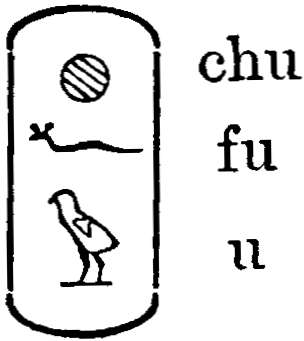
 ; in the later Demotic as
 and
and
 .
The Phœnicians, who borrowed their letters from the Hieratic
Egyptian, wrote
.
The Phœnicians, who borrowed their letters from the Hieratic
Egyptian, wrote  and
and  . The Greeks, who took their letters from
the Phœnicians, wrote
. The Greeks, who took their letters from
the Phœnicians, wrote  .
When the Greeks, instead of writing like
the Phœnicians from right to left, began to write from left to right,
they turned each letter, and as
.
When the Greeks, instead of writing like
the Phœnicians from right to left, began to write from left to right,
they turned each letter, and as  became K, our k, so
  , vau, became
F, the Greek so-called Digamma, the Latin F.
, vau, became
F, the Greek so-called Digamma, the Latin F. , in
Phœnician as
, in
Phœnician as  ,
in ancient Greek as
,
in ancient Greek as  , which occurs on an inscription
found at Mycenæ and elsewhere as the sign of the spiritus asper,
while in Latin it is known to us as the letter
H.
, which occurs on an inscription
found at Mycenæ and elsewhere as the sign of the spiritus asper,
while in Latin it is known to us as the letter
H. still recalls very strikingly
the bent back of the crouching lion, which in the later hieroglyphic
inscriptions represents the sound of L.
still recalls very strikingly
the bent back of the crouching lion, which in the later hieroglyphic
inscriptions represents the sound of L.