While these terrible events were going forward in the attic of Madame
Denis's house, Bathilde, uneasy at seeing her neighbor's window so long
shut, had opened hers, and the first thing she saw, was the dappled gray
horse attached to the shutter; but as she had not seen the captain go
in, she thought that the steed was for Raoul, and that reflection
immediately recalled both her former and present fears.
Bathilde consequently remained at the window, looking on all sides, and
trying to read in the physiognomy of every passer-by whether that
individual was an actor in the mysterious drama which was preparing, and
in which she instinctively understood that Raoul was to play the chief
part. She remained, then, with a beating heart, her neck stretched out,
and her eyes wandering hither and thither, when all at once her unquiet
glances concentrated on a point. The young girl gave a cry of joy, for
she saw Buvat coming round the corner from the Rue Montmartre. Indeed,
it was the worthy caligraphist in person, who, looking behind him from
time to time—as if he feared pursuit—advanced with his cane
horizontal, and at as swift a run as his little legs permitted.
While he enters, and embraces his ward, let us look back and relate the
causes of that absence, which, doubtless, caused as much uneasiness to
our readers as to Nanette and Bathilde.
It will be remembered how Buvat—driven by fear of torture to the
revelation of the conspiracy—had been forced by Dubois to make every
day, at his house, a copy of the documents which the pretended Prince de
Listhnay had given him. It was thus that the minister of the regent had
successively learned all the projects of the conspirators, which he had
defeated by the arrest of Marshal Villeroy, and by the convocation of
parliament.
Buvat had been at work as usual, but about four o'clock, as he rose, and
took his hat in one hand and his cane in the other, Dubois came in and
took him into a little room above that where he had been working, and,
having arrived there, asked him what he thought of the apartment.
Flattered by this deference of the prime minister's to his judgment,
Buvat hastened to reply that he thought it very agreeable.
"So much the better," answered Dubois, "and I am very glad that it is to
your taste, for it is yours."
"Mine!" cried Buvat, astonished.
"Certainly; is it astonishing that I should wish to have under my hand,
or rather, under my eyes, a personage as important as yourself?"
"But," asked Buvat, "am I then going to live in the Palais Royal?"
"For some days, at least," answered Dubois.
"Monseigneur, let me at all events inform Bathilde."
"That is just the thing. Bathilde must not be informed."
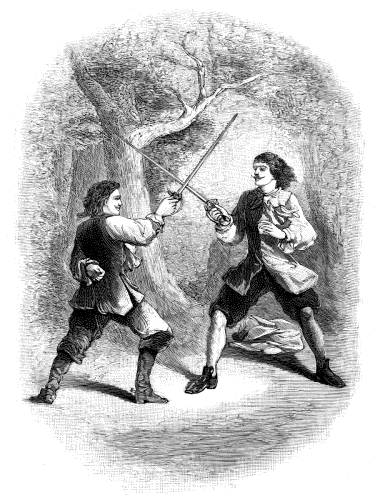
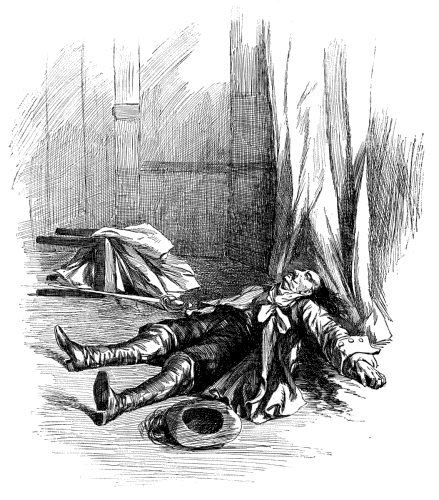
The body of the captain lay stretched on the floor,
swimming in a sea of blood.—Page 408.
Link to larger image
"But you will permit that the first time I go out—"
"As long as you remain here you will not go out."
"But," cried Buvat, with terror, "but I am then a prisoner?"
"A State prisoner, as you have said, my dear Buvat: but calm yourself;
your captivity will not be long, and while it lasts we will take of you
all the care which is the due of the savior of France, for you have
saved France, Monsieur Buvat."
"I have saved France, and here I am a prisoner under bolts and bars!"
"And where on earth do you see bolts and bars, my dear Buvat?" said
Dubois, laughing; "the door shuts with a latch, and has not even a lock:
as to the window, yours looks on the gardens of the Palais Royal, and
has not even a lattice to intercept the view, a superb view—you are
lodged here like the regent himself."
"Oh, my little room! Oh, my terrace!" cried Buvat, letting himself sink
exhausted on a seat.
Dubois, who had no other consolation to bestow upon Buvat, went out, and
placed a sentinel at the door. The explanation of this step is easy.
Dubois feared that, seeing the arrest of Villeroy, they would suspect
from whence the information came, and would question Buvat, and that he
would confess all. This confession would, doubtless, have arrested the
conspirators in the midst of their schemes, which, on the contrary,
Dubois, informed beforehand of all their plans, wished to see carried to
a point, so that in crushing one monster rebellion he might put an end
to all lesser ones.
Toward eight o'clock, as daylight began to fade, Buvat heard a great
noise at his door, and a sort of metallic clashing, which did not tend
to reassure him. He had heard plenty of lamentable stories of State
prisoners who had been assassinated in their prisons, and he rose
trembling and ran to the window. The court and gardens of the Palais
Royal were full of people, the galleries began to be lighted up, the
whole scene was full of gayety and light. He heaved a profound sigh,
thinking perhaps that he might be bidding a last adieu to that life and
animation. At that instant the door was opened; Buvat turned round
shuddering, and saw two tall footmen in red livery bringing in a
well-supplied table. The metallic noise which had so much disturbed him
had been the clattering of the silver plates and dishes.
Buvat's first impression was one of thankfulness to Heaven, that so
imminent a danger as that which he had feared had changed into such a
satisfactory event. But immediately the idea struck him that the deadly
intentions held toward him were still the same, and that only the mode
of their execution were changed—instead of being assassinated, like
Jeansans-Peur, or the Duc de Guise, he was going to be poisoned, like
the Dauphin, or the Duc de Burgundy. He threw a rapid glance on the two
footmen, and thought he remarked something somber which denoted the
agents of a secret vengeance. From this instant his determination was
taken, and, in spite of the scent of the dishes, which appeared to him
an additional proof, he refused all sustenance, saying majestically that
he was neither hungry nor thirsty.
The footmen looked at each other knowingly. They were two sharp fellows,
and had understood Buvat's character at a glance, and not understanding
a man not being hungry when before a pheasant stuffed with truffles, or
not thirsty before a bottle of Chambertin, had penetrated the prisoner's
fears pretty quickly. They exchanged a few words in a low tone, and the
boldest of the two, seeing that there was a means of drawing some profit
from the circumstances, advanced toward Buvat, who recoiled before him
as far as the room would allow.
"Monsieur," said he, in a reassuring tone, "we understand your fears,
and, as we are honest servants, we will show you that we are incapable
of lending ourselves to the dealings which you suspect; consequently,
during the whole time that you remain here, my comrade and I, each in
our turn, will taste all the dishes which are brought you, and all the
wines which are sent in, happy if by our devotion we can restore your
tranquillity."
"Monsieur," answered Buvat, ashamed that his secret sentiments had been
discovered thus, "monsieur, you are very polite, but in truth I am
neither hungry nor thirsty."
"Never mind, monsieur," said the man, "as my comrade and myself desire
not to leave the smallest doubt on your mind, we will execute what we
have offered. Comtois, my friend," continued the fellow, sitting down in
the place which had been intended for Buvat, "do me the favor to help me
to a little of that soup, a wing of that pullet in rice, a glass of that
Chambertin, there—to your health, monsieur."
"Monsieur," said Buvat, opening his eyes, and looking at the footman who
was dining so impudently in his stead, "monsieur, it is I who am your
servant, and I should wish to know your name, in order to preserve it in
my memory by the side of that of the good jailer who gave to Comte
l'Ancien a similar proof of devotion to that which you give me."
"Monsieur," answered the footman modestly, "I am called Bourguignon, and
here is my comrade Comtois, whose turn for devotion will come to-morrow,
and who, when the moment shall have arrived, will not be behindhand.
Comtois, my friend, a slice of that pheasant, and a glass of champagne.
Do you not see that, in order to reassure monsieur completely, I must
taste everything; it is a severe test, I know, but where would be the
merit of being an honest man if it did not sometimes bring trials like
the present? To your health, Monsieur Buvat."
"Heaven preserve yours, Monsieur Bourguignon."
"Now, Comtois, hand me the dessert, so that I may leave no doubt on
Monsieur Buvat's mind."
"Monsieur Bourguignon, I beg you to believe that, if I had any, they are
completely dissipated."
"No, monsieur, no, I beg your pardon, you still have some. Comtois, my
friend, now the hot coffee, very hot; I wish to drink it exactly as
monsieur would have done, and I presume it is thus that monsieur likes
it."
"Boiling, monsieur, boiling," answered Buvat, bowing.
"Oh!" said Bourguignon, sipping his coffee, and raising his eyes
blissfully to the ceiling, "you are right, monsieur. It is only so that
coffee is good—half-cold it is a very second-rate beverage. This, I may
say, is excellent. Comtois, my friend, receive my compliments, you wait
admirably; now help me to take away the table. You ought to know that
there is nothing more unpleasant than the smell of wines and viands to
those who are not hungry nor thirsty. Monsieur," continued Bourguignon,
stepping toward the door, which he had carefully shut during the repast,
and which he opened while his companion pushed the table before him,
"monsieur, if you have need of anything, you have three bells, one at
the head of your bed, and two at the mantelpiece. Those at the fireplace
are for us, that at the bed for your valet-de-chambre."
"Thank you, monsieur," said Buvat, "you are too good. I do not wish to
disturb any one."
"Do not trouble yourself about that, monsieur—monseigneur desires that
you should make yourself at home."
"Monseigneur is very polite."
"Does monsieur require anything else?"
"Nothing more, my friend, nothing more," said Buvat, touched by so much
devotion; "nothing, except to express my gratitude."
"I have only done my duty, monsieur," answered Bourguignon, modestly,
bowing for the last time, and shutting the door.
"Ma foi!" said Buvat, following Bourguignon with his eyes, "it must be
allowed that some proverbs are great liars. One says, 'As insolent as a
lackey,' and yet here is an individual practicing that calling, who
nevertheless could not possibly be more polite. I shall never believe in
proverbs again, or rather, I shall make a difference between them."
And making himself this promise, Buvat found himself alone.
Nothing makes a man so hungry as the sight of a good dinner; that which
had just been eaten under the good man's very eyes surpassed in luxury
everything that he had ever dreamed of, and he began—influenced by the
decided calls of his stomach—to reproach himself for his too great
defiance of his persecutors; but it was too late. Buvat, it is true,
might have rung for Monsieur Bourguignon, and requested a second dinner,
but he was of too timid a character for that, and the result was, that
he had to search among his stock of proverbs for the most consoling, and
having found, between his situation and the proverb, "He who sleeps
dines," an analogy which seemed to him most direct, he resolved to make
use of it, and, as he could not dine, to endeavor at least to sleep.
But, at the moment of taking this resolution, Buvat found himself
assailed by new fears. Could they not profit by his sleep to dispatch
him? The night is the time of ambushes—he had often heard his mother
tell of beds which, by the lowering of their canopies, smothered the
unfortunate sleeper; of beds which sank through a trap, so softly as not
to wake the occupant; finally, of secret doors opening in panels, and
even in furniture, to give entrance to assassins. This luxuriant dinner,
these rich wines, had they not been sent him to insure a sounder sleep?
All this was possible, nay, probable, and Buvat, who felt the instinct
of self-preservation in the highest degree, took his candle, and
commenced a most minute investigation. After having opened the doors of
all the cupboards, sounded all the paneling, Buvat had gone down on his
hands and feet, and was stretching his head timidly under the bed, when
he thought he heard steps behind him. The position in which he found
himself did not permit him to act on the defensive; he therefore
remained motionless, and waited with a beating heart. After a few
seconds of solemn silence, which filled Buvat with vague alarms, a voice
said:
"Your pardon; but is not monsieur looking for his nightcap?"
Buvat was discovered—there was no means of escaping the danger, if
danger there was. He therefore drew his head from under the bed, took
his candle, and remaining on his knees, as a humble and beseeching
posture, he turned toward the individual who had just addressed him, and
found himself face to face with a man dressed in black, and carrying,
folded up on his arm, many articles, which Buvat recognized as human
clothes.
"Yes, monsieur," said Buvat, seizing the opening which was offered to
him, with a presence of mind on which he secretly congratulated himself;
"is that search forbidden?"
"Why did not monsieur, instead of troubling himself, ring the bell? I
have the honor to be appointed monsieur's valet-de-chambre, and I have
brought him a night-cap and night-shirt."
And with these words the valet-de-chambre spread out on the bed a
night-shirt, embroidered with flowers, a cap of the finest lawn, and a
rose-colored ribbon. Buvat, still on his knees, regarded him with the
greatest astonishment.
"Now," said the valet-de-chambre, "will monsieur allow me to help him to
undress?"
"No, monsieur, no," said Buvat, accompanying the refusal with the
sweetest smile he could assume. "No, I am accustomed to undress myself.
I thank you, monsieur."
The valet-de-chambre retired, and Buvat remained alone.
As the inspection of the room was completed, and as his increasing
hunger rendered sleep more necessary, Buvat began to undress, sighing;
placed—in order not to be left in the dark—a candle on the corner of
the chimney-piece, and sprang, with a groan, into the softest and
warmest bed he had ever slept on.
"The bed is not sleep," is an axiom which Buvat might, from experience,
have added to the list of his true proverbs. Either from fear or hunger,
Buvat passed a very disturbed night, and it was not till near morning
that he fell asleep; even then his slumbers were peopled with the most
terrible visions and nightmares. He was just waking from a dream that
he had been poisoned by a leg of mutton, when the valet-de-chambre
entered, and asked at what time he would like breakfast.
Buvat was not in the habit of breakfasting in bed, so he rose quickly,
and dressed in haste; he had just finished, when Messieurs Bourguignon
and Comtois entered, bringing the breakfast, as the day before they had
brought the dinner.
Then took place a second rehearsal of the scene which we have before
related, with the exception that now it was Monsieur Comtois who ate and
Monsieur Bourguignon who waited; but when it came to the coffee, and
Buvat, who had taken nothing for twenty-four hours, saw his dearly-loved
beverage, after having passed from the silver coffee-pot into the
porcelain cup, pass into the cavernous mouth of Monsieur Comtois, he
could hold out no longer, and declared that his stomach demanded to be
amused with something, and that, consequently, he desired that they
would leave him the coffee and a roll. This declaration appeared to
disturb the devotion of Monsieur Comtois, who was nevertheless obliged
to satisfy himself with one cup of the odoriferous liquid, which,
together with a roll and the sugar, was placed on a little table, while
the two scamps carried off the rest of the feast, laughing in their
sleeves.
Scarcely was the door closed, when Buvat darted toward the little table,
and, without even waiting to dip one into the other, ate the bread and
drank the coffee; then, a little comforted by that repast, insufficient
as it was, began to look at things in a less gloomy point of view.
In truth, Buvat was not wanting in a certain kind of good sense, and, as
he had passed the preceding evening and night, and entered on the
present morning, without interference, he began to understand that,
though from some political motive they had deprived him of his liberty,
they were far from wishing to shorten his days, and surrounded him, on
the contrary, with cares, of which he had never before been the object.
He had seen that the dinner of the day before was better than his
ordinary dinner—that the bed was softer than his ordinary bed—that the
coffee he had just drunk possessed an aroma which the mixture of chicory
took away from his, and he could not conceal from himself that the
elastic couches and stuffed chairs which he had sat upon for the last
twenty-four hours were much preferable to the hair sofa and cane chairs
of his own establishment. The only thing, then, which remained to
trouble him, was the uneasiness which Bathilde would feel at his not
returning. He had for an instant the idea—not daring to renew the
request which he had made the day before, to have news of him sent to
his ward—of imitating the man with the iron mask, who had thrown a
silver plate from the window of his prison on to the shore, by throwing
a letter from his balcony into the courtyard of the Palais Royal; but he
knew what a fatal result this infraction of the will of Monsieur de
Saint-Mars had had for the unfortunate prisoner, so that he feared, by
such an action, to increase the rigors of his captivity, which at
present seemed to him tolerable.
The result of all these reflections was, that Buvat passed the morning
in a much less agitated manner than he had the evening and the night;
moreover, his hunger—appeased by the roll and the coffee—only existed
in the form of that appetite which is an enjoyment when one is sure of a
good dinner. Add to all this the particularly cheerful look-out which
the prisoner had from his window, and it will be easily understood that
mid-day arrived without too many sorrows, or too much ennui.
Exactly at one o'clock the door opened, and the table reappeared ready
laid, and brought, like the day before and that morning, by the two
valets. But this time, it was neither Monsieur Bourguignon nor Monsieur
Comtois who sat down to it. Buvat declared himself perfectly reassured
concerning the intentions of his august host; he thanked Messieurs
Comtois and Bourguignon for the devotion of which each in turn had given
him a proof, and begged them to wait upon him in their turn. The two
servants made wry faces, but obeyed. It will be understood that the
happy disposition in which Buvat now was became more blissful under the
influence of a good dinner. Buvat ate all the eatables, drank all the
drinkables, and at last, after having sipped his coffee—a luxury which
he usually only allowed himself on Sundays—and having capped the
Arabian nectar with a glass of Madame Anfoux' liquor, was, it must be
confessed, in a state bordering upon ecstasy.
That evening the supper was equally successful; but as Buvat had
abandoned himself at dinner rather freely to the consumption of
Chambertin and Sillery, about eight o'clock in the evening he found
himself in a state of glorification impossible to describe. The
consequence was, that when the valet-de-chambre entered, instead of
finding him like the evening before, with his head under the bed, he
found Buvat seated on a comfortable sofa, his feet on the hobs, his head
leaning back, his eyes winking, and singing between his teeth, with an
expression of infinite tenderness:
"Then let me go,
And let me play,
Beneath the hazel-tree."
Which, as may be seen, was a great improvement on the state of the
worthy writer twenty-four hours before. Moreover, when the
valet-de-chambre offered to help him to undress, Buvat, who found a
slight difficulty in expressing his thoughts, contented himself with
smiling in sign of approbation; then extended his arms to have his coat
taken off, then his legs to have his slippers removed; but, in spite of
his state of exaltation, it is only just to Buvat to say, that it was
only when he found himself alone that he laid aside the rest of his
garments.
This time, contrary to what he had done the day before, he stretched
himself out luxuriously in his bed, and fell asleep in five minutes, and
dreamed that he was the Grand Turk.
He awoke as fresh as a rose, having only one trouble—the uneasiness
that Bathilde must experience, but otherwise perfectly happy.
It may easily be imagined that the breakfast did not lessen his good
spirits; on the contrary, being informed that he might write to Monsieur
the Archbishop of Cambray, he asked for paper and ink, which were
brought him, took from his pocket his penknife, which never left him,
cut his pen with the greatest care, and commenced, in his finest
writing, a most touching request, that if his captivity was to last,
Bathilde might be sent for, or, at least, that she might be informed,
that, except his liberty, he was in want of nothing, thanks to the
kindness of the prime minister.
This request, to the caligraphy of which Buvat had devoted no little
care, and whose capital letters represented different plants, trees, or
animals, occupied the worthy writer from breakfast till dinner. On
sitting down to table he gave the note to Bourguignon, who charged
himself with carrying it to the prime minister, saying that Comtois
would wait during his absence. In a quarter of an hour Bourguignon
returned, and informed Buvat that monseigneur had gone out, but that—in
his absence—the petition had been given to the person who aided him in
his public affairs, and that person had requested that Monsieur Buvat
would come and see him as soon as he had finished his dinner, but hoped
that monsieur would not in any degree hurry himself, since he who made
the request was dining himself. In accordance with this permission Buvat
took his time, feasted on the best cookery, imbibed the most generous
wines, sipped his coffee, played with his glass of liquor, and then—the
last operation completed—declared in a resolute tone, that he was ready
to appear before the substitute of the prime minister.
The sentinel had received orders to let him pass, so Buvat, conducted by
Bourguignon, passed proudly by him. For some time they followed a long
corridor, then descended a staircase; at last the footman opened a door,
and announced Monsieur Buvat.
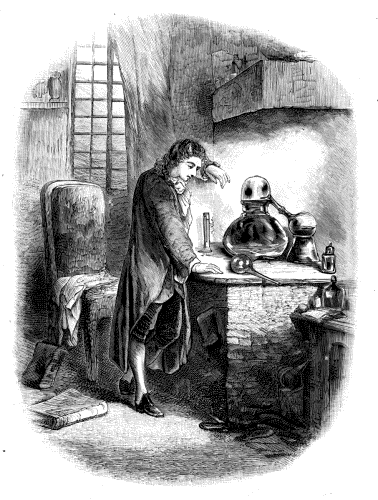
Buvat found himself in a sort of laboratory, situated on the
ground-floor, with a man of from forty to forty-two, who was entirely
unknown to him, and who was very simply dressed, and occupied in
following—at a blazing furnace—some chemical experiment, to which he
appeared to attach great importance. This man, seeing Buvat, raised his
head, and having looked at him curiously—
"Monsieur," said he, "are you Jean Buvat?"——"At your service,
monsieur," answered Buvat, bowing.
"The request which you have just sent to the abbé is your handwriting?"
"My own, monsieur."
"You write a fine hand."
Buvat bowed, with a proudly modest smile.
"The abbé," continued the unknown, "has informed me of the services
which you have rendered us."
"Monseigneur is too good," murmured Buvat, "it was not worth the
trouble."
"How! not worth the trouble? Indeed, Monsieur Buvat, it was, on the
contrary, well worth the trouble, and the proof is, that if you have any
favor to ask from the regent, I will charge myself with the message."
"Monsieur," said Buvat, "since you are so good as to offer to interpret
my sentiments to his royal highness, have the kindness to request him,
when he is less pressed, if it is not too inconvenient, to pay me my
arrears."
"How! your arrears, Monsieur Buvat? What do you mean?"
"I mean, monsieur, that I have the honor to be employed at the royal
library, but that for six years I have received no salary."
"And how much do your arrears amount to?"
"Monsieur, I must have a pen and ink to calculate exactly."
"Oh, but something near the mark—calculate from memory."
"To five thousand three hundred and odd francs, besides the fractions of
sous and deniers."
"And you wish for payment, Monsieur Buvat?"
"I do not deny it, monsieur; it would give me great pleasure."
"And is this all you ask?"
"All."
"But do you not ask anything for the service which you have just
rendered France?"
"Indeed, monsieur, I should like permission to let my ward Bathilde know
that she may be easy on my account, and that I am a prisoner at the
Palais Royal. I would also ask—if it would not be imposing upon your
kindness too much—that she might be allowed to pay me a little visit,
but, if this second request is indiscreet, I will confine myself to the
first."
"We will do better than that; the causes for which you were retained
exist no more, and we are going to set you at liberty; so you can go
yourself to carry the news to Bathilde."
"What, monsieur, what!" cried Buvat; "am I, then, no longer a prisoner?"
"You can go when you like."
"Monsieur, I am your very humble servant, and I have the honor of
presenting you my respects."
"Pardon, Monsieur Buvat, one word more."——"Two, monsieur."
"I repeat to you that France is under obligations to you, which she will
acquit. Write, then, to the regent, inform him of what is due to you,
show him your situation, and if you have a particular desire for
anything, say so boldly. I guarantee that he will grant your request."
"Monsieur, you are too good, and I shall not fail. I hope, then, that
out of the first money which comes into the treasury—"
"You will be paid. I give you my word."
"Monsieur, this very day my petition shall be addressed to the regent."
"And to-morrow you will be paid."
"Ah, monsieur, what goodness!"
"Go, Monsieur Buvat, go; your ward expects you."
"You are right, monsieur, but she will lose nothing by having waited for
me, since I bring her such good news. I may have the honor of seeing you
again, monsieur. Ah! pardon, would it be an indiscretion to ask your
name?"
"Monsieur Philippe."
"Au revoir! Monsieur Philippe!"
"Adieu! Monsieur Buvat. One instant—I must give orders that they are to
allow you to pass."
At these words he rang: an usher appeared. "Send Ravanne."
The usher went out; a few seconds afterward a young officer of guards
entered.
"Ravanne," said Monsieur Philippe, "conduct this gentleman to the gate
of the Palais Royal. There he is free to go where he wishes."
"Yes, monseigneur," answered the young officer.
A cloud passed over Buvat's eyes, and he opened his mouth to ask who it
was that was being called monseigneur, but Ravanne did not leave him
time.
"Come, monsieur," said he, "I await you."
Buvat looked at Monsieur Philippe and the page with a stupefied air; but
the latter—not understanding his hesitation—renewed his invitation to
follow. Buvat obeyed, drawing out his handkerchief, and wiping his
forehead.
At the door, the sentinel wished to stop Buvat.
"By the order of his royal highness Monseigneur the Regent, monsieur is
free," said Ravanne.
The soldier presented arms, and allowed him to pass.
Buvat thought he should faint, he felt his legs fail him, and leaned
against a wall.
"What is the matter, monsieur?" asked his guide.
"Pardon, monsieur," murmured Buvat, "but who is the person to whom I
have just had the honor of speaking?"
"Monseigneur the Regent in person."
"Not possible!"
"Not only possible, but true."
"What! it was the regent himself who promised to pay me my arrears?"
"I do not know what he promised you, but I know that the person who gave
me the order to accompany you was the regent."
"But he told me he was called Philippe."
"Well, he is—Philippe d'Orleans."
"That is true, monsieur, that is true, Philippe is his Christian name.
The regent is a brave man, and when I remember that there exist
scoundrels who conspire against him—against a man who has promised to
pay me my arrears—but they deserve to be hanged, all of them, to be
broken on the wheel, drawn and quartered, burned alive; do not you think
so, monsieur?"
"Monsieur," said Ravanne, laughing, "I have no opinion on matters of
such importance. We are at the gate; I should be happy to accompany you
further, but monseigneur leaves in half an hour for the Abbey of
Chelles, and, as he has some orders to give me before his departure, I
am—to my great regret—obliged to quit you."
"All the regret is on my side, monsieur," said Buvat, graciously, and
answering by a profound bow to the slight nod of the young man, who,
when Buvat raised his head, had already disappeared. This departure left
Buvat perfectly free in his movements, and he profited thereby to take
his way down the Place des Victoires toward the Rue du Temps-Perdu,
round the corner of which he turned at the very moment when D'Harmental
ran his sword through the body of Roquefinette. It was at this moment
that poor Bathilde—who was far from suspecting what was passing in her
neighbor's room—had seen her guardian, and had rushed to meet him on
the stairs, where Buvat and she had met at the third flight.
"Oh, my dear, dear father," cried Bathilde, remounting the staircase in
Buvat's arms, and stopping to embrace him at every step, "where have you
been? What has happened? How is it that we have not seen you since
Monday? What uneasiness you have caused us, mon Dieu! But something
extraordinary must have occurred."
"Yes, most extraordinary," answered Buvat.
"Ah, mon Dieu! tell then me, first, where do you come from?"
"From the Palais Royal."
"What! from the Palais Royal; and with whom were you stopping at the
Palais Royal?"
"The regent."
"You with the regent! and what about?"
"I was a prisoner."
"A prisoner—you!"
"A State prisoner."
"And why were you a prisoner?"
"Because I have saved France."
"Oh, father! are you mad?" cried Bathilde, terrified.
"No, but there has been enough to make me so if I had not had a pretty
strong head."
"Oh, explain, for God's sake!"
"Fancy that there was a conspiracy against the regent."
"Oh, mon Dieu!"
"And that I belonged to it."
"You?"
"Yes, I, without being—that is to say, you know that Prince de
Listhnay?"
"Well!"
"A sham prince, my child, a sham prince!"
"But the copies which you made for him?"
"Manifestoes, proclamations, incendiary papers, a general revolt,
Brittany—Normandy—the States-General—king of Spain—I have discovered
all this."
"You?" cried Bathilde, horrified.
"Yes, I; and the regent has called me the savior of France—me; and is
going to pay me my arrears."
"My father, my father, you talk of conspirators, do you remember the
name of any of them?"
"Firstly, Monsieur the Duc de Maine; fancy that miserable bastard
conspiring against a man like Monseigneur the Regent. Then a Count de
Laval, a Marquis de Pompadour, a Baron de Valef, the Prince de
Cellamare, the Abbe Brigaud, that abominable Abbe Brigaud! Think of my
having copied the list."
"My father," said Bathilde, shuddering with fear, "my father, among all
those names, did you not see the name—the name—of—Chevalier—Raoul
d'Harmental?"
"That I did," cried Buvat, "the Chevalier Raoul d'Harmental—why he is
the head of the company: but the regent knows them all, and this very
evening they will all be arrested, and to-morrow hanged, drawn,
quartered, broken on the wheel."
"Oh, luckless, shameful, that you are!" cried Bathilde, wringing her
hands wildly; "you have killed the man whom I love—but, I swear to you,
by the memory of my mother, that if he dies, I will die also!"
And thinking that she might still be in time to warn D'Harmental of the
danger which threatened him, Bathilde left Buvat confounded, darted to
the door, flew down the staircase, cleared the street at two bounds,
rushed up the stairs, and, breathless, terrified, dying, hurled herself
against the door of D'Harmental's room, which, badly closed by the
chevalier, yielded before her, exposing to her view the body of the
captain stretched on the floor, and swimming in a sea of blood.
At this sight, so widely different from what she expected, Bathilde, not
thinking that she might perhaps be compromising her lover, sprang toward
the door, calling for help, but on reaching the threshold, either from
weakness, or from the blood, her foot slipped, and she fell backward
with a terrible cry.
The neighbors came running in the direction of the cry, and found that
Bathilde had fainted, and that her head, in falling against the angle of
the door, had been badly wounded.
They carried Bathilde to Madame Denis's room, and the good woman
hastened to offer her hospitality.
As to Captain Roquefinette, as he had torn off the address of the letter
which he had in his pocket to light his pipe with, and had no other
paper to indicate his name or residence, they carried his body to the
Morgue, where, three days afterward, it was recognized by La Normande.