THE CONQUEST OF THE GREAT NORTHWEST — CHAPTER XXI
1760-1810
“THE COMING OF THE PEDLARS” CONTINUED—VOYAGE
UP TO FORT WILLIAM, LIFE OF WILDWOOD
WASSAIL AND GRANDEUR THERE—HOW
THE WINTERING PARTNERS EXPLOITED THE
NORTHWEST—TALES OF THE WINTERERS IN THE
PAYS D’EN HAUT
It was no easier for the Nor’Westers to obtain
recruits than for the Hudson’s Bay Company.
French habitants were no more anxious
to have their heads broken in other men’s
quarrels than the Orkneymen of the Old Country;
but the Nor’Westers managed better than the Hudson’s
Bay. Brigades were made up as the ice cleared
from the rivers in May. For weeks before, the
Nor’Westers had been craftily at work. No agents
were sent to the country parishes with clumsy offers
of £8 bounty, which would be, of itself, acknowledgment
of danger. Companies don’t pay £8 bounty
for nothing. Not agents were sent to the parishes,
but “sly old wolves of the North”—as one parish
priest calls these demoralizers of his flock—went
from village to village, gay, reckless, dare-devil
veterans, old in service, young in years, clothed in all
the picturesque glory of beaded buckskin, plumed
hats, silk sashes, to tickle the vanity of the poor
country bucks, who had never been beyond their
own hamlet. Cocks of the walk, bullies of the town,
slinging money around like dust, spinning yarns
marvelous of fortune made at one coup, of adventures
in which they had been the heroes, of freedom—freedom
like kings to rule over the Indian tribes—these
returned voyageurs lounged in the taverns,
played the gallants at all the hillside dances, flirted
with the daughters, made presents to the mothers,
and gave to the youth of the parish what the priest
describes as “dizziness of the head.” It needed
only a little maneuvering for our “sly wolves of the
North” to get themselves lionized, the heroes of
the parish. Dances were given in their honor. The
contagion invaded even the sacred fold of the church.
The “sons of Satan” maneuvered so well that the
holy festivals even seemed to revolve round their
person as round a sun of glory. The curé might
preach himself black in the face proving that a
camp on the sand and a bed à la belle étoile, under
the stars, are much more poetic in the telling than
in life; that voyageurs don’t pass all their lives
clothed in picturesque costumes chanting ditties to
the rhythmic dip of paddle blades; that, in fact,
when your voyageur sets out in spring he passes half
his time in ice water to mid-waist tracking canoes
up rapids, and that where the portage is rocky glassed
with ice, you can follow the sorry fellow’s path by
blood from the cuts in his feet.
What did the curé know about it? There was
proof to the contrary in the gay blade before their
eyes, and the green country bucks expressed timid
wish that they, too, might lead such a life. Presto!
No sooner said than done! My hero from the North
jerks a written contract all ready for the signature of
names and slaps down half the wages in advance
before the dazzled greenhorns have time to retract.
From now till the brigades depart our green recruit
busies himself playing the hero before he has won
his spurs. He dons the gay vesture and he dons
the grand air and he passes the interval in a glorious
oblivion of all regrets drowned in potions at the
parish inn; but it is our drummer’s business to
round up the recruits at Montreal, which he does
as swiftly as they sober up. And they usually sober
up to find that all the advance wages have melted in
the public house. No drawing back now, though
the rosy hopes have faded drab! A hint at such a
thought brings down on the poltroon’s head threats
of instant imprisonment—a fine ending, indeed, to
all the brag and the boast and the brass-band flourish
with which our runaway has left his native parish.
Crews and canoes assemble above Lachine, nine
miles from Montreal, ninety or one hundred canoes
with eight men to each, including steersman, and a
pilot to each ten canoes. Thirty or forty guides
there will, perhaps, be to the yearly brigade—men
who lead the way and prevent waste of time by following
wrong water courses. And it is a picturesque
enough scene to stir the dullest blood, spite of all
the curé’s warning. Voyageurs and hunters are
dressed in buckskin with gayest of silk bands round
hair and neck. Partners are pompous in ruffles and
lace and gold braid, with brass-handled pistols and
daggers in belt. In each canoe go the cargoes—two-thirds
merchandise, one-third provisions—oilcloth
to cover it, tarpaulin for a tent, tow lines, bark and
gum for repairs, kettles, dippers and big sponges to
bail out water. As the canoes are loaded, they are
launched and circle about on the river waiting for
the signal of the head steersman. The chief steersman’s
steel-shod pole is held overhead. It drops—five
hundred paddles dip as with one arm, and there
shoots out from the ninety-foot canoes the small,
narrow, swift craft of the partners, racing ahead to
be at the rendezvous before the cargoes arrive.
Freight packers ashore utter a shout that makes the
echoes ring. The voyageurs strike up a song. The
paddles dip to the time of the song. The deep-throated
chorus dies away in echo. The life of the
Pays d’en Haut has begun.
Ste. Anne’s—the patron saint of canoemen—is the
last chapel spire they will see for many a year. The
canoemen cross themselves in prayer. Then the
Lake of the Two Mountains comes, and the Long
Sault Rapids and the Chaudiere Falls, of what is now
Ottawa City, and the Chat Rapids and thirty-six
other portages in the four hundred miles up the
Ottawa from Montreal, each portage being reckoned
as many “pipes” long as the voyageur smokes, when
carrying the cargo overland in ninety-pound packs
on his back. Leaving the Mattawa at the headwaters
of the Ottawa, the brigades strike westward
for the Great Lakes, down stream through Nipissing
Lake and French River to Lake Huron; easier going
now with the current and sheer delight once the
canoes are out on the clear waters of the lake, where
if the wind is favorable, blankets are hoisted for a
sail and the canoes scud across to the Sault. But it is
not always easy going. Where French River comes
out of Nipissing Lake, ten crosses mark where
voyageurs have found a watery grave, and sometimes
on the lake the heavily laden canoes are working
straight against a head wind that sends choppy
waves ice-cold slapping into their laps till oilcloth
must be bound round the prow to keep from shipping
water where a wave-crest dips over and the
canoe has failed to climb. Even mounting the waves
and keeping the gun’els clear of the wash, at every
paddle dip the spray splashes the voyageur to his
waist. The “old wolves” smoke and say nothing.
The bowman bounces back athwart so that the prow
will lighten and rise to the climbing wave, but the
green hands—the gay dons who left home in such
a flush of glory—mutter “c’est la misère, c’est la
misère, mon bourgeois,” bourgeois being the habitant’s
name for the partners of the Company; and
misery it is, indeed, if ice glasses the canoe and the
craft becomes frost-logged. They must land then
and repair the canoe where the bark has been jagged,
new bark being gummed on where the cuts are deep,
resin and tar run along all fissures. And these
Nor’Westers are very wolves for time. Repairs
must be done by torchlight at night. In fair weather,
the men sleep on the sand. In bad weather, tarpaulin
is put up as a wind-break. Reveille is sounded
at first dawn streak—a bugle call if a partner is in
camp, a shout from the chief steersman if the brigades
have become scattered—“Levé! Levé!” By
four in the morning, canoes are again on the water.
At eight, the brigades land for breakfast. If weather
be favorable for speed, they will not pause for mid-day
meal but eat a snack of biscuit or pemmican as
they run across the portages. Night meal comes
when they can see to go no farther, and often relays
of paddles are put on and the brigades paddle all
night. The men have slim fare—grease and barley
meal and pemmican, and the greenhorns frequently
set up such a wail for the pork diet of the home table
that they become known as the “mangeurs de lard,”
“the pork eaters,” between Montreal and Lake
Superior, or “the comers and goers,” because the
men on this part of the voyage to the Up Country
are freighters constantly coming and going. At each
fresh portage the new hand must stand for treats to
his comrades, or risk a ducking, or prove himself a
better wrestler than they. At the hardest places
and the hardest pace, the bourgeois unbends and
gives his men a régale, which means rum.
The Sault at the west side of Lake Huron leading
up to Lake Superior is the last military post—the
outermost reach of the law’s arm. Beyond the
Sault—as the priests had warned—is law of neither
God nor man. Beyond the Sault, letters from home
friends to the voyageurs bear the significant address,
“Wherever He May Be Found.”
At the Sault on the north side, the Nor’Westers
constructed a canal with locks, for they had two
sailing vessels patrolling the lakes—The Otter and
The Beaver—one bound for the Detroit trade, the
other from the Sault across Lake Superior. As the
superstitious half-breeds passed from the Sault to
Lake Superior, it was an Indian custom to drop an
arrow on the shore as an offering to keep the devil
from doing them harm on the boisterous waters of
Lake Superior. Many a canoe was swamped by
head winds crossing Lake Superior. To avoid risk,
the brigades skirted close to the north shore, till they
came to the Company’s headquarters at Fort William,
formerly known as Grand Portage.
Grand Portage was eighteen hundred miles from
Montreal and lay at the foot of a hill, the buildings
engirt by eighteen-foot palisades. It was here rival
traders were usually stopped. When the Montreal
merchants first went to the Northwest, their headquarters
had been Michilimacinac, but this was too
close to rival traders. The Frobishers and McGillivrays
and McTavishes decided to seek some
good location on the north shore of the lake leading
directly to the Up Country. Grand Portage on
Pigeon River leading up to the height of land drained
by Rainy River, was chosen for the fort, but when the
American boundary was specified by treaty, it was
found that Grand Portage was in foreign territory.
The partners looked for an eastern site that would
still be on waterways leading toward Rainy River.
The very year, 1785, that the Nor’Westers had
petitioned the government for monopoly, they sent
voyageurs seeking such a site. The man who led
the voyageurs was that Edward Umfreville, who had
been captured by the French on Hudson Bay, in
1782, and had now come to join the Nor’Westers.
Umfreville found a chain of waterways leading up
from Lake Superior to Lake Nipigon and from Nipigon
west to Winnipeg River, but later, in 1797,
Roderick MacKenzie found the trail of the fur traders
in the old French régime—by way of Kaministiquia;
and to the mouth of the Kaministiquia headquarters
were moved by 1800, and the post named Fort
William in honor of that William McGillivray who
had bought out Peter Pond.
The usual slab-cut palisades surrounded the fort.
In the center of the square stood the main building
surmounted by a high balcony. Inside was the
great saloon or hall—sixty feet by thirty—decorated
with paintings of the leading partners in the full flush
of ruffles and court costume. Here the partners
and clerks and leading guides took their meals.
Round this hall were the partners’ bedrooms; in
the basement, the kitchen. Flanking the walls of
the courtyard were other buildings equally large—the
servants’ quarters, storehouses, warerooms,
clerks’ lodgings. The powder magazine was of stone
roofed with tin with a look-out near the roof commanding
a view of the lake. There was also a jail
which the voyageurs jocularly called their pot au
beurre, or butter tub. The physician, Doctor McLoughlin,
a young student of Laval, Quebec, who
had been forced to flee west for pitching a drunken
British officer of Quebec Citadel on his head in the
muddy streets, had a house to himself near the gate.
Over the gate was a guardhouse, where sentry sat
night and day. Inside the palisades was a population
of from twelve hundred to two thousand people.
Outside the fort a village of little log houses had
scattered along the river front. Here dwelt the
Indian families of the French voyageurs.
Here, then, came the brigades from Montreal—seven
hundred, and one thousand strong, preceded
by the swift-traveling partners whose annual meeting
was held in July. A great whoop welcomed the
men ashore and they were at once rallied to the Canteen,
where bread, butter, meal and four quarts of
rum were given to each man. About the same time
as the canoes from the East arrived, the fur brigades
from the West came in smaller canoes, loaded to the
waterline with skins valued at £40 a pack. To
these also was given a régale. Then twenty or a
dozen kegs of rum were distributed to the Indian
families; “and after that,” says one missionary,
“truly the furies of Hell were let loose.” The gates
were closed for reasons that need not be given, and
the Nor’ Westers often took the precaution of gathering
up all the weapons of the Indians before the
boisson or mad drinking bout began, but the rum-frenzied
Indians still had fists and teeth left, and
never a drinking bout passed but from one to a
dozen Indians were murdered—frequently wives and
daughters because they were least able to defend
themselves—though the Indian murderer when sobered
was often plunged in such grief for his deed
that he would come to the white men and beg them
to kill him as punishment. The stripping of all
restraint—moral, physical, legal—has different effects
on different natures. Some rise higher in the freedom.
Others go far below the level of the most
vicious beast. Men like Alexander MacKenzie and
Doctor McLoughlin braced themselves to the shock
of the sudden transition from civilization to barbarism
and rose to renown—one as explorer, the
other as patriot; but in the very same region where
Alexander MacKenzie won his laurels was another
MacKenzie—James—a blood relative, who openly
sold native women to voyageurs and entered them
as an asset on the Company’s books; and in that
very Oregon where McLoughlin won his reputation
as a saint, was his son McLoughlin, notorious as a
sot. Perhaps the crimes of the fur country were no
greater than those committed under hiding in civilization,
but they were more terrific, for they were undisguised
and in open day where if you would not
see them you must close your eyes or bolt the gates.
Inside the bolted gates where the partners lived,
the code was on the whole one of decency and high
living and pomp. In the daytime, the session of
the annual meeting was held in secret behind barred
doors. The entire Up Country was mapped out
for the year’s campaign. Reports were received on
the past season, men and plans arranged for the
coming year, weak leaders shifted to easy places,
strong men, “old winterers, the crafty wolves of
the North,” dispatched to the fields where there was
to be the hardest fighting against either Indians or
English, and English always meant Hudson’s Bay.
But at night the cares of the campaign were laid
aside. The partners dressed for dinner—ruffles and
gold lace and knee breeches with gold-clasped garters
and silver-buckled shoes. Over the richly laden
dinner table was told many a yarn of hardship and
danger and heroism in the Up Country. The rafters
rang with laughter and applause and song. Outside
the gates among the voyageurs the songs were
French; inside among the partners, Scotch. When
plates were cleared away, bagpipes of the beloved
Highlands, and flutes, and violins struck up and
“we danced till daylight,” records Rod. MacKenzie;
or “we drank the ten gallon kegs empty,” confesses
Henry; it was according to the man. Or when
more wine than wisdom had flowed from the festive
board, and plates were cleared, the jolly partners
sometimes straddled wine kegs, chairs, benches,
and “sauted,” as one relates it—shot the rapids from
the dining table to the floor ending up a wild night
with wild races astride anything from a broom to
a paddle round and round the hall till daylight
peeped through the barred windows, or pipers and
fiddlers fell asleep, and the servants came to pilot
the gay gentlemen to bed. Altogether, it wasn’t such
a dull time—those two weeks’ holidays at Fort
William—and such revel was only the foam (“bees’
wings” one journal calls it) of a life that was all
strong wine. Outside the gates were the lees and
the dregs of the life—riot and lust.
It was part of the Nor’Westers’ policy to encourage
a spirit of bluster and brag and bullying among the
servants. Bluff was all very well, but the partners
saw to it that the men could back up their bluff with
brawn. Wrestling matches and boxing bouts were
encouraged between the Scotch clerks and the French
voyageurs. These took place inside the walls. Half
the partners were Catholics and all the voyageurs.
The Catholic Church did not purpose losing these
souls to Satan. Not for nothing had the good
bishop of Quebec listened to confessions from returned
voyageurs. When he picked out a chaplain
for Fort William, he saw to it that the man chosen
should be a man of herculean frame and herculean
strength. The good father was welcomed to the
Fort, given ample quarters and high precedence at
table, but the Catholic partners weren’t quite sure
how he would regard those prize fights.
“Don’t go out of your apartments to-morrow!
There’s to be a régale! There may be fighting,”
they warned him.
“I thank you,” says the priest politely, no doubt
recalling the secrets of many a confessional.
From his window, he watched the rough crowds
gather next day in the courtyard. As he saw the two
champions strip to their waists, he doubtless guessed
this was to be no chance fight. Hair tied back, at
a signal, fists and feet, they were at it. The priest
grew cold and then hot. He began to strip off garments
that might hinder his own shoulder swing,
and clad in fighting gear burst from his room and
marched straight to the center of the crowd. No
one had time to ask his intentions. He was a big
man and the crowd stood aside. Shooting out both
his long arms, the priest grabbed each fighter by the
neck, knocked their heads together like two billiard
balls, and demanded: “Heh? That’s the way you
bullies fight, is it? Eh? Bien! You don’t know
anything about it! You’re a lot of old hens! Here’s
the way to do it! I’ll show you how,” and with
a final bang of cracking skulls, he spun them sprawling
across the courtyard half stunned. “If you have
any better than these two, send them along! I’ll
continue the lessons,” he proffered; and for lack of
learners withdrew to his own apartments.
It is now necessary to examine how the Nor’Westers
blocked out their Northern Empire over
which they kept more jealous guard than Bluebeard
over his wives.
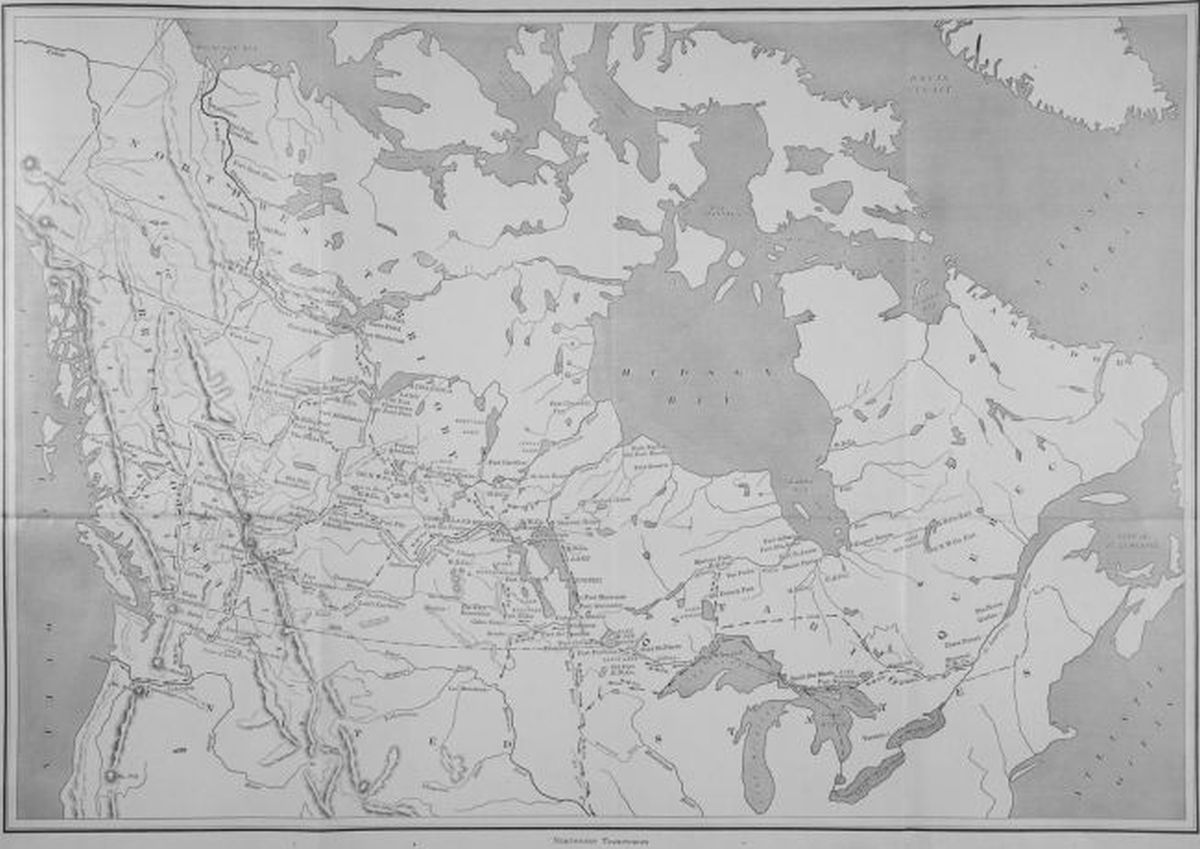
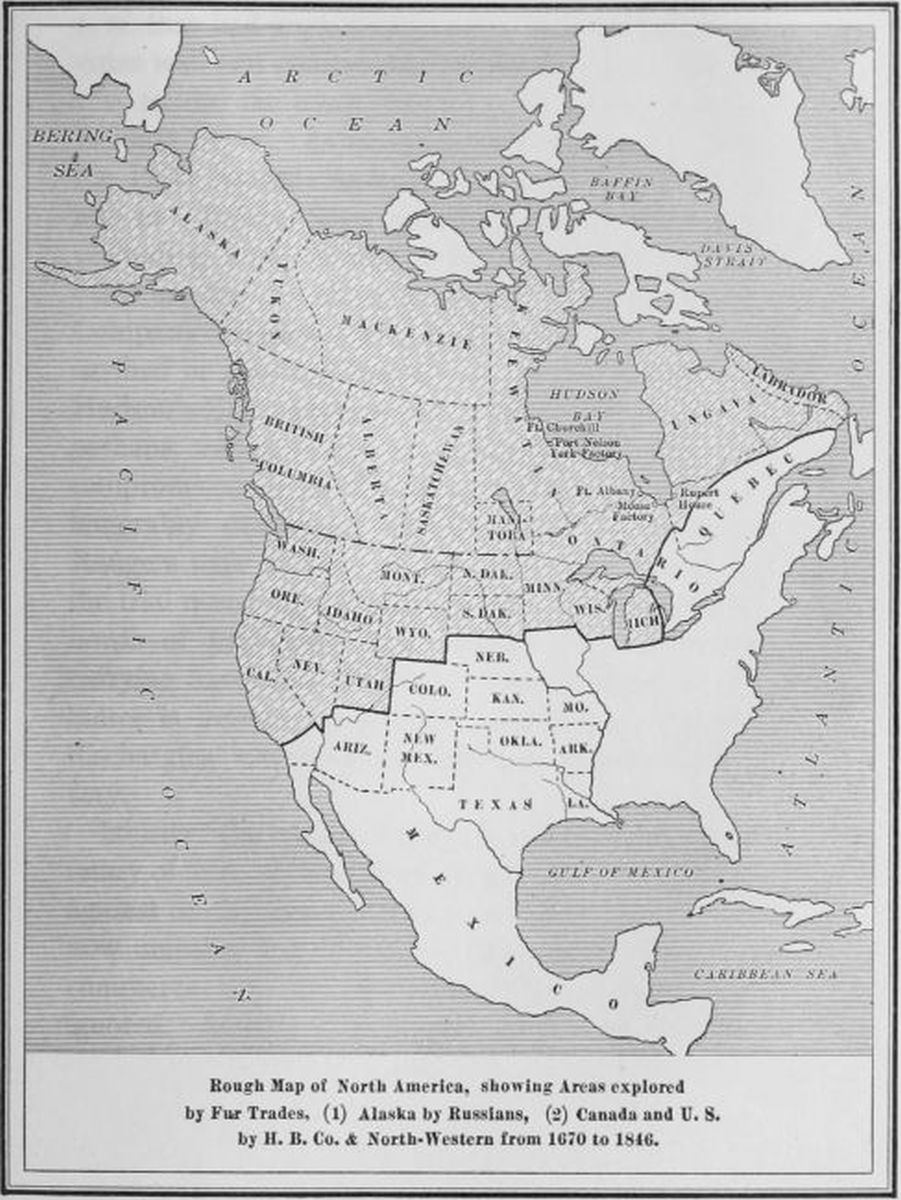
Take a map of North America. Up on Hudson
Bay is the English Company with forts around it
like a wheel. Of this circle, the bay is the hub. Eastward
are the forts in Labrador; southward, Abbittibbi
toward Quebec; westward, three lines of fur posts
extending inland like spokes of the wheel—1st,
up Albany River toward the modern Manitoba—(Mine,
water; toba, prairie, that is, country of the
prairie water), along the valley of Red River to
modern Minnesota (Mine, water; sotar, sky-colored,
that is, country of the sky-colored water), and up the
winding Assiniboine (country of the stone boilers
where the Assiniboines cooked food on hot stones)
to the central prairie; 2nd, up Hayes River from
York (Nelson) to the Saskatchewan as far as the
Rockies; 3rd, up Churchill River from Churchill
Fort to Portage de Traite and Isle a la Crosse and
far-famed Athabasca and MacKenzie River.
The wheel that has for its hub Hudson Bay, has
practically only five spokes—two, eastward; three,
westward. Between these unoccupied spokes are
areas the size of a Germany or a Russia or a France.
Into these the Nor’Westers thrust themselves like a
wedge.
Look at the map again. This time the point of
radiation is Fort William on Lake Superior. Between
Lake Superior and Hudson Bay northward
for seven hundred miles is not a post. Into these
dark, impenetrable, river-swamped forests the Nor’Westers
send their men. Dangerous work, this!
For some unaccountable reason the Indians of these
shadowy forests are more treacherous and gloomy
than the tribes of the plains. Umfreville passes
through their territory when he tries to find a trail
westward not on American soil. Shaw, the partner,
and Long, the clerk, are sent in to drum up trade.
The field is entered one hundred miles east of Fort
William at Pays Plat, where canoes push north to
Lake Nipigon. First, a fort is built on Lake Nipigon
named Duncan, after Duncan Cameron. Long
stays here in charge. Shaw, as partner, pushes on
to a house half way down to Albany on Hudson Bay.
The Indians call Mr. Shaw “the Cat” from his
feeble voice. A third hand, Jacque Santeron, is sent
eastward to the Temiscamingue Lakes south of
Abbittibbi. The three Nor’Westers have, as it
were, thrust themselves like a wedge between the
spokes of the Hudson’s Bay Company from Moose
River to Albany; but a thousand perils assail them,
a thousand treacheries. First, the Frenchman Santeron
loses courage, sends a farewell written on a
birch-bark letter down to Long at Nipigon, and
deserts bag and baggage, provisions and peltries,
to the Hudson’s Bay at Abbittibbi. Determined to
prevent such loss, Long tears across country to
Temiscamingue only to find Santeron’s cabins abandoned
and these words in charcoal on bark: “Farewell
my dear comrade; I go with daring and expect
a good price for my furs with the English. With
the best heart, I wish you luck. My regards to my
partners. Good-by.” But desertion and theft of
Company goods are not the worst of it. Down at
Nipigon, Long hears that the Indians of the North
are going to murder “the Cat”—Mr. Shaw—probably
to carry the plundered furs down to the Hudson’s
Bay. Long rushes to the rescue to find Shaw
cooped up in the cabin surrounded by a tribe of
frenzied Indians whom he tried in vain to pacify
with liquor.
“My God! But I’m glad to see you,” shouts Shaw,
drawing Long inside the door. For a week the Indians
had tried to set fire to his house by shooting
arrows of lighted punk wood at it, but every window
and crevice of the cabin bristles with loaded muskets—twenty-eight
of them—that keep the assailants
back. The Indians demand more liquor. Shaw
gives it to them on condition they go away, but at
daybreak back they come for more, naked and
daubed with war paint from head to foot.
“More,” shouts Long. “Come on then,” throwing
the doors wide open and rolling across the entrance
a keg of gunpowder from which he knocks
the lid. “One step across the door and we all perish
together,” cocking his pistol straight for the powder.
Pell-mell off dashed the terrified Indians paddling
canoes as fast as drunken arms could work the
blades. Another time, Long discovers that his
Indian guide is only awaiting a favorable chance to
assassinate him. A bottle of drugged liquor puts
the assassin to sleep and another Indian with a
tomahawk prevents him ever awakening. When
Long retires, Duncan Cameron, son of a royalist in
the American Revolution, comes to command Nipigon.
Cameron pushes on up stream past Nipigon
two hundred miles to the English post Osnaburg,
where the Hudson’s Bay man, Goodwin, welcomes
the Nor’Wester—a rival is safer indoors than out,
especially when he has no visible goods; but Cameron
manages to speak with the Indians during his visit
and when he departs they follow him back to the
place where he has cached his goods and the trade
takes place. Henceforth traders of the Nipigon do
not stay in the fort on the lake but range the woods
drumming up trade from Abbittibbi east, to Albany
west.
Meanwhile, what are the brigades of Fort William
doing? Fifteen days at the most it takes for the
“goers and comers” of Montreal to exchange their
cargo of provisions for the Northerners’ cargo of
furs. When the big canoes head back for the East
at the end of July, the Montreal partners go with
them. Smaller canoes, easier to portage and in
more numerous brigades, set out for the West with
the wintering partners. These are “the wolves of
the North”—the MacKenzies and Henry and Harmon
and Fraser and a dozen others—each to command
a wilderness empire the size of a France or a
Germany.
By the new route of Kaministiquia, it is only a
day’s paddling beyond the first long portage to the
height of land. Beyond this, the canoes launch
down stream, gliding with the current and “somerseting”
or shooting the smaller rapids, portaging
when the fall of water is too turbulent. Wherever
there is a long portage there stands a half-way house—wayside
inn of logs and thatch roof where some
stray Frenchman sells fresh food to the voyageurs—a
great nuisance to the impatient partners, for the
men pause to parley. First of the labyrinthine
waterways that weave a chain between Lake Superior
and Lake Winnipeg is Rainy River, flowing northwest
to Lake of the Woods, or Lake of the Isles as the
French called it. On Rainy River are the ruins of
an old fort of the French traders. Here the Northbound
brigades often meet the Athabasca canoes
which can seldom come down all the way as far as
Fort William and go back to Athabasca before
winter. Again an exchange of goods takes place,
and the Athabasca men head back with the Northbound
brigades.
Wherever the rivers widen to lakes as at Lake
Francis and Lake of the Woods, the canoes swing
abreast, lash gun’els together by thwarting paddles,
hoist sails and drift lazily forward on the forest-shadowed,
placid waters, crews smoking, or singing
with weird cadences amid the loneliness of these
silent places. In this part of the voyage, while all
the brigades were still together, there were often as
many as five hundred canoes spread out on the lakes
like birds on wing. Faces now bronzed almost to
the shade of woodland creatures, splashes of color
here and there where the voyageurs’ silk scarf has
not faded, blue sky above with a fleece of clouds,
blue sky below with a fleece of clouds and all that
marked where sky began and reflection ended the
margin of the painted shores etched amber in the
brown waters—the picture was one that will never
again be witnessed in wilderness life. Sometimes
as the canoes cut a silver trail across the lakes,
leather tepee tops would emerge from the morning
mists telling of some Cree hunters waiting with their
furs, and one of the partners would go ashore to
trade, the crew camping for a day. Every such halt
was the chance for repairing canoes. Camp fires
sprang up as if by magic. Canoes lay keel up
and tar was applied to all sprung seams, while the
other boatmen got lines out and laid up supplies of
fresh fish. That night the lake would twinkle with
a hundred fires and an army of voyageurs lie listening
to the wind in the pines. The next day, a pace
would be set to make up for lost time.
Lake of the Woods empties into Winnipeg River
through a granite gap of cataract. The brigades
skirted the falls across the Portage of the Rat (modern
Rat Portage) and launched down the swift current of
Winnipeg River that descends northward to Lake
Winnipeg in such a series of leaps and waterfalls
it was long known among the voyageurs as White or
Foaming River. Where the river entered the southeast
end of Lake Winnipeg, were three trading posts—the
ruins of the old French fort, Maurepas, the
Nor’ Westers’ fort known as Bas de la Riviere, and
the Hudson’s Bay Post, now called Fort Alexander—some
three miles from the lake.
This was the lake which Kelsey, and perhaps
Radisson and Hendry and Cocking, had visited from
Hudson Bay. It was forty days straight west from
Albany, three weeks from York on the Hayes.
At this point the different brigades separated, one
going north to the Athabasca, one west up the Saskatchewan
to the Rockies, one southwest across the
lake to Dauphin and Swan Lake and what is now
northwestern Manitoba, two or three south up Red
River destined for Pembina at the Boundary, Grand
Forks, the Mandanes on the Missouri, and the posts
along the Assiniboine River of the middle West.
Look again to the map. What kind of an empire
do these Nor’Westers encompass? All of the great
West, all except the unknown regions of the Pacific
Coast. In size how large? The area of the Russian
Empire. No wonder Simon McTavish, founder of
the Company, wore the airs of an emperor, and it is
to be remembered that Nor’Westers ruled with the
despotism of emperors, too.
Let us follow the different brigades to their destinations.
Notes to Chapter XXI.—The contents of Chapter XXI are
drawn from the Journals of the Northwest partners as published
by Senator Masson, from Long’s Voyages, from private
journals in my own collection of manuscripts, chiefly Colin Robertson’s,
and from the Abbé Dugas’ inimitable store of Northwest
legends in several volumes. The story of the recruiting
officers and of the holy father comes chiefly from Dugas. Umfreville’s
book does not give details of his voyage for the N. W. C.
to Nipigon, but he left a journal from which Masson gives facts,
and there are references to his voyage in N. W. C. petitions to
Parliament. Cameron tells his own story of Nipigon in the
Masson Collection. The best descriptions of Fort William are
in Colin Robertson’s letters (M. S.) and “Franchere’s Voyage.”
In following N. W. C. expansion, it was quite impossible to do
so chronologically. It could be done only by grouping the
actors round episodes. For instance, in Nipigon, Long was
there off and on in 1768, ’72, ’82. Cameron did not come on
the scene till ’96 and did not take up residence till 1802 to 1804.
To scatter this account of Nipigon chronologically would be to
confuse it. Again, Umfreville found the Nipigon trail to the
Up Country, in 1784. Rod. MacKenzie did not find the old
Kaministiquia road till the nineties. Or again, Grand Portage
was a rendezvous till 1797 and was not entirely moved to Fort
William till 1801 and 1802. Why separate these events by the
hundred other episodes of the Company’s history purely for the
sake of sequence on dates? I have tried to keep the story
grouped round the main thread of one forward movement—the
domination of the Up Country by the N. W. C.
CHAPTER XXII
1790-1810
“THE COMING OF THE PEDLARS” CONTINUED—HENRY’S
ADVENTURES AT PEMBINA—THE FIRST
WHITE WOMAN IN THE WEST—A STOLEN CHILD
AND A POISONER AND A SCOUT—HOW HARMON
FOUND A WIFE—THE STORY OF MARGUERITE
TROTTIER.
Striking across Lake Winnipeg from Winnipeg
River, the southbound canoes ascend
the central channel of the three entrances to
Red River, passing Nettley Creek on the west, or
River au Mort, as the French called it, in memory
of the terrible massacre of Cree families by Sioux
raiders in 1780, while the women and children were
waiting here for the men to return from York Factory.
South of Lake Winnipeg, the woodland banks
of the mud-colored river give place to glimpses and
patches of the plains rolling westward in seas of
billowing grass. It was August when the brigades
left Fort William. It is September now, with the
crisp nutty tang of parched grasses in the air, a
shimmer as of Indian summer across the horizon
that turns the setting sun to a blood-red shield.
Bluest of blue are the prairie skies. Scarcely a
feathering of wind clouds, and where the marsh
lands lie—“sloughs” and “muskegs,” they are
called in the West—so still is the atmosphere of the
primeval silences that the waters are glass with the
shadows of the rushes etched as by stencil. Here
and there, thin spirals of smoke rise from the far
prairie—camp fires of wandering Assiniboine and
Cree and Saulteur. The brigades fire guns to call
them to trade, or else land on the banks and light
their own signal fires. Past what is now St. Peter’s
Indian Reserve, and the two Selkirk towns, and the
St. Andrew Rapids where, if water is high, canoes
need only be tracked, if low the voyageurs may step
from stone to stone; past the bare meadow where
to-day stands the last and only walled stone fort of
the fur trade, Lower Fort Garry—the brigades come
to what is now Winnipeg, the Forks of the Red and
Assiniboine.
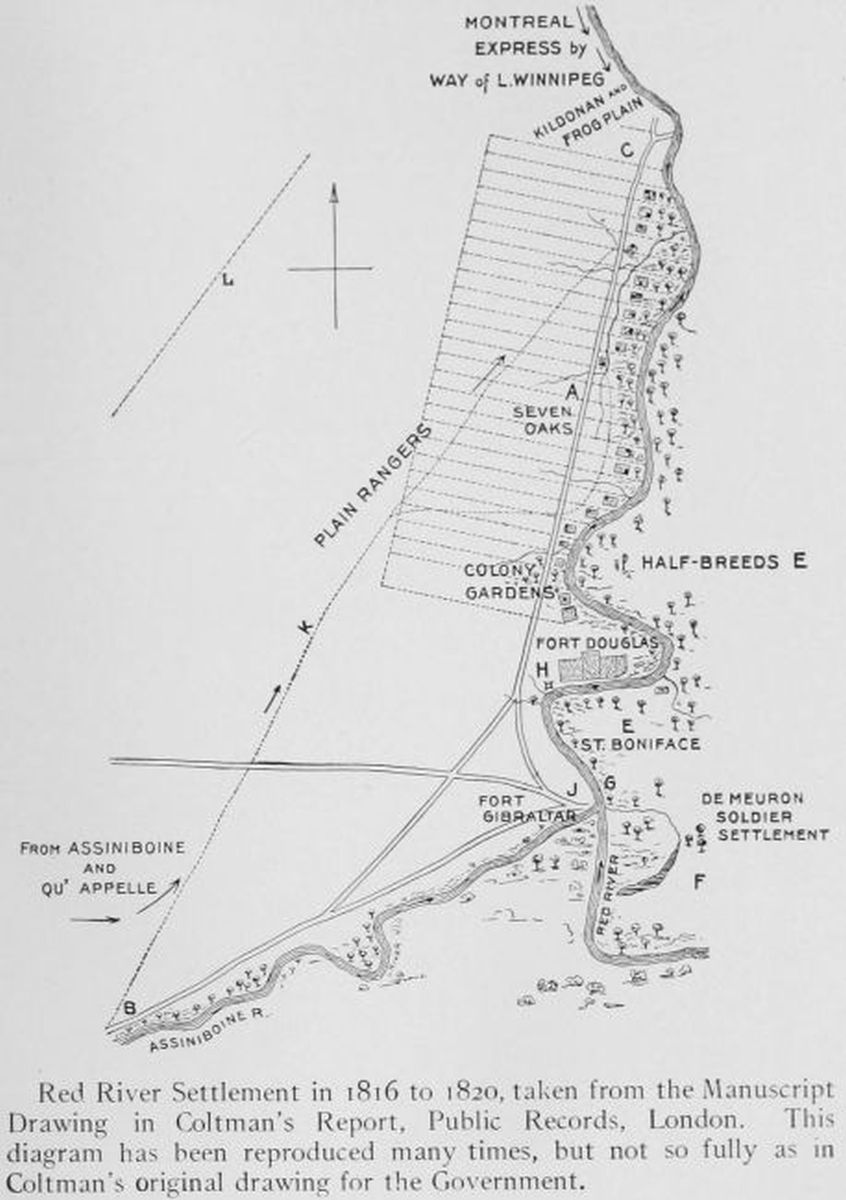
Of the French fur traders’ old post here, all that
remains are the charred ruins and cellars. Near
the flats where the two rivers overflow in spring are
the high scaffoldings of a Cree graveyard used
during the smallpox plague of the eighties. Back
from the swamp of the forks are half a dozen tents—Hudson’s
Bay traders—that same Robert Goodwin
whom Cameron tricked at Osnaburg, come up
the Albany River and across country to Manitoba—forty
days from the bay—with another trader,
Brown.
The Nor’West brigades pause to divide again. A
dozen canoes go up the Assiniboine for Portage la
Prairie and Dauphin, and Swan Lake, and Lake
Manitoba and Qu’Appelle, and Souris. Three or
four groups of men are detailed to camp at the
Forks (Winnipeg) and trade and keep an eye on
the doings of the Hudson’s Bay—above all keep
them from obtaining the hunt. When not trading,
the men at the Forks are expected to lay up store of
pemmican meat for the other departments, by buffalo
hunting. Not till the winter of 1807-8 does MacDonald
of Garth, a wiry Highlander of military
family and military air, with a red head and a broken
arm—build a fort here for the Nor’Westers, which
he ironically calls Gibraltar because it will command
the passage of both rivers, though there was not a
rock the size of his hand in sight. Gibraltar is very
near the site of the Cree graveyard and boasts strong
palisades with storage cellars for liquors and huge
warehouses for trade. Not to be outdone, the Hudson’s
Bay look about for a site that shall also command
the river, and they choose two miles farther
down Red River, where their cannon can sweep all
incoming and outgoing canoes. When this fort is
built a few years later, it is called Fort Douglas.
Two brigades ascend the Red as far south as
Pembina south of the Boundary, one to range all
regions radiating from Grand Forks and Pembina,
the other to cross country to the Mandanes on the
Missouri.
Charles Chaboillez sends Antoine Larocque with
two clerks and two voyageurs from the Assiniboine
and the Red to the Missouri in 1804, where they
meet the American explorers, Lewis and Clarke,
with forty men on their way to the Pacific; and, to
the Nor’Westers’ amazement, are also Hudson’s
Bay traders. The American officers draw the Canadians’
attention to the fact—this is American
territory. British flags must not be given to the
Indians and no “derouines” are to take place—a
trade term meaning that the drummers who come
to beat up trade are not to draw the Indians away
to British territory. Charbonneau, the Northwest
voyageur, ignores his debt to the Company and
deserts to become guide for Lewis and Clarke.
“I can hardly get a skin when the Hudson’s Bay
trader is here,” complains Larocque, “for the Englishmen
speak the Mandan language.” Nevertheless
Larocque dispatches to the bourgeois Mr.
Chaboillez on the Assiniboine, six packs worth £40
each. Charles MacKenzie, the clerk, remains three
years trading among the Mandans for the Nor’Westers,
and with true trader’s instinct chuckles
within himself to hear Old Serpent, the Indian Chief,
boast that if he had these forty Americans “out on
the plains, his young warriors would do for them as
for so many wolves.”
Two main trails ran from the Red River to the
Missouri: one from Pembina, west; the other from
the Assiniboine, by way of Souris, south. The latter
was generally followed, and from the time that David
Thompson, the Northwest surveyor, first led the
way to the Mandans, countless perils assailed the
traveler to the Missouri. Not more than $3000
worth of furs were won a year, but the traders here
were the buffalo hunters that supplied the Northern
departments with pemmican; and on these hunts
was the constant danger of the Sioux raiders. Eleven
days by pony travel was the distance from the Assiniboine
to the Missouri, and on the trail was terrible
scarcity of drinking water. “We had steered to a
lake,” records MacKenzie of the 1804 expedition,
“but found it dry. We dug a pit. It gave a kind
of stinking liquid of which we all drank, which
seemed to increase our thirst. We passed the night
with great uneasiness. Next day, not a drop of
water was to be found on the route and our distress
became unsupportable. Lafrance (the voyageur)
swore so much he could swear no more and gave
the country ten thousand times to the Devil. His
eyes became so dim or blurred we feared he was
nearing a crisis. All our horses became so unruly
we could not manage them. It struck me they
might have scented water and I ascended the top of
the hill where to my great joy I discovered a small
pool. I ran and drank plentifully. My horse had
plunged in before I could stop him. I beckoned
Lafrance. He seemed more dead than alive, his
face a dark hue, a thick scurf around his mouth.
He instantly plunged in the water ... and
drank to such excess I fear the consequences.”
In winter, though there was no danger of perishing
from thirst where snow could be used as water, perils
were increased a hundredfold by storm. The
ponies could not travel fast through deep drifts.
Instead of eleven days, it took a month to reach the
Assiniboine, one man leading, one bringing up the
rear of the long line of pack horses. If a snow
storm caught the travelers, it was an easy matter for
marauding Indians to stampede the horses and
plunder packs. In March, they traveled at night
to avoid snow glare. Sleeping wrapped in buffalo
robes, the men sometimes wakened to find themselves
buried beneath a snow bank with the horses
crunched up half frozen in the blizzard. Four days
without food was a common experience on the Mandane
trail.
Of all the Nor’Westers stationed at Pembina,
Henry was one of the most famous. Cheek by jowl
with the Nor’Westers was a post of Hudson’s Bay
men under Thomas Miller, an Orkneyman; and
hosts of freemen—half-breed trappers and buffalo
runners—made this their headquarters, refusing
allegiance to either company and selling their hunt
to the highest bidder. The highest bidder was the
trader who would give away the most rum, and as
traders do not give away rum for nothing, there were
free fights during the drunken brawls to plunder the
intoxicated hunters of furs. Henry commanded
some fifty-five Nor’Westers and yearly sent out from
Pembina one hundred and ten packs of furs by the
famous old Red River ox carts made all of wood,
hubs and wheels, that creaked and rumbled and
screeched their way in long procession of single file
to waiting canoes at Winnipeg.
Henry had come to the wilderness with a hard,
cynical sneer for the vices of the fur trader’s life.
Within a few years, the fine edge of his scorn had
turned on himself and on all life besides, because
while he scorned savage vices he could never leave
them alone. Like the snare round the feet of a man
who has floundered into the quicksands, they sucked
him down till his life was lost on the Columbia in a
drunken spree. One can trace Henry’s degeneration
in his journals from cynic to sinner and sinner to sot,
till he has so completely lost the sense of shame,
lost the memory that other men can have higher
codes, that he unblushingly sets down in his diary
how, to-day, he broke his thumb thrashing a man
in a drunken bout; how, yesterday, he had to give
a squaw a tremendous pommelling before she would
let him steal the furs of her absent lord; how he
“had a good time last night with the H. B. C. man
playing the flute and the drum and drinking the ten-gallon
keg clean.” Henry’s régime at Pembina
became noted, not from his character, but from
legends of famous characters who gathered there.
One night in December, 1807, Henry came home
to his lodge and found a young Hudson’s Bay clerk
waiting in great distress. The Nor’Wester asked
the visitor what was wanted. The intruder begged
that the others present should be sent from the room.
Henry complied, and turned about to discover a
young white woman disguised in man’s clothes, who
threw herself on her knees and implored Henry to
take pity on her. Her lover of the Orkney Islands
had abandoned her. Dressed in man’s garb, she
had joined the Hudson’s Bay service and pursued him
to the wilderness. In Henry’s log cabin, her child
was born. Henry sent mother and infant daughter
across to Mr. Haney of the Hudson’s Bay Company,
who forwarded both to the recalcitrant Orkneyman—John
Scart, at Grand Forks. Before her secret
was discovered, according to legend, the woman had
been in Hudson’s Bay service of Red River Department
for four years. Mother and child were sent
back to the Orkneys, where they came to destitution.
At Pembina, there always camped a great company
of buffalo hunters. Among these had come, in
the spring of 1806, a young bride from Three Rivers—the
wife of J. Ba’tiste Lajimoniere, one of the
most famous scouts of the Hudson’s Bay Company.
J. Ba’tiste had gone down to Quebec the year before
and cut a swath of grandeur in the simple parish of
Three Rivers that captured the heart of Marie Anne
Gaboury, and she came to the wilderness as his
wife.
To the Indian wives of the Frenchmen in the freemen’s
camp, Madame Lajimoniere was a marvel—the
first white woman they had ever beheld. They
waited upon her with adoration, caressed her soft
skin and hair, and handled her like some strange
toy. One, especially, under show of friendliness,
came to Marie’s wigwam to cook, but J. Ba’tiste’s
conscience took fright. The friendly squaw had
been a cast-off favorite of his own wild days, and
from the Indians he learned that she had come to
cook for Marie in order to poison her. J. Ba’tiste
promptly struck camp, packed his belongings and
carried his wife back to the safety of the fort at
Pembina. There, on the 6th of January 1807, the
first white child of the West was born; and they
called her name Reine, because it was the king’s
birthday.
When Henry moved his fifty men from Pembina
up the Saskatchewan, in 1808, among the free traders
who went up with the brigades were the Lajimonieres.
Word of the white woman ran before the advancing
traders by “moccasin telegram,” and wherever
pause was made, Indians flocked in thousands
to see Marie Gaboury. Belgrade, a friend of
Ba’tiste’s, thought it well to protect her by spreading
in advance the report—that the white woman had
the power of the evil eye; if people offended her, she
could cause their death by merely looking at them,
and the ruse served its purpose until they reached
Edmonton. This was the danger spot—the center
of fearful wars waged by Blackfeet and Cree. Marauding
bands were ever on the alert to catch the
traders short-handed, and in the earliest days, when
Longmore, and Howse, and Bird, and Turner, the
astronomer, were commanders of the Hudson’s Bay
fort, Shaw and Hughes of Nor’Westers, the dangers
from Indian attack were so great that the rival
traders built their forts so that the palisades of one
joined the stockades of the other, and gates between
gave passage so the whites could communicate without
exposing themselves. Towers bristling with
muskets commanded the gates, and many a time
the beleaguered chief factor, left alone with the women
while his men were hunting, let blaze a fire of musketry
from one tower, then went to the other tower
and let go a cross fire, in order to give the Indians the
impression that more than one man was on guard.
This, at least, cleared the ambushed spies out of the
high grass so that the fort could have safe egress
to the river.
Here, then, came Marie Gaboury, in 1808, to live
at Edmonton for four years. Ba’tiste, as of old,
hunted as freeman, and strange to say, he was often
accompanied by his dauntless wife to the hunting
field. Once, when she was alone in her tepee on
the prairie, the tent was suddenly surrounded by a
band of Cree warriors. When the leader lifted the
tent flap, Marie was in the middle of the floor on her
knees making what she thought was her last prayer.
A white renegrade wandering with the Crees called
out to her not to be afraid—they were after Blackfeet.
Ba’tiste’s horror may be guessed when he came
dashing breathless across the prairie and found his
wife’s tent surrounded by raiders.
“Marie! Marie!” he shouted, hair streaming to
the wind, and unable to wait till he reached the
tepee, “Marie—are you alive?”
“Yes,” her voice called back, “but I—am—dying—of
fright.”
Ba’tiste then persuaded the Crees that white
women were not used to warriors camping so near,
and they withdrew. Then he lost no time in shifting
camp inside the palisades of Edmonton. The
Abbé Dugas tells of another occasion when Marie
was riding a buffalo pony—one of the horses used
as a swift runner on the chase—her baby dangling
in a moss bag from one of the saddle pommels.
Turning a bluff, the riders came on an enormous
herd of buffalo. The sudden appearance of the
hunters startled the vast herd. With a snort that
sent clouds of dust to the air, there was a mad stampede,
and true to his life-long training, Marie’s pony
took the bit in his mouth and bolted, wheeling and
nipping and kicking and cutting out the biggest of
buffaloes for the hunt, just as if J. Ba’tiste himself
were in the saddle. Bounced so that every breath
seemed her last, Marie Gaboury hung to the baby’s
moss bag with one hand, to the horse’s mane with
the other, and commended her soul to God; but J.
Ba’tiste’s horse had cut athwart the race and he
rescued his wife. That night she gave birth to her
second daughter, and they jocularly called her
“Laprairie.” Such were the adventures of the
pioneer women on the prairie. The every day episodes
of a single life would fill a book, and the book
would record as great heroism as ever the Old World
knew of a Boadicea or a Joan of Arc. We are still
too close to these events of early Western life to appreciate
them. Two hundred years from now, when
time has canonized such courage, the Marie Gaboury’s
of pioneer days will be regarded as the
Boadiceas and Joan of Arcs of the New World.
There was constant shifting of men in the different
departments of the Northwest Company. When
Henry passed down Red River, in 1808, to go up
the Saskatchewan, half the brigades struck westward
from the Forks (Winnipeg), up the Assiniboine
River to Portage la Prairie and Souris, and Qu’ Appelle
and Dauphin and Swan Lake. Each post of
this department was worth some £700 a year to the
Nor’Westers. Not very large returns when it is
considered that a keg of liquor costing the Company
less than $10 was sold to the Indians for one hundred
and twenty beaver valued at from $2.00 to
$3.00 a skin. “Mad” McKay, a Mr. Miller and
James Sutherland were the traders for the Hudson’s
Bay in this region, which included the modern
provinces of Manitoba and Saskatchewan. Among
the Nor’Westers, McLeod was the wintering partner
and his chief clerks were the mystic dreamers—Harmon,
that Louis Primo, who had deserted from
Matthew Cocking on the Saskatchewan, and Cuthbert
Grant, the son of a distinguished Montreal
merchant and a Cree mother, who combined in
himself the leadership qualities of both races and
rapidly rose to be the chosen chief of the Freemen
or Half-Breed Rangers known as the Bois Brulés—men
of “the burnt or blazed woods.”
The saintly Harmon had been shocked to find
his bourgeois Norman McLeod with an Indian
spouse, but to different eras are different customs
and he presently records in his diary that he, too,
has taken an Indian girl for a wife—the daughter of
a powerful chief—because, Harmon explains to his
own uneasy conscience, “if I take her I am sure I
shall get all the furs of the Crees,” and who shall say
that in so doing, Harmon did either better or worse
than the modern man or woman, who marries for
worldly interests? Let it be added—that, having
married her, Harmon was faithful to the daughter
of the Cree chief all his days and gave her the honor
due a white wife. In the case of the fur traders,
there was a deep, potent reason for these marriages
between white men and Indian women. The white
trader was one among a thousand hostiles. By
marrying the daughter of a chief, he obtained the
protection of the entire tribe. Harmon was on the
very stamping ground of the fights between Cree
and Sioux. By allying himself with his neighbors,
he obtained stronger defense than a hundred palisaded
forts.
The danger was not small, as a single instance will
show. Until May each year, Harmon spent the
time gathering the furs, which were floated down the
Assiniboine to Red River. It was while the furs
were being gathered that the Sioux raiders would
swoop from ambush in the high grasses and stampede
the horses, or lie in hiding at some narrow place
of the river and serenade the brigades with showers
of arrows. Women and girls, the papoose in the
moss bag, white men and red—none were spared, for
the Sioux who could brandish the most scalps from
his tent pole, was the bravest warrior.
Among the hunters of Pembina was a French
Canadian named Trottier married to a Cree woman.
The daughter—Marguerite, a girl of sixteen—was
renowned for her beauty. Indian chiefs offered for
her hand, but the father thought she would be better
cared for as the wife of a white man and gave her in
marriage to a hunter named Jutras, who left Pembina
with Henry’s brigades in 1808. Jutras went
up the Assiniboine. A year later, Daniel MacKenzie
appointed him and five others to take the
Qu’ Appelle furs down the Assiniboine to Red River.
As usual, some of the partners accompanied the
brigades for the annual meetings at Fort William.
Daniel MacKenzie and McDonald of Garth—the
bourgeois—were riding along the river banks some
distances behind the canoes. Marguerite Trottier
was in the canoe with Jutras, and the French were
advancing, light of heart as usual, passing down
Qu’ Appelle River toward the Assiniboine. A day’s
voyage above the junction of the two rivers, the
current shoaled, and just where brushwood came
close to the water’s edge, Jutras was startled by a
weird call like a Sioux signal from both sides. Another
instant, bullets and arrows rained on the
canoes! Four of the six voyageurs tumbled back
wounded to the death. Jutras and the remaining
man lost their heads so completely they sprang to
mid-waist in the water, waded ashore, and dashed in
hiding through the high grass for the nearest fort,
forgetting the girl wife, Marguerite Trottier, and a
child six months old. MacKenzie and McDonald
of Garth sent scouts to rally help from Qu’ Appelle
to recover the furs. When the rescue party reached
the place of plunder—not very far from the modern
Whitewood—they found the four voyageurs lying on
the sand, the girl wife in the bottom of the canoe.
All had been stripped naked, scalped and horribly
mutilated. Two of the men still lived. MacKenzie
had advanced to remove the girl’s body from the
canoe when faint with horror at the sight—hands
hacked, an eye torn out, the scalp gone—the old
wintering partner was rooted to the ground with
amazement to hear her voice asking for her child
and refusing to be appeased till they sought it. Some
distance on the prairie in the deep grass below a tree
they found it—still breathing. The English mind
cannot contemplate the cruelties of such tortures as
the child had suffered. Such horrors mock the soft
philosophies of the life natural, being more or less of a
beneficent affair. They stagger theology, and are
only explainable by one creed—the creed of Strength;
the creed that the Powers for Good must be stronger
than the Powers for Evil—stronger physically as well
as stronger spiritually, and until they are, such
horrors will stalk the earth rampant. The child
had been scalped, of course! The Sioux warrior
must have his trophy of courage, just as the modern
grinder of child labor must have his dividend. It
had then been suspended from a tree as a target
for the arrows of the braves. Hardened old roué as
MacKenzie was—it was too much for his blackened
heart. He fell on his trembling knees and according
to the rites of his Catholic faith, ensured the child’s
entrance to Paradise by baptism before death. It
might die before he could bring water from the river.
The rough old man baptized the dying infant with
the blood drops from its wounds and with his own
tears.
Returning to the mother, he gently told her that
the child had been killed. Swathing her body in
cotton, these rough voyageurs bathed her wounds,
put the hacked hands in splinters, and in all probability
saved her life by binding up the loose skin to
the scalp by a clean, fresh bladder. That night
voyageurs and partners sat round the wounded where
they lay, each man with back to a tree and musket
across his knees. In the morning the wounded were
laid in the bottom of the canoes. Scouts were appointed
to ride on both sides of the river and keep
guard. In this way, the brigade advanced all day
and part of the following night, “the poor woman
and men moaning all the time,” records McDonald
of Garth. Coming down the Assiniboine to Souris,
where the Hudson’s Bay had a fort under Mr.
Pritchard, the Nor’Westers under Pierre Falçon,
the rhyming minstrel of the prairie—the wounded
were left here. Almost impossible to believe, Marguerite
Trottier recovered sufficiently in a month
to join the next brigade bound to Gibraltar (Winnipeg).
Here she met her father and went home with
him to Pembina. Jutras—the poltroon husband—who
had left her to the raiders, she abandoned with
all the burning scorn of her Indian blood. It seems
after the Sioux had wreaked their worst cruelty, she
simulated death, then crawled to hiding under the
oilcloth of the canoe, where, lying in terror of more
tortures, she vowed to the God of the white men that
if her life were spared she would become a Christian.
This vow she fulfilled at Pembina, and afterward
married one of the prominent family of Gingras, so
becoming the mother of a distinguished race. She
lived to the good old age of almost a hundred.
Another character almost as famous in Indian
legend as Marguerite had been with Henry at Pembina
and come north to Harmon on the Assiniboine.
This was the scout, John Tanner, stolen by Shawnees
from the family of the Rev. John Tanner on the
Ohio. The boy had been picking walnuts in the
woods when he was kidnapped by a marauding
party, who traded him to the Ottawas of the Up
Country. Tanner fell in good hands. His foster
mother was chief of the Mackinaw Indians and
quite capable of exercising her authority in terms of
the physical. Chaboillez, the wintering partner,
saw the boy at the Sault and inquiries as to who he
was put the foster mother in such a fright of losing
him that she hid him in the Sault cellars. Among
the hunters of Pembina were Tanner and his Indian
mother, and later—his Indian wife. He will come
into this story at a later stage with J. Ba’tiste Lajimoniere.
Notes to Chapter XXII.—I have purposely hung this chapter
round Henry as a peg, because his adventures at Pembina,
whence journeys radiated to the Missouri and the Assiniboine,
merge into his life on the Saskatchewan and so across the Rockies
to the Columbia—giving a record of all the N. W. C.’s departments,
as if one traveled across on a modern railroad.
Henry’s Adventures are to be found in his Journals edited
by Dr. Coues and published by Francis P. Harper. Several
reprints of Harmon’s Journals have recently appeared. Harmon
was originally from Vermont and one of his daughters until
recently was prominent in Ottawa, Canada, as the head of a
fashionable school. I can imagine how one of the recent reprints
would anger Harmon’s family, where the introduction
speaks glibly of Harmon having taken a “native wife ad interim.”
What those words “ad interim” mean, I doubt if the
writer, himself, knows—unless his own unsavory thought, for
of all fur traders Harmon was one of the most saintly, clean,
honorable, and gentle, true to his wife as to the finest white
woman.
I have referred to Daniel MacKenzie as an old roué. The
reasons for this will appear in a subsequent chapter on doings
at Fort William.
The adventures of Tanner will be found in James’ life of him,
in Major Long’s travels, in Harmon, and in the footnotes of
Coues’s Henry, also by Dr. Bryce in the Manitoba History Coll.,
most important of all in the Minnesota Hist. Collections, where
the true story of his death is recorded.
The adventures of Marguerite Trottier are taken from two
sources: from McDonald of Garth’s Journal (Masson Journals)
and from the Abbé Dugas’ Legends. I hesitated whether to
give this shocking and terrible story, for the most thoughtless
reader will find between the lines (and it is intended) more than
is told. What determined me to give the story was this: Again
and again in the drawing rooms of London and New York, I have
heard society—men and women, who hold high place in social
life—refer to those early marriages of the fur traders to native
women as something sub rosa, disreputable, best hidden behind
a lie or a fig leaf. They never expressed those delicate sentiments
to me till they had ascertained that tho’ I had lived all
my life in the West, I had neither native blood in my veins nor
a relationship of any sort to the pioneer—not one of them. Then
some such expressions as this would come out apologetically
with mock modest Pharisaic blush—“Is it true that So and So
married a native woman?” or “Of course I know they were all
wicked men, for look how they married—Squaws!” I confess
it took me some time to get the Eastern view on this subject
into my head, and when I did, I felt as if I had passed one of
those sewer holes they have in civilized cities. Of course, it is
the natural point of view for people who guzzle on problem plays
and sex novels, but what—I wondered—would those good
people think if they realized that “the squaws” of whom they
spoke so scornfully were to Northwest life what a Boadicea was
to English life—the personification of Purity that was Strength
and Strength that was Purity—a womanhood that the vilest
cruelties could not defile. Then, to speak of fur traders who
married native women as “all wicked” is a joke. Think of the
religious mystic, Harmon, teaching his wife the English language
with the Bible, and Alexander MacKenzie, who had married a
native woman before he had married his own cousin, and the
saintly patriot, Dr. McLoughlin—think of them if you can as
“wicked.” I can’t! I only wish civilized men and women had
as good records.
In this chapter I wished very much to give a detailed account
of each N. W. C. department with notes on the chief
actors, who were in those departments what the feudal barons
were to the countries of Europe, but space forbids. It is as impossible
to do that as it would be to cram a record of all the
countries of Europe into one volume.
I have throughout referred to the waters as Hudson Bay; to
the company as Hudson’s. This is the ruling of the Geographical
societies and is, I think, correct, as the charter calls the
company “Hudson’s Bay.” The N. W. C. were sometimes
referred to as “the French.”
Charles MacKenzie and Larocque in their Journals (Masson
Coll.) give the details of the Mandane trade. Henry also touches
on it.
CHAPTER XXIII
1780-1810
“THE COMING OF THE PEDLARS” CONTINUED—THIRTY
YEARS OF EXPLORATION—THE ADVANCE
UP THE SASKATCHEWAN TO BOW RIVER AND
HOWSE PASS—THE BUILDING OF EDMONTON—HOW
MACKENZIE CROSSED TO THE PACIFIC.
While fifty or a hundred men yearly ascended
Red River as far as Grand Forks,
and the Assiniboine as far as Qu’ Appelle,
the main forces of the Nor’Westers—the great army
of wood-rovers and plain rangers and swelling, blustering
bullies and crafty old wolves of the North,
and quiet-spoken wintering partners of iron will, who
said little and worked like demons—were destined
for the valley of the Saskatchewan that led to the
Rockies.
Like a great artery with branches south leading
over the height of land to the Missouri and branches
north giving canoe passage over the height of land
to the Arctic, the Saskatchewan flowed for twelve
hundred miles through the fur traders’ stamping
ground, freighted with the argosies of a thousand
canoes. From the time that the ice broke up in May,
canoes were going and coming; canoes with blankets
hoisted on a tent pole for sail; canoes of birch bark
and cedar dugouts; canoes made of dried buffalo
skin stitched and oiled round willow withes the shape
of a tub, and propelled across stream by lapping the
hand over the side of the frail gun’els. Indians
squatted flat in the bottom of the canoes, dipping
paddles in short stroke with an ease born of life-long
practice. White men sat erect on the thwarts with
the long, vigorous paddle-sweep of the English oarsman
and shot up and down the swift-flowing waters
like birds on wing. The boats of the English traders
from Hudson Bay were ponderously clumsy, almost
as large as the Mackinaws, which the Company still
uses, with a tree or rail plied as rudder to half-punt,
half-scull; rows of oarsmen down each side, who
stood to the oar where the current was stiff, and a
big mast pole for sails when there was wind, for the
tracking rope when it was necessary to pull against
rapids. Where rapids were too turbulent for tracking,
these boats were trundled ashore and rolled
across logs. Little wonder the Nor’Westers with
their light birch canoes built narrow for speed, light
enough to be carried over the longest portage by
two men, outraced with a whoop the Hudson’s Bay
boats whenever they encountered each other on the
Saskatchewan! Did the rival crews camp for the
night together, French bullies would challenge the
Orkneymen of the Hudson’s Bay to come out and
fight. The defeated side must treat the conquerors
or suffer a ducking.
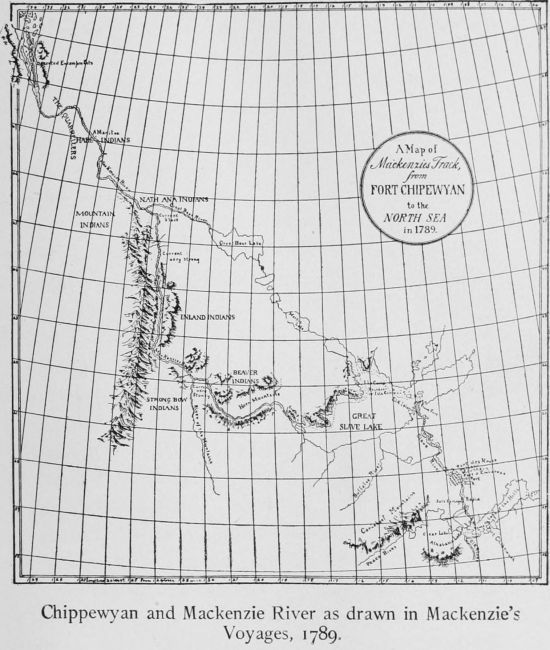
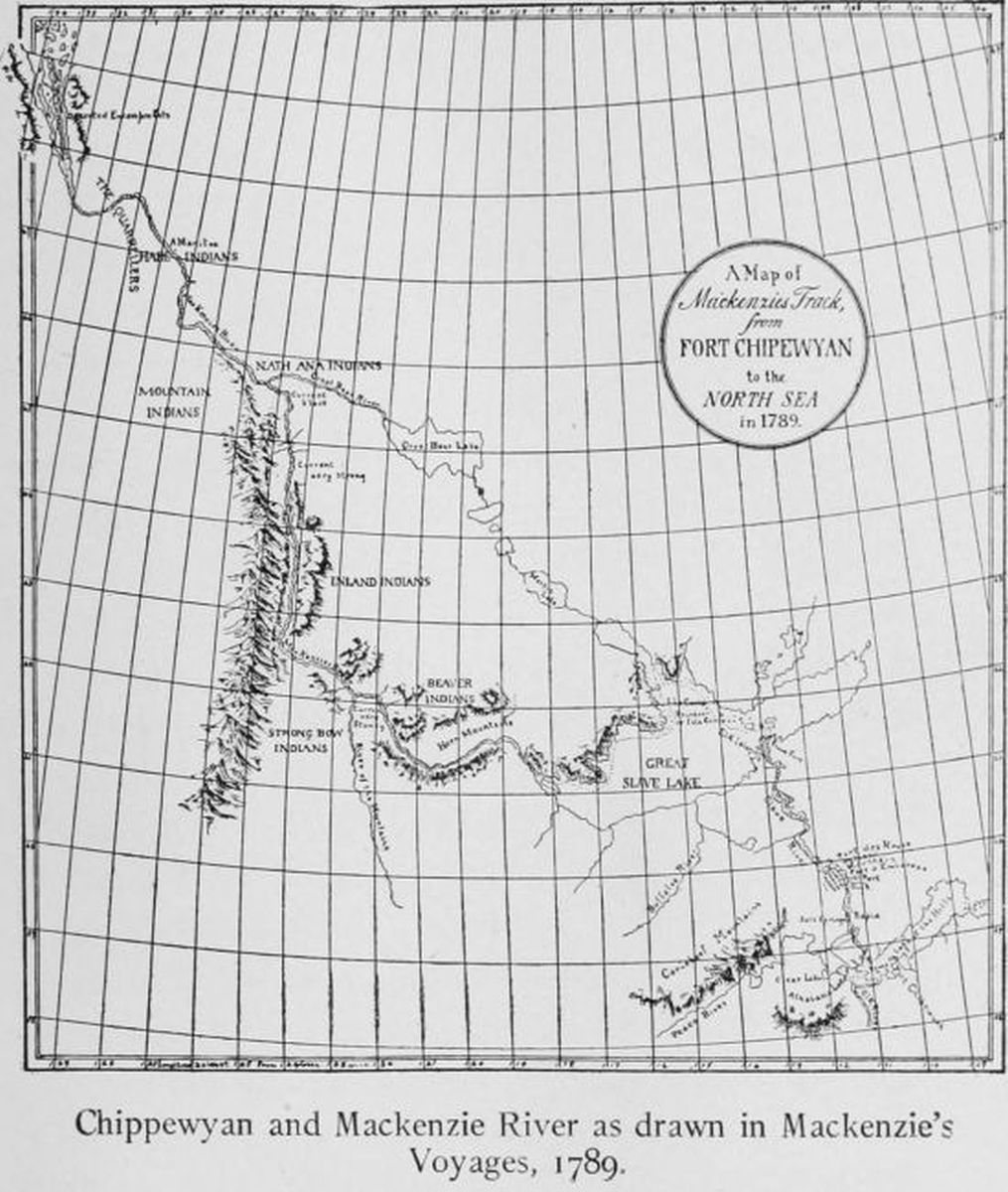
Chippewyan and Mackenzie River as drawn in Mackenzie’s
Voyages, 1789.
Click
here for larger map
Crossing the north end of Lake Winnipeg, canoes
bound inland passed Horse Island and ascended the
Saskatchewan. Only one interruption broke navigation
for one thousand miles—Grand Rapids at the
entrance of the river, three miles of which could be
tracked, three must be portaged—in all a trail of
about nine miles on the north shore where the English
had laid a corduroy road of log rollers. The ruins
of old Fort Bourbon and Basquia or Pas, where
Hendry had seen the French in ’54, were first passed.
Then boats came to the metropolis of the Saskatchewan—the
gateway port of the great Up Country—Cumberland
House on Sturgeon Lake. Here,
Hearne had built the post for Hudson’s Bay, and
Frobisher the fort for the Nor’Westers. Here, boats
could go on up the Saskatchewan, or strike northwest
through a chain of lakes past Portage de Traite
and Isle a la Crosse to Athabasca and MacKenzie
River. Fishing never failed, and when the fur
traders went down to headquarters, their families
remained at Cumberland House laying up a store
of dried fish for the winter. Beyond Cumberland
House came those forts famous in Northwest annals,
Lower Fort des Prairies, and the old French Nipawi,
and Fort a la Corne, and Pitt, and Fort George, and
Vermilion, and Fort Saskatchewan and Upper Fort
des Prairies or Augustus—many of which have
crumbled to ruin, others merged into modern cities
like Augustus into Edmonton. On the south branch
of the Saskatchewan and between the two rivers
were more forts—oases in a wilderness of savagery—Old
Chesterfield House where Red Deer River comes
in and Upper Bow Fort within a stone’s throw of the
modern summer resort at Banff, where grassed
mounds and old arrowheads to-day mark the place
of the palisades.
More dangers surrounded the traders of the South
Saskatchewan than in any part of the Up Country.
The Blackfeet were hostile to the white men. With
food in abundance from the buffalo hunts, they had
no need of white traders and resented the coming
of men who traded firearms to their enemies. There
was, beside, constant danger of raiders from the
Missouri—Snakes and Crows and Minnetaries.
Hudson’s Bay and Nor’Westers built their forts close
together for defence in South Saskatchewan, but
that did not save them.
At Upper Bow Fort in Banff Valley, in 1796,
Missouri raiders surrounded the English post, scaled
the palisades, stabbed all the whites to death except
one clerk, who hid under a dust pile in the cellar,
pillaged the stores, set fire, then rallied across to the
Nor’Westers, but the Nor’Westers had had warning.
Jaccot Finlay and the Cree Beau Parlez, met the
assailants with a crash of musketry. Then dashing
out, they rescued the Hudson’s Bay man, launched
their canoes by night and were glad to escape with
their lives down the Bow to Old Chesterfield House
at Red Deer River.
Two years later, the wintering partners, Hughes
and Shaw, with McDonald of Garth, built Fort
Augustus or Edmonton. Longmore was chief factor
of the Hudson’s Bay at Edmonton, with Bird as
leader of the brigades down to York Fort and Howse
as “patroon of the woods” west as far as the Rockies.
With the Nor’Westers was a high-spirited young
fire eater of a clerk—Colin Robertson, who, coming
to blows with McDonald of the Crooked Arm, was
promptly dismissed and as promptly stepped across
to the rival fort and joined the Hudson’s Bay. Around
Edmonton camped some three hundred Indians.
In the crowded quarters of the courtyards, yearly
thronged by the eastern brigades so that each fort
housed more than one hundred men, it was impossible
to keep all the horses needed for travel. These
were hobbled and turned outside the palisades. It
was easy for the Indians to cut the hobbles, mount
a Company horse, and ride free of punishment as
the winds. Longmore determined to put a stop to
this trick. Once a Cree horse thief was brought in.
He was tried by court martial and condemned to
death. Gathering together fifteen of his hunters,
Longmore plied them with liquor and ordered them
to fire simultaneously. The horse thief fell riddled
with bullets. It is not surprising that the Indians’
idea of the white man’s justice became confused.
If white men shot an Indian for stealing a horse,
why should not Indians shoot white men for stealing
furs?
From the North Saskatchewan to the South Saskatchewan
ran a trail pretty much along the same
region as the Edmonton railroad runs to-day. In
May the furs of both branches were rafted down the
Saskatchewan to the Forks and from the Forks
to Cumberland House whence Hudson’s Bay and
Nor’Wester brigades separated. In 1804, McDonald
of Garth had gone south from Edmonton to raft
down the furs of the South Saskatchewan. Hudson’s
Bay and Nor’Westers set out together down
stream, scouts riding the banks on each side. Half
way to the Forks, the Nor’Westers got wind of a
band of Assiniboines approaching with furs to trade.
This must be kept secret from the Hudson’s Bays.
Calling Boucher, his guide, McDonald of Garth,
bade the voyageurs camp here for three days to hunt
buffalo while he would go off before daybreak to
meet the Assiniboines. The day following, the
buffalo hunters noticed movements as of riders or a
herd on the far horizon. They urged Boucher to
lead the brigade farther down the river, but Boucher
knew that McDonald was ahead to get the furs of
the Assiniboines and it was better to delay the Hudson’s
Bay men here with Northwest hunters. All
night the tom-tom pounded and the voyageurs
danced and the fiddlers played. Toward daybreak
during the mist between moonlight and dawn, when
the tents were all silent and the voyageurs asleep
beneath inverted canoes, Missouri raiders, led by
Wolf Chief, stole on the camp. A volley was fired
at Boucher’s tent. Every man inside perished. Outside,
under cover of canoes, the voyageurs seized
their guns and with a peppering shot drove the
Indians back. Then they dragged the canoes to
water, still keeping under cover of the keel, rolled the
boats keel down on the water, tumbled the baggage
in helter-skelter and fled abandoning five dead men
and the tents. When the raiders carried the booty
back to the Missouri they explained to Charles
MacKenzie, the Nor’Wester there, that they were
sorry they had shot the white traders. It was a
mistake. When they fired, they thought it was a
Cree camp.
From Edmonton was an important trail to Athabasca,
ninety miles overland to what is now known
as Athabasca Landing on Athabasca River and down
stream to Fort Chippewyan on Athabasca Lake.
This was the region Peter Pond had found, and when
he was expelled for the murder of two men, Alexander
MacKenzie came to take his place. Just as
the Saskatchewan River was the great artery east
and west, so the fur traders of Athabasca now came
to a great artery north and south—a river that was
to the North what the Mississippi was to the United
States. The Athabasca was the south end of this
river. The river where it flowed was called the
Grand or Big River.
Athabasca was seventy days’ canoe travel from
the Nor’Westers’ headquarters on Lake Superior.
It was Alexander MacKenzie’s duty to send his
hunters out, wait for their furs, then conduct the
brigades down to Rainy Lake. Laroux and Cuthbert
Grant, the plains ranger, were his under officers.
When he came back from Lake Superior in ’88,
MacKenzie sent Grant and Laroux down to Slave
Lake. Then he settled down to a winter of loneliness
and began to dream dreams. Where did Big
River run beyond Slave Lake? It was a river
broader than the St. Lawrence with ramparts like
the Hudson. Dreaming of explorations that would
bring him renown, he planned to accompany the
hunters next year, but who would take his place
to go down with the yearly brigades, and what would
the other Northwest partners say to these exploring
schemes? He wrote to his cousin Rory to come and
take his place. As to objections from the partners,
he told them nothing about it.
The first thing Rory MacKenzie does is to move
Pond’s old post down stream to a rocky point on the
lake, which he calls Chippewyan from the Indians
there. This will enable the fort to obtain fish all
the year round. May, ’89, Alexander MacKenzie
sees his cousin Rory off with the brigades for Lake
Superior. Then he outfits his Indian hunters for
the year. Norman McLeod and five men are to
build more houses in the fort. Laroux’s canoe is
loaded for Slave Lake. Then MacKenzie picks out
a crew of one German and four Canadians with two
wives to sew moccasins and cook. “English Chief”
whom Frobisher met down at Portage de Traite
years ago, goes as guide, accompanied by two wives
and two Indian paddlers. Tuesday, June 2nd, is
spent gumming canoes and celebrating farewells.
June 3rd, 1789, at nine in the morning, the canoes
push out, Mr. McLeod on the shore firing a salute
that sets the echoes ringing over the Lake of the
Hills (Athabasca). Twenty-one miles from Chippewyan,
the boats enter Slave River on the northwest,
where a lucky shot brings down a goose and a
couple of ducks. It is seven in the evening when
they pitch camp, but this is June of the long daylight.
The sun is still shining as they sit down to the luscious
meal of wild fowl. The seams of the canoes
are gummed and the men “turn in” early, bed being
below upturned canoes; for henceforth, MacKenzie
tells them, reveille is to sound at 3 A. M., canoes to be
in the water by four. Peace River, a mile broad at
its mouth, is passed next day, and MacKenzie wonders
does this river flowing from the mountains lead
to the west coast where Captain Cook found the
Russians? Slave River flows swifter now. The
canoes shoot the rapids, for the water is floodtide,
and “English Chief” tells them the Indians of this
river are called Slaves because the Crees drove them
from the South. Sixty miles good they make this
day before camping at half-past seven, the Indian
wives sewing moccasins as hard as the men paddle, so
hard indeed that when they come to a succession of
dangerous rapids next day and land to unload, one
canoe is caught in the swirl and carried down with
the squaw, who swims ashore little the worse. This
is the place—Portage des Noyes—where Cuthbert
Grant lost five voyageurs going to Slave Lake three
years before. June 9th, mid fog and rain and floating
ice and clouds of mosquitoes, they glide into the
beaver swamps of Slave Lake. Wild fowl are in
such flocks, the voyageurs knock geese and ducks
enough on the head for dinner. Laroux drops off
here at his fort. The men go hunting.
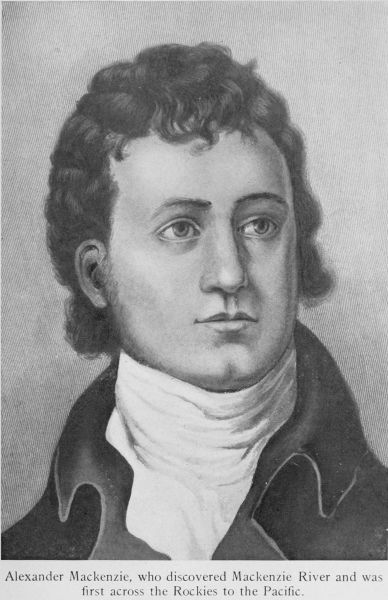
Alexander Mackenzie, who discovered Mackenzie River and was
first across the Rockies to the Pacific.
The women pick berries and Alexander MacKenzie climbs a high hill to
try and see a way out of this foggy swamp of a lake stretching north
in two horns two hundred miles from east to west. There was ice ahead
and there was fog ahead, and it was quite plain “English Chief” did not
know the way. MacKenzie followed the direction of the drifting ice. Dog
Rib Indians here vow there is no passage through the ice, and the cold
rains slush down in torrents. It is not dark longer than four hours,
but the nights are so cold the lake is edged with ice a quarter of an
inch thick. MacKenzie secures a Red Knife Indian as guide and pushes
on through the flag-grown swamps, now edging the ice fields, now in
such rough water men must bail to keep the canoes afloat, now trying
to escape from the lake east, only to be driven back by the ice, west;
old “English Chief” threatening to cut the Red Knife’s throat if he
fails them. Three weeks have they been fog-bound and ice-bound and
lost on Slave Lake, but they find their way out by the west channel
at last, a strong current, a stiff wind and blankets up for sail. July
1st, they pass the mouth of a very large river, the Liard; July 5th, a
very large camp of Dog Rib Indians, who warn them “old age will come
before” MacKenzie “reaches the sea” and that the wildest monsters guard
Big River. MacKenzie obtains a Dog Rib for a guide, but the Dog Rib
has no relish for his part, and to keep him from running away as they
sleep at night, MacKenzie takes care to lie on the edge of the filthy
fellow’s vermin-infested coat. A greenish hue of the sea comes on the
water as they pass Great Bear Lake to the right, but the guide has
become so terrified he must now be bodily held in the canoe. The banks
of the river rise to lofty ramparts of white rock. Signs of the North
grow more frequent. Trees have dwindled in size to little sticks. The
birds and hares shot are all whitish-gray with fur pads or down on
their feet. On July 8th, the guide escapes, but a Hare Indian comes
along, who, by signs, says it is only ten days to the sea. Presently,
the river becomes muddy and breaks into many channels. Provisions are
almost gone, and MacKenzie promises his men if he does not find the sea
within a week, he will turn back. On the 11th of July, the sun did not
set, and around deserted camp fires were found pieces of whalebone.
MacKenzie’s hopes mounted. Only the Eskimos use whalebone for tent
poles. Footprints, too, were seen in the sand, and a rare beauty of
a black fox—with a pelt that was a hunter’s fortune—scurried along
the sands into hiding. The Hare Indian guide began talking of “a large
lake” and “an enormous fish” which the Eskimo hunted with spears.
“Lake?” Had not MacKenzie promised his men it was to be the sea? The
voyageurs were discouraged. They did not think of the big “fish” being
a whale, or the riffle in the muddy channels the ocean tide, not though
the water slopped into the tents under the baggage and “the large
lake” appeared covered with ice. Then at three o’clock in the morning
of July 14th, the ice began floundering in a boisterous way on calm
waters. There was no mistaking. The floundering ice was a whale and
this was the North Sea, first reached overland by Hearne of the
Hudson’s Bay, and now found by Alexander MacKenzie.
The story of MacKenzie’s voyages is told elsewhere.
He was welcomed back to Chippewyan by
Norman McLeod on October the 12th at 3 P. M.,
and spent the winter there with his cousin, Rory.
Hurrying to Lake Superior with his report next summer,
Alexander MacKenzie suffered profound disappointment.
He was received coldly. The truth
is, the old guard of the original Nor’Westers—Simon
McTavish and the Frobishers—were jealous of the
men, who had come in as partners from the Little
Company. They had no mind to see honors captured
by a young fellow like MacKenzie, who had
only two shares in the Company, or $8000 worth of
stock, compared to their own six shares or $24,000,
and found bitter fault with the returns of furs from
Athabasca, and this hostility lasted till McTavish’s
death in 1804. MacKenzie came back to pass a
depressing winter (’90-’91) at Chippewyan when
he dispatched hunters down the newly discovered
river, which he ironically called “River Disappointment.”
But events were occurring that spurred his
thoughts. Down at the meeting of the partners he
had heard how Astor was gathering the American
furs west of the Great Lakes; how the Russians
were gathering an equally rich harvest on the Pacific
Coast. Down among the Hare Indians of MacKenzie
River, he had heard of white traders on the
West coast. If a boat pushed up Peace River from
Athabaska Lake, could it portage across to that
west coast? The question stuck and rankled in
MacKenzie’s mind. “Be sure to question the Indians
about Peace River,” he ordered all his winter
hunters. Then came the Hudson’s Bay men to
Athabasca: Turner, the astronomer, and Howse,
who had been to the mountains. If the Nor’Westers
were to be on the Pacific Coast first, they must bestir
themselves. MacKenzie quietly asked leave of
absence in the winter of ’91-’92, and went home to
study in England sufficient to enable him to take
more accurate astronomic observations. The summer
of ’92 found him back on the field appointed to
Peace River district.
The Hudson’s Bay men had failed to pass through
the country beyond the mountains. Turner and
Howse had gone down to Edmonton. Thompson,
the surveyor, left the English Company and coming
overland to Lake Superior, joined the Nor’Westers.
It was still possible for MacKenzie to be first across
the mountains.
The fur traders had already advanced up Peace
River and half a dozen forts were strung up stream
toward the Rockies. By October of ’92, MacKenzie
advanced beyond them all to the Forks on the east
side and there erected a fort. By May, he had dispatched
the eastern brigade. Then picking out a
crew of six Frenchmen and two Indians, with Alexander
McKay as second in command, McKenzie
launched out at seven o’clock on the evening of
May 9, 1793, from the Forks of Peace River in a
birch canoe of three thousand pounds capacity.
If the voyage to the Arctic had been difficult, it
was child’s play compared to this. As the canoe
entered the mountains, the current became boisterously
swift. It was necessary to track the boat up
stream. The banks of the river grew so precipitous
that the men could barely keep foothold to haul
the canoe along with a one hundred and eighty-foot
rope. MacKenzie led the way cutting steps in the
cliff, his men following, stepping from his shoulder
to the shaft of his axe and from the axe to the place
he had cut, the torrent roaring and re-echoing below
through the narrow gorge. Sulphur springs were
passed, the out-cropping of coal seams, vistas on the
frosted mountains opening to beautiful uplands,
where elk and moose roamed. An old Indian had
told MacKenzie that when he passed over the mountains,
Peace River would divide—one stream, now
known as the Finlay, coming from the north; the
other fork, now known as the Parsnip, from the
south. MacKenzie, the old guide said, should ascend
the south; but it was no easy matter passing
the mountains. The gorge finally narrowed to sheer
walls with a raging maelstrom in place of a river.
The canoe had to be portaged over the crest of a
peak for nine miles—MacKenzie leading the way
chopping a trail, the men following laying the fallen
trees like the railing of a stair as an outer guard up
the steep ascent. Only three miles a day were made.
Clothes and moccasins were cut to shreds by brushwood,
and the men were so exhausted they lay down
in blanket coats to sleep at four in the afternoon,
close to the edge of the upper snow fields. MacKenzie
wrote letters, enclosed them in empty kegs,
threw the kegs into the raging torrent and so sent
back word of his progress to the fort. Constantly,
on the Uplands, the men were startled by rocketing
echoes like the discharge of a gun, when they would
pass the night in alarm, each man sitting with his
back to a tree and musket across his knees, but the
rocketing echoes—so weird and soul-stirring in the
loneliness of a silence that is audible—were from
huge rocks splitting off some precipice. Sometimes
a boom of thunder would set the mountains rolling.
From a far snow field hanging in ponderous cornice
over bottomless depths would puff up a thin, white
line like a snow cataract, the distant avalanche of
which the boom was the echo. Once across the
divide, the men passed from the bare snow uplands
to the cloud line, where seas of tossing mist blotted
out earth, and from cloud line to the Alpine valleys
with larch-grown meadows and painters’ flowers
knee deep, all the colors of the rainbow. Beside a
rill trickling from the ice fields pause would be made
for a meal. Then came tree line, the spruce and
hemlock forests—gigantic trees, branches interlaced,
festooned by a mist-like moss that hung from tree to
tree in loops, with the windfall of untold centuries
piled criss-cross below higher than a house. The
men grumbled. They had not bargained on this
kind of voyaging.
Once down on the west side of the Great Divide,
there were the Forks. MacKenzie’s instincts told
him the north branch looked the better way, but the
old guide had said only the south branch would lead
to the Great River beyond the mountains, and they
turned up Parsnip River through a marsh of beaver
meadows, which MacKenzie noted for future trade.
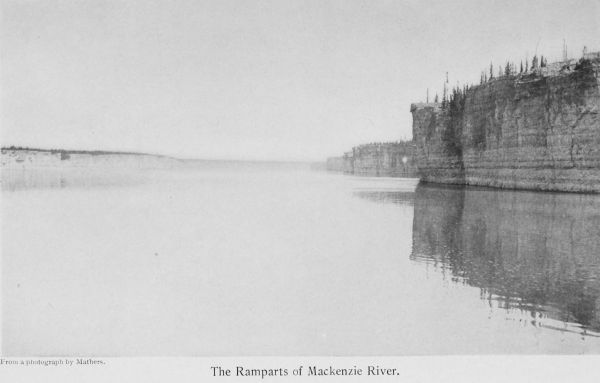
From a photograph by Mathers.
The Ramparts of MacKenzie River.
It was now the 3rd of June. MacKenzie ascended
a mountain to look along the forward path. When
he came down with McKay and the Indian Cancre,
no canoe was to be found. MacKenzie sent broken
branches drifting down stream as a signal and fired
gunshot after gunshot, but no answer! Had the
men deserted with boat and provisions? Genuinely
alarmed, MacKenzie ordered McKay and Cancre
back down the Parsnip, while he went on up stream.
Whichever found the canoe was to fire a gun. For
a day without food and in drenching rains, the three
tore through the underbrush shouting, seeking,
despairing till strength was exhausted and moccasins
worn to tatters. Barefoot and soaked, MacKenzie
was just lying down for the night when a crashing
echo told him McKay had found the deserters.
They had waited till he had disappeared up the
mountain, then headed the canoe north and drifted
down stream. The Indians were openly panic-stricken
and wanted to build a raft to float home.
The French voyageurs pretended they had been
delayed mending the canoe. MacKenzie took no
outward notice of the treachery, but henceforth
never let the crew out of his own or McKay’s sight.
A week later, Indians were met who told MacKenzie
of the Carrier tribes, inlanders, who bartered
with the Indians on the sea. One old man drew a
birch bark map of how the Parsnip led to a portage
overland to another river flowing to the sea. Promising
to return in two moons (months), MacKenzie
embarked with an Indian for guide. On the evening
of June 12th, they entered a little lake, the source
of Peace River. A beaten path led over a low ridge
to another little lake—the source of the river that
flowed to the Pacific. This was Bad River, a branch
of the Fraser, though MacKenzie thought it was a
branch of the Great River—the Columbia. The
little lake soon narrowed to a swift torrent, which
swept the canoe along like a chip. MacKenzie
wanted to walk along the shore, for some one should
go ahead to look out for rapids, but the crew insisted
if they were to perish, he must perish with them, and
all hands embarked. The consequence was that the
canoe was presently caught in a swirl. A rock
banged through the bottom tearing away the keel.
Round swung the tottering craft to the rush! Another
smash, and out went the bow, the canoe flattening
like a board, the Indians weeping aloud on
top of the baggage, the voyageurs paralyzed with
fear, hanging to the gun’els. On swept the wrecked
canoe! The foreman frantically grabbed the branch
of an overhanging tree. It jerked him bodily ashore
and the canoe flat as a flap-jack came to a stop in
shallow sands.
There was not much said for some minutes. Bad
River won a reputation that it has ever since sustained.
All the bullets were lost. Powder and baggage
had to be fished up and spread out to dry in the
sun. One dazed voyageur walked across the spread-out
powder with a pipe between his teeth when a
yell of warning that he might blow them all to
eternity—brought him to his senses and relieved the
terrific tension.
The men were treated to a régale, and then sent to
hunt bark for a fresh canoe. There now succeeded
such an impenetrable morass blocked by windfall
that the voyageurs made only two miles a day.
Though MacKenzie and McKay watched their
guide by turns at night, he succeeded in escaping,
and the white men must risk meeting the inland
Carriers without an interpreter. On the 15th of
June, Bad River turned westward into the Fraser.
Of his parley with the Carriers, there is no space to
tell. I have told the story in another volume, but
somewhere between what are now known as Quesnel
and Alexandria—named after him—it became apparent
that the river was leading too far south.
Besides, the passage was utterly impassable. MacKenzie
headed his canoe back up the western fork
of the Fraser—the Blackwater River, and thence on
July 4th, leaving the canoe and caching provisions,
struck overland and westward. The Pacific was
reached on the 22nd of July, 1793, in the vicinity of
Bella Coola. By the end of August he was back at
the Forks on Peace River, and at once proceeded to
Chippewyan on Athabasca Lake, where he passed
the winter.
CHAPTER XXIV
1780-1810
“THE COMING OF THE PEDLARS” CONTINUED—MACKENZIE
AND MCTAVISH QUARREL—THE
NOR’WESTERS INVADE HUDSON BAY WATERS
AND CHALLENGE THE CHARTER—RUFFIANISM OF
NOR’WESTERS—MURDER AND BOYCOTT OF HUDSON’S
BAY MEN—UP-TO-DATE COMMERCIALISM
AS CONDUCTED IN TERMS OF A CLUB AND
WITHOUT LAW.
The next spring, MacKenzie left the West
forever. Again his report of discovery
was coldly received by the partners on
Lake Superior. The smoldering jealousy between
Simon McTavish of the old Nor’Westers and Alexander
MacKenzie broke out in flame. MacKenzie
seceded from the Nor’Westers and with Pierre de
Rocheblave and the Ogilvies of Montreal reorganized
the Little Company variously known as “The
Potties,” from “Les Petits,” and “the X. Y.’s”
from the stamp on their pelts, X. Y., to distinguish
them from the N. W. MacKenzie’s Journal was
published. He was given a title in recognition of
his services to the Empire. Now in possession of an
independent and growing fortune, he bought himself
an estate in Scotland where the fame of his
journal attracted the attention of another brilliant
young Scotchman—Lord Selkirk. The two became
acquainted and talked over plans of forming a vast
company, that would include not only the X. Y.’s
and Nor’Westers, but the Hudson’s Bay and Russian
companies. Hudson’s Bay stock had fallen from
£250 to £50 a share. With the aim of a union, MacKenzie
and Selkirk began buying shares in the Hudson’s
Bay, and Selkirk comes on a visit to Canada.
Meanwhile—out in Canada—Simon McTavish,
“the Marquis,” was not idle up to the time of his
death. The Hudson’s Bay had barred out other
traders from Labrador. Good! Simon McTavish
accepted the challenge, and from the government of
Canada rented the old King’s Domain of Southern
Labrador for £1000 a year. The English company
had forbidden interlopers on the waters of Hudson
Bay. Good! The Nor’Westers accepted that challenge.
Duncan McGillivray, a nephew of McTavish,
dictates a letter to the ancient English company
begging them to sue him for what he is going
to do, so that the case may be forever settled in the
courts. Then he hires Captain Richards away from
the Company and sends him on the ship Eddystone,
in 1803, straight into Hudson Bay, to establish a
trading post at Charlton Island and another at Moose
for the Nor’Westers. The Hudson’s Bay Company
declines the challenge. They will not sue the Northwest
Company and so revive the whole question of
their charter; but they sue their old Captain, John
Richards, and order Mr. Geddes to hire more men
in the Orkneys, and they freeze those interlopers out
of the bay by bribing the Indians so that Simon
McTavish’s men retire from Charlton and Moose
with loss. And the English Adventurers go one
farther: they petition Parliament, in 1805, for “authority
to deal with crimes committed in the Indian
country.”
Simon McTavish dies in 1804. The X. Y.’s and
the Nor’Westers unite, and well they do, for clashes
are increasing between Hudson’s Bays and Nor’Westers,
between English and French, from Lake
Superior to the Rockies.
Down at Nipigon in 1800, where Duncan Cameron
had attracted the Indians away from Albany, first
blood is shed. Young Labau, a Frenchman, whose
goods have been advanced by the Nor’Westers,
deserts for the Hudson’s Bay. Schultz, the Northwest
clerk, pursues and orders the young Frenchman
back. Labau offers to pay for the goods, but he will
not go back to the Northwest Company. Schultz
draws his dagger and stabs the boy to death. For
this, he is dismissed by the Nor’Westers, but no other
punishment follows for the murder.
Albany River at this time was the trail inland from
Hudson Bay to the plains, to the Red River and the
Missouri and modern Edmonton. The Nor’Westers
determined to block this trail. The Northwest
partner, Haldane, came to Bad Lake in 1806 with
five voyageurs and knocked up quarters for themselves
near the Hudson’s Bay cabins. By May,
William Corrigal, the Hudson’s Bay man, had four
hundred and eighty packs of furs. One night, when
all the English were asleep, the Nor’West bullies
marched across, broke into the cabins, placed pistols
at the head of Corrigal and his men, and plundered
the place of furs. Never dreaming that Haldane,
the Northwest partner, would countenance open
robbery, Corrigal dressed and went across to the
Northwest house to complain.
Haldane met the complaint with a loud guffaw.
“I have come to this country for furs,” he explained,
“and I have found them, and I intend to keep them.”
Red Lake in Minnesota belonged to the same
Albany department. Before Corrigal could dispatch
the furs to the bay, Haldane’s bullies swooped down
and pillaged the cabins there, this time not only of
furs, but provisions.
Up at Big Falls near Lake Winnipeg, John Crear
and five men had built a fort for the English. One
night toward fall a party of Northwest voyageurs,
led by Alexander MacDonell, landed and camped.
Next morning when all of Crear’s men had gone
fishing but two, MacDonell marched to the Hudson’s
Bay house, accused Crear of taking furs owed
in debt to the Nor’Westers, and on that excuse broke
open the warehouse. Plowman, a Hudson’s Bay
hunter, sprang to prevent. Quick as flash, MacDonell’s
dagger was out. Plowman fell stabbed
and the voyageurs had clubbed Crear to earth with
the butt ends of their rifles. Furs and provisions were
carried off. As if this were not enough and ample
proof that the accusation had simply been an excuse
to drive the Hudson’s Bay men off the field, MacDonell
came back in February of 1807, surrounded
Crear’s house with bullies, robbed it of everything
and had Crear beaten till he signed a paper declaring
he had sold the furs and that he would never again
come to the country.
This was no fur trading. It was raiding—such
raiding as the Highlanders carried into the Lowlands
of Scotland. It was a banditti warfare that
was bound to bring its own punishment.
Besides Albany River, the two great river trails
inland to the plains from Hudson’s Bay were by
Churchill River to Athabasca and by Hayes River to
Cumberland House on the Saskatchewan. From
1805 J. D. Campbell was the Northwest partner appointed
to block the advance inland to this region.
John Spencer was at Reindeer Lake for the Hudson’s
Bay in 1808. Knowing when the Indians from the
Athabasca were due, he had sent William Linklater
out to meet them, and Linklater was snowshoeing
leisurely homeward drawing the furs on a toboggan,
when toward nightfall he suddenly met the Northwest
partner and his bullies on the trail. There
was the usual pretence that the furs were a debt owed
to the Nor’Westers, and the hollowness of that pretence
was shown by the fact that before Linklater
could answer, a Northwest bully had seized his
snowshoes and sent him sprawling. Campbell and
the bullies then marched off with the furs. This
happened twice at Caribou Lake.
But the worst warfare waged round Isle a la
Crosse, the gateway to Athabasca. Peter Fidler
went there in 1806 with eighteen men for the Hudson’s
Bay. Then came J. D. Campbell, the Nor’Wester,
with an army of bullies, forbidding the
Indians to enter Fidler’s fort or Fidler and his men
to stir beyond a line drawn on the sands. On this
line was built a Nor’West sentry box, where the
bullies kept guard night and day. For three years,
Peter Fidler stuck it out, sending men across the line
secretly at night, directing the Indians by a detour
down to the other Hudson’s Bay forts and in a hundred
ways circumventing his enemies. Then Campbell’s
bullies became bolder. Fidler’s firewood was
stolen, his fish nets cut, his canoes hacked to pieces.
He was literally starved off the field and compelled
to retire in 1809.
Down in Albany, things were going from bad to
worse with Corrigal. The contest concentrated at
Eagle Lake, half way between Lake Superior and
Lake Winnipeg just where Wabigoon River intersects
with the modern Canadian Pacific Railroad.
The English company had strengthened Corrigal
with more Orkneymen, and he had a strongly palisaded
fort. But the Nor’Westers set the MacDonell
clan with their French bullies on his trail.
An Indian had come to the post in September.
Corrigal outfitted him with merchandise for the
winter’s hunt, and three English servants accompanied
the Saulteur down to the shore. Out rushed
the Nor’Wester, MacDonell, flourishing his sword
accompanied by a bully, Adhemer, raging aloud that
the Indian had owed furs to the Nor’Westers and
should not be allowed to hunt for the Hudson’s Bay.
The two Corrigal brothers and one Tait ran from
the post to the rescue. With one sweep of his sword
Eneas MacDonell cut Tait’s wrist off and with another
hack on his neck felled him to the ground.
The French bully had aimed a loaded pistol at the
Corrigals daring them to take one step forward.
John Corrigal dodged into the lake. MacDonell
then rushed at the Englishmen like a mad man,
cutting off the arm of one, sending a hat flying from
another whose head he missed, hacking the shoulder
of a third. Unarmed, the Hudson’s Bay men fled
for the fort gates. The Nor’Westers pursued. Coming
from the house door, John Mowat, a Hudson’s
Bay man, drew his pistol and shot Eneas MacDonell
dead. Coureurs went flying to Northwest camps
for reinforcements. Haldane and McLellan, two
partners, came with a rowdy crew and threatened
if Mowat were not surrendered they would have the
Indians butcher every soul in the fort if it cost a keg
of rum for every scalp. Mowat promptly surrendered
and declared he would shoot any Nor’ Wester
on the same provocation.
For this crime and before the Company in England
could be notified, Mowat was carried away in
irons. Two servants—McNab and Russell—and
one of the Corrigals volunteered to accompany him as
witnesses for the defense. For a winter Mowat
was imprisoned in the miserable butter vat of a jail
at Fort William, and when it was found that every
indignity and insult would not drive the three witnesses
away, they were arrested as abettors of the so-called
crime. At Mowat’s trial in Montreal, of the
four judges who presided, one was notoriously corrupt
and two, the fathers of Northwest partners.
Of the jury, half the number were Nor’Westers.
Naturally, Mowat was pronounced guilty. He was
sentenced to six months’ imprisonment and branding.
When he was discharged penniless, he set out
through the United States to take ship for England.
It is supposed that he was lost in a storm, or drowned
crossing some of the New England rivers.
The rivalry between Hudson’s Bay and Nor’Westers
had become lawless outrage. The Company
in England is meantime having troubles of its
own. The English government desires them in
1807 to state what “the boundaries of Louisiana
ought to be” in the impending treaty with the United
States, which is to give access for American traders
to the country north of Louisiana in return for similar
free access for British traders to American territory.
The English traders state what the boundaries of
Louisiana ought to be, and to the ignorance of the
English shareholders do we owe in this case, as in a
hundred others, the fifty years’ boundary dispute as
to limits from the Lake of the Woods to Oregon.
As for reciprocity of access to each other’s hunting
field, the Hudson’s Bay Company opposes it furiously.
Access to American territory they already
have without the asking and are likely to have for
another fifty years, as there is no inhabitant to prevent
them, but to grant the Americans access to
Hudson’s Bay territory is another matter; so in the
treaty of reciprocal favors across each other’s territory,
My Lord Holland provides “always the actual
settlements of the Hudson’s Bay Company
excepted.”
If the Hudson’s Bay Company is to hold its monopoly
by virtue of settlements, it must see to the welfare
of those settlements, so in June, 1808, the first
schoolmasters of the Northwest are sent out at salaries
of £30 a year—James Clouston, and Peter
Sinclair, and George Geddes. There is no dividend,
owing to the embargo of war, and the Company is
driven, in 1809, to petition the Lords of Trade for
help. They aver there are six hundred families at
their settlements, that the yearly outfits cost the
Company £40,000; that the sales never exceed
£30,000 and this year are only £3,000; they apply
for remission of duty on furs and a loan of £60,000
from the imperial treasury. The duty is remitted
but the loan is not granted, and My Lord Selkirk
becomes, by virtue of having purchased nearly
£40,000 of stock, a leading director in the Hudson’s
Bay Company. My Lord Selkirk has been out to
Montreal. He has been fêted and feasted and
dined and wined by the Beaver Club of the Nor’Westers,
whom he pumps to a detail about the fur
trade. Also he meets John Jacob Astor and learns
what he can from him. Also he meets that Northwest
clerk who had been dismissed up the Saskatchewan
and came over to the Hudson’s Bay Company—Colin
Robertson. He brings Colin Robertson back
with him to England, and the aforetime Northwest
clerk is called on January 3, 1810, to give advice
to the Hudson’s Bay directors on the state of the fur
trade in Canada.
But to return to that Louisiana Boundary—it is
as great a shock to the Nor’Westers as to the Hudson’s
Bay. In the first place, as told elsewhere, the
boundary treaty of 1798 has compelled them to move
headquarters from Grand Portage to Fort William.
The Nor’Westers suddenly awaken to the value of
Alexander MacKenzie’s voyage to the Pacific. Supposing
he had followed that great river on down to
the sea, would it have led him where the American,
Robert Gray, found the Columbia, and where the
explorers, Lewis and Clarke, later coming overland
from the Missouri, wintered? It was determined to
follow MacKenzie’s explorations up with all speed.
It became a race to the Pacific. Which fur traders
should pre-empt the vast domain first—Hudson’s
Bay, Astor’s Americans, or Nor’Westers?
It is barely twenty years since Peter Pond came to
Athabasca and Peace River region, but already there
are six forts between Athabasca Lake and the Rockies—Vermilion
and Encampment Island under the
management of the half-breed son of Sir Alexander
MacKenzie, then Dunvegan and St. John’s and Rocky
Mountain House managed by the McGillivrays and
Archibald Norman McLeod. By 1797, James Finlay
had followed MacKenzie’s trail across the Divide,
then struck up the north branch of Peace River,
now known as Finlay River; but it was not till 1805
that the fur traders, who made flying trips across the
mountains, remained to build forts. In 1793, when
MacKenzie crossed the mountain, there had joined
the Northwest Company as clerk, a lad of nineteen,
the son of a ruined loyalist in New York State, whose
widow came to live in Cornwall, Ontario. This
boy was Simon Fraser. Two years later, in 1795,
there had come to the Northwest Company from
Hudson Bay that English surveyor, David Thompson,
whom the MacKenzies had met in Athabasca
working for the Hudson’s Bay traders. David
Thompson had been born in 1770 and was educated
in the Blue Coat School, London. In 1789 he had
come as surveyor to Churchill and York, penetrating
inland as far as Athabasca; but Colen, chief factor
of York, did not encourage purely scientific explorations.
Thompson quit the English service in disgust,
coming down to the Nor’Westers on Lake
Superior.
These were the two young men—Fraser, son of
the New York loyalist; Thompson, the English surveyor—that
the Northwest Company appointed in
1805 to explore the wilderness beyond the Rockies.
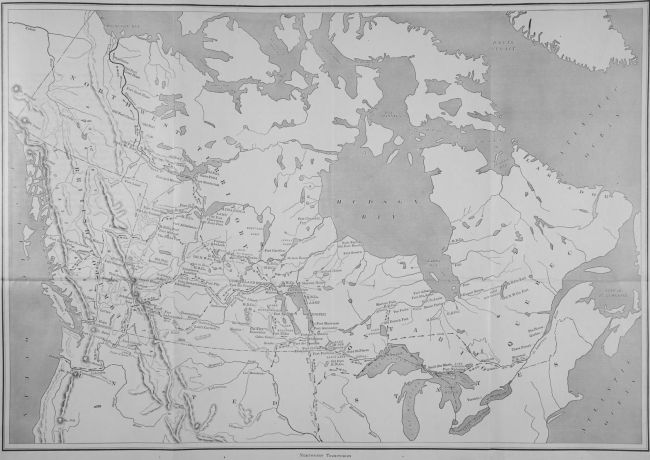
Northwest Territories
Click
here for larger map
CHAPTER XXV
1800-1810
DAVID THOMPSON, THE NOR’WESTER, DASHES FOR
THE COLUMBIA—HE EXPLORES EAST KOOTENAY,
WEST KOOTENAY, WASHINGTON AND OREGON,
BUT FINDS ASTOR’S MEN ON THE FIELD—HOW
THE ASTORIANS ARE JOCKEYED OUT OF ASTORIA—FRASER
FINDS HIS WAY TO THE SEA BY ANOTHER
GREAT RIVER.
Let us follow Thompson first. He had joined
the Nor’Westers just when the question of
the International Boundary was in dispute
between Canada and the United States.
(1) In 1796, lest other Northwest forts were south
of the Boundary, he first explored from Lake Superior
to Rainy Lake and the Lake of the Woods and
Winnipeg River and Winnipeg Lake, advancing as
fast as the brigades traveled, running his lines at
lightning pace. Then he struck across to Lake
Manitoba and the Assiniboine and Qu’ Appelle. His
first survey practically ran in a circle round the
bounds of the modern Manitoba, except on the south.
(2) After wintering on the Assiniboine, he prepared
in the summer of 1797 for exploration south
to the Missouri, but his work must pay in coin of
the realm to the Company. This was accomplished
by Thompson obtaining credit from McDonell of
the Assiniboine Department for goods to trade with
the Mandanes. With three horses, thirty-eight dogs
and several voyageurs, he set out southwest, in mid-winter,
1797. This was long before Henry or Chaboillez
of the Assiniboine had sent men from Pembina
to the Missouri. The cold was terrific. The
winds blew keen as whip lashes, and the journey of
three hundred miles lasted a month. To Thompson’s
amazement, he found Hudson’s Bay traders
from the Albany Department on the Missouri. They
must have come south across Minnesota.
(3) By February of ’98, Thompson was back on
the Assiniboine, and now to complete the southern
survey of Manitoba, he struck east for Red River,
and in March up Red River to Pembina where the
partner, Charles Chaboillez, happened to be in
charge. No doubt it was what Thompson told
Chaboillez of the Missouri that induced the Nor’Westers
to go there. Still ascending the Red,
Thompson passed Grand Forks—then a cluster of
log houses inhabited by traders—and struck eastward
through what is now Minnesota to that Red
Lake, where Hudson’s Bays and Nor’Westers were
to have such bitter fights. Six miles farther east he
made the mistake of thinking he had found the
sources of the Mississippi in Turtle Lake. Still
pressing eastward, he came to Lake Superior and
along the north shore to the Company’s headquarters.
From 1799 to 1805 he ranges up the South Saskatchewan
to that old Bow Fort near Banff; then up
the North Saskatchewan all the way from Lesser
Slave Lake to Athabasca. This, then, was the man
whom the Nor’Westers now appointed to explore the
Rockies.
Only two passes across the mountains north of
Bow River were known to the fur traders—Peace
River Pass and Howse River Pass of the Upper Saskatchewan.
It was perfectly natural that Thompson
should follow the latter—the trail of his old co-workers
in the Hudson’s Bay service. Striking up
the Saskatchewan from Edmonton in the fall of
1806, by October Thompson was in that wonderful
glacier field which has only been thoroughly explored
in recent days—where Howse River leads over
to a branch of the Blaeberry Creek, with Mt. Hector
and Mt. Thompson and Mt. Balfour and the beautiful
Bow Lakes on the southeast; and Mt. Bryce,
and Mt. Athabasca and Mt. Stutfield and the wonderful
Freshfield Glaciers on the northwest. This
is one of the largest and most wonderful glacial fields
of the world. It is the region where the tourists of
Laggan, and Field, and Golden, and Donald strike
north up the Pipestone and Bow and Blaeberry
Creek—raging torrents all of them, not in the least
like creeks, broad as the Upper Hudson, or the
Thames at Chelsea, wild as the cataracts of the St.
Lawrence. From the Pipestone, or Bow, or Blaeberry,
one can pass northeast down to the tributaries
of the Saskatchewan. Cloud-capped mountains,
whose upland meadows present fields of eternal
snow, line each side of the river. Once when I attempted
to enter this region by pack horse late in
September, we wakened below Mt. Hector to find
eight inches of snow on our tent roof, the river swollen
to a rolling lake, the valley swamped high as the
pack horses’ saddles.
Hither came Thompson by a branch of the Saskatchewan,
and Howse’s River and Howse’s Pass
to Blaeberry Creek. Dense spruce and hemlock
forests covered the mountains to the water’s edge.
The scream of the eagle perched on some dead tree,
the lonely whistle of the hoary marmot—a kind of
large rock squirrel—the roar of the waters swelling
to a great chorus during mid-day sun, fading to a
long-drawn, sibilant hush during the cool of night,
the soughing of the winds through the great forests
like the tide of a sea—only emphasize the solitude,
the stillness, the utter aloneness of feeling that comes
over man amid such wilderness grandeur.
On the Upper Blaeberry, Thompson constructs a
rough log raft—safer than canoe, for it will neither
sink nor upset—whipsawing two long logs over a
dozen spruce rollers. A sapling tree for a pole,
packs in a heap in the center on brush boughs to keep
them free of damp, and down the Blaeberry whirls
the explorer with his Indian guides. Here, the
water is clearest crystal from the upland snows.
There, it becomes milky with the silt of glaciers
grinding over stone beds; and glimpses through the
forests reveal the boundless ice fields. By October,
snow begins to fall on the uplands. The hoary evergreens
become heaped with drifts in huge mushrooms.
The upper snow fields curl over the edges
of lofty precipices in great cornices that break and
fall with the boom of thunder, setting the avalanches
roaring down the mountain flanks, sweeping the slopes
clean of forests as if leveled by some giant trowel.
Somewhere between Howse’s Pass and the Blaeberry,
Thompson had wintered, following his old
custom of making the explorations pay by having
his men trap and hunt and trade with the Sarcees
and Kootenay Indians as he traveled. Advancing
in this slow way, it was June of 1807 before he had
launched his raft on the Blaeberry. Spring thaw
has set the torrents roaring. The river is a swollen
flood that sweeps the voyageurs through the forests,
past the glaciers, on down to a great river, which
Thompson does not recognize but which is the
Columbia just where it takes a great bend northward
at the modern railway stations of Moberly and
Golden.
But the question is—which way to go? The river
is flowing north, not south to the sea, as Alexander
MacKenzie thought. Thompson does not guess
this is not the river, which MacKenzie saw. “May
God in His mercy give me to see where the waters
of this river flow to the western ocean,” records Thompson
in his journal of June 22nd; but if he goes north,
that will lead to a great detour—that much he can
guess from what the Indians tell him—the Big Bend
of the Columbia. He is facing the Rockies on the
east. On the west are the Selkirks. He does not
know that after a great circle about the north end
of the Selkirks, the Columbia will come down south
again through West Kootenay between the Selkirks
and the Gold Range. To Thompson, it seems that
he will reach the Pacific soonest, where American
traders are heading, by ascending the river; so he
follows through East Kootenay southward through
Windermere Lake and Columbia Lake to the sources
of the Columbia east of Nelson Mountain. There,
where the Windermere of to-day exists, he builds a
fort with Montour, the Frenchman, in charge—the
Upper Kootenay House. Then he discovers that
beyond the sources of the Columbia, a short portage
of two miles, is another great river flowing south—the
Kootenay. The portage he names after the
Northwest partner—McGillivray, also the river,
which we now know as Kootenay, and which Thompson
follows, surveying as he goes, south of the Boundary
into what are now known as Idaho and Montana,
past what is now the town of Jennings and
westerly as far as what is now Bonner’s Ferry—the
roaring camp of old construction days when the
Great Northern Railroad passed this way. Here
Thompson is utterly confused, for the Kootenay
River turns north to British Columbia again, not
west to the Pacific, and he has no time to follow its
winding course. His year is up. He must hasten
eastward with his report. Leaving the fort well
manned, Thompson goes back the way he has come,
by Howse Pass down the Saskatchewan to Fort
William.
While Thompson is East, the Hudson’s Bay Company
of Edmonton is not idle. Mr. Howse, who
found the pass, follows Thompson’s tracks over the
mountains and sets hunters ranging the forests of
the Big Bend and south to Kootenay Lake.
When he returns to the mountains In 1808, Thompson
joins Henry’s brigade coming west from Pembina.
It is September when they reach Edmonton,
and both companies have by this time built fur
posts at Howse’s Pass, known as Rocky Mountain
House, of which Henry takes charge for the Nor’Westers.
Sixteen days on horseback bring Thompson
to the mountains. There horses are exchanged
for dogs, and the explorer sleds south through East
Kootenay to Kootenay House on Windermere Lake,
where provisions and furs are stored. Thompson
winters at Windermere. In April of 1809 he sets
out for the modern Idaho and Montana and establishes
trading posts on the Flathead Lake southeast,
and the Pend d’Oreille Lakes southwest, leaving
Firman McDonald, the Highlander, as commander
of the Flathead Department, with McMillan and
Methode and Forcier and a dozen others as traders.
He is back in Edmonton by June, 1810—“thank
God”—he ejaculates in his diary, and at once proceeds
East, where he learns astounding news at Fort
William. John Jacob Astor, the New York merchant,
who bought Nor’Westers’ furs at Montreal,
has organized a Pacific Fur Company, and into its
ranks he has lured by promise of partnership, friends
of Thompson, such good old Nor’Westers as John
Clarke—“fighting Clarke,” he was called—and
Duncan McDougall of the Athabasca, and that
Alex. McKay, who had gone to the Pacific with Sir
Alexander MacKenzie, and Donald MacKenzie, a
relative of Sir Alexander’s, and the two Stuarts—David
and Robert—kin of the Stuart who was with
Simon Fraser on his trip to the sea. These Nor’Westers,
who have joined Astor, know the mountain
country well, and they have engaged old Nor’West
voyageurs as servants. Half the partners are to go
round the Horn to the Pacific, half overland from
the Missouri to the Columbia. If the Nor’Westers
are to capture the transmontane field first, there is
not a moment to lose.
Thompson is forthwith dispatched back to the
mountains in 1810, given a crew of eighteen or twenty
and urged forward to the Pacific; but the Piegans are
playing the mischief with the fur trade this year.
Though Henry drowns them in whiskey drugged
with laudanum at Rocky Mountain House, they
infest Howse’s Pass and lie in wait at the Big Bend
to catch the canoes bringing up the furs from Idaho
and to plunder Thompson’s goods bound south to
Kootenay House. Thompson’s voyageurs scatter
like lambs before wolves. He retreats under protection
of Henry’s men back through Howse’s Pass
to Rocky Mountain House, but he is a hard man to
beat. Reach the Pacific before Astor’s men he
must, Piegans or no Piegans; so he forms his plans.
Look at the map! This Kootenay River flowing
through Idaho does not lead to the Pacific. It turns
north into Kootenay Lake of West Kootenay. The
Columbia takes a great circle north. Thompson
aims for the Big Bend. He hurries overland by
pack horse to the Athabasca River, enters the mountains
at the head of the river on December 20, 1810,
at once cuts his way through the forest tangle up
between Mt. Brown and Mt. Hooker, literally
“swims the dogs through snowdrifts, the brute
Du Nord beating a dog to death,” and finds a new
trail to the Columbia—Athabasca Pass! Down on
the west side of the Divide flows a river southwest,
to the Big Bend of the Columbia. Thompson winters
here to build canoes for the spring of 1811, naming
the river that gladdens his heart—Canoe River.
Down in Idaho, his men on Flathead Lake and
the Pend d’Oreille are panicky with forebodings.
Thompson has not come with provisions. Their fur
brigade has been driven back. The Piegans are on
the ramp, and there are all sorts of wild rumors about
white men—Astor’s voyageurs, of course—coming
through the mountains by way of the Snake Indian’s
territory to “the rivers of the setting sun.”
Up on Canoe River, Thompson and his voyageurs
worked feverishly—building canoes, and getting the
fur packs ready against spring. Toward spring,
ten men are sent back with the furs; seven are to go
on with Thompson down Columbia River for the
Pacific. Their names are Bordeaux, Pariel, Coté,
Bourland, Gregoire, Charles and Ignace. His men
are on the verge of mutiny from starvation, but provisions
come through from Henry at Howse’s Pass,
and when these provisions run out, Thompson’s
party kill all their horses and dogs for food. Very
early in the year, the river is free of ice, for Thompson
is in a warmer region than on the plains, and
the canoe is launched down the Columbia through
the Big Bend—a swollen, rolling, milky tide, past
what is now Revelstoke, past Nakusp, through the
Upper and Lower Arrow Lakes and what is now
known as the Rossland mining region. It is a region
of shadowy moss-grown forests, of hazy summer air
resinous with the odor of pines, of mountains rising
sheer on each side in walls with belts of mist marking
the cloud line, the white peaks opal and shimmering
and fading in a cloudland.
Each night careful camping ground was chosen
ashore with unblocked way to the water in case of
Piegan attack. July 3rd, Thompson reached Kettle
Falls. For a week he followed the great circular
sweep of the Columbia south through what is now
Washington. At Spokane River, at Okanogan
River, near Walla Walla where the Snake comes in,
he heard rumors among the Indians that white
men from the East had come to the sea, whether
overland or round the world he could not tell, so on
Tuesday, July 9th, Thompson judges it wise to pre-empt
other claimants. Near Snake River, “I
erected a small pole,” he writes, “with a half sheet
of paper tied about it, with these words:
“Know hereby, this country is claimed by Great Britain
and the N W Company from Canada do hereby intend
to erect a factory on this place for the commerce of the
country—D. Thompson.”
Broader spread the waters, larger the empire rolling
away north and south as the river swerved straight
west. The river, that he had found up at Blaeberry
Creek near Howse’s Pass, was sweeping him to the
sea. This was the river, Gray, the Boston man,
had found, and Alexander MacKenzie had missed
when he touched the Fraser. Thompson had now
explored it from source to sea, from the Columbia
and Windermere Lakes north through East Kootenay,
south through West Kootenay, south through
Washington, west between Washington and Oregon
to the Pacific—a region in all as large as Germany
and France and Spain.
But from Walla Walla to the sea was a dangerous
stretch. At the Dalles camped robber Indians to
pillage travelers as they portaged overland. Thompson
kept sleepless vigil all night and by launching
out at dawn before the mountain mists had lifted
from the water gave ambushed foes the slip. Came
a wash and a ripple in the current. It was the tide.
The salt water smell set the explorer’s pulses beating.
Then the blue line of the ocean washes the horizon
of an opening vista like a swimming sky. The voyageurs
gave a shout and beat the gun’els of the canoe.
A swerve to left—chips floating on the water tell
Thompson that Astor’s men are already here, and
there stands the little palisaded post all raw in its
newness with cannons pointing across the river from
the fort gates. Precisely at 1 P. M., Monday, July
15, 1811, Thompson arrives at Astoria. The Astor
men have beaten in the race to the Pacific. Thompson
is just two months too late for the Nor’Westers
to claim the mouth of the Columbia.
Then all his old friends of the Athabasca, McDougall
and the Stuarts and fighting John Clarke—all
his old friends but Alex. McKay, who has been cut
to pieces by the Indians in the massacre of “the
Tonquin’s crew,” all but McKay and Donald MacKenzie,
who has not yet arrived from overland—rush
down to welcome him. The Astorians receive
the Nor’Westers with open arms. It is good fellowship.
It is not good policy. “He had access everywhere,”
writes Ross, a clerk in the employment of
Astor. “He saw and examined everything.” He
heard how the overland party of Astor’s men from
the Missouri had not yet come. He probably heard,
too, that the crew of the ship Tonquin had been
massacred, and he was not slow to guess that McDougall,
head of Astor’s fort, was homesick for his
old Northwest comrades.
Thompson remained only a week. McDougall
gave him what provisions were necessary for the
return voyage, and July 22nd he set out to ascend
the Columbia with a party of Astorians bound inland
to trade. Bourland, his voyageur, wanted to stay at
Astoria, so Thompson traded his services to McDougall
for one of Astor’s Sandwich Island men.
The Astor hunters struck up Okanogan River to
trade. Thompson pushed on up the Columbia
through the Arrow Lakes at feverish pace, noticing
with disgust that the Hudson’s Bay man, Howse,
was camping hard on his trail, forming trading connections
with Sarcees and Piegans and Kootenays.
Snow comes early in the mountains. Thompson
must succeed in crossing the pass before winter sets
in so that the report of what he learned at Astoria
can be sent down to Fort William in time for the
annual meeting of July, 1812. He pauses only for a
night with Harmon and Henry at Rocky Mountain
Pass and curses his stars at more delay caused by
the Piegan raiders, who are keeping his men of the
Big Bend at East Kootenay cooped up in fear of their
lives, but he reaches Edmonton in three months, and
is present at the annual meeting of the partners at
Fort William in July, 1812.
This is a fateful year. War is waged between the
United States and Canada. True soldiers of fortune
as the Nor’Westers ever were, they decided to take
advantage of that war and capture Astoria. John
George McTavish and Alexander Henry of Howse’s
Pass, with Larocque of the Missouri, are to lead fifty
voyageurs overland and down the Columbia to
Astoria, there to camp outside the palisades and
parley with Duncan McDougall. Old Donald McTavish,
as gay an old reprobate as ever graced the
fur trade, is to sail with McDonald of Garth, the
Highlander of the Crooked Arm, from London on
the Northwest ship, the Isaac Todd, under convoy
of the man-of-war, Raccoon, to capture Astoria.
Thompson has fulfilled his mission. Though he
was late in reaching the mouth of the Columbia, he
has played his fur trade tactics so skillfully that
Astoria will fall to his Company’s hands. The story
of John George McTavish’s voyage from Fort
William, Lake Superior to Astoria, or of old Donald
McTavish’s drunken revels round the world in the
Isaac Todd, would fill a volume. John George McTavish
and Larocque reached Astoria first, sweeping
gaily down the rain-swollen flood of the Columbia
on April 11th in two birch canoes, British flags flying
at the prow, voyageurs singing, Indians agape on
the shore in sheer amaze at these dare-devil fellows,
who flitted back and forward thinking no more of
crossing the continent than crossing a river.
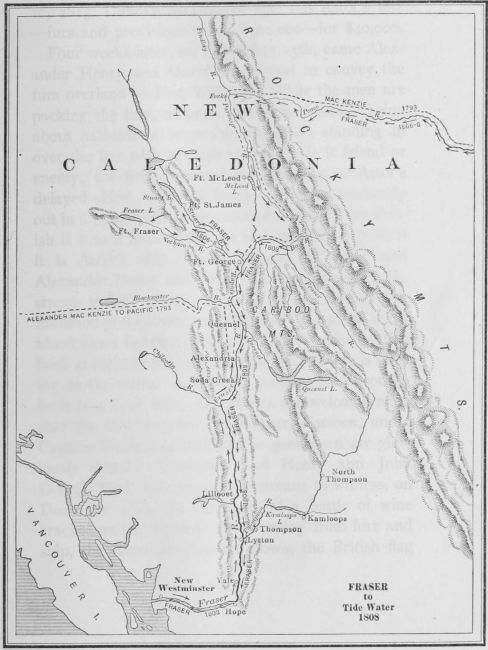
FRASER to Tide Water 1808
Click
here for larger map
Again McDougall welcomed his rivals in trade,
his friends of yore, with open arms. Had he trained
his cannon on them, they had hardly camped so
smugly under his fort walls, nor stalked so surely
in and out of his fort, spreading alarm of the war,
threatening what the coming ships would do, offering
service and partnership to any who would desert
Astor’s company for the Northwest. McDougall
was tired of his service with the Astor company.
The Tonquin had been lost. No word yet of the
second ship that was to come. The fort was demoralized,
partly with fear, partly with vice. There
had been no strong hand to hold the riotous voyageurs
in leash, and loose masters mean loose men.
Now with news of a coming war vessel, all the pot
valor of the drunken garrison evaporated in cowardly
desire to capitulate and avoid bloodshed. The voyageurs
were deserting to McTavish. On October
16, 1813, Duncan McDougall sold out Astor’s fort—furs
and provisions worth $100,000—for $40,000.
Four weeks later, on November 15th, came Alexander
Henry and David Thompson to convey the
furs overland to Fort William. While the men are
packing the furs, at noon, November 30th, “being
about half-tide, a large ship appeared, standing in
over the bar with all sails spread.” Is it friend or
enemy; the British man-of-war, Raccoon, or Astor’s
delayed ship? Duncan McDougall goes quakingly
out in a small boat to reconnoiter, to pacify the British
if it is a man-of-war, to welcome the captain if
it is Astor’s ship. John George McTavish and
Alexander Henry and David Thompson scuttle upstream
to hide ninety-two packs of furs and all ammunition
and provisions and canoes, but game in his
blood like a fighting cock, Henry can’t resist stealing
back at night to see what is going on. There is singing
on the water. A canoe is rocking outrageously.
In it is a tipsy man, who shouts the welcome news
that the ship was the man-of-war, Raccoon, under
Captain Black, and that all the gentlemen are gloriously
drunk. Thompson and Henry and John
George McTavish come downstream to witness, on
December 13th, the ceremony of a bottle of wine
cracked on the flagstaff, guns roaring from fort and
ship, the American flag run down, the British flag
run up, and “Astoria” re-named Fort George. From
all one can infer from the old journals, the most of
the gentlemen remained “intoxicated” during the
stay of The Raccoon. “Famous fellows for grog,”
records Henry. The Raccoon puts to sea New
Year’s Day of 1814. David Thompson has long
since left for his posts on the Kootenay, and in April,
John George McTavish conducts a brigade made up
of Astor’s men enlisted as Nor’Westers in ten canoes,
seventy-six men in all, with the furs for Fort William.
Henry stays on with McDougall awaiting the
coming of Donald McTavish on the Isaac Todd.
The long delayed, storm-battered Northwest ship
comes tottering in on April 23rd with Governor
Donald McTavish drunk as a lord, accompanied by
a barmaid, Jane Barnes, to whose charms the dissipated
old man had fallen victim at Portsmouth.
Old punk takes fire easiest. What with rum and
Jane Barnes to ply it, Astoria was not a pretty place
for the next few weeks. Masters and men “gave
themselves up to feasting and drinking all the day.”
Sometimes in his cups, McDougall would forget
that he had become a Nor’Wester and rising in his
place at the governor’s table would hurrah for the
Americans till the rafters were ringing. Then Henry
would overset table and chairs hiccoughing a challenge
to a duel, and the maudlin old governor would
troll off a stave that would turn fighting to singing
till daylight came in at the windows revealing the
gentlemen asleep on the floor, the servants sodden
drunk on the sands outside. In May, the weather
clears and my pleasure-loving gentlemen setting such
an edifying example to the benighted heathen around
Astoria, must enjoy a sail across the flooded Columbia.
Five voyageurs rig a small boat. In it step
the partners, Donald McTavish and Alexander
Henry. A stiff breeze is blowing, and a heavy sea
running; but they must have a sail up. The boat
tilts to the gun’els. A heavy wave struck her and
washed over. She sank at once, carrying all hands
down but one voyageur, who was rescued by the
Chinooks. Thus perished Donald McTavish and
Alexander Henry.
Meanwhile, what had Simon Fraser accomplished
in the North, while Thompson was exploring the
South? Like Thompson, he, too, was ordered to
the mountains in 1805. James McDougall, a Northwest
clerk, had already followed MacKenzie’s footsteps
up Peace River across the mountains to the
Forks, when Simon Fraser came on the scene in the
fall of 1805. If Nor’Westers are to pass this way to
the Western hunting ground, first of all there must
be a fort at the entrance to the Pass. Fraser knocks
up a cluster of cabins, leaves two clerks and twelve
voyageurs in charge and ascends the south fork—the
Parsnip. This was the stream where MacKenzie
had such tremendous difficulties. Fraser
avoids these rapids by going up a western branch of
the Parsnip to a little lake narrow and seventeen
miles long, set like an emerald among the mountains.
There on a point of land beside a purling brook, he
built the first fur post west of the Rockies, which he
named after the partner, Archibald Norman McLeod.
To this day it stands exactly where and as
Fraser built it. James McDougall and La Malice, a
blackguard half-breed, are left at the fort. Fraser
spent three months at the post in the pass, but McDougall
goes westward from Fort McLeod to a
magnificent lake surrounded by forests and mountains.
This lake is the center of the Carrier Indians’
country. To an old Shaman or Medicine Man, McDougall
presents a piece of red cloth, telling him
white men will come to trade in the spring. Blazing
initials on the trees, he takes possession of the country
for the Northwest Company. Fraser, at Peace
River Pass, has sent the furs East and been joined
by the wintering partner, Archibald McGillivray,
who has come to take charge, while Fraser explores.
Now it must be kept in mind that Fraser, like
MacKenzie, thought the great river flowing south
was the Columbia, and setting out from the Pass in
May with John Stuart as second in command, Fraser
follows the exact trail of MacKenzie—up the Parsnip,
down Bad River to the great unknown river. Sweeping
south, they come to a large stream coming in
from the west—the Nechaco. Will that lead to the
Pacific? Fraser ascends it June 11th, only to find
that like an endless maze the Nechaco has another
branch, the Stuart. They proceed leisurely, hunting
along shore, blazing a trail through the forests as
the canoes advance, encountering two grizzly bears
that pursue the Indian hunter so furiously they
flounder over the hunter’s wife, who has fallen to
the ground flat on her face with fright, tear the man
badly and are only driven off by dogs. It is the
end of July before the canoes emerge from the second
branch on a windy lake, surrounded by mountains
with forests to the water’s edge—the lake McDougall
had found the preceding autumn. Carrier Indians
tell the legends yet of their tribe’s amazement that
July day to see two huge things float out on the water
and come galloping—galloping (such is the appearance
of rows of paddlers at a distance) across the
waves of their lake; but the old Medicine Man dashes
out in a small canoe flourishing his red cloth and
welcomes the white men ashore. To impress the
Carrier Indians, the white men fire a volley that sets
echoes rocketing among the peaks; and the Indians
fall prostrate with terror. Fraser allays fear with
presents, and bartering begins on the spot, for the
Carriers are clothed in fine beaver. The white men
then clear the ground for a fort. The lake, which
McDougall had found the preceding fall and to which
Fraser had now ascended, was named Stuart after
Fraser’s second officer. It was fifty miles long,
dotted with islands, broken by beautiful recesses
into the forests and mountains. East were the snowy
summits of the Rockies, west and north and south,
the mighty hills rolling back in endless tiers to the
clouds. Fraser names the region New Caledonia
and the fort, St. James.
For some reason, salmon were tardy coming to
Lake Stuart this year. Fraser’s provisions were
exhausted and his men were now dependent on wild
fruit and chance game. Forty-five miles to the south
was another lake also drained by the Nechaco to
the great unknown river. To avoid having so many
hungry men in one camp, Fraser at the end of August
sent Stuart and two men southward to this new
lake, which Stuart named in honor of Fraser. Blais
remains for the winter with voyageurs at Stuart
Lake. Fraser goes on downstream, and where the
Stuart joins the Nechaco meets John Stuart and
hears so favorably of the new lake that the two pole
back and build on Fraser Lake the third fort west
of the Rockies.
The winter of 1806-7 was passed collecting furs at
these posts; and the eastern brigade sent to Peace
River with the furs carried out a request from Fraser
to the partners of Fort William for more men and
merchandise for farther exploration. Back with the
autumn brigade in answer to his request came Jules
Maurice Quesnel and Hugh Faries with orders for
Fraser to push down the unknown river to the
Pacific at all hazards. Where the Nechaco joined
the great river, Fraser in the fall of 1807 built a fourth
post—St. George.
Somewhere from the vicinity of this post, at five
in the morning toward the end of May, 1808, Fraser
launched four canoes downstream for tide water,
firmly believing he was on the Columbia. With him
went Stuart and Quesnel and nineteen voyageurs.
Eighteen miles down came Fort George cañon with
a roar of rapids that swirled one canoe against a
precipice almost wrecking it; then smooth going till
night camp, when all slept with firearms at hand.
Next day, the real perils of the voyage began. Canoes
were on the water before the mists had rolled up the
hills and the river had presently contracted to a
violent whirlpool between rock walls—Cottonwood
Cañon. Portaging baggage overland, Fraser ran
the lightened canoes safely down. The river passed
on the east was later to be known as Quesnel, famous
for its gold fields. At Soda Creek, those natives,
who had opposed MacKenzie, suddenly appeared
along the banks on horseback, and called to Fraser
“that the river below was but a succession of falls and
cascades,” which no boats could pass. An old chief
and a slave joined Fraser as guides and soon enough,
the worst predictions were verified. “June 1st, we
found the channel contracted to fifty yards, an immense
body of water passing through the narrow
space forming gulfs and cascades and making a tremendous
noise. It was impossible to carry the
canoes across land, owing to the steepness of the
hills, and it was resolved to venture them,” writes
Fraser.
“Leaving Mr. Stuart and two men at the lower
end of the rapid to watch the natives, I returned to
camp and ordered the five best men into a canoe
lightly loaded, and in a moment it was under way.
Passing the first cascade, she lost her course and was
drawn into the eddy where she was whirled about,
the men having no power over her. In this manner,
she flew from one danger to another till the last cascade
but one, where in spite of every effort the whirlpools
forced her against a low rock. The men debarked,
saving their lives; but to continue would be
certain destruction. Their situation rendered our
approach perilous. The bank was high and steep.
We had to plunge our daggers into the bank to keep
from sliding into the river. We cut steps in the
declivity, fastened a line to the front of the canoe,
which the men hauled up, others supporting it, our
lives hanging on a thread, as one false step would
have hurled us all to eternity. We cleared the bank
before dark.”
The amazed Indians made no motion to molest
these mad white men, but tried to explain by signs
to Fraser that another great river (the Columbia)
led by smooth water to the sea. But Fraser thought
he was on the Columbia; and “going to the sea by
an indirect way was not the object of the undertaking;
I therefore continued our route.”
Nevertheless, the Indians were right. The river
grew worse and worse. Fraser bought four horses
from them and went on, half the men along the
shore, half in the canoes. The task of bringing the
baggage overland “was as difficult as going by water.
We were obliged to pass a declivity, the border of a
huge precipice, where the loose gravel slid under our
feet. One man with a large pack on his back got so
entangled on the rocks he could move neither forward
nor backward. I crawled out to the edge and
saved his life by dropping his load over the precipice
into the river. This carrying place, two miles long,
shattered our shoes so that our feet were covered
with blisters. A pair of shoes” (moccasins) “does
not last a day.”
The river grew worse and worse. On the 9th of
June “the river contracts to forty yards, enclosed by
two precipices of immense height narrower above
than below. The water rolls down in tumultuous
waves with great velocity. It was impossible to
carry canoes by land, so all hands without hesitation
embarked as it were a corps perdu upon the mercy
of this awful tide. Once in, the die was cast. Our
great difficulty was in keeping the canoes clear of the
precipice on one side and the gulfs formed by the
waves on the other. Skimming along as fast as lightning
the crews, cool and determined, followed each
other in awful silence; and when we arrived at the
end, we stood gazing at each other in silent congratulation
at our escape.”
Again the Indians waited at the end of the rapids
and again they drew maps on Fraser’s oilcloth coverings
for baggage, showing which way the river
flowed and that canoes could not pass down. The
10th of June, Fraser places his canoes on a shaded
scaffolding where the gummed seams will not be
melted and hides his baggage in a cache. At five
A. M. on the 11th, all the crews set out on foot, each
man carrying a pack of eighty pounds. Fraser is
now between Lillooet and Thompson River, or where
the passing traveler can to-day see the old Caribou
trail from Lytton to Ashcroft clinging to the mountain
like basketwork stuck on a huge wall. The river
becomes calmer, and on the fifteenth Fraser buys a
canoe from the Chilcotins, which Stuart and two
voyageurs pilot, while the rest of the men walk along
the banks.
June 20th, a great river comes in on the east.
Knowing that Thompson is somewhere exploring
these same mountains to the south, Fraser names
the river after his friend of the Kootenay. At the
Thompson, all hands once more embark in the
canoes. A canoe goes to smash in what is now
known as Fraser Cañon, but no lives are lost; so
above modern Yale it is deemed safer to portage
past the worst places. The portage is almost as
dangerous as the rapids, for where the rock is sheer
wall, the Indians have made rope ladders across
chasms “or hung twigs across poles,” the ends fastened
from precipice to precipice, and across these
swaying gangways the voyageurs had to carry canoe
and packs. That night, June 26th, camp was made
at Spuzzum.
The river now swerved directly west. Fraser
knew where the Columbia turned west was south of
the Boundary. There was only one conclusion—this
was not the Columbia. He had been exploring
a new river. It was the wildly magnificent stream
now called after Fraser.
The coast Indians were always notoriously hostile.
The mountain tribes warned Fraser not to go
on. Mount Baker loomed south an opal fire, and
on the river near what is now New Westminster
Fraser saw the ripple of the tide. Where the river
divided into two channels, armed Indians pursued
in their canoes “singing war songs, beating time
with paddles, howling like so many wolves,” flourishing
spears. A few hours would have carried
Fraser to the sea; but these warriors barred the way.
He had fulfilled his order. He had followed the
unknown river to tide water. On the 3rd of July,
Fraser turned back up the river. The coast Indians
pursued, pillaging packs when the white men camped,
threatening violence when the voyageurs embarked.
Two warriors feigned friendship and asked passage
in Fraser’s canoe. Thinking their presence might
afford protection, Fraser took them on board. No
sooner was the canoe afloat pursued by a flotilla of
Indian warriors than the two struck up a war song.
One was caught in the act of stealing a voyageur’s
dagger. Fraser hurriedly put the traitor ashore; but
that night, July 6th, hostile Indians were swarming
like hornets round the camp and every man kept
guard with back to tree and musket in hand. The
voyageurs became panicky. They were for throwing
their provisions to the winds and scattering in
the forest. Fraser listened to the mutiny without
word of reproach, showed the men how desertion
would be certain death and how they might escape
by keeping together. Then he shook hands all
round, and each voyageur took oath “to perish sooner
than forsake the crew.” Fear put speed into the
paddles. They decamped from that place “singing”
to keep the men’s spirits up, and the hostiles were
left far behind. Fraser had been forty days going
downstream. He was only thirty-three going up to
Fort George.
In thirty years “the Pedlars”—as the English
called the Nor’Westers—had explored from Lake
Superior to the Pacific, from the Missouri to the
Arctic.
Notes to Chapters XXIII, XXIV, XXV.—Details of the advance
up the Saskatchewan are to be found in Alexander Henry’s
Journals, in Harmon’s Journals, and in those fur trade journals
of the Masson Collection. Of unpublished data I find the most
about the Saskatchewan and Athabasca in Colin Robertson’s
letters, of which only two copies exist—the original in H. B. C.
Archives, a transcript which I made from them.
About Chippewyan—for which there are as many spellings
as there are writers—Pond built the first fort thirty miles south
of the lake on what he called Elk River; Roderick MacKenzie
built the next fort on the south side of the lake. In the 1800’s
this was abandoned for a post on the north side.
About Slave Lake—it is named after the Slave Indians, who
were called “Slaves,” not because they were slaves, but because
they had been driven from their territory of the South.
MacKenzie’s Voyage, I have told fully in “Pathfinders of the
West.” The authority for that volume is to be found in MacKenzie’s
Journals, and in MacKenzie’s letter to his cousin,
Roderick. Norman McLeod, the clerk under MacKenzie, became
the aggressive partner of a later day.
The dates of Thompson’s service with the H. B. C. are variously
given. I do not find him in H. B. C. books after 1789, and
rather suspect that he wintered with Alexander MacKenzie as
well as Rory before the former went to the Pacific; but I left this
unsaid. It is well to note that Howse did as great service as an
explorer as Thompson, but Thompson’s services became known
to the world. Howse’s work passed unnoticed, owing to the
policy of secrecy followed by the H. B. C. Father Morice’s
“History of Northern B. C.” traces MacKenzie’s course very
clearly.
In H. B. C. Archives of 1804 is Duncan McGillivray’s letter
to the English company proposing division of the hunting field,
the H. B. C. to keep the bay, the Nor’Westers to have inland—which
was very much like the boy’s division of the apple when
he offered the other boy the core.
November 16, 1808, Minutes record £800 of stock transferred
to Sir Alexander MacKenzie, £742-10—to Earl of Selkirk.
This marks as far as I could find the beginning of the end.
Selkirk’s visit to Canada was in 1803. His observations will be
found in his book on “Sketch of the British Fur Trade,” 1815,
pp. 38-52. The Minutes of H. B. C., 1804, order suit against
John Richards, “late commander for the Co’y,” for entering
H. B. in the month of August in the Eddystone, and erecting a
fort at “Charlton Island and leaving men with goods for trade.”
Details of clashes between 1800 and 1810 will be found in
the court records and Canadian Archives.
I have given the explorations of Thompson in great detail
because it has never before been done, and it seems to me is
very essential to the exploration period of the West. Thompson’s
MS. is in the Parl. Building, Toronto, Ontario. The
Ontario Boundaries Report gives brief account of his Eastern
explorations. Henry’s Journal, Harmon’s Journal, Ross, Cox,
Franchere of the Astor expedition give in their journals his
movements in the West. Fraser’s voyage is to be found in
his own MS. Masson Collection. It ought not to be necessary
to say here that I know both regions traversed by Thompson
well, very well, from personal travel. Nor ought it to be necessary
to forewarn that Thompson’s Journals do not use the same
names as apply to modern regions. To avoid confusion, I have
used in every case possible, only the modern names. The
men who went with Thompson to the Mandane country were—Rene
Jussuame, Boisseau, McCracken, Hoole, Gilbert, Mimie,
Perrault, Vaudriel. Who the H. B. C. men were who had been
on the Missouri before Thompson, I could not find out. Whoever
they were, they preceded Lewis and Clarke on the Missouri
by ten years. That is worth remembering, when the H. B. C.
is accused of being torpid. Thompson never received any recognition
whatever for explorations that far exceeded Alexander
Mackenzie’s. He died unknown in Longeuil, opposite Montreal,
in 1857.
The H. B. C. Minutes of 1805 record that “Mad McKay”
(Donald) cannot procure a man in the Orkneys. They also
record that the copper brought by Hearne from the North, was
given to the British Museum.
I regret space forbids quoting the Minutes on the Louisiana
Boundary.
1808, Peter Fidler is paid £25 bonus, which he surely had won.
Morice says the Indians of Stuart Lake are called “Carriers”
from their habit of burning the dead and carrying the ashes.
It may be explained that Mt. Thompson of the Howse Pass
region was not named after the explorer, but after a Mr. Thompson
of Chicago, who with Mr. Wilcox and Professor Fay and
Professor Parker of the U. S. and Mr. Stutfield and Professor
Collie and Rev. James Outram, London, explored all this region
from 1900 to 1904. I was in the mountains at the time this was
done and attempted to go up Bow River, but in those days
there was no trail. We were late going up the river and were
stopped by the early autumn rains, just beyond Mt. Hector.
On a previous occasion, when I was in the mountains, I happened
to be delayed at Kootenay Lake for two days. Mr. Mara,
who was then president of the Navigation Co., offered me the
opportunity to go down on one of his steamers to this very
region of Idaho, past the reclamation workers attempting the impossible
task of draining the floods of Kootenay Lake. In
Thompson’s trip from Canoe River, in 1811, to Astoria are some
discrepancies I cannot explain, and I beg to state them; otherwise
I shall be charged with them. Thompson says he left
Canoe River in January. That is a very early date to navigate
a mountain river, even though there is no ice. Snow swells the
streams to a torrent. Pass that: His journal shows that he
did not reach Astoria till July—nearly seven months on a voyage
that was usually accomplished in forty or at most sixty
days. He may, of course, have been hunting and caching furs
on the way, or he may have been exploring east and west as he
went on. The reliability of Thompson’s Journal is beyond
cavil. I merely draw attention to the time taken on this voyage.
In the text I “dodge” the difficulty by saying Thompson
set out “toward spring.” For his exploration, Fraser was
offered knighthood, but declined the honor on the plea that it
would entail expense that he could not afford.
CHAPTER XXVI
1810-1813
THE COMING OF THE COLONISTS—LORD SELKIRK
BUYS CONTROL OF THE H. B. C.—SIMON M’GILLIVRAY
AND MACKENZIE PLOT TO DEFEAT
HIM—ROBERTSON SAYS “FIGHT FIRE WITH FIRE”
AND SELKIRK CHOOSES A M’DONELL AGAINST
A M’DONELL—THE COLONISTS COME TO RED
RIVER—RIOT AND PLOT AND MUTINY.
Not purely as a fur trader does my lord
viscount, Thomas Douglas of Selkirk,
begin buying shares in the Company of
Honorable Adventurers to Hudson’s Bay. Not as
a speculator does he lock hands with Sir Alexander
MacKenzie, the Nor’West explorer, to buy Hudson’s
Bay stock, which has fallen from £250 to £50 a share.
To every age its dreamer! Radisson had dreamed
of becoming a voyageur to far countries; and his
dream was realized in finding the Great Northwest.
Iberville’s ambition was to be conqueror,
and he drenched the New World with the blood that
was the price of this ambition; and now comes on the
scene the third great actor of Northwest drama, a
figure round whom swings the new era, a dreamer
of dreams, too, but who cares not a farthing for discovery
or conquest, whose dream—marvel of marvels—is
neither gain nor glory, but the phantom thing
men call—Good!
Born in 1771, Selkirk came to his title in 1779,
and in 1807 married the daughter of James Colville,
one of the heaviest shareholders in the Hudson’s
Bay Company. All that life could give the young
nobleman possessed, wealth, position, love, power.
But he possessed something rarer than these—a
realizing sense that in proportion as he was possessed
of much, so much was he debtor to humanity.
During his youth great poverty existed in Scotland.
Changes in farming methods had driven
thousands of humble tenants from the means of a
livelihood. Alexander MacKenzie’s voyages had
keenly interested Selkirk. Here, in Scotland, were
multitudes of people destitute for lack of land.
There, in the vast regions MacKenzie described,
was an empire the size of Europe idle for lack of
people.
Young Selkirk’s imagination took fire. Here was
avenue for that passion to help others, which was the
mainspring of his life. He would lead these destitute
multitudes of Scotland—Earth’s Dispossessed—to
this Promised Land of MacKenzie’s voyages.
The one fact that Selkirk failed to take into consideration
was—how the fur traders, how the lust
of gain, would regard this aim of his. He addresses
a memorial to the British Government on the subject,
which the British Government ignores with a
stolid ignorance characteristic of all its dealings in
colonial affairs. “It appears,” says Selkirk, “that
the greatest impediment to a colony would be the
Hudson’s Bay Company monopoly.”
Meanwhile he sends eight hundred colonists to
Eastern Canada—some to Prince Edward Island,
some to Baldoon in Ontario; but neither of these
regions satisfies him as does that unseen Eldorado
which MacKenzie described. Then he comes to
Montreal, himself, where he is the guest of all the
ostentatious hospitality that the pompous Nor’Westers
can lavish upon him. At every turn, at the
Beaver Club banquets, in the magnificent private
houses of the Nor’Westers, Selkirk learns for the
first time that there is as great wealth in the fur trade
as in Spanish mine. Then, he meets Colin Robertson,
the young Nor’West clerk, who was dismissed
by McDonald of Garth out on the Saskatchewan;
and Colin Robertson tells even more marvelous
tales than MacKenzie, of a land where there are no
forests to be cleared away; where the turning of a
plowshare will yield a crop; where cattle and horses
can forage as they run; where, Robertson adds
enthusiastically, “there will some day be a great
empire.”
“What part of the great Northwest does Mr.
Robertson think best fitted for a colony?” Selkirk
asks.
“At the forks of the Red and the Assiniboine,”
the modern Manitoba, Robertson promptly answers.
Selkirk’s imagination leaps forward. Difficulties?
Ah, yes, lots of them! The Hudson’s Bay Company
holds monopoly over all that region. And how are
settlers to be sent so far inland? And to whom will
they sell their produce two thousand miles from port
or town? But where would humanity be if imagination
sat down with folded hands before the first
blank wall? Selkirk takes no heed of impossibles.
He invites Colin Robertson to come back with him
to meet the Hudson’s Bay Company directors, and
he listens to Sir Alexander MacKenzie’s big scheme
to monopolize all the fur trade by buying up Hudson’s
Bay stock, and he makes mental note of the
fact that if stock can be bought up for a monopoly,
it can also be bought up for a colony.
At the table of the Beaver Club dinner sit Sir
Alexander MacKenzie and Simon MacGillivray.
“He asks too many questions,” says MacGillivray,
nodding toward Selkirk’s place.
“But if we spent £20,000, the North-West Company
could buy up a controlling share of H. B. C.,”
laconically answers Sir Alexander.
“Tush,” says the Highlander MacGillivray, resplendent
in the plaids of his clan. “Why should
we spend money for that? We can control the field
without buying stock. Only £2,000 of furs did they
sell last year; and only two dividends in ten years!”
“If you don’t buy control of H. B. C.,” says MacKenzie,
“take my advice!—beware of that lord!”
“And take my advice—don’t buy!” repeats the
Highlander.
Selkirk goes back to Scotland. By 1810, he controls
£40,000 out of the £105,000 capital of the Hudson’s
Bay Company. Another £20,000 is owned by
minors, with no vote. Practically, Selkirk and his
relatives, the Colvilles, own the Company. Sir
Alexander’s anger knows no bounds. It is common
gossip on what we would to-day call “Change” that
Selkirk has bought control, not for the sake of the fur
trade, but for a colony. Sir Alexander quarrels
violently with my Lord Selkirk, whom he regards as
an enthusiast gone mad. MacKenzie turns over to
MacGillivray, what Hudson’s Bay stock he owns and
again urges the Nor’Westers to buy on the open
market against Selkirk.
Not so does the canny Simon MacGillivray lose
his head! To the Hudson’s Bay Company he writes
proposing a division of territory. If the Hudson’s
Bay will keep entirely to the bay and the rivers running
into the bay, the Nor’Westers will keep exclusively
to the inland country and the Athabasca,
which is pretty much like playing Hamlet with Hamlet
left out, for the best furs are from the inland
country and the Athabasca. Among his own partners,
MacGillivray throws off all masks. “This
colony of his will cause much expense to us,” he
writes from London on April 9, 1812, to the wintering
partners, “before Selkirk is driven to abandon
the project; yet he must be driven to abandon it, for
his success would strike at the very existence of our
trade.”
While the lords of finance are fighting for its stock,
the old Company is floundering through a slough of
distraction not far from bankruptcy. The Bank of
England advances £50,000 credit, but the Company
can barely pay interest on the advance. Two hundred
and fifty servants came home in 1810, and not
a recruit can be hired in the Orkneys, so terrible
are the tales now current of brutality in the fur country.
Corrigal and Russell and McNab came home
from Albany with news of the McDonell clan’s
murderous assaults and of Mowat’s forcible abduction
to Montreal. All these are voted a bounty of
£50 each from the Company. Joseph Howse sends
home word of his wild wanderings in the Rockies
on the trail of David Thompson, and the Company
gives him a present of £150 “as encouragement”
to hold the regions west of the Rockies. Governor
Auld reports that the Canadians have stopped all
trade west of Churchill. Governor Cook reports the
same of York. Governor Thomas reports worse
than loss from Albany—his men are daily murdered.
They go into the woods and never return.
On Selkirk’s advice, the Company calls for Colin
Robertson, the dismissed Northwest clerk. For
three years Robertson remains in London and Liverpool,
advisor to the Company. “If you cannot hire
Orkneymen, get Frenchmen from Quebec as the
Nor’Westers do,” he advises. “Fight fire with fire!
Your Orkneymen are too shy, shy of breaking the
law in a lawless land, shy of getting their own heads
broken! Hire French bullies! I can get you three
hundred of them!”
The old Company see-saws—is afraid of such
advice, is still more afraid not to take it. They vote
to reject “Mr. Robertson’s proposals” in January
of 1810, and in December of the same year vote a
complete turn-about “to accept Mr. Robertson’s
suggestions,” authorizing Maitland, Garden &
Auddjo, a legal firm of Montreal, to spend £1,000 a
year and as high as £20,000 if necessary, to equip
expeditions for the North. William Bachelor Coltman
is appointed to look after the Company’s clients
in Quebec city, and the Hudson’s Bay changes its
entire system of trade. Barter is to be abolished.
Accounts are to be kept. Each year’s outfit is to be
charged against the factor, and that factor is to have
his own standard of money prices. One-half of all
net profits goes to the servants—one-sixth to the chief
factor, one-sixth to the traveling traders, one-sixth
to the general laborers. General superintendents
are to have salaries of £400 a year; factors, £150;
traders, £100; clerks, £50; and servants are to
have in addition to their wages thirty acres of land,
ten extra acres for every two years they serve.
It was as if the Governing Committee of London
were the heart of a dying body and these proposals
the spasmodic efforts to galvanize the outer extremities
of the system into life. At this stage Lord
Selkirk came into action with a scheme that not only
galvanized the languid Company into life, but paralyzed
the rival Nor’Westers with its boldness.
Lord Selkirk, Founder of the First Settlement on Red River, 1812,
from a Photograph in the Ontario Archives.
After buying control in the Company, Selkirk had
laid the charter before the highest legal critics of
England. Was it valid? Did the Company possess
exclusive rights to trade, exclusive rights to property,
power to levy war? That was what the charter set
forth. Did the Company possess the rights set
forth by the charter? Yes or no—did they?”
The highest legal authorities answered unequivocally—Yes:
the Company possessed the rights.
It was perfectly natural that legal minds trained
in a country, where feudalism is revered next to God,
should pronounce the chartered rights of the Hudson’s
Bay Company valid.
One fact was ignored—the rights given by the
charter applied only to regions not possessed by any
other Christian subject. Before the Hudson’s Bay
Company had ascended the Saskatchewan, French
traders had gone west as far as the Rockies, south
as far as the Missouri, and when French power fell,
the Nor’Westers as successors to the French had
pushed across the Rockies to the Pacific, north as
far as the Arctic, south as far as the Snake.
It was perfectly natural that the Nor’Westers
should regard the rights of first possession as stronger
than any English charter.
Which was right, Nor’Wester, or Hudson’s Bay?
Little gain to answer that burning question at this
late day! From their own view, each was right;
and to-day looking back, every person’s verdict will
be given just and in exact proportion as feudalism or
democracy is regarded as the highest tribunal.
All unconscious of the part he was acting in destiny,
thinking only of the fearful needs of Earth’s
Dispossessed, dreaming only of his beloved colony,
Lord Selkirk was pushing feudalism to its supreme
test in the New World. Of the nobility, Selkirk
was a part of feudalism. He believed the powers
conferred by the charter were right in the highest
sense of the word, valid in the eyes of the law; and
no premonition warned that he was to fall a noble
sacrifice to his own beliefs. Where would the
world’s progress be if the onward movements of
the race could be stopped by a victim more or less?
Selkirk saw only People Dispossessed in Scotland,
Lands Unpeopled in America! The difficulties that
lay between, that were to baffle and beat and send
him heartbroken to an early grave—Selkirk did not
see.
The rights of the Company had been pronounced
valid. On February 6, 1811, Lord Selkirk laid his
scheme before the Governing Committee. The
plan was of such a revolutionary nature, the Committee
begs to lay the matter before a General Court
of all shareholders. After various adjourned meetings
the General Court meets on May 30, 1811. A
pin fall could have been heard in the Board Room
as the shareholders mustered. Governor William
Mainwaring is in the chair. My Lord Selkirk is
present. So are all his friends. So are six Nor’Westers
black with anger, among them Sir Alexander
MacKenzie, and Edward Ellice, son of the
Montreal merchant. Their anger grows deeper
when they learn that two of the six Nor’Westers
cannot vote because the ink is not yet dry with which
they purchased their Hudson’s Bay stock; for shareholders
must have held stock six months before they
may vote.
In brief, Lord Selkirk’s scheme is that the Company
grant him a region for colonizing on Red River,
in area now known to have been larger than the
British Isles, and to have extended south of modern
Manitoba to include half Minnesota. In return,
Lord Selkirk binds himself to supply the Hudson’s
Bay Company with two hundred servants a year for
ten years—whether over and above that colony or
out of that colony is not stated. Their wages are
to be paid by the Company. Selkirk guarantees
that the colony shall not interfere with the Hudson’s
Bay fur trade. Other details are given—how the
colonists are to reach their country, how much they
are to be charged for passage, how much for duty.
The main point is my Lord Selkirk owning £40,000
out of £105,000 capital and controlling another
£20,000 through his friends—asks for an enormous
grant of land larger than the modern province of
Manitoba—the very region that Colin Robertson
had described to him as a seat of empire—the stamping
ground of the great fur traders.
Promptly, the Nor’Westers present rise and lay
on the table a protest against the grant. The protest
sets forth that Lord Selkirk is giving no adequate
returns for such an enormous gift—which
was very true and might have been added of the
entire territory granted the Hudson’s Bay Company
by Charles II. If it was to the interests of the Hudson’s
Bay Company to sell such valuable territory,
it should have been done by public sale. Then
there are no penalties attached to compel Selkirk
to form a settlement. Also, the grant gives to the
Earl of Selkirk without any adequate return “an
immensely valuable landed estate.” And, “in event
of settlement, colonization is at all times unfavorable
to the fur trade.” Other reasons the memorialists
give, but the main one is the reason they do
not give—that if Selkirk owns the central region of
the fur country, he may exclude the Nor’Westers.
The protest is tabled and ignored. Sir Alexander
MacKenzie is so angry he cannot speak. This does
not mean the grand monopoly of the fur trade which
he had planned. It means the smashing of the fur
trade forever. Ellice, son of the Montreal potentate,
sees the wealth of that city crumbling to ruins
for the sake of a blind enthusiast’s philanthropic
scheme.
Some one asks what the Hudson’s Bay Company
is to receive for their gift in perpetuity to the Earl.
Two hundred servants a year for ten years!
But—interjects a Nor’Wester—Selkirk doesn’t pay
those servants. That comes out of the Company.
To that, the Company, being Selkirk himself, has
no answer.
What will Selkirk, himself, make out of this grant?
Then Alexander MacKenzie tells of agents going the
rounds of Scotland to gather subscribers at £100
a piece to a joint stock land company of 200 shares.
This land company is to send people out to Red
River, either as servants to the Hudson’s Bay Company,
which is to pay them £20 a year in addition to
a free grant of one hundred acres, or as bona fide
settlers who purchase the land outright at a few
pence an acre. The servants will be sent out on
free passage. The settlers must pay £10 ship money.
It needed no prophet to foretell fortune to the shareholders
of the land company by the time settlers
enough had come out to increase the value of the
grant. This and more, the six Nor’Westers argue
at the General Court of the Hudson’s Bay Company
in the hot debate over Selkirk’s scheme. To
the Nor’Westers, Selkirk, the dreamer, with his
head in the clouds and his vision set on help to the
needy and his feet treading roughshod over the
privileges of fur traders—to the Nor’Westers this
Selkirk is nothing but a land speculator, a stock
jobber, gambling for winnings.
But the chairman, Governor Mainwaring, calls
the debaters to order. The Selkirk scheme is put to
the vote. To a man the Hudson’s Bay Company
shareholders declare for it. To a man there vote
against it all those Nor’Westers who have bought
Hudson’s Bay stock, except the two whose purchase
was made but a week before: £29,937 of stock for
Selkirk, £14,823 against him. By a scratch of the
pen he has received an empire larger than the
British Isles. Selkirk believed that he was lord of
this soil as truly as he was proprietor of his Scottish
estates, where men were arrested as poachers when
they hunted.
“The North-West Company must be compelled to
quit my lands,” he wrote on March 31, 1816, “especially
my post at the forks. As it will be necessary
to use force, I am anxious this should be done under
legal warrant.”
“You must give them (the Northwest Company)
solemn warning,” he writes his agent, “that the
land belongs to the Hudson’s Bay Company. After
this warning, they should not be allowed to cut any
timber either for building or fuel. What they have
cut should be openly and forcibly seized and their
buildings destroyed. They should be treated as
poachers. We are so fully advised of the unimpeachable
validity of these rights of property, there can be
no scruple in enforcing them when you have the
physical means.”
It was the tragic mistake of a magnificent life
that Selkirk attempted to graft the feudalism of an
old order on the growing democracy of a New World.
That his conduct was inspired by the loftiest motives
only renders the mistake doubly tragic. Odd trick of
destiny! The man who sought to build up a feudal
system in the Northwest, was the man who forever
destroyed the foundations of feudalism in America.
Let us follow his colonists. Long before the vote
had granted Selkirk an empire, Scotland was being
scoured for settlers and servants by Colin Robertson.
The new colony must have a forceful, aggressive
leader on the field. For Governor, Selkirk chose a
forest ranger of the Ottawa, who had been an officer
in the Revolutionary War of America—Captain Miles
MacDonell of the riotous clan, that had waged such
murderous warfare for the Nor’Westers in Albany
Department. This was fighting fire with fire, with
a vengeance—a MacDonell against a MacDonell.
It was the end of June, in 1811, before the Hudson’s
Bay ships sheered out from the Thames on
their annual voyage. Of the three vessels—The
Prince of Wales, The Edward and Anne, The Eddystone—destined
to convey the colonists to the Great
Northwest—The Eddystone was the ship which the
Nor’Westers had formerly sent to the bay. Furious
gales drove the ships into Yarmouth for shelter, and
while he waited, Miles MacDonell spent the time
buying up field pieces and brass cannon for the
colony. “I have learned,” he writes to Selkirk,
“that Sir Alexander MacKenzie has pledged himself
so opposed to this project that he will try every means
in his power to thwart it.” He might have added
that Simon McGillivray, the Nor’Wester, was busy
in London in the same sinister conspiracy. Writes
McGillivray to his Montreal partners from London
on June 1, 1811, that he and Ellice “will leave no
means untried to thwart Selkirk’s schemes, and being
stockholders of the Hudson’s Bay Company we can
annoy him and learn his measures in time to guard
against them.”
Soon enough MacDonell learned what form the
sinister plot was to take. Colonists enlisted were
waiting at Stornoway in the Hebrides. In all were
one hundred and twenty-five people, seventy settlers,
fifty-nine clerks and laborers, made up of Highlanders,
Orkneymen, Irish farmers and some Glasgow
men. MacDonell was a Catholic. So were many
of the Highlanders; and Father Bourke, the Irish
priest, comes as chaplain.
The first sign of the Nor’Westers’ unseen hand
was the circulation of a malicious pamphlet called
“The Highlander” among the gathered colonists,
describing the country as a Polar region infested
with hostile Indians. To counteract the spreading
panic, MacDonell ordered all the servants paid in
advance. Then, while baggage was being put
aboard, the men were allured on shore to spend their
wages on a night’s spree. MacDonell called on the
captain of a man-of-war acting as convoy to seize the
servants bodily, but five had escaped.
Next came the customs officer, a relative of Sir
Alexander MacKenzie’s, called Reid, a dissipated
old man, creating bedlam and endless delay examining
the colonists’ baggage. MacDonell saw clearly
that if he was to have any colonists left he must put
to sea that very night; but out rows another sham
officer of the law, a Captain MacKenzie, to bawl
out the Emigration Act from his boat alongside
“to know if every man was going of his own free
will.” Exasperated beyond patience, some of the
colonists answered by heaving a nine-pound cannon
ball into the captain’s rowboat. It knocked a hole
through the bottom, and compelled MacKenzie to
swim ashore. Back came another rowboat with
challenge to a duel for this insult; but the baggage
was all on board. By the grace of Heaven, a wind
sprang up. At 11 P. M. on the 25th of July, the
three Hudson’s Bay ships spread their sails to the
wind and left in such haste they forgot their convoy,
forgot two passengers on land whom Robertson
rowed out like mad and put on board, forgot to fire
farewell salutes to the harbor master; in fact, sailed
with such speed that one colonist, who had lost his
courage and wanted to desert, had to spring overboard
and swim ashore. Such was the departure
of the first colonists for the Great Northwest.
The passage was the longest ever experienced by
the Company’s ships. Sixty-one days it took for
these Pilgrims of the Plains to cross the ocean.
Storm succeeded storm. The old fur freighters
wallowed in the waves like water-logged tubs, straining
to the pounding seas as if the timbers would part,
sails flapping to the wind tattered and rotten as the
ensigns of pirates. MacDonell was furious that the
colonists should have been risked on such old hulks,
and recommended the dismissal of all three captains—Hanwell,
Ramsey and Turner; but these mariners
of the North probably knew their business when
they lowered sails and lay rolling to the sea. In vain
MacDonell tried to break the monotony of the long
voyage, by auctioning the baggage of the deserters,
by games and martial drill. One Walker stood forward
and told him to his face that “they had not
come to fight as soldiers for the Hudson’s Bay Company:
they had come as free settlers”; besides, he
spread the report that the country did not belong
to the Hudson’s Bay anyway; the country had been
found by the French and belonged to the Nor’Westers.
MacDonell probably guessed the rest—the
fellow had been primed.
On September the 6th, the ships entered the
straits. There was not much ice, but it was high,
“like icebergs,” MacDonell reported. On September
24th, after a calm passage across the bay, the
colonists anchored off York and landed on the point
between Hayes and Nelson Rivers. Snow was falling.
The thermometer registered eight degrees
below zero. No preparations had been made to
house the people at the fort. It was impossible to
proceed inland, and in the ships’ cargoes were provisions
for less than three months. Having spent
two months on the sea, the colonists were still a year
away from their Promised Land.
Nelson and Hayes Rivers—it will be remembered—flow
into Hudson Bay with a long, low point of
wooded marsh between. York was on Hayes River
to the south. It was thought better hunting would
be found away from the fort on Nelson River to the
north. Hither MacDonell sent his colonists on
October 7th, crossing the frozen marsh himself two
days later, when he was overtaken by a blinding
blizzard and wandered for three hours. On the
north side of the river, just opposite that island,
where Ben Gillam and Radisson had played their
game of bravado, were camped the colonists in tents
of leather and sheeting. The high cliff of the river
bank sheltered them from the bitter north wind.
Housed under thin canvas with biting frost and a
howling storm that tore at the tent flaps like a thing
of prey, the puny fire in mid-tent sending out poor
warmth against such cold—this was a poor home-coming
for people dreaming of a Promised Land;
but the ships had left for England. There was no
turning back. The door that had opened to new
opportunity had closed against retreat. Cold or
storm, hungry or houseless, type of Pioneers the
world over, the colonists must face the future and
go on.
By the end of October, MacDonell had his people
housed in log cabins under shelter of the river cliff.
Moss and clay thatched the roofs. Rough hewn
timbers floored the cabins and berths like a ship’s
were placed in tiers around the four walls. Bedding
consisted of buffalo skins and a gray blanket. Indian
hunters sold MacDonell meat enough to supply the
colonists for the winter; and in spring the people
witnessed that wonderful traverse of the caribou—three
thousand in a herd—moving eastward for the
summer. Meat diet and the depression of homesickness
brought the scourge of all winter camps—scurvy;
but MacDonell plied the homely remedy
of spruce beer and lost not a man from the disease.
Winter was passed deer hunting to lay up stock
of provisions for the inland journey. All would
have gone well had it not been for the traitors in
camp, with minds poisoned by Northwest Company
spies. On Christmas day, MacDonell gave his men a
feast and on New Year’s day the chief factor of
York, Mr. Cook, sent across the usual treat. Irish
rowdies celebrated the night by trying to break the
heads of the Glasgow clerks. Then the discontent
instilled by Nor’West agents began to work. If this
country did not belong to the Hudson’s Bay, why
should these men obey MacDonell? On February
12th, one put the matter to the test by flatly refusing
to work. MacDonell ordered the fellow confined in
a hut. Fourteen of the Glasgow clerks broke into
the hut, released the rebel, set fire to the cabin and
spent the night in a riotous dance round the blaze.
When MacDonell haled the offenders before Mr.
Hillier, a justice of the peace, they contemptuously
walked out of the extemporized court. The Governor
called on Mr. Auld of Churchill for advice,
and learned from him that by a recent parliamentary
act known as 43rd Geo. III, all legal disputes of the
Indian country could be tried only in Canada. “If
that is so,” writes the distracted MacDonell, seeing
at a glance all the train of ills that were to come
when Hudson’s Bay matters were to be tried in Canadian
courts made up of Northwest partners, “then
adieu to all redress for us, my lord.”
But Auld and Cook, the two factors, knew a trick
to bring mutineers to time. They cut off all supplies.
The men might as well have been marooned
on a desert island. By the time boats were ready to
be launched in June, the rebels were on their knees
with contrition. Wisely, MacDonell did not take
such unruly spirits along as colonists. He left them
at the forts as clerks.
Spring came at last, tardy and cold with blustering
winds that jammed the ice at the river mouths
and flooded the flats with seas of floating floes. Day
after day, week after week, all the month of May,
until the 21st of June, the ice float swept past endlessly
on the swollen flood. MacDonell ordered the
cabins evacuated and baggage taken to Hayes River
round the submerged marsh. At York, four large
boats—twenty-eight feet long and flat-bottomed—were
in readiness to convey the people. While
the colonists camped, there came sweeping down the
Hayes on June the 29th, in light birch canoes, the
spring fur brigade of Saskatchewan, led by Bird and
Howse. All rivers were reported free of ice. MacDonell
marshaled his colonists to return with the
brigade.
Father Burke, who was to drum up more colonists
at home, the chief factors Auld and Cook, and the
Company men watched the launching of the boats
the first week of July. Baggage stored, all hands
aboard, all craft afloat—the head steersman gives
the signal by dipping his pole. The priest waves a
God-speed. The colonists signal back their farewell—farewell
to the despair of the long winter, farewell
to the lonely bay, farewell to the desolate little fort
on the verge of this forsaken world! Come what
may, they are forward bound, to the New Life in
their Promised Land.
If we could all of us see the places along the trail
to a Promised Land, few would set out on the quest.
The trail that the colonists followed was the path
inland that Kelsey had traversed with the Indians a
century before, and Hendry gone up in 1754, and
Cocking in 1772, up Hayes River to Lake Winnipeg.
While the fur brigade made the portages easily with
their light canoes, the colonists were hampered by
their heavy boats, which had to be rolled along
logs where they could not be tracked up rapids. Instead
of three weeks to go from York to Lake
Winnipeg, it took two months. The end of August,
1812, saw their boats heading up Red River for the
Forks, now known as Winnipeg. Instead of rocks
and endless cataracts and swamp woods, there opened
to view the rolling prairie, russet and mellow in the
August sunlight with the leather tepee of wandering
Cree dotting the river banks, and where the Assiniboine
flowed in from the west—the palisades of the
Nor’Westers’ fort. MacDonell did not ascend as
high as the rival fort. He landed his colonists at
that bend in Red River, two miles north of the
Assiniboine, where he built his cabins, afterward
named Douglas in honor of Selkirk. Painted Indians
rode across the prairie to gaze at the spectacle
of these “land workers” come not to hunt but to till
the soil. No hostility was evinced by the Nor’Westers,
for word of the Northwest Company’s policy
had not yet come from London to the annual meeting
of winterers at Fort William. The Highlanders
were delighted to find Scotchmen at Fort Gibraltar
who spoke Gaelic like themselves, and the Nor’Westers
willingly sold provisions to help the settlers.
In accordance with Selkirk’s instructions, MacDonell
laid out farm plots of ten acres near the fort,
and farm plots of one hundred acres farther down
the river at what is now known in memory of the
settlers’ Scottish home as Kildonan. The farm lots
were small so that the colonists could be together
in case of danger. The houses of this community
were known as the Colony Buildings in distinction
from the fort. It was too late to do any farming, so
the people spent the winter of 1813 buffalo hunting
westward of Pembina.
Meanwhile, Selkirk and Robertson had not been
idle. The summer that Miles MacDonell had led
his colonists to Red River, twenty more families had
arrived on the bay. They had been brought by Selkirk’s
Irish agent, Owen Keveny. The same plotting
and counter-plotting of an enemy with unseen
motives marked their passage out as had harassed
MacDonell. Barely were the ships at sea when
mutineers set the passengers all agog planning to
murder officers, seize the ships and cruise the world
as pirates; but the colonists betrayed the treachery
to the captain. Armed men were placed at the
hatches, and the swivel guns wheeled to sweep the
decks from stem to stern. The conspirator that
first thrust his head above decks received a swashing
blow that cut his arm clean from his shoulder, and
the plot dissolved in sheer fright. Keveny now
ruled with iron hand. Offenders were compelled
to run the gauntlet between men lined up on each
side armed with stout sticks; and the trickery—if
trickery it were by Nor’West spies—to demoralize
the colonists ceased for that passage.
Father Burke, waiting to return by these ships,
welcomed the colonists ashore at York, and before
he sailed for Ireland performed the first formal marriage
ceremony in the Northwest. The Catholic
priest married two Scotch Presbyterians—an incident
typical to all time of that strange New World
power, which forever breaks down Old World barriers.
The colonists were so few this year, that the
majority could be housed in the fort. Some eight
or ten risked winter travel and set out for Red River,
which they reached in October; but the trip inland so
late was perilous. Three men had camped to fish with
the Company servants on Lake Winnipeg. Fishing
failed. Winter closed the lake to travel. The men
went forward on foot along the east shore southward
for Red River. Daily as they tramped, their
strength dwindled and the cold increased. A chance
rabbit, a prairie chicken, moss boiled in water—kept
them from starvation, but finally two could
journey no farther and lay down on the wind-swept
ice to die. The third hurried desperately forward,
hoping against hope, doggedly resolved if he must
perish to die hard. Suddenly, a tinkling of dog
bells broke the winter stillness and the pack trains
of Northwest hunters came galloping over the ice.
In a twinkling, the overjoyed colonist had signaled
them and told his story, and in less time than it takes
to relate, the Nor’Westers were off to the rescue.
The three starving men were carried to the Northwest
fort at Winnipeg River where they were cared
for till they regained strength. Then they were given
food enough to supply them for the rest of the way
to the settlement. Plainly—if the Nor’Westers’ opposition
to Lord Selkirk’s colony had been confined
to trickery at the ports of sailing, there would be no
tragedy to relate; but the next year witnessed an
aggressive change of policy on both sides, which had
fatal consequences.
Notes to Chapter XXVI.—The data for this chapter are
mainly drawn from H. B. C. papers, minute books and memorials.
There are also some very important letters in the Canadian
Archives, namely on 1897 Report—State Papers of Lower
Canada—letters of Simon MacGillivray; also in 1886 Report,
letters of Miles MacDonell to Lord Selkirk on the colony. I
had made in the Public Records Office of London exact transcript
of all confidential state papers bearing on this era. These
also refer to the hostility of MacKenzie and MacGillivray.
Donald Gunn who was one of the colonists of 1813, is, of course,
the highest authority on the emigration of that year. Three
volumes throw sidelights on the events of this and the succeeding
chapter, though it must be observed all are partisan
statements; namely, “Narrative of Occurrences on the Indian
Country, London, 1817,” which is nothing more or less than a
brief for the Nor’Westers; “Statement Respecting Earl of Selkirk’s
Settlements,” London, 1817, which is the H. B. C. side of
the story; and “Amos’ Report of Trials,” London, 1820; also
extremely partisan. The scope of this work does not admit of
ampler treatment, but in view of the coming centenary of
colonization in the West, it should be interesting to know that
the heirs of Lord Selkirk have some three thousand letters
bearing on this famous colony and its disputes.
I should not need to explain here that the novel, “Lords of
the North,” was not written as history, but as fiction, to portray
the most picturesque period in Canadian life, and the story was
told as from a Nor’Wester, not because the author sided with the
Nor’Westers in their fight, but because the Nor’Westers sending
their brigades from Montreal to the Pacific afforded the story-teller
as a Nor’Wester a broader and more dramatic field than
the narrator could have had telling it as a Hudson’s Bay partisan.
Let me explain why. The only expedition sent from
Montreal west by the H. B. C. at that time was a dismal fiasco
in a region where the story of the stolen wife did not lead. On
the other hand, the N. W. C. canoes that left Montreal in 1815
led directly to the region traversed by the unfortunate captive.
Therefore, I told the story as a Nor’Wester and was surprised
to receive furious letters of defense from H. B. C. descendants.
Apart from this disguise and one or two intentional disguises
in names and locale, I may add that every smallest detail is
taken from facts on the life at that time. These disguises I
used because I did not feel at liberty to flaunt as fiction names
of people whose grandchildren are prominent among us to-day;
certainly not to flaunt the full details of the captive woman’s
sufferings when her son has been one of the most distinguished
men in Canada.
Robertson’s letters—unpublished—contain the most graphic
description of the West as a coming empire that I have ever read.
There is no mistaking where Selkirk got his inspiration—why
he decided to send settlers to Manitoba instead of Ontario. More
of Robertson will follow in a subsequent chapter.
CHAPTER XXVII
1813-1820
THE COMING OF THE COLONISTS CONTINUED—MACDONELL
ATTEMPTS TO CARRY OUT THE RIGHTS
OF FEUDALISM ON RED RIVER—NOR’WESTERS
RESENT—THE COLONY DESTROYED AND DISPERSED—SELKIRK
TO THE RESCUE—LAJIMONIERE’S
LONG VOYAGE—CLARKE IN ATHABASCA.
Yearly the Hudson’s Bay boats now brought
their little quota of settlers for Red River.
On June 28, 1813, more than ninety embarked
in The Prince of Wales at Stromness. Servants
and laborers took passage on The Eddystone.
On the third ship—a small brig—went missionaries
to Labrador, Moravian Brethren. More diverse
elements could not have made up a colony. There
were young girls coming out alone to a lawless land
to make homes for aged parents the next year. Sitting
disconsolate on all their earthly belongings done
up in canvas bags, were an old patriarch and his
wife evicted from Scottish home, coming to battle
in the wilderness without children’s aid. Irish
Catholics, staid Scotch Presbyterians, dandified
Glasgow clerks, rough, gruff, bluff, red-cheeked
Orkneymen, younger sons of noble families taking
service in the wilds as soldiers of fortune, soft speaking,
shy, demure Moravian sisters and brethren—made
up the motley throng crowding the decks of
the vessels at Stromness.
As the capstan chains were clanking their singsong
of “anchor up,” there was the sudden confusion
of a conscription officer rushing to arrest a young
emigrant. He had been the lover of a Highland
daughter and had deserted following her to Red
River. Then sails were spread to a swelling breeze.
While the young girl was still gazing disconsolately
over the railing toward the vanishing form of her
lover, the shores began to recede, the waters to
widen. The farewell figures on the wharf huzzahed.
Men and women on deck waved their bonnets—all
but the old couple sitting alone on the canvas sacks.
Tears blurred their vision when they saw the hills
of their native land fade and sink forever on the
horizon of the sea.
Two days later, there was a cry of “Sail Ho!” and
the little fleet pursued an American privateer towing
a British captive. The privateer cuts the tow rope
and shows heels to the sea. Darkness falls, and
when morning comes neither captive nor captor is in
sight. The passage is swift across a remarkably
easy sea—good winds, no gales, no plots, no mutinies;
and the ships are in the straits of Hudson’s
Bay by the end of July; but typhus fever has broken
out on The Prince of Wales. Daily the bodies of
the dead are lowered over decks to a watery grave.
At the straits the boat with the Moravian missionaries
strikes south for Labrador. August 12th, the
other ships run up the narrow rock-girt harbor of
Churchill, past the stone-walled ruins of the fort
destroyed by La Perouse to the new modern fur
post.
It is not deemed wise to keep the ill and the well
together. The former are given quarters under
sheeting tents in the ruins of the old stone fort. The
rest go on by land and boat south to York. The
forests that used to surround Churchill have been
burnt back for twenty miles, and when the fever
patients recover, they retreat to the woods for the
winter; all but the old couple who winter in the
stone fort whose ruins are typical of their own lives.
Fine weather favors the settlers’ journey south,
though this wilderness travel with ridge stones
that cut their feet and swamps to mid-waist, gives
them a foretaste of the trail leading to their Promised
Land. Fifty miles distant from York, they run
short of food and must boil nettle leaves; but hunger
spurs speed. Next night they are on the shores of
Nelson River round a huge bonfire kindled to signal
York Fort for boats to ferry the Nelson.
April, 1814, the colonists are again united. Those
who wintered at Churchill sled down to York. On
the way over the snow, Angus McKay’s wife gives
birth to a child. There are not provisions enough
for the other colonists to wait with McKay, but they
put up his sheeting tent for him, and bank it warmly
with buffalo robes, and give him of their scant stores,
and leave the lonely Highlander with musket and a
roaring fire, on guard against wolves. What were
the thoughts of the woman within the tent only the
pioneer heart may guess. June 1st, all the colonists
were welcomed to Red River by Miles MacDonell,
who gave to each two Indian ponies, one hundred
acres, ammunition and firearms. Of implements to
till the soil, there is not one. There was no other
course but to join the buffalo hunters of Pembina
and lay up a supply of meat for the year. Then
began a life of wandering and suffering. Those
families that could, remained at the Colony Buildings
while the men hunted. Those who had neither
the money nor the credit to buy provisions, followed
hunters afield. The snow was late in falling, but
the winter had set in bitterly cold. There was neither
canoeing nor sleighing. Over the wind-swept plains
trudged the colonists, ill-clad against such cold,
camping at nights in the hospitable tepee of wandering
Indians or befriended with a chance meal by
passing hunters. At Pembina log cabins with sod
roofs were knocked up for wintering quarters, and
the place was called Fort Daer after one of Selkirk’s
names. No matter what happened afterward, let
it be placed to the everlasting credit of the buffalo
hunters; their kindness this winter of 1814-15 saved
the settlers from perishing of starvation. Settlers
do not make good buffalo runners. The Plain
Rangers shared their hunt with the newcomers,
loaned them horses, housed men and women, helped
to build cabins and provided furs for clothing.
They had arrived in June. The preceding January
of 1814, Miles MacDonell had committed the
cardinal error of the colony. He was, of course,
only carrying out Selkirk’s ideas. What the motive
was matters little. The best of motives paves the
way to the blackest tragedies. Old World feudalism
threw down its challenge to New World democracy.
Selkirk had ordered that intruders on his vast domain
must be treated as poachers, “resisted with physical
force if you have the means.” Conscientiously,
Selkirk believed that he had the same right to exclude
hunters from the fenceless prairies as to order
poachers from his Scottish estates.
On January 8, 1814, Miles MacDonell, in the
name of Lord Selkirk, forbade anyone, “the Northwest
Company or any persons whatsoever,” taking
provisions, dried meat, food of any sort by land or
water from Assiniboia, except what might be needed
for traveling, and this only by license. This meant
the stoppage of all hunting in a region as large as the
British Isles. It meant more. All the Northwest
brigades depended on the buffalo meat of Red River
for their food. It meant the crippling of the Northwest
Company.
MacDonell averred that he issued the proclamation
to prevent starvation. This was nonsense. If he
feared starvation, his Hudson’s Bay hunters could
have killed enough buffalo in three months to support
five thousand colonists as the Northwesters
supported five thousand men—let alone a sparse
settlement of three hundred souls.
The Nor’Westers declared that McDonell had
issued the order because he knew the War of 1812 had
cut off their Montreal supplies and they were dependent
solely on Red River. Proofs seemed to
justify the charge, for Peter Fidler, the Hudson’s
Bay man, writing in his diary on June 21, 1814, bewails
“if the Captain (MacDonell) had only persevered,
he could have starved them (the Nor’Westers)
out.”
The Nor’Westers ignored the order with the indifference
of supreme contempt. Not so the Half-breeds
and Indians! What meant this taking of
their lands by a great Over-lord beyond the seas?
Since time immemorial had the Indians wandered
free as wind over the plains. Who was this “chief
of the land workers,” “governor of the gardeners,”
that he should interdict their hunts?
“You are to enforce these orders wherever you
have the physical means,” Selkirk instructed MacDonell.
It will be remembered that the buffalo
hunter between Pembina and the Missouri came back
to Red River by two trails, (1) west to Pembina, (2)
north to Souris. A party of armed Hudson’s Bay
men led by John Warren came on the Northwest
hunters west of Pembina—in American territory—and
at bayonet point seized the pemmican stores
of those Plain Rangers who had helped the wandering
colonists. Then John Spencer with more men
ascended the Assiniboine armed with a sheriff’s
warrant and demanded admittance to the Northwest
fort of Souris. Pritchard, the Nor’Wester inside,
bolted the gates fast and asked what in thunder
such impertinence meant. Spencer passed his warrant
in through the wicket. Pritchard called back
a very candid and disrespectful opinion of such a
warrant, adding if they wanted in, they would have
to break in; he would not open. The warrant
authorizing Spencer “to break open posts, locks and
doors,” his men at once hacked down palisades and
drew the staples of the iron bolts. Six hundred
bags of pemmican were seized and only enough returned
to convey the Nor’Westers beyond the limits
of Selkirk’s domain.
When news of this was carried down to the annual
meeting of Nor’Westers at Fort William, in July,
1814, the effect can be more readily guessed than
told. Rumors true and untrue filled the air; how
Northwest canoes had been held up on the Assiniboine;
how cannon had been pointed across Red
River to stop the incoming Northwest express; how
the colonists refused to embroil themselves in a fur
traders’ war; how Peter Fidler threatened to flog
men who refused to fight. Such news to the haughty
Nor’Westers was a fuse to dynamite. “It is the first
time the Nor’Westers have ever permitted themselves
to be insulted,” declares William McGillivray.
The fiery partners planned their campaign. At any
cost “a decisive blow must be struck.” Cuthbert
Grant, the Plain Ranger, is to keep his hand on all
the buffalo hunters. James Grant of Fond du Lac
and Red Lake, Minnesota, is to see to it that the
Pillager Indians are staunch to Nor’Westers. Duncan
Cameron, who had worked so dauntlessly in
Albany region and who had title to the captaincy of
a Canadian regiment, was to don his red regimentals,
sword and all, and hold the Forks at Red River to
win the colonists across to the Nor’Westers. And
on the Assiniboine—it is to be a MacDonell against
a MacDonell; he of the murderous work in the
Albany region with revenge in his heart for the death
of his brother at Hudson’s Bay hands—Alex MacDonell
is to command the river and keep the trail
westward open.
“Something serious will take place,” writes Alex
MacDonell on August 5, 1814. “Nothing but the
complete downfall of the colony will satisfy some by
fair or foul means—So here is at them with all my
heart and energy.” “I wish,” wrote Cameron to
Grant of Minnesota, “that some of your Pilleurs
(Pillagers) who are full of mischief and plunder
would pay a hostile visit to these sons of gunpowder and
riot (the Hudson’s Bay). They might make good
booty if they went cunningly to work; not that I wish
butchery; God forbid.”
Dangerous enough was the mood of the Northwesters
returning to their field without adding fuel
to flame; but no sooner were they back than Miles
MacDonell served them with notices in Lord Selkirk’s
name, to remove their posts from Assiniboia
within six months, otherwise the order ran, “if after
this notice, your buildings are continued, I shall be
under the necessity of razing them to the foundations.”
As might have been expected, events came thick
and fast. Cameron spoke Gaelic. In six months
he had won the confidence of the settlers. Dances
were given at the Nor’Westers’ fort by Cameron all
the winter of 1814-15, the bagpipes skirling reels
and jigs dear to the hearts of the colonists, who little
dreamed that the motive was to dance them out of
the colony. The late daylight of the frosty winter
mornings would see the pipers Green and Hector
MacDonell plying their bagpipes, marching proudly
at the head of a line of settlers along the banks of Red
River coming home from a wild night of it. If the
colonists objected to fighting, Cameron kindly advised,
let them bring the brass cannon and muskets from
the Colony Buildings across to Fort Gibraltar. Miles
MacDonell had no right to compel them to fight,
and the colony cannon were actually hauled across
in sleighs one night to the Northwest fort. Then
weird tales flew from ear to ear of danger from
Indian attack. Half-breeds were heard passing the
colony cabins at midnight singing their war songs.
Mysterious fusillades of musketry broke from the
darkness on other nights. Some of the people were
so terrified toward summer that they passed the
nights sleeping in boats on the river. Others appealed
to Cameron for protection. The crafty Nor’Wester
offered to convey all, who wished to leave,
free of cost and with full supply of provisions, to
Eastern Canada. One hundred and forty people
went bodily across to the Nor’Westers. Is it any
wonder? They had not known one moment of
security since coming to this Promised Land. They
had looked for peace and found themselves pawns
in a desperate game between rival traders. Then
Cameron played his trump card. Before the annual
brigade set out for Fort William in June of 1815, he
sent across a legal warrant to arrest Miles MacDonell
for plundering the Nor’Westers’ pemmican.
MacDonell was desperate. His people were deserting.
The warrant, though legal in Canadian courts,
had been issued by a justice of the peace, who was
a Nor’West partner—Archibald Norman McLeod,
For two weeks the Plains Rangers had been hanging
on the outskirts of the colony firing desultory
shots in an innocent diversion that brought visions
of massacre to the terrified people. A chance ball
whizzed past the ear of someone in Fort Douglas.
MacDonell fired a cannon to clear the marauders
from the surrounding brushwood. The effect was
instantaneous. A shower of bullets peppered Fort
Douglas. One of the fort cannon exploded. In the
confusion, whether from the enemy’s shots or their
own, four or five were wounded, Mr. Warren fatally.
The people begged MacDonell to save the colony by
giving himself up. On June 21st, the governor surrendered
and was taken along with Cameron’s brigade
and the deserting colonists to Montreal for
trial. Needless to tell, he was never tried. Meantime,
Cameron had no sooner gone, than the remnant
of the colony was surrounded by Cuthbert
Grant’s Rangers. The people were warned to save
themselves by flight. Nightly, cabins and hay ricks
blazed to the sky. In terror of their lives, abandoning
everything—the people launched out on Red
River and fled in blind fright for Lake Winnipeg.
The Colony Buildings were burned to the ground.
The houses were plundered; the people dispersed.
By June 25th, of Selkirk’s colony there was not a
vestige but the ruined fields and trampled crops.
Inside Fort Douglas were only three Hudson’s Bay
men.
The summer brigade from York usually reached
Lake Winnipeg in August. The harried settlers
camped along the east shore waiting for help from
the North. To their amazement, help came from
an opposite direction. One morning in August they
were astonished to see a hundred canoes sweep up
as if from Canada, flying the Hudson’s Bay flag.
Signals brought the voyageurs ashore—two hundred
Frenchmen led by Selkirk’s agent, Colin Robertson,
bound from Quebec up the Saskatchewan to Athabasca.
Robertson had all along advocated fighting
fire with fire; employing French wood-runners instead
of timorous Orkneymen, and forcing the proud
Nor’Westers to sue for union by invading the richest
field of furs—Athabasca, far beyond the limits of
Red River. And here was Robertson carrying out
his aggressive policy, with “fighting John Clarke”
of Astor’s old company as second in command. The
news he brought restored the faint courage of the
people. Lord Selkirk was coming to Red River
next year. A new governor had been appointed at
£1,000 a year—Robert Semple, a famous traveler,
son of a Philadelphia merchant. Semple had embarked
for Hudson’s Bay a few months after Robertson
had sailed to raise recruits in Quebec. With
Semple were coming one hundred and sixty more
colonists, a Doctor Wilkinson as secretary, and a
Lieutenant Holte of the Swedish Marines to command
an armed brig that was to patrol Lake Winnipeg
and prevent the Nor’Westers entering Assiniboia.
Robertson sent Clarke with the French voyageurs
on to Athabasca. Clarke departed boasting he would
send every “Nor’Wester out a prisoner to the bay.”
Robertson led the colonists back to the settlement.
When Duncan Cameron came triumphantly from
the Nor’Westers’ annual meeting, he was surprised
to find the colony arisen from the ashes of its ruin
stronger than ever. The first thing Robertson did
was to recapture the arms of the settlement. On
October 15th, as Cameron was riding home after dark
he felt the bridle of his horse suddenly seized, and
peered forward to find himself gazing along the steel
barrel of a pistol. A moment later, Hudson’s Bay
men had jerked him from his horse. He was beaten
and dragged a prisoner before Robertson, who coolly
told him he was to be held as hostage till all the cannon
of the colonists were restored. Twelve Nor’Westers
at once restored cannon and muskets to
Fort Douglas, and Cameron was allowed to go on
parole, breathing fire and vengeance till Governor
Semple came.
Semple with one hundred and sixty colonists and
some one hundred Hudson’s Bay men arrived at
Kildonan on November 3rd. Robertson was deeply
disappointed in the new governor. A man of iron
hand and relentless action was needed. Semple was
gentle, scholarly, courteous, temporizing—a man of
peace, not war. He would show them, he forewarned
Nor’Westers, whether Selkirk could enforce
his rights. Forewarned is forearmed. The Nor’Westers
rallied their Plain Rangers to the Assiniboine
and Red River. “Beware, look out for
yourselves,” the friendly Indians daily warned.
“Listen, white men! The Nor’Westers are arming
the Bois Brulés!” To these admonitions Semple’s
answer was formal notice that if the Nor’Westers
harmed the colonists “the consequences would be
terrible to themselves; a shock that would be heard
from Montreal to Athabasca.” Robertson raged inwardly.
Well he knew from long service with the
Nor’Westers that such pen and ink drivel was not
the kind of warfare to appall those fighters.
Across the river in what is now St. Boniface, there
lived in a little sod-thatched hut, J. Ba’tiste Lajimoniere
and his wife, Marie Gaboury. Robertson
sent for Ba’tiste. Would the voyageur act as scout?
“But Marie,” interjects Ba’tiste. “Oh, that’s all
right,” Robertson assures him. “Marie and the
children will be given a house inside Fort Douglas.”
“Bon! Ba’tiste will go. Where is it? And what
is it?” “It is to carry secret letters to Lord Selkirk
in Montreal. Selkirk will have heard that the
colony was scattered. He must be told that the
people have been gathered back. Above all, he
must be told of these terrible threats about the Plain
Rangers arming for next year. “But pause, Ba’tiste!
It is now November. It is twenty-eight hundred
miles to Montreal by the trail you must follow,
for you must not go by the Nor’Westers trail. They
will lie in wait to assassinate you all the way from
Red River to St. Lawrence. You must go south
through Minnesota to the Sault; then south along
the American shore of Lake Huron to Detroit, and
from Detroit to Montreal.”
Ba’tiste thinks twice. Of all his wild hunts, this
is the wildest, for he is to be the hunted, not the
hunter. But leaving Marie and the children in the
fort, he sets out. At Pembina, two of his old hunter
friends—Belland and Parisien—accompany him in a
cart, but at Red Lake there is such a heavy fall of
snow, the horse is only a hindrance. Taking only
blankets, provisions on their backs, guns and hatchets,
Ba’tiste and his friends pushed forward on foot with
an Indian called Monkman. They keep their course
by following the shores of Lake Superior—doubly
careful now, for they are nearing Fort William.
Provisions run out. One of the friends slips through
the woods to buy food at the fort, but he cannot
get it without explaining where he is going. As
they hide near the fort, a dog comes out. Good!
Ba’tiste makes short work of that dog; and they
hurry forward with a supply of fresh meat, shortening
the way by cutting across the ice of the lake. But
this is dangerous traveling. Once the ice began to
heave under their feet and a broad crevice of water
opened to the fore.
“Back!” called Lajimoniere; but when they
turned they found that the ice had broken afloat
from the shore.
“Jump, or we are lost,” yelled the scout clearing
the breach in a desperate leap. Belland followed
and alighted safely, but Parisien and Monkman lost
their nerve and plunged in ice-cold water. Lajimoniere
rescued them both, and they pressed on.
For six days they marched, with no food but rock
moss—tripe de roche—boiled in water. At length
they could travel no farther. The Indian’s famine-pinched
face struck fear to their hearts that he might
slay them at night for food, and giving him money,
they bade him find his way to an Indian camp. To
their delight, he soon returned with a supply of
frozen fish. This lasted them to the Sault. From
Sault Ste. Marie, Lajimoniere proceeded alone by
way of Detroit to Montreal. Arriving the day before
Christmas, he presented himself at the door of
the house where Selkirk was guest. The servant
asked his message.
“Letters for Lord Selkirk.”
“Give them to me. I will deliver them.”
“No Sir! I have come six hundred leagues to
deliver these letters into Selkirk’s hands and into
no other hands do they go. Go tell Lord Selkirk a
voyageur from the West is here.”
Bad news were these threats against the colonists
to my Lord Selkirk. He told Lajimoniere to rest in
Montreal till letters were ready. Then he appealed
to the governor of Quebec, Sir Gordon Drummond,
for a military detachment to protect Red River, but
Sir Gordon Drummond asked advice of his Council,
and the McGillivrays of the Northwest Company
were of his Council; and there followed months of
red tape in which Selkirk could gain no satisfaction.
Finally in March, 1816, he received commission as
a justice of the peace in the Indian country and permission
to take for his personal protection a military
escort to be provisioned and paid at his own cost.
Canada was full of regiments disbanded from the
Napoleon wars and 1812. Selkirk engaged two
hundred of the De Meuron and De Watteville regiments
to accompany him to Red River. Then he
dispatched Lajimoniere with word that he was coming
to the colonists’ aid.
But the Nor’Westers were on the watch for Lajimoniere
this time. One hundred strong, they had
arranged their own brigade should go west from
Fort William this year. It was to be a race between
Selkirk and the Nor’Westers. Lajimoniere must be
intercepted. “Lajimoniere is again to pass through
your Department, on his way to Red River,” wrote
Norman McLeod to the partners in Minnesota.
“He must absolutely be prevented. He and the men
along with him, and an Indian guide he has, must
all be sent to Fort William. It is a matter of astonishment
how he could have made his way last fall through
your Department.”
Rewards of $100, two kegs of rum and two carrots
of tobacco, were offered to Minnesota Indians if
they would catch Lajimoniere. They waylaid his
canoe at Fond du Lac, beat him senseless, stole his
dispatches, and carried him to Fort William where
he was thrown in the butter vat prison and told that
his wife had already been murdered on Red River.
Out on Red River, Colin Robertson was doing
his best to stem the tide of disaster. During the
winter of 1815-16, Semple was continuing the fatuous
policy of seizing all the supplies of Northwest pemmican,
and had gone on a tour to the different fur
posts in Selkirk’s territory. For reasons that are
now known, no word had come from Selkirk. Toward
March arrived an Indian from the upper Assiniboine,
whom a Hudson’s Bay doctor had cured of
disease, and who now in gratitude revealed to Robertson
that a storm was gathering on both sides likely
to break on the heads of the colonists. Alex McDonell
of the Assiniboine was rallying the Bois Brulés
to meet the spring brigade from Montreal, and the
spring brigade was to consist of nearly every partner
in the Northwest Company, with eighty fighting
men. “Look out for yourselves,” warned the
Indian. “They are after the heads of the colony.
They are saying if they catch Robertson they will
skin him alive and feed him to the dogs for attacking
Cameron last fall.”
Old Chief Peguis comes again and again with
offers to defend the colonists by having his tribe
heave “the war hatchet,” but Robertson has no
notion of playing war with Indians. “Beware,
white woman, beware!” the old chief tells Marie
Gaboury. “If the Bois Brulés fight, come you and
your children to my tepee.”
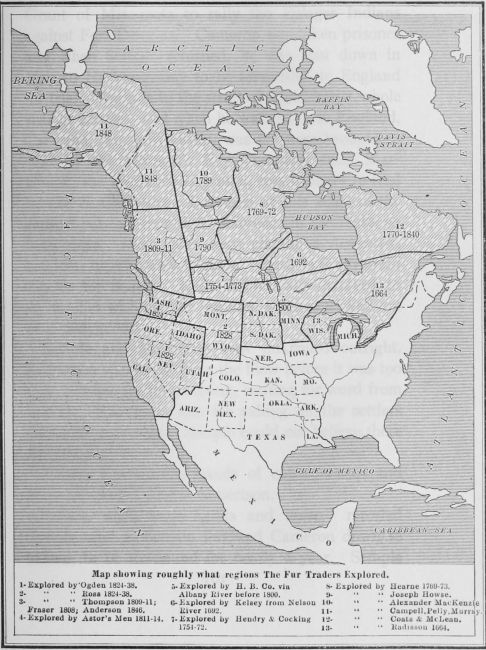
Map showing roughly what regions The Fur Traders Explored.
Click
here for larger map
- 1- Explored by Ogden 1824-38.
- 2- Explored by Ross 1824-38.
- 3- Explored by Thompson 1809-11; Fraser 1808; Anderson 1846.
- 4- Explored by Astor’s Men 1811-14.
- 5- Explored by H. B. Co. via Albany River before 1800.
- 6- Explored by Kelsey from Nelson River 1692.
- 7- Explored by Hendry & Cocking 1754-72.
- 8- Explored by Hearne 1769-73.
- 9- Explored by Joseph Howse.
- 10- Explored by Alexander MacKenzie.
- 11- Explored by Campell, Pelly, Murray.
- 12- Explored by Coats & McLean.
- 13- Explored by Radisson 1664.
Robertson did not wait for the storm to break.
Taking half a dozen men with him on March 13,
1816, he marched across to Fort Gibraltar to seize
Cameron as hostage. It was night. The light of
a candle guided them straight to the room where
the Northwest partner sat pen in hand over a letter.
Bursting into the room, Robertson who was of a
large and powerful frame, caught Cameron by the
collar. Two others placed pistols at the Nor’Wester’s
head. There lay the most damning evidence
beneath Cameron’s hand—the letter asking
Grant of Minnesota to rally the Pillager Indians
against Fort Douglas. Cameron was taken prisoner
and when Semple returned, he was sent down in
May to Hudson’s Bay to be forwarded to England
for trial. Ice jam in the straits delayed him a whole
year at Moose; and when he was taken to England,
Cameron, the Nor’Wester, was no more brought to
trial by the Hudson’s Bay Company than MacDonell,
the Hudson’s Bay man, was brought to trial
by the Nor’Westers. I confess at this stage of the
game, I can see very little difference in the faults on
both sides. Both sides were playing a desperate,
ruthless, utterly lawless game. Both had advanced
too far for retreat. Even Selkirk was involved in
the meshes with his two hundred soldiers tricked out
as a bodyguard.
Semple and Robertson now quarreled outright.
Robertson was for striking the blow before it was too
late; Semple for temporizing, waiting for word from
Selkirk. Robertson was for calling all the settlers
inside the palisades. Semple could not believe there
was danger.
“Then I wash my hands of consequences and
leave this fort,” vowed Robertson.
“Then wash your hands and leave,” retorted
Semple, and Robertson followed Cameron down to
Moose, to be ice-bound for nearly a year. Semple
continued his mad policy of enforcing English poaching
laws on Red River. Gibraltar was dismantled
and the timber rafted down to Fort Douglas.
Up in the North, Robertson’s Athabasca brigade,
under fighting John Clarke, had come to dire disaster.
Clarke felt so cock-sure that his big brigade
could humble the Nor’Westers into suing for union
with the Hudson’s Bay that he had galloped his
canoes up the Saskatchewan, never pausing to gather
store of pemmican meat. A third of the men were
stationed at Athabasca Lake, a third sent down the
MacKenzie to Slave Lake, a third, Clarke, himself,
led up the Peace to the mountains. On the way,
the inevitable happened. Clarke ran out of provisions
and set himself to obtain them by storming
the Nor’Wester, McIntosh, at Fort Vermilion. McIntosh
let loose his famous Northwest bullies, who
beat Clarke off and chased him down the Peace to
Athabasca. Archibald MacGillivray and Black
were the partners at Chippewyan, and many a trick
they played to outwit Clarke during the long winters
of 1815-16. Far or near, not an Indian could Clarke
find to barter furs or provisions. The natives had
been frightened and bribed to keep away. Once,
the coureur brought word that a northern tribe was
coming down with furs. The Nor’Westers gave a
grand ball to their rivals of the Hudson’s Bay, but
at midnight when revels were at their height, a
Northwest dog train without any bells to sound
alarm, sped silently over the snow. The Indian
hunters were met and the furs obtained before the
Hudson’s Bay had left the dance. Another night,
a party of Hudson’s Bay men had gone out to meet
Indians approaching with provisions. Suddenly,
Nor’Westers appeared at the night campfire with
whiskey. The Hudson’s Bay men were deluded
into taking whiskey enough to disable them. Then
they were strapped in their own sleighs and the dogs
headed home.
Clarke was almost at the end of his tether when
the Nor’Westers invited him to a dinner. When he
rose to go home, MacGillivray and Black slapped
him on the shoulder and calmly told him he was their
prisoner. As for his men, eighteen died outright of
starvation. Others were forced at bayonet point or
flogged into joining the Nor’Westers. Many scattered
to the wilderness and never returned. Of the
two hundred Hudson’s Bay voyageurs who had gone
so gloriously to capture Athabasca, only a pitiable
remnant found their way down to the Saskatchewan
and Lake Winnipeg. Clarke obtains not one pack of
furs. The Nor’Westers send out four hundred.
Notes to Chapter XXVII.—The data for this chapter have
been drawn from the same sources as the preceding chapter.
In addition, I took the cardinal facts from two other sources
hitherto untold; (1) from Colin Robertson’s confidential letters
to Selkirk; (2) from Coltman’s report to the Canadian Government
and Sherbooke’s confidential report to the British Government—all
in manuscript. In addition there are the printed
Government Reports (including Coltman’s) and Trials and
Archives, but I find in these public reports much has been suppressed,
which the confidential records reveal. I am again indebted
to Abbé Dugas for the legend of Lajimoniere’s trip East.
Events thicken so fast at this stage of the H. B. C. and N. W. C.
fight, space does not permit record of all the bloody affrays,
such for instance as the killing of Slater, the H. B. C. man, at
Abbittibbi, the death of Johnstone at Isle a la Crosse, or the
violence there when Peter Skene Ogden drove the Indians from
the H. B. C.
The name of the armed schooner, which was to patrol Lake
Winnipeg to drive the Nor’Westers off, Coltman gives as Cathullin,
and a personal letter of Lieut. Holte (H. B. C.) declares that
he was to be commander.
MacDonell’s proclamations seem to have been feudalism run
mad. In July of 1814, he actually forbade natives to bark
trees for canoes and wigwams, or to cut large wood for camp
fires. Then followed his notices ordering the N. W. C. to move
their forts.
Howse, the explorer, was at this time in charge of Isle a la
Crosse.
The H. B. C. colonists, who sided with Cameron and carried
across to the N. W. C. the four brass cannon, four swivels, one
howitzer—were George Bannerman, Angus Gunn, Hugh Bannerman,
Donald McKinnon, Donald McDonald, George Campbell.
Robert Gunn, John Cooper, Angus McKay, Andrew McBeth
and John Matheson opposed giving the arms to Cameron
and were loyal to Selkirk.
Peter Fidler’s Journal (manuscript) gives details of 1815 at
Fort Douglas.
When the colony was dispersed in June, 1815, it consisted of
thirteen men and their families—forty persons. The N. W. C.
took no part in the flight of the colonists to Lake Winnipeg. It
was the Half-breeds who ordered them to leave Red River.
The Colony Buildings burnt were four houses grouped as the
fort, five farm houses, barns, stables, a mill and eighteen settlers’
cabins. This was not done by order of the N. W. C. but
by the Plains Rangers.
It appeared in N. W. C. records that as high as £100 was
paid some of the colonists to desert Red River.
Selkirk’s letter to Robertson, which the N. W. C. captured
from Lajimoniere, ran thus: “There can be no doubt that the
N. W. C. must be compelled to quit ... my lands ...
especially at the Forks ... but as it will be necessary to
use force, I am anxious this should be done under legal warrant.”
I cannot see much difference between Selkirk bringing up De
Meurons to drive the N. W. C. off, and Cameron calling on the
Indians to drive the H. B. C. off.
May 18th, Cameron was sent to the bay. June 11th, Robertson
quarreled with Semple and followed. June 10th, Semple had
ordered the dismantling of Gibraltar, which was completed
after Robertson left.
Letters from McIntosh of Peace River give details of Clarke’s
disaster in Athabasca, describing his men “as starving like
church rats and so reduced they were not able to stand on their
feet, and were a picture of the resurrection.”
Some authorities, like McDonald of Garth, give the number of
Voyageurs sent to Athabasca by Robertson as four hundred.
I follow Robertson’s MS. account.
It is not surprising that one of the first settlers to desert Red
River for Ontario was that Angus McKay, whose child was
born on the sled journey to York.
CHAPTER XXVIII
1816-1820
THE COMING OF THE COLONISTS CONTINUED—GOVERNOR
SEMPLE AND TWENTY COLONISTS ARE
BUTCHERED AT SEVEN OAKS—SELKIRK TO THE
RESCUE CAPTURES FORT WILLIAM AND SWEEPS
THE NOR’WESTERS FROM THE FIELD—THE SUFFERING
OF THE SETTLERS—AT LAST SELKIRK
SEES THE PROMISED LAND AT RED RIVER.
Here, then, is the position, June 17, 1816.
My Lord Selkirk is racing westward
from Montreal to the rescue of his Red
River colonists with two hundred men made up of
disbanded De Meuron and De Watteville soldiers and
French canoemen.
William McGillivray has gathered all the Eastern
partners of the Northwest Company together—McLoughlin,
the doctor; Simon Fraser, the explorer;
McLeod, the justice of the Peace; Haldane, McLellan,
McGillis, Keith and the rest—and with a
hundred armed men and two cannon, is dashing for
Red River to outrace Selkirk, rescue Duncan Cameron,
restore Fort Gibraltar, and prevent the forcible
eviction of the Northwest Company from Assiniboia.
Selkirk goes by way of Lake Ontario and the
modern Simcoe. The Nor’Westers follow the old
trail up the Ottawa.
In the West, blacker gathers the storm. Deprived
of their pemmican by Semple’s raids, the Nor’Westers
rally their Plain Rangers under Cuthbert
Grant to Alexander McDonell of Qu’ Appelle, determined
to sweep down the Assiniboine and meet
the up-coming express from Montreal at all hazards.
This will prevent Semple capturing those provisions,
too. Incidentally, the Plain Rangers intended to
rescue Cameron from the Hudson’s Bay men. They
do not know he has been sent to the bay. Incidentally,
too, they intend “to catch Robertson and skin
him and feed him to the dogs.” They do not know
that he, too, has gone off in a huff to the bay. Gibraltar
is to be restored. They do not know that it has
been dismantled. Then, when the Nor’West partners
come from the East, the Hudson’s Bay people
are to be given a taste of their own medicine. No
attack is planned. The Plain Rangers are to keep
away from Fort Douglas; but the English company
is to be starved out, and if there is resistance—then,
in the language of Alex McDonell, mad with the lust
of revenge for the death of Eneas—“the ground is to
be drenched with the blood of the colonists.”
In Fort Douglas sits Robert Semple, Governor of
the Colony, his cannon pointed across Red River to
stop all trespassers on Selkirk’s domain.
One other chessman there is in the desperate game.
Miles MacDonell, the captured governor of Red
River, has been released at Montreal and is speeding
westward in a light canoe with good cheer to the
colonists—word of Selkirk’s coming.
Red River is the storm center. Toward it converge
three different currents of violence: the Plain
Rangers from the West; Selkirk’s soldiers, and the
Nor’Westers’ men from the East. What is it all
about? Just this—shall or shall not the feudal system
prevail in the Great Northwest? Little cared
the contestants about the feudal system. They were
fighting for profits in terms of coin. They were
pawns on the chess board of Destiny.
Comes once more warning to the blinded Semple,
secure in his beliefs as if entrenched in the castle of
a feudal baron. A chance hunter paddles down the
Assiniboine to Red River. “My governor! My
governor!” the rough fellow pleads. “Are you not
afraid? The Half-breeds are gathering! They are
advancing! They will kill you!”
“Tush, my good man,” laughs Semple, “I’ll show
them papers proving that we own the country.”
“Own the country? What does that mean?”
The freeman shakes his head. No man owns these
boundless plains.
Comes again Moustache Batino, whom Doctor
White had healed of a wound.
“A hundred and fifty Bois Brulés (Burnt Wood
Runners) are at the Portage of the Prairie! They
will be here by to-morrow night.”
“Well, what of it? Let ’em come,” smiles
Semple.
The Indian ruminates—Is this Englishman mad?
“Mad! Nonsense,” says Semple to his secretary,
Wilkinson. “They will never be such fools as to
break the law when they know we have right on our
side.”
But old Chief Peguis of the Sauteurs knows nothing
at all about that word “law.” June 18th, at night
when the late sunset is dyeing the Western prairies
blood red, Peguis knocks at the fort gates.
“Governor of the gard’ners and land workers,”
he declares, “listen to me—listen to me, white man!
Let me bring my warriors to protect you! The Half-breeds
will be here to-morrow night. Have your
colonists sleep inside the fort.”
Semple grows impatient. “Chief,” he declares,
“mark my words! There is not going to be any
fighting.”
All the same Peguis goes to Marie Gaboury,
Lajimoniere’s wife. “White woman,” he commands,
“come you across the river to my tepee!
Blood is to be shed.”
And Marie Gaboury, who has learned to love the
Indians as she formerly feared them, follows Chief
Peguis down the river bank with her brood of children,
like so many chickens.
Such is her fright as she ensconces the children in
the chief’s canoe, that she faints and falls backward,
upsetting the boatload, which Peguis rescues like so
many drowned ducklings, but Lajimoniere’s family
hides in the Pagan tent while the storm breaks.
On the evening of June 19th, the boy on watch in
the gate tower calls out, “the Half-breeds are coming.”
Semple goes up to the watchtower with a
spyglass. So do Heden, the blacksmith; and Wilkinson,
the secretary; and White, the doctor; and
Holte, the young lieutenant of the Swedish Marines;
and John Pritchard, who has left the Nor’Westers
and joined the colony; and Bourke, the
storekeeper.
“Those certainly are Half-breeds,” says Pritchard,
pointing to a line of seventy or a hundred horsemen
coming from the west across the swamps of Frog
Plain beyond Fort Douglas toward the colony.
“Let twenty men instantly follow me,” commands
Semple. “We’ll go out and see what those people
want.”
Bayonets, pistols, swords are picked up in confusion,
and out sallies a little band of twenty-seven
men on foot.
The Half-breeds are not approaching Fort Douglas.
They are advancing toward the colony. Half
a mile out, Semple meets the colonists rushing for
the fort in a wild panic. Alex McBeth, a colonist
who had been a soldier, calls out, “Keep your back
to the river, Governor! They are painted! Don’t
let them surround you.”
“There is no occasion for alarm! I am only going
to speak to them,” answers Semple, marching on,
knee-deep through the hay fields. All the same, he
sends a boy back with word for Bourke, the storekeeper,
and McLean, the farmer, to hitch horses and
drag out the cannon. As the Half-breeds approach
Semple sees for himself they are daubed in war paint
and galloping forward in a semi-circle. Young
Holte of the Marines becomes so flustered that he
lets his gun off by mistake, which gives the Governor
a start.
“Mind yourself,” Semple orders. “I want no
firing at all.”
“My God, Governor! We are all lost men,” mutters
Heden, the blacksmith; and Kilkenny, a fighting
Irishman, begs, “Give me leave, Governor! Let me
shoot; or we shall all be shot. There’s Grant, the
leader. Let me pick off Grant!”
“No firing, I tell you,” orders Semple angrily, and
the two parties come in violent collision on a little
knoll of wooded ground called Seven Oaks.
With Grant are our old friends of the Saskatchewan—Falçon,
the rhyming poet; and Boucher, son
of the scout shot on the South Saskatchewan; and
Louis Primo, old reprobate who had deserted Cocking
fifty years ago; and two of Marguerite Trottier’s
brothers from Pembina; and a blackguard
family of Deschamps from the Missouri; and seventy
other Plain Rangers from the West.
Followed by a bloodthirsty crew hard to hold,
Cuthbert Grant was appalled to see Semple march
out courting disaster.
“Go tell those people to ground their arms and
surrender,” he ordered Boucher.
“What do you want?” demanded Semple as
Boucher galloped up.
“Our fort,” yelled Boucher forgetting his message.
“Then go to your fort!” vehemently ordered
Semple.
“Rascal! You have destroyed our fort,” roared
the angry Half-breed.
“Dare you address me so?” retorted Semple,
seizing the scout’s gun. “Men—take him prisoner!”
“Have a care you do me no ill,” shouted Boucher
slipping off the other side of his horse, prancing
back.
“Take him prisoner—I say! Is this a time to be
afraid?” shouts Semple.
“My God! We are all dead men,” groans Sutherland,
the Scotch colonist, for the dread war whoop
had rent the air. There was a blaze of musketry,
and there reeled back with his arms thrown up—young
Holte, the officer who had boasted that with
the Lake Winnipeg schooner “he would give the
Northwest scoundrels a drubbing.” Another crash,
and Semple is down with a broken thigh. Cuthbert
Grant dismounts and rushes to stop the massacre.
“I am not mortally wounded! Take me to the
fort,” gasps Semple. Grant turns to call aid. The
Deschamps stab the Governor to death on the spot.
The firing lasts less than fifteen minutes, but twenty
of the Hudson’s Bay men have fallen, including all
the officers, four colonists, fifteen servants. Captain
Rodgers is advancing to surrender when he is hacked
down. Of the twenty-seven who followed out,
Pritchard, the former Nor’Wester, is saved by surrender;
and five men escape by swimming across
the river. As for the cannon, Bourke is trundling
it back as fast as the horses can gallop. McLean,
the settler, has been slain. One, only, of the Plain
Rangers, Batoche, has been killed; only one wounded—Trottier
of Pembina; and Cuthbert Grant at last
succeeds in stopping the infuriated rabble’s advance
and drawing off to camp west of Seven Oaks.
No need to describe the blackness of the work
that night on the prairie. The Half-breeds wreaked
their pent-up vengeance on the bodies of the slain.
Let it be said to the credit of the Nor’Westers, they
had no part in this ghoulish work. The worst miscreants
were the Deschamps of the Missouri, whose
blood-stained hands no decent Indian would ever
touch after that night. In camp, Pierre Falçon, the
rhymster, was chanting the glories of the victory, and
Pritchard was pleading with Grant for the lives of
the women and children. For years afterward—yes,
even to this day—terrible stories were told of the
threats against the families of the colonists; but let
it be stated there was never at any time the shadow
of a vestige of a wrong contemplated against the
women and children. What Indians might do, old
Chief Peguis had shown. What the Deschamps,
who were half-white men, might do—the mutilated
bodies of the dead at Seven Oaks revealed.
Pritchard was sent across to the fort with word
that the colonists must save themselves by surrender.
Otherwise, Grant could not answer for their safety
among his wild Plain Rangers. The panic of the
two hundred people inside was pitiable. For a
second time they were to be driven houseless to the
wilderness, and yet the bolder spirits were for manning
the fort and resisting siege. If only they could
have known that Selkirk was coming; but Lajimoniere
lay captive in the butter-vat prison at Fort
William, and Miles MacDonell had not yet come.
Without help, how could two hundred people subsist
inside the palisades? A white sheet was tied on
the end of a pole, and the colonists marched out on
June 22nd, at eight in the morning, Grant standing
guard to protect them as they embarked in eight
boats for Lake Winnipeg. Before abandoning Fort
Douglas, Angus Matheson and old Chief Peguis
gather a few of the dead and bury them in a dry
coulée near the site of the old Cree graveyard at the
south end of modern Winnipeg’s Main Street. Other
bodies are buried as they lie at Seven Oaks; but the
graves are so shallow they are ripped open by the
wolves. Grant rides along the river bank to protect
the colonists from marauders till they have passed
the Rapids of St. Andrew’s and are well beyond
modern Selkirk.
Beyond Selkirk, at the famous camping place of
Nettley Creek, whom should the colonists meet but
the Nor’ West partners galloping their canoes at racehorse
pace to reach the field of action before Selkirk.
“What news?” calls Norman McLeod; but the
news is plain enough in the eight boat loads of dejected
colonists.
The Nor’Westers utter a war whoop, beat the
gun’els of their canoes, shout their victory. “Thank
Providence,” writes one partner, Robert Henry,
“that the battle was over before we got there, as it was
our intention to storm the fort. Our party consisted
of one hundred men, seventy firearms, two field pieces.
What our success might have been, I will not pretend
to say; but many of us must have fallen in the contest.”
The Nor’Westers have always maintained
that they had not planned to attack Fort Douglas
and that the onus of blame for the fearful guilt of
Seven Oaks Massacre rested on Semple for coming
out to oppose the Half-breeds, who were going to
meet the Montreal express. Such excuse might do
for Eastern law courts, whose aim was to suppress
more than they revealed; but the facts do not sustain
such an excuse. The events are now a century past.
Let us face them without subterfuge. The time had
come, the time was bound to come, when the rights
of a Feudal Charter would conflict violently with the
strong though lawless arm of Young Democracy.
Therein lies the significance of what apologists and
partisans have called the Skirmish of Seven Oaks.
Norman McLeod, the Justice of the Peace, hails
the harried colonists ashore at Nettley Creek. They
notice among the Northwest partners several soldiers
dressed in regimentals—mark that, those who condemn
Selkirk for hiring De Meuron soldiers! Two
can play at the game of putting soldiers in red coats
to bluff the Indians into believing the government is
behind the trader. The settlers notice also, carefully
hidden under oilcloth, two or three brass cannon
in the Nor’Westers’ boats. Mark that, those who
condemn Selkirk for bringing cannon along with his
bodyguard!
As justice of the peace, Norman McLeod seizes
the dead Semple’s baggage for incriminating papers.
As justice of the peace—though it was queer kind of
peace—he arrests those men who escaped from
Seven Oaks, and claps them in irons that prevent
Bourke, the storekeeper, from dressing his wounds.
The colonists are then allowed to proceed to their
wintering ground amid the desolate woods of Lake
Winnipeg at Jack River.
The triumphant Nor’Westers do not wait long at
Red River. McLeod goes on to rule like a despot
in Athabasca. The others hurry back to their annual
meeting at Fort William, for they know that Selkirk
is coming West. Bourke and the prisoners are
carried along to be thrown into the butter-vat prison.
Dark are the plots the prisoners overhear as they
journey up Winnipeg River and Rainy Lake down to
Lake Superior. Alex McDonell of the Assiniboine,
burning for revenge as usual, urges the partners
to make “his Lordship pay dearly for his conduct
coming west; for I will say no more on paper—but
there—are fine quiet places along Winnipeg River,
if he comes this way!” And one night in camp on
Rainy Lake, Bourke, the prisoner, lying in the dark,
hears the Nor’West partners discussing affairs. Selkirk’s
name comes up. Says Alex McDonell, “The
Half-breeds could easily capture him while he is
asleep.” Bourke does not hear the other’s answer;
but McDonell rejoins, “They could have the Indians
shoot him.” Were they planning to assassinate Selkirk
coming West? Who knows? Alex McDonell
was ever more violent than the rest. As for Selkirk,
when word of this conversation came to him, he took
care neither to come nor go by Winnipeg River.
In passing back from Red River across Winnipeg
Lake, the Nor’Westers pause to destroy that armed
Hudson’s Bay schooner, which was “to sweep Northwest
canoes” from the lake. Down at Fort William,
the Hudson’s Bay prisoners are flung into the prison
along with the captured scout, Lajimoniere. “Things
have gone too far; but we can throw the blame on
the Indians,” says William McGillivray.
“But there was not an Indian took part in the
massacre,” retorts Dr. John McLoughlin, always
fair to the native races, for he has married the Indian
widow of that Alex McKay of MacKenzie’s voyages
and Astor’s massacred crew.
In the despatches which were stolen from Lajimoniere,
Selkirk had written to Colin Robertson
that he was coming to Red River by way of Minnesota
to avoid clashes with the Nor’Westers at Fort
William. By July he had passed from Lake Simcoe
across Georgian Bay to the Sault. Barely had he
portaged the Sault to Lake Superior when he meets
Miles MacDonell, his special messenger, galloping
back from Red River in a narrow canoe with word
of the massacre.
What to do now? Selkirk could go on to Red
River by way of Minnesota; but his colonists are no
longer there. At the Sault are two magistrates of
the Indian country—Mr. Askin and Mr. Ermatinger.
Lord Selkirk swears out information before them
and appeals to them to come with him and arrest the
Northwest partners at Fort William. They refuse
point-blank. They will have nothing to do with this
quarrel between the two great fur companies—this
quarrel that really hinges on feudalism versus democracy;
English law as against Canadian. To
obtain justice in Eastern Canada is impossible.
That, Selkirk has learned from a winter of futile
bickering for military protection to prevent this very
disaster. Selkirk writes fully to the new governor
of Canada—Sir John Sherbrooke—that having failed
to obtain protection from the Canadian courts he
has determined to go on, strong in his own right—as
conferred by the charter and as a justice of the
peace—to arrest the Northwest partners at Fort
William. “I am reduced to the alternative of acting
alone, or of allowing an audacious crime to pass unpunished.
I cannot doubt it is my duty to act, though
the law may be openly resisted by a set of men accustomed
to consider force the only criterion of right.”
The Nor’Westers had forcibly invaded and destroyed
his colony. Now he was forcibly to invade
and destroy their fort. Was his decision wise? Was
it the first misstep into the legal tangle that broke
his courage and sent him baffled to his grave? Let
who can answer! Be it remembered that the Canadian
authorities had refused him protection; that
the Canadian magistrates had refused him redress.
His De Meuron soldiers had not worn their military
suits. He bids them don their regalia now and
move forward with all the accouterments of war—a
feudal lord leading his retinue!
“Between ten and eleven this morning, the Earl
of Selkirk accompanied by his bodyguard, came up
the river in four canoes,” writes Jasper Vandersluys,
a clerk of Fort William, on August 12, 1816. “Between
one and two, he (Selkirk) was followed by eleven
or twelve boats, each having from twelve to fifteen
soldiers all armed, who encamped on the opposite
shore.” The afternoon passed with Selkirk’s men
planting cannon along the river bank, heaping cannon
balls in readiness and cleaning all muskets.
Nor’West voyageurs and their wives rush inside the
palisades. The women are sheltered in a central
building upstairs above a trapdoor. The men are
sent scurrying to hide one hundred loaded muskets
in a hay loft. In the watchtower above the gates
stand the Nor’West partners—William McGillivray,
the three MacKenzies—Alex, son of Roderick; Kenneth,
and old drunken, befuddled Daniel—Simon
Fraser, the explorer; several of the McDonell clan,
and Dr. John McLoughlin, shaking his head sadly
at these preparations for violence. “There has been
too much blood shed already,” he remarks.
Next afternoon comes a Hudson’s Bay messenger
from Selkirk asking for McGillivray. McLoughlin
and Kenneth MacKenzie accompany McGillivray
across the river. One hour passes; two hours! The
women, watching from the loft windows above the
trapdoor, began to hope that a truce had been arranged.
At seven in the evening the partners had
come from the watchtower to shut the gates when
two boat loads of some sixty soldiers glide up to the
wharf. Fraser and Alex McDonell and old drunken
Daniel MacKenzie rush to slam the gates shut.
One leaf is banged when a bugle sounds! Captain
D’Orsonnens of the soldiers, shouts “To arms, to
arms,” plants his foot in the gateway and with
flourishing sword rushes his men into the courtyard
“with loaded muskets and fixed bayonets,
shouting, cursing, swearing death and destruction
to all persons.” One Nor’Wester rushes to ring an
alarm bell. The others have dashed for their apartments
to destroy papers. In a twinkling, Selkirk’s
men have captured every cannon in Fort William
and are knocking at the doors of the central building.
Not a gun has been fired; not a blow struck; not a
drop of blood shed; but the trampling feet terrify
the women in the attic. They crowd above the trapdoor
to hold it down, when, presto! the only tragedy
of the semi-farce takes place! The crowding is too
much for the trapdoor. Down it crashes spilling
the women into the room below, just as the astonished
De Meurons dash into the apartment to seal all
desks and papers. It is a question whether the
soldiers or the women received the greater shock;
but the greatest surprise of all is across the river
where the three Northwest partners are received by
Selkirk between lines of armed soldiers and are
promptly arrested, bail refused, for complicity in
the massacre of Seven Oaks. Selkirk allows them
to go back to the fort on parole for the night and
orders the liberation of those Hudson’s Bay prisoners
in the butter-vat prison—Lajimoniere and the survivors
of Seven Oaks, who tell my lord a tale that
sharpens his vengeance. The night passes in alarm.
Soldiers on guard at the room of each partner detect
the Nor’Westers burning papers that might be used
as evidence; and the loaded muskets are found in
the hay loft; and furs are discovered stamped R. R.—H. B. C.—which
have been rifled from some Hudson’s
Bay post.
Day dawns in a drizzling rain. Across the river
comes my Lord Selkirk, himself, with the pomp of a
war lord, bugles blowing, soldiers in the boats with
muskets on shoulders, a guard to the fore clearing
the way. The common voyageurs are forthwith
ordered to decamp to the far side of the river. Lord
Selkirk takes up quarters in the main house, the
partners being marched at bayonet point to other
quarters. For four days the farce lasts. Lord Selkirk
as justice of the peace examines and commits for
trial all the partners present. The partners present
scorn his assumption of authority and formally demand
that the voyageurs be sent West with supplies
for the year. Selkirk’s answer is to seize the voyageurs’
canoes and set his soldiers to using the palisades
of Fort William for firewood. Then, under
pretense of searching for evidence on the massacre at
Seven Oaks, he seizes all Northwest documents.
Under pretense of searching for stolen furs, he examines
all stores. On August 18th, everything is in
readiness to conduct the prisoners to Eastern Canada,
all except old Daniel MacKenzie.
Drunken old MacKenzie is remanded to the prison
for special examination. MacKenzie had long since
been incapacitated for active service, and he treasured
a grudge against the other partners for forcing
him to resign. Why is MacKenzie being held back
by Selkirk? Before the other partners are carried
off, their suspicions are aroused. Perhaps they see
Miles MacDonell and the De Meurons plying the
old man in his prison with whiskey. At all events,
they command the clerks left in charge to ignore
orders from Daniel MacKenzie. They protest he
has no authority to act for the Northwest Company.
It may be they remember how they had jockeyed
John Jacob Astor out of his fort on the Pacific by a
forced sale; and now guess the game that is being
played with Daniel MacKenzie against them. The
partners’ baggage is searched. The De Meurons
turn even the pockets of the haughty partners inside
out. Then the prisoners are embarked in four large
canoes under escort of De Meuron soldiers. The
canoes are hurriedly loaded and badly crowded.
Near the Sault, on August 26th, one swamps and sinks,
drowning seven of the people, including the partner,
Kenneth MacKenzie. Allan McDonell and Doctor
McLoughlin escape by swimming ashore. At what
is now Toronto, the prisoners are at once given bail,
and they dispatch a constable to arrest Selkirk at
Fort William; but Selkirk claps the constable in
gaol for the month of November and then ignominiously
drums him from the fort. With Selkirk,
law is to be observed only when it is English. Canadian
courts do not count.
Fuddled with drink, crying pitiably for more,
Daniel MacKenzie passed three weeks a prisoner
in the butter vat, three more a prisoner in his own
room. Six weeks of dissipation, or else his treasured
spite against the other partners, now work so on
MacKenzie’s nerves that he sends for Miles McDonell
on September 19th, and offers to sell out the
Nor’Westers’ possessions, worth £100,000, at Fort
William, to Lord Selkirk for £50 down, £2,000 in a
year, and the balance as soon as the whole price
could be arbitrated by arbitrators appointed by the
Lords Chief Justice of England. “I have been
thinking,” runs his rambling letter in the hand-writing
of Miles McDonell, “that as a partner of
the North-West Company and the only one here at
present that I can act for them myself, that all the
company’s stores and property here are at my disposal;
that my sale of them is legal by which I can
secure to myself all the money which the concern owes
me and keep the overplus in my hands until a legal
demand be made upon me to pay to those entitled.... I
can not only dispose of the goods but the
soil on which they are built if I can find a purchaser.”
Naturally, MacKenzie finds a purchaser in my
Lord Selkirk of the Hudson’s Bay and almost at once
receives his liberty. Just as McDougall had sold out
the Americans on the Columbia, so MacKenzie now
sells out the Nor’Westers at Fort William.
Then the old man writes rambling confessions and
accusations which—he boasts to Selkirk—contain
evidence “that will hang McGillivray” for the
massacre of Seven Oaks. Selkirk decides to send
him to Eastern Canada as a witness against the
partners, but before he is sent he writes circular
letters to the wintering partners of the Northwest
Company advising them to follow his example and
save themselves from ruin by turning over their forts
to Lord Selkirk. In October he is sent East, but
by the time he reaches the Sault, his brain has cleared.
He meets John McLoughlin and other Northwest
partners returning to the Up Country and confesses
what he has done. Instead of turning witness against
them, he proceeds East to sue Selkirk for illegal imprisonment.
If Selkirk’s first mistake was trying to enforce
feudalism on Red River and his second the raiding
of Fort William, his third error must be set down as
using an old drunkard for his tool. For the first
error, he had the excuse that English law was on his
side. For the second, he claimed that “Fort William
had become a den of marauders and robbers and he was
justified in holding it till the Nor’Westers restored
Red River,” but for the trickery with old MacKenzie
there existed no more excuse than for the lawlessness
of the Nor’Westers. To say that Miles McDonell
wrote the letters with MacKenzie’s signature and
that he engineered the trick—no more clears Selkirk
than to say that paid servants committed the most
of the crimes for the Northwest partners. It is the
one blot against the most heroic figure in the colonizing
of the West. And the trick fooled no one.
Not a voyageur, not a trader, flinched in his loyalty
to the Northwest Company. Not a man would
proceed west with the canoes for the Hudson’s Bay
officers.
The Lords of the North had fallen and their glory
had departed; but not a man of the service faltered
in his loyalty. It was a loyalty strong as the serf
for the feudal baron.
From Fort William, Selkirk’s soldiers radiated to
the Northwest posts of Rainy Lake and Minnesota.
Peter Grant was brought prisoner from Fond du
Lac for obstructing the Selkirk scout, Lajimoniere.
At the Pic, at Michipicoten, at Rainy Lake, the De
Meuron soldiers appear and the Northwest forts surrender
without striking a blow. Then Captain
D’Orsonnens sets out in December with twenty-six
men for Red River. He is guided by J. Ba’tiste
Lajimoniere and the white man who had lived among
the Ojibbways—Tanner. They lead him along the
iced river bed to Rainy Lake, then strike straight
westward through the snow-padded forests of Minnesota
for the swamp lands that drain to Red River
near the Boundary. All travel by snowshoes,
bivouacking under the stars. Then a dash down
Red River by night march on the ice and the Selkirk
forces are within striking distance of Fort Douglas
by the first week of January, 1817. Wind and
weather favor them. A howling blizzard enshrouds
earth and air. They go westward to the Assiniboine
in the wooded region now known as St. James
and Silver Heights. Here in the woods, hidden by
the snowstorm, they construct scaling ladders. On
the night of January 10th, the storm is still raging.
D’Orsonnens rushes his men across to Fort Douglas.
Up with the scaling ladders and over the walls are
the De Meurons before the Nor’Westers know they
are attacked! As fell Fort William, so falls Fort
Douglas without a blow or the loss of a life. J.
Ba’tiste learns with joy that his wife, Marie Gaboury,
has not been murdered at all but is living safe
under old Chief Peguis’ protection across Red River,
and the French woman’s amazement may be guessed
when there appeared at the hut where Peguis had
left her, the wraith of the husband whom she had
believed dead for two years. Tanner, the other scout,
stays in D’Orsonnens’ service till Selkirk comes.
The dispossessed Nor’Westers scatter to Lake
Winnipeg. After them marches D’Orsonnens to
Winnipeg River, where Alex McDonell is trying to
bribe the Indians to sink Selkirk’s boats when he
comes in the spring. The De Meurons capture the
post at Winnipeg River, and send coureurs to recall
the scattered colonists. Alex McDonell escapes to
the interior.
All the while, from June 19th to January 19th, the
colonists had been wandering like the children of
Israel in a wilderness of woes. When they had been
driven to Lake Winnipeg by the massacre, they had
begged Mr. Bird of the Saskatchewan to forward
them to Hudson Bay, whence they could take ship
for England, but Bird pointed out there was no boat
coming to the bay in 1816 large enough to carry
two hundred people. To go to the bay for the winter
would be to risk death from starvation. Better winter
on the good hunting and fishing grounds of Lake
Winnipeg. It was well the majority took his advice,
for the Company ships this year were locked in the
bay by the ice. Cameron, the Northwest prisoner,
and Colin Robertson, his inveterate enemy, were
both ice-bound at Moose. The few settlers who
pushed forward to the bay like the widow McLean,
wife of the murdered settler, passed a winter of semi-starvation
at the forts.
Bird set the colonists fishing for the winter, and
they erected huts at Jack River. Here, then, came
De Meuron soldiers in the spring of 1817, to lead the
wandering colonists back to Red River; and to Red
River came Selkirk by way of Minnesota in the summer.
For the first time the nobleman now saw the
Promised Land to which he had blazed a trail of
suffering and sacrifice and blood and devotion
for Earth’s Dispossessed of all the world! D’Orsonnens
had given out a few packs of seed, grain and
potatoes to each settler. Rude little thatch-roofed
cabins had been knocked together with furniture extemporized
of trees and stumps. Round each cabin
there swayed in the yellow July light to the rippling
prairie wind, tiny checker-board patches of wheat
and barley and oats, first fruits of infinite sacrifice,
of infinite suffering, of infinite despair—type for all
time, sacrificial and sacred, of the Pioneer! For the
first time Selkirk now saw the rolling prairie land,
the rolling prairie world, the seas of unpeopled, fenceless,
limitless fields, free as air, broad as ocean! To
these prairie lands had he blazed the Trail. Was it
worth while—the suffering on that Trail, the ignominy
he was yet to suffer for that Trail? Did
Selkirk foresee where that Trail was to lead; how the
multitudinous feet of Life’s Lost, Earth’s Dispossessed,
would trample along that Trail to New Life,
New Hope, New Freedom? Faith in God, confidence
in high destiny, had been to the children of
Israel through their wilderness, a cloud of shade by
day, a pillar of fire by night. Had Selkirk the comfort
of the same vision, confidence of the same high
destiny for his people? I cannot answer that. From
the despairing tone of his letters, I fear not. All we
know is that like all other great leaders he made
mistakes, and the consequences of those mistakes
hounded him to his death.
In August, he gathered the people round him on
the spot where St. John’s Cathedral now stands.
He shook hands with each and learned from each
his tale of suffering. To each he gave one hundred
acres of land free of all charges, as compensation
for their hardships. Then he gave them two more
lots. “This lot on which we stand, shall be for your
church,” he said. “That lot south of the creek shall
be for your school; and in memory of your native
parish, this place shall be called Kildonan.” To
render the title of the colonists’ land doubly secure,
Selkirk had assembled the Swampy Crees and Saulteaux
on July 18th and made treaty with them for
Red River on condition of a quit-rent of one hundred
pounds of tobacco. To Lajimoniere, the scout, Selkirk
assigned land in the modern St. Boniface, that
brought to Marie Gaboury’s children, and her
children’s children, untold wealth in the town lots of
a later day. Tanner, the stolen white boy, Selkirk
tried to recompense by advertising for his relatives
in American papers. A brother in Ohio answered
the advertisement and came to Red River to meet
the long lost boy. The restoration was fraught with
just such disaster as usually attends the sudden
transplanting of any wild thing. Tanner, the white
boy, had become Tanner the grown Indian. He
left his Indian wife and married a Christian girl of
Detroit. The union was agony to them both. Tanner
was a man at war in his own nature—neither
white man nor Indian. In a quarrel at the Sault
some years later, he was accused of shooting a man
and fled from arrest to the swamps. When spring
came, his skeleton was found. He had either suicided
in despair, or wounded himself by accident
and perished of starvation in the swamp. Many
years afterwards the confession of a renegade soldier
in Texas cleared Tanner’s reputation of all guilt.
The soldier himself had committed the murder,
and poor Tanner had fled from the terrors of laws
he did not understand like a hunted Ishmaelite to
the wilderness. To-day, some of his descendants
are among the foremost settlers of Minnesota.
In May, 1817, Royal Proclamation had commanded
both companies to desist from disorders and
restore each other’s property. William Bachelor
Coltman and Major Fletcher came as Royal Commissioners
to restore order and take evidence. Fort
William passed back to the Nor’Westers and a new
Gibraltar arose on the banks of the Assiniboine.
Urgent interests called Selkirk East. Trials were
pending in Upper and Lower Canada against both
companies for the disorders. With Tanner as guide
to the Mississippi, Selkirk evaded the plots of the
Nor’Westers by going south to St. Louis, east to New
York, and north to Canada.
Volumes have been written and heads cracked
and reputations broken on the justice or injustice of
the famous trials between the Nor’Westers and Hudson’s
Bay. Robertson, the Hudson’s Bay man, was
to be tried for seizing Gibraltar. The Nor’Westers
were charged with being accomplices to the massacre
of Seven Oaks. Selkirk was sued for the imprisonment
of Daniel MacKenzie and the resistance offered
to the Canadian sheriff at Fort William. In every
case except the two civil actions against Selkirk, the
verdict was “not guilty.” Whether the judges were
bribed by the Nor’Westers as the Hudson’s Bay
charged, or the juries were “unduly influenced” by
Selkirk’s passionate address and pamphlets, as the
Nor’Westers declared—I do not purpose discussing
here. Selkirk was sentenced to pay £1,500 for imprisoning
Daniel MacKenzie and £500 for resisting
the sheriff. As for the verdicts, I do not see how a
Canadian court could have given a verdict favorable
to the Hudson’s Bay, without repudiating rights of
Canadian possession; or a verdict favorable to the
Nor’Westers, without repudiating the laws of the
British Empire. The truth is—the old royal charter
had created a condition of dual authority that was
responsible for all the train of disasters. It was
unofficially conveyed to the leaders of both companies
by the British Government that if they could
see their way to union, it would remove the necessity
of the British Government determining which company
possessed the alleged rights.
As for Selkirk’s fines, they were paid jointly by
the Hudson’s Bay Company and himself. William
Williams, a swashbuckler military man, is appointed
at £1,000 a year to succeed Semple and force the
trade so that the Nor’Westers will be compelled to
sue for union and accept what terms are offered.
More men are to be sent up from Montreal to capture
Athabasca. The Rev. John West is appointed
clergyman of Red River in 1819, at £100 a year.
Annuities of £50 each are granted for life to Semple’s
two sisters. Pensions are granted the widows of
settlers killed at Seven Oaks—to the widows McLean,
Donovan, Coan and two others. Oman Norquay,
forbear of Premier Norquay of modern Manitoba,
is permitted to quit the Company service and
join the colony. So are the Gunn brothers and the
Bannermans, and the Mathesons, and the Isbisters,
and the Inksters, and the Hardisties, and the
Spencers, and the Fletts, and the Birds. Selkirk
has gone to France for his health, harried and weary
of the thankless strife. On November 8, 1820, he
dies. The same year, passes away his great opponent
in trade and aim—Sir Alexander MacKenzie,
in Scotland. The year that these two famous leaders
and rivals died, there was born in Scotland the next
great leader of the next great era in the West, the
nation building era that was to succeed the pioneering—Donald
Smith, to become famous as Lord
Strathcona and Mount Royal.
Notes to Chapter XXVIII.—The data for this chapter are
gathered from so many sources, it is almost impossible to give
except in a bibliographical list. Every book or pamphlet
written on this era I possess in my library and consulted, and
I may add—ignored, for the reason that all are so absurdly
partisan, either a rabid defense of the H. B. C. making no
mention of the faults of the English, or a rabid attack on the
H. B. C. giving not a jot of the most damning evidence against
the N. W. C.
While consulting all secondary authorities on this chapter,
I have relied solely on the confidential reports to the British
Government which I obtained from the Records Office by
special permission of the Colonial Secretary. These include
Sherbrooke’s report to Bathurst, Coltman’s confidential summary
to Sherbrooke, the letters which the N. W. C. showered
upon the Home Government, the memorials with letters appended
which the H. B. C. filed. From these sources I got the
letters from which all direct quotations are made, such, for
instance, as the plan to assassinate Selkirk, which tells against
the Nor’Westers; or the trickery with Daniel MacKenzie, which
tells against Selkirk. Nor have I quoted the worst of these
letters; for instance, the details where Alex McDonell plans
the death of Selkirk. Alex McDonell must not be taken too
seriously as representing the Nor’Westers’ sentiment, for from
the time his brother Eneas was killed by a H. B. C. man, Alex
McDonell was no longer sane on the subject. He was a Highlander
gone mad with revenge. Nor have I quoted the evidence
of an H. B. C. man about the N. W. C. partners walking over
the field of Seven Oaks cracking jokes about the mangled bodies
of the slain. The witnesses who gave such evidence were
ignorant men with inflamed minds, and in addition—I am sorry
to add—liars! In the first place, the bodies had been buried
before the partners arrived. In the second, though the wolves
tore the bodies up, Dr. McLoughlin and Simon Fraser were not
the kind of men to exult ghoulishly over the scalped corpses
of dead white men. It shows the absurd lengths to which
fanaticism had run when such testimony was credited, and is
of a piece with that other vulgar slander that the N. W. C.
intended to turn the Half-breeds loose among the women and
children.
It may be objected that “trickery” is too strong a term regarding
the treatment of old Daniel MacKenzie, especially in
view of the fact he himself was avowedly unreliable. The
evidence must speak for itself. MacKenzie had been induced
to write letters to the wintering partners advising them to turn
things over to Selkirk. When his name was signed, MacDonell
undertook to change the letter. Here is one with MacDonell’s
changes in brackets:
To Roderick MacKenzie
Fort William on Lake Superior. Sept. 1816.
Dear Roderick (Sir):
By a canoe that returned (to the interior) from near the
Mountain Portage, you must have heard the events that has
taken place here. Mr. McGillivray and all the partners including
myself, were made prisoners. All the gentlemen are sent
down prisoners to take their trial at York as aiding, abetting and
instigating the murder, the dreadful massacre. The N. W. C.
is ruined beyond a hope. (The packs here will not go down
nor will goods be permitted to enter the interior, the Red River
being declared in a state of rebellion.) The massacre that has
taken place on Red River is the (principal) cause of all this. Lord
Selkirk may (perhaps) soften matters in your favor provided
you will (make your submission to him in time and) honestly
own all that you know about the instigators of this horrid affair.
I have his Lordship’s command to tell you so (I have heard as
much, though not direct from his Lordship) and I would advise
you as your own and the friend of your deceased father to
(come forward immediately with some proposal to save yourself)
submit to his Lordship’s pleasure. You should also explain
to these deluded half breeds (young men whom you may see
and the unfortunate half breeds who were guilty of such extremities)
that it was the ambition of others that rendered us
all miserable. That is the real truth. (I am happy to learn
that you endeavored to save Gov. Semple’s life. This is much
in your favor.... The only advice I have to give is to
submit, etc.)
I have some thirty pages of transcripts on the Athabasca
Campaign this year of 1816. Space does not permit the full
story of the first campaign. The second campaign, Colin Robertson
tells in the next chapter. I have also omitted the story
of Keveney’s murder. It is not an integral part of the struggle.
Keveney had been Selkirk’s recruiting agent in Ireland, and was
hurrying from Albany to join Selkirk at Red River in September,
1816. He proved a very brute to his men, lying in state
while they toiled at the oar, then at night sticking a bayonet in
any poor guard who chanced to fall asleep on duty. His men
deserted him. Keveney was captured by the N. W. C. on
Winnipeg River and treated as a gentleman among the officers.
This treatment he abused by trying to escape. The N. W. C.
then handcuffed him, but what were they to do with him?
They did not want him in Red River as a spy, and Selkirk held
Fort William. They ordered an Indian and a paid soldier
(de Reinhard) to take him out in a boat and kill him on the
way up Winnipeg River. The Indian shot him. Reinhard
finished the murder by running a sword through his body.
This sort of high-handed ruffianism should be remembered
when considering Selkirk’s course at Fort William. Reinhard
was carried prisoner to Montreal for this, but there was no
conviction.
The exact number of soldiers employed by Selkirk is given
as one hundred and forty. The other sixty men were voyageurs.
I have purposely omitted the name of another McDonell in
this chapter—namely the man who succeeded Governor Semple
as commander of Fort Douglas for two days before the surrender.
There are so many McDonells in this chapter and all related
that I have avoided mentioning any but the main actors.
All of these who survived the fights finally retired to live in
Glengarry on the Ottawa and in Cornwall. One may guess
with so many members of the fiery clan on opposing sides, how
old age arguments must have waxed hot. The McDonells of
Toronto are kin of this clan. Governor Semple’s successor was
known as “grasshopper McDonell.”
Many writers state no colonists were killed at Seven Oaks.
Nevertheless, five widows were pensioned, one poor widow on
condition she could prove her claim, as another woman claimed
the pension of the deceased settler.
Semple had been employed only a year when he met death.
Yet the company pensioned his two sisters for life, though the
H. B. C. was on the verge of bankruptcy. Semple’s father left
Philadelphia for London when the Revolutionary War broke
out.
The N. W. C. say that Selkirk meant from the first to attack
Fort William. This is nonsense. The letters sent by Lajimoniere
warned Robertson to prepare for him in Minnesota.
The letter was stopped by the N. W. C. and found by Selkirk
in a secret press at Fort William. Did the Nor’Westers intend
to attack Fort Douglas? They say not, but between attacking
a fort and starving it out is not wide difference.
In most of the evidence it is shown that Boucher ordered
Semple in French, Semple answering in English. I have given
it all in English.
A full account of Seven Oaks will be found in the novel,
“Lords of the North,” with free rendering of Pierre’s song.
The fate of the Deschamps will be found in “The Story of the
Trapper.”
Coltman’s official report is marvelously impartial, considering
he had formerly been an agent for the H. B. C. Major
Fletcher did not count. Tradition and private letters of Sherbrooke
relate that the major was scarcely sober during the
journey of investigation.
Full account of Tanner’s life will be found in the Minnesota
Hist. Society’s Collections. Tanner was the son of a clergyman
on the Ohio. He was stolen by wandering Shawnees when
barely eight years old, and sold to a woman chieftain of the
Ottawas at the Sault. Here at an early age he married a
native girl. When his brother found him at Red River, Tanner
was averse to going back to civilization: He hated the white
man clothes, which his brother induced him to wear, and appeared
at Mackinac a grotesque figure with coat sleeves and
trouser legs foreshortened. The Wisconsin Society’s Historical
Collection contains an account of him at this period. At Mackinac,
his squaw wife, of whom he was very fond, refused to go on
with him to the white man’s land, and she remained at Mackinac.
Poor Tanner’s stay in civilization was short. He came
back to the Sault with a white wife. The man, of whose death
he was accused, was the brother of Henry Schoolcraft at the
Sault. The quarrel was over attentions to a young daughter of
Tanner’s. As stated in the main story, a blackguard soldier, not
Tanner, was the real murderer.
Instructions from Governor Semple to Colin Robertson.
Fort Douglas, 12 April, 1816.
Colin Robertson, Esq.,
Sir:
I heard with pleasure of yr. having taken possession of
the Fort occupied by the N. W. C. at the Forks of Red River.
It was a measure on wh. I was fully determined and wh. was
not only justified but imperiously demanded by the conduct and
avowed hostilities of our implacable opponents.
With regard to intercepting the despatches of the N. W. C.
it was a step arising out of the former and wh. has happily furnished
its own justification to the fullest extent. A more complete
disclosure of plans of deliberate villainy has never yet
met my eye and I can only regret that such schemes of pillage,
burning and murder should have been planned and be so nearly
on the point of execution by men belonging to the same country
as ourselves.
I am, Sir,
Yours sincerely,
(Signed) Robert Semple.
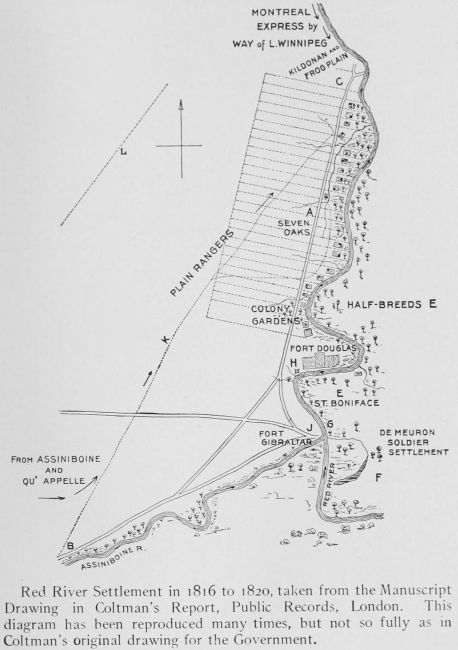
Red River Settlement in 1816 to 1820, taken from the Manuscript
Drawing in Coltman’s Report, Public Records, London. This
diagram has been reproduced many times, but not so fully as in
Coltman’s original drawing for the Government.
Click
here for larger map
Governor Semple to Duncan Cameron
Fort Douglas, 31 March, 1816.
Sir:
I regret that an indisposition subsequent to my arrival here
has prevented my addressing you till now. I think it my duty
to tell you as soon as possible the charges alleged against you
and wh. I assure you will demand yr. most serious consideration.
1st. You are accused of seducing His Majesty’s subjects
settled on Red River and the servants of the Earl of Selkirk to
desert and defraud their master and one to whom the former
were largely indebted.
2d. Of collecting, harbouring and encouraging Half-breeds
and vagabonds with the avowed purpose of destroying an
Infant British Colony.
3d. Through the means of these men thus collected of
firing upon, wounding and causing the death of His Majesty’s subjects
defending their property in their own houses.
4th. Through the means of these men headed by yr. clerks
or the clerks of the N. W. C. such as Cuthbert Grant, Charles
Hesse, Bostonais Pangman, William Shaw and others of burning
a fort, a mill, sundry houses, carts, ploughs and instruments of
agriculture belonging to the said infant colony.
5th. Of wantonly destroying English cattle brought here
at an immense expense and of carrying off horses, dogs and
other property to a large amount.
The horses were collected in your own fort and distributed
by yourself and your partner Mr. A. McDonnell, to those men
who had most distinguished themselves in the above act of
robbery and mischief.
6th. Of encouraging Indian tribes to make war upon British
subjects attempting to colonize, representing to them according
to their ideas that cattlemen would spoil their lands and
make them miserable, and expressing your hope they would
never allow it.
7th. Without unnecessarily multiplying charges it appears
now by your own letters that you were making every preparation
to renew the same atrocities this year, if possible on a more
extensive scale, collecting the Half-Breeds from points still
more distant than before and endeavoring to influence both
their rage and avarice by every means in yr. power. You even
breathe the pious wish that the Pilleurs may be excited against
us here saying “they may make a very good booty if they only
go cunningly to work.”
Such are the principal charges you will be called upon to
answer. It would be easy but at present unnecessary to swell
the catalogue with minor but serious accusations and however
much a long residence here may induce you to consider them
of small importance, depend upon it they will be viewed in a
very different light by a British jury and a British public.
The whole mass of intercepted papers now in my hands
appears to disclose such wicked principles and transactions
that I think it my duty to forward them to be laid before His
Maj.’s ministers by the director of the Honourable, the H. B. C.
I am preparing a letter to the agents and proprietors of the
N. W. C. advising them of this my resolution and the motives
wh. have determined me to it, a copy of wh. shall be handed
to you meantime.
I remain, Sir,
Robert Semple.
D. Cameron, Esq.
CHAPTER XXIX
1816-1821
BOTH COMPANIES MAKE A DASH TO CAPTURE ATHABASCA
WHENCE CAME THE MOST VALUABLE
FURS—ROBERTSON OVERLAND TO MONTREAL,
TRIED AND ACQUITTED, LEADS A BRIGADE TO
ATHABASCA—HE IS TRICKED BY THE NOR’WESTERS,
BUT TRICKS THEM IN TURN—THE
UNION OF THE COMPANIES—SIR GEORGE SIMPSON,
GOVERNOR.
It was mid-winter before word that Fort Douglas
had fallen into the hands of the Nor’Westers
and Fort William into the hands of Lord Selkirk,
came to Colin Robertson ice-bound at Moose.
Robertson was ever the stormy petrel of every fight—one
of those doughty heroes of iron strength who
thought no more of tramping seven hundred miles
on snowshoes for Christmas dinner with some comrade
of the wilds than town men think of a voyage
across their own dining-room. Though he knew
very well that the Half-breeds had threatened “to
flay him alive,” that the Indians had been bribed to
scalp him, and that warrants were out in Montreal
for his arrest in connection with the seizure of Gibraltar
from the Nor’Wester, Cameron—Robertson did
not hesitate for a moment. He set out on snowshoes
for Montreal. Now that Selkirk was on the field,
Robertson knew it would be a fight to the death.
The company that captured Athabasca, whence
came the wealth of furs, would be able to force the
other to terms of union.
To be sure, Sherbrooke, Governor General of
Canada, had issued a Royal Proclamation commanding
peace; but Williams, the new Hudson’s
Bay governor, declared “the royal proclamation was
all d—— nonsense!” He “would drive every Nor’Wester
out of the country or perish in the attempt.”
On the Nor’Westers’ side was equal defiance of the
Proclamation. The most of the Northwest Eastern
partners were either under bail or yet in confinement.
Of their Western partners, Norman McLeod, the
justice of the peace, was the ruling spirit; and his
views of the Canadian Proclamation may be guessed
from orders to his bullies in Athabasca: “Go it, my
lads! Go it! You can do what you like here!
There is no law in the Indian Territory!”
Down to Montreal, then, came Colin Robertson,
full of fight as an Irishman of Tipperary. “The
effusions of the Nor’Westers might have staggered
my resolution to come to Montreal,” he writes in his
letters of 1817 to officers of the Hudson’s Bay Company.
“‘Robertson go to Montreal! No! He may
find his way to the States if we don’t catch him!’
Such was the language held forth at Sault Ste. Marie,
Lake Superior, which had no other effect on me than
calling forth a little caution.... I was at the
Sault when a fur trader made his appearance in a
light canoe on his way from Red River to Montreal.
With him, I embarked and arrived at the Lake of
the Two Mountains on the 11th of August, 1817....
As soon as the fur trader pushed off, I requested
a Frenchman to furnish me with a small
Indian canoe and two faithful Iroquois ... I
embarked at midnight ... and crossed the
lake about an hour after sunrise.... M. de
Lotbiniere ... furnished me with a calash at
eleven that night.... I entered Montreal at
five in the morning and drove to Dr. Monroe’s, the
least suspicious place, his profession making early
calls frequent. I was at once recognized by the
doctor, who informed me that a partner of the North-West
Company had apartments in the upper part of
the house. I immediately muffled myself in my
cloak and so entered.... As soon as I had
breakfast, I made my appearance in the streets of
Montreal, where I was stared at by friends of the
Nor’Westers as if I were a ghost ... and my
appearance gathered such a crowd, I was obliged to
disappear inside a boarding house....”
“The residences of the Nor’Westers in London
and Montreal are splendid establishments, the resorts
of the first in society, the benefit from this ostentatious
display of wealth being the friendship of
legal authorities.... Even the prisons of Montreal
are become places of public entertainment from
the circumstance of yet holding some partners of
the North-West Company.... Every other
night, a ball or supper is given; and the Highland
bagpipes utter the sound of martial music as if to
deafen public censure. The most glaring instance
of the Nor’Westers’ contempt for law is their attempt
to attract public notice by illuminating all the prison
windows every night. Strangers will naturally ask:
‘for what crimes are these gentlemen committed?
For debt?’ No ... for murder ...
arson ... robbery.... Our old friend,
Mr. Astor, is here.... He is frequently in the
society of the Nor’Westers ... and feels very
sore toward them about Astoria.”
Robertson’s letters then tell of his trial for the
seizure of Gibraltar and his acquittal. He frankly
hints that his lawyers had to bribe the Montreal
judge to secure “a fair” hearing. So passed the
year. In 1818 came Selkirk back from Red River
to Montreal, who agreed with Robertson that the
only way to force the Nor’Westers to their knees was
to send a second expedition to capture Athabasca,
whence came the wealth of furs that enabled the rival
Company to bribe the courts. In April, 1819, Robertson
set out with a flotilla of nineteen canoes from
Ste. Anne’s, each canoe with five French voyageurs,
and went up the Ottawa across Lake Superior to
Thunder Bay. “This place gave me a bad turn the
other day,” he writes. “The wind blew fresh but the
swell was by no means high. My Indians seemed
reluctant to attempt the traverse. I imprudently ordered
them a glass of rum, when the whoop was immediately
given! In a moment, our canoe was in the
swell. We came where a heavy sea was running.
Here, we began to ship water. The guide ordered
the bowman removed back to the second thwart.
This lightened the head. An oilcloth was then
thrown over the head of a canoe to avoid the breaking
of the sea. The silence that prevailed, when one
of those heavy swells was rolling upon us, was truly
appalling. Paddles were lifted and all watched the
approach with perfect composure. Our steersman
kept balancing the slender bark by placing her in the
best position to the waves.... The moment
the roller passed, every paddle was in the water,
every nerve stretched to gain the land! Although
two men were employed bailing out water, fifty yards
more would have swamped us....”
From Lake Superior, the brigade passed up to the
Lake of the Woods and Lake Winnipeg, where Robertson
was joined by the same John Clarke who
had suffered defeat in Athabasca on the first expedition.
Here the forces were increased to one hundred
and thirty men by the refugees of the first brigade,
who had escaped from the North. Robertson’s
letter from this point gives some particulars
of the first brigade’s expulsion from Athabasca:
“The Nor’Westers did not confine themselves to the
seizure of persons and property. They administered
an oath to our servants, threatening with starvation
and imprisonment if they did not comply, that
for the space of three years these Hudson’s Bay
servants would not attempt to oppose the North-West
Company. One of the guides, a witty rogue,
who knew theology from the circumstance of his
cousin being a priest, fell on a way of absolving his
French countrymen from this oath ... to repair
to the woods and cross themselves and ask
pardon of their Maker for a false oath to a heretic;
but some poor Scotchmen could not cheat their conscience
so easily, and I have had to let them leave
me on that account....”
The Nor’Westers had kept as a deadly secret from
the Indians all knowledge of the fact they had been
beaten by Lord Selkirk. Robertson’s next letter
tells how the secret leaked out in Athabasca. Amidst
the uproarious carousals of the Nor’Westers at Chippewyan,
the Hudson’s Bay captives were brought to
the mess room to be the butt of drunken jokes. On
one occasion, Norman McLeod bawled out a song
in celebration of the massacre of settlers at Red
River, of which each verse ended in this couplet:
“The H. B. C. came up a hill, and up a hill they came,
The H. B. C. came up the hill, but down they went again!”
Roars of laughter were making the rafters ring
when it suddenly struck one of the Hudson’s Bay
prisoners that the brutal jeer might be paid back in
kind.
“Y’ hae niver asked me for a song,” says the canny
Hudson’s Bay McFarlane to his Nor’West tormentor.
“If agreeable, I hae a varse o’ me ain compaesin’.”
“Silence, gentlemen,” roars McLeod to the
drunken roomful of partners and clerks and Indians.
“Silence! Mr. McFarlane, your song.”
Remembering that the power of the Northwest
Company with the Indians depended on the frightened
savages being kept ignorant of Lord Selkirk’s
victories, the Hudson’s Bay man’s thin voice piped
up these words to the same tune:
“But Selkirk brave went up a hill, and to Fort William came,
When in he popped—and out from thence—could not be driven—a-g-a-i-n!”
Before the last words had died in the appalling
silence that fell on the rowdies, or the Indians could
quite grasp what the song meant, McLeod had
jumped from his chair yelling:
“I’ll give you a hundred guineas if you’ll tell
the name of the man who brought news of that
here.”
But McFarlane had no wish to see some faithful
coureur’s back ripped open with the lash. “Tut-tut,”
says he, “a hundred guineas for twa lines of me
ain compaesin’—Extravagant, Mr. McLeod, Sir!”
October saw Robertson at last on the field of action—in
Athabasca. “Well may the Nor’Westers boast
of success in the North,” he writes. “Not an Indian
dare speak to the Hudson’s Bay. At Isle a la Crosse,
a clerk and a few of our men were in a hut surrounded
by the sentinels of our opponents. Apart from no
intercourse with the Indians, they were thankful to
be able to procure mere subsistence for themselves.
All their fish nets and canoes had been destroyed by
the Nor’Westers in prowling excursions. The only
canoe on which their escape depended was hidden
in a bedroom. No Indian dared to approach. The
windows were covered by damaged table cloths.
Wild fowl shot flying over the house had to be
plucked with the door shut.... Not an Indian
could be found.... As we voyaged up to
Athabasca, we began firing and kept our men singing
a voyageur’s song to let the Indians know we
were passing.” Finally, an Indian was seen hiding
behind brush of the river bank, and was bribed to
go and bring his tribe. The truth was told to the
Chippewyans about the Nor’Westers’ defeat on Red
River and Lake Superior. Peace pipes were whiffed,
and a treaty made.
The consternation of the Nor’Westers when they
saw Robertson, and Clarke whom they had abused
in captivity three years before, now draw up on Athabasca
Lake before Fort Chippewyan with a force
of one hundred and thirty armed men, at once gave
place to plots for the ruin of the intruders. Black,
who had been the chief tormentor of Clarke, dashed
down to the waterside shouting: “Mr. Robertson!
Mr. Robertson! To avoid trouble, let me speak to
our Indians before you land! You are an honorable
man—give us justice!”
“Honorable,” roared the indignant Clarke, shaking
the canoe in his wrath. “Justice be blanked!
Did you give us justice when you hounded us out of
Athabasca,” and he followed the serenade up with
a volley that brought the whole Northwest Company
to the shore.
Before trouble could brew, Robertson marshaled
his men to the old Hudson’s Bay quarters, and
within a few days more than forty Indian tents had
deserted from the Nor’Westers. Clarke was sent up
Peace River for the winter. Robertson retained a
force of one hundred men well equipped with arms
and provisions to hold the fort at Lake Athabasca.
“We had completed the fitting out of the Indians,”
he writes, “established our fisheries and closed the
fall business when the loaded canoes of the Northwest
hunters began to arrive. Black, the Nor’Wester,
is now in his glory, leading his bullies. Every
evening they come over to our fort in a body, calling
on our men to come out and fight pitched battles.
One of their hair-pulling bullies got his challenge accepted
and an unmerciful thrashing to boot from a
little Frenchman of ours—Boucher. Mr. Simon McGillivray,
the chief partner of the Nor’Westers, who is
with Mr. McLeod, was rather forward on this occasion.
Having a strong force, he approached too near.
I ordered our men to arms and his party made a precipitate
retreat. Our men are in high spirits. The
Indians have regained confidence in us and boldly leave
the Nor’Westers every day for the Hudson’s Bay.”
Now that their winter hunters had come in, and
they were stronger, the Nor’Westers were not to be so
easily routed from Athabasca. Robertson’s next letters
are dated from the Nor’Westers’ fort. He had
been captured within ten days of his arrival. “You
... will perceive from the date of this letter, the
great reverse.... If I were the only sufferer it
might be borne, but when I reflect on the consequences
to the Hudson’s Bay Company and to Lord
Selkirk, it almost drives me mad.... On the
morning of the 11th of October, about an hour before
day, my servant entered my bedroom and informed
me a canoe had just arrived with the body of a fisherman
accidentally shot the night before....
Sleep was out of the question. I rose and ordered
an early breakfast, but just as we were sitting down
one of the men entered with word that a Northwest
bully had come and was daring little Boucher to
fight. As was my custom, I put a pistol in my
pocket and going toward the fellow saw Mr. Simon
McGillivray, the Northwest partner.... Just
then eight or ten Nor’Westers made a rush from concealment
behind.... It was all a trick....
I was surrounded.... In the struggle my
pistol got entangled and went off.... At the
sound, they rushed on me and dragged me to the
beach.... I freed myself and laid about with
my empty pistol.... When thrown in the
canoe, I tried to upset and escape by swimming, but
Black put a pistol to my head till we arrived at the
Nor’Westers’ fort.... Landing, I dashed for
their Indian Hall and at once ... called on
the Indians, representing that the cowardly attack
was an effort to reduce them to slavery; but Black
rushed up to stop me. Seizing a fork on the hall
table I kept the vagabond at bay. I loaded him with
every abuse and evil name I could think of, then to
the Indians: ‘Do not abandon the Hudson’s Bay on
this account! There are brave men at our fort to
protect you! That fellow was not brave enough to
seize me; he stole me, and he would now rob you
of your hunt if it were not for the young men I have
left in my fort. Tell Clarke not to be discouraged.
We will be revenged for this, but not like wolves
prowling in the bushes. We will capture them as
we captured them at Fort William, with the sun shining
on our faces.’ At this moment, the Indian chief
came up and squeezing my hand, whispered, ‘Never
mind, white man! All right! We are your friends.’ ...
This closed the turbulent scene....
Figure my feelings ... tumbled by an act of
illegal violence from the summit of hope ...
confidence of friends withdrawn ... all my
prospects for life blasted ... mere personal
danger is secondary now—I am in despair.”
Simon McGillivray, Black, McIntosh, McLeod,
in a word, the most influential partners in the Northwest
Company were at Fort Chippewyan when Robertson
was captured; but the post was in charge of
that John George McTavish, who had helped to trick
Astor out of his fur post on the Columbia. It was
probably the ruinous lawsuits against the Nor’Westers
that now restrained their savage followers
from carrying out their threat “to scalp Robertson
and feed him to the dogs,” but the Hudson’s Bay
leader was clapped into a small room with log walls,
under guard day and night. He was compelled to
state his simplest wants in a formal daily letter. Pen
and paper, the clothes on his back, a jack-knife in
his pocket—that was Robertson’s entire paraphernalia
during his captivity; but for all that, he outwitted
the enemy. One of his written requests was
that a Nor’Wester go across to the Hudson’s Bay
fort under flag of truce for a supply of liquor. The
Nor’Westers were delighted at the chance to spy on
the Hudson’s Bay fort, and doubly delighted at the
prospect of their captive fuddling himself hors de
combat with drink. It was an easy trick to give a
rival his quietus with whiskey.
Taking long strips of writing paper, the Hudson’s
Bay man invented a cipher code in numbers from
one to six hundred, some well known trading phrase
placed opposite each number. This he rolled like
a spool, so tight it was waterproof, sealed each end
with wax, knocked the bung out of the whiskey barrel,
bored a tiny hole beside the bung with his jack-knife,
hooked a piece of twine through one end to the sealed
message, the other to the inner end of the plug, thrust
the paper inside the liquor and plugged up the hole.
Then dusting all over with mud from the floor of the
cabin, he complained the whiskey was musty—diluted
with rum. He requested that it be sent back
with orders for his men to cleanse the barrel. Before
sending it back, the Nor’Westers actually sealed the
barrel “contents unknown.” But what was Robertson’s
disgust when the men of the fort instead of
cleansing this barrel, sent back a fresh one!
Again he put his wits to work. Sending for a
volume of Shakespeare’s plays, he wrote in fine pencil
opposite Falstaff’s name: “Examine—the—first—keg.”
The messenger, who went for the weekly
supply, carried the Shakespeare back to the Hudson’s
Bay fort. A week passed. No sign came from his
men. Exasperated to the point of risk, Robertson
tried a last expedient. The next week, the messenger
carried an open letter to Robertson’s men. It was
inspected by his captors but allowed to pass. It
read: “To amuse myself, I am trying to throw into
verse some of Falstaff’s good sayings. There is one
expression where he blows out, ‘I am not a wit but
the cause of wit in others.’ This sounds harsh.
Please send exact words as in the play.” No doubt
the Northwest partners thought poor Robertson far
gone with liquor when he took to versifying. Back
came word with the week’s supplies, stating that the
volume of Shakespeare had been carried off to the
fishery by one of the traders; but “would Mr. Robertson
please let his men know if he wished the following
traders to have the following supplies”—a
string of figures conveying the joyful news that the
cipher had been found; the Hudson’s Bay fort was
on guard against surprise; the men were in good
spirits; the Indians loyal; all things prosperous.
For eight months a prisoner in a small room, Robertson
directed the men of his own fort by means of
the whiskey kegs, sending word of all secrets he could
learn in the enemy’s camp, checkmating every move
of the Nor’Westers among the Indians. In vain, he
urged his followers to sally out and rescue him. The
Hudson’s Bay traders were not willing to risk another
such massacre as on Red River. Immunity
bred carelessness. In the month of May a Nor’Wester,
spying through crevices of the logs, caught
Robertson sealing up the bung in the whiskey keg.
Swords and pistol in hand, the angry partners burst
into the room with torrents of abuse that Robertson
was quite able to return. He was too dangerous a
man to keep prisoner. The Nor’Westers decided to
ship him out of the country on pain of assassination if
he dared to return. No doubt Robertson smiled.
His own coureurs had long since been sent speeding
over prairie and swamp for Red River to warn the
Hudson’s Bay governor, Williams, to catch the Northwest
fur brigade when the canoes would be running
the rapids of the Saskatchewan in June.
Of the forty Nor’Westers conducting the June
brigade to Montreal, half a dozen were directors.
“I was embarked with Simon McGillivray,” Robertson
writes. “At Isle a la Crosse ... seeing
the strong rapids before us, I threw off my cloak
as was my custom when running rapids....
What was my horror when I perceived our canoe
swept out of its track into a shute over the rocks....
Our steersman shouted, ‘My God, we are
all lost.’ ... The canoe upset.... I attempted
to swim ashore but the strong eddies drew
me under the falls where I found Mr. Simon McGillivray
and two or three others clinging to the
gun’els of the canoe.... The canoe swept on
down the current and Mr. Shaw, one of the partners,
caught us below.” What was almost an escape
through an accident evidently suggested to Robertson’s
mind that it was not absolutely necessary he
should be deported out of the country against his
will. At Cumberland House, where the brigade
camped for a night, there was a Hudson’s Bay as
well as a Northwest post. Robertson asked leave to
say good-by to his old friends, but no sooner was
he inside the gates of the Hudson’s Bay post than
bolts were shot and every man of the ten inside the
palisades, armed ready to fire if the Nor’Westers
approached. “I have escaped,” he writes, “but not
agreeable to my feelings.... However my
friends may applaud the act, my conscience tells me
I have not done right in breaking my parole....
However, it is all over now.... At half past
ten in the morning, the Northwest canoes pushed
off from the beach without me.”
Where the Saskatchewan empties into Lake Winnipeg
are rough ledges of rock known as Grand
Rapids. Here, it was usual to lighten loads, passengers
landing to walk across the portage, the voyageurs
running the canoes down full swirl to a camp below
the rapids. Robertson knew that Williams, the
Hudson’s Bay governor from Red River, would be
waiting for the Northwest brigade at this point.
Barely had his captors’ canoes paddled away from
Cumberland House, when Robertson launched out
on their trail far enough behind to escape notice,
bound for the exciting rendezvous of Grand Rapids.
“In paddling along,” he writes, “we were suddenly
interrupted with a shout ‘Canoe ahead!’ ...
A shot was fired.... We arranged our pistols.
The canoe was plainly approaching us. What shall
be done? If these are enemies, the water is the
safest place for defense. It was a moment of
anxiety. As the canoe came nearer, a stranger stood
up, waved his hat and shouted, ‘Glorious news!
Five North-West partners captured at Grand Rapids—Shaw,
McIntosh, Campbell, McTavish and Frobisher
taken! I am sent to meet Mr. Robertson!’
We at once shaped our course to the canoe when our
voyageurs struck up a song the men of both canoes
yelling a cheer at each chorus.” At eleven on the
morning of July 30th, Robertson crossed the portage
of Grand Rapids. He found himself in the midst
of a stirring scene. Strung across the river at the
foot of the rapids were barges mounted with swivels.
On the bank lay the entire year’s output of Athabasca
furs, the poor French voyageurs huddling together,
the loudest bully cowed; and apart from the camp
in the windowless lodge of an old French hunter,
were the captured Northwest partners surrounded
by the guard of a hundred De Meuron soldiers
under Governor Williams. This was a turning of
the tables with a vengeance. As Williams blurted
out in a gasconade striding forward to welcome
Robertson, “two could play at the capturing business.”
And a sorry thing “the capturing business” proved.
Robertson does not give any details. He is evidently
both ashamed of the episode and sorry; but the account
is found in the journals of the Nor’Westers.
Anxious to rescue Robertson, the Hudson’s Bay
governor had his barges strung across the river and
his soldiers in ambush along the trail of the portage,
when the unsuspecting Athabasca brigade, laden
with furs to the water line, glided down the Saskatchewan.
The canoes arrived in three detachments on
the 18th, and 20th, and 30th of June. Rapids behind
and pointed swivels before, the voyageurs were
easy victims, surrendering to the soldiers at once. It
was another matter with the partners. Both Hudson’s
Bay and Nor’Westers knew these lawless raids
would be condemned by the courts; but each side
also knew if it could capture and hold the other out
of the Athabasca for a single year, the excluded rival
would be ruined.
Frobisher and Campbell, accompanied by two servants,
were the first partners to set out across the
portage. Half way over, a movement in the grass
caught their attention, and before they could speak
they were surrounded by fifteen Hudson’s Bay
soldiers with pointed bayonets. Frobisher was a
man of enormous strength and violent temper. No
Nor’Wester had exercised more wanton cruelty over
Hudson’s Bay captives than he. As he saw himself
suddenly looking into the barrel of a Hudson’s
Bay gun, he had involuntarily knocked aside the
muzzle and doubled his fist for a blow, when sharp
bayonet prods in the small of his back sent him along
the path at a run. The other partners as they came
were captured in the same summary way. Cooped
up in the hunter’s lodge at the foot of the rapids,
they demanded of Governor Williams his warrant for
such proceedings.
“Warrant?” roared the Hudson’s Bay governor.
“What warrant had you when you held Robertson
captive all last winter in Athabasca? What warrant
had you for flogging Clarke out of the country two
years ago? Talk to me of your Royal Proclamations
of peace! I don’t care a curse for your royal
proclamations. I rely on the charter of the Hudson’s
Bay Company. Your governor of Canada is a
d—— rascal! He is bribed by your Northwest gold!
Warrants—indeed! Warrants are d—— nonsense
in this country! Out of this country you go. I’ll
drive out every Nor’Wester or die in the attempt.”
In the midst of the tornado, some excitement arose
from McIntosh, a Northwest partner, who was ill
and had run the rapids with his canoemen, jumping
overboard and trying to swim ashore. Two Hudson’s
Bay canoemen pursued, caught him by the
scruff of the neck and towed him ashore. Satisfied
that he had captured all the partners in this brigade,
Williams at once released the clerks and voyageurs
with their cargoes of furs to proceed to Montreal.
As the canoemen walked out of the hunter’s cabin
past the sentry, Frobisher beside himself with rage
at the governor’s rating—attempted to follow. He
was clubbed to the ground. He hurled the full force
of his herculean strength at his assailant. This time,
the gun-stock struck him on the head. It is said from
that moment he became so violently insane that he
had to be kept under guard of two personal servants,
Turcotte and Lepine. During the week that Williams
waited at Grand Rapids for the coming of Robertson,
the Northwest captives were kept on an island
in midstream, forbidden even to leave their tent. One
night, the partner McIntosh, succeeded in rolling
himself out under the tent flap to the rear. Crawling
to that side of the island farthest from the sentries,
he bound two or three floating logs together in a raft
and with a dead branch as a sweep, succeeded in
escaping across the river. When he was missed in
the morning, William, the Hudson’s Bay governor,
ordered his Indian scouts out “to take McIntosh dead
or alive,” but Indian friends faithfully concealed the
Nor’Wester. He was recaptured by force the next
winter.
When Colin Robertson came down the Saskatchewan
in his canoe on the 30th of June, instead of being
a prisoner as he had expected, he was one of a party
of one hundred and thirty Hudson’s Bay men to conduct
the captured Northwest partners across Lake
Winnipeg to Norway House. Here, Robertson remained.
Governor Williams took the prisoners on
to York Factory on Hudson’s Bay. The question
was—what to do with the prisoners? At any cost,
they must be kept out of Athabasca. That would
effect the ruin of the Northwest Company in a year,
but the Hudson’s Bay Company would not thank
Williams for landing them in any more lawsuits by
illegal acts, and they could not be taken to Montreal.
Shaw and Campbell and McTavish—the same McTavish
who had sent Astor’s men packing from the
Columbia—were treated as prisoners of honor in
the main house of York Fort at Hudson’s Bay and
allowed to exercise on the lead roof of the building.
On the 30th of August came Franklin, the explorer,
with letters of introduction to both Northwest and
Hudson’s Bay traders. It was suggested by Franklin
that the Northwest partners be sent home to
England by the boat that had brought him out.
Shaw and McTavish sailed as steerage passengers.
Campbell chose to go down to the end of James Bay
and overland to Canada, where the story of his adventures
ran like wildfire; but the Hudson’s Bay
governor went back to the interior without leaving
any instructions as to Frobisher. Either the Company
would not forgive his cruel treatment of Hudson’s
Bay servants, or it was unsafe to release him
in his violent condition. He was confined in a
dilapidated outhouse where rain formed pools of
water on the mud floor, with no protection against
the cold but the clothes on his back and a three-point
blanket. With him were the servants, Turcotte
and Lepine. His violent ravings and maniacal
struggles gradually gave place to a great depression.
A servant of the fort took pity on the three prisoners
and began smuggling extra rations at night through
the iron-barred window.
From this time, Benjamin Frobisher planned a
desperate escape, saving at the cost of physical
strength food from their daily allowance for the inland
voyage. His men expostulated. A voyage inland
so late meant certain death. It was a pitch
dark night on the 30th of September. Frobisher
and his men broke gaol, coaxed the friendly Hudson’s
Bay man to give them three extra pairs of moccasins
and mits, picked up an old fish net, with a
piece of deerskin to act as tent, and clambered over
the palisades. Winter had set in early. The rain-swollen
river was cold as ice, but in the three emaciated
fugitives plunged, and swam to the far shore
where there chanced to rock an old canoe. With
the help of the tide, they made ten miles that night.
Frobisher began to recover courage, singing wildly
and paddling buoyant as a school boy, irresponsible
as a maniac. Hudson’s Bay fur brigades were still
passing down the river. The three Nor’Westers
passed these at night with muffled paddles, keeping
to the far side of the stream. At intervals were
abandoned hunter’s cabins. Here, the three would
take refuge for a night, leaving their net set in the
river for fish. The pemmican saved from the allowance
at the fort and the fish caught at night were
the only food. By the 19th of October, they had
passed the Hudson’s Bay post, now called Oxford
House, half way between Hudson Bay and the Saskatchewan.
The nights now became bitterly cold,
and there were no more old lodges—only a wind-break
made of the canoe and the deerskin. Frobisher
had become apparently quite sane, but provisions
were running low, and he was visibly feebler
each day.
The river here widened to a labyrinth of winding
lakes, and the men kept losing themselves, missing
in the blinding rains the poles stuck up here and
there to mark the way. They were wasting time,
and it was a race against death. When they arose on
October 23rd, six inches of snow lay on the ground,
and shore ice was so thick they could not break it
with their paddles. The canoe had to be left behind
and the march continued by land. At the end of
that week, there were only two pounds of pemmican
left, and the men begged Frobisher to give himself
up at the Hudson’s Bay post of Norway House near
Lake Winnipeg, but Frobisher bade them push on.
There would be Indians at Lake Winnipeg. By a
curious perversity of weather, a thaw now came,
and they found themselves at Lake Winnipeg before
open water without a canoe. Whether they waited
here with an Indian camp until the ice would bear
them, or followed the north shore of the lake on
foot, cannot be told from Frobisher’s disjointed
journal. Their moccasins were worn to shreds,
their feet bleeding, their only food the bit of deerskin
and tatters of buffalo hide stuck up on the
bushes as trail marks by the Indians. Staggering
through snow and water to their waists, tripped and
tangled by windfall, losing themselves in the autumn
storms, the three men were now barely conscious.
About the third week of November, Frobisher could
walk no farther, and the brave Half-breeds, who
could have saved their own lives by deserting him
long ago, carried him by turns on their backs. Such
conduct needs no comment. On the 20th of November,
they were only two days from the first Northwest
post on the Saskatchewan. With a last flickering
gleam of reason, Frobisher realized the only hope
was for the men to leave him and get help. “For
God’s sake,” he penciled on a slip of paper, “lose not
a moment to relieve me,” and he ordered Turcotte
and Lepine to carry this to the Northwest post on
the Saskatchewan. They kindled fire for him and
left him broiling a piece of the old deerskin for food;
but the men were so feeble they made poor progress.
It was four days before they reached the fort, having
actually eaten their leather clothing and crawled the
last day’s travel. The two Half-breeds arrived delirious.
It was three days more before messengers
reached Frobisher’s camp. His lifeless body was
found lying across the ashes of the fire. So perished
one of the founders of the Great Northwest Company—the
victim of his own policy of lawless violence.
But a life more or less was not to stand in the way
of the fur trade. The very next winter, Colin Robertson
was back with the Hudson’s Bay fur brigade
on the Saskatchewan and Athabasca, pushing the
traders over the mountains to the Pacific Coast.
“Opponents have given us no trouble,” he writes,
“but starvation nearly forced us to abandon the
country. From November to February, I lived on
dried berries and water with flour.” Letters record
how at one post famine compelled the Hudson’s
Bay men to surrender to the Nor’Westers; how at
another, Black, “the Northwest bully,” was cudgelled
from his post by Hudson’s Bay partisans. So
the merry play went on with these dare-devil gamesters
of the wilderness till in the spring of 1820, bringing
the fur brigade down the Saskatchewan, Robertson
found the tables reversed. The gamesters
were again playing with loaded dice. “The Nor’Westers
have assembled to catch us at Grand
Rapids,” he writes. What defense can be expected
from our sixty men worn down by hunger?
This is returning the blow with a vengeance....
I told Mr. Miles, my assistant, all was not right at
Grand Rapids. The governor was not there to protect
our passing.... We hid the Company’s
papers in a pemmican sack between beef and fat. If
no scouts came back, either our spies were seized, or
the Grand Rapids were clear and the passage free....
Passing a sleepless night, we embarked at
daybreak, descended the current slowly, passed to
the north bank ... then asked my guide to
run the rapids without the men disembarking. This
he positively refused to do, saying he would not venture
the rapids unless the men got out and each
carried a pack to lighten the canoe.... So we
began to cross the portage and had nearly reached
the end when a large party of Half-breeds and Indians
started from concealment, armed.... A Northwest
agent snatched my gun ... my men hesitated
whether to come to the rescue, but I signalled
them to be off and escape in the canoes.
The Nor’Wester who had captured Robertson,
was the same J. D. Campbell captured at this very
place and sent down to Hudson’s Bay with Robertson’s
aid two years before. Fortunately, this Northwest
partner was deadly tired of the policy of gasconading
violence. He told Robertson frankly he
must either sign an oath never to return to Athabasca,
or go a prisoner to Montreal. “I gave the fellow one
look of perfect contempt,” writes Robertson. On
his way down to Montreal, he succeeded in borrowing
a few dollars from a friendly passer-by. At
Wright’s Farm, near the present city of Ottawa, the
brigade was ordered to rest for some days. Robertson
knew it was only to enable constables to come up
from Montreal to arrest him. When the order was
given to embark, he seized a biscuit (his enemies say
a crow-bar) and hurling it in the face of the Northwest
partner, leveled his pistol and dared the whole
company to take him. The Northwesters did not
accept the challenge. They no doubt knew as Robertson
says, “that most of the constables in Montreal
were out after me.” After a few days’ rest at the wayside
inn, the doughty Hudson’s Bay fighter rode like
mad for American territory, pausing only to change
horses at Montreal. “The night was dark. The
rain fell in torrents. A faithful friend rode before
day and night all the way.... At three in the
morning ... we reached Plattsburg.”
On the way to Montreal, Robertson had heard
that the Nor’Westers were about to propose a union
with the Hudson’s Bay, and he judged that he could
serve his Company best by hurrying to London and
pressing on the General Court the fact that the
country was already in the hands of the Hudson’s
Bay traders without any union. What was his
amazement on taking ship at New York to find as
fellow passengers two Northwest partners, Bethune
and McLoughlin, now on the way to London to urge
the union. “Hunting bees’ wings in their champagne
glasses,” as Robertson describes their postprandial
talks, the two Nor’Westers actually asked
Robertson to introduce them to the Hudson’s Bay
Company, but the feud lasted to the end of the voyage.
“Wine went round freely and subscriptions
were opened for the ship’s hands,” writes Robertson.
“Our friend, the Nor’Wester, Dr. McLoughlin, had
put down his name. I took the pen to put mine
down, but seeing Bethune, the other Nor’Wester,
waiting, said to Abbé Carriere:
“‘Come Abbé, put down your name. I don’t
want to sign between two Nor’Westers.’
“‘Never mind, Robertson,’ says the Abbé, ‘Christ
was crucified between two thieves.’
“McLoughlin flew in a dreadful passion, but being
a good Catholic, had to stomach it.”
As the world knows, the embassy of the Nor’Westers
was successful. The two companies were
united, and the aforetime bitter rivals returned to
serve the Hudson’s Bay for many a year as faithful
friends and loyal partners.
Over the united companies there was appointed
as governor in America, George Simpson, who had
been sent as clerk to Athabasca, quietly to observe
the true state of affairs.
Notes on Chapter XXIX.—The contents of this chapter are
taken from Robertson’s letters to the directors of the Hudson’s
Bay Company—some two hundred foolscap pages (manuscript).
Frobisher’s death is given in the Masson Collection of N. W. C.
Journals.
The terms of union of the two companies as given in the
H. B. C. Minutes of March 20, 1821, were in brief as follows:
Present at the General Court: Joseph Berens, Gov.; John
Pelly, Deputy; Thos. Langlois, Benj. Harrison, Andrew Colville,
Thomas Pitt, Nicholas Garry, Wm. Smith, Simon McGillivray,
Edward Ellice, Jno. Liebenwood, Wm. Thwaytes,
Robt. Whitehead, M. P. Lucas, Alex. Lean.
The Governor laid before the court draft of agreement proposed
between the Adventurers of England on the one part and
Wm. McGillivray, Simon McGillivray, Edward Ellice on the
second part, in behalf of the N. W. C., by which deed it was
agreed to unite the whole fur trade carried on into one concern
from the first day of June next, the said H. B. C. and N. W. C.
to find an equal share of capital and to divide the profits and
losses for the term of 21 years.... £150,000 of the sd.
joint stock apportioned among holders of H. B. C. stock in proportion
to their respective interests, and £100,000 apportioned
to the N. W. C.
Nicholas Garry was appointed to go out with Simpson and
reorganize the united companies. With them as representing
the N. W. C. went Simon McGillivray.
Most of the actors mentioned in the episodes of this chapter
retired to become great nabobs in Montreal. The McGillivrays
bought an estate in Scotland. Robertson served the H. B. C.
for many years. John Clarke became a magnate of the Montreal
aristocracy and was to be seen driving John Jacob Astor
every time the American came to Montreal. Those men, who
did not retire to Montreal, went to Red River or the Oregon.
Among those going to the Columbia were: McLoughlin, Ogden,
McKay, Ermatinger. Just as this volume went to press, the
widow of John Clarke, who is still living at a very advanced age
in Montreal, and her daughter, Miss Adele Clarke, issued a small
brochure of recollections of the old days in Montreal—a rare little
treatise with a flavor of old wine.
The gross sales of the H. B. C. from the time Athabasca was
successfully invaded, ran up from £2,000 a year to £68,261.
The cost of Robertson’s first Expedition to Athabasca is
given in the minutes as £20,000—sheer loss.
George Simpson went out at a salary of £600, with £400 for
traveling expenses. He was the first governor to enter Red
River by way of Montreal.
It was in the winter of 1820-21 that Robertson and the
Nor’Westers went to London. The company voted £1,000 to
Robertson 21 Feb., 1821, as reward for his success, and granted
him 21 shillings a day for expenses and £50 passage money
back to Montreal.
CHAPTER XXX
1821-1830
RECONSTRUCTION CONTINUED—NICHOLAS GARRY,
THE DEPUTY GOVERNOR, COMES OUT TO REORGANIZE
THE UNITED COMPANIES—MORE COLONISTS
FROM SWITZERLAND—THE ROCKY MOUNTAIN
BRIGADES—ROSS OF OKANOGAN.
It fell to Nicholas Garry to come out and
reorganize the united traders, because he
chanced to be the only unmarried man on
the Governing Committee. The task was not easy.
Bitter hatreds must be harmonized. Indians must
be conciliated. Fire-eaters must be transferred to
new districts, where old animosities would be unknown.
Williams, the swashbuckler governor, must
be replaced by George Simpson, the tactful man of
business. Necessarily, a great many officers must
be displaced altogether from both the old Companies.
It was not desirable that Garry should come out
with active partisans of either Company. Bethune
and Simon McGillivray and Doctor McLoughlin—the
Nor’Westers—and Colin Robertson, the Hudson’s
Bay man, all arrived at Montreal by different
routes and took passage to Fort William by different
canoes. So eager were the partisans, Garry was met
in New York by such well-known Nor’Westers as
Judge Ogden, and such well-known Hudson’s Bay
agents as Auddjo, the Company’s lawyer. Leaving
Montreal, Garry proceeded up the Ottawa in a
canoe followed by Robertson and Simon McGillivray—all
bound for Fort William, where the partners
would sign the deed of union and Garry re-arrange
the positions of the officers. At Long Sault the
canoes passed the house of Red River’s first governor—Miles
MacDonell—now mentally a wreck
from the terrible struggle. Frobisher dead of starvation,
Selkirk of a broken heart, Sir Alexander
MacKenzie of ills contracted through exposure in
the wilds, Miles MacDonell out of his mind—men
of both sides had paid a deadly toll for mistakes and
wrongs. Ottawa City when Garry passed West, in
1821, consisted solely of Wright’s farm at Hull. At
the Sault was David Thompson, surveying boundaries
for the government. Then Garry’s canoe
landed him safely at Fort William, where the deed
of union was signed that extinguished the lawless
glory of that famous place. Then with partners
assembled, old enemies glaring at each other across
the table, the tactful George Simpson doing his best
to help to suppress the ill-concealed hatred of former
rivals, both sides proceeded to distribute the officers.
“The comfortable districts were set aside for
friends of the N. W. C.,” declared the discontented
Robertson, failing to see that his very loyalty to the
old Company stood in the way of his promotion.
“It never occurred to the new concern that such men
as John Clarke and Colin Robertson were in existence.
One cannot but admire the staunchness of
these old Northwest partners. They are parting
from life-long friends. The N. W. C. have gained a
complete victory for the best places. John George
McTavish becomes superintendent of York. McLoughlin
goes to the Columbia. I am to have Norway
House. Mr. John Clarke, full of health and
vigor, was represented as compelled to go to Montreal
for his health for a time. Mr. Simpson, the
new governor, who did such good work in Athabasca
as clerk, felt a good deal hurt at the way Mr. Garry
made the appointments. Simon McGillivray lost
his temper again and again. Mr. Simpson is one of
the most pleasant little men I have ever met. He is
full of spirit, can see no difficulties and is ambition
itself. He requires bridle more than spur.”
Appointments having been made, Garry proceeds
west, pausing at Rainy Lake, at Winnipeg River and
at Red River to meet the Indians in treaty and hear
Simon McGillivray assure them they must now all
obey the Hudson’s Bay Company. At all trading
places the fur posts are combined in one palisaded
fort. At Red River, so bitter is the feeling, Garry
decides both Hudson’s Bay and Northwest forts must
be abandoned and a new one built slightly back from
the forks of the river. This is named after himself—Fort
Garry. Ten years have passed since Selkirk
sent his first colonists to Red River, and Garry finds
that the settlement numbers two hundred and twenty-one
Scotch people on the west side of Red River;
sixty-five De Meuron soldiers, who remained as
farmers, on the east side of Red River, and one hundred
and thirty-three retired Canadian fur traders.
Of the four hundred and nineteen people, only one
hundred and fifty-four are women. The De Meurons
are dissatisfied. They will not marry Indian wives,
and no others are to be had, so the De Meurons grow
tired of their homeless, wifeless cabins and become
somewhat noted in Kildonan for tavern brawls and
midnight raids on the hen roosts. Also, cattle mysteriously
disappear, of which the De Meurons offer
the hides for sale.
Garry then hastens from Lake Winnipeg to York
on Hudson Bay to meet the incoming ships and return
on one of them to England. He is just in time at
York to meet one hundred and seventy Swiss settlers
brought out by Walter von Husser, a Swiss nobleman.
Garry foresees exactly what afterward happens.
Here are wives for the De Meuron soldiers, but he
fears these comely Swiss girls will fare badly with
“the lawless banditti De Meurons.” Garry’s fears
were not realized. The West has a wonderful way
of raising the status of women through sheer scarcity
of femininity. The De Meurons were so glad to see
the Swiss that the emigrants were welcomed to the
soldiers’ lodges for the winter. But in another way
the Swiss settlers did not fare well. They were
nearly all artisans, unused to farming—clockmakers
and cabinet workers and carvers, who found
small service for their labors on Red River. The
consequence was the majority abandoned Red
River and moved down to Minnesota, squatting
near the newly built military post—Fort Snelling,
near what is now St. Paul. Thus Selkirk—all unwitting—had
builded better than he dreamed—laying
the foundation colonies of two western empires;
for these Swiss were the first settlers in Minnesota,
as distinguished from mere fur traders. St. Paul,
it may be added, was in those days known as
“Pig’s Eye,” from the uncanny countenance of a
disreputable whiskey dealer there.
Let us follow some of the newly organized brigades
to their hunting fields. John McLoughlin has been
sent to Oregon. Born on October 19, 1784, at
Riviere de Loup, on the St. Lawrence, six feet three
in stature, the doctor is comparatively a young man
to rule the vast empire beyond the mountains, but
exposure has given him an appearance of premature
age, of premature gentleness. His long hair, white
as snow, wins him the name among the Indians of
“White Eagle,” and his manners have the benign
pomp of a man sure of himself. Douglas of Stuart
Lake, who has been with Fraser, accompanies him
as second. A Doctor Barclay goes as physician.
Tom McKay, McLoughlin’s stepson, son of the McKay
of the MacKenzie voyages, is leader of the
brigades. Scattered at the different forts, at Colville
and Walla Walla and Okanogan, are many of Astor’s
old men, many of David Thompson’s old brigades.
When the war of 1812 closed, by treaty of 1818 Fort
George is restored to the Americans; but there are
no Americans on the field. The Nor’Westers continue
at the fort till Governor Simpson and Dr. John
McLoughlin come in 1824-5, and to avoid the baleful
effects of skippers’ rum from passing ships, move
headquarters up the Columbia on the north side
opposite Willamette River, some ninety or one hundred
miles from the sea. The new fort is called
Vancouver. While treaty has restored Fort George
to the Americans, it has not restored Oregon. Oregon
is in dispute. For the present, England and
the United States agree “to joint occupancy,” the
treaty in no way to affect the final question of ownership.
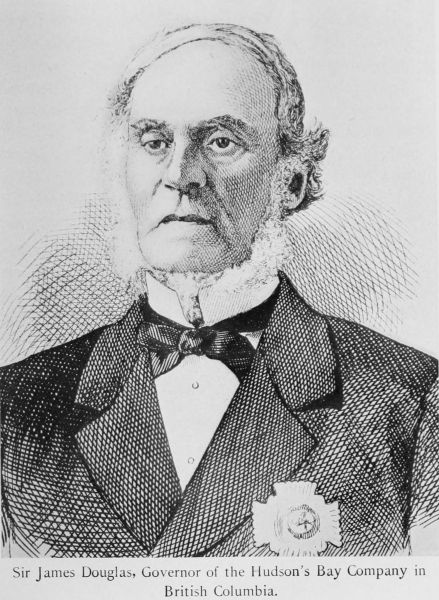
Sir James Douglas, Governor of the Hudson’s Bay Company in
British Columbia.
If Italy, Spain, France, Germany and Switzerland
were united under one flag, if that flag had the motto
Pro Pelle Cutem—“Skin for Skin”—and the mystic
letters H. B. C.—Hudson’s Bay Company—it would
give some idea of the size of the fur traders’ kingdom
ruled by McLoughlin. At a bend in the Columbia
on the north side, far enough from the coast to be
away from the rivalry of Pacific schooners, near
enough to be in touch with tidewater, stood the
capital of the kingdom, Fort Vancouver. Spruce
slabs half a foot thick, twenty feet high, sharp at
both ends and in double rows, composed the walls.
Great gates with brass hinges extending half way
across the top and bottom beams, opened leaf-wise
toward the river. On the northwest corner stood a
bastion whose lower stories served as powder magazine
and upper windows as look-out. Cannon
bristled through the double palisades of the fort, and
to one side of the main gate was the customary wicket
through which goods could be exchanged for furs
from the Indians. The big, two-story, timbered
house in the center of the court was the residence
of the Chief Factor. On both sides were stores
and warehouses and fur presses and the bachelors’
quarters and the little log cabins, where lived the
married trappers. Trim lawns decorated with little
rockeries of cannon balls divided the different buildings,
and in front of the Chief Factor’s residence on
the top of a large flagpole there blew to the breeze
the flag with the letters H. B. C.—sign that a brigade
was coming in, or a brigade setting out; or a ship
had been sighted; or it was Sunday and the flying
flag was signal to the Indians there would be no
trade, a flag custom on Sundays that has lasted to
this day.
At the mouth of the Columbia, all that remained
of Astor’s Fort Astoria and Lewis and Clarke’s
Fort Clatsop was a moldering pile of rain-rotted logs
with a little square-timbered hut where one lone
Scotchman kept watch for incoming ships and possible
wrecks. Eastward, where the Columbia takes
its first bend was Walla Walla, under trader Pambrum;
northward, where it takes a second bend,
Okanogan under Ross; west, where it turns up into
the Arrow Lakes of British Columbia, Fort Colville
under Firman MacDonell; and half way between
these two posts southward, Spokane House, founded
by that John Clarke, who was with Robertson in
Athabasca. These were the strongholds from which
the Company ruled its transmontane kingdom, five
little fur posts, all except Spokane, close to the main
river trail, the capitals and sub-capitals of an empire
big as half Europe.
By right, the treaty of joint occupation had reference
only to Washington and Oregon; but who was
to prevent McLeod leading his brigade down the
coast to California as far as Sacramento, or Ogden his
brigade up the Snake as far as the Nevada deserts,
or Ross his mountaineers through Washington and
Idaho over the Bitter Root and Rocky Mountains to
the buffalo plains of the Missouri in Montana? It
was a no-man’s-land, where trappers might wander
whither their beaver quest led, with no other law but
what each man’s right arm was strong enough to
enforce. Fish diet palled at Fort Vancouver. Buffalo
meat was needed for the brigades. Up at Fort
Okanogan was Alexander Ross, studying the
language of the mountain Indians, leading a lonely
existence “with no other company,” as he relates,
“but my dog Weasel and the Bible.” A mid-winter
express brought Ross orders to proceed over the
mountains by way of Clarke’s Fork or Flathead
River to the headwaters of the Missouri and Yellowstone
and Big Horn. His hunting field was the very
stamping ground of the most dangerous warriors
among the Indians—the Blackfeet and Piegans and
Crows. Yet if this express had ordered Ross to
march down to Hell’s Gate and jump over the precipice
into that cañon, he would have obeyed. A
better man for the field could not have been chosen.
Ross had come to the Pacific on John Jacob Astor’s
first ship. He had been almost at once sent North
to establish Fort Okanogan, where by studying the
Indian languages during the long isolated winters,
he soon became a proficient trader. He was both
religious and scholarly, but either the intense loneliness
of the life, or the danger of being among the
Indians without a companion, drove him into marriage
with a daughter of the Okanogans. This wife
became one of the grand old ladies of the Red River
Settlement, when Ross retired to Manitoba. Beaver
must be sought as usual at the headwaters of the
Missouri and the Yellowstone and the Big Horn;
and to reach those headwaters for the spring
hunt, Ross must do his buffalo hunting in mid-winter.
The mountain passes must be traversed
through bottomless depths of snow, for the climate
was so mild no crust formed, and above the tree line
in the cloud region was a fall—fall of snow almost
continuous for the winter months till the precipices
overhung with dangerous snow cornices of ponderous
weight, and the cut-rocks were heaped into huge
snow mushrooms. But Ross was no novice at snow
work in the mountains. One of his first winters at
Okanogan, he had become so desperately lonely that
he decided to pay a three days’ visit to his next door
neighbor at Spokane House, one hundred and fifty
miles away. The country was rocky and the trail
steep. Coming home the horses had fagged so completely
climbing the last mountain that Ross and his
Indian servants dismounted to beat the way up
through the snow for the animals to follow. It was
not easy work. Snow cornice broke under the
weight, and down men and horses slithered in miniature
avalanche. The soft crust of drift over rocks
broke, plunging the path-makers in snow to their
armpits, and all the while the way was zigzagging
up till Ross and his Indians were blowing with heat
like whales. First, pack straps came off, then gun
cases, then coats and waistcoats to be hung on the
saddle pommels. A sharp turn in the trail brought
them suddenly on one of those high, bare Alpine
meadows where Arctic storms sweep when flowers
may be blooming in the valley. Before they could
find their horses darkness and snow so completely
hid everything Ross could only shout against the
wind for the men to shift for themselves and let the
horses run. Then he realized that he was without
either coat or buffalo blanket. Luckily, a bewildered
pack horse jammed against him in the whirl. Ross
gripped the saddle straps, cut the pack ropes, threw
off the load, and leaped astride the saddle trees with
no other blanket than the patch of wool that served
as saddle cloth. Certain that he was near Okanogan,
he rode like mad through the howling darkness,
but the floundering broncho fagged in the drifts, and
Ross became so numb he could not keep his seat.
Dismounting, he tried to keep himself warm by
walking, but was soon so exhausted he could only
cling to the warm body of the horse. Tying the
saddle cloth round his neck, he tried to dig a hole of
shelter in the snow, but there, his feet became so
cold, he had to take off his boots to keep from freezing,
and passed the night in a frantic effort against
the frost-sleep. In the morning he was too stiff to
mount his horse. He had no strength to beat the
wind, and had almost determined to kill his horse
and crawl inside the body, when the storm began to
lessen. To his relief, Okanogan House was only a
short distance away. When trappers went out to
rescue the Indians of the party, they found one horse
dead, torn to pieces by the wolves. Ross knew
mountain travel.
It was February 11, 1824, when Ross struck east
from Cœur d’Alene Lake—the Lake of the Pointed
Heart, so called from the sharp trading, like “an awl”
of the Indians—to cross the mountains of Idaho
and Montana for the buffalo plains. Between
Okanogan and Spokane House, he had succeeded in
mustering twelve Hudson’s Bay trappers, Iroquois
most of them, with a few Canadians like Pierre and
Goddin and Sylvaille. Of the freeman who roved
the mountains, forty-three joined Ross’ brigade.
In all, there were forty-five men, two hundred and
six traps, sixty-two guns, including a large brass
cannon, and two hundred and thirty horses. In a
few days they were on Horse Prairie, where roved
herds of wild, Spanish ponies, claimed by the Flatheads
and valued at four beaver skins each. Passing
travelers might seize these horses, but woe betide
them if full value were not left in beaver skins.
Without warning, the Flatheads would pursue and
exact a scalp for each horse stolen. From the outset
Ross had trouble with his men. They had first
served under Astor, then under the Nor’Westers, and
now were unsettled by the recent change of allegiance
to Hudson’s Bay. Besides, General Ashley’s mountaineers,
Pierre Chouteau’s trappers, had begun
coming across the plains from St. Louis. For each
beaver the American trader paid $5.00, where the
Hudson’s Bay paid only $1.00 and $2.00. Ross’
trappers were dissatisfied. For the first month—the
mid-winter month when all game is quiet—no
beaver were seen. Snow storms met the marchers
as they neared the mountains, and on the 13th of
February Ross awakened to find that the Iroquois
hunters under old Pierre had deserted. Mounting
post haste, Ross pursued, overtook the seceders, and
demanded the cause of their complaint. They complained
that the price allowed for their furs was so
small in proportion to the exorbitant advance on
goods, that they were never able to pay debts, much
less make money, and declared they would not risk
their lives any more. Ross, himself, acknowledges
that goods worth six pence were traded for beaver
worth $5.00 in China. “The Iroquois declared Mr.
Ogden last fall had promised they should be paid
half in currency. I told them that promise would
be performed. They grumbled and talked, and
talked and grumbled, and at last consented to proceed.
Thinks I to myself—is this the beginning?”
Four days later, the first beaver was caught, but
only the toes were left in the trap. Wolves had
howled all night round the camp. To avoid future
mutiny, Ross appointed three leaders, old Pierre at
the head of the Iroquois; Montour of the Half-breeds
and himself for the Company’s trappers, the
three to meet each night and exchange the views of
the camp. On February 23rd, the brigade struck
into that defile of the mountains between the Rockies
east and the Bitter Root west, along the trail from
what is now from Butte and Missoula to De Smet
and Kootenay. They had left Clarke’s Fork and
were on Hell Gate River, “so named,” explains
Ross, “from being frequented by war parties of roving
Blackfeet.” While the brigade camped came a
tinkle of dog bells over the snow, and eight Piegans
appeared driving loaded dog sleds with provisions to
trade in the Flathead country. Before Ross could
stop them, his rascally Iroquois were out of the
leather lodges with a whoop and flare of firearms and
had stripped the poor Piegans naked, leaving not so
much as a piece of fat on their sleighs. There was
nothing for Ross to do but “pay treble the value
of the trash” and invite the victims into his own
lodge. As the Piegans were going off next day, he
gave them a salute of honor from the brass gun,
“just to show them,” he explains, “that it makes a
noise.” Barely was this trouble past, when two Iroquois
again deserted. After them on horseback rode
Ross with old Pierre as lieutenant. “Partly by persuasion,
and partly by force,” he relates, “we put
them on horseback and brought them into camp
before dark.”
It was necessary to reach the buffalo plains and
get the store of pemmican before the spring hunt.
Already it was March, and Ross found himself in
a narrow mountain cañon three hundred miles from
any post, the trail forward blocked by snow twelve
feet deep for twenty miles. No time for mutineers
to plot. Daydawn to dark for a week, Ross sent his
men forward to cut a way through the snow, the
horses disappearing through the soft drifts altogether
in their plunges, and the end of a week saw
only three miles clear with a howling blizzard that
filled up the trench as fast as the trappers could work.
Ross kept his men too busy to think of turning back
and sent forward a fresh relay of horses to stamp the
way open. The end of another week saw eight
miles clear, but storm kept the men idle in camp for
a day, and that day worked the mischief with discipline.
“John Grey, a turbulent Iroquois, came to
my lodge as spokesman to inform me he and ten
others had resolved to turn back. I asked him why?
He said this delay would lose the spring hunt. Anyway,
the Iroquois had not engaged to dig snow and
make roads. I told him I was surprised to hear a
good, quiet, honest fellow like he was utter such
cowardly words. (God forgive me for the lie!) I
said by going back they would loose the whole year’s
hunt. A change in the weather any day now might
allow us to begin hunting. It was dangerous for us
to separate. John answered he was no slave to work
in this way. I told him he was a freeman of good
character and to be careful to keep his character
good. (God forgive me. In my heart, I thought
otherwise. I saw him in his true colors, a turbulent
blackguard, a d—— rascal, a low trouble maker.)
He said: ‘Fair words are all very well; but back I
am going to go.’ I thought a moment. Then I
said: ‘You are no stronger than other men. Stopped,
you will be. I will stop you!’ He said he would
like to see the man who could stop him. I said: ‘I
can.’ Old Pierre interrupted by coming in and John
went off cursing the Company, the brigade, the
country, the day he came to it. If his party deserts,
this trip will fail. So another day ends.”
The next day, not a soul would go to work. With
the storm howling round the tepee as if it would tear
the buffalo flaps away, the solitary white man sitting
by the fire inside the lodge, knew the mutiny was
spreading. Up and down the cañon roared the
blizzard, booming down from the mountains for
almost a week, the bitter North wind drifting, piling,
packing in a wall of snow from end to end of the eight-mile
trench that had been cleared. Watching the
smoke curl up from the central fire to the tepee top,
Ross though alone, could afford to smile. With that
wall of snow behind, it would be just as hard to
go back as to go forward. The storm was cutting
off the mutineers’ retreat. That night as the fires
were smoldering and the hobbled bronchos huddling
about the lodge walls for shelter from the wind, a
furious barking of dogs aroused camp and the shout
of “enemies, enemies, Blackfeet,” brought the trappers
dashing out muskets in hand. The fire inside
a tepee is too good a target for attack. Outside,
even in storm is safer, but the snow muffled forms
emerging from the wooly darkness proved to be no
enemies at all, but six friendly Nez Percés, who had
come from the buffalo hunt across the mountains on
snowshoes. Five days the journey had taken. They
reported buffalo in plenty but the snow deeper
farther down the cañon. Taking advantage of the
diversion created, Ross sent for John, the mutineer,
and offered to reduce his debt to the Company “if
the intriguing scamp would hunt the hills for game
to keep the camp in meat.” John disposed of, Ross
called for thirty volunteers to go back over the mountain
on snowshoes with the Nez Percés to the buffalo
hunt. With thirty men across the mountains, there
was no danger of the rest turning back. Storm was
followed by thaw, that increased the pasturage for
the horses, and sent the Indian women picking
cranberries in the marshes, and set the snow-slides
rumbling down the mountains like thunder. Birds
were singing in the cañon, geese winging north overhead,
but still the snow lay packed like a wedge in
the pass, barring way for horses or cannon. “I feel
anxious, very anxious at our long delay here,” writes
Ross at the end of a month. “The people grumble
much. That sly, deep dog of an Iroquois, Laurent,
deserted camp to-day before I knew. A more headstrong,
ill-designing set of rascals than form this
camp, God never permitted together in the fur trade.”
In a few weeks the buffalo hunters were back with
store of meat, which the squaws began to pound into
pemmican; but the sun glare had been so strong on
the unsheltered slopes of the uplands that six of the
hunters were led home snow-blind. This discouraged
the freemen, fickle as children; and rebellion
began to brew again. In vain, Ross called a council,
and went from lodge to lodge, and urged, and ordered,
and pleaded, and bribed. Not a man but
Old Pierre, the Iroquois, would go to work to clear
the road.
The nights were spent in gambling, the days in
grumbling; and old Cadiac, a Half-breed, had made
himself an Indian drum or tom-tom of buffalo skin
stretched on bare hoops. John Grey, the rebel, had
uncased his fiddle and was filing away all night to
the Red River jig and native dances of Indian pow-wow.
Ross proposed the camp should give a concert.
A concert meant that a dram of liquor would
go the rounds. Two or three lodges were thrown
into one. Vanished into thin air the mutinous mood
of the rebels. Hither came Cadiac with the tom-tomtom
of the Indian drum! Hither John Grey, the
Iroquois, scraping his fiddle strings with the glee of a
Troubadour! Hither Half-breeds with concertinas,
and shaggy hunters with Jews’ harps, and French
Canadians with a fife! The night was danced away
with such wild Western jigs as Hell Gate had never
seen before and did not see again till the mountains
resounded to the music halls of the tin-horn gamblers
in the construction days of the railway. When
morning came over the hills, Ross sprung his surprise.
Whether the surprise was mixed with what
cheered the French half-breeds’ inner man—he does
not tell. With a whoop and hurrah, he proposed
they all go down the pass and dig that snow out to the
strains of John Grey’s fiddle! The sun was coming
over the mountains. The hunters were happy as
grown-up children. What did the old snow matter
anyway? Off they went! John Grey, the arch-rebel,
literally fiddling them through the mountains!
But alas, four days later, when the novelty or spree
had worn off, on the morning of April 14th, every man
of the camp except seven, refused to go to work.
However, it was the last mile of the blockade, and
those seven cleared the way. “Thursday, April 15th.
This day we passed the defile of the mountains after
a most laborious journey both for man and beast.
Long before daylight we were on the road, in order
to profit by the hardness of the crust before the thaw.
From the bottom to the top of the mountains is about
one and a half miles. On the one side is the source
of the Flathead River, on the other of the Missouri.
The latter creek runs south-southeast through the
mountains till it joins a branch of the Missouri
beyond Grand Prairie. For twelve miles, the road
had been made through five feet of snow, but the
wind had filled it up again. The last eight miles
we had to force our way through snow gullies, swimming
the horses through in plunges. At four P. M.
we encamped on the other side of the defile without
accident. Distance to-day eighteen miles, though
only a mile and a half as the crow flies. This delay
has cost loss of one month. We encamp to make
lodge poles for the rest of the journey.”
From the journals sent in by Ross to Hudson’s
Bay House, it is hard to follow the exact itinerary
of his movements for the next two months. Nor do
the books, which he wrote of his life in the West,
throw much light on the locale of his travels. Wherever
there were beaver and buffalo, the brigade
marched. One week, the men were spread out in
different parties on the Three Forks of the Missouri.
Another week, they were on the headwaters of the
Yellowstone in the National Park of Wyoming.
They did not go eastward beyond sight of the mountains,
but swung back and forward between Montana
and Wyoming. “Saturday—April 17th—proceeded
to the main fork of the Missouri and set
watch. It was on this flat prairie, four hundred
Piegans last year attacked Firman McDonald’s brigade
and killed a freeman named Thomas Anderson.
As we are on dangerous ground, I have drawn up
the following rules: (1) All hands raise camp together
by call; (2) The camp to march close together.
(3) No person to run ahead; (4) No person to set
traps till all hands are camped; (5) No person to
sleep out of camp. All agreed to these rules, but
they were broken before night. Thursday, 22nd of
April—thirty-five beaver taken last night, six feet left
in the traps, twenty-five traps missing (dragged off
by the beaver or stolen by the Indians). The freemen
let their horses run. They will not take care
of them.” And then poor Ross varies the formalities
of his daily report by breaking out in these lines
against his unruly followers:
“Loss and misfortune must be the lot
When care and attention are wholly forgot.”
“That scamp of a Saulteaux Indian threatens to
leave because I found fault with him for breaking the
rules. If he dares, I will strip him naked, horses,
blankets and clothes, to fare forth on the plain.
Saturday 24th—We crossed beyond the Boiling
Fountains. The snow is knee-deep. Half the people
are snow-blind from sun glare.”
Ross now swung west over the Bitter Root Mountains
to Salmon River, following as far as I can tell,
the path of the modern Oregon Short Line Railway
from Salt Lake to the Northern Pacific. So has it
always been in America. Not the bridge builder but
the fur trader has been the pathfinder for the railway.
On leaving the middle fork of the Missouri, he refers
to one of those wilderness tragedies of which word
comes down to latter day life like a ghost echo of
some primordial warfare. “Passed a deserted Piegan
camp of thirty-six lodges rendered immemorial
as the place where ten Piegan murderers of our
people were burnt to death. The road through the
mountains from the Missouri to Salmon River is a
Blackfoot Pass of a most dangerous sort for lurking
enemies; and yet the freemen insist on going out in
twos and twos. Three people slept out of camp by
their traps. I had to threaten not to give a single
ball to them if they did not obey rules; fifty-five
beaver to-day.”
Ross now scattered his trappers from the valley
of the Three Tetons north along the tributaries of
the Snake in Idaho. One Sunday night—Ross
always compelled his trappers to dress for Sunday
and hold prayers—two French Canadian freemen
ran into camp with moccasins torn to shreds and a
breathless story. Contrary to rules, they had wandered
in quest of game forty miles away, sleeping
wherever night found them, with no food but what
they carried in a blanket on their backs. “On their
way to our camp, they saw a smoke, and taking it for
our people had advanced within pistol shot when
behold, it proved to be a camp of Piegans. Wheeling,
they had hardly time to take shelter among a
few willows, when they were surrounded by armed
warriors on horseback. Placing their own horses
between themselves and the enemy, our two men
squatted on the grass to conceal themselves. The
Piegans advanced within five paces, capering and
yelling, cock sure of their prey. The women had
gathered to act a willing part, armed with lances.
The two crept through mud and water out of sight
and when night came escaped, abandoning horses,
saddles, traps and all. They had traveled on foot
after dark the entire distance, hiding by day.”
By June, Ross had a thousand beaver; but the
Piegans had followed up the trail of the two escaping
men. “Saturday, 19th—Had a fight. This
morning when all hands were at their traps scattered
by twos, and only ten men left in the camp, forty
Blackfeet all mounted, descended on us at full speed.
The trappers were so scattered, they could render
each other no assistance and took to their heels among
the brushwood, throwing beaver one way, traps
another. Jacques and John Grey were pursued on
the open plain. Seeing their horses could not save
them, our two heroes wheeled and rode pell mell into
the enemy. The Piegans asked them to exchange
guns. They refused. The chief seized Jacques’
rifle, but Jacques jerked it free, saying in Piegan:
‘If you wish to kill us, kill us at once; but our guns
you shall never get while we are alive.’ The Piegans
smiled, shook hands, asked where the camp was,
and ordered the men to lead the way to it. With
pulses beating, Jacques and John advanced with
the unwelcome guests to the camp, a distance of
eight miles. A little before arriving, Jacques broke
away at full speed from his captors whooping and
yelling—‘Blackfeet! Blackfeet!’ In an instant, camp
was in an uproar. Of the ten men in camp, eight
rushed to save the horses. Myself and the other instantly
pointed the big gun, lighted the match and
sent the women away. The party hove in sight.
Seeing John with them, restrained me from firing.
I signaled them to pause. Our horses were then
secured. I received the Indians coldly. All our
people had time to reach camp and take up a position
of defense. I invited the Indians to smoke.
After dark, they entertained us to music and dancing,
which we would gladly have dispensed with. All
slept armed. In the morning I gave the Piegans
presents and told them to be off and play no tricks
as we would follow them and punish them. The
big gun did it. Sixty-five beaver to-day.”
Moving down Snake River in October, Ross met
a party of Americans from the Big Horn from Major
Henry’s brigade of St. Louis. They had nine hundred
beaver but would not sell to Ross. Ross
reached Spokane House with about $18,000 of fur
in November. Here he helped to fit out Peter Skene
Ogden for that first trip of his to the Snake Country,
of which there is no record except what Ross gives
here. He says Ogden set out with one hundred and
seventy-six men under him, and definitely counted
on collecting 14,500 beaver. No doubt the St. Louis
trappers that Ross left on the Snake were the men,
who “relieved” Peter Skene of his furs, and it is interesting
to note that at the price St. Louis traders
paid for furs, $5.50 a beaver, those 14,500 Hudson’s
Bay beaver would make the exact amount with which
General Ashley retired from the Indian Country.
Notes to Chapter XXX.—The contents of this chapter are
drawn (1) as to reorganization from Colin Robertson’s manuscript
journal and Nicholas Garry’s Journal; (2) as to the Columbia,
from Ross’ manuscript journals sent to H. B. C. House,
London. Ross was the author of three well-known books on
western life, but this journey is taken entire from his official
report to H. B. C.—a daily record of some six hundred foolscap
folios.
CHAPTER XXXI
1824-1838
JOURNALS OF PETER SKENE OGDEN, EXPLORER AND
FUR TRADER, OVER THE REGIONS NOW KNOWN
AS WASHINGTON, OREGON, CALIFORNIA, IDAHO,
MONTANA, NEVADA AND UTAH—HE RELIEVES
ASHLEY’S MEN OF 10,000 BEAVER—HE FINDS
NEVADA—HE DISCOVERS MT. SHASTA—HE TRICKS
THE AMERICANS AT SALT LAKE.
Gay were the fur brigades that swept out
from old Fort Vancouver for the South.
With long white hair streaming to the
wind, Doctor McLoughlin usually stood on the
green slope outside the picketed walls, giving a personal
hand-shake, a personal God-bless-you to every
packer, every horseman of the motley throng setting
out on the yearly campaign for beaver. There were
Iroquois from the St. Lawrence. There were Ojibways
from Lake Superior. There were Cree and
Assiniboine and Sioux of the prairie, these for the
most part to act as packers and hunters and trappers
in the horse brigades destined inland for the mountains.
Then, there were freemen, a distinct body of
trappers owning allegiance to no man, but joining the
Company’s brigades for safety’s sake and selling the
beaver they trapped to the trader who paid the
highest price. Of coast Indians, there were very
few. The salmon runs of the river gave the coast
tribes too easy an existence. They were useless for
the hardships of inland service. A few Cayuses
and Flatheads, and Walla Wallas might join the
brigades for the adventure, but they did not belong
to the Company’s regular retainers.
Three classes, the Company divided each of the
hunting brigades into—gentlemen, white men,
hunters. The gentlemen usually went out in twos—a
commander and his lieutenant, dressed in cocked
hat and buttons and ruffles and satin waistcoats,
with a pistol somewhere and very often a sword
stuck in the high boot-leg. These were given the
best places in the canoes, or mounted the finest
horses of the mountain brigades. The second class
were either servants to beat the furs and cook meals,
or young clerks sent out to be put in training for
some future chieftaincy. But by far the most picturesque
part of the brigades were the motley hunters—Indians,
Half-breeds, white men—in buckskin
suits with hawks’ bills down the leggings, scarlet or
blue handkerchief binding back the lank hair, bright
sash about the waist and moccasins beaded like
works of art. Then somewhere in each brigade was
a musician, a singer to lead in the voyageurs’ songs,
perhaps a piper from the Highlands of Scotland to
set the bagpipes droning “The Campbells Are Coming,”
between the rock walls of the Columbia. And,
most amazing thing of all, in these transmontane
brigades the men were accompanied by wives and
families.
A last hand shake with Doctor McLoughlin; tears
mingled with fears over partings that were many of
them destined to be forever, and out they swept—the
Oregon brigades, with laughter and French voyageurs’
song and Highland bagpipes. A dip of the
steersman’s lifted paddle, and the Northern brigades
of sixty men each were off for Athabasca and the
Saskatchewan and the St. Lawrence. A bugle call,
or the beat of an Indian tom-tom, and the long lines
of pack horses, two and three hundred in each brigade,
decked with ribbons as for a country fair,
wound into the mountain defiles like desert caravans
of wandering Arabs. Oregon meant more in those
days than a wedge stuck in between Washington
and California. It was everything west of the
Rockies that Spain did not claim. Then Chief
factor McLoughlin, whom popular imagination regarded
as not having a soul above a beaver skin,
used to retire to his fort and offer up prayer for those
in peril by land and sea.
The man chosen to lead the southern brigades to
the mountains and whose wanderings led to the
exploration of Oregon, northern California, Idaho,
Montana, Wyoming, Nevada and Utah—was a short
rotund, fun-loving, young barrister of Montreal, Peter
Skene Ogden. His ancestors had founded Ogdensburg
of New York State and at an earlier day in the
history of Scotland had won the surname “Skene,”
through saving the life of King Malcolm by stabbing
a wolf with a dagger—“a skene.” During the
American Revolution, his father left New York for
Montreal, and had risen to be chief justice of the
courts there, so that the young barrister could claim
as relatives the foremost families of New York State
and the Province of Quebec: but an evil star presided
at the birth of Peter Skene.
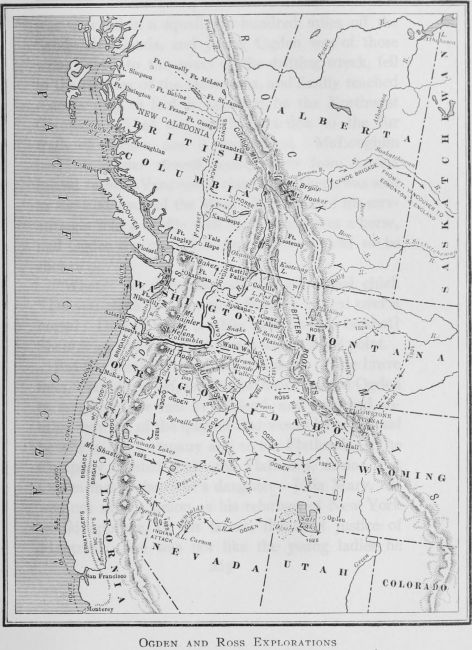
Ogden and Ross Explorations
Click
here for larger map
He was finishing his law course when his boyhood
voice changed, and instead of the round orotund of
manhood came a little, high, falsetto squeak that
combined with Peter’s little, fat figure and round
head proved so irresistibly comical, it blasted his
hopes as a pleader at the bar. John Jacob Astor
was in Montreal wrangling out his quarrel over
Mississippi territory with the Northwest Company.
Judge Ogden was a friend of Astor’s. Peter applied
to go out to Astoria on the Pacific. Astor took him
as supercargo on The Lark; but in 1813, The Lark
was wrecked in a squall two hundred miles off the
Sandwich Islands, and young Ogden was of those
who, lashed to the spars of the drifting wreck, fell
to the mercies of the Hawaiians, and finally reached
Astoria only to find it captured by the Northwest
Company. That was his introduction to the fur
trade of Oregon, and it was typical. McLoughlin
had no sooner moved headquarters from Astoria
inland to Fort Vancouver, than Peter Skene was sent
to the Flatheads of the West. Here, one of his servants
got into a scuffle with the Indians over a horse,
and Ogden was carried to the Flathead chief to be
shot.
“What?” he demanded of the astonished chief.
“Do you think a white man is to be bullied over a
horse? Do you think a white man fears to be shot?
Shoot,” and he bared his breast to the pistol point.
But the Flathead chief did not shoot. “He brave
man,” said the chief, and he forthwith invited Ogden
to remain in the tent as a friend, and proposed another
way out of the quarrel that would be of mutual
benefit to the Company and to the Flatheads. The
Company wanted furs; the Flatheads, arms. Let
Ogden marry the chief’s daughter—Julia Mary. It
was not such a union as his relatives of New York
would approve, or his father, the chief justice of
Montreal. She was not like the young ladies he
had known in the seminaries of the East, but her
accomplishments were of more use to Peter Ogden.
When Peter Skene walked out of the Flatheads’
tent, he had paid fifty ponies for a wife and was followed
by the chief’s daughter. To what period of
his life they belong, I do not know. His own journals
tell nothing of them, but legends are still current
in the West about this Flathead princess of the wilds;
how when a spring torrent would have swept away
a raft-load of furs, Julia leaped into the flood tide,
roped the raft to her own waist, and towed the furs
ashore; how when the American traders, who relieved
Ogden of his furs, in 1825, stampeded the
Hudson’s Bay horses and Julia’s horse galloped off
with her first-born dangling from the saddle straps
in a moss bag, she dashed into the American lines.
With a bound, she was in the saddle. She had
caught up the halter rope to round baby and horses
back to the Hudson’s Bay camp, when a drunken
Yankee trader yelled, “Shoot that d—— squaw!”
But the squaw was already hidden in a whirl of dust
stampeding back to the British tents. This, then,
was the man (and this the wife, who accompanied
him) chosen to lead the mountain brigades through
the unexplored mountain fastnesses between the
prairie and the Pacific. Lewis and Clarke had
crossed to the Columbia, and the Spaniards to the
Colorado, but between the Colorado and the Columbia
was an absolutely unknown region.
With Ogden as first lieutenant went Tom McKay.
McKay was the best shot in the brigade, a fearless
fighter, a tireless pathfinder, and one old record
says “combined the affable manners of a French
seigneur with the wild-eyed alertness of a mountaineer.”
With hatred of the Indian bred in him
from the time of his father’s murder, he could no
more see a savage hostile without cracking off his
rifle than a war horse could smell powder and not
prance. Among the trappers were rough, brave
fellows—freemen, French Canadians—whose names
became famous in Oregon history: La Framboise,
Astor’s old interpreter, who became a pathfinder in
California; Gervais, who alternately served American
and British fur traders, helped to find Mt. Shasta,
finally sold his trapping outfit and retired to the
French colony of the Willamette; Goddin and Payette
and Pierre, the Iroquois, and Portneuf, who have
left their names to famous places of Idaho. The
brigade numbered a score of white men, some fifty or
sixty nondescript trappers, as many women, some
children and an average of three horses for each
rider in the party. These horses came from the
Cayuse Indians of the Walla Walla plain. This was
the rendezvous after leaving Fort Vancouver. Here
was always good pasturage for the horses, and the
fur post had store of pemmican traded from the
buffalo hunters of the Cayuse and Flathead nations.
Pouring into the south side of the Columbia between
Walla Walla and Fort Vancouver, were the
Walla Walla, Umatilla, John Day’s, the River of the
Falls. In the mountains southward, were the beaver
swamps. As the entire region was unknown, Ogden
determined to lead his brigade West close to the
Columbia, then strike up the fartherest west river—double
back eastward on his own tracks at the headwaters,
and so come down to the Columbia again
by the Snake. The circle would include all the
south of Oregon and Idaho. He writes: “Monday,
November 21st, 1825—Having sent off all hands
yesterday from Walla Walla, I took my departure
and overtook my party awaiting my arrival. We are
following the banks of the Columbia southwest.
Our road is hilly, and we have great trouble with our
horses, for they are all wild. We are followed by a
large camp of Indians bent on stealing our horses.
Although we rise at day dawn, we are never ready to
start before ten o’clock, the horses are so difficult
to catch. Wednesday, 30th—We have reached John
Day’s River. A great many Indians have collected
about us. Each night the beaver traps are set out,
and in the morning some have been stolen by the
Indians. Many horses missing, having been stolen.
This does not prevent raising camp, as by remaining
we should lose more horses than we could get back.
Saturday, December 3rd—We bade farewell to the
Columbia River and struck south up the River of
the Falls. It is scarcely credible, though we are
such a short distance from the Columbia, what a
difference there is in the country. This soil is rich.
The oaks are large and abundant. The grass is
green, though at a distance on both sides all the hills
are powdered with snow. Sunday, December 4th—It
is now very cold, for we have begun ascending the
mountains and camp wherever we can find a brook.
The man I sent back for the lost horses, found them
on the north side of the Columbia. He was obliged
to give the Indians thirty balls of powder to get them
back, no doubt a trick, and the thief, himself, restored
them, a common practice with all the Indians. We
are coming to the end of the Columbia hills. Mt.
Hood, a grand and noble sight, bears west; Mt.
Helen’s north; and to the south are lofty mountains
the shape of sugar loaves. On all of these are pines,
that add to the grandeur. After descending the
divide we reached a plain and struck east, gathering
some curious petrifactions of fir trees. Our horses
are greatly fatigued, for the road is of cut rocks.
Deer are abundant. We saw upward of one hundred
to-day, but too swift to be overtaken on this
dangerous ground. Many of the bare hills are of
blood-red color. In this quarter are three boiling
fountains of sulphur. I must find an Indian, who
will guide us. If not, we must attempt to cross east
without. Our horses are saddle deep in mire.”
From the time Ogden crossed the sky line of the
Blue Mountains for the headwaters of the Snake,
his difficulties began. Hunters to the fore for the
game that was to feed the camp, the cavalcade
began zigzagging up the steep mountain sides.
Here, windfall of pines and giant firs, interlocked
twice the height of a man, scattered the wild Cayuse
ponies in the forest. There, the cut rocks, steep as
a wall and sharp as knives, crowded the pack horses
to the edge of bottomless precipices where one misstep
meant instant death for rider and horse. And
the mountain torrents tearing over the rocks swept
horses away at fording places, so that once Ogden
was compelled to follow the torrent down its cañon to
calmer waters and there build a canoe. In this way
his hunters crossed over by threes and fours, but how
to get the fractious horses across? It was too swift
for men to swim, and the bronchos refused to
plunge in. Getting two or three of the wise old bell-mares,
that are in every string of packers, at the end
of a long rope, the canoemen shot across the whirl of
midstream and got footing on the opposite shore.
Then by dint of pulling and yelling the frantic horses
were half frightened, half-tumbled into the river, and
came out right side up a hundred yards farther down.
At other places, the cut-rocks—a local term that explains
itself—were so steep and sharp, Ogden ordered
all hands dismounted and half the packs carried up on
the men’s backs. It was high up the mountain, and
the snow that falls almost continuously in winter
above tree line made the rocks slippery as ice. For
a few days, owing to the altitude and cold, no beaver
had been taken, no game seen. The men were toiling
on empty stomachs and short tempers. Night
fell with all hands still sweating up the slippery rocks.
A slave Indian lost his self control and struck Jo.
Despard, one of the freemen, on the back. Throwing
down his load, Despard beat the rascal soundly,
but when the battle was over and all the bad temper
expended, the slave Indian was dead. Poor Despard
was mad with grief, for no death was ever passed unpunished
by the Hudson’s Bay. Sewing the murdered
man in rolls of buffalo skin, they buried him
with service of prayers on the lonely heights of the
Blue Mountains. “It is not in my power,” writes
Ogden, “to send Despard to Vancouver. Until we
return to the headwaters, I will let the affair remain
quiet. The poor fellow is wretched over the murder.”
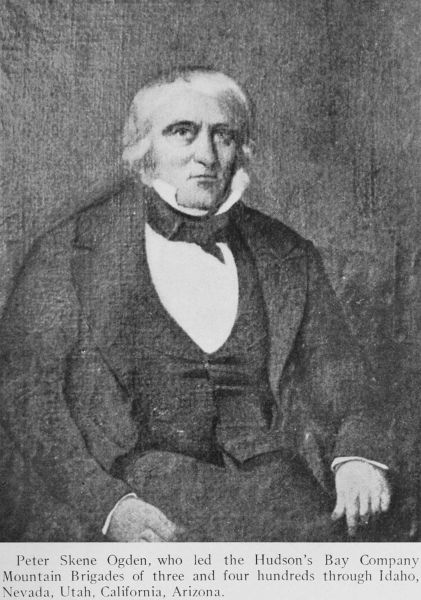
Peter Skene Ogden, who led the Hudson’s Bay Company
Mountain Brigades of three and four hundreds through Idaho,
Nevada, Utah, California, Arizona.
During the march eastward across the valleys,
between the Cascade range and the Rockies, one
hundred and sixty traps for beaver were set out each
night. In the mornings, when camp was broken,
from thirty to sixty beaver were considered a good
night’s work. Snake Indians were met and a guide
engaged, but the Snakes were notorious horse thieves,
and a guard was kept round the horses each night.
Ogden makes a curious discovery about the beaver in
this region. “Owing to the mildness of the climate,”
he writes, “beaver here do not lay up a stock of provisions
as in cold countries.” As the cold of mid-winter
came, the beaver seemed simply to disappear
to other haunts. In vain, the men chiselled and
trenched the ice of the rivers above and below
the beaver dams. The beaver houses were found
empty. Tom McKay was scouring the cut-rocks
for game with his band of hunters; but it is the season
when game leaves the cut-rocks, and night after
night the tired hunters came in hungry and empty
handed. The few beavers trapped were frequently
stolen at night, for there are no ten commandments
to hungry men, and in spite of cold and wet the
trappers began sleeping in the swamps near their
traps to keep guard. “If we do not soon find game,”
writes Ogden on December 22nd, “we shall surely
starve. My Indian guide threatens to leave us. If
we could only find the headwaters of the Snake without
him, he might go to the devil. We do not see the
trace of an animal. I feel very uneasy about food.
Sunday, December 25th—This being Christmas, all
hands remained in camp and I held prayers. The
cold increases. Prospects, gloomy; not twenty
pounds of food in camp. If we escape starvation,
God preserve us, it will depend on Tom McKay’s
hunters. On collecting our horses, we found one-third
limping. Many of them could not stand and
lay helpless on the plain. If this cold does not soon
pass, my situation with so many men will be terrible.
December 31st—One of the freemen, three days without
food, killed one of our horses. This example will
soon be followed by others. Only one beaver to-day.
Gave the men half rations for to-morrow, which will
be devoured to-night, as three-quarters in camp have
been two days without food. Sunday, New Year’s,
1826—Remained in camp. Gave all hands a dram.
We had more fasting than feasting. This is the first
New Year’s day since I came to the fur country that
my men were without food. Only four beaver to-day.
Sent my men to the mountains for deer. Our
horses can scarcely crawl for want of grass; but
march they must, or we starve. In the evening,
Tom McKay and men arrived without seeing the
track of an animal, so this blasts my hope. What
will become of us? So many are starving in camp
that they start before daylight to steal beaver out of
their neighbors’ traps. Had the laconic pleasure of
seeing a raven watching us to-day! The wolves
follow our camp. Two horses killed for the kettle.
January 11th—Reached the source of Day’s River.
Our horses are too lame to move. A horrible road
we have had for ten days of rock and stone. We have
taken in all two hundred and sixty-five beaver and
nine otter here. Our course is due east over barren
hills, a lofty range of mountains on both sides covered
with Norway pines. Thank God if we can cross
these mountains I trust to reach Snake River.
There are six feet of snow on the mountain pass here.
We must try another. For ten days we have had
only one meal every two days. January 29th—A
horse this day killed—his hoof was found entirely
worn away, only the raw stump left.”
February 2nd, they left the streams flowing west
and began following down a cañon of burnt windfall
along the banks of a river that ran northeast. The
divide had been crossed, and the worn bronchos
were the first to realize that the trails of the mountains
were passed. Suddenly pricking forward, they galloped
full pace into the valley of Burnt River, a
tributary of the Snake. “A more gloomy looking
country,” writes Ogden, “I never saw. We have
been on short allowance too long and all resemble so
many skeletons. We are skin and bone. More
beggarly looking fellows the world could not produce.
All the gay trappings at the beginning of the march
have disappeared. Still I have no complaint of my
men. Day after day, they labor in quest of food
and beaver without shoe or moccasin to their feet.
The frozen ground is hardly comfortable for people
so scantily clothed. Ten days east is the buffalo
country of the plains, but in our present weak state
we could not reach it in a month.” Ogden was now
in the beaver country of the Snakes and to avoid starvation
divided his brigade into small bands under
McKay and Gervais and Sylvaille. These, he scattered
along the tributaries of the Snake River north
and south, in what are now known as Oregon and
Idaho, some to the “Rivier Malheur (Unfortunate
River) so-called because this is the place where our
goods were discovered and stolen by the Americans
last year”; others to Sandwich Island River, and
Reed’s River, and Payette’s and the Malade,
given this name because beaver here lived on
some root which made the flesh poisonous to the
trapper.
Few Snakes were met, because this was the season
when the Snakes went buffalo hunting, but “in our
travels this day (26 February) we saw a Snake Indian’s
hut near the road. Curiosity induced me to
enter. I had often heard these wretches subsisted
on ants, locusts and small fish not larger than minnies
(minnows); and I wanted to find out if it were
not an exaggeration, but to my surprise I found it
was true. One of the dishes was filled with ants
collected in the morning before the thaw commences.
The locusts are gathered in summer in store for the
winter. The Indians prefer the ants. On this food
the poor wretches drag out existence for four months
of the year and are happy. During February, we
took one hundred and seventy-four beaver. Had the
weather been mild, we should have had three thousand.
An incredible number of deer here, but only
skin and bone, nevertheless most exceptable (?)
to us starving.” He mentions that it was on Sickly
or Malade River that the Blackfeet killed one of his
men the preceding year. “If the Americans have not
been here since, we shall find beaver.” On the 13th
of March, McKay came in with a dozen elk, and the
half-starved hunters sat up till dawn feasting. But
alas, on March 20th, near Raft River, came a camp
of Indians with word “that a party of Americans are
not three days’ march away. If this be true, our
hunts are damned. We may prepare to go home
empty handed. With my discontented men, I dread
meeting the Americans. After the sufferings the
men have endured with me, they will desert.” Snake
camps now began to pass westward at the rate of
four hundred people a day, carrying their supply of
buffalo meat and also—what struck sorrow to Ogden’s
heart—an American flag. A thousand Snake
warriors were on the way to the Spanish settlements
of the South to trade buffalo meat and steal horses.
Near the American Falls, the Brigade fell in with
marauding Blackfeet, friendly, no doubt, because
of Ogden’s wife, who was related to the Northern
tribes. “The Blackfeet informed me, they left the
Saskatchewan in December and were in quest of the
Snakes, but finding them so strong did not attempt
it. They consisted of eighty men with the usual
reserve of twenty or thirty Piegans hidden in the
hills. March 31st—To-day, twenty-seven beaver,
which makes our first thousand with two to begin
the second thousand. I hope to reach Fort Vancouver
with three thousand.”
“Sunday, April 9th, Portneuf River, headwaters of
the Snake—About 10 A. M., we were surprised by the
arrival of a party of Americans, and twenty-eight of
our deserters of last year. If we were surprised,
they were more so. They expected their threats of
last year would prevent us returning to this quarter,
but they find themselves mistaken. They encamped
a short distance away. With the glass, we could
observe the Blackfeet on the hills spying on our
movements.
“Monday, April 10th—The strangers have paid me
a visit. I had a busy day settling old scores with
them and more to my satisfaction and the Company’s
than last year’s disaster. We received from them
eight thousand one hundred and seventy-two beaver
in payment of their debts due the company and two
notes of hand from Mr. Monton. We secured all the
beaver they had. Our deserters are tired of their
new masters and will soon return to us. How the
Americans make profit when they pay $3.00 per
pound for beaver, I cannot imagine. Within ten
months the Indians have stolen one hundred and
eighty traps from these Americans.”
In those few words, does Peter Skene Ogden record
an episode that has puzzled the West for fifty years.
How did these Americans come to sell all the beaver
they had to him, at less than they had paid, for the
Hudson’s Bay Company never paid $3.00 a beaver?
Were they short of powder as well as traps? And
what old score was Ogden paying off? What had
happened to him the year before? Was that the
year when the Americans stampeded his horses?
The record of Ogden’s 1824-25 trip has been either
lost or destroyed, and the Americans’ version of the
story was very vague. General Ashley’s hunters
had gone up from St. Louis and were in the mountains
destitute. Suddenly, they met Ogden’s brigade
on the banks of the Snake north of Salt Lake.
When the rival hunters parted, Ogden was destitute
and the Americans had Hudson’s Bay furs variously
valued at from $75,000 to $350,000—a variation accounted
for by the fact that the St. Louis traders
valued beaver five times higher than the Hudson’s
Bay. The legend is that Ogden’s men were demoralized
by laudanum and whiskey. He acknowledges
that twenty-eight of his men deserted. If the
deserters took their furs with them, the transaction
is explained. The Hudson’s Bay would be out of
pocket not only the furs but the hunting outfit to the
men. Ashley’s record of the matter was that he
got “a fortune in furs for a song.” Whatever the
explanation, Ogden now scored off the grudge. He
took the entire hunt from his rivals and exacted two
promissory notes for former debts.
With almost 10,000 beaver, Ogden now led his brigade
down the Snake northwest for Fort Vancouver
on the Columbia. “The Blackfeet,” he writes,
“have set fire to the plains to destroy us, and collect
war parties to surround us. May 6th—It began
to snow and continued all night. Our trappers
come in almost frozen. Naked as many are and
without shoes, it is surprising not a murmur or complaint
do I hear. Such men are worthy to follow
a Franklin to the Pole. Two-thirds are without
blanket or any shelter and have been so for the last
six months. This day, thirty-four beaver from the
traps. Sunday, June 18th—All along the plains of
Snake River are women digging the bitter root.
Their stones are sharp as flint. Our tracks could be
followed by the blood from our horses’ feet.” From
the headwaters of Day’s River, the brigade wound
across westward to the beautiful valley of the Willamette.
“A finer stream is not to be found,” relates
Ogden of the valley that was to become famous.
“All things grown in abundance here. One could
enjoy every comfort here with little labor. The distance
from the ocean is ninety miles. No doubt in
years a colony will be formed on the stream and I
am of opinion it will flourish with little care. Thus
ends my second trip to the Snake Country.” The
accuracy of Ogden’s prophecy is fulfilled in prosperous
cities on the banks of the Willamette to-day.
So far, the Oregon brigades had not gone south
over the height of land that divides the Columbia
from the Sacramento, but as they had followed up
to the headwaters of the Willamette and the River
of the Falls and John Day’s River, they found their
sources in those high, beautiful Alpine meadows
just fringed by trees, walled in by the snowy peaks
and presenting the peculiar phenomenon of swamps
above the clouds. Here were beaver runs and
houses in a network. Seventy beaver a day—each
worth two dollars to the trapper—the hundred traps
set out each night—yielded in these uplands. But
many of the mountain torrents, that took their rise
in these swamps, flowed south and west. Would
these streams, too, yield as rich harvest of beaver?
“The country must be explored,” writes Ogden,
“though we may waste our pains doing it”; and he
steered his brigade of 1826-27 to that region, which
was to become so famous for its gold and silver
mines, California and Nevada.
Striking straight south from the Dalles of the
Columbia, Ogden had twenty-five trappers behind
in line. Tom McKay, the hunter, marched to the
fore with twenty-five more. Gervais and Sylvaille
and Payette each boasted a following of five or six,
some seventy men all told, not including the women
and Indian hangers-on. From the first night out,
horse thieves hung on the heels of the marchers.
Half way up the River of the Falls, one night in
October, when a high, dry wind was blowing a gale,
and the brigade had camped in a meadow of brittle
rushes seven feet high, the horse thieves drew off in
hiding till the hunters’ ponies had been turned loose.
Then they set fire to the grass and swooped down
with a yell to stampede the camp. But Tom McKay
was too keen a hunter to be caught napping.
Mounted on his favorite cayuse, he was off through
the swale like an arrow and rounded the entire brigade
into a swamp of willows, where fire could not
come. Another time, Payette and that Pierre, whose
death a few years later gave his name to the famous
trappers’ rendezvous of Pierre’s Hole, had gone over
a hillock to set their traps in a fresh valley, when
they came on seven of their own horses being quietly
driven off by two Snake Indians. With a shout, the
two indignant trappers fell on the Indians with fists
and clubs. Indian spies, watching from ambush,
dashed to the rescue, with the result that four of the
horses were shot, three rushed off to the hills, and
the two trappers left weltering in blood more dead
than alive. Ogden thus expresses his feelings: “It
is disgraceful. The Indians have a contempt for all
traders. For the murders committed not one example
has been made. They give us no credit for
humanity but attribute our not revenging murders
to cowardice. If opportunity offers for murder or
theft, they never allow it to pass. I am of opinion
if on first discovery of a strange tribe, a dozen Indians
were shot, it would be the means of saving many
lives. Had this plan been adopted with the Snakes,
they would not have been so daring and murdered
forty of our men in a few years. Scripture gives us
a right to retaliate for murder. If we have means to
prevent murder, why not use them? Why allow
ourselves to be butchered and our property stolen by
such vile wretches not fit to be numbered among the
living and the sooner dead, the better?... It
is incredible the number of Snake Indians here. We
cannot go ten yards without finding their huts of
grass. No Indian nation in all North America is so
numerous as the Upper and Lower Snakes, the latter
as wild as deer. They lead a most wretched life.
An old woman camped among us the other night.
She says from the severe weather last winter, her
people were reduced for want of food to subsist on
the bodies of their children. She, herself, did not
kill any one, but fed on two of her children who died
of starvation—an encouraging example for us at
present, reduced to one meal a day.”
By November, the brigades were on the height
of land between the Sacramento and the Columbia,
in the regions of alkali plains and desert mountains
in northern California and Nevada. Ogden at once
sent back word of his whereabouts to Chief Factor
McLoughlin of Fort Vancouver, little dreaming that
the trail southward, which he was now finding,
would be marked by the bleaching bones of treasure
hunters in the rush to the gold mines. Trappers
under McKay and Gervais and Sylvaille were spread
out on the headwaters of the Willamette, and the
Klamath and the Sacramento; but the dusty alkali
plains were too dry for beaver. In three months, only
five hundred were taken, while man and beast were
reduced to extremity of endurance from lack of food
and water. By the 16th, they were on the very apex
of the divide, a parched, alkali plain, where the men
got water by scooping snow from the crevices of the
rocks and tried to slake their horses’ thirst by driblets
of snow-water in skin-bags. Two thirst-maddened
horses dropped dead on the march, the famished
trappers devouring the raw flesh like ravenous
wolves. Two little lakes, or alkali sinks were found—“a
Godsend to us”—writes Ogden, and the horses
plunged in to saddle girths drinking of the stagnant,
brackish stench. From where they paused to camp—though
there was neither wood nor sage bush for
fire—they could see the Umpqua in the far north,
the Klamath straight northwest, a river which they
did not know was the Sacramento, south; and towering
in the west above the endless alkali and lava
beds of the plains stretching east, the cones of a
giant mountain high as Hood or Baker, opalescent
and snow-capped. Ogden named both the mountain
and the river here Shasta, after the name of the
Indian tribes whom he met. He was on the borderlands
of California, on the trail which thousands of
gold-seekers were to follow from Oregon in ’49.
Speaking of the Klamath Indians, he says: “They
live in tents built on the water of their lakes, approachable
only by canoes. The tents are of logs
like block houses, the foundation stone or gravel made
solid by piles sunk six feet deep. The Indians regretted
we had found our way through the mountains.
They said, ‘the Cayuses tried to attack us, but could
not find the trail. Now they will follow yours.’”
McKay had brought in only seven hundred beaver
from his various raids on the waters west of Shasta.
In these alkali swamps were no beaver. Ogden had
explored the height of land. He now determined to
cross the alkali desert eastward while there was still
a chance of winter snow and rain quenching thirst;
and he only awaited the return of his messengers
from McLoughlin. “Friday, December 2nd—Late
last night, I was overjoyed by the arrival of my expressmen
from the fort. One of the trappers hunting
lost horses discovered them; otherwise, they
would never have reached camp. They could no
longer walk and were crawling. For fourteen days
they had been without food, for nine days without
quenching thirst. Their horses were stolen by the
Snakes. On entering my lodge, the poor man fell
from weakness and could not rise. I immediately
sent back for the other man. About midnight he
was brought in, thank God, safe!” Christmas was
spent on the edge of the desert: “Did not raise camp.
We are reduced to one meal a day. Discontent prevails.
We have yet three months of winter travel.
God grant them well over and that our horses escape
the kettle. I am the most unfortunate man on
earth, but God’s will be done.”
Possibly, Ogden’s low spirits may be traced to
drinking that alkali water on the divide. For two
months the whole camp suffered. The brigade was
still among the Shastas and Klamaths in February,
and Ogden records a curious incident of one Indian:
“Among our visitors is a man with only one arm. I
asked him how he lost the other. He informed me
the other arm was badly wounded in battle, very
painful and would not heal; so he cut it off himself
three inches below the socket with his flint knife and
axe made of flint. It is three years since. He
healed it with roots and is free from pain.” Rains
now began to fall in such torrents the leather tents
fell to pieces from rain rot and for twenty days not a
blanket in camp was dry. Ogden set out to cruise
across the desert, thankful that sickness quieted the
cravings for food. Shasta River was left on the rear
on March 13th, “our unruly guide being forcibly tied
on horseback by ropes and all hands obliged to sleep
in pouring rains without blankets. Not one complaint
in camp. This life makes a young man old.
Wading in swamps ice-cold all day, the trappers earn
their ten shillings for beaver. A convict at Botany
Bay has a gentleman’s existence compared to my
poor fellows. March 26th—Our guide discovered a
grizzly bear. One of the trappers aimed but only
wounded it. Our guide asked permission to pursue
it. Stripping himself naked, armed only with an
axe, he rushed after the bear, but he paid dearly for
the rashness, for his eyes were literally torn out, and
the bear escaped to the sage-bush.”
The guide had to be left with his tribe and the
white men to shift for themselves crossing the desert.
Knowing vaguely that Snake River was northeast,
Ogden struck across the northwest corner of the
Nevada desert, Desert of Death it was called among
the trappers. Each night a call was made for volunteers,
and two men set out by moonlight to go ahead
and hunt water for the next camp. The water was
often only a lava sink, into which horses and men
would dash, coming out, as Ogden describes it, “looking
blistered and as if they had been pickled.” Sometimes,
the trail seekers came back at day-dawn with
word there was no water ahead. Then Ogden sat
still beside his mud lakes, or stagnant pools whose
stench sickened man and beast, and sent out fresh
men by twos in another direction till water was
found. Again and again he repeats the words: “It
is critical, but the country must be explored if we can
find water to advance.... We can’t go on
without water, but the country must not remain unknown
any longer. There are Snake huts ahead.
There must be muddy lakes somewhere. June 2nd—I
sent two men to proceed southeast and try that
direction. They will march all night to escape the
heat. If we do not succeed in that direction, our
starvation is certain. Sunday, June 3rd—8 A. M.,
the two men arrived and report nothing but barren
plains—no water. No hope in that direction. I
at once ordered the men off again northeast. They
left at 9 A. M. All in camp very sick owing to stagnant
water. If I escape this year, I will not be
doomed to come again. June 4th, at dawn of day,
men came back. They found water, where we
camped last fall (on the Snake). At 9 A. M. we
started quick pace, sauve qui peut over dreary, desolate,
sandy country, horses panting from thirst. At
6 A. M., June 6th, we reached water to the joy of all.”
They were really on the upper forks of Sandwich
and Malheur rivers. The end of July saw the horses
of the brigade pasturing in the flowery meadows at
Walla Walla and the happy trappers forgetful of all
past miseries, sweeping down the swift current of
the Columbia for Fort Vancouver, where Doctor
McLoughlin awaited with a blessing for each man.
Ogden had vowed he would not be doomed to
cruise in the wilderness another year. He reached
Vancouver in July. On August 24th, he was again at
the head of the Oregon brigade, leading off from
Walla Walla for the Grande Ronde, a famous valley
of the Snake where the buffalo runners gathered to
trade with the mountaineers and coastal tribes.
There was good pasturage summer and winter. A
beautiful stream ran through the meadow and mountains
sheltered it from all but the warm west winds.
Indian women came here to gather the camas root
and set out from the Grande Ronde in spring for the
buffalo hunts of the plains. Here, trappers could
meet half a dozen tribes in friendly trade and buy
the cayuse ponies for the long trips across the mountains
to the Missouri, or up the Snake to Great Salt
Lake, or across the South Pass to the Platte. Ogden
divided his brigade as usual into different parties
under McKay and Payette and Sylvaille, scattering
his trappers on both sides of the Snake south as far
as the bounds of the present State of Utah.
Toward the end of September, when in the region
of Salmon Falls on the Snake, he was disgusted to
encounter a rival party of forty American traders
led by a man named Johnson. “My sanguine hopes
of beaver are blasted,” he despairingly writes. “I
am camped with the Americans. Their trappers are
everywhere. They will not part with a single beaver.
Kept advancing south. The Americans informed
me they meant to keep on my trail right down to the
Columbia. We are surrounded by Blackfeet and
Snakes bound to the buffalo hunt. I am uneasy.
The Snake camp has upward of fifteen hundred
warriors and three thousand horses. We are in full
view of the Pilot Knobs or Three Tetons where rise
the waters of the Columbia, the Missouri, and the
Spanish River. The waters of Goddin’s River disappear
in this plain, taking a subterraneous route to
Snake River. The chief of the Snakes carries an
American flag. The headquarters of the Americans
are south of Salt Lake (on Green River). December 14th—Another
party of six under a leader named
Tullock, a decent fellow, has joined us. He told me
his Company wished to enter an agreement with the
Hudson’s Bay regarding the return and debts of
deserters who go from us to them, or from them to us.
He says the conduct of Gardner at our meeting four
years ago”—when Ogden was robbed—“has not
been approved. Our trappers have their goods on
moderate terms, but the price we pay them for beaver
is low compared to the Americans. The Americans
pay $5.00 for beaver large or small. We pay $2.00
for large and $1.00 for small. Here is a wide difference
to the free trapper. If he takes his furs to St.
Louis, he will get $5.50. Most of the American
trappers have the following plan: Goods are sold to
them at 150 per cent. advance, but delivered to them
here in the Snake country. Not requiring to transport
their provisions, they need few horses. For
three years, General Ashley has brought supplies to
this country from St. Louis and in that time cleared
$80,000 and retired, selling his goods at an advance
of 150 per cent., payable in five years in beaver at
$5.00 a beaver. Three young men, Smith, Jackson,
Sublette, bought the goods and in the first year cleared
$20,000. Finding themselves alone, they sold their
goods to the Indians one-third dearer than Ashley
did. What a contrast to myself. They will be independent
in a few years.” It may be explained
that Ogden’s prediction of these American trappers
was fulfilled. Those who were not killed in the
Indian country retired rich magnates of St. Louis,
to become governors and senators and men of honor
in their state.
But Ogden could not forget these men were of the
same company who had robbed him four years before,
and when snow fell six feet deep in the mountain
pass to Green River, Ogden laid his plans to pay
back the grudge in his own suave way. “Tullock,
the American, who failed to get through the snow to
Salt Lake, tried to engage an Indian to carry letters
to the American camp. This, I cannot prevent.
I cannot bribe all the Indians, but I have succeeded
in keeping them from making snowshoes for the
Americans. The Americans are very low spirited.
They cannot hire a messenger or purchase snowshoes,
nor do they suspect that I prevent it. I have supplied
them with meat, as they cannot kill buffalo
without snowshoes. I dread if they go down to
Salt Lake, they will return with liquor. A small
quantity would be most advantageous to them but
the reverse to me. If I had the same chance they
have (a camp near) long since I would have had a
good stock of liquor here; and every beaver in the
camp would be mine. As all their traps have been
stolen but ten, no good can result from their reaching
their camp and returning here. We have this in our
favor—they have a mountain to cross and before
the snow melts can bring but little from Green River
here.”
Three times the Americans set out for their rendezvous
south of Salt Lake, and three times were
driven back by the weather. “It is laughable,”
chuckles the crafty Briton, who was secretly pulling
the strings that prevented his rivals getting either
goods or snowshoes. “It is laughable, so many attempts,
and no success. They have only twenty-four
horses left. The rest of the fifty they brought
are dead from cold. I have small hope that our own
horses can escape, but I can cover them with robes
each night.”
On the 16th of March, the entire encampment of
Americans and Hudson’s Bay were paralyzed with
amazement at a spectacle that was probably never
seen before or since so far south in the mountains—messengers
coming through the snow-blocked mountain
pass from the American camp on Green River
by means of dog sleds. “It was a novel sight to see
trappers arrive with dogs and sleds in this part of
the world; for usually, not two inches of snow are to
be found here. They brought the old story, of
course, that the Hudson’s Bay Company was soon
to quit the Columbia. At all events the treaty of
joint occupation does not expire till November. By
their arrival, a new stock of cards has come to camp,
and the trappers are gambling day and night. Some
have already lost upwards of eight hundred beaver.
Old Goddin, who left me last year, goes to St. Louis,
having sold his eight horses and ten traps for $1,500.
His hunt is worth $600.00 more, which makes him
an independent man. In our Hudson’s Bay service,
with the strictest economy, he could scarcely save
that in ten years. Is it any wonder the trappers
prefer the American service? The American trader,
Mr. Campbell, said their treatment of me four years
ago is greatly regretted. The Americans leave for
the Kootenay Country of the North. We separate on
the best of terms. They told me their traders from
St. Louis failed to arrive last fall owing to severe
weather and their camp south of Salt Lake had been
attacked by Blackfeet, and Pierre, my old Iroquois,
was cut to pieces.” In other words, Ogden’s narrative
proves that the St. Louis traders, with a camp on
the upper waters of Colorado River, had gone as far
north as Kootenay by 1828. I fancy this will be
news to the most of investigators, as well as the fact
that the Hudson’s Bay were as far south as California
before 1828. Two months later, in May, on his
way down the Snake River to Vancouver, Ogden met
a large band of Snake warriors returning from raiding
the Blackfeet on the Saskatchewan. In the loot captured
from the Blackfeet, were the clothes and entire
camp outfit of the forty Americans, who had wintered
with Ogden, a convincing enough proof of foul play.
The Snakes reported that the furs of the Americans
had been left scattered on the plains, and the party,
itself, massacred. “The sight of this booty caused
gloom in camp. God preserve us from a like fate,”
writes Ogden. Two weeks later, LaValle, one of
his own trappers, was found dead beside his traps.
Near-by lay a canvas wrapper with the initials of
the American Fur Company, proof that the marauders
had been the same band of Blackfeet who
attacked the Americans, first on Green River and
then on the Saskatchewan.
Ogden’s wanderings had now taken him along all
the southeastern tributaries of the Columbia from
Mt. Shasta across California, Nevada and Idaho to
the headwaters of the Snake, but there was still one
beaver region unpenetrated by him—between Salt
Lake desert and the Nevada desert. In crossing
from Mt. Shasta to the Snake, he had but scampered
over the northern edge of this region, and hither he
steered his course in 1828. As usual, the brigade
went up the valley of the Walla Walla, pausing in
the Grande Ronde to prepare tent poles, for the
year’s wandering was to be over the treeless desert.
Powder River, Burnt River, Malheur, where the
Americans had robbed him—were passed in succession.
Then Sandwich Island and Portneuf were
trapped. They were now on the borders of the arid,
sage-bush plains. Ashley’s man, Jim Bridger, sometime
between 1824 and 1828, had found the south
side of Salt Lake; and as early as 1776, the Spaniards
had legends of its waters. Ogden now swung four
days’ march southwest and explored the entire surroundings
of Salt Lake. Then he struck westward
across those wastes that were to be the grave of so
many California and Nevada gold-seekers. High
winds swept the dry dust in clouds through the air.
The horses sank to their saddle girths through the
fine sand, and hot winds were succeeded by a blanketing
fog, that obliterated all marks of direction, so
that the brigade was blindly following the trail of
some unknown Indian tribe. “Nov. 1st, 7 A. M.—Our
track this day between high mountains on both
sides over a plain covered with wormwood. The
scouts saw two Indians, whom they captured and
brought to camp. More stupid brutes I never saw.
We could not make them understand our meaning.
Gave one a looking glass and set them at liberty. In
less than ten minutes, they were far from us. Had
not advanced three miles next morning when we
found three large lakes covered with wild fowl. The
waters were salt. Next day the men in advance
discovered the trail to a large river. Reached a
bend in the river and camped. Indians numerous.
They fly from us in all directions. We are the first
whites they have seen. This is the land of the Utas.
I have named the river the River of the Lakes,
not a wide stream but certainly a long one.”
Ogden had discovered the river that was called
by his own name among trappers, but was later
named Humboldt by Freemont. To his great joy,
beaver were as abundant as the Indians. The traps
set out each night yielded sixty beaver each morning.
Ogden at once scattered his brigade in three directions:
west toward Salt Lake, where the river seemed
to but did not take its rise; north toward the forks of
the Snake four days’ march away, and southwest
where the river seemed to flow. “Nov. 9th—One of
the hunters going downstream returned with word
this river discharges into a lake, no water or grass
beyond, only hills of sand. Advanced to the lake
and camped. I was surprised to find the river takes
a subterranean passage and appears again, a large
stream lined with willows. So glad was I to see it,
that at the risk of my life I dashed over swamps, hills,
and rocks to it and the first thing I saw was a beaver
house well stocked. Long before dawn of day,
every trap and trapper was in motion. As dawn
came, the camp was deserted. Success to them all!
As far as I can see, this river flows due west. Trappers
arrived at night with fifty beaver. Indians paid us
a visit. On asking them what they did with their
furs, they pointed to their shoes. Examination
showed them to be made of beaver. It is warm here
as in September and the Indians wear no clothing.
They are without houses or arrows or any defence.”
In the midst of all this jubilation over the discovery
of a large river and the success in trapping,
one of the hunters, Jo Paul, the same Jo Paul who
had acted as guide for the Nor’Westers in Athabasca,
fell dangerously ill. He was in too great pain to be
moved. Yet to remain for the sake of one man
meant starvation for the whole camp. Ogden would
not hasten the poor fellow’s death by marching and
the brigade waited till the horses were out of grass.
Ogden sent spies forward to reconnoiter good camping
ground, sent the tenting kit on, and had the sick
man moved on a stretcher. There was no blare of
trumpets after the manner of civilized heroism, but
on the morning of the 11th of December, two hunters
came forward to Ogden and quietly volunteered to
remain in the desert with the sick man. The man,
himself, had been begging Ogden to throw him in the
river or shoot him, as it was quite apparent he could
not recover. “I gave my consent for the two men
to remain,” relates Ogden, not even mentioning the
names of the heroes. “There is no other alternative
for us. It is impossible for the whole party to remain
and feed on horse flesh for four months. One
hundred horses would not suffice, and what would
become of us afterward?”
Turning back up Unknown River, Ogden wintered
on Salt Lake; “a gloomy, barren region, except for
wolves, no other animals seen,” he relates of the
backward march. “Here we are at the end of Great
Salt Lake, having this season explored half the north
side of it, and we can safely assert, as the Americans
have of the south side, that it is a country destitute
of everything.” On the 1st of January, came the
trappers who had nursed their comrade to the time
of his death.
“Of all the men who first came to the Snake country,”
writes Ogden, “there remains now only one alive.
All the others have been killed except two, who died
a natural death. It is incredible the number who
have perished in this country.” When spring came,
Ogden again set out for Unknown or Humboldt
River, following it westward where it disappears into
alkali sinks. Two thousand beaver in all were
taken from the river. “Country level far as eye
can see. I am at a loss to know where this river
discharges. We start at dawn to escape the heat.
The journey is over beds of sand. The horses sink
leg deep. The country is level, though hills can be
seen southwest. The Indians are not so numerous
as last fall, but from the number of fires seen in the
mountains, I know they are watching us and warning
their tribes. Nowhere have I found beaver so
abundant. The total number of American trappers
in this region is eighty. My trappers average
one hundred and twenty-five a man for the season
and are greatly pleased. The number of pelicans
seems to indicate a lake. If it is salt, there is an
end to our beaver.”
It was not the desert but the Indians that finally
drove Ogden back. He had advanced almost to the
Shasta in California when a tribe of Indians from
Pit River began mauling his trappers, though Ogden
had taken the precaution of sending them out only in
twos. It was the 28th of May. The brigade had
turned northeast to strike for some branch of the
Columbia, to pass from what is now known as Nevada
to Oregon, when “a man who had gone to
explore the lake (where the river disappears) dashed
in breathless with word of ‘Indians.’ He had a
narrow escape. Only the fleetness of his horse
saved him. When rounding a point within sight
of the lake, twenty men on horseback gave the war
cry. He fled. An Indian would have overtaken
him, but the trapper discharged his gun in the fellow’s
face. He says the hills are covered with Indians.
I gave orders to secure our horses, and for
ten men to advance and spy on what the Indians
were doing, but not to risk a battle, as we were too
weak. They reported more than two hundred warriors
marching on us. On they galloped. Having
signaled a spot for them to halt five hundred yards
from our camp, I went out, met them, desired them
to be seated.” One wonders what would have happened
at this point if instead of the doughty little
man with the squeaky voice and podgy body and
spirit of a lion, there had been a coward at the head
of the Oregon brigade. What if the leader had lost
his head and fled in panic, or fired?
“This order,” writes Ogden, “was obeyed. They
sat down. From their dress and drums, I knew it
was a war party. If they had not been discovered,
they had intended to attack us. Weak as we were—only
twelve guns in camp—they would have been
successful. They gave me the following information
through a Snake interpreter: this river discharges in
a lake, that has no outlet. In eight days’ march is
a large river but no beaver” (the Sacramento, or
Rogue River named after these Indians). “There
is another river (Pit River). We saw rifles, ammunition
and arms among them. This must be
the plunder of the sixteen Americans under Jedediah
Smith, who were murdered here in the fall” (Smith
had reached Fort Vancouver naked, and Doctor McLoughlin
had sent Tom McKay out to punish these
Indians). “They wanted to enter my camp. I refused.
A more daring set of rascals I have never
seen. The night was dark and stormy. The hostile
fires burned all night. As I do not wish to infringe
on the territory of Mr. McLeod’s Umpqua brigade,
I gave orders to raise camp and return. McLeod’s
territory is on the waters emptying in the Pacific.
If Mr. McLeod had reached Bona Venture, he must
have passed this stream. I told the Indians in
three months, they would see us again, and we steered
for Sylvaille’s River. Passed Paul’s grave where
he must sleep till the last great trumpet sounds.”
In July, the brigade reached Fort Vancouver by way
of John Day’s River. In four years, the South
Brigades had explored Oregon, Idaho, the north of
California, Nevada and Utah as well as the corner of
Wyoming—a fairly good record for brave men, who
made no pretenses and thought no greatness of daily
deeds. The next few years, other men led the
Oregon brigade South. Ogden was sent North to
open up that Russian strip of coast leading to the
interior of British Columbia. Henceforth, he led
the canoe brigade to the famous Caribou and Cassiar
regions, but he came back to pass his last days in
Oregon, where he died on the banks of the Willamette
about 1854. Looking back over the plain
little man’s plain life, told in plain words without a
thought of heroism, I cannot say I am surprised
that his numerous descendants and distinguished relatives
of the East are as proud of him as other people
are of the Mayflower and William the Conqueror.
Notes to Chapter XXXI.—Ogden’s daily journals as sent in
to H. B. C. House, London, fill some six or eight note-books—foolscap
size—of three hundred pages each. The contents of
this chapter are taken entirely from my copies of these daily
journals.
The Jo. Paul and his son, Jo. Paul, were two of the most
famous guides and bullies in the West during the last century.
Of them both the same story is told: of the father in these
H. B. C. journals, of the son in the Oblate Missionary annals.
In an article on Père Lacombe, I told the story as of the son.
What was my surprise to find the same story turn up in the
H. B. C. journals, about Jo. Paul, Sr. Whether father or son,
here is the legend of their prowess. In the days when the
French bullies used to meet and fight the Orkneymen on the
Saskatchewan, Jo. Paul chanced to enter an H. B. C. post.
Knowing his fame for strength, the clerk thought to put up a
trick on him. A sugar barrel was filled with lead. “There, Jo.
Paul,” said the clerk, “lift that barrel of sugar on the counter
for me—will you?” Jo. Paul gave it a tug. It did not budge.
He gave it another tug. Not a move! Very heavy sugar.
Jo. Paul scented a trick. Mustering all his strength, he seized
the barrel and hurled it with a slam right on the counter. It
splintered through counter and floor to the bottom of the cellar.
“Voila, mon enfant,” says Jo. Paul with a shrug. Whether
the incident occurred with the Jo. Paul whose body lies lonely
on the desert river, or the Jo. Paul who guided the Oblates up
the Saskatchewan, I do not know, It is just a Jo. Paul legend
of those early days.
CHAPTER XXXII
1825-1859
MCLOUGHLIN’S TRANSMONTANE EMPIRE CONTINUED—DOUGLAS’
ADVENTURES IN NEW CALEDONIA,
HOW HE PUNISHES MURDER AND IS HIMSELF
ALMOST MURDERED—LITTLE YALE OF THE
LOWER FRASER—BLACK’S DEATH AT KAMLOOPS—HOW
TOD OUTWITS CONSPIRACY—THE COMPANY’S
OPERATIONS IN CALIFORNIA AND SANDWICH
ISLANDS AND ALASKA—WHY DID RAE KILL
HIMSELF IN SAN FRANCISCO?—THE SECRET DIPLOMACY.
McLoughlin’s empire beyond the mountains
included not only the states now
known as Washington, Oregon, California,
Idaho, Nevada, Utah, Colorado, Wyoming and
parts of Montana, but it extended north of what
is now the International Boundary through Okanogan
and Kamloops and Cariboo to the limits of the
Yukon. This Northern Empire was known as New
Caledonia. Soon after coming to Oregon, McLoughlin
realized that it was a fearful waste of
energy and life to transport the furs and provisions
of British Columbia all the way across America to
and from York on Hudson Bay, or Lachine on the
St. Lawrence. Both could be conveyed cheaper
round the world by ship from London; so the ship
Cadboro begins to ply on yearly voyage from London
to the Columbia, with Hawaii as half-way house in
the Pacific, where Alex Simpson, a relative of Governor
Simpson, acts as Hudson’s Bay Company
agent to buy supplies from the natives and trade to
them in turn hides and provisions from the Hudson’s
Bay Company farms of Oregon. Later, comes the
little steamer Beaver, the first steam vessel of the
Pacific, to run between Columbia and the Company
posts up and down the coast.
Henceforth, though Oregon is under Governor
Simpson’s direction, it becomes a kingdom by itself,
with McLoughlin the sole autocrat. Furs from the
mountain brigades of the South—of the Sacramento
and the Snake and Salt Lake—from the mountain
brigades of the East—from Idaho and Montana and
Wyoming—from the mountain brigades of the
North—Okanogan and Kamloops and Fraser River
and New Caledonia—poured into Fort Vancouver to
be exchanged for supplies and transshipped to London.
The Northern brigades were more picturesque
even than those of Snake River and Montana. The
regions traversed were wilder, the Indians more
hostile, the scenery more varied. The Caledonia
brigade set out from Fort Vancouver by boat. Sixty
or seventy voyageurs manned the large canoes that
stemmed the floodtide of the Columbia, the pilot’s
canoe flying an H. B. C. flag from its prow, the steersman
of each boat striking up the tune of a voyageurs’
song, the crew joining in full-throated chorus, keeping
time with the rap of their paddles, and perhaps
some Highlander droning his bagpipes as the canoes
wound up the rocky cañons of the great river. Did
Indians hang about the Dalles meditating mischief?
“Sing!” commands the head steersman, and the
weird chant echoing among the lonely hills, rouses
the courage of the white men and stems the ardor of
the Indians. Where the canoes thwart the boiling
torrent of cross currents or nearing rapids—to a man
the voyageurs brace themselves, reach forward in
their places, and plunge the flying paddles into a
sweep of waters that takes all their strength. The
singing ceases. Another singing is in their ears—the
roar of the waters with the noise of an angry sea
till the traverse is thwarted, or the portage reached
and the distance measured off by “the pipes” a man
smokes as he trots overland pack on back. “Five
pipes” are the long portages.
At Okanogan, canoes are exchanged for horses—two
or three hundred in the pack train led by the
wise old bell-mares, whose tinkling in the peopleless
wilderness echoes through the forests like the silver
notes of a flute. Pack horses are like pack people—with
characters of as many colors as Joseph’s coat.
There are the rascals, who bolt at every fording
place, only to be rounded back with a shoulder nip
by the old bell-mares. There are the lazy fellows,
who go to sleep in midstream till the splashing waves
have soaked every article in the pack. There are
the laggards, who slip aside and hide till the tinkling
bell has faded in the distance. There are the quarrelers,
who are forever shouldering their nearest
neighbor off the trail, and the mischief makers, who
try to rub packs off against every passing tree, and
the clumsy footers, who lose a leg and go down head
over heels where the sand slithers or the trail narrows,
and the good old steady goers who could find
their way unled from Okanogan, eight hundred miles
north, to New Caledonia—sleek, well-fed, fat fellows
all of them, when they leave Okanogan, however
tagged and lamed they may be when they wind up
Fraser River.
To the fore, near the pilot, rides the Chief Factor—black
beaver hat which must have caused the gentleman
a deal of trouble riding under low hanging
branches, dark blue or black suit, white shirt, ruffled
collar to his ears, frock coat, and when it is cold a
great coat with as many capes as a Spanish lady’s
mantilla, lined throughout with red or tartan silks.
When camp is made, first duty is to erect the Chief
Factor’s tent apart from the common people. Though
the old Company no longer swash-bucklered a continent
in gold braid with swords and pistols in belt,
its rulers still kept up the pomp and pageantry of
little kings. Near the Chief Factor often rode an
incoming missionary. The traders and clerks strung
out in a line behind, with the married men and their
families to the rear. Bugle or shout roused all hands
at five in the morning, but what with breakfast and
loading the pack horses and rounding all in line, it
was usually ten o’clock before the long caravan
began to move forward. The swish of leather leggings
against saddle girths, the grass padded trampling
of the horses, the straining of the pack ropes as
the long line filed zigzag up a steep mountain side
to a sky-line pass—all produced a peculiarly drowsy
humming sound like a multitude of bees. No stop
was made for nooning. With hunters alert for a
chance shot to supply the supper table, with other
riders nodding half asleep, the brigade wound north
and north, through the mossed forests, now among
the rolling hills, with here and there a snowy peak
looming opal above the far clouds; now in the valleys
where the river flowed with a hush and the sunlight
came only in shafts; now on the sky-line of a
pass where forests and hills and valleys rolled a sunbathed,
misty panorama below; now in shadowy
cañons where the only sign of life was the eagle
circling overhead!
Kamloops was the great half-way house for the
north-bound brigades. Here, worn horses were
exchanged for fresh mounts. Half the far-traveled
traders dropped off to stay in this district. The rest
for a week enjoyed the luxury of sleep in a bed, and
limbs uncramped from saddle stiffness. The fort
was palisaded as usual and was the trading post for
the Shushwaps and Lower Fraser River Indians.
It had been the headquarters of David Thompson,
the mountain explorer long ago, and had been named
after him; but on a change of the site was called
after the name of the Indian lake. The mountains,
which have seemed to crush in on the wayfarers like
walls, widen out at Kamloops to upland prairies and
rolling meadows flanked by forested hills. To the
wearied hunters of the north-bound brigades, it was
like a garden in a desert, an oasis of life in a wilderness
of mountain wilds. Saddles were hung on the
wooden pegs stuck in the clay of the log walls and
horses turned out to pasture in grass knee-deep.
Round Kamloops cling a thousand legends of that
border region in human progress between savagery
and civilization. Indeed, the legends of Kamloops
might be pages taken from the border tales of England
and Scotland. With Hubert Howe Bancroft
of San Francisco rests the credit of rescuing these
legends from oblivion. At Kamloops were stationed
many of the famous old worthies of the Northwest
Company. First was David Thompson. Then
came Alexander Ross of Okanogan, later of Red
River. Soon after the union of the two great companies,
there came to Kamloops as chief factor that
Samuel Black, who had been such a redoubtable
rival to Colin Robertson in Athabasca. So high did
Black stand in the esteem of his old comrades in
adventure, that when the union took place he had been
presented with a ring on which were engraved the
words—“To the most worthy of the worthy North-Westers.”
With one of the brigades came David
Douglas, the famous botanist, to Kamloops. The
two Scotchmen, thrown together alone in the wilderness,
became friends at once; but one night over
their wine the discussion grew hot. Douglas, the
visitor, bluntly blurted out that in his opinion “there
was not an officer in the Hudson’s Bay Company
with a soul above a beaver skin.” Like a flash,
Chief Factor Black sprang to his feet, as keen
to defend the Company as he had formerly been to
revile it. He challenged the botanist on the spot to
a duel; but it was already dark, and the fight had
to be postponed till morning. Scarcely had day-dawn
come over the hills when Black tapped on the
parchment window of his guest’s chamber—“Meester
Dooglas! Meester Dooglas! A’ ye ready?”
But a night’s sleep had cooled the botanist’s ardor.
He excused himself from the contest, and as daylight
cleared the fumes of their wine away, the two Scotchmen,
no doubt, laughed heartily over their foolishness.
The Shushwaps were warlike and treacherous
and changeable as wind. Living alone among them,
it may be guessed that the white trader needed the
proverbial wisdom of the serpent. Chief of the
Shushwaps in 1841, was that Tranquille, after whom
the river is named. Tranquille and Black had had
words over a gun, which another Indian had left
at the stores; but the chief had gone home with good
humor restored. Almost at once he fell ill.
“An enemy hath done this! It is the evil eye!”
muttered his wife.
“No,” answered the chief, “my only sorrow is that
before I die I cannot take by the hand my best friend,
Mr. Black, and ask forgiveness for any hasty words.”
“Subtle is the evil medicine of the white men,”
answered his wife.
“Peace, fool!” Then to the Indians in his tent:
“Pay no heed to her words. Mr. Black’s heart is
good. Ask him to have me buried after the white
man’s fashion.”
After his death the chief’s wishes were fulfilled,
and Mr. Black sent across a board coffin for the
body.
But in the dead chief’s lodge lived a nephew to
whom the disconsolate widow made moan.
“Ah, great chief, must thy spirit go to the happy
hunting grounds alone, while he who sent thee thither
bathes in the blessed sunlight? Ah, that there is
none to avenge thee! Who shall now be our chief?
Our young men are cowards!”
“Enraged beyond endurance,” relates Bancroft,
“the youth sprang to his feet and gave the old woman
a smart slap on the cheek.
“‘Very brave to strike an old woman,’ she taunted;
‘but to avenge an uncle’s death is a different
matter.’
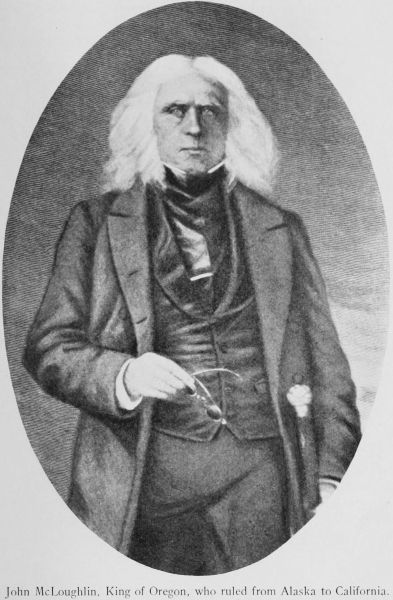
John McLoughlin, King of Oregon, who ruled from Alaska to California.
“Burning with sorrow, the boy arose, threw off
his clothing, blackened his face, seized his gun and
hurried to Kamloops. There he received every
kindness. Though warned by the interpreter, who
feared that the blackened face and scanty clothing
on a cold February day indicated mischief, Mr.
Black directed the boy to the fire in the Indian hall
and sent him food and pipe and tobacco. The
nephew smoked in moody silence. Toward evening,
as Black was passing through the room, the young
savage raised his gun and fired. The chief trader
staggered into the next room and fell dead before his
wife and children. The murderer escaped. The
news spread. From Fort Vancouver, McLoughlin
sent men to hunt to the death the murderer, ordering
John Tod to take charge of Kamloops. All traffic
at the fort must be stopped until the murderer should
be delivered. Calling the Shushwaps, Mr. Tod
informed them not a hair of their heads should be
hurt; but the guilty person must be found.
“Then arose Nicola, chief of the Okanogans.
‘You ask for powder and ball,’ he declared, ‘and
the whites refuse you with a scowl. Why do
the white men let your children starve! Look
there!’—pointing to Black’s grave—‘Your friend
lies dead! Are the Shushwaps such cowards to
shoot their benefactor in the back? Alas, yes; you
have killed your father! You must not rest till
you have brought to justice his murderer.’ Action
quickly followed. The murderer lay hidden in the
mountains of Cariboo. A few picked men started
in pursuit. They found the boy. Placing heavy
irons on him, they threw him across a horse and
started for Kamloops. They were obliged to cross
the river in a canoe. In midstream, with a sudden
jerk, the prisoner capsized the boat. But on the
opposite bank was old Nicola with a band of warriors.
The boy knew his hour had come. As he
floated down the stream, he raised his death song,
which was hushed by the crack of rifles, and the lifeless
body sank beneath the crimson waters.”
This legend Bancroft obtained from Tod, who
was on the spot at the time, and from McKinlay of
Walla Walla, who had received the story first hand.
Tod took up the reins of authority at Kamloops.
Tod moves the fort to a better site, has seven buildings
erected inside the palisades, and two bastions
placed at opposite angles to protect the walls. Then
he sends his hunters afield and remains in the fort
with no companion save his wife and three children.
Four years passed tranquilly and Chief Lolo rose to
be the ascendant leader of the Shushwaps. For the
story of Tod’s rule at Kamloops, the world is again
indebted to Bancroft, who obtained the facts from
Tod, himself. In the band of three hundred brigade
horses roaming outside the palisades was a beautiful
cayuse pony, which Lolo, the chief, coveted. “It
was the custom,” says Bancroft, “to send a party
from Kamloops to fish on the Fraser. This year
(1846) Lolo was to lead the party. The second night
after the departure, just as the chief trader was retiring,
a knock was heard at the door. Beside himself,
his family and a Half-breed boy, there was not a
soul about the place. The fort gates were not even
fastened.
“‘Come in,’ exclaimed Tod.
“Slowly the door opens until the black eyes of
Lolo were seen glistening. Though fearful that
some misfortune had happened to the party, Tod
was Indian enough never to manifest surprise. The
Shushwap pushed open the door and slowly entered.
“‘Your family will be glad to see you,’ Tod remarked,
wondering what had happened.
“‘The sorrel horse,’ began the chief. ‘I want that
horse, Mr. Tod.’
“‘The river has risen,’ observed Tod.
“‘For twenty years I have followed the fortunes
of the Hudson’s Bay Company ... and never
before have I been denied a request.’
“‘Fill your pipe,’ said Tod.
“‘Alas! My wives and little ones! Though I am
old and not afraid to die, they are young and helpless....’
“‘What the devil is the matter?’ now blurted out
Tod. ‘Who talks of dying? Where are the men?
Why have you returned? Speak!’
“Briefly, Lolo declared that the Shushwaps had
formed a conspiracy to attack the Kamloops brigade.
“‘Where are the men and horses?’
“‘I hid them as well as I could off the trail, telling
them I was going to hunt a better camping ground.
I said nothing about the conspiracy, knowing the
attack would not be made till we reached the river.
Time was when I would not have turned back for
such a threat, but my services are no longer valued.’
“‘Well, go to your family, and let me think about
it!’
“Was it true, or a trick to get the horse? Tod was
puzzled. While deep in thought as to what was best
to do, Lolo’s head thrust in again.
“‘Will you not let me have that horse, Mr. Tod?’
“‘No—damn you! Go home! If you say horse
to me again, I’ll break every bone in your body.’
“Trick or no trick, Tod must go to the waiting
brigade. Calling the Half-breed boy, he ordered him
to saddle two of the fleetest horses. He explained
the situation to his wife. Then he wrote a general
statement for headquarters, in case he should never
return. While Lolo was still asleep, the chief trader
and his boy were on the trail for Fraser River, galloping
as fast as their horses could carry them. He
reached his men by noon. They were surprised to
see him; but he merely gave orders to move forward
next morning. By sunrise, the party was on the
trail. In advance, rode Tod alone. He had told
his men to keep three hundred yards behind him, to
march when he marched, stop when he stopped. By
9 o’clock they approached a small open plain enclosed
in thick brushwood. Tod motioned his men to halt
while he rode forward apparently unconcerned but
with a glance to every rock and shrub. His eye
caught unmistakable signs ... a large band
of armed and painted savages were moving about
excitedly. Lolo was right, but what was Tod to do?
He had not ten men, and here were three hundred
arrayed against him, powerful Shushwaps, who could
handle the rifle as well as any white man....
The men to the rear ... had by this time seen
the savages.... They knew now why the
leader had so unexpectedly appeared.... Tod
motioned one of his party ... a George Simpson ... to
come.
“‘George! Fall back with the horses! If things
go wrong, make your way to the fort! Go!’
“The brave fellow hesitated to leave his leader
alone.
“‘Damn you! Go!’ shouted Tod....
“The enemy stand watching intently the fur
trader’s every move.... Turning full-front on
the glowering savages, Tod puts spurs to his horse....
As he rushes, they raise their guns ... the
horseman does not flinch, but quickly drawing
sword and pistol, he holds them aloft in one hand
... then hurls them all aheap on the plain ... and
he charges into the very midst of the
savages. Why did they not kill him?... Curiosity....
They wished to see what he would
do next.... There sat the smiling Scotchman
amid the thickest of them.
“‘What is all this?’ demanded the chief trader.
“‘We want to see Lolo. Why came you here?’
“‘Then you have not heard the news.... The
smallpox is upon us!...’
“Well they knew what the smallpox was and that
it raged on the Lower Columbia.
“‘That is why I come,’ continued Tod. ‘I come
to save you. You are my friends. You bring me
furs; but you must not come to Kamloops, else you
will die; see, I have brought the medicine to stop it!’”
Ten minutes later, Tod is sitting on the stump of a
fallen tree, vaccinating the Shushwaps, and Kamloops’
traditions say, indeed, Tod, himself, acknowledged
to Bancroft, that when the Indians,
who were leaders of the conspiracy, held up their
arms to be vaccinated, he took good care to give them
a gash that would disable their arms for some weeks.
A Scotchman abhors a lie; at least, a straightforward
lie that gives no quarter to conscience, but somehow
Tod conveyed to those Shushwap warriors the astounding
warning, that if they lowered or used their
vaccinated arms for some time, it would be absolutely
and swiftly fatal. So Tod saved Kamloops, and
volumes might be written of the legends lingering
about the old fur post. Other chief traders succeeded
Tod at Kamloops. McLean, son of the
colonist murdered at Seven Oaks, Red River, was at
Kamloops in the early fifties when all the world was
agog with excitement over the discovery of gold in
the Rockies. An Indian was drinking on the banks
of the Thompson when he saw what he thought
was a shining pebble. The pebble was carried to
McLean of Kamloops. It was a gold nugget. It was
the beginning of the end of the fur traders’ reign in
the mountains.
From Kamloops, the New Caledonia brigade
struck northwesterly on a trail to the Fraser and
along the banks of that torrential river up as far as
Alexandria, where MacKenzie had headed his canoes
back upstream on his trip to the Pacific. Alexandria
was now a fur post. Here horses were left to
pasture for the year, and the brigade ascended the
Fraser in canoes to Fort George and Fort St. James
on Stuart Lake, and Fort McLeod on McLeod
Lake, and Fraser Fort, and those other northern
posts variously known as Babine and Connolly,
where the Company had erected permanent quarters.
If Kamloops resembled some Spanish redoubt
perched on some high sierra amid parched, rolling
hills, the Stuart Lake region—New Caledonia proper—was
like a replica of the Trossachs on some colossal
scale. Lakes with the sheen of emerald lay hidden
in the primeval forests reflecting as in a mirror woods,
cloud-line, treeless peaks and the domed opal of the
upper snows, where the white drifts lie forever and
the precipices are criss-crossed by the scar of the
avalanche as by some fantastic architect. In area,
the region is the size of modern Germany. It was
here Simon Fraser, the discoverer, had planted the
flag of the fur trader and established posts in the land
that reminded him of Scottish Highlands.
Fort St. James, being the center of the most populous
Indian tribe—the Carriers—has become the capital
of this mountain kingdom, and many old worthies
of the Northwest days have played the king here.
Ordinarily, the fort drowses in security like a droning
bee on a summer day, but in times of Indian treaty,
or on such occasions of pomp as Sir George Simpson,
the governor, coming on a visit of inspection, Fort
St. James puts on an air of military pomp, the sentinel
going on duty at 9 P. M. and with monotonous tread
calling out, “All’s Well” every half hour till 5:30
A. M., when a rifle is fired to signal all hands up.
Six A. M. work begins. Eight o’clock is breakfast.
Nine, the traders turn to work again. At 12:00, a
bell signals nooning; at 1:00, back to work; at 6:00
P. M., duty done for the day.
Harmon, who came West with Henry’s brigade
of Pembina back in 1811, remains almost to the time
of the Company’s union, when he retires to Vermont.
John Stuart, who voyaged with Fraser, comes after
Harmon; but he retires to spend his last days in
Scotland. He is succeeded by William Connolly,
an Irishman of Babine Lake, a northern post. East
at McLeod Lake is Tod, who is to win fame at
Kamloops. South is Paul Fraser, son of the explorer,
at the Fraser Lake post. Down at Fort
George on the Fraser, is little James Murray Yale,
who served as a boy under John Clarke in Athabasca,
when, on one of the terrific marches of the
famine stricken Hudson’s Bays, little Yale’s short
legs could keep the pace no longer and the boy fell
exhausted on the snow to die. “Come on! Come
on garçon,” called a big voyageur, whose admiration
had been won by Yale’s pluck. “Go on,” retorted
Yale. “I’ve reached the Great Divide,” and the
big voyageur turned to see that the brave boy preferred
to die rather than impede the others. The
rough fellow’s heart smote within him. He burst in
tears, tore back mumbling out a cannonade of oaths,
bent his big back, hoisted Yale on his shoulders like
a papoose in a Squaw’s mossbag, and rejoined the
marchers, muttering a patois of pidgin English and
jargon French—“Sacré! Too much brave, he little
man! Misere! Tonnere! Come on!” Here, then
is Yale, grown man, though still small, now serving
the united companies at Fort George and later to be
shifted down the Fraser to Fort Langley at tidewater,
and Yale Fort, higher up, and Hope at the mountain
gorge. To keep track of these little kings ruling in
the wilderness, shifted from post to post, would necessitate
writing chapters to vie with Hebrew genealogies.
The careers of only the most prominent may be followed,
and of all the traders serving under Chief
Factor Connolly of Stuart Lake, in 1822-23, the
most important was James Douglas, a youth of some
twenty years.
Born in Demerara, on August 11, 1803, of a beautiful
Creole mother and father, who was the scion
of the noble Black Douglas of Scottish story—James
Douglas had been carefully educated in Scotland
and joined the fur companies a soldier of fortune
before he was twenty-one. Douglas inherited the
beauty of his mother, the iron strength and iron will
and never-bending reserve of his father’s race. At
first, he had been disgusted with the ruffianism of the
two great companies, and had intended to retire from
the country; but McLoughlin of Fort William had
taken a fancy to the Scotch youth and persuaded
Douglas to come West after the union. McLoughlin
advised as a friend that Douglas serve in as many
posts as possible and climb from the bottom rung
of the ladder so that every department of the trade
would be mastered first-hand. Hence, Douglas was
assigned as clerk under Connolly of Stuart Lake at
a salary of £60 a year. He, who was to become
titled governor of British Columbia, had now to keep
the books, trade with the Indians, fish through ice
with bare hands, haul sleighloads of furs through
snowdrifts waist deep—in a word, do whatever his
hand found to do, and do it with his might.
Chief Factor Connolly had a beautiful daughter
of native blood, as Douglas’ mother had been of
Creole blood. The girl was fifteen. Douglas was
twenty-one. The inevitable happened. Nellie Connolly
and Douglas fell in love and were married according
to the rites of the Company—which simply
consisted of open avowal and entry on the books—a
pair of children dreaming love’s dream in surroundings
that would have made fit setting for the honeymoon
of monarchs. Later, when there came a
Reverend Mr. Beaver to the Columbia in 1837-38,
breathing fire and maledictions on unions which had
not been celebrated by his own Episcopal Church,
Douglas was re-married to Nellie Connolly. In fact,
Douglas and McLoughlin who had both married
their wives according to the law of the Company—and
there was no other law—had an uncomfortable
time of it as missionaries came to the Columbia.
The Reverend Beaver openly preached against McLoughlin
living in a state of sin. McLoughlin,
being good Catholic, kicked the reverend gentleman
soundly for his impudence; but to still the wagging
of tongues had himself married by the church to
McKay’s widow. Even that did not suffice. Catholics
did not recognize ceremonies performed by
Protestants. Protestants did not recognize unions
cemented by Catholics. It is said that the saintly
old Father of Oregon actually had himself married
two or three times to satisfy his critics; and at this
distance of time one may be permitted to wonder
which ceremony was written down as holiest in the
courts of heaven—the civil contract of the Company
by which a chivalrous gentleman took the widow of
his friend under his protection, or the later unions
lashed like a “diamond” hitch by well meaning enthusiasts.
Meanwhile, up at Stuart Lake, was Douglas
learning what was untellable—the daily discipline
of strong, absolutely self-reliant living; Douglas
developing what McLoughlin meant should be
developed when he sent the young man to such
a hard post—iron in muscle, iron in nerve, iron
in will.
The story is told that once at a later era in Douglas’
life at Victoria, a clerk dashed breathless into his
presence gasping out that a whole tribe of unruly
Indians had got possession of the fort courtyard.
“Will we fire, sir? Will we man the guns?” asked
the distracted young gentleman. Douglas looked
the young man over very coldly, then answered in
measured, deliberate tones: “Give them some bread
and treacle! Give them some bread and treacle!”
Sure enough! The régale pacified the discontent,
and the Indians marched off without so much as
the firing of a gun. People asked where Douglas
had learned the untellable art of governing unruly
hordes. It was in New Caledonia, and the school
was a hard one. Douglas’ first lesson nearly cost
him his life. This story has been told often and in
many different versions. The first version is that of
McLean of Kamloops. All legends are variations
of this story, but the facts of the case are best set
forth by the missionary to the Carrier Indians—Father
Morice, who questioned all the old traders
and Indians on the spot. Here is the substance of
the story as told to Morice:
Jimmie Yale went home from Stuart Lake to Fort
George on the Fraser one night in 1823 to find his
two white workmen murdered by two Fraser Lake
Indians, mutilated and thrown in outhouses for dogs
to eat. The Hudson’s Bay Company never let a
murder pass unpunished. One of the murderers
was secretly done to death by paid agents of the Company,
“who buried the remains,” relates Morice,
“in a way to suggest accident as the cause of death.”
Five years passed. Surely the Company had forgotten
about the crime. The other murderer ventured
a visit to Stuart Lake. Chief Factor Connolly
was away. James Douglas was the only white man
at Fort St. James. As soon as he heard of the murderer’s
visit, he bade the Indians arm themselves
with cudgels and follow him. The criminal had
hidden in terror under a pile of skins in a sick woman’s
lodge. Douglas dragged him forth by the hair,
demanding his name. The fellow mumbled out
some assumed cognomen.
“You lie,” answered Douglas to the stammered
answer, firing point-blank in the fellow’s face; but
in the struggle, the ball went wide. The Indians
thereupon fell on the criminal and beat him to death.
“The man he killed was eaten by dogs. By dogs
let him be eaten,” Douglas pronounced sentence,
ordering the body to be cast unburied outside the
palisades. This was enforcing the savage law of a
tooth for a tooth with a vengeance. The chief of the
Carriers determined to give young Douglas the lesson
of his life. Punish murderers? Yes; but not as if
Indians were dogs.
A few weeks afterward, followed by a great concourse
of warriors from Fraser Lake, old Chief Kwah
marched boldly into the Indian Hall of Fort St.
James. Douglas sprang to seize a musket hanging
on the wall. Fort hands rushed to trundle cannon
into the room, but the Indians snatched the big
guns, though brave little Nancy Boucher, wife of the
interpreter, managed to slam the doors shut against
more intruders and Nellie Connolly came from her
room half dazed with sleep just in time to grasp a
dagger from the hands of the murdered Indian’s
father. Chief Kwah’s nephew had a poniard at
Douglas’ heart and was asking impatiently:
“Shall I strike? Shall I strike? Say the word
and I stab him!”
It was woman’s wit saved the captive Douglas.
Quick as flash glided Nellie Connolly to the old
chief, knowing well the Indian custom of “potlatch,”
gift-giving, appeasing for bloodshed with costly
presents. She offered old Kwah all he might ask
to spare the life of her husband. Then dashing upstairs,
the two women began throwing down tobacco,
handkerchiefs, clothing. The Indians scrambled
for the gifts. Douglas wrenched free, and Old Chief
Kwah bade his followers come away. He had done
all he meant—taught Douglas a lesson, though
those so-called lessons have a ghastly sudden way
with angry Indians of turning to tragedy, as the
massacre at Red River testifies.
An event that has gone down to history at Fort St.
James, was the visit of Governor Simpson, in 1828.
Simpson was young, but what he lacked in years, he
made up in hard horse-sense and pomp to impress
the Indians. Music boxes, bugles, drums, fifes—all
were used in Simpson’s pow-wow of state with the
Indians. September 17th, his scouts sighted Stuart
Lake. The guide to the fore unfurled a British flag.
Buglers and bagpipes struck up a lively march that
set the echoes flying among the mountains and
brought the Carrier Indians out agape. First, clad
in all the regalia of beaver hat, ruffled choker, velvet
cape lined with red silk, leather leggings and gorgeous
trappings to his saddle—rode Governor Simpson.
Behind came his doctor and a chief factor riding
abreast. Twenty men followed with camp kit, then
one of the McGillivrays to the rear. In all, Simpson
traveled with a retinue of sixty. A musket shot
notified the fort of the ruler’s approach. Fort St.
James roared back a welcome with cannon and
musketry, all hands standing solemnly in line, while
Douglas advanced to meet his lord, Connolly being
absent on the Fraser. What with a band playing
and the cannon booming, such wild echoes were
set dancing in the mountains as almost frightened
the Carrier Indians out of their senses. Was the
great white lord coming to be avenged on them for
the attack on Douglas? But the great white lord,
who was nothing more nor less than a clever little
gentleman bent on business, kept his band marching
up and down the inner gallery of the palisades, chests
puffed out, pipers skirling, while he as lord ascendant
of the mighty mountains shook hands with the
Indians and treated them to tobacco. Simpson passed
south to Vancouver.
New Year’s Day, 1829, the clerks of St. James
determined to punish the Carriers for their raid.
Bounteous was the régale of rum dealt out. When
the Carriers lay drunk, out sallied the voyageurs and
gave the Indians such a pummeling as stirred up
bad blood for a year. Douglas’ life was no longer
safe in Caledonia. In 1830, he left Fraser River to
join McLoughlin in Oregon. He had come to New
Caledonia, raw, impulsive, violent in his forcefulness
to succeed. He went down to Oregon, still young,
but a drilled disciplinarian of life’s hard knocks—reserved
to a fault, deliberate to a degree, cautious
and tactful in a way that must have delighted McLoughlin’s
heart. When Connolly left New Caledonia
for Montreal, where he rose to eminence, there
came as Chief Factor, Peter Skene Ogden, fresh
from leading the southern brigades.
McLoughlin needed Douglas in Oregon. The
Company, that had begun two centuries before with
one little fort on a frozen sea, had not only stretched
its tentacles across the continent but was reaching
out to Hawaii, to Mexico, to Alaska. And this galvanizing
energy resulted directly from the energy
of that little man, George Simpson. “If” is a word
that opens the door of lost opportunities. If Sir
George Simpson had been seconded in his aims by the
Governing Board of the Hudson’s Bay Company; and
if those gentlemen who lived fat on their fur dividends
had mended their ignorance sufficiently to know what
Sir George was driving at; and if the Company had
bought over the bonded debts of Mexico—as Simpson
advised—and traded the debts for the grant of California
to the English; and if the Company had
been less niggardly and paid down promptly the
$30,000 asked for Russia’s holdings in California—if
all these things, then, one wonders whether the
southern bounds of British Columbia to-day would be
the northern bounds of modern Mexico. But man’s
blunders are destiny’s plays; and the opportunities
missed by one nation the prizes seized by another.
Far reaching and statesmanlike in grasp were the
schemes McLoughlin had in hand.
Baranoff, the famous old governor of Alaska, had
died just a few years before the union of the two
English companies, and from the time of his death
the grip of the Russian Fur Company slackened on
Alaska. Naval officers came out as governors.
Naval officers knew nothing of the tricks of the fur
trade. Returns to the St. Petersburg company began
to decrease. Was Alaska worth holding? That
was the question Russians were asking.
As the Hudson’s Bay Company pressed toward the
Pacific from New Caledonia, their traders and trappers
came in violent collision with Russians working
inland from the coast. There ensued the usual orgies
of rum and secret raid. It became apparent that it
would be cheaper for the Hudson’s Bay Company to
ship some of its New Caledonia furs by sea south to
the Columbia than to send the packs inland and
south by the horse brigades. The Anglo-Russian
Treaty of 1825 had granted the Hudson’s Bay Company
free navigation of streams across Russian territory
to the interior of northern British Columbia.
Year by year, English forts had been creeping up
the west coast toward Russian Alaska. Fort Langley
had been built on the Fraser by McMillan and
twenty-five men, in 1827. The party had come from
the Columbia overland to Puget Sound. There
Captain Simpson on The Cadboro met them and
carried all some thirty miles up Fraser River to a
point on the south bank. The Indians were notoriously
hostile, but McMillan kept men on guard day
and night, and had his builders sleep in midstream on
board The Cadboro. By autumn, an oblong fort
with the regular palisades, inner gallery for artillery
and corner bastions, had been completed; and the
men scattered afield to hunt. Expresses were regularly
sent overland to Fort Vancouver and one of
these led by a MacKenzie with four men, was murdered
on an island in the straits in January, 1828.
In October, comes Governor George Simpson in
pompous estate with band and outriders and retinue
of twenty men. McMillan went down to the Columbia
with the governor and was succeeded by little
James Yale of Caledonia, who promptly sought to
render himself secure with the natives by marrying
an Indian wife. Gradually, this post became the
great fishing station of the Company for the salmon
shipped to Hawaii.
Near Nisqually River on Puget Sound sprang up,
in 1833, a cluster of cabins known as Nisqually Fort,
the half-way house between the Columbia and the
Fraser, between Fort Vancouver and Fort Langley.
The same spring Captain Kipling’s Dryad is sent
North with Duncan Finlayson and forty men to
build an outpost yet farther north—Fort McLoughlin
on Millbank Sound. Work proceeds all summer.
Finlayson goes back to the Columbia, Manson taking
charge. In spite of every caution against the
treachery of the notorious Bella Coola Indians, who
long ago proved so hostile to Sir Alexander MacKenzie,
a trader by name of Richards disappears—whether
a deserter or captive, Manson cannot tell.
A chief is seized as hostage till the white man is returned.
Sunday, the flag signals no trade. Not a
breath of wind stirs the water. Not a canoe is visible,
not an Indian to be seen. A drowsy sense of
security comes over the fort sweltering in the summer
heat. Toward night, the men ask permission to go
outside the palisades for pails of fresh water. Anderson
does not approve; but Chief Trader Manson
takes his pistol and sword, opens the sally port, and
leads his men down to a fresh water stream. Instantly,
in the twilight, the dense forests come to life.
There is the Bella Coola’s war-whoop, the crash of
ambushed sharpshooters, a spitting of bullets against
pebbles and pails, a wild rush of traders and Indians
to reach the gates first.
“Bind your hostage! Quick—fire the cannon!”
bellowed Anderson sprinting for safety.
The cannon shots drove back the savages and the
whites got safely inside the palisades with only one
water carrier lost. One may guess there was no
sleep. Rain clouds rolled up rendering the night
pitch dark with never a sound but the lapping of the
waters, the tramp, tramp of the sentries, the shuffle
of men hurriedly handing down all the muskets from
the wall racks, the “All’s Well” of the watch every
half hour as he passed the entrance to the main house.
About midnight out of the dark came a terrified shout.
“Mr. Manson! Mr. Manson! Can you hear
me?” It was the captured water carrier.
“Hello! Where are you?”
“Tied in their canoe, and the devils say they are
going to kill me unless you let the chief go!”
Manson and Anderson hoist the hostage to the
gallery inside the palisades and bid him assure his
people he is safe and will be exchanged at daybreak
for the water carrier. Daydawn after sleepless night,
prisoners are exchanged; and the rescued man reports
that the other missing trader had long since
been stoned to death by Indian boys. Fort McLoughlin
proves too dangerous a fort for the traders
to hold. It is torn down, in 1839, and moved across
to the north end of Vancouver Island, where it is
re-named Fort Rupert and flourishes to modern
times.
Nisqually, Langley, McLoughlin, Rupert—nothing
daunted, the Company still pushes northerly and
builds Port Simpson. Then, in 1834, it is decided
to send Peter Skene Ogden up on The Dryad to
cross the Russian frontier and build a company post
on Stickine River. This is more easily said than
done. It is one thing to have free access across
foreign territory. It is quite another thing to use
that privilege to build a fort on the frontier of a
friendly power. Baron Wrangel is governor at Sitka
this year. The Dryad has barely poked her prow up
the turbulent current of the Stickine breasting toward
the Russian redoubt of St. Dionysius—a log fort
later known as Wrangel—when puff goes a cannon
shot! Is it a salute, or command to stop? Out
rows a boat with a Russian officer presenting a
formal proclamation forbidding the English company
from ascending the Stickine.
“This is clear violation of our treaty,” thunders
Ogden.
The Russian officer shrugs his shoulders and mutters
some politeness through his beard. The Englishmen
visit the Russian fort. Very polite are the
Russians but very deficient in English speech when
Ogden blusters about treaty rights.
“The thing can be arbitrated. We’ll go on up the
river anyway,” protests the Britisher with that bull-dog
persistence of getting his teeth in and hanging on,
which characterized his Company. Then the Russians
suddenly find their English.
“If you do, we’ll fire.”
Word is sent to Baron Wrangel of Sitka, but Baron
Wrangel is opportunely absent. For ten days, they
jangle, these rival traders. Then Peter Skene retires
from the coast to be appointed Chief Factor of
New Caledonia.
But the matter is not permitted to end here. In
1838, McLoughlin visits England. The case is laid
before the Board of the Hudson’s Bay Company, and
the Hudson’s Bay Company lays the case before the
great British Government, and for those ten days’
delay and those violations of treaty rights and those
damages to British dignity, a bill of £20,000 is presented
to the Russian Government. It would be
interesting to know how the items of that bill were
made up. Deep is the craft of these gamesters of
the wilderness. They probably never intended that
the bill should be paid, but it acts as a lever for what
they really do want; and they will generously waive
all claims of compensation for damaged dignity if
the Russians will lease to them a ten-mile shore strip
at the rate of 2,000 land otter skins a year.
“Owning half a continent, what in thunder did
they want with a ten-mile shore strip?” a British
diplomat asked; but it takes more than a British
diplomat to fathom the motives of a Hudson’s Bay
Company man. The short strip was a mere bagatelle.
The English Company wanted to get into
trade relations with the Russians. For this purpose
any wedge would do—any wedge but asking trade
as a favor. The fine point was to put the other
fellow at a disadvantage and make him sue for the
privilege of granting the favor, which the Hudson’s
Bay Company wanted.
Curious—you may search the records of the Hudson’s
Bay Company from the time of Radisson to
Simpson; the method is always the same; motives
not only secret but deliberately hidden by every
subterfuge and trick that craft could devise; a secret
aim worked out by diplomatic cunning, so that the
other party to the aim shall sue for the privilege of
doing exactly what the Hudson’s Bay Company
wants. Altogether, it is very funny; and altogether,
marvelously clever; and with it all—don’t forget—was
the noblesse oblige of the grand old gentlemen
of the grand old school, who play patron to every
good cause and would not rob man, woman, child,
bird or beast of as much as a crumb. Where does it
come from—that curious diplomacy of the Hudson’s
Bay Company? Is it an inheritance of feudalism,
of the mediæval court ways, when a prince made his
subjects thankful to God for having their pockets
picked by his dainty fingers? To Radisson, the
Company owed its existence. Yet they made him
glad to beg for a penny. The French won the bay
fairly in open war. Yet the Company made France
glad to give up all possessions by the simple trick of
presenting claims of £200,000. And when negotiations
opened with Canada for the surrender of the
monopoly in the Northwest, by some legerdemain of
diplomacy, Canadian statesmen were glad to pay
millions in cash and millions in land for the relinquishment
of a charter—which, from the Canadian
point of view—the Company ought never to have
been allowed to possess. The very year that Russian
negotiations are in progress, Pelly, the English
governor of the Company, and Simpson, the colonial
governor, have both been knighted for their loyal
care of British interests abroad.
Let us follow the diplomacy of the ten-mile strip.
While diplomats are busy in England, Fort Simpson
has been rebuilt on a better site by the same men of
The Dryad repulsed at Stickine. At the mouth of
the Skeena, the H. B. C. flag now flies above Port
Essington (1835). Also on the Stickine inland from
the Russian strip, Glenora and Mumford have been
built.
Back came McLoughlin and the newly knighted
Simpson from the Board Meeting in London. McLoughlin
came by way of Canada. A special brigade
is organized at Montreal to take possession of the
leased ten-mile strip. Spring, 1840, James Douglas
in command, assisted by Glen Rae, McLoughlin’s
son-in-law, by John McLoughlin, Jr., and fifty
others, the brigade leaves Fort Vancouver, ascends
the Cowlitz River, portages overland to Puget Sound
and at Nisqually boards the little steamer Beaver
for the North. Pause is made at Langley on the
Fraser just in time to see the embers of the burnt
fort. Jimmie Yale is housed in tents with the savages
howling around him ready to attack. Douglas
lands his men and rebuilds Langley. Next stop at
Fort Simpson, then up to the Russian redoubt on
the Stickine, where fifty Russian soldiers are in
charge. McLoughlin, Jr., drops off here with eighteen
men to take over the fort.
“Eighteen men! Do these British traders know
the nature of the savages?” ask the amazed Russians.
And the Beaver goes on to Sitka with Douglas.
Loud roars the welcome from the Russian guns
in honor of Douglas. Green were the waters of the
mountain girt harbor, gold and opal the shimmering
mountains. Etholine is Russian Governor in charge
now, a military officer with his bride; and gay is
Sitka with bunting and Chinese lanterns and feast
and dance while the Hudson’s Bay men visit the fort.
What did they talk about over their cups, these crafty
gamesters of the wilderness, when Etholine’s bride and
Glen Rae’s wife— Eloise McLoughlin—had withdrawn
and left the feasters to wassail till midnight?
Who knows! It was the policy of the Hudson’s
Bay Company from the beginning to tell absolutely
nothing. Until they played their cards, these gamesters
never showed their hands. All we know is when
Douglas left Stickine, the Russian company had
agreed to buy all the supplies they could procure
from the Hudson’s Bay Company farms on Puget
Sound and the Willamette and the Columbia. That
was cheaper than bringing supplies all the way across
Siberia; and the supplies were paid for in Alaskan
furs. You see the fine hand of the Company’s diplomacy?
On the supplies was a profit varying
from 1000 to 2000 per cent. On the furs taken in
exchange was another profit unspecified but easily
guessed when it is known that the Russians got their
furs from the Aleutians by club law. What had the
deal cost the English? Two thousand land otter a
year for a ten-mile strip, the said otter bartered from
the Indians at about two shillings each. But one
bad blunder was made, which did not come out till
long after. Russia had tried in vain to raise her
own supplies on a farm at Bodega, California. On
the farm were some 1500 sheep and 3000 cattle and
horses. Etholine offered to sell the Hudson’s Bay
Company all Russia’s holdings in California for
$30,000. There the old diplomacy of always haggling
till you caught the other party to the bargain at
a disadvantage—over-reached itself. Douglas haggled
and missed the bargain; and the bargain was a
chance to give his Company foothold in a country,
owned by Mexico, which in turn owed debt of five
million pounds to British financiers. It is a sort of
subterranean diplomacy, after all, but one can guess
to what end these hidden motives were aiming.
While the Company builds yet more forts up
the Pacific Coast—Tako, and later Nanaimo—John
McLoughlin, Jr., reigns at Stickine. Glen Rae, who
came with Douglas to help establish the post, has
gone on down to California in connection with that
secret Hudson’s Bay diplomacy. McLoughlin was
an example of reversion to ancestral type. In his
veins flowed the blood of his mother’s Indian race;
and in him were all the passions and few of the virtues
of either his mother’s or father’s race. Morose,
severe, vindictive with his men, he had neither the
strength of will nor good fellowship to hold the loyalty
of his staff. Outside the fort were two thousand of
the fiercest Indians on the Pacific Coast. McLoughlin
rightly forbade the use of liquor with these savages,
but while he interdicted his men from all vices,
he indulged in wildest orgies himself. In his cups,
like many morose men, he became so genial that he
actually plied his traders with the forbidden liquor.
Excesses followed such outbursts as are better guessed
than told. One night toward the end of April, 1842,
McLoughlin was on one of his sprees and the fort
was a roaring bedlam of drunken, yelling, fighting
white men; while outside camped the Indian warriors
ready for a raid. A French Canadian was for
breaking rules and rushing past the sentry out to the
Indian camp. McLoughlin roared out an oath forbidding
him. The drunken Frenchman turned and
shot his leader dead. Four days later came Sir
George Simpson to find flags at half-mast and the
murderer in irons. Henceforth, no more rum in
Pacific Coast trade! Governor Simpson for the
English, and Governor Etholine for the Russians,
bound themselves to abolish the use of liquor in
trade. The murderer was carried to Sitka for trial
but escaped punishment, probably because McLoughlin
was so much in the wrong that the dead
trader’s conduct would not bear the light of investigation.
This caused the first friction between Governor
Simpson and Chief Factor McLoughlin. The
governor blamed the doctor for placing such a worthless
son in charge of any fort.
What was William Glen Rae, Eloise McLoughlin’s
husband, doing in California?
He had been McLoughlin’s chief lieutenant before
Douglas came down from New Caledonia. Swarthy,
straight as a lance, somber and passionate in his loves
and hates, Rae was a Scotchman of princely presence,
like all the men whom McLoughlin chose for promotion.
Loyal to his father-in-law to a degree, he
was the very man for a delicate mission of possibly
far-reaching importance.
Away back in 1828, when Ogden was leading the
Southern Brigades to Nevada and Utah and Mt.
Shasta, four white men—Jedediah Smith and American
trappers—had escaped with their lives from the
Umpqua River region and come to Fort Vancouver
destitute, wounded, almost naked. They had been
trapping in California and following up the valley of
the Sacramento had crossed over to the Umpqua
intending to proceed East by way of the Columbia
when the party of twenty was attacked at the ford
of Umpqua River. Fifteen of the trappers were
shot down instantly by the Umpqua and Rogue
River Indians. All the horses were stampeded.
Goods, furs, everything was plundered, the results
of two years’ toil. Breathless and foredone, the
refugees rapped at the gates of Fort Vancouver.
They were Americans. They were rivals. “You
must positively drive out all American trappers,”
Simpson had ordered McLoughlin. And these men
belonged to the same St. Louis outfitters, who had
profited by the robbing of Peter Skene Ogden. “Heh!
What? American trappers? Bless my soul,” exclaimed
the Hudson’s Bay McLoughlin. “How on
earth did you come over the mountains all this way?
What—robbed? You don’t tell me? Plundered;
and by our Indians? Fifteen men murdered! Come
in! Come in! McKay, there, I say McKay,” he
shouted to his stepson scout, “I say McKay, hear
this! These gentlemen have been robbed by the
Rogue River Indians. Where’s La Framboise? (the
guide). Saddle the horses quick! Take the South
Brigade! Go rescue these gentlemen’s property!”
And the hoofs of the South Brigade have not
clanked far on the trail at a gallop before McLoughlin
has the refugees in the mess-room plied with food,
while he questions them of minutest detail. The
Americans are completely in his power. He supplies
them with clothing and an outfit to proceed East by
way of the Columbia; but what does he do with the
furs Tom McKay brings back with the South Brigade
after a wordy tussle and the giving of many presents
to the Rogue River Indians? Ogden had been
robbed by Americans. Surely here is a chance to
even the score! Can one imagine a grasping Wall
Street Crœsus missing such an opportunity to cripple
a rival? And I have just related how deep, how
crafty, how subtle and devious the Company policy
could be at times. What did McLoughlin with
these rivals in his power, who had injured him? He
wrote Smith a draft for the entire lot of furs at the
current London prices—$20,000 some reports say;
others put it $40,000.
McKay and McLeod are at once sent down with
the South Brigade to build a Hudson’s Bay fort on
the Umpqua. It is known as McKay’s fort. La
Framboise—Astor’s old interpreter—and McKay
now regularly range the Sacramento, though Sutter,
the Swiss adventurer, who has a fort of his own on
the Sacramento, tries to stir up the Spaniards against
them and a subsequent arrangement with the Spanish
authorities expressly stipulates that only thirty trappers
shall be allowed in the brigades. Who is to
count those thirty trappers in mountain wilds? La
Framboise and McKay led as many as two hundred
to the very doors of Monterey. It may have been a
necessity of the climate. It may have been a disguise;
but the H. B. C. brigades of California dressed
so completely disguised as Spaniards that they almost
deceived Sir George Simpson.
It was in Simpson’s fertile brain that the whole California
scheme originated. December, 1841, McLoughlin,
Douglas and Simpson sail into the harbor
of San Francisco. By land go McKay and La
Framboise and Ermatinger with the brigades. Presto!
First news! Sutter, the Swiss, had already bought
the Russian fort at Bodega for $30,000. Douglas
grinds his teeth; but Sir George Simpson is not discouraged.
Mexico owes England five million, he
says; and these Spanish colonies are having fresh
revolutions almost every year. They are wined and
dined and feasted and fêted by the pleasure-loving
Spaniards at General Vallejo’s, and later meet General
Alvarado at Monterey. What did they talk
about? Again I answer—we must judge by the cards
which the gamesters played. It is permitted the
Hudson’s Bay may have a trading post at Yerba
Buena, in other words, San Francisco. It is permitted
they may buy Spanish hides and Spanish
stock to be paid in trade from the stores of Fort Vancouver—goods
from England. Also, of course, it is
understood these South Brigades have not come to
trap at all, but just to drive the purchased stock
North by way of the Sacramento to the Columbia.
Simpson and Douglas and McLoughlin depart well
satisfied.
Next year, in May, came Rae by boat to carry out
the plans, and Birnie, the Scotch warder of the Columbia
bars at old Astoria, as clerk, and Sinclair as
trader, and McKay and Ermatinger by land as
leaders of the inland brigades. Rae lands goods
worth $10,000, and takes possession of a 1000 acre
farm on the site of the modern San Francisco, and
purchases a building worth $4,600 to house the goods.
Eloise McLoughlin, Rae’s wife, does not come at
once; and the Spaniards are a pleasure-loving people.
Wines are used more than water, and the handsome
Scotchman is no unwelcome visitor to the lavish
homes of the proud Mexicans. What with wine and
beautiful Spanish women as different from the Half-breed
wives of the North as wine from water, and
plotting and counter-plotting of revolutionists—did
Rae lose his head? Who can tell? It would have
needed a wise head to remain steady in an atmosphere
so charged with political intrigue—intrigue
which Rae had been appointed to watch. He certainly
drank hard, and he may have cherished errant
love, too, for when Eloise McLoughlin, his girl
bride, came down from the Columbia River, high
words were often heard between the two. American
influence was waxing strong in San Francisco; and
in his cups, Rae was wont to boast “that it had cost
£75,000 to drive Yankee traders from the Columbia,
and the Hudson’s Bay Company would drive them
from California if it cost a million.”
Came one of the sporadic revolutions. The revolutionists
were partial to the English, hostile to the
Americans. Rae furnished the rebels with arms.
They were defeated. They had not paid for their
arms. Rae found himself responsible for a loss of
$15,000—some accounts say $30,000—to his Company.
That he was in love with a Spanish woman
may have been a baseless rumor; but if there
were a shadow of truth in it, it must have
furnished additional reason for discrediting him
with his father-in-law—McLoughlin. January, the
19th, at eight A. M., Sinclair, the clerk, heard loud
cries above the store. He dashed upstairs into Rae’s
apartments to find him standing in the presence of
Eloise McLoughlin with a pistol in his hand ready
to kill himself. Sinclair knocked the weapon from
his hand. A shot rang out. Rae had had another
pistol and fell to the floor with his brains blown out.
On a table near were the bottle of an opiate, which
he had taken to deaden pain, and his will, written
that very morning. His wife fainted. Absolutely
nothing more is known of the tragedy than the facts
I have set down here. It is a theme rather for the
novelist than the historian. Simpson ordered the
San Francisco post closed. Dugald McTavish came
down in March of ’46 to close up affairs. The one-thousand-acre
farm, which would have netted the
Company more than all the furs of Oregon if they
had held on to it till San Francisco grew to be a city,
was relinquished without any compensation of which
I could find a record. The store was sold for $5,000.
So ended the Hudson’s Bay Company’s ambitions
for empire in California. The truth is—in spite of
Sir George Simpson’s efforts, and owing to blunders
on the part of the British Government, which will
be given in the next chapter, the Company was playing
such a losing game in Oregon, it was useless to
hold on to California longer.
Notes to Chapter XXXII.—This entire chapter deals with
such a vast field and with so many disputed points, it would
literally require a large volume to give all the authorities or
deal in detail with the disputes. I have not attempted to give
a chronological account of McLoughlin’s empire. So vast was
it and so varied the episodes, a chronological account would
have required a jumping from spot to spot from Alaska to
California, resembling the celerity of a flea. Instead, I have
grouped the leading episodes and leading characters and leading
legends according to area, and told each district’s story in a
separate group. This gives at least enough coherence to keep
the facts in memory.
As to authorities, I have drawn my data primarily from the
Archives of H. B. C. House; secondarily from such marvelous
collections of data as Hubert Howe Bancroft’s, and Father
Morice and the hundreds of old navigators and traders whose
journals of this era have been given to the world. In addition,
I have consulted every authority who has ever written on the
era. Naturally, among so many authorities, there are wide
discrepancies. Where I have taken my information from Hubert
Howe Bancroft, I have quoted him word for word, with full
credit, but in two or three cases, it will be seen my story differs
from his; for instance, the story of Douglas at Stuart Lake, in
which his version makes Douglas out a hero, mine makes Douglas
out a very human hero, learning the lessons that afterward
made him great. In each case where my version differs from
Mr. Bancroft’s, my authority has been the H. B. C. Archives—which
were not accessible when Mr. Bancroft wrote, or such well-known
sources as Morice, who got his facts on the spot, while
Bancroft had to depend on the memory and contradictory testimony
of old retired factors.
Again in the case of names, take one example. Different
authorities refer to the ubiquitous McKay as Robt., Alex, Dan,
Joseph. Now there may have been all these McKays in the
Oregon service, for the McKays of the fur trade were legion.
But the McKay, who led the South Brigade, was one and the
same and only Tom McKay, son of Mrs. McLoughlin’s first husband.
Another error—it is said this McKay took cruel part in
the Seven Oaks massacre. To say that Tom McKay, who from
the time of his father’s death hated Indians from the marrow
of his bones, took part in a massacre of white men—is simply
absurd. As a matter of fact, this Tom McKay must have been
about ten years old at that time. He certainly was present;
but I should be reluctant to believe that a boy of that age fought
and killed a full grown H. B. C. soldier. A hundred such discrepancies
occur in the California story, which space forbids my
pointing out, but where I have departed from old authorities, I
have been guided by H. B. C. manuscripts. For instance, all
authorities say H. B. C. trappers were not in California before
1835; yet I read fifteen hundred pages of their wanderings there,
before 1828.
Okanogan is spelled as many ways as it has letters. I have
spelled it the way it is pronounced—O-kan-og-an. I need not
explain such place names as Okanogan, Kamloops, Nicola are
from Indian tribes.
In H. B. C. House are simply tons of MSS. bearing on McLoughlin,
which I did not go over because they deal with the
story where I leave off—namely where the history of the H. B. C.
becomes the history of the pioneer and the colonist. He, who
takes up the story where I leave off, will need to spend both
time and money on transcripts of these folios. There are literally
tons.
The descriptions of the fur brigades are taken from the
journals of the leaders and of the missionaries who accompanied
them.
Bancroft has been accused of telling his legends too dramatically.
How could the legends be anything but dramatic? It
was a dramatic life day and night all the year round.
Two or three places, I have not given the names of the factors
who succeeded each other directly, skipping nonentities, or men,
who ruled for only a few months, for instance, McDonald and
Manson at Langley before Yale. In H. B. C. Archives is a very
full account of these Fraser River forts. Also it has been impossible
to give the founding of the coast forts chronologically.
Rupert and Nanaimo both came after the abandonment of McLoughlin
Fort, and there were two Fort Simpsons.
A tragic story attaches to Paul Fraser, son of Simon, which
space forbids giving. It will be found in Morice’s “New Caledonia.”
Jno. Stuart of New Caledonia was a cousin of Lord Strathcona
and the influence that induced young Donald Smith to join the
fur traders.
Mayne is responsible for the story of Douglas and the treacle.
A great many Kiplings served in the H. B. C. from 1750;
all as seamen.
CHAPTER XXXIII
1840-1859
THE PASSING OF THE COMPANY—THE COMING OF THE
COLONISTS TO OREGON—THE FOUNDING OF VICTORIA
NORTH OF THE BOUNDARY—-WHY THE H.
B. C. GAVE UP OREGON—MISRULE OF VANCOUVER
ISLAND—MCLOUGHLIN’S RETIREMENT.
Another subject had McLoughlin and
Simpson laid before the Governing Board
of London in that winter of 1838-39. The
treaty of joint occupation continued between the
United States and Great Britain; but Americans
were yearly drifting into the valley of the Columbia.
First came such occasional trappers as Jedediah
Smith and Wyeth, retreating with loss of life at the
hands of the Indians and loss of profits from the opposition
of the Hudson’s Bay Company. Of the
two hundred men who followed Wyeth through the
mountains in the early thirties, one hundred and
sixty were killed; but men like Wyeth and Kelley,
of Boston, sent back word to the Eastern States of
the marvelous wealth in forest and land of this Oregon
empire. Then came the missionaries in 1834,
the Lees, and Whitmans, and Spauldings—a story
that is, in itself, a book; but it does not concern this
record of the Hudson’s Bay Company. Missionaries
were not in the service of the English corporation.
They, too, sent word to the East of openings
in the Oregon country for the American settler. To
be sure, two thousand miles of waste land and mountain
lay between the Eastern home seeker and this
Promised Land, but was that a thing to deter frontiersmen
whose ancestors had hewn their way from
Virginia across the Blue Mountains to the Bloody
Ground of Tennessee and Kentucky? The adventure
of it but acted as a spur. Old pathfinders who
had settled down as farmers on the frontier of the
Missouri and Mississippi, felt again the call of the
wilderness, shouldered their rifles, and with families
in tented wagons set out for Oregon. Another
cause stimulated the movement. In the East were
hard times. The railroad had not yet reached the
pioneer of the prairie. He had no way of sending his
produce to market. Far off hills looked green. If
he could but reach the Columbia—he thought—there
was the ocean at his door as a highway for
commerce.
American farmers began to drift to the Columbia
Valley. At first there was no general movement.
The thing was almost imperceptible. Wandering
trappers turned farmers and squatted down with
their families in the valleys of the Willamette and the
Walla Walla and the Cowlitz. Then, as early as
1838, four families from the East came riding over
the mountains seeking homesteads. McLoughlin
shook his head. The thing seemed almost impossible.
He remembered what the coming of the colonists
had meant in Red River—the beginning of
the end with the fur trade; and in Oregon, the coming
of the colonist would be fraught with more importance.
If American settlers outnumbered English
traders, diplomacy might fold its hands. Joint
occupancy would end in American possession. From
the first, McLoughlin had encouraged his old traders
and trappers to settle on farms in the Willamette
Valley—at the famous Champoeg Colony. Fort
Vancouver, itself, now comprised thirty miles of cultivated
land, but between the Columbia and the Russian
posts to the north was no settlement, only fur
posts, and this was the very region where hinged the
dispute between England and the United States for
possession.
“Fifty-four forty or fight,” became the slogan of
the jingoists, which meant the United States claimed
territory as far as 54°; in a word to the Russian
possessions. In a nutshell, the reasons for the claim
were these:
When the United States took over Louisiana,
Louisiana extended to the Columbia. Gray, the
Boston trader, had discovered the Columbia River.
Lewis and Clarke, the American explorers, had
erected their wintering fort on its banks. Astor, the
American trader, had built his fur post on the
Columbia before the Canadians had come; and
though the fort was sold to the Canadians, after the
war of 1812, the American flag had been restored
to Astoria, though it remained in possession of the
Canadians.
Answered the British to these claims: Louisiana
may extend to the Columbia, but it does not extend
beyond it. Gray, the Boston man, may have discovered
the mouth of the Columbia, but Vancouver,
the Englishman, in the same year as Gray’s voyage,
ascended the Columbia, and explored every inch of
the coast from the Columbia to the Russian settlements,
taking possession for Great Britain. Especially,
did he discover all parts of Puget Sound.
Astor, the American, may have built the first fur post
on the Columbia, but Astor’s managers sold that
post to the Canadian Company; and though the
American flag was restored to Astoria, it was distinctly
on the specified understanding that the treaty
of joint occupancy should not prejudice the final decision
of possession in Oregon.
Jingoists in England wanted all of Oregon. Jingoists
in America wanted all of British Columbia’s
coast up to Sitka. Wise heads in England were willing
that the boundary should be compromised at the
north bank of the Columbia. Wise heads in America
were willing to relinquish United States claims beyond
the forty-ninth parallel; but the foolish catch
cry of “Fifty-four forty or fight” was being used as
an election dodge and stirred up ill feeling enough to
prevent compromise on either side.
While pompous statesmen, who knew absolutely
nothing about Oregon, were deluging Congress and
Parliament with orations on the subject of the
boundary, ragged men and women, colonists in
homespun, colonists many of them too poor for even
homespun, with barefooted children, and men and
women clad in buckskin, were settling the question
in a practical way. They were not talking about
possessions. They were taking possession.
This was the situation as McLoughlin and Simpson
laid it before the Governing Board in the winter
of 1838-39. Now fur traders never yet welcomed
colonists. The coming of the colonists means the
going of the game; but something must be done to
counteract these American settlers and if possible
hold the Columbia River as a highway for the Hudson’s
Bay brigades. The Puget Sound Agricultural
Company was formed with Hudson’s Bay men as
stockholders and McLoughlin as manager, to hold
the country between Columbia River and Puget
Sound—modern Washington—for the English. The
capital was £200,000 in 2000 shares; but there never
was any intention that the venture should pay. Very
little of the capital was ever paid in. The aim was to
hold a region as large as England and Scotland for
the Hudson’s Bay Company.
Coming back to Oregon, in 1839, with his son
David, now a graduated doctor, McLoughlin sent
his old trappers into the Cowlitz Valley as settlers,
and had a farm of five thousand acres measured off
for the Puget Sound Company. Here the stock was
raised that supplied the inland posts with food.
Hudson’s Bay men from Red River were sent overland
to colonize the Puget Sound region.
The precaution was useless. There are times
when the ragged colonist in homespun is wiser than
the wariest diplomat that kingcraft ever produced.
Congressional disputes, missionary lectures, the report
of the American secret agent Slocum sent from
Washington to observe the trend of events on the
Pacific, the efforts of the Oregonian Society formed
in Massachusetts—all fanned the flame of emigration
to the West to a furore. More settlers in tented
wagons rolled slowly westward from the Missouri.
Jason Lee comes back with more missionaries in
1840. Lieutenant Wilkes of the American Exploring
Squadron slips up the Columbia, in 1841, to
observe things for himself. In 1842, Doctor White
leads more than one hundred and twenty people to
the Columbia, and all the while the settlers are
clamoring to Washington for two things: (1) land
grants for the farms on which they have “squatted”—some
of them have “squatted” on as much as 1000 acres;
(2) extension of American Government
over them. And all the while, Washington politicians
delay to close the boundary dispute. Why?
Every day’s delay brought more settlers into the
country and strengthened the American claim.
Lieutenant Wilkes of the American Squadron
visits McLoughlin at Fort Vancouver. McLoughlin
returns the courtesy by going across to the American
ships off Puget Sound and dining with Wilkes. Unfortunately,
while McLoughlin was absent, down
came Sir George Simpson with the Columbia brigade
from New Caledonia. It was the 5th of July.
Simpson’s suspicions took fire. Was McLoughlin—the
Company’s Chief Factor—celebrating the 4th
of July on the American ship? As a matter of
fact, McLoughlin had been invited to do so, but out
of respect for his Company had gone across a day
late. McLoughlin returned to find Simpson in a
towering rage, raking Douglas and Ogden and Ermatinger
over the coals for not “driving out the Americans.”
Wilkes came back with McLoughlin. The
encounter must have been comical. Sir George, icy
and frigid and pompous at the head of the banquet
table; Wilkes, the American, suave and amused;
Douglas, grave, plainly perceiving the time had
come when he must choose between loyalty to
McLoughlin or loyalty to Simpson; Ogden, down
from New Caledonia, pudgy and good natured as
usual, but missing not a turn of the by-play; Ermatinger
doing his best to fill in the heavy silence with
tales of his mountain brigade; the Governor’s Highland
pipers puffing and skirling and filling the great
dining hall with tunes of Scottish Highlands. What
were McLoughlin’s thoughts? Who knows? Simpson’s
orders were to give no aid of any sort to American
colonists and missionaries; but McLoughlin—as
one of the Company’s directors afterward reported—was
not a man to be bulldozed. He, too,
perceived the time had come when he must choose
between his Company and his conscience; for no
man ever appealed in vain to McLoughlin for aid.
To colonists and missionaries alike, he extended
goods on credit. If he had not, the chances are they
would have passed their first year on the Columbia
in semi-starvation; and to their shame, be it said,
some forgot to pay the debts they owed McLoughlin.
To them, he was the hated aristocrat, representative
of the hated English monopoly, that was trying to
wrest Oregon from American control. Not the reproofs
of his Company, not the rage of his governor,
but the ingratitude of the people whose lives he had
saved at sacrifice to himself—cut McLoughlin to the
quick. The very winter after Governor Simpson’s
visit, a petition was drawn up by the settlers and
forwarded to Congress, bristling with bitter charges
against the Hudson’s Bay Company.
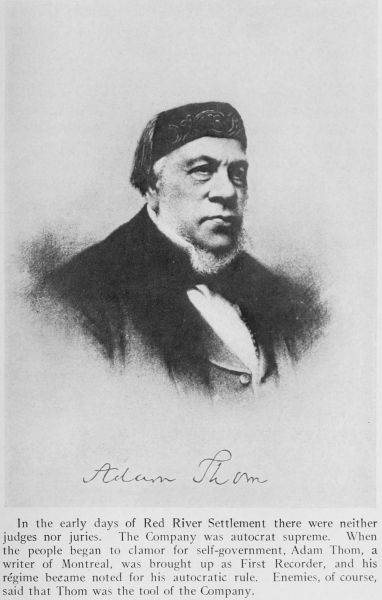
Adam Thom
In the early days of Red River Settlement there were neither
judges nor juries. The Company was autocrat supreme. When
the people began to clamor for self-government, Adam Thom, a
writer of Montreal, was brought up as First Recorder, and his
régime became noted for his autocratic rule. Enemies, of course,
said that Thom was the tool of the Company.
One more influence tended to quicken the pulse of
public interest in Oregon. This was the famous and
disputed Whitman Ride. Did Doctor Whitman,
the missionary, save Oregon? For years popular
sentiment cherished the belief that he did. Of late,
historical critics have gone to the other extreme. The
facts are these. It is not easy to make converts of
Indians. Results are of slow growth. In the fall of
1842, the Missionary Board of the East decided to
withdraw its mission on the Walla Walla. To Whitman
such a move at this critical time when a straw’s
weight might turn the balance either way to England
or to the United States—seemed nothing short of a
national calamity. “I must go East,” he told his
wife. “I must see Webster at Washington, but the
Mission can send me to Boston. I don’t want the
Hudson’s Bay to know what I am about.” It was
already October. Snow was falling on the mountains.
The passes were closed for the year. “Can
I get through to the East?” Whitman asked trappers
and Indians. In answer, they laughed. The thing
was not only impossible—it was mad. But Whitman
had already accomplished things both mad and impossible.
He had brought wagons across mountains,
where fur traders said wagons could never
come; and he had led missionaries over mountain
barriers difficult as any Alps scaled by European
warriors. Accompanied by Lovejoy, a lawyer, Whitman
set out on October 3rd. Mrs. Whitman remained
alone at the mission till the danger of a brutal
Indian, trying to force his way into her room at night,
induced the dauntless woman to accept Chief Trader
McKinlay’s invitation to go down to the Hudson’s
Bay fort at Walla Walla, where Mrs. McKinlay,
Peter Ogden’s daughter, afforded companionship.
On pressed Whitman over the mountains. This was
the ride famous in the Western States. Its story
belongs more to the pioneer than the Company.
Therefore, it may not be related here. Suffice to say,
Whitman increased “the Oregon fever” already raging
in the East. He stirred up Webster, and he
stirred up Congress, and he stirred up missionary
boards of every denomination. Frémont was appointed
by Congress to convoy the emigrants westward.
The Oregon movement of 1843 would have
been important without Whitman’s crusade. With
his crusade, it became epoch-marking. If this was
“saving Oregon,” then spite of historic critics, Whitman
played an important rôle.
The movement westward had become a tide.
From Massachusetts, from the Mississippi States,
from the South, the emigrants gathered to Fort Independence
on the Missouri for the long trip overland.
This was the starting point of the Oregon
Trail. Tented wagons—the prairie schooner—pack
horses, ox carts, straggling herds of horses and cattle
and sheep came rolling to the Missouri in ’43. May
22nd, with a pilot to the fore and a whoop as signal,
the long line files out for Oregon—one thousand
persons, one hundred and twenty wagons, some five
thousand head of stock. On the Kansas, in June,
pause is made to elect officers and maintain some
kind of system. Peter Burnett, a lawyer, is chosen
Captain; J. W. Nesmith, second in command, with
nine others as assistant officers. Later, the travelers
going light—on horseback or in light wagons—march
to the fore. The heavy wagons and ox carts and
stock come behind. The former division is known
as “the light,” the latter as “the cow column.”
Chief leader of the slow-goers is Jesse Applegate, a
man to become famous in Oregon.
It is like the migration of ancient people in prehistoric
times—the rise at dawn, the rifle shot to
signal watch for the night is over, the tents and
wagons pouring out the people to begin another day’s
march, the women cooking breakfast over campfire,
the men rounding up the stock! Forward scour
the scouts to see that no danger besets the trail.
Oxen are slowly hitched to the wagons forming a
circular fort for the night camp; and these drag out
in divisions of fifteen or twenty each. Young men
on horseback flank the trail as out-guards and hunters.
These have arduous work. They must ride twenty
miles from the humming caravan before they will
find scampering game for the night supper. Sharp
at seven A. M. a trumpet blows. The long whips lash
out. The wagons rumble into motion. The outriders
are off at a gallop. The long caravan moves
drowsily forward, and the camping place sinks on
the horizon like a sail at sea. Pilots choose watering
place for the noon hour, but teams are not unhitched.
Promptly at one, writes Mr. Applegate,
“the bugle sounded and the caravan resumed its
western journey. Drowsiness falls on man and
beast. Teamsters drop asleep on their perches
... till the sun is low in the west.” Again the
pilot has chosen good watering place for camping
ground, and the wagons circle into a corral for the
night.
By the end of August, the pioneers are in the
mountains at Fort Hall, on the very borders of their
Promised Land. Two-thirds of the journey lies behind
them, but the worst third is to the fore, though
they are now on the outskirts of what was then called
Oregon. Doctor Whitman goes ahead with the trail
breakers to cut a road for the wagons through the
dense mountain forests. Space does not permit the
details of this part of the journey. This, too, belongs
to the story of the pioneer. It was November
before the colonists reached the Columbia. How
splendid was the reward of the long toil, they now
know; but ominous clouds gathered over the colony.
The Columbia was a swollen sea with the autumn
rains. The Indians were rampant, stampeding the
stock.
“Shall we kill—is it good we kill—these Bostonais
who come to take our lands?” the excited natives
asked McLoughlin, the Hudson’s Bay man, at Fort
Vancouver. To Pacific Coast Indians, all Americans
were Boston men, so named from the first ship
seen on the coast. “Shall we kill these Boston men
who make bad talk against the King George men?”
“Kill? Who said the word?” thundered McLoughlin,
thinking, no doubt, to what lengths such
a game on the part of the fur trader led in Red River;
and it is said he knocked the Indian miscreant down.
“The people have no boats. They are without
food or clothing,” messengers reported at the Company
fort.
The weather had turned damp and cold. Autumn
rains were slashing down slantwise. Again McLoughlin
had to choose between his Company and
his conscience. Had he but restrained his hand—done
nothing—disease and exposure would have
done more than enough to the incoming colonists;
but he did not hesitate one moment, not though the
colonists were cursing him for a Hudson’s Bay oppressor
and the Company threatening to dismiss
him for his friendship with the Americans. Instantly,
he sent his traders upstream with rafts and
boats and clothing and provisions for the belated
people.
“Pay me back when you can,” was the only bond
he laid on the needy people; and a good many paid
him back by cursing him for “an aristocrat.” Rain
was drenching down as the boats came swirling
opposite Vancouver Fort. On the wharf stood the
Chief Factor, long hair, white as snow, blowing wet
in the wind, with hand of welcome and cheer extended
for every comer. One woman had actually
given birth to a child as the rafts came down the
Columbia. For days, the Company’s fort was like
a fair—five hundred people at a time housed under
Vancouver’s roofs or camped in the courtyard till
every colonist had erected, and taken his family to,
his own cabins.
Among so many heterogeneous elements as the
colonists were some outlaws, and these within a
few months were threatening to “burn Fort Vancouver
about the old aristocrat’s ears.” The colonists
had organized a provisional government of their own—which
is a story by itself; and they begged
McLoughlin to subscribe to it that they might protect
Fort Vancouver from the lawless spirits.
“You must positively protect your rights here and
at once or you will loose the country,” McLoughlin
had written to the Governing Board of London.
No answer had come. The threats against Fort
Vancouver became bolder. The Indian conspiracy,
that shortly deluged the land in blood, was throwing
off all concealment. McLoughlin built more bastions
and strengthened his pickets. Still no answer
came to his appeal for protection by the English Government.
Colonists, who loved McLoughlin as
“the father of Oregon,” begged him to subscribe to
the provisional government. Ogden advised it.
Ermatinger was ready to become an American citizen.
Douglas was absent in the North. Fearful
of Indian war now threatening and dreading still
more an international war over the possession of
Oregon, McLoughlin, after long struggles between
Company and conscience, after prayers for hours on
his knees for God’s guidance in his choice—subscribed
to the provisional government in August,
1844.
Six months too late came the protection for which
he had been asking all these years—the British Pacific
Squadron. Perhaps it was as well that the war
vessels did come too late, for Captain Gordon,
commander of the fleet and brother to Aberdeen,
then Cabinet Minister of England, was a pompous,
fire-eating, blustering fellow, utterly incapable of
steering a peaceful course through such troublous
times. With Gordon boasting how his marines
could “drive the Yankees over the mountains,” and
outlaws among the colonists keen for the loot of a
raid on Fort Vancouver—friction might have fanned
to war before England or the United States could
intervene.
The main fleet lay off Puget Sound. The ship
Modiste, with five hundred marines, anchored in the
Columbia off Vancouver and patrolled the river for
eighteen months, men drilling and camping on the
esplanade in front of the fur post.
Came also in October, 1845, two special commissioners
from the Hudson’s Bay Company to report
on Oregon. The report was sent back without
McLoughlin’s inspection. They had reported against
him for favoring the American settlers. Knowing
well this was the beginning of the end, McLoughlin
sent for Douglas to come down and take charge.
The mail of the following spring dismissed McLoughlin
from the service. That is not the way
it was put. It was suggested he should retire.
McLoughlin gave up the reins in 1846 and withdrew
from Vancouver Fort to live among the settlers he
had befriended at Oregon City on the Willamette.
He died there in 1857. It is unnecessary to express
an opinion on his character. The record of his rule
in Oregon is the truest verdict on his character. His
was one of the rare spirits in this world that not only
followed right, but followed right when there was
no reward; that not only did right, but did right
when it meant positive loss to himself and the stabs
of malignity from ungrateful people whom he had
benefited. The most of people can act saintly when
a Heaven of prizes is dangling just in front of
the Trail, but fewer people can follow the narrow
way when it leads to loss and pain and ignominy.
McLoughlin could, and that Christ-like quality in
his character places him second to none among the
heroes of American history. As Selkirk’s name is
indissolubly connected with the hero-days of Red
River, so McLoughlin’s is enshrined in the heroic
past of Oregon. In Hudson’s Bay House, London,
I looked in vain for portraits or marble busts of these
men. Portraits there are of bewigged and beruffled
princes and dukes who ruled over estates that would
barely make a back-door patch to Red River or
Oregon; but not a sign to commemorate the fame
of the two men who founded empires in America,
greater in area than Great Britain and France and
Germany and Spain combined.
It would be interesting from a colonial point of
view to know just what qualifications the British
Government thought Commander Gordon of the
Pacific Squadron and his officers, Lieut. William
Peel, son of Sir Robert Peel, and Lieutenant Parke
of the Royal Marines, possessed to judge whether
Oregon was worth keeping or not. It would be
interesting from a purely Canadian point of view.
American historians, who ought to be profoundly
grateful to Gordon for his blunders, pronounce him
the most consummate bungler ever sent on an International
mission. Reference has been made in an
introductory chapter as to how these naval officers
dealt with the matter and the grave injustice they
did the Hudson’s Bay Company. Parke and Peel
came down to the Columbia and passed some weeks
on hunting expeditions up the Walla Walla and the
Willamette. They surveyed Fort Vancouver and
laughed. All the international pother about that
wooden clutter! They observed the colonists and
laughed! Why, five hundred marines from any one
of their fifteen war ships lying in Puget Sound could
send these barefooted, buckskin-clad, tobacco-spitting
settlers skipping back over the mountains to the
United States like deer before the hunt in English
parks! To the two naval officers, these people were
but low-living peasants. It did not enter into the
narrow vision of their insular minds that out of just
such material as these rough pioneers do new nations
grow. The two gentlemen regarded the whole expedition
as a holiday lark. They had a good time!
Up on Puget Sound Gordon was serving the British
Government still more worthily. He had landed at
the Hudson’s Bay Company’s new post of Victoria—of
which more anon. He was given the best that the
fur post could offer—table of wild fowl and the
Company’s best wines, but Half-breed servants do
not wait on a table like an English butler; and berth
bunks are not English feather beds; and an ocean
full of water is not an English bath. Alas and alas,
poor gentleman! Such sacrifices is he called to make
for his country’s service! Then my gentleman demands
what sport. “Deer,” says Finlayson, “or
bear hunting; or fishing.”
“Do you use flies or bait?” asks Gordon with a
due sense of condescension for having deigned to enquire
about this barbarous land’s sport at all. Finlayson
must have had some trouble not to choke
with laughter when my gentleman insists on fishing
with flies in streams where salmon could be scooped
in tubfuls. Later, he deigns to go hunting and insists
that deer be run down in the open as they hunt
in enclosed Scottish game preserves, not still-hunted,
which is a barbarous way; with the consequence
that Gordon does not get a shot. In vain Finlayson
and Douglas, who comes North, try to please this
mannikin in gold braid. In response to their admiration
of the mighty mountains, he makes answer
that goes down to history for civility—“that he would
not give the bleakest knoll on the bleakest hill of
Scotland for all these mountains in a heap.”
Oregon’s provisional government forced the boundary
dispute to an issue. It must be settled. The
Hudson’s Bay Company press their case, pleading
that if the American colonists are to retain all south
of the Columbia, then the Company, having settlers
between the Columbia and Puget Sound, should
retain all between Columbia River and Puget Sound.
The case hangs fire. Gordon is called in. In
language which I have given in a former chapter, he
declares the country is not worth keeping. Naturally,
Aberdeen listens to his own brother’s opinion and
Peel to his son’s. By treaty of June, 1846, England
relinquishes claims to all territory south of 49°.
Gradually fur trader is crowded out by settler. In
1860, Fort Vancouver is dismantled and taken over
as a military station by the United States. Ermatinger,
for having joined the Oregon government, is
packed off to a post in Athabasca. Ogden saves
himself from punishment by following McLoughlin’s
example and resigning to become a settler on the
Willamette. For the Puget Sound farms, the Company
receives compensation of $450,000 and $200,000
from the American Government; the former amount
payable to the Hudson’s Bay Company proper, the
latter to the Puget Sound Company, though the
shareholders were nominally the same persons.
So ended the glories of the fur trade in Oregon.
It still had a few years to run in British Columbia.
Long ago McLoughlin had plainly seen the beginning
of the end in Oregon and sent Douglas to spy
out the site of a permanent fort north of 49°.
It is really one of the most interesting studies in
American history to observe—if it can be done without
prejudice or prepossession—how when this great
Company, changing in its personnel but ever carrying
down in its apostolic succession the same traditions
of statecraft, of obedience, of secrecy, of diplomacy—how
when this great Company had to take a
kick, it took it gracefully and always made it a point
of being kicked up, not down. This is illustrated
by the Company’s policy now.
Cruising north in June of ’42, Douglas notices
two magnificent bays north of 49°, on the south end
of Vancouver Island opposite what is now British
Columbia. The easterly bay named by the Indians,
Camosun, meaning rush of waters, offers splendid
sea space combined with a shore of plains interspread
with good building timber. Also, there are fresh-water
streams. The other bay, three miles west,
called Esquimalt—the place of gathering of roots—is
a better, more land-locked harbor but more difficult
of anchorage for small boats. Simpson and
McLoughlin decide to build a new fort at Camosun—the
modern Victoria. Those, who know the region,
need no description of its beauty. To those
who do not, descriptions can convey but a faint
picture. Islands ever green, in a climate ever mild,
dot the far-rolling blue of a summer sea; and where
the clouds skirt the water’s horizon, there breaks
through mid-heaven, aërial and unreal, the fiery and
opal dome of Mt. Baker, or the rifted shimmering,
ragged peaks of the Olympic Range in Washington.
So far are the mountains, so soft the air, that not a
shadow, not a line, of the middle heights appear, only
the snowy peaks, dazzling and opalescent, with the
primrose tinge of the sheet lightning at play like
the color waves of Northern Lights. Westward is the
sea; eastward, the rolling hills, the forested islands,
unexpected vistas of sea among the forests, of
precipices rising sheer as wall from the water. Hither
comes Douglas to lay the foundations of a new empire.
To Hubert Howe Bancroft the world is indebted
for details of the founding of Victoria. Bancroft
obtained the facts first-hand from the manuscripts
of Douglas, himself. Fifteen men led by Douglas
left the Columbia in March, ’43. Proceeding up the
Cowlitz, they obtained provisions from the Puget
Sound Company at Nisqually and embarking on
The Beaver, March the 13th, at ten A. M., steamed
northward for Vancouver Island. At four o’clock,
the next afternoon, they anchored just outside Camosun
Bay. “On the morning of the 15th of March,
Douglas set out from the steamer in a small boat to
examine the shore.... With the expedition
was a Jesuit missionary, Bolduc.... Repairing
to the great house of the Indian village, the priest
harangued the people ... and baptized them
till arrested by sheer exhaustion. The 16th, having
determined on a site, Douglas put his men at work
squaring timbers and digging a well. He explained
to the natives that he had come to build among them,
whereat they were greatly pleased and pressed their
assistance on the fort builders, who employed them
at the rate of a blanket for every forty pickets they
would bring.... Sunday, the 19th, Bolduc
decided to celebrate mass. Douglas supplied him
with men to aid in the holy work. A rustic chapel
was improvised; a boat’s awning serving as canopy,
branches of fir trees enclosing the sides. No cathedral
bell was heard that Sabbath morning ... and
yet the Songhies, Clallams, and Cowichins were
there, friends and bloody enemies.... Bolduc,
desirous of carrying the gospel to Whidby Island,
was paddled thence on the 24th....”
While his men proceeded with the building, Douglas
went north on The Beaver to dismantle Fort
Tako and Fort McLoughlin and bring the men from
these abandoned posts to assist at Camosun. “The
force now numbered fifty men ... armed to
the teeth ... constantly on guard.” By September,
stockades, bastions and dwelling houses
were complete. Douglas departed in October, leaving
Charles Ross in charge, but Ross died in the
spring of ’44 and Roderick Finlayson became chief
trader at Camosun, first named Albert Fort after the
Prince Consort, then Victoria, its present name,
after the Queen of England. Finlayson had been
in charge of a little post at Bytown—the modern
Ottawa, but coming to Oregon had been dispatched
north to Stickine.
The steamer had not been long gone when the
Cowichin Indians fell to the pastime of slaughtering
the fort cattle. Finlayson demanded pay or the surrender
of the Indian “rustlers.” The Indian chief
laughed the demand to scorn.
“The fort gates will be closed against you,” warned
Finlayson.
“And I will batter them down,” retorted the chief.
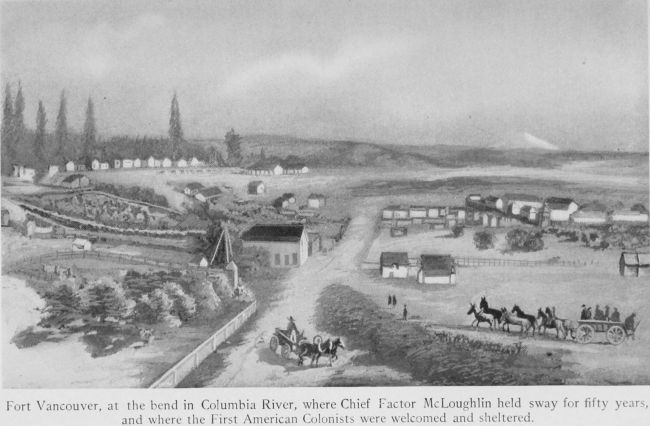
Fort Vancouver, at the bend in Columbia River, where Chief
Factor McLoughlin held sway for fifty years,
and where the First American Colonists were welcomed and sheltered.
“The spirit of butchery,” relates Bancroft, “was
aroused. Within the fort, watch was kept day and
night. After a lapse of two days, the threatened
attack was made. Midst savage yells, a shower of
musket balls came pattering down upon the fort,
riddling the stockades and rattling on the roofs. Instantly,
Finlayson shouted his order that not a shot
was to be returned.... The savages continued
their fire ... then rested from the waste of
ammunition.... Then the commander (Finlayson)
appeared ... and beckoned (the chief)....
‘What would you do?’ exclaimed Finlayson.
‘What evil would you bring upon yourselves! Know
you that with one motion of my finger I could blow
you all into the bay? And I will do it! See your
houses yonder!’
“Instantly, a nine-pounder belched forth with
astounding noise, tearing to splinters the cedar lodge.
“Finlayson had ordered his interpreter to run to
the lodges and warn the inmates to instant flight.
Hence no damage was done save shivering to splinters
some pine slabs.”
The results were what one might expect. The
Indians sued for peace, and paid full meed in furs
for the slaughtered cattle.
It may be added here as a sample of the Hudson’s
Bay Company’s economy in detail—that Fort Victoria
was built without the driving of a single nail.
Wooden pegs were used. After the relinquishment
of Oregon, the old Okanogan-Kamloops trail could
be no longer used. Anderson of Fort Alexandria in
New Caledonia succeeded in 1845-46 in finding and
cutting a new trail down the Fraser to Langley and
Victoria. This was the trail that later developed
into the famous Cariboo Road of the miners and of
which ruins may still be seen clinging to the precipices
above the Fraser like basket work, the strands
of the basket bridges being huge cedar logs mortised
in places for a depth of hundreds of feet.
Except where the embankment has crumbled beneath
the timber work, Anderson’s old fur trail is
still used to enter Cariboo. From 1846, one Joseph
McKay becomes chief clerk under Chief Factor
Douglas of Victoria. Indians brought first word of
the famous coal beds of North Vancouver Island.
Hence the building of Fort Rupert on Beaver Harbor
in ’43.
And now occurs the fine play of the Company’s
rare diplomacy. Rumors of gold in California are
arousing the fever that is to result in the pell-mell
stampede of the famous ’49. At any time, similar
discoveries may bring a stampede to the North. No
one knew better than the Company those Indian
legends of hidden minerals in the Rockies, and when
colonists came there would be an end to the fur trade.
Did the Company, then—as is often charged—conceal
knowledge of precious minerals in its territory?
Not at all. It simply let the legends slumber. Its
business was not mining. It was fur trading, and
the two were utterly hostile.
Came Sir John Pelly, Governor of the Company
in England, and Sir George Simpson, Governor of
the Company in America, to the Cabinet Minister
of Great Britain with a cock-and-bull story of the
dangers of an American, not invasion, but deluge
such as had swept away British sovereignty in Oregon.
What, they ask, is to hinder American colonists
rolling in a tide north of the boundary and so
establishing rights of possession there as they had
in Oregon. Any schoolboy could have guessed the
trend of such argument, and let us not blame the
Hudson’s Bay Company for cupidity. It was a
purely commercial organization, not a patriotic or
charitable association; and it pursued its aims just
as commercial organizations have pursued their aims
since time began—namely, by grabbing all they could
get. To talk cupidity is nonsense. Cupidity, according
to the legal rules of the game, is the business
of a money-getting organization. Not the cupidity
of the Hudson’s Bay Company was to blame for the
extraordinary episodes in its history. Place the
blame where it belongs—at the door of an ignorance
as profound as it was indifferent on the part of the
British statesmen who dealt with colonial affairs.
My Lord Grey listens to the warning of this
impending disaster. What would the Hudson’s
Bay Company suggest to counteract such danger?
Modestly, generously, with a largesse of self-sacrifice
that is appalling to contemplate, the two Hudson’s
Bay governors offer to accept—accept, mind you, not
ask—the enormous burden of looking after “all England’s
possessions in North America.” As a quid
pro quo, it is a mere detail of course—they would
expect exclusive monopoly of trade in the same
regions. It is said when Gladstone, now rising to
fame, heard the terms of this offer, he burst out in a
loud laugh that brought the blush of misunderstood
modesty to the brow of the two Hudson’s Bay men.
The Company dropped the subject like a hot coal
for the matter of a few months to let the coal cool.
Then they came at it again with an aggrieved air,
demanding government protection for their interests
on the Pacific Coast. Earl Grey tumbled into the
trap with a celerity that was beautiful. He answered
“that the Company must protect themselves.” Exactly
the answer expected. Then if “the Company
must protect themselves from dangers of American
encroachment, they ask for exclusive monopoly for
purposes of colonization in—Vancouver Island.”
For two years furious waxed debate in Parliament
and out on this request of the Company. The
Hudson’s Bay Company as a colonizer was a new
rôle. Mr. Isbister, descendant of Red River people
and now a barrister in London, has something to say
as to how the Hudson’s Bay Company act in the colony
of Red River, and Mr. Gladstone in Parliament
openly and hotly opposes the request on the ground
that a company which had a charter of exclusive
monopoly for two hundred years entitling it to
colonize and had done nothing, had proved itself
incompetent as a colonizer.
Furious waxed the debate, but the one thing lacking
in all long-drawn out debates is a basis of fact.
Only the Hudson’s Bay Company possessed the facts
about this West Coast. Reports of such government
emissaries as Gordon of the Squadron were
worse than useless. The opponents were working
in the dark. In the House of Commons were several
shareholders of the Hudson’s Bay Company, chief
among them, Ellice, son of the old Nor’Wester.
The request was officially granted in January,
1849, but with such absurd restrictions attached,
that any one possessing the slightest knowledge of
West Coast conditions must have been aware that
the alleged aim to colonize was but a stalking horse
for other designs. The Company was to be permitted
to retain only one-tenth of the proceeds from
its land sales. The other nine-tenths were to be spent
improving the island. What bona fide colonization
company would accept such conditions? Ten per
cent. of land sales would not suffice to pay for advertising.
If no settlement were made, the grant was
to be revoked in five years. To the colonists, land
was to be sold at £1 ($5.00) an acre. In Oregon,
the colonist could have 640 acres for nothing. For
every one hundred acres sold at $5.00 an acre, the
buyer was bound by covenant to bring to Vancouver
Island at his own expense three families, or six single
persons. Last of all and most absurd of all, at the end
of five or ten years, the Government might buy back
the Island by paying to the Company all it had expended.
Another point—but this was not in the
official terms—retired servants of the Hudson’s Bay
Company might buy the land at a few shillings an
acre. Looking squarely at this extraordinary contract,
only one of two conclusions can be reached:
either the ignorance of conditions was so dense that
dynamite could not have driven a hole through it,
or there was no intention whatever of colonizing
Vancouver Island, the real design being twofold:
(1) on the part of the Government to keep this remote
region securely British, for Mormons had
talked of escaping persecution by going to Vancouver
Island; (2) on the part of the Company, to hold
colonizing in its own control to be forwarded or
retarded as suited its interests. The Company
declared that from the time Lord Grey framed the
conditions of the grant, they knew the scheme was
foredoomed to failure. This did not prevent them
accepting the terms; but the fur traders were too
tactful to suggest one of their own men as governor
of the new colony. Earl Grey suggested Richard
Blanchard, a barrister, as governor; and Blanchard
foolishly accepted the appointment without a single
stipulation as to residence, salary, land, or staff.
Pelly talked unofficially of the governor being given
one thousand acres, but when Blanchard reached
Victoria he found that Chief Factor Douglas had
received no instructions. The governor of the colony
was to have only the use of the one thousand acres,
not the possession. One year of such empty honors
satisfied Blanchard’s ambitions. He had neither
house nor salary, subjects nor staff, and came home
to England in 1851, £1,000 the poorer. James Douglas,
the Chief Factor, was at once appointed Governor
of Vancouver Island.
The record of the colony is not a part of the history
of the English Adventurers, and therefore is not given
here. How many colonists were sent out, I do not
know; exclusive of the Company’s servants, certainly
not more than a dozen; including the Company’s
servants, not more than three hundred in ten years.
Provisions must be bought from the Company. Produce
must be sold to the Company—a one-sided performance
that easily accounted for the discontent
expressed in a memorial sent home with Blanchard
when he retired.
The man, who had hauled fish and furs in New
Caledonia at $300 a year, was now governor of Vancouver
Island. James Douglas received his commission
in September of 1851. Five years ago, he
had been compelled to choose between loyalty to
McLoughlin, and loyalty to his Company. He took
his choice, was loyal to his Company and had been
promoted to a position worth $15,000 a year. Events
were now coming that would compel Douglas to
choose between his country and his Company.
Wisely, he chose the former, sold out all interests in
the Hudson’s Bay Company, received knighthood in
’59 and died at Victoria full of honors in 1877. Upon
renewing the grant of Vancouver Island to the Company
in 1854, the English Government requested
Douglas to establish representative government in
the colony. This was not easy. Electors were
scarce, consisting mainly of retired Hudson’s Bay officers;
and when Douglas met the first parliament
of the Island on August 12, 1856, it consisted of less
than a dozen members; all directly connected with
the Hudson’s Bay Company; so that the governor
was able to report to England that “the opening”
passed off quietly without exciting “interest among
the lower orders”—upon which Bancroft, the American,
wants to know “who the lower orders were”
unless “the pigs on the parson’s pig farm.”
As told in the story of Kamloops, gold was discovered
this very year on Thompson River. A year
later, the air was full of wild rumors of gold discoveries
north of Colville, in Cariboo, on Queen Charlotte
Island. The tide, that had rolled over the
mountains to California, now turned to British
Columbia. When the second five-year grant of Vancouver
Island to the Hudson’s Bay Company expired
in 1859, it was not renewed. Douglas foresaw that
the gold stampede to the North meant a new British
empire on the Pacific. The discovery of gold
sounded the death knell of the fur lords’ ascendancy.
Douglas resigned his position as Chief Factor and
became governor of the new colony now known as
British Columbia, including both Vancouver and the
mainland. For the repurchase of Vancouver Island,
the British Government paid the Hudson’s Bay
Company £57,500. The Company claimed that it
had spent £80,000. Among the gold seekers stampeding
north from Oregon were our old trappers
and traders of the mountain brigades, led by Dr.
David McLoughlin, now turned prospector.
Notes to Chapter XXXIII.—The contents of this chapter are
drawn from the same sources as XXXII; in addition Hansard
and Congressional Reports for both the Vancouver Island and
Oregon disputes, the Parl. Enquiry Report of 1857; H. B. C.
Memorial Book on Puget Sound Company; Fitzgerald’s Vancouver
Island, 1849; Martin’s H. B. Territories, 1849; De
Smet’s Oregon Missions, 1847; Oregon (Quarterly) Hist. Soc.
Report, 1900; Schafer’s Pacific Northwest, 1905; and most
important—H. H. Bancroft’s invaluable transcripts of Douglas
and Finlayson MS. in his “British Columbia.” For a popular
account of McLoughlin from an absolutely American point of
view nothing better exists than Mrs. Dye’s “Old Oregon,” though
it may be sniffed at by the higher critics for unquestioning acceptance
of what they please to call the “Whitman myth.”
Whitman’s ride was not all myth, though the influence was
greatly exaggerated; and the truth probably exists half way
between the critics’ skepticism and the old legend. Wilkes’
Narrative of the Exploring Squadron, 1845; the reports of
Warre and Vavasseur, the two special spies on McLoughlin;
early numbers of the old B. C. Colonist and Cariboo Sentinel;
Sir Geo. Simpson’s Journey Round the World; Lord’s Naturalist,
1866; Macfie’s Vancouver Island, 1865; Mayne’s B. C.,
1862; Milton’s North-West Passage, 1869; Paul Kane’s Wanderings,
1859; Dunn’s Oregon Territory, 1844; Grant’s Ocean
to Ocean, 1873; Gray’s Oregon, 1870; Greenhow’s Oregon,
1844; Dawson’s Geol. Reports, Ottawa; Peter Burnett’s Letters
to Herald N. Y.—also throw side lights on the episodes
related.
CHAPTER XXXIV — Transcriber’s Notes
1857-1870
THE PASSING OF THE COMPANY
The tide of American colonization rolling
westward to Minnesota, to Dakota, to
Oregon, was not without effect on the
little isolated settlement of Red River. Oregon had
been wrested from the fur trader, not by diplomacy,
but by the rough-handed toiler coming in and taking
possession. The same thing happened in British
Columbia when the miner came. What was Red
River—the pioneer of all the Western colonies—doing?
The union of Nor’Wester and Hudson’s Bay had
thrown many old employés out of work. These now
retired to Red River, where they were granted one
hundred acres of land and paid a few shillings an acre
for another twenty-eight acres, making up farms of
one hundred and twenty-eight acres, all facing the
river and running back in long, narrow lots to the
highway now known as St. John’s Road. St. John’s
and Kildonan expanded to St. Paul’s and St. Andrew’s
settlements northward. Across the river were
three sets of settlers—the French Plain Rangers, descendants
of the old Nor’Westers, the De Meuron
soldiers, and the Swiss. These gradually clustered
round the settlement just opposite the Assiniboine,
where the Catholic missionaries were building chapel
and school, and the place became known as St. Boniface,
after the patron saint of the Germans. In the
old buildings of Fort Douglas lived the colony governor
distinct from the Company governor, Sir
George Simpson, whose habitat was Fort Garry, near
the site of old Fort Gibraltar, when he was in the West,
and Lachine, at Montreal, when he was in the East.
The colonists continued to hunt buffalo in Minnesota
during the winter and to cultivate their farms in
the summer; but what to do for a market? Colonists
in Oregon could sell their produce to the Spaniards,
or the Russians, or the Yankee skippers passing
up and down the coast. Colonists in British
Columbia found a market with the miners, but to
whom could the Red River farmer sell but to the fur
company? For his provisions from England, he
paid a freight of 33 per cent. ocean rate, 58 per cent.
profit to the Company, and another 20 per cent. land
rate from Hudson Bay to Red River—a total of
over 110 per cent. advance on all purchases. For what
he sold to the Company, he received only the lowest
price, and he might on no account sell furs. Furs
were the exclusive prerogative of the Company. For
his produce, he was credited on the books, but the
credit side seldom balanced the debit side; and on
the difference the Red River settler was charged
5 per cent.—not a high debtors’ rate when it is considered
that it was levied by a monopoly, that had
absolute power over the debtor; and that the modern
debtors’ rate is legalized at 6 and 8 percent. It was
not the rate charged that discouraged the Red River
settler; but the fact that paying an advance of 110
per cent. on all purchases and receiving only the
lowest market price for all farm produce—two shillings-six
pence for wheat a bushel—he could never
hope by any possibility to make his earnings and his
spendings balance. Mr. Halkett, a relative of Selkirk’s,
came out in 1822, to settle up the affairs of
the dead nobleman. The Company generously
wrote off all debt, which was accumulated interest,
and remitted one-fifth of the principal to all settlers.
Mr. Halkett and Sir George Simpson then talked
over plans to create a market for the colonist. These
successive plans and their successive failures belong
to the history of the colony rather than the history
of the Company, and cannot be fully given here.
There was the Buffalo Wool Company of 1822,
under Pritchard’s management, which set all the
farmers scouring the plains as buffalo hunters with
schemes as roseate as the South Sea Bubble; and
like the South Sea Bubble the roseate scheme came
to grief. It cost $12.50 a yard to manufacture cloth
that sold for only $1.10; and the Hudson’s Bay
Company wrote a loss of $12,000 off their books for
this experiment.
Alex MacDonell, a bottle-loving Scotchman, who
had acted as governor of the colony after Semple’s
death, and who became notorious as “the grasshopper
governor” because his régime caused the
colonists as great grief as the grasshopper plague—now
gave place to Governor Bulger. Over at the
Company fort, John Clarke of Athabasca fame, now
returned from Montreal with an aristocratic Swiss
lady as his bride—acts as Chief Factor under Governor
Simpson.
The next essay is to send Laidlaw down to Prairie
du Chien on the Mississippi to buy a stock of seed
wheat to be rafted up the Mississippi across a portage
and down the Red River. He buys two
hundred and fifty bushels at $2.40 a bushel, but
what with rafting and incidentals before it reaches
the colonist, it has cost the Hudson’s Bay Company
£1,040. Next, an experimental farm must be tried
to teach these new colonists how to farm in the new
country. The same Mr. Laidlaw with the same
grand ideas is put in charge of the Hayfield Farm.
It is launched with the style of a baronial estate—fine
houses, fine stables, a multitude of servants, a
liberal tap in the wine cellar; and a total loss to the
Hudson’s Bay Company of £2,000. There follow
experiments of driving sheep to Red River all the
way from Missouri, and of a Wool Company that
ends as the Buffalo Company had, and of flax growing,
the flax rotting in the fields for lack of a purchaser.
What with disastrous experiments and a
grasshopper plague and a flood that floats the houses
of half the population down the ice-jammed current
of the raging Red, the De Meurons and Swiss become
discouraged. It was noticed during the flood that the
De Meurons had an unusual quantity of hides and
beef to sell; and that the settlers had extraordinary
difficulty finding their scattered herds. What little
reputation the De Meurons had, they now lost; and
many of them with their Swiss neighbors deserted
Red River for the new settlements of Minnesota.
From ranging the plains with the buffalo hunters of
Pembina, the Swiss came on south to Fort Snelling,
near modern St. Paul, and so formed the nucleus
of the first settlements in Minnesota. It has
been charged that the Hudson’s Bay Company
never meant any of these experiments to succeed;
that it designed them so they would fail and prove
to the world the country was unfit for settlement.
Such a charge is far-fetched with just enough truth
to give the falsity semblance. The Company were
not farmers. They were traders, and it is not surprising
that fur men’s experiments at farming should
be a failure; but that the Hudson’s Bay Company
deliberately went to work to throw away sums of
money ranging from $5,000 to $17,000 will hardly be
credited with those who know the inner working of
an organization whose economy was so strict it saved
nails when it could use wooden pegs.
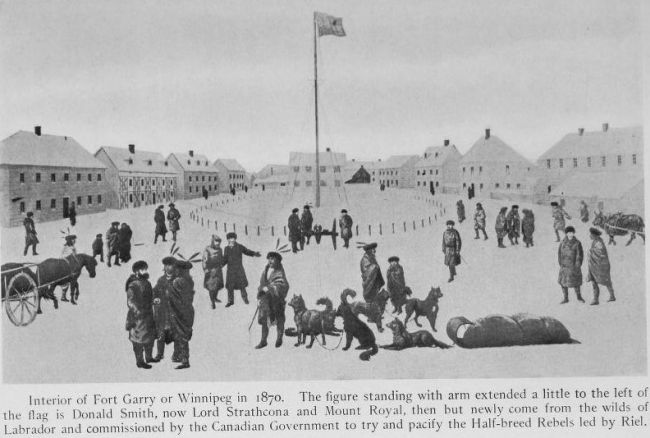
Interior of Fort Garry or Winnipeg in 1870. The figure standing with arm extended a little to the left of
the flag is Donald Smith, now Lord Strathcona and Mount Royal, then but newly come from the wilds of
Labrador and commissioned by the Canadian Government to try and pacify the Half-breed Rebels led by Riel.
American herdsmen as an experiment had driven
up herds of cattle to sell to the Red River colonists.
This was the beginning of trade with St. Paul. Henceforward,
what produce Red River people could not
sell to the Hudson’s Bay Company, was sent to St.
Paul. Then the St. Paul traders paid higher prices
than the Hudson’s Bay Company. Twice a year
the long lines of Red River ox carts, like Eastern
caravans, creaked over the looping prairie trail of
Red River southward to St. Paul with buffalo hides
and farm products. These carts were famous in
their day. They were built entirely of wood, hub,
spokes, rim and tire of wheel, pegs even taking the
place of nails. Hence, if a cart broke down on the
way, it could be mended by recourse to the nearest
clump of brushwood. The Sioux were at this time
the greatest danger to the cart brigades, and the
settlers always traveled together for protection; but
the Indians wished to stay on good terms with the
Hudson’s Bay Company, and had the settlers carry
an H. B. C. flag as a signal of friendship with the fur
traders. Within a few years, twelve hundred Red
River carts rumbled and creaked their way to St.
Paul in June and September. Simpson had issued
Hudson’s Bay Company notes of £1, 5 shillings and
1 shilling, to avoid the account system, and these
notes were always redeemable at any fur post for
Company goods, but in St. Paul, the settlers for the
first time began using currency that was coin.
Early in the thirties, possibly owing to the dangers
from the Sioux, Governor Simpson ordered the building
of the stone forts—Upper Fort Garry as a stronghold
for the Company, Lower Fort Garry near St.
Andrew’s Rapids twenty miles north, as a residence
for himself and trading post for the lake Indians.
These were the last stone forts built by the fur trader
in America. Of Upper Fort Garry there remains
to-day only the old gray stone gate, to be seen at the
south end of Main Street in Winnipeg. Lower Fort
Garry yet stands as Simpson had it built—the last
relic of feudalism in America—high massive stone
walls with stores and residence in the court yard.
Other operations Simpson pushed for the Company.
McLean is sent in ’37 to explore the interior
of Labrador. John Clarke is dispatched to establish
forts down MacKenzie River almost to the Arctic.
Bell goes overland, in 1846, to the Yukon. Murray,
later of Pembina, builds Fort Yukon, and Campbell
between 1840 and 1848 explores both the Pelly and
the Yukon, building Fort Selkirk.
The explorations that had begun when Radisson
came to Hudson Bay in his canoe from Lake Superior,
were now completed by the Company’s boats
going down the MacKenzie to the Arctic and down
the Yukon to Bering Sea. How big was the empire
won from savagery by fur trader? Within a few
thousand miles of the same size as Europe. Spain
won a Mexico and a Peru from savagery; but her
soldiers’ cruelty outdid the worst horrors of Indian
warfare, steeped every mile of the forward march
with the blood of the innocent natives, and reduced
those natives to a state of slavery that was a hell upon
earth. The United States won an empire from savagery,
but she did it by an ever-shifting frontier,
that was invariably known from Tennessee to Oregon,
as “the Bloody Ground.” Behind that shifting
frontier was the American pioneer with his sharp-shooter.
In front of that frontier was the Indian
with his tomahawk. Between them was the Bloody
Ground. In the sixteen-hundreds, that Bloody
Ground was west of the Alleghanies in Ohio and
Tennessee and Kentucky. In the seventeen-hundreds,
it had shifted forward to the Mississippi. In
the eighteen-hundreds, it was on the plains and in
the mountains and in Oregon. Always, the forward
step of white man, the backward step of red man—had
meant a battle, bloodshed; now the colonists
wiped out by the Sioux in Minnesota; or the missionaries
massacred by the Cayuse in Oregon; or the
Indians shot down and fleeing to the caves of the
mountains like hunted animals.
How many massacres marked the forward march
of the Hudson’s Bay Company from Atlantic to Pacific?
Not one. The only massacre, that of Seven
Oaks, was a fight of fur trader against fur trader.
The raids such as Hearne saw on the Coppermine
were raids of tribe on tribe, not white man on Indian,
nor Indian on white man. “Smug old lady,” enemies
designated the Hudson’s Bay Company. “Oppressor,
monopoly, intriguing aristocrats,” the early
settlers of Oregon called her. Grant all the sins of
omission common to smug, conservative old ladies!
Grant all the sins of commission—greed, secrecy,
craft, subterfuge—common the world over to monopolies!
Of these things and more was the Hudson’s
Bay Company guilty in its long despotic reign of
two hundred years. But set over against its sins,
this other fact, a record which no other organization
in the world may boast—the bloodless conquest of an
empire from savagery!
Apart from Selkirk’s friends, the Hudson’s Bay
Company had never been favorable to the idea of
colonizing Red River. Now that the colonists had
opened connections with American traders of St.
Paul, it became evident that the Hudson’s Bay must
relinquish sovereignty over Red River Colony, or
buy out Selkirk’s interests and own the colony, lock,
stock and barrel. In 1835, the heirs of Lord Selkirk
sold back to the Hudson’s Bay Company the vast
grant of Red River for some £84,000. The sum
seems large, but I doubt if it covered a tenth of what
Selkirk had spent, for it will be recalled, though he
intended in the first place to sell the land, he ended
by giving it to the settlers scot free. To-day, the
sum for which Selkirk’s heirs sold back Red River,
would hardly buy a corner lot on Main Street, Winnipeg.
Selkirk’s heirs retained their shares in Hudson’s
Bay stock, which ultimately paid them back
many times over what Selkirk had lost.
Why did the Company buy back Red River?
Behold the sequence! Settlers are crowding into
Minnesota. The settlers of Red River are beginning
to ask for a form of government. They want to
rule themselves as the Americans do south of the
boundary. Good! The Company will take care
there is no independent government such as was set
up in Oregon and ended by ousting the fur trader.
The Company will give the settlers a form of government.
The Council of Assiniboia is organized.
President of the Council is Sir George Simpson, governor
of the Company. Vice-president is Alex
Christie, governor of the colony; and the other thirteen
members are old Hudson’s Bay officers. The
government of Assiniboia is nothing more or less than
a Company oligarchy; but that serves the Hudson’s
Bay better than an independent government, or a
government friendly to the American traders. But
deeper and more practical reason lies beneath this
move. Selkirk’s colony was not to interfere with the
fur trade. Before the Red River carts set out for St.
Paul it is customary for the Hudson’s Bay officers
to search the cargoes. More! They search the settlers’
houses, poking long sticks up the deep set
chimney places for hidden furs; and sometimes the
chimney casts out cached furs, which are confiscated.
Old French Nor’Westers begin to ask themselves—is
this a free country? The Company responds by
burning down the shanties of two hunters on Lake
Manitoba in 1826, who had dared to trade furs from
the Indians. These furs, the two Frenchmen no
doubt meant to sell to St. Paul traders who paid just
four times higher than the Hudson’s Bay. Altogether,
it is safer for the Company to buy out Selkirk’s
colony themselves and organize laws and
police to enforce the laws—especially the supremest
law—against illicit fur trading.
First test of the new government comes in 1836,
when one St. Dennis is sentenced to be flogged for
theft. A huge De Meuron is to wield the lash, but
this spectacle of jury law in a land that has been
ruled by paternalism for two hundred years, ruled
by despot’s strong right arm—is something so repugnant
to the Plain Rangers, they stone the executioner
and chase him till he jumps into a well. In
1844 is issued proclamation that all business letters
sent through the Company must be left open for
perusal, and that land will be deeded to settlers only
on condition of forfeiture if illicit trade in furs be
discovered. In fact, as that intercourse with the
American traders of the Mississippi increases, it is
as difficult for the Company to stop illicit fur trading
as for customs officers to stop smuggling.
That provisional government in Oregon had
caught the Company napping. Not so shall it be
in Red River. If the despot must have a standing
army to enforce his laws, an army he shall have.
The experience in Oregon furnishes a good excuse.
The Company asks and the British Government
sends out the Sixth Royal Regiment of five hundred
men under Colonel Crofton. Now laws shall be
enforced and provisional governments kept loyal,
and when Colonel Crofton leaves, there comes in
1848, Colonel Caldwell with one hundred old pensioners,
who may act as an army if need be, but settle
down as colonists and impart to Red River somewhat
of the gayety and pomp and pleasure seeking,
leisurely good fellowship of English garrison life.
Year after year for twenty years, crops have been
bounteous. Flocks have multiplied. Granaries are
bursting with fullness of stores. Though there is no
market, there is plenty in the land. Though there
is little coin current of the realm, there is no want;
and the people stuck off here at the back of beyond
take time to enjoy life. Thatched shanties have
given place to big, spacious, comfortable houses;
dog sleighs to gay carioles with horses decked in
ribbons. Horse racing is the passion and the pastime.
Schools and embryo colleges and churches
have been established by the missionaries of the
different denominations, whose pioneer labors are
a book in themselves. It is a happy primitive life,
with neither wealth nor poverty, of almost Arcadian
simplicity, and cloudless but for that shadow—illicit
trade, monopoly. Could the life but have lasted, I
doubt if American history could show its parallel for
quiet, care-free, happy-go-lucky, thoughtless-of-the-morrow
contentment. The French of Acadia, perhaps
somewhat resembled Red River colony, but
we have grown to view Acadia through Longfellow’s
eyes. Beneath the calm surface there was international
intrigue. Military life gave a dash of color
to Red River that Longfellow’s Acadians never
possessed; but beneath the calm of Red River, too,
was intrigue.
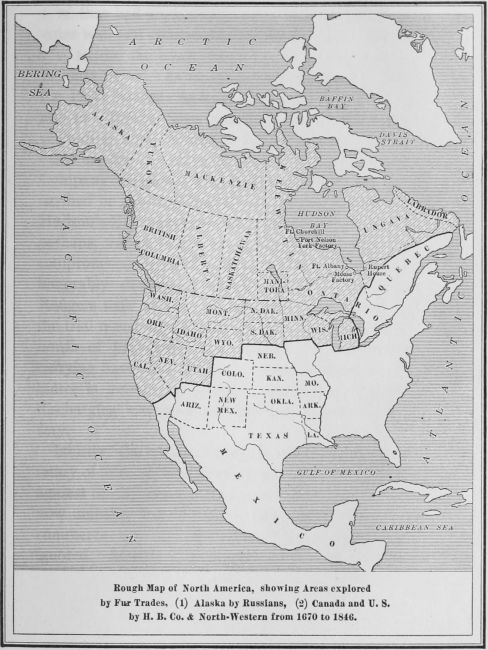
Rough Map of North America, showing Areas explored
by Fur Trades, (1) Alaska by Russians, (2) Canada and U. S.
by H. B. Co. & North-Western from 1670 to 1846.
Click
here for larger map
Resentment against search for furs grew to anger.
The explosion came over a poor French Plain Ranger,
William Sayer, and three friends, arrested for accepting
furs from Indians in May, 1849. Judge Thom,
the Company’s recorder, was to preside in court.
Thom was noted for hatred for the French in his old
journalistic days in Montreal. The arrest suddenly
became a social question—the French Plain Rangers
of the old Nor’Westers against the English Company,
with the Scotch settlers looking on only too glad of
a test case against the Company. Louis Riel, an
old miller of the Seine near St. Boniface, father of
the Riel to become notorious later, harangued the
Plain Rangers and French settlers like a French revolutionist
discoursing freedom. The day of the trial,
May 17th, Plain Rangers were seen riding from all
directions to the Fort Garry Court House. At 10
A. M. they had stacked four hundred guns against the
outer wall and entered the court in a body. Not till
1 P. M. did the court dare to call for the prisoner,
William Sayer. As he walked to the bar of justice,
the Plain Rangers took up their guns and followed
him in. Boldly, Sayer pleaded guilty to the charge
of trading furs. It was to be a test case, but test
cases are the one thing on earth the Hudson’s Bay
Company avoided. The excuse was instantly unearthed
or invented that a man connected with the
Hudson’s Bay Company had given Sayer permission;
perhaps, verbal license to trade. So the case was
compromised—a verdict of guilty, but the prisoner
honorably discharged by the court. The Plain
Rangers took no heed of legal quibbles. To them,
the trial meant that henceforth trade was free. With
howls of jubilation, they dashed from the court
carrying Sayer and shouting, “Vive la liberté—commerce
is free—trade is free”; and spent the night
discharging volleys of triumph and celebrating victory.
Isbister, the young lawyer, forwards to the Secretary
of State for the Colonies petition after petition
against the Company’s monopoly. The settlers, who
now number five thousand, demanded liberty of
commerce and British laws. The petitions are
ignored. Isbister vows they are shelved through the
intrigue of the Hudson’s Bay Company in London.
Then five hundred settlers petition the Legislature
of Canada. The Toronto Board of Trade takes the
matter up in 1857, and Canadian surveyors are sent
west to open roads to Red River. “It is plain,” aver
the various petitions and memorials of 1857-59,
“that Red River settlement is being driven to one of
two destinies. Either she must be permitted to join
the other Canadian colonies, or she will be absorbed
by a provisional American government such as
captured Oregon.” Sir George Simpson, prince of
tacticians, dies. Both the British Government and
the Hudson’s Bay Company are at sea. There is no
denying what happened to Oregon when the Company
held on too long. They drove Oregon into
Congress. May not the same thing happen in Red
River—in which case the Company’s compensation
will be nil. Then—there is untold history here—a
story that must be carried on where I leave off and
which will probably never be fully told till the
leading actors in it have passed away. There
are ugly rumors of a big fund among the Minnesota
traders, as much as a million dollars, to be
used for secret service money to swing Red River
Settlement into the American Union. Was it a
Fenian fund? Who held the fund? Who set the
scheme going?
The Hudson’s Bay Company knows nothing. It
only fears. The British Government knows nothing;
except that in such a way did it lose Oregon; and
the United States is now buying Alaska from Russia.
With its policy of matchless foresight, the Hudson’s
Bay Company realizes it is wiser to retire early with
the laurels and rewards than to retreat too late
stripped. The question of renewing the license on
Vancouver Island is on the carpet. The Hudson’s
Bay Company welcomes a Parliamentary Enquiry
into every branch of its operations. “We would be
glad to get rid of the enormous burden of governing
these territories, if it can be done equitably as to our
possessory rights,” the Company informs the astonished
Parliamentary Committee.
How stand those possessory rights under the terms
of union in 1821? It will be remembered the charter
rights were not then tested. They were merged
with the Northwest Company rights, and without
any test a license of exclusive trade granted for
twenty-one years. That license was renewed in 1838
for another twenty-one years. This term is just expiring
when the Company declares it would be glad
to be rid of its burden, and welcomes a Parliamentary
Enquiry. At that inquiry, friends and foes alike
testify. Old officers like Ellice give evidence. So
do Sir George Simpson, and Blanchard of Vancouver
Island, and Isbister as representative of the
Red River colonists, and Chief Justice Draper as
representative of Canada. It is brought out the
Company rules under three distinct licenses:
(1) Over Rupert’s Land or the territory of the bay
proper by right of its first charter.
(2) Over Vancouver Island by special grant of
1849.
(3) Over all the Indian Territory between the
bay and Vancouver Island by the license of 1821
since renewed.
The Parliamentary committee recommend on
July 31, 1857, that Vancouver Island be given up;
that just as soon as Canada is ready to take over the
government of the Indian Territory this, too, shall be
ceded; but that for the present in order to avoid the
demoralization of Indians by rival traders, Rupert’s
Land be left in the exclusive control of the Hudson’s
Bay Company. This is the condition of affairs
when unrest arises in Red River.
The committee also bring out the fact that the
capital has been increased since the union of 1821 to
£500,000. Of the one hundred shares into which
this is divided, forty have been set aside for the wintering
partners or chief factors and chief traders.
These forty shares are again subdivided into eighty-five
parts. Two eighty-fifths of the profits equal to
$3,000 a year and a retiring fund of $20,000 are the
share of a chief factor; one eighty-fifth, the share
of a chief trader. This is what is known as “the
deed poll.”
Meanwhile, out in Red River, gold seekers bound
for Cariboo, prospectors for the bad lands of Montana,
settlers for the farms of Minnesota—roll past
in a tide. Trade increases in jumps. A steamer
runs on Red River connecting by stage for St. Paul.
Among the hosts of new comers to Red River is one
Doctor Schultz, who helps to establish the newspaper,
Nor’Wester, which paper has the amazing temerity,
in 1867, to advocate that in the Council of Assiniboia
there should be some representative of the people
independent of the Hudson’s Bay Company. A
vacancy occurs in the council. The Nor’Wester
advocates that Dr. John Schultz would be an excellent
representative to fill that vacancy. A great many
of the settlers think so, too; for among other newcomers
to the colony is one Thomas Spence, of
Portage la Prairie, who is for setting up a provisional
government of Manitoba. A government independent
of British connection means only one thing—annexation.
The settlers want to see Schultz on
the Council of Assiniboia to counteract domination
by the Hudson’s Bay and to steer away from annexation.
Not so the Hudson’s Bay Company. Schultz’s
paper has attacked them from the first, and the little
store of which he is part proprietor, has been defiant
opposition under their very noses. But this council
business is too much. They will squelch Schultz,
and do it legally, too. In all new countries, the
majority of pioneers are at some stage of the game
in debt. Against Schultz’s firm stood a debt of a
few hundred dollars. Schultz swore he had discharged
the debt by paying the money to his partner.
Owing to his partner’s absence in England, his evidence
could neither be proved nor disproved. The
Company did not wait. Judgment was entered
against Schultz and the sheriff sent to seize his goods.
Moral resistance failing, Schultz resisted somewhat
vigorously with the poker. This was misdemeanor
with a vengeance—probably the very thing his enemies
hoped, for he was quickly overpowered, tied
round the arms with ropes, and whisked off in a
cariole to prison. But his opponents had not
counted on his wife—the future Lady Schultz, life
partner of the man who was governor of Manitoba
for eight years. That very night the wife of the
future Sir John led fifteen men across to the prison,
ordered the guides knocked aside, the doors battered
open, and her husband liberated. His arrest was
not again attempted, and at a later trial for the debt,
Schultz was vindicated. His party emerged from
the fracas ten times stronger.
Here, then, were three parties all at daggers drawn—the
Hudson’s Bay Company standing stiffly for
the old order of things and marking time till the
negotiations in England gave some cue for a new
policy; the colonists asking for a representative government,
which meant union with Canada, waiting
till negotiations for Confederation gave them some
cue; the independents, furtive, almost nameless,
working in the dark, hand in hand with that million
dollar fund, watching for their opportunity. And
there was a fourth party more inflammable than
these—the descendants of the old Nor’Westers—the
Plain Rangers, French Metis all of them, led by
Louis Riel, son of the old miller, wondering restlessly
what their part was to be in the reorganization.
Were their lands to be taken away by these surveyors
coming from Canada? Were they to be
whistled by the independents under the Stars and
Stripes? They and their fathers had found this
land and explored it and ranged its prairies from
time immemorial. Who had better right than the
French Half-breeds to this country. Compared
to them, the Scotch settlers were as newcomers.
Of them, the other three parties were taking
small thought. The Metis rallied to Louis Riel’s
standard to protect their rights, whichever of the
other three parties came uppermost in the struggle.
Poor children of the wilds, of a free wilderness life
forever past! Their leader was unworthy, and their
stand a vain breakwater against the inward rolling
tide of events resistless as destiny!
The Company had told the Parliamentary Committee
of ’57 that it would willingly remit the burden
of governing its enormous territory if adequate returns
were made for its possessory rights. Without
going into the question of these rights, a syndicate
of capitalists, called the International Financial Association,
jumped at the chance to buy out the old
Hudson’s Bay. Chief negotiator was Edward Watkins,
who was planning telegraph and railroad
schemes for British America. “About what would
the price be?” he had casually asked Ellice, now an
old man—the same Ellice who had negotiated the
union of Hudson’s Bay and Nor’Westers in ’21.
“Oh, perhaps a million-and-a-half,” ruminated
Ellice; but Berens, whose family had held Hudson’s
Bay stock for generations, was of a different mind.
“What?” he roared in a manner the quintessence
of insult, “sequester our lands? Let settlers go in on
our hunting ground?” But the cooler heads proved
the wiser heads. It was “take what you can get
now, or risk losing all later! Whether you will or
not, charter or no charter, settlers are coming and
can’t be stopped. Canadian politicians are talking
of your charter as an outrage, as spoliation! Their
surveyors are already on the ground! Judge for
yourselves whether it is worth while to risk the repetition
of Oregon; or attempt resisting settlement.”
Members of the International Financial Association
met Berens, Colville—representative of the
Selkirk interests—and two other Hudson’s Bay
directors in the dark old office of the Board Room,
Fenchurch Street, on the 1st of February, in 1862.
Watkins describes the room as dingy with faded
green cover on the long table and worn dust-grimed
chairs. Berens continued to storm like a fishwife;
but it was probably part of the game. On June 1,
1863, the International Association bought out the
Hudson’s Bay Company for £1,500,000. The Company
that had begun in Radisson’s day, two hundred
years before, with a capital of $50,000 (£10,000) now
sold to the syndicate for $7,500,000, and the stock
was resold to new shareholders in a new Hudson’s
Bay Company at a still larger capital. The question
was what to do about the forty shares belonging
to the chief factors and traders. When word of
the sale came to them in Canada, they naturally felt
as the minority shareholder always feels—that they
had been sold out without any compensation, and the
indignation in the service was universal. But this
injustice was avoided by another unexpected move
in the game.
While financiers were dickering for Hudson’s Bay
stock, Canadian politicians brought about confederation
of all the Canadian colonies in 1867, and a
clause had been introduced in the British North
America Act that it should “be lawful to admit
Rupert’s Land and the Northwest Territories into
the Union.” The Hon. William McDougall had
introduced resolutions in the Canadian House praying
that Rupert’s Land be united in the Confederation.
With this end in view, Sir George Cartier and
Mr. McDougall proceeded to England to negotiate
with the Company. In October, 1869, the new Hudson’s
Bay Company relinquished all charter and exclusive
rights to the Dominion. The Dominion in
turn paid over to the Company £300,000; granted it
one-twentieth of the arable land in its territory, and
ceded to it rights to the land on which its forts were
built. From the £300,000, paid by Canada, £157,055
were set aside to buy out the rights of the wintering
partners. How valuable one-twentieth of the arable
land was to prove, the Company, itself, did not
realize till recent days, and what wealth it gained
from the cession of land where its forts stood, may be
guessed from the fact that at Fort Garry (Winnipeg)
this land comprised five hundred acres of what are
now city lots at metropolitan values. Where its
forts stood, it had surely won its laurels, for the
ground was literally baptized with the blood of its
early traders; just as the tax-free sites of rich religious
orders in Quebec were long ago won by the
blood of Catholic martyrs of whom newcomers knew
nothing. Whether the rest of the bargain—the payment
of £300,000 for charter rights, which Canadians
repudiated, and the cession of one-twentieth of the
country’s arable land—were as good a bargain for
Canada as for the Hudson’s Bay Company, I must
leave to be discussed by the writer who takes up the
story where I leave off. Certainly both sides have
made tremendous gains from the bargain.
A year later, Red River Settlement came into
Confederation under the name which Spence had
given the country of his Provisional Government—Manitoba,
“the country of the people of the lakes.”
So passed the Company as an empire builder. In
Oregon, its passing was marked by the terrible conflagration
of Indian massacres. In British Columbia,
the old order gave place to the new in a wild
gold stampede. In Manitoba, the monopoly had
not been surrendered before Riel put a match to the
inflammable passions of his wild Plain Rangers,
that set the country in a flame.
As for the Company, it had played its part, and its
day was done. On that part, I have no verdict. Its
history is its verdict, and it is only fair to judge it by
the codes of feudalism rather than democracy.
Judging by the codes of feudalism, there are few
baronial or royal houses of two hundred years’
reign with as little to blush for or hide away among
family skeletons as the “Gentlemen Adventurers
Trading to Hudson’s Bay.” Trickery? To be sure;
but then, it was an old order fighting a new, an old
fencer trying to parry the fancy thrusts of an enemy
with a new style of sword play. The old order was
Feudalism. The new was Democracy.
The Company’s ships still ply the waters of the
North. Its canoe brigades still bring in the furs to the
far fur posts. Its mid-winter dog trains still set
the bells tinkling over the lonely wastes of Northern
snows and it still sells as much fur at its great annual
sales as in its palmiest days. But the Hudson’s Bay
Company is no longer a gay Adventurer setting sail
over the seas of the Unknown. It is no longer a
Soldier of Fortune, with laugh for life or death carving
a path through the wilderness. It is now but a
commercial organization with methods similar to
other money-getting companies. Free traders over-run
its hunting grounds. Rivals as powerful as itself
are now on the field fighting the battle of competition
according to modern methods of business rivalry.
Three-quarters of its old hunting fields are already
carved up in the checker-board squares of new
provinces and fenced farm patches. The glories
of the days of its empire as Adventurer, as Soldier of
Fortune, as Pathfinder, as Fighter, as Gamester of
the Wilderness—have gone forever to that mellow
Golden Age of the Heroic Past.
Notes to Chapter XXXIV.—The authorities for this chapter
are H. B. C. Archives; the Parl. Report of 1857; Canadian Hansard,
and local data gathered on the spot when I lived in Winnipeg.
Dr. George Bryce is the only writer who has ever attempted
to tell the true inward story of the first Riel Rebellion.
I do not refer to his hints of “priestly plots.” These had best
been given in full or left unsaid, but I do refer to his reference to
the danger of Red River going as Oregon had gone—over to a
Provisional Government, which would have meant war; and I
cannot sufficiently regret that this story is not given in full.
In another generation, there will be no one living who can tell
that story; and yet one can understand why it may have to
remain untold as long as the leading actors are alive.
I do not touch on the Riel Rebellion in this chapter, as it
belongs to the history of the colony rather than the company;
and if I gave it, I should also have to give the Whitman Massacres
of Oregon and the Gold Stampede of B. C., which I do not
consider inside the scope of the history of the company as
empire builder. Much of thrilling interest in the lives of the
colonists I have been compelled to omit for the same reason;
for instance, the Sioux massacres in Minnesota, the adventures
of the buffalo hunters, such heroism as that of Hesse, the flood
in Red River, the splendid work of the different missionaries as
they came, the comical half garrison life of the old pensioners,
including the terrible suicide of an officer at Fort Douglas over
a love affair. Whoever tells the story where I have left off will
have these pegs to hang his chapters on; and I envy him the
pleasure of his work, whether the story be swung along as a
record of the pioneer, or of Lord Strathcona —the Frontenac
of the West—or of the great Western missionaries.
Two or three discrepancies bother me in this chapter, which
the wise may worry over, and the innocent leave alone. In
Parl. Inquiry, 1857, Ellice gives the united capital of H. B. C.
and N. W. C. in 1821, as £400,000. As I made transcripts of
the minutes in H. B. C. House, London, I made it £250,000.
In any case, it was increased to five before the Int. Fin. Association
took hold.
Another point, the new company paid £1,500,000 for the
stock. The stock sold to the public totalled a larger capital—much
larger. I do not give this total, though I have it, because
at a subsequent period the company retired part of its capital
by returning it to the shareholders, if you like to put it that way;
or paying a dividend which practically amounted to a retirement.
That comes so late in the Company’s history, I feel it
has no place here. Therefore, to name the former large capital
would probably only mislead the reader.
It was in the days of Alex MacDonell, the grasshopper governor,
that the traders used to turn a whiskey bottle upside
down filled with sand, neck to neck on another whiskey bottle,
making an hour-glass, and drink till all the sand ran from the
upper bottle, when if the thirst was not quenched, both bottles
were reversed to begin the revels over again. If tradition is to
be trusted, the same hour bottle was much to blame for the
failures of the experimental farms.
The widow of John Clarke, who came a bride to the West in
1822, and lived in the palmy Arcadian days of Red River, is
still living in Montreal, aged 105, and has just at this date (1907)
had her daughter issue a little booklet of the most charmingly
quaint reminiscences I have enjoyed in many a day.
Ross and Hargrave and Gunn are the great authorities for
the days between 1820 and 1870, with other special papers to
be found in the Manitoba Hist. Soc. Series.
In several places I use dollar terms. Down to 1870 all H.
B. C. calculations were in £, s., d.
One there is who owes the world her reminiscences of this
fascinating era; and that is Lady Schultz, but the people who
have lived adventure are not keen for the limelight of telling
it, and I fear this story will not be given to the world.
It may be interesting to admirers of that campaigner of the
Conservative Party, Sir John MacDonald, to know that the
terms “spoliation and outrage” as applied to the H. B. C. charters
originated in a speech of Sir John’s.
The adventures of the Swiss, who moved from Red River
down to Fort Snelling, at St. Paul, will be found very fully
given in the Minnesota Hist. Society’s Collections and in the
Macalester College Collections of St. Paul. Mrs. Charlotte
Ouisconsin Van Cleve’s Memoirs of Fort Snelling tell the tragic
tale of the Tully murder in 1823, when the little boy, John, of
Red River, was brought into Port Snelling half scalped, and
Andrew was adopted into her own family.
THE END
Set up, electrotyped, printed and bound at
THE OUTING PRESS
Deposit, New York