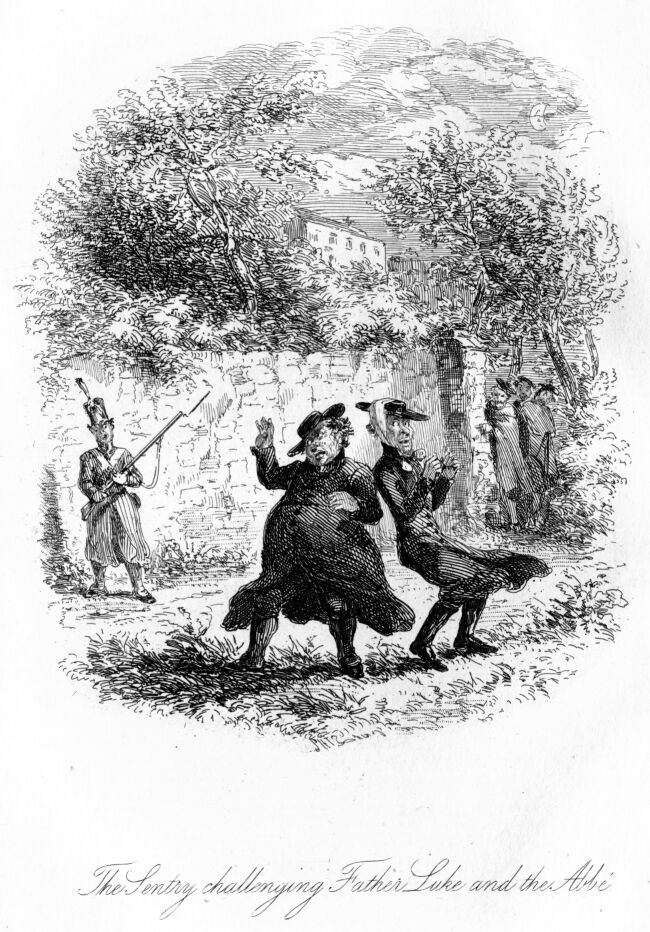
The Sentry Challenging Father Luke and the Abbé
At the conclusion of our last chapter we left our quondam antagonist, Mr.
Beamish, stretched at full length upon a bed practising homeopathy by
administering hot punch to his fever, while we followed our chaperon, Doctor
Finucane, into the presence of the Reverend Father Brennan.
The company into which we now, without any ceremony on our parts, introduced
ourselves, consisted of from five and twenty to thirty persons, seated around a
large oak table, plentifully provided with materials for drinking, and cups,
goblets, and glasses of every shape and form. The moment we entered, the doctor
stepped forward, and, touching Father Malachi on the shoulder,—for so I
rightly guessed him to be,—presented himself to his relative, by whom he
was welcomed with every demonstration of joy. While their recognitions were
exchanged, and while the doctor explained the reasons of our visit, I was
enabled, undisturbed and unnoticed, to take a brief survey of the party.
Father Malachi Brennan, P.P. of Carrigaholt, was what I had often pictured to
myself as the beau ideal of his caste; his figure was short, fleshy, and
enormously muscular, and displayed proportions which wanted but height to
constitute a perfect Hercules; his legs so thick in the calf, so taper in the
ancle, looked like nothing I know, except perhaps, the metal balustrades of
Carlisle-bridge; his face was large and rosy, and the general expression, a
mixture of unbounded good humour and inexhaustible drollery, to which the
restless activity of his black and arched eye-brows greatly contributed; and
his mouth, were it not for a character of sensuality and voluptuousness about
the nether lip, had been actually handsome; his head was bald, except a narrow
circle close above the ears, which was marked by a ring of curly dark hair,
sadly insufficient however, to conceal a development behind, that, if there be
truth in phrenology, bodes but little happiness to the disciples of Miss
Martineau.
Add to these external signs a voice rich, fluent, and racy, with the mellow
“doric” of his country, and you have some faint resemblance of one
“every inch a priest.” The very antipodes to the
‘bonhomie’ of this figure, confronted him as croupier at the foot
of the table. This, as I afterwards learned, was no less a person than Mister
Donovan, the coadjutor or “curate;” he was a tall, spare, ungainly
looking man of about five and thirty, with a pale, ascetic countenance, the
only readable expression of which vibrated between low suspicion and intense
vulgarity: over his low, projecting forehead hung down a mass of straight red
hair; indeed—for nature is not a politician—it almost approached an
orange hue. This was cut close to the head all around, and displayed in their
full proportions a pair of enormous ears, which stood out in
“relief,” like turrets from a watch-tower, and with pretty much the
same object; his skin was of that peculiar colour and texture, to which, not
all “the water in great Neptune’s ocean” could impart a look
of cleanliness, while his very voice, hard, harsh, and inflexible, was
unprepossessing and unpleasant. And yet, strange as it may seem, he, too, was a
correct type of his order; the only difference being, that Father Malachi was
an older coinage, with the impress of Donay or St. Omers, whereas Mister
Donovan was the shining metal, fresh stamped from the mint of Maynooth.
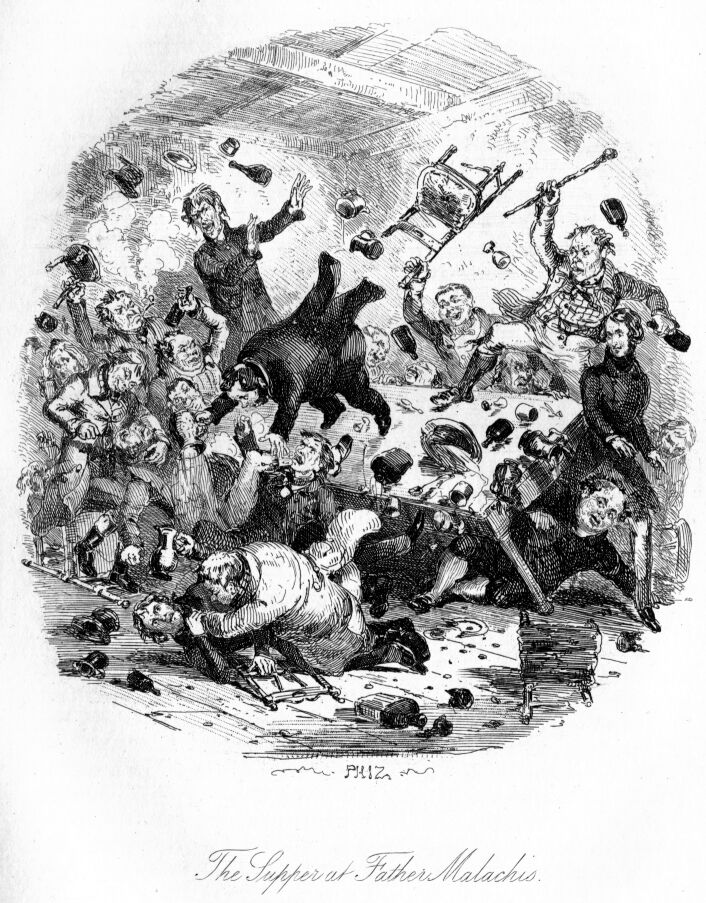
Supper at Father Malachi’s
While thus occupied in my surveillance of the scene before me, I was roused by
the priest saying—
“Ah, Fin, my darling, you needn’t deny it; you’re at the old
game as sure as my name is Malachi, and ye’ll never be easy nor quiet
till ye’re sent beyond the sea, or maybe have a record of your virtues on
half a ton of marble in the church-yard, yonder.”
“Upon my honour, upon the sacred honour of a De Courcy—.”
“Well, well, never mind it now; ye see ye’re just keeping your
friends cooling themselves there in the corner—introduce me at
once.”
“Mr. Lorrequer, I’m sure—.”
“My name is Curzon,” said the adjutant, bowing.
“A mighty pretty name, though a little profane; well, Mr.
Curse-on,” for so he pronounced it, “ye’re as welcome as the
flowers in May; and it’s mighty proud I am to see ye here.
“Mr. Lorrequer, allow me to shake your hand—I’ve heard of ye
before.”
There seemed nothing very strange in that; for go where I would through this
country, I seemed as generally known as ever was Brummell in Bond-street.
“Fin tells me,” continued Father Malachi, “that ye’d
rather not be known down here, in regard of a reason,” and here he
winked. “Make yourselves quite easy; the king’s writ was never but
once in these parts; and the ‘original and true copy’ went back to
Limerick in the stomach of the server; they made him eat it, Mr. Lorrequer; but
it’s as well to be cautious, for there are a good number here. A little
dinner, a little quarterly dinner we have among us, Mr. Curseon, to be social
together, and raise a ‘thrifle’ for the Irish college at Rome,
where we have a probationer or two, ourselves.”
“As good as a station, and more drink,” whispered Fin into my ear.
“And now,” continued the priest, “ye must just permit me to
re-christen ye both, and the contribution will not be the less for what
I’m going to do; and I’m certain you’ll not be worse for the
change Mr. Curseon—though ’tis only for a few hours, ye’ll
have a dacent name.”
As I could see no possible objection to this proposal, nor did Curzon either,
our only desire being to maintain the secrecy necessary for our
antagonist’s safety, we at once assented; when Father Malachi took me by
the hand, but with such a total change in his whole air and deportment that I
was completely puzzled by it; he led me forward to the company with a good deal
of the ceremonious reverence I have often admired in Sir Charles Vernon, when
conducting some full-blown dowager through the mazes of a castle minuet. The
desire to laugh outright was almost irresistible, as the Rev. Father stood at
arm’s length from me, still holding my hand, and bowing to the company
pretty much in the style of a manager introducing a blushing debutante to an
audience. A moment more, and I must have inevitably given way to a burst of
laughter, when what was my horror to hear the priest present me to the company
as their “excellent, worthy, generous, and patriotic young landlord, Lord
Kilkee. Cheer every mother’s son of ye; cheer I say;” and certainly
precept was never more strenuously backed by example, for he huzzaed till I
thought he would burst a blood-vessel; may I add, I almost wished it, such was
the insufferable annoyance, the chagrin, this announcement gave me; and I
waited with eager impatience for the din and clamour to subside, to disclaim
every syllable of the priest’s announcement, and take the consequences of
my baptismal epithet, cost what it might. To this I was impelled by many and
important reasons. Situated as I was with respect to the Callonby family, my
assumption of their name at such a moment might get abroad, and the
consequences to me, be inevitable ruin; and independent of my natural
repugnance to such sailing under false colours, I saw Curzon laughing almost to
suffocation at my wretched predicament, and (so strong within me was the dread
of ridicule) I thought, “what a pretty narrative he is concocting for the
mess this minute.” I rose to reply; and whether Father Malachi, with his
intuitive quickness, guessed my purpose or not, I cannot say, but he certainly
resolved to out-maneuver me, and he succeeded: while with one hand he motioned
to the party to keep silence, with the other he took hold of Curzon, but with
no peculiar or very measured respect, and introduced him as Mr. MacNeesh, the
new Scotch steward and improver—a character at that time whose popularity
might compete with a tithe proctor or an exciseman. So completely did this
tactique turn the tables upon the poor adjutant, who the moment before was
exulting over me, that I utterly forgot my own woes, and sat down convulsed
with mirth at his situation—an emotion certainly not lessened as I saw
Curzon passed from one to the other at table, “like a pauper to his
parish,” till he found an asylum at the very foot, in juxta with the
engaging Mister Donovan. A propinquity, if I might judge from their
countenances, uncoveted by either party.
While this was performing, Doctor Finucane was making his recognitions with
several of the company, to whom he had been long known during his visits to the
neighbourhood. I now resumed my place on the right of the Father, abandoning
for the present all intention of disclaiming my rank, and the campaign was
opened. The priest now exerted himself to the utmost to recall conversation
with the original channels, and if possible to draw off attention from me,
which he still feared, might, perhaps, elicit some unlucky announcement on my
part. Failing in his endeavours to bring matters to their former footing, he
turned the whole brunt of his attentions to the worthy doctor, who sat on his
left.
“How goes on the law,” said he, “Fin? Any new proofs, as they
call them, forthcoming?”
What Fin replied, I could not hear, but the allusion to the “suit”
was explained by Father Malachi informing us that the only impediment between
his cousin and the title of Kinsale lay in the unfortunate fact, that his
grandmother, “rest her sowl,” was not a man.
Doctor Finucane winced a little under the manner in which this was spoken: but
returned the fire by asking if the bishop was down lately in that quarter? The
evasive way in which “the Father” replied having stimulated my
curiosity as to the reason, little entreaty was necessary to persuade the
doctor to relate the following anecdote, which was not relished the less by his
superior, that it told somewhat heavily on Mr. Donovan.
“It is about four years ago,” said the doctor, “since the
Bishop, Dr. Plunkett, took it into his head that he’d make a general
inspection, ‘a reconnoisance,’ as we’d call it, Mr.
Lor—that is, my lord! through the whole diocese, and leave no part far
nor near without poking his nose in it and seeing how matters were doing. He
heard very queer stories about his reverence here, and so down he came one
morning in the month of July, riding upon an old grey hack, looking just for
all the world like any other elderly gentleman in very rusty black. When he got
near the village he picked up a little boy to show him the short cut across the
fields to the house here; and as his lordship was a ‘sharp man and a
shrewd,’ he kept his eye on every thing as he went along, remarking this,
and noting down that.
“‘Are ye regular in yer duties, my son?’ said he to the
gossoon.
“‘I never miss a Sunday,’ said the gossoon; ‘for
it’s always walking his reverence’s horse I am the whole time av
prayers.’
“His lordship said no more for a little while, when he muttered between
his teeth, ‘Ah, it’s just slander—nothing but slander and
lying tongues.’ This soliloquy was caused by his remarking that on every
gate he passed, or from every cabin, two or three urchins would come out half
naked, but all with the finest heads of red hair he ever saw in his life.
“‘How is it, my son,’ said he, at length; ‘they tell
very strange stories about Father Malachi, and I see so many of these children
with red hair. Eh—now Father Malachi’s a dark man.’
“‘True for ye,’ said the boy; ‘true for ye, Father
Malachi’s dark; but the coadjutor!—the coadjutor’s as red as
a fox.’”
When the laugh this story caused had a little subsided, Father Malachi called
out, “Mickey Oulahan! Mickey, I say, hand his lordship over ‘the
groceries’”—thus he designated a square decanter, containing
about two quarts of whiskey, and a bowl heaped high with sugar—“a
dacent boy is Mickey, my lord, and I’m happy to be the means of making
him known to you.” I bowed with condescension, while Mr. Oulahan’s
eyes sparkled like diamonds at the recognition.
“He has only two years of the lease to run, and a ‘long
charge,’” (anglicé, a large family,) continued the priest.
“I’ll not forget him, you may depend upon it,” said I.
“Do you hear that,” said Father Malachi, casting a glance of
triumph round the table, while a general buzz of commendation on priest and
patron went round, with many such phrases as, “Och thin, it’s his
riv’rance can do it,” “na bocklish,” “and why
not,” &c. &c. As for me, I have already “confessed”
to my crying sin, a fatal, irresistible inclination to follow the humour of the
moment wherever it led me; and now I found myself as active a partizan in
quizzing Mickey Oulahan, as though I was not myself a party included in the
jest. I was thus fairly launched into my inveterate habit, and nothing could
arrest my progress.
One by one the different individuals round the table were presented to me, and
made known their various wants, with an implicit confidence in my power of
relieving them, which I with equal readiness ministered to. I lowered the rent
of every man at table. I made a general jail delivery, an act of grace, (I
blush to say,) which seemed to be peculiarly interesting to the present
company. I abolished all arrears—made a new line of road through an
impassable bog, and over an inaccessible mountain—and conducted water to
a mill, which (I learned in the morning) was always worked by wind. The
decanter had scarcely completed its third circuit of the board, when I bid fair
to be most popular specimen of the peerage that ever visited the “far
west.” In the midst of my career of universal benevolence, I was
interrupted by Father Malachi, whom I found on his legs, pronouncing a glowing
eulogium on his cousin’s late regiment, the famous North Cork.
“That was the corps!” said he. “Bid them do a thing, and
they’d never leave off; and so, when they got orders to retire from
Wexford, it’s little they cared for the comforts of baggage, like many
another regiment, for they threw away every thing but their canteens, and never
stopped till they ran to Ross, fifteen miles farther than the enemy followed
them. And when they were all in bed the same night, fatigued and tired with
their exertions, as ye may suppose, a drummer’s boy called out in his
sleep—‘here they are—they’re coming’—they
all jumped up and set off in their shirts, and got two miles out of town before
they discovered it was a false alarm.”
Peal after peal of laughter followed the priest’s encomium on the
doctor’s regiment; and, indeed, he himself joined most heartily in the
mirth, as he might well afford to do, seeing that a braver or better corps than
the North Cork, Ireland did not possess.
“Well,” said Fin, “it’s easy to see ye never can forget
what they did at Maynooth.”
Father Malachi disclaimed all personal feeling on the subject; and I was at
last gratified by the following narrative, which I regret deeply I am not
enabled to give in the doctor’s own verbiage; but writing as I do from
memory, (in most instances,) I can only convey the substance:
It was towards the latter end of the year ‘98—the year of the
troubles—that the North Cork was ordered, “for their sins” I
believe, to march from their snug quarters in Fermoy, and take up a position in
the town of Maynooth—a very considerable reverse of fortune to a set of
gentlemen extremely addicted to dining out, and living at large upon a very
pleasant neighbourhood. Fermoy abounded in gentry; Maynooth at that, time had
few, if any, excepting his Grace of Leinster, and he lived very privately, and
saw no company. Maynooth was stupid and dull—there were neither belles
nor balls; Fermoy (to use the doctor’s well remembered words) had
“great feeding,” and “very genteel young ladies, that carried
their handkerchiefs in bags, and danced with the officers.”
They had not been many weeks in their new quarters, when they began to pine
over their altered fortunes, and it was with a sense of delight, which a few
months before would have been incomprehensible to them, they discovered, that
one of their officers had a brother, a young priest in the college: he
introduced him to some of his confrères, and the natural result followed. A
visiting acquaintance began between the regiment and such of the members of the
college as had liberty to leave the precincts: who, as time ripened the
acquaintance into intimacy, very naturally preferred the cuisine of the North
Cork to the meagre fare of “the refectory.” At last seldom a day
went by, without one or two of their reverences finding themselves guests at
the mess. The North Corkians were of a most hospitable turn, and the fathers
were determined the virtue should not rust for want of being exercised; they
would just drop in to say a word to “Captain O’Flaherty about leave
to shoot in the demesne,” as Carton was styled; or, they had a
“frank from the Duke for the Colonel,” or some other equally
pressing reason; and they would contrive to be caught in the middle of a very
droll story just as the “roast beef” was playing. Very little
entreaty then sufficed—a short apology for the “dereglements”
of dress, and a few minutes more found them seated at table without further
ceremony on either side.
Among the favourite guests from the college, two were peculiarly held in
estimation—“the Professor of the Humanities,” Father Luke
Mooney; and the Abbé D’Array, “the Lecturer on Moral Philosophy,
and Belles Lettres;” and certain it is, pleasanter fellows, or more
gifted with the “convivial bump,” there never existed. He of the
Humanities was a droll dog—a member of the Curran club, the “monks
of the screw,” told an excellent story, and sang the “Cruiskeen
Lawn” better than did any before or since him;—the moral
philosopher, though of a different genre, was also a most agreeable companion,
an Irishman transplanted in his youth to St. Omers, and who had grafted upon
his native humour a considerable share of French smartness and
repartee—such were the two, who ruled supreme in all the festive
arrangements of this jovial regiment, and were at last as regular at table, as
the adjutant and the paymaster, and so might they have continued, had not
prosperity, that in its blighting influence upon the heart, spares neither
priests nor laymen, and is equally severe upon mice (see Æsop’s fable)
and moral philosophers, actually deprived them, for the “nonce” of
reason, and tempted them to their ruin. You naturally ask, what did they do?
Did they venture upon allusions to the retreat upon Ross? Nothing of the kind.
Did they, in that vanity which wine inspires, refer by word, act, or inuendo,
to the well-known order of their Colonel when reviewing his regiment in
“the Phœnix,” to “advance two steps backwards, and dress by
the gutter.” Far be it from them: though indeed either of these had been
esteemed light in the balance compared with their real crime. “Then, what
was their failing—come, tell it, and burn ye?” They actually,
“horresco referens,” quizzed the Major coram the whole
mess!—Now, Major John Jones had only lately exchanged into the North Cork
from the “Darry Ragement,” as he called it. He was a red-hot
orangeman, a deputy-grand something, and vice-chairman of the
“’Prentice Boys” beside. He broke his leg when a school-boy,
by a fall incurred in tying an orange handkerchief around King William’s
August neck in College-green, on one 12th of July, and three several times had
closed the gates of Derry with his own loyal hands, on the famed anniversary;
in a word, he was one, that if his church had enjoined penance as an expiation
for sin, would have looked upon a trip to Jerusalem on his bare knees, as a
very light punishment for the crime on his conscience, that he sat at table
with two buck priests from Maynooth, and carved for them, like the rest of the
company!
Poor Major Jones, however, had no such solace, and the canker-worm eat daily
deeper and deeper into his pining heart. During the three or four weeks of
their intimacy with his regiment, his martyrdom was awful. His figure wasted,
and his colour became a deeper tinge of orange, and all around averred that
there would soon be a “move up” in the corps, for the major had
evidently “got his notice to quit” this world, and its pomps and
vanities. He felt “that he was dying,” to use Haines Bayley’s
beautiful and apposite words, and meditated an exchange, but that, from
circumstances, was out of the question. At last, subdued by grief, and probably
his spirit having chafed itself smooth by such constant attrition, he became,
to all seeming, calmer; but it was only the calm of a broken and weary heart.
Such was Major Jones at the time, when, “suadente diabolo,” it
seemed meet to Fathers Mooney and D’Array to make him the butt of their
raillery. At first, he could not believe it; the thing was
incredible—impossible; but when he looked around the table, when he heard
the roars of laughter, long, loud, and vociferous; when he heard his name
bandied from one to the other across the table, with some vile jest tacked to
it “like a tin kettle to a dog’s tail,” he awoke to the full
measure of his misery—the cup was full. Fate had done her worst, and he
might have exclaimed with Lear, “spit, fire—spout, rain,”
there was nothing in store for him of further misfortune.
A drum-head court-martial—a hint “to sell out”—ay, a
sentence of “dismissed the service,” had been mortal calamities,
and, like a man, he would have borne them; but that he, Major John Jones,
D.G.S. C.P.B., &c. &c., who had drank the “pious, glorious, and
immortal,” sitting astride of “the great gun of Athlone,”
should come to this! Alas, and alas! He retired that night to his chamber a
“sadder if not a wiser man;” he dreamed that the
“statue” had given place to the unshapely figure of Leo X., and
that “Lundy now stood where Walker stood before.” He humped from
his bed in a moment of enthusiasm, he vowed his revenge, and he kept his vow.
That day the major was “acting field officer.” The various
patroles, sentries, picquets, and out-posts, were all under his especial
control; and it was remarked that he took peculiar pains in selecting the men
for night duty, which, in the prevailing quietness and peace of that time,
seemed scarcely warrantable.
Evening drew near, and Major Jones, summoned by the “oft-heard
beat,” wended his way to the mess. The officers were dropping in, and
true as “the needle to the pole,” came Father Mooney and the Abbé.
They were welcomed with the usual warmth, and strange to say, by none more than
the major himself, whose hilarity knew no bounds.
How the evening passed, I shall not stop to relate: suffice it to say, that a
more brilliant feast of wit and jollification, not even the North Cork ever
enjoyed. Father Luke’s drollest stories, his very quaintest humour shone
forth, and the Abbé sang a new “Chanson a Boire,” that Beranger
might have envied.
“What are you about, my dear Father D’Array?” said the
Colonel; “you are surely not rising yet; here’s a fresh cooper of
port just come in; sit down, I entreat.”
“I say it with grief, my dear colonel, we must away; the half-hour has
just chimed, and we must be within ‘the gates’ before twelve. The
truth is, the superior has been making himself very troublesome about our
‘carnal amusements’ as he calls our innocent mirth, and we must
therefore be upon our guard.”
“Well, if it must be so, we shall not risk losing your society
altogether, for an hour or so now; so, one bumper to our next
meeting—to-morrow, mind, and now, M. D’Abbé, au revoir.”
The worthy fathers finished their glasses, and taking a most affectionate leave
of their kind entertainers, sallied forth under the guidance of Major Jones,
who insisted upon accompanying them part of the way, as, “from
information he had received, the sentries were doubled in some places, and the
usual precautions against surprise all taken.” Much as this polite
attention surprised the objects of it, his brother officers wondered still
more, and no sooner did they perceive the major and his companions issue forth,
than they set out in a body to watch where this most novel and unexpected
complaisance would terminate.
When the priests reached the door of the barrack-yard, they again turned to
utter their thanks to the major, and entreat him once more, “not to come
a step farther. There now, major, we know the path well, so just give us the
pass, and don’t stay out in the night air.”
“Ah oui, Monsieur Jones,” said the Abbé, “retournez, je vous
prie. We are, I must say, chez nous. Ces braves gens, les North Cork know us by
this time.”
The major smiled, while he still pressed his services to see them past the
picquets, but they were resolved and would not be denied.
“With the word for the night, we want nothing more,” said Father
Luke.
“Well, then,” said the major, in the gravest tone, and he was
naturally grave, “you shall have your way, but remember to call out loud,
for the first sentry is a little deaf, and a very passionate, ill-tempered
fellow to boot.”
“Never fear,” said Father Mooney, laughing; “I’ll go
bail he’ll hear me.”
“Well—the word for the night is—‘Bloody end to the
Pope,’—don’t forget, now, ‘Bloody end to the
Pope,’” and with these words he banged the door between him and the
unfortunate priests; and, as bolt was fastened after bolt, they heard him
laughing to himself like a fiend over his vengeance.
“And big bad luck to ye, Major Jones, for the same, every day ye see a
paving stone,” was the faint sub-audible ejaculation of Father Luke, when
he was recovered enough to speak.
“Sacristi! Que nous sommes attrappes,” said the Abbé, scarcely able
to avoid laughing at the situation in which they were placed.
“Well, there’s the quarter chiming now; we’ve no time to
lose—Major Jones! Major, darling! Don’t now, ah, don’t! sure
ye know we’ll be ruined entirely—there now, just change it, like a
dacent fellow—the devil’s luck to him, he’s gone. Well, we
can’t stay here in the rain all night, and be expelled in the morning
afterwards—so come along.”
They jogged on for a few minutes in silence, till they came to that part of the
“Duke’s” demesne wall, where the first sentry was stationed.
By this time the officers, headed by the major, had quietly slipped out of the
gate, and were following their steps at a convenient distance.
The fathers had stopped to consult together, what they should do in this trying
emergency—when their whisper being overheard, the sentinel called out
gruffly, in the genuine dialect of his country, “who goes that?”
“Father Luke Mooney, and the Abbé D’Array,” said the former,
in his most bland and insinuating tone of voice, a quality he most eminently
possessed.
“Stand and give the countersign.”
“We are coming from the mess, and going home to the college,” said
Father Mooney, evading the question, and gradually advancing as he spoke.
“Stand, or I’ll shot ye,” said the North Corkian.
Father Luke halted, while a muttered “Blessed Virgin” announced his
state of fear and trepidation.
“D’Array, I say, what are we to do.”
“The countersign,” said the sentry, whose figure they could
perceive in the dim distance of about thirty yards.
“Sure ye’ll let us pass, my good lad, and ye’ll have a friend
in Father Luke the longest day ye live, and ye might have a worse in time of
need; ye understand.”
Whether he did understand or not, he certainly did not heed, for his only reply
was the short click of his gun-lock, that bespeaks a preparation to fire.
“There’s no help now,” said Father Luke; “I see
he’s a haythen; and bad luck to the major, I say again;” and this
in the fulness of his heart he uttered aloud.
“That’s not the countersign,” said the inexorable sentry,
striking the butt end of the musket on the ground with a crash that smote
terror into the hearts of the priests.
Mumble—mumble—“to the Pope,” said Father Luke,
pronouncing the last words distinctly, after the approved practice of a Dublin
watchman, on being awoke from his dreams of row and riot by the last toll of
the Post-office, and not knowing whether it has struck “twelve” or
“three,” sings out the word “o’clock,” in a long
sonorous drawl, that wakes every sleeping citizen, and yet tells nothing how
“time speeds on his flight.”
“Louder,” said the sentry, in a voice of impatience.
——“to the Pope.”
“I don’t hear the first part.”
“Oh then,” said the priest, with a sigh that might have melted the
heart of anything but a sentry, “Bloody end to the Pope; and may the
saints in heaven forgive me for saying it.”
“Again,” called out the soldier; “and no muttering.”
“Bloody end to the Pope,” cried Father Luke in bitter desperation.
“Bloody end to the Pope,” echoed the Abbé.
“Pass bloody end to the Pope, and good night,” said the sentry,
resuming his rounds, while a loud and uproarious peal of laughter behind, told
the unlucky priests they were overheard by others, and that the story would be
over the whole town in the morning.
Whether it was that the penance for their heresy took long in accomplishing, or
that they never could summon courage sufficient to face their persecutor,
certain it is, the North Cork saw them no more, nor were they ever observed to
pass the precincts of the college, while that regiment occupied Maynooth.
Major Jones himself, and his confederates, could not have more heartily
relished this story, than did the party to whom the doctor heartily related it.
Much, if not all the amusement it afforded, however, resulted from his
inimitable mode of telling, and the power of mimicry, with which he conveyed
the dialogue with the sentry: and this, alas, must be lost to my readers, at
least to that portion of them not fortunate enough to possess Doctor
Finucane’s acquaintance.
“Fin! Fin! your long story has nearly famished me,” said the padre,
as the laugh subsided; “and there you sit now with the jug at your elbow
this half-hour; I never thought you would forget our old friend Martin
Hanegan’s aunt.”
“Here’s to her health,” said Fin; “and your reverence
will get us the chant.”
“Agreed,” said Father Malachi, finishing a bumper, and after giving
a few preparatory hems, he sang the following “singularly wild and
beautiful poem,” as some one calls Christabel:—
“Here’s a health to Martin Hanegan’s aunt,
And I’ll tell ye the reason why!
She eats bekase she is hungry,
And drinks bekase she is dry.
“And if ever a man,
Stopped the course of a can,
Martin Hanegan’s aunt would cry—
‘Arrah, fill up your glass,
And let the jug pass;
How d’ye know but what your neighbour’s dhry?’”
“Come, my lord and gentlemen, da capo, if ye please—Fill up your
glass,” and the chanson was chorussed with a strength and vigour that
would have astonished the Philharmonic.
The mirth and fun now grew “fast and furious;” and Father Malachi,
rising with the occasion, flung his reckless drollery and fun on every side,
sparing none, from his cousin to the coadjutor. It was not that peculiar period
in the evening’s enjoyment, when an expert and practical chairman gives
up all interference or management, and leaves every thing to take its course;
this then was the happy moment selected by Father Malachi to propose the little
“conthribution.” He brought a plate from a side table, and placing
it before him, addressed the company in a very brief but sensible speech,
detailing the object of the institution he was advocating, and concluding with
the following words:—“and now ye’ll just give whatever ye
like, according to your means in life, and what ye can spare.”
The admonition, like the “morale” of an income tax, having the
immediate effect of pitting each man against his neighbour, and suggesting to
their already excited spirits all the ardour of gambling, without, however, a
prospect of gain. The plate was first handed to me in honour of my
“rank,” and having deposited upon it a handful of small silver, the
priest ran his finger through the coin, and called out:—
“Five pounds! at least; not a farthing less, as I am a sinner. Look,
then,—see now; they tell ye, the gentlemen don’t care for the like
of ye! but see for yourselves. May I trouble y’r lordship to pass the
plate to Mr. Mahony—he’s impatient, I see.”
Mr. Mahony, about whom I perceived very little of the impatience alluded to,
was a grim-looking old Christian, in a rabbit-skin waistcoat, with long flaps,
who fumbled in the recesses of his breeches pocket for five minutes, and then
drew forth three shillings, which he laid upon the plate, with what I fancied
very much resembled a sigh.
“Six and sixpence, is it? or five shillings?—all the same, Mr.
Mahony, and I’ll not forget the thrifle you were speaking about this
morning any way;” and here he leaned over as interceding with me for him,
but in reality to whisper into my ear, “the greatest miser from this to
Castlebar.”
“Who’s that put down the half guinea in goold?” (And this
time he spoke truth.) “Who’s that, I say?”
“Tim Kennedy, your reverence,” said Tim, stroking his hair down
with one hand, and looking proud and modest at the same moment.
“Tim, ye’re a credit to us any day, and I always said so.
It’s a gauger he’d like to be, my lord,” said he, turning to
me, in a kind of stage whisper. I nodded and muttered something, when he
thanked me most profoundly as if his suit had prospered.
“Mickey Oulahan—the lord’s looking at ye, Mickey.” This
was said piannisime across the table, and had the effect of increasing Mr.
Oulahan’s donation from five shillings to seven—the last two being
pitched in very much in the style of a gambler making his final coup, and
crying “va banque.” “The Oulahans were always dacent
people—dacent people, my lord.”
“Be gorra, the Oulahans was niver dacenter nor the Molowneys, any
how,” said a tall athletic young fellow, as he threw down three crown
pieces, with an energy that made every coin leap from the plate.
“They’ll do now,” said Father Brennan; “I’ll
leave them to themselves;” and truly the eagerness to get the plate and
put down the subscription, fully equalled the rapacious anxiety I have
witnessed in an old maid at loo, to get possession of a thirty-shilling pool,
be the same more or less, which lingered on its way to her, in the hands of
many a fair competitor.
“Mr. M’Neesh”—Curzon had hitherto escaped all
notice—“Mr. M’Neesh, to your good health,” cried Father
Brennan. “It’s many a secret they’ll be getting out
o’ye down there about the Scotch husbandry.”
Whatever poor Curzon knew of “drills,” certainly did not extend to
them when occupied by turnips. This allusion of the priest’s being caught
up by the party at the foot of the table, they commenced a series of inquiries
into different Scotch plans of tillage—his brief and unsatisfactory
answers to which, they felt sure, were given in order to evade imparting
information. By degrees, as they continued to press him with questions, his
replies grew more short, and a general feeling of dislike on both sides was not
very long in following.
The father saw this, and determining with his usual tact to repress it, called
on the adjutant for a song. Now, whether he had but one in the world, or
whether he took this mode of retaliating for the annoyances he had suffered, I
know not; but true it is, he finished his tumbler at a draught, and with a
voice of no very peculiar sweetness, though abundantly loud, began “The
Boyne Water.”
He had just reached the word “battle,” in the second line upon
which he was bestowing what he meant to be a shake, when, as if the word
suggested it, it seemed the signal for a general engagement. Decanters,
glasses, jugs, candlesticks,—aye, and the money-dish, flew right and
left—all originally intended, it is true, for the head of the luckless
adjutant, but as they now and then missed their aim, and came in contact with
the “wrong man,” invariably provoked retaliation, and in a very few
minutes the battle became general.
What may have been the doctor’s political sentiments on this occasion, I
cannot even guess; but he seemed bent upon performing the part of a
“convivial Lord Stanley,” and maintaining a dignified neutrality.
With this apparent object, he mounted upon the table, to raise himself, I
suppose, above the din and commotion of party clamour, and brandishing a jug of
scalding water, bestowed it with perfect impartiality on the combatants on
either side. This Whig plan of conciliation, however well intended, seemed not
to prosper with either party; and many were the missiles directed at the
ill-starred doctor. Meanwhile Father Malachi, whether following the pacific
instinct of his order, in seeking an asylum in troublesome times, or equally
moved by old habit to gather coin in low places, (much of the money having
fallen,) was industriously endeavouring to insert himself beneath the table; in
this, with one vigorous push, he at last succeeded, but in so doing lifted it
from its legs, and thus destroying poor “Fin’s” gravity,
precipitated him, jug and all, into the thickest part of the fray, where he met
with that kind reception such a benefactor ever receives at the hands of a
grateful public. I meanwhile hurried to rescue poor Curzon, who, having fallen
to the ground, was getting a cast of his features taken in pewter, for such
seemed the operation a stout farmer was performing on the adjutant’s face
with a quart. With considerable difficulty, notwithstanding my supposed
“lordship,” I succeeded in freeing him from his present position;
and he concluding, probably, that enough had been done for one
“sitting,” most willingly permitted me to lead him from the room. I
was soon joined by the doctor, who assisted me in getting my poor friend to
bed; which being done, he most eagerly entreated me to join the company. This,
however, I firmly but mildly declined, very much to his surprise; for as he
remarked—“They’ll all be like lambs now, for they don’t
believe there’s a whole bone in his body.”
Expressing my deep sense of the Christian-like forbearance of the party, I
pleaded fatigue, and bidding him good night, adjourned to my bed-room; and
here, although the arrangements fell somewhat short of the luxurious ones
appertaining to my late apartment at Callonby, they were most grateful at the
moment; and having “addressed myself to slumber,” fell fast asleep,
and only awoke late on the following morning to wonder where I was: from any
doubts as to which I was speedily relieved by the entrance of the
priest’s bare-footed “colleen,” to deposit on my table a
bottle of soda water, and announce breakfast, with his reverence’s
compliments.
Having made a hasty toilet, I proceeded to the parlour, which, however late
events might have impressed upon my memory, I could scarcely recognise. Instead
of the long oak table and the wassail bowl, there stood near the fire a small
round table, covered with a snow—white cloth, upon which shone in
unrivalled brightness a very handsome tea equipage—the hissing kettle on
one hob was vis a vis’d by a gridiron with three newly taken trout,
frying under the reverential care of Father Malachi himself—a heap of
eggs ranged like shot in an ordnance yard, stood in the middle of the table,
while a formidable pile of buttered toast browned before the grate—the
morning papers were airing upon the hearth—every thing bespoke that
attention to comfort and enjoyment one likes to discover in the house where
chance may have domesticated him for a day or two.
“Good morning, Mr. Lorrequer. I trust you have rested well,” said
Father Malachi as I entered.
“Never better; but where are our friends?”
“I have been visiting and comforting them in their affliction, and I may
with truth assert it is not often my fortune to have three as sickly looking
guests. That was a most unlucky affair last night, and I must apologise.”
“Don’t say a word, I entreat; I saw how it all occurred, and am
quite sure if it had not been for poor Curzon’s ill-timed
melody—”
“You are quite right,” said the father interrupting me. “Your
friend’s taste for music—bad luck to it—was the
‘teterrima causa belli.’”
“And the subscription,” said I; “how did it succeed?”
“Oh, the money went in the commotion; and although I have got some seven
pounds odd shillings of it, the war was a most expensive one to me. I caught
old Mahony very busy under the table during the fray; but let us say no more
about it now—draw over your chair. Tea or coffee? there’s the rum
if you like it ‘chasse.’”
I immediately obeyed the injunction, and commenced a vigorous assault upon the
trout, caught, as he informed me, “within twenty perches of the
house.”
“Your poor friend’s nose is scarcely regimental,” said he,
“this morning; and as for Fin, he was never remarkable for beauty, so,
though they might cut and hack, they could scarcely disfigure him, as Juvenal
says—isn’t it Juvenal?
“‘Vacuus viator cantabit ante Latronem;’
“or in the vernacular:
“‘The empty traveller may whistle
Before the robber and his pistil’ (pistol).”
“There’s the Chili vinegar—another morsel of the
trout?”
“I thank you; what excellent coffee, Father Malachi!”
“A secret I learned at St. Omer’s some thirty years since. Any
letters, Bridget?”—to a damsel that entered with a pacquet in her
hand.
“A gossoon from Kilrush, y’r reverence, with a bit of a note for
the gentleman there.”
“For me!—ah, true enough. Harry Lorrequer, Esq. Kilrush—try
Carrigaholt.” So ran the superscription—the first part being in a
lady’s handwriting; the latter very like the “rustic paling”
of the worthy Mrs. Healy’s style. The seal was a large one, bearing a
coronet at top, and the motto in old Norman-French, told me it came from
Callonby.
With what a trembling hand and beating heart I broke it open, and yet feared to
read it—so much of my destiny might be in that simple page. For once in
my life my sanguine spirit failed me; my mind could take in but one casualty,
that Lady Jane had divulged to her family the nature of my attentions, and that
in the letter before me lay a cold mandate of dismissal from her presence for
ever.
At last I summoned courage to read it; but having scrupled to present to my
readers the Reverend Father Brennan at the tail of a chapter, let me not be
less punctilious in the introduction of her ladyship’s billet.
![[Illustration]](https://openoldbooks.sgp1.digitaloceanspaces.com/books/the-confessions-of-harry-lorrequer/images/cover.jpg)
![[Illustration: spine]](https://openoldbooks.sgp1.digitaloceanspaces.com/books/the-confessions-of-harry-lorrequer/images/spine.jpg)
![[Illustration:titlepage]](https://openoldbooks.sgp1.digitaloceanspaces.com/books/the-confessions-of-harry-lorrequer/images/titlepage.jpg)


