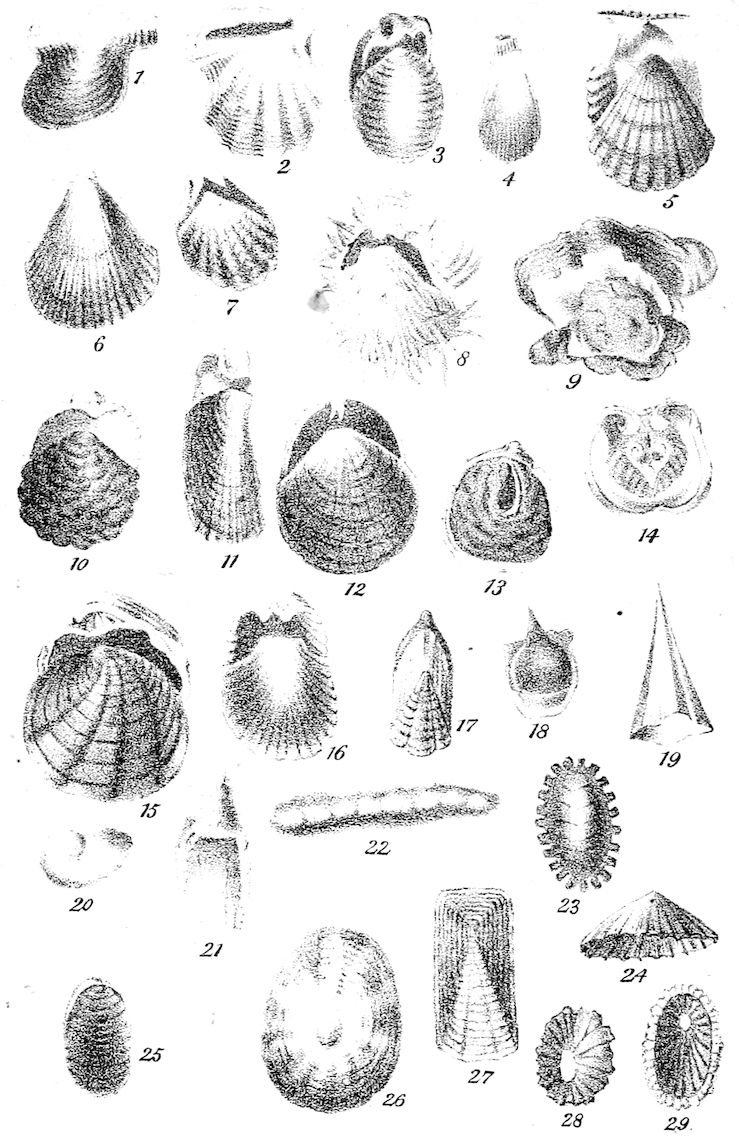
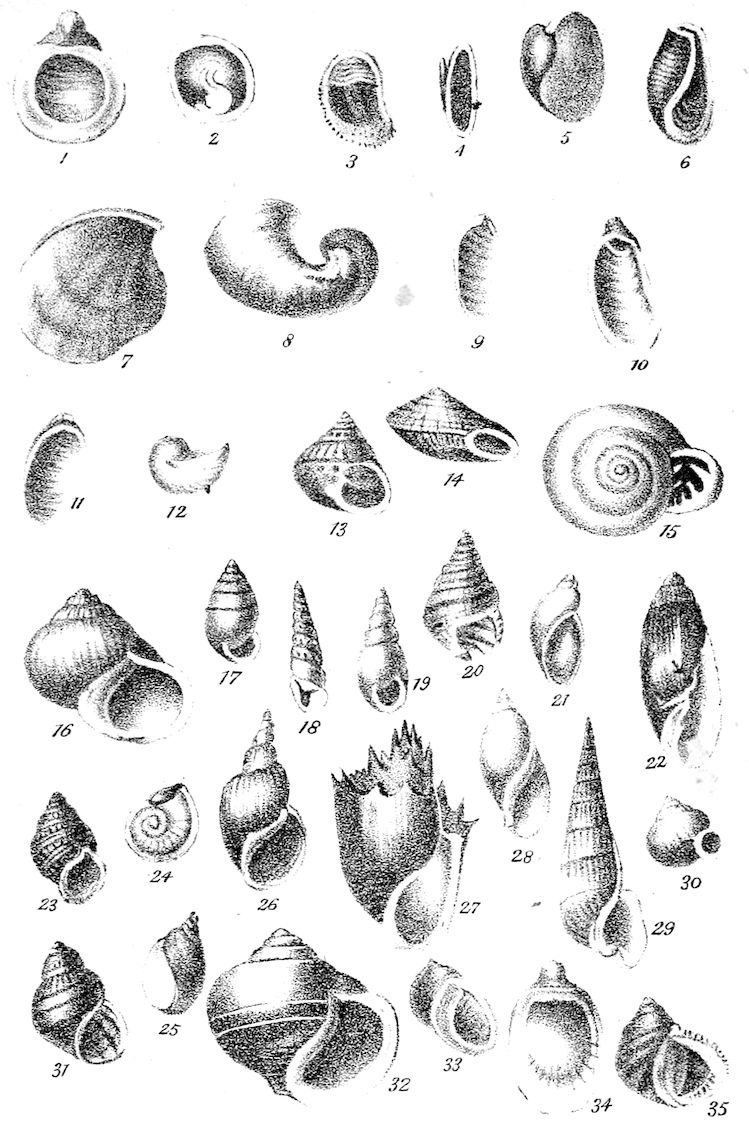
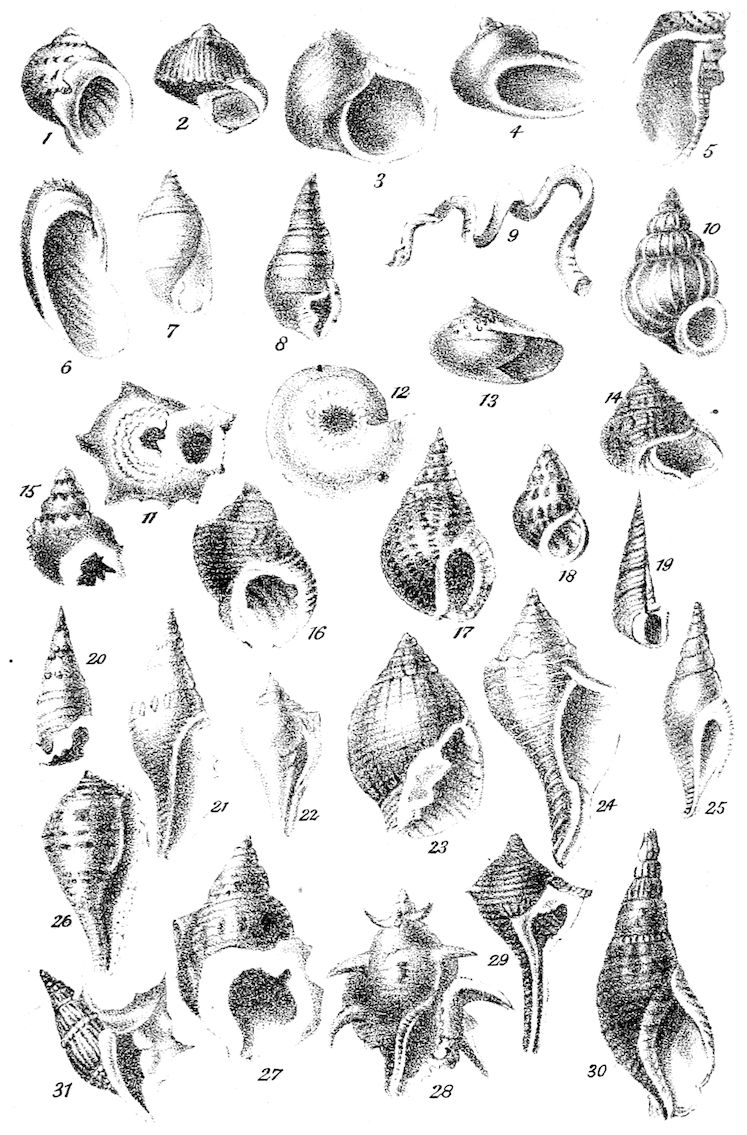
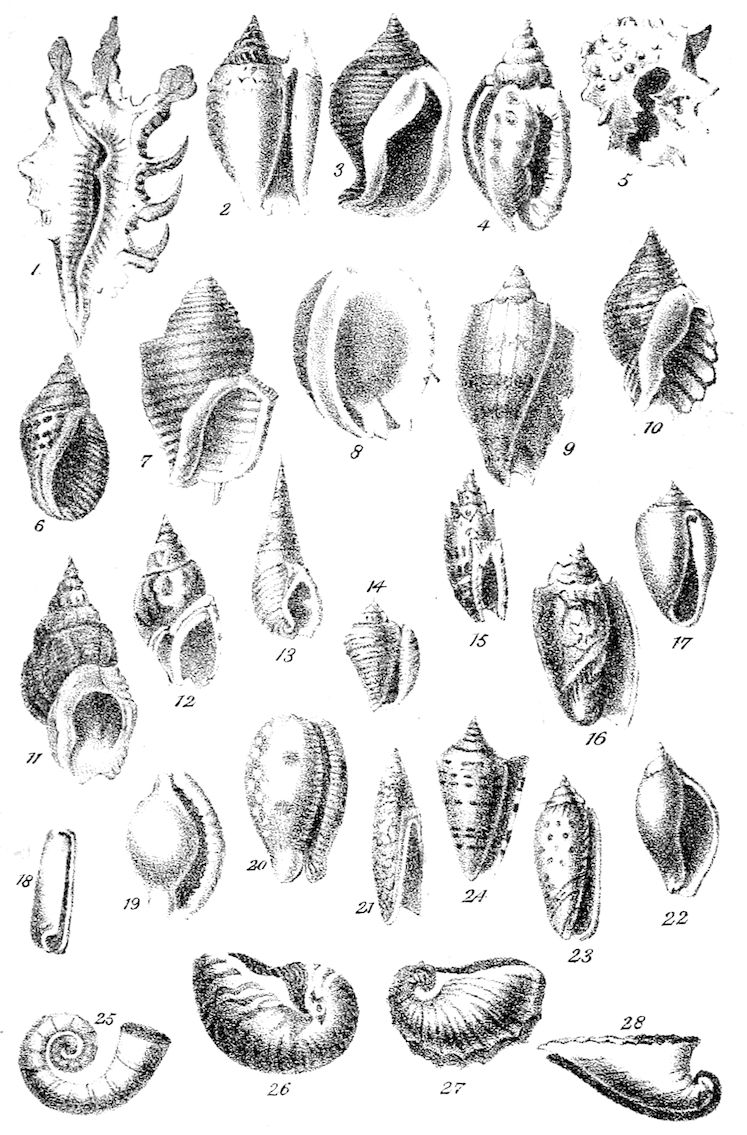
Animals soft, inarticulated, furnished with an anterior head,
projecting or salient; most frequently with eyes and tentaculæ, or
86possessing, at their summit, arms disposed in the form of a coronet:
their mouth either short, elongated, or tubular, exsertile, and
generally armed with hard parts. Mantle diversified, having its
edges free on the sides of the body, or the lobes united, forming a
sack, which in part envelopes the animal; gills or respiratory
organs various, circulation double, one particular, the other general;
heart unilocular, sometimes with the auricles divided, and
very distant; no medullary cord along the body, but scattered
nerves and ganglions. Twenty-two families.
Some genera of this family are without a testaceous covering,
mentioned only to preserve the family entire.
Animal. Body enclosed in a shell, winged before, two opposite
wings, somewhat retractile, inserted at the sides of the mouth,
head distinct, mouth terminal, placed at the junction of the fins;
without eyes.
Shell. Symmetrical, very thin and transparent, valves unequal,
flat above, convex below, open like a cleft anteriorly, summit
truncated and tridentated posteriorly. Inhabits the Mediterranean.
Two species.
- Hyalæa tridentata.
- H. cuspidata.
Animal. Body free, naked, more or less elongated, tapering to
the rear, head very distinct; provided with six, long, conical, retractile
tentaculæ, separated into two groups of three each; mouth
altogether terminal and vertical, eyes sessile, rudiment of a foot
under the neck.
This is a molluscous animal without any testaceous covering,
but is here placed as leading to other genera which have shells.
Inhabits the Indian seas. Two species.
- Clio borealis.
- C. Australis.
87
Animal. Body oblong, gelatinous, contractile; a head in front
with two wings, and the posterior part enveloped in a shell, head
distinct, projecting and round; two eyes; mouth in the form of a
small beak; destitute of tentaculæ; two, opposite, membranaceous,
pellucid, and cordated wings, placed at the base of the neck.
Shell. Pyramidal, triangular, of a gelatinous or cartilaginous
substance, very thin and transparent; aperture obliquely truncated.
Inhabits the South American seas. Two species.
- Cleodora pyramidata.
- C. caudata.
Animal. Body soft, oblong, two branchial fins situated at the
base of the neck; posterior part of the body spiral, and enveloped
in a shell.
Shell. Thin, fragile, papyraceous, spiral, the whorls reunited
in a planorbis form, and deeply and largely umbilicated on one
side; aperture large and entire. Inhabits the North seas. One
species.
Animal. Body oblong, gelatinous, pellucid, enclosing a shell;
head sessile; two eyes, and two retractile tentacula; mouth with
a retractile proboscis; two, opposite, oblong, ovate, branched wings,
connate at their posterior base.
Shell. Gelatinous, cartilaginous, very transparent, crystalline,
oblong, in shape of a shoe, from which it has derived the name
of the slipper, truncated at the summit; aperture lateral and anterior.
Inhabits the Mediterranean. One species.
A molluscous animal, without any testaceous covering, and
much resembling the genus Clio. Inhabits the Indian seas. One
species.
88
A mollusca similar to the preceding genus, without a shell, but
its back covered with a rough or coriaceous skin. Inhabits the
Mediterranean. Three species.
- Phyllidia varicosa.
- P. pustulosa.
- P. ocellata.
Animal. Body creeping, elongated; middle of the back provided
its entire length with a detached, multivalve shell; the
alternate pieces for the most part longitudinal; sides naked;
branchiæ disposed around the body; foot cleft longitudinally by a
deep furrow.
Shell. Each valve with striæ radiating from its apex; the
margins serrated; the base of the last valve obtuse. The testaceous
plates of this genus are never joined like those of the Chiton,
so that the animal can move in every direction. Upon the contraction
of the animal after death, however, these valves become
nearly united. Inhabits the seas of New Holland. Two species.
- Chitonellus striatus.
- C. larvæformis.
Animal. Body creeping, ovate oblong, convex, round at both
extremities; marginated with a coriaceous skin: the back covered
by a longitudinal series of testaceous, transverse, imbricated, and
moveable plates; head before, sessile, with the mouth placed below,
destitute of tentacula or eyes; branchiæ placed round the body,
under the margin of the skin; and orifice at the posterior extremity.
Shell. Eight imbricated valves, nearly smooth, slightly carinated,
and rounded at the margins: summit more or less marked
89and curved by longitudinal elongations. Inhabits the British
and American coasts. Sixty-three species.
- Chiton fulvus.
- C. pisceus.
- C. ruber.
- C. lævis.
- C. spinosus.
- C. fascicularis.
- C. marginatus.
- C. crinitus.
- C. siculus.
- C. niger.
- C. spiniferous.
- C. coquimbensis.
- C. lumingii.
- C. granosus.
- C. glauco-sinctus.
- C. disjunctus.
- C. elegans.
- C. lineatus.
- C. sulcatus.
- C. bicolor.
- C. cerasimus.
- C. Magellanicus.
- C. marmoratus.
- C. nebulosus.
- C. olivaceous.
- C. latus.
- C. punctatus.
- C. viridus.
- C. cinerus.
- C. tunicatus.
- C. gigas.
- C. squamosus.
- C. Peruvianus.
- C. tesselatus.
- C. capensis.
- C. Carmichaelis.
- C. echinatus.
- C. striatus.
- C. lineolatus.
- C. chilensis.
- C. tuberculatus.
- C. hispidus.
- C. thalassimus.
- C. porosus.
- C. larvaformis.
- C. undulatus.
- C. luteolus.
- C. fuscus.
- C. minimus.
- C. cimex.
- C. ascellus.
- C. Icelandicus.
- C. fasciatus.
- C. setosus.
- C. variegatus.
- C. asselloides.
- C. indus.
- C. albas.
- C. castaneus.
- · · · · ·
- C. Emersonii.*
- C. fulminatus.*
- C. amœna.*
- C. alternata.*
- C. sagrinatus.*
90
Animal. Body completely covered by the shell; head with
two acute tentaculæ, and the eyes situated at their exterior base;
branchiæ placed under the mantle and around the body.
Shell. This numerous and beautiful genus of Linnæus has
been subdivided into the several distinct genera of Fissurella,
Emarginula, Navicella, Umbrella, Pileopsis, Calyptrea, Crepidula,
Parmophora, and Ancylus; each of which possesses sufficiently
well-defined characters to authorize a separation, by which they
may be more easily distinguished from the still widely extended
family of Patella. Oval, conic, or a little depressed, outside green
or brown, sometimes radiated with various colours; having divergent
striæ and concentric wrinkles, inside glossy, iridescent,
with yellow or fawn-coloured, purple, blue, or brown radiations.
Inhabits almost every coast. Forty-nine species.
- Patella safiana.
- P. testitudinaria.
- P. cochlear.
- P. compressa.
- P. granularis.
- P. decaurata.
- P. Magellanica.
- P. stellifera.
- P. vulgata.
- P. mammillaris.
- P. lineata.
- P. leucopleura.
- P. notata.
- P. Tarentina.
- P. punctata.
- P. puncturata.
- P. Javanica.
- P. tuberculifera.
- P. miniata.
- P. pellucida.
- P. tricostata.
- P. Australis.
- P. apicina.
- P. granatina.
- P. oculus.
- P. Galathia.
- P. pectinata.
- P. viridula.
- P. scutellar.
- P. radians.
- P. cærulea.
- P. plumbia.
- P. umbrella.
- P. pyramidata.
- P. luteola.
- P. aspera.
- P. spinifera.
- P. longicosta.
- P. barbata.
- P. angulosa.
- P. saccharina.
- P. laciniosa.
- P. plicata.
- · · · · ·
- 91P. amœna.*
- P. alternata.*
- P. alveus.*
- P. candida.*
Animal. Body very thick and oval, provided with a dorsal
shell; foot large, smooth, and flat, surrounded by a border, anteriorly
notched, attenuated behind; head indistinct; four tentacula,
the two upper ones thick, short, and truncated, the other
two thin, and shaped like pedunculated crests; having foliaceous
branchiæ.
Shell. External, orbicular, subirregular, nearly flat, slightly
convex above, white, with apex near the middle; margin acute,
internal surface rather concave; having a callous disk, coloured,
depressed in the centre, surrounded by a smooth border. Inhabits
the Indian Ocean. Two species.
- Umbrella Indica.
- U. Mediterranea.
Animal. Body creeping, fleshy; mantle and foot expanded;
branchiæ placed on the right side; cloak enveloping the shell;
neck short, contracted in some species, with an emarginate front,
exhibiting the commencement of the inferior tentacula, the upper
ones tubular and cloven; gills at the edge of the dorsal plait,
mouth provided with a short, retractile proboscis.
Shell. Depressed, oval, oblong, concentrically wrinkled, almost
entirely open, rounded and convoluted; the vertex with a single
turn. Inhabits the coast of Devonshire in England. Two
species.
- Pleurobranchus Peronii.
- P. Laqueare.
Animal. Body creeping, thick, oblong-ovate, broad behind,
obtuse at the extremities; border of the mantle cleft before, and
92suspended vertically around; head distinct, and slit below; two
conical contracted tentacula, at the base of which are placed the
eyes, which are somewhat pedunculated; mouth below, funnel-shaped,
oblique, truncated, and concealed; branchial cavity opening
anteriorly behind the head by a transverse fissure.
Shell. Oblong, very depressed, slightly convex above, obtuse
at extremities, anteriorly channeled by a slight sinus, and having
towards the posterior part a small pointed apex, inclined backwards;
the lower surface slightly concave. Inhabits the Australian
seas. Four species. One fossil.
- Parmophorus Australis.
- P. brevicula.
- P. granulata.
- P. ambigua.
Animal. Body creeping, with two, conical, tentacular eyes at
the external base; mantle large, partly covering the margin of the
shell; foot very large and thick.
Shell. Shield-like, conical; summit inclined; the cavity simple,
having a notch or hollow cut on its posterior margin; shells of
this genus are generally very small. Inhabits the British seas.
Five species.
- Emarginula Blainvillii.
- E. Cuvierii.
- E. fissura.
- E. rubra.
- E. marginata.
Animal. With the head truncated in front; two conical tentacula,
with eyes at their exterior base; mouth simple, terminal,
and destitute of jaws; two pectinated branchiæ projecting from
the cavity; mantle large, protruding beyond the shell.
Shell. Shield-shaped, conical recurved, summit entire, depressed,
concave below, perforated at the summit in the form of a
key hole, without a spire; the exterior surface ribbed longitudinally.
Inhabits the European and American seas. Twenty-two
species.
- Fissurella Cayennensis.
- F. lilacina.
- F. Javanicensis.
- F. fascicularis.
- 93F. rosea.
- F. Barbadensis.
- F. radiata.
- F. nodosa.
- F. nimbosa.
- F. crassa.
- F. Græca.
- F. picta.
- F. pustula.
- F. hiantula.
- F. viridula.
- F. depressa.
- F. Peruviana.
- F. gibberula.
- F. minuta.
- F. plicata.
- · · · · ·
- F. alternata.*
- F. redimicula.*
Animal. With two conical tentacula, and the eyes at their
base; branchiæ formed in a row under the anterior margin of the
cavity, near the neck.
Shell. Obliquely conical, anteriorly recurved, apex bent,
almost spiral; aperture rounded, elliptical, the anterior margin
shortest, acute, slightly sinuated; the posterior largest and rounded.
One elongated and arched muscular impression, situated
under the posterior margin. Inhabits the seas of Europe. Nine
species.
- Pileopsis intorta.
- P. subrufa.
- P. spirirostris.
- P. retortella.
- P. ungarica.
- P. mitula.
- P. pennata.
- P. squamæformis.
- P. depressa.
Animal. The same as preceding genus.
Shell. This genus derives its common name, “the Cup-and-Saucer
Limpit,” by having in the interior cavity a cup-shaped
appendage, which is sometimes vertical, and sometimes like a
horse-shoe, with a muscular impression of variable form, vertex
ending in a small volution; smooth, margin entire, very glossy
within, and provided with a laminar plate. Inhabits the Chinese
and S. American seas. Nine species.
- Calyptrea porcellana.
- C. equestris.
- 94C. fornicata.
- C. peziza.
- C. angulata.
- C. tecum-sinense.
- C. scutellata.
- C. poculum.
- · · · · ·
- C. striata.*
Animal. Head anteriorly forked, having two conical tentacula,
with the eyes placed at their exterior base; mouth simple, destitute
of jaws, and situated in the bifurcation of the head; branchiæ
with tufts and projecting from the branchial cavity; the mantle
never bordering the shell; foot minute, orifice lateral.
Shell. Ovate, or oblong; the back almost always convex,
concave beneath; the spire very much inclined towards the margin;
the aperture partly closed by a horizontal lamina. Inhabits
the American seas. Thirteen species.
- Crepidula extinctorum.
- C. aculeata.
- C. lævigata.
- C. uguiformis.
- C. dilata.
- C. Peruviana.
- C. gigas.
- · · · · ·
- C. fornicata.*
- C. depressa.*
- C. glauca.*
- C. plana.*
- C. intorta.*
- C. convexa.*
Animal. Body creeping, enveloped in the shell; two compressed
subtruncated tentacular, with eyes situated at their internal
base; foot short, elliptical; somewhat narrower than the body.
Shell. Thin, obliquely conical; aperture oval, with a pointed
apex, which very much inclines backwards; margins simple. This
is a fresh water shell, found in the lakes of Europe and rivers of
America. Five species.
- Ancylus lacustris.
- A. fluviatilis.
- A. spinarosæ.
- · · · · ·
- A. rivularis.
- A. filosus.
95
Animal. Body ovate, convex, transversely divided above into
two parts; the foot with dilations in the form of wings below;
head indistinct; branchiæ situated on the back, greatly behind,
and covered by a mantle destitute of a shell. Inhabits the Mediterranean.
One species.
Animal. Body ovate, somewhat convex above, and divided
into two parts transversely; lateral lobes of the foot very thick;
head indistinct, and without tentacula; branchiæ placed on the
back.
Shell. Concealed in the mantle, very thin, rolled and spiral
on one side; without a columella and spire; aperture very large
and wide, dilated at the upper part. Inhabits the British seas.
Two species.
- Bullæa aperta.
- B. striata.
Animal. Body oblong-ovate, slight convexity; divided into
two portions transverse above, mantle slightly folded posteriorly;
visible tentacula; branchiæ dorsal and covered, opening only on
the right side.
Shell. Univalve, ovate globular, convolute, no columella, spire
not projecting but visible, aperture the whole length of the shell,
external margin sharp and smooth. Inhabits the British and
American seas. Nineteen species.
- Bulla physis.
- B. naucum.
- B. hydatis.
- B. rugosa.
- B. fragilis.
- B. aplustre.
- B. ampulla.
- B. lignaria.
- 96B. fasciata.
- B. striata.
- B. Wyatii.
- B. solida.
- B. cornea.
- B. lactea.
- · · · · ·
- B. solitaria.*
- B. triticea.*
- B. hiemalis.*
- B. Gouldii.*
- B. lineolata.*
Animal. Body creeping, oblong, narrowed in front; and posteriorly
widened; area round, sloping, and truncated obliquely;
margins folded over the back; four tubular tentacula, disposed
in pairs; bronchial operculum inclosing a shell; orifice dorsal,
near the branchiæ.
Shell. Oblong, slightly arcuated, thick, callous, and somewhat
spiral on both sides, singular in formation, and its characteristic
unlike most other shells. Inhabits the Isle of France. Two
species.
- Dolabella Rumphii.
- D. fragilis.
Animal. Body creeping, oblong, convex above; bordered on
each side by a broad mantle, which covers the back when the
animal is in repose; head and neck elevated, with four tentacula,
the two upper ones ear-shaped, eyes situated near the mouth;
dorsal shield semicircular, subcartilaginous, adhering on one side,
and covering the branchial cavity.
Shell. Nearly round, left margin somewhat reflected; outer
lip acute; yellowish horn colored, with brown radiations, and two
concentric bands. Inhabits the Indian seas. Thirty-seven
species.
- Aplysia depilans.
- A. teremida.
- A. gigas.
- A. hassetlii.
- A. punctata.
- A. marmorata.
- 97A. dolabrifera.
- A. ascifera.
- A. petalifera.
- A. unguifera.
- A. Limacina.
- A. Jeachii.
- A. saviguana.
- A. fasciata.
- A. bresili.
- A. dactycomela.
- A. protea.
- A. sorex.
- A. tigrina.
- A. maculauta.
- A. longicauda.
- A. Kerandrenii.
- A. lessonii.
- A. camelus.
- A. alba.
- A. Napolitana.
- A. viridis.
- A. longicornis.
- A. ecaudata.
- A. virescens.
- A. poliana.
- A. fusca.
- A. pleii.
- A. citrini.
- A. undata.
- A. rosea.
- A. Ferrusacii.
Animal. Cuvier merely mentions that the animal is “furnished
with a coriaceous, subrogose shield, with a flat, longitudinal
disk beneath; four tentacula retractile, eyes at the tips; orifice
for respiration on the right side.”
Shell. Ovate oblong, both margins reflected; very thin, diaphanous,
slightly wrinkled, of a pale yellow colour. Inhabits the
gardens in Britain and France. Five species.
- Limax rufus.
- L. cinerus.
- L. albus.
- L. agrestis.
- L. punctata.
Animal. Body creeping, elongated, snail shaped, nearly
straight; posteriorly separated from the foot, and spirally wound
into a shell.
Shell. Small, very thin, depressed, terminated above by a very
98short spire, the last whorl very large; aperture large, rounded
oval; the left margin arched, slightly involute. Inhabits dry
places of Europe. Three species.
- Vitrina parilis.
- V. dentilis.
- V. pellucida.
Animal. Body creeping, elongated, snail shaped, having a
shell placed on the posterior extremity; four tentacula, the two
longest with their eyes at their tips; respiratory organs behind.
Shell. Very small, external, ear-shaped, apex absolutely spiral,
aperture very large and oval, left edge sharp and rolled inward
behind. Inhabits the middle provinces of France. Two species.
- Testacella Haliotidea.
- T. Neritoidea.
Animal. Body creeping oblong; middle of the back moderately
convex, and shield-shaped; hind part in form of a tail,
laterally compressed, acute above; shield ovate, fleshy, adhering
at its posterior part, free before, enveloping a shell, with a notch
in the centre of its right margin; four tentacula, two posterior
largest; respiratory organs, under the notch of the shield, placed
between the two tentacula of the right side.
Shell. Ovate, left margin broad and reflected; right margin
reflected at top and acute beneath; very thin and pellucid, of a
pale yellowish-brown. Inhabits the gardens of Europe. Two
species.
- Parmacella Olivieri.
- P. Cuvierii.
Animal. Body oblong, creeping, marginated on all sides;
head projecting, the lower part with a prominent margin, two retractile,
cylindrical tentacula; two auriform appendages, nearly
lateral; mouth beneath, destitute of maxillary processes; respiratory
orifices distinct, under the extremity of the body.
Destitute of a shell. Inhabits the gardens of Europe. Two
species.
- Onchidium Typhæ.
- O. Peronii.
99
Animal. Of a slightly variable form, the mantle forming at its
free edge a kind of ring or thick collar, especially in front, and
faintly divided into two lips; foot oval, plane, smooth beneath,
inflated and granular below, joined to the visceral club by a narrow
peduncle; head sufficiently distinct; anterior tentacula very
evident and inflated at top, the posterior very long; the mouth a
vertical cleft provided with two labial lobes, a sort of marginal
tooth, with a small, oval, lingual club.
Shell. The name Helix was given to this genus from the
spiral shape of the shell, which varies much in form, but generally
globular, and ventricose, conoid but never turriculated; summit
generally obtuse, aperture varying much in size, sometimes very
large, sometimes small, always regulated by the turn of the spire;
oval, semilunar, more wide than long, edges disunited, entering
little into the interior; right lip or margin thickened or reflected
inwards. Inhabits the groves and woods both of America and
Europe. Two hundred and three species.
- Helix vesicalis.
- H. gigantea.
- H. polyzonalis.
- H. monozonalis.
- H. pulla.
- H. lineolata.
- H. mutata.
- H. pomatia.
- H. aspersa.
- H. vermiculata.
- H. Alonensis.
- H. vesicolor.
- H. naticoides.
- H. picta.
- H. galactites.
- H. cepa.
- H. heteroclites.
- H. discolor.
- H. lactea.
- H. zonaria.
- H. guttata.
- H. Madagascarensis.
- H. Javanica.
- H. Peruviana.
- H. simplex.
- H. cidaris.
- H. citrina.
- H. algira.
- H. verticellus.
- H. olivetorum.
- 100H. hæmastoma.
- H. melanotragus.
- H. extensa.
- H. lucana.
- H. globulus.
- H. melanostoma.
- H. cœlatura.
- H. microstoma.
- H. maculsa.
- H. Richardi.
- H. Bonplandii.
- H. planulata.
- H. labrella.
- H. unguina.
- H. pellis-serpentis.
- H. senegalensis.
- H. unidentata.
- H. fructicum.
- H. neglecta.
- H. crespitum.
- H. ericetorum.
- H. intersecta.
- H. Carthusianella.
- H. diaphana.
- H. concolor.
- H. velutina.
- H. obvuluta.
- H. Cookiana.
- H. pileus.
- H. papilla.
- H. punctifera.
- H. plicatula.
- H. planorbella.
- H. scabra.
- H. cariosa.
- H. crenulata.
- H. planorbula.
- H. macularia.
- H. planospira.
- H. Barbadensis.
- H. sinuata.
- H. hippocastanum.
- H. bidentalis.
- H. argilacea.
- H. vittata.
- H. arbustorum.
- H. candidissima.
- H. memoralis.
- H. Hortensis.
- H. sylvatica.
- H. pisana.
- H. splendida.
- H. serpentina.
- H. niciensis.
- H. variabilis.
- H. auriculata.
- H. turgidula.
- H. helicella.
- H. zonula.
- H. tridentata.
- H. septemvalva.
- H. monodan.
- H. fraterna.
- H. coniformis.
- H. concamerata.
- H. nigrescens.
- H. Tripolitana.
- H. Sayii.
- H. globulosa.
- H. Caffra.
- H. conformis.
- H. prunum.
- H. Pouzolzii.
- H. contusa.
- H. bicarinata.
- H. vitrinoides.
- 101H. maritima.
- H. strigata.
- H. muralis.
- H. rugosa.
- H. cornea.
- H. liquifera.
- H. incarnata.
- H. cinctella.
- H. cellaria.
- H. Gaymardii.
- H. nitidia.
- H. plebuim.
- H. personata.
- H. hispidia.
- H. rotundata.
- H. apicina.
- H. striata.
- H. conspurcata.
- H. conica.
- H. conoidea.
- H. pulchella.
- H. formosa.
- H. orbiculata.
- H. squamosa.
- H. tectiformis.
- H. Madeirensis.
- H. unbeculata.
- H. deformis.
- H. Nicæensis.
- H. meridionalis.
- H. melitensis.
- H. circumornata.
- H. gronosa.
- H. Lima.
- H. dentiens.
- H. parilis.
- H. imperator.
- H. zodiaca.
- H. concisa.
- H. pellicuta.
- H. strobilus.
- H. alanda.
- H. carina.
- H. Bulverii.
- H. pileolus.
- H. vipartita.
- H. sinistrorsa.
- H. fibula.
- H. supplicata.
- H. Porto-santara.
- H. punctulata.
- H. exalbida.
- · · · · ·
- H. Mitchelliana.*
- H. Vancouverensis.*
- H. Caroliniensis.*
- H. Nuttaliana.*
- H. Columbiana.*
- H. hirsuta.*
- H. perspectiva.*
- H. lineata.*
- H. multilineata.*
- H. appressa.*
- H. palliata.*
- H. Californiensis.*
- H. Townsendiana.*
- H. Nichliniana.*
- H. Oregonensis.*
- H. magnifica.*
- H. profunda.*
- H. albolabris.*
- H. alternata.*
- H. irrorata.*
- H. inorata.*
- H. indentata.*
- 102H. inflecta.*
- H. clausa.*
- H. obstricta.*
- H. elevata.*
- H. interna.*
- H. chersina.*
- H. gularis.*
- H. ligera.*
- H. solitaria.*
- H. jejuna.*
- H. concava.*
- H. fallax.*
- H. egena.*
- H. arboreus.*
- H. glaphyra.*
- H. Thyroides.*
- H. labyrinthica.*
- H. major.*
- H. Pennsylvanica.*
- H. subglobosa.*
- H. Zaleta*
- H. dentifera.*
- H. delabata.*
The Animal of this and the following genera of this family are
precisely the same as in Helix.
Shell. Orbicular, more or less convex or conoidal above; the
circumference or periphery angulated or keeled; aperture transverse,
contiguous to the axis of the shell; the right margin or lip
subangular, often toothed or plaited beneath. Inhabits dry situations
in Europe and America. Twenty-two species.
- Carocolla acutistima.
- C. albilabris.
- C. angistoma.
- C. labyrinthus.
- C. lucerna.
- C. inflata.
- C. hispidula.
- C. Gaulteriana.
- C. albella.
- C. bicolor.
- C. Mauritiana.
- C. Madagascarensis.
- C. marginata.
- C. lychnuchus.
- C. planata.
- C. planaria.
- C. lapicida.
- C. elegans.
- · · · · ·
- C. Hydiana.*
- C. helicoides* (new species) Lea.
- C. grata.*
- C. Spinosa* (new species) Lea.
Animal. See Helix.
103Shell. Variable in form, but generally subturriculated, oval or
oblong, aperture entire, the right lip sharp, never reflected, columella
smooth, of which the anterior extremity is always open and
truncated. Inhabits South America. Twenty-four species.
- Achatina perdix.
- A. immaculata.
- A. acuta.
- A. Mauritania.
- A. ustulata.
- A. virginea.
- A. Marminii.
- A. fusco-lineata.
- A. columnaria.
- A. acicula.
- A. zebra.
- A. purpurea.
- A. bicarinata.
- A. castanea.
- A. vexillum.
- A. Priamus.
- A. Peruviana.
- A. albo-lineata.
- A. fulminea.
- A. folliculus.
- A. oleacea.
- · · · · ·
- A. glans.*
- A. Vanuxemensis.*
- A. solida.*
Animal. See Helix.
Shell. Somewhat extraordinary in its formation, orbicular,
the spire convex and obtuse, aperture round, dentated grinning,
turned upwards to the side of the spire, margin of the lip reflected.
Lakes in America and the Sandwich Islands. Three species.
- Anostoma dentata.
- Anostoma depressa.
- · · · · ·
- A. globosa.*
Animal. See Helix.
Shell. Terrestrial, distinguished only from the Helix by its
columella being transverse callous; much depressed and diminished
in thickness at the lower part, subliglobular, imperforate;
aperture entire, demioval, margin acute, forming an angle at the
lower base of the right lip; operculum corneous. Inhabits groves
in Europe. Nineteen species.
- Helicina neritella.
- H. rhodostoma.
- 104H. striata.
- H. fasciata.
- H. virida.
- H. pulchella.
- H. substriata.
- H. Braziliensis.
- H. costata.
- H. aurantia.
- H. major.
- H. minima.
- H. submarginata.
- H. unifasciata.
- H. Brownii.
- H. depressa.
- H. aureola.
- H. orbiculata.
- H. Tankervillii.
Animal. See Helix.
Shell. Cylindrical, generally thick; aperture irregular, semi-ovate,
rounded, and subangulated beneath; margins of outer lip
nearly equal and reflected outwardly, unconnected at their upper
parts; the plait of the columella interposed between them. Most
frequently found in moss in Europe and America. Forty
species.
- Pupa numia.
- P. uva.
- P. sulcata.
- P. candida.
- P. labrossa.
- P. fusus.
- P. tridentata.
- P. fasciolata.
- P. zebra.
- P. unicarinata.
- P. maculosa.
- P. clavulata.
- P. ovularis.
- P. Germanica.
- P. cinerea.
- P. tridens.
- P. quadridens.
- P. polyodon.
- P. variabilis.
- P. frumentum.
- P. secale.
- P. avena.
- P. granum.
- P. fragilis.
- P. dolium.
- P. umbilicata.
- P. muscorum.
- P. angilicus.
- P. rufescens.
- P. edontulis.
- P. odontostoma.
- P. petiveriana.
- P. dentata.
- · · · · ·
- P. contracta.*
- P. rupicola.*
- 105P. exigua.*
- P. armifera.*
- P. fallax.*
- P. ovata*
- P. pentadon.*
Animal. See Helix.
Shell. Cylindrical, generally fusiform; summit obtuse, the
last whorl smaller than the preceding; aperture irregular, rounded,
oval; margin united, and externally reflected. Inhabits dry
situations both in Europe and America. Fifteen species.
- Clausilia torticollis.
- C. truncatula.
- C. retusa.
- C. costulata.
- C. corrugata.
- C. inflata.
- C. Mediterranea.
- C. denticulata.
- C. collaris.
- C. papillaris.
- C. plicatula.
- C. rugosa.
- C. gracilis.
- C. chrysalis.
- · · · · ·
- C. teres.*
Animals of this genus in formation are precisely as the Helix;
they are, however, oviparous, producing eggs with the shell containing
the animal perfectly matured; they are frequently as large
as a pigeon’s egg.
Shell. Oval, sometimes turriculated, oblong; the summit of
the spire obtuse, and the last whorl larger than all the others
together; aperture oblong, oval, edge disunited; in adults the lip
much reflected; columella smooth, with an inflection in the middle,
the base entire, not channeled. Inhabits mountainous situations
in Europe and America; some beautiful specimens have
been found in the woods of Ohio. Sixty-three species.
- Bulimus ovatus.
- B. hæmastomus.
- B. gallina.
- B. sultana.
- B. zigzag.
- B. multifasciatus.
- B. Bengalensis.
- B. Caribæorum.
- B. octonus.
- B. terebraster.
- 106B. undatus.
- B. Richii.
- B. inversus.
- B. citrinus.
- B. sultanus.
- B. Pythogaster.
- B. ovoideus.
- B. interruptus.
- B. Peruvianus.
- B. Favannii.
- B. Kambeul.
- B. papyraceus.
- B. calcareus.
- B. decollatus.
- B. Lyonetianus.
- B. inflatus.
- B. radiatus.
- B. fragilis.
- B. Guadalupensis.
- B. Mexicanus.
- B. articulatus.
- B. acutus.
- B. scobinatus.
- B. planidens.
- B. ventricosus.
- B. montanus.
- B. hordaceus.
- B. lubricus.
- B. iostoma.
- B. geniostoma.
- B. odontostoma.
- B. formosus.
- B. Listeri.
- B. Kingii.
- B. Dufresnii.
- B. pulcher.
- B. maugeri.
- B. lævis.
- B. auris leporis.
- B. vexillum.
- · · · · ·
- B. glandiformis.*
- B. parvus.*
- B. virgo.*
- B. gracilis.*
- B. Gibbonius.*
- B. multilatus.*
- B. maculatus.*
- B. Pealianus.*
- B. lacteus.*
- B. decoratus.*
- B. Columbianus.*
- B. multilineatus.*
- B. corneus.*
Animal. See Helix.
Shell. Terrestrial, very thin, pellucid, ovate oblong, with a
conical, pointed spire, formed of only one or two whorls; aperture
very large and oval, edges disunited; right edge always acute, the
left arched, formed by a smooth attenuated columella. The shells of
this genus never having their lip thickened or reflected, distinguish
them from those of the genus Bulimus, to which they bear a
107strong resemblance. Inhabits the sides of ditches and lakes, both
in Europe and America. Seven species.
- Succinea cuculata.
- S. amphibia.
- S. rubescens.
- S. oblonga.
- S. patula.
- S. pellucida.
- · · · · ·
- S. aperta.*
Animal. See Helix.
Shell. Solid, thick, and smooth, oval, oblong spire very
obtuse, aperture entire, enlarged, ear-shaped, much contracted
behind; edges not united, right lip thick and generally reflected
outwardly; the left or columella with one or more teeth or callous
plaits. This genus derives its name from its resemblance to the
ears of certain animals. It is a land shell found chiefly in the
East and West India Islands. Sixteen species.
- Auricula Midæ.
- A. Judæ.
- A. sileni.
- A. leporis.
- A. felis.
- A. Dombeiana.
- A. nitens.
- A. angiostoma.
- A. scarabæus.
- A. bovina.
- A. caprella.
- A. myosotis.
- A. minima.
- A. coniformis.
- A. monill.
- A. labrella.
Animal. See Helix.
Shell. Terrestrial, distinguished from the preceding genera by
a perfectly round aperture, reflected lip, and horny operculum,
summit papillose; left edge having its origin very detached from
the spire. Inhabits the East Indies. A few species are found in
America. Thirty-eight species.
- Cyclostoma planorbula.
- C. volvulus.
- C. carinata.
- C. sulcata.
- C. unicarinata.
- C. rugosa.
- C. labeo.
- C. interrupta.
- C. ambigua.
- C. semilabris.
- 108C. tricarinata.
- C. obsoleta.
- C. patulum.
- C. truncatum,
- C. pulchrum.
- C. Jamaicense.
- C. lineolata.
- C. elongatum.
- C. mirabile.
- C. orbella.
- C. aurantium.
- C. flavula.
- C. fasciata.
- C. mumia.
- C. quarternata.
- C. ferruginea.
- C. decussata.
- C. mammillaris.
- C. maculatum.
- C. ligata.
- C. elegans.
- C. tortum.
- C. mirabile.
- · · · · ·
- C. maculata.*
- C. Popayana.*
- C. lapidaria.*
- C. marginata.*
- C. dentata.*
Animal. See Helix.
Shell. Aquatic, oval, sometimes turreted; spire produced, thin,
smooth, edges disunited, the left with a very oblique plait rising
on the columella, forming an oval aperture, destitute of an operculum.
Inhabits the ponds of America and Europe. Thirty-three
species.
- Lymnea columnaris.
- L. stagnelis.
- L. palustris.
- L. auricularia.
- L. ovata.
- L. minuta.
- L. luteola.
- L. acuminata.
- L. intermedia.
- L. leucostoma.
- L. peregra.
- · · · · ·
- L. rubiginosus.*
- L. solida.*
- L. Virginiana.*
- L. Emmoniensis.*
- L. lessoni.*
- L. apacina.*
- 109L. catascopium.*
- L. columella.*
- L. elongatus.*
- L. reflexus.*
- L. appressus.*
- L. elodes.*
- L. limosa.*
- L. lapidaria.*
- L. dissimilis.*
- L. ponderosa.*
- L. integra.*
- L. porata.*
- L. lustrica.*
- L. grana.*
- L. subglobosa.*
Animal. See Helix.
Shell. General sinistral, oval, oblong, or globular, very smooth,
spire prominent, aperture oval, contracted posteriorly, right edge
sharp, columella twisting obliquely, and enlarging to join itself to
the anterior part of the margin, the whorls turning to the left
hand gives this shell the appellation of heterostrophe. Inhabits
the ditches of America and Europe. Ten species.
- Physa fontinalis.
- P. hypnorum.
- P. subopaca.
- · · · · ·
- P. castanea.*
- P. decisa.*
- P. elongata.*
- P. aurea.*
- P. gyrina.*
- P. heterostropha.*
- P. ancillaria.*
Animal. See Helix.
Shell. Discoid, spire depressed, or involuted almost in the
same vertical plane, causing the shell to be depressed on each
side, aperture oblong, luniform, axis remote, margin not reflected;
no operculum. Inhabits the lakes of America and Europe.
Twenty-two species.
- Planorbis cornu-arietis.
- P. corneus.
- P. spirorbis.
- P. hispidus.
- P. orientalis.
- P. carinatus.
- P. lutescens.
- P. nitidus.
- 110P. angulatus.
- P. deformis.
- P. imbricatus.
- P. contortus.
- P. vortex.
- · · · · ·
- P. lens.*
- P. glabratus.*
- P. armigerus.*
- P. parallellus.*
- P. exacuous.*
- P. campanulatus.*
- P. trivolvis.*
- P. bicarinatus.*
- P. parvus.*
Animal. See Helix.
Shell. Turreted; aperture entire, spire slightly pointed, margin
of the whorls often surmounted by spires, columella smooth
and arched, closed by a thin horn-like operculum; this is a fluviatile
shell, often covered by a thick epidermis. Inhabits the
rivers of India. Many fine species are found in America. Fifty-four
species.
- Melania inquinata.
- M. asperata.
- M. spinolusa.
- M. gronifera.
- M. aurita.
- M. lineolata.
- M. trunculata.
- M. carinefera.
- M. truncata.
- M. coarctata.
- M. punctata.
- M. subulata.
- M. Helvetica.
- M. lineata.
- M. Byronensis.
- M. sulcata.
- M. lævigata.
- M. clavis.
- M. decollata.
- M. amarula.
- M. thiarella.
- M. fasciolata.
- M. lævissima.
- M. corrugata.
- · · · · ·
- M. Troostiana.*
- M. plicifera.*
- 111M. Sayii.*
- M. elevata.*
- M. armigera.*
- M. multilineata.*
- M. proxima.*
- M. Hydeii.*
- M. salebrosa.*
- M. bitaeniata.*
- M. lema.*
- M. nassula.*
- M. trochiformis.*
- M. elevata.*
- M. laqueata.*
- M. semicarinata.*
- M. subularis* (Lea).
- M. acuta.* „
- M. plicata.*
- M. inflata.*
- N. conica.*
- M. catenaria.*
- M. simplex.*
- M. excurta.*
- M. annulifera.*
- M. pyrenella.*
- M. coma.*
- M. alveare.*
- M. cylindracea.*
- M. vestita.*
- M. caniculata.*
- M. Virginica.*
- M. tuberculata* (Lea).
- M. elongata.* „
Animal. Much elongated, mantle prolonged into a canal at
the left side, but without distinct tube; foot short, oval, with an
anterior marginal furrow; head terminated by a depressed proboscidiform
muzzle; tentacula very distant, thickly annulated,
dilated in the inferior half of their length, and having the eyes at
the summit of this dilation; mouth a terminal and vertical slit,
without labial tooth, and with a very small tongue; a single long
and narrow branchia.
Shell. Distinguished from the preceding genus by having a
sinus at the base, and another at the summit; turreted; aperture
longitudinal, right lip sharp, base of the columella inclined to the
right. Inhabits the rivers of India and Africa. One species is
found in America. Six species.
- Pirena terebralis.
- P. cancellata.
- P. aurita.
- P. spinosa.
- P. granulosa.
- · · · · ·
- P. scalariformis.*
Animal. As preceding genus.
112Shell. The Melanopsis is distinguished from the Melanaia, by
the columella being callous in the upper part, and the base truncated
as in the Achatina, and differs from the Pirena in having
only a sinus or widened opening at the base of the shell; aperture
covered by a horny operculum. Inhabits the rivers of the Archipelago.
Three species.
- Melanopsis costata.
- M. lævigata.
- M. prærosa.
Animal. See Helix.
Shell. Found only in fresh water; subdiscoid or conoid, umbilicated,
spiral, whorls, rounded; angular at the summit; aperture
round, not modified by the penultimate whorl; the margins sharp
and united; operculum orbicular and horny. Inhabits the rivers
of Europe and America. Three species.
- Valvata piscinalis.
- · · · · ·
- V. arcnifera.* (Lea.)
- V. tricarinata.*
Animal. See Helix.
Shell. Generally found in fresh water, though some species
have been found where it is salt; conoid covered with a greenish
epidermis; the whorls rounded or convex, spiral cavity modified
by the last whorl; aperture rounded, oval, oblong, angular at the
summit; margins united, acute, never reflected outwards; operculum
orbicular and horny. Inhabits the rivers of America and
Europe. Thirty-one species.
- Paludina vivipara.
- P. Bengalensis.
- P. viridis.
- P. Francesii.
- P. achatina.
- P. Australis.
- P. impura.
- P. muriatica.
- · · · · ·
- 113P. sinistrosa.*
- P. Nuttaliana.*
- P. virens.*
- P. pallida.*
- P. subcarinata.*
- P. genicula.*
- P. magnifica.*
- P. limosa.*
- P. subglobosa.*
- P. lapidaria.*
- P. Virginica.*
- P. hyalina.*
- P. unicolor.*
- P. nuclea.*
- P. decisa.*
- P. fuscus.*
- P. dissimilis.*
- P. ponderosa.*
- P. integra.*
- P. porata.*
- P. lustrica.*
- P. grana.*
- P. Nickliniana.*
Animal. Inflated, globular, spiral; foot oval, with a transverse
furrow at its anterior edge; head wide; tentacula superior,
very long, conical, and pointed; eyes situated at their external
base, and supported upon a very apparent peduncle; mouth vertical,
situated between two lips disposed in form of a horse-shoe
and forming a kind of muzzle; no superior tooth; a bristly lingual
band, but not prolonged into the abdominal cavity; a very large
respiratory cavity, divided in two by an incomplete horizontal
partition.
Animals of this genus are oviparous; producing an egg nearly
as large as that of a pigeon, in which is found the young animal
complete, and in a perfectly formed shell.
Shell. This genus appears to partake of the characteristics,
both of the Paludina and the Natica, being fluviatile and frequently
attaining a large size; spire very short, the last whorl
much larger than all the others together; globular, very ventricose,
umbilicus small, forming a compressed funnel-shaped aperture,
without interior callosity; aperture longer than broad, with
margins united; columellar lip thickened, projecting and reflected
over the umbilicus; operculum horny. Inhabits the rivers of
Europe. Thirteen species.
- Ampullaria vivipara.
- A. fasciata.
- A. rugosa.
- A. canaliculata.
- 114A. effusa.
- A. virens.
- A. avellana.
- A. fragilis.
- A. Guinica.
- A. carinata.
- A. intorta.
- A. conica.
- · · · · ·
- A. Pealiana.*
Animal. Globular; foot circular, thick, without a furrow anteriorly,
or a lobe for the operculum posteriorly, with a bipartite
columellar muscle; conical tentacula; eyes subpedunculate at
their external side; mouth without labial tooth, but with a denticulated
tongue prolonged into the visceral cavity; a single
large pectiniform branchia.
Shell. This genus was formerly classed with the Nerita,
which in form it much resembles, but from the circumstance of
the latter inhabiting the sea, and Neritinæ fresh water, it now
forms a separate genus. Thin, smooth, or finely striated, in all the
species known, the right side of the aperture does not possess any
crenulations or teeth; the operculum is provided with a lateral
tooth on one side. Some species are armed with spines; aperture
semicircular; left margin smooth and sharp; spire imperfect,
generally dissolved by the animal. Inhabits the fresh water
rivers of Europe. Twenty-seven species.
- Neritina perversa.
- N. pulligera.
- N. dubia.
- N. zebra.
- N. zigzag.
- N. gagates.
- N. lugubris.
- N. lineolata.
- N. fasciata.
- N. semiconica.
- N. strigilata.
- N. meleagris.
- N. virginea.
- N. fluviatilis.
- N. viridis.
- N. Bætica.
- N. careosa.
- N. caffra.
- 115N. Domingensis.
- N. auriculata.
- N. crepidularia.
- N. brevispina.
- N. Smithii.
- N. spinosa.
- N. Oweni.
- N. pulchella.
- N. corona.
Animal. See Neritina.
Shell. Marine, but never spined, solid, semiglobular, flattened
beneath, not imbilicated; aperture large, entire, semilunar, the
external margin much hollowed; the columella sharp and often
dentated, operculum horny, subspiral, with a projecting tooth.
Inhabits the seas of S. America and W. Indies. Twenty species.
- Nurita exuvia.
- N. textilis.
- N. undata.
- N. peloronta.
- N. chlorostoma.
- N. atrata.
- N. polita.
- N. albicella.
- N. chamæleon.
- N. versicolor.
- N. lineata.
- N. scabricosta.
- N. plicata.
- N. tassellata.
- N. signata.
- N. ornata.
- N. Australis.
- N. rudis.
- N. Ascensionis.
- N. Malaccensis.
Animal. Oval, not spiral, foot elliptical, very large, with a
thin subpapillary edge, advanced rather anteriorly, without marginal
furrow, but attached on each side to the visceral mass in
all its posterior portion so as to form a sort of cavity open transversely
behind; head very broad and semilunate; tentacula
conical, contractile and distant; eyes subpedunculated at the external
root of the tentacula; mouth large and longitudinal.
Shell. Fluviatile, elliptical, or oblong, convex above, summit
straight, depressed to the margin, concave beneath; no columella;
the columellar edge replaced by a sharp partition, covering part
of the aperture; a sinus at its left extremity; muscular impression
horse-shoe shaped, open in front and interrupted behind;
116thin, calcareous operculum, with a subulate, lateral tooth adhering
to the posterior margin. Inhabits rivers in the Isle of France.
Four species.
- Navicella elliptica.
- N. tesselatus.
- N. lineata.
- N. porcelanica.
Animal. Oval, subspiral; foot profoundly and transversely
bilobed anteriorly, and having a horny or calcareous operculum;
head provided with long setaceous tentacula, flat, and auriculated
at the base; eyes sessile at the external side of the root of the tentacula;
mouth armed with a labial tooth.
Shell. Marine, distinguished from the Nerita by having no
teeth, and having an umbilicus modified by a callosity; very
smooth and glossy; no epidermis; spire evident, but low; columellar
edge not toothed; right edge without teeth; operculum calcareous
and smooth, semi-spiral, with concentrical ribs, fitting a
groove on the columella. Inhabits the W. Indian Ocean and
American seas. Thirty-six species.
- Natica ampullaria.
- N. plumbea.
- N. conica.
- N. aurantia.
- N. melanostoma.
- N. mamilla.
- N. mamillaris.
- N. albumen.
- N. glaucina.
- N. canrena.
- N. cruentata.
- N. millepunctata.
- N. vitellus.
- N. helvacca.
- N. collaria.
- N. monilifera.
- N. labrella.
- N. unifasciata.
- N. lineata.
- N. fulminata.
- N. maculosa.
- N. vitata.
- N. castanea.
- N. arachnoidea.
- N. zebra.
- N. Marochiensis.
- N. Javanica.
- N. zonaria.
- N. cancellata.
- N. patula.
- N. duplicata.
- N. intricata.
- N. glabrata.
- N. Chinensis.
- N. rufa.
- · · · · ·
- 117N. consolidata.*
- N. duplicata.*
- N. heros.*
- N. pusilla.*
- N. triseriata.*
- N. rugosa.*
Animal. Of oval form, spiral, provided with a circular concave
foot, accompanied with a vesicular subcartilaginous mass, and
natatory appendages on each side; head very thick; tentacula
scarcely at all contractile; eyes situated beneath the extremity of
long peduncles placed at the external side of the tentacula, and
appearing to form a part of them; mouth at the extremity of a
very thick proboscidiform muzzle, between two vertical, subcartilaginous
lips furnished with sharp spines.
Shell. Of a beautiful violet colour, found in numbers floating
on the surface of the ocean, suspended by a vesicular appendage
which gives a rich purple stain. Extremely thin and fragile, spire
low, lateral, pointed, with subcarinated whorls; aperture large,
subangular, modified by the last whorl of the spire, edges disunited,
the left formed by the columella, which is straight, continuing
beyond the base, right edge sharp, with a sinus in the
middle. Inhabits the Atlantic Ocean. Three species.
- Janthina naticoides.
- J. communis.
- J. exigua.
Animal. Body oval, flat beneath; edges of the mantle vertical,
thin, extending beyond the body in all directions, sloped
anteriorly; the mantle itself dilated superiorly.
Shell. More or less thick, internal, without colour, much depressed,
118with a short, low, lateral spire; left edge of the aperture
trenchant; two lateral muscular impressions very distant. Inhabits
the Indian Ocean. Two species are found in S. America.
Six species.
- Sigaretus convexus.
- S. Haliotoideus.
- S. cancellatus.
- S. lævigatus.
- · · · · ·
- S. perspectivus.*
- S. maculatus.*
Animal. Unknown.
Shell. Distinguished from the Stomatia by being destitute of
a transverse rib, orbicular, oblong ear-shaped, imperforate; aperture
entire, large, sublongitudinal; right lip effuse, dilated, open.
Inhabits the Indian Ocean. Five species.
- Stomatella imbricata.
- S. rubra.
- S. sulcifera.
- S. auricula.
- S. planulata.
Animal. Unknown.
Shell. Ear-shaped, imperforate, spire prominent; aperture entire,
large, oblong; right margin and columella equally raised; a
transverse and tuberculated rib on the back. Inhabits the Indian
Ocean. Two species.
- Stomatia phymotis.
- S. obscurata.
Animal. Body oval, much depressed, slightly spiral posteriorly,
provided with a large foot doubly fringed at its circumference;
head depressed; tentacula a little flattened; eyes at the
summit of prismatic peduncles situated at the external side of the
tentacula; mantle very thin, deeply slit at the left side; the two
lobes pointed, and forming by their union a kind of canal to conduct
water into the branchial cavity, and including two very long
unequal branchial combs.
119Shell. This beautiful genus derives its name from its resemblance
to the human ear. The exterior, tuberculated, and generally
loaded with marine substances, giving it an uncouth appearance,
but its iridescent interior forms a magnificent contrast; it
is pearly, with all the hues of the rainbow, recurving very depressed,
oval, spire very small, sometimes eroded, almost posterior,
aperture as large as the shell, with margins reflected inwards,
the right sharp, left flat, and enlarged; disk pierced with holes,
disposed in a line parallel to and near the left margin, the last
commencing with a notch. These holes formed by the animal,
as it increases the size of the shell, to admit the passage of a short
syphon; they adhere to rocks, and are removed with much difficulty.
Inhabits the sea at Molucca. Nineteen species.
- Haliotis tuberculata.
- H. striata.
- H. asinina.
- H. glabia.
- H. lamellosa.
- H. unilateralis.
- H. rugosa.
- H. canaliculata.
- H. tricostalis.
- H. dubia.
- H. iris.
- H. tubifera.
- H. excavata.
- H. Australis.
- H. Midæ.
- H. rubra.
- H. tricostata.
- H. corrugata.
- H. Mariæ.
Animal. Body oval, subspiral; foot divided into two heels by
a wide transverse furrow; head provided with two vertical cylindrical
tentacula, having the eyes placed sessilely upon their interior
side.
Shell. Convolute, oval, cylindrical, mostly striated transversely;
no epidermis; spire very short, last whorl much larger
than all the others together; one or two large plaits on the
columella. Inhabits the coast of Britain. Six species.
- 120Tornatella fasciata.
- T. solidula.
- T. auricula.
- T. nitidula.
- T. pedipes.
- T. flammea.
Animal. As preceding genus.
Shell. Smooth and turreted, without epidermis; elongated,
conical, or subturriculated; aperture entire, demioval; the outer
lip sharp and dentated within, columella produced, subperforate
at the base, furnished with transverse plaits. Inhabits the American
and W. Indian seas. Six species.
- Pyramidella terrebellum.
- · · · · ·
- Pyramidella maculosa.*
- P. dolabrata.*
- Pyramidella plicata.*
- P. ventricosa.*
- P. corrugata.*
Animal. Spiral; foot short, oval, and inserted beneath the
neck; two tentacula terminated by a filament, and having the
eyes at the extremity of the dilated portion; a proboscis.
Shell. Marine, aperture circular, spire more or less pressed
and furnished with longitudinal ribs, formed by the preservation
of the reflected margin of the aperture; edges united, thickened,
and outwardly reflected; operculum horny and thin. Inhabits
the American and Indian seas. Fourteen living species, and
three fossil.
- Scalaria coronata.
- S. communis.
- S. Australis.
- S. tenebralis.
- S. varicosa.
- S. raricosta.
- S. lamellosa.
- S. pretiosa.
- · · · · ·
- S. Martinii.*
- S. Novanglia.*
- 121S. lineata.*
- S. subulata.*
- S. multistriata.*
- S. turbinata.*
Animal. As preceding genus.
Shell. Very similar to the Serpula, but the organization of
the animal makes it a distinct genus; often found clustered together,
and attached to marine substances; conical, thin, tubular,
loosely spiral, aperture straight, circular, edges sharp and complete,
several partitions not perforated towards the summit, operculum
horny and complete. Inhabits the sandy shores of the W.
Indies and Africa. Two species.
- Vermetus lumbricalis.
- V. maximus.
Animal. See Scalaria.
Shell. Thick, and pearly in the interior, subdiscoid or conical;
spiral whorls rough or angular, often detached, spiny; large umbilicus,
sometimes triangular; the margins united, mostly fringed
or ventricose. Inhabits the Indian and American seas. Five
living species. Seven fossil.
- Delphinula laciniata.
- D. turbinopsis.
- D. distorta.
- D. rugosa.
- · · · · ·
- D. laxa.*
Animal. Unknown.
Shell. Orbicular, depressed, umbilicus large and conical, crenulated
or dentated on the inner margin of the whorls; aperture
not modified by the last whorl of the spire, which is entirely flat;
no columella. Inhabits the Indian seas. Seven living species.
E. fossil.
- 122Solarium granulatum.
- S. perspectivum.
- S. hybridum.
- S. lævigatum.
- S. stramineum.
- S. variegatum.
- S. luteum.
Animal. Spiral, having the sides of the body often ornamented
with digitated or lobed appendages, and provided with a short
foot, rounded at its two extremities; head provided with two
tentacula more or less elongated, having the eyes upon a dilation
of their external base; mouth without superior tooth, but furnished
with a spiral lingual band.
Shell. Marine, found in almost all parts of the world, some
smooth, others knotted, spined, tuberculated, or undulated; thick,
generally pearly, spire sometimes depressed, at others elevated and
pointed at the summit, sharp or carinated at its circumference, frequently
umbilicated, not always; aperture transversely depressed,
the margins not united at the upper part; columella arched and
twisted, often projecting forward; operculum horny, thin, with
numerous spiral whorls, increasing from the centre to the circumference.
Inhabits the European seas. Ninety-nine living species.
Eight fossil.
- Trochus imperialis.
- T. longispina.
- T. solaris.
- T. Indicus.
- T. radians.
- T. pileus.
- T. calyptræformis.
- T. fimbriatus.
- T. brevispina.
- T. rotularius.
- T. stella.
- T. stellarius.
- T. asperatus.
- T. rhodostomus.
- T. spinulosus.
- T. jujubinus.
- T. Javanicus.
- T. annulatus.
- T. doliarius.
- T. granulatus.
- T. granatum.
- T. moniliferus.
- T. iris.
- T. ornatus.
- T. bicingulatus.
- T. calliferus.
- T. umbilicaris.
- T. undatus.
- T. Pharaonis.
- T. sagittiferus.
- 123T. costulatus.
- T. inermis.
- T. agglutinans.
- T. coelatus.
- T. tuber.
- T. magus.
- T. merula.
- T. argyrostomus.
- T. Cookii.
- T. niloticus.
- T. pyramidalis.
- T. noduliferus.
- T. cærulescens.
- T. obeliscus.
- T. virgatus.
- T. maculatus.
- T. granosus.
- T. squarrosus.
- T. incrassatus.
- T. flamulatus.
- T. elatus.
- T. marmoreus.
- T. Mauritianus.
- T. imbricatus.
- T. triseliatus.
- T. crenulatus.
- T. asperulus.
- T. acutus.
- T. concavus.
- T. lineatus.
- T. zizyphinus.
- T. conuloides.
- T. conulus.
- T. zonatus.
- T. carneolus.
- T. cinerarius.
- T. excavatus.
- T. nanus.
- T. pyramidatus.
- T. erythroleucos.
- T. undosus.
- T. unguis.
- T. olivaceus.
- T. Smithii.
- T. maugeri.
- T. Mediterraneus.
- T. reticulatus.
- T. indistinctus.
- T. pellioserpentis.
- T. armillatus.
- T. acuminatus.
- T. elegantus.
- T. granosus.
- T. tæniatus.
- T. articulatus.
- T. pictus.
- T. callosus.
- T. clanguloides.
- T. interruptus.
- T. lævis.
- T. albidus.
- T. celandii.
- T. quadricostatus.
- T. Byronianus.
- T. elongatus.
- T. filosus.
- T. clangulus.
- T. sulcatus.
- T. Montagui.
Animal. See Trochus.
124Shell. This genus appears to be the connecting link between
the Trochus and Turbo; distinguished from the former, by an
entirely rounded aperture, slightly depressed; from the latter, by
the toothlike projecting angle the truncated columella occasions at
the base; an operculum. Inhabits the Chinese seas. Thirty-four
species.
- Monodonta bicolor.
- M. pagodus.
- M. tectum-persicum.
- M. papillosa.
- M. coronaria.
- M. Ægyptiacea.
- M. carchedonius.
- M. modulus.
- M. Listeri.
- M. tectum.
- M. labio.
- M. Australis.
- M. canalifera.
- M. viridis.
- M. fragarioides.
- M. constricta.
- M. tricarinata.
- M. badia.
- M. articulata.
- M. lugubris.
- M. punctulata.
- M. caniculata.
- M. seminigra.
- M. rosea.
- M. lineata.
- M. rugosa.
- M. zebra.
- M. reticularis.
- M. trochlea.
- M. atrata.
- M. obscura.
- M. concamerata.
- M. odontis.
- M. pulcherrima.
Animal. Very similar to that of Trochus, the sides sometimes
ornamented with tentacular appendages, varying in number and
form; head proboscidiform; tentacula thin and setaceous.
Shell. Depressed conical, or subturreted; sometimes umbilicated,
frequently carinated at its circumference; interior pearly;
aperture round or depressed, the middle of external edge hollowed;
edges rarely joined by a callosity; columella arched, rarely
twisted, not truncated at the base; an operculum. Inhabits the
Indian and American seas. Fifty-one species.
- Turbo marmoratus.
- T. imperialis,
- T. torquatus.
- T. muricatus.
- T. littoreus.
- T. ustulatus.
- 125T. Sarmaticus.
- T. cornutus.
- T. argyrostomus.
- T. chrysostomus.
- T. radiatus.
- T. setosus.
- T. Spenglerianus.
- T. petholatus.
- T. undulatus.
- T. pica.
- T. versicolor.
- T. smaragdus.
- T. cidaris.
- T. diaphanus.
- T. rugosus.
- T. coronatus.
- T. crenulatus.
- T. margaritaceus.
- T. vestitus.
- T. incarnatus.
- T. Nicobaricus.
- T. neritoides.
- T. retusus.
- T. bicarinatus.
- T. rudis.
- T. obtusus.
- T. pullus.
- T. cærulescens.
- T. cancellatus.
- T. costatus.
- T. niger.
- T. minimus.
- T. tuberculatus.
- T. zebra.
- T. pintado.
- T. crassus.
- T. fluctuatus.
- T. hippocastanum.
- T. cineræus.
- T. obscurus.
- T. saxosus.
- · · · · ·
- T. irroratus.*
- T. canaliculatus.*
- T. palliatus.*
- T. obligatus.*
Animal. Unknown.
Shell. Ovate conical, solid; aperture ovate, sublongitudinal,
columella flat and truncated at the base, separated from the right
margin by a narrow sinus. Interior surface of the right margin
furrowed or lineated, and a callosity running under the summit.
Inhabits the American and W. Indian seas. Four species.
- Planaxis sulcata.
- P. bicolor.
- P. undulata.
- · · · · ·
- P. lævigatum.*
126
Animal. Spiral; foot oval; upon each side an appendage
ornamented with filaments; head edged anteriorly with a kind of
veil formed by a double, bifid, fringed lip; two, long, conical tentacula;
eyes borne upon short peduncles and situated at the external
part of their base; mouth between two vertical subcornate
lips.
Shell. Marine; many of them very rare and valuable; their
beauty of colouring disposed so as to resemble the plumage of a
pheasant. Oval, rather thick, smooth and glossy, spire pointed;
columella uniting itself with the left edge, forming interiorly a
longitudinal callosity; aperture oval, larger before, with edges
disunited; operculum calcareous, oval, oblong, subspiral, the
summit at one extremity. Inhabits the British coast. Twelve
species.
- Phasianella variegata.
- P. rubens.
- P. bulimoides.
- P. elegans.
- P. lineata.
- P. nebulosa.
- P. sulcata.
- P. angulifera.
- P. lineolata.
- P. perdix.
- P. Mauritania.
- P. Peruviana.
Animal. Spiral; foot fringed anteriorly by a transversely
wrinkled band; tentacula long, very fine towards their extremity,
somewhat thick at their base, and having the eyes upon an inflation;
the head skirted with a veil or fringe garnished with filaments.
Shell. Turreted, not nacred, rather thin, striated in the direction
of the decurrence of the spire; very pointed, and with
numerous whorls; aperture rounded; the edges posteriorly, the
right exceedingly thin, and slightly sinuous towards the middle;
operculum horny. Inhabits the Indian and American Oceans.
Twenty-one living species. Thirty-seven fossil.
- Turritella duplicata.
- T. imbricata.
- T. terebra.
- T. replicata.
- 127T. fuscata.
- T. brevialis.
- T. trisulcata.
- T. carinifera.
- T. cornea.
- T. bicingulata.
- T. exoleta.
- T. Australis.
- · · · · ·
- T. Virginiana.*
- T. alternata.*
- T. impressa.*
- T. concava.*
- T. saturalis.*
- T. equalis.*
- T. erosa.*
- T. reticulata.*
- T. bisuturalis.*
Animal. See Turbo.
Shell. Orbicular, glossy, destitute of epidermis; spire short,
subconic; lower parts convex and callous; aperture half round.
Indian Ocean. Seven species.
- Rotella lineolata.
- R. Javanica.
- R. rosea.
- R. formosa.
- R. saturalis.
- R. equalis.
- R. monolifera.
Animal. Much elongated; the mantle prolonged into a canal
at its left side, but without a distinct tube; the foot short, oval,
with an anterior marginal furrow; the head terminated by a depressed
proboscidiform muzzle.
Shell. More or less turriculated and tuberculous; aperture
small, oval, and oblique; the columellar edge much excavated
and callous, the right edge trenchant, and slightly dilating with
age. Operculum horny, oval, round, subspiral, and striated,
upon the external face. They are found in almost every sea.
Forty-five living species. Sixty fossil.
- 128Cerithium palustre.
- C. telescopium.
- C. nodulosum.
- C. obeliscum.
- C. aluco.
- C. giganteum.
- C. sulcatum.
- C. ebeninum.
- C. vulgatum.
- C. granulatum.
- C. echinatum.
- C. subulatum.
- C. zonale.
- C. tortulosum.
- C. morus.
- C. erythræonense.
- C. radula.
- C. decollatum.
- C. semigranosum.
- C. lineatum.
- C. fasciatum.
- C. muricatum.
- C. crassum.
- C. obtusum.
- C. asperum.
- C. vertagum.
- C. literatum.
- C. heteroclites.
- C. semiferrugineum.
- C. tuberculatum.
- C. ocellatum.
- C. atratum.
- C. eburneum.
- C. lima.
- C. zonatum.
- C. rugosum.
- C. mitriforme.
- C. punctatum.
- C. perversum.
- C. petrosum.
- · · · · ·
- C. exasperatum.*
- C. dislocatum.*
- C. Emersonii.*
- C. Nigrocinctum.*
- C. Greenii.*
Animal. Body oval, spiral above, enveloped in a mantle of
which the right edge is furnished with lobes; foot oval and somewhat
short; eyes situated at the external base of long, conical,
retractile tentacula; mouth having a long extensible proboscis
armed with hooked teeth; organs of respiration formed by two
unequal branchiæ.
Shell. Fusiform, a little wrinkled, with a turriculated spire;
a small oval aperture, terminated by a straight canal more or less
long, with the right edge trenchant; a horny operculum. Distinguished
from the Cerithium by having a notch in the margin.
Twenty-nine living species. Thirty fossil.
- 129Pleurotoma muricata.
- P. echinata.
- P. flavidula.
- P. imperialis.
- P. auriculifera.
- P. spirata.
- P. bimarginata.
- P. cingulifera.
- P. Babylonia.
- P. marmorata.
- P. crispa.
- P. nodifera.
- P. maculata.
- P. interrupta.
- P. cincta.
- P. crenularis.
- P. unizonalis.
- P. lineata.
- P. fascialis.
- P. buccinoides.
- P. virgo.
- P. undosa.
- P. tigrina.
- P. albina.
- P. mitra.
- P. elegans.
- P. curvirostris.
- · · · · ·
- P. decussata.*
- P. bicarinata.*
Animal. Imperfectly known.
Shell. Usually turbinated (but sometimes turriculated),
wrinkled, thick; spire slightly variable in form; aperture elongated,
terminated by a straight canal, and often rather short; the
left edge nearly straight and formed by a callosity concealing the
columella, which has two or three nearly transverse and unequal
folds; the right edge entire and trenchant. Found in the Equatorial
or Australian seas. Twenty-three species.
- Turbinella scolymus.
- T. napus.
- T. pugillaris.
- T. rapa.
- T. pyrum.
- T. leucozonalis.
- T. cingulifera.
- T. mitis.
- T. infundibulum.
- T. lineata.
- T. triserialis.
- T. ocellata.
- T. rustica.
- T. polygonia.
- T. carinifera.
- T. rhinoceros.
- T. cornigera.
- T. ceramica.
- T. capitella.
- T. globulus.
- T. craticulata.
- T. nassatula.
- T. variolaris.
130
Animal. See Purpura, hereafter.
Shell. Oval or globular, wrinkled; spire middling and pointed;
aperture wide, ovate, grooved, and sometimes canaliculated anteriorly;
the right edge concave and trenchant; the left nearly
straight and marked in the middle with two or three folds; operculum
horny. Inhabits the Indian Ocean. One species only
is found in America. Forty-nine living species. Twenty fossil.
- Cancellaria crispa.
- C. costifera.
- C. articularis.
- C. brevis.
- C. pusilla.
- C. bullata.
- C. tuberculosa.
- C. pulchra.
- C. cancellata.
- C. similis.
- C. chrysostoma.
- C. rugosa.
- C. hæmastoma.
- C. rigida.
- C. costata.
- C. goniostoma.
- C. trigonostoma.
- C. levigata.
- C. spirata.
- C. obliquata.
- C. scalata.
- C. contabulata.
- C. crenifera.
- C. scalarina.
- C. littoriniformis.
- C. elegans.
- C. asperella.
- C. oblonga.
- C. tesselata.
- C. nodulifera.
- C. cassidiformis.
- C. Australis.
- C. reticulata.
- C. candida.
- C. ovata.
- C. Obesa.
- C. acuminata.
- C. solida.
- C. gemmulata.
- C. decussata.
- C. indentata.
- C. alba.
- C. clavatula.
- C. uniplicata.
- C. mitriformis.
- C. tritonis.
- C. granosa.
- C. piscatoria.
- · · · · ·
- C. buccinoides.*
Animal. Entirely unknown.
131Shell. Separated from the Murex on account of having no
varix fusiform or subfusiform; spire middling; aperture oval,
elongated, nearly symmetrical, terminated by a rather long, straight
tube, the external edge trenchant, the columellar edge having two
or three oblique folds. Inhabits the Indian Ocean and Mediterranean
Sea. Eight living species. Seven fossil.
- Fasciolaria trapezium.
- F. aurantica.
- F. filamentosa.
- F. coronata.
- F. ferruginea.
- F. tarentina.
- F. tulipa.
- F. distans.
Animal. Entirely unknown.
Shell. With an epidermis, wrinkled, fusiform or dilated in the
middle, prolonged posteriorly by the spire, and still more so anteriorly
by the canal; aperture oval; the columellar edge straight or
nearly so, the exterior trenchant; a horny and oval operculum.
Inhabits the Indian and American seas. Forty-six living species.
Thirty-seven fossil.
- Fusus aculeiformis.
- F. contrarius.
- F. longissimus.
- F. laticosta.
- F. collosseus.
- F. tuberculatus.
- F. distans.
- F. incrassatus.
- F. sulcatus.
- F. despectus.
- F. proboscidiferus.
- F. morio.
- F. cochlidium.
- F. raphanus.
- F. polygonoides.
- F. lignarius.
- F. strigosus.
- F. crebricostatus.
- F. colus.
- F. Nicobaricus.
- F. tortulosus.
- F. multicarinatus.
- F. antiquirus.
- F. carinatus.
- F. Islandicus.
- F. coronatus.
- F. corona.
- F. filosus.
- F. verruculatus.
- F. Syracusanus.
- F. varius.
- F. afer.
- F. rubens.
- F. Nifat.
- F. buccinatus.
- F. scalarinus.
- 132F. curvirostris.
- F. inconstans.
- F. sinistralis.
- F. articulatus.
- · · · · ·
- F. pleurotomarius.*
- F. harpularis.*
- F. cinereus.*
- F. fluviatilis.*
- F. decemcostatus.*
- F. bicolor.*
Animal. Unknown.
Shell. Pyriform on account of the depression of the spire,
which distinguishes it from the Fusus; the canal conical, very
long or middling, sometimes a little sloped; aperture oval, rather
large; the columella edge somewhat excavated, entire and trenchant;
an operculum. Found in the Northern and American
seas. Twenty-nine living species. Six fossil.
- Pyrula salmo.
- P. carica.
- P. candelabrum.
- P. tuba.
- P. melongena.
- P. ficus.
- P. spirata.
- P. elongata.
- P. bezoar.
- P. angulata.
- P. nodosa.
- P. abbreviata.
- P. deformis.
- P. lineata.
- P. plicata.
- P. canaliculata.
- P. perversa.
- P. bucephala.
- P. vespertilio.
- P. reticulata.
- P. ficoides.
- P. spirillus.
- P. ternatana.
- P. rapa.
- P. galeodes.
- P. squamosa.
- P. citrina.
- P. neritoidea.
- · · · · ·
- P. papyracea.*
Animal. See Triton, hereafter.
Shell. Ovate; spire prolonged; aperture sinuous, terminated
at the base by a very short, straight canal: columellar edge callous;
133right edge having a thickened varix. Inhabits the Mediterranean
and Northern Seas. Two species.
- Struthiolaria nodulosa.
- S. crenulata.
Animal. Unknown.
Shell. Oval, and, as it were, depressed by the preservation of
each side of a longitudinal thickened band; aperture oval, almost
symmetrical by the excavation of the columellar edge, terminating
anteriorly by a short canal, often a little sloping; a sinus at the
posterior junction of the two edges. This genus forms a distinct
division between the Murex and Struthiolaria. Inhabits the
Northern and Mediterranean Seas. One species is found in
America. Fifteen living species. Five fossil.
- Ranella gigantea.
- R. candisata.
- R. ranina.
- R. bufonia.
- R. granifera.
- R. bitubercularis.
- R. anceps.
- R. leucostoma.
- R. Argus.
- R. spinosa.
- R. granulata.
- R. semigranosa.
- R. crumena.
- R. pygmæa.
- · · · · ·
- R. caudata*.
Animal. See Pleurotoma, above.
Shell. Usually oval; the spire but slightly elevated, roughened
with longitudinal, transversal bands or varices; aperture small,
quite oval, and symmetrical by the excavation of the left edge,
formed by a lamina applied upon the columella, terminated anteriorly
by a middling canal sometimes very long and closed; the
right edge more or less furnished with varices. Operculum horny,
complete, oval, nearly circular, with sub-concentric partitions;
summit terminal. This genus comprehends only such shells as
have only three or more varices on each whorl. These varices
show how often the animal has increased the size of its shell.
F. in all seas. Seventy-three living species. Two fossil.
- 134Murex cornutus.
- M. tenuispina.
- M. ternispina.
- M. motacilla.
- M. palmarosæ.
- M. adustus.
- M. crevicornis.
- M. microphyllus.
- M. phylopterus.
- M. trigonularis.
- M. brandaris.
- M. rarispina.
- M. haustellum.
- M. inflatus.
- M. brevifrons.
- M. rufus.
- M. acaleatus.
- M. capucinus.
- M. acanthopterus.
- M. ucinarius.
- M. crassispina.
- M. brevispina.
- M. tenuirostrum.
- M. elongatus.
- M. calcitrassa.
- M. axicornis.
- M. longispina.
- M. asperrimus.
- M. tripterus.
- M. hemitripterus.
- M. gibbosus.
- M. brassica.
- M. radix.
- M. scorpico.
- M. turbinatus.
- M. melonulus.
- M. erinaceus.
- M. costularis.
- M. angularis.
- M. cingulatus.
- M. torosus.
- M. granarius.
- M. aciculatus.
- M. ferrugo.
- M. pinnatus.
- M. triqueter.
- M. saxatilis.
- M. melanomathos.
- M. secundus.
- M. trunculus.
- M. Magellanicus.
- M. tarentinus.
- M. polygonulus.
- M. crispatus.
- M. cinguliferus.
- M. lyratus.
- M. fimbriatus.
- M. regius.
- M. funiculus.
- M. pictus.
- M. trigonulus.
- M. endivia.
- M. hexagonus.
- M. quadrifrons.
- M. anguliferus.
- M. lamellosus.
- M. scaber.
- M. vitulinus.
- M. fenestratus.
- M. subcarinatus.
- M. concatenatus.
- M. pulchellus.
- M. cristata.
- M. lubiosus.
135
Animal. As above.
Shell. Oval with straight spire and canal, middling generally
wrinkled, furnished with varices, rare, scattered, and preserved in
longitudinal rows; aperture suboval, elongated, terminated by a
short open canal; the columellar edge less excavated than the
right and covered by a callosity; operculum horny, oval, round,
and rather large. Found in the Northern and Mediterranean
seas. Thirty-one living species. Three fossil.
- Triton variegatum.
- T. lampas.
- T. corrugatum.
- T. lotorium.
- T. cynocephalum.
- T. retusum.
- T. vespaceum.
- T. clathratum.
- T. maculosum.
- T. cutaceum.
- T. undosum.
- T. nodiferum.
- T. scorbiculator.
- T. succinctum.
- T. femorale.
- T. tripus.
- T. clavator.
- T. chlorostomum.
- T. subdistortum.
- T. clandestinum.
- T. dolarium.
- T. australe.
- T. Splengleri.
- T. pileare.
- T. pigrum.
- T. canaliferum.
- T. tuberosum.
- T. anus.
- T. cancellatum.
- T. rubecula.
- T. tranquebaricum.
Animal. Entirely unknown.
Shell. Subdepressed, turriculated, with a produced and
pointed spire; aperture oval on account of a rather large excavation
of the columellar edge, the right margin dilating with age
and having a sinus contiguous to the pointed canal which terminates
136the shell; an operculum. This genus is distinguished
from the Strombus by having a sinus in the lower part of the right
margin contiguous to the canal. Inhabits the European seas;
four living species. Three fossil.
- Rostellaria curvirostris.
- R. rectirostris.
- R. pespelicani.
- R. cancellata.
Animal. See Strombus, below.
Shell. Oblong-ovate; canal elongated, attenuated and often
closed; right margin dilating by age into an expanded digitated
wing, attached to and covering a short spire with a sinus in the
lower part not contiguous to the body. Distinguished from the
Strombus by not having the canal at the base shortened or truncated,
and from the Rostellaria by having the sinus of the right
margin distant from the body. Found in the Equatorial seas.
Seven species. Five fossil.
- Pteroceras truncata.
- P. lambio.
- P. scorpio.
- P. chiragra.
- P. millepeda.
- P. pseudoscorpia.
- P. aurantia.
Animal. Spiral; the foot rather wide anteriorly, compressed
posteriorly; mantle thin, forming a prolonged fold anteriorly,
whence issues a sort of canal; head very distinct; mouth a vertical
slit at the extremity of a proboscis, provided in the inferior
median line with a lingual band having prickles flexed posteriorly;
tentacular appendages cylindrical, thick, and long, with the
eyes at their extremity.
Shell. Thick, subinvolute, dilated in the middle, terminating
in a cone anteriorly and posteriorly; aperture very long and
narrow; terminated anteriorly by a canal more or less elongated
and flexed; edges parallel, the external dilating with age, presenting
posteriorly a gutter at its point of attachment with the
spire, and, anteriorly, a sinus behind the canal, through which
the head of the animal passes; operculum horny, long, and
137narrow; summit terminal. Found in the Indian and Equatorial
seas, and one species in Florida. Thirty-two living species.
Five fossil.
- Strombus gigas.
- S. latissimus.
- S. Canarium.
- S. vittatus.
- S. gallus.
- S. cristatus.
- S. bubonius.
- S. auris-Dianæ.
- S. pyrulatus.
- S. Luhuanus.
- S. colomba.
- S. troglodytes.
- S. urceus.
- S. lineatus.
- S. turritus.
- S. accipitrimus.
- S. tricornis.
- S. Isabella.
- S. epidromis.
- S. bituberculatus.
- S. dilatus.
- S. lentiginosus.
- S. pugilis.
- S. gibberulus.
- S. Mauritianus.
- S. succinctus.
- S. tridentatus.
- S. plicatus.
- S. papilio.
- S. marginatus.
- S. cancellatus.
- · · · · ·
- S. Floridus.*
Animal. Somewhat elongated, widened anteriorly; mantle
with simple edges and provided with a distinct tube; foot very
wide, elliptical, sub-biolate anteriorly, and having a large operculum
upon the dorsal face of its posterior part; head wide and indistinct;
tentacula anterior, approximating at base, subcylindrical,
and having the eyes at two-thirds of their length; mouth
inferior, concealed by the foot; two pectiniform branchiæ, nearly
parallel.
Shell. Subglobular, tuberculated or channeled, with a short,
pointed spire; aperture long, ovate, subcanaliculated anteriorly;
138right edge folded back; columella covered by a wide, smooth callosity,
uniting posteriorly with the right edge. Inhabits all seas
except the Northern. Five living species. Seven fossil.
- Cassidaria echinophora.
- C. Tyrrhena.
- C. striata.
- C. oniscus.
- C. cingulata.
Animal. Spiral, with the foot (which is shorter than the shell)
rounded anteriorly; mantle provided, before the respiratory cavity,
with a long open canal, used as an organ of prehension; head
furnished; a single pair of blackish tentacula, having the eyes at
an inflation about half way from the base; mouth armed with a
proboscis.
Shell. Inflated, oval, subinvolute; spire slightly projecting;
aperture long, oval, sometimes very narrow, terminated anteriorly
by a very short canal, sloped, and flexed obliquely towards the
back; columella covered by a large callosity, indented throughout
its length; operculum horny. Found in the Indian, Mediterranean,
and Equatorial seas. Twenty-five living species. Eight
fossil.
- Cassis cornuta.
- C. flammea.
- C. rufa.
- C. achatina.
- C. areola.
- C. abbreviata.
- C. saburon.
- C. Ceylonica.
- C. erinaceus.
- C. tuberosa.
- C. fascinata.
- C. pennata.
- C. crumena.
- C. zebra.
- C. sulcosa.
- C. canaliculata.
- C. semigranosa.
- C. Madagascariensis.
- C. glauca.
- C. testiculus.
- C. plicaria.
- C. decussata.
- C. granulosa.
- C. pyrum.
- C. vibex.
Animal. As above.
139Shell. Oval or subglobular, thick, armed with points and with
a depressed spire; aperture narrow, elongated, notched, sometimes
canaliculated anteriorly and digitated exteriorly; left edge more
or less callous; operculum horny, oval, and transverse. Found
in the Indian seas. Nine living species.
- Ricinula horrida.
- R. arachnoidea.
- R. digitata.
- R. aspera.
- R. clathrata.
- R. miticula.
- R. pisolina.
- R. morus.
- R. mutica.
Animal. As above.
Shell. Oval, tuberculated, thick; spire short, the last whorl
much larger than all the others united; aperture oval, greatly
dilated, terminated anteriorly by a short, oblique canal notched
at the extremity; the columellar edge nearly straight, covered
with a callosity; operculum horny, flat, nearly semicircular, with
faintly marked transverse striæ. Found in the European and
South American seas. Sixty-two species.
- Purpura Persica.
- P. columellaria.
- P. armigera.
- P. undata.
- P. bufo.
- P. planospira.
- P. carinifera.
- P. squamosa.
- P. sertum.
- P. ligata.
- P. imbricata.
- P. bicostalis.
- P. thiarella.
- P. echinulata.
- P. unifascialis.
- P. clavus.
- P. bizonalis.
- P. Francolinus.
- P. cruentata.
- P. lagenaria.
- P. plicata.
- P. rustica.
- P. hystrix.
- P. retusa.
- P. fasciolaris.
- P. nucleus.
- P. subrostrata.
- P. patula.
- P. consul.
- P. hippocastana.
- P. mancinella.
- P. neritoides.
- P. coronata.
- P. sacella.
- 140P. bulbus.
- P. cariosa.
- P. Rudolphi.
- P. succincta.
- P. bitubercularis.
- P. hæmastoma.
- P. callosa.
- P. callifera.
- P. scalariformis.
- P. rugosa.
- P. textilosa.
- P. lambosa.
- P. lapillus.
- P. cateracta.
- P. fiscella.
- P. semi-imbricata.
- P. deltoides.
- P. trochlea.
- P. vexillum.
- P. distorta.
- P. tectum.
- · · · · ·
- P. engonata.*
- P. brevidens.*
- P. lapilloidis.*
- P. harpa.*
- P. Floridana.*
- P. dumosa.*
- P. macrostoma.*
Animal. As above.
Shell. Differs only from the Purpura by a long, conical
pointed, somewhat reflexed tooth in the outer lip. Five species.
- Monoceros cingulatum.
- M. imbricatum.
- M. striatum.
- M. glabratum.
- M. crassilabrum.
Animal. Entirely unknown.
Shell. Wide, rough, ovate; spire very short; aperture very
large, oval and sloped anteriorly; the edges united, the right
very thick and dentated; muscular impression almost in form of a
horse-shoe; operculum horny and rudimentary. It was formerly
considered a Patella, from which it differs by the operculum. One
species.
Animal. Unknown.
141Shell. Oval, inflated, rather thin, with longitudinal parallel
ribs, formed by the preservation of the band of the right margin;
the spire very short and pointed, the last whorl much longer than
all the others together; aperture large, ovate, with a wide slope
anteriorly; the right edge much hollowed, and thickened outwardly;
the columella smooth and terminated in a point anteriorly.
A beautiful genus. Found in the Indian Ocean. Nine
species.
- Harpa imperialis.
- H. ventricosa.
- H. conoidalis.
- H. minor.
- H. nobilis.
- H. articularis.
- H. rosea.
- H. striata.
- H. mutica.
Animal. As in Purpura.
Shell. Subglobular, thin, surrounded by decurrent flutings;
spire very short, the last whorl much larger than all the others
together; aperture oblong, very large, on account of the great
excavation of the right edge, which is crenated throughout its
length; columella twisted. Found in the Indian Ocean and Mediterranean
seas. Seven species.
- Dolium galea.
- D. fasciatum.
- D. pomum.
- D. variegatum.
- D. perdix.
- D. olearium.
- D. maculatum.
Animal. See Purpura.
Shell. With a light epidermis, oval, elongated; the spire
moderately elevated; aperture oblong, oval, notched, sometimes
subcanaliculated anteriorly; right edge thick, not reflexed; columella
simple and dilated superiorly; operculum horny, complete,
and oval. Found in all seas. Sixty-six living. Fourteen fossil.
- Buccinum undatum.
- B. papyraceum.
- B. tenniplicatum.
- B. levigatum.
- 142B. crenulatum.
- B. lineatum.
- B. maculosum.
- B. mutabile.
- B. ventricosum.
- B. fasciatum.
- B. arcularia.
- B. pauperatum.
- B. achatinum.
- B. olivaceum.
- B. Brazilianum.
- B. vinosum.
- B. Ascanias.
- B. aciculatum.
- B. glaciale.
- B. annulatum.
- B. reticulatum.
- B. fuscatum.
- B. politum.
- B. inflatum.
- B. gemmulatum.
- B. miga.
- B. coronatum.
- B. neriteum.
- B. glans.
- B. canaliculatum.
- B. semiconvexum.
- B. corniculatum.
- B. Anglicanum.
- B. lævissimum.
- B. Tranquebaricum.
- B. lineolatum.
- B. suturale.
- B. retusum.
- B. Coromandelianum.
- B. lyratum.
- B. Thersites.
- B. testudineum.
- B. papillosum.
- B. tricarinatum.
- B. fasciolatum.
- B. subspinosum.
- B. flexuosum.
- B. cribarium.
- B. grana.
- B. zebra.
- B. aurantium.
- B. gibbolusum.
- B. marginulatum.
- B. coccinella.
- B. dermestoideum.
- B. pediculare.
- B. pullus.
- B. polygonatum.
- · · · · ·
- B. ornatum.*
- B. trivittata.*
- B. acuta.*
- B. alba.*
- B. vibex.*
- B. obsoleta.*
- B. unicincta.*
- B. lunata.*
Animal. Entirely unknown.
Shell. Oval or elongated, smooth; spire pointed, its whorls as
if softened off; aperture ovate, elongated, widely notched anteriorly;
143the right margin entire; columella callous posteriorly, umbilicated,
and subcanaliculated at its left side; an operculum.
Found in the Indian and South American seas. Five species.
- Eburna glabrata.
- E. Ceylonica.
- E. spirata.
- E. areolata.
- E. lutosa.
Animal. Spiral and high; foot oval with a transverse anterior
furrow, and two lateral auricles; head bordered with a small
fringe; tentacula cylindrical, terminating in a point and very distant;
eyes indistinct, situated at the foot, and at the external side
of the tentacula; mouth without proboscis; tube of the respiratory
cavity very long.
Shell. Without epidermis, ovate, with a pointed spire, low,
or subturriculated; aperture wide, oval, with a strong slope anteriorly;
lower end of the columella twisted. Found in tropical
seas. Twenty-four species.
- Terebra macalata.
- T. crenulata.
- T. dimidiata.
- T. raphanula.
- T. muscaria.
- T. flammea.
- T. striatula.
- T. chlorata.
- T. cerithina.
- T. subulata.
- T. oculata.
- T. Babylonica.
- T. Senegalensis.
- T. cingulifera.
- T. scabrella.
- T. lanceata.
- T. granulosa.
- T. duplicata.
- T. corrugata.
- T. cærulescens.
- T. myuros.
- T. strigilata.
- T. aciculina.
- T. vittata.
Animal. Imperfectly known; eyes placed much below the
middle of the tentacula.
144Shell. Thick, turbinated, with a short obtuse spire; aperture
narrow, elongated and terminated by a very short canal, narrowed
by an inflation at the inner side of the right edge, and by some
folds on the columella; a very small horny operculum. Inhabits
the Indian and American seas. Twenty species.
- Columbella rustica.
- C. Hebræa.
- C. semipunctata.
- C. reticulata.
- C. strombiformis.
- C. mercatoria.
- C. flavida.
- C. bizonalis.
- C. turturina.
- C. pardalina.
- C. ovulata.
- C. zonalis.
- C. mendicaria.
- C. punctata.
- C. scripta.
- C. nitida.
- C. fulgurans.
- C. unifascialis.
- · · · · ·
- C. labiosa.*
- C. avara.*
Animal. Entirely unknown.
Shell. Turriculated, subfusiform and oval; spire always
pointed at the summit; aperture small, triangular, widest anteriorly
where it is strongly emarginated; external edge trenchant,
nearly straight, always longer than the columella, which is formed
by a very thin callosity, and marked with oblique parallel folds,
the anterior of which are the shortest; no operculum. Inhabits
the Chinese seas. Eighty species.
- Mitra papalis.
- M. puncticulata.
- M. cardinalis.
- M. versicolor.
- M. pedicula.
- M. cornicularis.
- M. striatula.
- M. cornea.
- M. melaniana.
- M. episcopalis.
- M. pontificalis.
- M. crocata.
- M. nexilis.
- M. scabrinscrula.
- M. crenifera.
- M. tæniata.
- M. corrugata.
- M. lyrata.
- M. cinctella.
- M. Caffra.
- M. stigmataria.
- M. fissurata.
- 145M. millepora.
- M. archiepiscopalis.
- M. sanguinolenta.
- M. lactea.
- M. lutescens.
- M. subulata.
- M. tringa.
- M. ferruginea.
- M. adusta.
- M. plicaria.
- M. costellaris.
- M. melongena.
- M. vulpecula.
- M. sanguisuga.
- M. filosa.
- M. ampliorella.
- M. patriarchalis.
- M. harpæformis.
- M. ficulina.
- M. conularis.
- M. dermestina.
- M. dactylus.
- M. conulus.
- M. coronata.
- M. muriculata.
- M. semifasciata.
- M. nucleola.
- M. plumbea.
- M. granulifera.
- M. clavula.
- M. Peronii.
- M. oniscina.
- M. terebralis.
- M. granulosa.
- M. costa.
- M. olivaria.
- M. granatina.
- M. serpentina.
- M. arenosa.
- M. literata.
- M. obliquata.
- M. scutulata.
- M. fenestrata.
- M. texturata.
- M. limbifera.
- M. paupercula.
- M. torulosa.
- M. retusa.
- M. unifascialis.
- M. larva.
- M. tabanula.
- M. crenulata.
- M. aurantiaca.
- M. cucumerina.
- M. ebena.
- M. microzonias.
- M. bacilla.
- M. pisolina.
Animal. Oval, involuted, provided with a very broad foot;
head very distinct; tentacula rather short and triangular; eyes
large, altogether sessile, and situated a little posteriorly; a thick
trunk furnished with hooked teeth at its extremity; two pectiniform
branchiæ.
Shell. Oval, more or less ventricose; the first whorls of the
146spire rounded into a teat; aperture generally much longer than
wide and sloping anteriorly; the right edge bent outwardly, entire
and soft; the columellar edge garnished with large folds more or
less oblique, and slightly varying in number with age. Found
chiefly in the seas of the Torrid Zone. Forty-four species.
- Voluta nautica.
- V. armata.
- V. tesselata.
- V. cymbia.
- V. proboscidalis.
- V. diadema.
- V. ducalis.
- V. Neptuni.
- V. olla.
- V. porcina.
- V. pellis-serpentis.
- V. chlorosina.
- V. polyzonalis.
- V. magnifica.
- V. Magellanica.
- V. fulminata.
- V. scapha.
- V. mitis.
- V. Braziliana.
- V. Guinaica.
- V. undulata.
- V. festiva.
- V. Æthiopica.
- V. imperialis.
- V. vespertilio.
- V. musica.
- V. levigata.
- V. nodulosa.
- V. ancilla.
- V. Pacifica.
- V. Junonia.
- V. melo.
- V. Hebræa.
- V. serpentina.
- V. carneolata.
- V. fulva.
- V. nuclea.
- V. Lapponica.
- V. volvacea.
- V. mitræformis.
- V. nivosa.
- V. thiarella.
- V. sulcata.
- V. vexilla.
Animal. Oval, involuted; foot elliptical, very large, and widest
in front, where its edge presents a transverse furrow; head small,
distinct, with two long, very sharp tentacula, the eyes at the external
part of their base; mouth provided with a trunk.
Shell. Smooth, polished, oval-oblong, a little conical, with a
short mammelonated spire; aperture somewhat narrow, slightly
oval on account of a light curve of the right edge, which is dilated
outwardly; the columellar edge marked with three oblique distinct
147folds. Inhabits the Indian Ocean. Twenty-four living
species and nine fossil, according to Defrance.
- Marginella radiata.
- M. limbata.
- M. lifasciata.
- M. dentifera.
- M. bullata.
- M. avellana.
- M. glabrella.
- M. quinqueplicata.
- M. rosea.
- M. faba.
- M. dactylus.
- M. cornea.
- M. nubeculata.
- M. aurantia.
- M. longivaricosa.
- M. eburnea.
- M. persicula.
- M. tessellata.
- M. cærulescens.
- M. bivaricosa.
- M. muscaria.
- M. formicula.
- M. lineata.
- M. interrupta.
Animal. As above.
Shell. Cylindrical, convolute; spire obsolete or concealed;
aperture narrow, extending the whole length of the shell, with
one or more folds on the lower portion of the columella. Inhabits
the Indian Ocean. Seven species.
- Volvaria pallida.
- V. monilis.
- V. miliacea.
- V. triticea.
- V. oryza.
- V. bulloides.
- V. canaliculata.
Animal. Oval, elongated, involute; head provided with two
very long conical tentacula; eyes at the extremity of an inflation
which forms a part of them; a transverse buccal orifice at the extremity
of a kind of cavity, at the bottom of which is the true
mouth between two thick vertical lips; a lingual band, bristled
with small teeth, and prolonged into the abdomen.
148Shell. Oval, convex, very smooth, involute; spire entirely
posterior, very small, often concealed by a calcareous layer deposited
by the lobes of the mantle; aperture longitudinal, very
narrow, slightly arcuated, as long as the shell, and with the edges
internally dentated, and notched at each extremity. Inhabits the
W. Indian seas and Sandwich Islands. One hundred and eighteen
species.
- Cypræa princeps.
- C. mappa.
- C. tigris.
- C. pantherina.
- C. mauritania.
- C. stercoraria.
- C. aurora.
- C. leucodon.
- C. sulcidentata.
- C. Arabica.
- C. lynx.
- C. vitellus.
- C. carneola.
- C. cinerea.
- C. Reevi.
- C. obscurus.
- C. achatina.
- C. arenosa.
- C. nivosa.
- C. Broderipii.
- C. exanthema.
- C. cervus.
- C. testudinaria.
- C. talpa.
- C. exusta.
- C. argus.
- C. scurra.
- C. pulchra.
- C. Isabella.
- C. controversa.
- C. lurida.
- C. dediculus.
- C. oryza.
- C. coccinella.
- C. Australis.
- C. Childrini.
- C. depauparata.
- C. solandri.
- C. Californica.
- C. suffusa.
- C. Pacifica.
- C. pediculus.
- C. nivea.
- C. oryxa.
- C. stercus-muscarum.
- C. pulex.
- C. fusca.
- C. Europea.
- C. sanguinea.
- C. quadripunctata.
- C. rufescens.
- C. maugeriæ.
- C. aperta.
- C. Adansonii.
- C. caput-serpentis.
- C. Lamarchii.
- C. Cumingii.
- C. Goodalii.
- C. Humphreysii.
- C. Walkeri.
- C. Listeri.
- C. pulchella.
- 149C. microdon.
- C. Scottii.
- C. mus.
- C. tessellata.
- C. annulata.
- C. Margarita.
- C. cicercula.
- C. globulus.
- C. staphylæa.
- C. tigrina.
- C. cerina.
- C. Argus.
- C. histrio.
- C. alba.
- C. zonata.
- C. icterina.
- C. lota.
- C. ovulata.
- C. helvola.
- C. Arabicula.
- C. pustulata.
- C. nucleus.
- C. limacina.
- C. moneta.
- C. obvelata.
- C. annulus.
- C. radians.
- C. oniscus.
- C. pyriformis.
- C. piperita.
- C. algoensis.
- C. edentula.
- C. similis.
- C. fusco-dentata.
- C. gangrenosa.
- C. bicallosa.
- C. poraria.
- C. guttata.
- C. Xanthodon.
- C. nigro-punctata.
- C. pallida.
- C. zigzag.
- C. moneta.
- C. aurantia.
- C. fimbriata.
- C. variolaria.
- C. erosa.
- C. miliaris.
- C. ratta.
- C. asella.
- C. turda.
- C. adusta.
- C. moniliaris.
- C. ursella.
- C. hirundo.
- C. olivacea.
Animal. As above.
Shell. Oblong, convex, distinguished from the Cypræa by the
want of a spire, and by not having teeth on the columellar lip;
the two extremities of the aperture notched, and more or less prolonged
like a tube; left margin dentated. Inhabits the Indian
seas. Twelve species.
- Ovula oviformis.
- O. carnea.
- 150O. verrucosa.
- O. spelta.
- O. angulosa.
- O. hordacea.
- O. birostris.
- O. gibbosa.
- O. volva.
- O. lactea.
- O. triticea.
- O. acicularis.
Animal. Entirely unknown.
Shell. Thin, shining, subcylindrical, involute, pointed posteriorly,
truncated anteriorly; aperture longitudinal, triangular;
edges entire; columella truncated, and prolonged beyond the aperture.
Inhabits the Indian Ocean. Three living species and two
fossil.
- Terebellum subulatum.
- T. convolutum.
- T. fusiforme.
Animal. Unknown.
Shell. Smooth, oval, oblong posteriorly, widened and truncated
anteriorly; aperture oval, somewhat elongated, angular
posteriorly; a wide but not deep slope anteriorly; columella
covered anteriorly with an oblique callous band; right lip obtuse,
Inhabits the Australian seas. Four living species, and five
fossil.
- Ancillaria cinnamonea.
- A. ventricosa.
- A. candida.
- A. marginata.
Animal. Oval, involute, mouth somewhat thin at its edges,
prolonged to the two angles of the branchial aperture in a tentacular
band, and, anteriorly, by a long branchial tube; foot very
large, oval, subauriculated, with a transverse cleft anteriorly;
head small, with a labial proboscis.
Shell. Thick, solid, smooth, oval, elongated, subcylindrical;
the whorls of the spire very small, and separated by a canal; aperture
long and narrow, the columellar edge dilated anteriorly by a
151band striated obliquely in all its length. Found in the Australian
and Equatorial seas. Only one species has been found in
America. Sixty-three species. Six fossil.
- Oliva textilina.
- O. pica.
- O. angulata.
- O. sepulturalis.
- O. irrisans.
- O. episcopalis.
- O. venulata.
- O. leucophœa.
- O. inflata.
- O. harpularia.
- O. ustulata.
- O. tessellata.
- O. espidula.
- O. candida.
- O. tigrina.
- O. utricula.
- O. porphyria.
- O. erythrostoma.
- O. themulina.
- O. maura.
- O. fulminans.
- O. elegans.
- O. guttata.
- O. undata.
- O. bicincta.
- O. hepatica.
- O. avellana.
- O. carneola.
- O. oriola.
- O. volutella.
- O. Brazilliana.
- O. reticularis.
- O. granitella.
- O. literata.
- O. tricolor.
- O. mustelina.
- O. funebralis.
- O. Peruviana.
- O. fusiformis.
- O. acuminata.
- O. luteola.
- O. hiatula.
- O. Ceylonica.
- O. fabagina.
- O. undatella.
- O. nana.
- O. oryza.
- O. flammulata.
- O. araneosa.
- O. scripta.
- O. sanguinolenta.
- O. lugubris.
- O. glandiformis.
- O. senagalensis.
- O. auricularis.
- O. subulata.
- O. testacea.
- O. obtusaria.
- O. nebulosa.
- O. conordalis.
- O. eburnea.
- O. Zonalis.
- · · · · ·
- O. mutica.*
152
Animal. Elongated, much compressed, involute; foot small,
oval, long, widest in front, where it is edged by a transverse furrow;
head tolerably distinct; tentacula cylindrical, having the
eyes near their summit, which is setaceous; mouth at the bottom
of a long labial trunk; a somewhat short tongue, although
projecting into the visceral cavity, and bristled with long styliform
hooks in two rows.
Shell. Covered with a periosteal membrane, thick, solid, involute,
conical; summit of the cone anterior, spire slightly projecting,
or not at all; a very narrow longitudinal aperture; external edge
straight and trenchant; the internal also straight with oblique
folds in its anterior portion; a very small horny operculum, subspirated,
with a terminal summit. Found in the Australian and
Mediterranean seas. One hundred and eighty-one species.
- Conus Bandanus.
- C. Nicobaricus.
- C. zonatus.
- C. fuscatus.
- C. regius.
- C. marmoreus.
- C. nocturnus.
- C. araneosus.
- C. imperialis.
- C. viridulus.
- C. tulipa.
- C. punctatus.
- C. musicus.
- C. mus.
- C. Barbadensis.
- C. geographicus.
- C. tæniatus.
- C. miliaris.
- C. lividus.
- C. roseus.
- C. cedo-nulli.
- C. nebulosus.
- C. betulinus.
- C. puncticulatus.
- C. Proteus.
- C. augur.
- C. nivosus.
- C. acuminatus.
- C. Janus.
- C. lithoglyphus.
- C. venulatus.
- C. muscosus.
- C. Mozambicus.
- C. Franciscanus.
- C. rattus.
- C. amabilis.
- C. nobilis.
- C. terminus.
- C. gubernator.
- C. terebra.
- C. raphanus.
- C. spectrum.
- C. leoninus.
- C. pertusus.
- 153C. sulcatas.
- C. vermiculatus.
- C. pulicarius.
- C. obesus.
- C. millepunctatus.
- C. eburneus.
- C. generalis.
- C. Malacanus.
- C. monile.
- C. vitulinus.
- C. flavidus.
- C. daucus.
- C. capitaneus.
- C. vittatus.
- C. vexillus.
- C. figulinus.
- C. aurantius.
- C. minimus.
- C. Hebræus.
- C. arenatus.
- C. fustigatus.
- C. varius.
- C. literatus.
- C. tesselatus.
- C. Maldivus.
- C. lineatus.
- C. centurio.
- C. vulpinus.
- C. virgo.
- C. pastinacus.
- C. classiarius.
- C. mustelinus.
- C. Sumatrensis.
- C. quercinus.
- C. cardinalis.
- C. distans.
- C. Caledonicus.
- C. puncturatus.
- C. fulgurans.
- C. amadis.
- C. flammeus.
- C. testiludinarius.
- C. quæstor.
- C. Narcissus.
- C. guinaicus.
- C. informis.
- C. Jamaicensis.
- C. Omaicus.
- C. aurisiacus.
- C. striatus.
- C. grannulatus.
- C. verulosus.
- C. magus.
- C. Bullatus.
- C. auratus.
- C. omaria.
- C. panniculus.
- C. Timorensis.
- C. præfectus.
- C. nimbosus.
- C. archiepiscopus.
- C. legatus.
- C. canonicus.
- C. textilis.
- C. Australis.
- C. Mauritianus.
- C. eques.
- C. catus.
- C. acutangulus.
- C. Japonicus.
- C. columba.
- C. memocanus.
- C. fusiformis.
- C. Aurora.
- C. Adansonii.
- C. Portoricanus.
- 154C. lamellosus.
- C. exiguus.
- C. hyæna.
- C. ammiralis.
- C. papilionaceus.
- C. Promethæus.
- C. Suratensis.
- C. ranunculus.
- C. achatinus.
- C. stramineus.
- C. lacteus.
- C. vicarius.
- C. ochraceus.
- C. Mediterraneus.
- C. Magellanicus.
- C. pontificalis.
- C. sponsalis.
- C. Ceylonensis.
- C. pusillus.
- C. asper.
- C. miles.
- C. genuanus.
- C. siamensis.
- C. glaucus.
- C. monachus.
- C. anemone.
- C. cinereus.
- C. zebra.
- C. cingulatus.
- C. mercator.
- C. strigatus.
- C. mitratus.
- C. aulicus.
- C. colubrinus.
- C. auricomus.
- C. rubiginosus.
- C. prælatus.
- C. fumigatus.
- C. luzonicus.
- C. verrucosus.
- C. mindanus.
- C. pusio.
- C. madurensis.
- C. cancellatus.
- C. cærulescens.
- C. Taitensis.
- C. tinianus.
- C. crocatus.
- C. glans.
- C. nussatella.
- C. clavous.
- C. pennaceus.
- C. cervus.
- C. dux.
- C. stercus-muscarum.
- C. tendineus.
- C. melancholicus.
- C. episcopus.
- C. pyramidalis.
- C. abbas.
- C. gloria-maris.
Animal. Body elongated, cylindrical, terminated posteriorly
by two lateral lobes partially concealing the shell; head provided
155with five pairs of tentacula, of which two are longer than the
others.
Shell. Very symmetrical, longitudinally twisted throughout
nearly all its extent; the cone spiral, conical, regular, circular;
whorls of the spire very evident; partitions simple, concave, and
pierced by a single syphon. Inhabits the West Indian seas. One
species.
- Spirula Peronii. (Nautilus spirula. Lin.)
Animal. Body round and terminated posteriorly by a tendinous
or muscular filament, attaching itself to the syphon, by
which the partitions of the shell are pierced; the mantle opening
obliquely, and prolonged into a sort of hood above the head
(which is provided with digitated tentacula), and surrounding the
aperture of the mouth.
Shell. Discoid, but slightly compressed, with a rounded or
subcarinated back, umbilicated or not, but never mammelonated,
the partitions simple, not visible exteriorly; the last profoundly
sunk, and perforated by a syphon running through them all. Inhabits
the Indian Ocean. Two living species. Fifteen fossil.
- Nautilus Pompilius.
- N. umbilicatus.
Animal. Body conical, elongated, enrolled longitudinally,
widened anteriorly, and provided on each side with an arcuated
subtriangular, aliform appendage; mouth at the extremity of the
angle formed by two inferior lips. De Blainville denies that this
animal is at all known, and speaks of one described by M. Oken
as a small polypus of the genus Ocythoe.
Shell. Navicular, symmetrical, very thin, compressed, bicarinated,
longitudinally subinvolute in the same plane; aperture
very wide, symmetrical, complete, square anteriorly, slightly modified
156by the turn of the summit, and provided on each side with
an ear-like appendage having thick and smooth edges. Inhabits
the Mediterranean. Three species.
- Argonauta argo.
- A. tuberculosa.
- A. nitida.
Animal. Body elongated, prolonged behind the nucleus into
a veritable tail, edged at its extremity by a vertical fin; head sufficiently
distinct; two, long, conical tentacula; two sessile eyes; the
organs of respiration and the nucleus entirely enveloped in a
mantle with lobed edges.
Shell. Very thin, symmetrical, a little compressed, without
spire, but with the summit a little reflexed posteriorly; aperture
oval and entire. Inhabits the African, Mediterranean, and Australian
seas. Three species.
- Carinaria vitrea.
- C. fragilis.
- C. cymbium.