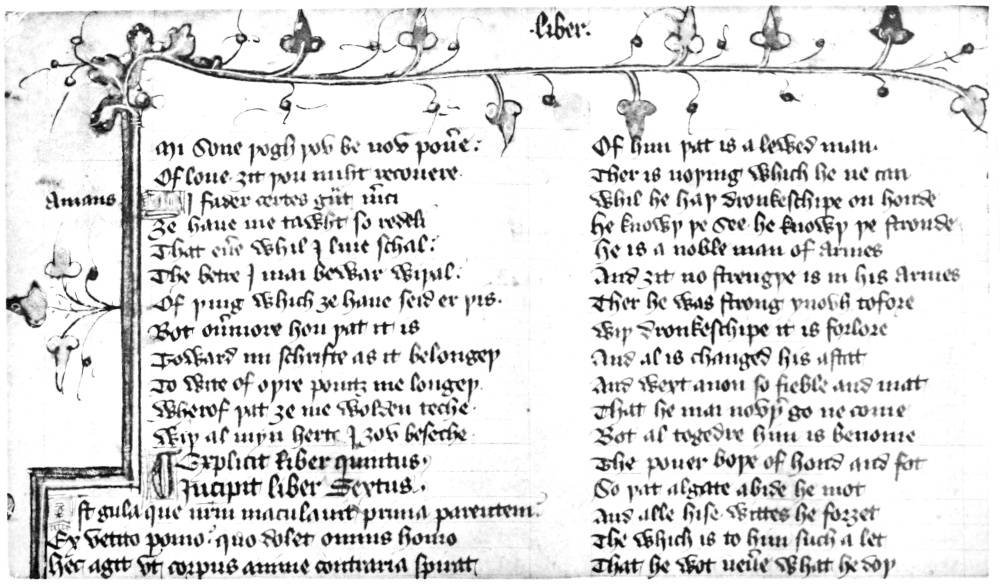
The Confessio Amantis has been the subject both of exaggerated
praise and of undue depreciation. It was the fashion of the fifteenth
and sixteenth centuries to set Gower side by side with Chaucer, and
to represent them as the twin stars of the new English poetry, a view
which, however it may be justified by consideration of their language
and literary tendencies, seems to imply a very uncritical estimate of
their comparative importance. Some of these references are collected
below, and they serve to indicate in a general way that the author had
a great literary reputation and that his book was very popular, the
latter being a conclusion which is sufficiently vouched for also by the
large number of manuscripts which existed, and by the three printed
editions. We shall confine ourselves here to drawing attention to a few
facts of special significance.
In the first place the Confessio Amantis is the earliest English
book which made its way beyond the limits of its own language. There
exists a Spanish translation, dating apparently from the very beginning
of the fifteenth century, in which reference is made also to a
Portuguese version, not known to be now in existence, on which perhaps
the Castilian was based. This double translation into contemporary
languages of the Continent must denote that the writer’s fame was not
merely insular in his life-time.
Secondly, with regard to the position of this book in the sixteenth
century, the expressions used by Berthelette seem to me to imply
something more than a mere formal tribute. This printer, who is
especially distinguished by his interest in language, in the preface to
his edition of the Confessio Amantis most warmly sets forth his
author as a model of pure English, contrasting his native simplicity
with the extravagant affectations of style and language which were
then in fashion. In fact, when we compare the style of Gower in writing
of love with that which we find in some of the books which were at
that time issuing from the press, we cannot help feeling that the
recommendation was justified.
Again, nearly a century later a somewhat striking testimony to the
position of Gower as a standard author is afforded by Ben Jonson’s
English Grammar. The syntax contains about a hundred and thirty
illustrative quotations, and of these about thirty are from Gower.
Chaucer is cited twenty-five times, Lydgate and Sir Thomas More each
about fourteen, the other chief authorities being Norton, Jewel, Fox,
Sir John Cheke and the English Bible.
Finally, our author’s popularity and established position as a
story-teller is decisively vouched for by the partly Shakesperian
play of Pericles. Plots of plays were usually borrowed without
acknowledgement; but here, a plot being taken from the Confessio
Amantis, the opportunity is seized of bringing Gower himself on the
stage to act as Prologue to four out of the five acts, speaking in the
measure of his own octosyllabic couplet,
‘To sing a song that old was sung
From ashes ancient Gower is come,’ &c.
The book was so well known and the author so well established in
reputation, that a play evidently gained credit by connecting itself
with his name.
The following are the principal references to Gower in the
fifteenth and sixteenth centuries. The author of The King’s
Quair dedicates his poem to the memory (or rather to the
poems) of his masters Gower and Chaucer. Hoccleve calls him ‘my
maister Gower,’
‘Whos vertu I am insufficient
For to descrive.’
John Walton of Osney, the metrical translator of Boethius,
writes,
‘To Chaucer, that is flour of rhethorique
In english tonge and excellent poete,
This wot I wel, no thing may I do like,
Though so that I of makinge entermete;
And Gower, that so craftely doth trete
As in his book<es> of moralite,
Though I to hem in makinge am unmete,
Yit moste I schewe it forth that is in me.’
Bokenham in his Lives of the Saints repeatedly speaks
of Gower, Chaucer and Lydgate, the last of whom was then still
living, as the three great lights of English literature.
Caxton printed the Confessio Amantis in 1483, and it
seems to have been one of the most popular productions of his
press.
In the sixteenth century Gower appears by the side of Chaucer
in Dunbar’s Lament for the Makaris and in Lindsay’s
poems. Hawes in the Pastime of Pleasure classes him
with Chaucer and his beloved Lydgate, and Skelton introduces
him as first in order of time among the English poets who are
mentioned in the Garland of Laurel,
‘I saw Gower that first garnysshed our Englysshe rude,
And maister Chaucer,’ &c.,
a testimony which is not quite consistent with that in the
Lament for Philip Sparow,
‘Gower’s Englysh is old
And of no value is told,
His mater is worth gold
And worthy to be enrold.’
Barclay in the Preface of his Mirour of Good Manners
(printed 1516) states that he has been desired by his ‘Master,’
Sir Giles Alington, to abridge and amend the Confessio
Amantis, but has declined the task, chiefly on moral
grounds. The work he says would not be suitable to his age and
order (he was a priest and monk of Ely),
‘And though many passages therin be commendable,
Some processes appeare replete with wantonnes:
.......
.
For age it is a folly and jeopardie doubtlesse,
And able for to rayse bad name contagious,
To write, reade or commen of thing venerious.’
Leland had some glimmering perception of the difference between
Chaucer and Gower in literary merit; but Bale suggests that our
author was ‘alter Dantes ac Petrarcha’ (no less), adding the
remark, taken perhaps from Berthelette’s preface, ‘sui temporis
lucerna habebatur ad docte scribendum in lingua vulgariA.’ In
Bullein’s Dialogue against the Fever Pestilence (1564)
Gower is represented as sitting next to the Classical poets,
Homer, Hesiod, Ennius and Lucan. Puttenham in the Art of
English Poesie (1589), and Sidney in the Defence of
Poesie (1595), equally class Gower and Chaucer together.
The latter, illustrating his thesis that the first writers of
each country were the poets, says, ‘So among the Romans were
Livius Andronicus and Ennius, so in the Italian language ...
the poets Dante, Boccace and Petrarch, so in our English, Gower
and Chaucer, after whom, encouraged and delighted with their
excellent foregoing, others have followed to beautify our
mother tongue, as well in the same kind as in other arts.’
In Robert Greene’s Vision, printed about 1592, Chaucer
and Gower appear as the accepted representatives of the
pleasant and the sententious styles in story-telling, and
compete with one another in tales upon a given subject, the
cure of jealousy. The introduction of Gower into the play of
Pericles, Prince of Tyre has already been referred to.
The uncritical exaggeration of Gower’s literary merits, which formerly
prevailed, has been of some disadvantage to him in modern times. The
comparison with Chaucer, which was so repeatedly suggested, could not
but be unfavourable to him; and modern critics, instead of endeavouring
to appreciate fairly such merits as he has, have often felt called upon
to offer him up as a sacrifice to the honour of Chaucer, who assuredly
needs no such addition to his glory. The true critical procedure is
rather the opposite of this. Gower’s early popularity and reputation
are facts to be reckoned with, in addition to the literary merit which
we in our generation may find in his work, and neither students of
Middle English, nor those who aim at tracing the influences under which
the English language and literature developed during the fifteenth and
sixteenth centuries, can afford to leave Gower’s English work out of
their account.
THE ENGLISH WORKS.
i. Literary Characteristics.—The reason of the success
of the Confessio Amantis was naturally the fact that it
supplied a popular need. After endeavouring to ‘give an account of
his stewardship’ in various ways as a moralist, the author at length
found his true vocation, and this time happily in his native tongue,
as a teller of stories. The rest is all machinery, sometimes poetical
and interesting, sometimes tiresome and clumsy, but the stories are
the main thing. The perception of the popular taste may have come to
him partly through the success of Chaucer in the Legend of Good
Women, and the simple but excellent narrative style which he
thereupon developed must have been a new revelation of his powers to
himself as well as to others. It is true that he does not altogether
drop the character of the moralist, but he has definitely and publicly
resigned the task of setting society generally to rights,
‘It stant noght in my sufficance
So grete thinges to compasse,
......
Forthi the Stile of my writinges
Fro this day forth I thenke change
And speke of thing is noght so strange,’ &c. (i. 4 ff.)
He covers his retreat indeed by dwelling upon the all-pervading
influence of Love in the world and the fact that all the evils of
society may be said to spring from the want of it; but this is little
more than a pretext. Love is the theme partly because it supplies
a convenient framework for the design, and partly perhaps out of
deference to a royal command. There is no reason to doubt the statement
in the first version of the Prologue about the meeting of the author
with Richard II on the river, and that he then received suggestions for
a book, which the king promised to accept and read. It may easily be
supposed that Richard himself suggested love as the subject, being a
matter in which, as we know from Froissart, he was apt to take delight.
‘Adont me demanda le roy de quoy il traittoit. Je luy dis, “D’amours.”
De ceste response fut-il tous resjouys, et regarda dedens le livre en
plusieurs lieux et y lisyB.’ It was certainly to the credit of the
young king that he should have discerned literary merit in the work
of the grave monitor who had so lectured him upon his duties in the
Vox Clamantis, and should have had some part in encouraging him
to set his hand to a more promising task; and if it be the fact that he
suggested love as the subject, we cannot but admire both the sense of
humour displayed by the prince and the address with which our author
acquitted himself of the task proposed.
The idea of the Confession was no doubt taken from the Roman de la
Rose, where the priest of Nature, whose name is Genius, hears her
confession; but it must be allowed that Gower has made much better use
of it. Nature occupies herself in expounding the system of the universe
generally, and in confessing at great length not her own faults but
those of Man, whom she repents of having made. Her tone is not at all
that of a penitent, though she may be on her knees, and Genius does
little or nothing for her in reply except to agree rather elaborately
with her view that, if proper precautions had been taken, Mars and
Venus might easily have outwitted Vulcan. Gower on the other hand has
made the Confession into a framework which will conveniently hold any
number of stories upon every possible subject, and at the same time
he has preserved for the most part the due propriety of character
and situation in the two actors. By giving the scheme an apparent
limitation to the subject of love he has not in fact necessarily
limited the range of narrative, for there is no impropriety in
illustrating by a tale the general nature of a vice or virtue before
making the special application to cases which concern lovers, and
this special application, made with all due solemnity, has often a
character of piquancy in which the moral tale pure and simple would be
wanting. Add to this that the form adopted tends itself to a kind of
quasi-religious treatment of the subject, which was fully in accordance
with the taste of the day, and produces much of that impression of
quaintness and charm with which we most of us associate our first
acquaintance with the Confessio Amantis.
The success of the work—for a success it is in spite of its
faults—is due to several merits. The first of these is the author’s
unquestionable talent for story-telling. He has little of the dramatic
power or the humour which distinguish Chaucer, but he tells his tales
in a well-ordered and interesting manner, does not break the thread by
digressions, never tires of the story before it is finished, as Chaucer
does so obviously and so often, and carries his reader through with
him successfully to the end in almost every case. His narrative is a
clear, if shallow, stream, rippling pleasantly over the stones and
unbroken either by dams or cataracts. The materials of course are not
original, but Gower is by no means a slavish follower in detail of his
authorities; the proportions and arrangement of the stories are usually
his own and often show good judgement. Moreover he not seldom gives
a fresh turn to a well-known story, as in the instances of Jephthah
and Saul, or makes a pretty addition to it, as is the case in some
of the tales from Ovid. Almost the only story in which the interest
really flags is the longest, the tale of Apollonius of Tyre, which
fills up so much of the eighth book and was taken as the basis of the
plot of Pericles; and this was in its original form so loose
and rambling a series of incidents, that hardly any skill could have
completely redeemed it. There is no doubt that this gift of clear and
interesting narrative was the merit which most appealed to the popular
taste, the wholesome appetite for stories being at that time not too
well catered for, and that the plainness of the style was an advantage
rather than a drawback.
Tastes will differ of course as to the merits of the particular
stories, but some may be selected as incontestably good. The tale of
Mundus and Paulina in the first book is excellently told, and so is
that of Alboin and Rosemund. The best of the second book are perhaps
the False Bachelor and the legend of Constantine and Silvester, in the
latter of which the author has greatly improved upon his materials. In
the third book the tale of Canace is most pathetically rendered, far
better than in Ovid, so that in spite of Chaucer’s denunciation his
devoted follower Lydgate could not resist the temptation of borrowing
it. The fourth book, which altogether is of special excellence, gives
us Rosiphelee, Phyllis, and the very poetically told tale of Ceix and
Alceone. The fifth has Jason and Medea, a most admirable example of
sustained narrative, simple and yet effective and poetical, perhaps
on the whole Gower’s best performance: also the oriental tale of
Adrian and Bardus, and the well told story of Tereus and Philomela.
In the seventh we shall find the Biblical story of Gideon excellently
rendered, the Rape of Lucrece, and the tale of Virginia. These may
be taken as specimens of Gower’s narrative power at its best, and by
the degree of effectiveness which he attains in them and the manner
in which he has used his materials, he may fairly be judged as a
story-teller.
As regards style and poetical qualities we find much that is good in
the narratives. Force and picturesqueness certainly cannot be denied to
the tale of Medea, with its description of the summer sea glistening
in the sun, which blazes down upon the returning hero, and from the
golden fleece by his side flashes a signal of success to Medea in her
watch-tower, as she prays for her chosen knight. Still less can we
refuse to recognize the poetical power of the later phases of the same
story, first the midnight rovings of Medea in search of enchantments,
‘The world was stille on every side;
With open hed and fot al bare,
Hir her tosprad sche gan to fare,
Upon hir clothes gert sche was,
Al specheles and on the gras
Sche glod forth as an Addre doth:
Non otherwise sche ne goth,
Til sche cam to the freisshe flod,
And there a while sche withstod.
Thries sche torned hire aboute,
And thries ek sche gan doun loute
And in the flod sche wette hir her,
And thries on the water ther
Sche gaspeth with a drecchinge onde,
And tho sche tok hir speche on honde.’ (v. 3962 ff.),
and again later, when the charms are set in action, 4059 ff., a passage
of extraordinary picturesqueness, but too long to be quoted here. We
do not forget the debt to Ovid, but these descriptions are far more
detailed and forcible than the original.
For a picture of a different kind, also based upon Ovid, we may take
the description of the tears of Lucrece for her husband, and the
reviving beauty in her face when he appears,
‘With that the water in hire yhe
Aros, that sche ne myhte it stoppe,
And as men sen the dew bedroppe
The leves and the floures eke,
Riht so upon hire whyte cheke
The wofull salte teres felle.
Whan Collatin hath herd hire telle
The menynge of hire trewe herte,
Anon with that to hire he sterte,
And seide, “Lo, mi goode diere,
Nou is he come to you hiere,
That ye most loven, as ye sein.”
And sche with goodly chiere ayein
Beclipte him in hire armes smale,
And the colour, which erst was pale,
To Beaute thanne was restored,
So that it myhte noght be mored’ (vii. 4830 ff.),
a passage in which Gower, with his natural taste for simplicity, has
again improved upon his classical authority, and may safely challenge
comparison with Chaucer, who has followed Ovid more literally.
It is worth mention that Gower’s descriptions of storms at sea are
especially vivid and true, so that we are led to suppose that he had
had more than a mere literary acquaintance with such things. Such for
instance is the account of the shipwreck of the Greek fleet, iii. 981
ff., and of the tempests of which Apollonius is more than once the
victim, as viii. 604 ff., and in general nautical terms and metaphors,
of some of which the meaning is not quite clear, seem to come readily
from his pen.
Next to the simple directness of narrative style which distinguishes
the stories themselves, we must acknowledge a certain attractiveness
in the setting of them. The Lover decidedly engages our interest:
we can understand his sorrows and his joys, his depression when his
mistress will not listen to the verses which he has written for her,
and his delight when he hears men speak her praises. We can excuse
his frankly confessed envy, malice and hatred in all matters which
concern his rivals in her love. His feelings are described in a very
natural manner, the hesitation and forgetfulness in her presence, and
the self-reproach afterwards, the eagerness to do her small services,
to accompany her to mass, to lift her into her saddle, to ride by her
carriage, the delight of being present in her chamber, of singing
to her or reading her the tale of Troilus, or if no better may be,
of watching her long and slender fingers at work on her weaving or
embroidery. Sometimes she will not stay with him, and then he plays
with the dog or with the birds in the cage, and converses with the
page of her chamber—anything as an excuse to stay; and when it grows
late and he must perforce depart, he goes indeed, but returns with
the pretence of having forgotten something, in order that he may bid
her good-night once more. He rises in the night and looks out of his
window over the houses towards the chamber where she sleeps, and loses
himself in imagination of the love-thefts which he would commit if by
any necromancy he had the power. Yet he is not extravagantly romantic:
he will go wherever his lady bids him, but he will not range the world
in arms merely in order to gain renown, losing his lady perhaps in the
meantime at home. We take his side when he complains of the Confessor’s
want of feeling for a pain which he does not himself experience, and
his readiness to prescribe for a wound of the heart as if it were a
sore of the heel. Even while we smile, we compassionate the lover who
is at last disqualified on account of age, and recommended to make a
‘beau retret’ while there is yet time.
But there is also another character in whom we are interested, and
that is the lady herself. Gower certainly appreciated something of
the delicacy and poetical refinement which ideal love requires, and
this appreciation he shows also in his Balades; but here we
have something more than this. The figure of the lady, which we see
constantly in the background of the dialogue, is both attractive and
human. We recognize in her a creature of flesh and blood, no goddess
indeed, as her lover himself observes, but a charming embodiment of
womanly grace and refinement. She is surrounded by lovers, but she is
wise and wary. She is courteous and gentle, but at the same time firm:
she will not gladly swear, and therefore says nay without an oath,
but it is a decisive nay to any who are disposed to presume. She does
not neglect her household duties merely because a lover insists upon
hanging about her, but leaves him to amuse himself how he may, while
she busies herself elsewhere. If she has leisure and can sit down to
her embroidery, he may read to her if he will, but it must be some
sound romance, and not his own rondels, balades, and virelays in praise
of her. Custom allows him to kiss her when he takes his leave, but if
he comes back on any pretext and takes his leave again, there is not
often a second kiss permitted. She lets him lead her up to the offering
in church, and ride by her side when she drives out, but she will take
no presents from him, though with some of her younger admirers, whose
passion she knows is a less serious matter, she is not so strict, but
takes and gives freely. Even the description of her person is not
offensive, as such descriptions almost always are. Her lover suspects
that her soul may be in a perilous state, seeing that she has the power
of saving a man’s life and yet suffers him to die, but he admits there
is no more violence in her than in a child of three years old, and
her words are as pleasant to him as the winds of the South. Usurious
dealing is a vice of which he ventures to accuse her, seeing that he
has given her his whole heart in return for a single glance of her eye,
and she holds to the bargain and will not give heart for heart; but
then, as the Confessor very justly replies, ‘she may be such that her
one glance is worth thy whole heart many times over,’ and so he has
sold his heart profitably, having in return much more than it is worth.
However, the literary characteristic which is perhaps most remarkable
in the Confessio Amantis is connected rather with the form
of expression than with the subject-matter. No justice is done to
Gower unless it is acknowledged that the technical skill which he
displays in his verse and the command which he has over the language
for his own purposes is very remarkable. In the ease and naturalness
of his movement within the fetters of the octosyllabic couplet he
far surpasses his contemporaries, including Chaucer himself. Certain
inversions of order and irregularities of construction he allows
himself, and there are many stop-gaps of the conventional kind in the
ordinary flow of his narrative; but in places where the matter requires
it, his admirable management of the verse paragraph, the metrical
smoothness of his lines, attained without unnatural accent or forced
order of words, and the neatness with which he expresses exactly what
he has to say within the precise limits which he lays down for himself,
show a finished mastery of expression which is surprising in that age
of half-developed English style, and in a man who had trained himself
rather in French and Latin than in English composition. Such a sentence
as the following, for example, seems to flow from him with perfect
ease, there is no halting in the metre, no hesitation or inversion for
the sake of the rhyme, it expresses just what it has to express, no
more and no less:
’Til that the hihe king of kinges,
Which seth and knoweth alle thinges,
Whos yhe mai nothing asterte,—
The privetes of mannes herte
Thei speke and sounen in his Ere
As thogh thei lowde wyndes were,—
He tok vengance upon this pride.’ (i. 2803 ff.)
Or again, as an example of a more colloquial kind,
‘And if thei techen to restreigne
Mi love, it were an ydel peine
To lerne a thing which mai noght be.
For lich unto the greene tree,
If that men toke his rote aweie,
Riht so myn herte scholde deie,
If that mi love be withdrawe.’ (iv. 2677 ff.)
There is nothing remarkable about the sentiment or expression in
these passages, but they are perfectly simple and natural, and run
into rhyming verse without disturbance of sense or accent; but such
technical skill as we have here is extremely rare among the writers of
the time. Chaucer had wider aims, and being an artist of an altogether
superior kind, he attains, when at his best, to a higher level of
achievement in versification as in other things; but he is continually
attempting more than he can perform, he often aims at the million
and misses the unit. His command over his materials is evidently
incomplete, and he has not troubled himself to acquire perfection of
craftsmanship, knowing that other things are more important,
‘And that I do no diligence
To shewe craft but o sentence.’
The result is that the most experienced reader often
hesitates in his metre and is obliged to read lines over twice or even
thrice, before he can satisfy himself how the poet meant his words
to be accented and what exactly was the rhythm he intended. In fact,
instead of smoothing the way for his reader, he often deliberately
chooses to spare himself labour by taking every advantage, fair or
unfair, of those licences of accent and syllable suppression for which
the unstable condition of the literary language afforded scope. The
reader of Gower’s verse is never interrupted in this manner except by
the fault of a copyist or an editor; and when we come to examine the
means by which the smoothness is attained, we feel that we have to do
with a literary craftsman who by laborious training has acquired an
almost perfect mastery over his tools. The qualities of which we are
speaking are especially visible in the more formal style of utterance
which belongs to the speeches, letters and epitaphs in our author’s
tales. The reply of Constance to her questioner (ii. 1148 ff.) is a
good example of the first:
‘Quod sche, “I am
A womman wofully bestad.
I hadde a lord, and thus he bad,
That I forth with my litel Sone
Upon the wawes scholden wone,
Bot what the cause was, I not:
Bot he which alle thinges wot
Yit hath, I thonke him, of his miht
Mi child and me so kept upriht,
That we be save bothe tuo.”’
And as longer instances we may point to the reflexions of
the Emperor Constantine near the end of the same book (ii. 3243 ff.),
and the prayer of Cephalus (iv. 3197-3252). The letters of Canace
and of Penelope are excellent, each in its own way, and the epitaphs
of Iphis (iv. 3674 ff.) and of Thaise (viii. 1533 ff.) are both good
examples of the simple yet finished style, e.g.
‘Hier lith, which slowh himself, Iphis,
For love of Araxarathen:
And in ensample of tho wommen,
That soffren men to deie so,
Hire forme a man mai sen also,
Hou it is torned fleissh and bon
Into the figure of a Ston:
He was to neysshe and sche to hard.
Be war forthi hierafterward;
Ye men and wommen bothe tuo,
Ensampleth you of that was tho.’ (iv. 3674 ff.)
In a word, the author’s literary sphere may be a limited one, and his
conception of excellence within that sphere may fall very far short
of the highest standard, but such as his ideals are, he is able very
completely to realize them. The French and English elements of the
language, instead of still maintaining a wilful strife, as is so often
the case in Chaucer’s metre, are here combined in harmonious alliance.
More especially we must recognize the fact that in Gower’s English
verse we have a consistent and for the moment a successful attempt
to combine the French syllabic with the English accentual system of
metre, and this without sacrificing the purity of the language as
regards forms of words and grammatical inflexion. We shall see in our
subsequent investigations how careful and ingenious he is in providing
by means of elision and otherwise for the legitimate suppression of
those weak terminations which could not find a place as syllables in
the verse without disturbing its accentual flow, while at the same time
the sense of their existence was not to be allowed to disappear. The
system was too difficult and complicated to be possible except for a
specially trained hand, and Gower found no successor in his enterprise;
but the fact that the attempt was made is at least worthy of note.
With considerable merits both of plan and execution the Confessio
Amantis has also no doubt most serious faults. The scheme itself,
with its conception of a Confessor who as priest has to expound a
system of morality, while as a devotee of Venus he is concerned only
with the affairs of love (i. 237-280), can hardly be called altogether
a consistent or happy one. The application of morality to matters
of love and of love to questions of morality is often very forced,
though it may sometimes be amusing in its gravity. The Confessor is
continually forgetting one or the other of his two characters, and the
moralist is found justifying unlawful love or the servant of Venus
singing the praises of virginity. Moreover the author did not resist
the temptation to express his views on society in a Prologue which
is by no means sufficiently connected with the general scheme of the
poem, though it is in part a protest against division and discord,
that is to say, lack of love. Still worse is the deliberate departure
from the general plan which we find in the seventh book, where on
pretence of affording relief and recreation to the wearied penitent,
the Confessor, who says that he has little or no understanding except
of love, is allowed to make a digression which embraces the whole field
of human knowledge, but more especially deals with the duties of a
king, a second political pamphlet in fact, in which the stories of
kings ruined by lust or insolence, of Sardanapalus, Rehoboam, Tarquin,
and the rest, are certainly intended to some extent as an admonition of
the author’s royal patron. The petition addressed to Rehoboam by his
people against excessive taxation reads exactly like one of the English
parliamentary protests of the period against the extravagant demands
of the crown. Again, the fifth book, which even without this would be
disproportionately long, contains an absolutely unnecessary account of
the various religions of the world, standing there apparently for no
reason except to show the author’s learning, and reaching the highest
pitch of grotesque absurdity when the Confessor occupies himself in
demolishing the claim of Venus to be accounted a goddess, and that too
without even the excuse of having forgotten for the moment that he is
supposed to be her priest. Minor excrescences of the same kind are to
be found in the third book, where the lawfulness of war is discussed,
and in the fourth, where there is a dissertation on the rise of the
Arts, and especially of Alchemy. All that can be said is that these
digressions were very common in the books of the age—the Roman de
la Rose, at least in the part written by Jean de Meun, is one of
the worst offenders.
Faults of detail it would be easy enough to point out. The style is at
times prosaic and the matter uninteresting, the verse is often eked
out with such commonplace expressions and helps to rhyme as were used
by the writers of the time, both French or English. Sometimes the
sentences are unduly spun out or the words and clauses are awkwardly
transposed for the sake of the uninterrupted smoothness of the verse.
The attainment of this object moreover is not always an advantage, and
sometimes the regularity of the metre and the inevitable recurrence of
the rhyme produces a tiresome result. On the whole however the effect
is not unpleasing, ‘the ease and regularity with which the verse flows
breathes a peaceful contentment, which communicates itself to the
reader, and produces the same effect upon the ear as the monotonous
but not wearisome splashing of a fountainC.’ Moreover, as has
already been pointed out, when the writer is at his best, the rhyme is
kept duly in the background, and the paragraph is constructed quite
independently of the couplet, so that this form of metre proves often
to be a far better vehicle for the narrative than might have been at
first supposed.
ii. Date and Circumstances.—The Confessio Amantis in
its earliest form bears upon the face of it the date 1390 (Prol. 331
margin)D, and we have no reason to doubt that this was the
year in which it was first completed. The author tells us that it was
written at the command of King Richard II, whom he met while rowing
on the Thames at London, and who invited him to come into his barge
to speak with him. It is noticeable, however, that even this first
edition has a dedication to Henry earl of Derby, contained in the Latin
lines at the end of the poemE, so that it is not quite accurate to
say that the dedication was afterwards changed, but rather that this
dedication was made more prominent and introduced into the text of
the poem, while at the same time the personal reference to the king
in the Prologue was suppressed. If the date referred to above had
been observed by former editors, the speculations first of Pauli and
then of Professor Hales, tending to throw back the completion of the
first recension of the Confessio Amantis to the year 1386, or
even 1383, would have been spared. Their conclusions rest, moreover,
on the purest guess-work. The former argues that the preface and the
epilogueF in their first form date from the year 1386, because from
that year the king (who was then nineteen years old) ‘developed those
dangerous qualities which estranged from him, amongst others, the
poet’; and Professor Hales (Athenæum, Dec. 1881) contends that
the references to the young king’s qualities as a ruler, ‘Justice
medled with pite,’ &c. certainly point to the years immediately
succeeding the Peasants’ revolt (a time when Gower did not regard him
as a responsible ruler at all, but excuses him for the evil proceedings
of the government on account of his tender age)G, that the reference
to Richard’s desire to establish peace (viii. 3014* ff.) must
belong to the period of the negotiations with the French and the
subsequent truce, 1383-84, though Professor Hales is himself quite
aware that negotiations for peace were proceeding also in 1389, and
finally that the mention of ‘the newe guise of Beawme’ must indicate
the very year succeeding the king’s marriage to Anne of Bohemia in
1382, whereas in fact the Bohemian fashions would no doubt continue to
prevail at court, and still be accounted new, throughout the queen’s
lifetime. It is on such grounds as these that we are told that the
Confessio Amantis in its first form cannot have been
written later than the year 1385 and was probably as early as 1383.
All such conjectures are destroyed by the fact that the manuscripts of
the first recension bear the date 1390 at the place cited, and though
this does not absolutely exclude a later date for the completion of the
book, it is decisive against an earlier one. Moreover, the fact that in
the final recension this date is omitted (and deliberately omitted, as
we know from the erasure in the Fairfax MS.) points to the conclusion
that it is to be regarded definitely as a date of publication, and
therefore was inappropriate for a later edition.
This conclusion agrees entirely with the other indications, and they
are sufficiently precise, though the fact that one of these also
has unluckily escaped the notice of the editors has caused it to be
generally overlookedH.
The form of epilogue which was substituted for that of the first
recension, and in which the over-sanguine praise of Richard as a ruler
is cancelled, bears in the margin the date of the fourteenth year of
his reign (viii. 2973 margin), ‘Hic in anno quarto decimo Regis
Ricardi orat pro statu regni,’ &c. Now the fourteenth year of King
Richard II was from June 21, 1390, to the same day of 1391. We must
therefore suppose that the change in this part of the book took place,
in some copies at least, within a few months of its first completion.
Thirdly, we have an equally precise date for the alteration in the
Prologue, by which all except a formal mention of Richard II is
excluded, while the dedication to Henry of Lancaster is introduced into
the text of the poem; and here the time indicated is the sixteenth year
of King Richard (Prol. 25), a date which appears also in the margin of
some copies here and at l. 97, so that we may assume that this final
change of form took place in the year 1392-93, that is, not later than
June 1393.
Having thus every step dated for us by the author, we may, if we think
it worth while, proceed to conjecture what were the political events
which suggested his action; but in such a case as this it is evidently
preposterous to argue first from the political conditions, of which as
they personally affected our author and his friends we can only be very
imperfectly informed, and then to endeavour to force the given dates
into accordance with our own conclusionsI.
It will be observed from the above dates that we are led to infer two
stages of alteration, and the expectation is raised of finding the poem
in some copies with the epilogue rewritten but the preface left in its
original state. This expectation is fulfilled. The Bodley MS. 294 gives
a text of this kind, and it is certain that there were others of the
same form, for Berthelette used for his edition a manuscript of this
kind, which was not identical with that which we have.
In discussing the import of the various changes introduced by the
author it is of some importance to bear in mind the fact already
mentioned that even the first issue of the Confessio Amantis
had a kind of dedication to Henry of Lancaster in the Latin lines with
which it concluded,
‘Derbeie comiti, recolunt quem laude periti,
Vade liber purus sub eo requiesce futurus.’
This seems rather to dispose of the idea that a dedication to Henry
would be inconsistent with loyalty to Richard, a suggestion which would
hardly have been made in the year 1390, or even 1393. No doubt those
copies which contained in the preface the statement that the book
was written at the command of the king and for his sake, and in the
epilogue the presentation of the completed book to him (3050* ff.),
if they had also appended to them the Latin lines which commend the
work to the earl of Derby, may be said to have contained in a certain
sense a double dedication, the compliment being divided between the
king and his brilliant cousin, and very probably a copy which was
intended for the court would be without the concluding lines, as we
find to be the case with some manuscripts; but the suggestion that the
expressions of loyalty and the praises of Richard as a ruler which
we find in the first epilogue are properly to be called inconsistent
with a dedication of the poem to Henry of Lancaster, his cousin and
counsellor, is plausible only in the light of later events, which
could not be foreseen by the poet, in the course of which Henry became
definitely the opponent of Richard and finally took the lead in
deposing him. It is true that the earl of Derby had been one of the
lords appellant in 1387, but after the king’s favourites had been set
aside, he was for the time reconciled to Richard, and he could not in
any sense be regarded as the leader of an opposition party. That Gower,
when he became disgusted with Richard II, should have set Henry’s
name in the Prologue in place of that of the king, as representing
his ideal of knighthood and statesmanship, may be regarded either as
a coincidence with the future events, or as indicating that Gower had
some discrimination in selecting a possible saviour of society; but it
is certain that at this time the poet can have had no definite idea
that his hero would become a candidate for the throne.
The political circumstances of the period during which the Confessio
Amantis was written and revised are not very easy to disentangle.
We may take it as probable that the plan of its composition, under
the combined influence of Chaucer’s Legend of Good WomenJ
and of the royal command, may have been laid about the year 1386.
Before this time Richard would scarcely have been regarded by Gower as
responsible for the government, and he would naturally look hopefully
upon the young sovereign, then just entering upon his duties, as one
who with proper admonition and due choice of advisers might turn out
to be a good ruler. During the succeeding years the evil counsellors
of the king were removed by the action of the lords appellant and
the Parliament, and in the year 1389 a moderate and national policy
seemed to have been finally adopted by the king, with William of
Wykeham as Chancellor and the young earl of Derby, who had been one
of the appellants but had quarrelled with his uncle Gloucester,
among the king’s trusted advisers. By the light of subsequent
events Gower condemned the whole behaviour of the king during this
period as malicious and treacherous, but this could hardly have
been his judgement of it at the time, for Richard’s dissimulation,
if dissimulation it were, was deep enough to deceive all parties.
Consequently, up to the year 1390 at least, he may have continued,
though with some misgivings, to trust in the king’s good intentions
and to regard him as a ruler who might effectually heal the divisions
of the land, as he had already taken steps to restore peace to it
outwardly. It is quite possible also that something may have come
to his knowledge in the course of the year 1390-91 which shook his
faith. It was at this time, in July 1390, just at the beginning of
the fourteenth year of King Richard, that his hero the earl of Derby
left the court and the kingdom to exercise his chivalry in Prussia,
and for this there may have been a good reason. We know too little in
detail of the events of the year to be able to say exactly what causes
of jealousy may have arisen between the king and his cousin, who was
nearly exactly of an age with him and seems to have attracted much more
attention than Richard himself at the jousts of St. Inglevert in May of
this year. Whatever feeling there may have been on the side of the earl
of Derby would doubtless reflect itself in the minds of his friends and
supporters, and something of this kind may have deepened into certitude
the suspicions which Gower no doubt already had in his heart of the
ultimate intentions of Richard II. The result was that in some copies
at least of the Confessio Amantis the concluding praises of the
king as a ruler were removed and lines of a more general character on
the state of the kingdom and the duties of a king were substituted, but
still there was no mention of the earl of Derby except as before in the
final Latin lines. Two years later, 1392-93, when the earl of Derby had
fairly won his spurs and at the age of twenty-five might be regarded
as a model of chivalry, the mention of Richard as the suggester of the
work was removed, and the name of Henry set in the text as the sole
object of the dedication.
The date sixteenth year must certainly be that of this last change,
but the occasion doubtless was the sending of a presentation copy to
Henry, and this would hardly amount to publication. The author probably
did not feel called upon publicly to affront the king by removing
his name and praises, either at the beginning or the end, from the
copies generally issued during his reign. Whether or not this conduct
justifies the charge of time-serving timidity, which has been made
against Gower, I cannot undertake to decide. He was, however, in fact
rather of an opposite character, even pedantically stiff in passing
judgement severely on those in high places, and not bating a syllable
of what he thought proper for himself to say or for a king to hear,
though while the king was young and might yet shake himself free from
evil influences he was willing to take as favourable a view of his
character as possible. Probably he was for some time rather in two
minds about the matter, but in any case ‘timid and obsequious’ are
hardly the right epithets for the author of the Vox Clamantis.
Before leaving this subject something should perhaps be said upon a
matter which has attracted no little attention, namely the supposed
quarrel between the author of the Confessio Amantis and
Chaucer. It is well known that the first recension of our poem has a
passage referring to Chaucer in terms of eulogy (viii. 2941*-57*),
and that this was omitted when the epilogue was rewritten. This fact
has been brought into connexion with the apparent reference to Gower
in the Canterbury Tales, where the Man of Law in the preamble
to his tale disclaims on Chaucer’s behalf such ‘cursed stories’ as
those of Canace and Apollonius, because they treat of incest. It has
been thought that this was meant for a serious attack on Gower, and
that he took offence at it and erased the praise of Chaucer from the
Confessio Amantis.
It is known of course that the two poets were on personally friendly
terms, not only from the dedication of Troilus, but from the
fact that when Chaucer was sent on a mission to the Continent in 1378,
he appointed Gower one of his attorneys in his absence. It is possible
that their friendship was interrupted by a misunderstanding, but it may
be doubted whether there is sufficient proof of this in the facts which
have been brought forward.
In the first place I question whether Chaucer’s censure is to be taken
very seriously. That it refers to Gower I have little doubt, but that
the attack was a humorous one is almost equally clear. Chaucer was
aware that some of his own tales were open to objection on the score
of morality, and when he saw a chance of scoring a point on the very
ground where his friend thought himself strongest, he seized it with
readiness. Some degree of seriousness there probably is, for Chaucer’s
sound and healthy view of life instinctively rejected the rather morbid
horrors to which he refers; but it may easily be suspected that he was
chiefly amused by the opportunity of publicly lecturing the moralist,
who perhaps had privately remonstrated with himK. As to the notion
that Chaucer had been seriously offended by the occasional and very
trifling resemblances of phrase in Gower’s tale of Constance with his
own version of the same original, it is hardly worth discussion.
There is of course the possibility that Gower may have taken it more
seriously than it was meant, and though he was not quite so devoid of
a sense of humour as it has been the fashion to supposeL, yet he
may well have failed to enjoy a public attack, however humorous, upon
two of his tales. It must be observed, however, that if we suppose
the passage in question to have been the cause of the excision of
Gower’s lines about Chaucer, we must assume that the publication of it
took place precisely within this period of a few months which elapsed
between the first and the second versions of Gower’s epilogue.
Before further considering the question as to what was actually our
author’s motive in omitting the tribute to his brother poet, we should
do well to observe that this tribute was apparently allowed to stand in
some copies of the rewritten epilogue. There is one good manuscript,
that in the possession of Lord Middleton, in which the verses about
Chaucer not only stand in combination with the new form of epilogue,
but in a text which has also the revised preface, dated two years
laterM. Hence it seems possible that the exclusion of the Chaucer
verses was rather accidental than deliberate, and from this and other
considerations an explanation may be derived which will probably seem
too trivial, but nevertheless is perhaps the true one. We know from
the Fairfax MS. of the Confessio Amantis and from several
original copies of the Vox Clamantis that the author’s method of
rewriting his text was usually to erase a certain portion, sometimes a
whole column or page, and substitute a similar number of lines of other
matter. It will be observed here that for the thirty lines 2941*-2970*,
including the reference to Chaucer, are substituted thirty lines from
which that reference is excluded. After this come four Latin lines
replacing an equal number in the original recension, and then follow
fifteen lines, 2971-2985, which are the same except a single line in
the two editions. It may be that the author, wishing to mention the
departure of the Confessor and the thoughts which he had upon his
homeward way, sacrificed the Chaucer verses as an irrelevance, in order
to find room for this matter between the Adieu of Venus and the lines
beginning ‘He which withinne daies sevene,’ which he did not intend to
alter, and that this proceeding, carried out upon a copy of the first
recension which has not come down to us, determined the general form
of the text for the copies with epilogue rewritten, though in a few
instances care was taken to combine the allusion to Chaucer with the
other alterations. Such an explanation as this would be in accord with
the methods of the author in some other respects; for, as we shall see
later on, the most probable explanation of the omission in the third
recension of the additional passages in the fifth and seventh books,
is that a first recension copy was used in a material sense as a basis
for the third recension text, and it was therefore not convenient to
introduce alterations which increased the number of lines in the body
of the work.
iii. Analysis.
Prologus.
1-92. Preface. By the books of those that were before us we
are instructed, and therefore it is good that we also should write
something which may remain after our days. But to write of wisdom only
is not good. I would rather go by the middle path and make a book of
pleasure and profit both: and since few write in English, my meaning
is to make a bookN for England’s sake now in the sixteenth year of
King Richard. Things have changed and books are less beloved than in
former days, but without them the fame and the example of the virtuous
would be lost. Thus I, simple scholar as I am, purpose to write a
book touching both upon the past and the present, and though I have
long been sick, yet I will endeavour as I may to provide wisdom for
the wise. For this prologue belongs all to wisdom, and by it the wise
may recall to their memory the fortunes of the world; but after the
prologue the book shall be of Love, which does great wonders among men.
Also I shall speak of the vices and virtues of rulers. But as my wit
is too small to admonish every man, I submit my work for correction to
my own lord Henry of Lancaster, with whom my heart is in accord, and
whom God has proclaimed the model of knighthood. God grant I may well
achieve the work which I have taken in hand.
93-192. Temporal Rulers. In the time past things went well:
there was plenty and riches, with honour for noble deeds, and each
estate kept its due place. Justice was upheld and the people obeyed
their rulers. Man’s heart was then shown in his face and his thought
expressed by his words, virtue was exalted and vice abased. Now all is
changed, and above all discord and hatred have taken the place of love,
there is no stable peace, no justice and righteousness. All kingdoms
are alike in this, and heaven alone knows what is to be done. The sole
remedy is that those who are the world’s guides should follow good
counsel and should be obeyed by their people; and if king and council
were at one, it might be hoped that the war would be brought to an end,
which is so much against the peace of Christ’s religion and from which
no land gets any good. May God, who is above all things, give that
peace of which the lands have need.
193-498. The Church. Formerly the life of the clergy was an
example to all, there was no simony, no disputes in the Church, no
ambition for worldly honour. Pride was held a vice and humility a
virtue. Alms were given to the poor and the clergy gave themselves to
preaching and to prayer. Thus Christ’s faith was first taught, but now
it is otherwise. Simony and worldly strife prevail; and if priests
take part in wars, I know not who shall make the peace. But heaven is
far and the world is near, and they regard nothing but vainglory and
covetousness, so that the tithe goes at once to the war, as though
Christ could not do them right by other ways. That which should bring
salvation to the world is now the cause of evil: the prelates are
such as Gregory wrote of, who desire a charge in order that they may
grow rich and great, and the faith is hindered thereby. Ambition and
avarice have destroyed charity; Sloth is their librarian and delicacy
has put away their abstinence. Moreover Envy everywhere burns in the
clergy like the fire of Etna, as we may see now [in this year of grace
1390] at Avignon. To see the Church thus fall between two stools is a
cause of sorrow to us all: God grant that it may go well at last with
him who has the truth. But as a fire spreads while men are slothfully
drinking, so this schism causes the new sect of Lollardy to spring up,
and many another heresy among the clergy themselves. It were better
to dike and delve and have the true faith, than to know all that the
Bible says and err as some of these do. If men had before their eyes
the virtues which Christ taught, they would not thus dispute about the
Papacy. Each one attends to his own profit, but none to the general
cause of the Church, and thus Christ’s fold is broken and the flock
is devoured. The shepherds, intent upon worldly good, wound instead
of healing, and rob the sheep unjustly of their wool. Nay, they drive
them among the brambles, so that they may have the wool which the
thorns tear off. If the wolf comes in the way, their staff is not at
hand to defend the sheep, but they are ready enough to smite the sheep
with it, if they offend ever so little. There are some indeed in whom
virtue dwells, whom God has called as Aaron was called, but most follow
Simon at the heels, whose chariot rolls upon wheels of covetousness and
pride. They teach how good it is to clothe and feed the poor, yet of
their own goods they do not distribute. They say that chastity should
be preserved by abstinence, but they eat daintily and lie softly, and
whether they preserve their chastity thereby, I dare not say: I hear
tales, but I will not understand. Yet the vice of the evil-doers is no
reproof to the good, for every man shall bear his own works.
499-584. The Commons. As for the people, it is to be feared
that that may happen which has already come to pass in sundry lands,
that they may break the bounds and overflow in a ruinous flood.
Everywhere there is lack of law and growth of error; all say that
this world has gone wrong, and every one gives his judgement as to
the cause; but he who looks inwards upon himself will be ready to
excuse his God, in whom there is no default. The cause of evil is in
ourselves. Some say it is fortune and some the planets, but in truth
all depends upon man. No estate is secure, the fortune of it goes now
up, now down, and all this is in consequence of man’s doings. In the
Bible I find a tale which teaches that division is the chief cause why
things may not endure, and that man himself is to blame for the changes
which have overthrown kingdoms.
585-662. Nabugodonosor in a dream saw an image with the head
and neck of gold, the breast and arms of silver, the belly and thighs
of brass, the legs of steel, and the feet of mixed steel and clay.
On the feet of this image fell a great stone which rolled down from
a hill, and the image was destroyed. Daniel expounded this of the
successive kingdoms of the world.
663-880. These were the Four Monarchies, of Babylon, of
Persia, of the Greeks, and of the Romans. We are now in the last age,
that of dissension and division, as shown by the state of the Empire
and the Papacy. This is that which was designated by the feet of the
image.
881-1088. We are near to the end of the world, as the apostle tells
us. The world stands now divided like the feet of the image. Wars are
general, and yet the clergy preach that charity is the foundation of
all good deeds. Man is the cause of all the evil, and therefore the
image bore the likeness of a man. The heavenly bodies, the air and
the earth suffer change and corruption through the sin of man, who
is in himself a little world. When he is disordered in himself, the
elements are all at strife with him and with each other. Division is
the cause of destruction. So it is with man, who has within him diverse
principles which are at strife with one another, and in whom also
there is a fatal division between the body and the soul, which led to
the fall from a state of innocence. The confusion of tongues at the
building of the tower of Babel was a further cause of division, and
at last all peace and charity shall depart, and the stone shall fall.
Thenceforward every man shall dwell either in heaven, where all is
peace, or in hell, which is full of discord.
Would God that there were in these days any who could set peace on the
earth, as Arion once by harping brought beasts and men into accord. But
this is a matter which only God can direct.
Lib. I.
1-92. I cannot stretch my hand to heaven and set in order the world: so
great a task is more than I am able to compass: I must let that alone
and treat of other things. Therefore I think to change from this time
forth the style of my writings, and to speak of a matter with which all
the world has to do, and that is Love; wherein almost all are out of
rule and measure, for no man is able to resist it or to find a remedy
for it. If there be anything in this world which is governed blindly by
fortune, it is love: this is a game in which no man knows whether he
shall win or lose. I am myself one who belongs to this school, and I
will tell what befel me not long since in regard to love, that others
may take example thereby.
93-202. I fared forth to walk in the month of May, when every bird
has chosen his mate and rejoices over the love which he has achieved;
but I was further off from mine than earth is from heaven. So to the
wood I went, not to sing with the birds, but to weep and lament; and
after a time I fell to the ground and wished for death. Then I looked
up to the heaven and prayed the god and the goddess of love to show me
some grace. Anon I saw them; and he, the king of love, passed me by
with angry look and cast at me a fiery lance, which pierced through my
heart. But the queen remained, and asked me who I was, and bade me make
known my malady. I told her that I had served her long and asked only
my due wage, but she frowned and said that there were many pretenders,
who in truth had done no service, and bade me tell the truth and show
forth all my sickness. ‘That can I well do,’ I replied, ‘if my life
may last long enough.’ Then she looked upon me and said, ‘My will is
first that thou confess thyself to my priest.’ And with that she called
Genius, her priest, and he came forth and sat down to hear my shrift.
203-288. This worthy priest bade me tell what I had felt for love’s
sake, both the joy and the sorrow; and I fell down devoutly on my knees
and prayed him to question me from point to point, lest I should forget
things which concerned my shrift, for my heart was disturbed so that I
could not myself direct my wits. He replied that he was there to hear
my confession and to question me: but he would not only speak of love;
for by his office of priest he was bound to set forth the moral vices.
Yet he would show also the properties of Love, for he was retained in
the service of Venus and knew little of other things. His purpose was
to expound the nature of every vice, as it became a priest to do, and
so to apply his teaching to the matter of love that I should plainly
understand his lore.
289-574. Sins of Seeing and Hearing. I prayed him to say his
will, and I would obey, and he bade me confess as touching my five
senses, which are the gates through which things come into the heart,
and first of the principal and most perilous, the sense of sight. Many
a man has done mischief to love through seeing, and often the fiery
dart of love pierces the heart through the eye. (289-332.)
Ovid tells a tale of the evils of ‘mislook,’ how Acteon when
hunting came upon Diana and her nymphs bathing, and because he did not
turn away his eyes, he was changed into a hart and torn to pieces by
his own hounds. (333-378.)
Again, the Gorgons were three sisters, who had but one eye
between them, which they passed one to another, and if any man looked
upon them he was straightway turned into a stone. These were all killed
by Perseus, to whom Pallas lent a shield with which he covered his
face, and Mercury a sword with which he slew the monsters. (389-435.)
My priest therefore bade me beware of misusing my sight, lest I also
should be turned to stone; and further he warned me to take good heed
of my hearing, for many a vanity comes to man’s heart through the ears.
(436-462.)
There is a serpent called Aspidis, which has a precious stone
in his head, but when a man tries to overcome him by charms in order
to win this stone, he refuses to hear the enchantment, laying one ear
close to the earth and stopping the other with his tail. (463-480.)
Moreover, in the tale of Troy we read of Sirens, who are in the
form of women above and of fishes below, and these sing so sweetly,
that the sailors who pass are enchanted by it and cannot steer their
ships: so they are wrecked and torn to pieces by the monsters. Uluxes,
however, escaped this peril by stopping the ears of his company, and
then they slew many of them. (481-529.)
From these examples (he said) I might learn how to keep the eye and
the ear from folly, and if I could control these two, the rest of the
senses were easy to rule. (530-549.)
I made my confession then, and said that as for my eyes I had indeed
cast them upon the Gorgon Medusa, and my heart had been changed into
stone, upon which my lady had graven an eternal mark of love. Moreover,
I was guilty also as regards my ear; for when I heard my lady speak,
my reason lost all rule, and I did not do as Uluxes did, but fell at
once in the place where she was, and was torn to pieces in my thought.
(550-567.)
God amend thee, my son, he said. I will ask now no more of thy senses,
but of other things. (568-574.)
The Seven deadly Vices.—Pride.
575-1234. Hypocrisy. Pride, the first of the seven deadly
Vices, has five ministers, of whom the first is called Hypocrisy. Hast
thou been of his company, my son?
I know not, father, what hypocrisy means. I beseech you to teach me and
I will confess. (575-593.)
A hypocrite is one who feigns innocence without, but is not so within.
Such are many of those who belong to the religious orders, with some
of those who occupy the high places of the Church, and others also who
pretend to piety, while all their design is to increase their worldly
wealth. (594-672.)
There are lovers also of this kind, who deceive by flattery and soft
speech, and who pretend to be suffering sickness for love, but are
ready always to beguile the woman who trusts them. Art thou one of
these, my son?
Nay, father, for I have no need to feign: my heart is always more sick
than my visage, and I am more humble towards my lady within than any
outward sign can show. I will not say but that I may have been guilty
towards others in my youth; but there is one towards whom my word has
ever been sincere.
It is well, my son, to tell the truth always towards love; for if thou
deceive and win thereby, thou wilt surely repent it afterwards, as a
tale which I will tell may show. (672-760.)
Mundus and Paulina. At Rome, in the time of Tiberius, a worthy
lady Pauline was deceived by Mundus, who bribed the priests of Isis and
induced them to bring her to the temple at night on pretence of meeting
the god Anubus. Mundus concealed himself in the temple and personated
the god. Meeting her on her way home he let her understand the case,
and she, overcome with grief and shame, reported the matter to her
husband. The priests were put to death, Mundus was sent into exile, and
the image of Isis was thrown into the Tiber. (761-1059.)
The Trojan Horse. Again, to take a case of the evil wrought by
Hypocrisy in other matters, we read how, when the Greeks could not
capture Troy, they made a horse of brass and secretly agreeing with
Antenor and Eneas they concluded a feigned peace with the Trojans and
desired to bring this horse as an offering to Minerva into the city.
The gates were too small to admit it, and so the wall was broken
down, and the horse being brought in was offered as an evidence of
everlasting peace with Troy. The Greeks then departed to their ships,
as if to set sail, but landed again in the night on a signal from
Sinon. They came up through the broken gate, and slew those within, and
burnt the city. (1060-1189.)
Thus often in love, when a man seems most true, he is most false, and
for a time such lovers speed, but afterwards they suffer punishment.
Therefore eschew Hypocrisy in love. (1190-1234.)
1235-1875. Inobedience. The second point of Pride is
Inobedience, which bows before no law, whether of God or man. Art thou,
my son, disobedient to love?
Nay, father, except when my lady bids me forbear to speak of my love,
or again when she bids me choose a new mistress. She might as well
say, ‘Go, take the Moon down from its place in heaven,’ as bid me
remove her love out of my breast. Thus far I disobey, but in no other
thing. (1235-1342.)
There are two attendants, my son, on this vice, called Murmur
and Complaint, which grudge at all the fortune that betides,
be it good or bad. And so among lovers there are those who will not
faithfully submit to love, but complain of their fortune, if they fail
of anything that they desire.
My father, I confess that at times I am guilty of this, when my lady
frowns upon me, but I dare not say a word to her which might displease
her. I murmur and am disobedient in my heart, and so far I confess that
I am ‘unbuxom.’
I counsel thee, my son, to be obedient always to love’s hest, for
obedience often avails where strength may do nothing; and of this I
remember an example written in a chronicle. (1343-1406.)
There was a knight, nephew to the emperor, by name Florent,
chivalrous and amorous, who seeking adventures was taken prisoner by
enemies. He had slain the son of the captain of the castle to which
he was led; and they desired to take vengeance on him, but feared
the emperor. An old and cunning dame, grandmother to the slain man,
proposed a condition. He should be allowed to go, on promise of
returning within a certain time, and then he should suffer death unless
he could answer rightly the question, ‘What do all women most desire?’
He gave his pledge, and sought everywhere an answer to the question,
but without success. When the day approached, he set out; and as he
passed through a forest, he saw a loathly hag sitting under a tree. She
offered to save him if he would take her as his wife. He refused at
first, but then seeing no other way, he accepted, on the condition that
he should try all other answers first, and if they might save him he
should be free. She told him that what all women most desire is to be
sovereign of man’s love. He saved himself by this answer, and returned
to find her, being above all things ashamed to break his troth. Foul as
she was, he respected her womanhood, and set her upon his horse before
him. He reached home, journeying by night and hiding himself by day,
and they were wedded in the night, she in her fine clothes looking
fouler than before. When they were in bed, he turned away from her,
but she claimed his bond; and he turning towards her saw a young lady
of matchless beauty by his side. She stayed him till he should make
his choice, whether he would have her thus by night or by day; and he,
despairing of an answer, left it to her to decide. By thus making her
his sovereign, he had broken the charm which bound her. She was the
king’s daughter of Sicily, and had been transformed by her stepmother,
till she should win the love and sovereignty of a peerless knight. Thus
obedience may give a man good fortune in love. (1407-1861.)
Know then, my son, that thou must ever obey thy love and follow her
will.
By this example, my father, I shall the better keep my observance to
love. Tell me now if there be any other point of Pride. (1862-1882.)
1883-2383. Surquidry or Presumption holds the third
place in the court of Pride. He does everything by guess and often
repents afterwards: he will follow no counsel but his own, depends only
on his own wit, and will not even return thanks to God.
When he is a lover, he thinks himself worthy to love any queen, and he
often imagines that he is loved when he is not. Tell me, what of this,
my son?
I trow there is no man less guilty here than I, or who thinks himself
less worthy. Love is free to all men and hides in the heart unseen,
but I shall not for that imagine that I am worthy to love. I confess,
however, that I have allowed myself to think that I was beloved when I
was not, and thus I have been guilty. But if ye would tell me a tale
against this vice, I should fare the better. (1883-1976.)
My son, the proud knight Capaneus trusted so in himself that he
would not pray to the gods, and said that prayer was begotten only of
cowardice. But on a day, when he assailed the city of Thebes, God took
arms against his pride and smote him to dust with a thunderbolt. Thus
when a man thinks himself most strong, he is nearest to destruction.
(1977-2009.)
Again, when a man thinks that he can judge the faults of others and
forgets his own, evil often comes to him, as in the tale which follows.
The Trump of Death. There was a king of Hungary, who went
forth with his court in the month of May, and meeting two pilgrims
of great age, alighted from his car and kissed their hands and feet,
giving them alms also. The lords of the land were displeased that the
king should thus abase his royalty, and among them chiefly the king’s
brother, who said that he would rebuke the king for his deed. When they
were returned, the brother spoke to the king, and said he must excuse
himself to his lords. He answered courteously and they went to supper.
Now there was ordained by the law a certain trumpet of brass, which was
called the Trump of Death: and when any lord should be put to death,
this was sounded before his gate. The king then on that night sent the
man who had this office, to blow the trumpet at his brother’s gate.
Hearing the sound he knew that he must die, and called his friends
together, who advised that he with his wife and his five children
should go in all humility to entreat the king’s pardon. So they went
lamenting through the city and came to the court. Men told the king how
it was, and he coming forth blamed his brother because he had been so
moved by a mere human sentence of death, which might be revoked. ‘Thou
canst not now marvel,’ he said, ‘at that which I did: for I saw in the
pilgrims the image of my own death, as appointed by God’s ordinance,
and to this law I did obeisance; for compared to this all other laws
are as nothing. Therefore, my brother, fear God with all thine heart;
for all shall die and be equal in his sight.’ Thus the king admonished
his brother and forgave him. (2010-2253.)
I beseech you, father, to tell me some example of this in the cause of
love.
My son, in love as well as in other things this vice should be
eschewed, as a tale shows which Ovid told.
There was one Narcissus, who had such pride that he thought no
woman worthy of him. On a day he went to hunt in the forest, and being
hot and thirsty lay down to drink from a spring. There he saw the image
of his face in the water and thought it was a nymph. Love for her came
upon him and he in vain entreated her to come out to him: at length in
despair he smote himself against a rock till he was dead. The nymphs of
the springs and of the woods in pity buried his body, and from it there
sprang flowers which bloom in the winter, against the course of nature,
as his folly was. (2254-2366.)
My father, I shall ever avoid this vice. I would my lady were as humble
towards me as I am towards her. Ask me therefore further, if there be
ought else.
God forgive thee, my son, if thou have sinned in this: but there is
moreover another vice of Pride which cannot rule his tongue, and this
also is an evil. (2367-2398.)
2399-2680. Avantance. This vice turns praise into blame by
loud proclaiming of his own merit; and so some lovers do. Tell me
then if thou hast ever received a favour in love and boasted of it
afterwards.
Nay, father, for I never received any favour of which I could boast.
Ask further then, for here I am not guilty.
That is well, my son, but know that love hates this vice above all
others, as thou mayest learn by an example. (2399-2458.)
Alboin and Rosemund. Albinus was king of the Lombards, and he
in war with the Geptes killed their king Gurmond in battle, and made a
cup of his skull. Also he took Gurmond’s daughter Rosemund as his wife.
When the wars were over, he made a great feast, that his queen might
make acquaintance with the lords of his kingdom; and at the banquet
his pride arose, and he sent for this cup, which was richly set in
gold and gems, and bade his wife drink of it, saying, ‘Drink with thy
father.’ She, not knowing what cup it was, took it and drank; and then
the king told how he had won it by his victory, and had won also his
wife’s love, who had thus drunk of the skull. She said nothing, but
thought of the unkindness of her lord in thus boasting, as he sat by
her side, that he had killed her father and made a cup of his skull.
Then after the feast she planned vengeance with Glodeside her maid.
A knight named Helmege, the king’s butler, loved Glodeside. To him
the queen gave herself in place of her maid, and then making herself
known, she compelled him to help her. They slew Albinus, but were
themselves compelled to flee, taking refuge with the Duke of Ravenna,
who afterwards caused them to be put to death by poison. (2459-2646.)
It is good therefore that a man hide his own praise, both in other
things and also in love, or else he may fail of his purpose.
2681-3066. Vain Glory thinks of this world only and delights
in new things. He will change his guise like a chameleon. He will make
carols, balades, roundels and virelays, and if he gets any advantage in
love, he rejoices over it so that he forgets all thought of death. Tell
me if thou hast done so.
My father, I may not wholly excuse myself, in that I have been for love
the better arrayed, and have attempted rondels, balades, virelays and
carols for her whom I love, and sung them moreover, and made myself
merry in chamber and in hall. But I fared none the better: my glory was
in vain. She would not hear my songs, and my fine array brought me no
reason to be glad. And yet I have had gladness at times in hearing how
men praised her, and also when I have tidings that she is well. Tell me
if I am to blame for this.
I acquit thee, my son, and on this matter I think to tell a tale how
God does vengeance on this vice. Listen now to a tale that is true,
though it be not of love. (2681-2784.)
There was a king of whom I spoke before, Nabugodonosor by name.
None was so mighty in his days, and in his Pride he ruled the earth as
a god. This king in his sleep saw a tree which overshadowed the whole
earth, and all birds and beasts had lodging in it or fed beneath it.
Then he heard a voice bidding to hew down the tree and destroy it; but
the root (it said) should remain, and bear no man’s heart, but feed on
grass like an ox, till the water of the heaven should have washed him
seven times and he should be made humble to the will of God. The King
could find none to interpret this dream, and sent therefore for Daniel.
He said that the tree betokened the king, and that as the tree was
hewn down, so his kingdom should be overthrown, and he should pasture
like an ox and be rained upon and afflicted, until he acknowledged
the greatness of God. The punishment was ordained, he said, for his
vain glory, and if he would leave this and entreat for grace, he might
perchance escape the evil.
But Pride will not suffer humility to stand with him. Neither for his
dream nor yet for Daniel’s word did this king leave his vain glory, and
so that which had been foretold came upon him.
Then after seven years he remembered his former state and wept; and
though he might not find words, he prayed within his heart to God
and vowed to leave his vain glory, reaching up his feet towards the
heaven, kneeling and braying for mercy. Suddenly he was changed again
into a man and received his power as before, and the pride of vain
glory passed for ever from his heart. (2785-3042.)
Be not thou, my son, like a beast, but take humility in hand, for a
proud man cannot win love. I think now again to tell thee a tale which
may teach thee to follow Humility and eschew Pride.
3067-3425. Humility. The Three Questions. There was
once a young and wise king, who delighted in propounding difficult
questions, and one knight of his court was so ready in answering them
that the king conceived jealousy and resolved to put him to confusion.
He bade him therefore answer these three questions on pain of death:
(1) What is it that has least need and yet men help it most? (2) What
is worth most and yet costs least? (3) What costs most and is worth
least? The knight went home to consider, but the more he beat his
brains, the more he was perplexed. He had two daughters, the younger
fourteen years of age, who, perceiving his grief, entreated him to
tell her the cause. At length he did so, and she asked to be allowed
to answer for him to the king. When the day came, they went together
to the court, and the knight left the answers to the maiden, at which
all wondered. She replied to the first question that it was the Earth,
upon which men laboured all the year round, and yet it had no need of
help, being itself the source of all life. As to the second, it was
Humility, through which God sent down his Son, and chose Mary above all
others; and yet this costs least to maintain, for it brings about no
wars among men. The third question, she said, referred to Pride, which
cost Lucifer and the rebel angels the loss of heaven, and Adam the loss
of paradise, and was the cause also of so many evils in the world.
The king was satisfied, and looking on the maiden he said, ‘I like
thine answer well, and thee also, and if thou wert of lineage equal to
these lords, I would take thee for my wife. Ask what thou wilt of me
and thou shalt have it.’ She asked an earldom for her father, and this
granted, she thanked the king upon her knees, and claimed fulfilment of
his former word. Whatever she may have been once, she was now an earl’s
daughter, and he had promised to take her as his wife. The king, moved
by love, gave his assent, and thus it was. This king ruled Spain in old
days and his name was Alphonse: the knight was called Don Petro, and
the daughter wise Peronelle. (3067-3402.)
Thus, my son, thou mayest know the evil of Pride, which fell from his
place in heaven and in paradise; but Humility is gentle and debonnaire.
Therefore leave Pride and take Humility.
My father, I will not forget: but now seek further of my shrift.
My son, I have spoken enough of Pride, and I think now to tell of
Envy, which is a hellish vice, in that it does evil without any cause.
(3403-3446.)
Lib. II.
1-220. Sorrow for another’s Joy. The next after Pride is
Envy, who burns ever in his thought, if he sees another
preferred to himself or more worthy. Hast thou, my son, in love been
sick of another man’s welfare?
Yea, father, a thousand times, when I have seen another blithe of love.
I am then like Etna, which burns ever within, or like a ship driven
about by the winds and waves. But this is only as regards my lady, when
I see lovers approach her and whisper in her ear. Not that I mistrust
her wisdom, for none can keep her honour better; yet when I see her
make good cheer to any man, I am full of Envy to see him glad.
My son, the hound which cannot eat chaff, will yet drive away the oxen
who come to the barn; and so it is often with love. If a man is out of
grace himself, he desires that another should fail. (1-96.)
Acis and Galatea. Ovid tells a tale how Poliphemus loved
Galathea, and she, who loved another, rejected him. He waited then for
a chance to grieve her in her love, and he saw her one day in speech
with young Acis under a cliff by the sea. His heart was all afire
with Envy, and he fled away like an arrow from a bow, and ran roaring
as a wild beast round Etna. Then returning he pushed down a part of
the cliff upon Acis and slew him. She fled to the sea, where Neptune
took her in his charge, and the gods transformed Acis into a spring
with fresh streams, as he had been fresh in love, and were wroth with
Polipheme for his Envy. (97-200.)
Thus, my son, thou mayest understand that thou must let others be.
My father, the example is good, and I will work no evil in love for
Envy. (200-220.)
221-382. Joy for another’s Grief. This vice rejoices when he
sees other men sad, and thinks that he rises by another’s fall, as in
other things, so also in love. Hast thou done so, my son?
Yes, father, I confess that when I see the lovers of my lady get a
fall, I rejoice at it; and the more they lose, the more I think that I
shall win: and if I am none the better for it, yet it is a pleasure to
me to see another suffer the same pains as I. Tell me if this be wrong.
This kind of Envy, my son, can never be right. It will sometimes be
willing to suffer loss, in order that another may also suffer, as a
tale will show. (221-290.)
The Travellers and the Angel. Jupiter sent down an angel
to report of the condition of mankind. He joined himself to two
travellers, and he found by their talk that one was covetous and the
other envious. On parting he told them that he came from God, and in
return for their kindness he would grant them a boon: one should choose
a gift and the other should have the double of what his fellow asked.
The covetous man desired the other to ask, and the other, unwilling
that his fellow should have more good than he, desired to be deprived
of the sight of one eye, in order that his fellow might lose both. This
was done, and the envious man rejoiced. (291-364.)
This is a thing contrary to nature, to seek one’s own harm in order to
grieve another.
My father, I never did so but in the way that I have said: tell me if
there be more.
383-1871. Detraction. There is one of the brood of Envy called
Detraction. He has Malebouche in his service, who cannot praise any
without finding fault. He is like the beetle which flies over the
fields, and cares nothing for the spring flowers, but makes his feast
of such filth as he may find. So this envious jangler makes no mention
of a man’s virtue, but if he find a fault he will proclaim it openly.
So also in Love’s court many envious tales are told. If thou hast made
such janglery, my son, shrive thee thereof. (383-454.)
Yes, father, but not openly. When I meet my dear lady and think of
those who come about her with false tales, all to deceive an innocent
(though she is wary enough and can well keep herself), my heart is
envious and I tell the worst I know against them; and so I would
against the truest and best of men, if he loved my lady; for I cannot
endure that any should win there but I. This I do only in my lady’s
ear, and above all I never tell any tale which touches her good name.
Tell me then what penance I shall endure for this, for I have told you
the whole truth.
My son, do so no more. Thy lady, as thou sayest, is wise and wary, and
there is no need to tell her these tales. Moreover she will like thee
the less for being envious, and often the evil which men plan towards
others falls on themselves. Listen to a tale on this matter. (454-586.)
Tale of Constance. The Roman Emperor Tiberius Constantinus had a
daughter Constance, beautiful, wise, and full of faith. She converted
to Christianity certain merchants of Barbary, who came to Rome to
sell their wares, and they, being questioned by the Soldan when they
returned, so reported of Constance that he resolved to ask for her in
marriage. He sent to Rome and agreed to be converted, and Constance
was sent with two cardinals and many other lords, to be his bride. But
the mother of the Soldan was moved by jealousy. She invited the whole
company to a feast, and there slew her own son and all who had had to
do with the marriage except Constance herself, whom she ordered to be
placed alone in a rudderless ship with victuals for five years, and so
to be committed to the winds and waves. (587-713.)
For three years she drifted under God’s guidance, and at last came
to land in Northumberland, near a castle on the bank of Humber, which
was kept by one Elda for the king of that land Allee, a Saxon and a
worthy knight. Elda found her in the ship and committed her to the
care of Hermyngheld his wife, who loved her and was converted by her.
Hermyngheld in the name of Christ restored sight to a blind man,
at which all wondered, and Elda was converted to the faith. On the
morrow he rode to the king, and thinking to please him, who was then
unwedded, told him of Constance. The king said he would come and see
her. Elda sent before him a knight whom he trusted, and this knight
had loved Constance, but she had rejected him, so that his love was
turned to hate. When he came to the castle he delivered the message,
and they prepared to receive the king; but in the night he cut the
throat of Hermyngheld and placed the bloody knife under the bed where
Constance lay. Elda came the same night and found his wife lying dead
and Constance sleeping by her. The false knight accused Constance and
discovered the knife where he had placed it. Elda was not convinced,
and the knight swore to her guilt upon a book. Suddenly the hand of
heaven smote him and his eyes fell out of his head, and a voice bade
him confess the truth, which he did, and thereupon died. (714-885.)
After this the king came, and desiring to wed Constance, agreed to
receive baptism. So a bishop came from Bangor in Wales and christened
him and many more, and married Constance to the king. She would not
tell who she was, but the king perceived that she was a noble creature.
God visited her and she was with child, but the king was compelled to
go out on a war, and left his wife with Elda and the bishop. A son was
born and baptized by the name of Moris, and letters were written to the
king, and the bearer of them, who had to pass by Knaresborough, stayed
there to tell the news to the king’s mother Domilde. She in the night
changed the letters for others, which said, as from the keepers of the
queen, that she had been delivered of a monster. The messenger carried
the letters to the king, who wrote back that they should keep his wife
carefully till he came again. On his return the messenger stayed again
at Knaresborough, and Domilde substituted a letter bidding them on
pain of death place Constance and her child in the same ship in which
she had come, and commit them to the sea. They grieved bitterly, but
obeyed. She prayed to heaven for help and devoted herself to the care
of the child (886-1083). After the end of that year the ship came to
land near a castle in Spain, where a heathen admiral was lord, who
had a steward named Theloüs, a false renegade. He came to see the
ship and found Constance, but he let none else see her; and at night
he returned, thinking to have her at his will. He swore to kill her
if she resisted him, and she bade him look out at the port to see if
any man was near: then on the prayer of Constance he was thrown out
of the ship and drowned. A wind arose which took her from the land,
and after three years she came to a place where a great navy lay. The
lord of these ships questioned her, but she told him little, giving
her name as Couste. He said that he came from taking vengeance on the
Saracens for their treachery, but could hear no news of Constance. He
was the Senator of Rome and was married to a niece of the Emperor named
Heleine. She came to Rome with her child and dwelt with his wife till
twelve years were gone, and none knew what she was, but all loved her
well. (1084-1225.)
In the meantime king Allee discovered the treachery and took vengeance
on his mother, who was burnt to death after confession of her guilt;
and all said that she had well deserved her punishment and lamented for
Constance. Having finished his wars, the king resolved to go to Rome
for absolution, and leaving Edwyn his heir to rule the land, he set
forth with Elda. Arcennus reported to his wife and to Couste the coming
of king Allee, and Couste swooned for joy. The king, after seeing the
Pope and relieving his conscience, made a feast, to which he invited
the Senator and others. Moris went also, and his mother bade him stand
at the feast in sight of the king. The king seeing him thought him
like his wife Constance, and loved him without knowing why. He asked
Arcennus if the child were his son, and from him he heard his story and
the name of his mother. The king smiled at the name ‘Couste,’ knowing
that it was Saxon for Constance, and was eager to ascertain the truth.
After the feast he besought the Senator to bring him home to see this
Couste, and never man was more joyful than he was when he saw his wife.
(1226-1445.)
The king remained at Rome for a time with Constance, but still she
did not tell him who she was. After a while she prayed him to make an
honourable feast before he left the city and to invite the Emperor,
who was at a place a few miles away from the city. Moris was sent
to beseech him to come and eat with them, which request he granted;
and at the time appointed they all went forth to meet the Emperor.
Constance, riding forward to welcome him, made herself known to him as
his daughter. His heart was overcome, as if he had seen the dead come
to life again, and all present shed tears. So a parliament was held and
Moris was named heir to the Emperor. King Allee and Constance returned
home to the great joy of their land; but soon after this the king died,
and Constance came again to Rome. After a short time the Emperor also
died in her arms, and she herself in the next year following. Moris was
crowned Emperor and known as ‘the most Christian.’ (1446-1598.)
Thus love at last prevailed and the false tongues were silenced. Beware
then thou of envious backbiting and lying, and if thou wouldest know
further what mischief is done by backbiting, hear now another tale.
(1599-1612.)
Demetrius and Perseus. Philip king of Macedoine had two sons,
Demetrius and Perseus. Demetrius the elder was the better knight, and
he was heir to the kingdom; but Perseus had envy of him and slandered
him to his father behind his back, saying that he had sold them to
the Romans. Demetrius was condemned on suborned evidence and by a
corrupt judge, and so put to death. Perseus then grew so proud that
he disdained his father and usurped his power, so that the father
perceived the wrong which had been done; but the other party was so
strong that he could not execute justice, and thus he died of grief.
Then Perseus took the government and made war on Rome, gathering a
great host. The Romans had a Consul named Paul Emilius, who took
this war in hand. His little daughter wept when she parted from him,
because her little dog named Perse was dead, and this seemed to him a
prognostic of success, for Perseus had spoken against his brother like
a dog barking behind a man’s back. Perseus rode with his host, not
foreseeing the mischief, and he lost a large part of his army by the
breaking of the ice of the Danube. Paulus attacked him and conquered
both him and his land, so that Perseus himself died like a dog in
prison, and his heir, who was exiled from his land, gained his bread by
working at a craft in Rome. (1613-1861.)
Lo, my son, what evil is done by the Envy which endeavours to hinder
another.
I will avoid it, my father; but say on, if there be more.
My son, there is a fourth, as deceptive as the guiles of a juggler, and
this is called False Semblant. (1862-1878.)
1879-2319. False Semblant. This is above all the spring from
which deceit flows. It seems fair weather on that flood; but it is not
so in truth. False Semblant is allied with Hypocrisy, and Envy steers
their boat. Therefore flee this vice and let thy semblant always be
true. When Envy desires to deceive, it is False Semblant who is his
messenger; and as the mirror shows what was never within it, so he
shows in his countenance that which is not in his heart. Dost thou
follow this vice, my son?
Nay, father, for ought I know; but question me, I pray you.
Tell me then, my son, if ever thou hast gained the confidence of any
man in order to tell out his secrets and hinder him in his love. Dost
thou practise such devices?
For the most part I say nay; but in some measure I confess I may be
reckoned with those that use false colours. I feign to my fellow at
times, until I know his counsels in love, and if they concern my lady,
I endeavour to overthrow them. If they have to do with others than she,
I break no covenant with him nor try to hinder him in his love; but
with regard to her my ears and my heart are open to hear all that any
man will say,—first that I may excuse her if they speak ill of her,
and secondly that I may know who her lovers are. Then I tell tales of
them to my lady, to hinder their suit and further mine. And though
I myself have no help from it, I can conceal nothing from her which
it concerns her to know. To him who loves not my lady, let him love
as many others as he will, I feign no semblant, and his tales sink no
deeper than my ears. Now, father, what is your doom and what pain must
I suffer? (1879-2076.)
My son, all virtue should be praised and all vice blamed: therefore
put no visor on thy face. Yet many men do so nowadays, and especially
I hear how False Semblant goes with those whom we call Lombards, men
who are cunning to feign that which is not, and who take from us the
profit of our own land, while we bear the burdens. They have a craft
called Fa crere, and against this no usher can bar the door.
This craft discovers everything and makes it known in foreign lands to
our grievous loss. Those who read in books the examples of this vice of
False Semblant, will be the more on their guard against it. (2077-2144.)
Hercules and Deianira. I will tell thee a tale of False
Semblant, and how Deianira and Hercules suffered by it. Hercules had
cast his heart only upon this fair Deianira, and once he desired to
pass over a river with her, but he knew not the ford. There was there
a giant called Nessus, who envying Hercules thought to do him harm by
treachery, since he dared not fight against him openly. Therefore,
pretending friendship, he offered to carry the lady across and set her
safe on the other shore. Hercules was well pleased, and Nessus took her
upon his shoulder; but when he was on the further side, he attempted to
carry her away with him. Hercules came after them and shot him with a
poisoned arrow, but before he died he gave Deianira his shirt stained
with his heart’s blood, telling her that if her lord were untrue, this
shirt would make his love return to her. She kept it well in coffer
and said no word. The years passed, and Hercules set his heart upon
Eole, the king’s daughter of Eurice, so that he dressed himself in
her clothes and she was clothed in his, and no remedy could be found
for his folly. Deianira knew no other help, but took this shirt and
sent it to him. The shirt set his body on fire, and clove to it so
that it could not be torn away. He ran to the high wood and tore down
trees and made a huge fire, into which he leapt and was burnt both
flesh and bones. And all this came of the False Semblant which Nessus
made. Therefore, my son, beware, since so great a man was thus lost.
(2145-2312.)
Father, I will no more have acquaintance with False Semblant, and I
will do penance for my former feigning. Ask more now, if more there be.
My son, there is yet the fifth which is conceived of Envy, and that is
Supplantation, by means of which many have lost their labour in love as
in other things. (2313-2326.)
2327-3110. Supplantation. This vice has often overthrown men
and deprived them of their dignities. Supplantation obtains for himself
the profit of other men’s loss, and raises himself upon their fall. In
the same way there are lovers who supplant others and deprive them of
what is theirs by right, reaping what others have sown. If thou hast
done so, my son, confess.
For ought I know, father, I am guiltless in deed, but not so
in thought. If I had had the power, I would long ago have made
appropriation of other men’s love. But this only as regards one, for
whom I let all others go. If I could, I would turn away her heart from
her other lovers and supplant them, no matter by what device: but force
I dare not use for fear of scandal. If this be sin, my father, I am
ready to redress my guilt. (2327-2428.)
My son, God beholds a man’s thought, and if thou knewest what it were
to be a supplanter in love, thou wouldest for thine own sake take heed.
At Troy Agamenon supplanted Achilles, and Diomede Troilus. Geta
and Amphitrion too were friends, and Geta was the lover of
Almena: but when he was absent, Amphitrion made his way to her chamber
and counterfeited his voice, whereby he obtained admittance to her bed.
Geta came afterwards, but she refused to let him in, thinking that her
lover already lay in her arms. (2429-2500.)
The False Bachelor. There was an Emperor of Rome who ruled in
peace and had no wars. His son was chivalrous and desirous of fame,
so he besought leave to go forth and seek adventures, but his father
refused to grant it. At length he stole away with a knight whom he
trusted, and they took service with the Soldan of Persia, who had
war with the Caliph of Egypt. There this prince did valiantly and
gained renown; moreover, he was overtaken by love of the Soldan’s fair
daughter, so that his prowess grew more and more, and none could stand
against him. At length the Soldan and the Caliph drew to a battle,
and the Soldan took a gold ring of his daughter and commanded her,
if he should fall in the fight, to marry the man who should produce
this ring. In the battle this Roman did great deeds, and Egypt fled in
his presence. As they of Persia pursued, an arrow struck the Soldan
and he was borne wounded to a tent. Dying he gave his daughter’s ring
to this knight of Rome. After his burial a parliament was appointed,
and on the night before it met, this young lord told his secret to
his bachelor and showed him the ring. The bachelor feigned gladness,
but when his lord was asleep, he stole the ring from his purse and
put another in its stead. When the court was set, the young lady was
brought forth. The bachelor drew forth the ring and claimed her hand,
which was allowed him in spite of protest, and so he was crowned ruler
of the empire. His lord fell sick of sorrow, caring only for the loss
of his love; and before his death he called the lords to him and sent a
message to his lady, and wrote also a letter to his father the Emperor.
Thus he died, and the treason was known. The false bachelor was sent
to Rome on demand of the Emperor, to receive punishment there, and the
dead body also was taken thither for burial. (2501-2781.)
Thus thou mayest be well advised, my son, not to do so; and above all
when Pride and Envy are joined together, no man can find a remedy for
the evil. Of this I find a true example in a chronicle of old time,
showing how Supplant worked once in Holy Church. I know not if it be so
now. (2782-2802.)
Pope Boniface. At Rome Pope Nicholas died, and the cardinals met
in conclave to choose another Pope. They agreed upon a holy recluse
full of ghostly virtues, and he was made Pope and called Celestin.
There was a cardinal, however, who had long desired the papacy, and
he was seized with such envy that he thought to supplant the Pope by
artifice. He caused a young priest of his family to be appointed to the
Pope’s chamber, and he told this man to take a trumpet of brass and by
means of it speak to the Pope at midnight through the wall, bidding him
renounce his dignity. This he did thrice; and the Pope, conceiving it
to be a voice from heaven, asked the cardinals in consistory whether
a Pope might resign his place. All sat silent except this cardinal
of whom we have spoken, and he gave his opinion that the Pope could
make a decree by which this might be done. He did so, and the cardinal
was elected in his stead under the name of Boniface. But such treason
cannot be hid; it is like the spark of fire in the roof, which when
blown by the wind blazes forth. Boniface openly boasted of his device;
and such was his pride that he took quarrel with Louis, King of France,
and laid his kingdom under interdict. The king was counselled by
his barons, and he sent Sir William de Langharet, with a company of
men-at-arms, who captured the Pope at Pontsorge near Avignon and took
him into France, where he was put in bonds and died of hunger, eating
off both his hands. Of him it was said that he came in like a fox,
reigned like a lion, and died like a dog. By his example let all men
beware of gaining office in the Church by wrongful means. God forbid
that it should be of our days that the Abbot Joachim spake, when he
prophesied of the shameful traffic which should dishonour the Church of
God. (2803-3084.)
Envy it was that moved Joab to slay Abner treacherously; and for Envy
Achitophel hanged himself when his counsel was not preferred. Seneca
says that Envy is the common wench who keeps tavern for the Court,
and sells liquour which makes men drunk with desire to surpass their
fellows. (3085-3110.)
Envy is in all ways unpleasant in love; the fire within dries up the
blood which should flow kindly through his veins. He alone is moved by
pure malice in that which he does. Therefore, my son, if thou wouldest
find a way to love, put away Envy.
Reason would that I do so, father; but in order that I may flee from
this vice, I pray you to tell me a remedy.
My son, as there is physic for the sick, so there are virtues for the
vices, which quench them as water does a fire. Against Envy is set
Charity, the mother of Pity, which causes a man to be willing to bear
evil himself rather than that another should suffer. Hear from me a
tale about this, and mark it well. (3111-3186.)
Constantine and Silvester. In Latin books I find how
Constantine, the Emperor of Rome, had a leprosy which could not be
cured, and wise men ordered for his healing a bath of the blood of
children under seven years old. Orders were sent forth, and mothers
brought their children from all parts to the palace. The Emperor,
hearing the noise of lamentation, looked forth in the morning and
was struck with pity. He thought to himself that rich and poor were
all alike in God’s sight, and that a man should do to others as he
would that others should do to him. He resolved rather to suffer his
malady than that so much innocent blood should be shed, and he sent
the mothers and children away happy to their homes. In the night he
had a vision of Saint Peter and Saint Paul, saying to him, that as he
had shown mercy, mercy should be shown to him, and bidding him send
to fetch Silvester from Mount Celion, where he was hiding for fear
of the Emperor, who had been a foe to Christ’s faith. They told him
their names and departed, and he did as they commanded. Silvester came
and preached to the Emperor of the redemption of mankind and the last
judgement, and said that God had accepted the charity and pity which
he had shown. Constantine received baptism in the same vessel which
had been prepared for the blood; and as he was being baptized, a light
from heaven shone in the place and the leprosy fell from him as it were
fishes’ scales. Thus body and soul both were cleansed. The Emperor sent
forth letters bidding all receive baptism on pain of death, and founded
two churches in Rome for Peter and Paul, to which he gave great worldly
possessions. His will was good, but the working of his deed was bad. As
he made the gift, a voice was heard from heaven saying that the poison
of temporal things was this day mingled with the spiritual. All may see
the evil now, and may God amend it. (3187-3496.)
I have said, my son, how Charity may help a man in both worlds;
therefore, if thou wouldest avoid Envy, acquaint thyself with Charity,
which is the sovereign virtue.
My father, I shall ever eschew Envy the more for this tale which ye
have told, and I pray you to give me my penance for that which I have
done amiss, and to ask me further.
I will tell thee, my son, of the vice which stands next after this.
(3497-3530.)
Lib. III.
There is a vice which is the enemy to Patience and doth no pleasure
to nature. This is one of the fatal Seven and is called Ire,
which in English is Wrath.
25-416. He has five servants to help him, of whom the first is
Melancholy, which lours like an angry beast and none knows the
reason why. Hast thou been so, my son?
Yea, father, I may not excuse myself therof, and love is the cause of
it. My heart is ever hot and I burn with wrath, angered with myself
because I cannot speed. Waking I dream that I meet with my lady and
pray her for an answer to my suit, and she, who will not gladly swear,
saith me nay without an oath, wherewith I am so distempered that I
almost lose my wits; and when I think how long I have served and how I
am refused, I am angry for the smallest thing, and every servant in my
house is afraid of me until the fit passes. If I approach my lady and
she speaks a fair word to me, all my anger is gone; but if she will not
look upon me, I return again to my former state. Thus I hurt my hand
against the prick and make a whip for my own self; and all this springs
from Melancholy. I pray you, my father, teach me some example whereby I
may appease myself.
My son, I will fulfil thy prayer. (25-142.)
Canace and Machaire. There was a king called Eolus, and he had
two children, a son Machaire and a daughter Canace. These two grew
up together in one chamber, and love made them blind, so that they
followed only the law of nature and saw not that of reason. As the bird
which sees the food but not the net, so they saw not the peril. At
length Canace was with child and her brother fled. The child was born
and the truth could not be hid. The father came into her chamber in a
frenzy of wrath, and she in vain entreated for mercy. He sent a knight
to her with a sword, that she might slay herself; but first she wrote a
letter to her brother, while her child lay weeping in her breast. Then
she set the pommel of the sword to ground and pierced her heart with
the point. The king bade them take the child and cast it out for wild
beasts to devour. Little did he know of love who wrought such a cruel
deed. (143-336.)
Therefore, my son, have regard to love, and remember that no man’s
might can resist what Nature has ordained. Otherwise vengeance may
fall, as in a tale that I will tell. (337-360.)
Tiresias saw two snakes coupled together and smote them with his
staff. Thereupon, as he had disturbed nature, so he was transformed
against nature into a woman. (361-380.)
Thus wrote Ovid, and thus we see that we ought not to be wroth against
the law of nature in men. There may be vice in love, but there is no
malice.
My father, all this is true. Let every man love whom he will; I shall
not be wroth, if it be not my lady. I am angry only with myself,
because I can find no remedy for my evils. (381-416.)
417-842. Cheste. The second kind of Wrath is Cheste, which has
his mouth ever unlocked and utters evil sayings of every one. Men are
more afraid of him than of thunder and exclaim against his evil tongue.
Tell me, my son, if thou hast ever chid toward thy love.
Nay, father, never: I call my lady herself to witness. I never dared
speak to her any but good words. I may have said at times more than
I ought, the best plowman balks sometimes, and I have often spoken
contrary to her command; but she knows well that I do not chide. Men
may pray to God, and he will not be wroth; and my lady, being but a
woman, ought not to be angry if I tell her of my griefs. Often indeed I
chide with myself, because I have not said that which I ought, but this
avails me nothing. Now ye have heard all, therefore give me absolution.
My son, if thou knewest all the evils of Cheste in love, thou wouldest
learn to avoid it. Fair speech is most accordant to love; therefore
keep thy tongue carefully and practise Patience.
My father, tell me some example of this. (417-638.)
Patience of Socrates. A man should endure as Socrates did,
who to try his own patience married a scolding wife. She came in on
a winter day from the well and saw her husband reading by the fire.
Not being able to draw an answer to her reproaches, she emptied the
water-pot over his head: but he said only that rain in the course of
nature followed wind, and drew nearer to the fire to dry his clothes.
(639-698.)
I know not if this be reasonable, but such a man ought truly to be
called patient by judgement of Love’s Court.
Here again is a tale by which thou mayest learn to restrain thy tongue.
(699-730.)
Jupiter, Juno and Tiresias. Jupiter and Juno fell out upon the
question whether man or wife is the more ardent in love, and they made
Tiresias judge. He speaking unadvisedly gave judgement against Juno,
who deprived him of his sight. Jupiter in compensation gave him the
gift of prophecy, but he would rather have had the sight of his eyes.
Therefore beware, and keep thy tongue close. (731-782.)
Phebus and Cornide. Phebus loved Cornide, but a young knight
visited her in her chamber. This was told to Phebus by a bird which
she kept, and he in anger slew Cornide. Then he repented, and as
a punishment he changed the bird’s feathers from white to black.
(783-817.)
Jupiter and Laar. The nymph Laar told tales of Jupiter to Juno,
and he cut off her tongue and sent her down to hell. There are many
such now in Love’s Court, who let their tongues go loose. Be not thou
one of these, my son, and above all avoid Cheste.
My father, I will do so: but now tell me more of Wrath. (818-842.)
843-1088. Hate is the next, own brother to Cheste. Art thou
guilty of this?
I know not as yet what it is, except ye teach me.
Listen then: Hate is a secret Wrath, gathering slowly and dwelling in
the heart, till he see time to break forth.
Father, I will not swear that I have been guiltless of this; for though
I never hated my lady, I have hated her words. Moreover I hate those
envious janglers who hinder me with their lies, and I pray that they
may find themselves in the same condition as I am. Then I would stand
in their way, as they stand in mine, and they would know how grievous a
thing it is to be hindered in love.
My son, I cannot be content that thou shouldest hate any man, even
though he have hindered thee. But I counsel thee to beware of other
men’s hate, for it is often disguised under a fair appearance, as the
Greeks found to their cost. (843-972.)
King Namplus and the Greeks. After the fall of Troy the Greeks,
voyaging home, were overtaken by a storm and knew not how to save their
ships. Now there was a king, Namplus, who hated the Greeks because of
his son Palamades, whom they had done to death, and he lighted fires to
lure their ships towards his rocky coast. They supposed that the fires
were beacons to guide them into haven, and many of their ships ran on
the rocks. The rest, warned by the cry of those that perished, put
forth again to sea.
By this, my son, thou mayest know how Fraud joins with Hate to
overthrow men. (973-1088.)
1089-2621. Contek and Homicide. Two more remain,
namely Contek, who has Foolhaste for his chamberlain, and Homicide.
These always in their wrath desire to shed blood, and they will not
hear of pity. Art thou guilty of this, my son?
Nay, my father, Christ forbid. Yet as regards love, about which is
our shrift, I confess that I have Contek in my heart, Wit and Reason
opposing Will and Hope. Reason says that I ought to cease from my love,
but Will encourages me in it, and he it is who rules me.
Thou dost wrong, my son, for Will should ever be ruled by Reason,
whereof I find a tale written. (1089-1200.)
Diogenes and Alexander. There was a philosopher named Diogenes,
who in his old age devised a tun, in which he sat and observed the
heavens. King Alexander rode by with his company and sent a knight to
find out what this might be. The knight questioned Diogenes, but he
could get no answer. ‘It is thy king who asks,’ said the knight in
anger. ‘No, not my king,’ said the philosopher. ‘What then, is he thy
man?’ ‘Nay, but rather my man’s man.’ The knight told the king, who
rode himself to see. ‘Father,’ he said,’tell me how I am thy man’s
man.’ Diogenes replied, ‘Because I have always kept Will in subjection
to me, but with thee Will is master and causes thee to sin.’ The king
offered to give him whatsoever he should ask. He replied, ‘Stand thou
out of my sunshine: I need no other gift from thee.’
From this thou mayest learn, my son; for thou hast said that thy will
is thy master, and hence thou hast Contek in thine heart, and this,
since love is blind, may even breed Homicide. (1201-1330.)
Pyramus and Thisbe. In the city of Semiramis there dwelt two
lords in neighbouring houses, and the one had a son named Piramus, and
the other a daughter, Tisbee. These loved each other, and when two
are of one accord in love, no man can hinder their purpose. They made
a hole in the wall between them and conversed through this, till at
length they planned to meet near a spring without the town. The maiden
was there first; but a lion came to drink at the spring with snout all
bloody from a slain beast, and she fled away, leaving her wimple on
the ground. This the lion tore and stained with blood, while she lay
hid in a bush, not daring to move. Piramus came soon and supposed she
had been slain. Reproaching himself as the cause of her death, he slew
himself with his sword in his foolhaste. Tisbee came then and found
him dead, and she called upon the god and goddess of love, who had so
cruelly served those who were obedient to their law. At last her sorrow
overcame her, so that she knew not what she did. She set the sword’s
point to her heart and fell upon it, and thus both were found lying.
(1331-1494.)
Beware by this tale that thou bring not evil on thyself by foolhaste.
My father, I will not hide from you that I have often wished to die,
though I have not been guilty of the deed. But I know by whose counsel
it is that my lady rejects me, and him I would slay if I had him in my
power.
Who is this mortal enemy, my son?
His name is Danger, and he may well be called ‘sanz pite.’ It
is he who hinders me in all things and will not let my lady receive my
suit. He is ever with her and gives an evil answer to all my prayers.
Thus I hate him and desire that he should be slain. But as to my lady,
I muse at times whether she will be acquitted of homicide, if I die for
her love, when with one word she might have saved me.
My son, refrain thine heart from Wrath, for Wrath causes a man to fail
of love. Men must go slowly on rough roads and consider before they
climb: ‘rape reweth,’ as the proverb says, and it is better to cast
water on the fire than burn up the house. Be patient, my son: the mouse
cannot fight with the cat, and whoso makes war on love will have the
worse. Love demands peace, and he who fights most will conquer least.
Hasten not to thy sorrow: he has not lost who waits.
Thou mayest take example by Piramus, who slew himself so foolishly. Do
nothing in such haste, for suffrance is the well of peace. Hasten not
the Court of Love, in which thou hast thy suit. Foolhaste often sets a
man behind, and of this I have an example. (1495-1684.)
Phebus and Daphne. Phebus laid his love on Daphne and followed
his suit with foolish haste. She ever said him nay, and at length
Cupid, seeing the haste of Phebus, said that he should hasten more
and yet not speed. He pierced his heart therefore with a golden dart
of fire, and that of Daphne with a dart of lead. Thus the more Phebus
pursued, the more she fled away, and at length she was changed into a
laurel tree, which is ever green, in token that she remained ever a
maid. Thus thou mayest understand that it is vain to hasten love, when
fortune is against it.
Thanks, father, for this: but so long as I see that my lady is no tree,
I will serve her, however fortune may turn.
I say no more, my son, but think how it was with Phebus and beware. A
man should take good counsel always, for counsel puts foolhaste away.
Tell me an example, I pray you. (1685-1756.)
Athemas and Demephon. When Troy was taken and the Greeks
returned home, many kings found their people unwilling to receive
them. Among these were Athemas and Demephon, who gathered a host to
avenge themselves and said they would spare neither man, woman, nor
child. Nestor however, who was old and wise, asked them to what purpose
they would reign as kings, if their people should be destroyed, and
bade them rather win by fair speech than by threats. Thus the war was
turned to peace: for the nations, seeing the power which the kings had
gathered, sent and entreated them to lay aside their wrath. (1757-1856.)
By this example refrain thine heart, my son, and do nothing by violence
which may be done by love. As touching Homicide, it often happens
unadvisedly through Will, when Reason is away, and great vengeance has
sometimes followed. Whereof I shall tell a tale which it is pity to
hear. (1857-1884.)
Orestes. Agamenon, having returned from Troy, was slain by his
wife Climestre and her lover Egistus. Horestes, his infant son, was
saved and delivered into the keeping of the king of Crete. When he grew
up, he resolved to avenge his father, and coming to Athens gathered a
power there with the help of the duke. When he offered sacrifice in a
temple for his success, the god gave him command to slay his mother,
tearing away her breasts with his own hands and giving her body to be
devoured. He rode to Micene and took the city by siege: then he sent
for his mother and did as the oracle had commanded. Egistus, coming to
the rescue of Micene, was caught in an ambush and hanged as a traitor.
Fame spread these deeds abroad, and many blamed Horestes for slaying
his mother. The lords met at Athens and sent for him to come and
answer for his deed. He told how the gods had laid a charge upon him
to execute judgement, as he had done, and Menesteus, a duke and worthy
knight, spoke for him and championed his cause. They concluded upon
this that since she had committed so foul an adultery and murder, she
had deserved the punishment, and Horestes was crowned king of Micene.
Egiona, daughter of Egistus and Climestre, who had consented to the
murder of Agamenon, hanged herself for sorrow that her brother had been
acquitted. Such is the vengeance for murder. (1885-2195.)
My father, I pray you tell me if it is possible without sin to slay a
man.
Yea, my son, in sundry wise. The judge commits sin if he spares to slay
those who deserve death by the law. Moreover a man may defend his house
and his land in war, and slay if no better may be.
I beseech you, father, to tell me whether those that seek war in a
worldly cause, and shed blood, do well. (2196-2250.)
War. God has forbidden homicide, and when God’s Son was born,
his angels proclaimed peace to the men of good will. Therefore by the
law of charity there should be no war, and nature also commends peace.
War consorts with pestilence and famine and brings every kind of evil
upon the earth. I know not what reward he deserves who brings in such
things; and if he do it to gain heaven’s grace, he shall surely fail.
Since wars are so evil in God’s sight, it is a marvel what ails men
that they cannot establish peace. Sin, I trow, is the cause, and the
wages of sin is death. Covetousness first brought in war, and among the
Greeks Arcadia alone was free from war, because it was barren and poor.
Yet it is a wonder that a worthy king or lord will claim that to which
he has no right. Nature and law both are against it, but Wit is here
oppressed by Will, and some cause is feigned to deceive the world. Thou
mayest take an example of this, how men excuse their wrong-doing, and
how the poor and the rich are alike in the lust for gain. (2251-2362.)
Alexander and the Pirate. A sea-rover was brought before
Alexander and accused of his misdeeds. He replied, ‘I have a heart like
thine, and if I had the power, I would do as thou dost. But since I
am the leader of a few men only, I am called a thief, while thou with
thy great armies art called an Emperor. Rich and poor are not weighed
evenly in the balance.’ The king approved his boldness and retained him
in his service. (2363-2417.)
Thus they who are set on destruction are all of one accord, captain and
company alike. When reason is put aside, man follows rapine like a bird
of prey, and all the world may not suffice for his desires. Alexander
overran the whole earth and died miserably, when he thought himself
most secure. Lo, what profit it is to slay men for covetousness, as if
they were beasts. Beware, my son, of slaying. (2418-2484.)
Is it lawful, my father, to pass over the sea to war against the
Saracen?
My son, Christ bade men preach and suffer for the faith. He made all
men free by his own death, and his apostles after him preached and
suffered death: but if they had wished to spread the faith by the
sword, it would never have prevailed. We see that since the time when
the Church took the sword in hand, a great part of that which was won
has been lost to Christ’s faith. Be well advised then always ere thou
slay. Homicide stands now even in the Church itself; and when the well
of pity is thus defouled with blood, others do not hesitate to make war
and to slay. We see murder now upon the earth as in the days when men
bought and sold sins.
In Greece before Christ’s faith men were dispensed of the guilt of
murder by paying gold: so it was with Peleus, Medea, Almeus, and so it
is still. But after this life it shall be known how it fares with those
who do such things. Beasts do not prey upon their own kind, and it is
not reasonable that man should be worse than a beast.
Solinus tells a tale of a bird with man’s face, which dies of sorrow
when it has slain a man. By this example men should eschew homicide and
follow mercy. (2485-2621.)
I have heard examples of this virtue of Mercy among those who
followed the wars. Remember, my son, that this virtue brings grace,
and that they who are most mighty to hurt should be the most ready to
relieve. (2622-2638.)
Telaphus and Theucer. Achilles and his son Telaphus made war
on Theucer, king of Mese. Achilles was about to slay the king in the
battle, but Telaphus interceded for him, saying that Theucer once did
him good service. Thus the king’s life was spared but the Greeks won
the victory. Theucer, grateful for this and for other service before
rendered by Achilles, made Telaphus heir to all his land, and thus was
mercy rewarded. (2639-2717.)
Take pity therefore, my son, of other men’s suffering, and let nothing
be a pleasure to thee which is grief to another. Stand against Ire
by the counsel of Patience and take Mercy to be the governor of thy
conscience: so shalt thou put away all homicide and hate, and so shalt
thou the sooner have thy will of love.
Father, I will do your hests; and now give me my penance for Wrath, and
ask further of my life.
My son, I will do so. Art thou then guilty of Sloth?
My father, I would know first the points which belong to it.
Hearken then, and I will set them forth: and bear well in mind that
shrift is of no value to him that will not endeavour to leave his vice.
(2718-2774.)
Lib. IV.
1-312. Lachesce is the first point of Sloth, and his
nature is to put off till to-morrow what he ought to do to-day. Hast
thou done so in love?
Yes, my father, I confess I am guilty. When I have set a time to speak
to that sweet maid, Lachesce has often told me that another time is
better, or has bidden me write instead of speaking by mouth. Thus I
have let the time slide for Sloth, until it was too late. But my love
is always the same, and though my tongue be slow to ask, my heart is
ever entreating favour. I pray you tell me some tale to teach me how to
put away Lachesce. (1-76.)
Eneas and Dido. When Eneas came with his navy to Carthage, he
won the love of the queen Dido, who laid all her heart on him. Thence
he went away toward Ytaile; and she, unable to endure the pain of love,
wrote him a letter saying that if he came not again, it would be with
her as with the swan that lost her mate, she should die for his sake.
But he, being slothful in love, tarried still away, and she bitterly
complaining of his delay, thrust a sword through her heart and thus got
rest for herself. (77-146.)
Ulysses and Penelope. Again, when Ulixes stayed away so long
at Troy, his true wife Penolope wrote him a letter complaining of his
Lachesce. So he set himself to return home with all speed as soon as
Troy was taken. (147-233.)
Grossteste. The great clerk Grossteste laboured for seven years
to make a speaking head of brass, and then by one half-minute of
Lachesce he lost all his labour. (234-243.)
It fares so sometimes with the lover who does not keep his time.
Let him think of the five maidens whose lamps were not lit when the
bridegroom came forth, and how they were shut out.
My father, I never had any time or place appointed me to get any grace:
otherwise I would have kept my hour. But she will not alight on any
lure that I may cast, and the louder I cry, the less she hears.
Go on so, my son, and let no Lachesce be found in thee. (244-312.)
313-538. Pusillanimity means in our language the lack of
heart to undertake man’s work. This vice is ever afraid when there is
no cause of dread. So as regards love there are truants that dare not
speak, who are like bells without clappers and do not ask anything.
I am one of those, my father, in the presence of my lady.
Do no more so, my son, for fortune comes to him who makes continuance
in his prayers. (313-370.)
Pygmaleon. There was one named Pymaleon, a sculptor of great
skill, who made an image of a woman in ivory, fairer than any living
creature. On this he set his love and prayed her ever for a return, as
though she understood what he said. At length Venus had pity on him
and transformed the image into a woman of flesh and blood. Thus he
won his wife; but if he had not spoken, he would have failed. By this
example thou mayest learn that word may work above nature, and that the
god of love is favourable to those who are steadfast in love. About
which also I read a strange tale. (371-450.)
Iphis. King Ligdus told his wife that if her child about to be
born should be a daughter, it must be put to death. A daughter was
born, whom Isis the goddess of childbirth bade bring up as a boy. So
they named him Iphis, and when he was ten years old he was betrothed to
Iante. Cupid took pity on them at last for the love that they had to
one another, and changed Iphis into a man. (451-505.)
Thus love has goodwill towards those who pursue steadfastly that which
to love is due.
My father, I have not failed for lack of prayer, except so far as I
said above. I beseech Love day and night to work his miracle for me.
(506-538.)
539-886. Forgetfulness. There is yet another who serves
Accidie, and that is Foryetelness. He forgets always more than the half
of that which he has to say to his love.
So it has often been with me, father: I am so sore afraid in her
presence that I am as one who has seen a ghost, and I cannot get my
wits for fear, but stand, as it were, dumb and deaf. Then afterwards I
lament and ask myself why I was afraid, for there is no more violence
in her than in a child of three years old. Thus I complain to myself of
my forgetfulness; but I never forget the thought of her, nor should do,
though I had the Ring of Oblivion, which Moses made for Tharbis. She is
near my heart always, and when I am with her, I am so ravished with the
sight of her, that I forget all the words that I ought to speak. Thus
it is with me as regards forgetfulness and lack of heart.
My son, love will not send his grace unless we ask it. God knows a
man’s thought and yet he wills that we should pray. Therefore pull up a
busy heart and let no chance escape thee; and as touching Foryetelness
I find a tale written. (539-730.)
Demophon and Phyllis. King Demephon, as he sailed to Troy, came
to Rhodopeie, of which land Phillis was queen. He plighted his troth
to her, and she granted him all that he would have. Then came the time
that he should sail on to Troy, but he vowed to return to her within a
month. The month passed and he forgot his time. She sent him a letter,
setting him a day, and saying that if he came not, his sloth would
cause her death. She watched and waited, putting up a lantern in a
tower by night, but he did not return. Then when the day came and no
sail appeared, she ran down from the tower to an arbour where she was
alone, and hanged herself upon a bough with a girdle of silk. The gods
shaped her into a tree, which men called after her Philliberd, and
this name it has still to the shame of Demephon, who repented, but all
too late. Thus none can guess the evil that comes through Foryetelness.
(731-886.)
887-1082. Negligence is he who will not be wise beforehand,
and afterwards exclaims, ‘Would God I had known!’ He makes the
stable-door fast after the steed is stolen. If thou art so in love,
thou wilt not achieve success.
My father, I may with good conscience excuse myself of this. I labour
to learn love’s craft, but I cannot find any security therein. My will
is not at fault, for I am busy night and day to find out how love may
be won.
I am glad, my son, that thou canst acquit thyself of this, for there is
no science and no virtue that may not be lost by Negligence. (887-978.)
Phaeton. Phebus had a son named Pheton, who, conspiring with
his mother Clemenee, got leave to drive the chariot of the Sun. Phebus
advised him how he should do, and that he should drive neither too
low nor too high. But he through Negligence let the horses draw the
car where they would, and at last the world was set on fire. Phebus
then caused him to fall from the car, and he was drowned in a river.
(979-1034.)
Icarus. As in high estate it is a vice to go too low, so in low
estate it does harm to go too high. Dedalus had a son named Icharus,
and they were in prison with Minotaurus and could not escape. This
Dedalus then fashioned wings for himself and his son, and he warned his
son not to fly too high, lest the wax with which his wings were set on
should melt with the sun. Icharus neglected his father’s warning and
fell to his destruction: and so do some others. (1035-1082.)
1083-2700. Idleness is another of the brood of Sloth and is
the nurse of every vice. In summer he will not work for the heat and in
winter for the cold. He will take no travail for his lady’s sake, but
is as a cat that would eat fish and yet not wet his claws. Art thou of
such a mould? Tell me plainly.
Nay, father, towards love I was never idle.
What hast thou done then, my son?
In every place where my lady is, I have been ready to serve her,
whether in chamber or in hall. When she goes to mass, I lead her up to
the offering; when she works at her weaving or embroidery, I stand by,
and sometimes I tell tales or sing. When she will not stay with me, but
busies herself elsewhere, I play with the dog or the birds and talk to
the page or the waiting-maid, to make an excuse for my lingering. If
she will ride, I lift her into the saddle and go by her side, and at
other times I ride by her carriage and speak with her, or sing. Tell me
then if I have any guilt of Idleness.
Thou shalt have no penance here, my son; but nevertheless there are
many who will not trouble themselves to know what love is, until he
overcome them by force. Thus a king’s daughter once was idle, until the
god of love chastised her, as thou shalt hear. (1083-1244.)
Rosiphelee, daughter of Herupus, king of Armenie, was wise and
fair, but she had one great fault of sloth, desiring neither marriage
nor the love of paramours. Therefore Venus and Cupid made a rod for
her chastising, so that her mood at length was changed. She walked
forth once in the month of May, and staying alone under the trees near
a lawn, she heard the birds sing and saw the hart and the hind go
together, and a debate arose within her as to love. Then casting her
eyes about, she saw a company of ladies riding upon white horses. They
had saddles richly adorned and were clothed in the fairest copes and
kirtles, all alike of white and blue. Their beauty was beyond that of
earthly things, and they wore crowns upon their heads such that all the
gold of Cresus could not have purchased the least of them.
The king’s daughter drew back abashed and hid herself to let them pass,
not daring to ask who they were. Then after them she saw a woman on
a black horse, lean, galled and limping, yet with a richly jewelled
bridle. The woman, though fair and young, had her clothing torn and
many score of halters hanging about her middle. The princess came forth
and asked her what this company might be, and she said these were they
who had been true servants to love, but she herself had been slow and
unwilling; and therefore each year in the month of May she must needs
ride in this manner and bear halters for the rest. Her jewelled bridle
was granted her because at last she had yielded to love, but death came
upon her too suddenly. ‘I commend you to God, lady,’ she said, ‘and
bid you warn all others for my sake not to be idle in love, but to
think upon my bridle.’ Thus she passed out of sight like a cloud, and
the lady was moved with fear and amended her ways, swearing within her
heart that she would bear no halters. (1245-1446.)
Understand then, my son, that as this lady was chastised, so should
those knights take heed who are idle towards love, lest they deserve
even a greater punishment. Maidens too must follow the law of love and
not waste that time during which they might be bearing the charge of
children for the service of the world. And about this I think to tell
them a tale. (1447-1504.)
Jephthah’s daughter. Among the Jews there was a duke named
Jepte, who going to war against Amon, made a vow that if victory were
granted to him, he would sacrifice to God the first who should meet him
on his return. He overcame his foes and returning met his daughter,
who came forth to welcome him with songs and dances. When she saw
his sorrow and heard the vow that he had made, she bade him keep his
covenant, and asked only for a respite of forty days to bewail her
maidenhead, in that she had brought forth no children for the increase
of her people. So with other maidens she went weeping over the downs
and the dales, and mourned for the lost time which she never could now
redeem. (1505-1595.)
Father, ye have done well to rebuke maidens for this vice of Sloth: but
as to the travail which ye say men ought to take for love, what mean ye
by this?
I was thinking, my son, of the deeds of arms that men did in former
times for love’s sake. He who seeks grace in love must not spare his
travail. He must ride sometimes in Pruce and sometimes in Tartary, so
that the heralds may cry after him, ‘Valiant, Valiant!’ and his fame
may come to his lady’s ear. This is the thing I mean. Confess, if thou
hast been idle in this. (1596-1647.)
Yea, my father, and ever was. I know not what good may come of slaying
the heathen, and I should have little gain from passing over the sea,
if in the meantime I lost my lady at home. Let them pass the sea whom
Christ commanded to preach his faith to all the world; but now they sit
at ease and bid us slay those whom they should convert. If I slay a
Saracen, I slay body and soul both, and that was never Christ’s lore.
As for me, I will serve love, and go or stay as love bids me. I have
heard that Achilles left his arms at Troy for love of Polixenen, and so
may I do: but if my lady bade me labour for her, I would pass through
sky or sea at her command. Nevertheless I see that those who labour
most for love, win often the least reward, and though I have never been
idle in deed, yet the effect is always idleness, for my business avails
me nothing. Therefore idle I will call myself.
My son, be patient. Thou knowest not what chance may fall. It is
better to wait on the tide than to row against the stream. Perchance
the revolution of the heavens is not yet in accord with thy condition.
I can bear witness to Venus that thou hast not been idle in love;
but since thou art slow to travail in arms and makest an argument of
Achilles, I will tell thee a tale to the contrary. (1648-1814.)
Nauplus and Ulysses. King Nauplus, father of Palamades, came to
persuade Ulixes to go with the Greeks to Troy. He, however, desired to
stay at home with his wife, and feigning madness he yoked foxes to his
plough and sowed the land with salt. Nauplus saw the cause and laid the
infant son of Ulixes before his plough. The father turned the plough
aside, and Nauplus rebuked him for thus unworthily forsaking the honour
of arms and for setting love before knighthood. He repented of his
folly and went forth with them to Troy. (1815-1891.)
Thus a knight must prefer honour to worldly ease and put away all
dread, as did Prothesilai, whose wife wrote to him that he
should lose his life if he landed at Troy; and he took no heed of her
womanish fears, but was the first to land, choosing rather to die with
honour than to live reproved. (1892-1934.)
Saul too, when the spirit of Samuel told him that he should
be slain in battle, would not draw back from the danger, but with
Jonathas his son he met his enemies on the mountains of Gelboe, and won
eternal fame. (1935-1962.)
Education of Achilles. Prowess is founded upon hardihood, and we
know how Achilles was brought up to this by Chiro, called Centaurus.
He was taught not to make his chase after the beasts that fled from
him, but to fight with such as would withstand him. Moreover a covenant
was set that every day he should slay, or at least wound, some savage
beast, as a lion or a tiger, and bring home with him a token of blood
upon his weapon. Thus he came to surpass all other knights. (1963-2013.)
Other examples there are, as of Lancelot and many more, which show how
Prowess in arms has led to success in love. Let this tale be witness of
it. (2014-2044.)
Hercules and Achelons. King Oënes of Calidoyne had a daughter
Deianire, who was promised in marriage to Achelons, a giant and a
magician. Hercules, that worthy knight who set up the two pillars of
brass in the desert of India, sought her love, and the king dared not
refuse him. It was ordained then that combat should decide between
them. Achelons, stirred up to prowess by love, fought boldly, but
Hercules seized him with irresistible strength. Then Achelons tried his
craft, changing himself into a snake first and then a bull. Hercules,
however, held him by the horns and forced him down, till at length he
was overcome. Thus Hercules won his wife by prowess. (2045-2134.)
So Pantasilee, queen of Feminee, for love of Hector did deeds
of prowess at Troy; and Philemenis, because he brought home the
body of Pantasilee and saved some of her maidens, had a tribute granted
to him of three maidens yearly from the land of Amazoine. Eneas
also won Lavine in battle against king Turnus. By these examples thou
mayest see how love’s grace may be gained, for worthy women love
manhood and gentilesse. (2135-2199.)
What is Gentilesse, my father?
Some set that name upon riches coming down from old time, but there is
no true merit in riches; and as for lineage, all are descended from
Adam and Eve. Rich and poor are alike in their birth and in their
death; the true gentilesse depends upon virtue, and for virtue love may
profit much. Especially love is opposed to Sloth, and Sloth is most of
all contrary to the nature of man, for by it all knowledge is lost.
(2200-2362.)
By Labour it was that all useful arts were found out, and the
names of many inventors have been handed down by fame, as Cham, Cadmus,
Theges, Termegis, Josephus, Heredot, Jubal, Zenzis, Promotheus, Tubal,
Jadahel, Verconius, and among women Minerve and Delbora. Saturnus found
out agriculture and trade, and he first coined money. (2363-2450.)
Many philosophers have contrived the getting and refining of metals
and the science of Alconomie, by which gold and silver are
multiplied, with the working of the seven bodies and the four spirits
for the finding of the perfect Elixir.
The philosophers of old made three Stones: the Vegetable, by which
life and health are preserved, the Animal, by which the five senses
are helped in their working, and the Mineral, by which metals are
transformed. This science is a true one, but men know not how to follow
it rightly, so that it brings in only poverty and debt. They who first
founded it have great names, as Hermes, Geber, Ortolan and others.
(2451-2632.)
With regard to Language, Carmente was the first who invented the
Latin letters, and then came those who laid down the rules of rhetoric,
as Aristarchus, Dindimus, Tullius and Cithero. Jerome translated the
Bible from Hebrew, and others also translated books into Latin from
Arabic and Greek. In poetry Ovid wrote for lovers, and taught how love
should be cooled, if it were too hot.
My father, I would read his books, if they might avail me; but as
a tree would perish if its roots were cut away, so if my love were
withdrawn, my heart would die.
That is well said, my son, if there be any way by which love may be
achieved; and assuredly he who will not labour and dares not venture
will attain to nothing. (2633-2700.)
2701-3388. Somnolence. The chamberlain of Sloth is Somnolence,
who sleeps when he should be awake. When knights and ladies revel in
company, he skulks away like a hare and lays himself down to rest; and
there he dreams and snores, and when he wakes, he expounds his dreams.
If thou wilt serve love, my son, do not thou so.
Surely not, father; it were better for me to die than to have such
sluggardy, or rather it were better I had never been born. I have never
been sleepy in the place where my lady was, whether I should dance
with her, or cast the dice, or read of Troilus. When it is late and I
must needs go, I look piteously upon her and take leave upon my knee,
or kiss her if I may; and then before I depart from the house, I feign
some cause to return and take leave of her again. Then afterwards I
curse the night for driving me away from her company, and I sigh and
wish for day, or think of the happiness of those who have their love
by their side all the long night through. At last I go to bed, but my
heart remains still with her: no lock may shut him out, and he passes
through the strongest wall. He goes into her bed and takes her softly
in his arms, and wishes that his body also were there. In my dreams
again I suffer the torments of love, or if I dream sometimes that I
meet her alone and that Danger has been left behind, I wake only to
find all in vain.
My son, in past times many dreams have told of truth, as thou mayest
know by a tale. (2701-2926.)
Ceix and Alceone. Ceix, king of Trocinie, went on a pilgrimage
for the sake of his brother Dedalion, and left at home Alceone his
wife. She besought him to fix the time of his return, and he said
‘Within two months.’ The time passed and she heard no tidings, and
Juno, to whom she prayed, sent Yris to the house of Sleep, bidding him
show this lady by dream how the matter was.
Yris bent the heaven like a bow and came down, and she went to the
place where Sleep had his dwelling, in a cave where no sun ever shone
and no sound could be heard but the murmur of the river Lethes, which
ran hard by. He himself was sleeping in a chamber strewn up and down
with dreams, and long it was ere her words could pierce his ears. When
he at length understood the message, he chose out three, Morpheus,
Ithecus and Panthasas, to do this deed. Morpheus appeared to Alceone in
the form of her husband lying dead upon the shore, while the other two
showed her in action the scene of the tempest and the wreck. She cried
out in terror and awoke, and on the morrow, going down to the sea, she
saw his body floating on the waves. Careless of death she leapt into
the deep, and would have caught him in her arms; but the gods pitied
them and changed them into birds of the sea, and so they dwelt together
lovingly. (2927-3123.)
Thus dreams prove sometimes true.
Father, I have said that when I am in my lady’s company, I do not
desire to sleep. But at other times I care little to wake, for I cannot
endure to be in company without her. I know not if this be Somnolence.
I acquit thee, my son, and I will tell a tale to show how little love
and sleep are in accord. (3124-3186.)
Prayer of Cephalus. He who will wake by night for love may take
example by Cephalus, who when he lay with Aurora prayed to the Sun and
to the Moon that the night might be made longer and the day delayed, in
order that he might follow only the law of love. Sloth cares nothing
for the night except that he may sleep, but Cephalus did otherwise.
(3187-3275.)
My father, that is no wonder, since he had his love by his side. But
this is never my case, so I have never need to entreat the Sun to stay
his chariot, or the Moon to lengthen her course. Sometimes I have a
dream that makes me glad, but afterwards I find it untrue: so that I
know not of what use sleep is to man.
True, my son, except that it helps nature, when it is taken in due
measure. But he who sleeps unduly may come by misfortune, as I can show
by a tale. (3276-3316.)
Argus and Mercury. Jupiter lay by Io, wherefore Juno changed her
into a cow and gave her into the keeping of Argus, who had a hundred
eyes. Mercury came to steal the cow, and he piped so cunningly that
Argus fell asleep. So Mercury smote off his head and took away Io.
Therefore, my son, beware thou sleep not overmuch. (3317-3364.)
Love will not let me do so, father: but ask further, if there be more.
Yea, my son, one there is to tell of still. (3365-3388.)
3389-3692. Tristesce. When Sloth has done all that he may,
he conceives Tristesce, which drives him to utter wretchedness. With
Tristesce is Obstinacy, and despair follows them. So it is with some
lovers, who lose all hope.
I am one of these, father, except that I do not cease to pray.
My son, do not despair; for when the heart fails, all is lost. Listen
to a tale about this. (3389-3514.)
Iphis and Araxarathen. Iphis, son of king Theucer, loved a
maid of low estate. Though a prince, he was subject to love, but she
would not listen to his suit. At length being brought to despair, he
came before her house in the night, and having bewailed his case and
lamented her hardness of heart, he hanged himself upon the post of the
gate. On the morrow the maiden took the guilt upon herself, and prayed
that no pity might be shown to her, as she had shown no pity to him.
The gods took away her life and changed her into stone; and men carried
the body of Iphis to the city and set up the stone image of the maiden
above his tomb, with an epitaph telling of their fate. (3515-3684.)
Thus, my son, despair, as I say, is a grievous thing.
Father, I understand now the nature of Sloth, and I will take heed.
Lib. V.
Avarice is the root of all strife among men. He ever gets
more and more and lets nothing go, and yet he has never enough. He has
no profit from his riches any more than an ox from his ploughing or a
sheep from his wool: instead of being master of his wealth, he serves
it as a slave. Dost thou fare so in love, my son?
No, my father, for I was never in possession; but I cannot here excuse
my will, for if I had my lady, I would never let her go; and herein I
am like the avaricious man. Moreover, though I have not the wealth, yet
I have the care, and am like that ox of which ye told before. Judge if
this be Avarice.
My son, it is no wonder if thou art a slave to love; but to be a slave
to gold is against nature and reason. (1-140.)
Midas. Bacchus had a priest named Cillenus, and he being drunk
and wandering in Frige was brought in bonds before Mide, the king of
that land. This king dealt with him courteously, and Bacchus in reward
of this bade him ask what worldly thing he would. He debated long
within himself between three things, pleasure, power and wealth; and at
length he asked that all things might be turned by his touch to gold.
The boon granted, he tried his power on stone and leaf, but when he at
length sat down to meat, then he saw the folly of Avarice, and prayed
Bacchus to take back his gift. The god took pity and bade him bathe in
Paceole, and so he recovered his first estate; but the stones in the
bed of the river were changed to gold. He went home and put away his
Avarice, and taught his people to till the land and breed cattle rather
than seek increase of gold. (141-332.)
Before gold was coined, war and usury were unknown, but now through
Avarice all the world is out of joint. When thou seest a man have need,
give him of thy substance, for the pain of Tantalus awaits those
who will not give: they stand in a river up to their chin and yet
cannot drink, and fruit hangs over and touches their lips, of which
they cannot eat. Thus Avarice hungers ever after more, though he has
enough, and gets no good from that which he has. If thou desirest to be
beloved, thou must use largess and give for thy love’s sake: if thou
wilt have grace, be gracious, and eschew the disease of Avarice. Some
men have no rest for fear their gold should be stolen, and so some
lovers cannot be at peace for Jealousy. (333-444.)
What is this Jealousy, my father?
It is like a fever, my son, which returns every day. It makes a man
look after his lady wherever she goes, and if she make the least sign
of countenance to another man, he turns it to a cause of quarrel.
Nothing can please him that she does. If he goes from home, he leaves
some one to report her doings, and finds fault where there is none. The
wife who is married to such a man may well curse the day when the gold
was laid upon the book. As the sick man has no appetite for food, so
the jealous man has no appetite for love, and yet like the avaricious
he is tormented with the fear of losing his treasure. Love hates
nothing more than this fever of which I speak, and to show how grievous
it is, I will tell thee an example. (445-634.)
Vulcan and Venus. Vulcan the smith had the fair Venus for his
wife, whom Mars loved and was beloved again. Jealousy caused Vulcan to
spy upon them, and he devised so by his craft that they were caught as
they lay together and bound with chains. He called the gods to see, but
was only rebuked for his pains. Hence earthly husbands may learn that
by Jealousy they bring shame upon themselves. (635-725.)
This example, my father, is hard to understand. How can such things
happen among the gods, when there is but one God who is Lord of all?
How come such gods as these to have a place?
My son, such gods are received by the unwise in sundry places: I will
tell thee how. (726-747.)
747-1970. The Religions of the World. There were four forms of
belief before Christ was born.
The Chaldees worshipped the Sun, Moon and Stars and the
Elements, which cannot be gods because they suffer change. (747-786.)
The Egyptians worshipped beasts, and also three gods and a
goddess, of whom the goddess, Ysis, came from Greece and taught them
tillage. (787-834.)
The Greeks deified the men who were their rulers or who became
famous, as Saturnus king of Crete and Jupiter his son,—such was their
folly. Of gods they had besides these Mars, Apollo, Mercury, Vulcan,
Eolus, Neptune, Pan, Bacchus, Esculapius, Hercules, Pluto, and of
goddesses Sibeles, Juno, Minerva, Pallas, Ceres, Diana, Proserpine;
also Satyrs, Nymphs and Manes,—it would be too long to tell the whole.
(835-1373.)
Yes, father, but why have ye said nothing of the god and the goddess of
love?
I have left it for shame, my son, because I am their priest, but since
thou desirest it, I will tell thee. Venus was the daughter of Saturn,
and she first taught that love should be common. She had children both
by gods and men: she lay with her brother Jupiter and her son Cupid,
and she first told women to sell their bodies. Therefore they called
her the goddess of love and her son the god. (1374-1443.)
The Greeks took a god to help in whatsoever they had to do. Dindimus,
king of the Bragmans, wrote to Alexander, blaming the Greek faith, and
saying that they had a god for every member of their body, Minerva for
the head, Mercury for the tongue, and so on. (1444-1496.)
Idol-worship came first through Cirophanes, who set up an image of his
son, and after that Ninus made a statue of his father Belus, which he
caused to be worshipped, and third came the statue of Apis or Serapis,
who spoke to Alexander in the cave, when he came riding with Candalus.
(1497-1590.)
Thus went the misbeliefs of Grece, of Egypt and of Chaldee. Then, as
the book says, God chose a people for himself. Habraham taught his
lineage to worship only the one true God, and after they had multiplied
in Egypt, God delivered them wondrously by Moises and brought them into
the land of promise. But when Christ was born, they failed and fell
away; so that they now live out of God’s grace, dispersed in sundry
lands. (1591-1736.)
God sent his Son down from heaven to restore the loss which we suffered
in Adam: so that original sin was the cause of man’s honour at the
last. By this faith only we can attain to Paradise once more, but
faith is not enough without good deeds. Therefore be not deceived by
Lollardy, which sets the true faith of Christ in doubt. (1737-1824.)
Christ wrought first and then taught, so that his words explained his
deeds, but we in these days have the words alone. Our prelates are
like that priest who turned away his eyes and let Anthenor steal the
Palladion of Troy. Christ died for the faith, but they say that life
is sweet, and they follow only their own ease. Therefore the ship of
Peter is almost lost in the waves, and tares are sown among the corn.
Gregory complains of the sloth of the prelacy, and asks how we shall
appear beside the Apostles in the day of Judgement. We shall be like
the man who hid his lord’s besant and got no increase upon it. We are
slow towards our spiritual work, but swift to Avarice, which, as the
apostle says, is idolatry.
My father, for this which ye have said I shall take the better heed:
but now tell me the branches of Avarice as well in love as otherwise.
(1825-1970.)
1971-2858. Coveitise. Avarice has many servants, and one of
these is Coveitise, who is her principal purveyor and makes his gain
in every place. He is as the pike who devours the smaller fishes: for
him might is always right. I will tell thee a tale of the punishment of
this vice. (1971-2030.)
Virgil’s Mirror. Virgil made a mirror at Rome, wherein the
motions of all enemies for thirty miles round might be seen. They of
Carthage had war with Rome, and took counsel with the king of Puile
how they might destroy this mirror. Crassus, the Roman Emperor, was
above all things covetous. They sent therefore three philosophers to
Rome with a great treasure of gold, which they buried in two places
secretly. These men professed to the Emperor that by dreams they could
discover ancient hoards of gold, and first one and then the other of
these buried treasures was found. Then the third master announced a yet
greater treasure, to be found by mining under the magic mirror. As they
mined, they underset the supports of the mirror with timber, and on a
certain night these three set fire to the timber and fled out of the
city. So the mirror fell and was destroyed, and Hanybal slew so many
of the Romans in a day, that he filled three bushels with their gold
rings. The Romans punished their Emperor by pouring molten gold down
his throat, so that his thirst for gold might be quenched. (2031-2224.)
Coveitise in a king or in those of his court is an evil thing, my son;
but he who most covets often gains least, and Fortune stands for much
as well in courts as elsewhere. (2225-2272.)
The Two Coffers. A king heard that his courtiers complained of
unequal rewards for their service. He resolved to show them that the
fault lay not with him, and he caused two coffers to be made in all
respects alike, the one of which he filled with gold and jewels, and
the other with straw and stones. He called before him those who had
complained, and bade them choose. They chose the worthless coffer,
and he proved to them by this, that if they were not advanced, their
fortune only was to blame. (2273-2390.)
Like this is the story of the Two Beggars whom the Emperor
Frederick heard disputing about riches, and for whom he prepared
two pasties, one containing a capon and the other full of florins.
(2391-2441.)
Thus it is often with love: though thou covet, yet shalt thou not
obtain more than fortune has allotted thee. Yet there are those that
covet every woman whom they see, finding something to their liking in
each. They can no more judge in matters of love than a blind man can
judge of colours.
My father, I had rather be as poor as Job than covet in such a manner.
There is one whom I would have, and no more. (2442-2513.)
There are some also who choose a woman not for her face nor yet for her
virtue, but only for her riches.
Such am not I, father. I could love my lady no more than I do, if
she were as rich as Candace or Pantasilee; and I think no man is so
covetous that he would not set his heart upon her more than upon gold.
To one who knows what love is, my lady seems to have all the graces of
nature, and she is also the mirror and example of goodness. It were
better to love her than to love one who has a million of gold. I say
not that she is poor, for she has enough of worldly goods; yet my heart
has never been drawn to her but for pure love’s sake.
It is well, my son, for no other love will last. Hear now an example of
how coveitise prevailed over love. (2514-2642.)
The King and his Steward’s Wife. There was a king of Puile, whom
his physicians counselled to take a fair young woman to his bed, and he
bade his steward provide. The steward had a wife whom he had married
for lucre and not for love, and he set his coveitise before his honour.
Having received a hundred pounds from the king to procure him the
woman, he brought at night his own wife, against her will. Before the
morning he came and desired to take her away, but the king refused to
let her go, and at length the steward was compelled to tell him who she
was. The king threatened him with death if he remained one day longer
in the land, and afterwards he took the woman for his wife. (2643-2825.)
Beware, my son, of this, for it is a great evil when marriage is made
for lucre.
Father, so think I, and yet riches may sometimes be a help to love. Now
ask me more, if more there be. (2826-2858.)
2859-4382. False Witness and Perjury. Coveitise has
two counsellors, False Witness and Perjury, who make gain for their
master by lying. So lovers often swear faithful service to a woman, and
it is all treachery.
I am not one of these, father: my thought is not discordant to my word.
I may safely swear that I love my lady, and if other men should bear
witness of it for me, there would be no false swearing.
My son, I will tell thee a tale to show that False Witness is at last
found out. (2859-2960.)
Achilles and Deidamia. Thetis, in order that her son Achilles
might not go to Troy, disguised him as a girl and put him to dwell
with the daughters of king Lichomede. There he was the bedfellow of
Deidamie, and so her maidenhead was lost. The Greeks in the meantime
assailed Troy in vain, and it was told them by divination that unless
they had Achilles, their war would be endless. Ulixes therefore was
sent with Diomede to bring him, and coming to the kingdom of Lichomede
he could not distinguish Achilles from the rest. Then he set forth the
gifts which he had brought for the women, and among them a knight’s
harness brightly burnished. Achilles left all the rest and chose this,
and then he came forth armed in it before them. He was glad enough, but
not so Lichomede, who had been so overseen. Thus came out the treachery
of False Witness; and if Thetis, who was a goddess, thus deceived
Deidamie, what security have women against the untruth of lovers?
(2961-3218.)
My father, tell me some tale about Perjury.
I will tell thee, my son, how Jason did to Medea, as it is written in
the book of Troy. (3219-3246.)
Jason and Medea. Jason was the nephew of king Peleus; and
desiring to achieve adventures and see strange lands, he took a company
of knights, and among them Hercules, and sailed to the isle of Colchos
to win the fleece of gold. On the way they touched at Troy, where
the king Lamedon treated them discourteously, and then they came to
Colchos. Oëtes, who was king there, endeavoured to persuade Jason to
leave his adventure, but without success; and then the princess Medea
entertained him with welcome. Moved by love of him she offered him her
help to win the fleece, and he plighted his troth to her and swore that
he would never part from her. She taught him what to do, and gave him a
magic ring and an ointment, telling him also what charms and prayers to
use, so that he might slay the serpent which guarded the fleece, yoke
the fire-breathing oxen to the plough, sow the teeth of the serpent and
slay the knights who should spring up.
He took his leave of her, and passing over the water in a boat did as
Medea bade him. Returning with the fleece he was welcomed back by Medea
and the rest, and that night he took Medea and her treasure on board
his ship and they sailed away to Greece. It was vain to pursue: they
were gone.
When they came to Greece, all received them with joy, and these lovers
lived together, till they had two sons. Medea with her charms renewed
the youth of Eson, Jason’s father, and brought him back to the likeness
of a young man of twenty years. No woman could have shown more love
to a man than she did to Jason; and yet, when he bare the crown after
his uncle Peleus was dead, he broke the oath which he had sworn and
took Creusa, daughter of king Creon, to wife. Medea sent her the gift
of a mantle, from which fire sprang out and consumed her; then in the
presence of Jason she killed his two sons, and was gone to the court of
Pallas above before he could draw his sword to slay her. Thus mayest
thou see what sorrow it brings to swear an oath in love which is not
sooth. (3247-4229.)
I have heard before this how Jason won the fleece, but tell me now who
brought that fleece first to Colchos.
Phrixus and Helle. King Athemas by his first wife had two
children, Frixus and Hellen; but his second wife Yno hated them and
contrived a device against them. She sowed the land with sodden wheat;
and when no harvest came, she caused the priests of Ceres to say that
the land must be delivered of these children. The queen bade men throw
the children into the sea; but Juno saved them, and provided a sheep
with golden fleece, which swam with them over the waves. Hellen for
dread fell off his back and so was lost, but her brother was borne over
to the isle of Colchos, and there the fleece was set, which was the
cause why Jason was so forsworn.
My father, he who breaks his troth thus is worthy neither to love nor
to be beloved. (4230-4382.)
4383-4670. Usury. Another of the brood of Avarice is Usury,
whose brokers run about like hounds, hunting after gain. He has unequal
weights and measures, and he takes back a bean where he has lent a pea.
So there are many lovers, who though the love they gave will hardly
weigh a mite, yet ask a pound again; and often by the help of their
brokers these buy love for little.
My father, I am not guilty of this. That which I give is far more than
ever I take again. Usury will have double, but I would be content with
half. If my lady reward me not the better, I can never recover my
cost. Nor yet have I ever used brokers in love. But thought is free,
my father, and to me it seems that my lady herself cannot be excused
of this that ye call Usury. For one glance of her eye she has my whole
heart, and she will render me nothing again. She has all my love and I
go loveless: she says not so much as ‘Thanks.’ Myself I can acquit, and
if she be to blame in this, I pray God to give her grace to amend.
My son, thou speakest ill in that thou accusest thy lady. She may
be such that her one glance is worth thy heart many times reckoned.
Moreover in love the balance is not even: though thy love weigh more,
thou must not ask for return as a debt that is due; for Love is lord
and does after his own will. Be patient, and perchance all may turn to
good. I am well pleased that thou hast used in love no brokerage to
deceive. (4383-4572.)
Echo. Brokers of love receive at last that which they have
deserved. Juno had Echo among her maidens, and she was of accord with
Jupiter to get him new loves and to blind her lady’s eyes. When Juno
understood this, she reproved her and took vengeance, sending her to
dwell in the woods and hills and repeat always the sound of the voices
that came to her ears. (4573-4652.)
If ever thou be wedded man, my son, use no such means as this.
4671-4884. Parsimony or Scarceness. Another there
is whom Avarice has for the keeper of his house, and his name is
Scarceness. It is easier to flay the flint than to get from him the
value of a rush to help another. How is it with thee, my son? Hast thou
been scarce or free towards thy love?
My father, if I had all the treasure of Cresus or the gold of Octovien,
I would give it all to her, if I might. But indeed I never gave her any
gift, for from me she will not take any, lest I should have some small
cause of hope. Yet she takes from others and gives again, so that all
speak well of her. As for me, she knows that my heart and all that I
have is at her command and will be while I live. (4671-4780.)
Babio and Croceus. Scarceness accords not with love, and often
a man has lost the coat for the hood. With gift a man may do much,
and meed keeps love in house. Babio had a love named Viola, who was
both fair and free; but he was a niggard, and so she was ill served.
Croceus, liberal and amorous, came in her way, and she left Babio
loveless. (4781-4862.)
My father, if there be anything amiss in me toward my love in this
matter, I will amend it.
Thou sayest well, and I will pass on. (4863-4884.)
4885-5504. Ingratitude or Unkindness. This is a vice
which repays no service, and when he has received a barnful, grudges to
give a grain in return. God and Nature both condemn this vice, and even
a beast loves the creature who does him kindness, as this tale will
show by example. (4885-4936.)
Adrian and Bardus. Adrian, a great lord of Rome, while hunting
in a forest, fell into a pit. He cried for help all day, but none heard
till evening, when one Bardus, a woodcutter, came by with his ass, and
heard Adrian promise to give half his goods to him who should help
him. He let down a rope, and first an ape and then a serpent was drawn
up by it. Bardus was terrified, but still the voice implored help,
and at length Adrian was drawn up. At once this lord departed without
thanks, and threatened Bardus with vengeance if ever he should claim
the promise. The poor man went home, not daring to speak more, and on
the next day, going to get wood, he found that the ape had requited his
kindness by gathering for him a great heap of sticks, and so continued
to do day by day; and the serpent brought him a precious stone in her
mouth. This last he sold to a jeweller and afterwards found it again
in his purse, and as often as he sold it, the same thing followed. At
length this came to be known, and the Emperor heard of it. Calling
Bardus before him he listened to his tale, and gave judgement that
Adrian should fulfil his promise. (4937-5162.)
Flee this vice, my son, for many lovers are thus unkind.
Alas, father, that such a man should be, who when he has had what he
would of love, can find it in his heart to be false. As for me, I dare
not say that my lady is guilty of this Unkindness, but I for my part am
free.
Thou must not complain of thy lady, my son. Perchance thy desire is not
such as she in honour can grant. It is well that thou art not guilty of
Unkindness, and I will tell thee a tale to keep thee in that course.
(5163-5230.)
Theseus and Ariadne. Minos, king of Crete, having war with
those of Athens, compelled them as a tribute to send nine men yearly,
whom he gave to be devoured by Minotaurus. The lot fell at last upon
Theseus, son of the king of Athens, and he went with the rest to Crete.
Adriagne, daughter of Minos, loved him, and she gave him help to slay
the monster. Then he took her away with him by ship, and her sister
Fedra went in their company. They rested in the isle of Chio, and there
he left Adriagne sleeping, and sailed away with Fedra. Thus by his
ingratitude and falsehood he broke the law of love, and evil came of it
afterwards. (5231-5495.)
5505-6074. Ravine. Ravine, in whose service is extortion,
seizes other men’s goods without right and without payment. So there
are lovers who will take possession by force. (5505-5550.)
Tereus. Pandion, king of Athens, had two daughters, Progne and
Philomene. Progne was married to Tereus, king of Thrace, and desiring
to see her sister, she sent Tereus to Athens to bring her. Coming back
in company with Philomene he ravished her, and then maddened by her
reproaches cut out her tongue, so that she could speak no articulate
words. Then he shut her up in prison, and coming home to his wife, he
told her that her sister was dead. Philomene in her prison prayed for
deliverance, and at length weaving her story with letters and imagery
in a cloth of silk, she sent it by a privy messenger to Progne. Progne
delivered her sister, and together they concerted vengeance, with
prayers to Venus, Cupid and Apollo. Progne slew the son which she had
by Tereus and served up his flesh to him for meat, and when he would
have pursued the sisters to take vengeance, the gods transformed them
all three, Philomene to a nightingale, which complains ever for her
lost maidenhead, Progne to a swallow, which twitters round houses
and warns wives of the falsehood of their husbands, and Tereus to a
lapwing, the falsest of birds, with a crest upon his head in token that
he was a knight. (5551-6047.)
Father, I would choose rather to be trodden to death by wild horses
or torn in pieces, than do such a thing as this against love’s law.
(6048-6074.)
6075-6492. Robbery. The vice of Robbery gets his sustenance
by that which he can take on the high-roads, in woods and in fields.
So there are lovers, who, if they find a woman in a lonely place, will
take a part of her wares, no matter who she may be; and the wife who
sits at home waiting for her husband’s return from hunting will hear
from him nothing of this, but only how his hounds have run or his hawks
have flown. (6075-6144.)
Neptune and Cornix. Cornix was a maid attendant on Pallas, and
as she went upon the shore, Neptune thought to rob her of the treasure
which passes all others and is called the maidenhead. She prayed
to Pallas, and by her help escaped from him in the form of a crow,
rejoicing more to keep her maidenhead white under the blackness of
the feathers than to lose it and be adorned with the fairest pearls.
(6145-6217.)
Calistona. King Lichaon had a daughter Calistona, who desired
ever to be a maiden and dwelt with the nymphs of Diane. Jupiter by
craft stole her maidenhead, and Diane discovering it reproached her,
so that she fled away. She was delivered of a son, Archas, but Juno in
vengeance transformed her into a bear. In that likeness she met her son
in the forest, and he bent his bow against her, but Jupiter ordained
for them both so that they were saved from misfortune. (6225-6337.)
Such Robbery, my son, is ever to be avoided, and I will tell thee how
in old days Virginity was held in esteem.
Valerius tells how the Emperor did honour to the virgin, when he met
her in the way, and we hear also of Phirinus, who thrust out his
eyes in order that he might the better keep his virginity.
Valentinian moreover, the Emperor, in his old age rejoiced more
that he had overcome his flesh, than that he had conquered his enemies
in battle. (6338-6428.)
Evil follows when Virginity is taken away in lawless manner, as when
Agamenon took Criseide from the city of Lesbon, and plague came upon
the host, so that they sent her back with prayer and sacrifice.
Therefore do no Robbery in love’s cause, my son. (6429-6492.)
6493-6960. Stealth. Coveitise has also a servant called
Stealth, who takes his prey in secret, coming into houses at night,
or cutting purses by day. Like the dog that comes back from worrying
sheep, he looks all innocent, so that no man knows what he has done.
There are lovers also who take by stealth, either kisses or other
things. Hast thou done so? (6493-6561.)
I dare not, father, for my heart is hers and will not do anything
against her. Moreover Danger is so watchful a warden that none can
steal anything from her. Strong locks make thieves into honest men, and
by no lying in wait can I slip through his guard. Yet at night I often
wake when others sleep, and I look out from my window upon the houses
round, and mark the chamber where she lies. I stand there long in the
cold and wish for some device of sorcery, whereby I might enter that
chamber and steal. It brings me ease for the time to think of these
things, but it profits me nothing in the end. It is for you to judge if
I deserve penance for this or no.
Stealth does little good, my son, in the end. I will tell thee a tale
from Ovid of stealth which was done by day. (6562-6712.)
Leucothoe. Phebus loved Leuchotoe, whom her mother kept close in
chamber and seldom allowed to go forth. On a day he came in suddenly
through her chamber wall and stole her maidenhead. Her father, when he
knew, dared not take quarrel with Phebus, but without pity he caused
her to be buried alive; and Phebus wrought so that she sprang up as a
golden flower, which ever follows the sun. (6713-6783.)
No wonder that this came to evil, my father, because it was done in
broad day, but lovers sometimes have kept their thefts more secret.
Tell me of something done by night. (6784-6806.)
Hercules and Faunus. Hercules and Eolen, going together on a
pilgrimage towards Rome, rested in a cave. Faunus, with Saba and her
nymphs, were in a wood hard by, and Faunus, having had a sight of
Eolen, thought to come by night and steal. Hercules and Eolen went to
rest on separate beds, having to offer sacrifice on the morrow, and
as they had exchanged clothes with one another in sport, she had his
mace by her and his clothes upon her bed, and he her wimple round his
face and her mantle over him. The servants slept like drunken swine.
Faunus came into the cave, and feeling the mace and lion’s skin, he
left her bed alone and went over to the other. Hercules seized him and
threw him on the floor, where he still lay helpless on the morrow, a
laughing-stock to Saba and the nymphs.
I have too faint a heart, father, for any such michery. (6807-6960.)
6961-7609. Sacrilege. God has laid down a law that men shall
not steal, but work for their sustenance, and yet there are those who
will even take the goods of holy Church, and this is called Sacrilege.
[There are three kinds of Sacrilege, namely, theft of holy thing from
holy place, of common thing from holy place, or of holy thing from
common place. (7015*-7029*.)] Three princes especially in old days were
guilty of this, Antiochus, Nabuzardan and Nabugodonosor. This last
wrought sacrilege in the temple at Jerusalem, and Baltazar his heir
paid the penalty. (6961-7031.) [A tale is told of one Lucius at
Rome, who robbed the statue of Apollo of a ring, a golden mantle and a
golden beard, and excused himself, saying that he took the ring because
it was held out towards him and offered, the mantle because it was too
heavy for summer and too cold for winter, and the beard because it was
not fit that Apollo should have a beard, when his father, who stood
near him, was beardless. Thus can men feign and excuse themselves.
(7105*-7209*.)]
There are lovers who at mass will whisper in their lady’s ear or take
from her hand a ring or glove. Some go to churches to seek out women
and to show themselves there in fresh array, looking round upon them
all and sighing, so that each thinks it is for her; and yet such a man
loves none of them, but goes there only to steal their hearts. All this
is Sacrilege.
My father, I do not so: but when my lady goes to matins or to mass,
thither I go also; and then my looks are for her alone, and my prayers
are that God may change her heart. I watch and wait to steal from her a
word or look, and when I lead her up to the offering with my hand about
her waist, I win a touch as well. Except in such things I have done no
Sacrilege, but it is my power and not my will that fails.
Thy will is to blame, my son; the rest that thou hast said is of little
account. Yet all things have their time and place: the church is for
prayer and the chamber for other things. That thou mayest know how
Sacrilege is punished, I will spend on thee a tale. (7032-7194.)
Paris and Helen. Lamedon was king of Troy, and against him the
Greeks made war, and they slew him and destroyed his city. With other
prisoners they took the fair Esiona his daughter, and she was given
to Thelamon. Priamus, son of Lamedon, built up Troy again, and with
advice of his parliament he sent Antenor to demand back Esiona. The
Greeks and Thelamon stoutly refused his request, and Priamus called his
parliament again to debate of war or peace. Hector spoke for peace,
alleging grounds of prudence, though he was ever the first in war; but
his brother Paris gave his voice for avenging the wrong. He told how,
as he slept beside a well, three goddesses came before him in a vision,
and Venus, to whom he assigned the golden apple which was the prize of
beauty, had promised to give him in Greece the fairest woman of all the
earth. Paris then went forth to Greece, though Cassandra and Helenus
lamented for the evil that was to come. Landed in an isle he met the
queen Heleine, who came to do sacrifice there to Venus, and he stole
her heart. Heleine was in the temple all the night, offering prayer
to Venus, and Paris came all suddenly and bore her to his ship. This
Sacrilege was the cause why the Greeks laid siege about Troy, and at
last burnt and slew all that was within it. (7195-7590.)
Note also how Achilles saw Polixena in the temple of Apollo, and how
Troilus first laid his love on Criseide in a holy place. Take heed
therefore to thyself.
Thus Avarice has more branches than any other vice, and the working
of it is everywhere seen; but if a man would live rightly, he must do
Largess. (7591-7640.)
7641-7844. Prodigality and Largess. Virtue lies
between two extremes: here we see Avarice and Prodigality, and between
them Liberality or Largess, which holds the middle path between too
much and too little. Where Largess guides a man, he does what is right
both to God and the world, and God rewards him with the gift of heaven.
The world gives ever to him who hath; but it is better to give than
to receive, to have thine own good than to crave that of others. ‘If
thy good suffice thee not, then refrain thy desires and suffice to thy
good.’ Charity begins with itself: if thou enrich others making thyself
poor, thou wilt have little thanks. ‘Jack is a good fellow,’ they say
while his money lasts, but when that is gone, then ‘Jack was a
good fellow,’ and they leave him to starve. (7641-7760.)
There are lovers who spend and waste their love with Prodigality,
setting their heart upon many. But he who makes himself thus common,
loses the special love of one, if she be wise. Hast thou thus wasted
thy love?
Nay, father: I have tasted here and there, but never truly loved any
excepting one. On her indeed my love is wasted, for it brings no
return: I know not whether this is what ye mean by Prodigality.
My son, perchance thy love is not lost nor wasted. None can say how
such a thing will end; therefore I know not whether thou hast lost
or won. As summer returns after winter, so perchance thou mayest yet
recover thy grace of love. (7761-7834.)
Lib. VI.
1-14. Gluttony. The great original sin which brought death on
all mankind was Gule, that is, Gluttony. The branches of it are many,
but I shall speak of two only.
15-616. Drunkenness makes a wise man foolish and a fool think
himself wise. The drunken man thinks that there is nothing that he does
not know and nothing that he cannot do, yet he is withal so helpless
that he can neither stand nor go; he knows not what he is, nor whether
it is day or night. In the morning he calls again for the cup which
made him lose his wits at night. The wine binds him fast and makes him
a subject and a slave. (5-75.)
There are lovers so besotted with love, that they know no more than
drunken men what reason is. The greatest men have been thus overcome:
Salomon, Sampson, David, Virgil and Aristotle. Confess if thou art thus
drunken, for I think by thy countenance thou art schapen to this malady.
It is true, my father: I confess that I am drunk with love, and often I
know not what I do, so that men marvel at me. When I am absent from my
lady I am drunk with the thoughts of her, and when I am present, with
looking upon her. At times I am in Paradise, and then I wake and my joy
is turned to woe. I suffer then the fever of hot and cold, and the evil
is that the more I drink, the more I am athirst. Yet I think if I had
truly a draught of the drink that I desire, I should be sobered and do
well; but tasting of this is forbidden me. (76-305.)
Love-drunkenness, my son, is a grievous thing, and yet none can
withstand it. It is not all of one kind, for Jupiter has two tuns full
of love-drink in his cellar, the one sweet and the other bitter. Cupid
is butler of both, and being blind he gives men to drink of them by
chance, now of this and now of that, so that some laugh and others
lower. I know by thy tale that thou hast drunk of the potion that is
bitter. (306-390.)
Bacchus in the Desert. But thou must ever pray to attain to the
other, whereby thy thirst may be allayed, as Bacchus prayed in the
desert, when he and all his host were in danger of perishing by thirst.
Jupiter sent a ram, which spurned the ground, and there sprang up a
fountain of water. (391-439.)
Pray thou thus in thy need: a dumb man seldom gets land. Remember
moreover that the butler is blind, and he may by chance give thee a
drink of the sweet, which shall cause thee to grow sober.
Of love-drunkenness an example is Tristram, who drank with Bele Ysolde
of the drink which Brangwein gave them: and that thou may the more
eschew the company of drunken men, hear this tale. (440-484.)
Marriage of Pirithous. The fair Ipotacie was wedded to Pirotoüs,
and he invited his friends to the feast. They became drunk both with
wine and with desire, and so they carried away the bride by violence
from her husband. (485-529.)
Galba and Vitellus were rulers of Spain, and so drunken were
they both that the land cried out against them. They ravished both wife
and maid, but at length they were brought under the law and condemned
to die. Then they filled full a great vessel of wine and drank until
their senses left them, and so they were slain, being already half
dead. (537-595.)
617-1260. Delicacy. The vice of Delicacy will not lack any
pleasure which meat or drink can give, and desires always something new.
So he who is delicate in love cannot content himself with what he has;
but though he have a fair wife, yet he will set his heart on others,
and though his lady make him cheer, he must have more than she can with
honour give.
I am not guilty of this, father: I would be satisfied if I could be fed
at all, except with woe. Yet some dainties I pick which please me for
the time. (617-752.)
My sight is fed with dainties when I look upon her face and form, yet
it may never be fed to the full, but always longs for more. (753-826.)
My hearing has a dainty feast when men commend her worthiness and
grace, and above all when I hear her speak, for her words are to me
like the winds of the South. Or again, I feed my ears with tales of
those who loved before I was born, of Ydoine and Amadas and of many
more, and I think how sorrow endures but for a time. (827-898.)
Finally, I have a cook whose name is Thought, who keeps his pots ever
boiling with fancy and desire, and sets before me on the table all the
pleasant sights that I have seen and words that I have heard. Yet it
is no full meal, but one of woulds and wishes, so that the food I have
does me little good, and serves only to keep off starvation, till I
have the feast which shall satisfy my hunger. (899-938.)
Such are my three delights, and I take my food thus of thinking,
hearing and seeing, as a plover does of air. By Delicacy such as this I
hope that I do no Gluttony.
It is in small things only that thou hast thy delight, my son; but
remember always that the delights of the body do grievance to the soul.
(939-974.)
Dives and Lazarus. Christ tells a tale against this vice, which
is read in Latin, but for the better knowledge of the truth I will
declare it in English. Christ saith, &c. (975-1109.)
Thus, my son, he who follows Delicacy and gives no alms shall fall
into distress. He who has power over the good things of this world may
wear the richest ornaments and eat the choicest food, yet he must put
away Delicacy, if he would not starve his soul while feeding his body.
(1110-1150.)
Nero followed his lusts against nature, and in regard to
Delicacy he wrought a subtle thing to know how his stomach fared. He
chose three men to eat and drink at his table. On a certain day after
meat he caused one to ride, another to walk, and the third to sleep,
and after this he killed them, in order that he might see which had
best digested his food.
He refrained from nothing that was pleasant to him, and above all he
set his heart on women, so that he spared neither wife nor maid. So
drunk was he with his lusts. (1151-1226.)
Delicacy and Drunkenness go together and pass all bounds of reason.
Thus too Love is at times so unrestrained that he takes no heed of
God’s law, but calls in the powers of heaven and earth and hell to
achieve his purpose. (1227-1260.)
1261-2407. Sorcery. There is nothing that love will not dare.
He follows no law but his own, and goes forth like Bayard the blind
horse, till he fall into the ditch. Thus at times he follows Sorcery,
whether Geomance, Ydromance, Piromance or Nigromance, with all the
craft both of invocation of spirits and of natural magic.
I know nothing of this, father; but to win my lady I would once have
done all that might be done, whether in hell or heaven.
That goes very near, my son: but I warn thee that he who does so is
beguiled at last, and that Sorcery has no good end. (1261-1390.)
Ulysses and Telegonus. Of those that were at Troy Uluxes had
a name above all for craft and magic arts. This king was vexed by
storms as he returned, and in spite of needle and stone his ship was
driven upon the strand of Cilly, where he found two queens, Calipsa and
Circes. These were sorceresses and they changed many of his men to the
form of beasts, but he overcame them with his sorceries, and at length
he took his course for home, leaving Circes with child. His wife and
all his people rejoiced at his home-coming, but when a man is most in
his prosperity, then fortune makes him soonest fall. He had a dream, as
he lay upon his bed, and he seemed to see a form of heavenly beauty. He
embraced that image and it embraced him again, and it said to him: ‘Our
acquaintance shall be hereafter to our sorrow: one of us two shall take
his death from this love in which we now rejoice.’ It showed him then
a sign, three fishes wrought upon a pennon, and so all suddenly went
forth from him.
Uluxes started from sleep, and making his calculations upon this, he
judged that the danger was to be feared from his son Thelamachus.
Him therefore he shut up within castle wall, and he made for himself
a stronghold and set his servants to keep guard. But none can make
resistance against his fate: Thelogonus, his son by Circes, came to
find his father, bearing as his ensign a pennon with three fishes upon
his spear, and he came to this stronghold of Uluxes. The guards denied
him entrance and an affray arose at the gate. The king came forth, and
Thelogonus cast his spear at him, not knowing who he was. Uluxes was
wounded to death, but he recognized the figure of his dream and the
sign upon the pennon, and embraced his son, commending him to the care
of Thelamachus before he died.
Lo, what evil came to him of Sorcery: by Sorcery he begat his son,
and that which was done against nature was against nature avenged.
(1391-1788.)
Nectanabus. The king of Egypt, Nectanabus, a great magician,
fled from his enemies to Macedoine. In the chief city there the queen
Olimpias kept the feast of her nativity and rode forth to be seen by
the people. Nectanabus stood with the others, and gazed upon her so
steadfastly, that the queen sent for him and asked him who he was. He
replied that he was one who had a message for her, which must be said
in private. She appointed a time, and he told her how the god Amos of
Lybia desired to be her bedfellow and would beget a child of her who
should subdue the whole earth. To prove his words he caused her by his
magic to have a vision, which she took for prophecy; and so at length,
coming in the person of the god and transforming himself into various
shapes, he had his will of her and begat a son. Nectanabus caused
Philip the king, being from home, to have a vision whereby he supposed
that a god had lain with his wife, and returning he found her with
child. Still he doubted, but by further signs and wonders Nectanabus
caused him to forget his jealousy. Amid portents of earthquake and of
tempest the child was born, and his name was called Alexander. He grew
up, and Aristotle taught him philosophy, while Nectanabus instructed
him in astronomy. On a certain night, when they were upon a tower
observing the stars, Nectanabus prophesied by them that his own death
should be by the hands of his son. Alexander, to prove that he lied,
threw him from the tower to the ground, asking what was the use of his
art if he could not prophesy his own fate rightly. Nectanabus made
known the truth, and Alexander was sorry, and told his mother how it
was. Thus he died and was buried, and this was the reward of Sorcery.
(1789-2366.)
Zoroaster too and Saul came to evil by Sorcery. I counsel
thee never to use this, my son. (2367-2400.)
I will not, father. But I beseech you tell me something of that
Philosophy which, as ye said, Aristotle taught to Alexander: for to
hear of something new might ease my pain.
Thou sayest well; but I, who am of the school of Venus, know not much
of this high lore. Yet, as it is comprehended in a book, I can in part
show forth to thee how it is. (2401-2440.)
Lib. VII.
1-60. Thou hast prayed me to declare to thee the school of Aristotle,
and how Alexander was taught. This is not the matter on which we were
set to speak; yet since wisdom is to be desired above all things, I
will tell thee of that which Calistre and Aristotle wrote to Alexander.
There are three principal points of Philosophy: Theoric, Rhetoric,
Practic.
61-1506. Theoric. The parts of Theoric are three: Theology,
Physics and Mathematics. The first treats of God and things spiritual;
the second of bodily things, such as man, beast, herb and stone;
and the third has four divisions, Arithmetic, Music, Geometry and
Astronomy. (61-202.)
Aristotle taught this young king of the four elements and the four
complexions of man, of the principal divisions of the earth, and of the
fifth element, Orbis, which contains the whole. (203-632.)
To speak next of Astronomy, this Orbis is that which we call the
firmament, and in it are first the seven Planets, and then the twelve
Signs of the Zodiac, about each of which Alexander was taught in turn.
(633-1280.)
Nectanabus, teaching him natural magic, informed him of the Fifteen
Stars and of the stone and herb appropriate to each, by means of which
wonders may be worked. (1281-1438.)
The authors who taught this science of Astronomy were first Noë, then
Nembrot, and after them many others, but principally Tholomee, who
wrote the book of Almagest, and Hermes. (1439-1492.)
Thus these Philosophers taught Alexander in regard to that which is
called Theoric. (1493-1506.)
1507-1640. Rhetoric. Speech is given to man alone and he must
take heed that he turn it to no evil use. There is virtue in stones and
in herbs, but word has virtue more than any earthly thing. But the
word must not be discordant with the thought, as when Uluxes by his
eloquence persuaded Anthenor to betray to him the city of Troy. Words
are both evil and good, they make friend of foe and foe of friend.
For a true example of Rhetoric read how Julius and the consul Cithero
pleaded against one another when the treason of Catiline was discovered.
1641-5397. Practic. This has three divisions, Ethics,
Economics and Politics. A king must learn the first in order that he
may rule himself in the way of good living, the second teaches him
how to order his household, and the third how to govern his kingdom.
(1641-1710.)
1711-1984. The first point of Policy is Truth, which above all
things ought to be found in a king; and this is in part signified by
the jewels of his crown.
To show thee that Truth is the sovereign virtue of all, I will tell
thee a tale. (1711-1782.)
King, Wine, Woman and Truth. Daires, Soldan of Perce, had
three wise men about his chamber, Arpaghes, Manachaz and Zorobabel.
To them he put the question, which is strongest, wine, woman, or a
king. Of this they disputed in turn, and Arpaghes said, ‘A king is
the strongest, for he has power over men and can raise them up and
cast them down: also he alone stands free from the law.’ Manachaz
said, ‘Wine is the strongest, for this takes reason away from the wise
and makes the fool seem learned, this turns cowardice to courage and
avarice to largess.’ Zorobabel said, ‘Women are the strongest, for the
king and all other men come of women and bow to the love of women,’ and
he told how he had seen Cirus upon his throne overcome by the love of
Apemen, daughter of Besazis, so that she did with him what she would.
Women too make men desire honour, and woman is next to God the greatest
help of man, as Alceste, wife of Ametus, gave her life to save
her husband. Thus Zorobabel told his opinion, but nevertheless he said
that above all these the mightiest of all earthly things is Truth: and
so the question was concluded, and Zorobabel was most commended for his
judgement. (1783-1984.)
1985-2694. Largess is the second point of Policy. A king must
be free from the vices both of Avarice and of Prodigality. As Aristotle
taught by the ill example of the king of Chaldee, he must spend his
own substance and not that of his people, he must do justice before he
makes gifts, and his gifts must be to those who have deserved them.
(1985-2060.)
Julius and the poor Knight. A knight came to plead his cause at
Rome, where the Emperor Julius was in presence; but he could get no
advocate, because he was poor. He prayed for justice to the Emperor,
and Julius assigned him an advocate. The knight was angry, and said,
‘When I was with thee in Afric, I fought myself and put no man in my
stead: and so thou here shouldest speak for me thyself.’ Julius took
his cause in hand; and thus every worthy king should help his servants
when in need. (2061-2114.)
Antigonus and Cinichus. A king should know how much to give. A
poor knight asked King Antigonus for a great sum, and he replied, ‘That
is too much for thee to ask’: then when the knight asked a very small
gift, he said, ‘That is too little for me to give.’
Kings must not exceed the due measure in giving, and especially they
ought not to give to flatterers, who offend against God, against the
prince and against the people. Yet flattery is always found in the
courts of kings. (2115-2216.)
Diogenes and Aristippus. Two Philosophers went from Carthage
to Athens to learn, and thence returned again. The one, Diogenes, was
content to dwell apart and study, the other, Arisippus, went to court
and got honour and wealth by flattery. Diogenes was gathering herbs in
his garden and washing them in the river, when Arisippus passed by with
a company, and said, ‘If thou hadst known how to make thyself pleasing
to thy prince, there would have been no need for thee to pick herbs.’
The other replied, ‘If thou hadst known how to pick herbs, there would
have been no need for thee to make thyself pleasing by thy flatteries.’
(2217-2317.)
But the example of Arisippus is chiefly followed, and flattery is that
which makes men beloved. [Dante the poet said once to a flatterer,
‘Thou hast many more servants than I, for a poet cannot find how to
feed and clothe himself, but a flatterer may rule and lead a king
and all his land.’] There was a custom among the Romans, which was
established against flattery, as follows. (2318-2354.)
Roman Triumph. When an Emperor had a triumph after victory, he
went in pomp with four white horses and the nobles of the land before
and behind him: but one sat with him in his car, who said continually,
‘Know thyself, and remember that good fortune is only for a time.’
Moreover he and every other man might speak whatever truth he knew to
the Emperor, whether good or bad. (2355-2411.)
The Emperor and his Masons. Again, when an Emperor was
enthroned, his masons came to ask him how he would have the stone
made for his tomb. There was no flattery then, to deceive princes.
(2412-2448.)
Caesar’s Answer. One came and did reverence to Cesar, as if he
were a god: then he came and sat down by his side as an equal. ‘If thou
art a god,’ he said, ‘I have done well in worshipping thee, but if a
man, in sitting by thy side.’ Cesar answered that he was a fool, and
had done ill in one of two things, either in sitting by the side of his
god or in worshipping a mere man. They that heard this took it as a
lesson against flattery. (2449-2490.)
The king who bestows his goods upon flatterers does harm to himself and
his land. There is an example in the Bible. (2491-2526.)
Ahab and Micaiah. 1 Kings xxii. (2527-2694.)
2695-3102. Justice is the third point of Policy. A land is
nothing without men, and men cannot be without law. It is for the king
above all others to guide the law, and though he is above the law, yet
he must not do things which are against it. He must make his own life
right towards God, and then endeavour to rule his people rightly, and
he must see that his judges are both wise and true. (2695-2764.)
Maximin, when he appointed a judge, inquired carefully whether
he were virtuous or no. Thus the course of law was not hindered by
coveitise. (2765-2782.)
Gaius Fabricius, consul of Rome, when the Samnites brought him
gold, tried it with taste and smell, and said he knew not for what it
would serve. It was better, he said, to rule the men who had the gold,
than to possess gold and lose the liberty to be just. (2783-2817.)
In those times none was preferred to the office of judge unless he were
a friend to the common right. (2818-2832.)
Conrad ordered matters so that in his time no man durst set
aside the law for gold. (2833-2844.)
Carmidotoire the consul slew himself rather than allow his
own law to be broken, when by inadvertence he had come armed to the
Senate-house. (2845-2888.)
Cambyses flayed a corrupt judge, and nailed his skin upon the
chair where his son was set to judge in his place. (2889-2904.)
Ligurgius, prince of Athens, having established good laws in his
city, took an oath from the citizens that they would change nothing
during his absence; and so he departed, never to return, desiring that
Athens might still enjoy good laws. (2917-3028.)
The first Lawgivers. The names of those who first made laws
ought to be handed down to fame. They are Moses, Mercurius, Neuma
Pompilius, Ligurgius, Foroneus, Romulus. Kings ought to be led by law,
and it is a scandal to a king if the law be not executed. (3029-3102.)
3103-4214. The fourth point of Policy is Pity. This is the
virtue by which the King of kings was moved when he sent his Son
down to this earth. Every subject should fear his king, and every
king should have mercy on his people. [The apostle James says that
he who shows no pity shall find none. Cassodre says that the kingdom
is safe where pity dwells. Tullius that the king who is overcome by
pity bears a shield of victory. We read how a knight appealed from the
wrath of Alexander to his pity and so obtained grace. (3149*-3179*.)]
Constantine said, ‘He who is a servant to pity, is worthy to rule all
else.’ Troian said that he desired his people to obey him rather from
love than fear. (3103-3162.)
[The Pagan and the Jew. Two travellers went through the desert
together, and each asked the other of his belief. The one said, ‘I am
a Pagan, and by my faith I ought to love all men alike and do to others
as I would they should do to me.’ The other, ‘I am a Jew, and by my
faith I ought to be true to no man, except he be a Jew, as I am.’ The
day was hot and the Pagan rode on an ass with his baggage, while the
Jew went on foot. The Jew asked the Pagan to let him ease his weariness
by riding, and the other assented. So they went on, but when the Pagan
desired his ass back, the Jew rode on, saying that thus he did his duty
by his law. The Pagan prayed to God to judge his quarrel, and going on
further he found the Jew slain by a lion and the ass with the baggage
standing by him. Thus a man may know how the pitiful man deserves pity,
and that lack of pity is the cause of evil. (3207*-3360*.)]
Codrus, king of Athens, having a war, was informed by Apollo
that either he must perish in the battle or his people be discomfited.
He had pity upon his people and gave his life for them. Where have we
such kings now? (3163-3214.)
Pompey had war against the king of Ermenie, and having taken him
captive, he gave him his crown again and restored him to his kingdom.
(3215-3248.)
Cruelty is the opposite of Pity. (3249-3266.)
Leoncius the tyrant cruelly cut off the nose and lips of the
merciful Justinian: he was so served himself by Tiberius, and Justinian
was restored to the empire. (3267-3294.)
Siculus the cruel king caused Berillus to make a bull of brass,
within which men should be burnt to death. Berillus was himself the
first who suffered this torture. (3295-3332.)
Dionys fed his horses on man’s flesh and was slain by Hercules.
(3341-3354.)
Lichaon devoured the bodies of his guests and was changed into a
wolf. (3355-3369.)
Tyranny may not last. The Lion will not slay the man who falls down
before him to entreat mercy, and how then ought a Prince to destroy the
man who asks his mercy? Yet some tyrants have been so cruel that Pity
cannot move them. (3370-3416.)
Spertachus, a warrior and a cruel man, made war on the queen
Thameris, and having taken her son prisoner, he slew him without mercy.
The queen gathered a power and took the tyrant in an ambush. Then she
filled a vessel with the blood of his princes and cast him therein,
bidding him drink his fill of blood. (3417-3513.)
A king, however, must not fail to slay in the cause of Justice, and he
must be a champion of his people without any weak pity. If he fears
without cause, he is like those in the fable who were in dread when the
Mountain was in labour, and at length it brought forth a mouse.
As there is a time for peace, so there is also a time for war, and here
too virtue stands between two extremes, between foolish pity and rash
cruelty. Of men who have undertaken war for a righteous cause there are
examples in the Bible, and of those I will tell thee one. (3514-3626.)
Story of Gideon. Judges vii. (3627-3806.)
Saul and Agag. Saul failed to obey God’s command to slay Agag,
showing pity wrongfully: therefore he lost his life and his kingdom.
(3807-3845.)
On the other hand Salomon obeyed his father David’s command
in slaying Joab, and yet he showed mercy in his reign and wrought no
tyranny. Also he was wise and had worthy men about him, and there is
nothing better for a ruler than Wisdom. Salomon asked for this gift
from God, and this it is which a king chiefly needs in order to hold
the balance even between Justice and Pity. (3846-3944.)
Courtiers and Fool. Lucius, king of Rome, asked his steward and
his chamberlain what men said about him. The steward merely flattered
in his reply, but the chamberlain answered that people thought he would
be a worthy king if he had good counsellors. The fool, who played with
his bauble by the fire, laughed at both, and said, ‘If the king were
wise, the council would not be bad.’ Thus the king was instructed and
put away his bad counsellors. (3945-4010.)
Folly of Rehoboam. 1 Kings xii. 1-20. (4027-4129.)
Counsel of young men thus leads to ruin. There is a question whether it
is better that the king be wise or his council. The answer is that it
is better to have wise counsellors. (4130-4180.)
The Emperor Anthonius said he would rather have one of his
subjects saved than a thousand of his enemies slain. Mercy mingled with
justice is the foundation of every king’s rule. Thus I have spoken of
four points, Truth, Largess, Pity and Justice. There is yet a fifth.
(4181-4214.)
4215-5397. Chastity, the fifth point of Policy. The male is
made for the female, but one must not desire many. A man must keep the
troth he has plighted in marriage, and this all the more in the high
and holy estate of a king.
Aristotle advised Alexander to frequent the company of fair women, but
not to beguile himself with them. For it is not they who beguile the
men, but the men beguile themselves. The water is not to blame if a man
drown himself in it, nor the gold if men covet it. It is by nature that
a man loves, but not by nature that he loses his wits: that is like
frost in July or hose worn over the shoe. Yet great princes have been
thus misled. (4215-4312.)
Sardanapalus lost his kingdom and his honour, because he became
effeminate in his lusts. (4313-4343.)
David, however, though he loved many women, preserved the honour
of knighthood. (4344-4360.)
Cyrus had a war with the Lydians, and he could not
conquer them. Then, feigning, he made a perpetual peace with them,
and they fell into idleness and fleshly lust, so that he subdued them
easily. (4361-4405.)
Balaam advised king Amalech to send fair women among the
Hebrews, and these led them into lust, so that they were discomfited in
battle, till Phinees caused them to amend their ways. (4406-4445.)
This virtue of Chastity belongs especially to a king.
Salomon took wives of sundry nations and did idolatry in his
folly. Therefore after his death his kingdom was divided.
Antonie, son of Severus, gave an evil example of lust; and
the tale which here follows will show what is the end of tyranny and
lechery. (4446-4592.)
Tarquin the tyrant had many sons, and among them Arrons. He had
a war with the Gabiens, and to their city Arrons went, showing wounds
which he said he had received from his father and brethren. They took
him as their leader, and he by his father’s advice cut off the heads
of their chief men, and so the Romans conquered the city. They made
a solemn sacrifice in the temple of Phebus, and a serpent came and
devoured the offerings and quenched the fires. Phebus said that this
was for the sin and pride of Tarquin and his son, and that he who
should first kiss his mother, should avenge the wrong. Brutus fell to
the ground and kissed his mother Earth. (4593-4753.)
Tarquin had a war afterwards with Ardea, and they were long at the
siege. A dispute arose between Arrons and Collatin as to the virtue of
their wives, and they rode to Rome to see how they were employed. At
the palace they found the wife of Arrons full of mirth and thinking
nothing of her husband; at the house of Collatin, Lucrece was working
with her women and praying for her husband’s return. Arrons was smitten
with love of her, and returning again the next day he ravished her. She
on the morrow called her husband and her father, with whom came Brutus,
and told them her tale. Refusing their forgiveness she slew herself,
and they took the body into the market-place, where Brutus told the
tale to the people. They remembered also the former evil doings of
Tarquin and his son, and sent both into exile. (4754-5130.)
Virginia. When Appius Claudius was governor of Rome, he set
his desire upon a gentle maid, daughter of Livius Virginius, and he
caused his brother Marcus to claim her unrightfully as his slave. Her
father was with the host, but he rode hastily to Rome; and when Appius
adjudged her to his brother against the law, finding that he could
save her from dishonour in no other way, he thrust her through with
his sword and made his way back to the host. Thus the tyranny came to
men’s ears and the unrighteous king was deposed by the common consent.
(5131-5306.)
As an example of chastity in marriage we read the story of Sarra
the daughter of Raguel. Seven men who married her were strangled by
the fiend Asmod, because they took her only for lust; but Thobie,
taught by Raphael, had his will and yet kept the law of marriage. God
has bound beasts by the law of nature only, but men must follow also
the law of reason and do no lechery. Thus the philosopher taught to
Alexander. (5307-5397.)
I thank you, father. The tales sound in my ears, but my heart is
elsewhere; for nothing can make me forget my love. Leave all else
therefore, and let us return to our shrift.
Yes, my son, there is one point more, and this is the last. (5398-5438.)
Lib. VIII.
1-198. Laws of Marriage. God created Adam and Eve to repair
the loss of Lucifer and his angels, and bade them increase and
multiply. In the first generation by God’s law brother and sister
were joined in marriage, then afterwards cousin wedded cousin, as in
the time of Habraham and Jacob. At last under Christian law Marriage
was forbidden also in the third degree. Yet some men take no heed to
kinship or religion, but go as a cock among the hens and as a stallion
among the mares. Such love may be sweet at first, but afterwards it is
bitter.
199-2008. Examples of Incest. Caligula the Roman
Emperor bereft his three sisters of their virginity: therefore God
bereft him of his life and of his empire.
Amon lay with his sister Thamar, and Absolon his brother took
vengeance upon him.
Lot lay with his daughters, and the stocks which came from them
were not good.
Thus if a man so set his love, he will afterwards sorely repent it; and
of this I think to tell a tale which is long to hear. (199-270.)
Apollonius of Tyre. In a Chronicle called Pantheon I read how
king Antiochus ravished his daughter and lived with her in sin. To
hinder her marriage, he proposed a problem to those who sought her
love, and if a man failed to resolve it, he must lose his head. At
length came the Prince Apollinus of Tyre, and the king proposed to him
the question. He saw too clearly what the riddle meant, and Antiochus
fearing shame put off the time of his reply for thirty days. (271-439.)
The Prince feared his vengeance and fled home to Tyre, and thence
he departed secretly in a ship laden with wheat. Antiochus sent one
Taliart in all haste to Tyre, with command to make away with the Prince
by poison. Finding that Apollinus had fled, he returned.
In the meantime the Prince came to Tharsis, and took lodging there with
one Strangulio and his wife Dionise. The city was suffering famine, and
Apollinus gave them his wheat as a free gift, in return for which they
set up a statue of him in the common place. (440-570.)
A man came to him from Tyre and reported that king Antiochus desired
to slay him. He was afraid and fled thence again by ship. A storm came
upon him and the ship was wrecked: Apollinus alone came alive to land.
A fisherman helped him and directed him to the town of Pentapolim,
where he found the people gathered to see games, and the king and queen
of the country there present. (571-695.)
He surpassed all others in the games, and the king called him to supper
in his hall. At supper he was sad and ate nothing, and the king sent to
him his daughter to console him. To her he told his name and country,
and with that he let the tears run down his cheeks. She fetched a
harp and sang to it, and he took it from her hand and played and sang
divinely. They all saw that he was of gentle blood. (696-799.)
The king’s daughter desired her father that he might be her teacher,
and in the course of time she turned with all her heart to love of him.
She so lost her appetite for meat and drink and sleep that she was in
danger of her life.
Three sons of princes demanded her in marriage, and she by letter
informed her father how the matter stood: if she might not have
Apollinus, she would have none other. (800-911.)
The king sent for Apollinus and showed him his daughter’s letter. He
assented gladly, and the marriage took place with great festivity. Soon
after this men came from Tyre reporting that Antiochus and his daughter
were dead, having been both struck by lightning, and entreating him to
return to his own people. All were rejoiced to hear that the king’s
daughter had married so worthy a prince. (912-1019.)
Apollinus sailed away with his wife, she being with child. A storm
arose and she began to be in travail. In anguish she was delivered of a
maid child, but she herself lay dead. (1020-1058.)
Apollinus sorrowed as never man sorrowed before, but the master of the
ship required that the dead body be cast out of the ship, because the
sea will not hold within itself any dead creature, and the ship would
be driven on the shore if the body remained within her. They made
therefore a coffer closely bound with iron and covered with pitch, in
which they placed the corpse, with gold and jewels, and with a letter
praying that she might receive burial; and so they cast it overboard.
Apollinus in the meantime sailed first to Tharsis. (1059-1150.)
The coffer was cast up at Ephesim and was found by Cerymon, a great
physician. He by his art restored the seeming corpse to life, and she
took upon herself the rule of religion and dwelt with other women in
the temple of Diane. (1151-1271.)
Apollinus coming to Tharsis entrusted his infant daughter Thaise to
the care of Strangulio and Dionise, and so he sailed on to Tyre. This
daughter, until she was fourteen years old, grew up with the daughter
of Strangulio, but Thaise was preferred to the other in all places
where they went, and Dionise was therefore wroth. She bade her bondman
Theophilus take Thaise down to the shore of the sea and there slay her.
He brought her to the sea, but her cry called forth pirates from their
hiding-place, who carried her with them away to Mitelene and sold her
to Leonin, master of a brothel. (1272-1423.)
The young men who came to her were moved by compassion and did her no
wrong, so that Leonin sent his own servant in to her. She entreated to
be permitted to make gain for him in some other way, and being taken
from the brothel and placed in security, she taught such things as
gentlewomen desire to learn, and her name went forth over all the land.
(1424-1497.)
Theophilus reported that he had slain Thaise, and Dionise, pretending
that she had died suddenly, made a great funeral and set up a tomb
with an epitaph. After this, Apollinus came to seek for his daughter
at Tharsis, and hearing that she was dead, he put forth to sea again
in grievous sorrow. He lay weeping alone in the darkness of the ship’s
hold, until under stress of storm they came to Mitelene. (1498-1617.)
Hearing of his grief, the lord of the city, Athenagoras, sent Thaise
to comfort him. He at first rejected all her consolation, but
then to his joy discovered that she was the daughter for whom he
mourned. Athenagoras asked for her in marriage and was wedded to her.
(1618-1776.)
They went forth all together with intent to avenge the treason at
Tharsis, but Apollinus was warned in a dream to go to Ephesim, and
there in the temple of Diane he found the wife whom he supposed to have
been dead. Thence they voyaged to Tyre and were received with joy.
Athenagoras and Thaise were there crowned king and queen, and Apollinus
sailed away and took due vengeance upon Strangulio and Dionise.
(1777-1962.)
When this was done, a letter came to him from Pentapolim, praying him
to come and receive that kingdom, since the king was dead. They had a
good voyage thither, and he and his wife were crowned there and led
their life happily. (1963-2008.)
Thus, my son, thou mayest see how it is with those that love in a good
manner, but it is not love when men take their lust like beasts.
2029-3172. Conclusion. Father, I may acquit myself in this,
but I entreat your counsel as to what way I shall follow in my love.
I counsel thee, my son, to labour no more in things which bring thee no
profit. The end of every pleasure is pain. Love is blind, and makes all
his servants blind: thou mayest yet withdraw and set thyself under the
law of reason.
It is easy to say so, father. My woe is but a game to you, feeling
nothing of that which I feel. The hart that goes free knows not the
sorrows of the ox under the yoke. But I entreat you to present for me
a Supplication to Venus and Cupid, and bring me a good answer back.
(2009-2188.)
Then arose a great debate between my Priest and me: my reason
understood him well, but my will was against him. At length he agreed
to deliver my Supplication, and with tears instead of ink I wrote the
letter thus: ‘The wofull peine of loves maladie,’ &c. (2189-2300.)
The Priest went forth to present my petition, and I abode. Suddenly
Venus stood by me, and I fell upon my knee and prayed her to do me
grace. ‘What is thy name?’ she said, as if in game. ‘John Gower,’
I replied. ‘I have read thy bill,’ she said, ‘in which thou hast
complained to Nature and to me. Nature is mistress where she will, and
I excuse thee for following her law: but as for what thou sayest, that
I am bound to relieve thee, because thou hast served in my Court, I
will give thee medicine that will heal thy heart, but perchance it will
not be such as thou desirest.’ (2301-2376.)
Half in scorn she spoke to me of my age and hoary locks, and counselled
me to make a ‘beau retret,’ while there was yet time; for even though I
should attain to my desire, I could not hold covenant duly with love.
I grew cold suddenly for sorrow of my heart, and lay swooning on the
ground. Then methought I saw Cupid with his bow bent, and with him
a great company, those gentle folk who once were lovers, arrayed in
sundry bands. (2377-2459.)
Youth was the leader of one company, and these had garlands, some of
the leaf and some of the flower. They went with piping and with song
which resounded all about: they laughed and danced and played, and
talked of knighthood and of ladies’ love. There was Tristram with
Ysolde, Lancelot with Gunnore, Jason with Creusa, Hercules with Eole,
Troilus with Criseide, but in his mirth he was yet heavy of cheer
because of Diomede. Those also I saw who died for love, as Narcissus,
Piramus, Achilles; and the women who were forsaken, Dido, Phillis,
Adriagne, Deianire and Medea. Many others too I saw, but four women
especially who were most commended as examples in marriage, Penolope,
Lucrece, Alceste and Alcione. Youth, which led this company, took no
heed of me. (2460-2665.)
Then came Eld, leading a company not so great. Their music was low and
their dancing soft: they smiled, but they did not laugh aloud. There
was David with Bersabee, and Salomon with his wives and concubines,
Sampson with Dalida, and Aristotle with the queen of Greece; Virgil
also and Plato and Ovid the poet. (2665-2725.)
When this company was come to the place where I lay, they entreated
Venus for me, and even some of the younger band said that it was great
pity. Cupid came with Venus to me as I lay, and the lovers all pressed
round to see. Some said that love was folly in the old, and others that
no age could be free, and that while there was yet oil in the lamp, it
might always be set alight. Cupid groped after me till he found me, and
then he drew forth that fiery lance which before he had cast through
my heart, and Venus anointed my wound with a cooling ointment and gave
me a mirror in which I might behold myself. I saw my face wrinkled and
my eyes dim, and I likened myself to that time of year when winter has
despoiled the earth. Then Reason returned to me and I was made sober
and sound. (2726-2869.)
Venus beheld me, and laughing asked me what Love was. I answered with
confusion that I knew him not, and prayed that I might be excused from
my attendance on her Court. As touching my Confession too, I asked an
absolution, and the Priest gave it readily. Then the queen delivered
to me a pair of beads to hang about my neck, and on them was written
Por reposer in gold. ‘Thus,’ said she, ‘have I provided for
thine ease, and my will is that thou pray for peace. Stay no more in my
Court, but go where moral virtue dwells, where are those books which
men say that thou hast written: thou and I must commune together never
again.OAdieu, for I must go from thee.’ And so enveloped in a starry
cloud, Venus was taken to her place above, and her Priest departed
also at the same time. I stood for a while amazed; and then I smiled,
thinking of the beads that she had given me and of the prayers that I
should say. And thus I took my way softly homeward. (2870-2970.)
To God, the Creator of all things, I pray for the welfare of this land,
and that it may have peace and unity, which every estate should desire.
I pray that the clergy may work after the rule of charity, that the
order of knighthood may cause extortion to cease and defend the right
of the Church, that merchants may follow honesty, and above all that
the king may keep himself and all the other estates of the kingdom in
the right way. The king who humbly follows the law of God shall be
blessed, and his name shall be remembered for ever. (2971-3105.)
I promised to make in English a book between play and earnest, and now
I ask that I may be excused for lack of curious skill. I have written
in rude plain words, as sickness and age would suffer me; and I pray my
lords that I may stand in their grace, for I desire to do pleasure to
those under whose rule I am. (3106-3137.)
And now my Muse bids me rest and write no more of love, which turns the
heart away from reason. Of this love then I take my final leave. But
that love which stands confirmed by charity, which may save the body
and amend the soul, such love may God send us, that in heaven our joy
may be without end. (3138-3172.)
iv. Orthography and Phonology.—In the remarks upon Gower’s
language which here follow there is no systematic completeness.
Attention is called to such points as seem to be important or
interesting, reference being made especially to the language of
Chaucer, as dealt with in B. ten Brink’s Chaucers Sprache und
Verskunst (second edition, 1899). It is necessary perhaps to
remark here upon a difference of procedure which distinguishes
this investigation from those which have for their object the text
of Chaucer or of other writers whose work is handed down to us in
manuscripts which do not proceed from the author himself. In such cases
we have first to ascertain what the author actually wrote, before we
can draw any valid conclusions about the laws of his language. It may
even be necessary to restrict the discussion to such forms as are
authenticated by rhyme; but when we are compelled to do this, we must
remember that we are accepting a rather dangerous limitation. The
conclusions drawn from the rhyme-words of a Middle English author
will probably not be precisely applicable to his language in general.
The sphere of our investigations will be that in which the licentious
and exceptional is most likely to be found. If he has any tendency to
borrow from other dialects than his own or to use irregular forms, this
tendency will be most seen in his rhymes, for it will probably be the
exigencies of rhyme which suggest the variation. Chaucer repeatedly
uses ‘here,’ in the sense of the modern ‘her,’ to rhyme with such
words as ‘bere,’ ‘spere,’ but we should certainly not be justified
in concluding that this and not ‘hire’ was the normal form of his
language. Similarly in the case of Gower by examination of his rhymes
alone we might be led to many very doubtful results. For example,
we should gather that he almost always used the form sinne
rather than senne, wile (verb) and not wole or
wol, axe and not aske, sek (adj.) and
never sik, hond and never hand, couthe and
never coude, sente (pret.) rather than sende,
the adverb ending -ly in preference to -liche or
-lich. In these cases and in many others we might easily be
misled, the forms of these words as used in rhyme being determined
chiefly by the comparative frequency of the various rhyme-syllables.
Most of the conclusions above mentioned, and others like them, have
in fact been arrived at in a paper by K. Fahrenberg, published in the
Archiv für die neueren Sprachen, vol. 89. The author of this
paper, having only Pauli’s text before him, very properly confines
himself to an examination of the rhymes, and within these limits most
of his results are sound enough; but it would be very unsafe to treat
them as generally applicable to the language of Gower. In our case it
must be understood that the Fairfax manuscript is regarded (for reasons
which will afterwards be stated) as a practically accurate reproduction
of the author’s original text, and consequently the occurrence of a
particular form in rhyme is not held necessarily to be of any special
significance.
Orthography.—This being premised, we shall proceed to note
first some points which call for attention in the orthography of the
text.
In describing the British Museum MS. Harl. 3869, Pauli takes
occasion to observe: ‘This copy is very remarkable on account of
its orthography, which has been carried through almost rigorously
according to simple and reasonable principles.’ This system he appears
to attribute to the copyist of the manuscript in question, but it is in
fact that of the author, the text being copied very faithfully from the
Fairfax manuscript itself. Pauli appears to have been repelled by the
outward appearance of this ‘small stout folio’ with its rather untidy
writing. He did not take the trouble to examine the Oxford copies; but
he seems to have perceived that its orthography was the same as that of
the Stafford manuscript, and this should have enlightened him. In fact,
if instead of taking Berthelette as his basis, he had simply printed
the text of the Harleian volume, there would hardly have been need of
another edition.
The orthography of the Fairfax text, first hand, confirmed as it is
in almost every particular by that of the Stafford manuscript, and
supported also by the testimony of others, more especially of MS.
Bodley 902, may be assumed to be that of the author; and it is well
worthy of our attention, for he evidently regarded exactness and
consistency in spelling as a matter of some importance.
We may observe in the first place that it was not Gower’s practice
to mark vowel-length by doubling the vowel. Naturally there are some
MSS. in which this is occasionally found, and in particular the third
hand of A gives caas, paas, glaade, maade,
saake, waas, bee, breeþ, soo,
aroos, moore, schoon, ooþer, toold,
&c. with considerable frequency, while very many MSS. have book,
look, took, oon, heere, mateere, and
some other forms of the same kind; but this is not in accordance with
the author’s rule. In the Fairfax MS. the cases of doubled vowel are
only occasional, except in the instance of good, which is thus
regularly distinguished from god.
Of oo there are very few cases except good.
We have oon about three times for on, and
blood, brood, cooste, do
(=doe), foode, hool, schoo, too
(=toe), woot, in isolated instances. The doubling of
e is more frequent, as beere, cheeke,
cleene, dee (pl. dees), degree,
eem, eer, fee, feede, feer,
feere, feet, greene, meene,
meete, pees, queene, scheete,
see (subst.), seene, slee, spreede,
thee, tree, weer, weere,
wreeche, ȝee, ȝeer, and a few more.
Most of the above words, however, and in general all others,
are written usually with a single vowel, and we have quite
regularly (for example) ded, dede, drem,
ek, fend, fre, gret, hed,
her (=hair), lef, red, slep,
bok, bon, brod, fol, gon,
hot, lok, non, schon, sone
(soon), tok, wok, and so on. Where there is
variation of spelling in this respect, it is not felt to be
a matter which concerns the rhyme; for we have weer:
pouer, pees: reles, sene:
meene, there: feere, good:
stod, fode: goode, do:
schoo, &c., though sometimes the spelling of the
rhyme-words is evidently brought into harmony, as meene:
Almeene, ii. 2465 f., beere: weere, iv.
1323 f., brood: good, v. 4375 f., goode:
foode, vii. 519 f. In a few cases however a phonetic
distinction seems to be intended, as when we find eet as
preterite of ete, and beere (also bere)
pret. plur. of beren.
Maii (the month) is regularly written with ii,
but rhymes with mai, gay, &c.
The doubling of final consonants, apparently to indicate vowel
shortness, is more common, as in all, bladd,
charr, hadd, happ, madd, bedd,
fedd, fett, spedd, bitt, bridd,
chidd, godd, rodd, beside al, char,
had, hap, mad, bed, fet, &c.
The doubling of s in a final tone syllable seems to have
no such significance, as in Achilles: press,
iv. 2161 f., but Ulixes: pres, iv. 147 f., so
natheles: encress, pes: encress, in
all of which the vowel must be long.
One of the most noteworthy points of the orthography is the frequent
use of ie in tonic syllables for close ē. This appears
in French words such as achieve, appiere, chief,
chiere, clier, grieve, matiere,
messagier, pier, &c. (also in many of these cases
e, as chere, cler, matere), but it is very
commonly used also in words of English origin and seems invariably
to be associated with the close sound of the vowel. Thus we have
hiede, spriede, lief (but levere),
sieke, diel, stiel, whiel, dieme,
sieme, diere, fiere (= company), hiere
(adv.), hiere (verb), liere, stiere, and others,
which have in most cases the alternative spelling with e, as
hede, sprede, seke, del, stel,
whel, deme, seme, &c., but in all of which the
vowel has the close sound.
It is impossible here to discuss the question how far this habit of
spelling may have been introduced by analogy from French words with
a similar sound of the vowel, and how far it may have grown out the
Kentish use of ie, ye for O. E. ēo, ē,
īe. Reference may be made to the remarks in the Introduction to
the volume of Gower’s French Works, p. xxi, where it is suggested that
ie, having lost its value as a diphthong in later Anglo-Norman,
came to be regarded as a traditional symbol in many cases for close
ē, and hence such forms as clier, clief,
pier, prophiete, &c., and as regards ie in the
Kentish dialect there is a useful statement in the paper by W. Heuser,
Zum Kentischen Dialekt im Mittelenglischen, published in
Anglia, xvii, 78 ff.
In any case the fact is pretty clear that this variation was confined
by Gower to words in which he gave to the vowel a close sound, and it
is therefore useful as a distinguishing note, though there are few
words in which this is the only form of spelling.
Both in stems of words and in their terminations i is on the
whole preferred to y, so that we have crie, hide,
lif, like, mile, ride, &c. more usually
than crye, hyde, &c. (but perhaps y more often
after m, n, as knyht, myhte, nyht),
and also arrai, mai, dai, hardi,
ladi, worþi, mi, thi, more often on the
whole than array, may, &c., but -ly in adverbs
more often than -li.
In some few cases it seems that a distinction is pretty consistently
made, as between wryte (inf.) and write (past
participle), and perhaps between wite (know) and wyte
(blame).
Before gh followed by t we find a, o almost
regularly in place of au, ou. Thus we have aghte,
straghte, taghte, boghte, broghte,
doghter, noght, oghte, oght, soghte,
wroghte, &c., but occasionally broughte, doughter,
ought, &c. Beside some of these there are forms in which
au (aw), ou (ow) are written, but followed
by simple h, as strawhte, tawhte, douhter
(dowhter).
There is no difference between -oun and -on
as terminations of such French words as divisioun,
complexioun, &c., but -oun is much the more usual
formP. Where they occur in rhyme, the rhyme-words are usually
assimilated to one another in form of spelling, but sometimes
-oun, -on rhyme together, as division:
doun, ii. 1743 f., toun: condicion, v.
2551, constellacioun: relacion, vi. 2253 f.
In the case of an followed by a consonant in a
tone-syllable the variation to aun seems to be
merely a question of spelling, and we have such rhymes
as chaunce: remembrance, ii. 893 f.,
demande: comaunde, iv. 2794, supplanted:
enchaunted, ii. 2491, covenant: supplaunt,
ii. 2367. In the French terminations -ance, -ant,
the simple form is decidedly preferred (but governaunce:
porveaunce, Prol. 187 f., graunt:
amblaunt, ii. 1505 f.), and so also in many other
words, as change, strange, comande,
demande, supplante (also comaunde,
supplaunte). In other cases au is either the
usual or the only form, as daunce, daunte,
enchaunte, haunte, sclaundre.
With regard to the consonants, it should be observed that Gower
consistently wrote sch for sh initially, so that we have
regularly schal, schape, sche, schewe,
schip, schrifte, and also lordschipe,
worschipe, &c.Q, in other places usually ssh, as
bisshop (also bisschop), buissh, fissh,
fleissh (also fleisch), freissh, reisshe,
wisshe.
The almost regular use of h for gh in such words as
hih, nyh, sih, kniht, liht,
miht, niht, heihte, sleihte, &c. will be
spoken of later.
Gower did not use ȝ for h or gh. Such forms as
miȝte, riȝt, uȝte, wrouȝt, are practically
unknown in the best MSS. (F has nouȝt once.) On the other
hand initially in such words as ȝe, ȝer, ȝive
(forȝive), ȝong, &c., ȝ is regularly used. Only
late and inferior MSS. have y. In regard to this letter Gower’s
usage is exactly the reverse of that which we find in the Ayenbite
of Inwyt. We have þ for th regularly except in the
case of a capital letter being required, as at the beginning of a line,
or in connexion with some foreign words and names as thalemans,
thevangile, rethorique, Athemas, Anthenor,
Thebith. Cases of th for þ in ordinary English
words are very rare in F (but i. 2890, v. 2319, vii. 4203).
In some words there is an interchange of c and
s, as decerte, pourchace pourchase,
service servise, rancoun, suffice suffise,
sufficant, &c., and the French termination -esse
is also spelt -esce, as largesse largesce,
simplesce simplesse; so also encresce,
redresce, &c. In such points the orthography of Romance
words is usually in accordance with that which we find in
the author’s French writings, in which also are found such
etymological forms as deceipte, doubte.
Before quitting the general subject, we ought to note certain words
of common occurrence which are spelt not quite in the usual way. The
author regularly writes bot for but, be for
by, when used as a preposition and unemphatic, ous for
us (pers. pron.), noght for not (not
being used for ne wot). Some forms of proper names, as
Habraham, Irahel, are characteristic. In these points, as
in many others, the writer evidently followed a definite system, and in
spite of the variations recorded, the orthography of the Fairfax and
Stafford MSS. certainly conveys to the reader the general impression of
regularity and consistency.
Phonology. (1) O. E. short vowels and diphthongs.
O. E. a, æ, ea. In the case of a (o) before a
lengthening nasal combination, ld, nd, mb,
ng, &c., we may note that though hond, honde,
hondes are preferred, as by Chaucer, yet hand,
handes pretty frequently occur, as i. 2, 1807, 2994, ii. 574,
iii. 116, v. 1505, &c. (also handle, iii. 1956, v. 1949), and
that without any necessity of rhyme. In fact hand seems to
be rather preferred except in rhyme. Contrary to what is apparently
Chaucer’s usage we find thonk, thonke as the regular
forms in Gower, and only occasionally thank, as ii. 60, 2012.
This may be due to the Kentish tendency to lengthen before nk,
which perhaps was pronounced nearly as ng (see Morsbach,
Mittelengl. Gramm., p. 128), and in this connexion we may note
the fact that the Fairfax MS. twice has þong for þonk.
On the other hand there is no definite trace of the principle which
has been discovered in some of the Kentish texts of lengthening before
these combinations when a vowel follows, while preserving a
when the consonant group ends the word, honde, stonde,
þonke, &c., but hand, stand, þankR.
Gower uses handes as well as hand, and interchanges
hange and honge, sang and song, according
to convenience.
Note that upon rhymes freely with on (= one),
anon, gon, &c., but the supposed rhyme on
(ăn): mone, i. 2179, noted by Fahrenberg, is
really one (ān): mone. In some cases
of original ǣ shortened to æ Gower prefers
e to a, as eny, only occasionally
any, eddre beside addre, but lesse,
ledde only for the sake of rhyme.
ea before h becomes ī in sih (from
seah, sæh, pret. of sēon), which in Gower is the
usual form of the word, æg forms ai (ay), as in
dai, lay, mai, fain, slain, and
other ai forms, which are not interchangeable with ei
(but said with variant seid by influence of seie).
O. E. e. When we are dealing with so careful a rhymer as
Gower, we need hardly remark upon the absolute distinction made
between ę̄ derived from O. E. ĕ and ẹ̄ of
whatever origin. The case of skiereþ: hiereþ, cited by
Fahrenberg as an instance of the opposite, cannot be regarded as a
real exception, in view of the uncertain derivation of skiere.
His other cases of supposed ę : ẹ are instances of
the pret. pl. spieke (speke), from sprǣcon, as
spieke : beseke, ii. 959, sieke : spieke,
ii. 1455. One is doubtful, viz. seke : mispeke, ii. 2007,
where mispeke may be pret. subjunctive; and besides these,
undergete: flete, ii. 1133 f. is irregular.
There is, however, also a well-marked distinction between new-lengthened
ę̄ in words like trede, stede, bere,
spere, &c., forȝete, gete, begete (inf.
and partic.), mete (subst.), &c., and ę̄ from ǣ
or ēa, the distinction being due presumably to imperfect
lengthening. With the first class rank also words in which e is
derived from O. E. y in open syllables, as lere (loss)
from O. E. lyre, stere (stir) from styrian,
dede (pret.) from dyde, and also e in
answere.
Thus we find the following quite distinct sets of rhymes:
bede, forbede (past participles), bede
(subst.), dede (pret. = did), stede (stead),
trede, forming one class and rhyming together, while
they are kept entirely apart from threde, drede,
dede (= dead), rede, pl. adj. (= red), which
have ę̄ from ēa or ǣ. On the other hand,
bede the pret. plur. of bidde (from bǣdon)
rhymes with dede (dead), e.g. i. 2047.
So also answere, bere (subst.), bere (verb
inf.), forbere, dere (destroy), lere
(loss), stere (stir), bestere, swere
(verb), tere (verb), were (wear), were
(defend), form one class of rhyme-words as against ere,
fere (fear), there, were (from
wǣron), &c. But eere (verb) from erian
rhymes with there, v. 819 f., and scheres with
teres, v. 5691. The case of bere rhyming with
were (from wǣron), i. 2795 f., vii. 1795 f., is
not an exception to the rule, being the preterite plural, from
bǣron.
Another group is chele, fele (many),
hele (cover), stele, wele, as against
hele (heal), dele, &c.: but we find hele
(hǣlo): hele (helan), iii. 2755 f.
Again we have ete, gete (inf. and partic.),
begete, forȝete, mete (meat), sete
(past partic.), kept apart from grete (great),
bete (beaten), strete, tete, lete
(lǣtan), swete (verb, = sweat), threte,
whete, &c. It may be noted that beȝete (subst.)
belongs to the class grete, bete, &c.
There is every reason to suppose that the same distinction
would hold with other endings, in the case of which no
sufficient rhyme-test is forthcoming, as breke,
speke (inf.), wreke (inf. and past partic.),
which have no other words with ę̄ with which they could
be rhymed, eke, seke, meke, &c., all
having ẹ̄.
On the whole we may say that this distinction is very carefully
kept in Gower’s rhymes, and must certainly indicate a difference of
pronunciation.
The adverb wel, also written wiel, has a double sound,
as in Chaucer, either ę̄ or ẹ̄, rhyming with del
(diel), stiel, whiel, &c., and also with
naturel, Daniel, and the substantive wel for
wele.
eg forms ei, which is often interchangeable with
ai, as seie, leie, weie, aȝein.
O. E. i. There is nothing in Gower’s rhymes to lend support
to the theory that i from O. E. ĭ in open syllables
(i.e. before a single consonant followed by a vowel), as in the
past participles write, drive, schrive, and the
infinitives ȝive, wite, is of doubtful quantity. The past
participle and plural preterite write have ĭ and rhyme
with wite (know), while the infinitive wryte rhymes with
wyte (blame), verb and substantive: the infinitives live,
ȝive, forȝive and the participles drive,
ȝive, schrive, &c. rhyme among themselves and not with
schryve (inf.), alyve, fyve: the short vowel
words wile (verb), skile, bile are separate from
wyle (subst.), whyle, ile, &c. This would not be
worth mentioning but for ten Brink’s argument (Chaucers Sprache,
§§ 35, 325), based on the very smallest positive evidence.
hire (hir) is used regularly for the personal and
possessive pronoun of the third person sing. fem. (= her), and never
here, as is Chaucer’s usage in rhyme.
cherche is Gower’s regular form from cirice, but
chirche is common in the orthography of the Praise of
Peace, e.g. 197, 210, 225, &c., beside cherche, 232, 254.
O. E. o. wolde, scholde, golde,
molde rhyme with tolde, holde, colde,
&c., but in open syllables a distinction is observed (as in the case
of e) between new-lengthened ǭ and ǭ from O.
E. ā, so that tofore, before, therfore,
score and the participles bore, forbore,
lore, schore, swore are kept separate in rhyme
from such words as hore, more, lore (subst.),
ore, rore, sore, to which later group should be
added More (Moor), and the Romance verb restoreS. This
distinction seems to be recognized by Chaucer, cp. Troilus, v.
22-26, but with a good many exceptions, as Legend of Good Women,
452 f., 550 f., 1516 f., Cant. Tales, A 1541 f., 3237 f., &c.,
chiefly, but not exclusively, in the case of more. Gower is
very much stricter and allows very few exceptions (overmore:
tofore, i. 3361 f., nomore: therfore, vii.
3279* f., more: therfore, vii. 3869 f., more:
fore, viii. 991 f.), which must be regarded as imperfect rhymes.
Considering the frequency with which words of these two classes occur
in rhyme, it is remarkable that the distinction should be so well kept.
We may note that bowe (subst.) from boga rhymes with
words like knowe, in which ow is from āw.
O. E. u. In some words o and u interchange,
as begonne begunne, conne cunne, coppe cuppe,
dronkeschipe drunkeschipe, further forther,
ronne (over)runne, sonne sunne, thurgh
thorgh(soght), tonge tunge, tonne tunne, &c.,
but we have without variation, bole, hunger, note
(nut), some, under, wonder, &c. The regular rhyme
under: wonder is enough to show that the sound was the
same.
love, above rhyme together and not with any other word.
(For the rhyme at v. 7047 f., see under ō.)
sone (from sunu), wone (custom), astone,
rhyme only with one another: in the rhyme wones: ones,
which occurs iv. 2217 f., viii. 611 f., we have to do of course with a
different word.
dore (door) rhymes with spore and dore
(subjunctive of dar), bole with wole (verb).
O. E. y. This is usually represented by e (except before
h, gh), e.g. abegge, berie, berthe,
besy, bregge, dede (did), evel,
felle (also fille), felthe, ferst,
fest, hell (also hill, hull), ken
(also kin), kende (usually kinde), kesse
(also kisse), knette, krepel, lere,
lest (listen), lest (= pleases, also list),
mende (also minde), merie, merthe,
pet (also pitt, put), scherte,
schetten, senne (also sinne), stere (stir),
thenke (from þyncan), werche (also worche),
werse (also worse): to these must be added hedde,
hed, pret. and past partic. of hyde, in which original
ȳ was shortened (also hidde, hid). On the
other hand, we have gilt (also gult), gultif,
lifte (sky), stinten (not stenten), thinne
(not thenne), thurste, wierdes. Gower does not use
the forms birthe, bisy, dide (did), mirie,
mirthe, stire.
The results obtained for certain words from rhymes by FahrenbergT
are rather misleading. For example, he suggests the conclusion that
fille (subst.) and fulfille are used with i
only, but of the nineteen instances which he quotes, all but two
are in rhyme with wille, a natural combination (at least for
fulfille), and one which has determined the form in most cases.
Apart from this, both felle (subst.) and fulfelle are
found (felle in rhyme, iii. 2609).
Again, senne is much more common than would appear from the
rhymes. Fahrenberg can quote only one instance in rhyme, as against
twenty-nine of sinne, but this is certainly due to the greater
frequency of the words (such as beginne, winne, &c.),
which give rhymes to sinne. The word occurs seven times in
the Prologue, once it is in rhyme, Sinne : inne, and
of the other six instances five are of senne and one only of
sinne. On the other hand, hell (from hyll) alone
appears in rhyme, but hill or hull are commoner forms in
use.
The mistakes tell both ways, but on the whole the conclusion that
i is much commoner than e in these words is seriously
incorrect.
For the use in rhyme of the words of this class with open tone
syllable, as stere, lere (from lyre), see under
e.
(2) O. E. LONG VOWELS AND DIPHTHONGS.
O. E. ā. The ǭ of hom rhymes, as in Chaucer,
with the ọ̄ of the preterites com, nom, and
also fom with nom, v. 4007. These must be regarded as
imperfect rhymes, due to the want of strictly correct rhyme-words.
Gower has regularly most (O. E. māst) and but once in
rhyme mest (O. E. mǣst), lest : althermest,
i. 3101 f.: also regularly oght, noght, and oghte
(verb), but tawht : awht, i. 2770, and aghte :
betaghte, viii. 747.
O. E. ǣ. This, when representing West-Germanic ā, Gothic
ē, appeared as ē in the Old Anglian and Kentish dialects,
and might naturally be expected to be sometimes close e in the
language of Chaucer and Gower. It is well known that Chaucer uses many
of the words which have this vowel in a variable manner.
The same is true to some extent also in words where the original
ǣ corresponds to Germanic ai, and in which we find Old
Kentish ē. Of these leden, clene, menen,
leeren appear in Chaucer sometimes with ẹ̄ (and
evere, nevere always). For these and some other cases see
ten Brink, Chaucers Sprache, § 25.
When we compare Chaucer’s usage with that which we find in our author,
we find what our former experience has prepared us to expect, viz. a
greater strictness and regularity of usage in Gower. The examples of
fluctuation between the two sounds are comparatively few.
Taking first the words in which ē is from ǣ
corresponding to West-Germanic ā, we find the following
with ę̄:
bede (pret. pl.), from bǣdon, (dede :
bede, i. 2047 f.).
breth (: deth, i. 119, 2127, &c.).
fere, ‘fear,’ (: ere, i. 462, ii. 46).
her, ‘hair,’ (heres : teres, i. 2999).
lete, from lǣtan, (: grete, i. 3365, &c.).
lewed (: thewed, i. 274, beschrewed, iii.
479).
sete, pret. pl., (sete : grete, iv. 1309),
but siete (not in rhyme), v. 3339.
strete (: grete, i. 938, bete, i. 1156).
there (: ere, i. 499, 558, &c.), but also
there : swere (neck), iv. 859, and hiere
(adv.) : there, Praise of Peace, 178.
were, from wǣron, (: ere, Prol. 235,
i. 2808, &c.), but also ẹ̄ in a few instances, as
hiere (verb): were, i. 2741 f., hiere
(adv.): were, v. 747 f.
where (e.g. elleswhere: eere, Prol. 9),
but here (adv.): elleswhere, v. 361 f.
The substantive and verb red, rede rhyme about
equally with ẹ̄ and ę̄, the latter cases being
almost all with ded, dede (dead, sing. and pl.),
as i. 1446, iv. 1940, 1960, &c. On the other hand, rede
: hiede, i. 447 f., rede : spede, i. 1293
f., ii. 103 f., &c., red : sped, iii. 1991 f.
The following words of this class have as a rule ẹ̄:
cheke (chieke) (: mieke, v. 2471,
eke, v. 3019).
dede, ‘deed,’ (: fede, Prol. 465, mede,
i. 1553, &c., spede, i. 2653, &c., ȝede, ii.
855, forbiede, iii. 1122), but dede (dead):
dede, i. 1037 f.
drede (: nede, i. 1987, 2240U, : spede,
iv. 629, : hiede, iv. 1448, &c.), but dede (dead) : drede, ii. 3405 f., drede : rede (from
rēad), iv. 185 f.
leche (: seche, ii. 3220, beseche, iii.
413).
meete, ‘dream,’ (: meete, from mētan, iii.
51).
mete (unmete), adj. (: mete, from
mētan, ii. 458, iii. 1100).
slep, slepe, subst. and verb, (kepe :
slepe, Prol. 309 f., 475 f., slep : kep,
i. 155, &c.), but slep : hep (hēap), iv.
3007 f.
speche (spieche) (: seche, Prol. 174,
beseche, i. 1986).
spieke (speke), from sprǣcon, pret. pl. (:
beseke, ii. 959, sieke, ii. 1456).
thred (: sped, i. 1419).
ȝer, ȝere, (ȝere : stiere, ii.
2379, ȝer : hier, iii. 129, ȝeeres :
pleiefieres, iv. 481), with no instances apparently of
ę̄.
If we take now the words in which ē is from ǣ
corresponding to Germanic ai, we obtain the following
results.
With ę̄:
er (: ner, ii. 2285).
geth (: deth, ii. 1804, 2616, &c.).
lene, ‘lend,’ (: bene, v. 4407).
leve, ‘remain,’ (: bereve, Prol. 412).
se (see), ‘sea,’ (: stree, iii. 86, iv.
1715, sle, iv. 1664), but be : se, iv.
1625 f., me : see, viii. 1723 f.
ȝe (ȝee), ‘yea,’ (: slee, iii. 262, 2068,
stree, iii. 668).
(stre, slee, have no ẹ̄ rhymes, so we have
no reason to suppose, as in the case of Chaucer, that final
ē has a close sound.)
With ẹ̄:
areche, from ārǣcan, (: beseche, ii. 666).
clene (: sene, ii. 3461).
del (diel), somdiel, &c. (: whiel,
Prol. 137, stiel, Prol. 612, 828).
evere, nevere, (: levere, Prol. 38, ii. 5,
ii. 2417, &c.).
-hede (-hiede) as a suffix: hiede :
godhiede, Prol. 497 f., cp. i. 1211 f., 1719 f., v.
595 f., viii. 95 f., mede : wommanhiede, iii.
1607 f., wommanhiede : fiede, vi. 695 f.,
maidenhede : spede, vii. 5145 f., viii. 1419 f.,
and so on, but once ę̄, Maidenhede : rede
(from rēad), v. 5987.
hete, subst. and verb, ‘heat,’ (: swete, ‘sweet,’
ii. 2740, vi. 249), but hete : tobete, iii. 121
f., hete : bete, viii. 1195 f.
lede (: hiede, v. 156, : fede, vii.
2336*), but dede (dead) : lede, ii. 2779 f.
lere (liere), from lǣran, (: hiere,
verb, i. 454, iii. 2204, v. 2029, diere, viii.
1462, hiere (adv.), viii. 1497, unliered :
stiered, Prol. 233 f.).
mene (meene), verb, (: sene, ii. 2830, iv.
1645, wene, i. 1937, &c., grene, i. 777, &c.,
tene, iii. 771, queene, iv. 786).
sprede (spriede) (: fede, i. 2824,
spede, ii. 504, spredeth : nedeth, v.
7679 f., feedeth, vi. 895 f.), but sprede :
hede (head), vii. 845 f.
teche (: beseche, i. 590, 2260, iii. 132).
The above are the results arrived at by examination of the rhymes with
vowels of undoubted quality; i.e. ę̄ from O. E. ēa,
and ẹ̄ from O. E. ē, ēo, īe. In addition
to this, an investigation has been made of the rhyming of these
words among themselves and with words of Romance origin, in the
process of which some additional words with ē from ǣ,
as dele, hele, swete, ‘sweat,’ wete, are
brought in. This cannot here be given in full, but it may be said that
in almost all points it confirms the results arrived at above. A few
words, however, to which an open vowel is assigned above, rhyme with
other words from ǣ which almost certainly have ẹ̄, and
therefore must be set as having unstable pronunciation. Thus, in spite
of the rhyme lene (lend) : bene mentioned above, we
have lene : mene (both verb and subst.) and lene
: clene, and though fere rhymes more than once with
ere, we have lered : afered and unlered : afered, which suggest that the close sound was possible.
On the whole we may set down the following as the result of our
examination.
With open vowel: of the ǣ (ē) class, bede,
pret. pl., breth, her (pl. heres), lete,
lewed, strete: of the ā = ai class,
er, geth, leve (remain), ȝee (yea).
With close vowel: of the former class, leche, meete
(dream), mete (fit), slepe, speche, speke,
pret. pl., thred, wete, wreche, ȝer, and
with one exception only in each case dede, slep: of the
latter class, areche, clene, del, evere,
lere, mene, nevere, teche, and with one
exception in each case, -hede (-hiede), lede,
sprede.
With unstable vowel: from ǣ (ē), drede,
eve, fere (fear), red (subst.), rede,
there, were, where: from ǣ = ai,
hete, lene, see (sea).
The conclusions to which we are led are, first that in Gower’s usage
there is less instability of vowel-sound in these words than in
Chaucer, the number of words with unstable vowel being smaller and the
variations even in their case more exceptional; secondly that Gower’s
language has a strongly pronounced leaning towards ẹ̄; and
finally that this tendency is quite as much visible in the words of the
ǣ = ai class as in the others.
O. E. ēa. The substantive believe has ẹ̄ by
influence of the verb.
There is no use apparently of nę̄de from nēad or of
ȝę̄r from gēar, and ek, eke, seems
invariably to have ẹ̄.
From ēage, flēah, hēah, nēah we have
yhe, flyh, hih, nyh.
There seems no reason to suppose that stre, sle had
ẹ̄, as has been concluded for Chaucer’s language because of
such rhymes as sle : he, stre : she,
stree : we, see ten Brink, Chaucers Sprache, §23.
It has already been shown that see (sea), which we have supposed
to have unstable vowel quality, very seldom rhymes with words having
ẹ̄, notwithstanding the frequent opportunity for such rhymes,
and ȝee, ‘yea,’ never. It may be questioned whether the rule
laid down by ten Brink for Chaucer is a sound one, and whether
Chaucer’s practice does not really depend simply upon the larger supply
of rhymes in ẹ̄, such as he, she, me,
thee, be, se (verb), tre, three,
&c. It is at least possible that the difference here between Gower and
Chaucer arises from the fact that the latter was less strict in his
rhymes, and certainly the later developments of sle, see,
stre, ȝee supply no confirmation of the idea that they
had ẹ̄ regularly in Chaucer’s language.
O. E. ēo. By the side of sek (siek) there is occasionally
sik.
The form fil, fille for fell, felle,
pret. sing. and pl. from falle, are not used by Gower. He
rhymes fell (fēoll) : hell (hyll) and
felle, pret. pl.: felle (fyllan).
The personal pronoun ȝow (ȝou) from ēow rhymes
with thou, now, &c.
O. E. ī. Fahrenberg’s instances of ī : ē, i. 177 f. and
iii. 413 f., are both founded on mistakes.
O. E. ū. The personal pronoun from O. E. ūs is always written
ous, but rhymes in some instances with -us in Latin
names, e.g. Tricolonius : ous, Tereüs :
ous.
būtan is shortened to bot, not but. It occurs also
as a dissyllable in the form bote.
O. E. ȳ. The only example of ȳ as ē is fer from
fȳr, which occurs in rhyme with ȝer, iii. 694, (elsewhere
fyr). Chaucer has fere, dat., rhyming with here,
adv., Troilus, iii. 978, and also afere in rhyme with
stere, ‘stir,’ Troilus, i. 229.
The cases of hedde, hed, pret. and past participle (from
hȳdan), are examples of shortened ȳ passing naturally to
e, and so also fest from fȳst, felthe from
fȳlþe, threste from þrȳsta.
From ȳg in drȳge we have dreie, but also
drye.
O. E. ō. Gower, like Chaucer, rhymes the word do (misdo,
undo, &c.), and occasionally to in therto, with
words that have ǭ derived from ā, not only so,
also, two, wo, but also tho, adv. (i.
2609, iii. 683, v. 5331, &c.), go, ago (ii. 2483, 3513,
iv. 1161, 3465, v. 5173, &c.), overmo (i. 2385), no
(v. 4776), fo (iv. 3407). These words also rhyme with proper
names, such as Juno, Lichao, Babio. The other forms
of do, as doth, don, rhyme nearly always with
ọ̄, but once we have doth : goth, v. 3967 f.,
and once don : anon, v. 3627 f. The rhyme soth
: goth also occurs, v. 1579 f. This latter class of rhyme,
as don : anon, don : gon, sothe
: bothe, soth : wroth, occurs frequently in
Chaucer’s earlier work, as the Book of the Duchess, but much
less so in the later.
These rhymes, like those of hom with com, &c., noticed
above under ā, are to be explained as due to scarcity of exactly
corresponding rhyme words. The only exact rhyme for do and
to is in fact schoo, which is found in Prol. 356, but
obviously could not be of frequent occurrence. The explanation given
by ten Brink, Chaucers Sprache, § 31, and repeated mechanically
by others, is that certain words which have ǭ from ā,
as wo, two, so (swā), may equally have
ọ̄ upon occasion owing to the influence of w. This is
shown to be wrong both by the fact that the rhymes in question are, as
we have seen, by no means confined to these words, and by the absence
of other evidence in the case of wo and so that they
ever had a tendency to ọ̄. The fact that the rhyme do :
so is by far the commonest instance is due simply to the more
frequent occasion for using the words.
In the rhyme glove : love, v. 7047 f., we have to deal
with ọ̄, and there can be no question here of love
from lufian. Both sense and rhyme point to a verb love
corresponding to the substantive lof or love, mod.
luff, and signifying the action of bringing a ship’s head
up nearer to the wind. The other rhymes used with glove are
behove, Prol. 357, prove, iii. 2153.
We may note that wowe from wōgian rhymes with bowe
(būgan), which does not fit in with ten Brink’s very questionable
theory about the development of ou (ow), Chaucers
Sprache, § 46, Anm.
(3) Romance Vowels. A few notes only will be added here to
what has already been said in the Introduction to Gower’s French Works.
Words with -oun (-on) ending, as condicioun
(-on), opinioun (-on), &c., rhyme only among
themselves or with toun, doun, &c. There are no rhymes
like Chaucer’s proporcion : upon, and it is to be
noted especially that the rhyming of proper names in -on, as
Salamon, Acteon, &c., with this class of words, which is
very common in Chaucer, does not occur in Gower’s English, though we
occasionally find it in his French. At the same time the possibility of
such rhymes cannot be denied, for we have toun : Ylioun,
v. 7235 f., and Lamedon : Jasoun, v. 7197 f.
Adjectives in -ous do not rhyme with -us, as in Chaucer
Aurelius : amorous, Theseüs : desirous.
The terminations -arie, -orie are not used at all,
but instead of them the French forms -aire, -oire, as
adversaire, contraire, necessaire, gloire,
histoire, memoire, purgatoire, victoire.
Latin proper names in o rhyme with ǭ, as Cithero
(: also), Leo (: also), Phito (:
tho), Juno (: so, tho), &c., but also in
several cases with do. There seems no sufficient reason to
suppose, as ten Brink does, that they regularly had ọ̄.
(4) Consonants. The termination -liche (-lich)
in adjectives and adverbs, which Fahrenberg judging by the rhymes
sets down as very uncommon compared with -ly, is by far
the more usual of the two. It is true that -ly occurs more
frequently in rhyme, but that is due chiefly to the greater abundance
of rhyme words corresponding to it, e.g. forthi, by,
cri, merci, enemy: we have, however, redely
: properly, Prol. 947 f. The general rule of usage is this:
-ly usually in rhyme (but besiliche : swiche, iv.
1235 f.), and before a consonant in cases where the metre requires
a single syllable, as i. 2069, ‘Al prively behinde his bak’ (but
frendlich, viii. 2173), -liche or -lich before
a vowel, as i. 373, ‘That ronne besiliche aboute,’ cp. ii. 1695, v.
1247, and -liche of course where two syllables are required, as
i. 1035, ‘Was thanne al openliche schewed,’ so ii. 918, iv. 57, and
compare also iii. 2065 f.,
‘Unkindely for thou hast wroght,
Unkindeliche it schal be boght.’
But in Prol. 719 we have only before a vowel,
‘Noght al only of thorient,’
though onliche occurs in a similar position, i. 1948, and
onlich, iii. 42. Again, 911,
‘And sodeinly, er sche it wiste,’
but Prol. 503,
‘Al sodeinliche, er it be wist,’
cp. iv. 921, compared with i. 1336.
The treatment of the O. E. spirant h (= χ) deserves some
attention. This occurring before t is recognized as having
in M. E. a palatal or a guttural sound, according to the nature of
the preceding vowel, but the texts of our period usually give it
as gh in both cases. Gower, however, makes a distinction,
writing almost regularly alihte, briht, dihte,
fihte, flihte, kniht, liht, miht,
mihte, niht, riht, sihte, wiht,
heihte, sleihte, &c., but aghte, caghte,
straghte, boghte, broghte, noght,
oght, oghte, soghte. Occasionally however in the
first class we find g, as rarely bryghte, lighte,
more frequently heighte, sleighte, and pretty regularly
eighte; and there are several words in the second which
have variants with h, but in these cases w(u)
is inserted, as cawhte, strawhte, dowhter
(douhter), owhte: otherwise u is generally absent,
as we have already seen. The form referred to is commoner with the
vowel a than with o.
It is hardly necessary to repeat here that plit is a word of
Romance origin, and rhymes properly with delit, appetit,
not with liht, niht, &c., being separate in etymology
from O. E. pliht.
From the fact that there is no rhyming of -iht with -it
either in Gower or Chaucer, we may certainly gather that the sounds
were somewhat different; but the fact that Gower does not usually write
gh after i indicates, no doubt, that in this case the
sound of the spirant was less marked than when preceded by broader
vowels.
Where O. E. h is a final aspirate, g is not usually
written, as sih, hih, nih, bowh,
lowh, plowh, slowh, ynowh, except in the
case of thogh, but very occasionally we find such forms as
drogh, plogh. In the words which have w(u)
h is often dropped, as in bowes, low, slow
(preterites), ynow.
v. Inflexion.—(1) Substantives. In a certain
number of words there is variation in the matter of final e:
thus we have drink drinke, felawe felawh (fela),
flyht flyhte, half halve, help helpe, kep
kepe, lack lacke, lyf lyve, myn myne,
queene queen, sor sore, wel wele, will
wille, wyndou wyndowe, to which must be added many words
with the suffixes -hede, -hode, -schipe,
and the termination -inge, e.g. falshed(e),
knyhthod(e), manhed(e),
felaschip(e), hunting(e),
knowleching(e), teching(e),
wenyng(e). In these latter cases the presence of the
e ending is not wholly dependent on the accent, for we have
huntíng, i. 350, but húntynge, iv. 2429, techyng
and techinge both equally in rhyme, i. 1592, v. 611,
gládschipe, i. 3128, knithód, v. 2057, felaschíp,
ii. 1217. Accent however has some influence, and it is hardly
conceivable that the final e should count in the metre except
where the accent falls on the preceding syllable, so that where the
accent is thrown back, we find that the word is regularly followed
by a vowel. In the case of the (English) termination -ere the
final e is usually written: such words are beggere,
forthdrawere, hindrere, ledere, lovere,
makere, repere, spekere, writere. This
-e, however, is either elided or passed over in the metre
(as with janglere, v. 526), unless an accent falls on the
termination, in which case it may be sounded, as vii. 2348, ‘The
Sothseiere tho was lief.’
The forms game, gamen appear side by side both in
singular and plural, as i. 347, vi. 1849, viii. 680.
As regards the oblique cases we note the following genitive forms:
cherche, herte (also hertes), hevene,
ladi, soule, sterre (pl.), wode (also
wodes), to which add dowhter (also dowhtres),
fader (also fadres), moder. In the expressions
horse side, horse heved, &c., horse is genitive
singular.
The -e termination of the dative appears in a good many
prepositional phrases: to (in) bedde, in
boke, to borwe, be (to) bote,
with (of) childe, unto the chinne (but
unto the chin, i. 1682), be daie, to (fro)
dethe (also fro deth), of dome, on
(under) fote (but upon the fot, at his
fot), on fyre, to (upon) grounde,
fro (unto) the grounde (also fro the
ground), on hede, at (fro) home (also
at hom), in (on, upon) honde,
to (into) honde, (but ‘bar on hond,’
be the hond), on horse, to horse, to
(in, of) house (but in myn hous), to
(into) londe, be (in, over)
londe, of (out of) londe, fro the londe,
(but of his lond, &c.), be lyhte, to lyve, to
manne, to mowthe, be mowthe, be nyhte (also
be nyht, and regularly at nyht, on nyht, a
nyht, to nyht), to rede, be (to,
into, out of) schipe (also to schip), to
scorne, to slepe (also to slep), to toune,
to wedde, to wyve, to ȝere, be ȝere.
In the plural we have hors, schep unchanged, and also
with numerals, mile, monthe, pound, ȝer
(beside ȝeres), wynter. The plural of thing is
thinges, sometimes thinge, not thing. Mutation
plurals, feet, men, teeth, wommen. Plurals
in -en, brethren, children, oxen (also
oxes), ton, yhen.
The forms in -ere have plurals -ers, as janglers,
kepers, lovers. From maiden we have beside
maidens also maidenes (three syllables), iv. 255, which
is perhaps the true reading in Chaucer, Leg. of G. Women, 722.
From angel we have plural anglis, iii. 2256, as well as
angles, and Nimphis, v. 6932, but there are few examples
of plural in -is.
With regard to Romance substantives Gower appears to be stricter than
Chaucer in preserving their form. He gives us regularly beste
‘beast,’ feste, requeste, tempeste. We have
however baner (also banere), host, maner,
matier (beside manere, matiere), press
(beside presse), travaile, conseile (substantives)
very occasionally for travail, conseil.
Several distinctively feminine forms are used, as capiteine,
chamberere, citezeine, cousine, enemie.
In some cases the Latin inflexion is introduced, as Tantaly,
Apollinis, Centauri, in Cancro, Achillem,
Esionam, Phebum, the two last apparently introduced after
the first recension.
(2) Adjectives and Adverbs. A few adjectives vary as regards
final e in the uninflected form, for example ech eche,
lich liche, low lowe, many manye, moist
moiste, old olde, other othre, such suche (?),
trewe trew, wommanyssh wommannysshe.
In comparative forms -e is often dropped, as fairer,
further, longer, rather, ȝonger, but more
often written, as furthere, deppere, ferre,
gladdere, grettere, lengere, rathere. This
-e, however, is either elided or passed over in the metre (as
ii. 503, iv. 1459, vi. 1490, 1525, 2010). Where there is syncope of the
penultimate, as after v(u) in levere, the final
e counts regularly as a syllable, so that in case of elision
the word is reduced to a monosyllable, which never takes place with
rathere, furthere, &c.
When adjectives or adverbs ending in weak e are combined with
a suffix or another word, -e is often dropped; thus we have
everemore evermore, furthermore, joieful joiful,
hevenely hevenly, trewely trewly (so also
trewman), and so on. In such cases a previously syncopated
penultimate ceases to be so on loss of the following e.
A few cases occur of -id for -ed in adjective endings,
as nakid (also naked), wickid wikkid (usually
wicked), also hundrid (usually hundred).
The definite form is used pretty regularly in the case of English
monosyllabic adjectives, and usually also in monosyllables of French
origin. This rule applies (1) to adjectives used after the definite
article, a demonstrative pronoun or a possessive; (2) to those employed
as vocatives in address; (3) to adjectives in combination with proper
names or words used as proper namesV. Thus we have regularly (1) ‘the
grete hert,’ ‘the stronge coffre,’ ‘The qwike body
with the dede,’ ‘this proude vice,’ ‘this ȝonge
lord,’ ‘my longe wo,’ ‘his lose tunge,’ ‘thi fulle
mynde,’ ‘whos rihte name,’ &c. (2) ‘O derke ypocrisie,’
‘O goode fader,’ ‘lieve Sone,’ &c. (3) ‘grete
Rome,’ ‘Blinde Avarice,’ ‘proude Envie’ (but
‘proud Envie,’ Prol. 712), ‘faire Eole,’ ‘stronge
Sampson,’ ‘wise Tolomeüs,’ &c.
We must note also the inflexions in the following expressions, ‘so
hihe a love,’ ii. 2425 (but hih, vii. 2413), ‘so
grete a wo,’ v. 5737, so grete a lust,’ v. 6452, ‘so
schorte a time,’ vii. 5201.
With Romance adjectives we find ‘his false tunge,’ ‘the
pleine cas,’ ‘false Nessus,’ &c., and so usually in
monosyllables.
In the case of English monosyllables the exceptions are few. ‘His
full answere,’ i. 1629, ‘hire good astat,’ i. 2764, ‘here
wrong condicion,’ ii. 295, ‘his slyh compas,’ ii. 2341
(but ‘his slyhe cast,’ ii. 2374), ‘the ferst of hem,’
iii. 27, v. 2863, cp. 5944 (usually ‘the ferste,’ as i. 580,
&c.), ‘my riht hond,’ iii. 300, ‘the trew man,’ iii.
2346, ‘his hih lignage,’ iv. 2064 (due perhaps to the usual
phrase ‘of hih lignage’), ‘the hih prouesse,’ v. 6428*, ‘hire
hih astat,’ v. 6597, ‘the gret oultrage,’ vii. 3413,
‘hire freissh aray,’ vii. 5000, ‘hire hol entente,’ viii.
1222, cp. viii. 1710, 2968 (but ‘ȝoure hole conseil’).
Among Romance adjectives the want of inflexion is more frequent in
proportion to the whole number of instances, e.g. ‘the vein
honour,’ Prol. 221, ‘the fals emperour,’ Prol. 739, ‘Hire
clos Envie,’ ii. 684, &c.
In the case of adjectives of more than one syllable, whether English or
French, the definite form is exceptional. The commonest case is that
of superlatives, in which the definite form -este is regularly
used when the accent falls on the termination, whether in rhyme or
otherwise, as faireste, i. 767, v. 7427, slyheste, i.
1442, wiseste: myhtieste, i. 1097 f., wofulleste,
vii. 5017. Even when the accent is thrown back, the definite inflexion
is more usually given than not, as faireste, i. 1804,
hoteste, i. 2492, treweste, ii. 1282, povereste,
iv. 2238, heyeste, vii. 935, but sometimes dropped, as ‘the
purest Eir,’ Prol. 921, ‘the ȝongest of hem,’ i. 3133,
‘the lowest of hem alle,’ vii. 224: in all cases, however,
where the accent is thrown back, the adjective is followed by a word
beginning with a vowel, so that the metre is not affected.
Other adjectives of which the termination is capable of accent may take
the definite inflexion, when the accent is thrown on the termination,
as ‘the covoitouse flaterie,’ ‘this lecherouse pride,’
this tyrannysshe knyht,’ but on the other hand ‘his fals
pitous lokynge,’ ‘the pietous Justinian,’ ‘the proude
tyrannyssh Romein,’ and cases where the adjective is used
as a substantive, ‘the coveitous’, ‘This Envious,’
‘thaverous,’ &c. We have ‘the parfite medicine,’ iv. 2624
(but ‘the parfit Elixir,’ iv. 2522, with accent thrown back), and ‘O
thou gentile Venus,’ viii. 2294; but perhaps parfite,
gentile are to be regarded as feminine forms, as almost
certainly devolte, i. 636.
Where the final syllable of the adjective is incapable of accent,
there is ordinarily no question of a definite inflexion, except where
there is syncope after v (u), as in evele.
Such words are croked, wicked, cruel,
litel, middel, biter, dedly, lusti,
sinful(l), wilful, woful(l),
wrongful, and we may note that comparatives in -ere and
adjectives in -liche (with accent thrown back) sometimes appear
in the truncated form of spelling even where a definite termination
is suggested by their position, e.g. ‘hire ȝonger Soster,’ v.
5395, ‘hir goodlych yhe,’ ii. 2026, ‘Ha, thou ungoodlich
ypocrite,’ v. 6293, ‘hire dedlich yhe,’ vii. 5089 (-lich
in these latter cases to avoid the hiatus of ‘ungoodly ypocrite,’ &c.).
As an exceptional instance the form nakede should be observed,
‘his nakede arm,’ iv. 421, given so both by F and S.
The formation of plurals in adjectives and participles
used attributively is governed by the same principles. We
have ‘preciouse Stones,’ iv. 1354, but ‘the most
principal’(pl.), v. 1115. In the expression ‘the chief flodes,’
v. 1112, chief must be considered perhaps as a substantive, like
hed in ‘the hed planete.’ Naturally words like wicked,
woful, lusti, &c., take no plural inflexion, but we have
manye (manie) beside many apparently as a plural
form, though manye also occurs in the singular, and enye
once as plural of eny. In the expression ‘som men’ som
is without inflexion in the plural, e.g. Prol. 529, iii. 2113, but
‘somme clerkes,’ Prol. 355, ‘some thinges,’ i. 1265.
Adjectives used as predicates or in apposition are to some extent
treated according to convenience of metre or rhyme, but in the case
of monosyllables there is a decided preference for inflexion. The
following are some of the instances: ‘Whan we ben dede,’ Prol.
2, ‘hem that weren goode,’ 42, ‘my wittes ben to smale,’
81, ‘Ther ben of suche manie glade,’ 299, ‘become grete,’
303, ‘ben with mannes senne wrothe,’ 920, so blinde, i.
774, smale, 1145, glade, 1151, hyhe, smale,
i. 1678 f., hore and whyte, i. 2045, stronge, iii.
1112, dulle, iv. 947, whyte, fatte, grete,
iv. 1310, &c. We have also ‘hise thoghtes feinte,’ iv. 118,
‘thinges ... veine,’ i. 2689, ‘hise bedes most devoute,’
i. 669, ‘in wordes so coverte,’ iv. 1606, wher the men ben
coveitouse, v. 4800.
On the other hand, ‘Of hem that ben so derk withinne,’ i.
1077, ‘Hire chekes ben with teres wet,’ i. 1680, ‘Thei
wexen doumb,’ iv. 345, ‘Here bodies weren long and
smal,’ iv. 1320, ‘Thei weren gracious and wys,’
vii. 1447, ‘thei weren glad,’ viii. 881, and so frequently.
The participle used as predicate is ordinarily uninflected, but
there are a few examples of a plural form adopted for the rhyme,
as made, Prol. 300, ansuerde, i. 3246, iv. 2343,
hidde, v. 6789.
The usage of al, alle as an adjective is in some ways
peculiar, but tolerably consistent. In the singular before an article,
a demonstrative pronoun or a possessive, the uninflected form al
(occasionally all) is used, as ‘al the baronie,’ ‘al the world,’
‘al his welthe,’ ‘all his proude fare,’ ‘al a mannes strengthe’
(also ‘the Cite all,’ ii. 3473), but before a substantive the form
alle (dissyllable)W, as ‘alle grace,’ ‘alle thing,’ ‘alle
untrouthe,’ ‘alle vertu,’ ‘in alle wise,’ ‘in alle haste,’ ‘alle wel,’
‘alle charite,’ but sometimes before vowels al, as ‘al honour,’
i. 879, ‘al Erthe,’ i. 2825, ‘al Envie,’ ii. 168, ‘al untrowthe,’ ii.
1684. In the plural, ‘al the,’ ‘all these,’ ‘alle the,’ &c. (‘alle’
being counted as a monosyllable), and without the article, ‘alle’ (but
‘al othre,’ iv. 1532).
Note also the adverbial expression ‘in none wise,’ cp.
‘othre wise.’ In cases of the combination of a French adjective
with a feminine substantive of the same origin the adjective
occasionally takes the French feminine form. Instances are as
follows: ‘devolte apparantie,’ i. 636, ‘veine gloire,’
i. 2677 ff., ‘vertu sovereine,’ ii. 3507, ‘seinte
charite,’ iv. 964, ‘herbe sovereine,’ vii. 1392, ‘joie
sovereine,’ viii. 2530, and even as predicate, ‘Dame Avarice is
noght soleine,’ v. 1971. Possibly also, ‘O thou divine
pourveance,’ ii. 3243, ‘the parfite medicine,’ iv. 2624, ‘a
gentile ... on,’ v. 2713, and ‘O thou gentile Venus,’
viii. 2294, may be examples of the same usage.
There is one instance of the French plural adjective in -s,
Prol. 738, evidently introduced for the sake of the rhyme.
(3) Pronouns. The personal pronoun of the first person is
regularly I, not ich. It is usually written y
by the copyist of the last 235 lines of the Fairfax MS. and in the
Praise of Peace.
The third person sing. fem. is sche (never written she),
once scheo: the oblique case is hire, hir
(never here), and hire, though usually equivalent to a
monosyllable, sometimes has -e fully sounded, as i. 367, iv.
766, v. 1178.
The third person neuter is it, seldom hit.
In the first person plural the oblique case is ous, not
shortened to us in spelling.
The possessives of the first and second persons sing., min,
thin, have no plural inflexion, but the disjunctive form
thyne pl. occurs, i. 168. On the other hand his,
originally an uninflected form, has usually the plural hise, but
sometimes his. The form hise is never a dissyllable.
The feminine possessive, 3rd pers., is hire or hir,
freely interchanged and metrically equivalent. There is no question of
a plural inflexion here, and we find ‘Hire Nase,’ ‘hire
browes,’ ‘hir lockes,’ ‘Hire Necke,’ quite indifferently
used, i. 1678 ff. The disjunctive is hire, v. 6581, and
hires, v. 6857. The forms oure, ȝoure are usual
for the possessives of the 1st and 2nd pers. plur., and these are
commonly used as monosyllables, e.g. i. 2062, 2768, and interchanged
with our, ȝour; but they are also capable of being
reckoned as dissyllables, e.g. Prol. 5, iii. 1087. Here again there is
no plural inflexion (‘ȝour wordes,’ iii. 627). The disjunctive
ȝoures occurs in i. 1852.
The possessive of the 3rd pers. plur. is here, her, which
is practically never confused in good MSS. with hire, hir
of the fem. sing.X We are fully justified in assuming that for Gower
the distinction was absolute.
The ordinary relatives are which and that: who is
little used as a relative except in the genitive case, whos.
The plural whiche is usually pronounced as a monosyllable, as
ii. 604, iv. 1496, v. 1320, and often loses -e in writing, as
Prol. 1016, iv. 1367, 1872, v. 4041, but also sometimes counts as a
dissyllable, e.g. i. 404, vii. 1256.
In combination with the definite article the singular form is ‘the
which,’ not ‘the whiche,’ as Prol. 71, 975.
(4) Verbs. In the Infinitive and Gerund, apart from the cases
of do, go, se, sle, &c., few instances
occur of the loss of final e. The verb sein (sain)
has seie and also say, and beside the regular infinitive
pute we have also put in several instances, the next word
beginning with a vowel or mute h. The cases are as follows:
‘And thoghte put hire in an Ile,’ i. 1578, ‘To put his lif,’ &c., i.
3213, ‘put eny lette,’ ii. 93, and so also ii. 1021, iii. 1166, iv.
756, 2615, v. 273, viii. 892: but also, ‘It oghte pute a man
in fere,’ i. 462, ‘To puten Rome in full espeir,’ ii. 1551,
‘Theucer pute out of his regne,’ iii. 2648, &c. In addition
to the above there are a few instances of the same in other verbs,
as ‘get hire a thank,’ ii. 60, ‘It schal noght wel mow
be forsake,’ ii. 1670, ‘flitt his herte aside,’ iv. 214,
‘let it passe,’ viii. 2056. (In vi. 202, ‘If that sche wolde
ȝif me leve,’ we ought perhaps to read ȝive with S: cp.
i. 1648.)
The gerund ‘to done’ is common, but we do not find either ‘to sene’ or
‘to seine.’
Present Tense. In the 1st pers. sing, of the present, apart
from such forms as do, go, &c., and prai beside
preie praie, there are a few cases of apocope, as in the
infinitive: ‘Than cast I,’ iv. 560, ‘let it passe,’ iv. 363, ‘I put
me therof in your grace,’ i. 732, ‘I put it al,’ v. 2951, ‘I red thee
leve,’ vi. 1359, ‘Nou thenk I,’ vii. 4212. In two of these instances it
will be noticed that the following word begins with a consonant.
In the 3rd pers. sing. the syncopated and contracted forms are
very much used by Gower. He says regularly bit, ett,
get, put, schet, set, sit (2nd pers.
sist), smit, writ; arist, bint,
fint, holt (halt), lest, went,
wext; berth, brekth, bringth, crith,
drawth, drinkth, falth, farth,
forsakth, leith, lyth, preith,
spekth, takth (or tath), thenkth,
ȝifth, and only occasionally draweth, drinketh,
fareth, kepeth, sitteth, waxeth, &c. In
vi. 59 the best MSS. agree in giving sterte for stert,
and in viii. 2428 most have sitte for sit, but these are
probably accidental variations. For the 3rd pers. plural Fahrenberg (p.
404) quotes several supposed instances of th ending. Of these
most are expressions like ‘men seith,’ where ‘men’ is used as singular
indefinite. One only is valid, viz. vii. 1107, ‘Diverse sterres to him
longeth’: cp. vii. 536.
Preterite. With regard to the tense formation of Strong Verbs
reference may be made to the Glossary, where all the characteristic
forms are recorded. We confine ourselves here to a few remarks.
The following instances may be noticed of gradation between the
singular and the plural of the preterite: began, pl.
begunne begonne, gan, pl. gonnen, ran,
pl. runne, wan, pl. wonne, bond, pl.
bounden, fond, pl. founden, song
(sang), pl. songe sunge, sprong, pl. spronge
sprungen, drank (dronk), pl. drunke,
bar, pl. bere (beere), brak, pl.
brieken, spak, pl. spieke, sat,
pl. sete(n) siete(n) seete,
bad, pl. bede, lay (lih), pl. lihe
leie(n), wax, pl. woxen, wrot, pl.
write(n), rod,
pl. riden, ches,
pl. chose, and among preterite-presents can, pl.
conne, mai, pl. mowe, schal, pl. schulle
schull schol, wot, pl. wite.
There are some few instances in F of strong preterites with irregular
-e termination in the 1st or 3rd pers. singular, but in no case
is this authenticated by metre or rhyme. The following are examples
in which F and S are agreed, ‘schope a wile,’ v. 4278, ‘he
bare him,’ v. 5236, ‘which sihe his Soster,’ v. 5810,
‘lete come,’ vi. 1186, ‘he tho toke hire in his arm,’
viii. 1732. These are perhaps mistakes, and they have sometimes been
corrected in the text on the authority of other MSS.
The 2nd pers. sing. has the -e termination, as sihe
(syhe), iii. 2629, iv. 599, were, iv. 600, knewe,
vi. 2313, come, viii. 2076, but tok, i. 2421. The
2nd pers. sing. of the preterite-present mai is regularly
miht (myht), never ‘mayest.’ Occasionally the best MSS.
give it as mihte, e.g. i. 2457, vii. 2637, 3819, but there is
no metrical confirmation of this form. The preterite plural is very
rarely found without -e, as v. 3300, 7534, vii. 3574.
Among Weak Verbs those which have the short or syncopated form
keep the -e termination almost regularly. Such preterites
are, for example, aspide, cride, deide,
leide, obeide, payde, preide, seide,
teide, hadde, made, brende, sende,
answerde, ferde, herde, solde,
spilde, tolde, wende, betidde,
dradde, fedde, fledde, hedde,
gradde, ladde, radde, spedde,
spradde, crepte, duelte, felte,
hente, kepte, kiste, lefte, lepte,
loste, mente, slepte, wente, wepte,
alihte, caste, dihte, grette,
knette, kutte, laste, liste, mette,
plyhte, putte, schette, sette,
sterte, triste, arawhte, broghte,
cawhte, oghte, roghte, schryhte,
soghte, strawhte, tawhte, thoghte,
wroghte, cowthe, dorste, mihte,
moste, scholde, wiste, wolde.
At the same time it must be noted (as in the case of the infinitive)
that with some of these forms there is an occasional tendency to drop
the -e before a vowel at the beginning of the next word (that
is, where elision would take place), and the agreement of the best
MSS., especially F and S, makes it certain this was sometimes done by
the author. It is impossible to trace any system, but the number of
verbs affected is not large, and in nearly every case the instances of
this kind of elision-apocope are largely outnumbered by the examples of
normal inflexion in the same verbY.
The following is a tolerably full list of references for
these preterite forms, which are given in alphabetical order:
‘Beraft hire,’ v. 5647, ‘it betidd upon the cas,’
vii. 4381, ‘Sche cast on me,’ i. 152, ‘cast
up hire lok,’ v. 5436, ‘he cast his lok,’ vi. 1035,
‘dorst he,’ ii. 1633, ‘drad him,’ viii. 1368,
‘And felt it’ (subj.), viii. 2165, ‘so ferd
I,’ viii. 2445, ‘had herd hem,’ v. 5865, ‘Hir bodi
hent up,’ v. 5702, ‘herd he noght sein,’ iii.
2082, ‘And kept hire,’ ii. 181, ‘Sche kept
al doun,’ v. 1495, ‘he kest him,’ vi. 1746, ‘And
kist him,’ v. 3777, 5592, ‘and knet it,’ v. 6866,
‘he kut it,’ vii. 4525, ‘what him list he tok,’
iii. 2446, ‘Sche lost al,’ ii. 2290, cp. v. 3465, ‘That
mad hem,’ ii. 310, and so also v. 986, 3393, 3822, ‘ne
myht I,’ i. 1280, ‘miht eschuie,’ iii. 1356,
and so also iii. 1440, vii. 4285, ‘Put under,’ Prol.
683, ‘Wan and put under,’ Prol. 718, ‘He put
hem into,’ i. 1013, ‘Sche put hire hand,’ i. 1807, and
so also ii. 3267, v. 3045, 4088, 5326, 6409, vi. 2062, vii.
4402, viii. 2702, ‘thei putt hem,’ v. 7417, ‘Of ous,
that schold ous,’ Prol. 543 (so SF), ‘schold
every wys man,’ ii. 578, ‘And seid hir,’ i. 3188,
‘Seid ek,’ v. 4309, ‘And set hire,’ ii. 2220,
‘He set him,’ v. 3691, ‘he set an essamplaire,’
vii. 4262, ‘And tawht hem so’ (‘tawhte’ S), iii. 176,
‘told him,’ i. 3187, ii. 803, 2865 (‘tolde’ S), vii.
4688, told hem,’ v. 3883, viii. 1555, ‘he told
out,’ ii. 884, ‘every man went on his syde,’ v. 7403,
‘And went hem out’ (pl.), v. 7533, ‘sche wist
it,’ ii. 2010, ‘thanne wold I,’ i. 183, ‘and wold
have,’ v. 4217, ‘I wold stele,’ v. 7137, ‘wold
I,’ viii. 2298, to which we may add ‘myht obeie,’ and
‘behight him’ from the Praise of Peace, 39, 41.
Of these examples it is to be remembered, first that in only
one case, ‘I wold stele,’ v. 7137, does this apocope take place
before a consonant, though in one other instance, v. 5865, the
following word begins with an aspirated h; and secondly,
that with all these, except perhaps put, the full form
of the preterite is that which usually occurs before a vowel as
well as elsewhere. Even in the case of put we have the
form putte frequently when it is subject to elision, as
Prol. 1069, ‘And putte awey malencolie,’ and so ii. 713, 2684,
iv. 399, 1368, &c., as well as regularly before a consonant,
as ‘With strengthe he putte kinges under,’ i. 2797. The form
putt occurs in v. 7417, and in this case the verb is
plural. The only other instances of plurals in the list are
Prol. 543 and v. 7533.
With regard to the weak verbs which form preterites with ending
-ede, the loss of the final e is somewhat more common,
but it is usually retained, and sometimes it counts as a syllable in
the verse. Where this is not the case, it is either elided in the usual
way, or if it be dropped in writing, this is only under the conditions
which apply to the verbs mentioned above, namely, before a vowel at the
beginning of the succeeding word.
It is, however, noteworthy that the use of these forms, whether in
-ede or -ed, is decidedly rare, and was avoided by our
author even in cases where the -e would have been subject to
elision. It is evident that he was always conscious of this ending,
even if he did not always write it, and yet he felt that the two
weak syllables ought not to have full value in the metre. The result
was that he avoided the use of the form generally, so far as it was
reasonably possible to do so. The whole number of these preterites in
-ede, -ed to be found in the Confessio Amantis
is surprisingly small, both actually and relatively, that is, taking
account of the extent to which the verbs in question are employed in
their other tenses. The method pursued is chiefly to substitute in
narrative the present tense, or the perfect formed with ‘hath,’ for the
3rd person singular of the preterite, ‘Conforteth’ for ‘Confortede,’
‘Hath axed’ for ‘axede,’ ‘feigneth’ for ‘feignede,’ and this apparently
as a matter of habit and even in cases where a vowel follows. No doubt
the use of the present tense in narrative is quite usual apart from
this, but the extremely frequent combination of strong or syncopated
preterites with the present tenses of verbs of this class seems to me
to indicate clearly how the matter stood.
The following are a few of the examples of this: ‘For sche
tok thanne chiere on honde And clepeth him,’
i. 1767 f., ‘The king comandeth ben in pes, And ...
caste,’ 3240 f., ‘Comendeth, and seide
overmore,’ 3361, ‘he him bethoghte,... And torneth
to the banke ayein,’ ii. 167 ff., ‘for hem sente And
axeth hem,’ 613 f., ‘lay ... clepeth oute
... sterte,’ 848 ff., ‘Sche loketh and hire yhen
caste,’ 1066, ‘This child he loveth kindely ... Bot
wel he sih ... axeth ... seide,’ 1381
ff., ‘Sche preide him and conseileth bothe,’
1457, ‘Which semeth outward profitable And was,’
2201 f., ‘And he himself that ilke throwe Abod, and
hoveth there stille,’ iii. 1232 f., and so on.
These examples will serve to illustrate a tendency which every reader
will observe, when once his attention has been called to it. There
are indeed many narrative passages in which nearly all the strong or
syncopated verbs are used in the preterite, and all the others in the
present, and it is evident that this cannot be accidentalZ.
There are, however, a certain number of instances of the use of weak
preterites, indicative or subjunctive, and a few in which the final e
(or -en) is sounded in the metre.
The following are examples of -ede preterites (in one
instance -ide): ‘I wisshide after deth,’ i. 120,
‘he passede ate laste,’ 142, ‘he hem stoppede
alle faste,’ 522, ‘And warnede alle his officiers,’
2506, ‘Mi ladi lovede, and I it wiste,’ ii. 502, ‘he
axede hem anon,’ 1248, ‘he rounede in thin Ere,’
1944, ‘Bot he hire lovede, er he wente,’ 2027, ‘Thogh
that he lovede ten or tuelve,’ 2063, ‘Supplantede
the worthi knyht,’ 2453, ‘Sche pourede oute,’ iii. 679,
so also iii. 1631, 2556, iv. 468, 825, 842, 934, 1340, 1345,
1444, ‘Lo, thus sche deiede a wofull Maide,’ iv. 1593,
‘it likede ek to wende,’ 2150, ‘Controeveden
be sondri wise,’ 2454, ‘Translateden. And otherwise,’
2660, ‘And foundeden the grete Rome,’ v. 904, ‘He
feignede him,’ 928, ‘And clepede him,’ 951, ‘He
percede the harde roche,’ 1678, ‘Thei faileden,
whan Crist was bore,’ 1697, ‘Thei passeden the
toun,’ 2182, ‘Alle othre passede of his hond,’ 3258,
‘Welcomede him,’ 3373, ‘walkede up and doun’
(pl.), 3833, ‘axede him,’ 5129, so also 5774, 6132,
6791, 6887, ‘oppressede al the nacion’ (pl.), vi.
568, ‘That loveden longe er I was bore,’ 882, ‘he
usede ay,’ 1207, ‘exilede out of londe,’ 2348,
‘Enformeden,’ vii. 1495, ‘Devoureden,’ 3346,
‘Ensamplede hem’ (pl.), 4441, ‘Restorede hem,’
4445, so also 4632, 4986, 4992, 4998, &c., ‘Eschuieden
to make assay,’ viii. 373, ‘With love wrastlede and was
overcome,’ 2240.
This list of examples, which is fairly complete up to v. 1970, will
sufficiently show the manner in which -ede preterites are used.
In more than three-fourths of the instances quoted the -e is
subject to elision, and of those that remain nine are examples of the
plural with -eden termination, and three only of the ending
-ede, viz. ii. 2063, ‘Thogh that he lovede ten or tuelve,’
ii. 2453, ‘Supplantede the worthi knyht,’ and v. 1678, ‘He percede
the harde roche,’ of which the first is really a case of syncope,
‘lov’de,’ as also ii. 502 (cp. vi. 882) and iv. 1593, whereas in ii.
2027 ‘lovede’ occurs unsyncopated but with -e elided. It will be
noted that in the plural the form -eden is used regularly when
the syllables are to be fully pronounced, though -ede can be
used for the sake of elision.
The -ed form of preterite is less frequent than the other, and I
am not aware of any clear example of its employment before a consonant
or in rhyme. We have, for example, ‘And used it,’ i. 342, ‘Sche
cleped him,’ i. 1535 (‘humbled him,’ i. 2065, is probably
a participle, ‘to have humbled himself’), ‘pryded I me,’ i.
2372, ‘ne feigned I,’ ii. 2061, ‘the goddes ... Comanded him,’
iii. 2140 f., ‘Thei cleped him,’ v. 876, cp. 1057, &c. In iii.
1759, ‘The Gregois torned fro the siege,’ we have most probably
a participle, ‘were torned.’ We may observe that the -ed form
stands also in the plural.
Among weak preterites from originally strong verbs we may notice
abreide, crepte (but past participle crope),
foghte, fledde, schotte, slepte (also
slep, with past participle slepe), smette (beside
smot), wepte. The pret. satte in vii. 2282, ‘He
satte him thanne doun,’ seems to arise from confusion of sat and
sette.
Imperative. The Confessio Amantis is peculiarly rich
in imperatives. Beside the regular imperative singular forms, e.g.
ared, besech, behold, ches, com,
do, forsak, griet, help, hier,
hyd, kep, lef, ly, lei, lest,
lep, prei, put, say, schrif,
spek, tak, tell, thenk, understond,
ȝif, &c., the MSS. give us also hyde, iii. 1502,
seie, vii. 4084, speke, vii. 5422, take, iv. 2674,
v. 6429, thenke, iii. 1083, but not in such positions as to
affect the metre. The forms axe, herkne, loke,
wite are regular, but lok also occurs (i. 1703, v. 1220).
In some instances the short form of imperative seems to be used as
3rd pers., e.g. ‘hold clos the ston,’ v. 3573, for ‘let him hold,’
‘tak in his minde,’ viii. 1128, for ‘let him take,’ cp. viii. 1420.
The singular and plural forms are often used without distinction, as
v. 2333 ff., ‘Ches ... and witeth ... ches and
tak ... goth ... taketh,’ v. 3986, ‘So help
me nou, I you beseche,’ with ‘Helpeth,’ just above, several
persons being addressed, and so ‘taketh hiede And kep
conseil,’ viii. 1509 f., to one person. In the interchange of speech
between the Confessor and the Lover, while sometimes the distinction
is preserved, the Confessor saying tak, tell,
understond, and the Lover telleth, axeth (e.g. i.
1395, 1875), at other times the Lover says lest, say,
tell, lef, &c. (i. 1942, 1972, ii. 2074, iii. 841,
&c.)AA.
Present Participle. The form of the present participle is the
most characteristic part of Gower’s verb inflexion as compared (for
example) with Chaucer’s. Chaucer seems regularly to have used the
form in -inge (often with apocope -ing): Gower uses
ordinarily the form -ende, and normally with the accent thrown
on the termination, as i. 204, ‘To me spekende thus began,’ 236,
‘Whos Prest I am touchende of love,’ 428, ‘Stondende
as Stones hiere and there,’ 633, ‘So that semende of liht
thei werke,’ 1379 f., ‘That for I se no sped comende, ...
compleignende,’ 1682, ‘Hangende doun unto the chin.’
Sometimes the same form is used with accent on the preceding syllable,
and in this case the -e is systematically elided, e.g. Prol. 11,
‘In tyme comende after this,’ 259, ‘Belongende unto the
presthode,’ i. 296, ‘As touchende of my wittes fyve’ (cp. 334,
742), 3025, ‘And wailende in his bestly stevene.’
In a relatively small number of instances the form -inge
occurs either in rhyme, as i. 524, ‘So whan thei comen forth
seilinge,’ in rhyme with ‘singe,’ i. 1710, ‘And liveth, as who seith,
deyinge,’ in rhyme with ‘likynge’ (subst.), or with the accent
thrown back, as i. 115, ‘Wisshinge and wepinge al myn
one,’ v. 518, ‘Abidinge in hir compaignie,’ vi. 717, ‘I mai go
fastinge everemo’; rarely out of rhyme and with accent, as i.
2721, ‘Mi fader, as touchinge of al.’
The final e is never lost in writing, but when the accent is
thrown back it is always elided.
Past Participle. The -id termination of weak past
participles is very rarely found in the Fairfax MS., except in the
concluding passage, which is copied in a different hand from the rest.
It occurs commonly in the Praise of Peace. Examples found
elsewhere in F are weddid, iv. 650, medlid, iv. 1475.
From setten besides the regular past participle set
there appears the form sete twice in rhyme, vii. 2864,
forȝete: sete, and viii. 244, misgete (past
partic.): upsete. This seems to be formed after the analogy of
gete. On the other hand we have ferd, i. 445, &c., but
also fare(n), iii. 2692, v. 3797, &c. The past participle
of se is sen, sein, seie, but most commonly
sene. In a few instances a final e is given by the MSS.
in weak past participles, e.g. herde for herd, v. 4231,
schope for schop, v. 4278, sette for set,
vi. 10, wiste for wist, viii. 37.
The cases of weak past participles with plural inflexion (e.g. Prol.
300, i. 3246, iv. 2343, v. 6789) have already been mentioned in dealing
with adjectives.
There is hardly any use of the prefix y- (i-), but we
have ybore, ii. 499.
vi. Dialect. Gower’s language is undoubtedly in the main the
English of the Court, and not a provincial dialect. Making allowance
for the influences of literary culture and for a rather marked
conservatism in orthography and grammatical inflexions, we can see that
it agrees on the whole with the London speech of the time, as evidenced
by the contemporary documents referred to by Prof. Morsbach. At the
same time its tendencies are Southern rather than Midland, and he seems
to have used Kentish forms rather more freely than Chaucer. This is
shown especially (1) in the more extensive use of the forms in which
e stands for O. E. y̆, as senne, kesse,
pet, hell, &c.; (2) in the frequent employment of
ie, both in French and English words, to represent ẹ̄,
a practice which can hardly be without connexion with the Kentish
cliene, diepe, diere, hier, hield,
niede, &c.; (3) in the use of -ende as the normal
termination of the present participle. (The Ayenbite regularly
has -inde.) Probably also the preference shown by Gower for the
close sound of ē, from O. E. ǣ, may be to some extent due
to Kentish influence. Other points of resemblance between the language
of Gower and that of the Ayenbite (for example) are the free use
of syncopated forms in the 3rd pers. sing. of verbs and the regular
employment of ous for us.
vii. Metre, &c. The smoothness and regularity of Gower’s
metre has been to some extent recognized. Dr. Schipper in Englische
Metrik, vol. i. p. 279, remarks upon the skill with which the
writer, while preserving the syllabic rule, makes his verse flow always
so smoothly without doing violence to the natural accentuation of
the words, and giving throughout the effect of an accent verse, not
one which is formed by counting syllables. Judging by the extracts
printed in Morris and Skeat’s Specimens (which are taken from
MS. Harl. 3869, and therefore give practically the text of Fairfax
3), he observes that the five principal licences which he has noted
generally in the English verse of the period are almost entirely absent
from Gower’s octosyllabics, and in particular that he neither omits
the first unaccented syllable, as Chaucer so often does (e.g. ‘Be it
rouned, red or songe,’ Hous of Fame, ii. 214, ‘Any lettres for
to rede,’ iii. 51, ‘Of this hill that northward lay,’ iii. 62), nor
displaces the natural accent (as ‘Of Decembre the tenthe day,’ Hous
of Fame, i. 111, ‘Jupiter considereth wel this,’ ii. 134, ‘Rounede
everych in otheres ere,’ iii. 954), nor slurs over syllables.
To say that Gower never indulges in any of these licences would be an
exaggeration. Some displacement of the natural accent may be found
occasionally, even apart from the case of those French words whose
accent was unsettled, but it is present in a very slight degree, and
the rhythm produced does not at all resemble that of the lines cited
above from Chaucer: e.g. i. 2296, ‘Wher that he wolde make his chace,’
2348, ‘Under the grene thei begrave,’ 2551, ‘“Drink with thi fader,
Dame,” he seide.’ Such as it is, this licence is nearly confined to
the first foot of the verse, and is not so much a displacement of the
natural accent of the words as a trochaic commencement, after the
fashion which has established itself as an admitted variety in the
English iambic. We may, however, read long passages of the Confessio
Amantis without finding any line in which the accent is displaced
even to this extent.
Again, as to slurring of syllables, this no doubt takes place, but
on regular principles and with certain words or combinations only.
There are hardly more than three or four lines in the whole of
the Confessio Amantis where a superfluous syllable stands
unaccounted for in the body of the verse, as for example,
iv. 1131, ‘Som time in chambre, som time in halle,’
v. 447, ‘Of Jelousie, bot what it is,’
v. 2914, ‘And thus ful ofte aboute the hals,’
v. 5011, ‘It was fantosme, bot yit he herde.’
The writer seems to have no need of any licences. The narrative
flows on in natural language, and in sentences and periods which are
apparently not much affected by the exigencies of metre or rhyme, and
yet the verse is always smooth and the rhyme never fails to be correct.
If this is not evidence of the highest style of art, it shows at least
very considerable skill.
In Gower’s five-accent line, as exhibited in the Supplication of viii.
2217-2300 and in the poem In Praise of Peace, Schipper finds
less smoothness of metre, ‘owing perhaps to the greater unfamiliarity
and difficulty of the stanza and verse’ (Englische Metrik, i.
483 ff.). His examples, however, are not conclusive on this point. Some
of the lines cited owe their irregularity to corruptions of text, and
others prove to be quite regularly in accordance with Gower’s usual
metrical principles.
For instance, in viii. 2220 the true text is
‘That wher so that I reste or I travaile,’
which is a metrically perfect line. Again, in the Praise
of Peace, l. 79,
‘And to the heven it ledeth ek the weie,’
it is impossible, according to Gower’s usage, that ‘heven’
should stand as a dissyllable. He wrote always ‘hevene,’ and the
penultimate was syncopated. So also ‘levere’ in l. 340, ‘evere,’ l.
376. Hence there is no ‘epic caesura’ in any of these cases. Nor again
in l. 164, ‘Crist is the heved,’ can ‘heved’ be taken as a dissyllable
in the verse: it is always metrically equivalent to ‘hed.’ The only
fair instance of a superfluous syllable at the caesura is in l. 66,
‘For of bataile the final ende is pees.’
It seems that the trochee occurs more commonly here than
in the short line. Such examples as Schipper quotes, occurring at the
beginning of the line,
‘Axe of thi god, so schalt thou noght be werned,’
‘Pes is the chief of al the worldes welthe,’
are of the same character as those which we find in the
octosyllabics. Perhaps, however, a difference is afforded by the more
frequent occurrence of the same licence in other parts of the verse, as,
‘So that undir his swerd it myht obeie,’ 39.
The rhyming on words like ‘manhode,’ ‘axinge,’ &c., is in
accordance with the poet’s general usage.
On the whole, the combination of the syllabic and the accentual
system is effected in the five-accent line of these stanzas almost as
completely as in the short couplet; and in his command of the measure,
in the variety of his caesura, and the ease with which he passes
without pause from line to line and rounds off the stanza with the
matter, the author shows himself to be as fully master of his craft
upon this ground as in the more familiar measure of the Confessio
Amantis.
As regards the treatment of weak syllables in the metre, Gower’s
practice, in accordance with the strict syllabic system which he
adopted, is very different from Chaucer’s. The rules laid down by ten
Brink, Chaucers Sprache, § 260, as to the cases in which weak
final e is never counted as a syllable in the verse, except in
rhyme, require some qualification even when applied to Chaucer (for
example, ‘sone’ is certainly a dissyllable in Cant. Tales,
A 1963, Hous of Fame, i. 218), and they are almost wholly
inapplicable to Gower, as we shall see if we examine them. (α) Gower
has the forms hire, oure, ȝoure, all occasionally
as dissyllables apart from special emphasis or rhyme. (β) these,
some, whiche are all sometimes dissyllables. (γ) The
strong participles with short stems as come, drive,
write as a rule have the final e sounded. (δ) The
-e of the 2nd pers. sing. of the strong preterite may be
sounded, e.g. iii. 2629 (but ‘Were thou,’ iv. 600). (ε) The form
made, both singular and plural, regularly has -e
sounded, were (pret.) usually, and wite sometimes. (ζ)
sone, wone, schipe (dat.), and the French words
in -ie (ye), &c., have -e regularly counted in
the metre: so also beste, entente, tempeste. (η)
before, tofore, there are used in both ways.
Gower’s usage with reference to this matter is as follows:
The personal and possessive pronouns hire, oure,
ȝoure, here and hise (as plural of
his), written also hir, our, &c., are
as a rule treated as monosyllables. We have however ‘Fro
hire, which was naked al,’ i. 367, ‘And thenke untoward
hire drawe,’ iv. 559, so v. 1178, 2757, vii. 1899,
&c., ‘In oure tyme among ous hiere,’ Prol. 5 (but
‘Oure king hath do this thing amis,’ i. 2062), ‘As ȝe be
ȝoure bokes knowe,’ iii. 1087, cp. v. 2951 (but ‘Bot,
fader, of ȝoure lores wise,’ i. 2768). Add to these
alle (pl.) before definite article.
In the following words also the final e is sometimes
suppressed for the verse: these (also thes),
Prol. 900, 1037, i. 435, ii. 237, &c. (but thesë,
v. 813, 1127, vii. 1005, &c.): whiche plur. (also
which), ii. 604, iv. 1496, &c. (but whichë,
i. 404, v. 1269, vii. 822, 1256, &c.): eche (also
ech), v. 6883, according to F, cp. Prol. 516:
there (usually ther), viii. 2311, 2689 (but
therë, iii. 1233, &c., and often in rhyme): were
pret. ind. or subj. (also wer), iii. 1600, iv. 600,
1657, 1689 (but more usually werë, as Prol. 1072, iii.
762, v. 2569, vii. 4458): where (usually wher),
v. 4355 (but wherë, v. 2720): more (also
mor), ii. 26, v. 2239, 6207, vii. 3237 (but morë,
Prol. 55*, 640, iv. 2446, vii. 3287, &c.): before,
tofore (also befor, tofor), i. 2054, 2864,
iii. 2052 (but beforë, Prol. 848, and often in rhyme):
foure, vii. 2371 (but fourë, ii. 1037, iv. 2464):
fare (wel), iii. 305, iv. 1378 (but farëwel, v.
4218): sire, i. 2878, ii. 2995 (but sirë, v.
3547, 5593): wite, ii. 455 (but witë, v. 3150,
3445): wole (also wol), v. 2891, 2911, &c.:
bothe, ii. 1966, 2154, iv. 2138, &c. (but bothë,
Prol. 1068, i. 851, &c.): wolde (also wold),
v. 4413 (usually woldë): come, ii. 789, iv.
2826 (but comë, pp. iv. 1283, vi. 1493, vii. 4840,
inf. viii. 1362): some, pl. subst., iii. 2112, v. 2252
(but somë, i. 2034 ff.): have, Prol. 708, i.
169, 2724, ii. 550, iv. 1600 (but havë, ii. 332, iv.
1598): love, subst. iv. 930, vi. 1261 (but lovë
much more often, e.g. i. 103, 251, 760, &c.): tuelve
(also tuelf), iv. 1983 (but tuelvë, vii. 1005):
trewe (also trew), v. 2877 (but trewë,
pl., Prol. 184, def., iii. 2228): mowe, inf. (also
mow), iv. 38: seie, inf. and 1st s. pres. iii.
1737, iv. 672, v. 2616, 6428, &c. (but seië often):
preie, 1st s. pres. (also prai), v. 4531 (but
preië, v. 3230): furthere, forthere
(also further, forther), iii. 81, 885:
lengere (also lenger), i. 1516, ii. 2602:
rathere (also rather), ii. 503, vii. 4161, viii.
2141: janglere, v. 526: also some isolated cases, as
aboute, v. 2914, Take, v. 7169, Minotaure,
v. 5327 (but Minotaurë, 5291, &c.), Theophile,
viii. 1500.
In iv. 1131, v. 447, 5011, which we have quoted above, the
superfluous syllable in each case may be connected with the
pause in the sentence, as in Mirour de l’omme, 10623,
‘L’un ad franchise, l’autre ad servage.’
Syncope (so far as regards the metre) regularly takes place in the
following: covere (discovere, &c.), delivere (but
not deliverance, i. 1584, v. 1657), evene, evere,
fievere, havene, hevene, levere,
nevere, povere, sevene (also sefne),
swevene (also swefne), and some other words of a similar
kind, to which add heved, evel, devel. In these
cases a final e is always pronounced unless elided, and in case
of elision a word like hevene, nevere is reduced to a
monosyllable, as
‘This world which evere is in balance.’
The following also are sometimes syncopated: lovede,
loveden, ii. 502, vi. 882, but without syncope ii.
2027, beloved, i. 1928, belovëd, i. 1920 f.,
behovely, behovelich, iii. 1330, v. 4012, vii. 1949
(but unbehovëly, viii. 2884), leveful, v. 7053,
Averil, vii. 1029, soverein, vii. 1776 (but usually
three syllables, as Prol. 186, i. 1609, and sovereinete, five
syllables, i. 1847), amorous, iii. 745 (but usually three
syllables, as i. 1414), fader, ii. 2387, cp. fadre, ii.
2519 (but ordinarily a dissyllable), unkendeli, ii. 3124 (but
unkindëly, iii. 2065), comelieste, comelihiede,
v. 3048, 6734 (but comëly, ii. 441), namely, viii.
3041, also namly, ii. 47 (but usually three syllables, as
Prol. 144, iii. 63), Termegis, iv. 2408. We may note, however,
that this kind of syncope is less used by Gower than by Chaucer,
and that chivalerie, chivalerous, foreward,
foretokne, loveday, pilegrin, surquiderie,
&c., are fully pronounced.
Unaccented i before weak e either final or in
inflexions has the force of a semi-vowel, and forms no syllable
of itself: so studie, carie, tarie,
chirie, merie, manye, &c. are equivalent
to dissyllables, and are reduced by elision to the value
of monosyllables, as Prol. 323, ‘To studie upon the
worldes lore,’ i. 452, ‘To tarie with a mannes thoght,’
i. 3238, ‘And manye it hielden for folie,’ ii. 2648,
‘Thei carie til thei come at Kaire’; and so also
in the other parts of the same words, e.g. i. 1645, ‘And
thus he tarieth long and late,’ and in plurals like
bodies, iv. 2463. Similarly Mercurie is made
into a dissyllable by elision, ‘And ek the god Mercurie also,’
i. 422. Akin to this in treatment is the frequent combination
many a, many an, counting as two syllables (so
‘ful many untrewe,’ v. 2886), but many on, manion
as three. We may note also the case of statue, Prol.
891, ‘As I tolde of the Statue above,’ which is reduced by
elision to a monosyllable.
Elision of weak final e takes place regularly before a vowel or
an unaspirated h. We must observe that several classical proper
names ending originally in ē, as Alceone, Daphne,
Progne, Phebe, have weak e and are subject to
elision, and under this head it may be noted that Canace rhymes
to place, whereas Chaucer (referring to Gower’s story) gives the
name as Canacee, in rhyme with he. Also the combinations
byme, tome, tothe, &c., have weak -e and
are elided before a vowel.
An aspirated h prevents elision as effectively as any other
consonant. We have ‘min holë herte,’ ‘gretë hornes,’ ‘Cadmë hyhte,’ ‘Mi
Sonë, herkne,’ ‘proprë hous,’ ‘fastë holde’ (and even ‘othrë herbes,’
iv. 3008); but there are some words in which h is aspirated
only when they are emphatic in sense or position, as have,
hath, he, him, hire, how, &c. For
example, elision takes place usually before have, he,
how, but not so as a rule in cases where they are used in
rhyme or with special emphasis, e.g. i. 2542, ‘Of such werk as it
scholde have,’ ii. 2479, cp. v. 7766, ‘Wenende that it were he,’
iv. 3604, ‘And al the cause hou it wente.’ On the other hand, the
preterite hadde seems to have an aspirated h even in
unemphatic position, as ii. 589, ‘The Sceptre hadde forto rihte’:
compare vii. 2364, ‘Victoire hadde upon his fo,’ with vii. 2392, ‘Thogh
thou victoire have nou on honde.’ Elision also takes place before
hierafter, though not before hiere.
There is one instance of hiatus, viii. 110, ‘That he his Sone Isaäc,’
and it may be noted that the same thing occurs with the same name in
the Mirour, 12241, ‘De Isaak auci je lis.’
The article the regularly coalesces with a
succeeding word beginning with a vowel or mute h,
as thaffeccioun, thalemans, thamende,
thapostel, thastat, theffect,
themperour, thenvious, therbage,
therthe, thexperience, thonour,
thother, thunsemlieste, thyle, &c. The
exceptions, which are very few, are cases of special emphasis,
as i. 3251, ‘The Erthe it is.’ Similarly the negative particle
ne with a succeeding verb beginning with a vowel, as
nam, naproche, nis (but ne have),
and also occasionally with some words beginning with w,
forming nere, nost, not, nyle,
nyste, &c. In some few instances to coalesces
with the gerund, as tacompte, teschuie.
There is diaeresis regularly in such proper names as Theseüs,
Peleüs, Tereüs, and also in Saül, Isaäc.
We have Moïses usually, but Moises (dissyllable), iv.
648, Thaise usually, but Thaïsis in the epitaph, viii.
1536. One example occurs affecting the -ee termination, viz.
Caldeë, v. 781 (usually a dissyllable), so Judeë,
Galileë in Mirour, 20067, 29239. This is an essentially
different case from that of degreës, which is found in Chaucer.
The termination -ius is usually dissyllabic, but vii. 2967, ‘The
god Mercurius and no man.’ The endings -ioun, -ious,
-ien, &c., are always fully pronounced.
As regards accent, it has been already observed that the natural accent
of words is preserved far better in Gower’s verse than in Chaucer’s.
There are, however, a number of words of French origin, of which the
accent was unsettled, and also some instances of English words in which
a secondary syllable was capable of receiving the principal accent,
either in case of composition, as in kingdom, knihthode,
treweliche, or with a formative termination, as that of the
superlative, fairéste, &c., or the present participle, as
wepénde. In such cases the accent was often determined by the
metre. Many Romance words are quite freely treated in the matter of
accent, as for example folie, fortune, mercy,
mirour, nature, parfit, preiere,
resoun, science, sentence, tempeste. The
terminations -hode, -hede, -inge, -liche,
-ly, -nesse, -schipe are all capable of accent,
and also the penultimate syllables of answere and felawe.
Nearly all that is important about rhyme has already been said under
the head of Phonology. We may here remark on some of the instances
in which the form of words is accommodated to the rhyme, these being
sometimes cases where variants are supplied by neighbouring dialects.
Thus we have aise for ese, ar for er,
hair for heir, naght once for noght,
fer once for fyr, hade, with the original long
vowel, for hadde, geth (the originally correct form)
for goth, fore for for; and alternatives such as
moneie monoie, aweie awey away,
seide saide, soverein soverain, are used in
accordance with the rhyme, though it is difficult to say for certain in
all cases whether there was difference of sound. Thus, while we have
away as rhyme to day, awey is found rhyming to
ey, i. 2545, said, saide rhyming with paid,
Maide, while seide rhymes with alleide,
obeide; we find soverein : aȝein, but brayn
: soverain. The form yhe often varies to ÿe when
in rhyme with -ie termination, as clergie : ÿe,
Prol. 329 f., ÿe : agonie, i. 967 f. (but also yhe
: pourpartie, i. 405 f., yhe : specefie, i. 571
f.). Sometimes however the other rhyme-word is modified to correspond
to it, as pryhe : yhe, v. 469 f., and there was probably
no perceptible difference of pronunciation in this case. So also
the preterite lowh is written low when in rhyme with
now, Prol. 1071, and similarly thou : ynou,
vii. 2099 f. (but bowe: ynowhe, ii. 3225 f.). We have
already seen that the use of such alternative forms as sinne
senne, wile wole, lasse lesse,
hedde hidde, -ende -inge is sometimes
determined by the rhyme.
Alliteration is used by Gower in a manner which is especially
characteristic of the new artistic style of poetry. It is sufficiently
frequent, both in formal combinations, such as ‘cares colde,’ ‘lusty
lif,’ ‘park and plowh,’ ‘swerd or spere,’ ‘lief and loth,’ ‘wel or wo,’
‘dike and delve,’ ‘slepe softe,’ ‘spille ... spede,’ and as an element
of the versification:
i. 886 f. ‘For so, thei seide, al stille and softe
God Anubus hire wolde awake.’
iv. 2590 ‘The lost is had, the lucre is lore.’
iv. 3384 f. ‘Which many a man hath mad to falle,
Wher that he mihte nevere arise.’
v. 3670 f. ‘And thanne he gan to sighe sore,
And sodeinliche abreide of slep.’
vii. 3468 f. ‘Sche hath hir oghne bodi feigned,
For feere as thogh sche wolde flee.’
But it is not introduced in accordance with any fixed rules, and it
often assists the flow of the verse without in the least attracting
the attention of the reader. We do not find any examples of the rather
exaggerated popular style which Chaucer sometimes adopts in passages of
violent action, e.g. Cant. Tales, A 2604 ff. The whole subject
of alliteration in Gower has been carefully dealt with by P. Höfer in
his dissertation, Alliteration bei Gower, 1890, where a very
large number of examples are cited and classified; and to this the
reader may be referred.
viii. Text and Manuscripts. About forty manuscript copies of
the Confessio Amantis are known to exist in public or private
libraries or in the hands of booksellers, and probably there may be a
few more in private possession, the existence of which has not yet been
recorded. As the broad lines for their classification are necessarily
laid down by the fact that the book was put forth by the author in
several different forms, it is necessary, before proceeding further, to
say something about this matter.
That the poem exists in at least two distinct forms, characterized
by obvious differences near the beginning and at the end, has been
matter of common knowledge. Even in Berthelette’s edition of 1532 the
difference at the beginning was noted, and though the printer did not
venture to deviate from the form of text which had been made current
by Caxton, yet he gave in his preface the beginning of the poem as he
found it in his manuscript. Dr. Pauli accordingly proceeded on the
assumption that there were two normal forms, one having a dedication
to Richard II at the beginning and a form of conclusion in which
mention is made of Chaucer, and the other with a dedication to Henry of
Lancaster and a conclusion in which Chaucer is not mentioned. Copies
which do not conform to these standards are for him simply irregular.
He is aware of the additional passages in Berthelette’s edition and
in the Stafford MS., and in one place he speaks of three classes of
MSS., but he does not know that there are any written copies except
the Stafford MS. which contain the additional passages. If he had had
personal knowledge of the manuscripts at Oxford and at Cambridge,
instead of being satisfied to gather scraps of information about the
former from Bodley’s Librarian and about the latter from Todd, he would
have found the passages in question also in MS. Bodley 294 at Oxford
and in the Trinity and Sidney MSS. at Cambridge.
There are then at least these three classes of manuscripts to be
recognized even by a superficial observer, and we shall find that the
more obvious differences which have been mentioned are accompanied by
a number of others of less importance. The first recension according
to our classification is that in which the conclusion of the poem
contains praises of Richard II as a just and beneficent ruler and
a presentation of the book for his acceptanceAB. The second has
the additional passages of the fifth and seventh books, with a
rearrangement of the sixth book which has not hitherto been noticed,
while the conclusion of the poem has been rewritten so as to exclude
the praises of the king, and in some copies there is also a new preface
with dedication to Henry of Lancaster. The third exhibits a return
to the form of the first as regards the additional passages, but has
the rewritten preface and epilogue. Against this merely threefold
division some objections might fairly be made. It might be pointed out
that the so-called second recension includes at least two distinct
forms, and moreover that upon further examination we see reason to
divide the manuscripts of our first recension into two main groups,
one exhibiting an earlier and the other a later text, this last being
more in accordance generally with that of what we call the second and
third recensions than with the earlier form of the first. For practical
purposes, however, the division which has been laid down above may
fairly be adopted. As regards the order of time, from the political
tendency of the differences between them it is clear that what we call
the first recension logically precedes the third. The intermediate
position of the second is given chiefly by the fact that one of the
seven existing manuscripts gives the earlier form of preface, and this
may also have been the case with two others, which are defective at
the beginningAC. However, as has been said, the name is used for
convenience to cover a class of copies which, as regards the character
of their text, do not all belong to the same period, and they must
be looked upon as representing rather a concurrent variety of the
first or the third recensionAD than as a type which is distinctly
intermediate in order of time. At the same time the smaller variations
of text exhibited by these seven MSS. in combination, as against all
othersAE, mark them as really a family apart, more closely related to
one another than to those that lie outside the group.
For the sake of clearness the manuscripts are in this edition regularly
grouped according to this classification, and in the critical notes
each class is cited by itself. At the same time it must not be assumed
that the manuscripts of each recension stand necessarily by themselves,
and that no connexion is traceable between one class and another. On
the contrary, we shall find that many errors in the text of the first
recension appear also in some copies of the second, and even of the
third. The process by which this was brought about is made clearer
to us by the fact that we have an example of a manuscript which has
passed from one group into another partly by erasure and partly by
substitution of leaves, apparently made under the direction of the
author. This is MS. Fairfax 3, which forms the basis of our text, and
the handwriting of some of the substituted pages is one which may be
recognized as belonging to the ‘scriptorium’ of the poet.
The example is a suggestive one and serves to explain several things.
It makes it easy to understand, for example, how the additional matter
introduced into the second recension came to be omitted in the third.
The author in this instance had before him a very fully revised and
corrected copy of his first edition, and this by a certain amount of
rewriting over erasure and by a substitution of leaves at the beginning
and end of the poem was converted into a copy of what we call the third
recension, which his scribes could use at once as an authoritative
exemplar. The introduction of the additional passages in the fifth
and seventh books could not have been effected without a process of
recopying the whole book, which would have called for much additional
labour of the nature of proof-reading on the part of the author, in
order to secure its correctness. This argument would apply to a book
which was intended to remain in the hands of the author, or rather of
the scribes whom he employed, and to be used as an archetype from which
copies were to be made. If a new book had to be specially prepared for
presentation, the case would be different, and it might then be worth
while to incorporate the additional passages with the fully revised and
re-dedicated text, as we find was done in the case of the so-called
Stafford MS.
Another matter which can evidently be explained in the same way is the
reappearance in some copies of the second recension of errors which
belong to the first. In producing the originals of such manuscripts as
these, partially revised copies of the first recension must have been
used as the basis, and such errors as had not yet received correction
appear in the new edition.
The assumption that a certain number of errors are original, that is to
say, go back either to the author’s own autograph or to the transcript
first made from it, is in itself probable: we know in fact that some
which appear in every copy, without exception, of the first and second
recensions at length receive correction by erasure in Fairfax 3. So far
as we can judge, the text of the Confessio Amantis during its
first years exhibited a steady tendency to rid itself of error, and the
process of corruption in the ordinary sense can hardly be said to have
set in until after the death of the author. There are a large number of
various readings in the case of which we find on the one side the great
majority of first recension MSS., and on the other a small number of
this same type together with practically the whole of the second and
third recensions, as, for exampleAF:
i. 2836 to H₁XERCLB₂ do AJMG, SAdBΔΛ, FWH₃
2847 be om. H₁XGERCLB₂ ins. AJM, SAdBΔ, FWH₃
2953 wele H ... B₂ weie AJM, SAd BΔ, FWH₃
3027 preieth H₁ ... B₂, W braieth, AJM, S ... ΔΛ, FH₃
3374 an Erl hier H₁ ... B₂, Λ mad a Pier AJM, SAdBΔ, FW (H₃
def.)
3381 place H₁ ... B₂, BΛ maide AJM, SAdΔ, FW (H₃ defective)
ii. 833 that diere H₁ ... B₂, B that other AJ(M), SAdΔΛ, FWH₃
iii. 12 euermore H₁ ... B₂ enemy AJM, SAdBTΔ, FWH₃
354 I may H₁ ... B₂ he may AJM, SAdBTΔ, FWH₃
iv. 109 day H₁ ... B₂, H₃ lay AJM, SBTΔ, FW (Ad def.)
v. 316 thanne (than) H₁ ... B₂, Δ hom AJM, SAdBTΔ, FWH₃
368 And for no drede now wol I wonde H₁ ... B₂, Λ In helle thou
schalt understonde AJM, S ... Δ, FWH₃ cp. 394, 424, 786, &c.
2694 Whan that sche was bot of ȝong age For good ERCLB₂ That
only for thilke avantage Of good AJMH₁XG, S ... ΔΛ, FWH₃
2771 nyh om. ERCLB₂ ins. AJMH₁XG, S ... Δ, FWH₃
3110 burned as the silver ERCLB₂ burned was as selver AJMH₁XG,
S ... ΔΛ, FWH₃ cp. 3032, 3246, &c.
We see in these examples, selected as fairly typical, that some of
the variants have evidently the character of errors, while in other
cases the difference of reading is due to an alternative version. The
circumstances, however, of these two cases are not distinguishable, the
errors are supported by as much authority as the rest, and it must be
supposed that both have the same origin. If then we assume that such
variations as we find (for example) in i. 3396, 3416, v. 30, 47, 82,
368, 2694, &c., are due to the author, as is almost certain, there can
be no doubt that the form of text which is given by the group AJM in
combination with the second and third recensions is the later of the
two: and if the group H₁ ... B₂ represents an earlier type as regards
this class of variation, it must surely do so also as regards the
errors, which, as we have seen, stand upon the same ground in respect
of manuscript authority. As we cannot help believing that the author
wrote originally ‘To holde hir whil my lif may laste,’ v. 82, and
‘The more he hath the more he greedeth,’ v. 394, so we may reasonably
suppose that errors such as ‘it’ for ‘hid,’ i. 1755, ‘that diere’ for
‘that other,’ ii. 833, ‘what’ for ‘war,’ iii. 1065, existed in the copy
which first served as an exemplar.
It may be observed here that in cases where revision seems to have
taken place, we can frequently see a definite reason for the change;
either the metre is made more smooth, as i. 1770, 2622, 3374, ii. 671,
751, 1763, iii. 765, 2042, 2556, iv. 234, v. 368, 1678, &c., or some
name is altered into a more correct form, as where ‘Element’ is changed
to ‘Clemenee,’ iv. 985, with a corresponding alteration of the rhyme,
or the expression and run of the sentence is improved, as i. 368, 3416,
v. 30, 1906, 6756, &c. In particular we note the tendency towards
increased smoothness of metre which is shown in dealing with weak e
terminations.
It is to be assumed on the principles which have been stated that the
group ERCLB₂ and the other manuscripts which agree with them represent
with more or less accuracy the first form of the author’s text, that
H₁YXG and a few more form a class in which correction and revision has
taken place to some extent, but partially and unsystematically, and
that AJM &c. give us the first recension text in a much more fully
revised and corrected form.
It has been already said that F was originally a manuscript of the
first recension. We shall find however that it did not exactly
correspond to any existing first recension manuscript. Setting aside
the small number of individual mistakes to be found in it, there are
perhaps about eighty instances (many of a very trifling character) in
which its text apparently differed originally from that of any first
recension copy which we have, and in about half of these the text of F
agrees with that of the second recension. The manuscript which comes
nearest to F in most respects is J (St. John’s Coll., Camb.), and there
is a considerable number of instances in which this MS. stands alone
among first recension copies in agreement with the Fairfax text. In
the sixth book, for example, if J be set aside, there are at least
twenty-three passages in which F gives an apparently genuine reading
unsupported by the first recension; but in sixteen of these cases J
is in agreement with F. It must be noted, however, that this state of
things is not equally observable in the earlier part of the poem, and
indeed does not become at all marked until the fifth book.
Besides variations of reading, there are in the Fairfax MS. a few
additions to the text which are not found in any first recension
copy. These are Prol. 495-498, 579-584 and i. 1403-1406, two passages
of four lines each and one of six, as well as some additions to the
Latin notes in the margin (at Prol. 195, i. 2705, and v. 7725), of
which the first two were evidently put in later than the accompanying
text. Finally, there are three other additions to the text which are
found in a single copy of the first recension, MS. Harl. 3490 (H₁).
These are i. 2267-2274, where four lines have been expanded into
eight, i. 2343-2358, an interesting addition of sixteen lines to the
tale of Narcissus, and i. 2369-2372. Thus in the matter of additions
to the text H₁ stands nearer to F than AJM &c., and in a few other
passages also it is found standing alone of its recension in company
with F, e.g. i. 2043, 2398, ii. 2247. This manuscript does not belong
to the ‘fully revised’ group, but it gives the revised readings more
frequently perhaps than any other outside that group.
Thus notwithstanding the differences between the first recension
copies, as we have them, and the Fairfax MS. as it originally stood,
we shall have no difficulty in regarding the latter as having been
originally a revised and corrected copy of that recension, exhibiting a
text to which tolerably near approaches are made by A, J, and H₁, each
in its own way, though no copy precisely corresponding to it is known
to exist.
Passing to the second recension, we must first repeat what has
already been said, that it did not supersede the first, but existed
and developed by its side, having its origin probably in the very
same year, or at latest in the next. Its characteristic point is the
presence of considerable additions in the fifth and seventh books,
together with a rearrangement of part of the sixth. There are seven
manuscripts known to me, of which three are defective at the beginning.
All these (except one, which is also defective at the end) have the
rewritten epilogue, one in combination with the Chaucer verses and the
others without them. Of the four which are perfect at the beginning,
one, namely B, has the earlier form of preface, and the other three,
ΛP₂ and S, the later. Of the others it is probable, but by no means
certain, that T agreed with B in this respect, and practically certain
that Δ agreed with S. A more satisfactory line of distinction, which
divides the manuscripts of this class into two groups, is given by the
general character of the text which they exhibit, and by the insertion
or omission of certain of the additional passages of which we have
spoken. While some of the passages, viz. v. 6395*-6438*, 7086*-7210*,
vii. 3207*-3360*, are common to all the copies, as are also the
transposition of vi. 665-964 and (except in case of Λ) the omission of
v. 7701-7746, three of them are found in AdBTΛP₂ only, and are omitted
in SΔAG, viz. v. 7015*-7036*, vii. 2329*-2340* and 3149*-3180*.
Then, as regards the text generally, the five MSS. first mentioned all
have connexions of various kinds with the unrevised form of the first
recension, while the last two represent a type which, except as regards
variants specially characteristic of the second recension, of which
there may be about sixty in all, nearly corresponds with that of the
Fairfax MS.AH
The relations of the group AdBTΛP₂ with the first recension and with
one another are difficult to clear up satisfactorily. Broadly, it may
be said that of these B represents an earlier type than the rest in
regard to correction and Λ in regard to revision: that is to say, B
retains a large number of first recension errors which do not appear
in the rest (sharing some, however, with Λ), while at the same time,
in cases where a line has been rewritten B almost regularly has the
altered form, though with some exceptions in the first two books.
On the other hand, though it often happens that Λ is free from
original errors which appear in B, yet in many places where B has
the revised form of text Λ gives us the original, in agreement with
the earlier first recension type, while in others Λ agrees with B in
giving the revised reading. Then again, there can be no doubt of the
close connexion between B and T, but the agreement between them is
not usually on those points in which B follows the first recension
in error. It is as if they had been derived from the same archetype,
but T (or a manuscript from which T was copied) sprang from it at a
later stage than the original of B, when many of the errors noted in
the first recension had been corrected, while the text of the book
generally was allowed to remain as it wasAI. Finally, the text of Ad
approaches very near to a fully revised and corrected type. It very
occasionally reproduces the earlier first recension, as if by accident,
but seems never deliberately to give an ‘unrevised’ reading. It should
be observed that from a point towards the end of the fifth book (about
v. 6280) AdBT is a group which is very frequently found in special
agreement, whereas before that point we usually find BT (or BTΛ) with
Ad on the other side.
Passing now to the third recension, which has the preface and epilogue
as in Λ and S, but excludes the additional passages, we find it
represented by eight manuscripts, with Fairfax 3 at their head. We
have already seen that this manuscript was originally one of the first
recension, and was altered by the author so as to substitute the new
epilogue and the new preface. Besides these changes, fresh lines are in
several places written over erasures, as i. 2713 f., iv. 1321 f., 1361
f., &c., the marginal date is erased at Prol. 331, and additions have
been made to the marginal notes. All these alterations, as well as the
points previously noted, in which F originally differed from the other
copies of the first recension, are reproduced in the other MSS. of the
third recension.
Of these remaining MSS. one is directly copied from F, and another
seems to be certainly derived from the same source, though perhaps
not immediately. In the case of H₃ (MS. Harl. 7184) the question of
origin is not quite so simple. Its text generally seems to suggest
ultimate dependence on F, but it is very unequal as regards accuracy,
and in one part it regularly follows the early first recension readings
and seems to belong for the time to the ERCLB₂ group. In addition to
this it has a Latin marginal note at the beginning of the Prologue,
which is wanting in F. The problem is perhaps to be solved by means
of the Keswick MS. This is written in several hands, varying greatly
in accuracy, and exactly in that place where H₃ seems to follow a
first recension copy the Keswick MS. is defective, having lost several
leaves. It also contains the marginal note referred to above, and on
examination we find that a whole series of corruptions are common to
the two MSS. There seems to be very little doubt that K is the source
of H₃, the inequality of the latter MS. being to a great extent in
accordance with the change of hands in K, and the variation of H₃ in
a portion of the third book to a different type of text being exactly
coincident with the gap left in K by loss of leaves, a loss which must
apparently have taken place in the first forty or fifty years of its
existenceAJ. As to the text of K itself, in the parts which are most
carefully written it reproduces that of F with scrupulous exactness,
giving every detail of orthography and punctuation, and for the most
part following it in such small errors as it has. It is impossible for
one who places these MSS. side by side, as I have been able to do,
to avoid the conviction that in some parts at least the exemplar for
K was the Fairfax MS. itself. On the other hand, the Latin marginal
note at the beginning was derived from some other copy, and setting
aside the many mistakes, which possibly are due to mere carelessness
on the part of some of the scribes, the Keswick MS. does undoubtedly
contain some readings which seem to be derived from a different source.
In form of text generally it corresponds exactly with F, reproducing
all the additions and corrections made by erasure or otherwise, and
containing the same Latin and French pieces in the same order at the
end, so far at least as it is perfect. The Magdalen College MS. must
be derived ultimately from the same source as H₃, and it has the same
lapse from the third recension to the first, coinciding with the gap
in the Keswick book. On the other hand W, though in form of text it
corresponds with these and with F, is quite independent of the group
above mentioned, and probably also of the Fairfax MS. It is late
and full of corruptions, but in several instances it assists in the
correction of errors which appear in F, and it is apparently based on
a copy which retained some of the variants of the earlier text still
uncorrected.
As for the remaining manuscript, which was formerly in the Phillipps
collection, but is now in the hands of a bookseller, I have had so
little opportunity for examining it that I ought not to attempt a
classification.
Reviewing the whole body of authorities, we can recognize readily
that two are pre-eminent as witnesses for the author’s final text,
that is to say, S and F, the Stafford and the Fairfax MSS. These
are practically identical in orthography, and, except as regards
the characteristic differences, which sufficiently guarantee their
independence, exhibit essentially the same text, and one which bears
the strongest marks of authenticity. Both are contemporary with the
author, and it is perhaps difficult to say which best represents his
final judgement as to the form of his work.
The Stafford MS. seems to be the earlier in time, that is to say,
it probably precedes the final conversion of the Fairfax copy. It
was evidently written for presentation to a member of the house of
Lancaster, perhaps to Henry himself before his accession to the throne.
It was doubtless for some such presentation copy that the preface was
rewritten in 1392-3, with the dedication to Henry introduced into the
English text, while most of the other copies issued during Richard’s
reign probably retained their original form. If we suppose that the new
forms of preface and epilogue were at first intended only for private
circulation, we can account for the very considerable preponderance of
the first recension in regard to the number of copies by which it is
represented, and also allow sufficient time for the gradual development
of the text, first into the type which we find in A or J, and finally
into that of F, as it originally stood, a process which can hardly
be satisfactorily understood if we suppose that from 1393 onwards
the Lancastrian dedication had its place in all copies put forth by
the author. It seems on the whole probable, for reasons to be stated
afterwards, that the final conversion of F (that is as regards the
preface) did not take place until after the deposition of Richard, and
it is reasonable enough to suppose that copies were usually issued in
the original form, until after that event occurred.
Manuscripts. The following account of the MSS. is given on my
own authority in every detail. I have been able to see them all, and I
wish here to express my thanks to the possessors of them, and to the
librarians who have them in their charge, for the readiness with which
they have given me the use of them. I am indebted especially to the
Councils of Trinity College and St. John’s College, Cambridge, and to
Corpus Christi, Wadham, Magdalen, and New College, Oxford, for allowing
their MSS. to be sent to the Bodleian Library for my use, and to remain
there for considerable periods. Except in the case of one or two, to
which my access was limited, I have examined every one carefully, so
that I am able to say (for example) to what extent, if at all, they are
imperfect. They are arranged as far as possible in accordance with the
classes and groups to which they belong, as follows:
1st Recension (a) AJMP₁ChN₂E₂ (b) H₁YXGOAd₂CathQ
(c) ECRLB₂SnDArHdAsh 2nd Recension (a) SΔ (b)
AdTBΛP₂ 3rd Recension FH₂NKH₃MagdWP₃ Hn
First Recension.
(a) Revised.
A. Bodley 902, Bodleian Library (formerly Arch. D. 33, not
in Bernard’s Catalogue, 1697). Contains Confessio Amantis
followed by ‘Explicit iste liber’ (four lines), ‘Quam cinxere freta,’
and ‘Quia vnusquisque.’ Parchment, ff. 184, measuring 13⅜ × 9⅛
in., in quires of 8 with catchwords. Well written in double column
of 46 lines in three different hands of early fifteenth cent., of
which the first extends to the end of the second quire (ff. 2-16),
the second from thence to the end of the tenth quire (ff. 17-80), and
the third from f. 81 to the end. The columns nearly correspond with
those of the Fairfax MS. up to f. 81, after which point some attempt
is made to save space by writing the Latin verses in the margin. Latin
summaries in the margin, except very occasionally, as on ff. 10 and
11 vo. Floreated half border in fairly good style at the beginning
of each book except the fifth, and one miniature on f. 8, of the
Confession, remarkable for the fact that the figure of the Lover is
evidently intended as a portrait of the author, being that of an old
man and with some resemblance in features to the effigy on Gower’s
tomb. The Confessor has a red stole, which with his right hand he is
laying on the penitent’s head, much as in the miniatures which we have
in C and L. The note for the miniaturist still stands in the margin,
‘Hic fiat confessor sedens et confessus coram se
genuflectendo.’
The first leaf of the book is lost, and has been supplied in the
sixteenth cent. from Berthelette’s second edition. It should be noted
that this is not the form of commencement which belongs properly to
the MS., being that of the third recension, taken by Berthelette from
Caxton. The first line of f. 2 is Prol. 144.
As to former possessors, we find written on the last leaf ‘Anniballis
Admiralis dominicalis,’ on f. 80 ‘Be me Anne Russell’ (?), and on f.
115 ‘Elyzebeth Gardnar my troust ys in god,’ all apparently sixteenth
cent. The first name is evidently that of Claude d’Annebaut (also
called d’Hannybal), who was Admiral of France, and died in 1552. He
was in England about the year 1547. The book came to the Bodleian from
Gilbert Dolben, Esq., of Finedon, in Northamptonshire, in the year
1697, and not being in the Catalogue of 1697, it has to some extent
escaped notice.
The text is a very good one of the revised type. It should be
noted, however, that while in the earlier books AJM &c. stand
very frequently together on the side of F as against the rest
of the first recension, in the later, and especially in the
seventh and eighth, AM &c. have an increasing tendency to stand
with the first recension generally, leaving J alone in support
of the corrected text. In the earlier books A sometimes stands
alone in this manner, as i. 1960, ii. 961, 1356.
The orthography (especially that of the second hand) is nearly
that of F. As regards final e, the tendency is rather to
insert wrongly than to omit. Punctuation agrees generally with
that of F.
J. St. John’s Coll., Camb. B 12. Contains the same as
A. Parchment, ff. 214, 12 × 9½ in., in quires of 8 with catchwords:
double column of 39 lines, written in a very neat hand of the first
quarter of fifteenth century. Latin summaries usually omitted, but most
of them inserted up to f. 5 (Prol. 606), and a few here and there in
the fifth and seventh books.
The first page has a complete border, but there are no other
decorations except red and blue capitals. Old wooden binding.
The seventh leaf of quire 12 (v. 57-213) and the first of quire 14 (v.
1615-1770) are cut out, and a passage of 184 lines is omitted in the
first book (i. 631-814) without loss of leaf, which shows that the
manuscript from which it was copied, and which here must have lost a
leaf, had the normal number of 46 lines to the column.
Various names, as Thomas Browne, Nicolas Helifax, J. Baynorde, are
written in the book, and also ‘John Nicholas oweth this book,’ with
the date 1576. At the beginning we find ‘Tho. C. S.’, which stands for
‘Thomas Comes Southampton.’ The book was in fact bought with others by
Thomas Wriothesley, Earl of Southampton, from William Crashaw, Fellow
of St. John’s College, and presented by him to the College Library in
the year 1635.
This MS. gives a text which is nearer to the type of F than
that of any other first recension copy. In the later books
especially it seems often to stand alone of its class in
agreement with F, as v. 649, 1112, 1339, 1578, 3340, 4351,
4643, 5242, 6059, 6461, 6771, vi. 162, 442, 784, 973, 2089,
vii. 445, 1027, 1666, 2424, 3235, 4336, 5348, viii. 13, 239,
747, 845, 1076, 1415, 1456 ff., 2195, 2220, 2228, 2442,
2670 ff., and it is noteworthy that this is the only first
recension copy which supplies the accidental omission of
‘eorum disciplina—materia’ in the author’s Latin account of
the Conf. Amantis at the end. As regards individual
correctness it is rather unequal. In some places it has many
mistakes, as vi. 1509 ff., while in others it is very correct.
The spelling is in most points like that of F, and it is
usually good as regards terminations; but the scribe has some
peculiarities of his own, which he introduces more or less
freely, as ‘ho’ for ‘who,’ ‘heo’ for ‘sche’ (pretty regularly),
‘heor’ for ‘her,’ ‘whech’ for ‘which.’ It must also be an
individual fancy which leads him regularly to substitute ‘som
tyme’ for ‘whilom’ wherever it occurs. Punctuation usually
agrees with that of F.
M. Camb. Univ. Mm. 2.21 (Bern. Cat. ii. 9648). Contains
Conf. Amantis only, without ‘Explicit,’ &c. (the last leaf
being lost). Parchment, ff. 183, 14 × 9½ in. Quires of eight with
catchwords and signatures: double columns of 46 lines: Latin summaries
usually in margin, but occasionally in the text, as in A. Several
hands, as follows, (1) ff. 1-32, 41-64, 73-88, 97-136, 145-152,
161-176; (2) ff. 33-40, 89-96, 137-144; (3) ff. 65-72; (4) ff. 153-160;
(5) ff. 177-183. Finally another, different from all the above, adds
sometimes a marginal note which has been dropped, as on ff. 4, 32 vo,
65, 72 vo. The first hand, in which more than two-thirds of the book
is written, is fairly neat: the third much rougher than the rest, and
also more inaccurate.
Floreated half border in fairly good style at the beginning of each
book, except the third, fifth, and seventh, and two rather rudely
painted miniatures, viz. f. 4 vo, Nebuchadnezzar’s dream (the king in
bed, crowned), and f. 8, the Confession, a curious little picture in
the margin. The priest is laying his stole on the head of the penitent,
whose features are evidently meant for a portrait. It is quite
different however from that which we have in A. Below this picture we
find the note, ‘Hic fiat Garnimentum.’
The last leaf is lost, containing no doubt the ‘Explicit,’ ‘Quam
cinxere,’ and ‘Quia vnusquisque,’ as in A.
The names Stanhope and Yelverton are written on f. 39 (sixteenth
cent.), and ‘Margareta Straunge’ on the first leaf (seventeenth cent.).
Later the book belonged to Bishop Moore of Norwich (No. 462 in his
library), and it passed with the rest of his books to the University of
Cambridge in 1715, as a gift from the king.
M is very closely connected with A, as is shown by very many
instances of special agreement, and some considerations
suggest that it may be actually derived from it, as for example
the writing of the Latin verses in the margin after f. 80,
which in A seems to be connected with a change of hand, whereas
in M it begins at the same point without any such reason. On
the other hand M has a good many readings which are clearly
independent, either correcting mistakes and omissions in A, as
Prol. 195 marg., 937, i. 673 marg., 924, 1336,
3445, ii. 951, iii. 2529, vi. 620, or giving an early reading
where A has a later, e.g. Prol. 869, i. 1118, 1755, ii. 961,
3516, iii. 1939, v. 3914, 5524, &c. In correctness of text and
of spelling M is much inferior to A, especially as regards
final e: for example, on f. 53 vo,
Came neuer ȝit to mannes ere Cam A
Tiding | ne to mannes siȝt Tidinge ... sihte A
Merueil whiche so sore aflihte Merueile which A
Amannes herte as it þe dede þo A
To hym whoche in þe same stede him which A
P₁, formerly Phillipps 2298, bought in June, 1899, by Mr. B.
Quaritch, who kindly allowed me to see it. Parchment, leaf measuring
about 9 × 6½ in., double column of 39 lines, in a fairly neat
running hand, with many contractions because of the small size of the
leaf. Latin summaries omitted. No decoration. Text agrees with AJM
group, so far as I have examined it.
Ch. Chetham’s Libr., Manchester, A. 6. 11 (Bern. Cat. ii.
7151). Contains Conf. Amantis with ‘Explicit’ (4 lines) and
‘Quam cinxere.’ Parchment, ff. 126, about 15¼ × 10¾ in., quires
usually of 12 or 14 leaves. Rather irregularly written in double column
of 47-61 lines, late fifteenth century. No ornament. Marginal Latin
almost entirely omitted, but some English notes by way of summary
occasionally in margin, perhaps by later hand.
The first leaf is lost, the MS. beginning Prol. 193, and also two
leaves in the second quire (i. 1092-1491) and one in the tenth
(viii. 2111-2343); but besides these imperfections there are many
omissions, apparently because the copyist got tired of his work, e.g.
ii. 3155-3184, iii. 41-126, 817-842, 877-930, 1119-1196, iv. 17-72,
261-370, 569-704, 710-722, 915-968, 1117-1236, v. 72-112. There is also
a good deal of omission and confusion in v. 6101-7082. At the end in a
scroll is written ‘Notehurste,’ which indicates probably that the book
was copied for one of the Chethams of Nuthurst, perhaps Thomas Chetham,
who died 1504. The word ‘Notehurst’ also occurs at the end of the
Glasgow MS. of the ‘Destruction of Troy,’ which has in another place
the names of John and Thomas Chetham of ‘Notehurst’ as the owners of it.
In text it belongs to the AJM group, and sometimes, as iv. 208,
stands alone with J. There are many corruptions, however, and
the spelling is late and bad.
N₂. New College, Oxford, 326. Contains Conf. Amantis
only (no ‘Explicit’). Parchment, ff. 207 + 4 blanks, about 13¾ ×
9½ in., in quires of 8 with catchwords; neatly written in double
column of 40 lines (or 39). No Latin summaries or verses. The
handwriting changes after f. 62 (at iii. 2164) and becomes rather
larger and more ornamental.
Two leaves lost after f. 35, containing ii. 1066-1377, and some of the
leaves of the MS. from which it was copied had been displaced, so that
iv. 2501-2684 comes after 2864, then follows 3049-3232, then 2865-3048,
and after these 3233 ff. (two leaves displaced in the original). Lines
omitted sometimes with blanks left, as i. 1044, 2527.
From the coats of arms which it contains the book would seem to have
been written for Thomas Mompesson of Bathampton, sheriff of Wilts in
1478 (K. Meyer, John Gower’s Beziehungen, &c.). It was given to
John Mompesson by Sir Giles Mompesson in 1650, and to New College by
Thomas Mompesson, Fellow, in 1705.
The text is a combination of two types. It has the Lancaster
dedication at the beginning, but the conclusion which belongs
to the first recension. On examination it proves that the
scribe who wrote the first eight quires followed a manuscript
not of the F, but of the SΔ class (agreeing for example with
S in i. 1881 f., 2017 ff., ii. 2387, iii. 168, 1241, and
differing from F in regard to i. 2267 ff., 2343 ff., &c.),
while the copyist of the remainder followed one of the revised
first recension. The spelling is poor.
E₂. Bibl. Egerton 913, Brit. Museum. A fragment, containing
Conf. Amantis from the beginning to i. 1701. Paper, ff. 47,
11½ × 8 in., in quires of 16 with catchwords: single column, 30-37
lines on page: Latin summaries in margin. Three hands, (1) f. 1-26,
31-36; (2) 27-30; (3) 37-47.
On f. 26 vo. there is an omission of i. 387-570 (one leaf of 184 lines
lost in the copy). This is supplied by the insertion of four leaves
after f. 26, containing i. 375-580.
The text belongs to the revised group, as shown by Prol. 6, 7,
115, 659, 869, i. 162, 278, 368, 1262, &c.
(b) Intermediate.
H₁. Harleian 3490, Brit. Museum. Contains, ff. 1-6 St Edmund’s
Speculum Religiosorum, ff. 8-215 Confessio Amantis, left
unfinished on f. 215 vo. Parchment, 215 leaves, 14½ × 10 in., in
quires of 8 with catchwords: double column of 34-51 lines, small neat
hand of middle fifteenth cent., with some corrections, perhaps in the
same hand. Latin summaries in the text, underlined with red. Blank leaf
cut out after f. 6, and f. 7 left blank, so that Gower begins on the
first leaf of the second quire. The text is left unfinished at viii.
3062*, part of the last page remaining blank.
Floreated pages at the beginning of the books and also at f. 11, with
various coats of arms painted.
The text given by this MS. is of an intermediate type.
Occasionally throughout it is found in agreement with AJM &c.
rather than with ERC &c., as Prol. 6, 7, i. 162, 630, 1755,
1768 ff., 1934, &c., and in a large portion of the fifth book
it passes over definitely in company with XG &c. to the revised
class, but it does not contain the distinctive readings of XG.
Sometimes it stands alone of the first recension in company
with F &c., as iv. 2414, vii. 1749, viii. 2098, and especially
in regard to the three passages, i. 2267 ff., 2343 ff., 2369
ff. In individual correctness of text and spelling the MS. does
not rank high, and it is especially bad as regards insertion
and omission of final e, as ‘Wherof him ouht welle to
drede,’ ‘Ayenste the poyntes of the beleue,’ ‘Of whome that he
taketh eny hede.’ It has th regularly for þ and y
for ȝ.
Y. In the possession of the Marquess of Bute, by whose
kindness I have been allowed to examine it. Contains Confessio
Amantis, imperfect at beginning and end. Parchment, 15½ × 10¾
in., in quires of 8 with catchwords on scrolls. Very well written in
double column of 50 lines, early fifteenth cent. Latin summaries in
text (red). Floreated page finely illuminated at the beginning of
each book, with good painting of large initials, some with figures of
animals, in a style that looks earlier than the fifteenth cent. Spaces
left on f. 2, apparently for two miniatures, before and after the Latin
lines following i. 202.
Begins in the last Latin summary of the Prologue, ‘Arion nuper
citharista,’ followed by Prol. 1053, ‘Bot wolde god,’ &c., having lost
six leaves. Again, after iv. 819 nine leaves are lost, up to iv. 2490,
and one leaf also which contained vi. 2367-vii. 88: the book ends with
viii. 2799, two or three leaves being lost here. The book belonged to
the first Marquess of Bute, who had his library at Luton. At present it
is at St. John’s Lodge, Regent’s Park.
This is a good manuscript, carefully written and finely
decorated. There are very few contractions, and in particular
the termination -oun is generally written in full,
as ‘confessioun,’ i. 202, ‘resoun,’ iii. 1111, ‘devocioun,’
‘contemplacioun,’ v. 7125 f. &c., and th is written
regularly for þ. As regards individual accuracy and spelling
it is very fair, but the scribe adds -e very freely at
the end of words. The type of text represented is evidently
intermediate to some extent, but I have not been able to
examine it sufficiently to determine its exact character. It
supports the revised group in a certain number of passages,
e.g. i. 264, 630, 3374, 3396, 3416, ii. 31, 1328, 1758, &c.,
sometimes in company with H₁ and sometimes not. In particular
we may note the passage i. 3374 ff., where in some lines it
is revised as above mentioned, and in others, as 3381, 3414,
3443, it keeps the earlier text. Occasionally Y seems to have a
tendency to group itself with B, as i. 208, 604, and in other
places we find YE or YEC forming a group in agreement with B,
as i. 161, iii. 633, v. 1946, 3879.
X. Society of Antiquaries, 134. Contains, ff. 1-30 Lydgate’s
Life of the Virgin (imperfect at beginning), f. 1 begins in cap.
xiii. ‘Therefore quod pees,’ ff. 30-249 Confessio Amantis with
‘Explicit’ (six lines), ‘Quam cinxere,’ and ‘Quia vnusquisque,’ ff.
250-283, Hoccleve’s Regement of Princes, with ‘Explicit Thomas
Occlef,’ ff. 283 vo, metrical version of Boethius [by John Walton
of Osney] with leaves lost at the end, ends ‘Amonges hem þat
dwellen nyȝe present.’ Parchment, ff. 297, about 15 × 11 in.,
in quires of 8 without catchwords, in a good and regular hand. The
Conf. Amantis is in double column of 41 lines. Latin summaries
in text (red). Ornamental borders at the beginning of books and space
for miniature of Nebuchadnezzar’s Dream on f. 34 vo. One leaf lost
between ff. 134 and 135, containing v. 1159-1318.
The book belonged formerly to the Rev. Charles Lyttelton, LL.D., who
notes that it came originally from the Abbey of Hales Owen.
I owe thanks to the librarian of the Society of Antiquaries for
courteously giving me access to the manuscript.
The text is of the intermediate type, passing over in a part of
the fifth book with H₁ &c. to the revised group, but not giving
the revised readings much support on other occasions. It forms
however a distinct sub-group with GOAd₂, these manuscripts
having readings apparently peculiar to themselves in several
passages, e.g. v. 3688 and after v. 6848.
The spelling is not very good, and in particular final e
is thrown in very freely without justification: there are
also many -is, -id, -ir terminations, as
‘servantis,’ ‘goodis,’ ‘nedis,’ ‘ellis,’ ‘crokid,’ ‘clepid,’
‘vsid,’ ‘chambir,’ ‘aftir,’ and ȝ usually for gh
(h), as ‘hyȝe,’ ‘nyȝe,’ ‘ouȝt,’ ‘lawȝe,’ ‘sleyȝtis,’ &c.
The text however is a fair one, and the use of it by Halliwell
in his Dictionary preserved him from some of the errors of the
printed editions. The scribe was apt to drop lines occasionally
and insert them at the bottom of the column, and some, as iii.
2343, are dropped without being supplied.
G. Glasgow, Hunterian Museum, S. i. 7. Contains Confessio
Amantis, imperfect at the end. Parchment, ff. 181 (numbered 179 by
doubling 94 and 106) with two blanks at the beginning, 16½ × 10¾
in., in quires of 8 with catchwords: well and regularly written in
double column of 46 lines, early fifteenth century. Latin summaries in
the text (red). Floreated page at the beginning of each book, so far as
they remain, and illuminated capitals. Many catchwords lost by cutting
of the margin: it must once have been a very large book.
The manuscript has lost about sixteen leaves at the end, and eight
altogether in various other places. In every case except one, however,
the place of the lost leaf is supplied by a new leaf inserted, one of
which has the missing portion of the text copied out from an early
edition, while the rest are blank. The leaves lost are mostly such as
would probably have had miniatures or illuminations, including the
beginning of the first, second, sixth, seventh, and eighth books. The
losses are as follows: f. 4 (containing Prol. 504-657, probably with a
miniature), text supplied by later hand, f. 7 (Prol. 984-i. 30), f. 9
(i. 199-336, probably with a miniature), f. 28 (i. 3402-ii. 108), f.
129 (131) (v. 7718-vi. 40), f. 143 (145) (vi. 2343-vii. 60), a leaf
after f. 175 (177) (vii. 5399-viii. 126), f. 177 (179) (viii. 271-441),
and all after f. 179 (181), that is from viii. 783 to the end.
A former owner (seventeenth cent.) says, ‘This Book, as I was told by
the Gent: who presented it to me, did originally belong to the Abbey of
Bury in Suffolk.’ If so, the Confessio Amantis was probably read
in this copy by Lydgate.
I am under great obligations to Dr. Young, Librarian of the Hunterian
Museum, for the trouble he has taken to give me access to this
excellent manuscript.
The Glasgow MS. is especially related to X (iv. 2773, v. 1486,
3582, 3688, 4110, 6848 ff., vi. 101, vii. 769, &c.), and
belongs more generally to the group H₁X &c., which passes over
to the revised class almost completely in a considerable part
of the fifth book. The text, however, is on the whole much
better than that of X, being both individually more correct and
more frequently found on the side of the corrected readings,
e.g. i. 2836, ii. 1441, 1867, v. 781, 1203, 2996, 4425, 5966,
6839, 7223, 7630, vi. 86, 746 (corrected), 1437, vii. 510,
1361, 1574, 2337, 3902, viii. 568. In at least one place, vii.
1574, it stands alone of the first recension, while in others,
as v. 4425, 5966, 7630, vi. 746, 1437, &c., it is accompanied
only by J. On the other hand in some passages, as v. 5802,
6019, 6257, vii. 1172 marg. &c., G has an earlier
reading and X the later, while there is also a whole series of
passages where G, sometimes in company with X, seems to show a
special connexion of some kind with B (BT), as ii. 1925, iii.
733, iv. 2295, 2508, v. 4, 536, 2508, 3964, 4072, 7048, vi.
1267, 1733, vii. 3748, 4123, &c.
The book is carefully written, and corrected in the same hand,
e.g. v. 3145, 5011, vi. 430, 746, vii. 4233. The spelling is
pretty good, and in particular it is a contrast to X in the
matter of final e. This is seldom wrongly inserted, and
when it is omitted it is usually in places where the metre is
not affected by it. Punctuation often in the course of the
line, but not at the end.
O. Stowe 950, Brit. Museum. Confessio Amantis,
imperfect at beginning and end. Parchment, ff. 175 (177 by numbering
leaves of another book pasted to binding), 14¼ × 10 in., in eights
with catchwords and signatures, double column of 44-46 lines; written
in a small, neat hand. Latin summaries in text (red). No decorated
pages.
Has lost seven leaves of the first quire, to i. 165 (incl.), and also
after f. 16 one leaf (i. 2641-2991), after f. 35 one (ii. 2486-2645),
after f. 44 two (iii. 673-998), after f. 97 one (v. 3714-3898), after
f. 108 two (v. 5832-6184), after f. 136 two (vii. 771-1111), and at
least four leaves at the end (after viii. 2549).
Formerly belonged to Lord Ashburnham.
In text this belongs to the XG group, agreeing with them, for
example, at v. 3688, 6848, and in general with H₁XG, where they
go together (so far as I have examined the book), e.g. in the
Latin verses after v. 2858 (‘Vltra testes falsos,’ ‘penitus’)
and in the readings of v. 1893, 1906, 2694, 3110, &c.
The handwriting is somewhat like that of H₁: the spelling
sometimes fairly good, but unequal; bad especially at the
beginning. The metre generally good.
Ad₂. Additional 22139, Brit. Museum. Confessio Amantis,
imperfect, with the author’s account of his books, ‘Quia vnusquisque,’
at the end, followed by Chaucer’s poems, ‘To you my purse,’ ‘The firste
stok,’ ‘Some time this worlde,’ ‘Fle fro the pres.’ Parchment, ff. 138,
13¾ × 10¼ in., in quires of 8 with catchwords: regularly and
closely written in double column of 53 lines by two hands, the first
(ff. 1-71) somewhat pointed, the second rounder and smaller. Date 1432
on a shield, f. 1. Latin summaries in text (red). Illuminated borders
at beginning of books (except the eighth) and many gilt capitals: a
miniature cut out on f. 4 (before Prol. 595).
The first leaves are much damaged, f. 1 having only two lines left (f.
2 begins Prol. 177), f. 3 has lost Prol. 455-478 and 505-527, &c., f. 4
has a miniature cut out, with Prol. 716-726 on the other side, f. 6 has
lost Prol. 979-1061. After f. 7 there is a loss of seventeen leaves (i.
199-ii. 56), after f. 31 (originally 48) two quires (sixteen leaves)
are lost and f. 32 is damaged (iii. 1150-iv. 1517), after f. 81 one
leaf lost (v. 7807-vi. 154).
Bought by Brit. Museum from Thos. Kerslake of Bristol, 1857.
The text is closely connected with that of X, but not copied
from that manuscript itself (see ii. 1711, vii. 92, viii.
2650). There are corrections here and there in a somewhat later
hand, e.g. ii. 671, 1045, 1457, iii. 1052, iv. 2922, several
of which are cases of lines supplied, which had been dropped.
In v. 3688 the ordinary reading has been substituted doubtless
for that of X, and in some cases the alterations are wrong, as
vii. 2639, viii. 51. The manuscript has a good many individual
errors and the spelling is rather poor.
Cath. St. Catharine’s Coll., Camb. Confessio
Amantis with ‘Explicit’ (six lines), ‘Quam cinxere’ and ‘Quia
vnusquisque.’ Parchment, ff. 188, 17¾ × 12¼ in., in quires of 8
with catchwords: well written in double column of 47 lines, afterwards
40, before the middle of fifteenth cent. Latin summaries in text (red).
Floreated whole border at the beginning of each book: miniature on f.
4 vo of Nebuchadnezzar’s Dream, and f. 8 vo the Confession (Priest
on stool to left of picture, laying hand but not stole on penitent’s
head), fairly well painted.
Leaves are missing which contained i. 3089-3276, ii. 3331-3518, v.
1182-1363, 6225-6388, vi. 107-460, vii. 984-1155, and viii. 2941-3114*,
and the last leaf containing ‘Explicit,’ &c., is placed now at the
beginning of the volume. There is a confusion of the text in the third
book, iii. 236-329 being repeated after 678 and 679-766 left out, also
a considerable omission in the fourth (iv. 2033-3148) without loss of
leaves in this MS. (The statement in the MS. that seven leaves are here
lost is a mistake.) In the passage vii. 1486-2678 several leaves have
been disarranged in the quire.
Given to the College in 1740 by Wm. Bohun of Beccles (Suffolk), to
whose great-grandfather, Baxter Bohun, it was given in 1652 by his
‘grandmother Lany.’
The text is of a rather irregular type, but often agrees with
the XGO group. It has many mistakes and the spelling is poor.
Q. Belonged to the late Mr. B. Quaritch, who kindly allowed me to
examine it slightly. Parchment, leaves measuring about 14 × 8¾ in.,
in double column of 49 lines, well written, early fifteenth cent. Ends
with the account of the author’s books, ‘Quia vnusquisque.’ Floreated
pages at the beginning of books and a good miniature of the Confession
on f. 3, of a rather unusual type—the priest seated to the left of the
picture and the penitent at a little distance. Latin summaries in text
(red). Begins with Prol. 342, having lost two leaves here, and has lost
also Prol. 529-688, Prol. 842-i. 85, and perhaps more.
The book formerly belonged to a Marquess of Hastings.
This is a good manuscript, and the spelling is fairly correct.
I place it provisionally here, because its readings seem to
show a tendency towards the XG group.
(c) Unrevised.
E. Egerton 1991, Brit. Museum. Confessio Amantis with
‘Explicit’ (six lines), ‘Quam cinxere,’ and ‘Quia vnusquisque,’ after
which ‘Deo Gracias. And þanne ho no more.’ Parchment, ff. 214, 15¼
× 10 in., in quires of 8 with catchwords: regularly written in a very
good large hand in double column of 42 lines, early fifteenth cent.
Latin summaries in text (red). Floreated pages at beginning of books,
and a finely painted miniature of the Confession on f. 7 vo.
Two leaves lost, originally ff. 1 and 3, containing Prol. 1-134 and
454-594. The book has also suffered from damp, and parts of the first
and last leaves are so discoloured as to be illegible.
A seventeenth cent. note on f. 1 vo tells us that the book was given
on April 5, 1609, ‘at Skarborough Castle’ to the lady Eliz. Dymoke by
her aunt the lady Catherine Burghe, daughter of Lord Clynton, who was
afterwards earl of Lincoln and Lord High Admiral, to whom it came by
her mother, the lady Eliz. Talboys. On f. 2 we find the register of
the birth of Master Harry Clinton, son and heir of Lord Clinton, born
at Canbery, June 6, 1542. The name Willoughby occurs also in the book
(sixteenth cent.), and on a flyleaf inserted at the beginning we find
‘John Brograve, 1682,’ with Latin lines in the form of an acrostic
about his family, signed ‘Thomas Tragiscus, Bohemus.’ Bought by the
Brit. Mus. August 6, 1865, at Lord Charlemont’s sale.
The text of this fine MS. belongs clearly to the unrevised
group. At the same time its original must have had some
corrections, and some also appear on the face of this MS. It
stands alone of the first recension in agreement with S, F in
a few passages, as v. 5438, vi. 1954, vii. 4318 marg.,
and with J in ii. 2576, iii. 176, v. 4989 f., 7327, vii. 3484.
It has also some connexion with B (BTΛ), standing in this
matter either with C (or YC), as iii. 633, v. 3688, 3814, 5667,
6318, or by itself, as Prol. 169, i. 2122, ii. 1353, iv. 3401,
v. 3992, 6336, vii. 323, 978, viii. 1761, 2706.
The scribe seems to have had a good ear for metre, and
seldom goes wrong in any point of spelling which affects the
verse, though apt to omit final e in case of elision.
Sometimes, however, he drops words, as ‘swerd,’ i. 433, ‘so,’
v. 122, ‘chaste,’ v. 6277. On the whole the text of E is
probably the best of its class.
C. Corpus Christi Coll., Oxf. 67 (Bern. Cat. i. 2.
1534). Confessio Amantis with ‘Explicit’ (four lines), ‘Quam
cinxere,’ and ‘Quia vnusquisque,’ after which ‘Deo Gracias.’ Parchment,
large folio, ff. 209, of which three blank, in quires of 8 with
catchwords: written in double column in a good hand of first quarter
fifteenth cent. Latin summaries in text (red). Pages with complete
borders at beginning of books (except Lib. i), and two very fair
miniatures, f. 4 vo Nebuchadnezzar’s Image, f. 9 vo the Confession
(priest laying stole on youthful penitent’s head). The book has lost
four leaves, the second of the first quire (Prol. 144-301), the last of
the 22nd and first of the 23rd (vii. 3137-3416), and the first of the
26th (viii. 1569-1727).
We find on the last leaf in a hand perhaps as early as the fifteenth
cent. ‘Liber partinet Thomam Crispe Ciuem et Mercerium Londiniarum,’
and on the flyleaf at the beginning a device containing the same name,
and also A. Crispe, F. Crispe, W. Rawson, Anne Rawson. ‘Augusten Crispe
me Iure tenet’ is written on the first leaf of the text, and also
‘Liber Willelmi Rawson Ao. Dni 1580.’ Finally, ‘Liber C. C. C. Oxon.
1676.’ The device referred to above appears also in the decoration of
the book both at the beginning and the end, but the manuscript must
have been written much earlier than the time of Thomas Crispe.
This is a good copy of the unrevised group, having some
connexion, as we have seen above, with E, but less good in
spelling, especially as regards final e. For special
connexion with B, see i. 2234, iv. 359, &c. CL go specially
together apparently in some places, as Prol. 937 f., i.
94, 161, 165, 433, 916, but not throughout. There are some
corrections by erasure of final e, and a line supplied by a
different hand, vi. 1028. No punctuation.
R. Reg. 18. C. xxii, Brit. Museum. Confessio Amantis
with ‘Explicit’ (six lines), ‘Quam cinxere’ and ‘Quia vnusquisque.’
Parchment, ff. 206, 14¼ × 3¾ in., in eights with catchwords:
double column of 44 lines, well written, first quarter fifteenth cent.
Latin in text (red). Floreated border of first page with miniature of
the Confession in the initial O; also a miniature on f. 4 vo of the
Image of Nebuchadnezzar’s dream (hill with stone to left of picture),
and half borders at beginning of books, except Lib. i.
Two blanks cut away at the end, from one of which is set off ‘This
boke appertayneth vnto the Right Honorable the Ladie Margaret Strange’
(presumably the same whose name appears in M). The binding has ‘Lady
Mary Strainge.’
A very fair MS. of its class and almost absolutely typical, but
gives distinctively revised readings in a few passages, as ii.
925, iv. 1342, v. 3145, viii. 1621. Omits vii. 2889-2916 and
some of the Latin summaries. The words ‘pope’ and ‘papacie’
are regularly erased, see especially f. 47. Spelling and metre
fairly good: no punctuation.
L. Laud 609, Bodleian Library (Bern. Cat. 754). Confessio
Amantis with ‘Explicit’ (four lines), ‘Quam cinxere’ and ‘Quia
vnusquisque.’ Parchment, ff. 170, 16 × 10¾ in., in quires of 8
with catchwords: double column, first of 40 lines, then about 44, and
after f. 16 of 51: well written, first quarter fifteenth cent. Latin
in the text (red). Floreated border of first page and half borders at
the beginning of books, well executed. Two miniatures, on f. 5 vo the
Image of the dream, and on f. 10 the Confession, both much like those
in C and B₂, but damaged.
After f. 109 one leaf is lost (v. 5550-5739), one after f. 111 (v.
6140-6325), and eight (quire 16) after f. 118 (v. 7676-vi. 1373).
The names Symon and Thomas Elrington (sixteenth cent.) occur in the
book, ff. 89, 170, and ‘Liber Guilielmi Laud Archiepiscopi Cantuar. et
Cancellarii Vniuersitatis Oxon. 1633’ on f. 1.
In correctness of text and spelling the text is decidedly
inferior to the foregoing MSS. We may note apparently good
readings in the following passages, Prol. 159, i. 3023, v.
1072, vii. 374, 3040, 3639, viii. 358, 483.
B₂. Bodley 693, Bodleian Library (Bern. Cat. 2875).
Confessio Amantis with ‘Explicit’ (six lines), ‘Quam cinxere’
and ‘Quia vnusquisque.’ Parchment (gilt edged), ff. 196, 15 × 10 in.,
in eights with catchwords. Well written, first quarter fifteenth cent.,
in double column of 46 lines. Latin in text (red). Floreated border of
first page and half borders at beginning of books (also on f. 8 vo),
well executed: two small miniatures, f. 4 vo the Image of the dream,
f. 8 vo (within an initial T) the Confession, like those in C and L,
but smaller.
At the end we have ‘ffrauncois Halle Ao MVcVI’
(i.e. 1506), ‘Garde le ffine.’ In the initial on f. 1 a coat of arms
is painted surrounded by the Garter and its motto. The arms are those
of Charles Brandon duke of Suffolk (Brandon with quartering of Bruyn
and Rokeley, see Doyle, Official Baronage, iii. 443), and on the
same page is painted the Brandon crest (lion’s head erased, crowned
per pale gules and arg., langued az.). These must have been painted
in later than the date of the MS. The binding is deeply stamped with
the arms of Great Britain and Ireland in colours, and the letters I.
R., showing that the book belonged to James I. It was presented to the
Bodleian by Dr. John King, who was Dean of Ch. Ch. 1605-1611. We must
suppose that James gave it to Dr. King.
The fineness of the vellum and the general style of the book
seems to indicate that it was written for some distinguished
person. The text is very typical of its class. In correctness
and spelling it is less good than L, oftener dropping final
e and having less regard for the metre.
Sn. Arch. Seld. B. II, Bodleian Library (Bern. Cat. 3357).
Confessio Amantis with ‘Explicit’ (four lines), ‘Quam cinxere’
and ‘Quia vnusquisque.’ Paper (with some leaves of parchment), ff. 169,
14½ × 10¾ in. Quires with varying number of leaves, usually 12 or
16, signatures and catchwords. (No written leaves lost, but blanks cut
away in quires nine and ten.) Written in double column of 44-65 lines
(no ruling), in a small hand, middle fifteenth cent. Latin in text. Red
and blue initials, but no other decoration.
The book has the name ‘Edwarde Smythe’ (sixteenth cent.) as the owner.
It came into the Bodleian among John Selden’s books.
The text is a poor one with a good many corruptions, from the
first line of the Prologue (‘To hem’ for ‘Of hem’) onwards,
many of them absurd, as ‘who thoghte’ for ‘we the while’ (v.
6752), ‘homicides’ for ‘houndes’ (vii. 5256), and some arising
from confusion between þ, ȝ, and y. Thus
the scribe (who usually has th for þ and y
for ȝ) is capable of writing ‘aþen’ or ‘athen’ for
‘aȝein,’ ‘yer of’ for ‘þer of,’ ‘yeff’ for ‘þef,’ ‘biþete’ for
‘biȝete.’ There are many mistakes in the coloured initials,
e.g. ii. 2501, iii. 2033, 2439. Some northern forms, as ‘gude,’
iii. 1073, ‘Qwhat,’ iii. 2439. Note agreement with B in some
places, as i. 365, 1479, iii. 1222, v. 2417, 6296, and a few
more.
D. Camb. Univ. Dd. viii. 19 (Bern. Cat. ii. 9653).
Confessio Amantis (imperfect). Parchment, ff. 127, quires of 8
with catchwords: double column of 48 (sometimes 50) lines, regularly
written in a hand using very thick strokes. Latin in text (red).
Spaces left for miniatures, f. 4 vo, f. 8 vo (the latter marked
‘hic Imago’), and perhaps also f. 1. Many spaces left for illuminated
capitals.
After f. 83 follows a quire of six with 5 vo blank (after end of Lib.
iv.) and 6 lost: then a quire of eight with 5 and 6 (also part of 4)
blank, and 7, 8 lost: then, f. 94, ‘Incipit liber Sextus.’ So that
of Lib. v. we have only about four leaves (v. 1444-2149). The leaves
numbered 16, 17, 15 should stand last (in that order), and the text
ends (on f. 15) with vii. 3683, the line unfinished and the rest of the
page blank.
Successive owners in sixteenth cent., Magister Asshe, Thom. Carson (or
Cursson), Ambr. Belson, J. Barton. It was one of Bishop Moore’s books
(No. 467), and came to the University in 1715.
The text shows no leaning, so far as I know, to the revised
group. Perhaps somewhat akin to the MSS. which precede and
follow: see Prol. 331 marg., i. 110, 370.
Ar. Arundel 45, College of Arms (Bern. Cat. ii. 5547).
Confessio Amantis (imperfect). Paper, 168 leaves (numbered 167,
but one dropped in numbering after f. 42) + two parchment blank at
beginning, 11½ × 8¼ in. Quires of 8 (usually), with catchwords,
double column of 46-51 lines, small neat writing, middle fifteenth
cent. Latin in text (red): no illumination, but spaces left for
initials.
One leaf lost after f. 7 (i. 63-216), two after f. 116 (v. 5229-5594),
and all after viii. 1102 (about twelve leaves gone at the end).
Former possessors, ‘Thomas Goodenston, Gerdeler of London,’ and (before
him probably) ‘Jhon Barthylmewe, Gerdyllarr and Marchant.’
Hd. At Castle Howard, the property of the Earl of Carlisle,
who most kindly sent it for my use. Confessio Amantis with
‘Explicit’ (four lines), ‘Quam cinxere’ and ‘Quia vnusquisque.’
Parchment, ff. 111 (numbered as 110) 14 × 11 in., in quires of 8
(usually), marked iiii, v, vi, &c. In double column of 60-74 lines,
rather irregularly written in a small, fairly clear hand, later
fifteenth cent. Latin in text. Some red and blue initials; no other
decoration.
Seventeen leaves lost at the beginning, f. 1 begins at i. 3305, and
f. 8 is the first leaf of quire iiii: after f. 73 four leaves lost,
containing vi. 264-1306, and in the last quire one, containing viii.
2566-2833. The leaves in the latter half of the book, from f. 66, have
been much disarranged in the binding.
The name ‘Tho. Martin’ is written at the beginning, in the handwriting
of the well-known Thomas Martin of Palgrave. This of course is not the
book mentioned in Bern. Cat. ii. 611 as among the books collected by
Lord William Howard at Naworth Castle. There seems to be at present no
Gower MS. at Naworth.
Some readings seem to show a connexion of Hd with L, as
iii. 1885, 2763, ‘Now herkne and I þe þo,’ iv. 1341, 3086, 3449,
3535, but it is not derived from it. Note also the readings
of ii. 1577 ‘Ne,’ 2825 ‘by,’ iii. 1173 ‘Iupartie,’ v. 3306
‘Oute.’ There are many corruptions in the text as well as some
deliberate alterations, as ‘cleped’ regularly to ‘called,’ and
words are often dropped or inserted to the injury of the metre.
Ash. Ashmole 35, Bodleian Library (Bern. Cat. 6916).
Confessio Amantis (imperfect). Paper, ff. 182, 13½ × 9½
in. Quires of 12 (usually), with catchwords, double column of 42-48
lines, fairly well written: no Latin verses or summaries, but summaries
in English written in the text (red), mostly omitted in the last thirty
leaves. Some initials in red, spaces left for larger capitals.
Begins with Prol. 170, having lost two leaves (one blank) at the
beginning. After f. 2 one leaf is lost (Prol. 541-725), one after f.
4 (i. 1-169), one after f. 32 (ii. 1749-1927), one after f. 91 (v.
2199-2366), three after f. 181 (viii. 2505-2893), one after f. 182,
which ends with viii. 3082*. Half of f. 182 is torn away, but the
beginning of the Chaucer verses remain, as well as a whole column of
the early form of conclusion, in spite of the statement in the Ashmole
Catalogue. Even if the conclusion were really wanting, there would be
no difficulty in assigning the MS. to its proper class.
Second Recension.
(a) S. The Stafford MS., now in the possession of the
Earl of Ellesmere, by whose kind permission I have been allowed to
make use of it. Contains Confessio Amantis with ‘Explicit’ (six
lines) and ‘Quam cinxere.’ Parchment, ff. 172 (the last three blank),
14 × 9¾ in., quires of 8 with catchwords and signatures (24 in all,
the last of five leaves): written in double column of 46 lines in a
good square hand of late fourteenth century type. Latin summaries in
the margin. The first page has a well-executed border of geometrical
pattern and a rather rudely painted miniature of Nebuchadnezzar’s
dream, in style resembling that of F. This page has also three heraldic
shields and a crest, of which more hereafter. Floreated half borders
at the beginning of books and illuminated capitals throughout, well
executed and with an unusual amount of gold. On f. 56 a well painted
grotesque figure of a man with legs and tail of some animal, wearing a
pointed headpiece and armed with an axe. This is part of the initial
decoration of Lib. iv.
The book has unfortunately lost in all seventeen leaves, as follows:
one after f. 1 (Prol. 147-320), one after f. 7 (Prol. 1055-i. 106),
three after f. 46 (iii. 573-1112), one after f. 68 (iv. 2351-2530), two
after f. 69 (iv. 2711-3078), one after f. 70 (iv. 3262-3442), two after
f. 71 (iv. 3627-v. 274), one after f. 107 (v. 6821-7000), one after f.
125 (vi. 2357-vii. 88), two after f. 139 (vii. 2641-3004), two after f.
153 (vii. 5417-viii. 336). In addition to this, one leaf, f. 50 (iii.
1665-1848), is written in a different and probably rather later hand,
and seems to have been inserted to supply the place of a leaf lost in
quite early times.
The question about the former owners of this fine manuscript is an
interesting one. As to the devices on the first page, the first shield
(within the initial O) is sable and gules per pale, a swan argent, the
second (in the lower margin) sable, three ostrich feathers (argent?)
set in three scrolls or, while in the right margin there is a crest of
a lion, collared with label of three points, standing on a chapeau, and
below is suspended a shield quartered az. and gules, with no device.
The crest is evidently meant for that of John of Gaunt, though it is
not quite correct, and the three ostrich feathers (properly ermine)
were used by him as a recognisance (see Sandford’s Genealogical
Hist. p. 249), while the swan is the well-known badge of Henry his
son, to be seen suspended from Gower’s own collar of SS on his tomb
and in the miniature of the Fairfax MS. It seems probable then that
the book was prepared for presentation to a member of the house of
Lancaster, probably either John of Gaunt or Henry. If it be the fact
that the swan badge was not adopted by Henry until 1397, this would
not be the actual copy sent on the occasion of the dedication to him in
1392-93. On the other hand the absence of all royal emblems indicates
that the book was prepared before Henry’s accession to the throne.
In the sixteenth cent. (Queen Elizabeth’s reign) the book belonged to
one William Downes, whose name is written more than once on f. 170. The
ornamental letters W. D. on f. 21 are probably his initials, and on f.
76 we have Phillipp Downes in a fifteenth-cent. hand. On f. 171 vo
there is a note about ‘the parsonages of Gwend ... and Stythians in the
county of Cornewell, percell of the possessions of the late monastary
of Rewley,’ and also about the ‘personage of Croppreadin in the county
of Oxforde,’ granted for xxi years by Edward VI and paying lvi pounds
a year. ‘T. P. Goodwyn’ is another name (seventeenth cent.). When
Todd saw the MS. at the beginning of this century, it belonged to the
Marquess of Stafford.
S has the Lancaster dedication and the rewritten epilogue,
and with these the three additional passages, v. 6395*-6438*,
7086*-7210*, vii. 3207*-3360*, omitting v. 7701-7746, and
transposing vi. 665-964. In correctness it is inferior only
to F, and these two stand far above all others as primary
authorities. Their independence of one another is certain,
and the general agreement of their text gives it the highest
guarantee of authenticity. The spelling is practically the
same, as will be seen in those passages which are printed
from S in this edition, e.g. vii. 3207*-3360*, indeed in
most places the two texts are absolutely the same, letter for
letter. As regards f. 50, which is in a different hand, it
should be noted not only that it is far less correct than the
rest, but also that it is copied from a different original, a
MS. of the unrevised first recension, distinctive readings of
which are given in iii. 1686, 1763, 1800, 1806, while no trace
of such readings appears in any other part of S.
Δ. Sidney Sussex Coll., Camb. Δ. 4. 1 (Bern. Cat. i. 3. 726).
Contains Confessio Amantis, with ‘Explicit’ (six lines) and
‘Quam cinxere,’ (ff. 2-202 vo), and then an English version of Cato’s
Disticha. Paper, ff. 211 (of which four blank), 11½ × 8½
in., in quires of 12 with catchwords and signatures. Written in double
column of 41-48 lines in a fairly good hand, middle fifteenth century,
with a good many contractions. Latin summaries usually in text,
sometimes in margin. No decoration. The first leaf is lost, containing
Prol. 1-140.
The book was left to the College by Samuel Ward, Master, 1643. One of
the blank leaves has the word ‘temsdytton’ (i.e. Thames Dytton) in an
early hand.
In regard to form of text this MS. agrees throughout with S,
and it must no doubt have had the Lancaster preface. It is
remarkable as containing the additional lines printed by Caxton
at the end of the Prologue (which may have been also in S),
and it has eleven Latin hexameters substituted for the prose
summaries at Prol. 591 and 617, beginning,
‘Dormitans statuam sublimem rex babilonis,’
and again four after the Latin prose at vii. 2891,
beginning,
‘Sede sedens ista iudex inflexibilis sta.’
The text has many corruptions and the spelling is not very
good. Δ does not give the first recension readings on f. 50 of
S, which of itself is sufficient proof that it is not derived
from that manuscript, for the insertion of this leaf must be
much earlier than the date of Δ.
(b) Ad. Additional 12043, British Museum. Confessio
Amantis, imperfect at beginning and end. Parchment, ff. 156 (the
last blank), 13 × 9¼ in., in quires of 8 with catchwords: well
written in double column of 45-50 lines, beginning of fifteenth
century. Latin summaries in the margin up to f. 16 (ii. 382), after
which they are omitted. Floreated pages in good style at the beginning
of each book.
More than twenty leaves are lost, viz. ten at the beginning, up to
and including i. 786, one after f. 45 (iv. 1-190), two after f. 47
(iv. 559-932), two after f. 86 (v. 4605-4983), one after f. 131 (vii.
3071-3269*), one after f. 151 (viii. 1440-1632), and five or more at
the end, after viii. 2403. There is also omitted without loss of leaf
iii. 1665-1848, no doubt owing to loss of leaf in the copy: see below.
‘Elizabeth Vernon’ (fifteenth century?) on blank leaf at the end. The
book belonged in the present century to Bp. Butler of Lichfield.
This MS. heads the group AdBTΛ, being nearer to the fully
revised type than any of the rest, and showing only very
occasional traces of the earlier readings (but iii. 254,
941, v. 6418, vii. 3298, viii. 856, 1076, &c.). It agrees
with the rest, as against SΔ, in giving v. 7015*-7034*, vii.
2329*-2340*, and 3149*-3180*, but does not seem fully to join
the group until the latter part of the fifth book. In connexion
with this we may note the curious fact that the omitted
passage, iii. 1665-1848, is precisely that contained in f. 50
of S, which apparently was supplied in place of a lost leaf. In
correctness and spelling the MS. is very fair, but not good in
regard to final e. Punctuation often where there is a
pause in the line.
T. Trin. Coll., Camb. R. iii. 2 (Bern. Cat. i. 3. 335).
Contains, ff. 1-147, Confessio Amantis, imperfect at the
beginning, with ‘Explicit’ (six lines) and ‘Quam cinxere,’ ff.
148-152 vo the French Traitié, with the Latin pieces ‘Quis
sit vel qualis,’ ‘Est amor in glosa,’ and ‘Lex docet,’ f. 152 ‘Quia
vnusquisque,’ f. 152 vo-154 vo the Latin Carmen super multiplici
viciorum pestilencia, ending with the ten lines ‘Hoc ego bis deno.’
Parchment, ff. 154, 14¾ × 10 in., quires of 8 with catchwords,
double column of 46 lines. Latin summaries in margin, but in some parts
omitted. Well written in several hands, early fifteenth century, of
which the first wrote ff. 1-8, 50-57, 74-81, 84 vo-89, 98-113 ro, the
second ff. 9-32, the third ff. 33-49, 58-65, 82, 83, 84 ro, 90-97,
the fourth ff. 66-73, 113-154. No decoration except coloured or gilt
capitals.
The book has lost five whole quires at the beginning, and begins at
present with ii. 2687. Also the second col. of f. 84 ro is left blank
with omission of v. 7499-7544. A large part of f. 33 is blank, but
there is no omission.
Presented to the College by Thomas Nevile, Master.
A good MS., with form of text in v, vi, vii, like that of AdB,
and obviously having a special connexion in its readings with
B. T, however, is of a more fully corrected type than B, and
it must remain doubtful whether the preface of the poem in T
was of the earlier or the later form. In any case the original
of the two, if (as it seems) they had a common original, was
not made up earlier than 1397, for the resemblance of the
manuscripts extends to the French and Latin poems which follow
the Conf. Amantis, and the last of these is dated the
20th year of king Richard.
The third and fourth hands are neater and better than the
other two. The first is rather less correct and less good in
spelling than the others, and also it omits the Latin marginal
notes. The parts written in this hand are ii. 2687-iii. 608, v.
1415-2874, 5805-7082, v. 7545-vi. 1040, vi. 2201-vii. 2532.
With regard to the connexions within the group AdBTΛ, attention
may be drawn especially to v. 659, where Ad has the usual
reading, T omits the line, leaving a blank, while B and Λ have
bad lines made up for the occasion, to v. 4020, where Ad again
has the usual text, TΛ omit, and B has a made-up line, and to
v. 7303, where AdBT omit two lines necessary to the sense which
Λ inserts. We may note the alteration by erasure in T of v.
5936, apparently from the reading of the unrevised text.
B. Bodley 294, Bodleian Library (Bern. Cat. 2449). Contents,
as in T, ff. 1-197 Conf. Amantis, &c., ff. 197-199 vo
Traitié, f. 199 vo ‘Quia vnusquisque,’ ff. 199 vo-201
Carmen super multiplici, &c., ending with the lines ‘Hoc ego
bis deno.’ Parchment, ff. 201, 15½ × 10¾ in., quires of 8 with
catchwords. Well written in double column of 42-47 lines, first quarter
of fifteenth cent. Latin summaries in text (red): ‘Confessor,’ ‘Amans,’
usually omitted. Complete border of first page and at the beginning
of each book except i and ii, painted in good style. Two miniatures,
f. 4 vo Nebuchadnezzar’s dream (the king in bed crowned), f. 9 the
Confession, nearly as in E. No leaves lost.
The name ‘Edwarde Fletewoode’ appears on f. 1, and the book was
probably given by him to the University in 1601.
Form of text in v, vi, vii the same as AdT. We have in this
MS. a combination of the early preface with the rewritten
conclusion, a form which we might reasonably expect to find,
and which may have been that of T, as it certainly was of the
MS. used by Berthelette. Something has already been said of
the text of this MS., and for the rest sufficient information
will be found in the critical apparatus. The spelling of B is
exemplified in the passages printed from it, Prol. 24*-92*, v.
7015*-7036*, vii. 2329*-2340*, 3149*-3180*. As in the case of
E, the copyist is careful of metre, and while omitting final
e freely before a vowel, rarely does so where it affects
the metre, and seldom adds -e unduly. There is hardly
any punctuation.
Λ. Wollaton Hall, in the possession of Lord Middleton, who
kindly allowed me to examine it. Contents as B. Parchment, ff. 197,
15¼ × 10½ in., in quires of 8 with catchwords and signatures.
Well and regularly written in double column of 46 lines, early
fifteenth century. Latin summaries in text (red) as a rule, sometimes
in margin. Spaces left for miniatures at the beginning, and for
initials throughout, not painted. No leaves lost.
The text of this MS. is in many ways interesting. It has
Lancaster dedication, but in text it often seems to belong to
the unrevised first recension; for though many of the errors of
this group are found to be corrected in Λ, even in cases where
B retains them, as Prol. 7, 219, Lat. Verses after 584,
812, 844, 937 f., i. 8, 54, 264, 278, &c., ii. 671, 833, &c.,
and though there are also many of the revised readings, as i.
368, ii. 1758 ff. (in both of which B is unrevised), iv. 517,
766, 985 f., 2954, 3153, v. 30, 47 f., 82, 2694 f., 3110, &c.,
yet in many other places the original readings stand in Λ, as
i. 3374 ff., iv. 2407, 2556, v. 274, 316, 394, 1893, 1906 f.,
&c., where BT are revised. The characteristic second recension
readings are almost regularly given by Λ, which agrees with
AdBT against SΔ in regard to the passages inserted; but there
are some important differences between this MS. and all others
of its class, viz. (1) after v. 6430* it has a combination of
first and second recensions. (2) v. 7701-7746 is inserted as in
the first and third recensions. (3) viii. 2941-2959 is inserted
as in the first recension (with the curious corruption ‘Cuther’
for ‘Chaucer’), the rewritten epilogue being carried on from
the line ‘Enclosed in a sterred skye.’
It will be observed that BTΛ often form a distinct group, as
(to take only a few examples) iv. 1567, 1996, 2034, 3132, 3138,
v. 654 ff., 4138, &c. We may note, however, v. 7303 f. which
are inserted by Λ, though omitted in AdBT, and the reading
‘she’ in iv. 2973.
P₂. Phillipps 8192, at Thirlestaine House, Cheltenham. Same
contents as BTΛ. Parchment, ff. 193, large fol. Well written in double
col. of 46 lines, early fifteenth cent. Latin summaries in margin.
Illumination on the first page and at the beginning of books, except i.
and iii. On the first page a miniature of Nebuchadnezzar’s Image, with
a small figure in the border, and also a figure painted in the initial
O. Two leaves missing and supplied in blank after f. 1 (Prol. 154-509),
and one later (vii. 3199-3382). On f. 1 vo ‘Joh: Finch Comitis
Winchilsea filius 1700.’
A fine MS. of an early type. It has the Lancaster dedication
in the Prologue and the later form of epilogue, and as regards
the additional passages it agrees with AdBTΛ. In text P₂ is
closely related to Λ, but it does not include v. 7701-7746 or
viii. 2941-2960, nor does it agree with Λ in v. 6431* ff. As
instances of their agreement we may cite Prol. 14, ‘It dwelleth
oft in,’ 115, ‘vneuened,’ 127, ‘ben nought diuided,’ &c. In the
marginal note of Prol. 22 P₂ has ‘sextodecimo,’ but the first
three letters are over an erasure.
Third Recension.
F. Fairfax 3, Bodleian Library (Bern. Cat. 3883). Contains,
ff. 2-186, Confessio Amantis, with ‘Explicit’ and ‘Quam
cinxere,’ ff. 186 vo-190 vo Traitié, &c., ff. 190 vo-194
Carmen de multiplici viciorum pestilencia, ending with the
lines ‘Hoc ego bis deno,’ &c., f. 194 ‘Quia vnusquisque,’ f. 194 vo
sixteen Latin lines by ‘a certain philosopher’ in praise of the author,
beginning ‘Eneidos Bucolis que Georgica,’ f. 195 a leaf of a Latin
moral treatise from the old binding. Parchment, ff. 195 (including
one blank flyleaf at the beginning and one of another book at the
end), 13½ × 9¼ in., in quires of 8 with catchwords; the first
quire begins at f. 2, the twenty-fourth quire has six leaves and
the twenty-fifth (last) three. The leaves of the seventh quire are
disarranged and should be read in the following order, 50, 52, 53,
51, 56, 54, 55, 57. The Confessio Amantis is written in double
column of 46 lines, in a very good hand of the end of the fourteenth
cent. Latin summaries in the margin. Half borders, some with animal
figures, at the beginning of each book, and two miniatures, one at the
beginning, rather large, of Nebuchadnezzar’s dream, and the other on
f. 8 of the Confession, in which the priest is dressed in green and
has a wreath of roses on his head, while the penitent, whose features
are damaged, wears a hood and a collar of SS with a badge, probably
a swan, dependent from it. This was no doubt intended as a portrait
of the author: the collar and badge have somewhat the appearance of
having been added after the original painting was made. The size of
the illuminated capitals indicates precisely the nature of the various
divisions of the work.
On f. 2 is written ‘The Ladie Isabell Fairfax daughter and hare of
Thwats hir bouk,’ on f. 8 ‘This boke belongeth to my lady farfax off
Steton,’ and on f. 1 ‘Sr Thomas fayrfax of Denton Knighte true owner
of this booke, 1588.’ This Lady Isabell Fairfax was the granddaughter
and heiress of John Thwaites of Denton, who died in 1511, and was
married to Sir William Fairfax of Steeton. Sir Thomas Fairfax of
Denton, whose name appears in the book, was her grandson. The book no
doubt came from the Thwaites family, and we are thus able to trace
it back as far as John Thwaites of Denton, who died in old age not
much more than a hundred years after the death of the author. It was
bequeathed with other MSS. to the University of Oxford by Sir Thomas
Fairfax the parliamentary general, grandson of the above Sir Thomas
Fairfax of Denton, and was placed in the Bodleian Library in 1675.
The first leaf of the text, up to Prol. 146, is written in
a second hand which has also written ff. 186-194, including
the last lines of the Conf. Amantis from viii. 3147. A
third hand (with very different orthography) has written viii.
2938-3146, being the last 29 lines of f. 41 vo (over an
erasure) and the whole of f. 185, which is a leaf inserted in
the place of one cut away (the last of quire 23). At viii. 2938
there is visible a note, ‘now haue, etc.,’ for the guidance
of the scribe after the erasure had been made. From the fact
that two hands have been employed in the transformation of
the MS. at the beginning and end it seems probable that the
changes were made at two separate times (as we also know by
the dates that the rewritten epilogue preceded the rewritten
preface), and that what I have called the third hand was really
the second in order of time, being employed to substitute the
later epilogue for the former, while the other hand, doing
its work probably after the accession of Henry IV, replaced
the first leaf by one containing the Lancaster dedication,
which had been in existence since 1392-3, but perhaps only in
private circulation, and added also the Traitié and the
Latin poems, with the account of the author’s books, ‘Quia
vnusquisque,’ in its revised form. I say after the accession of
Henry IV, because the reference in the third recension account
of the books to Richard’s fall, ‘ab alto corruens in foueam
quam fecit finaliter proiectus est,’ seems to require as late a
date as this. It should be noted that this hand is the same as
that which has made somewhat similar additions to the All Souls
and Glasgow MSS. of the Vox Clamantis. Other examples
of alteration of first recension readings by erasure in F are
Prol. 331 marg., 336, i. 2713 f., iv. 1321 f., 1361 f.,
Lat. Verses after vii. 1640, Lat. Verses after
vii. 1984.
As this edition prints the text of the Fairfax MS. and its
relations have already been discussed, little more need be said
here except as to the manner in which the text is dealt with
in the printing. It should be noted then that i and
j, u and v are used in accordance with
modern practice, that no distinction is made between the two
forms of s, that th is used for þ, and
y for ȝ in ȝe, ȝit, ȝiue,
aȝein, beȝete, &c. (this last rather against my
judgement, for no good MS. has it). It should be observed also
that the Fairfax scribe frequently uses v for u
at the end of a word, as ‘nov,’ ‘hov’ (often ‘hou’), ‘þov’
(usually ‘þou’), ‘ȝov’ (also ‘ȝou’), ‘auov,’ ‘windov,’ ‘blev,’
‘knev,’ &c., and sometimes in other positions, either for the
sake of distinction from n or merely for ornament,
as ‘comvne,’ ‘retenve,’ ‘rvnne,’ ‘þvrgh,’ ‘havk,’ ‘fovl,’
‘hovndes,’ ‘movþ,’ ‘rovnede,’ ‘slovh,’ ‘trovþe,’ ‘ynovh,’ &c.,
beside ‘comune,’ ‘runne,’ ‘þurgh,’ ‘hauk,’ ‘foul,’ &c. In all
these cases v is given in the text as u. The
termination ‘-o̅n̅’ is regularly printed as ‘-oun.’ French
words with this ending appear in F with -o̅u̅ or -o̅n̅, usually
the latter (but ‘resoun’ in full, Prol. 151), and sometimes
we have ‘to̅n̅’ for ‘toun,’ as vii. 5313, viii. 2523. So also
‘sto̅n̅de: wounde,’ i. 1425 f., ‘gro̅n̅de’ for ‘grounde,’ i.
2051, ‘expo̅n̅de: founde,’ i. 2867 f., ‘bra̅n̅che: staunche,’
i. 2837 f., ‘cha̅n̅ce,’ i. 3203, ‘gra̅n̅teþ,’ ii. 1463,
‘suppla̅n̅te,’ ii. 2369, ‘skla̅n̅dre,’ v. 5536 (‘sclaundre,’ v.
712), ‘coma̅n̅de: launde,’ vii. 2159.
The contraction ꝑ as a separate word is in this edition almost
regularly given as ‘per.’ It is hardly ever written fully in
F, but we have ‘Per aunter,’ v. 3351, ‘Per chaunce,’
v. 7816, and J regularly gives ‘per chance,’ ‘per cas,’ &c.,
without contraction. Other MSS., as A and B, incline rather to
‘par.’ F has ‘perceive,’ ‘aperceive,’ but ‘parfit.’
With regard to the use of capitals, this edition in the main
follows the MS. Some letters, however, as k, v,
w, y, can hardly be said to have any difference
of form, and others are used rather rarely as capitals, while
in the case of some, and especially s, the capital
form is used with excessive freedom. It has seemed desirable
therefore to introduce a greater degree of consistency, while
preserving the general usage of the MS. Proper names are
regularly given in this edition with capitals (usually so in
the MS., but not always), and sentences are begun with capital
letters after a full stop. On the other hand the I (or
J), which is often used as an initial, has frequently
been suppressed, and occasionally this has been done in the
case of other letters. It may be observed, however, that
capital letters are on the whole used very systematically in
the MS., and other good MSS., especially S, agree with F in
the main principles. Certain substantives as ‘Ere,’ ‘Erthe,’
‘Schip,’ ‘Sone,’ ‘Ston,’ are almost invariably used with
capitals, and names of animals, as ‘Cat,’ ‘Hare,’ ‘Hound,’
‘Leoun,’ ‘Mous,’ ‘Oxe,’ ‘Pie,’ ‘Ro,’ ‘Schep,’ ‘Tigre,’ of
some parts of the body, as ‘Arm,’ ‘Hiele,’ ‘Lippes,’ ‘Nase,’
‘Pappes,’ ‘Skulle,’ and many other concrete substantives,
are apt to be written with capitals, sometimes apparently in
order to give them more importance. Capitals are seldom thus
used except in the case of substantives and some numerals, as
‘Nyne,’ ‘Seconde,’ ‘Sexte,’ ‘Tenthe,’ and in many cases it is
pretty evident that a distinction is intended, e.g. between
‘Sone’ and ‘sone’ (adv.), ‘Se’ (= sea) and ‘se’ (verb), ‘Dore’
and ‘dore’ (verb), see iv. 2825 f., ‘More’ and ‘more,’ ‘Pype’
and ‘pipe’ (verb), iv. 3342 f., ‘Myn’ and ‘myn’ (poss. pron.),
‘Mone’ and ‘mone’ (verb), but see v. 5804, 5808, ‘In’ and ‘in,’
vii. 4921 f., viii. 1169 f., 1285 f. That some importance was
attached to the matter is shown by the cases where careful
alterations of small letters into capitals have been made in
the MS., as Prol. 949, i. 1687, v. 1435, 3206, 4019, vii. 2785,
&c.
Many corrections were made by the first hand, and some of these
are noteworthy, especially the cases where a final e
seems to be deliberately erased for the sake of the metre or
before a vowel, as i. 60 ‘get’ for ‘gete,’ iii. 2346 ‘trew’ for
‘trewe,’ vi. 1359 ‘I red’ for ‘I rede,’ vii. 1706 ‘ffyf’ for
‘ffyue,’ or where an e has been added afterwards, as ii.
3399 ‘deþe,’ iii. 449 ‘bowe,’ v. 1269, 3726, 5265, ‘whiche.’
It remains only to speak of the punctuation of the MS., which
is evidently carried out carefully. The frequent stops at the
ends of lines are for the most part meaningless, but those
elsewhere are of importance and usually may be taken as a guide
to the sense. They are sometimes certainly wrong (e.g. i. 1102
Togedre· 1284 will· 2965 fro· ii. 1104 wille· 1397 name· 2354
astat· iii. 2638 be· iv. 497 grace· 1751 besinesse· 1985 hardi·
2502 alle· 3354 Slep· 3635 lif· v. 4 good· 231 herte· 444 wynd·
1342 See· 1630 only· 2318 bord· &c.), but the proportion of
error is small, and the punctuation of F generally must be
treated with respect. There is usually a stop wherever a marked
pause comes in the line, and this punctuation occurs on an
average about once in ten lines. The following record of the
punctuation of iv. 1301-1600 will serve as an illustration of
its nature and extent: 1303 loue· 1307 ladis· 1316 cloþed· 1369
seide· 1374 seiþ· 1376 loue· 1388 slow· 1409 wepe· 1412 Dame·
1415 loue· 1439 hirself· 1457 is· 1459 peine· 1461 haltres·
1466 told· 1470 paramours· 1471 lawe· 1474 ianglinge·
1489 take· 1490 loue· 1491 herte· 1492 mariage· 1496 children·
1497 mai· 1499 tarie· 1501 let· 1512 god· seide· 1532 oþre·
1534 ferste· 1535 dovhter· 1536 cloþes· 1547 Tohewe·
1560 seiþ· 1561 point· 1566 maidenhod· 1567 had· 1591 come·
1592 deþ·
H₂. Harleian 3869, Brit. Museum. Contains the same as F, with
some religious poems in a different hand on blanks at the beginning
and end. Paper, except outer leaves of each quire, ff. 368 (including
four leaves at the beginning and two at the end with religious poems as
above mentioned), 11¼ × 7½ in., in quires of 16 (usually), with
signatures, first quire beginning f. 5 and having 14 leaves. Written in
single column of 38-50 lines, rather irregularly. Latin summaries in
margin (red). On f. 5 at the beginning of the Confessio Amantis
a large picture of Nebuchadnezzar’s dream, like that in F, on f. 8 an
ill-painted picture of the Confession.
On f. 1 we find written ‘London ye 28 Jany. 1628, George Cogiluy,’
and on f. 2 ‘Jan. 22. 1721 Oxford’ (i.e. Harley). On the same page is
the date, ‘1445 ye 23 of May.’
This MS. appears to be copied directly from F, and gives an
excellent text, reproducing that of the Fairfax MS. with
considerable accuracy, and for the most part copying also its
mistakes and peculiarities, as Prol. 80 officie, 249 wich, 419
com, 588 sende, 592 befalle, 668 marg. diminuntur, 723
chiualrie, 1078 waxed, i. 120 wisshide, 160 scheo, 227 beleft,
234 sone sone, 335 whilon, 1626 vnsemylieste, 2511 Embroudred,
ii. 352 Ennvie, Lat. after 382 infamen, 710 hiere, 949
þong, 1169 no, 1441 keste, 1539 om. the, and so on. Some
obvious mistakes are corrected, however, as Prol. 370, i. 1257,
2105, 3357, ii. 117.
N. New College, Oxf. 266 (Bern. Cat. i. 2. 1230). Confessio
Amantis with ‘Explicit’ (six lines) and ‘Quam cinxere.’ Parchment,
ff. 183 (originally 187), 13¼ × 9 in., quires of 8 (one of 10 and
the last 9) with catchwords. Well written in double column of 46 lines
usually, sometimes more, first quarter fifteenth cent. Latin summaries
in margin. Many floreated pages (half borders) and illuminated
capitals, well executed. Also a large number of miniatures, of which
some have been cut out and others much damaged.
The first two leaves are damaged, and four leaves have been cut out,
viz. the original f. 7 (Prol. 1066-i. 106), f. 35 (ii. 1521-1704), f.
74 (iv. 2229-2397) and f. 113 (v. 5505-5662), also the outer half of f.
171 (viii. 271-318) and several miniatures with text at the back.
The name of John Cutt of Schenley, Hertfordshire, appears in the book
(late fifteenth cent.), and on the first leaf ‘Thomæ Martin Liber,’
perhaps the Thomas Martin who was Fellow of New College 1538-1553, and
died in 1584. The binding of old black leather has stamped upon it the
letters W. D., with a double-headed eagle crowned.
This book seems to be derived from F, though perhaps not
immediately. The orthography is like that of F, but differs
in some points, as ‘shal,’ ‘she,’ &c., for ‘schal,’ ‘sche,’
‘noht’ for ‘noght,’ besides being very uncertain about
final e, often to the destruction of the metre. As
examples of particular correspondence with F we may note
Prol. 370 argumeten, 588 send, 592 befalle, 723 chiualrie,
957 mistormeth, i. 120 wisshide, 227 beleft, 234 sone sone,
1036 be shrewed, 3357 seled, ii. 318 ff. fela, felaw, felawh
(varying as F), after 382 infamen, &c., but sometimes F
is corrected in small matters, as Prol. 201 erthly, 249 which,
280 pacience, i. 110 to fare, &c.
The feature of the book is the series of miniatures,
illustrating it throughout. In this respect it is unique, so
far as I know; though other copies similarly illustrated must
once have existed. The following is a complete list of the
subjects (leaves cited by original number): f. 15 (i. 1417)
Florent and the old woman, f. 18 (i. 2021) man blowing trumpet,
lord, wife, and five children looking out of a castle, f. 23
(i. 2785) cut out, f. 34 (i. 3067) cut out and sewn
in, much damaged, f. 30 (ii. 587) cut out,
f. 44 (ii. 3187) mothers bringing babies to Constantine, f. 56
(iii. 1885) Clytemnestra torn by horses, two crowned persons
conversing in the foreground, f. 59 (iii. 2363) Pirate brought
before Alexander, f. 61 (iv. 1) Dido killing herself, Eneas
riding away, f. 68 (iv. 1245) lady with halters and red bridle
questioned by Rosiphelee, f. 71 (iv. 1815) cut out, f.
72 (iv. 2045) fight between Hercules and Achelous, f. 77 (iv.
2927) Alceone in bed dreaming, body of king in the water, f. 83
(v. 141) Midas at table, f. 93 (v. 2031) Crassus having gold
poured down his throat, f. 94 (v. 2273) king opening coffers,
f. 95 (v. 2391) cut out, f. 96 (v. 2643) cut out,
f. 98 (v. 2961) almost defaced, f. 100 (v. 3247) cut
out, f. 109 (v. 4937) Bardus pulling Adrian out of the pit,
f. 111 (v. 5231) Ariadne left sleeping, ship sailing away, f.
117 (v. 6225) a procession of naked nymphs to bathe, f. 120 (v.
6807) cut out, f. 133 (vi. 1391) Telegonus supporting
his father’s head, guards lying dead, f. 136 (vi. 1789) cut
out, f. 150 (vii. 1783) cut out, f. 158 (vii. 3417)
cut out, f. 159 (vii. 3627) Gideon and his men blowing
trumpets, &c., enemy asleep in a tent, f. 165 (vii. 4593)
cut out, f. 171 (viii. 271 ff.) half the page cut away,
with probably three miniatures, for only 52 lines are gone,
whereas there was space for 92.
K. Keswick Hall, near Norwich, in the possession of J. H.
Gurney, Esq., who most kindly sent it to Oxford for my use. Contains
the same as F, but is slightly imperfect at the end. Parchment, ff.
189, 13 × 9¾ in., quires of 8 with catchwords. Well written in
double column of 46 lines (corresponding column for column with F
throughout), apparently in six different hands, of which the first
wrote quires 1, 2, 6, 8-11, 21, the second 3 and perhaps 7, the third
4, 5, 16, 17, the fourth 12-15, 19, the fifth 18, and the sixth 20,
22-24. Latin summaries in the margin (sometimes omitted). Three
leaves are lost in the seventh quire (iii. 1087-1632), and one at the
end, containing the last thirteen lines of the Latin Carmen de
multiplici, &c., with probably the account of the books and the
piece ‘Eneidos, Bucolis.’ A floreated initial to each book, and space
left for miniatures on ff. 1 and 7. Old stamped leather binding.
Former possessors, Thomas Stone ‘of Bromsberrowe in the County of
Glouc.’, Henry Harman, William Mallowes (Q. Elizabeth’s reign?), John
Feynton.
The various hands differ very much from one another in
correctness. The first and the fourth give a text so closely
corresponding to that of F, that it is almost impossible not
to believe that it is copied from it. In the case of some
of the other hands this exact correspondence in details of
spelling and punctuation disappears, and a much less correct
text is given, but this seems chiefly due to carelessness (the
third hand, for example, is evidently inaccurate and much
neglects the metre). At the same time it must be noted that K
has the marginal note at the beginning of the Prologue, which
is wanting in F, ‘Hic in principio,’ &c., and there are some
readings which seem to be derived from another source, as iii.
778, 906, 921, 1732, 1832 (all in the seventh quire), where
there is agreement with AM. On the whole the question of the
dependence of K upon F must be left doubtful.
We can trace to this MS. a good many of the mistakes which
appear in H₃ and the Magdalen MS., and found their way
sometimes thus into printed editions, e.g. Prol. 160 bothe,
260 to make manhode, i. 3170 om. his, ii. 78 fader, 101
hem wolde, 103 all hys cause, 126 he, 135 pore, 138 wich, 162
In (originally The). The cause of the great increase of
error about the beginning of the second book is the appearance
on the scene of the careless third hand, which on f. 40 (for
example) in its last ten lines has at least twenty variations
in spelling, &c., from the text of F, while the first hand
resuming has not a single one in its first eighteen lines.
Indeed, whole columns may be found in the parts copied by the
first or the fourth hand which do not differ from F in the
smallest particular, either of spelling or punctuation.
H₃. Harleian 7184, Brit. Museum. Confessio Amantis,
imperfect. Parchment, ff. 134, 21½ × 14½ in., in quires of 12
with catchwords: regularly written in double column of 49 lines, in a
large pointed hand of the middle fifteenth cent. Latin summaries in the
text (red). Large capitals finely illuminated and pages bordered at the
beginning of the books (the first page especially is richly decorated,
but has suffered damage), also illuminated titles, ‘Liber Primus,’ &c.,
at the head of each page.
The book has lost more than fifty leaves, viz. one leaf after each of
the following, f. 25 (i. 3322-ii. 46), f. 55 (iii. 1908-2103), f. 61
(iv. 400-576), f. 78 (iv. 3701-v. 161), f. 110 (v. 6183-6360), and f.
118 (vi. Latin Verses i. 4-182), twelve leaves after f. 126 (vi.
1571-vii. 1405), four after f. 131 (vii. 2354-3088), and thirty or more
after f. 134, from vii. 3594 to the end of the book.
On the first page ‘Oxford B. H.’
This is a very large and magnificent volume, written on fine
parchment, doubtless for some distinguished person. The text,
however, is late and not very good. It is almost certain that
it is derived ultimately from the Keswick MS. The evidence of
this is as follows: (1) Mistakes made in that MS. are nearly
regularly reproduced in H₃. Some instances have been referred
to in the account of K: we may add here that where K omits
the Latin summaries in a part of the seventh book, e.g. vii.
1641-1884, 1917-2765, H₃ does the same, and where variants
apparently from the AM group appear in K, as iii. 778, 906,
921, 1732, they are found also in H₃. (2) The inequality which
is to be observed in the text of H₃, some parts being much
less correct than others, corresponds in the main with the
difference of hands in K. Thus we find that a great crop of
error springs up in H₃ from the point where the third hand
of K begins, the preceding portion of the text being very
fairly correct, and so to some extent elsewhere. For example,
in v. 917-1017 (a part written in K by the first hand) there
are about eight metrical faults in a hundred lines, while in
vi. 183-283 (written in K by the third hand), there are at
least twenty-five. (3) In a certain part of the third book
H₃ suddenly ceases to follow the third recension text, and
almost regularly gives the readings of the ERCLB₂ group. This
appears first in iii. 1088 and ceases to be the case after iii.
1686, thus remarkably corresponding with the gap caused in K
by the loss of three leaves after iii. 1086. It is difficult
not to believe that this very marked change was caused by the
following of another MS. in a place where K was defective.
The spelling of H₃ is rather late: there is no use of þ,
and y is used for ȝ in ‘ye,’ ‘yiue,’ &c.
Magd. Magdalen College, Oxf. 213 (Bern. Cat. i. 2. 2354).
Confessio Amantis with ‘Explicit’ (six lines) and Table of
Contents in English (on two fly-leaves at the beginning and one at
the end). Parchment, ff. 180 + 3 (as above), 18¾ × 13¼ in., in
quires of 8 with catchwords: written in double column of 48 lines in
a large hand of the middle fifteenth cent, something like that of H₃.
Table of contents and columns 2, 3, 4 of f. 2 in a different hand.
Latin summaries in text (red). Fine coloured letters with floreated
half borders at the beginning of each book, and some neat drawing in
connexion with the scrolls of the catchwords.
The book has lost one leaf after f. 22 (ii. 409-586) and eight after f.
88 (v. 701-2163). On f. 155 vo the MS. omits vii. 2519-2695 without
loss of leaf or blank.
Presented to the College by Marchadin Hunnis in 1620. A note by the
present Librarian states that he was elected a demy of the College in
1606, appointed second master of the College Grammar School in 1610,
and dismissed from that office as ‘insufficiens’ in Dec. 1611. The book
is reported missing in Coxe’s catalogue.
This MS. is in many points like H₃ in its text, and must
certainly have the same origin, both being perhaps derived from
a MS. dependent on K. It reproduces most of the corruptions
which we find in H₃, adding many others of its own, and it has
the same readings in the third book which we have already noted
in H₃.
A point of interest about this MS. is its apparent connexion
with Caxton’s edition. It seems evident that among the MSS.
from which Caxton worked (and he had three at least) was
either this very copy or one so like it as to be practically
undistinguishable. Of this we shall say more when we speak of
Caxton’s edition.
W. Wadham Coll., Oxf. 13. Confessio Amantis with
‘Explicit’ (six lines) and ‘Quam cinxere,’ then the Traitié,
slightly imperfect at the end, ending ‘un amie soulain,’ xvii. 9.
Paper, ff. 450, including two original blanks at the beginning, 11½
× 8¼ in., in quires of 8 with catchwords: written in column of
30-48 lines (without ruling) in two hands, of which the first wrote
up to iv. 2132, and the other from thence to the end. Latin summaries
in margin, but sometimes omitted or cut short. Some decoration of the
first page of the text in black and red; capitals, titles, &c. in red.
Three leaves are lost in the Conf. Amantis, containing Prol.
728-794, iv. 2386-2473, and v. 1-78, and several also at the end of the
volume. There is great confusion in the text of the Prologue, which
goes as follows: 1-92, 499-860 (with loss as above), 93-144, 861-1044,
145-498, and then 1045 ff. This is not produced by any disarrangement
of leaves in the present MS., but a considerable dislocation of quires
has taken place in a later part of the volume, seven quires of the
fourth and fifth books having been taken out of their proper place and
bound up between vi. 2132 and 2133.
This book was evidently written for one John Dedwood, since his name
and device, a piece of the trunk of a dead tree, occur as part of
the decorations of the first page. The two blanks at the beginning
are written over with a list of Mayors and Sheriffs for a series of
years, and these prove to be those of the city of Chester from the year
1469-1499 (see Ormerod’s Hist. of Cheshire, i. 211 f.). The name
of John Dedwood occurs among these as Sheriff in the year 1481 and as
Mayor in 1483 (but the record in the MS. is here damaged). He had also
been Mayor in 1468. We may therefore suppose that the MS. dates from
about 1470. The name Troutbecke occurs several times (with other names)
in the book, and later (1765) it belonged to Rich. Warner of Woodford
Row, Essex.
The first hand of this MS. is cramped and ugly, varying a good
deal in size, the second is neat and uniform. The text is late
and full of mistakes, and the spelling bad, even such forms
as ‘loves,’ ‘beres,’ ‘gos’ being quite common for ‘loveth,’
&c., and often -et or -ut as a participle
termination, ‘despeyret,’ ‘resignet,’ ‘weddut,’ ‘cleput,’ &c.
A certain interest attaches to the MS. however from the fact
that it seems to be clearly independent of F as well as of the
KH₃ group. While agreeing with F completely in form of text,
and supporting it also as a rule against the mistakes of KH₃,
it has a considerable number of readings which belong to the
first recension uncorrected type, and in other cases it agrees
specially with B. Instances of the former are to be found in
Prol. 159, i. 8, 1839, 2423, 2801, 3027, ii. 961, 1200, 1441,
3306, 3516, iii. 68, 626, 2056, v. 1698, 2500, 3376, vi. 543,
1151, 1631, vii. 1490, Latin verses after 1640 and
1984, 5104, viii. 510, 2342, 2925, &c. These, with others of
a similar kind, scattered through the whole book, seem to be
of the nature of accidental survivals, a first recension copy
(the remote ancestor of W) having been altered by collation
with one resembling F. W agrees with apparent mistakes of F and
the rest of the third recension in some passages, as iii. 446,
iv. 2867, 2973, vii. 5135, viii. 1069, 1999, but supports what
is apparently the true reading against them in Prol. 1078, i.
1068, ii. 2299, 2537, iii. 1605, v. 2906, &c. In most of these
last instances W merely remains in agreement with the first
recension, where F, &c. depart from it, therefore its testimony
may be of an accidental character.
The list of Mayors and Sheriffs of Chester on the first pages
has perhaps some local interest, as it is contemporary and
probably made by a responsible person. Comparing it with that
given in Ormerod’s Hist. of Cheshire, we find several
differences, as ‘Ric. Sadler’ for ‘Rich. Smith’ as one of the
Sheriffs of 1475, ‘John Monkesfelde, Rob. Pleche,’ Sheriffs for
1478, ‘Mathewe Hewse’ for ‘Mathew Johnson,’ 1479, ‘Rychard Kir
e’ for ‘Rich. Barker,’ 1492. The same pages have some notes
about current historical events, as (under 1469), ‘The which
yere were hedet the lorde Wellybe and the lorde Well. his son
for the grete insurreccion and rysing of the Comyns of the
Counte of Lyncolne. Also the same yere entred our Souereyne
and moste noble Prince Kynge Edward now reynynge,’ &c. Under
1470 is a note of the battles of Barnet and Tewkesbury, and at
1476 the record of a visit to Chester of ‘our Souereigne lorde
Prince,’ who stayed there from Christmas to Easter.
P₃. Formerly Phillipps 8942, bought in March, 1895, by Messrs.
H. S. Nichols & Co., and afterwards in the possession of Messrs. Maggs,
Booksellers. Confessio Amantis, imperfect, ending viii. 3119,
‘As Tullius som tyme wrot.’ Parchment, rather roughly written, middle
of fifteenth century. From the Towneley Collection.
Hn. Hatton 51, Bodleian Library (Bern. Cat. 4099).
Confessio Amantis, imperfect. Parchment, ff. 206, 12 × 9 in.,
in quires first of 6 and then usually of 8 (lettered); double column
of 42-48 lines, untidy writing. Has lost k 4 (iii. 1314-1475),
n 2 (iv. 2118-2268), s 2 (v. 5169-5333), t 2 (v.
6774-6914), and five or six at the end (after viii. 2408). Copied from
Caxton’s edition, including the Table of Contents and the confusion in
leaf numbering.
Besides these, there are several MSS. which contain selections from the
Confessio Amantis, as
Harl. 7333, Brit. Museum, which, besides the Canterbury
Tales and other things, has seven stories from the Conf.
Amantis, viz. f. 120 Tereus (v. 5551 ff.), f. 122 Constance (ii.
587 ff.), f. 126 The Three Questions (i. 3067 ff.), f. 127 vo The
Travellers and the Angel (ii. 291 ff.), f. 127 vo Virgil’s Mirror,
f. 128 vo The Two Coffers, f. 129 The Beggars and the Pasties, &c.
(v. 2031-2498). Parchment, large folio, column of 66 lines, no Latin.
These stories are in the same hand as the Cant. Tales, which go
before, and the Parlement of Foules, which follows them. The
text is that of the first recension unrevised; a very poor copy.
Camb. Univ. Ee. ii. 15. Paper, ff. 95, end of fifteenth or
beginning of sixteenth cent., much mutilated. Contains ff. 30-32,
a fragment of The Three Questions (i. 3124-3315), and ff. 33-35, a
fragment of the Trump of Death (i. 2083 ff.).
Camb. Univ. Ff. i. 6. Paper, ff. 159, 8½ × 6 in., written
in various hands. Contains, ff. 3-5, part of the tale of Tereus (v.
5920-6052), ff. 5-10, iv. 1114-1466 including the tale of Rosiphelee,
ff. 45-51, The Three Questions (i. 3067-3425), ff. 81-84, iv. 2746-2926,
ff. 84 vo-95, viii. 271-846. The text of iv. 1321 agrees with that of
the second recension.
Ball. Coll., Oxf. 354. Paper, ff. 253, 11½ × 4¼ in.
Contains a miscellaneous collection of verse and prose, with memoranda
&c., all, or nearly all, apparently in the hand of the owner of the
book, one Richard Hill of Langley, Herts, who has registered on f. 21
(25) the birth of his seven children, from the year 1518 to 1526, and
has kept a short journal of public events which ends with the year
1536. Among the extracts are several stories from the Confessio
Amantis, neatly written, about 54-60 lines to the page, with
no Latin. These extend over about 46 leaves of the book and are as
follows (leaves by old numbering): ff. 55-70 vo Tale of Appolinus,
viii. 271-2028, ff. 70 vo-81 vo Tales of Constance and of Perseus,
ii. 587-1865, ff. 81 vo-83 vo Adrian and Bardus, v. 4937-5162, ff.
83 vo-84 vo, vi. 485-595, ff. 84 vo-86 vo Dives and Lazarus &c.,
vi. 975-1238, ff. 86 vo-89 vo Constantine, ii. 3187-3507, ff. 89
vo-91 vo Nebuchadnezzar, i. 2785-3066, ff. 91 vo-94 vo Tales of
Diogenes and of Pyramus, iii. 1201-1502 and 1655-1672, ff. 94 vo-96
Midas (unfinished), v. 141-312, ff. 171 vo-175, The Three Questions,
i. 3067-3402. The text is copied not from Caxton’s edition but from a
MS. of the first recension (b) or (c). It is not very
correct, and short passages or couplets are omitted here and there, as
i. 3051-3054, viii. 1763-1766, 1945 f., &c.
Rawlinson D. 82, Bodleian Library. Contains on ff. 25-33
Conf. Amantis, viii. 2377-2970. Paper, written in single
column of 33 lines, no Latin. Copied from a MS. resembling B, but not
apparently either from B itself or from Berthelette’s MS.
Phillipps 22914 is reported as a fragment (four leaves)
containing Confessio Amantis, v. 775-1542.
Nine good miniatures cut out of a MS. of the Conf. Amantis are
in the possession of Mr. A. H. Frere, who kindly allowed me to see
them. They are as follows. (1) Tereus, (2) Codrus, (3) Socrates and
his wife, (4) Dives and Lazarus, (5) Roman Triumph, (6) Ulysses and
Telegonus, (7) The Three Questions, (8) Lycurgus taking an oath from
the Athenians (?), (9) King on a quay with bales and gold vessels,
apparently landed from a ship near, perhaps Apollonius landing at
Tarsis. Several of the pictures represent more than one scene of the
story, as that of Tereus, in which we have the king at meat presented
with the head of his son, while there are three birds in the background
and the scene of the outrage on Philomene on the left; and again in
(4), where the rich man and his wife are sitting at table and refusing
food to the beggar, while in the background on the right an angel is
receiving the soul of the dying Lazarus.
These miniatures are supposed to have belonged to Sir John Fenn, editor
of the Paston Letters. The MS. from which they were cut seems to have
been of the middle of the fifteenth cent.
Evidence is afforded of one other large and well written MS. of the
Conf. Amantis by a fragment of parchment in the Shrewsbury
School Library, of which a photograph has most kindly been sent to
me by Dr. Calvert of Shrewsbury. It contains about 70 lines of the
Prologue, viz. 189-195 (with the Latin), 224-244, 274-294, 323-343. The
leaf to which it belonged must have measured at least 15½ × 11½
in., and was written in double column of 50 lines.
Three other MSS. are mentioned in the Catalogue of 1697 (vol. ii. pt.
1), viz. 611 ‘John Gower’s Old English Poems’ with ‘S. Anselmi Speculum
Religiosorum,’ at Naworth Castle, which I strongly suspect is identical
with Harl. 3490 (H₁), 4035, ‘Goweri Confessio Amantis, Fol. magn.,’
belonging to Ric. Brideoake, Esq., of Ledwell, Oxon., and 6974, ‘Jo.
Gower’s Poems, fol.,’ belonging to Sir Henry Langley of the County of
Salop (i.e. of the Abbey, Shrewsbury).
The average excellence of the Gower MSS. stands high, and there
is a surprisingly large proportion of well written and finely
decorated copies, which attain to more than a respectable standard
of correctness. Manuscripts such as L or B₂, which stand in the
third rank among copies of the Confessio Amantis, would take
a very different place among the authorities for any of Chaucer’s
works, second only to the Ellesmere MS. if they were copies of the
Canterbury Tales, and easily in the first place if it were
a question of the Legend of Good Women or the Hous of
Fame. It is evident not only that Gower was careful about the text
of his writings, but also that there was some organized system of
reproduction, which was wanting in the case of Chaucer.
Version. It remains to say something of the Spanish prose
version of the Confessio Amantis, which exists in manuscript
in the Library of the Escorial (g. ii. 19). Information about this
was first given me by Mr. J. Fitzmaurice-Kelly, and since then by the
learned Librarian of the Escorial, Fr. Guillermo Antolin, O.S.A.,
who most obligingly sent me an account of it. The Catalogue (1858)
thus describes the book: ‘Confision del amante, libro así intitulado
compuesto por Juan Goer natural del Reyno de Englaterra, e tornado en
lengua Portuguesa por Roberto Payn ó Payna canónigo de la ciudad de
Lisboa, e despues fué puesto en lenguaje castellano por Juan de Cuenca
natural de Huete. Cod. escrito en papel el año de 1400, fol. menor.
pasta.’ The statement about the author and the translators is taken
from the beginning of the translation itself. It seems to be rather
implied that the Castilian version made by Juan de Cuenca was based
upon the Portuguese of Robert Payn, no doubt an Englishman. The present
Librarian adds that it is a book of 411 leaves, and of the end of the
fourteenth or beginning of the fifteenth cent.
The translation was made from a copy of the first recension. So far
as I can judge by the extracts with which the Librarian has furnished
me, it is a tolerably close version. For example, Prol. 22 ff. ‘e
por que pocos escriven en lenguaje yngles yo entiendo de componer
en el un lybro a onrra del Rey rricardo cuyo sugebto yo so en todo
obedescimiento de mi coraçon, como dicho sugebto puede y deue a su
dicho señor,... asy fue que un tiempo acaescio como avía de ser que yo
yendo en un batel a rremos por el rrio de atenas que va a la cibdad
de noua troya ... y yo estonces falle por ventura a este mi señor e
luego como me vido mando que fuese a una barca en que el venia, y
entre otras cosas que me dixo,’ &c. And again viii. 2941 ff. (the
Chaucer greeting), ‘Saluda de mi parte a caucer mi disciplo e mi poeta,
quando con el topares, el qual por mi en la su mancibia fiso toda su
diligencia para componer y escreuir desyres e cantares de diversas
maneras de los quales toda la tierra es llena, por la qual cosa en
especial le soy mucho tenido mas que a ninguno de los otros. Por ende
dile que le enbio desir que tal esta en su postrimera hedad por dar fyn
a todas sus obras se travaje de faser su testamento de amor, asi como
tu has fecho agora en tu confision.’
Editions. The Confessio Amantis has been already six
times printed, viz. by Caxton, by Berthelette (twice), in Chalmers’
English Poets, by Pauli, and by Prof. Henry Morley. All the later
editions are dependent, directly or indirectly, on Berthelette.
Caxton printed the Conf. Amantis in 1483. His text is
a composite one, taken from at least three MSS. At first he follows
a copy of the third recension, either the Magdalen MS. itself or
one remarkably like it, and he continues this for more than half
the book, up to about v. 4500. Then for a time he seems to follow a
second recension copy, either alone or in combination with the other,
but from about v. 6400 to the end he prints from a manuscript of the
unrevised first recension, inserting however the additional passages
in the seventh book and the conclusion (after the Chaucer greeting)
from one of his other MSS. The account of the books ‘Quia vnusquisque’
at the end is from a first recension MS. The principle, no doubt, was
to include as much as possible, but two of the additional passages, v.
7015*-7036* and 7086*-7210*, were omitted, probably by oversight, while
a first recension copy was being followed. The later form of epilogue
was perhaps printed rather than the other because it is longer. Caxton
prints the lines at the end of the Prologue, which are given only by
Δ, and there are some other indications that he had a MS. of this
type; but he had also one of the AdBT group, which alone contain vii.
2329*-2340* and 3149*-3180*.
On f. cxvi vo Caxton still agrees with Magd. almost regularly,
e.g. v. 4450 And myn hap 4454 is not trouble 4465 But for that
4467 ne shall yeue and lene 4484 doo 4503 A good word, whereas
on f. cxvii he differs repeatedly, e.g. 4528, 4532, 4543, 4555,
4560, 4572, and seems never to be in full agreement after this.
That he is following a first recension copy after about v. 6400
is clear from the unbroken series of readings belonging to this
class which he exhibits. The text generally is very poor and
the metre extremely bad.
Berthelette in 1532 printed the Conf. Amantis from
a MS. very closely resembling B. He did not venture, however, to
substitute the preface which he found in his copy for that to which
Caxton had given currency, but merely expressed surprise that the
printed copies should deviate so much from the MSS., and printed
separately that which his manuscript gave. He also takes from Caxton
the lines at the end of the Prologue, the additional third recension
passages, Prol. 495-498, 579-584, i. 1403-1406, 2267-2274, 2343-2358,
2369-2372AK, and also the Chaucer greeting, viii. 2941-2960*, but he
has overlooked v. 7701-7746. He inserts of course all the additional
passages in v. and vii, as he found them in his MS., loudly protesting
against Caxton for omitting ‘lynes and columnes, ye and sometyme holle
padges.’
Berthelette’s text is better than Caxton’s, but his manuscript must
have been decidedly inferior in correctness to B.
The second edition, 1554, is a reprint of the first, column for column,
in different type. A few mistakes are corrected, and the spelling is
somewhat changed, especially by substitution in many cases of i
for y.
Chalmers published the Conf. Amantis in vol. ii. of the
collection of British Poets, 1810, taking the text from Berthelette’s
edition of 1554.
Pauli professed to follow Berthelette’s first edition with
collation throughout of MSS. Harl. 7184 and 3869, and occasional
reference to Harl. 3490 and the Stafford MS. It is almost impossible
that this full collation can really have been made, for by it nearly
all Berthelette’s errors might have been corrected, whereas we find
them as a matter of fact on every page of Pauli’s edition. As to the
critical judgement of the editor, it is enough to say that he regarded
Harl. 7184 as a better authority for the text and spelling than either
Harl. 3869 or the Stafford MS. (being attracted apparently by the
external magnificence of the volume), and that he actually pronounced
it to be of the fourteenth cent. His diligence may be measured by the
fact that because Harl. 3490 stops short at viii. 3062* (in the middle
of a sentence), being left unfinished by the scribe, therefore Pauli’s
edition omits the remainder of this conclusion, 3063*-3114*AL, though
he had the MS. in the Royal Library (R) within his reach, by means of
which he might have completed his copy. He is also seriously inaccurate
in the statements which he makes about the Stafford MS. as regards the
additional passages.
A certain number of the errors in Berthelette’s edition are corrected,
but very many remain, and in some cases further corruption has been
introduced by the editor, either from Harl. 7184 or otherwise. The
orthography has been ‘restored,’ but hardly with success.
Morley (1889) followed Pauli’s text, with conjectural
alterations of his own, and a few corrections from Berthelette, as i.
773. Often the changes are quite wrong, e.g. Prol. 82, 608, i. 777,
1675 f., 2957 f., the most extraordinary perhaps being iv. 2408 f. The
editor professes to omit iii. 142-338 and a few lines here and there in
other places. The omissions, however, are much more extensive than this
seems to imply. In the fourth book alone they are as follows, 401-408,
428-436, 443-506, 516-523, 1467-1475, 1490-1594, 2131-2182, 2754-2770,
2858-2862, 2883-2888, 3181-3302, and in some cases it is impossible
even to conjecture on what principle they are made.
The Present Edition. The text follows the Bodleian Fairfax
MS. and every deviation from this is noted. The critical apparatus is
constructed upon the following principles.
Three manuscripts have been collated throughout with the text of F,
viz. Bodley 902 (A), Corpus Christi Coll. 67 (C), and Bodley 294 (B).
These are selected to represent respectively the first recension
revised, the first recension unrevised, and the second recension
texts. A is an excellent copy, the best of its class, C is a carefully
written MS., the best of the group to which it belongs, with the
exception of Egerton 1991, and B, besides being a good copy and almost
the only second recension MS. which is not imperfect, has perhaps
a special claim to attention because its text is of the type which
all the editions except that of Caxton have followed. In all cases
where variation has been found, except where it is merely of form and
spelling or of a very trifling and accidental kind, the readings of
at least fourteen other selected copies have been ascertained, and by
this procedure those variations which are merely individual have been
distinguished from those which are shared by a class or a group. The
result is given in the critical notes, all the variations of A and
B being there cited except those that are very triflingAM, while
the readings of C are usually given only when shared by some other
manuscript.
It is important that it should be observed which the manuscripts are
which have thus been referred to and how their evidence is cited.
They are divided always according to their recension, first, second
or third, and they are cited in an unvarying order, as follows:
AJMH₁X(G)ERCLB₂, SAdBTΔ, FWH₃ (or K), so that A ... B₂ means the whole
series of the first class, and S ... Δ that of the second, while
H₁ ... B₂ stands for H₁X(G)ERCLB₂, and E ... B₂ for ERCLB₂. These
nineteen (or eighteen) manuscripts are present as witnesses throughout,
whether named or not; for when the manuscripts are named which give a
variation, it is to be assumed that the remainder have the reading of
the text. Thus the note
‘1295 wisdom] wordes H₁ ... B₂, H₃’
must be taken to imply that ‘wisdom’ is the reading of AJM,
SAdBTΔ, FW and ‘wordes’ of H₁XGERCLB₂, H₃:
means that the reading of the text, ‘goodly,’ is given by
every one of the nineteen except B:
‘1318 How þer(e) H₁G ... B₂’
means that the reading of the text is that of AJMX, SAdBTΔ,
FWH₃ and that of the note belongs to H₁GERCLB₂:
‘1330 for to] þat þou SAdBTΔ’
indicates a reading of the second recension only:
stands for the fact that all the first recension copies
except J vary from F, while the rest agree. Occasionally readings of
other MSS. are cited besides those mentioned above, as Y, Λ or Magd.,
but the absence of such citation must not be taken to imply anything.
It must be observed, however, that in some cases a more limited
reference seemed desirable, especially on matters of form and spelling,
points about which it would be idle to adduce any evidence but that of
a few copies. Where selection of this kind is employed, the manuscripts
on both sides are cited: thus such notes as
‘3691 set AJ, S, F sette C, B,’
‘4307 all S, F alle AJ, B’
must not be taken to imply the reading of any copy
except those mentioned. In a few cases this form is used to avoid
misunderstanding in passages where the record of readings is for some
reason incomplete, as i. 2300, viii. 566, 1713, 1927.
In citing a variation as given by a class or group of MSS. no attempt
is made to give the spelling of each one separately. The form cited is
that given either by the majority or by a leading MS. with variations
sometimes added in parentheses.
Attention should be paid also to the following points: (1) It
was not found possible to complete the collation of the Glasgow
MS. (G) before the text was printed, and consequently its
readings must not be taken as implied, when not mentioned, any
further than v. 1970. The collation has since been completed
and some of the results are noted in the account of the MS.
(2) K takes the place of H₃ in vi. 1671-vii. 1405, and vii.
3594 to the end, where H₃ is defective. (3) Before assuming
the evidence of any MS. ex silentio it is necessary
that the reader should assure himself that it is not defective
in the part concerned. The means of doing this are fully
afforded by the accounts given of the separate MSS., where
their imperfections are noted, and it must be remembered
that J and Ad are for the most part defective as regards the
Latin summaries, and that this is the case with T also in
certain parts. The readings of S on f. 50 are for the most
part passed over, as not originally belonging to that MS. (4)
A few abbreviated Latin terms are used in the critical notes,
as in ras. to indicate that the text is written over an
erasure, or p. m. to denote the reading of the first
hand.
The lines are numbered in each book (for the first time), and the
numbers with an asterisk attached are those of the lines in other
recensions than that of the text. In addition to this it should be
observed that as nearly all references to Gower for the last forty
years have been made by Pauli’s edition, it has been thought advisable
to place in the margin of this text indications of the volumes and
pages of that edition: thus P. 1. 153 stands for ‘Pauli, vol. i.
p. 153.’
Setting aside matters of spelling, punctuation and grammatical form, we
may note that the material differences of reading between the text of
this edition and that of Pauli are in number about two thousand.
Other English Works. With regard to the text of the poem In
Praise of Peace all that need be said will be found in the notes
upon it. The Trentham MS., which contains it, has already been fully
described in the volume of ‘French Works.’
A poem in five seven-line stanzas, beginning ‘Passe forthe þou pilgryme
and bridel wele þy beste,’ occurs in (Shirley’s) MS. Ashmole 59, f.
17 vo (Bodl. Libr.), with the title ‘Balade moral of gode counseyle
made by Gower.’ The same without the final stanza (owing to loss of a
leaf) occurs in MS. Rawlinson C. 86, but with no title or ascription of
authorship, and both texts have been printed (not quite correctly) by
Dr. Karl Meyer in his John Gower’s Beziehungen, &c., 1889. In
addition to these copies there is one in the British Museum MS. Addit.
29729, which has been published by Dr. Max Förster in the Archiv für
das Studium der neueren Sprachen, vol. 102, p. 50. In this MS. the
piece is ascribed to Benedict Burgh, and it is called ‘A leson to kepe
well the tonge.’
It is almost impossible that these verses can have been written by
Gower, but out of deference to Shirley’s authority (which is not very
weighty however), and in order that the reader may judge, it is printed
here, all deviations from the Ashmole text being noted, except in the
case of ‘th’ for ‘þ,’ and some readings of the Rawlinson copy (R) being
added in parentheses.
Balade moral of gode counseyle made by Gower.
Passe forth, thou pilgryme, and bridel wel thy beeste;
1Loke not agein for thing that may betyde;
2Thenke what thou wilt, but speke ay with the leeste;
Avyse thee wel who stondeth thee besyde;
3Let not thyne herte beo with thy tonge bewryde;
Trust not to muche in fayre visayginge,
For peynted cheere shapeth efft to stynge.
4Byholde thy selff, or that thou other deme;
Ne beo not glad whane other done amyss;
5Sey never al that which wolde the sothe seme,
6 10Thou maist not wite what thy fortune is:
7For there is no wight on lyve iwyss
8That stondeth sure, ther fore I rede beware,
9And looke aboute for stumbling in the snare.
Reporte not muche on other mennes sawe;
10Be ay adrad to here a wicked fame;
11For man shal dye by dome of goddes lawe,
That here enpeyreth any mannes name.
12Avyse thee wel ther fore or thow attame
13Suche as thou mayst never revoke ageyn;
14 20A good name leste is leste for ay certain.
15
Pley not with pecus ne ffawvel to thy feere;
16Chese thou hem never, yif thou do affter me;
The hande is hurt that bourdeth with the bere;
17Fawvel fareth even right as doth a bee;
18Hony mowthed, ful of swetnesse is she,
19But loke behinde and ware thee from hir stonge,
20Thow shalt have hurt yf thou play with hir longe.
21
Dispreyse no wight but if effte thou may him preyse,
Ne preyse no firre but thou may discomende: 30
Weyghe thy wordes and hem by mesure peyse;
Thenke that the gilty may by grace amende,
And eke the gode may happen to offende:
Remember eke that what man doth amiss,
22Thou hast or art or may be suche as he is.
23
This is full of lines that Gower would not have written, with
superfluous syllables in the metre, as ll. 1, 5, 10, 17, 29, 33, 35
(omitting those that might pass with amended spelling), accent on
weak syllables, as ll. 20, 25, 26, 31, defective rhyme, as ‘besyde’:
‘bewryde’ (participle), and ‘feere’ (companion): ‘bere,’ or suppression
of syllable at the beginning, as in l. 12. The form ‘mayst’ (maist) for
‘miht’ is not found in any respectable Gower MS. Moreover the style is
not that of Gower, but evidently imitated from Chaucer’s poem ‘Fle from
the pres.’