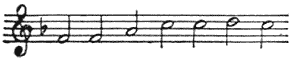
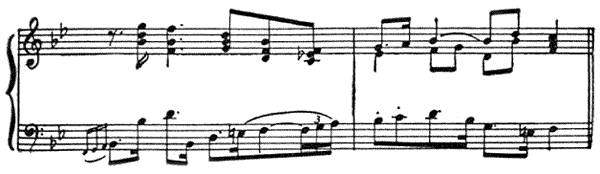
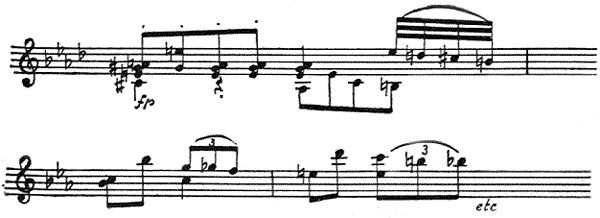
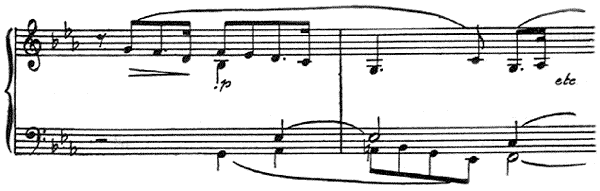
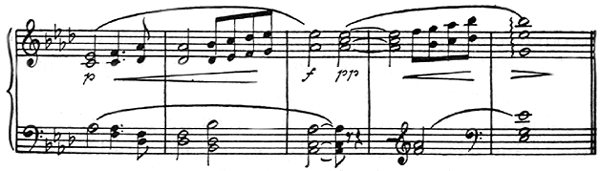
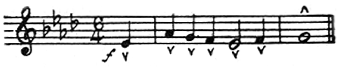
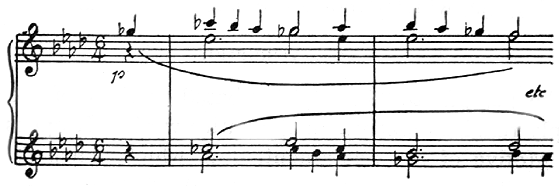
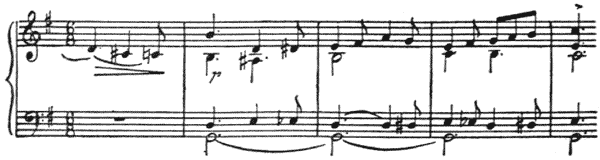
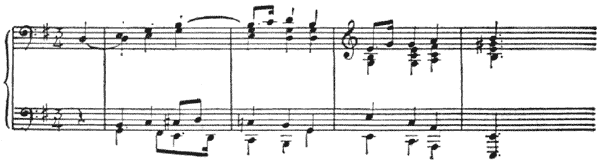
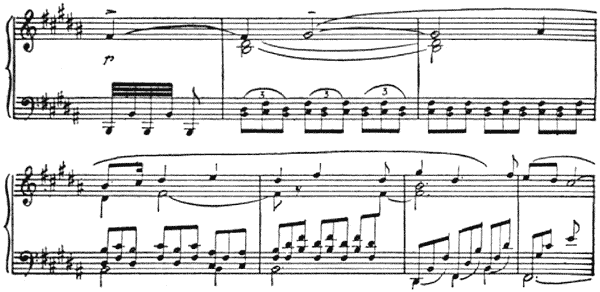
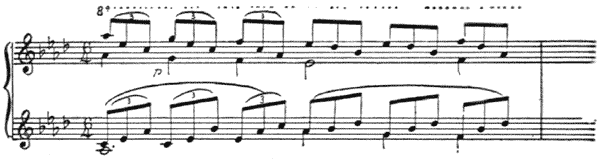
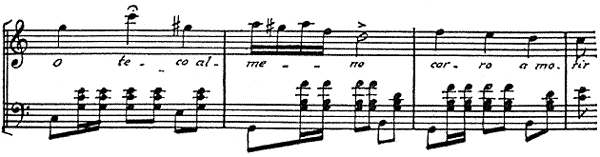
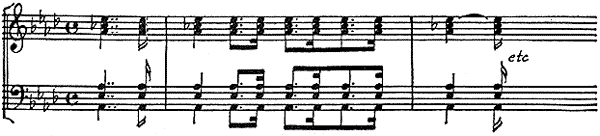
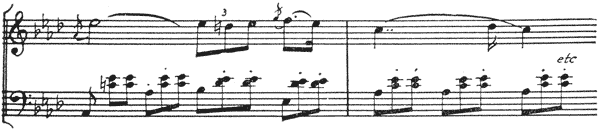
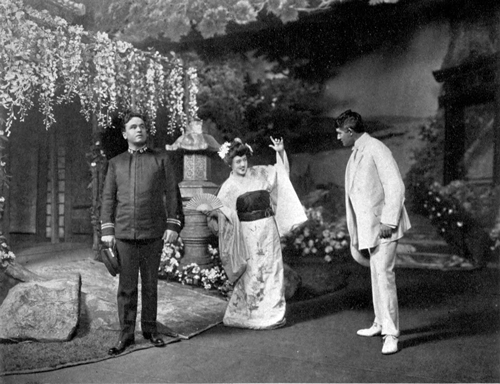
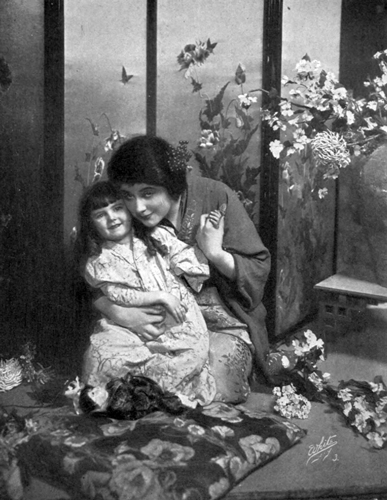
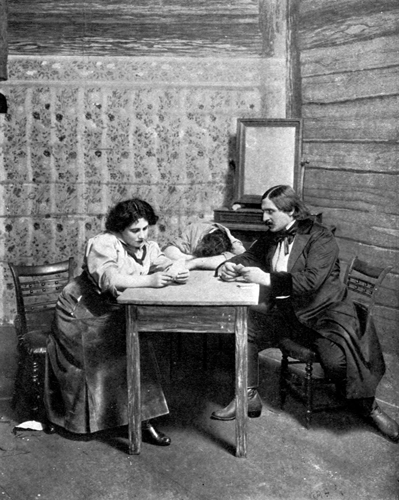
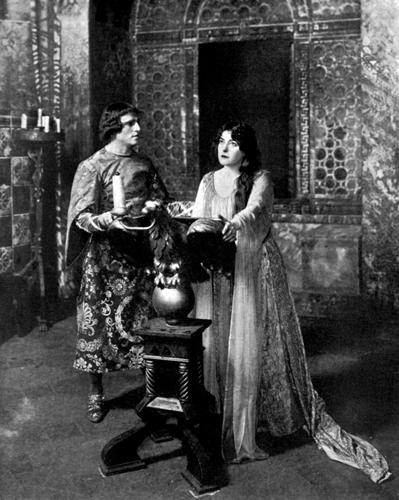
The Complete Opera Book The Stories of the Operas, together with 400 of the Leading Airs and Motives in Musical Notation By Gustav Kobbé
Transcriber's Notes
The Complete Opera Book has been an important
opera reference work since its first publication in 1919. It has been
revised and updated a number of times, most famously by George Lascelles, 7th
Earl of Harewood, and most recently in 1997.
This e-book was prepared from the 1919 first edition. Gustav Kobbé was
killed in a sailing accident in 1918 and apparently did not have the
opportunity to make corrections before the book was published. There
are consequently numerous typographical, spelling, and formatting errors and
inconsistencies in the first edition, the most obvious of which have been
corrected without note in this e-book. Ambiguous errors are marked with red dotted
underlining in the HTML version; hover the mouse over the underlined text to see a pop-up
Transcriber's Note.
A Transcriber's Errata List of these
notes is also provided at the end of this file. The
author's deliberate interchanges of foreign words or names and their
equivalents in English or other languages have been preserved as they
appear in the original. Misplaced Table of Contents and
index entries have been moved to their proper places.
Photograph illustrations have been moved so as not to break up the
flow of the text and may not appear on the page indicated in the List
of Illustrations, which in this e-book contains links to the
illustrations themselves, rather than to the pages.
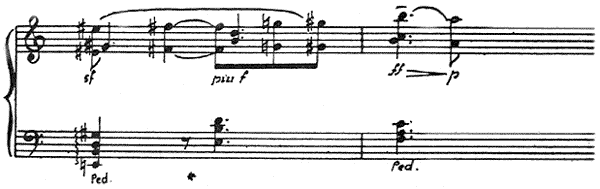
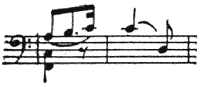
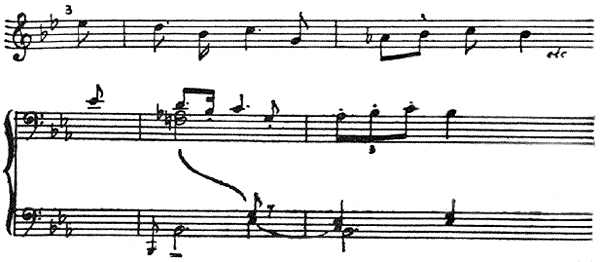
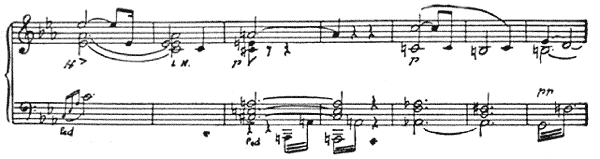
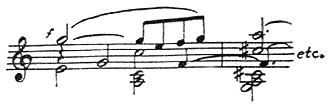
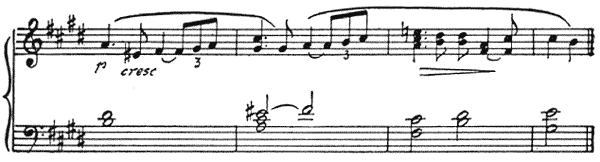
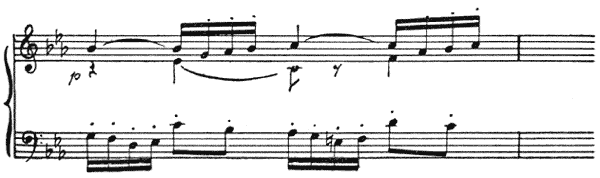
Click on the [Listen] link to download and hear a midi file (or MP3
file, where noted) of the music. Obvious errors in the music notation have
been corrected in the sound files, and the corrections are noted in the
titles of the corresponding music images. If you are reading this e-book in
any format other than HTML, you will not be able to hear the music.
Author of “Wagner’s Music-Dramas Analysed,”
“All-of-a-Sudden Carmen,” etc.
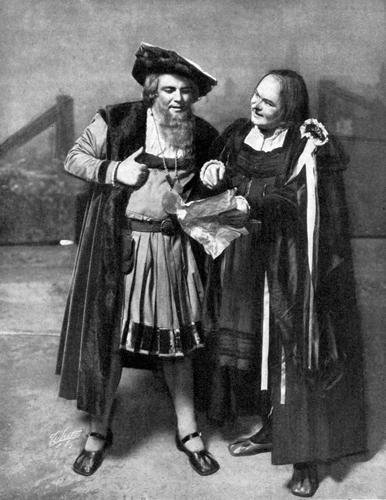
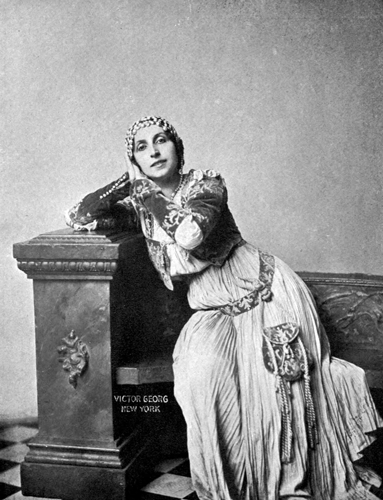
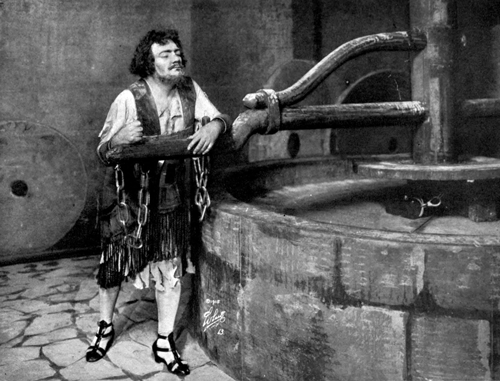
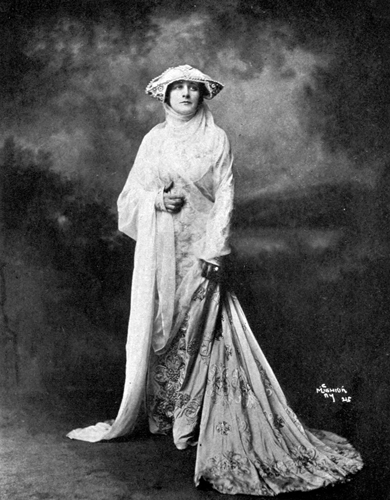
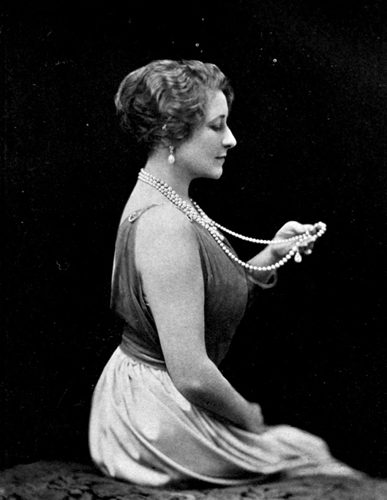
Illustrated with One Hundred Portraits in Costume and
Scenes from Opera
G.P. Putnam’s Sons
New York and London The Knickerbocker Press
1919
Copyright, 1919
BY
GUSTAV KOBBÉ
The Knickerbocker Press, New York
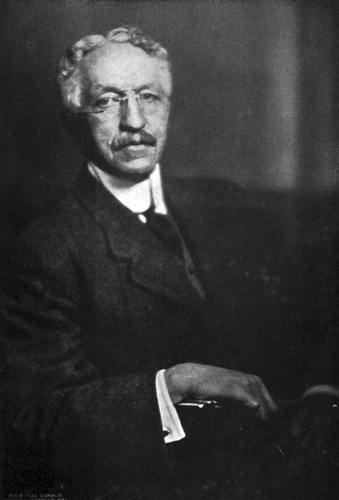
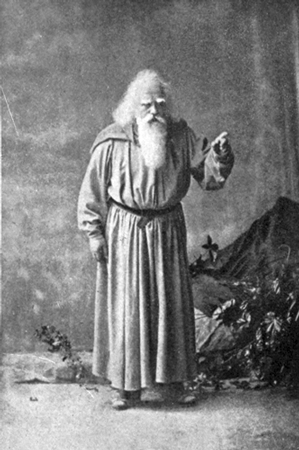
Copyright photo by Pirie MacDonald
GUSTAV KOBBÉ
FOREWORD
Through the thoughtfulness of William J. Henderson I was asked to
supply material for The Complete Opera Book, which was missing at
the time of Mr. Kobbé's death.
In performing my share of the work it has been my endeavor to confine
myself to facts, rather than to intrude with personal opinions upon a
work which should stand as a monument to Mr. Kobbé's musical knowledge
and convictions.
THERE are three great schools of opera,—Italian, French, and German.
None other has developed sufficiently to require comment in this brief
chapter.
Of the three standard schools, the Italian is the most frankly
melodious. When at its best, Italian vocal melody ravishes the senses.
When not at its best, it merely tickles the ear and offends common
sense. "Aïda" was a turning point in Italian music. Before Verdi
composed "Aïda," Italian opera, despite its many beauties, was largely
a thing of temperament, inspirationally, but often also carelessly set
forth. Now, Italian opera composers no longer accept any libretto
thrust at them. They think out their scores more carefully; they
produce works in which due attention is paid to both vocal and
orchestral effect. The older composers still represented in the
repertoire are Rossini, Bellini, Donizetti, and Verdi. The last-named,
however, also reaches well over into the modern school of Italian
opera, whose foremost living exponent is Puccini.
Although Rameau (1683-1764), whose "Castor and Pollux" held the stage
until supplanted by Gluck's works, was a native of France, French
opera had for its founder the Italian, Lully; and one of its chief
exponents was the German, Meyerbeer. Two foreigners, therefore, have
had a large share in developing the school. It boasts, however, many
distinguished natives—Halévy, Auber, Gounod, Bizet, Massenet.
In the French school of opera the instrumental support of the voice is
far richer and the combination of vocal and instrumental effect more
discriminating than in the old school of Italian opera. A first cousin
of Italian opera, the French, nevertheless, is more carefully thought
out, sometimes even too calculated; but, in general, less florid, and
never indifferent to the librettist and the significance of the lines
he has written and the situations he has evoked. Massenet is, in the
truest sense, the most recent representative of the school of
Meyerbeer and Gounod, for Bizet's "Carmen" is unique, and Débussy's
"Pelléas et Mélisande" a wholly separate manifestation of French art
for the lyric stage.
The German school of opera is distinguished by a seriousness of
purpose that discards all effort at vocal display for itself alone,
and strives, in a score, well-balanced as between voice and orchestra,
to express more forcibly than could the spoken work, the drama that
has been set to music.
An opera house like the Metropolitan, which practically has three
companies, presents Italian, French, and German operas in the language
in which they were written, or at least usually does so. Any speaker
before an English-speaking audience can always elicit prolonged
applause by maintaining that in English-speaking countries opera
should be sung in English. But, in point of fact, and even
disregarding the atrocities that masquerade as translations of opera
into English, opera should be sung in the language in which it is
written. For language unconsciously affects, I might even say
determines, the structure of the melody.
Far more important than language, however, is it that opera be sung by
great artists. For these assimilate music and give it forth in all
its essence of truth and beauty. Were great artists to sing opera in
Choctaw, it would still be welcome as compared with opera rendered by
inferior interpreters, no matter in what language.
Opera Before Gluck
GLUCK'S "Orfeo ed Euridice" (Orpheus and Eurydice), produced in 1762,
is the oldest opera in the repertoire of the modern opera house. But
when you are told that the Grand Opéra, Paris, was founded by Lully,
an Italian composer, in 1672; that Italians were writing operas nearly
a century earlier; that a German, Reinhard Keiser (1679-1739), is
known to have composed at least 116 operas; and that another German,
Johann Adolph Hasse, composed among his operas, numbering at least a
hundred, one entitled "Artaxerxes," two airs from which were sung by
Carlo Broschi every evening for ten years to soothe King Philip V. of
Spain;—you will realize that opera existed, and even flourished
before Gluck produced his "Orpheus and Eurydice."
Opera originated in Florence toward the close of the sixteenth
century. A band of composers, enthusiastic, intellectual, aimed at
reproducing the musical declamation which they believed to have been
characteristic of the representation of Greek tragedy. Their scores
were not melodious, but composed in a style of declamatory recitative
highly dramatic for its day. What usually is classed as the first
opera, Jacopo Peri's "Dafne," was privately performed in the Palazzo
Corsi, Florence, in 1597. So great was its success that Peri was
commissioned, in 1600, to write a similar work for the festivities
incidental to the marriage of Henry IV. of France with Maria de
Medici, and composed "Euridice," said to have been the first opera
ever produced in public.
The new art form received great stimulus from Claudio Monteverdi, the
Duke of Mantua's director of music, who composed "Arianna" (Ariadne)
in honor of the marriage of Francesco Gonzaga with Margherita, Infanta
of Savoy. The scene in which Ariadne bewails her desertion by her
lover was so dramatically written (from the standpoint of the day, of
course) that it produced a sensation. The permanency of opera was
assured, when Monteverdi brought out, with even greater success, his
opera "Orfeo," which showed a further advance in dramatic expression,
as well as in the treatment of the instrumental score. This composer
invented the tremolo for strings—marvellous then, commonplace now,
and even reprehensible, unless employed with great skill.
Monteverdi's scores contained, besides recitative, suggestions of
melody. The Venetian composer, Cavalli, introduced melody more
conspicuously into the vocal score in order to relieve the monotonous
effect of a continuous recitative, that was interrupted only by brief
melodious phrases. In his airs for voice he foreshadowed the aria
form, which was destined to be freely developed by Alessandro
Scarlatti (1659-1725). Scarlatti was the first to introduce into an
opera score the ritornello—the instrumental introduction,
interlude, or postlude to a composition for voice. Indeed, Scarlatti
is regarded as the founder of what we call Italian opera, the chief
characteristic of which is melody for the voice with a comparatively
simple accompaniment.
By developing vocal melody to a point at which it ceased to be
dramatically expressive, but degenerated into mere voice pyrotechnics,
composers who followed Scarlatti laid themselves open to the charge of
being too subservient to the singers, and of sacrificing dramatic
truth and depth of expression to the vanity of those upon the stage.
Opera became too much a series of show-pieces for its interpreters.
The first practical and effective protest against this came from
Lully, who already has been mentioned. He banished all meaningless
embellishment from his scores. But in the many years that intervened
between Lully's career and Gluck's, the abuse set in again. Then
Gluck, from copying the florid Italian style of operatic composition
early in his career, changed his entire method as late as 1762, when
he was nearly fifty years old, and produced "Orfeo ed Euridice." From
that time on he became the champion for the restoration of opera to
its proper function as a well-balanced score, in which the voice,
while pre-eminent, does not "run away with the whole show."
Indeed, throughout the history of opera, there have been recurring
periods, when it has become necessary for composers with the true
interest of the lyric stage at heart, to restore the proper balance
between the creator of a work and its interpreters, in other words to
prevent opera from degenerating from a musical drama of truly dramatic
significance to a mere framework for the display of vocal
pyrotechnics. Such a reformer was Wagner. Verdi, born the same year as
Wagner (1813), but outliving him nearly twenty years, exemplified both
the faults and virtues of opera. In his earlier works, many of which
have completely disappeared from the stage, he catered almost entirely
to his singers. But in "Aïda" he produced a masterpiece full of melody
which, while offering every opportunity for beautiful singing, never
degenerates into mere vocal display. What is here said of Verdi could
have been said of Gluck. His earlier operas were in the florid style.
Not until he composed "Orpheus and Eurydice" did he approach opera
from the point of view of a reformer. "Orpheus" was his "Aïda."
Regarding opera Gluck wrote that "the true mission of music is to
second the poetry, by strengthening the expression of the sentiments
and increasing the interest of the situations, without interrupting
and weakening the action by superfluous ornaments in order to tickle
the ear and display the agility of fine voices."
These words might have been written by Richard Wagner, they express so
well what he accomplished in the century following that in which Gluck
lived. They might also have been penned by Verdi, had he chosen to
write an introduction to his "Aïda," "Otello," or "Falstaff"; and they
are followed by every successful composer of grand opera
today—Mascagni, Leoncavallo, Puccini, Massenet, Strauss.
In fact, however much the public may be carried away temporarily by
astonishing vocal display introduced without reason save to be
astonishing, the fate of every work for the lyric stage eventually has
been decided on the principle enunciated above. Without being aware of
it, the public has applied it. For no matter how sensationally popular
a work may have been at any time, it has not survived unless,
consciously or unconsciously, the composer has been guided by the
cardinal principle of true dramatic expression.
Finally, I must not be misunderstood as condemning, at wholesale,
vocal numbers in opera that require extraordinary technique. Scenes in
opera frequently offer legitimate occasion for brilliant vocal
display. Witness the arias of the Queen of the Night in "The Magic
Flute," "Una voce poco fa" in "The Barber of Seville," "Ah! non
giunge" in "Sonnambula," the mad scene in "Lucia," "Caro nome" in
"Rigoletto," the "Jewel Song" in "Faust," and even Brünnhilde's
valkyr shout in "Die Walküre"—works for the lyric stage that have
escorted thousands of operatic scores to the grave, with Gluck's
gospel on the true mission of opera for a funeral service.
Christoph Willibald Gluck (1714-1787) — ORFEO ED EURIDICE ORPHEUS AND EURYDICE — ARMIDE — IPHIGÉNIE EN TAURIDE IPHIGENIA IN TAURIS
GLUCK is the earliest opera composer represented in the repertoire of
the modern opera house. In this country three of his works survive.
These are, in the order of their production, "Orfeo ed Euridice"
(Orpheus and Eurydice), "Armide," and "Iphigénie en Tauride"
(Iphigenia in Tauris). "Orpheus and Eurydice," produced in 1762, is
the oldest work of its kind on the stage. It is the
great-great-grandfather of operas.
Its composer was a musical reformer and "Orpheus" was the first
product of his musical reform. He had been a composer of operas in the
florid vocal style, which sacrificed the dramatic verities to the
whims, fancies, and ambitions of the singers, who sought only to show
off their voices. Gluck began, with his "Orpheus," to pay due regard
to true dramatic expression. His great merit is that he accomplished
this without ignoring the beauty and importance of the voice, but by
striking a correct balance between the vocal and instrumental portions
of the score.
Simple as his operas appear to us today, they aroused a strife
comparable only with that which convulsed musical circles during the
progress of Wagner's career. The opposition to his reforms reached its
height in Paris, whither he went in 1772. His opponents invited Nicola
Piccini, at that time famous as a composer of operas in the florid
Italian style, to compete with him. So fierce was the war between
Gluckists and Piccinists, that duels were fought and lives sacrificed
over the respective merits of the two composers. Finally each produced
an opera on the subject of "Iphigenia in Tauris." Gluck's triumphed,
Piccini's failed.
Completely victorious, Gluck retired to Vienna, where he died,
November 25, 1787.
Opera in three acts. Music by Christoph Willibald Gluck;
book by Raniero di Calzabigi. Productions and revivals.
Vienna, October 5, 1762; Paris, as "Orphée et Eurydice,"
1774; London, Covent Garden, June 26, 1860; New York,
Metropolitan Opera House, 1885 (in German); Academy of
Music, American Opera Company, in English, under Theodore
Thomas, January 8, 1886, with Helene Hastreiter, Emma Juch,
and Minnie Dilthey; Metropolitan Opera House, 1910 (with
Homer, Gadski, and Alma Gluck).
Characters
Orpheus
Contralto
Eurydice
Soprano
Amor, God of Love
Soprano
A Happy Shade
Soprano
Shepherds and Shepherdesses, Furies and Demons, Heroes and
Heroines in Hades.
Time—Antiquity.
Place—Greece and the Nether Regions.
Following a brief and solemn prelude, the curtain rises on Act I,
showing a grotto with the tomb of Eurydice. The beautiful bride of
Orpheus has died. Her husband and friends are mourning at her tomb.
During an affecting aria and chorus ("Thou whom I loved") funeral
honours are paid to the dead bride. A second orchestra, behind the
scenes, echoes, with charming effect, the distracted husband's
evocations to his bride and the mournful measures of the chorus,
until, in answer to the piercing cries of Orpheus and the
exclamatory recitative, "Gods, cruel gods," Amor appears. He tells
the bereaved husband that Zeus has taken pity on him. He shall have
permission to go down into Hades and endeavour to propitiate Pluto and
his minions solely through the power of his music. But, should he
rescue Eurydice, he must on no account look back at her until he has
crossed the Styx.
Upon that condition, so difficult to fulfil, because of the love of
Orpheus for his bride, turns the whole story. For should he, in
answer to her pleading, look back, or explain to her why he cannot do
so, she will immediately die. But Orpheus, confident in his power of
song and in his ability to stand the test imposed by Zeus and bring
his beloved Eurydice back to earth, receives the message with great
joy.
"Fulfil with joy the will of the gods," sings Amor, and Orpheus,
having implored the aid of the deities, departs for the Nether World.
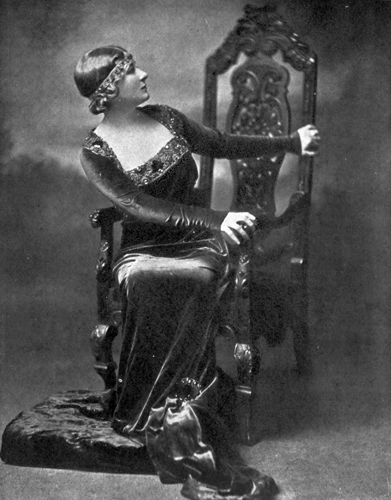
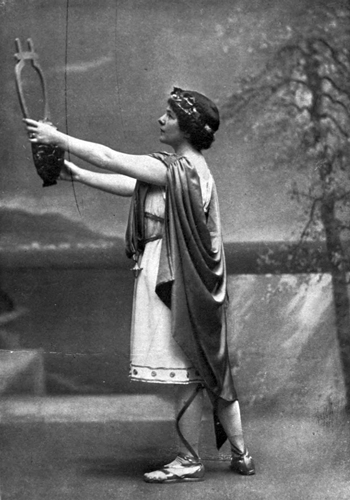
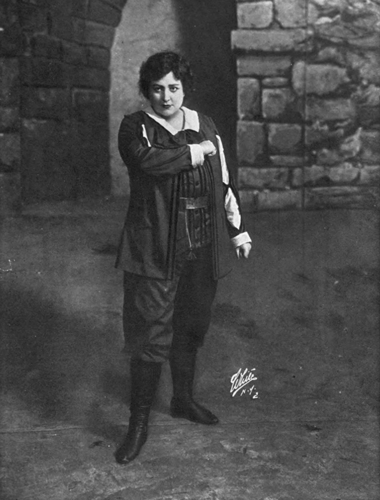
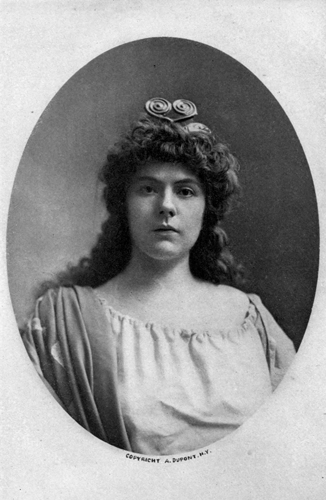
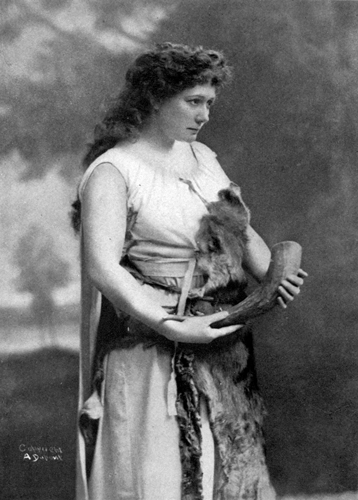
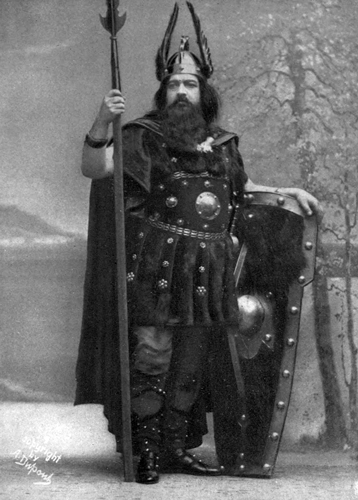
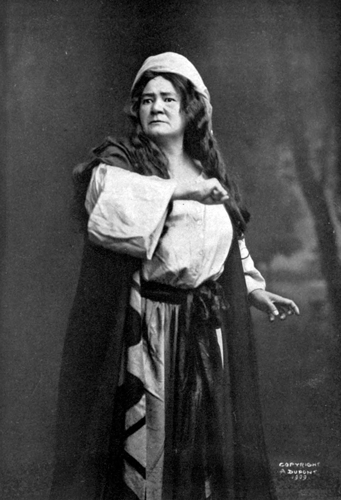
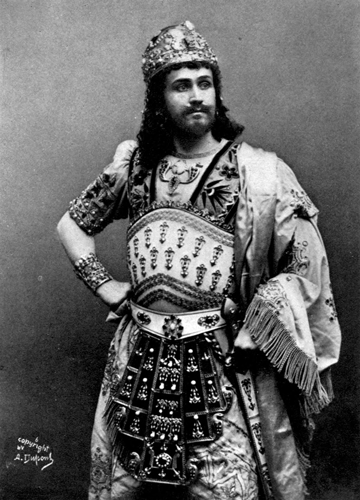
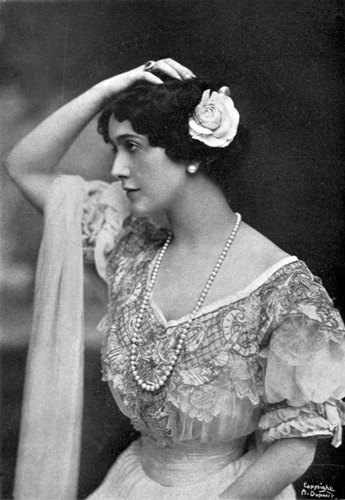
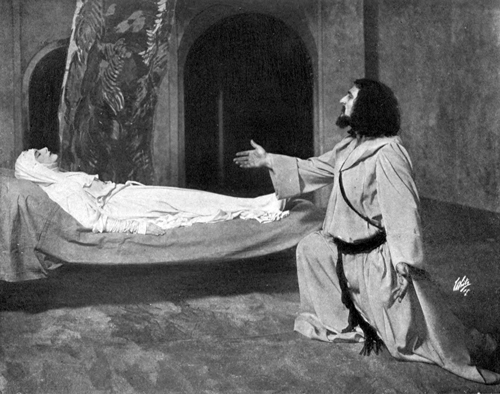
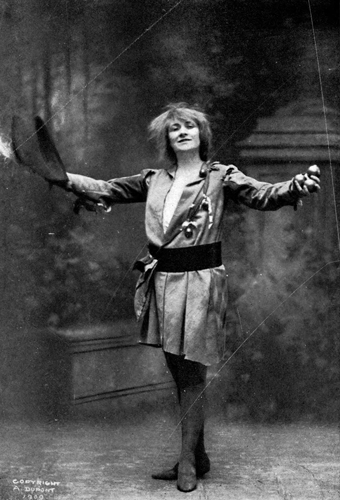
Copyright Photo by Dupont
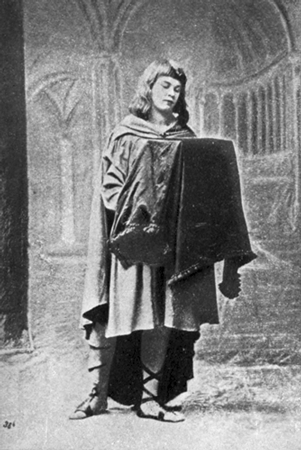
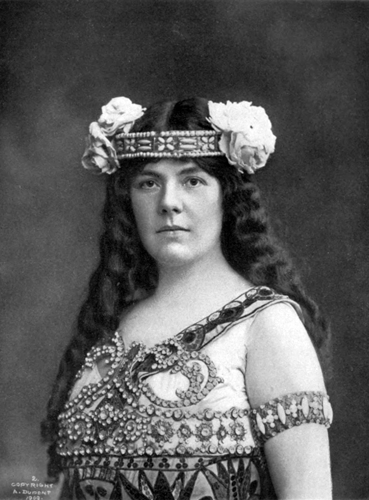
Louise Homer as Orpheus in “Orpheus and Eurydice”
Act I. Entrance to Hades. When Orpheus appears, he is greeted with
threats by the Furies. The scene, beginning with the chorus, "Who is
this mortal?" is still considered a masterpiece of dramatic music. The
Furies call upon Cerberus, the triple-headed dog monster that guards
the entrance to the Nether World, to tear in pieces the mortal who so
daringly approaches. The bark of the monster is reproduced in the
score. This effect, however, while interesting, is but a minor
incident. What lifts the scene to its thrilling climax is the
infuriated "No!" which is hurled at Orpheus by the dwellers at the
entrance to Hades, when, having recourse to song, he tells of his love
for Eurydice and his grief over her death and begs to be allowed to
seek her. He voices his plea in the air, "A thousand griefs,
threatening shades." The sweetness of his music wins the sympathy of
the Furies. They allow him to enter the Valley of the Blest, a
beautiful spot where the good spirits in Hades find rest. (Song for
Eurydice and her companions, "In this tranquil and lovely abode
of the blest.") Orpheus comes seeking Eurydice. His recitative,
"What pure light!" is answered by a chorus of happy shades, "Sweet
singer, you are welcome." To him they bring the lovely Eurydice.
Orpheus, beside himself with joy, but remembering the warning of
Amor, takes his bride by the hand and, with averted gaze, leads her
from the vale.
She cannot understand his action. He seeks to soothe her injured
feelings. (Duet: "On my faith relying.") But his efforts are vain; nor
can he offer her any explanation, for he has also been forbidden to
make known to her the reason for his apparent indifference.
Act III. A wood. Orpheus, still under the prohibition imposed by the
gods, has released the hand of his bride and is hurrying on in advance
of her urging her to follow. She, still not comprehending why he does
not even cast a glance upon her, protests that without his love she
prefers to die.
Orpheus, no longer able to resist the appeal of his beloved bride,
forgets the warning of Amor. He turns and passionately clasps
Eurydice in his arms. Immediately she dies.
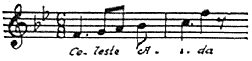
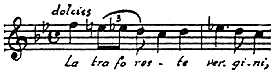
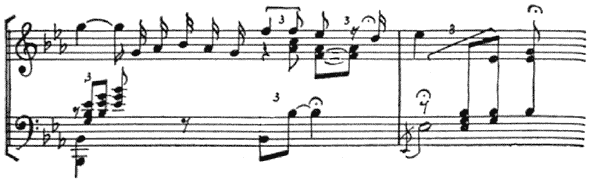
It is then that Orpheus intones the lament, "Che farò senza
Euridice" (I have lost my Eurydice), that air in the score which has
truly become immortal and by which Gluck, when the opera as a whole
shall have disappeared from the stage, will still be remembered.
"All forms of language have been exhausted to praise the stupor of
grief, the passion, the despair expressed in this sublime number,"
says a writer in the Clément and Larousse Dictionnaire des Opéras.
It is equalled only by the lines of Virgil:
Vox ipsa et frigida lingua,
"Ah! miseram Eurydicen," anima fugiente, vocabat;
"Eurydicen;" toto referabant flumine ripae.
[E'en then his trembling tongue invok'd his bride;
With his last voice, "Eurydice," he cried,
"Eurydice," the rocks and river banks replied. Dryden.]
In fact it is so beautiful that Amor, affected by the grief of
Orpheus appears to him, touches Eurydice and restores her to life
and to her husband's arms.
The legend of "Orpheus and Eurydice" as related in Virgil's
Georgics, from which are the lines just quoted is one of the
classics of antiquity. In "Orfeo ed Euridice" Gluck has preserved the
chaste classicism of the original. Orpheus was the son of Apollo and
the muse Calliope. He played so divinely that trees uprooted
themselves and rocks were loosened from their fastnesses in order to
follow him. His bride, Eurydice, was the daughter of a Thracian
shepherd.
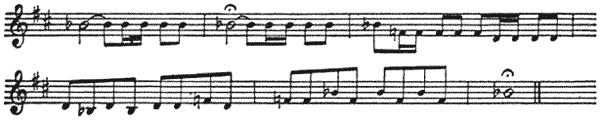
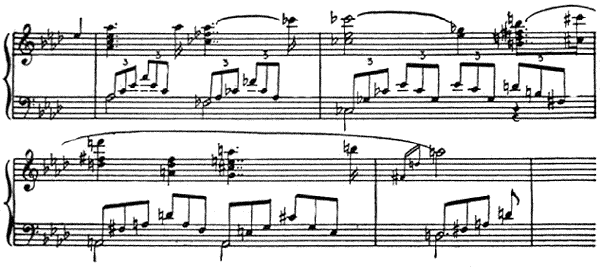
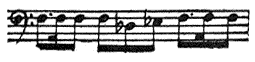
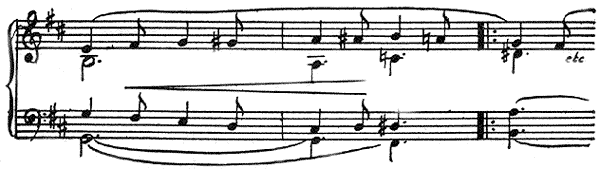
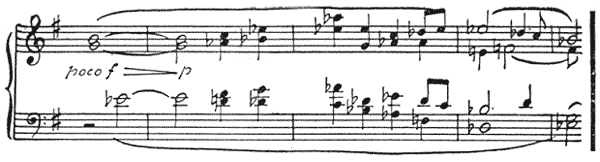
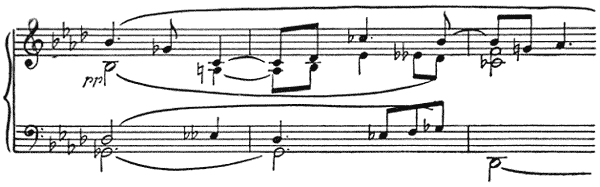
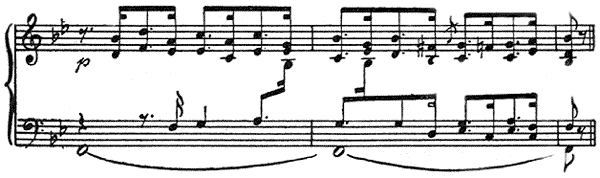
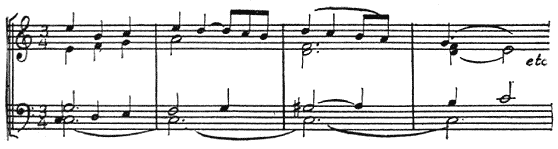
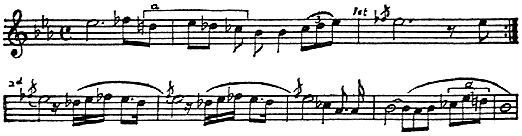
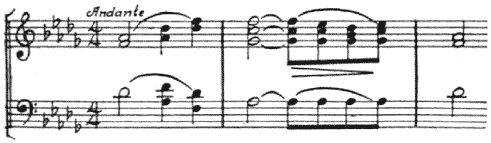
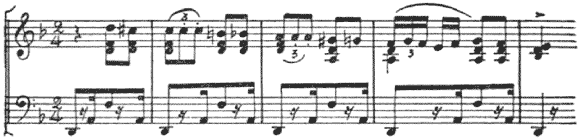
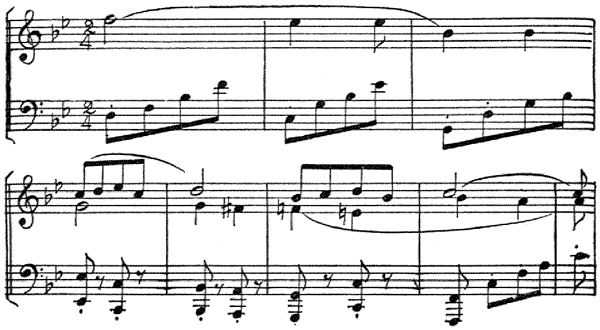
The rôle of Orpheus was written for the celebrated male contralto
Guadagni. For the Paris production the composer added three bars to
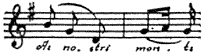
the most famous number of the score, the "Che farò senza Euridice,"
illustrated above. These presumably were the three last bars, the
concluding phrases of the peroration of the immortal air. He also was
obliged to transpose the part of Orpheus for the tenor Legros, for
whom he introduced a vocal number not only entirely out of keeping
with the rôle, but not even of his own composition—a bravura aria
from "Tancred," an opera by the obscure Italian composer Fernandino
Bertoni. It is believed that the tenor importuned Gluck for something
that would show off his voice, whereupon the composer handed him the
Bertoni air. Legros introduced it at the end of the first act, where
to this day it remains in the printed score.
When the tenor Nourrit sang the rôle many years later, he substituted
the far more appropriate aria, "Ô transport, ô désordre extrême" (O
transport, O ecstasy extreme) from Gluck's own "Echo and Narcissus."
But that the opera, as it came from Gluck's pen, required nothing
more, appeared in the notable revival at the Théâtre Lyrique, Paris,
November, 1859, under Berlioz's direction, when that distinguished
composer restored the rôle of Orpheus to its original form and for a
hundred and fifty nights the celebrated contralto, Pauline
Viardot-Garcia, sang it to enthusiastic houses.
The best production of the work in this country was that of the
American Opera Company. It was suited, as no other opera was, to the
exact capacity of that ill-starred organization. The representation
was in four acts instead of three, the second act being divided into
two, a division to which it easily lends itself.
The opera has been the object of unstinted praise. Of the second act
the same French authority quoted above says that from the first note
to the last, it is "a complete masterpiece and one of the most
astonishing productions of the human mind. The chorus of demons, 'What
mortal dares,' in turn questions, becomes wrathful, bursts into a
turmoil of threats, gradually becomes tranquil and is hushed, as if
subdued and conquered by the music of Orpheus's lyre. What is more
moving than the phrase 'Laissez-vous toucher par mes pleurs'? (A
thousand griefs, threatening shades.) Seeing a large audience
captivated by this mythological subject; an audience mixed, frivolous
and unthinking, transported and swayed by this scene, one recognizes
the real power of music. The composer conquered his hearers as his
Orpheus succeeded in subduing the Furies. Nowhere, in no work, is
the effect more gripping. The scene in the Elysian fields also has
its beauties. The air of Eurydice, the chorus of happy shades, have
the breath of inalterable calm, peace and serenity."
Gaetano Guadagni, who created the rôle of Orpheus, was one of the
most famous male contralti of the eighteenth century. Händel assigned
to him contralto parts in the "Messiah" and "Samson," and it was Gluck
himself who procured his engagement at Vienna. The French production
of the opera was preceded by an act of homage, which showed the
interest of the French in Gluck's work. For while it had its first
performance in Vienna, the score was first printed in Paris and at the
expense of Count Durazzo. The success of the Paris production was so
great that Gluck's former pupil, Marie Antoinette, granted him a
pension of 6,000 francs with an addition of the same sum for every
fresh work he should produce on the French stage.
The libretto of Calzabigi was, for its day, charged with a vast amount
of human interest, passion, and dramatic intensity. In these
particulars it was as novel as Gluck's score, and possibly had an
influence upon him in the direction of his operatic reforms.
Opera in five acts by Gluck; words by François Quinault,
founded on Tasso's Jerusalem Delivered.
Produced, Paris, 1777, at the Académie de Musique; New York,
Metropolitan Opera House, November 14, 1910, with Fremstad,
Caruso, Homer, Gluck, and Amato.
Characters
Armide, a Sorceress, Niece of Hidraot
Soprano
Phenice
}
her attendants
{
Soprano
Sidonie
}
{
Soprano
Hate, a Fury
Soprano
Lucinde
}
apparitions
{
Soprano
Mélisse
}
{
Soprano
Renaud (Rinaldo), a Knight of the Crusade under Godfrey of Bouillon
Tenor
Artemidore, Captive Knight Delivered by Renaud
Tenor
The Danish Knight
}
Crusaders
{
Tenor
Ubalde
}
{
Bass
Hidraot, King of Damascus
Bass
Arontes, leader of the Saracens
Bass
A Naiad, a Love
Apparitions
Populace, Apparitions and Furies.
Time—First Crusade, 1098.
Place—Damascus.
Act I. Hall of Armide's palace at Damascus. Phenice and Sidonie
are praising the beauty of Armide. But she is depressed at her
failure to vanquish the intrepid knight, Renaud, although all others
have been vanquished by her. Hidraot, entering, expresses a desire
to see Armide married. The princess tells him that, should she ever
yield to love, only a hero shall inspire it. People of Damascus enter
to celebrate the victory won by Armide's sorcery over the knights of
Godfrey. In the midst of the festivities Arontes, who has had charge
of the captive knights, appears and announces their rescue by a single
warrior, none other than Renaud, upon whom Armide now vows
vengeance.
Act II. A desert spot. Artemidore, one of the Christian knights,
thanks Renaud for his rescue. Renaud has been banished from
Godfrey's camp for the misdeed of another, whom he will not betray.
Artemidore warns him to beware the blandishments of Armide, then
departs. Renaud falls asleep by the bank of a stream. Hidraot and
Armide come upon the scene. He urges her to employ her supernatural
powers to aid in the pursuit of Renaud. After the king has departed,
she discovers Renaud. At her behest apparitions, in the disguise of
charming nymphs, shepherds and shepherdesses, bind him with garlands
of flowers. Armide now approaches to slay her sleeping enemy with a
dagger, but, in the act of striking him, she is overcome with love for
him, and bids the apparitions transport her and her hero to some
"farthest desert, where she may hide her weakness and her shame."
Act III. Wild and rugged landscape. Armide, alone, is deploring the
conquest of her heart by Renaud. Phenice and Sidonie come to her
and urge her to abandon herself to love. They assure her that Renaud
cannot fail to be enchanted by her beauty. Armide, reluctant to
yield, summons Hate, who is ready to do her bidding and expel love
from her bosom. But at the critical moment Armide cries out to
desist, and Hate retires with the threat never to return.
Act IV. From yawning chasms and caves wild beasts and monsters emerge
in order to frighten Ubalde and a Danish Knight, who have come in
quest of Renaud. Ubalde carries a magic shield and sceptre, to
counteract the enchantments of Armide, and to deliver Renaud. The
knights attack and vanquish the monsters. The desert changes into a
beautiful garden. An apparition, disguised as Lucinde, a girl
beloved by the Danish Knight, is here, accompanied by apparitions in
various pleasing disguises. Lucinde tries to detain the knight from
continuing upon his errand, but upon Ubalde touching her with the
golden sceptre, she vanishes. The two then resume their journey to the
rescue of Renaud.
Act V. Another part of the enchanted garden. Renaud, bedecked with
garlands, endeavours to detain Armide, who, haunted by dark
presentiment, wishes to consult with the powers of Hades. She leaves
Renaud to be entertained by a company of happy Lovers. They,
however, fail to divert the lovelorn warrior, and are dismissed by
him. Ubalde and the Danish Knight appear. By holding the magic
shield before Renaud's eyes, they counteract the passion that has
swayed him. He is following the two knights, when Armide returns and
vainly tries to detain him. Proof against her blandishments, he leaves
her to seek glory. Armide deserted, summons Hate to slay him. But
Hate, once driven away, refuses to return. Armide then bids the
Furies destroy the enchanted palace. They obey. She perishes in the
ruins. (Or, according to the libretto, "departs in a flying car"—an
early instance of aviation in opera!)
There are more than fifty operas on the subject of Armide. Gluck's
has survived them all. Nearly a century before his opera was produced
at the Académie, Paris, that institution was the scene of the first
performance of "Armide et Renaud," composed by Lully to the same
libretto used by Gluck, Quinault having been Lully's librettist in
ordinary.
"Armide" is not a work of such strong human appeal as "Orpheus"; but
for its day it was a highly dramatic production; and it still admits
of elaborate spectacle. The air for Renaud in the second act, "Plus
j'observe ces lieux, et plus je les admire!" (The more I view this
spot the more charmed I am); the shepherd's song almost immediately
following; Armide's air at the opening of the third act, "Ah! si la
liberté me doit être ravie" (Ah! if liberty is lost to me); the
exquisite solo and chorus in the enchanted garden, "Les plaisirs ont
choisi pour asile" (Pleasure has chosen for its retreat) are classics.
Several of the ballet numbers long were popular.
In assigning to a singer of unusual merit the ungrateful rôle of the
Danish Knight, Gluck said: "A single stanza will compensate you, I
hope, for so courteously consenting to take the part." It was the
stanza, "Nôtre général vous rappelle" (Our commander summons you),
with which the knight in Act V recalls Renaud to his duty. "Never,"
says the relater of the anecdote, "was a prediction more completely
fulfilled. The stanza in question produced a sensation."
Opera in four acts by Gluck, words by François Guillard.
Produced at the Académie de Musique, Paris, May 18, 1779;
Metropolitan Opera House, New York, November 25, 1916, with
Kurt, Weil, Sembach, Braun, and Rappold.
Characters
Iphigénie, Priestess of Diana
Soprano
Orestes, her Brother
Baritone
Pylades, his Friend
Tenor
Thoas, King of Scythia
Bass
Diana
Soprano
Scythians, Priestesses of Diana.
Time—Antiquity, after the Trojan War.
Place—Tauris.
Iphigénie is the daughter of Agamemnon, King of Mycenae. Agamemnon
was slain by his wife, Clytemnestra, who, in turn, was killed by her
son, Orestes. Iphigénie is ignorant of these happenings. She has
been a priestess of Diana and has not seen Orestes for many years.
Act I. Before the atrium of the temple of Diana. To priestesses and
Greek maidens, Iphigénie tells of her dream that misfortune has come
to her family in the distant country of her birth. Thoas, entering,
calls for a human sacrifice to ward off danger that has been foretold
to him. Some of his people, hastily coming upon the scene, bring with
them as captives Orestes and Pylades, Greek youths who have landed
upon the coast. They report that Orestes constantly speaks of having
committed a crime and of being pursued by Furies.
Act II. Temple of Diana. Orestes bewails his fate. Pylades sings
of his undying friendship for him. Pylades is separated from
Orestes, who temporarily loses his mind. Iphigénie questions him.
Orestes, under her influence, becomes calmer, but refrains from
disclosing his identity. He tells her, however, that he is from
Mycenae, that Agamemnon (their father) has been slain by his wife,
that Clytemnestra's son, Orestes, has slain her in revenge, and is
himself dead. Of the once great family only a daughter, Electra,
remains.
Act III. Iphigénie is struck with the resemblance of the stranger to
her brother and, in order to save him from the sacrifice demanded by
Thoas, charges him to deliver a letter to Electra. He declines to
leave Pylades; nor until Orestes affirms that he will commit
suicide, rather than accept freedom at the price of his friend's life,
does Pylades agree to take the letter, and then only because he
hopes to bring succour to Orestes.
Act IV. All is ready for the sacrifice. Iphigénie has the knife
poised for the fatal thrust, when, through an exclamation uttered by
Orestes, she recognizes him as her brother. The priestesses offer
him obeisance as King. Thoas, however, enters and demands the
sacrifice. Iphigénie declares that she will die with her brother. At
that moment Pylades at the head of a rescue party enters the temple.
A combat ensues in which Thoas is killed. Diana herself appears,
pardons Orestes and returns to the Greeks her likeness which the
Scythians had stolen and over which they had built the temple.
Gluck was sixty-five, when he brought out "Iphigénie en Tauride." A
contemporary remarked that there were many fine passages in the opera.
"There is only one," said the Abbé Arnaud. "Which?"—"The entire
work."
The mad scene for Orestes, in the second act, has been called
Gluck's greatest single achievement. Mention should also be made of
the dream of Iphigénie, the dances of the Scythians, the air of
Thoas, "De noirs pressentiments mon âme intimidée" (My spirit is
depressed by dark forebodings); the air of Pylades, "Unis dès la
plus tendre enfance" (United since our earliest infancy);
Iphigénie's "Ô malheureuse (unhappy) Iphigénie," and "Je t'implore
et je tremble" (I pray you and I tremble); and the hymn to Diana,
"Chaste fille de Latone" (Chaste daughter of the crescent moon).
Here may be related an incident at the rehearsal of the work, which
proves the dramatic significance Gluck sought to impart to his music.
In the second act, while Orestes is singing, "Le calme rentre dans
mon cœur," (Once more my heart is calm), the orchestral
accompaniment continues to express the agitation of his thoughts.
During the rehearsal the members of the orchestra, not understanding
the passage, came to a stop. "Go on all the same," cried Gluck. "He
lies. He has killed his mother!"
Gluck's enemies prevailed upon his rival, Piccini, to write an
"Iphigénie en Tauride" in opposition. It was produced in January,
1781, met with failure, and put a definite stop to Piccini's rivalry
with Gluck. At the performance the prima donna was intoxicated. This
caused a spectator to shout:
"'Iphigénie en Tauride!' allons donc, c'est 'Iphigénie en Champagne!'"
(Iphigenia in Tauris! Do tell! Shouldn't it be Iphigenia in
Champagne?)
The laugh that followed sealed the doom of the work.
The Metropolitan production employs the version of the work made by
Richard Strauss, which involves changes in the finales of the first
and last acts. Ballet music from "Orfeo" and "Armide" also is
introduced.
Wolfgang Amadeus Mozart (1756-1791) — LE NOZZE DI FIGARO THE MARRIAGE OF FIGARO — DON GIOVANNI — THE MAGIC FLUTE DIE ZAUBERFLÖTE
THE operas of Gluck supplanted those of Lully and Rameau. Those of
Mozart, while they did not supplant Gluck's, wrested from them the
sceptre of supremacy. In a general way it may be said that, before
Mozart's time, composers of grand opera reached back to antiquity and
mythology, or to the early Christian era, for their subjects. Their
works moved with a certain restricted grandeur. Their characters were
remote.
Mozart's subjects were more modern, even contemporary. Moreover, he
was one of the brightest stars in the musical firmament. His was a
complete and easy mastery of all forms of music. "In his music
breathes the warm-hearted, laughter-loving artist," writes Theodore
Baker. That is a correct characterization. "The Marriage of Figaro" is
still regarded as a model of what a comic grand opera, if so I may
call it, should be. "Don Giovanni," despite its tragic dénouement,
sparkles with humour, and Don Giovanni himself, despite the evil he
does, is a jovial character. "The Magic Flute" is full of amusing
incidents and, if its relationship to the rites of freemasonry has
been correctly interpreted, was a contemporary subject of strong human
interest, notwithstanding its story being laid in ancient Egypt. In
fact it may be said that, in the evolution of opera, Mozart was the
first to impart to it a strong human interest with humour playing
about it like sunlight.
The libretto of "The Marriage of Figaro" was derived from a
contemporary French comedy; "Don Giovanni," though its plot is taken
from an old Spanish story, has in its principal character a type of
libertine, whose reckless daring inspires loyalty not only in his
servant, but even in at least one of his victims—a type as familiar
to Mozart's contemporaries as it is to us; the probable contemporary
significance of "The Magic Flute" I have already mentioned, and the
point is further considered under the head of that opera.
For the most part as free from unnecessary vocal embellishments as are
the operas of Gluck, Mozart, being the more gifted composer, attained
an even higher degree of dramatic expression than his predecessor. May
I say that he even gave to the voice a human clang it hitherto had
lacked, and in this respect also advanced the art of opera? By this I
mean that, full of dramatic significance as his voice parts are, they
have, too, an ingratiating human quality which the music of his
predecessor lacks. In plasticity of orchestration his operas also mark
a great advance.
Excepting a few works by Gluck, every opera before Mozart and the
operas of every composer contemporary with him, and for a considerable
period after him, have disappeared from the repertoire. The next two
operas to hold the stage, Beethoven's "Fidelio" (in its final form)
and Rossini's "Barber of Seville" were not produced until 1814 and
1816—respectively twenty-three and twenty-five years after Mozart's
death.
That Mozart was a genius by the grace of God will appear from the
simple statement that his career came to an end at the age of
thirty-five. Compare this with the long careers of the three other
composers, whose influence upon opera was supreme—Gluck, Wagner, and
Verdi. Gluck died in his seventy-third year, Wagner in his
seventieth, and Verdi in his eighty-eighth. Yet the composer who laid
down his pen and went to a pauper's grave at thirty-five, contributed
as much as any of these to the evolution of the art of opera.
Opera in four acts by Mozart; words by Lorenzo da Ponte,
after Beaumarchais. Produced at the National Theatre,
Vienna, May 1, 1786, Mozart conducting. Académie de Musique,
Paris, as "Le Mariage de Figaro" (with Beaumarchais's
dialogue), 1793; as "Les Noces de Figaro" (words by Barbier
and Carré), 1858. London, in Italian, King's Theatre, June
18, 1812. New York, 1823, with T. Phillips, of Dublin, as
Figaro; May 10, 1824, with Pearman as Figaro and Mrs.
Holman, as Susanna; January 18, 1828, with Elizabeth
Alston, as Susanna; all these were in English and at the
Park Theatre. (See concluding paragraph of this article.)
Notable revivals in Italian, at the Metropolitan Opera
House: 1902, with Sembrich, Eames, Fritzi Scheff, de Reszke,
and Campanari; 1909, Sembrich, Eames, Farrar, and Scotti;
1916, Hempel, Matzenauer, Farrar, and Scotti.
Characters
Count Almaviva
Baritone
Figaro, his valet
Baritone
Doctor Bartolo, a Physician
Bass
Don Basilio, a music-master
Tenor
Cherubino, a page
Soprano
Antonio, a gardener
Bass
Don Curzio, counsellor at law
Tenor
Countess Almaviva
Soprano
Susanna, her personal maid, affianced to Figaro
Soprano
Marcellina, a duenna
Soprano
Barbarina, Antonio's daughter
Soprano
Time—17th Century.
Place—The Count's château of Aguas Frescas, near Seville.
"Le Nozze di Figaro" was composed by Mozart by command of Emperor
Joseph II., of Austria. After congratulating the composer at the end
of the first performance, the Emperor said to him: "You must admit,
however, my dear Mozart, that there are a great many notes in your
score." "Not one too many, Sire," was Mozart's reply.
(The anecdote, it should be noted, also, is told of the first
performance of Mozart's "Così Fan Tutte.")
No opera composed before "Le Nozze di Figaro" can be compared with it
for development of ensemble, charm and novelty of melody, richness and
variety of orchestration. Yet Mozart composed this score in a month.
The finale to the second act occupied him but two days. In the music
the sparkle of high comedy alternates with the deeper sentiment of the
affections.
Michael Kelly, the English tenor, who was the Basilio and Curzio
in the original production, tells in his memoirs of the splendid
sonority with which Benucci, the Figaro, sang the martial "Non più
andrai" at the first orchestral rehearsal. Mozart, who was on the
stage in a crimson pelisse and cocked hat trimmed with gold lace, kept
repeating sotto voce, "Bravo, bravo, Benucci!" At the conclusion the
orchestra and all on the stage burst into applause and vociferous
acclaim of Mozart:
"Bravo, bravo, Maestro! Viva, viva, grande Mozart!"
Further, the Reminiscences of Kelly inform us of the enthusiastic
reception of "Le Nozze di Figaro" upon its production, almost
everything being encored, so that the time required for its
performance was nearly doubled. Notwithstanding this success, it was
withdrawn after comparatively few representations, owing to Italian
intrigue at the court and opera, led by Mozart's rival, the composer
Salieri—now heard of only because of that rivalry. In Prague, where
the opera was produced in January, 1787, its success was so great that
Bondini, the manager of the company, was able to persuade Mozart to
compose an opera for first performance in Prague. The result was "Don
Giovanni."
The story of "Le Nozze di Figaro" is a sequel to that of "The Barber
of Seville," which Rossini set to music. Both are derived from
"Figaro" comedies by Beaumarchais. In Rossini's opera it is Figaro,
at the time a barber in Seville, who plays the go-between for Count
Almaviva and his beloved Rosina, Dr. Bartolo's pretty ward.
Rosina is now the wife of the Count, who unfortunately, is
promiscuous in his attentions to women, including Susanna, the
Countess's vivacious maid, who is affianced to Figaro. The latter
and the music-master Basilio who, in their time helped to hoodwink
Bartolo, are in the service of the Count, Figaro having been
rewarded with the position of valet and majordomo. Bartolo, for
whom, as formerly, Marcellina is keeping house, still is Figaro's
enemy, because of the latter's interference with his plans to marry
Rosina and so secure her fortune to himself. The other characters in
the opera also belong to the personnel of the Count's household.
Aside from the difference between Rossini's and Mozart's scores, which
are alike only in that each opera is a masterpiece of the comic
sentiment, there is at least one difference between the stories. In
Rossini's "Barber" Figaro, a man, is the mainspring of the action.
In Mozart's opera it is Susanna, a woman; and a clever woman may
possess in the rôle of protagonist in comedy a chicness and sparkle
quite impossible to a man. The whole plot of "Le Nozze di Figaro"
plays around Susanna's efforts to nip in the bud the intrigue in
which the Count wishes to engage her. She is aided by the Countess
and by Figaro; but she still must appear to encourage while evading
the Count's advances, and do so without offending him, lest both she
and her affianced be made to suffer through his disfavour. In the
libretto there is much that is risqué, suggestive. But as the
average opera-goer does not understand the subtleties of the Italian
language, and the average English translation is too clumsy to
preserve them, it is quite possible—especially in this advanced
age—to attend a performance of "Le Nozze di Figaro" without
imperilling one's morals.
There is a romping overture. Then, in Act I, we learn that Figaro,
Count Almaviva's valet, wants to get married. Susanna, the
Countess's maid, is the chosen one. The Count has assigned to them
a room near his, ostensibly because his valet will be able to respond
quickly to his summons. The room is the scene of this Act. Susanna
tells her lover that the true reason for the Count's choice of their
room is the fact that their noble master is running after her. Now
Figaro is willing enough to "play up" for the little Count, if he
should take it into his head "to venture on a little dance" once too
often. ("Se vuol ballare, Signor Contino!")
Unfortunately, however, Figaro himself is in a fix. He has borrowed
money from Marcellina, Bartolo's housekeeper, and he has promised
to marry her in case of his inability to repay her. She now appears,
to demand of Figaro the fulfilment of his promise. Bartolo
encourages her in this, both out of spite against Figaro and because
he wants to be rid of the old woman, who has been his mistress and
even borne him a son, who, however, was kidnapped soon after his
birth. There is a vengeance aria for Bartolo, and a spiteful duet
for Marcellina and Susanna, beginning: "Via resti servita, madama
brillante" (Go first, I entreat you, Miss, model of beauty!).
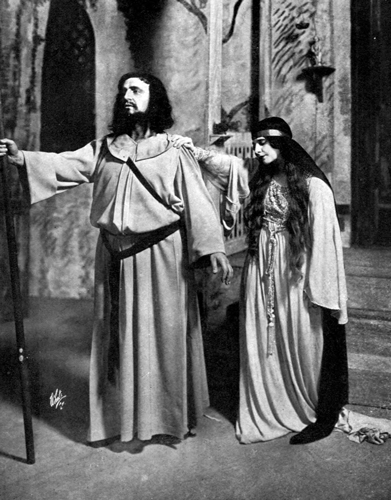
Photo by White
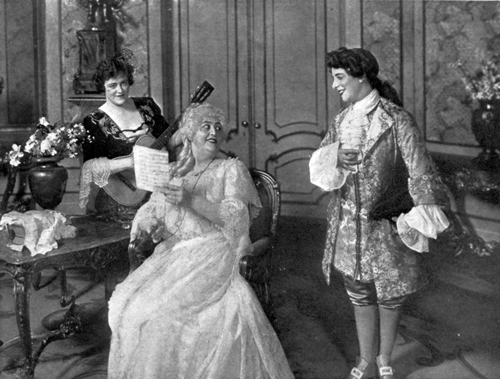
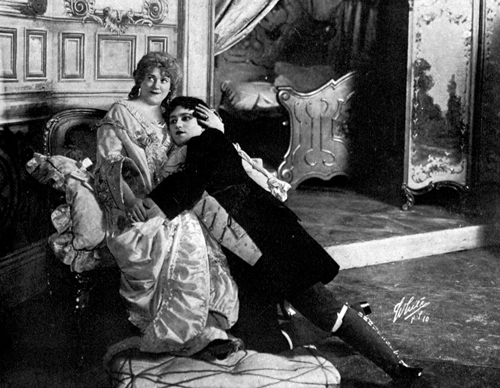
Hempel (Susanna), Matzenauer (the Countess), and Farrar (Cherubino)
in “Le Nozze di Figaro”
The next scene opens between the page, Cherubino, a boy in love
with every petticoat, and Susanna. He begs Susanna to intercede
for him with the Count, who has dismissed him. Cherubino desires
to stay around the Countess, for whom he has conceived one of his
grand passions. "Non so più cosa son, cosa faccio"—(Ah, what feelings
now possess me!). The Count's step is heard. Cherubino hides
himself behind a chair, from where he hears the Count paying court
to Susanna. The voice of the music-master then is heard from
without. The Count moves toward the door. Cherubino, taking
advantage of this, slips out from behind the chair and conceals
himself in it under a dress that has been thrown over it. The Count,
however, instead of going out, hides behind the chair, in the same
place where Cherubino has been. Basilio, who has entered, now
makes all kinds of malicious remarks and insinuations about the
flirtations of Cherubino with Susanna and also with the
Countess. The Count, enraged at the free use of his wife's name,
emerges from behind the chair. Only the day before, he says, he has
caught that rascal, Cherubino, with the gardener's daughter
Barbarina (with whom the Count also is flirting). Cherubino, he
continues, was hidden under a coverlet, "just as if under this dress
here." Then, suiting the action to the words, by way of demonstration,
he lifts the gown from the chair, and lo! there is Cherubino. The
Count is furious. But as the page has overheard him making love to
Susanna, and as Figaro and others have come in to beg that he be
forgiven, the Count, while no longer permitting him to remain in the
castle, grants him an officer's commission in his own regiment. It is
here that Figaro addresses Cherubino in the dashing martial air,
"Non più andrai, farfallone amoroso" (Play no more, the part of a
lover).
Act II. Still, the Count, for whom the claims of Marcellina upon
Figaro have come in very opportunely, has not given consent for his
valet's wedding. He wishes to carry his own intrigue with Susanna,
the genuineness of whose love for Figaro he underestimates, to a
successful issue. Susanna and Figaro meet in the Countess's
room. The Countess has been soliloquizing upon love, of whose
fickleness the Count has but provided too many examples.—"Porgi
amor, qualche ristoro" (Love, thou holy, purest passion.) Figaro has
contrived a plan to gain the consent of the Count to his wedding
with Susanna. The valet's scheme is to make the Count ashamed of
his own flirtations. Figaro has sent a letter to the Count, which
divulges a supposed rendezvous of the Countess in the garden. At the
same time Susanna is to make an appointment to meet the Count in
the same spot. But, in place of Susanna, Cherubino, dressed in
Susanna's clothes, will meet the Count. Both will be caught by the
Countess and the Count thus be confounded.
Cherubino is then brought in to try on Susanna's clothes. He sings
to the Countess an air of sentiment, one of the famous vocal numbers
of the opera, the exquisite: "Voi che sapete, che cosa è amor" (What
is this feeling makes me so sad).
The Countess, examining his officer's commission, finds that the
seal to it has been forgotten. While in the midst of these proceedings
someone knocks. It is the Count. Consternation. Cherubino flees
into the Countess's room and Susanna hides behind a curtain. The
evident embarrassment of his wife arouses the suspicions of her
husband, who, gay himself, is very jealous of her. He tries the door
Cherubino has bolted from the inside, then goes off to get tools to
break it down with. He takes his wife with him. While he is away,
Cherubino slips out and leaps out of a window into the garden. In
his place, Susanna bolts herself in the room, so that, when the
Count breaks open the door, it is only to discover that Susanna is
in his wife's room. All would be well, but unfortunately Antonio,
the gardener, enters. A man, he says, has jumped out of the
Countess's window and broken a flowerpot. Figaro, who has come in,
and who senses that something has gone wrong, says that it was he who
was with Susanna and jumped out of the window. But the gardener has
found a paper. He shows it. It is Cherubino's commission. How did
Figaro come by it? The Countess whispers something to Figaro.
Ah, yes; Cherubino handed it to him in order that he should obtain
the missing seal.
Everything appears to be cleared up when Marcellina, accompanied by
Bartolo, comes to lodge formal complaint against Figaro for breach
of promise, which for the Count is a much desired pretext to refuse
again his consent to Figaro's wedding with Susanna. These, the
culminating episodes of this act, form a finale which is justly
admired, a finale so gradually developed and so skilfully evolved
that, although only the principals participate in it, it is as
effective as if it employed a full ensemble of soloists, chorus, and
orchestra worked up in the most elaborate fashion. Indeed, for
effectiveness produced by simple means, the operas of Mozart are
models.
But to return to the story. At the trial in Act III, between
Marcellina and Figaro, it develops that Figaro is her long-lost
natural son. Susanna pays the costs of the trial and nothing now
seems to stand in the way of her union with Figaro. The Count,
however, is not yet entirely cured of his fickle fancies. So the
Countess and Susanna hit upon still another scheme in this play of
complications. During the wedding festivities Susanna is to contrive
to send secretly to the Count a note, in which she invites him to
meet her. Then the Countess, dressed in Susanna's clothes, is to
meet him at the place named. Figaro knows nothing of this plan.
Chancing to find out about the note, he too becomes jealous—another,
though minor, contribution to the mix-up of emotions. In this act the
concoction of the letter by the Countess and Susanna is the basis
of the most beautiful vocal number in the opera, the "letter duet" or
Canzonetta sull'aria (the "Canzonetta of the Zephyr")—"Che soave
zeffiretto" (Hither gentle zephyr); an exquisite melody, in which the
lady dictates, the maid writes down, and the voices of both blend in
comment.
The final Act brings about the desired result after a series of
amusing contretemps in the garden. The Count sinks on his knees
before his Countess and, as the curtain falls, there is reason to
hope that he is prepared to mend his ways.
Regarding the early performances of "Figaro" in this country, these
early performances were given "with Mozart's music, but adapted by
Henry Rowley Bishop." When I was a boy, a humorous way of commenting
upon an artistic sacrilege was to exclaim: "Ah! Mozart improved by
Bishop!" I presume the phrase came down from these early
representations of "The Marriage of Figaro." Bishop was the composer
of "Home, Sweet Home." In 1839 his wife eloped with Bochsa, the harp
virtuoso, afterwards settled in New York, and for many years sang in
concert and taught under the name of Mme. Anna Bishop.
Opera in two acts by Mozart; text by Lorenzo da Ponte.
Productions, Prague, Oct. 29, 1787; Vienna, May 17, 1788;
London, April 12, 1817; New York, Park Theatre, May 23,
1826.
Original title: "Il Dissoluto Punito, ossia il Don Giovanni"
(The Reprobate Punished, or Don Giovanni). The work was
originally characterized as an opera buffa, or dramma
giocoso, but Mozart's noble setting lifted it out of that
category.
Characters
Don Pedro, the Commandant
Bass
Donna Anna, his daughter
Soprano
Don Ottavio, her betrothed
Tenor
Don Giovanni
Baritone
Leporello, his servant
Bass
Donna Elvira
Soprano
Zerlina
Soprano
Masetto, betrothed to Zerlina
Tenor
"Don Giovanni" was presented for the first time in Prague, because
Mozart, satisfied with the manner in which Bondini's troupe had sung
his "Marriage of Figaro" a little more than a year before, had agreed
to write another work for the same house.
The story on which da Ponte based his libretto—the statue of a
murdered man accepting an insolent invitation to banquet with his
murderer, appearing at the feast and dragging him down to hell—is
very old. It goes back to the Middle Ages, probably further. A French
authority considers that da Ponte derived his libretto from "Le Festin
de Pierre," Molière's version of the old tale. Da Ponte, however, made
free use of "Il Convitato di Pietra" (The Stone-Guest), a libretto
written by the Italian theatrical poet Bertati for the composer
Giuseppe Gazzaniga. Whoever desires to follow up this interesting
phase of the subject will find the entire libretto of Bertati's
"Convitato" reprinted, with a learned commentary by Chrysander, in
volume iv of the Vierteljahrheft für Musikwissenschaft (Music
Science Quarterly), a copy of which is in the New York Public Library.
Mozart agreed to hand over the finished score in time for the autumn
season of 1787, for the sum of one hundred ducats ($240). Richard
Strauss receives for a new opera a guarantee of ten performances at a
thousand dollars—$10,000 in all—and, of course, his royalties
thereafter. There is quite a distinction in these matters between the
eighteenth century and the present. And what a lot of good a few
thousand dollars would have done the impecunious composer of the
immortal "Don Giovanni!" Also, one is tempted to ask oneself if any
modern ten thousand dollar opera will live as long as the two hundred
and forty dollar one which already is 130 years old.
Bondini's company, for which Mozart wrote his masterpiece of dramatic
music, furnished the following cast: Don Giovanni, Signor Bassi,
twenty-two years old, a fine baritone, an excellent singer and actor;
Donna Anna, Signora Teresa Saporiti; Donna Elvira, Signora
Catarina Micelli, who had great talent for dramatic expression;
Zerlina, Signora Teresa Bondini, wife of the manager; Don Ottavio,
Signor Antonio Baglioni, with a sweet, flexible tenor voice;
Leporello, Signor Felice Ponziani, an excellent basso comico; Don
Pedro (the Commandant), and Masetto, Signor Giuseppe Lolli.
Mozart directed the rehearsals, had the singers come to his house to
study, gave them advice how some of the difficult passages should be
executed, explained the characters they represented, and exacted
finish, detail, and accuracy. Sometimes he even chided the artists for
an Italian impetuosity, which might be out of keeping with the charm
of his melodies. At the first rehearsal, however, not being satisfied
with the way in which Signora Bondini gave Zerlina's cry of terror
from behind the scenes, when the Don is supposed to attempt her
ruin, Mozart left the orchestra and went upon the stage. Ordering the
first act finale to be repeated from the minuet on, he concealed
himself in the wings. There, in the peasant dress of Zerlina, with
its short skirt, stood Signora Bondini, waiting for her cue. When it
came, Mozart quickly reached out a hand from his place of concealment
and pinched her leg. She gave a piercing shriek. "There! That is how I
want it," he said, emerging from the wings, while the Bondini, not
knowing whether to laugh or blush, did both.
One of the most striking features of the score, the warning words
which the statue of the Commandant, in the plaza before the
cathedral of Seville, utters within the hearing of Don Giovanni and
Leporello, was originally accompanied by the trombones only. At
rehearsal in Prague, Mozart, not satisfied with the way the passage
was played, stepped over toward the desks at which the trombonists
sat.
One of them spoke up: "It can't be played any better. Even you
couldn't teach us how."
Mozart smiled. "Heaven forbid," he said, "that I should attempt to
teach you how to play the trombone. But let me have the parts."
Looking them over he immediately made up his mind what to do. With a
few quick strokes of the pen, he added the wood-wind instruments as
they are now found in the score.
It is well known that the overture of "Don Giovanni" was written
almost on the eve of the first performance. Mozart passed a gay
evening with some friends. One of them said to him: "Tomorrow the
first performance of 'Don Giovanni' will take place, and you have not
yet composed the overture!" Mozart pretended to get nervous about it
and withdrew to his room, where he found music-paper, pens, and ink.
He began to compose about midnight. Whenever he grew sleepy, his wife,
who was by his side, entertained him with stories to keep him awake.
It is said that it took him but three hours to produce this overture.
The next evening, a little before the curtain rose, the copyists
finished transcribing the parts for the orchestra. Hardly had they
brought the sheets, still wet, to the theatre, when Mozart, greeted by
enthusiastic applause, entered the orchestra and took his seat at the
piano. Although the musicians had not had time to rehearse the
overture, they played it with such precision that the audience broke
out into fresh applause. As the curtain rose and Leporello came
forward to sing his solo, Mozart laughingly whispered to the musicians
near him: "Some notes fell under the stands. But it went well."
The overture consists of an introduction which reproduces the scene of
the banquet at which the statue appears. It is followed by an allegro
which characterizes the impetuous, pleasure-seeking Don, oblivious
to consequences. It reproduces the dominant character of the opera.
Without pause, Mozart links up the overture with the song of
Leporello. The four principal personages of the opera appear early
in the proceedings. The tragedy which brings them together so soon and
starts the action, gives an effective touch of fore-ordained
retribution to the misdeeds upon which Don Giovanni so gaily enters.
This early part of the opera divides itself into four episodes.
Wrapped in his cloak and seated in the garden of a house in Seville,
Spain, which Don Giovanni, on amorous adventure bent, has entered
secretly during the night—it is the residence of the
Commandant—Leporello is complaining of the fate which makes him a
servant to such a restless and dangerous master. "Notte e giorno
faticar" (Never rest by day or night), runs his song.
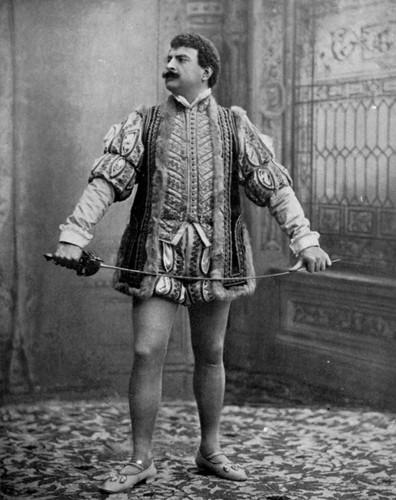
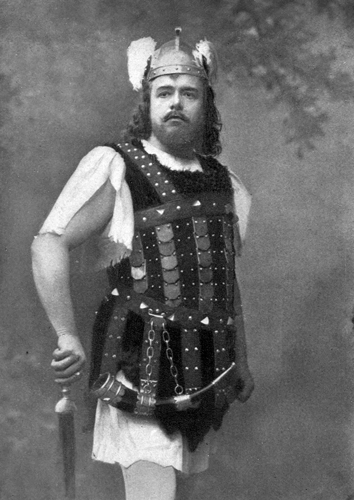
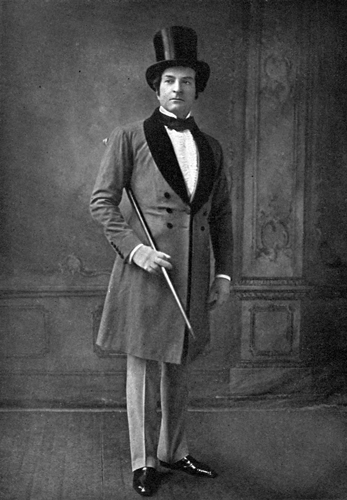
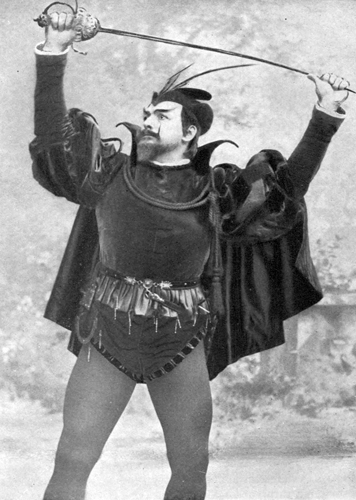
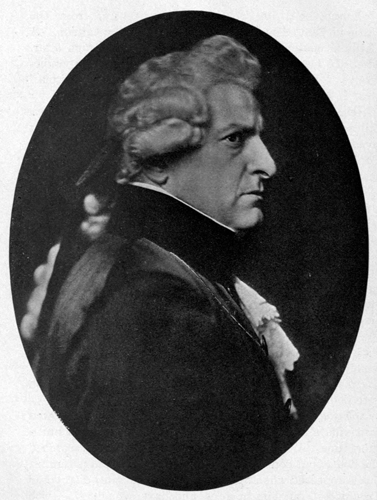
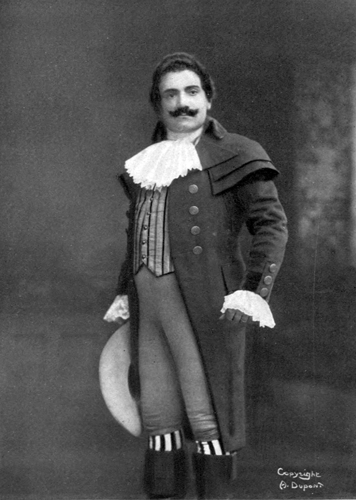
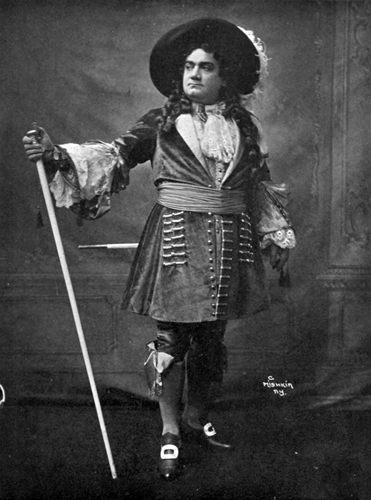
Copyright photo by Dupont
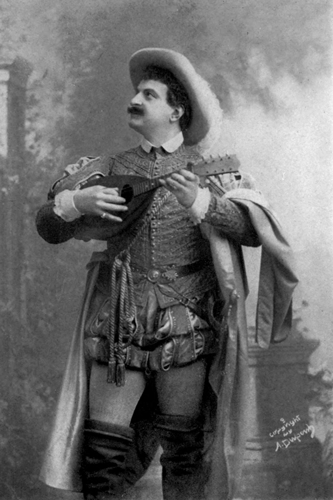
Scotti as Don Giovanni
Don Giovanni hurriedly issues from the house, pursued by Donna
Anna. There follows a trio in which the wrath of the insulted woman,
the annoyance of the libertine, and the cowardice of Leporello are
expressed simultaneously and in turn in manner most admirable. The
Commandant, attracted by the disturbance, arrives, draws his sword,
and a duel ensues. In the unequal combat between the aged
Commandant and the agile Don, the Commandant receives a fatal
wound. The trio which follows between Don Giovanni, the dying
Commandant, and Leporello is a unique passage in the history of
musical art. The genius of Mozart, tender, profound, pathetic,
religious, is revealed in its entirety. Written in a solemn rhythm and
in the key of F minor, so appropriate to dispose the mind to a gentle
sadness, this trio, which fills only eighteen measures, contains in a
restricted outline, but in master-strokes, the fundamental idea of
this mysterious drama of crime and retribution. While the Commandant
is breathing his last, emitting notes broken by long pauses, Donna
Anna, who, during the duel between her father and Don Giovanni, has
hurried off for help, returns accompanied by her servants and by Don
Ottavio, her affianced. She utters a cry of terror at seeing the dead
body of her father. The recitative which expresses her despair is
intensely dramatic. The duet which she sings with Don Ottavio is
both impassioned and solicitous, impetuous on her part, solicitous on
his; for the rôle of Don Ottavio is stamped with the delicacy of
sentiment, the respectful reserve of a well-born youth who is
consoling the woman who is to be his wife. The passage, "Lascia, O
cara, la rimembranza amara!" (Through love's devotion, dear one) is of
peculiar beauty in musical expression.
After Donna Anna and Don Ottavio have left, there enters Donna
Elvira. The air she sings expresses a complicated nuance of passion.
Donna Elvira is another of Don Giovanni's deserted ones. There are
in the tears of this woman not only the grief of one who has been
loved and now implores heaven for comfort, but also the indignation of
one who has been deserted and betrayed. When she cries with emotion:
"Ah! chi mi dice mai quel barbaro dov'è?" (In memory still lingers his
love's delusive sway) one feels that, in spite of her outbursts of
anger, she is ready to forgive, if only a regretful smile shall
recall to her the man who was able to charm her.
Don Giovanni hears from afar the voice of a woman in tears. He
approaches, saying: "Cerchiam di consolare il suo tormento" (I must
seek to console her sorrow). "Ah! yes," murmurs Leporello, under his
breath: "Così ne consolò mille e otto cento" (He has consoled fully
eighteen hundred). Leporello is charged by Don Giovanni, who,
recognizing Donna Elvira, hurries away, to explain to her the
reasons why he deserted her. The servant fulfils his mission as a
complaisant valet. For it is here that he sings the "Madamina" air,
which is so famous, and in which he relates with the skill of a
historian the numerous amours of his master in the different parts of
the world.
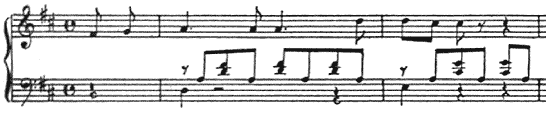
The "Air of Madamina," "Madamina! il catalogo"—(Dear lady, the
catalogue) is a perfect passage of its kind; an exquisite mixture of
grace and finish, of irony and sentiment, of comic declamation and
melody, the whole enhanced by the poetry and skill of the accessories.
There is nothing too much, nothing too little; no excess of detail to
mar the whole. Every word is illustrated by the composer's imagination
without his many brilliant sallies injuring the general effect.
According to Leporello's catalogue his master's adventures in love
have numbered 2065. To these Italy has contributed 245,
Germany 231, France 100, Turkey 91, and Spain, his native
land, 1003. The recital enrages Donna Elvira. She vows vengeance
upon her betrayer.
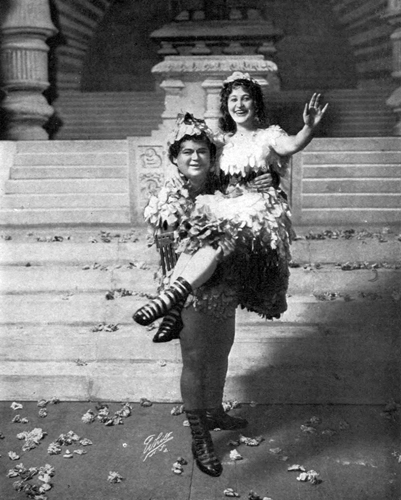
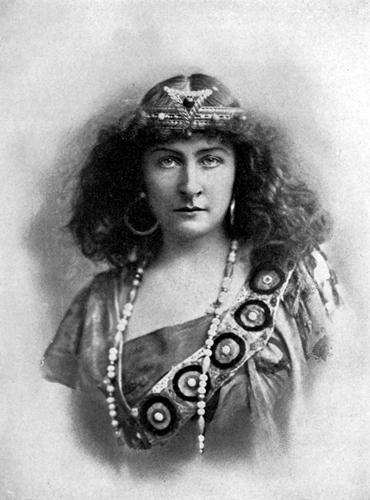
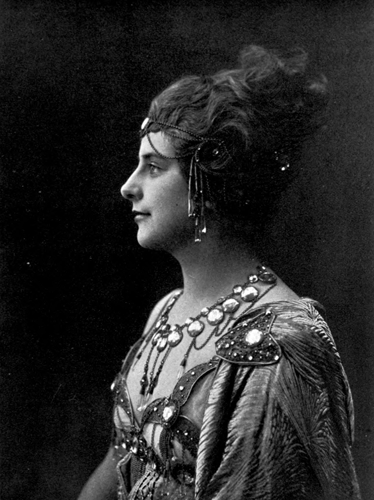
Copyright photo by Dupont
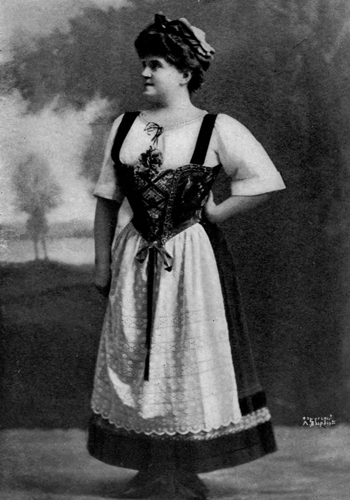
Sembrich as Zerlina in “Don Giovanni”
The scene changes to the countryside of Don Giovanni's palace near
Seville. A troop of gay peasants is seen arriving. The young and
pretty Zerlina with Masetto, her affianced, and their friends are
singing and dancing in honour of their approaching marriage. Don
Giovanni and Leporello join this gathering of light-hearted and
simple young people. Having cast covetous eyes upon Zerlina, and
having aroused her vanity and her spirit of coquetry by polished words
of gallantry, the Don orders Leporello to get rid of the jealous
Masetto by taking the entire gathering—excepting, of course,
Zerlina—to his château. Leporello grumbles, but carries out his
master's order. The latter, left alone with Zerlina, sings a duet
with her which is one of the gems, not alone of this opera, but of
opera in general: "Là ci darem la mano!" (Your hand in mine, my
dearest). Donna Elvira appears and by her denunciation of Don
Giovanni, "Ah! fuggi il traditore," makes clear to Zerlina the
character of her fascinating admirer. Donna Anna and Don Ottavio
come upon the stage and sing a quartette which begins: "Non ti fidar,
o misera, di quel ribaldo cor" (Place not thy trust, O mourning one,
in this polluted soul), at the end of which Donna Anna, as Don
Giovanni departs, recognizes in his accents the voice of her father's
assassin. Her narrative of the events of that terrible night is a
declamatory recitative "in style as bold and as tragic as the finest
recitatives of Gluck."
Don Giovanni orders preparations for the festival in his palace. He
gives his commands to Leporello in the "Champagne aria," "Finch' han
dal vino" (Wine, flow a fountain), which is almost breathless with
exuberance of anticipated revel. Then there is the ingratiating air of
Zerlina begging Masetto's forgiveness for having flirted with the
Don, "Batti, batti, o bel Masetto" (Chide me, chide me, dear
Masetto), a number of enchanting grace, followed by a brilliantly
triumphant allegro, "Pace, pace o vita mia" (Love, I see you're now
relenting).
The finale to the first act of "Don Giovanni" rightly passes for one
of the masterpieces of dramatic music. Leporello, having opened a
window to let the fresh evening air enter the palace hall, the violins
of a small orchestra within are heard in the first measures of the
graceful minuet. Leporello sees three maskers, two women and a man,
outside. In accordance with custom they are bidden to enter. Don
Giovanni does not know that they are Donna Anna, Donna Elvira,
and Don Ottavio, bent upon seeking the murderer of the Commandant
and bringing him to justice. But even had he been aware of their
purpose it probably would have made no difference, for courage this
dissolute character certainly had.
After a moment of hesitation, after having taken council together, and
repressing a movement of horror which they feel at the sight of the
man whose crimes have darkened their lives, Donna Elvira, Donna
Anna, and Don Ottavio decide to carry out their undertaking at all
cost and to whatever end. Before entering the château, they pause on
the threshold and, their souls moved by a holy fear, they address
Heaven in one of the most touching prayers written by the hand of man.
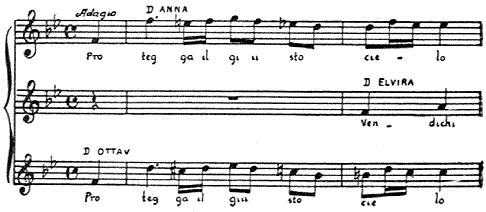
It is the number known throughout the world of music as the "Trio of
the Masks," "Protegga, il giusto cielo"—(Just Heaven, now defend
us)—one of those rare passages which, by its clearness of form, its
elegance of musical diction, and its profundity of sentiment, moves
the layman and charms the connoisseur.
The festivities begin with the familiar minuet. Its graceful rhythm is
prolonged indefinitely as a fundamental idea, while in succession,
two small orchestras on the stage, take up, one a rustic quadrille in
double time, the other a waltz. Notwithstanding the differences in
rhythm, the three dances are combined with a skill that piques the ear
and excites admiration. The scene would be even more natural and
entertaining than it usually is, if the orchestras on the stage always
followed the direction accordano (tune up) which occurs in the score
eight bars before each begins to play its dance, and if the dances
themselves were carried out according to directions. Only the ladies
and gentlemen should engage in the minuet, the peasants in the
quadrille; and before Don Giovanni leads off Zerlina into an
adjoining room he should have taken part with her in this dance, while
Leporello seeks to divert the jealous Masetto's attention by
seizing him in an apparent exuberance of spirits and insisting on
dancing the waltz with him. Masetto's suspicions, however, are not
to be allayed. He breaks away from Leporello. The latter hurries to
warn his master. But just as he has passed through the door,
Zerlina's piercing shriek for help is heard from within. Don
Giovanni rushes out, sword in hand, dragging out with him none other
than poor Leporello, whom he has opportunely seized in the entrance,
and whom, under pretence that he is the guilty party, he threatens to
kill in order to turn upon him the suspicion that rests upon himself.
But this ruse fails to deceive any one. Donna Anna, Donna Elvira,
and Don Ottavio unmask and accuse Don Giovanni of the murder of
the Commandant, "Tutto già si sà" (Everything is known and you are
recognized). Taken aback, at first, Don Giovanni soon recovers
himself. Turning, at bay, he defies the enraged crowd. A storm is
rising without. A storm sweeps over the orchestra. Thunder growls in
the basses, lightning plays on the fiddles. Don Giovanni, cool,
intrepid, cuts a passage through the crowd upon which, at the same
time, he hurls his contempt. (In a performance at the Academy of
Music, New York, about 1872, I saw Don Giovanni stand off the crowd
with a pistol.)
The second act opens with a brief duet between Don Giovanni and
Leporello. The trio which follows: "Ah! taci, ingiusto core" (Ah,
silence, heart rebellious), for Donna Elvira, Leporello, and Don
Giovanni, is an exquisite passage. Donna Elvira, leaning sadly on a
balcony, allows her melancholy regrets to wander in the pale moonlight
which envelops her figure in a semi-transparent gloom. In spite of the
scene which she has recently witnessed, in spite of wrongs she herself
has endured, she cannot hate Don Giovanni or efface his image from
her heart. Her reward is that her recreant lover in the darkness
below, changes costume with his servant and while Leporello,
disguised as the Don, attracts Donna Elvira into the garden, the
cavalier himself addresses to Zerlina, who has been taken under
Donna Elvira's protection, the charming serenade: "Deh! vieni alla
finestra" (Appear, love at thy window), which he accompanies on the
mandolin, or should so accompany, for usually the accompaniment is
played pizzicato by the orchestra.
As the result of complications, which I shall not attempt to follow,
Masetto, who is seeking to administer physical chastisement to Don
Giovanni, receives instead a drubbing from the latter.
Zerlina, while by no means indifferent to the attentions of the
dashing Don, is at heart faithful to Masetto and, while I fancy
she is by no means obtuse to the humorous aspect of his chastisement
by Don Giovanni, she comes trippingly out of the house and consoles
the poor fellow with the graceful measures of "Vedrai carino, se sei
buonino" (List, and I'll find love, if you are kind love).
Shortly after this episode comes Don Ottavio's famous air, the solo
number which makes the rôle worth while, "Il mio tesoro intanto" (Fly
then, my love, entreating). Upon this air praise has been exhausted.
It has been called the "pietra di paragone" of tenors—the touchstone,
the supreme test of classic song.
Retribution upon Don Giovanni is not to be too long deferred. After
the escapade of the serenade and the drubbing of Masetto, the Don,
who has made off, chances to meet in the churchyard (or in the public
square) with Leporello, who meanwhile has gotten rid of Donna
Elvira. It is about two in the morning. They see the newly erected
statue to the murdered Commandant. Don Giovanni bids it, through
Leporello, to supper with him in his palace. Will it accept? The
statue answers, "Yea!" Leporello is terrified. And Don Giovanni?
"In truth the scene is bizarre. The old boy comes to supper. Now
hasten and bestir yourself to spread a royal feast."
Such is the sole reflection that the fateful miracle, to which he has
just been a witness, draws from this miscreant, who, whatever else he
may be, is brave.
Back in his palace, Don Giovanni seats himself at table and sings of
the pleasures of life. An orchestra on the stage plays airs from
Vincente Martino's "Una Cosa Rara" (A Rare Thing); Sarti's "Fra Due
Litiganti" (Between Two Litigants), and Mozart's own "Nozze di
Figaro," Leporello announcing the selections. The "Figaro" air is
"Non più andrai" (Play no more, boy, the part of a lover).
Donna Elvira enters. On her knees she begs the man who has betrayed
her to mend his ways. Her plea falls on deaf ears. She leaves. Her
shriek is heard from the corridor. She re-enters and flees the palace
by another door.
"Va a veder che cos'è stato" (Go, and see what it is) Don Giovanni
commands Leporello.
The latter returns trembling with fright. He has seen in the corridor
"l'uom di sasso, l'uomo bianco"—the man of stone, the big white man.
Seizing a candle, drawing his sword, Don Giovanni boldly goes into
the corridor. A few moments later he backs into the room, receding
before the statue of the Commandant. The lights go out. All is dark
save for the flame of the candle in Don Giovanni's hand. Slowly,
with heavy footsteps that re-echo, the statue enters. It speaks.
"Don Giovanni, you have invited me to sit at table with you. Lo! I am
here."
Well knowing the fate in store for him, yet, with unebbing courage,
Don Giovanni nonchalantly commands Leporello to serve supper.
"Desist!" exclaims the statue. "He who has sat at a heavenly banquet,
does not break the bread of mortals.... Don Giovanni, will you come to
sup with me?"
"I will," fearlessly answers the Don.
"Give me your hand in gage thereof."
"Here it is."
Don Giovanni extends his hand. The statue's huge hand of stone
closes upon it.
"Huh! what an icy grasp!"—"Repent! Change your course at your last
hour."—"No, far from me such a thought."—"Repent, O
miscreant!"—"No, you old fool."—"Repent!"—"No!"
Nothing daunts him. A fiery pit opens. Demons seize him—unrepentant
to the end—and drag him down.
The music of the scene is gripping, yet accomplished without an
addition to the ordinary orchestra of Mozart's day, without straining
after effect, without any means save those commonly to his hand.
Copyright photo by Dupont
Scotti as Don Giovanni
In the modern opera house the final curtain falls upon this scene.
In the work, however, there is another scene in which the other
characters moralize upon Don Giovanni's end. There is one
accusation, however, none can urge against him. He was not a coward.
Therein lies the appeal of the character. His is a brilliant,
impetuous figure, with a dash of philosophy, which is that, sometime,
somewhere, in the course of his amours, he will discover the perfect
woman from whose lips he will be able to draw the sweetness of all
women. Moreover he is a villain with a keen sense of humour.
Inexcusable in real life, he is a debonair, fascinating figure on the
stage, whereas Donna Anna, Donna Elvira, and Don Ottavio are
mere hinges in the drama and as creations purely musical. Zerlina,
on the other hand, is one of Mozart's most delectable characters.
Leporello, too, is clearly drawn, dramatically and musically; a
coward, yet loyal to the master who appeals to a strain of the
humorous in him and whose courage he admires.
For the Vienna production Mozart wrote three new vocal numbers, which
are printed in the score as additions. Caterina Cavalieri, the
Elvira, had complained to Mozart, that the Viennese public did not
appreciate her as did audiences of other cities and begged him for
something that would give her voice full scope. The result was the
fine aria: "Mi tradì quell'alma ingrata." The Ottavio, Signor
Morello, was considered unequal to "Il mio tesoro," so Mozart wrote
the less exacting "Dalla sua pace," for him. To amuse the public he
inserted a comic duet, "Per queste tue manine," for Zerlina and
Leporello. This usually is omitted. The other two inserts were
interpolated in the second act of the opera before the finale. In the
Metropolitan Opera House version, however, Donna Elvira sings "Mi
tradì" to express her rage after the "Madamina" of Leporello; and Don
Ottavio sings "Dalla sua pace" before the scene in Don Giovanni's
château.
The first performance of "Don Giovanni" in America took place in the
Park Theatre, New York, on Tuesday evening, May 23, 1826. I have
verified the date in the file of the New York Evening Post. "This
evening for the first time in America, the semi-serious opera of 'Il
Don Giovanni,'" reads the advertisement of that date. Then follows the
cast. Manuel Garcia played the title rôle; Manuel Garcia, Jr.,
afterwards inventor of the laryngoscope, who reached the age of 101,
dying in London in 1906, was Leporello; Mme. Barbieri, Donna Anna;
Mme. Garcia, Donna Elvira; Signorina Maria Garcia (afterwards famous
under her married name of Malibran), Zerlina; Milon, whom Mr.
Krehbiel identifies as a violoncellist later with the Philharmonic
Society, Don Ottavio; and Carlo Angrisani, Masetto, a rôle he had
sung at the first London performance of the work.
Da Ponte, the librettist of the work, who had become Professor of
Italian at Columbia College, had induced Garcia to put on the opera.
At the first performance during the finale of the first act everything
went at sixes and sevens, in spite of the efforts of Garcia, in the
title rôle, to keep things together. Finally, sword in hand, he
stepped to the front of the stage, ordered the performance stopped,
and, exhorting the singers not to commit the crime of ruining a
masterwork, started the finale over again, which now went all right.
It is related by da Ponte that "my 'Don Giovanni,'" as he called it,
made such a success that a friend of his who always fell asleep at
operatic performances, not only remained awake during the whole of
"Don Giovanni," but told him he couldn't sleep a wink the rest of the
night for excitement.
Pauline Viardot-Garcia, sister of Signorina Garcia (afterwards Mme.
Malibran), the Zerlina of the first New York performance, owned the
original autograph score of "Don Giovanni." She bequeathed it to the
Paris Conservatoire.
The opera has engaged the services of famous artists. Faure and Maurel
were great Don Giovannis, Jean de Reszke sang the rôle, while he was
still a baritone; Scotti made his début at the Metropolitan Opera
House, December 27, 1899, in the rôle, with Nordica as Donna Anna,
Suzanne Adams, as Donna Elvira, Sembrich as Zerlina, and Édouard
de Reszke as Leporello. Renaud appeared as Don Giovanni at the
Manhattan Opera House. Lablache was accounted the greatest of
Leporellos. The rôle of Don Ottavio has been sung by Rubini and
Mario. At the Mozart Festival, Salzburg, 1914, the opera was given
with Lilli Lehmann, Farrar, and McCormack in the cast.
A curious aside in the history of the work was an "adaptation,"
produced by Kalkbrenner in Paris, 1805. How greatly this differed from
the original may be judged from the fact that the trio of the masks
was sung, not by Donna Anna, Donna Elvira, and Don Ottavio, but
by three policemen!
Opera in two acts by Mozart; words by Emanuel Schikaneder
and Gieseke. Produced, September 30, 1791, in Vienna, in the
Theatre auf der Wieden; Paris, 1801, as "Les Mystères
d'Isis"; London, King's Theatre, June 6, 1811 (Italian);
Covent Garden, May 27, 1833 (German); Drury Lane, March 10,
1838 (English); New York, Park Theatre, April 17, 1833
(English). The rôle of Astrofiammante, Queen of the Night,
has been sung here by Carlotta Patti, Ilma di Murska,
Gerster, Sembrich, and Hempel.
Characters
Sarastro, High Priest of Isis
Bass
Tamino, an Egyptian Prince
Tenor
Papageno, a bird-catcher
Baritone
Astrofiammante, Queen of the Night
Soprano
Pamina, her daughter
Soprano
Monostatos, a Moor, chief slave of the Temple
Baritone
Papagena
Soprano
Three Ladies-in-Waiting to the Queen; Three Youths of the
Temple; Priests, Priestesses, Slaves, etc.
Time—Egypt, about the reign of Rameses I.
Place—Near and at the Temple of Isis, Memphis.
Photo by White
Alten and Goritz as Papagena and Papageno in “The Magic Flute”
The libretto to "The Magic Flute" is considered such a jumble of
nonsense that it is as well to endeavour to extract some sense from
it.
Emanuel Johann Schikaneder, who wrote it with the aid of a chorister
named Gieseke, was a friend of Mozart and a member of the same Masonic
Lodge. He also was the manager of a theatrical company and had
persuaded Mozart to compose the music to a puppet show for him. He had
selected for this show the story of "Lulu" by Liebeskind, which had
appeared in a volume of Oriental tales brought out by Wieland under
the title of "Dschinnistan." In the original tale a wicked sorcerer
has stolen the daughter of the Queen of Night, who is restored by a
Prince by means of magic. While Schikaneder was busy on his libretto,
a fairy story by Perinet, music by Wenzel Müller, and treating of the
same subject, was given at another Viennese theatre. Its great success
interfered with Schikaneder's original plan.
At that time, however, freemasonry was a much discussed subject. It
had been interdicted by Maria Theresa and armed forces were employed
to break up the lodges. As a practical man Schikaneder saw his chance
to exploit the interdicted rites on the stage. Out of the wicked
sorcerer he made Sarastro, the sage priest of Isis. The ordeals of
Tamino and Pamina became copies of the ceremonials of freemasonry.
He also laid the scene of the opera in Egypt, where freemasonry
believes its rites to have originated. In addition to all this
Mozart's beautiful music ennobled the libretto even in its dull and
unpoetical passages, and lent to the whole a touch of the mysterious
and sacred. "The muse of Mozart lightly bears her century of
existence," writes a French authority, of this score.
Because of its supposed relation to freemasonry, commentators have
identified the vengeful Queen of the Night with Maria Theresa, and
Tamino with the Emperor. Pamina, Papageno, and Papagena are
set down as types of the people, and Monostatos as the fugleman of
monasticism.
Mozart wrote on "The Magic Flute" from March until July and in
September, 1791. September 30, two months before his death, the first
performance was given.
In the overture to "The Magic Flute" the heavy reiterated chords
represent, it has been suggested, the knocking at the door of the
lodge room, especially as they are heard again in the temple scene,
when the novitiate of Tamino is about to begin. The brilliancy of
the fugued allegro often has been commented on as well as the
resemblance of its theme to that of Clementi's sonata in B-flat.
The story of "The Magic Flute" opens Act I, with Tamino endeavouring
to escape from a huge snake. He trips in running and falls
unconscious. Hearing his cries for help, three black-garbed
Ladies-in-Waiting of the Queen of the Night appear and kill the
snake with their spears. Quite unwillingly they leave the handsome
youth, who, on recovering consciousness, sees dancing toward him an
odd-looking man entirely covered with feathers. It is Papageno, a
bird-catcher. He tells the astonished Tamino that this is the realm
of the Queen of the Night. Nor, seeing that the snake is dead, does
he hesitate to boast that it was he who killed the monster. For this
lie he is immediately punished. The three Ladies-in-Waiting reappear
and place a padlock on his mouth. Then they show Tamino the
miniature of a maiden, whose magical beauty at once fills his heart
with ardent love. Enter the Queen of the Night. She tells Tamino
the portrait is that of her daughter, Pamina, who has been taken
from her by a wicked sorcerer, Sarastro. She has chosen Tamino to
deliver the maiden and as a reward he will receive her hand in
marriage. The Queen then disappears and the three
Ladies-in-Waiting come back. They take the padlock from Papageno's
mouth, give him a set of chimes and Tamino a golden flute. By the
aid of these magical instruments they will be able to escape the
perils of their journey, on which they will be accompanied by three
youths or genii.
Change of scene. A richly furnished apartment in Sarastro's palace
is disclosed. A brutal Moor, Monostatos, is pursuing Pamina with
unwelcome attentions. The appearance of Papageno puts him to flight.
The bird-catcher recognizes Pamina as the daughter of the Queen of
the Night, and assures her that she will soon be rescued. In the
meantime the Three Youths guide Tamino to a grove where three
temples stand. He is driven away from the doors of two, but at the
third there appears a priest who informs him that Sarastro is no
tyrant, no wicked sorcerer as the Queen had warned him, but a man of
wisdom and of noble character.
The sound of Papageno's voice arouses Tamino from the meditations
inspired by the words of the priest. He hastens forth and seeks to
call his companion by playing on his flute. Papageno is not alone.
He is trying to escape with Pamina, but is prevented by the
appearance of Monostatos and some slaves, who endeavour to seize
them. But Papageno sets the Moor and his slaves dancing by playing
on his magic chimes.
Trumpet blasts announce the coming of Sarastro. Pamina falls at
the feet of the High Priest and explains that she was trying to escape
the unwelcome attentions of the Moor. The latter now drags Tamino
in, but instead of the reward he expects, receives a sound flogging.
By the command of Sarastro, Tamino and Pamina are brought into
the Temple of Ordeals, where they must prove that they are worthy of
the higher happiness.
Act II. In the Palm Grove. Sarastro informs the priests of the plans
which he has laid. The gods have decided that Pamina shall become
the wife of the noble youth Tamino. Tamino, however, must prove,
by his own power, that he is worthy of admission to the Temple.
Therefore Sarastro has taken under his protection Pamina, daughter
of the Queen of the Night, to whom is due all darkness and
superstition. But the couple must go through severe ordeals in order
to be worthy of entering the Temple of Light, and thus of thwarting
the sinister machinations of the Queen.
In the succeeding scenes we see these fabulous ordeals, which
Tamino, with the assistance of his magic flute and his own purity of
purpose, finally overcomes in company with Pamina. Darkness is
banished and the young couple enter into the light of the Temple of
the Sun. Papageno also fares well, for he receives Papagena for
wife.
There is much nonsense and even buffoonery in "The Magic Flute"; and,
in spite of real nobility in the rôle and music of Sarastro, Mr.
Krehbiel's comment that the piece should be regarded as somewhat in
the same category as a Christmas pantomime is by no means far-fetched.
It lends itself to elaborate production, and spectacular performances
of it have been given at the Metropolitan Opera House.
Its representation requires for the rôle of Astrofiammante, Queen of
the Night, a soprano of extraordinarily high range and agility of
voice, as each of the two great airs of this vengeful lady extend to
high F and are so brilliant in style that one associates with them
almost anything but the dire outpouring of threats their text is
intended to convey. They were composed because Mozart's
sister-in-law, Josepha Weber (Mme. Hofer) was in the cast of the first
performance and her voice was such as has been described above. The
Queen has an air in Act I and another in Act II. A quotation from
the second, the so-called "Vengeance aria," will show the range and
brilliancy of voice required of a singer in the rôle of
Astrofiammante.
One is surprised to learn that this tour de force of brilliant
vocalization is set to words beginning: "Vengeance of hell is boiling
in my bosom"; for by no means does it boil with a vengeance.
Papageno in his dress of feathers is an amusing character. His first
song, "A fowler bold in me you see," with interludes on his pipes, is
jovial; and after his mouth has been padlocked his inarticulate and
oft-repeated "Hm!" can always be made provocative of laughter. With
Pamina he has a charming duet "The manly heart that love desires."
The chimes with which he causes Monostatos and his slaves to dance,
willy-nilly, are delightful and so is his duet with Papagena, near
the end of the opera. Tamino, with the magic flute, charms the wild
beasts. They come forth from their lairs and lie at his feet. "Thy
magic tones shall speak for me," is his principal air. The concerted
number for Pamina and trio of female voices (the Three Youths or
genii) is of exceeding grace. The two Men in Armour, who in one of
the scenes of the ordeals guard the portal to a subterranean cavern
and announce to Tamino the awards that await him, do so to the vocal
strains of an old German sacred melody with much admired counterpoint
in the orchestra.
Next, however, in significance to the music for Astrofiammante and,
indeed, of far nobler character than the airs for the Queen of the
Night, are the invocation of Isis by Sarastro, "O, Isis and
Osiris," with its interluding chant of the priests, and his air,
"Within this hallowed dwelling." Not only the solemnity of the vocal
score but the beauty of the orchestral accompaniment, so rich, yet so
restrained, justly cause these two numbers to rank with Mozart's
finest achievements.
"Die Zauberflöte" (The Magic Flute) was its composer's swan-song in
opera and perhaps his greatest popular success. Yet he is said to have
made little or nothing out of it, having reserved as his compensation
the right to dispose of copies of the score to other theatres. Copies,
however, were procured surreptitiously; his last illness set in; and,
poor business man that he was, others reaped the rewards of his
genius.
In 1801, ten years after Mozart's death, there was produced in Paris
an extraordinary version of "The Magic Flute," entitled "Les Mystères
d'Isis" (The Mysteries of Isis). Underlying this was a considerable
portion of "The Magic Flute" score, but also introduced in it were
fragments from other works of the composer ("Don Giovanni," "Figaro,"
"Clemenza di Tito") and even bits from Haydn symphonies. Yet this
hodge-podge not only had great success—owing to the magic of Mozart's
music—it actually was revived more than a quarter of a century later,
and the real "Zauberflöte" was not given in Paris until 1829.
Besides the operas discussed, Mozart produced (1781) "Idomeneo" and
(1791) "La Clemenza di Tito." In 1768, when he was twelve years old, a
one-act "Singspiel" or musical comedy, "Bastien and Bastienne," based
on a French vaudeville by Mme. Favart, was privately played in Vienna.
With text rearranged by Max Kalbeck, the graceful little piece has
been revived with success. The story is of the simplest. Two lovers,
Bastien (tenor) and Bastienne (soprano), have quarrelled. Without
the slightest complication in the plot, they are brought together by
the third character, an old shepherd named Colas (bass). "Der
Schauspieldirektor" (The Impresario), another little comedy opera,
produced 1786, introduces that clever rogue, Schikaneder, at whose
entreaty "The Magic Flute" was composed. The other characters include
Mozart himself, and Mme. Hofer, his sister-in-law, who was the Queen
of the Night in the original cast of "The Magic Flute." The story
deals with the troubles of an impresario due to the jealousy of prima
donnas. "Before they are engaged, opera singers are very engaging,
except when they are engaged in singing." This line is from H.E.
Krehbiel's translation of the libretto, produced, with "Bastien and
Bastienne" (translated by Alice Matullah, as a "lyric pastoral"), at
the Empire Theatre, New York, October 26, 1916. These charming
productions were made by the Society of American Singers with a
company including David Bispham (Schikaneder and Colas), Albert Reiss
(Mozart and Bastien), Mabel Garrison, and Lucy Gates; the direction
that of Mr. Reiss.
There remain to be mentioned two other operatic comedies by Mozart:
"The Elopement from the Serail" (Belmonte und Constanze), 1782, in
three acts; and "Così fan Tutte" (They All Do It), 1790, in two. The
music of "Così fan Tutte" is so sparkling that various attempts have
been made to relieve it of the handicap imposed by the banality of the
original libretto by da Ponte. Herman Levi's version has proven the
most successful of the various rearrangements. The characters are two
Andalusian sisters, Fiordiligi (soprano), Dorabella (soprano); two
officers, their fiancés, Ferrando (tenor), and Guglielmo
(baritone); Alfonso (bass); and Despina (soprano), maid to the two
sisters.
Alfonso lays a wager with the officers that, like all women, their
fiancées will prove unfaithful, if opportunity were offered. The men
pretend their regiment has been ordered to Havana, then return in
disguise and lay siege to the young ladies. In various ways, including
a threat of suicide, the women's sympathies are played upon. In the
original they are moved to pledge their hearts and hands to the
supposed new-comers. A reconciliation follows their simple
pronouncement that "they all do it."
In the revised version, they become cognizant of the intrigue, play
their parts in it knowingly, at the right moment disclose their
knowledge, shame their lovers, and forgive them. An actual wager laid
in Vienna is said to have furnished the basis for da Ponte's
libretto.
Ludwig van Beethoven — FIDELIO
"Fidelio," opera in two acts, by Ludwig van Beethoven.
Produced in three acts, as "Fidelio, oder, die eheliche
Liebe" (Fidelio, or Conjugal Love), at the
Theatre on the Wien,
November 20, 1805. Revised and given at the Imperial Private
Theatre, March 29, 1806, but withdrawn after a few
performances. Again revised and successfully brought out May
23, 1814, at the Kärnthnerthor Theatre (Theatre at the
Carinthian Gate), Vienna. Paris, Théâtre Lyrique, May 5,
1860. London, King's Theatre, May 18, 1832; Covent Garden,
June 12, 1835, with Malibran; May 20, 1851, in Italian, with
recitatives by Balfe. New York, Park Theatre, September 9,
1839. (See last paragraph of this article.) The libretto was
by Sonnleithner after Bouilly; first revision by Breuning;
second by Treitschke. Four overtures, "Leonore," Nos. 1, 2,
and 3; and "Fidelio."
Characters
Florestan, a Spanish Nobleman
Tenor
Leonore, his wife, in male attire as Fidelio
Soprano
Don Fernando, Prime Minister of Spain
Bass
Pizarro, Governor of the prison and enemy to Florestan
Bass
Rocco, chief jailer
Bass
Marcellina, daughter of Rocco
Soprano
Jacquino, assistant to Rocco
Tenor
Soldiers, prisoners, people.
Time—18th Century.
Place—A fortress, near Seville, Spain, used as a prison
for political offenders.
LUDWIG van BEETHOVEN, composer of "Fidelio," was born at Bonn,
December 16, 1770. He died at Vienna, March 26, 1827. As he composed
but this one opera, and as his fame rests chiefly on his great
achievements outside the domain of the stage—symphonies, sonatas,
etc.—it is possible, as Storck suggests in his Opernbuch, to
dispense with biographical data and confine ourselves to facts
relating to "Fidelio."
The libretto, which appealed to the composer by reason of its pure and
idealistic motive, was not written for Beethoven. It was a French book
by Bouilly and had been used by three composers: Pierre Gabeaux
(1798); Simon Mayr, Donizetti's teacher at Bergamo and the composer of
more than seventy operas (1805); and Paër, whose "Leonora, ossia
l'Amore Conjugale" (Leonora, or Conjugal Love) was brought out at
Dresden in December, 1804.
It was Schikaneder, the librettist and producer of Mozart's "Magic
Flute," who commissioned Beethoven to compose an opera. But it was
finally executed for Baron von Braun, who had succeeded to the
management of the Theatre on the Wien.
Beethoven's heart was bound up in the work. Conscientious to the last
detail in everything he did, this noble man, inspired by a noble
theme, appears to have put even more labour into his opera than into
any other one work. There are no less than sixteen sketches for the
opening of Florestan's first air and 346 pages of sketches for the
opera. Nor did his labour in it cease when the opera was completed and
performed.
Bouilly's libretto was translated and made over for Beethoven by
Schubert's friend Joseph Sonnleithner. The opera was brought out
November 20th and repeated November 21 and 22, 1805. It was a failure.
The French were in occupation of Vienna, which the Emperor of Austria
and the court had abandoned, and conditions generally were upset. But
even Beethoven's friends did not blame the non-success of the opera
upon these untoward circumstances. It had inherent defects, as was
apparent even a century later, when at the "Fidelio" centennial
celebration in Berlin, the original version was restored and
performed.
To remedy these, Beethoven's friend, Stephan von Breuning, condensed
the three acts to two and the composer made changes in the score. This
second version was brought forward April 29, 1806, with better
success, but a quarrel with von Braun led Beethoven to withdraw it. It
seems to have required seven years for the entente cordiale between
composer and manager to become re-established. Then Baron von Braun
had the book taken in hand by a practical librettist, Georg Friedrich
Treitschke. Upon receiving the revision, which greatly pleased him,
Beethoven in his turn re-revised the score. In this form "Fidelio" was
brought out May 23, 1814, in the Theatre am Kärnthnerthor. There was
no question of failure this time. The opera took its place in the
repertoire and when, eight years later, Mme. Schröder-Devrient sang
the title rôle, her success in it was sensational.
There are four overtures to the work, three entitled "Leonore" (Nos.
1, 2, and 3) and one "Fidelio." The "Leonore" overtures are
incorrectly numbered. The No. 2 was given at the original performance
and is, therefore, No. 1. The greatest and justly the most famous, the
No. 3, is really No. 2. The so-called No. 1 was composed for a
projected performance at Prague, which never came off. The score and
parts, in a copyist's hand, but with corrections by Beethoven, were
discovered after the composer's death. When it was recognized as an
overture to the opera, the conclusion that it was the earliest one,
which he probably had laid aside, was not unnaturally arrived at. The
"Fidelio" overture was intended for the second revision, but was not
ready in time. The overture to "The Ruins of Athens" was substituted.
The overture to "Fidelio" usually is played before the opera and the
"Leonore," No. 3, between the acts.
Photo by White
Matzenauer as Fidelio
Of the "Leonore," No. 3, I think it is within bounds to say that it is
the first great overture that sums up in its thematic material and in
its general scope, construction, and working out, the story of the
opera which it precedes. Even the trumpet call is brought in with
stirring dramatic effect. It may be said that from this time on the
melodies of their operas were drawn on more and more by composers for
the thematic material of their overtures, which thus became
music-dramas in miniature. The overture "Leonore," No. 3, also is an
established work in the classical concert repertoire, as is also
Leonore's recitative and air in the first act.
In the story of the opera, Florestan, a noble Spaniard, has aroused
the enmity of Pizarro, governor of a gloomy mediæval fortress, used
as a place of confinement for political prisoners. Pizarro has been
enabled secretly to seize Florestan and cast him into the darkest
dungeon of the fortress, at the same time spreading a report of his
death. Indeed, Pizarro actually plans to do away with Florestan by
slow starvation; or, if necessary, by means more swift.
One person, however, suspects the truth—Leonore, the wife of
Florestan. Her faithfulness, the risks she takes, the danger she
runs, in order to save her husband, and the final triumph of conjugal
love over the sinister machinations of Pizarro, form the motive of
the story of "Fidelio," a title derived from the name assumed by
Leonore, when, disguised as a man, she obtains employment as
assistant to Rocco, the chief jailer of the prison. Fidelio has
been at work and has become a great favourite with Rocco, as well as
with Marcellina, the jailer's daughter. The latter, in fact, much
prefers the gentle, comely youth, Fidelio, to Jacquino, the
turnkey, who, before Fidelio's appearance upon the scene, believed
himself to be her accepted lover. Leonore cannot make her sex known
to the girl. It would ruin her plans to save her husband. Such is the
situation when the curtain rises on the first act, which is laid in
the courtyard of the prison.
Act I. The opera opens with a brisk duet between Jacquino and
Marcellina, in which he urges her definitely to accept him and she
cleverly puts him off. Left alone she expresses her regret for
Jacquino, but wishes she were united with Fidelio. ("O wär' ich
schon mit dir vereint"—O, were I but with you united.)
Afterward she is joined by her father. Then Leonore (as Fidelio)
enters the courtyard. She has a basket of provisions and also is
carrying some fetters which she has taken to be repaired.
Marcellina, seeing how weary Leonore is, hastens to relieve the
supposed youth of his burden. Rocco hints not only tolerantly but
even encouragingly at what he believes to be the fancy Fidelio and
Marcellina have taken to each other. This leads up to the quartet in
canon form, one of the notable vocal numbers of the opera, "Mir ist so
wunderbar" (How wondrous the emotion). Being a canon, the theme
enunciated by each of the four characters is the same, but if the
difference in the sentiments of each character is indicated by subtle
nuance of expression on the part of the singers, and the intonation be
correct, the beauty of this quartet becomes plain even at a first
hearing. The participants are Leonore, Marcellina, Rocco, and
Jacquino, who appears toward the close. "After this canon," say the
stage directions, so clearly is the form of the quartet recognized,
"Jacquino goes back to his lodge."
Rocco then voices a song in praise of money and the need of it for
young people about to marry. ("Wenn sich Nichts mit Nichts
verbindet"—When you nothing add to nothing.) The situation is
awkward for Leonore, but the rescue of her husband demands that she
continue to masquerade as a man. Moreover there is an excuse in the
palpable fact that before she entered Rocco's service, Jacquino
was in high favour with Marcellina and probably will have no
difficulty in re-establishing himself therein, when the comely youth
Fidelio, turns out to be Leonore, the faithful wife of
Florestan.
Through a description which Rocco gives of the prisoners, Leonore
now learns what she had not been sure of before. Her husband is
confined in this fortress and in its deepest dungeon.
A short march, with a pronounced and characteristic rhythm, announces
the approach of Pizarro. He looks over his despatches. One of them
warns him that Fernando, the Minister of State, is about to inspect
the fortress, accusations having been made to him that Pizarro has
used his power as governor to wreak vengeance upon his private
enemies. A man of quick decision, Pizarro determines to do away with
Florestan at once. His aria, "Ha! welch' ein Augenblick!" (Ah! the
great moment!) is one of the most difficult solos in the dramatic
repertoire for bass voice. When really mastered, however, it also is
one of the most effective.
Pizarro posts a trumpeter on the ramparts with a sentry to watch the
road from Seville. As soon as a state equipage with outriders is
sighted, the trumpeter is to blow a signal. Having thus made sure of
being warned of the approach of the Minister, he tosses a
well-filled purse to Rocco, and bids him "for the safety of the
State," to make away with the most dangerous of the prisoners—meaning
Florestan. Rocco declines to commit murder, but when Pizarro
takes it upon himself to do the deed, Rocco consents to dig a grave
in an old cistern in the vaults, so that all traces of the crime will
be hidden from the expected visitor.
Leonore, who has overheard the plot, now gives vent to her feelings
in the highly dramatic recitative: "Abscheulicher! wo eilst du hin!"
("Accursed one! Where hasten'st thou!"); followed by the beautiful
air, "Komm Hoffnung" (Come, hope!), a deeply moving expression of
confidence that her love and faith will enable her, with the aid of
Providence, to save her husband's life. Soon afterwards she learns
that, as Rocco's assistant, she is to help him in digging the grave.
She will be near her husband and either able to aid him or at least
die with him.
The prisoners from the upper tiers are now, on Leonore's
intercession, permitted a brief opportunity to breathe the open air.
The cells are unlocked and they are allowed to stroll in the garden of
the fortress, until Pizarro, hearing of this, angrily puts an end to
it. The chorus of the prisoners, subdued like the half-suppressed joy
of fearsome beings, is one of the significant passages of the score.
Act II. The scene is in the dungeon where Florestan is in heavy
chains. To one side is the old cistern covered with rubbish. Musically
the act opens with Florestan's recitative and air, a fit companion
piece to Leonore's "Komm Hoffnung" in Act I. The whispered duet
between Leonore and Rocco as they dig the grave and the orchestral
accompaniment impress one with the gruesome significance of the scene.
Pizarro enters the vault, exultantly makes himself known to his
enemy, and draws his dagger for the fatal thrust. Leonore throws
herself in his way. Pushed aside, she again interposes herself between
the would-be murderer and his victim, and, pointing at him a loaded
pistol, which she has had concealed about her person, cries out:
"First slay his wife!"
At this moment, in itself so tense, a trumpet call rings out from the
direction of the fortress wall. Jacquino appears at the head of the
stone stairway leading down into the dungeon. The Minister of State
is at hand. His vanguard is at the gate. Florestan is saved. There
is a rapturous duet, "O, namenlose Freude" (Joy inexpressible) for him
and the devoted wife to whom he owes his life.
In Florestan the Minister of State recognizes his friend, whom he
believed to have died, according to the reports set afloat by
Pizarro, who himself is now apprehended. To Leonore is assigned
the joyful task of unlocking and loosening her husband's fetters and
freeing him from his chains. A chorus of rejoicing: "Wer ein solches
Weib errungen" (He, whom such a wife has cherished) brings the opera
to a close.
It is well said in George P. Upton's book, The Standard Operas, that
"as a drama and as an opera, 'Fidelio' stands almost alone in its
perfect purity, in the moral grandeur of its subject, and in the
resplendent ideality of its music." Even those who do not appreciate
the beauty of such a work, and, unfortunately their number is
considerable, cannot fail to agree with me that the trumpet call,
which brings the prison scene to a climax, is one of the most dramatic
moments in opera. I was a boy when, more than forty years ago, I first
heard "Fidelio" in Wiesbaden. But I still remember the thrill, when
that trumpet call split the air with the message that the Minister of
State was in sight and that Leonore had saved her husband.
[
When "Fidelio" had its first American performance (New York, Park
Theatre, September 9, 1839) the opera did not fill the entire evening.
The entertainment, as a whole, was a curiosity from present-day
standards. First came Beethoven's opera, with Mrs. Martyn as
Leonore. Then a pas seul was danced by Mme. Araline; the whole
concluding with "The Deep, Deep Sea," in which Mr. Placide appeared as
The Great American Sea Serpent. This seems incredible. But I have
searched for and found the advertisement in the New York Evening
Post, and the facts are stated.
Under Dr. Leopold Damrosch, "Fidelio" was performed at the
Metropolitan Opera House in the season of 1884-85; under Anton Seidl,
during the season of 1886-87, with Brandt and Niemann as well as with
Lehmann and Niemann as Leonore and Florestan.
The 1886-87 representations of "Fidelio," by great artists under a
great conductor, are among the most vivid memories of opera-goers so
fortunate as to have heard them.
Weber and his Operas — DER FREISCHÜTZ — EURYANTHE — OBERON, OR THE ELF-KING’S OATH
CARL MARIA von WEBER, born at Eutin, Oldenberg, December 18, 1786,
died in London, June 5, 1826, is the composer of "Der Freischütz;"
"Euryanthe," and "Oberon."
"Der Freischütz" was first heard in Berlin, June 18, 1821. "Euryanthe"
was produced in Vienna, October 25, 1823. "Oberon" had its first
performance at Covent Garden, London, April 12, 1826. Eight weeks
later Weber died. A sufferer from consumption, his malady was
aggravated by over-exertion in finishing the score of "Oberon,"
rehearsing and conducting the opera, and attending the social
functions arranged in his honour.
The first American performance of this opera, which is in
three acts, was in English. The event took place in the Park
Theatre, New York, March 2, 1825. This was only four years
later than the production in Berlin. It was not heard here
in German until a performance at the old Broadway Theatre.
This occurred in 1856 under the direction of Carl Bergmann.
London heard it, in English, July 23, 1824; in German, at
the King's Theatre, May 9, 1832; in Italian, as "Il Franco
Arciero," at Covent Garden, March 16, 1825. For this
performance Costa wrote recitatives to replace the dialogue.
Berlioz did the same for the production at the Grand Opéra,
Paris, as "Le Franc Archer," June 7, 1841. "Freischütz"
means "free-shooter"—someone who shoots with magic bullets.
Characters
Prince Ottokar
Baritone
Cuno, head ranger
Bass
Max, a forester
Tenor
Kaspar, a forester
Bass
Kilian, a peasant
Tenor
A Hermit
Bass
Zamiel, the wild huntsman
Speaking Part
Agathe, Cuno's daughter
Soprano
Aennchen (Annette), her cousin
Soprano
Time—Middle of 18th Century.
Place—Bohemia.
Act I. At the target range. Kilian, the peasant, has defeated Max,
the forester, at a prize shooting, a Schützenfest, maybe. Max, of
course, should have won. Being a forester, accustomed to the use of
fire-arms, it is disgraceful for him to have been defeated by a mere
peasant.
Kilian "rubs it in" by mocking him in song and the men and girls of
the village join in the mocking chorus—a clever bit of teasing in
music and establishing at the very start the originality in melody,
style, and character of the opera.
The hereditary forester, Cuno, is worried over the poor showing
Max has made not only on that day, but for some time past. There is
to be a "shoot" on the morrow before Prince Ottokar. In order to win
the hand in marriage of Agathe, Cuno's daughter, and the eventual
succession as hereditary forester, Max must carry off the honours in
the competition now so near at hand. He himself is in despair. Life
will be worthless to him without Agathe. Yet he seems to have lost
all his cunning as a shot.
It is now, when the others have gone, that another forester, Kaspar,
a man of dark visage and of morose and forbidding character,
approaches him. He hands him his gun, points to an eagle circling far
on high, and tells him to fire at it. Max shoots. From its dizzy
height the bird falls dead at his feet. It is a wonderful shot.
Kaspar explains to him that he has shot with a "free," or charmed
bullet; that such bullets always hit what the marksman wills them to;
and that if Max will meet him in the Wolf's Glen at midnight, they
will mould bullets with one of which, on the morrow, he easily can win
Agathe's hand and the hereditary office of forester. Max, to whom
victory means all that is dear to him, consents.
Act II. Agathe's room in the head ranger's house. The girl has
gloomy forebodings. Even her sprightly relative, Aennchen, is unable
to cheer her up. At last Max, whom she has been awaiting, comes.
Very soon, however, he says he is obliged to leave, because he has
shot a deer in the Wolf's Glen and must go after it. In vain the girls
warn him against the locality, which is said to be haunted.
The scene changes to the Wolf's Glen, the haunt of Zamiel the wild
huntsman (otherwise the devil) to whom Kaspar has sold himself, and
to whom now he plans to turn over Max as a victim, in order to gain
for himself a brief respite on earth, his time to Zamiel being up.
The younger forester joins him in the Wolf's Glen and together they
mould seven magic bullets, six of which go true to the mark. The
seventh goes whither Zamiel wills it.
Act III. The first scene again plays in the forester's house. Agathe
still is filled with forebodings. She is attired for the test shooting
which also will make her Max's bride, if he is successful. Faith
dispels her gloom. The bridesmaids enter and wind the bridal garland.
The time arrives for the test shooting. But only the seventh bullet,
the one which Zamiel speeds whither he wishes, remains to Max. His
others he has used up on the hunt in order to show off before the
Prince. Kaspar climbs a tree to watch the proceedings from a safe
place of concealment. He expects Max to be Zamiel's victim. Before
the whole village and the Prince the test shot is to be made. The
Prince points to a flying dove. At that moment Agathe appears
accompanied by a Hermit, a holy man. She calls out to Max not to
shoot, that she is the dove. But Max already has pulled the trigger.
The shot resounds. Agathe falls—but only in a swoon. It is Kaspar
who tumbles from the tree and rolls, fatally wounded, on the turf.
Zamiel has had no power over Max, for the young forester had not
come to the Wolf's Glen of his own free will, but only after being
tempted by Kaspar. Therefore Kaspar himself had to be the victim
of the seventh bullet. Upon the Hermit's intercession, Max, who
has confessed everything, is forgiven by Prince Ottokar, the test
shot is abolished and a year's probation substituted for it.
Many people are familiar with music from "Der Freischütz" without
being aware that it is from that opera. Several melodies from it have
been adapted as hymn tunes, and are often sung in church. In Act I,
are Kilian's song and the chorus in which the men and women, young
and old, rally Max upon his bad luck. There is an expressive trio
for Max, Kaspar, and Cuno, with chorus "O diese Sonne!" (O
fateful morrow.) There is a short waltz. Max's solo, "Durch die
Wälder, durch die Auen" (Through the forest and o'er the meadows) is a
melody of great beauty, and this also can be said of his other solo in
the same scene, "Jetzt ist wohl ihr Fenster offen" (Now mayhap her
window opens), while the scene comes to a close with gloomy,
despairing accents, as Zamiel, unseen of course by Max, hovers, a
threatening shadow, in the background. There follows Kaspar's
drinking song, forced in its hilariousness and ending in grotesque
laughter, Kaspar being the familiar of Zamiel, the wild huntsman.
His air ("Triumph! Triumph! Vengeance will succeed") is wholly in
keeping with his sinister character.
Act II opens with a delightful duet for Agathe and Aennchen and a
charmingly coquettish little air for the latter (Comes a comely youth
a-wooing). Then comes Agathe's principal scene. She opens the window
and, as the moonlight floods the room, intones the prayer so simple,
so exquisite, so expressive: "Leise, leise, fromme Weise" (Softly
sighing, day is dying).
This is followed, after a recitative, by a rapturous,
descending passage leading into an ecstatic melody:
"Alle meine Pulse schlagen" (All my pulses now are beating) as she
sees her lover approaching.
The music of the Wolf's Glen scene long has been considered the most
expressive rendering of the gruesome that is to be found in a musical
score. The stage apparatus that goes with it is such that it makes the
young sit up and take notice, while their elders, because of its
naïveté, are entertained. The ghost of Max's mother appears to him
and strives to warn him away. Cadaverous, spooky-looking animals crawl
out from caves in the rocks and spit flames and sparks. Wagner got
more than one hint from the scene. But in the crucible of his genius
the glen became the lofty Valkyr rock, and the backdrop with the wild
hunt the superb "Ride of the Valkyries," while other details are
transfigured in that sublime episode, "The Magic Fire Scene."
After a brief introduction, with suggestions of the hunting chorus
later in the action, the third act opens with Agathe's lovely
cavatina, "And though a cloud the sun obscure." There are a couple of
solos for Aennchen, and then comes the enchanting chorus of
bridesmaids. This is the piece which Richard Wagner, then seven years
old, was playing in a room, adjoining which his stepfather, Ludwig
Geyer, lay in his last illness. Geyer had shown much interest in the
boy and in what might become of him. As he listened to him playing the
bridesmaids' chorus from "Der Freischütz" he turned to his wife,
Wagner's mother, and said: "What if he should have a talent for
music?"
In the next scene are the spirited hunting chorus and the brilliant
finale, in which recurs the jubilant melody from Agathe's second act
scene.
The overture to "Der Freischütz" is the first in which an operatic
composer unreservedly has made use of melodies from the opera itself.
Beethoven, in the third "Leonore" overture, utilizes the theme of
Florestan's air and the trumpet call. Weber has used not merely
thematic material but complete melodies. Following the beautiful
passage for horns at the beginning of the overture (a passage which,
like Agathe's prayer, has been taken up into the Protestant hymnal)
is the music of Max's outcry when, in the opera, he senses rather
than sees the passage of Zamiel across the stage, after which comes
the sombre music of Max's air: "Hatt denn der Himmel mich
verlassen?" (Am I then by heaven forsaken?). This leads up to the
music of Agathe's outburst of joy when she sees her lover
approaching; and this is given complete.
The structure of this overture is much like that of the overture to
"Tannhäuser" by Richard Wagner. There also is a resemblance in contour
between the music of Agathe's jubilation and that of Tannhäuser's
hymn to Venus. Wagner worshipped Weber. Without a suggestion of
plagiarism, the contour of Wagner's melodic idiom is that of Weber's.
The resemblance to Weber in the general structure of the finales to
the first acts of "Tannhäuser" and "Lohengrin" is obvious. Even in
some of the leading motives of the Wagner music-dramas, the student
will find the melodic contour of Weber still persisting. What could be
more in the spirit of Weber than the ringing Parsifal motive, one of
the last things from the pen of Richard Wagner?
Indeed the importance of Weber in the logical development of music and
specifically of opera, lies in the fact that he is the founder of the
romantic school in music;—a school of which Wagner is the
culmination. Weber is as truly the forerunner of Wagner as Haydn is of
Mozart, and Mozart of Beethoven. From the "Freischütz" Wagner derived
his early predilection for legendary subjects, as witness the "Flying
Dutchman," "Tannhäuser," and "Lohengrin," from which it was but a step
to the mythological subject of the "Ring" dramas.
"Der Freischütz" is heard far too rarely in this country. But Weber's
importance as the founder of the romantic school and as the inspired
forerunner of Wagner long has been recognized. Without this
recognition there would be missing an important link in the evolution
of music and, specifically, of opera.
Opera in three acts by Weber. Book, by Helmine von Chezy,
adapted from "L'Histoire de Gérard de Nevers et de la belle
et vertueuse Euryanthe, sa mie." Produced, Vienna,
Kärnthnerthor Theatre (Theatre at the Carinthian Gate),
October 25, 1823. New York, by Carl Anschütz, at Wallack's
Theatre, Broadway and Broome Street, 1863; Metropolitan
Opera House, December 23, 1887, with Lehmann, Brandt,
Alvary, and Fischer, Anton Seidl conducting.
Characters
Euryanthe de Savoie
Soprano
Eglantine de Puiset
Mezzo-Soprano
Lysiart de Forêt
Baritone
Adolar de Nevers
Tenor
Louis VI
Bass
Time—Beginning of the Twelfth Century.
Place—France.
Act I. Palace of the King. Count Adolar chants the beauty and virtue
of his betrothed, Euryanthe. Count Lysiart sneers and boasts that
he can lead her astray. The two noblemen stake their possessions upon
the result.
Garden of the Palace of Nevers. Euryanthe sings of her longing for
Adolar. Eglantine, the daughter of a rebellious subject who, made
a prisoner, has, on Euryanthe's plea, been allowed the freedom of
the domain, is in love with Adolar. She has sensed that Euryanthe
and her lover guard a secret. Hoping to estrange Adolar from her,
she seeks to gain Euryanthe's confidence and only too successfully.
For Euryanthe confides to her that Adolar's dead sister, who lies
in the lonely tomb in the garden, has appeared to Adolar and herself
and confessed that, her lover having been slain in battle, she has
killed herself by drinking poison from her ring; nor can her soul find
rest until someone, innocently accused, shall wet the ring with tears.
To hold this secret inviolate has been imposed upon Euryanthe by
Adolar as a sacred duty. Too late she repents of having communicated
it to Eglantine who, on her part, is filled with malicious glee.
Lysiart arrives to conduct Adolar's betrothed to the royal palace.
Act II. Lysiart despairs of accomplishing his fell purpose when
Eglantine emerges from the tomb with the ring and reveals to him its
secret. In the royal palace, before a brilliant assembly, Lysiart
claims to have won his wager, and, in proof, produces the ring, the
secret of which he claims Euryanthe has communicated to him. She
protests her innocence, but in vain. Adolar renounces his rank and
estates with which Lysiart is forthwith invested and endowed, and,
dragging Euryanthe after him, rushes into the forest where he
intends to kill her and then himself.
Act III. In a rocky mountain gorge Adolar draws his sword and is
about to slay Euryanthe, who in vain protests her innocence. At that
moment a huge serpent appears. Euryanthe throws herself between it
and Adolar in order to save him. He fights the serpent and kills it;
then, although Euryanthe vows she would rather he slew her than not
love her, he goes his way leaving her to heaven's protection. She is
discovered by the King, who credits her story and promises to
vindicate her, when she tells him that it was through Eglantine, to
whom she disclosed the secret of the tomb, that Lysiart obtained
possession of the ring.
Gardens of Nevers, where preparations are making for the wedding of
Lysiart and Eglantine. Adolar enters in black armour with visor
down. Eglantine, still madly in love with him and dreading her union
with Lysiart, is so affected by the significance of the complete
silence with which the assembled villagers and others watch her pass,
that, half out of her mind, she raves about the unjust degradation she
has brought upon Euryanthe.
Adolar, disclosing his identity, challenges Lysiart to combat. But
before they can draw, the King appears. In order to punish Adolar
for his lack of faith in Euryanthe, he tells him that she is dead.
Savagely triumphant over her rival's end, Eglantine now makes known
the entire plot and is slain by Lysiart. At that moment Euryanthe
rushes into Adolar's arms. Lysiart is led off a captive.
Adolar's sister finds eternal rest in her tomb because the ring has
been bedewed by the tears wept by the innocent Euryanthe.
The libretto of "Euryanthe" is accounted extremely stupid, even for an
opera, and the work is rarely given. The opera, however, is important
historically as another stepping-stone in the direction of Wagner.
Several Wagnerian commentators regard the tomb motive as having
conveyed to the Bayreuth master more than a suggestion of the
Leitmotif system which he developed so fully in his music-drama.
Adolar, in black armour, is believed to have suggested Parsifal's
appearance in sable harness and accoutrements in the last act of
"Parsifal." In any event, Wagner was a close student of Weber and
there is more than one phrase in "Euryanthe" that finds its echo in
"Lohengrin," although of plagiarism in the ordinary sense there is
none.
While "Euryanthe" has never been popular, some of its music is very
fine. The overture may be said to consist of two vigorous, stirringly
dramatic sections separated by the weird tomb motive. The opening
chorus in the King's palace is sonorous and effective. There is a
very beautiful romanza for Adolar ("'Neath almond trees in
blossom"). In the challenge of the knights to the test of Euryanthe's
virtue occurs the vigorous phrase with which the overture opens.
Euryanthe has an exquisite cavatina ("Chimes in the valley"). There
is an effective duet for Euryanthe and Eglantine ("Threatful
gather clouds about me"). A scene for Eglantine is followed by the
finale—a chorus with solo for Euryanthe.
Lysiart's recitations and aria ("Where seek to hide?"), expressive
of hatred and defiance—a powerfully dramatic number—opens the second
act. There is a darkly premonitory duet for Lysiart and Eglantine.
Adolar has a tranquil aria ("When zephyrs waft me peace"); and a
duet full of abandon with Euryanthe ("To you my soul I give"). The
finale is a quartette with chorus. The hunting chorus in the last act,
previous to the King's discovery of Euryanthe, has been called
Weber's finest inspiration.
Something should be done by means of a new libretto or by re-editing
to give "Euryanthe" the position it deserves in the modern operatic
repertoire. An attempt at a new libretto was made in Paris in 1857, at
the Théâtre Lyrique. It failed. Having read a synopsis of that
libretto, I can readily understand why. It is, if possible, more
absurd than the original. Shakespeare's "Cymbeline" is derived from
the same source as "Euryanthe," which shows that, after all, something
could be made of the story.
Opera in three acts, by Weber. Words by James Robinson
Planché.
Characters
Oberon
Tenor
Titania
Mute Character
Puck
Contralto
Droll
Contralto
Huon de Bordeaux
Tenor
Scherasmin, his esquire
Baritone
Haroun el Raschid
Baritone
Rezia, his daughter
Soprano
Fatima, her slave
Soprano
Prince Babekan
Tenor
Emir Almansor
Baritone
Roschana, his wife
Contralto
Abdallah, a pirate
Bass
Charlemagne
Bass
In a tribute to Weber, the librettist of "Oberon" wrote a sketch of
the action and also gave as the origin of the story the tale of "Huon
de Bordeaux," from the old collection of romances known as "La
Bibliothèque Bleue." Wieland's poem "Oberon," is based upon the old
romance and Sotheby's translation furnished Planché with the
groundwork for the text.
According to Planché's description of the action, Oberon, the Elfin
King, having quarrelled with his fairy partner, Titania, vows never
to be reconciled to her till he shall find two lovers constant through
peril and temptation. To seek such a pair his "tricksy spirit,"
Puck, has ranged in vain through the world. Puck, however, hears
sentence passed on Sir Huon, of Bordeaux, a young knight, who,
having been insulted by the son of Charlemagne, kills him in single
combat, and is for this condemned by the monarch to proceed to Bagdad,
slay him who sits on the Caliph's left hand, and claim the
Caliph's daughter as his bride. Oberon instantly resolves to make
this pair the instruments of his reunion with his queen, and for this
purpose he brings up Huon and Scherasmin asleep before him,
enamours the knight by showing him Rezia, daughter of the Caliph,
in a vision, transports him at his waking to Bagdad, and having given
him a magic horn, by the blasts of which he is always to summon the
assistance of Oberon, and a cup that fills at pleasure, disappears.
Sir Huon rescues a man from a lion, who proves afterwards to be
Prince Babekan, who is betrothed to Rezia. One of the properties
of the cup is to detect misconduct. He offers it to Babekan. On
raising it to his lips the wine turns to flame, and thus proves him a
villain. He attempts to assassinate Huon, but is put to flight. The
knight then learns from an old woman that the princess is to be
married next day, but that Rezia has been influenced, like her
lover, by a vision, and is resolved to be his alone. She believes that
fate will protect her from her nuptials with Babekan, which are to
be solemnized on the next day. Huon enters, fights with and
vanquishes Babekan, and having spellbound the rest by a blast of the
magic horn, he and Scherasmin carry off Rezia and Fatima. They
are soon shipwrecked. Rezia is captured by pirates on a desert
island and brought to Tunis, where she is sold to the Emir and
exposed to every temptation, but she remains constant. Sir Huon, by
the order of Oberon, is also conveyed thither. He undergoes similar
trials from Roschana, the jealous wife of the Emir, but proving
invulnerable she accuses him to her husband, and he is condemned to be
burned on the same pyre with Rezia. They are rescued by
Scherasmin, who has the magic horn, and sets all those who would
harm Sir Huon and Rezia dancing. Oberon appears with his queen,
whom he has regained by the constancy of the lovers, and the opera
concludes with Charlemagne's pardon of Huon.
The chief musical numbers are, in the first act, Huon's grand scene,
beginning with a description of the glories to be won in battle: in
the second act, an attractive quartette, "Over the dark blue waters,"
Puck's invocation of the spirits and their response, the great scene
for Rezia, "Ocean, thou mighty monster, that liest like a green
serpent coiled around the world," and the charming mermaid's song;
and, in the third act, the finale.
As is the case with "Euryanthe," the puerilities of the libretto to
"Oberon" appear to have been too much even for Weber's beautiful
music. Either that, or else Weber is suffering the fate of all obvious
forerunners: which is that their genius finds its full and lasting
fruition in those whose greater genius it has caused to germinate and
ripen. Thus the full fruition of Weber's genius is found in the Wagner
operas and music-dramas. Even the fine overtures, "Freischütz,"
"Euryanthe," and "Oberon," in former years so often found in the
classical concert repertoire, are played less and less frequently. The
"Tannhäuser" overture has supplanted them. The "Oberon" overture, like
that to "Freischütz" and "Euryanthe," is composed of material from the
opera—the horn solo from Sir Huon's scena, portions of the fairies,
chorus and the third-act finale, the climax of Rezia's scene in the
second act, and Puck's invocation.
In his youth Weber composed, to words by Heimer, an amusing little
musical comedy entitled "Abu Hassan." It was produced in Dresden under
the composer's direction. The text is derived from a well-known tale
in the Arabian Nights. Another youthful opera by Weber, "Silvana,"
was produced at Frankfort-on-Main in 1810. The text, based upon an
old Rhine legend of a feud between two brothers, has been rearranged
by Ernst Pasqué, the score by Ferdinand Lange, who, in the ballet in
the second act, has introduced Weber's "Invitation à la Valse" and his
"Polonaise," besides utilizing other music by the composer. The
fragment of another work, a comic opera, "The Three Pintos," text by
Theodor Hell, was taken in hand and completed, the music by Gustav
Mahler, the libretto by Weber's grandson, Carl von Weber.
Why Some Operas are Rarely Given
THERE is hardly a writer on music, no matter how advanced his views,
who will not agree with me in all I have said in praise of "Orpheus
and Eurydice," the principal Mozart operas, Beethoven's "Fidelio," and
Weber's "Freischütz" and "Euryanthe." The question therefore arises:
"Why are these works not performed with greater frequency?"
A general answer would be that the modern opera house is too large for
the refined and delicate music of Gluck and Mozart to be heard to best
effect. Moreover, these are the earliest works in the repertoire.
In Mozart's case there is the further reason that "Don Giovanni" and
"The Magic Flute" are very difficult to give. An adequate performance
of "Don Giovanni" calls for three prima donnas of the highest rank.
The demands of "The Magic Flute" upon the female personnel of an opera
company also are very great—that is if the work is to be given at all
adequately and effectively. Moreover, the recitativo secco (dry
recitative) of the Mozart operas—a recitative which, at a performance
of "Don Giovanni" in the Academy of Music, New York, I have heard
accompanied by the conductor on an upright pianoforte—is tedious to
ears accustomed to have every phrase in modern opera sung to an
expressive orchestral accompaniment. As regards "Fidelio" it has
spoken dialogue; and if anything has been demonstrated over and over
again, it is that American audiences of today simply will not stand
for spoken dialogue in grand opera. That also, together with the
extreme naïveté of their librettos, is the great handicap of the Weber
operas. It is neither an easy nor an agreeable descent from the
vocalized to the spoken word. And so, works, admittedly great, are
permitted to lapse into unpardonable desuetude, because no genius,
willing or capable, has come forward to change the recitativo secco
of Mozart, or the dialogue that affronts the hearer in the other works
mentioned, into recitatives that will restore these operas to their
deserved place in the modern repertoire. Berlioz tried it with "Der
Freischütz" and appears to have failed; nor have the "Freischütz"
recitatives by Costa seemingly fared any better. This may have
deterred others from making further attempts of the kind. But it seems
as if a lesser genius than Berlioz, and a talent superior to Costa's,
might succeed where they failed.
From Weber to Wagner
IN the evolution of opera from Weber to Wagner a gap was filled by
composers of but little reputation here, although their names are
known to every student of the lyric stage. Heinrich Marschner
(1795-1861) composed in "Hans Heiling," Berlin, 1833, an opera based
on legendary material. Its success may have confirmed Wagner's bent
toward dramatic sources of this kind already aroused by his admiration
for Weber. "Hans Heiling," "Der Vampyr" (The Vampire), and "Der
Templer und Die Judin" (Templar and Jewess, a version of Ivanhoe)
long held an important place in the operatic repertoire of their
composer's native land. On the other hand "Faust" (1818) and
"Jessonda" (1823), by Ludwig Spohr (1784-1859), have about completely
disappeared. Spohr, however, deserves mention as being one of the
first professional musicians of prominence to encourage Wagner.
Incapable of appreciating either Beethoven or Weber, yet, strange to
say, he at once recognized the merits of "The Flying Dutchman" and
"Tannhäuser," and even of "Lohengrin"—at the time sealed volumes to
most musicians and music lovers. As court conductor at Kassel, he
brought out the first two Wagner operas mentioned respectively in 1842
and 1853; and was eager to produce "Lohengrin," but was prevented by
opposition from the court.
Meyerbeer and his principal operas will be considered at length in the
chapters in this book devoted to French opera. There is no doubt,
however, that what may be called the "largeness" of Meyerbeer's style
and the effectiveness of his instrumentation had their influence on
Wagner.
Gasparo Spontini (1774-1851) was an Italian by birth, but I believe
can be said to have made absolutely no impression on the development
of Italian opera. His principal works, "La Vestale" (The Vestal
Virgin), and "Fernando Cortez," were brought out in Paris and later in
Berlin, where he was general music director, 1820-1841. His operas
were heavily scored, especially for brass. Much that is noisy in
"Rienzi" may be traced to Spontini, but later Wagner understood how to
utilize the brass in the most eloquent manner; for, like Shakespeare,
Wagner possessed the genius that converts the dross of others into
refined gold.
Mention may be here made of three composers of light opera, who
succeeded in evolving a refined and charming type of the art. We at
least know the delightful overture to "The Merry Wives of Windsor," by
Otto Nicolai (1810-1849); and the whole opera, produced in Berlin a
few months before Nicolai died, is equally frolicksome and graceful.
Conradin Kreutzer (1780-1849) brought out, in 1836, "Das Nachtlager in
Granada" (A Night's Camp in Granada), a melodious and sparkling score.
But the German light opera composer par excellence is Albert Lortzing
(1803-1851). His chief works are, "Czar und Zimmermann" (Czar and
Carpenter), 1834, with its beautiful baritone solo, "In childhood I
played with a sceptre and crown"; "Der Wildschütz" (The Poacher);
"Undine"; and "Der Waffenschmied" (The Armourer) which last also has a
deeply expressive solo for baritone, "Ich auch war einst Jüngling mit
lockigem Haar" (I too was a youth once with fair, curly hair).
Richard Wagner (1813-1883) — RIENZI, DER LETZTE DER TRIBUNEN RIENZI, THE LAST OF THE TRIBUNES — DER FLIEGENDE HOLLÄNDER THE FLYING DUTCHMAN — TANNHÄUSER UND DER SÄNGERKRIEG AUF DEM WARTBURG (AND THE SONG CONTEST AT THE WARTBURG) — LOHENGRIN — DER RING DES NIBELUNGEN THE RING OF THE NIBELUNG — INTRODUCTION — DAS RHEINGOLD THE RHINEGOLD — DIE WALKÜRE THE VALKYR — SIEGFRIED — GÖTTERDÄMMERUNG DUSK OF THE GODS — THE PROLOGUE — TRISTAN UND ISOLDE TRISTAN AND ISOLDE — THE VORSPIEL — DIE MEISTERSINGER VON NÜRNBERG THE MASTERSINGERS OF NUREMBURG — PARSIFAL — THE VORSPIEL
RICHARD WAGNER was born at Leipsic, May 22, 1813. His father was clerk
to the city police court and a man of good education. During the
French occupation of Leipsic he was, owing to his knowledge of French,
made chief of police. He was fond of poetry and had a special love for
the drama, often taking part in amateur theatricals.
Five months after Richard's birth his father died of an epidemic fever
brought on by the carnage during the battle of Leipsic, October 16,
18, and 19, 1813. In 1815 his widow, whom he had left in most
straitened circumstances, married Ludwig Geyer, an actor, a
playwright, and a portrait painter. By inheritance from his father, by
association with his stepfather, who was very fond of him, Wagner
readily acquired the dramatic faculty so pronounced in his operas and
music-dramas of which he is both author and composer.
At the time Wagner's mother married Geyer, he was a member of the
Court Theatre at Dresden. Thither the family removed. When the boy was
eight years old, he had learned to play on the pianoforte the chorus
of bridesmaids from "Der Freischütz," then quite new. The day before
Geyer's death, September 30, 1821, Richard was playing this piece in
an adjoining room and heard Geyer say to his mother: "Do you think he
might have a gift for music?" Coming out of the death room Wagner's
mother said to him: "Of you he wanted to make something." "From this
time on," writes Wagner in his early autobiographical sketch, "I
always had an idea that I was destined to amount to something in this
world."
At school Wagner made quite a little reputation as a writer of verses.
He was such an enthusiastic admirer of Shakespeare that at the age of
fourteen he began a grand tragedy, of which he himself says that it
was a jumble of Hamlet and Lear. So many people died in the course
of it that their ghosts had to return in order to keep the fifth act
going.
In 1833, at the age of twenty, Wagner began his career as a
professional musician. His elder brother Albert was engaged as tenor,
actor, and stage manager at the Würzburg theatre. A position as chorus
master being offered to Richard, he accepted it, although his salary
was a pittance of ten florins a month. However, the experience was
valuable. He was able to profit by many useful hints from his brother,
the Musikverein performed several of his compositions, and his duties
were not so arduous but that he found time to write the words and
music of an opera in three acts entitled "The Fairies"—first
performed in June, 1888, five years after his death, at Munich. In the
autumn of 1834 he was called to the conductorship of the opera at
Magdeburg. There he wrote and produced an opera, "Das Liebesverbot"
(Love Veto), based on Shakespeare's Measure for Measure. The theatre
at Magdeburg was, however, on the ragged edge of bankruptcy, and
during the spring of 1836 matters became so bad that it was evident
the theatre must soon close. Finally only twelve days were left for
the rehearsing and the performance of his opera. The result was that
the production went completely to pieces, singers forgetting their
lines and music, and a repetition which was announced could not come
off because of a free fight behind the scenes between two of the
principal singers. Wagner describes this in the following amusing
passage in his autobiographical sketch:
"All at once the husband of my prima donna (the impersonator of
Isabella) pounced upon the second tenor, a very young and handsome
fellow (the singer of my Claudio), against whom the injured spouse
had long cherished a secret jealousy. It seemed that the prima donna's
husband, who had from behind the curtains inspected with me the
composition of the audience, considered that the time had now arrived
when, without damage to the prospects of the theatre, he could take
his revenge on his wife's lover. Claudio was so pounded and
belaboured by him that the unhappy individual was compelled to retire
to the dressing-room with his face all bleeding. Isabella was
informed of this, and, rushing desperately toward her furious lord,
received from him such a series of violent cuffs that she forthwith
went into spasms. The confusion among my personnel was now quite
boundless: everybody took sides with one party or the other, and
everything seemed on the point of a general fight. It seemed as if
this unhappy evening appeared to all of them precisely calculated for
a final settling up of all sorts of fancied insults. This much was
evident, that the couple who had suffered under the 'love veto'
(Liebesverbot) of Isabella's husband, were certainly unable to
appear on this occasion."
Wagner was next engaged as orchestral conductor at Königsberg, where
he married the actress Wilhelmina, or Minna Planer. Later he received
notice of his appointment as conductor and of the engagement of his
wife and sister at the theatre at Riga, on the Russian side of the
Baltic.
In Riga he began the composition of his first great success,
"Rienzi." He completed the libretto during the summer of 1838, and
began the music in the autumn, and when his contract terminated in the
spring of 1839 the first two acts were finished. In July, accompanied
by his wife and a huge Newfoundland dog, he boarded a sailing vessel
for London, at the port of Pilau, his intention being to go from
London to Paris. "I shall never forget the voyage," he says. "It was
full of disaster. Three times we nearly suffered shipwreck, and once
were obliged to seek safety in a Norwegian harbour.... The legend of
the 'Flying Dutchman' was confirmed by the sailors, and the
circumstances gave it a distinct and characteristic colour in my
mind." No wonder the sea is depicted so graphically in his opera "The
Flying Dutchman."
He arrived in Paris in September, 1839, and remained until April 7,
1842, from his twenty-sixth to his twenty-ninth year. This Parisian
sojourn was one of the bitter experiences of his life. At times he
actually suffered from cold and hunger, and was obliged to do a vast
amount of most uncongenial kind of hack work.
November 19, 1840, he completed the score of "Rienzi," and in December
forwarded it to the director of the Royal Theatre at Dresden. While
awaiting a reply, he contributed to the newspapers and did all kinds
of musical drudgery for Schlesinger, the music publisher, even making
arrangements for the cornet à piston. Finally word came from Dresden.
"Rienzi" had aroused the enthusiasm of the chorus master, Fischer, and
of the tenor Tichatschek, who saw that the title rôle was exactly
suited to his robust, dramatic voice. Then there was Mme.
Schröder-Devrient for the part of Adriano. The opera was produced
October 20, 1842, the performance beginning at six and ending just
before midnight, to the enthusiastic plaudits of an immense audience.
So great was the excitement that in spite of the late hour people
remained awake to talk over the success. "We all ought to have gone
to bed," relates a witness, "but we did nothing of the kind." Early
the next morning Wagner appeared at the theatre in order to make
excisions from the score, which he thought its great length
necessitated. But when he returned in the afternoon to see if they had
been executed, the copyist excused himself by saying the singers had
protested against any cuts. Tichatschek said: "I will have no cuts; it
is too heavenly." After a while, owing to its length, the opera was
divided into two evenings.
The success of "Rienzi" led the Dresden management to put "The Flying
Dutchman" in rehearsal. It was brought out after somewhat hasty
preparations, January 2, 1843. The opera was so different from
"Rienzi," its sombre beauty contrasted so darkly with the glaring,
brilliant music and scenery of the latter, that the audience failed to
grasp it. In fact, after "Rienzi," it was a disappointment.
Before the end of January, 1843, not long after the success of
"Rienzi," Wagner was appointed one of the Royal conductors at Dresden.
He was installed February 2d. One of his first duties was to assist
Berlioz at the rehearsals of the latter's concerts. Wagner's work in
his new position was somewhat varied, consisting not only of
conducting operas, but also music between the acts at theatrical
performances and at church services. The principal operas which he
rehearsed and conducted were "Euryanthe," "Freischütz," "Don
Giovanni," "The Magic Flute," Gluck's "Armide," and "Iphigenia in
Aulis." The last-named was revised both as regards words and music by
him, and his changes are now generally accepted.
Meanwhile he worked arduously on "Tannhäuser," completing it April 13,
1844. It was produced at Dresden, October 19, 1845. At first the work
proved even a greater puzzle to the public than "The Flying Dutchman"
had, and evoked comments which nowadays, when the opera has actually
become a classic, seem ridiculous. Some people even suggested that the
plot of the opera should be changed so that Tannhäuser should marry
Elizabeth.
The management of the Dresden theatre, which had witnessed the
brilliant success of "Rienzi" and had seen "The Flying Dutchman" and
"Tannhäuser" at least hold their own in spite of the most virulent
opposition, looked upon his next work, "Lohengrin," as altogether too
risky and put off its production indefinitely.
Thinking that political changes might put an end to the routine
stagnation in musical matters, Wagner joined in the revolutionary
agitation of '48 and '49. In May, 1849, the disturbances at Dresden
reached such an alarming point that the Saxon Court fled. Prussian
troops were dispatched to quell the riot and Wagner thought it
advisable to flee. He went to Weimar, where Liszt was busy rehearsing
"Tannhäuser." While attending a rehearsal of this work, May 19, news
was received that orders had been issued for his arrest as a
politically dangerous individual. Liszt at once procured a passport
and Wagner started for Paris. In June he went to Zurich, where he
found Dresden friends and where his wife joined him, being enabled to
do so through the zeal of Liszt, who raised the money to defray her
journey from Dresden.
Liszt brought out "Lohengrin" at Weimar, August 28, 1850. The
reception of "Lohengrin" did not at first differ much from that
accorded to "Tannhäuser." Yet the performance made a deep impression.
The fact that the weight of Liszt's influence had been cast in its
favour gave vast importance to the event, and it may be said that
through this performance Wagner's cause received its first great
stimulus. The so-called Wagner movement may be said to have dated from
this production of "Lohengrin."
He finished the librettos of the "Nibelung" dramas in 1853. By May,
1854, the music of "Das Rheingold" was composed. The following month
he began "Die Walküre" and finished all but the instrumentation during
the following winter and the full score in 1856. Previous to this, in
fact already in the autumn of 1854, he had sketched some of the music
of "Siegfried," and in the spring of 1857 the full score of the first
act and of the greater part of the second act was finished. Then,
recognizing the difficulties which he would encounter in securing a
performance of the "Ring," and appalled by the prospect of the battle
he would be obliged to wage, he was so disheartened that he abandoned
the composition of "Siegfried" at the Waldweben scene and turned to
"Tristan." His idea at that time was that "Tristan" would be short and
comparatively easy to perform. Genius that he was, he believed that
because it was easy for him to write great music it would be easy for
others to interpret it. A very curious, not to say laughable, incident
occurred at this time. An agent of the Emperor of Brazil called and
asked if Wagner would compose an opera for an Italian troupe at Rio de
Janeiro, and would he conduct the work himself, all upon his own
terms. The composition of "Tristan" actually was begun with a view of
its being performed by Italians in Brazil!
The poem of "Tristan" was finished early in 1857, and in the winter of
the same year the full score of the first act was ready to be
forwarded to the engraver. The second act is dated Venice, March 2,
1859. The third is dated Lyons, August, 1859.
It is interesting to note in connection with "Tristan" that, while
Wagner wrote it because he thought it would be easy to secure its
performance, he subsequently found more difficulty in getting it
produced than any other of his works. In September, 1859, he again
went to Paris with the somewhat curious hope that he could there find
opportunity to produce "Tristan" with German artists. Through the
intercession of the Princess Metternich, the Emperor ordered the
production of "Tannhäuser" at the Opéra. Beginning March 13, 1861,
three performances were given, of which it is difficult to say whether
the performance was on the stage or in the auditorium, for the uproar
in the house often drowned the sounds from the stage. The members of
the Jockey Club, who objected to the absence of a ballet, armed
themselves with shrill whistles, on which they began to blow whenever
there was the slightest hint of applause, and the result was that
between the efforts of the singers to make themselves heard and of
Wagner's friends to applaud, and the shrill whistling from his
enemies, there was confusion worse confounded. But Wagner's friendship
with Princess Metternich bore good fruit. Through her mediation, it is
supposed, he received permission to return to all parts of Germany but
Saxony. It was not until March, 1862, thirteen years after his
banishment, that he was again allowed to enter the kingdom of his
birth and first success.
His first thought now was to secure the production of "Tristan," but
at Vienna, after fifty-seven rehearsals, it was put upon the shelf as
impossible.
In 1863, while working upon "Die Meistersinger," at Penzing, near
Vienna, he published his "Nibelung" dramas, expressing his hope that
through the bounty of one of the German rulers the completion and
performance of his "Ring of the Nibelung" would be made possible. But
in the spring of 1864, worn out by his struggle with poverty and
almost broken in spirit by his contest with public and critics, he
actually determined to give up his public career, and eagerly grasped
the opportunity to visit a private country seat in Switzerland. Just
at this very moment, when despair had settled upon him, the long
wished-for help came. King Ludwig II., of Bavaria, bade him come to
Munich, where he settled in 1864. "Tristan" was produced there June
10, 1865. June 21, 1868, a model performance of "Die Meistersinger,"
which he had finished in 1867, was given at Munich under the direction
of von Bülow, Richter acting as chorus master and Wagner supervising
all the details. Wagner also worked steadily at the unfinished portion
of the "Ring," completing the instrumentation of the third act of
"Siegfried" in 1869 and the introduction and first act of "The Dusk of
the Gods" in June, 1870.
August 25, 1870, his first wife having died January 25, 1866, after
five years' separation from him, he married the divorced wife of von
Bülow, Cosima Liszt. In 1869 and 1870, respectively "The Rhinegold"
and "The Valkyr" were performed at the Court Theatre in Munich.
Bayreuth having been determined upon as the place where a theatre for
the special production of his "Ring" should be built, Wagner settled
there in April, 1872. By November, 1874, "Dusk of the Gods" received
its finishing touches, and rehearsals had already been held at
Bayreuth. During the summer of 1875, under Wagner's supervision, Hans
Richter held full rehearsals there, and at last, twenty-eight years
after its first conception, on August 13th, 14th, 16th, and 17th,
again from August 20 to 23, and from August 27 to 30, 1876, "The Ring
of the Nibelung" was performed at Bayreuth with the following cast:
Wotan, Betz; Loge, Vogel; Alberich, Hill; Mime, Schlosser;
Fricka, Frau Grün; Donner and Gunther, Gura; Erda and
Waltraute, Frau Jaide; Siegmund, Niemann; Sieglinde, Frl.
Schefsky; Brünnhilde, Frau Materna; Siegfried, Unger; Hagen,
Siehr; Gutrune, Frl. Weckerin; Rhinedaughters, Lilli and Marie
Lehmann, and Frl. Lammert. First violin, Wilhelmj; conductor, Hans
Richter. The first Rhinedaughter was the same Lilli Lehmann who, in
later years, at the Metropolitan Opera House, New York, became one of
the greatest of prima donnas and, as regards the Wagnerian repertoire,
set a standard for all time. Materna appeared at that house in the
"Valkyr" production under Dr. Damrosch, in January, 1885, and Niemann
was heard there later.
To revert to Bayreuth, "Parsifal" was produced there in July, 1882. In
the autumn of that year, Wagner's health being in an unsatisfactory
state, though no alarming symptoms had shown themselves, he took up
his residence in Venice at the Palazzo Vendramini, on the Grand Canal.
He died February 13, 1883.
In manner incidental, that is, without attention formally being called
to the subject, Wagner's reform of the lyric stage is set forth in the
descriptive accounts of his music-dramas which follow, and in which
the leading motives are quoted in musical notation. But something
directly to the point must be said here.
Once again, like Gluck a century before, Wagner opposed the assumption
of superiority on the part of the interpreter—the singer—over the
composer. He opposed it in manner so thorough-going that he changed
the whole face of opera. A far greater tribute to Wagner's genius than
the lame attempts of some German composers at imitating him, is the
frank adoption of certain phases of his method by modern French and
Italian composers, beginning with Verdi in "Aïda." While by no means a
Wagnerian work, since it contains not a trace of the theory of the
leading motive, "Aïda," through the richness of its instrumentation,
the significant accompaniment of its recitative, the lack of mere
bravura embellishment in its vocal score, and its sober reaching out
for true dramatic effect in the treatment of the voices, substituting
this for ostentatious brilliancy and ear-tickling fluency, plainly
shows the influence of Wagner upon the greatest of Italian composers.
And what is true of "Aïda," is equally applicable to the whole school
of Italian verismo that came after Verdi—Mascagni, Leoncavallo,
Puccini.
Wagner's works are conceived and executed upon a gigantic scale. They
are Shakespearian in their dimensions and in their tragic power; or,
as in the "Meistersinger," in their comedy element. Each of his works
is highly individual. The "Ring" dramas and "Tristan" are unmistakably
Wagner. Yet how individually characteristic the music of each! That of
the "Ring" is of elemental power. The "Tristan" music is molten
passion. Equally characteristic and individual are his other scores.
The theory evolved by Wagner was that the lyric stage should present
not a series of melodies for voice upon a mere framework of plot and
versified story, but a serious work of dramatic art, the music to
which should, both vocally and instrumentally, express the ever
varying development of the drama. With this end in view he invented a
melodious recitative which only at certain great crises in the
progress of the action—such as the love-climax, the gathering at the
Valkyr Rock, the "Farewell," and the "Magic Fire" scenes in "The
Valkyr"; the meeting of Siegfried and Brünnhilde in "Siegfried";
the love duet and "Love-Death" in "Tristan"—swells into prolonged
melody. Note that I say prolonged melody. For besides these prolonged
melodies, there is almost constant melody, besides marvellous
orchestral colour, in the weft and woof of the recitative. This is
produced by the artistic use of leading motives, every leading motive
being a brief, but expressive, melody—so brief that, to one coming to
Wagner without previous study or experience, the melodious quality of
his recitative is not appreciated at first. After a while, however,
the hearer begins to recognize certain brief, but melodious and
musically eloquent phrases—leading motives—as belonging to certain
characters in the drama or to certain influences potent in its
development, such as hate, love, jealousy, the desire for revenge,
etc. Often to express a combination of circumstances, influences,
passions, or personal actions, these leading motives, these brief
melodious phrases, are combined with a skill that is unprecedented; or
the voice may express one, while the orchestra combines with it in
another.
To enable the orchestra to follow these constantly changing phases in
the evolution and development of the drama, and often to give
utterance to them separately, it was necessary for Wagner to have most
intimate knowledge of the individual tone quality and characteristics
of every instrument in the orchestra, and this mastery of what I may
call instrumental personality he possessed to a hitherto undreamed-of
degree. Nor has anyone since equalled him in it. The result is a
choice and variety of instrumentation which in itself is almost an
equivalent for dramatic action and enables the orchestra to adapt
itself with unerring accuracy to the varying phases of the drama.
Consider that, when Wagner first projected his theory of the
music-drama, singers were accustomed in opera to step into the
limelight and, standing there, deliver themselves of set melodies,
acknowledge applause and give as many encores as were called for, in
fact were "it," while the real creative thing, the opera, was but
secondary, and it is easy to comprehend the opposition which his works
aroused among the personnel of the lyric stage; for music-drama
demands a singer's absorption not only in the music but also in the
action. A Wagner music-drama requires great singers, but the singers
no longer absorb everything. They are part—a most important part, it
is true—of a performance, in which the drama itself, the orchestra,
and the stage pictures are also of great importance. A performance of
a Wagner music-drama, to be effective, must be a well-rounded,
eloquent whole. The drama must be well acted from a purely dramatic
point of view. It must be well sung from a purely vocal point of view.
It must be well interpreted from a purely orchestral point of view. It
must be well produced from a purely stage point of view. For all these
elements go hand in hand. It is, of course, well known that Wagner was
the author of his own librettos and showed himself a dramatist of the
highest order for the lyric stage.
While his music-dramas at first aroused great opposition among
operatic artists, growing familiarity with them caused these artists
to change their view. The interpretation of a Wagner character was
discovered to be a combined intellectual and emotional task which
slowly, but surely, appealed more and more to the great singers of the
lyric stage. They derived a new dignity and satisfaction from their
work, especially as audiences also began to realize that, instead of
mere entertainment, performances of Wagner music-dramas were
experiences that both stirred the emotions to their depths and
appealed to the intellect as well. To this day Lilli Lehmann is
regarded by all, who had the good fortune to hear her at the
Metropolitan Opera House, as the greatest prima donna and the most
dignified figure in the history of the lyric stage in this country;
for on the lyric stage the interpretation of the great characters in
Wagnerian music-drama already had come to be regarded as equal to the
interpretation of the great Shakespearian characters on the dramatic.
Wagner's genius was so supreme that, although he has been dead
thirty-four years, he is still without a successor. Through the force
of his own genius he appears destined to remain the sole exponent of
the art form of which he was the creator. But his influence is still
potent. This we discover not only in the enrichment of the orchestral
accompaniment in opera, but in the banishment of senseless vocal
embellishment, in the search for true dramatic expression and, in
general, in the greater seriousness with which opera is taken as an
art. Even the minor point of lowering the lights in the auditorium
during a performance, so as to concentrate attention upon the stage,
is due to him; and even the older Italian operas are now given with an
attention to detail, scenic setting, and an endeavour to bring out
their dramatic effects, quite unheard of before his day. He was,
indeed, a reformer of the lyric stage whose influence long will be
potent "all along the line."
Opera in five acts. Words and music by Wagner. Produced,
Dresden, October 20, 1842. London, Her Majesty's Theatre,
April 16, 1869. New York, Academy of Music, 1878, with
Charles R. Adams, as Rienzi, Pappenheim as Adriano;
Metropolitan Opera House, February 5, 1886, with Sylva as
Rienzi, Lehmann as Irene, Brandt as Adriano, Fischer
as Colonna.
Characters
Cola Rienzi, Roman Tribune and Papal Notary
Tenor
Irene, his sister
Soprano
Steffano Colonna
Bass
Adriano, his son
Mezzo-Soprano
Paolo Orsino
Bass
Raimondo, Papal Legate
Bass
Baroncello
}
Roman citizens
{
Tenor
Cecco del Vecchio
}
{
Bass
Messenger of Peace
Soprano
Ambassadors, Nobles, Priests, Monks, Soldiers, Messengers,
and Populace in General.
Time—Middle of the Fourteenth Century.
Place—Rome.
Orsino, a Roman patrician, attempts to abduct Irene, the sister of
Rienzi, a papal notary, but is opposed at the critical moment by
Colonna, another patrician. A fight ensues between the two factions,
in the midst of which Adriano, the son of Colonna, who is in love
with Irene, appears to defend her. A crowd is attracted by the
tumult, and among others Rienzi comes upon the scene. Enraged at the
insult offered his sister, and stirred on by Cardinal Raimondo, he
urges the people to resist the outrages of the nobles. Adriano is
impelled by his love for Irene to cast his lot with her brother. The
nobles are overpowered, and appear at the capitol to swear allegiance
to Rienzi, but during the festal proceedings Adriano warns him
that the nobles have plotted to kill him. An attempt which Orsino
makes upon him with a dagger is frustrated by a steel breastplate
which Rienzi wears under his robe.
The nobles are seized and condemned to death, but on Adriano's
pleading they are spared. They, however, violate their oath of
submission, and the people again under Rienzi's leadership rise and
exterminate them, Adriano having pleaded in vain. In the end the
people prove fickle. The popular tide turns against Rienzi,
especially in consequence of the report that he is in league with the
German emperor, and intends to restore the Roman pontiff to power. As
a festive procession is escorting him to church, Adriano rushes upon
him with a drawn dagger, being infuriated at the slaughter of his
family, but the blow is averted. Instead of the "Te Deum," however,
with which Rienzi expected to be greeted on his entrance to the
church, he hears the malediction and sees the ecclesiastical
dignitaries placing the ban of excommunication against him upon the
doors. Adriano hurries to Irene to warn her of her brother's
danger, and urges her to seek safety with him in flight. She, however,
repels him, and seeks her brother, determined to die with him, if need
be. She finds him at prayer in the capitol, but rejects his counsel to
save herself with Adriano. Rienzi appeals to the infuriated
populace which has gathered around the capitol, but they do not heed
him. They fire the capitol with their torches, and hurl stones at
Rienzi and Irene. As Adriano sees his beloved one and her
brother doomed to death in the flames, he throws away his sword,
rushes into the capitol, and perishes with them.
The overture of "Rienzi" gives a vivid idea of the action of the
opera. Soon after the beginning there is heard the broad and stately
melody of Rienzi's prayer, and then the Rienzi Motive, a typical
phrase, which is used with great effect later in the opera. It is
followed in the overture by the lively melody heard in the concluding
portion of the finale of the second act. These are the three most
conspicuous portions of the overture, in which there are, however,
numerous tumultuous passages reflecting the dramatic excitement which
pervades many scenes.
The opening of the first act is full of animation, the orchestra
depicting the tumult which prevails during the struggle between the
nobles. Rienzi's brief recitative is a masterpiece of declamatory
music, and his call to arms is spirited. It is followed by a trio
between Irene, Rienzi, and Adriano, and this in turn by a duet
for the two last-named which is full of fire. The finale opens with a
double chorus for the populace and the monks in the Lateran,
accompanied by the organ. Then there is a broad and energetic appeal
to the people from Rienzi, and amid the shouts of the populace and
the ringing tones of the trumpets the act closes.
The insurrection of the people against the nobles is successful, and
Rienzi, in the second act, awaits at the capitol the patricians who
are to pledge him their submission. The act opens with a broad and
stately march, to which the messengers of peace enter. They sing a
graceful chorus. This is followed by a chorus for the senators, and
the nobles then tender their submission. There is a terzetto, between
Adriano, Colonna, and Orsino, in which the nobles express their
contempt for the young patrician. The finale which then begins is
highly spectacular. There is a march for the ambassadors, and a grand
ballet, historical in character, and supposed to be symbolical of the
triumphs of ancient Rome. In the midst of this occurs the assault upon
Rienzi. Rienzi's pardon of the nobles is conveyed in a broadly
beautiful melody, and this is succeeded by the animated passage heard
in the overture. With it are mingled the chants of the monks, the
shouts of the people who are opposed to the cardinal and nobles, and
the tolling of bells.
The third act opens tumultuously. The people have been aroused by
fresh outrages on the part of the nobles. Rienzi's emissaries
disperse, after a furious chorus, to rouse the populace to vengeance.
After they have left, Adriano has his great air, a number which can
never fail of effect when sung with all the expression of which it is
capable. The rest of the act is a grand accumulation of martial music
or noise, whichever one chooses to call it, and includes the
stupendous battle hymn, which is accompanied by the clashing of sword
and shields, the ringing of bells, and all the tumult incidental to a
riot. After Adriano has pleaded in vain with Rienzi for the
nobles, and the various bands of armed citizens have dispersed, there
is a duet between Adriano and Irene, in which Adriano takes
farewell of her. The victorious populace appears and the act closes
with their triumphant shouts. The fourth act is brief, and beyond the
description given in the synopsis of the plot, requires no further
comment.
The fifth act opens with the beautiful prayer of Rienzi, already
familiar from the overture. There is a tender duet between Rienzi
and Irene, an impassioned aria for Rienzi, a duet for Irene and
Adriano, and then the finale, which is chiefly choral.
Opera in three acts, words and music by Richard Wagner.
Produced, Royal Opera, Dresden, January 2, 1843. London,
July 23, 1870, as "L'Olandese Dannato"; October 3, 1876, by
Carl Rosa, in English. New York, Academy of Music, January
26, 1877, in English, with Clara Louise Kellogg; March 12,
1877, in German; in the spring of 1883, in Italian, with
Albani, Galassi, and Ravelli.
Characters
Daland, a Norwegian sea captain
Bass
Senta, his daughter
Soprano
Eric, a huntsman
Tenor
Mary, Senta's nurse
Contralto
Daland's Steersman
Tenor
The Dutchman
Baritone
Sailors, Maidens, Hunters, etc.
Time—Eighteenth Century.
Place—A Norwegian Fishing Village.
From "Rienzi" Wagner took a great stride to "The Flying Dutchman."
This is the first milestone on the road from opera to music-drama. Of
his "Rienzi" the composer was in after years ashamed, writing to
Liszt: "I, as an artist and man, have not the heart for the
reconstruction of that, to my taste, superannuated work, which in
consequence of its immoderate dimensions, I have had to remodel more
than once. I have no longer the heart for it, and desire from all my
soul to do something new instead." He spoke of it as a youthful error,
but in "The Flying Dutchman" there is little, if anything, which could
have troubled his artistic conscience.
One can hardly imagine the legend more effective dramatically and
musically than it is in Wagner's libretto and score. It is a work of
wild and sombre beauty, relieved only occasionally by touches of light
and grace, and has all the interest attaching to a work in which for
the first time a genius feels himself conscious of his greatness. If
it is not as impressive as "Tannhäuser" or "Lohengrin," nor as
stupendous as the music-dramas, that is because the subject of the
work is lighter. As his genius developed, his choice of subjects and
his treatment of them passed through as complete an evolution as his
musical theory, so that when he finally abandoned the operatic form
and adopted his system of leading motives, he conceived, for the
dramatic bases of his scores, dramas which it would be difficult to
fancy set to any other music than that which is so characteristic in
his music-dramas.
Wagner's present libretto is based upon the weirdly picturesque legend
of "The Flying Dutchman"—the Wandering Jew of the ocean. A Dutch sea
captain, who, we are told, tried to double the Cape of Good Hope in
the teeth of a furious gale, swore that he would accomplish his
purpose even if he kept on sailing forever. The devil, hearing the
oath, condemned the captain to sail the sea until Judgment Day,
without hope of release, unless he should find a woman who would love
him faithfully unto death. Once in every seven years he is allowed to
go ashore in search of a woman who will redeem him through her
faithful love.
The opera opens just as a term of seven years has elapsed. The
Dutchman's ship comes to anchor in a bay of the coast of Norway, in
which the ship of Daland, a Norwegian sea captain, has sought
shelter from the storm. Daland's home is not far from the bay, and
the Dutchman, learning he has a daughter, asks permission to woo
her, offering him in return all his treasures. Daland readily
consents. His daughter, Senta, is a romantic maiden upon whom the
legend of "The Flying Dutchman" has made a deep impression. As
Daland ushers the Dutchman into his home Senta is gazing
dreamily upon a picture representing the unhappy hero of the legend.
The resemblance of the stranger to the face in this picture is so
striking that the emotional girl is at once attracted to him, and
pledges him her faith, deeming it her mission to save him. Later on,
Eric, a young huntsman, who is in love with her, pleads his cause
with her, and the Dutchman, overhearing them, and thinking himself
again forsaken, rushes off to his vessel. Senta cries out that she
is faithful to him, but is held back by Eric, Daland, and her
friends. The Dutchman, who really loves Senta, then proclaims who
he is, thinking to terrify her, and at once puts to sea. But she,
undismayed by his words, and truly faithful unto death, breaks away
from those who are holding her, and rushing to the edge of a cliff
casts herself into the ocean, with her arms outstretched toward him.
The phantom ship sinks, the sea rises high and falls back into a
seething whirlpool. In the sunset glow the forms of Senta and the
Dutchman are seen rising in each other's embrace from the sea and
floating upward.
In "The Flying Dutchman" Wagner employs several leading motives, not,
indeed, with the skill which he displays in his music-dramas, but with
considerably greater freedom of treatment than in "Rienzi." There we
had but one leading motive, which never varied in form. The overture,
which may be said to be an eloquent and beautiful musical narrative of
the whole opera, contains all these leading motives. It opens with a
stormy passage, out of which there bursts the strong but sombre Motive
of the Flying Dutchman himself, the dark hero of the legend. The
orchestra fairly seethes and rages like the sea roaring under the lash
of a terrific storm. And through all this furious orchestration there
is heard again and again the motive of the Dutchman, as if his
figure could be seen amid all the gloom and fury of the elements.
There he stands, hoping for death, yet indestructible. As the excited
music gradually dies away, there is heard a calm, somewhat undulating
phrase which occurs in the opera when the Dutchman's vessel puts
into the quiet Norwegian harbour. Then, also, there occurs again the
motive of the Dutchman, but this time played softly, as if the
storm-driven wretch had at last found a moment's peace.
We at once recognize to whom it is due that he has found this moment
of repose, for we hear like prophetic measures the strains of the
beautiful ballad which is sung by Senta in the second act of the
opera, in which she relates the legend of "The Flying Dutchman" and
tells of his unhappy fate. She is the one whom he is to meet when he
goes ashore. The entire ballad is not heard at this point, only the
opening of the second part, which may be taken as indicating in this
overture the simplicity and beauty of Senta's character. In fact, it
would not be too much to call this opening phrase the Senta Motive. It
is followed by the phrase which indicates the coming to anchor of the
Dutchman's vessel; then we hear the Motive of the Dutchman himself,
dying away with the faintest possible effect. With sudden energy the
orchestra dashes into the surging ocean music, introducing this time
the wild, pathetic plaint sung by the Dutchman in the first act of
the opera. Again we hear his motive, and again the music seems to
represent the surging, swirling ocean when aroused by a furious
tempest. Even when we hear the measures of the sailors' chorus the
orchestra continues its furious pace, making it appear as if the
sailors were shouting above the storm.
Characteristic in this overture, and also throughout the opera,
especially in Senta's ballad, is what may be called the Ocean
Motive, which most graphically depicts the wild and terrible aspect of
the ocean during a storm. It is varied from time to time, but never
loses its characteristic force and weirdness. The overture ends with
an impassioned burst of melody based upon a portion of the concluding
phrases of Senta's ballad; phrases which we hear once more at the
end of the opera when she sacrifices herself in order to save her
lover.
A wild and stormy scene is disclosed when the curtain rises upon the
first act. The sea occupies the greater part of the scene, and
stretches itself out far toward the horizon. A storm is raging.
Daland's ship has sought shelter in a little cove formed by the
cliffs. Sailors are employed in furling sails and coiling ropes.
Daland is standing on a rock, looking about him to discover in what
place they are. The orchestra, chiefly with the wild ocean music heard
in the overture, depicts the raging of the storm, and above it are
heard the shouts of the sailors at work: "Ho-jo-he! Hal-lo-jo!"
Daland discovers that they have missed their port by seven miles on
account of the storm, and deplores his bad luck that when so near his
home and his beloved child, he should have been driven out of his
course. As the storm seems to be abating the sailors descend into the
hold and Daland goes down into the cabin to rest, leaving his
steersman in charge of the deck. The steersman walks the deck once or
twice and then sits down near the rudder, yawning, and then rousing
himself as if sleep were coming over him. As if to force himself to
remain awake he intones a sailor song, an exquisite little melody,
with a dash of the sea in its undulating measures. He intones the
second verse, but sleep overcomes him and the phrases become more and
more detached, until at last he falls asleep.
The storm begins to rage again and it grows darker. Suddenly the ship
of the Flying Dutchman, with blood-red sails and black mast, looms
up in the distance. She glides over the waves as if she did not feel
the storm at all, and quickly enters the harbour over against the ship
of the Norwegian; then silently and without the least noise the
spectral crew furl the sails. The Dutchman goes on shore.
Here now occur the weird, dramatic recitative and aria: "The term is
passed, and once again are ended seven long years." As the Dutchman
leans in brooding silence against a rock in the foreground, Daland
comes out of the cabin and observes the ship. He rouses the steersman,
who begins singing again a phrase of his song, until Daland points
out the strange vessel to him, when he springs up and hails her
through a speaking trumpet. Daland, however, perceives the
Dutchman and going ashore questions him. It is then that the
Dutchman, after relating a mariner's story of ill luck and disaster,
asks Daland to take him to his home and allow him to woo his
daughter, offering him his treasures. At this point we have a graceful
and pretty duet, Daland readily consenting that the Dutchman
accompany him. The storm having subsided and the wind being fair, the
crews of the vessels hoist sail to leave port, Daland's vessel
disappearing just as the Dutchman goes on board his ship.
After an introduction in which we hear a portion of the steersman's
song, and also that phrase which denotes the appearance of the
Dutchman's vessel in the harbour, the curtain rises upon a room in
Daland's house. On the walls are pictures of vessels, charts, and on
the farther wall the portrait of a pale man with a dark beard.
Senta, leaning back in an armchair, is absorbed in dreamy
contemplation of the portrait. Her old nurse, Mary, and her young
friends are sitting in various parts of the room, spinning. Here we
have that charming musical number famous all the musical world over,
perhaps largely through Liszt's admirable piano arrangement of it, the
"Spinning Chorus." For graceful and engaging beauty it cannot be
surpassed, and may be cited as a striking instance of Wagner's gift of
melody, should anybody at this late day be foolish enough to require
proof of his genius in that respect. The girls tease Senta for
gazing so dreamily at the portrait of the Flying Dutchman, and
finally ask her if she will not sing his ballad.
This ballad is a masterpiece of composition, vocally and
instrumentally, being melodious as well as descriptive. It begins with
the storm music familiar from the overture, and with the weird
measures of the Flying Dutchman's Motive, which sound like a voice
calling in distress across the sea.
Senta repeats the measures of this motive, and then we have the
simple phrases beginning: "A ship the restless ocean sweeps."
Throughout this portion of the ballad the orchestra depicts the
surging and heaving of the ocean, Senta's voice ringing out
dramatically above the accompaniment. She then tells how he can be
delivered from his curse, this portion being set to the measures which
were heard in the overture, Senta finally proclaiming, in the
broadly delivered, yet rapturous phrases with which the overture ends,
that she is the woman who will save him by being faithful to him unto
death. The girls about her spring up in terror and Eric, who has
just entered the door and heard her outcry, hastens to her side. He
brings news of the arrival of Daland's vessel, and Mary and the
girls hasten forth to meet the sailors. Senta wishes to follow, but
Eric restrains her and pleads his love for her in melodious
measures. Senta, however, will not give him an answer at this time.
He then tells her of a dream he has had, in which he saw a weird
vessel from which two men, one her father, the other a ghastly-looking
stranger, made their way. Her he saw going to the stranger and
entreating him for his regard.
Senta, worked up to the highest pitch of excitement by Eric's
words, now exclaims: "He seeks for me and I for him," and Eric, full
of despair and horror, rushes away. Senta, after her outburst of
excitement, remains again sunk in contemplation of the picture, softly
repeating the measures of her romance. The door opens and the
Dutchman and Daland appear. The Dutchman is the first to enter.
Senta turns from the picture to him, and, uttering a loud cry of
wonder, remains standing as if transfixed without removing her eyes
from the Dutchman. Daland, seeing that she does not greet him,
comes up to her. She seizes his hand and after a hasty greeting asks
him who the stranger is. Daland tells her of the stranger's request,
and leaves them alone. Then follows a duet for Senta and the
Dutchman, with its broad, smoothly-flowing melody and its many
phrases of dramatic power, in which Senta gives herself up
unreservedly to the hero of her romantic attachment, Daland finally
entering and adding his congratulations to their betrothal. This scene
closes the act.
The music of it re-echoes through the introduction of the next act and
goes over into a vigorous sailors' chorus and dance. The scene shows a
bay with a rocky shore. Daland's house is in the foreground on one
side, the background is occupied by his and the Dutchman's ships,
which lie near one another. The Norwegian ship is lighted up, and all
the sailors are making merry on the deck. In strange contrast is the
Flying Dutchman's vessel. An unnatural darkness hangs over it and
the stillness of death reigns aboard. The sailors and the girls in
their merry-making call loudly toward the Dutch ship to join them, but
no reply is heard from the weird vessel. Finally the sailors call
louder and louder and taunt the crew of the other ship. Then suddenly
the sea, which has been quite calm, begins to rise. The storm wind
whistles through the cordage of the strange vessel, and as dark bluish
flames flare up in the rigging, the weird crew show themselves, and
sing a wild chorus, which strikes terror into all the merrymakers. The
girls have fled, and the Norwegian sailors quit their deck, making the
sign of the cross. The crew of the Flying Dutchman observing this,
disappear with shrill laughter. Over their ship comes the stillness of
death. Thick darkness is spread over it and the air and the sea become
calm as before.
Senta now comes with trembling steps out of the house. She is
followed by Eric. He pleads with her and entreats her to remember
his love for her, and speaks also of the encouragement which she once
gave him. The Dutchman has entered unperceived and has been
listening. Eric seeing him, at once recognizes the man of ghastly
mien whom he saw in his vision. When the Flying Dutchman bids her
farewell, because he deems himself abandoned, and Senta endeavours
to follow him, Eric holds her and summons others to his aid. But, in
spite of all resistance, Senta seeks to tear herself loose. Then it
is that the Flying Dutchman proclaims who he is and puts to sea.
Senta, however, freeing herself, rushes to a cliff overhanging the
sea, and calling out,
"Praise thou thine angel for what he saith;
Here stand I faithful, yea, to death,"
casts herself into the sea. Then occurs the concluding tableau, the
work ending with the portion of the ballad which brought the overture
and spinning scene to a close.
Opera in three acts, words and music by Richard Wagner.
Produced, Royal Opera, Dresden, October 19, 1845. Paris,
Grand Opéra, March 13, 1861. London, Covent Garden, May 6,
1876, in Italian; Her Majesty's Theatre, February 14, 1882,
in English; Drury Lane, May 23, 1882, in German, under Hans
Richter. New York, Stadt Theatre, April 4, 1859, and July,
1861, conducted by Carl Bergmann; under Adolff Neuendorff's
direction, 1870, and, Academy of Music, 1877; Metropolitan
Opera House, opening night of German Opera, under Dr.
Leopold Damrosch, November 17, 1884, with Seidl-Kraus as
Elizabeth, Anna Slach as Venus, Schott as Tannhäuser,
Adolf Robinson as Wolfram, Josef Kögel as the Landgrave.
The story of "Tannhäuser" is laid in and near the Wartburg, where,
during the thirteenth century, the Landgraves of the Thuringian Valley
held sway. They were lovers of art, especially of poetry and music,
and at the Wartburg many peaceful contests between the famous
minnesingers took place. Near this castle rises the Venusberg.
According to tradition the interior of this mountain was inhabited by
Holda, the Goddess of Spring, who, however, in time became identified
with the Goddess of Love. Her court was filled with nymphs and sirens,
and it was her greatest joy to entice into the mountain the knights of
the Wartburg and hold them captive to her beauty.
Among those whom she has thus lured into the rosy recesses of the
Venusberg is Tannhäuser.
In spite of her beauty, however, he is weary of her charms and longs
for a glimpse of the world. He seems to have heard the tolling of
bells and other earthly sounds, and these stimulate his yearning to be
set free from the magic charms of the goddess.
In vain she prophesies evil to him should he return to the world. With
the cry that his hope rests in the Virgin, he tears himself away from
her. In one of the swiftest and most effective of scenic changes the
court of Venus disappears and in a moment we see Tannhäuser
prostrate before a cross in a valley upon which the Wartburg
peacefully looks down. Pilgrims on their way to Rome pass him by and
Tannhäuser thinks of joining them in order that at Rome he may
obtain forgiveness for his crime in allowing himself to be enticed
into the Venusberg. But at that moment the Landgrave and a number of
minnesingers on their return from the chase come upon him and,
recognizing him, endeavour to persuade him to return to the Wartburg
with them. Their pleas, however, are vain, until one of them, Wolfram
von Eschenbach, tells him that since he has left the Wartburg a great
sadness has come over the niece of the Landgrave, Elizabeth. It is
evident that Tannhäuser has been in love with her, and that it is
because of her beauty and virtue that he regrets so deeply having been
lured into the Venusberg. For Wolfram's words stir him profoundly.
To the great joy of all, he agrees to return to the Wartburg, the
scene of his many triumphs as a minnesinger in the contests of song.
Copyright photo by Dupont
Farrar as Elizabeth in “Tannhäuser”
Photo by Hall
“Tannhäuser,” Finale, Act II
Tannhäuser (Maclennan), Elizabeth (Fornia), Wolfram (Dean)
The Landgrave (Cranston)
The Landgrave, feeling sure that Tannhäuser will win the prize at
the contest of song soon to be held, offers the hand of his niece to
the winner. The minnesingers sing tamely of the beauty of virtuous
love, but Tannhäuser, suddenly remembering the seductive and magical
beauties of the Venusberg, cannot control himself, and bursts out
into a reckless hymn in praise of Venus. Horrified at his words, the
knights draw their swords and would slay him, but Elizabeth throws
herself between him and them. Crushed and penitent, Tannhäuser
stands behind her, and the Landgrave, moved by her willingness to
sacrifice herself for her sinful lover, announces that he will be
allowed to join a second band of pilgrims who are going to Rome and to
plead with the Pope for forgiveness.
Elizabeth prayerfully awaits his return; but, as she is kneeling by
the crucifix in front of the Wartburg, the Pilgrims pass her by and
in the band she does not see her lover. Slowly and sadly she returns
to the castle to die. When the Pilgrims' voices have died away, and
Elizabeth has returned to the castle, leaving only Wolfram, who is
also deeply enamoured of her, upon the scene, Tannhäuser appears,
weary and dejected. He has sought to obtain forgiveness in vain. The
Pope has cast him out forever, proclaiming that no more than that his
staff can put forth leaves can he expect forgiveness. He has come back
to re-enter the Venusberg. Wolfram seeks to restrain him, but it is
not until he invokes the name of Elizabeth that Tannhäuser is
saved. A cortège approaches, and, as Tannhäuser recognizes the form
of Elizabeth on the bier, he sinks down on her coffin and dies. Just
then the second band of pilgrims arrive, bearing Tannhäuser's staff,
which has put forth blossoms, thus showing that his sins have been
forgiven.
From "The Flying Dutchman" to "Tannhäuser," dramatically and
musically, is, if anything, a greater stride than from "Rienzi" to
"The Flying Dutchman." In each of his successive works Wagner
demonstrates greater and deeper powers as a dramatic poet and
composer. True it is that in nearly every one of them woman appears as
the redeeming angel of sinful man, but the circumstances differ so
that this beautiful tribute always interests us anew.
The overture of the opera has long been a favorite piece on concert
programs. Like that of "The Flying Dutchman" it is the story of the
whole opera told in music. It certainly is one of the most brilliant
and effective pieces of orchestral music and its popularity is easily
understood. It opens with the melody of the Pilgrims' chorus,
beginning softly as if coming from a distance and gradually increasing
in power until it is heard in all its grandeur. At this point it is
joined by a violently agitated accompaniment on the violins. This
passage evoked great criticism when it was first produced and for many
years thereafter. It was thought to mar the beauty of the pilgrims'
chorus. But without doing so at all it conveys additional dramatic
meaning, for these agitated phrases depict the restlessness of the
world as compared with the grateful tranquillity of religious faith as
set forth in the melody of the Pilgrims' chorus.
Having reached a climax, this chorus gradually dies away, and
suddenly, and with intense dramatic contrast, we have all the
seductive spells of the Venusberg displayed before us—that is,
musically displayed; but then the music is so wonderfully vivid, it
depicts with such marvellous clearness the many-coloured alluring
scene at the court of the unholy goddess, it gives vent so freely to
the sinful excitement which pervades the Venusberg, that we actually
seem to see what we hear. This passes over in turn to the impassioned
burst of song in which Tannhäuser hymns Venus's praise, and
immediately after we have the boisterous and vigorous music which
accompanies the threatening action of the Landgrave and
minnesingers when they draw their swords upon Tannhäuser in order to
take vengeance upon him for his crimes. Upon these three episodes of
the drama, which so characteristically give insight into its plot and
action, the overture is based, and it very naturally concludes with
the Pilgrims' chorus which seems to voice the final forgiveness of
Tannhäuser.
The curtain rises, disclosing all the seductive spells of the
Venusberg. Tannhäuser lies in the arms of Venus, who reclines upon
a flowery couch. Nymphs, sirens, and satyrs are dancing about them and
in the distance are grottoes alive with amorous figures. Various
mythological amours, such as that of Leda and the swan, are supposed
to be in progress, but fortunately at a mitigating distance.
Much of the music familiar from the overture is heard during this
scene, but it gains in effect from the distant voices of the sirens
and, of course, from artistic scenery and grouping and well-executed
dances of the denizens of Venus's court. Very dramatic, too, is the
scene between Venus and Tannhäuser, when the latter sings his hymn
in her praise, but at the same time proclaims that he desires to
return to the world. In alluring strains she endeavours to tempt him
to remain with her, but when she discovers that he is bound upon
going, she vehemently warns him of the misfortunes which await him
upon earth and prophesies that he will some day return to her and
penitently ask to be taken back into her realm.
Dramatic and effective as this scene is in the original score, it has
gained immensely in power by the additions which Wagner made for the
production of the work in Paris, in 1861. The overture does not, in
this version, come to a formal close, but after the manner of Wagner's
later works, the transition is made directly from it to the scene of
the Venusberg. The dances have been elaborated and laid out upon a
more careful allegorical basis and the music of Venus has been
greatly strengthened from a dramatic point of view, so that now the
scene in which she pleads with him to remain and afterwards warns him
against the sorrows to which he will be exposed, are among the finest
of Wagner's compositions, rivalling in dramatic power the ripest work
in his music-dramas.
Wagner's knowledge of the stage is shown in the wonderfully dramatic
effect in the change of scene from the Venusberg to the landscape in
the valley of the Wartburg. One moment we have the variegated allures
of the court of the Goddess of Love, with its dancing nymphs, sirens,
and satyrs, its beautiful grottoes and groups; the next all this has
disappeared and from the heated atmosphere of Venus's unholy rites
we are suddenly transported to a peaceful scene whose influence upon
us is deepened by the crucifix in the foreground, before which
Tannhäuser kneels in penitence. The peacefulness of the scene is
further enhanced by the appearance upon a rocky eminence to the left
of a young Shepherd who pipes a pastoral strain, while in the
background are heard the tinkling of bells, as though his sheep were
there grazing upon some upland meadow. Before he has finished piping
his lay the voices of the Pilgrims are heard in the distance, their
solemn measures being interrupted by little phrases piped by the
Shepherd. As the Pilgrims approach, the chorus becomes louder,
and as they pass over the stage and bow before the crucifix, their
praise swells into an eloquent psalm of devotion.
Tannhäuser is deeply affected and gives way to his feelings in a
lament, against which are heard the voices of the Pilgrims as they
recede in the distance. This whole scene is one of marvellous beauty,
the contrast between it and the preceding episode being enhanced by
the religiously tranquil nature of what transpires and of the
accompanying music. Upon this peaceful scene the notes of
hunting-horns now break in, and gradually the Landgrave and his
hunters gather about Tannhäuser. Wolfram recognizes him and tells
the others who he is. They greet him in an expressive septette, and
Wolfram, finding he is bent upon following the Pilgrims to Rome,
asks permission of the Landgrave to inform him of the impression
which he seems to have made upon Elizabeth. This he does in a
melodious solo, and Tannhäuser, overcome by his love for
Elizabeth, consents to return to the halls which have missed him so
long. Exclamations of joy greet his decision, and the act closes with
an enthusiastic ensemble, which is a glorious piece of concerted
music, and never fails of brilliant effect when it is well executed,
especially if the representative of Tannhäuser has a voice that can
soar above the others, which, unfortunately, is not always the case.
The accompanying scenic grouping should also be in keeping with the
composer's instructions. The Landgrave's suite should gradually
arrive, bearing the game which has been slain, and horses and
hunting-hounds should be led on the stage. Finally, the Landgrave
and minnesingers mount their steeds and ride away toward the castle.
The scene of the second act is laid in the singers' hall of the
Wartburg. The introduction depicts Elizabeth's joy at Tannhäuser's
return, and when the curtain rises she at once enters and joyfully
greets the scenes of Tannhäuser's former triumphs in broadly
dramatic melodious phrases. Wolfram then appears, conducting
Tannhäuser to her. Elizabeth seems overjoyed to see him, but then
checks herself, and her maidenly modesty, which veils her transport at
meeting him, again finds expression in a number of hesitating but
exceedingly beautiful phrases. She asks Tannhäuser where he has
been, but he, of course, gives misleading answers. Finally, however,
he tells her she is the one who has attracted him back to the castle.
Their love finds expression in a swift and rapidly flowing dramatic
duet, which unfortunately is rarely given in its entirety, although as
a glorious outburst of emotional music it certainly deserves to be
heard in the exact form and length in which the composer wrote it.
There is then a scene of much tender feeling between the Landgrave
and Elizabeth, in which the former tells her that he will offer her
hand as prize to the singer whom she shall crown as winner. The first
strains of the grand march are then heard. This is one of Wagner's
most brilliant and effective orchestral and vocal pieces. Though in
perfect march rhythm, it is not intended that the guests who assembled
at the Wartburg shall enter like a company of soldiers. On the
contrary, they arrive in irregular detachments, stride across the
floor, and make their obeisance in a perfectly natural manner. After
an address by the Landgrave, which can hardly be called remarkably
interesting, the singers draw lots to decide who among them shall
begin. This prize singing is, unfortunately, not so great in musical
value as the rest of the score, and, unless a person understands the
words, it is decidedly long drawn out. What, however, redeems it is a
gradually growing dramatic excitement as Tannhäuser voices his
contempt for what seem to him the tame tributes paid to love by the
minnesingers, an excitement which reaches its climax when, no longer
able to restrain himself, he bursts forth into his hymn in praise of
the unholy charms of Venus.
The women cry out in horror and rush from the hall as if the very
atmosphere were tainted by his presence, and the men, drawing their
swords, rush upon him. This brings us to the great dramatic moment,
when, with a shriek, Elizabeth, in spite of his betrayal of her
love, throws herself protectingly before him, and thus appears a
second time as his saving angel. In short and excited phrases the men
pour forth their wrath at Tannhäuser's crime in having sojourned
with Venus, and he, realizing its enormity, seems crushed with a
consciousness of his guilt. Of wondrous beauty is the septette, "An
angel has from heaven descended," which rises to a magnificent climax
and is one of the finest pieces of dramatic writing in Wagner's
scores, although often execrably sung and rarely receiving complete
justice. The voices of young Pilgrims are heard in the valley. The
Landgrave then announces the conditions upon which Tannhäuser can
again obtain forgiveness, and Tannhäuser joins the pilgrims on their
way to Rome.
The third act displays once more the valley of the Wartburg, the same
scene as that to which the Venusberg changed in the first act.
Elizabeth, arrayed in white, is kneeling, in deep prayer, before the
crucifix. At one side, and watching her tenderly, stands Wolfram.
After a sad recitative from Wolfram, the chorus of returning
Pilgrims is heard in the distance. They sing the melody heard in the
overture and in the first act; and the same effect of gradual approach
is produced by a superb crescendo as they reach and cross the scene.
With almost piteous anxiety and grief Elizabeth scans them closely
as they go by, to see if Tannhäuser be among them, and when the
last one has passed and she realizes that he has not returned, she
sinks again upon her knees before the crucifix and sings the prayer,
"Almighty Virgin, hear my sorrow," music in which there is most
beautifully combined the expression of poignant grief with trust in
the will of the Almighty. As she rises and turns toward the castle,
Wolfram, by his gesture, seems to ask her if he cannot accompany
her, but she declines his offer and slowly goes her way up the
mountain.
Meanwhile night has fallen upon the scene and the evening star glows
softly above the castle. It is then that Wolfram, accompanying
himself on his lyre, intones the wondrously tender and beautiful "Song
to the Evening Star," confessing therein his love for the saintly
Elizabeth.
Then Tannhäuser, dejected, footsore, and weary, appears, and in
broken accents asks Wolfram to show him the way back to the
Venusberg. Wolfram bids him stay his steps and persuades him to tell
him the story of his pilgrimage. In fierce, dramatic accents,
Tannhäuser relates all that he has suffered on his way to Rome and
the terrible judgment pronounced upon him by the Pope. This is a
highly impressive episode, clearly foreshadowing Wagner's dramatic use
of musical recitative in his later music-dramas. Only a singer of the
highest rank can do justice to it.
Tannhäuser proclaims that, having lost all chance of salvation, he
will once more give himself up to the delights of the Venusberg. A
roseate light illumines the recesses of the mountain and the unholy
company of the Venusberg again is seen, Venus stretching out her
arms for Tannhäuser, to welcome him. But at last, when Tannhäuser
seems unable to resist Venus' enticing voice any longer, Wolfram
conjures him by the memory of the sainted Elizabeth. Then Venus
knows that all is lost. The light dies away and the magic charms of
the Venusberg disappear. Amid tolling of bells and mournful voices a
funeral procession comes down the mountain. Recognizing the features
of Elizabeth, the dying Tannhäuser falls upon her corpse. The
younger pilgrims arrive with the staff, which has again put forth
leaves, and amid the hallelujahs of the pilgrims the opera closes.
Besides the character of Elizabeth that of Wolfram stands out for
its tender, manly beauty. In love with Elizabeth, he is yet the
means of bringing back her lover to her, and in the end saves that
lover from perdition, so that they may be united in death.
Opera in three acts, by Richard Wagner. Produced, Weimar,
Germany, August 28, 1850, under the direction of Franz
Liszt; London, Covent Garden, May 8, 1875; New York, Stadt
Theater, in German, April 3, 1871; Academy of Music, in
Italian, March 23, 1874, with Nilsson, Cary, Campanini, and
Del Puente; Metropolitan Opera House, in German, November
23, 1885, with Seidl-Kraus, Brandt, Stritt, Robinson, and
Fischer, American début of Anton Seidl as conductor.
Characters
Henry the Fowler, King of Germany
Bass
Lohengrin
Tenor
Elsa of Brabant
Soprano
Duke Godfrey, her brother
Mute
Frederick of Telramund, Count of Brabant
Baritone
Ortrud, his wife
Mezzo-Soprano
The King's Herald
Bass
Saxon, Thuringian, and Brabantian Counts and Nobles, Ladies
of Honour, Pages, Attendants.
Time—First half of the Tenth Century.
Scene—Antwerp.
The circumstances attending the creation and first production of
"Lohengrin" are most interesting.
Prior to and for more than a decade after he wrote and composed the
work Wagner suffered many vicissitudes. In Paris, where he lived from
hand to mouth before "Rienzi" was accepted by the Royal Opera House at
Dresden, he was absolutely poverty-stricken and often at a loss how to
procure the next meal.
"Rienzi" was produced at the Dresden Opera in 1842. It was brilliantly
successful. "The Flying Dutchman," which followed, was less so, and
"Tannhäuser" seemed even less attractive to its early audiences.
Therefore it is no wonder that, although Wagner was royal conductor in
Dresden, he could not succeed in having "Lohengrin" accepted there for
performance. Today "Rienzi" hardly can be said to hold its own in the
repertoire outside of its composer's native country. The sombre beauty
of "The Flying Dutchman," though recognized by musicians and serious
music lovers, has prevented its becoming popular. But "Tannhäuser,"
looked at so askance at first, and "Lohengrin," absolutely rejected,
are standard operas and, when well given, among the most popular works
of the lyric stage. Especially is this true of "Lohengrin."
This opera, at the time of its composition so novel and so strange,
yet filled with beauties of orchestration and harmony that are now
quoted as leading examples in books on these subjects, was composed in
less than a year. The acts were finished almost, if not quite, in
reversed order. For Wagner wrote the third act first, beginning it in
September, 1846, and completing it March 5, 1847. The first act
occupied him from May 12th to June 8th, less than a month; the second
act from June 18th to August 2d. Fresh and beautiful as "Lohengrin"
still sounds today, it is, in fact, a classic.
Wagner's music, however, was so little understood at the time, that
even before "Lohengrin" was produced and not a note of it had been
heard, people made fun of it. A lithographer named Meser had issued
Wagner's previous three scores, but the enterprise had not been a
success. People said that before publishing "Rienzi," Meser had lived
on the first floor. "Rienzi" had driven him to the second; "The Flying
Dutchman" and "Tannhäuser" to the third; and now "Lohengrin" would
drive him to the garret—a prophecy that didn't come true, because he
refused to publish it.
In 1849, "Lohengrin" still not having been accepted by the Dresden
Opera, Wagner, as already has been stated, took part in the May
revolution, which, apparently successful for a very short time, was
quickly suppressed by the military. The composer of "Lohengrin" and
the future composer of the "Ring of the Nibelung," "Tristan und
Isolde," "Meistersinger," and "Parsifal," is said to have made his
escape from Dresden in the disguise of a coachman. Occasionally there
turns up in sales as a great rarity a copy of the warrant for Wagner's
arrest issued by the Dresden police. As it gives a description of him
at the time when he had but recently composed "Lohengrin," I will
quote it:
"Wagner is thirty-seven to thirty-eight years of age, of
medium stature, has brown hair, an open forehead; eyebrows,
brown; eyes, greyish blue; nose and mouth, proportioned;
chin, round, and wears spectacles. Special characteristics:
rapid in movements and speech. Dress: coat of dark green
buckskin, trousers of black cloth, velvet vest, silk
neckerchief, ordinary felt hat and boots."
Much fun has been made of the expression "chin, round, and wears
spectacles." Wagner got out of Dresden on the pass of a Dr. Widmann,
whom he resembled. It has been suggested that he made the resemblance
still closer by discontinuing the habit of wearing spectacles on his
chin.
I saw Wagner several times in Bayreuth in the summer of 1882, when I
attended the first performance of "Parsifal," as correspondent by
cable and letter for one of the large New York dailies. Except that
his hair was grey (and that he no longer wore his spectacles on his
chin) the description in the warrant still held good, especially as
regards his rapidity of movement and speech, to which I may add a
marked vivacity of gesture. There, too, I saw the friend, who had
helped him over so many rough places in his early career, Franz Liszt,
his hair white with age, but framing a face as strong and keen as an
eagle's. I saw them seated at a banquet, and with them Cosima, Liszt's
daughter, who was Wagner's second wife, and their son, Siegfried
Wagner; Cosima the image of her father, and Siegfried a miniature
replica of the composer to whom we owe "Lohengrin" and the
music-dramas that followed it. The following summer one of the four
was missing. I have the "Parsifal" program with mourning border
signifying that the performances of the work were in memory of its
creator.
In April, 1850, Wagner, then an exile in Zurich, wrote to Liszt:
"Bring out my 'Lohengrin!' You are the only one to whom I would put
this request; to no one but you would I entrust the production of this
opera; but to you I surrender it with the fullest, most joyous
confidence."
Wagner himself describes the appeal and the result, by saying that at
a time when he was ill, unhappy, and in despair, his eye fell on the
score of "Lohengrin" which he had almost forgotten. "A pitiful feeling
overcame me that these tones would never resound from the deathly-pale
paper; two words I wrote to Liszt, the answer to which was nothing
else than the information that, as far as the resources of the Weimar
Opera permitted, the most elaborate preparations were being made for
the production of 'Lohengrin.'"
Liszt's reply to which Wagner refers, and which gives some details
regarding "the elaborate preparations," while testifying to his full
comprehension of Wagner's genius and the importance of his new score
as a work of art, may well cause us to smile today at the small scale
on which things were done in 1850.
"Your 'Lohengrin,'" he wrote, "will be given under conditions that are
most unusual and most favourable for its success. The direction will
spend on this occasion almost 2000 thalers [about $1500]—a sum
unprecedented at Weimar within memory of man ... the bass clarinet has
been bought," etc. Ten times fifteen hundred dollars might well be
required today for a properly elaborate production of "Lohengrin," and
the opera orchestra that had to send out and buy a bass clarinet would
be a curiosity. But Weimar had what no other opera house could boast
of—Franz Liszt as conductor.
Under his brilliant direction "Lohengrin" had at Weimar its first
performance on any stage, August 28, 1850. This was the anniversary of
Goethe's birth, the date of the dedication of the Weimar monument to
the poet, Herder, and, by a coincidence that does not appear to have
struck either Wagner or Liszt, the third anniversary of the completion
of "Lohengrin." The work was performed without cuts and before an
audience which included some of the leading musical and literary men
of Germany. The performance made a deep impression. The circumstance
that Liszt added the charm of his personality to it and that the
weight of his influence had been thrown in its favour alone gave vast
importance to the event. Indeed, through Liszt's production of
Wagner's early operas Weimar became, as Henry T. Finck has said in
Wagner and His Works, a sort of preliminary Bayreuth. Occasionally
special opera trains were put on for the accommodation of visitors to
the Wagner performances. In January, 1853, Liszt writes to Wagner that
"the public interest in 'Lohengrin' is rapidly increasing. You are
already very popular at the various Weimar hotels, where it is not
easy to get a room on the days when your operas are given." The Liszt
production of "Lohengrin" was a turning point in his career, the
determining influence that led him to throw himself heart and soul
into the composition of the "Ring of the Nibelung."
On May 15, 1861, when, through the intervention of Princess
Metternich, he had been permitted to return to Germany, fourteen years
after he had finished "Lohengrin" and eleven years after its
production at Weimar, he himself heard it for the first time at
Vienna. A tragedy of fourteen years—to create a masterpiece of the
lyric stage, and be forced to wait that long to hear it!
Before proceeding to a complete descriptive account of the "Lohengrin"
story and music I will give a brief summary of the plot and a similar
characterization of the score.
Wagner appears to have become so saturated with the subject of his
dramas that he transported himself in mind and temperament to the very
time in which his scenes are laid. So vividly does he portray the
mythological occurrences told in "Lohengrin" that one can almost
imagine he had been an eye-witness of them. This capacity of artistic
reproduction of a remote period would alone entitle him to rank as a
great dramatist. But he has done much more; he has taken unpromising
material, which in the original is strung out over a period of years,
and, by condensing the action to two days, has converted it into a
swiftly moving drama.
Copyright photo by Mishkin
Sembach as Lohengrin
Copyright photo by Dupont
Schumann-Heink as Ortrud in “Lohengrin”
The story of "Lohengrin" is briefly as follows: The Hungarians have
invaded Germany, and King Henry I. visits Antwerp for the purpose
of raising a force to combat them. He finds the country in a condition
of anarchy. The dukedom is claimed by Frederick, who has married
Ortrud, a daughter of the Prince of Friesland. The legitimate heir,
Godfrey, has mysteriously disappeared, and his sister, Elsa, is
charged by Frederick and Ortrud with having done away with him in
order that she might obtain the sovereignty. The King summons her
before him so that the cause may be tried by the ordeal of single
combat between Frederick and a champion who may be willing to appear
for Elsa. None of the knights will defend her cause. She then
describes a champion whose form has appeared to her in a vision, and
she proclaims that he shall be her champion. Her pretence is derided
by Frederick and his followers, who think that she is out of her
mind; but after a triple summons by the Herald, there is seen in the
distance on the river, a boat drawn by a swan, and in it a knight clad
in silver armour. He comes to champion Elsa's cause, and before the
combat betroths himself to her, but makes a strict condition that she
shall never question him as to his name or birthplace, for should she,
he would be obliged to depart. She assents to the conditions, and the
combat which ensues results in Frederick's ignominious defeat.
Judgment of exile is pronounced on him.
Instead, however, of leaving the country he lingers in the
neighbourhood of Brabant, plotting with Ortrud how they may compass
the ruin of Lohengrin and Elsa. Ortrud by her entreaties moves
Elsa to pity, and persuades her to seek a reprieve for Frederick,
at the same time, however, using every opportunity to instil doubts in
Elsa's mind regarding her champion, and rousing her to such a pitch
of nervous curiosity that she is on the point of asking him the
forbidden question. After the bridal ceremonies, and in the bridal
chamber, the distrust which Ortrud and Frederick have engendered
in Elsa's mind so overcomes her faith that she vehemently puts the
forbidden question to her champion. Almost at the same moment
Frederick and four of his followers force their way into the
apartment, intending to take the knight's life. A single blow of his
sword, however, stretches Frederick lifeless, and his followers bear
his corpse away. Placing Elsa in the charge of her
ladies-in-waiting, and ordering them to take her to the presence of
the King, he repairs thither himself.
The Brabantian hosts are gathering, and he is expected to lead them to
battle, but owing to Elsa's question he is now obliged to disclose
who he is and to take his departure. He proclaims that he is
Lohengrin, son of Parsifal, Knight of the Holy Grail, and that he
can linger no longer in Brabant, but must return to the place of his
coming. The swan has once more appeared, drawing the boat down the
river, and bidding Elsa farewell he steps into the little shell-like
craft. Then Ortrud, with malicious glee, declares that the swan is
none other than Elsa's brother, whom she (Ortrud) bewitched into
this form, and that he would have been changed back again to his human
shape had it not been for Elsa's rashness. But Lohengrin, through
his supernatural powers, is able to undo Ortrud's work, and at a
word from him the swan disappears and Godfrey stands in its place. A
dove now descends, and, hovering in front of the boat, draws it away
with Lohengrin, while Elsa expires in her brother's arms.
Owing to the lyric character of the story upon which "Lohengrin" is
based, the opera, while not at all lacking in strong dramatic
situations is characterized by a subtler and more subdued
melodiousness than "Tannhäuser," is more exquisitely lyrical in fact
than any Wagnerian work except "Parsifal."
There are typical themes in the score, but they are hardly handled
with the varied effect that entitles them to be called leading
motives. On the other hand there are fascinating details of
orchestration. These are important because the composer has given
significant clang-tints to the music that is heard in connection with
the different characters in the story. He uses the brass chiefly to
accompany the King, and, of course, the martial choruses; the
plaintive, yet spiritual high wood-wind for Elsa; the English horn
and sombre bass clarinet—the instrument that had to be bought—for
Ortrud; the violins, especially in high harmonic positions, to
indicate the Grail and its representative, for Lohengrin is a Knight
of the Holy Grail. Even the keys employed are distinctive. The
Herald's trumpeters blow in C and greet the King's arrival in that
bright key. F-sharp minor is the dark, threatful key that indicates
Ortrud's appearance. The key of A, which is the purest for strings
and the most ethereal in effect, on account of the greater ease of
using "harmonics," announces the approach of Lohengrin and the
subtle influence of the Grail.
Moreover Wagner was the first composer to discover that celestial
effects of tone colour are produced by the prolonged notes of the
combined violins and wood-wind in the highest positions more truly
than by the harp. It is the association of ideas with the Scriptures,
wherein the harp frequently is mentioned, because it was the most
perfected instrument of the period, that has led other composers to
employ it for celestial tone-painting. But while no one appreciated
the beauty of the harp more than Wagner, or has employed it with finer
effect than he, his celestial tone-pictures with high-violins and
wood-wind are distinctly more ecstatic than those of other composers.
The music clothes the drama most admirably. The Vorspiel or Prelude
immediately places the listener in the proper mood for the story which
is to unfold itself, and for the score, vocal and instrumental, whose
strains are to fall upon his ear.
The Prelude is based entirely upon one theme, a beautiful one and
expressive of the sanctity of the Grail, of which Lohengrin is one
of the knights. Violins and flutes with long-drawn-out, ethereal
chords open the Prelude. Then is heard on the violins, so divided as
to heighten the delicacy of the effect, the Motive of the Grail, the
cup in which the Saviour's blood is supposed to have been caught as it
flowed from the wound in His side, while he was on the Cross. No
modern book on orchestration is considered complete unless it quotes
this passage from the score, which is at once the earliest and, after
seventy years, still the most perfect example of the effect of
celestial harmony produced on the high notes of the divided violin
choir. This interesting passage in the score is as follows:
[
Although this is the only motive that occurs in the Prelude, the ear
never wearies of it. Its effectiveness is due to the wonderful skill
with which Wagner handles the theme, working it up through a superb
crescendo to a magnificent climax, with all the splendours of
Wagnerian orchestration, after which it dies away again to the
ethereal harmonies with which it first greeted the listener.
Act I. The curtain, on rising, discloses a scene of unwonted life on
the plain near the River Scheldt, where the stream winds toward
Antwerp. On an elevated seat under a huge oak sits King Henry I. On
either side are his Saxon and Thuringian nobles. Facing him with the
knights of Brabant are Count Frederick of Telramund and his wife,
Ortrud, daughter of the Prince of Friesland, of dark, almost
forbidding beauty, and with a treacherous mingling of haughtiness and
humility in her carriage.
It is a strange tale the King has just heard fall from Frederick of
Telramund's lips. Henry has assembled the Brabantians on the plain
by the Scheldt in order to summon them to join his army and aid in
checking the threatened invasion of Germany by the Hungarians. But he
has found the Brabantians themselves torn by factional strife, some
supporting, others opposing Frederick in his claim to the ducal
succession of Brabant.
"Sire," says Frederick, when called upon by the King to explain
the cause of the discord that has come upon the land, "the late Duke
of Brabant upon his death-bed confided to me, his kinsman, the care of
his two children, Elsa and her young brother Godfrey, with the
right to claim the maid as my wife. But one day Elsa led the boy
into the forest and returned alone. From her pale face and faltering
lips I judged only too well of what had happened, and I now publicly
accuse Elsa of having made away with her brother that she might be
sole heir to Brabant and reject my right to her hand. Her hand!
Horrified, I shrank from her and took a wife whom I could truly love.
Now as nearest kinsman of the duke I claim this land as my own, my
wife, too, being of the race that once gave a line of princes to
Brabant."
So saying, he leads Ortrud forward, and she, lowering her dark
visage, makes a deep obeisance to the King. To the latter but one
course is open. A terrible accusation has been uttered, and an appeal
must be made to the immediate judgment of God in trial by combat
between Frederick and whoever may appear as champion for Elsa.
Solemnly the King hangs his shield on the oak, the Saxons and
Thuringians thrust the points of their swords into the ground, while
the Brabantians lay theirs before them. The royal Herald steps
forward. "Elsa, without delay appear!" he calls in a loud voice.
A sudden hush falls upon the scene, as a slender figure robed in
white slowly advances toward the King. It is Elsa. With her fair
brow, gentle mien, and timid footsteps it seems impossible that she
can be the object of Frederick's dire charge. But there are dark
forces conspiring against her, of which none knows save her accuser
and the wife he has chosen from the remoter North. In Friesland the
weird rites of Odin and the ancient gods still had many secret
adherents, Ortrud among them, and it is the hope of this heathenish
woman, through the undoing of Elsa, and the accession of Frederick
whom she has completely under her influence, to check the spread of
the Christian faith toward the North and restore the rites of Odin in
Brabant. To this end she is ready to bring all the black magic of
which she secretly is mistress into play. What wonder that Elsa, as
she encounters her malevolent gaze, lowers her eyes with a shudder!
Up to the moment of Elsa's entrance, the music is harsh and
vigorous, reflecting Frederick's excitement as, incited by Ortrud,
he brings forward his charge against Elsa. With her appearance a
change immediately comes over the music. It is soft, gentle, and
plaintive; not, however, entirely hopeless, as if the maiden, being
conscious of her innocence, does not despair of her fate.
"Elsa," gently asks the King, "whom name you as your champion?" She
answers as if in a trance; and it is at this point that the music of
"Elsa's Dream" is heard. In the course of this, violins whisper the
Grail Motive and in dreamy rapture Elsa sings, "I see, in splendour
shining, a knight of glorious mien. His eyes rest upon me with
tranquil gaze. He stands amid clouds beside a house of gold, and
resting on his sword. Heaven has sent him to save me. He shall my
champion be!"
Copyright photo by Dupont
Emma Eames as Elsa in “Lohengrin”
The men regard each other in wonder. But a sneer curls around
Ortrud's lips, and Frederick again proclaims his readiness to
prove his accusation in trial by combat for life and death.
"Elsa," the King asks once more, "whom have you chosen as your
champion?"
"Him whom Heaven shall send me; and to him, whatever he shall ask of
me, I freely will give, e'en though it be myself as bride!" Again
there is heard the lovely, broad and flowing melody of which I have
already spoken and which may be designated as the Elsa Motive.
The Herald now stations his trumpeters at the corners of the plain
and bids them blow a blast toward the four points of the compass. When
the last echo has died away he calls aloud:
"He who in right of Heaven comes here to fight for Elsa of Brabant,
let him step forth!"
The deep silence that follows is broken by Frederick's voice. "No
one appears to repel my charge. 'Tis proven."
"My King," implores Elsa, whose growing agitation is watched by
Ortrud with a malevolent smile, "my champion bides afar. He has not
yet heard the summons. I pray you let it go forth once more."
Again the trumpeters blow toward the four points of the compass, again
the Herald cries his call, again there is the fateful silence. "The
Heavens are silent. She is doomed," murmured the men. Then Elsa
throws herself upon her knees and raises her eyes in prayer. Suddenly
there is a commotion among the men nearest the river bank.
"A wonder!" they cry. "A swan! A swan—drawing a boat by a golden
chain! In the boat stands a knight! See, it approaches! His armour is
so bright it blinds our eyes! A wonder! A wonder!"
There is a rush toward the bank and a great shout of acclaim, as the
swan with a graceful sweep rounds a bend in the river and brings the
shell-like boat, in which stands a knight in dazzling armour and of
noble mien, up to the shore. Not daring to trust her senses and turn
to behold the wondrous spectacle, Elsa gazes in rapture heavenward,
while Ortrud and Telramund, their fell intrigue suddenly halted by
a marvel that surpasses their comprehension, regard each other with
mingled amazement and alarm.
A strange feeling of awe overcomes the assembly, and the tumult with
which the advent of the knight has been hailed dies away to breathless
silence, as he extends his hand and in tender accents bids farewell to
the swan, which gently inclines its head and then glides away with the
boat, vanishing as it had come. There is a chorus, in which, in
half-hushed voices, the crowd gives expression to the mystery of the
scene. Then the men fall back and the Knight of the Swan, for a silver
swan surmounts his helmet and is blazoned upon his shield, having made
due obeisance to the King, advances to where Elsa stands and,
resting his eyes upon her pure and radiant beauty, questions her.
"Elsa, if I become your champion and right the foul wrong that is
sought to be put upon you, will you confide your future to me; will
you become my bride?"
"My guardian, my defender!" she exclaims ecstatically. "All that I
have, all that I am, is yours!"
"Elsa," he says slowly, as if wishing her to weigh every word, "if I
champion your cause and take you to wife, there is one promise I must
exact: Never must you ask me whence I come or what my name."
"I promise," she answers, serenely meeting his warning look. He
repeats the warning and again she promises to observe it.
"Elsa, I love you!" he exclaims, as he clasps her in his arms. Then
addressing the King he proclaims his readiness to defend her
innocence in trial by combat.
In this scene occurs one of the significant themes of the opera, the
motive of warning—for it is Elsa's disregard of it and the breaking
of her promise that brings her happiness to an end.
Three Saxons for the Knight and three Brabantians for Frederick
solemnly pace off the circle within which the combatants are to fight.
The King, drawing his sword, strikes three resounding blows with it
upon his shield. At the first stroke the Knight and Frederick take
their positions. At the second they draw their swords. At the third
they advance to the encounter. Frederick is no coward. His
willingness to meet the Knight whose coming had been so strange proves
that. But his blows are skilfully warded off until the Swan Knight,
finding an opening, fells him with a powerful stroke. Frederick's
life is forfeited, but his conqueror, perchance knowing that he has
been naught but a tool in the hands of a woman leagued with the powers
of evil, spares it and bids his fallen foe rise. The King leads
Elsa to the victor, while all hail him as her deliverer and
betrothed.
The scenes here described are most stirring. Before the combat begins,
the King intones a prayer, in which first the principals and then
the chorus join with noble effect, while the music of rejoicing over
the Knight's victory has an irresistible onsweep.
Act II. That night in the fortress of Antwerp, the palace where abide
the knights is brilliantly illuminated and sounds of revelry issue
from it, and lights shine from the kemenate, where Elsa's
maids-in-waiting are preparing her for the bridal on the morrow. But
in the shadow of the walls sit two figures, a man and a woman; the
man, his head bowed in despair, the woman looking vindictively toward
the palace. They are Frederick and Ortrud, who have been condemned
to banishment, he utterly dejected, she still trusting in the power of
her heathenish gods. To her the Swan Knight's chivalrous forbearance
in sparing Frederick's life has seemed weak instead of noble, and
Elsa she regards as an insipid dreamer and easy victim. Not knowing
that Ortrud still darkly schemes to ruin Elsa and restore him to
power, Frederick denounces her in an outburst of rage and despair.
As another burst of revelry, another flash of light, causes
Frederick to bow his head in deeper gloom, Ortrud begins to unfold
her plot to him. How long will a woman like Elsa—as sweet as she is
beautiful, but also as weak—be able to restrain herself from asking
the forbidden question? Once her suspicion aroused that the Knight is
concealing from her something in his past life, growing jealousy will
impel her first to seek to coax from him, then to demand of him his
name and lineage. Let Frederick conceal himself within the minster,
and when the bridal procession reaches the steps, come forth and,
accusing the Knight of treachery and deceit, demand that he be
compelled to disclose his name and origin. He will refuse, and thus,
even before Elsa enters the minster, she will begin to be beset by
doubts. She herself meanwhile will seek to enter the kemenate and play
upon her credulousness. "She is for me; her champion is for you. Soon
the daughter of Odin will teach you all the joys of vengeance!" is
Ortrud's sinister exclamation as she finishes.
Indeed it seems as if Fate were playing into her hand. For at that
very moment Elsa, all clad in white, comes out upon the balcony of
the kemenate and, sighing with happiness, breathes out upon the night
air her rapture at the thought of what bliss the coming day has in
store for her. As she lets her gaze rest on the calm night she hears a
piteous voice calling her name, and looking down sees Ortrud, her
hands raised in supplication to her. Moved by the spectacle of one but
a short time before so proud and now apparently in such utter
dejection, the guileless maid descends and, herself opening the door
of the kemenate, hastens to Ortrud, raises her to her feet, and
gently leads her in, while, hidden in the shadows, Frederick of
Telramund bides his time for action. Thus within and without,
mischief is plotting for the unsuspecting Elsa.
These episodes, following the appearance of Elsa upon the balcony,
are known as the "Balcony Scene." It opens with the exquisite melody
which Elsa breathes upon the zephyrs of the night in gratitude to
heaven for the champion sent to her defence. Then, when in pity she
has hastened down to Ortrud, the latter pours doubts regarding her
champion into Elsa's mind. Who is he? Whence came he? May he not as
unexpectedly depart? The whole closes with a beautiful duet, which is
repeated by the orchestra, as Ortrud is conducted by Elsa into the
apartment.
It is early morn. People begin to gather in the open place before the
minster and, by the time the sun is high, the space is crowded with
folk eager to view the bridal procession. They sing a fine and
spirited chorus.
At the appointed hour four pages come out upon the balcony of the
kemenate and cry out:
"Make way, our Lady Elsa comes!" Descending, they clear a path through
the crowd to the steps of the minster. A long train of richly clad
women emerges upon the balcony, slowly comes down the steps and,
proceeding past the palace, winds toward the minster. At that moment a
great shout, "Hail! Elsa of Brabant!" goes up, as the bride herself
appears followed by her ladies-in-waiting. For the moment Ortrud's
presence in the train is unnoticed, but as Elsa approaches the
minster, Frederick's wife suddenly throws herself in her path.
"Back, Elsa!" she cries. "I am not a menial, born to follow you!
Although your Knight has overthrown my husband, you cannot boast of
who he is—his very name, the place whence he came, are unknown.
Strong must be his motives to forbid you to question him. To what foul
disgrace would he be brought were he compelled to answer!"
Fortunately the King, the bridegroom, and the nobles approaching
from the palace, Elsa shrinks from Ortrud to her champion's side
and hides her face against his breast. At that moment Frederick of
Telramund, taking his cue from Ortrud, comes out upon the minster
steps and repeats his wife's accusation. Then, profiting by the
confusion, he slips away in the crowd. The insidious poison, however,
has already begun to take effect. For even as the King taking the
Knight on his right and Elsa on his left conducts them up the
minster steps, the trembling bride catches sight of Ortrud whose
hand is raised in threat and warning; and it is clinging to her
champion, in love indeed but love mingled with doubt and fear, that
she passes through the portal, and into the edifice.
These are crucial scenes. The procession to the minster, often known
as the bridal procession, must not be confused with the "Bridal
Chorus." It is familiar music, however, because at weddings it often
is played softly as a musical background to the ceremony.
Act III. The wedding festivities are described in the brilliant
"Introduction to Act III." This is followed in the opera by the
"Bridal Chorus," which, wherever heard—on stage or in church—falls
with renewed freshness and significance upon the ear. In this scene
the Knight and Elsa are conducted to the bridal chamber in the
castle. From the right enter Elsa's ladies-in-waiting leading the
bride; from the left the King and nobles leading the Knight.
Preceding both trains are pages bearing lights; and voices chant the
bridal chorus. The King ceremoniously embraces the couple and then
the procession makes its way out, until, as the last strains of the
chorus die away, Elsa and her champion are for the first time alone.
It should be a moment of supreme happiness for both, and indeed,
Elsa exclaims as her bridegroom takes her to his arms, that words
cannot give expression to all its hidden sweetness. Yet, when he
tenderly breathes her name, it serves only to remind her that she
cannot respond by uttering his. "How sweetly sounds my name when
spoken by you, while I, alas, cannot reply with yours. Surely, some
day, you will tell me, all in secret, and I shall be able to whisper
it when none but you is near!"
In her words the Knight perceives but too clearly the seeds of the
fatal mistrust sown by Ortrud and Frederick. Gently he leaves her
side and throwing open the casement, points to the moonlit landscape
where the river winds its course along the plain. The same subtle
magic that can conjure up this scene from the night has brought him to
her, made him love her, and give unshrinking credence to her vow never
to question his name or origin. Will she now wantonly destroy the
wondrous spell of moonlight and love?
But still Elsa urges him. "Let me be flattered by your trust and
confidence. Your secret will be safe in my heart. No threats, not even
of death, shall tear it from my lips. Tell me who you are and whence
you come!"
"Elsa!" he cries, "come to my heart. Let me feel that happiness is
mine at last. Let your love and confidence compensate me for what I
have left behind me. Cast dark suspicion aside. For know, I came not
hither from night and grieving but from the abode of light and noble
pleasures."
But his words have the very opposite effect of what he had hoped for.
"Heaven help me!" exclaims Elsa. "What must I hear! Already you are
beginning to look back with longing to the joys you have given up for
me. Some day you will leave me to sorrow and regret. I have no magic
spells wherewith to hold you. Ah!"—and now she cries out like one
distracted and with eyes straining at distance—"See!—the swan!—I
see him floating on the waters yonder! You summon him,
embark!—Love—madness—whatever it may be—your name declare, your
lineage and your home!"
Hardly have these mad words been spoken by her when, as she stands
before her husband of a few hours, she sees something that with a
sudden shock brings her to her senses. Rushing to the divan where the
pages laid the Knight's sword, she seizes it and thrusts it into his
hand, and he, turning to discover what peril threatens, sees
Frederick, followed by four Brabantian nobles, burst into the room.
With one stroke he lays the leader lifeless, and the others, seeing
him fall, go down on their knees in token of submission. At a sign
from the Knight they arise and, lifting Frederick's body, bear it
away. Then the Knight summons Elsa's ladies-in-waiting and bids them
prepare her in her richest garments to meet him before the King.
"There I will make fitting answer to her questions, tell her my name,
my rank, and whence I come."
Sadly he watches her being led away, while she, no longer the happy
bride, but the picture of utter dejection, turns and raises her hands
to him in supplication as though she would still implore him to undo
the ruin her lack of faith in him has wrought.
Some of the most beautiful as well as some of the most dramatic music
of the score occurs in these scenes.
The love duet is exquisite—one of the sweetest and tenderest passages
of which the lyric stage can boast. A very beautiful musical episode
is that in which the Knight, pointing through the open casement to the
flowery close below, softly illumined by the moon, sings to an
accompaniment of what might be called musical moonbeams, "Say, dost
thou breathe the incense sweet of flowers?" But when, in spite of the
tender warning which he conveys to her, she begins questioning him, he
turns toward her and in a passionate musical phrase begs her to trust
him and abide with him in loving faith. Her dread that the memory of
the delightful place from which he has come will wean him from her;
the wild vision in which she imagines she sees the swan approaching to
bear him away from her, and when she puts to him the forbidden
questions, are details expressed with wonderful vividness in the
music.
After the attack by Frederick and his death, there is a dramatic
silence during which Elsa sinks on her husband's breast and faints.
When I say silence I do not mean that there is a total cessation of
sound, for silence can be more impressively expressed in music than by
actual silence itself. It is done by Wagner in this case by long
drawn-out chords followed by faint taps on the tympani. When the
Knight bends down to Elsa, raises her, and gently places her on a
couch, echoes of the love duet add to the mournfulness of the music.
The scene closes with the Motive of Warning, which resounds with dread
meaning.
A quick change of scene should be made at this point in the
performance of the opera, but as a rule the change takes so long that
the third act is virtually given in two acts.
It is on the banks of the Scheldt, the very spot where he had
disembarked, that the Knight elects to make reply to Elsa's
questions. There the King, the nobles, and the Brabantians, whom he
was to lead, are awaiting him to take command, and as their leader
they hail him when he appears. This scene, "Promise of Victory," is in
the form of a brilliant march and chorus, during which the Counts of
Brabant, followed by their vassals, enter on horseback from various
directions. In the average performance of the opera, however, much of
it is sacrificed in order to shorten the representation.
The Knight answers their hail by telling them that he has come to bid
them farewell, that Elsa has been lured to break her vow and ask the
forbidden questions which he now is there to answer. From distant
lands he came, from Montsalvat, where stands the temple of the Holy
Grail, his father, Percival, its King, and he, Lohengrin, its
Knight. And now, his name and lineage known, he must return, for the
Grail gives strength to its knights to right wrong and protect the
innocent only so long as the secret of their power remains unrevealed.
Even while he speaks the swan is seen floating down the river. Sadly
Lohengrin bids Elsa farewell. Sadly all, save one, look on. For
Ortrud, who now pushes her way through the spectators, it is a
moment of triumph.
"Depart in all your glory," she calls out. "The swan that draws you
away is none other than Elsa's brother Godfrey, changed by my magic
into his present form. Had she kept her vow, had you been allowed to
tarry, you would have freed him from my spell. The ancient gods, whom
faithfully I serve, thus punish human faithlessness!"
By the river bank Lohengrin falls upon his knees and prays in
silence. Suddenly a white dove descends over the boat. Rising,
Lohengrin loosens the golden chain by which the swan is attached to
the boat; the swan vanishes; in its place Godfrey stands upon the
bank, and Lohengrin, entering the boat, is drawn away by the dove.
At sight of the young Duke, Ortrud falls with a shriek, while the
Brabantian nobles kneel before him as he advances and makes obeisance
to the King. Elsa gazes on him in rapture until, mindful of her
own sorrow, as the boat in which Lohengrin stands vanishes around
the upper bend of the river, she cries out, "My husband! My husband!"
and falls back in death in her brother's arms.
Lohengrin's narrative of his origin is beautifully set to music
familiar from the Prelude; but when he proclaims his name we hear the
same measures which Elsa sang in the second part of her dream in the
first act. Very beautiful and tender is the music which he sings when
he hands Elsa his horn, his sword, and his ring to give to her
brother, should he return, and also his greeting to the swan when it
comes to bear him back. The work is brought to a close with a
repetition of the music of the second portion of Elsa's dream,
followed by a superb climax with the Motive of the Grail.
A stage-festival play for three days and a preliminary
evening (Ein Bühnenfestspiel für drei Tage und einen
Vorabend), words and music by Richard Wagner.
The first performance of the entire cycle of four
music-dramas took place at Bayreuth, August 13, 14, 16, and
17, 1876. "Das Rheingold" had been given September 22, 1869,
and "Die Walküre," June 26, 1870, at Munich.
January 30, 1888, at the Metropolitan Opera House, New York,
"Die Walküre" was given as the first performance of the
"Ring" in America, with the omission, however, of "Das
Rheingold," the cycle therefore being incomplete, consisting
only of the three music-dramas—"Die Walküre," "Siegfried,"
and "Götterdämmerung"; in other words the trilogy without
the Vorabend, or preliminary evening.
Beginning Monday, March 4, 1889, with "Das Rheingold," the
complete cycle, "Der Ring des Nibelungen," was given for the
first time in America; "Die Walküre" following Tuesday,
March 5; "Siegfried," Friday, March 8; "Götterdämmerung,"
Monday, March 11. The cycle was immediately repeated. Anton
Seidl was the conductor. Among the principals were Lilli
Lehmann, Max Alvary, and Emil Fischer.
Seidl conducted the production of the "Ring" in London,
under the direction of Angelo Neumann, at Her Majesty's
Theatre, May 5-9, 1882.
The "Ring" really is a tetralogy. Wagner, however, called it
a trilogy, regarding "Das Rheingold" only as a Vorabend to
the three longer music-dramas.
In the repetitions of the "Ring" in this country many
distinguished artists have appeared: Lehmann, Moran-Olden,
Nordica, Ternina, Fremstad, Gadski, Kurt, as Brünnhilde;
Lehmann, Nordica, Eames, Fremstad, as Sieglinde; Alvary
and Jean de Reszke as Siegfried, both in "Siegfried" and
"Götterdämmerung"; Niemann and Van Dyck, as Siegmund;
Fischer and Van Rooy as Wotan; Schumann-Heink and Homer as
Waltraute and Erda.
Copyright A. Dupont, N.Y.
Louise Homer as Fricka in “The Ring of the Nibelung”
The "Ring of the Nibelung" consists of four music-dramas—"Das
Rheingold" (The Rhinegold), "Die Walküre" (The Valkyr), "Siegfried,"
and "Götterdämmerung" (Dusk of the Gods). The "books" of these were
written in inverse order. Wagner made a dramatic sketch of the
Nibelung myth as early as the autumn of 1848, and between then and the
autumn of 1850 he wrote the "Death of Siegfried." This subsequently
became the "Dusk of the Gods." Meanwhile Wagner's ideas as to the
proper treatment of the myth seem to have undergone a change.
"Siegfried's Death" ended with Brünnhilde leading Siegfried to
Valhalla,—dramatic, but without the deeper ethical significance of
the later version, when Wagner evidently conceived the purpose of
connecting the final catastrophe of his trilogy with the "Dusk of the
Gods," or end of all things, in Northern mythology, and of embodying a
profound truth in the action of the music-dramas. This metaphysical
significance of the work is believed to be sufficiently explained in
the brief synopsis of the plot of the trilogy and in the descriptive
musical and dramatic analyses below.
In the autumn of 1850 when Wagner was on the point of sketching out
the music of "Siegfried's Death," he recognized that he must lead up
to it with another drama, and "Young Siegfried," afterwards
"Siegfried," was the result. This in turn he found incomplete, and
finally decided to supplement it with the "Valkyr" and "Rhinegold."
"Das Rheingold" was produced in Munich, at the Court Theatre,
September 22, 1869; "Die Walküre," on the same stage, June 20, 1870.
"Siegfried" and "Dusk of the Gods" were not performed until 1876, when
they were produced at Bayreuth.
Of the principal characters in the "Ring of the Nibelung," Alberich,
the Nibelung, and Wotan, the chief of the gods, are symbolic of
greed for wealth and power. This lust leads Alberich to renounce
love—the most sacred of emotions—in order that he may rob the
Rhinedaughters of the Rhinegold and forge from it the ring which is
to make him all-powerful. Wotan by strategy obtains the ring, but
instead of returning it to the Rhinedaughters, he gives it to the
giants, Fafner and Fasolt, as ransom for Freia, the goddess of
youth and beauty, whom he had promised to the giants as a reward for
building Walhalla. Alberich has cursed the ring and all into whose
possession it may come. The giants no sooner obtain it than they fall
to quarrelling over it. Fafner slays Fasolt and then retires to a
cave in the heart of a forest where, in the form of a dragon, he
guards the ring and the rest of the treasure which Wotan wrested
from Alberich and also gave to the giants as ransom for Freia.
This treasure includes the Tarnhelmet, a helmet made of Rhinegold, the
wearer of which can assume any guise.
Wotan having witnessed the slaying of Fasolt, is filled with dread
lest the curse of Alberich be visited upon the gods. To defend
Walhalla against the assaults of Alberich and the host of
Nibelungs, he begets in union with Erda, the goddess of wisdom, the
Valkyrs (chief among them Brünnhilde), wild maidens who course
through the air on superb chargers and bear the bodies of departed
heroes to Walhalla, where they revive and aid the gods in warding off
the attacks of the Nibelungs. But it is also necessary that the
curse-laden ring should be wrested from Fafner and restored through
purely unselfish motives to the Rhinedaughters, and the curse thus
lifted from the race of the gods. None of the gods can do this because
their motive in doing so would not be unselfish. Hence Wotan, for a
time, casts off his divinity, and in human disguise as Wälse, begets
in union with a human woman the Wälsung twins, Siegmund and
Sieglinde. Siegmund he hopes will be the hero who will slay
Fafner and restore the ring to the Rhinedaughters. To nerve him
for this task, Wotan surrounds the Wälsungs with numerous hardships.
Sieglinde is forced to become the wife of her robber, Hunding.
Siegmund, storm-driven, seeks shelter in Hunding's hut, where he
and his sister, recognizing one another, flee together. Hunding
overtakes them and Wotan, as Siegmund has been guilty of a crime
against the marriage vow, is obliged, at the request of his spouse
Fricka, the Juno of Northern mythology, to give victory to
Hunding. Brünnhilde, contrary to Wotan's command, takes pity on
Siegmund, and seeks to shield him against Hunding. For this,
Wotan causes her to fall into a profound slumber. The hero who will
penetrate the barrier of fire with which Wotan has surrounded the
rock upon which she slumbers can claim her as his bride.
After Siegmund's death Sieglinde gives birth to Siegfried, a son
of their illicit union, who is reared by one of the Nibelungs, Mime,
in the forest where Fafner guards the Nibelung treasure. Mime is
seeking to weld the pieces of Siegmund's sword (Nothung or Needful)
in order that Siegfried may slay Fafner, Mime hoping then to
kill the youth and to possess himself of the treasure. But he cannot
weld the sword. At last Siegfried, learning that it was his father's
weapon, welds the pieces and slays Fafner. His lips having come in
contact with his bloody fingers, he is, through the magic power of the
dragon's blood, enabled to understand the language of the birds, and a
little feathery songster warns him of Mime's treachery. Siegfried
slays the Nibelung and is then guided to the fiery barrier around the
Valkyr rock. Penetrating this, he comes upon Brünnhilde, and
enraptured with her beauty, awakens her and claims her as his bride.
She, the virgin pride of the goddess, yielding to the love of the
woman, gives herself up to him. He plights his troth with the
curse-laden ring which he has wrested from Fafner.
Siegfried goes forth in quest of adventure. On the Rhine lives the
Gibichung Gunther, his sister Gutrune and their half-brother
Hagen, none other than the son of the Nibelung Alberich. Hagen,
knowing of Siegfried's coming, plans his destruction in order to
regain the ring for the Nibelungs. Therefore, craftily concealing
Brünnhilde's and Siegfried's relations from Gunther, he incites
a longing in the latter to possess Brünnhilde as his bride. Carrying
out a plot evolved by Hagen, Gutrune on Siegfried's arrival
presents to him a drinking-horn filled with a love-potion. Siegfried
drinks, is led through the effect of the potion to forget that
Brünnhilde is his bride, and, becoming enamoured of Gutrune, asks
her in marriage of Gunther. The latter consents, provided
Siegfried will disguise himself in the Tarnhelmet as Gunther and
lead Brünnhilde to him as bride. Siegfried readily agrees, and in
the guise of Gunther overcomes Brünnhilde and delivers her to the
Gibichung. But Brünnhilde, recognizing on Siegfried the ring,
which her conquerer had drawn from her finger, accuses him of
treachery in delivering her, his own bride, to Gunther. The latter,
unmasked and also suspicious of Siegfried, conspires with Hagen
and Brünnhilde, who, knowing naught of the love-potion, is roused to
a frenzy of hate and jealousy by Siegfried's seeming treachery, to
compass the young hero's death. Hagen slays Siegfried during a
hunt, and then in a quarrel with Gunther over the ring also kills
the Gibichung.
Meanwhile Brünnhilde has learned through the Rhinedaughters of the
treachery of which she and Siegfried have been the victims. All her
jealous hatred of Siegfried yields to her old love for him and a
passionate yearning to join him in death. She draws the ring from his
finger and places it on her own, then hurls a torch upon the pyre.
Mounting her steed, she plunges into the flames. One of the
Rhinedaughters, swimming in on the rising waters, seizes the
curse-laden ring. Hagen rushes into the flooding Rhine hoping to
regain it, but the other Rhinedaughters grasp him and draw him down
into the flood. Not only the flames of the pyre, but a glow which
pervades the whole horizon illumine the scene. It is Walhalla being
consumed by fire. Through love—the very emotion Alberich renounced
in order to gain wealth and power—Brünnhilde has caused the old
order of things to pass away and a human era to dawn in place of the
old mythological one of the gods.
The sum of all that has been written concerning the book of "The Ring
of the Nibelung" is probably larger than the sum of all that has been
written concerning the librettos used by all other composers. What can
be said of the ordinary opera libretto beyond Voltaire's remark that
"what is too stupid to be spoken is sung"? But "The Ring of the
Nibelung" produced vehement discussion. It was attacked and defended,
praised and ridiculed, extolled and condemned. And it survived all the
discussion it called forth. It is the outstanding fact in Wagner's
career that he always triumphed. He threw his lance into the midst of
his enemies and fought his way up to it. No matter how much opposition
his music-dramas excited, they gradually found their way into the
repertoire.
It was contended on many sides that a book like "The Ring of the
Nibelung" could not be set to music. Certainly it could not be after
the fashion of an ordinary opera. Perhaps people were so accustomed to
the books of nonsense which figured as opera librettos that they
thought "The Ring of the Nibelung" was so great a work that its action
and climaxes were beyond the scope of musical expression. For such,
Wagner has placed music on a higher level. He has shown that music
makes a great drama greater.
One of the most remarkable features of Wagner's works is the author's
complete absorption of the times of which he wrote. He seems to have
gone back to the very period in which the scenes of his music-dramas
are laid and to have himself lived through the events in his plots.
Hans Sachs could not have left a more faithful portrayal of life in
the Nuremberg of his day than Wagner has given us in "Die
Meistersinger." In "The Ring of the Nibelung" he has done more—he has
absorbed an imaginary epoch; lived over the days of gods and demigods;
infused life into mythological figures. "The Rhinegold," which is full
of varied interest from its first note to its last, deals entirely
with beings of mythology. They are presented true to life—if that
expression may be used in connection with beings that never
lived—that is to say, they are so vividly drawn that we forget such
beings never lived, and take as much interest in their doings and
saying as if they were lifelike reproductions of historical
characters. Was there ever a love scene more thrilling than that
between Siegmund and Sieglinde? It represents the gradations of
the love of two souls from its first awakening to its rapturous
greeting in full self-consciousness. No one stops to think during that
impassioned scene that the close relationship between Siegmund and
Sieglinde would in these days have been a bar to their legal union.
For all we know, in those moments when the impassioned music of that
scene whirls us away in its resistless current, not a drop of related
blood courses through their veins. It has been said that we could not
be interested in mythological beings—that "The Ring of the Nibelung"
lacked human interest. In reply, I say that wonderful as is the first
act of "The Valkyr," there is nothing in it to compare in wild and
lofty beauty with the last act of that music-drama—especially the
scene between Brünnhilde and Wotan.
That there are faults of dramatic construction in "The Ring of the
Nibelung" I admit. In what follows I have not hesitated to point them
out. But there are faults of construction in Shakespeare. What would
be the critical verdict if "Hamlet" were now to have its first
performance in the exact form in which Shakespeare left it? With all
its faults of dramatic construction "The Ring of the Nibelung" is a
remarkable drama, full of life and action and logically developed, the
events leading up to superb climaxes. Wagner was doubly inspired. He
was both a great dramatist and a great musician.
The chief faults of dramatic construction of which Wagner was guilty
in "The Ring of the Nibelung" are certain unduly prolonged scenes
which are merely episodical—that is, unnecessary to the development
of the plot so that they delay the action and weary the audience to a
point which endangers the success of the really sublime portions of
the score. In several of these scenes, there is a great amount of
narrative, the story of events with which we have become familiar
being retold in detail although some incidents which connect the plot
of the particular music-drama with that of the preceding one are also
related. But, as narrative on the stage makes little impression, and,
when it is sung perhaps none at all, because it cannot be well
understood, it would seem as if prefaces to the dramas could have
taken the place of these narratives. Certain it is that these long
drawn-out scenes did more to retard the popular recognition of
Wagner's genius than the activity of hostile critics and musicians.
Still, it should be remembered that these music-dramas were composed
for performance under the circumstances which prevail at Bayreuth,
where the performances begin in the afternoon and there are long waits
between the acts, during which you can refresh yourself by a stroll or
by the more mundane pleasures of the table. Then, after an hour's
relaxation of the mind and of the sense of hearing, you are ready to
hear another act. Under these agreeable conditions one remains
sufficiently fresh to enjoy the music even of the dramatically faulty
scenes.
One of the characters in "The Ring of the Nibelung," Brünnhilde, is
Wagner's noblest creation. She takes upon herself the sins of the gods
and by her expiation frees the world from the curse of lust for wealth
and power. She is a perfect dramatic incarnation of the profound and
beautiful metaphysical motive upon which the plot of "The Ring of the
Nibelung" is based.
There now follow descriptive accounts of the stories and music of the
four component parts of this work by Wagner—perhaps his greatest.
Prologue in four scenes to the trilogy of music-dramas, "The
Ring of the Nibelung," by Richard Wagner. "Des Rheingold"
was produced, Munich, September 22, 1869. "The Ring of the
Nibelung" was given complete for the first time in the
Wagner Theatre, Bayreuth, in August, 1876. In the first
American performance of "Das Rheingold," Metropolitan Opera
House, New York, January 4, 1889, Fischer was Wotan,
Alvary Loge, Moran-Oldern Fricka, and Katti Bettaque
Freia.
Characters
Wotan
}
Gods
Baritone-Bass
Donner
}
Baritone-Bass
Froh
}
Tenor
Loge
}
Tenor
Fasolt
}
Giants
Baritone-Bass
Fafner
}
Bass
Alberich
}
Nibelungs
Baritone-Bass
Mime
}
Tenor
Fricka
}
Goddesses
Soprano
Freia
}
Soprano
Erda
}
Mezzo-Soprano
Woglinde
}
Rhinedaughters
Soprano
Wellgunde
}
Soprano
Flosshilde
}
Mezzo-Soprano
Time—Legendary.
Place—The bed of the Rhine; a mountainous district near
the Rhine; the subterranean caverns of Nibelheim.
In "The Rhinegold" we meet with supernatural beings of German
mythology—the Rhinedaughters Woglinde, Wellgunde, and
Flosshilde, whose duty it is to guard the precious Rhinegold;
Wotan, the chief of the gods; his spouse Fricka; Loge, the God
of Fire (the diplomat of Walhalla); Freia, the Goddess of Youth and
Beauty; her brothers Donner and Froh; Erda, the all-wise woman;
the giants Fafner and Fasolt; Alberich and Mime of the race
of Nibelungs, cunning, treacherous gnomes who dwell in the bowels of
the earth.
The first scene of "Rhinegold" is laid in the Rhine, at the bottom of
the river, where the Rhinedaughters guard the Rhinegold.
The work opens with a wonderfully descriptive Prelude, which depicts
with marvellous art (marvellous because so simple) the transition from
the quietude of the water-depths to the wavy life of the
Rhinedaughters. The double basses intone E-flat. Only this note is
heard during four bars. Then three contra bassoons add a B-flat. The
chord, thus formed, sounds until the 136th bar. With the sixteenth bar
there flows over this seemingly immovable triad, as the current of a
river flows over its immovable bed, the Motive of the Rhine.
A horn intones this motive. Then one horn after another takes it up
until its wave-like tones are heard on the eight horns. On the flowing
accompaniment of the 'cellos the motive is carried to the wood-wind.
It rises higher and higher, the other strings successively joining in
the accompaniment, which now flows on in gentle undulations until the
motive is heard on the high notes of the wood-wind, while the violins
have joined in the accompaniment. When the theme thus seems to have
stirred the waters from their depth to their surface the curtain
rises.
The scene shows the bed and flowing waters of the Rhine, the light of
day reaching the depths only as a greenish twilight. The current flows
on over rugged rocks and through dark chasms.
Woglinde is circling gracefully around the central ridge of rock. To
an accompaniment as wavy as the waters through which she swims, she
sings:
Weia! Waga! Woge, du Welle,
Walle zur Wiege! Wagala weia!
Wallala, Weiala weia!
They are sung to the Motive of the Rhinedaughters.
Weia Waga! Woge, du Welle, walle zur Wiege! Wagala weia!
wallala, weiala weia!
In wavy sport the Rhinedaughters dart from cliff to cliff. Meanwhile
Alberich has clambered from the depths up to one of the cliffs, and
watches, while standing in its shadow, the gambols of the
Rhinedaughters. As he speaks to them there is a momentary harshness
in the music, whose flowing rhythm is broken. In futile endeavours to
clamber up to them, he inveighs against the "slippery slime" which
causes him to lose his foothold.
Woglinde, Wellgunde, and Flosshilde in turn gambol almost within
his reach, only to dart away again. He curses his own weakness in the
Motive of the Nibelungs' Servitude.
Swimming high above him the Rhinedaughters incite him with gleeful
cries to chase them. Alberich tries to ascend, but always slips and
falls down. Then his gaze is attracted and held by a glow which
suddenly pervades the waves above him and increases until from the
highest point of the central cliff a bright, golden ray shoots through
the water. Amid the shimmering accompaniment of the violins is heard
on the horn the Rhinegold Motive.
[
With shouts of triumph the Rhinedaughters swim around the rock.
Their cry "Rhinegold," is a characteristic motive. The Rhinedaughters'
Shout of Triumph and the accompaniment to it are as follows:
As the river glitters with golden light the Rhinegold Motive rings out
brilliantly on the trumpet. The Nibelung is fascinated by the sheen.
The Rhinedaughters gossip with one another, and Alberich thus
learns that the light is that of the Rhinegold, and that whoever shall
shape a ring from this gold will become invested with great power. We
hear The Ring Motive.
Flosshilde bids her sisters cease their prattle, lest some sinister
foe should overhear them. Wellgunde and Woglinde ridicule their
sister's anxiety, saying that no one would care to filch the gold,
because it would give power only to him who abjures or renounces love.
At this point is heard the darkly prophetic Motive of the Renunciation
of Love.
Alberich reflects on the words of the Rhinedaughters. The Ring
Motive occurs both in voice and orchestra in mysterious pianissimo
(like an echo of Alberich's sinister thoughts), and is followed by
the Motive of Renunciation. Then is heard the sharp, decisive rhythm
of the Nibelung Motive. Alberich fiercely springs over to the
central rock. The Rhinedaughters scream and dart away in different
directions. Alberich has reached the summit of the highest cliff.
"Hark, ye floods! Love I renounce forever!" he cries, and amid the
crash of the Rhinegold Motive he seizes the gold and disappears in the
depths. With screams of terror the Rhinedaughters dive after the
robber through the darkened water, guided by Alberich's shrill,
mocking laugh.
There is a transformation. Waters and rocks sink. As they disappear,
the billowy accompaniment sinks lower and lower in the orchestra.
Above it rises once more the Motive of Renunciation. The Ring Motive
is heard, and then, as the waves change into nebulous clouds, the
billowy accompaniment rises pianissimo until, with a repetition of the
Ring Motive, the action passes to the second scene. One crime has
already been committed—the theft of the Rhinegold by Alberich. How
that crime and the ring which he shapes from the gold inspire other
crimes is told in the course of the following scenes of "Rhinegold."
Hence the significance of the Ring Motive as a connecting link between
the first and second scenes.
Scene II. Dawn illumines a castle with glittering turrets on a rocky
height at the back. Through a deep valley between this and the
foreground flows the Rhine.
The Walhalla Motive now heard is a motive of superb beauty. It greets
us again and again in "Rhinegold" and frequently in the later
music-dramas of the cycle. Walhalla is the abode of gods and heroes.
Its motive is divinely, heroically beautiful. Though essentially broad
and stately, it often assumes a tender mood, like the chivalric
gentleness which every hero feels toward woman. Thus it is here. In
crescendo and decrescendo it rises and falls, as rises and falls with
each breath the bosom of the beautiful Fricka, who slumbers at
Wotan's side.
As Fricka awakens, her eyes fall on the castle. In her surprise she
calls to her spouse. Wotan dreams on, the Ring Motive, and later the
Walhalla Motive, being heard in the orchestra, for with the ring
Wotan is planning to compensate the giants for building Walhalla,
instead of rewarding them by presenting Freia to them as he has
promised. As he opens his eyes and sees the castle you hear the Spear
Motive, which is a characteristic variation of the Motive of Compact.
For Wotan should enforce, if needful, the compacts of the gods with
his spear.
Wotan sings of the glory of Walhalla. Fricka reminds him of his
compact with the giants to deliver over to them for their work in
building Walhalla, Freia, the Goddess of Youth and Beauty. This
introduces on the 'cellos and double basses the Motive of Compact, a
theme expressive of the binding force of law and with the inherent
dignity and power of the sense of justice.
[
In a domestic spat between Wotan and Fricka, Wotan charges that
she was as anxious as he to have Walhalla built. Fricka answers that
she desired to have it erected in order to persuade him to lead a more
domestic life. At Fricka's words,
"Halls, bright and gleaming,"
the Fricka Motive is heard, a caressing motive of much grace and
beauty.
It is also prominent in Wotan's reply immediately following. Wotan
tells Fricka that he never intended to really give up Freia to the
giants. Chromatics, like little tongues of flame, appear in the
accompaniment. They are suggestive of the Loge Motive, for with the
aid of Loge the God of Fire, Wotan hopes to trick the giants and
save Freia.
"Then save her at once!" calls Fricka, as Freia enters in hasty
flight. The Motive of Flight is as follows:
With Freia's exclamations that the giants are pursuing her, the
first suggestion of the Giant Motive appears and as these "great,
hulking fellows" enter, the heavy, clumsy Giant Motive is heard in its
entirety:
For the giants, Fasolt, and Fafner, have come to demand that
Wotan deliver up to them Freia, according to his promise when they
agreed to build Walhalla for him. In the ensuing scene, in which
Wotan parleys with the Giants, the Giant Motive, the Walhalla
Motive, the Motive of the Compact, and the first bar of the Freia
Motive figure until Fasolt's threatening words,
"Peace wane when you break your compact,"
when there is heard a version of the Motive of Compact characteristic
enough to be distinguished as the Motive of Compact with the Giants:
The Walhalla, Giant, and Freia motives again are heard until Fafner
speaks of the golden apples which grow in Freia's garden. These
golden apples are the fruit of which the gods partake in order to
enjoy eternal youth. The Motive of Eternal Youth, which now appears,
is one of the loveliest in the cycle. It seems as though age could not
wither it, nor custom stale its infinite variety. Its first bar is
reminiscent of the Ring Motive, for there is subtle relationship
between the Golden Apples of Freia and the Rhinegold. Here is the
Motive of Eternal Youth:
It is finely combined with the Giant Motive at Fafner's words:
"Let her forthwith be torn from them all."
Froh and Donner, Freia's brothers, enter hastily to save their
sister. Froh clasps her in his arms, while Donner confronts the
giants, the Motive of Eternal Youth rings out triumphantly on the
horns and wood-wind. But Freia's hope is short-lived. For though
Wotan desires to keep Freia in Walhalla, he dare not offend the
giants. At this critical moment, however, he sees his cunning
adviser, Loge, approaching. These are Loge's characteristic
motives:
Wotan upbraids Loge for not having discovered something which the
giants would be willing to accept as a substitute for Freia. Loge
says he has travelled the world over without finding aught that would
compensate man for the renunciation of a lovely woman. This leads to
Loge's narrative of his wanderings. With great cunning he tells
Wotan of the theft of the Rhinegold and of the wondrous worth of a
ring shaped from the gold. Thus he incites the listening giants to ask
for it as a compensation for giving up Freia. Hence Wagner, as
Loge begins his narrative, has blended, with a marvellous sense of
musical beauty and dramatic fitness, two phrases: the Freia Motive and
the accompaniment to the Rhinedaughters' Shout of Triumph in the
first scene. This music continues until Loge says that he discovered
but one person (Alberich) who was willing to renounce love. Then the
Rhinegold Motive is sounded tristly in a minor key and immediately
afterward is heard the Motive of Renunciation.
Loge next tells how Alberich stole the gold. He has already
excited the curiosity of the giants, and when Fafner asks him what
power Alberich will gain through the possession of the gold, he
dwells upon the magical attributes of the ring shaped from Rhinegold.
Loge's diplomacy is beginning to bear results. Fafner tells
Fasolt that he deems the possession of the gold more important than
Freia. Notice here how the Freia motive, so prominent when the
giants insisted on her as their compensation, is relegated to the bass
and how the Rhinegold Motive breaks in upon the Motive of Eternal
Youth, as Fafner and Fasolt again advance toward Wotan, and bid
him wrest the gold from Alberich and give it to them as ransom for
Freia. Wotan refuses, for he himself now lusts for the ring made
of Rhinegold. The giants having proclaimed that they will give Wotan
until evening to determine upon his course, seize Freia and drag her
away. Pallor now settles upon the faces of the gods; they seem to have
grown older. They are affected by the absence of Freia, the Goddess
of Youth, whose motives are but palely reflected by the orchestra. At
last Wotan proclaims that he will go with Loge to Nibelung and
wrest the entire treasure of Rhinegold from Alberich as ransom for
Freia.
Loge disappears down a crevice in the side of the rock. From it a
sulphurous vapour at once issues. When Wotan has followed Loge
into the cleft the vapour fills the stage and conceals the remaining
characters. The vapours thicken to a black cloud, continually rising
upward until rocky chasms are seen. These have an upward motion, so
that the stage appears to be sinking deeper and deeper. With a molto
vivace the orchestra dashes into the Motive of Flight. From various
distant points ruddy gleams of light illumine the chasms, and when the
Flight Motive has died away, only the increasing clangour of the
smithies is heard from all directions. This is the typical Nibelung
Motive, characteristic of Alberich's Nibelungs toiling at the anvil
for him. Gradually the sounds grow fainter.
Then as the Ring Motive resounds like a shout of malicious triumph
(expressive of Alberich's malignant joy at his possession of power),
there is seen a subterranean cavern, apparently of illimitable depth,
from which narrow shafts lead in all directions.
Scene III. Alberich enters from a side cleft dragging after him the
shrieking Mime. The latter lets fall a helmet which Alberich at
once seizes. It is the Tarnhelmet, made of Rhinegold, the wearing of
which enables the wearer to become invisible or assume any shape. As
Alberich closely examines the helmet the Motive of the Tarnhelmet is
heard.
It is mysterious, uncanny. To test its power Alberich puts it on and
changes into a column of vapour. He asks Mime if he is visible, and
when Mime answers in the negative Alberich cries out shrilly,
"Then feel me instead," at the same time making poor Mime writhe
under the blows of a visible scourge. Alberich then departs—still
in the form of a vaporous column—to announce to the Nibelungs that
they are henceforth his slavish subjects. Mime cowers down with fear
and pain.
Wotan and Loge enter from one of the upper shafts. Mime tells
them how Alberich has become all-powerful through the ring and the
Tarnhelmet made of the Rhinegold. Then Alberich, who has taken off
the Tarnhelmet and hung it from his girdle, is seen in the distance,
driving a crowd of Nibelungs before him from the caves below. They
are laden with gold and silver, which he forces them to pile up in one
place and so form a hoard. He suddenly perceives Wotan and Loge.
After abusing Mime for permitting strangers to enter Nibelheim, he
commands the Nibelungs to descend again into the cavern in search of
new treasure for him. They hesitate. You hear the Ring Motive.
Alberich draws the ring from his finger, stretches it threateningly
toward the Nibelungs, and commands them to obey their master.
They disperse in headlong flight, with Mime, into the cavernous
recesses. Alberich looks with mistrust upon Wotan and Loge.
Wotan tells him they have heard report of his wealth and power and
have come to ascertain if it is true. The Nibelung points to the
hoard. He boasts that the whole world will come under his sway (Ring
Motive), that the gods who now laugh and love in the enjoyment of
youth and beauty will become subject to him (Freia Motive); for he has
abjured love (Motive of Renunciation). Hence, even the gods in
Walhalla shall dread him (Walhalla Motive) and he bids them beware of
the time when the night-begotten host of the Nibelungs shall rise from
Nibelheim into the realm of daylight. (Rhinegold Motive followed by
Walhalla Motive, for it is through the power gained by the Rhinegold
that Alberich hopes to possess himself of Walhalla.) Loge
cunningly flatters Alberich, and when the latter tells him of the
Tarnhelmet, feigns disbelief of Alberich's statements. Alberich,
to prove their truth, puts on the helmet and transforms himself into a
huge serpent. The Serpent Motive expresses the windings and writhings
of the monster. The serpent vanishes and Alberich reappears. When
Loge doubts if Alberich can transform himself into something very
small, the Nibelung changes into a toad. Now is Loge's chance. He
calls Wotan to set his foot on the toad. As Wotan does so, Loge
puts his hand to its head and seizes the Tarnhelmet. Alberich is
seen writhing under Wotan's foot. Loge binds Alberich; both
seize him, drag him to the shaft from which they descended and
disappear ascending.
The scene changes in the reverse direction to that in which it changed
when Wotan and Loge were descending to Nibelheim. The orchestra
accompanies the change of scene. The Ring Motive dies away from
crashing fortissimo to piano, to be succeeded by the dark Motive of
Renunciation. Then is heard the clangour of the Nibelung smithies. The
Giant, Walhalla, Loge, and Servitude Motives follow the last with
crushing force as Wotan and Loge emerge from the cleft, dragging
the pinioned Alberich with them. His lease of power was brief. He is
again in a condition of servitude.
Scene IV. A pale mist still veils the prospect as at the end of the
second scene. Loge and Wotan place Alberich on the ground and
Loge dances around the pinioned Nibelung, mockingly snapping his
fingers at the prisoner. Wotan joins Loge in his mockery of
Alberich. The Nibelung asks what he must give for his freedom. "Your
hoard and your glittering gold," is Wotan's answer. Alberich
assents to the ransom and Loge frees the gnome's right hand.
Alberich raises the ring to his lips and murmurs a secret behest.
The Nibelungs emerge from the cleft and heap up the hoard. Then, as
Alberich stretches out the ring toward them, they rush in terror
toward the cleft, into which they disappear. Alberich now asks for
his freedom, but Loge throws the Tarnhelmet on to the heap. Wotan
demands that Alberich also give up the ring. At these words dismay
and terror are depicted on the Nibelung's face. He had hoped to save
the ring, but in vain. Wotan tears it from the gnome's finger. Then
Alberich, impelled by hate and rage, curses the ring. The Motive of
the Curse:
Amid heavy thuds of the Motive of Servitude Alberich vanishes in the
cleft.
The mist begins to rise. It grows lighter. The Giant Motive and the
Motive of Eternal Youth are heard, for the giants are approaching with
Freia. Donner, Froh, and Fricka hasten to greet Wotan.
Fasolt and Fafner enter with Freia. It has grown clear except
that the mist still hides the distant castle. Freia's presence seems
to have restored youth to the gods. Fasolt asks for the ransom for
Freia. Wotan points to the hoard. With staves the giants measure
off a space of the height and width of Freia. That space must be
filled out with treasure.
Loge and Froh pile up the hoard, but the giants are not satisfied
even when the Tarnhelmet has been added. They wish also the ring to
fill out a crevice. Wotan turns in anger away from them. A bluish
light glimmers in the rocky cleft to the right, and through it Erda
rises. She warns Wotan against retaining possession of the ring. The
Erda Motive bears a strong resemblance to the Rhine Motive.
The syncopated notes of the Nibelung's Malevolence, so threateningly
indicative of the harm which Alberich is plotting, are also heard in
Erda's warning.
Wotan, heeding her words, throws the ring upon the hoard. The giants
release Freia, who rushes joyfully towards the gods. Here the Freia
Motive combined with the Flight Motive, now no longer agitated but
joyful, rings out gleefully. Soon, however, these motives are
interrupted by the Giant and Nibelung motives, and later the
Nibelung's Hate and Ring Motive. For Alberich's curse already is
beginning its dread work. The giants dispute over the spoils, their
dispute waxes to strife, and at last Fafner slays Fasolt and
snatches the ring from the dying giant, while, as the gods gaze
horror-stricken upon the scene, the Curse Motive resounds with
crushing force.
Loge congratulates Wotan on having given up the curse-laden ring.
But even Fricka's caresses, as she asks Wotan to lead her into
Walhalla, cannot divert the god's mind from dark thoughts, and the
Curse Motive accompanies his gloomy reflections—for the ring has
passed through his hands. It was he who wrested it from
Alberich—and its curse rests on all who have touched it.
Donner ascends to the top of a lofty rock. He gathers the mists
around him until he is enveloped by a black cloud. He swings his
hammer. There is a flash of lightning, a crash of thunder, and lo! the
cloud vanishes. A rainbow bridge spans the valley to Walhalla, which
is illumined by the setting sun.
Wotan eloquently greets Walhalla, and then, taking Fricka by the
hand, leads the procession of the gods into the castle.
The music of this scene is of wondrous eloquence and beauty. Six harps
are added to the ordinary orchestral instruments, and as the
variegated bridge is seen their arpeggios shimmer like the colours of
the rainbow around the broad, majestic Rainbow Motive:
Then the stately Walhalla Motive resounds as the gods gaze, lost in
admiration, at the Walhalla. It gives way to the Ring Motive as
Wotan speaks of the day's ills; and then as he is inspired by the
idea of begetting a race of demigods to conquer the Nibelungs, there
is heard for the first time the Sword Motive:
The cries of the Rhinedaughters greet Wotan. They beg him to
restore the ring to them. But Wotan must remain deaf to their
entreaties. He gave the ring, which he should have restored to the
Rhinedaughters, to the giants, as ransom for Freia.
The Walhalla Motive swells to a majestic climax and the gods enter the
castle. Amid shimmering arpeggios the Rainbow Motive resounds. The
gods have attained the height of their glory—but the Nibelung's curse
is still potent, and it will bring woe upon all who have possessed or
will possess the ring until it is restored to the Rhinedaughters.
Fasolt was only the first victim of Alberich's curse.
Music-drama in three acts, words and music by Richard
Wagner. Produced, Munich, June 25, 1870. New York, Academy
of Music, April 2, 1877, an incomplete and inadequate
performance with Pappenheim as Brünnhilde, Pauline Canissa
Sieglinde, A. Bischoff Siegmund, Felix Preusser Wotan,
A. Blum Hunding, Mme. Listner Fricka, Frida de Gebel,
Gerhilde, Adolf Neuendorff, conductor. The real first
performance in America was conducted by Dr. Leopold Damrosch
at the Metropolitan Opera House, January 30, 1885, with
Materna, the original Bayreuth Brünnhilde in that rôle,
Schott as Siegmund, Seidl-Kraus as Sieglinde, Marianne
Brandt as Fricka, Staudigl as Wotan, and Kögel as
Hunding.
Place—Interior of Hunding's hut; a rocky height; the peak
of a rocky mountain (the Brünnhilde-rock).
Wotan's enjoyment of Walhalla was destined to be short-lived. Filled
with dismay by the death of Fasolt in the combat of the giants for
the accursed ring, and impelled by a dread presentiment that the force
of the curse would be visited upon the gods, he descended from
Walhalla to the abode of the all-wise woman, Erda, who bore him nine
daughters. These were the Valkyrs, headed by Brünnhilde—the wild
horsewomen of the air, who on winged steeds bore the dead heroes to
Walhalla, the warriors' heaven. With the aid of the Valkyrs and the
heroes they gathered to Walhalla, Wotan hoped to repel any assault
upon his castle by the enemies of the gods.
But though the host of heroes grew to a goodly number, the terror of
Alberich's curse still haunted the chief of gods. He might have
freed himself from it had he returned the ring and helmet made of
Rhinegold to the Rhinedaughters, from whom Alberich filched it;
but in his desire to persuade the giants to relinquish Freia, whom
he had promised to them as a reward for building Walhalla, he, having
wrested the ring from Alberich, gave it to the giants instead of
returning it to the Rhinedaughters. He saw the giants contending for
the possession of the ring and saw Fasolt slain—the first victim of
Alberich's curse. He knows that the giant Fafner, having assumed
the shape of a huge serpent, now guards the Nibelung treasure, which
includes the ring and the Tarnhelmet, in a cave in the heart of a
dense forest. How shall the Rhinegold be restored to the
Rhinedaughters?
Wotan hopes that this may be consummated by a human hero who, free
from the lust for power which obtains among the gods, shall, with a
sword of Wotan's own forging, slay Fafner, gain possession of the
Rhinegold and restore it to its rightful owners, thus righting
Wotan's guilty act and freeing the gods from the curse. To
accomplish this Wotan, in human guise as Wälse, begets, in wedlock
with a human, the twins Siegmund and Sieglinde. How the curse of
Alberich is visited upon these is related in "The Valkyr."
The dramatis personæ in "The Valkyr" are Brünnhilde, the valkyr, and
her eight sister valkyrs; Fricka, Sieglinde, Siegmund, Hunding
(the husband of Sieglinde), and Wotan. The action begins after the
forced marriage of Sieglinde to Hunding. The Wälsungs are in
ignorance of the divinity of their father. They know him only as
Wälse.
Act I. In the introduction to "The Rhinegold," we saw the Rhine
flowing peacefully toward the sea and the innocent gambols of the
Rhinedaughters. But "The Valkyr" opens in storm and stress. The
peace and happiness of the first scene of the cycle seem to have
vanished from the earth with Alberich's abjuration of love, his
theft of the gold, and Wotan's equally treacherous acts.
This "Valkyr" Vorspiel is a masterly representation in tone of a storm
gathering for its last infuriated onslaught. The elements are
unleashed. The wind sweeps through the forest. Lightning flashes in
jagged streaks across the black heavens. There is a crash of thunder
and the storm has spent its force.
Two leading motives are employed in this introduction. They are the
Storm Motive and the Donner Motive. The Storm Motive is as follows:
These themes are elemental. From them Wagner has composed storm music
of convincing power.
In the early portion of this vorspiel only the string instruments are
used. Gradually the instrumentation grows more powerful. With the
climax we have a tremendous ff on the contra tuba and two tympani,
followed by the crash of the Donner Motive on the wind instruments.
The storm then gradually dies away. Before it has quite passed over,
the curtain rises, revealing the large hall of Hunding's dwelling.
This hall is built around a huge ash-tree, whose trunk and branches
pierce the roof, over which the foliage is supposed to spread. There
are walls of rough-hewn boards, here and there hung with large plaited
and woven hangings. In the right foreground is a large open hearth;
back of it in a recess is the larder, separated from the hall by a
woven hanging, half drawn. In the background is a large door. A few
steps in the left foreground lead up to the door of an inner room. The
furniture of the hall is primitive and rude. It consists chiefly of a
table, bench, and stools in front of the ash-tree. Only the light of
the fire on the hearth illumines the room; though occasionally its
fitful gleam is slightly intensified by a distant flash of lightning
from the departing storm.
The door in the background is opened from without. Siegmund,
supporting himself with his hand on the bolt, stands in the entrance.
He seems exhausted. His appearance is that of a fugitive who has
reached the limit of his powers of endurance. Seeing no one in the
hall, he staggers toward the hearth and sinks upon a bearskin rug
before it, with the exclamation:
Whose hearth this may be,
Here I must rest me.
Lilli Lehmann as Brünnhilde in “Die Walküre”
Photo by Hall
“The Valkyr.” Act I
Hunding (Parker), Sieglinde (Rennyson), and Siegmund (Maclennan)
Wagner's treatment of this scene is masterly. As Siegmund stands in
the entrance we hear the Siegmund Motive. This is a sad, weary strain
on 'cellos and basses. It seems the wearier for the burden of an
accompanying figure on the horns, beneath which it seems to stagger as
Siegmund staggers toward the hearth. Thus the music not only
reflects Siegmund's weary mien, but accompanies most graphically his
weary gait. Perhaps Wagner's intention was more metaphysical. Maybe
the burden beneath which the Siegmund Motive staggers is the curse of
Alberich. It is through that curse that Siegmund's life has been
one of storm and stress.
[
When the storm-beaten Wälsung has sunk upon the rug the Siegmund
Motive is followed by the Storm Motive, pp—and the storm has died
away. The door of the room to the left opens and a young
woman—Sieglinde—appears. She has heard someone enter, and,
thinking her husband returned, has come forth to meet him—not
impelled to this by love, but by fear. For Hunding had, while her
father and kinsmen were away on the hunt, laid waste their dwelling
and abducted her and forcibly married her. Ill-fated herself, she is
moved to compassion at sight of the storm-driven fugitive before the
hearth, and bends over him.
Her compassionate action is accompanied by a new motive, which by
Wagner's commentators has been entitled the Motive of Compassion. But
it seems to me to have a further meaning as expressing the sympathy
between two souls, a tie so subtle that it is at first invisible even
to those whom it unites. Siegmund and Sieglinde, it will be
remembered, belong to the same race; and though they are at this point
of the action unknown to one another, yet, as Sieglinde bends over
the hunted, storm-beaten Siegmund, that subtle sympathy causes her
to regard him with more solicitude than would be awakened by any other
unfortunate stranger. Hence I have called this motive the Motive of
Sympathy—taking sympathy in its double meaning of compassion and
affinity of feeling:
The beauty of this brief phrase is enhanced by its unpretentiousness.
It wells up from the orchestra as spontaneously as pity mingled with
sympathetic sorrow wells up from the heart of a gentle woman. As it is
Siegmund who has awakened these feelings in Sieglinde, the Motive
of Sympathy is heard simultaneously with the Siegmund Motive.
Siegmund, suddenly raising his head, ejaculates, "Water, water!"
Sieglinde hastily snatches up a drinking-horn and, having quickly
filled it at a spring near the house, swiftly returns and hands it to
Siegmund. As though new hope were engendered in Siegmund's breast
by Sieglinde's gentle ministration, the Siegmund Motive rises higher
and higher, gathering passion in its upward sweep and then, combined
again with the Motive of Sympathy, sinks to an expression of heartfelt
gratitude. This passage is scored entirely for strings. Yet no
composer, except Wagner, has evoked from a full orchestra sounds
richer or more sensuously beautiful.
Having quaffed from the proffered cup the stranger lifts a searching
gaze to her features, as if they awakened within him memories the
significance of which he himself cannot fathom. She, too, is strangely
affected by his gaze. How has fate interwoven their lives that these
two people, a man and a woman, looking upon each other apparently for
the first time, are so thrilled by a mysterious sense of affinity?
Here occurs the Love Motive played throughout as a violoncello solo,
with accompaniment of eight violoncellos and two double basses;
exquisite in tone colour and one of the most tenderly expressive
phrases ever penned.
[
The Love Motive is the mainspring of this act. For this act tells the
story of love from its inception to its consummation. Similarly in the
course of this act the Love Motive rises by degrees of intensity from
an expression of the first tender presentiment of affection to the
very ecstasy of love.
Siegmund asks with whom he has found shelter. Sieglinde replies
that the house is Hunding's, and she his wife, and requests
Siegmund to await her husband's return.
Weaponless am I: The wounded guest,
He will surely give shelter,
is Siegmund's reply. With anxious celerity, Sieglinde asks him to
show her his wounds. But, refreshed by the draught of cool spring
water and with hope revived by her sympathetic presence, he gathers
force and, raising himself to a sitting posture, exclaims that his
wounds are but slight; his frame is still firm, and had sword and
shield held half so well, he would not have fled from his foes. His
strength was spent in flight through the storm, but the night that
sank on his vision has yielded again to the sunshine of Sieglinde's
presence. At these words the Motive of Sympathy rises like a sweet
hope. Sieglinde fills the drinking-horn with mead and offers it to
Siegmund. He asks her to take the first sip. She does so and then
hands it to him. His eyes rest upon her while he drinks. As he returns
the drinking-horn to her there are traces of deep emotion in his
mien. He sighs and gloomily bows his head. The action at this point is
most expressively accompanied by the orchestra. Specially noteworthy
is an impassioned upward sweep of the Motive of Sympathy as Siegmund
regards Sieglinde with traces of deep emotion in his mien.
In a voice that trembles with emotion, he says: "You have harboured
one whom misfortune follows wherever he wends his footsteps. Lest
through me misfortune enter this house, I will depart." With firm,
determined strides he already has reached the door, when she,
forgetting all in the vague memories that his presence have stirred
within her, calls after him:
"Tarry! You cannot bring sorrow to the house where sorrow already
reigns!"
Her words are followed by a phrase freighted as if with sorrow, the
Motive of the Wälsung Race, or Wälsung Motive:
Siegmund returns to the hearth, while she, as if shamed by her
outburst of feeling, allows her eyes to sink toward the ground.
Leaning against the hearth, he rests his calm, steady gaze upon her,
until she again raises her eyes to his, and they regard each other in
long silence and with deep emotion. The woman is the first to start.
She hears Hunding leading his horse to the stall, and soon afterward
he stands upon the threshold looking darkly upon his wife and the
stranger. Hunding is a man of great strength and stature, his eyes
heavy-browed, his sinister features framed in thick black hair and
beard, a sombre, threatful personality boding little good to whomever
crosses his path.
With the approach of Hunding there is a sudden change in the
character of the music. Like a premonition of Hunding's entrance we
hear the Hunding Motive, pp. Then as Hunding, armed with spear
and shield, stands upon the threshold, this Hunding Motive—as dark,
forbidding, and portentous of woe to the two Wälsungs as Hunding's
sombre visage—resounds with dread power on the tubas:
[
Although weaponless, and Hunding armed with spear and shield, the
fugitive meets his scrutiny without flinching, while the woman,
anticipating her husband's inquiry, explains that she had discovered
him lying exhausted at the hearth and given him shelter. With an
assumed graciousness that makes him, if anything, more forbidding,
Hunding orders her prepare the meal. While she does so he glances
repeatedly from her to the stranger whom she has harboured, as if
comparing their features and finding in them something to arouse his
suspicions. "How like unto her," he mutters.
"Your name and story?" he asks, after they have seated themselves at
the table in front of the ash-tree, and when the stranger hesitates,
Hunding points to the woman's eager, inquiring look.
"Guest," she urges, little knowing the suspicions her husband
harbours, "gladly would I know whence you come."
Slowly, as if oppressed by heavy memories, he begins his story,
carefully, however, continuing to conceal his name, since for all he
knows, Hunding may be one of the enemies of his race. Amid
incredible hardships, surrounded by enemies against whom he and his
kin constantly were obliged to defend themselves, he grew up in the
forest. He and his father returned from one of their hunts to find the
hut in ashes, his mother a corpse, and no trace of his twin sister. In
one of the combats with their foes he became separated from his
father.
At this point you hear the Walhalla Motive, for Siegmund's father
was none other than Wotan, known to his human descendants, however,
only as Wälse. In Wotan's narrative in the next act it will be
discovered that Wotan purposely created these misfortunes for
Siegmund, in order to strengthen him for his task.
Continuing his narrative Siegmund says that, since losing track of
his father, he has wandered from place to place, ever with misfortune
in his wake. That very day he has defended a maid whom her brothers
wished to force into marriage. But when, in the combat that ensued, he
had slain her brothers, she turned upon him and denounced him as a
murderer, while the kinsmen of the slain, summoned to vengeance,
attacked him from all quarters. He fought until shield and sword were
shattered, then fled to find chance shelter in Hunding's dwelling.
Photo by White
Fremstad as Brünnhilde in “Die Walküre”
Copyright photo by Dupont
Fremstad as Sieglinde in “Die Walküre”
The story of Siegmund is told in melodious recitative. It is not a
melody in the old-fashioned meaning of the term, but it fairly teems
with melodiousness. It will have been observed that incidents very
different in kind are related by Siegmund. It would be impossible to
treat this narrative with sufficient variety of expression in a
melody. But in Wagner's melodious recitative the musical phrases
reflect every incident narrated by Siegmund. For instance, when
Siegmund tells how he went hunting with his father there is joyous
freshness and abandon in the music, which, however, suddenly sinks to
sadness as he narrates how they returned and found the Wälsung
dwelling devastated by enemies. We hear also the Hunding Motive at
this point, which thus indicates that whose who brought this
misfortune upon the Wälsungs were none other than Hunding and his
kinsmen. As Siegmund tells how, when he was separated from his
father, he sought to mingle with men and women, you hear the Love
Motive, while his description of his latest combat is accompanied by
the rhythm of the Hunding Motive. Those whom Siegmund slew were
Hunding's kinsmen. Thus Siegmund's dark fate has driven him to
seek shelter in the house of the very man who is the arch-enemy of his
race and is bound by the laws of kinship to avenge on Siegmund the
death of kinsmen.
As Siegmund concludes his narrative the Wälsung Motive is heard.
Gazing with ardent longing toward Sieglinde, he says:
Now know'st thou, questioning wife,
Why "Peaceful" is not my name.
These words are sung to a lovely phrase. Then, as Siegmund rises and
strides over to the hearth, while Sieglinde, pale and deeply
affected by his tale, bows her head, there is heard on the horns,
bassoons, violas, and 'cellos a motive expressive of the heroic
fortitude of the Wälsungs in struggling against their fate. It is the
Motive of the Wälsungs' Heroism, a motive steeped in the tragedy of
futile struggle against destiny.
The sombre visage at the head of the table has grown even darker and
more threatening. Hunding arises. "I know a ruthless race to whom
nothing is sacred, and hated of all," he says. "Mine were the kinsmen
you slew. I, too, was summoned from my home to take blood vengeance
upon the slayer. Returning, I find him here. You have been offered
shelter for the night, and for the night you are safe. But tomorrow be
prepared to defend yourself."
Alone, unarmed, and in the house of his enemy! And yet the same roof
harbours a friend—the woman. What strange affinity has brought them
together under the eye of the pitiless savage with whom she has been
forced into marriage? The embers on the hearth collapse. The glow
that for a moment pervades the room seems to his excited senses a
reflection from the eyes of the woman to whom he has been so
unaccountably yet so strongly drawn. Even the spot on the old
ash-tree, where he saw her glance linger before she left the room,
seems to have caught its sheen. Then the embers die out. All grows
dark.
The scene is eloquently set to music. Siegmund's gloomy thoughts are
accompanied by the threatening rhythm of the Hunding Motive and the
Sword Motive in a minor key, for Siegmund is still weaponless.
A sword my father did promise....
Wälse! Wälse! Where is thy sword!
The Sword Motive rings out like a shout of triumph. As the embers of
the fire collapse, there is seen in the glare, that for a moment falls
upon the ash-tree, the hilt of a sword whose blade is buried in the
trunk of the tree at the point upon which Sieglinde's look last
rested. While the Motive of the Sword gently rises and falls, like the
coming and going of a lovely memory, Siegmund apostrophizes the
sheen as the reflection of Sieglinde's glance. And although the
embers die out, and night falls upon the scene, in Siegmund's
thoughts the memory of that pitying, loving look glimmers on.
Is it his excited fancy that makes him hear the door of the inner
chamber softly open and light footsteps coming in his direction? No;
for he becomes conscious of a form, her form, dimly limned upon the
darkness. He springs to his feet. Sieglinde is by his side. She has
given Hunding a sleeping-potion. She will point out a weapon to
Siegmund—a sword. If he can wield it she will call him the greatest
hero, for only the mightiest can wield it. The music quickens with
the subdued excitement in the breasts of the two Wälsungs. You hear
the Sword Motive and above it, on horns, clarinet, and oboe, a new
motive—that of the Wälsungs' Call to Victory:
for Sieglinde hopes that with the sword the stranger, who has
awakened so quickly love in her breast, will overcome Hunding. This
motive has a resistless, onward sweep. Sieglinde, amid the strains
of the stately Walhalla Motive, followed by the Sword Motive, narrates
the story of the sword. While Hunding and his kinsmen were feasting
in honour of her forced marriage with him, an aged stranger entered
the hall. The men knew him not and shrank from his fiery glance. But
upon her his look rested with tender compassion. With a mighty thrust
he buried a sword up to its hilt in the trunk of the ash-tree. Whoever
drew it from its sheath to him it should belong. The stranger went his
way. One after another the strong men tugged at the hilt—but in vain.
Then she knew who the aged stranger was and for whom the sword was
destined.
The Sword Motive rings out like a joyous shout, and Sieglinde's
voice mingles with the triumphant notes of the Wälsungs' Call to
Victory as she turns to Siegmund:
O, found I in thee
The friend in need!
The Motive of the Wälsungs' heroism, now no longer full of tragic
import, but forceful and defiant—and Siegmund holds Sieglinde in
his embrace.
There is a rush of wind. The woven hangings flap and fall. As the
lovers turn, a glorious sight greets their eyes. The landscape is
illumined by the moon. Its silver sheen flows down the hills and
quivers along the meadows whose grasses tremble in the breeze. All
nature seems to be throbbing in unison with the hearts of the lovers,
and, turning to the woman, Siegmund greets her with the Love Song:
The Love Motive, impassioned, irresistible, sweeps through the
harmonies—and Love and Spring are united. The Love Motive also
pulsates through Sieglinde's ecstatic reply after she has given
herself fully up to Siegmund in the Flight Motive—for before his
coming her woes have fled as winter flies before the coming of spring.
With Siegmund's exclamation:
Oh, wondrous vision!
Rapturous woman!
there rises from the orchestra like a vision of loveliness the Motive
of Freia, the Venus of German mythology. In its embrace it folds this
pulsating theme:
This throbbing, pulsating, caressing music is succeeded by a moment of
repose. The woman again gazes searchingly into the man's features. She
has seen his face before. When? Now she remembers. It is when she has
seen her own reflection in a brook! And his voice? It seems to her
like an echo of her own. And his glance; has it never before rested on
her? She is sure it has, and she will tell him when.
She repeats how, while Hunding and his kinsmen were feasting at her
marriage, an aged man entered the hall and, drawing a sword, thrust it
to the hilt in the ash-tree. The first to draw it out, to him it
should belong. One after another the men strove to loosen the sword,
but in vain. Once the aged man's glance rested on her and shone with
the same light as now shines in his who has come to her through night
and storm. He who thrust the sword into the tree was of her own race,
the Wälsungs. Who is he?
"I, too, have seen that light, but in your eyes!" exclaimed the
fugitive. "I, too, am of your race. I, too, am a Wälsung, my father
none other than Wälse himself."
"Was Wälse your father?" she cries ecstatically. "For you, then, this
sword was thrust in the tree! Let me name you, as I recall you from
far back in my childhood, Siegmund—Siegmund—Siegmund!"
"Yes, I am Siegmund; and you, too, I now know well. You are
Sieglinde. Fate has willed that we two of our unhappy race, shall
meet again and save each other or perish together."
Then, leaping upon the table, he grasps the sword-hilt which protrudes
from the trunk of the ash-tree where he has seen that strange glow in
the light of the dying embers. A mighty tug, and he draws it from the
tree as a blade from its scabbard. Brandishing it in triumph, he leaps
to the floor and, clasping Sieglinde, rushes forth with her into the
night.
And the music? It fairly seethes with excitement. As Siegmund leaps
upon the table, the Motive of the Wälsungs' Heroism rings out as if in
defiance of the enemies of the race. The Sword Motive—and he has
grasped the hilt; the Motive of Compact, ominous of the fatality which
hangs over the Wälsungs; the Motive of Renunciation, with its
threatening import; then the Sword Motive—brilliant like the glitter
of refulgent steel—and Siegmund has unsheathed the sword. The
Wälsungs' Call to Victory, like a song of triumph; a superb upward
sweep of the Sword Motive; the Love Motive, now rushing onward in the
very ecstasy of passion, and Siegmund holds in his embrace
Sieglinde, his bride—of the same doomed race as himself!
Act II. In the Vorspiel the orchestra, with an upward rush of the
Sword Motive, resolved into 9-8 time, the orchestra dashes into the
Motive of Flight. The Sword Motive in this 9-8 rhythm closely
resembles the Motive of the Valkyr's Ride, and the Flight Motive in
the version in which it appears is much like the Valkyr's Shout. The
Ride and the Shout are heard in the course of the Vorspiel, the
former with tremendous force on trumpets and trombones as the curtain
rises on a wild, rocky mountain pass, at the back of which, through a
natural rock-formed arch, a gorge slopes downward.
In the foreground stands Wotan, armed with spear, shield, and
helmet. Before him is Brünnhilde in the superb costume of the
Valkyr. The stormy spirit of the Vorspiel pervades the music of
Wotan's command to Brünnhilde that she bridle her steed for battle
and spur it to the fray to do combat for Siegmund against Hunding.
Brünnhilde greets Wotan's command with the weirdly joyous Shout of
the Valkyrs
“Die Walküre.” Act III
Brünnhilde (Margaret Crawford)
It is the cry of the wild horsewomen of the air, coursing through
storm-clouds, their shields flashing back the lightning, their voices
mingling with the shrieks of the tempest. Weirder, wilder joy has
never found expression in music. One seems to see the steeds of the
air and streaks of lightning playing around their riders, and to hear
the whistling of the wind.
The accompanying figure is based on the Motive of the Ride of the
Valkyrs:
Brünnhilde, having leapt from rock to rock to the highest peak of
the mountain, again faces Wotan, and with delightful banter calls to
him that Fricka is approaching in her ram-drawn chariot. Fricka
has appeared, descended from her chariot, and advances toward Wotan,
Brünnhilde having meanwhile disappeared behind the mountain height.
Fricka is the protector of the marriage vow, and as such she has
come in anger to demand from Wotan vengeance in behalf of Hunding.
As she advances hastily toward Wotan, her angry, passionate
demeanour is reflected by the orchestra, and this effective musical
expression of Fricka's ire is often heard in the course of the
scene. When near Wotan she moderates her pace, and her angry
demeanour gives way to sullen dignity.
Wotan, though knowing well what has brought Fricka upon the scene,
feigns ignorance of the cause of her agitation and asks what it is
that harasses her. Her reply is preceded by the stern Hunding motive.
She tells Wotan that she, as the protectress of the sanctity of the
marriage vow, has heard Hunding's voice calling for vengeance upon
the Wälsung twins. Her words, "His voice for vengeance is raised,"
are set to a phrase strongly suggestive of Alberich's curse. It
seems as though the avenging Nibelung were pursuing Wotan's children
and thus striking a blow at Wotan himself through Fricka. The Love
Motive breathes through Wotan's protest that Siegmund and
Sieglinde only yielded to the music of the spring night. Wotan
argues that Siegmund and Sieglinde are true lovers, and Fricka
should smile instead of venting her wrath on them. The motive of the
Love Song, the Love Motive, and the caressing phrase heard in the love
scene are beautifully blended with Wotan's words. In strong contrast
to these motives is the music in Fricka's outburst of wrath,
introduced by the phrase reflecting her ire, which is repeated several
times in the course of this episode. Wotan explains to her why he
begat the Wälsung race and the hopes he has founded upon it. But
Fricka mistrusts him. What can mortals accomplish that the gods, who
are far mightier than mortals, cannot accomplish? Hunding must be
avenged on Siegmund and Sieglinde. Wotan must withdraw his
protection from Siegmund. Now appears a phrase which expresses
Wotan's impotent wrath—impotent because Fricka brings forward the
unanswerable argument that if the Wälsungs go unpunished by her, as
guardian of the marriage vow, she, the Queen of the Gods, will be held
up to the scorn of mankind.
Wotan would fain save the Wälsungs. But Fricka's argument is
conclusive. He cannot protect Siegmund and Sieglinde, because
their escape from punishment would bring degradation upon the
queen-goddess and the whole race of the gods, and result in their
immediate fall. Wotan's wrath rises at the thought of sacrificing
his beloved children to the vengeance of Hunding, but he is
impotent. His far-reaching plans are brought to nought. He sees the
hope of having the Ring restored to the Rhinedaughters by the
voluntary act of a hero of the Wälsung race vanish. The curse of
Alberich hangs over him like a dark, threatening cloud. The Motive
of Wotan's Wrath is as follows:
Brünnhilde's joyous shouts are heard from the height. Wotan
exclaims that he had summoned the Valkyr to do battle for Siegmund.
In broad, stately measures, Fricka proclaims that her honour shall
be guarded by Brünnhilde's shield and demands of Wotan an oath
that in the coming combat the Wälsung shall fall. Wotan takes the
oath and throws himself dejectedly down upon a rocky seat. Fricka
strides toward the back. She pauses a moment with a gesture of queenly
command before Brünnhilde, who has led her horse down the height and
into a cave to the right, then departs.
In this scene we have witnessed the spectacle of a mighty god vainly
struggling to avert ruin from his race. That it is due to irresistible
fate and not merely to Fricka that Wotan's plans succumb, is made
clear by the darkly ominous notes of Alberich's Curse, which resound
as Wotan, wrapt in gloomy brooding, leans back against the rocky
seat, and also when, in a paroxysm of despair, he gives vent to his
feelings, a passage which, for overpowering intensity of expression,
stands out even from among Wagner's writings. The final words of this
outburst of grief:
The saddest I among all men,
are set to this variant of the Motive of Renunciation; the meaning of
this phrase having been expanded from the renunciation of love by
Alberich to cover the renunciation of happiness which is forced upon
Wotan by avenging fate:
Brünnhilde casts away shield, spear, and helmet, and sinking down at
Wotan's feet looks up to him with affectionate anxiety. Here we see
in the Valkyr the touch of tenderness, without which a truly heroic
character is never complete.
Musically it is beautifully expressed by the Love Motive, which, when
Wotan, as if awakening from a reverie, fondly strokes her hair, goes
over into the Siegmund Motive. It is over the fate of his beloved
Wälsungs Wotan has been brooding. Immediately following
Brünnhilde's words,
What an I were I not thy will,
is a wonderfully soft yet rich melody on four horns. It is one of
those beautiful details in which Wagner's works abound.
In Wotan's narrative, which now follows, the chief of the gods tells
Brünnhilde of the events which have brought this sorrow upon him, of
his failure to restore the stolen gold to the Rhinedaughters; of his
dread of Alberich's curse; how she and her sister Valkyrs were born
to him by Erda; of the necessity that a hero should without aid of
the gods gain the Ring and Tarnhelmet from Fafner and restore the
Rhinegold to the Rhinedaughters; how he begot the Wälsungs and
inured them to hardships in the hope that one of the race would free
the gods from Alberich's curse.
The motives heard in Wotan's narrative will be recognized, except
one, which is new. This is expressive of the stress to which the gods
are subjected through Wotan's crime. It is first heard when Wotan
tells of the hero who alone can regain the ring. It is the Motive of
the Gods' Stress.
Excited by remorse and despair Wotan bids farewell to the glory of
the gods. Then he in terrible mockery blesses the Nibelung's heir—for
Alberich has wedded and to him has been born a son, upon whom the
Nibelung depends to continue his death struggle with the gods.
Terrified by this outburst of wrath, Brünnhilde asks what her duty
shall be in the approaching combat. Wotan commands her to do
Fricka's bidding and withdraw protection from Siegmund. In vain
Brünnhilde pleads for the Wälsung whom she knows Wotan loves, and
wished a victor until Fricka exacted a promise from him to avenge
Hunding. But her pleading is in vain. Wotan is no longer the
all-powerful chief of the gods—through his breach of faith he has
become the slave of fate. Hence we hear, as Wotan rushes away,
driven by chagrin, rage, and despair, chords heavy with the crushing
force of fate.
Slowly and sadly Brünnhilde bends down for her weapons, her actions
being accompanied by the Valkyr Motive. Bereft of its stormy
impetuosity it is as trist as her thoughts. Lost in sad reflections,
which find beautiful expression in the orchestra, she turns toward the
background.
Suddenly the sadly expressive phrases are interrupted by the Motive of
Flight. Looking down into the valley the Valkyr perceives Siegmund
and Sieglinde approaching in hasty flight. She then disappears in
the cave. With a superb crescendo the Motive of Flight reaches its
climax and the two Wälsungs are seen approaching through the natural
arch. For hours they have toiled forward; often Sieglinde's limbs
have threatened to fail her, yet never have the fugitives been able to
shake off the dread sound of Hunding winding his horn as he called
upon his kinsmen to redouble their efforts to overtake the two
Wälsungs. Even now, as they come up the gorge and pass under a rocky
arch to the height of the divide, the pursuit can be heard. They are
human quarry of the hunt. Terror has begun to unsettle Sieglinde's
reason. When Siegmund bids her rest she stares wildly before her,
then gazes with growing rapture into his eyes and throws her arms
around his neck, only to shriek suddenly: "Away, away!" as she hears
the distant horn-calls, then to grow rigid and stare vacantly before
her as Siegmund announces to her that here he proposes to end their
flight, here await Hunding, and test the temper of Wälse's sword.
Then she tries to thrust him away. Let him leave her to her fate and
save himself. But a moment later, although she still clings to him,
she apparently is gazing into vacancy and crying out that he has
deserted her. At last, utterly overcome by the strain of flight with
the avenger on the trail, she faints, her hold on Siegmund relaxes,
and she would have fallen had he not caught her form in his arms.
Slowly he lets himself down on a rocky seat, drawing her with him, so
that when he is seated her head rests on his lap. Tenderly he looks
down upon the companion of his flight, and, while, like a mournful
memory, the orchestra intones the Love Motive, he presses a kiss upon
her brow—she of his own race, like him doomed to misfortune,
dedicated to death, should the sword which he has unsheathed from
Hunding's ash-tree prove traitor. As he looks up from Sieglinde he
is startled. For there stands on the rock above them a shining
apparition in flowing robes, breastplate, and helmet, and leaning upon
a spear. It is Brünnhilde, the Valkyr, daughter of Wotan.
The Motive of Fate—so full of solemn import—is heard.
Brünnhilde advances and then, pausing again, leans with one hand on
her charger's neck, and, grasping shield and spear with the other,
gazes upon Siegmund. Then there rises from the orchestra, in strains
of rich, soft, alluring beauty, an inversion of the Walhalla Motive.
The Fate, Death-Song and Walhalla motives recur, and Siegmund,
raising his eyes and meeting Brünnhilde's look, questions her and
receives her answers. The episode is so fraught with solemnity that
the shadow of death seems to have fallen upon the scene. The solemn
beauty of the music impresses itself the more upon the listener,
because of the agitated, agonized scene which preceded it. To the
Wälsung, who meets her gaze so calmly, Brünnhilde speaks in solemn
tones:
"Siegmund, look on me. I am she whom soon you must prepare to follow."
Then she paints for him in glowing colours the joys of Walhalla, where
Wälse, his father, is awaiting him and where he will have heroes for
his companions, himself the hero of many valiant deeds. Siegmund
listens unmoved. In reply he frames but one question: "When I enter
Walhalla, will Sieglinde be there to greet me?"
When Brünnhilde answers that in Walhalla he will be attended by
valkyrs and wishmaidens, but that Sieglinde will not be there to
meet him, he scorns the delights she has held out. Let her greet
Wotan from him, and Wälse, his father, too, as well as the
wishmaidens. He will remain with Sieglinde.
Then the radiant Valkyr, moved by Siegmund's calm determination to
sacrifice even a place among the heroes of Walhalla for the woman he
loves, makes known to him the fate to which he has been doomed.
Wotan desired to give him victory over Hunding, and she had been
summoned by the chief of the gods and commanded to hover above the
combatants, and by shielding Siegmund from Hunding's thrusts,
render the Wälsung's victory certain. But Wotan's spouse, Fricka,
who, as the first among the goddesses, is guardian of the marriage
vows, has heard Hunding's voice calling for vengeance, and has
demanded that vengeance be his. Let Siegmund therefore prepare for
Walhalla, but let him leave Sieglinde in her care. She will protect
her.
"No other living being but I shall touch her," exclaims the Wälsung,
as he draws his sword. "If the Wälsung sword is to be shattered on
Hunding's spear, to which I am to fall a victim, it first shall bury
itself in her breast and save her from a worse fate!" He poises the
sword ready for the thrust above the unconscious Sieglinde.
"Hold!" cries Brünnhilde, thrilled by his heroic love. "Whatever the
consequences which Wotan, in his wrath, shall visit upon me, today,
for the first time I disobey him. Sieglinde shall live, and with her
Siegmund! Yours the victory over Hunding. Now Wälsung, prepare for
battle!"
Hunding's horn-calls sound nearer and nearer. Siegmund judges that
he has ascended the other side of the gorge, intending to cross the
rocky arch. Already Brünnhilde has gone to take her place where she
knows the combatants must meet. With a last look and a last kiss for
Sieglinde, Siegmund gently lays her down and begins to ascend
toward the peak. Mist gathers; storm-clouds roll over the mountain;
soon he is lost to sight. Slowly Sieglinde regains her senses. She
looks for Siegmund. Instead of seeing him bending over her she hears
Hunding's voice as if from among the clouds, calling him to combat;
then Siegmund's accepting the challenge. She staggers toward the
peak. Suddenly a bright light pierces the clouds. Above her she sees
the men fighting, Brünnhilde protecting Siegmund who is aiming a
deadly stroke at Hunding.
At that moment, however, the light is diffused with a reddish glow. In
it Wotan appears. As Siegmund's sword cuts the air on its errand
of death, the god interposes his spear, the sword breaks in two and
Hunding thrusts his spear into the defenceless Wälsung's breast. The
second victim of Alberich's curse has met his fate.
With a wild shriek, Sieglinde falls to the ground, to be caught up
by Brünnhilde and swung upon the Valkyr's charger, which, urged on
by its mistress, now herself a fugitive from Wotan's anger, dashes
down the defile in headlong flight for the Valkyr rock.
Act III. The third act opens with the famous "Ride of the Valkyrs," a
number so familiar that detailed reference to it is scarcely
necessary. The wild maidens of Walhalla coursing upon winged steeds
through storm-clouds, their weapons flashing in the gleam of
lightning, their weird laughter mingling with the crash of thunder,
have come to hold tryst upon the Valkyr rock.
When eight of the Valkyrs have gathered upon the rocky summit of the
mountain, they espy Brünnhilde approaching. It is with savage shouts
of "Hojotoho! Heiha!" those who already have reached their savage
eyrie, watch for the coming of their wild sisters. Fitful flashes of
lightning herald their approach as they storm fearlessly through the
wind and cloud, their weird shouts mingling with the clash of thunder.
"Hojotoho! Heihe!—Hojotoho! Heiha!"
But, strange burden! Instead of a slain hero across her pommel,
Brünnhilde bears a woman, and instead of urging her horse to the
highest crag, she alights below. The Valkyrs hasten down the rock, and
there the wild sisters of the air stand, curiously awaiting the
approach of Brünnhilde.
In frantic haste the Valkyr tells her sisters what has transpired, and
how Wotan is pursuing her to punish her for her disobedience. One
of the Valkyrs ascends the rock and, looking in the direction from
which Brünnhilde has come, calls out that even now she can descry
the red glow behind the storm-clouds that denotes Wotan's approach.
Quickly Brünnhilde bids Sieglinde seek refuge in the forest beyond
the Valkyr rock. The latter, who has been lost in gloomy brooding,
starts at her rescuer's supplication and in strains replete with
mournful beauty begs that she may be left to her fate and follow
Siegmund in death. The glorious prophecy in which Brünnhilde now
foretells to Sieglinde that she is to become the mother of
Siegfried, is based upon the Siegfried Motive:
Sieglinde, in joyous frenzy, blesses Brünnhilde and hastens to
find safety in a dense forest to the eastward, the same forest in
which Fafner, in the form of a serpent, guards the Rhinegold
treasures.
Wotan, in hot pursuit of Brünnhilde, reaches the mountain summit.
In vain her sisters entreat him to spare her. He harshly threatens
them unless they cease their entreaties, and with wild cries of fear
they hastily depart.
In the ensuing scene between Wotan and Brünnhilde, in which the
latter seeks to justify her action, is heard one of the most beautiful
themes of the cycle.
It is the Motive of Brünnhilde's Pleading, which finds its loveliest
expression when she addresses Wotan in the passage beginning:
Brünnhilde is Wotan's favourite daughter, but instead of the
loving pride with which he always has been wont to regard her, his
features are dark with anger at her disobedience of his command. He
had decreed Siegmund's death. She has striven to give victory to the
Wälsung. Throwing herself at her father's feet, she pleads that he
himself had intended to save Siegmund and had been turned from his
purpose only by Fricka's interference, and that he had yielded only
most grudgingly to Fricka's insistent behest. Therefore, when she,
his daughter, profoundly moved by Siegmund's love for Sieglinde,
and her sympathies aroused by the sad plight of the fugitives,
disregarded his command, she nevertheless acted in accordance with his
real inclinations. But Wotan is obdurate. She has revelled in the
very feelings which he was obliged, at Fricka's behest, to
forego—admiration for Siegmund's heroism and sympathy for him in
his misfortune. Therefore she must be punished. He will cause her to
fall into a deep sleep upon the Valkyr rock, which shall become the
Brünnhilde-rock, and to the first man who finds her and awakens her,
she, no longer a Valkyr, but a mere woman, shall fall prey.
This great scene between Wotan and Brünnhilde is introduced by an
orchestral passage. The Valkyr lies in penitence at her father's feet.
In the expressive orchestral measures the Motive of Wotan's Wrath
mingles with that of Brünnhilde's Pleading. The motives thus form a
prelude to the scene in which the Valkyr seeks to appease her father's
anger, not through a specious plea, but by laying bare the promptings
of a noble heart, which forced her, against the chief god's command,
to intervene for Siegmund. The Motive of Brünnhilde's Pleading is
heard in its simplest form at Brünnhilde's words:
Was it so shameful what I have done,
and it may be noticed that as she proceeds the Motive of Wotan's
Wrath, heard in the accompaniment, grows less stern, until with her
plea,
Soften thy wrath,
it assumes a tone of regretful sorrow.
Wotan's feelings toward Brünnhilde have softened for the time from
anger to grief that he must mete out punishment for her disobedience.
In his reply excitement subsides to gloom. It would be difficult to
point to other music more touchingly expressive of deep contrition
than the phrase in which Brünnhilde pleads that Wotan himself
taught her to love Siegmund. It is here that the Motive of
Brünnhilde's Pleading assumes the form in the notation given above.
Then we hear from Wotan that he had abandoned Siegmund to his
fate, because he had lost hope in the cause of the gods and wished to
end his woe in the wreck of the world. The weird terror of the Curse
Motive hangs over this outburst of despair. In broad and beautiful
strains Wotan then depicts Brünnhilde yielding to her emotions
when she intervened for Siegmund.
Brünnhilde makes her last appeal. She tells her father that
Sieglinde has found refuge in the forest, and that there she will
give birth to a son, Siegfried,—the hero for whom the gods have
been waiting to overthrow their enemies. If she must suffer for her
disobedience, let Wotan surround her sleeping form with a fiery
circle which only such a hero will dare penetrate. The Motive of
Brünnhilde's Pleading and the Siegfried Motive vie with each other in
giving expression to the beauty, tenderness, and majesty of this
scene.
Gently the god raises her and tenderly kisses her brow; and thus bids
farewell to the best beloved of his daughters. Slowly she sinks upon
the rock. He closes her helmet and covers her with her shield. Then,
with his spear, he invokes the god of fire. Tongues of flame leap from
the crevices of the rock. Wildly fluttering fire breaks out on all
sides. The forest beyond glows like a furnace, with brighter streaks
shooting and throbbing through the mass, as Wotan, with a last look
at the sleeping form of Brünnhilde, vanishes beyond the fiery
circle.
A majestic orchestral passage opens Wotan's farewell to
Brünnhilde. In all music for bass voice this scene has no peer. Such
tender, mournful beauty has never found expression in music—and this,
whether we regard the vocal part or the orchestral accompaniment in
which the lovely Slumber Motive:
As Wotan leads Brünnhilde to the rock, upon which she sinks,
closes her helmet, and covers her with her shield, then invokes
Loge, and, after gazing fondly upon the slumbering Valkyr, vanishes
amid the magic flames, the Slumber Motive, the Magic Fire Motive, and
the Siegfried Motive combine to place the music of the scene with the
most brilliant and beautiful portion of our heritage from the great
master-musician. But here, too, lurks Destiny. Towards the close of
this glorious finale we hear again the ominous muttering of the Motive
of Fate. Brünnhilde may be saved from ignominy, Siegfried may be
born to Sieglinde—but the crushing weight of Alberich's curse
still rests upon the race of the gods.
Music-drama in three acts, by Richard Wagner. Produced,
Bayreuth, August 16, 1876. London, by the Carl Rosa Company,
1898, in English. New York, Metropolitan Opera House,
November 9, 1887, with Lehmann (Brünnhilde), Fischer
(Wotan), Alvary (Siegfried), and Seidl-Kraus (Forest
bird).
Characters
Siegfried
Tenor
Mime
Tenor
Wotan (disguised as the Wanderer)
Baritone-Bass
Alberich
Baritone-Bass
Fafner
Bass
Erda
Contralto
Forest Bird
Soprano
Brünnhilde
Soprano
Time—Legendary.
Place—A rocky cave in the forest; deep in the forest;
wild region at foot of a rocky mount; the Brünnhilde-rock.
The Nibelungs were not present in the dramatic action of "The Valkyr,"
though the sinister influence of Alberich shaped the tragedy of
Siegmund's death. In "Siegfried" several characters of "The
Rhinegold," who do not take part in "The Valkyr," reappear. These are
the Nibelungs Alberich and Mime; the giant Fafner, who in the
guise of a serpent guards the Ring, the Tarnhelmet, and the Nibelung
hoard in a cavern, and Erda.
Siegfried has been born of Sieglinde, who died in giving birth to
him. This scion of the Wälsung race has been reared by Mime, who
found him in the forest by his dead mother's side. Mime is plotting
to obtain possession of the ring and of Fafner's other treasures,
and hopes to be aided in his designs by the lusty youth. Wotan,
disguised as a wanderer, is watching the course of events, again
hopeful that a hero of the Wälsung race will free the gods from
Alberich's curse. Surrounded by magic fire, Brünnhilde still lies
in deep slumber on the Brünnhilde Rock.
The Vorspiel of "Siegfried" is expressive of Mime's planning and
plotting. It begins with music of a mysterious brooding character.
Mingling with this is the Motive of the Hoard, familiar from "The
Rhinegold." Then is heard the Nibelung Motive. After reaching a
forceful climax it passes over to the Motive of the Ring, which rises
from pianissimo to a crashing climax. The ring is to be the prize of
all Mime's plotting. He hopes to weld the pieces of Siegmund's
sword together, and that with this sword Siegfried will slay
Fafner. Then Mime will slay Siegfried and possess himself of the
ring. Thus it is to serve his own ends only, that Mime is craftily
rearing Siegfried.
The opening scene shows Mime forging a sword at a natural forge
formed in a rocky cave. In a soliloquy he discloses the purpose of his
labours and laments that Siegfried shivers every sword which has
been forged for him. Could he (Mime) but unite the pieces of
Siegmund's sword! At this thought the Sword Motive rings out
brilliantly, and is jubilantly repeated, accompanied by a variant of
the Walhalla Motive. For if the pieces of the sword were welded
together, and Siegfried were with it to slay Fafner, Mime could
surreptitiously obtain possession of the ring, slay Siegfried, rule
over the gods in Walhalla, and circumvent Alberich's plans for
regaining the hoard.
Mime is still at work when Siegfried enters, clad in a wild forest
garb. Over it a silver horn is slung by a chain. The sturdy youth has
captured a bear. He leads it by a bast rope, with which he gives it
full play so that it can make a dash at Mime. As the latter flees
terrified behind the forge, Siegfried gives vent to his high spirits
in shouts of laughter. Musically his buoyant nature is expressed by a
theme inspired by the fresh, joyful spirit of a wild, woodland life.
It may be called, to distinguish it from the Siegfried Motive, the
Motive of Siegfried the Fearless.
It pervades with its joyous impetuosity the ensuing scene, in which
Siegfried has his sport with Mime, until tiring of it, he loosens
the rope from the bear's neck and drives the animal back into the
forest. In a pretty, graceful phrase Siegfried tells how he blew his
horn, hoping it would be answered by a pleasanter companion than
Mime. Then he examines the sword which Mime has been forging. The
Siegfried Motive resounds as he inveighs against the weapon's
weakness, then shivers it on the anvil. The orchestra, with a rush,
takes up the Motive of Siegfried the Impetuous.
This is a theme full of youthful snap and dash. Mime tells
Siegfried how he tenderly reared him from infancy. The music here is
as simple and pretty as a folk-song, for Mime's reminiscences of
Siegfried's infancy are set to a charming melody, as though Mime
were recalling to Siegfried's memory a cradle song of those days.
But Siegfried grows impatient. If Mime really tended him so kindly
out of pure affection, why should Mime be so repulsive to him; and
yet why should he, in spite of Mime's repulsiveness, always return
to the cave? The dwarf explains that he is to Siegfried what the
father is to the fledgling. This leads to a beautiful lyric episode.
Siegfried says that he saw the birds mating, the deer pairing, the
she-wolf nursing her cubs. Whom shall he call Mother? Who is Mime's
wife? This episode is pervaded by the lovely Motive of Love-Life.
Mime endeavours to persuade Siegfried that he is his father and
mother in one. But Siegfried has noticed that the young of birds and
deer and wolves look like the parents. He has seen his features
reflected in the brook, and knows he does not resemble the hideous
Mime. The notes of the Love-Life Motive pervade this episode. When
Siegfried speaks of seeing his own likeness, we also hear the
Siegfried Motive. Mime, forced by Siegfried to speak the truth,
tells of Sieglinde's death while giving birth to Siegfried.
Throughout this scene we find reminiscences of the first act of "The
Valkyr," the Wälsung Motive, the Motive of Sympathy, and the Love
Motive. Finally, when Mime produces as evidence of the truth of his
words the two pieces of Siegmund's sword, the Sword Motive rings out
brilliantly. Siegfried exclaims that Mime must weld the pieces
into a trusty weapon. Then follows Siegfried's "Wander Song," so
full of joyous abandon. Once the sword welded, he will leave the hated
Mime for ever. As the fish darts through the water, as the bird
flies so free, he will flee from the repulsive dwarf. With joyous
exclamations he runs from the cave into the forest.
The frank, boisterous nature of Siegfried is charmingly portrayed.
His buoyant vivacity finds capital expression in the Motives of
Siegfried the Fearless, Siegfried the Impetuous, and his "Wander
Song," while the vein of tenderness in his character seems to run
through the Love-Life Motive. His harsh treatment of Mime is not
brutal; for Siegfried frankly avows his loathing for the dwarf, and
we feel, knowing Mime's plotting against the young Wälsung, that
Siegfried's hatred is the spontaneous aversion of a frank nature for
an insidious one.
Mime has a gloomy soliloquy. It is interrupted by the entrance of
Wotan, disguised as a wanderer. At the moment Mime is in despair
because he cannot weld the pieces of Siegmund's sword. When the
Wanderer departs, he has prophesied that only he who does not know
what fear is—only a fearless hero—can weld the fragments, and that
through this fearless hero Mime shall lose his life. This prophecy
is reached through a somewhat curious process which must be
unintelligible to anyone who has not made a study of the libretto. The
Wanderer, seating himself, wagers his head that he can correctly
answer any three questions which Mime may put to him. Mime then
asks: "What is the race born in the earth's deep bowels?" The
Wanderer answers: "The Nibelungs." Mime's second question is:
"What race dwells on the earth's back?" The Wanderer replies: "The
race of giants." Mime finally asks: "What race dwells on cloudy
heights?" The Wanderer answers: "The race of the gods." The
Wanderer, having thus answered correctly Mime's three questions,
now put three questions to Mime: "What is that noble race which
Wotan ruthlessly dealt with, and yet which he deemeth most dear?"
Mime answers correctly: "The Wälsungs." Then the Wanderer asks:
"What sword must Siegfried then strike with, dealing to Fafner
death?" Mime answers correctly: "With Siegmund's sword." "Who,"
asks the Wanderer, "can weld its fragments?" Mime is terrified,
for he cannot answer. Then Wotan utters the prophecy of the fearless
hero.
The scene is musically most eloquent. It is introduced by two motives,
representing Wotan as the Wanderer. The mysterious chords of the
former seem characteristic of Wotan's disguise.
The latter, with its plodding, heavily-tramping movement, is the
motive of Wotan's wandering.
The third new motive found in this scene is characteristically
expressive of the Cringing Mime.
Several motives familiar from "The Rhinegold" and "The Valkyr" are
heard here. The Motive of Compact so powerfully expressive of the
binding force of law, the Nibelung and Walhalla motives from "The
Rhinegold," and the Wälsungs' Heroism motives from the first act of
"The Valkyr," are among these.
When the Wanderer has vanished in the forest Mime sinks back on
his stool in despair. Staring after Wotan into the sunlit forest,
the shimmering rays flitting over the soft green mosses with every
movement of the branches and each tremor of the leaves seem to him
like flickering flames and treacherous will-o'-the-wisps. We hear the
Loge Motive (Loge being the god of fire) familiar from "The
Rhinegold" and the finale of "The Valkyr." At last Mime rises to his
feet in terror. He seems to see Fafner in his serpent's guise
approaching to devour him, and in a paroxysm of fear he falls with a
shriek behind the anvil. Just then Siegfried bursts out of the
thicket, and with the fresh, buoyant "Wander Song" and the Motive of
Siegfried the Fearless, the weird mystery which hung over the former
scene is dispelled. Siegfried looks about him for Mime until he
sees the dwarf lying behind the anvil.
Laughingly the young Wälsung asks the dwarf if he has thus been
welding the sword. "The sword? The sword?" repeats Mime confusedly,
as he advances, and his mind wanders back to Wotan's prophecy of the
fearless hero. Regaining his senses he tells Siegfried there is one
thing he has yet to learn, namely, to be afraid; that his mother
charged him (Mime) to teach fear to him (Siegfried). Mime asks
Siegfried if he has never felt his heart beating when in the
gloaming he heard strange sounds and saw weirdly glimmering lights in
the forest. Siegfried replies that he never has. He knows not what
fear is. If it is necessary before he goes forth in quest of adventure
to learn what fear is he would like to be taught. But how can Mime
teach him?
The Magic Fire Motive and Brünnhilde's Slumber Motive familiar from
Wotan's Farewell, and the Magic Fire scene in the third act of "The
Valkyr" are heard here, the former depicting the weirdly glimmering
lights with which Mime has sought to infuse dread into Siegfried's
breast, the latter prophesying that, penetrating fearlessly the fiery
circle, Siegfried will reach Brünnhilde. Then Mime tells
Siegfried of Fafner, thinking thus to strike terror into the young
Wälsung's breast. But far from it! Siegfried is incited by Mime's
words to meet Fafner in combat. Has Mime welded the fragments of
Siegmund's sword, asks Siegfried. The dwarf confesses his
impotency. Siegfried seizes the fragments. He will forge his own
sword. Here begins the great scene of the forging of the sword. Like a
shout of victory the Motive of Siegfried the Fearless rings out and
the orchestra fairly glows as Siegfried heaps a great mass of coal
on the forge-hearth, and, fanning the heat, begins to file away at the
fragments of the sword.
The roar of the fire, the sudden intensity of the fierce white heat to
which the young Wälsung fans the glow—these we would respectively
hear and see were the music given without scenery or action, so
graphic is Wagner's score. The Sword Motive leaps like a brilliant
tongue of flame over the heavy thuds of a forceful variant of the
Motive of Compact, till brightly gleaming runs add to the brilliancy
of the score, which reflects all the quickening, quivering effulgence
of the scene. How the music flows like a fiery flood and how it hisses
as Siegfried pours the molten contents of the crucible into a mould
and then plunges the latter into water! The glowing steel lies on the
anvil and Siegfried swings the hammer. With every stroke his joyous
excitement is intensified. At last the work is done. He brandishes the
sword and with one stroke splits the anvil from top to bottom. With
the crash of the Sword Motive, united with the Motive of Siegfried the
Fearless, the orchestra dashes into a furious prestissimo, and
Siegfried, shouting with glee, holds aloft the sword!
Act II. The second act opens with a darkly portentous Vorspiel. On
the very threshold of it we meet Fafner in his motive, which is so
clearly based on the Giant Motive that there is no necessity for
quoting it. Through themes which are familiar from earlier portions of
the work, the Vorspiel rises to a crashing fortissimo.
The curtain lifts on a thick forest. At the back is the entrance to
Fafner's cave, the lower part of which is hidden by rising ground in
the middle of the stage, which slopes down toward the back. In the
darkness the outlines of a figure are dimly discerned. It is the
Nibelung Alberich, haunting the domain which hides the treasures of
which he was despoiled. From the forest comes a gust of wind. A bluish
light gleams from the same direction. Wotan, still in the guise of a
Wanderer, enters.
The ensuing scene between Alberich and the Wanderer is, from a
dramatic point of view, episodical. Suffice it to say that the fine
self-poise of Wotan and the maliciously restless character of
Alberich are superbly contrasted. When Wotan has departed the
Nibelung slips into a rocky crevice, where he remains hidden when
Siegfried and Mime enter. Mime endeavours to awaken dread in
Siegfried's heart by describing Fafner's terrible form and powers.
But Siegfried's courage is not weakened. On the contrary, with
heroic impetuosity, he asks to be at once confronted with Fafner.
Mime, well knowing that Fafner will soon awaken and issue from his
cave to meet Siegfried in mortal combat, lingers on in the hope that
both may fall, until the young Wälsung drives him away.
Now begins a beautiful lyric episode. Siegfried reclines under a
linden-tree, and looks up through the branches. The rustling of the
trees is heard. Over the tremulous whispers of the orchestra—known
from concert programs as the "Waldweben" (forest-weaving)—rises a
lovely variant of the Wälsung Motive. Siegfried is asking himself
how his mother may have looked, and this variant of the theme which
was first heard in "The Valkyr," when Sieglinde told Siegmund that
her home was the home of woe, rises like a memory of her image.
Serenely the sweet strains of the Love-Life Motive soothe his sad
thoughts. Siegfried, once more entranced by forest sounds, listens
intently. Birds' voices greet him. A little feathery songster, whose
notes mingle with the rustling leaves of the linden-tree, especially
charms him.
The forest voices—the humming of insects, the piping of the birds,
the amorous quiver of the branches—quicken his half-defined
aspirations. Can the little singer explain his longing? He listens,
but cannot catch the meaning of the song. Perhaps, if he can imitate
it he may understand it. Springing to a stream hard by, he cuts a reed
with his sword and quickly fashions a pipe from it. He blows on it,
but it sounds shrill. He listens again to the birds. He may not be
able to imitate his song on the reed, but on his silver horn he can
wind a woodland tune. Putting the horn to his lips he makes the forest
ring with its notes:
[
The notes of the horn have awakened Fafner who now, in the guise of
a huge serpent or dragon, crawls toward Siegfried. Perhaps the less
said about the combat between Siegfried and Fafner the better.
This scene, which seems very spirited in the libretto, is ridiculous
on the stage. To make it effective it should be carried out very far
back—best of all out of sight—so that the magnificent music will
not be marred by the sight of an impossible monster. The music is
highly dramatic. The exultant force of the Motive of Siegfried the
Fearless, which rings out as Siegfried rushes upon Fafner, the
crashing chord as the serpent roars when Siegfried buries the sword
in its heart, the rearing, plunging music as the monster rears and
plunges with agony—these are some of the most graphic features of the
score.
Siegfried raises his fingers to his lips and licks the blood from
them. Immediately after the blood has touched his lips he seems to
understand the bird, which has again begun its song, while the forest
voices once more weave their tremulous melody. The bird tells
Siegfried of the ring and helmet and of the other treasures in
Fafner's cave, and Siegfried enters it in quest of them. With his
disappearance the forest-weaving suddenly changes to the harsh,
scolding notes heard in the beginning of the Nibelheim scene in "The
Rhinegold." Mime slinks in and timidly looks about him to make sure
of Fafner's death. At the same time Alberich issues forth from the
crevice in which he was concealed. This scene, in which the two
Nibelungs berate each other, is capitally treated, and its humour
affords a striking contrast to the preceding scenes.
As Siegfried comes out of the cave and brings the ring and helmet
from darkness to the light of day, there are heard the Ring Motive,
the Motive of the Rhinedaughters' Shout of Triumph, and the Rhinegold
Motive. The forest-weaving again begins, and the birds bid the young
Wälsung beware of Mime. The dwarf now approaches Siegfried with
repulsive sycophancy. But under a smiling face lurks a plotting heart.
Siegfried is enabled through the supernatural gifts with which he
has become endowed to fathom the purpose of the dwarf, who
unconsciously discloses his scheme to poison Siegfried. The young
Wälsung slays Mime, who, as he dies, hears Alberich's mocking
laugh. Though the Motive of Siegfried the Fearless predominates at
this point, we also hear the Nibelung Motive and the Motive of the
Curse—indicating Alberich's evil intent toward Siegfried.
Siegfried again reclines under the linden. His soul is tremulous
with an undefined longing. As he gazes in almost painful emotion up to
the branches and asks if the bird can tell him where he can find a
friend, his being seems stirred by awakening passion.
The music quickens with an impetuous phrase, which seems to define the
first joyous thrill of passion in the youthful hero. It is the Motive
of Love's Joy:
It is interrupted by a beautiful variant of the Motive of Love-Life,
which continues until above the forest-weaving the bird again thrills
him with its tale of a glorious maid who has so long slumbered upon
the fire-guarded rock. With the Motive of Love's joy coursing through
the orchestra, Siegfried bids the feathery songster continue, and,
finally, to guide him to Brünnhilde. In answer, the bird flutters
from the linden branch, hovers over Siegfried, and hesitatingly
flies before him until it takes a definite course toward the
background. Siegfried follows the little singer, the Motive of
Love's joy, succeeded by that of Siegfried the Fearless, bringing the
act to a close.
Act III. The third act opens with a stormy introduction in which the
Motive of the Ride of the Valkyrs accompanies the Motive of the Gods'
Stress, the Compact, and the Erda motives. The introduction reaches
its climax with the Motive of the Dusk of the Gods:
Then to the sombre, questioning phrase of the Motive of Fate, the
action begins to disclose the significance of this Vorspiel. A wild
region at the foot of a rocky mountain is seen. It is night. A fierce
storm rages. In dire distress and fearful that through Siegfried and
Brünnhilde the rulership of the world may pass from the gods to the
human race, Wotan summons Erda from her subterranean dwelling. But
Erda has no counsel for the storm-driven, conscience-stricken god.
The scene reaches its climax in Wotan's noble renunciation of the
empire of the world. Weary of strife, weary of struggling against the
decree of fate, he renounces his sway. Let the era of human love
supplant this dynasty, sweeping away the gods and the Nibelungs in its
mighty current. It is the last defiance of all-conquering fate by the
ruler of a mighty race. After a powerful struggle against irresistible
forces, Wotan comprehends that the twilight of the gods will be the
dawn of a more glorious epoch. A phrase of great dignity gives force
to Wotan's utterances. It is the Motive of the World's Heritage:
Siegfried enters, guided to the spot by the bird; Wotan checks his
progress with the same spear which shivered Siegmund's sword.
Siegfried must fight his way to Brünnhilde. With a mighty blow the
young Wälsung shatters the spear and Wotan disappears 'mid the crash
of the Motive of Compact—for the spear with which it was the chief
god's duty to enforce compacts is shattered. Meanwhile the gleam of
fire has become noticeable. Fiery clouds float down from the mountain.
Siegfried stands at the rim of the magic circle. Winding his horn he
plunges into the seething flames. Around the Motive of Siegfried the
Fearless and the Siegfried Motive flash the Magic Fire and Loge
motives.
The flames, having flashed forth with dazzling brilliancy, gradually
pale before the red glow of dawn till a rosy mist envelops the scene.
When it rises, the rock and Brünnhilde in deep slumber under the
fir-tree, as in the finale of "The Valkyr," are seen. Siegfried
appears on the height in the background. As he gazes upon the scene
there are heard the Fate and Slumber motives and then the orchestra
weaves a lovely variant of the Freia Motive. This is followed by the
softly caressing strains of the Fricka Motive. Fricka sought to make
Wotan faithful to her by bonds of love, and hence the Fricka Motive
in this scene does not reflect her personality, but rather the
awakening of the love which is to thrill Siegfried when he has
beheld Brünnhilde's features. As he sees Brünnhilde's charger
slumbering in the grove we hear the Motive of the Valkyr's Ride, and
when his gaze is attracted by the sheen of Brünnhilde's armour, the
theme of Wotan's Farewell. Approaching the armed slumberer under the
fir-tree, Siegfried raises the shield and discloses the figure of
the sleeper, the face being almost hidden by the helmet.
Carefully he loosens the helmet. As he takes it off Brünnhilde's
face is disclosed and her long curls flow down over her bosom.
Siegfried gazes upon her enraptured. Drawing his sword he cuts the
rings of mail on both sides, gently lifts off the corselet and
greaves, and Brünnhilde, in soft female drapery, lies before him. He
starts back in wonder. Notes of impassioned import—the Motive of
Love's Joy—express the feelings that well up from his heart as for
the first time he beholds a woman. The fearless hero is infused with
fear by a slumbering woman. The Wälsung Motive, afterwards beautifully
varied with the Motive of Love's Joy, accompanies his utterances, the
climax of his emotional excitement being expressed in a majestic
crescendo of the Freia Motive. A sudden feeling of awe gives him at
least the outward appearance of calmness. With the Motive of Fate he
faces his destiny; and then, while the Freia Motive rises like a
vision of loveliness, he sinks over Brünnhilde, and with closed eyes
presses his lips to hers.
Brünnhilde awakens. Siegfried starts up. She rises, and with a
noble gesture greets in majestic accents her return to the sight of
earth. Strains of loftier eloquence than those of her greeting have
never been composed. Brünnhilde rises from her magic slumbers in the
majesty of womanhood:
With the Motive of Fate she asks who is the hero who has awakened her.
The superb Siegfried Motive gives back the proud answer. In rapturous
phrases they greet one another. It is the Motive of Love's Greeting,
which unites their voices in impassioned accents until, as if this
motive no longer sufficed to express their ecstasy, it is followed by
the Motive of Love's Passion,
which, with the Siegfried Motive, rises and falls with the heaving of
Brünnhilde's bosom.
These motives course impetuously through this scene. Here and there we
have others recalling former portions of the cycle—the Wälsung
Motive, when Brünnhilde refers to Siegfried's mother, Sieglinde;
the Motive of Brünnhilde's Pleading, when she tells him of her
defiance of Wotan's behest; a variant of the Walhalla Motive when
she speaks of herself in Walhalla; and the Motive of the World's
Heritage, with which Siegfried claims her, this last leading over to
a forceful climax of the Motive of Brünnhilde's Pleading, which is
followed by a lovely, tranquil episode introduced by the Motive of
Love's Peace,
These motives accompany the action most expressively. Brünnhilde
still hesitates to cast off for ever the supernatural characteristics
of the Valkyr and give herself up entirely to Siegfried. The young
hero's growing ecstasy finds expression in the Motive of Love's Joy.
At last it awakens a responsive note of purely human passion in
Brünnhilde and, answering the proud Siegfried Motive with the
jubilant Shout of the Valkyrs and the ecstatic measures of Love's
Passion, she proclaims herself his.
With a love duet—nothing puny and purring, but rapturous and
proud—the music-drama comes to a close. Siegfried, a scion of the
Wälsung race, has won Brünnhilde for his bride, and upon her finger
has placed the ring fashioned of Rhinegold by Alberich in the
caverns of Nibelheim, the abode of the Nibelungs. Clasping her in his
arms and drawing her to his breast, he has felt her splendid physical
being thrill with a passion wholly responsive to his. Will the gods be
saved through them, or does the curse of Alberich still rest on the
ring worn by Brünnhilde as a pledge of love?
Music-drama in a prologue and three acts, words and music by
Richard Wagner. Produced, Bayreuth, August 17, 1876.
New York, Metropolitan Opera House, January 25, 1888, with
Lehmann (Brünnhilde), Seidl-Kraus (Gutrune), Niemann
(Siegfried), Robinson (Gunther), and Fischer (Hagen).
Other performances at the Metropolitan Opera House have had,
among others, Alvary and Jean de Reszke as Siegfried and
Édouard de Reszke as Hagen.
Characters
Siegfried
Tenor
Gunther
Baritone
Alberich
Baritone
Hagen
Bass
Brünnhilde
Soprano
Gutrune
Soprano
Waltraute
Mezzo-Soprano
First, Second, and Third Norn
Contralto, Mezzo-Soprano, and Soprano
Woglinde, Wellgunde, and Flosshilde
Sopranos and Mezzo-Soprano
Vassals and Women.
Time—Legendary.
Place—On the Brünnhilde-Rock; Gunther's castle on the
Rhine; wooded district by the Rhine.
The first scene of the prologue is a weird conference of the three
grey sisters of fate—the Norns who wind the skein of life. They
have met on the Valkyrs' rock and their words forebode the end of the
gods. At last the skein they have been winding breaks—the final
catastrophe is impending.
An orchestral interlude depicts the transition from the unearthly
gloom of the Norn scene to break of day, the climax being reached in a
majestic burst of music as Siegfried and Brünnhilde, he in full
armour, she leading her steed by the bridle, issue forth from the
rocky cavern in the background. This climax owes its eloquence to
three motives—that of the Ride of the Valkyrs and two new motives,
the one as lovely as the other is heroic, the Brünnhilde Motive,
The Brünnhilde Motive expresses the strain of pure, tender womanhood
in the nature of the former Valkyr, and proclaims her womanly ecstasy
over wholly requited love. The motive of Siegfried the Hero is clearly
developed from the motive of Siegfried the Fearless. Fearless youth
has developed into heroic man. In this scene Brünnhilde and
Siegfried plight their troth, and Siegfried having given to
Brünnhilde the fatal ring and having received from her the steed
Grane, which once bore her in her wild course through the
storm-clouds, bids her farewell and sets forth in quest of further
adventure. In this scene, one of Wagner's most beautiful creations,
occur the two new motives already quoted, and a third—the Motive of
Brünnhilde's Love.
A strong, deep woman's nature has given herself up to love. Her
passion is as strong and deep as her nature. It is not a surface-heat
passion. It is love rising from the depths of a heroic woman's soul.
The grandeur of her ideal of Siegfried, her thoughts of him as a
hero winning fame, her pride in his prowess, her love for one whom she
deems the bravest among men, culminate in the Motive of Brünnhilde's
Love.
Siegfried disappears with the steed behind the rocks and
Brünnhilde stands upon the cliff looking down the valley after him;
his horn is heard from below and Brünnhilde with rapturous gesture
waves him farewell. The orchestra accompanies the action with the
Brünnhilde Motive, the Motive of Siegfried the Fearless, and finally
with the theme of the love duet with which "Siegfried" closed.
The curtain then falls, and between the prologue and the first act an
orchestral interlude describes Siegfried's voyage down the Rhine to
the castle of the Gibichungs where dwell Gunther, his sister
Gutrune, and their half-brother Hagen, the son of Alberich.
Through Hagen the curse hurled by Alberich in "The Rhinegold" at
all into whose possession the ring shall come, is to be worked out to
the end of its fell purpose—Siegfried betrayed and destroyed and
the rule of the gods brought to an end by Brünnhilde's expiation.
In the interlude between the prologue and the first act we first hear
the brilliant Motive of Siegfried the Fearless and then the gracefully
flowing Motives of the Rhine, and of the Rhinedaughters' Shout of
Triumph with the Motives of the Rhinegold and Ring. Hagen's
malevolent plotting, of which we are soon to learn in the first act,
is foreshadowed by the sombre harmonies which suddenly pervade the
music.
Copyright photo by Dupont
Édouard de Reszke as Hagen in “Götterdämmerung”
Copyright photo by Dupont
Jean de Reszke as Siegfried in “Götterdämmerung”
Act I. On the river lies the hall of the Gibichungs, where house
Gunther, his sister Gutrune, and Hagen, their half-brother.
Gutrune is a maiden of fair mien, Gunther a man of average
strength and courage, Hagen a sinister plotter, large of stature and
sombre of visage. Long he has planned to possess himself of the
ring fashioned of Rhinegold. He is aware that it was guarded by the
dragon, has been taken from the hoard by Siegfried, and by him given
to Brünnhilde. And now observe the subtle craft with which he
prepares to compass his plans.
A descendant, through his father, Alberich, the Nibelung, of a race
which practised the black art, he plots to make Siegfried forget
Brünnhilde through a love-potion to be administered to him by
Gutrune. Then, when under the fiery influence of the potion and all
forgetful of Brünnhilde, Siegfried demands Gutrune to wife, the
price demanded will be that he win Brünnhilde as bride for
Gunther. Before Siegfried comes in sight, before Gunther and
Gutrune so much as even know that he is nearing the hall of the
Gibichungs, Hagen begins to lay the foundation for this seemingly
impossible plot. For it is at this opportune moment Gunther chances
to address him:
"Hark, Hagen, and let your answer be true. Do I head the race of the
Gibichungs with honour?"
"Aye," replies Hagen, "and yet, Gunther, you remain unwived while
Gutrune still lacks a husband." Then he tells Gunther of
Brünnhilde—"a circle of flame surrounds the rock on which she
dwells, but he who can brave that fire may win her for wife. If
Siegfried does this in your stead, and brings her to you as bride,
will she not be yours?" Hagen craftily conceals from his
half-brother and from Gutrune the fact that Siegfried already has
won Brünnhilde for himself; but having aroused in Gunther the
desire to possess her, he forthwith unfolds his plan and reminds
Gutrune of the magic love-potion which it is in her power to
administer to Siegfried.
At the very beginning of this act the Hagen Motive is heard.
Particularly noticeable in it are the first two sharp, decisive
chords. They recur with dramatic force in the third act when Hagen
slays Siegfried. The Hagen Motive is as follows:
Whatever hesitation may have been in Gutrune's mind, because of the
trick which is involved in the plot, vanishes when soon afterwards
Siegfried's horn-call announces his approach from the river, and, as
he brings his boat up to the bank, she sees this hero among men in all
his youthful strength and beauty. She hastily withdraws, to carry out
her part in the plot that is to bind him to her.
The three men remain to parley. Hagen skilfully questions
Siegfried regarding his combat with the dragon. Has he taken nothing
from the hoard?
"Only a ring, which I have left in a woman's keep," answers
Siegfried; "and this." He points to a steel network that hangs from
his girdle.
"Ha," exclaims Hagen, "the Tarnhelmet! I recognize it as the artful
work of the Nibelungs. Place it on your head and it enables you to
assume any guise." He then flings open a door and on the platform of a
short flight of steps that leads up to it, stands Gutrune, in her
hand a drinking-horn which she extends toward Siegfried.
"Welcome, guest, to the house of the Gibichungs. A daughter of the
race extends to you this greeting." And so, while Hagen looks grimly
on, the fair Gutrune offers Siegfried the draught that is to
transform his whole nature. Courteously, but without regarding her
with more than friendly interest, Siegfried takes the horn from her
hands and drains it. As if a new element coursed through his veins,
there is a sudden change in his manner. Handing the horn back to her
he regards her with fiery glances, she blushingly lowering her eyes
and withdrawing to the inner apartment. New in this scene is the
Gutrune Motive:
"Gunther, your sister's name? Have you a wife?" Siegfried asks
excitedly.
"I have set my heart on a woman," replies Gunther, "but may not win
her. A far-off rock, fire-encircled, is her home."
"A far-off rock, fire-encircled," repeats Siegfried, as if striving
to remember something long forgotten; and when Gunther utters
Brünnhilde's name, Siegfried shows by his mien and gesture that it
no longer signifies aught to him. The love-potion has caused him to
forget her.
"I will press through the circle of flame," he exclaims. "I will seize
her and bring her to you—if you will give me Gutrune for wife."
And so the unhallowed bargain is struck and sealed with the oath of
blood-brotherhood, and Siegfried departs with Gunther to capture
Brünnhilde as bride for the Gibichung. The compact of
blood-brotherhood is a most sacred one. Siegfried and Gunther each
with his sword draws blood from his arm, which he allows to mingle
with wine in a drinking-horn held by Hagen; each lays two fingers
upon the horn, and then, having pledged blood-brotherhood, drinks the
blood and wine. This ceremony is significantly introduced by the
Motive of the Curse followed by the Motive of Compact. Phrases of
Siegfried's and Gunther's pledge are set to a new motive whose
forceful simplicity effectively expresses the idea of truth. It is the
Motive of the Vow.
are those two chords of the Hagen Motive which are heard again in the
third act when the Nibelung has slain Siegfried. It should perhaps
be repeated here that Gunther is not aware of the union which
existed between Brünnhilde and Siegfried, Hagen having concealed
this from his half-brother, who believes that he will receive the
Valkyr in all her goddess-like virginity.
When Siegfried and Gunther have departed and Gutrune, having
sighed her farewell after her lover, has retired, Hagen broods with
wicked glee over the successful inauguration of his plot. During a
brief orchestral interlude a drop-curtain conceals the scene which,
when the curtain again rises, has changed to the Valkyr's rock, where
sits Brünnhilde, lost in contemplation of the Ring, while the Motive
of Siegfried the Protector is heard on the orchestra like a blissful
memory of the love scene in "Siegfried."
Her rapturous reminiscences are interrupted by the sounds of an
approaching storm and from the dark cloud there issues one of the
Valkyrs, Waltraute, who comes to ask of Brünnhilde that she cast
back the ring Siegfried has given her—the ring cursed by
Alberich—into the Rhine, and thus lift the curse from the race of
gods. But Brünnhilde refuses:
More than Walhalla's welfare,
More than the good of the gods, The ring I guard.
It is dusk. The magic fire rising from the valley throws a glow over
the landscape. The notes of Siegfried's horn are heard. Brünnhilde
joyously prepares to meet him. Suddenly she sees a stranger leap
through the flames. It is Siegfried, but through the Tarnhelmet (the
motive of which, followed by the Gunther Motive dominates the first
part of the scene) he has assumed the guise of the Gibichung. In vain
Brünnhilde seeks to defend herself with the might which the ring
imparts. She is powerless against the intruder. As he tears the ring
from her finger, the Motive of the Curse resounds with tragic import,
followed by trist echoes of the Motive of Siegfried the Protector and
of the Brünnhilde Motive, the last being succeeded by the Tarnhelmet
Motive expressive of the evil magic which has wrought this change in
Siegfried. Brünnhilde, in abject recognition of her impotence,
enters the cavern. Before Siegfried follows her he draws his sword
Nothung (Needful) and exclaims:
Now, Nothung, witness thou, that chaste my wooing is;
To keep my faith with my brother, separate me from his bride.
Phrases of the pledge of Brotherhood followed by the Brünnhilde,
Gutrune, and Sword motives accompany his words. The thuds of the
typical Nibelung rhythm resound, and lead to the last crashing chord
of this eventful act.
Act II. The ominous Motive of the Nibelung's Malevolence introduces
the second act. The curtain rises upon the exterior of the hall of the
Gibichungs. To the right is the open entrance to the hall, to the left
the bank of the Rhine, from which rises a rocky ascent toward the
background. It is night. Hagen, spear in hand and shield at side,
leans in sleep against a pillar of the hall. Through the weird
moonlight Alberich appears. He urges Hagen to murder Siegfried
and to seize the ring from his finger. After hearing Hagen's oath
that he will be faithful to the hate he has inherited, Alberich
disappears. The weirdness of the surroundings, the monotony of
Hagen's answers, uttered seemingly in sleep, as if, even when the
Nibelung slumbered, his mind remained active, imbue this scene with
mystery.
A charming orchestral interlude depicts the break of day. Its serene
beauty is, however, broken in upon by the Motive of Hagen's Wicked
Glee, which I quote, as it frequently occurs in the course of
succeeding events.
All night Hagen has watched by the bank of the river for the return
of the men from the quest. It is daylight when Siegfried returns,
tells him of his success, and bids him prepare to receive Gunther
and Brünnhilde. On his finger he wears the ring—the ring made of
Rhinegold, and cursed by Alberich—the same with which he pledged
his troth to Brünnhilde, but which in the struggle of the night, and
disguised by the Tarnhelmet as Gunther, he has torn from her
finger—the very ring the possession of which Hagen craves, and for
which he is plotting. Gutrune has joined them. Siegfried leads her
into the hall.
Hagen, placing an ox-horn to his lips, blows a loud call toward the
four points of the compass, summoning the Gibichung vassals to the
festivities attending the double wedding—Siegfried and Gutrune,
Gunther and Brünnhilde; and when the Gibichung brings his boat up
to the bank, the shore is crowded with men who greet him boisterously,
while Brünnhilde stands there pale and with downcast eyes. But as
Siegfried leads Gutrune forward to meet Gunther and his bride,
and Gunther calls Siegfried by name, Brünnhilde starts, raises
her eyes, stares at Siegfried in amazement, drops Gunther's hand,
advances, as if by sudden impulse, a step toward the man who awakened
her from her magic slumber on the rock, then recoils in horror, her
eyes fixed upon him, while all look on in wonder. The Motive of
Siegfried the Hero, the Sword Motive, and the Chords of the Hagen
Motive emphasize with a tumultuous crash the dramatic significance of
the situation. There is a sudden hush—Brünnhilde astounded and
dumb, Siegfried unconscious of guilt quietly self-possessed,
Gunther, Gutrune, and the vassals silent with amazement—it is
during this moment of tension that we hear the motive which expresses
the thought uppermost in Brünnhilde, the thought which would find
expression in a burst of frenzy were not her wrath held in check by
her inability to quite grasp the meaning of the situation or to
fathom the depth of the treachery of which she has been the victim.
This is the Motive of Vengeance:
"What troubles Brünnhilde?" composedly asks Siegfried, from whom all
memory of his first meeting with the rock maiden and his love for her
have been effaced by the potion. Then, observing that she sways and is
about to fall, he supports her with his arm.
"Siegfried knows me not!" she whispers faintly, as she looks up into
his face.
"There stands your husband," is Siegfried's reply, as he points to
Gunther. The gesture discloses to Brünnhilde's sight the ring upon
his finger, the ring he gave her, and which to her horror Gunther,
as she supposed, had wrested from her. In the flash of its precious
metal she sees the whole significance of the wretched situation in
which she finds herself, and discovers the intrigue, the trick, of
which she has been the victim. She knows nothing, however, of the
treachery Hagen is plotting, or of the love-potion that has aroused
in Siegfried an uncontrollable passion to possess Gutrune, has
caused him to forget her, and led him to win her for Gunther. There
at Gutrune's side, and about to wed her, stands the man she loves.
To Brünnhilde, infuriated with jealousy, her pride wounded to the
quick, Siegfried appears simply to have betrayed her to Gunther
through infatuation for another woman.
"The ring," she cries out, "was taken from me by that man," pointing
to Gunther. "How came it on your finger? Or, if it is not the
ring"—again she addresses Gunther—"where is the one you tore from
my hand?"
Gunther, knowing nothing about the ring, plainly is perplexed. "Ha,"
cries out Brünnhilde in uncontrollable rage, "then it was Siegfried
disguised as you and not you yourself who won it from me! Know then,
Gunther, that you, too, have been betrayed by him. For this man who
would wed your sister, and as part of the price bring me to you as
bride, was wedded to me!"
In all but Hagen and Siegfried, Brünnhilde's words arouse
consternation. Hagen, noting their effect on Gunther, from whom he
craftily has concealed Siegfried's true relation to Brünnhilde,
sees in the episode an added opportunity to mould the Gibichung to his
plan to do away with Siegfried. The latter, through the effect of
the potion, is rendered wholly unconscious of the truth of what
Brünnhilde has said. He even has forgotten that he ever has parted
with the ring, and, when the men, jealous of Gunther's honour, crowd
about him, and Gunther and Gutrune in intense excitement wait on
his reply, he calmly proclaims that he found it among the dragon's
treasure and never has parted with it. To the truth of this assertion,
to a denial of all Brünnhilde has accused him of, he announces
himself ready to swear at the point of any spear which is offered for
the oath, the strongest manner in which the asseveration can be made
and, in the belief of the time, rendering his death certain at the
point of that very spear should he swear falsely.
How eloquent the music of these exciting scenes!—Crashing chords of
the Ring Motive followed by that of the Curse, as Brünnhilde
recognizes the ring on Siegfried's finger, the Motive of Vengeance,
the Walhalla Motive, as she invokes the gods to witness her
humiliation, the touchingly pathetic Motive of Brünnhilde's Pleading,
as she vainly strives to awaken fond memories in Siegfried; then
again the Motive of Vengeance, as the oath is about to be taken, the
Murder Motive and the Hagen Motive at the taking of the oath, for the
spear is Hagen's; and in Brünnhilde's asseveration, the Valkyr
music coursing through the orchestra.
It is Hagen who offers his weapon for the oath. "Guardian of honour,
hallowed weapon," swears Siegfried, "where steel can pierce me,
there pierce me; where death can be dealt me, there deal it me, if
ever I was wed to Brünnhilde, if ever I have wronged Gutrune's
brother."
At his words, Brünnhilde, livid with rage, strides into the circle
of men, and thrusting Siegfried's fingers away from the spearhead,
lays her own upon it.
"Guardian of honour, hallowed weapon," she cries, "I dedicate your
steel to his destruction. I bless your point that it may blight him.
For broken are all his oaths, and perjured now he proves himself."
Siegfried shrugs his shoulders. To him Brünnhilde's imprecations
are but the ravings of an overwrought brain. "Gunther, look to your
lady. Give the tameless mountain maid time to rest and recover," he
calls out to Gutrune's brother. "And now, men, follow us to table, and
make merry at our wedding feast!" Then with a laugh and in highest
spirits, he throws his arm about Gutrune and draws her after him
into the hall, the vassals and women following them.
But Brünnhilde, Hagen, and Gunther remain behind; Brünnhilde
half stunned at sight of the man with whom she has exchanged troth,
gaily leading another to marriage, as though his vows had been mere
chaff; Gunther, suspicious that his honour wittingly has been
betrayed by Siegfried, and that Brünnhilde's words are true;
Hagen, in whose hands Gunther is like clay, waiting the
opportunity to prompt both Brünnhilde and his half-brother to
vengeance.
"Coward," cries Brünnhilde to Gunther, "to hide behind another in
order to undo me! Has the race of the Gibichungs fallen so low in
prowess?"
"Deceiver, and yet deceived! Betrayer, and yet myself betrayed," wails
Gunther. "Hagen, wise one, have you no counsel?"
"No counsel," grimly answers Hagen, "save Siegfried's death."
"His death!"
"Aye, all these things demand his death."
"But, Gutrune, to whom I gave him, how would we stand with her if we
so avenged ourselves?" For even in his injured pride Gunther feels
that he has had a share in what Siegfried has done.
But Hagen is prepared with a plan that will free Gunther and
himself of all accusation. "Tomorrow," he suggests, "we will go on a
great hunt. As Siegfried boldly rushes ahead we will fell him from the
rear, and give out that he was killed by a wild boar."
"So be it," exclaims Brünnhilde; "let his death atone for the shame
he has wrought me. He has violated his oath; he shall die!"
At that moment as they turn toward the hall, he whose death they have
decreed, a wreath of oak on his brow and leading Gutrune, whose hair
is bedecked with flowers, steps out on the threshold as though
wondering at their delay and urges them to enter. Gunther, taking
Brünnhilde by the hand, follows him in. Hagen alone remains
behind, and with a look of grim triumph watches them as they disappear
within. And so, although the valley of the Rhine re-echoes with glad
sounds, it is the Murder Motive that brings the act to a close.
Act III. How picturesque the mise-en-scène of this act—a clearing
in the forest primeval near a spot where the bank of the Rhine slopes
toward the river. On the shore, above the stream, stands Siegfried.
Baffled in the pursuit of game, he is looking for Gunther, Hagen,
and his other comrades of the hunt, in order to join them.
One of the loveliest scenes of the trilogy now ensues. The
Rhinedaughters swim up to the bank and, circling gracefully in the
current of the river, endeavour to coax from him the ring of
Rhinegold. It is an episode full of whimsical badinage and, if
anything, more charming even than the opening of "Rhinegold."
Siegfried refuses to give up the ring. The Rhinedaughters swim off
leaving him to his fate.
Here is the principal theme of their song in this scene:
Distant hunting-horns are heard. Gunther, Hagen, and their
attendants gradually assemble and encamp themselves. Hagen fills a
drinking-horn and hands it to Siegfried whom he persuades to relate
the story of his life. This Siegfried does in a wonderfully
picturesque, musical, and dramatic story in which motives, often heard
before, charm us anew.
In the course of his narrative he refreshes himself by a draught from
the drinking-horn into which meanwhile Hagen has pressed the juice
of an herb. Through this the effect of the love-potion is so far
counteracted that tender memories of Brünnhilde well up within him
and he tells with artless enthusiasm how he penetrated the circle of
flame about the Valkyr, found Brünnhilde slumbering there, awoke her
with his kiss, and won her. Gunther springs up aghast at this
revelation. Now he knows that Brünnhilde's accusation is true.
Two ravens fly overhead. As Siegfried turns to look after them the
Motive of the Curse resounds and Hagen plunges his spear into the
young hero's back. Gunther and the vassals throw themselves upon
Hagen. The Siegfried Motive, cut short with a crashing chord, the
two murderous chords of the Hagen Motive forming the bass—and
Siegfried, who with a last effort has heaved his shield aloft to
hurl it at Hagen, lets it fall, and, collapsing, drops upon it. So
overpowered are the witnesses—even Gunther—by the suddenness and
enormity of the crime that, after a few disjointed exclamations, they
gather, bowed with grief, around Siegfried. Hagen, with stony
indifference turns away and disappears over the height.
With the fall of the last scion of the Wälsung race we hear a new
motive, simple yet indescribably fraught with sorrow, the Death
Motive.
Siegfried, supported by two men, rises to a sitting posture, and
with a strange rapture gleaming in his glance, intones his death-song.
It is an ecstatic greeting to Brünnhilde. "Brünnhilde!" he exclaims,
"thy wakener comes to wake thee with his kiss." The ethereal harmonies
of the Motive of Brünnhilde's Awakening, the Motive of Fate, the
Siegfried Motive swelling into the Motive of Love's Greeting and dying
away through the Motive of Love's Passion to Siegfried's last
whispered accents—"Brünnhilde beckons to me"—in the Motive of
Fate—and Siegfried sinks back in death.
Full of pathos though this episode be, it but brings us to the
threshold of a scene of such overwhelming power that it may without
exaggeration be singled out as the supreme musico-dramatic climax of
all that Wagner wrought, indeed of all music. Siegfried's last
ecstatic greeting to his Valkyr bride has made us realize the
blackness of the treachery which tore the young hero and Brünnhilde
asunder and led to his death; and now as we are bowed down with a
grief too deep for utterance—like the grief with which a nation
gathers at the grave of its noblest hero—Wagner voices for us, in
music of overwhelmingly tragic power, feelings which are beyond
expression in human speech. This is not a "funeral march," as it is
often absurdly called—it is the awful mystery of death itself
expressed in music.
Motionless with grief the men gather around Siegfried's corpse.
Night falls. The moon casts a pale, sad light over the scene. At the
silent bidding of Gunther the vassals raise the body and bear it in
solemn procession over the rocky height. Meanwhile with majestic
solemnity the orchestra voices the funeral oration of the "world's
greatest hero." One by one, but tragically interrupted by the Motive
of Death, we hear the motives which tell the story of the Wälsungs'
futile struggle with destiny—the Wälsung Motive, the Motive of the
Wälsungs' Heroism, the Motive of Sympathy, and the Love Motive, the
Sword Motive, the Siegfried Motive, and the Motive of Siegfried the
Hero, around which the Death Motive swirls and crashes like a black,
death-dealing, all-wrecking flood, forming an overwhelmingly powerful
climax that dies away into the Brünnhilde Motive with which, as with a
heart-broken sigh, the heroic dirge is brought to a close.
Meanwhile the scene has changed to the Hall of the Gibichungs as in
the first act. Gutrune is listening through the night for some
sound which may announce the return of the hunt.
Men and women bearing torches precede in great agitation the funeral
train. Hagen grimly announces to Gutrune that Siegfried is dead.
Wild with grief she overwhelms Gunther with violent accusations. He
points to Hagen whose sole reply is to demand the ring as spoil.
Gunther refuses. Hagen draws his sword and after a brief combat
slays Gunther. He is about to snatch the ring from Siegfried's
finger, when the corpse's hand suddenly raises itself threateningly,
and all—even Hagen—fall back in consternation.
Brünnhilde advances solemnly from the back. While watching on the
bank of the Rhine she has learned from the Rhinedaughters the
treachery of which she and Siegfried have been the victims. Her mien
is ennobled by a look of tragic exaltation. To her the grief of
Gutrune is but the whining of a child. When the latter realizes that
it was Brünnhilde whom she caused Siegfried to forget through the
love-potion, she falls fainting over Gunther's body. Hagen leaning
on his spear is lost in gloomy brooding.
Brünnhilde turns solemnly to the men and women and bids them erect a
funeral pyre. The orchestral harmonies shimmer with the Magic Fire
Motive through which courses the Motive of the Ride of the Valkyrs.
Then, her countenance transfigured by love, she gazes upon her dead
hero and apostrophizes his memory in the Motive of Love's Greeting.
From him she looks upward and in the Walhalla Motive and the Motive of
Brünnhilde's Pleading passionately inveighs against the injustice of
the gods. The Curse Motive is followed by a wonderfully beautiful
combination of the Walhalla Motive and the Motive of the Gods' Stress
at Brünnhilde's words:
Rest thee! Rest thee! O, God!
For with the fading away of Walhalla, and the inauguration of the
reign of human love in place of that of lust and greed—a change to be
wrought by the approaching expiation of Brünnhilde for the crimes
which began with the wresting of the Rhinegold from the
Rhinedaughters—Wotan's stress will be at an end. Brünnhilde,
having told in the graceful, rippling Rhine music how she learned of
Hagen's treachery through the Rhinedaughters, places upon her
finger the ring. Then turning toward the pyre upon which Siegfried's
body rests, she snatches a huge firebrand from one of the men, and
flings it upon the pyre, which kindles brightly. As the moment of her
immolation approaches the Motive of Expiation begins to dominate the
scene.
Brünnhilde mounts her Valkyr charger, Grane, who oft bore her
through the clouds, while lightning flashed and thunder reverberated.
With one leap the steed bears her into the blazing pyre.
The Rhine overflows. Borne on the flood, the Rhinedaughters swim to
the pyre and draw, from Brünnhilde's finger, the ring. Hagen,
seeing the object of all his plotting in their possession, plunges
after them. Two of them encircle him with their arms and draw him down
with them into the flood. The third holds up the ring in triumph.
In the heavens is perceived a deep glow. It is Götterdämmerung—the
dusk of the gods. An epoch has come to a close. Walhalla is in flames.
Once more its stately motive resounds, only to crumble, like a ruin,
before the onsweeping power of the motive of expiation. The Siegfried
Motive with a crash in the orchestra; once more then the Motive of
Expiation. The sordid empire of the gods has passed away. A new era,
that of human love, has dawned through the expiation of Brünnhilde.
As in "The Flying Dutchman" and "Tannhäuser," it is through woman that
comes redemption.
Music-drama in three acts, words and music by Richard
Wagner, who calls the work, "eine Handlung" (an action).
Produced, under the direction of Hans von Bülow, Munich,
June 10, 1865. First London production, June 20, 1882.
Produced, December 1, 1886, with Anton Seidl as conductor,
at the Metropolitan Opera House, New York, with Niemann
(Tristan), Fischer (King Marke), Lehmann (Isolde),
Robinson (Kurwenal), von Milde (Melot), Brandt
(Brangäne), Kemlitz (a Shepherd), Alvary (a Sailor),
Sänger (a Helmsman). Jean de Reszke is accounted the
greatest Tristan heard at the Metropolitan. Nordica,
Ternina, Fremstad, and Gadski are other Isoldes, who have
been heard at that house. Édouard de Reszke sang King
Marke, and Bispham Kurwenal.
Characters
Tristan, a Cornish knight, nephew to King Marke
Tenor
King Marke, of Cornwall
Bass
Isolde, an Irish princess
Soprano
Kurwenal, one of Tristan's retainers
Baritone
Melot, a courtier
Baritone
Brangäne, Isolde's attendant
Mezzo-Soprano
A Shepherd
Tenor
A Sailor
Tenor
A Helmsman
Baritone
Sailors, Knights, Esquires, and Men-at-Arms.
Time—Legendary.
Place—A ship at sea; outside King Marke's palace,
Cornwall; the platform at Kareol, Tristan's castle.
Wagner was obliged to remodel the "Tristan" legend thoroughly before
it became available for a modern drama. He has shorn it of all
unnecessary incidents and worked over the main episodes into a
concise, vigorous, swiftly moving drama, admirably adapted for the
stage. He shows keen dramatic insight in the manner in which he adapts
the love-potion of the legends to his purpose. In the legends the love
of Tristan and Isolde is merely "chemical"—entirely the result of the
love-philtre. Wagner, however, presents them from the outset as
enamoured of one another, so that the potion simply quickens a passion
already active.
To the courtesy of G. Schirmer, Inc., publishers of my Wagner's
Music-Dramas Analysed, I am indebted, as I have already stated
elsewhere, for permission to use material from that book. I have there
placed a brief summary of the story of "Tristan and Isolde" before the
descriptive account of the "book" and music, and, accordingly do so
here.
In the Wagnerian version the plot is briefly as follows: Tristan,
having lost his parents in infancy, has been reared at the court of
his uncle, Marke, King of Cornwall. He has slain in combat Morold,
an Irish knight, who had come to Cornwall, to collect the tribute that
country had been paying to Ireland. Morold was affianced to his cousin
Isolde, daughter of the Irish king. Tristan, having been
dangerously wounded in the combat, places himself, without disclosing
his identity, under the care of Morold's affianced, Isolde, who
comes of a race skilled in magic arts. She discerns who he is; but,
although she is aware that she is harbouring the slayer of her
affianced, she spares him and carefully tends him, for she has
conceived a deep passion for him. Tristan also becomes enamoured of
her, but both deem their love unrequited. Soon after Tristan's
return to Cornwall, he is dispatched to Ireland by Marke, that he
may win Isolde as Queen for the Cornish king.
The music-drama opens on board the vessel in which Tristan bears
Isolde to Cornwall. Deeming her love for Tristan unrequited she
determines to end her sorrow by quaffing a death-potion; and
Tristan, feeling that the woman he loves is about to be wedded to
another, readily consents to share it with her. But Brangäne,
Isolde's companion, substitutes a love-potion for the death-draught.
This rouses their love to resistless passion. Not long after they
reach Cornwall, they are surprised in the castle garden by the King
and his suite, and Tristan is severely wounded by Melot, one of
Marke's knights. Kurwenal, Tristan's faithful retainer, bears
him to his native place, Kareol. Hither Isolde follows him, arriving
in time to fold him in her arms as he expires. She breathes her last
over his corpse.
Copyright photo by Dupont
Nordica as Isolde
All who have made a study of opera, and do not regard it merely as a
form of amusement, are agreed that the score of "Tristan and Isolde"
is the greatest setting of a love story for the lyric stage. In fact
to call it a love story seems a slight. It is a tale of tragic
passion, culminating in death, unfolded in the surge and palpitation
of immortal music.
This passion smouldered in the heart of the man and woman of this epic
of love. It could not burst into clear flame because over it lay the
pall of duty—a knight's to his king, a wife's to her husband. They
elected to die; drank, as they thought, a death potion. Instead it was
a magic love-philtre, craftily substituted by the woman's confidante.
Then love, no longer vague and hesitating, but roused by sorcerous
means to the highest rapture, found expression in the complete
abandonment of the lovers to their ecstasy—and their fate.
What precedes the draught of the potion in the drama, is narrative,
explanatory and prefatorial. Once Tristan and Isolde have shared
the goblet, passion is unleashed. The goal is death.
The magic love-philtre is the excitant in this story of rapture and
gloom. The Vorspiel therefore opens most fittingly with a motive
which expresses the incipient effect of the potion upon Tristan and
Isolde. It clearly can be divided into two parts, one descending,
the other ascending chromatically. The potion overcomes the
restraining influence of duty in two beings and leaves them at the
mercy of their passions. The first part, with its descending
chromatics, is pervaded by a certain trist mood, as if Tristan were
still vaguely forewarned by his conscience of the impending tragedy.
The second soars ecstatically upward. It is the woman yielding
unquestioningly to the rapture of requited love. Therefore, while the
phrase may be called the Motive of the Love-Potion, or, as Wolzogen
calls it, of Yearning, it seems best to divide it into the Tristan and
Isolde Motives (A and B).
The two motives having been twice repeated, there is a fermate. Then
the Isolde Motive alone is heard, so that the attention of the hearer
is fixed upon it. For in this tragedy, as in that of Eden, it is the
woman who takes the first decisive step. After another fermate, the
last two notes of the Isolde Motive are twice repeated, dying away to
pp. Then a variation of the Isolde Motive
leads with an impassioned upward sweep into another version, full of
sensuous yearning, and distinct enough to form a new Motive, the
Motive of the Love Glance.
This occurs again and again in the course of the Vorspiel. Though
readily recognized, it is sufficiently varied with each repetition
never to allow the emotional excitement to subside. In fact, the
Vorspiel gathers impetus as it proceeds, until, with an inversion of
the Love Glance Motive, borne to a higher and higher level of
exaltation by upward rushing runs, it reaches its climax in a paroxysm
of love, to die away with repetitions of the Tristan, the Isolde, and
the Love Glance motives.
In the themes it employs this prelude tells, in music, the story of
the love of Tristan and Isolde. We have the motives of the hero
and heroine of the drama, and the Motive of the Love Glance. When as
is the case in concerts, the finale of the work, "Isolde's
Love-Death," is linked to the Vorspiel, we are entrusted with the
beginning and the end of the music-drama, forming an eloquent epitome
of the tragic story.
Act I. Wagner wisely refrains from actually placing before us on the
stage, the events that transpired in Ireland before Tristan was
despatched thither to bring Isolde as a bride to King Marke. The
events, which led to the two meetings between Tristan and Isolde,
are told in Isolde's narrative, which forms an important part of the
first act. This act opens aboard the vessel in which Tristan is
conveying Isolde to Cornwall.
The opening scene shows Isolde reclining on a couch, her face hid in
soft pillows, in a tent-like apartment on the forward deck of a
vessel. It is hung with rich tapestries, which hide the rest of the
ship from view. Brangäne has partially drawn aside one of the
hangings and is gazing out upon the sea. From above, as though from
the rigging, is heard the voice of a young Sailor singing a farewell
song to his "Irish maid." It has a wild charm and is a capital example
of Wagner's skill in giving local colouring to his music. The words,
"Frisch weht der Wind der Heimath zu" (The wind blows freshly toward
our home) are sung to a phrase which occurs frequently in the course
of this scene. It represents most graphically the heaving of the sea
and may be appropriately termed the Ocean Motive. It undulates
gracefully through Brangäne's reply to Isolde's question as to the
vessel's course, surges wildly around Isolde's outburst of impotent
anger when she learns that Cornwall's shore is not far distant, and
breaks itself in savage fury against her despairing wrath as she
invokes the elements to destroy the ship and all upon it. Ocean
Motive.
It is her hopeless passion for Tristan which has prostrated
Isolde, for the Motive of the Love Glance accompanies her first
exclamation as she starts up excitedly.
Isolde calls upon Brangäne to throw aside the hangings, that she
may have air. Brangäne obeys. The deck of the ship, and, beyond it,
the ocean, are disclosed. Around the mainmast sailors are busy
splicing ropes. Beyond them, on the after deck, are knights and
esquires. A little aside from them stands Tristan, gazing out upon
the sea. At his feet reclines Kurwenal, his esquire. The young
sailor's voice is again heard.
Isolde beholds Tristan. Her wrath at the thought that he whom she
loves is bearing her as bride to another vents itself in a vengeful
phrase. She invokes death upon him. This phrase is the Motive of
Death.
The Motive of the Love Glance is heard—and gives away Isolde's
secret—as she asks Brangäne in what estimation she holds Tristan.
It develops into a triumphant strain as Brangäne sings his praises.
Isolde then bids her command Tristan to come into her presence.
This command is given with the Motive of Death, for it is their mutual
death Isolde wishes to compass. As Brangäne goes to do her
mistress's bidding, a graceful variation of the Ocean Motive is heard,
the bass marking the rhythmic motions of the sailors at the ropes.
Tristan refuses to leave the helm and when Brangäne repeats
Isolde's command, Kurwenal answers in deft measures in praise of
Tristan. Knights, esquires, and sailors repeat the refrain. The
boisterous measures—"Hail to our brave Tristan!"—form the Tristan
Call.
Isolde's wrath at Kurwenal's taunts find vent in a narrative in
which she tells Brangäne that once a wounded knight calling himself
Tantris landed on Ireland's shore to seek her healing art. Into a
niche in his sword she fitted a sword splinter she had found imbedded
in the head of Morold, which had been sent to her in mockery after he
had been slain in a combat with the Cornish foe. She brandished the
sword over the knight, whom thus by his weapon she knew to be
Tristan, her betrothed's slayer. But Tristan's glance fell upon
her. Under its spell she was powerless. She nursed him back to health,
and he vowed eternal gratitude as he left her. The chief theme of this
narrative is derived from the Tristan Motive.
What of the boat, so bare, so frail,
That drifted to our shore?
What of the sorely stricken man feebly extended there?
Isolde's art he humbly sought;
With balsam, herbs, and healing salves,
From wounds that laid him low,
She nursed him back to strength.
Exquisite is the transition of the phrase "His eyes in mine were
gazing," to the Isolde and Love Glance motives. The passage beginning:
"Who silently his life had spared," is followed by the Tristan Call,
Isolde seeming to compare sarcastically what she considers his
betrayal of her with his fame as a hero. Her outburst of wrath as she
inveighs against his treachery in now bearing her as bride to King
Marke, carries the narrative to a superb climax. Brangäne seeks to
comfort Isolde, but the latter, looking fixedly before her,
confides, almost involuntarily, her love for Tristan.
It is clear, even from this brief description, with what constantly
varying expression the narrative of Isolde is treated. Wrath, desire
for vengeance, rapturous memories that cannot be dissembled, finally a
confession of love to Brangäne—such are the emotions that surge to
the surface.
They lead Brangäne to exclaim: "Where lives the man who would not
love you?" Then she weirdly whispers of the love-potion and takes a
phial from a golden salver. The motives of the Love Glance and of the
Love-Potion accompany her words and action. But Isolde seizes
another phial, which she holds up triumphantly. It is the
death-potion. Here is heard an ominous phrase of three notes—the
Motive of Fate.
A forceful orchestral climax, in which the demons of despairing wrath
seem unleashed, is followed by the cries of the sailors greeting the
sight of the land, where she is to be married to King Marke.
Isolde hears them with growing terror. Kurwenal brusquely calls to
her and Brangäne to prepare soon to go ashore. Isolde orders
Kurwenal that he command Tristan to come into her presence; then
bids Brangäne prepare the death-potion. The Death Motive accompanies
her final commands to Kurwenal and Brangäne, and the Fate Motive
also drones threatfully through the weird measures. But Brangäne
artfully substitutes the love-potion for the death-draught.
Kurwenal announces Tristan's approach. Isolde, seeking to
control her agitation, strides to the couch, and, supporting herself
by it, gazes fixedly at the entrance where Tristan remains
standing. The motive which announces his appearance is full of tragic
defiance, as if Tristan felt that he stood upon the threshold of
death, yet was ready to meet his fate unflinchingly. It alternates
effectively with the Fate Motive, and is used most dramatically
throughout the succeeding scene between Tristan and Isolde.
Sombrely impressive is the passage when he bids Isolde slay him with
the sword she once held over him.
If so thou didst love thy lord,
Lift once again this sword,
Thrust with it, nor refrain,
Lest the weapon fall again.
Shouts of the sailors announce the proximity of land. In a variant of
her narrative theme Isolde mockingly anticipates Tristan's praise
of her as he leads her into King Marke's presence. At the same time
she hands him the goblet which contains, as she thinks, the
death-potion and invites him to quaff it. Again the shouts of the
sailors are heard, and Tristan, seizing the goblet, raises it to his
lips with the ecstasy of one from whose soul a great sorrow is about
to be lifted. When he has half emptied it, Isolde wrests it from him
and drains it.
The tremor that passes over Isolde loosens her grasp upon the
goblet. It falls from her hand. She faces Tristan.
Is the weird light in their eyes the last upflare of passion before
the final darkness? What does the music answer as it enfolds them in
its wondrous harmonies? The Isolde Motive;—then what? Not the glassy
stare of death; the Love Glance, like a swift shaft of light
penetrating the gloom. The spell is broken. Isolde sinks into
Tristan's embrace.
Copyright photo by Dupont
Lilli Lehmann as Isolde
Copyright photo by Dupont
Jean de Reszke as Tristan
Voices! They hear them not. Sailors are shouting with joy that the
voyage is over. Upon the lovers all sounds are lost, save their own
short, quick interchange of phrases, in which the rapture of their
passion, at last uncovered, finds speech. Music surges about them. But
for Brangäne they would be lost. It is she who parts them, as the
hangings are thrust aside.
Knights, esquires, sailors crowd the deck. From a rocky height King
Marke's castle looks down upon the ship, now riding at anchor in the
harbour. Peace and joy everywhere save in the lovers' breasts!
Isolde faints in Tristan's arms. Yet it is a triumphant climax of
the Isolde Motive that is heard above the jubilation of the ship-folk,
as the act comes to a close.
Act II. This act also has an introduction, which together with the
first scene between Isolde and Brangäne, constitutes a wonderful
mood picture in music. Even Wagner's bitterest critic, Edward
Hanslick, of Vienna, was forced to compare it with the loveliest
creations of Schubert, in which that composer steeps the senses in
dreams of night and love.
And so, this introduction of the second act opens with a motive of
peculiar significance. During the love scene in the previous act,
Tristan and Isolde have inveighed against the day which jealously
keeps them apart. They may meet only under the veil of darkness. Even
then their joy is embittered by the thought that the blissful night
will soon be succeeded by day. With them, therefore, the day stands
for all that is inimical, night for all that is friendly. This simile
is elaborated with considerable metaphysical subtlety, the lovers even
reproaching the day with Tristan's willingness to lead Isolde to
King Marke, Tristan charging that in the broad light of the
jealous day his duty to win Isolde for his king stood forth so
clearly as to overpower the passion for her which he had nurtured
during the silent watches of the night. The phrase, therefore, which
begins the act as with an agonized cry is the Day Motive.
The Day Motive is followed by a phrase whose eager, restless measures
graphically reflect the impatience with which Isolde awaits the
coming of Tristan—the Motive of Impatience.
Over this there hovers a dulcet, seductive strain, the Motive of the
Love Call, which is developed into the rapturous measures of the
Motive of Ecstasy.
When the curtain rises, the scene it discloses is the palace garden,
into which Isolde's apartments open. It is a summer night, balmy
and with a moon. The King and his suite have departed on a hunt.
With them is Melot, a knight who professes devotion to Tristan,
but whom Brangäne suspects.
Brangäne stands upon the steps leading to Isolde's apartment. She
is looking down a bosky allée in the direction taken by the hunt.
This silently gliding, uncanny creature, the servitor of sin in
others, is uneasy. She fears the hunt is but a trap; and that its
quarry is not the wild deer, but her mistress and the knight, who
conveyed her for bride to King Marke.
Meanwhile against the open door of Isolde's apartment is a burning
torch. Its flare through the night is to be the signal to Tristan
that all is well, and that Isolde waits.
The first episode of the act is one of those exquisite tone paintings
in the creation of which Wagner is supreme. The notes of the
hunting-horns become more distant. Isolde enters from her apartment
into the garden. She asks Brangäne if she cannot now signal for
Tristan. Brangäne answers that the hunt is still within hearing.
Isolde chides her—is it not some lovely, prattling rill she hears?
The music is deliciously idyllic—conjuring up a dream-picture of a
sylvan spring night bathed in liquescent moonlight. Brangäne warns
Isolde against Melot; but Isolde laughs at her fears. In vain
Brangäne entreats her mistress not to signal for Tristan. The
seductive measures of the Love Call and of the Motive of Ecstasy tell
throughout this scene of the yearning in Isolde's breast. When
Brangäne informs Isolde that she substituted the love-potion for
the death-draught, Isolde scorns the suggestion that her guilty love
for Tristan is the result of her quaffing the potion. This simply
intensified the passion already in her breast. She proclaims this in
the rapturous phrases of the Isolde Motive; and then, when she
declares her fate to be in the hands of the goddess of love, there
are heard the tender accents of the Love Motive.
In vain Brangäne warns once more against possible treachery from
Melot. The Love Motive rises with ever increasing passion until
Isolde's emotional exaltation finds expression in the Motive of
Ecstasy as she bids Brangäne hie to the lookout, and proclaims that
she will give Tristan the signal by extinguishing the torch, though
in doing so she were to extinguish the light of her life. The Motive
of the Love Call ringing out triumphantly accompanies her action, and
dies away into the Motive of Impatience as she gazes down a bosky
avenue through which she seems to expect Tristan to come to her.
Then the Motive of Ecstasy and Isolde's rapturous gesture tell that
she has discerned her lover; and, as this Motive reaches a fiercely
impassioned climax, Tristan and Isolde rush into each other's
arms.
The music fairly seethes with passion as the lovers greet one another,
the Love Motive and the Motive of Ecstasy vying in the excitement of
this rapturous meeting. Then begins the exchange of phrases in which
the lovers pour forth their love for one another. This is the scene
dominated by the Motive of the Day, which, however, as the day sinks
into the soft night, is softened into the Night Motive, which soothes
the senses with its ravishing caress.
This motive throbs through the rapturous harmonies of the duet: "Oh,
sink upon us, Night of Love," and there is nothing in the realms of
music or poetry to compare in suggestiveness with these caressing,
pulsating phrases.
The duet is broken in upon by Brangäne's voice warning the lovers
that night will soon be over. The arpeggios accompanying her warning
are like the first grey streaks of dawn. But the lovers heed her not.
In a smooth, soft melody—the Motive of Love's Peace—whose sensuous
grace is simply entrancing, they whisper their love.
It is at such a moment, enveloped by night and love, that death should
have come to them; and, indeed, it is for such a love-death they
yearn. Hence we have here, over a quivering accompaniment, the Motive
of the Love-Death,
A cry from Brangäne, Kurwenal rushing upon the scene calling to
Tristan to save himself—and the lovers' ravishing dream is ended.
Surrounded by the King and his suite, with the treacherous Melot,
they gradually awaken to the terror of the situation. Almost
automatically Isolde hides her head among the flowers, and Tristan
spreads out his cloak to conceal her from view while phrases
reminiscent of the love scene rise like mournful memories.
Now follows a soliloquy for the King, whose sword instead should
have leapt from its scabbard and buried itself in Tristan's breast.
For it seems inexplicable that the monarch, who should have slain the
betrayer of his honour, indulges instead in a philosophical discourse,
ending:
The unexplained,
Unpenetrated
Cause of all these woes,
Who will to us disclose?
Tristan turns to Isolde. Will she follow him to the bleak land of
his birth? Her reply is that his home shall be hers. Then Melot
draws his sword. Tristan rushes upon him, but as Melot thrusts,
allows his guard to fall and receives the blade. Isolde throws
herself on her wounded lover's breast.
Act III. The introduction to this act opens with a variation of the
Isolde Motive, sadly prophetic of the desolation which broods over the
scene to be disclosed when the curtain rises. On its third repetition
it is continued in a long-drawn-out ascending phrase, which seems to
represent musically the broad waste of ocean upon which Tristan's
castle looks down from its craggy height.
The whole passage appears to represent Tristan hopelessly yearning
for Isolde, letting his fancy travel back over the watery waste to
the last night of love, and then giving himself up wholly to his
grief.
Copyright photo by Dupont
Gadski as Isolde
N.Y. Photographic Co.
Ternina as Isolde
The curtain rises upon the desolate grounds of Kareol, between the
outer walls of Tristan's castle and the main structure, which stands
upon a rocky eminence overlooking the sea. Tristan is stretched,
apparently lifeless, under a huge linden-tree. Over him, in deep
sorrow, bends the faithful Kurwenal. A Shepherd is heard piping a
strain, whose plaintive notes harmonize most beautifully with the
despairing desolation and sadness of the scene. It is the Lay of
Sorrow, and by it, the Shepherd, who scans the sea, conveys to
Kurwenal information that the ship he has dispatched to Cornwall to
bear Isolde to Kareol has not yet hove in sight.
The Lay of Sorrow is a strain of mournful beauty, with the simplicity
and indescribable charm of a folk-song. Its plaintive notes cling like
ivy to the grey and crumbling ruins of love and joy.
The Shepherd peers over the wall and asks if Tristan has shown any
signs of life. Kurwenal gloomily replies in the negative. The
Shepherd departs to continue his lookout, piping the sad refrain.
Tristan slowly opens his eyes. "The old refrain; why wakes it me?
Where am I?" he murmurs. Kurwenal is beside himself with joy at
these signs of returning life. His replies to Tristan's feeble and
wandering questions are mostly couched in a motive which beautifully
expresses the sterling nature of this faithful retainer, one of the
noblest characters Wagner has drawn.
When Tristan loses himself in sad memories of Isolde, Kurwenal
seeks to comfort him with the news that he has sent a trusty man to
Cornwall to bear Isolde to him that she may heal the wound inflicted
by Melot as she once healed that dealt Tristan by Morold. In
Tristan's jubilant reply, during which he draws Kurwenal to his
breast, the Isolde Motive assumes a form in which it becomes a theme
of joy.
But it is soon succeeded by the Motive of Anguish,
when Tristan raves of his yearning for Isolde. "The ship! the
ship!" he exclaims. "Kurwenal, can you not see it?" The Lay of Sorrow,
piped by the Shepherd, gives the sad answer. It pervades his sad
reverie until, when his mind wanders back to Isolde's tender nursing
of his wound in Ireland, the theme of Isolde's Narrative is heard
again. Finally his excitement grows upon him, and in a paroxysm of
anguish bordering on insanity he even curses love.
Tristan sinks back apparently lifeless. But no—as Kurwenal bends
over him and the Isolde Motive is breathed by the orchestra, he again
whispers of Isolde. In ravishing beauty the Motive of Love's Peace
caressingly follows his vision as he seems to see Isolde gliding
toward him o'er the waves. With ever-growing excitement he orders
Kurwenal to the lookout to watch the ship's coming. What he sees so
clearly cannot Kurwenal also see? Suddenly the music changes in
character. The ship is in sight, for the Shepherd is heard piping a
joyous lay.
It pervades the music of Tristan's excited questions and
Kurwenal's answers as to the vessel's movements. The faithful
retainer rushes down toward the shore to meet Isolde and lead her to
Tristan. The latter, his strength sapped by his wound, his mind
inflamed to insanity by his passionate yearning, struggles to rise. He
raises himself a little. The Motive of Love's Peace, no longer
tranquil, but with frenzied rapidity, accompanies his actions as, in
his delirium, he tears the bandage from his wounds and rises from his
couch.
Isolde's voice! Into her arms, outstretched to receive him, staggers
Tristan. Gently she lets him down upon his couch, where he has lain
in the anguish of expectancy.
"Tristan!"
"Isolde!" he answers in broken accents. This last look resting
rapturously upon her, while in mournful beauty the Love Glance Motive
rises from the orchestra, he expires.
In all music there is no scene more deeply shaken with sorrow.
Tumultuous sounds are heard. A second ship has arrived. Marke and
his suite have landed. Tristan's men, thinking the King has come
in pursuit of Isolde, attack the new-comers, Kurwenal and his men
are overpowered, and Kurwenal, having avenged Tristan by slaying
Melot, sinks, himself mortally wounded, dying by Tristan's side.
He reaches out for his dead master's hand, and his last words are:
"Tristan, chide me not that faithfully I follow you."
When Brangäne rushes in and hurriedly announces that she has
informed the King of the love-potion, and that he comes bringing
forgiveness, Isolde heeds her not. As the Love-Death Motive rises
softly over the orchestra and slowly swells into the impassioned
Motive of Ecstasy, to reach its climax with a stupendous crash of
instrumental forces, she gazes with growing transport upon her dead
lover, until, with rapture in her last glance, she sinks upon his
corpse and expires.
In the Wagnerian version of the legend this love-death, for which
Tristan and Isolde prayed and in which they are united, is more
than a mere farewell together to life. It is tinged with Oriental
philosophy, and symbolizes the taking up into and the absorption of by
nature of all that is spiritual, and hence immortal, in lives rendered
beautiful by love.
Opera in three acts, words and music by Richard Wagner.
Produced, Munich, June 21, 1868, under direction of Hans von
Bülow. London, Drury Lane, May 30, 1882, under Hans Richter;
Covent Garden, July 13, 1889, in Italian; Manchester, in
English, by the Carl Rosa Company, April 16, 1896. New York,
Metropolitan Opera House, January 4, 1886, with Fischer
(Hans Sachs), Seidl-Kraus (Eva), Marianne Brandt
(Magdalena), Stritt (Walther), Kemlitz (Beckmesser);
Conductor, Seidl. Sachs has also been sung by Édouard de
Reszke, Van Rooy, and Whitehill; Walther by Jean de
Reszke; Eva by Eames, Gadski, and Hempel; Beckmesser by
Goritz; Magdalena by Schumann-Heink and Homer.
Characters
Hans Sachs, Cobbler
}
Mastersingers
Bass
Veit Pogner, Goldsmith
}
Bass
Kunz Vogelgesang, Furrier
}
Tenor
Conrad Nachtigall, Buckle-Maker
}
Bass
Sixtus Beckmesser, Town Clerk
}
Bass
Fritz Kothner, Baker
}
Bass
Balthazar Zorn, Pewterer
}
Tenor
Ulrich Eislinger, Grocer
}
Tenor
August Moser, Tailor
}
Tenor
Hermann Ortel, Soap-boiler
}
Bass
Hans Schwarz, Stocking-Weaver
}
Bass
Hans Folz, Coppersmith
}
Bass
Walther Von Stolzing, a young Franconian knight
Tenor
David, apprentice to Hans Sachs
Tenor
A Night Watchman
Bass
Eva, daughter of Pogner
Soprano
Magdalena, Eva's nurse
Mezzo-Soprano
Burghers of the Guilds, Journeymen, 'Prentices, Girls, and
Populace.
Time—Middle of the Sixteenth Century.
Place—Nuremburg.
Wagner's music-dramas are all unmistakably Wagner, yet they are
wonderfully varied. The style of the music in each adapts itself
plastically to the character of the story. Can one, for instance,
imagine the music of "Tristan" wedded to the story of "The
Mastersingers," or vice versa? A tragic passion, inflamed by the
arts of sorcery inspired the former. The latter is a thoroughly human
tale set to thoroughly human music. Indeed, while "Tristan" and "The
Ring of the Nibelung" are tragic, and "Parsifal" is deeply religious,
"The Mastersingers" is a comic work, even bordering in one scene on
farce. Like Shakespeare, Wagner was equally at home in tragedy and
comedy.
Walther von Stolzing is in love with Eva. Her father having
promised her to the singer to whom at the coming midsummer festival
the Mastersingers shall adjudge the prize, it becomes necessary for
Walther to seek admission to their art union. He is, however,
rejected, his song violating the rules to which the Mastersingers
slavishly adhere. Beckmesser is also instrumental in securing
Walther's rejection. The town clerk is the "marker" of the union.
His duty is to mark all violations of the rules against a candidate.
Beckmesser, being a suitor for Eva's hand, naturally makes the
most of every chance to put down a mark against Walther.
Sachs alone among the Mastersingers has recognized the beauty of
Walther's song. Its very freedom from rule and rote charms him, and
he discovers in the young knight's untrammelled genius the power
which, if properly directed, will lead art from the beaten path of
tradition toward a new and loftier ideal.
After Walther's failure before the Mastersingers the impetuous young
knight persuades Eva to elope with him. But at night as they are
preparing to escape, Beckmesser comes upon the scene to serenade
Eva. Sachs, whose house is opposite Pogner's, has meanwhile
brought his work bench out into the street and insists on "marking"
what he considers Beckmesser's mistakes by bringing his hammer down
upon his last with a resounding whack. The louder Beckmesser sings
the louder Sachs whacks. Finally the neighbours are aroused.
David, who is in love with Magdalena and thinks Beckmesser is
serenading her, falls upon him with a cudgel. The whole neighbourhood
turns out and a general mêlée ensues, during which Sachs separates
Eva and Walther and draws the latter into his home.
The following morning Walther sings to Sachs a song which has come
to him in a dream, Sachs transcribing the words and passing friendly
criticism upon them and the music. The midsummer festival is to take
place that afternoon, and through a ruse Sachs manages to get
Walther's poem into Beckmesser's possession, who, thinking the
words are by the popular cobbler-poet, feels sure he will be the
chosen master. Eva, coming into the workshop to have her shoes
fitted, finds Walther, and the lovers depart with Sachs, David,
and Magdalena for the festival. Here Beckmesser, as Sachs had
anticipated, makes a wretched failure, as he has utterly missed the
spirit of the poem, and Walther, being called upon by Sachs to
reveal its beauty in music, sings his prize song, winning at once the
approbation of the Mastersingers and the populace. He is received
into their art union and at the same time wins Eva as his bride.
Photo by Falk
Emil Fischer as Hans Sachs in “Die Meistersinger”
Photo by White
Weil and Goritz as Hans Sachs and Beckmesser in “Die Meistersinger”
The Mastersingers were of burgher extraction. They flourished in
Germany, chiefly in the imperial cities, during the fourteenth,
fifteenth, and sixteenth centuries. They did much to generate and
preserve a love of art among the middle classes. Their musical
competitions were judged according to a code of rules which
distinguished by particular names thirty-two faults to be avoided.
Scriptural or devotional subjects were usually selected and the judges
or Merker (Markers) were, in Nuremburg, four in number, the first
comparing the words with the Biblical text, the second criticizing the
prosody, the third the rhymes, and the fourth the tune. He who had the
fewest marks against him received the prize.
Hans Sachs, the most famous of the Mastersingers, born November 5,
1494, died January, 1576, in Nuremburg, is said to have been the
author of some six thousand poems. He was a cobbler by trade—
Hans Sachs was a shoe-
Maker and poet too.
A monument was erected to him in the city of his birth in 1874.
"The Mastersingers" is a simple, human love story, simply told, with
many touches of humour to enliven it, and its interest enhanced by
highly picturesque, historical surroundings. As a drama it conveys
also a perfect picture of the life and customs of Nuremburg of the
time in which the story plays. Wagner must have made careful
historical researches, but his book lore is not thrust upon us. The
work is so spontaneous that the method and manner of its art are lost
sight of in admiration of the result. Hans Sachs himself could not
have left a more faithful portrait of life in Nuremburg in the middle
of the sixteenth century.
"The Mastersingers" has a peculiarly Wagnerian interest. It is
Wagner's protest against the narrow-minded critics and the prejudiced
public who so long refused him recognition. Edward Hanslick, the
bitterest of Wagner's critics, regarded the libretto as a personal
insult to himself. Being present by invitation at a private reading of
the libretto, which Wagner gave in Vienna, Hanslick rose abruptly and
left after the first act. Walther von Stolzing is the incarnation of
new aspirations in art; the champion of a new art ideal, and
continually chafing under the restraints imposed by traditional rules
and methods. Hans Sachs is a conservative. But, while preserving
what is best in art traditions, he is able to recognize the beautiful
in what is new. He represents enlightened public opinion. Beckmesser
and the other Mastersingers are the embodiment of rank
prejudice—the critics. Walther's triumph is also Wagner's. Few of
Wagner's dramatic creations equal in lifelike interest the character
of Sachs. It is drawn with a strong, firm hand, and filled in with
many delicate touches.
The Vorspiel gives a complete musical epitome of the story. It is
full of life and action—pompous, impassioned, and jocose in turn, and
without a suggestion of the overwrought or morbid. Its sentiment and
its fun are purely human. In its technical construction it has long
been recognized as a masterpiece.
In the sense that it precedes the rise of the curtain, this orchestral
composition is a Vorspiel, or prelude. As a work, however, it is a
full-fledged overture, rich in thematic material. These themes are
Leading Motives heard many times, and in wonderful variety in the
three acts of "The Mastersingers." To a great extent an analysis of
this overture forecasts the work itself. Accordingly, again through
the courtesy of G. Schirmer Inc., I avail myself of my Wagner's
Music-Dramas Analysed, in the account of the Vorspiel and of the
action and music that follow it.
The pompous Motive of the Mastersingers opens the Vorspiel. This
theme gives capital musical expression to the characteristics of these
dignitaries; eminently worthy but self-sufficient citizens who are
slow to receive new impressions and do not take kindly to
innovations. Our term of old fogy describes them imperfectly, as it
does not allow for their many excellent qualities. They are slow to
act, but if they are once aroused their ponderous influence bears down
all opposition. At first an obstacle to genuine reform, they are in
the end the force which pushes it to success. Thus there is in the
Motive of the Mastersingers a certain ponderous dignity which well
emphasizes the idea of conservative power.
In great contrast to this is the Lyric Motive, which seems to express
the striving after a poetic ideal untrammelled by old-fashioned
restrictions, such as the rules of the Mastersingers impose.
But, the sturdy conservative forces are still unwilling to be
persuaded of the worth of this new ideal. Hence the Lyric Motive is
suddenly checked by the sonorous measures of the Mastersingers' March.
In this the majesty of law and order finds expression. It is followed
by a phrase of noble breadth and beauty, obviously developed from
portions of the Motive of the Mastersingers, and so typical of the
goodwill which should exist among the members of a fraternity that it
may be called the Motive of the Art Brotherhood.
Opposed, however, to this guild of conservative masters is the
restless spirit of progress. Hence, though stately the strains of the
Mastersingers' March and of the Guild Motive, soon yield to a theme
full of emotional energy and much like the Lyric Motive. Walther is
the champion of this new ideal—not, however, from a purely artistic
impulse, but rather through his love for Eva. Being ignorant of the
rules and rote of the Mastersingers he sings, when he presents
himself for admission to the fraternity, measures which soar
untrammelled into realms of beauty beyond the imagination of the
masters. But it was his love for Eva which impelled him to seek
admission to the brotherhood, and love inspired his song. He is
therefore a reformer only by accident; it is not his love of art, but
his passion for Eva, which really brings about through his prize
song a great musical reform. This is one of Wagner's finest dramatic
touches—the love story is the mainspring of the action, the moral is
pointed only incidentally. Hence all the motives in which the restless
striving after a new ideal, or the struggles of a new art form to
break through the barriers of conservative prejudice, find expression,
are so many love motives, Eva being the incarnation of Walther's
ideal. Therefore the motive which breaks in upon the Mastersingers'
March and Guild Motive with such emotional energy expresses
Walther's desire to possess Eva, more than his yearning for a new
ideal in art. So I call it the Motive of Longing.
And now Wagner has a fling at the old fogyism which was so long an
obstacle to his success. He holds the masters up to ridicule in a
delightfully humorous passage which parodies the Mastersingers' and
Art Brotherhood motives, while the Spring Motive vainly strives to
assert itself. In the bass, the following quotation is the Motive of
Ridicule, the treble being a variant of the Art Brotherhood Motive.
When it is considered that the opposition Wagner encountered from
prejudiced critics, not to mention a prejudiced public, was the bane
of his career, it seems wonderful that he should have been content to
protest against it with this pleasant raillery instead of with bitter
invective. The passage is followed by the Motive of the Mastersingers,
which in turn leads to an imposing combination of phrases. We hear the
portion of the Prize Song already quoted—the Motive of the
Mastersingers as bass—and in the middle voices portions of the
Mastersingers' March; a little later the Motive of the Art Brotherhood
and the Motive of Ridicule are added, this grand massing of orchestral
forces reaching a powerful climax, with the Motive of the Ideal, while
the Motive of the Mastersingers brings the Vorspiel to a fitting
close. In this noble passage, in which the "Prize Song" soars above
the various themes typical of the masters, the new ideal seems to be
borne to its triumph upon the shoulders of the conservative forces
which, won over at last, have espoused its cause with all their sturdy
energy.
This concluding passage in the Vorspiel thus brings out with great
eloquence the inner significance of "Die Meistersinger." In whatever
the great author and composer of this work wrote for the stage, there
always was an ethical meaning back of the words and music. Thus we
draw our conclusion of the meaning of "Die Meistersinger" story from
the wonderful combination of leading motives in the peroration of its
Vorspiel.
In his fine book, The Orchestra and Orchestral Music, W.J. Henderson
relates this anecdote:
"A professional musician was engaged in a discussion of Wagner in the
corridor of the Metropolitan Opera House, while inside the orchestra
was playing the 'Meistersinger' overture.
"'It is a pity,' said this wise man, in a condescending manner, 'but
Wagner knows absolutely nothing about counterpoint.'
"At that instant the orchestra was singing five different melodies at
once; and, as Anton Seidl was the conductor, they were all audible."
In a rare book by J.C. Wagenseil, printed in Nuremburg in 1697, are
given four "Prize Master Tones." Two of these Wagner has reproduced in
modern garb, the former in the Mastersingers' March, the latter in the
Motive of the Art Brotherhood.
Act I. The scene of this act is laid in the Church of St. Catherine,
Nuremburg. The congregation is singing the final chorale of the
service. Among the worshippers are Eva and her maid, Magdalena.
Walther stands aside, and, by means of nods and gestures,
communicates with Eva. This mimic conversation is expressively
accompanied by interludes between the verses of the chorale,
interludes expressively based on the Lyric, Spring, and Prize Song
motives, and contrasting charmingly with the strains of the chorale.
The service over, the Motive of Spring, with an impetuous upward rush,
seems to express the lovers' joy that the restraint is removed, and
the Lyric Motive resounds exultingly as the congregation departs,
leaving Eva, Magdalena, and Walther behind.
Eva, in order to gain a few words with Walther, sends Magdalena
back to the pew to look for a kerchief and hymn-book, she has
purposely left there. Magdalena urges Eva to return home, but just
then David appears in the background and begins putting things to
rights for the meeting of the Mastersingers. Magdalena is
therefore only too glad to linger. The Mastersinger and Guild
motives, which naturally accompany David's activity, contrast
soberly with the ardent phrases of the lovers. Magdalena explains to
Walther that Eva is already affianced, though she herself does not
know to whom. Her father wishes her to marry the singer to whom at the
coming contest the Mastersingers shall award the prize; and, while
she shall be at liberty to decline him, she may marry none but a
master. Eva exclaims: "I will choose no one but my knight!" Very
pretty and gay is the theme heard when David joins the group—the
Apprentice Motive.
How capitally this motive expresses the light-heartedness of gay young
people, in this case the youthful apprentices, among whom David was
as gay and buoyant as any. Every melodious phrase—every
motive—employed by Wagner appears to express exactly the character,
circumstance, thing, or feeling, to which he applies it. The opening
episodes of "Die Meistersinger" have a charm all their own.
The scene closes with a beautiful little terzet, after Magdalena has
ordered David, under penalty of her displeasure, to instruct the
knight in the art rules of the Mastersingers.
When the 'prentices enter, they proceed to erect the marker's
platform, but stop at times to annoy the somewhat self-sufficient
David, while he is endeavouring to instruct Walther in the rules
of the Mastersingers. The merry Apprentice Motive runs through the
scene and brings it to a close as the 'prentices sing and dance around
the marker's box, suddenly, however, breaking off, for the
Mastersingers appear.
There is a roll-call and then the fine passage for bass voice, in
which Pogner offers Eva's hand in marriage to the winner of the
coming song contest—with the proviso that Eva adds her consent. The
passage is known on concert programmes as "Pogner's Address."
Walther is introduced by Pogner. The Knight Motive:
Beckmesser, jealous, and determined that Walther shall fail,
enters the marker's box.
Kothner now begins reading off the rules of singing established by
the masters, which is a capital take-off on old-fashioned forms of
composition and never fails to raise a hearty laugh if delivered with
considerable pomposity and unction. Unwillingly enough Walther takes
his seat in the candidate's chair. Beckmesser shouts from the
marker's box: "Now begin!" After a brilliant chord, followed by a
superb ascending run on the violins, Walther, in ringing tones,
enforced by a broad and noble chord, repeats Beckmesser's words. But
such a change has come over the music that it seems as if that upward
rushing run had swept away all restraint of ancient rule and rote,
just as the spring wind whirling through the forest tears up the
spread of dry, dead leaves, thus giving air and sun to the yearning
mosses and flowers. In Walther's song the Spring Motive forms an
ever-surging, swelling accompaniment, finally joining in the vocal
melody and bearing it higher and higher to an impassioned climax. In
his song, however, Walther is interrupted by the scratching made by
Beckmesser as he chalks the singer's violations of the rules on the
slate, and Walther, who is singing of love and spring, changes his
theme to winter, which, lingering behind a thorny hedge, is plotting
how it can mar the joy of the vernal season. The knight then rises
from the chair and sings a second stanza with defiant enthusiasm. As
he concludes it Beckmesser tears open the curtains which concealed
him in the marker's box, and exhibits his board completely covered
with chalk marks. Walther protests, but the masters, with the
exception of Sachs and Pogner, refuse to listen further, and
deride his singing. We have here the Motive of Derision.
The Sachs Motive betokens the genial nature of this sturdy, yet gentle
man—the master spirit of the drama. He combines the force of a
conservative character with the tolerance of a progressive one, and
is thus the incarnation of the idea which Wagner is working out in
this drama, in which the union of a proper degree of conservative
caution with progressive energy produces a new ideal in art. To
Sachs's innuendo that Beckmessers' marking hardly could be
considered just, as he is a candidate for Eva's hand, Beckmesser,
by way of reply, chides Sachs for having delayed so long in
finishing a pair of shoes for him, and as Sachs makes a humorously
apologetic answer, the Cobbler Motive is heard.
The sturdy burgher calls to Walther to finish his song in spite of
the masters. And now a finale of masterful construction begins. In
short, excited phrases the masters chaff and deride Walther. His
song, however, soars above all the hubbub. The 'prentices see their
opportunity in the confusion, and joining hands they dance around the
marker's box, singing as they do so. We now have combined with
astounding skill Walther's song, the 'prentices' chorus, and the
exclamations of the masters. The latter finally shout their verdict:
"Rejected and outsung!" The knight, with a proud gesture of contempt,
leaves the church. The 'prentices put the seats and benches back in
their proper places, and in doing so greatly obstruct the masters as
they crowd toward the doors. Sachs, who has lingered behind, gazes
thoughtfully at the singer's empty chair, then, with a humorous
gesture of discouragement, turns away.
Act II. The scene of this act represents a street in Nuremburg
crossing the stage and intersected in the middle by a narrow, winding
alley. There are thus two corner houses—on the right corner of the
alley Pogner's, on the left Sachs's. Before the former is a
linden-tree, before the latter an elder. It is a lovely summer
evening.
The opening scene is a merry one. David and the 'prentices are
closing shop. After a brisk introduction based on the Midsummer
Festival Motive the 'prentices quiz David on his love affair with
Magdalena. The latter appears with a basket of dainties for her
lover, but on learning that the knight has been rejected, she snatches
the basket away from David and hurries back to the house. The
'prentices now mockingly congratulate David on his successful
wooing. David loses his temper and shows fight, but Sachs, coming
upon the scene, sends the 'prentices on their way and then enters his
workshop with David. The music of this episode, especially the
'prentices' chorus, is bright and graceful.
Pogner and Eva, returning from an evening stroll, now come down
the alley. Before retiring into the house the father questions the
daughter as to her feelings concerning the duty she is to perform at
the Mastersinging on the morrow. Her replies are discreetly evasive.
The music beautifully reflects the affectionate relations between
Pogner and Eva. When Pogner, his daughter seated beside him
under the linden-tree, speaks of the morrow's festival and Eva's
part in it in awarding the prize to the master of her choice before
the assembled burghers of Nuremburg, the stately Nuremburg Motive is
ushered in.
Magdalena appears at the door and signals to Eva. The latter
persuades her father that it is too cool to remain outdoors and, as
they enter the house, Eva learns from Magdalena of Walther's
failure before the masters. Magdalena advises her to seek counsel with
Sachs after supper.
The Cobbler Motive shows us Sachs and David in the former's
workshop. When the master has dismissed his 'prentice till morning, he
yields to his poetic love of the balmy midsummer night and, laying
down his work, leans over the half-door of his shop as if lost in
reverie. The Cobbler Motive dies away to pp, and then there is
wafted from over the orchestra like the sweet scent of the blooming
elder the Spring Motive, while tender notes on the horn blossom
beneath a nebulous veil of tremolo violins into memories of
Walther's song. Its measures run through Sachs's head until,
angered at the stupid conservatism of his associates, he resumes his
work to the brusque measures of the Cobbler's Motive. As his ill
humour yields again to the beauties of the night, this motive yields
once more to that of spring, which, with reminiscences of Walther's
first song before the masters, imbues this masterful monologue with
poetic beauty of the highest order. The last words in praise of
Walther ("The bird who sang today," etc.) are sung to a broad and
expressive melody.
Eva now comes out into the street and, shyly approaching the shop,
stands at the door unnoticed by Sachs until she speaks to him. The
theme which pervades this scene seems to breathe forth the very spirit
of lovely maidenhood which springs from the union of romantic
aspirations, feminine reserve, and rare physical graces. It is the Eva
Motive, which, with the delicate touch of a master, Wagner so varies
that it follows the many subtle dramatic suggestions of the scene. The
Eva Motive, in its original form, is as follows:
Then the scene being now fully ushered in, we have the Eva Motive
itself. Eva leads the talk up to the morrow's festival, and when
Sachs mentions Beckmesser as her chief wooer, roguishly hints,
with evident reference to Sachs himself, that she might prefer a
hearty widower to a bachelor of such disagreeable characteristics as
the marker. There are sufficient indications that the sturdy master is
not indifferent to Eva's charms, but, whole-souled, genuine friend
that he is, his one idea is to further the love affair between his
fair neighbour and Walther. The music of this passage is very
suggestive. The melodic leading of the upper voice in the
accompaniment, when Eva asks: "Could not a widower hope to win me?"
is identical with a variation of the Isolde Motive in "Tristan and
Isolde," while the Eva Motive, shyly pp, seems to indicate the
artfulness of Eva's question. The reminiscence from "Tristan" can
hardly be regarded as accidental, for Sachs afterwards boasts that
he does not care to share the fate of poor King Marke. Eva now
endeavours to glean particulars of Walther's experience in the
morning, and we have the Motive of Envy, the Knight Motive, and the
Motive of Ridicule. Eva does not appreciate the fine satire in
Sachs's severe strictures on Walther's singing—he re-echoes not
his own views, but those of the other masters, for whom, not for the
knight, his strictures are really intended—and she leaves him in
anger. This shows Sachs which way the wind blows, and he forthwith
resolves to do all in his power to bring Eva's and Walther's love
affair to a successful conclusion. While Eva is engaged with
Magdalena, who has come out to call her, he busies himself in
closing the upper half of his shop door so far that only a gleam of
light is visible, he himself being completely hidden. Eva learns
from Magdalena of Beckmesser's intended serenade, and it is agreed
that the maid shall personate Eva at the window.
Steps are heard coming down the alley. Eva recognizes Walther and
flies to his arms, Magdalena discreetly hurrying into the house. The
ensuing ardent scene between Eva and Walther brings familiar
motives. The knight's excitement is comically broken in upon by the
Night Watchman's cow-horn, and, as Eva lays her hand soothingly
upon his arm and counsels that they retreat within the shadow of the
linden-tree, there steals over the orchestra, like the fragrance of
the summer night, a delicate variant of the Eva Motive—The Summer
Night Motive.
Eva vanishes into the house to prepare to elope with Walther. The
Night Watchman now goes up the stage intoning a mediæval chant.
Coming in the midst of the beautiful modern music of "The
Mastersingers," its effect is most quaint.
As Eva reappears and she and the knight are about to make their
escape, Sachs, to prevent this precipitate and foolish step, throws
open his shutters and allows his lamp to shed a streak of brilliant
light across the street.
The lovers hesitate; and now Beckmesser sneaks in after the Night
Watchman and, leaning against Sachs's house, begins to tune his
lute, the peculiar twang of which, contrasted with the rich
orchestration, sounds irresistibly ridiculous.
Meanwhile, Eva and Walther have once more retreated into the shade
of the linden-tree, and Sachs, who has placed his work bench in
front of his door, begins hammering at the last and intones a song
which is one of the rough diamonds of musical invention, for it is
purposely brusque and rough, just such a song as a hearty, happy
artisan might sing over his work. It is aptly introduced by the
Cobbler Motive. Beckmesser, greatly disturbed lest his serenade be
ruined, entreats Sachs to cease singing. The latter agrees, but with
the proviso that he shall "mark" each of Beckmesser's mistakes with
a hammer stroke. As if to bring out as sharply as possible the
ridiculous character of the serenade, the orchestra breathes forth
once more the summer night's music before Beckmesser begins his
song, and this is set to a parody of the Lyric Motive. Wagner, with
keen satire, seems to want to show how a beautiful melody may become
absurd through old-fogy methods. Beckmesser has hardly begun before
Sachs's hammer comes down on the last with a resounding whack, which
makes the town clerk fairly jump with anger. He resumes, but soon is
rudely interrupted again by a blow of Sachs's hammer. The whacks
come faster and faster. Beckmesser, in order to make himself heard
above them, sings louder and louder. Some of the neighbours are
awakened by the noise and coming to their windows bid Beckmesser
hold his peace. David, stung by jealousy as he sees Magdalena
listening to the serenade, leaps from his room and falls upon the town
clerk with a cudgel. The neighbours, male and female, run out into the
street and a general mêlée ensues, the masters, who hurry upon the
scene, seeking to restore quiet, while the 'prentices vent their high
spirits by doing all in their power to add to the hubbub. All is now
noise and disorder, pandemonium seeming to have been let loose upon
the dignified old town.
Musically this tumult finds expression in a fugue whose chief theme is
the Cudgel Motive.
From beneath the hubbub of voices—those of the 'prentices and
journeymen, delighted to take part in the shindy, of the women who are
terrified at it, and of the masters who strive to stop it, is heard
the theme of Beckmesser's song, the real cause of the row. This is
another of those many instances in which Wagner vividly expresses in
his music the significance of what transpires on the stage.
Sachs finally succeeds in shoving the 'prentices and journeymen out
of the way. The street is cleared, but not before the cobbler-poet has
pushed Eva, who was about to elope with Walther, into her father's
arms and drawn Walther after him into his shop.
The street is quiet. And now, the rumpus subsided and all concerned in
it gone, the Night Watchman appears, rubs his eyes and chants his
mediæval call. The street is flooded with moonlight. The Watchman
with his clumsy halberd lunges at his own shadow, then goes up the
alley.
We have had hubbub, we have had humour, and now we have a musical
ending elvish, roguish, and yet exquisite in sentiment. The effect is
produced by the Cudgel Motive played with the utmost delicacy on the
flute, while the theme of Beckmesser's serenade merrily runs after
itself on clarinet and bassoon, and the muted violins softly breathe
the Midsummer Festival Motive.
Act III. During this act the tender strain in Sachs's sturdy
character is brought out in bold relief. Hence the prelude develops
what may be called three Sachs themes, two of them expressive of his
twofold nature as poet and cobbler, the third standing for the love
which his fellow-burghers bear him.
The prelude opens with the Wahn Motive or Motive of Poetic Illusion.
This reflects the deep thought and poetic aspirations of Sachs the
poet. It is followed by the theme of the beautiful chorus, sung later
in the act, in praise of Sachs: "Awake! draws nigh the break of
day." This theme, among the three heard in the prelude, points to
Sachs's popularity. The third consists of portions of the cobbler's
song in the second act. This prelude has long been considered one of
Wagner's masterpieces. The themes are treated with the utmost
delicacy, so that we recognize through them both the tender, poetic
side of Sachs's nature and his good-humoured brusqueness. The Motive
of Poetic illusion is deeply reflective, and it might be preferable to
name it the Motive of Poetic Thought, were it not that it is better to
preserve the significance of the term Wahn Motive, which there is
ample reason to believe originated with Wagner himself. The prelude
is, in fact, a subtle analysis of character expressed in music.
How peaceful the scene on which the curtain rises. Sachs is sitting
in an armchair in his sunny workshop, reading in a large folio. The
Illusion Motive has not yet died away in the prelude, so that it seems
to reflect the thoughts awakened in Sachs by what he is reading.
David, dressed for the festival, enters just as the prelude ends.
There is a scene full of charming bonhomie between Sachs and his
'prentice, which is followed, when the latter has withdrawn, by
Sachs's monologue: "Wahn! Wahn! Ueberall Wahn!" (Illusion,
everywhere illusion.)
While the Illusion Motive seems to weave a poetic atmosphere about
him, Sachs, buried in thought, rests his head upon his arm over the
folio. The Illusion Motive is followed by the Spring Motive, which in
turn yields to the Nuremburg Motive as Sachs sings the praises of
the stately old town. At his reference to the tumult of the night
before there are in the score corresponding allusions to the music of
that episode. "A glowworm could not find its mate," he sings,
referring to Walther and Eva. The Midsummer Festival, Lyric, and
Nuremburg motives in union foreshadow the triumph of true art through
love on Nuremburg soil, and thus bring the monologue to a stately
conclusion.
Walther now enters from the chamber, which opens upon a gallery,
and, descending into the workshop, is heartily greeted by Sachs with
the Sachs Motive, which dominates the immediately ensuing scene. Very
beautiful is the theme in which Sachs protests against Walther's
derision of the masters; for they are, in spite of their many
old-fogyish notions, the conservators of much that is true and
beautiful in art.
Walther tells Sachs of a song which came to him in a dream during
the night, and sings two stanzas of this "Prize Song," Sachs making
friendly critical comments as he writes down the words. The Nuremburg
Motive in sonorous and festive instrumentation closes this melodious
episode.
When Sachs and Walther have retired Beckmesser is seen peeping
into the shop. Observing that it is empty he enters hastily. He is
ridiculously overdressed for the approaching festival, limps, and
occasionally rubs his muscles as if he were still stiff and sore from
his drubbing. By chance his glance falls on the manuscript of the
"Prize Song" in Sachs's handwriting on the table, when he breaks
forth in wrathful exclamations, thinking now that he has in the
popular master a rival for Eva's hand. Hearing the chamber door
opening he hastily grabs the manuscript and thrusts it into his
pocket. Sachs enters. Observing that the manuscript is no longer on
the table, he realizes that Beckmesser has stolen it, and conceives
the idea of allowing him to keep it, knowing that the marker will fail
most wretchedly in attempting to give musical expression to
Walther's inspiration.
The scene places Sachs in a new light. A fascinating trait of his
character is the dash of scapegrace with which it is seasoned. Hence,
when he thinks of allowing Beckmesser to use the poem the Sachs
Motive takes on a somewhat facetious, roguish grace. There now ensues
a charming dialogue between Sachs and Eva, who enters when
Beckmesser has departed. This is accompanied by a transformation of
the Eva Motive, which now reflects her shyness and hesitancy in taking
Sachs into her confidence.
With it is joined the Cobbler Motive when Eva places her foot upon
the stool while Sachs tries on the shoes she is to wear at the
festival. When, with a cry of joy, she recognizes her lover as he
appears upon the gallery, and remains motionless, gazing upon him as
if spellbound, the lovely Summer Night Motive enhances the beauty of
the tableau. While Sachs cobbles and chats away, pretending not to
observe the lovers, the Motive of Maidenly Reserve passes through many
modulations until there is heard a phrase from "Tristan and Isolde"
(the Isolde Motive), an allusion which is explained below. The Lyric
Motive introduces the third stanza of Walther's "Prize Song," with
which he now greets Eva, while she, overcome with joy at seeing her
lover, sinks upon Sachs's breast. The Illusion Motive rhapsodizes
the praises of the generous cobbler-poet, who seeks relief from his
emotions in bantering remarks, until Eva glorifies him in a noble
burst of love and gratitude in a melody derived from the Isolde
Motive.
It is after this that Sachs, alluding to his own love of Eva,
exclaims that he will have none of King Marke's triste experience; and
the use of the King Marke Motive at this point shows that the previous
echoes of the Isolde Motive were premeditated rather than accidental.
Magdalena and David now enter, and Sachs gives to Walther's
"Prize Song" its musical baptism, utilizing chiefly the first and
second lines of the chorale which opens the first act. David then
kneels down and, according to the custom of the day, receives from
Sachs a box on the ear in token that he is advanced from 'prentice
to journeyman. Then follows the beautiful quintet, in which the "Prize
Song," as a thematic germ, puts forth its loveliest blossoms. This is
but one of many instances in which Wagner proved that when the
dramatic situation called for it he could conceive and develop a
melody of most exquisite fibre.
After the quintet the orchestra resumes the Nuremburg Motive and all
depart for the festival. The stage is now shut off by a curtain behind
which the scene is changed from Sachs's workshop to the meadow on
the banks of the Pegnitz, near Nuremburg. After a tumultuous
orchestral interlude, which portrays by means of motives already
familiar, with the addition of the fanfare of the town musicians, the
noise and bustle incidental to preparations for a great festival, the
curtain rises upon a lively scene. Boats decked out in flags and
bunting and full of festively clad members of the various guilds and
their wives and children are constantly arriving. To the right is a
platform decorated with the flags of the guilds which have already
gathered. People are making merry under tents and awnings where
refreshments are served. The 'prentices are having a jolly time of it
heralding and marshalling the guilds who disperse and mingle with the
merrymakers after the standard bearers have planted their banners near
the platform.
Soon after the curtain rises the cobblers arrive, and as they march
down the meadow, conducted by the 'prentices, they sing in honour of
St. Crispin, their patron saint, a chorus, based on the Cobbler
Motive, to which a melody in popular style is added. The town
watchmen, with trumpets and drums, the town pipers, lute makers, etc.,
and then the journeymen, with comical sounding toy instruments, march
past, and are succeeded by the tailors, who sing a humorous chorus,
telling how Nuremburg was saved from its ancient enemies by a tailor,
who sewed a goatskin around him and pranced around on the town walls,
to the terror of the hostile army, which took him for the devil. The
bleating of a goat is capitally imitated in this chorus.
With the last chord of the tailors' chorus the bakers strike up their
song and are greeted in turn by cobblers and tailors with their
respective refrains. A boatful of young peasant girls in gay costumes
now arrives, and the 'prentices make a rush for the bank. A charming
dance in waltz time is struck up. The 'prentices with the girls dance
down toward the journeymen, but as soon as these try to get hold of
the girls, the 'prentices veer off with them in another direction.
This veering should be timed to fall at the beginning of those periods
of the dance to which Wagner has given, instead of eight measures,
seven and nine, in order by this irregularity to emphasize the ruse of
the 'prentices.
The dance is interrupted by the arrival of the masters, the 'prentices
falling in to receive, the others making room for the procession. The
Mastersingers advance to the stately strains of the Mastersinger
Motive, which, when Kothner appears bearing their standard with the
figure of King David playing on his harp, goes over into the sturdy
measures of the Mastersingers' March. Sachs rises and advances. At
sight of him the populace intone the noblest of all choruses: "Awake!
draws nigh the break of day," the words of which are a poem by the
real Hans Sachs.
At its conclusion the populace break into shouts in praise of Sachs,
who modestly yet most feelingly gives them thanks. When Beckmesser
is led to the little mound of turf upon which the singer is obliged to
stand, we have the humorous variation of the Mastersinger Motive from
the Prelude. Beckmesser's attempt to sing Walther's poem ends, as
Sachs had anticipated, in utter failure. The town clerk's effort is
received with jeers. Before he rushes away, infuriated but utterly
discomfited, he proclaims that Sachs is the author of the song they
have derided. The cobbler-poet declares to the people that it is not
by him; that it is a beautiful poem if sung to the proper melody and
that he will show them the author of the poem, who will in song
disclose its beauties. He then introduces Walther. The knight easily
succeeds in winning over people and masters, who repeat the closing
melody of his "Prize Song" in token of their joyous appreciation of
his new and wondrous art. Pogner advances to decorate Walther with
the insignia of the Mastersingers' Guild.
In more ways than one the "Prize Song" is a mainstay of "Die
Meistersinger." It has been heard in the previous scene of the third
act, not only when Walther rehearses it for Sachs, but also in
the quintet. Moreover, versions of it occur in the overture and
indeed, throughout the work, adding greatly to the romantic sentiment
of the score. For "Die Meistersinger" is a comedy of romance.
In measures easily recognized from the Prelude, to which the Nuremburg
Motive is added, Sachs now praises the masters and explains their
noble purpose as conservators of art. Eva takes the wreath with
which Walther has been crowned, and with it crowns Sachs, who has
meanwhile decorated the knight with the insignia. Pogner kneels, as
if in homage, before Sachs, the masters point to the cobbler as to
their chief, and Walther and Eva remain on either side of him,
leaning gratefully upon his shoulders. The chorus repeats Sachs's
final admonition to the closing measures of the Prelude.
Stage Dedication Festival Play (Bühnenweihfestspiel) in
three acts, words and music by Richard Wagner. Produced
Bayreuth, July 26, 1882. Save in concert form, the work was
not given elsewhere until December 24, 1903, when it was
produced at the Metropolitan Opera House at that time under
the direction of Heinrich Conried.
At the Bayreuth performances there were alternating casts.
Winckelmann was the Parsifal of the première, Gudehus of
the second performance, Jäger of the third. The alternating
Kundrys were Materna, Marianne Brandt, and Malten;
Gurnemanz Scaria and Siehr; Amfortas Reichmann;
Klingsor, Hill and Fuchs. Hermann Levi conducted.
In the New York cast Ternina was Kundry, Burgstaller
Parsifal, Van Rooy Amfortas, Blass Gurnemanz, Goritz
Klingsor, Journet Titurel, Miss Moran and Miss Braendle
the first and second, Harden and Bayer the third and fourth
Esquires, Bayer and Mühlmann two Knights of the Grail,
Homer a Voice.
Characters
Amfortas, son of Titurel, ruler of the Kingdom of the Grail
Baritone-Bass
Titurel, former ruler
Bass
Gurnemanz, a veteran Knight of the Grail
Bass
Klingsor, a magician
Bass
Parsifal
Tenor
Kundry
Soprano
First and Second Knights
Tenor and Bass
Four Esquires
Sopranos and Tenors
Six of Klingsor's Flower Maidens
Sopranos
Brotherhood of the Knights of the Grail; Youths and Boys;
Flower Maidens (two choruses of sopranos and altos).
Time—The Middle Ages.
Place—Spain, near and in the Castle of the Holy Grail; in
Klingsor's enchanted castle and in the garden of his castle.
Photographs of the First Performance of “Parsifal,”
Bayreuth, 1882
The Grail-Bearer
Photographs of the First Performance of “Parsifal,”
Bayreuth, 1882
Winckelmann and Materna as
Parsifal and Kundry
Scaria as Gurnemanz
"Parsifal" is a familiar name to those who have heard "Lohengrin."
Lohengrin, it will be remembered, tells Elsa that he is Parsifal's son
and one of the knights of the Holy Grail. The name is written Percival
in "Lohengrin," as well as in Tennyson's "Idyls of the King." Now,
however, Wagner returns to the quainter and more "Teutonic" form of
spelling. "Parsifal" deals with an earlier period in the history of
the Grail knighthood than "Lohengrin." But there is a resemblance
between the Grail music in "Parsifal" and the "Lohengrin" music—a
resemblance not in melody, nor even in outline, but merely in the
purity and spirituality that breathes through both.
Three legends supplied Wagner with the principal characters in this
music-drama. They were "Percival le Galois; or Contes de Grail," by
Chrétien de Troyes (1190); "Parsifal," by Wolfram von Eschenbach, and
a manuscript of the fourteenth century called by scholars the
"Mabinogion." As usual, Wagner has not held himself strictly to any
one of these, but has combined them all, and revivified them through
the alchemy of his own genius.
Into the keeping of Titurel and his band of Christian knights has
been given the Holy Grail, the vessel from which the Saviour drank
when He instituted the Last Supper. Into their hands, too, has been
placed, as a weapon of defence against the ungodly, the Sacred Spear,
the arm with which the Roman soldier wounded the Saviour's side. The
better to guard these sanctified relics Titurel, as King of the
Grail knighthood, has reared a castle, Montsalvat, which, from its
forest-clad height, facing Arabian Spain, forms a bulwark of
Christendom against the pagan world and especially against Klingsor,
a sorcerer and an enemy of the good. Yet time and again this
Klingsor, whose stronghold is nearby, has succeeded in enticing
champions of the Grail into his magic garden, with its lure of
flower-maidens and its arch-enchantress Kundry, a rarely beautiful
woman, and in making them his servitors against their one-time
brothers-in-arms.
Even Amfortas, Titurel's son, to whom Titurel, grown old in
service and honour, has confided his reign and wardship, has not
escaped the thrall of Klingsor's sorcery. Eager to begin his reign
by destroying Klingsor's power at one stroke, he penetrated into the
garden to attack and slay him. But he failed to reckon with human
frailty. Yielding to the snare so skilfully laid by the sorcerer and
forgetting, at the feet of the enchantress, Kundry, the mission upon
which he had sallied forth, he allowed the Sacred Spear to drop from
his hand. It was seized by the evil-doer he had come to destroy, and
he himself was grievously wounded with it before the knights who
rushed to his rescue could bear him off.
This wound no skill has sufficed to heal. It is sapping Amfortas's
strength. Indecision, gloom, have come over the once valiant
brotherhood. Only the touch of the Sacred Spear that made the wound
will avail to close it, but there is only one who can regain it from
Klingsor. For to Amfortas, prostrate in supplication for a sign, a
mystic voice from the sanctuary of the Grail replied:
By pity guided, The guileless fool;
Wait for him, My chosen tool.
This prophecy the knights construe to signify that their king's
salvation can be wrought only by youth so "guileless," so wholly
ignorant of sin, that, instead of succumbing to the temptations of
Klingsor's magic garden, he will become, through resisting them,
cognizant of Amfortas's guilt, and, stirred by pity for him, make
his redemption the mission of his life, regain the Spear and heal him
with it. And so the Grail warders are waiting, waiting for the coming
of the "guileless fool."
The working out of this prophecy forms the absorbing subject of the
story of "Parsifal." The plot is allegorical. Parsifal is the
personification of Christianity, Klingsor of Paganism, and the
triumph of Parsifal over Klingsor is the triumph of Christianity
over Paganism.
The character of Kundry is one of Wagner's most striking creations.
She is a sort of female Ahasuerus—a wandering Jewess. In the
Mabinogion manuscript she is no other than Herodias, condemned to
wander for ever because she laughed at the head of John the Baptist.
Here Wagner makes another change. According to him she is condemned
for laughing in the face of the Saviour as he was bearing the cross.
She seeks forgiveness by serving the Grail knights as messenger on her
swift horse, but ever and anon she is driven by the curse hanging over
her back to Klingsor, who changes her to a beautiful woman and
places her in his garden to lure the Knights of the Grail. She can be
freed only by one who resists her temptations. Finally she is freed by
Parsifal and is baptized. In her character of Grail messenger she
has much in common with the wild messengers of Walhalla, the Valkyrs.
Indeed, in the Edda Saga, her name appears in the first part of the
compound Gundryggja, which denotes the office of the Valkyrs.
The Vorspiel to "Parsifal" is based on three of the most deeply
religious motives in the entire work. It opens with the Motive of the
Sacrament, over which, when it is repeated, arpeggios hover, as in
the religious paintings of old masters angel forms float above the
figure of virgin or saint.
Through this motive we gain insight into the office of the Knights of
the Grail, who from time to time strengthen themselves for their
spiritual duties by partaking of the communion, on which occasions the
Grail itself is uncovered. This motive leads to the Grail Motive,
effectively swelling to forte and then dying away in ethereal
harmonies, like the soft light with which the Grail illumines the hall
in which the knights gather to worship.
The trumpets then announce the Motive of Faith, severe but
sturdy—portraying superbly the immutability of faith.
[
The Grail Motive is heard again and then the Motive of Faith is
repeated, its severity exquisitely softened, so that it conveys a
sense of peace which "passeth all understanding."
The rest of the Vorspiel is agitated. That portion of the Motive of
the Sacrament which appears later as the Spear Motive here assumes
through a slight change a deeply sad character, and becomes typical
throughout the work of the sorrow wrought by Amfortas's crime. I
call it the Elegiac Motive.
Thus the Vorspiel depicts both the religious duties which play so
prominent a part in the drama, and unhappiness which Amfortas's
sinful forgetfulness of these duties has brought upon himself and his
knights.
Act I. One of the sturdiest of the knights, the aged Gurnemanz, grey
of head and beard, watches near the outskirts of the forest. One dawn
finds him seated under a majestic tree. Two young Esquires lie in
slumber at his feet. Far off, from the direction of the castle, sounds
a solemn reveille.
"Hey! Ho!" Gurnemanz calls with brusque humour to the Esquires.
"Not forest, but sleep warders I deem you!" The youths leap to their
feet; then, hearing the solemn reveille, kneel in prayer. The Motive
of Peace echoes their devotional thoughts. A wondrous peace seems to
rest upon the scene. But the transgression of the King ever breaks
the tranquil spell. For soon two Knights come in the van of the
train that thus early bears the King from a bed of suffering to the
forest lake nearby, in whose waters he would bathe his wound. They
pause to parley with Gurnemanz, but are interrupted by outcries from
the youths and sounds of rushing through air.
"Mark the wild horsewoman!"—"The mane of the devil's mare flies
madly!"—"Aye, 'tis Kundry!"—"She has swung herself off," cry the
Esquires as they watch the approach of the strange creature that
now rushes in—a woman clad in coarse, wild garb girdled high with a
snake-skin, her thick black hair tumbling about her shoulders, her
features swarthy, her dark eyes now flashing, now fixed and glassy.
Precipitately she thrusts a small crystal flask into Gurnemanz's
hand.
"Balsam—for the king!" There is a savagery in her manner that seems
designed to ward off thanks, when Gurnemanz asks her whence she has
brought the flask, and she replies: "From farther away than your
thought can travel. If it fail, Arabia bears naught else that can ease
his pain. Ask no further. I am weary."
Throwing herself upon the ground and resting her face on her hands,
she watches the King borne in, replies to his thanks for the balsam
with a wild, mocking laugh, and follows him with her eyes as they bear
him on his litter toward the lake, while Gurnemanz and four
Esquires remain behind.
Kundry's rapid approach on her wild horse is accompanied by a
furious gallop in the orchestra.
Kundry's action in seeking balsam for the King's wound gives us
insight into the two contradictory natures represented by her
character. For here is the woman who has brought all his suffering
upon Amfortas striving to ease it when she is free from the evil
sway of Klingsor. She is at times the faithful messenger of the
Grail; at times the evil genius of its defenders.
When Amfortas is borne in upon a litter there is heard the Motive of
Amfortas's Suffering, expressive of his physical and mental agony. It
has a peculiar heavy, dragging rhythm, as if his wound slowly were
sapping his life.
One of the youths, who has remained with Gurnemanz, noting that
Kundry still lies where she had flung herself upon the ground, calls
out scornfully, "Why do you lie there like a savage beast?"
"Are not even the beasts here sacred?" she retorts, but harshly, and
not as if pleading for sufferance. The other Esquires would have
joined in harassing her had not Gurnemanz stayed them.
"Never has she done you harm. She serves the Grail, and only when she
remains long away, none knows in what distant lands, does harm come to
us." Then, turning to where she lies, he asks: "Where were you
wandering when our leader lost the Sacred Spear? Why were you not here
to help us then?"
"I never help!" is her sullen retort, although a tremor, as if caused
by a pang of bitter reproach, passes over her frame.
"If she wants to serve the Grail, why not send her to recover the
Sacred Spear!" exclaims one of the Esquires sarcastically; and the
youths doubtless would have resumed their nagging of Kundry, had not
mention of the holy weapon caused Gurnemanz to give voice to
memories of the events that have led to its capture by Klingsor.
Then, yielding to the pressing of the youths who gather at his feet
beneath the tree, he tells them of Klingsor—how the sorcerer has
sued for admission to the Grail brotherhood, which was denied him by
Titurel, how in revenge he has sought its destruction and now,
through possession of the Sacred Spear, hopes to compass it.
Prominent with other motives already heard, is a new one, the Klingsor
Motive:
During this recital Kundry still lies upon the ground, a sullen,
forbidding looking creature. At the point when Gurnemanz tells of
the sorcerer's magic garden and of the enchantress who has lured
Amfortas to his downfall, she turns in quick, angry unrest, as if
she would away, but is held to the spot by some dark and compelling
power. There is indeed something strange and contradictory in this
wild creature, who serves the Grail by ranging distant lands in
search of balsam for the King's wound, yet abruptly, vindictively
almost, repels proffered thanks, and is a sullen and unwilling
listener to Gurnemanz's narrative. Furthermore, as Gurnemanz
queried, where does she linger during those long absences, when harm
has come to the warders of the Grail and now to their King? The
Knights of the Grail do not know it, but it is none other than she
who, changed by Klingsor into an enchantress, lures them into his
magic garden.
Gurnemanz concludes by telling the Esquire that while Amfortas
was praying for a sign as to who could heal him, phantom lips
pronounced these words:
By pity lightened The guileless fool;
Wait for him, My chosen tool.
This introduces an important motive, that of the Prophecy, a phrase of
simple beauty, as befits the significance of the words to which it is
sung. Gurnemanz sings the entire motive and then the Esquires take
it up.
They have sung only the first two lines when suddenly their prayerful
voices are interrupted by shouts of dismay from the direction of the
lake. A moment later a wounded swan, one of the sacred birds of the
Grail brotherhood, flutters over the stage and falls dead near
Gurnemanz. The knights follow in consternation. Two of them bring
Parsifal, whom they have seized and accuse of murdering the sacred
bird. As he appears the magnificent Parsifal Motive rings out on the
horns:
It is a buoyant and joyous motive, full of the wild spirit and freedom
of this child of nature, who knows nothing of the Grail and its
brotherhood or the sacredness of the swan, and freely boasts of his
skilful marksmanship. During this episode the Swan Motive from
"Lohengrin" is effectively introduced. Then follows Gurnemanz's
noble reproof, sung to a broad and expressive melody. Even the animals
are sacred in the region of the Grail and are protected from harm.
Parsifal's gradual awakening to a sense of wrong is one of the most
touching scenes of the music-drama. His childlike grief when he
becomes conscious of the pain he has caused is so simple and pathetic
that one cannot but be deeply affected.
After Gurnemanz has ascertained that Parsifal knows nothing of the
wrong he committed in killing the swan he plies him with questions
concerning his parentage. Parsifal is now gentle and tranquil. He
tells of growing up in the woods, of running away from his mother to
follow a cavalcade of knights who passed along the edge of the forest
and of never having seen her since. In vain he endeavours to recall
the many pet names she gave him. These memories of his early days
introduce the sad motive of his mother, Herzeleid (Heart's Sorrow) who
has died in grief.
The old knight then proceeds to ply Parsifal with questions
regarding his parentage, name, and native land. "I do not know," is
the youth's invariable answer. His ignorance, coupled, however, with
his naïve nobility of bearing and the fact that he has made his way to
the Grail domain, engender in Gurnemanz the hope that here at last
is the "guileless fool" for whom prayerfully they have been waiting,
and the King, having been borne from the lake toward the castle
where the holy rite of unveiling the Grail is to be celebrated that
day, thither Gurnemanz in kindly accents bids the youth follow him.
Then occurs a dramatically effective change of scene. The scenery
becomes a panorama drawn off toward the right, and as Parsifal and
Gurnemanz face toward the left they appear to be walking in that
direction. The forest disappears; a cave opens in rocky cliffs and
conceals the two; they are then seen again in sloping passages which
they appear to ascend. Long sustained trombone notes softly swell;
approaching peals of bells are heard. At last they arrive at a mighty
hall which loses itself overhead in a high vaulted dome, down from
which alone the light streams in.
The change of scene is ushered in by the solemn Bell Motive, which is
the basis of the powerful orchestral interlude accompanying the
panorama, and also of the scene in the hall of the Grail Castle.
As the communion, which is soon to be celebrated, is broken in upon by
the violent grief and contrition of Amfortas, so the majestic sweep
of this symphony is interrupted by the agonized Motive of Contrition,
which graphically portrays the spiritual suffering of the King.
This subtly suggests the Elegiac Motive and the Motive of Amfortas's
Suffering, but in greatly intensified degrees. For it is like an
outcry of torture that affects both body and soul.
With the Motive of the Sacrament resounding solemnly upon the
trombones, followed by the Bell Motive, sonorous and powerful,
Gurnemanz and Parsifal enter the hall, the old knight giving the
youth a position from which he can observe the proceedings. From the
deep colonnades on either side in the rear the knights issue, march
with stately tread, and arrange themselves at the horseshoe-shaped
table, which incloses a raised couch. Then, while the orchestra plays
a solemn processional based on the Bell Motive, they intone the
chorus: "To the last love feast." After the first verse a line of
pages crosses the stage and ascend into the dome. The graceful
interlude here is based on the Bell Motive.
The chorus of knights closes with a glorious outburst of the Grail
Motive as Amfortas is borne in, preceded by pages who bear the
covered Grail. The King is lifted upon the couch and the holy vessel
is placed upon the stone table in front of it. When the Grail Motive
has died away amid the pealing of the bells, the youths in the gallery
below the dome sing a chorus of penitence based upon the Motive of
Contrition. Then the Motive of Faith floats down from the dome as an
unaccompanied chorus for boys' voices—a passage of ethereal
beauty—the orchestra whispering a brief postludium like a faint echo.
This is, when sung as it was at Bayreuth, where I heard the first
performance of "Parsifal" in 1882, the most exquisite effect of the
whole score. For spirituality it is unsurpassed. It is an absolutely
perfect example of religious music—a beautiful melody without the
slightest worldly taint.
Titurel now summons Amfortas to perform his sacred office—to
uncover the Grail. At first, tortured by contrition for his sin, of
which the agony from his wound is a constant reminder, he refuses to
obey his aged father's summons. In anguish he cries out that he is
unworthy of the sacred office. But again ethereal voices float down
from the dome. They now chant the prophecy of the "guileless fool"
and, as if comforted by the hope of ultimate redemption, Amfortas
uncovers the Grail. Dusk seems to spread over the hall. Then a ray of
brilliant light darts down upon the sacred vessel, which shines with a
soft purple radiance that diffuses itself through the hall. All are on
their knees save the youth, who has stood motionless and obtuse to the
significance of all he has heard and seen save that during
Amfortas's anguish he has clutched his heart as if he too felt the
pang. But when the rite is over—when the knights have partaken of
communion—and the glow has faded, and the King, followed by his
knights, has been borne out, the youth remains behind, vigorous,
handsome, but to all appearances a dolt.
"Do you know what you have witnessed?" Gurnemanz asks harshly, for
he is grievously disappointed.
For answer the youth shakes his head.
"Just a fool, after all," exclaims the old knight, as he opens a side
door to the hall. "Begone, but take my advice. In future leave our
swans alone, and seek yourself, gander, a goose!" And with these harsh
words he pushes the youth out and angrily slams the door behind him.
This jarring break upon the religious feeling awakened by the scene
would be a rude ending for the act, but Wagner, with exquisite tact,
allows the voices in the dome to be heard once more, and so the
curtains close, amid the spiritual harmonies of the Prophecy of the
Guileless Fool and of the Grail Motive.
Act II. This act plays in Klingsor's magic castle and garden. The
Vorspiel opens with the threatful Klingsor motive, which is followed
by the Magic and Contrition Motives, the wild Kundry Motive leading
over to the first scene.
In the inner keep of his tower, stone steps leading up to the
battlemented parapet and down into a deep pit at the back, stands
Klingsor, looking into a metal mirror, whose surface, through his
necromancy, reflects all that transpires within the environs of the
fastness from which he ever threatens the warders of the Grail. Of all
that just has happened in the Grail's domain it has made him aware;
and he knows that of which Gurnemanz is ignorant—that the youth,
whose approach the mirror divulges, once in his power, vain will be
the prophecy of the "guileless fool" and his own triumph assured. For
it is that same "guileless fool" the old knight impatiently has thrust
out.
Klingsor turns toward the pit and imperiously waves his hand. A
bluish vapour rises from the abyss and in it floats the form of a
beauteous woman—Kundry, not the Kundry of a few hours before,
dishevelled and in coarse garb girdled with snake-skin; but a houri,
her dark hair smooth and lustrous, her robe soft, rich Oriental
draperies. Yet even as she floats she strives as though she would
descend to where she has come from, while the sorcerer's harsh laugh
greets her vain efforts. This then is the secret of her strange
actions and her long disappearances from the Grail domain, during
which so many of its warders have fallen into Klingsor's power! She
is the snare he sets, she the arch-enchantress of his magic garden.
Striving as he hints while he mocks her impotence, to expiate some sin
committed by her during a previous existence in the dim past, by
serving the brotherhood of the Grail knights, the sorcerer's power
over her is such that at any moment he can summon her to aid him in
their destruction.
Well she knows what the present summons means. Approaching the tower
at this very moment is the youth whom she has seen in the Grail
forest, and in whom she, like Klingsor, has recognized the only
possible redeemer of Amfortas and of—herself. And now she must lure
him to his doom and with it lose her last hope of salvation, now, aye,
now—for even as he mocks her, Klingsor once more waves his hand,
castle and keep vanish as if swallowed up by the earth, and in its
place a garden heavy with the scent of gorgeous flowers fills the
landscape.
The orchestra, with the Parsifal Motive, gives a spirited description
of the brief combat between Parsifal and Klingsor's knights. It is
amid the dark harmonies of the Klingsor Motive that the keep sinks out
of sight and the magic garden, spreading out in all directions, with
Parsifal standing on the wall and gazing with astonishment upon the
brilliant scene, is disclosed.
The Flower Maidens in great trepidation for the fate of their lover
knights rush in from all sides with cries of sorrow, their confused
exclamations and the orchestral accompaniment admirably enforcing
their tumultuous actions.
The Parsifal Motive again introduces the next episode, as Parsifal,
attracted by the grace and beauty of the girls, leaps down into the
garden and seeks to mingle with them. It is repeated several times in
the course of the scene. The girls, seeing that he does not seek to
harm them, bedeck themselves with flowers and crowd about him with
alluring gestures, finally circling around him as they sing this
caressing melody:
The effect is enchanting, the music of this episode being a marvel of
sensuous grace. Parsifal regards them with childlike, innocent joy.
Then they seek to impress him more deeply with their charms, at the
same time quarrelling among themselves over him. When their rivalry
has reached its height, Kundry's voice—"Parsifal, tarry!"—is
wafted from a flowery nook nearby.
"Parsifal!" In all the years of his wandering none has called him by
his name; and now it floats toward him as if borne on the scent of
roses. A beautiful woman, her arms stretched out to him, welcomes him
from her couch of brilliant, redolent flowers. Irresistibly drawn
toward her, he approaches and kneels by her side; and she, whispering
to him in tender accents, leans over him and presses a long kiss upon
his lips. It is the lure that has sealed the fate of many a knight of
the Grail. But in the youth it inspires a sudden change. The perilous
subtlety of it, that is intended to destroy, transforms the "guileless
fool" into a conscious man, and that man conscious of a mission. The
scenes he has witnessed in the Grail castle, the stricken King whose
wound ever bled afresh, the part he is to play, the peril of the
temptation that has been placed in his path—all these things become
revealed to him in the rapture of that unhallowed kiss. In vain the
enchantress seeks to draw him toward her. He thrusts her from him.
Maddened by the repulse, compelled through Klingsor's arts to see in
the handsome youth before her lawful prey, she calls upon the sorcerer
to aid her. At her outcry Klingsor appears on the castle wall, in
his hand the Spear taken from Amfortas, and, as Parsifal faces
him, hurls it full at him. But lo, it rises in its flight and remains
suspended in the air over the head of him it was aimed to slay.
Reaching out and seizing it, Parsifal makes with it the sign of the
cross. Castle and garden wall crumble into ruins, the garden shrivels
away, leaving in its place a sere wilderness, through which
Parsifal, leaving Kundry as one dead upon the ground, sets forth
in search of the castle of the Grail, there to fulfil the mission with
which now he knows himself charged.
Act III. Not until after long wanderings through the wilderness,
however, is it that Parsifal once more finds himself on the
outskirts of the Grail forest. Clad from head to foot in black armour,
his visor closed, the Holy Spear in his hand, he approaches the spot
where Gurnemanz, now grown very old, still holds watch, while
Kundry, again in coarse garb, but grown strangely pale and gentle,
humbly serves the brotherhood. It is Good Friday morn, and peace
rests upon the forest.
Kundry is the first to discern the approach of the black knight.
From the tender exaltation of her mien, as she draws Gurnemanz's
look toward the silent figure, it is apparent that she divines who it
is and why he comes. To Gurnemanz, however, he is but an armed
intruder on sanctified ground and upon a holy day, and, as the black
knight seats himself on a little knoll near a spring and remains
silent, the old warder chides him for his offence. Tranquilly the
knight rises, thrusts the Spear he bears into the ground before him,
lays down his sword and shield before it, opens his helmet, and,
removing it from his head, places it with the other arms, and then
himself kneels in silent prayer before the Spear. Surprise,
recognition of man and weapon, and deep emotion succeed each other on
Gurnemanz's face. Gently he raises Parsifal from his kneeling
posture, once more seats him on the knoll by the spring, loosens his
greaves and corselet, and then places upon him the coat of mail and
mantle of the knights of the Grail, while Kundry, drawing a golden
flask from her bosom anoints his feet and dries them with her loosened
hair. Then Gurnemanz takes from her the flask, and, pouring its
contents upon Parsifal's head, anoints him king of the knights of
the Grail. The new king performs his first office by taking up water
from the spring in the hollow of his hand and baptizing Kundry,
whose eyes, suffused with tears, are raised to him in gentle rapture.
Once more Gurnemanz, Kundry now following, leads the way toward
the castle of the Grail. Amfortas's aged father, Titurel,
uncomforted by the vision of the Grail, which Amfortas, in his
passionate contrition, deems himself too sullied to unveil, has died,
and the knights having gathered in the great hall, Titurel's bier is
borne in solemn procession and placed upon a catafalque before
Amfortas's couch.
"Uncover the shrine!" shout the knights, pressing upon Amfortas. For
answer, and in a paroxysm of despair, he springs up, tears his
garments asunder and shows his open wound. "Slay me!" he cries. "Take
up your weapons! Bury your sword-blades deep—deep in me, to the
hilts! Kill me, and so kill the pain that tortures me!"
As Amfortas stands there in an ecstasy of pain, Parsifal enters,
and, quietly advancing, touches the wound with the point of the Spear.
"One weapon only serves to staunch your wounded side—the one that
struck it."
Amfortas's torture changes to highest rapture. The shrine is opened
and Parsifal, taking the Grail, which again radiates with light,
waves it gently to and fro, as Amfortas and all the knights kneel in
homage to him, while Kundry, gazing up to him in gratitude, sinks
gently into the sleep of death and forgiveness for which she has
longed.
The music of this entire scene floats upon ethereal arpeggios. The
Motive of Faith especially is exquisitely accompanied, its spiritual
harmonies finally appearing in this form.
There are also heard the Motives of Prophecy and of the Sacrament, as
the knights on the stage and the youths and boys in the dome chant.
The Grail Motive, which is prominent throughout the scene, rises as if
in a spirit of gentle religious triumph and brings, with the Sacrament
Motive, the work to a close.
Gioachino Antonio Rossini (1792-1868) — IL BARBIERE DI SIVIGLIA THE BARBER OF SEVILLE — SEMIRAMIDE — GUILLAUME TELL WILLIAM TELL
IT would be difficult to persuade any one today that Rossini was a
reformer of opera. But his instrumentation, excessively simple as it
seems to us, was regarded, by his contemporaries, as distracting too
much attention from the voices. This was one of the reasons his
Semiramide was coolly received at its production in Venice, 1823.
But however simple, not to say primitive, the instrumentation of his
Italian operas now strikes us, he made one great innovation in opera
for which we readily can grant him recognition as a reformer. He
dispensed with secco recitative, the so-called "dry" recitative,
which I have mentioned as a drawback to the operatic scores of Mozart.
For this Rossini substituted a more dramatic recital of the text
leading up to the vocal numbers, and accompanied it with such
instruments, or combinations of instruments even to full orchestra, as
he considered necessary. We accept a well accompanied recitative in
opera as a matter of course. But in its day it was a bold step
forward, and Rossini should receive full credit for it. Indeed it will
be found that nearly all composers, whose works survive in the
repertoire, instead of tamely accepting the routine of workmanship in
opera, as inherited from their predecessors, had ideas of their own,
which they put into effect, sometimes at the temporary sacrifice of
popularity. Gluck and Wagner, especially the latter, were extreme
types of the musical reformer. Compared with them Rossini was mild.
But his merits should be conceded, and gratefully.
Rossini often is spoken of as the "Swan of Pesaro," where he was born.
His mother sang buffa rôles in a travelling opera troupe, in the
orchestra of which his father was a horn player. After previous
musical instruction in Bologna, he was turned over to Angelo Tesei,
sang in church and afterwards travelled with his parents both as
singer and accompanist, thus gaining at first hand valuable experience
in matters operatic. In 1807 he entered the Liceo (conservatory) at
Bologna, studying 'cello under Cavedagni and composition with Padre
Mattei. By 1810 already he was able to bring out in Venice, and with
applause, a one act comedy opera, "La Cambiale di Matrimonio." During
1812 he received commissions for no less than five light operas,
scoring, in 1813, with his "Tancredi" his first success in the grand
manner. There was scarcely a year now that did not see a work from his
pen, sometimes two, until his "Guillaume Tell" was produced in Paris,
1829. This was an entire change of style from his earlier works,
possibly, however, foreshadowed by his "Comte Ory," a revision of a
previous score, and produced, as was his "Tell," at the Grand Opéra.
"Guillaume Tell" not only is written to a French libretto; it is in
the French style of grand opera, in which the vocal melody is less
ornate and the instrumental portion of the score more carefully
considered than in the Italian.
During the remaining thirty-nine years of his life not another opera
did Rossini compose. He appears deliberately to have formed this
resolution in 1836, after hearing "Les Huguenots" by Meyerbeer, as if
he considered it useless for him to attempt to rival that composer. He
resided in Bologna and Florence until 1855, then in Paris, or near
there, dying at Ruelle.
He presents the strange spectacle of a successful composer of opera,
who lived to be seventy-six, abruptly closing his dramatic career at
thirty-seven.
Opera in two acts, by Rossini; text by Cesare Sterbini,
founded on Beaumarchais. Produced, Argentina Theatre, Rome,
February 5, 1816; London, King's Theatre, March 10, 1818.
Paris, in Italian, 1819; in French, 1824. New York, in
English, at the Park Theatre, May 3, 1819, with Thomas
Phillipps and Miss Leesugg, as Almaviva and Rosina; in
Italian, at the Park Theatre, November 29, 1825, with Manuel
Garcia, the elder, as Almaviva; Manuel Garcia, the
younger, Figaro; Signorina Garcia (afterwards the famous
Malibran), Rosina; Signor Rosick, Dr. Bartolo; Signor
Angrisani, Don Basilio; Signor Crivelli, the younger,
Fiorello, and Signora Garcia, mère, Berta. (See
concluding paragraphs of this article.) Adelina Patti,
Melba, Sembrich, Tetrazzini are among the prima donnas who
have been familiar to opera lovers in this country as
Rosina. Galli-Curci appeared in this rôle in Chicago,
January 1, 1917.
Characters
Count Almaviva
Tenor
Doctor Bartolo
Bass
Basilio, a Singing Teacher
Bass
Figaro, a Barber
Baritone
Fiorello, servant to the Count
Bass
Ambrosio, servant to the Doctor
Bass
Rosina, the Doctor's ward
Soprano
Berta (or Marcellina), Rosina's Governess
Soprano
Notary, Constable, Musicians and Soldiers.
Time—Seventeenth Century.
Place—Seville, Spain.
Upon episodes in Beaumarchais's trilogy of "Figaro" comedies two
composers, Mozart and Rossini, based operas that have long maintained
their hold upon the repertoire. The three Beaumarchais comedies are
"Le Barbier de Séville," "Le Mariage de Figaro," and "La Mère
Coupable." Mozart selected the second of these, Rossini the first; so
that although in point of composition Mozart's "Figaro" (May, 1786)
antedates Rossini's "Barbiere" (February, 1816) by nearly thirty
years, "Il Barbiere di Siviglia" precedes "Le Nozze di Figaro" in
point of action. In both operas Figaro is a prominent character,
and, while the composers were of wholly different nationality and
race, their music is genuinely and equally sparkling and witty. To
attempt to decide between them by the flip of a coin would be "heads I
win, tails you lose."
There is much to say about the first performance of "Il Barbiere di
Siviglia"; also about the overture, the origin of Almaviva's
graceful solo, "Ecco ridente in cielo," and the music selected by
prima donnas to sing in the "lesson scene" in the second act. But
these details are better preceded by some information regarding the
story and the music.
Act I, Scene 1. A street by Dr. Bartolo's house. Count Almaviva, a
Grandee of Spain, is desperately in love with Rosina, the ward of
Doctor Bartolo. Accompanied by his servant Fiorello and a band of
lutists, he serenades her with the smooth, flowing measures of "Ecco
ridente in cielo," (Lo, smiling in the Eastern sky).
Just then Figaro, the barber, the general factotum and busybody of
the town, dances in, singing the famous patter air, "Largo al factotum
della città" (Room for the city's factotum).
He is Dr. Bartolo's barber, and, learning from the Count of his
heart's desire, immediately plots with him to bring about his
introduction to Rosina. There are two clever duets between Figaro
and the Count—one in which Almaviva promises money to the
Barber; the other in praise of love and pleasure.
Rosina is strictly watched by her guardian, Doctor Bartolo, who
himself plans to marry his ward, since she has both beauty and money.
In this he is assisted by Basilio, a music-master. Rosina,
however, returns the affection of the Count, and, in spite of the
watchfulness of her guardian, she contrives to drop a letter from the
balcony to Almaviva, who is still with Figaro below, declaring her
passion, and at the same time requesting to know her lover's name.
Scene 2. Room in Dr. Bartolo's house. Rosina enters. She sings the
brilliant "Una voce poco fa" (A little voice I heard just now),
Figaro, who has left Almaviva and come in from the street, tells
her that the Count is Signor Lindor, claims him as a cousin, and
adds that the young man is deeply in love with her. Rosina is
delighted. She gives him a note to convey to the supposed Signor
Lindor. (Duet, Rosina and Figaro: "Dunque io son, tu non
m'inganni?"—Am I his love, or dost thou mock me?)
Meanwhile Bartolo has made known to Basilio his suspicions that
Count Almaviva is in love with Rosina. Basilio advises to start
a scandal about the Count and, in an aria ("La calunnia") remarkable
for its descriptive crescendo, depicts how calumny may spread from the
first breath to a tempest of scandal.
To obtain an interview with Rosina, the Count disguises himself as
a drunken soldier, and forces his way into Bartolo's house. The
disguise of Almaviva is penetrated by the guardian, and the
pretended soldier is placed under arrest, but is at once released upon
secretly showing the officer his order as a Grandee of Spain. Chorus,
preceded by the trio, for Rosina, Almaviva and Bartolo—"Fredda
ed immobile" (Awestruck and immovable).
Act II. The Count again enters Bartolo's house. He is now
disguised as a music teacher, and pretends that he has been sent by
Basilio to give a lesson in music, on account of the illness of the
latter. He obtains the confidence of Bartolo by producing Rosina's
letter to himself, and offering to persuade Rosina that the letter
has been given him by a mistress of the Count. In this manner he
obtains the desired opportunity, under the guise of a music
lesson—the "music lesson" scene, which is discussed below—to hold a
whispered conversation with Rosina. Figaro also manages to obtain
the keys of the balcony, an escape is determined on at midnight, and a
private marriage arranged. Now, however, Basilio makes his
appearance. The lovers are disconcerted, but manage, by persuading the
music-master that he really is ill—an illness accelerated by a full
purse slipped into his hand by Almaviva—to get rid of him. Duet for
Rosina and Almaviva, "Buona sera, mio Signore" (Fare you well
then, good Signore).
When the Count and Figaro have gone, Bartolo, who possesses the
letter Rosina wrote to Almaviva, succeeds, by producing it, and
telling her he secured it from another lady-love of the Count, in
exciting the jealousy of his ward. In her anger she discloses the plan
of escape and agrees to marry her guardian. At the appointed time,
however, Figaro and the Count make their appearance—the lovers
are reconciled, and a notary, procured by Bartolo for his own
marriage to Rosina, celebrates the marriage of the loving pair. When
the guardian enters, with officers of justice, into whose hands he is
about to consign Figaro and the Count, he is too late, but is
reconciled by a promise that he shall receive the equivalent of his
ward's dower.
Besides the music that has been mentioned, there should be reference
to "the big quintet" of the arrival and departure of Basilio. Just
before Almaviva and Figaro enter for the elopement there is a
storm. The delicate trio for Almaviva, Rosina and Figaro,
"Zitti, zitti, piano" (Softly, softly and in silence), bears, probably
without intention, a resemblance to a passage in Haydn's "Seasons."
The first performance of "Il Barbiere di Siviglia," an opera that has
held its own for over a century, was a scandalous failure, which,
however, was not without its amusing incidents. Castil-Blaze, Giuseppe
Carpani in his "Rossiniane," and Stendhal in "Vie de Rossini" (a lot
of it "cribbed" from Carpani) have told the story. Moreover the
Rosina of the evening, Mme. Giorgi-Righetti, who was both pretty and
popular, has communicated her reminiscences.
December 26, 1815, Duke Cesarini, manager of the Argentine Theatre,
Rome, for whom Rossini had contracted to write two operas, brought out
the first of these, "Torvaldo e Dorliska," which was poorly received.
Thereupon Cesarini handed to the composer the libretto of "Il Barbiere
di Siviglia," which Paisiello, who was still living, had set to music
more than half a century before. A pleasant memory of the old master's
work still lingered with the Roman public. The honorarium was 400
Roman crowns (about $400) and Rossini also was called upon to preside
over the orchestra at the pianoforte at the first three performances.
It is said that Rossini composed his score in a fortnight. Even if not
strictly true, from December 26th to the February 5th following is but
little more than a month. The young composer had too much sense not to
honour Paisiello; or, at least, to appear to. He hastened to write to
the old composer. The latter, although reported to have been intensely
jealous of the young maestro (Rossini was only twenty-five) since the
sensational success of the latter's "Elisabetta, Regina d'Inghilterra"
(Elizabeth, Queen of England), Naples, 1815, replied that he had no
objection to another musician dealing with the subject of his opera.
In reality, it is said, he counted on Rossini's making a glaring
failure of the attempt. The libretto was rearranged by Sterbini, and
Rossini wrote a preface, modest in tone, yet not without a hint that
he considered the older score out of date. But he took the precaution
to show Paisiello's letter to all the music lovers of Rome, and
insisted on changing the title of the opera to "Almaviva, ossia
l'Inutile Precauzione" (Almaviva, or the Useless Precaution).
Nevertheless, as soon as the rumour spread that Rossini was making
over Paisiello's work, the young composer's enemies hastened to talk
in the cafés about what they called his "underhand action." Paisiello
himself, it is believed, was not foreign to these intrigues. A letter
in his handwriting was shown to Rossini. In this he is said to have
written from Naples to one of his friends in Rome urging him to
neglect nothing that would make certain the failure of Rossini's
opera.
Mme. Giorgi-Righetti reports that "hot-headed enemies" assembled at
their posts as soon as the theatre opened, while Rossini's friends,
disappointed by the recent ill luck of "Torvaldo e Dorliska" were
timid in their support of the new work. Furthermore, according to Mme.
Giorgi-Righetti, Rossini weakly yielded to a suggestion from Garcia,
and permitted that artist, the Almaviva of the première, to
substitute for the air which is sung under Rosina's balcony, a
Spanish melody with guitar accompaniment. The scene being laid in
Spain, this would aid in giving local colour to the work—such was the
idea. But it went wrong. By an unfortunate oversight no one had tuned
the guitar with which Almaviva was to accompany himself, and Garcia
was obliged to do this on the stage. A string broke. The singer had to
replace it, to an accompaniment of laughter and whistling. This was
followed by Figaro's entrance air. The audience had settled down for
this. But when they saw Zamboni, as Figaro, come on the stage with
another guitar, another fit of laughing and whistling seized them, and
the racket rendered the solo completely inaudible. Rosina appeared
on the balcony. The public greatly admired Mme. Giorgi-Righetti and
was disposed to applaud her. But, as if to cap the climax of
absurdity, she sang: "Segui, o caro, deh segui così" (Continue my
dear, do always so). Naturally the audience immediately thought of the
two guitars, and went on laughing, whistling, and hissing during the
entire duet between Almaviva and Figaro. The work seemed doomed.
Finally Rosina came on the stage and sang the "Una voce poco fa" (A
little voice I heard just now) which had been awaited with impatience
(and which today is still considered an operatic tour de force for
soprano). The youthful charm of Mme. Giorgi-Righetti, the beauty of
her voice, and the favour with which the public regarded her, "won her
a sort of ovation" in this number. A triple round of prolonged
applause raised hopes for the fate of the work. Rossini rose from his
seat at the pianoforte, and bowed. But realizing that the applause was
chiefly meant for the singer, he called to her in a whisper, "Oh,
natura!" (Oh, human nature!)
"Give her thanks," replied the artiste, "since without her you would
not have had occasion to rise from your seat."
What seemed a favourable turn of affairs did not, however, last long.
The whistling was resumed louder than ever at the duet between
Figaro and Rosina. "All the whistlers of Italy," says
Castil-Blaze, "seemed to have given themselves a rendezvous for this
performance." Finally, a stentorian voice shouted: "This is the
funeral of Don Pollione," words which doubtless had much spice for
Roman ears, since the cries, the hisses, the stamping, continued with
increased vehemence. When the curtain fell on the first act Rossini
turned toward the audience, slightly shrugged his shoulders, and
clapped his hands. The audience, though greatly offended by this show
of contemptuous disregard for its opinion, reserved its revenge for
the second act, not a note of which it allowed to be heard.
At the conclusion of the outrage, for such it was, Rossini left the
theatre with as much nonchalance as if the row had concerned the work
of another. After they had gotten into their street clothes the
singers hurried to his lodgings to condole with him. He was sound
asleep!
Photo copyright, 1916, by Victor Georg
Galli-Curci as Rosina in “The Barber of Seville”
Copyright photo by Dupont
Sembrich as Rosina in “The Barber of Seville”
There have been three historic failures of opera. One was the
"Tannhäuser" fiasco, Paris, 1861; another, the failure of "Carmen,"
Paris, 1875. The earliest I have just described.
For the second performance of "Il Barbiere" Rossini replaced the
unlucky air introduced by Garcia with the "Ecco ridente in cielo," as
it now stands. This cavatina he borrowed from an earlier opera of his
own, "Aureliano in Palmira" (Aurelian in Palmyra). It also had figured
in a cantata (not an opera) by Rossini, "Ciro in Babilonia" (Cyrus in
Babylon)—so that measures first sung by a Persian king in the ancient
capital of Nebuchadnezzar, and then by a Roman emperor and his
followers in the city which flourished in an oasis in the Syrian
desert, were found suitable to be intoned by a lovesick Spanish count
of the seventeenth century as a serenade to his lady of Seville. It
surely is amusing to discover in tracing this air to its original
source, that "Ecco ridente in cielo" (Lo, smiles the morning in the
sky) figured in "Aureliano in Palmira" as an address to Isis—"Sposa
del grande Osiride" (Spouse of the great Osiris).
Equally amusing is the relation of the overture to the opera. The
original is said to have been lost. The present one has nothing to do
with the ever-ready Figaro, the coquettish Rosina, or the
sentimental Almaviva, although there have been writers who have
dilated upon it as reflecting the spirit of the opera and its
characters. It came from the same source as "Lo, smiles the morning in
the sky"—from "Aureliano," and in between had figured as the overture
to "Elisabetta, Regina d'Inghilterra." It is thus found to express in
"Elisabetta" the conflict of love and pride in one of the most haughty
souls of whom history records the memory, and in "Il Barbiere" the
frolics of Figaro. But the Italians, prior to Verdi's later period,
showed little concern over such unfitness of things, for it is
recorded that this overture, when played to "Il Barbiere," was much
applauded.
"Ecco ridente in cielo," it is gravely pointed out by early writers on
Rossini, is the "first example of modulation into the minor key later
so frequently used by this master and his crowd of imitators." Also
that "this ingenious way of avoiding the beaten path was not really a
discovery of Rossini's, but belongs to Majo (an Italian who composed
thirteen operas) and was used by several musicians before Rossini."
What a delightful pother over a modulation that the veriest tyro would
now consider hackneyed! However, "Ecco ridente," adapted in such haste
to "Il Barbiere" after the failure of Garcia's Spanish ditty, was sung
by that artist the evening of the second performance, and loudly
applauded. Moreover, Rossini had eliminated from his score everything
that seemed to him to have been reasonably disapproved of. Then,
pretending to be indisposed, he went to bed in order to avoid
appearing at the pianoforte. The public, while not over-enthusiastic,
received the work well on this second evening; and before long Rossini
was accompanied to his rooms in triumph several evenings in
succession, by the light of a thousand torches in the hands of the
same Romans who had hissed his opera but a little while before. The
work was first given under the title Rossini had insisted on, but soon
changed back to that of the original libretto, "Il Barbiere di
Siviglia."
It is a singular fact that the reception of "Il Barbiere" in Paris was
much the same as in Rome. The first performance in the Salle Louvois
was coldly received. Newspapers compared Rossini's "Barber"
unfavourably with that of Paisiello. Fortunately the opposition
demanded a revival of Paisiello's work. Paër, musical director at the
Théâtre Italien, not unwilling to spike Rossini's guns, pretended to
yield to a public demand, and brought out the earlier opera. But the
opposite of what had been expected happened. The work was found to be
superannuated. It was voted a bore. It scored a fiasco. Rossini
triumphed. The elder Garcia, the Almaviva of the production in Rome,
played the same rôle in Paris, as he also did in London, and at the
first Italian performance of the work in New York.
Rossini had the reputation of being indolent in the extreme—when he
had nothing to do. We have seen that when the overture to "Il Barbiere
di Siviglia" was lost (if he really ever composed one), he did not
take the trouble to compose another, but replaced it with an earlier
one. In the music lesson scene in the second act the original score is
said to have contained a trio, presumably for Rosina, Almaviva,
and Bartolo. This is said to have been lost with the overture. As
with the overture, Rossini did not attempt to recompose this number
either. He simply let his prima donna sing anything she wanted to.
"Rosina sings an air, ad libitum, for the occasion," reads the
direction in the libretto. Perhaps it was Giorgi-Righetti who first
selected "La Biondina in gondoletta," which was frequently sung in the
lesson scene by Italian prima donnas. Later there was substituted the
air "Di tanti palpiti" from the opera "Tancredi," which is known as
the "aria dei rizzi," or "rice aria," because Rossini, who was a great
gourmet, composed it while cooking his rice. Pauline Viardot-Garcia
(Garcia's daughter), like her father in the unhappy première of the
opera, sang a Spanish song. This may have been "La Calesera," which
Adelina Patti also sang in Paris about 1867. Patti's other selections
at this time included the laughing song, the so-called "L'Éclat de
Rire" (Burst of Laughter) from Auber's "Manon Lescaut," as highly
esteemed in Paris in years gone by as Massenet's "Manon" now is. In
New York I have heard Patti sing, in this scene, the Arditi waltz, "Il
Bacio" (The Kiss); the bolero of Hélène, from "Les Vêpres Siciliennes"
(The Sicilian Vespers), by Verdi; the "Shadow Dance" from Meyerbeer's
"Dinorah"; and, in concluding the scene, "Home, Sweet Home," which
never failed to bring down the house, although the naïveté with which
she sang it was more affected than affecting.
Among prima donnas much earlier than Patti there were at least two,
Grisi and Alboni (after whom boxes were named at the Academy of Music)
who adapted a brilliant violin piece, Rode's "Air and Variations," to
their powers of vocalization and sang it in the lesson scene. I
mention this because the habit of singing an air with variations
persisted until Mme. Sembrich's time. She sang those by Proch, a
teacher of many prima donnas, among them Tietjens and Peschka-Leutner,
who sang at the Peace Jubilee in Boston (1872) and was the first to
make famous her teacher's coloratura variations, with "flauto
concertante." Besides these variations, Mme. Sembrich sang Strauss's
"Voce di Primavera" waltz, "Ah! non giunge," from "La Sonnambula," the
bolero from "The Sicilian Vespers" and "O luce di quest'anima," from
"Linda di Chamounix." The scene was charmingly brought to an end by
her seating herself at the pianoforte and singing, to her own
accompaniment, Chopin's "Maiden's Wish." Mme. Melba sang Arditi's
waltz, "Se Saran Rose," Massenet's "Sevillana," and the mad scene from
"Lucia," ending, like Mme. Sembrich, with a song to which she played
her own accompaniment, her choice being Tosti's "Mattinata." Mme.
Galli-Curci is apt to begin with the brilliant vengeance air from "The
Magic Flute," her encores being "L'Éclat de Rire" by Auber and
"Charmante Oiseau" (Pretty Bird) from David's "La Perle du Brésil"
(The Pearl of Brazil). "Home, Sweet Home" and "The Last Rose of
Summer," both sung by her to her own accompaniment, conclude this
interesting "lesson," in which every Rosina, although supposedly a
pupil receiving a lesson, must be a most brilliant and accomplished
prima donna.
The artifices of opera are remarkable. The most incongruous things
happen. Yet because they do not occur in a drawing-room in real life,
but on a stage separated from us by footlights, we lose all sense of
their incongruity. The lesson scene occurs, for example, in an opera
composed by Rossini in 1816. But the compositions now introduced into
that scene not only are not by Rossini but, for the most, are modern
waltz songs and compositions entirely different from the class that a
voice pupil, at the time the opera was composed, could possibly have
sung. But so convincing is the fiction of the stage, so delightfully
lawless its artifices, that these things do not trouble us at all.
Mme. Galli-Curci, however, by her choice of the "Magic Flute" aria
shows that it is entirely possible to select a work that already was a
classic at the time "Il Barbiere" was composed, yet satisfies the
demand of a modern audience for brilliant vocalization in this scene.
There is evidence that in the early history of "Il Barbiere,"
Rossini's "Di tanti palpiti" (Ah! these heartbeats) from his opera
"Tancredi" (Tancred), not only was invariably sung by prima donnas in
the lesson scene, but that it almost became a tradition to use it in
this scene. In September, 1821, but little more than five years after
the work had its première, it was brought out in France (Grand
Théâtre, Lyons) with French text by Castil-Blaze, who also
superintended the publication of the score.
"I give this score," he says, "as Rossini wrote it. But as several
pieces have been transposed to favour certain Italian opera singers, I
do not consider it useless to point out these transpositions here....
Air No. 10, written in G, is sung in A." Air No. 10, published by
Castil-Blaze as an integral part of the score of "Il Barbiere," occurs
in the lesson scene. It is "Di tanti palpiti" from "Tancredi."
Readers familiar with the history of opera, therefore aware that
Alboni was a contralto, will wonder at her having appeared as
Rosina, when that rôle is associated with prima donnas whose voices
are extremely high and flexible. But the rôle was written for low
voice. Giorgi-Righetti, the first Rosina, was a contralto. As it now
is sung by high sopranos, the music of the rôle is transposed from the
original to higher keys in order to give full scope for brilliant
vocalization on high notes.
Many liberties have been taken by prima donnas in the way of vocal
flourishes and a general decking out of the score of "Il Barbiere"
with embellishments. The story goes that Patti once sang "Una voce
poco fa," with her own frills added, to Rossini, in Paris.
"A very pretty song! Whose is it?" is said to have been the composer's
cutting comment.
There is another anecdote about "Il Barbiere" which brings in
Donizetti, who was asked if he believed that Rossini really had
composed the opera in thirteen days.
"Why not? He's so lazy," is the reported reply.
If the story is true, Donizetti was a very forward young man. He was
only nineteen when "Il Barbiere" was produced, and had not yet brought
out his first opera.
The first performance in America of "The Barber of Seville" was in
English at the Park Theatre, New York, May 3, 1819. (May 17th, cited
by some authorities, was the date of the third performance, and is so
announced in the advertisements.) Thomas Phillips was Almaviva and
Miss Leesugg Rosina. "Report speaks in loud terms of the new opera
called 'The Barber of Seville' which is announced for this evening.
The music is said to be very splendid and is expected to be most
effective." This primitive bit of "publicity," remarkable for its day,
appeared in The Evening Post, New York, Monday, May 3, 1819. The
second performance took place May 7th. Much music was interpolated.
Phillips, as Almaviva, introduced "The Soldier's Bride," "Robin
Adair," "Pomposo, or a Receipt for an Italian Song," and "the
favourite duet with Miss Leesugg, of 'I love thee.'" (One wonders what
was left of Rossini's score.) In 1821 he appeared again with Miss
Holman as Rosina.
That Phillips should have sung Figaro, a baritone rôle in "Le Nozze
di Figaro," and Almaviva, a tenor part, in "Il Barbiere," may seem
odd. But in the Mozart opera he appeared in Bishop's adaptation, in
which the Figaro rôle is neither too high for a baritone, nor too
low for a tenor. In fact the liberties Bishop took with Mozart's score
are so great (and so outrageous) that Phillips need have hesitated at
nothing.
On Tuesday, November 22, 1825, Manuel Garcia, the elder, issued the
preliminary announcement of his season of Italian opera at the Park
Theatre, New York. The printers appear to have had a struggle with the
Italian titles of operas and names of Italian composers. For The
Evening Post announces that "The Opera of 'H. Barbiora di Seviglia,'
by Rosina, is now in rehearsal and will be given as soon as possible."
That "soon as possible" was the evening of November 29th, and is
regarded as the date of the first performance in this country of opera
in Italian.
Opera in two acts by Rossini, words by Gaetana Rossi,
founded on Voltaire's tragedy, "Sémiramis." Produced,
February 3, 1823, Fenice Theatre, Venice; London, King's
Theatre, July 15, 1824; Paris, July 9, 1860, as Sémiramis;
New York, April 25, 1826; 1855 (with Grisi and Vestivalli);
1890 (with Patti and Scalchi).
Characters
Semiramide, Queen of Babylon
Soprano
Arsaces, Commander of the Assyrian Army
Contralto
Ghost of Ninus
Bass
Oroe, Chief of the Magi
Bass
Assur, a Prince
Baritone
Azema, a Princess
Soprano
Idrenus
}
of the royal house household
{
Tenor
Mitranus
}
{
Baritone
Magi, Guards, Satraps, Slaves.
Time—Antiquity.
Place—Babylon.
"Semiramide" seems to have had its day. Yet, were a soprano and a
contralto, capable of doing justice to the rôles of Semiramide and
Arsaces, to appear in conjunction in the operatic firmament the
opera might be successfully revived, as it was for Patti and Scalchi.
The latter, in her prime when she first appeared here, was one of the
greatest of contraltos. I think that all, who, like myself, had the
good fortune to hear that revival of "Semiramide," still consider the
singing by Patti and Scalchi of the duet, "Giorno d'orrore" (Day of
horror) the finest example of bel canto it has been their privilege
to listen to. For beauty and purity of tone, smoothness of phrasing,
elegance, and synchronization of embellishment it has not been
equalled here since.
In the first act of the opera is a brilliant aria for Semiramide,
"Bel raggio lusinghier" (Bright ray of hope),—the one piece that has
kept the opera in the phonograph repertoire.
A priests' march and chorus, which leads up to the finale of the first
act, is accompanied not only by orchestra, but also by full military
band on the stage, the first instance of the employment of the latter
in Italian opera. The duet, "Giorno d'orrore," is in the second act.
For many years the overture to "Semiramide" was a favourite at popular
concerts. It was admired for the broad, hymnlike air in the
introduction, which in the opera becomes an effective chorus,
and for the graceful, lively melody, which is first announced on the
clarinet. I call it "graceful" and "lively," and so it would be
considered today.
[
But in the opera it accompanies the cautious entrance of priests into a darkened temple where a deep
mystery is impending, and, at the time the opera was produced, this
music, which now we would describe as above, was supposed to be
"shivery" and gruesome. In fact the scene was objected to by audiences
of that now seemingly remote period, on the ground that the orchestra
was too prominent and that, in the treatment of the instrumental score
to his operas, Rossini was leaning too heavily toward German models!
But this, remember, was in 1824.
The story of "Semiramide" can be briefly told. Semiramide, Queen of
Babylon, has murdered her husband, Ninus, the King. In this deed she
was assisted by Prince Assur, who expects to win her hand and the
succession to the throne.
Semiramide, however, is enamoured of a comely youth, Arsaces,
victorious commander of her army, and supposedly a Scythian, but in
reality her own son, of which relationship only Oroe, the chief
priest of the temple, is aware. Arsaces himself is in love with the
royal Princess Azema.
At a gathering in the temple, the gates of the tomb of Ninus are
opened as if by invisible hands. The shade of Ninus announces that
Arsaces shall be his successor; and summons him to come to the tomb
at midnight there to learn the secret of his assassination.
Enraged at the prophecy of the succession of Arsaces and knowing of
his coming visit to the tomb of Ninus, Assur contrives to enter
it; while Semiramide, who now knows that the young warrior is her
son, comes to the tomb to warn him against Assur. The three
principal personages in the drama are thus brought together at its
climax. Assur makes what would be a fatal thrust at Arsaces.
Semiramide interposes herself between the two men and receives the
death wound. Arsaces then fights and kills Assur, ascends the
throne and weds Azema.
According to legend, Semiramis, when a babe, was fed by doves; and,
after reigning for forty-two years, disappeared or was changed into a
dove and flew away. For the first New York performance Garcia
announced the work as "La Figlia dell'Aria, or Semiramide" (The
Daughter of the Air, etc.).
Opera by Rossini, originally in five acts, cut down to three
by omitting the third act and condensing the fourth and
fifth into one, then rearranged in four; words by "Jouy"
(V.J. Étienne), rearranged by Hippolyte and Armand Marast.
Produced, Grand Opéra, Paris, August 3, 1829, Nourrit being
the original Arnold; revived with Duprez, 1837. Italy,
"Guglielmo Tell," at Lucca, September 17, 1831. London,
Drury Lane, 1830, in English; Her Majesty's Theatre, 1839,
in Italian. In New York the title rôle has been sung by Karl
Formes, who made his first American tour in 1857. The
interpreters of Arnold have included the Polish tenor
Mierzwinski at the Academy of Music, and Tamagno.
Characters
William Tell
Baritone
Hedwiga, Tell's wife
Soprano
Jemmy, Tell's son
Soprano
Arnold, suitor of Matilda
Tenor
Melcthal, Arnold's father
Bass
Gessler, governor of Schwitz and Uri
Bass
Matilda, Gessler's daughter
Soprano
Rudolph, captain in Gessler's guard
Tenor
Walter Furst
Bass
Leuthold, a shepherd
Bass
Ruedi, a fisherman
Tenor
Peasants, Knights, Pages, Ladies, Hunters, Soldiers, Guards,
and three Bridal Couples.
Time—Thirteenth Century.
Place—Switzerland.
Arnold, a Swiss patriot and son of the venerable Swiss leader,
Melcthal, has saved from drowning Matilda, daughter of the
Austrian tyrant Gessler, whom the Swiss abhor. Arnold and
Matilda have fallen in love with each other.
Act I. A beautiful May morning has dawned over the Lake of Lucerne, on
which Tell's house is situated. It is the day of the Shepherd
Festival. According to ancient custom the grey-haired Melcthal
blesses the loving couples among them. But his own son, Arnold, does
not ask a blessing of the old man. Yet, although he loves Matilda,
his heart also belongs to his native land. The festival is interrupted
by the sound of horns. It is the train of Gessler, the hated tyrant.
Leuthold rushes in, breathless. In order to protect his daughter
from dishonour, he has been obliged to kill one of Gessler's
soldiers. He is pursued. To cross the lake is his only means of
escape. But who will take him in the face of the storm that is coming
up? Tell wastes no time in thinking. He acts. It is the last
possible moment. Gessler's guards already are seen, Rudolph at
their head. With Tell's aid the fugitive escapes them, but they turn
to the country folk, and seize and carry off old Melcthal.
Act II. In a valley by a lake Arnold and Matilda meet and again
pledge their love. Arnold learns from Tell and Walter that his
father has been slain by Gessler's order. His thoughts turn to
vengeance. The three men bind themselves by oath to free Switzerland.
The cantons gather and swear to throw off the Austrian yoke.
Act III. The market-place in Altdorf. It is the hundredth anniversary
of Austrian rule in Switzerland. Fittingly to celebrate the day
Gessler has ordered his hat to be placed on top of a pole. The Swiss
are commanded to make obeisance to the hat. Tell comes along holding
his son Jemmy by the hand. He refuses to pay homage to the hat. As
in him is also recognized the man who saved Leuthold, he must be
punished. Gessler cynically orders him to shoot an apple from
Jemmy's head. The shot succeeds. Fearless, as before, Tell informs
Gessler that the second arrow was intended for him, had the first
missed its mark. Tell's arrest is ordered, but the armed Swiss, who
have risen against Austria, approach. Gessler falls by Tell's
shot; the fight ends with the complete victory for the Swiss.
Matilda who still loves Arnold finds refuge in his arms.
"Guillaume Tell" is the only opera by an Italian of which it can be
said that the overture has gained world-wide fame, and justly so,
while the opera itself is so rarely heard that it may almost be said
to have passed out of the repertoire. Occasionally it is revived for
the benefit of a high tenor like Tamagno. In point of fact, however,
it is too good a work to be made the vehicle of a single operatic
star. It is a question if, with a fine ensemble, "Guillaume Tell"
could not be restored to the list of operas regularly given. Or, is it
one of those works more famous than effective; and is that why, at
this point I am reminded of a passage in Whistler's "Ten O'clock"? The
painter is writing of art and of how little its spirit is affected by
the personality of the artist, or even by the character of a whole
people.
"A whimsical goddess," he writes, "and a capricious, her strong sense
of joy tolerates no dullness, and, live we never so spotlessly, still
may she turn her back upon us.
"As, from time immemorial, has she done upon the Swiss in their
mountains.
"What more worthy people! Whose every Alpine gap yawns with tradition,
and is stocked with noble story; yet, the perverse and scornful one
will none of it, and the sons of patriots are left with the clock that
turns the mill, and the sudden cuckoo, with difficulty restrained in
its box!"
Because we associate Switzerland with tourists, personally conducted
and otherwise, with hotels, guides, and a personnel trained to
welcome, entertain, and speed the departing guest, is it difficult for
us to grasp the heroic strain in "Guillaume Tell"? Surely it is a
picturesque opera; and Switzerland has a heroic past. Probably the
real reasons for the lack of public interest in the opera are the
clumsy libretto and the fact that Rossini, an Italian, was not wholly
in his element in composing a grand opera in the French style, which
"Guillaume Tell" is. It would be difficult to point out just how and
where the style hampered the composer, but there constantly is an
undefined feeling that it did—that the score is not as spontaneous
as, for example, "The Barber of Seville"; and that, although
"Guillaume Tell" is heroic, the "sudden cuckoo, with difficulty
restrained in its box," may at any time pop out and join in the
proceedings.
The care which Rossini bestowed on this work is seen in the layout and
composition of the overture, which as an instrumental number is as
fine a tour de force as his "Una voce poco fa," "Bel raggio," or
"Giorno d'orrore" are for voice. The slow introduction denotes Alpine
calm. There is a beautiful passage for violoncellos, which has been
quoted in books on instrumentation. In it Rossini may well have harked
back to his student years, when he was a pupil in violoncello playing
at the conservatory in Bologna. The calm is followed by a storm and
this, in turn, by a "Ranz des Vaches." The final section consists of a
trumpet call, followed by a fast movement, which can be played so as
to leave the hearer quite breathless. It is supposed to represent the
call to arms and the uprising of the Swiss against their Austrian
oppressors, whose yoke they threw off.
The most striking musical number in the first act of the opera, is
Arnold's "Ah, Matilda."
A tenor with powerful high tones in his voice always can render this
with great effect. In fact it is so effective that its coming so early
in the work is a fault of construction which in my opinion has been a
factor in the non-success of the opera as a whole. Even a tenor like
Mierzwinski, "a natural singer of short-lived celebrity," with
remarkable high notes, in this number could rouse to a high pitch of
enthusiasm an audience that remained comparatively calm the rest of
the evening.
The climax of the second act is the trio between Arnold, Tell, and
Walter, followed by the assembly of the cantons and the taking of
the oath to conquer or die ("La gloria infiammi—i nostri petti"—May
glory our hearts with courage exalt).
Another striking musical number is Arnold's solo in the last act, at
sight of his ruined home, "O muto asil" (O, silent abode).
The opera ends with a hymn to liberty, "I boschi, i monti" (Through
forests wild, o'er mountain peaks).
At the initial performance of "Guillaume Tell" in Paris, there was no
indication that the opera was not destined to remain for many years in
the repertoire. It was given fifty-six times. Then, because of the
great length of the opera, only the second act was performed in
connection with some other work, until the sensational success of
Duprez, in 1837, led to a revival.
"Guillaume Tell," given in full, would last nearly five hours. The
poor quality of the original libretto by "Jouy" led to the revision by
Bis, but even after that there had to be cuts.
"Ah, Maestro," exclaimed an enthusiastic admirer of Rossini to that
master, "I heard your 'William Tell' at the Opera last night!"
"What?" asked Rossini. "The whole of it?"
Clever; but by his question Rossini unconsciously put his finger on
the weak spot of the opera he intended to be his masterpiece. Be it
never so well given, it is long-winded.
Vincenzo Bellini (1802-1835) — LA SONNAMBULA THE SLEEPWALKER — NORMA — I PURITANI THE PURITANS
BELLINI, born in Catania, Sicily, November 3, 1802, is the composer of
"La Sonnambula," one of the most popular works of the old type of
Italian opera still found in the repertoire. "I Puritani," another
work by him, was given for the opening of two New York opera houses,
Palmo's in 1844, and Hammerstein's Manhattan, in 1903. But it
maintains itself only precariously. "Norma" is given still more
rarely, although it contains "Casta diva," one of the most famous
solos for soprano in the entire Italian repertory.
This composer died at the village of Puteaux, France, September 23,
1835, soon after the highly successful production of "I Puritani" in
Paris, and while he was working on a commission to compose two operas
for the San Carlo Theatre, Naples, which had come to him through the
success of "Puritani." He was only thirty-two.
It is not unlikely that had this composer, with his facile and
graceful gift for melody, lived longer he would have developed, as
Verdi did, a maturer and broader style, and especially have paid more
attention to the instrumentation of his operas, a detail which he
sadly neglected.
Opera in three acts by Bellini, words by Felice Romani.
Produced, Carcano Theatre, Milan, March 6, 1831. London,
King's Theatre, July 28, 1831; in English, Drury Lane, May
1, 1833. New York, Park Theatre, November 13, 1835, in
English, with Brough, Richings, and Mr. and Mrs. Wood; in
Italian, Palmo's Opera House, May 11, 1844; frequently sung
by Gerster and by Adelina Patti at the Academy of Music, and
at the Metropolitan Opera House by Sembrich; at the
Manhattan Opera House by Tetrazzini.
Characters
Count Rodolpho, Lord of the castle
Bass
Teresa, proprietress of the mill
Soprano
Amina, her foster daughter
Soprano
Lisa, proprietress of the village inn
Soprano
Elvino, a young farmer
Tenor
Alessio, a villager
Bass
Notary, Villagers, etc.
Time—Early Nineteenth Century.
Place—A Village in Switzerland.
Act I. The village green. On one side an inn. In the background a
water mill. In the distance mountains. As the curtain rises the
villagers are making merry, for they are about to celebrate a nuptial
contract between Amina, an orphan brought up as the foster-child of
Teresa, the mistress of the village mill, and Elvino, a young
landowner of the neighbourhood. These preparations, however, fill with
jealousy the heart of Lisa, the proprietress of the inn. For she is
in love with Elvino. Nor do Alessio's ill-timed attentions please
her. Amina enters under the care of Teresa, and returns her thanks
to her neighbours for their good wishes. She has two attractive solos.
These are "Come per me sereno" (How, for me brightly shining)
When the village Notary and Elvino appear the contract is signed
and attested, and Elvino places a ring on Amina's finger. Duet:
"Prendi, l'anel ti dono" (Take now the ring I give you), a composition
in long-flowing expressive measures.
Then the village is startled by the crack of whips and the rumble of
wheels. A handsome stranger in officer's fatigue uniform appears. He
desires to have his horses watered and fed, before he proceeds to the
castle. The road is bad, night is approaching. Counselled by the
villagers, and urged by Lisa, the officer consents to remain the
night at the inn.
The villagers know it not at this time, but the officer is Rodolpho,
the lord of the castle. He looks about him and recalls the scenes of
his youth: "Vi ravviso" (As I view).
Elvino is piqued at the stranger's attentions to his bride, but
Teresa warns all present to retire, for the village is said to be
haunted by a phantom. The stranger treats the superstition lightly,
and, ushered in by Lisa, retires to the village inn. All then wend
their several ways homeward. Elvino, however, finds time to upbraid
Amina for seemingly having found much pleasure in the stranger's
gallant speeches, but before they part there are mutual concessions
and forgiveness.
Act II. Rodolpho's sleeping apartment at the inn. He enters,
conducted by Lisa. She is coquettish, he quite willing to meet her
halfway in taking liberties with her. He learns from her that his
identity as the lord of the castle has now been discovered by the
villagers, and that they will shortly come to the inn to offer their
congratulations.
He is annoyed, but quite willing that Lisa's attractions shall atone
therefor. At that moment, however, there is a noise without, and
Lisa escapes into an adjoining room. In her haste she drops her
handkerchief, which Rodolpho picks up and hangs over the bedpost. A
few moments later he is amazed to see Amina, all in white, raise his
window and enter his room. He realizes almost immediately that she is
walking in her sleep, and that it is her somnambulism which has given
rise to the superstition of the village phantom. In her sleep Amina
speaks of her approaching marriage, of Elvino's jealousy, of their
quarrel and reconciliation. Rodolpho, not wishing to embarrass her
by his presence should she suddenly awaken, extinguishes the candles,
steps out of the window and closes it lightly after him. Still asleep
Amina sinks down upon the bed.
The villagers enter to greet Rodolpho. As the room is darkened, and,
to their amusement, they see the figure of a woman on the bed, they
are about to withdraw discreetly, when Lisa, who knows what has
happened, enters with a light, brings in Elvino, and points out
Amina to him. The light, the sounds, awaken her. Her natural
confusion at the situation in which she finds herself is mistaken by
Elvino for evidence of guilt. He casts her off. The others, save
Teresa, share his suspicions. Teresa, in a simple, natural way,
takes the handkerchief hanging over the bedpost and places it around
Amina's neck, and when the poor, grief-stricken girl swoons, as
Elvino turns away from her, her foster-mother catches her in her
arms.
In this scene, indeed in this act, the most striking musical number is
the duet near the end. It is feelingly composed, and, as befits the
situation of a girl mistakenly, yet none the less cruelly, accused by
her lover, is almost wholly devoid of vocal embellishment. It begins
with Amina's protestations of innocence: "D'un pensiero, e d'un
accento" (Not in thought's remotest region).
When Elvino's voice joins hers there is no comfort for her in his
words. He is still haunted by dark suspicions.
An unusual and beautiful effect is the closing of the duet with an
expressive phrase for tenor alone: "Questo pianto del mio cor" (With
what grief my heart is torn).
Act III, Scene 1. A shady valley between the village and the castle.
The villagers are proceeding to the castle to beg Rodolpho to
intercede with Elvino for Amina. Elvino meets Amina. Still
enraged at what he considers her perfidy, he snatches from her finger
the ring he gave her. Amina still loves him. She expresses her
feelings in the air: "Ah! perchè non posso odiarti" (Ah! Why is it I
cannot hate him).
Scene 2. The village, near Teresa's mill. Water runs through the
race and the wheel turns rapidly. A slender wooden bridge, spanning
the wheel, gives access from some dormer lights in the millroof to an
old stone flight of steps leading down to the foreground.
Lisa has been making hay while the sun shines. She has induced
Elvino to promise to marry her. Preparations for the wedding are on
foot. The villagers have assembled. Rodolpho endeavours to dissuade
Elvino from the step he is about to take. He explains that Amina
is a somnambulist. But Elvino has never heard of somnambulism. He
remains utterly incredulous.
Teresa begs the villagers to make less disturbance, as poor Amina
is asleep in the mill. The girl's foster-mother learns of Elvino's
intention of marrying Lisa. Straightway she takes from her bosom
Lisa's handkerchief, which she found hanging over Rodolpho's
bedpost. Lisa is confused. Elvino feels that she, too, has
betrayed him. Rodolpho again urges upon Elvino that Amina never
was false to him—that she is the innocent victim of sleepwalking.
"Who can prove it?" Elvino asks in agonized tones.
"Who? She herself!—See there!" exclaims Rodolpho.
For at that very moment Amina, in her nightdress, lamp in hand,
emerges from a window in the mill roof. She passes along, still
asleep, to the lightly built bridge spanning the mill wheel, which is
still turning round quickly. Now she sets foot on the narrow, insecure
bridge. The villagers fall on their knees in prayer that she may cross
safely. Rodolpho stands among them, head uncovered. As Amina
crosses the bridge a rotting plank breaks under her footsteps. The
lamp falls from her hand into the torrent beneath. She, however,
reaches the other side, and gains the stone steps, which she descends.
Still walking in her sleep, she advances to where stand the villagers
and Rodolpho. She kneels and prays for Elvino. Then rising, she
speaks of the ring he has taken from her, and draws from her bosom the
flowers given to her by him on the previous day. "Ah! non credea
mirarti sì presto estinto, o fiore" (Scarcely could I believe it that
so soon thou would'st wither, O blossoms).
Ah! non credea mirarti sì presto estinto, o fiore,
Gently Elvino replaces the ring upon her finger, and kneels before
her. "Viva Amina!" cry the villagers. She awakens. Instead of sorrow,
she sees joy all around her, and Elvino, with arms outstretched,
waiting to beg her forgiveness and lead her to the altar.
"Ah! non giunge uman pensiero
Al contento ond'io son piena"
(Mingle not an earthly sorrow
With the rapture now o'er me stealing).
The "Ah! non giunge" is one of the show-pieces of Italian opera. Nor
is its brilliance hard and glittering. It is the brightness of a
tender soul rejoicing at being enabled to cast off sorrow. Indeed,
there is about the entire opera a sweetness and a gentle charm, that
go far to account for its having endured so long in the repertoire,
out of which so many works far more ambitious have been dropped.
Opera-goers of the old Academy of Music days will recall the bell-like
tones of Etelka Gerster's voice in "Ah! non giunge"; nor will they
ever forget the bird-like, spontaneous singing in this rôle of Adelina
Patti, gifted with a voice and an art such as those who had the
privilege of hearing her in her prime have not heard since, nor are
likely to hear again. Admirers of Mme. Sembrich's art also are justly
numerous, and it is fortunate for habitués of the Metropolitan that
she was so long in the company singing at that house. She was a
charming Amina. Tetrazzini was brilliant in "La Sonnambula."
Elvino is a stick of a rôle for tenor. Rodolpho has the redeeming
grace of chivalry. Amina is gentle, charming, appealing.
The story of "Sonnambula" is simple and thoroughly intelligible, which
cannot be said for all opera plots. The mainspring of the action is
the interesting psycho-physical manifestation of somnambulism. This is
effectively worked out. The crossing of the bridge in the last scene
is a tense moment in the simple story. It calls for an interesting
stage "property"—the plank that breaks without precipitating Amina,
who sometimes may have more embonpoint than voice, into the mill-race.
All these elements contribute to the success of "La Sonnambula,"
which, produced in 1831, still is a good evening's entertainment.
Amina was one of Jenny Lind's favourite rôles. There is a beautiful
portrait of her in the character by Eichens. It shows her, in the last
act, kneeling and singing "Ah! non credea," and is somewhat of a
rarity. A copy of it is in the print department of the New York Public
Library. It is far more interesting than her better known portraits.
Opera in two acts, by Bellini; words by Felice Romani, based
on an old French story. Produced, December 26, 1831, Milan.
King's Theatre, June 20, 1833, in Italian; Drury Lane, June
24, 1837, in English. Paris, Théâtre des Italiens, 1833.
New York, February 25, 1841, at the Park Theatre; October 2,
1854, for the opening of the Academy of Music, with Grisi,
Mario, and Susini; December 19, 1891, Metropolitan Opera
House, with Lilli Lehmann as Norma.
Characters
Pollione, Roman Pro-consul in Gaul
Tenor
Oroveso, Archdruid, father of Norma
Bass
Norma, High-priestess of the druidical temple of Esus
Soprano
Adalgisa, a virgin of the temple
Contralto
Clotilda, Norma's confidante
Soprano
Flavius, a centurion
Tenor
Priests, Officers of the Temple, Gallic Warriors,
Priestesses and Virgins of the Temple, and Two Children of
Norma and Pollione.
Time—Roman Occupation, about 50 B.C.
Place—Gaul.
Act I. Sacred grove of the Druids. The high priest Oroveso comes
with the Druids to the sacred grove to beg of the gods to rouse the
people to war and aid them to accomplish the destruction of the
Romans. Scarcely have they gone than the Roman Pro-consul Pollione
appears and confides to his Centurion, Flavius, that he no longer
loves Norma, although she has broken her vows of chastity for him
and has borne him two sons. He has seen Adalgisa and loves her.
At the sound of the sacred instrument of bronze that calls the Druids
to the temple, the Romans disappear. The priests and priestesses
approach the altar. Norma, the high-priestess, daughter of
Oroveso, ascends the steps of the altar. No one suspects her
intimacy with the Roman enemy. But she loves the faithless man and
therefore seeks to avert the danger that threatens him, should Gaul
rise against the Romans, by prophesying that Rome will fall through
its own weakness, and declaring that it is not yet the will of the
gods that Gaul shall go to war. She also prays to the "chaste goddess"
for the return of the Roman leader, who has left her. Another
priestess is kneeling in deep prayer. This is Adalgisa, who also
loves Pollione.
The scene changes and shows Norma's dwelling. The priestess is
steeped in deep sadness, for she knows that Pollione plans to desert
her and their offspring, although she is not yet aware of her rival's
identity. Adalgisa comes to her to unburden her heart to her
superior. She confesses that to her faith she has become untrue
through love—and love for a Roman. Norma, thinking of her own
unfaithfulness to her vows, is about to free Adalgisa from hers,
when Pollione appears. Now she learns who the beloved Roman of
Adalgisa is. But the latter turns from Pollione. She loves Norma
too well to go away with the betrayer of the high-priestess.
Act II. Norma, filled with despair, is beside the cradle of her
little ones. An impulse to kill them comes over her. But motherhood
triumphs over unrequited love. She will renounce her lover. Adalgisa
shall become the happy spouse of Pollione, but shall promise to take
the place of mother to her children. Adalgisa, however, will not
hear of treachery to Norma. She goes to Pollione, but only to
remind him of his duty.
The scene changes again to a wooded region of the temple in which the
warriors of Gaul have gathered. Norma awaits the result of
Adalgisa's plea to Pollione; then learns that she has failed and
has come back to the grove to pass her life as a priestess. Norma's
wrath is now beyond control. Three times she strikes the brazen
shield; and, when the warriors have gathered, they joyfully hear her
message: War against the Romans! But with their deep war song now
mingles the sound of tumult from the temple. A Roman has broken into
the sacred edifice. He has been captured. It is Pollione, who she
knows has sought to carry off Adalgisa. The penalty for his
intrusion is death. But Norma, moved by love to pity, and still
hoping to save her recreant lover, submits a new victim to the
enraged Gauls—a perjured virgin of the priesthood.
"Speak, then, and name her!" they cry.
To their amazement she utters her own name, then confesses all to her
father, and to his care confides her children.
A pyre has been erected. She mounts it, but not alone. Pollione, his
love rekindled at the spectacle of her greatness of soul, joins her.
In the flames he, too, will atone for their offences before God.
The ambition of every dramatic soprano of old was to don the robes of
a priestess, bind her brow with the mystic vervain, take in her hand a
golden sickle, and appear in the sacred grove of the Druids, there to
invoke the chaste goddess of the moon in the famous "Casta diva."
Prima donnas of a later period found further inspiration thereto in
the beautiful portrait of Grisi as Norma. Perhaps the last to yield
to the temptation was Lilli Lehmann, who, not content with having
demonstrated her greatness as Brünnhilde and Isolde, desired in
1891, to demonstrate that she was also a great Norma, a
demonstration which did not cause her audience to become unduly
demonstrative. The fact is, it would be difficult to revive
successfully "Norma" as a whole, although there is not the slightest
doubt that "Casta diva, che in argenti" (Chaste goddess, may thy
silver beam), is one of the most exquisite gems of Italian song.
It is followed immediately by "Ah! bello a me ritorna" (Beloved,
return unto me), which, being an allegro, contrasts effectively with
the long, flowing measures of "Casta diva."
Before this in the opera there has occurred another familiar number,
the opening march and chorus of the Druids, "Dell'aura tua profetica"
(With thy prophetic oracle).
Among the melodious passages in the opera, this is second in beauty
only to "Casta diva."
Opera in three acts, by Bellini; words by Count Pepoli.
Produced, Paris, Théâtre des Italiens, January 25, 1835,
with Grisi as Elvira, Rubini as Arturo, Tamburini as
Riccardo and Lablache as Giorgio. London, King's
Theatre, May 21, 1835, in Italian (I Puritani ed i
Cavalieri). New York, February 3, 1844; Academy of Music,
1883, with Gerster; Manhattan Opera House, December 3, 1906,
with Bonci as Arturo, and Pinkert as Elvira; and in 1909
with Tetrazzini as Elvira.
Characters
Lord Gautier Walton of the Puritans
Bass
Sir George Walton, his brother, of the Puritans
Bass
Lord Arthur Talbot, of the Cavaliers
Tenor
Sir Richard Forth, of the Puritans
Baritone
Sir Benno Robertson, of the Puritans
Tenor
Henrietta, of France, widow of Charles I.
Soprano
Elvira, daughter of Lord Walton
Soprano
Puritans, Soldiers of the Commonwealth, Men-at-Arms, Women,
Pages, etc.
Time—During the Wars between Cromwell and the Stuarts.
Place—Near Plymouth, England.
Act I is laid in a fortress near Plymouth, held by Lord Walton for
Cromwell. Lord Walton's daughter, Elvira, is in love with Lord
Arthur Talbot, a cavalier and adherent of the Stuarts, but her father
has promised her hand to Sir Richard Forth, like himself a follower
of Cromwell. He relents, however, and Elvira is bidden by her uncle,
Sir George Walton, to prepare for her nuptials with Arthur, for
whom a safe-conduct to the fortress has been provided.
Queen Henrietta, widow of Charles I., is a prisoner in the fortress.
On discovering that she is under sentence of death, Arthur, loyal to
the Stuarts, enables her to escape by draping her in Elvira's bridal
veil and conducting her past the guards, as if she were the bride.
There is one critical moment. They are met by Sir Richard, who had
hoped to marry Elvira. The men draw their swords, but a
disarrangement of the veil shows Sir Richard that the woman he
supposes to be Lord Arthur's bride is not Elvira. He permits them
to pass. When the escape is discovered, Elvira, believing herself
deserted, loses her reason. Those who had gathered for the nuptials,
now, in a stirring chorus, invoke maledictions upon Arthur's head.
Act II plays in another part of the fortress. It concerns itself
chiefly with the exhibition of Elvira's madness. But it has also the
famous martial duet, "Suoni la tromba" (Sound the trumpet), in which
Sir George and Sir Richard announce their readiness to meet
Arthur in battle and strive to avenge Elvira's sad plight.
Act III is laid in a grove near the fortress. Arthur, although
proscribed, seeks out Elvira. Her joy at seeing him again
temporarily lifts the clouds from her mind, but renewed evidence of
her disturbed mental state alarms her lover. He hears men, whom he
knows to be in pursuit of him, approaching, and is aware that capture
means death, but he will not leave Elvira. He is apprehended and is
about to be executed when a messenger arrives with news of the defeat
of the Stuarts and a pardon for all prisoners. Arthur is freed. The
sudden shock of joy restores Elvira's reason. The lovers are united.
As an opera "I Puritani" lacks the naïveté of "La Sonnambula," nor has
it any one number of the serene beauty of the "Casta diva" in "Norma."
Occasionally, however, it is revived for a tenor like Bonci, whose
elegance of phrasing finds exceptional opportunity in the rôle of
Arthur; or for some renowned prima donna of the brilliant coloratura
type, for whom Elvira is a grateful part.
The principal musical numbers are, in act first, Sir Richard Forth's
cavatina, "Ah! per sempre io ti perdei" (Ah! forever have I lost
thee); Arthur's romance, "A te o cara" (To thee, beloved);
For Elvira there also is in this act the beautiful air, "Vien,
diletto" (Come, dearest love).
The act closes with the duet for baritone and bass, between Sir
Richard and Sir George, "Suoni la tromba," a fine proclamation of
martial ardour, which "in sonorousness, majesty and dramatic
intensity," as Mr. Upton writes, "hardly has an equal in Italian
opera."
"A una fonte afflitto e solo" (Sad and lonely by a fountain), a
beautiful number for Elvira occurs in the third act.
There also is in this act the impassioned "Star teco ognor" (Still to
abide), for Arthur, with Elvira's reply, "Caro, non ho parola"
(All words, dear love are wanting).
It was in the duet at the end of Act II, on the occasion of the
opera's revival for Gerster, that I heard break and go to pieces the
voice of Antonio Galassi, the great baritone of the heyday of Italian
opera at the Academy of Music. "Suoni la tromba!"—He could sound it
no more. The career of a great artist was at an end.
"I Puritani" usually is given in Italian, several of the characters
having Italian equivalents for English names—Arturo, Riccardo,
Giorgio, Enrichetta, etc.
The first performance in New York of "I Puritani," which opened
Palmo's Opera House, was preceded by a "public rehearsal," which was
attended by "a large audience composed of the Boards of Aldermen,
editors, police officers, and musical people," etc. Signora Borghese
and Signor Antognini "received vehement plaudits." Antognini, however,
does not appear in the advertised cast of the opera. Signora Borghese
was Elvira, Signor Perozzi Arturo, and Signor Valtellino
Giorgio. The performance took place Friday, February 2, 1844.
Gaetano Donizetti (1797-1848) — L’ELISIRE D’AMORE THE ELIXIR OF LOVE — LUCREZIA BORGIA — LUCIA DI LAMMERMOOR — LA FIGLIA DEL REGGIMENTO LA FILLE DU RÉGIMENT—THE DAUGHTER OF THE REGIMENT. — LA FAVORITA THE FAVORITE — LINDA DI CHAMOUNIX LINDA OF CHAMOUNIX — DON PASQUALE
THE composer of "Lucia di Lammermoor," an opera produced in 1835, but
seemingly with a long lease of life yet ahead of it, was born at
Bergamo, November 29, 1797. He composed nearly seventy operas.
His first real success, "Anna Bolena," was brought out in Rome, in
1830. Even before that, however, thirty-one operas by him had been
performed. Of his many works, the comparatively few still heard
nowadays are, in the order of their production, "L'Elisire d'Amore,"
"Lucrezia Borgia," "Lucia di Lammermoor," "La Figlia del Reggimento,"
"La Favorita," "Linda di Chamounix," and "Don Pasquale." A clever
little one-act comedy opera, "Il Campanello di Notte" (The Night Bell)
was revived in New York in the spring of 1917.
With a gift for melody as facile as Bellini's, Donizetti is more
dramatic, his harmonization less monotonous, and his orchestration
more careful. This is shown by his choice of instruments for special
effects, like the harp solo preceding the appearance of Lucia, the
flute obligato in the mad scene in the opera of which she is the
heroine, and the bassoons introducing "Una furtiva lagrima," in
"L'Elisire d'Amore." He is a distinct factor in the evolution of
Italian opera from Rossini to and including Verdi, from whom, in turn,
the living Italian opera composers of note derive.
Donizetti's father was a weaver, who wished his son to become a
lawyer. But he finally was permitted to enter the conservatory at
Bergamo, where, among other teachers, he had J.H. Mayr in harmony. He
studied further, on Mayr's recommendation, with Padre Martini.
As his father wanted him to teach so that he would be self-supporting,
he enlisted in the army, and was ordered to Venice. There in his
leisure moments he composed his first opera, "Enrico di Borgogna,"
produced, Venice, 1818. In 1845 he was stricken with paralysis. He
died at Bergamo, April 8, 1848.
Opera, in two acts. Music by Donizetti; words by Felice
Romani. Produced, Milan, May 12, 1832; London, December 10,
1836; New Orleans, March 30, 1842; New York, Academy of
Music, 1883-84, with Gerster; Metropolitan Opera House,
1904, with Sembrich, Caruso, Scotti, and Rossi.
Characters
Nemorino, a young peasant
Tenor
Adina, wealthy, and owner of a farm
Soprano
Belcore, a sergeant
Baritone
Dulcamara, a quack doctor
Bass
Giannetta, a peasant girl
Soprano
Time—Nineteenth Century.
Place—A small Italian village.
Act I. Beauty and riches have made the young peasant woman, Adina,
exacting. She laughs at the embarrassed courting of the true-hearted
peasant lad, Nemorino; she laughs at the story of "Tristan and
Isolde," and rejoices that there are now no more elixirs to bring the
merry heart of woman into slavish dependence on love. Yet she does not
seem so much indifferent to Nemorino as piqued over his lack of
courage to come to the point.
Sergeant Belcore arrives in the village at the head of a troop of
soldiers. He seeks to win Adina's heart by storm. The villagers
tease Nemorino about his soldier rival. The young peasant is almost
driven to despair by their raillery. Enter the peripatetic quack, Dr.
Dulcamara. For a ducat Nemorino eagerly buys of him a flask of
cheap Bordeaux, which the quack assures him is an elixir of love, and
that, within twenty-four hours, it will enable him to win Adina.
Nemorino empties the flask at a draught. A certain effect shows
itself at once. Under the influence of the Bordeaux he falls into
extravagant mirth, sings, dances—and grieves no more about Adina,
who becomes piqued and, to vex Nemorino, engages herself to marry
Sergeant Belcore. An order comes to the troops to move. The
Sergeant presses for an immediate marriage. To this Adina, still
under the influence of pique, consents. Nemorino seeks to console
himself by louder singing and livelier dancing.
Act II. The village is assembled on Adina's farm to celebrate her
marriage with the Sergeant. But it is noticeable that she keeps
putting off signing the marriage contract. Nemorino awaits the
effect of the elixir. To make sure of it, he buys from Dulcamara a
second bottle. Not having the money to pay for it, and Belcore being
on the lookout for recruits, Nemorino enlists and, with the money he
receives, pays Dulcamara. The fresh dose of the supposed elixir
makes Nemorino livelier than ever. He pictures to himself the glory
of a soldier's career. He also finds himself greatly admired by the
village girls, for enlisting. Adina also realizes that he has joined
the army out of devotion to her, and indicates that she favours him
rather than Belcore. But he now has the exalted pleasure of treating
her with indifference, so that she goes away very sad. He attributes
his luck to the elixir.
Photo by White
Hempel (Adina) and Caruso (Nemorino) in “L’Elisir d’Amore”
The villagers have learned that his rich uncle is dead and has left a
will making him his heir. But because this news has not yet been
communicated to him, he thinks their attentions due to the
love-philtre, and believes the more firmly in its efficacy. In any
event, Adina has perceived, upon the Sergeant's pressing her to
sign the marriage contract, that she really prefers Nemorino. Like a
shrewd little woman, she takes matters into her own hands, and buys
back from Sergeant Belcore her lover's enlistment paper. Having thus
set him free, she behaves so coyly that Nemorino threatens to seek
death in battle, whereupon she faints right into his arms. The
Sergeant bears this unlucky turn of affairs with the bravery of a
soldier, while Dulcamara's fame becomes such that he can sell to the
villagers his entire stock of Bordeaux for love elixir at a price that
makes him rich.
The elixir of life of this "Elixir of Love" is the romance for tenor
in the second act, "Una furtiva lagrima" (A furtive tear), which
Nemorino sings as Adina sadly leaves him, when she thinks that he
has become indifferent to her. It was because of Caruso's admirable
rendition of this beautiful romance that the opera was revived at the
Metropolitan Opera House, New York, in 1904. Even the instrumental
introduction to it, in which the bassoons carry the air, is
captivating.
Act I is laid on Adina's farm. Adina has a florid air, "Chiedi
all'aura lusinghiera" (Go, demand of yon light zephyr), with which she
turns aside from Nemorino's attentions.
The scene then changes to a square in the village. Here Dr.
Dulcamara makes his entry, singing his buffo air, "Udite, udite, o
rustici" (Give ear, now, ye rustic ones). There are two attractive
duets in this scene. One is for Nemorino and Dr. Dulcamara,
"Obbligato! obbligato!" (Thank you kindly! thank you kindly!).
The other, for Adina and Nemorino, is "Esulti pur la barbara per
poco alle mie pene" (Tho' now th' exulting cruel one can thus deride
my bitter pain).
Act II, which shows a room in Adina's farmhouse, opens with a bright
chorus of rejoicing at her approaching wedding. Dulcamara brings out
a piece of music, which he says is the latest thing from Venice, a
barcarole for two voices. He and Adina sing it; a dainty duet, "Io
son ricco, e tu sei bella" (I have riches, thou hast beauty) which
figures in all the old potpourris of the opera.
Io son ricco, e tu sei bella;
Io ducati, e vezzi hai tu
There is a scene for Nemorino, Giannetta, and the peasants, in
which Nemorino praises the elixir, "Dell'elisir mirabile" (Of this
most potent elixir). Later comes another duet for Adina and
Dulcamara, "Quanto amore!" (What affection!) in which Adina
expresses her realization of the death of Nemorino's affection for
her.
"The score of 'Elisire d'Amore,'" says the Dictionnaire des Opéras,
"is one of the most pleasing that the Bergamo composer has written in
the comic vein. It abounds in charming motifs and graceful melodies.
In the first act the duet for tenor and bass between the young
villager and Dr. Dulcamara is a little masterpiece of animation, the
accompaniment of which is as interesting as the vocal parts. The most
striking passages of the second act are the chorus, 'Cantiamo, facciam
brindisi'; the barcarole for two voices, 'Io son ricco, e tu sei
bella'; the quartet, 'Dell'elisir mirabile'; the duet between Adina
and Dulcamara, 'Quanto amore'; and finally the lovely and
smoothly-flowing romance of Nemorino, 'Una furtiva lagrima,' which is
one of the most remarkable inspirations of Donizetti."
Opera, in a prologue and two acts, by Donizetti; words by
Felice Romani, after Victor Hugo. Produced, La Scala, Milan,
1834; Théâtre des Italiens, Paris, 1840; London, 1839; in
English, 1843; New York, Astor Place Opera House, 1847; with
Grisi, September 5, 1854; with Tietjens and Brignoli, 1876;
Academy of Music, October 30, 1882; Metropolitan Opera
House, with Caruso, 1902.
Characters
Alfonso d'Este, Duke of Ferrara
Baritone
Lucrezia Borgia
Soprano
Maffio Orsini
Contralto
Gennaro
}
Young noblemen in the service of the Venetian Republic
{
Tenor
Liverotto
}
{
Tenor
Vitellozzo
}
{
Bass
Gazello
Bass
Rustighello, in the service of Don Alfonso
Tenor
Gubetta
}
in the service of Lucrezia
{
Bass
Astolfo
}
{
Tenor
Gentlemen-at-arms, officers, and nobles of the Venetian
Republic; same, attached to court of Alfonso;
ladies-in-waiting, Capuchin monks, etc.
Time—Early sixteenth century.
Place—Venice and Ferrara.
When an opera, without actually maintaining itself in the repertory,
nevertheless is an object of occasional revival, it is sure to contain
striking passages that seem to justify the experiment of bringing it
forward again. "Lucrezia Borgia" has a male character, Maffio
Orsini, sung by a contralto. Orsini'sballata, "Il segreto per
esser felici" (O the secret of bliss in perfection), is a famous
contralto air which Ernestine Schumann-Heink, with her voice of
extraordinary range, has made well known all over the United States.
I quote the lines from the Ditson libretto:
O the secret of bliss in perfection,
Is never to raise an objection,
Whether winter hang tears on the bushes,
Or the summer-kiss deck them with blushes.
Drink, and pity the fool who on sorrow, Ever wastes the pale shade of a thought.
Never hope for one jot from the morrow, Save a new day of joy by it brought!
The music has all the dash and abandon that the words suggest.
Orsini sings it at a banquet in Ferrara. Suddenly from a
neighbouring room comes the sound of monks' voices chanting a dirge. A
door opens. The penitents, still chanting, enter. The lights grow dim
and one by one go out. The central doors swing back. Lucrezia Borgia
appears in the entrance. The banqueters are her enemies. She has
poisoned the wine they have just quaffed to Orsini's song. They are
doomed. The dirge is for them. But—what she did not know—among them
is Gennaro, her illegitimate son, whom she dearly loves. She offers
him an antidote, but in vain. He will not save himself, while his
friends die. She then discloses the fact that she is his mother. But,
even then, instead of accepting her proffered aid to save his life, he
repulses her. Lucrezia herself then drains the poisoned cup from
which he has quaffed, and sinks, dying, upon his prostrate form. Such
is the sombre setting for the Brindisi—the drinking song—"the
secret of bliss in perfection"—when heard in the opera.
Il segreto per esser felici
Sò per prova e l'insegno agli amici
The tenor rôle of Gennaro also has tempted to occasional revivals of
the work. Mario introduced for this character as a substitute for a
scene in the second act, a recitative and air by Lillo, "Com'è soave
quest'ora di silenzio" (Oh! how delightful this pleasing hour of
silence), a change which is sometimes followed.
Prologue. Terrace of the Grimani palace, Venice. Festival by night.
Gennaro, weary, separates from his friends and falls asleep on a
stone bench of the terrace. Here he is discovered by Lucrezia, who
is masked. She regards him with deep affection. "Com'è bello quale
incanto" (Holy beauty, child of nature) she sings.
Gennaro awakens. In answer to her questions he tells her that he has
been brought up by a poor fisherman, "Di pescatore ignobile" (Deem'd
of a fisher's lowly race).
The youth's friends come upon the scene. Maffio Orsini tears the
mask from Lucrezia's face, and in a dramatic concerted number he and
his friends remind Lucrezia, for the benefit of Gennaro, who had
been struck by her beauty and was unaware that she was the hated
Borgia, how each has lost a brother or other relative through her.
"Maffio Orsini, signora, son'io cui svenaste il dormente fratello"
(Madam, I am Orsini. My brother you did poison, the while he was
sleeping). And so each one in order.
Act I. A public place in Ferrara. On one side a palace. Alfonso,
who, incidentally, is Lucrezia's fourth husband, she having done
away with his predecessors by poison, or other murderous means, is
jealous of Gennaro. Like the youth himself, he is ignorant that
Lucrezia is his mother, and is persuaded that he is her paramour. He
has two solos. The first is "Vieni, la mia vendetta" (Haste then to
glut a vengeance); the second, "Qualunque sia l'evento" (On this I
stake my fortune).
Gennaro and his friends come into the Plaza. They see the letters
borgia under the escutcheon of the palace. Gennaro, to show his
detestation of Lucrezia's crimes, rushes up the steps and with his
sword hacks away the first letter of the name, leaving only orgia. At
the command of the Duke, he is arrested.
Lucrezia, not knowing who has committed the outrage, demands of her
husband that its perpetrator be put to death. Alfonso, with cynical
readiness, consents. Gennaro is led in. Lucrezia now pleads for
his life. The Duke is firm, even though Lucrezia quite casually
reminds him that he is her fourth husband and may share the fate of
the other three. ("Aye, though the fourth of my husbands, you lord
it.") His comment is the command that Gennaro shall meet death by
quaffing a goblet of poisoned wine handed to him by Lucrezia
herself. There is here a strong trio for Lucrezia, Gennaro, and
Alfonso, as Alfonso pours wine for himself and Lucrezia from a
silver flagon, while he empties the poisoned contents of a gold
vessel, "the Borgia wine," into Gennaro's cup. But Lucrezia has
the antidote; and, the Duke having left her with Gennaro, in order
that she shall have the pleasure of watching the death of the man of
whom he suspects her to be enamored, she gives it to Gennaro, and
bids him flee from Ferrara.
Act II is laid in the Negroni palace, and is the scene of the banquet,
which has already been described.
When "Lucrezia Borgia" was produced in Paris, in 1840, Victor Hugo,
author of the drama upon which the libretto is based, objected. The
French have long gone much further than we do in protecting the
property rights of authors and artists in their creations. The
producers of the opera were obliged to have the libretto rewritten.
The title was changed to "La Rinegata" and the scene was transferred
to Turkey.
Opera in three acts, by Donizetti; words by Salvatore
Cammarano, after Scott's novel, "The Bride of Lammermoor."
Produced, San Carlo Theatre, Naples, September 26, 1835,
with Persiani as Lucia, and Duprez as Edgardo, the rôles
having been especially composed for these artists. London,
Her Majesty's Theatre, April 5, 1838, and, in English, at
the Princess Theatre, January 19, 1848. Paris, 1839. New
York in English, at the Park Theatre, November 17, 1845;
and, in Italian, November 14, 1849. Among celebrated
Lucias heard in this country, are Patti, Gerster, Melba,
Sembrich, Tetrazzini and Galli-Curci (Chicago, November 21,
1916); among Edgardos, Italo Campanini and Caruso.
Characters
Lord Henry Ashton, of Lammermoor
Baritone
Lucy, his sister
Soprano
Edgar, Master of Ravenswood
Tenor
Lord Arthur Bucklaw
Tenor
Raymond, chaplain at Lammermoor
Bass
Alice, companion to Lucy
Mezzo-Soprano
Norman, follower of Lord Ashton
Tenor
Relatives, Retainers, and Friends of the House of
Lammermoor.
Time—About 1700.
Place—Scotland.
(Note. The characters in Italian are Enrico, Lucia, Edgardo,
Arturo, Raimondo, Alisa, and Normanno.)
"Lucia di Lammermoor" is generally held to be Donizetti's finest work.
"In it the vein of melody—now sparkling, now sentimental, now
tragic—which embodies Donizetti's best claim on originality and
immortality, finds, perhaps, freest and broadest development." These
words are quoted from Baker's Biographical Dictionary of Musicians,
a volume that rarely pauses to comment on an individual work. "Lucia"
is indeed its composer's masterpiece; and a masterpiece of Italian
opera in the older definition of that term. Its melodies are many and
beautiful, and even when ornate in passages, are basically expressive
of the part of the tragic story to which they relate. Moreover, the
sextet at the end of the second act when Edgar of Ravenswood appears
upon the scene just as Lucy with trembling hand has affixed her
signature to the contract of marriage between Lord Bucklaw and
herself, ranks as one of the finest pieces of dramatic music in all
opera, and as a concerted number is rivalled, in Italian opera, by
only one other composition, the quartet in "Rigoletto."
The sextet in "Lucia" rises to the full height of the dramatic
situation that has been created. It does so because the music reflects
the part each character plays in the action. It has
"physiognomy"—individual aspect and phraseology for each participant
in the drama; but, withal, an interdependence, which blends the
voices, as they are swept along, into one grand, powerful, and
dramatic climax.
Another number, the mad scene in the third act, gives coloratura
sopranos an opportunity for technical display equal to that afforded
by the lesson scene in "Il Barbiere di Siviglia"; and, unlike the
latter, the music does not consist of interpolated selections, but of
a complete scena with effective recitatives and brilliant solos,
that belong to the score.
In the story of "Lucia," the heroine's brother, Lord Henry Ashton of
Lammermoor, in order to retrieve his fallen fortunes, and extricate
himself from a perilous situation in which his participation in
political movements directed against the King has placed him, arranges
a marriage between his sister and Lord Arthur Bucklaw. Lucy
herself knows nothing of this arrangement. Henry, on the other hand,
is equally ignorant of an attachment which exists between Lucy and
Edgar of Ravenswood, between whose family and his own there long has
been a deadly feud. When he discovers it, he uses the most underhand
methods to break it off.
Edgar of Ravenswood is the last of his race. While he is absent on a
mission to France in the interests of Scotland, he despatches many
letters to Lucy. These letters are intercepted by Henry who also
arranges that a forged paper, tending to prove the infidelity of
Edgar, is shown to Lucy. Urged by the necessities of her brother,
and believing herself deserted by her lover, Lucy unwillingly
consents to become the bride of Lord Arthur Bucklaw. But, just as
she has signed the marriage contract, Edgar of Ravenswood suddenly
appears. He has returned from France, and now comes to claim the hand
of Lucy—but too late. Convinced that Lucy has betrayed his love,
he casts the ring she gave him at her feet and invokes imprecations
upon her and his ancient enemies, the House of Lammermoor.
At night he is sought out in his gloomy castle by Henry. They agree
upon a duel to be fought near the tombs of the Ravenswoods, on the
ensuing morning, when Edgar, weary of life, and the last of a doomed
race, intends to throw himself on his adversary's weapon. But the
burden of woe has proved too much for Lucy to bear. At night, after
retiring, she goes out of her mind, slays her husband, and dies of her
sorrows.
Edgar awaits his enemy in the churchyard of Ravenswood. But Ashton
has fled. Instead, Edgar's solitude is interrupted by a train of
mourners coming from the Castle of Lammermoor. Upon hearing of
Lucy's death he plunges his dagger into his breast, and sinks down
lifeless in the churchyard where repose the remains of his ancestors.
On the stage this story is developed so that shortly after the curtain
rises on Act I, showing a grove near the Castle of Lammermoor, Henry
learns from Norman the latter's suspicions that Lucy and Edgar
have been meeting secretly in the park of Lammermoor. Norman has
despatched his huntsmen to discover, if they can, whether or not his
suspicions are correct. "Cruda funesta smania" (each nerve with fury
trembleth) sings Henry.
Returning, the hunters relate, in a brisk chorus, that
Long they wander'd o'er the mountain,
Search'd each cleft around the fountain,
finally to learn by questioning a falconer that the intruder upon the
domain of Lammermoor was none other than Edgar of Ravenswood. Rage
and the spirit of revenge are expressed in Henry's vigorous aria,
"La pietade in suo favore" (From my breast I mercy banish).
The scene changes to the park near a fountain. What now occurs is
usually as follows. The curtain rises, and shows the scene—evening
and moonlight. There is played a beautiful harp solo, an unusual and
charming effect in opera. Having prepared the mood for the scene which
is to follow, it is promptly encored and played all over again. Then
Lucy appears with her companion, Alice. To her she relates the
legend of the fountain, "Regnava nel silenzio" (Silence o'er all was
reigning).
This number gives an idea of the characteristics of Lucy's principal
solos. It is brilliant in passages, yet its melody is dreamy and
reflective. Largely due to this combination of traits is the
popularity of "Lucia di Lammermoor," in which, although there is
comparatively little downright cheerful music, it is relieved of gloom
by the technical brilliancy for which it often calls;—just as, in
fact, Lucy's solo following the legend of the fountain, dispels the
dark forebodings it inspired. This second solo for Lucy, one of the
best-known operatic numbers for soprano, is the "Quando rapito" (Then
swift as thought).
Another beautiful and familiar number is the duet between Lucy and
Edgar, who has come to tell her of his impending departure for
France and to bid her farewell: "Verranno a te sull'aure" (My sighs
shall on the balmy breeze).
In this sad air Lucy protests to her brother against the marriage
which he has arranged for her with Bucklaw. Henry then shows her
the forged letter, which leads her to believe that she has been
betrayed by her lover. "Soffriva nel pianto, languia nel dolore" (My
sufferings and sorrow I've borne without repining) begins the duet
between Lucy and Henry with an especially effective cadenza—a
dramatic number.
Though believing herself deserted by Edgar, Lucy still holds back
from the thought of marriage with another, and yields only to save her
brother from a traitor's death, and even then not until she has sought
counsel from Raymond, the chaplain of Lammermoor, who adds his
persuasions to Henry's.
The scene of the signing of the dower opens with a quick, bright
chorus of guests who have assembled for the ceremony.
There is an interchange of courtesies between Henry and Arthur;
and then Lucy enters. The sadness of her mien is explained by her
brother to Arthur on the ground that she is still mourning the death
of her mother. Desperate, yet reluctant, Lucy signs the contracts of
dower; and at that moment, one of the most dramatic in opera, Edgar,
a sombre figure, but labouring under evident though suppressed
tension, appears at the head of the broad flight of steps in the
background, and slowly comes forward.
The greatest ensemble number in Italian opera, the sextet, has begun.
Edgardo: "Chi mi frena in tal momento? Chi troncò dell'ire il
corso?" (What restrains me at this moment? Why my sword do I not
straightway draw?):
Lucy and Edgar—they are the victims of Henry's treachery, as
will soon transpire.
Act III. The first scene is laid in Edgar's gloomy castle, whither
at night comes Henry to challenge him to a duel at morn.
The scene then changes back to Lammermoor, where the wedding guests
still are feasting. Their revels are halted by Raymond, who,
horror-stricken, announces to them that Lucy has gone mad and slain
her husband; and soon the unhappy bride herself appears. Then follows
the mad scene, one of the greatest "show numbers" for soprano, with
the further merit that it fits perfectly into the scheme of the work.
This is an elaborate scena. In an earlier part of the opera
Donizetti made effective use of a harp. In the mad scene he introduces
a flute obligato, which plays around the voice, joins with it, touches
it with sharp, brilliant accentuations, and glides with it up and down
the scale in mellifluous companionship.
In a brief article in The Musician, Thomas Tapper writes that "to
perform the mad scene has been an inspiration and incentive to
attainment for many singers. Its demands are severe. There must be the
'mood,' that is, the characterization of the mental state of Lucy
must be evidenced both in vocal tone and physical movement. The aria
requires an unusual degree of facility. Its transparency demands
adherence to pitch that must not vary a shade from the truth (note the
passage where voice and flute are in unison). The coloratura soprano
is here afforded unusual opportunity to display fluency and
flexibility of voice, to portray the character that is 'as Ophelia
was'; the dramatic intensity is paramount and must be sustained at a
lofty eminence. In brief, the aria is truly a tour de force."
One of the best things in the above is its insistence on the "mood,"
the emotional situation that underlies the music. However brilliant
the singing of the prima donna, something in her performance must yet
convey to her hearers a sense of the sad fortunes of Lucy of
Lammermoor.
To the accomplishment of this Donizetti lends a helping hand by
introducing, as a mournful reminiscence, the theme of the first act
love duet for Lucy and Edgar ("My sighs shall on the balmy
breeze"); also by the dreaminess of the two melodies, "Alfin son tua"
(Thine am I ever);
Preceding the first of these, and also between the two, are dramatic
recitatives, in which the flute, possibly introduced merely for
musical effect, yet, with its clear, limpid notes, by no means
untypical of Lucy's pure and spiritual personality, is prominent in
the instrumental part of the score. Upon a brilliant phrase of
vocalization, like "Yet shall we meet, dear Edgar, before the altar,"
I also give an example of a passage in which flute and voice combine
in a manner that requires impeccable intonation on the singer's part.
[
a noi sarà, la vita etc.
The scena ends with a stretto, a concluding passage taken in more
rapid tempo in order to enhance the effect.
It is always interesting to me to hear this scene, when well rendered,
and to note the simple means employed by the composer to produce the
impression it makes.
The flute is an instrument that long has been the butt of humorists.
"What is worse than one flute?"—"Two flutes." This is a standard
musical joke. The kind suggestion also has been volunteered that Lucy
of Lammermoor went out of her head, not because she was deserted by
Edgar, but because she was accompanied by a flute.
Nevertheless the flute is precisely the instrument required as an
obligato to this scene. Italian composers, as a rule, pay little
attention to instrumentation. Yet it is a fact that, when they make a
special choice of an instrument in order to produce a desired effect,
their selection usually proves a happy inspiration. The flute and the
harp in "Lucia" are instances; the bassoons in the introduction to
"Una furtiva lagrima" (A furtive tear) in "L'Elisire d'Amore" furnish
another; and the wood-wind in the "Semiramide" duet, "Giorno d'orrore"
(Dark day of horror) may also be mentioned.
There is a point in the mad scene where it is easy to modulate into
the key of G major. Donizetti has written in that key the aria "Perchè
non ho del vento" (Oh, for an eagle's pinions) which sopranos
sometimes introduce during the scene, since it was composed for that
purpose.
Probably the air is unfamiliar to opera-goers in this country. Lionel
Mapleson, the librarian of the Metropolitan Opera House, never has
heard it sung there, and was interested to know where I had found it.
As it is a florid, brilliant piece of music, and well suited to the
scene, I quote a line of it, as a possible hint to some prima donna.
During the finale of the opera, laid near the churchyard where lie the
bones of Edgar's ancestors, Lucy's lover holds the stage. His
final aria, "Tu che a Dio spiegasti l'ali" (Tho' from earth thou'st
flown before me), is a passage of mournful beauty, which has few
equals in Italian opera.
Tu che a Dio spiegasti l'ali, o bell'alma innamorata
Of the singers of former days who have been heard here as Lucia,
Adelina Patti interpreted the rôle with the least effort and the
greatest brilliancy. Hers was a pure flexible soprano, which seemed to
flow forth spontaneously from an inexhaustible reservoir of song.
Unfortunately she was heard here by many long after her day had
passed. She had too many "farewells." But those who heard her at her
best, always will remember her as the possessor of a naturally
beautiful voice, exquisitely trained.
Italo Campanini, a tenor who was in his prime when Mapleson was
impresario at the Academy of Music, was one of the great Edgardos.
He was an elder brother of Cleofante Campanini, orchestral conductor
and director of the Chicago Opera Company.
As for Caruso, rarely have I witnessed such excitement as followed the
singing of the sextet the evening of his first appearance as Edgardo
at the Metropolitan Opera House. It is a fact that the policeman in
the lobby, thinking a riot of some sort had broken loose in the
auditorium, grabbed his night stick and pushed through the swinging
doors—only to find an audience vociferously demanding an encore. Even
granted that some of the excitement was "worked up," it was,
nevertheless, a remarkable demonstration.
The rôle of Enrico, though, of course, of less importance than
Edgardo, can be made very effective by a baritone of the first rank.
Such, for example, was Antonio Galassi, who, like Campanini, was one
of Mapleson's singers. He was a tall, well-put-up man; and when, in
the sextet, at the words "È mio rosa inaridita"
(Of thine own blood thou'rt the betrayer), he came forward in one stride, and
projected his voice into the proceedings, it seemed as if, no matter
what happened to the others, he could take the entire affair on his
broad shoulders and carry it through to success.
Opera in two acts, by Donizetti; words by Bayard and Jules
H. Vernoy (Marquis St. Georges). Produced, Opéra Comique,
Paris, as "La Fille du Régiment," February 11, 1840; Milan,
October 30, 1840; London, in English, at the Surrey Theatre,
December 21, 1847; the same season in Italian, with Jenny
Lind. First American performance, New Orleans, March 7,
1843. Marie was a favorite rôle with Jenny Lind, Sontag,
Lucca, and Patti, all of whom appeared in it in New York;
also Sembrich, with Charles Gilibert as Sulpice,
Metropolitan Opera House, 1902-03; and Hempel, with Scotti
as Sulpice, same house, December 17, 1917. Tetrazzini,
McCormack, and Gilibert, Manhattan Opera House, 1909. An
opera with a slight hold on the repertoire, but liable to
occasional revival for coloratura sopranos.
Characters
Marie, the "Daughter of the Regiment," but really the daughter of the Marquise de Birkenfeld
Soprano
Sulpice, Sergeant of French Grenadiers
Bass
Tonio, a Tyrolese peasant in love with Marie; afterwards an officer of Grenadiers
Tenor
Marquise de Birkenfeld
Soprano
Hortensio, steward to the Marquise
Bass
Corporal
Bass
Soldiers, peasants, friends of the Marquise, etc.
Time—1815.
Place—Mountains of the Swiss Tyrol.
Act I. A passage in the Tyrolese mountains. On the right is a cottage,
on the left the first houses of a village. Heights in the background.
Tyrolese peasants are grouped on rising ground, as if on the lookout.
Their wives and daughters kneel before a shrine to the Virgin. The
Marquise de Birkenfeld is seated on a rustic bench. Beside her
stands Hortensio, her steward. They have been caught in the eddy of
the war. An engagement is in progress not far away. The Tyrolese
chorus sings valiantly, the women pray; the French are victorious. And
why not? Is not the unbeaten Twenty-first Regiment of Grenadiers among
them?
One of them is coming now, Sergeant Sulpice, an old grumbler. After
him comes a pretty girl in uniform, a vivandière—Marie, the
daughter of the regiment, found on the field of battle when she was a
mere child, and brought up by a whole regiment of fathers, the spoiled
darling of the grenadiers. She sings "Apparvi alla luce, sul campo
guerrier"
This indicates why the revival of this opera attends the appearance
upon the horizon of a coloratura star. It is typical of the
requirements of the character.
The Sergeant puts her through a drill. Then they have a "Rataplan"
duet, which may be called a repetition of Marie's solo with an
accompaniment of rataplans. The drum is the music that is sweetest to
her; and, indeed, Marie's manipulation of the drumsticks is a
feature of the rôle.
But for a few days Marie has not been as cheerful as formerly. She
has been seen with a young man. Sulpice asks her about him. She
tells the Sergeant that this young man saved her life by preventing
her from falling over a precipice. That, however, establishes no claim
upon her. The regiment has decreed that only a grenadier shall have
her for wife.
There is a commotion. Some soldiers drag in Tonio, whom they charge
as a spy. They have discovered him sneaking about the camp. His would
have been short shrift had not Marie pleaded for him, for he is none
other than her rescuer. As he wants to remain near Marie, he decides
to become a soldier. The grenadiers celebrate his decision by drinking
to his health and calling upon Marie to sing the "Song of the
Regiment," a dapper tune, which is about the best-known number of the
score: "Ciascun lo dice, ciascun lo sà! È il Reggimento, ch'egual non
ha."
(All men confess it, Go where we will!
Our gallant Regiment Is welcome still.)
But, alas, the Sergeant has been informed that the Marquise de
Birkenfeld desires safe conduct. Birkenfeld! That is the very name to
which were addressed certain papers found on Marie when she was
discovered as a baby on the battlefield. The Marquise examines the
papers, declares that Marie is her niece and henceforth must live
with her in the castle. Poor Tonio has become a grenadier in vain.
The regiment cannot help him. It can only lament with him that their
daughter is lost to them. She herself is none too happy. She sings a
sad farewell, "Convien partir! o miei compagni d'arme" (Farewell, a
long farewell, my dear companions).
Act II. In the castle of the Marquise. Marie is learning to dance
the minuet and to sing classical airs. But in the midst of her singing
she and Sulpice, whom the Marquise also has brought to the castle,
break out into the "Song of the Regiment" and stirring "rataplans."
Their liveliness, however, is only temporary, for poor Marie is to
wed, at her aunt's command, a scion of the ducal house of Krakenthorp.
The march of the grenadiers is heard. They come in, led by Tonio,
who has been made a captain for valour. Sulpice can now see no
reason why Marie should not marry him instead of the nobleman
selected by her aunt. And, indeed, Marie and Tonio decide to
elope. But the Marquise confesses to the Sergeant, in order to win
his aid in influencing Marie, that the girl really is her daughter,
born out of wedlock. Sulpice informs Marie, who now feels that she
cannot go against her mother's wishes.
In the end, however, it is Marie herself who saves the situation.
The guests have assembled for the signing of the wedding contract,
when Marie, before them all, sings fondly of her childhood with the
regiment, and of her life as a vivandière, "Quando il destino, in
mezzo a strage ria" (When I was left, by all abandoned).
The society people are scandalized. But the Marquise is so touched
that she leads Tonio to Marie and places the girl's hand in that
of her lover. The opera ends with an ensemble, "Salute to France!"
Opera in four acts, by Donizetti; words by Alphonse Royer
and Gustave Waez,
adapted from the drama "Le Comte de Comminges," of
Baculard-Darnaud. Produced at the Grand Opéra, Paris,
December 2, 1840. London, in English, 1843; in Italian,
1847. New York, Park Theatre, October 4, 1848.
Characters
Alfonso XI., King of Castile
Baritone
Ferdinand, a young novice of the Monastery of St. James of Compostella; afterwards an officer
Tenor
Don Gaspar, the King's Minister
Tenor
Balthazar, Superior of the Monastery of St. James
Bass
Leonora di Gusmann
Soprano
Inez, her confidante
Soprano
Courtiers, guards, monks, ladies of the court, attendants.
Time—About 1340.
Place—Castile, Spain.
Leonora, with Campanini as Fernando, was, for a number of seasons,
one of the principal rôles of Annie Louise Cary at the Academy of
Music. Mantelli as Leonora, Cremonini as Fernando, Ancona as King
Alfonso, and Plançon as Balthazar, appeared, 1895-96, at the
Metropolitan, where "La Favorita"
was heard again in 1905; but the work never became a
fixture, as it had been at the Academy of Music. The fact is that
since then American audiences, the most spoiled in the world, have
established an operatic convention as irrevocable as the laws of the
Medes and Persians. In opera the hero must be a tenor, the heroine a
true soprano. "La Favorita" fulfils the first requisite, but not the
second. The heroine is a rôle for contralto, or mezzo-soprano. Yet the
opera contains some of Donizetti's finest music, both solo and
ensemble. Pity 'tis not heard more frequently.
There is in "La Favorita" a strong, dramatic scene at the end of the
third act. As if to work up to this as gradually as possible, the
opera opens quietly.
Ferdinand, a novice in the Monastery of St. James of Compostella,
has chanced to see and has fallen in love with Leonora, the mistress
of Alfonso, King of Castile. He neither knows her name, nor is he
aware of her equivocal position. So deeply conceived is his passion,
it causes him to renounce his novitiate and seek out its object.
Act I. The interior of the monastery. Ferdinand makes known to
Balthazar, the Superior, that he desires to renounce his novitiate,
because he has fallen in love, and cannot banish the woman of his
affections from his thoughts. He describes her to the priest as "Una
vergine, un angel di Dio" (A virgin, an angel of God).
Although this air bears no resemblance to "Celeste Aïda" its flowing
measures and melodious beauty, combined with its position so early in
the opera, recall the Verdi aria—and prepare for it the same
fate—which is to be marred by the disturbance caused by late-comers
and to remain unheard by those who come still later.
Balthazar's questions elicit from Ferdinand that his only
knowledge of the woman, whose praises he has sung, is of her youth and
beauty. Name and station are unknown to him, although he believes her
to be of high rank. Balthazar, who had hoped that in time
Ferdinand would become his successor as superior of the monastery,
releases him reluctantly from his obligations, and prophesies, as the
novice turns away from the peaceful shades of the cloister, that he
will retrace his steps, disappointed and heart-broken, to seek refuge
once more within the monastery's walls.
The scene changes to an idyllic prospect on the island of St. Leon,
where Leonora lives in splendour. She, in her turn, is deeply
enamoured of Ferdinand, yet is convinced that, because of her
relations with King Alfonso, he will despise her should he discover
who she is. But so great is her love for him, that, without letting
him learn her name or station, she has arranged that he shall be
brought, blindfolded, to the island.
"Bei raggi lucenti" (Bright sunbeams, lightly dancing), a graceful
solo and chorus for Inez, Leonora's confidante, and her woman
companions, opens the scene.
It is followed by "Dolce zeffiro, il seconda" (Gentle zephyr, lightly
wafted), which is sung by the chorus of women, as the boat conveying
Ferdinand touches the island and he, after disembarking, has the
bandage withdrawn from over his eyes, and looks in amazement upon the
charming surroundings amid which he stands. He questions Inez
regarding the name and station of her who holds gentle sway over the
island, but in vain. Inez and her companions retire, as Leonora
enters. She interrupts Ferdinand's delight at seeing her by telling
him—but without giving her reasons—that their love can lead only to
sorrow; that they must part. He protests vehemently. She, however,
cannot be moved from her determination that he shall not be sacrificed
to their love, and hands him a parchment, which she tells him will
lead him to a career of honour.
He still protests. But at that moment Inez, entering hurriedly,
announces the approach of the King. Leonora bids Ferdinand
farewell and goes hastily to meet Alfonso. Ferdinand now believes
that the woman with whom he has fallen in love is of rank so high that
she cannot stoop to wed him, yet expresses her love for him by seeking
to advance him. This is confirmed when, on reading the scroll she has
given him, he discovers that it gratifies his highest ambition and
confers upon him a commission in the army. The act closes with his
martial air, "Sì, che un tuo solo accento" (Oh, fame, thy voice
inspiring).
He sees the path to glory open up before him, and with it the hope
that some great deed may yet make him worthy to claim the hand of the
woman he loves.
Act II. Gardens of the Palace of the Alcazar. Ferdinand's dream of
glory has come true. We learn, through a brief colloquy between
Alfonso and Don Gaspar, his minister, that the young officer has
led the Spanish army to victory against the Moors. Indeed, this very
palace of the Alcazar has been wrested from the enemy by the young
hero.
Gaspar having retired, the King, who has no knowledge of the love
between Ferdinand and Leonora, sings of his own passion for her in
the expressive air, "Vien, Leonora, a' piedi tuoi" (Come, Leonora,
before the kneeling).
The object of his love enters, accompanied by her confidante. The
King has prepared a fête in celebration of Ferdinand's victory,
but Leonora, while rejoicing in the honours destined to be his, is
filled with foreboding because of the illicit relations between
herself and the King, when she truly loves another. Moreover, these
fears find justification in the return of Gaspar with a letter in
Ferdinand's handwriting, and intended for Leonora, but which the
minister has intercepted in the hand of Inez. The King's angry
questions regarding the identity of the writer are interrupted by
confused sounds from without. There enters Balthazar, preceded by a
priest bearing a scroll with the Papal seal. He faces the King and
Leonora while the lords and ladies, who have gathered for the fête,
look on in apprehension, though not wholly without knowledge of what
is impending.
For there is at the court of Alfonso a strong party that condemns
the King's illicit passion for Leonora, so openly shown. This
party has appealed to the Papal throne against the King. The Pope
has sent a Bull to Balthazar, in which the Superior of the Monastery
of St. James is authorized to pronounce the interdict on the King if
the latter refuses to dismiss his favourite from the Court and restore
his legitimate wife to her rights. It is with this commission
Balthazar has now appeared before the King, who at first is
inclined to refuse obedience to the Papal summons. He wavers.
Balthazar gives him time till the morrow, and until then withholds
his anathema.
Balthazar's vigorous yet dignified denunciation of the King, "Ah
paventa il furor d'un Dio vendicatore" (Do not call down the wrath of
God, the avenger, upon thee), forms a broadly sonorous foundation for
the finale of the act.
Act III. A salon in the Palace of the Alcazar. In a brief scene the
King informs his minister that he has decided to heed the behest of
the church and refrain from braving the Papal malediction. He bids
Gaspar send Leonora to him, but, at the first opportunity, to
arrest Inez, her accomplice.
It is at this juncture, as Gaspar departs, that Ferdinand appears
at court, returning from the war, in which he has not only
distinguished himself by his valour, but actually has saved the
kingdom. Alfonso asks him to name the prize which he desires as
recompense for his services. Leonora enters. Ferdinand, seeing
her, at once asks for the bestowal of her hand upon him in marriage.
The King, who loves her deeply, and has nearly risked the wrath of
the Pope for her sake, nevertheless, because immediately aware of the
passion between the two, gives his assent, but with reluctance, as
indeed appears from the irony that pervades his solo, "A tanto amor"
(Thou flow'r belov'd).
He then retires with Ferdinand.
Leonora, touched by the King's magnanimity, inspired by her love
for Ferdinand, yet shaken by doubts and fears, because aware that he
knows nothing of her past, now expresses these conflicting feelings in
her principal air, "O, mio Fernando," one of the great Italian airs
for mezzo-soprano.
She considers that their future happiness depends upon Ferdinand's
being truthfully informed of what her relations have been with the
King, thus giving him full opportunity to decide whether, with this
knowledge of her guilt, he will marry her, or not. Accordingly she
despatches Inez with a letter to him. Inez, as she is on her way
to deliver this letter, is intercepted by Gaspar, who carries out
the King's command and orders her arrest. She is therefore unable to
place in Ferdinand's hands the letter of Leonora.
Into the presence of the assembled nobles the King now brings
Ferdinand, decorates him with a rich chain, and announces that he
has created him Count of Zamora. The jealous lords whisper among
themselves about the scandal of Ferdinand's coming marriage with the
mistress of the King; but Leonora, who enters in bridal attire,
finds Ferdinand eagerly awaiting her, and ready to wed her,
notwithstanding, as she believes, his receipt of her communication and
complete knowledge of her past.
While the ceremony is being performed in another apartment, the nobles
discuss further the disgrace to Ferdinand in this marriage. That
Leonora was the mistress of the King is, of course, a familiar
fact at court, and the nobles regard Ferdinand's elevation to the
rank of nobility as a reward, not only for his defeat of the Moors,
but also for accommodatingly taking Leonora off the hands of the
King, when the latter is threatened with the malediction of Rome.
They cannot imagine that the young officer is ignorant of the
relations that existed between his bride and the King.
Ferdinand re-enters. In high spirits he approaches the courtiers,
offers them his hand, which they refuse. Balthazar now comes to
learn the decision of the King. Ferdinand, confused by the
taunting words and actions of the courtiers, hastens to greet
Balthazar, who, not having seen him since he has returned victorious
and loaded with honours, embraces him, until he hears Gaspar's
ironical exclamation, "Leonora's bridegroom!" Balthazar starts back,
and it is then Ferdinand learns that he has just been wedded "alla
bella del Re"—to the mistress of the King.
At this moment, when Ferdinand has but just been informed of what he
can only interpret as his betrayal by the King and the royal
favourite, Alfonso enters, leading Leonora, followed by her
attendants. In a stirring scene, the dramatic climax of the opera,
Ferdinand tears from his neck the chain Alfonso has bestowed upon
him, and throws it contemptuously upon the floor, breaks his sword and
casts it at the King's feet, then departs with Balthazar, the
nobles now making a passage for them, and saluting, while they sing
"Ferdinand, the truly brave,
We salute, and pardon crave!"
Act IV. The cloisters of the Monastery of St. James. Ceremony of
Ferdinand's entry into the order. "Splendon più belle in ciel le
stelle" (Behold the stars in splendour celestial), a distinguished
solo and chorus for Balthazar and the monks.
Left alone, Ferdinand gives vent to his sorrow, which still
persists, in the romance, "Spirto gentil" (Spirit of Light), one of
the most exquisite tenor solos in the Italian repertory.
Spirto gentil, ne' sogni miei brillasti un dì, ma ti perdei
In 1882, thirty-four years after Donizetti's death, there was produced
in Rome an opera by him entitled "Il Duca d'Alba" (The Duke of Alba).
Scribe wrote the libretto for Rossini, who does not appear to have
used it. So it was passed on to Donizetti, who composed, but never
produced it. "Spirto gentil" was in this opera, from which Donizetti
simply transferred it.
Balthazar and the monks return. With them Ferdinand enters the
chapel. Leonora, disguised as a novice, comes upon the scene. She
hears the chanting of the monks, Ferdinand's voice enunciating his
vows. He comes out from the chapel, recognizes Leonora, bids her be
gone. "Ah! va, t'invola! e questa terra" (These cloisters fly, etc.).
She, however, tells him of her unsuccessful effort to let him know of
her past, and craves his forgiveness for the seeming wrong she has
wrought upon him. "Clemente al par di Dio"
(Forgiveness through God I crave of thee).
All of Ferdinand's former love returns for her. "Vieni, ah! vieni,"
etc. (Joy once more fills my breast).
He would bear her away to other climes and there happily pass his days
with her. But it is too late. Leonora dies in his arms. "By tomorrow
my soul, too, will want your prayers," are Ferdinand's words to
Balthazar, who, approaching, has drawn Leonora's cowl over her
dishevelled hair. He calls upon the monks to pray for a departed
soul.
Opera, in three acts, by Donizetti; words by Rossi.
Produced, May 19, 1842, Theatre near the Carinthian Gate
(Kärnthnerthor), Vienna. London, June, 1843. New York,
Palma's Opera House, January 4, 1847, with Clothilda Barili;
Academy of Music, March 9, 1861, with Clara Louise Kellogg,
later with Patti as Linda and Galassi as Antonio;
Metropolitan Opera House, April 23, 1890, with Patti.
Characters
Marquis de Boisfleury
Bass
Charles, Vicomte de Sirval
Tenor
Prefect
Bass
Pierrot
Contralto
Linda
Soprano
Antonio
Baritone
Madeline
Soprano
Intendant
Tenor
Peasant men and women, Savoyards, etc.
Time—1760, during the reign of Louis XV.
Place—Chamounix and Paris.
"Linda di Chamounix" contains an air for soprano without which no
collection of opera arias is complete. This is Linda's aria in the
first act, "O luce di quest'anima" (Oh! star that guid'st my fervent
love). When Donizetti was composing "Linda di Chamounix" for Vienna,
with this air and its fluent embellishments, he also was writing for
the Imperial chapel a "Miserere" and an "Ave Maria" which were highly
praised for a style as severe and restrained as "O luce di
quest'anima" is light and graceful.
"Linda di Chamounix" is in three acts, entitled "The Departure,"
"Paris," "The Return." The story is somewhat naïve, as its exposition
will show.
Act I. The village of Chamounix. On one side a farmhouse. On an
eminence a church. Antonio and Madeline are poor villagers.
Linda is their daughter. She has fallen in love with an artist,
Charles, who really is the Viscount de Sirval, but has not yet
disclosed his identity to her. When the opera opens Linda's parents
are in fear of being dispossessed by the Marquis de Boisfleury, who
is Charles's uncle, but knows nothing of his nephew's presence in
Chamounix, or of his love for Linda. She, it may be remarked, is one
of those pure, sweet, unsophisticated creatures, who exist only on the
stage, and possibly only in opera.
When the opera opens, Antonio returns from a visit to the
Marquis's agent, the Intendant. Hopes have been held out to him
that the Marquis will relent. Antonio communicates these hopes to
his wife in the beautiful solo, "Ambo nati in questa valle" (We were
both in this valley nurtured).
There are shouts of "Viva!" without. The Marquis has arrived. He
seems kindness itself to the old couple. He asks for Linda, but she
has gone to prayers in the chapel. We learn from an aside between the
Marquis and his Intendant, that the Marquis's apparent
benevolence is merely part of a libidinous scheme which involves
Linda, whose beauty has attracted the titled roué.
After this scene, Linda comes on alone and sings "O luce di
quest'anima."
Savoyards are preparing to depart for Paris to go to work there. Among
them is Pierrot, with his hurdy-gurdy. He sings a charming ballad,
"Per sua madre andò una figlia" (Once a better fortune seeking).
There is then a love scene between Linda and Charles, with the
effective duet, "A consolarmi affrettisi" (Oh! that the blessed day
were come, when standing by my side), a phrase which is heard again
with significant effect in the third act.
Antonio then learns from the good Prefect of the village that the
latter suspects the Marquis of sinister intentions toward Linda.
Indeed at that moment Linda comes in with a paper from the
Marquis, which assures to her parents their home; but, she adds,
naïvely, that she has been invited by the Marquis to the castle.
Parents and Prefect are alarmed for her safety. The Prefect has a
brother in Paris. To his protection it is decided that Linda shall
go with her Savoyard friends, who even now are preparing to depart.
Act II. Room in a handsome, well-furnished apartment in Paris. This
apartment is Linda's. In it she has been installed by Charles. The
natural supposition, that it has been paid for by her virtue, is in
this instance a mistake, but one, I am sure, made by nine people out
of ten of those who see the opera, since the explanation of how she
got there consists merely of a few incidental lines in recitative.
Linda herself, but for her incredible naïveté would realize the
impossibility of the situation.
A voice singing in the street she recognizes as Pierrot's, calls him
up to her, and assists him with money, of which she appears to have
plenty. She tells him that the Prefect's brother, in whose house
she was to have found protection, had died. She was obliged to support
herself by singing in the street. Fortunately she had by chance met
Charles, who disclosed to her his identity as the Viscount de
Sirval. He is not ready to marry her yet on account of certain family
complications, but meanwhile has placed her in this apartment, where
he provides for her. There is a duet, in which Linda and Pierrot
sing of her happiness.
Pierrot having left, the Marquis, who has discovered her retreat,
but does not know that it is provided by his nephew Charles, calls
to force his unwelcome attentions upon her. He laughs, as is not
unnatural, at her protestations that she is supported here in
innocence; but when she threatens him with possible violence from her
intended, he has a neat little solo of precaution, ending "Guardati,
pensaci, marchese mio" (Be cautious—ponder well, Marquis most
valiant).
The Marquis, having prudently taken his departure, Linda having
gone to another room, and Charles having come in, we learn from his
recitative and air that his mother, the Marquise de Sirval, has
selected a wife for him, whom she insists he shall marry. He hopes to
escape from this marriage, but, as his mother has heard of Linda and
also insists that he shall give her up, he has come to explain matters
to her and temporarily to part from her. But when he sees her, her
beauty so moves him that his courage fails him, although, as he goes,
there is a sadness in his manner that fills her with sad forebodings.
For three months Linda has heard nothing from her parents. Letters,
with money, which she has sent them, have remained unanswered—another
of the situations in which this most artless heroine of opera
discovers herself, without seeking the simple and obvious way of
relieving the suspense.
In any event, her parents have become impoverished through the
Marquis de Boisfleury's disfavour, for at this moment her father, in
the condition of a mendicant, comes in to beg the intercession in his
behalf of the Viscount de Sirval (Charles). Not recognizing Linda,
he mistakes her for Charles's wife. She bestows bounteous alms upon
him, but hesitates to make herself known, until, when he bends over to
kiss her hand she cannot refrain from disclosing herself. Her
surroundings arouse his suspicions, which are confirmed by Pierrot,
who comes running in with the news that he has learned of preparations
for the marriage of Charles to a lady of his mother's choice. In a
scene (which a fine singer like Galassi was able to invest with real
power) Antonio hurls the alms Linda has given him at her feet,
denounces her, and departs. Pierrot seeks to comfort her. But alas!
her father's denunciation of her, and, above all, what she believes to
be Charles's desertion, have unseated her reason.
Act III. The village of Chamounix. The Savoyards are returning and are
joyfully greeted. Charles, who has been able to persuade his mother
to permit him to wed Linda, has come in search of her. Incidentally
he has brought solace for Antonio and Madeline. The De Sirvals are
the real owners of the farm, the Marquis, Charles's uncle, being
only their representative. Linda's parents are to remain in
undisturbed possession of the farm;—but where is she?
Pierrot is heard singing. Whenever he sings he is able to persuade
Linda to follow him. Thus her faithful friend gradually has led her
back to Chamounix. And when Charles chants for her a phrase of their
first act duet, "O consolarmi affrettisi," her reason returns, and it
is "Ah! di tue pene sparve il sogno" (Ah! the vision of my sorrow
fades).
In this drama of naïveté, an artlessness which I mention again because
I think it is not so much the music as the libretto that has become
old-fashioned, even the Marquis comes in for a good word. For when
he too offers his congratulations, what does Linda do but refer to
the old libertine, who has sought her ruin, as "him who will be my
uncle dear."
Opera, in three acts, by Donizetti; words by Salvatore
Cammarano, adapted from his earlier libretto, "Ser
Marc'Antonio," which Stefano Pavesi had set to music in
1813. Produced, Paris, January 4, 1843, Théâtre des
Italiens. London, June 30, 1843. New York, March 9, 1846, in
English; 1849, in Italian; revived for Bonci (with di
Pasquali, Scotti, and Pini-Corsi) at the New Theatre,
December 23, 1909; given also at the Metropolitan Opera
House with Sembrich as Norina.
"Don Pasquale" concerns an old man about to marry. He also is wealthy.
Though determined himself to have a wife, on the other hand he is very
angry with his nephew, Ernesto, for wishing to marry, and threatens
to disinherit him. Ernesto is greatly disturbed by these threats. So
is his lady-love, the sprightly young widow, Norina, when he reports
them to her.
Pasquale's friend, Dr. Malatesta, not being able to dissuade him
from marriage, pretends to acquiesce in it. He proposes that his
sister shall be the bride, and describes her as a timid, naïve,
ingenuous girl, brought up, he says, in a convent. She is, however,
none other than Norina, the clever young widow, who is in no degree
related to Malatesta. She quickly enters into the plot, which
involves a mock marriage with Don Pasquale. An interview takes
place. The modest graces of the supposed convent girl charm the old
man. The marriage—a mock ceremony, of course—is hurriedly
celebrated, so hurriedly that there is no time to inform the
distracted Ernesto that the proceedings are bogus.
Norina now displays toward Don Pasquale an ungovernable temper.
Moreover she spends money like water, and devotes all her energies to
nearly driving the old man crazy. When he protests, she boxes his
ears. He is on the point of suicide. Then at last Malatesta lets him
know that he has been duped. Notary and contract are fictitious. He
is free. With joy he transfers to Ernesto his conjugal burden—and
an income.
Act I plays in a room in Don Pasquale's house and later in a room in
Norina's, where she is reading a romance. She is singing "Quel
guardo" (Glances so soft) and "So anch'io la virtù magica" (I, too,
thy magic virtues know) in which she appears to be echoing in thought
what she has been reading about in the book.
So anch'io la virtù magica
D'un guardo a tempo e loco
The duet, in which she and Malatesta agree upon the plot—the "duet
of the rehearsal"—is one of the sprightly numbers of the score.
Act II is in a richly furnished salon of Don Pasquale's house. This
is the scene of the mock marriage, of Norina's assumed display of
temper and extravagance, Don Pasquale's distraction, Ernesto's
amazement and enlightenment, and Malatesta's amused co-operation. In
this act occur the duet of the box on the ears, and the quartet, which
begins with Pasquale's "Son ardito"
(I am betrayed). It is the finale of the act and
considered a masterpiece.
Act III is in two scenes, the first in Don Pasquale's house, where
everything is in confusion; the second in his garden, where Ernesto
sings to Norina the beautiful serenade, "Com'è gentil" (Soft beams
the light).
Don Pasquale, who has suspected Norina of having a rendezvous in
the garden, rushes out of concealment with Malatesta. But Ernesto
is quick to hide, and Norina pretends no one has been with her. This
is too much for Don Pasquale, and Malatesta now makes it the
occasion for bringing about the dénouement, and secures the old man's
most willing consent to the marriage between Ernesto and Norina.
When the opera had its original production in Paris, Lablache was Don
Pasquale, Mario Ernesto, Tamburini Malatesta, and Grisi Norina.
Notwithstanding this brilliant cast, the work did not seem to be going
well at the rehearsals. After one of these, Donizetti asked the music
publisher, Dormoy, to go with him to his lodgings. There he rummaged
among a lot of manuscripts until, finding what he was looking for, he
handed it to Dormoy.
"There," he said, "give this to Mario and tell him to sing it in the
last scene in the garden as a serenade to Norina."
When the opera was performed Mario sang it, while Lablache, behind the
scenes, played an accompaniment on the lute. It was the serenade. Thus
was there introduced into the opera that air to which, more than any
other feature of the work, it owes its occasional resuscitation.
A one-act comedy opera by Donizetti, "Il Campanello di Notte" (The
Night Bell) was produced in Naples in 1836. It would hardly be worth
referring to but for the fact that it is in the repertoire of the
Society of American Singers, who gave it, in an English version by
Sydney Rosenfeld, at the Lyceum Theatre, New York, May 7, 1917. This
little work turns on the attempts of a lover, who has been thrown
over, to prevent his successful rival, an apothecary, from going to
bed on the night of his marriage. He succeeds by adopting various
disguises, ringing the night bell, and asking for medicine. In the
American first performance David Bispham was the apothecary, called in
the adaptation, Don Hannibal Pistacchio. Miss Gates, the Serafina,
interpolated "O luce di quest'anima," from "Linda di Chamounix." Mr.
Reiss was Enrico, the lover.
Giuseppe Verdi (1813-1901) — ERNANI — RIGOLETTO — IL TROVATORE THE TROUBADOUR — LA TRAVIATA THE FRAIL ONE — UN BALLO IN MASCHERA THE MASKED BALL — BEFORE AND AFTER “UN BALLO” — AÏDA — OTELLO OTHELLO — FALSTAFF — MEFISTOFELE (MEPHISTOPHELES)
VERDI ranks as the greatest Italian composer of opera. There is a
marked distinction between his career and those of Bellini and
Donizetti. The two earlier composers, after reaching a certain point
of development, failed to advance. No later opera by Bellini equals
"La Sonnambula"; none other by Donizetti ranks with "Lucia di
Lammermoor."
But Verdi, despite the great success of "Ernani," showed seven years
later, with "Rigoletto," an amazing progress in dramatic expression
and skill in ensemble work. "Il Trovatore" and "La Traviata" were
other works of the period ushered in by "Rigoletto." Eighteen years
later the composer, then fifty-eight years old, gave evidence of
another and even more notable advance by producing "Aïda," a work
which marks the beginning of a new period in Italian opera. Still not
satisfied, Verdi brought forward "Otello" (1887) and "Falstaff"
(1893), scores which more nearly resemble music-drama than opera.
Thus the steady forging ahead of Verdi, the unhalting development of
his genius, is the really great feature of his career. In fact no
Italian composer since Verdi has caught up with "Falstaff," which may
be as profitably studied as "Le Nozze di Figaro," "Il Barbiere di
Siviglia," "Die Meistersinger," and "Der Rosenkavalier." Insert
"Falstaff" in this list, in its proper place between "Meistersinger"
and "Rosenkavalier," and you have the succession of great operas
conceived in the divine spirit of comedy, from 1786 to 1911.
In the article on "Un Ballo in Maschera," the political use made of
the letters of Verdi's name is pointed out. See p. 428.
Verdi was born at Roncole, near Busseto, October 9, 1813. He died at
Rome, January 27, 1901. There remains to be said that, at eighteen, he
was refused admission to the Milan Conservatory "on the score of lack
of musical talent."
What fools these mortals be!
Opera, in four acts, by Verdi; words by Francesco Maria
Piave, after Victor Hugo's drama, "Hernani." Produced,
Fenice Theatre, Venice, March 9, 1844; London, Her Majesty's
Theatre, March 8, 1845; New York, 1846, at the Astor Place
Theatre. Patti, at the Academy of Music, Sembrich at the
Metropolitan Opera House, have been notable interpreters of
the rôle of Elvira.
Characters
Don Carlos, King of Castile
Baritone
Don Ruy Gomez di Silva, Grandee of Spain
Bass
Ernani, or John of Aragon, a bandit chief
Tenor
Don Riccardo, esquire to the King
Tenor
Jago, esquire to Silva
Bass
Elvira, kinswoman to Silva
Soprano
Giovanna, in Elvira's service
Soprano
Mountaineers and bandits, followers of Silva, ladies of
Elvira, followers of Don Carlos, electors and pages.
Time—Early sixteenth century.
Place—Spain.
John of Aragon has become a bandit. His father, the Duke of Segovia,
had been slain by order of Don Carlos's father. John, proscribed
and pursued by the emissaries of the King, has taken refuge in the
fastnesses of the mountains of Aragon, where, under the name of
Ernani, he has become leader of a large band of rebel mountaineers.
Ernani is in love with Donna Elvira, who, although she is about
to be united to her relative, the aged Ruy Gomez di Silva, a grandee
of Spain, is deeply enamoured of the handsome, chivalrous bandit
chief.
Don Carlos, afterwards Emperor Charles V., also has fallen violently
in love with Elvira. By watching her windows he has discovered that
at dead of night a young cavalier (Ernani) gains admission to her
apartments. He imitates her lover's signal, gains admission to her
chamber, and declares his passion. Being repulsed, he is about to drag
her off by force, when a secret panel opens, and he finds himself
confronted by Ernani. In the midst of a violent scene Silva
enters. To allay his jealousy and anger, naturally aroused by finding
two men, apparently rival suitors, in the apartment of his affianced,
the King, whom Silva has not recognized, reveals himself, and
pretends to have come in disguise to consult him about his approaching
election to the empire, and a conspiracy that is on foot against his
life. Then the King, pointing to Ernani, says to Silva, "It doth
please us that this, our follower, depart," thus insuring Ernani's
temporary safety—for a Spaniard does not hand an enemy over to the
vengeance of another.
Believing a rumour that Ernani has been run down and killed by the
King's soldiers, Elvira at last consents to give her hand in
marriage to Silva. On the eve of the wedding, however, Ernani,
pursued by the King with a detachment of troops, seeks refuge in
Silva's castle, in the disguise of a pilgrim. Although not known to
Silva, he is, under Spanish tradition, his guest, and from that
moment entitled to his protection.
Elvira enters in her bridal attire. Ernani is thus made aware that
her nuptials with Don Silva are to be celebrated on the morrow.
Tearing off his disguise, he reveals himself to Silva, and demands
to be delivered up to the King, preferring death to life without
Elvira. But true to his honour as a Spanish host, Silva refuses.
Even his enemy, Ernani, is safe in his castle. Indeed he goes so far
as to order his guards to man the towers and prepare to defend the
castle, should the King seek forcible entry. He leaves the apartment
to make sure his orders are being carried out. The lovers find
themselves alone. When Silva returns they are in each other's arms.
But as the King is at the castle gates, he has no time to give vent
to his wrath. He gives orders to admit the King and his men, bids
Elvira retire, and hides Ernani in a secret cabinet. The King
demands that Silva give up the bandit. The grandee proudly refuses.
Ernani is his guest. The King's wrath then turns against Silva.
He demands the surrender of his sword and threatens him with death,
when Elvira interposes. The King pardons Silva, but bears away
Elvira as hostage for the loyalty of her kinsman.
The King has gone. From the wall Silva takes down two swords,
releases his guest from his hiding place, and bids him cross swords
with him to the death. Ernani refuses. His host has just protected
his life at the danger of his own. But, if Silva insists upon
vengeance, let grandee and bandit first unite against the King, with
whom the honour of Elvira is unsafe. Elvira rescued, Ernani will
give himself up to Silva, to whom, handing him his hunting horn, he
avows himself ready to die, whenever a blast upon it shall be sounded
from the lip of the implacable grandee. Silva, who has been in
entire ignorance of the King's passion for Elvira, grants the
reprieve, and summons his men to horse.
He sets on foot a conspiracy against the King. A meeting of the
conspirators is held in the Cathedral of Aix-la-Chapelle, in the
vault, within which stands the tomb of Charlemagne. Here it is
resolved to murder the King. A ballot decides who shall do the deed.
Ernani's name is drawn.
The King, however, has received information of the time and place
of this meeting. From the tomb he has been an unobserved witness of
the meeting and purpose of the conspirators. Booming of cannon outside
tells him of his choice as head of the Holy Roman Empire. Emerging
from the tomb, he shows himself to the awed conspirators, who imagine
they see Charlemagne issuing forth to combat them. At the same moment
the doors open. The electors of the Empire enter to pay homage to
Charles V.
"The herd to the dungeon, the nobles to the headsman," he commands.
Ernani advances, discovers himself as John of Aragon, and claims the
right to die with the nobles—"to fall, covered, before the King."
But upon Elvira's fervent plea, the King, now also Emperor,
commences his reign with an act of grace. He pardons the conspirators,
restores to Ernani his titles and estates, and unites him with
Elvira.
Silva, thwarted in his desire to marry Elvira, waits until
Ernani and Elvira, after their nuptials, are upon the terrace of
Ernani's castle in Aragon. At their most blissful moment he sounds
the fatal horn. Ernani, too chivalrous to evade his promise, stabs
himself in the presence of the grim avenger and of Elvira who falls
prostrate upon his lifeless body.
In the opera, this plot develops as follows: Act I opens in the camp
of the bandits in the mountains of Aragon. In the distance is seen the
Moorish castle of Silva. The time is near sunset. Of Ernani's
followers, some are eating and drinking, or are at play, while others
are arranging their weapons. They sing, "Allegri, beviamo" (Haste!
Clink we our glasses).
Ernani sings Elvira's praise in the air, "Come rugiada al cespite"
(Balmier than dew to drooping bud).
O tu, che l'alma adora,
Vien, vien, la mia vita infiora,
Enthusiastically volunteering to share any danger Ernani may incur
in seeking to carry off Elvira, the bandits, with their chief at
their head, go off in the direction of Silva's castle.
The scene changes to Elvira's apartment in the castle. It is night.
She is meditating upon Ernani. When she thinks of Silva, "the
frozen, withered spectre," and contrasts with him Ernani, who "in
her heart ever reigneth," she voices her thoughts in that famous air
for sopranos, one of Verdi's loveliest inspirations, "Ernani!
involami" (Ernani! fly with me).
Young maidens bearing wedding gifts enter. They sing a chorus of
congratulation. To this Elvira responds with a graceful air, the
sentiment of which, however, is expressed as an aside, since it refers
to her longing for her young, handsome and chivalrous lover. "Tutto
sprezzo che d'Ernani" (Words that breathe thy name Ernani).
The young women go. Enter Don Carlos, the King. There is a
colloquy, in which Elvira protests against his presence; and then a
duet, which the King begins, "Da quel dì che t'ho veduta" (From the
day, when first thy beauty).
A secret panel opens. The King is confronted by Ernani, and by
Elvira, who has snatched a dagger from his belt. She interposes
between the two men. Silva enters. What he beholds draws from him
the melancholy reflections—"Infelice! e tu credevi" (Unhappy me! and
I believed thee),
an exceptionally fine bass solo. He follows it with the vindictive
"Infin, che un brando vindice" (In fine a swift, unerring blade).
Men and women of the castle and the King's suite have come on. The
monarch is recognized by Silva, who does him obeisance, and, at the
King's command, is obliged to let Ernani depart. An ensemble
brings the act to a close.
Act II. Grand hall in Silva's castle. Doors lead to various
apartments. Portraits of the Silva family, surmounted by ducal
coronets and coats-of-arms, are hung on the walls. Near each portrait
is a complete suit of equestrian armour, corresponding in period to
that in which lived the ancestor represented in the portrait. A large
table and a ducal chair of carved oak.
The persistent chorus of ladies, though doubtless aware that Elvira
is not thrilled at the prospect of marriage with her "frosty" kinsman,
and has consented to marry him only because she believes Ernani
dead, enters and sings "Esultiamo!" (Exultation!), then pays tribute
to the many virtues and graces of the bride.
To Silva, in the full costume of a Grandee of Spain, and seated in
the ducal chair, is brought in Ernani, disguised as a monk. He is
welcomed as a guest; but, upon the appearance of Elvira in bridal
array, throws off his disguise and offers his life, a sacrifice to
Silva's vengeance, as the first gift for the wedding. Silva,
however, learning that he is pursued by the King, offers him the
protection due a guest under the roof of a Spaniard.
"Ah, morir potessi adesso" (Ah, to die would be a blessing) is the
impassioned duet sung by Elvira and Ernani, when Silva leaves
them together.
Ah, morir potessi adesso
O mio Ernani sul tuo petto
Silva, even when he returns and discovers Elvira in Ernani's
arms, will not break the law of Spanish hospitality, preferring to
wreak vengeance in his own way. He therefore hides Ernani so
securely that the King's followers, after searching the castle, are
obliged to report their complete failure to discover a trace of him.
Chorus: "Fu esplorato del castello" (We have now explored the castle).
Then come the important episodes described—the King's demand for
the surrender of Silva's sword and threat to execute him; Elvira's
interposition; and the King's sinister action in carrying her off as
a hostage, after he has sung the significant air, "Vieni meco, sol di
rose" (Come with me, a brighter dawning waits for thee).
Ernani's handing of his hunting horn to Silva, and his arousal of
the grandee to an understanding of the danger that threatens Elvira
from the King, is followed by the finale, a spirited call to arms by
Silva, Ernani, and chorus, "In arcione, in arcione, cavalieri!"
(To horse, to horse, cavaliers!).
Silva and Ernani distribute weapons among the men, which they
brandish as they rush from the hall.
Act III. The scene is a sepulchral vault, enclosing the tomb of
Charlemagne in the Cathedral of Aix-la-Chapelle. The tomb is entered
by a heavy door of bronze, upon which is carved in large characters
the word "Charlemagne." Steps lead to the great door of the vault.
Other and smaller tombs are seen and other doors that give on other
passageways. Two lamps, suspended from the roof, shed a faint light.
It is into this sombre but grandiose place the King has come in
order to overhear, from within the tomb of his greatest ancestor, the
plotting of the conspirators. His soliloquy, "Oh, de' verd'anni miei"
(Oh, for my youthful years once more), derives impressiveness both
from the solemnity of the situation and the music's flowing measure.
The principal detail in the meeting of the conspirators is their
chorus, "Si ridesti il Leon di Castiglia" (Let the lion awake in
Castilia). Dramatically effective, too, in the midst of the plotting,
is the sudden booming of distant cannon. It startles the conspirators.
Cannon boom again. The bronze door of the tomb swings open.
Then the King presents himself at the entrance of the tomb. Three
times he strikes the door of bronze with the hilt of his dagger. The
principal entrance to the vault opens. To the sound of trumpets six
Electors enter, dressed in cloth of gold. They are followed by pages
carrying, upon velvet cushions, the sceptre, crown, and other imperial
insignia. Courtiers surround the Emperor. Elvira approaches. The
banners of the Empire are displayed. Many torches borne by soldiers
illuminate the scene. The act closes with the pardon granted by the
King, and the stirring finale, "Oh, sommo Carlo!" (Charlemagne!)
Act IV, on the terrace of Ernani's castle, is brief, and there is
nothing to add to what has been said of its action. Ernani asks
Silva to spare him till his lips have tasted the chalice filled by
love. He recounts his sad life: "Solingo, errante, misero" (To linger
in exiled misery).
Silva's grim reply is to offer him his choice between a cup of
poison and a dagger. He takes the latter. "Ferma, crudele, estinguere"
(Stay thee, my lord, for me at least) cries Elvira, wishing to share
his fate. In the end there is left only the implacable avenger, to
gloat over Ernani, dead, and Elvira prostrate upon his form.
"Ernani," brought out in 1844, is the earliest work by Verdi that
maintains a foothold in the modern repertoire, though by no means a
very firm one. And yet "Ernani" is in many respects a fine opera. One
wonders why it has not lasted better. Hanslick, the Viennese critic,
made a discriminating criticism upon it. He pointed out that whereas
in Victor Hugo's drama the mournful blast upon the hunting horn, when
heard in the last act, thrills the listener with tragic forebodings,
in the opera, after listening to solos, choruses, and a full orchestra
all the evening, the audience is but little impressed by the sounding
of a note upon a single instrument. That comment, however, presupposes
considerable subtlety, so far undiscovered, on the part of operatic
audiences.
The fact is, that since 1844 the whirligig of time has made
one—two—three—perhaps even four revolutions, and with each
revolution the public taste that prevailed, when the first audience
that heard the work in the Teatro Fenice, went wild over "Ernani
Involami" and "Sommo Carlo," has become more remote and undergone more
and more changes. To turn back operatic time in its flight requires
in the case of "Ernani," a soprano of unusual voice and personality
for Elvira, a tenor of the same qualities for the picturesque rôle
of Ernani, a fine baritone for Don Carlos, and a sonorous basso,
who doesn't look too much like a meal bag, for Don Ruy Gomez di
Silva, Grandee of Spain.
Early in its career the opera experienced various vicissitudes. The
conspiracy scene had to be toned down for political reasons before the
production of the work was permitted. Even then the chorus, "Let the
lion awake in Castilia," caused a political demonstration. In Paris,
Victor Hugo, as author of the drama on which the libretto is based,
raised objections to its representation, and it was produced in the
French capital as "Il Proscritto" (The Proscribed) with the characters
changed to Italians. Victor Hugo's "Hernani" was a famous play in
Sarah Bernhardt's repertoire during her early engagements in this
country. Her Doña Sol (Elvira in the opera) was one of her finest
achievements. On seeing the play, with her in it, I put to test
Hanslick's theory. The horn was thrilling in the play. It certainly is
less so in the opera.
Opera in three acts, by Verdi; words by Francesco Maria
Piave, founded on Victor Hugo's play, "Le Roi s'Amuse."
Produced, Fenice Theatre, Venice, March 11, 1851; London,
Covent Garden, May 14, 1853; Paris, Théâtre des Italiens,
January 19, 1857; New York, Academy of Music, November 4,
1857, with Bignardi and Frezzolini. Caruso made his début in
America at the Metropolitan Opera House, New York, as the
Duke in "Rigoletto," November 23, 1903; Galli-Curci hers,
as Gilda, Chicago, November 18, 1916.
Characters
The Duke of Mantua
Tenor
Rigoletto, his jester, a hunchback
Baritone
Count Ceprano
}
Nobles
{
Bass
Count Monterone
}
{
Baritone
Sparafucile, a bravo
Bass
Borsa, in the Duke's service
Tenor
Marullo
Bass
Countess Ceprano
Soprano
Gilda, daughter of Rigoletto
Soprano
Giovanni, her duenna
Soprano
Maddalena, sister to Sparafucile
Contralto
Courtiers, nobles, pages, servants.
Time—Sixteenth century.
Place—Mantua.
"Rigoletto" is a distinguished opera. Composed in forty days in 1851,
nearing three-quarters of a century of life before the footlights, it
still retains its vitality. Twenty years, with all they imply in
experience and artistic growth, lie between "Rigoletto" and "Aïda."
Yet the earlier opera, composed so rapidly as to constitute a tour de
force of musical creation, seems destined to remain a close second in
popularity to the more mature work of its great composer.
There are several reasons for the public's abiding interest in
"Rigoletto." It is based upon a most effective play by Victor Hugo,
"Le Roi s'Amuse," known to English playgoers in Tom Taylor's
adaptation as "The Fool's Revenge." The jester was one of Edwin
Booth's great rôles. This rôle of the deformed court jester,
Rigoletto, the hunchback, not only figures in the opera, but has
been vividly characterized by Verdi in his music. It is a vital,
centralizing force in the opera, concentrating and holding attention,
a character creation that appeals strongly both to the singer who
enacts it and to the audience who sees and hears it. The rôle has
appealed to famous artists. Ronconi (who taught singing in New York
for a few years, beginning in 1867) was a notable Rigoletto; so was
Galassi, whose intensely dramatic performance still is vividly
recalled by the older opera-goers; Renaud at the Manhattan Opera
House, Titta Ruffo at the Metropolitan Opera House, Philadelphia, both
made their American débuts as Rigoletto.
But the opera offers other rôles of distinction. Mario was a famous
Duke in other days. Caruso made his sensational début at the
Metropolitan in the character of the volatile Duca di Mantua,
November 23, 1903. We have had as Gilda Adelina Patti, Melba, and
Tetrazzini, to mention but a few; and the heroine of the opera is one
of the rôles of Galli-Curci, who appeared in it in Chicago, November
18, 1916. No coloratura soprano can, so to speak, afford to be without
it.
Thus the opera has plot, a central character of vital dramatic
importance, and at least two other characters of strong interest. But
there is even more to be said in its behalf. For, next to the sextet
in "Lucia," the quartet in the last act of "Rigoletto" is the finest
piece of concerted music in Italian opera—and many people will object
to my placing it only "next" to that other famous ensemble, instead of
on complete equality with, or even ahead of it.
The "argument" of "Rigoletto" deals with the amatory escapades of the
Duke of Mantua. In these he is aided by Rigoletto, his jester, a
hunchback. Rigoletto, both by his caustic wit and unscrupulous
conduct, has made many enemies at court. Count Monterone, who comes
to the court to demand the restoration of his daughter, who has been
dishonoured by the Duke, is met by the jester with laughter and
derision. The Count curses Rigoletto, who is stricken with
superstitious terror.
For Rigoletto has a daughter, Gilda, whom he keeps in strict
seclusion. But the Duke, without being aware who she is, has seen
her, unknown to her father, and fallen in love with her. Count
Ceprano, who many times has suffered under Rigoletto's biting
tongue, knowing that she is in some way connected with the jester, in
fact believing her to be his mistress, and glad of any opportunity of
doing him an injury, forms a plan to carry off the young girl, and so
arranges it that Rigoletto unwittingly assists in her abduction.
When he finds that it is his own daughter whom he has aided to place
in the power of the Duke, he determines to murder his master, and
engages Sparafucile, a bravo, to do so. This man has a sister,
Maddalena, who entices the Duke to a lonely inn. She becomes
fascinated with him, however, and begs her brother to spare his life.
This he consents to do if before midnight any one shall arrive at the
inn whom he can kill and pass off as the murdered Duke. Rigoletto,
who has recovered his daughter, brings her to the inn so that, by
being a witness of the Duke's inconstancy, she may be cured of her
unhappy love. She overhears the plot to murder her lover, and
Sparafucile's promise to his sister. Determined to save the Duke,
she knocks for admittance, and is stabbed on entering. Rigoletto
comes at the appointed time for the body. Sparafucile brings it out
in a sack. The jester is about to throw it into the water, sack and
all, when he hears the Duke singing. He tears open the sack, only to
find his own daughter, at the point of death.
Act I opens in a salon in the Duke's palace. A suite of other
apartments is seen extending into the background. All are brilliantly
lighted for the fête that is in progress. Courtiers and ladies are
moving about in all directions. Pages are passing to and fro. From an
adjoining salon music is heard and bursts of merriment.
There is effervescent gayety in the orchestral accompaniment to the
scene. A minuet played by an orchestra on the stage is curiously
reminiscent of the minuet in Mozart's "Don Giovanni." The Duke and
Borsa enter from the back. They are conversing about an "unknown
charmer"—none other than Gilda—whom the Duke has seen at church.
He says that he will pursue the adventure to the end, although a
mysterious man visits her nightly.
Among a group of his guests the Duke sees the Countess Ceprano,
whom he has been wooing quite openly, in spite of the Count's
visible annoyance. The dashing gallant cares nothing about what anyone
may think of his escapades, least of all the husbands or other
relatives of the ladies. "Questa o quella per me pari sono" (This one,
or that one, to me 'tis the same).
This music floats on air. It gives at once the cue to the Duke's
character. Like Don Giovanni he is indifferent to fate, flits from
one affair to another, and is found as fascinating as he is dangerous
by all women, of whatever degree, upon whom he confers his doubtful
favours.
Rigoletto, hunchbacked but agile, sidles in. He is in cap and bells,
and carries the jester's bauble. The immediate object of his satire is
Count Ceprano, who is watching his wife, as she is being led off on
the Duke's arm. Rigoletto then goes out looking for other victims.
Marullo joins the nobles. He tells them that Rigoletto, despite
his hump, has an inamorata. The statement makes a visible impression
upon Count Ceprano, and when the nobles, after another sally from
the jester, who has returned with the Duke, inveigh against his
bitter tongue, the Count bids them meet him at night on the morrow
and he will guarantee them revenge upon the hunchback for the gibes
they have been obliged to endure from him.
The gay music, which forms a restless background to the recitatives of
which I have given the gist,
trips buoyantly along, to be suddenly broken in upon by the voice of
one struggling without, and who, having freed himself from those
evidently striving to hold him back, bursts in upon the scene. It is
the aged Count Monterone. His daughter has been dishonoured by the
Duke, and he denounces the ruler of Mantua before the whole
assembly. His arrest is ordered. Rigoletto mocks him until, drawing
himself up to his full height, the old noble not only denounces him,
but calls down upon him a father's curse.
Rigoletto is strangely affrighted. He cowers before Monterone's
malediction. It is the first time since he has appeared at the
gathering that he is not gibing at someone. Not only is he subdued; he
is terror-stricken.
Monterone is led off between halberdiers. The gay music again breaks
in. The crowd follows the Duke. But Rigoletto?
The scene changes to the street outside of his house. It is secluded
in a courtyard, from which a door leads into the street. In the
courtyard are a tall tree and a marble seat. There is also seen at the
end of the street, which has no thoroughfare, the gable end of Count
Ceprano's palace. It is night.
As Rigoletto enters, he speaks of Monterone's curse. His entrance
to the house is interrupted by the appearance of Sparafucile, an
assassin for hire. In a colloquy, to which the orchestra supplies an
accompaniment, interesting because in keeping with the scene, he
offers to Rigoletto his services, should they be needed, in putting
enemies out of the way—and his charges are reasonable.
Rigoletto has no immediate need of him, but ascertains where he can
be found.
Sparafucile goes. Rigoletto has a soliloquy, beginning, "How like
are we!—the tongue, my weapon, the dagger his! to make others laugh
is my vocation,—his to make them weep!... Tears, the common solace of
humanity, are to me denied.... 'Amuse me buffoon'—and I must obey."
His mind still dwells on the curse—a father's curse, pronounced upon
him, a father to whom his daughter is a jewel. He refers to it, even
as he unlocks the door that leads to his house, and also to his
daughter, who, as he enters, throws herself into his arms.
He cautions her about going out. She says she never ventures beyond
the courtyard save to go to church. He grieves over the death of his
wife—Gilda's mother—that left her to his care while she was still
an infant. "Deh non parlare al misero" (Speak not of one whose loss to
me).
He charges her attendant, Giovanna, carefully to guard her. Gilda
endeavours to dispel his fears. The result is the duet for Rigoletto
and Gilda, beginning with his words to Giovanna, "Veglia, o donna,
questo fiore" (Safely guard this tender blossom).
Photo copyright, 1916, by Victor Georg
Galli-Curci as Gilda in “Rigoletto”
Copyright photo by Dupont
Caruso as the Duke in “Rigoletto”
Rigoletto hears footsteps in the street and goes out through the
door of the courtyard to see who may be there. As the door swings out,
the Duke, for it is he, in the guise of a student, whose stealthy
footsteps have been heard by the jester, conceals himself behind it,
then slips into the courtyard, tosses a purse to Giovanna, and hides
in the shadow of the tree. Rigoletto reappears for a brief moment to
say good-bye to Gilda and once more to warn Giovanna to guard her
carefully.
When he has gone Gilda worries because fear drove her to refrain
from revealing to her father that a handsome youth has several times
followed her from church. This youth's image is installed in her
heart. "I long to say to him 'I lo—'"
The Duke steps out of the tree's shadow, motions to Giovanna to
retire and, throwing himself at Gilda's feet, takes the words out of
her mouth by exclaiming, "I love thee!"
No doubt taken by surprise, yet also thrilled with joy, she hearkens
to him rapturously as he declares, "È il sol dell'anima, la vita è
amore" (Love is the sun by which passion is kindled).
The meeting is brief, for again there are footsteps outside. But their
farewell is an impassioned duet, "Addio speranza ed anima" (Farewell,
my hope, my soul, farewell).
He has told her that he is a student, by name Walter Maldè. When he
has gone, she muses upon the name, and, when she has lighted a candle
and is ascending the steps to her room, she sings the enchanting
coloratura air, "Caro nome che il mio cor" (Dear name, my heart
enshrines).
If the Gilda be reasonably slender and pretty, the scene, with the
courtyard, the steps leading up to the room, and the young maiden
gracefully and tenderly expressing her heart's first romance, is
charming, and in itself sufficient to account for the attraction which
the rôle holds for prima donnas.
Tiptoeing through the darkness outside come Marullo, Ceprano,
Borsa, and other nobles and courtiers, intent upon seeking revenge
for the gibes Rigoletto at various times has aimed at them, by
carrying off the damsel, whom they assume to be his inamorata. At that
moment, however, the jester himself appears. They tell him they have
come to abduct the Countess Ceprano and bear her to the Ducal
palace. To substantiate this statement Marullo quickly has the keys
to Ceprano's house passed to him by the Count, and in the darkness
holds them out to Rigoletto, who, his suspicions allayed because he
can feel the Ceprano crest in basso-relievo on the keys, volunteers to
aid in the escapade. Marullo gives him a mask and, as if to fasten
it securely, ties it with a handkerchief, which he passes over the
piercings for the eyes. Rigoletto, confused, holds a ladder against
what he believes to be the wall of Ceprano's house. By it, the
abductors climb his own wall, enter his house, gag, seize, and carry
away Gilda, making their exit from the courtyard, but in their hurry
failing to observe a scarf that has fluttered from their precious
burden.
Rigoletto is left alone in the darkness and silence. He tears off
his mask. The door to his courtyard is open. Before him lies Gilda's
scarf. He rushes into the house, into her room; reappears, staggering
under the weight of the disaster, which, through his own unwitting
connivance, has befallen him.
"Ah! La maledizione!" he cries out. It is Monterone's curse.
Act II has its scene laid in the ducal palace. This salon has large
folding doors in the background and smaller ones on each side, above
which are portraits of the Duke and of the Duchess, a lady who,
whether from a sense of delicacy or merely to serve the convenience of
the stage, does not otherwise appear in the opera.
The Duke is disconsolate. He has returned to Rigoletto's house,
found it empty. The bird had flown. The scamp mourns his loss—in
affecting language and music, "Parmi veder le lagrime" (Fair maid,
each tear of mine that flows).
In a capital chorus he is told by Marullo and the others that they
have abducted Rigoletto's inamorata.
The Duke well knows that she is the very one whose charms are the
latest that have enraptured him. "Possente amor mi chiama" (To her I
love with rapture).
He learns from the courtiers that they have brought her to the palace.
He hastens to her, "to console her," in his own way. It is at this
moment Rigoletto enters. He knows his daughter is in the palace. He
has come to search for her. Aware that he is in the presence of those
who took advantage of him and thus secured his aid in the abduction of
the night before, he yet, in order to accomplish his purpose, must
appear light-hearted, question craftily, and be diplomatic, although
at times he cannot prevent his real feelings breaking through. It is
the ability of Verdi to give expression to such varied emotions which
make this scene one of the most significant in his operas. It is
dominated by an orchestral motive, that of the clown who jests while
his heart is breaking.
La rà, la rà, la la, la rà, la rà, la rà, la rà etc.
Finally he turns upon the crowd that taunts him, hurls invective upon
them; and, when a door opens and Gilda, whose story can be read in
her aspect of despair, rushes into his arms, he orders the courtiers
out of sight with a sense of outrage so justified that, in spite of
the flippant words with which they comment upon his command, they obey
it.
Father and daughter are alone. She tells him her story—of the
handsome youth, who followed her from church—"Tutte le feste al
tempio" (One very festal morning).
Then follows her account of their meeting, his pretence that he was a
poor student, when, in reality, he was the Duke—to whose chamber
she was borne after her abduction. It is from there she has just come.
Her father strives to comfort her—"Piangi, fanciulla" (Weep, my
child).
At this moment he is again reminded of the curse pronounced upon him
by the father whose grief with him had been but the subject of ribald
jest. Count Monterone, between guards, is conducted through the
apartment to the prison where he is to be executed for denouncing the
Duke. Then Rigoletto vows vengeance upon the betrayer of Gilda.
But such is the fascination which the Duke exerts over women that
Gilda, fearing for the life of her despoiler, pleads with her father
to "pardon him, as we ourselves the pardon of heaven hope to gain,"
adding, in an aside, "I dare not say how much I love him."
It was a corrupt, carefree age. Victor Hugo created a debonair
character—a libertine who took life lightly and flitted from pleasure
to pleasure. And so Verdi lets him flit from tune to tune—gay,
melodious, sentimental. There still are plenty of men like the Duke,
and plenty of women like Gilda to love them; and other women, be it
recalled, as discreet as the Duchess, who does not appear in this
opera save as a portrait on the wall, from which she calmly looks down
upon a jester invoking vengeance upon her husband, because of the
wrong he has done the girl, who weeps on the breast of her hunchback
father.
To Act III might be given as a sub-title, "The Fool's Revenge," the
title of Tom Taylor's adaptation into English of Victor Hugo's play.
The scene shows a desolate spot on the banks of the Mincio. On the
right, with its front to the audience, is a house two stories high, in
a very dilapidated state, but still used as an inn. The doors and
walls are so full of crevices that whatever is going on within can be
seen from without. In front are the road and the river; in the
distance is the city of Mantua. It is night.
The house is that of Sparafucile. With him lives his sister,
Maddalena, a handsome young gypsy woman, who lures men to the inn,
there to be robbed—or killed, if there is more money to be had for
murder than for robbery. Sparafucile is seen within, cleaning his
belt and sharpening his sword.
Outside are Rigoletto and Gilda. She cannot banish the image of
her despoiler from her heart. Hither the hunchback has brought her to
prove to her the faithlessness of the Duke. She sees him in the garb
of a soldier coming along the city wall. He descends, enters the inn,
and calls for wine and a room for the night. Shuffling a pack of
cards, which he finds on the table, and pouring out the wine, he sings
of woman. This is the famous "La donna è mobile" (Fickle is woman
fair).
It has been highly praised and violently criticized; and usually gets
as many encores as the singer cares to give. As for the criticisms,
the cadenzas so ostentatiously introduced by singers for the sake of
catching applause, are no more Verdi's than is the high C in "Il
Trovatore." The song is perfectly in keeping with the Duke's
character. It has grace, verve, and buoyancy; and, what is an
essential point in the development of the action from this point on,
it is easily remembered. In any event I am glad that among my operatic
experiences I can count having heard "La donna è mobile" sung by such
great artists as Campanini, Caruso, and Bonci, the last two upon their
first appearances in the rôle in this country.
At a signal from Sparafucile, Maddalena joins the Duke. He
presses his love upon her. With professional coyness she pretends to
repulse him. This leads to the quartet, with its dramatic
interpretation of the different emotions of the four participants. The
Duke is gallantly urgent and pleading: "Bella figlia dell'amore"
(Fairest daughter of the graces).
It is the Duke who begins the quartet; Maddalena who first joins
in by coyly mocking him; Gilda whose voice next falls upon the night
with despairing accents; Rigoletto whose threats of vengeance then
are heard. With the return of the theme, after the first cadence, the
varied elements are combined.
They continue so to the end. Gilda's voice, in brief cries of grief,
rising twice to effective climaxes, then becoming even more poignant
through the syncopation of the rhythm.
Rising to a beautiful and highly dramatic climax, the quartet ends
pianissimo.
This quartet usually is sung as the pièce de résistance of the opera,
and is supposed to be the great event of the performance. I cannot
recall a representation of the work with Nilsson and Campanini in
which this was not the case, and it was so at the Manhattan when
"Rigoletto" was sung there by Melba and Bonci. But at the
Metropolitan, since Caruso's advent, "Rigoletto" has become a "Caruso
opera," and the stress is laid on "La donna è mobile," for which
numerous encores are demanded, while with the quartet, the encore is
deliberately side-stepped—a most interesting process for the
initiated to watch.
Photo by Hall
The Quartet in “Rigoletto”
The Duke (Sheehan), Maddalena (Albright), Gilda (Easton), Rigoletto
(Goff)
After the quartet, Sparafucile comes out and receives from
Rigoletto half of his fee to murder the Duke, the balance to be
paid when the body, in a sack, is delivered to the hunchback.
Sparafucile offers to throw the sack into the river, but that does
not suit the fool's desire for revenge. He wants the grim
satisfaction of doing so himself. Satisfied that Gilda has seen
enough of the Duke's perfidy, he sends her home, where, for safety,
she is to don male attire and start on the way to Verona, where he
will join her. He himself also goes out.
A storm now gathers. There are flashes of lightning; distant rumblings
of thunder. The wind moans. (Indicated by the chorus, à bouche
fermée, behind the scenes.) The Duke has gone to his room, after
whispering a few words to Maddalena. He lays down his hat and sword,
throws himself on the bed, sings a few snatches of "La donna è
mobile," and in a short time falls asleep. Maddalena, below, stands
by the table. Sparafucile finishes the contents of the bottle left
by the Duke. Both remain silent for awhile.
Maddalena, fascinated by the Duke, begins to plead for his life.
The storm is now at its height. Lightning plays vividly across the
sky, thunder crashes, wind howls, rain falls in torrents. Through this
uproar of the elements, to which night adds its terrors, comes
Gilda, drawn as by a magnet to the spot where she knows her false
lover to be. Through the crevices in the wall of the house she can
hear Maddalena pleading with Sparafucile to spare the Duke's
life. "Kill the hunchback," she counsels, "when he comes with the
balance of the money." But there is honour even among assassins as
among thieves. The bravo will not betray a customer.
Maddalena pleads yet more urgently. Well—Sparafucile will give
the handsome youth one desperate chance for life: Should any other man
arrive at the inn before midnight, that man will he kill and put in
the sack to be thrown into the river, in place of Maddalena's
temporary favourite. A clock strikes the half-hour. Gilda is in male
attire. She determines to save the Duke's life—to sacrifice hers
for his. She knocks. There is a moment of surprised suspense within.
Then everything is made ready. Maddalena opens the door, and runs
forward to close the outer one. Gilda enters. For a moment one
senses her form in the darkness. A half-stifled outcry. Then all is
buried in silence and gloom.
The storm is abating. The rain has ceased; the lightning become
fitful, the thunder distant and intermittent. Rigoletto returns. "At
last the hour of my vengeance is nigh." A bell tolls midnight. He
knocks at the door. Sparafucile brings out the sack, receives the
balance of his money, and retires into the house. "This sack his
winding sheet!" exclaims the hunchback, as he gloats over it. The
night has cleared. He must hurry and throw it into the river.
Out of the second story of the house and on to the wall steps the
figure of a man and proceeds along the wall toward the city.
Rigoletto starts to drag the sack with the body toward the stream.
Lightly upon the night fall the notes of a familiar voice singing:
La donna è mobile
Qual piuma al vento;
Muta d'accento,
E di pensiero.
(Fickle is woman fair,
Like feather wafted;
Changeable ever,
Constant, ah, never.)
It is the Duke. Furiously the hunchback tears open the sack. In it
he beholds his daughter. Not yet quite dead, she is able to whisper,
"Too much I loved him—now I die for him." There is a duet: Gilda,
"Lassù in cielo" (From yonder sky); Rigoletto, "Non morir" (Ah,
perish not).
"Maledizione!"—The music of Monterone's curse upon the ribald
jester, now bending over the corpse of his own despoiled daughter,
resounds on the orchestra. The fool has had his revenge.
For political reasons the performance of Victor Hugo's "Le Roi
s'Amuse" was forbidden in France after the first representation. In
Hugo's play the principal character is Triboulet, the jester of
François I. The King, of course, also is a leading character; and
there is a pen-portrait of Saint-Vallier. It was considered unsafe,
after the revolutionary uprisings in Europe in 1848, to present on the
stage so licentious a story involving a monarch. Therefore, to avoid
political complications, and copyright ones possibly later, the
Italian librettist laid the scene in Mantua. Triboulet became
Rigoletto; François I. the Duke, and Saint-Vallier the Count
Monterone. Early in its career the opera also was given under the
title of "Viscardello."
Opera in four acts, by Verdi; words by Salvatore Cammarano,
based on the Spanish drama of the same title by Antonio
Garcia Gutierrez. Produced, Apollo Theatre, Rome, January
19, 1853. Paris, Théâtre des Italiens, December 23, 1854;
Grand Opéra, in French as "Le Trouvère," January 12, 1857.
London, Covent Garden, May 17, 1855; in English, as "The
Gypsy's Vengeance," Drury Lane, March 24, 1856. America: New
York, April 30, 1855, with Brignoli (Manrico), Steffanone
(Leonora), Amodio (Count di Luna), and Vestvali
(Azucena); Philadelphia, Walnut Street Theatre, January
14, 1856, and Academy of Music, February 25, 1857; New
Orleans, April 13, 1857. Metropolitan Opera House, New York,
in German, 1889; 1908, Caruso, Eames, and Homer. Frequently
performed at the Academy of Music, New York, with Campanini
(Manrico), Nilsson (Leonora), and Annie Louise Cary
(Azucena); and Del Puente or Galassi as Count di Luna.
Characters
Count di Luna, a young noble of Aragon
Baritone
Ferrando, di Luna's captain of the guard
Bass
Manrico, a chieftain under the Prince of Biscay, and reputed son of Azucena
Tenor
Ruiz, a soldier in Manrico's service
Tenor
An Old Gypsy
Baritone
Duchess Leonora, lady-in-waiting to a Princess of Aragon
Soprano
Inez, confidante of Leonora
Soprano
Azucena, a Biscayan gypsy woman
Mezzo-Soprano
Followers of Count di Luna and of Manrico; messenger,
gaoler, soldiers, nuns, gypsies.
Time—Fifteenth century.
Place—Biscay and Aragon.
Copyright photo by Dupont
Riccardo Martin as Manrico in “Il Trovatore”
For many years "Il Trovatore" has been an opera of world-wide
popularity, and for a long time could be accounted the most popular
work in the operatic repertoire of practically every land. While it
cannot be said to retain its former vogue in this country, it is still
a good drawing card, and, with special excellences of cast, an
exceptional one.
The libretto of "Il Trovatore" is considered the acme of absurdity;
and the popularity of the opera, notwithstanding, is believed to be
entirely due to the almost unbroken melodiousness of Verdi's score.
While it is true, however, that the story of this opera seems to be a
good deal of a mix-up, it is also a fact that, under the spur of
Verdi's music, even a person who has not a clear grasp of the plot can
sense the dramatic power of many of the scenes. It is an opera of
immense verve, of temperament almost unbridled, of genius for the
melodramatic so unerring that its composer has taken dance rhythms,
like those of mazurka and waltz, and on them developed melodies most
passionate in expression and dramatic in effect. Swift, spontaneous,
and stirring is the music of "Il Trovatore." Absurdities,
complexities, unintelligibilities of story are swept away in its
unrelenting progress. "Il Trovatore" is the Verdi of forty working at
white heat.
One reason why the plot of "Il Trovatore" seems such a jumbled-up
affair is that a considerable part of the story is supposed to have
transpired before the curtain goes up. These events are narrated by
Ferrando, the Count di Luna's captain of the guard, soon after
the opera begins. But as even spoken narrative on the stage makes
little impression, narrative when sung may be said to make none at
all. Could the audience know what Ferrando is singing about, the
subsequent proceedings would not appear so hopelessly involved, or
appeal so strongly to humorous rhymesters, who usually begin their
parodies on the opera with,
This is the story
of "Il Trovatore."
What is supposed to have happened before the curtain goes up on the
opera is as follows: The old Count di Luna, sometime deceased, had two
sons nearly of the same age. One night, when they still were infants,
and asleep, in a nurse's charge in an apartment in the old Count's
castle, a gypsy hag, having gained stealthy entrance into the chamber,
was discovered leaning over the cradle of the younger child, Garzia.
Though she was instantly driven away, the child's health began to fail
and she was believed to have bewitched it. She was pursued,
apprehended and burned alive at the stake.
Her daughter, Azucena, at that time a young gypsy woman with a child
of her own in her arms, was a witness to the death of her mother,
which she swore to avenge. During the following night she stole into
the castle, snatched the younger child of the Count di Luna from its
cradle, and hurried back to the scene of execution, intending to throw
the baby boy into the flames that still raged over the spot where they
had consumed her mother. Almost bereft of her senses, however, by her
memory of the horrible scene she had witnessed, she seized and hurled
into the flames her own child, instead of the young Count (thus
preserving, with an almost supernatural instinct for opera, the baby
that was destined to grow up into a tenor with a voice high enough to
sing "Di quella pira").
Thwarted for the moment in her vengeance, Azucena was not to be
completely baffled. With the infant Count in her arms she fled and
rejoined her tribe, entrusting her secret to no one, but bringing him
up—Manrico, the Troubadour—as her own son; and always with the
thought that through him she might wreak vengeance upon his own
kindred.
When the opera opens, Manrico has grown up; she has become old and
wrinkled, but is still unrelenting in her quest of vengeance. The old
Count has died, leaving the elder son, Count di Luna of the opera,
sole heir to his title and possessions, but always doubting the death
of the younger, despite the heap of infant's bones found among the
ashes about the stake.
"After this preliminary knowledge," quaintly says the English
libretto, "we now come to the actual business of the piece." Each of
the four acts of this "piece" has a title: Act I, "Il Duello" (The
Duel); Act II, "La Gitana" (The Gypsy); Act III, "Il Figlio della
Zingara" (The Gypsy's Son); Act IV, "Il Supplizio" (The Penalty).
Act I. Atrium of the palace of Aliaferia, with a door leading to the
apartments of the Count di Luna. Ferrando, the captain of the
guard, and retainers, are reclining near the door. Armed men are
standing guard in the background. It is night. The men are on guard
because Count di Luna desires to apprehend a minstrel knight, a
troubadour, who has been heard on several occasions to be serenading
from the palace garden, the Duchess Leonora, for whom a deep, but
unrequited passion sways the Count.
Weary of the watch, the retainers beg Ferrando to tell them the
story of the Count's brother, the stolen child. This Ferrando
proceeds to do in the ballad, "Abbietta zingara" (Sat there a gypsy
hag).
Ferrando's gruesome ballad and the comments of the horror-stricken
chorus dominate the opening of the opera. The scene is an unusually
effective one for a subordinate character like Ferrando. But in "Il
Trovatore" Verdi is lavish with his melodies—more so, perhaps, than
in any of his other operas.
The scene changes to the gardens of the palace. On one side a flight
of marble steps leads to Leonora's apartment. Heavy clouds obscure
the moon. Leonora and Inez are in the garden. From the
confidante's questions and Leonora's answers it is gathered that
Leonora is enamoured of an unknown but valiant knight who, lately
entering a tourney, won all contests and was crowned victor by her
hand. She knows her love is requited, for at night she has heard her
Troubadour singing below her window. In the course of this narrative
Leonora has two solos. The first of these is the romantic "Tacea la
notte placida" (The night calmly and peacefully in beauty seemed
reposing).
Leonora and Inez then ascend the steps and retire into the palace.
The Count di Luna now comes into the garden. He has hardly entered
before the voice of the Troubadour, accompanied on a lute, is heard
from a nearby thicket singing the familiar romanza, "Deserto sulla
terra" (Lonely on earth abiding).
From the palace comes Leonora. Mistaking the Count in the shadow of
the trees for her Troubadour, she hastens toward him. The moon
emerging from a cloud, she sees the figure of a masked cavalier,
recognizes it as that of her lover, and turns from the Count toward
the Troubadour. Unmasking, the Troubadour now discloses his
identity as Manrico, one who, as a follower of the Prince of Biscay,
is proscribed in Aragon. The men draw their swords. There is a trio
that fairly seethes with passion—"Di geloso amor sprezzato" (Fires of
jealous, despised affection).
The men rush off to fight their duel. Leonora faints.
Act II. An encampment of gypsies. There is a ruined house at the foot
of a mountain in Biscay; the interior partly exposed to view; within a
great fire is lighted. Day begins to dawn.
Azucena is seated near the fire. Manrico, enveloped in his mantle,
is lying upon a mattress; his helmet is at his feet; in his hand he
holds a sword, which he regards fixedly. A band of gypsies are sitting
in scattered groups around them.
Since an almost unbroken sequence of melodies is a characteristic of
"Il Trovatore," it is not surprising to find at the opening of this
act two famous numbers in quick succession;—the famous "Anvil
Chorus,"
in which the gypsies, working at the forges, swing their hammers and
bring them down on clanking metal in rhythm with the music; the chorus
being followed immediately by Azucena's equally famous "Stride la
vampa" (Upward the flames roll).
In this air, which the old gypsy woman sings as a weird, but
impassioned upwelling of memories and hatreds, while the tribe gathers
about her, she relates the story of her mother's death. "Avenge thou
me!" she murmurs to Manrico, when she has concluded.
The corps de ballet which, in the absence of a regular ballet in "Il
Trovatore," utilizes this scene and the music of the "Anvil Chorus"
for its picturesque saltations, dances off. The gypsies now depart,
singing their chorus. With a pretty effect it dies away in the
distance.
Swept along by the emotional stress under which she labours, Azucena
concludes her narrative of the tragic events at the pyre, voice and
orchestral accompaniment uniting in a vivid musical setting of her
memories. Naturally, her words arouse doubts in Manrico's mind as to
whether he really is her son. She hastens to dispel these; they were
but wandering thoughts she uttered. Moreover, after the recent battle
of Petilla, between the forces of Biscay and Aragon, when he was
reported slain, did she not search for and find him, and has she not
been tenderly nursing him back to strength?
The forces of Aragon were led by Count di Luna, who but a short time
before had been overcome by Manrico in a duel in the palace
garden;—why, on that occasion, asks the gypsy, did he spare the
Count's life?
Manrico's reply is couched in a bold, martial air, "Mal reggendo
all'aspro assalto" (Ill sustaining the furious encounter).
But at the end it dies away to pp, when he tells how, when the
Count's life was his for a thrust, a voice, as if from heaven, bade
him spare it—a suggestion, of course, that although neither Manrico
nor the Count know that they are brothers, Manrico unconsciously
was swayed by the relationship, a touch of psychology rare in Italian
opera librettos, most unexpected in this, and, of course, completely
lost upon those who have not familiarized themselves with the plot of
"Il Trovatore." Incidentally, however, it accounts for a musical
effect—the pp, the sudden softening of the expression, at the end
of the martial description of the duel.
Enter now Ruiz, a messenger from the Prince of Biscay, who orders
Manrico to take command of the forces defending the stronghold of
Castellor, and at the same time informs him that Leonora, believing
reports of his death at Petilla, is about to take the veil in a
convent near the castle.
The scene changes to the cloister of this convent. It is night. The
Count and his followers, led by Ferrando, and heavily cloaked,
advance cautiously. It is the Count's plan to carry off Leonora
before she becomes a nun. He sings of his love for her in the air, "Il
Balen" (The Smile)—"Il balen del suo sorriso" (Of her smile, the
radiant gleaming)—which is justly regarded as one of the most chaste
and beautiful baritone solos in Italian opera.
A chorus of nuns is heard from within the convent. Leonora, with
Inez, and her ladies, come upon the scene. They are about to proceed
from the cloister into the convent when the Count interposes. But
before he can seize Leonora, another figure stands between them. It
is Manrico. With him are Ruiz and his followers. The Count is
foiled.
"E deggio!—e posso crederlo?" (And can I still my eyes believe!)
exclaims Leonora, as she beholds before her Manrico, whom she had
thought dead. It is here that begins the impassioned finale, an
ensemble consisting of a trio for Leonora, Manrico, and the Count
di Luna, with chorus.
Act III. The camp of Count di Luna, who is laying siege to
Castellor, whither Manrico has safely borne Leonora. There is a
stirring chorus for Ferrando and the soldiers.
The Count comes from his tent. He casts a lowering gaze at the
stronghold from where his rival defies him. There is a commotion.
Soldiers have captured a gypsy woman found prowling about the camp.
They drag her in. She is Azucena. Questioned, she sings that she is
a poor wanderer, who means no harm. "Giorni poveri vivea" (I was poor,
yet uncomplaining).
Copyright photo by Dupont
Schumann-Heink as Azucena in “Il Trovatore”
But Ferrando, though she thought herself masked by the grey hairs
and wrinkles of age, recognizes her as the gypsy who, to avenge her
mother, gave over the infant brother of the Count to the flames. In
the vehemence of her denials, she cries out to Manrico, whom she
names as her son, to come to her rescue. This still further enrages
the Count. He orders that she be cast into prison and then burned at
the stake. She is dragged away.
The scene changes to a hall adjoining the chapel in the stronghold of
Castellor. Leonora is about to become the bride of Manrico, who
sings the beautiful lyric, "Amor—sublime amore" ('Tis love, sublime
emotion).
Its serenity makes all the more effective the tumultuous scene that
follows. It assists in giving to that episode, one of the most famous
in Italian opera, its true significance as a dramatic climax.
Just as Manrico takes Leonora's hand to lead her to the altar of
the chapel, Ruiz rushes in with word that Azucena has been
captured by the besiegers and is about to be burned to death. Already
through the windows of Castellor the glow of flames can be seen. Her
peril would render delay fatal. Dropping the hand of his bride,
Manrico, draws his sword, and, as his men gather, sings "Di quella
pira l'orrendo foco" (See the pyre blazing, oh, sight of horror), and
rushes forth at the head of his soldiers to attempt to save Azucena.
This is a tour de force, which has been condemned as vulgar and
ostentatious, but which undoubtedly adds to the effectiveness of the
number. There is, it should be remarked, no high C in the score of "Di
quella pira." In no way is Verdi responsible for it. It was introduced
by a tenor, who saw a chance to make an effect with it, and succeeded
so well that it became a fixture. A tenor now content to sing "O teco
almeno" as Verdi wrote it
Dr. Frank E. Miller, author of The Voice and Vocal Art Science,
the latter the most complete exposition of the psycho-physical
functions involved in voice-production, informs me that a series of
photographs have been made (by an apparatus too complicated to
describe) of the vibrations of Caruso's voice as he takes and holds
the high C in "Di quella pira." The record measures fifty-eight feet.
While it might not be correct to say that Caruso's high C is
fifty-eight feet long, the record is evidence of its being superbly
taken and held.
Not infrequently the high C in "Di quella pira" is faked for tenors
who cannot reach it, yet have to sing the rôle of Manrico, or who,
having been able to reach it in their younger days and at the height
of their prime, still wish to maintain their fame as robust tenors.
For such the number is transposed. The tenor, instead of singing high
C, sings B-flat, a tone and a half lower, and much easier to take. By
flourishing his sword and looking very fierce he usually manages to
get away with it. Transpositions of operatic airs, requiring unusually
high voices, are not infrequently made for singers, both male and
female, no longer in their prime, but still good for two or three more
"farewell" tours. All they have to do is to step up to the footlights
with an air of perfect confidence, which indicates that the great
moment in the performance has arrived, deliver, with a certain
assumption of effort—the semblance of a real tour de force—the
note which has conveniently been transposed, and receive the
enthusiastic plaudits of their devoted admirers. But the assumption of
effort must not be omitted. The tenor who sings the high C in "Di
quella pira" without getting red in the face will hardly be credited
with having sung it at all.
Act IV. Manrico's sortie to rescue his supposed mother failed. His
men were repulsed, and he himself was captured and thrown into the
dungeon tower of Aliaferia, where Azucena was already enchained. The
scene shows a wing of the palace of Aliaferia. In the angle is a tower
with window secured by iron bars. It is night, dark and clouded.
Leonora enters with Ruiz, who points out to her the place of
Manrico's confinement, and retires. That she has conceived a
desperate plan to save her lover appears from the fact that she wears
a poison ring, a ring with a swift poison concealed under the jewel,
so that she can take her own life, if driven thereto.
Unknown to Manrico, she is near him. Her thoughts wander to
him;—"D'amor sull'ali rosee" (On rosy wings of love depart).
It is followed by the "Miserere," which was for many years and perhaps
still is the world over the most popular of all melodies from opera,
although at the present time it appears to have been superseded by
the "Intermezzo" from "Cavalleria Rusticana."
Familiarity may breed contempt, and nothing could well be more
familiar than the "Miserere" from "Il Trovatore." Yet, well sung, it
never fails of effect; and the gaoler always has to let Manrico come
out of the tower and acknowledge the applause of an excited house,
while Leonora stands by and pretends not to see him, one of those
little fictions and absurdities of old-fashioned opera that really
add to its charm.
The Count enters, to be confronted by Leonora. She promises to
become his wife if he will free Manrico. Di Luna's passion for her
is so intense that he agrees. There is a solo for Leonora, "Mira, di
acerbe lagrime" (Witness the tears of agony), followed by a duet
between her and the Count, who little suspects that, Manrico once
freed, she will escape a hated union with himself by taking the poison
in her ring.
The scene changes to the interior of the tower. Manrico and
Azucena sing a duet of mournful beauty, "Ai nostri monti" (Back to
our mountains).
Leonora enters and bids him escape. But he suspects the price she
has paid; and his suspicions are confirmed by herself, when the poison
she has drained from beneath the jewel in her ring begins to take
effect and she feels herself sinking in death, while Azucena, in her
sleep, croons dreamily, "Back to our mountains."
The Count di Luna, coming upon the scene, finds Leonora dead in
her lover's arms. He orders Manrico to be led to the block at once
and drags Azucena to the window to witness the death of her supposed
son.
"It is over!" exclaims Di Luna, when the executioner has done his
work.
"The victim was thy brother!" shrieks the gypsy hag. "Thou art
avenged, O mother!"
She falls near the window.
"And I still live!" exclaims the Count.
With that exclamation the cumulative horrors, set to the most tuneful
score in Italian opera, are over.
Opera in three acts by Verdi; words by Francesco Maria
Piave, after the play "La Dame aux Camélias," by Alexandre
Dumas, fils. Produced Fenice Theatre, Venice, March 6,
1853. London, May 24, 1856, with Piccolomini. Paris, in
French, December 6, 1856; in Italian, October 27, 1864, with
Christine Nilsson. New York, Academy of Music, December 3,
1856, with La Grange (Violetta), Brignoli (Alfredo), and
Amodio (Germont, père). Nilsson, Patti, Melba, Sembrich
and Tetrazzini have been among famous interpreters of the
rôle of Violetta in America. Galli-Curci first sang
Violetta in this country in Chicago, December 1, 1916.
Characters
Alfredo Germont, lover of Violetta
Tenor
Giorgio Germont, his father
Baritone
Gastone de Letorières
Tenor
Baron Douphol, a rival of Alfredo
Bass
Marquis d'Obigny
Bass
Doctor Grenvil
Bass
Giuseppe, servant to Violetta
Tenor
Violetta Valéry, a courtesan
Soprano
Flora Bervoix, her friend
Mezzo-Soprano
Annina, confidante of Violetta
Soprano
Ladies and gentlemen who are friends and guests in the
houses of Violetta and Flora; servants and masks; dancers
and guests as matadors, picadors, and gypsies.
Time—Louis XIV.
Place—Paris and vicinity.
Copyright photo by Mishkin
Galli-Curci as Violetta in “La Traviata”
At its production in Venice in 1853 "La Traviata" was a failure, for
which various reasons can be advanced. The younger Dumas's play, "La
Dame aux Camélias," familiar to English playgoers under the incorrect
title of "Camille," is a study of modern life and played in modern
costume. When Piave reduced his "Traviata" libretto from the play, he
retained the modern period. This is said to have nonplussed an
audience accustomed to operas laid in the past and given in "costume."
But the chief blame for the fiasco appears to have rested with the
singers. Graziani, the Alfredo, was hoarse. Salvini-Donatelli, the
Violetta, was inordinately stout. The result was that the scene of
her death as a consumptive was received with derision. Varesi, the
baritone, who sang Giorgio Germont, who does not appear until the
second act, and is of no importance save in that part of the opera,
considered the rôle beneath his reputation—notwithstanding
Germont's beautiful solo, "Di Provenza"—and was none too cheerful
over it. There is evidence in Verdi's correspondence that the composer
had complete confidence in the merits of his score, and attributed its
failure to its interpreters.
When the opera was brought forward again a year later, the same city
which had decried it as a failure acclaimed it a success. On this
occasion, however, the period of the action differed from that of the
play. It was set back to the time of Louis XIV., and costumed
accordingly. There is, however, no other opera today in which this
matter of costume is so much a go-as-you-please affair for the
principals, as it is in "La Traviata." I do not recall if Christine
Nilsson dressed Violetta according to the Louis XIV. period, or not;
but certainly Adelina Patti and Marcella Sembrich, both of whom I
heard many times in the rôle (and each of them the first time they
sang it here) wore the conventional evening gown of modern times. To
do this has become entirely permissible for prima donnas in this
character. Meanwhile the Alfredo may dress according to the Louis
XIV. period, or wear the swallow-tail costume of today, or compromise,
as some do, and wear the swallow-tail coat and modern waistcoat with
knee-breeches and black silk stockings. As if even this diversity were
not yet quite enough, the most notable Germont of recent years,
Renaud, who, at the Manhattan Opera House, sang the rôle with the most
exquisite refinement, giving a portrayal as finished as a genre
painting by Meissonnier, wore the costume of a gentleman of Provence
of, perhaps, the middle of the last century. But, as I have hinted
before, in old-fashioned opera, these incongruities, which would be
severely condemned in a modern work, don't amount to a row of pins.
Given plenty of melody, beautifully sung, and everything else can go
hang.
Act I. A salon in the house of Violetta. In the back scene is a
door, which opens into another salon. There are also side doors. On
the left is a fireplace, over which is a mirror. In the centre of the
apartment is a dining-table, elegantly laid. Violetta, seated on a
couch, is conversing with Dr. Grenvil and some friends. Others are
receiving the guests who arrive, among whom are Baron Douphol and
Flora on the arm of the Marquis.
The opera opens with a brisk ensemble. Violetta is a courtesan
(traviata). Her house is the scene of a revel. Early in the
festivities Gaston, who has come in with Alfred, informs
Violetta that his friend is seriously in love with her. She treats
the matter with outward levity, but it is apparent that she is touched
by Alfred's devotion. Already, too, in this scene, there are slight
indications, more emphasized as the opera progresses, that consumption
has undermined Violetta's health.
First in the order of solos in this act is a spirited drinking song
for Alfred, which is repeated by Violetta. After each measure the
chorus joins in. This is the "Libiamo ne' lieti calici" (Let us quaff
from the wine cup o'erflowing).
Music is heard from an adjoining salon, toward which the guests
proceed. Violetta is about to follow, but is seized with a
coughing-spell and sinks upon a lounge to recover. Alfred has
remained behind. She asks him why he has not joined the others. He
protests his love for her. At first taking his words in banter, she
becomes more serious, as she begins to realize the depth of his
affection for her. How long has he loved her? A year, he answers. "Un
dì felice, eterea" (One day a rapture ethereal), he sings.
In this the words, "Di quell'amor ch'è palpito" (Ah, 'tis with love
that palpitates) are set to a phrase which Violetta repeats in the
famous "Ah, fors'è lui," just as she has previously repeated the
drinking song.
Verdi thus seems to intend to indicate in his score the effect upon
her of Alfred's genuine affection. She repeated his drinking song.
Now she repeats, like an echo of heartbeats, his tribute to a love of
which she is the object.
It is when Alfred and the other guests have retired that Violetta,
lost in contemplation, her heart touched for the first time, sings "Ah
fors'è lui che l'anima" (For him, perchance, my longing soul).
Ah, fors'è lui che l'anima solinga ne' tumulti, solinga ne'
tumulti
Then she repeats, in the nature of a refrain, the measures already
sung by Alfred. Suddenly she changes, as if there were no hope of
lasting love for woman of her character, and dashes into the brilliant
"Sempre libera degg'io folleggiare di gioja in gioja" (Ever free shall
I still hasten madly on from pleasure to pleasure).
Act II. Salon on the ground floor of a country house near Paris,
occupied by Alfred and Violetta, who for him has deserted the
allurements of her former life. Alfred enters in sporting costume.
He sings of his joy in possessing Violetta: "Di miei bollenti
spiriti" (Wild my dream of ecstasy).
From Annina, the maid of Violetta, he learns that the expenses of
keeping up the country house are much greater than Violetta has told
him, and that, in order to meet the cost, which is beyond his own
means, she has been selling her jewels. He immediately leaves for
Paris, his intention being to try to raise money there so that he may
be able to reimburse her.
After he has gone, Violetta comes in. She has a note from Flora
inviting her to some festivities at her house that night. She smiles
at the absurdity of the idea that she should return, even for an
evening, to the scenes of her former life. Just then a visitor is
announced. She supposes he is a business agent, whom she is expecting.
But, instead, the man who enters announces that he is Alfred's
father. His dignity, his courteous yet restrained manner, at once fill
her with apprehension. She has foreseen separation from the man she
loves. She now senses that the dread moment is impending.
The elder Germont's plea that she leave Alfred is based both upon
the blight threatened his career by his liaison with her, and upon
another misfortune that will result to the family. There is not only
the son; there is a daughter. "Pura siccome un angelo" (Pure as an
angel) sings Germont, in the familiar air:
Should the scandal of Alfred's liaison with Violetta continue, the
family of a youth, whom the daughter is to marry, threaten to break
off the alliance. Therefore it is not only on behalf of his son, it is
also for the future of his daughter, that the elder Germont pleads.
As in the play, so in the opera, the reason why the rôle of the
heroine so strongly appeals to us is that she makes the sacrifice
demanded of her—though she is aware that among other unhappy
consequences to her, it will aggravate the disease of which she is a
victim and hasten her death, wherein, indeed, she even sees a solace.
She cannot yield at once. She prays, as it were, for mercy: "Non
sapete" (Ah, you know not).
Finally she yields: "Dite alla giovine" (Say to thy daughter); then
"Imponete" (Now command me); and, after that, "Morrò—la mia memoria"
(I shall die—but may my memory).
Germont retires. Violetta writes a note, rings for Annina, and
hands it to her. From the maid's surprise as she reads the address, it
can be judged to be for Flora, and, presumably, an acceptance of her
invitation. When Annina has gone, she writes to Alfred informing
him that she is returning to her old life, and that she will look to
Baron Douphol to maintain her. Alfred enters. She conceals the
letter about her person. He tells her that he has received word from
his father that the latter is coming to see him in an attempt to
separate him from her. Pretending that she leaves, so as not to be
present during the interview, she takes of him a tearful farewell.
Alfred is left alone. He picks up a book and reads listlessly. A
messenger enters and hands him a note. The address is in Violetta's
handwriting. He breaks the seal, begins to read, staggers as he
realizes the import, and would collapse, but that his father, who has
quietly entered from the garden, holds out his arms, in which the
youth, believing himself betrayed by the woman he loves, finds refuge.
"Di Provenza il mar, il suol chi dal cor ti cancellò" (From fair
Provence's sea and soil, who hath won thy heart away), sings the
elder Germont, in an effort to soften the blow that has fallen upon
his son.
Alfred rouses himself. Looking about vaguely, he sees Flora's
letter, glances at the contents, and at once concludes that
Violetta's first plunge into the vortex of gayety, to return to
which she has, as he supposes, abandoned him, will be at Flora's
fête.
"Thither will I hasten, and avenge myself!" he exclaims, and departs
precipitately, followed by his father.
The scene changes to a richly furnished and brilliantly lighted salon
in Flora's palace. The fête is in full swing. There is a ballet of
women gypsies, who sing as they dance "Noi siamo zingarelle" (We're
gypsies gay and youthful).
Gaston and his friends appear as matadors and others as picadors.
Gaston sings, while the others dance, "È Piquillo, un bel gagliardo"
('Twas Piquillo, so young and so daring).
It is a lively scene, upon which there enters Alfred, to be followed
soon by Baron Douphol with Violetta on his arm. Alfred is seated
at a card table. He is steadily winning. "Unlucky in love, lucky in
gambling!" he exclaims. Violetta winces. The Baron shows evidence
of anger at Alfred's words and is with difficulty restrained by
Violetta. The Baron, with assumed nonchalance, goes to the gaming
table and stakes against Alfred. Again the latter's winnings are
large. A servant's announcement that the banquet is ready is an
evident relief to the Baron. All retire to an adjoining salon. For a
brief moment the stage is empty.
Violetta enters. She has asked for an interview with Alfred. He
joins her. She begs him to leave. She fears the Baron's anger will
lead him to challenge Alfred to a duel. The latter sneers at her
apprehensions; intimates that it is the Baron she fears for. Is it
not the Baron Douphol for whom he, Alfred, has been cast off by
her? Violetta's emotions almost betray her, but she remembers her
promise to the elder Germont, and exclaims that she loves the
Baron.
Alfred tears open the doors to the salon where the banquet is in
progress. "Come hither, all!" he shouts.
They crowd upon the scene. Violetta, almost fainting, leans against
the table for support. Facing her, Alfred hurls at her invective
after invective. Finally, in payment of what she has spent to help him
maintain the house near Paris in which they have lived together, he
furiously casts at her feet all his winnings at the gaming table. She
faints in the arms of Flora and Dr. Grenvil.
The elder Germont enters in search of his son. He alone knows the
real significance of the scene, but for the sake of his son and
daughter cannot disclose it. A dramatic ensemble, in which Violetta
sings, "Alfredo, Alfredo, di questo core non puoi comprendere tutto
l'amore" (Alfred, Alfred, little canst thou fathom the love within my
heart for thee) brings the act to a close.
Act III. Violetta's bedroom. At the back is a bed with the curtains
partly drawn. A window is shut in by inside shutters. Near the bed
stands a tabouret with a bottle of water, a crystal cup, and different
kinds of medicine on it. In the middle of the room is a toilet-table
and settee. A little apart from this is another piece of furniture
upon which a night-lamp is burning. On the left is a fireplace with a
fire in it.
Violetta awakens. In a weak voice she calls Annina, who, waking up
confusedly, opens the shutters and looks down into the street, which
is gay with carnival preparations. Dr. Grenvil is at the door.
Violetta endeavours to rise, but falls back again. Then, supported
by Annina, she walks slowly toward the settee. The doctor enters in
time to assist her. Annina places cushions about her. To Violetta
the physician cheerfully holds out hope of recovery, but to Annina
he whispers, as he is leaving, that her mistress has but few hours
more to live.
Violetta has received a letter from the elder Germont telling her
that Alfred has been apprised by him of her sacrifice and has been
sent for to come to her bedside as quickly as possible. But she has
little hope that he will arrive in time. She senses the near approach
of death. "Addio del passato" (Farewell to bright visions) she sighs.
For this solo,
when sung in the correct interpretive mood, should be like a sigh from
the depths of a once frail, but now purified soul.
A bacchanalian chorus of carnival revellers floats up from the street.
Annina, who had gone out with some money which Violetta had given
her to distribute as alms, returns. Her manner is excited. Violetta
is quick to perceive it and divine its significance. Annina has seen
Alfred. He is waiting to be announced. The dying woman bids Annina
hasten to admit him. A moment later he holds Violetta in his arms.
Approaching death is forgotten. Nothing again shall part them. They
will leave Paris for some quiet retreat. "Parigi, o cara, noi
lasceremo" (We shall fly from Paris, beloved), they sing.
But it is too late. The hand of death is upon the woman's brow. "Gran
Dio! morir sì giovine" (O, God! to die so young).
The elder Germont and Dr. Grenvil have come in. There is nothing
to be done. The cough that racked the poor frail body has ceased. La
traviata is dead.
Not only were "Il Trovatore" and "La Traviata" produced in the same
year, but "La Traviata" was written between the date of "Trovatore's"
première at Rome (January 19th) and March 6th. Only four weeks in all
are said to have been devoted to it, and part of the time Verdi was
working on "Trovatore" as well. Nothing could better illustrate the
fecundity of his genius, the facility with which he composed. But it
was not the fatal facility that sacrifices real merit for temporary
success. There are a few echoes of "Trovatore" in "Traviata"; but the
remarkable achievement of Verdi is not in having written so beautiful
an opera as "La Traviata" in so short a time, but in having produced
in it a work in a style wholly different from "Il Trovatore." The
latter palpitates with the passions of love, hatred, and vengeance.
The setting of the action encourages these. It consists of palace
gardens, castles, dungeons. But "La Traviata" plays in drawing-rooms.
The music corresponds with these surroundings. It is vivacious,
graceful, gentle. When it palpitates, it is with sorrow. The opera
also contains a notably beautiful instrumental number—the
introduction to the third act. This was a favourite piece with
Theodore Thomas. Several times—years ago—I heard it conducted by him
at his Popular Concerts.
Oddly enough, although "Il Trovatore" is by far the more robust and at
one time was, as I have stated, the most popular opera in the world, I
believe that today the advantage lies with "La Traviata," and that, as
between the two, there belongs to that opera the ultimate chance of
survival. I explain this on the ground that, in "Il Trovatore" the
hero and heroine are purely musical creations, the real character
drawing, dramatically and musically, being in the rôle of Azucena,
which, while a principal rôle, has not the prominence of Leonora or
Manrico. In "La Traviata," on the other hand, we have in the
original of Violetta—the Marguerite Gauthier of Alexandre Dumas,
fils—one of the great creations of modern drama, the frail woman
redeemed by the touch of an artist. Piave, in his libretto, preserves
the character. In the opera, as in the play, one comprehends the
injunction, "Let him who is not guilty throw the first stone." For
Verdi has clothed Violetta in music that brings out the character so
vividly and so beautifully that whenever I see "Traviata" I recall the
first performance in America of the Dumas play by Bernhardt, then in
her slender and supple prime, and the first American appearance in it
of Duse, with her exquisite intonation and restraint of gesture.
In fact, operas survive because the librettist has known how to create
a character and the composer how to match it with his musical genius.
Recall the dashing Don Giovanni; the resourceful Figaro, both in
the Mozart and the Rossini opera; the real interpretive quality of a
mild and gracious order in the heroine of "La Sonnambula"—innocence
personified; the gloomy figure of Edgardo stalking through "Lucia di
Lammermoor"; the hunchback and the titled gallant in "Rigoletto," and
you can understand why these very old operas have lived so long. They
are not make-believe; they are real.
Opera in three acts, by Verdi; words by Somma, based on
Scribe's libretto for Auber's opera, "Gustave III., ou Le
Bal Masqué" (Gustavus III., or the Masked Ball). Produced,
Apollo Theatre, Rome, February 17, 1859. Paris, Théâtre des
Italiens, January 13, 1861. London, June 15, 1861. New York,
February 11, 1861. Revivals, Metropolitan Opera House, N.Y.,
with Jean de Reszke, 1903; with Caruso, Eames, Homer,
Scotti, Plançon, and Journet, February 6, 1905; with Caruso,
Destinn, Matzenauer, Hempel, and Amato, November 22, 1913.
Characters
Richard, Count of Warwick and Governor of Boston (or Riccardo, Duke of Olivares and Governor of Naples)
Tenor
Amelia (Adelia)
Soprano
Reinhart (Renato), secretary to the Governor and husband of Amelia
Baritone
Samuel
}
enemies of the Governor
Bass
Tom (Tommaso)
}
Silvan, a sailor
Soprano
Oscar (Edgardo), a page
Soprano
Ulrica, a negress astrologer
Contralto
A judge, a servant of Amelia, populace, guards, etc.,
conspirators, maskers, and dancing couples.
Place—Boston, or Naples.
Time—Late seventeenth or middle eighteenth century.
The English libretto of "Un Ballo in Maschera," literally "A Masked
Ball," but always called by us "The Masked Ball," has the following
note:
"The scene of Verdi's 'Ballo in Maschera' was, by the author of the
libretto, originally laid in one of the European cities. But the
government censors objected to this, probably, because the plot
contained the record of a successful conspiracy against an established
prince or governor. By a change of scene to the distant, and, to the
author, little-known, city of Boston, in America, this difficulty
seems to have been obviated. The fact should be borne in mind by
Bostonians and others, who may be somewhat astonished at the events
which are supposed to have taken place in the old Puritan city."
Certainly the events in "The Masked Ball" are amazing for the Boston
of Puritan or any other time, and it was only through necessity that
the scene of the opera was laid there. Now that political reasons for
this no longer exist, it is usually played with the scene laid in
Naples.
Auber produced, in 1833, an opera on a libretto by Scribe, entitled
"Gustave III., ou Le Bal Masqué." Upon this Scribe libretto the book
of "Un Ballo in Maschera" is based. Verdi's opera was originally
called "Gustavo III.," and, like the Scribe-Auber work, was written
around the assassination of Gustavus III., of Sweden, who, March 16,
1792, was shot in the back during a masked ball at Stockholm.
Verdi composed the work for the San Carlo Theatre, Naples, where it
was to have been produced for the carnival of 1858. But January 14th
of that year, and while the rehearsals were in progress, Felice
Orsini, an Italian revolutionist, made his attempt on the life of
Napoleon III. In consequence the authorities forbade the performance
of a work dealing with the assassination of a king. The suggestion
that Verdi adapt his music to an entirely different libretto was put
aside by the composer, and the work was withdrawn, with the result
that a revolution nearly broke out in Naples. People paraded the
street, and by shouting "Viva Verdi!" proclaimed, under guise of the
initials of the popular composer's name, that they favoured the cause
of a united Italy, with Victor Emanuel as King; viz.: Vittorio
Emmanuele Re D'Italia (Victor Emanuel, King of Italy). Finally the
censor in Rome suggested, as a way out of the difficulty, that the
title of the opera be changed to "Un Ballo in Maschera" and the scene
transferred to Boston. For however nervous the authorities were about
having a king murdered on the stage, they regarded the assassination
of an English governor in far-off America as a quite harmless
diversion. So, indeed, it proved to be, the only excitement evinced by
the audience of the Apollo Theatre, Rome, on the evening of February
18, 1859, being the result of its enthusiasm over the various musical
numbers of the work, this enthusiasm not being at all dampened by the
fact that, with the transfer to Boston, two of the conspirators,
Samuel and Tommaso, became negroes, and the astrologer who figures
in the opera, a negress.
The sensible change of scene from Boston to Naples is said to have
been initiated in Paris upon the instance of Mario, who "would never
have consented to sing his ballad in the second act in short
pantaloons, silk stockings, red dress, and big epaulettes of gold
lace. He would never have been satisfied with the title of Earl of
Warwick and the office of governor. He preferred to be a grandee of
Spain, to call himself the Duke of Olivares, and to disguise himself
as a Neapolitan fisherman, besides paying little attention to the
strict accuracy of the rôle, but rather adapting it to his own gifts
as an artist." The ballad referred to in this quotation undoubtedly is
Richard's barcarolle, "Di' tu se fedele il flutto m'aspetta"
(Declare if the waves will faithfully bear me).
Act I. Reception hall in the Governor's house. Richard, Earl of
Warwick, is giving an audience. Oscar, a page, brings him the list
of guests invited to a masked ball. Richard is especially delighted
at seeing on it the name of Amelia, the wife of his secretary,
Reinhart, although his conscience bitterly reproaches him for loving
Amelia, for Reinhart is his most faithful friend, ever ready to
defend him. The secretary also has discovered a conspiracy against his
master; but as yet has been unable to learn the names of the
conspirators.
At the audience a judge is announced, who brings for signature the
sentence of banishment against an old fortune teller, the negress
Ulrica. Oscar, however, intercedes for the old woman. Richard
decides to visit her in disguise and test her powers of divination.
The scene changes to Ulrica's hut, which Richard enters disguised
as a fisherman. Without his knowledge, Amelia also comes to consult
the negress. Concealed by a curtain he hears her ask for a magic herb
to cure her of the love which she, a married woman, bears to
Richard. The old woman tells her of such an herb, but Amelia must
gather it herself at midnight in the place where stands the gibbet.
Richard thus learns that she loves him, and of her purpose to be at
the place of the gibbet at midnight. When she has gone he comes out of
his concealment and has his fortune told. Ulrica predicts that he
will die by the hand of a friend. The conspirators, who are in his
retinue, whisper among themselves that they are discovered. "Who will
be the slayer?" asks Richard. The answer is, "Whoever first shall
shake your hand." At this moment Reinhart enters, greets his friend
with a vigorous shake of the hand, and Richard laughs at the evil
prophecy. His retinue and the populace rejoice with him.
Act II. Midnight, beside the gallows. Amelia, deeply veiled, comes
to pluck the magic herb. Richard arrives to protect her. Amelia is
unable to conceal her love for him. But who comes there? It is
Reinhart. Concern for his master has called him to the spot. The
conspirators are lying in wait for him nearby. Richard exacts from
Reinhart a promise to escort back to the city the deeply veiled
woman, without making an attempt to learn who she is, while he himself
returns by an unfrequented path. Reinhart and his companion fall
into the hands of the conspirators. The latter do not harm the
secretary, but want at least to learn who the Governor's sweetheart
is. They lift the veil. Reinhart sees his own wife. Rage grips his
soul. He bids the leaders of the conspiracy to meet with him at his
house in the morning.
Act III. A study in Reinhart's dwelling. For the disgrace he has
suffered he intends to kill Amelia. Upon her plea she is allowed to
embrace her son once more. He reflects that, after all, Richard is
much the more guilty of the two. He refrains from killing her, but
when he and the conspirators draw lots to determine who shall kill
Richard, he calls her in, and, at his command, she draws a piece of
paper from an urn. It bears her husband's name, drawn unwittingly by
her to indicate the person who is to slay the man she loves. Partly to
remove Amelia's suspicions, Reinhart accepts the invitation to the
masked ball which Oscar brings him, Richard, of course, knowing
nothing of what has transpired.
In the brilliant crowd of maskers, the scene having changed to that of
the masked ball, Reinhart learns from Oscar what disguise is worn
by Richard. Amelia, who, with the eyes of apprehensive love, also
has recognized Richard, implores him to flee the danger that
threatens him. But Richard knows no fear. In order that the honour
of his friend shall remain secure, he has determined to send him as an
envoy to England, accompanied by his wife. Her, he tells Amelia, he
will never see again. "Once more I bid thee farewell, for the last
time, farewell."
"And thus receive thou my farewell!" exclaims Reinhart, stabbing him
in the side.
With his last words Richard assures Reinhart of the guiltlessness
of Amelia, and admonishes all to seek to avenge his death on no one.
It is hardly necessary to point out how astonishing these proceedings
are when supposed to take place in Colonial Boston. Even the one
episode of Richard, Earl of Warwick, singing a barcarolle in the hut
of a negress who tells fortunes is so impossible that it affects the
whole story with incredibility. But Naples—well, anything will go
there. In fact, as truth is stranger than fiction, we even can regard
the events of "The Masked Ball" as occurring more naturally in an
Italian city than in Stockholm, where the assassination of Gustavus
III. at a masquerade actually occurred.
Although the opera is a subject of only occasional revival, it
contains a considerable amount of good music and a quintet of
exceptional quality.
Early in the first act comes Richard's solo, "La rivedrà
nell'estasi" (I shall again her face behold).
This is followed by the faithful Reinhart's "Alla vita che t'arride"
(To thy life with joy abounding), with horn solo.
Strikingly effective is Oscar's song, in which the page vouches for
the fortune-teller. "Volta la terrea fronte alle stelle" (Lift up
thine earthly gaze to where the stars are shining).
In the scene in the fortune-teller's hut are a trio for Amelia,
Ulrica, and Richard, while the latter overhears Amelia's welcome
confession of love for himself, and Richard's charming barcarolle
addressed to the sorceress, a Neapolitan melody, "Di' tu se fedele il
flutto m'aspetta" (Declare if the waves will faithfully bear me).
The quintet begins with Richard's laughing disbelief in Ulrica's
prophecy regarding himself, "È scherzo od è follia" ('Tis an idle
folly).
Concluding the scene is the chorus, in which, after the people have
recognized Richard, they sing what has been called, "a kind of 'God
Save the King' tribute to his worth"—"O figlio d'Inghilterra" (O son
of mighty England).
The second act opens with a beautiful air for Amelia, "Ma dall'arido
stelo divulsa" (From the stem, dry and withered, dissevered).
An impassioned duet occurs during the meeting at the place of the
gibbet between Richard and Amelia: "O qual soave brivido" (Oh,
what delightful ecstasies).
The act ends with a quartet for Amelia, Reinhart, Samuel, and
Tom.
In the last act is Amelia's touching supplication to her husband, in
which "The weeping of the violoncello and the veiled key of E-flat
minor stretch to the last limits of grief this prayer of the wife and
mother,"—"Morrò, ma prima in grazia" (I die, but first in mercy).
"O dolcezze perdute!" (O delights now lost for ever) sings her
husband, in a musical inspiration prefaced by harp and flute.
During the masked ball there is a quintet for Amelia, Oscar,
Reinhart, Samuel, and Tom, from which the sprightly butterfly
allegro of Oscar, "Di che fulgor, che musiche" (What brilliant
lights, what music gay) detaches itself, while later on the Page has
a buoyant "tra-la-la" solo, beginning, in reply to Reinhart's
question concerning Richard's disguise, "Saper vorreste di che si
veste" (You'd fain be hearing what mask he's wearing).
There is a colloquy between Richard and Amelia. Then the
catastrophe.
Prior to proceeding to a consideration of "Aïda," I will refer briefly
to certain works by Verdi, which, although not requiring a complete
account of story and music, should not be omitted from a book on
opera.
At the Teatro San Carlo, Naples, December 8, 1849, Verdi brought out
the three-act opera "Luisa Miller," based on a play by Schiller,
"Kabale und Liebe" (Love and Intrigue). It appears to have been
Verdi's first real success since "Ernani" and to have led up to that
achieved by "Rigoletto" a year later, and to the successes of "Il
Trovatore" and "La Traviata." "Luisa Miller" was given at the Academy
of Music, New York, October 20, 1886, by Angelo's Italian Opera
Company. Giulia Valda was Luisa and Vicini Rodolfo.
The story is a gloomy one. The first act is entitled "Love," the
second "Intrigue," the third "Poison."
Characters
Count Walter
Bass
Rodolfo, his son
Tenor
Miller, an old soldier
Bass
Luisa, his daughter
Soprano
Frederica, Duchess of Ostheim, Walter's niece
Contralto
Laura, a peasant girl
Contralto
Ladies attending the Duchess, pages, servants, archers, and
villagers.
Luisa is the daughter of Miller, an old soldier. There is ardent
love between her and Rodolfo, the son of Count Walter, who has
concealed his real name and rank from her and her father and is known
to them as a peasant named Carlo. Old Miller, however, has a
presentiment that evil will result from their attachment. This is
confirmed on his being informed by Wurm that Carlo is Rodolfo, his
master's son. Wurm is himself in love with Luisa.
The Duchess Frederica, Count Walter's niece, arrives at the
castle. She had been brought up there with Rodolfo, and has from
childhood cherished a deep affection for him; but, compelled by her
father to marry the Duke d'Ostheim, has not seen Rodolfo for some
years. The Duke, however, having died, she is now a widow, and, on the
invitation of Count Walter, who has, unknown to Rodolfo, made
proposals of marriage to her on his son's behalf, she arrives at the
castle, expecting to marry at once the love of her childhood. The
Count having been informed by Wurm of his son's love for Luisa,
resolves to break off their intimacy. Rodolfo reveals to the
Duchess that he loves another. He also discloses his real name and
position to Luisa and her father. The Count interrupts this
interview between the lovers. Enraged at his son's persistence in
preferring a union with Luisa, he calls in the guard and is about to
consign her and her father to prison, when he is, for the moment,
deterred and appalled by Rodolfo's threat to reveal that the
Count, aided by Wurm, assassinated his predecessor, in order to
obtain possession of the title and estates.
Luisa's father has been seized and imprisoned by the Count's
order. She, to save his life, consents, at the instigation of Wurm,
to write a letter in which she states that she had never really loved
Rodolfo, but only encouraged him on account of his rank and fortune,
of which she was always aware; and finally offering to fly with
Wurm. This letter, as the Count and his steward have arranged,
falls into the hands of Rodolfo, who, enraged by the supposed
treachery of the woman he loves, consents to marry the Duchess, but
ultimately resolves to kill Luisa and himself.
Luisa also has determined to put an end to her existence. Rodolfo
enters her home in the absence of Miller, and, after extracting from
Luisa's own lips the avowal that she did write the letter, he pours
poison into a cup. She unwittingly offers it to him to quench his
thirst. Afterwards, at his request, she tastes it herself. She had
sworn to Wurm that she would never reveal the fact of the compulsion
under which she had written the letter, but feeling herself released
from her oath by fast approaching death, she confesses the truth to
Rodolfo. The lovers die in the presence of their horror-stricken
parents.
The principal musical numbers include Luisa's graceful and
brilliant solo in the first act—"Lo vidi, e'l primo palpito" (I saw
him and my beating heart). Besides there is Old Miller's air, "Sacra
la scelta è d'un consorte" (Firm are the links that are forged at the
altar), a broad and beautiful melody, which, were the opera better
known, would be included in most of the operatic anthologies for bass.
There also should be mentioned Luisa's air in the last act, "La
tomba è un letto sparso di fiori" (The tomb a couch is, covered with
roses).
"I Vespri Siciliani" (The Sicilian Vespers) had its first performance
at the Grand Opéra, Paris, under the French title, "Les Vêpres
Siciliennes," June 13, 1855. It was given at La Scala, Milan, 1856;
London, Drury Lane, 1859; New York, Academy of Music, November 7,
1859; and revived there November, 1868. The work also has been
presented under the title of "Giovanna di Guzman." The libretto is by
Scribe and deals with the massacre of the French invaders of Sicily,
at vespers, on Easter Monday, 1282. The principal characters are Guy
de Montford, French Viceroy, baritone; Arrigo, a Sicilian
officer, tenor; Duchess Hélène, a prisoner, soprano; Giovanni
di Procida, a native conspirator, bass. Arrigo, who afterwards is
discovered to be the brutal Guy de Montford's son, is in love with
Hélène. The plot turns upon his efforts to rescue her.
There is one famous number in the "The Sicilian Vespers." This is the
"Bolero," sung by Hélène—"Mercé, dilette amiche" (My thanks,
beloved companions).
At Petrograd, November 10, 1862, there was brought out Verdi's opera
in four acts, "La Forza del Destino" (The Force of Destiny). London
heard it in June, 1867; New York, February 2, 1865, and, with the last
act revised by the composer, at the Academy of Music in 1880, with
Annie Louise Cary, Campanini, Galassi, and Del Puente. The principal
characters are Marquis di Calatrava, bass; Donna Leonora and
Don Carlo, his children, soprano and baritone; Don Alvaro,
tenor; Abbot of the Franciscan Friars, bass. There are
muleteers, peasants, soldiers, friars, etc. The scenes are laid in
Spain and Italy; the period is the middle of the eighteenth century.
The libretto is based on the play, "Don Alvaro o La Fuerza de Sino" by
the Duke of Rivas.
Don Alvaro is about to elope with Donna Leonora, daughter of the
Marquis, when the latter comes upon them and is accidentally killed
by Don Alvaro. The Marquis curses his daughter with his dying
breath and invokes the vengeance of his son, Don Carlo, upon her and
her lover. She escapes in male attire to a monastery, confesses to the
Abbot, and is conducted by him to a cave, where he assures her of
absolute safety.
Don Alvaro and Don Carlo meet before the cave. They fight a duel
in which Don Alvaro mortally wounds Don Carlo. Donna Leonora,
coming out of the cave and finding her brother dying, goes to him.
With a last effort he stabs her in the heart. Don Alvaro throws
himself over a nearby precipice.
"Madre, pietosa Vergine" (Oh, holy Virgin) is one of the principal
numbers of the opera. It is sung by Donna Leonora, kneeling in the
moonlight near the convent, while from within is heard the chant of
the priests.
The "Madre pietosa" also is utilized as a theme in the overture.
"Don Carlos," produced at the Grand Opéra, Paris, March 11, 1867,
during the Universal Exposition, was the last opera composed by Verdi
before he took the musical world by storm with "Aïda." The work is in
four acts, the libretto, by Méry and du Locle, having been reduced
from Schiller's tragedy of the same title as the opera.
The characters are Philip II., of Spain, bass; Don Carlos, his
son, tenor; Rodrigo, Marquis de Posa, baritone; Grand
Inquisitor, bass; Elizabeth de Valois, Queen of Philip II., and
stepmother of Don Carlos, soprano; Princess Eboli, soprano. In
the original production the fine rôle of Rodrigo was taken by Faure.
Don Carlos and Elizabeth de Valois have been in love with each
other, but for reasons of state Elizabeth has been obliged to marry
Philip II., Don Carlos's father. The son is counselled by
Rodrigo to absent himself from Spain by obtaining from his father a
commission to go to the Netherlands, there to mitigate the cruelties
practised by the Spaniards upon the Flemings. Don Carlos seeks an
audience with Elizabeth, in order to gain her intercession with
Philip. The result, however, of the meeting, is that their passion
for each other returns with even greater intensity than before.
Princess Eboli, who is in love with Don Carlos, becomes cognizant
of the Queen's affection for her stepson, and informs the King.
Don Carlos is thrown into prison. Rodrigo, who visits him there,
is shot by order of Philip, who suspects him of aiding Spain's
enemies in the Low Countries. Don Carlos, having been freed, makes a
tryst with the Queen. Discovered by the King, he is handed over by
him to the Inquisition to be put to death.
"La Forza del Destino" and "Don Carlos" lie between Verdi's middle
period, ranging from "Luisa Miller" to "Un Ballo in Maschera" and
including "Rigoletto," "Il Trovatore," and "La Traviata," and his
final period, which began with "Aïda." It can be said that in "La
Forza" and "Don Carlos" Verdi had absorbed considerable of Meyerbeer
and Gounod, while in "Aïda," in addition to these, he had assimilated
as much of Wagner as is good for an Italian. The enrichment of the
orchestration in the two immediate predecessors of "Aïda" is apparent,
but not so much so as in that masterpiece of operatic composition. He
produced in "Aïda" a far more finished score than in "La Forza" or
"Don Carlos," sought and obtained many exquisite instrumental effects,
but always remained true to the Italian principle of the supremacy of
melody in the voice.
Grand opera in four acts by Giuseppe Verdi. Plot by Mariette
Bey. Written in French prose by Camille du Locle. Translated
into Italian verse by Antonio Ghislanzoni.
Produced in Cairo, Egypt, December 24, 1871; La Scala,
Milan, under the composer's direction, February 8, 1872;
Théâtre Italien, Paris, April 22, 1876; Covent Garden,
London, June 22, 1876; Academy of Music, New York, November
26, 1873; Grand Opéra, Paris, March 22, 1880; Metropolitan
Opera House, with Caruso, 1904.
Characters
Aïda, an Ethiopian slave
Soprano
Amneris, daughter of the King of Egypt
Contralto
Amonasro, King of Ethiopia, father of Aïda
Baritone
Rhadames, captain of the Guard
Tenor
Ramphis, High Priest
Bass
King of Egypt
Bass
Messenger
Tenor
Priests, soldiers, Ethiopian slaves, prisoners, Egyptians,
etc.
Time—Epoch of the Pharaohs.
Place—Memphis and Thebes.
"Aïda" was commissioned by Ismail Pacha, Khedive of Egypt, for the
Italian Theatre in Cairo, which opened in November, 1869. The opera
was produced there December 24, 1871; not at the opening of the house,
as sometimes is erroneously stated. Its success was sensational.
Equally enthusiastic was its reception when brought out at La Scala,
Milan, February 7, 1872, under the direction of Verdi himself, who was
recalled thirty-two times and presented with an ivory baton and
diamond star with the name of Aïda in rubies and his own in other
precious stones.
It is an interesting fact that "Aïda" reached New York before it did
any of the great European opera houses save La Scala. It was produced
at the Academy of Music under the direction of Max Strakosch, November
26, 1873. I am glad to have heard that performance and several other
performances of it that season. For the artists who appeared in it
gave a representation that for brilliancy has not been surpassed if,
indeed, it has been equalled. In support of this statement it is only
necessary to say that Italo Campanini was Rhadames, Victor Maurel
Amonasro, and Annie Louise Cary Amneris. No greater artists have
appeared in these rôles in this country. Mlle. Torriani, the Aïda,
while not so distinguished, was entirely adequate. Nannetti as
Ramphis, the high priest, Scolara as the King, and Boy as the
Messenger, completed the cast.
I recall some of the early comment on the opera. It was said to be
Wagnerian. In point of fact "Aïda" is Wagnerian only as compared with
Verdi's earlier operas. Compared with Wagner himself, it is
Verdian—purely Italian. It was said that the fine melody for the
trumpets on the stage in the pageant scene was plagiarized from a
theme in the Coronation March of Meyerbeer's "Prophète." Slightly
reminiscent the passage is, and, of course, stylistically the entire
scene is on Meyerbeerian lines; but these resemblances no longer are
of importance.
Paris failed to hear "Aïda" until April, 1876, and then at the Théâtre
Italien, instead of at the Grand Opéra, where it was not heard until
March, 1880, when Maurel was the Amonasro and Édouard de Reszke,
later a favourite basso at the Metropolitan Opera House, the King.
In 1855 Verdi's opera, "Les Vêpres Siciliennes" (The Sicilian Vespers)
had been produced at the Grand Opéra and occurrences at the rehearsals
had greatly angered the composer. The orchestra clearly showed a
disinclination to follow the composer's minute directions regarding
the manner in which he wished his work interpreted. When, after a
conversation with the chef d'orchestre, the only result was plainly an
attempt to annoy him, he put on his hat, left the theatre, and did not
return. In 1867 his "Don Carlos" met only with a succès d'estime at
the Opéra. He had not forgotten these circumstances, when the Opéra
wanted to give "Aïda." He withheld permission until 1880. But when at
last this was given, he assisted at the production, and the public
authorities vied in atoning for the slights put upon him so many years
before. The President of France gave a banquet in his honour and he
was created a Grand Officer of the National Order of the Legion of
Honour.
When the Khedive asked Verdi to compose a new opera especially for the
new opera house at Cairo, and inquired what the composer's terms would
be, Verdi demanded $20,000. This was agreed upon and he was then given
the subject he was to treat, "Aïda," which had been suggested to the
Khedive by Mariette Bey, the great French Egyptologist. The composer
received the rough draft of the story. From this Camille du Locle, a
former director of the Opéra Comique, who happened to be visiting
Verdi at Busseto, wrote a libretto in French prose, "scene by scene,
sentence by sentence," as he has said, adding that the composer showed
the liveliest interest in the work and himself suggested the double
scene in the finale of the opera. The French prose libretto was
translated into Italian verse by Antonio Ghislanzoni, who wrote more
than sixty opera librettos, "Aïda" being the most famous. Mariette Bey
brought his archeological knowledge to bear upon the production. "He
revived Egyptian life of the time of the Pharaohs; he rebuilt ancient
Thebes, Memphis, the Temple of Phtah; he designed the costumes and
arranged the scenery. And under these exceptional circumstances,
Verdi's new opera was produced."
Verdi's score was ready a year before the work had its première. The
production was delayed by force of circumstances. Scenery and costumes
were made by French artists. Before these accessories could be shipped
to Cairo, the Franco-Prussian war broke out. They could not be gotten
out of Paris. Their delivery was delayed accordingly.
Does the score of "Aïda" owe any of its charm, passion, and dramatic
stress to the opportunity thus afforded Verdi of going over it and
carefully revising it, after he had considered it finished? Quite
possibly. For we know that he made changes, eliminating, for instance,
a chorus in the style of Palestrina, which he did not consider
suitable to the priesthood of Isis. Even this one change resulted in
condensation, a valuable quality, and in leaving the exotic music of
the temple scene entirely free to exert to the full its fascination of
local colour and atmosphere.
The story is unfolded in four acts and seven scenes.
Act I. Scene 1. After a very brief prelude, the curtain rises on a
hall in the King's palace in Memphis. Through a high gateway at the
back are seen the temples and palaces of Memphis and the pyramids.
It had been supposed that, after the invasion of Ethiopia by the
Egyptians, the Ethiopians would be a long time in recovering from
their defeat. But Amonasro, their king, has swiftly rallied the
remnants of his defeated army, gathered new levies to his standard,
and crossed the frontier—all this with such extraordinary rapidity
that the first news of it has reached the Egyptian court in Memphis
through a messenger hot-foot from Thebes with the startling word that
the sacred city itself is threatened.
Copyright photo by Dupont
Emma Eames as Aïda
Copyright photo by Dupont
Saléza as Rhadames in “Aïda”
While the priests are sacrificing to Isis in order to learn from the
goddess whom she advises them to choose as leader of the Egyptian
forces, Rhadames, a young warrior, indulges in the hope that he may
be the choice. To this hope he joins the further one that,
returning victorious, he may ask the hand in marriage of Aïda, an
Ethiopian slave of the Egyptian King's daughter, Amneris. To these
aspirations he gives expression in the romance, "Celeste Aïda"
(Radiant Aïda).
He little knows that Aïda is of royal birth or that Amneris
herself, the Princess Royal, is in love with him and, having noted the
glances he has cast upon Aïda, is fiercely jealous of her—a
jealousy that forms the mainspring of the story and leads to its
tragic dénouement.
A premonition of the emotional forces at work in the plot is given in
the "Vieni, O diletta" (Come dearest friend), beginning as a duet
between Amneris and Aïda and later becoming a trio for them and
Rhadames. In this the Princess feigns friendship for Aïda, but,
in asides, discloses her jealous hatred of her.
Meanwhile the Egyptian hosts have gathered before the temple. There
the King announces that the priests of Isis have learned from the
lips of that goddess the name of the warrior who is to lead the
army—Rhadames! It is the Princess herself who, at this great
moment in his career, places the royal standard in his hands. But amid
the acclaims that follow, as Rhadames, to the strains of march and
chorus, is conducted by the priests to the temple of Phtah to be
invested with the consecrated armour, Amneris notes the fiery look
he casts upon Aïda. Is this the reason Rhadames, young, handsome,
brave, has failed to respond to her own guarded advances? Is she, a
princess, to find a successful rival in her own slave?
Meanwhile Aïda herself is torn by conflicting emotions. She loves
Rhadames. When the multitude shouts "Return victorious!" she joins
in the acclamation. Yet it is against her own people he is going to
give battle, and the Ethiopians are led by their king, Amonasro, her
father. For she, too, is a princess, as proud a princess in her own
land as Amneris, and it is because she is a captive and a slave that
her father has so swiftly rallied his army and invaded Egypt in a
desperate effort to rescue her, facts which for obvious reasons she
carefully has concealed from her captors.
It is easy to imagine Aïda's agonized feelings since Rhadames has
been chosen head of the Egyptian army. If she prays to her gods for
the triumph of the Ethiopian arms, she is betraying her lover. If she
asks the gods of victory to smile upon Rhadames, she is a traitress
to her father, who has taken up arms to free her, and to her own
people. Small wonder if she exclaims, as she contemplates her own
wretched state:
"Never on earth was heart torn by more cruel agonies. The sacred names
of father, lover, I can neither utter nor remember. For the one—for
the other—I would weep, I would pray!"
This scene for Aïda, beginning "Ritorna vincitor" (Return
victorious), in which she echoes the acclamation of the martial chorus
immediately preceding, is one of the very fine passages of the score.
The lines to which it is set also have been highly praised. They
furnished the composer with opportunity, of which he made full use, to
express conflicting emotions in music of dramatic force and, in its
concluding passage, "Numi pietà" (Pity, kind heaven), of great
beauty.
Numi pietà
Del mio soffrir!
Speme non v'ha pel mio dolor.
Scene 2. Ramphis, the high priest, at the foot of the altar; priests
and priestesses; and afterwards Rhadames are shown in the Temple of
Vulcan at Memphis. A mysterious light descends from above. A long row
of columns, one behind the other, is lost in the darkness; statues of
various deities are visible; in the middle of the scene, above a
platform rises the altar, surmounted by sacred emblems. From golden
tripods comes the smoke of incense.
A chant of the priestesses, accompanied by harps, is heard from the
interior. Rhadames enters unarmed. While he approaches the altar,
the priestesses execute a sacred dance. On the head of Rhadames is
placed a silver veil. He is invested with consecrated armor, while the
priests and priestesses resume the religious chant and dance.
The entire scene is saturated with local colour. Piquant, exotic, it
is as Egyptian to the ear as to the eye. You see the temple, you hear
the music of its devotees, and that music sounds as distinctively
Egyptian as if Mariette Bey had unearthed two examples of ancient
Egyptian temple music and placed them at the composer's disposal. It
is more likely, however, that the themes are original with Verdi and
that the Oriental tone colour, which makes the music of the scene so
fascinating, is due to his employment of certain intervals peculiar to
the music of Eastern people. The interval, which, falling upon Western
ears, gives an Oriental clang to the scale, consists of three
semi-tones. In the very Eastern sounding themes in the temple scenes
in "Aïda," these intervals are G to F-flat, and D to C-flat.
twice employs the interval between D and C-flat, the first time
descending, the second time ascending, in which latter it sounds more
characteristic to us, because we regard the scale as having an upward
tendency, whereas in Oriental systems the scale seems to have been
regarded as tending downward.
the interval is from G to F-flat. The intervals, where employed in the
two music examples just cited, are bracketed. The interval of three
semi-tones—the characteristic of the Oriental scale—could not be
more clearly shown than it is under the second bracket of the sacred
dance.
Act II. Scene 1. In this scene, which takes place in a hall in the
apartments of Amneris, the Princess adopts strategy to discover if
Aïda returns the passion which she suspects in Rhadames.
Messengers have arrived from the front with news that Rhadames has
put the Ethiopians to utter rout and is returning with many trophies
and captives. Naturally Aïda is distraught. Is her lover safe? Was
her father slain? It is while Aïda's mind and heart are agitated by
these questions that Amneris chooses the moment to test her feelings
and wrest from her the secret she longs yet dreads to fathom. The
Princess is reclining on a couch in her apartment in the palace at
Thebes, whither the court has repaired to welcome the triumphant
Egyptian army. Slaves are adorning her for the festival or agitating
the air with large feather fans. Moorish slave boys dance for her
delectation and her attendants sing:
While on thy tresses rain
Laurels and flowers interwoven,
Let songs of glory mingle
With strains of tender love.
In the midst of these festive preparations Aïda enters, and
Amneris, craftily feigning sympathy for her lest she be grieving
over the defeat of her people and the possible loss in battle of
someone dear to her, affects to console her by telling her that
Rhadames, the leader of the Egyptians, has been slain.
It is not necessary for the Princess to watch the girl intently in
order to note the effect upon her of the sudden and cruelly contrived
announcement. Almost as suddenly, having feasted her eyes on the slave
girl's grief, the Princess exclaims: "I have deceived you; Rhadames
lives!"
"He lives!" Tears of gratitude instead of despair now moisten Aïda's
eyes as she raises them to Heaven.
"You love him; you cannot deny it!" cries Amneris, forgetting in her
furious jealousy her dignity as a Princess. "But know, you have a
rival. Yes—in me. You, my slave, have a rival in your mistress, a
daughter of the Pharaohs!"
Having fathomed her slave's secret, she vents the refined cruelty of
her jealous nature upon the unfortunate girl by commanding her to be
present at the approaching triumphant entry of Rhadames and the
Egyptian army:
"Come, follow me, and you shall learn if you can contend with me—you,
prostrate in the dust, I on the throne beside the king!"
What has just been described is formulated by Verdi in a duet for
Amneris and Aïda, "Amore! gaudio tormento" (Oh, love! Oh, joy and
sorrow!), which expresses the craftiness and subtlety of the Egyptian
Princess, the conflicting emotions of Aïda, and the dramatic stress
of the whole episode.
This phrase especially seems to express the combined haughtiness and
jealousy in the attitude of Amneris toward Aïda:
Scene 2. Brilliant indeed is the spectacle to which Aïda is
compelled to proceed with the Princess. It is near a group of palms at
the entrance to the city of Thebes that the King has elected to give
Rhadames his triumph. Here stands the temple of Ammon. Beyond it a
triumphal gate has been erected. When the King enters to the cheers
of the multitude and followed by his gaudily clad court, he takes his
seat on the throne surmounted by a purple canopy. To his left sits
Amneris, singling out for her disdainful glances the most unhappy of
her slaves.
A blast of trumpets, and the victorious army begins its defile past
the throne. After the foot soldiers come the chariots of war; then the
bearers of the sacred vases and statues of the gods, and a troupe of
dancing girls carrying the loot of victory. A great flourish of
trumpets, an outburst of acclaim, and Rhadames, proudly standing
under a canopy borne high on the shoulders of twelve of his officers,
is carried through the triumphal gate and into the presence of his
King. As the young hero descends from the canopy, the monarch, too,
comes down from the throne and embracing him exclaims:
"Savior of your country, I salute you. My daughter with her own hand
shall place the crown of laurels upon your brow." And when
Amneris, suiting her action to her father's words, crowns
Rhadames, the King continues: "Now ask of me whatever you most
desire. I swear by my crown and by the sacred gods that nothing shall
be denied to you this day!"
Copyright photo by Dupont
Louise Homer as Amneris in “Aïda”
Copyright photo by Mishkin
Rosina Galli in the Ballet of “Aïda”
But although no wish is nearer the heart of Rhadames than to obtain
freedom for Aïda, he does not consider the moment as yet opportune.
Therefore he requests that first the prisoners of war be brought
before the King. When they enter, one of them, by his proud mien and
spirited carriage, easily stands forth from the rest. Hardly has
Aïda set eyes upon him than she utters the startled exclamation, "My
father!"
It is indeed none other than Amonasro, the Ethiopian king, who, his
identity unknown to the Egyptians, has been made captive by them.
Swiftly gliding over to where Aïda stands, he whispers to her not to
betray his rank to his captors. Then, turning to the Egyptian monarch,
he craftily describes how he has seen the king of Ethiopia dead at his
feet from many wounds, and concludes by entreating clemency for the
conquered. Not only do the other captives and Aïda join in his
prayer, but the people, moved by his words and by his noble aspect,
beg their king to spare the prisoners. The priests, however, protest.
The gods have delivered these enemies into the hands of Egypt; let
them be put to death lest, emboldened by a pardon so easily obtained,
they should rush to arms again.
Meanwhile Rhadames has had eyes only for Aïda, while Amneris
notes with rising jealousy the glances he turns upon her hated slave.
At last Rhadames, carried away by his feelings, himself joins in the
appeal for clemency. "Oh, King," he exclaims, "by the sacred gods
and by the splendour of your crown, you swore to grant my wish this
day! Let it be life and liberty for the Ethiopian prisoners." But the
high priest urges that even if freedom is granted to the others,
Aïda and her father be detained as hostages and this is agreed upon.
Then the King, as a crowning act of glory for Rhadames, leads
Amneris forth, and addressing the young warrior, says:
"Rhadames, the country owes everything to you. Your reward shall be
the hand of Amneris. With her one day you shall reign over Egypt."
A great shout goes up from the multitude. Unexpectedly Amneris sees
herself triumphant over her rival, the dream of her heart fulfilled,
and Aïda bereft of hope, since for Rhadames to refuse the hand of
his king's daughter would mean treason and death. And so while all
seemingly are rejoicing, two hearts are sad and bewildered. For
Aïda, the man she adores appears lost to her forever and all that is
left to her, the tears of hopeless love; while to Rhadames the heart
of Aïda is worth more than the throne of Egypt, and its gift, with
the hand of Amneris, is like the unjust vengeance of the gods
descending upon his head.
This is the finale of the second act. It has been well said that not
only is it the greatest effort of the composer, but also one of the
grandest conceptions of modern musical and specifically operatic art.
The importance of the staging, the magnificence of the spectacle, the
diversity of characterization, and the strength of action of the drama
all conspire to keep at an unusually high level the inspiration of the
composer. The triumphal chorus, "Gloria all'Egitto" (Glory to Egypt),
is sonorous and can be rendered with splendid effect.
The trumpets of the Egyptian troops execute a most brilliant
modulation from A-flat to B-natural.
The reference here is to the long, straight trumpets with three valves
(only one of which, however, is used). These trumpets, in groups of
three, precede the divisions of the Egyptian troops. The trumpets of
the first group are tuned in A-flat.
[
When the second group enters and intones the same stirring march theme
in B-natural, the enharmonic modulation to a tone higher gives an
immediate and vastly effective "lift" to the music and the scene.
[
The entrance of Rhadames, borne on high under a canopy by twelve
officers, is a dramatic climax to the spectacle. But a more emotional
one is to follow.
The recognition of King Amonasro by his daughter; the supplication
of the captives; the plea of Rhadames and the people in their
favour; the vehement protests of the priests who, in the name of the
gods of Egypt, demand their death; the diverse passions which agitate
Rhadames, Aïda, and Amneris; the hope of vengeance that
Amonasro cherishes—all these conflicting feelings are musically
expressed with complete success. The structure is reared upon
Amonasro's plea to the King for mercy for the Ethiopian captives,
"Ma tu, re, tu signore possente" (But thou, O king, thou puissant
lord).
When the singer who takes the rôle of Amonasro also is a good actor,
he will know how to convey, between the lines of this supplication,
his secret thoughts and unavowed hope for the reconquest of his
freedom and his country. After the Egyptian King has bestowed upon
Rhadames the hand of Amneris, the chorus, "Gloria all'Egitto," is
heard again, and, above its sonorous measures, Aïda's cry:
What hope now remains to me?
To him, glory and the throne;
To me, oblivion—the tears
Of hopeless love.
It is largely due to Verdi's management of the score to this elaborate
scene that "Aïda" not only has superseded all spectacular operas that
came before it, but has held its own against and survived practically
all those that have come since. The others were merely spectacular. In
"Aïda" the surface radiates and glows because beneath it seethe the
fires of conflicting human passion. In other operas spectacle is
merely spectacle. In "Aïda" it clothes in brilliant habiliments the
forces of impending and on-rushing tragedy.
Act III. That tragedy further advances toward its consummation in the
present act.
It is a beautiful moonlight night on the banks of the Nile—moonlight
whose silvery rays are no more exquisite than the music that seems
steeped in them.
Half concealed in the foliage is the temple of Isis, from which issues
the sound of women's voices, softly chanting. A boat approaches the
shore and out of it steps Amneris and the high priest, with a train
of closely veiled women and several guards. The Princess is about to
enter upon a vigil in the temple to implore the favour of the goddess
before her nuptials with Rhadames.
For a while after they have entered the temple, the shore seems
deserted. But from the shadow of a grove of palms Aïda cautiously
emerges into the moonlight. In song she breathes forth memories of her
native land: Oh, patria mia!—O cieli azzurri! (Oh, native
land!—Oh, skies of tender blue!).
The phrase, O patria mia! mai più ti rivedrò (Oh, native land! I
ne'er shall see thee more)—a little further on—recalls the famous
"Non ti scordar" from the "Miserere" in "Trovatore." Here Rhadames
has bid Aïda meet him. Is it for a last farewell? If so, the Nile
shall be her grave. She hears a swift footfall, and turning, in
expectation of seeing Rhadames, beholds her father. He has fathomed
her secret and divined that she is here to meet Rhadames—the
betrothed of Amneris! Cunningly Amonasro works upon her feelings.
Would she triumph over her rival? The Ethiopians again are in arms.
Again Rhadames is to lead the Egyptians against them. Let her draw
from him the path which he intends to take with his army and that path
shall be converted into a fatal ambuscade.
At first the thought is abhorrent to Aïda; but her father by
craftily inciting her love of country and no less her jealousy and
despair, at last is able to wrest consent from her; then draws back
into the shadow as he hears Rhadames approaching.
This duet of Aïda and Amonasro is and will remain one of the
beautiful dramatic efforts of the Italian repertory. The situation is
one of those in which Verdi delights; he is in his element.
It is difficult to bring Aïda to make the designs of her father
agree with her love for the young Egyptian chief. But the subtlety of
the score, its warmth, its varied and ably managed expression, almost
make plausible the submission of the young girl to the adjurations of
Amonasro, and excusable a decision of which she does not foresee the
consequences. To restore the crown to her father, to view again her
own country, to escape an ignominious servitude, to prevent her lover
becoming the husband of Amneris, her rival,—such are the thoughts
which assail her during this duet, and they are quite capable of
disturbing for a moment her better reason. Amonasro sings these
phrases, so charming in the Italian:
Rivedrai le foreste imbalsamate,
Le fresche valli, i nostri templi d'or!
Sposa felice a lui che amasti tanto,
Tripudii immensi ivi potrai gioir!...
(Thou shalt see again the balmy forests,
The green valleys, and our golden temples.
Happy bride of him thou lovest so much,
Great rejoicing thenceforth shall be thine.)
As she still is reluctant to lure from her lover the secret of the
route by which, in the newly planned invasion of her country, the
Egyptians expect to enter Ethiopia, Amonasro changes his tactics and
conjures up for her in music a vision of the carnage among her people,
and finally invokes her mother's ghost, until, in pianissimo,
dramatically contrasting with the force of her father's savage
imprecation, she whispers, O patria! quanto mi costi! (Oh, native
land! how much thou demandest of me!).
Amonasro leaves. Aïda awaits her lover. When she somewhat coldly
meets Rhadames's renewed declaration of love with the bitter protest
that the rites of another love are awaiting him, he unfolds his plan
to her. He will lead the Egyptians to victory and on returning with
these fresh laurels, he will prostrate himself before the King, lay
bare his heart to him, and ask for the hand of Aïda as a reward for
his services to his country. But Aïda is well aware of the power of
Amneris and that her vengeance would swiftly fall upon them both.
She can see but one course to safety—that Rhadames join her in
flight to her native land, where, amid forest groves and the scent of
flowers, and all forgetful of the world, they will dream away their
lives in love. This is the beginning of the dreamy yet impassioned
love duet—"Fuggiam gli ardori inospiti" (Ah, fly with me). She
implores him in passionate accents to escape with her. Enthralled by
the rapture in her voice, thrilled by the vision of happiness she
conjures up before him, he forgets for the moment country, duty, all
else save love; and exclaiming, "Love shall be our guide!" turns to
fly with her.
This duet, charged with exotic rapture, opens with recitativo phrases
for Aïda. I have selected three passages for quotation: "Là tra
foreste vergini" (There 'mid the virgin forest groves); "Di fiori
profumate" (And 'mid the scent of flowers); and "In estasi la terra
scorderem" (In ecstasy the world forgotten).
"The path by which our troops plan to fall upon the enemy will be
deserted until tomorrow."
"And that path?"
"The pass of Napata."
A voice echoes his words, "The pass of Napata."
"Who hears us?" exclaims Rhadames.
"The father of Aïda and king of the Ethiopians," and Amonasro
issues forth from his hiding place. He has uncovered the plan of the
Egyptian invasion, but the delay has been fatal. For at the same
moment there is a cry of "Traitor!" from the temple.
It is the voice of Amneris, who with the high priest has overheard
all. Amonasro, baring a dagger, would throw himself upon his
daughter's rival, but Rhadames places himself between them and bids
the Ethiopian fly with Aïda. Amonasro, drawing his daughter away
with him, disappears in the darkness; while Rhadames, with the
words, "Priest, I remain with you," delivers himself a prisoner into
his hands.
Act IV. Scene 1. In a hall of the Royal Palace Amneris awaits the
passage, under guard, of Rhadames to the dungeon where the priests
are to sit in judgment upon him. There is a duet between Rhadames
and this woman, who now bitterly repents the doom her jealousy is
about to bring upon the man she loves. She implores him to exculpate
himself. But Rhadames refuses. Not being able to possess Aïda he
will die.
He is conducted to the dungeon, from where, as from the bowels of the
earth, she hears the sombre voices of the priests.
Ramfis. (Nel sotterraneo.) Radames—Radames: tu rivelasti Della patria i segreti allo straniero....
Sacer. Discolpati!
Ramfis. Egli tace.
Tutti. Traditor!
Ramphis. (In the subterranean hall.) Rhadames, Rhadames, thou didst reveal The country's secrets to the foreigner....
Priests. Defend thyself!
Ramphis. He is silent.
All. Traitor!
The dramatically condemnatory "Traditor!" is a death knell for her
lover in the ears of Amneris. And after each accusation, silence by
Rhadames, and cry by the priests of "Traitor!" Amneris realizes
only too well that his approaching doom is to be entombed alive! Her
revulsions of feeling from hatred to love and despair find vent in
highly dramatic musical phrases. In fact Amneris dominates this
scene, which is one of the most powerful passages for mezzo-soprano in
all opera.
Scene 2. This is the famous double scene. The stage setting is divided
into two floors. The upper floor represents the interior of the Temple
of Vulcan, resplendent with light and gold; the lower floor a
subterranean hall and long rows of arcades which are lost in the
darkness. A colossal statue of Osiris, with the hands crossed,
sustains the pilasters of the vault.
In the temple Amneris and the priestesses kneel in prayer. And
Rhadames? Immured in the dungeon and, as he thought, to perish
alone, a form slowly takes shape in the darkness, and his own name,
uttered by the tender accents of a familiar voice, falls upon his ear.
It is Aïda. Anticipating the death to which he will be sentenced,
she has secretly made her way into the dungeon before his trial and
there hidden herself to find reunion with him in death. And so, while
in the temple above them the unhappy Amneris kneels and implores the
gods to vouchsafe Heaven to him whose death she has compassed,
Rhadames and Aïda, blissful in their mutual sacrifice, await the
end.
From "Celeste Aïda," Rhadames's apostrophe to his beloved, with
which the opera opens, to "O, terra, addio; addio, valle di pianti!"
(Oh, earth, farewell! Farewell, vale of tears!),
which is the swan-song of Rhadames and Aïda, united in death in
the stone-sealed vault,—such is the tragic fate of love, as set forth
in this beautiful and eloquent score by Giuseppe Verdi.
Opera in four acts, by Verdi. Words by Arrigo Boïto, after
Shakespeare. Produced, La Scala, Milan, February 5, 1887,
with Tamagno (Otello), and Maurel (Iago). London, Lyceum
Theatre, July 5, 1889. New York, Academy of Music, under
management of Italo Campanini, April 16, 1888, with Marconi,
Tetrazzini, Galassi, and Scalchi. (Later in the engagement
Marconi was succeeded by Campanini.); Metropolitan Opera
House, 1894, with Tamagno, Albani, Maurel; 1902, Alvarez,
Eames, and Scotti; later with Slezak, Alda, and Scotti;
Manhattan Opera House, with Zenatello, Melba, and Sammarco.
Characters
Othello, a Moor, general in the army of Venice
Tenor
Iago, ancient to Othello
Baritone
Cassio, lieutenant to Othello
Tenor
Roderigo, a Venetian
Tenor
Lodovico, Venetian ambassador
Bass
Montano, Othello's predecessor in the government of Cyprus
Bass
A Herald
Bass
Desdemona, wife of Othello
Soprano
Emilia, wife of Iago
Mezzo-Soprano
Soldiers and sailors of the Republic of Venice; men, women,
and children of Venice and of Cyprus; heralds; soldiers of
Greece, Dalmatia, and Albania; innkeeper and servants.
Time—End of fifteenth century.
Place—A port of the island of Cyprus.
Three years after the success of "Aïda," Verdi produced at Milan his
"Manzoni Requiem"; but nearly sixteen years were to elapse between
"Aïda" and his next work for the lyric stage. "Aïda," with its far
richer instrumentation than that of any earlier work by Verdi, yet is
in form an opera. "Otello" more nearly approaches a music-drama, but
still is far from being one. It is only when Verdi is compared with
his earlier self that he appears Wagnerian. Compared with Wagner, he
remains characteristically Italian—true to himself, in fact, as
genius should be.
Nowhere, perhaps, is this matter summed up as happily as in Baker's
Biographical Dictionary of Musicians: "Undoubtedly influenced by his
contemporaries Meyerbeer, Gounod, and Wagner in his treatment of the
orchestra, Verdi's dramatic style nevertheless shows a natural and
individual development, and has remained essentially Italian as an
orchestral accompaniment of vocal melody; but his later
instrumentation is far more careful in detail and luxuriant than that
of the earlier Italian school, and his melody more passionate and
poignant in expression."
"Otello" is a well-balanced score, composed to a libretto by a
distinguished poet and musician—the composer of "Mefistofele." It has
vocal melodies, which are rounded off and constitute separate
"numbers" (to employ an expression commonly applied to operatic airs),
and its recitatives are set to a well thought out instrumental
accompaniment.
It is difficult to explain the comparative lack of success with the
public of Verdi's last two scores for the lyric stage, "Otello" and
"Falstaff." Musicians fully appreciate them. Indeed "Falstaff," which
followed "Otello," is considered one of the greatest achievements in
the history of opera. Yet it is rarely given, and even "Otello" has
already reached the "revival" stage, while "Aïda," "Rigoletto," "La
Traviata," and "Il Trovatore" are fixtures, although "Rigoletto" was
composed thirty-six years before "Otello" and forty-two before
"Falstaff." Can it be that critics (including myself) and professional
musicians have been admiring the finished workmanship of Verdi's last
two scores, while the public has discovered in them a halting
inspiration, a too frequent substitution of miraculous skill for the
old-time flair, and a lack of that careless but attractive
occasional laissez faire aller of genius, which no technical
perfection can replace? Time alone can answer.
When "Otello" opens, Desdemona has preceded her husband to Cyprus
and is living in the castle overlooking the port. There are a few bars
of introduction.
Photo by White
Alda as Desdemona in “Otello”
Act I. In the background a quay and the sea; a tavern with an arbour;
it is evening.
Through a heavy storm Othello's ship is seen to be making port.
Among the crowd of watchers, who exclaim upon the danger to the
vessel, are Iago and Roderigo. Othello ascends the steps to the
quay, is acclaimed by the crowd, and proceeds to the castle followed
by Cassio, Montano, and soldiers. The people start a wood fire
and gather about it dancing and singing.
It transpires in talk between Iago and Roderigo that Iago hates
Othello because he has advanced Cassio over him, and that
Roderigo is in love with Desdemona.
The fire dies out, the storm has ceased. Cassio has returned from
the castle. Now comes the scene in which Iago purposely makes him
drunk, in order to cause his undoing. They, with others, are grouped
around the table outside the tavern. Iago sings his drinking song,
"Inaffia l'ugola! trinca tracanna" (Then let me quaff the noble wine,
from the can I'll drink it).
Under the influence of the liquor Cassio resents the taunts of
Roderigo, instigated by Iago. Montano tries to quiet him.
Cassio draws. There follows the fight in which Montano is wounded.
The tumult, swelled by alarums and the ringing of bells, brings
Othello with Desdemona to the scene. Cassio is dismissed from
the Moor's service. Iago has scored his first triumph.
The people disperse. Quiet settles upon the scene. Othello and
Desdemona are alone. The act closes with their love duet, which
Desdemona begins with "Quando narravi" (When thou dids't speak).
Act II. A hall on the ground floor of the castle. Iago, planning to
make Othello jealous of Desdemona, counsels Cassio to induce
the Moor's wife to plead for his reinstatement. Cassio goes into a
large garden at the back. Iago sings his famous "Credo in
un Dio che m'ha creato" (I believe in
a God, who has created me in his image). This is justly regarded as a
masterpiece of invective. It does not appear in Shakespeare, so that
the lines are as original with Boïto as the music is with Verdi.
Trumpets, employed in what may be termed a declamatory manner, are
conspicuous in the accompaniment.
Iago, seeing Othello approach, leans against a column and looks
fixedly in the direction of Desdemona and Cassio, exclaiming, as
Othello enters, "I like not that!" As in the corresponding scene in
the play, this leads up to the questioning of him by Othello and to
Iago's crafty answers, which not only apply the match to, but also
fan the flame of Othello's jealousy, as he watches his wife with
Cassio.
Children, women, and Cypriot and Albanian sailors now are seen with
Desdemona. They bring her flowers and other gifts. Accompanying
themselves on the cornemuse, and small harps, they sing a mandolinata,
"Dove guardi splendono" (Wheresoe'er thy glances fall). This is
followed by a graceful chorus for the sailors, who bring shells and
corals.
The scene and Desdemona's beauty deeply move the Moor. He cannot
believe her other than innocent. But, unwittingly, she plays into
Iago's hand. For her first words on joining Othello are a plea for
Cassio. All the Moor's jealousy is re-aroused. When she would
apply her handkerchief to his heated brow, he tears it from her hand,
and throws it to the ground. Emilia picks it up, but Iago takes it
from her. The scene is brought to a close by a quartet for
Desdemona, Othello, Iago, and Emilia.
Othello and Iago are left together again. Othello voices the
grief that shakes his whole being, in what Mr. Upton happily describes
as "a pathetic but stirring melody." In it he bids farewell, not only
to love and trust, but to the glories of war and battle. The trumpet
is effectively employed in the accompaniment to this outburst of
grief, which begins, "Addio sante memorie" (Farewell, O sacred
memories).
Addio sante memorie, addio sublimi incanti del pensier
To such a fury is the Moor aroused that he seizes Iago, hurls him
to the ground, and threatens to kill him should his accusations
against Desdemona prove false. There is a dramatic duet in which
Iago pledges his aid to Othello in proving beyond doubt the
falseness of Desdemona.
Act III. The great hall of the castle. At the back a terrace. After a
brief scene in which the approach of a galley with the Venetian
ambassadors is announced, Desdemona enters. Wholly unaware of the
cause of Othello's strange actions toward her, she again begins to
plead for Cassio's restoration to favour. Iago has pretended to
Othello that Desdemona's handkerchief (of which he surreptitiously
possessed himself) had been given by her to Cassio, and this has
still further fanned the flame of the Moor's jealousy. The scene,
for Othello, is one of mingled wrath and irony. Upon her knees
Desdemona vows her constancy: "Esterrefatta fisso lo sguardo tuo
tremendo" (Upon my knees before thee, beneath thy glance I tremble). I
quote the phrase, "Io prego il cielo per te con questo pianto" (I pray
my sighs rise to heaven with prayer).
Othello pushes her out of the room. He soliloquizes: "Dio! mi potevi
scagliar tutti i mali della miseria" (Heav'n had it pleased thee to
try me with affliction).
Iago, entering, bids Othello conceal himself; then brings in
Cassio, who mentions Desdemona to Iago, and also is led by
Iago into light comments on other matters, all of which Othello,
but half hearing them from his place of concealment, construes as
referring to his wife. Iago also plays the trick with the
handkerchief, which, having been conveyed by him to Cassio, he now
induces the latter (within sight of Othello) to draw from his
doublet. There is a trio for Othello (still in concealment), Iago,
and Cassio.
The last-named having gone, and the Moor having asked for poison
with which to kill Desdemona, Iago counsels that Othello
strangle her in bed that night, while he goes forth and slays
Cassio. For this counsel Othello makes Iago his lieutenant.
The Venetian ambassadors arrive. There follows the scene in which the
recall of Othello to Venice and the appointment of Cassio as
Governor of Cyprus are announced. This is the scene in which, also,
the Moor strikes down Desdemona in the presence of the
ambassadors, and she begs for mercy—"A terra—sì—nel livido fango"
(Yea, prostrate here, I lie in the dust); and "Quel sol sereno e
vivido che allieta il cielo e il mare" (The sun who from his cloudless
sky illumes the heavens and sea).
Quel Sol sereno e vivido che allieta il cielo e il mare
After this there is a dramatic sextet.
All leave, save the Moor and his newly created lieutenant. Overcome
by rage, Othello falls in a swoon. The people, believing that the
Moor, upon his return to Venice, is to receive new honours from the
republic, shout from outside, "Hail, Othello! Hail to the lion of
Venice!"
"There lies the lion!" is Iago's comment of malignant triumph and
contempt, as the curtain falls.
Act IV. The scene is Desdemona's bedchamber. There is an orchestral
introduction of much beauty. Then, as in the play, with which I am
supposing the reader to be at least fairly familiar, comes the brief
dialogue between Desdemona and Emilia. Desdemona sings the
pathetic little willow song, said to be a genuine Italian folk tune
handed down through many centuries.
Piangea cantando nell'erma landa, piangea la mesta.... O Salce!
Emilia goes, and Desdemona at her prie-Dieu, before the image of
the Virgin, intones an exquisite "Ave Maria," beginning and ending in
pathetic monotone, with an appealing melody between.
Prega per chi adorando a te si prostra, Ave! Amen!
Othello's entrance is accompanied by a powerful passage on the
double basses.
Then follows the scene of the strangling, through which are heard
mournfully reminiscent strains of the love duet that ended the first
act. Emilia discloses Iago's perfidy. Othello kills himself.
Opera in three acts, by Verdi; words by Arrigo Boïto, after
Shakespeare's "Merry Wives of Windsor" and "King Henry IV."
Produced, La Scala, Milan, March 12, 1893. Paris, Opéra
Comique, April 18, 1894. London, May 19, 1894. New York,
Metropolitan Opera House, February 4, 1895. This was the
first performance of "Falstaff" in North America. It had
been heard in Buenos Aires, July 19, 1893. The Metropolitan
cast included Maurel as Falstaff, Eames as Mistress
Ford, Zélie de Lussan as Nannetta (Anne), Scalchi as
Dame Quickly, Campanini as Ford, Russitano as Fenton.
Scotti, Destinn, Alda, and Gay also have appeared at the
Metropolitan in "Falstaff." The London production was at
Covent Garden.
Characters
Sir John Falstaff
Baritone
Fenton, a young gentleman
Tenor
Ford, a wealthy burgher
Baritone
Dr. Cajus
Tenor
Bardolph
}
followers of Falstaff
{
Tenor
Pistol
}
{
Bass
Robin, a page in Ford's household
Mistress Ford
Soprano
Anne, her daughter
Soprano
Mistress Page
Mezzo-Soprano
Dame Quickly
Mezzo-Soprano
Burghers and street-folk, Ford's servants, maskers, as
elves, fairies, witches, etc.
Time—Reign of Henry IV.
Scene—Windsor.
Note. In the Shakespeare comedy Anne Ford is Anne Page.
Shakespeare's comedy, "The Merry Wives of Windsor," did not have its
first lyric adaptation when the composer of "Rigoletto" and "Aïda,"
influenced probably by his distinguished librettist, penned the score
of his last work for the stage. "Falstaff," by Salieri, was produced
in Vienna in 1798; another "Falstaff," by Balfe, came out in London
in 1838. Otto Nicolai's opera "The Merry Wives of Windsor" is
mentioned on p. 80 of this book. The character of Falstaff also
appears in "Le Songe d'une Nuit d'Été" (The Midsummer Night's Dream)
by Ambroise Thomas, Paris, 1850, "where the type is treated with an
adept's hand, especially in the first act, which is a masterpiece of
pure comedy in music." "Le Songe d'une Nuit d'Été" was, in fact,
Thomas's first significant success. A one-act piece, "Falstaff," by
Adolphe Adam, was produced at the Théâtre Lyrique in 1856.
The comedy of the "Merry Wives," however, was not the only Shakespeare
play put under contribution by Boïto. At the head of the "Falstaff"
score is this note: "The present comedy is taken from 'The Merry Wives
of Windsor' and from several passages in 'Henry IV.' by Shakespeare."
Falstaff, it should be noted, is a historic figure; he was a brave
soldier; served in France; was governor of Honfleur; took an important
part in the battle of Agincourt, and was in all the engagements before
the walls of Orleans, where the English finally were obliged to
retreat before Joan of Arc. Sir John Falstaff died at the age of
eighty-two years in county Norfolk, his native shire, after numerous
valiant exploits, and having occupied his old age in caring for the
interests of the two universities of Oxford and Cambridge, to the
foundation of which he had largely contributed. To us, however, he is
known almost wholly as an enormously stout comic character.
The first scene in the first act of the work by Boïto and Verdi shows
Falstaff in a room of the Garter Inn. He is accompanied by those two
good-for-nothings in his service, Bardolph and Pistol, ragged
blackguards, whom he treats with a disdain measured by their own low
standards. Dr. Cajus enters. He comes to complain that Falstaff
has beaten his servants; also that Bardolph and Pistol made him
drunk and then robbed him. Falstaff laughs and browbeats him out of
countenance. He departs in anger.
Falstaff has written two love letters and despatched them to two
married belles of Windsor—Mistress Alice Ford and Mistress Meg
Page, asking each one for a rendezvous.
The scene changes to the garden of Ford's house, and we are in
presence of the "merry wives"—Alice Ford, Meg Page, and Mistress
Quickly. With them is Anne Ford, Mistress Ford's daughter.
Besides the garden there is seen part of the Ford house and the public
road. In company with Dame Quickly, Meg has come to pay a visit to
Alice Ford, to show her a letter which she has just received from
Falstaff. Alice matches her with one she also has received from
him. The four merry women then read the two letters, which, save for
the change of address, are exactly alike. The women are half amused,
half annoyed, at the pretensions of the fat knight. They plan to
avenge themselves upon him. Meanwhile Ford goes walking before his
house in company with Cajus, young Fenton (who is in love with
Anne), Bardolph, and Pistol. The last two worthies have betrayed
their master. From them Ford has learned that Falstaff is after
his wife. He too meditates revenge, and goes off with the others,
except Fenton, who lingers, kisses Anne through the rail fence of
the garden, and sings a love duet with her. The men return. Fenton
rejoins them. Anne runs back to her mother, and the four women are
seen up-stage, concocting their conspiracy of revenge.
The second act reverts to the Garter Inn, where Falstaff is still at
table. Dame Quickly comes with a message from Alice to agree to
the rendezvous he has asked for. It is at the Ford house between two
and three o'clock, it being Ford's custom to absent himself at that
time. Falstaff is pompously delighted. He promises to be prompt.
Hardly has Dame Quickly left, when Ford arrives. He introduces
himself to Falstaff under an assumed name, presents the knight with
a purse of silver as a bait, then tells him that he is in love with
Mistress Ford, whose chastity he cannot conquer, and begs Falstaff
to lay siege to her and so make the way easier for him. Falstaff
gleefully tells him that he has a rendezvous with her that very
afternoon. This is just what Ford wanted to know.
The next scene takes place in Ford's house, where the four women get
ready to give Falstaff the reception he merits. One learns here,
quite casually from talk between Mistress Ford and Anne, that
Ford wants to marry off the girl to the aged pedant Cajus, while
she, of course, will marry none but Fenton, with whom she is in
love. Her mother promises to aid her plans.
Falstaff's arrival is announced. Dame Quickly, Meg, and Anne
leave Mistress Ford with him, but conceal themselves in readiness to
come in response to the first signal. They are needed sooner than
expected. Ford is heard approaching. Quick! The fat lover must be
concealed. This is accomplished by getting him behind a screen. Ford
enters with his followers, hoping to surprise the rake. With them he
begins a search of the rooms. While they are off exploring another
part of the house the women hurry Falstaff into a big wash basket,
pile the soiled clothes over him, and fasten it down. Scarcely has
this been done when Ford comes back, thinking of the screen. Just
then he hears the sound of kissing behind this piece of furniture. No
longer any doubt! Falstaff is hidden there with his wife. He knocks
down the screen—and finds behind it Anne and Fenton, who have
used to their own purpose the diversion of attention from them by the
hunt for Falstaff. Ford, more furious than ever, rushes out. His
wife and her friends call in the servants, who lift the basket and
empty it out of the window into the Thames, which flows below. When
Ford comes back, his wife leads him to the window and shows him
Falstaff striking out clumsily for the shore, a butt of ridicule
for all who see him.
In the third act Dame Quickly is once more seen approaching
Falstaff, who is seated on a bench outside the Garter Inn. In behalf
of Mistress Ford, she offers him another rendezvous. Falstaff
wants to hear no more, but Dame Quickly makes so many good excuses
for her friend that he decides to meet Mistress Ford at the time and
place asked for by her—midnight, at Herne's oak in Windsor forest,
Falstaff to appear in the disguise of the black huntsman, who,
according to legend, hung himself from the oak, with the result that
the spot is haunted by witches and sprites.
Falstaff, in the forest at midnight, is surrounded by the merry
women, the whole Ford entourage, and about a hundred others, all
disguised and masked. They unite in mystifying, taunting, and
belabouring him, until at last he realizes whom he has to deal with.
And as it is necessary for everything to end in a wedding, it is then
that Mistress Ford persuades her husband to abandon his plan to take
the pedantic Dr. Cajus for son-in-law and give his daughter Anne
to Fenton.
Even taking into account "Otello," the general form of the music in
"Falstaff" is an innovation for Verdi. All the scenes are connected
without break in continuity, as in the Wagnerian music-drama, but
applied to an entirely different style of music from Wagner's. "It
required all the genius and dramatic experience of a Verdi, who had
drama in his blood, to succeed in a lyrical adventure like 'Falstaff,'
the whole score of which displays amazing youthfulness, dash, and
spirit, coupled with extraordinary grace." On the other hand, as
regards inspiration pure and simple, it has been said that there is
not found in "Falstaff" the freshness of imagination or the abundance
of ideas of the earlier Verdi, and that one looks in vain for one of
those motifs di prima intenzione, like the romance of Germont in
"La Traviata," the song of the Duke in "Rigoletto," or the
"Miserere" in "Il Trovatore," and so many others that might be named.
The same writer, however, credits the score with remarkable purity of
form and with a sveltesse and lightness that are astonishing in the
always lively attraction of the musical discourse, to say nothing of a
"charming orchestration, well put together, likeable and full of
coquetry, in which are found all the brilliancy and facility of the
Rossini method."
Notwithstanding the above writer's appreciative words regarding the
instrumentation of "Falstaff," he has fallen foul of the work, because
he listened to it purely in the spirit of an opera-goer, and judged it
as an opera instead of as a music-drama. If I may be pardoned the
solecism, a music-drama "listens" different from an opera. A person
accustomed only to opera has his ears cocked for song soaring above an
accompaniment that counts for nothing save as a support for the voice.
The music-lover, who knows what a music-drama consists of, is aware
that it presents a well-balanced score, in which the orchestra
frequently changes place with the voice in interpreting the action. It
is because in "Falstaff" Verdi makes the orchestra act and sing—which
to an opera-goer, his ears alert for vocal melody, means nothing—that
the average audience, expecting something like unto what Verdi has
given them before, is disappointed. Extremists, one way or another,
are one-sided. Whoever is able to appreciate both opera and
music-drama, a catholicity of taste I consider myself fortunate in
possessing, can admire "Rigoletto," "Il Trovatore," and "La Traviata"
as much as the most confirmed devotee of opera; but can also go
further, and follow Verdi into regions where the intake is that of the
pure spirit of comedy at times exhaled by the voice, at times by the
orchestra.
While not divided into distinct "numbers," there are passages in
"Falstaff" in which Verdi has concentrated his attention on certain
characteristic episodes. In the first scene of the first act occurs
Falstaff's lyric in praise of Mistress Ford, "O amor! Sguardo di
stella!" (O Love, with star-like eyes). I quote the beautiful passage
at "Alice è il nome" (And Alice is her name).
The same scene has the honour monologue from "King Henry IV.," which
is purely declamatory, but with a remarkably vivid and characteristic
accompaniment, in which especially the bassoons and clarinets comment
merrily on the sarcastic sentences addressed to Bardolph and
Pistol.
In the second scene of Act I, besides the episodes in which Mistress
Ford reads Falstaff's letter, the unaccompanied quartet for the
women ("Though shaped like a barrel, he fain would come courting"),
the quartet for the men, and the close of the act in which both
quartets take part, there is the piquant duet for Anne and Fenton,
in which the lovers kiss each other between the palings of the fence.
From this duet I quote the amatory exchange of phrases, "Labbra di
foco" (Lips all afire) and "Labbra di fiore" (Lips of a flower)
between Anne and Fenton.
As the curtain falls Mistress Ford roguishly quotes a line from
Falstaff's verses, the four women together add another quotation,
"Come una stella sull'immensità" (Like some sweet star that sparkles
all the night), and go out laughing. In fact the music for the women
takes many a piquant turn.
In Act II, the whole scene between Falstaff and Dame Quickly is
full of witty commentary by the orchestra. The scene between
Falstaff and Ford also derives its significance from the
instrumentation. Ford's monologue, when he is persuaded by
Falstaff's boastful talk that his wife is fickle, is highly
dramatic. The little scene of Ford's and Falstaff's
departure—Ford to expose his betrayal by his wife, Falstaff for
his rendezvous with her—"is underscored by a graceful and very
elegant orchestral dialogue."
The second scene of this act has Dame Quickly's madcap narrative of
her interview with Falstaff; and Falstaff's ditty sung to
Mistress Ford, "Quand'ero paggio del Duca di Norfolk" (When I was
page to the Duke of Norfolk). From the popular point of view, this is
the outstanding musical number of the work. It is amusing, pathetic,
graceful, and sad; irresistible, in fact, in its mingled sentiments of
comedy and regret. Very brief, it rarely fails of encores from one to
four in number. I quote the following:
[
Quand'ero paggio del Duca di Norfolk ero sottile, sottile,
sottile,
(Copyright, 1893, by G. Ricordi & Co.)
The search for Falstaff by Ford and his followers is most
humorously treated in the score.
In Act III, in the opening scene, in which Falstaff soliloquizes
over his misadventures, the humour, so far as the music is concerned,
is conveyed by the orchestra.
From Fenton's song of love, which opens the scene at Herne's oak in
Windsor forest, I quote this expressive passage:
There are mysterious choruses—sibilant and articulately
vocalized—and a final fugue.
Opera in four acts; words and music by Arrigo Boïto, the
book based on Goethe's Faust. Produced, without success,
La Scala, Milan, March 5, 1868; revised and revived, with
success, Bologna, October 4, 1875. London, Her Majesty's
Theatre, July 1, 1880. New York, Academy of Music, November
24, 1880, with Campanini, Valleria, Cary, and Novara; and
Metropolitan Opera House, December 5, 1883, Campanini,
Nilsson, Trebelli, and Mirabella. Revivals: Metropolitan
Opera House, 1889 (Lehmann); 1896 (Calvé); 1901 (Margaret
McIntyre, Homer, and Plançon); 1904 (Caruso and Eames); 1907
(Chaliapine); later with Caruso, Hempel, Destinn, and Amato.
Manhattan Opera House, 1906, with Renaud. Chicago Opera
Company, with Ruffo. The singer of Margaret usually takes
the part of Elena (Helen), and the Martha also is the
Pantalis.
Place—Heaven; Frankfurt, Germany; Vale of Tempe, Ancient
Greece.
"Mefistofele" is in a prologue, four acts, and epilogue. In Gounod's
"Faust," the librettists were circumspect, and limited the book of the
opera to the first part of Goethe's Faust, the story of Faust and
Marguerite—succinct, dramatic, and absorbing. Only for the ballet
did they reach into the second part of Goethe's play and appropriate
the scene on the Brocken, which, however, is frequently omitted.
Boïto, himself a poet, based his libretto on both parts of Goethe's
work, and endeavoured to give it the substratum of philosophy upon
which the German master reared his dramatic structure. This, however,
resulted in making "Mefistofele" two operas in one. Wherever the work
touches on the familiar story of Faust and Marguerite, it is
absorbingly interesting, and this in spite of the similarity between
some of its scenes and those of Gounod's "Faust." When it strays into
Part II of Goethe's drama, the main thread of the action suddenly
seems broken. The skein ravels. That is why one of the most profound
works for the lyric stage, one of the most beautiful scores that has
come out of Italy, is heard so rarely.
Theodore T. Barker prefaces his translation of the libretto, published
by Oliver Ditson Company, with a recital of the story.
The Prologue opens in the nebulous regions of space, in which float
the invisible legions of angels, cherubs, and seraphs. These lift
their voices in a hymn of praise to the Supreme Ruler of the universe.
Mefistofele enters on the scene at the close of the anthem, and,
standing erect amid the clouds, with his feet upon the border of his
cloak, mockingly addresses the Deity. In answer to the question from
the mystic choir, "Knowest thou Faust?" he answers contemptuously, and
offers to wager that he will be able to entice Faust to evil, and
thus gain a victory over the powers of good. The wager is accepted,
and the spirits resume their chorus of praise.
Musically the Prologue is full of interest. There are five distinct
periods of music, varied in character, so that it gives necessary
movement to a scene in which there is but little stage action. There
are the prelude with mystic choir; the sardonic scherzo foreshadowing
the entry of Mefistofele; his scornful address, in which finally he
engages to bring about the destruction of Faust's soul; a vivacious
chorus of cherubs (impersonated by twenty-four boys); a psalmody of
penitents and spirits.
Act I. The drama opens on Easter Sunday, at Frankfort-on-the-Main.
Crowds of people of all conditions move in and out of the city gates.
Among them appears a grey friar, an object of both reverence and
dread to those near him. The aged Dr. Faust and his pupil Wagner
descend from a height and enter upon the scene, shadowed by the friar,
whose actions they discuss. Faust returns to his laboratory, still
at his heels the friar, who, unheeded, enters with him, and conceals
himself in an alcove. Faust gives himself to meditation, and upon
opening the sacred volume, is startled by a shriek from the friar as
he rushes from his place of concealment. Faust makes the all-potent
"sign of Solomon," which compels Mefistofele to throw off his
friar's disguise and to appear in his own person in the garb of a
cavalier, with a black cloak upon his arm. In reply to Faust's
questionings, he declares himself the spirit that denieth all things,
desiring only the complete ruin of the world, and a return to chaos
and night. He offers to make Faust the companion of his wanderings,
upon certain conditions, to which the latter agrees, saying: "If thou
wilt bring me one hour of peace, in which my soul may rest—if thou
wilt unveil the world and myself before me—if I may find cause to say
to some flying moment, 'Stay, for thou art blissful,' then let me die,
and let hell's depths engulf me." The contract completed,
Mefistofele spreads his cloak, and both disappear through the air.
The first scene of this act gains its interest from the reflection in
the music of the bustle and animation of the Easter festival. The
score plastically follows the many changing incidents of the scene
upon the stage. Conspicuous in the episodes in Faust's laboratory
are Faust's beautiful air, "Dai campi, dai prati" (From the fields
and from the meadows); and Mefistofele's proclamation of his
identity, "Son lo spirito che nega" (I am the spirit that denieth).
Act II opens with the garden scene. Faust, rejuvenated, and under
the name of Henry; Margaret, Mefistofele, and Martha stroll
here and there in couples, chatting and love-making. Thence
Mefistofele takes Faust to the heights of the Brocken, where he
witnesses the orgies of the Witches' Sabbath. The fiend is welcomed
and saluted as their king. Faust, benumbed and stupefied, gazes into
the murky sky, and experiences there a vision of Margaret, pale,
sad, and fettered with chains.
In this act the garden scene is of entrancing grace. It contains
Faust's "Colma il tuo cor d'un palpito" (Flood thou thy heart with
all the bliss), and the quartet of farewell, with which the scene
ends, Margaret, with the gay and reckless laugh of ineffable bliss,
exclaiming to Faust that she loves him. The scene in the Brocken,
besides the whirl of the witches' orgy, has a solo for Mefistofele,
when the weird sisters present to him a glass globe, reflected in
which he sees the earth. "Ecco il mondo" (Behold the earth).
Act III. The scene is a prison. Margaret lies extended upon a heap
of straw, mentally wandering, and singing to herself. Mefistofele
and Faust appear outside the grating. They converse hurriedly, and
Faust begs for the life of Margaret. Mefistofele promises to do
what he can, and bids him haste, for the infernal steeds are ready for
flight. He opens the cell, and Faust enters it. Margaret thinks
the jailors have come to release her, but at length recognizes her
lover. She describes what followed his desertion of her, and begs him
to lay her in death beside her loved ones;—her babe, whom she
drowned, her mother whom she is accused of having poisoned. Faust
entreats her to fly with him, and she finally consents, saying that in
some far distant isle they may yet be happy. But the voice of
Mefistofele in the background recalls her to the reality of the
situation. She shrinks away from Faust, prays to Heaven for mercy,
and dies. Voices of the celestial choir are singing softly "She's
saved!" Faust and Mefistofele escape, as the executioner and his
escort appear in the background.
The act opens with Margaret's lament, "L'altra notte in fonda al
mare" (To the sea, one night in sadness), in which she tells of the
drowning of her babe. There is an exquisite duet, for Margaret and
Faust, "Lontano, sui flutti d'un ampio oceano" (Far away, o'er the
waves of a far-spreading ocean).
Act IV. Mefistofele takes Faust to the shores of the Vale of
Tempe. Faust is ravished with the beauty of the scene while
Mefistofele finds that the orgies of the Brocken were more to his
taste.
'Tis the night of the classic Sabbath. A band of young maidens appear,
singing and dancing. Mefistofele, annoyed and confused, retires.
Helen enters with chorus, and, absorbed by a terrible vision,
rehearses the story of Troy's destruction. Faust enters, richly clad
in the costume of a knight of the fifteenth century, followed by
Mefistofele, Nereno, Pantalis, and others, with little fauns and
sirens. Kneeling before Helen, he addresses her as his ideal of
beauty and purity. Thus pledging to each other their love and
devotion, they wander through the bowers and are lost to sight.
Helen's ode, "La luna immobile innonda l'etere" (Motionless
floating, the moon floods the dome of night); her dream of the
destruction of Troy; the love duet for Helen and Faust, "Ah!
Amore! mistero celeste" ('Tis love, a mystery celestial); and the
dexterous weaving of a musical background by orchestra and chorus, are
the chief features in the score to this act.
In the Epilogue, we find Faust in his laboratory once more—an old
man, with death fast approaching, mourning over his past life, with
the holy volume open before him. Fearing that Faust may yet escape
him, Mefistofele spreads his cloak, and urges Faust to fly with
him through the air. Appealing to Heaven, Faust is strengthened by
the sound of angelic songs, and resists. Foiled in his efforts,
Mefistofele conjures up a vision of beautiful sirens. Faust
hesitates a moment, flies to the sacred volume, and cries, "Here at
last I find salvation"; then falling on his knees in prayer,
effectually overcomes the temptations of the evil one. He then dies
amid a shower of rosy petals, and to the triumphant song of a
celestial choir. Mefistofele has lost his wager, and holy influences
have prevailed.
We have here Faust's lament, "Giunto sul passo estremo" (Nearing the
utmost limit); his prayer, and the choiring of salvation.
Arrigo Boïto was, it will be recalled, the author of the books to
Ponchielli's opera "La Gioconda," and Verdi's "Otello" and "Falstaff."
He was born in Padua, February 24, 1842. From 1853 to 1862 he was a
pupil of the Milan Conservatory. During a long sojourn in Germany and
Poland he became an ardent admirer of Wagner's music. Since
"Mefistofele" Boïto has written and composed another opera, "Nerone"
(Nero), but has withheld it from production.
Amilcare Ponchielli (1834-1886) — LA GIOCONDA THE BALLAD SINGER
AMILCARE PONCHIELLI, the composer of "La Gioconda," was born at
Paderno Fasolaro, Cremona, August 31, 1834. He studied music, 1843-54,
at the Milan Conservatory. In 1856 he brought out at Cremona an opera,
"I Promessi Sposi" (The Betrothed), which, in a revised version,
Milan, 1872, was his first striking success. The same care Ponchielli
bestowed upon his studies, which lasted nearly ten years, he gave to
his works. Like "I Promessi Sposi," his opera, "I Lituani" (The
Lithuanians), brought out in 1874, was revived ten years later, as
"Alguna"; and, while "La Gioconda" (1876) did not wait so long for
success, it too was revised and brought out in a new version before it
received popular acclaim. Among his other operas are, 1880, "Il
Figliuol Prodigo" (The Prodigal Son), and, 1885, "Marion Delorme." "La
Gioconda," however, is the only one of his operas that has made its
way abroad.
Ponchielli died at Milan, January 16, 1886. He was among the very
first Italian composers to yield to modern influences and enrich his
score with instrumental effects intended to enhance its beauty and
give the support of an eloquent and expressive accompaniment to the
voice without, however, challenging its supremacy. His influence upon
his Italian contemporaries was considerable. He, rather than Verdi, is
regarded by students of music as the founder of the modern school of
Italian opera. What really happened is that there was going on in
Italy, influenced by a growing appreciation of Wagner's works among
musicians, a movement for a more advanced style of lyric drama.
Ponchielli and Boïto were leaders in this movement. Verdi, a far
greater genius than either of these, was caught up in it, and, because
of his genius, accomplished more in it than the actual leaders.
Ponchielli's influence still is potent. For he was the teacher of the
most famous living Italian composer of opera, Giacomo Puccini.
Opera in four acts by Ponchielli, libretto by Arrigo Boïto,
after Victor Hugo's play, "Angelo, Tyrant of Padua." Boïto
signed the book with his anagram, "Tobia Gorrio." Produced
in its original version, La Scala, Milan, April 8, 1876; and
with a new version of the libretto in Genoa, December, 1876.
London, Covent Garden, May 31, 1883. New York, December 20,
1883 (for details, see below); revived, Metropolitan Opera
House, November 28, 1904, with Nordica, Homer, Edyth Walker,
Caruso, Giraldoni, and Plançon; later with Destinn, Ober,
and Amato.
Characters
La Gioconda, a ballad singer
Soprano
La Cieca, her blind mother
Contralto
Alvise, one of the heads of the State Inquisition
Bass
Laura, his wife
Mezzo-Soprano
Enzo Grimaldo, a Genoese noble
Tenor
Barnaba, a spy of the Inquisition
Baritone
Zuàne, a boatman
Bass
Isèpo, a public letter-writer
Tenor
A Pilot
Bass
Monks, senators, sailors, shipwrights, ladies, gentlemen,
populace, maskers, guards, etc.
Time—17th Century.
Place—Venice.
Copyright photo by Mishkin
Amato as Barnaba in “La Gioconda”
Twenty-one years elapsed between the production of "La Gioconda" at
the Metropolitan Opera House and its revival. Since its reawakening it
has taken a good hold on the repertoire, which makes it difficult to
explain why it should have been allowed to sleep so long. It may be
that possibilities of casting it did not suggest themselves. Not
always does "Cielo e mar" flow as suavely from lips as it does from
those of Caruso. Then, too, managers are superstitious, and may have
hesitated to make re-trial of anything that had been attempted at that
first season of opera at the Metropolitan, one of the most disastrous
on record. Even Praxede Marcelline Kochanska (in other words Marcella
Sembrich), who was a member of Henry E. Abbey's troupe, was not
re-engaged for this country, and did not reappear at the Metropolitan
until fourteen years later.
"La Gioconda" was produced at that house December 20, 1883, with
Christine Nilsson in the title rôle; Scalchi as La Cieca;
Fursch-Madi as Laura; Stagno as Enzo; Del Puente as Barnaba; and
Novara as Alvise. Cavalazzi, one of the leading dancers of her day,
appeared in the "Danza delle Ore" (Dance of the Hours). It was a good
performance, but Del Puente hardly was sinister enough for Barnaba,
or Stagno distinguished enough in voice and personality for Enzo.
There was in the course of the performance an unusual occurrence and
one that is interesting to hark back to. Nilsson had a voice of great
beauty—pure, limpid, flexible—but not one conditioned to a severe
dramatic strain. Fursch-Madi, on the other hand, had a large, powerful
voice and a singularly dramatic temperament. When La Gioconda and
Laura appeared in the great duet in the second act, "L'amo come il
fulgor del creato" (I love him as the light of creation), Fursch-Madi,
without great effort, "took away" this number from Mme. Nilsson, and
completely eclipsed her. When the two singers came out in answer to
the recalls, Mme. Nilsson, as etiquette demanded, was slightly in
advance of the mezzo-soprano, for whom, however, most of the applause
was intended. Mme. Fursch-Madi was a fine singer, but lacked the
pleasing personality and appealing temperament that we spoiled
Americans demand of our singers. She died, in extreme poverty and
after a long illness, in a little hut on one of the Orange mountains
in New Jersey, where an old chorus singer had given her shelter. She
had appeared in many tragedies of the stage, but none more tragic than
her own last hours.
Each act of "La Gioconda" has its separate title: Act I, "The Lion's
Mouth"; Act II, "The Rosary"; Act III, "The House of Gold"; Act IV,
"The Orfano Canal." The title of the opera can be translated as "The
Ballad Singer," but the Italian title appears invariably to be used.
Act I. "The Lion's Mouth." Grand courtyard of the Ducal palace,
decorated for festivities. At back, the Giant's Stairway, and the
Portico della Carta, with doorway leading to the interior of the
Church of St. Mark. On the left, the writing-table of a public
letter-writer. On one side of the courtyard one of the historic Lion's
Mouths, with the following inscription cut in black letters into the
wall:
FOR SECRET DENUNCIATIONS
TO THE INQUISITION
AGAINST ANY PERSON,
WITH IMPUNITY, SECRECY, AND
BENEFIT TO THE STATE.
It is a splendid afternoon in spring. The stage is filled with
holiday-makers, monks, sailors, shipwrights, masquers, etc., and
amidst the busy crowd are seen some Dalmatians and Moors.
Barnaba, leaning his back against a column, is watching the people.
He has a small guitar, slung around his neck.
The populace gaily sings, "Feste e pane" (Sports and feasting). They
dash away to watch the regatta, when Barnaba, coming forward,
announces that it is about to begin. He watches them disdainfully.
"Above their graves they are dancing!" he exclaims. Gioconda leads
in La Cieca, her blind mother. There is a duet of much tenderness
between them: "Figlia, che reggi il tremulo" (Daughter in thee my
faltering steps).
Barnaba is in love with the ballad singer, who has several times
repulsed him. For she is in love with Enzo, a nobleman, who has been
proscribed by the Venetian authorities, but is in the city in the
disguise of a sea captain. His ship lies in the Fusina Lagoon.
Barnaba again presses his love upon the girl. She escapes from his
grasp and runs away, leaving her mother seated by the church door.
Barnaba is eager to get La Cieca into his power in order to compel
Gioconda to yield to his sinister desires. Opportunity soon offers.
For, now the regatta is over, the crowd returns bearing in triumph the
victor in the contest. With them enter Zuàne, the defeated
contestant, Gioconda, and Enzo. Barnaba subtly insinuates to
Zuàne that La Cieca is a witch, who has caused his defeat by
sorcery. The report quickly spreads among the defeated boatman's
friends. The populace becomes excited. La Cieca is seized and
dragged from the church steps. Enzo calls upon his sailors, who are
in the crowd, to aid him in saving her.
At the moment of greatest commotion the palace doors swing open. From
the head of the stairway where stand Alvise and his wife, Laura,
who is masked, Alvise sternly commands an end to the rioting, then
descends with Laura.
Barnaba, with the keenness that is his as chief spy of the
Inquisition, is quick to observe that, through her mask, Laura is
gazing intently at Enzo, and that Enzo, in spite of Laura's
mask, appears to have recognized her and to be deeply affected by her
presence. Gioconda kneels before Alvise and prays for mercy for
her mother. When Laura also intercedes for La Cieca, Alvise
immediately orders her freed. In one of the most expressive airs of
the opera, "Voce di donna, o d'angelo" (Voice thine of woman, or angel
fair), La Cieca thanks Laura and gives to her a rosary, at the
same time extending her hands over her in blessing.
She also asks her name. Alvise's wife, still masked, and looking
significantly in the direction of Enzo, answers, "Laura!"
"'Tis she!" exclaims Enzo.
The episode has been observed by Barnaba, who, when all the others
save Enzo have entered the church, goes up to him and, despite his
disguise as a sea captain, addresses him by his name and title, "Enzo
Grimaldo, Prince of Santa Fior."
The spy knows the whole story. Enzo and Laura were betrothed.
Although they were separated and she obliged to wed Alvise, and
neither had seen the other since then, until the meeting a few moments
before, their passion still is as strong as ever. Barnaba, cynically
explaining that, in order to obtain Gioconda for himself, he wishes
to show her how false Enzo is, promises him that he will arrange for
Laura, on that night, to be aboard Enzo's vessel, ready to escape
with him to sea.
Enzo departs. Barnaba summons one of his tools, Isèpo, the
public letter-writer, whose stand is near the Lion's Mouth. At that
moment Gioconda and La Cieca emerge from the church, and
Gioconda, seeing Barnaba, swiftly draws her mother behind a
column, where they are hidden from view. The girl hears the spy
dictate to Isèpo a letter, for whom intended she does not know,
informing someone that his wife plans to elope that evening with
Enzo. Having thus learned that Enzo no longer loves her, she
vanishes with her mother into the church. Barnaba drops the letter
into the Lion's Mouth. Isèpo goes. The spy, as keen in intellect as
he is cruel and unrelenting in action, addresses in soliloquy the
Doge's palace. "O monumento! Regia e bolgia dogale!" (O mighty
monument, palace and den of the Doges).
The masquers and populace return. They are singing. They dance "La
Furlana." In the church a monk and then the chorus chant. Gioconda
and her mother come out. Gioconda laments that Enzo should have
forsaken her. La Cieca seeks to comfort her. In the church the
chanting continues.
Act II. "The Rosary." Night. A brigantine, showing its starboard side.
In front, the deserted bank of an uninhabited island in the Fusina
Lagoon. In the farthest distance, the sky and the lagoon. A few stars
visible. On the right, a cloud, above which the moon is rising. In
front, a small altar of the Virgin, lighted by a red lamp. The name of
the brigantine—"Hecate"—painted on the prow. Lanterns on the deck.
At the rising of the curtain sailors are discovered; some seated on
the deck, others standing in groups, each with a speaking trumpet.
Several cabin boys are seen, some clinging to the shrouds, some
seated. Remaining thus grouped, they sing a Marinaresca, in part a
sailors' "chanty," in part a regular melody.
In a boat Barnaba appears with Isèpo. They are disguised as
fishermen. Barnaba sings a fisherman's ballad, "Ah! Pescator,
affonda l'esca" (Fisher-boy, thy net now lower).
He has set his net for Enzo and Laura, as well as for Gioconda,
as his words, "Some sweet siren, while you're drifting, in your net
will coyly hide," imply. The song falls weirdly upon the night. The
scene is full of "atmosphere."
Enzo comes up on deck, gives a few orders; the crew go below. He
then sings the famous "Cielo e mar!" (O sky, and sea)—an impassioned
voicing of his love for her whom he awaits. The scene, the moon having
emerged from behind a bank of clouds, is of great beauty.
A boat approaches. In it Barnaba brings Laura to Enzo. There is
a rapturous greeting. They are to sail away as soon as the setting of
the moon will enable the ship to depart undetected. There is distant
singing. Enzo goes below. Laura kneels before the shrine and
prays, "Stella del marinar! Vergine santa!" (Star of the mariner!
Virgin most holy).
Gioconda steals on board and confronts her rival. The duet between
the two women, who love Enzo, and in which each defies the other,
"L'amo come il fulgor del creato" (I adore him as the light of
creation), is the most dramatic number in the score.
Gioconda is about to stab Laura, but stops suddenly and, seizing
her with one hand, points with the other out over the lagoon, where a
boat bearing Alvise and his armed followers is seen approaching.
Laura implores the Virgin for aid. In doing so she lifts up the
rosary given to her by La Cieca. Through it Gioconda recognizes in
Laura the masked lady who saved her mother from the vengeance of
the mob. Swiftly the girl summons the boat of two friendly boatmen who
have brought her thither, and bids Laura make good her escape. When
Barnaba enters, his prey has evaded him. Gioconda has saved her.
Barnaba hurries back to Alvise's galley, and, pointing to the
fugitive boat in the distance, bids the galley start in pursuit.
Enzo comes on deck. Instead of Laura he finds Gioconda. There is
a dramatic scene between them. Venetian galleys are seen approaching.
Rather than that his vessel shall be captured by them, Enzo sets
fire to it.
Act III. "The House of Gold." A room in Alvise's house. Alvise
sings of the vengeance he will wreak upon Laura for her betrayal of
his honour. "Sì! morir ella de'" (Yes, to die is her doom).
He summons Laura. Nocturnal serenaders are heard singing without, as
they wend their way in gondolas along the canal. Alvise draws the
curtains from before a doorway and points to a funeral bier erected in
the chamber beyond. To Laura he hands a vial of swift poison. She
must drain it before the last note of the serenade they now hear has
died away. He will leave her. The chorus ended, he will return to find
her dead.
When he has gone, Gioconda, who, anticipating the fate that might
befall the woman who has saved her mother, has been in hiding in the
palace, hastens to Laura, and hands her a flask containing a
narcotic that will create the semblance of death. Laura drinks it,
and disappears through the curtains into the funeral chamber.
Gioconda pours the poison from the vial into her own flask, and
leaves the empty vial on the table.
The serenade ceases. Alvise re-entering, sees the empty vial on the
table. He enters the funeral apartment for a brief moment. Laura is
lying as one dead upon the bier. He believes that he has been obeyed
and that Laura has drained the vial of poison.
The scene changes to a great hall in Alvise's house, where he is
receiving his guests. Here occurs the "Dance of the Hours," a ballet
suite which, in costume changes, light effects and choreography
represents the hours of dawn, day, evening, and night. It is also
intended to symbolize, in its mimic action, the eternal struggle
between the powers of darkness and light.
Barnaba enters, dragging in with him La Cieca, whom he has found
concealed in the house. Enzo also has managed to gain admittance.
La Cieca, questioned as to her purpose in the House of Gold,
answers, "For her, just dead, I prayed." A hush falls upon the fête.
The passing bell for the dead is heard slowly tolling. "For whom?"
asks Enzo of Barnaba. "For Laura," is the reply. The guests
shudder. "D'un vampiro fatal l'ala fredda passò" (As if over our brows
a vampire's wing had passed), chants the chorus. "Già ti vedo immota e
smorta" (I behold thee motionless and pallid), sings Enzo.
Barnaba, Gioconda, La Cieca, and Alvise add their voices to an
ensemble of great power. Alvise draws back the curtains of the
funeral chamber, which also gives upon the festival hall. He points to
Laura extended upon the bier. Enzo, brandishing a poniard, rushes
upon Alvise, but is seized by guards.
Act IV. "The Orfano Canal." The vestibule of a ruined palace on the
island of Giudecca. In the right-hand corner an opened screen, behind
which is a bed. Large porch at back, through which are seen the
lagoon, and, in the distance, the square of Saint Mark, brilliantly
illuminated. A picture of the Virgin and a crucifix hang against the
wall. Table and couch; on the table a lamp and a lighted lantern; the
flask of poison and a dagger. On a couch are various articles of mock
jewelry belonging to Gioconda.
On the right of the scene a long, dimly lighted street. From the end
two men advance, carrying in their arms Laura, who is enveloped in a
black cloak. The two cantori (street singers) knock at the door. It
is opened by Gioconda, who motions them to place their burden upon
the couch behind the screen. As they go, she pleads with them to
search for her mother, whom she has not been able to find since the
scene in the House of Gold.
She is alone. Her love for Enzo, greater than her jealousy of
Laura, has prompted her to promise Barnaba that she will give
herself to him, if he will aid Enzo to escape from prison and guide
him to the Orfano Canal. Now, however, despair seizes her. In a
dramatic soliloquy—a "terrible song," it has been called—she invokes
suicide. "Suicidio! ... in questi fieri momenti tu sol mi resti" (Aye,
suicide, the sole resource now left me). For a moment she even thinks
of carrying out Alvise's vengeance by stabbing Laura and throwing
her body into the water—"for deep is yon lagoon."
Through the night a gondolier's voice calls in the distance over the
water: "Ho! gondolier! hast thou any fresh tidings?" Another voice,
also distant: "In the Orfano Canal there are corpses."
In despair Gioconda throws herself down weeping near the table.
Enzo enters. In a tense scene Gioconda excites his rage by telling
him that she has had Laura's body removed from the burial vault and
that he will not find it there. He seizes her. His poniard already is
poised for the thrust. Hers—so she hopes—is to be the ecstacy of
dying by his hand!
At that moment, however, the voice of Laura, who is coming out of
the narcotic, calls, "Enzo!" He rushes to her, and embraces her. In
the distance is heard a chorus singing a serenade. It is the same
song, before the end of which Alvise had bidden Laura drain the
poison. Both Laura and Enzo now pour out words of gratitude to
Gioconda. The girl has provided everything for flight. A boat,
propelled by two of her friends, is ready to convey them to a barque,
which awaits them. What a blessing, after all, the rosary, bestowed
upon the queenly Laura by an old blind woman has proved to be. "Che
vedo là! Il rosario!" (What see I there! 'Tis the rosary!) Thus sings
Gioconda, while Enzo and Laura voice their thanks: "Sulle tue
mani l'anima tutta stempriamo in pianto" (Upon thy hands thy generous
tears of sympathy are falling). The scene works up to a powerful
climax.
Once more Gioconda is alone. The thought of her compact with
Barnaba comes over her. She starts to flee the spot, when the spy
himself appears in the doorway. Pretending that she wishes to adorn
herself for him, she begins putting on the mock jewelry, and,
utilizing the opportunity that brings her near the table, seizes the
dagger that is lying on it.
"Gioconda is thine!" she cries, facing Barnaba, then stabs herself
to the heart.
Bending over the prostrate form, the spy furiously shouts into her
ear, "Last night thy mother did offend me. I have strangled her!" But
no one hears him. La Gioconda is dead. With a cry of rage, he rushes
down the street.
French Opera
GLUCK, Wagner, and Verdi each closed an epoch. In Gluck there
culminated the pre-Mozartean school. In Mozart two streams of opera
found their source. "Don Giovanni" and "Le Nozze di Figaro" were
inspirations to Rossini, to whom, in due course of development, varied
by individual characteristics, there succeeded Bellini, Donizetti, and
Verdi.
The second stream of opera which found its source in Mozart was
German. The score of "Die Zauberflöte" showed how successfully the
rich vein of popular melody, or folk music, could be worked for the
lyric stage. The hint was taken by Weber, from whom, in the course of
gradual development, there derived Richard Wagner.
Meanwhile, however, there was another development which came direct
from Gluck. His "Iphigénie en Aulide," "Orphée et Eurydice,"
"Alceste," and "Armide" were produced at the Académie Royale de
Musique, founded by Lully in 1672, and now the Grand Opéra, Paris.
They contributed materially to the development of French grand opera,
which derives from Gluck, as well as from Lully (pp. 1, 4, and 6), and
Rameau (p. 1). French opera also was sensibly influenced, and its
development in the serious manner furthered, by one of the most
learned of composers, Luigi Cherubini, for six years professor of
composition and for twenty years thereafter (1821-1841) director of
the Paris Conservatoire and at one time widely known as the composer
of the operas "Les Deux Journées" (Paris, 1800; London, as "The
Water-carrier," 1801); and "Faniska," Vienna, 1806.
To the brief statement regarding French grand opera on p. 2, I may
add, also briefly, that manner as well as matter is a characteristic
of all French art. The Frenchman is not satisfied with what he says,
unless he says it in the best possible manner or style. Thus, while
Italian composers long were contented with an instrumental
accompaniment that simply did not interfere with the voice, the French
always have sought to enrich and beautify what is sung, by the
instrumental accompaniment with which they have supported and
environed it. In its seriousness of purpose, and in the care with
which it strives to preserve the proper balance between the vocal and
orchestral portions of the score, French opera shows most clearly its
indebtedness to Gluck, and, after him, to Cherubini. It is a beautiful
form of operatic art.
In the restricted sense of the repertoire in this country, French
grand opera means Meyerbeer, Gounod, Bizet, and Massenet. In fact it
is a question if, popularly speaking, we draw the line at all between
French and Italian grand opera, since, both being Latin, they are
sister arts, and quite distinct from the German school.
Having traced opera in Germany from Gluck to Wagner, and in Italy from
Rossini to Verdi, I now turn to opera in France from Meyerbeer and a
few predecessors to Bizet.
Méhul to Meyerbeer
CERTAIN early French operas still are in the Continental repertoire,
although they may be said to have completely disappeared here. They
are of sufficient significance to be referred to in this book.
The pianoforte pupils abroad are few who, in the course of their first
years of instruction, fail to receive a potpourri of the three-act
opera "Joseph" (Joseph in Egypt), by Étienne Nicholas Méhul
(1763-1817). The score is chaste and restrained. The principal air for
Joseph (tenor), "À peine au sortir de l'enfance" (Whilst yet in
tender childhood), and the prayer for male voice, "Dieu d'Israel" (Oh,
God of Israel), are the best-known portions of the score. In
constructing the libretto Alexander Duval followed the Biblical story.
When the work opens, not only has the sale of Joseph by his brethren
taken place, but the young Jew has risen to high office. Rôles,
besides Joseph, are Jacob (bass), Siméon
(baritone), Benjamin (soprano),
Utobal, Joseph's confidant (bass). "Joseph en Egypte" was produced
at the Théâtre Feydeau, Paris, February 17, 1808.
"Le Calife de Bagdad," "Jean de Paris," and "La Dame Blanche" (The
White Lady), by François Adrien Boieldieu (1775-1834), are still known
by their graceful overtures. In "La Dame Blanche" the composer has
used the song of "Robin Adair," the scene of the opera being laid in
Scotland, and drawn by Scribe from Scott's novels, "The Monastery" and
"Guy Mannering." George Brown was a favorite rôle with Wachtel. He
sang it in this country. The graceful invocation to the white lady was
especially well suited to his voice. "La Dame Blanche" was produced at
the Opéra Comique, Paris, December 10, 1825.
Boieldieu's music is light and graceful, in perfect French taste, and
full of charm. It has the spirit of comedy and no doubt helped develop
the comic vein in the lighter scores of Daniel François Esprit Auber
(1782-1871). But in his greatest work, "Masaniello," the French title
of which is "La Muette de Portici" (The Dumb Girl of Portici), Auber
is, musically, a descendant of Méhul. The libretto is by Scribe and
Delavigne. The work was produced in Paris, February 29, 1828. It is
one of the foundation stones of French grand opera. Eschewing vocal
ornament merely as such, and introducing it only when called for by
the portrayal of character, the emotion to be expressed, or the
situation devised by the librettist, it is largely due to its
development from this work of Auber's that French opera has occupied
for so long a time the middle ground between Italian opera with its
frank supremacy of voice on the one hand, and German opera with its
solicitude for instrumental effects on the other.
The story of "Masaniello" is laid in 1647, in and near Naples. It
deals with an uprising of the populace led by Masaniello. He is
inspired thereto both by the wrongs the people have suffered and by
his sister Fenella's betrayal by Alfonso, Spanish viceroy of
Naples. The revolution fails, its leader loses his mind and is killed,
and, during an eruption of Vesuvius, Fenella casts herself into the
sea. Fenella is dumb. Her rôle is taken by a pantomimist, usually
the prima ballerina.
Greatly admired by musicians though the score be, "Masaniello's" hold
upon the repertory long has been precarious. I doubt if it has been
given in this country upon any scale of significance since the
earliest days of opera in German at the Metropolitan, when Dr.
Leopold Damrosch revived it with Anton Schott in the title rôle. Even
then it was difficult to imagine that, when "Masaniello" was played in
Brussels, in 1830, the scene of the uprising so excited the people
that they drove the Dutch out of Belgium, which had been joined to
Holland by the Congress of Vienna. The best-known musical number in
the opera is the "Air du Sommeil" (Slumber-song) sung by Masaniello
to Fenella in the fourth act.
Auber composed many successful operas in the vein of comedy. His "Fra
Diavolo" long was popular. Its libretto by Scribe is amusing, the
score sparkling. Fra Diavolo's death can be made a sensational piece
of acting, if the tenor knows how to take a fall down the wooden
runway among the canvas rocks, over which the dashing bandit—the
villain of the piece—is attempting to escape, when shot.
"Fra Diavolo" was given here with considerable frequency at one time.
But in a country where opéra comique (in the French sense of the term)
has ceased to exist, it has no place. We swing from one extreme to the
other—from grand opera, with brilliant accessories, to musical
comedy, with all its slap-dash. The sunlit middle road of opéra
comique we have ceased to tread.
Two other works, once of considerable popularity, also have
disappeared from our stage. The overture to "Zampa," by Louis J.F.
Hérold (1791-1833) still is played; the opera no more. It was produced
in Paris May 3, 1831. The libretto, by Mélésville, is based on the old
tale of "The Statue Bride."
The high tenor rôle of Chappelou in "Le Postillon de Longjumeau," by
Adolphe Charles Adam (1802-1856), with its postillion song, "Ho!
ho!—Ho! ho!—Postillion of Longjumeau!" was made famous by Theodore
Wachtel, who himself was a postillion before his voice was discovered
by patrons of his father's stable, with whom he chanced to join in
singing quartet. It was he who introduced the rhythmic cracking of the
whip in the postillion's song. Wachtel sang the rôle in this country
in the season of 1871-72, at the Stadt Theatre, and in 1875-76 at the
Academy of Music. Then, having accumulated a fortune, chiefly out of
the "Postillon," in which he sang more than 1200 times, he practically
retired, accepting no fixed engagements.
During the Metropolitan Opera House season of 1884-85, Dr. Leopold
Damrosch revived, in German, "La Juive," a five-act opera by Jacques
François Fromental Élie Halévy (1799-1862), the libretto by Scribe.
Materna was the Jewess, Rachel (in German Recha). I cannot recall
any production of the work here since then, and a considerable period
had elapsed since its previous performance here. It had its première
in Paris, February 23, 1835. Meyerbeer's "Robert le Diable" had been
produced in 1831. Nevertheless "La Juive" scored a triumph. But with
the production of Meyerbeer's "Les Huguenots," that composer became
the operatic idol of the public, and Halévy's star paled, although
musicians continued for many years to consider "La Juive" one of the
finest opera scores composed in France; and there are many who would
be glad to see an occasional revival of this work, as well as of
Auber's "Masaniello." The libretto of "La Juive," originally written
for Rossini, was rejected by that composer for "William Tell"
(see p. 312).
Giacomo Meyerbeer (1791-1864) — ROBERT LE DIABLE ROBERT THE DEVIL — LES HUGUENOTS THE HUGUENOTS — LE PROPHÈTE THE PROPHET — L’AFRICAINE THE AFRICAN — L’ÉTOILE DU NORD AND DINORAH
ALTHOUGH he was born in Berlin (September 5, 1791), studied pianoforte
and theory in Germany, and attained in that country a reputation as a
brilliant pianist, besides producing several operas there, Meyerbeer
is regarded as the founder of what generally is understood as modern
French grand opera. It has been said of him that "he joined to the
flowing melody of the Italians the solid harmony of the Germans, the
poignant declamation and varied, piquant rhythm of the French"; which
is a good description of the opera that flourishes on the stage of the
Académie or Grand Opéra, Paris. The models for elaborate spectacular
scenes and finales furnished by Meyerbeer's operas have been followed
ever since by French composers; nor have they been ignored by
Italians. He understood how to write effectively for the voice, and he
was the first composer of opera who made a point of striving for tone
colour in the instrumental accompaniment. Sometimes the effect may be
too calculated, too cunningly contrived, too obviously sought for. But
what he accomplished had decided influence on the enrichment of the
instrumental score in operatic composition.
Much criticism has been directed at Meyerbeer, and much of his music
has disappeared from the stage. But such also has been the fate of
much of the music of other composers earlier than, contemporary with,
and later than he. Meyerbeer had the pick of the great artists of his
day. His works were written for and produced with brilliant casts, and
had better not be sung at all than indifferently. His greatest work,
"Les Huguenots," is still capable of leaving a deep impression, when
adequately performed.
Meyerbeer, like many other composers for the lyric stage, has suffered
much from writers who have failed to approach opera as opera, but have
written about it from the standpoint of the symphony, with which it
has nothing in common, or have looked down upon it from the lofty
heights of the music-drama, from which, save for the fact that both
are intended to be sung and acted with scenery on a stage, it differs
greatly. Opera is a highly artificial theatrical product, and those
who have employed convincingly its sophisticated processes are not
lightly to be thrust aside.
Meyerbeer came of a Jewish family. His real name was Jacob Liebmann
Beer. He prefixed "Meyer" to his patronymic at the request of a
wealthy relative who made him his heir. He was a pupil in pianoforte
of Clementi; also studied under Abbé Vogler, being a fellow pupil of
C.M. von Weber. His first operas were German. In 1815 he went to Italy
and composed a series of operas in the style of Rossini. Going to
Paris in 1826, he became "immersed in the study of French opera, from
Lully onward." The first result was "Robert le Diable" (Robert the
Devil), Grand Opéra, Paris, 1831. This was followed by "Les
Huguenots," 1836; "Le Prophète," 1849; "L'Étoile du Nord," Opéra
Comique, 1854; "Dinorah, ou le Pardon de Ploërmel" (Dinorah, or the
Pardon of Ploërmel), Opéra Comique, 1859. Much of the music of
"L'Étoile du Nord" came from an earlier score, "Das Feldlager in
Schlesien" (The Camp in Silesia), Berlin, 1843. Meyerbeer died May 2,
1864, in Paris, where his "L'Africaine" was produced at the Grand
Opéra in 1865.
Opera in five acts, by Meyerbeer; words by Scribe and
Delavigne. Produced, Grand Opéra, Paris, November 22, 1831.
Drury Lane, London, February 20, 1832, in English, as "The
Demon, or the Mystic Branch"; Covent Garden, February 21,
1832, in English, as "The Fiend Father, or Robert of
Normandy"; King's Theatre, June 11, 1832, in French; Her
Majesty's Theatre, May 4, 1847, in Italian. Park Theatre,
New York, April 7, 1834, in English, with Mrs. Wood as
Isabel and Wood as Robert, the opera being followed by a
pas seul by Miss Wheatley, and a farce, "My Uncle John";
Astor Place Opera House, November 3, 1851, with Bettini
(Robert), Marini (Bertram), Bosio (Isabella),
Steffanone (Alice); Academy of Music, November 30, 1857,
with Formes as Bertram.
Characters
Alice, foster-sister of Robert
Soprano
Isabella, Princess of Sicily
Soprano
The Abbess
Dancer
Robert, Duke of Normandy
Tenor
Bertram, the Unknown
Bass
Raimbaut, a minstrel
Tenor
Time—13th Century.
Place—Sicily.
The production of "Robert le Diable" in Paris was such a sensational
success that it made the fortune of the Grand Opéra. Nourrit was
Robert, Levasseur, Bertram (the prototype of Mephistopheles);
the women of the cast were Mlle. Dorus as Alice, Mme. Cinti-Damoreau
as Isabella, and Taglioni, the famous danseuse, as the Abbess.
Jenny Lind made her début in London as Alice, in the Italian
production of the work. In New York Carl Formes was heard as Bertram
at the Astor Place Theatre, November 30, 1857.
Whatever criticism may now be directed against "Robert le Diable," it
was a remarkable creation for its day. Meyerbeer's score not only
saved the libretto, in which the grotesque is carried to the point of
absurdity, but actually made a brilliant success of the production as
a whole.
The story is legendary. Robert is the son of the arch-fiend by a
human woman. Robert's father, known as Bertram, but really the
devil, ever follows him about, and seeks to lure him to destruction.
The strain of purity in the drama is supplied by Robert's
foster-sister, Alice, who, if Bertram is the prototype of
Mephistopheles in "Faust," may be regarded as the original of
Michaela in "Carmen."
Robert, because of his evil deeds (inspired by Bertram), has been
banished from Normandy, and has come to Sicily. He has fallen in love
with Isabella, she with him. He is to attend a tournament at which
she is to award the prizes. Tempted by Bertram, he gambles and loses
all his possessions, including even his armour. These facts are
disclosed in the first act. This contains a song by Raimbaut, the
minstrel, in which he tells of Robert's misdeeds, but is saved from
the latter's fury by Alice, who is betrothed to Raimbaut, and who,
in an expressive air, pleads vainly with Robert to mend his ways and
especially to avoid Bertram, from whom she instinctively shrinks. In
the second act Robert and Isabella meet in the palace. She bestows
upon him a suit of armour to wear in the tournament. But, misled by
Bertram, he seeks his rival elsewhere than in the lists, and, by his
failure to appear there, loses his honour as a knight. In the next
act, laid in the cavern of St. Irene, occurs an orgy of evil spirits,
to whose number Bertram promises to add Robert. Next comes a scene
that verges upon the grotesque, but which is converted by Meyerbeer's
genius into something highly fantastic. This is in the ruined convent
of St. Rosalie. Bertram summons from their graves the nuns who, in
life, were unfaithful to their vows. The fiend has promised Robert
that if he will but seize a mystic cypress branch from over the grave
of St. Rosalie, and bear it away, whatever he wishes for will become
his. The ghostly nuns, led by their Abbess, dance about him. They
seek to inveigle him with gambling, drink, and love, until, dazed by
their enticements, he seizes the branch. Besides the ballet of the
nuns, there are two duets for Robert and Bertram—"Du rendezvous"
(Our meeting place), and "Le bonheur est dans l'inconstance" (Our
pleasure lies in constant change).
The first use Robert makes of the branch is to effect entrance into
Isabella's chamber. He threatens to seize her and bear her away, but
yields to her entreaties, breaks the branch, and destroys the spell.
In this act—the fourth—occurs the famous air for Isabella,
"Robert, toi que j'aime" (Robert, whom I love).
Once more Bertram seeks to make with Robert a compact, the price
for which shall be paid with his soul. But Alice, by repeating to
him the last warning words of his mother, delays the signing of the
compact until the clock strikes twelve. The spell is broken. Bertram
disappears. The cathedral doors swing open disclosing Isabella, who,
in her bridal robes, awaits Robert. The finale contains a trio for
Alice, Robert, and Bertram, which is considered one of
Meyerbeer's finest inspirations.
Opera in five acts; music by Meyerbeer, words by Scribe and
Deschamps. Produced, Grand Opéra, Paris, February 29, 1836.
New York, Astor Place Opera House, June 24, 1850, with Salvi
(Raoul), Coletti (de Nevers), Setti (St. Bris), Marini
(Marcel), Signorina Bosio (Marguerite), Steffanone
(Valentine), Vietti (Urbain); Academy of Music, March 8,
1858, with La Grange and Formes; April 30, 1872,
Parepa-Rosa, Wachtel, and Santley (St. Bris): Academy of
Music, 1873, with Nilsson, Cary, Del Puente, and Campanini;
Metropolitan Opera House, beginning 1901, with Melba or
Sembrich as Marguerite de Valois, Nordica (Valentine),
Jean de Reszke (Raoul), Édouard de Reszke (Marcel),
Plançon (St. Bris), Maurel (de Nevers), and Mantelli
(Urbain) (performances known as "the nights of the seven
stars"); Metropolitan Opera House, 1914, with Caruso,
Destinn, Hempel, Matzenauer, Braun, and Scotti. The first
performance in America occurred April 29, 1839, in New
Orleans.
Characters
Valentine, daughter of St. Bris
Soprano
Marguerite de Valois, betrothed to Henry IV., of Navarre
Soprano
Urbain, page to Marguerite
Mezzo-Soprano
Count de St. Bris
}
Catholic noblemen
{
Baritone
Count de Nevers
}
{
Baritone
Cosse
Tenor
Méru
}
Catholic gentlemen
{
Baritone
Thore
}
{
Baritone
Tavannes
}
{
Tenor
de Retz
Baritone
Raoul de Nangis, a Huguenot nobleman
Tenor
Marcel, a Huguenot soldier, servant to Raoul
Bass
Catholic and Huguenot ladies, and gentlemen of the court;
soldiers, pages, citizens, and populace; night watch, monks,
and students.
Place—Touraine and Paris.
Time—August, 1572.
It has been said that, because Meyerbeer was a Jew, he chose for two
of his operas, "Les Huguenots" and "Le Prophète," subjects dealing
with bloody uprisings due to religious differences among Christians.
"Les Huguenots" is written around the massacre of the Huguenots by the
Catholics, on the night of St. Bartholomew's, Paris, August 24, 1572;
"Le Prophète" around the seizure and occupation of Münster, in 1555,
by the Anabaptists, led by John of Leyden. Even the ballet of the
spectral nuns, in "Robert le Diable," has been suggested as due to
Meyerbeer's racial origin and a tendency covertly to attack the
Christian religion. Far-fetched, I think. Most likely his famous
librettist was chiefly responsible for choice of subjects and
Meyerbeer accepted them because of the effective manner in which they
were worked out. Even so, he was not wholly satisfied with Scribe's
libretto of "Les Huguenots." He had the scene of the benediction of
the swords enlarged, and it was upon his insistence that Deschamps
wrote in the love duet in Act IV. As it stands, the story has been
handled with keen appreciation of its dramatic possibilities.
Act I. Touraine. Count de Nevers, one of the leaders of the Catholic
party, has invited friends to a banquet at his château. Among these is
Raoul de Nangis, a Huguenot. He is accompanied by an old retainer,
the Huguenot soldier, Marcel. In the course of the fête it is
proposed that everyone shall toast his love in a song. Raoul is the
first to be called upon. The name of the beauty whom he pledges in his
toast is unknown to him. He had come to her assistance while she was
being molested by a party of students. She thanked him most
graciously. He lives in the hope of meeting her again.
Marcel is a fanatic Huguenot. Having followed his master to the
banquet, he finds him surrounded by leaders of the party belonging to
the opposite faith. He fears for the consequences. In strange contrast
to the glamour and gaiety of the festive proceedings, he intones
Luther's hymn, "A Stronghold Sure." The noblemen of the Catholic party
instead of becoming angry are amused. Marcel repays their levity by
singing a fierce Huguenot battle song. That also amuses them.
At this point the Count de Nevers is informed that a lady is in the
garden and wishes to speak with him. He leaves his guests who, through
an open window, watch the meeting. Raoul, to his surprise and
consternation, recognizes in the lady none other than the fair
creature whom he saved from the molestations of the students and with
whom he has fallen in love. Naturally, however, from the circumstances
of her meeting with de Nevers he cannot but conclude that a liaison
exists between them.
De Nevers returns, rejoins his guests. Urbain, the page of Queen
Marguerite de Valois, enters. He is in search of Raoul, having come
to conduct him to a meeting with a gracious and noble lady whose name,
however, is not disclosed. Raoul's eyes having been bandaged, he is
conducted to a carriage and departs with Urbain, wondering what his
next adventure will be.
Act II. In the Garden of Chenonçeaux, Queen Marguerite de Valois
receives Valentine, daughter of the Count de St. Bris. The Queen
knows of her rescue from the students by Raoul. Desiring to put an
end to the differences between Huguenots and Catholics, which have
already led to bloodshed, she has conceived the idea of uniting
Valentine, daughter of one of the great Catholic leaders, to
Raoul. Valentine, however, was already pledged to de Nevers. It
was at the Queen's suggestion that she visited de Nevers and had
him summoned from the banquet in order to ask him to release her from
her engagement to him—a request which, however reluctantly, he
granted.
Here, in the Gardens of Chenonçeaux, Valentine and Raoul are,
according to the Queen's plan, to meet again, but she intends first to
receive him alone. He is brought in, the bandage is removed from his
eyes, he does homage to the Queen, and when, in the presence of the
leaders of the Catholic party, Marguerite de Valois explains her
purpose and her plan through this union of two great houses to end the
religious differences which have disturbed her reign, all consent.
Valentine is led in. Raoul at once recognizes her as the woman of
his adventure but also, alas, as the woman whom de Nevers met in the
garden during the banquet. Believing her to be unchaste, he refuses
her hand. General consternation. St. Bris, his followers, all draw
their swords. Raoul's flashes from its sheath. Only the Queen's
intervention prevents bloodshed.
Act III. The scene is an open place in Paris before a chapel, where
de Nevers, who has renewed his engagement with Valentine, is to
take her in marriage. The nuptial cortège enters the building. The
populace is restless, excited. Religious differences still are the
cause of enmity. The presence of Royalist and Huguenot soldiers adds
to the restlessness of the people. De Nevers, St. Bris, and
another Catholic nobleman, Maurevert, come out from the chapel,
where Valentine has desired to linger in prayer. The men are still
incensed over what appears to them the shameful conduct of Raoul
toward Valentine. Marcel at that moment delivers to St. Bris a
challenge from Raoul to fight a duel. When the old Huguenot soldier
has retired, the noblemen conspire together to lead Raoul into an
ambush. During the duel, followers of St. Bris, who have been placed
in hiding, are suddenly to issue forth and murder the young Huguenot
nobleman.
From a position in the vestibule of the chapel, Valentine has
overheard the plot. She still loves Raoul and him alone. How shall
she warn him of the certain death in store for him? She sees Marcel
and counsels him that his master must not come here to fight the duel
unless he is accompanied by a strong guard. As a result, when Raoul
and his antagonist meet, and St. Bris's soldiers are about to attack
the Huguenot, Marcel summons the latter's followers from a nearby
inn. A street fight between the two bodies of soldiers is imminent,
when the Queen and her suite enter. A gaily bedecked barge comes up
the river and lays to at the bank. It bears de Nevers and his
friends. He has come to convey his bride from the chapel to his home.
And now Raoul learns, from the Queen, and to his great grief, that
he has refused the hand of the woman who loved him and who had gone to
de Nevers in order to ask him to release her from her engagement
with him.
Act IV. Raoul seeks Valentine, who has become the wife of de
Nevers, in her home. He wishes to be assured of the truth of what he
has heard from the Queen. During their meeting footsteps are heard
approaching and Valentine barely has time to hide Raoul in an
adjoining room when de Nevers, St. Bris, and other noblemen of the
Catholic party enter, and form a plan to be carried out that very
night—the night of St. Bartholomew—to massacre the Huguenots. Only
de Nevers refuses to take part in the conspiracy. Rather than do so,
he yields his sword to St. Bris and is led away a prisoner. The
priests bless the swords, St. Bris and his followers swear loyalty
to the bloody cause in which they are enlisted, and depart to await
the order to put it into effect, the tolling of the great bell from
St. Germain.
Raoul comes out from his place of concealment. His one thought is to
hurry away and notify his brethren of their peril. Valentine seeks
to detain him, entreats him not to go, since it will be to certain
death. As the greatest and final argument to him to remain, she
proclaims that she loves him. But already the deep-voiced bell tolls
the signal. Flames, blood-red, flare through the windows. Nothing can
restrain Raoul from doing his duty. Valentine stands before the
closed door to block his egress. Rushing to a casement, he throws back
the window and leaps to the street.
Act V. Covered with blood, Raoul rushes into the ballroom of the
Hôtel de Nesle, where the Huguenot leaders, ignorant of the massacre
that has begun, are assembled, and summons them to battle. Already
Coligny, their great commander, has fallen. Their followers are being
massacred.
Copyright photo by A. Dupont
Plançon as Saint Bris in “The Huguenots”
Copyright photo by Dupont
Jean de Reszke as Raoul in “The Huguenots”
The scene changes to a Huguenot churchyard, where Raoul and Marcel
have found temporary refuge. Valentine hurries in. She wishes to
save Raoul. She adjures him to adopt her faith. De Nevers has met
a noble death and she is free—free to marry Raoul. But he
refuses to marry her at the sacrifice of his religion. Now she decides
that she will die with him and that they will both die as Huguenots
and united. Marcel blesses them. The enemy has stormed the
churchyard and begins the massacre of those who have sought safety
there and in the edifice itself. Again the scene changes, this time to
a square in Paris. Raoul, who has been severely wounded, is
supported by Marcel and Valentine. St. Bris and his followers
approach. In answer to St. Bris's summons, "Who goes there?"
Raoul, calling to his aid all the strength he has left, cries out,
"Huguenots." There is a volley. Raoul, Valentine, Marcel lie
dead on the ground. Too late St. Bris discovers that he has been the
murderer of his own daughter.
Originally in five acts, the version of "Les Huguenots" usually
performed contains but three. The first two acts are drawn into one by
converting the second act into a scene and adding it to the first. The
fifth act (or in the usual version the fourth) is nearly always
omitted. This is due to the length of the opera. The audience takes it
for granted that, when Raoul leaves Valentine, he goes to his
death. I have seen a performance of "Les Huguenots" with the last act.
So far as an understanding of the work is concerned, it is
unnecessary. It also involves as much noise and smell of gunpowder as
Massenet's opera, "La Navarraise"—and that is saying a good deal.
The performances of "Les Huguenots," during the most brilliant
revivals of that work at the Metropolitan Opera House, New York, under
Maurice Grau, were known as "les nuits de sept étoiles" (the nights of
the seven stars). The cast to which the performances owed this
designation is given in the summary above. A manager, in order to put
"Les Huguenots" satisfactorily upon the stage, should be able to give
it with seven first-rate principals, trained as nearly as possible in
the same school of opera. The work should be sung preferably in
French and by singers who know something of the traditions of the
Grand Opéra, Paris. Mixed casts of Latin and Teutonic singers mar a
performance of this work. If "Les Huguenots" appears to have fallen
off in popularity since "the nights of the seven stars," I am inclined
to attribute this to inability or failure to give the opera with a
cast either as fine or as homogeneous as that which flourished at the
Metropolitan during the era of "les nuits de sept étoiles," when there
not only were seven stars on the stage, but also seven dollars in the
box office for every orchestra stall that was occupied—and they all
were.
Auber's "Masaniello," Rossini's "William Tell," Halévy's "La Juive,"
and Meyerbeer's own "Robert le Diable" practically having dropped out
of the repertoire in this country, "Les Huguenots," composed in 1836,
is the earliest opera in the French grand manner that maintains itself
on the lyric stage of America—the first example of a school of music
which, through the "Faust" of Gounod, the "Carmen" of Bizet, and the
works of Massenet, has continued to claim our attention.
After a brief overture, in which Luther's hymn is prominent, the first
act opens with a sonorous chorus for the banqueters in the salon of
de Nevers's castle. Raoul, called upon to propose in song a toast
to a lady, pledges the unknown beauty, whom he rescued from the
insolence of a band of students. He does this in the romance, "Plus
blanche que la plus blanche hermine" (Whiter than the whitest ermine).
The accompaniment to the melodious measures, with which the romance
opens, is supplied by a viola solo, the effective employment of which
in this passage shows Meyerbeer's knowledge of the instrument and its
possibilities. This romance is a perfect example of a certain phase of
Meyerbeer's art—a suave and elegant melody for voice, accompanied in
a highly original manner, part of the time, in this instance, by a
single instrument in the orchestra, which, however, in spite of its
effectiveness, leaves an impression of simplicity not wholly
uncalculated.
Raoul's romance is followed by the entrance of Marcel, and the
scene for that bluff, sturdy old Huguenot campaigner and loyal servant
of Raoul, a splendidly drawn character, dramatically and musically.
Marcel tries to drown the festive sounds by intoning the stern
phrases of Luther's hymn. This he follows with the Huguenot battle
song, with its "Piff, piff, piff," which has been rendered famous by
the great bassos who have sung it, including, in this country, Formes
and Édouard de Reszke.
De Nevers then is called away to his interview with the lady, whom
Raoul recognizes as the unknown beauty rescued by him from the
students, and whom, from the circumstances of her visit to de
Nevers, he cannot but believe to be engaged in a liaison with the
latter. Almost immediately upon de Nevers's rejoining his guests
there enters Urbain, the page of Marguerite de Valois. He greets
the assembly with the brilliant recitative, "Nobles Seigneurs salut!"
This is followed by a charming cavatina, "Une dame noble et sage" (A
wise and noble lady). Originally this was a soprano number, Urbain
having been composed as a soprano rôle, which it remained for twelve
years. Then, in 1844, when "Les Huguenots" was produced in London,
with Alboni as Urbain, Meyerbeer transposed it, and a contralto, or
mezzo-soprano, part it has remained ever since, its interpreters in
this country having included Annie Louise Cary, Trebelli, Scalchi, and
Homer. The theme of "Une dame noble et sage" is
as follows:
The letter brought by Urbain is recognized by the Catholic noblemen
as being in the handwriting of Marguerite de Valois. As it is
addressed to Raoul, they show by their obsequious demeanour toward
him the importance they attach to the invitation. In accordance with
its terms Raoul allows himself to be blindfolded and led away by
Urbain.
Following the original score and regarding what is now the second
scene of Act I as the second act, this opens with Marguerite de
Valois's apostrophe to the fair land of Touraine (Ô beau pays de la
Touraine), which, with the air immediately following, "À ce mot tout
s'anime et renaît la nature" (At this word everything revives and
Nature renews itself),
constitutes an animated and brilliant scene for coloratura soprano.
There is a brief colloquy between Marguerite and Valentine, then
the graceful female chorus, sung on the bank of the Seine and known as
the "bathers' chorus," this being followed by the entrance of Urbain
and his engaging song—the rondeau composed for Alboni—"Non!—non,
non, non, non, non! Vous n'avez jamais, je gage" (No!—no, no, no, no,
no! You have never heard, I wager).
Raoul enters, the bandage is removed from his eyes, and there
follows a duet, "Beauté divine, enchanteresse" (Beauty brightly
divine, enchantress), between him and Marguerite, all graciousness
on her side and courtly admiration on his. The nobles and their
followers come upon the scene. Marguerite de Valois's plan to end
the religious strife that has distracted the realm meets with their
approbation. The finale of the act begins with the swelling chorus in
which they take oath to abide by it. There is the brief episode in
which Valentine is led in by St. Bris, presented to Raoul, and
indignantly spurned by him. The act closes with a turbulent ensemble.
Strife and bloodshed, then and there, are averted only by the
interposition of Marguerite.
Act III opens with the famous chorus of the Huguenot soldiers in
which, while they imitate with their hands the beating of drums, they
sing their spirited "Rataplan." By contrast, the Catholic maidens, who
accompany the bridal cortège of Valentine and de Nevers to the
chapel, intone a litany, while Catholic citizens, students, and women
protest against the song of the Huguenot soldiers. These several
choral elements are skilfully worked out in the score. Marcel,
coming upon the scene, manages to have St. Bris summoned from the
chapel, and presents Raoul's challenge to a duel. The Catholics form
their plot to assassinate Raoul, of which Valentine finds
opportunity to notify Marcel, in what is one of the striking scenes
of the opera. The duel scene is preceded by a stirring septette, a
really great passage, "En mon bon droit j'ai confiance" (On my good
cause relying). The music, when the ambuscade is uncovered and
Marcel summons the Huguenots to Raoul's aid, and a street combat
is threatened, reaches an effective climax in a double chorus. The
excitement subsides with the arrival of Marguerite de Valois, and of
the barge containing de Nevers and his retinue. A brilliant chorus,
supported by the orchestra and by a military band on the stage, with
ballet to add to the spectacle forms the finale, as de Nevers
conducts Valentine to the barge, and is followed on board by St.
Bris and the nuptial cortège.
The fourth act, in the home of de Nevers, opens with a romance for
Valentine, "Parmi les pleurs mon rêve se ranime" (Amid my tears, by
dreams once more o'ertaken), which is followed by a brief scene
between her and Raoul, whom the approach of the conspirators quickly
obliges her to hide in an adjoining apartment. The scene of the
consecration of the swords is one of the greatest in opera; but that
it shall have its full effect St. Bris must be an artist like
Plançon, who, besides being endowed with a powerful and beautifully
managed voice, was superb in appearance and as St. Bris had the
bearing of the dignified, commanding yet fanatic nobleman of old
France. Musically and dramatically the scene rests on St. Bris's
shoulders, and broad they must be, since his is the most conspicuous
part in song and action, from the intonation of his solo, "Pour cette
cause sainte, obéisses sans crainte" (With sacred zeal and ardor let
now your soul be burning),
to the end of the savage stretta, when, the conspirators, having
tiptoed almost to the door, in order to disperse for their mission,
suddenly turn, once more uplift sword hilts, poignards, and
crucifixes, and, after a frenzied adjuration of loyalty to a cause
that demands the massacre of an unsuspecting foe, steal forth into the
shades of fateful night.
Powerful as this scene is, Meyerbeer has made the love duet which
follows even more gripping. For now he interprets the conflicting
emotions of love and loyalty in two hearts. It begins with Raoul's
exclamation, "Le danger presse et le temps vole, laisse-moi partir"
(Danger presses and time flies. Let me depart), and reaches its climax
in a cantilena of supreme beauty, "Tu l'as dit, oui tu m'aimes"
(Thou hast said it; aye, thou lov'st me),
which is broken in upon by the sinister tolling of a distant bell—the
signal for the massacre to begin. An air for Valentine, an
impassioned stretta for the lovers, Raoul's leap from the window,
followed by a discharge of musketry, from which, in the curtailed
version, he is supposed to meet his death, and this act, still an
amazing achievement in opera, is at an end.
In the fifth act, there is the fine scene of the blessing by Marcel
of Raoul and Valentine, during which strains of Luther's hymn are
heard, intoned by Huguenots, who have crowded into their church for a
last refuge.
"Les Huguenots" has been the subject of violent attacks, beginning
with Robert Schumann's essay indited as far back as 1837, and starting
off with the assertion, "I feel today like the young warrior who draws
his sword for the first time in a holy cause." Schumann's most
particular "holy cause" was, in this instance, to praise Mendelssohn's
oratorio, "St. Paul," at the expense of Meyerbeer's opera "Les
Huguenots," notwithstanding the utter dissimilarity of purpose in the
two works. On the other hand Hanslick remarks that a person who cannot
appreciate the dramatic power of this Meyerbeer opera, must be lacking
in certain elements of the critical faculty. Even Wagner, one of
Meyerbeer's bitterest detractors, found words of the highest praise
for the passage from the love duet, which is quoted immediately above.
The composer of "The Ring of the Nibelung" had a much broader outlook
upon the world than Schumann, in whose genius there was, after all, a
good deal of the bourgeois.
Pro or con, when "Les Huguenots" is sung with a fully adequate cast,
it cannot fail of making a deep impression—as witness "les nuits de
sept étoiles."
A typical night of the seven stars at the Metropolitan Opera House,
New York, was that of December 26, 1894. The sept étoiles were
Nordica (Valentine), Scalchi (Urbain), Melba (Marguerite de
Valois), Jean de Reszke (Raoul), Plançon (St. Bris), Maurel (de
Nevers), and Édouard de Reszke (Marcel). Two Academy of Music casts
are worth referring to. April 30, 1872, Parepa-Rosa, for her last
appearance in America, sang Valentine. Wachtel was Raoul and
Santley St. Bris. The other Academy cast was a "Night of six stars,"
and is noteworthy as including Maurel twenty years, almost to the
night, before he appeared in the Metropolitan cast. The date was
December 24, 1874. Nilsson was Valentine, Cary Urbain, Maresi
Marguerite de Valois, Campanini Raoul, Del Puente St. Bris,
Maurel de Nevers, and Nannetti Marcel. With a more distinguished
Marguerite de Valois, this performance would have anticipated the
"nuits de sept étoiles."
Opera in five acts, by Meyerbeer; words by Scribe. Produced,
Grand Opéra, Paris, April 6, 1849. London, Covent Garden,
July 24, 1849, with Mario, Viardot-Garcia, Miss Hayes, and
Tagliafico. New Orleans, April 2, 1850. New York, Niblo's
Garden, November 25, 1853, with Salvi (John of Leyden),
Steffanone and Mme. Maretzek. Revived in German,
Metropolitan Opera House, by Dr. Leopold Damrosch, December
17, 1884, with Anton Schott as John of Leyden, Marianne
Brandt as Fides and Schroeder-Hanfstaengl as Bertha. It
was given ten times during the season, in which it was
equalled only by "Tannhäuser" and "Lohengrin." Also,
Metropolitan Opera House, 1898-99, with Jean de Reszke,
Brema (Fides), Lehmann (Bertha); January 22, 1900,
Alvarez, Schumann-Heink, Suzanne Adams, Plançon and Édouard
de Reszke; by Gatti-Casazza, February 7, 1918, with Caruso,
Matzenauer, Muzio, Didur, and Mardones.
Act I. At the foot of Count Oberthal's castle, near Dordrecht,
Holland, peasants and mill hands are assembled. Bertha and Fides
draw near. The latter is bringing to Bertha a betrothal ring from
her son John, who is to marry her on the morrow. But permission must
first be obtained from Count Oberthal as lord of the domain. The
women are here to seek it.
There arrive three sombre looking men, who strive to rouse the people
to revolt against tyranny. They are the Anabaptists, Jonas,
Matthisen, and Zacharias. The Count, however, who chances to
come out of the castle with his followers, recognizes in Jonas a
steward who was discharged from his employ. He orders his soldiers to
beat the three men with the flat of their swords. John's mother and
Bertha make their plea to Oberthal. John and Bertha have loved
ever since he rescued her from drowning in the Meuse. Admiring
Bertha's beauty, Oberthal refuses to give permission for her to
marry John, but, instead, orders her seized and borne to the castle
for his own diversion. The people are greatly agitated and, when the
three Anabaptists reappear, throw themselves at their feet, and on
rising make threatening gestures toward the castle.
Act II. In John's inn at Leyden are the three Anabaptists and a
throng of merry-making peasants. Full of longing for Bertha, John
is thinking of the morrow. The Anabaptists discover that he bears a
remarkable resemblance to the picture of King David in the Cathedral
of Münster. They believe this resemblance can be made of service to
their plans. John tells them of a strange dream he has had, and in
which he found himself standing under the dome of a temple with people
prostrate before him. They interpret it for him as evidence that he
will mount a throne, and urge him to follow them. But for him there is
but one throne—that of the kingdom of love with Bertha.
At that moment, however, she rushes in and begs him quickly to hide
her. She has escaped from Oberthal, who is in pursuit. Oberthal
and his soldiers enter. The Count threatens that if John does not
deliver over Bertha to him, his mother, whom the soldiers have
captured on the way to the inn, shall die. She is brought in and
forced to her knees. A soldier with a battle-axe stands over her.
After a brief struggle John's love for his mother conquers. He hands
over Bertha to Oberthal. She is led away. Fides is released.
The three Anabaptists return. Now John is ready to join them, if
only to wreak vengeance on Oberthal. They insist that he come at
once, without even saying farewell to his mother, who must be kept in
ignorance of their plans. John consents and hurries off with them.
Act III. In the winter camp of the Anabaptists in a forest of
Westphalia, before Münster. On a frozen lake people are skating. The
people have risen against their oppressors. John has been proclaimed
a prophet of God. At the head of the Anabaptists he is besieging
Münster.
The act develops in three scenes. The first reveals the psychological
medley of fanaticism and sensuality of the Anabaptists and their
followers. In the second John enters. Oberthal is delivered into
his hands. From him John learns that Bertha again has escaped from
the castle and is in Münster. The three Anabaptist leaders wish to put
the Count to death. But John, saying that Bertha shall be his
judge, puts off the execution, much to the disgust of the three
fanatics, who find John assuming more authority than is agreeable to
them. This scene, the second of the act, takes place in Zachariah's
tent. The third scene shows again the camp of the Anabaptists. The
leaders, fearing John's usurpation of power, have themselves headed
an attack by their followers on Münster and met with defeat. The
rabble they have led is furious and ready to turn even against John.
He, however, by sheer force of personality coupled with his assumption
of superhuman inspiration, rallies the crowd to his standard, and
leads it to victory.
Act IV. A public place in Münster. The city is in possession of the
Anabaptists. John, once a plain innkeeper of Leyden, has been swept
along on the high tide of success and decides to have himself
proclaimed Emperor. Meanwhile Fides has been reduced to beggary. The
Anabaptists, in order to make her believe that John is dead—so as
to reduce to a minimum the chance of her suspecting that the new
Prophet and her son are one and the same—left in the inn a bundle
of John's clothes stained with blood, together with a script stating
that he had been murdered by the Prophet and his followers.
The poor woman has come to Münster to beg. There she meets Bertha,
who, when Fides tells her that John has been murdered, vows
vengeance upon the Prophet.
Fides follows the crowd into the cathedral, to which the scene
changes. When, during the coronation scene, John speaks, and
announces that he is the elect of God, the poor beggar woman starts at
the sound of his voice. She cries out, "My son!" John's cause is
thus threatened and his life at stake. He has claimed divine origin.
If the woman is his mother, the people, whom he rules with an iron
hand, will denounce and kill him. With quick wit he meets the
emergency, and even makes use of it to enhance his authority by
improvising an affirmation scene. He bids his followers draw their
swords and thrust them into his breast, if the beggar woman again
affirms that he is her son. Seeing the swords held ready to pierce
him, Fides, in order to save him, now declares that he is not her
son—that her eyes, dimmed by age, have deceived her.
Act V. The three Anabaptists, Jonas, Matthisen, and Zacharias,
had intended to use John only as an instrument to attain power for
themselves. The German Emperor, who is moving on Münster with a large
force, has promised them pardon if they will betray the Prophet and
usurper into his hands. To this they have agreed, and are ready on his
coronation day to betray him.
At John's secret command Fides has been brought to the palace.
Here her son meets her. He, whom she has seen in the hour of his
triumph and who still is all-powerful, implores her pardon, but in
vain, until she, in the belief that he has been impelled to his
usurpation of power and bloody deeds only by thirst for vengeance for
Bertha's wrongs, forgives him, on condition that he return to
Leyden. This he promises in full repentance.
They are joined by Bertha. She has sworn to kill the Prophet whom
she blames for the supposed murder of her lover. To accomplish her
purpose, she has set a slow fire to the palace. It will blaze up near
the powder magazine, when the Prophet and his henchmen are at
banquet in the great hall of the palace, and blow up the edifice.
She recognizes her lover. Her joy, however, is short-lived, for at the
moment a captain comes to John with the announcement that he has
been betrayed and that the Emperor's forces are at the palace gates.
Thus Bertha learns that her lover and the bloodstained Prophet are
one. Horrified, she plunges a dagger into her heart.
John determines to die, a victim to the catastrophe which Bertha
has planned, and which is impending. He joins the banqueters at their
orgy. At the moment when all his open and secret enemies are at the
table and pledge him in a riotous bacchanale, smoke rises from the
floor. Tongues of fire shoot up. Fides, in the general uproar and
confusion, calmly joins her son, to die with him, as the powder
magazine blows up, and, with a fearful crash the edifice collapses in
smoke and flame.
John of Leyden's name was Jan Beuckelszoon. He was born in 1509. In
business he was successively a tailor, a small merchant, and an
innkeeper. After he had had himself crowned in Münster, that city
became a scene of orgy and cruelty. It was captured by the imperial
forces June 24, 1535. The following January the "prophet" was put to
death by torture. The same fate was meted out to Knipperdölling, his
henchman, who had conveniently rid him of one of his wives by cutting
off her head.
The music of the first act of "Le Prophète" contains a cheerful chorus
for peasants, a cavatina for Bertha, "Mon cœur s'élance" (My
heart throbs wildly), in which she voices her joy over her expected
union with John; the Latin chant of the three Anabaptists, gloomy
yet stirring; the music of the brief revolt of the peasantry against
Oberthal; the plea of Fides and Bertha to Oberthal for his
sanction of Bertha's marriage to John, "Un jour, dans les flots de
la Meuse" (One day in the waves of the Meuse); Oberthal's refusal,
and his abduction of Bertha; the reappearance of the three
Anabaptists and the renewal of their efforts to impress the people
with a sense of the tyranny by which they are oppressed.
Opening the second act, in John's tavern, in the suburbs of Leyden,
are the chorus and dance of John's friends, who are rejoicing over
his prospective wedding. When the three Anabaptists have recognized
his resemblance to the picture of David in the cathedral at Münster,
John, observing their sombre yet impressive bearing, tells them of
his dream, and asks them to interpret it: "Sous les vastes arceaux
d'un temple magnifique" (Under the great dome of a splendid temple).
They promise him a throne. But he knows a sweeter empire than the one
they promise, that which will be created by his coming union with
Bertha. Her arrival in flight from Oberthal and John's sacrifice
of her in order to save his mother from death, lead to Fides's solo,
"Ah, mon fils" (Ah, my son), one of the great airs for mezzo-soprano.
Most attractive in the next act is the ballet of the skaters on the
frozen lake near the camp of the Anabaptists. The scene is brilliant
in conception, the music delightfully rhythmic and graceful. There is
a stirring battle song for Zacharias, in which he sings of the enemy
"as numerous as the stars," yet defeated. Another striking number is
the fantastic trio for Jonas, Zacharias, and Oberthal,
especially in the descriptive passage in which in rhythm with the
music, Jonas strikes flint and steel, ignites a lantern and by its
light recognizes Oberthal. When John rallies the Anabaptists, who
have been driven back from under the walls of Münster and promises to
lead them to victory, the act reaches a superb climax in a "Hymne
Triomphal" for John and chorus, "Roi du Ciel et des Anges" (Ruler of
Heaven and the Angels). At the most stirring moment of this finale, as
John is being acclaimed by his followers, mists that have been
hanging over the lake are dispelled. The sun bursts forth in glory.
In the next act there is a scene for Fides in the streets of
Münster, in which, reduced to penury, she begs for alms. There also is
the scene at the meeting of Fides and Bertha. The latter
believing, like Fides, that John has been slain by the
Anabaptists, vows vengeance upon the Prophet.
The great procession in the cathedral with its march and chorus has
been, since the production of "Le Prophète" in 1849, a model of
construction for striking spectacular scenes in opera. The march is
famous. Highly dramatic is the scene in which Fides first proclaims
and then denies that John is her son. The climax of the fifth act is
the drinking song, "Versez, que tout respire l'ivresse et le délire"
(Quaff, quaff, in joyous measure; breathe, breathe delirious
pleasure), in the midst of which the building is blown up, and John
perishes with those who would betray him.
During the season of opera which Dr. Leopold Damrosch conducted at the
Metropolitan Opera House, 1884-85, when this work of Meyerbeer's led
the repertoire in number of performances, the stage management
produced a fine effect in the scene at the end of Act III, when the
Prophet rallies his followers. Instead of soldiers tamely marching
past, as John chanted his battle hymn, he was acclaimed by a rabble,
wrought up to a high pitch of excitement, and brandishing cudgels,
scythes, pitchforks, and other implements that would serve as weapons.
The following season, another stage manager, wishing to outdo his
predecessor, brought with him an electric sun from Germany, a horrid
thing that almost blinded the audience when it was turned on.
Opera in five acts, by Meyerbeer; words by Scribe. Produced
Grand Opéra, Paris, April 28, 1865. London, in Italian,
Covent Garden, July 22, 1865; in English, Covent Garden,
October 21, 1865. New York, Academy of Music, December 1,
1865, with Mazzoleni as Vasco, and Zucchi as Selika;
September 30, 1872, with Lucca as Selika; Metropolitan
Opera House, January 15, 1892, Nordica (Selika),
Pettigiani (Inez), Jean de Reszke (Vasco), Édouard de
Reszke (Don Pedro), Lasalle (Nelusko).
In 1838 Scribe submitted to Meyerbeer two librettos: that of "Le
Prophète" and that of "L'Africaine." For the purposes of immediate
composition he gave "Le Prophète" the preference, but worked
simultaneously on the scores of both. As a result, in 1849, soon after
the production of "Le Prophète," a score of "L'Africaine" was
finished.
The libretto, however, never had been entirely satisfactory to the
composer. Scribe was asked to retouch it. In 1852 he delivered an
amended version to Meyerbeer who, so far as his score had gone,
adapted it to the revised book, and finished the entire work in 1860.
"Thus," says the Dictionnaire des Opéras, "the process of creating
'L'Africaine' lasted some twenty years and its birth appears to have
cost the life of its composer, for he died, in the midst of
preparations for its production, on Monday, May 2, 1864, the day after
a copy of his score was finished in his own house in the Rue Montaigne
and under his eyes."
Act I. Lisbon. The Royal Council Chamber of Portugal. Nothing has been
heard of the ship of Bartholomew Diaz, the explorer. Among his
officers was Vasco da Gama, the affianced of Inez, daughter of the
powerful nobleman, Don Diego. Vasco is supposed to have been lost
with the ship and her father now wishes Inez to pledge her hand to
Don Pedro, head of the Royal Council of Portugal.
During a session of the Council, it is announced that the King wishes
to send an expedition to search for Diaz, but one of the councillors,
Don Alvar, informs the meeting that an officer and two captives, the
only survivors from the wreck of Diaz's vessel have arrived. The
officer is brought in. He is Vasco da Gama, whom all have believed
to be dead. Nothing daunted by the perils he has been through, he has
formed a new plan to discover the new land that, he believes, lies
beyond Africa. In proof of his conviction that such a land exists, he
brings in the captives, Selika and Nelusko, natives, apparently,
of a country still unknown to Europe. Vasco then retires to give the
Council opportunity to discuss his enterprise.
In his absence Don Pedro, who desires to win Inez for himself, and
to head a voyage of discovery, surreptitiously gains possession of an
important chart from among Vasco's papers. He then persuades the
Grand Inquisitor and the Council that the young navigator's plans
are futile. Through his persuasion they are rejected. Vasco, who has
again come before the meeting, when informed that his proposal has
been set aside, insults the Council by charging it with ignorance and
bias. Don Pedro, utilizing the opportunity to get him out of the
way, has him seized and thrown into prison.
Act II. Vasco has fallen asleep in his cell. Beside him watches
Selika. In her native land she is a queen. Now she is a captive and
a slave, her rank, of course, unknown to her captor, since she and
Nelusko carefully have kept it from the knowledge of all. Selika
is deeply in love with Vasco and is broken-hearted over his passion
for Inez, of which she has become aware. But the love of this
supposedly savage slave is greater than her jealousy. She protects the
slumbering Vasco from the thrust of Nelusko's dagger. For her
companion in captivity is deeply in love with her and desperately
jealous of the Portuguese navigator for whom she has conceived so
ardent a desire. Not only does she save Vasco's life, but on a map
hanging on the prison wall she points out to him a route known only to
herself and Nelusko, by which he can reach the land of which he has
been in search.
Inez, Don Pedro, and their suite enter the prison. Vasco is
free. Inez has purchased his freedom through her own sacrifice in
marrying Don Pedro. Vasco, through the information received from
Selika, now hopes to undertake another voyage of discovery and thus
seek to make up in glory what he has lost in love. But he learns that
Don Pedro has been appointed commander of an expedition and has
chosen Nelusko as pilot. Vasco sees his hopes shattered.
Act III. The scene is on Don Pedro's ship at sea. Don Alvar, a
member of the Royal Council, who is with the expedition, has become
suspicious of Nelusko. Two ships of the squadron have already been
lost. Don Alvar fears for the safety of the flagship. At that moment
a Portuguese vessel is seen approaching. It is in command of Vasco da
Gama, who has fitted it out at his own expense. Although Don Pedro
is his enemy, he comes aboard the admiral's ship to warn him that the
vessel is on a wrong course and likely to meet with disaster. Don
Pedro, however, accuses him of desiring only to see Inez, who is on
the vessel, and charges that his attempted warning is nothing more
than a ruse, with that purpose in view. At his command, Vasco is
seized and bound. A few moments later, however, a violent storm breaks
over the ship. It is driven upon a reef. Savages, for whom Nelusko
has signalled, clamber up the sides of the vessel and massacre all
save a few whom they take captive.
Act IV. On the left, the entrance to a Hindu temple; on the right a
palace. Tropical landscape. Among those saved from the massacre is
Vasco. He finds himself in the land which he has sought to
discover—a tropical paradise. He is threatened with death by the
natives, but Selika, in order to save him, protests to her subjects
that he is her husband. The marriage is now celebrated according to
East Indian rites. Vasco, deeply touched by Selika's fidelity, is
almost determined to abide by his nuptial vow and remain here as
Selika's spouse, when suddenly he hears the voice of Inez. His
passion for her revives.
Act V. The gardens of Selika's palace. Again Selika makes a
sacrifice of love. How easily she could compass the death of Vasco
and Inez! But she forgives. She persuades Nelusko to provide the
lovers with a ship and bids him meet her, after the ship has sailed,
on a high promontory overlooking the sea.
To this the scene changes. On the promontory stands a large manchineel
tree. The perfume of its blossoms is deadly to anyone who breathes it
in from under the deep shadow of its branches. From here Selika
watches the ship set sail. It bears from her the man she loves.
Breathing in the poison-laden odour from the tree from under which she
has watched the ship depart, she dies. Nelusko seeks her, finds her
dead, and himself seeks death beside her under the fatal branches of
the manchineel.
Meyerbeer considered "L'Africaine" his masterpiece, and believed that
through it he was bequeathing to posterity an immortal monument to his
fame. But although he had worked over the music for many years, and
produced a wonderfully well-contrived score, his labour upon it was
more careful and self-exacting than inspired; and this despite moments
of intense interest in the opera. Not "L'Africaine," but "Les
Huguenots," is considered his greatest work.
"L'Africaine" calls for one of the most elaborate stage-settings in
opera. This is the ship scene, which gives a lengthwise section of a
vessel, so that its between-decks and cabin interiors are seen—like
the compartments of a huge but neatly partitioned box laid on its
oblong side; in fact an amazing piece of marine architecture.
Scribe's libretto has been criticized, and not unjustly, on account of
the vacillating character which he gives Vasco da Gama. In the first
act this operatic hero is in love with Inez. In the prison scene, in
the second act, when Selika points out on the map the true course to
India, he is so impressed with her as a teacher of geography, that he
clasps the supposed slave-girl to his breast and addresses her in
impassioned song. Selika, being enamoured of her pupil, naturally is
elated over his progress. Unfortunately Inez enters the prison at
this critical moment to announce to Vasco that she has secured his
freedom. To prove to Inez that he still loves her Vasco glibly
makes her a present of Selika and Nelusko. Selika, so to speak,
no longer is on the map, so far as Vasco is concerned, until, in the
fourth act, she saves his life by pretending he is her husband.
Rapturously he pledges his love to her. Then Inez's voice is heard
singing a ballad to the Tagus River—and Selika again finds herself
deserted. There is nothing for her to do but to die under the
manchineel tree.
"Is the shadow of this tree so fatal?" asks a French authority.
"Monsieur Scribe says yes, the naturalists say no." With this question
and answer "L'Africaine" may be left to its future fate upon the
stage, save that it seems proper to remark that, although the opera is
called "The African," Selika appears to have been an East Indian.
Early in the first act of the opera occurs Inez's ballad, "Adieu,
mon beau rivage" (Farewell, beloved shores). It is gracefully
accompanied by flute and oboe. This is the ballad to the river Tagus,
which Vasco hears her sing in the fourth act. The finale of the
first act—the scene in which Vasco defies the Royal Council—is a
powerful ensemble. The slumber song for Selika in the second act, as
she watches over Vasco, "Sur mes genoux, fils du soleil" (On my
knees, offspring of the sun) is charming, and entirely original, with
many exotic and fascinating touches. Nelusko's air of homage, "Fille
des rois, à toi l'hommage" (Daughter of Kings, my homage thine),
expresses a sombre loyalty characteristic of the savage whose passion
for his queen amounts to fanaticism. The finale of the act is an
unaccompanied septette for Inez, Selika, Anna, Vasco,
d'Alvar, Nelusko, and Don Pedro.
In the act which plays aboardship, are the graceful chorus of women,
"Le rapide et léger navire" (The swiftly gliding ship), the prayer of
the sailors, "Ô grand Saint Dominique," and Nelusko's song,
"Adamastor, roi des vagues profondes" (Adamastor, monarch of the
trackless deep), a savage invocation of sea and storm, chanted to the
rising of a hurricane, by the most dramatic figure among the
characters in the opera. For like Marcel in "Les Huguenots" and
Fides in "Le Prophète," Nelusko is a genuine dramatic creation.
The Indian march and the ballet, which accompanies the ceremony of the
crowning of Selika, open the fourth act. The music is exotic,
piquant, and in every way effective. The scene is a masterpiece of its
kind. There follow the lovely measures of the principal tenor solo of
the opera, Vasco's "Paradis sorti du sein de l'onde" (Paradise,
lulled by the lisping sea). Then comes the love duet between Vasco
and Selika, "Ô transport, ô douce extase" (Oh transport, oh sweet
ecstacy). One authority says of it that "rarely have the tender
passion, the ecstacy of love been expressed with such force." Now it
would be set down simply as a tiptop love duet of the old-fashioned
operatic kind.
The scene of Selika's death under the manchineel tree is preceded by
a famous prelude for strings in unison supported by clarinets and
bassoons, a brief instrumental recital of grief that makes a powerful
appeal. The opera ends dramatically with a soliloquy for
Selika—"D'ici je vois la mer immense" (From here I gaze upon the
boundless deep).
Two other operas by Meyerbeer remain for mention. One of them has
completely disappeared from the repertoire of the lyric stage. The
other suffers an occasional revival for the benefit of some prima
donna extraordinarily gifted in lightness and flexibility of vocal
phrasing. These operas are "L'Étoile du Nord" (The Star of the North),
and "Dinorah, ou Le Pardon de Ploërmel" (Dinorah, or The Pardon of
Ploërmel).
Each of these contains a famous air. "L'Étoile du Nord" has the high
soprano solo with obbligato for two flutes, which was one of Jenny
Lind's greatest show-pieces, but has not sufficed to keep the opera
alive. In "Dinorah" there is the "Shadow Song," in which Dinorah
dances and sings to her own shadow in the moonlight—a number which,
at long intervals of time, galvanizes the rest of the score into some
semblance of life.
The score of "L'Étoile du Nord," produced at the Opéra Comique, Paris,
February 16, 1854, was assembled from an earlier work, "Das Feldlager
in Schlesien" (The Camp in Silesia), produced for the opening of the
Berlin Opera House, February 17, 1847; but the plots differ. The story
of "L'Étoile du Nord" relates to the love of Peter the Great for
Catherine, a cantinière. Their union finally takes place, but not
until Catherine has disguised herself as a soldier and served in the
Russian camp. After surreptitiously watching Peter and a companion
drink and roister in the former's tent with a couple of girls, she
loses her reason. When it is happily restored by Peter playing
familiar airs to her on his flute, she voices her joy in the
show-piece, "La, la, la, air chéri" (La, la, la, beloved song), to
which reference already has been made. In the first act Catherine
has a "Ronde bohémienne" (Gypsy rondo), the theme of which Meyerbeer
took from his opera "Emma de Rohsburg."
"L'Étoile du Nord" is in three acts. There is much military music in
the second act—a cavalry chorus, "Beau cavalier au cœur d'acier"
(Brave cavalier with heart of steel); a grenadier song with chorus,
"Grenadiers, fiers Moscovites" (grenadiers, proud Muscovites), in
which the chorus articulates the beat of the drums ("tr-r-r-um"); the
"Dessauer" march, a cavalry fanfare "Ah! voyez nos Tartares du Don"
(Ah, behold our Cossacks of the Don); and a grenadiers' march:
stirring numbers, all of them.
The libretto is by Scribe. The first act scene is laid in Wyborg, on
the Gulf of Finland; the second in a Russian camp; the third in
Peter's palace in Petrograd. Time, about 1700.
Barbier and Carré wrote the words of "Dinorah," founding their
libretto on a Breton tale. Under the title, "Le Pardon de Ploërmel"
(the scene of the opera being laid near the Breton village of
Ploërmel) the work was produced at the Opéra Comique, Paris, April 4,
1859. It has three principal characters—a peasant girl, Dinorah,
soprano; Hoël, a goat-herd, baritone; Corentino, a bagpiper,
tenor. The famous baritone, Faure, was the Hoël of the Paris
production. Cordier (Dinorah), Amodio (Hoël), Brignoli
(Corentino) were heard in the first American production, Academy of
Music, New York, November 24, 1864. As Dinorah there also have been
heard here Ilma di Murska (Booth's Theatre, 1867), Marimon (with
Campanini as Corentino), December 12, 1879; Adelina Patti (1882);
Tetrazzini (Manhattan Opera House, 1907); and Galli-Curci (Lexington
Theatre, January 28, 1918), with the Chicago Opera Company.
Dinorah is betrothed to Hoël. Her cottage has been destroyed in a
storm. Hoël, in order to rebuild it, goes into a region haunted by
evil spirits, in search of hidden treasure. Dinorah, believing
herself deserted, loses her reason and, with her goat, whose tinkling
bell is heard, wanders through the mountains in search of Hoël.
The opera is in three acts. It is preceded by an overture during which
there is sung by the villagers behind the curtain the hymn to Our Lady
of the Pardon. The scene of the first act is a rough mountain passage
near Corentino's hut. Dinorah finds her goat asleep and sings to
it a graceful lullaby, "Dors, petite, dors tranquille" (Little one,
sleep; calmly rest). Corentino, in his cottage, sings of the fear
that comes over him in this lonely region. To dispel it, he plays on
his cornemuse. Dinorah enters the hut, and makes him dance with her,
while she sings.
When someone is heard approaching, she jumps out of the window. It is
Hoël. Both he and Corentino think she is a sprite. Hoël sings of
the gold he expects to find, and offers Corentino a share in the
treasure if he will aid him lift it. According to the legend, however,
the first one to touch the treasure must die, and Hoël's seeming
generosity is a ruse to make Corentino the victim of the discovery.
The tinkle of the goat's bell is heard. Hoël advises that they
follow the sound as it may lead to the treasure. The act closes with a
trio, "Ce tintement que l'on entend" (The tinkling tones that greet
the ear). Dinorah stands among the high rocks, while Hoël and
Corentino, the latter reluctantly, make ready to follow the tinkle
of the bell.
A wood of birches by moonlight is the opening scene of the second act.
It is here Dinorah sings of "Le vieux sorcier de la montagne" (The
ancient wizard of the mountain), following it with the "Shadow Song,"
"Ombre légère qui suis mes pas" (Fleet shadow that pursues my
steps)—"Ombra leggiera" in the more familiar Italian version.
This is a passage so graceful and, when sung and acted by an Adelina
Patti, was so appealing, that I am frank to confess it suggested to me
the chapter entitled "Shadows of the Stage," in my novel of opera
behind the scenes, All-of-a-Sudden Carmen.
The scene changes to a wild landscape. A ravine bridged by an uprooted
tree. A pond, with a sluiceway which, when opened, gives on the
ravine. The moon has set. A storm is rising.
Hoël and Corentino enter; later Dinorah. Through the night, that
is growing wilder, she sings the legend of the treasure, "Sombre
destinée, âme condamnée" (O'ershadowing fate, soul lost for aye).
Her words recall the tragic story of the treasure to Corentino, who
now sees through Hoël's ruse, and seeks to persuade the girl to go
after the treasure. She sings gaily, in strange contrast to the
gathering storm. Lightning flashes show her her goat crossing the
ravine by the fallen tree. She runs after her pet. As she is crossing
the tree, a thunderbolt crashes. The sluice bursts, the tree is
carried away by the flood, which seizes Dinorah in its swirl. Hoël
plunges into the wild waters to save her.
Not enough of the actual story remains to make a third act. But as
there has to be one, the opening of the act is filled in with a song
for a Hunter (bass), another for a Reaper (tenor), and a duet
for Goat-herds (soprano and contralto). Hoël enters bearing
Dinorah, who is in a swoon. Hoël here has his principal air, "Ah!
mon remords te venge" (Ah, my remorse avenges you). Dinorah comes
to. Her reason is restored when she finds herself in her lover's
arms. The villagers chant the "Hymn of the Pardon." A procession forms
for the wedding, which is to make happy Dinorah and Hoël, every
one, in fact, including the goat.
Except for the scene of the "Shadow Dance," the libretto is incredibly
inane—far more so than the demented heroine. But Meyerbeer evidently
wanted to write a pastoral opera. He did so; with the result that now,
instead of pastoral, it sounds pasteurized.
Hector Berlioz (1803-1869) — BENVENUTO CELLINI — BEATRICE AND BENEDICT — LES TROYENS THE TROJANS — PART I. “LA PRISE DE TROIE” The Capture of Troy — PART II. “LES TROYENS À CARTHAGE” The Trojans in Carthage — LA DAMNATION DE FAUST THE DAMNATION OF FAUST
THIS composer, born Côte-Saint-André, near Grenoble, December 11,
1803; died Paris, March 9, 1869, has had comparatively little
influence upon opera considered simply as such. But, as a musician
whose skill in instrumentation, and knowledge of the individual tone
quality of every instrument in the orchestra amounted to positive
genius, his influence on music in general was great. In his
symphonies—"Episode de la Vie d'un Artiste" (characterized by him as
a symphonie phantastique), its sequel, "Lelio, ou la Retour à la
Vie," "Harold en Italie," in which Harold is impersonated by the
viola, and the symphonie dramatique, "Roméo et Juliette," he proved
the feasibility of producing, by means of orchestral music, the effect
of narrative, personal characterization and the visualization of
dramatic action, as well as of scenery and material objects. He thus
became the founder of "program music."
Of Berlioz's operas not one is known on the stage of English-speaking
countries. For "La Damnation de Faust," in its original form, is not
an opera but a dramatic cantata. First performed in 1846, it was not
made over into an opera until 1893, twenty-four years after the
composer's death.
Opera in three acts, by Berlioz. Words by du Wailly and
Barbier. Produced, and failed completely, Grand Opéra,
Paris, September 3, 1838, and London a fortnight later.
Revived London, Covent Garden, 1853, under Berlioz's own
direction; by Liszt, at Weimar, 1855; by von Bülow, Hanover,
1879.
Characters
Cardinal Salviati
Bass
Balducci, Papal Treasurer
Bass
Teresa, his daughter
Soprano
Benvenuto Cellini, a goldsmith
Tenor
Ascanio, his apprentice
Mezzo-Soprano
Francesco
}
Artisans in Cellini's workshop
{
Tenor
Bernardino
}
{
Bass
Fieramosca, sculptor to the Pope
Baritone
Pompeo, a bravo
Baritone
Time—1532.
Place—Rome.
Act I. The carnival of 1532. We are in the house of the Papal
treasurer, Balducci, who has scolded his daughter Teresa for
having looked out of the window. The old man is quite vexed, because
the Pope has summoned the goldsmith Cellini to Rome.
Balducci's daughter Teresa, however, thinks quite otherwise and is
happy. For she has found a note from Cellini in a bouquet that was
thrown in to her from the street by a mask—Cellini, of course. A
few moments later he appears at her side and proposes a plan of
elopement. In the morning, during the carnival mask, he will wear a
white monk's hood. His apprentice Ascanio will wear a brown one.
They will join her and they will flee together. But a listener has
sneaked in—Fieramosca, the Pope's sculptor, and no less Cellini's
rival in love than in art. He overhears the plot. Unexpectedly, too,
Teresa's father, Balducci, comes back. His daughter still up? In
her anxiety to find an excuse, she says she heard a man sneak in.
During the search Cellini disappears, and Fieramosca is
apprehended. Before he can explain his presence, women neighbours, who
have hurried in, drag him off to the public bath house and treat him
to a ducking.
Act II. In the courtyard of a tavern Cellini is seated, with his
assistants. He is happy in his love, for he places it even higher than
fame, which alone heretofore he has courted. He must pledge his love
in wine. Unfortunately the host will no longer give him credit. Just
then Ascanio brings some money from the Papal treasurer, but in
return Cellini must promise to complete his "Perseus" by morning. He
promises, although the avaricious Balducci has profited by his
necessity and has sent too little money. Ascanio is informed by
Cellini of the disguises they are to wear at the carnival, and of
his plan that Teresa shall flee with him.
Again Fieramosca has been spying, and overhears the plot.
Accordingly he hires the bravo Pompeo to assist him in carrying off
Teresa.
A change of scene shows the crowd of maskers on the Piazza di Colonna.
Balducci comes along with Teresa. Both from the right and left
through the crowd come two monks in the disguise she and her lover
agreed upon. Which is the right couple? Soon, however, the two couples
fall upon each other. A scream, and one of the brown-hooded monks
(Pompeo) falls mortally wounded to the ground. A white-hooded monk
(Cellini) has stabbed him. The crowd hurls itself upon Cellini.
But at that moment the boom of a cannon gives notice that the carnival
celebration is over. It is Ash Wednesday. In the first shock of
surprise Cellini escapes, and in his place the other white-hooded
monk, Fieramosca, is seized.
Act III. Before Cellini's house, in the background of which, through
a curtain, is seen the bronze foundry, the anxious Teresa is assured
by Ascanio that her lover is safe. Soon he comes along himself, with
a band of monks, to whom he describes his escape. Then Balducci and
Fieramosca rush in. Balducci wants to force his daughter to become
Fieramosca's bride. The scene is interrupted by the arrival of
Cardinal Salviati to see the completed "Perseus." Poor Cellini!
Accused of murder and the attempted kidnapping of a girl, the
"Perseus" unfinished, the money received for it spent! Heavy
punishment awaits him, and another shall receive the commission to
finish the "Perseus."
The artist flies into a passion. Another finish his masterpiece!
Never! The casting shall be done on the spot! Not metal enough? He
seizes his completed works and throws them into the molten mass. The
casting begins. The master shatters the mould. The "Perseus," a noble
work of art, appears before the eyes of the astonished onlookers—a
potent plea for the inspired master. Once more have Art and her
faithful servant triumphed over all rivals.
The statue of Perseus, by Benvenuto Cellini, one of the most famous
creations of mediæval Italy, is one of the art treasures of Florence.
Opera in two acts, by Berlioz. Words by the composer, after
Shakespeare's comedy, "Much Ado about Nothing." Produced at
Baden Baden, 1862.
Characters
Don Pedro, a general
Bass
Leonato, governor of Messina
Bass
Hero, his daughter
Soprano
Beatrice, his niece
Soprano
Claudio, an officer
Baritone
Benedict, an officer
Tenor
Ursula, Hero's companion
Contralto
Somarone, orchestral conductor
Bass
The story is an adaptation of the short version of Shakespeare's play,
which preserves the spirit of the comedy, but omits the saturnine
intrigue of Don John against Claudio and Hero. The gist of the
comedy is the gradual reaction of the brilliant but captious
Beatrice from pique and partially feigned indifference toward the
witty and gallant Benedict, to love. Both have tempers. In fact they
reach an agreement to marry as a result of a spirited quarrel.
Opera in three acts, by Berlioz. Words by the composer,
based upon a scenario furnished by Liszt's friend, the
Princess Caroline Sayn-Wittgenstein. Produced, November 6,
1890, in Karlsruhe, under the direction of Felix Mottl.
Characters
Priam
Bass
Hecuba
Contralto
Cassandra
Mezzo-Soprano
Polyxena
Soprano
Hector's ghost
Bass
Andromache
}
Mutes
Astyonax
}
Æneas
Tenor
Ascanius
Soprano
Pantheus
Bass
Chorœbus
Baritone
Time—1183 B.C.
Place—The Trojan Plain.
Act I. The Greek camp before Troy. It has been deserted by the Greeks.
The people of Troy, rejoicing at what they believe to be the raising
of the siege, are bustling about the camp. Many of them, however, are
standing amazed about a gigantic wooden horse. There is only one
person who does not rejoice, Cassandra, Priam's daughter, whose
clairvoyant spirit foresees misfortune. But no one believes her dire
prophecies, not even her betrothed, Chorœbus, whom she implores
in vain to flee.
Act II. In a grove near the walls of the city the Trojan people, with
their princes at their head, are celebrating the return of peace.
Andromache, however, sees no happiness for herself, since Hector
has fallen. Suddenly Æneas hurries in with the news that the priest
Laocoon, who had persisted in seeing in the wooden horse only a
stratagem of the Greeks, has been strangled by a serpent. Athena must
be propitiated; the horse must be taken into the city, to the sacred
Palladium, and there set up for veneration. Of no avail is
Cassandra's wailing, when the goddess has so plainly indicated her
displeasure.
Act III. Æneas is sleeping in his tent. A distant sound of strife
awakens him. Hector's Ghost appears to him. Troy is lost; far away,
to Italy, must Æneas go, there to found a new kingdom. The Ghost
disappears. The priest, Pantheus, rushes in, bleeding from wounds.
He announces that Greeks have come out of the belly of the horse and
have opened the gates of the city to the Greek army. Troy is in
flames. Æneas goes forth to place himself at the head of his men.
The scene changes to the vestal sanctuary in Priam's palace. To the
women gathered in prayer Cassandra announces that Æneas has
succeeded in saving the treasure and covering a retreat to Mount Ida.
But her Chorœbus has fallen and she desires to live no longer.
Shall she become the slave of a Greek? She paints the fate of the
captive woman in such lurid colours that they decide to go to death
with her. Just as the Greeks rush in, the women stab themselves, and
grief overcomes even the hardened warriors.
Opera in five acts. Music by Berlioz. Words by the composer.
Produced, Paris, November 4, 1863, when it failed
completely. Revived, 1890, in Karlsruhe, under the direction
of Felix Mottl. Mottl's performances in Karlsruhe, in 1890,
of "La Prise de Troie" and "Les Troyens à Carthage"
constituted the first complete production of "Les Troyens."
Characters
Dido
Soprano
Anna
Contralto
Æneas
Tenor
Ascanius
Soprano
Pantheus
Bass
Narbal
Bass
Jopas
Tenor
Hylas
Tenor
Time—1183 B.C.
Place—Carthage.
Act I. In the summer-house of her palace Dido tells her retainers
that the savage Numidian King, Jarbas, has asked for her hand, but she
has decided to live only for the memory of her dead husband. Today,
however, shall be devoted to festive games. The lyric poet Jopas
enters and announces the approach of strangers, who have escaped from
the dangers of the sea. They arrive and Ascanius, son of Æneas,
begs entertainment for a few days for himself and his companions. This
Dido gladly grants them. Her Minister, Narbal, rushes in. The
Numidian king has invaded the country. Who will march against him?
Æneas, who had concealed himself in disguise among his sailors,
steps forth and offers to defend the country against the enemy.
Act II. A splendid festival is in progress in Dido's garden in honour
of the victor, Æneas. Dido loves Æneas, who tells her of
Andromache, and how, in spite of her grief over Hector, she has laid
aside her mourning and given her hand to another. Why should Dido
not do likewise? Night closes in, and under its cover both pledge
their love and faith.
Has Æneas forgotten his task? To remind him, Mercury appears and
strikes resoundingly on the weapons that have been laid aside, while
invisible voices call out to Æneas: "Italie!"
Act III. Public festivities follow the betrothal of Dido and
Æneas. But Dido's faithful Minister knows that, although Æneas
is a kingly lover, it is the will of the gods that the Trojan proceed
to Italy; and that to defy the gods is fatal.
Meanwhile the destiny of the lovers is fulfilled. During a hunt they
seek shelter from a thunderstorm in a cave. There they seal their love
compact. (This scene is in pantomime.)
Act IV. The Trojans are incensed that Æneas places love ahead of
duty. They have determined to seek the land of their destiny without
him. Finally Æneas awakes from his infatuation and, when the voices
of his illustrious dead remind him of his duty, he resolves, in spite
of Dido's supplications, to depart at once.
Act V. Early morning brings to Dido in her palace the knowledge that
she has lost Æneas forever. She decides not to survive her loss. On
the sea beach she orders a huge pyre erected. All the love tokens of
the faithless one are fed to the flames. She herself ascends the pyre.
Her vision takes in the great future of Carthage and the greater one
of Rome. Then she throws herself on her lover's sword.
In its original form a "dramatic legend" in four parts for
the concert stage. Music by Hector Berlioz. Words, after
Gerald de Nerval's version of Goethe's play, by Berlioz,
Gérard, and Gandonnière. Produced in its original form as a
concert piece at the Opéra Comique, Paris, December 6, 1846;
London, two parts of the work, under Berlioz's direction,
Drury Lane, February 7, 1848; first complete performance in
England, Free Trade Hall, Manchester, February 5, 1880. New
York, February 12, 1880, by Dr. Leopold Damrosch. Adapted
for the operatic stage by Raoul Gunsberg, and produced by
him at Monte Carlo, February 18, 1893, with Jean de Reszke
as Faust; revived there March, 1902, with Melba, Jean de
Reszke, and Maurice Renaud. Given in Paris with Calvé,
Alvarez, and Renaud, to celebrate the centennial of
Berlioz's birth, December 11, 1903. New York, Metropolitan
Opera House, December 7, 1906; Manhattan Opera House,
November 6, 1907, with Dalmorès as Faust and Renaud as
Méphistophélès.
Characters
Marguerite
Soprano
Faust
Tenor
Méphistophélès
Bass
Brander
Bass
Students, soldiers, citizens, men and women, fairies, etc.
Time—Eighteenth Century.
Place—A town in Germany.
In the first part of Berlioz's dramatic legend Faust is supposed to
be on the Plains of Hungary. Introspectively he sings of nature and
solitude. There are a chorus and dance of peasants and a recitative.
Soldiers march past to the stirring measures of the "Rákóczy March,"
the national air of Hungary.
This march Berlioz orchestrated in Vienna, during his tour of 1845,
and conducted it at a concert in Pesth, when it created the greatest
enthusiasm. It was in order to justify the interpolation of this march
that he laid the first scene of his dramatic legend on the plains of
Hungary. Liszt claimed that his pianoforte transcription of the march
had freely been made use of by Berlioz, "especially in the harmony."
In the operatic version Gunsbourg shows Faust in a mediæval chamber,
with a view, through a window, of the sally-port of a castle, out of
which the soldiers march. At one point in the march, which Berlioz has
treated contrapuntally, and where it would be difficult for marchers
to keep step, the soldiers halt and have their standards solemnly
blessed.
The next part of the dramatic legend only required a stage setting to
make it operatic. Faust is in his study. He is about to quaff
poison, when the walls part and disclose a church interior. The
congregation, kneeling, sings the Easter canticle, "Christ is Risen."
Change of scene to Auerbach's cellar, Leipsic. Revel of students and
soldiers. Brander sings the "Song of the Rat," whose death is
mockingly grieved over by a "Requiescat in pace" and a fugue on the
word "Amen," sung by the roistering crowd. Méphistophélès then
"obliges" with the song of the flea, in which the skipping about of
the elusive insect is depicted in the accompaniment.
In the next scene in the dramatic legend, Faust is supposed to be
asleep on the banks of the Elbe. Here is the most exquisite effect of
the score, the "Dance of the Sylphs," a masterpiece of delicate and
airy illustration. Violoncellos, con sordini, hold a single note as
a pedal point, over which is woven a gossamer fabric of melody and
harmony, ending with the faintest possible pianissimo from drum and
harps. Gunsbourg employed here, with admirable results, the aërial
ballet, and has given a rich and beautiful setting to the scene,
including a vision of Marguerite. The ballet is followed by a chorus
of soldiers and a students' song in Latin.
The scenic directions of Gounod's "Faust" call Marguerite's
house—so much of it as is projected into the garden scene—a
pavilion. Gunsbourg makes it more like an arbour, into which the
audience can see through the elimination of a supposedly existing
wall, the same as in Sparafucile's house, in the last act of
"Rigoletto." Soldiers and students are strolling and singing in the
street. Marguerite sings the ballad of the King of Thule. Berlioz's
setting of the song is primitive. He aptly characterizes the number as
a "Chanson Gothique." The "Invocation" of Méphistophélès is followed
by the "Dance of Will-o'-the-Wisps." Then comes Méphistophélès's
barocque serenade. Faust enters Marguerite's pavilion. There is a
love duet, which becomes a trio when Méphistophélès joins the
lovers and urges Faust's departure.
Marguerite is alone. Berlioz, instead of using Goethe's song, "Meine
Ruh ist hin" (My peace is gone), the setting of which by Schubert is
famous, substitutes a poem of his own. The unhappy Marguerite sings,
"D'Amour, l'ardente flamme" (Love, devouring fire).
The singing of the students and the soldiers grows fainter. The
"retreat"—the call to which the flag is lowered at sunset—is sounded
by the drums and trumpets. Marguerite, overcome by remorse, swoons
at the window.
A mountain gorge. Faust's soliloquy, "Nature, immense, impénétrable
et fière" (Nature, vast, unfathomable and proud). The "Ride to Hell";
moving panorama; pandemonium; redemption of Marguerite, whom angels
are seen welcoming in the softly illumined heavens far above the town,
in which the action is supposed to have transpired.
The production by Dr. Leopold Damrosch of "La Damnation de Faust" in
its original concert form in New York, was one of the sensational
events of the concert history of America. As an opera, however, the
work has failed so far to make the impression that might have been
expected from its effect on concert audiences; "... the experiment,
though tried in various theatres," says Grove's Dictionary of Music
and Musicians, "has happily not been permanently successful." Why
"happily"? It would be an advantage to operatic art if a work by so
distinguished a composer as Berlioz could find a permanent place in
the repertoire.
Gounod's "Faust," Boïto's "Mefistofele," and Berlioz's "La Damnation
de Faust" are the only settings of the Faust legend, or, more properly
speaking, of Goethe's "Faust," with which a book on opera need concern
itself. Gounod's "Faust," with its melodious score, and full of a
sentiment that more than occasionally verges on sentimentality, has
genuine popular appeal, and is likely long to maintain itself in the
repertoire. "Mefistofele," nevertheless, is the profounder work.
Boïto, in his setting, sounds Goethe's drama to greater depths than
Gounod. It always will be preferred by those who do not have to be
written down to. "La Damnation de Faust," notwithstanding its
brilliant and still modern orchestration, is the most truly mediæval
of the three scores. Berlioz himself characterizes the ballad of the
King of Thule as "Gothic." The same spirit of the Middle Ages runs
through much of the work. In several important details the operatic
adaptation has been clumsily made. Were it improved in these details,
this "Faust" of Berlioz would have a chance of more than one revival.
F. von Flotow — MARTHA
Opera in four acts, by Friedrich von Flotow; words by
Wilhelm Friedrich Riese, the plot based on a French ballet
pantomime by Jules H. Vernoy and Marquis St. Georges (see p. 559).
Produced at the Imperial Opera House, Vienna, November
25, 1847. Covent Garden, London, July 1, 1858, in Italian;
in English at Drury Lane, October 11, 1858. Paris, Théâtre
Lyrique, December 16, 1865, when was interpolated the famous
air "M'apparì," from Flotow's two-act opera, "L'Âme en
Peine," produced at the Grand Opéra, Paris, June, 1846. New
York, Niblo's Garden, November 1, 1852, with Mme. Anna
Bishop; in French, at New Orleans, January 27, 1860. An
opera of world-wide popularity, in which, in this country,
the title rôle has been sung by Nilsson, Patti, Gerster,
Kellogg, Parepa-Rosa, and Sembrich, and Lionel by
Campanini and Caruso.
Characters
Lady Harriet Durham, Maid of Honor to Queen Anne
Soprano
Lord Tristan de Mikleford, her cousin
Bass
Plunkett, a young farmer
Bass
Lionel, his foster-brother. Afterwards Earl of Derby
Tenor
Nancy, waiting-maid to Lady Harriet
Contralto
Sheriff
Bass
Three Man Servants
{
Tenor and two Basses
Three Maid Servants
{
Soprano and two Mezzo-Sopranos
Courtiers, pages, ladies, hunters and huntresses, farmers,
servants, etc.
Time—About 1710.
Place—In and near Richmond.
The first act opens in Lady Harriet's boudoir. The second scene of
this act is the fair at Richmond. The scene of the second act is laid
in Plunkett's farmhouse; that of the third in a forest near
Richmond. The fourth act opens in the farmhouse and changes to Lady
Harriet's park.
Act I. Scene 1. The Lady Harriet yawned. It was dull even at the
court of Queen Anne.
"Your Ladyship," said Nancy, her sprightly maid, "here are flowers
from Sir Tristan."
"Their odour sickens me," was her ladyship's weary comment.
"And these diamonds!" urged Nancy, holding up a necklace for her
mistress to view.
"They hurt my eyes," said her ladyship petulantly.
The simple fact is the Lady Harriet, like many others whose
pleasures come so easily that they lack zest, was bored. Even the
resourceful Nancy, a prize among maids, was at last driven to
exclaim:
"If your ladyship only would fall in love!"
But herein, too, Lady Harriet had the surfeit that creates
indifference. She had bewitched every man at court only to remain
unmoved by their protestations of passion. Even as Nancy spoke, a
footman announced the most persistent of her ladyship's suitors, Sir
Tristan of Mikleford, an elderly cousin who presumed upon his
relationship to ignore the rebuffs with which she met his suit. Sir
Tristan was a creature of court etiquette. His walk, his gesture,
almost his speech itself were reduced to rule and method. The
stiffness that came with age made his exaggerated manner the more
ridiculous. In fact he was the incarnation of everything that the
Lady Harriet was beginning to find intolerably tedious.
"Most respected cousin, Lady in Waiting to Her Most Gracious Majesty,"
he began sententiously, and would have added all her titles had she
not cut him short with an impatient gesture, "will your ladyship seek
diversion by viewing the donkey races with me today?"
"I wonder," Nancy whispered so that none but her mistress could
hear, "if he is going to run in the races himself?" which evoked from
the Lady Harriet the first smile that had played around her lips
that day. Seeing this and attributing it to her pleasure at his
invitation Sir Tristan sighed like a wheezy bellows and cast
sentimental glances at her with his watery eyes. To stop this
ridiculous exhibition of vanity her ladyship straightway sent him
trotting about the room on various petty pretexts. "Fetch my fan,
Sir!—Now my smelling salts—I feel a draught. Would you close the
window, cousin? Ah, I stifle for want of air! Open it again!"
To these commands Sir Tristan responded with as much alacrity as his
stiff joints would permit, until Nancy again whispered to her
mistress, "See! He is running for the prize!"
Likely enough Sir Tristan's fair cousin soon would have sent him on
some errand that would have taken him out of her presence. But when he
opened the window again, in came the strains of a merry chorus sung by
fresh, happy voices of young women who, evidently, were walking along
the highway. The Lady Harriet's curiosity was piqued. Who were these
women over whose lives ennui never seemed to have hung like a pall?
Nancy knew all about them. They were servants on the way to the
Richmond fair to hire themselves out to the farmers, according to
time-honoured custom.
Photo by White
Ober and De Luca; Caruso and Hempel in “Martha”
The Richmond fair! To her ladyship's jaded senses it conveyed a
suggestion of something new and frolicsome. "Nancy," she cried,
carried away with the novelty of the idea, "let us go to the fair
dressed as peasant girls and mingle with the crowd! Who knows, someone
might want to hire us! I will call myself Martha, you can be Julia,
and you, cousin, can drop your title for the nonce and go along with
us as plain Bob!" And when Sir Tristan, shocked at the thought that
a titled lady should be willing so to lower herself, to say nothing of
the part he himself was asked to play, protested, she appealed to him
with a feigned tenderness that soon won his consent to join them in
their lark. Then to give him a foretaste of what was expected of him,
they took him, each by an arm, and danced him about the room, shouting
with mock admiration as he half slid, half stumbled, "Bravo! What
grace! What agility!"
The Lady Harriet actually was enjoying herself.
Scene 2. Meanwhile the Richmond fair was at its height. From a large
parchment the pompous Sheriff had read the law by which all
contracts for service made at the fair were binding for at least one
year as soon as money had passed. Among those who had come to bid were
a sturdy young farmer, Plunkett, and his foster-brother Lionel.
The latter evidently was of a gentler birth, but his parentage was
shrouded in mystery. As a child he had been left with Plunkett's
mother by a fugitive, an aged man who, dying from exposure and
exhaustion, had confided the boy to her care, first, however, handing
her a ring with the injunction that if misfortune ever threatened the
boy, to show the ring to the queen.
One after another the girls proclaimed their deftness at cooking,
sewing, gardening, poultry tending, and other domestic and rural
accomplishments, the Sheriff crying out, "Four guineas! Who'll have
her?—Five guineas! Who'll try her?" Many of them cast eyes at the
two handsome young farmers, hoping to be engaged by them. But they
seemed more critical than the rest.
Just then they heard a young woman's voice behind them call out, "No,
I won't go with you!" and, turning, they saw two sprightly young women
arguing with a testy looking old man who seemed to have a ridiculous
idea of his own importance. Lionel and Plunkett nudged each other.
Never had they seen such attractive looking girls. And when they heard
one of them call out again to the old man, "No, we won't go with
you!"—for Sir Tristan was urging the Lady Harriet and Nancy to
leave the fair—the young men hurried over to the group.
"Can't you hear her say she won't go with you?" asked Lionel, while
Plunkett called out to the girls near the Sheriff's stand, "Here,
girls, is a bidder with lots of money!" A moment later the absurd old
man was the centre of a rioting, shouting crowd of girls, who followed
him when he tried to retreat, so that finally "Martha" and "Julia"
were left quite alone with the two men. The young women were in high
spirits. They had sallied forth in quest of adventure and here it was.
Lionel and Plunkett, on the other hand, suddenly had become very
shy. There was in the demeanour of these girls something quite
different from what they had been accustomed to in other serving
maids. Somehow they had an "air," and it made the young men bashful.
Plunkett tried to push Lionel forward, but the latter hung back.
"Watch me then," said Plunkett. He advanced as if to speak to the
young women, but came to a halt and stood there covered with
confusion. It chanced that Lady Harriet and Nancy had been
watching these men with quite as much interest as they had been
watched by them. Lionel, who bore himself with innate grace and
refinement under his peasant garb, had immediately attracted "Martha,"
while the sturdier Plunkett had caught "Julia's" eye, and they were
glad when, after a few slyly reassuring glances from them, Plunkett
overcame his hesitancy and spoke up:
"You're our choice, girls! We'll pay fifty crowns a year for wages,
with half a pint of ale on Sundays and plum pudding on New Year's
thrown in for extras."
"Done!" cried the girls, who thought it all a great lark, and a moment
later the Lady Harriet had placed her hand in Lionel's and Nancy
hers in Plunkett's and money had passed to bind the bargain.
And now, thinking the adventure had gone far enough and that it was
time for them to be returning to court, they cast about them for Sir
Tristan. He, seeing them talking on apparently intimate terms with
two farmers, was scandalized and, having succeeded in standing off the
crowd by scattering money about him, he called out brusquely, "Come
away!"
"Come away?" repeated Plunkett after him. "Come away? Didn't these
girls let you know plainly enough a short time ago that they wouldn't
hire out to you?"
"But I rather think," interposed "Martha," who was becoming slightly
alarmed, "that it is time for 'Julia' and myself to go."
"What's that!" exclaimed Plunkett. "Go? No, indeed," he added with
emphasis. "You may repent of your bargain, though I don't see why. But
it is binding for a year."
"If only you knew who," began Sir Tristan, and he was about to tell
who the young women were. But "Martha" quickly whispered to him not to
disclose their identity, as the escapade, if it became known, would
make them the sport of the court. Moreover Plunkett and Lionel
were growing impatient at the delay and, when the crowd again gathered
about Sir Tristan, they hurried off the girls,—who did not seem to
protest as much as might have been expected,—lifted them into a farm
wagon, and drove off, while the crowd blocked the blustering knight
and jeered as he vainly tried to break away in pursuit.
Act II. The adventure of the Lady Harriet and her maid Nancy, so
lightly entered upon, was carrying them further than they had
expected. To find themselves set down in a humble farmhouse, as they
did soon after they left the fair, and to be told to go into the
kitchen and prepare supper, was more than they had bargained for.
"Kitchen work!" exclaimed the Lady Harriet contemptuously.
"Kitchen work!" echoed Nancy in the same tone of voice.
Plunkett was for having his orders carried out. But Lionel
interceded. A certain innate gallantry that already had appealed to
her ladyship, made him feel that although these young women were
servants, they were, somehow, to be treated differently. He suggested
as a substitute for the kitchen that they be allowed to try their
hands at the spinning wheels. But they were so awkward at these that
the men sat down to show them how to spin, until Nancy brought the
lesson to an abrupt close by saucily overturning Plunkett's wheel
and dashing away with the young farmer in pursuit, leaving Lionel
and "Martha" alone.
It was an awkward moment for her ladyship, since she could hardly fail
to be aware that Lionel was regarding her with undisguised
admiration. To relieve the situation she began to hum and, finally, to
sing, choosing her favorite air, "The Last Rose of Summer." But it had
the very opposite effect of what she had planned. For she sang the
charming melody so sweetly and with such tender expression that
Lionel, completely carried away, exclaimed: "Ah, Martha, if you were
to marry me, you no longer would be a servant, for I would raise you
to my own station!"
As Lionel stood there she could not help noting that he was handsome
and graceful. Yet that a farmer should suggest to her, the spoiled
darling of the court, that he would raise her to his station, struck
her as so ridiculous that she burst out laughing. Just then,
fortunately, Plunkett dragged in Nancy, whom he had pursued into
the kitchen, where she had upset things generally before he had been
able to seize her; and a distant tower clock striking midnight, the
young farmers allowed their servants, whose accomplishments as such,
if they had any, so far remained undiscovered, to retire to their
room, while they sought theirs, but not before Lionel had whispered:
"Perchance by the morrow, Martha, you will think differently of what I
have said and not treat it so lightly."
Act III. But when morning came the birds had flown the cage. There was
neither a Martha nor a Julia in the little farmhouse, while at the
court of Queen Anne a certain Lady Harriet and her maid Nancy were
congratulating themselves that, after all, an old fop named Sir
Tristan of Mikleford had had sense enough to be in waiting with a
carriage near the farmhouse at midnight and helped them escape through
the window. It even is not unlikely that within a week the Lady
Harriet, who was so anxious not to have her escapade become known,
might have been relating it at court as a merry adventure and that
Nancy might have been doing the same in the servants' hall. But
unbeknown to the others, there had been a fifth person in the little
farmhouse, none other than Dan Cupid, who had hidden himself, perhaps
behind the clock, and from this vantage place of concealment had
discharged arrows, not at random, but straight at the hearts of two
young women and two young men. And they had not recovered from their
wounds. The Lady Harriet no longer was bored; she was sad; and even
Nancy had lost her sprightliness. The two men, one of them so
courteous despite his peasant garb, the other sturdy and commanding,
with whom their adventure had begun at the Richmond fair and ended
after midnight at the farmhouse, had brought some zest into their
lives; they were so different from the smooth, insincere courtiers by
whom the Lady Harriet had been surrounded and from the men servants
who aped their masters and with whom Nancy had been thrown when she
was not with her ladyship. The simple fact is that the Lady Harriet
and Nancy, without being certain of it themselves, were in love, her
ladyship with Lionel and Nancy with Plunkett. Of course, there
was the difference in station between Lady Harriet and Lionel. But
he had the touch of innate breeding that made her at times forget that
he was a peasant while she was a lady of title. As for Nancy and
Plunkett, that lively young woman felt that she needed just such a
strong hand as his to keep her out of mischief. And so it happened
that the diversions of the court again palled upon them and that, when
a great hunt was organized in which the court ladies were asked to
join, the Lady Harriet, although she looked most dapper in her
hunting costume, found the sport without zest and soon wandered off
into the forest solitudes.
Here, too, it chanced that Lionel, in much the same state of mind
and heart as her ladyship, was wandering, when, suddenly looking up,
he saw a young huntress in whom, in spite of her different costume, he
recognized the "Martha" over whose disappearance he had been grieving.
But she was torn by conflicting feelings. However her heart might go
out toward Lionel, her pride of birth still rebelled against
permitting a peasant to address words of love to her. "You are
mistaken. I do not know you!" she exclaimed. And when he first
appealed to her in passionate accents and then in anger began to
upbraid her for denying her identity to him who was by law her master,
she cried out for help, bringing not only Sir Tristan but the entire
hunting train to her side. Noting the deference with which she was
treated and hearing her called "My Lady," Lionel now perceived the
trick that had been played upon himself and Plunkett at the fair.
Infuriated at the heartless deceit of which he was a victim, he
protested: "But if she accepted earnest money from me, if she bound
herself to serve me for a year——"
He was interrupted by a shout of laughter from the bystanders, and the
Lady Harriet, quickly profiting by the incredulity with which his
words were received, exclaimed:
"I never have laid eyes on him before. He is a madman and should be
apprehended!"
Immediately Lionel was surrounded and might have been roughly
handled, had not my lady herself, moved partly by pity, partly by a
deeper feeling that kept asserting itself in spite of all, begged that
he be kindly treated.
Act IV. Before very long, however, there was a material change in the
situation. In his extremity, Lionel remembered about his ring and he
asked Plunkett to show it to the queen and plead his cause. The ring
proved to have been the property of the Earl of Derby. It was that
nobleman who, after the failure of a plot to recall James II. from
France and restore him to the throne, had died a fugitive and confided
his son to the care of Plunkett's mother, and that son was none
other than Lionel, now discovered to be the rightful heir to the
title and estates. Naturally he was received with high favor at the
court of Anne, the daughter of the king to whom the old earl had
rendered such faithful service.
Despite his new honours, however, Lionel was miserably unhappy. He
was deeply in love with the Lady Harriet. Yet he hardly could bring
himself to speak to her, let alone appear so much as even to notice
the advances which she, in her contrition, so plainly made toward him.
So, while she too suffered, he went about lonely and desolate, eating
out his heart with love and the feeling of injured pride that
prevented him from acknowledging it.
This sad state of affairs might have continued indefinitely had not
Nancy's nimble wit come to the rescue. She and Plunkett, after
meeting again, had been quick in coming to an understanding, and now
the first thing they did was to plan how to bring together Lionel
and the Lady Harriet, who were so plainly in love with each other.
One afternoon Plunkett joined Lionel in his lonely walk and,
unknown to him, gradually guided him into her ladyship's garden. A
sudden turn in the path brought them in view of a bustling scene.
There were booths as at the Richmond fair, a crowd of servants and
farmers and a sheriff calling out the accomplishments of the girls. As
the crowd saw the two men, there was a hush. Then above it Lionel
heard a sweet, familiar voice singing:
'Tis the last rose of summer, Left blooming alone;
All her lovely companions Are faded and gone;
No flower of her kindred, No rosebud is nigh
To reflect back her blushes, Or give sigh for sigh.
I'll not leave thee, thou lone one, To pine on the stem;
Since the lonely are sleeping, Go sleep thou with them,
Thus kindly I scatter Thy leaves o'er the bed—
Where thy mates of the garden Lie scentless and dead.
The others quickly vanished. "Martha!" cried Lionel. "Martha! Is it
really you?" She stood before him in her servant's garb, no longer,
however, smiling and coquettish as at Richmond, but with eyes cast
down and sad.
And then as if answering to a would-be master's question of "What can
you do?" she said: "I can forget all my dreams of wealth and gold. I
can despise all the dross in which artifice and ignoble ambition mask
themselves. I can put all these aside and remember only those accents
of love and tenderness that I would have fall upon my hearing once
more." She raised her eyes pleadingly to Lionel. All that had
intervened was swept away. Lionel saw only the girl he loved. And, a
moment later, he held his "Martha" in his arms.
"Martha" teems with melody. The best-known airs are "The Last Rose of
Summer" and Lionel's "M'apparì" (Like a dream). The best ensemble
piece, a quintet with chorus, occurs near the close of Act III.—"Ah!
che a voi perdoni Iddio" (Ah! May Heaven to you grant pardon). The
spinning-wheel quartet in Act II is most sprightly. But, as indicated,
there is a steady flow of light and graceful melody in this opera.
Almost at the very opening of Act I, Lady Harriet and Nancy have a
duet, "Questo duol che si v'affana" (Of the knights so brave and
charming). Bright, clever music abounds in the Richmond fair scene,
and Lionel and Plunkett express their devotion to each other in
"Solo, profugo, reietto" (Lost, proscribed, a friendless wanderer),
and "Ne giammai saper potemmo" (Never have we learned his station).
Then there is the gay quartet when the two girls leave the fair with
their masters, while the crowd surrounds Sir Tristan and prevents
him from breaking through and interfering. It was in this scene that
the bass singer Castelmary, the Sir Tristan of a performance of
"Martha" at the Metropolitan Opera House, February 10, 1897, was
stricken with heart failure and dropped dead upon the stage.
A capital quartet opens Act II, in the farmhouse, and leads to the
spinning-wheel quartet, "Di vederlo" (What a charming occupation).
There is a duet between Lady Harriet and Lionel, in which their
growing attraction for each other finds expression, "Il suo sguardo è
dolce tanto" (To his eye, mine gently meeting). Then follows "Qui
sola, vergin rosa" ('Tis the last rose of summer), the words a poem by
Tom Moore, the music an old Irish air, "The Groves of Blarney," to
which Moore adapted "The Last Rose of Summer." A new and effective
touch is given to the old song by Flotow in having the tenor join with
the soprano at the close. Moreover, the words and music fit so
perfectly into the situation on the stage that for Flotow to have
"lifted" and interpolated them into his opera was a master-stroke. To
it "Martha" owes much of its popularity.
'Tis the last rose of summer, left blooming alone,
There is a duet for Lady Harriet and Lionel, "Ah! ride del mio
pianto" (She is laughing at my sorrow). The scene ends with another
quartet, one of the most beautiful numbers of the score, and known as
the "Good Night Quartet," "Dormi pur, ma il mio riposo" (Cruel one,
may dreams transport thee).
Act III, played in a hunting park in Richmond forest, on the left a
small inn, opens with a song in praise of porter, the "Canzone del
Porter" by Plunkett, "Chi mi dirà?" (Will you tell me). The pièces
de résistance of this act are the "M'apparì";
a solo for Nancy, "Il tuo stral nel lanciar" (Huntress fair, hastens
where); Martha's song, "Qui tranquilla almen
poss'io" (Here in deepest forest shadows); and the stirring quintet
with chorus.
In Act IV there are a solo for Plunkett, "Il mio Lionel perirà"
(Soon my Lionel will perish), and a repetition of some of the
sprightly music of the fair scene.
It is not without considerable hesitation that I have classed "Martha"
as a French opera. For Flotow was born in Teutendorf, April 27, 1812,
and died in Darmstadt January 24, 1883. Moreover, "Martha," was
produced in Vienna, and his next best-known work, "Alessandro
Stradella," in Hamburg (1844).
The music of "Martha," however, has an elegance that not only is quite
unlike any music that has come out of Germany, but is typically
French. Flotow, in fact, was French in his musical training, and both
the plot and score of "Martha" were French in origin. The composer
studied composition in Paris under Reicha, 1827-30, leaving Paris
solely on account of the July revolution, and returning in 1835, to
remain until the revolution in March, 1848, once more drove him away.
After living in Paris again, 1863-8, he settled near Vienna, making,
however, frequent visits to that city, the French capital, and Italy.
During his second stay in Paris he composed for the Grand Opéra the
first act of a ballet, "Harriette, ou la Servante de Greenwiche." This
ballet, the text by Vernoy and St. George, was for Adèle Dumilâtre.
The reason Flotow was entrusted with only one of the three acts was
the short time in which it was necessary to complete the score. The
other acts were assigned, one each, to Robert Bergmüller and Édouard
Deldevez. Of this ballet, written and composed for a French dancer and
a French audience, "Martha" is an adaptation. This accounts for its
being so typically French and not in the slightest degree German.
Flotow's opera "Alessandro Stradella" also is French in origin. It is
adapted from a one-act pièce lyrique, brought out by him in Paris,
in 1837. Few works produced so long ago as "Martha" have its
freshness, vivacity, and charm. Pre-eminently graceful, it yet carries
in a large auditorium like the Metropolitan, where so many operas of
the lighter variety have been lost in space.
Charles François Gounod (1818-1893) — FAUST — ROMÉO ET JULIETTE ROMEO AND JULIET
THE composer of "Faust" was born in Paris, June 17, 1818. His father
had, in 1783, won the second prix de Rome for painting at the École
des Beaux Arts. In 1837, the son won the second prix de Rome for
music, and two years later captured the grand prix de Rome, by
twenty-five votes out of twenty-seven, at the Paris Conservatoire. His
instructors there had been Reicha in harmony, Halévy in counterpoint
and fugue, and Leseur in composition.
Gounod's first works, in Rome and after his return from there, were
religious. At one time he even thought of becoming an abbé, and on the
title-page of one of his published works he is called Abbé Charles
Gounod. A performance of his "Messe Solenelle" in London evoked so
much praise from both English and French critics that the Grand Opéra
commissioned him to write an opera. The result was "Sapho," performed
April 16, 1851, without success. It was his "Faust" which gave him
European fame. "Faust" and his "Roméo et Juliette" (both of which see)
suffice for the purposes of this book, none of his other operas having
made a decided success.
"La Rédemption," and "Mors et Vita," Birmingham, England, 1882 and
1885, are his best-known religious compositions. They are "sacred
trilogies." Gounod died, Paris, October 17, 1893.
In Dr. Theodore Baker's Biographical Dictionary of Musicians
Gounod's merits as a composer are summed up as follows: "Gounod's
compositions are of highly poetic order, more spiritualistic than
realistic; in his finest lyrico-dramatic moments he is akin to Weber,
and his modulation even reminds of Wagner; his instrumentation and
orchestration are frequently original and masterly." These words are
as true today as when they were written, seventeen years ago.
Opera, in five acts, by Gounod; words by Barbier and Carré.
Produced, Théâtre Lyrique, Paris, March 19, 1859, with
Miolan-Carvalho as Marguerite; Grand Opéra, Paris, March
3, 1869, with Christine Nilsson as Marguerite, Colin as
Faust, and Faure as Méphistophélès. London, Her
Majesty's Theatre, June 11, 1863; Royal Italian Opera,
Covent Garden, July 2, 1863, in Italian, as "Faust e
Margherita"; Her Majesty's Theatre, January 23, 1864, in an
English version by Chorley, for which, Santley being the
Valentine, Gounod composed what was destined to become one
of the most popular numbers of the opera, "Even bravest
heart may swell" ("Dio possente"). New York, Academy of
Music, November 26, 1863, in Italian, with Clara Louise
Kellogg (Margherita), Henrietta Sulzer (Siebel), Fanny
Stockton (Martha), Francesco Mazzoleni (Faust), Hannibal
Biachi (Méphistophélès), G. Yppolito (Valentine), D.
Coletti (Wagner). Metropolitan Opera House, opening night,
October 22, 1883, with Nilsson, Scalchi, Lablache,
Campanini, Novara, Del Puente.
Characters
Faust, a learned doctor
Tenor
Méphistophélès, Satan
Bass
Marguerite
Soprano
Valentine, a soldier, brother to Marguerite
Baritone
Siebel, a village youth, in love with Marguerite
Mezzo-Soprano
Wagner, a student
Baritone
Martha Schwerlein, neighbour to Marguerite
Mezzo-Soprano
Students, soldiers, villagers, angels, demons, Cleopatra,
Laïs, Helen of Troy, and others.
Time—16th Century.
Place—Germany.
Copyright photo by Dupont
Plançon as Méphistophélès in “Faust”
Popular in this country from the night of its American production,
Gounod's "Faust" nevertheless did not fully come into its own here
until during the Maurice Grau régime at the Metropolitan Opera House.
Sung in French by great artists, every one of whom was familiar with
the traditions of the Grand Opéra, Paris, the work was given so often
that William J. Henderson cleverly suggested "Faustspielhaus" as an
appropriate substitute for the name of New York's yellow brick temple
of opera; a mot which led Krehbiel, in a delightful vein of banter,
to exclaim, "Henderson, your German jokes are better than your serious
German!"
Several distinguished singers have been heard in this country in the
rôle of Faust. It is doubtful if that beautiful lyric number,
Faust's romance, "Salut! demeure chaste et pure" (Hail to the
dwelling chaste and pure), ever has been delivered here with more
exquisite vocal phrasing than by Campanini, who sang the Italian
version, in which the romance becomes "Salve! dimora casta e pura."
That was in the old Academy of Music days, with Christine Nilsson as
Marguerite, which she had sung at the revival of the work by the
Paris Grand Opéra. The more impassioned outbursts of the Faust rôle
also were sung with fervid expression by Campanini, so great an
artist, in the best Italian manner, that he had no Italian successor
until Caruso appeared upon the scene.
Yet, in spite of the Faust of these two Italian artists, Jean de
Reszke remains the ideal Faust of memory. With a personal appearance
distinguished beyond that of any other operatic artist who has been
heard here, an inborn chivalry of deportment that made him a lover
after the heart of every woman, and a refinement of musical expression
that clarified every rôle he undertook, his Faust was the most
finished portrayal of that character in opera that has been heard
here. Jean de Reszke's great distinction was that everything he did
was in perfect taste. Haven't you seen Faust after Faust keep his
hat on while making love to Marguerite? Jean de Reszke, a gentleman,
removed his before ever he breathed of romance. Muratore is an
admirable Faust, with all the refinements of phrasing and acting
that characterize the best traditions of the Grand Opéra, Paris.
Great tenors do not, as a rule, arrive in quick succession. In this
country we have had two distinct tenor eras and now are in a third. We
had the era of Italo Campanini, from 1873 until his voice became
impaired, about 1880. Not until eleven years later, 1891, did opera in
America become so closely associated with another tenor, that there
may be said to have begun the era of Jean de Reszke. It lasted until
that artist's voluntary retirement. We are now in the era of Enrico
Caruso, whose repertoire includes Faust in French.
Christine Nilsson, Adelina Patti, Melba, Eames, Calvé, have been among
the famous Marguerites heard here. Nilsson and Eames may have seemed
possessed of too much natural reserve for the rôle; but Gounod's
librettists made Marguerite more refined than Goethe's Gretchen.
Patti acted the part with great simplicity and sang it flawlessly. In
fact her singing of the ballad "Il était un roi de Thulé" (There once
was a king of Thule) was a perfect example of the artistically artless
in song. It seemed to come from her lips merely because it chanced to
be running through her head. Melba's type of beauty was somewhat
mature for the impersonation of the character, but her voice lent
itself beautifully to it. Calvé's Marguerite is recalled as a
logically developed character from first note to last, and as one of
the most original and interesting of Marguerites. But Americans
insisted on Calvé's doing nothing but Carmen. When she sang in
"Faust" she appeared to them a Carmen masquerading as Marguerite.
So back to Carmen she had to go. Sembrich and Farrar are other
Marguerites identified with the Metropolitan Opera House.
Plançon unquestionably was the finest Méphistophélès in the history
of the opera in America up to the present time—vivid, sonorous, and
satanically polished or fantastical, as the rôle demanded.
Gounod's librettists, Michel Carré and Jules Barbier, with a true
Gallic gift for practicable stage effect, did not seek to utilize the
whole of Goethe's "Faust" for their book, but contented themselves
with the love story of Faust and Marguerite, which also happens to
have been entirely original with the author of the play, since it does
not occur in the legends. But because the opera does not deal with the
whole of "Faust," Germany, where Gounod's work enjoys great
popularity, refuses to accept it under the same title as the play, and
calls it "Margarethe" after the heroine.
As reconstructed for the Grand Opéra, where it was brought out ten
years after its production at the Théâtre Lyrique, "Faust" develops as
follows:
There is a brief prelude. A ff on a single note, then mysterious,
chromatic chords, and then the melody which Gounod composed for
Santley.
Act I. Faust's study. The philosopher is discovered alone, seated at
a table on which an open tome lies before him. His lamp flickers in
its socket. Night is about turning to dawn.
Faust despairs of solving the riddle of the universe. Aged, his
pursuit of science vain, he seizes a flask of poison, pours it into a
crystal goblet, and is about to drain it, when, day having dawned, the
cheerful song of young women on their way to work arrests him. The
song dies away. Again he raises the goblet, only to pause once more,
as he hears a chorus of labourers, with whose voices those of the
women unite. Faust, beside himself at these sounds of joy and youth,
curses life and advancing age, and calls upon Satan to aid him.
There is a flash of red light and out of it, up through the floor,
rises Méphistophélès, garbed as a cavalier, and in vivid red.
Alternately suave, satirical, and demoniacal in bearing, he offers to
Faust wealth and power. The philosopher, however, wants neither,
unless with the gift also is granted youth. "Je veux la jeunesse"
(What I long for is youth). That is easy for his tempter, if the aged
philosopher, with pen dipped in his blood, will but sign away his
soul. Faust hesitates. At a gesture from Méphistophélès the scene
at the back opens and discloses Marguerite seated at her
spinning-wheel, her long blond braid falling down her back. "Ô
Merveille!" (A miracle!) exclaims Faust, at once signs the
parchment, and drains to the vision of Marguerite a goblet proffered
him by Méphistophélès. The scene fades away, the philosopher's garb
drops off Faust. The grey beard and all other marks of old age
vanish. He stands revealed a youthful gallant, eager for adventure,
instead of the disappointed scholar weary of life. There is an
impetuous duet for Faust and Méphistophélès: "À moi les plaisirs"
('Tis pleasure I covet). They dash out of the cell-like study in which
Faust vainly has devoted himself to science.
Act II. Outside of one of the city gates. To the left is an inn,
bearing as a sign a carved image of Bacchus astride a keg. It is
kermis time. There are students, among them Wagner, burghers old and
young, soldiers, maidens, and matrons.
The act opens with a chorus. "Faust" has been given so often that this
chorus probably is accepted by most people as a commonplace. In point
of fact it is an admirable piece of characterization. The groups of
people are effectively differentiated in the score. The toothless
chatter of the old men (in high falsetto) is an especially amusing
detail. In the end the choral groups are deftly united.
Valentine and Siebel join the kermis throng. The former is
examining a medallion which his sister, Marguerite, has given him as
a charm against harm in battle. He sings a cavatina. It is this number
which Gounod composed for Santley. As most if not all the performances
of "Faust" in America, up to the time Grau introduced the custom of
giving opera in the language of the original score, were in Italian,
this cavatina is familiarly known as the "Dio possente" (To thee, O
Father!). In French it is "À toi, Seigneur et Roi des Cieux" (To Thee,
O God, and King of Heaven). Both in the Italian and French,
Valentine prays to Heaven to protect his sister during his absence.
In English, "Even bravest heart may swell," the number relates chiefly
to Valentine's ambitions as a soldier.
Wagner mounts a table and starts the "Song of the Rat." After a few
lines he is interrupted by the sudden appearance of Méphistophélès,
who, after a brief parley, sings "Le veau d'or" (The golden calf), a
cynical dissertation on man's worship of mammon. He reads the hands of
those about him. To Siebel he prophesies that every flower he
touches shall wither. Rejecting the wine proffered him by Wagner, he
strikes with his sword the sign of the inn, the keg, astride of which
sits Bacchus. Like a stream of wine fire flows from the keg into the
goblet held under the spout by Méphistophélès, who raising the
vessel, pledges the health of Marguerite.
This angers Valentine and leads to the "Scène des épées" (The scene
of the swords). Valentine unsheathes his blade. Méphistophélès,
with his sword describes a circle about himself. Valentine makes a
pass at his foe. As the thrust carries his sword into the magic
circle, the blade breaks. He stands in impotent rage, while
Méphistophélès mocks him. At last, realizing who his opponent is,
Valentine grasps his sword by its broken end, and extends the
cruciform hilt toward the red cavalier. The other soldiers follow
their leader's example. Méphistophélès, no longer mocking, cowers
before the cross-shaped sword hilts held toward him, and slinks away.
A sonorous chorus, "Puisque tu brises le fer" (Since you have broken
the blade) for Valentine and his followers distinguishes this scene.
The crowd gathers for the kermis dance—"the waltz from Faust,"
familiar the world round, and undulating through the score to the end
of the gay scene, which also concludes the act. While the crowd is
dancing and singing, Méphistophélès enters with Faust.
Marguerite approaches. She is on her way from church, prayerbook in
hand. Siebel seeks to join her. But every time the youth steps
toward her he confronts the grinning yet sinister visage of
Méphistophélès, who dexterously manages to get in his way. Meanwhile
Faust has joined her. There is a brief colloquy. He offers his arm
and conduct through the crowd. She modestly declines. The episode,
though short, is charmingly melodious. The phrases for Marguerite
can be made to express coyness, yet also show that she is not wholly
displeased with the attention paid her by the handsome stranger. She
goes her way. The dance continues. "Valsons toujours" (Waltz alway!).
Act III. Marguerite's garden. At the back a wall with a wicket door.
To the left a bower. On the right Marguerite's house, with a bow
window facing the audience. Trees, shrubs, flower beds, etc.
Siebel enters by the wicket. Stopping at one of the flower beds and
about to pluck a nosegay, he sings the graceful "Faites-lui mes aveux"
(Bear my avowal to her). But when he culls a flower, it shrivels in
his hand, as Méphistophélès had predicted. The boy is much
perturbed. Seeing, however, a little font with holy water suspended by
the wall of the house, he dips his fingers in it. Now the flowers no
longer shrivel as he culls them. He arranges them in a bouquet, which
he lays on the house step, where he hopes Marguerite will see it. He
then leaves.
Faust enters with Méphistophélès, but bids the latter withdraw, as
if he sensed the incongruity of his presence near the home of a maiden
so pure as Marguerite. The tempter having gone, Faust proceeds to
apostrophize Marguerite's dwelling in the exquisite romance, "Salut!
demeure chaste et pure."
Méphistophélès returns. With him he brings a casket of jewels and a
handsome bouquet. With these he replaces Siebel's flowers. The two
men then withdraw into a shadowy recess of the garden to await
Marguerite's return.
She enters by the wicket. Her thoughts are with the handsome
stranger—above her in station, therefore the more flattering and
fascinating in her eyes—who addressed her at the kermis. Pensively
she seats herself at her spinning-wheel and, while turning it, without
much concentration of mind on her work, sings "Le Roi de Thulé," the
ballad of the King of Thule, her thoughts, however, returning to
Faust before she resumes and finishes the number, which is set in
the simple fashion of a folk-song.
Approaching the house, and about to enter, she sees the flowers, stops
to admire them, and to bestow a thought of compassion upon Siebel
for his unrequited devotion, then sees and hesitatingly opens the
casket of jewels. Their appeal to her feminine vanity is too great to
permit her to return them at once to the casket. Decking herself out
in them, she regards herself and the sparkling gems in the handglass
that came with them, then bursts into the brilliant "Air des Bijoux"
(Jewel Song):
Ah! je ris de me voir
Si belle en ce miroir!...
Est-ce toi, Marguerite?
(Ah! I laugh just to view—
Marguerite! Is it you?—
Such a belle in the glass!...)
one of the most brilliant airs for coloratura soprano, affording the
greatest contrast to the folklike ballad which preceded it, and making
with it one of the most effective scenes in opera for a soprano who
can rise to its demands: the chaste simplicity required for the
ballad, the joyous abandon and faultless execution of elaborate
embellishments involved in the "Air des Bijoux." When well done, the
scene is brilliantly successful; for, added to its own conspicuous
merit, is the fact that, save for the very brief episode in Act II,
this is the first time in two and a half acts that the limpid and
grateful tones of a solo high soprano have fallen upon the ear.
Martha, the neighbour and companion of Marguerite, joins her. In
the manner of the average duenna, whose chief duty in opera is to
encourage love affairs, however fraught with peril to her charge, she
is not at all disturbed by the gift of the jewels or by the entrance
upon the scene of Faust and Méphistophélès. Nor, when the latter
tells her that her husband has been killed in the wars, does she
hesitate, after a few exclamations of rather forced grief, to seek
consolation on the arm of the flatterer in red, who leads her off into
the garden, leaving Faust with Marguerite. During the scene
immediately ensuing the two couples are sometimes in view, sometimes
lost to sight in the garden. The music is a quartet, beginning with
Faust's "Prenez mon bras un moment" (Pray lean upon mine arm). It is
artistically individualized. The couples and each member thereof are
deftly characterized in Gounod's score.
For a moment Méphistophélès holds the stage alone. Standing by a bed
of flowers in an attitude of benediction, he invokes their subtle
perfume to lull Marguerite into a false sense of security. "Il était
temps!" (It was the hour), begins the soliloquy. For a moment, as it
ends, the flowers glow. Méphistophélès withdraws into the shadows.
Faust and Marguerite appear. Marguerite plucks the petals of a
flower: "He loves me—he loves me not—he loves!" There are two
ravishing duets for the lovers, "Laisse-moi contempler ton visage"
(Let me gaze upon thy beauty), and "Ô nuit d'amour ... ciel radieux!"
Faust and Marguerite part, agreeing to meet on the morrow—"Oui,
demain! des l'aurore!" (Yes, tomorrow! at dawn!). She enters the
house. Faust turns to leave the garden. He is confronted by
Méphistophélès, who points to the window. The casement is opened by
Marguerite, who believes she is alone. Kneeling in the window, she
gazes out upon the night flooded with moonlight. "Il m'aime; ... Ah!
presse ton retour, cher bien-aimé! Viens!" (He loves me; ah! haste
your return, dearly beloved! Come!).
With a cry, Faust rushes to the open casement, sinks upon his
knees. Marguerite, with an ecstatic exclamation, leans out of the
embrasure and allows him to take her into his arms. Her head rests
upon his shoulder.
At the wicket is Méphistophélès, shaking with laughter.
Act IV. The first scene in this act takes place in Marguerite's
room. No wonder Méphistophélès laughed when he saw her in Faust's
arms. She has been betrayed and deserted. The faithful Siebel,
however, still offers her his love—"Si la bonheur à sourire t'invite"
(When all was young and pleasant, May was blooming)—but Marguerite
still loves the man who betrayed her, and hopes against hope that he
will return.
This episode is followed by the cathedral scene. Marguerite has
entered the edifice and knelt to pray. But, invisible to her,
Méphistophélès stands beside her and reminds her of her guilt. A
chorus of invisible demons calls to her accusingly. Méphistophélès
foretells her doom. The "Dies iræ," accompanied on the organ, is
heard. Marguerite's voice joins with those of the worshippers. But
Méphistophélès, when the chant is ended, calls out that for her, a
lost one, there yawns the abyss. She flees in terror. This is one of
the most significant episodes of the work.
Now comes a scene in the street, in front of Marguerite's house. The
soldiers return from war and sing their familiar chorus, "Gloire
immortelle" (Glory immortal). Valentine, forewarned by Siebel's
troubled mien that all is not well with Marguerite, goes into the
house. Faust and Méphistophélès come upon the scene. Facing the
house, and accompanying himself on his guitar, the red gallant sings
an offensive serenade. Valentine, aroused by the insult, which he
correctly interprets as aimed at his sister, rushes out. There is a
spirited trio, "Redouble, ô Dieu puissant" (Give double strength,
great God on high). Valentine smashes the guitar with his sword,
then attacks Faust, whose sword-thrust, guided by Méphistophélès,
mortally wounds Marguerite's brother. Marguerite comes into the
street, throws herself over Valentine's body. With his dying breath
her brother curses her.
Sometimes the order of the scenes in this act is changed. It may open
with the street scene, where the girls at the fountain hold themselves
aloof from Marguerite. Here the brief meeting between the girl and
Siebel takes place. Marguerite then goes into the house; the
soldiers return, etc. The act then ends with the cathedral scene.
Act V. When Gounod revised "Faust" for the Grand Opéra, Paris, the
traditions of that house demanded a more elaborate ballet than the
dance in the kermis scene afforded. Consequently the authors reached
beyond the love story of Faust and Marguerite into the second part
of Goethe's drama and utilized the legendary revels of Walpurgis Night
(eve of May 1st) on the Brocken, the highest point of the Hartz
mountains. Here Faust meets the courtesans of antiquity—Laïs,
Cleopatra, Helen of Troy, Phryne. "Les Nubiennes," "Cléopatra et la
Coupe d'Or" (Cleopatra and the Goblet of Gold), "Les Troyennes" (The
Troyan Women), "Variation," and "Dance de Phryne" are the dances in
this ballet. More frequently than not the scene is omitted. To connect
it with the main story, there comes to Faust, in the midst of the
revels, a vision of Marguerite. Around her neck he beholds a red
line, "like the cut of an axe." He commands Méphistophélès to take
him to her.
They find her in prison, condemned to death for killing her child.
There is an impassioned duet for Faust and Marguerite. He begs her
to make her escape with him. But her mind is wandering. In snatches of
melody from preceding scenes, she recalls the episode at the kermis,
the night in the garden. She sees Méphistophélès, senses his
identity with the arch-fiend. There is a superb trio, in which
Marguerite ecstatically calls upon angels to intervene and save
her—"Anges purs! Anges radieux!" (Angels pure, radiant, bright).
The voices mount higher and higher, Marguerite's soaring to a
splendid climax. She dies.
"Condemned!" cries Méphistophélès.
"Saved," chant ethereal voices.
The rear wall of the prison opens. Angels are seen bearing
Marguerite heavenward. Faust falls on his knees in prayer.
Méphistophélès turns away, "barred by the shining sword of an
archangel."
During the ten years that elapsed between the productions at the
Théâtre Lyrique and the Grand Opéra, "Faust" had only thirty-seven
performances. Within eight years (1887) after it was introduced to the
Grand Opéra, it had 1000 performances there. From 1901-1910 it was
given nearly 3000 times in Germany. After the score had been declined
by several publishers, it was brought out by Choudens, who paid Gounod
10,000 francs ($2000) for it, and made a fortune out of the venture.
For the English rights the composer is said to have received only £40
($200) and then only upon the insistence of Chorley, the author of the
English version.
Opera in five acts, by Gounod; words by Barbier and Carré,
after the tragedy by Shakespeare. Produced Paris, Théâtre
Lyrique, April 27, 1867; January, 1873, taken over by the
Opéra Comique; Grand Opéra, November 28, 1888. London,
Covent Garden, in Italian, July 11, 1867. New York, Academy
of Music, November 15, 1867, with Minnie Hauck as Juliet;
Metropolitan Opera House, December 14, 1891, with Eames
(Juliet), Jean de Reszke (Romeo), Édouard de Reszke
(Friar Lawrence). Chicago, December 15, 1916, with
Muratore as Romeo and Galli-Curci as Juliet.
Characters
The Duke of Verona
Bass
Count Paris
Baritone
Count Capulet
Bass
Juliet, his daughter
Soprano
Gertrude, her nurse
Mezzo-Soprano
Tybalt, Capulet's nephew
Tenor
Romeo, a Montague
Tenor
Mercutio
Baritone
Benvolio, Romeo's page
Soprano
Gregory, a Capulet retainer
Baritone
Friar Lawrence
Bass
Nobles and ladies of Verona, citizens, soldiers, monks, and
pages.
Time—14th Century.
Place—Verona.
Having gone to Goethe for "Faust," Gounod's librettists, Barbier and
Carré, went to Shakespeare for "Roméo et Juliette," which, like
"Faust," reached the Paris Grand Opéra by way of the Théâtre Lyrique.
Mme. Miolan-Carvalho, the original Marguerite, also created
Juliette.
"Roméo et Juliette" has been esteemed more highly in France than
elsewhere. In America, save for performances in New Orleans, it was
only during the Grau régime at the Metropolitan Opera House, when it
was given in French with casts familiar with the traditions of the
Grand Opéra, that it can be said regularly to have held a place in the
repertoire. Eames is remembered as a singularly beautiful Juliette,
vocally and personally; Capoul, Jean de Reszke, and Saléza, as
Roméos; Édouard de Reszke as Frère Laurent.
Nicolini, who became Adelina Patti's second husband, sang Roméo at
the Grand Opéra to her Juliette. She was then the Marquise de Caux,
her marriage to the Marquis having been brought about by the Empress
Eugénie. But that this marriage was not to last long, and that the
Romeo and Juliet were as much in love with each other in actual
life as on the stage, was revealed one night to a Grand Opéra
audience, when, during the balcony scene, prima donna and tenor—so
the record says—imprinted twenty-nine real kisses on each other's
lips.
The libretto is in five acts and follows closely, often even to the
text, Shakespeare's tragedy. There is a prologue in which the
characters and chorus briefly rehearse the story that is to unfold
itself.
Act I. The grand hall in the palace of the Capulets. A fête is in
progress. The chorus sings gay measures. Tybalt speaks to Paris of
Juliet, who at that moment appears with her father. Capulet bids
the guests welcome and to be of good cheer—"Soyez les bienvenus,
amis" (Be ye welcome, friends), and "Allons! jeunes gens! Allons!
belles dames!" (Bestir ye, young nobles! And ye, too, fair ladies!).
Romeo, Mercutio, Benvolio, and half-a-dozen followers come
masked. Despite the deadly feud between the two houses, they,
Montagues, have ventured to come as maskers to the fête of the
Capulets. Mercutio sings of Queen Mab, a number as gossamerlike in
the opera as the monologue is in the play; hardly ever sung as it
should be, because the rôle of Mercutio rarely is assigned to a
baritone capable of doing justice to the airy measures of "Mab, la
reine des mensonges" (Mab, Queen Mab, the fairies' midwife).
The Montagues withdraw to another part of the palace. Juliet returns
with Gertrude, her nurse. Full of high spirits, she sings the
graceful and animated waltz, "Dans ce rêve, qui m'enivre"
(Fair is the tender dream of youth).
The nurse is called away. Romeo, wandering in, meets Juliet.
Their love, as in the play, is instantaneous. Romeo addresses her in
passionate accents, "Ange adorable" (Angel! adored one). His
addresses, Juliet's replies, make a charming duo.
Upon the re-entry of Tybalt, Romeo, who had removed his mask,
again adjusts it. But Tybalt suspects who he is, and from the
utterance of his suspicions, Juliet learns that the handsome youth,
to whom her heart has gone out, is none other than Romeo, scion of
the Montagues, the sworn enemies of her house. The fiery Tybalt is
for attacking Romeo and his followers then and there. But old
Capulet, respecting the laws of hospitality, orders that the fête
proceed.
Act II. The garden of the Capulets. The window of Juliet's
apartment, and the balcony, upon which it gives. Romeo's page,
Stephano, a character introduced by the librettists, holds a ladder
by which Romeo ascends to the balcony. Stephano leaves, bearing
the ladder with him.
Romeo sings, "Ah! lève-toi, soleil" (Ah! fairest dawn arise). The
window opens, Juliet comes out upon the balcony. Romeo conceals
himself. From her soliloquy he learns that, although he is a Montague,
she loves him. He discloses his presence. The interchange of pledges
is exquisite. Lest the sweetness of so much love music become too
cloying, the librettists interrupt it with an episode. The Capulet
retainer, Gregory, and servants of the house, suspecting that an
intruder is in the garden, for they have seen Stephano speeding
away, search unsuccessfully and depart.
The nurse calls. Juliet re-enters her apartment. Romeo sings, "Ô
nuit divine" (Oh, night divine). Juliet again steals out upon the
balcony. "Ah! je te l'ai dit, je t'adore!" (Ah, I have told you that I
adore you), sings Romeo. There is a beautiful duet, "Ah! ne fuis
pas encore!" (Ah, do not flee again). A brief farewell. The curtain
falls upon the "balcony scene."
Act III, Part I. Friar Lawrence's cell. Here takes place the wedding
of Romeo and Juliet, the good friar hoping that their union may
lead to peace between the two great Veronese houses of Montague and
Capulet. There are in this part of the act Friar Lawrence's prayer,
"Dieu, qui fis l'homme à ton image" (God, who made man in Thine
image); a trio, in which the friar chants the rubric, and the pair
respond; and an effective final quartet for Juliet, Gertrude,
Romeo, and Friar Lawrence.
Part II. A street near Capulet's house. Stephano, having vainly
sought Romeo, and thinking he still may be in concealment in
Capulet's garden, sings a ditty likely to rouse the temper of the
Capulet household, and bring its retainers into the street, thus
affording Romeo a chance to get away. The ditty is "Que fais-tu,
blanche tourterelle" (Gentle dove, why art thou clinging?). Gregory
and Stephano draw and fight. The scene develops, as in the play.
Friends of the two rival houses appear. Mercutio fights Tybalt and
is slain, and is avenged by Romeo, who kills Tybalt, Juliet's
kinsman, and, in consequence, is banished from Verona by the Duke.
Photo copyright, 1916, by Victor Georg
Galli-Curci as Juliette in “Roméo et Juliette”
Act IV. It is the room of Juliet, to which Romeo has found access,
in order to bid her farewell, before he goes into exile. The lingering
adieux, the impassioned accents in which the despair of parting is
expressed—these find eloquent utterance in the music. There is the
duet, "Nuit d'hyménée, Ô douce nuit d'amour" (Night hymeneal, sweetest
night of love). Romeo hears the lark, sure sign of approaching day,
but Juliet protests. "Non, non, ce n'est pas le jour" (No, no! 'Tis
not yet the day). Yet the parting time cannot be put off longer.
Romeo: "Ah! reste! reste encore dans mes bras enlacés" (Ah! rest!
rest once more within mine entwining arms); then both, "Il faut
partir, hélas" (Now we must part, alas).
Hardly has Romeo gone when Gertrude runs in to warn Juliet that
her father is approaching with Friar Lawrence. Tybalt's dying
wish, whispered into old Capulet's ear, was that the marriage
between Juliet and the noble whom Capulet has chosen for her
husband, Count Paris, be speeded. Juliet's father comes to bid her
prepare for the marriage. Neither she, the friar, nor the nurse dare
tell Capulet of her secret nuptials with Romeo. This gives
significance to the quartet, "Ne crains rien" (I fear no more).
Capulet withdraws, leaving, as he supposes, Friar Lawrence to
explain to Juliet the details of the ceremony. It is then the friar,
in the dramatic, "Buvez donc ce breuvage" (Drink then of this
philtre), gives her the potion, upon drinking which she shall appear
as dead.
The scene changes to the grand hall of the palace. Guests arrive for
the nuptials. There is occasion for the ballet, so essential for a
production at the Grand Opéra. Juliet drains the vial, falls as if
dead.
Act V. The tomb of the Capulets. Romeo, having heard in his exile
that his beloved is no more, breaks into the tomb. She, recovering
from the effects of the philtre, finds him dying, plunges a dagger
into her breast, and expires with him.
In the music there is an effective prelude. Romeo, on entering the
tomb, sings, "Ô ma femme! ô ma bien aimée" (O wife, dearly beloved).
Juliet, not yet aware that Romeo has taken poison, and Romeo
forgetting for the moment that death's cold hand already is reaching
out for him, they sing, "Viens fuyons au bout du monde" (Come, let us
fly to the ends of the earth). Then Romeo begins to feel the effect
of the poison, and tells Juliet what he has done. "Console-toi,
pauvre âme" (Console thyself, sad heart). But Juliet will not live
without him, and while he, in his wandering mind, hears the lark, as
at their last parting, she stabs herself.
As "Roméo et Juliette" contains much beautiful music, people may
wonder why it lags so far behind "Faust" in popularity. One reason is
that, in the layout of the libretto the authors deliberately sought to
furnish Gounod with another "Faust," and so challenged comparison.
Even Stephano, a character of their creation, was intended to give
the same balance to the cast that Siebel does to that of "Faust." In
a performance of Shakespeare's play it is possible to act the scene of
parting without making it too much the duplication of the balcony
scene, which it appears to be in the opera. The "balcony scene" is an
obvious attempt to create another "garden scene." But in "Faust," what
would be the too long-drawn-out sweetness of too much love music is
overcome, in the most natural manner, by the brilliant "Jewel Song,"
and by Méphistophélès's sinister invocation of the flowers. In
"Roméo et Juliette," on the other hand, the interruption afforded by
Gregory and the chorus is too artificial not to be merely
disturbing.
It should be said again, however, that French audiences regard the
work with far more favour than we do. "In France," says Storck, in his
Opernbuch, "the work, perhaps not unjustly, is regarded as Gounod's
best achievement, and has correspondingly numerous performances."
Ambroise Thomas — MIGNON
Opera in three acts by Ambroise Thomas, words, based on
Goethe's "Wilhelm Meister," by Barbier and Carré. Produced,
Opéra Comique, Paris, November 17, 1866. London, Drury Lane,
July 5, 1870. New York, Academy of Music, November 22, 1871,
with Nilsson, Duval (Filina), Mlle. Ronconi (Frederick)
and Capoul; Metropolitan Opera House, October 21, 1883, with
Nilsson, Capoul, and Scalchi (Frederick).
Characters
Mignon, stolen in childhood from an Italian castle
Mezzo-Soprano
Philine, an actress
Soprano
Frédéric, a young nobleman
Buffo Tenor or Contralto
Wilhelm, a student on his travels
Tenor
Laertes, an actor
Tenor
Lothario
Bass
Giarno, a gypsy
Bass
Antonio, a servant
Bass
Townspeople, gypsies, actors and actresses, servants, etc.
Time—Late 18th Century.
Place—Acts I and II, Germany. Act III, Italy.
Notwithstanding the popularity of two airs in "Mignon"—"Connais-tu le
pays?" and the "Polonaise"—the opera is given here but infrequently.
It is a work of delicate texture; of charm rather than passion; with a
story that is, perhaps, too ingenuous to appeal to the sophisticated
audience of the modern opera house. Moreover the "Connais-tu le pays"
was at one time done to death here, both by concert singers and
amateurs. Italian composers are fortunate in having written music so
difficult technically that none but the most accomplished singers can
risk it.
The early performances of "Mignon" in this country were in Italian,
and were more successful than the later revivals in French, by which
time the opera had become somewhat passé. From these early impressions
we are accustomed to call Philine by her Italian equivalent of
Filina. Frédéric, since Trebelli appeared in the rôle in London,
has become a contralto instead of a buffo tenor part. The "Rondo
Gavotte" in Act II, composed for her by Thomas, has since then been a
fixture in the score. She appeared in the rôle at the Metropolitan
Opera House, December 5, 1883, with Nilsson and Capoul.
Act I. Courtyard of a German inn. Chorus of townspeople and
travellers. Lothario, a wandering minstrel, sings, accompanying
himself on his harp, "Fugitif et tremblant" (A lonely wanderer).
Filina and Laertes, on the way with their troupe to give a
theatrical performance in a neighbouring castle, appear on a balcony.
Mignon is sleeping on straw in the back of a gypsy cart. Giarno,
chief of the gypsy band, rouses her. She refuses to dance. He
threatens her with a stick. Lothario and Wilhelm protect her.
Mignon divides a bouquet of wild flowers between them.
Laertes, who has come down from the balcony, engages Wilhelm in
conversation. Filina joins them. Wilhelm is greatly impressed with
her blonde beauty. He does not protest when Laertes takes from him
the wild flowers he has received from Mignon and hands them to
Filina.
When Filina and Laertes have gone, there is a scene between
Wilhelm and Mignon. The girl tells him of dim memories of her
childhood—the land from which she was abducted. It is at this point
she sings "Connais-tu le pays" (Knowest thou the land). Wilhelm
decides to purchase her freedom, and enters the inn with Giarno to
conclude the negotiations. Lothario, who is about to wander on, has
been attracted to her, and, before leaving, bids her farewell. They
have the charming duet, "Légères hirondelles" (O swallows, lightly
gliding). There is a scene for Filina and Frédéric, a booby, who
is in love with her. Filina is after better game. She is setting her
cap for Wilhelm. Lothario wishes to take Mignon with him. But
Wilhelm fears for her safety with the old man, whose mind sometimes
appears to wander. Moreover Mignon ardently desires to remain in the
service of Wilhelm who has freed her from bondage to the gypsies,
and, when Wilhelm declines to let her go with Lothario, is
enraptured, until she sees her wild flowers in Filina's hand. For
already she is passionately in love with Wilhelm, and jealous when
Filina invites him to attend the theatricals at the castle.
Wilhelm waves adieu to Filina, as she drives away. Lothario,
pensive, remains seated. Mignon's gaze is directed toward Wilhelm.
Act II. Filina's boudoir at the castle. The actress sings of her
pleasure in these elegant surroundings and of Wilhelm. Laertes is
heard without, singing a madrigal to Filina, "Belle, ayez pitié de
nous" (Fair one, pity take on us).
He ushers in Wilhelm and Mignon, then withdraws. Mignon,
pretending to fall asleep, watches Wilhelm and Filina. While
Wilhelm hands to the actress various toilet accessories, they sing a
graceful duet, "Je crois entendre les doux compliments" (Pray, let me
hear now the sweetest of phrases). Meanwhile Mignon's heart is
tormented with jealousy. When Wilhelm and Filina leave the boudoir
the girl dons one of Filina's costumes, seats herself at the mirror
and puts on rouge and other cosmetics, as she has seen Filina do. In
a spirit of abandon she sings a "Styrienne," "Je connais un pauvre
enfant" (A gypsy lad I well do know). She then withdraws into an
adjoining room. Frédéric enters the boudoir in search of Filina.
He sings the gavotte, "Me voici dans son boudoir" (Here am I in her
boudoir). Wilhelm comes in, in search of Mignon. The men meet.
There is an exchange of jealous accusations. They are about to fight,
when Mignon rushes between them. Frédéric recognizes Filina's
costume on her, and goes off laughing. Wilhelm, realizing the
awkward situation that may arise from the girl's following him about,
tells her they must part. "Adieu, Mignon, courage" (Farewell, Mignon,
have courage). She bids him a sad farewell. Filina re-enters. Her
sarcastic references to Mignon's attire wound the girl to the quick.
When Wilhelm leads out the actress on his arm, Mignon exclaims:
"That woman! I loathe her!"
The second scene of this act is laid in the castle park. Mignon,
driven to distraction, is about to throw herself into the lake, when
she hears the strains of a harp. Lothario, who has wandered into the
park, is playing. There is an exchange of affection, almost paternal
on his part, almost filial on hers, in their duet, "As-tu souffert?
As-tu pleureé?" (Hast thou known sorrow? Hast thou wept?). Mignon
hears applause and acclaim from the conservatory for Filina's
acting. In jealous rage she cries out that she wishes the building
might be struck by lightning and destroyed by fire; then runs off and
disappears among the trees. Lothario vaguely repeats her words.
"'Fire,' she said! Ah, 'fire! fire!'" Through the trees he wanders off
in the direction of the conservatory, just as its doors are thrown
open and the guests and actors issue forth.
They have been playing "A Midsummer Night's Dream," and Filina,
flushed with success, sings the brilliant "Polonaise," "Je suis
Titania" (Behold Titania, fair and gay). Mignon appears. Wilhelm,
who has sadly missed her, greets her with so much joy that Filina
sends her into the conservatory in search of the wild flowers given to
Wilhelm the day before. Soon after Mignon has entered the
conservatory it is seen to be in flames. Lothario, obedient to her
jealous wish, has set it on fire. At the risk of his life Wilhelm
rushes into the burning building and reappears with Mignon's
fainting form in his arms. He places her on a grassy bank. Her hand
still holds a bunch of withered flowers.
Act III. Gallery in an Italian castle, to which Wilhelm has brought
Mignon and Lothario. Mignon has been dangerously ill. A boating
chorus is heard from the direction of a lake below. Lothario,
standing by the door of Mignon's sick-room, sings a lullaby, "De son
cœur j'ai calmé la fièvre" (I've soothed the throbbing of her
aching heart). Wilhelm tells Lothario that they are in the
Cipriani castle, which he intends to buy for Mignon. At the name of
the castle Lothario is strangely agitated.
Wilhelm has heard Mignon utter his own name in her aberrations
during her illness. He sings, "Elle ne croyait pas" (She does not
know). When she enters the gallery from her sick-room and looks out on
the landscape, she is haunted by memories. There is a duet for
Mignon and Wilhelm, "Je suis heureuse, l'air m'enivre" (Now I
rejoice, life reawakens). Filina's voice is heard outside. The girl
is violently agitated. But Wilhelm reassures her.
In the scenes that follow, Lothario, his reason restored by being
again in familiar surroundings, recognizes in the place his own castle
and in Mignon his daughter, whose loss had unsettled his mind and
sent him, in minstrel's disguise, wandering in search of her. The
opera closes with a trio for Mignon, Wilhelm, and Lothario. In
it is heard the refrain of "Connais-tu le pays."
"Hamlet," the words by Barbier and Carré, based on Shakespeare's
tragedy, is another opera by Ambroise Thomas. It ranks high in France,
where it was produced at the Grand Opéra, March 9, 1868, with Nilsson
as Ophelia and Faure in the title rôle; but outside of France it
never secured any approach to the popularity that "Mignon" at one time
enjoyed. It was produced in London, in Italian, as "Amleto," Covent
Garden, June 19, 1869, with Nilsson and Santley. In America, where it
was produced in the Academy of Music, March 22, 1872, with Nilsson,
Cary, Brignoli, Barré, and Jamet, it has met the fate of practically
all operas in which the principal character is a baritone—esteem from
musicians, but indifference on the part of the public. It was revived
in 1892 for Lasalle, and by the Chicago Opera Company for Ruffo.
The opera contains in Act I, a love duet for Hamlet and Ophelia,
and the scene between Hamlet and his father's Ghost; in Act II,
the scene with the players, with a drinking song for Hamlet; in Act
III, the soliloquy, "To be or not to be," and the scene between
Hamlet and the Queen; in Act IV, Ophelia's mad scene and suicide
by drowning; in Act V, the scene in the graveyard, with a totally
different ending to the opera from that to the play. Hamlet voices a
touching song to Ophelia's memory; then, stung by the Ghost's
reproachful look, stabs the King, as whose successor he is
proclaimed by the people.
Following is the distribution of voices: Hamlet, baritone;
Claudius, King of Denmark, bass; Laertes, Polonius's son, tenor;
Ghost of the dead King, bass; Polonius, bass; Gertrude, Queen of
Denmark, Hamlet's mother, mezzo-soprano; and Ophelia, Polonius's
daughter, soprano.
Ambroise Thomas was born at Metz, August 5, 1811; died at Paris,
February 12, 1896. He studied at the Paris Conservatory, where, in
1832, he won the grand prix de Rome. In 1871 he became director of the
Conservatory, being considered Auber's immediate successor, although
the post was held for a few days by the communist Salvador Daniel, who
was killed in battle, May 23d.
Georges Bizet — CARMEN — LES PÊCHEURS DE PERLES THE PEARL FISHERS — DJAMILEH
Opera in four acts by Georges Bizet; words by Henri Meilhac
and Ludovic Halévy, founded on the novel by Prosper Mérimée.
Produced, Opéra Comique, Paris, March 3, 1875, the title
rôle being created by Galli-Marié. Her Majesty's Theatre,
London, in Italian, June 22, 1878; same theatre, February 5,
1879, in English; same theatre, November 8, 1886, in French,
with Galli-Marié. Minnie Hauck, who created Carmen, in
London, also created the rôle in America, October 23, 1879,
at the Academy of Music, New York, with Campanini (Don
José), Del Puente (Escamillo), and Mme. Sinico
(Micaela). The first New Orleans Carmen, January 14,
1881, was Mme. Ambré. Calvé made her New York début as
Carmen at the Metropolitan Opera House, December 20, 1893,
with Jean de Reszke (Don José), and Eames (Micaela).
Bressler-Gianoli, and afterwards Calvé, sang the rôle at the
Manhattan Opera House. Farrar made her first appearance as
Carmen at the Metropolitan Opera House, November 19,
1914. Campanini, Jean de Reszke, and Caruso are the most
famous Don Josés who have appeared in this country; but
the rôle also has been admirably interpreted by Saléza and
Dalmorès. No singer has approached Emma Eames as Micaela;
nor has any interpreter of Escamillo equalled Del Puente,
who had the range and quality of voice and buoyancy of
action which the rôle requires. Galassi, Campanari, Plançon,
and Amato should be mentioned as other interpreters of the
rôle.
February 13, 1912, Mary Garden appeared as Carmen at the
Metropolitan Opera House, with the Chicago Opera Company.
"Carmen" is an opera of world-wide popularity, and as highly
esteemed by musicians as by the public.
Characters
Don José, a corporal of dragoons
Tenor
Escamillo, a toreador
Baritone
El Dancairo
}
smugglers
{
Baritone
El Remendado
}
{
Tenor
Zuniga, a captain
Bass
Morales, an officer
Bass
Micaela, a peasant girl
Soprano
Frasquita
}
gypsies, friends of Carmen
{
Mezzo-Soprano
Mercedes
}
{
Mezzo-Soprano
Carmen, a cigarette girl and gypsy
Soprano
Innkeeper, guide, officers, dragoons, boys, cigarette girls,
gypsies, smugglers, etc.
Time—About 1820.
Place—Seville, Spain.
Photo by White
Calvé as Carmen with Sparkes as Frasquita and Braslau as Mercedes
Act I. A square in Seville. On the right the gate of a cigarette
factory. At the back, facing the audience, is a practicable bridge
from one side of the stage to the other, and reached from the stage by
a winding staircase on the right beyond the factory gate. The bridge
also is practicable underneath. People from a higher level of the city
can cross it and descend by the stairway to the square. Others can
pass under it. In front, on the left, is a guard-house. Above it three
steps lead to a covered passage. In a rack, close to the door, are the
lances of the dragoons of Almanza, with their little red and yellow
flags.
Morales and soldiers are near the guard-house. People are coming and
going. There is a brisk chorus, "Sur la place" (O'er this square).
Micaela comes forward, as if looking for someone.
"And for whom are you looking?" Morales asks of the pretty girl, who
shyly has approached the soldiers lounging outside the guard-house.
"I am looking for a corporal," she answers.
"I am one," Morales says, gallantly.
"But not the one. His name is José."
The soldiers, scenting amusement in trying to flirt with a pretty
creature, whose innocence is as apparent as her charm, urge her to
remain until Don José comes at change of guard. But, saying she will
return then, she runs away like a frightened deer, past the cigarette
factory, across the square, and down one of the side streets.
A fascinating little march for fifes and trumpets is heard, at first
in the distance, then gradually nearer.
The change of guard arrives, preceded by a band of street lads,
imitating the step of the dragoons. After the lads come Captain
Zuniga and Corporal José; then dragoons, armed with lances. The
ceremony of changing guard is gone through with, to the accompaniment
of a chorus of gamins and grown-up spectators. It is a lively scene.
"It must have been Micaela," says Don José, when they tell him of
the girl with tresses of fair hair and dress of blue, who was looking
for him. "Nor do I mind saying," he adds, "that I love her." And
indeed, although there are some sprightly girls in the crowd that have
gathered in the square to see the guard changed, he has no eyes for
them, but, straddling a chair out in the open, busies himself trying
to join the links of a small chain that has come apart.
The bell of the cigarette factory strikes the work hour, and the
cigarette girls push their way through the crowd, stopping to make
eyes at the soldiers and young men, or lingering to laugh and chat,
before passing through the factory gates.
A shout goes up:
"Carmen!"
A girl, dark as a gypsy and lithe as a panther, darts across the
bridge and down the steps into the square, the crowd parting and
making way for her.
"Love you?" she cries insolently to the men who press around her and
ply her with their attentions. "Perhaps tomorrow. Anyhow not today."
Then, a dangerous fire kindling in her eyes, she sways slowly to and
fro to the rhythm of a "Habanera," singing the while, "L'amour est un
oiseau rebelle," etc.
"Love is a gypsy boy, 'tis true, He ever was and ever will be free;
Love you not me, then I love you, Yet, if I love you, beware of me!"
Often she glances toward José, often dances so close to him that she
almost touches him, and by subtle inflections in her voice seeks to
attract his attention. But he seems unaware of her presence. Indeed
if, thinking of Micaela, he has steeled himself against the gypsy,
in whose every glance, step, and song lurks peril, the handsome
dragoon could not be busying himself more obstinately with the broken
chain in his hand.
"Yet, if I love you, beware of me!"
Tearing from her bodice a blood-red cassia flower, she flings it at
him point blank. He springs to his feet, as if he would rush at her.
But he meets her look, and stops where he stands. Then, with a toss of
the head and a mocking laugh, she runs into the factory, followed by
the other girls, while the crowd, having had its sport, disperses.
The librettists have constructed an admirable scene. The composer has
taken full advantage of it. The "Habanera" establishes Carmen in the
minds of the audience—the gypsy girl, passionate yet fickle, quick to
love and quick to tire. Hers the dash of fatalism that flirts with
death.
At José's feet lies the cassia flower thrown by Carmen, the glance
of whose dark eyes had checked him. Hesitatingly, yet as if in spite
of himself, he stoops and picks it up, presses it to his nostrils and
draws in its subtle perfume in a long breath. Then, still as if
involuntarily, or as if a magic spell lies in its odour, he thrusts
the flower under his blouse and over his heart.
He no more than has concealed it there, when Micaela again enters
the square and hurries to him with joyful exclamations. She brings him
tidings from home, and some money from his mother's savings, with
which to eke out his small pay. They have a charming duet, "Ma mère,
je la vois, je revois mon village" (My home in yonder valley, my
mother, lov'd, again I'll see).
It is evident that Micaela's coming gives him a welcome change of
thought, and that, although she cannot remain long, her sweet, pure
presence has for the time being lifted the spell the gypsy has cast
over him. For, when Micaela has gone, José grasps the flower under
his blouse, evidently intending to draw it out and cast it away.
Copyright photo by A. Dupont
Caruso as Don José in “Carmen”
Copyright photo by Mishkin
Caruso as Don José in “Carmen”
Just then, however, there are cries of terror from the cigarette
factory and, in a moment, the square is filled with screaming girls,
soldiers, and others. From the excited utterances of the cigarette
girls it is learned that there has been a quarrel between Carmen and
another girl, and that Carmen has wounded the latter with a
knife. Zuniga promptly orders José to take two dragoons with him
into the factory and arrest her. None abashed, and smirking, she comes
out with them. When the captain begins questioning her, she answers
with a gay "Tra la la, tra la la," pitching her voice on a higher note
after each question with an indescribable effect of mockery, that
makes her dark beauty the more fascinating.
Losing patience, the officer orders her hands tied behind her back,
while he makes out the warrant for her imprisonment. The soldiers
having driven away the crowd, Don José is left to guard Carmen.
Pacing up and down the square, he appears to be avoiding her. But she,
as if speaking to herself, or thinking aloud, and casting furtive
glances at him, tells of a handsome young dragoon with whom she has
fallen in love.
"He is not a captain, nor even a lieutenant—only a corporal. But he
will do what I ask—because he is in love with me!"
"I?—I love you?" José pauses beside her.
With a coquettish toss of the head and a significant glance she asks,
"Where is the flower I threw at you? What have you done with it?"
Then, softly, she sings another, alluring melody in typical Spanish
dance measure, a "Seguidilla," "Près des remparts de Séville."
"Near by the ramparts of Seville,
Is the inn of my friend, Lillas Pastia,
There I'll dance the gay Seguidilla—
And the dance with my lover I'll share."
"Near by the ramparts of Seville.... And the dance with my lover I'll
share!" she murmurs insinuatingly, and at the same time she holds back
her bound wrists toward him. Quickly he undoes the knot, but leaves
the rope about her wrists so that she still appears to be a captive,
when the captain comes from the guard-house with the warrant. He is
followed by the soldiers, and the crowd, drawn by curiosity to see
Carmen led off to prison, again fills the square.
José places her between two dragoons, and the party starts for the
bridge. When they reach the steps, Carmen quickly draws her hands
free of the rope, shoves the soldiers aside, and, before they know
what has happened, dashes up to the bridge and across it, tossing the
rope down into the square as she disappears from sight, while the
crowd, hindering pursuit by blocking the steps, jeers at the
discomfited soldiers.
Act II. The tavern of Lillas Pastia. Benches right and left. Towards
the end of a dinner. The table is in confusion.
Frasquita, Mercedes, and Morales are with Carmen; also other
officers, gypsies, etc. The officers are smoking. Two gypsies in a
corner play the guitar and two others dance. Carmen looks at them.
Morales speaks to her; she does not listen to him, but suddenly
rises and sings, "Les tringles des sistres tintaient" (Ah, when of gay
guitars the sound).
Frasquita and Mercedes join in the "Tra la la la" of the refrain.
While Carmen clicks the castanets, the dance, in which she and others
have joined the two gypsies, becomes more rapid and violent. With the
last notes Carmen drops on a seat.
The refrain, "Tra la la la," with its rising inflection, is a most
characteristic and effective bit.
There are shouts outside, "Long live the torero! Long live Escamillo!"
The famous bullfighter, the victor of the bull ring at Granada, is
approaching. He sings the famous "Couplets du Toréador," a rousing
song with refrain and chorus. "Votre toast je peux vous le rendre" (To
your toast I drink with pleasure) begins the number. The refrain, with
chorus, is "Toréador, en garde" (Toreador, e'er watchful be).
Escamillo's debonair manner, his glittering uniform, his reputation
for prowess, make him a brilliant and striking figure. He is much
struck with Carmen. She is impressed by him. But her fancy still is
for the handsome dragoon, who has been under arrest since he allowed
her to escape, and only that day has been freed. The Toreador,
followed by the crowd, which includes Morales, departs.
It is late. The tavern keeper closes the shutters and leaves the room.
Carmen, Frasquita, and Mercedes are quickly joined by the
smugglers, El Dancairo and El Remendado. The men need the aid of
the three girls in wheedling the coast-guard, and possibly others,
into neglect of duty. Their sentiments,
"En matière de tromperie,"
etc. (When it comes to a matter of cheating ... let women in on
the deal), are expressed in a quintet that is full of spontaneous
merriment—in fact, nowhere in "Carmen," not even in the most dramatic
passages, is the music forced.
The men want the girls to depart with them at once. Carmen wishes to
await José. The men suggest that she win him over to become one of
their band. Not a bad idea, she thinks. They leave it to her to carry
out the plan.
Even now José is heard singing, as he approaches the tavern, "Halte
là! Qui va là? Dragon d'Alcala!" (Halt there! Who goes there? Dragoon
of Alcala!). He comes in. Soon she has made him jealous by telling him
that she was obliged to dance for Morales and the officers. But now
she will dance for him.
She begins to dance. His eyes are fastened on her. From the distant
barracks a bugle call is heard. It is the "retreat," the summons to
quarters. The dance, the bugle call, which comes nearer, passes by and
into the distance, the lithe, swaying figure, the wholly obsessed look
of José—these are details of a remarkably effective scene. José
starts to obey the summons to quarters. Carmen taunts him with
placing duty above his love for her. He draws from his breast the
flower she gave him, and, showing it to her in proof of his passion,
sings the pathetic air, "La fleur que tu m'avais jetée" (The flower
that once to me you gave).
Despite her lure, he hesitates to become a deserter and follow her to
the mountains. But at that moment Morales, thinking to find Carmen
alone, bursts open the tavern door. There is an angry scene between
Morales and José. They draw their sabres. The whole band of
smugglers comes in at Carmen's call. El Dancairo and El
Remandado cover Morales with their pistols, and lead him off.
"And you? Will you now come with us?" asks Carmen of Don José.
Copyright photo by Dupont
Calvé as Carmen
Copyright photo by Mishkin
Amato as Escamillo in “Carmen”
He, a corporal who has drawn his sabre against an officer, an act of
insubordination for which severe punishment awaits him, is ready now
to follow his temptress to the mountains.
Act III. A rocky and picturesque spot among rocks on a mountain. At
the rising of the curtain there is complete solitude. After a few
moments a smuggler appears on the summit of a rock, then two, then the
whole band, descending and scrambling down the mass of rocks. Among
them are Carmen, Don José, El Dancairo, El Remendado,
Frasquita, and Mercedes.
The opening chorus has a peculiarly attractive lilt.
Don José is unhappy. Carmen's absorbing passion for him has been
of brief duration. A creature of impulse, she is fickle and wayward.
Don José, a soldier bred, but now a deserter, is ill at ease among
the smugglers, and finds cause to reproach himself for sacrificing
everything to a fierce and capricious beauty, in whose veins courses
the blood of a lawless race. Yet he still loves her to distraction,
and is insanely jealous of her. She gives him ample cause for
jealousy. It is quite apparent that the impression made upon her by
Escamillo, the dashing toreador and victor in many bullfights, is
deepening. Escamillo has been caught in the lure of her dangerous
beauty, but he doesn't annoy her by sulking in her presence, like Don
José, but goes on adding to his laurels by winning fresh victories in
the bull ring.
Now that Don José is more than usually morose, she says, with a
sarcastic inflection in her voice:
"If you don't like our mode of life here, why don't you leave?"
"And go far from you! Carmen! If you say that again, it will be your
death!" He half draws his knife from his belt.
With a shrug of her shoulders Carmen replies: "What matter—I shall
die as fate wills." And, indeed, she plays with fate as with men's
hearts. For whatever else this gypsy may be, she is fearless.
While Don José wanders moodily about the camp, she joins Frasquita
and Mercedes, who are telling their fortunes by cards. The
superstitious creatures are merry because the cards favour them.
Carmen takes the pack and draws.
"Spades!—A grave!" she mutters darkly, and for a moment it seems as
if she is drawing back from a shadow that has crossed her path. But
the bravado of the fatalist does not long desert her.
"What matters it?" she calls to the two girls. "If you are to die, try
the cards a hundred times, they will fall the same—spades, a grave!"
Then, glancing in the direction where Don José stood, she adds, in a
low voice, "First I, then he!"
The "Card Trio," "Mêlons! Coupons!" (Shuffle! Throw!) is a brilliant
passage of the score, broken in upon by Carmen's fatalistic
soliloquy.
A moment later, when the leader of the smugglers announces that it is
an opportune time to attempt to convey their contraband through the
mountain pass, she is all on the alert and aids in making ready for
the departure. Don José is posted behind a screen of rocks above the
camp, to guard against a surprise from the rear, while the smugglers
make their way through the pass.
Unseen by him, a guide comes out on the rocks, and, making a gesture
in the direction of the camp, hastily withdraws. Into this wild
passage of nature, where desperate characters but a few moments before
were encamped, and where Carmen had darkly hinted at fate, as
foretold by the stars, there descends Micaela, the emblem of
sweetness and purity in this tragedy of the passions. She is seeking
Don José, in hopes of reclaiming him. Her romance, "Je dis que rien
ne m'épouvante" (I try not to own that I tremble), is characterized
by Mr. Upton as "the most effective and beautiful number in the whole
work." The introduction for horns is an exquisite passage, and the
expectations it awakens are fully met by the melodious measures of the
romance.
Having looked about her, and failing to find Don José, she
withdraws. Meanwhile Don José, from the place where he stands guard,
has caught sight of a man approaching the camp. A shot rings out. It
is Don José who has fired at the man coming up the defile. He is
about to fire again, but the nonchalant manner in which the stranger
comes on, and, waving his hat, calls out, "An inch lower and it would
have been all over with me!" causes him to lower his gun and advance
to meet him.
"I am Escamillo and I am here to see Carmen," he says gaily. "She had
a lover here, a dragoon, who deserted from his troop for her. She
adored him, but that, I understand, is all over with now. The loves of
Carmen never last long."
"Slowly, my friend," replies Don José. "Before any one can take our
gypsy girls away, he must pay the price."
"So, so. And what is it?"
"It is paid with the knife," grimly answers José, as he draws his
blade.
"Ah," laughs the Toreador, "then you are the dragoon of whom Carmen
has wearied. I am in luck to have met you so soon."
He, too, draws. The knives clash, as the men, the one a soldier, the
other a bullfighter, skilfully thrust and parry. But Don José's is
the better weapon, for, as he catches one of Escamillo's thrusts on
his blade, the Toreador's knife snaps short. It would be a fatal
mishap for Escamillo, did not at that moment the gypsies and
smugglers, recalled by the shot, hurry in and separate the combatants.
Unruffled by his misadventure, especially as his ardent glances meet
an answering gleam in Carmen's eyes, the Toreador invites the
entire band to the coming bullfight in Seville, in which he is to
figure. With a glad shout they assent.
"Don't be angry, dragoon," he adds tauntingly. "We may meet again."
For answer Don José seeks to rush at him, but some of the smugglers
hold him back, while the Toreador leisurely goes his way.
The smugglers make ready to depart again. One of them, however, spies
Micaela. She is led down. Don José is reluctant to comply with her
pleas to go away with her. The fact that Carmen urges him to do what
the girl says only arouses his jealousy. But when at last Micaela
tells him that his mother is dying of a broken heart for him, he makes
ready to go.
In the distance Escamillo is heard singing:
"Toreador, on guard e'er be! Thou shalt read, in her dark eyes,
Hopes of victory. Her love is the prize!"
Carmen listens, as if enraptured, and starts to run after him. Don
José with bared knife bars the way; then leaves with Micaela.
Act IV. A square in Seville. At the back the entrance to the arena. It
is the day of the bullfight. The square is animated. Watersellers,
others with oranges, fans, and other articles. Chorus. Ballet.
Gay the crowd that fills the square outside the arena where the
bullfights are held. It cheers the first strains of music heard as
the festival procession approaches, and it shouts and applauds as the
various divisions go by and pass into the arena: "The Aguacil on
horseback!"—"The chulos with their pretty little flags!"—"Look! The
bandilleros, all clad in green and spangles, and waving the crimson
cloths!"—"The picadors with the pointed lances!"—"The cuadrilla of
toreros!"—"Now! Vivo, vivo! Escamillo!" And a great shout goes up, as
the Toreador enters, with Carmen on his arm.
There is a brief but beautiful duet for Escamillo and Carmen, "Si
tu m'aimes, Carmen" (If you love me, Carmen), before he goes into the
building to make ready for the bullfight, while she waits to be joined
by some of the smugglers and gypsies, whom Escamillo has invited to
be witnesses, with her, of his prowess.
As the Alcalde crosses the square and enters the arena, and the crowd
pours in after him, one of the gypsy girls from the smugglers' band
whispers to Carmen:
"If you value your life, Carmen, don't stay here. He is lurking in the
crowd and watching you."
"He?—José?—I am no coward.—I fear no one.—If he is here, we will
have it over with now," she answers, defiantly, motioning to the girl
to pass on into the arena into which the square is rapidly emptying
itself. Carmen lingers until she is the only one left, then, with a
shrug of contempt, turns to enter—but finds herself facing Don
José, who has slunk out from one of the side streets to intercept
her.
"I was told you were here. I was even warned to leave here, because my
life was in danger. If the hour has come, well, so be it. But, live or
die, yours I shall never be again."
Her speech is abrupt, rapid, but there is no tremor of fear in her
voice.
Don José is pale and haggard. His eyes are hollow, but they glow
with a dangerous light. His plight has passed from the pitiable to the
desperate stage.
"Carmen," he says hoarsely, "leave with me. Begin life over again with
me under another sky. I will adore you so, it will make you love me."
"You never can make me love you again. No one can make me do
anything. Free I was born, free I die."
The band in the arena strikes up a fanfare. There are loud vivos for
Escamillo. Carmen starts to rush for the entrance. Driven to the
fury of despair, his knife drawn, as it had been when he barred her
way in the smugglers' camp, Don José confronts her. He laughs
grimly.
"The man for whom they are shouting—he is the one for whom you have
deserted me!"
"Let me pass!" is her defiant answer.
"That you may tell him how you have spurned me, and laugh with him
over my misery!"
Again the crowd in the arena shouts: "Victory! Victory! Vivo, vivo,
Escamillo, the toreador of Granada!"
A cry of triumph escapes Carmen.
"You love him!" hisses Don José.
"Yes, I love him! If I must die for it, I love him! Victory for
Escamillo, victory! I go to the victor of the arena!"
She makes a dash for the entrance. Somehow she manages to get past the
desperate man who has stood between her and the gates. She reaches the
steps, her foot already touches the landing above them, when he
overtakes her, and madly plunges his knife into her back. With a
shriek heard above the shouts of the crowd within, she staggers,
falls, and rolls lifeless down the steps into the square.
The doors of the arena swing open. Acclaiming the prowess of
Escamillo, out pours the crowd, suddenly to halt, hushed and
horror-stricken, at the body of a woman dead at the foot of the
steps.
"I am your prisoner," says Don José to an officer. "I killed her."
Then, throwing himself over the body, he cries:
"Carmen!—Carmen! I love you!—Speak to me!—I adore you!"
At its production at the Opéra Comique, "Carmen" was a failure. In
view of the world-wide popularity the work was to achieve, that
failure has become historic. It had, however, one lamentable result.
Bizet, utterly depressed and discouraged, died exactly three months
after the production, and before he could have had so much as an
inkling of the success "Carmen" was to obtain. It was not until four
months after his death that the opera, produced in Vienna, celebrated
its first triumph. Then came Brussels, London, New York. At last, in
1883, "Carmen" was brought back to Paris for what Pierre Berton calls
"the brilliant reparation." But Bizet, mortally wounded in his pride
as an artist, had died disconsolate. The "reparation" was to the
public, not to him.
Whoever will take the trouble to read extracts from the reviews in the
Paris press of the first performance of "Carmen" will find that the
score of this opera, so full of well-rounded, individual, and
distinctive melodies—ensemble, concerted, and solo—was considered
too Wagnerian. More than one trace of this curious attitude toward an
opera, in which the melodies, or tunes, if you choose so to call them,
crowd upon each other almost as closely as in "Il Trovatore," and
certainly are as numerous as in "Aïda," still can be found in the
article on "Carmen" in the Dictionnaire des Opéras, one of the most
unsatisfactory essays in that work. Nor, speaking with the authority
of Berton, who saw the second performance, was the failure due to
defects in the cast. He speaks of Galli-Marié (Carmen), Chapuis
(Micaela), Lherie (Don José), and Bouhy (Escamillo), as "equal
to their tasks ... an admirable quartet."
America has had its Carmen periods. Minnie Hauck established an
individuality in the rôle, which remained potent until the appearance
in this country of Calvé. When Grau wanted to fill the house, all he
had to do was to announce Calvé as Carmen. She so dominated the
character with her beauty, charm, diablerie, and vocal art that,
after she left the Metropolitan Opera House, it became impossible to
revive the opera there with success, until Farrar made her appearance
in it, November 19, 1914, with Alda as Micaela, Caruso as Don
José, and Amato as Escamillo.
A season or two before Oscar Hammerstein gave "Carmen" at the
Manhattan Opera House, a French company, which was on its last legs
when it struck New York, appeared in a performance of "Carmen" at the
Casino, and the next day went into bankruptcy. The Carmen was
Bressler-Gianoli. Her interpretation brought out the coarse fibre in
the character, and was so much the opposite of Calvé's, that it was
interesting by contrast. It seemed that had the company been able to
survive, "Carmen" could have been featured in its repertoire, by
reason of Bressler-Gianoli's grasp of the character as Mérimée had
drawn it in his novel, where Carmen is of a much coarser personality
than in the opera. The day after the performance I went to see
Heinrich Conried, then director of the Metropolitan Opera House, and
told him of the impression she had made, but he did not engage her.
The Carmen of Bressler-Gianoli (with Dalmorès, Trentini, Ancona, and
Gilibert) was one of the principal successes of the Manhattan Opera
House. It was first given December 14, 1906, and scored the record for
the season with nineteen performances, "Aïda" coming next with twelve,
and "Rigoletto" with eleven.
Mary Garden's Carmen is distinctive and highly individualized on the
acting side. It lacks however the lusciousness of voice, the vocal
lure, that a singer must lavish upon the rôle to make it a complete
success.
One of the curiosities of opera in America was the appearance at the
Metropolitan Opera House, November 25, 1885, of Lilli Lehmann as
Carmen.
A word is due Bizet's authors for the admirable libretto they have
made from Mérimée's novel. The character of Carmen is, of course,
the creation of the novelist. But in his book the Toreador is not
introduced until almost the very end, and is but one of a succession
of lovers whom Carmen has had since she ensnared Don José. In the
opera the Toreador is made a principal character, and figures
prominently from the second act on. Micaela, so essential for
contrast in the opera, both as regards plot and music, is a creation
of the librettists. But their master-stroke is the placing of the
scene of the murder just outside the arena where the bullfight is in
progress, and in having Carmen killed by Don José at the moment
Escamillo is acclaimed victor by the crowd within. In the book he
slays her on a lonely road outside the city of Cordova the day after
the bullfight.
Besides "Carmen," Bizet was the composer of "Les Pêcheurs de Perles"
(The Pearl Fishers) and "Djamileh."
"Les Pêcheurs de Perles," the words by Carré and Cormon, is in three
acts. It was produced at the Théâtre Lyrique, Paris, September 29,
1863. London saw it under the title of "Leila," April 22, 1887, at
Covent Garden; as "Pescatori di Perle," May 18, 1899. The New York
production was at the Metropolitan Opera House, January 11, 1896,
with Calvé; and November 13, 1916, with Caruso. The scene is Ceylon,
the period barbaric.
The first act shows a company of pearl fishers on the coast. They
choose Zurga as chief. He and his friend Nadir, in the duet, "Au
fond du temple saint" (In the depths of the temple), recall their
former rivalry for the hand of the beautiful priestess, Leila, and
how they swore never to see her again.
Now approaches a veiled priestess who comes annually to pray for the
success of the pearl fishers. She prays to Brahma. Nadir recognizes
Leila. His love for her at once revives. She goes into the temple.
He sings "Je crois entendre encore" (I hear as in a dream). When she
returns and again invokes the aid of Brahma, she manages to convey to
Nadir the knowledge that she has recognized and still loves him.
In the second act, in a ruined temple, the high priest, Nourabad,
warns her, on pain of death, to be faithful to her religious vows.
Leila tells him he need have no fear. She never breaks a promise.
The necklace she wears was given her by a fugitive, whose hiding place
she refused to reveal, although the daggers of his pursuers were
pointed at her heart. She had promised not to betray him. Her solo,
"Comme autrefois," etc. (A fugitive one day), is followed by the
retirement of the priest, and the entrance of Nadir. There is an
impassioned love duet, the effect of which is heightened by a raging
storm without: "Ton cœur n'a pas compris" (You have not
understood). Nourabad, returning unexpectedly, overhears the lovers,
and summons the people. Zurga, as chief and judge, desires to be
merciful for the sake of his friend. But Nourabad tears the veil
from Leila. It is the woman Nadir has sworn never to see—the
woman Zurga also loves. Enraged, he passes sentence of death upon
them.
In the third act, the camp of Zurga, Leila expresses her
willingness to die, but pleads for Nadir, "Pour moi je ne crains
rien" (I have no fear). Zurga is implacable, until he recognizes the
necklace she wears as one he had given many years before to the girl
who refused when he was a fugitive to deliver him up to his enemies.
The scene changes to the place of execution, where has been erected a
funeral pyre. Just as the guilty lovers are to be led to their death,
a distant glow is seen. Zurga cries out that the camp is on fire.
The people rush away to fight the flames. Zurga tells Leila and
Nadir that he set fire to the camp. He then unfastens their chains
and bids them flee. Terzet: "Ô lumière sainte" (O sacred light).
From a hiding place Nourabad has witnessed the scene. When the
people return, he denounces Zurga's act in setting fire to the camp
and permitting Leila and Nadir to escape. Zurga is compelled to
mount the pyre. A deep glow indicates that the forest is ablaze. The
people prostrate themselves to Brahma, whose wrath they fear.
Leila is for soprano, Nadir tenor, Zurga baritone, Nourabad
bass.
In the performance with Calvé only two acts were given. The rest of
the program consisted of "La Navarraise," by Massenet.
"Djamileh," produced at the Opéra Comique, is in one act, words by
Louis Gallet, based on Alfred de Musset's poem, "Namouna." The scene
is Cairo, the time mediæval.
Djamileh, a beautiful slave, is in love with her master, Prince
Haroun, a Turkish nobleman, who is tired of her and is about to sell
her. She persuades his secretary, Splendiano, who is in love with
her, to aid her in regaining her master's affections. She will marry
Splendiano if she fails.
Accordingly, with the secretary's aid, when the slave dealer arrives,
she is, in disguise, among the slaves offered to Haroun. She dances.
Haroun is entranced, and immediately buys her. When she discloses
her identity, and pleads that her ruse was prompted by her love for
him, he receives her back into his affections.
Djamileh is for mezzo-soprano, the men's rôles for tenor. Besides
the dance, there are a duet for the men, "Que l'esclave soit brune ou
blonde" (Let the slave be dark or fair); a trio, "Je voyais au loin la
mer s'étendre" (The distant sea have I beheld extending); and the
chorus, "Quelle est cette belle" (Who is the charmer).
Italian Opera Since Verdi
CHIEF among Italian opera composers of the present day are Puccini,
Mascagni, and Leoncavallo. Others are Giordano, Wolf-Ferrari,
Zandonai, Montemezzi, and Leoni.
Modern Italian opera differs from Italian opera, old style, largely
through the devotion of the moderns to effects of realism—the Italian
verismo, of which we hear so much. These effects of realism are
produced largely by an orchestral accompaniment that constantly adapts
itself descriptively to what is said and done on the stage. At not
infrequent intervals, however, when a strongly emotional situation
demands sustained expression, the restless play of orchestral
depiction and the brief exchange of vocal phrases merge into eloquent
melody for voice with significant instrumental accompaniment. Thus
beautiful vocal melody, fluently sung, remains, in spite of all
tendency toward the much vaunted effect of verismo, the heart and
soul, as ever, of Italian opera.
Much difference, however, exists between the character of the melody
in the modern and the old Italian opera. Speaking, of course, in
general terms, the old style Italian operatic melody is sharply
defined in outline and rhythm, whereas the melody of modern Italian
opera, resting upon a more complicated accompaniment, is subject in a
much greater degree to rhythmic and harmonic changes. Since, however,
that is little more than saying that the later style of Italian opera
is more modern than the older, I will add, what seems to me the most
characteristic difference in their idioms. Italian melody, old style,
derives much of its character from the dotted note, with the
necessarily marked acceleration of the next note, as, for example, in
"Ah! non giunge" ("La Sonnambula"), an air which is typical of the
melodious measures of Italian opera of the first sixty or seventy
years of the last century; and that, too, whether the emotion to be
expressed is ecstasy, as in "Ah! non giunge," above; grief, as in
Edgardo's last aria in "Lucia di Lammermoor,"—"Tu che a Dio
spiegasti l'ali" (Thou has spread thy wings
to Heaven), the spirit of festive greeting as in the chorus from the
previous act of the same opera, or passionate love as in Elvira's
and Ernani's duet; "Ah morir potessi adesso."
It does not occur as frequently in Rossini as in Bellini and
Donizetti, while Verdi, as he approaches his ripest period, discards
it with growing frequency. I am also aware that the dotted note is
found in abundance in the music of all civilized countries.
Nevertheless it is from its prominence in the melodic phrase, the
impetus imparted by it, and the sharp reiterated rhythmic beat which
it usually calls for, that Italian melody of the last century, up to
about 1870, derives much of its energy, swing, and passion. It is, in
fact, idiomatic.
Wholly different is the idiom of modern Italian music. It consists of
the sudden stressing of the melody at a vital point by means of the
triolet—the triplet, as we call it. An excellent example is the love
motif for Nedda in "I Pagliacci," by Leoncavallo.
If the dotted note is peculiarly adapted to the careless rapture with
which the earlier Italian composers lavished melody after melody upon
their scores, the triolet suits the more laboured efforts of the
modern Italian muse.
Another effect typical of modern Italian opera is the use of the
foreign note—that is, the sudden employment of a note strange to the
key of the composition. This probably is done for the sake of giving
piquancy to a melody that otherwise might be considered commonplace.
Turiddu's drinking song in "Cavalleria Rusticana" is a good example.
In orderly harmonic progression the first tone in the bass of the
second bar would be F-sharp, instead of F-natural, which is a note
foreign to the key. This example is quoted in Ferdinand Pfohl's
Modern Opera, in which he says of the triolet and its use in the
opera of modern Italy, that its peculiarly energetic sweep, powerful
suspense, and quickening, fiery heart-beat lend themselves amazingly
to the art of verismo.
Pietro Mascagni (1863- ) — CAVALLERIA RUSTICANA RUSTIC CHIVALRY — L’AMICO FRITZ FRIEND FRITZ — IRIS — LODOLETTA — ISABEAU
PIETRO MASCAGNI was born in Leghorn, Italy, December 7, 1863. His
father was a baker. The elder Mascagni, ambitious for his boy, wanted
him to study law. The son himself preferred music, and studied
surreptitiously. An uncle, who sympathized with his aims, helped him
financially. After the uncle's death a nobleman, Count Florestan, sent
him to the Milan Conservatory. There he came under the instruction and
influence of Ponchielli.
After two years' study at the conservatory he began a wandering life,
officiating for the next five years as conductor of opera companies,
most of which disbanded unexpectedly and impecuniously. He eked out a
meagre income, being compelled at one time to subsist on a plate of
macaroni a day. His finances were not greatly improved when he settled
in Cerignola, where he directed a school for orchestra players and
taught pianoforte and theory.
He was married and in most straitened circumstances when he composed
"Cavalleria Rusticana" and sent it off to the publisher Sonzogno, who
had offered a prize for a one-act opera. It received the award.
May 17, 1890, at the Constanzi Theatre, Rome, it had its first
performance. Before the representation had progressed very far, the
half-filled house was in a state of excitement and enthusiasm
bordering on hysteria. The production of "Cavalleria Rusticana"
remains one of the sensational events in the history of opera. It made
Mascagni famous in a night. Everywhere it was given—and it was given
everywhere—it made the same sensational success. Its vogue was so
great, it "took" so rapidly, that it was said to have infected the
public with "Mascagnitis."
In "'Cavalleria Rusticana' music and text work in wonderful harmony in
the swift and gloomy tragedy." Nothing Mascagni has composed since has
come within hailing distance of it. The list of his operas is a fairly
long one. Most of them have been complete failures. In America, "Iris"
has, since its production, been the subject of occasional revival.
"Lodoletta," brought out by Gatti-Casazza at the Metropolitan Opera
House in 1918, had the advantage of a cast that included Caruso and
Farrar. "Isabeau" had its first performance in the United States of
America, in Chicago by the Chicago Opera Company under the direction
of Cleofante Campanini in 1917, and was given by the same organization
in New York in 1918. (See p. 625.)
With Mascagni's opera, "Le Maschere" (The Maskers), which was produced
in 1901, the curious experiment was made of having the first night
occur simultaneously in six Italian cities. It was a failure in all,
save Rome, where it survived for a short time.
Of the unfortunate results of Mascagni's American visit in 1902 not
much need be said. A "scratch" company was gotten together for him.
With this he gave poor performances at the Metropolitan Opera House,
of "Cavalleria Rusticana," "Zanetto," and "Iris." The tour ended in
lawsuits and failure. "Zanetto," which is orchestrated only for string
band and a harp, was brought out with "Cavalleria Rusticana" in a
double bill, October 8, 1902; "Iris," October 16th.
Opera, in one act, by Mascagni; words by Giovanni
Targioni-Toggetti and G. Menasci, the libretto being founded
on a story by Giovanni Verga. Produced, Constanzi Theatre,
Rome, May 17, 1890. London, Shaftesbury Theatre, October 19,
1891. Covent Garden, May 16, 1892. America: Philadelphia,
Grand Opera House, September 9, 1891, under the direction of
Gustav Hinrichs, with Selma Kronold (Santuzza), Miss
Campbell (Lola), Jeannie Teal (Lucia), Guille
(Turiddu), Del Puente (Alfio). Chicago, September 30,
1891, with Minnie Hauck as Santuzza. New York, October 1,
1891, at an afternoon "dress rehearsal" at the Casino, under
the direction of Rudolph Aronson, with Laura Bellini
(Santuzza), Grace Golden (Lola), Helen von Doenhof
(Lucia), Charles Bassett (Turiddu), William Pruette
(Alfio), Gustav Kerker, conductor, Heinrich Conried, stage
manager. Evening of same day, at the Lenox Lyceum, under the
direction of Oscar Hammerstein, with Mme. Janouschoffsky
(Santuzza), Mrs. Pemberton Hincks (Lola), Mrs. Jennie
Bohner (Lucia), Payne Clarke (Turiddu), Herman Gerold
(Alfio), Adolph Neuendorff, conductor. Metropolitan Opera
House, December 30, 1891, with Eames as Santuzza; November
29, 1893, with Calvé (début) as Santuzza.
Characters
Turiddu, a young soldier
Tenor
Alfio, the village teamster
Baritone
Lola, his wife
Mezzo-Soprano
Mamma Lucia, Turiddu's mother
Contralto
Santuzza, a village girl
Soprano
Villagers, peasants, boys.
Time—The present, on Easter day.
Place—A village in Sicily.
"Cavalleria Rusticana" in its original form is a short story, compact
and tense, by Giovanni Verga. From it was made the stage tragedy, in
which Eleonora Duse displayed her great powers as an actress. It is a
drama of swift action and intense emotion; of passion, betrayal, and
retribution. Much has been made of the rôle played by the "book" in
contributing to the success of the opera. It is a first-rate
libretto—one of the best ever put forth. It inspired the composer to
what so far has remained his only significant achievement. But only in
that respect is it responsible for the success of "Cavalleria
Rusticana" as an opera. The hot blood of the story courses through the
music of Mascagni, who in his score also has quieter passages, that
make the cries of passion the more poignant. Like practically every
enduring success, that of "Cavalleria Rusticana" rests upon merit.
From beginning to end it is an inspiration. In it, in 1890, Mascagni,
at the age of twenty-one, "found himself," and ever since has been
trying, unsuccessfully, to find himself again.
The prelude contains three passages of significance in the development
of the story. The first of these is the phrase of the despairing
Santuzza, in which she cries out to Turiddu that, despite his
betrayal and desertion of her, she still loves and pardons him. The
second is the melody of the duet between Santuzza and Turiddu, in
which she implores him to remain with her and not to follow Lola
into the church. The third is the air in Sicilian style, the
"Siciliana," which, as part of the prelude, Turiddu sings behind the
curtain, in the manner of a serenade to Lola, "O Lola, bianca come
fior di spino" (O Lola, fair as a smiling flower).
With the end of the "Siciliana" the curtain rises. It discloses a
public square in a Sicilian village. On one side, in the background,
is a church, on the other Mamma Lucia's wineshop and dwelling. It is
Easter morning. Peasants, men, women, and children cross or move about
the stage. The church bells ring, the church doors swing open, people
enter. A chorus, in which, mingled with gladness over the mild beauty
of the day, there also is the lilt of religious ecstasy, follows. Like
a refrain the women voice and repeat "Gli aranci olezzano sui verdi
margini" (Sweet is the air with the blossoms of oranges). They intone
"La Vergine serena allietasi del Salvator" (The Holy Mother mild, in
ecstasy fondles the child), and sing of "Tempo è si mormori," etc.
(Murmurs of tender song tell of a joyful world). The men, meanwhile,
pay a tribute to the industry and charm of woman. Those who have not
entered the church, go off singing. Their voices die away in the
distance.
Santuzza, sad of mien, approaches Mamma Lucia's house, just as her
false lover's mother comes out. There is a brief colloquy between the
two women. Santuzza asks for Turiddu. His mother answers that he
has gone to Francofonte to fetch some wine. Santuzza tells her that
he was seen during the night in the village. The girl's evident
distress touches Mamma Lucia. She bids her enter the house.
"I may not step across your threshold," exclaims Santuzza. "I cannot
pass it, I, most unhappy outcast! Excommunicated!"
Mamma Lucia may have her suspicions of Santuzza's plight. "What of
my son?" she asks. "What have you to tell me?"
But at that moment the cracking of a whip and the jingling of bells
are heard from off stage. Alfio, the teamster, comes upon the scene.
He is accompanied by the villagers. Cheerfully he sings the praises of
a teamster's life, also of Lola's, his wife's, beauty. The villagers
join him in chorus, "Il cavallo scalpita" (Gayly moves the tramping
horse).
Alfio asks Mamma Lucia if she still has on hand some of her fine
old wine. She tells him it has given out. Turiddu has gone away to
buy a fresh supply of it.
"No," says Alfio. "He is here. I saw him this morning standing not
far from my cottage."
Mamma Lucia is about to express great surprise. Santuzza is quick
to check her.
Gadski as Santuzza in “Cavalleria Rusticana”
Alfio goes his way. A choir in the church intones the "Regina
Cœli." The people in the square join in the "Allelujas." Then they
kneel and, led by Santuzza's voice, sing the Resurrection hymn,
"Inneggiamo, il Signor non è morto" (Let us sing of the Lord now
victorious). The "Allelujas" resound in the church, which all, save
Mamma Lucia and Santuzza, enter.
Mamma Lucia asks the girl why she signalled her to remain silent
when Alfio spoke of Turiddu's presence in the village. "Voi lo
sapete" (Now you shall know), exclaims Santuzza, and in one of the
most impassioned numbers of the score, pours into the ears of her
lover's mother the story of her betrayal. Before Turiddu left to
serve his time in the army, he and Lola were in love with each
other. But, tiring of awaiting his return, the fickle Lola married
Alfio. Turiddu, after he had come back, made love to Santuzza
and betrayed her; now, lured by Lola, he has taken advantage of
Alfio's frequent absences, and has gone back to his first love.
Mamma Lucia pities the girl, who begs that she go into church and
pray for her.
Turiddu comes, a handsome fellow. Santuzza upbraids him for
pretending to have gone away, when instead he has surreptitiously been
visiting Lola. It is a scene of vehemence. But when Turiddu
intimates that his life would be in danger were Alfio to know of his
visits to Lola, the girl is terrified. "Battimi, insultami, t'amo e
perdono" (Beat me, insult me, I still love and forgive you).
Such is her mood—despairing, yet relenting. But Lola's voice is
heard off stage. Her song is carefree, a key to her character, which
is fickle and selfish, with a touch of the cruel. "Fior di giaggiolo"
(Bright flower, so glowing) runs her song. Heard off stage, it yet
conveys in its melody, its pauses, and inflections, a quick sketch in
music of the heartless coquette, who, to gratify a whim, has stolen
Turiddu from Santuzza. She mocks the girl, then enters the
church. Only a few minutes has she been on the stage, but Mascagni has
let us know all about her.
A highly dramatic scene, one of the most impassioned outbursts of the
score, occurs at this point. Turiddu turns to follow Lola into the
church. Santuzza begs him to stay. "No, no, Turiddu, rimani, rimani,
ancora—Abbandonarmi dunque tu vuoi?" (No, no, Turiddu! Remain with me
now and forever! Love me again! How can you forsake me?).
A highly dramatic phrase, already heard in the prelude, occurs at "La
tua Santuzza piange e t'implora" (Lo! here thy Santuzza, weeping,
implores thee).
Turiddu repulses her. She clings to him. He loosens her hold and
casts her from him to the ground. When she rises, he has followed
Lola into the church.
But the avenger is nigh. Before Santuzza has time to think, Alfio
comes upon the scene. He is looking for Lola. To him in the fewest
possible words, and in the white voice of suppressed passion,
Santuzza tells him that his wife has been unfaithful with Turiddu.
In the brevity of its recitatives, the tense summing up in melody of
each dramatic situation as it develops in the inexorably swift
unfolding of the tragic story, lies the strength of "Cavalleria
Rusticana."
Santuzza and Alfio leave. The square is empty. But the action goes
on in the orchestra. For the intermezzo—the famous intermezzo—which
follows, recapitulates, in its forty-eight bars, what has gone before,
and foreshadows the tragedy that is impending. There is no restating
here of leading motives. The effect is accomplished by means of terse,
vibrant melodic progression. It is melody and yet it is drama. Therein
lies its merit. For no piece of serious music can achieve the
world-wide popularity of this intermezzo and not possess merit.
Mr. Krehbiel, in A Second Book of Operas, gives an instance of its
unexampled appeal to the multitude. A burlesque on this opera was
staged in Vienna. The author of the burlesque thought it would be a
great joke to have the intermezzo played on a hand-organ. Up to that
point the audience had been hilarious. But with the first wheezy tone
of the grinder the people settled down to silent attention, and, when
the end came, burst into applause. Even the hand-organ could not rob
the intermezzo of its charm for the public!
What is to follow in the opera is quickly accomplished. The people
come out of church. Turiddu, in high spirits, because he is with
Lola and because Santuzza no longer is hanging around to reproach
him, invites his friends over to his mother's wineshop. Their glasses
are filled. Turiddu dashes off a drinking song, "Viva, il vino
spumeggiante" (Hail! the ruby wine now flowing).
The theme of this song will be found quoted on p. 609.
Alfio joins them. Turiddu offers him wine. He refuses it. The
women leave, taking Lola with them. In a brief exchange of words
Alfio gives the challenge. In Sicilian fashion the two men embrace,
and Turiddu, in token of acceptance, bites Alfio's ear. Alfio
goes off in the direction of the place where they are to test their
skill with the stiletto.
Turiddu calls for Mamma Lucia. He is going away, he tells her. At
home the wine cup passes too freely. He must leave. If he should not
come back she must be like a kindly mother to Santuzza—"Santa,
whom I have promised to lead to the altar."
"Un bacio, mamma! Un altro bacio!—Addio!" (One kiss, one kiss, my
mother. And yet another. Farewell!)
He goes. Mamma Lucia wanders aimlessly to the back of the stage. She
is weeping. Santuzza comes on, throws her arms around the poor
woman's neck. People crowd upon the scene. All is suppressed
excitement. There is a murmur of distant voices. A woman is heard
calling from afar: "They have murdered neighbour Turiddu!"
Several women enter hastily. One of them, the one whose voice was
heard in the distance, repeats, but now in a shriek, "Hanno ammazzato
compare Turiddu!"—(They have murdered neighbour Turiddu!)
Santuzza falls in a swoon. The fainting form of Mamma Lucia is
supported by some of the women.
"Cala rapidamente la tela" (The curtain falls rapidly).
A tragedy of Sicily, hot in the blood, is over.
When "Cavalleria Rusticana" was produced, no Italian opera had
achieved such a triumph since "Aïda"—a period of nearly twenty years.
It was hoped that Mascagni would prove to be Verdi's successor, a hope
which, needless to say, has not been fulfilled.
To "Cavalleria Rusticana," however, we owe the succession of short
operas, usually founded on debased and sordid material, in which other
composers have paid Mascagni the doubtful compliment of imitation in
hopes of achieving similar success. Of all these, "Pagliacci," by
Leoncavallo, is the only one that has shared the vogue of the Mascagni
opera. The two make a remarkably effective double bill.
Opera in three acts, by Pietro Mascagni;
text by Suaratoni, from the story by Erckmann-Chatrian. Produced,
Rome, 1891. Philadelphia, by Gustav Hinrichs, June 8, 1892.
New York, Metropolitan Opera House, with Calvé as Suzel,
January 10, 1894.
Characters
Fritz Kobus, a rich bachelor
Tenor
David, a Rabbi
Baritone
Frederico
}
friends of Fritz
{
Tenor
Hanego
}
{
Tenor
Suzel, a farmer's daughter
Soprano
Beppe, a gypsy
Soprano
Caterina, a housekeeper
Contralto
Time—The present.
Place—Alsace.
Act I. Fritz Kobus, a well-to-do landowner and confirmed bachelor,
receives felicitations on his fortieth birthday. He invites his
friends to dine with him. Among the guests is Suzel, his tenant's
daughter, who presents him with a nosegay, and sits beside him. Never
before has he realized her charm. Rabbi David, a confirmed
matchmaker, wagers with the protesting Fritz that he will soon be
married.
Act II. Friend Fritz is visiting Suzel's father. The charming girl
mounts a ladder in the garden, picks cherries, and throws them down to
Fritz, who is charmed. When Rabbi David appears and tells him that
he has found a suitable husband for Suzel, Fritz cannot help
revealing his own feelings.
Act III. At home again Fritz finds no peace. David tells him
Suzel's marriage has been decided on. Fritz loses his temper; says
he will forbid the bans. Suzel, pale and sad, comes in with a basket
of fruit. When her wedding is mentioned she bursts into tears. That
gives Fritz his chance which he improves. David wins his wager,
one of Fritz's vineyards, which he promptly bestows upon Suzel as
a dowry.
The duet of the cherries in the second act is the principal musical
number in the opera.
Opera in three acts, by Mascagni. Words by Luigi Illica.
Produced, Constanzi Theatre, Rome, November 22, 1898;
revised version, La Scala, Milan, 1899. Philadelphia,
October 14, 1902, and Metropolitan Opera House, New York,
October 16, 1902, under the composer's direction (Marie
Farneti, as Iris); Metropolitan Opera House, 1908, with
Eames (Iris), Caruso (Osaka), Scotti, and Journet; April
3, 1915, Bori, Botta, and Scotti.
Characters
Il Cieco, the blind man
Bass
Iris, his daughter
Soprano
Osaka
Tenor
Kyoto, a takiomati
Baritone
Ragpickers, shopkeepers, geishas, mousmés (laundry girls),
samurai, citizens, strolling players, three women
representing Beauty, Death, and the Vampire; a young girl.
Time—Nineteenth century.
Place—Japan.
Copyright photo by White
Bori as Iris
Act I. The home of Iris near the city. The hour is before dawn. The
music depicts the passage from night into day. It rises to a crashing
climax—the instrumentation including tamtams, cymbals, drums, and
bells—while voices reiterate, "Calore! Luce! Amor!" (Warmth! Light!
Love!). In warmth and light there are love and life. A naturalistic
philosophy, to which this opening gives the key, runs through "Iris."
Fujiyama glows in the early morning light, as Iris, who loves only
her blind father, comes to the door of her cottage. She has dreamed
that monsters sought to injure her doll, asleep under a rosebush. With
the coming of the sun the monsters have fled. Mousmés come to the
bank of the stream and sing prettily over their work.
Iris is young and beautiful. She is desired by Osaka, a wealthy
rake. Kyoto, keeper of a questionable resort, plots to obtain her
for him. He comes to her cottage with a marionette show. While Iris
is intent upon the performance, three geisha girls, representing
Beauty, Death, and the Vampire, dance about her. They conceal her from
view by spreading their skirts. She is seized and carried off.
Osaka, by leaving money for the blind old father, makes the
abduction legal. When Il Cieco returns, he is led to believe that
his daughter has gone voluntarily to the Yoshiwara. In a rage he
starts out to find her.
Act II. Interior of the "Green House" in the Yoshiwara. Iris
awakens. At first she thinks it is an awakening after death. But death
brings paradise, while she is unhappy. Osaka, who has placed jewels
beside her, comes to woo, but vainly seeks to arouse her passions. In
her purity she remains unconscious of the significance of his words
and caresses. His brilliant attire leads her to mistake him for Tor,
the sun god, but he tells her he is Pleasure. That frightens her. For,
as she narrates to him, one day, in the temple, a priest told her that
pleasure and death were one.
Osaka wearies of her innocence and leaves her. But Kyoto, wishing
to lure him back, attires her in transparent garments and places her
upon a balcony. The crowd in the street cries out in amazement over
her beauty. Again Osaka wishes to buy her. She hears her father's
voice. Joyously she makes her presence known to him. He, ignorant of
her abduction and believing her a voluntary inmate of the "Green
House," takes a handful of mud from the street, flings it at her, and
curses her. In terror, she leaps from a window into the sewer below.
Act III. Ragpickers and scavengers are dragging the sewer before
daylight. In song they mock the moon. A flash of light from the mystic
mountain awakens what is like an answering gleam in the muck. They
discover and drag out the body of Iris. They begin to strip her of
her jewels. She shows signs of life. The sordid men and women flee.
The rosy light from Fujiyama spreads over the sky. Warmth and light
come once more. Iris regains consciousness. Spirit voices whisper of
earthly existence and its selfish aspirations typified by the knavery
of Kyoto, the lust of Osaka, the desire of Iris's father, Il
Cieco, for the comforts of life through her ministrations.
Enough strength comes back to her for her to acclaim the sanctity of
the sun. In its warmth and light—the expression of Nature's love—she
sinks, as if to be absorbed by Nature, into the blossoming field that
spreads about her. Again, as in the beginning, there is the choired
tribute to warmth, light, love—the sun!
Partly sordid, partly ethereal in its exposition, the significance of
this story has escaped Mascagni, save in the climax of the opening
allegory of the work. Elsewhere he employs instruments associated by
us with Oriental music, but the spirit of the Orient is lacking. In a
score requiring subtlety of invention, skill in instrumentation, and,
in general, the gift for poetic expression in music, these qualities
are not. The scene of the mousmés in the first act with Iris's
song to the flowers of her garden, "In pure stille"
();
the vague, yet unmistakable hum of Japanese melody in the
opening of Act II; and her narrative in the scene with Osaka in the
same act, "Un dì al tempio" (One day at the temple)—these, with the
hymn to the sun, are about the only passages that require mention.
Opera in three acts, by Mascagni. Words by Gioacchino
Forzano, after Ouida's novel, Two Little Wooden Shoes.
Produced, Rome, April 30, 1917. Metropolitan Opera House,
New York, January 12, 1918, with Farrar (later in the
season, Florence Easton) as Lodoletta, Caruso (Flammen),
Amato (Giannotto), and Didur (Antonio).
Characters
Lodoletta
Soprano
Flammen
Tenor
Franz
Bass
Giannotto
Baritone
Antonio
Bass
A Mad Woman
Mezzo-Soprano
Vannard
Mezzo-Soprano
Maud
Soprano
A Voice
Tenor
A letter carrier, an old violinist.
Time—Second empire.
Place—A Dutch village.
Lodoletta, a young girl, who lives in a little Dutch village, is a
foundling, who has been brought up by old Antonio. He discovered her
as an infant in a basket of flowers at the lakeside. When she has
grown up to be sixteen, she is eager for a pair of red wooden shoes,
but Antonio cannot afford to buy them. Flammen, a painter from
Paris, offers him a gold piece for a roadside Madonna he owns.
Antonio takes it, and with it buys the shoes for Lodoletta. Soon
afterwards the old man is killed by a fall from a tree. Lodoletta is
left alone in the world.
Flammen, who has conceived a deep affection for her, persuades her
to be his model. This makes the villagers regard her with suspicion.
She begs him to go. He returns to Paris, only to find that absence
makes him fonder of the girl than ever. He returns to the village.
Lodoletta has disappeared. His efforts to find her fail. On New
Year's his friends gather at his villa to celebrate, and make him
forget his love affair in gayety. The celebration is at its height,
when Lodoletta, who, in her turn, has been searching for Flammen,
reaches the garden. She has wandered far and is almost exhausted, but
has found Flammen's house at last. She thinks he is expecting her,
because the villa is so brilliantly illuminated. But, when she looks
through the window upon the gay scene, she falls, cold, exhausted, and
disillusioned, in the snow just as midnight sounds. Flammen's party
of friends depart, singing merrily. As he turns back toward the house
he discovers a pair of little red wooden shoes. They are sadly worn.
But he recognizes them. He looks for Lodoletta, only to find her
frozen to death in the snow.
It may be that "Lodoletta's" success at its production in Rome was
genuine. Whatever acclaim it has received at the Metropolitan Opera
House is due to the fine cast with which it has been presented. There
is little spontaneity in the score. A spirit of youthfulness is
supposed to pervade the first act, but the composer's efforts are so
apparent that the result is childish rather than youthful. Moreover,
as Henry T. Finck writes in the N.Y. Evening Post, "Lodoletta" seems
to have revived some of the dramatic inconsistencies of the
old-fashioned kind of Italian opera. For instance, in the last act,
the scene is laid outside Flammen's villa in Paris on New Year's
eve—it is zero weather to all appearances, although there is an
intermittent snowstorm—but Flammen and Franz, and later all his
guests, come out without wraps, and stay for quite awhile. Later
Lodoletta, well wrapped (though in rags), appears, and is quickly
frozen to death.
The scene of the first act is laid in the village in April.
Lodoletta's cottage is seen and the shrine with the picture of the
Madonna. It is in order to copy or obtain this that Flammen comes
from Paris. In the background is the tree which Antonio climbs and
from which, while he is plucking blossom-laden branches for the spring
festival, he falls and is killed—a great relief, the character is so
dull. There is much running in and out, and singing by boys and girls
in this act. The music allotted to them is pretty without being
extraordinarily fetching. An interchange of phrases between Flammen
and Lodoletta offers opportunity for high notes to the tenor, but
there is small dramatic significance in the music.
In the second act the stage setting is the same, except that the
season is autumn. There is a song for Lodoletta, and, as in Act I,
episodes for her and the children, who exclaim delightedly when they
see the picture Flammen has been painting, "È Lodoletta viva, com'è
bella" (See! Lodoletta, and so pretty!). But there is little progress
made in this act. Much of it has the effect of repetition.
In the third act one sees the exterior of Flammen's villa, and
through the open gates of the courtyard Paris in the midst of New
Year's gayety. The merriment within the villa is suggested by music
and silhouetted figures against the windows. Some of the guests dash
out, throw confetti, and indulge in other pranks, which, intended to
be bright and lively, only seem silly. As in the previous acts, the
sustained measures for Lodoletta and for Flammen, while intended
to be dramatic, lack that quality—one which cannot be dispensed with
in opera. "The spectacle of Flammen, in full evening dress and
without a hat, singing on his doorstep in a snowstorm, would tickle
the funny bone of any but an operatic audience," writes Grenville
Vernon in the N.Y. Tribune.
With Rosa Raisa in the title rôle, the Chicago Opera Company produced
Mascagni's "Isabeau" at the Auditorium, Chicago, November 12, 1918.
The company repeated it at the Lexington Theatre, New York, February
13, 1918, also with Rosa Raisa as Isabeau. The opera had its first
performances on any stage at Buenos Aires, June 2, 1911. The libretto,
based upon the story of Lady Godiva, is in three acts, and is the work
of Luigi Illica. The opera has made so little impression that I
restrict myself to giving the story.
In Illica's version of the Godiva story, the heroine, Isabeau, is as
renowned for her aversion to marriage as for her beauty. Her father,
King Raimondo, eager to find for her a husband, arranges a
tournament of love, at which she is to award her hand as prize to the
knight who wins her favour. She rejects them all. For this obstinacy
and because she intercedes in a quarrel, Raimondo dooms her to ride
unclad through the town at high noon of the same day. At the urging of
the populace he modifies his sentence, but only so far as to announce
that, while she rides, no one shall remain in the streets or look out
of the windows. The order is disobeyed only by a simpleton, a country
lout named Folco. Dazed by Isabeau's beauty, he strews flowers for
her as she comes riding along. For this the people demand that he
suffer the full penalty for violation of the order, which is the loss
of eyesight and life. Isabeau, horrified by Folco's act, visits
him in prison. Her revulsion turns to love. She decides to inform her
father that she is ready to marry. But the Chancellor incites the
populace to carry out the death sentence. Isabeau commits suicide.
When "Isabeau" had its American production in Chicago, more than
twenty-seven years had elapsed since the first performance of
"Cavalleria Rusticana." A long list of operas by Mascagni lies
between. But he still remains a one-opera man, that opera, however, a
masterpiece.
Ruggiero Leoncavallo (1858- ) — PAGLIACCI CLOWNS
LEONCAVALLO, born March 8, 1858, at Naples, is a dramatic composer, a
pianist, and a man of letters. He is the composer of the successful
opera "Pagliacci," has made concert tours as a pianoforte virtuoso, is
his own librettist, and has received the degree of Doctor of Letters
from the University of Bologna.
He studied at the Naples Conservatory. His first opera, "Tommaso
Chatterton," was a failure, but was successfully revived in 1896, in
Rome. An admirer of Wagner and personally encouraged by him, he wrote
and set to music a trilogy, "Crepusculum" (Twilight): I. "I Medici";
II. "Gerolamo Savonarola"; III. "Cesare Borgia." The performing rights
to Part I were acquired by the Ricordi publishing house, but, no
preparations being made for its production, he set off again on his
travels as a pianist; officiating also as a répétiteur for opera
singers, among them Maurel, in Paris, where he remained several years.
His friendship with that singer bore unexpected fruit. Despairing of
ever seeing "I Medici" performed, and inspired by the success of
"Cavalleria Rusticana," Leoncavallo wrote and composed "Pagliacci,"
and sent it to Ricordi's rival, the music publisher Sonzogno. The
latter accepted "Pagliacci" immediately after reading the libretto.
Maurel then not only threw his influence in favour of the work, but
even offered to create the rôle of Tonio; and in that character he
was in the original cast (1892). "I Medici" was now produced (La
Scala, Milan, 1893), but failed of success. Later operas by
Leoncavallo, "La Bohème" (La Fenice Theatre, Venice, 1897) and "Zaza"
(Milan, 1900), fared somewhat better, and the latter is played both in
Italy and Germany. But "Roland of Berlin," commissioned by the German
Emperor and performed December 13, 1904, was a complete failure. In
fact Leoncavallo's name is so identified with "Pagliacci" that, like
Mascagni, he may be called a one-opera composer.
Opera in two acts, words and music by Ruggiero Leoncavallo.
Produced, Teatro dal Verme, Milan, May 17, 1892. Grand Opera
House, New York, June 15, 1893, under the direction of
Gustav Hinrichs, with Selma Kronold (Nedda), Montegriffo
(Canio), and Campanari (Tonio). Metropolitan Opera
House, December 11, 1893, with Melba as Nedda, De Lucia as
Canio, and Ancona as Tonio.
Characters
Canio (in the play Pagliaccio), head of a troupe of strolling players
Tenor
Nedda (in the play Columbine), wife of Canio
Soprano
Tonio (in the play Taddeo, a clown)
Baritone
Beppe (in the play Harlequin)
Tenor
Silvio, a villager
Baritone
Villagers.
Time—The Feast of the Assumption, about 1865-70.
Place—Montalto, in Calabria.
"Pagliacci" opens with a prologue. There is an instrumental
introduction. Then Tonio pokes his head through the curtains,—"Si
può? Signore, Signori" (By your leave, Ladies and Gentlemen),—comes
out, and sings. The prologue rehearses, or at least hints at, the
story of the opera, and does so in musical phrases, which we shall
hear again as the work progresses—the bustle of the players as they
make ready for the performance; Canio's lament that he must be merry
before his audiences, though his heart be breaking; part of the
love-making music between Nedda and Silvio; and the theme of the
intermezzo, to the broad measures of which Tonio sings, "E voi,
piuttosto che le nostre povere gabbane" (Ah, think then, sweet people,
when you behold us clad in our motley).
The prologue, in spite of ancient prototypes, was a bold stroke on the
part of Leoncavallo, and, as the result proved, a successful one.
Besides its effectiveness in the opera, it has made a good concert
number. Moreover, it is quite unlikely that without it Maurel would
have offered to play Tonio at the production of the work in Milan.
Act I. The edge of the village of Montalto, Calabria. People are
celebrating the Feast of the Assumption. In the background is the tent
of the strolling players. These players, Canio, Nedda, Tonio,
and Beppe, in the costume of their characters in the play they are
to enact, are parading through the village.
The opening chorus, "Son qua" (They're here), proclaims the innocent
joy with which the village hails the arrival of the players. The
beating of a drum, the blare of a trumpet are heard. The players,
having finished their parade through the village, are returning to
their tent. Beppe, in his Harlequin costume, enters leading a
donkey drawing a gaudily painted cart, in which Nedda is reclining.
Behind her, in his Pagliaccio costume, is Canio, beating the big
drum and blowing the trumpet. Tonio, dressed as Taddeo, the clown,
brings up the rear. The scene is full of life and gayety.
Men, women, and boys, singing sometimes in separate groups, sometimes
together, form the chorus. The rising inflection in their oft-repeated
greeting to Canio as "il principe sei dei Pagliacci" (the prince of
Pagliaccios), adds materially to the lilt of joy in their greeting to
the players whose coming performance they evidently regard as the
climax to the festival.
Canio addresses the crowd. At seven o'clock the play will begin.
They will witness the troubles of poor Pagliaccio, and the vengeance
he wreaked on the Clown, a treacherous fellow. 'Twill be a strange
combination of love and of hate.
Again the crowd acclaims its joy at the prospect of seeing the players
on the stage behind the flaps of the tent.
Tonio comes forward to help Nedda out of the cart. Canio boxes
his ears, and lifts Nedda down himself. Tonio, jeered at by the
women and boys, angrily shakes his fists at the youngsters, and goes
off muttering that Canio will have to pay high for what he has done.
Beppe leads off the donkey with the cart, comes back, and throws
down his whip in front of the tent. A villager asks Canio to drink
at the tavern. Beppe joins them. Canio calls to Tonio. Is he
coming with them? Tonio replies that he must stay behind to groom
the donkey. A villager suggests that Tonio is remaining in order to
make love to Nedda. Canio takes the intended humour of this sally
rather grimly. He says that in the play, when he interferes with
Tonio's love-making, he lays himself open to a beating. But in real
life—let any one, who would try to rob him of Nedda's love, beware.
The emphasis with which he speaks causes comment.
"What can he mean?" asks Nedda in an aside.
"Surely you don't suspect her?" question the villagers of Canio.
Of course not, protests Canio, and kisses Nedda on the forehead.
Copyright photo by Dupont
Caruso as Canio in “I Pagliacci”
Copyright photo by Dupont
Farrar as Nedda in “I Pagliacci”
Just then the bagpipers from a neighbouring village are heard
approaching. The musicians, followed by the people of their village,
arrive to join in the festival. All are made welcome, and the
villagers, save a few who are waiting for Canio and Beppe, go off
down the road toward the village. The church bells ring. The villagers
sing the pretty chorus, "Din, don—suona vespero" (Ding, dong—the
vespers bell). Canio nods good-bye to Nedda. He and Beppe go
toward the village.
Nedda is alone. Canio's words and manner worry her. "How fierce he
looked and watched me!—Heavens, if he should suspect me!" But the
birds are singing, the birds, whose voices her mother understood. Her
thoughts go back to her childhood. She sings, "Oh! che volo d'augelli"
(Ah, ye beautiful song-birds), which leads up to her vivacious
ballatella, "Stridono lassù, liberamente" (Forever flying through
the boundless sky).
Tonio comes on from behind the theatre. He makes violent love to
Nedda. The more passionately the clown pleads, the more she mocks
him, and the more angry he grows. He seeks forcibly to grasp and kiss
her. She backs away from him. Spying the whip where Beppe threw it
down, she seizes it, and with it strikes Tonio across the face.
Infuriated, he threatens, as he leaves her, that he will yet be
avenged on her.
A man leans over the wall. He calls in a low voice, "Nedda!"
"Silvio!" she cries. "At this hour ... what madness!"
He assures her that it is safe for them to meet. He has just left
Canio drinking at the tavern. She cautions him that, if he had been
a few moments earlier, his presence would have been discovered by
Tonio. He laughs at the suggestion of danger from a clown.
Silvio has come to secure the promise of the woman he loves, and who
has pledged her love to him, that she will run away with him from her
husband after the performance that night. She does not consent at
once, not because of any moral scruples, but because she is afraid.
After a little persuasion, however, she yields. The scene reaches its
climax in an impassioned love duet, "E allor perchè, di', tu m'hai
stregato" (Why hast thou taught me Love's magic story). The lovers
prepare to separate, but agree not to do so until after the play, when
they are to meet and elope.
The jealous and vengeful Tonio has overheard them, and has run to
the tavern to bring back Canio. He comes just in time to hear
Nedda call after Silvio, who has climbed the wall, "Tonight, love,
and forever I am thine."
Canio, with drawn dagger, makes a rush to overtake and slay the man,
who was with his wife. Nedda places herself between him and the
wall, but he thrusts her violently aside, leaps the wall, and starts
in pursuit. "May Heaven protect him now," prays Nedda for her lover,
while Tonio chuckles.
The fugitive has been too swift for Canio. The latter returns.
"His name!" he demands of Nedda, for he does not know who her lover
is. Nedda refuses to give it. Silvio is safe! What matter what
happens to her. Canio rushes at her to kill her. Tonio and Beppe
restrain him. Tonio whispers to him to wait. Nedda's lover surely
will be at the play. A look, or gesture from her will betray him. Then
Canio can wreak vengeance. Canio thinks well of Tonio's ruse.
Nedda escapes into the theatre.
It is time to prepare for the performance. Beppe and Tonio retire
to do so.
Canio's grief over his betrayal by Nedda finds expression in one
of the most famous numbers in modern Italian opera, "Vesti la giubba"
(Now don the motley), with its tragic "Ridi, Pagliaccio" (Laugh thou,
Pagliaccio), as Canio goes toward the tent, and enters it. It is
the old and ever effective story of the buffoon who must laugh, and
make others laugh, while his heart is breaking.
Act II. The scene is the same as that of the preceding act. Tonio
with the big drum takes his position at the left angle of the theatre.
Beppe places benches for the spectators, who begin to assemble,
while Tonio beats the drum. Silvio arrives and nods to friends.
Nedda, dressed as Columbine, goes about with a plate and collects
money. As she approaches Silvio, she pauses to speak a few words of
warning to him, then goes on, and re-enters the theatre with Beppe.
The brisk chorus becomes more insistent that the play begin. Most of
the women are seated. Others stand with the men on slightly rising
ground.
A bell rings loudly. The curtain of the tent theatre on the stage
rises. The mimic scene represents a small room with two side doors and
a practicable window at the back. Nedda, as Columbine, is walking
about expectantly and anxiously. Her husband, Pagliaccio, has gone
away till morning. Taddeo is at the market. She awaits her lover,
Arlecchino (Harlequin). A dainty minuet forms the musical
background.
A guitar is heard outside. Columbine runs to the window with signs
of love and impatience. Harlequin, outside, sings his pretty
serenade to his Columbine, "O Colombina, il tenero" (O Columbine,
unbar to me thy lattice high).
The ditty over, she returns to the front of the mimic stage, seats
herself, back to the door, through which Tonio, as Taddeo, a
basket on his arm, now enters. He makes exaggerated love to
Columbine, who, disgusted with his advances, goes to the window,
opens it, and signals. Beppe, as Harlequin, enters by the window.
He makes light of Taddeo, whom he takes by the ear and turns out of
the room, to the accompaniment of a few kicks. All the while the
minuet has tripped its pretty measure and the mimic audience has found
plenty to amuse it.
Harlequin has brought a bottle of wine, also a phial with a
sleeping-potion, which she is to give her husband, when opportunity
offers, so that, while he sleeps, she and Harlequin may fly
together. Love appears to prosper, till, suddenly, Taddeo bursts in.
Columbine's husband, Pagliaccio, is approaching. He suspects her,
and is stamping with anger. "Pour the philtre in his wine, love!"
admonishes Harlequin, and hurriedly gets out through the window.
Columbine calls after him, just as Canio, in the character of
Pagliaccio, appears in the door, "Tonight, love, and forever, I am
thine!"—the same words Canio heard his wife call after her lover a
few hours before.
Columbine parries Pagliaccio's questions. He has returned too
early. He has been drinking. No one was with her, save the harmless
Taddeo, who has become alarmed and has sought safety in the closet.
From within, Taddeo expostulates with Pagliaccio. His wife is
true, her pious lips would ne'er deceive her husband. The audience
laughs.
But now it no longer is Pagliaccio, it is Canio, who calls out
threateningly, not to Columbine, but to Nedda, "His name!"
"Pagliaccio! Pagliaccio!" protests Nedda, still trying to keep in
the play. "No!" cries out her husband—in a passage dramatically
almost as effective as "Ridi, Pagliaccio!"—"I am Pagliaccio no
more! I am a man again, with anguish deep and human!" The audience
thinks his intensity is wonderful acting—all save Silvio, who shows
signs of anxiety.
"Thou had'st my love," concludes Canio, "but now thou hast my hate
and scorn."
"If you doubt me," argues Nedda, "why not let me leave you?"
"And go to your lover!—His name! Declare it!"
Still desperately striving to keep in the play, and avert the
inevitable, Nedda, as if she were Columbine, sings a chic gavotte,
"Suvvia, così terribile" (I never knew, my dear, that you were such a
tragic fellow).
She ends with a laugh, but stops short, at the fury in Canio's look,
as he takes a knife from the table.
"His name!"
"No!"—Save her lover she will, at whatever cost to herself.
The audience is beginning to suspect that this is no longer acting.
The women draw back frightened, overturning the benches. Silvio is
trying to push his way through to the stage.
Nedda makes a dash to escape into the audience. Canio pursues and
catches up with her.
"Take that—and—that!" (He stabs her in the back.) "Di morte negli
spasimi lo dirai" (In the last death agony, thou'lt call his name).
"Soccorso ... Silvio!" (Help! Help!—Silvio!)
A voice from the audience cries, "Nedda!" A man has nearly reached the
spot where she lies dead. Canio turns savagely, leaps at him. A
steel blade flashes. Silvio falls dead beside Nedda.
"Gesummaria!" shriek the women; "Ridi Pagliaccio!" sob the
instruments of the orchestra. Canio stands stupefied. The knife
falls from his hand:
"La commedia è finita" (The comedy is ended).
There are plays and stories in which, as in "Pagliacci," the drama on
a mimic stage suddenly becomes real life, so that the tragedy of the
play changes to the life-tragedy of one or more of the characters.
"Yorick's Love," in which I saw Lawrence Barrett act, and of which I
wrote a review for Harper's Weekly, was adapted by William D.
Howells from "Drama Nuevo" by Estébanez, which is at least fifty years
older than "Pagliacci." In it the actor Yorick really murders the
actor, whom in character, he is supposed to kill in the play. In the
plot, as in real life, this actor had won away the love of Yorick's
wife, before whose eyes he is slain by the wronged husband. About
1883, I should say, I wrote a story, "A Performance of Othello," for a
periodical published by students of Columbia University, in which the
player of Othello, impelled by jealousy, actually kills his wife,
who is the Desdemona, and then, as in the play, slays himself. Yet,
although the motif is an old one, this did not prevent Catulle
Mendès, who himself had been charged with plagiarizing, in "La Femme
de Tabarin," Paul Ferrier's earlier play, "Tabarin," from accusing
Leoncavallo of plagiarizing "Pagliacci" from "La Femme de Tabarin,"
and from instituting legal proceedings to enjoin the performance of
the opera in Brussels. Thereupon Leoncavallo, in a letter to his
publisher, stated that during his childhood at Montalto a jealous
player killed his wife after a performance, that his father was the
judge at the criminal's trial—circumstances which so impressed the
occurrence on his mind that he was led to adapt the episode for his
opera. Catulle Mendès accepted the explanation and withdrew his suit.
There has been some discussion regarding the correct translation of
"Pagliacci." It is best rendered as "Clowns," although it only is
necessary to read in Italian cyclopedias the definition of
Pagliaccio to appreciate Philip Hale's caution that the character is
not a clown in the restricted circus sense. Originally the word,
which is the same as the French paillasse, signified a bed of straw,
then was extended to include an upholstered under-mattress, and
finally was applied to the buffoon in the old Italian comedy, whose
costume generally was striped like the ticking or stuff, of which the
covering of a mattress is made.
The play on the mimic stage in "Pagliacci" is, in fact, one of the
Harlequin comedies that has been acted for centuries by strolling
players in Italy. But for the tragedy that intervenes in the opera,
Pagliaccio's ruse in returning before he was expected, in order to
surprise his wife, Columbina, with Arlecchino, would have been
punished by his being buffetted about the room and ejected. For "the
reward of Pagliaccio's most adroit stratagems is to be boxed on the
ears and kicked."
Hence the poignancy of "Ridi, Pagliaccio!"
Giacomo Puccini (1858- ) — LE VILLI — MANON LESCAUT — LA BOHÈME THE BOHEMIANS — TOSCA — MADAMA BUTTERFLY MADAM BUTTERFLY — LA FANCIULLA DEL WEST (THE GIRL OF THE GOLDEN WEST) — LA RONDINE THE SWALLOW — ONE-ACT OPERAS
THIS composer, born in Lucca, Italy, June 22, 1858, first studied
music in his native place as a private pupil of Angeloni. Later, at
the Royal Conservatory, Milan, he came under the instruction of
Ponchielli, composer of "La Gioconda," whose influence upon modern
Italian opera, both as a preceptor and a composer, is regarded as
greater than that of any other musician.
Puccini himself is considered the most important figure in the
operatic world of Italy today, the successor of Verdi, if there is
any. For while Mascagni and Leoncavallo each has one sensationally
successful short opera to his credit, neither has shown himself
capable of the sustained effort required to create a score vital
enough to maintain the interest of an audience throughout three or
four acts, a criticism I consider applicable even to Mascagni's
"Lodoletta," notwithstanding its production and repetitions at the
Metropolitan Opera House, New York, which I believe largely due to
unusual conditions produced by the European war. Puccini, on the other
hand, is represented in the repertoire of the modern opera house by
four large works: "Manon Lescaut" (1870), "La Bohème" (1896), "Tosca"
(1900), and "Madama Butterfly" (1904). His early two-act opera, "Le
Villi" (The Willis, Dal Verme Theatre, Milan, 1884), and his three-act
opera, "La Fanciulla del West" (The Girl of the Golden West), 1910,
have been much less successful; his "Edgar" (La Scala, Milan, 1889),
is not heard outside of Italy. And his opera, "La Rondine," has not at
this writing been produced here, and probably will not be until after
the war, the full score being the property of a publishing house in
Vienna, which, because of the war, has not been able to send copies of
it to the people in several countries to whom the performing rights
had been sold.
"Le Villi" (The Willis), signifying the ghosts of maidens deserted by
their lovers, is the title of a two-act opera by Puccini, words by
Ferdinando Fortuna, produced May 31, 1884, Dal Verme Theatre, Milan,
after it had been rejected in a prize competition at the Milan
Conservatory, but revised by the composer with the aid of Boïto. It is
Puccini's first work for the lyric stage. When produced at the Dal
Verme Theatre, it was in one act, the composer later extending it to
two, in which form it was brought out at the Reggio Theatre, Turin,
December 26, 1884; Metropolitan Opera House, N.Y., December 17, 1908,
with Alda (Anna), Bonci (Robert), Amato (Wulf).
Of the principal characters Wulf is a mountaineer of the Black
Forest; Anna, his daughter; Robert, her lover. After the betrothal
feast, Robert, obliged to depart upon a journey, swears to Anna
that he will be faithful to her. In the second act, however, we find
him indulging in wild orgies in Mayence and squandering money on an
evil woman. In the second part of this act he returns to the Black
Forest a broken-down man. The Willis dance about him. From Wulf's
hut he hears funeral music. Anna's ghost now is one of the wild
dancers. While he appeals to her, they whirl about him. He falls dead.
The chorus sings "Hosanna" in derision of his belated plea for
forgiveness.
Most expressive in the score is the wild dance of the Willis, who
"have a character of their own, entirely distinct from that of other
operatic spectres" (Streatfield). The prelude to the second act,
"L'Abbandono," also is effective. Attractive in the first act are the
betrothal scene, a prayer, and a waltz. "Le Villi," however, has not
been a success outside of Italy.
"Manon Lescaut," on the other hand, has met with success elsewhere.
Between it and "Le Villi" Puccini produced another opera, "Edgar,"
Milan, La Scala, 1889, but unknown outside of the composer's native
country.
Opera in four acts, by Puccini. Produced at Turin, February
1, 1893. Covent Garden, London, May 14, 1894. Grand Opera
House, Philadelphia, in English, August 29, 1894; Wallack's
Theatre, New York, May 27, 1898, by the Milan Royal Italian
Opera Company of La Scala; Metropolitan Opera House, New
York, January 18, 1907, with Caruso, Cavalieri, and Scotti.
The libretto, founded on Abbé Prévost's novel, is by
Puccini, assisted by a committee of friends. The composer
himself directed the production at the Metropolitan Opera
House.
Characters
Manon Lescaut
Soprano
Lescaut, sergeant of the King's Guards
Baritone
Chevalier des Grieux
Tenor
Geronte de Ravoir, Treasurer-General
Bass
Edmund, a student
Tenor
Time—Second half of eighteenth century.
Place—Amiens, Paris, Havre, Louisiana.
Act I plays in front of an inn at Amiens. Edmund has a solo with
chorus for students and girls. Lescaut, Geronte, and Manon
arrive in a diligence. Lescaut is taking his sister to a convent to
complete her education, but finding her to be greatly admired by the
wealthy Geronte, is quite willing to play a negative part and let
the old satyr plot with the landlord to abduct Manon. Des Grieux,
however, has seen her. "Donna non vidi mai simile a questa" (Never did
I behold so fair a maiden), he sings in praise of her beauty.
With her too it is love at first sight. When she rejoins him, as she
had promised to, they have a love duet. "Vedete! Io son fedele alla
parola mia" (Behold me! I have been faithful to my promise), she
sings. Edmund, who has overheard Geronte's plot to abduct Manon,
informs Des Grieux, who has little trouble in inducing the girl to
elope with him. They drive off in the carriage Geronte had ordered.
Lescaut, who has been carousing with the students, hints that, as
Des Grieux is not wealthy and Manon loves luxury, he will soon be
able to persuade her to desert her lover for the rich
Treasurer-General.
Such, indeed, is the case, and in Act II, she is found ensconced in
luxurious apartments in Geronte's house in Paris. But to Lescaut,
who prides himself on having brought the business with her wealthy
admirer to a successful conclusion, she complains that "in quelle
trine morbide"—in those silken curtains—there's a chill that freezes
her. "O mia dimora umile, tu mi ritorni innanzi" (My little humble
dwelling, I see you there before me). She left Des Grieux for wealth
and the luxuries it can bring—"Tell me, does not this gown suit me to
perfection?" she asks Lescaut—and yet she longs for her handsome
young lover.
Geronte sends singers to entertain her. They sing a madrigal, "Sulla
vetta tu del monte erri, O Clori" (Speed o'er the summit of the
mountain, gentle Chloe).
Then a dancing master enters. Manon, Lescaut, Geronte, and old
beaus and abbés, who have come in with Geronte, form for the dance,
and a lesson in the minuet begins.
Lescaut hurries off to inform Des Grieux, who has made money in
gambling, where he can find Manon. When the lesson is over and all
have gone, her lover appears at the door. At first he reproaches her,
but soon is won by her beauty. There is an impassioned love duet,
"Vieni! Colle tue braccia stringi Manon che t'ama" (Oh, come love! In
your arms enfold Manon, who loves you).
Geronte surprises them, pretends to approve of their affection, but
really sends for the police. Lescaut urges them to make a
precipitate escape. Manon, however, now loath to leave the luxuries
Geronte has lavished on her, insists on gathering up her jewels in
order to take them with her. The delay is fatal. The police arrive.
She is arrested on the charge made by Geronte that she is an
abandoned woman.
Her sentence is banishment, with other women of loose character, to
the then French possession of Louisiana. The journey to Havre for
embarkation is represented by an intermezzo in the score, and an
extract from Abbé Prévost's story in the libretto. The theme of the
"Intermezzo," a striking composition, is as follows:
Act III. The scene is laid in a square near the harbour at Havre. Des
Grieux and Lescaut attempt to free Manon from imprisonment, but
are foiled. There is much hubbub. Then the roll is called of the
women, who are to be transported. As they step forward, the crowd
comments upon their looks. This, together with Des Grieux's plea to
the captain of the ship to be taken along with Manon, no matter how
lowly the capacity in which he may be required to serve on board, make
a dramatic scene.
Act IV. "A vast plain on the borders of the territory of New Orleans.
The country is bare and undulating, the horizon is far distant, the
sky is overcast. Night falls." Thus the libretto. The score is a long,
sad duet between Des Grieux and Manon. Manon dies of exhaustion.
Des Grieux falls senseless upon her body.
Opera in four acts by Puccini; words by Giuseppe Giacosa and
Luigi Illica, founded on Henri Murger's book, La Vie de
Bohème. Produced, Teatro Reggio, Turin, February 1, 1896.
Manchester, England, in English, as "The Bohemians," April
22, 1897. Covent Garden, London, in English, October 2,
1897; in Italian, July 1, 1899. San Francisco, March, 1898,
and Wallack's Theatre, New York, May 16, 1898, by a
second-rate travelling organization, which called itself The
Milan Royal Italian Opera Company of La Scala; American
Theatre, New York, in English, by Henry W. Savage's Castle
Square Opera Company, November 20, 1898; Metropolitan Opera
House, New York, in Italian, December 18, 1901.
Characters
Rudolph, a poet
Tenor
Marcel, a painter
Baritone
Colline, a philosopher
Bass
Schaunard, a musician
Baritone
Benoit, a landlord
Bass
Alcindoro, a state councillor and follower of Musetta
Bass
Parpignol, an itinerant toy vender
Tenor
Custom-house Sergeant
Bass
Musetta, a grisette
Soprano
Mimi, a maker of embroidery
Soprano
Students, work girls, citizens, shopkeepers, street venders,
soldiers, waiters, boys, girls, etc.
Time—About 1830.
Place—Latin Quarter, Paris.
"La Bohème" is considered by many Puccini's finest score. There is
little to choose, however, between it, "Tosca," and "Madama
Butterfly." Each deals successfully with its subject. It chances that,
as "La Bohème" is laid in the Quartier Latin, the students' quarter of
Paris, where gayety and pathos touch elbows, it laughs as well as
weeps. Authors and composers who can tear passion to tatters are more
numerous than those who have the light touch of high comedy. The
latter, a distinguished gift, confers distinction upon many passages
in the score of "La Bohème," which anon sparkles with merriment, anon
is eloquent of love, anon is stressed by despair.
Act I. The garret in the Latin Quarter, where live the inseparable
quartet—Rudolph, poet; Marcel, painter; Colline, philosopher;
Schaunard, musician, who defy hunger with cheerfulness and play
pranks upon the landlord of their meagre lodging, when he importunes
them for his rent.
When the act opens, Rudolph is at a table writing, and Marcel is
at work on a painting, "The Passage of the Red Sea." He remarks that,
owing to lack of fuel for the garret stove, the Red Sea is rather
cold.
"Questo mar rosso" (This Red Sea), runs the duet, in the course of
which Rudolph says that he will sacrifice the manuscript of his
tragedy to the needs of the stove. They tear up the first act, throw
it into the stove, and light it. Colline comes in with a bundle of
books he has vainly been attempting to pawn. Another act of the
tragedy goes into the fire, by which they warm themselves, still
hungry.
But relief is nigh. Two boys enter. They bring provisions and fuel.
After them comes Schaunard. He tosses money on the table. The
boys leave. In vain Schaunard tries to tell his friends the
ludicrous details of his three-days' musical engagement to an
eccentric Englishman. It is enough for them that it has yielded fuel
and food, and that some money is left over for the immediate future.
Between their noise in stoking the stove and unpacking the provisions,
Schaunard cannot make himself heard.
Rudolph locks the door. Then all go to the table and pour out wine.
It is Christmas eve. Schaunard suggests that, when they have emptied
their glasses, they repair to their favourite resort, the Café Momus,
and dine. Agreed. Just then there is a knock. It is Benoit, their
landlord, for the rent. They let him in and invite him to drink with
them. The sight of the money on the table reassures him. He joins
them. The wine loosens his tongue. He boasts of his conquests of women
at shady resorts. The four friends feign indignation. What! He, a
married man, engaged in such disreputable proceedings! They seize him,
lift him to his feet, and eject him, locking the door after him.
The money on the table was earned by Schaunard, but, according to
their custom, they divide it. Now, off for the Café Momus—that is,
all but Rudolph, who will join them soon—when he has finished an
article he has to write for a new journal, the Beaver. He stands on
the landing with a lighted candle to aid the others in making their
way down the rickety stairs.
With little that can be designated as set melody, there nevertheless
has not been a dull moment in the music of these scenes. It has been
brisk, merry and sparkling, in keeping with the careless gayety of the
four dwellers in the garret.
Re-entering the room, and closing the door after him, Rudolph clears
a space on the table for pens and paper, then sits down to write.
Ideas are slow in coming. Moreover, at that moment, there is a timid
knock at the door.
"Who's there?" he calls.
It is a woman's voice that says, hesitatingly, "Excuse me, my candle
has gone out."
Rudolph runs to the door, and opens it. On the threshold stands a
frail, appealingly attractive young woman. She has in one hand an
extinguished candle, in the other a key. Rudolph bids her come in.
She crosses the threshold. A woman of haunting sweetness in aspect and
manner has entered Bohemia.
She lights her candle by his, but, as she is about to leave, the
draught again extinguishes it. Rudolph's candle also is blown out,
as he hastens to relight hers. The room is dark, save for the
moonlight that, over the snow-clad roofs of Paris, steals in through
the garret window. Mimi exclaims that she has dropped the key to the
door of her room. They search for it. He finds it but slips it into
his pocket. Guided by Mimi's voice and movements, he approaches. As
she stoops, his hand meets hers. He clasps it.
"Che gelida manina" (How cold your hand), he exclaims with tender
solicitude. "Let me warm it into life." He then tells her who he is,
in what has become known as the "Racconto di Rodolfo" (Rudolph's
Narrative), which, from the gentle and solicitous phrase, "Che gelida
manina," followed by the proud exclamation, "Sono un poeta" (I am a
poet), leads up to an eloquent avowal of his dreams and fancies. Then
comes the girl's charming "Mi chiamano Mimi" (They call me Mimi), in
which she tells of her work and how the flowers she embroiders for a
living transport her from her narrow room out into the broad fields
and meadows. "Mi chiamano Mimi" is as follows:—
Her frailty, which one can see is caused by consumption in its early
stages, makes her beauty the more appealing to Rudolph.
His friends call him from the street below. Their voices draw Mimi
to the window. In the moonlight she appears even lovelier to
Rudolph. "O soave fanciulla" (Thou beauteous maiden), he exclaims,
as he takes her to his arms. This is the beginning of the love duet,
which, though it be sung in a garret, is as impassioned as any that,
in opera, has echoed through the corridors of palaces, or the moonlit
colonnades of forests by historic rivers. The theme is quoted here in
the key, in which it occurs, like a premonition, a little earlier in
the act.
The theme of the love duet is used by the composer several times in
the course of the opera, and always in association with Mimi.
Especially in the last act does it recur with poignant effect.
Act II. A meeting of streets, where they form a square, with shops of
all sorts, and the Café Momus. The square is filled with a happy
Christmas eve crowd. Somewhat aloof from this are Rudolph and
Mimi. Colline stands near the shop of a clothes dealer.
Schaunard is haggling with a tinsmith over the price of a horn.
Marcel is chaffing the girls who jostle against him in the crowd.
There are street venders crying their wares; citizens, students, and
work girls, passing to and fro and calling to each other; people at
the café giving orders—a merry whirl, depicted in the music by
snatches of chorus, bits of recitative, and an instrumental
accompaniment that runs through the scene like a many-coloured thread,
and holds the pattern together.
Rudolph and Mimi enter a bonnet shop. The animation outside
continues. When the two lovers come out of the shop, Mimi is wearing
a new bonnet trimmed with roses. She looks about.
"What is it?" Rudolph asks suspiciously.
"Are you jealous?" asks Mimi.
"The man in love is always jealous."
Rudolph's friends are at a table outside the café. Rudolph joins
them with Mimi. He introduces her to them as one who will make their
party complete, for he "will play the poet, while she's the muse
incarnate."
Parpignol, the toy vender, crosses the square and goes off, followed
by children, whose mothers try to restrain them. The toy vender is
heard crying his wares in the distance. The quartet of Bohemians, now
a quintet through the accession of Mimi, order eatables and wine.
Shopwomen, who are going away, look down one of the streets, and
exclaim over someone whom they see approaching.
"'Tis Musetta! My, she is gorgeous!—Some stammering old dotard is
with her."
Musetta and Marcel have loved, quarrelled, and parted. She has
recently put up with the aged but wealthy Alcindoro de Mittoneaux,
who, when she comes upon the square, is out of breath trying to keep
up with her.
Despite Musetta's and Marcel's attempt to appear indifferent to
each other's presence, it is plain that they are not so. Musetta has
a chic waltz song, "Quando me'n vo soletta per la via" (As through the
streets I wander onward merrily), one of the best-known numbers of the
score, which she deliberately sings at Marcel, to make him aware,
without arousing her aged gallant's suspicions, that she still loves
him.
Feigning that a shoe hurts her, she makes the ridiculous Alcindoro
unlatch and remove it, and trot off with it to the cobbler's. She and
Marcel then embrace, and she joins the five friends at their table,
and the expensive supper ordered by Alcindoro is served to them with
their own.
The military tattoo is heard approaching from the distance. There is
great confusion in the square. A waiter brings the bill for the
Bohemians' order. Schaunard looks in vain for his purse. Musetta
comes to the rescue. "Make one bill of the two orders. The gentleman
who was with me will pay it."
The patrol enters, headed by a drum major. Musetta, being without
her shoe, cannot walk, so Marcel and Colline lift her between them
to their shoulders, and carry her through the crowd, which, sensing
the humour of the situation, gives her an ovation, then swirls around
Alcindoro, whose foolish, senile figure, appearing from the
direction of the cobbler's shop with a pair of shoes for Musetta, it
greets with jeers. For his gay ladybird has fled with her friends from
the Quartier, and left him to pay all the bills.
Act III. A gate to the city of Paris on the Orleans road. A toll house
at the gate. To the left a tavern, from which, as a signboard hangs
Marcel's picture of the Red Sea. Several plane trees. It is
February. Snow is on the ground. The hour is that of dawn. Scavengers,
milk women, truckmen, peasants with produce, are waiting to be
admitted to the city. Custom-house officers are seated, asleep, around
a brazier. Sounds of revelry are heard from the tavern. These,
together with characteristic phrases, when the gate is opened and
people enter, enliven the first scene.
Into the small square comes Mimi from the Rue d'Enfer, which leads
from the Latin Quarter. She looks pale, distressed, and frailer than
ever. A cough racks her. Now and then she leans against one of the
bare, gaunt plane trees for support.
A message from her brings Marcel out of the tavern. He tells her he
finds it more lucrative to paint signboards than pictures. Musetta
gives music lessons. Rudolph is with them. Will not Mimi join
them? She weeps, and tells him that Rudolph is so jealous of her she
fears they must part. When Rudolph, having missed Marcel, comes
out to look for him, Mimi hides behind a plane tree, from where she
hears her lover tell his friend that he wishes to give her up because
of their frequent quarrels. "Mimi è una civetta" (Mimi is a heartless
creature) is the burden of his song. Her violent coughing reveals her
presence. They decide to part—not angrily, but regretfully: "Addio,
senza rancor" (Farewell, then, I wish you well), sings Mimi.
Meanwhile Marcel, who has re-entered the tavern, has caught
Musetta flirting with a stranger. This starts a quarrel, which
brings them out into the street. Thus the music becomes a quartet:
"Addio, dolce svegliare" (Farewell, sweet love), sing Rudolph and
Mimi, while Marcel and Musetta upbraid each other. The
temperamental difference between the two women, Mimi gentle and
melancholy, Musetta aggressive and disputatious, and the difference
in the effect upon the two men, are admirably brought out by the
composer. "Viper!" "Toad!" Marcel and Musetta call out to each
other, as they separate; while the frail Mimi sighs, "Ah! that our
winter night might last forever," and she and Rudolph sing, "Our
time for parting's when the roses blow."
Act IV. The scene is again the attic of the four Bohemians. Rudolph
is longing for Mimi, of whom he has heard nothing, Marcel for
Musetta, who, having left him, is indulging in one of her gay
intermezzos with one of her wealthy patrons. "Ah, Mimi, tu più" (Ah,
Mimi, fickle-hearted), sings Rudolph, as he gazes at the little pink
bonnet he bought her at the milliner's shop Christmas eve. Schaunard
thrusts the water bottle into Colline's hat as if the latter were a
champagne cooler. The four friends seek to forget sorrow and poverty
in assuming mock dignities and then indulging in a frolic about the
attic. When the fun is at its height, the door opens and Musetta
enters. She announces that Mimi is dying and, as a last request, has
asked to be brought back to the attic, where she had been so happy
with Rudolph. He rushes out to get her, and supports her feeble and
faltering footsteps to the cot, on which he gently lowers her.
She coughs; her hands are very cold. Rudolph takes them in his to
warm them. Musetta hands her earrings to Marcel, and bids him go
out and sell them quickly, then buy a tonic for the dying girl. There
is no coffee, no wine. Colline takes off his overcoat, and, having
apostrophized it in the "Song of the Coat," goes out to sell it, so as
to be able to replenish the larder. Musetta runs off to get her muff
for Mimi, her hands are still so cold.
Rudolph and the dying girl are now alone. This tragic moment, when
their love revives too late, finds expression, at once passionate and
exquisite, in the music. The phrases "How cold your hand," "They call
me Mimi," from the love scene in the first act, recur like mournful
memories.
Mimi whispers of incidents from early in their love. "Te lo
rammenti" (Ah! do you remember).
Musetta and the others return. There are tender touches in the good
offices they would render the dying girl. They are aware before
Rudolph that she is beyond aid. In their faces he reads what has
happened. With a cry, "Mimi! Mimi!" he falls sobbing upon her lifeless
form. Musetta kneels weeping at the foot of the bed. Schaunard,
overcome, sinks back into a chair. Colline stands dazed at the
suddenness of the catastrophe. Marcel turns away to hide his
emotion.
Mi chiamano Mimi!
Opera in three acts by Puccini; words by L. Illica and G.
Giacosa after the drama, "La Tosca," by Sardou. Produced,
Constanzi Theatre, Rome, January 14, 1900; London, Covent
Garden, July 12, 1900. Buenos Aires, June 16, 1900.
Metropolitan Opera House, New York, February 4, 1901, with
Ternina, Cremonini, Scotti, Gilibert (Sacristan), and
Dufriche (Angelotti).
Characters
Floria Tosca, a celebrated singer
Soprano
Mario Cavaradossi, a painter
Tenor
Baron Scarpia, Chief of Police
Baritone
Cesare Angelotti
Bass
A Sacristan
Baritone
Spoletta, police agent
Tenor
Sciarrone, a gendarme
Bass
A Gaoler
Bass
A Shepherd Boy
Contralto
Roberti, executioner; a cardinal, judge, scribe, officer,
and sergeant, soldiers, police agents, ladies, nobles,
citizens, artisans, etc.
Time—June, 1800.
Place—Rome.
Three sharp, vigorous chords, denoting the imperious yet sinister and
vindictive character of Scarpia—such is the introduction to
"Tosca."
Act I. The church of Sant'Andrea della Valle. To the right the
Attavanti chapel; left a scaffolding, dais, and easel. On the easel a
large picture covered by a cloth. Painting accessories. A basket.
Enter Angelotti. He has escaped from prison and is seeking a hiding
place. Looking about, he recognizes a pillar shrine containing an
image of the Virgin, and surmounting a receptacle for holy water.
Beneath the feet of the image he searches for and discovers a key,
unlocks the Attavanti chapel and disappears within it. The Sacristan
comes in. He has a bunch of brushes that he has been cleaning, and
evidently is surprised not to find Cavaradossi at his easel. He
looks into the basket, finds the luncheon in it untouched, and now is
sure he was mistaken in thinking he had seen the painter enter.
The Angelus is rung. The Sacristan kneels. Cavaradossi enters. He
uncovers the painting—a Mary Magdalen with large blue eyes and masses
of golden hair. The Sacristan recognizes in it the portrait of a
lady who lately has come frequently to the church to worship. The good
man is scandalized at what he considers a sacrilege. Cavaradossi,
however, has other things to think of. He compares the face in the
portrait with the features of the woman he loves, the dark-eyed
Floria Tosca, famous as a singer. "Recondita armonia di bellezze
diverse" (Strange harmony of contrasts deliciously blending), he
sings.
Meanwhile the Sacristan, engaged in cleaning the brushes in a jug of
water, continues to growl over the sacrilege of putting frivolous
women into religious paintings. Finally, his task with the brushes
over, he points to the basket and asks, "Are you fasting?" "Nothing
for me," says the painter. The Sacristan casts a greedy look at the
basket, as he thinks of the benefit he will derive from the artist's
abstemiousness. The painter goes on with his work. The Sacristan
leaves.
Angelotti, believing no one to be in the church, comes out of his
hiding place. He and Cavaradossi recognize each other. Angelotti
has just escaped from the prison in the castle of Sant'Angelo. The
painter at once offers to help him. Just then, however, Tosca's
voice is heard outside. The painter presses the basket with wine and
viands upon the exhausted fugitive, and urges him back into the
chapel, while from without Tosca calls more insistently, "Mario!"
Feigning calm, for the meeting with Angelotti, who had been
concerned in the abortive uprising to make Rome a republic, has
excited him, Cavaradossi admits Tosca. Jealously she insists that
he was whispering with someone, and that she heard footsteps and the
swish of skirts. Her lover reassures her, tries to embrace her. Gently
she reproves him. She cannot let him kiss her before the Madonna until
she has prayed to her image and made an offering. She adorns the
Virgin's figure with flowers she has brought with her, kneels in
prayer, crosses herself and rises. She tells Cavaradossi to await
her at the stage door that night, and they will steal away together to
his villa. He is still distrait. When he replies, absent-mindedly, he
surely will be there, her comment is, "Thou say'st it badly." Then,
beginning the love duet, "Non la sospiri la nostra casetta" (Dost
thou not long for our dovecote secluded), she conjures up for him a
vision of that "sweet, sweet nest in which we love-birds hide."
For the moment Cavaradossi forgets Angelotti; then, however, urges
Tosca to leave him, so that he may continue with his work. She is
vexed and, when she recognizes in the picture of Mary Magdalen the
fair features of the Marchioness Attavanti, she becomes jealous to the
point of rage. But her lover soon soothes her. The episode is
charming. In fact the libretto, following the Sardou play, unfolds,
scene by scene, an always effective drama.
Tosca having departed, Cavaradossi lets Angelotti out of the
chapel. He is a brother of the Attavanti, of whom Tosca is so
needlessly jealous, and who has concealed a suit of woman's clothing
for him under the altar. They mention Scarpia—"A bigoted satyr and
hypocrite, secretly steeped in vice, yet most demonstratively
pious"—the first hint we have in the opera of the relentless
character, whose desire to possess Tosca is the mainspring of the
drama.
A cannon shot startles them. It is from the direction of the castle
and announces the escape of a prisoner—Angelotti. Cavaradossi
suggests the grounds of his villa as a place of concealment from
Scarpia and his police agents, especially the old dried-up well,
from which a secret passage leads to a dark vault. It can be reached
by a rough path just outside the Attavanti chapel. The painter even
offers to guide the fugitive. They leave hastily.
The Sacristan enters excitedly. He has great news. Word has been
received that Bonaparte has been defeated. The old man now notices,
however, greatly to his surprise, that the painter has gone. Acolytes,
penitents, choristers, and pupils of the chapel crowd in from all
directions. There is to be a "Te Deum" in honour of the victory, and
at evening, in the Farnese palace, a cantata with Floria Tosca as
soloist. It means extra pay for the choristers. They are jubilant.
Scarpia enters unexpectedly. He stands in a doorway. A sudden hush
falls upon all. For a while they are motionless, as if spellbound.
While preparations are making for the "Te Deum," Scarpia orders
search made in the Attavanti chapel. He finds a fan which, from the
coat-of-arms on it, he recognizes as having been left there by
Angelotti's sister. A police agent also finds a basket. As he comes
out with it, the Sacristan unwittingly exclaims that it is
Cavaradossi's, and empty, although the painter had said that he
would eat nothing. It is plain to Scarpia, who has also discovered
in the Mary Magdalen of the picture the likeness to the Marchioness
Attavanti, that Cavaradossi had given the basket of provisions to
Angelotti, and has been an accomplice in his escape.
Tosca comes in and quickly approaches the dais. She is greatly
surprised not to find Cavaradossi at work on the picture. Scarpia
dips his fingers in holy water and deferentially extends them to
Tosca. Reluctantly she touches them, then crosses herself. Scarpia
insinuatingly compliments her on her religious zeal. She comes to
church to pray, not, like certain frivolous wantons—he points to the
picture—to meet their lovers. He now produces the fan. "Is this a
painter's brush or a mahlstick?" he asks, and adds that he found it on
the easel. Quickly, jealously, Tosca examines it, sees the arms of
the Attavanti. She had come to tell her lover that, because she is
obliged to sing in the cantata she will be unable to meet him that
night. Her reward is this evidence, offered by Scarpia, that he has
been carrying on a love affair with another woman, with whom he
probably has gone to the villa. She gives way to an outburst of
jealous rage; then, weeping, leaves the chapel, to the gates of which
Scarpia gallantly escorts her. He beckons to his agent Spoletta,
and orders him to trail her and report to him at evening at the
Farnese palace.
Copyright photo by Dupont
Cavalieri as Tosca
Photo by Mishkin
Scotti as Scarpia
Church bells are tolling. Intermittently from the castle of
Sant'Angelo comes the boom of the cannon. A Cardinal has entered and
is advancing to the high altar. The "Te Deum" has begun. Scarpia
soliloquizes vindictively: "Va, Tosca! Nel tuo cuor s'annida Scarpia"
(Go, Tosca! There is room in your heart for Scarpia).
He pauses to bow reverently as the Cardinal passes by. Still
soliloquizing, he exults in his power to send Cavaradossi to
execution, while Tosca he will bring to his own arms. For her, he
exclaims, he would renounce his hopes of heaven; then kneels and
fervently joins in the "Te Deum."
This finale, with its elaborate apparatus, its complex emotions and
the sinister and dominating figure of Scarpia set against a
brilliant and constantly shifting background, is a stirring and
effective climax to the act.
Act II. The Farnese Palace. Scarpia's apartments on an upper floor.
A large window overlooks the palace courtyard. Scarpia is seated at
table supping. At intervals he breaks off to reflect. His manner is
anxious. An orchestra is heard from a lower story of the palace, where
Queen Caroline is giving an entertainment in honour of the reported
victory over Bonaparte. They are dancing, while waiting for Tosca,
who is to sing in the cantata. Scarpia summons Sciarrone and gives
him a letter, which is to be handed to the singer upon her arrival.
Spoletta returns from his mission. Tosca was followed to a villa
almost hidden by foliage. She remained but a short time. When she left
it, Spoletta and his men searched the house, but could not find
Angelotti. Scarpia is furious, but is appeased when Spoletta
tells him that they discovered Cavaradossi, put him in irons, and
have brought him with them.
Through the open window there is now heard the beginning of the
cantata, showing that Tosca has arrived and is on the floor below,
where are the Queen's reception rooms. Upon Scarpia's order there
are brought in Cavaradossi, Roberti, the executioner, and a judge
with his clerk. Cavaradossi's manner is indignant, defiant,
Scarpia's at first suave. Now and then Tosca's voice is heard
singing below. Finally Scarpia closes the window, thus shutting out
the music. His questions addressed to Cavaradossi are now put in a
voice more severe. He has just asked, "Once more and for the last
time," where is Angelotti, when Tosca, evidently alarmed by the
contents of the note received from Scarpia, hurries in and, seeing
Cavaradossi, fervently embraces him. Under his breath he manages to
warn her against disclosing anything she saw at the villa.
Scarpia orders that Cavaradossi be removed to an adjoining room
and his deposition there taken. Tosca is not aware that it is the
torture chamber the door to which has closed upon her lover. With
ToscaScarpia begins his interview quietly, deferentially. He has
deduced from Spoletta's report of her having remained but a short
time at the villa that, instead of discovering the Attavanti with her
lover, as she jealously had suspected, she had found him making plans
to conceal Angelotti. In this he has just been confirmed by her
frankly affectionate manner toward Cavaradossi.
At first she answers Scarpia's questions as to the presence of
someone else at the villa lightly; then, when he becomes more
insistent, her replies show irritation, until, turning on her with
"ferocious sternness," he tells her that his agents are attempting to
wring a confession from Cavaradossi by torture. Even at that moment
a groan is heard. Tosca implores mercy for her lover. Yes, if she
will disclose the hiding place of Angelotti. Groan after groan
escapes from the torture chamber. Tosca, overcome, bursts into
convulsive sobs and sinks back upon a sofa. Spoletta kneels and
mutters a Latin prayer. Scarpia remains cruelly impassive, silent,
until, seeing his opportunity in Tosca's collapse, he steps to the
door and signals to the executioner, Roberti, to apply still greater
torture. The air is rent with a prolonged cry of pain. Unable longer
to bear her lover's anguish and, in spite of warnings to say nothing,
which he has called out to her between his spasms, she says hurriedly
and in a stifled voice to Scarpia, "The well ... in the garden."
Cavaradossi is borne in from the torture chamber and deposited on
the sofa. Kneeling beside him Tosca lavishes tears and kisses upon
him. Sciarrone, the judge, Roberti and the Clerk go. In
obedience to a sign from Scarpia, Spoletta and the agents remain
behind. Still loyal to his friend, Cavaradossi, although racked with
pain, asks Tosca if unwittingly in his anguish he has disclosed
aught. She reassures him.
In a loud and commanding voice Scarpia says to Spoletta: "In the
well in the garden—Go Spoletta!"
From Scarpia's words Cavaradossi knows that Tosca has betrayed
Angelotti's hiding place. He tries to repulse her.
Sciarrone rushes in much perturbed. He brings bad news. The victory
they have been celebrating has turned into defeat. Bonaparte has
triumphed at Marengo. Cavaradossi is roused to enthusiasm by the
tidings. "Tremble, Scarpia, thou butcherly hypocrite," he cries.
It is his death warrant. At Scarpia's command Sciarrone and the
agents seize him and drag him away to be hanged.
Quietly seating himself at table, Scarpia invites Tosca to a
chair. Perhaps they can discover a plan by which Cavaradossi may be
saved. He carefully polishes a wineglass with a napkin, fills it with
wine, and pushes it toward her.
"Your price?" she asks, contemptuously.
Imperturbably he fills his glass. She is the price that must be paid
for Cavaradossi's life. The horror with which she shrinks from the
proposal, her unfeigned detestation of the man putting it forward,
make her seem the more fascinating to him. There is a sound of distant
drums. It is the escort that will conduct Cavaradossi to the
scaffold. Scarpia has almost finished supper. Imperturbably he peels
an apple and cuts it in quarters, occasionally looking up and scanning
his chosen victim's features.
Distracted, not knowing whither or to whom to turn, Tosca now utters
the famous "Vissi d'arte, vissi d'amore, non feci mai male ad anima
viva":
(Music and love—these have I lived for,
Nor ever have I harmed a living being....
In this, my hour of grief and bitter tribulation,
O, Heavenly Father, why hast Thou forsaken me),
The "Vissi d'arte" justly is considered the most beautiful air in the
repertoire of modern Italian opera. It is to passages of surpassing
eloquence like this that Puccini owes his fame, and his operas are
indebted for their lasting power of appeal.
A knock at the door. Spoletta comes to announce that Angelotti, on
finding himself discovered, swallowed poison. "The other," he adds,
meaning Cavaradossi, "awaits your decision." The life of Tosca's
lover is in the hands of the man who has told her how she may save
him. Softly Scarpia asks her, "What say you?" She nods consent;
then, weeping for the shame of it, buries her head in the sofa
cushions.
Scarpia says it is necessary for a mock execution to be gone through
with, before Tosca and Cavaradossi can flee Rome. He directs
Spoletta that the execution is to be simulated—"as we did in the
case of Palmieri.—You understand."
"Just like Palmieri," Spoletta repeats with emphasis, and goes.
Scarpia turns to Tosca. "I have kept my promise." She, however,
demands safe conduct for Cavaradossi and herself. Scarpia goes to
his desk to write the paper. With trembling hand Tosca, standing at
the table, raises to her lips the wineglass filled for her by
Scarpia. As she does so she sees the sharp, pointed knife with which
he peeled and quartered the apple. A rapid glance at the desk assures
her that he still is writing. With infinite caution she reaches out,
secures possession of the knife, conceals it on her person. Scarpia
has finished writing. He folds up the paper, advances toward Tosca
with open arms to embrace her.
"Tosca, at last thou art mine!"
With a swift stroke of the knife, she stabs him full in the breast.
"It is thus that Tosca kisses!"
He staggers, falls. Ineffectually he strives to rise; makes a final
effort; falls backward; dies.
Glancing back from time to time at Scarpia's corpse, Tosca goes to
the table, where she dips a napkin in water and washes her fingers.
She arranges her hair before a looking-glass, then looks on the desk
for the safe-conduct. Not finding it there, she searches elsewhere for
it, finally discovers it clutched in Scarpia's dead fingers, lifts
his arm, draws out the paper from between the fingers, and lets the
arm fall back stiff and stark, as she hides the paper in her bosom.
For a brief moment she surveys the body, then extinguishes the lights
on the supper table.
About to leave, she sees one of the candles on the desk still burning.
With a grace of solemnity, she lights with it the other candle, places
one candle to the right, the other to the left of Scarpia's head,
takes down a crucifix from the wall, and, kneeling, places it on the
dead man's breast. There is a roll of distant drums. She rises; steals
out of the room.
In the opera, as in the play, which was one of Sarah Bernhardt's
triumphs, it is a wonderful scene—one of the greatest in all drama.
Anyone who has seen it adequately acted, knows what it has signified
in the success of the opera, even after giving Puccini credit for
"Vissi d'arte" and an expressive accompaniment to all that transpires
on the stage.
Act III. A platform of the Castle Sant'Angelo. Left, a casement with a
table, a bench, and a stool. On the table are a lantern, a huge
register book, and writing materials. Suspended on one of the walls
are a crucifix and a votive lamp. Right, a trap door opening on a
flight of steps that lead to the platform from below. The Vatican and
St. Paul's are seen in the distance. The clear sky is studded with
stars. It is just before dawn. The jangle of sheep bells is heard, at
first distant, then nearer. Without, a shepherd sings his lay. A dim,
grey light heralds the approach of dawn.
The firing party conducting Cavaradossi ascends the steps through
the trap door and is received by a jailer. From a paper handed him by
the sergeant in charge of the picket, the jailer makes entries in the
register, to which the sergeant signs his name, then descends the
steps followed by the picket. A bell strikes. "You have an hour," the
jailer tells Cavaradossi. The latter craves the favour of being
permitted to write a letter. It being granted, he begins to write, but
soon loses himself in memories of Tosca. "E lucevan le stelle ed
olezzava la terra" (When the stars were brightly shining, and faint
perfumes the air pervaded)—a tenor air of great beauty.
He buries his face in his hands. Spoletta and the sergeant conduct
Tosca up the steps to the platform, and point out to her where she
will find Cavaradossi. A dim light still envelopes the scene as with
mystery. Tosca, seeing her lover, rushes up to him and, unable to
speak for sheer emotion, lifts his hands and shows him—herself and
the safe-conduct.
"At what price?" he asks.
Swiftly she tells him what Scarpia demanded of her, and how, having
consented, she thwarted him by slaying him with her own hand. Lovingly
he takes her hands in his. "O dolci mani mansuete e pure" (Oh! gentle
hands, so pitiful and tender). Her voice mingles with his in love and
gratitude for deliverance.
"Amaro sol per te m'era il morire" (The sting of death, I only felt
for thee, love).
She informs him of the necessity of going through a mock execution. He
must fall naturally and lie perfectly still, as if dead, until she
calls to him. They laugh over the ruse. It will be amusing. The firing
party arrives. The sergeant offers to bandage Cavaradossi's eyes.
The latter declines. He stands with his back to the wall. The soldiers
take aim. Tosca stops her ears with her hands so that she may not
hear the explosion. The officer lowers his sword. The soldiers fire.
Cavaradossi falls.
"How well he acts it!" exclaims Tosca.
A cloth is thrown over Cavaradossi. The firing party marches off.
Tosca cautions her lover not to move yet. The footsteps of the
firing party die away—"Now get up." He does not move. Can he not
hear? She goes nearer to him. "Mario! Up quickly! Away!—Up! up!
Mario!"
She raises the cloth. To the last Scarpia has tricked her. He had
ordered a real, not a mock execution. Her lover lies at her feet—a
corpse.
There are cries from below the platform. Scarpia's murder has been
discovered. His myrmidons are hastening to apprehend her. She springs
upon the parapet and throws herself into space.
Farrar as Tosca
Opera in two acts, by Giacomo Puccini, words after the story
of John Luther Long and the drama of David Belasco by L.
Illica and G. Giacosa. English version by Mrs. R.H. Elkin.
Produced unsuccessfully, La Scala, Milan, February 17,
1904, with Storchio, Zenatello, and De Luca, conductor
Cleofante Campanini. Slightly revised, but with Act II
divided into two distinct parts, at Brescia, May 28, 1904,
with Krusceniski, Zenatello, and Bellati, when it scored a
success. Covent Garden, London, July 10, 1905, with Destinn,
Caruso, and Scotti, conductor Campanini. Washington, D.C.,
October, 1906, in English, by the Savage Opera Company, and
by the same company, Garden Theatre, New York, November 12,
1906, with Elsa Szamozy, Harriet Behne, Joseph F. Sheehan,
and Winifred Goff; Metropolitan Opera House, New York,
February 11, 1907, with Farrar (Butterfly), Homer
(Suzuki), Caruso (Pinkerton), Scotti (Sharpless), and
Reiss (Goro).
Characters
Madam Butterfly (Cio-Cio-San)
Soprano
Suzuki (her servant)
Mezzo-Soprano
Kate Pinkerton
Mezzo-Soprano
B.F. Pinkerton, Lieutenant, U.S.N.
Tenor
Sharpless (U.S. Consul at Nagasaki)
Baritone
Goro (a marriage broker)
Tenor
Prince Yamadori
Baritone
The Bonze (Cio-Cio-San's uncle)
Bass
Yakuside
Baritone
The Imperial Commissioner
Bass
The Official Registrar
}
Members of the Chorus
Baritone
Cio-Cio-San's Mother
}
Mezzo-Soprano
The Aunt
}
Mezzo-Soprano
The Cousin
}
Soprano
Trouble (Cio-Cio-San's Child)
Cio-Cio-San's relations and friends. Servants.
Time—Present day.
Place—Nagasaki.
Photo by Hall
“Madame Butterfly,” Act I
(Francis Maclennan, Renée Vivienne, and Thomas Richards)
Although "Madama Butterfly" is in two acts, the division of the second
act into two parts by the fall of the curtain, there also being an
instrumental introduction to part second, practically gives the opera
three acts.
Act I. There is a prelude, based on a Japanese theme. This theme runs
through the greater part of the act. It is employed as a background
and as a connecting link, with the result that it imparts much exotic
tone colour to the scenes. The prelude passes over into the first act
without a break.
Lieutenant B.F. Pinkerton, U.S.N., is on the point of contracting a
"Japanese marriage" with Cio-Cio-San, whom her friends call
Butterfly. At the rise of the curtain Pinkerton is looking over a
little house on a hill facing the harbour. This house he has leased
and is about to occupy with his Japanese wife. Goro, the nakodo or
marriage broker, who has arranged the match, also has found the house
for him and is showing him over it, enjoying the American's surprise
at the clever contrivances found in Japanese house construction. Three
Japanese servants are in the house, one of whom is Suzuki,
Butterfly's faithful maid.
Sharpless, the American Consul at Nagasaki, arrives. In the chat
which follows between the two men it becomes apparent that Sharpless
looks upon the step Pinkerton is about to take with disfavour. He
argues that what may be a mere matter of pastime to the American Naval
lieutenant, may have been taken seriously by the Japanese girl and, if
so, may prove a matter of life or death with her. Pinkerton on the
other hand laughs off his friend's fears and, having poured out drinks
for both, recklessly pledges his real American wife of the future.
Further discussion is interrupted by the arrival of the bride with her
relatives and friends.
After greetings have been exchanged, the Consul on conversing with
Butterfly becomes thoroughly convinced that he was correct in
cautioning Pinkerton. For he discovers that she is not contemplating
the usual Japanese marriage of arrangement, but, actually being in
love with Pinkerton, is taking it with complete seriousness. She has
even gone to the extent, as she confides to Pinkerton, of secretly
renouncing her religious faith, the faith of her forefathers, and
embracing his, before entering on her new life with him. This step,
when discovered by her relatives, means that she has cut herself loose
from all her old associations and belongings, and entrusts herself and
her future entirely to her husband.
Minor officials whose duty it is to see that the marriage contract,
even though it be a "Japanese marriage," is signed with proper
ceremony, arrive. In the midst of drinking and merry-making on the
part of all who have come to the wedding, they are startled by fierce
imprecations from a distance and gradually drawing nearer. A weird
figure, shouting and cursing wildly, appears upon the scene. It is
Butterfly's uncle, the Bonze (Japanese priest). He has discovered
her renunciation of faith, now calls down curses upon her head for it,
and insists that all her relatives, even her immediate family,
renounce her. Pinkerton enraged at the disturbance turns them out of
the house. The air shakes with their imprecations as they depart.
Butterfly is weeping bitterly, but Pinkerton soon is enabled to
comfort her. The act closes with a passionate love scene.
The Japanese theme, which I have spoken of as forming the introduction
to the act, besides, the background to the greater part of it, in fact
up to the scene with the Bonze, never becomes monotonous because it
is interrupted by several other musical episodes. Such are the short
theme to which Pinkerton sings "Tutto è pronto" (All is ready), and
the skippy little theme when Goro tells Pinkerton about those who
will be present at the ceremony. When Pinkerton sings, "The whole
world over, on business or pleasure the Yankee travels," a motif based
on the "Star-Spangled Banner," is heard for the first time.
In the duet between Pinkerton and Sharpless, which Pinkerton
begins with the words, "Amore o grillo" (Love or fancy), Sharpless's
serious argument and its suggestion of the possibility of
Butterfly's genuine love for Pinkerton are well brought out in the
music. When Butterfly and her party arrive, her voice soars above
those of the others to the strains of the same theme which occurs as a
climax to the love duet at the end of the act and which, in the course
of the opera, is heard on other occasions so intimately associated
with herself and her emotions that it may be regarded as a motif,
expressing the love she has conceived for Pinkerton.
Full of feeling is the music of her confession to Pinkerton that she
has renounced the faith of her forefathers, in order to be a fit wife
for the man she loves:—"Ieri son salita" (Hear what I would tell
you). An episode, brief but of great charm, is the chorus "Kami! O
Kami! Let's drink to the newly married couple." Then comes the
interruption of the cheerful scene by the appearance of the Bonze,
which forms a dramatic contrast.
It is customary with Puccini to create "atmosphere" of time and place
through the medium of the early scenes of his operas. It is only
necessary to recall the opening episodes in the first acts of "La
Bohème" and "Tosca." He has done the same thing in "Madam Butterfly,"
by the employment of the Japanese theme already referred to, and by
the crowded episodes attending the arrival of Butterfly and the
performance of the ceremony. These episodes are full of action and
colour, and distinctly Japanese in the impression they make. Moreover,
they afford the only opportunity throughout the entire opera to employ
the chorus upon the open stage. It is heard again in the second act,
but only behind the scenes and humming in order to give the effect of
distance.
Photo by White
Farrar as Cio-Cio-San in “Madama Butterfly”
The love scene between Pinkerton and Butterfly is extended. From
its beginning, "Viene la sera" (Evening is falling),
to the end, its interest never flags. It is full of beautiful melody
charged with sentiment and passion, yet varied with lighter passages,
like Butterfly's "I am like the moon's little goddess"; "I used to
think if anyone should want me"; and the exquisite, "Vogliatemi bene"
(Ah, love me a little). There is a beautiful melody for Pinkerton,
"Love, what fear holds you trembling." The climax of the love duet is
reached in two impassioned phrases:—"Dolce notte! Quante stelle"
(Night of rapture, stars unnumbered),
Act II. Part I. Three years have elapsed. It is a long time since
Pinkerton has left Butterfly with the promise to return to her
"when the robins nest." When the curtain rises, after an introduction,
in which another Japanese theme is employed, Suzuki, although
convinced that Pinkerton has deserted her mistress, is praying for
his return. Butterfly is full of faith and trust. In chiding her
devoted maid for doubting that Pinkerton will return, she draws in
language and song a vivid picture of his home-coming and of their
mutual joy therein:—"Un bel dì vedremo" (Some day he'll come).
In point of fact, Pinkerton really is returning to Nagasaki, but
with no idea of resuming relations with his Japanese wife. Indeed,
before leaving America he has written to Sharpless asking him to let
Butterfly know that he is married to an American wife, who will
join him in Nagasaki. Sharpless calls upon Butterfly, and attempts
to deliver his message, but is unable to do so because of the emotions
aroused in Butterfly by the very sight of a letter from Pinkerton.
It throws her into a transport of joy because, unable immediately to
grasp its contents, she believes that in writing he has remembered
her, and must be returning to her. Sharpless endeavours to make the
true situation clear to her, but is interrupted by a visit from
Yamadori, a wealthy Japanese suitor, whom Goro urges Butterfly
to marry. For the money left by Pinkerton with his little Japanese
wife has dwindled almost to nothing, and poverty stares her in the
face. But she will not hear of an alliance with Yamadori. She
protests that she is already married to Pinkerton, and will await
his return.
When Yamadori has gone, Sharpless makes one more effort to open
her eyes to the truth. They have a duet, "Ora a noi" (Now at last), in
which he again produces the letter, and attempts to persuade her that
Pinkerton has been faithless to her and has forgotten her. Her only
reply is to fetch in her baby boy, born since Pinkerton's departure.
Her argument is, that when the boy's father hears what a fine son is
waiting for him in Japan, he will hasten back. She sings to Trouble,
as the little boy is called:—"Sai cos'ebbe cuore" (Do you hear, my
sweet one, what that bad man is saying). Sharpless makes a final
effort to disillusion her, but in vain. If Pinkerton does not come
back, there are two things, she says, she can do—return to her old
life and sing for people, or die. She sings a touching little lullaby
to her baby boy, Suzuki twice interrupting her with the pathetically
voiced exclamation, "Poor Madam Butterfly!"
A salute of cannon from the harbour announces the arrival of a
man-of-war. Looking through the telescope, Butterfly and Suzuki
discover that it is Pinkerton's ship, the "Abraham Lincoln." Now
Butterfly is convinced that Sharpless is wrong. Her faith is
about to be rewarded. The man she loves is returning to her. The home
must be decorated and made cheerful and attractive to greet him. She
and Suzuki distribute cherry blossoms wherever their effect will be
most charming. The music accompanying this is the enchanting duet of
the flowers, "Scuoti quella fronda di ciliegio" (Shake that cherry
tree till every flower). Most effective is the phrase, "Gettiamo a
mani piene mammole e tuberose" (In handfuls let us scatter violets and
white roses.)
Butterfly adorns herself and the baby boy. Then with her fingers she
pierces three holes in the paper wall of the dwelling. She, Suzuki,
and the baby peer through these, watching for Pinkerton's arrival.
Night falls. Suzuki and the boy drop off to sleep. Butterfly
rigid, motionless, waits and watches, her faith still unshaken, for
the return of the man who has forsaken her. The pathos of the scene is
profound; the music, with the hum of voices, borne upon the night from
the distant harbour, exquisite.
Act II. Part II. When the curtain rises, night has passed, dawn is
breaking. Suzuki and the baby are fast asleep, but Butterfly still
is watching. Again Puccini employs a Japanese melody (the "vigil"
theme).
When Suzuki awakes, she persuades the poor little "wife" to go
upstairs to rest, which Butterfly does only upon Suzuki's promise
to awaken her as soon as Pinkerton arrives. Pinkerton and
Sharpless appear. Suzuki at first is full of joyful surprise,
which, however, soon gives way to consternation, when she learns the
truth. Pinkerton himself, seeing about him the proofs of
Butterfly's complete loyalty to him, realizes the heartlessness of
his own conduct. There is a dramatic trio for Pinkerton,
Sharpless, and Suzuki. Pinkerton, who cannot bear to face the
situation, rushes away, leaving it to Sharpless to settle matters as
best he can.
Butterfly has become aware that people are below. Suzuki tries to
prevent her coming down, but she appears radiantly happy, for she
expects to find her husband. The pathos of the scene in which she
learns the truth is difficult to describe. But she does not burst into
lamentations. With a gentleness which has been characteristic of her
throughout, she bears the blow. She even expresses the wish to Kate,
Pinkerton's real wife, that she may experience all happiness, and
sends word to Pinkerton that, if he will come for his son in half an
hour, he can have him.
Sharpless and Mrs. Pinkerton withdraw. In a scene of tragic power,
Butterfly mortally wounds herself with her father's sword, the blade
of which bears the inscription, "To die with honour when one can no
longer live with honour," drags herself across the floor to where the
boy is playing with his toys and waving a little American flag, and
expires just as Pinkerton enters to take away the son whom thus she
gives up to him.
From examples that already have been given of modern Italian opera, it
is clear that "atmosphere," local colour, and character delineation
are typical features of the art of Italy's lyric stage as it
flourishes today. In "Madama Butterfly" we have exotic tone colour to
a degree that has been approached but not equalled by Verdi in "Aïda."
Certain brief scenes in Verdi's opera are Egyptian in tone colour. In
"Madama Butterfly" Japanese themes are used in extenso, and although
the thrilling climaxes in the work are distinctively Italian, the
Japanese under-current, dramatic and musical, always is felt. In that
respect compare "Madama Butterfly" with a typical old Italian opera
like "Lucia di Lammermoor" the scene of which is laid in Scotland, but
in which there is nothing Scotch save the costumes—no "atmosphere,"
no local colour. These things are taken seriously by modern Italian
composers, who do not ignore melody, yet also appreciate the value of
an eloquent instrumental support to the voice score; whereas the older
Italian opera composers were content to distribute melody with a
lavish hand and took little else into account.
In character delineation in the opera Butterfly dominates. She is a
sweet, trusting, pathetic little creature—traits expressed in the
music as clearly as in the drama. The sturdy devotion of Suzuki is,
if possible, brought out in an even stronger light in the opera than
in the drama, and Sharpless is admirably drawn. Pinkerton, of
course, cannot be made sympathetic. All that can be expected of him is
that he be a tenor, and sing the beautiful music allotted to him in
the first act with tender and passionate expression.
The use of the "Star-Spangled Banner" motif as a personal theme for
Pinkerton, always has had a disagreeable effect upon me, and from
now on should be objected to by all Americans. Some one in authority,
a manager like Gatti-Casazza, or Ricordi & Co.'s American
representatives, should call Puccini's attention to the fact that his
employment of the National Anthem of the United States of America in
"Madama Butterfly" is highly objectionable and might, in time, become
offensive; although no offence was meant by him.
I "did" the first night of David Belasco's play "Madam Butterfly" for
the New York Herald. The production occurred at the Herald Square
Theatre, Broadway and Thirty-fifth Street, New York, March 5, 1900,
with Blanche Bates as Butterfly. It was given with "Naughty
Anthony," a farce-comedy also by Belasco, which had been a failure.
The tragedy had been constructed with great rapidity from John Luther
Long's story, but its success was even swifter. At the Duke of York's
Theatre, London, it was seen by Francis Nielsen, stage manager of
Covent Garden, who immediately sent word to Puccini urging him to come
from Milan to London to see a play which, in his hands, might well
become a successful opera. Puccini came at once, with the result that
he created a work which has done its full share toward making the
modern Italian lyric stage as flourishing as all unprejudiced critics
concede it to be.
The Milan production of "Madama Butterfly" was an utter failure. The
audience hooted, the prima donna was in tears. The only person behind
the scenes not disconcerted was the composer, whose faith in his work
was so soon to be justified.
Opera in three acts by Puccini; words by C. Zangarini and G.
Civini, after the play by David Belasco. Produced,
Metropolitan Opera House, New York, December 10, 1910, with
Destinn, Mattfeld, Caruso, Amato, Reiss, Didur, Dinh-Gilly,
Pini-Corsi, and De Segurola.
Characters
Minnie
Soprano
Jack Rance, sheriff
Baritone
Dick Johnson (Ramerrez)
Tenor
Nick, bartender at the "Polka"
Tenor
Ashby, Wells-Fargo agent
Bass
Sonora
}
Miners
Baritone
Trim
}
Tenor
Sid
}
Baritone
Handsome
}
Baritone
Harry
}
Tenor
Joe
}
Tenor
Happy
}
Baritone
Larkens
}
Bass
Billy Jackrabbit, an Indian redskin
Bass
Wowkle, Billy's squaw
Mezzo-Soprano
Jake Wallace, a travelling camp minstrel
Baritone
José Castro, a greaser from Ramerrez's gang
Bass
A Postillion
Tenor
Men of the Camp
Time—1849-1850, the days of the gold fever.
Place—A mining-camp at the foot of the Cloudy Mountains,
California.
Photo by White
Destinn as Minnie, Caruso as Johnson, and Amato as Jack Rance in
“The Girl of the Golden West”
Successful in producing "atmosphere" in "La Bohème," "Tosca," and
"Madama Butterfly," Puccini has utterly failed in his effort to do so
in his "Girl of the Golden West." Based upon an American play, the
scene laid in America and given in America for the first time on any
stage, the opera has not been, the more's the pity, a success.
In the first act, laid in the "Polka" bar-room, after a scene of
considerable length for the miners (intended, no doubt, to create
"atmosphere") there is an episode between Rance and Minnie, in
which it develops that Rance wants to marry her, but that she does
not care for him. Johnson comes in. He and Minnie have met but
once before, but have been strongly attracted to each other. She asks
him to visit her in her cabin, where they will be undisturbed by the
crowd, which has gone off to hunt for Ramerrez, head of a band of
outlaws, reported to be in the vicinity but which soon may be back.
The scene of the second act is Minnie's cabin, which consists of a
room and loft. After a brief scene for Billy and Wowkle, Minnie
comes in. Through night and a blizzard Johnson makes his way up the
mountainside. There is a love scene—then noises outside. People are
approaching. Not wishing to be found with Johnson, Minnie forces
him to hide. Rance and others, who are on the trail of Ramerrez
and hope to catch or kill him any moment, come in to warn her that
Johnson is Ramerrez. When they have gone, and Johnson acknowledges
that he is the outlaw, Minnie denounces him and sends him out into
the blizzard. There is a shot. Johnson, sorely wounded, staggers
into the cabin. A knock at the door. Rance's voice. With Minnie's
aid the wounded man reaches the loft where he collapses.
Rance enters, expecting to find Johnson. He is almost persuaded by
Minnie that the fugitive is not there, when, through the loose
timbers of the loft, a drop of blood falls on his hand. Minnie
proposes that they play cards—Johnson to live, or she to marry the
sheriff. They play. She cheats, and wins.
The third act is laid in the forest. Johnson, who has recovered and
left Minnie's cabin, is caught, and is to be hung. But at the
critical moment Minnie arrives, and her pleading moves the men to
spare him, in spite of Rance's protests. They leave to begin a new
life elsewhere.
In the score there is much recitative. It is not interesting in
itself, nor is it made so by the insufficiently varied instrumental
accompaniment. For the action of the play is too vigorous to find
expression by means of the Debussyan manner that predominates in the
orchestra. The most genuinely inspired musical number is Johnson's
solo in the last act, when it seems certain that he is about to be
executed.—"Ch'ella mi creda libero e lontano" (Let her believe that I
have gained my freedom).
The opera begins in Paris during the Second Empire. Magda, the
heroine, is a demi-mondaine living under the protection of the rich
banker Rambaldo. Satisfied with the luxuries he lavishes upon her,
she longs for true affection, and is unable to stifle the remembrance
of her first love, a poor young student. She meets Ruggero, who like
her earlier love, is young and poor, and a student. At Bouilliers, the
rendezvous of the gay life of Paris, Ruggero declares his love for
Magda. They leave Paris for Nice, where they hope to lead an idyllic
existence.
Ruggero looks forward to a life of perfect happiness. He writes to
his parents asking their consent to his marriage with Magda. The
reply is that if she is virtuous and honourable, she will be received
with open arms. Magda now considers herself (like Violetta in "La
Traviata") unworthy of Ruggero's love and lest she shall bring
dishonour upon the man she loves, she parts with him. Other principal
rôles are Lisetta and Prunia, and there are numerous second parts
requiring first-rate artists.
In the second act of "La Rondine" is a quartet which, it is said,
Puccini believes will rival that at the end of the third act in "La
Bohème." "I have let my pen run," he is reported to have said, "and no
other method suffices to obtain good results, in my opinion. No matter
what marvellous technical effects may be worked up by lengthy
meditation, I believe in heart in preference to head."
The opera was produced in March, 1917, in Monte Carlo, and during the
summer of the same year, in Buenos Aires. Puccini intended to compose
it with dialogue as a genuine opéra comique, but finally substituted
recitative. The work is said to approach opéra comique in style.
Reports regarding its success vary.
After the first Italian performance, San Carlo Theatre, Naples,
February 26, 1918, Puccini, according to report, decided to revise "La
Rondine." Revision, as in the case of "Madama Butterfly," may make a
great success of it.
Three one-act operas by Puccini have been composed for performance at
one sitting. They are "Suor Angelica" (Sister Angelica), "Il Tabarro"
(The Cloak), and "Gianni Schicchi." The motifs of these operas are
sentiment, tragedy, and humour.
The scene of "Suor Angelica" is laid within the walls of a mountain
convent, whither she has retired to expiate an unfortunate past. Her
first contact with the outer world is through a visit from an aunt,
who needs her signature to a document. Timidly she asks about the tiny
mite, whom she was constrained to abandon before she entered the
convent. Harshly the aunt replies that the child is dead. Sister
Angelica decides to make an end to her life amid the flowers she
loves. Dying, she appeals for pardon for her act of self-destruction.
The doors of the convent church open, and a dazzling light pours forth
revealing the Virgin Mary on the threshold surrounded by angels, who,
intoning a sweet chorus, bear the poor, penitent, and weary soul to
eternal peace. This little work is entirely for female voices.
The libretto of "Il Tabarro" is tragic. The great scene is between a
husband and his wife. The husband has killed her lover, whose body he
shows to his unfaithful wife, lifting from the ground the cloak (il
tabarro) under which it is hidden.
The scene of "Il Tabarro" is laid on the deck of a Seine barge at
sunset, when the day's work is over, and after dark. The husband is
Michele, the wife Giorgetta, the lover, Luigi, and there are two
other bargemen. These latter go off after the day's work. Luigi
lingers in the cabin. He persuades Giorgetta that, when all is quiet
on the barge, and it will be safe for him to return to her, she shall
strike a match as a signal. He then goes.
Michele has suspected his wife. He reminds her of their early love,
when he sheltered her under his cloak. Giorgetta, however, receives
these reminiscences coldly, feigns weariness, and retires to the
cabin.
It has grown dark. Michele lights his pipe. Luigi, thinking it is
Giorgetta's signal, clambers up the side of the barge, where he is
seized and choked to death by Michele, who takes his cloak and
covers the corpse with it.
Giorgetta has heard sounds of a struggle. She comes on deck in
alarm, but is somewhat reassured, when she sees Michele sitting
alone and quietly smoking. Still somewhat nervous, however, she
endeavours to atone for her frigidity toward him, but a short time
before, by "making up" to him, telling him, among other things, that
she well recalls their early love and wishes she could again find
shelter in the folds of his big cloak. For reply, he raises the cloak,
and lets her see Luigi's corpse.
I have read another synopsis of this plot, in which Michele forces
his wife's face close to that of her dead lover. At the same moment,
one of the other bargemen, whose wife also had betrayed him, returns
brandishing the bloody knife, with which he has slain her. The simpler
version surely is more dramatic than the one of cumulative horrors.
When the action of "Gianni Schicchi" opens one Donati has been dead
for two hours. His relations are thinking of the will. A young man of
the house hands it to his mother
but exacts the promise that he shall marry the daughter of
neighbour Schicchi. When the will is read, it is found that Donati
has left his all to charity. Schicchi is called in, and consulted.
He plans a ruse. So far only those in the room know of Donati's
demise. The corpse is hidden. Schicchi gets into bed, and, when the
Doctor calls, imitates the dead man's voice and pretends he wants to
sleep. The lawyer is sent for. Schicchi dictates a new will—in
favour of himself, and becomes the heir, in spite of the anger of the
others.
Riccardo Zandonai — FRANCESCA DA RIMINI FRANCESCA OF RIMINI
Opera in four acts, by Riccardo Zandonai; words by Tito
Ricordi, after the drama of the same title by Gabriele
d'Annunzio. English version from Arthur Symons's translation
of the drama. Produced, Reggio Theatre, Turin, February 1,
1914. Covent Garden Theatre, London, July 16, 1914.
Metropolitan Opera House, New York, December 22, 1916, with
Alda (Francesca), Martinelli (Paolo), and Amato
(Giovanni).
Characters
Giovanni, the lame
}
sons of Malatesta da Verrucchio
{
Baritone
Paolo, the beautiful
}
{
Tenor
Malatestino, the one-eyed
}
{
Tenor
Ostasio, son of Guido Minore da Polenta
Baritone
Ser Toldo Berardengo, a notary
Tenor
A Jester
Bass
A Bowman
Tenor
Tower Warden
Baritone
Francesca, daughter of Guido and sister of Ostasio
Soprano
Samaritana, sister of Francesca and Ostasio
Soprano
Biancofiore
}
women of Francesca
{
Soprano
Garsenda
}
{
Soprano
Altichiara
}
{
Mezzo-Soprano
Donella
Mezzo-Soprano
Smaradi, a slave
Contralto
Bowmen, archers, and musicians.
Time—Thirteenth century.
Place—First act, Ravenna, then Rimini.
A PRETENTIOUS but not wholly successful score based upon a somewhat
diffuse drama—such is the net impression made by Zandonai's opera
"Francesca da Rimini." The story of Francesca and Paolo is one of the
world's immortal tales of passion, and an opera set to it should be
inspired beyond almost any other. But as W.J. Henderson wrote in the
New York Sun the day after the production of Zandonai's work in New
York, "In all human probability the full measure of 'love insatiable'
was never taken in music but once, and we cannot expect a second
'Tristan und Isolde' so soon."
Act I. The scene is a court in the house of the Polentani, in Ravenna,
adjacent to a garden, whose bright colours are seen through a pierced
marble screen. A colloquy between Francesca's brother Ostasio and
the notary Ser Toldo Berardengo informs us that for reasons of
state, Francesca is to be married to that one of the three sons of
Malatesta da Verrucchio, who although named Giovanni, is known as
Gianciotto, the Lamester, because of his deformity and ugliness. As
Francesca surely would refuse to marry Gianciotto, a plot has been
formed by which she is introduced to his handsome younger brother
Paolo, with whom, under the impression that he is her destined
bridegroom, she falls deeply in love at first sight, a passion that is
fully reciprocated by him, although they have only beheld each other,
and not yet exchanged a word.
Such is the procedure of the first act. When Francesca and Paolo
behold each other through the marble screen, which divides the court
from the garden, in which Paolo stands amid brightly coloured
flowers, the orchestra intones a phrase which may properly be called
the love motif.
The act is largely lyric in its musical effect. Much charm is given to
it by the quartette of women who attend upon Francesca. Almost at
the outset the composer creates what might be called the necessary
love mood, by a playful scene between Francesca's women and a
strolling jester, who chants for them the story of "Tristan und
Isolde." The setting of the scene is most picturesque. In fact
everything in this act tends to create "atmosphere," and were the rest
of the opera as successful, it would be one of the finest works of its
kind to have come out of modern Italy.
Act II. The scene is the interior of a round tower in the fortified
castle of the Malatestas. The summit of the tower is crowned with
engines of war and arms. There are heavy cross-bows, ballistas, a
catapult, and other mediæval machinery of battle. The castle is a
stronghold of the Guelfs. In the distance, beyond the city of Rimini,
are seen the battlements of the highest Ghibelline Tower. A narrow
fortified window looks out on the Adriatic.
Soon after the act opens, an attack takes place. The battle rages.
Amid all this distracting, and therefore futile tumult, occurs the
first meeting between Francesca and Paolo, since the marriage into
which she was tricked. Their love is obvious enough. Paolo
despairingly seeks death, to which Francesca also exposes herself by
remaining on the platform of the tower during the combat. The relation
between these two principal characters of the opera is clearly enough
set forth, and the impression made by it would be forcible, were not
attention distracted by the fiercely raging mediæval combat.
The Malatestas are victorious. The attacking foes are driven off.
Gianciotto comes upon the platform and brings news to Paolo of his
election as Captain of the people and Commune of Florence, for which
city Paolo departs.
Photo by White
Alda as Francesca and Martinelli as Paolo in “Francesca da Rimini”
Act III. The scene is the beautiful apartment of Francesca, where,
from an old tome, she is reading to her women the story of Lancelot
and Guenevere. This episode has somewhat of the same charm as that
which pervaded portions of the first act. Especially is this true,
when to the accompaniment of archaic instruments, the women sing their
measures in praise of spring, "Marzo è giunto, e Febbraio gito se n'è
col ghiado" (March comes, and February goes with the wind today).
The women dance and sing, until on a whispered word from her slave,
Francesca dismisses them. Paolo has returned. The greeting from
her to him is simple enough: "Benvenuto, signore mio cognato" (Welcome
my lord and kinsman), but the music is charged with deeper
significance.
Together they read the story which Francesca had begun reading to
her women. Their heads come close together over the book. Their white
faces bend over it until their cheeks almost touch; and when in the
ancient love tale, the queen and her lover kiss, Francesca's and
Paolo's lips meet and linger in an ecstasy of passion.
Act IV. This act is divided into two parts. The scene of the first
part is an octagonal hall of gray stone. A grated door leads to a
subterranean prison. Cries of a prisoner from there have disturbed
Francesca. When she complains of this to the youngest brother of
Gianciotto, Malatestino, he goes down into the prison and kills
the captive. The introduction to this act is, appropriately enough,
based on an abrupt phrase.
Malatestino is desperately in love with Francesca, urges his suit
upon her, and even hints that he would go to the length of poisoning
Gianciotto. Francesca repulses him. Out of revenge he excites the
jealousy of Gianciotto by arousing his suspicions of Paolo and
Francesca, pointing out especially that Paolo has returned from
Florence much sooner than his duties there would justify him in doing.
The scene of part two is laid in Francesca's chamber. It is night.
Four waxen torches burn in iron candlesticks. Francesca is lying on
the bed. From her sleep she is roused by a wild dream that harm has
come to Paolo. Her women try to comfort her. After an exchange of
gentle and affectionate phrases, she dismisses them.
A light knocking at the door, and Paolo's voice calling,
"Francesca!" She flings open the door and throws herself into the arms
of her lover. There is an interchange of impassioned phrases. Then a
violent shock is heard at the door, followed by the voice of
Gianciotto, demanding admission. Paolo spies a trap door in the
floor of the apartment, pulls the bolt, and bids Francesca open the
door of the room for her husband, while he escapes.
Gianciotto rushes into the room. Paolo's cloak has caught in the
bolt of the trap door. He is still standing head and shoulders above
the level of the floor. Seizing him by the hair, the Lamester forces
him to come up. Paolo unsheathes his dagger. Gianciotto draws his
sword, thrusts at Paolo. Francesca throws herself between the two
men, receives the thrust of her husband's sword full in the breast,
and falls into Paolo's arms. Mad with rage, her deformed husband
with another deadly thrust pierces his brother's side. Paolo and
Francesca fall at full length to the floor. With a painful effort,
Gianciotto breaks his bloodstained sword over his knee.
Where the drama is lyric in character, and where it concentrates upon
the hot-blooded love story, a tradition in the Malatesta family, and
narrated by a Malatesta to Dante, who, as is well known, used it in
his "Inferno," the music is eloquent. Where, however, the action
becomes diffuse, and attention is drawn to subsidiary incidents, as is
far too often the case, interest in the music flags. With great
benefit to the score at least a third of the libretto could be
sacrificed.
Riccardo Zandonai was born at Sacco. He studied with Gianferrai and at
the Rossini Conservatory. "Conchita," another opera by him, Milan,
1912, was produced in this country in Chicago and New York in 1913.
Franco Leoni — L’ORACOLO THE SAGE
Opera in one act by Franco Leoni, words by Camillo Zanoni,
adapted from the play, "The Cat and the Cherub," by Chester
Bailey Fernald. Produced, Covent Garden Theatre, London,
June 28, 1905. Metropolitan Opera House, New York, February
4, 1915, with Scotti, as Chim-Fen; Didur, as Win-She;
Botta, as Win-San-Lui; and Bori, as Ah-Joe.
Characters
Win-She, a wise man, called the Sage
Baritone
Chim-Fen, an opium den proprietor
Baritone
Win-San-Lui, son of Win-She
Tenor
Hu-Tsin, a rich merchant
Bass
Hu-Chi, a child, son of Hu-Tsin
Ah-Joe, niece of Hu-Tsin
Soprano
Hua-Qui, nurse of Hu-Chi
Contralto
Four opium fiends, a policeman, an opium maniac, a
soothsayer, distant voices, four vendors, Chinese men,
women, and children.
Time—The present.
Place—Chinatown, San Francisco.
CHIM-FEN is about to close up his opium den. A man half crazed by
the drug comes up its steps and slinks away.
Out of the house of the merchant Hu-Tsin comes Hua-Qui, the nurse
of Hu-Tsin's son, Hu-Chi. Chim-Fen wants to marry the merchant's
daughter Ah-Joe. The nurse is in league with him. She brings him a
fan, upon which Ah-Joe's lover, San-Lui, son of the sage,
Win-She, has written an avowal of love. Hua-Qui is jealous,
because Chim-Fen is in love with Ah-Joe. Her jealousy annoys him.
He threatens her and drives her away.
Four gamblers, drunk with opium, emerge from the den. Chim-Fen looks
after them with contempt. It is now very early in the morning of New
Year's Day. Win-She comes along. Chim-Fen greets him obsequiously
and is admonished by the sage to mend his vile ways.
San-Lui sings a serenade to Ah-Joe, who comes out on her balcony
to hear him. People pass by, street venders cry their wares. Ah-Joe
withdraws into the house, San-Lui goes his way. When Hu-Tsin, the
rich merchant, comes out, he is accosted by Chim-Fen, who asks for
the promise of Ah-Joe's hand. Hu-Tsin spurns the proposal.
A fortune-teller comes upon the scene. Chim-Fen has his fortune
told. "A vile past, a future possessed of the devil. Wash you of your
slime." When Chim-Fen threatens the fortune-teller, the crowd, which
has gathered, hoots him and repeats the words of the fortune-teller
amid howls and jeers.
Hu-Tsin, with Ah-Joe, Hua-Qui, and the baby boy come into the
street, where Win-She, gathering a group of worshippers about him,
bids San-Lui prevent the crowd from creating a disturbance, then,
with all the people kneeling, intones a prayer, from which he finally
passes into a trance. When he comes out of it, he says that he has
seen two souls, one aspiring toward Nirvana, the other engulfed in the
inferno. He also has witnessed the grief of a father at the killing of
a hope. At this Hu-Tsin shows alarm for the safety of Hu-Chi, and
the people join in lamentations, but Win-She prophesies, "Hu-Chi
is safe."
Along comes the procession of the dragon. In watching this Hua-Qui
neglects her charge. Utilizing this opportunity Chim-Fen seizes the
child and carries him off into his cellar. When Hu-Tsin discovers
the loss and has berated the nurse, he offers to give the hand of
Ah-Joe in marriage to the finder of his son. This is just what
Chim-Fen expected. San-Lui, however, immediately takes up the
search, in spite of Ah-Joe's protests, for the girl fears that some
harm will come to him.
San-Lui starts towards Chim-Fen's den. Hua-Qui tries to warn
him, by telling him how the opium dealer deceived her and is seeking
the hand of Ah-Joe, in order to obtain Hu-Tsin's money. San-Lui,
however, compels Chim-Fen to descend with him to the cellar, where
he finds and is about to rescue Hu-Chi, when Chim-Fen kills him
with a hatchet. San-Lui staggers up the steps to the street, calls
Ah-Joe's name, and falls dead. She wails over his body, a crowd
gathers, and Hu-Tsin is horror-stricken to find that the man who has
been slain at his door is San-Lui.
Win-She, the father of San-Lui, tells the merchant to wait; the
death of San-Lui will be avenged. Immediately Win-She goes over to
the opium den, hears the child's cry in the cellar, finds Hu-Chi and
restores him to his father. He then goes to the door of the opium den,
calls Chim-Fen, who comes out, apparently filled with indignation
against the murderer of Win-She's son, whom he says he would like to
throttle with his own hands. From the merchant's house there is heard
every now and then the voice of Ah-Joe, who has lost her reason
through grief, and is calling her lover's name.
The two men seat themselves on a bench near the opium den. Win-She
speaks calmly, quietly, and unperceived by Chim-Fen, draws a knife,
and plunges it into the villain's back. Chim-Fen not dying at once,
Win-She quietly winds the man's own pigtail around his neck and
proceeds slowly and gradually to strangle him, meanwhile disclosing
his knowledge of the murder, but without raising his voice, propping
up Chim-Fen against some cases, and speaking so quietly, that a
policeman, who saunters by, thinks two Chinamen are in conversation,
and turns the corner without realizing that anything is wrong.
Win-She now goes his way. Chim-Fen's body falls to the ground.
It will have been observed that many incidents are crowded into this
one act, but that the main features of the drama, the villainy of
Chim-Fen, and the calm clairvoyance of Win-She are never lost
sight of.
The music consists mainly of descriptive and dramatic phrases, with
but little attempt to give the score definite Chinese colouring.
Ah-Joe's song on her balcony to the silvery dawn is the most tuneful
passage in the opera. Scotti, whose Chim-Fen is a performance of
sinister power, Didur (Win-She), and Bori (Ah-Joe) were in the
Metropolitan production.
Franco Leoni was born at Milan, October 24, 1864. He studied under
Ponchielli at the Conservatory in his native city. Other works by him
are "Rip Van Winkle," "Raggio di Luna," and "Ib and Little
Christina."
Italo Montemezzi — L’AMORE DEI TRE RE THE LOVE OF THREE KINGS
Opera in three acts, by Italo Montemezzi; words by Sem
Benelli, from his tragedy ("tragic poem") of the same title,
English version, by Mrs. R.H. Elkin. Produced, La Scala,
Milan, April 10, 1913; Metropolitan Opera House, New York,
January 2, 1914, with Didur (Archibaldo), Amato
(Manfredo), Ferrari-Fontana (Avito), Bori (Fiora).
Covent Garden Theatre, London, May 27, 1914. Théâtre des
Champs Elysées, Paris, April 25, 1914. In the Milan
production Luisa Villani was Fiora, and Ferrari-Fontana
Avito.
Characters
Archibaldo, King of Altura
Bass
Manfredo, son of Archibaldo
Baritone
Avito, a former prince of Altura
Tenor
Flaminio, a castle guard
Tenor
Fiora, wife of Manfredo
Soprano
A youth, a boy child (voice behind the scenes), a voice
behind the scenes, a handmaiden, a young girl, an old woman,
other people of Altura.
Time—The tenth century.
Place—A remote castle of Italy, forty years after a
Barbarian invasion, led by Archibaldo.
Photo by Mishkin
Bori and Ferrari-Fontana in “The Love of Three Kings”
THIS opera is justly considered one of the finest products of modern
Italian genius. Based upon a powerful tragedy, by Sem Benelli, one of
the foremost of living playwrights in Italy, it is a combination of
terse, swiftly moving drama with a score which vividly depicts events
progressing fatefully toward an inevitable human cataclysm. While
there is little or no set melody in Montemezzi's score, nevertheless
it is melodious—a succession of musical phrases that clothe the
words, the thought behind them, their significance, their most subtle
suggestion, in the weft and woof of expressive music. It is a mediæval
tapestry, the colours of which have not faded, but still glow with
their original depth and opulence. Of the many scores that have come
out of Italy since the death of Verdi, "L'Amore dei Tre Re" is one of
the most eloquent.
Act I. The scene is a spacious hall open to a terrace. A lantern
employed as a signal sheds its reddish light dimly through the gloom
before dawn.
From the left enters Archibaldo. He is old with flowing white hair
and beard, and he is blind. He is led in by his guide Flaminio, who
is in the dress of the castle guard. As if he saw, the old blind king
points to the door of a chamber across the hall and bids Flaminio
look and tell him if it is quite shut. It is slightly open.
Archibaldo in a low voice orders him to shut it, but make no noise,
then, hastily changing his mind, to leave it as it is.
In the setting of the scene, in the gloom penetrated only by the glow
of the red lantern, in the costumes of the men, in the actions of the
old king, who cannot see but whose sense of hearing is weirdly acute,
and in the subtle suggestion of suspicion that all is not well,
indicated in his restlessness, the very opening of this opera
immediately casts a spell of the uncanny over the hearer. This is
enhanced by the groping character of the theme which accompanies the
entrance of Archibaldo with his guide, depicting the searching
footsteps of the blind old man.
There is mention of Fiora, the wife of Archibaldo's son,
Manfredo, who is in the north, laying siege to an enemy stronghold.
There also is mention of Avito, a prince of Altura, to whom Fiora
was betrothed before Archibaldo humbled Italy, but whose marriage to
Manfredo, notwithstanding her previous betrothal, was one of the
conditions of peace. Presumably—as is to be gathered from the brief
colloquy—Archibaldo has come into the hall to watch with Flaminio
for the possible return of Manfredo, but the restlessness of the old
king, his commands regarding the door opposite, and even certain
inferences to be drawn from what he says, lead to the conclusion that
he suspects his son's wife and Avito. It is also clear—subtly
conveyed, without being stated in so many words—that Flaminio,
though in the service of Archibaldo, is faithful to Avito, like
himself a native of the country, which Archibaldo has conquered.
When Flaminio reminds Archibaldo that Avito was to have wedded
Fiora, the blind king bids his guide look out into the valley for
any sign of Manfredo's approach. "Nessuno, mio signore! Tutto è
pace!" is Flaminio's reply. (No one, my lord! All is quiet!)
Archibaldo, recalling his younger years, tells eloquently of his
conquest of Italy, apostrophizing the ravishing beauty of the country,
when it first met his gaze, before he descended the mountains from
which he beheld it. He then bids Flaminio put out the lantern, since
Manfredo comes not. Flaminio obeys then, as there is heard in the
distance the sound of a rustic flute, he urges upon Archibaldo that
they go. It is nearly dawn, the flute appears to have been a signal
which Flaminio understands. He is obviously uneasy, as he leads
Archibaldo out of the hall.
Avito and Fiora come out of her room. The woman's hair hangs in
disorder around her face, her slender figure is draped in a very fine
ivory-white garment. The very quiet that prevails fills Avito with
apprehension. It is the woman, confident through love, that seeks to
reassure him. "Dammi le labbra, e tanta ti darò di questa pace!" (Give
me thy lips, and I will give thee of this peace).
For the moment Avito is reassured. There is a brief but passionate
love scene. Then Avito perceives that the lantern has been
extinguished. He is sure someone has been there, and they are spied
upon. Once more Fiora tries to give him confidence. Then she herself
hears someone approaching. Avito escapes from the terrace into the
dim daylight. The door on the left opens and Archibaldo appears
alone. He calls "Fiora! Fiora! Fiora!"
Concealing every movement from the old man's ears, she endeavours to
glide back to her chamber. But he hears her.
"I hear thee breathing! Thou'rt breathless and excited! O Fiora, say,
with whom hast thou been speaking?"
Deliberately she lies to him. She has been speaking to no one. His
keen sense tells him that she lies. For when she sought to escape from
him, he heard her "gliding thro' the shadows like a snowy wing."
Flaminio comes hurrying in. The gleam of armoured men has been seen
in the distance. Manfredo is returning. His trumpet is sounded. Even
now he is upon the battlement and embraced by his father. Longing for
his wife, Fiora, has led him for a time to forsake the siege.
Fiora greets him, but with no more than a semblance of kindness.
With cunning, she taunts Archibaldo by telling Manfredo that she
had come out upon the terrace at dawn to watch for him, the truth of
which assertion Archibaldo can affirm, for he found her there. As
they go to their chamber, the old man, troubled, suspecting, fearing,
thanks God that he is blind.
Act II. The scene is a circular terrace on the high castle walls. A
single staircase leads up to the battlements. It is afternoon. The sky
is covered with changing, fleeting clouds. Trumpet blasts are heard
from the valley. From the left comes Manfredo with his arms around
Fiora. He pleads with her for her love. As a last boon before he
departs he asks her that she will mount the stairway and, as he
departs down the valley, wave to him with her scarf. Sincerely moved
to pity by his plea, a request so simple and yet seemingly meaning so
much to him, she promises that this shall be done. He bids her
farewell, kisses her, and rushes off to lead his men back to the
siege.
Fiora tries to shake off the sensation of her husband's embrace. She
ascends to the battlemented wall. A handmaid brings her an inlaid
casket, from which she draws forth a long white scarf. The orchestra
graphically depicts the departure of Manfredo at the head of his
cavalcade.
Fiora sees the horsemen disappear in the valley. As she waves the
veil, her hand drops wearily each time. Avito comes. He tells her it
is to say farewell. At first, still touched by the pity which she has
felt for her husband, Fiora restrains her passionate longing for
her lover, once or twice waves the scarf, tries to do so again, lets
her arms drop, her head droop, then, coming down the steps, falls into
his arms open to receive her, and they kiss each other as if dying of
love. "Come tremi, diletto" (How thou art trembling, beloved!)
whispers Fiora.
But the avenger is nigh. He is old, he is blind, but he knows. Avito
is about to throw himself upon him with his drawn dagger, but is
stopped by a gesture from Flaminio, who has followed the king.
Avito goes. But Archibaldo has heard his footsteps. The king
orders Flaminio to leave him with Fiora. Flaminio bids him
listen to the sound of horses' hoofs in the valley. Manfredo is
returning. Fiora senses that her husband has suddenly missed the
waving of the scarf. Archibaldo orders Flaminio to go meet the
prince.
The old king bluntly accuses Fiora of having been with her lover.
Cowering on a stone bench that runs around the wall, she denies it.
Archibaldo seizes her. Rearing like a serpent, Fiora, losing all
fear, in the almost certainty of death at the hands of the powerful
old man, who holds her, boldly vaunts her lover to him. Archibaldo
demands his name, that he and his son may be avenged upon him. She
refuses to divulge it. He seizes her by the throat, again demands the
name, and when she again refuses to betray her lover, throttles her to
death. Manfredo arrives. Briefly the old man tells him of Fiora's
guilt. Yet Manfredo cannot hate her. He is moved to pity by the
great love of which her heart was capable, though it was not for him.
He goes out slowly, while Archibaldo hoists the slender body of the
dead woman across his chest, and follows him.
Act III. The crypt of the castle, where Fiora lies upon her bier
with white flowers all about her, and tapers at her head and feet.
Around her, people of her country, young and old, make their moan,
while from within the chapel voices of a choir are heard.
Out of the darkness comes Avito. The others depart in order that he
may be alone with his beloved dead, for he too is of their country,
and they know. "Fiora! Fiora!—È silenzio!" (Fiora! Fiora!—Silence
surrounds us) are his first words, as he gazes upon her.
Then, desperately, he throws himself beside her and presses his lips
on hers. A sudden chill, as of approaching death, passes through him.
He rises, takes a few tottering steps toward the exit.
Like a shadow, Manfredo approaches. He has come to seize his wife's
lover, whose name his father could not wring from her, but whom at
last they have caught. He recognizes Avito. Then it was he whom she
adored.
"What do you want?" asks Avito. "Can you not see that I can scarcely
speak?"
Scarcely speak? He might as well be dead. Upon Fiora's lips
Archibaldo has spread a virulent poison, knowing well that her lover
would come into the crypt to kiss her, and in that very act would
drain the poison from her lips and die. Thus would they track him.
With his last breath, Avito tells that she loved him as the life
that they took from her, aye, even more. Despite the avowal,
Manfredo cannot hate him; but rather is he moved to wonder at the
vast love Fiora was capable of bestowing, yet not upon himself.
Avito is dead. Manfredo, too, throws himself upon Fiora's
corpse, and from her lips draws in what remains of the poison,
quivers, while death slowly creeps through his veins, then enters
eternal darkness, as Archibaldo gropes his way into the crypt.
The blind king approaches the bier, feels a body lying by it, believes
he has caught Fiora's lover, only to find that the corpse is that of
his son.
Such is the love of three kings;—of Archibaldo for his son, of
Avito for the woman who loved him, of Manfredo for the woman who
loved him not.
Or, if deeper meaning is looked for in Sem Benelli's powerful tragedy,
the three kings are in love with Italy, represented by Fiora, who
hates and scorns the conqueror of her country, Archibaldo; coldly
turns aside from Manfredo, his son and heir apparent with whose hand
he sought to bribe her; hotly loves, and dies for a prince of her own
people, Avito. Tragic is the outcome of the conqueror's effort to
win and rule over an unwilling people. Truly, he is blind.
Italo Montemezzi was born in 1875, in Verona. A choral work by him,
"Cantico dei Cantici," was produced at the Milan Conservatory, 1900.
Besides "L'Amore dei Tre Re," he has composed the operas "Giovanni
Gallurese," Turin, 1905, and "Hélléra," Turin, 1909.
Ermanno Wolf-Ferrari — I GIOJELLI DELLA MADONNA (THE JEWELS OF THE MADONNA)
ERMANNO Wolf-Ferrari was born in Venice, January 12, 1876, the son of
August Wolf, a German painter, and an Italian mother. At first
self-taught in music, he studied later with Rheinberger in Munich.
From 1902-09 he was director of the conservatory Licio Benedetto
Marcello. He composed, to words by Dante, the oratorio "La Vita
Nuova." His operas, "Le Donne Curiose," "Il Segreto di Susanna," and
"L'Amore Medico," are works of the utmost delicacy. They had not,
however, been able to hold their own on the operatic stage of
English-speaking countries. This may explain the composer's plunge
into so exaggerated, and "manufactured" a blood and thunder work as
"The Jewels of the Madonna." In American opera this has held its own
in the repertoire of the Chicago Opera Company. It has at least some
substance, some approach to passion, even if this appears worked up
when compared with such spontaneous productions as "Cavalleria
Rusticana" and "I Pagliacci," which it obviously seeks to outdo in
sordidness and brutality.
The failure of Wolf-Ferrari's other operas to hold the stage in
English-speaking countries disappointed many, who regarded him as next
to Puccini, the most promising contemporary Italian composer of opera.
The trouble is that the plots of his librettos are mere sketches, and
his scores delicate to the point of tenuity, so that even with good
casts, they are futile attempts to re-invoke the Spirit of Mozart
behind the mask of a half-suppressed modern orchestra.
Opera in three acts by Wolf-Ferrari; plot by the composer,
versification by C. Zangarini and E. Golisciani. Produced in
German (Der Schmuck der Madonna), at the Kurfuersten Oper,
Berlin, December 23, 1911. Covent Garden Theatre, London,
March 30, 1912. Auditorium Theatre, Chicago, January 16,
1912; Metropolitan Opera House, New York, March 5, 1912,
both the Chicago and New York productions by the Chicago
Opera Company, conducted by Cleofonte Campanini, with
Carolina White, Louis Bérat, Bassi, and Sammares.
Characters
Gennaro, in love with Maliella
Tenor
Maliella, in love with Rafaele
Soprano
Rafaele, leader of the Camorrists
Baritone
Carmela, Gennaro's mother
Mezzo-Soprano
Biaso
Tenor
Ciccillo
Tenor
Stella
Soprano
Concetta
Soprano
Serena
Soprano
Rocco
Bass
Grazia, a dancer; Totonno, vendors, monks, populace.
Time—The present.
Place—Naples.
Act I. A small square in Naples, near the sea. Carmela's house,
Gennaro's smithy, an inn, and the little hut of Biaso, the scribe,
among many other details. "It is the gorgeous afternoon of the
festival of the Madonna, and the square swarms with a noisy crowd,
rejoicing and celebrating the event with that strange mixture of
carnival and superstition so characteristic of Southern Italy." This
describes most aptly the gay, crowded scene, and the character of the
music with which the opera opens. It is quite kaleidoscopic in its
constant shifting of interest. At last many in the crowd follow a
band, which has crossed the square.
Gennaro in his blacksmith's shop is seen giving the finishing
touches to a candelabra on which he has been working. He places it on
the anvil, as on an altar, kneels before it, and sings a prayer to the
Madonna—"Madonna, con sospiri" (Madonna, tears and sighing).
Maliella rushes out of the house pursued by Carmela. She is a
restless, wilful girl, possessed of the desire to get away from the
restraint of the household and throw herself into the life of the
city, however evil—a potential Carmen, from whom opportunity has as
yet been withheld. Striking an attitude of bravado, and in spite of
Gennaro's protests, she voices her rebellious thoughts in the
"Canzone di Cannetella,"—"Diceva Cannetella vedendosi inserata" (Thus
sang poor Cannetella, who yearned and sighed for her freedom).
A crowd gathers to hear her. From the direction of the sea comes the
chorus of the approaching Camorrists. Maliella and the crowd dance
wildly. When Carmela reappears with a pitcher of water on her head,
the wayward girl is dashing along the quay screaming and laughing.
Carmela tells her son the brief story of Maliella. Gennaro
languished, when an infant. Carmela vowed to the Madonna to seek an
infant girl of sin begotten, and adopt her. "In the open street I
found her, and you recovered." There is a touching duet for mother and
son, in which Carmela bids him go and pray to the Madonna, and
Gennaro asks for her blessing, before he leaves to do so. Carmela
then goes into the house.
Maliella runs in. The Camorrists, Rafaele in the van, are in
pursuit of her. Rafaele, the leader of the band, is a handsome,
flashy blackguard. When he advances to seize and kiss her, she draws a
dagger-like hat pin. Laughing, he throws off his coat, like a
duellist, grasps and holds her tightly. She stabs his hand, making it
bleed, then throws away the skewer. Angry at first, he laughs
disdainfully, then passionately kisses the wound. While the other
Camorrists buy flowers from a passing flower girl and make a carpet of
them, Rafaele picks up the hat pin, kneels before Maliella, and
hands it to her. Maliella slowly replaces it in her hair, and then
Rafaele, her arms being uplifted, sticks a flower she had previously
refused, on her breast, where she permits it to remain. A few moments
later she plucks it out and throws it away. Rafaele picks it up, and
carefully replaces it in his buttonhole. A little later he goes to the
inn, looks in her direction, and raises his filled glass to her, just
at the moment, when, although her back is toward him, a subtle
influence compels her to turn and look at him.
Tolling of bells, discharge of mortars, cheers of populace, announce
the approach of the procession of Madonna. While hymns to the Virgin
are chanted, Rafaele pours words of passion into Maliella's ears.
The image of the Virgin, bedecked with sparkling jewels—the jewels of
the Madonna—is borne past. Rafaele asseverates that for the love of
Maliella he would even rob the sacred image of the jewels and bedeck
her with them. The superstitious girl is terrified.
Gennaro, who returns at that moment, warns her against Rafaele as
"the most notorious blackguard in this quarter," at the same time he
orders her into the house. Rafaele's mocking laugh infuriates him.
The men seem about to fight. Just then the procession returns, and
they are obliged to kneel. Rafaele's looks, however, follow
Maliella, who is very deliberately moving toward the house, her eyes
constantly turning in the Camorrist's direction. He tosses her the
flower she has previously despised. She picks it up, puts it between
her lips, and flies indoors.
Act II. The garden of Carmela's house. On the left wall a wooden
staircase. Under this is a gap in the back wall shut in by a railing.
It is late evening.
Carmela, having cleared the table, goes into the house. Gennaro
starts in to warn Maliella. She says she will have freedom, rushes
up the staircase to her room, where she is seen putting her things
together, while she hums, "E ndringhete, ndranghete" (I long for mirth
and folly).
She descends with her bundle and is ready to leave. Gennaro pleads
with her. As if lost in a reverie, with eyes half-closed, she recalls
how Rafaele offered to steal the jewels of the Madonna for her.
Gennaro, at first shocked at the sacrilege in the mere suggestion,
appears to yield gradually to a desperate intention. He bars the way
to Maliella, locks the gate, and stands facing her. Laughing
derisively, she reascends the stairs.
Her laugh still ringing in his ears, no longer master of himself, he
goes to a cupboard under the stairs, takes out a box, opens it by the
light of the lamp at the table, selects from its contents several
skeleton keys and files, wraps them in a piece of leather, which he
hides under his coat, takes a look at Maliella's window, crosses
himself, and sneaks out.
From the direction of the sea a chorus of men's voices is heard.
Rafaele appears at the gate with his Camorrist friends. To the
accompaniment of their mandolins and guitars he sings to Maliella a
lively waltzlike serenade. The girl, in a white wrapper, a light
scarlet shawl over her shoulders descends to the garden. There is a
love duet—"in a torrent of passion," according to the libretto, but
not so torrential in the score:—"T'amo, sì, t'amo" (I love you, I
love you), for Maliella; "Stringimi forte" (Cling fast to me) for
Rafaele; "Oh! strette ardenti" (Rapture enthralling) for both. She
promises that on the morrow she will join him. Then Rafaele's
comrades signal that someone approaches.
Left to herself, she sees in the moonlight Gennaro's open tool box.
As if in answer to her presentiment of what it signifies, he appears
with a bundle wrapped in red damask. He is too distracted by his
purpose to question her presence in the garden at so late an hour and
so lightly clad. Throwing back the folds of the damask, he spreads out
on the table, for Maliella, the jewels of the Madonna.
Maliella, in an ecstacy, half mystic, half sensual, and seemingly
visioning in Gennaro the image of the man who promised her the
jewels, Rafaele, who has set every chord of evil passion in her
nature vibrating—no longer repulses Gennaro, but, when, at the foot
of a blossoming orange tree, he seizes her, yields herself to his
embrace;—a scene described in the Italian libretto with a realism
that leaves no doubt as to its meaning.
Act III. A haunt of the Camorrists on the outskirts of Naples. On the
left wall is a rough fresco of the Madonna, whose image was borne in
procession the previous day. In front of it is a sort of altar.
The Camorrists gather. They are men and women, all the latter of
doubtful character. There is singing with dancing—the "Apache," the
"Tarantella." Stella, Concetta, Serena, and Grazia, the
dancer, are the principal women. They do not anticipate Maliella's
expected arrival with much pleasure. When Rafaele comes in, they ask
him what he admires in her. In his answer, "Non sapete ... di
Maliella" (know you not of Maliella), he tells them her chief charm is
that he will be the first man to whom she has yielded herself.
In the midst of an uproar of shouting and dancing, while Rafaele,
standing on a table, cracks a whip, Maliella rushes in. In an agony
she cries out that, in a trance, she gave herself up to Gennaro. The
women laugh derisively at Rafaele, who has just sung of her as being
inviolable to all but himself. There is not a touch of mysticism about
Rafaele. That she should have confused Gennaro with him, and so
have yielded herself to the young blacksmith, does not appeal to him
at all. For him she is a plucked rose to be left to wither. Furiously
he rejects her, flings her to the ground. The jewels of the Madonna
fall from her cloak. They are readily recognized; for they are
depicted in the rough fresco on the wall.
Gennaro, who has followed her to the haunt of the Camorrists,
enters. He is half mad. Maliella, laughing hysterically, flings the
jewels at his feet, shrieking that he stole them for her. The crowd,
as superstitious as it is criminal, recoils from both intruders. The
women fall to their knees. Rafaele curses the girl. At his command,
the band disperses. Maliella goes out to drown herself in the sea.
"Madonna dei dolor! Miserere!" (Madonna of our pain, have pity), prays
Gennaro. His thoughts revert to his mother. "Deh non piangere, O
Mamma mia" (Ah! Weep not, beloved mother mine). Among the débris he
finds a knife and plunges it into his heart.
"Le Donne Curiose" (Inquisitive Women), words by Luigi Sagana, after a
comedy by Goldoni, was produced at the Hofoper, Munich, November 27,
1903, in German. It was given for the first time in Italian at the
Metropolitan Opera House, New York, January 3, 1912.
Several Venetian gentlemen, including Ottavio, the father of
Rosaura, who is betrothed to Florindo, have formed a club, to
which women are not admitted. The latter immediately have visions of
forbidden pleasures being indulged in by the men at the club. By
various intrigues the women manage to obtain a set of keys, and enter
the club, only to find the men enjoying themselves harmlessly at
dinner. All ends in laughter and dancing.
The principal characters are Ottavio, a rich Italian (Bass);
Beatrice, his wife (Mezzo-Soprano); Rosaura, his daughter
(Soprano); Florindo, betrothed to Rosaura (Tenor);
Pantalone, a Venetian merchant (Buffo-Baritone); his friends,
Lelio (Baritone), and Leandro (Tenor); Colombina,
Rosaura's maid (Soprano); Eleanora, wife to Lelio (Soprano);
Arlecchino; servant to Pantalone (Buffo-Bass). There are
servants, gondoliers, and men and women of the populace. The action is
laid in Venice in the middle of the eighteenth century. There are
three acts:
Act I, in the Friendship Club, and later in Ottavio's home; Act II, in
Lelio's home; Act III, a street in Venice near the Grand Canal, and
later in the club.
In the music the club's motto, "Bandie xe le Done" (No Women Admitted)
is repeated often enough to pass for a motif. The most melodious vocal
passage is the duet for Rosaura and Florindo in Act II, "Il cor
nel contento" (My heart, how it leaps in rejoicing). In the first
scene of Act III a beautiful effect is produced by the composer's use
of the Venetian barcarolle, "La Biondina in Gondoletta," which often,
in the earlier days of Rossini's Opera, "Il Barbiere di Siviglia," was
introduced by prima donnas in the lesson scene.
In the Metropolitan production Farrar was Rosaura, Jadlowker
Florindo, and Scotti Lelio. Toscanini conducted. The rôles of
Colombina and Arlecchino (Harlequin) are survivals of old Italian
comedy, which Goldoni still retained in some of his plays.
"Il Segreto di Susanna" (The Secret of Suzanne), the scene a
drawing-room in Piedmont, time 1840, is in one act. Countess Suzanne
(Soprano) smokes cigarettes. The aroma left by the smoke leads
Count Gil (Baritone) to suspect his wife of entertaining a lover.
He discovers her secret—and all is well. The third character, a
servant, Sante, is an acting part.—A musical trifle, at the
Hofoper, Munich, November 4, 1909; Metropolitan Opera House, New York,
by the Chicago Opera Company, March 14, 1911, with Carolina White and
Sammarco; Constanzi Theatre, Rome, November 27, 1911. The "book" is by
Enrico Golisciani, from the French.
"L'Amore Medico," Metropolitan Opera House, March 25, 1914, is another
typical bit of Wolf-Ferrari musical bric-a-brac—slight, charming, and
quite unable to hold its own in the hurly-burly of modern verismo. A
girl is lovesick. Her father, who does not want her ever to leave him,
thinks her ailment physical, and vainly summons four noted physicians.
Then the clever maid brings in the girl's lover disguised as a doctor.
He diagnoses the case as love-hallucination, and suggests as a remedy
a mock marriage, with himself as bridegroom. The father consents, and
an actual marriage takes place.
The scene of "L'Amore Medico" (Doctor Cupid), words by Golisciani
after Molière's "L'Amour Médecin," is a villa near Paris, about 1665
(Louis XIV). The characters are Arnolfo, a rich, elderly landowner
(Bass); Lucinda, his daughter (Soprano); Clitandro, a young
cavalier, (Tenor); Drs. Tomes (Bass); Desfonandres (Bass);
Macroton (Baritone); Bahis (Tenor); Lisetta, Lucinda's
maid (Soprano); Notary (Bass). There also are servants, peasants
and peasant girls, musicians, dancing girls, etc. The work is in two
acts, the scene of the first the villa garden; of the second a
handsome interior of the villa. The original production, in German,
was at the Dresden Royal Opera House, December 4, 1913.
Umberto Giordano — MADAME SANS-GÊNE — ANDRÉ CHÉNIER
UMBERTO GIORDANO was born at Foggia, August 26, 1867. Paolo Serrão was
his teacher in music at the Naples Conservatory. With a one-act opera,
"Marina," he competed for the Sonzogno prize, which Mascagni won with
"Cavalleria Rusticana." "Marina," however, secured for him a
commission for the three-act opera, "Mala Vita," Rome, 1892. Then
followed the operas which have been noticed above.
Opera in four acts by Umberto Giordano, words by Renato
Simoni after the play by Victorien Sardou and E. Moreau.
Produced, for the first time on any stage, Metropolitan
Opera House, New York January 25, 1915, with Farrar as
Catherine, and Amato as Napoleon.
Characters
Napoleon Bonaparte
Baritone
Lefebvre, sergeant of the National Guards, later a Marshal of France and Duke of Danzig
Tenor
Fouché, officer of the National Guards, later Minister of Police
Baritone
Count de Neipperg
Tenor
Vinaigre, drummer boy
Tenor
Despréaux, dancing master
Tenor
Gelsomino, page
Baritone
Leroy, tailor
Baritone
De Brigode, chamberlain
Baritone
Roustan, head of the Mamelukes
Baritone
Catherine Huebscher, "Madame Sans-Gêne," laundress; later Duchess of Danzig
Soprano
Toinette
}
laundresses
{
Soprano
Julia
}
{
Soprano
La Rossa
}
{
Soprano
Queen Caroline
}
sisters of Napoleon
{
Soprano
Princess Elisa
}
{
Soprano
Lady de Bülow, matron of honour to the Empress
Soprano
Maturino, Constant (valet to Napoleon), the voice of
the Empress, citizens, shopkeepers, villagers, soldiers,
ladies of the court, officials, diplomats, academicians,
hunters, pages, and two Mamelukes.
Time—August 10, 1792; and September, 1811.
Place—Paris.
"Madame Sans-Gêne" is an opera that maintains itself in the repertoire
largely because of the play that underlies it. The title rôle is
delightful. It has been among the successes of several clever
actresses, including Ellen Terry, to whose Catherine Henry Irving
was the Napoleon. Its creator in the opera was Geraldine Farrar, to
whose vivacity in interesting the character, far more than to the
musical merit of the work itself, is due the fact that the opera has
not dropped out of the repertoire. In point of fact the same
composer's "André Chénier" is of greater musical interest, but the
leading character does not offer the same scope for acting, which
accounts for its having dropped almost entirely out of the repertoire
in America.
In "Madame Sans-Gêne," Catherine (in the Italian libretto
Caterina) is a laundress. The first act opens in her laundry in
Paris during the French Revolution. The nickname of Madame Sans-Gêne,
usually translated Madame Free-and-Easy, is given her because of her
vivacity, originality, straightforwardness in speech, and charm.
Discharge of cannon and other sounds indicate that fighting is going
on in the streets. Three women employed by Catherine are at work in
the laundry. Catherine comes in from the street. She tells of her
adventures with a lot of rough soldiers. She does this amazingly, but
her experience has cured her of her curiosity to see what is going on
outside. There is a scene between Catherine and Fouché, a
time-server, waiting to observe how matters go, before he decides
whether to cast his fortunes with the Royalists or the people. They
gossip about a Corsican officer, who owes Catherine for laundry, but
is so poor he has been obliged to pawn his watch for bread.
Nevertheless, the good-hearted, lively Madame Sans-Gêne continues to
do his laundry work for him, and trusts to the future for the bill.
Catherine is left alone. Rifle shots are heard. Count Neipperg, a
wounded Austrian officer of the Queen's suite, comes in and asks to be
hidden. Although she is of the people, Catherine hides him in her
own room. His pursuers enter. It chances they are led by Catherine's
betrothed, Sergeant Lefebvre. For a while Catherine diverts the
squad from its purpose by offering wine. Lefebvre uncorks the
bottle, meanwhile giving a lively description of the sacking of the
Tuilleries. There is a scene of affection between him and Catherine.
He notices that his hands are black with powder and, intending to wash
them in Catherine's room, becomes violently suspicious on finding
the door locked. He wrenches the key from her, unlocks the door,
enters the room. Catherine, expecting every moment to hear him
despatching the wounded man stops up her ears. Lefebvre comes out
quietly. He tells her the man in her room is dead. As she is not at
all excited, but merely surprised, he knows that he has no cause to
suspect that the wounded man is her lover. He will help her to save
him. Catherine throws herself into his arms. There are sounds of
drums and of marching and shouting in the street. Lefebvre leads out
his squad.
Like most modern composers who do not possess the gift for sustained
melody, Giordano would make up for it by great skill in the handling
of his orchestra and constant depiction of the varying phases of the
action. There is considerable opportunity for a display of this talent
in the first act of "Madame Sans-Gêne," and the composer has furnished
a musical background, in which the colours are laid on in short,
quick, and crisp strokes. "The Marseillaise" is introduced as soldiers
and mob surge past Catherine's laundry.
Act II. The drawing-room of the Château de Compiègne. The Empire has
been established. Lefebvre is a Marshal and has been created Duke of
Danzig. Catherine is his duchess. She scandalizes the court with her
frequent breaches of etiquette.
Photo by White
Farrar as Catherine in “Mme. Sans-Gêne”
When the act opens Despréaux, the dancing master, Gelsomino, the
valet, and Leroy, the ladies' tailor, are engaged in passing
criticisms upon her. She enters, is as unconventional as ever, and
amusingly awkward, when she tries on the court train, or is being
taught by Despréaux how to deport herself, when she receives the
Emperor's sisters, whom she is expecting. Lefebvre comes in like a
thunder cloud. Napoleon, he tells her, has heard how she has
scandalized the court by her conduct and has intimated that he wishes
him to divorce her. There is a charming scene—perhaps the most
melodious in the opera—between the couple who love each other
sincerely. Neipperg, who now is Austrian Ambassador, comes upon the
scene to bid his old friends good-bye. Napoleon suspects that there
is an intrigue between him and the Empress, and has had him recalled.
Fouché, Minister of Police, announces Napoleon's sisters—Queen
Carolina and Princess Elisa. Catherine's court train bothers her.
She is unrestrained in her language. The royal ladies and their suite
at first laugh contemptuously, then as Catherine, in her resentment,
recalls to Carolina that King Murat, her husband, once was a
waiter in a tavern, the scene becomes one of growing mutual
recrimination, until, to the measures of "The Marseillaise,"
Catherine begins to recount her services to Napoleon's army as
Cantinière. Enraged, the royal ladies and their suite leave. De
Brigode, the court chamberlain, summons Catherine to the presence
of the Emperor. Not at all disconcerted, she salutes in military
fashion the men who have remained behind, and follows De Brigode.
Act III. Cabinet of the Emperor. There is a brief scene between
Napoleon and his sisters, to whom he announces that there is to be a
hunt at dawn, at which he desires their presence. They withdraw;
Catherine is announced.
Napoleon brusquely attacks her for her behaviour. She recalls his
own humble origin, tells of her services to the army, and of the wound
in the arm she received on the battlefield, maintains that his sisters
in insulting her also insulted his army, and, as a climax draws out a
bit of yellow paper—a laundry bill he still owes her, for he was the
impecunious young lieutenant mentioned in the first act. With much
chicness she even tells him that, when she delivered his laundry, she
tried to attract his attention, but he was always too absorbed in
study to take notice of her, and make love to her.
The Emperor is charmed. He kisses the scar left by the wound on her
arm. Catherine, bowing, exclaims, "The Emperor owes me nothing
more!"
Catherine is about to go, Napoleon ordering for her the escort of
an officer, when Neipperg is apprehended, as he is approaching the
Empress's door. Infuriated, Napoleon tears the string of medals
from the Ambassador's breast and appears about to strike him in the
face with it. Neipperg draws his sword. Officers rush in. Napoleon
orders that he be shot ere dawn, and that Fouché and Lefebvre have
charge of the execution.
Act IV. The scene is the same, but it is far into the night. The
candles are burning low, the fire is dying out, Catherine and
Lefebvre have a brief scene in which they deplore that they are
powerless to prevent Neipperg's execution. Catherine cannot even
inform the Empress and possibly obtain her intervention, for her
door, at Napoleon's command, is guarded by Roustan.
But Napoleon, when he comes in, is sufficiently impressed by
Catherine's faith in the Empress's loyalty to put it to the test.
At his direction, she knocks at the Empress's door, and pretending
to be her Matron of Honour, Mme. de Bülow, says, "Majesty, Neipperg is
here." The Empress passes out a letter. "Give this to him—and my
farewell." Napoleon takes the letter, breaks the seal. The letter is
to the Empress's father, the Emperor of Austria, whom she asks to
entertain Neipperg in Vienna as his assiduity troubles her and the
Emperor. Napoleon orders Fouché to restore Neipperg's sword
and let him depart.
"As for your divorce," he says to Lefebvre, with a savage look, "My
wish is this"—playfully he tweaks Catherine by the ear. "Hold her
for ever true. Give thanks to heaven for giving her to you."
Hunting-horns and the chorus of hunters are heard outside.
"André Chénier" was produced at La Scala, Milan, March 23, 1896. It
was given in London, in English, April 26, 1903. Long before that,
November 13, 1896, New York heard it at the Academy of Music, under
Mapleson. It had a single performance, under the management of Oscar
Hammerstein, at the Manhattan Opera House in 1908, and eight years
later was given by, and endured through the season of, the
Boston-National Opera Company, both in Boston and on tour.
Historical as a character though André Chénier be, Giordano's
librettist, Luigi Illica, has turned his life into fiction. Chénier
was a poet, dreamer, and patriot. Born at Constantinople, he went to
Paris for his education. Later he became a participant in and victim
of the French Revolution.
Characters
André Chénier
Tenor
Charles Gérard
Baritone
Countess de Coigny
Soprano
Madeleine, her daughter
Soprano
Bersi, her maid
Mezzo-Soprano
Roucher
Bass
Mathieu
Baritone
Madelon
Soprano
Fléville
Tenor
The Abbé
Tenor
Schmidt, jailer at St. Lazare
Bass
A Spy
Tenor
Guests at ball, servants, pages, peasants, soldiers of the
Republic, masqueraders, judges, jurymen, prisoners, mob,
etc.
Time—Just prior to and during the French Revolution.
Place—Paris.
Act I. Ballroom in a château. Gérard, a servant, but also a
revolutionist, is secretly in love with Madeleine, the Countess's
daughter. Among the guests at a ball is André Chénier, a poet with
revolutionary tendencies. Madeleine asks him to improvise a poem on
love. Instead, he sings of the wrongs of the poor. Gérard appears
with a crowd of ragged men and women, but at the Countess's command
servants force the intruders out. Chénier and Madeleine, the
latter weary of the routine of fashion, have been attracted to each
other.
Act II. Café Hottot in Paris, several years later. Chénier has
offended the Revolutionists by denouncing Robespierre. A spy is
watching Bersi, Madeleine's old nurse, and sees her hand Chénier
a letter. It is from Madeleine. She loves him. She is dogged by
spies, begs him come to her aid, and arranges a meeting.
Robespierre passes, followed by a mob. Gérard, now high in favour,
seeks to possess Madeleine, who comes to meet the poet. They are
about to flee, when Gérard, notified by the spy, interposes.
Chénier and Gérard fight with swords. Gérard is wounded. The
lovers escape.
Act III. Revolutionary Tribunal. The crowd sings the "Carmagnole."
Chénier has been captured. Gérard writes the indictment for his
rival. Madeleine pleads for her lover, finally promising to give
herself to Gérard if Chénier is spared. Gérard, moved by the
girl's love, agrees to save Chénier if he can. At the trial he
declares that the indictment against Chénier is false. But the mob,
thirsting for more blood, demands the poet's death.
Act IV. Prison of Lazare at midnight. Madeleine enters to Chénier
with Gérard. She has bribed the jailer to allow her to substitute
for another woman prisoner. If she cannot live for her lover, she can,
at least, die with him. Together she and Chénier go to the scaffold.
Two other operas by Giordano have been heard in America—"Fedora,"
after Sardou, Metropolitan Opera House, December 16, 1906, with
Cavalieri and Caruso; and "Siberia," Manhattan Opera House, February
5, 1908. They have not lasted.
Modern Italian Opera — ERO E LEANDRO — CONCHITA — CRISTOFORO COLOMBO — CRISPINO E LA COMARE ( The Cobbler and the Fairy ) — LORELEY — FEDORA — GERMANIA
OPERA in three acts by Luigi Mancinelli; libretto by Arrigo Boïto.
First produced in America at the Metropolitan Opera House, March 10,
1899, with the composer conducting and the following cast: Hero,
Mme. Eames; Leandro, Saléza, and Plançon as Ariofarno.
In the first act the lovers meet at a festival. Leandro, victor in
the Aphrodisian games both as a swordsman and cytharist, is crowned by
Hero. He sings two odes borrowed from Anacreon. Ariofarno, the
archon, loves Hero. When he seeks to turn her from her sacred
mission as priestess of Aphrodite she spurns his love. She invokes an
omen from a sea shell, on the altar of the goddess, and hears in it
rushing waters and the surging sea, that will eventually turn her
romance to tragedy. When she kneels before the statue of Apollo and
pleads to know her fate, Ariofarno, concealed, answers: "Death."
The second act takes place in the temple of Aphrodite. The archon
claims that he has been warned by the oracle to reinstate a service in
a town by the sea. He consecrates Hero to the duty of giving warning
of approaching storms, so that the raging waters may be appeased by
priestly ritual. He offers to release her from this task if she will
return his love. When she again spurns him, Leandro attempts to
attack him. For this, the young man is banished to the shores of Asia,
while Hero sadly pledges herself to the new service.
In the third act Leandro has performed his famous swimming feat.
The lovers sing their ecstasy. Meanwhile a storm arises unobserved.
The trumpet that should have been sounded by Hero is sounded from
the vaults beneath the tower. Leandro throws himself into the
Hellespont while Ariofarno and his priests chide Hero for her
neglect as they discover its cause. A thunderbolt shatters a portion
of the tower wall and Leandro's body is disclosed. Hero falls
dying to the ground, while the archon rages.
Opera in four acts by Riccardo Zandonai; text by Vaucaire
and Zangarini, based on Pierre Louÿs's "La Femme et le
Pantin" (The Woman and the Puppet). Produced, Milan, 1911.
Characters
Conchita
Soprano
Mateo
Tenor
Conchita's Mother
Mezzo-Soprano
Rufina
Mezzo-Soprano
Estella
Mezzo-Soprano
The Superintendent
Mezzo-Soprano
The Inspector
Bass
Garcia, Dance Hall Proprietor
Bass
Tonio, waiter
Bass
Various characters in a cigar factory, a dance hall, and a
street. Distant voices.
Time—The Present.
Place—Seville.
Act I. In a cigar factory. Among the visitors Conchita, one of the
cigar girls, recognizes Mateo, a wealthy Spaniard, who rescued her
from the forced attentions of a policeman. She invites Mateo to her
home. The girl's mother, delighted that her daughter has attracted a
wealthy man, goes out to make some purchases. Love scene for Mateo
and Conchita. The mother returns, and, unseen by Conchita, Mateo
gives her money. When Mateo leaves, and Conchita discovers he has
given her mother money, she is furious and vows never to see Mateo
again, because she thinks he has endeavoured to purchase her love. In
her anger she leaves her home.
Act II. A dance hall, where Conchita earns a living by her risqué
dances. Mateo, who finds her after a long search, is astounded. He
begs her to go away with him. She refuses, and executes a most daring
dance for a group of visitors. Mateo, watching her from outside, and
wild with jealousy, breaks through the window. Conchita, angry at
first, takes from him the key to a little house he owns and tells him
that, if he comes at midnight, she will open her lattice to him as to
a mysterious lover.
Act III. A street in Seville. Mateo stands before the house. But
instead of admitting him, when he pleads his love, she turns and
calls, as if to someone within, "Morenito!"—the name of a man he saw
her dancing with at the dance hall. Mateo tries to break into the
house. Conchita taunts him. He staggers away.
Act IV. Mateo is desperate. Conchita comes to his home and says
she certainly expected him to kill himself for love of her. Enraged,
he seizes her. She tries to stab him. He beats her without mercy. At
last—and it seems about time—Conchita now sees how desperately he
must love her. She declares that she has loved him all the time. He
takes her, radiant, into his arms.
Opera in three acts and an epilogue, by Alberto Franchetti,
text by Luigi Illica. Produced, Genoa, 1892; in revised
version, same year, at La Scala, Milan. Metropolitan Opera
House, Philadelphia, November 20, 1913, with Titta Ruffo.
Characters
Cristoforo Colombo
Baritone
Queen Isabella of Spain
Soprano
Don Fernando Guevara, Captain of the Royal Guards
Tenor
Don Roldano Ximenes, Spanish Knight
Bass
Matheos, Foreman of the Crew
Tenor
Anacoana, Indian Queen
Mezzo-Soprano
Iguamota, her daughter
Soprano
Bobadilla, False Messenger of the King of Spain
Bass
Time—Before, during, and soon after Columbus's voyage of
discovery.
Place—Spain and America.
In act first, on the square in Salamanca, Colombo learns that the
council has rejected his plans. In the convent of San Stefano Queen
Isabella is praying. Colombo tells her of the council's acts. She
promises him the ships. In act second, on the Santa Maria, the
sailors mutiny. At the critical moment Colombo points to a distant
shore. In act three, Roldano, an enemy to Colombo, has slain an
Indian king. The Indian queen, Anacoana, pretends to love her
husband's slayer, hoping for opportunity to avenge his death. But an
Indian uprising is quelled and Bobadilla, a false messenger arriving
from Spain, announces that Colombo has been deposed from authority,
and Roldano been made viceroy in his stead.
The epilogue shows the royal tombs of Spain. Colombo—the librettist
here stretching historical license—learning that Queen Isabella has
died and is buried here, expires upon her tomb.
Opera "Bouffe" in three acts by Luigi and Federico Ricci;
text by Francesco Maria Piave. Produced, Venice, 1850.
Characters
Crispino, a cobbler
Baritone
Annetta, his wife, a ballad singer
Soprano
Count del Fiore
Tenor
Fabrizio, a physician
Bass
Mirabolano, an apothecary
Tenor
Don Asdrubale, a miser
Bass
La Comare, a fairy
Mezzo-Soprano
Bortolo, a mason
Bass
Lisetta, ward of Don Asdrubale
Soprano
Doctors, Scholars, Citizens.
Place—Venice.
Time—Seventeenth Century.
Act I. Crispino, the cobbler, and Annetta, his wife, the ballad
singer, are in sore straits. Don Asdrubale, their landlord, who is a
miser, is about to put them out for non-payment of rent, but hints
that if Annetta will respond to his suit he may reconsider.
Crispino, in desperation, runs away, and is followed by Annetta.
He is about to drown himself in a well when a fairy appears to him.
She predicts that he will be a famous doctor. Crispino and Annetta
rejoice.
Act II. Crispino nails up a physician's sign. The neighbours rail,
but soon a mason is brought in severely hurt, and, though the doctors
fail to bring him around, Crispino cures him.
Act III. Crispino, overbearing since his good fortune, has built a
fine house. He ignores former friends and even is unkind to Annetta.
He even berates the Fairy. Suddenly he is in a cavern. The Fairy's
head has turned into a skull. She has become Death. Humbled, he begs
for another glimpse of Annetta and the children. He awakes to find
himself with them and to hear a joyous song from Annetta.
Alfred Catalani's "Loreley" was presented by the Chicago Opera Company
for the first time in New York, at the Lexington Theatre, on Thursday
evening, February 13, 1919, with Anna Fitziu, Florence Macbeth,
Virgilio Lazzari, Alessandro Dolci, and Giacomo Rimini. The
librettists are Messrs. D'Ormeville and Zanardini.
The legendary siren who sits combing her hair on a rock in the
traditional manner, is in this opera the reincarnated spirit of a
young orphan, who has been jilted by her fiancé, Walter, Lord of
Oberwessel. When the faithless young man is about to marry another
beautiful maiden, Anna, Loreley casts her spell upon him, and
Anna, too, is thrown over. Walter follows Loreley to a watery
grave, and Anna dies of grief.
Opera in three acts, by Umberto Giordano; text, after the
Sardou drama, by Colautti. Produced, Milan, 1898.
Characters
Princess Fedora
Soprano
Count Loris
Tenor
Countess Olga
Soprano
De Siriex, a diplomat
Baritone
Grech, a police officer
Bass
Dmitri, a groom
Contralto
Cyril, a coachman
Baritone
Borov, a doctor
Baritone
Baron Rouvel
Baritone
Time—Present.
Place—Paris and Switzerland.
Act I. Home of Count Vladimir, St. Petersburg. While the beautiful
Princess Fedora awaits the coming of her betrothed, Count
Vladimir, he is brought in, by De Siriex, mortally wounded.
Suspicion for the murder falls upon Count Loris. Fedora takes a
Byzantine jewelled cross from her breast and swears by it to avenge
her betrothed.
Act II. Salon of Fedora in Paris. Loris is entertained by her. She
uses all her arts of fascination in hope of securing proof of his
guilt. He falls desperately in love with her, and she succeeds in
drawing from him a confession of the murder. Grech, a police
officer, plans to take Loris after all the guests have left. Then,
however, Loris tells her further that he killed the Count because
he betrayed his young wife and brought about her untimely death.
Fedora, who herself has fallen in love with Loris, now takes him
into her arms. But the trap is ready to be sprung. She is, however,
able to escape with him.
Act III. Switzerland. Loris and Fedora are married. Loris's
footsteps, however, are followed by a spy. Fedora learns that
because of Loris's act his brother has been thrown into prison and
has died there. Loris's mother has died of shock. He discovers that
it was Fedora who set the secret service on his track. He is about
to kill her when, in despair, she swallows poison. Loris now pleads
with her to live, but it is too late. She dies in his arms.
Opera in a prologue, two acts and an epilogue, by Alberto
Franchetti; text by Luigi Illica. Produced, Milan, March 11,
1902; in this country, January 22, 1910.
Characters
Frederick Loewe, member of the brotherhood
Tenor
Carl Worms, member of the brotherhood
Baritone
Giovanni Palm, member of the brotherhood
Bass
Crisogono, member of the brotherhood
Baritone
Stapps, Protestant priest
Bass
Ricke, a Nuremberg maiden
Soprano
Jane, her sister
Mezzo-Soprano
Lena Armuth, a peasant woman
Mezzo-Soprano
Jebbel, her nephew
Soprano
Luigi Lützow, an officer
Bass
Carlo Körner, an officer
Tenor
Peters, a herdsman
Bass
Signora Hedvige
Mezzo-Soprano
Chief of Police
Bass
Time—Napoleonic Wars.
Place—Germany.
Prologue. An Old Mill near Nuremberg. Students under Palm are
shipping out in grain-bags literature directed against the
invader—Napoleon. Ricke tells Worms, whose mistress she has been,
that her sweetheart, the poet Loewe, will soon return, and that she
must confess to him her guilty secret. Worms dissuades her. Loewe
arrives and is joyously welcomed by his comrades. The police break in,
arrest Palm, and take him off to be executed.
Act I. A Hut in the Black Forest. Seven years are supposed to have
passed. Loewe, his aged mother, and Ricke and Jane have found
refuge here from the victorious troops of Napoleon. Worms is thought
to be dead. Loewe is to be married to Ricke. But suddenly the
voice of Worms is heard in the forest. Loewe joyously meets his
old friend, who, however, is much disconcerted at the sight of
Ricke, and goes away. Ricke flees from her husband, who concludes
that she has fled with Worms.
Act II. Secret Cellar at Koenigsberg. Worms and others plot to
overthrow Napoleon. Loewe challenges Worms to a duel. Worms,
penitent, asks Loewe to kill him. But the preparations are stayed by
Queen Louise. She declares they should be fighting against Napoleon,
not against each other.
Epilogue. Battlefield of Leipzig. Napoleon has been defeated. The
great field is strewn with dead and dying. Among the latter, Ricke,
still loving Loewe, finds him. He asks her to forgive Worms, who
lies dead. She forgives the dead man, then lies down beside her dying
husband. Distant view of the retreat of Napoleon's shattered legions.
Modern French Opera — LAKMÉ — SAMSON ET DALILA — LE ROI D’YS — GRISÉLIDIS — THAÏS — MANON — LE CID — DON QUICHOTTE — CENDRILLON CINDERELLA — LA NAVARRAISE — LE JONGLEUR DE NÔTRE DAME — WERTHER — HÉRODIADE — SAPHO — CLÉOPÂTRE — LOUISE — SALAMMBÔ — PELLÉAS ET MÉLISANDE — APHRODITE — L’ATTAQUE DU MOULIN THE ATTACK ON THE MILL — ARIANE ET BARBE-BLEUE ARIADNE AND BLUE-BEARD — MONNA VANNA — GISMONDA — MAROUF, THE COBBLER OF CAIRO — LE SAUTERIOT THE GRASSHOPPER — LA REINE FIAMMETTE QUEEN FIAMMETTE — LE CHEMINEAU THE WAYFARER — LE VIEIL AIGLE THE OLD EAGLE
The contemporaries and successors of Bizet wrote many
charming operas that for years have given pleasure to large
audiences. French opera has had generous representation in
New York. Offenbach's "Tales of Hoffmann," Delibes's
"Lakmé," Saint-Saëns's "Samson et Dalila," Massenet's
"Manon" are among the most distinguished works of this
school.
“LES CONTES D'HOFFMANN”; a fanciful opera in four acts; words by MM.
Michel Carré and Jules Barbier; posthumous music by Jacques Offenbach,
produced at the Opéra Comique on February 10, 1881. "Les Contes
d'Hoffmann" had been played thirty years before, on March 31, 1851, at
the Odéon, in the shape of a comedy. Such as it was designed to be,
the work offers an excellent frame for the music, bringing on the
stage in their fantastic form three of the prettiest tales of the
German story-teller, connected with each other in an ingenious
fashion, with the contrasts which present themselves. Lyrical
adaptation therefore appeared quite natural and it was done with much
taste. Offenbach had almost entirely finished its music when death
came to surprise him. At the same time he had not put his score into
orchestral form and it was Ernest Girard who was charged with
finishing this and writing the instrumentation, which it was easy to
perceive at hearing it, Girard being a musician taught differently
from the author of the "Belle Hélène" and "Orphée aux Enfers." It is
right to say that several passages of the Contes d'Hoffmann were
welcome and testify to a real effort by the composer. If to that be
added the interest that the libretto offers and the excellence of an
interpretation entrusted to Mlle. Adèle Isaac (Stella, Olympia,
Antonia), to MM. Talazac (Hoffmann), Taskin (Lindorf,
Coppélius, Dr. Miracle), Belhomme (Crespel), Grivot (Andrès,
Cochenille, Frantz), Gourdon (Spalanzani), Collin (Wilhelm),
Mlles. Marguerite Ugalde (Nicklausse), Molé (the nurse), one will
understand the success which greeted the work. The Contes d'Hoffmann
was reproduced in 1893 at the Renaissance, during the transient
directorship of M. Détroyat, who gave to this theatre the title of
Théâtre Lyrique.
Opera in three acts by Delibes; libretto by Gille and Gondinet.
Lakmé is the daughter of Nilakantha, a fanatical Brahmin priest.
While he nurses his hatred of the British invader, his daughter
strolls in her garden, singing duets with her slave Mallika. An
English officer, one Gerald, breaks through the bambou fence that
surrounds Nilakantha's retreat, in a ruined temple in the depths of
an Indian forest. He courts Lakmé who immediately returns his love.
Nilakantha seeing the broken fence at once suspects an English
invader. In act two the old man disguised as a beggar is armed with a
dagger. Lakmé is disguised as a street singer. Together they search
for the profaner of the sacred spot at a market. It is here that she
sings the famous Bell Song. Gerald recognizes Lakmé as
Nilakantha recognizes the disturber of his peace. A dagger thrust
lays Gerald low. Lakmé and her slave carry him to a hut hidden in
the forest. During his convalescence the time passes pleasantly. The
lovers sing duets and exchange vows of undying love. But Frederick,
a brother officer and a slave to duty, informs Gerald that he must
march with his regiment. Lakmé makes the best of the situation by
eating a poisonous flower which brings about her death.
Photo copyright, 1916, by Victor Georg
Galli-Curci as Lakmé
The story is based by Gondinet and Gille upon "Le Mariage de Loti."
Ellen, Rose, and Mrs. Benson, Englishwomen, hover in the
background of the romance. But their parts are of negligible
importance, and in fact when Miss Van Zandt and a French Company first
gave the opera in London they were omitted altogether, some said
wisely. The opera was first presented in Paris at the Opéra Comique
with Miss Van Zandt. It was first sung in New York by the American
Opera Company at the Academy of Music, March 1, 1886. The first
Lakmé to be heard in New York was Pauline L'Allemand, the second
Adelina Patti, this time in 1890 and at the Metropolitan Opera House.
Mme. Sembrich and Luisa Tetrazzini sang it later.
Opera in three acts and four scenes. Music by Saint-Saëns;
text by Ferdinand Lemaire. Produced: Weimar, December 2,
1877.
Characters
Dalila
Mezzo-Soprano
Samson
Tenor
High Priest of Dagon
Baritone
Abimelech, satrap of Gaza
Bass
An Old Hebrew
Bass
The Philistines' War Messenger
Tenor
Place—Gaza.
Time—1136 B.C.
Act I. Before the curtain rises we hear of the Philistines at Gaza
forcing the Israelites to work. When the curtain is raised we see in
the background the temple of Dagon, god of the Philistines. With the
lamentations of the Jews is mixed the bitter scorn of Abimelech. But
Samson has not yet expressed a hope of conquering. His
drink-inspired songs agitate his fellow countrymen so much that it
now amounts to an insurrection. Samson slays Abimelech with the
sword he has snatched from him and Israel's champion starts out to
complete the work. Dagon's high priest may curse, the Philistines
are not able to offer resistance to the onslaught of the enemy.
Already the Hebrews are rejoicing and gratefully praise God when there
appear the Philistines' most seductive maidens, Dalila at their
head, to do homage to the victorious Samson. Of what use is the
warning of an old Hebrew? The memory of the love which she gave him
when "the sun laughed, the spring awoke and kissed the ground," the
sight of her ensnaring beauty, the tempting dances ensnare the
champion anew.
Act II. The beautiful seductress tarries in the house of her victim.
Yes, her victim. She had never loved the enemy of her country. She
hates him since he left her. And so the exhortation of the high priest
to revenge is not needed. Samson has never yet told her on what his
superhuman strength depends. Now the champion comes, torn by
irresolute reproaches. He is only going to say farewell to her. Her
allurements in vain entice him, he does not disclose his secret. But
he will not suffer her scorn and derision; overcome, he pushes her
into the chamber of love. And there destiny is fulfilled. Dalila's
cry of triumph summons the Philistines. Deprived of his hair, the
betrayed champion is overcome.
Copyright photo by White
Caruso as Samson in “Samson and Dalila”
Act III. In a dungeon the blinded giant languishes. But more
tormenting than the corporal disgrace or the laments of his companions
are the reproaches in his own breast. Now the doors rattle. Beadles
come in to drag him to the Philistines' celebration of their
victory—(change of scene). In Dagon's temple the Philistine people
are rejoicing. Bitter scorn is poured forth on Samson whom the high
priest insultingly invites to sing a love-song to Dalila. The false
woman herself mocks the powerless man. But Samson prays to his God.
Only once again may he have strength. And while the intoxication of
the festival seizes on everybody, he lets himself be led between the
two pillars which support the temple. He clasps them. A terrible
crash—the fragments of the temple with a roar bury the Philistine
people and their conqueror.
Opera by Lalo, produced at the Opéra Comique in 1888, and given in
London in 1901. The story is founded upon a Breton legend. Margared
and Rozenn, daughters of the King of Ys, love Mylio. But the
warrior has only eyes for Rozenn. In revenge Margared betrays her
father's city to Karnac, a defeated enemy. To him she gives the keys
of the sluices which stand between the town and the sea. When the town
and all its inhabitants are about to be swept away, the girl in
remorse throws herself into the sea. St. Corentin, patron saint of Ys,
accepts her sacrifice and the sea abates.
Massenet's "Grisélidis," a lyric tale in three acts and a prologue,
poem by Armand Silvestre and Eugène Morand based on the "Mystery" in
free verse by the same authors, produced at the Comédie-Française,
Paris, May 15, 1891, was given for the first time in America, January
19, 1910, at the Manhattan Opera House, New York. The story of the
patient Griselda has been handed down to posterity by Boccaccio in
the Decameron, 10th day, 10th novel, and by Chaucer, who learned it,
he said from Petrarch at Padua, and then put it into the mouth of the
Clerk of Oxenforde.
Copyright photo by Mishkin
Mary Garden as Grisélidis
The old ballad of "Patient Grissell" begins thus:
A noble marquess
As he did ride a-hunting, Hard by a forest side,
A fair and comely maiden,
As she did sit a-spinning, His gentle eye espied.
Most fair and lovely
And was of comely grace was she, Although in simple attire,
She sang most sweetly,
With pleasant voice melodiously, Which set the lord's heart on fire.
An English drama, "Patient Grissel," was entered at Stationers' Hall
in 1599. The word "Grizel," the proverbial type of a meek and patient
wife, crept into the English language through this story. Chaucer
wrote:
No wedded man so hardy be tassaille
His wyves patience, in hope to fynde
Grisildes, for in certain he shall fail.
Several operas on this subject were written before Massenet's, but the
ballet "Griseldis: Les Cinq Sens" by Adam (Paris, 1848), has another
story. So too has Flotow's comic opera, "Griselda, l'esclave du
Camoens."
Silvestre and Morand represented Griselda as tempted by Satan in
person that he might win a wager made with the marquis. When the
"Mystery" was given in 1891 the cast included Miss Bartet as
Griseldis; Coquelin cadet as Le Diable; Silvain as the Marquis de
Saluce and A. Lambert, fils, as Alain. It was played at fifty-one
consecutive performances. According to Mr. Destranges, Bizet wrote
music for a "Grisélidis" with a libretto by Sardou, but most of this
was destroyed. Only one air is extant, that is the air sung by Micaela
in "Carmen." According to the same authority Massenet's score lay "En
magasin" for nearly ten years. Thus the music antedated that of
"Thaïs" (1894), "La Navarraise" (1894), "Sapho" (1897), "Cendrillon"
(1899), and it was not performed until 1901.
"Grisélidis" was produced at the Opéra Comique, Paris, November 20,
1901, with Lucienne Bréval, Lucien Fugère, Messrs. Maréchal and
Dufranne. André Messager conducted. On November 23, 1901, the opera
drew the largest receipts known thus far in the history of the Opéra
Comique—9538 francs.
Mr. Philip Hale tells the story of the opera as follows:
"The scene is in Provence and in the fourteenth century. The Marquis
of Saluzzo, strolling about in his domains, met Griselda, a
shepherdess, and he loved her at first sight. Her heart was pure; her
hair was ebon black; her eyes shone with celestial light. He married
her and the boy Loÿs was born to them. The happy days came to an
end, for the Marquis was called to the war against the Saracens.
Before he set out, he confided to the prior his grief at leaving
Griselda. The prior was a Job's comforter: 'Let my lord look out for
the devil! When husbands are far away, Satan tempts their wives.'
The Marquis protests for he knew the purity of Griselda; but as he
protested he heard a mocking laugh, and he saw at the window an
ape-like apparition. It was the devil all in green. The Marquis
would drive him away, but the devil proposed a wager: he bet that he
would tempt Griselda to her fall, while the Marquis was absent.
The Marquis confidently took up the wager, and gave the devil his
ring as a pledge. The devil of these librettists had a wife who nagged
her spouse, and he in revenge sought to make other husbands unhappy.
He began to lay snares for Griselda; he appeared in the disguise of
a Byzantine Jew, who came to the castle, leading as a captive, his own
wife, Fiamina, and he presented her: 'This slave belongs to the
Marquis. He bids you to receive her, to put her in your place, to
serve her, to obey her in all things. Here is his ring.' Griselda
meekly bowed her head. The devil said to himself that Griselda would
now surely seek vengeance on her cruel lord. He brought Alain by a
spell to the castle garden at night—Alain, who had so fondly loved
Griselda. She met him in an odorous and lonely walk. He threw
himself at her feet and made hot love. Griselda thought of her
husband who had wounded her to the quick, and was about to throw
herself into Alain's arms, when her little child appeared.
Griselda repulsed Alain, and the devil in his rage bore away the
boy, Loÿs. The devil came again, this time as a corsair, who told
her that the pirate chief was enamoured of her beauty; she would
regain the child if she would only yield; she would see him if she
would go to the vessel. She ran to the ship, but lo! the Marquis,
home from the East. And then the devil, in another disguise, spoke
foully of Griselda's behaviour, and the Marquis was about to
believe him, but he saw Griselda and his suspicions faded away. The
devil in the capital of a column declared that Loÿs belonged to him.
Foolish devil, who did not heed the patron saint before whom the
Marquis and Griselda were kneeling. The cross on the altar was
bathed in light; the triptych opened; there, at the feet of St. Agnes,
was little Loÿs asleep.
"The opera begins with a prologue which is not to be found in the
version played at the Comédie-Française in 1891. The prologue
acquaints us with the hope of the shepherd Alain that he may win
Griselda: with the Marquis meeting Griselda as he returns from
the chase, his sudden passion for her, his decision to take the young
peasant as his wife, the despair of Alain. This prologue, with a
fine use of themes that are used in the opera as typical, is described
as one of the finest works of Massenet, and even his enemies among the
ultra-moderns admit that the instrumentation is prodigiously skilful
and truly poetic.
"The first act pictures the oratory of Griselda, and ends with the
departure of the Marquis.
"The second act passes before the château, on a terrace adorned with
three orange trees, with the sea glittering in the distance. It is
preceded by an entr'acte of an idyllic nature. It is in this act
that the devil and his wife enter disguised, the former as a slave
merchant, the latter as an odalisque. In this act the devil, up to his
old tricks, orders the flowers to pour madding perfumes into the air
that they may aid in the fall of Griselda. And in this act Alain
again woos his beloved, and the devil almost wins his wager.
"The third act is in Griselda's oratory. At the end, when Loÿs is
discovered at the feet of St. Agnes, the retainers rush in and all
intone the 'Magnificat' and through a window the devil is seen in a
hermitage, wearing cloak and hood.
"The passages that have excited the warmest praise are the prologue,
Griselda's scene in the first act, 'L'Oiseau qui pars à
tire-d'aile,' and the quiet ending of the act after the tumult of the
departure to the East; in the second act, the prelude, the song, 'Il
partit au printemps,' the invocation, and the duet; in the third act,
a song from the Marquis, and the final and mystic scene."
"Thaïs," a lyric comedy in three acts and seven scenes, libretto by M.
Louis Gallet, taken from the novel by M. Anatole France which bears
the same title; music by Massenet; produced at the Opéra on March 16,
1894. It had been, I think, more than sixty years since the Opéra had
applied the designation of "lyric comedy" to a work produced on its
stage, which is a little too exclusively solemn. As a matter of fact
there is no question in Thaïs of one of those powerful and passionate
dramas, rich in incidents and majestic dramatic strokes, or one of
those subjects profoundly pathetic like those of "Les Huguenots," "La
Juive," or "Le Prophète." One could extract from the intimate and
mystic novel of "Thaïs" only a unity and simplicity of action without
circumlocutions or complications, developing between two important
persons and leaving all the others in a sort of discreet shadow, the
latter serving only to emphasize the scenic movement and to give to
the work the necessary life, color, and variety.
Copyright photo by Mishkin
Mary Garden as Thaïs
Photo by White
Farrar and Amato as Thaïs and Athanaël
The librettist had the idea of writing his libretto in prose, rhymed,
if not entirely in blank verse, in a measured prose to which, in a too
long article reviewing it, he gave the name of "poésie mélique." This
explanation left the public indifferent, the essential for them being
that the libretto be good and interesting and that it prove useful to
the musician. The action of "Thaïs" takes place at the end of the
fourth century. The first act shows us in a corner of the Theban plain
on the banks of the Nile a refuge of cenobites. The good fathers are
finishing a modest repast at their common table. One place near them
remains empty, that of their comrade Athanaël (Paphnuce in the
novel) who has gone to Alexandria. Soon he comes back, still greatly
scandalized at the sensation caused in the great city by the presence
of a shameless courtesan, the famous actress and dancer, Thaïs, who
seems to have turned the sceptical and light heads of its inhabitants.
Now in his younger days Athanaël had known this Thaïs, and in
Alexandria too, which he left to consecrate himself to the Lord and to
take the robe of a religious.
Athanaël is haunted by the memory of Thaïs. He dreams that it
would be a pious and meritorious act to snatch her from her unworthy
profession and from a life of debauchery which dishonours her and of
which she does not even seem to be conscious. He goes to bed and
sleeps under the impress of this thought, which does not cease to
confront him, so much so that he sees her in a dream on the stage of
the theatre of Alexandria, representing the Loves of Venus. He can
refrain no longer and on awaking he goes to find her again, firmly
resolved to do everything to bring about her conversion.
Arrived at Alexandria, Athanaël meets an old friend, the beau
Nicias, to whom he makes himself known and who is the lover of
Thaïs for a day longer because he has purchased her love for a week
which is about to end. Athanaël confides his scheme to Nicias who
receives him like a brother and makes him put on clothes which will
permit him to attend a fête and banquet which he is to give that very
night in honour of Thaïs. Soon he finds himself in the presence of
the courtesan who laughs at him at his first words and who engages him
to come to see her at her house if he expects to convert her. He does
not fail to accept this invitation and once in Thaïs's house tells
her to be ashamed of her disorderly life and with eloquent words
reveals to her the heavenly joys and the felicities of religion.
Thaïs is very much impressed; she is on the point of yielding to his
advice when afar off in a song are heard the voices of her companions
in pleasure. Then she repels the monk, who, without being discouraged,
goes away, saying to her: "At thy threshold until daylight I will
await thy coming."
In fact here we find him at night seated on the front steps of
Thaïs's house. Time has done its work and a few hours have sufficed
for the young woman to be touched by grace. She goes out of her house,
having exchanged her rich garments for a rough woollen dress, finds
the monk, and begs him to lead her to a convent. The conversion is
accomplished.
But Athanaël has deceived himself. It was not love of God but it was
jealousy that dictated his course without his being aware of it. When
he has returned to the Thebaid after having conducted Thaïs to a
convent and thinks he has found peace again, he perceives with horror
that he loves her madly. His thoughts without ceasing turn to her and
in a new dream, a cruel dream, he seems to see Thaïs, sanctified and
purified by remorse and prayer, on the point of dying in the convent
where she took refuge. On awaking, under the impression of this
sinister vision, he hurries to the convent where Thaïs in fact is
near to breathing her last breath. But he does not wish that she die;
and while she, in ecstasy, is only thinking of heaven and of her
purification, he wants to snatch her from death and only talks to her
of his love. The scene is strange and of real power. Thaïs dies at
last and Athanaël falls stricken down beside her.
Copyright photo by Dupont
Farrar as Thaïs
Photo by White
Farrar and Amato as Thaïs and Athanaël
This subject, half mystic, half psychological, was it really a
favourable one for theatrical action? Was it even treated in such a
way as to mitigate the defects it might present in this connection? We
may doubt it. Nevertheless M. Massenet has written on this libretto of
"Thaïs" a score which, if it does not present the firm unity of those
of "Manon" and of "Werther," certainly does not lack either
inspiration or colour or originality and in which moreover are found
in all their force and all their expansion the astonishing technical
qualities of a master to whom nothing in his art is foreign. All the
music of the first act, which shows us the retreat of the cenobites,
is of a sober and severe colour, with which will be contrasted the
movement and the gracefulness of the scene at the house of Nicias.
There should be noted the peaceful chorus of monks, the entrance of
Athanaël, the fine phrase which follows his dream: "Toi qui mis la
pitié dans nos âmes," and the very curious effect of the scene where
he goes away again from his companions to return to Alexandria. In the
second act the kind of invocation placed in the mouth of the same
Athanaël: "Voilà donc la terrible cité," written on a powerful
rhythm, is followed by a charming quartette, a passage with an
emphasis full of grace and the end of which especially is delightful.
I would indicate again in this act the rapid and kindly dialogue of
Nicias and of Thaïs: "Nous nous sommes aimés une longue semaine,"
which seems to conceal under its apparent indifference a sort of sting
of melancholy. I pass over the air of Thaïs: "Dis-moi que je suis
belle," an air of bravado solely destined to display the finish of a
singer, to which I much prefer the whole scene that follows, which
is only a long duet in which Athanaël tries to convert Thaïs. The
severe and stern accents of the monk put in opposition to the raillery
and the voluptuous outbreaks (buoyancy) of the courtesan produce a
striking contrast which the composer has known how to place in relief
with a rare felicity and a real power. The symphonic intermezzo which,
under the name of "Méditation," separates this act from the following,
is nothing but an adorable violin solo, supported by the harps and the
development of which, on the taking up again of the first motif by the
violin, brings about the entrance of an invisible chorus, the effect
of which is purely exquisite. The curtain then rises on the scene in
which Thaïs, who has put on a rough woollen dress, goes to seek the
monk to flee with him. Here there is a duet in complete contrast with
the preceding. Athanaël wants Thaïs to destroy and burn whatever
may preserve the memory of her past. She obeys, demanding favour only
for a little statue of Eros: "L'amour est un vertu rare." It is a sort
of invocation to the purity of love, written, if one may say so, in a
sentiment of chaste melancholy and entirely impressed with
gracefulness and poetry. But what should be praised above all is the
final scene, that of the death of Thaïs. This scene, truly pathetic
and powerful, has been treated by the composer with a talent of the
first order and an incontestable superiority. There again he knew
wonderfully well how to seize the contrast between the pious thoughts
of Thaïs, who at the moment of quitting life begins to perceive
eternal happiness, and the powerless rage of Athanaël, who, devoured
by an impious love, reveals to her, without her understanding or
comprehending it, all the ardour of a passion that death alone can
extinguish in him. The touching phrases of Thaïs, the despairing
accents of Athanaël, interrupted by the desolate chants of the nuns,
companions of the dying woman, provoke in the hearer a poignant and
sincere emotion. That is one of the finest pages we owe to the pen of
M. Massenet. We must point out especially the return of the beautiful
violin phrase which constitutes the foundation of the intermezzo of
the second act.
The work has been very well played by Mlle. Sybil Sanderson (Thaïs),
M. Delmas (Athanaël), M. Alvarez (Nicias), Mmes. Héglon and Marcy,
and M. Delpouget.
Opera in five acts by Massenet; words by Henri Meilhac and
Philippe Gille, after the story by Abbé Prévost. Produced
Opéra Comique, Paris, January 19, 1884; Théâtre de la
Monnaie, Brussels, March 15, 1884. In English, by the Carl
Rosa Company, Liverpool, January 17, 1885; and at Drury
Lane, London, May 7, 1885, with Marie Roze, Barton McGuckin,
and Ludwig. In French, Covent Garden, May 14, 1894. Carcano
Theatre, Milan, October 19, 1893. Academy of Music, New
York, December 23, 1885, with Minnie Hauck (Manon),
Giannini (Des Grieux), and Del Puente (Lescaut);
Metropolitan Opera House, January 16, 1895, with Sibyl
Sanderson and Jean de Reszke.
Characters
Chevalier des Grieux
Tenor
Count des Grieux, his father
Bass
Lescaut, of the Royal Guard, cousin to Manon
Baritone
Guillot de Morfontaine, Minister of Finance, an old beau
Bass
De Brétigny, a nobleman
Baritone
Manon
Soprano
Poussette, Javotte, Rosette, actresses
Sopranos
Students, innkeeper, a sergeant, a soldier, gamblers,
merchants and their wives, croupiers, sharpers, guards,
travellers, ladies, gentlemen, porters, postilions, an
attendant at the Monastery of St. Sulpice, the people.
Time—1821.
Place—Amiens, Paris, Havre.
Act I. Courtyard of the inn at Amiens. Guillot and De Brétigny,
who have just arrived with the actresses Poussette, Javotte, and
Rosette, are shouting for the innkeeper. Townspeople crowd about the
entrance to the inn. They descry a coach approaching. Lescaut, who
has alighted from it, enters followed by two guardsmen. Other
travellers appear amid much commotion, amusement, and shouting on the
part of the townspeople. He is awaiting his cousin Manon, whom he is
to conduct to a convent school, and who presently appears and gives a
sample of her character, which is a mixture of demureness and
vivacity, of serious affection and meretricious preferment, in her
opening song, "Je suis encore tout étourdie" (A simple maiden fresh
from home), in which she tells how, having left home for the first
time to travel to Amiens, she sometimes wept and sometimes laughed. It
is a chic little song.
Lescaut goes out to find her luggage. From the balcony of the inn
the old roué Guillot sees her. She is not shocked, but laughs at his
hints that he is rich and can give her whatever she wants. De
Brétigny, who, accompanied by the actresses, comes out on the balcony
in search of Guillot, also is much struck with her beauty.
Guillot, before withdrawing with the others from the balcony, softly
calls down to her that his carriage is at her disposal, if she will
but enter it and await him. Lescaut returns but at the same time his
two guardsmen come after him. They want him to join with them in
gambling and drinking. He pretends to Manon that he is obliged to go
to his armoury for a short time. Before leaving her, however, he warns
her to be careful of her actions. "Regardez-moi bien dans les yeux"
(Now give good heed to what I say).
Left alone, Manon expresses admiration for the jewels and finery
worn by the actresses. She wishes such gems and dresses might belong
to her. The Chevalier des Grieux, young, handsome, ardent, comes
upon the scene. He loves Manon at first sight. Nor does she long
remain unimpressed by the wooing of the Chevalier. Beginning with
his words, "If I knew but your name," and her reply, "I am called
Manon," the music soon becomes an impassioned love duet. To him she is
an "enchantress." As for her—"À vous ma vie et mon âme" (To you my
life and my soul).
Manon sees Guillot's postilion, who has been told by his master to
take his orders from Manon. She communicates to Des Grieux that
they will run away to Paris in Guillot's conveyance. "Nous vivrons à
Paris" ('Tis to Paris we go), they shout in glad triumph, and are off.
There is much confusion when the escape is discovered. Ridicule is
heaped upon Guillot. For is it not in his carriage, in which the old
roué hoped to find Manon awaiting him, that she has driven off with
her young lover!
Act II. The apartment of Des Grieux and Manon, Rue Vivienne,
Paris. Des Grieux is writing at his desk. Discovering Manon
looking over his shoulder, he reads her what he has written—a letter
to his father extolling her charms and asking permission to marry her.
Copyright photo by Mishkin
Caruso as Des Grieux in “Manon”
The scene is interrupted by knocking and voices without. The maid
servant announces that two guardsmen demand admission. She whispers to
Manon, "One of them loves you—the nobleman, who lives near here."
The pair are Lescaut and De Brétigny, the latter masquerading as a
soldier in Lescaut's regiment. Lescaut scents more profit for
himself and for his cousin Manon in a liaison between her and the
wealthy nobleman than in her relations with Des Grieux. Purposely he
is gruff and demands "yes" or "no" to his question as to whether or
not Des Grieux intends to marry the girl. Des Grieux shows the
letter he is about to despatch to his father. Apparently everything is
satisfactory. But De Brétigny manages to convey to Manon the
information that the Chevalier's father is incensed at his son's
mode of life, and has arranged to have him carried off that night. If
she will keep quiet about it, he (De Brétigny) will provide for her
handsomely and surround her with the wealth and luxury she craves.
She protests that she loves Des Grieux—but is careful not to warn
him of the impending abduction.
Lescaut and the nobleman depart, after Lescaut, sly fellow, has
blessed his "children," as he calls Manon and Des Grieux. Shortly
afterwards the latter goes out to despatch the letter to his father.
Manon, approaching the table, which is laid for supper, sings the
charming air, "Adieu, nôtre petite table" (Farewell, dear little
table). This is followed by the exquisite air with harp accompaniment,
"Le Rève de Manon" (A vision of Manon), which is sung by Des Grieux,
who has re-entered and describes her as he saw her in a dream.
There is a disturbance outside. Manon knows that the men who will
bear away her lover have arrived. She loves Des Grieux, but luxury
means more to her than love. An effort is made by her to dissuade the
Chevalier from going outside to see who is there—but it is a
half-hearted attempt. He goes. The noise of a struggle is heard.
Manon, "overcome with grief," exclaims, "He has gone."
Act III. Scene I. The Cours de la Reine, Paris, on the day of a
popular fête. Stalls of traders are among the trees. There is a
pavilion for dancing. After some lively preliminary episodes between
the three actresses and Guillot, De Brétigny enters with Manon.
She sings a clever "Gavotte." It begins, "Obéissons, quand leur voix
appelle" (List to the voice of Youth when it calleth).
The Count des Grieux, father of the Chevalier, comes upon the
scene. From a conversation between him and De Brétigny, which
Manon overhears, she learns that the Chevalier is about to enter
the seminary of St. Sulpice and intends to take holy orders. After a
duet between Manon and the Count, who retires, the girl enters her
chair, and bids the wondering Lescaut to have her conveyed to the
seminary.
Scene II. Parlour in the Seminary of St. Sulpice. Nuns and visitors,
who have just attended religious service, are praising the sermon
delivered by Des Grieux, who enters a little later attired in the
garb of an abbé. The ladies withdraw, leaving Des Grieux with his
father, who has come in unobserved, and now vainly endeavours to
dissuade his son from taking holy orders. Left alone, Des Grieux
cannot banish Manon from his thoughts. "Ah! fuyez douce image" (Ah!
depart, image fair), he sings, then slowly goes out.
Almost as if in answer to his soliloquy, the woman whose image he
cannot put away enters the parlour. From the chapel chanting is heard.
Summoned by the porter of the seminary, Des Grieux comes back. He
protests to Manon that she has been faithless and that he shall not
turn from the peace of mind he has sought in religious retreat.
Gradually, however, he yields to the pleading of the woman he loves.
"N'est-ce plus ma main que cette main presse?... Ah! regarde-moi!
N'est-ce plus Manon?" ("Is it no longer my hand, your own now
presses?... Ah! look upon me! Am I no longer Manon?") The religious
chanting continues, but now only as a background to an impassioned
love duet—"Ah! Viens, Manon, je t'aime!" (Ah, Manon, Manon! I love
thee.)
Act IV. A fashionable gambling house in Paris. Play is going on.
Guillot, Lescaut, Poussette, Javotte, and Rosette are of the
company. Later Manon and Des Grieux come in. Manon, who has run
through her lover's money, counsels the Chevalier to stake what he
has left on the game. Des Grieux plays in amazing luck against
Guillot and gathers in winning after winning. "Faites vos jeux,
Messieurs," cry the croupiers, while Manon joyously sings, "Ce bruit
de l'or, ce rire, et ces éclats joyeux" (Music of gold, of laughter,
and clash of joyous sounds). The upshot of it all, however, is that
Guillot accuses the Chevalier of cheating, and after an angry
scene goes out. Very soon afterwards, the police, whom Guillot has
summoned, break in. Upon Guillot's accusation they arrest Manon
and the Chevalier. "Ô douleur, l'avenir nous sépare" (Oh despair!
Our lives are divided for ever), sings Manon, her accents of grief
being echoed by those of her lover.
Act V, originally given as a second scene to the fourth act. A lonely
spot on the road to Havre. Des Grieux has been freed through the
intercession of his father. Manon, however, with other women of her
class, has been condemned to deportation to the French colony of
Louisiana. Des Grieux and Lescaut are waiting for the prisoners to
pass under an escort of soldiers. Des Grieux hopes to release
Manon by attacking the convoy, but Lescaut restrains him. The
guardsman finds little difficulty in bribing the sergeant to permit
Manon, who already is nearly dead from exhaustion, to remain behind
with Des Grieux, between whom the rest of the opera is a dolorous
duet, ending in Manon's death. Even while dying her dual nature
asserts itself. Feebly opening her eyes, almost at the last, she
imagines she sees jewels and exclaims, "Oh! what lovely gems!" She
turns to Des Grieux: "I love thee! Take thou this kiss. 'Tis my
farewell for ever." It is, of course, this dual nature which makes the
character drawn by Abbé Prévost so interesting.
"Manon" by Massenet is one of the popular operas in the modern
repertoire. Its music has charm, and the leading character, in which
Miss Farrar appears with such distinction, is both a good singing and
a good acting rôle, a valuable asset to a prima donna. I have an
autograph letter of Massenet's written, presumably to Sibyl Sanderson,
half an hour before the curtain rose on the première of "Manon,"
January 19, 1884. In it he writes that within that brief space of time
they will know whether their hopes are to be confirmed, or their
illusions dissipated. In New York, eleven years later, Miss Sanderson
failed to make any impression in the rôle.
The beauty of Massenet's score is responsible for the fact that
audiences are not troubled over the legal absurdity in the sentence of
deportation pronounced upon Manon for being a courtesan and a
gambler's accomplice. In the story she also is a thief.
The last act is original with the librettists. In the story the final
scene is laid in Louisiana (see Puccini's Manon Lescaut). The
effective scene in the convent of St. Sulpice was overlooked by
Puccini, as it also was by Scribe, who wrote the libretto for Auber's
"Manon." This latter work survives in the laughing song, "L'Éclat de
Rire," which Patti introduced in the lesson scene in "Il Barbiere di
Siviglia," and which Galli-Curci has revived for the same purpose.
"Le Cid"; opera in four acts and ten scenes; the poem by MM. d'Ennery,
Louis Gallet, and Édouard Blau; music by Massenet; produced at the
Opéra on November 30, 1885. The authors of the libretto of "Le Cid"
declared at the start of it that they had been inspired by Guillen de
Castro and by Corneille. The sole masterpiece of Corneille which is
built about a sort of psychological analysis of the character of
Chimène and of the continual conflict of the two feelings which
divide her heart, in fact would not have given them sufficient action;
on the other hand they would not have been able to find in it the
pretext for adornments, for sumptuousness, for the rich stage setting
which the French opera house has been accustomed for two centuries to
offer to its public.
This is the way the opera is arranged: First act, first scene: at the
house of the Comte de Gormas; scene between Chimène and the
Infanta. Second scene: entering the cathedral of Burgos. Rodrigo
is armed as a knight by the King. The King tells Don Diego that
he names him governor of the Infanta. Quarrel of Don Diego and
Don Gormas. Scene of Don Diego and Don Rodrigo: "Rodrigue,
as-tu du cœur?" Second act, third scene: A street in Burgos at
night. Stanzas by Rodrigo: "Percé jusques au fond du cœur."
Rodrigo knocks at the door of Don Gormas: "À moi, comte, deux
mots!" Provocation; duel; death of Don Gormas. Chimène discovers
that Rodrigo is the slayer of her father. Fourth scene: The public
square in Burgos. A popular festival. Ballet. Chimène arrives to ask
the King for justice. Don Diego defends his son. A Moorish courier
arrives to declare war on the King on the part of his master. The
King orders Rodrigo to go and fight the infidels. Third act, fifth
scene: The chamber of Chimène: "Pleurez, pleurez, mes yeux, et
fondez-vous en eau." Scene of Chimène and Rodrigo. Sixth scene:
the camp of Rodrigo. Seventh scene: Rodrigo's tent. The vision.
St. James appears to him. Eighth scene: the camp. The battle. Defeat
of the Moors. Fourth act, ninth scene: The palace of the Kings at
Granada. Rodrigo is believed to be dead. Chimène mourns for him:
"Éclate ô mon amour, tu n'as plus rien à craindre." Tenth scene: A
courtyard in the palace. Rodrigo comes back as a conqueror.
Chimène forgives him. The end.
Opera in five acts by Jules Massenet; text by Henri Cain,
after the play by Jacques Le Lorrain, based on the romance
of Cervantes. Produced, Monte Carlo, 1910.
Characters
La Belle Dulcinée
Contralto
Don Quichotte
Bass
Sancho
Baritone
Pedro, burlesquer
Soprano
Garcias, burlesquer
Soprano
Rodriguez
Tenor
Juan
Tenor
Two Valets
Baritone
Tenebrun, chief, and other bandits, friends of Dulcinée, and
others.
Time—The Middle Ages.
Place—Spain.
Act I. Square in front of the house of Dulcinée, whose beauty people
praise in song. Into the midst of the throng ride Don Quichotte and
his comical companion, Sancho. Night and moonlight. Don Quichotte
serenades Dulcinée, arousing the jealousy of Juan, a lover of the
professional beauty, who now appears and prevents a duel. She is
amused by the avowals of Don Quichotte, and promises to become his
beloved if he will recover a necklace stolen from her by brigands.
Act II. On the way to the camp of the brigands. Here occurs the fight
with the windmill.
Act III. Camp of the brigands. Don Quichotte attacks them. Sancho
retreats. The Knight is captured. He expects to be put to death. But
his courage, his grave courtesy, and his love for his Dulcinée,
deeply impress the bandits. They free him and give him the necklace.
Act IV. Fête at Dulcinée's. To the astonishment of all Don
Quichotte and Sancho put in their appearance. Dulcinée, overjoyed
at the return of the necklace, embraces the Knight. He entreats her to
marry him at once. Touched by his devotion, Dulcinée disillusions
him as to the kind of woman she is.
Act V. A forest. Don Quichotte is dying. He tells Sancho that he
has given him the island he promised him in their travels; the most
beautiful island in the world—the "Island of Dreams." In his delirium
he sees Dulcinée. The lance falls from his hand. The gaunt figure in
its rusty suit of armour—no longer grotesque, but tragic—stiffens in
death.
Opera, in four acts, by Massenet, text by Henri Cain.
Produced, Opéra Comique, Paris, May 24, 1899.
Characters
Cinderella
Soprano
Mme. de la Haltière, her stepmother
Mezzo-Soprano
Noémie, her stepsister
Soprano
Dorothée, her stepsister
Soprano
Pandolfe, her father
Baritone
The Prince Charming
Soprano
The Fairy
Soprano
The King
Baritone
Dean of the Faculty
Baritone
Master of Ceremonies
Tenor
Prime Minister
Bass
Time—Period of Louis XIII.
Place—France.
The story follows almost entirely the familiar lines of the fairy
tale. It may differ from some versions in including Cinderella's
father, Pandolfe, among the characters. In the third act,
sympathizing with her in her unhappiness with her stepmother and
stepsisters, he plans to take her back to the country. But she goes
away alone, falls asleep under the fairy oak, and in a dream sees the
Prince, with whom she has danced at the ball. The fairy reveals them
to each other and they pledge their love. In the fourth act the dream
turns into reality.
As for the music, it is bright, graceful, and pretty, especially in
the dances, the fairy scenes, and the love scene between Cinderella
and Prince Charming.
Opera in one act by Massenet; libretto by Jules Claretie and Henri
Cain. It was performed for the first time at Covent Garden, June 20,
1894, by Mme. Calvé and Messrs. Alvarez, Plançon, Gilibert, Bonnard,
and Dufriche.
The opera is one of other days. Now it is seldom given. There were two
famous Anitas—Emma Calvé and Jeanne Gerville-Réache. The
extraordinary success of "Cavalleria Rusticana" no doubt impelled
Massenet to try his hand at a tragic one-act opera, just as "Hänsel
and Gretel" was responsible for his "Cendrillon." It is among the best
of his works. The music is intensely dramatic. It has colour,
vitality. The action is swift and stirring, uninterrupted by
sentimental romanzas. The libretto is based on a short story, "La
Cigarette," written by Jules Claretie and published in the Figaro
Illustré about 1890. Later it gave the title to a collection of short
stories.
The time is during the last days of the Carlist war. The place is
Spain. Araquil, a Biscayan peasant, loves Anita madly, but her
parents frown upon his poverty. No crime seems too great to win his
bride. General Garrito, the Spanish chief, has promised a reward to
any man who will deliver up Zucarraga, the Carlist. When this
dangerous foe is injured in battle, Araquil poisons the wound and
claims the promised reward. The general pays the sum, but, disgusted,
orders Araquil to be shot. Anita's father consents to the wedding
before the execution. But Anita refuses disdainfully, and Araquil
is killed as he puffs a cigarette. This is Claretie's story. At his
suggestion and for the purposes of opera the parts were changed.
Araquil became Anita and the peasant with the cigarette became La
Navarraise.
Opera in three acts by Jules Massenet. Libretto by Maurice Léna.
The opera was first sung at Monte Carlo, February 18, 1902, when the
part of Jean was taken by Mr. Maréchal, for this miracle play with
music was composed originally for male singers. The only two women in
the cast were represented as angels. The part of Boniface the cook
was created by Mr. Renaud.
Copyright photo by Dupont
Mary Garden in “Le Jongleur de Nôtre Dame”
The story was first published by Gaston Paris as "Le Tombeor de Nostre
Dame" in 1874-75 in the review, Romania, and later in his "Étude sur
la Poésie Française au Moyen Âge." The story is better known, however,
by Anatole France's version, included in his "Étui de Nacre" (1912).
A poor juggler after performing in the streets to earn his bread,
begins to think of the future life and enters a monastery. There he
sees the monks paying homage to the Virgin in eloquent prayers. Unable
in his ignorance to imitate their pious learning, Jean decides to
offer homage through the only means in his power. He shuts himself in
the chapel, turns somersaults, and performs his feats in Our Lady's
honour. When the monks searching for Jean rush in and cry
"Sacrilege" at his singing, dancing, and tumbling, the statue of the
Virgin comes to life, smiles, and blesses the poor juggler, who dies
in ecstasy at her feet, while the monks chant the beatitude concerning
the humble.
Massenet was later persuaded to turn the part of Jean into a
soprano. It is known to New York through Miss Mary Garden. It is said
that the libretto of this opera was handed to Massenet by the postman,
one day, as he was leaving for the country. In the railway carriage,
seeking distraction, he opened the registered package. He was
delighted with the libretto and wrote at once to the author, a teacher
in the university.
Opera in four acts by Jules Massenet with a libretto by Édouard Blau,
Paul Milliet, and G. Hartmann. First performance in New York, April
19, 1894, with Mme. Eames and Sigrid Arnoldson and Jean de Reszke.
In the first act the bailiff, Charlotte's father, is seen teaching
his youngest children to sing a Christmas carol, while Charlotte
dresses for a ball. Ready before the carriage arrives, she gives the
children their bread and butter as she has done every day since their
mother died. She greets Werther, her cousin, who is also invited to
the ball, with a kiss. After they have gone, Albert returns. He has
been away six months. He wonders whether Charlotte, his betrothed,
still cares for him and is reassured as to her fidelity by her younger
sister Sophie. When Charlotte and Werther return from the ball
Werther declares his love. At that moment the bailiff announces
Albert's return. Charlotte tells Werther that she had promised
to marry him only to please her mother. Werther replies: "If you
keep that promise I shall die."
Act II takes place three months later. Charlotte and Albert are
man and wife. Albert knows that Werther loves his wife but trusts
him. Charlotte begs Werther not to try to see her again until
Christmas day.
In Act III Charlotte is at home alone. Her thoughts are with
Werther and she wonders how she could have sent him away. Suddenly
Werther returns and there is a passionate love scene. When Werther
has gone Albert enters, and notices his wife's agitation. A servant
brings a note from Werther saying that he is about to go on a long
journey and asking Albert to lend him his pistols. Charlotte has a
horrible presentiment and hastily follows the servant.
In Act IV Charlotte finds Werther dying in his apartments. He is
made happy by her confession that she has loved him from the moment
when she first saw him.
Massenet's "Hérodiade," with a libretto by Paul Milliet, had its
first performance in New York at the Manhattan Opera House, November,
1908, with Lina Cavalieri, Jeanne Gerville-Réache, Charles Dalmorès,
and Maurice Renaud in the principal rôles. The scene is Jerusalem and
the first act shows Herod's palace. Salome does not know that she
is the daughter of Herodias, for she was mysteriously separated from
her mother in childhood. With a caravan of Jewish merchants, who bring
gifts to Herod, she comes to Jerusalem in search of her mother. She
tells Phanuel, a young philosopher, that she wishes to return to the
Prophet who had been kind to her in the desert.
As she leaves Herod enters, notices her, and is aroused by her
beauty. He calls upon her to return. But instead Herodias enters
demanding John's head for he has publicly called her Jezebel.
Herod refuses. John appears and continues his denunciation. The
royal couple flee. Salome returns and falls at John's feet
confessing her love.
Herod in vain seeks to put the thought of Salome from him.
Herodias, mad with jealousy, consults the astrologer Phanuel who
tells her that her daughter is her rival.
In the temple Herod offers his love to Salome, who repulses him
crying: "I love another who is mightier than Cæsar, stronger than any
hero." In his fury Herod orders both Salome and John, who has
been seized and put in chains, delivered into the hands of the
executioner. John in his dungeon clasps Salome in his arms.
In the last scene Salome implores Herodias to save John, but the
executioner's sword is already bloodstained. Salome snatches a
dagger and rushes upon Herodias who cries in terror, "Have mercy. I
am your mother." "Then take back your blood and my life," cries
Salome, turning the weapon upon herself.
Massenet's "Sapho," with a libretto by Henri Cain and Arthur Bernède,
based on Daudet's famous novel, was a complete failure in New York
when it was sung for three performances in 1909. Its favourable
reception in Paris, where it was produced at the Opéra Comique in
1897, was chiefly due to the vivid impersonation of Emma Calvé. The
story concerns an artist's model who captivates an unsophisticated
young man from the country and wrecks his life in attempting to rise
above her past.
Opera by J. Massenet. Written for Lucy Arbell, the opera was produced
by Raoul Gunsbourg, at Monte Carlo, in his season of 1914-15 with
Marie Kousnezova in the title rôle. The first performance in America
took place in Chicago, at the Auditorium, January 10, 1916, with the
same singer. The first performance in New York was on January 23,
1919, with Miss Mary Garden as the Queen of Egypt and Alfred Maguénat,
who created the rôle at Monte Carlo and in Chicago, as the Marc
Anthony. The story is the traditional one.
A musical romance in four acts, libretto and music by
Gustave Charpentier.
Characters
Julien
Tenor
The Father
Baritone
Louise
Soprano
The Mother
Contralto
Irma
Soprano
The opera was produced at the Opéra Comique, Paris, February 2, 1900.
The part of Louise was created by Miss Rioton, who then sang for the
first time in an opera house; that of Julien by Maréchal; that of
the father by Fugère, and that of the mother by Mme. Deschamps-Jéhin.
Photo by Mishkin
Mary Garden as Louise
The story is simple. Louise, a working girl, loves Julien, an
artist. Her father puts no trust in an artist of irregular life, so
Louise leaves her family. The lovers are happy, but Louise is
remorseful. She grieves for her father and reproaches herself for
ingratitude. Finally she returns home. But free forgiveness does not
make up for the freedom she has lost. Paris the city of pleasure
tempts her again, and again she succumbs. Her family realizes that she
is for ever lost to the home.
Charpentier himself described his work to F. de Menil. When asked why
he called his opera a musical romance, he replied: "Because in a
romance there are two entirely distinct sides, the drama and the
description, and in my 'Louise' I wish to treat these different sides.
I have a descriptive part, composed of decoration, scenic
surroundings, and a musical atmosphere in which my characters move;
then I have the purely dramatic part, devoted wholly to the action.
This is, therefore, a truly musical romance." When asked whether the
work were naturalistic, realistic, or idealistic, he answered: "I have
a horror of words that end in 'istic.' I am not a man of theories.
'Louise,' as everything that I do, was made by me instinctively. I
leave to others, the dear critics, the care of disengaging the
formulas and the tendencies of the work. I have wished simply to give
on the stage that which I have given in concert; the lyric impression
of the sensations that I reap in our beautiful, fairy-like modern
life. Perhaps I see this as in a fever, but that is my right for the
street intoxicates me. The essential point of the drama is the coming
together, the clashing of two sentiments in the heart of
Louise—love, which binds her to her family, to her father, the fear
of leaving suffering behind her, and, on the other hand, the
irresistible longing for liberty, pleasure, happiness, love, the cry
of her being, which demands to live as she wishes. Passion will
conquer because it is served by a prodigious and mysterious auxiliary,
which has little by little breathed its dream into her young
soul—Paris, the voluptuous city, the great city of light, pleasure,
and joy, which calls her irresistibly towards an undaunted future."
Reyer's "Salammbô" received a gorgeous production at the Metropolitan
Opera House on March 20, 1901, with the following cast: Salammbô,
Lucienne Bréval; Taanach, Miss Carrie Bridewell; Mathô, Albert
Saléza; Shahabarim, Mr. Salignac; Narr'Havas, Mr. Journet;
Spendius, Mr. Sizes; Giscon, Mr. Gilibert; Autharite, Mr.
Dufriche; Hamilcar, Mr. Scotti. Mr. Mancinelli conducted. The
exquisitely painted scenes were copies of the Paris models, and the
costumes were gorgeous. Miss Bréval's radiant Semitic beauty shone in
the title rôle. Flaubert's novel was made into a libretto by Camille
du Locle. History supplied the background for romance in the shape of
the suppression of a mutiny among the mercenaries of the Carthaginians
in the first Punic war. Against this is outlined in bold relief the
story of the rape of the sacred veil of Tanit by the leader of the
revolting mercenaries, his love for Salammbô, daughter of the
Carthaginian general; her recovery of the veil, bringing in its train
disaster to her lover and death to both.
Photo by Histed
Lucienne Bréval as Salammbô
Opera in five acts (12 scenes). Music by Debussy; text by
Maurice Maeterlinck. Produced: Paris, April 30, 1902. New
York, February 19, 1908.
Characters
Arkel, King of Allemonde
Bass
Genoveva, mother of Pelléas and Golo
Alto
Pelléas
}
King Arkel's grandsons
{
Tenor
Golo
}
{
Baritone
Mélisande
Soprano
Little Yniold, Golo's son by first marriage
A child's voice
A Physician
Bass
Act I. Scene I. In a forest. Golo while hunting has lost his way
following a wild boar and come to a place unknown to him. There he
sees a woman sitting by a spring. She acts like a figure in a fairy
tale and behaves like a person stranger to and isolated from the
world. Finally Golo succeeds in inducing Mélisande—she at last
tells him her name after being urged—to follow him out of the dark
woods.
Scene II. A room in the castle. Genoveva is reading to the aged,
almost blind King Arkel a letter which Golo has written to his
half-brother Pelléas. From this letter we learn that Golo has
already been married six months to the mysterious Mélisande. He has
great love for his wife, about whom, however, he knows no more today
than he did at first in the woods. So he fears that his grandfather,
the King, may not forgive him for this union and asks Pelléas to
give him a sign in case the King is ready "to honour the stranger as
his daughter." Otherwise he will steer the keel of his ship to the
most remote land. King Arkel has arrived at that time of life when
the wisdom of experience tends to make one forgiving toward everything
that happens. So he pardons Golo and commissions his grandson
Pelléas to give his brother the sign agreed upon.
Scene III. Before the castle. The old queen Genoveva seeks to calm
Mélisande's distress at the gloominess of the world into which she
has wandered. Pelléas too is there. He would like to go to see a
distant friend who is ill but fate holds him here. Or rather have not
chains been wound about the twain of which they yet have no
anticipation?
Act II. Scene IV. A fountain in the park. Pelléas and Mélisande
have arrived at this thickly shaded spot. Is Mélisande a
Melusine-like creature? Water attracts her wonderfully. She bends over
her reflection. Because she cannot reach it, she is tempted to play
with the ring that Golo sent her. It slips from her hand and sinks.
Scene V. There must have been some peculiar condition attached to the
ring. At the same hour that it fell in the fountain Golo's horse
shied while hunting so that he was hurt and now lies wounded in bed.
Mélisande is taking care of him. She tells Golo that she did not
feel well the day before. She is oppressed by a certain foreboding,
she does not know what it is. Golo seizes her hands to console her
and sees that the ring is missing. Then he drives her out into the
night to look for it. "Sooner would I give away everything I have, my
fortune and goods, rather than have lost the precious ring." Pelléas
will help her.
Scene VI. Before a grotto in the rocks. Mélisande has deceived
Golo by telling him that the ring has slipped from her hand into the
sea. So Pelléas must now lead her to this grotto in order that she
may know at least the place in which she can claim that she lost the
ring. A dreadful place in which the shudder of death stalks.
Act III. Scene VII. A tower in the castle. At the window of the tower
Mélisande is standing combing her hair that she has let down. Then
Pelléas comes along the road that winds around under her window.
Pelléas is coming to say farewell. Early the next morning he is
going away. So Mélisande will at least once more reach out her hand
to him that he may press it to his lips. Love weaves a web about the
twain with an ever thicker netting without their noticing it. Their
hands do not touch but as Mélisande leans forward so far her long
hair falls over Pelléas's head and fills the youth with passionate
feelings. Their words become warmer—then Golo comes near and
reproves their "childishness."
Copyright photo by Davis & Sanford Co.
Mary Garden as Mélisande in “Pelléas and Mélisande”
Scene VIII. In the vault under the castle. Like a gloomy menace Golo
leads Pelléas into these underground rooms where the breeze of death
blows. Seized with shuddering they go out. On the terrace at the
entrance to the vault Golo in earnest words warns Pelléas to keep
away from Mélisande and to refrain from confidential conversations
with her.
Scene IX. Before the castle. In vain Golo has sought to quiet
himself by saying that it was all only childishness. Jealousy devours
his heart. So now he seeks with hypocritical calm his little son
Yniold, offspring of his first marriage, to inquire about the
intimacy of Pelléas and Mélisande. The child cannot tell him of
anything improper yet Golo feels how it is with the couple. And he
feels that he himself is old, much older than Pelléas and
Mélisande.
Act IV. Scene X. In a room in the castle Pelléas and Mélisande
meet. This evening he must see her. She promises to go in the park to
the old fountain where she formerly lost the ring. It will be their
last meeting. Yet Mélisande does not understand what is driving the
youth away. The old King Arkel enters the room. The aged man has
taken Mélisande to his heart. He feels that the young wife is
unhappy. Now Golo also enters. He can scarcely remain master of his
inner commotion. The sight of his wife, who appears the picture of
innocence, irritates him so much that he finally in a mad rage throws
her on her knees and drags her across the room by her hair.
Scene XI. By the old spring in the park. There is an oppressive
feeling of disaster in the air. Only little Yniold does not suffer
this gripping burden. It is already growing dark when Mélisande goes
to Pelléas. And yet in their farewell, perhaps also on account of
Golo's outburst of anger, the couple clearly see what has caused
their condition. And there comes over them something like the
affirmation of death and the joy of dying. How fate shuts the gates
upon them; like a fate they see Golo coming. They rejoice in the
idea of death. Pelléas falls by Golo's sword, Mélisande flees
from her husband's pursuit into the night.
Act V. Scene XII. A room in the castle. Mélisande lies stretched out
in bed. Arkel, Golo, and the physician are conversing softly in
the room. No; Mélisande is not dying from the insignificant wound
Golo has given her. Perhaps her life will be saved. She awakes as if
from dreaming. Everything that has happened is like a dream to her.
Desperately Golo rushes to her couch, begs her pardon, and asks her
for the truth. He is willing to die too but before his death he wants
to know whether she had betrayed him with Pelléas. She denies it.
Golo presses her so forcibly and makes her suffer so that she is
near death. Then earthly things fall away from her as if her soul were
already free. It is not possible to bring her back now. The aged
Arkel offers the last services for the dying woman, to make the way
free for her soul escaping from earthly pain and the burden of the
tears of persons left behind.
A lyric drama in five acts and seven scenes after the story
by Pierre Louÿs. Adapted by Louis de Gramont. Music by
Camille Erlanger. First given at the Opéra Comique, Paris,
March 23, 1906, with Mary Garden as Chrysis, Leon Beyle as
Démétrios, Gustave Huberdeau as the Jailor, Mmes.
Mathieu-Lutz and Demellin as Myrto and Rhodis, and
Claire Friche as Bacchis.
Characters
Démétrios
Tenor
Timon
Baritone
Philodème
Tenor
Le Grand Prêtre
Bass
Callidès
Bass
Le Geôlier
Bass
Chrysis
Soprano
Bacchis
Mezzo-Soprano
Myrto
Soprano
Rhodis
Mezzo-Soprano
Chimaris
Mezzo-Soprano
Séso
Soprano
Act I. The wharf at Alexandria. Act II. The temple of Aphrodite. Act
III. At the house of Bacchis. Act IV. The studio of Démétrios. Act
V. Scene I. The lighthouse; Scene II. The prison; Scene III. The
garden of Hermanubis.
Act I. The throng moves back and forth on the crowded wharf. There are
young people, courtesans, philosophers, sailors, beggars,
fruit-sellers. Rhodis and Myrto play on their flutes while
Théano dances. Démétrios the sculptor approaches and leans on the
parapet overlooking the sea. The Jewess Chimaris, a fortune-teller,
reads his hand. She tells him that she sees past happiness and love in
the future, but that this love will be drowned first in the blood of
one woman, then in that of a second, and finally in his own.
Chrysis, a beautiful courtesan, appears on the wharf. Démétrios
wishes to follow her, but she declines his advances. To possess her he
must bring her three gifts, the silver mirror of Bacchis, the
courtesan, the ivory comb of Touni, wife of the High Priest, and the
pearl necklace clasped around the neck of the statue of the goddess
Aphrodite in the temple. Démétrios is appalled but swears to fulfil
her wishes. She embraces him and disappears.
In Act II the temple guards and eunuchs perform their sacred offices.
Démétrios enters the temple. He has committed two of the three
crimes. He has stolen the mirror from Bacchis and stabbed Touni to
take her comb. The celebration of the first day of the Aphrodisiacs
begins. Courtesans bring offerings to the goddess. Rhodis and
Myrto bring a caged dove. Chrysis hands the High Priest her
bronze mirror, her copper comb, and her emerald necklace, as
offerings. When the crowd leaves the temple, Démétrios snatches the
necklace from the statue and disappears.
Act III shows the feast and the bacchanale at the house of Bacchis.
The theft of the mirror is discovered. Corinna, a slave, is accused
and crucified. Chrysis is inwardly exultant that her wish has been
obeyed.
In Act IV Chrysis goes to Démétrios to receive the gifts and to
bestow the reward. Démétrios, mad with passion, clasps her in his
embrace. The clamour without reminds him of his misdeed. In a fit of
disgust he demands that the beautiful woman shall not hoard her
treasures in secret, but appear in public decked with them, as an
atonement. He sends her away.
On the island of the lighthouse of Alexandria the crowds discuss the
theft of the mirror and the crucifixion of Corinna. Timon
announces the slaying of Touni and the stealing of her comb. Chrysis
appears wrapped in a long mantle. The sacred courtesans and the temple
guards announce the theft of the jewels from the temple. Suddenly
Chrysis appears on the highest balcony of the lighthouse, the stolen
comb in her hair, the mirror in her hand, and the necklace about her
throat. Disclosed in a flash of lightning the crowds think it is the
goddess in person. Soon they realize the truth and Chrysis is seized
and taken to prison.
The Jailor brings a poisoned goblet to her cell. She
drinks—Démétrios arrives too late, to find her dead.
Her friends, Myrto and Rhodis, bury her body in the Garden of
Hermanubis.
This is a four-act music-drama by Alfred Bruneau, the libretto by
Louis Gallet, based on a story from Zola's "Soirées de Medan." It was
produced at the Opéra Comique, Paris, November 23, 1893, and in this
country in 1908.
The tale is an episode of the Franco-Prussian War. In the first act we
see the betrothal of Françoise, daughter of the miller, Merlier,
to Dominique. The Town Crier announces the declaration of war.
In the second act the mill is attacked and captured by the Germans.
Dominique is made a prisoner and locked in the mill. Françoise
gets a knife to him. While (in the third act) the girl engages the
attention of the sentinel, Dominique makes his way out of the mill,
kills the sentinel, and escapes. In the fourth act the French, guided
by Dominique, return. But just as they enter, with Dominique at
their head, the Germans shoot Merlier before his daughter's eyes.
In writing about his theories of the lyric drama, Bruneau, who was
regarded as a promising follower of Wagner, used these words: "It is
music uniting itself intimately to the poetry ... the orchestra
comments upon the inward thoughts of the different characters."
Wagnerian—but also requiring the genius of a Wagner.
Opera in three acts, by Paul Dukas; text by Maurice
Maeterlinck. Produced in New York, March 3, 1911.
Characters
Blue-Beard
Bass
Ariane, wife of Blue-Beard
Soprano
The Nurse
Contralto
Sélysette, wife of Blue-Beard
Mezzo-Soprano
Ygraine, wife of Blue-Beard
Soprano
Mélisande, wife of Blue-Beard
Soprano
Bellangère, wife of Blue-Beard
Soprano
Allaine, wife of Blue-Beard
Acting Rôle
An Old Peasant
Bass
Peasants and Mob.
Time—Middle Ages.
Place—Blue-Beard's Castle.
Act I. Hall in Blue-Beard's castle. Ariane, sixth wife of
Blue-Beard, is warned by voices of the crowd outside that
Blue-Beard has already murdered five wives. Ariane has seven
keys—six of silver and one of gold. When Ariane, intent only on
opening the forbidden chamber, throws down the six silver keys, her
Nurse picks them up. With one she unlocks the first door. Instantly
amethysts set in diadems, bracelets, rings, girdles, fall down in a
shower on Ariane. And so, to her joy, as door after door swings
open, she is showered with sapphires, pearls, emeralds, rubies, and
diamonds. Now Ariane opens, with the golden key, the seventh door.
Darkness, out of which come the voices of the five lost wives. Here
Ariane is surprised by Blue-Beard, who lays hold of her. The
crowd, admitted by the Nurse, rush in to kill Blue-Beard, but are
told by Ariane that he has not harmed her.
Act II. A subterranean hall. Ariane descends with the Nurse into
the depths of the blackness on which the seventh door opened. There
she finds the five wives still alive but emaciated and in rags. She
tells them that she has obeyed a higher law than Blue-Beard's, and
that outside birds are singing and the sun is shining. A jet of water
extinguishes Ariane's light, but she is not fearful. She leads the
five toward a radiant spot at the end of the vault. She throws herself
against the barred wall. It gives away. The sunlight streams in.
Blinded at first by its brilliance, the five wives finally come out of
the vault and go off singing joyously.
Act III. Same as Act I. The wives are adorning themselves with the
help of Ariane. She urges them to make the best use of their gifts.
Blue-Beard is approaching. The people are lying in wait for him. The
wives watch his capture. Bound and wounded, he is brought in. But to
the astonishment of all Ariane bandages his wounds and the others
help her. Then she cuts the cords and frees him, but herself departs,
although Blue-Beard pleads with her to remain. But when she in turn
implores the five wives to go with her, they decline, and she leaves
them in the castle.
The allegory in this tale is that five out of six women prefer
captivity (with a man) to freedom without him. The opera has not been
popular in this country.
Henry Février's "Monna Vanna" was first sung in New York in 1914 by
Mary Garden and Lucien Muratore. The opera is based upon Maeterlinck's
play in which Monna Vanna to save the starving Pisans goes to
Prinzivalle's tent clad only in a cloak and her long hair. The
commander of the besieging army does not profit by the bargain, but
treats her with the utmost respect while he discourses eloquently of
his youthful love. The music is as commonplace as that of this
composer's other opera, "Gismonda."
Opera in four acts by Henri Février with a libretto based on Sardou's
famous play had its first performance in America in Chicago, January
14, 1919, with Miss Mary Garden, Charles Fontaine, Gustave Huberdeau,
Marcel Journet, and other members of the Chicago Opera Company in the
leading rôles. The opera was given on the opening night of the same
organization's season in New York, January 27, 1919, at the Lexington
Theatre with the same cast.
The story follows that of the play. Gismonda, Duchess of Athens,
promises to wed the man who succeeds in rescuing her little son from a
tiger's pit, into which he has been pushed by a conspirator who wishes
to help Zaccaria Franco to seize the Duchy. Almério, a young
falconer, kills the beast and saves the child. But the proud though
grateful Duchess will not consider a peasant for her husband.
If Almério will renounce his claim Gismonda promises to spend a
night at his hut. When she discovers that Zaccaria has followed her
she slays him. Almério takes the guilt for the murder upon himself
but Gismonda makes public confession of her visit to his hut, hands
over the wicked Grégoras, who had attempted to murder her little
son, to justice, and proclaims the falconer her lord and husband.
"Marouf" was sung for the first time in America at the Metropolitan
Opera House, December 19, 1917, with Frances Alda, Kathleen Howard,
Léon Rothier, Andrés de Segurola, Thomas Chalmers, and Giuseppe de
Luca as the Cobbler, in the cast. Pierre Monteux conducted.
Marouf is unhappy at home. His wife, Fatimah, is ugly and has a
bad disposition. When she asked for rice cake, sweetened with honey,
and thanks to his friend the pastry cook, Marouf brought her cake
sweetened with cane sugar instead, she flew into a rage and ran to
tell the Cadi that her husband beat her. The credulous Cadi orders
the Cobbler thrashed by the police, in spite of protesting
neighbours. Marouf, disgusted, decides to disappear. He joins a
party of passing sailors. A tempest wrecks the ship. He alone is
saved. Ali, his friend, whom he has not seen for twenty years and
who has become rich in the meantime, picks him up on the shore and
takes him to the great city of Khaltan, "somewhere between China and
Morocco." Marouf is presented to the townspeople as the richest
merchant in the world who has a wonderful caravan on the way. He is
accepted everywhere and in spite of the doubting Vizier the Sultan
invites him to his palace. Furthermore, he offers him his beautiful
daughter as a bride. For forty days Marouf lives in luxury with the
princess. He empties the treasury of the Sultan who consoles himself
with thoughts of the promised caravan which must soon arrive. At last
the Princess questions Marouf who tells the truth. They decide
upon flight, and the Princess disguises herself as a boy.
At an oasis in the desert they are sheltered by a poor peasant.
Marouf seeks to repay his hospitality by a turn at his plow. The
implement strikes an iron ring attached to the covering of a
subterranean chamber. The ring also has magic power. When the
Princess rubs it the poor peasant is transformed into a genii, who
offers his services, and discloses a hidden treasure. When the
Sultan and his guards, in pursuit of the fugitives, appear upon the
scene, the sounds of an approaching caravan are also heard in the
distance. The ruler apologizes. Marouf and the Princess triumph.
The doubting Vizier is punished with a hundred lashes.
Henri Rabaud, composer of "Marouf," is a Parisian, the son of a
professor of the Conservatoire of which he is also a graduate.
His second symphony has been played in New York. He has to his credit
a string quartet, other smaller works, and an opera, "La Fille de
Roland," which was given some years ago at the Opéra Comique. "Marouf"
was produced at that theatre in the spring of 1914. M. Rabaud, for
several years conductor at the Grand Opéra and the Opéra Comique, was
called to America in 1918 to be the conductor of the Boston Symphony
Orchestra, succeeding Karl Muck, and Pierre Monteux who filled the
vacancy for a few weeks before M. Rabaud's arrival from France.
"Le Sauteriot" (Grasshopper) by Sylvio Lazzari, with a libretto by
Henri Pierre Roche and Martial Perrier, based on E. de Keyserling's
drama "Sacre de Printemps," is the story of a modern Cinderella,
Orti, who lives in Lithuania. She is the natural daughter of
Mikkel, whose wife Anna, lies dying as the curtain rises. The
doctor gives Orti, or Grasshopper as she is known, some medicine
to give the patient if she grows worse. Only ten drops though, because
the remedy is a powerful poison. Anna's old mother, Trine, tells
Orti the legend of the mother who prayed that she might die in place
of her baby, and whose prayer was granted. Realizing herself despised
and a drudge, Orti prays to die instead of Anna.
Grasshopper is secretly in love with Indrik. But he has no eyes
for her. All his attention is fixed upon Madda, Mikkel's youngest
sister. In the second act at a village festival, Indrik, who has
quarrelled with Madda, fights with his successor in her affections,
Josef. Orti rushes in and seizes Josef's hand as he is about to
slay Hendrik. She is the heroine of the festival. Hendrik pays
court to her and leads her to believe that he will marry her. When a
few days later she discovers that he has gone back to Madda,
Grasshopper commits suicide.
M. Lazzari of Paris is by birth a Tyrolean, whose father was an
Italian. But the composer has spent most of his life in Paris. He
entered the Conservatoire at twenty-four, where his teachers were
Guiraud and César Franck. His operas "L'Ensorcelée" and "La Lépreuse"
were first sung in Paris. "Le Sauteriot" would also have had its first
performance there. But the war made it possible for Mr. Campanini to
acquire it for Chicago. It was presented there on the closing day of
the season, January 19, 1918. The Chicago Opera Company gave New York
its first opportunity to hear the work on February 11, 1918, when it
was conducted by the composer.
"La Reine Fiammette," by Xavier Leroux, with a libretto
adapted from his play by Catulle Mendès, had its first
performance in America at the Metropolitan Opera House,
January 24, 1919. The cast was as follows:
Characters
Orlanda
Geraldine Farrar
Danielo
Hipolito Lazaro
Giorgio d'Ast
Adamo Didur
Cardinal Sforza
Léon Rothier
Pantasille
Flora Perini
Mother Agramente
Kathleen Howard
Violine
Kittie Beale
Violette
Lenore Sparkes
Viola
Mary Ellis
Pomone
Marie Tiffany
Michela
Lenore Sparkes
Angioletta
Mary Ellis
Chiarina
Marie Mattfeld
Two Boys
{
Mary Mellish
{
Cecil Arden
Luc Agnolo
Mario Laurenti
Castiglione
Angelo Bada
Cortez
Albert Reiss
Cesano
Giordano Paltrinieri
Vasari
Pietro Audisio
Prosecutor
Paolo Ananian
Two Novices
{
Phillis White
{
Veni Warwick
While this was the first operatic performance of Catulle Mendès's
famous work, Charles Dillingham produced the play for the first time
in America at the Hollis Street Theatre, Boston, October 6, 1902, with
Julia Marlowe. Paul Kester made the English adaptation. The late Frank
Worthing appeared as Danielo. Others in the cast were Frank Reicher,
Albert Bruning, and Arthur Lawrence.
The story takes place in Italy of the sixteenth century, in an
imaginary Kingdom of Bologna, whose ruler Queen Fiammette, young and
capricious, has chosen as her consort Giorgio d'Ast, an adventurer.
It is this very man whom the Papal See has determined to elevate to
the throne in place of the madcap Orlanda. But Cardinal Sforza is
not satisfied with the mere dethroning of Orlanda. He wishes her to
be assassinated, and goes to Bologna to hatch the plot for her doom.
The Prince Consort agrees to play his part and to involve several
young courtiers in the scheme. It is decided to slay the Queen
during a fête at her palace.
Danielo, a young monk, is chosen to strike the blow. The Cardinal
tells him that after indulging in a passing fancy for his brother, the
Queen has had the youth killed. The monk is only too eager for
revenge. He has been in the habit of meeting a beautiful woman, whose
identity is unknown, at a convent. This is none other than Fiammette
herself who uses the convent for her gallantries. Danielo confides
his mission of vengeance to the fair unknown. But when he recognizes
in the queen the woman he adores he is powerless to carry out his
intention of slaying her. He is arrested by order of the Cardinal
for failing to keep his pact. The Queen signs her abdication and
hopes to fly with her lover, but the Cardinal condemns both to the
headsman's block.
Opera by Xavier Leroux with a libretto by Jean Richepin, performed
for the first time in America at New Orleans in 1911.
A jovial wayfarer dallies with Toinette, one of the pretty girls
working on a farm in Normandy. He loves her and goes his way. In
despair Toinette marries François. The wayfarer's child, Toinet,
is born. Years later when François has become a hopeless invalid,
Toinet woos Aline, the daughter of Pierre, a surly neighbour,
who doubting the youth's origin refuses his consent to the match.
Suddenly the wayfarer reappears. François expires, after commending
Toinette to the care of her former lover. But the call of the open
road is too strong. The wayfarer refuses to contemplate domesticity.
Once more he takes his well-worn hat and goes out into the storm.
Raoul Gunsbourg wrote both the words and the music for his one act
lyric drama, "Le Vieil Aigle" (The Old Eagle), which was first
produced at the Opera House in Monte Carlo, February 13, 1909. The
first performance of the opera in New York was given by the Chicago
Opera Company at the Lexington Theatre with Georges Baklanoff in the
title rôle, supported by Yvonne Gall, Charles Fontaine, and Désiré
Defrère, February 28, 1919.
The scene of the story is a rocky coast in the Crimea. The time, the
fourteenth century. The Khan Asvezel Moslain informs his son
Tolak, who has just returned from a successful campaign against the
Russians, that great preparations have been made to celebrate his
return. But the young man is sad and replies that he only seeks
forgetfulness in death. He asks his father to grant him the dearest
wish of his heart and confesses his love for the Khan's favourite
slave Zina. The old man consents to give her to his son, but when
he orders the girl to follow Tolak she refuses to do so. The Khan,
wishing to retain his son's love, throws the disobedient slave into
the sea, but as this far from restores harmony between the generations
the old man follows her to her watery grave.
Modern German and Bohemian Opera — ST. ELIZABETH — THE BARBER OF BAGDAD — THE TAMING OF THE SHREW — THE QUEEN OF SHEBA — THE CRICKET ON THE HEARTH — KÖNIGSKINDER KING’S CHILDREN — HÄNSEL UND GRETEL — THE GOLDEN CROSS — VERSIEGELT SEALED IN — DER TROMPETER VON SÄKKINGEN THE TRUMPETER OF SÄKKINGEN — DER EVANGELIMANN THE EVANGELIST — DER KUHREIGEN RANZ DES VACHES — LOBETANZ — DER CORREGIDOR THE MAGISTRATE
Wagner's powerful influence upon German opera produced
countless imitators. For some reason or other it appeared to
be almost impossible for other German composers to
assimilate his ideas and yet impart originality to their
scores. Among those who took his works for a model were
Peter Cornelius, Hermann Goetz, and Carl Goldmark.
Perhaps the most important contribution to German opera
during the decade that followed Wagner's death was
Humperdinck's "Hänsel und Gretel." Then came Richard Strauss
with his "Feuersnot," "Salome," "Elektra," and "Der
Rosenkavalier."
The most famous representative of the Bohemian school of
opera, which is closely allied to the German, is Smetana.
Operatic version of Liszt's "Legend," made by Artur
Bodanzky, from the book of the oratorio by Otto Roquette.
Sung in English at the Metropolitan Opera House, January 3,
1918, with the following cast:
Characters
Elizabeth
Florence Easton
Landgravine Sophie
Margarete Matzenauer
Landgrave Ludwig
Clarence Whitehill
Landgrave Hermann
Carl Schlegel
A Hungarian Magnate
Basil Ruysdael
Seneschal
Robert Leonhardt
Conductor, Artur Bodanzky.
THE dramatic version of Liszt's sacred work once had sixty
performances at Prague.
Although the score of "Saint Elizabeth" is dedicated to Wagner's
benefactor, Ludwig II. of Bavaria, the Grand Duke Alexander of Weimar
was responsible for the fact that Liszt undertook a setting of a poem
on this subject by Otto Roquette. This poem was inspired by a series
of frescoes by Moritz Schwind at the Wartburg, which tells the story
of Elizabeth's sad life. The daughter of a Hungarian king of the
thirteenth century, she was brought to the Wartburg at the age of four
and betrothed to the boy, Ludwig, son of the Landgrave of Thuringia.
The children were reared as brother and sister, and at seventeen
Elizabeth was married to Ludwig who succeeded to the throne.
A famine came upon the land. Elizabeth impoverished herself by
helping the poor, and incurred the displeasure of her mother-in-law.
Forbidden to give any further aid to the victims of the famine, she
was one day found by her husband carrying a basket. She declared that
it was filled with flowers. When he tore it from her hands a miracle
had happened, and the bread and wine had changed into roses. Then she
confessed her deception which was atoned for by the miracle. The two
after offering a prayer of thanksgiving renew their vows.
Soon afterwards Ludwig joins a passing procession of crusaders. He
is killed in battle with the Saracens and his wife becomes ruler of
the Wartburg. Sophie, her mother-in-law, plots with the Seneschal
and drives Elizabeth out with her children into a storm. She finds
refuge in a hospital she once founded. The remainder of her life is
devoted to assisting the helpless and the poor. The closing scene of
the opera shows her apotheosis.
Opera in two acts. Words and music by Peter Cornelius.
Produced: Weimar, December 15, 1858.
Characters
The Caliph
Baritone
Baba Mustapha, a cadi
Tenor
Margiana, his daughter
Soprano
Bostana, a relative of the cadi
Mezzo-Soprano
Nureddin
Tenor
The Barber
Bass
Act I. Nureddin is ill, very ill his servants say. They must know
very little of such youthful illnesses. Margiana calls the invalid
in a dream. Margiana is the medicine that can cure him, Margiana,
the marvellously glorious daughter of the mighty cadi, Baba
Mustapha. And see how health reanimates Nureddin's limbs, when
Bostana, a relative of the cadi, approaches and brings the sweet
news that Margiana will wait for her lover about noon when her
father has gone to prayers in the mosque. But the latter, in order to
appear properly, needs above everything else a barber. And Bostana
appoints—"O knowest thou, revered one, I find for you a learned
one—the greatest of all barbers, Abdul Hassan Ali Ebn Bekar. He is
great as a barber, a giant as a talker, swift his razor, a thousand
times quicker his tongue."
Act II. A magnificent room in the cadi's house. What a stirring,
harmonious picture. Margiana, Bostana, and the cadi rejoice: "He
comes! he comes! oh, delightful pleasure." Of course the covetous old
cadi is not thinking of young Nureddin but of the rich old Selim
who wants to have Margiana for his wife. A mighty chest full of rich
gifts, so he announces. But the cadi goes off full of dignity to
prayers in the mosque. And now Nureddin comes. How happy the couple
are. But is not that the barber approaching with his love-song? "O
Allah, save us from the flood of his talk"—no, rather save us from
the cadi who suddenly comes back. The screams of a servant, whom he is
punishing with a bastonade by his own hand, announce his arrival.
There is only one escape. Quickly the chest is emptied and Nureddin
gets in. Then the barber with Nureddin's servant. Abdul Hassan Ali
Ebn Bekar leaves no customers in the lurch. He who screamed can only
be Nureddin whom the furious cadi has murdered. Bostana advises
him to drag forth the chest; the cadi opposes. The wild clamour
brings, in crowds, the people of Bagdad who hear rumours of a murder.
Finally the caliph comes too. What is in the chest? Nureddin's
corpse, says the barber; Margiana's dowry, answers the cadi. The
chest is opened. The cadi is right, for Nureddin is not a corpse but
only in a swoon because he was nearly smothered, but he is without
doubt Margiana's dowry and he will become so publicly. A cadi cannot
lightly oppose the wish of a caliph. The barber is seized but is
ordered by the caliph to be taken to his palace to entertain him with
stories.
Opera in four acts; libretto adapted by Victor Widmann from
Shakespeare's comedy. Music by Herman Goetz.
Characters
Baptista
Otto Goritz
Katharina
Margarete Ober
Bianca
Marie Rappold
Hortensio
Robert Leonhardt
Lucentio
Johannes Sembach
Petruchio
Clarence Whitehill
Grumio
Basil Ruysdael
A Tailor
Albert Reiss
Major Domo
Max Bloch
Housekeeper
Marie Mattfeld
This opera was produced at the Metropolitan Opera House in
commemoration of Shakespeare in 1916. It was first sung in Mannheim
in 1874, when it was known as "Die Widerspenstigen Zachmung." Mr.
Bodanzky came to conduct at the Metropolitan Opera House, from that
city, and the New York performance was perhaps the result of a
suggestion made by him. Widmann in his libretto brings into prominence
the wooing of Bianca by rival suitors. This is done to give relief
to Petruchio's blustering and to the exhibitions of temper by the
Shrew. The librettist also provides his own introduction which
includes the rival suitors, a chorus of angry servants, interested
women on the balcony, and Petruchio's entrance. The second act
represents Petruchio's tempestuous wooing. In the third Bianca is
courted by Lucentio as a tutor and Hortensio as a musician. The
wedding party returns and Petruchio makes his hasty exit bearing his
sulky bride. Servants and wedding guests provide an opportunity for
chorus music. The tailor is introduced and Katharina is finally
tamed.
Opera in four acts: music by Karl Goldmark; text by G.H.
Mosenthal. Produced: Vienna, March 10, 1875.
Characters
King Solomon
Baritone
Baal Hanau, the palace overseer
Baritone
Assad
Tenor
The High Priest
Bass
Sulamith, his daughter
Tenor
The Queen of Sheba
Mezzo-Soprano
Astaroth, her slave
Soprano
Time—Tenth Century B.C.
Place—Jerusalem.
Act I. In Solomon's magnificent palace everybody is preparing for
the reception of the Queen of Sheba. But nobody is more delighted
than Sulamith, the daughter of the High Priest. Assad, who had
gone to meet the foreign queen, returns. Here he comes already into
the hall. But Assad, growing pale, draws back before his betrothed.
He confesses to King Solomon that he has not yet seen the Queen of
Sheba but at a certain well a wonderful woman favoured him with her
love and since then his mind has been confused. The King consoles the
young man by telling him that God will permit him to find her again.
Now the queen's train approaches; she greets Solomon and unveils
herself. Assad rushes toward her. What does the young man want of
her? She does not know him.
Act II. The queen did not want to recognize Assad but the woman in
her is consumed with longing for him. He comes and happy love unites
them. Then the scene changes and shows the interior of the Temple. The
wedding of Assad and Sulamith is about to be solemnized. Then, at
a decisive moment the queen appears, and Assad throws the ring on
the floor and hurries to the queen as if the deceit were making a fool
of him. She has never seen him, she declares a second time. Assad,
however, who has offended the Almighty, has incurred the penalty of
death. In the meantime Solomon, who is examining the affair, defers
sentence.
Act III. Solomon is alone with the queen. She has one request to
make of him, that he shall release Assad. Why? He is nothing to her
but she wants to see whether the king has regard for his guest. And
Solomon refuses the request of the deceitful woman who, breathing
vengeance, strides out of the palace. But when Sulamith complains,
Solomon consoles her. Assad will shake off the unworthy chains.
Far away on the borders of the desert, she will find peace with
Assad.
Act IV. Again the scene changes. On the border of the desert stands
the asylum of the young women consecrated to God in which Sulamith
has found rest from the deceitful world. Assad staggers hither; a
weary, banished man. And again the Queen of Sheba appears before
him offering him her love. But he flees from the false woman for whom
he had sacrificed Sulamith, the noble one. A desert storm arises,
burying Assad in the sand. When the sky becomes clear again
Sulamith, taking a walk with her maidens, finds her lover. She
pardons the dying man and points out to him the eternal joys which
they will taste together.
Opera in three acts, by Carl Goldmark, text by M. Willner,
after the story by Charles Dickens. Produced, Berlin, 1896;
in this country, 1910.
Characters
John
Baritone
Dot, his wife
Soprano
May
Soprano
Edward Plummer
Tenor
Tackleton
Basso
The Cricket
Soprano
Time—Early Part of 19th Century.
Place—An English Village.
Act I. Room in John's house. Invisible chorus of elves. To the
Cricket, the guiding spirit of the house, Dot confides her secret.
She hopes soon to have a child. May, a pretty young girl, a
toymaker, is to be married the next day to Tackleton, her employer.
She bemoans her fate. She still loves Edward Plummer, who
disappeared several years before. After May's departure John
appears with Edward, disguised as a sailor, and is not recognized
either by John or the villagers.
Act II. A garden. May and Tackleton are supping together. John
makes Tackleton jealous of the stranger, Edward, who, seeing that
May is only marrying Tackleton because his wealth will save her
old foster-father from want, reveals his identity to Dot.
Tackleton now makes John jealous of Edward, but John is lulled
to sleep by the Cricket, and dreams of himself as a happy father.
Act III. May resolves to be true to Edward. Recognizing him (after
his song, "Hulla, list to the Seas"), they drive off in Tackleton's
carriage. John is told of Dot's secret. Reconciliation, with the
Cricket chirping merrily. There is much pretty music (for instance,
the quintet on the hearth in the second act, and Edward's song),
which, however, has not sufficed to keep the piece in the repertoire
in this country.
Opera by Engelbert Humperdinck with a libretto by Ernst
Rosmer. The first performance on any stage was at the
Metropolitan Opera House, December 28, 1910, with the
following cast:
Der Königssohn
Herman Jadlowker
Die Gansemagd
Geraldine Farrar
Der Spielmann
Otto Goritz
Die Hexe
Louise Homer
Der Holzhacker
Adamo Didur
Der Besenbinder
Albert Reiss
Zwei Kinder
Edna Walter and Lotta Engel
Der Ratsalteste
Marcel Reiner
Der Wirt
Antonio Pini-Corsi
Die Wirtstochter
Florence Wickham
Der Schneider
Julius Bayer
Die Stallmagd
Marie Mattfeld
Zwei Torwachter
Ernst Maran and William Hinshaw
Photo by White
Farrar as the Goose Girl in “Königskinder”
A king's daughter forced to act as a goose-girl in a forest, by an old
witch who has cast a spell upon her, is discovered and loved by a
king's son. Though she returned his love and would gladly go with him
she finds that she cannot break the spell which holds her a
prisoner in the forest. Leaving the crown at her feet the prince
continues his wanderings. No sooner has he gone than a broom-maker and
a wood-chopper guided by a wandering minstrel come to the witch's hut.
They are ambassadors from the city of Hellabrunn which has been so
long without a sovereign that the people themselves feel sadly in need
of a government. The ambassadors ask the witch who this ruler shall be
and by what signs the people may recognize him. The witch answers that
their ruler will be the first person who enters the gates of the city
after the bells have rung the hour of noon on the following day, which
is the day of the festival of Hella. The minstrel notices the
beautiful goose-girl and recognizes her to be of royal birth. He
breaks the spell of the witch and forces her to give the lovely maiden
into his keeping. He persuades her to break the enchantment and defy
the evil powers by which she has been bound.
The prince, meanwhile, is at Hellabrunn, acting as a swineherd. The
innkeeper's daughter loves the handsome young man but he proudly
repulses her advances. He dreams of the goose-girl. The innkeeper's
daughter revenges herself by proclaiming him a thief. As he is about
to be led away to prison the bells announce the hour of the festival,
and the gates are thrown open in expectation of the new ruler. Through
the gates comes the goose-girl, wearing her wreath of flowers and
followed by her geese and the minstrel. The lovers embrace. But only
the minstrel and a little child recognize their royal rank. The
townspeople, thinking that their sovereign would appear in royal
regalia, drive the kings' children from the city, burn the witch, and
break the minstrel's leg on a wheel.
The two lovers lose their way in a forest as the snow falls. They both
die of a poisoned loaf made by the witch. The children of Hellabrunn,
guided by a bird, find them buried under the same tree under which
they had first met.
A fairy opera in three acts. Music by Engelbert Humperdinck.
Book by Adelheid Wette.
The first act represents the hut of a broom-maker. Hänsel is binding
brooms and Gretel is knitting. The children romp, quarrel, and make
up. When their mother, Gertrude, enters she is angry to see them
idle, but wishing to strike them, she upsets a pitcher of milk
instead. With all hope of supper banished she sends the children out
into the woods with little baskets to look for strawberries, while she
herself, bemoaning their poverty, sinks exhausted upon a chair and
falls asleep. A riotous song announces the approach of her husband,
drunk as usual. She is about to utter reproaches when she notices that
he has brought sausages, bread and butter, coffee—enough for a feast.
He tells her that he has had good luck at the Kirmes and bids her
prepare supper. When he asks for the children he is horrified to hear
that they have been sent into the woods, for a wicked fairy lives near
the Ilsenstein who entices children to bake them in her oven and
devour them. Both parents rush off in search of Hänsel and Gretel.
Copyright photo by Dupont
Van Dyck and Mattfeld as Hänsel and Gretel
The second act takes place near the Ilsenstein. Hänsel has filled
his basket with berries and Gretel has made a wreath with which her
brother crowns her. Before they realise what they are doing the
children eat all the berries. Then they see that it is both too dark
to look for any more or to find their way home. Gretel weeps with
fear. Hänsel comforts her. They grow sleepy. The sandman sprinkles
sand into their eyes, but before going to sleep the children are
careful not to forget their evening prayer. Fourteen guardian angels
are seen descending the heavenly ladder to protect them.
Morning comes with the third act. The dew fairy sprinkles dew on the
children. Suddenly they notice a little house made of cake and sugar.
They start to break off little bits when a voice cries out from within
and the witch opens the door. She throws a rope around Hänsel's
throat, urging them both to enter. Frightened, they try to escape, but
after binding them with a magic spell she imprisons Hänsel in a
kennel, she forcesGretel to go
into the house.
When she believes Hänsel to be asleep she turns her attention to the
oven, then rides around the house on her broom-stick. When she alights
she orders Hänsel to show her his finger. But it is still thin and
the witch orders more food for him. While she turns her back,
Gretel, seizing the juniper bough, speaks the magic words and breaks
her brother's enchantment. Then the witch tells Gretel to get into
the oven and see if the honey cakes are done. But Gretel pretends to
be stupid and asks her to show her how to get in. Together the
children push the old witch into the oven and slam the door. The oven
soon falls to pieces. The children then see a row of boys and girls
standing stiffly against the house. Gretel breaks the spell for them
as she had done for Hänsel. There is general rejoicing. Gertrude
and Peter now appear, the old witch is pulled out of the ruined oven
as gigantic honey cake and everyone on the stage joins in a hymn of
thanksgiving.
Opera in two acts. Music by Brüll; text by H. Mosenthal,
after the French. Produced: Berlin, December 22, 1875.
Characters
Gontran de l’Anery, a young nobleman
Tenor
Colas, an innkeeper
Baritone
Christine, his sister
Soprano
Thérèse, his bride
Soprano
Bombardon, a sergeant
Bass
Time—1812.
Place—Melun, near Paris.
Act I. The town of Melun is suffering heavily from the great campaign
which Napoleon is undertaking against Russia in 1812, so many of the
young men must take the field. Among the hardest hit are Thérèse and
Christine, the first a bride, the other a beloved sister. Their
Colas has been taken away; if he can find no substitute he must go
to the war. Sergeant Bombardon, who is to take away the drafted men,
is already in town with his soldiers. At the same time as the
sergeant, a young nobleman, Gontran de l'Anery, arrives. He hears
that Christine has promised her hand to the man who goes to war in
place of her brother. She will give him a golden cross and when he
brings it back will be his bride. But no one has the desire to expose
himself to the hazards of war. Then Gontran, seized by a violent
love, decides to take Colas' place. Through the sergeant he sends
for the cross. Christine does not know who has offered himself for
her brother.
Act II. Three years have passed. In the house of the innkeeper
Colas, now as brave as before, having been wounded in battle with
the invading enemy, Captain Gontran finds himself received as a
severely wounded person. He loves his nurse Christine with all his
heart and she also is attached to him. He even has a claim upon her as
having been once a substitute for her brother, but he will not force
her affections, and besides, he no longer has "the golden cross."
Christine too dares not follow her inclinations for, as Gontran
tells her that it was he who went to the war, she would offend him
very much if she, true to her oath, should ask for the cross. This
also reappears. A cripple, in whom one would scarcely recognize the
former stalwart Sergeant Bombardon, is the bearer. Christine's
heart nearly breaks, but she does not hesitate to keep her word. But
no! Bombardon is not an impostor. He got the cross from a dying man.
Yet, who is this? Dare he trust his eyes? The man whom he believed
dead comes out of the house. It is Gontran. What happiness for the
two lovers!
Opera in one act after Raupach. Music by Blech. Words by
Richard Batka and Pordes-Milo. Produced: Hamburg, November
4, 1908.
Characters
Braun, a burgomaster
Baritone
Else, his daughter
Soprano
Frau Gertrud, a young widow
Mezzo-Soprano
Frau Willmers
Alto
Bertel, her son, a court clerk
Tenor
Lampe, a bailiff
Bass
Time—1830.
Place—A small German town.
In the centre of the whole scene stands a sideboard. This same
sideboard belongs to Frau Willmers who now comes running to the
apartment of the pretty young widow, Gertrud, with every sign of
agitation, to tell her that the bailiff, Lampe, intends to seize her
sideboard, an old and valuable heirloom. The burgomaster bears her ill
will because her son Bertel has been casting eyes at his daughter
Else, and now takes occasion to inflict on her this disgrace. To
escape this she begs her lodger the favour of taking in the sideboard
for her. Frau Gertrud is very willing. She has a grudge against the
burgomaster. He used to call on her almost every day, and Frau
Gertrud allowed herself to hope that sometime she would become the
Frau burgomistress. Nevertheless, she would very willingly
accelerate his decision. Scarcely is the sideboard, with the help of a
neighbour, happily installed at Frau Gertrud's than Bertel, Frau
Willmers' son and the burgomaster's daughter Else enter. They have
made every effort to make the burgomaster kindly disposed but it was
in vain. But as the couple have decided not to give up each other,
they have come to Frau Gertrud to beg her influence with the
burgomaster. When she thus receives confirmation of her suspicion of
the burgomaster's liking for her, she naturally is not averse to the
rôle of matchmaker. Out of her beautiful dreams of the future the
young woman, left alone by her neighbours, is aroused by a knock. But
it is not the burgomaster, whom she secretly expected, but the
bailiff, Lampe. Loquacious, conceited, and intrusive, he begins by
telling her all his merits and his skill, brings greetings to the
widow, as the burgomaster has commissioned him. The sideboard seems to
him very suspicious. So now he will go only to Frau Willmers' to
convince himself whether his suspicion is well founded. As soon as he
has gone the burgomaster comes. He also makes use of evasions and then
confides to his gentle friend the anxieties of a father. It grieves
him very much that his Else loves this Bertel, son of his
bitterest enemy, who is now dead. Frau Gertrud, however, interests
her self bravely in favour of her protégés. Her remark that the
burgomaster surely has not a heart of stone, brings him nearer to
realizing his own condition. Instead of the children he now talks of
himself. First he is seeking for a sign that she means well by him
with her advice. Soon she has led him so far that he confesses his
love for her and begs a kiss. The twilight that has begun favours the
idyll. Then again comes the trouble-maker Lampe. Nothing worse can
happen to the couple than to be discovered by this gossiper. So the
burgomaster must hide in order to save his own and Frau Gertrud's
reputation. But where? There is nothing better than the empty
sideboard. Scarcely has the somewhat corpulent burgomaster fortunately
concealed himself in it than Lampe enters the apartment and, "In the
name of the authorities" seals up the sideboard. Unfortunately the
burgomaster in his hiding place finds himself not so quiet as caution
demanded. The sound does not escape Lampe and his evil thoughts
scent here something very improper. Surely there is a lover concealed
in the sideboard, and he goes away with the malicious idea of finding
the burgomaster to tell him that Frau Gertrud is not the right sort
of woman for him. But Frau Gertrud is sure of her point and, as
Bertel and Else also come in with Frau Willmers, a plot is soon
concocted by the four so that the happiness of everybody will result
from this favourable accident. The two women leave the young couple
alone so that through a put-up game on the father everything will be
obtained. Else plays the lovesick girl, Bertel on the other hand
the virtuous one whose respect for the burgomaster knows no bounds. So
he refuses to accept Else's love against the will of her father and
she, desperate, wants to run away when a voice proceeds from the
sideboard. Now the father and burgomaster must humbly beg of his clerk
that he take upon himself the offence of breaking the seal and letting
him out of the sideboard. Naturally, the first takes place after
Else has dictated the marriage contract. The burgomaster, who at all
hazards must get out before Lampe comes back, consents to
everything. Bertel employs his profession in writing out the whole
contract and through a peephole in the sideboard the burgomaster has
to sign it before the door is finally opened to him. But he makes his
terms. In place of himself, Bertel and Else must enter the
sideboard. Naturally they do not hesitate long and they are for the
first time together undisturbed within it. The burgomaster has
concealed himself in the next room when the two women come back with a
gay company. (The following very indelicate passage, which endangers
all the sympathy of the audience for Frau Gertrud, might easily be
cut out.) Frau Gertrud has brought people from a nearby shooters'
festival to show them the trapped burgomaster, evidently because she
believes her scheme more assured thus. All the greater is the
astonishment when the young couple step out of the opened sideboard.
But the burgomaster all of a sudden appears in the background. Then
Frau Gertrud cleverly takes everything on herself. She had shut up
the young couple in it and had spread the report that the burgomaster
was concealed in it in order that he might be affected by it and could
no longer oppose the union of the two young people. Surely everything
is solved satisfactorily when Lampe arrives with every sign of
agitation. He has not found the burgomaster, and Else and the clerk
of the court have disappeared. The burgomaster must certainly have
been murdered by the clerk. Lampe rages so long in the excessive
indignation of his official power that he himself is shut up in the
sideboard and the others, now undisturbed, seal their compact and
reseal it.
Opera in three acts and a Prologue; music by Viktor E.
Nessler; text by Rudolf Bunge after Viktor von Scheffel's
poem with the same title. Produced: Leipzig, May 4, 1884.
Characters
Werner Kirchhofer
Baritone
Konradin, a peasant
Bass
The Stewart
Tenor
The Rector
Bass
Baron von Schönau
Bass
Maria, his daughter
Soprano
Count von Wildenstein
Bass
His Divorced Wife
Alto
Damian, Count von Wildenstein's son
Tenor
Prologue. In the Heidelberg palace courtyard there is a merry company
of students and peasants gathered in a drinking bout. The enthusiasm
for "Old Heidelberg the fine" and for the gay life of a cavalier takes
on such a noisy expression that the steward of the Rector's wife
orders them to be quiet. Werner Kirchhofer, a law student, leaps on
a table, the peasant Konradin lends him his trumpet and now there
echoes forth the sweet song "which once the Palsgrave Friedrich sang"
in honour of the "Palsgravin, the most beautiful of women." But the
Rector and the Senate entertain other views of the nightly noise of
trumpets and the entire body of students is expelled. So they all seek
to become cavaliers.
Act I. In Säkkingen a great festival is being held, Fridolin's day.
Peasants from the suburbs have come to town for it. There is a
suspicious agitation among them. Konradin who is now in the service
of the state has his hands full keeping order. What happiness when he
sees his old comrade Werner. But now as Maria, daughter of the
Baron von Schönau; together with her haughty aunt, the divorced wife
of Count von Wildenstein, arrive at the church, insurrection breaks
out. Who knows what the peasants would not have done to the ladies had
not Werner as knightly protector sprung between them. Love at first
sight seized the two young people. (Change of scene.) Above in Schönau
castle the old baron is again tormented by chills. Serving as a means
of lessening his pain comes a letter from his brother-in-law, Count
von Wildenstein, who announces that he is coming to visit him. He has
a son, Damian, who would be just the right husband for Schönau's
daughter Maria. Moreover that would be an opportunity to bring about
a reconciliation between the count and his divorced wife, none other
than Maria's aunt. The marriage was dissolved and their son was once
stolen by gypsies. Damian is a son of the second wife of Count von
Wildenstein, who is dead. Out of his pleasant thoughts about his
future son-in-law and protector of the castle in these evil days the
Baron is frightened by the reports of his women about the uprising
of the peasants. In the praise that Maria gives to the brave
trumpeter is echoed his playing from the Rhine to here. That stirs the
old baron like an elixir of youth in his bones. The trumpeter is
summoned and a look in Maria's love-warmed eyes is enough for him to
accept the Baron's offer to become trumpeter of the castle. Of course
the proximity of the young people will not please the aunt.
Act II. That they love each other both already long know but the
acknowledgment nevertheless would be very beautiful. But the old aunt
is always at hand especially at the music lessons which Werner gives
to the young woman. A real piece of luck that Konradin is coming
today to the castle to bring wine for the May festival. He knows how
to arrange it so that the old woman must go to the wine cellar. Now it
is all over with pride. Maria lies in the arms of the humble
trumpeter. Unfortunately, the old aunt comes back. She is not moved by
their prayers, but tells all about it to the excited Baron. Nothing
helps, the trumpeter must leave the house. Maria's bridegroom is
already chosen. At today's May festival he will take part. Damian is
certainly stupid enough but that does not help the lovers. "Would to
God that it had not been so beautiful, would to God it had not been!"
Act III. But Damian is not only stupid, he is also a miserable
coward. That is shown as it now behooves him to defend Baron von
Schönau's castle against the revolted peasants. The knights there
would have been lost had not relief suddenly come. It is Werner who
arrives with a troop of country people. Maria flees to her lover's
arms. But alas, he is wounded in the arm. And what is that? That mole?
The old Countess Wildenstein recognizes in the trumpeter her son,
whom the gypsies once stole. Now naturally there is nothing in the way
of the union. Now "young Werner is the happiest man" and who can
deny that "Love and trumpet sounds are very useful, good things."
Music-drama in two acts by Wilhelm Kienzl; text by the
composer after a tale by L.F. Meissner. Produced: Berlin,
May 4, 1895.
Characters
Friedrich Engel
Bass
Martha, his niece
Soprano
Magdalena, her friend
Alto
Johannes Freudhofer, teacher at St. Othmar's
Baritone
Matthias Freudhofer, his brother, actuary in a monastery
Tenor
Zitterbart, a tailor and other artisans
Tenor
Act I. The feelings in the breast of Johannes Freudhofer, the
teacher, do not correspond to the peaceful spectacle of the monastery
of the Benedictine Abbey of St. Othmar. He is filled with a savage
jealousy of his own brother, Matthias, who is actuary in the
monastery, because he sees that the affections of Martha, the
beautiful niece of Engel, the steward of the monastery, are denied
him. He thinks to injure his brother when he betrays the latter's love
to the haughty steward. And the latter actually dismisses Matthias
from his office. But with this Johannes has not attained his object.
For he himself can spy on them and see the two plighting eternal
faithfulness on his secret departure. So the treacherous man resolved
upon the complete ruin of the lovers. He sets fire to the monastery.
Matthias, who is tarrying in the arbour beside his sweetheart
hurries out to get help, but is seized by the other as the incendiary
out of revenge.
Act II. Thirty years have elapsed. In the courtyard of a house in
Vienna, Magdalena meets an evangelist in whom she recognizes
Matthias, the friend of her youth. She herself is here caring for
Johannes who is ill. How has Matthias become an evangelist? He
tells her his sad history. He had been sentenced to prison for twenty
years. When he had finished his punishment he learned that his
sweetheart Martha out of grief had sought death in the water. Then
he had become a wandering, singing preacher.
Second Part. In the sitting-room, Johannes lies ill. But more than
pain disturbs his mind. Then he hears outside the voice of the
evangelist. Magdalena must call him in. Without recognizing him
Johannes tells his brother of the infamous action through which he
had ruined the other's life. And Matthias not only preaches love but
practices it too. He forgives his brother who now can die in peace.
Music-drama in three acts; music by Wilhelm Kienzl; poem by
Richard Batka.
Characters
The King
Bass
Marquis Massimelle, commandant
Bass
Blanchefleur, his wife
Soprano
Cleo, their lady at court
Mezzo-Soprano
Captain Brayole
Tenor
Primus Thallus
Tenor
Dursel (Bass) and under officers in a Swiss regiment
Favart, under-officer of Chasseurs
Baritone
Doris, daughter of the keeper of a canteen in the St. Honoré barracks
Soprano
Time—1792-3.
Place—Paris and Versailles.
Act I. Barracks of St. Honoré. Under penalty of death the Swiss
soldiers have been forbidden to sing their native songs especially
the Kuhreigen or "Ranz des Vaches," because songs of their native land
always awakened homesickness and had led to desertions. But a quarrel
between Primus Thallus, of the Swiss, and Favart, of the
Chasseurs, excites the Swiss and they sing "In the fort at Strassburg"
(Zu Strassburg auf der Schanz) the song of the Swiss who became a
deserter through homesickness, the song which was forbidden by such a
severe decree, especially because it introduced the Kuhreigen or "Ranz
des Vaches." Then Favart believed the moment had come to be able to
avenge himself. He quickly called an officer to hear the forbidden
song. The officer first wants to arrest all the Swiss, but Primus
Thallus takes all the blame on himself; he is glad to prevent the
others being imprisoned.
Act II. In the King's bedroom at Versailles the ceremony of the royal
levee is taking place. This medley of laughable ceremonial and the
practice of the highest refinement makes a sharp contrast with the
wild ferment and discontent among the people, of which, however, no
one hears anything in these rooms and will know nothing. So the
commandant Massimelle is among those waiting because he has to lay
before the King the death sentence on the unsubdued Swiss. Naturally
the King thinks nothing about bringing an obsolete law into force
again, and leaves the decision to Massimelle's wife, Blanchefleur.
She begs Thallus's life for herself and wants to learn the fellow
manners in her service. Silly as are the thoughts of this whole
company, so also are those of Blanchefleur. Through a whim she has
obtained the release of the young Swiss, now she wants as a reward to
have diversion with him. The high authorities already are glad to play
shepherds and shepherdesses; what would happen if they could have a
real Swiss as a shepherd! Cleo, the court lady, is perfectly
delighted with the idea and awaits with enjoyment the play in which
Primus Thallus shall appear with Blanchefleur. But the play takes
a serious turn, Primus Thallus sees no joke in the thing. To him,
Blanchefleur appears as the image of his dreams, and yet he knows
that this dream never can be a reality, at least not for a man to
whom, as to this Swiss, love is not merely a form of amusement in
life. So Blanchefleur has to give up her shepherd's dream and let
Primus Thallus withdraw.
Act III. The earnest man is very quickly drawn in. In the ruined
dining-hall of the palace of Massimelle, the sans-culottes are
lodged. Favart, under whose direction the castle has been stormed,
is vexed at his report for which Doris, his sweetheart, and the
others with their wild drinking and quarrelling scarcely leave him the
possibility. By chance the half-drunken men discover a secret door.
They go down into the passage and drag out Blanchefleur who had
concealed herself there. Favart wants her to play for the men, but
he cannot prevail upon her to do it. With her graceful, distinguished
air she refuses to have anything to do with the dirty, uncivilized men
and smilingly allows herself to be condemned to death and led away to
the frightful prison of the Temple. Hardly has she gone than Primus
Thallus enters. He has been promoted by the Directory to be a captain
as a reward because he has often been threatened with death by the
royalists. His great courage certainly makes an impression on these
savage troops, but as Massimelle outside is being led to the
scaffold and he learns of the arrest of Blanchefleur only one
thought rules him—to save the beautiful woman.
The scene changes to the underground prison of the Temple. One can
hardly recognize the figure of Primus Thallus who presents himself
here, but one must admit of these aristocrats that while they know how
to live laughingly they also know how to die with a smile. While
without the guillotine is fulfilling its awful task uninterruptedly,
they are dancing and playing here underneath as though these were
still the gayest days of the King's delights at Versailles. In vain
Primus Thallus uses all his eloquence to persuade Blanchefleur to
flee or to give him her hand because then he could obtain a pardon.
She has only one reward for his faithfulness: a dance. Then when her
name is called she dances with a light minuet step to the scaffold.
Opera in three acts; music by Ludwig Thuille; text by Otto
Julius Bierbaum. Produced: Carlsruhe, February 6, 1898.
Characters
Lobetanz
Tenor
The Princess
Mezzo-Soprano
The King
Bass
The Forester, the executioner, the judge
Speaking parts
A Travelling Student
Tenor
Act I. This play takes place somewhere and somewhen but begins in a
blooming garden in spring. And the most fragrant flowers in the garden
are the lovely girls that play in it. Take care, Lobetanz; take
care! Now that you have leaped over the wall into the garden, still
take care! You are a travelling singer, your clothes are tattered; but
you are a magnificent fellow and sing as only a bird can sing or a
fellow who knows nothing about the illness of the Princess. What is
the matter with her then? She no longer laughs as she once did, her
cheeks are pale, she no longer sings but sighs. "Alas!" Oh, the
maidens know what is the matter with her but no one asks the maidens.
The poet-laureate today at the festival of the Early Rose Day will
announce what is the matter with the child of the King. And the
King is coming, the Princess and the people. And the poets proudly
strut in and make known their wisdom. But that does not help. Now the
sound of a violin is heard. How the Princess listens and now the
player comes before her and fiddles and sings and the maid revives.
Roses bloom on her cheeks; her eyes shine in looking at the violinist
who is singing of the morning in May when they kissed each other,
innocently dear, and played "bridegroom and bride." You must flee,
Lobetanz, flee; that is magic with which you are subduing the child
of the King.
Act II. Spring has awakened your heart, you happy singer, and has
brought to life what was asleep deep within you. Now you may dream of
what will be. And see, she comes to you, the sick Princess, to be
restored to health by you. And she sits there by you in the branch of
a linden tree. But alas, alas! The King and his hunting train are
suddenly there and all things have an end.
Act III. In a dungeon sits the bird once so gay. For "dead, dead, dead
must he be and so slip with hurrahs into the infernal abode." And they
lead you to the gallows and tell you your sentence. And the King and
the people, the envious singers and the Princess sick unto death on
her bier are all there. Now choose your last present, you poor gallows
bird. So let me once more sing. And, "see, Oh see, how the delicate
face is covered with a rosy glow." He is singing her back to life, the
lovely Princess, until finally she flees to his arms: "Thou art
mine!" Now leave the gallows, there is a wedding today. "A great
magician is Lobetanz, let the couple only look, the gallows shine
with luck and lustre; spring has done wonders."
Opera in four acts; music by Hugo Wolf; text by Rosa
Mayreder-Obermayer. Produced: Mannheim, June 7, 1896.
Characters
The Corregidor (magistrate)
Tenor
Doña Mercedes, his wife
Soprano
Repela, his valet
Bass
Tio Lucas, a miller
Baritone
Frasquita, his wife
Mezzo-Soprano
Juan Lopez, the alcalde
Bass
Pedro, his secretary
Tenor
Manuela, a maid
Mezzo-Soprano
Tonuelo, a court messenger
Bass
Act I. The miller, Tio Lucas, is living a happy life with his
beautiful wife, Frasquita. Her love is so true that jealousy, to
which he is inclined, cannot thrive. Jealous? Yes, he has a bump of
jealousy. True, the Corregidor, who eagerly concerns him about the
miller's pretty wife, has one too. But no matter, he is a high, very
influential functionary. Meanwhile Frasquita loves her Tio Lucas
so truly that she can even allow herself a dance with the
Corregidor. Perhaps she will cure him so, perhaps she will obtain in
addition the wished-for official place for her nephew. The
Corregidor too does not keep her waiting long and Frasquita makes
him so much in love with her that he becomes very impetuous. Thereupon
he loses his balance and the worthy official falls in the dust, out of
which the miller, without suspecting anything, raises him up. But the
Corregidor swears revenge.
Act II. The opportunity for this comes very quickly. As the miller one
evening is sitting with his wife in their cozy room, there comes a
knock at the door. It is the drunken court messenger, Tonuelo, who
produces a warrant of arrest. Tio Lucas must follow him without
delay to the alcalde who has lent himself as a willing instrument to
the Corregidor. Frasquita is trying to calm her anxiety with a
song when outside there is a cry for help. She opens the door and
before it stands the Corregidor dripping with water. He had fallen
in the brook. Now he begs admission from Frasquita who is raging
with anger. He has also brought with him the appointment of the
nephew. But the angry woman will pay no attention and sends the
Corregidor away from her threshold. Then he falls in a swoon. His
own servant now comes along. Frasquita admits both of them to the
house and herself goes into town to look for her Tio Lucas. When the
Corregidor, awakened out of his swoon, hears this, full of anxiety,
he sends his valet after her; he himself, however, hangs his wet
clothes before the fire and goes to bed in the miller's bedroom.
(Change of scene.) In the meantime Tio Lucas has drunk under the
table the alcalde and his fine comrades and seizes the occasion to
flee.
Act III. In the darkness of the night, Tio Lucas and Frasquita
pass by without seeing each other. The miller comes to his mill.
(Change of scene.) Everything is open. In the dust lies the
appointment of the nephew; before the fire hang the Corregidor's
clothes. A frightful suspicion arises in Tio Lucas's mind which
becomes certainty when through the keyhole he sees the Corregidor in
his own bed. He is already groping for his rifle to shoot the seducer
and the faithless woman when another thought strikes him. The
Corregidor also has a wife, a beautiful wife. Here the
Corregidor's clothes are hanging. He quickly slips into them and
goes back to town. In the meantime the Corregidor has awakened. He
wants to go back home now. But he does not find his clothes and so he
crawls into those of the miller. Thus he is almost arrested by the
alcalde who now enters with his companions and Frasquita. When the
misunderstanding is cleared up, they all go with different feelings
into the town after the miller.
Act IV. Now comes the explanation and the punishment of the
Corregidor, at least in so far as he receives a sound thrashing and
becomes really humbled. In reality the miller also has not yet had his
"revenge," but he is recognized and likewise is beaten blue. That he
must suffer in reparation for his doubt of the faithful Frasquita,
and he hears it willingly for they have now come to a good
understanding about everything.
Richard Strauss — FEUERSNOT FIRE FAMINE — GUNTRAM — SALOME — ELEKTRA — DER ROSENKAVALIER THE KNIGHT OF THE ROSE — ARIADNE AUF NAXOS ARIADNE ON NAXOS — DIE VERKAUFTE BRAUT THE BARTERED BRIDE
RICHARD STRAUSS was born at Munich, June 11, 1864. His father, Franz
Strauss, was a distinguished horn player in the Royal Opera orchestra.
From him Richard received rigid instruction in music. His teacher in
composition was the orchestral conductor, W. Meyer. At school he wrote
music on the margins of his books. He was so young at the first public
performance of a work by him, that when he appeared and bowed in
response to the applause, someone asked, "What has that boy to do with
it?" "Nothing, except that he composed it," was the reply.
Strauss is best known as the composer of many beautiful songs and of
the orchestral works Tod und Verklaerung (Death and
Transfiguration), and Till Eulenspiegel's Lustige Streiche (Till
Eulenspiegel's Merry Pranks). The latter is a veritable tour de
force of orchestral scoring and a test of the virtuosity of a modern
orchestra. Thus Spake Zarathustra, Don Quixote, and Ein
Heldenleben (A Hero's Life) are other well-known orchestral works by
him. They are of large proportions. To the symphony, and the symphonic
poem, Strauss has added the tone poem as a form of instrumental music
even freer in its development than the symphonic poem, which was
Liszt's legacy to music.
Opera in one act. Music by Richard Strauss; text by Ernst
von Wolzogen. Produced: Dresden, November 21, 1901.
Characters
Schweiker von Gundelfingen, keeper of the castle
Tenor
Ortolf Sentlinger, burgomaster
Bass
Diemut, his daughter
Soprano
Kunrad, the leveller
Baritone
Time—13th Century.
Place—Munich.
The action takes place in Munich on the day of the winter solstice in
olden times. At the time of the representation the twelfth century has
just passed. A big crowd of children, followed by grown-ups, is going
in whimsical wantonness from house to house to collect wood for the
solstitial fire ("Subendfeuer"). After they have collected rich booty
at the burgomaster's they go over to the house opposite. It appears
strangely gloomy. Shutters and doors are closed as though it were
empty. Yet a short time ago young Herr Kunrad lived there. It is his
legal inheritance and property, a legacy from his ancestor who was an
"excellent sorcerer" and now taken possession of after a long absence.
Nevertheless, the superstition of the masses had been much concerned
with the house. The most reasonable was that its occupant was a
strange fellow, the majority thought him a gloomy magician. In reality
the young man sat in the house poring over books. The noise of the
children calls him forth. When he hears that it is the solstice, the
great festival of his profession, an agitation seizes him in which he
tells the children to take away all the wood from his house. This
destruction stirs the townsmen but Kunrad is so struck at sight of
Diemut, who seems to him like a revelation of life, that he dashes
through the townsmen and kisses the girl on the mouth. The agitation
of the townsmen is silenced sooner than Diemut's who plans revenge
for this outrage.
Now the townsmen are all out of doors on account of the solstitial
holiday. But in Kunrad's heart the promptings of love are blazing
like a fire. A mad longing for Diemut seizes him, and as she now
appears on her balcony he begs for her love with warm words. The spark
has also been well kindled in her heart, but still she only thinks of
revenge. So she lures him toward the side street where the order
basket still stands on the ground. Kunrad steps into it and Diemut
hauls him upward. But halfway up she lets him hang suspended. So
Kunrad becomes a laughing-stock for the townsmen returning home.
Then a fearful rage seizes upon him; he makes use of his magic art:
"May an ice-cold everlasting night surround you because you have
laughed at the might of love." Every light is extinguished and a deep
darkness covers the town and its inhabitants. Now Kunrad from the
balcony, addresses the townsmen, furious with rage in a speech filled
with personal references whose basic idea is that the people always
recognize and follow their great masters. So they have sadly mistaken
his purpose and the maid whom he had chosen had mocked him. For
punishment their light is now extinguished. Let all the warmth leave
the women, all the light of love depart from ardent young maidens,
until the fire burns anew. Now the tables are turned. All recognize in
Kunrad a great man. In their self-reproaches are mingled complaints
about the darkness and an imploring cry to Diemut by her love to
make an end of the lack of fire. But Diemut in the meantime has
changed her mind; love in her too gets the upper hand as the sudden
rekindling of every light makes known.
Music-drama in three acts: music and words by Richard
Strauss. Produced: Weimar, May 10, 1894.
Characters
The Old Duke
Bass
Freihild, his daughter
Soprano
Duke Robert, her betrothed
Baritone
Guntram, a singer
Tenor
Friedhold, a singer
Bass
The Duke's Clown
Tenor
Time—Thirteenth Century.
Place—A German duchy.
Act I. Guntram has been brought up to manhood as pupil of the
religious knightly Band of the Good. This band has set for itself the
realization of the Christian idea of love for the soul. The brotherly
union of all men, who shall be brought through love to world peace is
the aim of the band, the noble art of song its means of obtaining
recruits. Guntram seems to his teacher Friedhold ready for the
great work and so he is assigned to a difficult task. The Old Duke
has given the hand of his daughter Freihild, and also his estate, to
Duke Robert. The latter, the only one of the powerful tyrants left,
through his oppression had so stirred up the peaceful people that they
rose against his rule. Then he had put down the rising cruelly and had
burdened the unfortunate people so heavily that they were thinking of
leaving their homes. Freihild most deeply sympathizes with the
people and had given her hand to the Duke only unwillingly, and she
seeks in the happiness of the people consolation for her loveless
life. But the Duke has forbidden her this work of love and she seeks
release from life in a voluntary death in the waters of the lake.
Guntram rescues her. The Old Duke, out of gratitude for saving his
daughter, promises pardon to the rebels and invites the singer to the
feast that is to be given in the ducal palace in celebration of the
putting down of the rebellion.
Act II. At the festive banquet Guntram, relying upon the power of
the thought of love as presented by him, will make use of the occasion
to win the Duke's heart for peace. The Duke, whose clown has
just irritated him, in a rage interrupts Guntram. But the latter is
protected by the vassals all of whom at heart are angry at the cruel
ruler. When a messenger brings news of a new revolt, a vote is taken
and they all decide for war. Then Guntram reminds them anew of peace
in inspired songs. In a rage the Duke scorns him as a rebel,
assaults him and, after a brief wrestle, Guntram strikes down the
tyrant. Then the Old Duke has him thrown into a dungeon and goes off
with the vassals to put down the rebellion again. But Freihild,
whose heart is inflamed with love for the bold, noble singer,
conspires with the clown to save him and flee with him.
Act III. In the gloomy dungeon in which Guntram is awaiting his
punishment, the young hero has plenty of leisure to meditate on his
deeds and their motives. The Band of the Good has sent Friedhold to
him in order that he may ask of him an account of his sinful deed. For
such an act is considered as murder in every case. Guntram feels
that he is not guilty in the opinion of the Band but is self-convicted
in the opinion of the highest humanity. For he cannot conceal from
himself that the passionate love for Freihild, wife of the Duke,
which burns in his heart, led him to his deed. Therefore, he can
certainly reject the reproach of the Band, but he charges himself with
renunciation as expiation for his deed. He has taught himself that
true freedom cannot be attained unless it is acquired by one's own
power and victory over one's self. So the Band of the Good is caught
in an error and Guntram renounces his connection with them. But
Freihild, who has succeeded to the duchy since the Old Duke has
fallen on the field, he refers to the godly message which calls her to
promote the happiness of the people. In this noble task she will find
indemnification for the personal sacrifice of her lost love. The
singer withdraws thence into solitude.
Opera in one act by Richard Strauss; words after Oscar
Wilde's poem of the same title, translated into German by
Hedwig Lachmann. Produced at the Court Opera, Dresden,
December 9, 1905. Metropolitan Opera House, New York, 1907,
with Olive Fremstad; Manhattan Opera House, New York, with
Mary Garden.
Characters
Herod Antipas, Tetrarch of Judea
Tenor
Herodias, wife of Herod
Mezzo-Soprano
Salome, daughter of Herodias
Soprano
Jokanaan (John the Baptist)
Baritone
Narraboth, a young Syrian, Captain of the Guard
Tenor
A Page
Alto
A young Roman, the executioner, five Jews, two Nazarenes,
two soldiers, a Cappadocian and a slave.
Time—About 30 A.D.
Place—The great terrace in the palace of Herod at
Tiberias, Galilee, the capital of his kingdom.
On the great terrace of Herod's palace, off the banquet hall, is his
body-guard. The ardent looks of the young captain, Narraboth, a
Syrian, are directed toward the banquet hall where Salome is seated.
In vain the Page, who is aware of the neurotic taint in the woman,
warns him. The young captain is consumed with ardent desires.
The night is sultry. The soldiers' talk is interrupted by the sounds
from the hall. Suddenly there is heard a loud and deep voice, as from
a tomb. Dread seizes even upon the rough soldiers. He who calls is a
madman according to some, a prophet according to others, in either
case, a man of indomitable courage who with terrifying directness of
speech brings the ruling powers face to face with their sins and bids
them repent. This is Jokanaan. His voice sounds so reverberant
because it issues from the gloomy cistern in which he is held a
captive.
Suddenly Salome, in great commotion, steps out on the terrace. The
greedy looks with which the Herod, her stepfather, has regarded her,
as well as the talk and noisy disputes of the gluttons and degenerates
within have driven her out. In her stirs the sinful blood of her
mother, who, in order that she might marry Herod, slew her husband.
Depraved surroundings, a court at which the satiating of all desires
is the main theme of the day, have poisoned her thoughts. She seeks
new pleasures, as yet untasted enjoyments. Now, as she hears the voice
of the Prophet, there arises in her the lust to see this man, whom
she has heard her mother curse, because he has stigmatized her shame,
and whom she knows the Tetrarch fears, although a captive. What she
desires is strictly forbidden, but Narraboth cannot resist her
blandishments. The strange, gloomy figure of the Jokanaan,
fantastically noble in the rags of his captivity, stirs Salome's
morbid desires. Her abandoned arts are brought into full play in her
efforts to tempt him, but with the sole result that he bids her do
penance. This but adds fuel to the flame. When Narraboth, in despair
over her actions, kills himself on his own sword, she does not so much
as notice it. Appalled by the wickedness of the young woman, the
Prophet warns her to seek for the only one in whom she can find
redemption, the Man of Galilee. But realizing that his words fall on
deaf ears, he curses her, and retreats into his cistern.
Copyright photo by Mishkin
Mary Garden as Salome
Herod, Herodias, and their suite come out on the terrace. Herod
is suffering under the weight of his crimes, but the infamous
Herodias is as cold as a serpent. Herod's sinful desire for his
stepdaughter is the only thing that can stir his blood. But Salome
is weary and indifferent; Herodias full of bitter scorn for him and
for her daughter. Against the Prophet, whose voice terrifies the
abandoned gatherings at table, her hatred is fierce. But Herod
stands in mysterious awe of the Prophet. It is almost because of his
dread of the future, which Jokanaan proclaims so terribly, that
Herod asks as a diversion for Salome's dance in order that life
may flow warm again in his chilled veins. Salome demurs, until he
swears that he will grant any request she may make of him. She then
executes the "Dance of the Seven Veils," casting one veil after
another from her. Herod asks what her reward shall be. In part
prompted by Herodias, but also by her own mad desire to have
vengeance for her rejected passion, she demands the head of the
Prophet. Herod offers her everything else he can name that is most
precious, but Salome refuses to release him from his promise. The
executioner descends into the cistern. Jokanaan is slain and his
severed head presented to Salome upon a silver charger. Alive he
refused her his lips. Now, in a frenzy of lust, she presses hers upon
them. Even Herod shudders, and turns from her revolted. "Kill that
woman!" he commands his guards, who crush her under their shields.
Regarding the score of "Salome," Strauss himself remarked that he had
paid no consideration whatever to the singers. There is a passage for
quarrelling Jews that is amusing; and, for a brief spell, in the
passage in which Salome gives vent to her lust for Jokanaan, the
music is molten fire. But considered as a whole, the singers are like
actors, who intone instead of speaking. Whatever the drama suggests,
whatever is said or done upon the stage—a word, a look, a gesture—is
minutely and realistically set forth in the orchestra, which should
consist of a hundred and twelve pieces. The real musical climax is
"The Dance of the Seven Veils," a superb orchestral composition.
Strauss calls the work a drama. As many as forty motifs have been
enumerated in it. But they lack the compact, pregnant qualities of the
motifs in the Wagner music-dramas which are so individual, so
melodically eloquent that their significance is readily recognized not
only when they are first heard, but also when they recur.
Nevertheless, the "Salome" of Richard Strauss is an effective work—so
effective in the setting forth of its offensive theme that it was
banished from the Metropolitan Opera House, although Olive Fremstad
lavished her art upon the title rôle; nor have the personal
fascination and histrionic gifts of Mary Garden been able to keep it
alive.
At the Metropolitan Opera House, then under the direction of Heinrich
Conried, it was heard at a full-dress rehearsal, which I attended, and
at one performance. It was then withdrawn, practically on command of
the board of directors of the opera company, although the initial
impulse is said to have come from a woman who sensed the brutality of
the work under its mask of "culture."
Opera in one act by Richard Strauss; words by Hugo von
Hofmannsthal. Produced: Dresden, January 25, 1909. Manhattan
Opera House, New York, in a French version by Henry
Gauthier-Villars, and with Mazarin as Elektra.
Characters
Clytemnestra, wife of Aegisthus
Mezzo-Soprano
Elektra
}
her daughters by the murdered king Agamemnon
{
Soprano
Chrysothemis
}
{
Soprano
Aegisthus
Tenor
Orestes
Baritone
Preceptor of Orestes, a confidant, a train bearer, an
overseer of servants, five serving women, other servants,
both men and women, old and young.
Time—Antiquity.
Place—Mycenae.
Storck, in his Opera Book, has this to say of Von Hofmannsthal's
libretto: "The powerful subject of the ancient myth is here dragged
down from the lofty realm of tragedy, to which Sophocles raised it, to
that of the pathologically perverse. With a gloomy logic the strain of
blood-madness and unbridled lust is exploited by the poet so that the
overwhelming effect of its consequences becomes comprehensible. None
the less, there is the fact, of no little importance, that through its
treatment from this point of view, a classical work has been dragged
from its pedestal."
The inner court of the palace in Mycenae is the scene of the drama.
Since Clytemnestra, in league with her paramour, Aegisthus, has
compassed the murder of her husband, Agamemnon, her daughter
Elektra lives only with the thought of vengeance. She exists like a
wild beast, banished from the society of human beings, a butt of
ridicule to the servants, a horror to all, only desirous of the blood
of her mother and Aegisthus in atonement for that of her father. The
murderers too have no rest. Fear haunts them.
Elektra's sister, Chrysothemis, is entirely unlike her. She craves
marriage. But it is in a disordered way that her desire for husband
and child is expressed. Clytemnestra also is morbidly ill. Deeply
she deplores her misdeed, but for this very reason has completely
surrendered herself to the unworthy Aegisthus. So frightfully do her
dreams torment her that she even comes to seek help from the hated
Elektra in her hovel in the inner court. It is the latter's first
triumph in all her years of suffering. But it is short-lived, for
Clytemnestra mocks her with the news that Orestes has died in a
distant land. A terrible blow this for Elektra, who had hoped that
Orestes would return and wreak vengeance on the queen and
Aegisthus. Now the daughters must be the instruments of vengeance.
And as Chrysothemis, shocked, recoils from the task, Elektra
determines to complete it alone. She digs up in the courtyard the very
axe with which her father was slain and which she had buried in order
to give it to her brother on his return.
But the message regarding the death of Orestes was false. It was
disseminated by her brother in order to allay the fears of the
murderers of his father and put them off their guard. The stranger,
who now enters the court, and at first cannot believe that the
half-demented woman in rags is his sister, finally is recognized by
her as Orestes, and receives from her the axe. He enters the palace,
slays Clytemnestra and, upon the return of Aegisthus, pursues him
from room to room and kills him. Elektra, her thirst for vengeance
satisfied, under the spell of a blood-madness, dances, beginning
weirdly, increasing to frenzy, and ending in her collapse, dead, upon
the ground, where, since her father's death, she had grovelled waiting
for the avenger.
As in "Salome," so in "Elektra" there is a weft and woof of leading
motifs which, lacking the compactness, firmness, and unmistakable
raisons d'être of the leading motives in the Wagner music-dramas,
crawl, twist, and wind themselves in spineless convolutions about the
characters and the action of the piece. In "Salome" the score worked
up to one set climax, the "Dance of the Seven Veils." In "Elektra"
there also is a set composition. It is a summing up of emotions, in
one eloquent burst of song, which occurs when Elektra recognizes
Orestes. It may be because it came in the midst of so much cacophony
that its effect was enhanced. But at the production of the work in the
Manhattan Opera House, it seemed to me not only one of Strauss's most
spontaneous lyrical outgivings, but also one of the most beautiful I
had ever heard. Several times every year since then, I have been
impelled to go to the pianoforte and play it over, although forced to
the unsatisfactory makeshift of playing-in the voice part with what
already was a pianoforte transcription of the orchestral
accompaniment.
Mme. Schumann-Heink, the Clytemnestra of the original production in
Dresden, said: "I will never sing the rôle again. It was frightful. We
were a set of mad women.... There is nothing beyond 'Elektra.' We have
lived and reached the furthest boundary in dramatic writing for the
voice with Wagner. But Richard Strauss goes beyond him. His singing
voices are lost. We have come to a full stop. I believe Strauss
himself sees it."—And, indeed, in his next opera, "Der
Rosenkavalier," the composer shows far more consideration for the
voice, and has produced a score in which the melodious elements are
many.
Opera in three acts by Richard Strauss; words by Hugo von
Hofmannsthal. Produced: Royal Opera House, Dresden, January
26, 1911; Covent Garden, London, January 1, 1913;
Metropolitan Opera House, New York, by Gatti-Casazza,
December 9, 1913, with Hempel (Princess Werdenberg), Ober
(Octavian), Anna Case (Sophie), Fornia (Marianne),
Mattfeld (Annina), Goritz (Lerchenan), Weil (Faninal),
and Reiss (Valzacchi).
Characters
Baron Ochs of Lerchenan
Bass
Von Faninal, a wealthy parvenu, recently ennobled
Baritone
Valzacchi, an intriguer
Tenor
Octavian, Count Rofrano, known as "Quin-Quin"
Mezzo-Soprano
Princess von Werdenberg
Soprano
Sophie, daughter of Faninal
Soprano
Marianne, duenna of Sophie
Soprano
Annina, companion of Valzacchi
Alto
A singer (tenor), a flutist, a notary, commissary of
police, four lackeys of Faninal, a master of ceremonies,
an innkeeper, a milliner, a noble widow and three noble
orphans, a hairdresser and his assistants, four waiters,
musicians, guests, two watchmen, kitchen maids and several
apparitions.
Time—Eighteenth century during the reign of Maria
Theresa.
Place—Vienna.
Photo by White
Hempel as the Princess and Ober as Octavian in “Der Rosenkavalier”
With the exception of Humperdinck's "Hänsel und Gretel," "Der
Rosenkavalier," by Richard Strauss, is the only opera that has come
out of Germany since the death of Wagner, which has appeared to secure
a definite hold upon the repertoire. Up to the season of 1917-18, when
it was taken out of the repertoire on account of the war in Europe,
it had been given twenty-two times at the Metropolitan Opera House,
since its production there late in 1913.
The work is called a "comedy for music," which is mentioned here
simply as a fact, since it makes not the slightest difference to the
public what the composer of an opera chooses to call it, the proof of
an opera being in the hearing just as the proof of a pudding always is
in the eating. So far it is the one opera by Richard Strauss which,
after being heralded as a sensation, has not disappeared through
indifference.
To those who know both works, the libretto of "Der Rosenkavalier"
which has been violently attacked, goes no further in suggestiveness
than that of "Le Nozze di Figaro." But it is very long, and
unquestionably the opera would gain by condensation, although the
score is a treasure house of orchestration, a virtuosity in the choice
of instruments and manner of using them which amounts to inspiration.
An examination of the full orchestral score shows that 114 instruments
are required, seventeen of them for an orchestra on the stage. The
composer demands for his main orchestra 32 violins, 12 violas, 10
violoncellos, 8 double basses, 3 flutes, 3 oboes, 2 clarinets, 1 bass
clarinet, 3 bassoons, 4 horns, 3 trumpets, 3 trombones, 1 tuba, 2
harps, glockenspiel, triangle, bell, castanets, tympani, side and bass
drums, cymbals, celeste, and rattle. A small orchestra for the stage
also requires 1 oboe, 1 flute, 2 clarinets, 2 horns, 2 bassoons, 1
trumpet, 1 drum, harmonium, piano, and string quintet.
"Der Rosenkavalier" also contains melodious phrases in number and
variety, which rarely permit the bearer's interest to flag. Waltz
themes abound. They are in the manner of Johann Strauss and Lanner. It
is true that these composers flourished much later than the rococo
period in which the opera is laid, but just as it makes no difference
what a composer calls an opera, so it makes no difference whether he
indulges in anachronisms or not. Gavottes, etc., would have been more
in keeping with the period, but the waltz themes served Strauss's
purpose far better and are introduced with infinite charm. They give
the work that subtle thing called atmosphere, and play their part in
making passages, like the finale to the second act, the most
significant music for the stage of opera that has been penned in the
composer's country since Wagner. They also abound in the scene between
Octavian and Lerchenan in the third act.
Act I. Room in the Princess von Werdenberg's palace. Morning. The
curtain rises after an impassioned orchestral introduction which is
supposed to depict risqué incidents of the previous night suggested
by the stage directions. These directions were not followed in the
production made at the Metropolitan Opera House. Not only did their
disregard show respect for the audience's sense of decency, it in no
way interfered with the success of the work as a comedy set to music.
Octavian, a handsome youth, is taking a passionate leave of the
Princess, whose husband, a Field Marshal, is away on military duty.
Octavian is loath to go, the Princess, equally loather to have him
depart. For the Princess cannot conceal from herself that in spite
of Octavian's present love for her, the disparity in their ages soon
will cause him to look to women younger than herself for love.
There is a commotion beyond the door of the Princess's suite of
rooms. One of her relatives, the vulgar Baron Ochs von Lerchenan,
wishes to see her. The servants remonstrate with him that the hour is
much too early, but he forces his way in. Taking alarm, and in order
to spare the Princess the scandal of having him discovered with her,
Octavian escapes into an inner room where he disguises himself in
the attire of a chambermaid, a rôle which his youthful, beardless
beauty enables him to carry out to perfection.
Von Lerchenan has come to inquire of the Princess if, as she
promised, she has sent a Knight of the Rose with an offer of his hand
to Sophie, daughter of the wealthy, recently ennobled Herr von
Faninal. A Knight of the Rose was chosen at that period as a suitor
by proxy to bear a silver rose, as a symbol of love and fidelity, to
the lady of his principal's choice. Unfortunately the Princess's
passion for Octavian has entirely diverted her thoughts from
Lerchenan's commission. He, however, consoles himself by flirting
with the pretty chambermaid, Octavian, whose assumed coyness,
coupled with slyly demure advances, charms him. Before this, however,
he has lost his temper, because he has been unable to engage the
Princess's attention amid the distractions provided by her morning
levee, at which she receives various petitioners—a singer,
Valzacchi, and Annina, who are Italian intriguers, three noble
orphans, and others. This levee, together with the love intrigues and
the looseness of manners and morals indicated by the plot, is supposed
in a general way to give to the piece the tone of the rococo period in
which the story is laid. The scene is a lively one.
Lerchenan is appeased not only by the charms of the supposed
chambermaid, who waits on the Princess and her relative at
breakfast, but also because he is so eager to make a rendezvous with
her. Octavian in his disguise understands so well how to lead
Lerchenan on without granting his request, that he forgets the cause
of his annoyance. Moreover the Princess promises that she presently
will despatch a Knight of the Rose to the daughter of the wealthy
Faninal whose wealth, of course, is what attracts Lerchenan. The
Princess chooses Octavian to be the Knight of the Rose. Later she
regrets her choice. For after the handsome youth has departed on his
mission, and she is left alone, she looks at herself in the glass.
She is approaching middle age, and although she still is a handsome
woman, her fear that she may lose Octavian, to some younger member
of her sex, cannot be banished from her thoughts.
Act II. Salon in the house of Herr von Faninal. This lately ennobled
nouveau rich considers it a great distinction that the Baron von
Lerchenan, a member of the old nobility, should apply for the hand of
his daughter. That the Baron only does it to mend his broken
fortunes does not worry him, although his daughter Sophie is a sweet
and modest girl. Inexperienced, she awaits her suitor in great
agitation. Then his proxy, Octavian, comes with the silver rose to
make the preliminary arrangements for his "cousin," Baron von
Lerchenan. Octavian is smitten with the charms of the girl. She,
too, is at once attracted to the handsome young cavalier. So their
conversation imperceptibly has drifted into an intimate tone when the
real suitor enters. His brutal frankness in letting Sophie
comprehend that he is condescending in courting her, and his rude
manners thoroughly repel the girl. Octavian meanwhile is boiling
with rage and jealousy. The girl's aversion to the Baron increases.
The two men are on the point of an outbreak, when Lerchenan is
called by a notary into an adjoining room where the marriage contract
is to be drawn up. Sophie is shocked at what she has just
experienced. Never will it be possible for her to marry the detested
Baron, especially since she has met the gallant Octavian. The two
are quick in agreeing. Sophie sinks into his arms.
At that moment there rush out from behind the two large chimney pieces
that adorn the room, the intriguers, Valzacchi and his companion
Annina, whom Lerchenan has employed as spies. Their cries bring
the Baron from the next room. The staff of servants rushes in.
Octavian tells the Baron of Sophie's antipathy, and adds taunt
to taunt, until, however reluctant to fight, the Baron is forced to
draw his sword. In the encounter Octavian lightly "pinks" him. The
Baron, a coward at heart, raises a frightful outcry. There ensues
the greatest commotion, due to the mix-up of the servants, the doctor,
and the rage of Faninal, who orders Sophie to a convent when she
positively refuses to give her hand to Lerchenan. The latter,
meanwhile, rapidly recovers when his wound has been dressed and he has
drunk some of Faninal's good wine.
Octavian is determined to win Sophie. For that purpose he decides
to make use of the two intriguers, who are so disgusted by the
niggardly pay given them by the Baron, that they readily fall in
with the plans of the brilliant young cavalier. After the crowd has
dispersed and the Baron is alone for a moment, Annina approaches
and hands him a note. In this the Princess's chambermaid promises
him a rendezvous. Lerchenan is delighted over the new conquest he
believes himself to have made.
Act III. A room in an inn near Vienna. With the help of Valzacchi
and Annina, who are now in the service both of the Baron and of
Octavian, but are more prone to further the latter's plans because
he pays them better, Octavian has hired a room in an inn. This room
is fitted up with trapdoors, blind windows and the like. Here, at the
suggestion of the intriguers, who have the run of the place and know
to what uses the trick room can be put, Lerchenan has made his
rendezvous for the evening with the pretty chambermaid. Octavian, in
his girl's clothes, is early at the place.
Between the Baron and the disguised Octavian, as soon as they are
alone, a rude scene of courtship develops. Octavian is able to hold
him off skilfully, and gradually there is unfolded the mad web of
intrigue in which the Baron is caught. Strange figures appear at the
windows. Lerchenan, ignorant, superstitious, thinks he sees ghosts.
Suddenly what was supposed to be a blind window, bursts open, and a
woman dressed in mourning rushes in. It is the disguised intriguante,
Annina, who claims to be the deserted wife of Lerchenan. Innkeeper
and servants hurry in. The clamour and confusion become more and more
frantic. Finally the Baron himself calls for the police, without
thinking what a "give away" it may be for himself. When the Commissary
of Police arrives, to save his face, he gives out that his companion,
the supposed chambermaid, is his affianced, Sophie von Faninal.
That, however, only adds to the confusion, for Octavian's
accomplices have sought out Faninal and invited him on behalf of the
Baron to come to the inn. In his amazement the Baron knows of no
other way out of the dilemma save to act as if he did not know
Faninal at all, whereupon the latter, naturally, is greatly angered.
When the confusion is at its height the Princess suddenly appears. A
lackey of the Baron, seeing his master in such difficulties, has run
to her to ask for her powerful protection. She quickly takes in the
whole situation; and however bitterly Octavian's disaffection
grieves her, she is a clever enough woman of the world to recognize
that the time for her to give him up has come. The threads now quickly
disentangle themselves. The Baron leaves, Octavian and Sophie
are forgiven, and Herr von Faninal feels himself fully compensated
for all he has been through, because he is to be driven home beside
the Princess in her carriage.
Opera in one act; by Richard Strauss; words by Hugo von
Hofmannsthal. To follow Molière's Comedy, "Le Bourgeois
Gentilhomme."
Characters
Ariadne
Soprano
Bacchus
Tenor
Naiad
Soprano
Dryad
Alto
Echo
Soprano
Zerbinetta
Soprano
Arlecchino
}
Characters in old Italian comedy
Baritone
Scaramuccio
}
Tenor
Truffaldin
}
Bass
Brighella
Tenor
Time—Antiquity.
Place—The Island of Naxos.
Note: On the stage there are present, as spectators of the
opera, Jourdain, Marquise Dorimène and Count Dorantes,
characters from "Le Bourgeois Gentilhomme."
The peculiar relationship of this opera to Molière's comedy is easily
explained, although the scheme is a curious one. In "Le Bourgeois
Gentilhomme," Molière has Jourdain, the commoner, who in his folly
strives to imitate the nobility, engage an entire ballet troupe for a
private performance at his house. The opera, "Ariadne auf Naxos," is
supposed to take the place of this ballet. Besides the opera, Richard
Strauss has composed eleven incidental musical members for the two
acts of the comedy, to which the opera is added as an independent
third act.
Into the representation there enters another factor, which is liable
to cause confusion, unless it is understood by the spectator. Besides
the opera, Jourdain has engaged a troupe of buffoons to give a
performance of the old Italian Harlequin (Arlecchino) comedy. Having
paid for both, he insists that both shall take place, with the result
that, while the opera is in progress, the comedians dash on the stage,
go through their act, and dash off again.
The adapter of Molière's work to Strauss's purpose has omitted the
entire passage of the love scene between Cléonte and Lucille,
Jourdain's daughter, so that the two acts of the comedy concern
themselves mainly with Jourdain's folly—his scenes with the music
teacher, the dancing master, the fencing master, the philosopher, and
the tailor. They also show how the intriguing Count Dorantes makes
use of Jourdain's stupidity, borrowing a large sum of money from
him, and persuading him that he can win the favour of the Marquise
with costly presents and by arranging in her honour the fête at which
the opera is given. At the same time the sly Dorantes represents
everything to the Marquise as if he himself had contrived and paid
for the gifts and the fête in her honour. The Marquise goes to
Jourdain's house to the banquet and celebration, as a climax to
which the opera "Ariadne auf Naxos" is presented. The opera therefore
follows the adaptation of "Le Bourgeois Gentilhomme."
On a desert island lies Ariadne asleep before a cave. Naiad,
Echo and Dryad are singing. Ariadne, on awaking, bewails the lot
of the forsaken one. In her grief she feels herself near death. Then
the old comedy figures come whirling in. In her desire for death
Ariadne does not notice them. Zerbinetta sings and dances with her
four Harlequins. This is their idea of life—to enjoy things
lightly. When they have disappeared, Naiad, Dryad, and Echo come
back and announce the arrival of a youthful god. Bacchus approaches
the island. From afar he sings. Ariadne hopes it is Death coming to
release her. She longs for him, sinks into his arms. They are the arms
of love.
Opera in three acts; music by Friedrich Smetana, Czech, text
by R. Sabina. Produced in Czech, May 30, 1866, at Prague; in
German, April 2, 1893, in Vienna.
Characters
Kruschina, a peasant
Baritone
Katrinka, his wife
Soprano
Marie, their daughter
Soprano
Micha, a landlord
Bass
Agnes, his wife
Mezzo-Soprano
Wenzel, their son
Tenor
Hans, Micha's son by a first marriage
Tenor
Kezal, a marriage broker
Bass
Springer, manager of a troop of artists
Tenor
Esmeralda, a danseuse
Soprano
Muff, a comedian
Tenor
Act I. It is the anniversary of the consecration of the village
church. Marie, daughter of the rich peasant Kruschina, is not
happy for she must today accept a suitor picked out for her by her
parents and she only loves Hans although she does not know his
antecedents. Hans consoles her. He will always be true to her and he
comes from a good family, only a wicked stepmother has robbed him of
his father's love. So she must be of good cheer. Then Marie's
parents arrive with the marriage broker, Kezal. The latter wants to
complete arrangements for the marriage of Marie and Wenzel, the
rich son of the peasant Micha. When Marie's father has given his
consent to this union, the go-between considers Marie's opposition
as a trifle which, he tells Micha outside in the inn, can be easily
remedied.
Act II. But with what eyes has Kezal looked upon Wenzel that he
praises his excellences so loudly? At any rate not with those of a
young woman. Can Kruschina's Marie love this stutterer and coxcomb?
Never! Fortunately for her, he does not know her; and so the clever
girl is able to deceive him. She speaks disparagingly to him of
Kruschina's Marie who loves another and whom therefore he should not
allow himself to marry. The puzzled Wenzel, enamoured, runs after
the laughing girl. On this Hans comes in with Kezal. The latter is
telling his companion to give up his love affair. He offers him first
a hundred and finally three hundred florins if he will do so. At last
Hans consents but only on condition that Marie shall marry none
other than the son of Micha's wife. Kezal is content with that as
he understands it. He goes away to get witnesses and everybody is
provoked at the light heart with which Hans has sold his bride.
Act III. In the meantime, Wenzel has fallen in love with Esmeralda
the danseuse in a troop of acrobats. In his infatuation he allows
himself to be induced to act in place of a drunken comedian. His
parents and Kezal surprise him while practising his dance. They are
very much astonished when he absolutely refuses to marry Kruschina's
Marie. But the matter would have been entirely different had he
recognized her to be the lovely maiden of earlier in the day. Marie
herself, out of revolt and grief at the fact that her lover has so
lightly prized her heart, is ready for everything. Then Hans rushes
in, freely expressing his supercilious feelings. All stand astounded
until Micha recognizes in Hans his own long missing son by his
first marriage. That Hans now signs the contract as the happy
husband of Marie is the joyful end of this merry opera.
Russian Opera — RUSSLAN AND LUDMILLA — PRINCE IGOR — BORIS GODOUNOFF — EUGEN ONEGIN — PIQUE-DAME THE QUEEN OF SPADES — LE COQ D’OR THE GOLDEN COCK — MANRU
Too little is known of Russian opera in this country. It is
true that Tschaikowsky's "Pique-Dame," Rubinstein's "Nero,"
Moussorgsky's "Boris Godounoff," Borodin's "Prince Igor,"
Rimsky-Korsakoff's fascinating "Coq d'Or" have been
performed here; while one act of Serge Rachmaninoff's "Miser
Knight" was given by Henry Russell at the Boston Opera House
with that excellent artist George Baklanoff in the title
rôle. But according to Mr. Rachmaninoff thirteen operas of
Rimsky-Korsakoff still await an American production and this
represents the work of only one composer. Who will undertake
the further education of the American public in this
respect?
MICHAEL IVANOVICH GLINKA'S second opera is based upon one of Pushkin's
earliest poems. The poet had hardly agreed to prepare a dramatic
version of his fairy tale for the composer when he was killed in a
duel incurred owing to the supposed infidelity of his wife. As a
result of his untimely end, Glinka employed the services of no less
than five different librettists. This, of course, weakened the story.
The opera opens with an entertainment held by the Grand Duke of Kieff
in honour of his daughter Ludmilla's suitors. Of the three,
Russlan, a knight, Ratmir, an Oriental poet, and Farlaf, a
blustering coward. Russlan is the favoured one. A thunderclap
followed by sudden darkness interrupts the festivities. When this is
over, Ludmilla has disappeared. Her father, Svietosar, promises
her hand in marriage to anyone who will rescue her.
The second act takes place in the cave of Finn, the wizard, to whom
Russlan has come for advice. The knight hears that the abduction is
the work of Tchernomor the dwarf. Finn warns him against the
interference of Naina, a wicked fairy. He then starts out on his
search. The next scene shows Farlaf in consultation with Naina.
The fairy advises him to neglect Ludmilla until she is found by
Russlan, then to carry her off again. The next scene shows Russlan
on a battlefield. In spite of the mist he finds a lance and shield.
When the atmosphere grows clearer he discovers a gigantic head, which
by its terrific breathing creates a storm. Russlan subdues the head
with a stroke of his lance. Under it is the magic sword which will
make him victorious over Tchernomor. The head then explains that its
condition is due to its brother, the dwarf, and reveals to Russlan
the means to be made of the sword.
In the third act, at the enchanted palace of Naina, Gorislava, who
loves Ratmir appears. When the object of her passion appears he
slights her for a siren of Naina's court. Russlan, too, is
imperilled by the sirens, but he is saved from their fascination by
Finn.
The fourth act takes place in the dwelling of Tchernomor.
Ludmilla, in despair, refuses to be consoled by any distraction. She
finally falls asleep, only to be awakened by Tchernomor and his
train. The arrival of Russlan interrupts the ensuing ballet. Forcing
Ludmilla into a trance, Tchernomor meets Russlan in single
combat. The knight is victorious, but unable to awaken Ludmilla from
her sleep. He carries her off.
In the fifth act, Russlan with a magic ring, the gift of Finn,
breaks Tchernomor's spell and restores Ludmilla to consciousness.
Opera in four acts and a prologue by Borodin. Libretto suggested by
Stassoff, written by the composer.
The prologue takes place in the market-place of Poultivle where
Igor, Prince of Seversk lives. Although implored to postpone his
departure because of an eclipse of the sun, which his people regard as
an evil omen, Igor with his son Vladimir Igoreivitch departs to
pursue the Polovtsy, an Oriental tribe, driven to the plains of the
Don by Prince Sviatoslav of Kiev. Prince Galitzky, Igor's
brother, remains to govern Poultivle and watch over the Princess
Yaroslavna. The first scene of the first act shows Galitzky a
traitor, endeavouring to win the populace to his side with the help of
Eroshka and Skoula, two deserters from Igor's army. In the
second scene of this act young girls complain to Yaroslavna about
the abduction of one of their companions. They ask her protection
against Galitzky. Yaroslavna has a scene with her brother and
orders him from her presence. News is brought that Igor's army has
been defeated, that he and the young prince are prisoners, and that
the enemy is marching upon Poultivle. The loyal Boyards swear to
defend their princess.
The second and third acts take place in the camp of the Polovtsy.
Young Vladimir has fallen in love with Khan Konchak's beautiful
daughter, Konchakovna. He serenades her in her tent. His father
laments his captivity. Ovlour, a soldier of the enemy, offers to
help him escape, but Igor refuses to repay the Khan's chivalrous
conduct in that manner. In the second act the Khan gives a banquet
in honour of his captive. Oriental dances and choruses are introduced.
Photo by Mishkin
Scene from the Ballet in “Prince Igor” (with Rosina Galli)
In the third act the victorious Polovstians return with prisoners from
Poultivle. Igor consents to escape. Konchakovna learns of the
secret preparations for flight which Ovlour arranges by giving the
army a liberal allowance of wine. After a wild orgy the soldiers fall
asleep. When Igor gives the signal for flight, Konchakovna throws
herself upon young Vladimir and holds him until his father has
disappeared. The soldiers rush to kill him as in revenge for Igor's
escape, but the Khan is content to let him remain as his daughter's
husband.
In the last act the lamenting Yaroslavna is cheered by the return of
her husband, and together they enter the Kremlin at Poultivle.
Borodin, who divided his life between science and music, wrote his
opera piece by piece. Rimsky-Korsakoff wrote that he often found him
working in his laboratory that communicated directly with his house.
"When he was seated before his retorts, which were filled with
colourless gases of some kind, forcing them by means of tubes from one
vessel to another, I used to tell him that he was spending his time in
pouring water into a sieve. As soon as he was free he would take me to
his living-rooms and there we occupied ourselves with music and
conversation, in the midst of which Borodin would rush off to the
laboratory to make sure that nothing was burning or boiling over,
making the corridor ring as he went with some extraordinary passage of
ninths or seconds. Then back again for more music and talk."
Borodin, himself, wrote: "In winter I can only compose when I am too
unwell to give my lectures. So my friends, reversing the usual custom,
never say to me, 'I hope you are well' but 'I do hope you are ill.' At
Christmas I had influenza, so I stayed at home and wrote the
Thanksgiving Chorus in the last act of 'Igor.'"
He never finished his opera. It was completed by Rimsky-Korsakoff and
his pupil Glazounoff, and three years after his death received its
first performance. Borodin never wrote down the overture, but
Glazounoff heard him play it so frequently that it was an easy matter
for him to orchestrate it according to Borodin's wishes. The composer
left this note about his opera: "It is curious to see how all the
members of our set agree in praise of my work. While controversy rages
amongst us on every other subject, all, so far, are pleased with
'Igor.' Moussorgsky, the ultra-realist, the innovating
lyrico-dramatist, Cui, our master, Balakireff, so severe as regards
form and tradition, Vladimir Stassoff himself, our valiant champion of
everything that bears the stamp of novelty or greatness."
Opera in four acts and eight scenes; libretto taken from the
dramatic scenes of Pushkin which bear this title; music by
Moussorgsky; produced at the theatre Marie in Petrograd in
1874.
Characters
Boris Godounoff
Baritone
Feodor
Mezzo-Soprano
Xenia
Soprano
The Old Nurse
Contralto
Prince Shouisky
Tenor
Andrey Stchelakov, clerk of the Douma
Baritone
Pimen, monk and chronicler
Bass
The Pretender Dimitri, called Gregory
Tenor
Marina
Soprano
Rangoni, a Jesuit in disguise
Bass
Varlaam
Bass
Missail
Tenor
The Hostess
Mezzo-Soprano
Nikitin (Michael), constable
Bass
Time—1598-1605.
Place—Russia.
Photo by White
Anna Case as Feodor, Didur as Boris, and Sparkes as Xenia,
in “Boris Godounoff”
The subject brings to the stage one of the most curious episodes of
the history of Russia in the seventeenth century. A privy councillor
of the Czar Feodor, son of Ivan, named Boris Godounoff, has caused
to be assassinated the young Dimitri, brother of the emperor and his
only heir. On the death of Feodor, Boris, who has committed his
crime with the sole object of seizing power, causes himself to be
acclaimed by the people and ascends the throne. But about the same
time, a young monk named Grischka escapes from his convent, discards
his habit, and goes to Poland where he passes as the dead czarevitch
Dimitri. The Polish government receives him all the more cordially
as it understands all the advantage such an event might afford it.
Soon the pretended Dimitri, who has married the daughter of one of
the most powerful magnates, puts himself at the head of the Polish
army and marches with it against Russia. Just at this moment they hear
of the death of Boris, and the false Dimitri, taking advantage of
the circumstances, in turn usurps power which he is destined not to
keep very long.
Such is the poetical drama, the arrangement of which is a little
inconsistent from the scenic point of view, and which a historian of
Russian music, himself a musician, M. César Cui, treats in these
words: "There is no question here of a subject of which the different
parts, combined in such a way as to present a necessary sequence of
events, one flowing from the other, correspond in their totality to
the ideas of a strict dramatic unity. Each scene in it is independent;
the rôles, for the greater part, are transitory. The episodes that we
see follow each other necessarily have a certain connection; they all
relate more or less to a general fact, to a common action; but the
opera would not suffer from a rearrangement of the scenes nor even
from a substitution of certain secondary episodes by others. This
depends on the fact that 'Boris Godounoff' properly speaking is
neither a drama nor an opera, but rather a musical chronicle after the
manner of the historical dramas of Shakespeare. Each of the acts,
taken separately, awakens a real interest which, however, is not
caused by what goes before and which stops brusquely without
connection with the scene which is going to follow." Let us add that
some of these scenes are written entirely in prose while others are in
verse and we will have a general idea of the make-up of the libretto
of "Boris Godounoff," which moreover offered the composer a series of
scenes very favourable to music.
The score of Moussorgsky is uneven, like his talents, but nevertheless
remains very interesting and indicative of a distinct personality.
Although the composer was not much of a symphonist and rather
indifferently understood how to manage the resources of the orchestra,
although his harmony is sometimes strange and rude and his modulation
incorrect and excessive, he had at least a lavishness of inspiration,
the abundance and zest of which are calculated to cause astonishment.
He is a musician perhaps of more instinct than of knowledge, who goes
straight ahead without bothering himself about obstacles and who
sometimes trips while on his way but who nevertheless reaches his
object, sometimes even going beyond it by his strength of audacity.
Not much of a symphonist, as I have said, Moussorgsky did not even
take the trouble to write an overture and some entr'actes. But certain
pages of his score are not the less remarkable for their accent, their
colour, and their scenic effect, and especially for the national
feeling which from a musical point of view flows from them. Under this
head we would point out in the first act the great military scene,
which is of superb brilliance, and the chorus of begging monks; in the
second, the entire scene of the inn, in which the dramatic intensity
does not lessen for a second and which presents an astonishing variety
of rhythm and colour; then, in the third, the chorus of female
attendants, sung on a Cracovian woman's air, the song of Marina in
the style of a mazurka, and a great Polish dance full of go and
warmth; finally the whole episode of the death of Boris, which has a
really gripping effect. These are enough, in spite of the inequalities
and defects of the work, to cause regret for the death of an artist
endowed with a very individual style, whose instruction had been
doubtless incomplete, but who nevertheless seemed called to have a
brilliant future.
Opera in three acts; music by Peter Ilitsch Tschaikowsky;
text after Pushkin's tale by Modeste Tschaikowsky, the
composer's brother; German text by von A. Bernhard. Produced
at Moscow, March, 1879.
Characters
Larina, who owns an estate
Mezzo-Soprano
Tatiana
}
her daughters
{
Soprano
Olga
}
{
Alto
Filipievna, a waitress
Mezzo-Soprano
Eugen Onegin
Baritone
Lenski
Tenor
Prince Gremin
Baritone
A Captain
Bass
Saretsky
Bass
Triquet, a Frenchman
Tenor
As the characterization of the opera as "lyrical scenes" shows, the
poet offers no substantial work, but follows closely, often even word
for word, Pushkin's epic tale, with which one must be fully
acquainted—as is the case with everybody in Russia—in order to be
able to follow the opera properly.
Act I. Eugen Onegin has been called from a wild life of pleasure to
his sick uncle, of whose property he takes possession after the
uncle's sudden death. He has brought with him from the big city a
profound satiety of all enjoyments and a deep contempt for the society
of mankind in his solitary country seat. Here, however, he forms a
friendship for a young fanatic, the poet Lenski. Through him he is
introduced to Larina, a woman who owns an estate. Her two daughters,
Olga and Tatiana, correspond to the double nature of their mother,
whose youth was a period of sentimentality in which she allowed
herself to be affected like others by Richardson's novels, raved over
Grandison, and followed the wild adventures of Lovelace with anxious
thrills. Life later had made her rational, altogether too rational and
insipid. Olga now has become a cheerful, superficial, pleasureful
silly young girl; Tatiana, a dreamer whose melancholy is increasing
through reading books which her mother had once used. Lenski is
betrothed to Olga. Tatiana recognizes at her first sight of
Onegin the realization of her dreams. Her heart goes out to meet him
and in her enthusiasm she reveals all her feelings in a letter to him.
Onegin is deeply stirred by this love; a feeling of confidence in
mankind that he had not known for such a long time awakens in him. But
he knows himself too well. He knows that every faculty as a husband is
departing from him. And now he considers it his duty not to disappoint
this maiden soul, to be frank. He refuses her love. He takes the blame
on himself, but he would not have been the worldly wise man if his
superiority to the simple country child had not been emphasized
chiefly on this account. But Tatiana only listens to the refusal;
she is very unhappy. Onegin remains her ideal, who now will be still
more solitary, in spite of it.
Act II. Tatiana's name-day is being celebrated with a big ball.
Onegin goes there on Lenski's invitation. The stupid company with
their narrow views about him vex him so much that he seeks to revenge
himself on Lenski for it, for which he begins courting Olga.
Lenski takes the jest in earnest; it comes to a quarrel between the
friends. Lenski rushes out and sends Onegin a challenge. Social
considerations force Onegin to accept the challenge; a duelling
fanatic landlord, Saretsky stirs Lenski's anger so severely that a
reconciliation is not possible. This part in Pushkin's work is the
keenest satire, an extraordinarily efficacious mockery of the whole
subject of duelling. There is derision on Onegin's side, too, for he
chooses as his second his coachman Gillot. But the duel was terribly
in earnest; Lenski falls shot through by his opponent's bullet.
(This scene recalls a sad experience of the poet himself; for he
himself fell in a duel by the bullet of a supercilious courtier, Georg
d'Anthès-Heckeren, who died in Alsace in 1895.)
Act III. Twenty-six years later. Onegin has restlessly wandered over
the world. Now he is in St. Petersburg at a ball given by Prince
Gremin. There, if he sees aright, Princess Gremina, that accomplished
woman of the world is "his" Tatiana. Now his passion is aroused in
all its strength. He must win her. Tatiana does not love him with
the same ardour as before. When she upbraids Onegin that he loves
her only because she has now become a brilliant woman of the world it
is only a means of deceiving herself and her impetuous adorer as to
her real feelings. But finally her true feeling is revealed. She tells
Onegin that she loves him as before. But at the same time she
explains that she will remain true to her duty as a wife.
Broken-hearted Onegin leaves her.
The libretto of Tschaikowsky's "Pique-Dame" was first prepared by the
composer's brother Modeste for a musician who later refused to use it.
Tschaikowsky wrote it in six weeks, during a stay in Florence. The
libretto is that of the well-known story by Pushkin. Herman, the
hero, a passionate gambler, loves Lisa, whom he met while walking in
the summer garden in St. Petersburg. He learns that she is the
granddaughter of "the belle of St. Petersburg," famous in her old age
as the luckiest of card players. So strange is the old lady's
appearance that she has been named "The Queen of Spades." The two
women exert conflicting influences over Herman. He loves Lisa,
while the old woman awakens his gambling impulses. It is said that the
old Countess's success at the card table is based upon her secret
knowledge of a combination of three cards. Herman is bent upon
learning the secret. Although Lisa loves Herman she engages
herself to Prince Yeletsky. With the hope of forcing the old woman
to reveal her secret, he hides in her bedroom one night. When she sees
him the shock kills her, and Herman learns nothing. Half-crazed with
remorse Herman is haunted by the old Countess's ghost. The
apparition shows him the three cards.
When he goes to her house the night after her funeral and plays
against Prince Yeletsky, he wins twice by the cards shown him by the
ghost. He stakes everything he possesses on the third card but he
turns up, not the expected card, but the queen of spades herself. At
the same instant he sees a vision of the Countess, triumphant and
smiling. Desperate, Herman ends his life.
Tschaikowsky enjoyed his work on this opera. He wrote as follows to
the Grand Duke Constantine: "I composed this opera with extraordinary
joy and fervour, and experienced so vividly in myself all that happens
in the tale, that at one time I was actually afraid of the spectre of
the Queen of Spades. I can only hope that all my creative fervour, my
agitation, and my enthusiasm will find an echo in the heart of my
audiences." First performed at St. Petersburg in 1890, this opera soon
rivalled "Eugen Onegin" in popularity.
Opera pantomime in three acts with prologue and epilogue.
Produced in May, 1910, at Zimin's Private Theatre, Moscow.
Music by Rimsky-Korsakoff.
Characters
King Dodon
Baritone
Prince Guidon
Tenor
Prince Afron
Baritone
Voevoda Polkan (the General)
Baritone
Amelfa (the royal housekeeper)
Contralto
The Astrologer
Tenor
The Queen of Shemakhan
Soprano
The Golden Cock
Soprano
"Le Coq D'Or" was Rimsky-Korsakoff's last opera. The censor refused to
sanction its performance during the composer's lifetime and his
difficulties with the authorities in this matter are supposed to have
hastened his death. When the work was given in Petrograd it was
thought to be over-taxing for the singers who are obliged to dance, or
for the dancers who are obliged to sing. M. Fokine ingeniously devised
the plan of having all the singers seated at each side of the stage,
while the dancers interpreted, in pantomime, what was sung. In spite
of the protests made by the composer's family, this was done in Paris,
London, and New York.
The opera is composed to a libretto, by V. Bielsky, based upon a
well-known poem by Pushkin. In a preface to the book the author says:
"The purely human nature of Pushkin's 'Golden Cock'—that instructive
tragicomedy of the unhappy consequences following upon mortal passions
and weaknesses—permits us to place the plot in any region and in any
period."
King Dodon, lazy and gluttonous, is oppressed by the cares of state.
Warlike neighbours harass him with their attacks. Holding council in
the hall of his palace with his Boyards, he asks the advice first of
one son, then the other. But the wise old General disagrees with the
solutions suggested by the young princes. Soon the entire assembly is
in an uproar. The astrologer then appears and offers the King a
golden cock. The bird has the power to foretell events, and in case of
danger will give warning. The King is overjoyed. From a spire in the
capital the bird sends out various messages. At its bidding citizens
now rush for their weapons, now continue peaceful occupations.
Dodon's bed is brought upon the stage, and the monarch relieved of
all responsibility goes to sleep, after having been tucked in by the
royal housekeeper. Suddenly the cock sounds the war alarm. The rudely
awakened sovereign first sends his sons, then goes himself. Dodon's
army fares ill. In the second act, the moonlight in a narrow pass
reveals the bodies of his two sons. At dawn, Dodon notices a tent
under the hillside. The King thinks it is the tent of the enemy
leader, but to his astonishment, a beautiful woman emerges. The lovely
Queen lures on the aged Dodon, mocks at his voice, and forces him
to dance, until he falls exhausted to the ground. Finally she agrees
to become his bride.
The third act shows the populace preparing to welcome Dodon, There
is a wonderful procession led by Dodon and the Queen, followed by
a grotesque train of giants and dwarfs. Soon the Queen is bored. The
astrologer returns, claiming a reward for his magic bird. He demands
the Queen. Dodon kills the astrologer by a blow on the head with
his sceptre, but this does not improve his position with his bride.
With an ominous cry, the bird flies towards the King and fells him
with one blow from his beak. A thunderclap is followed by darkness.
When light returns both Queen and cock have disappeared. The people
lament the death of the King. In the epilogue the resuscitated
astrologer announces that the story is only a fairy tale and that in
Dodon's kingdom only the Queen and himself are mortals.
Opera in three acts. Music by Ignace Jan Paderewski. Book by
Alfred Nossig. The first performance in New York was on
February 14, 1902, at the Metropolitan Opera House. Mr.
Damrosch conducted. The cast included Mme. Sembrich, Mme.
Homer, Miss Fritzi Scheff, Alexander van Bandrowski, Mr.
Mühlmann, Mr. Blass, Mr. Bispham.
The opera had its first performance on any stage at the Court Theatre,
Dresden, May 29, 1901. Before being sung in New York it was heard in
Cracow, Lemberg, Zurich, and Cologne.
The scene is laid among the Tatra mountains, between Galicia and
Hungary. The story illustrates the gypsy's wanderlust. The plot is
borrowed from a Polish romance. Manru has won the love of a Galician
girl, Ulana, and married her gypsy fashion. After a time she returns
to her native village among the Tatra mountains, seeking her mother's
help and forgiveness. But her mother curses her, and she is the object
of the villagers' scorn. They taunt her with a song which celebrates
the inconstancy of all gypsies under the spell of the full moon. As
she has already noticed signs of uneasiness in her husband, Ulana
seeks the help of Urok, a dwarf, who loves her and who is said to be
a sorcerer. He gives her a magic draught by means of which she wins
back Manru for a time. Alone in the mountains, however, the
influence of the moon, the charm of gypsy music, and the fascinations
of a gypsy girl are too strong for him. He rejoins his companions.
Oros, the gypsy chief, himself in love with the maiden of Manru's
fancy, opposes her reinstatement in the band. But through the
influence of Jagu, a gypsy fiddler, his wishes are overruled and
Manru is made chief in Oros's place. The deposed chief revenges
himself by hurling his successful rival down a precipice, a second
after the distraught Ulana has thrown herself into a mountain lake.
American Opera — THE SACRIFICE — THE PIPE OF DESIRE — SHANEWIS, OR THE ROBIN WOMAN — THE TEMPLE DANCER — THE LEGEND — NATOMAH — MONA — CYRANO — THE CANTERBURY PILGRIMS
No really distinguished achievement has as yet been reached
in the world of American opera. Various reasons are given
for the delinquency. Some say that American composers are
without that sense of the theatre so apparent in the
composers of the modern Italian school. But whatever the
reasons, the fact remains inalterably true.
The Metropolitan has housed several worthy efforts. Two of
the most successful were Mr. Parker's "Mona" and Mr.
Damrosch's "Cyrano de Bergerac." After much fulsome praise
had been bestowed upon both, however, these operas were
promptly shelved. Others have taken their place. But the
writer of a truly great American opera has yet to make his
appearance.
OPERA in three acts by Frederick Shepherd Converse.
Mr. Converse wrote his own libretto. The lyrics are by John Macy. The
story takes place in southern California in 1846. Americans are
guarding the Anaya mansion, and the American officer, Burton, a
baritone, is in love with Chonita, the beauty of the household.
Chonita has an old Indian servant, Tomasa, who hates the
Americans, yet seems to realize that they will conquer. Chonita,
praying in the Mission Church desecrated by the invaders, is told by
Burton that he has killed a Mexican. Her questions reveal that
Bernal is the dead man. But Bernal is wounded, not dead, and he
comes into the church. Burton again assures Chonita of his love
and promises to do for her all that a man can do. "You wretched devil,
'tis I she loves," cries Bernal, and he rushes at Burton with a
dagger. Chonita throws herself between the two, and is accidentally
wounded by the American's sword. Bernal is held a prisoner.
In the third act, Chonita is in bed apparently dying. If she could
only have her lover she would live, she sings; despair is killing her.
Padre Gabriel brings her consolation, and sets a trap for the
Americans. Burton brings Bernal that he may sing a love duet with
Chonita. She pleads for Bernal's freedom. "He is not a spy."
Burton stands between love and duty. To give Chonita happiness he
is willing to die. The Americans are suddenly attacked and Burton,
throwing down his sword, is killed by Mexican rescuers. Tomasa looks
at Burton's corpse and sums up the whole tragedy: "'Tis true as
ever. Love brings life and death."
Opera in one act by Frederick Shepherd Converse. Poem by George
Edwards Barton.
The scene takes place in a wood during the first day of spring. Elves
flit to and fro performing sundry occupations. One scatters seeds to
the winds. Others remove dead leaves from flowers. They sing of the
awakening of Nature from her sleep through the winter. Iolan, a
peasant, is heard singing in the distance. The elves although
reproached by the Old One desire to show themselves to him. Iolan
tells them that he is to wed Naoia tomorrow, and bids them come to
the wedding. The Old One reminds them that it is forbidden to show
themselves to man, and adds that no good can come of it. Iolan
laughs at the Old One and his Pipe. The Old One plays for the
elves to dance, but with misgivings. Iolan still defies the power of
the Pipe. The elves demand that the Old One make him dance and
respect its power. When he cannot resist the music, he snatches the
Pipe and breaks the cord which holds it. The Old One tells him that
it is the Pipe God gave to Lilith, who played it to Adam in Eden, and
that the mortal who now plays the Pipe without understanding its
secret will die when it becomes known to him. Iolan, however, puts
the Pipe to his lips. At first only discordant sound, later beautiful
music is his reward. Iolan sees a vision of what he most desires. He
is rich. He owns horses, goats, and wine. Naoia, his wife, comes to
him through roses. His children play about the door of their home. He
calls on Naoia to come to him. She comes to him, bleeding. Because
he played the Pipe misfortune has come to her. She dies and Iolan
soon follows her, while the sorrowing elves proclaim that they who die
for love have accomplished their life.
An American opera in two parts; book by Nelle Richmond
Eberhardt; music by Charles Wakefield Cadman. Produced at
the Metropolitan Opera House, March 23, 1918, with the
following cast:
Shanewis
Sophie Braslau
Mrs. Everton
Kathleen Howard
Amy Everton
Marie Sundelius
Lionel
Paul Althouse
Philip
Thomas Chalmers
An Indian girl, whose voice has been elaborately cultivated, falls in
love with the son of her benefactress. The young man is already
betrothed to Mrs. Everton's daughter. An Indian suitor offers
Shanewis a bow and poisoned arrow which she rejects. When he
discovers that his rival has left Shanewis in ignorance of his
previous betrothal he shoots the gay deceiver, and finishes both the
youth and the opera.
Opera in one act in English by John Adam Hugo. Libretto by
Jutta Bell-Ranske. Performed for the first time on any stage
at the Metropolitan Opera House, March 12, 1919, with
Florence Easton, Morgan Kingston, and Carl Schlegel.
Characters
Temple Dancer
Soprano
Guard
Tenor
Yoga
Bass
The leading dancer of the Temple of Mahadeo has fallen in love with a
youth who is not of her faith. Through her lover's suffering she
realizes the unjust and immoral demands made upon the temple dancers
whose beauty is sold to passers-by in order that jewels may be bought
for Mahadeo. The opera opens with a ceremony in the temple. The great
Mahadeo sits blazing in jewels. The Dancer enters. She has decided
to take the jewels for her lover, who is in want. She considers that
the jewels bought with the price of her beauty are hers, by right. She
pleads for a sign from the god, but as her prayer remains unanswered
she threatens the temple. The returning temple guard, hearing her
imprecations, threatens her with death. To protect herself, she takes
the snake from Mahadeo and winds it around her. She begs to be
permitted to pray before being slain, and in a seductive dance, that
interprets her prayer, fascinates the guard. He promises her his
protection and she pretends to return his passion. In a love scene he
loosens the bands of her outer robe, which falls off. A letter to her
lover tells of her plan to meet him with the stolen jewels. The guard,
enraged, prepares to torture her. But she dances again, and as a last
prayer begs for a drop of water. When the guard brings her the water
she poisons it and persuades him to drink to her courage in facing
death. He drinks and dies cursing her, her laughter, and her mocking
dance. As he dies the dancer calls down curses upon the temple. A
thunderstorm is the answer. Lightning shatters the walls and as the
dancer puts out her hand to take the jewels of the god it strikes her
and she falls dead beside the guard. The priests, returning, see the
bodies of guard and dancer and call upon the gods for protection. The
opera closes with the singing of the hymn of redemption, which
implores forgiveness for the erring spirits of the dead.
A lyric tragedy in one act in English by Joseph Breil, with a libretto
by Jacques Byrne. Produced for the first time on any stage at the
Metropolitan Opera House, March 12, 1919, with Rosa Ponselle, Kathleen
Howard, Paul Althouse, and Louis d'Angelo.
Count Stackareff, an impoverished nobleman, lives with his daughter,
Carmelita, at his hunting lodge in Muscovadia, a mythical country in
the Balkans. In order to make his living, he leads a double life. By
day he is a courtly nobleman, and by night a bloodthirsty bandit,
Black Lorenzo. No one but his daughter knows his secret, and she is
in constant fear of his discovery for there is a price upon his head.
The story opens on a stormy night. Stackareff tells his daughter
that he has captured a wealthy merchant, and is holding him for a
large ransom. He expects the ransom to arrive by messenger at any
moment. If it does not come Stackareff intends to kill the prisoner.
Carmelita not only fears for the safety of her father, but that her
lover Stephen Pauloff, whom she met in Vienna, will find out that
she is the daughter of such a rogue, and cast her off. She prays
before the statue of the Virgin that the young man will not discover
her father's double life. Marta, an old servant, enters and tells
Carmelita that she has seen Stephen in the woods. He has told her
that he will soon come to see his sweetheart. Carmelita rejoices but
Marta warns her of the legend that on this night the Evil One walks
abroad and knocks at doors. He who opens the door dies within a year.
Carmelita scoffs and asks Marta to tell her fortune with the
cards. The ace of spades, the death card, presents itself at every
cutting. Marta refuses to explain its significance and leaves her
young mistress bewildered. The storm increases. There are two knocks.
Thinking it is Stephen, Carmelita opens the door. No one is there.
She is terrified. Later Stephen arrives. In his arms she for the
moment forgets her fears, but they are soon renewed when her lover
tells her that he has been sent to take the murderous bandit, Black
Lorenzo, dead or alive. Carmelita makes the young man swear before
the Virgin that he will never desert her. Then she prepares to elope
with him.
Stackareff enters, expecting to find the messenger. He is
apprehensive when he sees a soldier at his fireside. Carmelita's
assurance that Stephen is her lover calms his fear. But Stephen in
answer to Stackareff's questions tells him that he is after Black
Lorenzo. Again the knocks are heard. Stackareff, after shouting at
Stephen that he is his man, escapes through the door. When the young
soldier resists her prayers to desist from pursuing the murderer
Carmelita stabs him. Two soldiers bring in the mortally wounded body
of her father. Realizing that Carmelita has killed their captain
they fire upon her. Their shot rings out through the music of the
finale.
Opera in three acts by Victor Herbert. First performance on
any stage at the Metropolitan Opera House, Philadelphia,
February 23, 1911, with Miss Mary Garden, Miss Lillian
Grenville, Mr. Huberdeau, Mr. Dufranne, Mr. Sammarco, Mr.
Preisch, Mr. Crabbe, Mr. Nicolay, Mr. McCormack.
Characters
Don Francisco de la Guerra, a noble Spaniard of the old régime
Bass
Father Peralta, Padre of the Mission Church
Bass
Juan Baptista Alvarado, a young Spaniard
Baritone
José Castro, a half-breed
Baritone
Pico
}
bravos, comrades of Castro
Tenor
Kagama
}
Bass
Paul Merrill, Lieut. on the U.S. Brig Liberty
Tenor
Barbara de la Guerra, daughter of Don Francisco
Soprano
Natomah, an Indian girl
Soprano
The time is 1820, under the Spanish régime. The scene of Act I is laid
on the Island of Santa Cruz, two hours' sail from the mainland. Act II
takes place in the plaza of the town of Santa Barbara on the mainland,
in front of the Mission Church. Act III represents the interior of the
Mission Church.
At the beginning of the opera Don Francisco is awaiting the return
from a convent of his only child, Barbara. His reverie is
interrupted by the arrival of Alvarado and his comrades Castro,
Pico, and Kagama. Alvarado wishes to marry his cousin Barbara
in order to gain possession of the estates left to her by her mother.
Castro is a half-breed. Pico and Kagama are vaqueros and
hunters. All three have come to the island ostensibly for a wild-boar
hunt, but Alvarado has timed his arrival with the return of his
cousin.
Lieutenant Paul Merrill, an American naval officer, and Natomah, a
pure-blooded Indian girl, appear together at the back of the stage.
His ship has dropped anchor in the Bay of Santa Barbara. Natomah has
never seen an American before and she is fascinated by him. She tells
him of a legend of her people. She is the last of her race. During
their childhood she was Barbara's playmate. She tells him of the
young girl's beauty, and imagining that when he sees Barbara he will
fall in love, the Indian girl begs him to permit her to be at least
his slave. Barbara and Father Peralta enter. With the young girl
and Paul it is a case of love at first sight. When all but Castro
and Natomah have gone into the hacienda, the half-breed urges
Natomah to cease spending her time with white people and to follow
him, the leader of her race. Natomah turns from him in disgust. When
they separate, Alvarado serenades Barbara who appears on the
porch. He has heard that she has eyes only for the American. Fearing
to lose time he declares his love. But he does not advance his suit by
taunting her with her infatuation for the American officer. When she
leaves him he swears to have Paul's life. Castro suggests that it
would be better to carry Barbara off. Natomah, hidden in an
arbour, overhears them discussing their plans. The next day a fiesta
will be held in honour of Barbara's return. When the festivity is at
its height fast horses will be ready to bear the young girl away to
the mountains where pursuit would be difficult.
When all the guests have departed, Barbara speaks aloud in the
moonlight of her love for Paul. He suddenly appears and they
exchange vows.
The next act shows the fiesta. Alvarado dances the Habanera with the
dancing-girl Chiquita. There is formal ceremony in which the
Alcalde and the leading dignitaries of the town pay tribute to the
young girl on her coming of age. Alvarado begs the honour of dancing
with his cousin. The American ship salutes and Paul arrives with an
escort to pay tribute to the Goddess of the Land, Barbara.
Alvarado demands that his cousin continue the dance. A number of
couples join them and the dance changes into the Panuelo or
handkerchief dance of declaration. Each man places his hat upon the
head of his partner. Each girl retains the hat but Barbara who
tosses Alvarado's disdainfully aside. During this time Natomah has
sat motionless upon the steps of the grand-stand. When Castro
approaches in an ugly mood, rails at the modern dances and challenges
someone to dance the dagger dance with him, she draws her dagger and
hurls it into the ground beside the half-breed's. The crowd is
fascinated by the wild dance. Just as Alvarado is about to smother
Barbara in the folds of his serape, Natomah, purposely passing
him, plunges her dagger into the would-be abductor. The dance comes to
a sudden stop. Alvarado falls dead. Paul and his escort hold the
crowd at bay. Natomah seeks protection in the Mission Church at the
feet of Father Peralta.
At the opening of the third act Natomah is crooning an Indian
lullaby to herself in the church. She wishes to join her people, but
instead Father Peralta persuades her to enter the convent.
Opera in three acts. Poem by Brian Hooker. Music by Horatio Parker.
The action takes place during the days of the Roman rule in Britain.
First performance at the Metropolitan, March 4, 1912.
Quintus, son of the Roman Governor, by a British captive, has
grown up as one of his mother's people. Known to them as Gwynn, he
has won power and position among them as a bard. He is about to marry
Mona, foster-child of Enya and Arth, and last of the blood of
Boadicea. But a great rebellion is stirred up in Britain by Caradoc,
the chief bard, and Gloom, the Druid, foster-brother of Mona. By
birthright and by old signs and prophecies she is proclaimed leader.
The girl has been taught to hate Rome and to dream of great deeds.
Gwynn, fearing to lose Mona and his power, swears fellowship in
the conspiracy. But in spite of this, for urging peace, he is cast off
by Mona and her followers.
The faithful lover follows her about on her mission to arouse revolt,
prevents the Roman garrisons from seizing her, and secretly saves her
life many times. The Governor, his father, blames him for this, but
he replies that through Mona he will yet keep the tribes from war.
The Governor lays all the responsibility upon his shoulders. He
promises to spare the Britons if they remain passive, but swears to
crush them without mercy if they attack. Gwynn meets Mona just
before the battle and so moves her love for him that she becomes his
creature from that moment. Triumphantly he begins to tell her of his
plans for peace. Suddenly she seems to realize that he is a Roman, and
calls the Britons to her aid. Still, she lies to save his life. The
youth is made prisoner and led by Mona and the bards against the
Roman town.
The rebellion is crushed. Arth and Gloom are slain. Gwynn,
coming upon them and Mona, tells her of his parentage and pleads for
assistance. But having believed him a traitor, she now thinks him a
liar and slays him. The Governor and his soldiers take her captive.
From them she learns that Gwynn had spoken the truth.
Opera in four acts by Walter Damrosch. Book by William J.
Henderson after the drama by Edmond Rostand. First
performance on any stage at the Metropolitan Opera House,
February 27, 1913, with Pasquale Amato as Cyrano, Frances
Alda as Roxane, and Riccardo Martin as Christian.
Characters
Cyrano de Bergerac
Baritone
Roxane
Soprano
Duenna
Alto
Lise
Soprano
A Flower Girl
Soprano
Ragueneau
Tenor
Christian
Bass
De Guiche
Bass
Le Bret
Bass
A Tall Musketeer
Tenor
Montfleury
Bass
First Cavalier
Bass
Second Cavalier
Tenor
Third Cavalier
Bass
A Cadet
Tenor
Act I. Interior of the Hôtel de Bourgogne. Act II. "The Poet's Eating
House," Ragueneau's cook and pastry shop. Act III. A small square in
the Old Marais. Act IV, Scene 1. Entrenchment at the siege of Arras.
Scene 2. A convent garden near the field of battle.
Rostand's play was first produced, October, 1898, by Richard
Mansfield, and repeated in subsequent seasons. In 1900 it was given in
French by Bernhardt and Coquelin. The libretto of the opera follows
the play closely. Mr. Henderson retained and successfully remodelled
the main incidents of the drama. The operatic version begins at the
Hôtel de Bourgogne where "La Clorise" is to be played. Cyrano orders
the leading actor off the stage because he has dared to cast insolent
glances at his cousin Roxane, whom Cyrano loves but dares not woo
because of the deformity of his hideous nose. Roxane, from a box,
sees in the audience the man with whom she has fallen in love,
although she has never met him. Cyrano fights a duel with De
Guiche, a married suitor of Roxane, and pricks him in the arm.
Elated at the prospect of a meeting with his cousin arranged through
her duenna, Cyrano rushes off to disperse one hundred men who are
waiting to kill one of his friends.
In Act II, Cyrano is at Ragueneau's shop waiting for his cousin.
He writes an ardent love letter, intending to give it to her. His
hopes are high, but they are dashed to the ground when Roxane tells
him of her love for Christian, who is to join her cousin's regiment
that day. Cyrano promises to watch over Christian. He bears his
insults and agrees to woo Roxane for Christian by his wit and
verse. He even sacrifices his own love letter.
In Act III, Christian rebels at the second-hand love-making. But
when Roxane is disgusted with his commonplaces he is glad to turn
again to Cyrano. Under cover of night, Cyrano courts Roxane
beneath her balcony. She is delighted and rewards her lover with a
kiss. De Guiche sends a priest with a letter in which he attempts to
gain an interview with her. Roxane tells the priest that the letter
contains an order for him to perform the marriage ceremony. While
Cyrano keeps De Guiche outside the lovers are married. In revenge,
De Guiche orders the Gascon regiment of which Cyrano and
Christian are both members to the war.
In the last act, Roxane visits the entrenchment at the siege of
Arras. Her carriage is driven by the faithful Ragueneau. Cyrano's
love letters, ostensibly from Christian, have prompted her coming.
Her husband realizes that the man she really loves is Cyrano,
although she believes it to be Christian. He leaves the cousins
alone, urging Cyrano to tell the truth. He is soon brought back,
mortally wounded. Cyrano assures him that he has told Roxane of
the deception and that Christian is the man she loves.
The second scene takes place in a convent. Cyrano, wounded and
dying, visits Roxane. He begs to see her husband's last letter.
Forgetting himself, he recites it in the dusk. Thus he betrays his
love. But when Roxane realizes the truth he denies it, "dying," as
he declares, "without a stain upon his soldier's snow-white plume."
Opera in four acts by Reginald de Koven. Book by Percy
Mackaye. Produced for the first time on any stage at the
Metropolitan Opera House, March 8, 1917, with the following
cast:
Chaucer
Johannes Sembach
The Wife of Bath
Margaret Ober
The Prioress
Edith Mason
The Squire
Paul Althouse
King Richard II
Albert Reiss
Johanna
Marie Sundelius
The Friar
Max Bloch
Joannes
Pietro Audisio
Man of Law
Robert Leonhardt
The Miller
Basil Ruysdael
The Host
Giulio Rossi
The Herald
Riccardo Tegani
Two Girls
}
Marie Tiffany
}
Minnie Egener
The Pardoner
Julius Bayer
The Summoner
Carl Schlegel
The Shipman
Mario Laurenti
The Cook
Pompilio Malatesta
Conductor, Bodanzky.
The time is April, 1387; the place, England. Chaucer, first
poet-laureate of England, travelling incognito with pilgrims from
London to Canterbury, encounters Alisoun, the Wife of Bath, a
woman of the lower middle class, buxom, canny, and full of fun, who
has had five husbands, and is looking for a sixth. She promptly falls
in love with Chaucer who, instead of returning her sprightly
attentions, conceives a high, serious, poetic affection for the
Prioress. She is a gentlewoman, who, according to the custom of the
time, is both ecclesiastical and secular, having taken no vows.
The Wife of Bath, however, is determined to win her man. Devising a
plan for this, she wagers that she will be able to get from the
Prioress the brooch, bearing the inscription "Amor Vincit Omnia,"
that this lady wears upon her wrist. Should Alisoun win, Chaucer
is bound by compact to marry her. After much plotting and by means of
a disguise, the Wife of Bath wins her bet, and Chaucer ruefully
contemplates the prospect of marrying her. In his plight he appeals to
King Richard II, who announces that the Wife of Bath may marry a
sixth time if she chooses, but only on condition that her prospective
bridegroom be a miller. A devoted miller, who has long courted her,
joyfully accepts the honour, and the opera ends with a reconciliation
between Chaucer and the Prioress.
Mr. Mackaye in speaking of his libretto at the time of the production
of the opera had this to say:
"In writing 'The Canterbury Pilgrims' one of my chief incentives was
to portray, for a modern audience, one of the greatest poets of all
times in relation to a group of his own characters. As a romancer of
prolific imagination and dramatic insight, Chaucer stands shoulder to
shoulder with Shakespeare. For English speech he achieved what Dante
did for Italian, raising a local dialect to a world language.
"Yet the fourteenth-century speech of Chaucer is just archaic enough
to make it difficult to understand in modern times. Consequently his
works are little known today, except by students of English
literature.
"To make it more popularly known I prepared a few years ago (with
Professor J.S.P. Tatlock) 'The Modern Readers' Chaucer'; and I wrote
for Mr. E.H. Sothern in 1903 my play 'The Canterbury Pilgrims,' which
since then has been acted at many American universities by the Coburn
Players, and in book form is used by many Chaucer classes.
"In the spring of 1914, at the suggestion of Mr. De Koven, I
remodelled the play in the form of opera, condensing its plot and
characters to the more simple essentials appropriate to operatic
production. Thus focussed, the story depicts Chaucer—the humorous,
democratic, lovable poet of Richard Second's court—placed between two
contrasted feminine characters, the Prioress, a shy,
religious-minded gentlewoman, who has retired from the world, but has
as yet taken no vows; and the Wife of Bath, a merry, sensual,
quick-witted hoyden of the lower middle class, hunting for a sixth
husband. These three, with many other types of old England, are
pilgrims, en route from London to the shrine of Thomas à Becket, at
Canterbury.
"Becoming jealous of the Prioress, the Wife of Bath makes a bet
with Chaucer concerning the gentlewoman's behaviour—a bet which she
wins by a trick in the third act, only to lose it in the fourth.
"The work is a comedy in blank verse of various metres, interspersed
with rhythmed lyrics. For the first time, I believe, in drama of any
language, it inaugurates on the stage the character of the famous
first poet-laureate of England—the 'Father of English Literature.'"
Mr. De Koven also tells how he came to compose the music:
"I have often been asked the question why I have never before now
written a work in the larger operatic form, and my answer has always
been that I was waiting until I could find a really good book. For an
opera libretto that successfully meets the requirements of a lyric
work of this class, which is primarily for and of the stage, in the
way of dramatic interest, development and climax, a poetic knowledge
of the possibilities and limitations of the English language when
sung, and those visual and picturesque qualities in the story which
alone can make the unreal conditions of opera, per se, either
plausible or intelligible, is about as rare as the proverbial white
crow—as many gifted composers have found to their cost.
"All these requirements are, I think, fulfilled in the really charming
libretto which Mr. Mackaye has written in 'The Canterbury Pilgrims,'
which came to me unsought as it were. As a member of a committee for
choosing plays to be used in settlement work on the East Side, my wife
read Mr. Mackaye's earlier play of the same name, and told me she
thought it contained excellent operatic material. Agreeing with her, I
went to Mr. Mackaye and suggested the idea to him. He agreed with me
and soon afterwards, early in 1914, we set to work. To adapt a play of
over 17,000 words for operatic purposes by merely cutting it was
manifestly impossible. Entire reconstruction, both in structure and
language, was necessary, and this Mr. Mackaye has so successfully
accomplished that in my judgment his libretto, as an artistic whole,
is far superior to his earlier play.
"I took the first act with me when I went abroad in March, 1914, and
the entire opera, begun October 10, 1914, was finished on December 21,
1915, during which time I lived at Vevey, Switzerland, amid, and yet
far from, wars and rumours of wars.
"As to my part of the work, the characters of Mr. Mackaye's story,
whose essentially old English atmosphere appealed to me strongly from
the first, naturally suggested Verdi's 'Falstaff' as a model in a
sense. But Verdi abjured the leit motif or motto theme, and I had
always felt that Wagner's theory, applied in some form, was the true
basis of construction for all musico-dramatic work. Yet again it
always seemed to me that, save in the hands of a consummate master,
the leit motif, pushed to its logical development, was only too apt to
become tiresome, obscure, and ineffective. So, after much
consideration, I bethought me of the very way in which Massenet in
'Manon' had used a limited number of what might be called recurrent
themes—such as the one for 'Des Grieux'—and made up my mind to try
what could be done along these simpler and more plastic lines.
"So, without attempting to describe pictorially in music, swords,
tarnhelms, or dragons, or to weave music into an intricate
contrapuntal work, I have in 'The Canterbury Pilgrims,' while
following closely the spirit and meaning of Mr. Mackaye's poetic text,
attributed a number of saliently melodic themes to the characters,
incidents, and even material objects of the story, and when these
recur in or are suggested by the text the attributive themes recur
with them, so that, as I hope, they may be readily recognizable by
the untechnical opera-goer and aid him in following this story and
action.
"Just a word in regard to the English language as a medium for opera
and song. As Mr. Gatti says that a typical operatic audience in Italy,
knowing their own language and generally familiar with both text and
story of their operas, only expect to understand about half the words
as sung, owing to the very conditions of opera itself, may it not be
fairly said that American audiences who go to hear operas in English,
expecting to understand every word, expect the impossible, and should
be more reasonable in their demands?
"Again, I have always contended and maintained that the English
language, properly used, is an entirely singable language, and as so
far during the rehearsals of 'The Canterbury Pilgrims' none of the
artists has seemed to find any great difficulty in singing in English
beyond that inherent to a certain lack of familiarity with the
language itself, it looks as if my contention stands at least a fair
chance of being admitted."
Spanish Opera — GOYESCAS
DURING the winter of 1915-16 the interest in Spanish music was at its
height in New York. Enrique Granados, a distinguished Spanish composer
and pianist, came to the city to superintend the production of his
opera, "Goyescas," sung in Spanish at the Metropolitan. Pablo Casals,
the famous Spanish 'cellist, and Miguel Llobet, virtuoso of the
guitar, were making frequent appearances. La Argentina was dancing,
and Maria Barrientos made her début at the Metropolitan. In the season
of 1917-18 the Spanish craze culminated in "The Land of Joy," a
musical revue which came first to the Park Theatre, then was
transferred to the Knickerbocker Theatre. The music was by Joaquin
Valverde, fils, and the entertainment was an entrancing blend of
colour and intoxicating rhythms, with the dancing of the passionate
gipsy, Doloretes, as the most amazing and vivid feature.
The characters and setting of the opera are suggested by the work of
the Spanish painter Goya. The opera opens with a crowd of majas and
majos enjoying a holiday on the outskirts of Madrid. Some of the
majas are engaged in the popular pastime of tossing the pelele (a
man of straw) in a blanket. Paquiro the toreador is paying
compliments to the women. Pepa, his sweetheart of the day, arrives
in her dogcart. Popular, she is warmly welcomed. Soon Rosario, a
lady of rank, arrives in her sedan-chair to keep a tryst with her
lover, Fernando, a captain in the Royal Spanish Guards. Paquiro
reminds her of a baile de candil (a ball given in a room lit by
candlelight) which she once attended. He invites her to go again.
Fernando overhears his remarks. His jealousy is aroused. He informs
Paquiro that Rosario shall go to the ball, but that he,
Fernando, will accompany her. He extracts Rosario's promise to go
with him, while Pepa, enraged by Paquiro's neglect, vows vengeance
upon her.
The second tableau shows the scene at the ball. Fernando appears
with Rosario. His haughty bearing and disdainful speech anger all
present. The two men arrange for a duel that evening, and when
Rosario recovers from a swoon, Fernando takes her away.
The third tableau reveals Rosario's garden. Fernando visits her
before keeping his appointment with Paquiro. When a bell strikes the
fatal hour, Fernando tears himself away. He is followed hesitatingly
by Rosario. Soon the silence is broken by a cry from Fernando,
followed by a shriek from Rosario. The lovers reappear. Rosario
supports Fernando to a stone bench where he dies in her arms.
Enrique Granados, perhaps the first important composer from Spain to
visit North America, was born July 27, 1867, at Lerida, Catalonia. He
died March 24, 1916, a passenger on the Sussex, torpedoed in the
English Channel. The libretto for his "Goyescas" is by Fernando
Periquet.
INDEX — A — B — C — D — E — F — G — H — I — J — K — L — M — N — O — P — Q — R — S — T — U — V — W — X — Y — Z
Note: In setting this index, different faces of type have
been used as follows:
For operas, thus: Aïda.
For characters, thus: Rhadames.
For singers, thus: Eames.
For composers, thus: VERDI.
Translated from the German by
Alice Benedict Seligman
8o. About 500 pp. With 50 Illustrations
Mme. Lehmann gives us a volume of memoirs, musical and personal, which
will command the attention of the world-wide public which this great
singer has charmed. The book is written with her characteristic
sincerity and frankness. She unfolds the complete story of her life,
devoting a generous measure of attention to her friends and rivals
upon the operatic stage.
Her achievements in Prague, Leipsic, Vienna, and elsewhere, her
struggles in Berlin, her extended tours in Europe and America, are
fascinatingly told. She presents an account of her collaborations with
Wagner at Bayreuth, and tells of her experiences at Court.
The pleasant as well as the arduous aspects of the artist's career are
presented with a wealth of anecdote.
G.P. Putnam’s Sons
New YorkLondon
“Clear in construction, direct in purpose, and written with
intellectual calm, yet with the enthusiasm of a musician.”—N.Y. Sun.
The Life of
Johann Sebastian Bach
BY
Sir Hubert Parry, M.A., Mus. Doc., D.C.L.
Professor of Music, Oxford; Director of
Royal College of Music
Author of “Studies of Great Composers,”
“Evolution of the Art of Music,” etc.
8vo. With Portraits.
Sir Hubert Parry's Johann Sebastian Bach, Composer, is at once a
biography and a critical and historical study of the achievements of
the great eighteenth-century composer, director, and performer upon
the organ and piano. The eminence of Sir Hubert Parry himself as a
composer and as a writer and student of music needs no comment here.
For the last decade he has been professor of music at Oxford.
Considering the importance of the man who is the subject of this life,
and the authority of Sir Hubert Parry as a critic and writer, no
student of music can afford to be a stranger to this thorough and
comprehensive work.
G.P. Putnam’s Sons
New YorkLondon
Memoirs of a Prima Donna
By Clara Louise Kellogg
(Mme. Strakosch)
8o. With 48 Illustrations.
Clara Louise Kellogg, who is now Clara Louise Strakosch, was the first
American prima donna to win recognition abroad. After making her début
in opera at the Academy of Music, in New York, in 1861, she appeared
in opera in London and later in Berlin, Vienna, and Saint Petersburg.
In every country she was received with acclaim and returned to her
native land covered with honors showered upon her by the best
audiences that the old world affords.
Miss Kellogg created the rôle of Marguerite in Gounod's Faust in
this country, and of Mignon in Ambroise Thomas's opera of that name.
After winning laurels in Italian opera she organized an English opera
company of her own, which sang for several seasons in New York and the
principal cities of the United States. While at the head of her own
company she produced Wagner's Flying Dutchman for the first time in
America, creating the rôle of Senta, and she was the first prima donna
to sing Aïda and Carmen in English. Miss Kellogg was famous not
only for the beautiful quality of her voice but for her marvelous
musical ear. It is said that there were over forty operas that she
could sing on twenty-four hours' notice, and that never once in the
course of her operatic career had she been known to sing a fraction of
a tone off the key.
These Memoirs are filled with anecdotes of the interesting people whom
she met, on and off the stage, and contain a fund of information about
voice culture and the study of music that no one interested in the
subject can read without profit.
G.P. Putnam’s Sons
New YorkLondon
An Ideal Biography
Richard Wagner
His Life and His Dramas
A Biographical Study of the Man and an
Explanation of His Work
By
W.J. Henderson
Author of “The Story of Music,” “Preludes and Studies,”
“What Is Good Music,” etc.
The purpose of this book is to supply Wagner-lovers with a single work
which shall meet all their needs. The author has told the story of
Wagner's life, explained his artistic aims, given the history of each
of his great works, examined its literary sources, shown how Wagner
utilized them, surveyed the musical plan of each drama, and set forth
the meaning and purpose of its principal ideas. The volume has been
prepared with great care and no little labor, and is not intended to
be critical, but is designed to be expository. It aims to help the
Wagner-lover to a thorough knowledge and understanding of the man and
his works.
"An exposition rather than a criticism of Wagner's art, for in
Wagner's case it is peculiarly true that any biographical study of the
man is inseparable from an explanation of his works. Mr. Henderson's
book is intended to help the lover of Wagner to a thorough knowledge
and understanding both of the man and his works. Nothing in the
English language, at least, has ever so fully covered the
subject."—Review of Reviews.
G.P. Putnam’s Sons
New YorkLondon
Transcriber’s Errata List
Page 31: Voice type for Masetto should be
"Baritone", not "Tenor".
Page 54: "Theatre on the Wien" should be "Theater auf
der Wieden, Vienna".
Page 296: Lyrics incorrectly given in music illustration
as "Ecco ridente il cielo"; should be "Ecco ridente in cielo".
Page 316: Lyrics incorrectly given in music illustration
as "Ah! Matilda, io t'amo, e amoe"; should be "Ah! Matilda, io t'amo, t'adoro".
Page 322: "Ah! Why is it I cannot hate him" should be
"Ah! Why is it I cannot hate you".
Page 347: Lyrics incorrectly given in music
illustration and text as "Verranno lá sull'aure"; should be "Verranno a te
sull'aure".
Page 354: "È mio rosa inaridita" should be "È mio sangue, l'ho tradita".
Page 357: "A voti così ardente" should be "A confession sì ardente".
Page 359: "Gustave Waez" is more commonly known as "Gustave Vaëz".
Page 359: "La Favorita" is the Italian title for "La Favorite".
Page 366: Some scores render "Clemente al par di Dio" as "Pietoso al par del Nume".
Page 416: The correct time of La Traviata is about
1850, not the time of Louis XIV. See the author's discussion on page 417.
Page 462: "'Credo in un Dio che m'ha creato' (I
believe in a God, who has created me in his image)" should be "'Credo in un Dio
crudel che m'ha creato' (I believe in a cruel God, who has created me in his
image)".
Page 495: "Siméon (baritone)" should be "Siméon
(tenor)".
Page 511: A music illustration is missing in the
original after "The theme of 'Une dame noble et sage' is as follows".
Page 576: "Dans ce rêve, qui m'enivre" should be "Je
veux vivre dans le rêve".
Page 593: "En matière de tromperie" should be "Quand
il s'agit de tromperie".