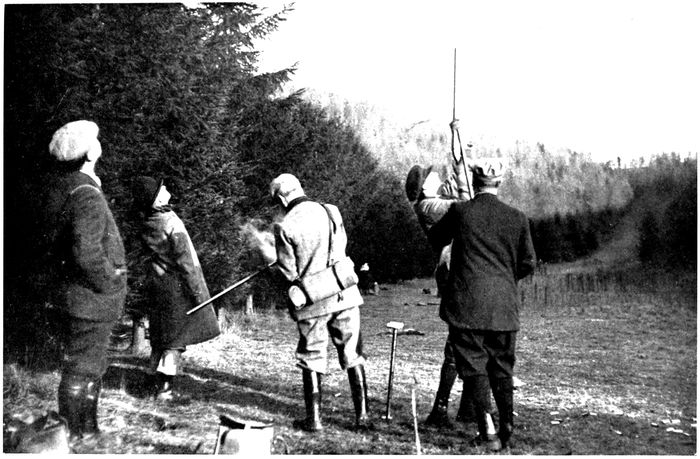
The cover image was created by the transcriber and is placed in the public domain.
THE COMPLETE ENGLISH
WING SHOT
UNIFORM WITH THIS VOLUME
The Complete Motorist
The Complete Golfer
The Complete Photographer
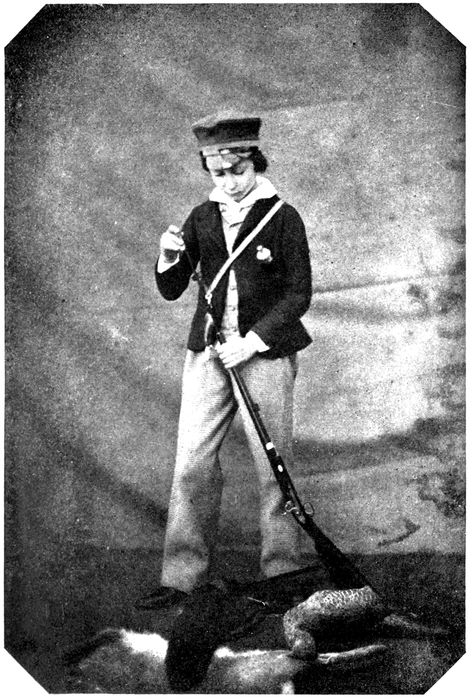
H.M. THE KING AS A BOY
BY
G. T. TEASDALE-BUCKELL
WITH FIFTY-THREE ILLUSTRATIONS
NEW YORK: McCLURE, PHILLIPS & CO.
LONDON: METHUEN & CO.
1907
PREFACE
v
When the publishers asked me to write a book upon
Shooting and its interest, I at first doubted whether
I knew enough of the matter to fill a book of much size
without repeating all the traditional lore that is to be found in
every unread text-book, but I had no sooner undertaken the
business than I came to a conclusion that has since been
confirmed, that to deal as best I could, with the kind help of
many sportsmen, with the controversial subjects would have
taken the whole space at my disposal for any one of them.
Consequently, ever and again I have had to decide what to
eliminate, and I have tried to leave out that which most people
know already, and to deal as best I can in short space with
questions that are now more or less under discussion, and
consequently those that game preservers and shooters in this
and other countries are thinking about. It has been very
difficult to draw a line between the controversial and current
subjects and the unchallenged facts which have been too often
repeated already, but that this is the right principle is, I think,
obvious from the position that the opposite course would
involve. What is meant can be best explained by glancing at
a few traditional survivals in gunnery and shooting, and its
accompanying unnatural history, which, along with many
others, would occupy space if one were to attempt to deal with
all the accepted, as well as the repudiated, statements upon
them. Nobody wants to be told that he should put the powder
into a cartridge-case before the shot, but to begin at the
vibeginning would involve the necessity of giving that and other
puerile information. Nobody would be the better for a learned
chapter on gun actions. In the first place, these actions are no
longer patents, they are open to anyone who likes to use them,
and consequently the days when one selected a gun-maker
because his patent action was conceived to be the better, are
long gone by. The reason is that each gun-maker can be
trusted to use the best principle when he has a choice of them
all, or at least the best available for the money to be expended
upon its making in the gun. Ejectors are nearly in the same
position; but single triggers are not. I was so fortunate as to
make a discovery in regard to single triggers that is now
acknowledged to be of great assistance to the gun trade; the
want of it had for a hundred years been the stumbling-block to
the patent single triggers that had begun to trouble gun-makers
in the time of the celebrated Colonel Thornton. That is
referred to in its proper chapter, because single triggers now
occupy the place that formerly actions held, and at a later date
ejector systems usurped, in assisting to the selection of a gun-maker.
To begin at the beginning in the repudiation of frequently
accepted fallacy possibly would not compel a reference to the
sometime beliefs that hares change their sex; that skylarks
fall into snakes’ mouths after their skyward song—a statement
that troubled Mr. Samuel Pepys, who, as Secretary to the
Admiralty under two protectors and two monarchs, and as a
member of the Royal Society, should have been in a position to
get the best information. Nor would such a beginning involve
the repudiation of the belief once held that bernicle geese
turned into “bernacle” molluscs, or vice versâ. But it would
oblige an author to enter into repudiation of the oft-stated
belief that nitro powder is quicker than black powder,
although big and heavily charged caps have to be employed
for the nitro, whereas the small were amply sufficient for black
powder. One would also be obliged to point out that the
oft-repeated prophecy, that the smallest stock of grouse
bred the better August crop, has been doomed to disaster
always, and that precisely the reverse is true. However,
there are still people who by what they say must be judged
to hold to the unproved proposition that the stones breed
grouse.
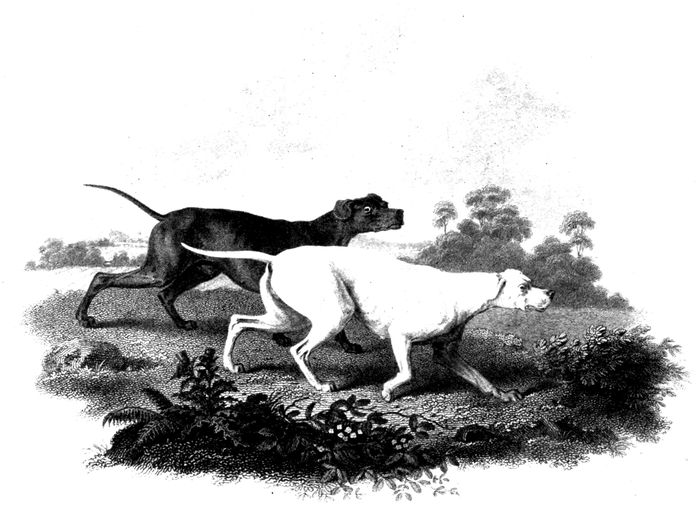
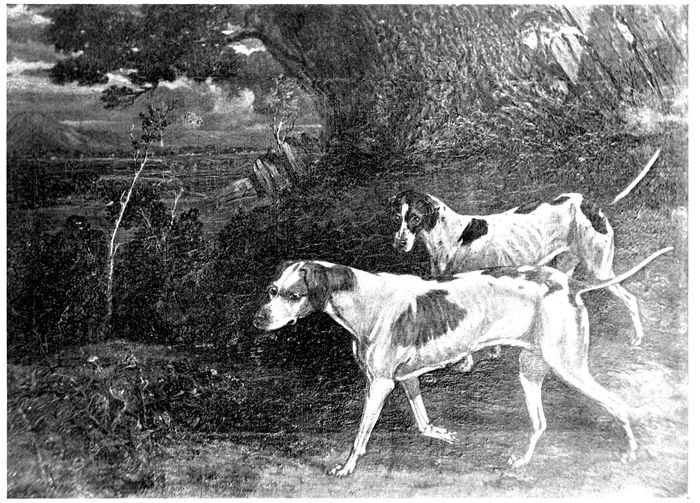
COL. THORNTON’S PLUTO (BLACK) AND JUNO. BY GILPIN. SHOWING WHOLE-COLOURED POINTERS SIMILAR IN FORMATION TO THOSE OF SUTTON SCARSDALE TO-DAY
viiIt would be necessary also to point out that some parrot
cries are a hundred years old and at least forty years out of
date, but are still repeated as if they were original and true.
Some of these are that pointers have better noses than setters,
and also require less water; that cheese affects dogs’ noses
(sanitation by means of carbolic acid does so, but cheese is
harmless enough); that Irish setters have more stamina and
pace than any others. The latter statement I have seen disproved
for forty years at the field trials in this country, and
the former has always failed to find corroboration at the
champion stamina trials in America. I have had great chances
of forming an accurate opinion, as I entered and ran dogs at
the English championship trials over thirty-six years ago, and
I am the only one who has ever judged at the champion trials
of both England and America.
It would be necessary also to repudiate the mistake that “foot
scent” is something exuding from the pad of an animal and left
upon the ground by the contact of the feet. It would be
necessary to affirm that fat from the adder is not the best cure
for the poison when dog or man is bitten, but that raw whisky
taken inwardly in large doses is; and as dogs will sometimes
point these vipers, it might be well to affirm that these creatures
do not swallow their young, as is commonly supposed. It
would be necessary also to state that when partridges “tower”
they are not necessarily, but only sometimes, hit in the lungs,
but have often received a rap on the head just not enough to
render them totally unconscious; and a case has lately been
reported where two unshot-at partridges in one covey
“towered” and fell, and were caught alive, grew stronger, and
upon one of them being killed it was found to be badly attacked
by enteritis, and not by lung disease. And consequently the
myth about “towered” partridges always falling dead and on
their backs does not require dealing with, as might have been
viiithe case a quarter of a century ago, when nevertheless the
phenomenon was only misunderstood in the laboratory, and not
in the field of sport.
It is hardly necessary to assert that “pheasant disease” as
commonly seen in the rearing-fields is not fowl enteritis, as it is
so often said to be, because the foster-mothers are hardly ever
affected by any illness when their chicks are dying by hundreds
of the disease. The pheasant disease has never been subjected
to pathological examination and investigation.
To start at the beginning would make it necessary to state
that the “muff ’cock,” or the bigger woodcock, that comes in a
separate migration, is not the hen of the smaller birds, and that
distinction can only be made between the sexes by internal
examination of the organs. It might be necessary in similar
circumstances to say that woodcock and snipe do not live on
suction, as is often believed even now; that nightjars and hedgehogs
neither suck the milk of goats nor cows; that foxes do
not prefer rats and beetles to partridges and pheasants; that
swallows do not hibernate at the bottom of ponds; that badgers
do not prefer young roots to young rabbits; that ptarmigan
and woodcock are not mute, and that the former do not live on
either stones or heather; that badgers can run elsewhere than
along the sides of a hill, and that they are not compelled, by
having the legs on one side shorter than on the other, to always
take this curious course, which would involve them in the difficulty
of having to entirely encircle a hill before getting back to
their holes; nevertheless, this faith is still held in some parts of
the country, just as it is said that the heather bleating of the
snipe is a vocal sound, whereas it is often made simultaneously
with the vocal sound.
I have tried to avoid dealing with any such things as these,
which may be supposed to come within the region of common
knowledge of any beginner in shooting, but another point has
troubled me more. I have written a good deal for the press.
Articles of mine have appeared in The Times, The Morning
Post, The Standard, The Daily Telegraph, The County Gentleman,
Bailey’s Magazine, The Sporting and Dramatic, The Badminton
ixMagazine, Country Life, The Field, The Sportsman, The National
Review, The Fortnightly Review, The Monthly Review, and elsewhere,
and I am afraid that I have unconsciously repeated the
ideas running through some of these articles, without acknowledgment
to the various editors.
As Colonel Hawker went to school in gunnery to Joe Manton,
so did Joe Manton go to school to Hawker in the matter of
sport. But we have changed. That those who make guns can
best teach how to make guns I do not doubt for a moment; that
when they write books on the making of guns those books are
regarded as an indirect advertisement is inevitable, but they are
none the worse for that, if readers know how to read between
the lines, and it is not necessary to go to a shooting school to
do that. But when gun-makers add to their business by means
of books upon sport and by “shooting schools,” they are turning
the tables on us. To that I have no objection. But when it is
asserted that shooting schools teach more than the sport itself,
as has lately been done, then I think it is time to protest that
even if they could teach shooting at game as well as game
teaches it (which is absurd), that even then they cannot teach
sportsmanship, of which woodcraft is one part and the spirit of
sport and fellowship another.
But the greatest value of sportsmanship is, after all, that idle
man should be the more healthy an animal for his idleness.
Consequently, when shooting parties are made an excuse for
more smoke and later nights than usual, even if the shooting
is not spoiled next day, less enjoyment of life follows, and
lethargically apparent becomes the missing of that perfect
dream of health, that reaction after great exertion ought to
bring to those who have ever felt it.
It is often said that big bags have ruined the sporting spirit.
That is not so: big bags are necessary proofs that the science of
preservation of game is on the right lines, and their publication
is also necessary on these grounds. At the same time, it is a
fact that hard walking is not appreciated as much as it was
thirty years ago, and ladies can now take just as forward a place
in the shooting of game and deer as men can or do. This is
xnot all because ladies are better trained physically, but because
sports have been made much easier, than formerly they were.
Bridle-paths enable ponies to traverse the deer forests with
ladies on their backs, and where that can be done deer stalking
is not quite what it was when a Highland laird declared that
he saw no use in protecting the deer, since nobody could do
them much harm. But the wonder to me is not that we do not
like great exertion, but that we ever did like it for itself. But
then I speak as a man in years, and one who has in the foolishness
of youth killed a stag and carried home his head, cut low
down, for sixteen miles, rather than wait for the tardy ponies to
bring it in with the carcase.
I suspect that a change of ideas will take place when it is
discovered that driven-game shooting can, more than any
other, be learnt at the shooting schools, and that when the
trick is known it becomes the easiest kind of shot. If it is
true that the schools can teach it, then everybody will learn
it, and what is common property will become as unfashionable
as it is the reverse at present. I believe that half the difficulty
in the driven bird is in thinking it is difficult. The fastest
bird at 30 yards range one is likely to meet with in a whole
season does not require a swing of the muzzle faster than, or
much more than half as fast as, a man can walk. What is
difficult in driven game is shooting often, the swerve of the
game, the changes of pace and angle of different birds in
quick succession, but distinctly not the pace. Before I had
ever seen a grouse butt, I remember sitting down to watch
another party of shooters on a distant hill, more than half a
mile up wind of where I sat to watch. I saw their dogs point,
and a single bird rise, which, with many a switchback as it
came, I watched traverse the whole distance between us, and
I killed it as I sat. That was my first driven grouse, but it
is not by any means why I say that driven game offers the
easiest kind of shooting; it is because the average of kills to
cartridges are so much better than they are in other kinds of
shooting. Take, for instance, double rises at pigeons, which
are easy compared with double rises at October grouse, and it
xiwill be noted that the crack pigeon shots do not generally
kill even their first double rise at 25 yards range, and that
four or five double rise kills are nearly always good enough
to win, as also very often is a single double rise with both birds
killed. Very moderate grouse drivers can do better than that,
and pheasants that are not very high are slain in much greater
proportion. The fact is that all shooting is extremely difficult
if one attempts to satisfy the most severe critic of all, namely
the man who shoots. But at my age I would much rather
think myself fit to do a day’s hard walking than a day’s hard
shooting. I think there are a good many people of that
opinion, otherwise dog moors would not make more rent per
brace than the Yorkshire driving moors, but they do. The
trouble is that places where birds will lie to dogs are limited,
and it is childish to drive packs of birds away for the sake
of thinking one is shooting over dogs when one is not
shooting at all, but only doing mischief. Personally, I would
not try to shoot over good dogs on Yorkshire grouse. Bad
ones would not matter; but then they would give me no
pleasure.
When it was a literary fashion to abuse covert shooting as
butchery and grouse driving as no sport, it was not done by
sportsmen of the other school; and later, when the literary
genius of the period was turned in the opposite direction, and
we were constantly being told that a walk with a gun and dog
was pleasant but no sport, it was only done by those who
were a little afraid of being out of the fashion. I have been
so unfashionable as to defend both by turns, and I have always
been of opinion that any sport which appeared to be growing
unpopular was worthy of the little support I could give it. It
will probably greatly surprise those who dare not, with
imaginative pens, shoot at the tail of a bird, to be told that
Mr. R. H. Rimington Wilson recently informed me, that if he
were to back himself to kill a number of shots consecutively
he would select driven birds in preference to walked-up game;
and besides, that he preferred to be let loose on a snipe bog
to his own, or any other, big driving days. My opinion has
xiibeen that you can always make any sort of shooting a little
more difficult than your own performance can satisfactorily
accomplish to the gratification of your own most critical sense.
Driving game and big bags are often, but not always, acts
of game preserving.
On this subject I had written a chapter, but fearing that I
had not done that view justice, after a conversation I had with
Captain Tomasson, who has Hunthill and is the most
successful Scotch grouse preserver by the all driving method,
I asked him to criticise some articles I had previously written
in the Field, the sense of which I have tried to express again
in the following pages. He very kindly did so, or rather
stated the case for the Highlands, which I have substituted for
mine. It only differs in one respect from the sense of my own
suppressed chapter—namely, it does not remark on the difficulty
of explaining why, if recent Scotch driving has partly defeated
disease, even more Yorkshire driving, prior to 1873, nevertheless
preceded the worst and most general Scotch and
English disease ever known. However, everyone will argue
for himself: I can only pretend to present a mass of facts to
assist a judgment, but not a quarter of those I should like to
give have I room for, and I regret that Captain Tomasson
is even more restricted by space.
I have shot over spaniels in teams and as single dogs, but
as I consider that I know less of them than Mr. Eversfield,
who probably knows more than anyone else, I asked him to
read and criticise my article, which he promised to do. But
in returning it he has professed himself unable to criticise, and
very kindly says that he likes it all, so I leave it, being thereby
assured that it cannot be very wrong.
There is one subject connected with shooting, or the ethics
of shooting, about which there is much more to be said than
ever has been attempted—namely, that partridge preservers
are now, and will be more in the future, indebted to the fox
for their sport. This may appear a wild paradox, but before
I am condemned for it I would, in the interests of the gun,
ask those who disagree to read my chapters on partridge
xiiipreserving, where, if they still disagree, they will find a partridge
success described that will amply repay their good nature,
unless they know a plan by which season’s partridge bags can
be doubled, doubled again, and then again, in three consecutive
years.
On the subject of dogs, I may say that thirty to thirty-five
years ago I recommended to some American sportsmen three
different sorts of setters. Either two of them had bred well
together in England. These have been crossed together ever
since in America, and no other cross has been admitted to
the Stud Book devoted to them. They have been a revelation
in the science of breeding domestic animals, for, in spite
of all the in-breeding represented there, I was enabled to select
a puppy in 1904 that in Captain Heywood Lonsdale’s hands
has beaten all the English pointers and setters at field trials
in 1906. I have more particularly referred to this in a chapter
on English setters, and in another on strenuous dogs and sport
in America.
I have already tendered my thanks, but I should like
publicly to repeat my indebtedness, to those who have lent
me the best working dogs in England for models, or have sent
me photographs of them and other pictures. These include
Mr. Eric Parker, Editor of The County Gentleman, Mr. W.
Arkwright, the Hon. Holland Hibbert, Mr. Herbert Mitchell,
Mr. C. C. Eversfield, Mr. A. T. Williams, Captain H. Heywood
Lonsdale, Mr. B. J. Warwick, the Editor of Bailey, Mr. Allan
Brown, and the President of the world’s oldest established,
and National, Field Trial Society, namely Col. C. J. Cotes,
of Pitchford Hall, who has sent me some photographs of
his, and his late father’s, Woodcote pointers and retrievers,
including an original importation of 1832, and founder of his
present breed of the latter race, and in doing this he has been
kind enough to say:—
“I have always considered you to know more about the
breaking and breeding of setters than any man living, and
that it was entirely through you that the apex of setter breeding
was reached about twenty-five years ago, and through your
xivrecommendation I obtained the eight setters in 1881 that
founded my present breed.”
I am glad to be able to quote this, because my name is
little known to younger shooters, although I write many,
preferably unsigned, articles upon rural sports and other
matters.
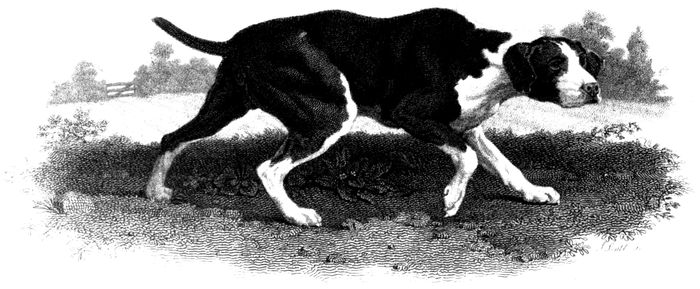
From an engraving by Richard Parr, after a picture by G. H. Laport, in The Sporting Magazine, 1834.
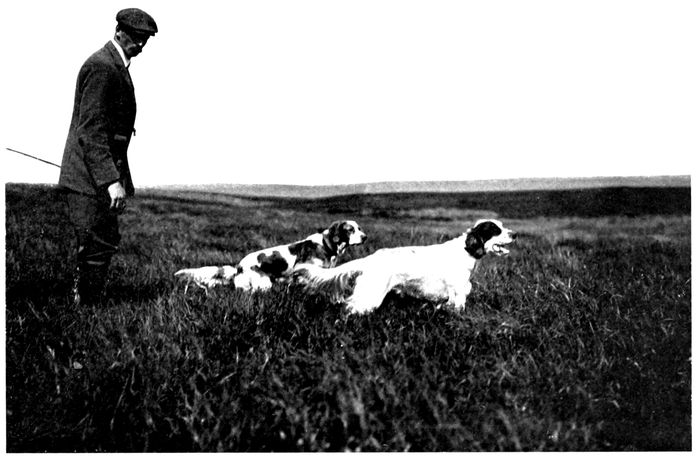
An Early Nineteenth-Century Picture of the Woodcote Pointers, the Property of Col. C. J. Cotes. His Field Trial Winners Pitchford Druce and Pitchford Duke are descended from his Father’s Woodcote Pointers
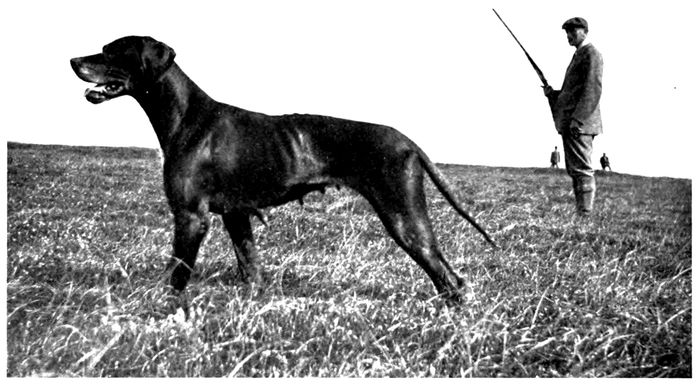
With the exception of an ill-drawn hind leg and near fore foot this is the correct formation. The model had the shoulders, head, back, and back ribs, rarely seen now except in hard-working dogs.
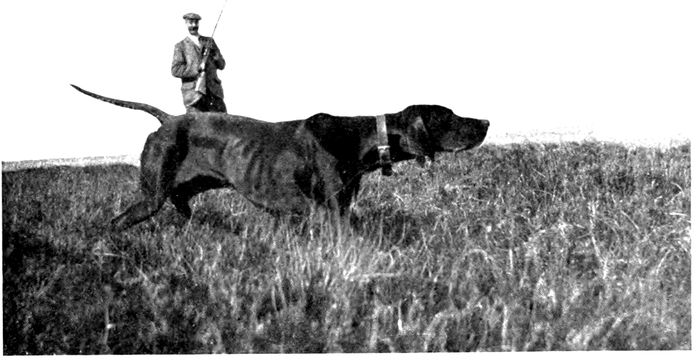
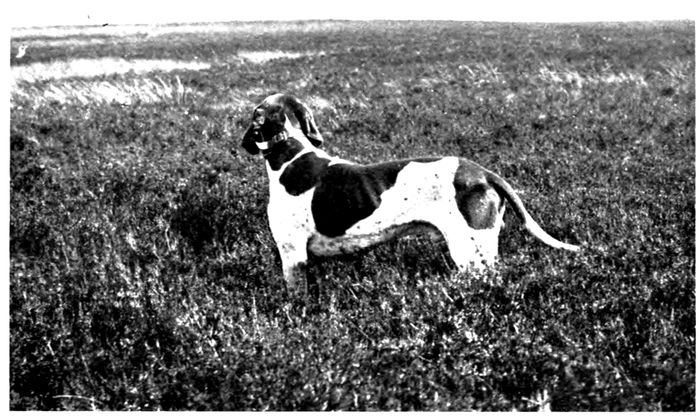
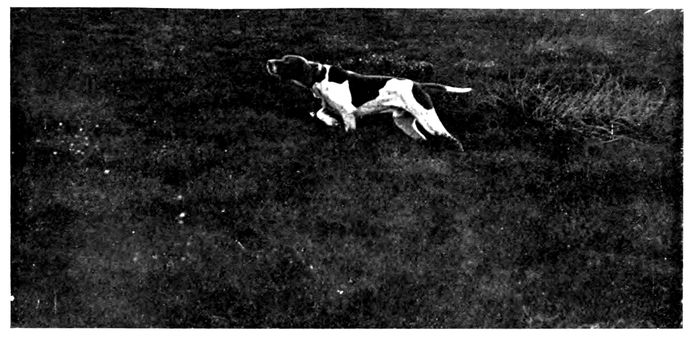
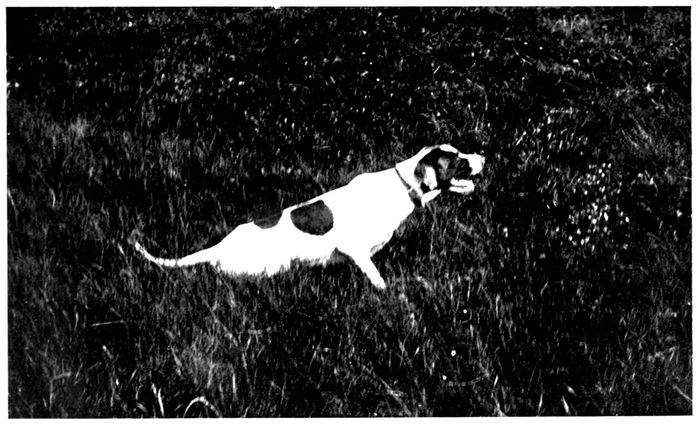
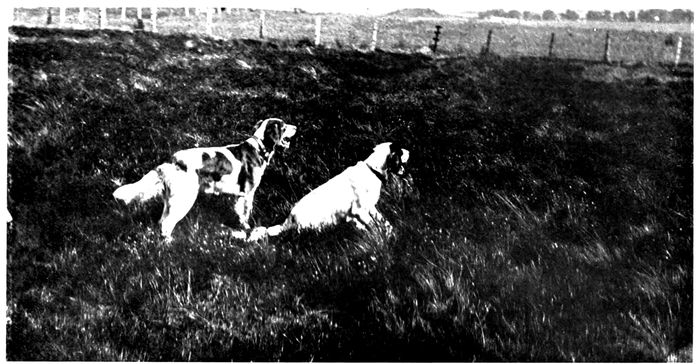
Mr. Herbert Mitchell’s Lingfield Beryl, Winner of Firsts six times in seven Field Trial Outings in the Spring of 1906
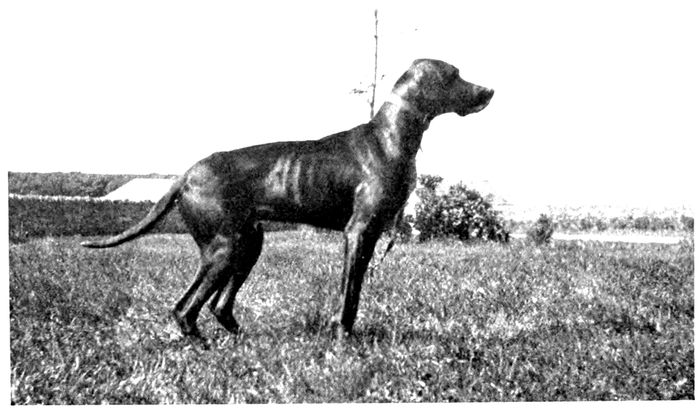
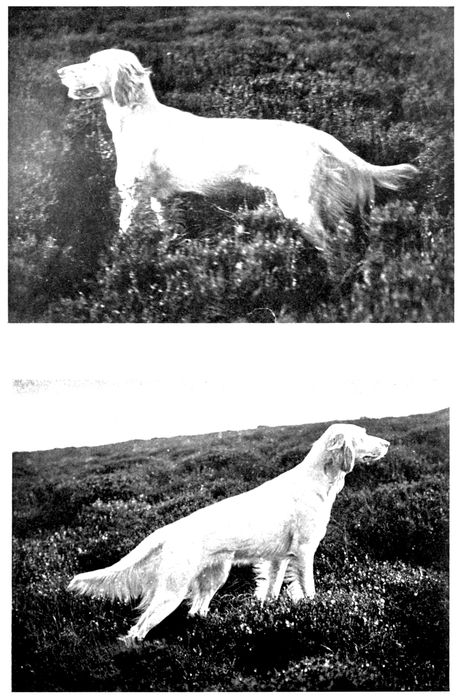
The former was victor on Lord Home’s Moors near Lanark, in July 1906, over all English-bred pointers and setters. The latter was winner of the Puppy Stakes at the same time.
From a photograph by the Author.
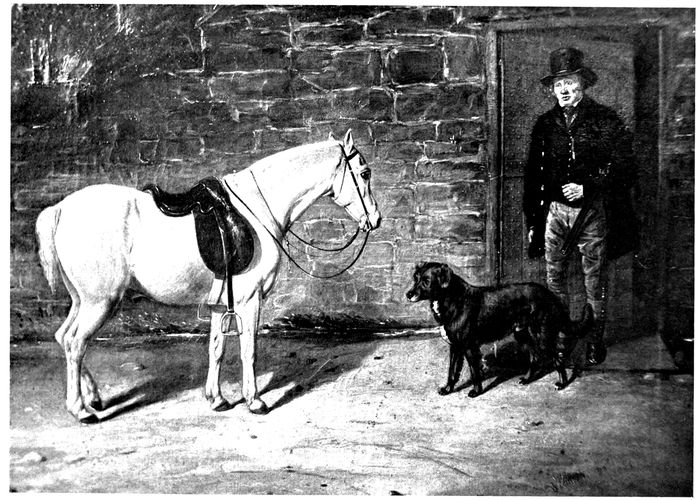
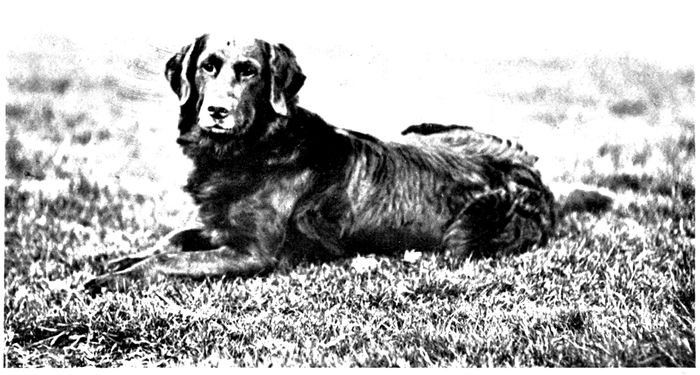
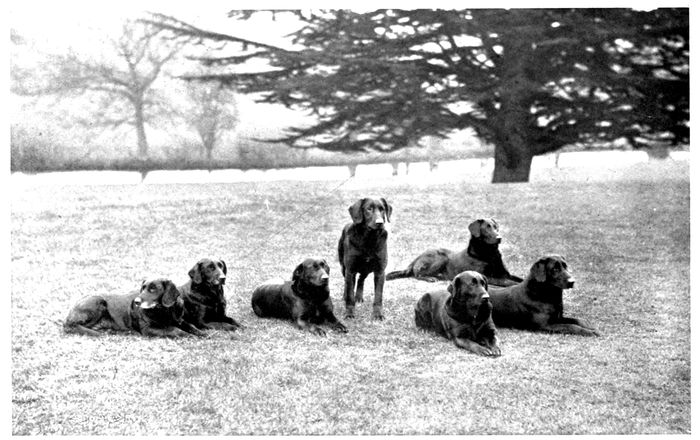
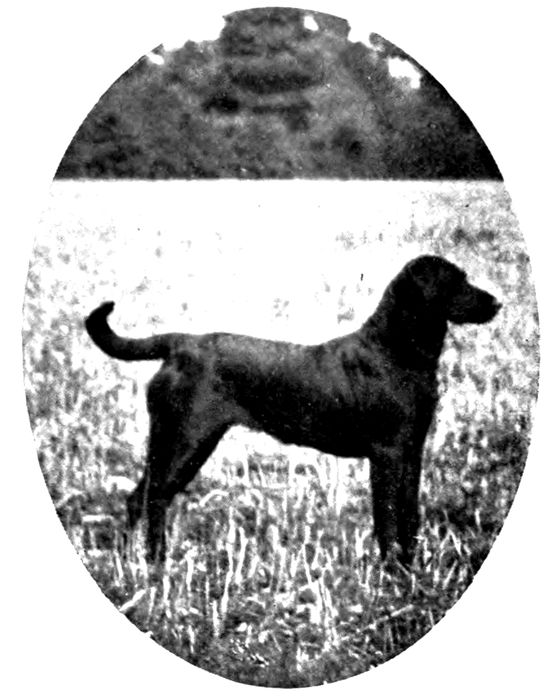
xxMr. John Cotes’ Imported Labrador, Tip, from an Old Picture at Woodcote
The dog was whelped in 1832, and presented by Mr. Portman to his owner. From this dog is descended the field trial winner, Col. C. J. Cotes’ Pitchford Marshal, and his Monk, an intermediate generation. This dog is more like the dogs at Netherby 45 years ago than is the present race of Labradors.
From a photograph lent by the Owner of the picture.
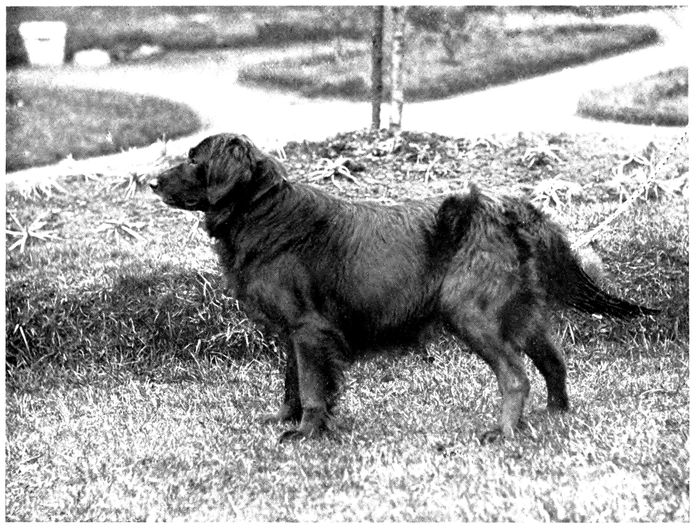
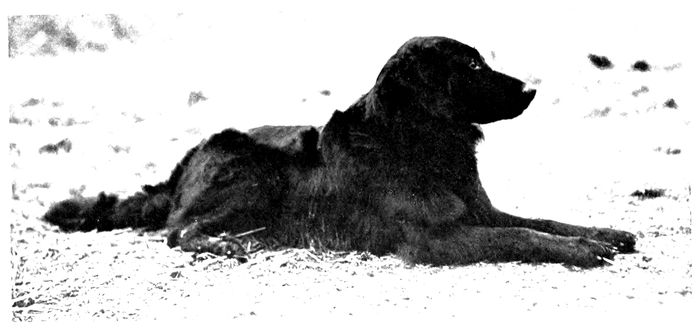
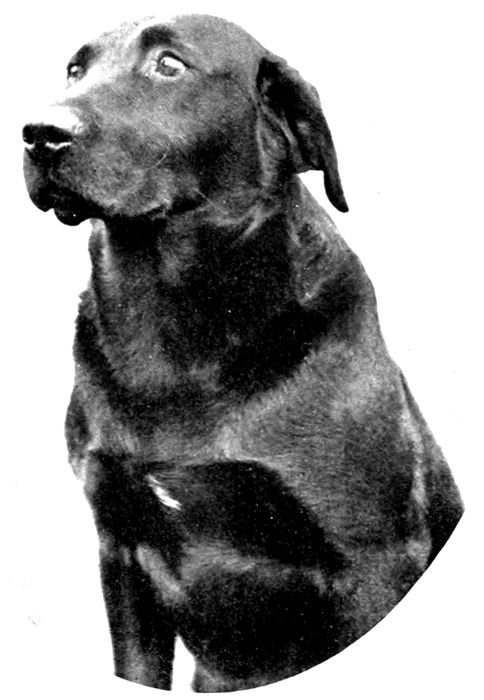
Col. C. J. Cotes’ Pitchford Marshal, several times a Field Trial Winner
Col. C. J. Cotes’ Monk, an Intermediate Link between the Imported Dog Tip, of 1832, and Marshal, now in full vigour. Monk is said to have been very fast
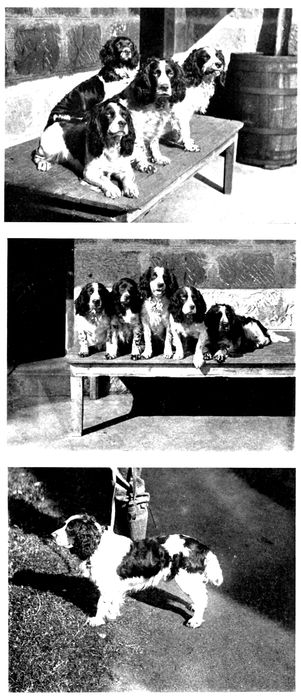
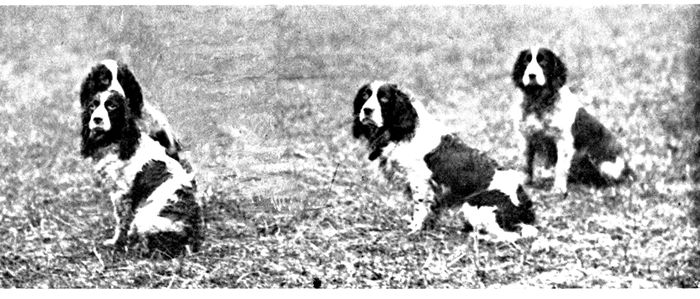
xxiMr. Eversfield’s Field Trial Winning English Springer Spaniels of a Liver-and-White Breed kept for work alone in the Family of the Bougheys of Aqualate for a Hundred Years.
By far the greatest inventions in gunnery have been made
by chemists. The cleverness and boldness of many
wonderful inventions for loading at the breech all aimed at the
well-nigh impossible. The powder was always ignited from
without, and had to be either partly or quite loose in order
to facilitate ignition by means of external fire. That is what
beat the inventors of five centuries, who were for ever trying to
find a breech-loader, a revolver, or a magazine weapon. In
default of these working satisfactorily, they tried weapons
with seven barrels, and others with fewer. But it was all to
little purpose; the detonator had not been discovered by the
Rev. A. J. Forsyth, and the chemist to the French army of
Louis XV. had not then invented fulminate of mercury. Consequently
a closed-up cartridge containing its own means of
ignition was impossible, for although detonating substances
were known years before, they were such as did not always wait to
be detonated—in other words, they were not stable. They were
too dangerous for use, but nevertheless the attempts made at
breech-loaders, and especially at magazines, were more than
equally dangerous. One weapon had eight touch-holes in eight
positions in the barrel, which was eight times charged, one load
and charge upon top of the next. That nearest the muzzle was
fired first (if the weapon was ever fired at all), and so on, down
to that nearest the breech. What prevented the first igniting
the rest, and sending all off together with a burst weapon, is
not known. If they did not go off all together, one would
2suppose the firing of several loads in succession would give to
those loads in the breech the best ramming ever known. But
for this ramming to excess this invention went very near to a
more perfect success than any modern magazine weapon. The
trouble with all the latter is what to do with the empty cartridge-case.
But this old weapon had no cartridge-case. Its ignition
was from the outside, and was always ready. It is true that the
difference of length of movement of shot within the barrel would
make some difference to the velocity of each shot, but not more
than would be equalised by a very small extra dose of powder
for those charges nearest the muzzle.
Another form of repeater was a breech-loader which carried
several charges of powder in the stock, which, in turn, were
shaken into a revolving chamber, in front of which, before it was
in place for firing, the bullet was inserted for each load, as its
turn came round. Other repeaters were simple revolvers, much
like the weapon in use now, but of course used without cartridges
of self-contained ignition material.
Indeed, the ingenuity expended on breech-loading before the
advent of detonating powder for ignition was really greater than
the more modern efforts to do a much more simple thing. At
the same time, had they succeeded, as they very nearly did, by
doing without a removable cartridge-case, they would have
accomplished that which is still required for the perfect working
of magazine and automatic weapons.
The most elaborate of all the old repeaters was a revolving
double-chambered German weapon. It had ten chambers, and
each of these carried two charges, with a touch-hole for each.
The majority of the old breech-loaders had movable blocks on
the principle of the Martini, but instead of the hinged blocks
being solid, as in that weapon, they were mostly hollowed out
to take the charge and the bullet; sometimes held in a cartridge,
but generally with the powder loose, and always loose when in
the chamber, in order that there should be free communication
with the touch-hole.
Sometimes the barrel was hinged in order to drop down at
right angles with the stock, and this was really the forerunner
3of our drop-down guns of to-day, which are consequently some
centuries old in principle, and had it not been for the absence
of detonators there would have been nothing left for the nineteenth
century to invent.
It has been said that the Prussians were first to take up the
principle of the breech-loader for war, but that refers only to
the detonated modern breech-loader. Some of the soldiers in
the American War of Independence were armed with the
breech-loader already mentioned, in which the trigger guard
unscrewed the opening into the breech; but although this
invention was possibly the soundest in joining of all the old
ones, it was slow, and probably was not much used for that
reason.
The Venetians had ships armed with cannon as early as
1380 A.D., and in Henry VIII.’s reign the wrecked Mary Rose
carried breech-loaders, designed on a principle which may
possibly have suggested the wire guns of the present. The
tube of iron or brass (for both were used) was surmounted by
rings of iron which had evidently been slipped over the tube
and hammered on while red-hot. These then contracted upon
cooling, and pinched the bore smaller, so that, intentionally or
not, the bore was made to expand to its original size upon an
explosion occurring before any stress was put on the metal of
the internal surface by the powder-gas. That is to say, all the
first part of the strain went to expand the rings on the outside
of the gun before the inside had reassumed its natural dimensions;
or, in other words, the tension between the external big
circumference and the internal small one was equalised, just
on the same principle as it is in the latest big guns. This is
known, because some of the Mary Rose’s big guns were got up
from the sea about half a century ago. She was over-weighted,
and it is quite probable that her loss had a good deal to do with
teaching the nation that before everything a warship must be
handy, so that, when the Spaniards sent their great ships to
fight Elizabeth, her smaller craft, and Britain’s uncertain weather,
between them sank or squandered the whole Spanish fleet.
ANCIENT PISTOLS TO AUTOMATIC AND ELEPHANT RIFLES
4
Italy has the credit of the invention of the pistol, which
came into being soon after the designing of the wheel-lock
and the rifling of barrels. Caminelleo Vitelli of Pistoia
made the first about 1540. It was in the manufacture of
these small weapons that gun-makers from this date to the
beginning of the nineteenth century excelled. The workmanship
was generally of a high order, and the ornamentation,
especially of some of the German specimens, was extremely
artistic.
Moreover, during the flint and steel age, some double-barrelled
pistols were built with two locks and only one trigger.
Although these weapons worked quite perfectly, it must not
be assumed that the makers of these pistols could have made
a double shoulder gun to work satisfactorily with but one trigger.
That difficulty was overcome at the end of the nineteenth century;
but even then the clever designers had not discovered exactly
what the former trouble was, and it was freely stated in a way
that is now known to have been wrong. Indeed, the author was
the first to discover the real reason for the involuntary second
pull and double discharge. As this phenomenon did not occur in
pistols, but did so in shoulder weapons, it apparently seemed easy
to trace the cause. Very early in the nineteenth century, dozens,
and since then hundreds, of designers and patentees have set
out with the announcement that they had discovered the true
cause of the trouble, and met it with a patent. As the latter
were always badly constructed, it may be assumed that the
patentees were wrong in their diagnosis. As a matter of fact,
5they were, as was proved when the author published the true
cause of involuntary pull in The County Gentleman, and for a
time had to meet alone the hostile criticism of most of the gun
trade, the members of which now admit the truth of those criticised
statements. Although the true reason must be dealt with under
the heading of single-trigger guns and rifles, it may be briefly
stated that the success of the single-trigger double-barrelled
pistol was not because of its more feeble explosion, as was
supposed, but because the recoil continues long enough to allow
the will of the shooter to gain command of his muscular finger
action, before the check to recoil occurs. Whereas, with the
shoulder gun, the finger which has let off the first lock flies back
as the trigger is carried from it by recoil, and this sustained
muscular action cannot be stopped by the will as quickly as the
gun recoil is lessened by the shoulder. Consequently, we
involuntarily give a second pressure to the trigger, without
knowing that we have ceased giving a first. This want of perception
of what we ourselves do is caused partly by quickness
of the recoil, and partly because the recoil relieves the pressure,
and our wills have nothing to do with the matter. Or, to
be more correct, we pull off the trigger once intentionally, but
are unable to cease pulling when the trigger has given way.
Consequently we unconsciously follow up the trigger as it jumps
back in recoil, catch up with it, and involuntarily pull it again
without knowing that we have let go, or had the trigger
momentarily snatched from us.
It is clear that the understanding of this principle was
as necessary to designers of automatic repeaters as it was
to makers of double-barrelled shot guns, and yet the Mauser
repeating automatic pistol and the Webley Fosbery automatic
revolver were invented, with some others, before the reason
of the involuntary pull had been discovered; and more than
that, the author had tested the Mauser with its shoulder
stock satisfactorily. But no satisfactory automatic rifle had
been then invented, and the trouble with them was to prevent
the sending forth of a stream of bullets when only one shot
was wanted. The greater force being dealt with, had brought
6into action the difficulty of the involuntary pull. This has
now been overcome; but still there are other difficulties
which have been treated less satisfactorily, and those who
are ambitious to use automatic weapons will be wise to confine
that ambition to the many pistols and the revolver in the
market. Repeating shot guns are lumbering tools, from which
disqualification the automatic weapons are little likely to be
free. Still, it is quite possible that a gunner could shoot more
birds out of a single covey with one automatic gun than with
two double guns. But what of it? The aim of the gunner is
not merely to shoot at one covey, but to keep on shooting
fast for perhaps half an hour. The thing that stops very fast
shooting is not loading and changing guns, but heat of barrels,
and consequently to make these single barrels equal to the
doubles there must be four of them in place of two doubles,
and six of them in place of three ejectors. The time has not
yet come when anybody wants to employ three loaders to
carry six guns.
There is some reason to prefer the automatic principle
for pistols and revolvers, because the user’s life may often
depend upon the quickness of his shots at an enemy, but
there is less reason for their use in military rifles, and actual
disadvantage for sporting rifles and shot guns. The author has
shot the Mauser, the Colt, and the Fosbery with satisfaction to
himself. The latest invention is a sliding automatic pistol of .32
gauge invented by Messrs. Webley. But no automatic pistol
can be as reliable as the service revolver, or as the Fosbery,
since a sticking cartridge or a misfire disables any of them.
It is often said that these spring actuated actions, on which the
barrel slides back, give less recoil than others, but in practice
this is not so, and in science it could not be so, although it is
stated in the last Government text-book that they reduce recoil.
The principles on which it is sought to make automatic
rifles are as follows:—
1. To actuate an ejector, magazine loading, and closing action
by means of gas obtained from a hole in the barrel.
2. To actuate the same movements by means of recoil
7and rebound of the sliding barrel on to an independent stock
grooved to carry the barrel, and fitted with a spring.
3. To actuate the same movements by means of allowing
the whole weapon to recoil on to a false heel plate spring,
and rebound from it.
4. By allowing a short sliding recoil of the barrel to
make the bolting action slide farther back on to the stock
and a spring, and to rebound from them.
Several of these principles have been employed in conjunction
in this or other countries. The recoil is made to compress a
spring, which by re-expansion completes the work of closing
up the rifle, when it does not stick and fail, as in all specimens
of automatic rifles has occurred at intervals.
All nations are now armed with magazine repeating rifles,
but none have yet adopted automatic loading for rifles. The
choice between the various magazine mechanisms is a mere
matter of taste, but the shortening of the British national
arm to 25 inches seems to have been done without regard
to the fact that no rifle of 25 inches can compete in accuracy
with an equally well-made and an equally well-loaded weapon
of 30 inches, although it may compete favourably with the
discarded Mark II. Lee-Enfield, which was improperly made
and also badly loaded. Unfortunately, our prospective enemies
are not embracing the faults of the Mark II., but are adhering
to a rifle instead of a carbine. That is the correct term to
employ to describe the new weapon.
The carbine of any period has generally been equal to
the rifle of the preceding decade, but it has never yet been
equal to the rifle of its own decade, and never will be.
Miniature rifles for amateur soldiers in the making are
very numerous. The best cheap one the author has handled
is the rifle with which Mr. W. W. Greener won the Navy and
Army competition, which was managed by the author. What
is here meant by a low price is £2, 2s., and under. The rifle
was used with peep sights. But better advice than naming
any maker is this. All the makers profess to put a group of
seven shots on to a postage stamp at 50 yards. They all
8employ expert shooters who can do this if it is to be done.
Buy the rifle with which they do it in your presence, and it
will then be your own fault if you cannot perform likewise.
This test of a single rifle is quite satisfactory; but a double
rifle has to be dealt with differently, as is explained in
another chapter. Of course, it is a mistake to shoot a rifle
from any sort of fixed rest; the weapon, when loose in the
hands, bends its barrel, or flips, jumps, and also recoils, and
it is good or bad according as it does accurate work under
the action of all these influences. A rest to steady the arms
is quite permissible, but a vice to hold the rifle is not.
Once Mr. Purdey expressed the opinion that he could learn
as much from his customers as they could from him. The
author thought this so shrewd a remark, that, having a knowledge
of the many good sportsmen and big-game hunters who
employ the weapons of the Messrs. Holland & Holland, Messrs.
John Rigby, and Messrs. Westley Richards, he wrote to each of
them to ask their opinions of the best bore and weight of rifle,
sort and weight of powder, sort and weight of bullet, and velocity
of bullet to be expected, for each of the following animals, as if
each were the only object to be pursued by the sportsman.
He stated at the same time, that compromise to meet the requirements
of several, or many, of these animals he regarded
as a personal and individual matter to the sportsman. He
pointed out also that in asking for opinions he knew that he
was asking for a consensus of opinion of the past customers
of the firms in question. It is interesting to compare the
views of each maker as to the best rifle to use for everything,
from a rook and rabbit, to an African elephant charging down
on the gunner, and requiring the frontal shot. What is intended
is the very best weapon to have in hand at the moment, if there
were nothing else to be considered. Mr. Holland’s reply is as
follows:—
“98 New Bond Street, London, W.,
“October 11th, 1906
“Dear Mr. Teasdale-Buckell,—It is impossible in the
space of a short paragraph to go thoroughly into the question
9of the best bore, weight of rifle, etc. etc., best suited to each
kind of game. A good deal must depend upon the conditions
under which the rifle is used, the capabilities of the sportsman,
etc., but taken generally the rifles mentioned below are those
we have found to give the best all-round results, and our opinion
is formed upon the reports received from a large number of
sportsmen, including many of the best known and most experienced
game hunters.
“Rooks.—.220 or .250 bore.
“Rabbits.—.250 bore; weight about 5 to 6 lbs.
“Red Deer, Scotch.—(1) .375 bore double-barrelled; weight
9½ lbs. (2) .375 bore sporting magazine rifle, Mannlicher-Schonauer
for choice; weight 7½ lbs. (3) .375 bore single-drop
block; weight 7½ lbs.; velocity about 2000 ft.; charge
40–43 grains of cordite or its equivalent; 270 grains bullet,
either soft-nosed solid or hollow point.
“Chamois.—Same as for Red Deer, also .256 Mannlicher.
“African Antelopes.—.375 bore as above.
“Indian Deer.—.375 bore as above.
“Moose, Wapiti, and big 35–50 stone Deer of Hungary, etc.—.450
bore double-barrelled rifle; weight 10½ lbs.; charge 70 grains of
cordite powder or its equivalent; bullet soft-nosed solid 370 or
420 grains; velocity about 2000 ft.
“Lions.—(1) 12 bore Magnum Paradox; weight 8–8½ lbs.;
charge of smokeless powder equivalent to 4½ drams of black
powder; 735 grains hollow-point bullet; velocity 1250–1300 ft.
(2) .450 cordite rifle same as for Moose, etc.
“Tigers, from houdah or machan.—12 bore Paradox; weight
about 7¼ lbs.; charge equivalent to 3¼ drams of black powder;
735 grains bullet; velocity about 1100 ft.
“Lions and Tigers, followed up on foot.—12 bore Magnum
Paradox.
“Elephant, Buffalo, etc., in thick jungle.—10 bore Paradox;
weight 13 lbs.; nitro powder charge equivalent to 8 drams of
black powder, in solid drawn brass case, solid nickel-covered
bullet 950 grains.
“Elephant, Buffalo, in more open country.—.450 cordite rifle
same as above; charge 70 grains cordite or its equivalent;
nickel-covered solid bullet 480 grains.”
Mr. Rigby replies as follows:—
“Rooks.—.250 bore, shooting usual Eley or Kynoch cartridge.
“Rabbits.—.300 bore, shooting usual Eley or Kynoch cartridge.
10“Red Deer, Scotch.—Double-barrel hammerless .303; shooting
cordite and split-nose bullets; weight of rifle about 8 lbs.
“Chamois.—Mauser-Rigby magazine rifle with telescope sight;
weight of rifle 7½ lbs.; Mauser 7 mm. cartridges with split bullets.
“African Antelopes, Indian Deer, Ibex, and Tibet Wild Sheep,
Lions and Tigers.—.350 bore Rigby double barrel; weight 9¼ lbs.;
cordite cartridge giving 2150 f.s. m.v.; bullet 310 grains, split
and soft nose, or Mauser-Rigby magazine shooting same
ammunition; a grand rifle.
Mr. Leslie B. Taylor replies for Messrs. Westley Richards
thus:—
“Bournbrook, Birmingham
“October 13th, 1906
“Dear Mr. Buckell,—I regret that I could not give you
the information earlier, being up to my eyes in work. I have
filled in the sizes I think suitable for each kind of game gathered
from our clients’ own opinions formed from experience. You
will notice that in some cases I have mentioned the .450 high
velocity rifle. As regards India, this rifle will now be unavailable;
a recent alteration of the shooting regulations excludes
the .450 bore, which like the .303 cannot be imported into that
country for private use.
“The new accelerated express rifle .375/.303 will no doubt,
on account of its being associated in the minds of the officials
with the actual .303 bore, come under the same ban. But this
is a powerful rifle, as you will gather from the enclosed particulars,
and when used with the capped bullet becomes a most formidable
weapon, and has been satisfactorily employed against Tiger.
“I have just introduced a new extension of the accelerated
express system .318 bore, 2500 feet velocity, 250 grains bullet,
muzzle energy 3466 ft. lbs., and this ranks only second to the
.400 bore rifle. It is remarkably accurate, and as it is used in
conjunction with the copper-capped expanding bullet, it will
take the place of the .450 bore now prohibited.
“I merely give you these particulars, as you will see that
very shortly, if the Indian regulations continue in force, as I
have no doubt they will, the other information might be considered
out of date.—Yours very truly,
“Leslie B. Taylor
11“Rooks.—.250; some prefer .297/.230, a similar one.
“Rabbits.—.250 or .300; latter preferred if country will permit.
“Red Deer, Scotch.—Many sizes are used, from .256 Mannlicher;
the .360 high velocity is effective. For those who
prefer a very flat trajectory superior to the Mannlicher, the
new accelerated h.v. .375/.303 is taken.
“Chamois.—Nothing less than .360; the .375 with copper-capped
bullet is very effective, although the .256 is often used:
it is found not to kill the beast.
“African Antelopes.—.360 and nickel-capped bullet, a .375/.303
accelerated express; many sportsmen are using the .303 with
nickel-capped bullet.
“Indian Deer, Ibex, Tibet Wild Sheep.—.256 Mannlicher,
Mauser .275, also .360 and .375 bore with capped bullet; some
use ball and shot guns 12 bore.
“Lions and Tigers.—.360 to .450 h.v. express; the new
.375/.303 has proved successful at Tigers with the capped bullet.
“Eastern Elephants.—The best weapon I know, of which I
have the most excellent accounts, is the .577 h.v. rifle, 100 grs.
cordite and 750 grs. solid and capped bullet.
“Eastern Buffalo.—.360, .400, and .450 h.v. express.
“African Buffalo.—.450 h.v. express and .577 h.v. express.
“African Elephants.—The .577 .100/.710; some use the .450,
but the former is a most deadly weapon.
“I have just received information from an African sportsman
that he has shot an African buffalo with a Westley Richards 12
explora, the horn measurements of which are strikingly fine,
and promise to be a record.”
In reply to further questions, Mr. Holland writes as
follows:—
“October 13th, 1906
“Dear Mr. Teasdale-Buckell,—I don’t think it necessary
to distinguish between African and Indian elephants. No doubt
the former is more difficult to kill with the frontal shot, but
you must try and get another shot; then, again, the 480 grain
(450) bullet gives enormous penetration, and probably would
penetrate the head of an African elephant as well as any
bullet you could use. For a charging elephant, there is
nothing like the big bore for stopping, or at any rate turning
the animal. Velocity: it is a curious thing that we appear to
get practically the same elevation with the 375 (450) bullet as
the 480 gr. one, and practically the same velocity. We attribute
12this to the extra weight of the 480 gr. offering more
resistance to the powder, and thereby setting up higher pressure,
greater heat, though practically making the powder do more
work.
Henry Holland”
It may be said that at this moment velocities are undergoing
radical change, due to the improved powder Axite, and that one
maker offers rifles giving to the 303 bullet a muzzle velocity of
2700 f.s. This means a greater stride than that from the
express to the high velocity rifles, and if it is accurate, then
trajectories have been very much reduced.
In reply to a still further question, the following is a reply
that explains itself:—
“October 15th, 1906
“Dear Mr. Teasdale-Buckell,—I have your letter of the
12th inst. With regard to the .500/.450, I think I said 2000 ft.;
it should have been about 2100 ft. As a curious confirmation
of the above, I may point out that in Kynoch’s book on the
ballistics of various rifles, it gives 2150 ft. as the muzzle velocity
of a .450 bore rifle with 70 grains cordite and 480 grains bullet,
whereas with 70 grains powder and 420 grains bullet it gives
the muzzle velocity as 2125 ft.
“The muzzle velocity of a 950 grains bullet from a 10 bore
Paradox, nitro powder, is 1500 ft. The bullet is made either of
solid hardened lead or steel cored; see the enclosed illustrations
of the latter. With regard to the rook and rabbit rifles, the .220
shoots 3 grains powder and 30 grains bullet, and the .250
7 grains powder and 56 grains bullet. Solid bullets for rooks,
and hollow-point bullets for rabbits.—Yours faithfully,
“H. W. Holland”
ANCIENT AND MIDDLE AGE SHOOTING
13
It is difficult to know where to start an account of the early
history of shooting. The long-bow was used in deer
shooting, as also was the cross-bow, and if we may believe the
early artists—and I do not see why we should—deer running
before hounds and horses were shot from the saddle with
the cross-bow, and the arrow went in behind the neck and out
at the throat. The artists of old were obviously as imaginative
as Royal Academicians when it came to sport. For instance,
nearly every picture of a woodcock or snipe on the wing, including
one of J. W. M. Turner’s, puts the beak of the bird
sticking out in front, on the principle of “follow your nose”;
but every woodcock and snipe treats even Turner with contempt,
and hangs its beak in spite of the greatest master of English
landscape. Mr. Thorburn makes no such mistake, but even he
has made a couple of cock partridges court one another; and it
is really very difficult to believe in the accuracy of artists such
as the delineators of the Bayeux Tapestry, where five men may
be seen applauding Harold’s coronation and with only eight
legs between them, most of them clearly disconnected with
the men.
When, therefore, we see drawings of the fourteenth and fifteenth
century people engaged in smiting down flying birds with an
arrow from a cross-bow, we may be permitted to believe that
an ideal has been drawn, and that most of those who tried to
kill birds in flight in time learnt to prefer the falcon or the
net. Even stricken deer that the Middle Ages artists show
us shot through the neck from behind must have had totally
14different habits from their present-day relatives, because it is
not the habit of pursued deer to hold up the neck but to carry
it horizontally at such times, so that the back-to-throat arrow
would be possible only from above.
It is less difficult to believe the writing in the Master of the
Game and its French original than to believe the pictures with
which the latter was adorned—probably long afterwards, by
someone who had not the authority of the author.
Artists were not then sportsmen, but in Assyria they
obviously were so. In the British Museum room devoted to
that ancient kingdom, in low relief may be seen much that is
looked for in vain in the technically superior sculpture of the
classic periods of Greece and Rome. That is to say, the
actual feelings and characters of the beasts are conveyed in
the outlines. The horses were obviously of precisely the same
character as the arabs and thoroughbreds of to-day. They are
not obstinate brutes, little better than mules, like the ponies
of the Parthenon, which all lay back their ears at their masters,
but, on the contrary, the Assyrians are generous, high-spirited
beasts that fight with their masters, pursue in spirit with them,
and fight with ears laid back only when they are face to face with
a lion, and going to meet him. The artists saw it all, or they
would have blundered in the expression of the horse, which is
mostly in his ears, but they never blundered. Surely this was the
first shooting recorded, and whether it was done by bow and arrow
or by hurling the dart matters nothing. It is the most ancient and
the most authentic of all the ancient records of sport. If it were
untrue, it would be the most contemptible, because the most
flattering art. But it bears internal evidence of its own truth, and
that the country of Nimrod produced mighty hunters, for which
there is also Biblical evidence; no race or nation of sportsmen
has since been able to boast similar sportsmanship. For man
and horse to face a charging lion and kill him with a spear,
or dart, is to place sportsmanship before human life; and even
David, who killed a lion and a bear, did not do that, but
merely defended his flocks, probably in the only way open to
him. He was a mighty shepherd and a mighty king, but
15not a “mighty hunter,” and “no sportsman,” as the story of
the one ewe lamb proved.
It is a long jump from Nimrod to the hunting in the New
Forest, which was obviously as much shooting as hunting, when
Rufus was killed by an arrow, meant, or not meant, for a
hart. Whether there ever were outlaws named Robin Hood
and Little John does not matter, because fiction is always based
on fact, or it does not live a day. The fiction or fact of the
great shooting of the king’s deer by these outlaws has lived
seven hundred years, and it is more easy to believe that there
were many generations of such poachers and highwaymen than
that there were none at all. The highest office in the land
was then one of robbery, and it is a poor king who has not
some subjects who will offer him the sincerest form of flattery,
namely imitation.
Gunpowder is said to have been invented in China many
years before it was re-invented in Europe. We are apt to
marvel that no explosive was made use of before, but learning
was very much in the hands of the priests at a time when the
latter class was especially sincere, and when the people were
full of superstition or belief. It may be, then, that the
first discoverers of gunpowder for conscience’ sake made no
use of what must have appeared to be an invention of the
Devil. Such inventors, if there were any, might have been the
more disposed to this course because the stuff was clearly as
destructive to its users as to an enemy, until the building of
guns had progressed for many years.
It is not quite certain in which battle was first employed
gunpowder—a fact which indicates that it did not do much
for its side. It appears to have been the guns that were weak,
not so much the powder, which was probably very much the
same when used by Henry VIII. as black powder is to-day.
It is, moreover, not certain that guns were any better at
Waterloo than they had been in the time of Elizabeth. The
reason for this was the want of good metal. It is a known fact
that thickness of metal becomes useless after a certain point is
reached, so that iron and brass guns could not be made to take
16enormous charges of powder and heavy shot without bursting.
This might have been done by making them very long and
using a slow burning powder, but that way out never seems to
have been thought of until recently. The reason modern big
guns will take such enormous pressure as the big charges
behind heavy shells give, is, first, that they are made of steel,
and second, because the tension on the steel internally and
externally is equalised by a very clever method. The guns
are built up by being bound in wire in a heated state, so that
when this wire cools it contracts the internal tube as it contracts
itself. This being the case, when an explosion takes place in
the finished gun, it has to overcome the wire contraction on
the outside of the gun before the internal tube can begin to
expand beyond its natural size. That is how a thickness of
metal is made serviceable, and prevents a bursting of the
internal surface before the external bigger surface is strained.
In other words, the pressure is resisted equally all through the
thickness of the walls of the barrel. This has entirely revolutionised
big gunnery during the last thirty years, and has
enabled ships of war to hurl 800 lb. shells through the armour
of enemies who are hull down beyond the horizon.
Gunpowder was for centuries used in war before it was
much used in sport. The reason for this was that there was
no good method of letting off a sporting weapon. To apply
a match to a touch-hole obviously took a good deal of time,
and besides gave warning to the game, so that, although shooting
flying game had been at least an ambition in the days of the
cross-bow, shooting the game upon the ground with “hail shot”
was practised for many years before anyone attempted to
kill flying game with shot guns. It is curious that when this
practice was in vogue dogs were taught either to point or to
circle their game at their masters’ pleasure. This circling had
the effect of indicating the exact position of the crouching
covey, and at the same time of preventing the birds running
away from the shooter. A dog that would “circle” was held
in much more esteem than one that would only point, but one
that would do both was far the most highly valued. The
17shooter had to see the birds on the ground before he could
bring his lumbering weapon to bear, and begin to let it off.
This probably continued long after the wheel-lock was invented,
in 1515 A.D.
The flint and steel method of ignition enabled the shot
gun to be used on flying game, but the flint and steel came in
somewhere about the year 1600, and shooting flying game did
not become general until after 1700 A.D.
Meantime there had been royal prohibitions in this country,
as well as in France, against the use of hail-shot, and it can well
be understood, at a time when shooting at coveys on the ground
was considered no breach of sporting etiquette, that some
restraint became necessary. Before the use of the flint and
steel, the heavier weapons were employed by using for them a
stand to rest the muzzle upon, and this was made necessary, not
so much by reason of the weight as by the uncertainty of the
precise moment of the explosion, and the expediency of keeping
the weapon “trained” on the object until the powder chose to
catch fire and explode.
Before the invention of the flint and steel, the value of
rifling had been discovered. There is a doubt whether the discovery
is due to the late fifteenth or the early sixteenth century,
but at any rate it was well known on the Continent about
1540 A.D. There are rifled barrels at Zürich arsenal that have
been there since 1544. The most ancient in this country was
brought from Hungary in 1848, and bears the date 1547. There
has been an idea that the first grooves in weapons were not
spiralled but straight, but this does not seem to be correct, as
all the most ancient grooved weapons known are spirals of more
or less rapid turn. Some of them have a variation of twist
within themselves. There have been many straight grooved
weapons, but the object of them is lost. It has been suggested
that they were used for shot, but they could have had no
advantage over smooth bores for that purpose, and no advantage
over muskets for ball. Nevertheless, the science of ballistics
was not generally understood when they were made, and
probably a rifled shot gun would have been attractive, as an
18advertisement, when it was known that a rifle was accurate
with ball, and when the reason of its accuracy was unknown to
most people.
Although it was at once recognised that the rifle was far
more accurate than the smooth-bore musket, nevertheless three
hundred years after the invention of the former it had not
come into use for the British Army, and this in spite of the
work done with it by the American sharp-shooters in the War
of Independence. Even long after Waterloo, the Duke of
Wellington was against arming the soldiers with the rifle, and
yet he, and every authority, knew of its infinite superiority as
a weapon of precision. The reason for this was very easy to
understand. The muzzle-loading rifle was no more accurate
than the smooth bore unless its ball fitted close and took the
grooving. In order that it should do this it had to be forced
down the muzzle by means of a stiff ramrod and a wooden
mallet. This operation took too much time for war purposes,
and it was generally considered that a musket could be used
five times for once of the rifle. This was the disadvantage that
did not really totally disappear until modern breech-loading
was invented, although many attempts were made to get over
the difficulty in various ways. One of the principal of these
was the screwing of the trigger guard into the barrel, in a hole
big enough to take the proper ball for the bore; then the
barrel was charged from the muzzle, and loaded with the bullet
afterwards from the hole in the breech. This was a clumsy
makeshift, which cut away nearly half the barrel at that point,
and this the metal of the day was ill able to stand. The other
plan was the adoption of the principle of the expanding bullet.
The best form of this bullet was that one with a hollowing out
behind. This hollow, of course, admitted either the powder or
the powder-gas, which expanded the rear portion of the bullet,
and forced it into the grooves at the same time as it also forced
it forward.
It is extraordinary to consider that the rifle had existed for
three centuries and a half before this plan became effective, and
made the rifle a much superior weapon to the musket. If any
19country had discovered it at the time of Marlborough or
Wellington, it would have made that country master of Europe,
just as the first use of the breech-loader as a military arm made
Prussia and her needle gun invincible, until other nations also
armed themselves with the breech-loader.
It has often been said that “vile saltpetre” was the
deathblow to chivalry. That was not so; the long-bow
and the cross-bow had before this made Jack as good
as his master, and as a matter of fact the bow was much
more highly valued up to the reign of Elizabeth than the
gun was.
Nevertheless, one French writer attributes the loss of the
battle of Crecy to the English use of guns, and he goes on to
show that, although the French had used cannon in the sieges
of castles, they would not employ them against men. The fact
that gunpowder was known in Europe long before Crecy, and is
said to have been used by the followers of Mahomet, and by
the defenders of India against Alexander the Great, goes to
support the French author’s views, that chivalry forbade the
use of such a method of warfare.
This is no unsupported view, for Pope Innocent III. forbade
the use even of the cross-bow against Christian enemies, but
permitted it against Infidels. It was even said that Richard I.
was killed by a shot from a cross-bow because he had disregarded
the Pope’s Bull in the use of the weapon. This
common belief well indicates the superstition, or religion,
of the people, and is ample to account for the very slow
growth of the use of gunpowder up to the time of Agincourt,
which was obviously won, like the Black Prince’s victories
over France, by the English long-bow; and, in the winning,
destroyed the dying embers of the spirit of chivalry. That
gunpowder did not do this may be gathered from the fact that
Sir John Smyth, a general of Elizabeth’s army, declared he
would take 10,000 bowmen against 20,000 armed with the
match-lock of that period.
More than this, a match was made at Pacton Green, in
Cumberland, as lately as 1792 with the bow against the gun,
20probably the Brown Bess, to test the two for warlike purposes
at 100 yards range, and the bow won easily.
General military opinion had then gone against the bow,
but obviously there was not much in it, for the rifle was only
supplied to the rifle brigade, and not to the general army.
The latter was first armed with the rifle at the time of the
Crimea, when the Minie rifle was adopted. A well-tempered
sharp arrow could cut through armour as well as the slow
bullets from hand guns, but armour remained of some use
against both, and it only disappeared as big guns came
into general use in the field, which was long after they
had been used in and against Norman castles and town
walls.
Perhaps, with the exception of the Assyrians and the
ancient Egyptians, the most ancient warriors were a boasting,
cowardly lot, like the leading gentlemen of Homer, and the
still more cowardly understudies who stood still to watch
while their chiefs were engaged in combat. Even Goliath
advanced to single combat, and his side never fought at all
when David’s shooting instrument went true. It is not,
however, on record that Goliath had a shooting instrument,
and it may fairly be urged that this early knight intended
to bar shooting, and was a true forerunner of the knights of
the Middle Ages, who also attempted to bar shooting by the
aid of Pope Innocent III. Passing over those ancient Greek
and Israelitish times to the classic period of Greece and
Rome, when battles were fought by the whole of the armies
engaging, we find that then shooting in any form had very
little to do with results. That is to say, the bow and arrow,
which became so deadly in the Plantagenet and Lancastrian
wars in France, were not relied upon. The reason seems to
have been that the classic Greek soldier with armour and
target was pretty secure against the arrow, but the knight’s
horse in the Middle Ages was not, and could not be made so.
Incidentally, therefore, it is fair to assume that war had again
degenerated, by means of chivalry, to the single combat
championship stage, and that the first side to make the whole
21army fight won the day, as the British archers won it for the
Black Prince, much to the disgust, as well as the defeat, of
the French knights.
Until 1515, or thereabouts, when the wheel-lock was
invented, the gun could only be used with a match-lock of
kinds, and the circling pointer was very much in demand to
indicate the exact position of the covey. The sportsman trained
his hail-shot loaded gun on the spot and let it off. This form of
sport became possible almost as soon as gunpowder was invented,
but there is no record of it until much later, when it had become
so destructive to game as to be forbidden by edict. Then the
flint and steel lock was introduced, so that no sooner had the
circling dog come to perfection than he found his business gone,
for he was not wanted for the shooter of flying game, at a time
when the latter sat well enough not only for the bad marksman,
but also for the net as well.
There is a picture of a deer drive, dated 1644, in De
Espinar’s book, where the sportsman has a heavy gun in a
movable rest, but what kind of boring and ignition were
employed is not to be discovered. It is possible, however, that
both rifling and the flint and steel were employed, for they
must have been very tame deer that would have remained in
one position long enough, in a drive, to have been done to
death by means of any device for quickening up the match-lock.
Indeed, the long-bow would have been much the more
deadly shooting instrument.
In modern times the long-bow has become a toy, but, even
as such, shows itself capable of more accuracy than the
musket had. That flying shots were not impossible with
either the long-bow or cross-bow has often been proved, and
there is one well-known instance where a swallow on the
wing was pierced by an arrow, and remained upon it about
half-way down the shaft. But when the arrow was a weapon
of war the minimum distance for practice for a man was
220 yards, and the flight of an arrow then was very far beyond
the powers of the toy bow now used in the pretty game of
archery.
22The author has practised with both cross-bow and long-bow.
As a boy he has had many a shot at a flying pheasant with
the former, and although he never hit one, that was probably
only because the art of building cross-bows died with those
who had need of them.
It is known as a matter of fact that gun metal was very poor
stuff when the early cannons were made, and it can be gathered
that powder was not of the best, as the proportions by weight
of shot to powder were for the biggest cannon as two of shot is
to one of powder, and for the smallest bores as ½ lb. of shot is to
¾ lb. of powder, and to shoot this 8 oz. of shot the weight of
gun required was 300 lbs., and the bore 1 inch, or about five
times as much weight as we should require now for that weight
of shot, for which we should not use ¾ lb. of powder, but a couple
of ounces would be ample. The only proportions of powder and
shot at all like these that have been used in modern days are in
some of the gun-proving charges and loads, where there was a
good deal of windage between the ball and the walls of the barrel,
and this is a fault in economy that the Middle Age gunners were
compelled to adopt, and it probably accounts to some extent
for their amazing charges of powder for the weights of shot
employed, so that the powder was probably a good deal better
than these proportions suggest, and the metal of the guns a
good deal worse.
ON THE CHOICE OF SHOT GUNS — Actions of Guns — Ejectors — Safety of Guns — Cross-Eyed Stocks
23
The first thing for the novice to do is to get advice. The
difficulty will not be in the getting but in the selection
afterwards. The majority of experienced shooters will not
bother the novice with their views, but will advise him to go to
the best gun-maker he can afford to employ and take his
advice; but this amounts also to taking his guns, and it may be
that a novice can do much better than that. The majority of
shooters when they know what they want can possibly afford
best guns from best makers, and perhaps have enough sport to
justify the 180 guineas that a pair will cost. But all shooters
at the beginning cannot afford to find out their requirements
upon anything of the sort; this is proved by the much greater
number of second and third grade than of best guns made and
sold every year.
Besides, the majority of gun-shops are stocked heavily with
second-hand and second-quality guns, that can be bought from
£15 to £25 each, and the most difficult second-hand guns to
find in London are those of the best makers, who only turn out
one quality, namely the best, which are worth more.
It would be an invidious selection to name the best gun-makers,
and impossible besides, for their products are the
offspring of the brain, eye, and hand of the cleverest workmen,—sometimes,
but rarely, their nominal makers,—and these craftsmen
are human: they change, and even die. That is the reason
that the best guns of one season do not always come from the same
shops as the best of another. But not one amateur expert in a
hundred, and not one shooter in ten thousand, will be able to
detect the difference by external examination. It is there, and
24is important; and some day the gun that has not passed a
master in the prime of critical observation will have an
accident and break down, just at the wrong moment probably;
whereas the best work of a best gun-maker will wear out its
barrels, and then another pair, before anything goes wrong with
its works, and before its splendid fitting and superior metal
allow the barrels and the action to suggest divorce proceedings,
by gaping in each other’s presence.
But if one cannot name the best makers and continue to live,
it is possible to get over the difficulty by suggesting that most
gun-makers have price lists of second-hand guns in their
possession, and from these lists the status of the various gun-makers
in the country can be gathered. But even this is not
quite a reliable method, for those makers who turn out second
and third quality guns may be represented by their best, or
their worst, in these lists, whereas the men who have only one
sort can only be represented by the best.
Then, again, the fashion changes, and guns which a few
years ago were best and latest fashion are soon out-dated, and
then they rank in price with second or third quality guns that
are made in the latest fashion. Thus a hammerless gun is not
now fashionable; it must be hammerless ejector, and for choice
with a single trigger. Then hammer guns of the best make can
be bought for a sixth of their original cost, just as muzzle-loaders
are totally unsaleable except in the Colonies.
Instead, therefore, of giving 180 guineas for a pair
of hammerless ejectors by a best maker, the novice may for
about a third of the sum procure a pair in every way as good
by the same maker, if he foregoes the ejector part of the latest
fashion. But, in order to make sure of fair treatment, dealing
only with the most reputable establishments is advised, because
it has been known that the less particular traders have themselves
altered an old-fashioned gun into an ejector, and sold it
as the gun of a first-rate maker, whereas it would have been
more properly described as their own work. However, there is
always a check on this kind of thing, because every gun is
numbered by those makers whose weapons are worth having,
25and a letter to the maker, giving the number and description of
the gun, will probably be the cause of detection of any fraud
of this kind.
In order satisfactorily to buy second-hand guns, a shooter
should know exactly what bend, length of stock, and cast on or
off he takes, and should also be able to measure these dimensions
for himself; for it is not wise to have a second-hand gun altered
to fit, not even if it is done by its own maker.
The best way is not to throw up a gun in the shop and buy
it by the feel. There it may feel to fit when it does not do so;
and it is possible to discard as ill-fitting the very gun that is
exactly right. It is only out of doors at moving objects that
most people handle a gun as they do at game. Consequently
it is cheap in the end to go to a shooting school and be
measured for a gun. There the beginner will be tested in every
way and for every class of shot and angle of aim. It is not
intended to suggest that shooting schools do not make mistakes,
for they do. But the wise man will not be satisfied until he
has been able to handle the try gun in a satisfactory manner
when bent to his proposed measure. That is to say, the schoolmaster
and the pupil have got to agree before either are
likely to be right, and if the pupil cannot agree with one master
he can try another.
The author knows one fine performer who placed himself
in the hands of two experts in close succession. The stock
measurement of one was cast-on, and a good deal of it; that
of the other was cast-off, and also much of it. He had guns
built to each. Naturally one might say they were both wrong,
but as a matter of extraordinary fact they were both right; for
this fine shooter performs equally well with both guns, and
would probably do so with any other weapon. Of course he is
the exception, and it would be unwise for others to attempt to
shoot alternately with two guns as different as these are,
because the practice with one would be unlearning for the
other.
The object of taking much trouble to get a true measure,
in writing, is that the testing of many guns, by putting them
26to the shoulder, alters a shooter’s method of doing this; and
although the change may be only slight and temporary, it is
enough to prevent an accurate selection in a gun-shop. The
written measure reduces the number of guns to be tried, or
handled, by 90 per cent., which greatly assists the process of
selection, not only in the way named above, but by allowing
more time for a thorough trial of each.
If a young shooter is going to shoot in parties, and not by
himself, the bore of his gun is practically settled for him. It
must be 12 bore, because otherwise he can be no help to
other shooters in the lending of cartridges, nor they to him.
This is very important, and becomes more so in exact degree
as bags increase. The ammunition cart cannot be everywhere
at once, and the work to be done by a host’s servants should
never be unnecessarily added to when they are most busy.
On the other hand, it is quite permissible to take a
20 bore on to the moors to shoot over dogs in early August.
Some people think that a 20 bore shoots closer than a
12 gauge, but that is a mistake. It spreads its shot quite as
much as the larger bore, but it has fewer shot, and consequently
the pattern is thinner. Few people have either kind bored to
shoot as closely as possible, but when each is so bored the
12 gauge will always be the more powerful, unless heavy
20 bores are built to shoot 12 gauge loads.
This does not imply that a shooter will always get the most
out of a 12 bore.
Lightness of weight assists walking, and also quickness in
shooting, so that it is possible in some hands for the worst
gun to do the most work. It is the fashion to use a pretty
heavy gun for driving; the greater the head of game there is,
the more certainly does one require a gun to kick but little;
and there is no cure for kick except weight. For shooting over
dogs the weight is generally a greater objection than recoil,
because the number of shots fired will not be likely to be so
many as to make a heavy recoil unbearable by too frequent
repetition. Still, for the sake of a slight difference of weight,
it is not usually necessary to have different guns for driving
27and for shooting over dogs. There is a mistaken idea that only
a heavy gun will shoot a heavy charge well, but this is not so.
Some years ago there were a good many 4¾ lb. 12 gauge
guns built to shoot full 12 bore charges. Some of them shot
as well as 7 lb. guns, but there are good and bad of all weights
and gauges.
It is by no means urged that a 12 bore for walking up
partridges and shooting grouse over dogs should be as light as
those “feather-weights” were, because recoil was unpleasant
from them, even if only a few shots were fired. The contention
is merely that a light 12 bore will kill as well as a heavy
one, provided it carries the same charge and load, and its barrels
are as long as the heavy gun’s tubes. The only possible
difference will be caused by the greater jump of the light
gun, and this jump may in some light weapons uncentre the
pattern. That is not a subject to speculate about, but is one
for trial.
But it is not only light guns that sometimes do not shoot
true. No double rifles can by measurement ever be put
together so that both barrels shoot to the same place. This is
accomplished by trial and regulating. It is done by wedging
the muzzles farther apart or bringing them nearer together as
the case may require. In the making of shot guns measurement
is supposed to be enough; but a large percentage of guns do
not centre their loads on the spot aimed at, and the two barrels
frequently shoot to a different centre. Possibly choke bores are
most liable to this fault; at any rate, they are much more easily
detected, because their patterns are smaller than those of
cylinders, and a variation from centre is more easily noticed.
When this inaccuracy occurs, people may say that the
shooter is in fault and not the gun. Gunners are satisfied with
such statements, although they would reject a rifle that shot
with a quarter of the inaccuracy.
A gun-maker’s business is to show true shooting, and to
keep a gun tester to do this work, and to show that all guns
sold shoot true and well, and that all rifles can make small
groups. Naturally the young shooter will believe himself to
28be in fault when he sees these men make central shots time
after time with a gun or rifle that will not do it in novice
hands. But some of these experts discover at the first shot
where a barrel throws, and make the necessary allowance for
it in each succeeding shot.
In order to be able to do this, a man must have wonderful
confidence in himself; but some experts are well able to shoot
one shot only from each barrel of a rifle, and then regulate
it with no more evidence. Others are obliged to make a group
with each barrel in order to negative their own faults of aim,
or “let off.” That will possibly be the young shooter’s form;
and if it is unfortunately so, all the same he is the man who
is going to use the weapon, not the gun-maker’s expert, and
consequently his own test is the best for him, no matter how
blundering it may be.
There is no wisdom in being satisfied or put off with anything
less than perfect central shots of the shot gun. The
relative position of the shot centre in regard to a small bull’s
eye is not easy to put into figures, but it can be grasped by
the mind at a glance. The author has seen some close-shooting
shot guns that only put the edge of the 30 inch circle of
shot on to the bull’s eye. This represents an inaccuracy of
15 inches, and is very bad indeed, but 3 inches of inaccuracy is
more than equally bad, because it ought not to exist; it is the
worse because it is so difficult to find out. At the best there
is only a 15 inch limit of inaccuracy of aim in a 30 inch pattern
at going-away game. That is small enough for most people
who shoot swerving partridges, twisting snipe, and rising grouse.
Three inches of inaccuracy of gun reduces the man’s limit of
inaccuracy to 12 inches. Is it enough? The author believes
that most guns are out double as much as this 3 inches at
40 yards, and that the reason is that they are not usually
treated to the same process of regulation spoken of for double
rifles.
Were it not that the shot strings out into a long column
with as much as 30 feet between the first and the last pellet
at 40 to 50 yards range, it would be barely possible to kill
29at all when the pace of the game makes great allowances in
front necessary.
This may be said: that 3 inches of inaccuracy is not much
when many feet have to be judged, and that is perfectly
true, and if the gun’s 3 inches of inaccuracy were always in
the same direction as the game is going—that is, 3 inches too
forward or too backward—there would be nothing in it to
trouble about; but it is just as likely to be an error at right
angles with the line of flight of the game, and then it does
matter very much indeed. Even if a miss does not result,
but if the aim is true, the game will then be made to fly
through the thin part of the circumference of the shot column.
For instance, if game is coming directly over the shooter, and
a gun inaccuracy of 3 inches makes him shoot to right or left
of the line of flight, that error is increased by his own inaccuracy
or the “curl” of the game, which together may easily accomplish
the other 12 inches, and then the game would be outside
of the column of shot of a choke bore at 40 yards. A full
choke has not a killing circle for straight going-away game
of more than 26 or 28 inch diameter at that distance. On
the contrary, a true cylinder has a killing circle of 40 inches.
This appears at first glance to be a very great advantage
to the cylinder user, but in practice there is not much in it,
provided the choke bore shoots truly to centre. If it does not,
it is absolutely worthless, whereas the cylinder, with an equal
fault, is a bad gun but not worthless. The reason of this is
that the cylinder spreads more than the choke. The “full
choke” always clusters its shot in the centre, and although the
aim of gun-makers may be to get an even pattern, it cannot
be done with a full choke gun, and would not suit everybody
if it were done.
The author is inclined to think that a cylinder, or modified
choke bore, is better than a full choke for any distance or
purpose for which a full choke bore, with an even distribution
of pellets, is better than another with a central clustering of
pattern. Possibly pigeon shooting is an exception; because
there is no use in killing outside the boundary, so that very
30long shots are not much wanted, and quick, hard shooting and
an even, large pattern are required. But with game, accuracy
of aim is preferable to extreme quickness, if either has to be
sacrificed to any great extent. You go out to shoot to please
yourself, and nothing will accomplish that pleasure so certainly
as constantly killing game at distances that other people cannot
reach. Tall pheasants and high wild duck try a gun as well
as a gunner, and if the latter can keep in the line of flight he
can shoot at some angles and at slow birds twice as strong with
a choke as with a cylinder, but the timing of the shot is not as
easy for one as for the other.
The shot spreads laterally nearly half as much again for
the cylinder, but if you can keep your gun in the direction of
the line of flight, that extra lateral spread will only help you
for fast birds crossing at right angles. This is the least difficult
thing to be done in killing driven game. The most difficult
is accurately timing the shot, and here the gunner has the
advantage of the longitudinal spread of the shot; in other
words, a column of pellets some 30 feet long, at 40 or 50 yards,
is sent in front of the game, which has to fly through the column
as the latter passes the line of flight. The cylinder has slightly
the longer column, and the column is slightly thicker through.
Correct timing implies that no part of the column of shot
passes the bird before his head is in it, or after his legs are
out of it. But this absolute accuracy of measuring the allowance
in front, as well as timing the “let off,” must be very
unusual.
It may be said that it is not easy to keep the gun in the
direction of the line of flight, but the author cannot agree to
that, except when the game swerves after the “let off.” If it
does that, a spread of shot the size of a barn door would
probably miss it, and the one-third bigger lateral spread of
the cylinder than of the choke bore will not assist once in a
hundred times.
These views, although not perhaps expressed, are largely
acted upon in practice. Soon after choke-bore guns came in
they became very unfashionable for game shooting, and the
31author was himself dreadfully unfortunate, for his form dropped
50 per cent. But the reason was that his first choke bores
were not central shooters, and it was then very difficult to get
guns of that boring that were true. That it was no fault of
choke bores as such, the author proved by having his guns
rebored, and although they afterwards shot even closer than
before, they killed in the new condition.
One fault which is very bad in choke bores, and counts
against shooting straight-going and straight-coming game well,
far more than with cylinders, is that of patches without any
shot in them in the outer edge of the circle. What is meant
here is not a misdirection of the load but an erratic spread of
it. In a close-shooting weapon this fault is almost as bad as
a misdirection, but differs in this, that the patch varies its
position with each shot. These patches sometimes extend
from the outer edge to very nearly the centre of the pattern,
and consistent shooting when they occur is impossible. They
are not chance happenings, and can be obviated by good boring
and good loading. The author thinks they most often occur
when the shot can be shaken in the cartridge, and it may be
that a size of pellets which do not lie evenly on the outer circle
on the wad assist in deforming the pattern.
But theory is of no use, and it is the gun-maker’s business
to sell a gun that he can show has none of these faults.
Whether he overcomes them by a change in size of shot,
quantity of them, or in an alteration of brand of powder,
matters nothing to the shooter, and is not his affair. Enough
has been said when the gun-buyer is placed in a position that
it took the author many years to arrive at in regard to the
choke bore, namely, that everything on the plate that is bad is
not the fault of the shooter, but of the gun-maker.
There is another advantage of the choke bore. It shoots
No. 5 shot at 50 yards as hard as No. 6 is shot by a cylinder
at 40 yards, and the pattern will be quite equal at 50 yards
with the large shot to that of the cylinder’s small shot at
40 yards.
This is very important in shooting at straight coming or
32going grouse. The farther off the first bird can be taken, the
more certainly will the others be killed. No. 6 shot has
enormous energy when the speed of a quick advancing bird
is added to the speed of the shot. If it gets in the bird, it will
go a long way through him; but when grouse are coming low,
and dead straight to the gun, they glance the small shot like
a shower of hail upon a duck’s back. Consequently more
heavy shot will get in, although fewer will hit.
The kind of gun to be bought can hardly be determined
until the shooter has settled what size of pellets he wants to
use at various game. Messrs. Kynoch sell more than twice as
many No. 5 shot as any other size. No. 6 comes next, and
Nos. 7 and 5½ are nowhere.
With a cylinder gun only placing 100 pellets of No. 6 shot
in the 30 inch circle at 40 yards, one could not expect great
work from No. 5 pellets on birds as small as partridges walked
up. The pattern would be too open at 40 yards, and the
penetration unnecessarily high at 25 yards.
Some, at least, of No. 6 shot has penetration for a slow
partridge flying dead away at 40 yards. With a very quick
driven bird shot at behind, it has not more than enough
penetration beyond 30 yards. The pace of the retreating
game reduces the energy of the impact, but there is very
little glancing off the feathers when they are struck from
behind. The author is inclined to say that in shooting coming
game all glancing is away from the game, and from behind
all glancing from feathers is into the bird. He has himself
heard the clatter of the shot on a straight-coming duck at
about 30 yards when no damage whatever was done. At
a low skimming partridge coming straight for an open gateway
in which the writer was standing, he has shot, as at a
sitting mark, for there was neither swerve nor rise or fall; he has
seen the earth kick up all round the bird at about 25 yards,
and has not been any nearer bagging the game. Surely nothing
but glancing shot can account for such escapes.
WARTER PRIORY. LORD SAVILE SHOOTING
1906.
No. of Guns.
Name of Beat.
Partridges.
Pheasants.
Hares.
Rabbits.
Various.
Total.
Dec. 4
8
Blanch Whin
91
657
574
139
2
1,463
Dec. 5
9
Gold’n Vall’y
15
3,824
526
92
3
4,460
Dec. 6
9
High Cliff
11
3,037
182
42
2
3,274
117
7,518
1,282
273
7
9,197
33A bird partly crossing can be killed farther away, but a
partridge coming dead on, in spite of the increase of impact
caused by its speed, is far out for a cylinder and No. 6 shot
at 30 yards, but with a choke bore and No. 5 shot it is well
within range at 40 yards. Then a fast going-away driven bird
is 10 yards nearer than it looks if you have No. 5 pellets in the
gun, and a good deal farther off than it looks if you have No. 6.
So far only the actual bringing down of game has been
considered, but there is the question of ethics too. With all
shot there is some distance at which a body shot ceases to be
effective, and when killing must depend on hitting a vital
exposed part, or the wing. As the body is more than twice as
big as these exposed vitals, namely the head and neck, it follows
that the body will be hit twice as often as these vital parts.
Beyond the distance at which body shots will kill, it follows
that the shooter wounds twice for every head he bags. Consequently
there is a wounding distance for each kind of shot
pellet for straight going and coming game.
This wounding distance, for No. 6 shot, the author would be
inclined to place at all ranges beyond 30 yards and up to
100 yards; for No. 5 shot, all distances beyond 40 yards and up
to 120 yards. But as most people do not shoot at game
beyond 50 yards, for practical purposes the wounding distance
is from 30 to 50 yards with No. 6, and from 40 to 50 yards
with No. 5 shot. Full-feathered partridges are the birds
alluded to. August grouse can be killed farther away with
much more certainty.
In all the public London trials of guns the patterns of
cylinders have not averaged as high as 100 pellets of No. 6
in the 30 inch circle at 40 yards range. With 1¼ oz. of
No. 6, of 270 pellets to the ounce, about 250 pellets in
the same circle have been frequently obtained at the same
40 yards range from choke bores. But the majority of guns
sold as cylinders now will put as many as 120 pellets in the
circle, and the author has seen one of Holland’s put 160 pellets
in that circle. In this gun there was no noticeable choke
bore when a barrel gauge was used at all distances within
8 inches of the muzzle. The author did not attempt further to
learn how this barrel was bored, and it would not be fair to
34expose it if he knew, which is not the case. But now that the
principle of boring is well understood, there appear to be
several methods by which a similar result would be possible.
The barrels are known to stretch very considerably under the
pressure of the powder-gas, and consequently any treatment of
the barrels at the muzzles that would prevent them stretching
with the rest of the barrel would act, more or less, like a modified
choke. This might be done perhaps by an external thickening
of the barrel, or by a hardening of the metal just at the
right spot.
However, to prefer a cylinder that gives a high pattern to
a modified choke bore that does the same, is only a fad. The
former is difficult to obtain, and the latter is everywhere; and
it is not the modified choke that so often is made to shoot
untrue to centre, but the full choke.
The disadvantage of the choke-bore pattern is that it may
plaster the game at distances nearer than the cylinder does.
To compare the two patterns made at 20 yards, it is difficult to
believe that the choke is almost as free from plastering as the
cylinder. As a matter of fact there are several reasons for the
well-known surprise that it does not often plaster feathered
game.
The birds are not often coming straight at the gun nor
going quite straight away from it, and any tendency to cross
the line of aim is equivalent to allowing the game some benefit
for any slight inaccuracy of timing the shot, and any wrong
allowance in front. For instance, perhaps 5 inches too much
allowance in front, with otherwise correct timing, at 20 yards,
might very well allow half the shot column to go past a slow bird
before he flew into the remainder of the shot column, which
would be equivalent to shooting at a motionless bird with only
half the pattern.
On the other hand, a very fast bird may fly right through
the shot column before more than half of it has passed his line
of flight. When the bird is caught by the centre of the head of
the column at 20 yards range, he has but 10 inches to fly
to get out of the line of flight of the shot from a full choke bore.
35The last pellets in the load will not be travelling more than
700 feet per second, and fast game is often going at 100 feet per
second and more, although newly started game in still air may
not often exceed 60 feet per second. But probably the real
reason why good shots especially do not plaster their game at
near distances is that they always shoot well in front, with a
view to hitting only in the head and neck. At short range the
slowest pellets are quite equal to killing whenever they hit
straight for a vital part, exposed or otherwise. A shot aimed well
forward with the intention of almost missing, by premature
arrival of the pellets on the line of the bird’s flight, is almost sure
to result in the cleanest kind of kill, brought about by two or
three shot pellets in the head and neck and none anywhere else.
This also is often accomplished even at long distances, but
not in the same way. Then the shot that succeeds must be
well timed to get the bird’s body into the thickest of the
pellets, and one of the reasons why the body is not plastered
is that from most angles of impact, on a coming bird, the body
shots glance off, and only the head, neck, and wing shots tell.
The only great chance of smashing winged game that occurs
is in near shots at going-away game, and then, whether a man
holds a cylinder or a choke bore, he will assuredly give lots of
“law,” even if, in doing so, the game passes out of sight.
There is an idea that the killing circle from a gun can be
mapped out by geometric progression. That is to say, that
if lines are drawn from the muzzle to the extremity of a
40 inch circle at 40 yards, you will be able to measure off, or
calculate, the killing circle for straight-away game at any
distance. That is not so. At the nearer distances the size of
the killing circle is regulated by the pellets that, at 40 yards,
are outside of it altogether. There they are too thinly scattered
to count for chances. Thus the killing circle of a cylinder and
of a full choke have no relationship to each other, or to geometric
progression of the spread of pellets for each distance.
The author has measured many patterns at different
distances, and he believes that the following table shows very
truly the diameters of the killing circles covered, on the basis of
36that pattern which was regarded as thick enough to kill game in
the cylinder days. That is to say, the latter sort of gun was
tried at 40 yards where it spread fairly evenly over a 40 inch
circle. But its proper distance was 30 yards, and at that range
nothing else at any other distance gives the shooter an equal
chance with No. 6 shot.
For Still, or Straight Away, or Straight Coming Game. The Size of the Killing Circle based on a Minimum 100 Pellets in a Circle of 30 inch Diameter
Description of gun and size of shot.
At 20 yards.
At 30 yards.
At 40 yards.
At 50 yards.
At 60 yards.
Cylinder and No. 6 shot.
22 in. A
35 in. A
40 in. B
none
...
Even spreading choke bore and No. 6 shot
20 in. A
26 in. A
30 in. B
37½ in. C
45 in. C
Centre clustering choke bore and No. 6 shot
20 in. A
25 in. A
28 in. B
34 in. C
40 in. C
Cylinder and No. 5 shot
21 in. A
34 in. A
none
...
Even spreading choke bore and No. 5 shot
19 in. A
25 in. A
30 in. A
37½ in. B
none
Central clustering choke bore and No. 5 shot
19 in. A
24 in. A
27 in. A
35 in. B
none
In the above table each circle of shot has been marked
with a reference letter, which is intended to imply—
A, that all pellets will have enough strength to kill if they
only hit the body, and in direct line for a vital.
B, that only the fastest pellets in the load will have enough
strength to kill by body shots, and that at least half the pellets
will only have enough strength to kill if they hit head, neck, or
wing.
37C, that none of the pellets will kill by body wounds, but
only the small number that chance to hit head, neck, or wing.
The pellets that come under the description applied to C
can be greatly extended beyond the distances named, and at
ranges to which it would be foolish to apply the term “killing
circles.” Thus the author has seen a roe deer killed at
60 yards with No. 6 shot from a 12 bore. Lord Walsingham
has made four consecutive shots with No. 5 shot at wild ducks
at an average range of about 88 yards, or, to be accurate, at
84½ yards, 89 yards, 84 yards, and 114 yards. But these lucky
shots in vital spots do not affect the question, except to show
that it is difficult to apply a limit to the killing power of even
weak pellets when they strike head, neck, or wing. Outside the
zone marked A one is certain to do some wounding without
killing the game, but although many pellets will hit without
being straight for vital spots, others will probably kill the same
bird. But in the C zone it is always two or three chances on
wounding to one chance of killing.
The reason for attempting to draw a distinctive line between
these zones for the different guns and loads is that there is far
too much unhealthy, random shooting at game, which gives
rise to prolonged agony, while the sportsman is dining well, and,
as he believes, sleeping the sleep of the just. Even on the
baser score of economy and next year’s sport, it is wise to
wound no more game than human blundering compels, and
not to lay ourselves out to wound by attempting to kill when
the chances are so bad that the wild shooter would not risk
them upon a horse-race, much less in a mere commercial
speculation.
There has often been controversy on the difference of
penetration from a choke bore and a cylinder. When penetration
was taken by recording the number of sheets of paper, or
boards, pierced by one pellet, or even by three, the choke bore
always won. But really this was merely a double counting of
pattern, because when two guns shoot with the same velocity of
shot, that which has the best pattern will also have most pellets
through. That is how it came to be settled by the public
38London gun trials that choke bores had materially the most
penetration. As a matter of fact, nobody knows which has most
penetration. Sometimes the number of sheets pierced by half
the shot which hit a penetration testing pad will be in favour
of one, and sometimes of the other gun, and moreover the
difference in piercing by the pellets of the same discharge may
be as much as two to one.
Chronographic testing for time over a range has never
proved very satisfactory, for the instrument makes but one
record of time for 300 different pellets, which are known to
vary in velocity over some ranges by 300 foot-seconds, and
in striking velocity by 200 foot-seconds.
This was brought out by the late Mr. Griffith, who as
manager of the Schultze gunpowder works had great opportunities,
and took them. Powder-makers may very well use
the chronograph in testing powders at 10 yards range. At
this range Mr. Borland of the E.C. Company informed the
writer that he could never find a difference between small shot
and large pellets; which goes to prove that at the distance they
have not scattered longitudinally enough to make the chronograph
the absurdity it becomes when it records one time for
300, all various.
But once the chronograph was used for small shot on the
right principle. This was when Mr. Griffith applied it to his
revolving target experiments.
39
Description of gun and load.
Length of shot column at these ranges in yards as previously accepted.
How the length of column was obtained.
10
20
30
40
50
60
Choke bore 12 gauge, 49 grains Schultze, and 1⅛ oz. shot
2¼ feet
4 feet
6¾ feet
3¼ yards
4¼ yards
4½ yards
By actual measurement on the Griffith revolving targets, assuming velocity of shot to be only 200 f.s.—the same as that of target
11 feet
19 feet
27 feet
33 feet
35 feet
By multiplying the length of actual measurement as above by the ratio of shot speed at the end of the range above the 200 f.s. of the revolving targets
The same gun and load, but with only 42 grains Schultze powder
20 inches
40 inches
6 feet
9 feet
12 feet
4¼ yards
As in first line above
8 feet
15 feet
22 feet
28 feet
29 feet
...
As in second line above
Cylinder gun 12 bore, 42 grains of Schultze powder, and 1⅛ oz. shot
2¾ feet
5 feet
7½ feet
4 yards
4½ yards
4¾ yards
As in first line above
11 feet
22 feet
28 feet
35 feet
30 feet
...
As in second line above
This table is only inserted because the figures contained in it have hitherto formed the bases of public knowledge and calculation;
it is corrected and superseded by another on page 44. Its errors consist in no deduction for the natural spread of the pattern and
in the multiple adopted being based on the striking velocity of the first five per cent. of pellets.
40He did this to discover the longitudinal spread of the shot
pellets at various distances. If ever the chronograph could be
used for taking differing shot velocities, this appears to be the way.
But it has never been repeated, and some results appear to throw
doubt upon their own accuracy. The various lengths of the
shot spread on the targets moving at 200 f.s., at right angles
with the line of fire, were as follows upon the top lines. On
the bottom lines in the table the shot pattern spread, caused by
the 200 feet per second, is multiplied by the ratio of greater
speed of shot than the 200 foot-seconds of the revolving target.
So that in the following table the bottom lines, in respect of
each gun, represent something near the true length of shot
column at each distance. The speeds taken in the foregoing
table can be gathered from the Griffith figures on the next page.
But if, for the 30 yards range, the truer mean speed of the
shot column is wanted, this is equal to the striking velocity
of the most forward pellets and the velocity of the rear of the
column added together, and divided by two. For this calculation
there is a slight inaccuracy originating in the following
tables, because the striking velocity of the rear pellets has
been taken at the full range, instead of at the length of the
shot column less than the full range. This position can only
be found by trial and error. It will vary the results by a yard
or two. Inches have been disregarded in the tables.
It is often said that we want guns to send their shot up
all together, but if we had so to time our “letting off” as to
cause the game to fly on to a knife edge, with the shot spread
out like a tea-tray, it is doubtful whether we should hit oftener
than with a rifle. Lord Wolseley tells of seeing an officer who
by means of a soldier’s rifle killed a wild goose flying high
overhead.
Keeping the line of flight for such a shot would not be
difficult, but the timing and allowance in front could not often
be so cleverly arranged. That is the reason why there is a
good deal of doubt whether we want to decrease the length of
shot columns, and besides, if we did wish it, probably it could
not be done. It is observable that the extra half-dram
measure of powder materially increased the choke bore’s
lengths of shot columns. It also had a very great influence
in the increase of velocity at all distances.
The length of the column of shot from the cylinder gun is
longer than the spread from the choke bore, and the longer the
range the longer is the column; but strangely, at long range,
according to these trials, one striking velocity of the first
pellets in the load was exactly the same as that of the last
pellets to strike the revolving target, although mean velocities
for the range were very different. This almost shakes confidence
in this chronographic record, but as the penetration
tests always show more variation between pellets than the
41differences in any of these revolving target and chronographic
records, it may be that the apparent paradox of pellets getting
farther behind but nevertheless maintaining the same speed as
those in front can be explained by a constant change of leaders,
and if so, also of followers necessarily.
These phenomena do not occur except at the extreme
distance of 55 yards, and they are totally absent even at that
distance with the choke bore and 49 grains charge. It seems
therefore only to be possible when the pellets have dropped to
a low velocity. At shorter ranges there is sometimes an impact
difference of 200 feet a second between the pellets of the same
load. So that it is material to know the force of the whole
charge, and the time up the range of the leading pellets is no
guide, as differences equal to 320 f.s. have occurred in one load.
Striking Velocity at Various Ranges in Foot-Seconds
on Mr. Griffith’s authority
By the fastest 5 p.c. of pellets.
By the next 25 p.c. of pellets.
By 45 p.c. of pellets.
By the mean of the bulk.
By the last 3 p.c. of pellets.
15 yards
choke
(42)
1013
987
974
952
813
choke
(49)
1050
1013
1042
965
798
cylinder
(42)
1003
955
962
923
742
25 yards
choke
(42)
825
792
779
748
684
choke
(49)
890
840
806
809
699
cylinder
(42)
810
769
750
724
615
35 yards
choke
(42)
691
661
660
632
523
choke
(49)
737
699
699
672
564
cylinder
(42)
672
632
636
619
504
45 yards
choke
(42)
581
560
549
536
489
choke
(49)
633
598
592
573
527
cylinder
(42)
561
538
523
494
488
55 yards
choke
(42)
377
365
362
344
342
choke
(49)
478
462
457
427
418
cylinder
(42)
382
374
378
370
382
42As these are the only chronographic tests of shot pellets
ever made with a view of finding out what really takes place,
the striking velocities of the various proportions of the load
at different distances are given here. But although this
represents the only use of the instrument for this purpose,
on truly scientific principles, ever recorded in print, the
author would be sorry to affirm the absolute accuracy of the
instrument on this or any other occasion, although the relative
accuracy of one record to the other is much more likely to be
correct.
The (42) and (49), after the description of the gun in the
table on p. 41 refers to the load of Schultze powder, and in all
cases 1⅛ oz. of shot No. 6 was used.
In order to arrive at striking velocity from these trials, it
was necessary to compare the time taken at one range with
that taken at another range by a different cartridge.
That in some cases the leading pellets are recorded as
slower than those behind them, is not, as would at first sight
appear, an absolute disproof of accuracy, because it may be
that the leading pellets are constantly dropping back, and
others are becoming leaders. Obviously the fastest pellets lose
speed at the greatest rate, and obviously, also, the leading
pellets get least help and give most to their neighbours, by
setting up air disturbance, or a breeze, in the direction of the
load.
We all know from paper pad and strawboard tests that the
penetration of pellets from the same discharge often varies as
two to one. Some of these records do not confirm this; but as
they can only be accurate on the assumption of that which
must be true—the fluctuation of relative positions of the pellets
in flight—this adds to their value, because that assumption is also
required to explain the greater known variation in penetration
than the most indicated in these tables of speed.
The above remarks have been founded on the comparison
of the chronographic time of one load at one distance with that
of another discharge fired 10 yards farther away; and the
mean speed over the 10 yards has been taken as the striking
velocity at the midway distance of the 10 yards. This is how
Mr. Griffith worked out the striking velocities. And from his
43figures the length of the shot column can only be got at by
making some use of a comparison between shots fired at one
range and those fired at another. In other words, the length of
shot column approximately found, as described, when divided by
the difference of time between first and last pellets, brings out
the average velocities of the shot column, at the instant of the
leading shot striking the target, too high. That is to say, the
previous length of column having been found too much, is
taken merely as a basis, to indicate the position in the rear at
the length of the column away from the target at which to
search for the speed of the lagging pellets, and, with these
found, and the speeds of the leading pellets already found,
from the table upon page 41, the average speed has been discovered,
and actual time between first and last being known,
the length of column has been re-found in a way that must be
as accurate as any records can be that are based on two
different discharges and the chronograph.
Taking the length of the column of shot, it is clear that the
difference of time in seconds between the first and last arriving
pellets, divided by the length of the column in feet, will give
the mean velocity of the shot column at the instant the first
pellets struck the target. The amended figures are tabulated
on the next page.
It has lately been attempted to show that Mr. Griffith’s
measurements are not supported by the results on a target
passing at 75 feet a second at right angles with the line of
fire. But this speed is not enough to prevent the irregular
spread of the shot pellets from misleading. In other words,
the faster the movement of the target the less will the elongation
of pattern depend upon the accident of pattern, and the
more it will depend upon the length of shot column and
its speed. Besides this, birds at 75 feet per second are not
the difficult sort that people want to learn to kill in a
wind.
In the following table it is seen that in one case the
column is no longer at 50 yards than at 40 yards, and we
may be quite certain shot columns are not so in reality:—
44
Yards of range.
Difference of time of arrival of first 5 per cent. and last 3 per cent. of pellets in fractions of a second.
Length of column of shot as corrected by the method previously explained.
Mean velocity over length of column, and striking velocity at a point half the length of column of shot from the end of the range—
Description of gun and load.
As found by time from uncorrected length of column of shot.
As found by time from corrected length of column of shot.
10
·007
Choke bore, 42 grains of Schultze and 1⅛ oz. No 6 shot.
20
·0145
12 feet
1034
863
30
·022
16 feet
1000
726
40
·036
22 feet
777
619
50
·046
22 feet
630
489
60
·054
10
·009
Choke bore, 49 grains Schultze and the rest same as above.
20
·018
16 feet
1005
884
30
·027
20 feet
1000
768
40
·0425
27 feet
776
647
50
·05
28 feet
700
555
60
·059
10
·0117
Cylinder gun and 42 grains of powder and shot the same as above.
20
·0222
18 feet
990
812
30
·034
26 feet
823
769
40
·049
28 feet
714
583
50
·057
27 feet
526
484
60
·057
The only way that this extraordinary result can be
explained is this: Mr. Griffith shot at his revolving targets
set behind a hole of 4 feet diameter made in a steel plate,
and the question arises, Would not any shot pellets that
were only travelling at 382 feet a second drop out by the
force of gravity, and never pass through the opening at all
at the longer ranges? They would take a considerable
fraction of a second to reach the 55 yards range, and pellets
would drop a foot by the force of gravity in ¼ second, therefore
some of them would not pass through the 4 feet opening. On
this assumption, instead of the 50 yards columns of shot being
of the lengths stated, they must be very much longer, with a
continuous dropping of the weaker shot all up the range.
45It is often asked how it happens that so few fast driven
birds are wounded. They are either killed or not hit as a
rule, even when they are high up. Another query is as often
heard: “Why are fast birds more difficult than slow ones?”
It appears that one answer can be supplied from the tables
already given to both questions. It is often said that it is
difficult to lead “tall” birds enough, but the farther away
game is, the slower the gun has to move in order to race, and
beat it, so that this is evidently not the explanation. Taking
the corrected length of the various columns of shot at most
of the ranges above 30 yards, and comparing the average
speeds of the fag end pellets, as given in the table, with
the distance they have to go, while the bird has merely
to go from 2 to 4 feet to get out of their line, it will be
found that game at 60 feet per second cannot get clear
of any part of the shot column if it is timed properly,
whereas game at 100 feet per second will clear about
40 per cent. of the length of column in some cases, and only
incur danger from 60 per cent. as he flies through it. This
seems to be ample reason for the greater difficulty of fast
game.
Here are a few examples with the 42 grain charge:
allowing 6 inches for half the length of the bird, and adding
this to the diameter of flying shot column at various ranges,
it is found that in order to get clear while the shot column
is passing, the bird at 60 feet per second takes .041 of a
second. At 100 feet rate of flight he will take .025 of a
second, and the shot takes but .022, so that the game does
not get an advantage here at 30 yards. But at 40 yards the
slow bird takes .05 of a second and gets no advantage; the
fast one takes .03 of a second, and here the time of the
column is .036, so that, however good the timing, the bird
misses some shot. At 50 yards it is still worse for the slow
bird, which takes .062 of a second to get through, and better for
the fast one, that takes only .037 of a second, when the shot
occupies .046 of a second for the whole column to pass.
There is not much difference for the 49 grain charge from
46the choke bore. At 30 yards the shot column takes .027 of a
second to reach the distance after the first pellets are up. The
60 feet a second bird takes .041 of a second, and the 100 feet
per second bird takes but .025, or a less period than the shot
column. At 40 yards the slow bird takes .050 and the fast
one .030 of a second, and the shot occupies .042 of a second.
At 50 yards the times are .062 for the slow bird and .037 for
the fast one, and the period taken by the shot column is .050
of the unit of time; so that at the longer range the best
timing possible would only give the game 37 50 of the shot he
would have as a slow bird.
The cylinder bore, with its longer column of shot and
wider spread as well, is a little different in effect. At 30 yards
the period occupied between first and last pellet is .034 of the
second, and the slow game takes .050, and the fast .030 of a
second. At 40 yards .049 is the period for the pellets; and
.062 and .037 of a second those for the quick and tardy game,
so that there is twelve parts in every 49 of the shot rendered
useless in spite of the best possible timing and the truest of
allowances in front. At 50 yards the shot pellets occupy .057
of a second for the rearguard to come up to the distance,
and the game takes respectively .075 and .045 of a second for
the slow and the fast. So that, again, one gets all the benefit
as if he were still, and the other cannot do so under any
circumstances.
In the last case, at 40 yards, every misjudgment of distance
to allow ahead by 1 foot is equivalent to .016 of a second off the
total of .049 second occupied by the shot column, so that 3 feet
of error will be equivalent to a total miss for the slow bird,
whereas for the fast bird every foot of error is equivalent to
.010 of a second, and 5 feet of error in judgment in allowing
in front, may enable you to hit with the tail end of the shot
column, but only to wound most likely.
The best shot gun experiments ever made with the
chronograph, therefore, show that if you have to aim 5 feet
in front, and do aim 10 in front, you do not necessarily totally
miss at 40 yards; whereas if, instead of aiming 5 feet too much
47in front, in like circumstances, the gunner aimed 5 feet behind,
or, in other words, dead on the mark with a still gun, a hit
would be impossible: the game would never be in the line of
the shot after the trigger was pulled. This would be so, even
although the gun was following round with the bird; so as to
ensure no loss consequent on the time occupied by the pull of
the trigger. It is clearly better to aim greatly too much in
front than a little too much behind.
Even before the author ever engaged in driving game, he
had shot at the first bird of a covey and killed the last one,
7 or 8 yards behind. In shooting driven game this is
not an uncommon experience for beginners, and is a very
useful lesson; for nobody has ever had the opposite experience,
and killed the first bird when shooting at the last. But when
this shooting at the pigeon and killing the crow occurs, it is not
always because of so vast a misdirection as is suggested. Five
feet of error at least may be accounted for by the longitudinal
spread of the shot, besides something more for the lateral
spread. Indeed, two birds in the same covey, one 8 feet
behind the other, have been killed at one shot; but it rarely
happens. Nevertheless, when one of the two is much the further
away, as well as behind, then a bird a very much greater
distance than 8 feet behind the one shot at and killed, may
also fly into the shot, and die too. In practice, however, it is
very much easier to miss a whole pack of grouse that look to
be near enough together to kill a dozen at a shot. If one
tries to do a bit of “browning,” it is generally not the birds that
are “done brown.” If it is not the survival of the fittest that
has evolved grouse that look so much nearer together than they
are, it must be a wise provision of nature in the interests of
sportsmanship.
From what has been said, it will be gathered that when
game is crossing fast, wounding is caused by bad timing. The
game is either through the shot column before much of it has
reached his line of flight, or he has not reached the shot column
when the majority of it has passed his line of flight. In
either case he gets but a small proportion of the shot pellets
48correct timing would have given to him. Wounding zones
and killing circles as applied to straight-away game have
little to do with it. Provided timing is right, superficial
“wounding zones” help the kill, because the game that passes
through them also passes through the bulk of the shot column
before or after. Even patchy patterns on the whitewashed
plate may be quite evenly distributed to the game flying
through the section of the column of pellets. One thing that
is perhaps worth noting is that if the head of the column of
pellets, or first arrivals of the pattern, surround crossing game
evenly, the bird will have so short a distance to go that he may
be out of the circumference of the shot column before a quarter
of the pellets have come up to his line of flight, and if he loses
a tail feather and drops a leg it will not be because of a large
wounding zone of shot in the superficial target sense; indeed, a
larger wounding zone of that kind might help in such a case:
the fault will be because the game had not to fly through the
whole section of the column of shot.
The actions of guns were at one time so important that
gun-makers were selected by reason of the merit of their
patents. The tendency of the early actions to part from the
barrels at the false breech was so great, that actions became of
the first importance. Patents are now run out, and consequently
every gun-maker can select the best and make it, and
may be trusted to do so provided the weapon is to be paid for
at a figure that pays for best work and best material. If this
is not the case, still the gun-maker will put in the best action
that can be made for the money to be charged; in other words,
he will put in the cheapest good design of action, but not
necessarily good workmanship. When dovetails are used to
join up the barrels and the false breech, it is not because
the design of action is not good enough to do without them,
but simply that the workmanship or fitting is not good
enough. Often the third grip does not fit, and is only for show.
49
What has been said of actions applies also to ejectors. If
all the patents have not run out, plenty of good ones have
done so, and the gun-maker has a great choice and nothing
to pay for it.
The principle of the ejector is that with split extractors
there is a connection between the fall of the tumbler or hammer
and an ejecting mechanism, or lock in the fore end of the gun.
The opening or closing of the gun after firing is made to cock
the tumblers, strikers, or hammers, and also to put the ejector
at full cock, or otherwise bring it ready for action, then when a
shot is fired the fallen hammer or tumbler, or its re-cocking, is
made to react on the ejector at that stage of the opening gun
when the extractors have already moved the empty cartridge-case.
The undischarged cartridges are therefore extracted, but
not ejected, and the used cases are ejected.
The safety bolt placed upon hammerless shot guns is very
necessary. It ought, when placed at safety, to prevent the
lock springs working, and should prevent the possibility of the
scear being released from the catch, or bent, or scear catch.
Mr. Robertson, proprietor of Messrs. Boss & Co., has shown
conclusively that a slight rap on the lock plates will disconnect
any scear catch, and so let off the gun when not at safety,
unless it is also protected with an interceptor, which is moved
out of the way of the falling tumbler, or striker, only by the
pull of the trigger. Mr. Robertson’s own single-trigger action
is also a safety action, even when very light trigger pulls, such
as 1 lb., are employed.
The strength of barrels is assured by the proof of them
at the London, Birmingham, and foreign proof houses, with
loads and charges larger than for service. Anyone in doubt
about purchasing guns and rifles would be well advised to write
to the Proof Master for the literary matter issued for the protection
50of the public and guidance of the trade. This changes
from time to time, but at present it gives very full information
of the meaning of the various foreign proof marks as well as of
our own.
It is often suggested that a thumb-stall which stands up
and blocks the fore sight from the left eye is an assistance to
right-shouldered shooters, and sometimes it is. But as it has
no effect on the manner of bringing up the weapon, it must
require revision to get the correct aim if the weapon is not
brought up correctly. The author thinks that a long course of
shutting the left eye will force the right eye into becoming
governing eye by habit. Some people have neither eye greatly
the governor, so that each has an influence on the manner of
the “present,” and helps to fix the point the gun is brought
up to. This point may be half-way between the extended
lines from the two eyes to the foresight, and permits of no
real alignment until the gun is moved after presentation,
which is always slow. For such men nothing but shutting one
eye will be of much use, but for those who have a controlling
left eye it is different, and a cross-eyed stock, or shooting from
the left shoulder, is to be recommended. Those who have a
control eye need not necessarily be able to see the game with
it. Provided they see the latter with one eye and take alignment
of the breech and fore sight with the control eye, that is enough.
If the eyes are pairs—that is, not crossed—and produce on the
brain but one image of an object focused, then the direction of
the alignment over or upon the game or target is accomplished
in the brain, and the hands obey. That is to say, the left eye
may be unable to see the sights, and the right eye may be
unable to see the game, but as the images on both are superimposed
on the brain the aim is quite correct for normal eyes.
A beginner thinks this impossible, but if he uses a thumb-stall,
and blocks the fore sight from the left eye, and puts a card
over the muzzle, so as to block the right eye from seeing the
target, and then focuses the latter, and not the fore sight, he
51will soon become unconscious that he is blocking out anything
from either eye.
As the ability of the eyes has had to be referred to here, it
may be well to remark that any normal eyes can see the shot
in flight against the sky, and this ability has been used to
advantage in coaching shooters. To see this phenomenon,
stand slightly behind the shooter, and look for a little darkening
of the sky in the direction of the aim; it will be easily seen about
the time the shot has spread to a foot, or so, diameter. Whether
anyone can see the shot much nearer than 15 yards or farther
away than 20 yards is questionable; the spread of the pellets
reduces the dark shade-like appearance, and it vanishes.
Consequently, experts who see clay birds apparently in the
middle of the pellets may be quite correct at short distances,
and appearances may be absolutely wrong for game or clay
targets at distances farther away than the shot can be detected.
The bird may have flown another two yards by the time the
shot intersects its line of flight. Consequently, this ability of
the coach to see the shot should only be relied upon at about
20 yards range.
SINGLE-TRIGGER DOUBLE GUNS
52
The idea of a single trigger to double guns cannot be said
to have occurred to anyone as an original conception,
since it was natural that at the first attempt to build those toys
(as Colonel Thornton considered double guns, when he was
upon his celebrated Highland tour), the inventor must have
exercised some ingenuity to supply these first double guns with
two triggers. It was as natural to attempt to make double
barrels with one trigger as for a duck to swim. First, because
single barrels were the fashion, and second, because single-trigger
double pistols were made and were successful. It was, however,
at once discovered that the action of the double pistol would
not do; it let off both the shoulder gun’s barrels apparently as
one. For a century afterwards repeated attempts were made
to overcome this double discharge, and many patents were
taken out on the strength of the inventor having discovered
“the real, true cause” of the involuntary discharge of the second
barrel, by the pull off that was intended to actuate only the
first. However, the problem remained commercially unsolved
until Mr. Robertson, of Boss & Co., of St. James’s Street,
overcame the difficulty, and took out a patent, about 1894, for
an action that prevented the unintentional double discharge.
The great success of this action led to some hundred patents
being taken out between that year and 1902. But most of them
were afterwards dropped, and found not to effect the prevention
of the double discharge for which they were designed. As a
matter of fact, the reason of the involuntary discharge of the
second barrel was not understood, not even by Mr. Robertson,
who had, by trial and error, arrived at a perfect system of
53overcoming the difficulty, without being aware of what really
occurred.
In the autumn of 1902 the author contributed some
letters to The County Gentleman, which explained the
difficulty; but his discovery, for such it has proved to be, was
hotly disputed in a correspondence led by some of the leaders
of the gun trade. This was by no means wonderful, although
it is disconcerting for a discoverer to be treated as “past hope”
when he is so unfortunate as to make a find that can do him
no good, but ever since must have saved much in work and
patent fees to the gun trade.
The accepted view of involuntary pull prior to this
discovery was that after the shot from the first barrel, recoil
jumped the gun away from the finger, and then the shoulder
rebounded the gun forward on to the stiff finger, which, being
struck by the trigger, let off the second barrel. The author
for some time previous to 1902 had become conscious that
this explanation was open to question. However, it was not
until he sat down and worked out the times of recoil and
finger movement, that he felt safe in challenging so generally
accepted a statement. But this calculation proved to him
that, so far from rebound causing the unwished-for “let off,”
the latter occurred in one-twentieth of the time occupied
by the recoil backwards. However, the author’s powers of
persuasion failed to convince everybody, and for this reason
the editor of The County Gentleman, with the assistance of
Mr. Robertson, of Boss & Co., and of the late Mr. Griffith,
of the Schultze Powder Company, formed a committee of
experts to test the point by chronographic examination.
Results were published in The County Gentleman on
December 6, 1902, and were to the effect that the second discharge
came in one-fiftieth of a second after the first discharge,
but that the recoil backwards, before rebound could occur,
took from four different shooters respectively .32, .29, .34, and
.38 of a second, or, roughly, an average of one-third of a
second. So that it was demonstrated that the rebound from
the shoulder had nothing whatever to do with the involuntary
54pull. The true and now always accepted cause was as the
author had stated it to be—namely, that the recoil jumped
the trigger away from the finger in spite of the muscular
contraction that still continued after the let off of the first
barrel; that this muscular contraction continued to act and
again caught up the trigger, as soon as the pace of recoil was
diminished by the added weight of the shoulder, and so the
finger inflicted a heavier blow or pull on the trigger than in
the first pull off. In the first pull it was finger pressure, in
the next it was pressure acting over distance, and was
measurable in foot-pounds, as work or energy is measured.
This proved to be the correct solution.
Consequently, a good single trigger is one that prevents this
finger blow from discharging the second barrel. It is
impossible to prevent the blow itself, but quite easy to prevent
it letting off the second lock. There are at least three principles
employed for doing this.
The first is called the three-pull system; it is based on
the necessity of either the voluntary second pull, or involuntary
blow (as the gun may be loaded or unloaded), for intercepting
the trigger connection which the subsequent release of the
trigger allows a spring to place in readiness to receive the third
trigger pull, and act on the second tumbler; this pull in the
unloaded gun is observed to be a third pull, and in the loaded
one is only observable as a second pull, because the second has
been given involuntarily, and not consciously.
The double-pull actions are different in principle. Most of
them are based upon a lengthening of the time between the
first let off and the connections with the second lock coming
into position for contact with the trigger. In other words,
they are time movements, based upon the knowledge that
the second pull, or impact of trigger and finger, came very
quickly, and that to delay the intermediate connecting link
between trigger and second lock until after this unconscious
impact rendered it inoperative.
A third system is somewhat different, but is also a timer
action. It is based upon having a loose or nearly loose piece,
55which is partly independent of the gun, and either by its
lesser motion or want of movement, during the jump back of
the recoiling gun, gets in the way of a further trigger movement,
until the recoil of the gun is over, and the weak spring
can replace the independent piece in its normal position again.
It has been said that the greatest advantage of a single
trigger is the facility with which it can be removed and
double triggers substituted. But this is merely what those gun-makers
have said, who, being obliged to have a single-trigger
action of their own for those who ask for them, have been
too proud to pay a royalty for a good one, and have not felt
quite safe in recommending their own to good customers.
The real advantages of a single trigger are many. First,
one does not have to shift the grip of the gun for the second
barrel. As explained above, recoil occupies one-third of a
second, and one does not want to add to the jump of the gun
during recoil by partly letting go, nor to be unready at the
end of it, by still having to move the right-hand grip in
changing triggers. In practice, the single trigger is also much
the quicker. It is not necessary to say anything about cut
fingers and their avoidance by the use of single triggers. But
a wonderful advantage is in the more correct length of stock.
If one’s gun-maker gave one a stock an inch too long, or short,
in double triggers, he would be thought not to know his
business. There is only one best length for everybody, but
every double trigger has two lengths of stock, one an inch
longer than the other.
The author is told that there are still some very bad single-trigger
actions being made, but that is quite unnecessary
when the best can be employed by paying a royalty, as some
of the best gun-makers are in the habit of doing, or were, until
the recent action Robertson v. Purdey was settled.
Probably it would be more correct to say that the
principal advantage of a bad single trigger is that it can
readily be exchanged for a good one. The author would not
on his own authority speak of bad single triggers, because he
has tried most of them, and had difficulty with none.
AMMUNITION
56
The time has not yet arrived for us to have a smokeless
powder as regular in its action and as little affected by
heat as black powder was, neither have we as free an igniting
powder, which is of less moment.
Nitro powders have greatly improved of recent years, and
would doubtless have continued the progress, but they have
been brought up, and to a standstill, in the last two or three
years by a sort of trade agreement, or an invention of
“standard” loading, which may be supposed to have had its
origin in the wholesale cartridge trade, since it is impossible
that it can be good for sportsmen, or for those who try to fit
shooters with their personal requirements, or, in other words,
try to load a sportsman’s gun according to the individual
requirements of gun and man.
We are still in the dark ages of “pressure” testing, or trying
the strength of powders by the work they do upon plugs
inserted through the walls of testing guns, and, outside, in
contact with lead or other metal that the explosion, in moving
the plugs, crushes. In doing this the powder-gas does “work”
which would be correctly measurable in foot-tons, but is
supposed to be measured in static pounds, which is similar to
dropping a weight upon a scale balance and mistaking the
weight for the work done by the drop. For instance, if we
drop a pound weight a foot on to a scale balance, the work it
does is equal to one foot-pound. But if we place it on the
scale gently, it will just balance one pound on the other side.
One is weight and the other is energy, which are not comparative
terms. Yet in testing powders the fashion is to take
57the measure of some unknown proportion of the energy and
to call it static pounds.
On the other hand, the fashion is to make the exactly
contrary mistake in testing guns for shooting strength. The
flattening of the shot pellets on a steel plate is the result of
energy; here the flattening of lead by which “pressures” are
erroneously taken is ignored and scouted, and velocity is
considered the thing to judge by, although it is only the
velocity of one pellet out of three hundred which, at 20 yards,
vary by as much as 300 foot-seconds mean velocity.
In a lecture delivered by the late Mr. Griffith, of Schultze
Company fame, it was said quite truly, and with proper pride,
that the velocity of shot had increased during the last twenty
years by 100 feet per second at 40 yards. During this time
recoil has been reduced very much, only apparently in defiance
of the law that action and reaction are equal and opposite.
Recoil is equal to the total momentum of shot, wads, and
powder-gas, and what the powder people have done is to
reduce that portion of recoil that was not represented by
momentum of the shot, but was represented by the momentum
of waste powder-gas.
Consequently, what has been got rid of in twenty years is
some momentum of powder-gas, which has served two purposes—first,
by permitting some extra strength of powder, to put
some extra momentum into the shot pellets, and to somewhat
reduce recoil in spite of this. That then was the tendency of
the powder-makers, when suddenly they were brought to a
standstill by a catchword, “standard” loading and “standard
velocity.”
There would have been some sense in “standard velocities,”
had it been impossible to increase velocities without also
increasing recoil; but nobody believes that. The tendency
has not only been the other way, but it represents the one
and only great improvement in powders that has been made
since nitro propellers were first invented. There is still a large
proportion of recoil due to the “blast” after the shot has gone,
or the momentum of lost powder-gas. It is not nearly abolished,
58and is only reduced. Consequently, it was no time to say,
“Now we have arrived at perfection, and beyond this point it
is a fault to go, and consequently we fix as a standard 1050
foot-seconds mean velocity at 20 yards as the correct velocity,
above and below which nobody must attempt to carry ballistics
of shot guns.” That may suit wholesale manufacturers, because
it is a standard easy to accomplish in bulk, but here is what
it means as a check to progress.
First, if we take a peep at Mr. Griffith’s own celebrated
revolving target trials of just twenty years ago, we find that his
mean velocities of those trials were all more than 1050 foot-seconds
at 20 yards range. They were for the three guns and
loads used 1073, 1124, and 1062 foot-seconds. But he has quite
truly told us that during these twenty years the velocity has
increased 100 feet per second. Consequently, the “standard
loading” sets back the clock more than 100 foot-seconds and
more than twenty years. That is not all: those beautiful trials
exhibited the fact that the last pellets in a load had from 221
to 300 foot-seconds less mean velocity than the first, so that
“standard” loading may mean 1050 foot-seconds for the first
pellets, and 750 foot-seconds for the last, at 20 yards range.
These trials were all conducted with cartridges loaded with
1⅛ oz. of shot. But years before that, when fine grain black
powder was used, and gave to 1⅛ oz. of shot much higher
velocities than those named above, Sir Fred. Milbank shot
his 728 grouse in the day with ⅞ oz., on the ground that
the ordinary 1⅛ oz. gave too little penetration—that is, too
little velocity.
The only possible arguments left to put forward against
increase of velocity are two:—
1st, that greater pressure adds to the necessity of weight
of gun.
2nd, that more velocity spoils patterns.
The reply to the first is that the improvement of powders
and increased velocity has been attained, as stated, by other
means, and without increasing pressures; and, second, if
pressures were increased it would not matter to the shooter
59who uses best metal in his guns, because it is quite easy to
build 12 bore shot guns under 5 lb. that are quite as safe as
7 lb. guns; and weight is consequently adjusted by reason of
the incidence of recoil, and not by reason of the weakness
of steel.
The second proposition is equally groundless, and it is
answered by the fact that not one in a hundred men use the
fullest choke boring, and if velocity opens out patterns too
much, ten shillings spent on a little more choking, by recess at
the muzzle, will bring back the pattern in spite of the tendency
of the greater velocity to open it out.
The means adopted by the powder-makers to effect the
improvements referred to above have been to lighten the charge
of powder, or to compress more fixed gas into a smaller solid
weight. This statement more particularly applies to the light
(33 grains) bulk powders. By “bulk” is meant those powders
that fill the space occupied of old by 42 grain nitro powders in
the 3 drams measurer meant for black powder.
But this does by no means embrace all the possible improvements.
The 26 grains, and concentrated, powders occupy only
about half the space of the bulk powder of whatever specific
gravity, and consequently the prospect opens before them of
making use of their 80 times power of expansion in the barrel,
instead of the 40 expansion power of the bulk powders. This
is not as great a possible improvement as it sounds, but it is a
large one all the same. At present the coned cases used for
this class of nitro powder bring it down below its possibilities,
because, as these cones stretch under powder-gas pressure, it is
similar in effect to the powder occupying more space in the
chamber, and negatives a great part of its capacity for double
expansions of other powders within the barrel. At present
the makers of condensed powders have not been strong enough
to get gun chambers generally shortened to suit them, and thus
they are condemned to compete handicapped; but if we were
starting to design guns afresh, and were not bound by precedent
and the necessity of sometimes borrowing cartridges and lending
them, gun chambers and cartridges would be shortened to make
60use of the possible 80, instead of 40, expansions, with an
accompanying still further reduction of lost powder-gas
momentum, or loss by “blast,” and its automatic accompaniment
of more reduction of recoil.
Of course short cartridges in long chambers are not to be
thought of from the standpoint of improvement, and in many
guns they ball the shot in a most dangerous way. Thicker
wadding is more objectionable than coned cases, unless it could
be made lighter than the greased felt wad is now, and not only
lighter but less compressible, because to compress it is to hinder
it from bridging the cone between the mouth of the cartridge
and the barrel proper, and it also enlarges the powder chamber
in practice.
Some few years ago the cartridge-makers and the gun-makers
came to an agreement, that there should be a maximum
size for cartridges for each gauge and a minimum size for gun
chambers. This was very wise and proper. These sizes are
well known to all gun-makers, to whom they are important, but
they have no interest for shooters, because the latter have not
the instruments to measure either chambers or cartridges, and
the usual and very proper practice is to make the seller
responsible, and return cartridges that are too big to go in the
chambers, or too small, so that they shoot weak, or burst the
cases, or both.
Herein lies a great advantage of taking your gun-maker into
confidence about cartridges. We cannot, as a rule, give bigger
or smaller cases to fit chambers that may have been made, or
grown, bigger before or since the agreement was come to; but
if chambers are rather large for cartridges, and consequently
shooting is somewhat weak, he can suggest a grain or two of
additional powder to the usual charge. It is the belief of the
author that a gun-maker usually delights in turning his
customers out to do the best possible work, and will take any
trouble to that end, not only because it is business, but because
it gives personal pleasure.
Shot sizes are mentioned under the headings of the game
to which they are most fitted; but although a slight advantage
61can be had by using hard shot, it is so slight as to be scarcely
worth attention from the marksman’s point of view, and those
who love not the dentist should at least refrain from breaking
their own teeth unnecessarily.
Until something better is invented for the purpose of trying
guns and cartridges, strawboard racks and Pettitt pads are the
only means open to the shooter, and besides, when properly
used, are the best means. Both vary in thickness and hardness,
the latter according to the weather. But every shooter can
arrange for a trial against a gun he knows, and against hand-filled
black powder cartridges. Then, if he uses his “trial
horse” against the same pads and boards as the other gun,
or new cartridges, he will arrive at correct comparative results.
This is not only the most effective but the cheapest way. If
strawboards are used, the first and last boards can be renewed
for each shot. The chances of having a shot pass through an
already made shot hole are too remote and unimportant to
matter. Then the way to assess penetration is to count the
shot that struck the first board or sheet of paper, and the
number that pierced the last, arranging the last in such a
position that about one-half those pellets that hit the first paper
also go through the last. This takes the mean penetration of
the load, and was Colonel Hawker’s method. The results will
then read something like this: .41, .50, .60, .55 of total shot
through, say, 20 sheets of brown paper Pettitt pad.
The true way of testing the energy of the shot is by means
of the ballistic pendulum, but although the author has designed
a more simple apparatus than the usual device of this sort, it is
not yet sufficiently tried to warrant its description.
To the very few who load their own cartridge-cases
the author can offer no advice beyond this: the best cases and
wadding, and the best powder, meaning the highest priced, are
necessary, and not merely luxuries. The amateur loader has
no means of testing powders to see if they fluctuate, and he
must rely, therefore, on the maker; and that very careful person
will take the most trouble over that for which he charges most.
The shooter, in fact, is not buying raw material, but personal
62care and trouble. There is a possibility of a professional
loader varying his method to suit fluctuations in strength and
rapidity of powder. He can do it by means of the turnover, or
by adding to or reducing the charge; but this is outside the
range of the amateur’s skill. He would not know what was
wanted. Even the best nitro powders do vary, batch for
batch, and also by reason of the heat of the weather as well as
by that of their storehouse.
The best place to keep cartridges in during the winter is
the gun-room with a fire, and in the summer in the gun-room
also, if it is dry enough not to require a fire; but the principal
safeguard is to keep cartridges and their bags and magazines
out of the sun as much as possible. The sun will easily raise
the so-called “pressure” by about a ton per square inch in some
cartridges. How much this may really be it is difficult to
even suggest, but Lieutenant Hardcastle has estimated that
“pressures” are not reliable within 30 per cent., and the author
would have said by more. Fifty per cent. added is a very
different proportion to 50 per cent. of reduction. In one case
it is as 2 to 3, and in the other case it is as 2 to 1.
WITH PLENTY OF FREEDOM FOR GOOD LATERAL SWING
THE THEORY OF SHOOTING
63
Many scientific calculations have been made with a view
to improving the shooting of sportsmen, or at least of
interesting them. Two, which are in theory unassailable, have
appeared very often indeed in the unanswerable form of figures
and measurements, and nevertheless they are both misleading,
and even wrong, in the crude form in which they have been
left. One of these is based on the calculation that the shot and
the game can only meet provided a certain fixed allowance in
front of moving game is given. The calculations are quite
correct, but they have no application to sport, for the simple
reason that they neglect to calculate the reduction of the
theoretical allowance in front, supposed to be necessary, but
not all imperative because of the swing of the gun. In other
words, the gunner, however expert he may be, does not know
exactly where his gun points at the instant the tumbler falls,
let alone the instant the shot leaves the barrel. Between the
instant of pulling the trigger and the shot leaving the
barrel a swinging gun will have moved some unknown
distance, and this represents additional unobserved allowance.
An inch of this movement at the muzzle of the gun
becomes an allowance of 40 inches in as many yards of range.
It will be necessary to refer to this unconscious allowance
again directly, because it has a bearing upon the second oft-stated
proposition.
It is this: mental perceptions in various individuals range
from quick to slow, and besides this the muscular action due to
mental orders and nerve impulses also range from slow to
quick. Both these well-known facts are constantly asserted to
64necessitate an added allowance in front of game by the slow
individual. In practice, however, these slow individuals never
admit the yards of allowance that they are supposed to need to
allow in front of fast crossing game. It has occurred to the
author to question whether the man of slow perception and of
slow muscular obedience does need to allow more than the quick
individual. Probably it is exactly the reverse; and he has
to see less space between the muzzle and the game than the
quicker man and than he of what is mistakenly called less
personal error.
The “personal error” seems to be in assuming that the slow
individual does not subconsciously know his own speed, and
compensate for it.
Apparently it is mistaken to place the actions of shooting
in this or any other sequence of events. It is said, “You see
the game, you aim, your eyes tell the brain your aim is true,
your brain orders the muscles to let off the gun.” That is
possibly correct for some people, but the author does not
believe that any fast crossing game would ever be killed if it
were so. His view is that there is the game; your brain now
instructs two sets of muscles to move in different directions,
one to move the gun and another to pull the trigger, and at the
same time informs each how rapidly to act in order that lefthand
gun-swing and right index-finger pressure may arrive
precisely together. This is what is called hand and eye working
together, but it should be hand and finger. The eye certainly
may observe whether the two things have been done at the same
instant of time, but when they have not there is no time for
correction; all the eye can do is to inform the brain that the
swing did not catch up before the gun was off, or the reverse,
so that the brain may correct the missed timing for the next
shot. It is necessary to observe that the finger pressure starts,
as does the swing of the gun, before aim is completed, and that
if the latter were got before the order to pull were given by the
brain, it would be lost by the mere continued swing of the gun
before the order could be executed.
What has to be considered, then, is what appears to the
65brain at the instant of discharge. The quicker the perception
of things as they happen, the more space will be observed
between the muzzle and the crossing bird as the gun races
past the game. The slow perception will not observe that the
gun has passed the bird when the explosion occurs, and this
clearly accounts for some good shots declaring they never make
any allowance for crossing game, but shoot “pretty much at
’em.” Of course they do nothing of the sort; but they tell you
what they perceive. They do not observe that in the interval
between pulling trigger and the shot leaving the barrel the gun
has travelled past the game very considerably, and what they
have observed is the relative position of gun and game at the
time the trigger gave way. For their class of shooting, therefore,
they must look for less daylight between gun and game than
the person of quick perception, who sees most of what there is
to observe.
The velocity of light is so much greater than the velocity of
recoil, that it may be questioned, on that ground, whether this is
the right explanation, on the assumption that only recoil would
stop the perception of the relative positions of game and gun.
But were it so, it is necessary to remember that the velocity of
light has no relationship to the velocity of brain perception
through the eyes.
But probably recoil has nothing to do with the matter for
the man of slow perception, and to him the discharge is done
with as soon as the trigger gives way. It appears, then, that the
slower brain perception is through the eyes, the less observed
allowance a swinging gun will require.
Is it possible to shoot fast crossing game without a swinging
gun? For an answer to this, the author has tried to come back
from the first shot to meet flying game behind with the second
barrel, but has found it impossible to kill. Here the swing is in
the opposite direction to the movement of the game, and it
invariably carries the shot behind the game. Assuming it to be
possible (as it is) to throw up the gun to a point of aim at which
game and shot will intercept each other, the gun is mostly,
possibly always, given a swing in the direction of the game’s
66movement by the mere act of presenting. That is to say, the
shooter is raising his gun from a position more or less in the
direction of the game when he starts the movement, and as the
game is not there when the explosion occurs it is obvious that
the gun has done some swinging, possibly unknown to the
shooter.
Much reliance upon this kind of racing with the game has its
disadvantages as well as its advantages. It reduces the necessity
for accurate judgment of speed of game to a minimum. That
is to say, if the gun races the game, and gets ahead of it
unobserved by the shooter, the pace of the gun is set by the
pace of the game, and the unobserved allowance ahead is also,
and consequently, automatically adjusted by the game itself—that
is, by its angle and its speed.
But this method of shooting takes no account of the height
of the game, and possibly this is one reason why high pheasants
are so very difficult to many excellent marksmen at lower
birds.
The pace of game high and low being the same, it is, relatively
to the movement of the gun, slower according as distance
increases. If the gun muzzle has to move 5 feet a second to get
ahead of game crossing at 20 yards away, it need move but
2½ feet per second to get ahead of game 40 yards away and
moving at the same velocity. Consequently, when the whole
allowance is given unconsciously by swing, and is just enough at
20 yards, it is clear that the same swing will only give the same
unconscious allowance at 40 yards, and that this will not be half
enough at that range, where the pellets are travelling slower and
have double the distance to go.
TAKING A STEP BACK WITH THE LEFT FOOT AS THE SHOT IS FIRED SAVES THE BALANCE WHEN THE GAME HAS PASSED FAR OVER HEAD BEFORE BEING SHOT AT
67For this reason, in theory—and the author’s experience
supports theory in this case—it is better to make an allowance in
front of all game, in addition to swing, and to increase the allowance
very much for long ranges. To reduce theory to practice:
with a swing to the gun automatically set by the speed of
the bird, the author would find it necessary to allow 3 yards
ahead of game at 40 yards, whereas the same game at the
same speed would not have more than 2 feet allowance at
20 yards. But as all game varies in speed, and as all shooters see
what they do differently, this has no educational value for anyone,
except so far as it sets out a principle that has not hitherto
been dealt with, except in some newspaper articles—namely, the
principle that swing regulated automatically by the pace of the
bird has more effect at short range than at long range. This is
so whether the nature of the swing is merely to follow and catch
the game, or to race it and get past it, or to race past it to a
selected point or distance in front.
To attempt to bring home this truth to those who do not
agree with these remarks, it may be expedient to point out that
they explain a very common experience. One sometimes gives
ample apparent allowance in front of a crossing bird, and shoots
well behind him; then, with the second barrel, one races to catch
him before he disappears over a hedge, fires apparently a foot or
a yard before the game is caught up, and nevertheless kills
dead.
The judgment of speed is not very important if one allows
the speed of the game to regulate the rate of the swinging gun,
and although it is frequently discussed as if no one could shoot
well without a perfect knowledge of speed, it seems doubtful
whether it is necessary to worry about it, when the act of getting
on the game is really an automatic regulation of swinging to the
movement of the bird.
But as there are very likely some shooters who would like to
be able to calculate speed as accurately as may be, here is a plan
which is never very much out for heavy short-winged game, such
as pheasants, partridges, grouse, black game, and wild duck of
kinds.
Estimate the height of the game at the moment it was shot,
then measure, by stepping, the distance the dead (not wounded)
bird travels before it touches the flat ground. Air resistance to
the fall of the bird will be practically just equal to air resistance
to its onward movement after it is dead, and the time it takes to
fall, and necessarily also to go forward the measured distance,
are the same. The time taken for the fall may be safely
calculated by the height in feet divided by 16, and the square
68root of the dividend is the number of seconds of the fall. Thus,
if the bird falls 64 feet, then 64 16 = 4, and the square root of 4 is
2 seconds. In 3 seconds the game falls 48 yards, so that practically
all pheasants take between 2 and 3 seconds to fall, or
ought to do so.
The velocity the bird is travelling before being shot does not
affect the time it takes to reach the ground, but wind, with or
against the game, slightly alters the distance it goes forward
after being killed. With the wind the game will always be
going faster than the air, and will therefore be getting air
resistance from the front, and the method only partially
breaks down when a heavy wind is blowing directly against
the game.
H.R.H. THE PRINCE OF WALES AND LORD FARQUHAR RIDING TO THE BUTTS ON THE BOLTON ABBEY MOORS, 1906
THE PRACTICE OF SHOOTING
69
Mr. Walter Winans has expressed the opinion that
the better a shooter grows at the rifle targets the
worse he becomes at moving objects with the rifle and gun.
But it is probable that all good shooting at moving objects is
based upon a beginning of steady alignments. Those who
believe that shooting at flying game is to be well learnt before
still objects can be accomplished seem to the author to neglect
the first principles, and would run before they can walk. There
is this to be considered: that one often does get, even in grouse
and partridge driving, marks that are exactly equivalent to still
objects. That is to say, they are coming perfectly straight at
the gun. Is one to let them off without shooting quite straight
because one has been taught not to align? There is no doubt
the best shots do align for the very fastest crossing game if
there is time to do it; and the belief of the author is that a
man cannot be really quite first-rate unless he can shoot in
every style as occasion requires. That is to say, he will be
able upon occasion, when circumstances and time admit of but
a brief sight of a crossing bird between the branches of fir trees,
to throw his gun ahead to a point, as he thinks, and tries to do,
without swing, and will be able to kill his game. The author
has occasionally risen to such success himself, but only when
he has not been trying to do it, but has grown up to it, out of
the more certain method of consciously swinging past the bird
to a point in space ahead, and pulling trigger as the alignment
was getting to the spot, and without checking the gun. In the
first-named style of shooting, when the kill comes off, there is
probably always swing, by reason of the gun being put up
70from a position pointing much behind the bird, so that the
swing occurs as the gun is going home to the shoulder, and it
is not checked when the trigger is pulled, simply because no
swing can be checked instantly. By this method of finding the
place and shooting at it, the author can manage rabbits jumping
across rides—that is, when he manages to kill them at all; but
he prefers to handle winged game by the slower and surer
method, which, however, he would abandon for the better
style if he could. But the ability to be quick in this better style
is not his for a permanency, it only comes sometimes, when
there is not time to take game with a conscious swing of
the gun. The late Mr. A. Stuart Wortley, who was one of the
best game-driving shots of his time, has told us in one of his
books that he could not hit anything until he started to shut
one eye and align. Later, he thought first aiming at a bird,
and then swinging forward of it, was slow, and making two
operations of one. Lord Walsingham has assented to a
description of shooting in which the “racing” of the bird with
the gun was the principal feature, and Lord de Grey has been
watched to put his gun up, try to get on, and, failing, take it
down without shooting; all of which tends to show that alignment
and swing are the two necessary factors in shooting, not
necessarily alignment of the game, but generally of a moving
point at the end of a space in front of the game. Mr. F. E. R.
Fryer is very clear about the advantages of swing, and also
allowance in front. As he is as quick a shot as ever was
deliberate, and more deadly than those in a hurry, there can
be no better proof that swing itself is not necessarily accompanied
by any delay. But there are two or more kinds of
swing, and it does not necessarily mean what Mr. Stuart
Wortley implied. It is not always, or often possibly, a jerk
after getting on the game, neither is it a following round of
the game, but in its best form it is probably mostly done before
the gun touches the shoulder, and is not stopped by contact
with the shoulder, or by pulling the trigger. It is not supposed
that those who can sometimes bring off this ideal style—which,
in intention, is finding the right place in front of the
game to shoot at—always find this style possible to them. At
least, not invariably possible for very high and very fast game;
and the author believes that the only way to it for a novice is
to begin by aligning, go on by aligning, and end by aligning;
for that is really what this ideal style of shooting amounts to.
It is aligning a spot, which bears no mark, ahead of game, and
doing it as the gun comes home to the shoulder, and with a
double movement, while it swings in the direction the game is
going. That is to say, it is the quickest and most accurate
alignment of all. That is the outcome of all the author has
been able to learn of the methods of crack shots, confirmed by
his own longer but smaller experience with the shot gun.
H.R.H THE PRINCE OF WALES WAITING FOR GROUSE, SHOWING THE MUCH MORE FORWARD POSITION OF THE LEFT HAND THAN WHEN SHOOTING
71These remarks have appeared necessary by reason of the
large quantity of bad advice that has been given. Those who
have said that no alignment was necessary, because it took
too much time, seem to have a notion that the gun has to
move fast because the game does so. But a muzzle movement
at the rate of 3 or 4½ feet a second, or two, to three
miles an hour (less than the space of an ordinary walk), will
out-race any reasonable bird at 30 yards range, even if he is
travelling 90 miles an hour, so that it is not pace, as such, that
is difficult.
Calculated allowance in front of game, and the automatic
allowance for speed by reason of swinging with the bird, have
been touched upon already. The worst objections to giving
a little too much allowance ahead are, that only a part of that
proportion of the load that should hit the game does reach it,
and that part is the weakest of the load, or, at any rate, the
last pellets. Another is, that any swerve of the game ensures
a complete miss, and it is swerving of fast game that causes
its difficulty much more than its pace. This supposed necessity
for being so very quick because of the great pace of game has
spoilt more shots than anything else. There generally is plenty
of time to be deliberate, to aim at the exact spot while moving
the gun at least fast enough to keep ahead of the game, and it
is necessary to remember that the best shots are the quickest
only because they are most deliberate, and get “on the spot”
72before firing, or, to be more correct, know that they are about
to get there by the time their fingers can take effect on the
trigger. Mr. Fryer before mentioned says that he has both
to swing and make allowance too for the very fast high
birds.
Probably the best way to avoid stopping the gun as one
pulls trigger, or waiting to see that aim is correct before
letting off, is to make a rule to pull just before the right
alignment is reached. It will be reached by the time the shot
leave the gun.
There is no reason to say that for handling a pair of guns
instinctively a loader must be trained by the shooter himself,
because there are so many ways of giving and taking guns.
Besides this, shooting far off with the first barrel for grouse,
and as soon as partridges top the fence, are essentials to
getting in four barrels at a brood, or covey, as the case may
be. Moreover, it is generally a case of kill or miss in front
of the shooter, and wound or kill behind him.
Shooting schools cannot help a shooter to learn to kill curling
pheasants, swerving partridges, wrenching grouse, or zigzagging
snipe, but they can teach the quick firing and changing of guns.
And to one not in practice it is this quick firing that puts a
shooter out of touch with gun and game, much more readily
than swerve, wrench, zigzag, or curl.
All the talk of the speed of driven game making it difficult
has frightened and unnerved many a beginner at such birds,
but it is merely the echo of what was said before shooters had
learnt that they had to swing and aim ahead as well. To talk
of speed of game now, as if there was some mystery in it, is
merely to unnerve more disciples of Diana. When once the
gunner knows where he has got to shoot for the driven bird
(in the singular), the shot is much easier than the going-away
game, because the longer you wait in one case the worse
chance you have, and in the other the better chance you have.
If the shooter thinks differently, he can turn round in the
grouse butt every time, instead of shooting his game coming;
but he will soon give that up, because he will find his gun
is not equal to the greater requirements of the going-away
game.
H.R.H. THE PRINCE OF WALES SHOOTING GROUSE AT BOLTON ABBEY, SHOWING THE VERY FORWARD POSITION OF THE LEFT HAND.
73After writing the remarks above, it seemed to be the proper
course to consult some of those excellent marksmen who are
discussed by everybody. Consequently, the author bethought
him of the article he had written for Bailey’s Magazine on the
twelve best shots, and decided to ask for the views of a few
of those expert marksmen who had, by the votes of others,
come out as best. He was impelled to this course not with
any desire to have his own views corroborated by such good
authority, but in order, if possible, with the greater authority,
to correct what to him appear very erroneous notions so often
seen in print. As nobody can assist those who are perfect
already, it is clear that the novice is the person who can
benefit by a discussion of the subject. For this reason it was
not so much to inquire how crack shots shoot now, as how
they learnt to shoot, that was the intention of these inquiries.
Often have been put forward the methods of shooters after
they have become expert, which is about as helpful as telling
a schoolboy, “There is W. G., go and imitate him with your
cricket bat.” The author’s own fault of delay and the
limitation of space has rendered it necessary to compress this
information into very small space.
After disowning any more connection with the twelve best
than a hundred others have an equal right to, Mr. R. H.
Rimington Wilson was good enough to reply to some leading
questions in much this way:—
In shooting at fast crossing game he looks at the place he
is going to shoot, not at the game.
He admits that the “ideal” best form in shooting would be
to bring up the gun in the nearest way, without swing, and to
shoot to the right place, but he questions whether it can be
done for high, or fast, wide birds. He can do it for near
grouse, just as the writer has explained that he does it for
rabbits. But Mr. Wilson is convinced that for far-off fast
game you must “swing.” He once questioned Lord de Grey
on how he shot, and the reply was that this great performer
74took every advantage the game gave time for. That is to
say, he only shot quick, by the throwing up and firing without
swing, when there was no time for swing.
For pheasants, Mr. Wilson prefers to get behind them and
race his gun to the front without stopping the gun to inquire
whether he has got in front, because he finds that such a
stop means shooting behind. But although this is his plan,
he questioned whether it was right, because when he has
occasionally shot from a deep gorge, where there was no
time for this method, he has found the game come down,
just as he has when a quick second barrel has been sent
after a first failure. The author thinks this only emphasises
the use and value of swing; because in shooting at a pheasant
crossing a deep gorge the very act of putting up the gun to
the shoulder constitutes a swing in the direction the game is
going. It is probably the fastest of all swinging, and the one
to which the shooter is least able to apply the muscular stop.
This, then, represents what some crack shots do now. But
the most important thing to know is how did they arrive at
that point? Did they begin by snapping at the place where
the bird was going to be when their shot arrived, or did
they begin by aligning, and so grow into the mastery of
the gun?
The former has been the fashionable method to talk of
in the press, but Mr. Rimington Wilson is very emphatic
on the necessity of the rifle like aligning as a start. The
author was very pleased to hear this, because it is one of
those points on which he has always disagreed with what
may be called the written schooling of the shot gun. We
have all heard of the man who never would go in the water
until he had learnt to swim, and probably the would-be crack
shot who wishes to begin at the end will make no more
progress than the would-be swimmer.
MR. R. H. RIMINGTON WILSON SHOOTING GROUSE, SHOWING THE BACK POSITION OF THE LEFT HAND
75Mr. Wilson does not believe in choke bores. He thinks
that the 8 or 9 yards of distance they increase the range
is paid for very dearly at all near ranges. Another point made
by this good sportsman is contrary altogether to accepted ideas.
He does not believe driven grouse harder to kill than grouse
shot over dogs, and would rather back himself to kill consecutive
numbers of the former than the latter. Here, again,
Mr. Wilson is in agreement with the author, who has often given
this opinion in the press, and has, moreover, supported it by
pointing to the wretched scoring of double rises at the pigeon
traps, even at 25 yards and by the best pigeon shots in
Europe. Pigeons, again, are much more responsive to lead
than a right and left grouse at 35 yards rise in October.
The grouse spring twice as quick as the pigeon. But Mr.
Wilson was not speaking of the October grouse, but of average
grouse shooting over dogs and average driving. Probably
we all agree that there is an occasional impossible in almost
every kind of shooting.
Another point that Mr. Wilson has assisted the author to
place in its true light is that his big bags are by no means
made for their own sake, but simply because the grouse are on
the moor and his is the only way to get them. To hunt for
grouse in driblets would be to drive most of them away never
to be shot. They are so wild that they have to be broken up
by the severest treatment, and as one man could drive them all
away, so it takes an army of flankers and beaters to keep them
on the moor during the driving days.
Mr. Wilson shoots with Boss single-trigger guns, and,
contrary to expectation and ideas, one of these single triggers is
often made to do duty in a day’s tramp after a couple of
woodcock or a small bag of snipe.
FORM IN GAME SHOOTING—I
76
“Form,” like “taste,” is a very definite thing to every one
of us, but probably no two persons have ever quite agreed
about either. Shooting “form” is just as definite: we know for
ourselves what is, and what is not, good form instantly; but
again it is not an easy thing to agree upon in the abstract,
although in practice when two men discuss another they will
not be unlikely to agree that he is either “good form” or “bad
form.” There appears to be no half-way house—it is always
either good or bad. Form as it is generally understood has not
much to do with success, but is more a matter of appearance.
If a shooter at a covert side planted his gun at his shoulder
when the drive began and so kept it until a pheasant came over
into line, and then he let off, his form would not be either good
or bad—it would be too uncommon for either; too ridiculous to
be seen, in fact; but it is precisely that which pigeon shooters
and clay bird men mostly adopt. It is outside the question of
game killing altogether.
No kind of shooting requires more sharpness of eye than
grouse driving, and when the gun is at the shoulder, engaged
with one bird, we all know how easy it is for others to slip by
unobserved, and then we get just as bad a reputation as if we
had blazed away and missed.
Obviously, quickness of perception has much influence on
success, but whether it has anything to do with form is doubtful.
It is curious that what we all agree is the best possible style for
the second barrel is the worst possible for the first. The man
who takes down his gun between the double shot is a fumbler,
unless he has to turn round; but the man who keeps his gun at
77the shoulder for the first shot is worse. The reason it is bad
form in one case and good in another may not be quite the
same as why it leads to success in one case and not in the other.
Perhaps an appearance of ease has some near relationship to
good form, and ease itself has a nearer affinity to success with
the gun. It would tire out the arms to practise in game
shooting the pigeon shooter’s methods, on whose arms the strain
in the “present” position lasts only until he calls “pull.” The
strain in game shooting would last long, and it would certainly
happen that when, at last, game did come within range, the
arms of the shooter would be too cramped to deal properly with
it. “Form,” therefore, appears in this instance to have some
relationship to success. But this is far from being always
so. The author remembers one case of a young man who did
not kill much, but of whom it was said it was more pleasant to
see him miss than to see others kill. This was in shooting over
dogs, when good style greatly depended upon “wind” and
“stamina” to get over and shoot from any rough foothold.
There is “form” in walking also, and when stamina counts
there can be no good style in shooting without good easy
walking. Look at the different angles of body in which men
go up and come down hills. In the ascent some people bend
their backs over their foremost toes, and progress, truly, but
they have to “right” themselves when the flush occurs, and
before they have done it the bird has flown 20 yards.
Again, in going down hill some men throw back their bodies,
and if they have suddenly to stop they again have to “right”
themselves before they can shoot with success.
But there is something worse than bad shooting style, there
is bad sporting form; and coming down hill often brings it
obviously to the man who is walking behind, and sees the
leading man’s gun carried on the shoulder, pointing dead at the
pit of the follower’s stomach. That cannot be avoided when
the gun is carried on the shoulder in Indian file; but it never
ought to be so carried then, and in the writer’s opinion, at
least, is a deadly disregard of “good form.” In this case
probably there will be no disagreement by any who from this
78cause have ever felt their “hearts in their mouths.” Guns can be
jarred off, and the rough ground on a moorland down-hill path
often occasions very sudden jars.
There are other shooters who always seem to be at the
ready, whether they are going up hill or down; whether they
are jumping from peat hag to peat hag; or, in the bogs, from
one rush clump to another, to save themselves from sinking in
the intervening soft ground. Balance has a great deal to do
with it, and some there are who can shoot straight even when the
foothold is rotten and is giving way under them. It is clear
that good form requires that the performer should be able to
shoot from any position the rise happens to find him in. If he
must get the left foot forward and the weight of the body upon
it, he will not be as quick as others who can get off their guns
no matter where their feet may happen to be.
This seems to be all a matter of balance, and the nearer we
imitate cat-like equilibrium, and not only keep our heads uppermost,
but keep them cool in all circumstances, the more surely
shall we get our guns off at the right moment.
The latest phase of shooting is to make it as easy as possible
to accomplish the difficult. Paradoxically, we have our boarded
floor in our grouse butts, racks to keep the guns off the peat,
and shelves upon which to distribute our cartridges, and we
place our grouse butts to favour the guns. Then, having made
everything as easy as possible for the sportsman, we now
attempt to make the birds as hard to kill as wings and the
wind can make them. We send over the pheasants as far out
of reach as we can make them fly; we take particular care to
send the grouse down wind if we can; and when we have got
our guns swinging yards in front of the streaks of brown
lightning, then we are especially pleased if we can bring off an
up-wind drive in which the birds can just, and only just, beat
up against the gale, and so defeat the guns again by the new
variation of flight; one in which any sort of lead on the birds,
any kind of swing, will have no other effect than shooting yards
in front of the game, and perhaps in turning it back to fly over
the drivers’ heads and miles down wind beyond.
79Some of the most killing shooters are those who need ample
time; those who get on their game 100 yards away, come
with it as it approaches, then jerk forward and pull trigger at
the instant, and never require to look round to see if their bird
is dead—they know it is. The critic may think this terrible
slow business; and so it is. What, he will ask, would happen
if four came abreast and the gunner wants all that time for one
bird? The critic’s opinion would be just if he watched and saw
that the slow and sure performer did not, in fact, have time to
deal with, let us say, two pheasants abreast without turning
round. But to assume that a shooter cannot be quick because
he is slow when quickness is not required, assumes too much.
The “bang-bang,” in spite of expectations, may be so quick,
from the apparently slow and sure man, that both birds, coming
together, turn over and race each other through the air to the
ground not 10 yards apart.
But it is not good style, this poking and following; it may
be very admirable bag-making, and is so when the quick
second barrel just described is added, but not when each barrel
seems to require equally long to get off. But it is not pretty;
it cannot by any stretch of imagination, even in the best built
and most graceful of men or women performers, be regarded as
good style. The gun that goes up to the spot and is off the
instant it touches the shoulder represents the best of good style.
But the author doubts whether it always means the most
success in killing. At any rate, the highest exponents of the
art do not invariably adopt this plan; probably when the top
man is at the top of his form he can shoot in this way, with as
great success as he can in any other: but that is the point.
Who is invariably at the top of his form? The writer would
back a great shot to disguise the lack of it from everyone but
himself at any time,—him he cannot deceive,—he knows in
his heart that sometimes he is a fumbler, but nevertheless one
who has such mastery over the many manners of shooting, that
if he cannot shoot to the right spot in one way he will assuredly
be able to do it in another, provided he has a bit more time.
At the top of his form he will be aware that he can rise to any
80occasion; and the less time he has, the more brilliant will be his
work, the less time he will require. He will be able to bring
tall pheasants down, even those that only show 6 feet through
the gaps in the fir trees, with as much certainty as if he had
them outside and began his aim 100 yards away. But that
represents his very best; he cannot do it every day, whoever
he may be, and whatever reputation he may have to
sustain him and to be sustained.
At covert side it is difficult to be always quite awake; the
first few birds may be slovenly taken, and so the shooter may
go on until a difficulty rouses him to exertion, and he becomes
fully awake without recognising the process of arousing. In
grouse shooting over dogs the same differences of form are
seen, and others also. One shooter puts up his gun at the bird
fluttering at his feet, waits until it gets 30 yards away, and
kills it dead, and he may be quick enough with the second
barrel. Another waits with his gun down until the birds are a
proper distance away, then his “crack—crack” takes the
farther off bird with the first barrel and the nearer next, and
they tumble on top of each other. The one is “form,” the other
is equally good bag-filling; but then these are not the days of
pot-hunting, and the difference between the two methods is as
great as between the flint and steel and the modern single
trigger.
There are more differences than the mere art of killing, and
the manner of its doing. In walking up to a dog’s point, for
instance, the sportsman and the mere gunner proclaim their
different “forms” as wide as the poles apart. The one walks
like the crack man across country rides, wide of the “dogs,”
perhaps one will be 25 to 35 yards to one side or other;
another man may walk right at the dog and level with
his head as he draws on, until perhaps he consequently loses
the scent; or turns and rodes the birds right between the
gunner’s legs, or would if he opened them and failed to get out
of the way. In such circumstances the dog needs no help in
pointing out bad form in sportsmanship, although he will not
pass an opinion on gunning. The dogs that turned tail and
went home, because of the frequent missing, existed, it is said,
in the early part of last century. But in those days they had
not instituted spring field trials, in which dogs do their work as
well as in the shooting season, and in the total absence of the
gun and the slaying of game.
WARTER PRIORY. LORD DALHOUSIE.
FORM IN GAME SHOOTING—II
82
The manner in which various shooters hold their guns,
or rather the position of the left hand, has been
elevated to the dignity of a shooter’s creed almost. It is not
so important as is supposed. It is merely a fashion, which
changes with generations in England, and has never assumed
importance out of our very little island. The fashion at the
present time is to push forward the barrel hand almost if
not quite as far as it will reach, whereas two generations back
the fashionable shooter for the most part placed his hand in
front of and upon the trigger guard, and although a beginner
now who did so would be told that he would never shoot,
the author has seen as good work done by those who adopted
that method as he ever expects to see.
The forward hand was an outcome of pigeon shooting,
like the very straight stock. The first can be theoretically
defended by those who do not require to swing with their
game, just as the over straight stock is a good expedient for
shooting a little more over a rising pigeon than the unassisted
intention of the shooter would accomplish.
The method of pushing out the left arm may be good for
some people and bad for others. There is not the slightest
doubt that there are not only individuals who do best with
either plan, but that different methods of shooting are each
most suitable to different individuals.
Individuals may be divided into those who have long
arms and narrow shoulders, and those who have short arms
and are wide between the shoulders. The former class have
much more room for play with three sides of the triangle (of
83gun, left arm, and width of body), always kept at nearly the
same length, than have the short-armed, wide-chested men,
who, in swinging the gun a greater degree to the right than
they turn the body, increase the necessity for one long side
to the angle much more than the others do. But the hand
holding the barrel is not a fixture, and can slide down to the
fore end as the necessity for the long left arm increases by
swinging to the right. This is obviously the Prince of Wales’
method. However, when the swing round to the right is
very far, the position of the fore end stops the hand at a
certain point.
But the various manners of shooting also seem to necessitate
two different methods of holding with the left hand. Much
has been said about the necessity for holding well forward,
but the reasons advanced in support of this method do not bear
examination by the light of physics. It has been urged that
the outstretched arm properly relieves the trigger hand from
the necessity of assisting in the aim. It is doubtful whether
it should, and it is quite certain it does not, relieve the trigger
hand, but on the contrary throws more work upon it. The
proof of this is very easy. Let the gun be grasped in the
centre of gravity by the left hand and presented, the trigger
hand being unemployed. It will be found a difficult but a
possible operation. Then shift the left hand up the barrel as
far as it will go, and try to bring the gun up from the “ready”
to the “present.” This will be found much more difficult, and
probably impossible. Obviously, then, the outstretched arm is
not the way to hold a gun if the left arm is to do the pushing
and pulling about. This reason, which has been very much
relied upon, breaks down entirely; but that is not to say
that the forward hand is wrong, but only that its advantages
are but little understood, although they are fully appreciated.
In order to present a gun at a point of aim that is still,
probably the extended arm is always the best, whether the
point of aim is a point in front of fast crossing game, or a
motionless object, or a straight-away bird. This can be supported
by another very simple experiment. The gun presented
84at a point is much more apt to “wobble” than when it is
intentionally kept moving in any one direction. One of its
worst “wobbles” is a drop of the muzzle at the instant the
trigger is pulled. It is caused by sympathetic action of the
muscles. In order to avoid “wobble” of any kind, it is best
to hold the hands as far on either side of, or rather in front
and behind, the centre of gravity as possible. To try this,
let the gun be presented and aimed without the butt resting
on the shoulder; first, with the hands in the usual positions;
second, with one hand on either side to right and left of the
centre of gravity—that is, just in front of the breech. The
tendency to “wobble” will be easily observed in the latter
holding and aiming. If one should be so steady as not to
see it, then a trial of the same thing in a high side wind will
very quickly show which is the steadiest way of holding.
But even if we are such clever shots as to require no swing
to get on to “the spot” for the first barrel, we shall certainly
require to swing for the second shot, or, alternatively, adopt
the plan of taking the gun down from the shoulder and
re-presenting it. For this reason the position of the left hand
is not ideal for the second barrel when it is outstretched to
the full length of the arm, or when the arm is shortened with
the elbow bent is the position ideal for getting on a point
without swing. It is doubtful whether such a thing as the
latter can happen on fast crossing game, because there is
obviously unconscious swing in the act of bringing the gun
from the “ready” to the “present.”
There is no doubt that the learner, as well as the gunner
who is temporarily out of form, are best served by a method
in which they can most easily swing the gun, because it is
by the act of swinging the gun with the game that good form
is so often recovered, through increase of confidence, after
a partial absence without leave. But the act of swinging
can be done as much with the body as with the arms, and
certainly lateral swing can be very effective when partly
accomplished in this way.
AT WARTER PRIORY. LORD LOVAT IN THE DALES
85One of the most fertile causes of missing is swinging round
with the arms and shoulders, and not with the hips. Obviously,
if the shooter can always keep facing his game, the triangle
sides made with gun, arm, and body all remain of the same
length, and besides, the head and eye remain relatively in
the same position, and absolutely in the same line with the
rib and sight of the gun and game. If, then, a shooter can
rely upon thus facing his game, he has more need of bringing
up the gun to a point than he has of muscular contraction of
the arms in pushing and pulling about the gun, in swinging
with the game.
Still, we can none of us afford to be handicapped, and
there are occasions when the arms must swing for all they
are worth, and for this reason an easy position for the left
hand is desirable, although that position need not necessarily
be looked for on the trigger guard, or even on the fore end
of the gun. There is a medium in all things, and assuredly
those who strain to get their hands more forward than looks
comfortable are likely to miss in consequence. This remark
is made because the author has seen some beginners striving
to reach forward, because they have read that it is proper;
whereas they looked as strained as if they were on the rack,
and besides, killed no game.
One of the most awkward attempts is to try to follow game
overhead and fail to get enough in front to fire. There is then
no time to turn round. When turning round is necessary, it
should be done with the gun at the “ready,” not at the “present,”
and not until the foot is planted firmly should the gun be raised.
Any following round with the gun, or even with the eye if the
game is going over, will not prove very deadly as a rule. The
late Lord Hill and his brother, the Hon. G. Hill, were as good
pheasant shots as anybody is, or has been, and it was very
obvious that they both went round and planted a firm foot
before looking for their game from overhead.
The two positions of holding the left hand may be seen
in the shooting of the Prince of Wales, with the straight arm,
and in Mr. R. Rimington Wilson, with the bent left elbow.
The question has often been asked, What should one do in
86case a neighbour hits a bird that is obviously going away to
die? It seems to depend on what your neighbour would
wish: a bad sportsman, if that is not a paradox, may
ask you why you are shooting his dead birds. That is only
because he would rather run the risk of leaving wounded game
than lose the off chance of claiming another bird. But a good
sportsman would generally know by the appearance of the
game whether it was likely to fall within reasonable distance;
also he would know that by the unwritten laws of sport first
blood constitutes ownership without any claim being made,
and there should be no false pride that prevents wounded
creatures being added to the bag as expeditiously as possible.
There is another consideration. It is the worst possible form
to cause much time to be occupied in looking for wounded
game. It spoils the sport.
At the same time, one who values the good opinion of others
will avoid a practice of sharing birds, or shooting at those more
properly the targets of the next man. There is often a doubt
as to whose shot a bird properly is. It is not good that both
shooters should decline the chance for the sake of the other,
but generally one man knows the other’s form so well, that if
the latter does not take the bird at one particular instant of
time, it may be taken as left alone for the former to deal with.
Probably anyone who remembers the sound advice given in
“Be to others kind and true,
As you’d have others be to you,”
will make no mistake in shooting form, and will certainly never
allow his gun to rake the flanks of his neighbours as he swings
his body in walking in line, nor will he allow a gun at any
instant, loaded or unloaded, in loading or unloading, to point
at anybody for a fraction of a second. Besides which, he will
rather let off a dozen woodcocks, unshot at, than run the risk
of putting out beaters’ eyes, or of being told that, “although
that gun seems so harmless on the game, it has probably got
some shot in it.” Besides this, a shooter is responsible for the
care, and also the appearance of care, of his loader, and the two
87things are not quite the same; for although care implies that
shooters’ bodies are safe, it does not always refrain from attacking
their nerves. For instance, when empty guns are jerked
about, aligning everybody in turn, it is quite safe for the bodies,
but very bad for the nerves of those who do not know the guns
are unloaded.
Drawing for places is the best plan of posting guns. The
author has found any other way, such as trying to give the best
places to the honoured guest, very unsatisfactory. You never
can give the best places to some people, for they do not know
how to stand still. The writer has sometimes had the best
shooting himself when he has taken the worst place, simply
because the “honoured guests” were acting as “flankers,” and
sending the game elsewhere that should have gone to them.
To show yourself as little as you like, but to move not at all,
is obviously a part of good shooting form.
It is hardly necessary to say that it is not the best of form
to tell a fellow-guest that the management of the beat is
“rotten,” and then to make some remark that your host translates
into flattery. The fellow-guest may have taken your
criticism as a useful hint to the host already, with your own
“great authority” attached to it.
Somewhere the author has heard that His Majesty has expressed
his opinion that a pheasant shared is a good deal worse
than a pheasant missed; and in the head keeper’s room at
Sandringham hang some verses which therefore obviously have
the King’s approval, the more surely because they hang there
in spite of their greater precept than polish. They appear to
round off a chapter on form in shooting with a Royal behest.
Part of them read—
“Never, never let your gun
Pointed be at anyone:
That it may unloaded be,
Matters not the least to me.
You may kill or you may miss,
But at all times think of this:
All the pheasants ever bred
Won’t repay for one man dead.”
CRACK SHOTS—I
88
Bailey’s Magazine initiated an interest-provoking scheme
when it set its readers to work to solve the difficult
problem of which twelve men were the most expert in each
branch of sport. It started with polo, in an article by Mr.
Buckmaster, wherein the play of each man was reviewed in the
true impartial spirit of criticism. The names had just then
almost been officially given to the world in the Hurlingham
“recent form” list; and this the readers of Bailey confirmed.
In one article the twelve best fishermen were voted for; and
fly fishing, unlike polo, is a private sport; unlike shooting, it
is not even carried out in private parties, and really there was
nothing to go upon except the literary efforts of the fishermen
voted upon. Because a man can write and can interest fishermen,
he need not necessarily be a clever angler. Francis
Francis was the one; by all accounts he was very far from the
other. Consequently, the voting for anglers of highest form
was on a totally different basis from that of the less private
as well as the wholly public sports. Had we set the ballot-box
going for crack marksmen (exclusive of riflemen and pigeon
shots) sixty years ago, the man who must have come to the top
was Colonel Hawker. He would have been there by right of
the story he told to young shooters, for whether he was the
superb marksman suggested by his writings or not, there was
nobody to challenge it—no one who had shown that he knew
woodcraft and watercraft half as well. Probably there has
never been anyone since who could hold a candle to the Colonel
for a complete knowledge of the latter art and science (for
gunnery was as much a concern of his as the habits of fowl).
89Had we voted, we must inevitably have placed him top of the
tree; because game shooting then was not a thing to be conducted
in large parties, but was a concern only of my friend,
my pointer, and myself. There were no spectators except the
beaters, who were up the trees to mark, and the gamekeeper,
who carried a game-bag, and perhaps rode a shooting pony.
Pigeon shooting did a little, a very little indeed, to make
for publicity years afterwards; and there were occasional matches
shot at partridges, but these were sometimes more by way of
testing the game capacity of estates than the shooting skill of
the marksmen. Thus on one occasion there was a match shot
in the south-west corner of Scotland and in Norfolk on the
same day, and although Norfolk won by a little, the bags were
near enough together to prove that the two districts were then
very equal as natural partridge country. That they are very
unequal now only proves that the more care has been bestowed
upon game in the Eastern Counties.
But had there been any voting for crack marksmen in those
days, it is certain that, after Hawker, the men who were most
talked of (the match makers) would have come out next. They
alone were heard of by all sportsmen, and the sporting magazines
had chronicled their prowess. Other shooters were “born
to flush unseen, and waste their powder on the desert hare”—to
misquote to fit the occasion.
In these times in a sense it is different. Men do see each
other shoot in parties up to fourteen. But it is clear that when
parties, even half as big, are constantly changing, and meeting
fresh guns every time, that the form of any individual amongst
them soon gets to be known as accurately as that of any race-horse
in training at headquarters. This is how it happens that
it has been possible to select a dozen men of mark and marksmanship
difficult to displace in the consensus of opinion of the
men they meet and shoot with.
But just as the majority were never heard of when George
Osbaldeston, Lord Kennedy, Horatio Ross, Coke of Norfolk,
Colonel Anson, and the rest, were shooting matches, so it may
very well be that the best shots of our day never shoot in big
90parties, and are not known as good shots at all. There are
still large numbers of shooters so much sportsmen that they
think of woodcraft and sportsmanship first, and only of marksmanship
as a secondary and necessary accomplishment.
What, after all, is putting a bullet into the heart of a stag at
100 or 150 yards distant? Any gun-maker’s assistant could
make sure of doing it at the standing deer, provided he did not
happen to suffer from buck fever, and unless he was a sportsman
at heart he would not. But to stalk that stag is a problem
of a very different character. The novice will probably make
a mess of the simple business of following the heels of his
stalker—he who carries his rifle, finds the stag, stalks him,
puts “his gentleman” in position, places the rifle in his hand,
and tells him when to fire. When the latter can do all that
without the stalker’s assistance, he may, and will, flatter himself
that the mere shooting straight was quite an elementary stage
in the art of woodcraft, and that marksmanship counts for very
little indeed in the most fashionable and most sporting use of
firearms in Britain. Besides this, stalking is as private as fishing
with the dry fly; and again, had our ancestors had to select
a stalker for premier position, it would have been Scrope first
and the rest nowhere, just on the same grounds as before:
Scrope had described his splendid sport in his book.
Then, obviously, the shooters of grouse over dogs are barred
also; because, two being company and three none, it would be
impossible to take a consensus of opinion. If it were possible,
what principle would choice be made upon? The mere shooting
straight is very little of the work to be done. Surely the man
who can handle his own brace of pointers or setters, a retriever
also, and shoot as well, is a step above him who can only shoot.
Then the man who can walk for ten hours is far and away
better than he who is beaten in five.
In the old partridge shooting matches it was the pace that
killed and the pace that won, and there are few men who can
walk fast all day and shoot straight; still fewer whom people
would name as the best, because they would not have seen them.
Then there is the big-game hunter, who must be judged, though
91probably wrongly, on the size of his bag. He, too, does not
perform in public. And all these sportsmen have to be left
out of count in such selections as the readers of Bailey have
made. Their verdicts, as a matter of course, have gone to
the men who can best deal with streams of game by means
of three ejector guns and a couple of loaders. It is not so
much a question of shooting straight as shooting straightish
and often. The man who kills two out of four in one unit of
time is better than he who kills three out of four in twice
the time. At the end of the day the former’s bag will be the
bigger, he will have had more sport, and, as the late Prince
Duleep Singh advised his sons, “Cartridges are made to be
let off.”
There is good reason why the driving of all kinds of game
should be the most popular sport with the greatest numbers. The
days when the squire shot game every day in the week, and no
faster than he could eat it, have long ago departed; this is not
because the “hunting” of a pheasant with gun and dog is not
as good sport as ever it was, for the pheasant is at least as interesting
to hunt to his lair before he is flushed and shot, as is the
hare to hunt until she can move no more. In both cases the
individual gives vastly more sport than when it is shot as one
amongst hundreds. But the “leisured class,” as Americans
call it, are constantly finding more work to do, more that must
be done; and we shall soon, like the Americans, have no leisured
class but the unemployed, just as they have none except the
telegraph-boys. That is the reason sport has to be taken in
junks. It does not make for a knowledge of woodcraft; but
there is little woodcraft necessary in ordering the beating of
coverts crowded with pheasants. Then, although the single
driven bird may be a particularly easy shot to the shooter,
difficulty increases precisely in the same ratio as numbers. The
excellent shot who can kill 10 pheasants quickly and consecutively
cannot necessarily kill 30, much less 100, in three and
ten times the period. To do it, he must be in condition of the
best—at least his arms must. There are crack shots like Lord
de Grey, who in his prime was in a class by himself in the butts,
92but would not have held his own with Lord Walsingham in a
stiff day’s walking up game. Some of the crack shots have not
been above shooting-school practice at streams of clay birds,
sent over them in order to get the arms used to working each
gun fairly, quickly, and accurately, and without the man becoming
demoralised by suddenly asking too much of his muscles.
The writer has found his arms aching under the work as if with
rheumatism.
The voting placed Lord de Grey still at the top of the tree;
one shooter remarking that he was quite in a class by himself.
Lord de Grey uses hammer ejector guns, and he can always
shoot slowly, and on his day (and they are mostly his days) he
is said to be just as quick as the chances occur; some of his
greatest admirers declare that you can never tell by the interval
when he changes guns. Mr. R. Rimington Wilson and Lord
Walsingham are bracketed for second place: the latter does less
shooting than he used to, and the former more. Most of the
modern generation have gone to school to Lord Walsingham,
and Mr. Wilson is described as the best grouse shot in the
world. The Prince of Wales takes rank amongst the twelve
best, and it is said, to the credit of the Royal sportsman, that he
would always draw for places if he were allowed to do so. His
keenness is beyond question, and his experience abroad as well
as in this country is well known. As a shot he is very quick.
Prince Victor Duleep Singh is remarkably quick too, and as
accurate as can be. Low flying pheasants he can kill regularly
without hitting them elsewhere than in the head and neck, but
then he went to school to his father at ten years old. Amongst
the men who have come to have great credit as shots of late
years is Mr. J. F. Mason, who now has Drumour, long shot over
by the late Barclay Field. Mr. Mason can kill wild pigeons as
well as game, the former with results never exceeded. The
Hon. H. Stonor is another gunner selected by the voting for the
twelve cracks; he is particularly good at high pheasants, and is
built for shooting. Mr. Wykeham Martin and Mr. E. de C.
Oakley are said to be quite exceptional performers in a high
wind. Lord Falconer, whose shooting with the late Baron
93Hirsch in Hungary was a revelation, and Lord Ashburton, who
gave us all a lead in partridge preserving, are noted for being
graceful shots, and as effective as any; and Mr. Fryer of Newmarket
is, with a 6¼ lb. gun and 1 oz. shot, as deadly as any
man living, on driven partridges. Mr. Arthur Blyth, one of our
greatest partridge preservers, and Mr. Heatley Noble are both
included in the marksmen twelve. It will be noted with interest
that several of these gunners use hammer guns, and most of
them guns of full weight and a light charge of shot.
It is very likely that Bailey’s scheme found severe critics,
but after all it is a better plan than that which allowed Hawker
and Scrope to write themselves into fame, and it will certainly
go to make the History of Sport.
CRACK SHOTS—II
94
The author having criticised the article in Bailey’s Magazine
in the above remarks, was nevertheless himself responsible
for it all, except the voting, so that his criticism is obviously
intended in good part, and is only to indicate what a very
limited class of shooting comes under review in an article of
the kind. There have been wonderful shots who cannot be
compared. For instance, good snipe shots, who saw Mr.
Hugh Owen shoot snipe in Pembrokeshire thirty-five years
ago, told the author that he not only beat them, but out-classed
them, as well as everyone else he ever met. What surprised
was the great distances he killed these birds consecutively with
No. 5 shot—the size always used by Lord Walsingham.
Since that article was written the author has often been
told that Lord de Grey is the only shooter who is as good as
his reputation. No doubt he is as good, for many of those who
voted put him “in a class by himself,” and more particularly
when the shooting was extra difficult, as in a strong wind and
when birds were far out. Then his hammer ejector choke
bores, which are handed to him at full cock, and always loaded
with 42 grains of Schultze powder and 11 16 of No. 5, have
a way of finding the right place at a greater rate than any
others. It has been said of him that you can never tell by
the interval when he changes his guns. The two most discussed
incidents in his shooting have been when he accomplished
five grouse coming together, by changing guns after he
had shot one barrel, and then had time to get two more of the
five in front of him and two behind. On another occasion, in
walking through covert a cry of “mark” brought round Lords de
95Grey and Walsingham, when, amongst the trees, they accounted
for four partridges each, or the whole covey of eight birds.
Lord de Grey is a very deliberate shot when he has time to be
so, and he has been seen to swing his gun some distance
without succeeding in getting on his game, and in consequence
to refrain from shooting. Therefore no question can arise
about the fact that he aligns, at least when there is time.
Lord Walsingham wrote some years ago to describe to a
newspaper his method of killing wood pigeons, which, amongst
other evolutions, had been occasionally chased by a falcon.
He said: “The way in which a certain measure of accuracy,
although by no means a satisfactory measure to myself, was
attained in shooting at these wood pigeons could scarcely be
better described than in the words of your correspondent.
He writes: ‘I myself race the birds, as it were, in my mind
without bringing up the gun; I then swing it and fire. This
swing or pitch is all done in one motion’! So far I go with
him entirely, but when he adds, ‘and the gun is not stopped
even after the trigger is pulled,’ I differ from him in practice.
In my case the gun is stopped at the instant of pulling the
trigger, having been swung to as nearly as possible to the
exact spot the bird may be expected to reach by the time the
charge can get there to intercept it.” Lord Walsingham was
using 3¼ drams of Hall’s Field B powder and 1⅛ oz. of No. 5
shot from a cylinder gun.
The number of cartridges used for the 1070 grouse in the
day in 1888 was 1500. As a feat of endurance and woodcraft
this is hardly likely ever to be surpassed, especially with black
powder. Only a shooter who never suffered from gun headache
could have done it. But even when that is said, the keeping
the birds on a 2200 acre moor for 20 drives is the point of the
story. When the late Sir F. Milbank killed his 728 birds, he
reduced his shot to ⅞ of an ounce in order to get penetration,
and declared that he would still further reduce to ¾ of an ounce
for the sake of still more penetration.
Mr. F. E. R. Fryer has been observed to have three
pheasants dead in the air at once, and yet in another page he is
96described as a deliberate shot. It has also been shown upon
another page that it takes just ⅓ of a second to bring the
backward movement in recoil to rest. Probably the reaction
of the shoulder takes as long after recoil, so that if the tallest
first bird fell from 40 yards high, and took, by the action of
gravity, 2¾ seconds to reach the ground, when quite dead, we
may examine the time thus:—
Recoil and reaction after first kill
⅔
seconds
Fresh aim and let off
¾
seconds
Recoil and its reaction after second kill
⅔
seconds
Fresh aim and let off
¾
seconds
Total 2.83 or about
2¾
seconds
Three-quarters of a second seems to be ample time for
getting aim and letting off. Partridges and pheasants when
there is no wind travel about 60 feet a second, and Mr. Fryer
has also been observed to take quadruple toll out of a covey;
if we may assume this done within 40 yards in front and
40 behind, we have 4 birds killed in 4 seconds.
This would represent the times:—
First recoil and recovery
⅔ seconds
Second aim and let off
⅔ seconds
Second recoil and recovery
⅔ seconds
Third aim and let off
⅔ seconds
Third recoil and recovery
⅔ seconds
Fourth aim and let off
⅔ seconds
So that four from one covey of partridges represents quicker
shooting than three pheasants in the air together, provided, of
course, that the partridges are not coming against a wind, and
are not in straggling formation.
These two little calculations are made in order to show
the enormous importance of as little recoil as possible, and
that is also the reason that the author has set himself to design
a ballistic pendulum capable of easily taking the momentum
97of recoil, and the momentum of the shot, at the same discharge,
which is a thing that cannot be done by the chronograph,
because that instrument only records the time (not the striking
velocity) of the thing that hits it and breaks connection, and
that thing is the fastest pellet instead of the average of all, or
the total of the pellets. Powder-makers can still further
reduce recoil; that is, if they are encouraged by a general
demand for those powders that give the least recoil for an
equal power of shot impact.
The author was reminded not long ago by the Rev. W.
Serjeantson of an occurrence of thirty years ago. Three guns,
of which he and the author’s were two, were shooting together
over dogs, and twice on the same day, after a brood of grouse
had risen, the author, having been fully occupied in shooting,
asked the keeper which way the rest of the brood had gone.
His reply was on both occasions, “They have all flown one
way.” That is, there were six up and six killed, which sounds
much more commonplace than it really is, because, as it so
seldom happens that three guns do shoot together over dogs,
when by chance they do so there is a very good excuse for
two barrels to be let off at the same bird, but of course only
when the birds rise all together, as they did on these occasions.
The most sporting bird the author has made the acquaintance
of is the Virginian quail. Three guns advancing to a point
at these birds would not often get six birds at the flush of the
covey, although, on an occasion when they rise at twice, two
guns have got five, as happened once when, with Mr. Hobart
Ames, who is President of the Shovel Trust in America, the
author was shooting over his and Mr. H. B. Duryea’s celebrated
setters, one of which could easily have earned in
America £500 a year at the stud if his owner had not preferred
to shoot over him. But it is not at the rise of the covey that
these birds are difficult. As soon as they are flushed they fan
out and take to covert, and their twisting second rise, with the
scrub between them and the gun, makes them very difficult.
Mr. and Mrs. Duryea are both remarkably good quail shots;
the author could not say which is the better, but he believes
98Mr. Duryea claims to be the better turkey shot, a claim which
the lady admits. Mr. Duryea can even make the decoy turkey
gobble by the accuracy of his shooting upon occasion. In
Tennessee the author was by their kindness introduced to the
old English fashion of shooting by the use of shooting ponies.
The mounted guns, whether one or three, had three handlers
of dogs, each mounted also, and each working a brace of speedy
dogs, and by that means covering three-quarters to a mile of
country at a beat. The horn is used to sound “a point,” and
then the six miles an hour “fox trot” is increased to hunting
speed, until the point is reached, when the shooters slide off
and shoot. The useless (?) nigger can, at such times, manage
to lead six horses. This sport is a sort of cross between
hunting and shooting, as also was that of ancient England, if
all accounts are true. So was hunting in the New Forest, when
William Rufus missed his way, and ran up against an arrow
by mistake.
All good shots at their best must shoot in the same way:
what differs is the way they see their own performances and
the way they describe them. This has been dealt with on
other pages. But likenesses do not end with actual aiming,
for somewhat similar to the American quail shooting described
above was the method by which the late Maharajah Duleep
Singh killed his 440 grouse in the day. That is to say, he had
several brace of dogs with as many handlers going at the
same time, and rode from point to point. But for quickness of
shooting and changing guns he has probably never been beaten.
Every shooter, as far as the author can learn, is sometimes
surprised at missing with the first barrel, and at the ease with
which the second barrel accomplishes the more difficult task.
Surely we may take a lesson from the crack shots who have
this experience. The pace at which they are obliged to swing
to catch up for the second shot necessitates an uncontrollable
gun at the end of the swing—a gun going faster than merely
keeping up with the bird, and they kill because they are more
forward than they thought. But if so, it may be asked, “What
then is the use of alignment?” Precious little for that shot
99certainly, seeing that there is no time to correct aim. But
alignment does not mean looking down the rib and seeing the
bird at the end of it; it means looking down the rib at some
point in space which moves as the bird moves, and its principal
value is not that it is good to correct aim, but that it guides
the first swing to the spot. For instance, in the second shot
the gun is at the shoulder always, and swings in to the correct
place while always in alignment with the eye.
Ten years ago, Sir Ralph P. Gallwey picked out the
following as the best shots in England:—Lords de Grey,
Walsingham, Huntingfield, Ashburton, Carnegie, Wemyss, and
Bradford, the Maharajah Duleep Singh, Messrs. F. E. R.
Fryer, A. Stuart Wortley, R. Rimington Wilson, and F. S.
Corrance.
Bailey’s list of voted-for good shots was—
1.
Earl de Grey.
2.
Mr. Rimington Wilson.
Lord Walsingham.
3.
Mr. H. Noble.
4.
Hon. H. Stoner.
Lord Falconer.
Prince Victor Duleep Singh.
H.R.H. the Prince of Wales.
F. E. R. Fryer.
5.
E. de C. Oakley.
Lord Ashburton.
6.
A. W. Blyth.
C. P. Wykeham Martin.
Prince F. Duleep Singh.
Lord Carnarvon.
7.
Lord Warwick.
Lord Westbury.
Sir Robert Gresley.
Prince Victor Duleep Singh is no doubt about as quick a
game shot as his father before him; the latter as a shot compared
in the same way with Englishmen as his countryman
“Ranji” compares with our slower cricketers.
The Prince of Wales is very quick and very keen; not at
all a feather-bed sportsman, he is ready at all times to face the
weather for a very little sport. His duck shooting in Canada
and his jungle sport in India are within the recollection of
everybody. That he does not draw for places is because a
host’s will is law even to the heir to England’s crown.
The Hon. H. Stonor, who is not easily beaten for style and
100accuracy, uses 33 grains of E.C. No. 3 and 1 oz. shot.
He uses hammer ejector guns, as do the Prince of Wales,
Lord de Grey, and Lord Bradford, who once did some record
shooting in Scotland.
Mr. Wykeham Martin is supposed to be as good in a gale of
wind as any man, and his rabbit shooting across rides is at
least as good as anybody’s. He has made a name for himself
on snipe in Ireland, and has the very sporting reputation of
being the most unselfish shooter in England.
Mr. R. Rimington Wilson, who has been referred to on
another page, is specially good at low crossing grouse, which
are generally considered much more difficult than those which
show against the sky, and he takes the near birds just above
the beak, and as he was described in Bailey by some shooters
as the best grouse shot in the world, here is another very good
proof of alignment being the correct thing.
Mr. Arthur Blyth has accounted for 64 partridges in one
drive, and is considered a brilliant shot.
Mr. E. de C. Oakley is probably the best shot in North
Wales; he is especially good in a gale of wind, at hard
feathered game, and meets the difficulty with a big charge.
Lord Ashburton is said by several of the voters to be a
most graceful shot, and his accuracy is beyond dispute.
Mr. Fryer complains that he gets older while the partridges
do not; other people think he uses a 6¼ lb. gun and 1 oz. shot
in a way to prevent them getting older.
MR. B. J. WARWICK’S COMPTON PRIDE. A POINTER WHICH TWICE WON THE FIELD TRIAL CHAMPION STAKE
CAPT. H. HEYWOOD LONSDALE’S IGHTFIELD DUFFER. THE CELEBRATED FIELD TRIAL WINNING SETTER.
POINTERS AND SETTERS — The Uses of Field Trials for Pointers and Setters — The Purchase of Pointers and Setters
101
Twenty-five years ago the fashion was to decry
driving game, and to hold up, as the good old sporting
plan, the use of gun-dogs in the pursuit of partridges and grouse.
But this was only a fashion of the fashionless. Shooters were
not so childish as to decline to shoot in one method because
they could not do it in the other, and half the grouse moors and
three-quarters of the partridge ground then, as now, could not be
worked with pointers and setters without sacrifice of a large
portion of the game. Either it was driven away for wiser
neighbours to bag, or else it died of old age after doing as
much harm to its successors as any early Hanoverian king of
England—that is, as much as possible. The reasons for the
growth of wildness are many, but in dealing with dogs it is
only necessary to take the birds as we find them, and to get
them in the most sporting fashion that is left open to us.
At the same time, it may be remarked that the Press
changed completely round after the publication of the Badminton
shooting books, and it became as unfashionable to write of
shooting over dogs as it had been to write of driving.
But the views expressed in the Badminton books were
drawn from Yorkshire and Norfolk, and the result was that this
time both sportsmen and the Press attempted to force an
imitation of those methods that in those counties had only
been adopted as a choice of two evils, when birds became so
wild that it was a question of driving or no game. This fashion
has made the act of shooting take rank above the all-embracing
“sportsmanship” in the minds of those who have grasped at
and acquired the first-named part without aiming at the whole.
102But this view is not likely to last longer than the mechanical
part of shooting remains a difficulty. It is little likely to do so
for long, with so many shooting schools, where clay birds can be
sent over the gun in streams at all angles and all speeds.
Here the management of two, three, or four guns can be learnt,
ambition can be served, and after that a decline in keenness will
generally set in. One of the greatest and best shooters of the
seventies and eighties, one who carried most weight in the
Badminton book, seems to have almost given up, and it may
fairly be assumed that when the mechanical part of shooting is
once gained to perfection, it leaves no room for further
ambition.
But this is far from being true of shooting over dogs. There
is so much more to learn than the mere mechanical part of
shooting. Whether one breeds dogs, breaks them, works them,
or has them worked by others, they are a constant source of
anticipation, and anticipation in sport is of far greater interest
than realisation.
Possibly one does no good to the interest of anticipation by
attempting to assist sportsmen to the choice or breaking of
better dogs. Those the author began with were his ideals until
he knew of better, and a super-ideal would be useless were it
not impossible. But when a poor team of dogs may lead to
the abandonment of canine assistance in shooting, it is another
matter, and everybody who knows the pleasure given by dogs
should strive to improve the race.
For the last forty years there have been held public field
trials on game for pointers and setters. Whether these events
have been worked off upon paired partridges in the spring, or
contested by finding young broods of grouse just before the
opening of the season, they have given breeders and sportsmen
the chance of breeding by selection for pace, nose, quartering,
and breaking. Unfortunately, they have left out stamina.
There have been what were at the time called “stamina trials,”
but as they were sometimes won by slow dogs they did not
merit the high-sounding title, and for real stamina trials one
has to go to America.
103Trials for ability to stay are much more necessary now than
ever before, because the dog shows have ceased to be any
assistance to breeders of working dogs. When it was possible
to compare at shows the external forms of pointers and setters
that had succeeded at field trials, they were of some use, on
the ground that true formation is suggestive of stamina. But
since separate breeds of dogs have been evolved by the shows
for the shows, the working dogs are either not sent to them, or
do not win if they are sent, so that the show-winning pointer or
setter is taken to be bad and of a degraded sort unless the
contrary is proved. This is a great pity, for there is no doubt
that stamina is the foundation of almost every other virtue in
the pointer and setter.
A dog that cannot go on long has the period of his daily
breaking restricted, he does not learn wisdom, he does not gain
enough experience to make a proper use of his scenting powers,
and if, at last, success in breaking is achieved, then the reward
for labour expended is half an hour’s fast work instead of half a
day of it.
This means that the shooter must have a large kennel and
one or two kennel men, instead of a small kennel easily looked
after by a gamekeeper without hindrance to his other work.
The question then becomes serious, and those who live in
London or in the neighbourhood of big towns usually have
not the necessary room for the healthy maintenance of a large
kennel of dogs. If they take moors in Scotland or Ireland,
the kennels there are usually only of service in the shooting
season, especially if the moors are not taken upon long lease.
Scotland is bad wintering for dogs bred in England, and
although it must not be forgotten that the Duke of Gordon,
Lord Lovat, and many other sportsmen wintered their famous
kennels of setters in Scotland, their dogs came to have coats
much thicker than are to be seen now upon setters—that is, they
had less feather but more body covering. At least, that was the
opinion formed by the writer on paying a visit to the late Lord
Lovat’s kennel in the early seventies. At that time this kennel
and that of Lord Cawdor were the only representatives of the
104old black-white-and-tan kennel of the Duke of Gordon,
although the blood of the latter sort was widely spread as
crosses in other races of setters. This was obviously so in the
black-and-tan kennel of the late Lord Rosslyn (who introduced
bloodhound to get the colour), and in that of many English
setter kennels. They were known as English setters, and
shown as such, only because there was a mistaken idea that
Gordons were black-and-tan, without white.
Stamina, then, must be improved if dogs are to be generally
popular where they can be used. But some few of the winning
field trial workers would look foolish after 30 minutes’
experience of a bed of strong heather. Shooters at Aldridge’s
annual sale are frequently observed purchasing two or three
little highly broken weeds that could not possibly give
satisfaction. There is often a great deal of hustle, fuss, and
fictitious pace about the very little dogs that are now sometimes
bred, but their bolt is soon shot, and they are a
hindrance to sport for the rest of the day. The old dogs
that were regarded as stayers did not look to be in such a
mighty hurry; they had a long easy stride, with no up and
down action (it is that which tires). As being much bigger,
they were probably much faster than the little hustler division
now so numerous, and some of them could keep up the pace
all day. Many could do a half-day’s work, and some of those
that were not regarded as stayers were brilliantly fast and
slashingly bold for two hours in the morning and another two
in the afternoon. The author remembers one of the latter
that after winning the National Championship at the Shrewsbury
Meeting in the spring put out his shoulder. The mend was a
bad one, and although this accident destroyed the stamina it
did not interfere much with the pace of this extraordinary dog.
Afterwards, for some years, he could beat the best in a most
successful field trial kennel for 20 minutes, but then he was
done for. What has been said about the uselessness of non-stayers
may be emphasised by the experience of this dog, for,
although he was often taken out in the spring as a “trial
horse” for young ones, it was thought useless to put him into
105a shooting team for Scotland. That is to say, the most
brilliant 20 minutes worker was useless then, and is so now.
It is not often that absolute proof of the value of any
individual points in the dog is obtained. But here was one,
proving that shoulders have little effect upon speed, but are
all-important for staying. When Mr. A. E. Butter’s Faskally
Bragg was winning Champion honours on the bench and in
the field too, we had the exhibition of a heavy-shouldered
dog winning at the shows, where true formation for staying
was unknown, and also in the field trials, where it was never
tried. Nose, speed, and beauty of attitude in pointing and
backing placed this dog at the top, but had there been real
stamina trials he would never have been heard of. Once the
writer saw him on a freshly-turned sandy plough, where he
was hunted against Mr. A. T. Williams’ very small pointer,
Rose of Gerwn. The latter went 100 yards for every 20 that
Bragg tumbled over. Yet here was your show Champion
beaten to a standstill, on the question of external form alone,
by an ugly-headed little pointer that could not have won a
prize at a show in a class by herself. Yet for heart and courage,
for pace, and probably for stamina, there have been few to equal
her in the last decade.
The dog-show setters are most beautiful creatures, but the
points on which they win here and in America are not the
points that a sportsman requires. “Feather” goes a long way
towards victory, but in America they shear their setters before
the shooting season opens. The reason for this is that the
burrs there are not only a nuisance, as they sometimes are here,
but a total prevention of sport. Any coat that collects them
brings the dog to a standstill in a few minutes. They are
much smaller, but the spikes are sharper and stronger than
those of the English plant.
Slack loin is only a drawback at the shows, but it stops a
dog in work. A long, refined head is a beauty at the shows,
but it holds no brains that amount to anything. But worse
than all this is the fact that the hunting instinct has lapsed in
the show breeds. To be induced to range they must be excited.
106Now, in the truly bred pointer or setter you may start by
repressing, go on by directing, and end by many “dressings,”
but you cannot weaken the hunting instinct, however you try
to do it. In the former sort you have to wind up the clock
and put the hands right at every turn, in the latter you have to
put the regulator right once and the works will do the rest.
It is impossible to endow with instinct at all, and especially is
it impossible when excitement has taken the place of the
hunting habit. You have only the excitement on which to
work to re-create a love of hunting, at the same time that you
have to repress excitement in the interests of breaking.
It is not very wonderful that show-bred dogs cannot win
field trials. To ask a breaker to educate them is a little
worse than to turn Irish salmon into the Thames and expect
them to come back there. When the last Thames salmon was
killed the last instinct to return to the Thames vanished from
Salmo salar. You can no more get it back than you can make
a field trial dog out of a show-bred one, or bring the dead
instinct to life.
Having got the right blood in the form of a puppy of ten
or twelve months old, and one that has learnt no bad manners
at walk or in some bad breaker’s hands, there is a straight road
to success, but one that is not always taken. The first thing to
teach a puppy is to understand all you say to it. Until this
has been accomplished, the loudest shouts of “Down charge,”
“Drop,” or any other order, are in danger of being mistaken for
just the opposite to what is intended. Most of the clever
breakers at field trials have unique signals, invented by
themselves, and practised by nobody else. It is a good way
there, and in shooting, because your dog is not then confused
by orders given by other people. One man drops his dog by
bringing his stick to the ground, and signals it forward by
holding up his hand. The general practice is just the reverse.
It does not matter what signals or words of command are
used if they always mean the same for the dog.
CAPT. H. HEYWOOD LONSDALE’S IGHTFIELD ROB ROY POINTING, AND BACKED BY PITCHFORD RANGER
107The more often orders are given, and obedience to them is
enforced, the more instinctive becomes the dog’s habit of
obedience; but against this must be placed the fact that a
puppy should never be tired of a lesson. A lesson, before
entry on game, should always be only a part of a game at
romps to the dog. Consequently, it must not go on so long
that the puppy tires of romping, or be repeated so often in
the game that the youngster thinks it “a bore.”
Obedience is one thing, prompt obedience quite another;
and it is the latter that serves the sportsman, not the former.
It is the last stage of hand breaking to ensure prompt
obedience when hesitation or unwillingness has gone before.
These two stages generally occur in dropping to hand and gun
lessons, and in answering whistle, all of which will require a
little pushing and pulling force to be used in the early stages,
until the meaning of the teacher is grasped by the pupil. Up
to this point the order has to be repeated many times as the
force is being used, in order that the pupil may grasp the
meaning, which he will only do gradually. But after the lesson
has once been learnt it is a bad plan to give any order twice.
It should be once only, followed by obedience or punishment.
This sounds severe, but it is the method for saving the
necessity for severity in the future.
After the hand-breaking stage comes temptation during
excitement, which is a very different thing from mere
“cussedness,” as the Americans call it, in hand breaking,
where a pupil only disobeys for the sake of disobedience.
That is the reason why prompt and instinctive obedience has
to be obtained before the canine pupil goes out into the fields
or on to the moors, and sees game. When this excitement
begins, all hand-breaking lessons may be forgotten on the
spur of the moment, and yet it is extremely important that
they should not be, and that there should be no necessity for
punishment, and as little as possible for restraint.
It is to avoid these misfortunes that hand breaking should
culminate in forced promptitude on the pupil’s part. Up to
this time your puppy has dropped and answered the whistle
because it pleases you and does not hurt him, and he has
done it, possibly, as if he thought you took a particular interest
108in seeing how long he could be about it. But in the field, and
in the presence of hares, such deliberation is a premium on
forgetfulness of the breaker’s existence. Then a hare is very
likely chased, and a season’s unnecessary work, and of a negative
value, has become obligatory in an instant.
On the other hand, if the last lessons in hand breaking are
of a kind which make the puppy think that a word and a
blow are not separated by distance between the man and dog,
hares will never prove a trouble or distance a danger in the
field or on the moor.
The way the author brought about prompt obedience was
by trickery. Puppies romping in lines were ordered to drop,
then the lines would be passed round a tree in front of them,
which would, by its position, give a free run to the dogs of
40 or 50 yards when they were called on. But the instant
before they reached the limit of the cord the order to drop
would be given, so that any hesitation would inflict a sharp
tumble by reason of the full limit of the cord having been
reached at a gallop. One lesson of that sort gives the dog a
sense of the wonderful powers of his breaker, who may be
hundreds of yards away when the sudden power is exerted;
and about two or three such experiences, in the last week of
hand breaking, give the man in the field apparently mesmeric
powers over his pupil. It need hardly be pointed out that,
to succeed, the dog must expect, or suspect, no trap. Consequently,
he must be regularly exercised in his cord, and the
trick must not be repeated until the former attempt has been
totally forgotten. This can be the more readily brought about
by several times dropping the dogs in the ordinary way, and
allowing them to find themselves free when the order to come
forward is given. In the mind of the pupil, it must not be the
cord, but the breaker’s order, that does the jerking.
Usually the author has associated this jerk with the explosion
of a pistol, of course after making sure that the dogs
did not fear a pistol, and were not “gun-shy,” or to be made so.
See what power this gives a breaker at distances beyond the
travel of his voice or whistle! A puppy is ranging beautifully
109half a mile away nearly, and cannot hear your whistle reminding
it of its distance. In the contrariness of canine nature, that is
the exact instant the only hare in the parish will select to jump
up before your puppy’s nose. The strange form and sudden
appearance, as from nowhere, will surprise; another instant, the
ancestral wild beast of prey will take possession of your
cherished pet, now nearly in the next parish, and you would
be helpless to intervene but for the gun in your hand and for
its associations with the tree and the cord in the park. You
fire at the exact instant before canine surprise is succeeded by
a burst of coursing speed, and your pupil is glued to the ground,
while your only hare is preserved from extinguishing her race
and your chances of a broken dog as well.
The worst of permitting puppies to chase once is that
they soon learn to chase the trail, or “drag,” of hare when
none has been seen. It is difficult to be sure when a puppy
is doing this; but never wait until you are sure, is the author’s
suggestion: fire at once. Then, if your young dog has been
broken on practical lines, you by one operation serve two
ends, for you stop a chase and rebuke your dog if there was a
hunt, and if not, you have only given an unnecessary lesson in
dropping to shot, which generally does good and never any
harm, for it disturbs game far less than whistling or shouting.
It is not intended here to repeat the elementary advice
about hand breaking. It is much more simple to say that a
puppy must be talked to like a little child. It will be much
quicker than the child to take a meaning, but it remains a
child, if a quick one, all the days of its life.
If your puppy has unfortunately learnt to chase hares or
to kill chickens before you begin with it, severe measures will
have to be taken to cure these crimes; but this should not be
done until after the pupil has been entered to and become fond
of game, so that it is essential to enter a hare-chaser where
there are no hares, and a chicken-killer where there are no
roosters. The love of one kind of game is half a cure of a
too energetic fondness for another, and in order to set up this
love of game to its fullest extent, your pupil must neither see
110hare nor think hare until the entry on game is complete. If
you thrash one minute for chasing chickens, the next your
pupil will be half-hearted about finding partridges, and will
probably blink them when found.
The author was very successful at field trials, and in
having perfectly obedient high rangers of wonderful courage
and endurance, and this success was attained on the principle
of never giving the pupils a chance to do wrong until they
were well established in the practice of doing right. That is
to say, until they would quarter fast and freely, and find and
point game without caution, and back each other at any
distance, they were not tempted by the sight or scent of hares,
or not by intention. Afterwards they have to learn to hunt
for partridges in the midst of hares and with the scent of
them everywhere, and it is only by their extra fondness for
winged game that they will hunt across and across the foot
scent of dozens of hares without taking any notice of it, and
will nevertheless point the body scent of a hare when they find
the beast in its seat.
All this comes to the high-couraged dog practically by
nature, provided the breaker begins at the right end of the
education and takes step by step, as suggested here in default
of a better method. There will be no shouting and storming,
or whipcord and wailing, but a steady progress towards
perfection, granting always that the pupil has nose, sense, pace,
and stamina.
Pointing and backing may or may not come naturally
when the youngster finds that he cannot catch his birds after
a few tries, but they are easily encouraged to come sooner by
the use of the voice on the hand-broken pupil, or by the use of
the check cord. It is, however, just as well to let a puppy chase
the birds until he naturally points them. This is education of
the best kind in “locating” the game, which implies the quick
recognition of the difference between body and foot scents of
birds. In the same way it is a good plan to let a puppy run in
a few times to a pointing dog to flush and chase his game.
This is not doing wrong, for up to this stage the dog will have
111received no intimation that chasing game and flushing it are
wrong, except that hereditary instinct may prompt the puppy
to point and also to back.
It is not well to insist upon instant dropping to wing, until
a young dog has learnt how to point steadily and to draw up
boldly to the game at the side of his breaker. This becomes
a nerve-trying task if a sudden rush of wings is also associated
with orders to “drop,” and it is well to confirm the natural
attitude on point, which will generally be beautiful, before
running a risk of the young dog learning to confuse the point
with the order to drop to wing.
The rush in, on the rise of game, is better first checked by
the hand upon the collar, or on the cord, if one is used.
There is no use in calling “To-ho” to a pointing dog, or in
using any words of caution. A broken dog requires no caution,
and a partly broken or unbroken one is to be taught to rely
upon his nose, and not on the breaker’s voice, for his knowledge
of when he should point. If the breaker knows best, where is
the use of the dog? If the latter points or draws and then
moves on, let him do it; it is educational, and one mistake may
prevent a hundred; but if you “to-ho” a false point you are
making a bad dog by it, and if you “to-ho” when there is
game you are teaching the dog that you are going to tell him
when to point, and that you certainly cannot judge of by the
dog’s manner if he does not know himself.
One of the principal things to teach is quartering, and this is
often the natural outcome of walking directly up wind with
your pupil. It is generally instinctive to the well-bred dog to
cross the wind to and fro. But this natural instinct will be
unhinged by any change of direction, so that a breaker who
started his puppy in different and changing methods, in regard
to the wind, would find him ranging, but not quartering, and
would observe the puppy at the end of a cast as likely to turn
down wind as up. For this reason, until a confirmed range has
been established by walking into the wind, with the puppy beating
from side to side of his breaker, no other method of beating a
field should be attempted. Even with the precaution of always
112walking into the wind, the puppy is not unlikely to turn down
wind at one end or the other of his cast. That is a bad fault
in itself, and bespeaks flighty disposition, and a bad nose besides.
There is always scent of kinds, we may suppose, up wind of the
puppy, which ought to turn his investigating nose into the
wind instead of the other way, as so often happens. The
breaker may be troubled to correct this habit, but, as it is
partly owing to the dog’s love of his breaker that he forgets the
game and turns back, it can be cured by making the puppy
more fond of finding game, and by tiring him, until he has to
think of the nearest way. But as for other reasons tiring a
puppy in the breaking season is bad, when no game is being
shot, the trouble can be overcome by the breaker walking near
the hedge on the side of the field the pupil turns the wrong
way, and then, by the teacher making haste as the puppy
approaches that side, he will be automatically turned the right
way. Strangely, most puppies turn wrong at one end and not
at the other. If they turn wrong at both ends, they are probably
hopeless fools that are not worth breaking.
A want of good “backing” may be very common from
many different causes. It generally comes from an absence
of interest in the point of another dog, and consequently is
more noticed in spring breaking than in autumn shooting.
If dogs are left to themselves in autumn, they will nearly always
back, or run in and take another’s point. The latter is
objectionable, and may cause flushing by either dog, or by
both. But it shows interest in the point, and that is what the
breaker has to work upon. In the spring breaking not
infrequently a puppy will go half a mile round in order to avoid
being obliged to see and back a point. That is because
nothing of excitement ever comes of a back before the shooting
season, and in order to make a perfect backer of a dog of this
character (one that is obviously plucky and no fool) he must
have his interest created in the other’s point. This is very
easy to accomplish. One of the chief causes of bad backing
is, naturally, false pointing. Like the man who is always
crying “Wolf!” the imaginative dog is not believed by his
113fellows, and when pointing dogs are made to back up false
points they perform the operation as an act of unwilling
obedience, and do not assume those attitudes that are so pleasing
in the willing dog. It is therefore quite impossible to have
good backing in a brace of dogs, if one, or both, false point. But
there is a way in which a useless false pointer (and they all
are useless) can be made to give a good lesson in backing and
one not easily forgotten, that should not be often, if at all,
repeated. It is a trick on the dog to be educated, and as such
must not be found out, otherwise its virtue will be gone.
The plan is to get a wing-clipped partridge and to fasten
to its wing a leather strap, and to this latter a string of
20 yards length with a peg at its end, around which the string
can be wound. All together can be put into a cartridge bag, for
choice one of waterproofed canvas, because it is not certain
whether, in any other sort, the dog will discover what is being
carried on the shoulder of his trainer, and it is important he
should not discover. Then it is necessary to hunt the prospective
backer with the false pointer. The latter will soon
get a point, which the puppy will ignore or investigate. In
either case, wait until the pupil has done the field and comes
back; he will then again see the false point, and before he gets
down wind of it he must be dropped by hand. He is by this
time “cock sure” his companion is pointing nothing; but in his
absence you have unrolled the string from your partridge and
put the peg in the ground at a place up wind of the pointing
dog, but down wind of the spot where you intend to drop
the pupil. You have taken the partridge out of its bag, and,
having placed its head under its wing, you have given it two or
three swings round, so as to make it giddy. Then you have
placed it on the ground lying on that wing under which is its
head, and there you have left it. It will lie quite still for a
quarter of an hour, if need be. Having gone back to the peg,
which must be between the partridge and your young dog for
obvious reasons, you give the string a snatch, and up flutters
the partridge in full view. The bird will make a racket
when he finds himself caught, and will flutter a good deal.
114When you are quite sure your dog will not join in the chase,
you will make as much fuss about catching the bird as possible.
You will not let the puppy see what you do when you return
the bird to the bag, and you will not let the young dog go down
wind of the spot on which the partridge has been fluttering. A
clever dog will detect what has happened if you do either, and
will take no interest afterwards if it should be necessary to
repeat the lesson. After this, go straight home with the dogs
in couples, and next day have out for the young one a better
companion, that will not false point. It is twenty to one that
the first point made in the sight of the youngster will be
backed with all the vivacity of a point. In this way you will
discover that one good lesson, properly given with no mistake in
it, will do more than a year’s drudgery in stopping, scolding, and
whipping, when the pupil ought to back.
There are many pointers and setters that will back naturally,
but this trait almost implies that they have not as much capacity
for finding game as the neighbours that they back up in their
points. Indeed, the better the dog is naturally, the greater is
the difficulty in persuading him to a spirit of diffidence.
For these very good animals the plan has been found the most
useful by the author, and a triumph of breaking is to make a
perfect backer of a dog so good that he rarely sees a point,
because he finds nine-tenths of the game himself. In order to
do it, there is a necessity for reducing his own estimation of
himself, and luckily this can be done in the manner related
without in the smallest degree reducing the finding powers and
ranging energy of the most superior dogs.
Once in a decade it is possible to see at a field trial a bit of
work so good that it is safe to say the doer of it will win the
stake—it is safe, although when the opinion is formed the rest
of the entries have not been seen at work. It would not be safe
to say so when acting as judge, or to act upon any such notion.
But the writer has ventured the opinion on several occasions
115when others have been judging, and has always been right.
The occasions arise only in those rare circumstances when the
scent is as good as can be, and the dog does things that only
the very best can do in the most favourable circumstances.
Generally it is unsafe to form any opinions except by
comparing the work of one dog with that of another at the same
time and place. That is what field trials enable; and it does
not follow that when only moderate work is done at them that
the doers are only ordinary. Field trials are often held in
conditions of scent and weather when the wise shooter would go
home. The competitors at these meetings are always picked
dogs at home, and have generally beaten “good trial horses”
before they show in public. But when shooters go to a trial
and unfavourably compare what they see there to experience
at home, they may be right, but whenever this comparison has
given them confidence enough to enter dogs the latter have
invariably been disgraced, unless they happened to be of field
trial winning blood. This really answers the question as to
what use these institutions are.
On the other hand, it is by no means the most experienced
field trial men who have the best chance of victory, provided
the canine blood is the same for all competitors.
What natural selection and the survival of the fittest has
done for the fox and other scent-hunting animals, field trial
selection has done for pointers and setters since the first public
trial was held in 1865. It is not contended that working dogs
have improved over the whole of this period, but the vast
superiority of the field trial breeds over others shows what all
would have declined to if it had not been for the institutions
that annually indicate the best.
But during the last half-dozen years there has been a general,
and it is said unaccountable, lack of good brace work at the
field trials. The author has satisfied himself of the reason of
this strange lack of the highest exhibition of breaking at a time
when the dogs are higher broken and more credit is given for
breaking than ever before. This appears paradoxical, but the
fact is that the premium on high breaking has led to the choice
116of dogs as sires and dams that are easy to break, and this again
to the discounting of courage. Some worthy usurper, who
became a rightful monarch, is said to have watched a spider
attempt for nine times to fasten his web upon a coveted spot
and succeed in the end. To hunt a brace of dogs properly, it is
necessary to have material as persevering as the only spider in
history. What is required is that your dogs should find all the
game. In order that this should be done, they must beat all the
ground, and there is always one corner in a field that nature
induces the dogs to leave behind. The corner to right or left
of the spot at which the dogs are started is sure to be slightly
down wind of the starting-place. The natural tendency is to investigate
up wind, and it may be necessary for a breaker to start
his dogs ten or twenty times, and to call them back as often,
before he can make them understand that they are to “sink
the wind,” are to drop back, as it were, behind it, and do the
usually neglected corner before pressing forward and investigating
the scent of game that is probably all the time coming from
up-wind of them. But it is only the very highest-couraged dogs
that can be expected to give cheerful obedience during the constant
interference that the teaching of this useful lesson involves.
The point the author wishes to make is, that it is necessary to
breed for courage and break for docility, and that this is
exactly contrary to the breeding for docility that has been done.
This process, which has been intended to improve breaking, has
eliminated the best brace work and the best quartering.
It is not intended to convey the idea that very close
quartering is a good feature. The dog should fully occupy his
time, and range to the capacity of his nose. To say a dog is
going too wide may easily be a great mistake. It is often said
that a pointer or setter misses ground, but although some
people think that game cannot be missed if ground is beaten in
geometric figures, with parallel lines near together, it is often
to be observed that those which most obviously leave no ground
behind them are just those that leave birds behind them. If
we could only smell as dogs do for ten minutes, we should
understand them much better. It seems wonderful that these
117animals can often detect a pair of little partridges at 150 to 200
yards away, while, even in our own hands, we men cannot smell
the birds at all. The variety in the olfactory powers of the dog
sinks almost at one end to that of the man, but at the other is
entirely beyond his power of thinking. Consequently, when we
set any limitation on the width of ranging, or the width between
the parallels in the range, we are often asking the dogs to beat
the ground twice or three times, which is opposed to the best
canine nature. The author is careless how much ground dogs
leave behind provided they leave no game behind. Consequently,
if they start fairly, so as to get the wind of the near corners,
they may be assumed to know the measure of their own noses,
and to beat wide or narrow, and with parallel quarterings near,
or far apart, as necessary. The wider in both cases the better,
provided they leave no game behind. If they commit this
fault, they are only wild, and may be assumed to be scamping
their work.
It has often happened that the most capable dogs in a stake
have run great risks of being thrown out for an appearance of
scamping their ground, when, as a matter of fact, they were
leaving no game behind, and knew it. This generally happens
when the scent is extra good and the dogs know that they can
take what are regarded as liberties in their range. But when
scent is bad, on hot August days, and the pollen is flying from
the heather bloom, these wide rangers will be narrow enough,
and will be the only dogs that can find at all. Then those that
have had for safety to hunt in narrow parallels in good scent,
will be as unable as a man to smell a grouse. It is for this
reason that the writer, when judging at a field trial, would
never condemn wide or forward ranging unless game was
actually proved to be left behind. Quartering is the means to
an end, and not the end itself, and it was far more effectively
done at field trials years ago, before people began to treat it
as an end in itself. Since then brace work has declined, and
brace work had always been that in which it was expected, and
happened, that the winners should find everything on their
ground, and neither flush nor miss anything.
118The best natural quarterers (or dogs, for that matter) will
invariably be those that alter their methods to suit the occasion.
When game is scarce, they will hunt wide, because, in the absence
of the scent of game pervading the atmosphere, they can detect
the presence of the game at far greater distances than when the
scent is everywhere.
They will hunt wide also in good scent.
Conversely, in bad scent they will hunt closely, and when
birds are plentiful, or scattered and lying close, they will do so
also, and to the author this variation of beat to suit the occasion
is by far the greatest proof of nose and sense.
Everybody likes to see a dog draw nicely and sharply up a
good distance, and point, knowing precisely where the game is;
but these appearances are often deceptive. Nobody knows how
far the birds have run, or how much of the draw was due to the
foot scent and how little to the body scent. These appearances
of good nose have to be taken in conjunction with the manner
of beating the ground, before a just estimate of the olfactory
powers can be quickly formed. This is made all the more
difficult, because a dog of poor courage will generally draw to
game as soon as he detects foot scents, whereas the highest-couraged
and best quarterers will often gallop over those scents,
recognising but scouting the temptation, and will only draw up
to body scent.
The difference between foot and body scents is not very well
understood by anyone except the dog, and not always by
him. Very much nonsense has been written on the subject.
The author has noticed comments in the Press showing that
the writers believed the foot scent to be an emanation from
the feet in contact with the ground. The foot scent is the path
of scent left by an animal that has moved away. The author
has observed it left by a flying grouse, and also by a diving otter.
In neither case could the feet have had anything to do with the
matter. But that does not help us to know how the dog detects
the difference between the volatile matter that comes direct from
the game to the dog’s nose, and the same exudation that first hangs
in the air, upon the water, bubbles up from the water, clings to
119vegetation, or to earth, before it reaches the dog’s nose. It is
obviously not a question of strength of scent, for a dog having
missed a brace of close-crouched partridges will instantly find
the spot they rose from after they have gone, proving that, often
enough, the foot scent is very much the stronger.
The author has no opinion how it is that some dogs detect
the difference between foot and body scent instantly, and others
cannot do it. It cannot be that one is more the breath of the
hunted animal than the other, because probably the otter evolves
no scent except breath when under water, and his line is as
huntable to the swimming pack as that of the land quarry to
the running hounds. Possibly the actual heat of the volatile
exudation may have something to say to the question. Whatever
the difference consists of, it is only some dogs that instantly
recognise it. These may or may not be animals able to detect a
scent a long way off. No great wonder should be occasioned
by the inability to be certain: how often do human beings
recognise a picture, or a taste, without being able to give either
a name?
No attempt will be made to prove what canine-detected
scent is, except to this extent. It must be something that our
own olfactory nerves work above, or below. Just as there are
noises we cannot hear and colours we cannot see, so there are
doubtless scents of great power that we nevertheless cannot
detect even slightly. A dog will sometimes find and appear to
locate correctly a partridge, or rather a pair of them, at 200
yards. We may take those birds in hand and put them to our
noses, and even then we cannot detect the faintest scent of any
kind. Scent is supposed to spread as the square of the distance,
so that 600 feet squared would represent the difference in degree
of the scent of the bird in hand and that of the bird 600 feet
away. That is to say, one would be 360,000 times as strong as
the other, and we cannot detect the strong, whereas the dog finds
the weaker one. Surely this is enough to show that it is no
question of degree at all, but of something else. Possibly the
strong scent of deer and fox that we often do detect is misleading
us into the belief that we can sometimes smell what hounds run
120by. On the other hand, the author has noticed that when he
can smell a fox strongest hounds cannot smell him at all, and
consequently there is more confirmation that what the canine
race hunts by the human nose cannot always detect in any
degree whatever.
It has often been affirmed that game birds lose their scent
during incubation, and there is no doubt they lose a good deal
of it. Hares and vixens heavy with young are said to have a
similar protection from their enemies. But in all cases there is
scent, only it is different, and not easily recognised by the dogs
kept for hunting it. On the other hand, the nests that the
pointer and setter cannot find, the terrier, with a worse nose,
often does discover, much to the gamekeeper’s grief; and the
foxes find great numbers of these nests also, and they do not do
it by sight.
A study of the matter is greatly complicated by the fact that
game birds give out no scent when crouching, fearful, under a
falcon, and this hawk most certainly does not rely upon
his nose to help him discover his prey. To understand why
the power of retaining the scent should have been evolved,
by the survival of the fittest, it is necessary to go back to the
wilderness stage of our islands. Probably the first gamekeeper’s
duties were performed by the slayers of wolves, at any rate in
historic times, and we have no occasion to try and take a peep
at the cave bear in his British den. The country was much more
wooded than it is now, and it is clear that those falcons that
only kill in the air would go hungry in woodlands had it not
been for the earth-crawling vermin that flushed game for them.
The falconers are now proud of teaching a hawk to “wait on”
in the air while a pointer is at work, but if falcons ever hunted
in a brushwood country in a state of nature, that is exactly
what they would have had to do for their friends the wolves,
since they could not flush for themselves, and could not kill
until a flush had occurred. It is consequently quite likely that
waiting on is a latent instinct in the long-winged falcons, and
equally, therefore, retaining the scent was a protection against
beast and bird alike.
121It is a confirmation of this theory, that the birds that in
incubation secure safety by watchfulness, such as the lapwings,
retain their scent neither in incubation nor at any other time,
but exude it while they are hatching.
Most people have to buy their dogs for the moors, or to
hire them. During June and July large numbers are annually
sent up to Aldridge’s, in St. Martin’s Lane. There are a
very few general rules which may save a buyer from disappointment.
In nearly all cases the vendors offer to show dogs on game
before the sales. It is obviously the best way to go, or send,
and have them viewed upon game. The first question always
to be asked about young dogs is whether they are gun-shy,
and in a trial when no game is being shot it is wise to use the
gun, but not fair to use it over much. A dog that has been
used to having a shot or two fired over it during an hour’s
breaking is not necessarily ready to undergo the bewildering
experience of a dozen discharges in close proximity and
in quick succession when no intention is obvious. Even on
the moors, on the 12th of August, the use of the gun should
be tempered with discretion, whether the puppies are inclined to
be nervous or not. Besides, this is obvious wisdom from another
point of view. Your puppy will do as much work as an equally
well-made old dog if you “nurse” him; but if, on the contrary,
you allow him to run himself out at the first start, he will soon
do it, and will not “come” again that day.
Probably the best way is to make a rule, for the few early
days, always to take every puppy up after the first find and
killing of grouse. Allow him to point dead and make a fuss
over the birds killed, but then have him led away 300 yards
behind the firing line, where every shot heard will add to his
anxiety to make more acquaintance with the gun, provided your
dog-boy knows how not to be severe. In an hour, probably, the
young dog will be made for life by this treatment; but, as one
122can never tell, it is safest to proceed thus for a few days, and
meantime the puppy may have fresh short runs at intervals of
an hour or two. This refers to highly broken puppies, and not
to the wild, sport-spoiling sort. The former are never so good
as when they have the keen edge on; the latter are never
worse than with it on. Such dogs are too wild to be of use
all the morning, and too tired all the afternoon, so that the
points one has to make sure of in purchasing pointers and
setters are—
Absence of gun-shyness.
Steady pointing.
Freedom from chase.
Dropping to wing, gun, and hand.
A fair amount of ability to go, with a prospect of staying
when in working condition.
A good nose.
Answering to whistle.
With these qualities good sport will be assured, although
the most particular will require in addition good backing. It
is the quality most often absent in good puppies, and luckily
can most easily be dispensed with. There are hundreds of
shooters over dogs who never saw good backing, as most people
are satisfied when the dog behind takes up an attitude of
steadiness, and they do not ask unpleasant questions as to its
nature. In practice a double point is often as good as a back,
and it is not difficult to understand how some people may get
to prefer that the dog behind is on the spot. For one thing, he
is then safe from doing undetected damage, and is ready to
assist in roding out close-lying birds as soon as his companion
needs help.
Between this and the most striking field trial backing
there is a happy middle course, which used to be considered the
most perfect, and is so now, but it would be unfair to expect it
when strange dogs meet each other at field trials. It consists
in a perfect sympathy with the pointing dog, so that the animal
which has not got the scent feels it through the “thought
reading” of his companion. One cannot suppose there is
123conscious imitation of movement, yet so perfect has occasionally
been the imitation of the movements of the advance dog by the
one behind, that, step for step, stop for stop, crouch for crouch,
and drop for drop, the one has copied the every action of the
other, as if the pointing dog’s nervous system was affecting the
muscles of both inch by inch. Not only has this been so, but
the hesitation of a lifted fore leg has been reflected by the
image behind. This kind of thing generally arises from two
dogs being constantly used together, being particularly equal,
and also being frequently tired in their work, so as to make it
habitual for one to be glad when the other has found game.
At field trials, if the competing dog is not sorry to see a
competitor’s point, his master probably is (it may mean £100),
and the feelings of the man are apt to be reflected in the dog.
By “nursing” a team of dogs in the way mentioned above,
it is wonderful how few will keep a pair of guns going day after
day. If dogs are run to a standstill one day, they will want a
day’s rest the next, and the fewer dogs a shooter can get
through the grouse season with, the better and more experienced
each canine servant becomes. Consequently, economy and
excellence go hand in hand.
The better to further both designs, the buyer should have
some regard for make and shape, and a minor regard for size.
The dog-show ideals will not assist much. The principal wants
of a working dog, to enable him to go on long, and day after
day, are good shoulders. The nearer the tops are together the
better—indeed, in imitation of the shape of a good hunter’s
withers (that is, narrowing as they approach the top of the
back). Powerful muscles in the hind legs, especially in the
second thighs, big hocks set low down and well bent stifle
joints, but not necessarily well bent hock joints, are all
essentials, but only in proportion to the weight to be moved.
Big fore legs below the knee and loins the same width from
end to end—that is, with no dip horizontally or vertically in the
middle—is part of the formation essential to stamina. But, after
all, the only point wanted is proportion. With true balance the
lighter a dog weighs the better, and yet the bigger he is the
124better too. This is only saying that the lighter and stronger he
is for his size the better.
If it is impossible to see dogs out before auction days arrive,
the safest way is to pick out some owner who sells with a good
description, and who is good for powder and shot in the event
of a mistake being made. Then the buyer has what amounts
to a guarantee, and one that has often been acted upon. But
unless the purchase is of well seasoned dogs, that have been the
chief helps to some well-known sportsmen, it is always safest to
go exclusively for field trial blood.
The chances are that young dogs of this blood will be far
better than their owners know, and will come on in a surprising
manner after a little shooting over, whereas coarse-bred dogs,
that have been shot over a season, will be going back, and in
most cases will have probably learnt some bad habits.
Nobody can decide for another how many dogs will do.
The men differ even more than the dogs. Alternate instead
of consecutive days on the moors will mean half the dogs
necessary for every day upon the “hull.” In the same way the
number may be decreased again by half if the shooting does
not start until noon, and a long hour is taken for lunch, and the
shooter is back at the lodge by 6 p.m.
Other men will begin shooting at 9 a.m., and will stop work
at 6.30 or 7 p.m., which more than doubles the hours. Then
the dogs will differ. The average perhaps will not now do
more than two hours’ fast work during the day. Nothing is
much more distressing in sport than a tired man trusting to a
weary dog. That kind of thing is not what one pays big
grouse rents for, and nothing less than fast work is likely to
satisfy in these days.
No shooter of economic mind in regard to canine assistance
does well to permit couples to be used on shooting days. They
take half a day’s work out of some dogs, and a good deal out
of all. Pointers and setters ought to be taught to walk at heel
without couples, and are all the better for being sent in a cart
to the fixture. Every ounce of energy should be conserved, as
with a Derby horse. If dogs are really broken, they cannot be
125too fresh. Sometimes they are more fond of galloping than
finding game, and then the best thing to do is still to start
them fresh, but to run them until they are tired. This soon
makes them glad of an excuse to find game. On the other
hand, some are too fond of pointing, and will follow up any
faint scent, leaving ground and birds right and left behind them,
because they are too lazy to quarter. They are not nice dogs,
but they are best worked very fresh and only for short spurts.
The author has often been asked what is the best way to
treat a dog that false points and draws right into the wind as if
he had found game, when he only thinks he may have done so.
Probably the best way is to walk past him with a good retriever
at heel, one on which reliance can be placed to show whether
there is game in front or not. This saves you from the
necessity of recognising a false point, either by drawing on the
dog or calling him off. In either case your notice would do
harm, whereas if you take not the smallest notice of such points
the dog will soon learn to rely upon himself, if he has any
courage at all.
There is, of course, a great demand for field trial breakers.
Good men of this sort always get good posts, but sportsmen
who have keepers whom they would like to see better handlers
of dogs of any kind, would generally gain their ends by sending
their men first to look on at field trials, then buying some six-weeks-old
puppies of a good sort, in order to let their breakers
compete occasionally at these events. It teaches keepers to
view dogs in quite a different way, and they cost no more to
keep as highly broken than as slovenly unbroken animals.
THE POINTER
126
In his beautiful monograph of the pointer, Mr. W. Arkwright,
of Sutton Scarsdale, has given to us material and research
which settles many things, and enables us to make up our
minds with sufficient certainty for our own satisfaction upon
many more. That is to say, any of us who take the trouble to
refer to Mr. Arkwright’s pages will be able to form a judgment
for ourselves upon the origin of the breed, as well as upon the
tendency of breeders, for the last century. The author does not
propose to quote, as he would like to, from those pages. The
pointer is only one small item in a general book on shooting,
and this is what the author is bidden to write by his publisher.
A great deal was known about the pointer before Mr. Arkwright
took pen in hand, and the views about to be expressed
are considered opinions after reading that author’s work, and
passing in mental review the breed as it has been known for
the last half-century.
The author became possessed of his first pointer about 1860.
It was a gift, and came originally from the kennels of the Lord
Derby of that time. It was a coarse dog with a coarse stern,
so that if Devonshire men introduced foxhound blood in the
seventies they were not responsible for the coarse sterns, or not
entirely.
THE FAMOUS FIELD TRIAL WINNER SHAMROCK BELONGING TO MR. ARKWRIGHT
MR. W. ARKWRIGHT’S SOLOMON’S SEAL AND SEALING WAX TRYING TO GET UP HIGHER TO FEEL THE SCENT
LEADER
DESPATCH
LARGO
THREE OF MR. ARKWRIGHT’S WHOLE-COLOURED POINTERS—LEADER, DESPATCH, AND LARGO
127Mr. William Arkwright holds that any foxhound blood is
bad; it must therefore have tried him very highly when he
discovered that all pointers are the descendants of hounds.
Doubtless there is a difference between hounds, and possibly
the foxhound is the last kind one would wish a pointer to
resemble; but, after all, a hound’s business is to catch and kill,
whatever sub-title he may claim, and consequently it follows
that pointers were evolved from dogs whose business was to
catch and kill. If, therefore, our dogs are sufficiently opposed
in instincts to their ancestors, there can only be a sentimental
objection to a perceptible external trace of hound. As a matter
of fact, half the pointers seen at field trials have too much
“point,” and not one in fifty too little. No doubt it was the
tendency for the natural point to increase in every generation
that caused the sportsmen of Colonel Thornton’s period (about
1800 a.d.) to cross with the foxhound.
The pointer undoubtedly came to this country both from
France and Spain. The former was a light made and the
latter a heavy dog. They were apparently not related, but
both became the ancestors of the modern pointer. With all
this chance of cross breeding, our grandfathers do not appear
to have been satisfied, and were for ever trying other crosses
to improve their breeds. Colonel Thornton had a remarkable
dog by a foxhound, and other sportsmen had very
celebrated droppers—that is, crosses between pointer and
setter. It came to be the fashion to think that these crosses
never perpetuated their own merit in the next generation, and
they got a bad name in consequence. Had this not been the
case, probably no pure bred setters or pointers would have
been handed down to us, and perhaps there were none so
handed on. It seems to the author that there must have
been ancestral reasons of the most imperative kind for the
differences as found in noted strains of pointers in the middle
of the nineteenth century.
My experience has shown that cross breeding does not of
necessity imply equal degrees of cross blood in the offspring.
It never implies half and half; and although it generally
does mean cross breeding to some slight extent, that slight
cross can be eradicated in future generations by selection.
Of all means of selection by externals for blood, colour and
coat are the most trustworthy. It is exceedingly strange
that dogs of the same ancestry but of different colours can
be bred together for twenty generations and never blend
128colours in the offspring. This blending of colour happens but
very rarely, and as colour is more or less indicative of blood,
almost certainly for one, so it remains through many, generations.
In discussing setters the author has had occasion to
relate more fully his own experience of this remarkable
tenacity of colour, in spite of colour crossing, and also to
note the curious fact that along with colour is inherited
much of the character that originally belonged to or accompanied
it.
The writer would therefore divide pointers in his own
mind into three great modern families, each of which has
both the Spanish and French pointer as a base. These
branches are:—
1. Those that have setter indications, including the majority
of lemon-and-white ones, and those of the “ticked”
varieties.
2. Those which resemble the greyhound in formation and
in fineness of stern, and have a tendency to have
feet like the greyhound. They are often whole-coloured
like it too.
3. Those which seem to trace to the foxhound, by reason
of their “cat” feet, thick coats, and coarse sterns.
Whether the origins suggested are correct or not, there is
a very great difference between breeds at present, and some
internal qualities seem to be most often found with certain
colours and formations. For instance, the “dish-face”
characteristic of the setter is most often found in the lemon-and-white
pointer. The “Roman” profile characteristic of
the hound is most often found in the liver-and-white sort,
and the very fine stern and hare feet, the stern often with a
tendency to curl up, is found most often in the whole-coloured
pointers.
THE SPANISH POINTER
FROM A PAINTING BY G. STUBBS
JUNO, A FAWN-COLOURED POINTER BRED BY KING GEORGE IV. IT IS SUGGESTIVE OF THE GREYHOUND LIKE MANY MODERN WHOLE-COLOURED POINTERS
129Again, a tucked-up, racing appearance is generally seen
in old pictures and present-day dogs associated with the whole
or self-coloured pointers; a high or foxhound carriage of stern
occurs with the liver-and-white; and long backs are most
often seen in lemon-and-white specimens. The long backs
have been partly bred out of the setter, but he formerly shared
them with his collateral relation the spaniel, and even now
he is a longer dog than the pointer.
Of all these races the greyhound type is the most perfectly
formed in body. The dish-faced lemon-and-white kind appear
to be the most affectionate (spaniel-like); and the hardest
workers, with the hardest constitutions, the author believes to
be the liver-and-white sort. The principal colours of the
original French and Spanish pointers were probably black-and-white
and liver-and-white, some of them having very little
white, so that it is not suggested that the supposed crossing
was alone responsible for the colour.
The first time a tendency to “grey” was noticed by the
author was in the “ticked” pointer Romp, run at a field trial
about 1870 in Devonshire by Mr. Brackenbury. The pedigree
of this bitch was, to say the least, defective, and the “belton”
markings, as also the whole conformation of the animal, was
suggestive of the setter. Romp’s Baby, a descendant of the
above Romp and similar in markings, was also setter-like in
build, in feet, and in work. The aforesaid Romp laid the
foundation for the best race of pointers in America, but unfortunately
most of the blood has been lost to this country.
The profuse ticked markings are rarely seen, but when they
do appear it is easy to trace the character of the Romp
family.
Amongst all the pointers and setters the writer has seen
he would be puzzled to name the best, but he can say without
the smallest hesitation that Romp’s Baby was by far the best
small one.
Sir Richard Garth’s Drake was the best pointer that ever
contested a field trial, in the author’s judgment. He was a
large dog of the liver-and-white variety described above, but
with a little of the body formation of the whole-coloured
variety, and a good deal of the dish-face of the lemon-and-white
ones. The author remembers this dog’s maternal
grandsire, Newton’s Ranger, a very big animal of great refinement,
130and with wonderful length of head and neck. There
is no doubt Drake got his quality from here, and for the
rest he was descended from the kennels of Lords Sefton,
Lichfield, Derby, Mr. Cornwall Leigh, and Mr. Edge, and
the Stud Book gives him a Spanish pointer in tail-male. He
was a revolution and a revelation in field work, proving for
the first time that the utmost care was to be had with racing
speed and with the greatest boldness. Perhaps it is wrong
to say “was to be had,” for all these qualities in a pointer
have never quite been collected in one individual since.
Only one son of Drake that the writer saw had any pretence
to his sire’s speed, and that one appeared to have no nose
whatever; whereas Drake was as phenomenal for nose as for
care, speed, and boldness. If there was any foxhound in this
fine liver-and-white dog, it must have been very cleverly bred
out. On the other hand, his small counterpart Romp, of
the blue mottled colour with tan on her legs, might have
suggested hound, but not foxhound, as much as setter, by
her colour.
On the evidence, the author is inclined to suggest that these
two wonderful animals owe their vigour and unique qualities to
a not very remote cross of blood. We have it that Drake’s
paternal grandsire was a Spanish pointer, and we have Romp’s
appearance and colour to declare her no pure bred pointer.
The next best performers of the period, but with a great gap
between, were Mr. Lloyd Price’s Belle, bred by Lord Henry
Bentinck, but without pedigree given, and Mr. Sam Price’s
Bang. The author is not certain whether the general opinion
is that Mr. Sam Price went to the foxhound, and that Bang
owed his substance and character to the cross, but he was
certainly different in type from those other Devonshire pointers,
Sancho and Chang, that won on the show bench about the same
period, and were entirely pointer-like.
Without in any way insisting upon the origins of the different
types and colours above described, there is no doubt that some
difference of ancestry at a remote or recent period has been
responsible for the characteristics. Consequently, for practical
131purposes and for breeding, the specimens most marked with
the characteristics peculiar to each kind may be treated as
distinct strains of blood, although it may not be known what
that blood is. To make the author’s position more clear, he
would say that if a lemon-and-white and a whole-black
pointer came in the same litter they would probably be
related in blood, as they certainly would be on paper; but
the blood relationship might be very slight indeed, for one
would be, as it is now expressed, a “brother” of some remote
black ancestor, and the other a “brother” of some remote
lemon-and-white ancestor. But this is not wholly true; because
in breeding together brothers and sisters both of one colour,
other colours will very occasionally come in the offspring.
The influence of sire and dam is shown to be much less than
was previously thought possible, but it is not shown to be absent,
in spite of the cell and germ theory.
It is obvious that, in starting to keep pointers, a prospective
breeder must settle on one or other of the three existing types,
and it is necessary for such a beginner to know that he may
cross them one with the other with great constitutional advantage,
without much fear of blending type or blood, provided
he selects for type and character by means of colour.
For instance, he may cross a black pointer with a lemon-and-white
or liver-and-white, and repeat this in every generation,
and yet the puppies that come black will be of one type, and
those that come lemon-and-white will be of the other. The cases
of blending will be very rare indeed, and can easily be discarded.
The late Joseph Lang, the gun-maker, had a breed of lemon-and-white
pointers, from which those of the late Mr. Whitehouse
were descended, and that gentleman’s Priam and Mr. W.
Arkwright’s Shamrock, with a space of thirty-five years between
them, might have been litter brothers for appearance and work.
The latter is the best lemon-and-white pointer seen out in quite
recent years, and the former was probably the best of his period.
Sir Watkin Williams Wynn has a strain of lemon-and-white
pointers in which black-and-white and liver-and-white often
come, and in this kennel there is a nearer approach to a blend
132of type in the three colours than has been remarked by the
author elsewhere.
Mr. A. E. Butter, of Faskally, had a very fine kennel of liver-and-white
pointers, mostly derived from a strain kept up in
Shropshire and the neighbourhood. These dogs had all the
best strains of liver-and-white blood in their pedigrees, and they
were as successful at field trials as, and much resembled, Mr.
Sam Price’s Bang and Mike. Faskally Bragg and Syke of
Bromfield were most striking workers, entirely of the liver-and-white
type; but good as they were in the field, it was difficult to
see how Bragg became a show Champion, with a very heavy
shoulder, great throat like a hound, and the same suggestion
behind. But he became a capital stud dog, and in Melksham
Bragg probably became the sire of his own superior in work
as well as in appearance. But a better than either was Syke
of Bromfield. The best of this type is now in the kennel of
Colonel C. J. Cotes of Pitchford, whose Pitchford Ranger and
Pitchford Duke are in every way admirable specimens of this
type of pointer. The latter’s dam, Pitchford Druce, approaches
the dish-faced, fine-sterned type, and very few better have won at
field trials in recent years. Colonel Cotes tells the author that
this bitch traces back to his father’s old breed, kept for a century
at Woodcote, where there were constant interchanges of blood
with Sir Thomas Boughey’s sort, only recently dispersed. Mr.
Elias Bishop has been very successful with his family of pointers
called the Pedros, and these again are of the liver-and-white
type, but with a tendency to the dish-faces of the lemon-and-white
dogs, and not as coarse in the sterns as some of the
more pronounced liver-and-white type.
AN EARLY NINETEENTH CENTURY PICTURE OF THE WOODCOTE POINTERS, THE PROPERTY OF COL. C. J. COTES. HIS FIELD TRIAL WINNERS PITCHFORD DRUCE AND PITCHFORD DUKE ARE DESCENDED FROM HIS FATHER’S WOODCOTE POINTERS
COL. C. J. COTE’S CHAMPION FIELD TRIAL PITCHFORD RANGER ON LORD HOME’S LANARK MOORS
COL. C. J. COTE’S CHAMPION FIELD TRIAL PITCHFORD RANGER ON THE RUABON HILLS
133Mr. Arkwright has the best black pointers the author has
seen. Their bodies are distinctly greyhoundy in form, but not
their heads. The last-mentioned fact does not preclude the
possibility of a remote cross of greyhound, as colour is a truer
indication of blood, although not of paper pedigree, than is head
formation. By “paper pedigree” no suggestion of false testimony
is intended, but reference is made to the recently ascertained
facts that two of a litter may be widely different in root
origin. Some of the self-coloured pointers of Mr. Arkwright’s
kennel have been fawn colour, a well-known greyhound shade.
It may be that these are throwbacks to the greyhound blood.
But that would not be the author’s explanation. As observed
above, a blend of colour very seldom comes by crossing one
colour with another, when both are pure bred and neither have
the blend of colour in their ancestry. But a little more often than
a blend of colour comes a heritage of the colour of one parent
and the markings of the other. So that when Mr. Arkwright
has crossed a lemon-and-white with a black, there would be
nothing wonderful for an occasional puppy to come with the
markings of the black parent, but of the colour of lemon,
in this case called fawn, which is the same colour. On the
other hand, a blend of colour and markings would require
the offspring to be whole-coloured and liver-coloured. That
liver colour is occasionally obtained from blending the red or
sandy with the black, the author has proved beyond question
in his own experience where neither parent inherited the colour,
but it seems to require a violent out-cross to give rise to it, for
black-and-white and lemon-and-white dogs of the same family
may sometimes be bred together for many generations without
giving rise to this blend of colour.
Mr. Pilkington at one time had as good liver-and-white
pointers as anyone who was then running dogs in public. His
Garnet was very much of a pointer; and Nicholson, who
engineered him to victory, has continued to win at field trials
with some of the breed; and another Salopian keeper who has
been a most successful breeder is Mawson, who bred Faskally
Bragg and Syke of Bromfield.
As the sire of Mr. A. T. Williams’ Rose of Gerwn, the stud
dog Lurgan Loyalty cannot be passed over. Rose was full of
vitality and pointer instinct, but far from handsome, and very
small. Lurgan himself was a small dog and very well made,
but he had rather a terrier-like head. His daughter,
Coronation, although long held to be the best pointer on the
show bench, was obviously too shelly for hard work, and
can only be mentioned here to show that exhibition points
134need have no relationship to the essentials for a working
dog.
In these days of wild grouse and partridges, all the fine
qualities and beauties of a pointer are absolutely useless unless
the individual is endowed with the very best of olfactory
powers.
The length of a pointer’s “nose” is determined by the
day; but the author is inclined to believe that the relative
distances at which any two dogs can find game always bear
the same proportions to each other. One on a fair scenting
day may find game at 100 yards and another at 10 yards;
another day, or in other circumstances, the same two noses
will be effective at 50 yards and 5 yards respectively. Even
this great difference does not convey all there is between the
best and the worst. Such differences have been observed even
at field trials, where each sportsman only enters his very best.
But behind those is the rest of the kennel, and every breeder of
dogs must occasionally breed the very bad indeed. The author
has, at any rate, sometimes seen a dog with a total inability to
find game although both its parents had exceptional olfactory
powers. What the explanation may be cannot be suggested,
but there may be a kinship between the organs of sight, hearing,
and smell, and as there are some colours and sounds the human
eye and ear cannot detect, and some scents that the human
nose cannot recognise and the dog’s nose can, it seems possible
that even a dog’s nose may occasionally be found either below
or above the range of sensitiveness usual in the canine. But
“nose” is the only quality in the dog that does not seem to be
within the control of the skilled breeder, who may expect
success within limits from proper selections of parental form,
pace, stamina, and heart, but in inheritance of olfactory powers
must expect the unexpected occasionally, but not often.
FIELD TRIAL WINNER PITCHFORD BEAUTY ON THE RUABON HILLS
FIELD TRIAL WINNER PITCHFORD BANG
CAPTAIN STIRLING’S BRAG OF KEIR (FIELD TRIAL WINNER)
COL. C. J. COTES’ FIELD WINNER PITCHFORD DUKE ON THE RUABON HILLS
COL. C. J. COTES’ FIELD WINNER PITCHFORD DUKE ON LORD HOME’S MOORS IN LANARK
135Having obtained pure bred pointers, it is well to remember
that nose is even more important than enormous speed.
A dog travelling 50 while another went 100 yards would be
a crawler; but, as has been said above, nose differs by much
more. When, therefore, we consider the comparative merits of
two dogs, we should not regard space in lineal measure but in
square measure. Thus, if we take the slow speed at 50 yards
and the long nose at 100 yards and multiply them together, we
get 5000 square yards as the capacity of the slow dog for
hunting ground, while that of the fast dog may be 100 yards
of speed multiplied by 10 yards of nose, or only 1000 square
yards of covering capacity as against 5000 of the slow dog.
This is not intended to be an excuse for slow dogs, for it
usually happens that the very fast ones are also the best for
nose; but it is meant to imply that a dog should not be exerting
his whole energy in galloping, because if he is he will not
be thinking about game-finding, and will not find. A pointer
must do the thing easily, and go well within his powers. He
must not couple and uncouple like a greyhound. He must not
gallop like a little race-horse, although he may, if he can, gallop
like one of those smashers that are said to “win in a canter,”
which means that they are not exerting themselves. Pointers
with lively stern action may be taken always to be hunting well
within their powers. Some of those that have no stern action
would have it if they were not over-exerting themselves in galloping,
but this is not invariable; and some of the fastest and best
pointers have not had stern action. For instance, Drake had not.
About 1872, Mr. Thomas Statter, of Stand Hall, near
Manchester, had as good pointers as anyone and the best
setters. His pointers were of Lord Derby’s liver-and-white
strain, and Major, Manton, Rex, and Viscount were some of his
best. Major appears at no time to have been under much
control, but he was a dog of great natural capacity, and his
blood told in future canine generations, whereas that of his
better trained victors died out. The late Mr. A. P. Heywood
Lonsdale had a fine strain of this kind of pointer blood, and at
the moment of writing one of the best, if not the actual best
pointer in America is descended from dogs exported direct
from the Ightfield kennel, which is now particularly strong in
setters, but has not many pointers. For the late Mr. Lonsdale,
and afterwards for his son, Captain H. Heywood Lonsdale, the
late W. Brailsford managed a fine kennel of dogs, as he had
136previously for the late Duke of Westminster, and before that for
Lord Lichfield. His pointers, wherever he went, were of the liver-and-white
sort, and were practically of the same strains as those
mentioned in Drake’s pedigree. Indeed, it is probable that
Brailsford and some other keepers did as much as the dogs’
owners to keep up this race of pointers, which is now stronger
in Salop than anywhere. William Brailsford, moreover, founded
the National Field Trials during the time he was managing
Lord Lichfield’s kennel, in 1866—that is, one year after the
first start of field trials in Bedfordshire.
To start breeding pointers of the right sort is as easy as to
continue breeding the wrong. There are dogs constantly going
to auction whose ancestors have won field trials for ten to
thirteen generations. This is a guarantee to a certain extent
that puppies will be worth something to shoot over. It is
a great assistance to the breeder, who, having the blood, can
confine his powers of selection to the choice for external form,
which is a great simplification. A pedigree as long as one’s arm
is absolutely useless as a mere record of names, but with field
trial victors in every generation it is nearly all the help that a
breeder can desire. If to these were added good photographs
of each generation, it would make breeding almost a certainty.
The records of bench show wins by no means take the
place of photographs, for the variation of victorious types is as
great as that of the selection of judges. This was always so,
but of late years dogs have been bred for show without regard
to their business in life; so that many exhibition pointers are
only nominally of that breed, and instead of shows assisting
pointer breeders they are so managed as to preclude competition
by field trial dogs. This might be altered by the adoption by
the Stud Book, or a new one, of the principles upon which the
Foxhound Stud Book is managed by the Masters of Foxhounds
Association. That is, by only admitting hounds bred
from sire and dam entered in a recognised pack. The same
principle would be satisfactorily adopted if only dogs bred
from field trial winning parents, or winners themselves, were
admitted to the Stud Book, or to pointer classes at shows, when
137both the book and the exhibition would become of real use.
A similar principle is involved at the King’s Premium Show of
thorough-bred horses, where the performances on the Turf of
the competitors are placed before the judges; and in 1906 the
latter have recommended that they should be allowed to consider
pedigrees also in making their awards.
Formation, which indicates power to work, is of as much
importance in a well-bred dog as pedigree, which should indicate
will to work. But in a badly bred dog formation is of
no importance, but, by the Kennel Club management of dog
shows and Stud Book, formation is treated as of the first importance,
and true working blood as of no importance whatever.
The author ventures to predict an alteration, or, failing that, a
time when all the owners of sporting dogs of all kinds will
ignore the Kennel Club as completely as the Masters of Hounds
Association and the Governing Body of Coursing always have.
Mr. B. J. Warwick, who has Compton Pride, a liver-and-white
pointer with the distinction of winning the Champion
Field Trial Stake at Shrewsbury twice, is a member of the
Kennel Club, and Mr. Sidney Turner, its Chairman, has proposed
at meeting only to give championship Kennel Club
certificates to field trial winners; but the sporting influence
is weak in the Club, and nothing has come of the Chairman’s
proposition, which by itself would not go half far enough to
redeem the sporting character of the Kennel Club, or to put
under ground all show dogs that are nominally sporting but
cannot work. Nothing less drastic will be of the smallest use
in improving the shows for the true working breeds. The
author is speaking only of pointers and setters here, of which
breeds large numbers could qualify. The same treatment for
spaniels and retrievers would naturally be deferred until field
trials for those breeds had produced more winners and more
dogs bred from winners in the field.
The following contrast will assist in showing the care
necessary in the choice of blood; for no breed differs more
between its individuals than the pointers.
About 1865 the writer had a small black-and-white dog of
138the race, which was nearly the first dog he broke. But he was
almost ashamed to say that he did break it; for, with the
exception of holding up a hand occasionally, there was nothing
to be done, and yet this dog had all the desire to quest for
game that could be wished. It taught itself to point, to range,
to back, and almost to drop to wing, and never desired to
chase a hare. Shortly before this, being then very young, the
author became impressed with the necessity of possessing more
pointers, and by means of advertisement procured a bitch to
breed from. She had a pedigree of enormous proportions and
pretence, but a list of names has no meaning unless attached
to those names are records of the performances of the animals
that once possessed them. However, not everybody was aware
of that at a period, unlike the present, when a pointer generally
meant a dog kept to shoot over, and the purchase looked like
a pointer—at any rate, it was liver-and-white. She bred four
puppies, which were very foolishly exhibited at the Birmingham
Show. More foolish still it was to give them a run behind a
horse. They looked like following, and if they would not, the
author believed he could follow them. They soon put him to
the test, for they went straight away in a pack after nothing
whatever, until they came to a field in which sheep were penned
on turnips. Then they all together went for the sheep, and for
the first time divided. It is all very well to be huntsman,
but difficult to double the parts and be whipper-in as well,
especially when the pack divides. Besides, one hunting thong
does not go far in tying up four dogs to hurdles; more especially
when they bite the thong in two while another is being ridden
down. There was much cry and not a little wool; but
although they went for the throats, they were attacking Lincoln
or Leicester sheep, and the long wool helped to save some of
the mutton. These dogs had no natural quest, although they
were wild for a race and for blood. Had they had collars on
when they went for the sheep, each could have been rendered
harmless upon being caught by having one fore foot slipped
through the collar, but the author did not learn the trick until
many years later.
ENGLISH SETTERS
139
For reasons that it is difficult to fully explain, English
setters have been subjected to more fluctuations in merit
than any other breed. The last decadence undoubtedly set in
when the show and field trial sorts first became distinct
breeds. The show dogs lost the assurance of constitution
which work in the field guarantees, and the field trial dogs
lost the breeder’s care for external form, which as show dogs
their ancestors had received. Moreover, they had no equivalent
in England in the form of stamina tests at field trials, and
the principal breeders have so many dogs that stamina is of
little importance in practice to them, however necessary it is to
the maintenance of the vitality of a race of thoroughbreds.
There is evidence of black-white-and-tan setters in a
Flemish picture of A. Dürer, but in England the earliest clear
evidence makes the English setter of 1726, or thereabouts, either
red-and-white or black-and-tan. From the breeding together
of these two colours may now be produced whole-coloured red
and whole-coloured black, black-and-white, and black-white-and-tan
dogs, and possibly also their various mixtures, such as
“ticked” dogs of either colour, but this is doubtful. There have
been several strains of liver-and-white setters, quite pure bred
as far as anyone knew, but bearing traces of water spaniel
character, so that it is probable they were originated by this
cross at some remote period. Probably it is possible to originate
liver-and-white by crossing black-and-white on lemon-and-white;
but if that is so, this is an original mixture of colouring
that is exceedingly unusual, provided there is no reversion to
a liver-and-white ancestor. It is unusual for this blend to
140occur, because a race of setters has been bred for many years
in which more than 99 per cent. of the offspring came one of
three colours—namely, black-and-white ticked, lemon-and-white
ticked, and black-white-and-tan with very few ticks and large
patches of colour. The other two colours that have shown
themselves, each less than 1 per cent., have been red and
white in large patches—a combination of the markings of one,
and the colour of another, ancestral race—and liver-and-white.
But it is possible that these two rare kinds are not blends at
all, but only reversions to ancestors more than thirty-five
years and ten or twelve generations back. Paper pedigrees
can trace the colours and the absence of red markings back
much farther than this, but the author is only now discussing
what he personally remembers. Probably these are not reversions
at all, but merely blends of colour and markings. It would
possibly be more nearly correct to say that the liver-and-white
appears in the race referred to no more often than once in a
thousand puppies. If it is a reversion, it shows how very
nearly a cross may be bred out; and if it is a blend, it proves
that whatever generation of these black-and-white and lemon-and-white
setters are crossed together the offspring continues
to come of the three original strains of blood, with little mixture,
and very seldom a thorough mixture.
All the best English setters in the world are descended
from Mr. Hackett’s Rake, a descendant of Mr. Burdett’s black-and-tan
Brougham. Rake begat Mr. Staffer’s Rhœbe, and
also Judy, the dam of the Champion Field Trial dog Ranger.
These two, Rhœbe and Ranger, founded two distinct families,
which for a very long time were not mixed, and in America are
still separate, and the former remains uncrossed with American
blood. The Ranger blood was principally kept up by Mr.
James Bishop of Wellington, Salop, and by Mr. Elias Bishop
also.
The Rhœbe blood came into note when this celebrated
brood bitch was crossed with Duke, a dog bred from a Netherby
dog, and a Staffordshire bred bitch, belonging to the late Sir
Vincent Corbet. Amongst many good offspring, Rhœbe had
141one peculiar dog called Dan. He stood over 27 inches at the
shoulder, and had more bone than any foxhound. This setter
won the Champion Stake at the National Field Trials in 1871.
His chief merits were that he was very fast without distressing
himself, and his tremendous strength and stride enabled him
to go round fast small ones without appearing to be trying,
and meantime to flick his stern as only those going within their
powers can. Setter breeding was revolutionised when this dog
was bred to the best bitches of Mr. Laverack’s sort.
Mr. Laverack’s dogs in the sixties were known mostly upon
the show bench; but what was then less well recognised was
that no dogs had done harder work upon the moors for many
canine generations. They were said to be in-bred to only two
animals on all sides of this pedigree, and to go back seventy
years without any cross whatever. It is probable that Mr.
Laverack had forgotten what crosses he did make; but in any
case he crossed with the black-white-and-tan Gordons of Lord
Lovat’s kennel, and whether he kept the offspring or not, there
was generally a trace of tan about the cheeks of his black-and-white
ticked dogs. In any case, his dogs were very much in-bred,
until some of them suddenly came liver-and-white in one
litter, and red, and black, whole-coloured in another. None of
the latter were allowed to mix with the Rhœbe and Duke
strain of setters, and indeed these were only crossed with the
blood named above, and with that of John Armstrong’s Dash II.,
a son of a Laverack setter dog, and descended from a bitch
said to be a sister of that Duke mentioned above. From this
limited material in point of numbers, but of three distinct
strains of blood, the finest setters of modern times were produced,
including many that won principal honours of the show
and also of the field trials. In England they took most of
the field trials for setters for some years, and in America they
took all stakes that were open to both pointers and setters for
even longer. To apportion the merit amongst the original
three strains would be difficult, but as the setter breeding of the
future depends on a proper understanding of that of the past,
some few remarks may be of use. First, it has to be admitted
142that the Rhœbe blood was as successful when crossed with the
Laverack race as when braced up by the cross with Duke.
Also that Duke’s descendants from other crosses than that of
Rhœbe were better than any others, except her own so crossed
descendants. Duke and the Laveracks never were directly
crossed together, and there is nothing to be had from the
pedigree of Kate, the grand-dam of Armstrong’s Dash II.,
because it has been variously given at different times. On the
book, then, the merit was due to Rhœbe and Duke in equal
proportions, but the book is wrong. The reason for this being
said is that the brothers and sisters of Dan, by Duke from
Rhœbe, were a poor lot. They were great big 26 inch dogs
and 24 inch bitches, and one of them, namely Dick, in
appearance with Dan made the most remarkable brace that
ever won the stake at the National Trials, and apparently there
was not a pin to choose between them, except that Dan was
the faster. They hunted out what is now the Waterworks field
at Acton Reynold in a style of ranging, pointing, and backing
that could not be improved on even in imagination, and the
way they had of going down on their elbows, and standing up
behind, with their great flags on a line with their backs, and
consequently pointing upwards at an angle of 45 degrees, was
a revelation in style, just as the pace was, for it was so easily
done that they had lots of time to flick their sterns as they
went. When they were taken up without a mistake, no others,
even without a mistake too, could have been in the running.
But Dick was a flat-catcher, wanting in stamina, courage, and
in nose, for he was a bad false pointer. Dan was the only one
of the litter, as far as they were known to the author, that was
a perfectly honest dog, and exhibited no more at a field trial
than in private. It is therefore not possible to discredit the
Laverack bitches that, when crossed with Dan, again and again
produced litters in which there was scarcely any difference
between the best and the worst, and in which, when the best
died, the worst were good enough to find themselves running
against Ranger for the National Championship. But this is
not all the evidence in favour of the Laveracks, for, when
143heavy dogs of that strain were crossed with the very moderate
sisters of Dan, the produce was far better than either the sires
or dams. It was only when the three sorts were blended that
anything like uniformity, or a distinct breed, appeared, and the
offspring were far more true to type, and merit in work, when
the tail-male line was to Duke and the tail-female a Laverack,
than when the order was reversed. The Stud Book shows the
field trial winnings of the sort, and it will always be remembered
that once, when the Field Trial Derby was a very
big stake, four setter puppies of this breed, belonging to Mr.
Llewellin, took the four first places in it that could fall to
setters. In other words, they put out all the other setters and
then defeated the best pointer. At other times they won the
brace stake one day, and one of the brace the single stake the
next. Then Count Wind’em and Novel on one occasion took
the two championships at Birmingham Show for good looks,
and beat the best pointers and setters at the National Trials as
well. Count Wind’em was about 25 inches at the shoulder,
long and low, and neither hot “muggy” weather in August,
nor hillsides of the steepest on which grouse lie, could tire him.
One field trial judge of the day who saw the way he did the
heather against such dogs as Dash II., and other winners of
the time, compared the sight to that of a great racing cutter
sailing round a 20–rater. It was all done without an effort,
and therein lay the conserved energy that kept on as long as
any man could follow.
In America this breed was first called the “Field Trial breed,”
then “Llewellin setters,” and also “The straight-bred sort,” by
which it is generally known in conversation. At the time of
writing (June 1906) the last pure bred one of the race that has
run at an English field trial was Mr. Llewellin’s Dan Wind’em,
bred in the last century. But in America nothing has ever been
able to suppress the pure bred ones at the field trials there.
When they have not won, their 90 per cent. of pure blood
descendants have done so. In 1904 the author was on a visit
to America, and, having been requested to help judge their
Champion Stake, did so, with the result that one of these pure
144breds defeated all comers. This dog was called “Mohawk,”
and in the same kennel was another setter named “Tony Man.”
The latter had a slight trace of outside blood, but the
two were almost identical to look at. Tony Man had just
previously beaten Mohawk, and won the stake of the United
States Field Trial Club in first-rate style. But the trace of
outside blood was so very much regarded by the American
sportsmen that the author heard Tony Man offered for sale at
£200, whereas he was assured on independent evidence again
and again that Mohawk could easily earn £500 a year at the
stud. This great difference is caused not at all by any great
difference in the prospective merits of the descendants of the
two dogs, but merely by the fact that those of one can be
registered as “straight-bred,” and those of the other cannot.
The book of reference is The American Field’s Stud Book, where
those with any cross whatever are registered as English setters,
and the others as “Llewellin setters.” These straight-bred ones
trace on all sides to seven dogs bred in the sixties of last
century—namely, Mr. Laverack’s Dash II., his Fred, and his
Moll III., Mr. Blinkhorn’s Lill I., Mr. Thomas Statter’s Rhœbe,
Sir F. Graham’s Duke, and Sir Vincent Corbet’s Slut.
THE ENGLISH SETTER, BY REINAGLE
With the exception of an ill-drawn hind leg and near fore foot this is the correct formation. The model had the shoulders, head, back and back ribs, rarely seen now except in hard-working dogs.
MR. HERBERT MITCHELL’S LINGFIELD BERYL, WINNER OF FIRSTS SIX TIMES IN SEVEN FIELD TRIAL OUTINGS IN THE SPRING OF 1906
145That a breed should have lasted without cross for so long,
and now be as full of vitality as ever it was, can only be
accounted for by the intensely searching selection of the fittest
for work, in a manner that tries constitution as well. In
America they have from thirty-five to forty field trials each year;
the best and severest is the Champion Stake, and wisely the
winners of this event are bred from to the exclusion of most
others. To have won the stake is to have proved ability to
hunt at an extreme tension for three hours without slackening
up. That is to finish much faster than the average of fast dogs
start when fresh in the morning. The only falling off that the
author could discover, compared with the great dogs in England
of the seventies and eighties, was the want of size of the best
dogs there. Mohawk measured by the author under 21 inches
at the shoulder. There are many large dogs of the blood out
there, but they are not those of the most vitality, although they
fairly compare in that respect with the best dogs in England.
Besides the selection already referred to, what helps to keep up
this in-bred race as workers, whereas it died out in England, is
the number that are bred in the States and Canada. There
are many thousands there; probably in England there are not
more than two or three besides importations from America and
their descendants. It should be stated, to make this clear, that
the setters run of late by Mr. Llewellin at field trials have
been cross-breds, and would not be registered in The American
Field Stud Book as “Llewellin setters.” The following are
referred to as cross-breds: Border Brenda, Count Gleam,
Kitty Wind’em, Border Beauty, Orange Bloom, Pixie of the
Fells, Countess Brenda, Countess Carrie, Miss Mabel, Countess
Nellie, Puck of the Fells, and Countess Shield. That is to say,
all the dogs run by Mr. Llewellin at field trials in the years
1903, 1904, and 1905.
Others who have the blood in this crossed form are Colonel
C. J. Cotes of Pitchford and Captain H. Heywood Lonsdale
of Shavington, near Market Drayton. The latter has some
American-bred straight-breds, but reference is here made to their
old and well-known field trial strains. Each of these kennels
obtained a large draft of the pure bred sort in the early eighties,
or late seventies, and introduced it widely into their own breeds.
These were formerly founded on Lord Waterpark’s breed, and
his were crossed very much with Armstrong’s Duke already
referred to, so that the crossing of the two strains had the
double benefit of out-crossing generally, and yet in-breeding to
one particular dog, and that one as valuable in a pedigree as
Duke. Some years ago, for an article in Country Life, the
author tabulated the pedigree of Captain Lonsdale’s Ightfield
Gaby, and found that he had eight distinct crosses of Duke, and
as he was then by far the best setter in England, it was only
history repeating itself in the matter of the most successful
blood.
Thus the American straight-bred, as has been shown, was
obtained by crossing three unrelated breeds of setters together.
Unrelated setters cannot now be found without going to the
146black-and-tans and the Irish. But such crosses are not required
as long as America has a strain of straight-bred ones uncrossed
with anything on this side the water for a quarter of a century.
Indeed, the value of the American cross has already been
proved by Mr. Alexander Hall’s Guiniard Shot and Dash.
They are bred from a bitch imported from America, but not
a “straight-bred” one. These two and Captain Lonsdale’s
Ightfield Duffer were the best setters seen in 1905, and in their
absence another Ightfield bred one on one side of her pedigree,
namely, Mr. Herbert Mitchell’s Lingfield Beryl, has carried all
the spring field trials of the 1906 season by storm, and has
beaten the pointers equally with the setters in single and
in brace stakes too. She is a long way the best setter Mr.
Herbert Mitchell has ever had. Like Ightfield Gaby, already
mentioned as the best of his period, the only fault with her
is that, with the same beauty of form and strength to carry
her light setter-like body, she would have been better if larger.
Of course this is intended to be hypercritical, but it is
necessary to point out that Gaby is 22 inches at the shoulder,
and Count Wind’em, his best ancestor, was nearer 25 than
24 inches. This is too much to lose in twenty years, for it
really means losing nearly half the size of the dog.
It is pleasing to note that the American cross with the old
blood, even with small dogs on both sides, seems to recover the
lost size. This is a great point; because, although a good little
one is enormously better than a lumbering big one, yet a good
big one is out of all proportion better than the same form on a
small scale.
A few years ago, Mr. B. J. Warwick was winning all before
him in the field with setters of very small size. The blood of
most of them was a blend of all the sorts named above except
the American strain. That is, they were descended from Ranger
on one side and from the late Mr. Heywood Lonsdale’s sort on
the other. They were beautifully broken, had for the most part
capital noses and plenty of sense, but few of them are likely to
breed dogs better than themselves, because they mostly lacked
external form and size. Many of them were bred by Mr.
147Elias Bishop, who ran a better sort in the Puppy Stakes in the
spring of 1906,—Ightfield Mac,—more fitted, in his then form,
for American than for English field trials. The demand there
is for a dog; here it is a little too much for a breaker. It is
a question whether allowance enough is made at field trials for
the indiscretions of youth. The consequence of judging puppies
as if they were old dogs is that, when they become so, they are
not a very high-couraged lot, and the winning puppies seldom
become mature cracks.
There is plenty of evidence that the encouragement of
docility instead of determination in puppies has done more to
run down English setters than even in-breeding itself. The
doer of the most brilliant work will go out if he makes one
mistake. In practice there is always a duffer that does not
make one.
That is the worst thing that can be said against field
trials, and it has only been true of late years. The old style
of judging was to select the most brilliant worker for highest
honours, and under it English setters made rapid strides.
This handicapping of great capacity goes farther than
merely turning a dog out for a trivial fault. The judges often
seem to demand a dog with small capacity—that is, compared
with the old demand. Here is a comparative instance. In 1870,
when Drake the pointer won the Champion Stake, he and a
competitor were turned off in a field through which there ran a
line of hurdles cutting the field in two. Drake disregarded the
hurdles and beat the field as if there had been none, and did the
whole field in the same time that his competitor took to do
the half—that is, only one side the hurdles. He did not scramble
it, but methodically quartered every inch. Precisely the same
kind of field occurred at the National Trials in 1906; but when
Pitchford Duke got through the hurdles, his handler, knowing the
feeling of judges generally, ran after him, whistling and shouting,
to get him back to do the 150 yards wide strip that the hurdles
divided from the bulk of the field. It is true that Pitchford
Duke did not make as if he was going to quarter the whole
field in Drake’s style, but had it been Drake himself the breaker
148would probably have done just as he did for Duke, and scolded
him for what was held to show brains and capacity in 1870 by
some of the best sportsmen in the country who were acting as
judges, and at a time when everybody knew what dogs should
do, because everybody used them.
However, it is dangerous to say a word by way of criticism
of an institution to which we owe it that setters and pointers
have been preserved at all. We should have had no dog
with a will to imitate Drake had it not existed. The only
object of saying anything is to appeal for a little more value
for “class,” and a little less for trick performers. It is very
difficult to give effect to a wish of this sort in judging, because
faults are facts, and facts are stubborn things; whereas class is
generally, but not always, a matter of opinion, on which judges
may hold conflicting views. The author was once hunting a
brace of setters at the National Trials, and they had done such
remarkable work that the late Sir Vincent Corbet, who was
judging, was heard to tell someone “that black-headed dog
has been finding birds in the next parish.” Much of this work
had been done under the slope of a hill, where the spectators
could not see it; they had formed a semicircle at the other end
of the last field that the brace had to do, and the black-headed
dog came up the field, treating as a fence the line of spectators
who had formed up 100 yards or so within the field. He
hunted up to their toes before turning along the line, and
dropped to a point within 10 yards of several hundred people,
who had been standing there so long that they were obviously
and audibly quite sure there was nothing at the point. When
the author came up, he could not move the pointing dog; the
latter evidently thought he was too near already, and he had a
brace of partridges, much to everybody’s surprise. This dog,
Sable Bondhu by name, was the very highest “class,” and to
show how right the judge’s estimate of him was, it may be
recorded that he was the performer of a very remarkable piece
of work on grouse.
CAPT. H. HEYWOOD LONSDALE’S FIELD TRIAL IGHTFIELD DOT AND IGHTFIELD ROB ROY, WITH SCOT THEIR BREAKER
IGHTFIELD ROB ROY (STANDING) AND IGHTFIELD MAC, BELONGING TO CAPT. H. HEYWOOD LONSDALE
The former was victor on Lord Home’s moors near Lanark, in July 1906, over all English-bred pointers and setters. The latter was winner of the puppy stakes at the same time.
149It was late in the season, and we had been hunting all the
morning and finding comparatively few grouse on a beat
generally full of birds. At last Sable got a point from the
top of a “knowie,” and with his head so high that it gave the
impression that the birds must be a very long way off. In
starting to go to him, the author happened to see the grouse in
a large pack standing with their necks up on another “knowie,”
about 400 yards away from the pointing dog. That explained
the absence of grouse: they had packed upon a moor where
they were supposed never to do so. More with the object of
scattering them than expecting to get near enough for a
shot, we formed single file, and two guns and a gillie, without
going near Sable, started to circle the grouse and get ahead of
them, so as to put them between the guns and the dog.
Strangely enough, they gradually sank down and hid, and we
did get quite close to them, and at the risk of being branded
poacher, truth compels the confession that we picked up five
brace for our four barrels, and besides, scattered the birds in
every direction. Sable never moved until he was wanted to
assist in finding the dead birds. Those who do not know what
very bad eyes dogs have, might think he had seen the birds, but
this was not so. The volume of scent made it recognisable
at such a distance, and enabled not a speculative, but a certain,
point. The author has many times seen such points obtained
at 200 yards at a single brood of grouse, and at more
than 100 yards at a pair of partridges. Nothing like this
can ever be done by a dog that has not “class”; but field
trials often have been won by dogs of no class. That cannot
be helped, but it must always be regretted. The no class
sort referred to are meetly called “meat dogs” in America,
because sportsmen there think there is no object in using them
except the requirements of the “pot.”
Since the above was written, it has become known that,
when in America in 1904, the author selected a couple of
unbroken puppies of eight and ten months old, of the straight-bred
sort, for Captain H. Heywood Lonsdale, and that, in spite
of quarantine for six months, which damaged them exceedingly,
Scott, a capital breaker, has succeeded in perfecting one of
them. This dog is known as Ightfield Rob Roy, and with much
150in hand he beat all the best pointers and setters in the country
at the Gun-dog League’s Field Trials in July last, upon the
grouse moors of Lord Home.
The author was very pleased with the great “class” shown
by Rob Roy, not because the English dogs were beaten, but
mostly because he has for some years been pointing out that
America was assuredly ahead of us, because of our attempt to
breed docility instead of to break it. The writer, in fact, got
almost ashamed of comparing the dogs of the present to their
disadvantage with the dogs of the past, and felt quite sure it
would have been much more popular to have ignored old
memories and been satisfied with the best of English field
trial work. He was quite aware that this laudation of the days
and dogs that are gone was held to be more or less what it so
often is. But now that Captain Lonsdale’s fine setter has
demonstrated that a single selection of the author’s in America,
with every chance against him, has been able to establish the
accuracy of his memory, he believes that crossing will result
in bringing back all the old “class” vitality and energy,
especially if we were, like the Americans, to establish real
stamina trials, and, like them, evolve truer formation. Evolution
of form is still in progress, just as it was when our
ancestors first differentiated the setter from the spaniel by
selection of the best workers.
The author is not concerned to make his experiences fit in
with recent Mendelian or anti-Mendelian science. You can’t
make a silk purse out of a sow’s ear, nor will the crossings
of plants, guinea-pigs, and mice conform to experiences with
higher animals. If they would, Darwin’s pigeons would have
taught the stud master. They did not. That there is this
difference one statement of two first generation facts is enough
to prove. It is that if pure-bred white fowls are crossed with
another race, equally pure-bred, and black, the offspring will all
be black chicks and white chicks, with no mixtures. On the
other hand, “in spite of all temptations to belong to other
nations,” no American pure negro has ever been able to call
her offspring a white child.
STRENUOUS DOGS AND SPORT IN AMERICA
151
In all the countries in Europe pointers and setters are used,
but there are districts in Hungary and Bohemia where
partridges are so plentiful that this canine assistance is neither
required nor employed. The style of shooting in these districts
would make the use of any dogs except retrievers absurd, and
the writer never has been able to detect the sportsmanship in
employing dogs when they are in the way and hinder sport.
The truest pleasure is to be derived from getting shots by
means of dogs that one could have got in no other way.
This feeling for and fellowship with pointers and setters is
to be found in the wild Highlands and Islands of the west
and extreme north of Scotland, and also in the greater part
of the mountains of Ireland. To a great extent it is also felt
in pursuit of the rype of Scandinavia, and of the partridge,
wherever that bird is scarce enough to require much finding
before it is shot. But throughout Europe there is more or less
preservation, more or less boundary to be protected, with the
growing demands for artificial methods first, and then, a little
later, the substitution of men for dogs. There is also a kind
of bastard shooting over dogs, in which a line of guns is formed
as if for walking up the game, and then one or a brace of dogs
is allowed to run down wind, or up, according to the requirements
of the line of guns, and with no thought as to possibility
of the wind serving the dogs. But under such circumstances
canine assistance is in a false position, and it is distressing to
see what happens. A pair of dogs could not adequately serve
a line of guns, even if they had all the advantage of the wind,
152and it may be safely affirmed that when any attempt is made
to walk up game, dogs are out of place, except as retrievers at
heel. On a Scotch Highland hillside it may be a question
whether a party of four guns can kill most game by all walking
in line or by working in two parties and shooting over dogs,
but in the former case there is a better way—that of driving the
game to the guns, which saves the walking, and the shooting
becomes more exciting because more frequent.
But dog work is conducted in such various methods, some
of which are so little removed from treading up the birds, that
an idealist must hesitate to affirm that it is always preferable
to forming line and walking up the game. There is an idea
that the place to loose off the dogs is where game has congregated,
or been driven into good cover, so that points may
recur at every 10 yards. This is when the heavy shooting
occurs, but it is not when the dog is most indispensable. The
latter happens when there is no more than one covey to every
500 acres, and you have to find it before you have any sport.
Some people say that under those circumstances they would
prefer no sport. This, however, is a decadent view. We all of
us appreciate sport as its difficulty increases, and a bag that was
good enough for the great Duke of Wellington and for Colonel
Peter Hawker ought to be good enough for any of us if we desire
to feel ourselves sportsmen. The author has no word to urge
against big bags except this: they cannot form a feature of everyday
life for many, if for any of us, and sport can—provided the
anxiety to make big bags because they are the fashion does not
destroy our love of sport for its own sake. The writer confesses
to being one of those selfish creatures who is supremely happy if
he has satisfied his own critical spirit, even in such trifles as a
day’s unwitnessed sport over dogs, the stalking of a blackcock or
of a stag, the capture of a reluctant trout, or the killing of half a
score of driven grouse out of a pack without a miss. He is
well aware that either of these may be the harder to accomplish
according to circumstances, and his pleasure is based on the
absence of anything that might have been done better. Once
in his life he sent a stag’s head to a taxidermist, and then
153changed his mind and would not have it home; and once or
twice he has counted his kills during a day, but never made a
written note of them. It has always appeared to the author that
sport is its own reward, and that records are rather sad reading,
and trophies create memories of the noble dead, and not always
pleasant ones. It seems easier to take an interest in other
people’s records than in one’s own, and to admire trophies that
one did not victimise.
Surely a true spirit of sport may be the possession of one
whose whole household idols are his gun and rifle, and whose
total impedimenta are a portmanteau and gun-case. The greater
one’s belongings, and the more one grows to care for them,
the less ready one becomes to go far afield for sport, and the
more one is inclined to cling to old memories, even without
the assistance of trophies and private written records.
Feats of sport that can be forgotten are not worth remembering,
for if enjoyment depended upon the size of the bag or
the grandeur of a trophy, every day in which the old record was
not beaten would be a day lost, whereas, in sport for its own sake
alone, every triviality is supreme for the time being, and one is as
keen for small things or great at sixty as at sixteen, although—and
more is the pity—a great deal more self-critical.
The author has not ventured to trouble the possible reader
with these personal reflections without a purpose—a purpose of
making small things interesting, if that may be in an atmosphere
of fashion and big bags.
An American prairie chicken and a quail are very small
birds, and nowhere are they to be had in the abundance of
Norfolk partridges or Yorkshire grouse. But they are as
keenly pursued as any game in this country, and the writer was
at least as gratified with small-bag successes as he has ever
been with bigger bags in this country.
There are many reasons for the appreciation of even small
bags of prairie chicken or quail. One is that the birds are for
the most part for those who can find them. The actual shooting
is so much the smaller matter. You find yourself on a prairie
apparently as big and as flat as the Pacific Ocean. In the far
154distance you may observe a thin line of smoke as of a steamer
hull down; you guess it at 10 miles, expecting to be told you
have doubled the distance. Instead, you are informed it is
the Trans-Continental railway train, which you know to be
40 miles away by the map. You may shoot to it, driving your
waggon all the way, as the dogs work to the sky-lines on
either side of you, never stopping until they get a point or
come to the waggon for water. When they do point, you
drive to them, it may be a mile, before taking the gun from
its case and descending from the waggon. You judge of your
dogs, not by their “treading up” the game, but by their sense
in only hunting the habitat of game, and by the instinctive
straightness of their course, first to the whereabouts of birds,
and second to the game itself. With that 40 miles of unbeaten
prairie in front, you are not reluctant to leave behind unbeaten
ground that your dogs repudiate, especially as you see they
do believe in what lies ahead, and you have reason to know
that they are as reliable in their sense of “bird ground” as in
their powers of smelling the game itself. The Americans
value them for the former most uncommon quality, which
they call “bird sense.” In practice it means both the greatest
expenditure and economy of canine energy.
Change the locality to the South, in those winter months
when all the Frozen North is mantled in white, and when the
Ohio and the big lakes are solid ice. The autumn has passed,
and Christmas has come and gone, before a shot is fired at
the quail on many plantations. The brush has been too thick,
to say nothing of the standing corn and the cotton, into which
it is not “good form” to ride. You have exchanged your
waggon for a saddle-horse. The flat prairie has given place
to much broken and rolling ground, much natural covert, but
distances are still wide; quail are plentiful for these parts.
That is to say, there may be a brood to every 500 acres,
perhaps to every 100 acres. As your dogs are sent off, you
take care that they are not deceived as to the way you are
riding. They will have no other indication as to your whereabouts
in half an hour’s time, by when they will assuredly have
155been seen once or twice. Their sense of locality now becomes
of as great importance as their bird sense. If they had not
the former, they could either not go out of sight, or, doing so,
would be lost. They may be the other side a hill and through
a wood and half a mile away, but they can come straight back
to you from any point, provided you ride straight. If you
turn when they are out of sight, you defeat them, and they
lose you. In such country as this it is not surprising that one
school of shooters prefer what they call close ranging dogs,
which, however, are not quarterers, but merely dogs of lesser
courage, or those that fear to be lost. But, every other quality
being equal, the field trials are won by the fastest stayers of
the wide ranging variety, but such as do not lose themselves
and do find game. In the Champion Stake for previous field
trial winners that I assisted to judge in 1904, the rules insist
on three-hour heats, and in practice competition demands
these heats to be run at top speed throughout; but this speed
in no sense means racing, but the most strenuous hunting
for game.
Although the close ranging school condemn high ranging
on various grounds, it is interesting to note that when
they breed a litter of puppies the sires they use are those
which have won these Champion Stakes. They are wise
enough to know that, given the natural canine energy in their
young dogs, they can turn it to advantage either in close or
wide ranging, or merely in staying longer at a slower pace.
The broods of quail are not easy to find, because of the
strenuous canine work required to cover so much ground, and
the bird sense necessary to enable the dogs to select the right
ground on which to hunt. When the brood is found and
flushed, it scatters. Then any slow dog can find the scattered
birds, and this is when the bag is filled; but it is not the valued
canine quality, for the very reason that it is common property,
whereas bird sense, sense of locality, and covey finding in the
highest degree, are rare traits by comparison.
One day when the writer was shooting in Tennessee,
his host had out three handlers of dogs, each mounted, and
156each working a brace of field trial winning setters at a time,
with frequent changes. The sound of the horn was indicative
of a point, and a long gallop had frequently to be taken to
get to it. When the beat is in progress, the horses usually
travel at a fox trot, or about six miles an hour. But even six
crack dogs proved none too many for sport, so scarce are
quail in some parts, and in this particular part they fairly
swarmed in comparison with much of the Frozen North.
These high-couraged dogs that seem to take no hint from
their handlers, but to think entirely for themselves, nevertheless
have but to see their handler off his horse to take it for a
signal to quarter the ground closely for scattered quail, or to
hunt like a retriever for dead birds. Then upon the handler
mounting again, their natures seem to change upon the instant,
and they shoot off in a mighty hurry to make some cast that
they have had “in mind” probably all the time they have been
doing what is called “bird work,” as tamely as and obediently
as any English field trialer.
Some people look upon this riding to pointers and setters
as new, and think these dogs were never intended for any
such purpose. On the other hand, it appears probable that
they could not have invented their bird sense and sense of
locality, which are doubtless instinctive and hereditary. It is
the fashion to think our ancestors were slow in their movements.
So they were, no doubt, when they could not be quick,
but others besides Colonel Hawker knew the advantage of
bustling along after partridges by means of a shooting pony
and quick pointers; and others besides Joe Manton have found
that “going slow” was not the royal road to success, nor buttermilk
as good for pointers as for points. It was not fair of the
Colonel to prepare certain failure by means of buttermilk.
Used in this way, the shooting pony in conjunction with
pointers and setters is not often seen now in England, but it
certainly was very common when the ridable portions of the
country were mostly shot by the assistance of those dogs.
It is probable, therefore, that this American form of shooting,
brought to perfection there by means of field trials, is really
157more like English shooting at the dawn of the nineteenth
century than our own shooting over dogs is like it.
But whether that is so or not, the writer is certain that
this strenuous work is the right method to maintain the generations
of the dog, and that there would be no sense in the
theory of evolution if these Champions were not the best
dogs to breed from. At any rate, although the Americans
owe to us all their breeds of pointers and setters, no recent
importations have been able to win there, and, on the other
hand, the first American cross-breds to be brought over have
annexed some of our field trials. The reference is to
Mr. A. Hall’s Guiniard Shot and Dash, victors in a brace
stake in 1905, and good enough with a little luck, and in
the hands of any but a novice, to have beaten the best
running in our trials that year, although they were only
four days over the age of puppies when they competed
against old dogs.
Another charming method of shooting is found still
farther South, in Georgia, where there are vast areas of pine
forests and quail in them.
Here it is common to drive through the pathless woods.
The waggons are often driven over a fallen tree that to
English eyes seems to bar the way. It is an article of faith
that if the horse can get over, the buggy will follow.
There is naturally a limit to one’s range of vision amongst
straight stems, although there is no brushwood to interfere,
and the way free rangers when upon the point are found in
these woods, as also in the brushwood outside, is by means
of other dogs; there may be half a dozen hunting together,
and several spare animals in the buggy. If careful watching
does not discover the last direction taken by the dog on point,
it will do so of one or other of the backing dogs, and, failing
that, another is turned out to look for the out-of-sight brigade.
January sport is like driving in the English pine districts on
an early September day, and shooting partridges in the woods
(for the “quail” or “bob-whites” are partridges, and not quail)
and the bracing freshness of the pine-laden air has, with good
158reason, caused New York fashion to winter in the pine districts
of Georgia, of which Thomasville is a good specimen, for
sport and health.
Since writing the above, a puppy the author selected in
America in 1904, then eight months old and unentered, has
beaten all the pointers and setters at the grouse trials on
Lord Home’s beautiful Lanarkshire moors, in August 1906.
This is Captain H. Heywood Lonsdale’s Ightfield Rob Roy,
and very fully confirms a view expressed above, that the
severest tests are the best for keeping up a breed. This dog
comes of the remarkably in-bred race referred to in the chapter
on English setters, and it need not be mentioned further,
except to say that the pure breed as first-rate performers
came to an end in this country owing to in-breeding, without
at the same time selecting as severely for vitality as the field
trial system does in America. Selection has negatived the
well-known influence of in-breeding in everything except
in size. This pure bred in-bred race was originated over there
by the author’s selection for Americans of dogs all descended
from those six setters named in the chapter on English setters,
and picked and recommended from the kennels of the late
Mr. Tom Statter, the late Mr. Laverack, the late Mr. Barclay
Field, Mr. Purcell Llewellin, and others. In the exported
originals they were Laverack and Rhœbe crosses, like
Mr. Barclay Field’s Rock on the one hand; Laveracks, like
Mr. Laverack’s Victress (Dash and Moll); Laverack and
Rhœbe crosses like the late Mr. Statter’s Rob Roy; Duke
and Rhœbe crosses bred by Mr. Statter, of which strain two
big bitches were sent out; and others of the three crosses,
Duke, Rhœbe, and Laveracks, like Mr. Llewellin’s Druid and
his Count Noble. The demand for them arose in consequence
of some letters the author had written in the American sporting
press referring to the superiority of these three strains over any
others of that period. The author even ventured to give them
a title, namely “the Field Trial breed,” and that was the sole
reason why they were kept uncrossed with other blood in
America. It is this uncrossed blood that is represented in
159Captain Heywood Lonsdale’s Rob Roy, but that this race
of in-breds is still valuable (and in America by far the most
valuable) is owing to those three-hour stamina trials by
which the sires are selected. It was because of the severity
of those tests that the writer felt sure that he could select in
America superior material to any our breakers have to work
upon. That idea was not very popular when it was first stated
some five years ago; but those who had taken the opposite
view were generous when they saw Rob Roy’s performance,
and, as one of them remarked, they “took it all back.” The
crosses of this energetic strain cannot fail to improve our
setters, and if we could only import the severity of selection
of the best winners by further more severe stamina trials,
we should not be long behind America. There the breed
has a Stud Book registration to itself, for which any cross
whatever disqualifies. They are registered as “Llewellin
setters,” which was for some reason substituted for the “Field
Trial breed” which the author had given. In conversation
they are spoken of in America as “straight-bred,” and in
England the best designation is “the American straight-bred
setters,” since it is necessary to know that we are not speaking
of the same breed as Mr. Llewellin’s recent field trial representatives,
which are crossed, and could not be registered in the
American Stud Book as Llewellin setters or straight-bred ones.
About thirty-five field trials for pointers and setters are held
every year in America, and honours rarely, if ever, fall on
any other race except setters, either straight-bred or having
90 per cent. of the blood, and on the pointers.
THE IRISH SETTER
160
Fashion has made the Irish setter a red dog, whereas
there used to be many more index dogs of Erin red-and-white
than red. Fashion in this case has been the dog
show, but if that had been all the result of its influence the
author would have been content. It is the Irishmen who are
most concerned, and the fact that the Irish setter is the worst
colour in the world to see in a Scotch mist can be well understood
not to matter in Irish atmosphere and manners of
thinking. Between 1870 and 1880 the dog shows had attracted
most of the handsomest dogs in Ireland, and many of these
were very good workers.
From time to time an Irish setter has been good enough to
compete with success at English field trials, and although on
occasion such an animal has carried all before it in its stake,
neither in England nor America has one of the breed ever won
a Champion Stake, so that probably it will be considered fair
to say that poor competition has brought the Irish to the front
when by chance they have come out first at field trials. The
author has seen and shot over many charming red setters,
but he has never seen a really great dog of that breed—that
is, not a dog in the same class with the pointers Drake and
Romp’s Baby.
The best Irish setter the writer ever shot over had the
peculiar luck of always finding birds when, by the manners of
other dogs, there appeared to be none about. Many a time
has a bad day been redeemed by letting off this beautiful red
dog, a son of the field trial winner Plunket. To some good
judges of dog’s work the field trials appeared to be at the
161mercy of this setter; but he had a peculiarity often to be found
in those of his race—he would only hunt for blood, and consequently
out of the shooting season he was as useless as an
ill-broken, careless puppy. He would run up birds without
appearing to smell them before they rose, or to see them afterwards.
Instead of waiting on your every wish, as he did in the
shooting season, he took no interest whatever in the proceedings,
and you could not cheat him into believing business was meant
by the use of blank or any other cartridges. It is easy to
defend such a characteristic in individual or race on the ground
that it shows their sense. So it does, no doubt, but it also
shows that the questing instinct is weak in them, and there are
good reasons for preferring it to be very strong. The breaking
season is the spring, and a dog that will not hunt for all it is
worth then cannot be broken. As a matter of fact, only few
Irish setters ever are highly finished. More than half of those
that have come to field trials have been unsafe in the abode
of a hare. At the same time, those that are taken to spring
field trials hunt well enough, but of course these are a very
small proportion.
In popular opinion the greatest fault is that the race carry
low heads; at the same time, this carriage does not invariably
mean bad “noses.” The writer has seen an Irish setter turn a
complete somersault over its own nose, which it ran against a
stiff furrow of a fallow field; but this one had a good nose,
although not the very best. The author was judging one year
at the National Field Trials with Mr. George Davies, of
Retriever fame, when Colonel Cotes’ fast and good pointer Carl
was sent off against an Irish setter belonging to Mr. Cheetham.
The latter never lifted his nose in hunting or in drawing to
game more than would miss the buttercups, but nevertheless,
from behind, he again and again found partridges that the other
dog, much nearer, had failed to detect. Carl was very fast and
the Irish setter very slow, but the former was beaten pointless.
There is a fiction that Irish setters are faster than other
dogs, but this is not the case. It is much more usual to see
them out-paced, as in the above-named instance. It may be
162that they generally have so merry a stern action that they look
to be bustling, when in fact their actual getting over the
ground is not fast. Their low noses cause them to take very
narrow parallels when they are careful, so that if they are
judged by the ground they actually cover or beat they are
usually of less capacity than their only moderate speed suggests.
They ought to last well at the pace they go, but although
stamina is said to be another of their strong points over English
setters, the author has known many of the latter breed that
could do more work than any Irish setter he has seen. These
have included some of the best Irish setter winners at field
trials. But years ago there were Irish dogs that could go a
good pace and stay well. They were bigger dogs than those
which win at shows now, and looked more like workmen. It
is to be feared that breeding for show points has evolved a
bustling and busy rather than a business-like race. They are
now smaller, shorter, especially in the quarters, and more
upright in the shoulder, than the best of the old sort. There
is not now anything at all like Palmerston and Kate, winners
at Birmingham about the same time. The last-named was
probably as well made and as setter-like as any dog could be,
and to compare the present show setters with her is like comparing
a polo pony with a Derby winner. At the spring field
trials of 1906 only one Irish setter was entered, and that one
was far from being even moderate in its work.
There may be dogs of the old type hidden away in Ireland,
and if so they are much more worthy of attention than those
which for so long have been bred for show points. The best
Irish setters the author has seen for the last ten years are those of
Mr. Cheetham. This gentleman kept them for grouse shooting
in the Lews, and as his shooting was late in the year, when the
heat had departed, they were admirably suited for the purpose.
The opinions given are of course based upon comparisons
of the breed with the very best of other races of setters and
pointers. There is one point, however, in which the Irish setters
seem to be the inferiors of all others—namely, the large proportion
of inferior animals bred, compared with the small
163number up to a fair English setter working standard. This
remark has reference to the natural ability, and not at all to the
difficulty of breaking the breed. The latter charge against
them is true also, but only because their excitement is greater
than their love of questing. Mostly they would rather chase
a hare than point a bird. It has been said of them that they
want breaking afresh every year, but that has not been the
experience of the author, who has invariably found that a
thoroughly broken dog is broken for life, of whatever breed it
may happen to be.
Irish breaking, however, has not always been very thorough.
It has sometimes been said of the old dogs of Ireland that
they required half a day’s work before they were steady. In
that case, they would require similar renewal of breaking every
day, and the author has made the observation that such dogs
are too wild all the morning and too tired all the afternoon to
be a pleasure to shoot over.
But they are not all hard to break; some of those which are
not too excitable are very collie-like in their intuition of your
wishes and their anxiety to obey them.
It is noteworthy that the Irish have always held their field
trials in the autumn.
An old writer says that the English claim theirs as the true
English spaniel, whereas the Irish claim theirs to be the real
true English spaniel. This is not very informative. The dogs
alluded to were of course both setters, but of what colour we
are not told in respect of the Irish dog.
The author shot over the celebrated field trial winner
Plunket for several seasons and ran him at field trials, but
after he had turned two years he was little use in the spring,
whereas he won well in the autumn, when game was shot to his
points. In this he was similar to a much better dog, his own
son, already referred to. Plunket was a fast dog, and his boldness
and beauty in going up to game was quite remarkable, as
he would draw up to birds at racing speed, as if he meant
catching them, but stopped suddenly and in time. Then, when
they ran away from his point, the moment he was ordered to
164draw on he would again dash forward, and again locate his game
with equally sudden points. But the majority of good English
setters at that time could out-stay him, and particularly the
Laverack setters Countess and Nellie, with which he often
worked, could have killed him. Mr. O’Callaghan’s setters were
rarely good enough to go to field trials, and although two of
them won there, they were very lucky to do so. Perhaps these
dogs deteriorated less than any other breed that were bred for
show, or perhaps it would be safer to say they declined in work
slower than others, but there is no doubt that they were on the
down grade, not only in work but in true setter appearance.
That they were as pretty as any dogs could be at one time is
freely admitted, but they had lost three-parts of the scope of
Palmerston and Kate, and their character of work was spaniel-like
rather than setter-like—in fact, just what their looks led one
to expect they would prove to be.
Unfortunately, the author has never seen the Irish field
trials: the reason is that the English pointers have usually
proved better than the Irish setters, so that there seemed to be
nothing novel to see by going. But it is very difficult to believe
that the show Irish setters that usually represent the breed at
English trials are the best workers of the race. The character
of the breed when the author first saw it at work in the sixties
was distinctly setter-like, and not spaniel-like.
There has been a great deal of controversy upon how the
dark-red colour arose. Mr. John King, who knew more of Irish
setters than any other man known to the author, affirmed that
red-and-white was the original colour, and the general opinion
was that those of the last-named markings were the most easy
to break. All the most setter-like Irish that have come before
the author have had more or less white upon them, and as
colour certainly denotes blood or origin, and the manner of
hunting of the whole-red dogs is spaniel-like, it does not seem
to be unlikely that the springer spaniel, the colour of a blood
bay horse without a white hair spoken of by a Suffolk parson
in the middle of the eighteenth century, may have had a good
deal to do with the origin of the red Irish setter. At any rate,
165no other setters or spaniels of the colour can be traced in the
early history of what was then the English spaniel, or the setter.
The same writer says that the English spaniels (setters)
were of two colours, “black-and-tan” and “red-and-white,” so
that there is another possible origin of the whole-coloured red
dogs. Black-and-tan setters often produced a red dog, but not
the Irish dark rich red. This red puppy in the litter might
have arisen from an Irish cross, but, on the other hand, it might
have been a blend with the lemon-and-white coloured English
setters, or the result of puppies following the markings of one
ancestor and the colour of another. Those that the author bred
from black-and-tan parents had no dark hairs to suggest their
origin, but neither had they the rich chestnut of the Irish setter.
The writer’s experience of breeding dogs inclines him to the
belief that the spaniel-like tendency of the breed, now that it
is selected for all-red colour, is proof not only of its spaniel but
probably of a springer origin. Their excitement, their merry
low-carried sterns, and their noses on the ground, speak like an
open book to one who has bred and watched the breeding of all
races of setters for forty years, and has assured himself that
selection for colour is the automatic selection of character usually
found with that colour.
The late Mr. Laverack was of opinion that crossing his
black-and-whites with the lemon-and-whites of the same litter
was in fact equivalent to cross breeding. However, he lived to
introduce red dogs in his breed, so that the former kind of
crossing does not do everything. There is no doubt that size
and fertility suffer by this method, but however often the incestuous
breeding is repeated such a thing as a blend of the
two colours was almost unknown—that is to say, when a liver-and-white
one did, very rarely, make its appearance, Mr.
Laverack himself traced it to a former cross with the Edmund
Castle breed of liver-and-white setters. There was always a
difference other than colour between the lemon-and-white and
the black-and-white brothers and sisters—a difference which
suggested two distinct sources of origin of not at all related
breeds. Consequently, if the red-and-white has not been entirely
166eliminated from the Irish setter, and if they sometimes do revert,
the author would expect the reversions to be more setter-like
and less spaniel-like than the present show Irish setters, and to
be more like Dr. Stone’s Dash and the Kate and Palmerston
already mentioned.
Since writing the above, the author remembers that on one
occasion he bred from an Irish dog and a black-and-tan bitch,
with the result that the puppies were liver-coloured. Yet when
two black-and-tans were bred together thirty-five years ago, there
were usually a couple of red puppies in the litter showing neither
liver, black, or black tinge, or even dark-red colours. This does
not support the theory of a black-and-tan origin of the whole
colour.
The collie-like sense of the Irish setter has been referred to,
and a case of the kind may be of interest. In 1873 the author
was shooting along the shores of a loch in Inverness-shire,
hunting a brace of setters, one of which was a red Irish puppy.
A grouse was killed that fell out into the lake, there about a
mile wide and several miles long. The dogs dropped to shot,
and there lay while the party waited to make sure that the wind
would not bring in the grouse, for we had no retriever or any
setter that had ever retrieved. It became evident at the end of
a few minutes that the grouse was slowly drifting away, and the
order was given to continue the beat, leaving the bird to its fate.
But the young red setter was no sooner on its legs than it
darted straight to the lake, jumped in, swam to the grouse,
brought it to land and there dropped it, shook itself, and started
to hunt for more live birds.
That was the first and also the last bird it ever retrieved,
although it was constantly encouraged to make further attempts.
Of course this looks like reason, but that is questionable. At
any rate, it was startlingly smart, and about as unexpected a
canine performance as could be conceived.
Another of the breed was so smart in finding wounded game
that he ended as a retriever in Yorkshire grouse driving, and
was said to be better than several retrievers, although he never
lifted a bird, but merely put a foot on the grouse and waited to
167be relieved, when he would go quickly and straight to the next
wounded bird, and so on until all were found.
It is probable that even wild grouse do not often fly from
a dog unless they associate him with the presence of man.
When using a parti-coloured team of black-white-and-tan
setters with some lemon-and-white dogs, the author has noticed
that wild grouse soon got to expect the man when they saw the
dogs, and he has found that by using a red dog then, the birds
behave differently, probably mistaking the Irish setter for a
Scotch fox. At any rate, when they ought to have been very
wild according to locality and season, grouse have been noticed
to treat a red dog with a certain amount of resentment and
walk away from him, flicking their tails as they move, plainly
expecting the rush, and unwilling to fly before it came. What
they obviously did not expect was that there was a man with
a gun.
THE BLACK-AND-TAN SETTER
168
A sporting parson of the middle of the eighteenth century
tells us that the English setters were then of two colours,
red-and-white and black-and-tan. Whether the author meant
to say black-white-and-tan seems a little doubtful, but in any
case there were black-white-and-tan setters long before this, as
is evidenced in one of Dürer’s pictures, and this Flemish artist
died in 1528. When this picture was exhibited at the Grosvenor
Gallery in 1891, it escaped the notice of the author in spite of
several visits, but Mr. Rawdon Lee describes the dog illustrated
as a black-white-and-tan setter, less spaniel-like and more on
the leg than the modern show setter. Then, half a century
later, our earliest writer on the dog mentions the setter, or index,
as a distinct dog from the spaniel, and at the same time throws
doubt upon the Spanish origin of the latter. It was in 1570
that Dr. Caius of Cambridge wrote upon the dog; unfortunately
he appears to have known nothing except the duties of the
setter, for he does not describe either its origin, its colour, or
appearance.
It has been said that the Duke of Gordon got the black-and-tan
colour by crossing with the collie, but the majority of the
Gordon Castle dogs were black-white-and-tan, and some were
red-and-white. That is to say, they may have been and probably
were the colours that the eighteenth-century writer meant when
he described those of the “English spaniel”—that is, the English
setter.
About 1873 the author had a long talk with the late Lord
Lovat and his keeper, Bruce, at the kennels above the famous
169Beauly pools, that the same good sportsman rendered for ever
famous by his wonderful kills of salmon.
It was an article of faith at Beaufort, where the kennel book
had been kept up since the end of the eighteenth century, that
the old Duke’s Gordon setters and their own living setters were
identical in blood and appearance. They were bred together,
and after the Duke’s death this inter-breeding was kept up
between Lord Lovat’s and the other kennels which had the
blood. One of the principal of these was that of Lord Rosslyn,
in Fifeshire. But for some time this latter exchange of blood
had been dropped, because Lord Rosslyn’s dogs had been
crossed with the bloodhound to get nose, or so Bruce told the
author.
What it did get was colour—that is, a bright black-and-tan
without white; whereas those dogs that were black-and-tan in
the Lovat kennel had white feet and fronts, but a very large
majority had body white as well. At that period those black-and-tan
setters that went to the shows were of two distinct
types: one lot were light-made, active dogs, and the other, including
the descendants of Rev. T. Pearce’s Kent and those of
Lord Rosslyn’s blood, were very heavy in formation. Kent
either had no pedigree or a doubtful one, but was all the fashion,
and whereas a first cross with him was of benefit, in-breeding
on all sides to him has rendered the black-and-tans of to-day
lumbering, and so constitutionally weak that the exhibitors
have been unable to keep the breed going, although they have
neglected to demand working ability in favour of the points
they adore. In the sixties and early seventies the Rev. Mr.
Hutchinson, of Malmesbury, wrote a good deal about the lighter
strain of black-and-tan setters which he and the late Sir Fred
Milbank had constantly used together in the Lews. The
author tried these dogs, and although they were certainly built
for racing, they unfortunately could not race. Their breeder
believed nothing could live with them, but when they came to
be measured with others (and that is the only way to be sure)
they were not better in speed than the heavy Kent and Rosslyn
dogs, and not a patch upon the best Irish setters, which, again,
170were inferior in speed and stamina to the best English dogs.
In 1870 the author entered a lot of his own breeding at the
National Field Trials. They were reported by Mr. J. H. Walsh,
then Editor of the Field, to have done “faultless” work, but
were slow by comparison with some of the other dogs, and
although that gentleman did not think they were beaten, disappointment
at losing did not disguise from their owner that
they were out-classed. From that time to quite recently no
pure bred black-and-tan setter has had much of a look in
at field trials, until Mr. Isaac Sharp came out with Stylish
Ranger. But between the exquisite breaking of Mr. Sharp and
the good nose of his dog they managed to get in front of all
they met, at a period when field trial dogs were at a rather low
ebb, and when in the judges’ opinions breaking counted for more
than work. If those opinions had obtained in 1870, the author
might have won all before him with his black-and-tans, but in
that case he would probably never have acquired the knowledge
of the infinitely better.
This first field trial attempt was made with the heavy
Kent and Lord Rosslyn sort. The author bred several litters
from direct crosses of Lord Rosslyn’s best dogs. His second
attempt to win field trials was made with the light-made sort of
setter from the Lews; but results were always the same. Still,
although those results were true, the black-and-tan breed are
never seen to advantage in the low country or in the hot
atmosphere of central England. They become twice the dogs
late in the season and on the high grounds of Scotland, and
their size and long legs are not a hindrance in deep old heather.
Moreover, they almost break themselves, or used to, thirty-six
years ago, and where hills have moderate angles and shooters
interminable patience, they are comfortable dogs to shoot over.
Like the Irish, they do not mind wet and cold, and many of
them have good noses and carry high heads. But they were
different in character from English and Irish dogs. Once, and
only once, the author has seen a setter draw down to a brook at
some scent, apparently from the other side, but instead of crossing
to investigate, on this occasion the dog stood up on his hind
171legs to get a higher current of the tainted air, and then, having
made sure in that way, crossed the brook and pointed on the
rising ground beyond. This performance was accomplished by
one of the light-made black-and-tans of the Lews blood before
spoken of. What any other breed of setters would have done
would have been to swim the brook and try the other side in the
first instance, and this incident sufficiently explains the difference
of temperaments of the black-and-tan setters from those
of other races. In other words, the wisdom of the black-and-tans
is partly born of weakness of the flesh, for although bigger
dogs than most setters, they are not able to carry the extra
weight.
In the first Bala field trials the Marquis of Huntly had a
son of Kent which, according to the points awarded by the
judges, came out first. But the judges did not follow their
points, and gave the award elsewhere. The author did not see
that trial, but it is noteworthy because it was the last time a
black-and-tan of pure blood seemed to have a chance of victory
over the best of the period until the time of Stylish Ranger. It
is also noteworthy because the dogs beaten, on the ground of
bad breaking, afterwards proved towers of strength at the stud,
whereas the victors did not. The beaten included Mr. Tom
Statter’s pointer Major and Mr. Armstrong’s English setter
Duke. Probably these were the two most potent influences of
setter and pointer breeding that ever lived.
One incident in the breeding of black-and-tan setters did
very much to make them for a time the most popular breed.
It was this. Much controversy having arisen as to the setter
character of Kent, a great dog-show winner, his owner asked
the Editor of the Field to select a puppy and run it at the field
trials. This was done, and the puppy came out well, and
actually beat the celebrated Duke on one occasion. This was
naturally accepted as proof of the pure breeding of Kent and
the correctness of his type. What it probably ought to have
proved was that Rex (the young dog) was better than others,
because he followed in instinct the pure bred side of his
parentage, and received vitality from a not very remote outside
172cross of blood. Four years later, Duke was sire, or grandsire,
of the winners of first, second, third, and fourth, at the National
Field Trials, and the black-and-tans had practically ceased
competition at those events.
The author may say of black-and-tans, as he has of the
red Irish setters, that he never saw a great dog of the breed,
although he has seen many good ones. Probably the best that
ever ran in public was Mr. Sharp’s Stylish Ranger, but he would
not have beaten the 1870 brigade on anything but breaking,
or rather handiness; for Mr. Sharp could put him anywhere
by a wave of the finger. It is probable that there are better
black-and-tan setters kept in Scotch kennels for work than
those which go to dog shows, and since Ranger’s withdrawal
and exportation they have ceased again to appear at field trials.
They have been too long bred without back ribs, with light
loins, with clumsy shoulders and big heads, to induce the belief
that by selection they can be improved. But they might be
placed on a much superior level by means of a cross and
selection afterwards. Mr. Sharp’s celebrity was bred by Mr.
Chapman, who is, or was, a dog-show man. It is necessary
to say this in order to be quite fair to dog shows; but any
attempt to improve the breed by crossing would be most likely
to succeed by a cross on a base of black-and-tan setter that had
been kept for several generations for work only. The show
points valued for this breed are really not setter points at all.
In considering the possibility of improving, it is always necessary
to know the history of a breed, and that of the black-and-tan
is undoubtedly indicated above. There is evidence in Mr.
Thomson Gray’s Dogs of Scotland, published in 1891, to show
that the origin of the Gordon setters was as suggested above—that
is to say, black-and-tan and lemon- or red-and-white, just
what the old Suffolk sportsman said of English setters fifty
years before he wrote in 1775. Mr. Gray says there were also
black-white-and-tans and liver-and-white dogs.
But the “Gordon setter” never meant what those setters
originated from, but, on the contrary, what they became under
the last Duke of Gordon, and this we have ample evidence,
173from Beaufort Castle, from the Duke of Richmond and Gordon’s
kennel, and from Lord Cawdor’s strain, to prove was black-white-and-tan,
and that was also the colour of the dogs at the
dispersal of the Duke of Gordon’s kennel in 1837. So that it
is a mistake to call black-and-tan setters Gordons, for although
the Duke’s celebrated strain was partly originated from dogs
of that colour, so also were all other English setters. Gervaise
Markham, in Hunger’s Prevention; or the whole art of fowling
by Land and Water, in 1665, speaks of black-and-fallow dogs
as the hardest to endure labour, so that there is no doubt
about the existence of black-and-tan setters before the Duke
of Gordon started to pay attention to setter breeding. There
is also no doubt that the Duke’s dogs were bred and crossed
in colours until they became black-white-and-tan. The author
has shown how the black-and-tan colour was restored in the
Gordon of the present time by the bloodhound cross, and it
only remains to say that the reason the black-and-tan colour
is now accepted as that of the Gordon came about from the
early classification of the Birmingham Dog Show, where true
Gordons were placed in the English setter classes, and all kinds
of black-and-tans in the class for Gordons, although some at
least, probably many, of that colour were not Gordons. That
the bloodhound cross destroyed the merits of the various races
of that colour may be gathered from two facts. One was that
the first dog show was won by a black-and-tan, and the other
that the first field trial was also won by a black-and-tan.
No doubt both these dogs were descended on one side or other
of their pedigree from the Duke of Gordon’s dogs, but it is
doubtful whether they got their black-and-tan from that side.
Their pedigrees can be looked up in the first volume of the
Stud Book. But if they are read by the light of a pedigree
of a dog that belonged to the author and was of much the
same breeding, a pedigree which also occurs in that volume,
it will be seen that they might be Gordons only so far as they
inherited black-white-and-tan blood, and were of other breeds
so far as they inherited black-and-tan blood. To make what
is intended clear, the entry is quoted:—
174“Bruce—Mr. G. Teasdale-Buckell’s, Wellesley Hall, Ashby-de-la-Zouch:
breeder, owner, born 1869 (dead). Pedigree: By
Lord Rosslyn’s Rokeby (No. 1622) out of Blaze, by Old Reuben
out of Belle, by Kent (No. 1600) out of Duchess, by Nell out
of Stella, by Lord Chesterfield’s Regent (purchased at the
Duke of Gordon’s sale) out of a Marquis of Anglesea bitch:
Regent, black-white-and-tan, was by Old Regent out of the
Duke of Gordon’s Ellen.”
Duchess was a light-made black-and-tan, and her dam
was by the undoubted black-white-and-tan Gordon for which
Lord Chesterfield gave 72 gs. to Tattersall’s at the Duke’s
dispersal sale, and her mother was a Marquis of Anglesea
bitch. Where did the black-and-tan colour of Duchess
come from? The reply is, not from Stella at all, but from Ned
(mistakenly entered as Nell) in the pedigree quoted; and he got
his colour from Mr. F. Burdett’s Brougham, which there is
nothing to show was a Gordon at all, although he was descended
from black-and-tans on one side at least. This same Brougham
became the ancestor of the most famous breed of English
setters—namely, the descendants of Mr. Tom Statter’s Rhœbe,
winners of hundreds of field trials in this country and America,
and which are still the best setters there are.
But when the breed became crossed with the Lord Rosslyn’s
and Kent strains of black-and-tan blood, it practically ceased
to be the setter at all in a very few generations. That is why
any attempted revival of the black-and-tans ought to be based
on dogs the ancestors of which for generations have been good
enough to keep for work, and with no ulterior objects. But it
would be an up-hill business, for nothing in breeding is more
certain than that colour is indicative of blood, and to select for
black-and-tans would be to select the wrong type a hundred
times in a hundred and one.
On the other hand, if any of the old light-made black-and-tan
dogs, with dish faces instead of hound profiles, could be
found, the black-and-tan colour is so prepotent that they might
have any cross of parti-coloured strain and yet perhaps not
show it in the colour in the first generation. Although blackand-tan
175is a much more prepotent colour than any parti-colour,
it is not so much so as the whole colours, black and red.
Probably it cannot be produced by breeding these two last-named
together. Then facts seem to indicate that the ancestors
of our setters were some whole-coloured races or black-and-tan
dogs of some wild or domestic kinds.
After grouse have got wild to a team of light-coloured dogs,
some shots may often be had over a black-and-tan setter.
Possibly the birds mistake the setter for a collie, and the
gunner, if suitably dressed in imitation, for the shepherd. There
are occasions when, on the contrary, the grouse are more afraid
of the sheep-dog than any other, and this may not always mean
that the shepherd, like his dog, is a poacher.
It has been said that a black-and-tan is a bad colour to see
on the moors, but this is not so. No sportsman would use a
black coat for shooting, because it is more conspicuous than any
other, and what is true of the man’s coat is true of the dog’s
colour.
RETRIEVERS AND THEIR BREAKING — Breaking the Retriever — Entering on Game
176
Retrievers are now by far the most popular gun-dogs
in this country, whereas in America they are considered
useless, with the exception of a few that are kept exclusively for
duck shooting, and which are called Chesapeake Bay dogs, and
are a distinct breed from any we have in England. Ninety-nine-hundredths
of the work of English retrievers is on land,
and although a retriever can hardly be called perfect unless he
will hunt in water, and get a winged duck if that be possible,
yet it is absolutely impossible to have a dog that is perfect in
everything (or so it appears), and therefore a shooter exercises
a wise moderation in his demands when he insists on perfection
in one department rather than moderation in all.
People purchase and use retrievers for either one or more
of several reasons:—
1. Because they like a dog.
2. Because they like to collect more game than they shoot.
3. Because they do not like to leave wounded things to die
in prolonged pain.
4. Because when they are out of the house they like to have
something that they can order about.
5. Because the dead game that can be seen is easy for the
dog to retrieve.
6. Because the wounded game that cannot be seen is difficult
for men to pick up.
7. Because a handsome retriever gives a finish almost equal
to neat spats to a shooter’s turn-out.
8. Because it is much easier to gain credit for sportsmanship
at a dog show than in the field and covert.
9. Because there is a demand for stud services at remunerative
fees.
MR. JOHN COTES’ IMPORTED LABRADOR TIP, FROM AN OLD PICTURE AT WOODCOTE
The dog was whelped in 1832 and presented by Mr. Portman to his owner. From this dog is descended the field trial winner, Col. C. J. Cotes’ Pitchford Marshal, and his Monk, an intermediate generation. This dog is more like the dogs at Netherby 45 years ago than is the present race of Labradors.
COL. C. J. COTES’ PITCHFORD MARSHAL. SEVERAL TIMES A FIELD TRIAL WINNER
COL. C. J. COTES’ MONK. AN INTERMEDIATE LINK BETWEEN THE IMPORTED DOG TIP, OF 1832, AND MARSHAL. NOW IN FULL VIGOUR. MONK IS SAID TO HAVE BEEN VERY FAST
177In America they do not use retrievers, because they can
make all their pointers and setters retrieve, and they must
have some of the index dogs or they get no sport, so that they
will not keep two dogs to do the work of one.
In England there are three sorts of retrievers, and crosses
between each, besides Labradors and spaniels. These three are
the flat-coated variety, the curly-coated sort, and the Norfolk
retriever, with its open curl or wave of coat. The author
believes that the curly-coated show dog is now useless, that the
Norfolk dog has gone off in looks, and that the flat-coated
retriever is open to regeneration when he is bred more wiry and
less lumbering. Besides this, many of the breed are short of
courage to face thorns, and slack to hunt also. Gamekeepers
say that the highest trial of a retriever’s ability and pluck comes
at the pick-up the day after a big shoot. Especially is this so
on grouse moors, where no ground game or living creatures of
any kind are to be found around the butts, and where probably
not a gun is fired during the whole hunt for yesterday’s lost
dead. The author has never seen this phase of retriever work;
but he believes there are very few dogs that could not get
enough of that kind of thing, and that the absence of sport
and the search for cold meat might make the best dogs inclined
to “look back” for orders. On the other hand, grouse
collecting after a drive is just finished is the easiest of all the
work the retriever is called upon to perform, for except where
there are peat hags or open drains a grouse with a broken wing
will not run very far. In one sense retriever work is more
difficult than it used to be when game was walked up, for the
necessity for remaining quite still until a drive is over, whether
the game be grouse, partridges, or pheasants, often gives the
wounded a twenty minutes’ start. Consequently, it is likely
enough to get clean out of the range of a retriever by the time
he is started. It is all very well to say that he should get upon
the foot scent and stick to it; so he should, and probably would
178much oftener than he does, but for the fact that there is around
the fall of the wounded in all directions the scent of other
dead and wounded birds. What is often asked of a retriever,
then, is to neglect the strongest and freshest scents and to try
for the weakest and oldest. In order to get this work well done,
a retriever should be willing to range wide, outside the radius of
the dead birds, so as to find either the body scent of the
crouching wounded bird or its foot scent after it had got clear
of the floating scent of the many dead which fouls the ground
long after the fowls have all been removed from it. But the
misfortune is that a high ranging retriever is not always willing
to hunt close for dead birds and those that have not moved
far. However, this can be taught; whereas there are many fair
retrievers for close hunting that could not be taught to hunt
wide for a moving “runner,” for the reason that they have not
the necessary pluck.
A great deal of difference of opinion exists as to whether a
retriever should carry a high or a low head. But there is no
doubt that a good dog must do both as occasion requires. Many
times has the author seen a high-headed retriever find the fall
of a wounded bird 60 yards away, go straight to the place,
glue his nose to the line, and never look up until the bird
fluttered up in his path. But even this low nose on the foot
scent is not invariably desirable, and the same retriever that at
one time worms out a line down wind will often run like a foxhound,
head up and stern down, when the direction is up wind,
or even side wind. The higher the dog carries his head the
faster he will go, and consequently the sooner he will come up
with his game, so that to insist on retrievers carrying a low nose,
even in roding game, is to insist on mediocrity. Every
retriever should put his nose down as soon as he has satisfied
himself that he cannot do the work with a high head. Of
course a retriever cannot find even a fresh-shot bird if a man
is standing over it, and as the habit is for shooters and beaters to
go and “help” look for lost game, it follows that retrievers learn
to put their heads down, for they know that unless they ram their
noses nearly into the feathers the scent cannot be detected
179under such humanising conditions of scent. It is a good plan
to pick up by hand all the game that lies near and within
sight of where the shooters stood before sending the dogs, and
when the dead pick-up is collected, to send the game off down
wind of the place to be hunted, so that the scent of it does not
mix with the similar scent of some long-gone runner. Then if
the ground to be hunted is up wind of where the dead birds
were, everything will be in favour of a dog started from that
spot; if, on the contrary, it is to leeward of the fall of a lot of
game, it is well to go still farther down wind with the retriever,
and start him 100 yards or more away from the tainted
ground. Then, after trying around for a trace of foot scent,
it is easy enough to work back if no indications are found.
The object is to get the retriever as quickly as possible
on the line of wounded game, without letting him lose time
lifting dead ones or hunting for already “picked” birds.
In walking up game one of the most difficult things to
learn is to take the far-off bird, and not the easy one, first. By
taking the latter with first barrel the former often becomes
impossible, and it is just the same with retrievers. If you
send them off amongst dead game, they must be allowed to
pick it up, although you can see it. A contrary practice is
very useful sometimes, and it is easy to teach a retriever to
neglect the dead for the wounded always; but this “higher
education” is extremely awkward in thick cover, like long
heather or turnips, where the quite dead birds are most often
lost.
A case in point occurs. Mr. A. T. Williams’ Don of
Gerwn won the retriever trials very comfortably in 1904, when
the author was one of the three judges. There is no doubt
that he is very smart on a running bird in covert, or out, and
he knows it, and likes the game amazingly. But in 1905 he
carried his preferences too far; for once, at least, and probably
on several occasions, he found, and made no sign of it when
sent for dead birds, but went on hunting for the runner that
was not. He had been scolded off dead birds, and thus, on
one occasion, he was seen by a spectator to turn over the
180dead wing of the only bird down and go on hunting, as if his
master only wanted his services for the lively runner. As the
judges did not see this performance, Don had the discredit of
having his eye wiped on very easy birds twice. Probably if
they had known all about it, there would have been no other
course open to them; for, after all, the “higher education” must
stop short at teaching the neglect of retrieving to the
retriever.
It is a great but not uncommon mistake to confuse bustle
and excitement with courage and love of hunting. No dog
should have less excitement or more courage than the
retriever. Excitement is so easily recognised that little need
be said of it, except that it is probably a near relative of nerves,
and a retriever should appear to have no nerves and no
excitement. He should be able to stand still, to lie still, or to
sit still, in the presence of any quantity of wounded or dead
ground game or winged birds. The standing still is the most
difficult of the three. At the same time, the more interest a
retriever takes in all that is going on the better he is sure to be,
provided he is not excitable. Probably no dog takes more
interest than a pointer, standing like a statue and dropping as
the game rises. He may be excited as he does this, but the
majority are not, and a retriever should be no more so. The
pointer watches the game go away, but as he does so he sinks
to the earth, and the retriever may be just as interested without
jumping about or jerking his head in all directions in turn. A
good retriever appears to be thinking, and when a dog is
noticed to take his gaze off the bird he has been watching at
every new arrival, or new fall, of game, he usually has not
much stability. He is sure to turn out flighty, and that is a
very bad quality—the outcome of excitement. The determination
to hunt can exist without any excitement, can grow on
what it feeds on, and does not require the assistance of blood
to increase it. This is a very important thing to know, because
an old idea was that setters and pointers must be allowed to
chase game to give them a love of hunting. Some of them
may require it; others will increase their love of hunting every
time they go out, although they have never been allowed to
chase, and in spite of the fact that in the spring no game
has ever been killed over them. Some retrievers have had
this love of hunting also; but a great many, on the contrary,
seem to depend on the excitement they get for the will to hunt.
The latter are the most difficult to break, and the least valuable
when they are broken.
MR. A. T. WILLIAMS AND HIS CELEBRATED LIVER-COLOURED FIELD TRIAL RETRIEVER DON OF GERWN
MR. A. T. WILLIAMS’ DON OF GERWN (LIVER-COLOURED)
MR. LEWIS WIGAN’S SWEEP OF GLENDARUEL (BLACK)
181The qualities that must be hereditary in retrievers are that
one just described—soft mouth, and to some extent “nose.”
The last-named is not as certainly hereditary as the others,
although it is quite as important. The author is not prepared
to maintain that an excitable retriever having these last-mentioned
qualities is always a bad one, or that excitement
cannot be used as a substitute for natural love of hunting in
the breaking of a retriever, but this process is intended to
restrain excitement, so that the simultaneous encouragement
of it makes the task a conflict of intention.
It is said that the business of catching wounded game
makes a retriever more apt to run in than a pointer or setter,
but the author has had several good retrieving setters that did
not run in, so that the difference in breaking is much more
likely to arise from temperament than from duties.
It is very easy to make retrievers steady to heel. For
this purpose some people keep cut-wing pheasants for them
to retrieve, and Belgian hare rabbits for them to look at.
The lessons are useful, but whether use does not breed contempt
is doubtful. The author would expect a dog trained
to retrieve tame pheasants to become careless, and one that
constantly saw Belgian hare rabbits to be well behaved until
temptation arose. Retrievers that have sense often get very
cunning: one the author had did not start to run in until he
was five years old, and then he did it deliberately, and not from
excitement. The proof was that he would not move unless
he saw a hare was hit, then he went instantly, and would take
his whipping as if, deserving it, he did not mind.
What do dogs think of us when we restrain them from catching
the very things we go out to catch? More proof was forthcoming
182that it was determination and not excitement that made
this old dog run in. When a cord was put on him, he would not
move under similar circumstances. He was eventually cured,
but it was a tough job, and was not done by cord or whipcord.
Forty years ago the curly-coated dogs were the best
workers, and one could make sure of getting good dogs
regularly. For instance, about that time the author bought
a brace of curly puppies from Mr. Gorse, of Radcliffe-on-Trent,
then the most noted exhibitor of show dogs. Both
took to work naturally and quickly, and could in their first
season be trusted to get runners in turnip-fields of 100 acres
each. Ten years later, the author bought one of the late Mr.
Shirley’s flat-coated heavy sort, but, although no trouble to
break, it was heavy in mind and body. Mr. Shirley entered
the own brother of this dog at the field trials at Sleaford; there
was no other competitor for the prize. Had there been
another entry, it is impossible that Mr. Shirley could have won,
for a more lumbering and clumsy performance was never seen,
although the task set was only that of picking up a dead
bird and not a runner. But Mr. Shirley improved the next
generation considerably. He had a very handsome dog to which
the author was anxious to raise some puppies. With this
object in view, an exchange was made for a defeated bitch
called Jenny, then belonging to Mr. Gorse, before mentioned.
He took a second prize Birmingham winner of the author’s
breeding in exchange. But Mr. Shirley objected to the
breeding programme, so that another course had to be adopted,
and Jenny raised some first-rate working dogs. Then she was
disposed of by the author to the late Mr. Shirley, and by him
bred to the dog which had been denied to her when the author’s
property. Her name was changed from “Jenny” to “Wisdom,”
and she became the founder of the Wiseacre family of show
retrievers. She presented them with those long heads physically
that some people declare are far from “long” figuratively.
Wisdom, or Jenny, herself was certainly a fool, and the origin
of her long and narrow refined head was probably what is
known as a “sport,” for it was not to be seen on any other
183retriever of that time. However, she had a good nose and a
tender mouth, and is important because probably all the show
flat-coated dogs are descended from her.
All the public retriever trials in the field have not been
failures like that at Sleaford, previously mentioned. But
they have only become popular with show men quite recently.
The latter have very wisely concluded that if they could not
snuff out the trials that so frequently exhibited handsome
dogs in a poor light, the next best thing to be done was to
capture them. In order to do this, a very large number of
entries have been made, and as the stake is necessarily limited
(20 was the number), this had the effect of keeping out
most outsiders.
Thus at the 1905 trial there were 39 nominations, only
20 of which were accepted, and these were made up of 15 flat-coated
dogs, one Norfolk retriever, two Labrador retrievers,
and two brown or liver-coloured dogs, one of which, at least,
was not of the dog-show strain in most of his removes.
By this plan the show flat-coated breed has come to the
extreme front for the first time in the history of the field
trials. Probably it will be interesting briefly to enumerate
the principal features of retriever trials. Nobody ought to
be able to do it better than the author, for he is the only
man who has seen them all. The first was a very modest
effort attached to the 1870 autumn shooting trials of pointers
and setters, held at Vaynol Park, which fine property the late
Mr. Assheton-Smith had just before inherited. The following
year, at the same trials, there were two stakes for these dogs.
The author hunted a puppy which was quite good on
wounded partridges, but the very worst possible retriever on a
wounded hare. The first thing he was set to do was to get
a wounded “squarnog,” as a hare is called in Welsh. Strange
to say, on the fine rushy, damp fields of Vaynol, the expected
wild-goose chase came off, and the useless hare retriever came
back with the spoils of victory. A retriever, possibly belonging
to Mr. Lloyd Price, was entered at the same time by the late
Mr. Thomas Ellis of Bala, for the aged dog stake, and won
184very easily. The “Devil” had been obviously named for his
looks. He was a curly sandy-brown, with whiskers like an
otter hound. His victory reached the ears of the Welsh
Church, and caused remonstrance against taking in vain names
of potent powers. This had so much effect on the Welsh
squire, that the following year he entered a son of the Devil
and called it “Country Rector,” possibly thereby avoiding the
danger he had been cautioned against. That year it was
clear once more that the show beauties were out-classed,
and probably that was the reason why, when the Vaynol
ground was no longer available, no other trials except the
Sleaford failures were instituted for thirty years, or until those
of the Retriever Society, which are now held annually. These
began about the opening of the new century, and appear
likely to see it out. But the first meeting under it was a
failure. The winning dog was either very old or very slow,
and it was not until the following year that any smart work
was seen. This was done by Mr. Abbott’s Rust, whose name
explains her colour and appearance; but she did some
brilliant work, especially when she was set to wipe the eye of
one which appeared to have a good chance until she had
failed at a running pheasant, one that gave Rust no trouble
whatever ten minutes later, and with so much the worse chance.
Rust on that occasion was the only dog present that either
by pedigree or reversion went back to the old race of
retrievers. This was reminiscent of the “Devil” triumph, and
was far from encouraging to the beauty men. The following
season Rust was again out, but far too fat and sleek to do
herself justice, and she was beaten by the life of idleness she
had been leading as a hearth-dog, and also by a very nice
black bitch with some white upon it, belonging to the late Mr.
Charles Eley, whose son, Mr. C. C. Eley, had taken second
with a nice-looking black in Rust’s year. Three Messrs. Eley
were in the field for honours in the following years, and by
the assistance of Satanella, a bitch without known pedigree,
and Sandiway Major (by Wimpole Peter) they headed the
working division. Sandiway Major was a triumph for the
185show pedigree, as his sire was a Champion; but it was noticed
that Major was a very distinct reversion to the old wavy-coated
sort, for he was quite as much a curly as a flat coated-one. He had been purchased out of one of Mr. George
Davies’ annual retriever sales at Aldridge’s, and his work was
good although perhaps not brilliant. This was not all that
the show men could desire, and the following year another
sandy liver-coloured dog, named Mr. A. T. Williams’ Don o
Gerwn, easily won first. This dog was a son of that Rust
spoken of before, and his sire was a cream-coloured dog of
Lord Tweedmouth’s strain—even more of a facer for the
believers in exhibition dogs. But on this occasion another
son of Wimpole Peter was third, and in 1905 turned the tables
on Don of Gerwn. This was a handsome but somewhat slow
dog belonging to Colonel Cotes of Pitchford. Don put himself
out of court by not condescending to notice dead game, and
hunting on the principle of “nothing but runners attended to.”
The Pitchford dog is descended from a very old working
strain, which first figured in public when one of them appeared
in the pages of the Sporting Magazine about the year Queen
Victoria came to the throne. But, as a son of Wimpole Peter
won the stake, and three sons of Horton Rector were high up
in it, the exhibition division has every right to be pleased
with its first unalloyed triumph. Mr. Allan Shuter, as the
owner of the living Rector, has even more reason to be pleased
than Mr. Radcliffe Cooke, as sometime owner of the now
dead Peter. But Mr. Shuter’s own entry was not at all what
was wanted, for he was too big, too lumbering in body, and
not particularly nimble in mind. Mr. Remnant has come near
winning first on various occasions, and may be looked upon
as a sportsman likely to improve the breed, by the neglect of
beauty spots and selection for the fittest, as also very decidedly
may be Mr. C. C. Eley, Major Eley his brother, and their
cousin, Captain Eley, and Mr. G. R. Davies. Captain Harding,
too, in Salop, has the right sort, and his Almington Merlin has
had bad luck, or another Wimpole Peter would have come to
the front.
186That these retriever trials are doing good, in starting
breeders who are trying to correct the working faults of the
various breeds, is obvious, and with the public spirit exhibited
by the late Mr. Assheton-Smith future sportsmen will assuredly
associate the names of Mr. B. J. Warwick, Mr. C. C. Eley, and
Mr. William Arkwright, not only as founders of the Retriever
Society, but also as finders of the game on which the dogs
have been tried.
Everybody who is acquainted with the average dogs seen at
shooting parties, and has the advantage of ever having seen a
really good one, will know how very necessary was some such
move as these field trials. It often has been said that all the
retrievers could do was to pick up game the men could see. It
has become fashionable to demand a no-slip retriever—that is,
one that will not run in to retrieve until ordered to do so.
Perhaps it has been the readiness with which such dogs have
sold that has caused breakers to prefer the slugs, as being the
most easily controlled, and the least likely to be returned by
purchasers as wild. Whatever has done it, the real game-loving
instinct is much weakened since the time when a retriever was a
working dog or nothing; but it appears to survive in a modified
degree, which may assuredly be strengthened by selection.
It has been previously stated that the waiting until drives are
over makes the retrievers work harder than of old, but this does not
apply to the hardest of all work—that is, covert shooting; for this
has been largely “driving” ever since retrievers were introduced,
if it can be said that they ever were introduced. This point is
rather doubtful, because the curly retriever is nothing more
than an altered edition of the old English water-dog, which
variety used to do wildfowler’s duty, with a white leg or two, a
white chest and a short tail, which had probably been cut like
those of other spaniels. The first retriever the author shot over
was entirely of this description, stern and all, except that she
was all black, or so nearly whole-coloured that no white upon
her can be remembered. This was about 1860, and a son of
this “missing link” was particularly smart, and had so good a
mouth, that on one occasion, when he annexed a hen sitting
187on her nest, and carried her half a mile, she was returned to
her treasures and sat upon them, none the worse for her
involuntary excursion into the next parish. That calls to mind
the frequently made statement that it is wrong to give dogs
hard things to retrieve. The idea is that it teaches them to bite
and to be hard-mouthed. That is an entire mistake, and this
dog, like many another, was often made to retrieve stones, and
to prove whether he bit them he was occasionally sent back for
hen’s eggs, but never broke one.
It is said, too, that the old dogs were lumbering, and so no
doubt the Newfoundland type of wavy-coated dogs were, but
this hen-and-egg carrier, like his mother, was active enough.
He was not steady to heel, but was as sharp as a lurcher, and in
cover it was difficult in his presence to miss a rabbit. No
wounded one would get to its hole, and a good many that were
not wounded were nevertheless retrieved and duly credited to
the shooter. Now it is considered a strain on the breaking and
a temptation to the mouth of a retriever to trust him with
ground game in his first season. Although this particular dog
was never broken to stop at heel, such rules, if they existed
then, were more honoured by the breach than the keeping,
and the dogs were mostly as steady and as soft-mouthed as
any now.
The author has used a retriever often with a team of wild
spaniels, and constantly with setters and pointers, without any
running in of broken dogs, except in the cases already
mentioned, and these are the highest trials of the steadiness of
retrievers. In hunting a brace of young setters there is
obviously no time to argue with a retriever, not even with a
shooting-boot, and the author has had no trouble, as a rule, to
make his retrievers conspicuous only by their invisibility behind,
until they were called upon for action.
One great dog man makes his retrievers “back” when his
dogs point. But pointing and setting dogs take no notice, and
do not break in, when they are in the habit of looking upon the
retriever as a part of the gun. It may be, however, that when
black pointers are used a backer might mistake a retriever for
188a drawing pointer, and be thus led into error; and if so, this is a
serious objection to black and black-and-tan index dogs.
The worst cross the author ever made was with Zelstone.
Although not a large dog, he was said to be a pure bred Newfoundland.
He was a flat-coated retriever Champion, and may
have been himself a good worker; but he ruined the working
qualities of the descendants of Jenny above mentioned, and
brought the author’s strain of them to an end. Consequently, it
is suggested that the Newfoundland is the type to breed out of the
flat coats.
It is said that the way to have a perfect dog is to let it live
with you, but it seems to be an excellent way to teach the dog
to obey only when he likes, for if his master insists on obedience
other people who will take an interest in a nice dog, will pet,
spoil, order, and coax by turns. The collie is put forward as
the most wonderful exhibition of dog breaking, but the author
has rarely seen a collie take the order to come to heel, or to go
home, when a stranger approaches the shepherd’s house. The
good sheep-dog has a duty to perform that he likes, and he does
it well, but ask him to do anything besides, and he objects, and
gets his way. The spaniel’s business is the most taxing of all,
and requires the best breaking, except when the retriever is
broken to do spaniel’s duty as well as his own, as he can. That
is to say, he can find live rabbits in their seats and turn them
out to the gun, and stand still as they go. This is far more of a
tax on any dog than steadiness in pointing, when the breaker
turns out the pointed game. The turning out often amounts to
an attempt to catch a rabbit in its seat; and the instantaneous
stop when the creature moves is, as nearly as may be, the exercise
of the savage impulse with the civilised control in mid career.
Perfect hand breaking of the retriever includes fetching and
finding inanimate objects, dropping to order, remaining down
for any length of time, coming to order, hunting in any direction
indicated by the breaker, not only to right and left as desired,
but far or near as bidden. All these teachings will come naturally
189to a man fond of dogs, just as a nurse fond of children will
make them do anything without any book of rules. Consequently,
the only point necessary to insist upon is the utmost
quickness of obedience in all things. This is got by surprise
orders at moments and in situations when the dog cannot help
but obey, and by an economy of orders, so that the pupil never
gets tired. The quickness in returning with a retrieved object
is usually learnt by means of the breaker starting to run away
as soon as the object is lifted. By means of this trick, and
never boring the pupil with too much work in his play-time, as
going out with his breaker should be to him, any dog can be
taught to return on the instant; and a good education in this
point has much influence on a retriever’s softness of mouth. By
this coaching he will be brought to do things instinctively, and
when he comes to game he will then have no time to stop to
select the best grasp, but he will come at full gallop, whatever
his first hold of his game may be, and when this is the case he
never will grow hard-mouthed. Consequently, your hand
breaking goes half-way to make the mouth.
It is said to be a good way to show a retriever heaps of game
running about while he is at heel. No doubt this is true, but
not before he has learnt to retrieve running game. To make
a retriever steady before he wants to be wild is easy enough;
but it is not teaching self-control, and is educating the dog to
ignore game just as he should sheep. Consequently, it is best,
as soon as the young dog is perfectly hand broken, at six or
eight months old, to give him some line hunting after living
game. This will increase his fondness of hunting, and give
him an inclination to go for all the game he sees, so that he
will gain self-control with every head of game he does not chase.
The author used to believe that a drag was good exercise
in line hunting: it may serve to start a puppy, but he will hunt
the man and not the dead game. There are objections to most
methods of teaching rode hunting, but the author’s plan serves
190at least three useful purposes. First of all, and most important
is the use of a bird that is not easily bitten or hurt, so that
no damage is done to the dog’s mouth, or to the tame and
wing-cut wild duck, for this is the bird used. The duck is
taken away from its pond, and turned down in a meadow, when
it will head towards its home, creeping as much out of sight
as possible. In the grass it will prove very easy to rode up
to, and that is wanted for a young dog. Later it can be made
quite difficult enough over fallow, or anywhere, by giving lots
of law. Then in a shallow pond the duck is an education to
the water-dog. Almost every dog will take water provided he
can touch bottom and there be a match for a duck, but many
dogs object to swimming. Nevertheless, if there is only one
small spot in the pond which the retriever cannot wade, the
duck will find this out very quickly, and will, by degrees, tempt
in the dog out of his depth. He will soon learn to dive after
the duck, too, and in fact become a first-rate water-dog without
having a shot fired over him.
The duck let off in a turnip-field will be a great lesson, for
at first turnip leaves and the innumerable small birds and other
creatures in turnips, especially rabbits and thrushes before the
shooting season, bother a youngster even more than the absence
of much scent of the game to be retrieved.
After this course the puppy will be quite ready to take the
field, and will probably get the first running partridge or
grouse he is sent after, and do it as quickly and well as an
old dog.
The author never made his retrievers drop to shot, but no
doubt it steadies the nervous and keeps down excitement to do
it. If it is approved, the hand-breaking time is best for its
teaching, and it should become habit, as if instinctive. Then,
in the field, it can gradually be forgotten; but long after a dog
ceases to drop to shot he will retain an impulse to do so, and
as this will be an exactly contrary impulse to that of running
in, it will save many a whipping. However, a dog is not
broken if he is only safe when lying down; for it is really
putting him out of temptation.
THE HON. A. HOLLAND HIBBERT’S KENNEL OF LABRADOR RETRIEVERS, 1901
THE LABRADOR RETRIEVER
191
Recently there has been a great revival in numbers
of the close and thick coated, featherless dogs called
Labrador retrievers. Their ancestors, or some of them, were, as
the name implies, originally imported from Labrador. They
were not Newfoundlands when first brought over any more
than they are now. But it is rather difficult to say which
sportsmen had one sort and which the other when both first
began to be used for sporting purposes, or to be crossed with
setters and water spaniels, to make the ancestors of our
present races of retrievers. The Labrador, as we know him
now, probably had no setter or spaniel for ancestor, and there
is every reason to believe that the Lord Malmesbury of the
Diary, and later the Duke of Buccleuch and Sir R. Graham’s
family, maintained the breed in its original form. But probably
in-breeding told the usual story: a cross had to be resorted to,
because the dogs were getting soft, and one cross was introduced
at Netherby, and of all strains to select for a cross one would
think that chosen the worst. It was a keeper’s night-dog that
was chosen.
It has been said that Mr. Shirley’s original strain and also
Zelstone of Mr. Farquharson’s strain were descended from
Labradors. This is probably not quite correct. Their coats
did not indicate this blood, but that of the Newfoundland.
The latter’s was always a long, loose, wavy coat with more
or less tendency to feather; the Labrador had no more feather
than a pointer, but a thick close coat with little or no wave.
There is no doubt the purest blood has come from the Duke
of Buccleuch’s kennel of late years, but the author would not
192like to affirm that crossings between that and the Netherby
kennel did not introduce the night-dog cross into the whole
of the race. The short round heads and wide jaw-bones in
these dogs seem to bear physical witness to ancestry competent
to take care of itself. This statement of a fact is not intended
to carry a slur with it, for it may be said that the big shooter
and enthusiastic dog man who found out these particulars, and
gave me the modern history of the breed, has himself used the
Labrador recently as a revival to his flat-coated strain of
retrievers.
Judged from the point of view of an admirer of a good flat-coated
retriever, the present race of Labrador dogs appear
common. But it would be altogether wrong to say definitely
that they are so. Make and shape is very much a question of
fashion and taste, and when a certain section of the population
can admire the bulldog it is not within the province of
anybody to lay down the law as to what is canine beauty.
At any rate, they have one great point seldom observed in the
flat-coated dogs. Their loins are usually strong enough to
enable them to be active. A dog with a loin too small for his
weight may be fast, but he never can be active, and as one
might expect from this formation the Labradors are remarkably
quick in their movements.
Mr. Holland Hibbert has a big kennel of these dogs, and
has exhibited their work at the retriever trials two seasons.
His Munden Single was given first beauty prize at the 1905
trials, and was placed for looks over the heads of some very
good specimens of the flat-coated sort. Still, it is not supposed
that breeders of the flat-coated sort are likely to try to breed
their dogs to the model then set up; and the author has always
regretted the giving of beauty prizes at field trials. We go
to these meetings to learn from Nature what form she chooses
shall embrace and contain her best internal handiwork. Having
found that out with much expenditure of time and trouble, we
must needs read Nature a lecture before we separate, and
instruct her what form she ought to have chosen for her best.
We do not hold a mirror, but a model, up to Nature, and seem
surprised she does not adopt the work of our creations as her
best. This is surely all wrong, for it was obviously the
selection of the best workers for hundreds of generations
that evolved the forms that we call setters, pointers, and
spaniels, and made them different from any other dogs, but did
not make them like show dogs of the present time. If the
latter had been the most fit form for the work to be done,
it would assuredly have been evolved by the selection of the
best workers.
THE HON. A. HOLLAND HIBBERT’S LABRADOR MUNDEN SINGLE
THE HON. A. HOLLAND HIBBERT’S MUNDEN SOVEREIGN
COL. C. J. COTES AND PITCHFORD MARSHAL, WITH HIS BREAKER HARRY DOWNES
THE HON. A. HOLLAND HIBBERT AND MUNDEN SINGLE
193On these grounds, it seems to be unwise to place on a
pedestal for imitation and admiration the Labrador that was
beaten.
If Darwinism has a spark of truth in it, selection of the
fittest for the acts of life has evolved every form in the world
except just the trivialities, the abnormalities, and distortions
that man has bred as a fancy, not to improve, but only to
alter. Fancy poultry has been one of the chief fields for
fancy operations in breeding, but, amongst all the new forms
and characters produced, there is only one that would survive
a state of nature for a couple of generations. That one is
the old English game fowl, which was evolved, not by fancy
selection, but by fighting—that is, by the most severe and
discriminating form of selection and survival of the fittest.
Just in the same way will the forms of gun-dogs take care
of themselves, provided selection of the fittest for work is
severe enough. The pointer and setter trials have neglected
stamina. If they had not done so, our working setters would
have had backs like iron bars, as theirs have in America,
where stamina has been the first consideration at field
trials.
When Mr. Holland Hibbert ran Munden Single, the
Labrador, in the 1904 retriever trials, there is not much
doubt she would have been high up in the prize list had it
not been that the last runner she got was brought back dead.
It was a wing-tipped cock pheasant that Single roded out
and then chased. But the cock could almost beat the dog
by the help of its wings, and no doubt the Labrador was
194pretty much blown when she got hold. Then she had to cross
a brook to get back, and it is likely enough that a stumble,
or perhaps jumping against the bank, led to the pinching of
the bird. However, excuses are not admitted in public competitions,
and indeed none was made. In 1905, Single appeared
to be quite tender in the mouth, and although she is admirably
broken, and has no excitement or nervousness, but lots of love
of the game, she was not as fortunate in her opportunities as
had been the case the year before, and got no prize for work
although she has lots of merit. Another Labrador at this
meeting got a certificate of merit, so that, as only three entries
have been made all told at retriever trials, the breed has
taken a much better position with spectators than is indicated
by its want of success in gaining stake money.
The private character of the breed for work is very good
indeed, although some of them are reported to turn out rather
hard in the mouth. But then the same thing can be said for
every breed of retrievers. The author remembers Labrador
retrievers forty years ago. The pair he first knew were kept
as pets by a rural parson who did not shoot. It was commonly
reported that either of these dogs would dive to the bottom of
a well and fetch up a fourpenny-piece; but this was hearsay
evidence, and was never seen by the present witness. However,
these dogs had just the coat of the present Labradors,
and distinctly not that of the Newfoundland. The only dog
of the sort that the author ever had was death on cats, but
this accomplishment did not make him hard-mouthed with
game, as it probably would nine retrievers out of ten.
[Since the above was written, the 1906 retriever trials have
passed, but as the winners all failed with runners the author finds
nothing to add to his general survey.]
SPANIELS — The Breaking of the Spaniel
195
The chief of the spaniels are the setters, but as they no
longer claim connection at one end of the group, and as
the King Charles and Blenheim spaniels are no longer granted
the status of gun-dogs at the other extremity of it, the number
of breeds is limited in fact, but unduly enlarged by Stud
Book classification.
The only sporting breeds in reality, although there are
more nominally, are the Irish water spaniel, used as a
retriever, the English water spaniel, or half-breds of that
almost extinct race, of which the curly retriever is a survival,
but with a cross; the clumber, the English springer, the Welsh
springer, and the cocker. Field and Sussex spaniels seem to
have gone off in work, although they are said to have come
on in appearance. There was an outcry that the show field
spaniels were bred out of true proportion, and there were
reports of the same dogs being observed in two different
parishes at the same time. The drain-pipe order of body is
not quite as exaggerated as it was before the reformation that
occurred about 1898, but the black field spaniels and the
Sussex dogs of the shows even now tend to a Dachshund
formation. Still, the former are as handsome as dogs can be,
and are in every sense spaniels to look at, although mostly
too long and heavy for work, and suggesting hound cross by
the high angle at which they carry their sterns. The truest
bred spaniels when at work carry the stern at an angle of
about 45 degrees with the earth, pointing downwards, and not
much higher in kennel; but the majority of show spaniels carry
the stern above the level of the back, and consequently
196suggest hound blood. Besides this fault, they have others
from the shooter’s point of view. Their ears are too long,
and they could not work in the feather they constantly carry.
It is strange that the form of these spaniels should have been
so grotesquely altered by selection for exhibition, and yet the
old formations of clumbers, springers, and cockers have remained
very much what they always have been. This is the
more surprising, having regard to the fact that Sussex, black
field, and cocker spaniels are now much of the same blood.
The real cockers, which were at one time called King Charles
spaniels, have become lap-dogs, and the smaller specimens of
the other races have taken their places. And yet some cockers
are distinctly the right shape and not too long, whereas the
other exhibition races, named above as too long, are less workmen
than the cockers although so much bigger.
The black field spaniels appeal to me as dogs. The
refinement of their heads and the beauty of their coats go
nearer to a success by man in producing a working race by
mental design and physical measurement than specimens of
any other show dogs, whereas the short heads of the modern
Sussex spaniel look to contain no sense, and the work seen at
field trials must have been very disappointing to the owners
of both kinds. It has been a puzzle to the author how men
who use the gun at all can be satisfied with such work.
However, people will often sacrifice sport for a hobby.
At a period when science assents to the possibility, although
not the probability, of raising up a pure breed in spite of the
introduction of a cross of blood, and when the Irish wolfhound
has been created out of crosses with the German boarhound
and the Scotch deerhound, it is not wonderful that a
faint trace of Sussex spaniel blood in a pedigree is considered
enough to warrant inclusion under that heading in the Stud
Book. But really it is not known what the original Sussex
spaniels were like. It does not follow that because all that
is known is gathered from Rosehill, that the dogs there were
of the old Sussex strain, or that the information given about
them was reliable.
197It is not of much importance to sportsmen in any case,
except that it has a bearing on the whole ancestry of the
spaniel. So far as the author knows, whole-coloured liver,
according to the records, is not a spaniel colour at all. On
the other hand, whole colours were very much appreciated as
long ago as 1776, but we do not hear of any except black-and-tan
and red dogs—that is, of the colour of a “bright
chestnut horse.” This colour is still to be seen in America,
where it is the most common in work, but the author has only
heard of it, and never seen it in England.
It is only natural to suppose that if spaniels and setters
were originally the same dog they were also of the same colour,
and we hear of no ancient whole liver-coloured race of either
sort. There is little doubt that the latter is a modern creation,
and the colour is easily produced. If a liver-and-white dog of
any breed is crossed with a whole-coloured one of any sort or
colour, some of the produce will generally come whole liver-coloured.
Therefore, may we not assume that the first liver-coloured
setters and spaniels were produced by crossing the
black-and-tans or the reds of either breed with the liver-and-white
water spaniels? The author has previously stated his
belief that colour is greatly indicative of blood. A few years
ago there was a race of liver-and-white setters in the North of
England, all of which had a top-knot formed of hair longer than
the rest, and in one specimen the author noticed a peculiarity
distinct from anything noticed in other breeds. It was a ticked
liver-and-white in colour, and wherever the hair was of that
shade it was also distinctly longer than the white in which it
was set, so that the appearance was that of a lot of little tassels.
Spaniels that are liver-and-white colour will generally be
found to carry more feather on their ears than any others in the
same litters, and many of them have curly feather there, when
their differently marked brothers and sisters have straight hair
to the ear tips. If it is true, therefore, that colour and hair is
indicative of blood, we have to believe in either the pointer or
the water spaniel cross wherever liver colour is found in setters
or spaniels, although the cross may be several centuries old.
198Perhaps the best working breed of spaniels now is that liver-and-white
race that has been for 100 years in the family of the
late Sir Thomas Boughey, once Master of the Albrighton
hounds. But more evidence is to be found that the Sussex
spaniels were not originally liver-coloured. This is the fact
that to the present time those with any Rosehill blood occasionally
produce what is called a sandy puppy, which is practically
the colour original to the Irish setter, the spaniel as described
by the Suffolk Sportsman in 1776, and the spaniel as now
found in America.
From the shooter’s standpoint the source of origin does not
matter much. But what matters is how the various present-day
races or crosses can work.
Since the establishment of field trials for spaniels, every
sort has been seen in public work, and their positions have been
as clearly defined as any sportsman wanting information could
desire. At first a clumber called Beechgrove Bee distanced all
competitors. She was light-made for her race, and had a narrow
head and rather pointed nose.
Next to her to assume command was Mr. Gardner’s Tring,
a liver-and-white springer; and about the same time a curly dog
called Lucky Shot did very well, but was rather short of nose.
He has since been called an English water spaniel, but it is
doubtful whether he was less of a springer, or Norfolk spaniel,
than Tring, except by reversion a little more to the curly
ancestors of both. But all these dogs were thrown into the
shade by Mr. Eversfield’s black dog with a white chest, named
Nimrod, which carried all before him at the 1904 trials, and
would probably have done the same again in 1905 had it not
been for the presence of a liver-and-white dog of Sir Thomas
Boughey’s breeding, also belonging to Mr. Eversfield. The
spaniels above named have stood out from all competitors at
the time of their prime, and none others have done so. Their
type of formation has all been the same except in the
case of the clumber. That is, they have been neither long nor
low, but short-backed and active, with legs at least as long as
the dogs were deep through the heart. Although one of them
was a black in colour, he was most removed from the dog-show
black field spaniels and all of them, and may safely be called by
the re-created term “springer.”
MR. EVERSFIELD’S FIELD TRIAL WINNING ENGLISH SPRINGER SPANIELS OF A LIVER-AND-WHITE BREED KEPT FOR WORK ALONE IN THE FAMILY OF THE BOUGHEYS OF AQUALATE FOR A HUNDRED YEARS
RED AND WHITE FIELD TRIAL WELSH SPRINGER SPANIELS BELONGING TO MR. A. T. WILLIAMS
FIELD TRIAL ENGLISH SPRINGER SPANIELS OF THE LIVER-AND-WHITE (AQUALATE) BREED BELONGING TO MR. C. C. EVERSFIELD
199But meantime there have been other good although not
remarkable dogs at the field trials. Mr. Eversfield has had
many, Mr. Alexander has always been hard to beat, Mr. Phillips
has had some excellent clumbers, as also has Mr. Winton
Smith, besides Beechgrove Bee already spoken of, and Mr. B. J.
Warwick has had good dogs. Mr. A. T. Williams, of Neath,
has had good teams of red-and-white springers, which have, as
far as the shows are concerned, monopolised the classes for this
one colour. It is said to have been bred true to this red-and-white
mixture for many years in a few families in South Wales.
At the same time, there were other families in South Wales
which bred spaniels of many colours for the woodcocks and the
very stiff coverts of the South-West corner, or Little England
beyond Wales, as it was called. Thirty-five years ago the
author shot over black-and-white, liver-and-white, and red-and-white
dogs, all from the same litters, and these were the most
determined hunters and the quickest stayers then known. But
as the author knows of none now representative of them
except the red-and-white Welsh springers, these may be taken
for the type, and they are undoubted hard workers and quite
careless of bramble and gorse.
Retrieving spaniels have been very highly spoken of by as
practical big bag-makers as the late Sir Fred Milbank, who
used them for grouse driving. All the breeds above named
retrieve well except the Welsh springers, none of which have
been broken with that intention, so far as is known to the
author. Mr. Williams only works spaniels in coverts and in
teams, and believes that a retriever proper is the best for his
own work.
It is not possible to have several spaniels seeking dead at
one time unless they are all within sight; but there is no fear of
tearing the game when the dogs can be seen, as they can be
upon a moor, or in open cover, or in fields.
The difference of opinion between sportsmen as to which
200are the better dogs for retrieving probably arises because of
mental reservations of those who express opinions. The
advocates of spaniels are probably speaking of a team, and
those who sing the praises of retrievers are thinking of one
retriever against one spaniel. Except upon the line of a runner,
a single retriever is usually much better than a single spaniel on
any ground, and although the spaniel is quicker on the actual
line of the runner, he usually takes much longer than the retriever
to find the fall of the bird or the place to start from. Altogether,
the retriever is preferable, unless a team of retrieving spaniels
can be worked at the same time, and even then several retrievers
will probably be as satisfactory, except that they take up more
room in traps and motor cars.
The best spaniel for all-round purposes is the English
springer; he is active, stays well, and can retrieve well. The
clumber cannot be coupled with him, because he is not supposed
to stay, and moreover he is as big as a retriever to get about
country, and without being nearly as active. In the New
Forest, where shooters are limited to a fixed number of dogs,
nobody will look at a clumber; so that for heavy work a change
of team, or dog, at lunch-time would probably be needed were
clumbers relied upon. No such charge can be brought against
either English or Welsh springers, but the cockers are only one
remove better than toys, the field black spaniels, and the
Sussex breeds.
Irish water spaniels have been mostly kept and altered for
show, and the few that the author has seen at work of late years
have been extremely moderate performers.
The spaniel should be broken early. Eight months old is
quite late enough to enter on game if good breaking is required,
and all hand breaking should precede this entry, and should
follow the lines proper both for retrievers and pointers as far as
they apply to individual requirements.
If one has to allow dogs to “run in” and chase game, to
201get up their keenness for hunting, it is a misfortune, and the task
of breaking will become all the harder. In a good breed this
encouragement will not be required. It is always hard to
create opposites simultaneously, and to make a dog both bold
and obedient.
The principal requirement in the hunting spaniel is nose,
quickness, never going out of gun-shot, instant obedience, and
bustling up game in a hurry without chasing it when it is up,
dropping to shot, and retrieving dead and wounded game when
told. It is a large order, and yet dogs that can do it all often
make no more than £15 at auction, and sometimes less.
It is obvious that a well-bred spaniel will start hunting as
soon as he is introduced to the smell of game, then his range
must be taught either by using a line or by voice and whistle.
In thick covert the former is not possible. The principal
difficulty is to stop the puppy as soon as he has moved his
game. Again, either voice or cord can be made to do the
business, but probably a little of both will bring about the
required education sooner than either by itself. The system
should be to prevent the chase, not to punish for that which is
instinctive in the pupil. Consequently, the quick obedience to
voice spoken of as necessary for setters and pointers, becomes
doubly so for spaniels, and they really ought to tumble over to
voice or gun as if the latter had done it. But this instinctive
obedience cannot be taught during entry upon game, and
consequently until it is perfected the puppy is not fit to enter.
It is much more of a strain on the instinct of the spaniel to
stop him when he is bustling up game than it is to stop the
setter when game rises or runs away from his point. In one
case restraint follows upon restraint, in the other it follows
excitement let loose.
Retrieving should be taught the same way as for a retriever
proper, and if it precedes the work of entering upon the finding
of live game, the latter will be all the easier for the breaker.
Wild spaniels in very thick cover are of more use than a
highly broken team. Where the covert is so thick that a worker
of spaniels cannot get into the thick parts, his highly broken
202dogs will not go there either, because they have learnt to keep
near to him. In this case, four or six couples of wild spaniels
to hunt up wild pheasants, woodcock, and rabbits, make beautiful
sport, but they usually need several whippers-in to keep them
somewhere in the neighbourhood of the shooters.
A friend of the author’s was once expatiating on the improved
methods of pheasant shooting, and explaining that the last
generation knew nothing of the charms and the art of killing
driven birds, when, at that moment, wild spaniels on the hill
above us flushed four cock pheasants, they came at us swerving
through the trees down hill at a cannon-ball pace, and four
shots did not touch a feather. Yet this was the old style of
pheasant shooting—at least in that district, and it was on
record there that the last generation were first-rate performers
in covert and out. Amongst other birds they killed flighting
duck and sometimes flighting teal also at night, all of which,
including the down-hill rocketers from the spaniels on the hillside,
are out of all proportion harder to kill than the best birds
that ever flew across the open and flat ground from one covert
to another, however the latter have “sailed” and “curved”
in their flights.
By mutual consent, after missing the cocks, we changed the
subject of conversation.
It has been said that field trials have brought some good
dogs to the front, and enabled those who go to trials to judge
for themselves of the merits of individuals and of races; but
they have also done injury in one direction. There may be
differences of opinion amongst sportsmen on how spaniels should
be judged at field trials, but there can be no question that
the use of field trials as a mere show dog advertisement is
misleading and objectionable. As these remarks are written,
there is an advertisement of spaniels appearing in which it is
stated that the owner’s breed has won “800 field trial and
show prizes.” What the author knows of the breed is that upon
one occasion they won a prize at a field trial,—a prize that
was ear-marked for the breed,—and won it because competition
was weak and limited. That they have won 799 show prizes
203is not denied. But if this is the way to advertise show dogs,
then the sooner field trials are dropped the better in the true
interests of sport. In this direction lies the danger to sporting
interests; and little differences about means and methods of
judging are of comparatively no importance. A variety of judges
have acted under a large variety of rules, and to the credit of
the former, and in spite of the latter, the best dogs have
nearly, or quite always, got the stakes. But there is also
a tendency amongst judges to give the smaller prizes and
certificates of merit because a dog has done no harm, although
he may not have done any good.
If it is correct to absolutely disqualify a dog for ranging
beyond gun-shot and for chasing game (and it must be so in
the interests of sport), then, on the ground that every dog can
be broken but not a tenth of them are worth breaking, it is
also essential to disqualify a dog that cannot find game.
It is because the latter has not always been done that these
remarks are necessary. The quantity of game left behind
unfound by the dogs that have won minor prizes has surprised
not only the author, but others also who have come to visit
these trials once, and no more. On the other hand, the best
winners have always been the best finders that passed the not
very severe breaking standard, as indicated above, and that is
obviously right.
GROUSE THAT LIE AND GROUSE THAT FLY
204
The shooter who wants grouse driving and he who wishes
for shooting over dogs are by no means best suited
in the same districts. The distribution of grouse must be
mentioned before any just estimation of the causes of the
different manners, habits, and instincts of the grouse can
be formed.
The birds have one special altitude which suits them best
in each locality, but this particular altitude differs with latitude
and longitude.
Where the grouse are best served by high altitudes is in
the south-eastern border of their distribution. They are at
home on the top of the Peak district of Derbyshire, and exist
much lower down. Farther north and farther west their best
moors are lower, and this goes on until in Caithness the
best elevation for the grouse is only about 100 feet above
sea-level, as it is also in Argyllshire. Over all the intermediate
country, between parallel lines pointing north-east and
south-west, the grouse are best served by an intermediate
elevation of moorland decreasing towards the north-west. They
exist in large numbers, but not the largest numbers, above and
below this elevation. This is generally true, and although
it would be easy to point to moors a few hundred feet out of
the theoretical best elevation that are better than others exactly
in it, there are then always local conditions that favour such
moors, and these are not to be found on the moors in the
better elevations on the same parallels. The moors of Dartmoor
and the heaths of Norfolk are both on the same north-east
205to south-west parallels. Probably neither of them are for
the most part high enough to suit grouse in that latitude and
longitude. It must be remembered that if red grouse are, as
is believed to be the case, the same bird as the willow grouse, or
rype, they are of Arctic origin, and, like other organisms of that
origin, survive out of the Arctic regions only at certain
higher altitudes as latitude decreases. The lower Dartmoor
is obviously too low for them, but possibly places could be
discovered on the moor where they would do well. The
lower moors there are smothered with the bell heather (erica),
and this is not the food of the grouse. The real “ling” (calluna)
of the grouse food grows on Dartmoor much more scarcely,
and although there is plenty for old grouse, it is not easy
to see how chicks could get about to find enough of their
natural food amongst what, to them, would be forests of
useless vegetation—namely, the bell heather. On the South
Wales moors the grouse are not very plentiful; but the species
is better served in North Wales, which is on the same north-east
by south-west parallel line as Yorkshire.
It is a curious fact that these parallels also supply an index
to the wildness or otherwise of the grouse, but not exactly.
It would be more nearly correct to say that this is true
except so far as it is modified by insular conditions. What
is meant is that the parallel lines hold good except as regard
the islands where the grouse lie better than their north-westwardness
would suggest from the behaviour of the grouse
in the same parallels on the mainland.
It has been said that the wet climate makes birds lie:
this is obviously wrong, because they do so in Caithness,
which is the driest county in Scotland by the statistics.
It has also lately been repeatedly said that the Gulf Stream
makes them lie, but this also is surely wrong, because the one
part most affected by the Gulf Stream is the Port Patrick
promontory in Wigtonshire, where the author has found the
grouse as wild as in Aberdeenshire. Yet in Arran and in Islay,
but slightly to the north-west of this point, they lie like stones
all the year. They do so also on the west coast of Argyllshire,
206on that of Ross-shire, and in the whole of Sutherland- and
Caithness-shires, and also in the Lews and that group, in Skye
and in the Orkneys.
Elevation makes no difference to their instinctive habits,
which are clearly in-bred in the birds, and whether in the
same districts grouse are found at 2000 or at 100 feet above
sea-level their instinctive habits will be always those of the
district, and are not varied by hill and strath.
What, then, is it that makes some birds lie for security
all the season, and others fly for security as soon as they can
use their wings? It has been said that if you drive birds one
year you will always have to drive them, because it alters
their characters. The author held to that faith for years, but
has lived to see the error of his imaginings. It is very natural
to suppose, if you teach the parents to fly for life, that the
children will inherit the same habit also. But although the
author would be far from asserting, as some naturalists do,
that life-acquired habits are never transmitted, he knows that
they are not often transmitted, and thinks that the growing,
or rather grown, wildness of Yorkshire grouse can be amply
explained on the Darwinian theory of the survival and breeding
of the fittest.
Early in the nineteenth century the celebrated Colonel
Hawker found the grouse so wild that he took himself back to
Hampshire, voting grouse in August a fraud. He only shot a few
that sat better than the rest, which implied that all those that
sat worse than the rest were saved for breeding. This natural
selection of the fittest went on for another fifty years, and then
people took to driving grouse because they could get them in
large quantities no other way. That seems simple enough;
fifty or one hundred generations of selection of the wildest for
breeding, and of the youngest for the pot, made the Yorkshire
grouse breed earlier and breed wilder birds than before.
There is a natural and obvious apparent difficulty in
accepting this theory, but it is only apparent and not real.
It is this:—Why did not the grouse get wild in the same way
and degree in the Highlands and the Islands and in Caithness-shire?
207The reason why they did not is probably that the
Yorkshire grouse began by being strong enough and early
enough to all rise in a brood by the 12th of August. Consequently,
the early broods were saved. The Caithness-shire
grouse and those of the Lews were later, and never were all
ready to rise together in a brood by the 12th of August, and
consequently the most backward were saved, since both
barrels would be discharged at those first up, and the crouchers
escaped while the shot was being rammed home in the muzzle-loaders.
If this is the true explanation of the difference of habit
of the birds, its root cause can be seen at a glance every
autumn on the heather—that is to say, its root cause, when
the shot gun was first used to kill grouse upon the wing,
was in the state of the heather. The bloom of this plant
indicates the period when it started to shoot, and that is a
fortnight earlier in Yorkshire than in Caithness and the Lews.
It may be three weeks, or even more, but it is at least
a fortnight.
The starting to bloom has no influence directly on the grouse
nesting, but the starting of the plant to shoot has; and therefore
if the survival of the fittest theory is accepted, all the wildness of
the south-eastern grouse, and the hiding habit, or natural
instinct, of the north-western grouse is explained by the state of
forwardness of vegetation in the districts two hundred years
ago, which in all probability was relatively what it is now.
Of course, what will make wild grouse lie now has not much
to do with the matter. Falcons will make them lie, eagles will
generally make them fly, as also will ravens. The birds are not
very discriminating either, and make mistakes, for they frequently
lie well under an artificial kite, and fly away if they see
a heron in the sky. Probably they mistake one for a peregrine
and the other for an eagle. But there do not appear to be
enough peregrines anywhere now to permanently affect the
habits of grouse. Probably when there were lots of them all
grouse did lie well; we know that they did so, even in October,
in the Duke of Gordon’s country in the time of Colonel
208Thornton’s tour in the Highlands, about 1803. But the
peregrines have not ceased to exist merely in patches of
country, and certainly not in the same degree as the south-east
line of grouse distribution is remote or the reverse.
It is clearly because of the falcons that the grouse acquired
the habit of lying and hiding from danger in the first instance
everywhere alike. That is not the question, but how it
happened that when the danger ceased to exist in magnitude
one lot of grouse preserved the ancient instinct and the other
lot lost it.
Grouse that lie for protection are often spoken of as “tame,”
but this term hardly truly expresses the primitive instincts found
in the grouse of Ireland and the west and north of Scotland.
Grey-lag geese in Caithness, nine hundred and ninety-nine
times in a thousand, will fly at the sight of man; but once, at
least, a grey-lag was observed cowering under an artificial
kite, and this was not because he was tamer than usual, but
because he was more scared and more wild than ever before,
or since—for he was shot.
Most shooters in Scotland have doubtless observed that a
little bad weather sends a lot of old grouse on to the tops of the
hills, not on the high ptarmigan tops, but on to the bare places
on the hills immediately above heather slopes. There they
would not dare to go if there were a few peregrines about,
because on such ground they are at the long-winged hawk’s
mercy. It was not until between 1840 and 1860 that much
headway was made in Scotland against the hawks, and it is
quite probable that the grouse never would have acquired a
taste for the “tops” if the peregrines had not been killed, and
the present trouble about killing the old cocks would never have
occurred in Scotland. This subject is referred to at greater length
and in more aspects in the chapter dealing with grouse bags.
In Yorkshire, however, it seems obvious that the grouse
were made wild by Act of Parliament—that is, by the fixing of
a date for the opening of shooting which suited Scotland but
did not suit Yorkshire at that time.
As everyone knows, there are doubts in the Highlands of
209Scotland as to the best means of shooting a moor for the benefit
of its next season’s stock. From a conversation the author had
in 1905 with Captain Tomasson, who is the most successful of
preservers in Scotland by the almost exclusive driving method,
the writer gathered that on one or two points Captain
Tomasson could criticise some articles that the author had
previously written, and do it in a manner to throw more light
on the subject, and for this reason he asked the tenant of Hunthill
if he would write a criticism of those articles, handling them
in as severe a manner as possible. The latter very kindly consented,
and the following letter is the result; but the ever-present
want of space has not permitted more than an outline of his
views, which more elaboration would make very much more
interesting than this all too short letter is, or could be, from the
nature of the case. In the next chapter the author has
endeavoured to repeat the substance of the articles already
referred to, in order that as much grouse lore as is practicable
may be stored in this little work on so many shooting
subjects. The articles referred to were entitled “The
Difference of Effect in Driving Grouse in England and in
Scotland,” or some such title, and it was not sought to be
proved that driving was bad for Scotland, but merely that
whereas driving increased Yorkshire grouse by 800 or more per
cent., it has not done anything for Scotland. This is not to
prove it bad, but merely to suggest that what has been gained in
one way has been lost in another. That partial driving has
reduced disease in Scotland is not likely, because we find that it
is no more prevalent in Caithness, where there is no driving,
than in the Highlands where there is. Besides that, can we expect
it to do so when it failed so lamentably in Yorkshire, which was
much more “driven” in and before 1872 than Scotland is now,
and yet this practice was followed there by an outbreak of
disease in 1873 and 1874 that has never been paralleled since?
The author’s opinion is that bags made in these days truly
indicate the stock of grouse; but when, in 1872, there were
10,600 grouse killed over dogs by three parties of two
each on Glenbuchat, averaging 100 brace a day to each party
210(a fact which the owner, Mr. Barclay, has been kind enough to
give me), there must then have been enough grouse left to
have doubled the bag had driving occurred afterwards. The
birds would not lie to be shot then in the middle of September,
as everyone knows.
It may be fairly asked, “What is the use of double
numbers if you cannot shoot them?” But that raises a very
broad issue, and what the author has in mind is that overshooting
now is far worse than want of attention was then. It is
stated in a pamphlet issued by the Grouse Commission, that one
acre of good young heather is enough to keep a covey of grouse
for the season. As a matter of fact the moor is lucky when it
rears half a grouse to the acre instead of a whole brood. In the
author’s belief there is no reason past human powers to remove,
why the acre should not breed the brood instead of the half-grouse.
In fact, he has taken up this question in order to draw
attention not only to the fact that season’s bags are smaller
than they were in spite of improvements of all sorts, but to try
and induce a search for a reason for this state of things in a
contrary direction to that being taken. For this purpose he
would refer possible readers to his chapter on “Game Birds’
Diseases,” and would also call to mind the very suggestive phase
of wild life from Africa—namely, that when antelopes, buffalo,
and zebra were in countless millions, nothing in the shape of
disease retarded their increase, but as soon as they came to
exist in isolation and small flocks, disease stepped in and well-nigh
exterminated them. That the micro-organisms of some
diseases are often present in the blood of the big game animals
and do them no injury, although they may be injurious to other
animals, is also very suggestive of what may be possible in
the future on our grouse moors—that is, if the practice of
devoting them exclusively to grouse is persisted in.
“Woodthorpe, Nottingham
“October 2nd, 1906
“Dear Mr. Buckell,—You ask me what I think as to
your views re grouse driving in Scotland, and the conversations
211we had together. I do not like to attempt to criticise, as I
agree with you in nearly everything.
“As far as I can see, the point is this, whether the introduction
of driving has resulted in larger bags in Scotland than in
previous years? The case that you so ably put forward and
support with so many industriously collected facts and with
such originality resolves itself into the statement that there are
not now so many grouse in Scotland as there were in the years
1872 and 1888, which you rightly regard as the maximum
seasons during the dogging period. I think the comparison is
hardly a fair one, as of course you have taken the very best
years in the memory of man. What my experience shows
used to happen in the old years was that on these moors (many
of them of much larger area than at present) very large stocks
of grouse were left in favourable years, and these were
augmented as the seasons went on till at the end of the seventh
year or so there was undoubtedly a very large stock of grouse
left. Big bags were made, but it was entirely hopeless with the
means then at one’s command to cope with those great hordes
of grouse; then came the disease, and swept everything clean
away. What we contend has been the principal advantage of
driving in Scotland is that we are enabled to control the outbreaks
of disease to a greater extent than formerly—that is, we
kill by driving the older birds, leaving young and vigorous
stock; that we are enabled to keep the birds within moderate
dimensions; and that though we may not be able to have so
many birds on our moors as in 1872 and 1888 (nor is it desirable),
yet, taking the run of the seasons through, we kill more birds
off our ground than was the case in previous years. The
seasons average better, but they are not as they used to be in
the old days—three good seasons, three very bad ones, and one
moderate one. Now there are two moderate seasons and
probably five good ones. For myself, I should go much farther
than this. It is only a series of accidents, in my opinion, that
has prevented the grouse stocks in Scotland from being quite
as heavy as they were in 1888.
“Undoubtedly the grouse seasons run in cycles through
some mysterious law which we are at present unable to fathom.
Towards the end of the period one sees birds on the moors
getting to look shabby and bad. In the old dogging days
immense quantities of these birds were left all over the place.
Now we are able to kill them off by driving and working the
burnsides. In the non-driving era in stepped the disease and
swept everything off the moor, and we had to wait in patience
212till things recovered. Nowadays we shoot a little harder than
usual, kill off all the bad birds, and leave a fair stock, which
with easy shooting soon comes round again. For some years
we have been unfortunate with these periods. Thus in 1894 a
very large stock of birds was left, which in the ordinary course
would have been the foundation of record seasons in the next
two years, but the terrible winter of 1895, which killed so many
thousands of grouse, spoilt this period, and things had to begin
afresh, though very large stocks had worked up again by 1901.
With the terrible storm of the spring of 1902, which practically
destroyed most of the older heather on the East Coast, the
period was again prevented from giving the results it should
have done. We have now got up the stocks again to very
large dimensions, and with luck and the absence of disease
should break all records in the next seasons.
“I take it that the more food there is for grouse the better.
The evidence is that a grouse makes several thousand pecks of
heather each day before he gets his full supply of food. I think
the bird only feeds for a very limited time each night, and the
shorter the distance he has to go for his food the better, and as
he feeds mostly just as it is getting dusk he is not very well
able to distinguish between good and bad heather, and often
gets a craw full of stuff which does not agree with him. If you
notice (as it is on most of the Welsh moors) where the sheep
have grazed the heather up to a wire fence, on the other side of
the fence the heather is perfectly good, and every grouse will be
found feeding on it. If through the late spring or from other
causes one cannot get a portion of the moor burnt, that part
will invariably have less grouse on it than where there is young
heather.
“I do not think sheep of a certain class do much harm on a
grouse moor if they are properly looked after. The trouble is
that shepherds do not take enough pains to keep things quiet.
Breeding ewes are very bad when the lambing takes place on
the heather, as the shepherd must be continually moving about
among them, and disturbing the ground at the very time the
grouse are nesting. Provided sheep are lambed on the green
fields below the heather, and provided the shepherd is careful
and goes about his work quietly, I think sheep do no great
harm; and undoubtedly the paths they make through the
heather are an advantage to the grouse, which are then enabled
to move their broods about more easily. There is much more
heather where there are no sheep, and the more heather you
have the more grouse there will be. On a driving moor
213especially sheep are better off the ground. The long line of
drivers move the sheep a great deal, and in hot weather this is
bad for the sheep. One can leave big masses of birds on the
march secure in the knowledge that there is no shepherd to
come along and put them into a neighbouring moor. The
wire fences, which are a necessity where sheep are present, are,
of course, death-traps for grouse.—Yours sincerely,
“W. H. Tomasson”
RED GROUSE
214
Grouse Preserving and Grouse Bags as affected by
the Methods of Shooting, Presence of Sheep,
Draining of Moors, Burning of Heather, and
the Breeding by Hand—
1. As regards England
2. In reference to Scotland
3. In regard to Wales
Theoretically the stock of grouse ought to depend
upon the amount of food present on the moorlands on
which they live. In practice it does nothing of the kind—at least,
not if we consider heather to be the food of the grouse. A sheep
will eat twenty times as much food as a grouse, and if only
half the sheep diet is heather, which is giving them a larger
proportion of grass than they can get on most moors, then in
theory it ought to be that the clearing of one sheep off an acre
upon which there was but one grouse should result in an
addition of ten grouse to that acre. But in practice it is doubtful
whether it results in one single added grouse, or even
one additional to 100 acres. But this is not any proof that
the removal of sheep is bad policy. There are so many other
things that have to be taken into account. Whether the sheep
do harm or good by themselves is not certain, but in any case
the shepherding is very bad for grouse chicks that have just
strength enough to go a long way down hill and none to get back
again to the brooding parent birds. The latter cannot carry their
young like a woodcock, nor can they, like a Parliamentary
bird of fame, be in two places at once. The author has not
215been able to arrive at any very definite conclusion in regard
to the negative or positive value of the presence of sheep
themselves, the evidence is so very conflicting. On the Ruabon
Hills there are 5000 sheep on the 7000 acres of the
most productive grouse ground in Wales; moreover, there
are 70 commoners who each have a few dogs, and the latter’s
business is to keep the sheep off the cultivated fields, either
in the presence of their masters or not, as convenience and
occasion serves. Then, on Mr. Lloyd Price’s bigger moor
of Rhiwlas, the sheep have been reduced to a minimum,
and belong to the keeper. Yet here 1000 brace has been
about the best of the bags, but they have been improving.
Now, if these two moors grew heather of equal merit, and if
they were at equal elevations, we could say at once that sheep
are valuable to grouse. But these things are very different
on those two moors, and we can say nothing, but merely
record the facts. Again, in Yorkshire the fashion has been to
decrease the sheep to disappearing point; but when Lord
Walsingham made his great personal bag of 1070 grouse
in the day on a 2200 acre moor, there were 1400 sheep
upon it, and there were nearly 2000 grouse killed there in
that season. Even now, in Yorkshire, Askrigg is about as
productive, acre for acre, as any moor, and it is common land,
and fairly swarms with sheep. On the other hand, this is
not true of Broomhead, where a grouse and a half to the acre
have been got before now, but it was true of practically all the
moors where great bags were made in 1871 and 1872 and
before. And as the general grouse stock has never again
reached the level of those years, it may be that there is some
value in sheep that has not been discovered, and to which we
cannot give a name. Some people believe that the sheep help
the grouse in winter, by uncovering the heather when it is snow-buried.
Probably there is a good deal to be said for that, but
more upon high ground than low moors, because of course the
object is to keep the grouse at home, and prevent them from
migrating down the straths in those large packs that may or
may not return again. On the lowest moors in the district it
216is probable that there is less advantage in keeping the birds
from seeking winter food elsewhere. They must needs go for
it below the heather belt, and this ground will not keep them
in the spring, as the lower moors undoubtedly keep a large
number of those grouse that in hard weather visit them from
higher moors. No doubt many half-starved grouse get killed
when they visit lower grouse, and arable ground, but unless
the snow disappears very early in the spring the lowest moors
are always favoured by some visitors stopping to breed. For
them this is a change of blood, which possibly the higher elevation
birds never do get. Be this as it may, there is always
some moor in a neighbourhood, just as there is a piece of
ground on nearly every shooting, that will at all times have
more grouse upon it than are bred there, except when birds are
too young to travel far. It is difficult to put a limit on these
winter movements, or to give any idea how far the birds may
not go for “black ground.”
This seems to depend a good deal upon the way the snow
comes and stops. It may be affirmed that no matter how far it
may be off them, if grouse can see black ground when their own
is under frozen snow they will go to it. This in turn may be
covered up, and then they will again go downwards. The late
Mr. Dunbar, who sublet most of Sir Tollemache Sinclair’s
shootings in Caithness, told the author that he had known the
Caithness grouse driven to the seashore in hard weather, when
the heather was all covered with snow. It would be a most
excellent arrangement of Nature that the grouse go for food
wherever it is to be had, if it were left to Nature, but it is not.
People on the cultivated farms regard the arrival of the grouse
as a great day, in which Providence has sought them out for
a blessing, just as the Israelites in the Wilderness thought about
the quail, which were possibly merely seeking their own
migratory ends, like the starving grouse. Those on the lower
moors see increased numbers of grouse, and kill them, knowing
that if they do not somebody else will. So that the general
result of this migration is that the total stock of the whole
county, or country, is kept much lower than any sportsmen
217or owners of moors wish, and instead of being 1200
pairs left to breed on 4500 acres, which is Mr.
Rimington Wilson’s estimate for his crack moor near
Sheffield, the spring stock the country over does not
average, in the belief of the writer, more than 250 pairs on
every 4500 acres, and in this estimate he does not include the
grass hills, the floe ground, or the ptarmigan tops, or deer
forests.
By the habits of the grouse the owners of moors are
compelled, therefore, more or less to pool their breeding
stocks. Nothing seems likely to overcome the difficulty
except a system of winter feeding in snow-time, and this is
much more easily discussed than accomplished. Even if oat
stacks with the corn in the straw, and more oats added to it
to avoid unnecessary carting of straw, were erected, and
protected in the early autumn, in various parts of a moor,
these to be of any use would require to be visited in the
very worst of the snow, in order that the protection might
be removed and the grouse might start to scratch about for
food. But there are many parts of many moors where an
expedition at such a time would be a work of danger, for
many a life has been lost in the snowstorms of the
Highlands.
This digression into winter feeding of grouse arose out
of the question of sheep or no sheep. Difficult as this is in
Yorkshire, Wales, and the Lowlands of Scotland, it is very
much more complicated in the Highlands, where sheep have
to be considered not alone as an addition to grouse moors, but
also as a protection to the deer forests. It is necessary to
the forest owners that they should not lose their rentals by
the movements of deer to grouse ground in the stalking
season.
Where one forest adjoins another, exchange is no robbery;
but where they adjoin sheep ground the only two possible
ways of preventing a loss of deer are wire deer fences and
the presence of sheep and shepherds. The former is out of
favour, and will probably never come in again. It converts
218forests into parks, and park deer have no sporting value.
Consequently, only the sheep and the shepherds are left.
To remove them anywhere in the neighbourhood of forests
is automatically to stock the ground with deer. This may
be a wise or an unwise policy as circumstances arise, but it
is very bad for the established forests to lose their best beasts,
which take years to grow. Then to have deer forests interspersed
through the more cultivated districts of the Highlands
would probably lead to a revolution, or at least to the
unauthorised destruction of the deer when they attacked the
farmers’ crops.
The burning of the heather is rarely done half well enough.
It is very expensive in districts far removed from considerable
population. There is so much delay caused by waiting for the
weather. The ideal conditions are wet ground and dry air and
heather, in order that the tops of the plant shall be thoroughly
burned and the roots and the heather seed in the ground not
much heated. But to wait for such ideal conditions would be
rarely to burn at all, and consequently risks are taken, but
even as it is, not nearly enough heather is burned. On some
moors the author has visited he could say there were
1000 acres of heather and that one match would destroy
it all. Where such enormous beds of old heather do exist, it
might be bolder than wise to apply that match and leave the
rest to chance. But it always runs this risk even when grouse
are sitting on their eggs. There are not many nests in such
ground, nevertheless it is a pity to destroy it all, for this old
heather is the most valuable when snow is on the moor, but
the mere fact of burning strips through it greatly increases
this value as well as every other. It assists the snow to drift,
which in covering some parts deeply leaves the other bare.
Shelter and food is what the grouse most want in the storm,
and the very long heather supplies both to a very great
extent. But a very little of it will go a long way for this
purpose. The grouse never eat it at other times, so that it
is all left for winter feeding. These long old heather patches
may also have a value in collecting grouse on driving days,
219but they have none for dog work; for grouse will not resort
to them unless forced to, and dogs cannot work to advantage
in them.
Some people prefer burning in small patches to burning in
strips, and theoretically the former can be defended as enabling
more birds to feed when out of sight of their brethren and
enemies. Nevertheless, the grouse stocks in both England
and Scotland reached their apex when most of, if not all,
the burning was done in strips.
A too heavy stock of breeding ewes, in contrast to as heavy
a stock of feeding or fat sheep, is said to destroy heather,
and cause grass to supplant it. Although the author has
several times had cause to believe this to be quite true, he has
never actually seen these results.
Another cause of heather destruction has come under his
personal observation, and is very serious indeed when it occurs.
It comes in the form of a small beetle which some ten years
ago (then, it is believed, unnamed by science) attacked thousands
of acres of the heather (calluna), but would not touch the bell
heather (erica). It destroyed and bit through the roots of the
plants, half starved the sheep in consequence, and caused the
grouse to entirely leave some of the moors in the neighbourhood
of Castle Douglas. The only stay to it was fire, and square
miles of heather were consequently burnt. On going over the
ground ten years afterwards, it was observed by the author that
only a very occasional root of heather had re-started, so that
most of the roots must have been killed, and there was evidently
no seed in the ground. But all the bell heather plants
re-started to grow after the cremation of heather and beetles
together. Judging by the destruction wrought, here is a pest
that, under favourable circumstances to itself, might destroy
all the heather in the country, and incidentally grouse shooting
as well. The name of this beetle is Lochmæa suturalis.
Draining is receiving a great deal of attention, and well is
the subject worth it. The worst kind of land on any moor is
what is called “floe” ground. For the grouse it is useless, and
nothing and nobody seems able to make any use of it. It is
220not good for fish in the winter when it forms a lake, nor for
grouse in the summer when its islets of stunted heather become
dry hillocks surrounded by death-traps for little grouse, not only
because of their inability to get from one tussock to another
without swimming, but probably also because of the millions
of insects they breed. The midge flies swarm when these
places are wet, and possibly carry grouse disease in their
bites from diseased grouse to the healthy, which thereby
become diseased. Probably few grouse chicks are drowned
in such places, because the old birds instinctively avoid them
for nesting. But neither they nor their chicks can avoid the
midges, and, as the author pointed out some years ago, in an
article in the Fortnightly Review, if Dr. Klein’s investigation
of the disease did really result in the discovery of the true
cause of it, namely the bacilli he cultivated from diseased
grouse, then everything else he did pointed to the conclusion
that only by direct injection under the skin could grouse disease
be given from one creature to another, except in close confinement,
as when birds healthy and diseased were confined
together under one cloth and in a room. Since the writing
of that article the Grouse Committee has been appointed, and
Mr. Rimington Wilson, who is upon it, has been good enough
to inform the author that one of the points being investigated
is the midge theory.
A great many people think that the Committee will do no
good, but surely in the present state of science it is only a
question of money. Probably critics mean that if the bacilli
of the disease is discovered, or re-discovered, we shall be no
more forward, as the way to exterminate them or their possible
hosts will still have to be inquired into. But if it should be
discovered that the midges can convey the disease, and that
is an extremely easy thing to test, then we need not bother
about the life history of the interesting bacilli, but start and
drain the breeding-places of their intermediate hosts—the midge
flies. This would have one advantage outside all consideration
of disease, for it would add possibly one-third to the productive
area of the average Highland moor. Probably Mr. Rimington
221Wilson’s Broomhead moor is the most free of any from disease,
and it is generally considered also about the driest moor in
Yorkshire. All moors are quite well enough stocked with
midges, but occasionally in hot wet weather they come in
clouds. It was so in the autumn of 1873, and it was so again
in the autumn before the last outbreak of grouse disease in
the Highlands. It has been said that grouse disease is always
present, and breaks out when the grouse are weakly and food
is scarce. These may be contributory circumstances, but that
is doubtful. In the hard winter of 1895—or was it 1896?—thousands
of grouse died from starvation, but none from disease.
The different methods of killing grouse one year are
supposed to have a great deal of influence on the breeding
success of their collateral relations the next. Apparently this
is as if one said that an honest tradesman was successful and
had a large family because his brother the highwayman was
hanged instead of being beheaded. But this is only the
superficial side of the question, which is one of the survival of
the fittest. It is said with a good deal of truth that to drive
the grouse is an automatic selection of the old birds for the
poulterer, and of the young ones for breeding. This is no
doubt quite true, but at the same time grouse driving has only
been followed by enormous increases of stock in England, and
not in the Highlands of Scotland. The apex of grouse stock in
both countries was reached in 1872, and the question arises why
it was brought about by driving in the South Country, and, on
the contrary, practically before driving had made any headway
in Scotland. The difference of effect of what was the
same system in both can probably be accounted for partly in
several different ways. Both “becking” and “kiting” are also
automatic selections not only of the old birds, but particularly
of the old cocks. This is easy enough to understand in regard
to “becking,” but is only to be discovered by experience in
“kiting.” It appears that the hens are not often shot under a
kite, and the reason is supposed to be that they are the more
timid, and make off before the kite gets near. Both these
systems were practised in the Highlands before driving was
222introduced, but so they were also in Yorkshire. In the
Highlands the grouse were not so wild but that the shooter
could select the old cock of a brood and kill him over the dogs.
In Yorkshire this could not be done; it was difficult to get near
the youngest broods, to say nothing of the old cocks, and it had
been difficult for half a century, as is pointed out in the chapter
headed “Grouse that lie and Grouse that fly.” Then, when these
old cocks became widowers and joined others similarly afflicted,
nothing could sufficiently reduce their numbers, and it was not
reduction but extermination that was wanted. Driving in
Yorkshire accomplished this, for there are no rocky “tops”
there which defy the drivers. In Scotland, on the other hand,
the wilder the old cocks grow the more certainly they get
upon these “tops,” and the safer they become from the gun.
When driving is put off until the 1st of September or thereabouts,
as it mostly is in Scotland, the driving is not an automatic
selection of a large proportion of the old birds; on the contrary,
they soon get up on the “tops” when disturbance often occurs
below, and they leave the hens and the broods to “face the
music” in the strath. Thus, on the rolling moors of Yorkshire
the wilder the old cocks become the more certainly they
get driven to the guns, whereas in Scotland the more certainly
they find security on the tops that never yet have been successfully
driven. Before peregrines were mostly destroyed, the old
cocks dare not venture on those covertless tops. From these
facts it can be gathered that it is not the driving that makes all
the difference, but merely the killing of barren and old birds, and
that it does not matter how this is accomplished so that it is
done thoroughly. The assumption is that it was done
thoroughly in Scotland before driving began, and that it was
impossible to do it in England, where the birds were a
fortnight earlier and out of all comparison wilder. At any rate,
we cannot deny that before grouse butts were seen on one
moor in fifty in Scotland, the grouse stock had arrived at its
highest point; that between 10,000 and 11,000 grouse had
fallen before dogs at Glenbuchat in the season of 1872; that over
7000 had been killed in a month at Delnadamph, in Aberdeenshire;
223and also that 220 brace had been killed to one gun over
dogs at Grandtully, in Perthshire, in a single day, as had a
similar bag a couple of decades before by Colonel Campbell of
Monzie. Only once since has as large a bag been made by one
gun in the day, and that was twenty years ago. Now Scotch
moors do not equal the season’s bags recorded above, nor do
men make as big single gun-bags over dogs. Only once in
1905, and again in 1906, have a pair of guns shooting together
equalled 100 brace in the day.
Another question arises here naturally. It is: Are the birds
wilder than they were thirty-five years ago, and does driving at
the end of the season make them wilder for the next season?
No doubt it makes the old cocks wilder, but the grouse hen is
only just as wild as her brood always. Even in Yorkshire,
before the brood can fly the grouse hen lies to be trodden up;
she grows wild exactly in proportion to the wildness of her
chicks, and if we are to believe the biologists, acquired character
is not transmitted to offspring. The author believes that the
principal necessity in all grouse preservation is to kill a large
proportion of the old cocks whether they have had broods or
not, and consequently where wildness makes them secure
they should not be made wild by end of the season driving,
either with or without a preliminary of dog work. Had the
author the planning and management of Highland moors now
as he had years ago, he would get rid of these already-made-wild
old cocks by driving each beat the day before dogging it,
but with drivers just so far apart as appeared to be necessary
to make sure of moving the old cocks but not the broods,
which in any case will not drive well as early as the first week
of shooting. The clearance of the objectionable brigade, which
if left alone the first bad weather will send to the “tops,” is as
necessary for a driving moor as for a dog moor, and as it is for one
which has previously been both. The greater market value of
the dog moors in the Highlands over the driving moors in England
(grouse for grouse) makes it necessary to find a way to negative
the damage done by making the old cocks wild. But the
writer is not sure that the manner of going up to dogs is not
224responsible for half the apparent wildness of the old cocks. It
is well known that nothing makes any birds fly so quickly as
the thought that they are seen. Walking straight to a dog’s
point, the handler in the middle and a gun on each side of him,
convinces any self-respecting old cock that he is seen, and off
he goes. On the other hand, if the handler advances in the tracks
of one of the shooters, and these walk up 40 yards wide of
the dog on either side, they may then safely pass the point a
considerable distance, and if it is necessary, they can, with the
handler, go back to the dog. If birds have allowed them to pass
thus, they will also allow them to close in on them, for they will
feel themselves surrounded. The old cock meantime has assuredly
run forward, and nine times out of ten also turned to right or left,
and the chances are great that one of the shooters will by
these tactics just head him off, and get a possible shot at a
bird that would otherwise have stood no chance of being killed.
The walking wide, in first driving, is practised on the
Ruabon moors by Mr. Wynne Corrie in order to secure a
greater proportion of old cocks and let off more young birds
than would otherwise be the case. Mr. Corrie has given the
author some very valuable information upon his management
of the Ruabon Hills, but clearly if such tactics are necessary
on a moor where the old birds cannot by wildness take to
the “tops” and save themselves, they are ten times more
necessary where this can be and is always done. In Caithness-shire
the old cocks can be killed at any time of the season;
they run there; and a dog that rodes well and fast is a necessity.
Mr. W. Arkwright, of pointer celebrity, makes a practice of
hunting down these old birds until he makes his grouse moor
similar to that paradise regained as a sign of which seven
women were to cling to one man. In practice it is only two
hens that cling to one cock, and this upset of the natural
order has also been observed on the Ruabon Hills, particularly
in 1905; and the keeper there tells the writer that when it
occurs he always notices that it is followed by a good season.
Here are two opposite methods accomplishing the same end, and
the author knows enough of the subject, besides, to be able to
225say, Make your grouse polygamous by force of circumstances,
and each hen will be contented with half the ground she otherwise
would have considered hers by right of masculine strife.
In considering and comparing present-day bags with those
of earlier years, it is necessary to avoid comparing now well
managed moors with themselves at a time when they were
badly managed. There are all degrees of bad management,
and what we have to do is to go to the moors that yielded
the best at the various dates and consider what was the
management that brought this about. Some of the best
moors in Scotland seem to have been very poorly managed
in the great year of 1872. There is Menzies Castle moor, for
instance, which lies only half a dozen miles or so from the
record-breaking Grandtully moor, and yet in 1872, when the
latter surprised all grouse shooters, the former was said to be
very badly off for grouse, and the birds killed over dogs were
nearly all old ones. Nevertheless, be it noted that the bags
of old birds made were then far above the average of present-day
shootings, which not only shows what was expected by
sportsmen in those times, but also how the old birds sat to dogs.
There were some peregrines to keep them in the long heather.
All the old records of English moors point to the capacity
of the ground for carrying grouse, but to their scarcity nevertheless.
The Scotch moors, on the contrary, seem to have had
as many birds in the first years of the nineteenth century as
they had at any time. Colonel Thornton, in his description
of his Highland tour, spoke of big packs of 3000 birds as
common in the winter, and in October he found the grouse
lie too well in the Duke of Gordon’s country, whereas shortly
afterwards on a 12th of August the celebrated Colonel Hawker
could do nothing with the wild Yorkshire grouse, where the
birds were also particularly scarce. There is no doubt that this
scarcity was brought about by Act of Parliament, which fixed
the opening season that suited Scotland, and by a fortnight’s
earlier breeding just made it impossible to kill the old cocks in
Yorkshire. They, in turn, would not breed themselves or let
others do so, so that the practice in Yorkshire became almost
226precisely what it is now in those deer forests where they desire to
exterminate the grouse, and do it by leaving them entirely alone.
In 1849 there was driving in Yorkshire; for in that year, on
Sir Spencer Stanhope’s moor, Durnford Bridge, there were
448 grouse killed in one day.
The following bags will show what happened in Yorkshire at a
glance, but nothing of this sort of rapid increase, as a consequence
of driving the birds, will be found as applying to Scotland:—
Grouse killed on Blubberhouses Moor—2200 Acres
Year.
Total bags in braces.
1829
60
1830
77
1831
14½
1832
31
1833
82
1834
69½
1835
90
1836
12
1837
25
1838
42½
1839
26½
1840
26
1841
35½
1842
21
1843
91
Grouse killed on Blubberhouses and Dallowgill Moors in Seasons following the above
(About 1862 a little driving began)
Year.
Year’s bag at Dallowgill.
Year’s bag at Blubberhouses.
Braces.
Braces.
1865
239
1866
691
1870
478
1871
2149
1872
2417
807½
1873
208½
disease.
1874
177½
disease.
1875
508
no record.
1876
1576
725
1877
1345½
781
1878
1892
704
1879
781
241
1880
1015½
no record.
1881
945
388½
1882
1551
770
1883
2948½
346½
1884
2519
622
1885
1620½
277
1886
1312½
646
1887
2125½
no record.
1888
2501½
919
227The last figure was given to the author by Lord Walsingham
about the time the bag of 1070 grouse made in the day by
his gun was discussed, and might possibly have been added
to later in the season.
Two points are likely to arise in an examination of the
bags. First, was it that the birds were not upon the Yorkshire
moors, or only that they could not be killed, that made the
season’s bags so poor prior to driving?
The other point is: Do big day’s bags point to great stocks
of game on the moors; and arising out of that, do great bags
help to improve the stock?
The answers, from the bags to be mentioned, will be found
to be that in the early days the birds were not on the Yorkshire
hills, and if they had been there they could have been
killed in numbers, except the wild old cocks. The proof is to be
found in the facts that, as lately as 1872, there were 1099 brace
of grouse killed in a day on Bowes moor over dogs, and
that the day after Lord Walsingham made his great one-gun
bag at Blubberhouses by driving, he walked up and shot in
half a day 26 brace, or more than the whole moor had yielded
in many a previous anti-driving season. It will be found, also,
that big day’s bags do not necessarily point to big stocks of
grouse, since, at least twice, one gun has in one day taken
more than half the season’s total bag off a moor. But that
very big driving days on a small moor are better than a
constant worry by smaller drivings of the grouse is almost too
obvious to name.
Lord Walsingham killed to his own gun in one day of 1872
421 brace of grouse when the season’s bag was 807½ brace;
and in 1888, after a very bad breeding season, he killed
535 brace to his own gun in the day, and there were 919 brace
bagged in that season. Similar proof of the skill of drivers
and shooters when the stocks of game were but moderate are
to be had elsewhere. The late Sir Fred Milbank’s best year
at Wemmergill was in 1872, when he got 17,074 grouse, and
his best bag was 2070 grouse. Lord Westbury, his successor
on that moor, had a best day of about the same number, but
228his best year gave but 9797 grouse. Mr. R. Rimington Wilson
killed 2743 birds in the day in 1904, but the season was not
perhaps as good as that of 1905, when only 1744 grouse were
shot on the best day, when Mr. Rimington Wilson was good
enough to inform the author that the season was above the
average, and that the direction of the wind makes all the
difference. In 1906, the day, chosen months ahead, happened
to be one of those heat record-breaking ones that caused the
grouse to refuse to fly more than once, and only about 1320
grouse were killed on the first day, which, however comparatively
bad there, would be absolutely splendid as times
go elsewhere.
Again, in 1905, Mr. Wynne Corrie had his record season,
but his big days were larger in the previous season. In 1904
they were 760½ and 781 brace respectively, and in 1905 there
were 638½ brace shot on the best day. This is not as remarkable
as the fact that in 1901 there were killed there 3341 brace,
before big bags were started; and there were but 2103 brace
killed in the year of the record bag.
The apex of grouse stock having been reached in Yorkshire
in 1872, within a decade of the general beginning of driving, it
was felt that the way to enormous stocks was discovered, and
that these stocks were worth every attention and large capital
outlay in the improvement of moorlands, but as a matter of fact
it is difficult to find that all the improvement since has done
any good to the head of game. If it has, it can only be discovered
over periods of years, and not by comparing any one
year with the results obtained in 1871 and 1872. The period
of years is the better test if it can be fairly applied, but results
come out differently altogether in accordance with the arbitrary
selection of dates to begin and end these periods.
It has already been mentioned how wonderfully grouse have
done in the absence of one of these improvements, namely the
removal of sheep on the Ruabon Hills, and sheep are just as
plentiful at Askrigg, in Yorkshire, where nevertheless Mr. Vyner
has killed on a moor of 2000 acres, in 1894, 2775 grouse; in
1897, 2959 grouse; in 1898 there was a total of 2095 grouse;
229in 1901 there were shot 2686 grouse; and in 1902 there were
2898 grouse bagged.
Mr. Wynne Corrie has improved the best season’s bag at
Ruabon Hills by about 1000 brace, or one-third more than the
previous best. He has given the author four reasons to which
he attributes the improvement, and as his is nearly the only
South Country grouse moor that at once shows a great stock
and also a great improvement over season’s bags of four decades
ago, they are here stated:—
1. Leaving as large a head of breeding birds as possible.
2. Improvement of the heather.
3. Sunk butts.
4. Not shooting any grouse over dogs.
Probably it will be gathered from the records of bags made
that the system of only driving, in Yorkshire, has not increased
the birds since 1872, and that dog work and driving afterwards
has also had the same stagnant or retarding effect in Scotland,
where also driving alone has made no improvement either,
that when it could be said of moors that they produced as
well as their neighbours, of similar area and conditions, under
previous management. This is all very disappointing to those
who give time and money to moor improvement, and sacrifice
their shooting several years in order to get up the head of game.
It is not pleasant to have to mention these partial failures, but
it is felt that if we do not look facts in the face as they are,
there is little chance of improvement. There is, in fact, a something
besides disease that keeps the grouse stock below a certain
point in the best of years, and, as Allan Brown says, causes a
little grouse to require as much land to itself as a cow.
These bags are not quoted, then, merely because they are
records, but because they teach that there is something never yet
found out that is infinitely more important to discover than the
bacilli of the grouse disease. It must be more potent than
disease in its effects of keeping the grouse stock down. For
their numbers from a stock-breeder’s point of view seem utterly
absurd. That vegetable-feeding birds weighing under 2 lbs.
should want as much vegetation to themselves as sheep
230weighing 50 lbs. is the point, and there must be a reason for it,
although it has never yet been discovered or even searched for,
as far as is known to the author. But before dealing with that
point it is necessary to show the present stagnation under every
system.
At that period when Yorkshire grouse were only remarkable
for their scarcity, Colonel Campbell of Monzie killed 184½ brace in
1843 in a day, 191 brace in 1846, and another bag of 222½ brace
with no date mentioned. On the Menzies Castle moor, before
mentioned, it was said the 1872 birds were mostly old and
bred badly, yet five shooters obtained the following bags in
the three first days, namely, 205, 117, and 168 brace; in 1905, an
excellent breeding season, the bags were on the same moor
115 and 76 brace. Then at Grandtully, close by, the 1872 season
yielded 220 brace to the single gun of the Maharajah Duleep
Singh in a day, and in the first day of 1906 four guns got
35 brace. There were 7000 grouse killed at Delnadamph, mostly
by driving, in 1872, when, elsewhere, there were no butts, as at
Glenbuchat, where they killed nevertheless 10,600 grouse over
dogs. Nothing like the above is done over dogs now, the
nearest approach to it being at Sir John Gladstone’s moors,
where upon occasion within the decade about 4000 grouse have
been killed over dogs, and 6000 later by driving.
Unquestionably the best average in England has been kept
up at Broomhead, the season’s bags of which have never been
published, but the two best days in each season have been, and
as records alone they are of great interest, even if nothing but
facts could be deduced from them (see table on opposite page).
Bags made on Bowes subscription moor on 12th August 1872
were for 30 shooters over dogs as follows:—85½, 65½, 56½, 54, 49,
45, 44½, 43, 50, 40½, 41½, 41½, 36, 35, 35½, 35½, 35, 33, 33, 32, 32,
29½, 23½, 21½, 23, 21, 16, 27½, 8, 5½ brace. Total, 1099 brace.
This remarkable bag on a 12,000 acre moor establishes many
things, one of which is that the grouse in Yorkshire could have
been killed in quantities at any time had there been enough
guns, so that the broods after being flushed by one shooter were
quickly found by another, and given no time to collect after
231being scattered. But the wildness of the grouse on this moor is
shown by the top scorer getting only about half the bag that
some shooters obtained on the Scotch moors of the time. For
instance, at Glenquoich Lodge, near Dunkeld, there were killed
124½, 114, and 88½ brace by three guns on the Twelfth; thus the
three guns got 327 brace in the day, and this kind of bag was
by no means unusual. In Yorkshire there were numerous bags
of 1000 brace, and over, made that season. They occurred at
Wemmergill, Dallowgill, Broomhead, Bowes, and High Force
(probably); at any rate, at the latter place, there were in 19 days
driving 15,484 grouse killed, and at Wemmergill adjoining there
were 17,074 grouse shot for the season.
Bags made at Broomhead
Date.
Guns.
Brace in the day.
Brace in the best two days.
Sept. 6, 1872
13
1313
Sept. 3, 1890
8
819
Sept. 9, 1891
8
630
Aug. 30, 1893
9
1324
2125½
Sept. 1, 1893
9
801½
Aug. 29, 1894
9
1007
1694
Aug. 31, 1894
9
687
Sept. 4, 1895
8
624
Aug. 26, 1896
9
1090
Aug. 25, 1897
9
1006
Aug. 24, 1898
9
1103½
Aug. 30, 1899
9
1013
Aug. 29, 1900
9
586
Sept. 4, 1901
9
712
1447
Sept. 25, 1901
9
735
Aug. 27, 1902
9
693
950
Aug. 29, 1902
9
257
Aug. 26, 1903
9
703½
1188
Aug. 28, 1903
9
484½
Aug. 24, 1904
9
1371½
1777
Aug. 26, 1904
9
405½
Aug. 30, 1905
9
872
1476
Sept. 1, 1905
9
604
1906
660
(roughly)
232Writing in 1888, Lord Walsingham said he thought that the
great increase of grouse was to be attributed to the burning of the
heather in Yorkshire during the previous twenty-five years. But
no moors the author saw in Yorkshire about that time could
bear comparison for regular burning with the moor of Dunbeath,
in Caithness, where the strips were as regular and as well
defined as the different crops in a market garden; and again,
about 1875, the author went over Bowes moor to inspect for a
possible purchaser, and he never saw any heather so badly
neglected for want of burning. Although there were very few
grouse there at that time, this was obviously due to the disease,
for there had been any number of them three seasons before.
Driving the grouse at Moy Hall moors was started in a
partial manner, without butts, in 1869, and the driving done
between then and 1872 was limited to the birds round the corn-fields,
and could have had no effect on the stock.
In 1871 the bag was
2836 grouse.
In 1872 the bag was
3002 grouse.
Between 1876 and 1879 no driving was done there, but in
1879 there were 103 grouse killed in six drives on the 1st of
September.
In that year the kill was 5172 grouse, when the bag was
assisted by driving, but the preservation had not been so
assisted.
In 1888 there were killed 5822 grouse by means of dogs
first and driving afterwards, and in the next season, which was
a bad one, dogs were used for the last time.
In 1891 there were shot
3612 grouse.
In 1892 the bag was
3513 grouse.
In 1893 there were killed
4480 grouse.
In 1894 the season produced
4563 grouse.
In 1895 the total fell to
2511 grouse.
In 1896 it fell lower, to
1402 grouse.
In 1897 it touched lower, to
1131 grouse.
In 1898 it began to rise to
1943 grouse.
In 1899 there were shot
3416 grouse.
In 1900 the bag was
6092 grouse.
In 1901 the apex was
7127 grouse.
233Since that year the season’s bags have not been published,
and it is believed that they fell off very much until 1905, when
there was a good recovery, but not a record, and disappointment
occurred again in 1906.
From these figures we are not able to gather that driving
and no dog work has acted as a means of preservation and an
increase of the stock, but that it has enabled the grouse to be
killed when they were there, as they undoubtedly were in 1879,
when the driving was so little understood that it did not
materially assist the bags for the season, as may be gathered
from the bag for the day quoted above. Nothing can be
gathered from these bags to suggest that anything like a remedy
for the stagnation spoken of has been discovered, and we hope
in vain, year by year, to see that advance of from 400 to 800
per cent. spoken of by Lord Walsingham, eighteen years ago, in
regard to Yorkshire.
It has been already pointed out that by draining a moor one
may often add a third to its heather-bearing land, and also that
by removing a sheep to the acre one conserves about ten times
the heather food a grouse eats. Yet neither of these methods
has made very much difference anywhere. Both have done
something to add to the stock in places, and both have also
been disappointing in other places. Surely there must be some
reason that has not only never been discovered, but has not
even been looked for. It has been shown that were it only a
question of heather food, the removal of sheep, where they are
one to an acre, would multiply the grouse capacity of the moors
by ten times, and the author believes that the majority of moors
have on them, even when they carry sheep, ten times the
heather the grouse require. If the former, to say nothing of
the latter, is approximately true, then there must be something
besides heather the grouse require, and the absence of which, in
quantities, prevents their increase beyond two to an acre even
on the most favourable moors.
There is no doubt from the above facts that there is some
such want, but what it is the author can only speculate upon.
It appears likely that what is wanted by all young grouse, as by
234all young animals of other kinds, is proteid. Young birds of
all kinds take it in the form of insects, or artificial substitutes.
That little grouse begin at once to eat heather is true, but it
has never been proved that they can be reared on heather and
nothing else. On the other hand, it has been proved that they
can be reared without heather, provided they get plenty of
insect food. They appear to be almost the easiest of game
birds to rear, provided they have leave to help themselves to
the insects of the fields, or are supplied with crissel and ants’
eggs by hand. For these reasons the author has arrived at
the opinion that, provided the young grouse could be supplied
with proteid (insects) for the first three weeks of life, the
heather is sufficient to support ten times the numbers found
upon the moors in most cases. Of course this could only be
done by hand rearing of the birds. But as the grouse seem to
lay more readily in confinement than partridges, and as these
latter most particular birds have, by the French system, been
doubled and doubled again, there seems to be no reason why
grouse should not be increased in the same way.
It may be said that disease would stop anything of the kind,
but those who advocate the increase of grouse to shoot by the
decrease of the parent stock have, it is to be hoped, had their
innings. It can be proved that where breeding grouse are kept
up to the highest point, there also they are the most healthy.
The author has doubts whether it is desirable to increase
the hand rearing of game; but in a book on shooting and game
preservation the ethics of sport are not practical if they limit
production in any way.
The red grouse (Lagopus scoticus) may be shot from the
morning of the 12th of August to the evening of the 10th of
December. Heather burning is legal at all times in England,
but only from 1st of November to 10th of April in Scotland,
which is another means by which an Act of Parliament has
damaged the interests of the grouse shooter, since it generally
happens that not enough heather burning can be done in the
winter months, and September and October are quite as
necessary burning months as March itself.
METHODS OF SHOOTING THE RED GROUSE
235
Whether we ask the driver of game or the dog man
does not matter, all are agreed that the red grouse
is the most sporting bird we have. It is only necessary to see
how artfully grouse butts are placed, in order to make the
shooting as easy as possible, to know that the grouse’s flight
is a match for the shooter. Successful drivings, or big bags in
the day, which is the same thing, require every assistance to
be given to the gunner, for in grouse shooting height is an
assistance to him, although it is the reverse in pheasant shooting.
The reason is that the grouse usually flies too low for a clear
sight of it against the sky, and also low enough to make
shooting dangerous when the birds cross the line of the butts.
The time has not yet come with grouse, as it has with pheasants
to a great extent, when beats are planned to make the shooting
as difficult as possible. This is not wholly true of pheasants
either, because no one for the sake of increased difficulty places
shooters amongst trees, and especially fir trees, and nobody for
the added difficulty shoots his pheasants when the leaf is still
on. In the same way, a grouse driver does not put his butts
where grouse cannot be seen approaching, but selects a position
40 or more yards behind a slight rise in the ground, in order
that the guns may see the game before it is within range, but
not so much before that the sight of the gunners in the butts
will turn the grouse. So, then, to make big bags, every advantage
has to be taken to drive the grouse as easily for the
guns as can be done, and besides this the “crack” gunners
excel in being best able to select the easiest, or perhaps it would
236be better to say the possible birds. They neither lose time in
trying to get on to birds when there is not time to succeed, or
in shooting at others so far off as to be at wounding distances.
The red grouse also puts the shooter over dogs to the test.
Even at the beginning of the season the direct walk up with
the dog will generally result in the old cock getting off unshot
at. But with two gunners who walk wide of the dog, the
chances are that one of them will get a fair shot at the old
cock, which invariably runs away, and leaves his wife and
children to learn wisdom by experience and his example.
Later on it may be necessary to hunt the dogs down wind,
and this proceeding nearly always results in making birds lie
much better than they otherwise would; for the grouse are
found by the dog when the latter is to leeward, and the guns by
walking down wind to the point complete the surrounding movement.
It may be said that unless grouse have their heads up
(when they are only fit for driving) they always are approachable
by guns, provided the latter set about it the right way, and have
dogs good enough to hunt down wind well and without flushing
the game. The qualities required in the dog cover a very wide
range—a very long and certain nose, and an absence of drawing
up to game to make sure of it; that is, an absence of hesitation
in pointing. Then the degree of accuracy of shooting that is
enough in driving with cylinder guns at 25 to 30 yards range is
not more than half enough with a full choke bore at 50 yards
range.
There is ample scope for improvement always in grouse
shooting, and the author has never heard of the gunner who is
always satisfied with his efforts, either when shooting driven
game or when shooting grouse over dogs. Those who talk of
the “battue” and “slaughter” in the same breath have never
tried, and those drivers of game who talk of shooting over dogs
as too easy for their skill find out their own weak spots when
they try it.
The proper driving of grouse to the guns is the result of
local education based on sound broad principles. The former
it is obviously not possible to deal with, and the latter have
237already been admirably stated elsewhere, except for this: it has
been assumed that grouse can be driven everywhere, but this
is very far from correct. They certainly cannot be driven where
they will lie well to dogs all the season. Moreover, they cannot
be satisfactorily driven when they resort to the “tops” of the
ranges of hills or mountains in the Highlands, where a short
flight puts them 500 feet over the “flankers’” heads. These
flag-men then have no more effect on the direction of the flight
of the grouse than the other “insects” in the heather have,
for the drivers resemble insects when crawling along so far
below.
To state the principle of grouse driving shortly is possibly
difficult. It is based upon a series of incidents in the perceptions
of the birds, which are influenced by sight alone, and not by
hearing or smelling. They should first see a driver far off in
the direction it is most wished they should avoid flying to. If
they take wing at this first sight, then the act of rising should
bring them into sight of a line of men covering every point that
they are not desired to make for. Local conditions may alter
all this, as it may be that grouse have a constant flight, and
take it however they are flushed, but generally they have not.
The means stated generally resolves itself into a quarter-circle
of beaters on the most down-wind side of a cross-wind beat,
attached to a straight line of beaters in the centre and upon the
most up-wind side of the beat, so that the men farthest down
wind are the most advanced. On the other hand, when the
drive is direct to the guns with a full wind, the line of beaters
will have two horns each well advanced on either side, unless
local conditions make one side dangerous and the other not so.
Generally they do. The desired flight may or may not be at
first in the direction of the line of shooters. The first object
may be concentration, either in the air or on the ground. In the
first case, the grouse having been got to go towards a concentration
point in their flight, are gradually turned to the guns by
men who are set at danger points, and either show themselves
to or are seen by the grouse at that exact proximity that the
sight of the unexpected will have most effect in turning them.
238It is a curious fact that when flag-men are seen at a long
distance ahead of them, the grouse may or may not swerve in
their flight, but seen suddenly when so near as to leave just
more than enough time for turning before the impetus has
carried them over the head of the man with the flag, they turn
off instead of merely swerving. Consequently, the men who
are set to turn grouse are a law to themselves. They show
themselves at the psychological moment, according to the speed
of the grouse. Only a very little is required to turn a slow
up-wind pack of grouse, whereas very much will sometimes not
turn fast down-wind birds. This turning the birds from the
point towards which they are driven is often necessary. Thus
grouse may not be willing to drive in another direction, or to
drive otherwise might be to lose the birds for the day, and
to have the butts where the turn in the flight occurs might be to
allow the majority to go straight on into some other moor,
not to be seen again that day, if ever.
When birds are, or can be, collected or concentrated upon
the ground, it is much more simple. It is difficult then to make
everything go right, but it does not require quite the Napoleon
of tactics that the other method does. Obviously the concentration
of grouse upon the ground implies a larger beat
than in the other case—one in which the natural flight of the
grouse will induce them to settle before they get within sight
of the butts. This concentration and settlement of the birds
enables a new formation of drivers to be made, for the collection
of the birds may have caused driving right away from the butts
in the first instance, and in most cases not directly towards
them. The object of all driving is not only to put as many
grouse as possible within range of the guns, but the more
important part is that of keeping on the moor all those grouse
that go by the butts, to be used again and again the same day.
Another way of driving grouse is based upon the same
principle, except that the driving is simple, because the beats
are short and direct to the guns. In this case natural common
sense is much more effective than in the other two, which must
depend upon local knowledge almost entirely. But in all
239cases men to turn the grouse if they try to break out have to
be employed, and they are of no use unless they perfectly
understand what the grouse will do under every circumstance
that may arise. Some of these men are so clever that when
shooters in the butts are watching the operations and believe
the big pack has broken out, they suddenly see it turn and
head straight to them. Then the gunners recognise that the
“pointsman,” if the simile is admissible, knows his business
better than they know it; for it is clear from their anxiety that
they in a similar situation would have shown themselves too
soon, and that the flag-man has timed the occasion as accurately
as a railway pointsman switches a train on to another line of
metals. The short driving system may be exemplified by
Lord Walsingham’s great performance, when he got 1070 grouse
to his own gun in the day in 20 short drives on a 2200 acre
moor. The long drive system may be exemplified by the first
drive in the day at Mr. Rimington Wilson’s Broomhead moor,
where 6 drives in the day is the outside limit.
There is a great deal of difference of opinion upon the
best form of grouse butt, and some difference upon the best
distances apart for them. But these are not abstract questions,
although in conversation and books they are treated as if they
were. Much depends upon the manner of driving. When the
birds are brought from a distance and concentrated, it is clear
that they cannot have got used to the sight of the butts on the
ground to which they are forced. On the other hand, in short
drives the birds are practically never off their own ground, and
consequently get used to the butts, however conspicuous they
are, and do not fear them. In this case nothing seems to be
better than the horseshoe-shaped butt built up of turfs with
heather growing on the top. Slight modifications of the
horseshoe formation are best made when the butts are used
alternately to shoot grouse driven from opposite directions.
It is then well that the entrance should be an over-lap of
one end.
But where grouse are brought off their own ground, and are
not used to the sight of peat cutters and their temporary
240stacking of the peat, it seems that sunk butts are of the most
value. The latter are much the more costly to make, because
they require draining at a depth of 3 or 4 feet below the
surface. The manner of making these sunk butts is not to
excavate to the full height of a shooter’s gun arm, but to use
the turf taken out of a partial excavation for making a gradual
slope up bank close to the pit, a foot or two above the
surrounding surface—the object being that the bank thus
made should look like a natural heather bank, and not present
a black surface of peats to the sight of approaching grouse.
The biggest bags ever made have been obtained with the
upright peat butts; but The Mackintosh, who has had the
largest day’s bag in Scotland, prefers sunk butts.
The latter gentleman also puts his butts nearer together
than anyone else. The nearest are about 15 yards apart.
This would not suit most people. Possibly, though, this too
greatly depends upon the nature of the driving. Twenty yards
apart may be far enough for very high pheasants, and may
prevent two guns shooting at one bird. If grouse happened to
be equally high, as some ground might easily make them, the
danger of shooting other’s birds would be lessened, and butts
could with advantage be nearer together than where the grouse
flew low. In the beginning of driving, butts were built 80 yards
apart, now they are usually made at 50 yards intervals.
Low flying grouse, going half-way between butts 80 yards
apart, cannot be dealt with; their nearest point to a gun is
40 yards, but at the moment when they are between the butts
they cannot be safely shot at, and before they get there they
are out of range.
No doubt most missing of driven grouse is caused by
shooting at them too far away. This is the greatest fault of
the novice. The next most productive source of missing is
shooting under coming birds and over those that have passed
the butts. After this, failure to allow enough ahead of fast
birds, to compensate for their movement while the shot is
going up, is the next most productive of missing, and shooting
too much in front of slow up-wind birds runs it hard.
241Beating for grouse with dogs is usually done by going to
the leeward end of the day’s beat and then walking at right
angles with the wind, and turning into it at every march to the
shooting, or boundary to the beat. This, however, is a rule that
has to be honoured by its breach, in the hill districts particularly.
Thus, when beating across the wind means that one has to rise
and sink at an angle of 45 degrees every time, such a method
has to give way. It also often happens when a fair breeze
is blowing that to start beating up wind near a boundary march
means that every bird will circle round and be carried by the
wind out of bounds. Then the rule again breaks down. The
object is to drive the birds that are not shot into ground to be
beaten in the afternoon. This is best done by an up-wind
beat of the zigzag order when the wind is light, and by a down-wind
beat, starting from the windward march, when the wind
is fairly high, but not so high as to carry the game over the
leeward march. It usually happens that wind sinks about
four o’clock in the afternoon, or before. If this happens, it is
a good plan to draw off and go round to begin again at the
leeward side of the ground into which the morning birds have
been driven. The majority of the Welsh moors are so flat that
they can be beaten in any direction, like those of Caithness,
but the Highland moors are as steep as the Welsh hills are
before you reach the heather ground. After you are once up
in Wales, the walking is easy in all directions. The Highland
hills are very like those of Wales, but with this great difference,
the rises from the Scotch valleys are clothed with heather and
are the best grouse ground. In Wales this rise is grass and
fern-clad sheep farms, and often takes half a day’s work,
counting work as human energy, to surmount before shooting
begins. For this reason Providence created the Welsh pony.
The grouse have a very curious habit in the wet weather
of affecting the wettest and wildest parts of the moorland.
Then, and only at that time, you may find them mostly on the
flat floe ground, where every foot of peat is a miniature island,
and where there is no shelter whatever from the storm. This
is probably because the grouse do not mind rain upon them,
242but do very much mind brushing the wet heather with their
feathers. At such times grouse are generally wild, for they
will not “squat” and hide, but run very much. Then they
usually have very good scent, the dogs find and point them a
long way, and then draw on and on after them as the grouse
run ahead. It is nevertheless just possible to get good shooting
by two guns going well ahead, very wide of the dogs, and
coming back to meet the point. It is the sun, not the wind or
the wet, that makes grouse hide in the heather, and probably
the reason is that they were originally an Arctic species, and
can stand cold better than very hot sun. In support of this
view it may be said that grouse disease seems to disappear in
very cold weather, and moreover the red grouse are, in everything
but feather colouring and the white moult of winter, the
same as the willow grouse—an obviously Arctic race.
Amongst the methods of killing grouse that have almost
died out are first “becking,” second “kiting,” third “carting,”
fourth shooting them upon the stooks, and a variety of other
devices for which the gun was not used, such as snaring and
netting.
Some of these methods of shooting had a great deal to
recommend them. First of all, “becking” is the art of hiding
and the skill of calling the grouse in the early morning, when
this proud bird, exulting in his superabundance of energy,
rises into the air and crows defiance. He is quite ready for
battle, although it may not be the breeding season; for they
“beck” in August, as the author has often seen and heard
through an open window as he lay in bed waiting for the first
breakfast-bell. The loss of “becking” is the loss of an automatic
destruction of the most unfit, namely the old cocks, which
are the only birds that will accept the autumnal challenge,
and come to make things hot for an unseen rival, whose
unrecognised voice sounds as if he had no right there.
“Kiting” has little to recommend it, except that it too is
an automatic preservation of the hens. They for the most
part will not lie under the kite, but make off at its first
appearance upon the horizon. The stronger and bolder cocks
243seem to delay matters until the thing gets right above them,
and then they too become scared, but dare not rise. Thus
they get kicked up and shot when the dogs can find them,
which is not always. When they are up, they twist under
the kite like a snipe, and are then more difficult to kill than
by any other sporting method; for they not only have a
snipe’s twist, but about double their own usual pace, exhibiting
what the falcon will show any day of the week—that when
we think birds in a drive are doing their level best they are
in reality taking things easy. The writer has shot at driven
grouse with a falcon in actual chase. The grouse was seen to
be approaching some distance, perhaps 50 yards, before it
crossed. There was no time to shoot in front, and upon
turning round it was seen that both grouse and falcon were
already out of range, but there was a high wind blowing
at the time this happened on the “tops” at Farr, in Inverness-shire.
“Carting” grouse is a poaching trick, based upon the
knowledge that the birds take very little notice of a cart,
even when they will rise a quarter of a mile away from a man
on foot. The shooting is done from the cart.
Shooting grouse on the stooks has only this in its favour:
it pleases the farmers. It is a butchery of those killed and
a waste of many wounded. But to hide up and shoot grouse
as they come into the oat-fields, whether uncut or in stook,
is good sport. The birds do not usually travel as fast as in
grouse driving, but they are quite as difficult, because they
come so unexpectedly and silently. To make the best work, it
does not do to trust to hiding behind a wall, or on the other
side of a stook, because the grouse are as likely to come from
one direction as the other. The best plan is to build a grouse
butt with the oat stooks, in order that the shooter may straighten
his back; for nobody is so expert as to be able to shoot well
from a crouching position, although kneeling is just possible,
and most uncomfortable.
Another form of grouse shooting used to be called
“gruffing” in Yorkshire. It was common everywhere, although
244it may not have a name elsewhere. The method was for a
single gun to approach hillocks on the shady side and walk
round them to the sunny side, when grouse that had long
become too wild to approach openly would often lie and afford
good easy marks by this method. This is only workable
on nice sunny days, and only practicable as late as October
and November between 10 a.m. and 2 p.m.
There is a wet-day method by which the author has killed
a good many grouse. It is with a retriever to walk the roads
that traverse the moors, or, better still, to ride a shooting pony
along them. The wildest grouse will sometimes take no notice
of a passenger along the well recognised roads, and they
must be very unreasonable indeed if they mind a mounted
man. Your retriever will find all the grouse on the windward
side of the roads, and they will generally rise within shot.
Why they should affect the roadsides in wet weather is not
so easily explained, but probably it is that they prefer to sit
on the roads themselves, where their feathers are not in contact
with wet heather. If so, they just move off in time not to be
seen by the coming traveller.
It has been said that grouse lie better to a black-and-tan
and to a red setter than to parti-coloured dogs in which white
prevails. There is no truth in this in a general way. After
white dogs have been used until grouse will no longer lie,
they will often lie to either a black-and-tan or a red dog, but
only for a day, and only a few of them for that short
addition to the length of the dogging season.
Possibly they take the black-and-tan for a collie, and the
red dog for a fox. On one occasion the author saw grouse
treat a red dog in a way extraordinary anywhere, except in
the west and north of Scotland and in Ireland; but this was
in the Lowlands of Scotland, where the grouse were wild by
instinct. The birds were seen to be standing up in front of the
pointing Irishman and flicking their tails in his face, and even
when the dog drew on they merely just kept their distance,
still flicking their tails. There was not the slightest attempt
at hiding. Probably this is the method they have when
245approached by a fox; it differs greatly from the behaviour of
the average grouse before the man and the ordinary dog.
Then crouching and creeping are characteristics of the
race, unless they are of the wild sort, when standing up
to look for an enemy is habitual, and flying upon sight is
characteristic.
[Since writing the foregoing remarks, Mr. Charles Christie,
of Strathdon Estate Office, has very kindly, with the assent
of Sir Charles Forbes, made a search for the oft misquoted
records of the Delnadamph bag of 1872. The bag was 7000
birds, not brace, and 1314 brace of these were killed over dogs
in five days by four guns, whose best effort resulted in 435
brace. The guns were Lord Dunmore, Lord Newport (now
Lord Bradford), Mr. George Forbes, and the late Sir Charles
John Forbes.
Sir Charles Forbes’ Edinglassie moor yielded 8081 birds
in 1900.
Probably the record bag over dogs was the 10,600 grouse
killed at Glenbuchat in 1872, where Mr. James W. Barclay
(the owner) very kindly informs the author that driving was
not started until after that year, whereas the greater number
were killed by that plan at Delnadamph in 1872.]
THE LATEST METHODS OF PRESERVATION OF PARTRIDGES
246
At the present time there are in operation many more ways
of preserving partridges than ever before. Indeed, the
history of preserving these birds up to about 1860 could hardly
be written for lack of material. For some strange reason, at the
period when stubbles were cut long (and the author has shot in
them a foot high as lately as 1870), and when partridges sat so
close to the points of dogs that to all appearances they could
have been easily exterminated, they nevertheless seemed to
require no artificial assistance, and even no designed limitation
of the reduction to the breeding stock. Perhaps it was that the
close crouching of the birds in good covert was the natural
method of assuring safety, and it may be that birds that could
escape detection by the dogs could also escape it by the foxes and
the vermin.
The wilder the game is, and the more it runs, the more scent
it gives out to denote its presence to dogs; and with guns ahead,
the birds that flush wild do not escape in driving, so that increase
of wildness is not all in favour of the game even upon shooting
days, and for the other 360 days of the year may possibly be
against them, and in favour of the vermin that hunts by smell.
Whether this protection by the wits assists birds on their
nests at all, and if so, as much as the loss of scent does, is too
wide a question to enter upon here. It is only necessary to
remark upon that subject that partridge preservation is to be
divided, broadly speaking, into two systems: first, that which
protects birds against foxes; second, that which is not called
upon to add this heavy duty to the keeper’s ordinary business.
247Roughly generalising, it is only in Norfolk and Suffolk where
the keepers are not troubled with the fox question, and consequently
it is only there that partridges can be safely left alone
to find their own salvation. But this system can go too
far even in those favoured counties, and naturally we find
energetic shooters who try all round, declaring that Norfolk and
Suffolk are “played out.” As a matter of fact, the very ease of
preservation in those counties has done them a great deal of
comparative injury, because, while they have been going back,
or at least standing still, other counties have been going ahead
in a wonderful manner. Probably the progress made in
Nottinghamshire, Hampshire, Wiltshire, and Cambridgeshire is
far greater than anything done in the Eastern Counties, compared
with what the respective stocks were in those districts twenty-five
years ago.
The first phenomenal partridge preservation and the first
break away from the system of letting birds preserve themselves
occurred at Elvedon in the sixties of last century. Then large
numbers of partridges were reared by hand on that estate, and at
the same time, or a little later, a great many people began to rear
partridges by hand. One of these was Lord Ducie, in Oxfordshire.
The plan adopted there was to exchange pheasants’ eggs
for those of partridges with anyone who would bring the latter;
consequently, it may be said that Lord Ducie was one of the
first men to prefer partridge shooting to covert shooting. Now,
on the contrary, a very great many people set the partridge up
as the first game bird, and his popularity is growing.
But to return to the hand rearing of partridges: the difficulty
of this business is twofold. First, it is generally believed that
the birds must be fed with ants’ eggs to make a success. Second,
it is asserted that tame bred partridges “pack,” and that without
old birds to lead them these packs are likely to travel for miles
and be lost to those to whom they belong.
The first charge against hand rearing is not exactly true,
because Lord Ducie’s keeper succeeded in rearing large quantities
of partridges without the use of ants’ eggs. The author as a boy
and in an amateurish way reared birds about the same period,
248but by the use of ants’ eggs, and consequently that experience
does not go for much, because there is no difficulty in the task
where plenty of these insects are to be found to feed the birds
entirely for the first six weeks.
The trouble arises when there are some ants’ eggs but not
enough to go round, for this food has the effect of setting the
young birds against everything else. Lord Ducie’s partridges
were mainly fed upon meal of some kind, although the writer
forgets what it was. Another precaution that was taken was to
distribute the coops very widely along the sides of corn-fields,
and there is no doubt that this plan obliged the birds to hunt
for insect food at a much earlier age than if they had been kept
upon ants’ eggs. Unfortunately, the chicks will not eat the
ants themselves; otherwise the getting of ant-hills to cart to the
birds would go three times as far as it does, for there are
generally twice as many wingless ants as there are eggs to
every nest.
The second charge against these tame birds is that they grow
too wild in packs and fly right away, and this is a fact beyond
all dispute. However, it has been said that cock partridges
will sometimes take to young birds reared by hens, if the
bachelor partridges are themselves penned in the neighbourhood
when the little chicks are first carried from the sitting boxes to
the coops. There appears here to be a possible future for hand
rearing without its old disadvantage of packing. Probably
most people will think that the cock partridge is better occupied
in assisting his own proper mate to raise the very big coveys
that are now manufactured by the joint efforts of birds and
keepers.
This partnership arrangement came about when the keeper
at The Grange discovered how easy it was, with proper precautions,
to make up the nests of sitting partridges to 20 or
more eggs. The result of this was that, although eggs had for
many years been changed during the laying period, to effect
cross breeding, it now became possible to employ the partridges
themselves to do the work of foster-mothers—a vocation that
farmyard hens had only half performed hitherto, and done their
249part badly. All destroyed nests, as well as those that looked
likely to be destroyed, could now have their eggs hatched
without the intervention of those fowls that always want to
start laying again just as they are most desired to keep their
foster game chicks from “sowing wild oats.”
Obviously The Grange plan would not have been of much
use had not a very careful record been kept of when each bird
began to sit; for it was necessary that eggs added after the laying
season should only be those in precisely the same advanced
state of incubation as those already in the nest. Someone has
said that the cock bird goes off with the first chicks hatched,
and leaves the hen to manage the other eggs; but this is not so,
and if added eggs are twenty-four hours behind the others they
will generally be left unhatched in the nest.
Probably all the great partridge estates have advanced as
far as this. It marks the time at Holkham in the north of
Norfolk as well as Orwell Park in the south of Suffolk. But
although these two estates are hard to beat in the matter of big
days, the partridge yield is not the highest per acre on either of
these celebrated estates, and never has been. At Holkham
about 8000 birds on 12,000 acres is the most that has been done.
At Orwell 6000 birds upon 18,000 acres is not regarded as
bad. Both of these estates are considered the best possible land
for partridges, and both of them have also the advantage that
foxes are particularly scarce in the districts of Norfolk and
Suffolk. No Hungarian birds have ever been used at Holkham,
although eggs are exchanged for fresh blood. At Orwell this
method is also practised, and as many as 1000 eggs in a season
have been obtained from Cumberland and Hampshire, by
exchange with Sir R. Graham and Lord Ashburton. Nests are
made up to 20 eggs at Orwell, and occasionally eggs are placed
under hens until hatched, when the young birds are given to
old partridges on the point of hatching out. But here the
appearance of the old sitting birds is relied upon to indicate
when that time comes. Thus, when two partridges are seen
sitting on the same nest, it is taken for granted that the egg-chipping
stage has been reached.
250Holkham has been the most famous partridge estate for a
century, but much of this fame is owing to the fact that it is
a very large estate, naturally well suited for game, and especially
for partridges. Besides this, it was one of the first upon
which partridge driving was practised, and this method seems
to have raised the stock by double. At the same time, the
system of only using the same beat once in the season limits
the kill enormously.
This estate has beaten all previous records for a single
day’s shooting by a bag of 1671 birds in 1905. Naturally the
thought at once occurs that the Holkham must be the best
system; but when we understand that this beat is made upon
2000 acres in 20 drives to 8 guns, and that this is the total
season’s bag of the very best beat in the very best partridge
land in England, and remember also that on 8000 acres of
the best land only 4749 birds were bagged as the whole season’s
work, but all in four days, the question arises, What would
Holkham do in the season if it were subjected to the most
modern methods of preservation?
Another splendid estate for game, and one similar to
Holkham in size and dryness of land, is Euston. The Duke
of Grafton has in a letter to the Times repudiated the idea that
partridges are preserved at Euston by the plan adopted there
for pheasants. On the contrary, the partridge preserving at
Euston has been of the same character as elsewhere in Norfolk
and Suffolk. The ill-named “Euston plan” was not wanted there
for partridges, and was applied only to pheasants, and to them
not as has been very often described. The great difference
between the Euston pheasant system and the latest method
with partridges, erroneously described and applied to Euston,
is that in the case of pheasants at Euston the birds are not
kept sitting on sham or bad eggs while their own are being
incubated. They are, according to the Duke’s letter, allowed
to sit on their own eggs, and when the latter are chipping they
are given more eggs in the same forward condition—such eggs
as have been picked up out of destroyed nests.
The system that is not employed at Euston, then, either
251for partridges or pheasants, is that in which the period of
incubating is shortened for the wild bird by picking up all her
eggs as laid and incubating them under barndoor poultry.
By this latter plan the period of incubation of any individual
bird can be pretty nearly what the keeper wishes it
to be, and its length will greatly depend upon the number
of foxes, the nature of the soil, and the situation of the
nests. The success of this system on Mr. Pearson Gregory’s
property in the great fox-hunting county of Lincolnshire was
perhaps the origin of ill-naming the plan after Euston, and
came about because of Mr. Pearson Gregory’s tenancy of
Euston.
That the minor assistance should have enabled 6000 wild
pheasants to be killed at Euston per annum is sufficiently
remarkable, and is a fact due to the objection of the Duke
of Grafton to hand rearing, and to the initiative of the clever
Euston keeper, who found a middle course that turned out
even better than hand rearing. But in the absence of foxes,
as Lord Granby has remarked, the soil breeds game at Euston,
and it is not to be supposed that the same system would suffice
either upon a clay soil where rain could drown out the nests or
where foxes abound. For such districts the essence of the new
plan is the shortening of the incubating period, or the “clear”
egg system. The clear eggs used are necessarily, and unobjectionably,
pheasants’ eggs, as those of partridges should
not exist, and when they do exist are discovered too late to be
of any use for that season.
It was probably in the Newmarket district of Cambridgeshire
where the system of the short incubation period for
partridges was first put into practice; for, as has been observed,
there is no such great need of it in the sandy soils of Norfolk
and Suffolk, which drain themselves, and besides have not to
contend with foxes. Possibly Stetchworth was one of the first,
if not the actual first, estate where it became a recognised
practice to take eggs and keep the birds sitting upon clear
pheasants’ eggs until a number of 25 partridges’ eggs were
chipped and ready to place under the sitting bird, which might
252have been sitting but ten days instead of the usual twenty-four.
On various occasions this plan has been described as if it were
new, and an emergency plan, at Stetchworth in 1905; but that
is by no means the case, as it is the plan by which the most
hostile forces of nature in the shape of bad seasons have been
rendered comparatively harmless. Any plan that permits
bags of about 500 birds and upwards per day to be made for
many days, and in spite of such seasons as the last five, three
of which were wet and the fourth and fifth bad with thunderstorms,
must be wonderful.
Not content with the short incubation system, Lord
Ellesmere has tried every other at Stetchworth. Hungarian
partridges in small quantities have been attempted, and also
the French system of preservation by pairing birds in pens.
When the author last heard about the latter system, the results
were not to be compared for a moment with those of the real
wild birds assisted by the short incubation plan.
Another place where all the systems have been tried (except
the French, as far as is known to the writer) is Rushmore, in
Wilts, where Mr. Glen Kidston has achieved a revolution in
partridge preservation and vermin killing. He is a believer
in making it the keeper’s business to keep down rats, and as a
matter of fact that is another lesson that Norfolk and Suffolk
might learn from less naturally favoured counties. Where this
business is left to the farmers it is not properly done. As the
keepers have killed nearly 5000 rats in a season at Rushmore, it
goes without saying how the partridges’ eggs would have fared
had these horrible creatures been left to raid upon them. Unquestionably
the greatest service that keepers can ever do to
farmers is to keep down rats. Hand rearing and Hungarian
eggs have been largely employed at Rushmore, where there
are plenty of ants’ eggs for all comers, and plenty of space in
which to distribute the partridge coops in turnip-fields, and it
is said not close enough together to make “packing” a thing
to be feared.
The principle that numbers bring disease is not feared at
Rushmore, for although as many as 1200 hand-reared birds
253were lost in a few days in 1904, the next season saw better
results than ever.
The Duke of Portland has converted his Welbeck property
of light limestone subsoil into a great partridge district, and
has employed large quantities of Hungarian birds to effect
the change, having turned out as many as 1200 birds
at one time. Like Rushmore, the Duke’s property is not well
watered, and there is no doubt whatever that running or
stagnant water is not necessary to young partridges when at
large. At any rate, there are a number of very fine partridge
estates on which it would be quite impossible for the birds to
drink, except the dew, until they were able to delight in flights
of three-parts of a mile. At Moulton Paddocks, near Newmarket,
Mr. F. E. R. Fryer, who is as admirable as a preserver
as he is as a shot, supplies pans of water in his fields for the
partridges. He adjoins those great shootings of Chippenham
and Cheveley, and as he has scored nearly 1½ birds to the
acre, or 700 birds on 500 acres in the year, his management
must be beyond reproach. That is more than twice as many
birds per acre as at Lord Leicester’s fine place, Holkham; but
then with such neighbours as Mr. Fryer has, it is a less difficult
task to keep a very high stock on a small than upon a large
place.
In Oxfordshire, Mr. J. F. Mason, of Eynsham Hall, has
reverted to the system that his neighbour Lord Ducie practised
in the Chipping Norton district in the sixties of last century.
That is, he breeds large quantities of partridges by hand; but
the wet destroyed his chances in 1905.
In Scotland, Sir John Gladstone has had admirable success
with Hungarian eggs, and Sir William Gordon Cumming has
tried the French system on a larger scale than most people.
At Stetchworth the partridge keepers have no pheasant rearing
to do; and of course this is the case where there are no
pheasants reared by hand, as at Euston in Suffolk and
Honingham in Norfolk. At the latter place, Mr. Fellowes,
lately Minister of Agriculture and a great farmer, makes his
estate of 4500 acres yield nearly 3000 partridges, and also
2541200 wild bred pheasants. In the New Forest, Lord Montague
manages to kill about 4000 more pheasants than he rears by
hand, and there is no doubt that the latest phase of preservation
is directly opposite to that of ten and fifteen years
ago, when the keepers did everything possible for the pheasants
and practically nothing for the partridges.
Crosses with the Mongolian pheasants have been tried in
many places, and they are everywhere reported easy to rear,—some
people have said as easy as chickens,—but they have not
been tried, as far as is known to the author, in the wild state,
and whether the ease of rearing by hand will be confirmed in
that state of nature will make very much difference to the
future of pheasant preserving. On the other hand, several
people have reported that the cross-bred Mongolian birds
drive away the common birds from the food, and for this
reason they will not be continued in at least one quarter. At
the same time, they are said to fly higher than the birds we
have already, but that again is not much of a recommendation,
since our pheasants can be made to fly high enough by judicious
handling, and no pheasants will fly high unless circumstances
compel them to do so.
The author believes that the map system of partridge preservation
was originated by Marlow, the keeper at The Grange,
in Hampshire, and it is entirely due to this plan that the
Euston system with the pheasants, and the short incubation
system with partridges, as practised at Stetchworth, was made
possible. The map is an important item in the organisation of
preservation on this last-named estate, where, amongst other
eggs that are carried out to partridges sitting on unfertile
pheasants’ eggs, are a number of chipped Hungarian partridges’
eggs. This plan of mixing the Hungarian eggs with those of
the home birds is the best and surest way of effecting a cross
of blood in the following year.
It would not be wise to compare Stetchworth bags with
those of Holkham, because the conditions are so different.
At the former a day consists of a dozen drives, at the latter
of about 22, or that was the number when the record 4749 in
255four days was made. Then Lord Leicester and Lord Coke
appear to select guns for their deadliness, whereas Lord
Ellesmere generally has a family party. Besides this, probably
few people would consider the soil of The Six Mile Bottom
district, which is the adjoining shooting to Lord Ellesmere’s
Stetchworth property, to be equal to that of Norfolk and Suffolk
as natural game country. At any rate, even in the 1905 dry
year, a great many partridges were driven off their nests by
a three days’ rain and deserted, some of them entirely, others
only for a few days. Here the system was equal to the occasion,
for those that came back to the clear pheasants’ eggs were given
chipped partridges’ eggs to go off with, and those that did not
had only deserted bad pheasants’ eggs in some cases, and when
it was otherwise the keepers were there to save the situation,
for the nests and their low situations were indicated on the
map.
It has been shown above that even hand rearing cannot
be relied upon, as in Oxfordshire, to save the situation in spite
of adverse elements; but the latest phase of partridge preserving
is a combination of three methods—namely, 1st, the
introduction of Hungarians; 2nd, the French system; and
3rd, artificial incubation. It has often been affirmed that the
French system has failed badly in this country, but probably
that is entirely due to want of carefulness in matters of the
smallest detail. At any rate, Sir William Gordon Cumming
makes each penned pair of Hungarians produce an average
of 19 young. This is so remarkable and so satisfactory
that it must be related in detail. In the first place, the
matrimonial relations are never forced, but those birds that
have refused to mate in the big pens where they have been
since November are turned loose. The affections of the
others having been under observation, each pair is removed
to a circular pen of 27 feet diameter. It has been observed
that when a hen bird dies the cock will generally take on
her duties. The success obtained by this method of only
three years’ standing is already quite wonderful, and the
season of 1905 resulted in doubling the bags, and also in a
256much larger breeding stock being left. Sir William Gordon
Cumming believes that given good weather the bag will again
be doubled, so that there is reason to believe that there is, after
all, no “best” about the new systems, but that a combination
of all may be better than any. Sir William Cumming adds that
after doubling his bag two years in succession he has left in
the second more birds to breed than he usually commences
the shooting season with.
The following are explanatory letters from Sir W. Gordon
Cumming and his keeper:—
“Altyre, Forres, N.B.
“26. 1. 06
“Dear Sir,—I have adopted what is called the ‘French
system’ of partridge rearing for the last two years. Formerly
I used to buy 20 couple of Hungarians and turn them loose at
different parts of my estate. I could see no appreciable
difference in the result. I have now built a pen, 40 by 60
yards, into which I turn 60 couple Hungarians male and female
in equal (?) proportions about the middle of November. A
man is told off to feed and look after them. The birds are
‘brailed’ before being put in—i.e., a small specially constructed
strap confines some of the upper wings—sufficient to prevent
flight. The pen is supplied with gravel, bushes, water, etc., turfed
3 feet all round, and plentifully trapped outside. Rats and cats
are to be dreaded. About the pairing-time the man in charge
is constantly on the watch for any couple who appear to be
inclined to matrimony—it is a mistake to think that any two
birds will marry, they are extremely particular on the point,
and many remain celibates altogether. Any amorous couple
is quietly herded into one of two pens which are in the
enclosure, and at once transferred to a separate establishment,
where are some 30 small circular pens, about 27 feet in
diameter, and there they reside till eggs result. The first lot
of eggs is usually transferred to a hen; the next batch is
looked after by the partridges themselves; occasionally a hen
dies, when the cock will nearly always take up her duties. Any
birds that refuse to pair are simply turned out. I calculate we
averaged 19 young birds to every couple so treated last season.
I commenced serious shooting late in September, and more
than doubled my bag of last season, leaving on November 10,
1905, a larger stock of birds at expiration of the shooting
257season than I have usually commenced with. Of course we
are largely dependent on fine weather at the time of hatching,
and have been very lucky the last two years. If the fortune
continues this year, I expect to nearly double my bag of last
year. I have probably given you some information of which
you are already quite aware. If I have neglected any point,
I shall be glad to write you further; or if you would like to
communicate with Mr. Bell, Gordonstoun, Elgin, N.B., my head
keeper, he would doubtless be able to make clear certain points
that do not strike me at present. I may mention that I have
taken almost entirely to driving birds—a system rarely, if ever,
adopted on many estates elsewhere in the neighbourhood
hitherto, and with marked success within a sporting view, and
as regards result of the day. But we have much to learn in
this respect, and I think a little more experience would have
been beneficial in many ways.
“My Hungarians are supplied by Major C. Ker Fox, and
have always turned up in good condition; any found dead or
weakly on arrival, he readily replaces. I have shot Hungarian
birds in their own country, and never thought I could detect
any difference between them and our own: last year’s batch,
however, were much redder in colour than any I have previously
seen.—Yours very faithfully,
“(Signed) W. Gordon Cumming”
“Gordonstoun, Elgin
“Sept. 29th, 1906
“G. T. Teasdale-Buckell, Esq.
“Sir,—As regards our method of increasing partridges,
I will try and explain, and answer your questions as well as I
can. I have no hesitation in saying to get up a large stock
our system is the best. I say this after many years’ experience
with partridges.
“1. Do I pick up first-laid eggs? No, unless she lays
more than 24, then I reserve them for another nest; sometimes
I allow them 26, not more.
“2. Yes, she would lay again; but I believe strongly in
early chicks. [This is an answer to a question as to whether
the hen would lay again after beginning to sit.—The Author.]
“3. I don’t take them gradually, or at any time, unless they
lay 30 or 40, as they sometimes do; then I take them after they
have laid 24, or not until they sit or brood.
“4. Our success this season (1906) is almost 19 to the brood.
258“5. I have not tried an unpaired cock partridge to take
chicks, but I think he will, as the ones I tried had lost their
partners long before I tried them: this was always successful.
“6. How to obtain the average turn-out of chicks. Some
birds lay more than they are able to hatch; these eggs are given
to barndoor fowls along with other eggs that are laid outside,
by wild birds, on roadsides and dangerous places: these eggs
are given to the fowls only on the days that the partridges in the
pens start to brood, so that they hatch out at the same time.
Say one hen broods June 1st, you can make her up in the way
I have stated by setting 4 or 6 eggs on the same date under
a fowl, according to the number (as you like) the partridge
has. You can put more eggs in below fowl next day, if 3 or 4
partridges have then brooded. This is the great advantage:
there is no waste of eggs on a partridge estate. I could turn
out 30 chicks to the brood, only I think 18 or 20 quite sufficient.
Without outside help at all, with eggs that are over-laid in
pens, the coveys will easily run from 16 to 18 to a brood. This
is not a hay-growing place, but if any nests were going to be
spoiled by the cutting of hay they can all be put to account by
this system.
“In wet weather you can turn out chicks on dry ground.
“On large estates I would give each keeper 10 or 12 pens
for the paired birds; this would give them an interest, and
greatly help their show on shooting days.
“Sir William must have grasped a wrong idea about me taking
away her [partridge’s] first consignment of eggs. I interfere as
little as possible with them and their nests at that time. To
take away their first eggs would throw them too late; this
would mean probably three weeks later, or thereabouts.
“When I said I have had a large experience with partridges
I did not mean in this system, but I have always been among
partridges and have seen lots of plans tried, but I am convinced
this is the best.—I remain, same time sir, your obedient servant,
“(Signed) Robert Bell”
One word must be added to the above letters: it is not safe
to rely on imported Hungarian, and home produced, partridges’
eggs hatching in the same number of days; the former will often
take the longer.
PARTRIDGE BAGS AND DRIVING
259
In the foregoing chapter it has been shown to what point
the greatest bag of partridges in a day has arrived in
England. But more than double the number of these birds
has been killed in one day in Bohemia. The biggest bag
there has been 4000 in one day. The method of preserving
adopted there is to make an outlying estate serve as an
assistance to an inner preserved portion. But it is not, as has
been thought, to catch up birds and bring them in for a day’s
shooting, as was done by Baron Hirsch in Hungary. The
birds may be caught up and brought in to breed, or the eggs
from outlying ground may be brought in to fill up nests. In
either case that is merely the English plan; but the author is
assured that where the biggest bags are made no removal of
coveys in the shooting season has occurred. The birds are fed
in the winter, and herein lies the principal difference between
our own and the Continental system of preservation. The
snow there lies for weeks, and to keep the birds alive wheat is
given to them; but the Hungarian and Bohemian preserves
conclusively upset one notion that has got firm hold in this
country. They beat us very easily in partridge productiveness,
and they do it without driving. Of course Baron Hirsch’s
big bags were made by driving, but his was a system foreign
to the country, and has been fairly beaten by different methods
that are generally employed. The big bags are mostly made
by a system of walking up the partridges in the corn. The
author, then, is constrained to look for other than driving
reasons for the increase of partridges, and he wholly agrees
with Mr. Charles Alington in saying that the reason driving
260increases partridges is because preservers who drive the birds
are not satisfied with the stocks of partridges that previously
did satisfy them. They cannot have any shooting at all unless
there are enough birds to give a day to half a dozen friends;
whereas before one covey gave sport, and would be followed
all day by a couple of guns, until only its remnant was left to
stock a farm or an estate. The author also agrees with Mr.
Alington in saying that it is not because old birds are killed
by driving that this system succeeds. Even where driving is
practised, the keepers on some estates net the birds after the
shooting season in order to break the necks of the old cocks
and let off the young birds, which is quite enough proof that
driving is not an automatic selection of old cocks. The latter
should be killed, for the reason, that they occupy for themselves
five or ten times the ground that will satisfy a young pair of
birds. On one of these netting expeditions, Coggins, the
clever head keeper at Acton Reynold, caught a woodcock, so
that even a night bird may make a mistake in its most wakeful
hours.
Mr. Alington described how one pair of very old partridges
took sole possession of a fence and made their nest, which, by
him, old birds are supposed to make earlier than young ones.
He had these two birds destroyed, and then there were ten
nests made in that fence. This partridge shooter also believes
that no partridge lays before 10.30 a.m., and that she lays
every day, and an hour or so later in the day with every egg.
Probably this is not a fixed rule. It would involve a midnight
egg, or a day missed, when there was a full nest to be laid.
Then it has been said that it is the “packing,” after driving,
that does the good, of course by initiating cross breeding; but
for forty years at least gamekeepers have been changing eggs
from nest to nest and from estate to estate, so that packing
would be merely re-mixing those that had already been
separated by the gamekeepers.
The greatest assistance given by driving is probably the
greater freedom from wounds of the driven bird. The old bad
days, when we killed all the birds that would lie, and shot at
261all the others, were bad, because there was no other way of
getting a bag of wild birds; but probably if nobody had ever
tried to do so there would have been plenty of partridges. In
other words, it was bad shooting that destroyed the stock. But
more than this, partridge driving is liked; it has caused much
greater attention to be paid to the partridge than ever before,
because it is so much better sport than turnip-trotting, and so
much more bag-filling than shooting over the majority of show-bred
or show-dog crossed pointers and setters. It takes a
very good dog indeed to please in a turnip-field and to render
it unnecessary to form line to beat up the partridges. Besides
that, driving is a social amusement, whereas shooting over dogs
is only good when there are but two guns or less. The
popularity of the big day extends to beaters, farm hands, and
farmers, whereas for the old method these people were merely
tolerated. Toleration did not assist preserving; popularity
does so.
Although a swerving covey of English birds will present
a task fit for a king, there are very many very easy driven
birds, including the majority of straight-coming Frenchmen.
Besides this, the position of the shooter makes them easy or
difficult as the case may be. Put too close under a high fence,
the birds are difficult; put farther back, they swerve, or turn
back over the beaters. When standing up to quite low fences,
the chances are very easy, and when the sun is in one’s eyes
they are too difficult for sport. The most beautiful shooting
is when some birds come over, and some between, a row of
high elm trees such as one frequently sees in the Midlands,
but less often in the Eastern Counties.
There is no more beautiful sport than shooting partridges
over good dogs, and it is easy to get them good enough for
the work in wild country, where they are almost exclusively
employed, but it takes brains as well as nose and pace for a
dog to be a help to the two guns in turnips a couple of feet
high, and such as contain a hundred thrushes, blackbirds, leverets,
rabbits, and pheasant poults to every covey of partridges. It is
true that if shooters in line, for sentimental reasons, have a
262pointer running loose, they may call it shooting over dogs, and
any sort of animal will do for that, even if he is a dog show
Champion; but that is not what the author means by shooting
over dogs.
If you have a line of guns to tread up the game, dogs are
superfluous. If you have dogs that can find everything, then
a line of beaters is superfluous, and besides in the way, too, for
it makes birds wild.
Noise is often said to make partridges wild, but this is only
partially true. Noise in any one direction, such as talking,
generally makes them fly, but any noises heard from all
directions simultaneously makes them lie like stones.
No country is so difficult to drive as one with small fields and
high hedges, especially if it is also hilly. It is almost impossible
to make the partridges know that there is a line of
beaters outside of their own little field, and they are very likely
to go out at the flanks and swing back behind the beaters in
the next field.
That the fox is the worst partridge poacher in the nesting
season is not questioned by those who know; but the plan
described in the previous chapter is a very good and the only
way of securing many partridges in a fox country. Nevertheless,
this plan has been written down in the press, obviously by
interested people, who appear in all sorts of disguises in the
interests of game-food makers, who are aware that if the
Euston plan of pheasant preserving and the Stetchworth plan
of partridge preserving were to be commonly practised, it would
be all over with game-food manufacturers. The author first
described the Stetchworth plan some time before Mr. Alington’s
book appeared, in which he related Mr. Pearson Gregory’s
wonderful success with partridges in the middle of the Belvoir
country, where foxes abound. In place of this safeguard against
foxes, futile attempts have put forward evil-smelling mixtures
to protect the nests; but, as Mr. Alington and Mr. Holland
Hibbert have shown, when foxes take one doctored nest they
then hunt for the smell, and in the experience of Mr. Alington
the mixture was successful the first year, but in the next all
263the dressed nests were taken and the others left. That a large
number of keepers may approve of evil-smell systems, and
disapprove of the Stetchworth partridge, and the Euston
pheasant, systems, has no weight with those who know that
there are wheels within wheels, which can be specified if
necessary.
That there are smells which destroy or negative others, the
author is sure, but he has no belief in drowning one by the
strength of another. No retriever can find a dead bird if a
man stands close to leeward of the latter and to windward of
the dog’s nose. Out of politeness to our race, we may consider
this negatives the partridge scent and does not merely drown
it, but then the deer do not support that view, and can smell
a man much farther off than a foxhound can smell a fox. The
question arises, What is a strong smell to a fox, a dog, or a
deer?
A gamekeeper can (because he has done it at Harlaxton,
in Lincolnshire) look after 1500 acres of partridge ground
and get hatched off by the Stetchworth plan 1200 eggs,
and do it single-handed, so that the expense that the interested
critics of this system talk of does not exist.
The fox has just been condemned as a poacher, but all
the same he is a great friend of partridge preservers, if they
would only look ahead. The fox is the only influence in this
country that prevents half of it becoming poultry runs. He
takes his toll, and deserves it. Land will not afford more than
a certain amount of insect life, and young partridges cannot
live without it. If it were not for the foxes, nearly every farm
and field would be a chicken run, and consequently wild bred
partridges would be impossible.
On the other hand, if it were not for the game preserver,
hunting would also be impossible in provincial countries and
where money is scarce. No foxes could live if the fields were
devoted to poultry. The farmer’s charges in the absence of
game would cause three-parts of the hunts to be abandoned
in face of enormous poultry bills. Half the quarrelling over
game and foxes is exaggerated in the telling, and the rest is
264caused by a misunderstanding of mutual interests. Outside
the Shires, and perhaps Cheshire and Warwickshire, hunting
could not exist without the game preserver; and outside East
Anglia and the grouse moors game could not exist without
foxes, more especially partridges could not, at least not for
long.
It is quite a mistake to suppose that grey partridges are
interfered with by the red legs; of course, where dogs are
used, red legs are not a blessing, but everywhere else they
appear to greatly increase the sport. The two varieties often
nest side by side, but the grey partridge cock would not
tolerate any such proximity from his own species, so that the
simplest plan of making two partridges grow on one acre is
to have both sorts.
Straying away, in the winter and the spring, from cold or
high ground, is a great and objectionable habit of partridges.
On some estates nothing seems able to prevent it. In such
cases the French penning system described in the previous
chapter seems to be made on purpose.
The driving of partridges in flat country is very much more
easy than grouse driving, on account of the hedges. They
hide the beaters and the guns from view as both go to their
places for short drives. But these same hedges often prevent
proper flanking for long drives, and there are a thousand
pitfalls ready for the inexperienced driver of partridges to
fall into. Of course the chief factor in all driving plans is the
wind, if there is any. Success generally comes to those whose
minds and plans are the most flexible; for a plan that would
be best one day would almost certainly be the worst upon
another.
In a short chapter on partridges in general it would be
obviously impossible to go into the minute details of driving,
or to specify as many of the pitfalls as have come to the
author’s notice. Broad principles briefly stated are all he has
space for, and really almost everything else alters with the
locality. First it is necessary to drive the birds with a view
to their concentration. That is to say, every drive should be
265arranged in such a manner as to make the next drive to it as
perfect as possible. The guns, then, will be posted where they
can do least harm to the next drive—not necessarily where
they can do most execution in the one under consideration.
Consequently, the choice of stands for any one drive must be
regulated by the distance the birds at the particular time of
year are likely to fly after passing and being scared by the
line of guns. This distance will grow longer each week of
the shooting season. In September birds that would be likely
to drop in roots three fields behind the guns, might easily go
six, seven, or eight fields in November.
It is impossible to drive partridges very far directly up wind,
and it is almost impossible to turn them very much when going
fast and high down wind. Roots are even more important to
big driving bags than they are to “walking up.” At least,
without roots most of the birds will come together, and shooting
will be quickly over in each drive, whereas, when partridges
can be first driven into a turnip-field, and secondly induced to
run, they then become scattered, rise in small lots, and give
shooters and loaders a chance.
The nearer the guns can be placed to the rise of the
partridges, the less distant the latter will fly. In a high fenced
country noise is often essential to prevent the birds in one
field going back over the heads of beaters in the next. The
partridges generally decide where they are going before rising,
or as soon as they are up, and consequently the flanks of
your line or semicircle of beaters will be useless unless the
birds know of them either before they rise or the instant they
are on the wing.
Another point to be considered is, that partridges will not
drive backwards and forwards over the same fence many times,
and if it can be done, a fresh one should be lined for every
drive. Often the nature of the ground and the disposition of
the hedges will not admit of this. Ideal driving possibly
only exists in the imagination, but if it can be arranged
that for every drive there is a turnip-field to drive out of
near to the guns, and another to drive into at the distance
266of the birds’ flight behind the guns, then particularly heavy
killing ought to be possible in proportion to numbers of
partridges present.
When there is no great amount of wind, backwards and
forwards drives, with the guns shifted up or down the fence
slightly each time, are very deadly with two sets of beaters.
With one set only, on the contrary, the plan of taking the
birds all round the beat in four or more drives, according to
its size, is a good one, because it prevents either beaters or
“guns” having long waits or unequal distances to walk.
Excellent driving results have been obtained on an estate as
small as 500 acres, but this would not be possible without big
root fields.
The best sanctuaries for partridges, and those of greatest
assistance to driving, are newly planted larch and fir coverts.
Where estate planting is wanted, then by extending it over
a series of years, instead of doing it all at once, it adds to the
encouragement and to safe nesting-ground of partridges and
pheasants too, but the necessity of wire fencing it against
rabbits renders it of no use for ground game, which is all the
better for both its true purposes. In a grass country partridges
will remain and breed wonderfully well if about 5 acres of
wheat are cultivated to every 200 acres of grass land. On
just such land the author has killed two-thirds of a bird to
the acre within twelve miles of Charing Cross on the north
side.
Some of the Hungarian and Bohemian bags have been
as follows:—In 10 days’ shooting 10 guns killed 10,000
partridges at Tot-Megyr, in Hungary, and the same season
the first five of the ten days yielded 7020 partridges. This
was on the estate of Count Karolyi. No birds were brought
in from elsewhere, and the method adopted was walking up.
But it was in Bohemia, at Prince Auersperg’s place, where
4000 birds were killed in one day, which leaves Baron Hirsch’s
records, and all those of England, in the shade.
VARIETIES AND SPECIES OF THE PHEASANT
267
There are 21 so-called species of the true pheasant. Of
these, 17 are only varieties, with practically no
differences except in colour and size. Naturalists are not consistent
in their classifications. If the 17 pheasants that include
the common and the ring-necked variety are species, then
all our fancy pigeons are species also, just as our numberless
varieties of dogs are. The pouter and the fantail pigeons
have more differences by far than any of these 17 kinds of
pheasants, and the St. Bernard and the Japanese spaniel and
Italian greyhound would all have been received as new
species had their discoverers been naturalists. Indeed, the St.
Bernard has structural differences from the others about which
in any other class of animal naturalists would not hesitate for
a moment. They would make a species of him for his extra
toe—that is, for his double dew claw. But it does not in the
least matter whether differences are marked in the index to
nature as species or as varieties, since the former term has
lost its original meaning, and no longer suggests a specific act
of creation in the origin of things.
What matters is that the 17 varieties of pheasants are
supposed to be capable of breeding together fertile offspring,
no matter how they are mixed up.
But although crossing always increases size in the first few
generations, and notwithstanding that every first cross amongst
these 17 varieties of pheasants has been glorified in description,
it is not to be expected that the cross breds maintain their
glory in later generations. Unfortunately, they do not revert
to one type or the other, but set up intermediate coloration.
268There is no reason to suppose that the cock pheasant differs
very much from the hen in the pigments within the feathers.
The difference we observe is one of disposition of those
pigments. In the hen the reds, the greens, the gold and
purples are mixed; in the cock they are separated. In the
17 varieties of pheasants there are to be found cock birds
which at every point of the feathering have the complementary
colour to that which is in the same position in some other
species. Even the dark edging of the feathers is in some races
green and in the others purple. The backs are in some green,
in others red; the breasts in some species golden, and in
others green. One cannot object to the introduction of any
of these 17 species so long as they are kept distinct. But we
do not want our pheasants to look as variegated as a race of
mongrels. The Mongolian pheasant is said to be more hardy
than our own cross bred, and in that case it would probably
suit us better as a bird of the coverts, but it drives away the
other birds from the food, which is a good reason as well as
its white wing coverts for not wishing to have it mixed with
the home stock.
For some time it was believed that the Reeves pheasant
would not produce fertile offspring from any of the 17 sorts
typical of the common pheasant, but that is probably a
mistake. Nevertheless, if it is true that the hybrids breed in the
third season, any such deferred productiveness would not be
likely to have the smallest effect on our pheasant stock, and
consequently the Reeves pheasant can safely be turned out
in the coverts without fear of changing the character of our
good sporting birds. The same is true of the copper pheasant,
which, in nature and Japan, exists side by side with the green-breasted
versicolor, and does not inter-breed with it. As
the versicolor breeds freely with our birds, and is but a
variety in fact and only a species by courtesy of naturalists
to each other, it is pretty certain that this copper pheasant,
like the Reeves pheasant, can be safely turned loose in our
coverts. But the Reeves pheasant is a great runner, and it
is said that when he once does get started upon the wing he
269is apt not to recognise the boundary fence, and may go 20 miles
on end. If this is not an exaggeration, and probably it is, the
Reeves pheasant would be a most objectionable bird. But in
wild countries like Wales and Scotland, where there are hills
and hill coverts, there seems to be no doubt that the Reeves
would beat the English bird, not only in hardihood and self-reproduction,
but also in flying to the guns both faster and
higher than the common pheasant. It is a bird that prefers
to run up hill, in contradistinction to the instinct of preservation
that induces the type race of bird to run down hill. The
Hon. Walter Rothschild has spent more time and money on
the pheasant family than anyone else, and probably he is
the very best judge of what would acclimatise with advantage
and what would not. With the reservation, then, that the
author does not believe in still further mongrelising the half
bred of our coverts, it is proposed to summarise Mr. Rothschild’s
opinion.
The pheasants form but one section of the family
Phasianidæ, the second of the four families of the Gallinæ.
The limitations of natural history are set forth by Mr.
Rothschild when he says that structurally it is impossible to
separate the partridges and the pheasants, and that the spurfowls
(Galloperdix) and the bamboo partridges (Bambusicola)
form connecting links. How true this is may be gathered
from the fact that Mr. Harting described a bamboo partridge
in the Field recently as a cross between a pheasant and
partridge. These birds have spurs, but then the author has
seen a common partridge with spurs on both legs. The legs
were sent to Country Life at the time, and the spurs upon
them were sharp like a two-year-old pheasant’s. Of the
pheasants there are 60 species according to naturalists,
divided into 12 genera. Of these, Phasianus with 21 species
is the largest, and the only one which concerns sportsmen
in this country. There are 17 of the varieties of the
type pheasant, including the new species called after Mr.
Hagenbach. There are 11 other birds called pheasants
which properly belong to the peafowl. These include
2707 peacock pheasants and 4 Argus pheasants, which, like
many others amongst the 60 pheasants, do not fly well, and
have no place in shooting. The true pheasants are distinguished
by their long wedge-shaped tails and by the absence
of a crest, but these have to be subdivided into the type birds
that are really only varieties, and the four that are really as
well as nominally different species.
These four are Phasianus ellioti and Phasianus humiæ, which
are useless for sport. Then the copper pheasant from Japan
(Phasianus sœmmerringi) Mr. Rothschild thinks eminently suited
for the coverts. As it is a native of the same ground as the
versicolor pheasant, and neither seems to damage the purity
of the other, it may be accepted that its production in our coverts
would not degenerate into crossing with the common pheasants.
The other of these four species is Ph. reevesii, or the Reeves
pheasant from China, with its 6 feet of length and, on rare
occasions, 6 feet of tail. The worst that has ever been said of
these two last-named species is that they fight badly and might
drive away the other pheasants, but in the case of the copper
pheasant the observation was only the outcome of its behaviour
in pens. Mr. Walter Rothschild thinks this bird more suitable
for mountainous cold districts than the common pheasant is, and
that it should be given the preference in Wales and Scotland,
as altogether a hardier bird than the true type pheasant. In
this opinion he agrees with the late Lord Lilford, who was
by far the best authority of his time. Mr. J. G. Millais wrote of
this bird from having shot it at Balmacaan, on Loch Ness, and at
Guisichan, near Beauly, in the same county. At the former,
then the late Lord Seafield’s place, he found the bird a fraud
and a failure, as in the open flat coverts it ran more than it flew,
and when it was forced into the element it can make all its
own, it flew low and gave no sport. But at Guisachan, Lord
Tweedmouth’s place, Mr. Millais had cause to regard the bird
as the finest of all the game birds that raced to the guns over
the mountain pines. He described it as leaving the common
pheasants and the blackcocks flustering along behind at about
half the pace of this king of the air, or comet of the woods.
271Truly sportsmen cannot read Mr. Millais’ account without envy.
But, besides the speed, the way this bird can stop itself is a
revelation. It does this apparently by offering the full surface
of its tail, its body, and its wings simultaneously to air resistance;
and if Mr. Millais is correct as to its speed and the power it
has of stopping within a few feet, it is a wonder that it does not
break its feather shafts as well as itself by the sudden pressure.
Of the 17 type birds it may be said that a true line of colour
distinction cannot be drawn, and that their markings run one
into the other as they are found East or West and North and
South. It is well to regard these two tendencies as different
geographic variations, and because the birds seem to have
latitude variations in common whatever their longitude may
be, and longitudinal variations in common whatever their
latitude may be, to hold them all one species with local colour
variations and nothing more. In the West the pheasant tends
to redness, in the East to greenness, both of back and breast.
The extremes are observed in the old English pheasant and the
versicolor of Japan. This gradation of colour from East to
West is not altered by latitude. But of whatever shade and
longitude the birds may be, if they are found in the North they
have a large quantity of white upon them, and if in the South
they have no white. It is therefore possible to settle the
natural home of the pheasant almost accurately by his coloration.
The old English pheasant is a native of most of Europe
in our time; but the Romans obtained it from Asia Minor, and
it is named by ornithologists in consequence Phasianus colchicus.
In England there are now not any of this breed; ours are
all mongrels.
The Persian (Ph. persicus) is a near relation to colchicus, but
has very nearly white wing coverts, narrower bars on the tail,
and is dark-red on the sides of the belly. It inhabits West
Persia and Transcaspia, and Mr. Rothschild thinks it a good
variety for introduction, as it is hardy and flies fast and high.
A near relation is the Afghan pheasant (Ph. principalis), or
Prince of Wales pheasant. It only differs from the last-named
variety in its whiter wings, its maroon patch under the throat,
272the wide purple bars on the flanks, and in the orange-red upper
tail coverts. Mr. Rothschild gives it a good character for importation,
and those who have shot it at home speak of it as
almost aquatic in habit, and not only able but willing to swim.
The Zorasthan pheasant, or Phasianus zerasthanicus, only
differs slightly in marking from the above-named variety—that
is to say, it has plain brown scapulars, and much narrower
borders to the breast feathers.
The Yarkand pheasant, or Ph. shawi, differs from colchicus in
having a yellowish-brown rump and whitish wing coverts. Mr.
Rothschild recommends its importation viâ India for our
English coverts.
The Siberian pheasant, or Ph. tariminsis, very closely
resembles the last-named variety, but differs in the greenish
rump and the buff wing coverts.
The Oxus pheasant, or Ph. chrysomelas, comes from Amu-Darya.
It is distinguished for its general sandy-brown colour
and the very broad green bars on all feathers of the under side of
the body.
The Mongolian pheasant has been introduced largely by
reason of Mr. Rothschild’s recommendation. It is known from all
the others by the rich red of the flanks, the green gloss of the
plumage, the very broad white neck ring and white wings. It
is a very large bird. There is one point on which it is open to
doubt whether this bird has not met more than its meed of
praise. It is considerably heavier than the common pheasant,
and is said to fly better. But the last statement is a little
difficult to accept, for the bird is not like the Reeves pheasant,
different in feathers, structure, and proportion of wing to weight.
It is merely a very big common pheasant differently coloured
and having everything in true proportion. It ought therefore,
by reason of its weight, to fly worse than lighter birds. For big
birds to fly as fast as small ones they require not only the same
proportionate wing power and space, but greater.
Stone’s pheasant, or Ph. elegans, is almost a green bird, like
versicolor, except upon the flanks and shoulders. It is not
well known.
273The pheasant of Tibet, or Ph. vlangalii, is pale sandy on the
upper parts, and has golden-buff flanks.
Perjvalsky’s pheasant, or Ph. strauchi, differs from Stone’s
pheasant by its orange-red flanks instead of the dark-green and
the dark-red scapulars with light buff centres. It is recommended
for introduction without much hope of attainment. Its home is
Gansu.
The West Chinese pheasant differs from the ring-necked
Chinese bird by the absence of a ring of white; its scientific
name is Ph. decollatus.
The ring-necked pheasant, or Ph. torquatus, was introduced
from China to St. Helena about 1513 A.D. In England its first
introduction is unrecorded, but it exists here no longer in a pure
state. It is flourishing in New Zealand, and also in America.
In some of the States, including Oregon, it has bred so largely as
to be a positive nuisance to agriculture.
Two more pheasants, only slightly differing from the ring-necked
bird of China, are Ph. formosanus and Ph. satchennensis.
The Japanese pheasant, or Ph. versicolor, is a beautiful bird
with a dark-green breast. It was introduced by Lord Derby in
1840, and although the early crosses were no doubt large and
beautiful, in the natural course of things, when colours came to
blend, as they do not at first, a mongrel coloration would have
been certain had not the crossing been so limited as to make no
difference.
Of these 17 true type pheasants it is usual only to take
account of the cocks. In the above not a word has been said
of the equally important hens, that are practically all alike,
which is additional proof that these are not species, and are only
local varieties, breeding a little less true to colour than the
varieties of fancy pigeons and fancy fowls.
The golden pheasant is not of the same genus as those
above, but is closely allied to Lady Amherst’s pheasant. The
former does not do for a covert bird, because it kills the much
bigger common pheasant. The silver pheasant belongs to
another genus, and also is barred from the coverts in consequence
of its greater superiority in fight than in flight.
PHEASANTS
274
It is not certain whether pheasants are indigenous to this
country. It is known that they were cultivated by the
Romans as domesticated, or semi-domesticated birds, and as
remains of pheasants have been found in towns or camps of the
Romans in Britain, it is assumed that those people introduced
the birds into Britain. It will be observed that the idea rests
upon the fact that the pheasants were not indigenous to Italy.
But Italy is to Europe what India is to Asia, the most southerly
country, and pheasants do not like low latitudes. The races of
pheasant most allied to our own cross bred are found from Asia
Minor right across the Continent to Japan, and it is quite
possible that the Western race extended across Central Europe
to England. Obviously a strip of ocean is no bar in Asia, and
it is not likely to have been so in Europe, especially as it is
said that once the ocean did not flow between Britain and the
Continent. The first feast of English pheasants mentioned in
history occurred in the time of King Harold. The old English
pheasant, as we must call the bird which preceded by 1000 or
2000 or as many million years the introduction of the Chinese
race into England, was a red bird upon the back and the upper
tail coverts, and it had no white ring round its neck. The
Chinese pheasant, on the other hand, had the band of white and
greenish colouring on the back and upper tail coverts, and what
we have done by mixing green and red together is precisely
what an artist does with those two colours. He produces some
shade of neutral tint. Consequently, our cock pheasants are only
handsome from coloration in regard to the necks and heads
and the breasts, which the crossing has not damaged. The
present desire to cross with birds that have white wing coverts,
namely the Mongolian race, is liable to mix colours very much
more. However beautiful a pure white may be and is, it has
a very bad effect on the colours of fowls and ducks. White
crossing has produced barndoor fowls of every hideous mixture,
and the farm-pond duck with its washed-out feathering,
which when compared with that of the Rouen and the wild
duck suffers by the contrast. The Prince of Wales pheasant,
the Mongolian, and even the Japanese versicolor pheasants,
are handsome birds, and may be desirable as pure races, but
any intermixtures of blood can only take place with the risk of
spoiling the glory of the cock pheasant’s plumage. The same
remark may be applied to crosses with the Reeves pheasant,
which are much more difficult to bring about, because the cross-bred
birds only appear to come to maturity in their third year,
so that there is little danger; for sportsmen want early maturity
before all things in the pheasant pens and coverts, where an
immature cock bird would spell disaster.
PHEASANTS AT WARTER PRIORY. LORD LONDESBOROUGH AT HIGH CLIFF
275The system of penning pheasants as we employ it came to
us from France; without its aid we never should have succeeded
in making the enormous bags that are now the fashion. One
thousand birds in the day are now more often killed than 50
were a hundred years ago, and there are some places where the
host tries to quadruple the 1000, and nearly succeeds. But the
author finds that the general opinion is that 1000 really tall,
fast birds is enough for anybody, and that when more are killed,
and especially when great numbers are desired, the birds are not
usually driven in a fashion to afford those difficult marks that
are above all desired by both bad and good marksmen.
The general way of starting to preserve pheasants is to buy
eggs from game farmers. The usual price is from £5 to 10s.
a hundred, according to the time of year. The early eggs are
much the most valuable, and for them is the most demand. But
eggs early in April run many risks that those of early May
escape. That is to say, the eggs may be frosted in the pens, and
the chicks may suffer from a combination of cold and wet, when
either one or the other alone would not injure. At the same
276time, it is always unwise to set up theory when nature is offering
us free education. The survival of the fittest has evolved a bird
that begins to lay generally about the 7th or 14th of April; that
begins to incubate from about May 1st to the 7th, and to hatch
out from about May 24th to 1st of June. Obviously this is because
birds hatched much later than this have died out in natural
surroundings, probably from being unable to stand our winters
in their immature state of plumage. No doubt, also, eggs
laid much before the earlier date have not produced chicks in
sufficient numbers to alter the habits of the birds. Various
kinds of forcing can be made to extend the breeding period
at both ends, but there is a desire to increase the number of
pheasants reared by their own mothers in the wild state, and
there is every reason to believe that forcing of any sort would
reduce the proportion of hen pheasants capable of raising a good
brood in the open fields. They are not very successful, and the
reason that has generally been accepted is that they are bad
mothers, and go wandering aimlessly on as long as a single
chick is left to follow. As a matter of fact this is not the reason.
The young partridges and wild ducks in the rearing-fields leave
the coops and hunt for food in broods, but the young pheasant
hunts, or rather wanders, each for itself, careless of the presence
of its fellows. This is how it happens that in the wild state the
hen pheasant cannot shepherd her chicks. She cannot, like
them, be everywhere at once. So the thunderstorm finds many
young unprotected by the mother’s wing; the hawks and the
crows have no mother to beat off before they can dine on young
pheasants, which they have only to find alone in order to kill
with ease. But the worst enemy to young pheasants is long
wet ground vegetation. They have to run about in it to get
their natural food, and if it were not for the frequent recurrence
of the mother’s brooding wing they would perish of cold. In
the rearing-fields the constant changes of young birds from one
coop and foster-mother to another show how often death would
overtake the lost birds were there not a house of call at every
few yards. Obviously any cross bred that has the instinct to
hunt for food in broods or collectively, and not in units, would
277greatly assist in the spread and increase of wild reared birds.
In the absence of any such sort, improvement only seems to be
possible by means of natural selection, or the survival of the
birds that do not get lost in the wet herbage, and in breeding
from them in preference to those that have been reared by hand.
But land varies so much, that large broods, say, at Euston in
Suffolk, would not prove that the same birds could have reared
a brood in the clays of Buckinghamshire or Middlesex. Sandy
soil is much the best for game, not only because water does not
stand on the soil, but because for some reason the vegetation
dries up so quickly after a wetting. It is not the wet that falls
on the chick’s back that does the damage, but that which he
brushes from the grass as he walks through it.
All questions of colour would have to give way before any
difference of habits that would make rearing easier than it is.
There is no reason why pheasants should cost more to rear
than wild ducks and farmyard chickens, except that they are
more delicate. Instead of being fed upon meal of kinds, they
have to be supplied with hard-boiled egg, new-milk custard
made with egg, or flesh, or blood, in their early stages. Breadcrumbs
supply all the early necessities of the barndoor fowl,
and the farther we go in pampering the farther we shall have
to go. The farm poultry in wild nature lived greatly upon
insects, just as the wild pheasant does now. It is to make up
for the absence of insects that so much nitrogenous food is
given to the pheasant chick, but as none is supplied to the
domestic poultry it appears likely that pheasants kept as
poultry are now reared would in a few generations become as
hardy and easy, because those that could not stand it would
die out. A race of pheasants entirely meal-fed would be of the
greatest possible value.
Doubtless the losses at first would be heavy, for the pheasant
in nature lives neither on corn nor seeds in its early life. When
it is hatched in June, all the seeds of the previous year have
grown into plants, and none of that year’s plants will have ripe
seeds for a month or more. So that when theorists tell gamekeepers
that they should give canary seed, and thus return to
278a state of natural management, they are advising the most
unnatural management possible; but, all the same, a very
convenient one, if it could be done.
The present most accepted method of feeding hand-reared
pheasants is to start them on finely grated hard-boiled egg or
custard; in the second stage, to give the latter mixed with fine-ground
dry meal, in order to stiffen the custard and render it
capable of crumbling. From this stage the birds go on by
degrees to receive more meal and less custard, until the time
comes to feed them upon boiled oatmeal and boiled rice, as the
state of their bowels require a slight alterative. The oatmeal
is relaxing, and the rice just the reverse. From this point to
crushed wheat is a long jump, because the latter is not boiled
and the two former are. However, to make the consistency of
the boiled food more breakable and less sticky, fine flour or
oatmeal uncooked will for some time have been shaken into it
as the cooked food is pressed through a fine-mesh metal sieve.
The object of this is to prevent the food having a stick-jaw
tendency, and thus remaining and drying upon the beaks,
backs, and legs of the birds. The usual practice is to place the
food upon a board for the chicks and to wash the board
frequently. There is a possibility that a quick way of spreading
disease, when once it exists on the rearing-field, is to throw
about food on the ground. There it mixes with the excreta of
the birds, and is a possible although unproved source of contamination.
Dr. Klein proved that fowl enteritis was spread
in that manner, and perhaps pheasants take their well-known
disease in the same way; but this has never been investigated
by a bacteriologist, and the constant assertions that pheasant
enteric is the same disease as fowl enteritis is no more than a
guess, and one that is very unlikely to be correct. If it were
so, the foster-mothers would be sure to die when the pheasant
chicks take the enteric disease and die off in large numbers: only
one authentic case of the foster-mothers having died from fowl
enteritis has been reported. Then the chicks remained healthy.
Fowls nearly always remain healthy when 50 per cent. of the
pheasants die off. The foster-mothers in the coops will require
279water, and it should be boiled water given cold. It is not
possible to leave water in the pans and prevent the young birds
drinking it, so that every precaution has to be taken that the
water does not introduce disease. But the chicks will not
require much other liquid than that contained in their cooked
food. A large proportion of the food given after the first
fortnight should be green vegetable, given cooked or raw,
according to the quality, or both, according to the appreciation
of it by the birds. Green food and insects are natural pheasant
foods in the summer, when the birds are young, and there is no
reason why they should be deprived of one because they cannot
get the other. Enormous numbers of insects are always in
the trees of the coverts, and it was a habit of James Mayes,
when keeper to the late Maharajah Duleep Singh, to remove
his birds into covert the instant they began to look ill. He
told the author that he saved them by this means, and as
mature and immature insects drop in numbers from the trees
probably the change back to natural feeding recovered the lost
condition.
Of course pheasants will eat ants’ eggs greedily; they
would probably grow healthy and strong on this food alone,
just as partridges will. But the insects do not exist in sufficient
numbers to feed as many pheasants as are reared. Whether
some few ants’ eggs might be safely given to pheasants the
author does not know, but partridges must either be wholly or
not at all fed upon them. The birds will not look at anything
else if they can get some ants’ eggs, although the numbers are
not enough to keep them. It is usual to try to do without this
food, and only to employ it in case birds are off their feed and
require a “pick-me-up.” Young sparrows will feed upon the
ants themselves, but small partridges only take the eggs. This
causes much more of the food to be required, and although it is
generally free food, the labour necessary to get enough makes
the free food very much the most expensive.
The kind of pheasant pen required for the birds to winter
in is a large one—the larger the better. The number of birds
wintering in it must be left to the judgment of the individual.
280It should be of grass, and so large that the birds’ constant
treadings do not destroy the growth. A level piece of ground
without shelter is to be avoided. Dry banks, bushes, and
basking and dusting mounds, as well as a heap of grit, are
desirable.
Some people have had good results by leaving the birds in
a pen of this sort to lay, and have found that a number of cocks
amongst five times as many hens have not destroyed all chances
of success by their fighting. But the usual plan is to make
small pens large enough for each to contain five hens and a
cock. Pens of 4 yards by 10, and 6 feet high, made of wire
netting, are big enough, but they cannot be too large for the
health of the birds, and as they last many years without removal,
if the ground is dug up and limed at the end of each
laying season, the expense of the first building is spread over
fifteen or twenty years.
These pens are most cheaply made in close contact, for then
two of the sides will serve a double purpose, for each will be
a boundary for two pens. For 3 feet upwards from the
ground the pens should either be turfed or made of corrugated
iron, in order to afford shelter and prevent war with
neighbours.
Another kind of laying pen most approved of late years,
although success came before its invention, is that of the
movable pen. These pens need not be more than a couple of
feet high, but they have to be covered over, whereas if the birds
have one wing brailed this is not necessary with the other kind
of pen. Full-winged pheasants damage themselves seriously
by flying against the wire netting roof of a pen, and even when
roofs are made of string netting the shock birds receive on
impact must be nearly as bad as those that kill netted grouse
upon the same kind of netting. The object of these small light
movable pens is to give the birds fresh ground every day. But
the moving must be an enormous undertaking where many
pheasants are kept, and it is conceivable that those who sell
half a million eggs in the year, and want 5000 pens for the
purpose, do not move them very often.
281After birds have begun to lay in March and April, the next
stage is to place the eggs under hens in sitting boxes. These
are of two kinds: boxes in which the front opens out to a
small wired-in network enclosure in which the foster-mother
can feed when she is inclined; and the other sort, in which the
only opening is from the top lid (which both kinds have), and
from which the incubating broody has to be lifted by hand and
then tethered to a peg while she feeds and waters. This is a
tedious process when there may be from 500 to 1500 hens to
treat every day. It is generally believed that the best kind of
nest is one made upon the bare earth under these sitting boxes.
That may very well be where there are no rats, but where this
kind of vermin exists the author prefers a false bottom of turf
to the boxes, with a real bottom of small mesh wire netting,
which in no way interferes with the benefit eggs derive from
moistened mother earth, but effectually prevents losses from
rats, stoats, moles, and hedgehogs, although the latter would
not be likely to make subterranean visits in any case.
The pheasant coop is another article of furniture the
preserver cannot get on without. It is quite a light, simple, and
handy contrivance, with a backwards slanting roof, three boarded
sides, no bottom, and a sparred front, the centre bar being
movable—that is, sliding upwards through the roof. These
pens are set out in the rearing-field before the eggs hatch.
That ensures the birds being brought from the nests to dry
ground. For a few days the chicks have to be protected from
themselves, and prevented from running away from their foster-parents.
This is best done by the use of two boards about
6 inches high, which are placed so as to form a triangle with the
opening of the coop as its base. Then the coop must be very
well ventilated, for it has to have a shutter, one that is always
closed at night, and the young birds are best not allowed to
wander about in wet grass before the dew is off in the morning,
so that they sometimes have to be fed, and then again shut up
until the morning sun has done its work, but this is only when
they are very young.
The field chosen for laying pens, as a matter of human
282choice, differs greatly from the ground the pheasant prefers.
The latter is bog ground for feeding in, and also very frequently
the dry grass patches or tussocks in the bog for laying upon,
and only the coverts for roosting. Human judgment not being
able to supply all these in one small confined place, compromises
by supplying neither, and giving a dry, sloping, sunny, sheltered,
but treeless bare ground patch of earth, often turf in the
beginning, but bare earth before the termination of the laying
season.
There are many other methods of providing for the wants of
pheasants, some of which cannot be recommended. There is
no space to mention all, and therefore the writer is obliged to
confine his remarks to those he believes to be the best, and those
he has known to succeed up to expectations. But a few
remarks are perhaps necessary about some of them. For
instance, the plan of having laying pens moved annually is good
if suitable space can be spared. Wattle hurdles have been used
to make these cheap movable pens of all sizes. But they are
objectionable for small pens, as likely to keep the sun off the
ground without keeping the draught out. Indeed, they are very
draughty affairs, and pheasants hate wind, and do not succeed
without sun. In order to successfully use wattle hurdles of
6 feet square, the ground should be large enough to fully benefit
by the morning sun’s ray when at an angle of less than
30 degrees. Then, in order to keep out the draught, it is useful to
convert the bottom 2 feet of the hurdles into wattle and daub.
This has the misfortune of making them rather heavy to move
about.
For years the annual digging up process was carried on
with success at Sandringham.
In order to prevent insects from infesting the sitting hens, it
is good to have dusting sheds, and occasionally to remove the
hens to these. Slacked lime and earth kept dry under cover
is the best material for this purpose, but if it is necessary the
same results can be attained by the use of plenty of insect
powder in the nests.
Pheasants in laying pens rarely get enough green stuff. It
283is for this that daily movable pens are the best, because they
allow the pheasants to get grass shoots, which, however, are not
the most suitable kind of green food. Onions, lettuce, cabbage,
turnip tops, turnips themselves, and apples are all useful; but if
the grass is full of clover none of these will be necessary.
Naturally everything depends upon the quality of the grass and
whether the birds eat it or not. Boiled nettles are useful, but
vegetable is best given to old birds uncooked, except when
potatoes are used. They have been known to eat the fresh
uncurled sprouts of the bracken, but the pheasant farmer who
relied on this kind of food would not be likely to make his
fortune. Fresh smashed-up bone seems to be necessary for the
well-being of laying birds, and of course grit—that is, small
gravel, and if this has its origin in the seashore it will probably
contain enough shell of sea-fish to make a supply of bone
unnecessary.
The choice of food for penned pheasants will depend largely
upon prejudice and circumstance. Of necessity grain of some
kind will be the stand-by. If it is desired to keep the same hen
pheasants for laying for several years, but little Indian corn will
be employed in the best regulated establishments. It does not
matter that this food, like acorns, spoils the flavour of the flesh,
but it does matter that the birds become too fat inside for health.
Probably the first season they do not show a loss of egg productiveness,
but later they do. Maize in the coverts, to keep
the birds at home when they scramble for food in every field, is
less objectionable than for birds that do not get much exercise
and live in want of it. Barley, oats, beans, peas, and wheat are
all useful in turn; and besides, as the breeding season comes on,
a warm breakfast of cooked oat or barley meal is useful.
Greaves are remnants from the soap boilers’, and are not very
reliable foods; but if fresh meat can be obtained, a little of it
stewed to rags in the water in which the food is afterwards
cooked is distinctly useful in egg-producing time, but is not
necessary then, and certainly is not so at any other period after
the birds are half grown. At the same time, to make up for the
absence of slugs to the penned pheasant, the author would always
284give a little if it could be cheaply obtained. Very little in the
way of animal food comes amiss to the wild pheasant, which
has been known to eat mice, wire worms by the thousand, slugs
of all sorts, snails with shells and snails without, frogs, blind
worms, and young vipers.
The greatest misfortune about penned pheasants is that they
take no exercise. As gallinaceous birds they ought to scratch
for a living, and that is difficult to arrange in movable pens on
turf. It is quite possible that they would be more healthy upon
ploughed fields, especially if a part of their daily grain was
raked in before they were removed to the fresh ground, but in
that case they would lose the plucking of grass and clover.
Pens with open tops and birds with one wing clipped have
been recommended in order that the wild cocks should visit the
penned hens, but whether it has ever succeeded or is merely a
pretty theory the author is not aware: he does know that it has
often failed, and infertile eggs have been the consequence.
It is questionable whether the cocks go to the hens as much
as is believed. In the author’s experience of pheasants, it has
been the hens that have been attracted by the crowing of the
cocks. He has known newly established laying pens to draw
hen pheasants in numbers to ground that they never before
nested upon. Whether they would have entered the pens if
they had been open at the top is doubtful, but many of them
laid outside and had infertile eggs. After all, what is the crow
given to the cock for if he cannot make any use of it?
There is some difference of opinion as to whether most
success follows the incubation of pen produced or of wood
produced eggs.
This is only to be answered with reservations. There is no
doubt that 90 per cent. of fairly early eggs from well kept
penned birds will be fertile. There are two reasons against as
large a proportion from home covert birds. First, the latter are
picked up less often, and run more risk from night frosts.
Second, you may leave a large proportion of cocks and yet
lose most of them by their straying off for miles with favourite
hens.
285Mr. Tegetmeier, in his book on Pheasants, has collected
evidence from all quarters, and he gives many good reasons
for not reducing the cocks below a proportion of one to three
hens. Mr. Millard has lately expressed very strong views
against leaving fewer than eight hens to one wild cock. But
perhaps Mr. Millard’s life, in connection with game-meal, is not
precisely that which would endow him with the most reliable
information from all directions. Be this as it may, it is within
the experience of the author that when one cock to five hens
has been his accomplished aim, he has had the satisfaction of
seeing straying pheasants in every part of an estate all breeding
good broods, but the disappointment of knowing that every
cock had left the home covert and that many hens were
laying infertile eggs there. Probably there are limits to the
distance a hen bird will go to the crow of a cock. Here was
a case in which not one egg per cent. was good in the covert,
but out in the fields a mile or two away it was quite different.
Every egg was fertile and produced its chick.
The coverts are not really natural places for pheasants to
lay in, any more than they are for partridges. Generally, when
pheasants begin to lay the fields have too little covert to tempt
them to make nests in the open. Then they resort to the
hedgerows, and when these are scarce, as they are in the
stone wall districts, many more birds lay in the coverts than
would do so if there was vegetation outside. However, in a
stone wall and partridge country, the author has seen as many
pheasants’ as partridges’ nests mown out of the Italian rye grass
and clover-fields. But these were late birds, because this mowing
rarely begins before June 15th, and many pheasants have
hatched out before then. If it could be planned that all the
pheasants left could be prevented from straying, then fewer
cocks would possibly do, and this might occur in a grass country.
But in a corn district the birds will stray, and when half the
cocks have departed, as they will with one or two hens to each,
those left would not have the proportion of hens aimed at; but
where three hens were attempted to be left to each cock,
and two of them went away with each of half the males, the
286other males left behind would have four hens each; where
five hens were designed, the real proportion in the cover would
be eight hens to a cock; and where the design was to leave
eight hens, the real proportion would be fourteen hens to a cock
after the strayers had left in similar proportions.
It may be replied that keepers should prevent straying,
but, on the contrary, it is just what is wanted, and it has come
to be the best and most fashionable preservation to encourage
it.
Those who know best act in the belief that every cock
pheasant that gets away with one or two hens will become the
sire of one or two good broods, and they know, too, that those
that remain with many more in coverts have not the breeding
instinct fully developed, and that if they have chicks the competition
for natural food will be too great for the welfare of any.
In other words, the old birds will eat up the insect life before
the chicks come.
Pheasant preservers have in their minds the preservation at
Lord Leicester’s, at Holkham, in Norfolk; that also at Euston,
the Duke of Grafton’s, in Suffolk; that at Beaulieu, in Hampshire,
and have become aware that with proper encouragement
on suitable land the wild reared pheasant is enough of itself,
and on any land a great assistance to the game stock.
The most noted success has occurred at Euston, where
about 6000 wild pheasants have been shot in a season. This
is the most noted, because the system adopted there advanced
game preserving in general by one step.
The advance occurred in this way. When the Duke of
Grafton succeeded to the property, he told Blacker the keeper
to stop the hand rearing of pheasants. The keeper, however,
begged for, and obtained, a compromise. This was, that he
might have hens under which to place eggs removed from
pheasants’ nests in danger, until he could find other pheasants’
nests in which to place them. It has resulted, in practice,
in keeping eggs until the shell-chipping stage under the
domestic hens, and then in placing them under pheasants
having their own eggs in the same state of incubation. This
287has succeeded in producing big hatchings of pheasants, many
more than the birds would lay eggs in the ordinary course.
But the Duke of Grafton has denied that bad or dummy eggs
have been used at Euston, and consequently, although Blacker
pointed the way, he did not consummate the latest phase
of pheasant preservation, in which all the birds’ eggs are
removed as laid, and are incubated under hens, while the
female pheasant is kept sitting on “clear” eggs, in order to
be ready to take a big batch of chipped eggs as soon as they
are ready.
The object of this plan is that if the bird is killed, or is made
to give up sitting by bad weather, the eggs are nevertheless not
injured, but are merely passed on to be divided amongst other
birds.
It has been said that there is no advantage in this plan,
but one cannot help thinking that only lazy keepers and their
friends who sell game foods would say so.
The argument is that the nests are not in danger from foxes
until just at the time of hatching. It is said that the birds lose
their scent when incubating, and that only when the chicks
break the shell is there any scent from the nests. As a matter of
fact there is very little scent from breeding birds whether they
are sitting or laying, but to say there is none, and that foxes
cannot find them, is a total mistake.
Nests are taken by dogs and foxes, and by hedgehogs
and rats, at all times of the incubating period. If the birds
gave out as much scent as they do at other periods, there would
be no nests left in a fox country. But nature and the birds,
between them, do defeat the foxes and the vermin in a fair
proportion of cases. It has been affirmed that incubating alters
their system, and that the scent that before passed out through
the skin passes out with the excreta when the birds incubate.
That is to say, that there is a total change of system brought
about by the change of instinct. The stronger scent from the
excreta of sitting birds has been advanced as a proof of this.
The author will not discuss this theory or deny it, but he is
certain that the whole loss of scent can be accounted for in
288another way. There is perhaps a change of scent in breeding
creatures. To explain this, in a doubtful way, it has been
affirmed that in gestation the superfluous essence of a beast
finds a use in being drained by the blood to the embryo.
In birds, however, if they are discovered off the nest, your
pointer will frequently point them, but will not be able to do
so when they are upon their eggs. The pointer is not a
close hunter like the fox, the terrier, or the sheep-dog, all of
which occasionally find too many sitting birds. But that
which most negatives the change of system theory in birds
are two facts. One, that off the nests to feed the birds have
scent; and the other is, that at any time of the year the
birds have power to withhold their scent by merely crouching
tight to mother earth, holding in their feathers and
remaining motionless. The author has been one of a party
when the best dogs then in existence totally failed to find
a wounded grouse. Then it was resolved to lunch, and dogs
were dropped or coupled up where they were. Towards
the end of lunch, one of the dogs was observed to be pointing
downwards with its nose not 6 inches from the ground upon
which lay the wounded grouse. That is to say, it had remained
immovable and scentless within a yard of these crack dogs for
more than half an hour. These dogs were the very best
amongst the most successful field trial winners of the time,
and to doubt that they had remarkable noses would seem
absurd if their names were mentioned. Some of them had
won by finding game 100 yards over the backs of their
competitors. But there was absolutely no scent from that
bird until it became exhausted. Nor is this unusual. A falcon
generally, and an artificial kite sometimes, will make unwounded
birds crouch like this, and they too will often give out no scent
whatever. At other times dogs will be only able to detect
the foot scents made before the birds were scared into close
lying. If there could be any doubt about the noses of the dogs
the author has shot over, he would not dare to write like this;
but the best dog men of the present time will, he knows, support
him when he says there never have been better nosed ones.
289Consequently, it is affirmed that birds can not only reduce
their scent at will, but wholly suppress it, for a time at any rate.
They can only do this when motionless, and this seems a
sufficient explanation of why all birds are not found on the
nests by foxes and vermin. The greater difficulty seems to be
to discover why so many are found; but as even Jove sometimes
nods, it may be that the partridge and the pheasant does so
too, and the slightest movement appears to be fatal when scent
means death. One thing it is difficult to explain: How is it
that the breath does not betray the presence of the game? The
otter can be hunted down the river by the bubbles of breath
that rise from him. The submerged moorhen and wounded
duck can be unerringly found by the dog in the same way
and by the same means. Is it possible that birds can subsist
without breathing for periods that would be fatal to
ourselves? The author expresses no opinion, but there is
a total absence of scent upon occasion to account for; this
entire absence is rare either during incubation or at other
times.
Those who think there is no advantage to be derived from
removing the eggs into safety during incubation, say that there
is no danger because there is no scent. Yet one of them at
least, namely Mr. Millard, advises the use of Renardine to
prevent the danger which scent causes.
Mr. Alington, the author of Partridge Driving, describes
how Renardine, the preparation in which Mr. Millard is
interested, was effective in keeping off foxes from the partridges’
nests one year, but was actually the attraction to them the
next. Mr. Holland Hibbert had a similar experience. Mr.
J. Geddies, of Collin, Dumfries, wrote to one of the papers recounting
similar misfortunes. There have been plenty of letters
written by keepers giving contrary views, but probably the
papers have exercised a wise discretion in not publishing them.
It would be unusual if the makers could not get testimonials
from a number of their clients, and they certainly would not
ask those to state their opinions who were dissatisfied.
We have to remember that Messrs. Gilbertson & Pages’
290representative would not be commercial if he were impartial,
and that the spread of what is called the Euston system would
obviate the necessity at once for Renardine and for the more
important and more useful game foods sold by the firm
named above.
Another objection to protecting nests by evil-smelling
substances or liquids is, that men can smell them too, and
if it took a fox a year to know that a peculiar sensation to
his olfactory nerves meant partridge, it would not take a
reasoning being a day to do so. Indeed, with this guide to
nests, the stealing of eggs could be conducted by night as well
as it is now by day. Another so-called prevention of foxes
consists in small pieces of metal covered with luminous paint,
but this again is open to precisely the same human objection
as the other.
Scent is very little understood, but there is no reason why
a non-smelling volatile substance should not be discovered
some day that will combine with the volatile essence of game
and neutralise it, just as the scent of ozone is neutralised in
the presence of carbonic acid gas. Ozone is only oxygen in
a peculiar molecular form. When one atom amalgamates with
the carbonic acid, the others become simple oxygen again,
and as part of the air have no scent. An essence that will
act in some such way towards the scent of sitting birds
appears to be desirable in the interests of game and foxes.
But even if it were discovered, it would do nothing to save the
nests in heavy rain, when every depression in the ground is
flooded, and when partridges, grouse, and pheasants are forced
to abandon incubation.
It is difficult to suggest when precisely it was discovered
that partridges would permit themselves to be interfered with
upon the nest.
The credit has been given to Marlow, Lord Ashburton’s
keeper at The Grange. The author has no reason to dispute the
credit, which is probably properly bestowed. At any rate,
Marlow made Hampshire famous for partridges, and for years
held the record for a day’s as also for a three days’ bag, and
291but for hand rearing at Houghton he would have held it for
four days also, and entirely without hand rearing. This is not
the place to discuss partridges, except for the fact that the use
of dummy and clear eggs for those birds has been erroneously
attributed to Euston. Really it was an advance, and a very
great advance, on the Euston plan. But pheasants have been
handled on the nests by careful and clever keepers for many
years, although it appears to be only recently that it has come
to be known that partridges could also be treated familiarly, if
proper precautions were taken. The principal of these is not to
attempt to touch the nest with the bird upon it until she has
been sitting close for three days at least, and then to make no
sudden movement when approaching or handling the nest. If
these points are attended to, the bird will not leave her nest far,
if she leaves it at all, and will soon come back upon the retreat
of her supposed enemy.
But whether this system of egg preservation is partially
practised or the eggs are wholly left to chance, they should all
be marked, either with indelible or invisible ink. The former
plan is of the most use in preventing egg-stealing, and the
latter is the most useful in bringing home the theft, and perhaps
in ridding a neighbourhood of an undesirable. The invisible
ink shows up as soon as eggs marked with it are inserted in an
appropriate solution.
BRINGING PHEASANTS TO THE GUNS
292
There are some places in which it would be almost
impossible to have pheasants and not have sport. The
desire is to shoot pheasants that are difficult up to a certain degree,
but no farther. For instance, in a flat country one cannot make
the birds fly too high to please sportsmen, and in a hill country
it is difficult to prevent them from flying too high. The way
pheasants are driven to the guns at Holkham seems to please
all shooters, and Lord Leicester’s management has always been
held up as a model of woodcraft. The park at Holkham is
very large, is surrounded by a wall, and contains within its area
an arable farm. Around the park inside the wall run coverts,
and the first plan of action is to drive the pheasants forward to
small elevated woods, and then to place the guns between the
birds and their homes. In some places the guns are posted
three deep. It is the height of these rising places that makes
the shooting there so good. But very much time is saved by
the plan adopted by Lord Leicester of not shooting at pheasants
until they have been driven into the right spot. This not only
saves the time too frequently occupied elsewhere by stopping
to look for game as the line should be advancing, but also
obviates the necessity of all the ground being hunted over for
wounded pheasants the day after the shoot. It is a very clean
performance in every way, and anyone who wants to lay out
pheasant coverts cannot do better than make a visit of inspection
to Holkham, by Lord Leicester’s leave. But the laying out
of pheasant coverts is like planting a tree. It is true that a tree
grows while its planter sleeps, and is therefore economic; but it
is also true that an oak grows when its planter sleeps the long
293sleep, and therefore it is an investment for posterity. So also is
a pheasant covert in a less degree.
The real test of woodcraft arises when coverts are flat and
there are no tall trees. Then it is still possible to make
pheasants fly high enough for anyone, provided a few favourable
conditions exist. Before referring to these, it may be well to
say a word on the character of the pheasant; for it is only by
knowing this that a shooter can make sure of getting the birds
to behave as they are required to in unexpected or unfavourable
conditions. The pheasant, then, is the most timid of game
birds; whether he has been hand reared or is of wild bred
origin, this character clings to him. He is, besides, as superstitious
as a young lady alone in a haunted house. He is
frightened at any material object, but he is much more afraid
of the unseen and suspected enemy. In the pheasant pens
some cocks get very familiar with their feeders, and will even
spar at and wound them with their spurs; possibly they think
that this treatment is the influence that brings the food. The
same bird that attacks a strong bearded giant of forty within
the bars would go frantic with fear if an unknown child of three
summers toddled up to the outside of the bars of the pen. In
the coverts the bird is still the same creature of impulse. If
you make a noise, he will run before you, for he understands
perfectly well what is making the noise; but if you move
forward silently, and come upon the pheasant unawares, he
will not run, but will either crouch and sit tight, or fly, and very
likely go back over the head of his disturber. Indeed, it is
generally as easy to guide a lot of pheasants as a motor car, and
much more so when the latter skids. Pheasants do not skid;
they do nothing for nothing, and everything is done for a very
good reason. Theirs are not chance movements at any time.
Knowing that a pheasant is superstitious, it is exceedingly easy
to prevent him from going on foot where he is not wanted, but
he is only superstitious as long as he is on foot. Noises made
by hidden “stops” will have no effect whatever upon him the
moment he gets upon the wing. Then he must see in order
to fear.
294These traits may all be made use of in causing birds to
fly high where, without artifice, they would not rise 10 yards.
For instance, assume that it is wished to beat a covert which
has pheasants and possesses only a few trees for roosting, and
none that will make a bird mount to get over them. That does
not matter. Out of just such a covert the author has seen the
most pretty pheasant shooting. The way of it was this. All
the birds were run out into an adjoining broom-field, from which
in the ordinary way the pheasants could have been driven back
to cover with the beaters re-starting at the other side of them,
and at the end of the field farthest from the covert, without
any of the shooting being more than moderate in difficulty. In
the ordinary way of beating, stops would have prevented the
pheasants running out at the far end of the broom-field, and
when the beaters went round to join these stops, leaving the
guns under the wood and on the field side of it, the trouble
would begin, because in this case the pheasants would never fly
very high. But a totally different complexion can be given to
this shooting by a very slight alteration of the plan of campaign.
In the first place, instead of half a dozen boys being sent round
to stop the pheasants from running clean through the broom-field,
a few of the most trustworthy men are sent on this
business, with instructions to tap sticks occasionally, but to
speak not at all, and above all never to show. The object is to
prevent the birds finding out what is making the tapping noise,
and if they see boys they will know directly what is the cause.
By this means the other side of the field of broom farthest
away from the covert is converted into a mysterious land, one
into which no self-respecting pheasant will enter on any account.
Having run out the pheasants into the broom, and placed the
guns between the field and the wood, instead of driving the
pheasants back towards the wood, the beaters will be most
successful in making pheasants fly high if they attempt to drive
them on, past the mystery men at the farther end of the field.
Nothing will make the birds go: they will all come back to their
own covert; but instead of rising wild and flying low, they
are now as it were between the devil and the deep sea. As
295they dare not face the spirit world, or the unknown quantity,
the more they are frightened by the advancing beaters the
better for their flying. It is one of the few cases where noise is
better than silence in driving game. The more the noise the
closer the birds will lie, and the closer they lie the higher they
will rise, in order to get back over the heads of their mortal
enemies, whom they hold dangerous in exact degree to their
proximity. Then, when the pheasants have gone straight up
and turned back over the noisy beaters, they see the guns
between them and home, which has the effect of keeping them
from sinking as they go homeward, and often makes them rise
higher still.
If, besides making use of this plan, including driving the
birds away from home on their feet and back to headquarters
on the wing (which is the recognised principle), the last operation
can be performed down wind and in a breeze, the success
of the scheme will be enhanced, but it does not depend for
success upon those conditions.
Every shooter professes to despise pheasant shooting unless
the birds are converted into good “rocketers.” But there is a
little doubt what this term conveys to different sportsmen. The
author has seen sportsmen professing the faith of the rocketer,
already mentioned, supremely happy when standing 50 yards
outside a covert and slaying the birds that rise in the corner
no farther away. Possibly the term might originally have been
used to imply a bird that had risen straight up, but the author
does not remember its use in that sense. For thirty years it
has meant to sporting ears a bird which has risen high a long
way in front, and comes with the impetus gathered in long flight
over the head of a shooter. If at that moment the bird is
sinking slightly on outstretched motionless wings, it is none the
less a rocketer. The late Bromley Devonport’s chaff about the
sportsman who preferred to seek the rocketer in its lair has
doubtless lost its meaning, but all the same those who surround
the corner of a covert in order to shoot just risen or just rising
pheasants are truly cornering the pheasant, but not the
rocketer.
296How far a pheasant should come in order to get its best
impetus is rather a difficult question. Clearly it must not be so
far as to make the bird begin to look out for a place to alight.
That is to say, it must be under 600 yards in most cases; but
that does not assist very much. Probably the best distance
from the rise always alters with circumstances, but there
seems to be no reason for extending it beyond the midway
distance between the first two “sailing” periods.
The pheasants, in common with grouse and partridges, seem
to object to meeting more than a certain air resistance. When
they have got up to a speed at which the air resistance becomes
unpleasant, they hold their wings out still, and sail or float for
some distance before renewing their wing vibrations. If they
are shot before this floating occurs for the first time, they have
not come to their full speed. If after, they probably have come
to it. If game is making up hill, the floating occurs much later
for the first time than it does when the direction is horizontal or
down hill. It is possible then that, speaking strictly, a pheasant
does not become a rocketer until it has passed the first floating
stage of its flight. It may be that when going up wind it will
not be able to float at all, but if the wind is as high as this
implies, there is, again, the question whether the pheasant is
entitled to be called a rocketer. The term, however, has been
so much abused by misapplication that it has almost gone out
of use, and people speak more frequently of high or tall birds
and of fast ones, of curling and sailing pheasants.
Although pace is in great request by the pheasant shooter,
he does not generally appreciate the greater difficulty of
shooting through foliage at his birds. There is excuse for this.
The shot does not do the trees any good, and besides there is a
distinct tendency to shoot to a “gallery,” which in cover is
limited by the surroundings. It unquestionably enhances the
pleasure of covert shooting to be able to see what all one’s
fellow-guns do. There are times when no birds come except
in one way, and this is apt to be dull for those not then
“engaged,” unless they can see the wings of the battle line.
Nevertheless, speaking of our best English sporting spirit, if we
297can satisfy our own critical sense, we desire no other appreciation.
But we like to appreciate others and to criticise mentally
their performances, therefore we want to see them. The
author, however, has pleased himself more by success in killing
pheasants between tall trees that he could not see through than
by any other kind of shooting. However, he would not say
that this is really the more difficult in practice, although in theory
it looks to be infinitely the more taxing. The author has missed
more easy game than any others, he supposes by mere laziness.
If there is anything special to be done, one is never late for
breakfast; but on a day off one often is late, and it seems to be
the same in shooting. If there is only just time, then the
nerves are alive to take the smallest chance, whereas, given
ample time, the author at any rate can often take just too
long.
In bringing pheasants to the guns, it is often necessary
to discriminate between the wild and tame bred. The former
are much more upon the alert than the latter, and it is often
impossible to drive them out of a cover, for the very simple
reason that they cannot be got to go into and remain in it long
enough to be driven out. Then pheasant driving becomes
beating a country, very much like grouse or partridge driving.
Wild birds are also much more apt to take wing before they are
wanted to, and to fly out at the flanks of the beats over the
heads of the stops. But provided the wild birds can be kept
upon their legs, they will answer to the control of the woodcraftsman
just as well as tame bred pheasants. Probably there
is no difference in the speed at which tame and wild pheasants
travel, and one is as easy to shoot as the other when brought
to the gun, but the wild bred bird is not as easy to bring there
as the other. If he cannot fly faster—and the author agrees with
the Marquis of Granby that he does not—he can at least fly
farther, and probably he is more likely in hill country, where he
is mostly in evidence, to take an up-hill course. Both of these
characteristics are apt to carry him well out of range of guns
that are posted as experience of hand-bred pheasants suggests
to be best.
298Pheasants will rarely fly away to ground they do not know,
but they can be made to run there. The principle of driving
them is to leave one end open and close three sides by means
of beaters or stops. But the birds have a natural tendency
to cling to cover as they run, not necessarily woods, but any
cover that can hide them; turnips and gorse, broom and
ferns, they particularly like to run in. But in driving pheasants
along narrow strips of covert side stops have to be well back
from the plantation, otherwise by becoming aware of stops far
ahead the birds may believe themselves to be pounded, and then
they will fly at once, and usually towards their homes—that is,
in the opposite direction to that in which they are wanted to go.
At Holkham, for the reason stated, a good deal of this shooting
of “pheasants back” is prohibited; but in many places it is the
most appreciated of all, for those that fly back over the heads of
the advancing line in covert are sure to be high 100 yards behind
the rise, whereas in the line they may give rather tame shooting.
The latest generation of pheasant shooters looks back at the
sport of a hundred years ago with indifference and contempt—indifference
because the birds were so few, and contempt
because it believes the shooting was very easy. Some of it was
very easy, no doubt; but in those days there were no rides
through the woods, and some of them were so thick that leather
jackets had to be worn by sportsmen, who would force through
after spaniels, or try to, and often find that even then they could
not do it. The gamekeeper’s change of dress from velveteen to
Harris or home-spun cloth indicates the change that has taken
place in the coverts. Forestry has more or less come in, and
with the more thickly planted trees, blackthorn and bramble,
white thorn and gorse, have been stifled by want of sun and air.
The pheasant now runs in the open covert, whereas he would
lie close in the bramble and gorse bushes, which often grew
8 or 9 feet high. Pheasant shooting in the “hind legs” was
not child’s play; it was dreadfully hard work, and the snap
shots given were often most difficult, but the difficulty was not
of the same kind as that of the fast, high bird in the open,
which is mostly one to overcome by cool judgment and
299calculating trick, but it was one requiring physical strength
and snap shooting.
Often it has been said that our ancestors knew nothing of
the rocketer. But the hardest pheasants the author has ever
had to kill have been Welsh pheasants flushed by a team of
wild spaniels, and these birds often came a couple of hundred
yards before they got within range, and all down hill. That is
to say, there still exists shooting done in the same way in which
it was managed before the battle of Waterloo, and that shooting
is infinitely more difficult than any that can be obtained in a
flat country.
The author has arrived at a time of life when he has no
particular ambition to enter into competition with his dead
ancestors, but he believes that their skill in shooting the few
birds they had was quite as great as that of their descendants.
They were flight shooters, and if they could hit flighting ducks
and teal in the dusk of evening, they could do anything with
the shot gun, except that they knew nothing of getting off their
guns at the rate of 200 shots in 20 minutes.
This is quite a demoralising rate of shooting at first, but it
is attainable by everyone, now that every gun-maker has a high
tower and clay birds to put over the shooter in streams.
Fashion in shooting always seems to go by contraries. That
which is most difficult becomes most fashionable, and now that
anyone may learn how to hit driven game and “let off” quickly,
by means of the shooting schools, it is doubtful whether fashion
will not turn round and favour that which is less attainable, and
not to be acquired by school teaching. This sort of shooting
education cannot help a man to shoot straight at the end of a
long day in hot sun and over the roughest peat hags. Only
practice in the thing itself will do that: there is no royal road
to high form, as there is for the butts.
In big shoots the tendency is to have two parties of beaters,
to avoid a loss of time. One party gets into position while the
other is beating, so that often guns have only to face about after
shooting the game of one covert in order to receive pheasants
driven into the beaten covert from another one.
300A semicircle of beaters is advocated sometimes, but the
wings are feeble protection against pheasants breaking away,
and it is much better to employ stops, when there will not be
the same necessity for the crescent formation.
Beaters should be supplied with smocks. It is not fair to
them to send them through thick covert without some protection
to their clothes, more especially if the covert is wet.
Pheasant coverts are not now often full of ground game, and
the beating for both together is not as fashionable as formerly
was the case. There are usually difficulties; for instance, the
rabbits cannot be got to leave coverts, and the pheasants are not
much shot inside them. But where the guns are used to drive
the pheasants to favoured rising places, and no attempt is made
to shoot the birds before they get there, rabbits and hares can
very well be shot in these beating operations. The only difficulty
in this is the delay that occurs in looking for the dead and
wounded, and really there should be no difficulty about that,
if all shooters made it a point of sportsmanship to have a good
and reliable retriever. But if canine steadiness is always useful,
it is essential on these occasions. Pheasants are running in
front, perhaps in hundreds, and a retriever sent for a wounded
rabbit must be perfectly safe not to get on the foot scent of one
of the pheasants and rode it up, until overtaking it he flushes
hundreds and spoils the day. There are some retrievers that it
would be quite safe to send for a rabbit, because it never goes
far, and also for a hare, or pheasant, back, but for neither of these
forward, because there is no knowing that they will not run into
the bulk of the pheasants, and when once put on wounded game
it is the retriever’s business to follow until he gets it.
In very big coverts the stopping out of rabbits may safely
proceed before the pheasants are shot, if care be taken that the
stopping is in progress only in one part of the wood at any one
time.
Sometimes it is necessary, in order to make pheasants rise
far enough from the guns, to run nets across a wood 100 yards
or 200 yards from its end where the guns are to be posted.
Some people use a “sewin” instead. This is a long string with
301a bit of paper or feathers tied into it at every 5 yards or less.
The whole is then lodged upon sticks stuck into the ground. If
one end is given to a man, he can by jerking the string turn
back large numbers of pheasants; but care is necessary to ensure
that the sticks are flexible, and that the string is firmly fixed to
the tops of them. The object is that the feathers or paper may
dance when one end of the string is pulled.
A succession of small rises throughout the length of a
covert can be arranged, by fixing at intervals short nets set up
in the form of a V, with the opening towards the beaters.
SHOOTING WILD DUCKS ARTIFICIALLY REARED
302
During the last decade it has been discovered that wild
ducks can be so managed as to give assured sport.
Some people rate it a good deal higher than pheasant shooting,
and besides this the wild duck is very much more easily bred
than the pheasant, costs less than half, and if it does give as
good sport, or better, there is nothing more to be said. But
the artificially bred wild duck is very much more difficult to
manage in shooting than the pheasant. The latter is a shy,
nervous bird; but the duck considers things, and therein lies
the trouble. If you treat him affectionately, you cannot frighten
him; if you keep him wild, you are very likely to lose him
altogether. You may so arrange, if you will, that the wild
duck is not the least bit scared at the firing of guns. Probably
this is the proper management, because, after all, when this
has been brought about, your duck only the closer imitates
the game birds that we love so well. You will send every
pigeon clattering out of the trees if you fire a gun in covert;
but the pheasants take hardly any notice, neither do partridges
or grouse care for the sound of a gun, although they care very
much for the sight of a man, and shy at the smoke but not
at the sound made by a line of guns. The wild duck, unless
taught better manners, is as scared as the pigeon by the sound
of firing. Hence it is difficult to drive birds backwards and
forwards over a line of guns, because even if they will take
that flight twice, they will mount up five or ten times as high
as a gun can reach. The more shooting there is the higher
they mount, and even if they want to come down to a favourite
303pool they swing round and far above many times before they
venture to come near enough to the surface to afford a shot.
This is the nature of the really wild bird, which is nevertheless
partial to one home water, and is practically at home nowhere
else. Consequently, when duck are artificially reared, this
wild and pigeon-like habit must be eliminated in some way,
otherwise a thousand duck may show themselves only too
well, and give no sport whatever. The broad principle of
getting shooting at hand-reared ducks is, therefore, either to
prevent guns from scaring them, or else to arrange that instead
of seeing the shooters constantly they only see them once,
and that once when the birds are going home. The first plan
is very easily arranged by constantly letting the ducks hear a
shot or two about feeding-time. It can even be brought about
that the gun is the signal for food, and when that has been
accomplished the danger is not that the birds will be scared
away to sea or into the sky, but that they should settle near
the shooters and quack for food. But without making the
gun the actual signal for feeding-time, it is easy enough to let
the young birds hear enough of it to disregard it entirely. If
this is not done, the birds will not settle during shooting in the
neighbourhood, and if they will not alight they cannot be
driven. Another difficulty is that these birds love to associate
in great numbers, and in a big flock what one does they all
do. It is clearly too mad for a moment and dull for an hour
when all the duck come over at once, and so end a morning’s
shooting.
Two plans have been adopted for getting over the difficulty,
both of which are based on calling the birds to feed away from
home, and driving them back over the shooters in small
batches.
This is open to sentimental objections, of course, but there
are two ways of doing even this: one of them seems to bear
lesser sentimental objection than the other. The most effective
plan is that one which it is said was adopted at Netherby
when and before the Prince of Wales shot there. The statement
has often been made, and has never been contradicted
304in public, so probably it is true, that when the birds are called
to feed away from their home waters by the sound of a horn,
they are penned up, and then let out a few at a time to fly
home over the heads of the guns. The Prince has expressed
the intention of never shooting at trapped creatures, and
probably he is unaware how the Netherby duck were managed,
because if it is done in the way described above there is a
sort of penning, but so managed as to give the duck all the
world before them if they elect to take chances before they
come to the guns. There is absolutely nothing to show that
the duck have been detained longer than just enough to divide
them into small batches, but what the Prince of Wales has
said does nevertheless express the sentiment of sportsmen
generally. The best deer shooting in the world is of no
sporting account if it is in a park and not on open ground,
and consequently there is a sentiment which counts for a good
deal in the manner of driving duck to the gun.
The other plan to effect the same results without awakening
any question of the ethics of sport, is to be found in feeding
the duck, not in pens, but in a wide expanse of covert, and
teaching them to hunt all over it for their broadcast scattered
grain. If this plan is adopted, it is fairly easy with clever
management to send the duck home in small batches, provided
the feeding-ground is widely enough scattered, so that one
party of ducks cannot see another when it is flushed or when
in the air making for home. Duck imitate each other to such
an extent that if they did see one lot disturbed and made to
fly home, probably a great many would rise at once and do
the same. Obviously the better way to avoid this is to start
the duck out of covert at the end nearest home first—“home”
being here, as above, used in the sense of the duck’s resting-place,
which is generally, but not invariably, water. At
Netherby it is said that ducks are made to consider the coverts
their homes in some cases. It cannot be laid down to apply
generally that any one system is the best, because all depends
upon the kind of place the birds are to be reared in. However,
this may be taken to apply everywhere—that it is easier to
305rise duck in small batches out of covert and from several miles
of streams, than from sheets of water where every bird can
see all that happens. The driving from pool to pool is oftenest
resorted to, but in that case the artificially reared birds are
more easily employed as an additional sport to many days
than for regular duck days.
At Netherby there have been 10,000 hand-reared duck in
a season, and difficulty only arises when it is sought to kill
a good proportion of these in one day. Here there are three
or four different rearing places or “homes.” Most of the eggs
have in the past been purchased, and placed under domestic
hens in the manner of pheasants’ eggs. At Tring Park the
eggs are procured by penning off a portion of marsh and
water of about 4 acres, and the birds are caught up, wing
clipped, and turned out in this, in the proportion of three
duck to a mallard. At Tring the young duck are started
with some hard-boiled egg, bread-crumbs, and boiled rice,
but at Netherby this is done with duck meal; later, they are
fed on maize porridge mixed dryish, and later with maize
whole and dry. At Netherby they are given a little pan of
water to each coop from the first. This has to serve until
they are three weeks old, when puddles 30 feet in circumference
are made for them; and although ten in a coop is the
rule, and they are shut in at nights along with the foster-mother,
they crowd in hundreds into these clay constructed
puddles. The food is also given in a small pan at each coop.
Any method which drops sticky food on the backs of the
ducks is sure to lead to trouble. At six weeks old the birds
are taken to their permanent homes, which at Netherby are
mostly the brooks or burns flowing through the estate.
Wet is not bad for young ducks as long as they can get
under the brooding hen, but wet and cold as well is not their
best weather, and none of the most successful breeders allow
the little ducks to have their fling in large sheets of water, or
even ponds or brooks, until they are six weeks old. When
quite small, the greatest enemies of the duck are hot sun without
shade, and cold wind. In the early stages they are best
306fed four times in the day, as at Netherby, where over 1000 ducks
have frequently been killed in one day. There they are penned
out exactly as pheasants generally are, in a field surrounded
with wire netting to keep out foxes.
Obviously in no manner ever discovered can true wild duck
be killed in such numbers as these. That they have been
caught in numbers equally large in decoys, and could be shot
by taking them away from the decoys and letting them out a
few at a time in the neighbourhood of the guns, is certain, but it
never has been done, and a decoy is only used as a neck-breaking
trap to supply the markets with duck, widgeon, and teal.
There is nothing whatever to be said against the hand rearing
of wild duck. If they are properly managed, they give far
harder and better shooting than pheasants; especially is this the
case if they are left long enough to get their mature plumage.
Some difference of opinion has arisen on the best size of
shot to use for wild duck. Probably No. 4 is the best size, if the
particular gun will shoot it well. The size to be most objected
to is No. 6, which has not penetration enough for the body shots
at any moderate range, and is not thick enough to make sure of
hitting head or neck. If the latter is to be relied upon, No. 7
is better than No. 6, but not better than No. 8. But if this
principle is adopted, only shots should be taken when the head
and neck is well in view, for from behind these sizes can only
wound. They wound a good deal in any case, but when duck
are coming anything like straight for the gun (which seldom
happens) body striking small pellets glance off like hail. No. 4
shot may not hit often enough to please shooters; but duck
cannot take this size away apparently unharmed to die by
slow torture. For that reason it is the sportsman’s size. The
neck and head shot please the shooter, because they alone inflict
sudden death in the air, and the work looks to be a clean hit
and a clean miss; but when this appearance is obtained by the
use of small shot things are not what they seem. Nothing can
be said when the game comes down, but every bird missed
must be suspected of being “tailored.”
All game birds cling to the ground or the tree tops when
307they are flying, more or less, as the wind suits them. The real
wild duck cling to the water, and follow down the course of
a stream in such a way that two or three guns can be so posted
as to command the whole lateral extension of flighting duck
or teal, except that both these birds are easily scared by
shooting to mount far out of gun-shot. When they are
mounted they do not necessarily follow the stream, for the
reason that they can probably see other water far ahead, and
they make for it in a direct line. But as the shots will mount
them, so also a succession of men posted in their line of flight
will each send them a little higher, and consequently the shooter
should not only be invisible to the duck before he has fired, but
after also; otherwise he will spoil sport for the next gun down
stream, or up, as the case may be.
WILD WILD-DUCK — Flight Shooting — Shore Shooting — The “Gaze” System — Flapper Shooting — Encouraging the Fowl
308
Perhaps it is a misnomer to speak of any duck as “tame,”
it gives a false impression; but by wild wild-duck is
meant to be implied those fowl that breed in a natural way,
and are only to be killed with much success by artifice. For
instance, there are three great varieties of wild-duck shooting
besides the punt gunner’s business. The most practical of these
is “flighting”; the next often “indulged” in, if it can be called
indulgence, is “shore shooting”; and the third kind is the “gaze”
system that is practised mostly upon the Hampshire Avon and
Stour. There are many modifications of this system employed
upon other rivers and on chains of pools.
Taking these in the order named, it may at once be stated
that flight shooting gives beautiful sport, but has the disadvantage
that it is selfish amusement, because one cannot
invite friends to assist in a form of sport that not only depends
much on the weather, as all sports do, but altogether upon it.
“Flighting” is the interception of the wild duck in the evening
when they come from the sea or other resting-places to their
inland feed. Consequently, the line of flight must be known,
and besides, this knowledge is not quite enough, because a
change of wind alters the course of the fowl, which may be said
to have a different line of flight for every wind. But even when
the fowler has hit off the correct land spot where the fowl go
over, that is not all. The weather counts for much more than
this; for it usually happens that upon a still night the duck go
309over at so great a height that shooting is out of the question.
Then upon a starlight night they are so difficult to see that
hitting is out of the question, and it is only on cloudy, windy,
moonlit nights that much good can usually be done, and only
then is much execution likely if a good head wind is blowing
against the fowl. At most, flight shooting only lasts from a
quarter to half an hour in the evening. In the morning, when
the fowl have fed and betake themselves seawards, it may last
a good deal longer, especially if, after those have gone which
are not inclined to rest in their feeding-grounds (and there are
generally a good many of these), those grounds are disturbed
purposely. Flighting is a sport that has one very great advantage:
if positions are well chosen—not too near either the
day home or the night feeding ground—no harm whatever is
done by shooting every day. The fowl cannot be driven away
by that means. One hears the present generation of shooters
disparaging the easy shots their great-grandfathers gloried in,
but flight shooting is as old as the “scatter gun,” and it is still
the most difficult of all shooting. The author’s experience of
shooting in the half light is that it is next to impossible to hold
sufficiently forward. But this is an observation that he has
never been able to explain satisfactorily to himself. It is not
suggested that half light travels slower than good light, but
merely that the true position of the moving mark is not recognised
by the brain as quickly as anything in a good light.
This sport is much more affected by the weather even than
flight shooting. Speaking broadly, the shore is a good place
for a youngster to learn the art of shooting in the early season,
say in September. Then the curlews and the golden and green
plover will be young, and the most blundering performer will
hardly be able to avoid getting near enough for a shot sometimes,
and will not be able to prevent an occasional foolish
young thing flying into the load. A good many shots will be
fired at creatures going low down enough over water for the
310splash of the pellets to be a guide to the gunner for his next
shot. But too much reliance must not be placed on any such
appearances when the bird is more than a foot above the water,
because after the pellets have passed the game they will be
going so slowly as to appear far behind when they splash the
water, even when, in fact, they might have been straight for the
mark, or even in front. With shooting schools in such numbers,
it is much more humane to rely for education upon the class of
shooting given at them than to mangle birds that are of no
use when killed. This remark does not, of course, apply to
golden plover, which are quite as good food as a snipe, nor to
green plover and curlew, which it is said are good food, but
only to the terns and small fry that are not eaten.
However, clay bird shooting can never teach confidence and
knowledge of what is and what is not at shooting distance.
For this reason the saltings and the shore experience of a young
gunner are valuable to him, although the real wild fowlers of the
district have every right to believe themselves injured by people
who constantly disturb fowl by shooting at “rubbish.”
The young shooter, then, should not begin by trying to see
how far a gun will kill, for it is no credit at all to kill far off. It
is the easiest kind of shot, because the “game” is moving
relatively to the swing of the gun far slower far off than near
by. It may credit the gun-maker to kill a long shot, but not
the shooter when he misses the next near one. Consequently,
if one must go shore shooting in summer, or before summer
visitors have gone, a good way is to make a rule never to excuse
a miss as being too far. It is wonderful how, by beginning at
near easy shots and never missing, the ability gradually comes
to make a gun do its best at farther distance; whereas beginning
at long shots teaches nothing, and every miss begets loss
of confidence, which is the one thing most essential in shooting.
But from the summer shore shooter to the veteran winter
business man of the shore, who makes a living by his gun, or
at least makes his day’s wages every day he thinks it worth his
time to go fowling, there is as much difference as between
“W. G.” in his prime and the stoniest stone-waller who ever
311blocked cricket balls upon an artificial wicket. Your real clever
wildfowler of the shore is not born, he is made by a lifetime of
experience. He and a new-comer may start out in opposite
directions, and the local may in a night and a day kill far more
widgeon and duck than he can carry home at two goes (most
likely he will take them in a boat), and your new-comer without
assistance may never have been within shot of fowl all the time,
and probably will only escape the rising tide by the help of
Providence.
A would-be shore shooter, then, can only succeed by placing
himself in the hands of the best local fowler he can get to take
on the job. This remark is equally true with regard to the old
sportsman from elsewhere as it is of the novice down for a
holiday. It is not here only a question of the weather, but
largely also one of geography. Every creek through the mud
flats has to be mapped out in the mind of him who would make
use of creeks in order to stalk wild fowl. Every bank at low
tide must be an hour-glass, to indicate just when it will disappear
and the feeding fowl will be washed off their legs and
will have to find other feeding-ground. Those fowl know
already where they are going for food the instant they are
flooded out, and your real fowler knows it too, and maybe is
lying up in a mud hole to intercept them. A mud hole does
not sound like a bed of roses, but, by one who understands it,
can be made quite comfortable for a winter night’s sport with
the mercury registering 15 degrees of frost. Indeed, it is not
much good at any other time. It is only in the very wildest
and worst of nights and days that wild fowling is at its best.
There must be snow for choice, and frost also, even on the seashore.
In fact, the weather must be so hard that the fowl can
only feed on mud flats that are tide-washed, for the reason that
everywhere else the ground is too hard, and too much covered
with snow and ice, to enable ducks to reach the mud bottoms
of fresh water, or to enable widgeon and teal and geese to feed
elsewhere at all. About once in ten years we have six or eight
weeks of such weather, and then the favoured spots swarm with
fowl of all kinds to such an extent that for miles and miles
312along the coasts birds on the mud and in the air appear almost
as numerous, and as all-pervading, as the great fat snowflakes
that have little less of wills of their own than the fowl themselves,
and are little less playthings and creations of the air and
water.
In such wild weather three shots at knotts have resulted in
a bag of 600 birds, to say nothing of the wounded. Then grey
geese and brent fly low, and follow the receding, as they have
to move from the flowing, tide; for they are always hungry, and
it is no time to be particular. Ducks then feed as much by
day as by night, and geese possibly as much by night as by
day; for they are starving, and grow so poor in condition when
this weather lasts long as not to be worth shooting, or sending
to market when shot. It is as if the lion once more lay down
with the lamb, for the birds become almost fearless, and quite
careless of their mortal enemy man, who in the beginning of
the storm rejoices in his victory over the most wary fowl of the
air, as the grey geese are, and in the end hopes the weather
may soon break to save the lives of the poor useless things.
How is it that the fowl that are migrants, and have already
come perhaps 2000 miles, are caught like this, maybe upon the
north Norfolk coast, when by flying away to the west coast of
Ireland or to sunny Spain they would find the condition of
temperature they require and lots of food? Probably those
that were there when the weather started its avian trials did
that, and possibly the multiplication of migrants, as the storm
continues, are birds that have already had a thousand miles’ race
to ride before the storm and have been worsted in the attempt.
If so, their weakness and want of food is the cause. They have
not the strength to cross snow-covered England, where they
could get no bite nor sup on the way. In other words, they
perish, like Mrs. Dombey, because they have not the strength
to make an effort.
It is not these belated and consequently starved birds that
the shore shooter wants to make the acquaintance of, but the
first to arrive on the wings of the storm, and consequently any
aspirant to this kind of sport should keep in touch with the
313best local fowler whose services he can buy. The latter must
telegraph the instant that the weather and the fowl together
forecast the coming storm, and the birds know before thermometer
and barometer together can indicate what is to be.
Then the gunner must take the first train and telegraph to his
fowler to make all arrangements, otherwise there may be a
day’s loss of time when he does arrive, because his fowler will
be where the thickest of the fowl are, and there will be nobody
left behind who knows exactly where that is at any precise
period of the day or night. All who do know will be engaged
in the slaughter for themselves, for on the free saltings and the
shore all men are equal who are good fowlers, and the others
do not count.
When such weather as this comes, history is going to be
made, history that will last a hardy honest small community a
decade or more to discuss, and for the robust it is well worth
joining in, but it is also worth paying for, and a good price too.
It is true that by showing you around a wildfowler does not lose
his own sport, or not all of it; but unless you are a good sportsman
as well as a good shot, your joint bags will not equal that
of an experienced fowler by himself, and consequently luxuries
at zero and in a gale of snow have to be paid for on a basis far
higher than ordinary keeper’s tips. That is, they have to if you
want to come in for the cream of the sport.
The “gaze” system of shooting is a Hampshire Avon
equivalent for the shooting from tubs that has been practised
for many years. The shooting from the latter is much more
suitable for large marshes and open sheets of water, whereas the
“gaze” is a brushwood or furze construction suitable for the
river bank. But they are alike in this—that the shooting of
many guns keeps the fowl upon the move, whether they ring
round pools and marshes or follow the course of a stream. The
habit of all fowl to prefer flying over water enables a duck
“drive” (for these two methods are duck drives) to be successfully
314brought off without drivers. We have read of Mr. Abel
Chapman’s success by the tub method in the Spanish marshes,
and also of a royal son of King George III. and his want of
success in shooting fowl from a tub on the Berkeley Castle
haunts of the wild goose. At the latter other methods are
now adopted, but the sport is not very great, although this is
because of the difficulty of getting shots, and not because of any
scarcity of fowl. Mr. Chapman had splendid sport in Spain, but
the fowl there were greatly in excess of their numbers in
England, and besides, they appear to have flown conveniently
low. Much shooting by many guns generally makes the fowl
mount very high, unless the shooters are very widely distributed,
and really the great objection to wild wild-duck is that they
take a mean advantage of the gun-maker, and often fly at heights
no shot gun will reach them. But very much depends on the
frequency with which they are disturbed, and unquestionably
they have very pretty days of sport on the Hampshire rivers
by means of these “gazes.” Where there are very many birds
some will be certain to fly low enough to shoot, and they do not
usually mount, in flying down a river, as they do in circling
round a pool, to see whether a descent is safe. Probably this is
because they believe themselves to be leaving danger behind
when following the course of a river.
In making these “gazes” it is necessary that there should be
protection from the sight of the fowl coming from both up and
down the river, and also that the shelters should be so arranged
as to enable shooters to get into them without flushing fowl
close by. The way the shooting is arranged is for the manager
to point out each man’s “gaze,” or hide, or butt, to him, and give
him just long enough to get there a minute or two before shooting
is to begin. Each gunner is requested not to fire until a
certain time by the watch, which is fixed upon so as to allow
the man with farthest to go to comfortably reach his “gaze”
before time is up. Mr. Robert Hargreaves, who has done a
good deal of this kind of shooting as well as most others, is of
opinion that teal for the second barrel give the most difficult
of all shooting. He describes the action of a company of teal
315as like the bursting of a bomb when they are shot at by the first
barrel, so that for the next shot the game may be anywhere
and going in any direction. This seems very admirable description,
but it is only thanks to those “gazes” that the first shot is
not just as difficult as the second. The teal seems to be the
only bird that can set the laws of gravity wholly at defiance, and
at the glint of a moving gun can shoot straight upwards,
apparently at the same speed it was travelling forward before
being frightened. Often the bird is by this means out of range by
sheer altitude before the shooter has recovered from the intended
allowance ahead that he expected to have to give, and began to
swing for, before the teal converted themselves into living
rockets, and thus disconcerted the shooter.
The beauty of this kind of duck shooting is that every
species of duck has a different flight from its successor, that the
shooter never knows what is coming, nor from what direction it
will be. One never does see all the grouse that pass near
enough for a shot, and then one is only watching one way; but
in “gaze” shooting it is necessary to watch every way. This is
essentially sport in which humanity in a double sense is the
best policy. To shoot farther than you can kill is to wound
duck that will possibly die out at sea, and it is also to send all
the duck within hearing up one storey higher, and to spoil the
sport of your fellows as a consequence.
The best sizes of shot for duck are probably No. 7 or 8 if
reliance is to be placed upon hitting head or neck, or No. 4 if it
is desired that body shots should kill. Probably No. 6 is the
very worst size to use, because it has power enough to get
through the breast feathers but not through the breast
bone of a duck at a moderate range. No. 8 does not appear
to the writer to do much damage to a coming duck unless
it catches him in the head and neck, and then it is fatal,
and that is all that can be said of No. 6, which has so much
less chance of hitting the vitals. There is a very well developed
horror of plastering, and that is the reason why No. 4 is very
popular for wild duck. A choke bore and No. 4 shot are a good
combination for this sport.
316
Flapper shooting is killing wild duck before they have got
their full powers of flight. Its sport consists in getting shots.
Very good spaniels are wanted to make the flappers rise at all.
They are very easy to kill, and even teal flushed before the
sportsman are about as easy as a sitting mark. Indeed, to some
people they are more easy, because a sitting mark is very often
missed not only by pigeon shooters but also by platers of guns.
It seems curious that wild fowl that spend most of their time
in the water particularly dislike wind, but so it is, and in making
teal pits or improving them, or in attracting fowl to a river,
the more artificial shelter you can afford the fowl the more they
will be attracted to your water. Near the coast this is generally
well understood, and there, too, the roughness of the sea greatly
influences the birds to seek peace and shelter inland; so that
there are naturally good days and bad ones for shooting from
the “gazes.” In a smooth sea and fine weather duck seem to
prefer to go to bed, which they do in the daytime, on the sea.
But in rough weather the majority will find out any quiet places
on fresh water where the presence of other duck prove to them
that there is safety. For this reason some half-tame wild duck
are a great attraction to the really wild ones, but the former can
be only kept at home by good feeding, for wing-clipped fowl are
no attraction to the really wild birds. Home-bred birds appear
not so much to attract as to go and fetch the wild ones, and
this is the reason that wing-clipped birds will not do. On the
“gaze” system 800 duck have been killed in four days’ shooting
by a party. Mr. John Mills, of Bisterne, using an 8 and a
12 bore, has killed 130 fowl in a day from one “gaze,” and on one
occasion 100 cartridges were shot away from one “gaze” in a few
minutes, and the shooter ran out of cartridges and had to stop
and look at the fowl for half an hour. He killed 60 duck,
and thought he could have doubled his bag with another
317100 cartridges. This was at Lord Manners’ place, Avon Tyrrell.
In parts of Dorsetshire as well as Pembrokeshire a great deal
of attention has been given to the formation of teal pits and
the cultivation of wild wild-fowl, but the biggest bags made
have fallen far short of those mentioned above, possibly because
the fowl are generally taken in an ordinary day’s shooting of
other game, and not in specially arranged big days.
RABBIT SHOOTING
318
From potting the unsuspecting rabbit sitting at his front
door, and spoiling two blades of grass for every one he
eats, to killing rabbits hunted out of heather by spaniels, there
is nearly as wide a difference as the whole range of the shot
gun embraces. The rabbit is said to be the schoolboy’s game,
but the schoolboy might fairly retort that this is because the
seniors cannot hit him. He is certainly the easiest and also the
hardest to kill of all the British food for powder. It just
depends upon how he is treated whether he is worthy to be
called a sporting beast or not. A rabbit in strange ground, or
one that knows he cannot get home, is the poorest-hearted little
beast possible, and is even too much afraid to run away. Then
we are often told what splendid sport rabbits make for the gun
when hunted by beagles. This is a fraud. It sounds pretty,
but in practice all the rabbits but one will be sitting up trimming
their whiskers with their fore feet and listening to the direction
of the hunt, for the beagles’ pack, and so only one rabbit is
being hunted at any one time. If you are watching a rabbit
and hear the hunt turn, you will get ready for the time the
creature runs. But he will not run; he will merely hop quietly
out of the line of the hunt, and sit up to listen some more.
In bracken that is not too thick the rabbit may bolt, but
when it is very thick the author has watched rabbits defeat a
whole team of spaniels by the higher strategic operation of
sitting quite still. In this stuff you see them at your toes,
much too near to shoot, and cannot see them at all when they
are far enough away for half a load of shot not to smash them.
If you want pretty rabbit shooting, you must have dogs that
319do not “open,” or else beaters. In fair undergrowth, in which
one can just see to shoot sometimes, rabbits when at home will
make for their holes fast enough, and they take shooting. But
for difficulty in covert they are as nothing compared with rabbits
that have well used runs through fairly long heather. Sometimes
in running they will be under the heather, and even under
the level of the ground in the broken surface; sometimes they
will be above the heather. You will probably try to shoot a
little in front of them as they turn and twist along their runs at
great speed, but nothing makes a shooter feel so foolish as
shooting so much in front that the quarry never at any time
gets as forward as the shot went. The heather rabbit is quite
capable of creating this feeling, for when you lose sight of him
he frequently changes his course just as if he knew that his
enemy was noted for shooting well in front. Where under
covert is very thick indeed, the author has never seen pretty
rabbit shooting, although he has seen fearless spaniels trying to
make the rabbits run, and succeeding in making them crawl and
hop by turns, but run very rarely indeed. They seem to know
that the spaniels cannot catch them in such places. Rabbit
shooting on a grand scale is nearly always a failure. You kill
the numbers, no doubt; but in order that you should do it the
rodents have been ferreted or “stunk” out of their holes, and
the latter have been stopped up, and most of the quarry appear
to know they are in a trap, and are philosophical enough to think
that it is useless to run without having a place to run to. You
can certainly drive rabbits past the guns, but you cannot always
make them run. In only fairly thick under covert, with rides
for the guns to stand, fair sport is often obtained. You may see
the rabbits come up to the ride and then stop and hide. They
fear to cross. Then, when they are obliged to go, they make a
rush of it; evidently they know their danger, and think safety
lies in speed. If they can be got to cross like this, there is sport
in it, provided the rides are not too wide. If they are wide, you
make a certainty of your shot, and the sport is less. The best
sporting width is that which causes an uncertainty as to whether
the shot succeeded, and an examination in the bushes to see
320whether the shot was well or ill timed. That is to say, the best
sport is when the bushes take up a lot of the pellets and the
rabbit is out of sight before the snap shot is off.
Gas tar is as good as anything to keep rabbits out of their
holes. It is not bad when properly employed to get them out.
But as strong-smelling stuffs are generally used, they keep the
rabbits in their holes for one, two, or three nights, until hunger
compels an exit past the paper dipped in tar. It is a good plan
to put the paper down the holes only on the windward side of
the burrows; this has the effect of blowing the smell through the
whole of the compartments, but leaves open bolt holes where
nothing will impede. The next day the other side of the
burrow can be doctored, and this will prevent re-entry. After
this, shooting may take place without many uninjured rabbits
going to ground, but the wounded will go in and die there;
consequently, there is nothing like stopping out if the rabbits
can be got out. A very effective plan for this is the use of a
line ferret. It is best not to let the ferret try and bolt the
rabbits; that takes too much time. But if it is run through the
holes one day and tar-paper is inserted the next, most of the
rabbits will be found to have had pressing business elsewhere.
Consequently, they can be shot, and give better sport than if they
had been subjected to back-scratching by the ferret’s poison
claws. But probably the best way of all, where the holes are
not amongst rocks, is to fill up all entrances with a clod of soil
or turf and sprinkle the latter with gas tar or spirits of tar.
Twenty-four hours later the process has to be repeated, for the
rabbits will have scratched out. This should be repeated every
day until the shoot occurs, but only the first stopping will be
much trouble; there will be few holes to stop afterwards. In
trying to make a big bag it is very necessary to put down
netting to keep the rabbits off the beaten ground. Stops will
do, but are not as effective as the net.
The preservation of rabbits implies, of course, the destruction
of vermin, especially cats. The next necessity is fresh blood in
January or February, and early and close shooting or trapping.
Rabbits degenerate quicker than most animals, and in-breeding
321and stale ground are the worst causes. On some soils lime-dressing
seems to be absolutely necessary for the continued
health and reproductive powers of rabbits in warrens. Out of
warrens, and especially where they are not wanted, nothing
seems to injure them. Neither disease, vermin, nor the schoolboy’s
gun will do them any damage where they are not
encouraged. This is probably because they are most healthy
where they are most scarce, and it is only nature’s justice that if
they poison the grass they should poison themselves also.
Shooting rabbits over ferrets requires much more attention
than it is worth. The rabbit always seems to bolt well when
the shooter is not attending; when he is all expectation, the
rabbit comes and looks at him, pokes his head out of the hole,
where to shoot him would be to destroy his value. Then, just
as the ferret must be getting up to the quarry’s tail to make him
bolt, the head disappears and is seen no more. Then in ten
minutes or half an hour the experienced person says it will be
necessary to dig, because the ferret is lying up, or if he is muzzled
he is probably pounded, with rabbits’ backs to scratch on all
sides of him, but no rabbits to bolt. Then, when the most
unexpected event does take place, and the rabbits do bolt well,
those you wound are sure to go to ground with a broken
leg or shoulder, and so stop proceedings, either by detaining the
ferret or by informing their fellows. Ferreting is not nearly as
good sport as shooting stopped-out rabbits. When beaters for
the latter are used, they should make no noise. The object is
not that the quarry should quietly canter along in front of a line
of guns, but you will want them to lie well, so that when disturbed
in close contact with some beater’s stick they may run well.
The former they will do if there is fair covert to lie in and no
noise, not even “tapping” of sticks. The latter they will do
if they are poked up with a stick instead of being thrashed up
with a stake. The biggest record of rabbit shooting is that of
5096 rabbits to nine guns in the day. This was in 1885, in
Mr. J. Lloyd Price’s Rhiwlas warren. The load of shot
best for shooting warren rabbits, or any others if other game
is not to be bagged, is ¾ oz. of No. 3 shot. This saves
322plastering, and enables both near shots and long ones to be
taken. It was the load used with Schultze powder when the
bag above mentioned was made. Perhaps it is not correct to
talk of a bag of rabbits when such wilful slaughter occurs.
There must have been between seven and eight tons of rabbits
for that one day’s work.
If rabbits come out from a covert to feed in a rough banky
grass field, one that will afford good sport if the rabbits lie out
in it, this can be brought about by means of wire netting, the
lower part of which is set so as to fall by the pulling of a string.
However, half the fun is lost when rabbits are shot out of
woods. This plan for keeping the beasts out of their coverts is
perhaps more useful in snow when the trees are in danger, and
when, too, the rabbits highly appreciate the hay in the sheep
racks. Indeed, feeding with £5 worth of hay would often save
£500 worth of young trees.
The enclosing of warrens with wire netting is a simple
matter, and the principle should be that rabbits can get in but
cannot get out. This is easy enough to arrange. There must be
turned-in wire at both the top and bottom, and turned-out wire at
the bottom. This rests on the ground, and there is no need to put
it underneath. About 6 inches of turning-in is enough. Three
feet 6 inches is about the best height for wire, although if
the ground is quite flat probably 3 feet and an over-lap of
6 inches to prevent climbing from the inside is enough. Then if,
on the outside in several places, a wall of turf is built as high
as the fencing, and a single turf is laid as a lead on to the overlay
of netting, rabbits will enter freely, but will not get out
again. It is thought best to use graduated wire, very small at
the ground in order to keep in the young ones, but it may be
that the warrener will wish the young ones to fare the best, and
in that case, if the crops outside permit, it may be a help to the
young rabbits to let them escape through netting that keeps in
the old ones. They will all come in again some time by means
of the external turf walls, and then, having grown big, will have
to remain.
HARES
323
To the insular Britisher there are only two sorts of hares,
the brown and the blue. Possibly they cross breed, but
naturalists are mostly opposed to this view. However, if they
do not cross, the writer has seen specimens in Caithness which
he could not assign to either race. Nowhere else in Scotland
does there seem to be much ground inhabited by both species.
The blue hare is not only a creature of the moors, but of the
top moors. The brown hare never goes up there by any chance
but he often occupies moors of low level bordering the cultivation.
In Caithness the highest tops are usually not very high, and
the blue hares are often found on the moor only a few feet
above sea-level. Consequently there are opportunities for cross
breeding which in the other counties rarely exist.
Hares are said to be very prolific, but as a matter of fact
they increase only very slowly: what they might do in more
favourable circumstances is another matter. One writer affirms
that when a brace was confined in a walled garden there
were 57 hares counted at the end of one year. That is
possibly correct, and yet the hare does not breed well in confinement,
which is the reason that parks are more often devoted
to deer and sheep than to hares, even when they are nominally
hare parks. The late Lord Powerscourt introduced brown hares
into his park in Ireland, where they did not increase; and the
late Mr. Assheton-Smith, of Vaynol Park, introduced the blue
Alpine hare there. In Ireland the latter is indigenous, but does
not in winter change to white, with tips of black upon its ears,
as it does in Scotland and upon the Continent.
Country Life has lately reproduced a photograph of a family
324of six brown leverets, and it is evidently wrong to affirm that
from two to five is the limit of numbers produced, as was done
in Country Life’s Shooting Book. Seven is the greatest number
reported, but this requires confirmation. What has given the
impression that two or three are the usual numbers produced is
the fact that the hare does not seem to confine herself to one
nest. All her eggs are not put in one basket, and this is
instinctive wisdom; for little leverets give out a good deal of
scent even when quite young, and are easily found by foxes and
dogs. Cats are not fond of ranging the open fields, but prefer
hedgerow and covert, so that they are more dangerous to young
rabbits than to leverets, which are generally placed in the open
fields without any sort of nest or other protection than the great
space about them.
Very large bags of hares have frequently been killed. Lord
Mansfield’s Perthshire bag of blue hares once reached very
nearly 1300 in the day to five guns, and over 1000 brown hares
are said to have been killed in the day quite recently. That
the author has not verified, but formerly they must have been
nearly as plentiful in Suffolk and Norfolk as they are now
in parts of Bohemia and Hungary. Count Karolyi, for some
years Hungarian Ambassador to the Court of St. James, once
attempted to make a record: he killed to his own gun 600
hares in five hours’ shooting. It is not this unique feat for
which Hungary is most noted, but for its constant supply over
a large number of days. There they do not usually kill hares
during partridge shooting, but delay the big drives until
November. Nevertheless, at Tot-Megyr, six days’ shooting by
nine guns produced 7500 hares and 2500 partridges. Probably
Mindszent, in the south of Hungary, holds the record for a day
at hares, for 3000 were killed there by Count Alexander
Pallavicini’s ten guns.
Big bags of hares are no new thing in that country, for
as long ago as 1753 over 18,000 hares were killed with equal
proportions of partridges in 20 days’ shooting by 23 guns,
including the Emperor of Austria and the Princess Charlotte.
In Suffolk, in 1806, a complaint of the number of hares left on
325one estate was followed in the early spring by the killing of
6012. Whether this slaughter satisfied the farmers or no is
not stated. Probably the biggest shoots of hares occur in the
United States, where the animals, almost precisely like our own
brown hares, are called “jack rabbits.” They have become so
troublesome to farmers that the latter turn out in regular armies
when the “trouble” becomes worse than usual, and the “jack
rabbits” are done to death in countless numbers. Another
kind of hare found in the States is the “cotton tail,” which in
all outward appearance is precisely like our common rabbit,
except that it does not burrow. It is the perquisite of the
nigger dog, and if he is there, of the nigger dog’s master.
The “jack rabbits” give splendid coursing and a fine scent
for hounds; the “cotton tails” do neither, but gun-dogs invariably
point them. The hunting of the hare is probably the oldest
of all sports now practised. It was rated high by Xenophon
more than three centuries before the Christian era, and
Xenophon would have made an excellent master of harriers
in our day if we could have induced him to leave his nets at
home. The fox never took precedence of the hare until earth-stopping
was invented, and without it the former would even
now be the less worthy as a quarry.
The brown hare prefers the open country to the woods, and
is never found in the latter until haytime and harvest have
driven it out of the fields. Even then it may take to a fallow
field in preference to the woods, and the author has known a
little 10 acre field to have more than 100 hares in it upon
such an occasion. In wet dripping weather—that is, when the
drip falls from the trees in covert along with the falling leaf—hares
prefer to make forms in the open fields. These they
will return to daily for weeks together, unless they are disturbed.
But if they are put off their forms they do not often come back
to them again, but make new ones. Consequently, if it is
desired to have a great day’s covert shooting, including hares,
the open country should be beaten for them several days
before. The fact that they are disturbed will send them into
the coverts. On the other hand, after the coverts are beaten,
326not a hare will be found in them for some time, whereas all
the pheasants that are left alive will be back to roost the next
day at latest, unless they have been driven to coverts that they
know and like equally well.
People affect to despise shooting hares, and when they are
driven out of coverts into the open they are of course rather
more easy than pheasants fluttering up at a corner; but in
high undergrowth, in covert or out, they are much more often
missed than pheasants. In standing barley they are very
difficult, and if turnips are really high they are not easy there.
But the author has rarely seen clever hare shooting when the
beasts have been driven up to fences in the low country, and
up to the hilltops in Scotland. It is true that if only one or
two hares come together, it is simplicity itself to handle them,
but suppose four hares are each seen 20 yards apart coming up
to your stand. If you can kill the four, you understand woodcraft
as well as shooting. If you do not know the former, you
will get one or at most two hares and frighten the others away.
Your object will be to get all the hares nearly together before
you take the farthest off one, then the next farthest off, and
you will have two very much scared hares starting probably
from your very feet for your second gun. The shooting then
becomes extremely difficult, because it has to be very smart
indeed. Sometimes, instead of four you may have twenty hares
all within 80 yards, and it has been known that by shooting at
the first within range all the rest have escaped without a shot.
It is the habit of blue hares to follow each other up the runs
through the heather or over the moss and stones; when one
stops, the others seeing him stop too. Consequently, the way to
get them together is only to stop the first hare when he has
approached near and is also out of sight of the others behind,
which any little unevenness of the ground accomplishes. A
sharp “click,” which was most easily accomplished by cocking
a gun in the days before the hammerless, is enough. One
stone rapped once only on another will do it. But the hare
must not see that, or any other movement, or he will be off
at once. If he has not the advantage of the wind, and so
327cannot get the scent of the guns, a hare would run between a
shooter’s legs without seeing him if he stood absolutely still
and bestrode the hare track. But it is the “absolute” that
makes all the difference. Some people say that a hare cannot
see straight in front of it, but this is a mistake; it can detect the
smallest movement although directly in front, and if it will
almost run against you, it will not allow you to walk from the
direct front up to it as it lies in its form.
When hares are wild, they sit high in their forms, and can be
seen from a long distance. However, when they mean to lie
close, they are remarkably difficult to see even upon open
ground, except to those who know what to look for, and the
most experienced will often pass them. Private coursers,
especially when mounted, get extremely clever at finding
hares in their seats. In beating for them, when they are not
wild, the drivers who take a straight course will miss three-parts
of the hares, but if they zigzag, making half-turns
suddenly, every hare will believe itself seen and will run.
In beating flat country for hares, very much the same order
as in partridge driving in the open, and as in pheasant beating
in covert, has to be adopted. Stops and flanks are a necessity,
but in driving moorlands a very different system is adopted.
The hares there will all make up hill, no matter which way the
beaters walk, so that a continuous circuit round the hills,
beginning at the lowest level and cork-screwing upwards, is
the plan if there are not enough beaters to cover the slope at
one operation. If there are, the beating is done as if it were the
desire to drive the hares along the slope or face of the hill,
but as they will all pass along the front face of the drivers
and mount the hill either near or far on, the guns will take
up hidden positions upon the tops. Any other system of
driving blue hares has been found from experience to be
more or less misdirected energy. These animals are not very
much liked in the deer forests, because the deer understand the
hares’ movements as well as if they talked to each other, and
a startled hare usually means also a startled stag in the stalking
season. But in grouse ground the hares should not be kept
328very low in Scotland. Nowhere are you very far away from
a deer forest and eagles, and the latter are satisfied to leave
the grouse alone if they can get blue hare in summer and
white hare in winter. The Alpine hare is much easier for an
eagle to catch than either grouse or ptarmigan.
As to brown hares, they can only be plentiful where the
relations between landowner and tenant are of the very best.
The latter can, if they like, kill hares all the year round. Good
land, a liberal landlord, and yearly tenancies are the conditions
under which hares can thrive. The author likes to see plenty
of them as proofs that the tenants are not unsportsmanlike, and
that the keepers are friendly with the farmers and enemies to
the poachers. Opposites in both cases have not been quite
unknown.
It has been said that hares can be “called up” by poachers.
Perhaps that is so; the only cry of the hare the author has
heard is that distress note that will often, on the contrary, drive
away the other hares. If they will come to call, they must be
in the habit of calling. It is the note of the doe hare that is
supposed to be imitated. If she calls her young she has no
cause to call the “jack”; she is found by him by the trail scent,
and is worried far more by his attentions than she likes. It is
not uncommon to see half a dozen “jacks” persecuting one
doe hare, and continuing to do so for hours if not for days
together. The “jack” seems to hunt the trail of the doe when
it is hours old, and long after any harrier would notice it.
The esteem in which the hare was held in the Middle Ages
is shown by a verse attached to an English translation of the
Norman-French Le Art de Venerie, by William Twici, huntsman
to King Edward II.:—
“To Venery y caste me fyrst to go,
Of wheche iiij best is be, that is to say,
The hare, the herte, the wulfhe, the wylde boor also;
Of venery for sothe there be no moe.”
Who wrote the verse does not appear to be accurately
known; evidently it was not Twici.
SNIPE
329
Snipe shooting is the fly fishing of the shot gun.
There are only three species of snipe that regularly
visit England, and only one that breeds here. This is the full
snipe. The great solitary or double snipe is rarely seen, and
as a sporting bird, therefore, does not count. The jack snipe
is far the most beautiful, and is met with some years in fair
quantities, but is rarely found in greater proportion than one
to five of the full snipe. The jack snipe is rarely missed by a
deliberate marksman, but a snap shooter who is used to the
quick and zigzag rise of the full snipe is often able to miss the
little jacks, for their flight is almost that of a butterfly. Besides,
the jack snipe has a very trying habit of pitching down
suddenly as if it were badly wounded, when it becomes tempting
to the shooter to go and pick it up with his gun at safety.
Then the little creature is remarkably hard to move a second
time, and thus suspicion becomes apparent certainty, so that
when the shooter is about to give up all hope of finding the
dead bird the quick one flies slowly away, unharmed by a hasty
shot, or by the concentrated language which sometimes is
mistakenly supposed to follow. The jack snipe is the
comedian of the gunner’s quarry. This 2 oz. bird is not much
of a mouthful for a big retriever, and the only reason it is
not usually injured by even tender-mouthed dogs is probably
because it and all the other species of the family are naturally
offensive to the taste of the dog. They never would be retrieved
from choice, and the duty has generally to be forced upon the
young canine assistant of whatever breed it may be. Not
many jack snipe come to us before October, but a few have
330been found in September, and in every month in the year, which
has given rise to the speculation that they might have bred
here, but that has never been proved to have occurred by the
discovery of eggs. They are migrants from the North, frail
creatures which surrender themselves to the wind, and apparently
thereby avoid the wave. At any rate, large numbers of them
do survive, although doubtless many in adverse winds miss the
coasts and perish, like woodcocks, in the Atlantic Ocean. The
course in the air taken by these birds is not well known. It
has been affirmed that many woodcock arrive first on the north
and west coast of Ireland, and most of the jack snipe on the
south-east coast, and although we are inclined to regard
instinct—and the migratory sense is an instinct—as an uncontrollable
impulse which always acts in the same way, it appears
to have results that are not to be thus accounted for, and the
birds arrive in turn on all the coasts and by various routes.
The Wilson snipe in America is closely allied to our full
snipe, although it ranks as a species. It is even more migratory
than our own bird, some of which always breed in England,
Ireland, and Scotland. But the Wilson snipe leaves the Northern
States in the winter and makes its way to the lands warmed by
the soft airs off the Gulf of Mexico. Snipe, then, in most of the
States are only to be shot in the autumn and spring migrations.
Probably the finest snipe shooting ever experienced in America,
and only to be matched in India and Burmah, was that obtained
by Mr. Pringle in Louisiana, an account of which he has published
in book form.
The full snipe generally utters a sharp cry on taking wing,
the jack is silent; but the breeding cry of the former differs
materially from its note of fright, and at the same time that it
utters the former it sometimes shoots downwards and makes
another air vibration with its wings or tail. This has been said
to be a vocal sound, but the author is quite sure this view would
not be held by anyone who watched the bird through a field-glass.
It may be seen to descend while making the noise
which has given it the rustic name of “heather bleater,” and it
does this with a closed bill; but upon occasion it opens its bill,
331and then the vocal sound, as well as the other, is distinctly
heard.
The powers of flight of the full snipe vary with the time of
year. The author once knew a grouse shooter of long experience
and success who prided himself upon his skill as a snipe
shot. When, however, he was for the first time in his life
taken to a snipe bog in November, he never let off his gun.
The birds, he said, were too wild to shoot; but others shot them,
so that it may be said there are snipe and snipe. These birds
seem to feed all day and all night too; at any rate they may be
found upon their night feeding-grounds at all times of the day,
and so fond are they of favoured places that they return to them
constantly. Moreover, if one bird is killed on a favoured boring
ground, another almost invariably takes his place in a few days
if the weather remains the same. If it does not, every snipe
in a neighbourhood may be gone in a night. Snipe are dependent
upon food they find by boring in soft earth, so that
frost compels them to change quarters. As a rule, wet weather
disperses snipe all over the mountains and fields; they can then
feed anywhere. Frost sends them into the bogs, and still harder
frost to the springs, still harder again to the west coasts and to
Ireland.
Two occasions have been recorded where snipe collected in
hundreds upon dry arable fields, where apparently there was
nothing for them to feed upon, and where they returned after a
snipe drive had been instituted.
Many are the “certain” methods of getting on terms with
these birds, but they are all to be taken with a grain of salt.
Whether snipe will lie best when hunted for down or up wind,
and whether they should be shot upon the rise or when their
twisting is done, are questions to which different and emphatic
answers are often given. However, we believe in each by
turn and nothing long. The snipe is too changeable a creature
to conform to any rule whatever. He is nearest consistency in
rising against the wind, but even that depends upon the rate
of the wind. When it is only blowing gently, the snipe can
rise away from you as you walk down wind; but they cannot
332do so in heavy breeze, and consequently walking down wind
gives the easiest shooting, and sometimes also enables a better
approach to be made to the birds. On the other hand, if your
feet are cracking up ice, you will probably not get near to the
birds however you attempt to approach them, and they can
hear you farthest off when you are beating down wind. In
very wet bogs a dog will generally flush more snipe than he
will point, but when they will lie to a dog, down wind is still
the best way, for although your setter will sometimes flush by
accident, he will point a great many that otherwise would not
rise at all, and this little 4 oz. bird gives out a great scent,
one that in favourable conditions enables a dog to find him at
50 and even 100 yards. A curious feature is that young
dogs do not object to pointing the game, although they hate
to mouth it. Indeed, it is only upon close approach to a dead
snipe that a retriever first shows his abhorrence, just as if he
were suddenly taken by surprise in his pleasurable anticipation
of mouthing the game. In the Snipe and Woodcock of the
Fur and Feather Series, Mr. Shaw gives the 1376 snipe killed
in the 1880–81 season as the best ever made in the British
Islands, but this is nothing compared with Mr. Pringle’s work in
Louisiana already referred to. His best season was that of
1874–75, when his own gun killed 6615 snipe. In twenty
seasons there he killed to his own gun 69,087 snipe, and his
best day, on 11th December 1877, gave a bag of 366 snipe.
Britishers may be inclined to doubt whether the Wilson snipe
gives the same difficult chances as our own full snipe, but their
habits are identical, as also is their flight. Probably, therefore,
it may best serve as a guide to shooters if instead of the author
attempting to decide which method of beating is the best, he
quotes Mr. Pringle’s words, for he surely is the champion
snipe shot.
First, then, he preferred full choked hammerless guns by
Purdey, and he used No. 9 shot, with sometimes No. 8 in
the second barrel. Presumably these were American sizes.
When the game was scarce, Mr. Pringle used a pointer or
setter in the ordinary way, but when there were lots of
333snipe he only allowed the dog to point dead, and not to
retrieve.
He found that there was great loss of shooting unless he
himself walked to the fall of every dead bird, as others would
be sure to rise near the spot and get away unshot at when this
duty was done by deputy. Then this champion snipe shot
preferred to beat down wind with a beater each side of him,
but when he beat across the wind, as would be done if the
ground was awkward for the other method, he had both beaters
down wind of him, because of the habit snipe have of rising
into the wind. By having the beaters a little behind him, as
well as on the down-wind side, he thus got shots at birds they
flushed, which would not have been the case had they been
up wind of the gun. When the end of the beat was reached,
time was saved by driving back, over the ground already beaten,
to take another down-wind beat. The ground must have been
particularly sound for good snipe bog. Walking up wind was
sometimes necessary, and then the arrangement of the beaters,
of which there were two, was the same as for the down-wind
beat, but the wilder the snipe were the farther behind the gun
the beaters’ line was formed.
Mr. Pringle only used one gun, had no loader, and explains
that with a second weapon he could have killed many more
birds. Probably most people will not be sorry that he did
confine himself to one gun.
The best snipe bag made in England in a day does not at
all compare with that from the New Orleans district just quoted.
Mr. R. Fellowes is credited with 158 in a day, and Lord
Leicester at Holkham, in 1860, with 156 to his own gun in the
day. In County Sligo 959 birds were killed in the season
1877–78 by Mr. Edward Gethin; and Mr. Lloyd in 1820
wrote that he accounted for 1310 snipe, whereas Mr. Mottram
in the Hebrides in 1884 killed 992 snipe to his own gun by
the end of October. Sir R. Payne Gallwey tells us of an Irish
bag of 212 birds in a day by one gun before the time of breech-loaders,
but does not mention the shooter’s name.
The moon has been credited with a good deal of influence
334upon the behaviour of snipe; this is on the ground that they
cannot feed in the dark. But what is dark to a night bird?
Probably there is no such thing; certainly the fly-by-nights do
not kill themselves by flying against trees, and more than that,
the snipe never does feed by sight. He bores in the ground to
feel for the worm; when he has felt its position, he brings out
his bill and thrusts it in again in the right spot, and out comes
the worm. Then he repeats the process. If these birds are
not always hungry, they must stand guard over their favourite
boring patches until they get so, for they rarely go away from
them to rest upon foodless ground unless they are disturbed
either by men, dogs, or weather.
Very few men ever excel in snipe shooting. The actual
aiming at a snipe is the difficulty. He may be there when
you aim, but is not there when the shot arrives. If you wait
until he has done his zigzag flight, he is almost sure to be too
far off. If you can shoot just above him, when his wing goes
up for a twist, and at a distance of 40 or 45 yards, with No. 8
shot, you will probably kill him. That, however, is not very
helpful advice, and the only thing that the author can say
that is likely to be so is that the snipe becomes easy, by
comparison, when he rises against the wind and shows his white
breast to the gunner. The author has killed fourteen August
snipe in as many consecutive shots, but he has done no such
thing with November snipe on a crisp day, and it would
therefore ill become him to say how it can be done, for the
very good reason that he does not know.
The snipe is credited with great pace, but in shooting
driven snipe it soon becomes evident that they do not require
half as much allowance as a partridge. It is the twist that
makes pretence that they are actually fast. They are particularly
smart and quick, but distinctly not fast in the sense that a
driven grouse down wind is speedy.
WOODCOCKS
335
Woodcock shooting over a team of spaniels is the
fox-hunting of shooting, according to Colonel Peter
Hawker.
It is generally stated that woodcocks are decreasing in
numbers of late years, but this is possibly a mistake. At any
rate, Lord Ardilaun has at Ashford made the biggest bag ever
known in Ireland only eleven years ago—namely, 205 ’cock
in the day; and in 1905 the record bag for Cornwall was
accomplished, but this is far from being the record for
England also. Still, there is no proof that because a big bag
is made in one day that there are as many birds as formerly
killed in any one season. Be this as it may, our method of
covert shooting is now very much in favour of the woodcocks.
Formerly, when they were the principal game of the coverts, the
latter used to be beaten as often as it was believed there were
woodcocks in them. Now this is by no means the case.
Coverts are beaten once, twice, or thrice in a season, and times
are fixed with no regard whatever to the woodcocks. If it is
an open season, the inland woodcocks are likely enough to be
there when the date for pheasant shooting comes; but if hard
frost has set in the birds will have gone on to the west coasts of
Scotland, Wales, and Ireland, and possibly also many may have
passed on into Spain. Then we say it is a bad season in
England for woodcocks, but that is merely because we beat our
coverts after the bird has flown. Still, possibly the best season
for woodcocks in England is that which most favours the killing
and also the preservation of the birds, if that is not paradoxical.
When they are found all over the country in mild winters, they
336escape the guns for the most part, because their even distribution
does not favour their being looked for of set purpose.
Comparatively few are killed in the pheasant coverts, even
if many are seen. The guns are set in the line of flight of the
pheasants, and whatever set purpose a migrant woodcock may
have by night, his only purpose by day is to have no purpose
at all. You can never trust him to go a hundred yards in any
one direction, and for this reason he offers more chances to the
beaters, who have no guns, than to the sportsmen who have
them. On the contrary, when the frost comes early and drives
the birds to those shores that know the Gulf Stream, then the
woodcocks congregate in coverts, and are made the special
objects of the sportsmen’s attentions. The longer the frosts
and snows last the more ’cock are killed, and sometimes it
happens that a stay is made to these exterminating proceedings
by the abject poverty and weakness of the birds. This has
occasionally been the case in Ireland, and the fact that these
birds were caught by frost and snow on one side, and by the
Atlantic on the other, shows that migration is not always
salvation to the migrant. Just why the birds became so weak
as not to be able to go forward to Spain or Africa, it is difficult
to say. But possibly those that get starved in this way are
the late arrivals that find themselves weakened by much flying
when they first arrive on the Irish coast, and without food can
go no farther. Probably those already there when the food
begins to get scarce do go on.
Whether the woodcock are generally increasing or not, no
doubt there are more home breeding ’cock than formerly.
There is scarce a boggy birch wood in Scotland that has not
its young woodcock in August, and obviously these birds are
bred there. They are not then much good for the table, and
if sportsmen would make a rule not to shoot them they would
probably increase much faster than they do. Most of the
foreign woodcocks come to us in October and November. Then
they appear to settle to rest on the first land they see, but
they are to be found there only for a few hours, and go on and
distribute themselves over their favourite country very quickly.
337The sea walls and sea banks, especially when rough fringed
with grass, are favourite places for these new arrivals, which in
Lincolnshire are in good condition when they first come in,
but are said to be poor and weak on arrival on the shores
of Devon. In Ireland the first arrivals, and the majority, settle
on the extreme north. Next in proportion, lighthouse information
shows, they arrive by the west coast. The snipe also
arrive mostly from the north, but the jack snipe come in
largest numbers to the south-east coast of Ireland. This
points to the conclusion that woodcock arrive mostly from
Scotland, and it is suggested that those which breed farthest
north first move south by stress of weather. It is also
suggested that our home-bred woodcock do not remain in the
winter, but move late in August or early in September. These
contentions are evidently conflicting, and it is probable that the
first is right, and that our home-bred birds remain where food
and shelter is plentiful, and only move when they are not. The
absence of home-bred birds in certain coverts in September
has often been noted after they have been constantly observed
in August, but this can often be accounted for by the springs
running dry in the latter part of August, and available food
being consequently scarce. The old birds are said to moult in
September, and if this is correct it is a very good reason why
they should be difficult to find then; and if this habit is
invariable, it would be clear evidence against the home-breeding
birds migrating in that month.
It appears that woodcock can be encouraged by planting
in suitable places, and that this encouragement is not only to
the migrants, but induces more birds to remain and breed here.
The increase of the latter habit has been a startling and
pleasing fact in natural history. Its originating cause is not
known, but that an enormous increase has taken place is freely
admitted. As the birds themselves have started this habit, it
appears that it is only necessary to spare large numbers of these
natives to still further increase the number of home-breeding
’cock.
But no way of distinguishing them when on the wing seems
338to be possible, although most useful work has been done by the
Duke of Northumberland, at Alnwick, in placing a metal ring
round a leg of all young woodcock found there. Amongst other
things thus established is that the movements of birds seem to
be governed by no law capable of definition. For instance,
a bird bred at Alnwick has been shot in the Highlands of
Scotland, whereas others have been shot in the extreme south
of England, and another in Ireland. But the strangest part of
the story is that most of them do not appear to have been shot
at all. Perhaps in that fact may lie the explanation why the
home breeding of woodcocks increases.
It has been said that coverts devoted to pheasants save the
lives of many ’cock, but it is also said that these birds do not
like coverts in which there are many pheasants. It is suggested
that the pheasants eat all the food, such as insects and worms,
to be found under the dead leaves. There appears to be very
little in this contention. A woodcock in covert is generally a
woodcock asleep and not feeding. When flushed he is as foolish
as a daylight owl. But in hard weather, when he has been
unable to get enough food by night, and is compelled to feed in
the daytime also, and when you find him on the brook-side, he
is no fool then, and can fly as quickly as a snipe, and is as much
on the alert. The difference in manner proves that the woodcocks
are very rarely feeding when flushed by the beaters. In
Ireland and the west of Scotland the warm heather-clad hills
hold the woodcock more than the coverts do, until the birds are
driven by snow or hail to the woods. Rain and mist will afterwards
drive the ’cock out of the coverts and back to the hills,
but it is thought that at Ashford fewer go back to the heather
on each occasion, so that the longer shooting is delayed in
January the more birds there are in those coverts.
Woodcocks lay four eggs; they pair, probably have two
broods each season, and they are in the habit of carrying the
young birds out to the feeding-grounds. They hold them by
various methods: sometimes they clasp them to the breast
by the pressure of the bill, sometimes they clasp them
between the legs or thigh. One woodcock has been seen to
339carry two young birds together, one by each of the methods
described.
Probably no bird gives a more easy shot than a woodcock,
and at the same time none is so often missed. The reason may
be that shooters are inclined to shoot at twice the distance (at
what they consider the “come-by-chance”) that they fire at the
game bred on and by the estate. They are also frequently a
little excited by the cry of ’cock, and besides this, the birds have
a queer habit of twisting round any tree trunk or bush that
happens to be near. These side darts are made with a good
deal of pace, even by birds that have been flying like owls.
They seem to be the outcome of sudden impulse; it would not
be correct to call them sudden resolutions, because whatever
they are due to they are liable to constant change. These
twists are often at right angles to the previous flight. The
birds seldom go far in one direction, but have often been
known to take a flight of half a mile, with several of these right-angle
turns in it, and to settle after all within a few yards of the
place whence they were flushed.
The shooting of the woodcocks over setters or spaniels in
the heather is extremely pretty work, but only a dog experienced
on this kind of game is of much use. In covert the woodcock is
rarely shot to spaniels, except in South Wales. The usual plan
is a party of guns and beaters, and Lord Ardilaun hardly ever
uses canine retrievers. The rocks make marking essential, and
it is found that good markers are preferable to good dogs in
ground so rough as to be difficult for the latter.
Bags of woodcock at Lord Ardilaun’s place have very
frequently been misstated. Possibly the most “authoritative”
mistake is in The Snipe and Woodcock, by Mr. L. H. de Visme
Shaw, who says that in one day 508 ’cock were obtained at
Ashford. That is not so. Lord Ardilaun very kindly informed
the author that 205 ’cock was his best, but he explained that he
was away from his game book at the time he wrote, and it is
very likely, therefore, that Mr. R. J. Ussher is right in giving
209 ’cock as the record for one day there. The 205 ’cock were
killed in January 1895, and at that time there were 508 ’cock
340killed in six days by seven guns. The big day was January 25th.
Although not in a day, in a season, more ’cock have been killed
at Muckross, near Killarney, than even at Ashford, or than
anywhere else in the United Kingdom.
Several people besides the artist Chantrey have accidentally
killed two woodcocks at a shot. Possibly it was never done
by design.
Probably the best single day’s bag in England was that of
101 birds in Swanton Wood, on Lord Hastings’ Norfolk estate.
BLACK GAME
341
The season for these birds opens in the North on 20th
August, and in the South on 1st September. They have
been lately exterminated in the New Forest and in Norfolk, and
have long since disappeared in most of the counties south-east
of Staffordshire. In Salop and Wales there are a few of them,
as there are also in Devonshire and Somersetshire and in all the
northern counties. They are and always have been absent
from Ireland, but are found throughout the Highlands and the
border counties, and are far more numerous in Dumfriesshire
and Selkirkshire than elsewhere. Probably the species is decreasing
in numbers everywhere, except in isolated patches of
country where they are especially preserved. They are found
throughout North Europe and North Asia, but in the Caucasus
there is a second and only other species, which is smaller, and
in which the cocks are blacker, than in our species. A peculiarity
of black game is that the cocks do not acquire the lyre tails until
the third year, although the hens are said to be fertile in the
second year. The white under the tail of the black cocks is
flecked with black until the bird grows old, when the black
gradually disappears. It is not at all uncommon to see beautiful
word painting detailing the glories of the lyre tail, amongst other
beauties, on 20th August, but this is not painting from nature,
for neither old nor young birds have the lyre tail at that time.
The old birds are then in full moult, and although they can fly
as well as ever, they lie to dogs then as at no other time of the
year, except in July and the earlier days of August. No one
would wish these old stagers to be shot then, where they are
numerous enough to afford driving later in the season. But
342where they are scarce, and that is nearly everywhere, they are
liable to become more so by the inability of sportsmen to kill
them at the only time of year they can be approached. The
man who shoots them during the first seven days of grouse
shooting breaks the law, but assists to save the race; for too
many cocks there always are, and the majority of them are too
old, and interfere with their younger relations in the breeding
season. This cannot be avoided as long as sportsmen make a
practice of killing the young birds over dogs during grouse
shooting. Until after 1st September the birds of the year lie
close and to their sorrow rise singly, so that one has but to find
a brood and exterminate it. The old cock will not be with the
chicks, and probably the grey hen will get shot; but she is more
likely to escape than any of the young ones. Consequently,
where the birds are not separately driven later in the season, the
preservation and shooting of this fine game bird proceeds upon
the principle of killing all the young ones and leaving all the
old. That is exactly opposite to the principle adopted for all
other game, and we cannot wonder that the race decreases in
numbers. Another reason for the decrease is that moorlands
are being more drained than they formerly were, and this
destroys the rushes, upon the seeds of which young black game
mostly live in their early period. They do not breed in the
woods, but prefer to have their chicks on the lower moors, where
they can find rushes, heather, and bracken. Whether they eat
bracken in its early stages of growth, as pheasants have been
known to do, the author is not aware, but upon the moorlands
around St. Mary’s Loch, where there are no coverts, there used
to be large numbers of black game, and in hunting the moors
they were rarely to be found elsewhere than in the rushes and
the ferns. Probably, therefore, ferns as well as rushes are useful
in some way to them, although it may be because ferns are a
great resort of flies. The way that every young bird has to be
found separately, and each gives the dog a point (whereas the
grouse in most counties rise in broods), makes the keepers
treasure the black game for the dog-breaking facilities they
offer. They teach dogs to believe that there is always another
343in the heather, until they are sure there is not. But black game
offer very easy shots, and consequently sportsmen rather despise
them in this early stage. Then, on a sudden, a total change
comes over the young birds, as it were in a night, and they are
transformed into birds as wary as wild geese, and sit up on the
hillocks to watch for danger. After that they must be stalked,
driven, or left alone.
Stalking black game with a rook rifle is nice sport—infinitely
more difficult than stalking red deer. With the shot gun it is
still harder, because of the necessity of a nearer approach.
But difficult as it is, the author once knew of a most extraordinary
stalk. Two guns, unknown to each other, both stalked
from different directions the same black cock on his fir tree;
both, by luck or judgment, got up to the game; each fired at
the same instant, and when the game fell, each unaware that
the other had shot, claimed the bird. If that sort of thing can
be done, it cannot be very difficult. But probably it never
happened before or since, and as a matter of fact it is difficult
to stalk black game.
If these birds were really plentiful they would be the most
valued of all our game birds for driving. Probably there is not
a pin to choose between their pace and that of grouse when
coming down wind. The author has watched them coming to
the butts together for half a mile, and the only difference was
that the black cock were two storeys higher than the grouse.
That shows which would be most appreciated by sportsmen,
who are never happy unless they are accomplishing the difficult.
But they are too few to drive separately in most places, and do
not drive well with grouse. It would have been no uncommon
thing had those third-storey birds turned back in the air and gone
off over the drivers’ heads while the silly grouse were facing the
music of the butts and dying in clouds of smoke, for this reference
is to black powder days. Your black game can think in
the air, like the wild ducks, and they can also fly into a wind
about as fast as with one, again imitating the marvellous and
unexplained power of some wild fowl, especially the teal.
Pheasants, partridges, and grouse are creatures of the wind
344more or less, and pretty difficult to turn when the wind has got
them, but not so your black game; they smell danger from afar,
often only suspect it, but as they are like wild ducks, not slaves
but kings of the wind, they will act upon their suspicion, because
it is nothing to them to beat up against a wind, and besides,
they are careless how long they fly. You cannot drive wild
ducks, nor pigeons, nor black game, if they suspect your purpose.
But when things are well managed they give great sport.
Usually they will not, like a grouse, almost knock your cap off
by rushing past your butt too near to shoot. They will be well
up and look to be going easy. There they deceive, for they
will be coming quite as fast as grouse if it is down a moderate
wind, and if up wind very much faster, so that the lead, or
allowance, and swing required is far more likely to be under
than over done.
The author has taken part in killing 40 brace of black cock
in a day, with no more excuse than that it was good for the
dogs; but the kind of shooting in which anyone may be proud
of a good score is in driving. Then the shooters have every
right to gratification, but the drivers have far more. Late in
the season, when black game are fit to drive, they sit up in the
fir trees to look out for the enemy. They are so still in the
dark Scotch pines that you may not see a bird as you go to
take up your stand, but possibly the quarry has been watching
all the time, and has observed not only the shooters but the
drivers. Then your black game will probably be able to get
away by the flanks, or if not, like the wild ducks, they may
remember that there is always room at the top. In other words,
they have the habits of game birds in August and of wood
pigeons and wild duck in October. They are only unsatisfactory
because the young birds are too confiding to shoot, and
the old ones too artful to get shot.
The Duke of Buccleuch has had great sport with black
game on his Drumlanrig Castle estate, but his best years there
were a long time ago; the birds have been gradually growing
fewer ever since. His very best year was in 1861, when 1586
black game were killed. This total upon an estate of more
345than 150,000 acres, although the largest, is nevertheless very
small when compared with grouse and partridge bags over
estates of one-tenth the size. Apparently the black game do
not lend themselves to great concentration of breeding birds,
or if they do, their fertility does not seem to be very great.
Besides, concentration for shooting is extremely difficult, as is
proved by the biggest bag ever made in a day. At Sanquhar,
in Dumfriesshire, the late Duke of Buccleuch, with the assistance
of eight other guns, once killed 247 black game in the
day, of which over 200 were black cocks. This is probably
the record day’s bag for Scotland or anywhere else, but it is
noteworthy that it is only about one-tenth the number of grouse
that have been killed in a day, and we may fairly say that the
art of preserving black game has to be discovered, as also has
that of introducing the bird into country new to it, which is
only saying the same thing in other words.
The author has shot black game on Dartmoor and in
Caithness and in most of the intermediate counties where they
exist. Everywhere he has noticed a too great number of black
cocks in proportion to hens, and as polygamous birds they
should be treated like pheasants in this respect. The other
point most noticed is that not more than a quarter of the grey
hens breed. There is reason for this, and if it could be discovered,
probably black game might be reared in numbers
equal to grouse. The author merely speculates when he says
that the excess of cocks has something to do with the trouble,
but probably a worse fault still is that the old birds of both
sexes are not shot, and the young ones are. There is no greater
mistake than to believe that driving is an automatic selection
of the old birds for destruction. This is far from the case in
grouse shooting in Scotland, although in Yorkshire it is different;
but your old black cock and grey hen carry years of wisdom
to the topmost branch of the Scotch pine, and from that vantage
post meet human strategy with avian tactics—and live to fight
another year.
It is a great pity that someone does not take up the black
game question and study it thoroughly. There are hundreds
346of thousands of acres of bracken, pine, and rush ground in
Scotland, England, and Wales that have no sporting value.
They are too high for pheasants and partridges, and do not
grow the right food for grouse. The result is that they are
useless, but are nevertheless natural homes for black game, and
are so much appreciated that bachelor black cocks will inhabit
them for years, as also will a few old grey hens that do not
breed, and the probability is that they keep off all the breeding
birds.
The grey hen lays from six to ten eggs on the ground.
They are of a yellowish shade spotted with darker colour of
brown or orange-brown. The playing-grounds and manners of
the birds in love and war are best described in Booth’s rough
notes, and best illustrated in Millais’ game birds and shooting
sketches. However, both seem to suggest that all the birds in
the neighbourhood meet on one playing-ground. This is not
so, and there are sometimes and probably always several simultaneous
tournaments in very near proximity.
The black game has feathered legs but not feathered feet,
as has erroneously been stated.
These birds have been successfully introduced, and have bred
for some years, at Woburn Abbey. Capercailzie have also been
added to the birds of England by means of their successful
introduction in the woods of Woburn, by the Duke and Duchess
of Bedford.
PIGEON SHOOTING — The Wild Rock Pigeon — The Wood Pigeon
347
There are three kinds of pigeon shooting in this country:
that from traps; that against the farmer’s great enemy
the wood pigeon (Columba palumbus); and that of the wild blue
rock pigeon (Columba livia) along the cliffs. The stock dove
(Columba ænas) is found amongst the wood pigeons in small
proportion to their numbers.
A few years ago the “trap shooting,” as it was called, was
very fashionable, and probably it will be so again, when the
shooting schools have sufficiently shown that they can teach
anybody to hit targets sent overhead, and cannot do much for
any form of shooting that depends for its accuracy and quickness
upon balance and good walking powers. Not that pigeon
shooting is much of a school for this class of shooting either,
but it is shooting at birds going away from the gun and rising
at a fair range. At 30 yards rise the majority of those who
shoot pigeons fail to kill many more than half their birds with
two barrels. It is a very poor shot indeed who misses as great
a proportion of shots at driven pheasants. Yet with this evidence
constantly before the eyes of everybody who reads his
sporting papers, it is very frequently asserted that driven game
is much more difficult to kill than birds rising in front of the
shooter. Besides this, the pigeon springs from the ground
slowly compared with a partridge or a grouse or a snipe, and
it does not cause the sportsman to walk after it. The author
has on many occasions seen pigeons dropped within 3 yards
of the trap constantly by a man in good form, but he never saw
a full-feathered grouse, partridge, or snipe knocked over as near
as that to its rise. The difficulty of shooting rising game is to
348shoot straight quick enough; that of shooting driven game is
to wait long enough and shoot straight. For the first, there is
an individual limit for each of us, which no amount of practice
seems to improve. There is, for the second, no limit to the
cultivation of patience.
But this only applies to the single shot of each kind. The
difficulty of driving is not in the shot, but in the shots. There
is no limit to the number of possible chances, and for this
reason one cannot exercise patience and let the game get
very near, lest other chances should be lost. The real difficulty,
then, in shooting driven game well is to shoot the
far-off birds as soon as the gun will kill them, in order to
change guns quickly and be ready again.
In pigeon shooting the double rise is the most difficult.
Few kill half their birds at 25 yards rise, and still
folk will talk of the difficulty of driven game as compared with
flushed game. The author does not believe there is any
pigeon shooter who can, even occasionally, kill a dozen blue
rocks in double rises at 30 yards. He knows there are
plenty of people who can frequently kill a dozen grouse,
pheasants, and partridges driven overhead. And yet a rising
blue rock is not “in it” with the spring of an October grouse,
partridge, or snipe for quickness. A ten-year-old boy has been
coached at the shooting school to kill driven game well, but
nobody ever saw or will see a ten-year-old walk after October
grouse and kill them well. An old man of eighty has made
quite as good work as the rising generation at driven game,
but not at shooting over dogs.
Still, pigeon shooting from traps is only now regarded as
a test of skill by a very small and decreasing minority, and
the reason is that the coming game has been invested with a
difficulty that does not properly belong to it, and one that
will grow less each year as the prejudice against going to
school to learn skill with the gun decreases. At present it
is not the townsman who finds driven game difficult, but the
countryman who has learnt his shooting on game, but only a
little of it, and who is “above” going to school again.
349The rules for pigeon shooting can always be had from
the Secretary of the Gun Club, Notting Hill; they are slightly
changed occasionally, and therefore it is not wise to repeat them
here. There are five traps, each of which is supplied with a
pigeon, and either of these birds is released for the man at the
mark to shoot at when he calls “Pull.” The operation of the
traps is done by hand, but a hand that does not know which
trap is to be opened.
Ordinary game weapons are of no use in these competitive
pigeon matches. Guns are used of above 7 lbs., that will
absorb the recoil of large charges of powder and shot, the
latter of which is limited to 1¼ oz. The usual plan is to
use small-sized shot, so that there shall be many of them
in this weight of load, and to use enough powder to
cause the light pellet to strike with as much energy as
pellets a size larger from a game gun and charge of powder.
Pigeon weapons used always to be chambered for 3 inch
cartridges, but whether this will continue, now that concentrated
powders have come in and are much used for pigeons,
is doubtful.
Some very wonderful scores have been made in America by
professional pigeon shots. Probably nothing is more deceptive
than the scoring of long runs at pigeons, which may be the
best blue rocks or very blundering slow-rising fowl. In America
they have not had a very good class of pigeons, and their records
are consequently not fairly comparable with those made in
England at best blue rocks. The American birds are of the
English race, but not of the blue rock variety. The latter are a
domesticated breed of the wild rock pigeons of the coast caves,
where its pursuit is vastly more difficult than shooting its
cousins from a trap.
The records of kills of even best blue rocks do not tell us
very much of the form of the men who made them. Some
apparently very wonderful shooting was done half a century
ago, at 40 yards rise. Later, guns were reduced in bore,
and in weight and load; boundaries were shortened, and
12 bore charges of nitro powders were improved, so that
350conditions have varied from time to time so much that nobody
can say with any certainty who were the best pigeon shots or
at what period they lived. Probably Horatio Ross got out of
a gun as great a proportion of its accuracy and power as any
man who ever lived, and although the numbers of gunners who
can shoot driven game well has greatly increased, the number
who can shoot pigeons even moderately well has very much
declined in England. Our countrymen now lose the Grand
Prix de Monte Carlo with nearly as great certainty as formerly
they won it. This does not appear to be because the competition
is more severe than it was, for the author knows some
winners of the Grand Prix whom he could not call first-rate shots.
One of the writer’s first pigeon shooting matches was at a
private house party at Vaynol Park. His experience there
serves to illustrate the differences between good blue rocks
and what are usually called “owls”; this term means any
bird either bigger or with more white in it than a blue rock
has, also it serves to show that an occasional “owl” is a good
test of ready marksmanship. The writer had won a single
stake, and only required one more bird out of the double rise
stake to win that too. It was getting dusk, and the birds had
been very smart. When the traps fell, two white ones came
out and circled round to right and left as slowly as they could.
Of course the shooter thought it an obviously soft thing to
get them both; but “certainties” in shooting have a way of
following the example of racing precedents. He missed both
quite easily, and had to pay instead of to receive—except in
“chaff.”
It might be thought that something should be said on the
ethics of pigeon shooting, since the exigencies of polo have
abolished it at Hurlingham, and the screeching brigade have
rendered this as a moral victory in the press.
The author has bred pigeons in Lincolnshire dovecotes for
this sport, and is not a bit ashamed of the fact. Moreover, as
Edward VII. was at that time shooting them, the company is
good enough.
351
This bird generally has to be shot from a boat, and usually
on a sea not as steady as it might be. The pigeons live in the
cliff caves, and disturbance causes them to dash out with a
speed and a twist that is highly productive of sport that is
not very fatal to the birds.
It is clear that there are limits to the appreciation of
difficulty in shooting, otherwise these cave rock pigeons would
attract all those shooters who can never get pheasants high
enough or fast enough for them. But they do not. There is
certainly a chance of mingling the pleasures of sport with the
pains of sea-sickness, and so an excuse of a kind for leaving
the wild rock pigeon severely alone.
In summer these birds are widely distributed through
nearly every wood in the country, and the majority of the large
flocks we see in the winter come from abroad. Summer gives
shooting to anyone who has patience to wait for a very
occasional shot, but in winter great sport is to be had wherever
the big flocks are found. These flocks often number many
thousands of individuals, and do not visit the same spots every
year. The attraction is always food: acorns, clover-fields, and
turnip-fields are most attractive. If left alone, the pigeons
would soon clear a big field of every blade of clover or of every
turnip leaf. In ordinary weather they are very wild indeed,
and must be attracted to the hidden shooter with decoys of
kinds. But in hard frost, when there is some frost fog in the
air, through which the birds look as big as barndoor fowls with
their puffed-out feathers, they are almost careless of man or gun.
At least, they are so occasionally, and in such circumstances the
author has shot lots of them from the roadside hedge without
any concealment, but by merely walking along and shooting
those which rose nearest to the fence. Another way of shooting
them is to wait for them to come in to roost. The latter
352gives a few very sporting shots, but neither plan is likely to give
great sport, and the best is undoubtedly to be had only by the
double means of the use of decoys and a constant and simultaneous
disturbance of the pigeons in all the coverts of a
neighbourhood by a number of guns.
In this way the birds are kept upon the move all the time,
they are attracted to your hide by your decoys or dummy
pigeons, and many times over 100 and sometimes over 200
pigeons have in this way been killed in one day by a single
gun. The shooting is all the harder because of the necessity
of shooting from a shelter, except in snow-time, when occasionally
a white nightshirt is a good substitute for any hide, and
the gunner may stand out in the open unobserved by the birds.
Very tall bamboo rods are useful to fix up dummy or stuffed
wood pigeons, head to the wind, on the tallest branches of the
trees near by the sportsman’s hide. Others can be placed upon
the ground to give additional confidence to the coming birds.
Even better results can be obtained by the use of one or two
live decoys on the ground amongst the dummy or stuffed birds.
A live decoy is best used on the principle of the “play bird”
of the bird-catching fraternity. He is made to rise from the
ground occasionally, so that he flaps his wings and settles again.
This is done by the pulling of a string which is fastened to the
pigeon and works over a lever. Anything in the shape of a
couple of sticks placed some yards apart, with the string fastened
to the farther from the shooter and running loosely over the
top of the nearer, will answer the purpose of hoisting up the
pigeon 4 feet or a yard. In tying it to the running string
between the two sticks, it is necessary so to arrange as not
to impede the wing movement and not to turn over the bird
in flipping it upwards. It is not the rise that must be looked
to for attracting wild ones, but the natural way the bird
settles after it has been flipped into the air. This will be seen
much farther away than the dummies on the ground, or even
those in the trees, but it is not so much because of the distance
whence it is seen as because of the confidence it begets that
it is the best form of decoy. In this sport the quicker one
353shoots the better, because there are always more birds coming,
and if you wait they may get near enough to hear the shot, or
even to see the smoke, after either of which those particular
birds are lost for the day. The best position for a hide is in the
fence of a covert, near to not very tall trees on which dummies
can be placed, and where the adjoining field affords food—for
choice, a turnip or a clover field.
The shooting at settling pigeons as they steady themselves
is child’s play, but the ambitious gunner need not wait for this,
and will have plenty of opportunities of being dissatisfied with
his own skill. If there should be big hawks about, as described
by Lord Walsingham of one of his famous shoots, the gunner
is likely to realise that even wood pigeons can emulate the
twisting of the snipe and the speed of a down-wind grouse, and
do it all at one time.
It may be asked whether wooden dummies are likely to
take in the live birds. There is no doubt about that, if they
are set head to wind, as the real thing always sets himself.
Moreover, it has occurred that a peregrine has so much mistaken
the nature of these imitations as on one occasion to dash at
one of them, hurl it yards away, and suffer himself to become
a gunner’s substitute for the tardy quarry, and so to gaze out
of a glass case ever after as a warning to rash and greedy
humanity.
The author believes that Mr. Mason of Eynsham Hall, who
now has Drumour in Perthshire, holds the record for a day’s
wood pigeon shooting. He is not very certain of the score,
but believes it was 253 birds, if memory is reliable.
With all the records of trap shooting before him, the author
cannot make up his mind to occupy space with them; for, as
already said, they are not comparable amongst themselves.
DEER IN SCOTLAND
354
The kind of rifle best suited for red deer in Scotland is a
double .303, .256, or .275. These weapons with a hollow-fronted
or a soft-nosed bullet can be made to expend all the
impact energy within the body of a deer, whereas if hard the
bullets would pierce a stag from end to end and possibly do
him no immediate damage. Magazine single rifles would be
almost as effective if they were not noisy in loading, and single
loaders are slow, but almost as extremely moderate in price
as the latter. The sporting range for a stag before the
express rifles was from 40 to 100 yards. The express increased
the range at which a true sportsman would risk a shot
up to 150 yards, and the high velocity rifles named above
are doubtless as deadly at 250 yards as the Henry rifle
was at 100 yards. The flat trajectory of a rifle giving an initial
velocity of from 2000 to 2400 feet per second is of even more
importance than the latter’s greater energy of impact, for deer
are very easily killed if hit in the chest cavity by an expanding
bullet, as those are which are soft-nosed or hollow-pointed. The
latter is much the better principle for deer, because expansion
is then caused as much by striking the soft flesh or the skin
as it is by striking a bone. The cause of the expansion in the
latter case is hydraulic pressure, increased with the velocity
of the bullet, through the 87 per cent. of water of the deer’s
flesh.
A SCOTTISH DEER HEAD OF UNUSUALLY HEAVY BEAM—A THIRTEEN POINTER
A FINE WILDLY TYPICAL NINE POINT SCOTTISH HEAD OF 38 INCH SPAN
A TYPICAL SCOTTISH RED DEER HEAD, THIRTEEN POINTS
FROM A PHOTOGRAPH BY MRS. SMITHSON
A TYPICAL NEW ZEALAND ROYAL HEAD
355Deer forests vary in value even more than they do in
rentals. Many of them are let from year to year with “limits”
of stags set by agreement. When, as often happens, these
limits are so high that the forests cannot produce as many
good deer, the yearly tenants possibly shoot bad stags, and
make up their number in this way. These bad stags are
mostly young beasts which ought to come in for the rifle of
some future tenant. So are prospects ruined by the “limits”
that ought to improve them. Forests of this character are
well known, and only find tenants amongst the uninitiated,
who are too proud or too busy to ask for information.
On the other hand, where forests are let on lease or kept
in the hands of proprietors, a totally opposite system of
“nursing” sometimes goes farther than sporting sentiment
approves. At one time, deer wire was much resorted to in
order to keep the fat winter-fed stags at home. But a park
stag has no sporting value, and so the wire has to a great
extent been abandoned. But feeding by hand is increasing.
The fact is that there are more deer than the forests will
support both in winter and summer, and deer that are fed get
as tame as calves in the winter. In the autumn the shooter
will not be able to detect this result of hand feeding, but he
is very likely to hear of it, or even to see pictures taken of the
wild deer herd playing in the presence of the camera. This
is calculated to lower the values of deer forests, as the idea
of the red deer’s wildness is reduced.
Much more might be done than has been attempted by
introducing fresh blood from the Caucasus, where the stags are
as big as wapiti, and in the Carpathians cross freely with the
Western sort to be found in Scotland. The two varieties meet
naturally in the Carpathian Mountains. The wapiti second
crosses are not considered successful. They are wapiti without
the size, and red deer without the antlers. But some of the
first crosses have been fine beasts. Crossing is rather out of
favour in Scotland, because park deer were used for the
purpose, and park deer are supposed to introduce domestic
habits and appearance. But in the wild high altitudes of the
Caucasus is a race of deer as wild, as hardy, and twice as big
as those of Scotland, and also they have splendid heads, out
of all proportion more massive than the Scotch stags’ heads.
His Majesty the King prefers deer driving to stalking.
356Deer stalking is a young man’s sport, except where the hills
and hill paths enable deer ponies to go almost anywhere.
But stalking, and not driving, is the sport of the Highlands,
probably as much because driving deer is helping one’s
neighbours as for any other reason. The paintings of deer
drives that one still sees many engravings of are for the most
part fancy affairs. Deer generally move slowly, and not like
race-horses. In going through a pass they usually travel at
a pace they intend to keep up for five or ten miles. They may
rush sometimes, but the author believes that this artistic idea
had its origin in the time of the deerhound. The Scotch
manner of finding deer is by “spying” with the telescope.
The Continental manner is by listening for the “roar,” or
love challenge, of the stags in the deep woodlands where
“spying” would be impossible. Consequently, the woodland
deer of the Continent is shot in the rutting season, unless he
is driven. In Scotland, leases make the season terminate by
the end of the first or second week in October.
The sight of deer is remarkably sharp, but they trust
much more to their olfactory powers for protection, and they
generally take a couch where their eyes protect them from the
down-wind enemy and their noses from the up-wind approach
of a foe. Then they prefer to travel up wind. A novice may
succeed as well as an old hand if he can shoot and judge
distances, because as a novice he will never try to stalk a stag
for himself. That higher sportsmanship is to be learnt with
years, but at the beginning the professional stalker is as
necessary as the rifle itself. To protect him, it has been said
that the deer trusts most of all to his sense of smell, next to
that of sight, and lastly to that of hearing. Probably at the
same stalk it is not very uncommon to observe both sight and
hearing mislead the stag into danger, and smell to put him
right. The author has fired at and missed a stag, which
started away from the sound, saw the splash of the bullet
beyond him, and, trusting his sight before his hearing, rushed
back towards the shooter; then he has got the scent of the
latter, and thus known all about the situation in an instant.
The echo may often confuse stags, and so make them mistrust
their own sense of hearing. They will often apparently gaze
at a man in full view of them and appear not to see him unless
he moves. The very slightest movement is enough. But
although the wind in the corries often plays curious tricks
in warning a stag that is apparently safely up wind of the
stalker, it is doubtful whether it ever plays tricks against the
stag and sends him back into the arms of the stalker, as a
splash from a ball in the water does sometimes.
TYPICAL STAG OF TEN POINTS, SHOT IN KASHMIR BY COL. SMITHSON
A STAG OF THIRTEEN POINTS, SHOT IN KASHMIR BY MRS. SMITHSON
357It may be remarked that since the Government have cut
down the .303 to 25 inches, instead of its previous 30 inches,
it makes a very fair stalking rifle, although it is no longer the
arm of precision it was at long range. In order to maintain
the velocity, they have been obliged to cause more pressure
in the chamber by altering the shape of the “lead,” or leading
passage for the bullet, from the chamber to the bore of the
rifling. If, however, they have been able to do this by this
means, what could they not have done by applying the same
improvement to the long barrel! Only in the last year before
its condemnation, the latter had been discovered to be the
best barrel in the world when properly loaded. But it
required a bigger charge than the Government ever gave to
it. Messrs. Kynoch claim a great improvement for this rifle
by the discovery of their axite powder, and with all these
improvements there seems now to be no reason why the
sportsman in ordering new rifles should be satisfied with any
less flat trajectory than that given by the Mannlicher with
its initial 2350 foot-seconds velocity. The author will not
discuss trajectories in this work, because he has reason to
question the accuracy of the text-books, including the last
issued by the Government; and it would be clearly unwise
to challenge criticism here, without having the space to enter
fully into the matter.
BIG GAME
358
As we have nothing bigger than a red deer in a state of
nature, all the big game has to be looked for abroad.
There is really no country which can easily and quickly be
reached where big game is to be shot. Somaliland and British
East Africa probably afford the best chances for African species,
Wyoming the best for wapiti in the United States. India
and the adjoining countries is now, as it always has been, the
greatest big-game shooting arena in the world. It might
have been challenged by South Africa in the days of Gordon
Cumming, but that district was soon shot out by the Boers.
However, South Africa at that time will for ever remain a
lesson to game preservers. It swarmed with an enormous
variety of big game, against the increase of which the unmolested
lions and other beasts of prey were powerless for
harm. They had no effect whatever in restricting the increase
of buffalo, antelopes, and zebra. Yet the fashion inclines to
believe that a few peregrine falcons would seriously damage the
stocks of grouse in Scotland and Yorkshire. Probably, if the
truth were known, there were as many grouse in Scotland before
anyone ever thought of killing vermin as there are now. It is
very often forgotten that vermin eat vermin as well as other
creatures.
The question of rifles for big game would occupy more space
than the whole of these pages to treat of it adequately. Briefly,
it may be said that for each animal there is a best rifle, and for
hardly any two species is the same weapon the best. A compromise
is effected by using different bullets for the same rifle,
and the principle on which to choose weapons is to go for a
359thoroughly effective weapon for the most important species to
be hunted, and by altering the bullet make it do moderately
well for other less important beasts. In hunting for elephants
and buffalo, it is necessary to be able to stop a charging beast
with a temple hit. Both the elephant and the buffalo of Africa
are particularly hard to bring down with a forehead shot, or they
were before the days of high velocity rifles of from .500 to .600
bore. Those of .303 bore and less are not to be trusted unless
they smash the brain, and themselves smash up in the brain,
and not before or after piercing it. A No. 6 shot pellet is about
one five-thousandth the weight of a partridge, and has no immediate
effect on the bird unless it enters a vital spot. The
215 grain bullet of the .303 weighs about one two hundred-thousandth
the weight of an elephant, and yet there have been
those who advise the use of such bullets for these beasts. It
appears to the author, who has never shot an elephant, but has
listened to all views of those who have shot them, that the small-bore
men trust a great deal to the natural timidity of the big
beasts, and believe that they will not charge even if they are
wounded. Of course elephants differ in temper at various
times more than most animals, and a charging African elephant
at close quarters is possible, to say the least.
The big bore solid bullet has been displaced to a great
extent by high velocity bullets of less weight and diameter but
more length. These bullets are trusted to pierce farther than
the old 4 bore bullet, and to give as severe a shock. The object
is to do as much damage within the head as possible, and not
merely to pierce it. Expanding bullets are not to be trusted
for this business, because the bone of an elephant’s head from
the frontal shot makes all bullets tend to flatten up too much,
unless they are very hard. In other words, for these hard-skinned,
hard-boned animals the biggest bullet makes the
biggest hole, and any expanding of the bullet tends to break
it up and prevent an entry into the vitals. For soft-skinned
animals it is very different. An expanding bullet is in every
way preferable to a hard bullet, whether from big or small bore.
The latter has a tendency to go through the animal and expend
360its energy on the other side, and the former tends to flatten out
and smash up large portions of the internal organs and to remain
in them.
But every prospective big-game hunter will be wise to go to
some of those who make it a business and a specialty to fit
out expeditions, and there he will not only hear the latest
views of those who have returned from expeditions, but see
the very latest designs for increasing the effectiveness of rifles.
If the author were going for big game, and especially dangerous
game, the first persons he would consult are Mr. Henry Holland
(whose opportunities of hearing the latest views of sportsmen
returned from expeditions are unique), Messrs. Rigby, Purdey,
Westley Richards, and Gibbs of Bristol, for the last new thing,
because rifles cannot be said to have reached finality, and are
being evolved and improved every day, as is also the powder to
be used with them.
There is at present considerable difference of opinion as to
whether .450 high velocity rifles are equal to the task of dropping
an African elephant by a frontal shot.
Mr. Naumann believes that they are equal to anything, and
he has had experience; but then he may have been lucky in not
having his bullet deflected from the brain by the mass of bone
it has to break through. A great deal would certainly depend
upon the angle at which the bullet first struck the bone. Steel
cores to the bullets prevent expanding or breaking up of that
part of the bullet, but not of the leaden covering, and this expansion
necessarily would greatly retard the speed and distance
of penetration.
A VARIED BAG — Seal Shooting — Capercailzie — The Quail — The Landrail — Teal — The Golden Plover — Roe Deer — The Ptarmigan — The Coot — The Widgeon, or the Whew Bird — Wild Geese — The Pink-footed Goose
361
There was some talk of a sportsman’s badge being earned
by the person who had killed a seal, a stag, and a golden
eagle. The former is very easy to kill, but very difficult to
bag. It must be shot absolutely dead instantaneously, or it
struggles into the water and there sinks. It has to be caught
when basking on the rocks or sands, and this generally means
shooting from a boat in a sea which will not be still, so that the
chances of a brain shot are not great. To shoot seals when
they come up to have a look at a passing boat is to wound them
generally, but if they are killed they sink. Possibly the only
advantage of shooting seals is to save some fish. The salmon
waiting to run up rivers are made to suffer greatly very often.
The seal of our coasts is not the fur seal, and has little value
when shot.
This is the finest game bird we have, unless it be considered
that the lately introduced wild turkeys are finer; both are the
offspring of imported birds, for the turkeys never were British
birds, and the capercailzie after extinction were re-introduced
in the Taymouth Castle district by the then Earl of Breadalbane.
The birds do not grow in Scotland to nearly the size of those
of the Continent, and fine as they are they give but little sport,
and are thought to be objectionable in many ways. One of
these is said to be that they eat the leaders of the Scotch pine
and so ruin the trees; but it is difficult to believe this to be
correct, for the leaders of the pines could hardly be reached
362from any other branch but its own, and this would prove a very
insecure seat for so heavy a bird. However, capercailzie are
increasing in Scotland, in spite of the determination of many
woodmen to keep them down. That they form a very pretty
addition to a day’s bag, and create the excitement that variety
usually affords, is true enough. There is no place equal to some
of the less elevated estates in Perthshire for variety of bag.
There capercailzie, roe deer, brown hares, rabbits, duck, teal,
blackcock, pheasants, grouse, partridges, woodcock, two sorts
of snipe, and wood pigeons, as well as a variety of the scarcer
kinds of duck, may all be killed in one day. But it is difficult
to beat for the majority of these varieties of game in any one
way; for instance, capercailzie and black game seem to require
special methods of beating covers for them, and then they are
not both likely to take the same course, as the caper can make
but little headway up hill and the black game can. Where
capercailzie are numerous they are very interesting to drive and
shoot, for it is not easy to do either properly. But they are
usually too scarce for special days in October, and in August
they give no sport in their half-fledged condition. Seventy of
these birds have been killed in driving in one day near Dunkeld.
The hens lay from 6 to 13 eggs. The full-grown cock-of-the-woods
weighs from 9 to 13 lbs. in Scotland, but is bigger
in Scandinavia. The hen lays late in May, and the birds are
polygamous. Linnæus gave the scientific name Tetrao urogallus
to the cock-of-the-woods, which is known in Gaelic as Capultcoille.
He is Tiwr to the Norwegian, and Tjäder to the Swede;
Glouhar to the Russian, and Auerhahn to the German. These
birds became extinct in Ireland about 1760 and in Scotland
about 1780, and were not re-introduced successfully until 1837,
although repeated attempts had been made.
is rarely a winter resident in England or Ireland, but was so
much more frequently in the middle of last century. Then,
too, large numbers used to come to this country in May to breed
363here. They were supposed to leave in September, but the
author believes that the majority left before the shooting
season, as he has often found broods in the sixties which
disappeared before the opening of partridge shooting.
They cannot be forced, or even encouraged, to migrate to this
country. Instinct once lost cannot be re-created by any act of
ours. The King tried turning out a lot of quail at Sandringham,
where they bred, but being spared they migrated, and not
one of them came back. Still, although His Majesty is not
likely to try this experiment again, it seems to the author to
have proved the possibility of success, provided ambition does
not soar too high. It shows that if we had quail leagues in the
various counties, we might greatly add to our sport by buying
up the imported live quail and releasing them. If we could get
Hungarian partridges at ninepence or a shilling each, who would
not buy them? The quail is quite as fertile of sport and breeds
as freely, and after being turned down in the spring wanders no
more before breeding than the partridge that has also been
turned down, but in the autumn. Consequently, although it
does not always pay a single estate to turn out either, it would
pay the sporting interest of a county to do it. Quail lay from
10 to 20 eggs, rear most of their young, and 10,000 of these
birds can be had in the spring for about £400. That is not
much for an addition of 10,000 game birds to a county in a
time when each head killed costs from 3s. 6d. to 5s.; but when
the chances of the breeding of these 10,000 are taken into
account, it becomes a likely 50,000 and a possible 100,000 extra
game birds. What does it matter that those not shot are lost
to the county? They will be re-imported from Africa and Italy
another season, and can be again bought alive, instead of being
killed for the London hotels and clubs. We are fond of
deploring the extermination of these migrants, but the receiver
is as bad as the catcher, especially when he eats in the breeding
season that which he professes to wish to preserve. Even on
the lowest ground of self-interest, a quail turned out in
England is worth many dead ones.
The scientific name of the quail is Coturnix communis, and
364this migrant is not to be confused with the non-migratory
“Virginian Colin,” “Bob-white,” or more truly partridge, the
scientific name of which is Ortyx virginianus.
Quail are beautiful birds to shoot over dogs, and although
they will not drive, the shooting of them over dogs can be
indulged without doing any injury to partridge driving.
There is no better bird for the table than the landrail, but
he is hardly a sporting bird. His flight is very slow, but he is
sometimes missed by quick shots who have been shooting rapid
rising partridges and shoot too quickly at these slow flying
birds. The landrail has from 7 to 10 eggs, breeds successfully
in insect-breeding seasons, and has been shot in large numbers
in a single field. A little more than a quarter of a century ago,
Mr. Farrer, Mr. C. W. Digby, and Alex. M. Luckham shot 24½
or 25½ couple of landrail in a field of clover-heads at the end of
Nine Barrow Down, Purbeck; and in 1905 there were 26½ couple
killed in the day about two miles west of this field. Sparrow
hawks used to be trained especially for taking landrails, as
mentioned in Chafin’s History of Cranbourne Chace, dated 1818.
In 1880 there were 211 landrails shot at Acryse Park, Folkestone,
and 35 birds in one day by two guns in two clover-fields.
The landrail, or corncrake, is known as Crex pratensis.
The teal breeds freely in this country, and only requires to
be less often shot in the early days of the shooting season to
multiply rapidly. In those early days it affords no sport, but
becomes a wonderful flyer when full feathered. It has from
8 to 15 eggs. No captured teal can be made use of for
breeding, but their eggs are easily dealt with, just as those of
the wild duck are treated. It is possible to introduce teal to a
new place by placing their eggs in the nests of moorhens.
The scientific name of the common teal is Querquedula crecca.
365
This beautiful bird lays 4 eggs; it breeds on all suitable
moorlands in this country, but the majority of the golden
plover found in winter are migrants. When they first arrive,
the shooter may boldly advance to a flock upon the ground,
which will often not move until within range; but the bird soon
gets wild, although after a successful shot the flock will often
return to see what is the matter with its disabled or dead
comrades. Its scientific name is Charadrius pluvialis.
Too frequently the roe deer is killed in August, whereas then
he is never in condition. In driving Scotch woodlands for these
little deer, a very few good beaters are better than a great crowd
of noisy boys. Shouting and talking leads to the deer breaking
back, for they are less afraid of a crowded line of yelling boys
than of the silent unknown enemy which gives but an occasional
tap together of two sticks. This is a more effectual plan than
tapping the tree trunks. Six beaters in this way can be effective
in a beat half a mile wide, and will send the deer forward, where
forty shouting boys will cause all the deer to break away at the
flanks, or to lie still until the line has passed, and then to
“break back.” The reason is probably that when the path of
each boy is accurately to be gauged by the sound made, the
deer know whether they will have to move or not long before
the line approaches near, and consequently act just in that way
which is best to avoid a known danger. But the few beaters,
with the occasional tap of a stick, is something quite unknown,
and the nerves of the deer cannot stand it. They are up and
off long before the line approaches near, and they flee not to the
flanks or back, but straight ahead.
Roe deer are as easily killed with shot guns as hares—indeed,
more easily. The writer has known one to be killed
with No. 6 shot at 60 yards range, and instantaneously
dead, too. It seems to be causing unnecessary danger to take
366out high velocity or express rifles for these deer drives; and
besides, with them it is impossible to make a bag of winged
game at the same time. A rabbit rifle is hardly powerful
enough to avoid wounding and losing deer, unless the vitals are
hit with an expanding bullet, and as the roe is generally shot
running, the author is not inclined to condemn the use of
the shot gun as unsportsmanlike. No. 4 shot are equally
useful for roe deer and capercailzie and black game, or the
three principal occupants of the Scotch woodlands. Pheasants
also can be equally well killed with No. 4 shot as with
No. 6, and will be the better for the table by reason of the
change. If a rifle of any kind is used, an expanding bullet is
by far the best to avoid wounded beasts getting away. Roe deer
are often condemned as inferior to mutton, but the writer is
not of that opinion. Half the mutton is spoilt in flavour by
the “dressings,” or rather “dips,” used for the protection
from or cure of sheep scab—a horrible disease with a filthy
cure.
Ptarmigan are generally walked up by a line of guns when
a party can all be got to ascend to the high tops inhabited by
these birds, Alpine hares, and little life besides, except for
the eagles, which greatly appreciate both bird and mammal.
The eagle has been known to strike down a ptarmigan in the
air, although it probably catches them generally on the ground.
The reason why dogs are not much used for ptarmigan is that
the almost constant foot scent of hares leads to false pointing or
else to hunting their lines; both tricks are equally objectionable,
and show that the dogs have only been partially broken,
possibly in the absence of hares. In a hare country it is quite
easy to have high-couraged dogs that will point hares in their
seats but will not notice the foot scents. These are so seldom
seen, though, that it is best, in their absence, to walk up or to drive
ptarmigan. They are in a sense the wildest of British game,
but it is a wildness that induces hiding for safety rather
than flight. Their protective coloration enables them to
367deceive their greatest enemies, the eagles and the falcons, and
they naturally rely on the device of absolute stillness to escape
detection by other creatures. Generally they fly away at sight
of an eagle, but lie stone close when a falcon comes in view.
The eagle can sometimes kill them on the wing, but this is more
frequently the falcon’s method, and the birds know it. In
winter they change to white, and the snow affords them protection,
not only because of its similar whiteness, but also
because they bury themselves in it for safety as well as for food.
In summer they are grey and white, showing grey from above
and looking white on taking flight. It is a mistake to say that
they feed upon heather; the majority of ptarmigan live winter
and summer above the highest altitude of the heather. The
number of birds is nowhere very great, nor could they be expected
to increase very much; for the vegetation on which they
mostly live is scanty on their chosen rocks, and is indeed the
moss which grows on these apparently almost bare surfaces.
Were numbers large, ptarmigan would be more valued as game
birds, because of their greater activity in flight than the red
grouse. Often they fly like rock pigeons leaving their cliff
caves, and, unlike the red grouse, they frequently make very
steep angle flights at a very great velocity down hill, and then
they can twist and swerve and curve in a wonderful manner.
To be seen at their best they must be visited in October, but it
is dangerous work when a chance exists of a snowstorm.
Ptarmigan are found all round the Arctic circle, although some
people think the American variety a different species. The
birds sold in the game-dealers’ shops as ptarmigan are nearly
always willow grouse—the rype of Norway. There the
ptarmigan is the Fjeldrype, and in Sweden it is the Fjallripa.
Its scientific title is Lagopus mutus. The ptarmigan is
monogamous, and has from 8 to 15 eggs. Neither nests nor
birds are easy to find in the breeding season, and on the
most open spaces, where there is no covert whatever, the bird
frequently escapes observation; and, besides, the croak of the bird
is very misleading, and will rarely assist in the discovery of the
locality of origin of the voice. Probably the rocks assist this
368ventriloquism. Ptarmigan are not found in England or
Ireland, and no farther south than the Grampians on the mainland,
and Islay in the isles of Scotland. The largest bag ever
made, as far as is known to the author, was the 122 obtained by
the late Hon. G. R. C. Hill at Auchnashellach on 25th August,
1866. But the 142 obtained in the year on the whole of the
Duke of Sutherland’s property in 1880, when over 50,000 grouse
were shot, much nearer shows how little sport may be expected
even on good ground. Ptarmigan, in common with grouse and
partridges, feign lameness to draw an enemy away from their
young.
This is an excellent bird where it is found in great numbers,
but is only fitted to give much sport by driving. It rises slowly,
but is fast when on the wing, flies high, and takes a great deal
of killing. Colonel Hawker quite rightly advised those who
would have wild fowl to preserve their coots and not to keep
tame swans. Wild fowl fancy themselves secure in the presence
of coots, which are most wakeful when the duck by day are
much disposed to sleep. Gallinula chloropus, the moorhen,
gives no sport, but is good training for retrievers. Linnæus gave
the title Fulica atra to the coot. It lays from 7 to 10 eggs.
This bird breeds seldom in Scotland and Ireland, but large
quantities come from abroad in the hard weather; they are the
principal attraction of the punt gunner, and afford the chief profit
of the decoy man. The way to find widgeon is to discover
their chief food, the Zostera marina of the mud flats, and then
wait for hard weather and the night, when they feed. Mareca
penelopes is its scientific name.
The grey-lag is the handsomest of these, and the only one
that breeds in Britain, and there only in the extreme north of
369Scotland. It goes South early, and affords little or no winter
shooting in this country. In the early autumn some flight
shooting and stalking are to be had in its breeding homes.
This is the principal of the grey geese to afford sport; it is
this species that gives such a great deal of shooting on the
north Norfolk coast, but it is not found in Ireland, which is
famed in winter for its black geese—the locally miscalled bernicle,
i.e. the brent goose, which, if not now found in thousands of
acres, as described in Wild Sports of the West, are still migrants
in their hundreds of thousands.
The brent goose is entirely a marine feeder, and is consequently,
along with the widgeon, the great game of the punt
gunner. There are many other varieties of geese, both migrants
and introductions, like the Canada goose, but they count for
very little in sport in this country, whereas in Egypt, on the Nile,
wonderful sport has been had with Egyptian geese, and there is
a regular harvest for Canada geese in America, where as many
as 200 flighting birds have been shot in a day by one gunner.
The beginner in punt gunning cannot do better than buy a
second-hand gun and punt, and learn from them what he really
wants, which will never be quite the same for any two men.
Much depends upon the man himself, whether he intends to
have assistance, and whether he has also a yacht to carry him
and his punt and guns abroad. As many people have started
this sport who have not gone on with it, probably advertising
for the outfit would be a certain way of obtaining it at small
cost, even if the gun-shops were drawn blank, which is not
likely at any time. To be a punt gunner, one has to place
oneself at the call of the wind, at the mercy of the wave, and to
become the plaything of the tide. But then revenge is sweeping,
if it is not also sweet.
DISEASES OF GAME BIRDS
370
A few weeks before the Field induced Dr. Klein to take
up the question of grouse disease and to go to Scotland
to investigate, the author had prevailed upon M. Pasteur to offer
to examine the disease, and it was after this was announced
in the Times and Morning Post that Dr. Klein began his
work. The author regretted that he did undertake it, because
it just prevented the necessary grouse being sent to M. Pasteur,
and that great man had a way not only of discovering
bacilli but also of some way of killing them. Dr. Klein
may or may not have discovered the bacillus of the grouse
disease, but if so he never gave the disease to a healthy grouse,
nor did he even attempt to discover a cure for or prevention
from the disease, and however interesting to science his
discovery may have been, it was of no use in practice. If he did
really discover the cause of the disease, and if grouse are only
subject to take the disease in the same manner as the creatures
to which he administered his disease, then there appears no
escape from the conclusion that the disease is injected under
the skin of healthy grouse.
Every one knows that grouse disease generally shows signs
of its coming, and yet when it really attacks a bird the latter
often dies within a few hours. The author consequently does
not believe that the bare legs and dull plumage associated with
grouse disease always imply that the birds have the disease, but
only that they are in a condition in which they can more easily
take it, or have had and recovered from it. This view is
supported by the fact that, after the last attack of grouse disease
in Badenoch, it was noticed when the birds re-started to breed
371that the young ones were well feathered on the legs and the old
birds were not. What had happened to those old grouse?
Had they had the disease and recovered from it, or had they
only had that predisposing indisposition that causes the leg
feathers to fall off and the other feathers to look dull? If they
had had the disease, then it is not as fatal as Dr. Klein’s
experiments suggest. The chances are that tapeworm or
any other parasites, or even prolonged wet summers or bad
food, will predispose the grouse to the reception of bacilli,
possibly by midge bites on bare legs conveying disease from
the sick to the healthy. This view is supported by the fact
that the grouse never get the disease, however bad their food
and however bare their legs in the hard winter weather, but
only when it is warm and damp and there are lots of midge
flies.
It has often been said that all game birds and domestic
poultry are subject to the same diseases, and it is frequently
suggested that the grouse disease, pheasant disease, and fowl
diseases are all one and the same. That is an extraordinary
belief, because pheasant disease nearly always occurs when the
foster-parents from the barn door remain perfectly healthy.
These views have had a still further upset in the summer of
1906, by the fact that a large number of foster-mothers died of
enteritis, but without any of the pheasants becoming sick. It
is quite clear that the pheasant disease of the rearing-fields is as
much a mystery as it was before pathological research began,
and is one of those things that is waiting for investigation.
How it is spread is not even known. Post-mortem examinations
without bacteriological research are freely made, and opinions as
freely offered, generally ending in a recommendation to keep
fewer birds. This advice is very wisely not followed by those
who want more, not less, sport. And the preservers have this in
their favour, that pheasants increase in numbers every year in
spite of disease. Game preservers are in these times well aware
that opinions given on a mere inspection of the internal organs
can neither lead to true knowledge of the cause of deaths nor
even to wise suggestions of how infection may be avoided.
372It is not known whether the chicks catch the disease from the
breath of already diseased birds, from foul feeding on excretatainted
ground, or from inoculation by means of fleas
or other vermin. Although these points could be set at rest
in a week when disease breaks out, it never has been done.
It seems more likely that, as in cramps, the disease bacillus is
present in soils suitable for it, and not in others, or else that
some soils favour the development of the diseases in the birds.
The only way known to avoid either of these diseases is to
avoid the ground on which they occur, but numbers of birds do
not create either disease. The perfect health usually found on
the game farms proves this. There they generally have as many
pheasants on 100 acres as sportsmen expect on 10,000 acres.
As with grouse, the greater the stocks the more healthy the
birds seem to be.
Partridges are most attacked by a disease known as “the
gapes.” Hand-reared birds can be dealt with more or less
successfully by means of fumigation. Carbolic acid crystals are
volatilised on a hot shovel within a closed coop containing the
affected birds. However, this is a clumsy way of dealing with
the matter, and the best plan is to move the birds that show
signs of being troubled with the disorder to the woods, where
they can get lots of insect food as it falls from the trees. This
applies to both partridges and pheasants. In the wild state the
former are most subjected to “gapes” when the weather is very
hot and dry. It is not known how the worm that is the cause
of the trouble gets into the air passages.
There is a large number of other diseases to which game
birds are subject, but a preserver who can avoid those mentioned
need not trouble about the others. That is the reason they are
not mentioned in this work on Shooting.
But an additional word may perhaps be said on grouse
disease. A Departmental Committee of Investigation has been
formed by the late President of the Board of Agriculture to
investigate the disease. One of its first acts was to issue
a pamphlet to correspondents to show what had already been
said and thought about the disease. None of these old faiths
373are in agreement with Dr. Klein’s conclusions as they stand,
but it only needs one factor to be assumed to bring them into
agreement, as will be seen by the following table:—
A list of supposed causes of grouse disease that are in disagreement with Dr. Klein’s conclusions.
A list of supposed causes of grouse disease that are in agreement with Dr. Klein’s conclusions, provided subcutaneous injection of the bacilli by an insect is assumed—probably the midge fly.
Tapeworm.
Tapeworm.
Cobbold’s Strongylus.
Cobbold’s Strongylus.
Bad food.
Bad food.
Over stocking.
Bad water.
Bad water.
Wet warm weather.
Wet warm weather.
Bog or floe ground.
Bog or floe ground.
The first four acting by debility to impoverish the blood and the plumage, so as to allow the midge to get at the skin, especially of the legs. The last two acting by enabling the insects to breed.
It may be remarked that it is no answer to say that tapeworm
cannot be a cause of predisposition to disease, because
it is always present. It is greatly more in evidence some
years than in others. The author never in any other year
than 1873 saw quantities of shot grouse from which tapeworms
exuded in yards of entangled mass from the shot wounds of
the dead birds. Then, however, they did so, and had to be
withdrawn from the birds before the latter could be bagged.
The birds could not have been left upon the moor, because the
dogs would have gone back for them. Yet with all these
worms the only evidence of disease was an absence of much
leg feathering. The owner of Glenbuchat has been good
enough to tell the author that disease broke out there in 1872
after the shooting season, but he never before heard of any
disease in that year, and as a matter of fact the grouse at
Aldourie, in Inverness-shire, not far away, bred well in 1873,
and only were attacked by the disease later than the shooting
season of that year. But even 1874, the great disease year,
374was by no means universally bad. That autumn they had a
splendid crop of grouse in perfect health at Crossmount, in
Perthshire. The Rannoch Lodge ground was only fair that
year, but the author’s party there was credited in the Scotch
papers with the record bag for that season, probably wrongly,
as there was not one bird for five compared with the little
moor of Crossmount. 1873 was very wet in the August and
September shooting season, and the writer never before or
since saw so many midges as in that season. That grouse
disease does not attack in winter (although many grouse die
then and in the spring of various complaints) also tends to
prove that the bacilli must have an intermediate host that is
not in evidence in the cold weather. Then the disease is not
known in Ireland and in the Lews, where the climate is mild
and damp and encouraging to midge flies. But there is really
no place that the midge can attack a grouse as long as he is
full feathered, and in the mild climate even if there were
starvation there would not be bad food. But it may very well be
that the bacilli do not exist in Ireland or the Lews, and until
it is proved that they do exist there it is beside the mark to set
aside the evidence to be had where they do exist, only because
it does not conform to that of a place where they are unknown.
For some reason that the author is not aware of, the Field,
which commissioned Dr. Klein’s investigations, seems to have
thrown over his conclusions entirely. Without any remark
upon the wisdom or otherwise of this course, it is necessary
to show how thoroughly it disagrees with them. At random
the author takes the issue of October 6th, 1906, and he finds
therein these four references to grouse disease. At page 581
is stated that “pneumo-enteritis is the technical name of the
grouse disease.” On page 591, Mr. W. B. Tegetmeier writes:
“During the present year the number of grouse that I have
seen affected by disease has been unusually small, not half a
dozen from all parts of the kingdom. The extension of the
disease to blackcock is an interesting fact that should be
known. The disease appears to confine itself almost exclusively
to gallinaceous birds.”
375On the same page the Field says: “Partridges were
practically exempt from pneumo-enteritis as long as they
were allowed to breed naturally, but overcrowded on foul
ground they will become as subject to it as pheasants.” And
on page 592, in reference to pheasants it is said, “The birds
died from very severe pneumo-enteritis.” On September 22nd,
page 531, Mr. Tegetmeier has an article in which he seeks
every means of discovering why foster-mothers have died of the
disease and the pheasants have not died. Consequently, it is
evident that the journal treats this disease as one and the same
in all species of gallinaceous birds. But Dr. Klein said at
page 38 of his book on grouse disease, “In pigeons and fowls
the subcutaneous inoculation is not followed by any, not even
a local, positive result; the animals remained lively and well.”
In fact, Dr. Klein failed to give the disease he had discovered
to fowls or any gallinaceous birds whatever, but he said, “The
most striking results were obtained on the common bunting
and the yellow-hammer, for the injection of a small drop of the
broth culture into the leg is followed by fatal results.”
Obviously, if the Field is right now, Dr. Klein did not
discover the grouse disease bacillus. And if he did discover
it, any fowls dead from or sick with disease may at once be
regarded as victims of something else; and other gallinaceous
birds must be suspected in consequence of being refractory to
the grouse disease.
The author’s belief is that Dr. Klein did discover the
bacillus, although he failed to prove it, and that his experiments
on buntings, fowls, and other creatures went to suggest that
the grouse is not a natural host of the bacilli, that it or its
virus becomes attenuated or weakened every time it passes
through a grouse, but that, on the contrary, it becomes more
virulent in passing through buntings and yellow-hammers.
This was suggested by the weakness of the virulence from the
bacilli cultivated from the diseased autumnal grouse after a
severer spring outbreak, and it is also suggested by the fact
that in such cases the grouse do not die rapidly, and that it is
a slow disease from which perhaps some grouse recover; whereas
376they do not recover in the spring. The writer’s suggestion
is, therefore, that when the bacillus is carried from grouse to
grouse it may be weakened, but that in spring it is not originated
in the grouse, but in some creature unknown, and possibly a
migrant bird of the bunting, hammer, or finch families. The
importance of finding this out, and testing the attenuation
theory more thoroughly in live grouse, is obvious, for if it is
true that the blood of successive grouse gradually weakens the
bacilli or their virus, then it is clear that the safety of grouse
will be the constant presence of some few diseased grouse on
the moor.
The author only dwells on this aspect because it is not
receiving as much attention as some others, which are constantly
being discussed, and are therefore less necessary to mention.
At present thought is mostly in the contrary direction.
But it is to be hoped and believed that the Commissioners
will investigate every possible view from a scientific standpoint,
and more important still, from a practical one. For instance,
if on a disease affected moor grouse can be kept in health
in a pen of midge-proof netting, we shall hardly need to know
where the midge gets his poison, but shall be exceedingly
likely to dry up his breeding-places and exterminate him as
nearly as may be.