The Complete Distiller Containing, I. The method of performing the various processes of distillation, with descriptions of the several instruments
Whole book · 114 sections
Transcriber’s Notes
Obvious typographical errors have been silently corrected. Variations
in hyphenation have been standardised but other spelling and
punctuation remains unchanged. Variable spelling of the names of herbs
have been corrected in the case of Stæchus which was sometimes spelled
Stæchas and Zedoary sometimes spelled Zeadory.
The introductory text to Part II appears to have been erroneously
headed Chapter I. It has no subtitle and is not listed in the Contents.
To avoid the confusion of duplicated Chapter numbers, this heading has been
removed.
The cover was prepared by the transcriber and is placed in the public domain.
THE COMPLETE DISTILLER:
CONTAINING,
I. The Method of performing
the various Processes of
Distillation, with Descriptions
of the several Instruments:
The whole Doctrine
of Fermentation:
The manner of drawing
Spirits from Malt, Raisins,
Molosses, Sugar, &c. and
of rectifying them: With
Instructions for imitating
to the greatest Perfection
both the Colour and Flavour
of French Brandies.
II. The manner of distilling
all Kinds of Simple Waters
from Plants, Flowers,
&c.
III. The Method of making
all the compound Waters
and rich Cordials so largely
imported from France and
Italy; as likewise all those
now made in Great Britain.
To which are added,
Accurate Descriptions of the several Drugs,
Plants, Flowers, Fruits, &c. used by Distillers,
and Instructions for chusing the best of
each Kind.
The Whole delivered in the plainest manner, for the
Use both of Distillers and Private Families.
By A. COOPER, DISTILLER.
LONDON:
Printed for P. Vaillant in the Strand; and R.
Griffiths in Pater-Noster-Row.
M.DCC.LVII.
THE PREFACE.
Itis now some Years since I first
formed a Design of compiling a
complete System of Distillation;
and accordingly read most of the
Treatises on that Subject, and extracted
from each what I thought necessary
for my Purpose, proposing
to supply the Defects from my own
Experience. It is, however, more
than probable, that this Design had
never been executed, had not a
French Treatise of Distillation[1] fell
into my Hands; but finding in that
Book many useful Observations, and
a great Number of Recipes for making
various Sorts of compound Waters
and Cordials, I determined
to finish the Work I had begun, being
now enabled to render it much more
useful than it was possible for me otherwise
to have done. What I have translated
from this Author, will, I dare
say, be kindly received by our Distillers,
as the manner of making many
of the foreign Compound Waters,
&c. has never before been published
in the English Language. And
I flatter myself, if the several Hints
interspersed through this Treatise
are carefully adverted to, Distillation
may be carried to a much
greater Degree of Perfection than
it is at present; and the celebrated
Compound Waters and Cordials
of the French and Italians, imported
at so great an Expence, and
such Detriment to the Trade of this
Nation, may be made in England,
equal to those manufactured abroad.
[1] This Treatise is intitled Traité Raisonné de
la Distillation; ou La Distillation réduite en
Principes: Avec un Traité des Odeurs. Par M.
De’jean, Distillateur. Printed at Paris, in the
Year, M.dcc.liii.
My principal Intention being to
render this Treatise useful to all,
I have endeavoured to deliver every
thing in the plainest and most intelligible
Manner. Beauty of Stile
is not, indeed, to be expected in a
Work of this Nature; and therefore
if Perspicuity be not wanting,
I presume the Reader will forgive
me, if he meets with some Passages
that might have been delivered in a
more elegant Manner. I have also,
for the same Reason, avoided, as
much as possible, Terms of Art, and
given all the Recipes in Words at
length.
Distillation, tho’ long practised,
has not been carried to the Degree
of Perfection that might reasonably
have been expected. Nor will
this appear surprising, if it be considered,
that the Generality of Distillers
proceed in the same beaten Tract,
without hardly suspecting their Art
capable of Improvements; or giving
themselves any Trouble to enquire
into the Rationale of the several
Processes they daily perform. They
imagine, that the Theory of Distillation
is very abstruse, and above the
Reach of common Capacities; or, at
least, that it requires a long and very
assiduous Study to comprehend it;
and, therefore, content themselves
with repeating the Processes, without
the least Variation. This Opinion,
however ridiculous it may appear
to those not acquainted with the present
Practice of Distillers, has, I
am satisfied, been the principal Cause
why Distillation has not been carried
to the Height it would otherwise
have been. I have therefore endeavoured
in the following Treatise to
destroy this idle Opinion, and shew
the Distiller how he may proceed on
rational Principles, and direct his
Enquiries in such a manner as cannot
fail of leading him to such Discoveries
in his Profession, as will be
attended with Advantage both to
himself and his Country.
But it is not to those only who
make Distillation their Profession,
that I have laboured to render
this Treatise useful; I have also endeavoured
to extend its Utility to
those who distil Simple and Compound
Waters for their own Use, or to
distribute to their indigent Neighbours.
And for this Reason I have
adapted most of the Recipes to small
Quantities, and briefly enumerated
the Virtues and Uses of each Composition.
The short Descriptions of the most
capital Ingredients, and the Directions
for chusing the best of each
Kind, I flatter myself will not be
considered as improper: Because the
Goodness of every Composition, must,
in a great Measure, depend on the
Goodness of the Ingredients.
As Typographical Errors are almost
impossible to be avoided, the
Reader will, I hope, pardon any he
may chance to meet with in the ensuing
Treatise; and the rather as,
I dare say, there are none but what
he may himself very easily correct.
Distillation is the Art of separating,
or drawing off the spirituous,
aqueous, and oleaginous Parts of a
mixt Body from the grosser, and more terrestrial
Parts, by means of Fire, and condensing
them again by Cold.
We shall therefore divide this Treatise
into three Parts; in the first, we shall explain
the Method of distilling Spirits from
various Substances; in the second, the manner
of drawing simple Waters; and in the
third, the best Methods of making cordial
or compound Waters.
PART I. Of the Distillation of Spirits.
By the Distillation of Spirits is to be understood
the Art by which all inflammable
Spirits, Brandies, Rums, Arracks, and
the like, are procured from vegetable Substances,
by the means of a previous Fermentation,
and a subsequent Treatment of
the fermented Liquor by the Alembic, or
hot Still, with its proper Worm and Refrigeratory.
But as it is impossible to extract vinous
Spirits from any vegetable Subject without
Fermentation, and previous to this Brewing
is often necessary, it will be requisite first to
consider these Operations.
CHAP. I. Of Brewing, in order to the Production of inflammable Spirits.
By Brewing, we mean the extracting a
Tincture from some vegetable Substance,
or dissolving it in hot Water, by
which means it becomes proper for a vinous
Fermentation.
A Solution, or fermentable Tincture of
this kind, may be procured, with proper
Management, from any vegetable Substance,
but the more readily and totally it dissolves
in the Fluid, the better it is fitted for Fermentation,
and the larger its Produce of
Spirits. All inspissated vegetable Juices
therefore, as Sugar, Honey, Treacle, Manna,
&c. are very proper for this Use, as
they totally dissolve in Water, forming a
clear and uniform Solution; but Malt, for
its Cheapness, is generally preferred in England,
though it but imperfectly dissolves in
hot Water. The worst sort is commonly
chosen for this Purpose; and the Tincture,
without the Addition of Hops, or Trouble
of boiling it, is directly cooled and fermented.
But in order to brew with Malt to the
greatest Advantage, the three following
Particulars should be carefully attended to:
1. the Subject should be well prepared;
that is, it should be justly malted, and well
ground: For if it be too little malted, it
will prove hard and flinty; and consequently,
only a small Part of it dissolve in the Water:
And, on the other hand, if too much malted,
a great Part of the finer Particles, or
fermentable Matter, will be lost in the Operation.
With regard to grinding, the Malt
should be reduced to a kind of coarse Meal;
for Experience has shewn, that by this
means, the whole Substance of the Malt
may, through the whole Process, continue
mixed with the Tincture, and be distilled
with it; whereby a larger Quantity of Spirit
will be obtained, and also great Part of
the Trouble, Time and Expence in Brewing
saved. This Secret depends upon thoroughly
mixing, or briskly agitating the
Meal, first in cold Water, and then in
hot; and repeating this Agitation after the
Fermentation is finished: When the thick
turbid Wash must be immediately committed
to the Still. And thus the two Operations
of Brewing and Fermenting may
very commodiously be reduced to one, to
the no small Profit and Advantage of the
Distiller.
The second Particular to be attended to,
is, that the Water be good, and properly
applied. Rain Water is the best adapted
to Brewing; for it not only extracts the
Tincture of the Malt better than any other;
but also abounds in fermentable Parts,
whereby the Operation is quickened, and
the Yield of the Spirit increased. The
next to that of Rain, is the Water of Rivers
and Lakes, particularly such as wash
any large Tract of a fertile Country, or receive
the Sullage of populous Towns. But
whatever Water is used, it must stand in a
hot State upon the prepared Malt, especially
if a clear Tincture be desired; but the
greatest Care must be taken to prevent the
Malt from running into Lumps or Clods;
and, indeed, the best Way to prevent this,
is to put a small Quantity of cold Water to
the Malt first, and mix them well together,
after which the remaining Quantity of Water
may be added in a State of boiling, without
the least Danger of coagulating the
Malt, or what the Distillers call, making a
Pudding.
It has been found by Experience, that a
certain Degree of Heat is necessary to extract
the whole Virtue of the Malt: This
Degree may, by the above Method, be determined
to the greatest Exactness, as the
Heat of boiling Water may at once be
lessened to any assigned Degree of Warmth,
by a proper Addition of cold Water; due
Regard being had to the Season of the Year,
and the Temperature of the Air. This Improvement,
with that mentioned above, of
reducing the two Operations of Brewing
and Fermentation to one, will be attended
with considerable Advantage.
With regard to the proper Quantity of
Water, it must be observed, that if too little
be used, a viscid clammy Mixture will be
produced, little disposed to ferment, nor
capable of extracting all the soluble Parts
of the Malt. On the other hand, too much
Water renders the Tincture thin and aqueous,
and by that means increases the Trouble
and Expence in all Parts of the Operation.
A due Medium, therefore, should
be chosen; and Experience has shewn, that
a Wash about the Goodness of that designed
by the London Brewers for Ten Shilling
Beer, will best answer the Distiller’s Purpose.
When a proper Quantity of Water
is mixed with the Malt, the whole Mass
must be well agitated, that all the soluble
Parts of the Malt may often come in contact
with the aqueous Fluid, which being
well saturated after standing a proper time,
must be drawn off, fresh Water poured on,
and the Agitations repeated, till at last the
whole Virtue, or saccharine Sweetness of
the Malt is extracted, and only a fixed
husky Matter remains, incapable of being
dissolved by either hot or cold Water.
The third requisite Particular is, that
some certain Additions be used, or Alterations
made according to the Season of the
Year, or the Intention of the Operator.
The Season of the Year is very necessary to
be considered. In the Summer, the Water
applied to the Malt must be colder than in
the Winter; and in hot sultry Weather,
the Tincture must be suddenly cooled, otherwise
it will turn eager; and, in order to
check the too great Tendency it has to Fermentation,
when the Air is hot, it will be
necessary to add a proper Quantity of unmalted
Meal, which being much less disposed
to Fermentation than Malt, will
greatly moderate its Impetuosity, and render
the Operation suitable to the Production of
Spirits, which, by a too violent Fermentation,
would, in a great Measure, be dissipated
and lost.
CHAP. II. Of Fermentation.
The tincture, or, as the Distillers call
it, the Wash, being prepared, as in
the foregoing Chapter, it is next to be fermented;
for, without this Operation, no
vinous Spirit can be produced.
By Fermentation is meant that intestine
Motion performed by the instrumental Efficacy
of Water, whereby the Salt, Oil and
Earth of a fermentable Subject, are separated,
attenuated, transposed, and again
collected, and recomposed in a particular
Manner.
The Doctrine of Fermentation, is of the
greatest Use, and should be well understood
by every Distiller, as it is the very Basis of
the Art; and, perhaps, if more attended
to, a much purer Spirit, as well as a greater
Quantity of it, might be procured from
the same Materials than at present. We
shall therefore lay down a concise Theory
of Fermentation, before we proceed to deliver
the Practice.
Every fermentable Subject is composed of
Salt, Oil, and a subtile Earth; but these
Particles are so small, that, when asunder,
they are imperceptable to the Senses; and,
therefore, when mixed with an aqueous
Fluid, they leave it transparent; neither
have fermentable Bodies any Taste, except
that of Sweetness.
These Particles are each composed of
Salt, Oil and Earth, intimately mixed in an
actual Cohesion, Connexion, and Union;
and, therefore, when any one of those
Principles too much abounds in any Subject,
so that an intimate Union is prevented,
the whole Efficacy of the Fermentation is
either stopped or impaired, or at least limited
to one certain Species.
This equal Connexion of Salt, Oil and
Earth into a single compound Particle, forms
a Corpuscle soluble in Water; or, to speak
more philosophically, this compound Corpuscle
is, by means of its saline Particles,
connected with the aqueous Corpuscles,
and moved up and down with them. But
where these Corpuscles are not thus connected
with the Water, a Number of them
join together, and form either a gross, or a
loose, chaffy, and spungy Matter.
When these compound Particles are diluted
with a small Quantity of an aqueous
Fluid, they feel slippery, clammy, and
unctuous to the Touch, and affect the Taste
with a kind of ropy Sweetness. And when
a proper Quantity of the Fluid is added, a
Commotion is presently excited, and afterwards
a subtile Separation.
This Commotion and Separation first begins
in the whole Substance; for before the
Addition of Water, the Subject may remain
in dry, solid, and large Pieces, as in Malt,
Sugar, &c. which being reduced to Powder,
each Grain thereof is an Aggregate of
many smaller compound Corpuscles; these
being put into Water, dissolve, and separately
float therein, till at length, they become
so small as to be invisible, and only
thicken the Consistence of the Liquor.
These Corpuscles being thus separated
from one another, there next ensues a Separation
of their component Particles; that
is, the Salt, the Oil, and the Earth, are divided
by the Interposition of the aqueous
Particles.
The first Commotion is no more than a
bare Solution; for the saline Particles being
easily dissolvable in Water, they are immediately
laid hold of by the aqueous Particles,
and carried about with them. But the succeeding
Separation, or fermentative Motion,
is a very different thing; for by this the
saline Particles are divided from those of
Oil and Earth, partly by the Impulse of the
others in their Motion, and partly by the
Force of the aqueous Particles, which are
now continually meeting and dashing against
them.
This Motion is performed by the Water,
as a Fluid, or Aggregate of an infinite
Number of Particles, in actual and perpetual
Motion; their Smallness being proportionable
to that of the fermenting Corpuscles,
and their Motion, or constant Susceptibility
of Motion, by Warmth, and the Motion
of the Air, disposing them to move
other subtile moveable Corpuscles also. The
certain Agreement of Figure, or Size between
the aqueous Particles, and those of
the Salt in the fermentable Subject, tends
greatly to increase this Commotion; for, by
this means, they are readily and very closely
connected together; and therefore move
almost like one and the same compound
Corpuscle; whilst the Water is not at all
disposed to cohere immediately with either
the Oil or Earth. And thus an unequal
Concussion is excited in the compound Corpuscles
of the fermentable Subject; which
Concussion at length strikes out the saline
Particle, loosens the others, and finally produces
a Separation of the original Connexion
of the Subject.
An aqueous Fluid, therefore, is the true,
and indeed the only, Instrument for procuring
a fermentable Motion in these compound
Corpuscles of the Subject: For were
an oily Fluid poured upon any fermentable
Subject, no vinous Fermentation would ensue;
as the Oil could neither give a sufficient
Impulse on the compound Corpuscles,
which are grosser than its own constituent
Particles, nor divide the oily or saline Particles
of the Subject from their Connexion
with the others, which detain, and, as it
were, envelope, or defend them from its
Action.
The compound Corpuscles of the fermentable
Subject being affected by the perpetual
Motion of the Particles of the aqueous
Fluid, a proper Degree of Motion is
necessary, or that the Particles move with
a proper Degree of Velocity, which principally
depends on external Heat. A considerable
Degree of Cold, indeed, will not
absolutely prevent Fermentation, though it
will greatly retard it; and a boiling Heat
will prevent it still more. A tepid, or middle
Degree of Heat between Freezing or
Boiling, is therefore the most proper for
promoting and quickening the Operation.
The Admission of Air, also, though not
of absolute Necessity, yet greatly promotes
and quickens the Action, as being a capital
Instrument in putting in a proper Degree of
Motion the oily Particles of the Subject.
But whilst the Air thus contributes to hasten
the Effect, it causes at the same time by its
Activity some remarkable Alterations in
the oily Particles; for it not only moves, but
absolutely dissolves and displaces them from
their original Connexions; and thus carries
them off with itself from the whole Mass.
And, therefore, though the Consideration
of the Air does not so properly belong to
Fermentation in the general, yet it does in
particular; as having an accidental Power
to alter every Species of this Operation:
Consequently its Agency ought to be well
understood, either to procure Alterations at
pleasure in the fermenting Mass, or to prevent
and correct impending Dangers.
The oily Particles thus separated and dissolved
by the Air, are also elastic, though
they probably derive that Property from
their Intercourse with the Air itself, and
their being rendered extremely minute.
When, therefore, an aqueous Fluid is
added to a fermentable Subject exposed to
a temperate Heat, a fermentative Struggle
immediately arises, the saline Part of the
compound Particles being dissolved by the
continual intestine Motion of the Water,
and carried up and down with it in all Directions,
amidst an infinite Number of other
Particles, as well fermentable, as aqueous
ones; whence, by this Collision and Attrition,
the saline Particles are dissolved,
and separated from their Connexion with
the oily and earthy. And as the oily Particles
are the most subtle and elastic, they
would, by this means, be thrown up to the
Surface of the Liquor, and carried off by the
Air, were they not closely connected with
the earthy ones, whose Gravity prevents
their Evaporation, and, by coming in contact
with others of the same kind, form
Aggregations, and sink down, with the
oily Particles, to the Bottom. But before
these can form a Bulk too large to be supported
by the Water, many of the oily Particles
are, by their frequent Collisions
with the aqueous Fluid, separated from
the earthy ones; and, by Degrees, more
strongly connected again with the saline
ones; whilst, on the other hand, the same
saline Particles imbibe some of the earthy
ones, which being left single, upon their
Separation from the oily Particles, floated
about separately in the Fluid.
And hence proceed the several different
Consequences of Fermentation; viz. 1.
From the Separation of the saline Particles
of the fermentable Subject proceeds the tart,
saline, or acid Taste of the Liquor; which
is more sensible at first, before the Liquor
is duly composed and settled, or the due Arrangement
and Connection of the saline
Particles with those of the oily and earthy
Kinds, completed: After which the Liquor
proves milder, softer, or less pungent. 2.
From the oily Particles being set at liberty,
proceeds the strong Smell of the Liquor,
and the Head or shining Skin upon the Surface.
3. The earthy Particles collecting
together in Clusters, cause the Fluid to appear
turbid, and afterwards a visible earthy,
or clay-like Matter to be precipitated: And
some of the earthy Parts, in their Motion,
arriving at the Head, or oily Skin on the
Surface, cause it to thicken; and afterwards
taking it down along with it, thus constitute
the Lees which abound in Oil. 4. From
this new Struggle or Collision, which is productive
both of Solution, and a new Connection
in the saline and earthy Corpuscles,
proceeds the Ebullition in Fermentation.
And, lastly, by the same repeated Coalition
of the oily with the aqueous and saline
Particles, the inflammable Spirit is produced.
Having thus laid down a concise Theory
of Fermentation, we shall now proceed to
the Practice.
The Wash being brought to a tepid, or lukewarm
State in the Backs, a proper Quantity
of a good-conditioned Ferment is added; but
if the Ferment be solid, it should be previously
broke into small Pieces, and gently
thinned either with the Hand, Whisp, &c.
in a little of the tepid Liquor. A complete
and uniform Solution, however, should not
be attempted, because that would greatly
weaken the Power of the Ferment, or destroy
its future Efficacy. The whole intended
Quantity, therefore, being thus
loosely mixed with a moderate Parcel of the
Liquor, and kept in a tepid State, either
by setting it near the Fire, or otherwise, and
free from the too rude Commerce of the
external Air; more of the insensibly warm
Liquor ought to be added, at proper Intervals,
till, at length, the whole Quantity is
properly set to working together. And,
thus, by dividing the Business into Parts, it
may much more speedily and effectually
be performed, than by attempting it all at
once.
The whole Quantity of Liquor being thus
set to work, secured in a proper Degree of
Warmth, and defended from a too free Intercourse
of the external Air, Nature itself,
as it were, finishes the Process, and renders
the Liquor fit for the Still.
By Ferments, we mean any Substance,
which, being added to any rightly disposed
fermentable Liquor, will cause it to ferment
much sooner and faster than it would of itself;
and, consequently, render the Operation
shorter; in contradiction to those abusively
called so, which only correct some
Fault in the Liquor, or give it some Flavour.
Hence we see, that the principal Use
of Ferments is to save Time, and make Dispatch
in Business; whilst they only occasionally,
and, as it were, by Accident, give
a Flavour, and increase the Quantity of
Spirit. And, accordingly, any fermentable
Liquor, may, without the Addition of any
Ferment, by a proper Management of Heat
alone, be brought to ferment, and even
more perfectly, though much slower, than
with their Assistance.
These Ferments are, in general, the Flowers
and Fæces of all fermentable Liquors,
generated and thrown to the Surface, or deposited
at the Bottom, either during the
Act of Fermentation, or after the Operation
is finished.
Two of these are procurable in large
Quantities, and at a small Expence; we
mean, Beer-Yeast and Wine-Lees; a prudent
and artificial Management, or Use of
which, might render the Business of Distillation
much more facile, certain and advantageous.
It has been esteemed very difficult, and a
great Discouragement, in the Business of
Distillation, to procure a sufficient Stock of
these Materials, and preserve them at all
times ready for use. The whole Secret consists
in dexterously freeing the Matter from
its superfluous Moisture; because in its fluid
State, it is subject to a farther Fermentation,
which is productive of Corruption; in
which State it becomes intolerably fœtid
and cadaverous.
The Method of exposing it to the Air
till it has required a proper Consistence, is
subject to great Inconveniencies; and so peculiar
and careful a Management necessary,
that it rarely succeeds.
The best Way, therefore, is to press it
very slowly and gradually, in a thick, close,
and strong Canvas Bag, after the manner of
Wine Lees, by the Tail-press, till it becomes
a kind of Cake; which, though soft,
will easily snap, or break dry and brittle between
the Fingers. Being reduced to that
Consistence, and closely packed up in a
tight Cask, it will remain a long Time uncorrupted,
preserve its Fragrancy, and consequently,
fit to be used for fermenting the
finest Liquor.
The same Method is also practicable, and
to the same Advantage, in the Flowers or
Yeast of Wine; which may be thus commodiously
imported from abroad: Or, if
these cannot be procured, others of equal
Efficacy may be procured from fresh Wine
Lees, by barely mixing and stirring them
into a proper warm Liquor; whence the
lighter, or more volatile and active Parts
of the Lees, will be thrown to the Surface,
and may easily be taken off, and preserved,
by the above-mentioned Method, in any
desired Quantity. And hence, by a very
easy Process, an inexhaustible Supply of the
most useful Ferments may be readily and
successively procured, so as to prevent for
the future all Occasion of Complaint for
want of them, in the Distiller’s Business.
Experience has demonstrated, that all
Ferments abound much more in essential
Oil, than the Liquor which produced them;
and consequently they retain, in a very high
Degree, the Smell and Flavour of the Subject.
It is therefore requisite, before the
Ferment is applied, to consider what Flavour
is intended to be introduced, or what
Species of Ferment is most proper for the
Liquor.
The Alteration thus caused by Ferments
is so considerable, as to render any neutral
fermentable Liquor, of the same Flavour
with that which yielded the Ferment. This
Observation is of much greater Moment
than will presently be conceived; for a new
Scene is hereby opened, both in the Business
of Distillation, and others depending
upon Fermentation. It must, however, be
observed, that its Benefit does not extend
to Malt, treated in the common Method;
nor to any other Subject but what affords
a Spirit tolerably pure and tasteless: For,
otherwise, instead of producing a simple,
pure, and uniform Flavour, it causes a
compound, mixed, and unnatural one. How
far the fine Stiller may profit by it, well deserves
his Attention; and whether our native
Cyder Spirit, Crab Spirit, &c. which
have very little Flavour of their own, may
not, by this Artifice, be brought nearly, if
not intirely, into the State of some foreign
Brandies, so highly esteemed, is recommended
to Experience.
It is common with Distillers, in order to
increase the Quantity of Spirit, give it a particular
Flavour, or improve its Vinosity, to
add several things to the Liquor, during
the Time it is in a State of Fermentation;
and these Additions may properly be reduced
to Salts, Acids, Aromatics, and Oils.
All rich vegetable Juices, as Treacle,
Honey, &c. which either want a natural
Acid, have been deprived of it, or contain
it in too small a Quantity, will be greatly
improved by adding, at the Beginning of
the Operation, a small Quantity of the vegetable
or fine mineral Acids; as Oil of Sulphur,
Glauber’s Spirit of Salt, Juice of Lemons,
or an aqueous Solution of Tartar.
These Additions will either give, or greatly
improve the vinous Acidity of the Subject,
but not increase the Quantity of the Spirit,
that Intention being performed by Aromatics
and Oils.
All pungent Aromatics have a surprising
Quality of increasing the Quantity of the
Spirit, as well as in altering, or improving
the Flavour; but their Use requires that the
Fermentation should be performed in close
Vessels. And if a large Quantity be intended
to be added, Care must be taken not
to do it all at once, lest the Oiliness of the
Ingredients should check the Operation. But
if the Flavour be the principal Intention,
they should not be added till the Operation
is nearly finished. After the same Manner
a very considerable Quantity of any essential
vegetable Oil may be converted into a surprisingly
large Quantity of inflammable
Spirit; but great Caution is here also necessary
not to drop it too fast, or add too large
a Quantity at a time, which would damp
the Fermentation; it being the surest Method
of checking, or totally stopping this
Operation, at any Point of Time required.
The best Method, therefore, of adding the
Oil, so as to avoid all Inconveniencies, is to
rub the Oil in a Mortar with Sugar, which
the Chemists call making an Olæosaccharum,
by which Means the Tenacity of the Oil
will be destroyed, and the whole readily
mix with the Liquor, and immediately ferment
with it. The Distiller would do well
to consider these Observations attentively,
as he may thence form an advantageous
Method of increasing the Quantity of Spirits,
and at the same Time greatly improve
their Quality and Flavour.
But in order to put these Observations in
practice, particular Regard must be had to
the containing Vessel in which the Fermentation
is performed, the Exclusion of the
Air, and the Degree of the external Heat
or Cold.
With regard to the containing Vessel; its
Purity, and the Provision for rendering it
occasionally close, are chiefly to be considered.
In cleansing it, no Soap, or other
unctuous Body should be used, for fear of
checking the Fermentation; and, for the
same Reason, all strong alkaline Lixiviums
should be avoided. Lime-water, or a
turbid Solution of quick Lime may be employed
for this Purpose, without producing
any ill Effect; it will also be of great Service
in destroying a prevailing acetous Salt,
which is apt to generate in the Vessels when
the warm Air has free Access to them; and
tends to pervert the Order of Fermentation,
and, instead of a Wine or Wash, produce
a Vinegar. Special Care must also be had,
that no Remains of Yeast, or cadaverous
Remains of former fermented Matters, hang
about the Vessels, which would infect whatever
should be afterwards put into them;
and cannot, without the utmost Difficulty,
be perfectly cured and sweetened.
The occasional Closeness of the Vessels
may in the large way, be provided for by
Covers properly adapted; and, in the small
way, by Valves, placed in light Casks.
These Valves will occasionally give the necessary
Vent to preserve the Vessel, during
the Height of the Fermentation; the Vessel
otherwise remaining perfectly close, and
impervious to the Air.
It is a Mistake of a very prejudicial Nature,
in the Business of Fermentation, to
suppose, that there is an absolute Necessity
for a free Admission of the external Air.
The express contrary is the Truth, and very
great Advantages will be found by practising
according to this Supposition. A constant
Influx of the external Air, if it does not
carry off some Part of the Spirit already
generated, yet certainly catches up and dissipates
the fine, subtile, or oleaginous and
saline Particles, whereof the Spirit is made,
and thus considerably lessens the Quantity.
By a close Fermentation this Inconveniency
is avoided; all Air, except that included in
the Vessel, being excluded. The whole Secret
consists in leaving a moderate Space for
the Air at the Top of the Vessel, unpossessed
by the Liquor. When the Liquor is once
fairly at work to bung it down close, and
thus suffer it to finish the Fermentation,
without opening or giving it any more Vent
than that afforded it by a proper Valve
placed in the Cask; which, however is not
of absolute Necessity, when the empty
Space, or rather that possessed by the Air,
is about one tenth of the Gage; the artificial
Air, generated in the Operation being
then seldom sufficient to open a strong
Valve, or at most not to endanger the Cask.
This Method may be practised to good
Advantage by those whose Business is not
very large; but it requires too much Time
to be used by the large Dealers, who are
in a manner forced to admit the free Air,
and thus sustain a considerable Loss in their
Quantity of Spirit, that the Fermentation
may be finished in the small Time allowed
for that Purpose. It may, however, be
said, that the silent, slow, and almost imperceptible
vinous Fermentation, is universally
the most perfect and advantageous.
During the whole Course of this Operation,
the Vessel should be kept from all external
Cold, or considerable Heat, in an equal,
uniform, and moderate Temperature. In
the Winter, a Stove-Room, such as is common
in Germany, would be very convenient
for this Purpose; the Vessel being
placed at a proper Distance from the Stove:
But at other Seasons no particular Apparatus
is necessary with us in England, if the Place
allotted for the Business be but well defended
from the Summer’s Heat, and the
ill Effects of cold bleak northern Winds.
The Operation is known to be perfected
when the hissing, or small bubbling Noise
can be no longer heard, upon applying the
Ear to the Vessel; and also by the Liquor
itself appearing clear to Eye, and having a
pungent Sharpness on the Tongue. And
that it may fully obtain these Properties,
and be well fitted to yield a pure and perfectly
vinous Spirit by Distillation, it should
be suffered to stand at rest in a somewhat
cooler Place, if practicable, than that in
which it was fermented; till it has thoroughly
deposited and cleansed itself of the
gross Lee, and become perfectly transparent,
vinous and fragrant; in which State it
should be committed to the Still, and the
Spirit obtained will not only exceed that obtained
in the common Way in Quantity,
but also in Fragrance, Pungency, and Vinosity.
CHAP. III. Of Distillation in general.
Having in the two preceding Chapters
laid down the best Methods of Brewing
and Fermentation, we shall now proceed
to the Method of Distillation.
And in order to lead our Readers methodically
through the Path which lies before
them, we shall begin with explaining the
Principles of Distillation; or, the Method
of extracting the spirituous Parts of Bodies.
To extract the Spirits is to cause such an
Action by Heat, as to cause them to ascend
in Vapour from the Bodies which detain
them.
If this Heat be natural to Bodies, so that
the Separation be made without any adventitious
Means, it is called Fermentation,
which we have already explained.
If it be produced by Fire, or other heating
Power, in which the Alembic is placed,
it is called Digestion, or Distillation: Digestion,
if the Heat only prepares the Materials
for the Distillation of their Spirits;
and Distillation, where the Action is of
sufficient Efficacy to cause them to ascend in
Vapour, and distil.
This Heat is that which puts the insensible
Parts of a Body, whatever it be, into
Motion, divides them, and causes a Passage
for the Spirits inclosed herein, by disengaging
them from the Phlegm and the earthy
Particles by which they are inclosed.
Distillation considered in this Light, is not
unworthy the Attention and Countenance of
the Learned. This Art is of infinite Extent;
whatever the whole Earth produces, Flowers,
Fruits, Seeds, Spices, aromatic and
vulnerary Plants, odoriferous Drugs, &c.
are its Objects, and come under its Cognizance;
but we generally confine it to Liquids
of Taste and Smell; and to the simple
and spirituous Waters of aromatic and
vulnerary Plants. With regard to its Utility,
we shall omit saying any thing here,
as we shall give sufficient Proofs of it in the
Sequel.
CHAP. IV. Of particular Distillation.
Distillation is generally divided into three
Kinds; the first is called Distillation
per ascensum, which is when the Fire, or
other Heat, applied to the Alembic, containing
the Materials, causes the Spirits to
ascend. This is the most common, and indeed
almost the only kind used by Distillers.
The second is called Distillation per descensum;
which is, when the Fire being
placed upon the Vessel precipitates, or causes
the Spirit to descend. This Kind is hardly
ever used by Distillers, but to obtain the
Essence or Oil of Cloves.
The third is termed Distillation per latus,
or oblique Distillation; but this being used
only by the Chemists we shall say nothing
farther of it here.
With regard to the different Methods of
Distillation, occasioned by the different Vessels,
or Materials made use of to excite Heat,
improperly called Distillation; they are of
various Kinds, and shall be explained as
they occur in the Work.
There are various Kinds of Distillation,
some of which arise from the different Constructions
of Alembics; such are the Distillation
by the common Alembic, with a
Refrigeratory, the Glass Alembic, the serpentine
Alembic, and the Retort: Others
are produced from the Heat surrounding
the Alembic; such as the Distillation in
Balneum Mariæ, the Vapor, the Sand, the
Dung, and the Lime Baths.
These different Methods of Distilling,
we shall explain in enumerating the Operations
in which they are most proper; and
proceed to treat of the different Forms of
Alembics and their Constructions.
CHAP. V. Of Alembics , and their different Constructions.
Various Alembics
The Alembic is a Vessel usually of
Copper tined, which serves for, and
is essential to all Operations in the Distillery.
There are several Sorts of Alembics, all
different, either with regard to Matter or
Form. As, the common Alembic with a
Refrigeratory, the earthen and the glass
Alembic, the Balneum Mariæ, and the Vapour-Bath
Alembic.
Every one of these being of a different
Construction, are also used in different Operations.
The common Alembic consists principally
of two Parts, the lower Part called the Body,
and the upper termed the Head.
The Body consists of two Pieces, the
lower called the Cucurbit, and the upper
the Crown. The Cucurbit or lower Part
of the Body, is a kind of Receptacle
proportioned to the Size of the Alembic,
in which the Bodies to be distilled are
placed.
The Crown, or upper Part of the Body,
is also another Part of the Alembic; and is
that Part of the Body to which the Head is
immediately luted. But an Idea of these several
Alembics will be much better attained
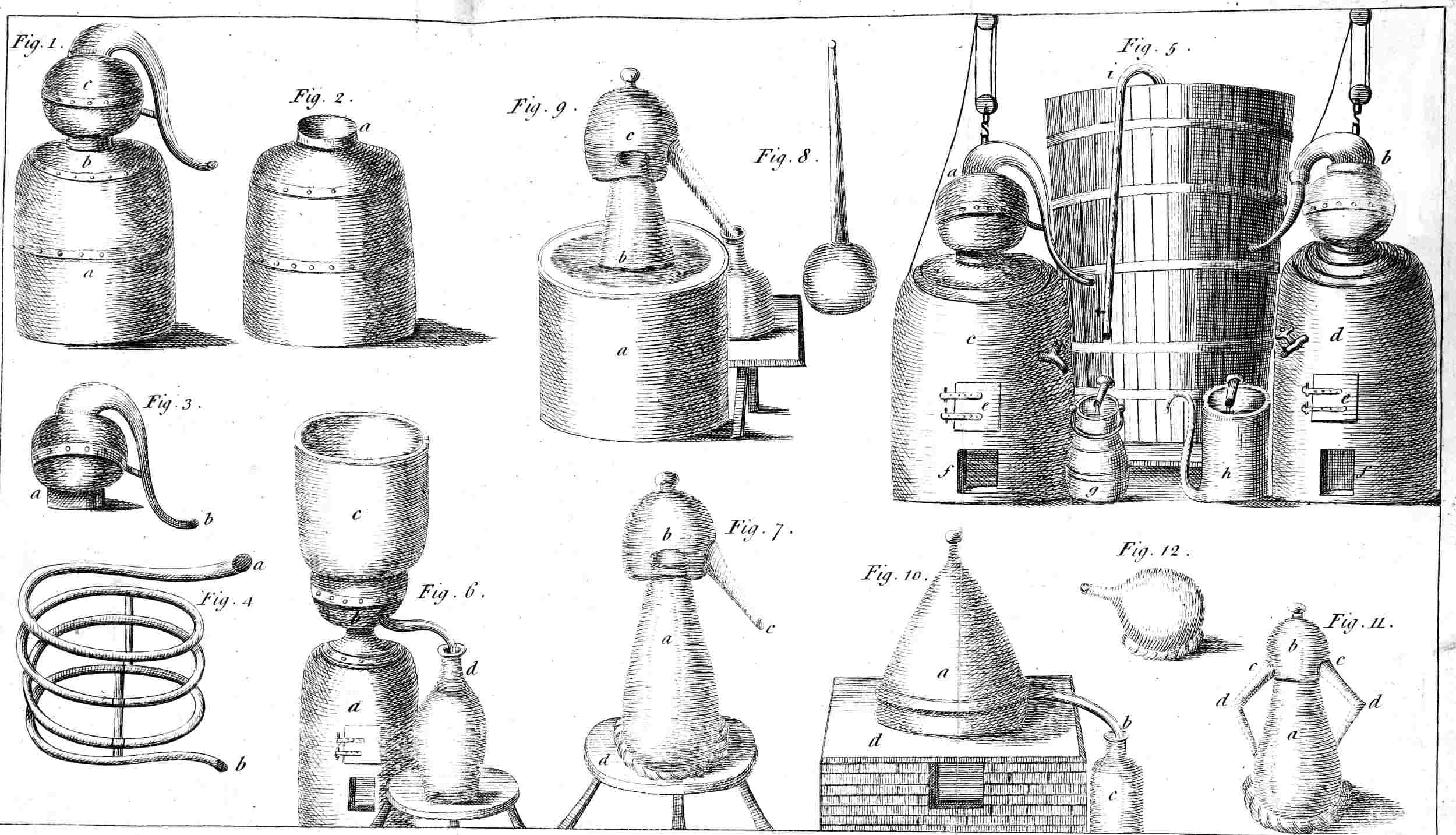
from the following Figures, which represent
them much stronger to the Imagination
than is possible to be done by Words.
Fig. 1. Is a common Alembic, as it appears
before it is placed in a Furnace, where
a is the Bottom, b the Crown, c the Head.
Fig. 2. Is the Body without the Head; a
the Rim or Top of the Crown where the
Head is luted.
Fig. 3. The Head; a the Rim where it
is to be luted to the Body; b the Nose, or
End which is luted into the Worm.
Fig. 4. The Worm, as it appears when
out of the Tub in which it is fixed when
in use; a the End into which the Still Head
is inserted, b that which conveys the Liquor
into the Receiver.
Fig. 5. Two Stills at work in one Refrigeratory;
a, b the two Still Heads, c, d the
Bodies inclosed in the Brick-Work; e, e the
two Fire-Places; f, f the two Ash-Holes;
g a Common Receiver; h a Spout Receiver,
called by Chemists a Separating-Glass, used
in the Distillation of Herbs, in order to extract
their essential Oil; i a Crane for drawing
the Water out of the Refrigeratory.
Fig. 6. A small Still with a Refrigeratory;
a the Body, b the Head, c the Refrigeratory
filled with Water, d the Receiver, luted to
the Bec of the Alembic.
Fig. 7. A Glass Alembic to be used as a
Balneum Mariæ; a the Body, b the Head,
c the Bec, which is to be luted to the Receiver,
d a Trivet on which it is standing in
the Water.
Fig. 8. A proper Receiver for the Glass
Alembic, called by Chemists a Bolt-Head,
or Matrass.
Fig. 9. The Glass Alembic placed in a
Copper Vessel; a the Copper Vessel filled
with Water, b the Body of the Glass Alembic,
c the Head, d the Receiver luted at c
to the Bec of the Alembic.
Fig. 10. A cold Still for distilling simple
Waters; a the Head, b the Bec, or Nose,
c the Receiver, d the Plate on which Herbs
are laid.
Fig. 11. A Vessel for Digestion, called
by Chemists a Pelican or circulatory Vessel;
a the Body, b the Head, c, c two Tubes,
luted at d, d, by which the Liquor returns
from the Head into the Body; e a Furnace
on which it is placed, f the Fire-place, g
the Ash-hole.
Fig. 12. Another Receiver, used when
it is necessary to lute it to the End of the
Worm, in order to prevent the most volatile
Parts from being evaporated, and lost.
CHAP. VI. Of the Accidents that too often happen in performing the Processes of Distillation .
Among the Accidents which frequently
happen in Distilling, the least
of all is for the Operation to miscarry and
the Ingredients to be lost.
And this being a Subject of the greatest
Importance we shall treat it with all possible
Accuracy.
All Accidents are occasioned by Fire,
their primary Cause; by want of Attention
they get too much Head, and Fear often
suffers them to become irremediable.
The first Accident which may happen
by the Fire, is when a Distiller, by too
great a Heat, causes the Ingredients to be
burnt at the Bottom of the Still; by this
Means his Liquor is spoiled by an empereumatic
Taste, and the Tin is melted off from
the Alembic. An Empereuma resembles
the Smell of burnt Tobacco, and is produced
in Liquors by too great a Degree of Heat.
To illustrate this, distil any Fruit, Flowers,
or any Aromatic whatever; but especially
something whose Smell is very volatile, draw
off only the best, unlute the Alembic, and
what remains in the Still, will be found to
have a very disagreeable Smell; whence it
follows, that if a little more had been drawn
off, it would have spoiled what was before
obtained.
If the Fire be too violent, the extraordinary
Ebullition of the Contents causes them
to ascend into the Head; and, if a Glass
Alembic, they fall ignited into the Recipient;
the Heat breaks it, the Spirits are dissipated,
and often take Fire from the Heat of the
Furnace.
If the Fire be too strong, the Bottom of
the Still becomes red hot, the Materials inflamed,
and consequently the Fire reaches
the Recipient.
When an earthen Alembic is used, the
closest Attention is requisite to keep the Fire
from burning the Materials at the Bottom.
The Head, which is always of Glass, bursts,
and the Spirits are spilt, and often catch
fire. And the Remedy becomes the more
difficult, as Earth retains the Fire much
longer than a common Alembic.
If the Alembic be not firmly fixed, it is
soon put out of Order, falls down and unlutes
itself; thus the Liquor is spilt, and the
Vapour sets the Spirits on fire.
If all the Joints be not carefully luted,
the Spirits at their first Effort issue through
the least Aperture, run into the Fire, which
is propagated into the Alembic by the Vapour.
In Distillations where the Phlegm ascends
first, its Humidity penetrates the Lute, and
loosens it, so that when the spirituous Vapours
ascend, they are exposed to the same
Accident.
Lastly, when the Recipient is unluted,
especially if near full, without the greatest
Circumspection the Spirits will be spilt, and
so catch Fire.
Hitherto I have only given a simple Account
of what daily happens to Distillers;
but the Consequences of these Accidents
are infinitely more terrible than the Accidents
themselves; for an Artist to lose
his Time, his Labour and Goods, is no
small Matter; but it follows from what we
have premised, that both his Life and Fortune
are in danger from these Conflagrations.
Instances of the former are too common, as
well as those of the latter, relating to the
Danger to which the Operator is exposed.
They are evident, and we have seen very
lately three Instances sufficient to intimidate
the most sanguine. The Spirits catch, the
Alembic and Recipient fly, and the inflamed
Vapour becomes present Death to all who
breathe it.
The Rectifiers, who perform the most
dangerous Operations of Distillery, are particularly
exposed to these terrible Accidents;
the Fineness of the Spirit at the same
time that it renders it more inflammable,
also causes the Fire to spread with the
greater Rapidity. And when their Store-houses
are once on Fire, they are seldom or
never saved.
Possibly I may be censured for my Conciseness
on this Head; indeed the Importance
of it requires the most particular Discussion;
but intending to speak of the Methods
proper to prevent these Accidents, I
shall close this Chapter, with recommending
the Subject of it to the serious Reflection
of all concerned in Distillation. And it being
hitherto omitted, though of all others it
requires the Attention of the Distiller, I shall
further observe, that these Operations should
never be left to Servants. What can be expected
from ignorant Persons? Fear will
seize them, when the greatest Presence of
Mind is requisite.————Let us now proceed
to the Methods of preventing, or at least
lessening their Effects.
CHAP. VII. Of the Methods of preventing Accidents.
To have informed the Reader of the Accidents
which happen in Distilling,
would have been of little Consequence,
without shewing, at the same Time, the
Methods of preventing them. In order
therefore to fortify him against the Terror,
which the foregoing Chapter may have
excited, we will here point out the Remedies
for all the Cases before specified.
To prevent Accidents, two Things especially
must be known, and adverted to.
1. The Knowledge of the Fire, which
depends on the Fuel, whether Wood or
Coal.
2. The Manner of luting so as to prevent
the Vapours from escaping through it,
and by that Means of setting the whole on
fire.
The hardest Wood generally makes the
quickest Fire, such as Beech, Oak, Holm,
Elm, &c. The white Woods, as the Ash,
the Poplar, the Willow, and the Birch,
make a milder Fire. This holds good also
of the Coal made of these two kinds of
Wood; and, consequently, the Nature of
the Wood or Coals must determine the
Fire, and the Action of this must be proportioned
to the Effect intended to be produced
by it. That is, the Capacity of the Alembic,
the Matters to be distilled, and their
Quantity. The same may also be said of
Pit Coal, which is generally used in England.
It is evident, that the larger the Alembic,
the more Fire is necessary. What has not
been digested, also, requires more Fire
than that which has been prepared by that
Operation. Spices require a stronger Fire
than Flowers; a Distillation of Simple Waters
more than that of spirituous Liquors.
The surest Way of ascertaining the
necessary Degree of Fire, is to regulate
it by the Materials, as they are more or
less disposed to yield them Spirits, &c.
and this is done as follows. The Operator
must not leave the Alembic, but attentively
listen to what passes within, when
the Fire begins to heat it. When the Ebulition
becomes too vehement, the Fire must
be lessened, either by taking out some of
the Fuel, or covering it with Ashes or
Sand.
It requires a long Experience in the several
Cases, before a Distiller can acquire a
competent Knowledge in this important
Point. Nor is it possible to determine the
Degree of Fire from the Quantity of Fuel;
Judgment, assisted by Experience, must supply
this Defect.
Every thing being determined with regard
to the Degree of Fire, we shall now
proceed to explain the Method of luting
Alembics.
By the Term luting an Alembic, we
mean, the closing the Joints through which
the Spirits might transpire.
Lute is a Composition of common Ashes,
well sifted, and soaked in Water; Clay, and
a kind of Paste made of Meal or Starch are
also used for this Purpose; which, as I before
observed, is to close all the Joints, &c.
in order to confine the Spirits from transpiring.
Good Luting is one of the surest Methods
of preventing Accidents. An Alembic,
where all Transpiration is prevented, having
nothing to fear but the too great Fierceness
of the Fire; and that may be regulated
by the Rules already laid down.
The refrigerating Alembic is mostly used.
The Body and the Head are joined to each
other; but notwithstanding the greatest
Care be taken in luting the Juncture, there
will still be some imperceptable Interstice
for Transpiration; and the least being of
the greatest Consequence, a Piece of strong
Paper, should be pasted over the Joint, and
the Alembic never left, till the Spirits begin
to flow into the Receiver, in order to
apply fresh Paper, if the former should
contract any Moisture. The Master himself
should carefully attend to this, and
whatever Precaution may have been previously
used, the Eye must be constantly upon
it.
The Alembic, when vinous Spirits are
distilled, should be luted with Clay, carefully
spread round the Junctures, in order
to prevent all Transpiration; because the
Consequences here are terrible; for when
the Fire catches a large Quantity, it is often
irremediable. Besides, as this Earth cracks
in drying, it must be often moistened, and
fresh applied, on the first Appearance of
any Occasion for it.
The Retort is also luted with Clay; but
as glass Retorts are also used, they are often
coated with the same Clay, to prevent their
melting by the Intenseness of the Fire.
Lastly, the earthen and glass Alembics
are luted with Paper and Paste as above.——Having
thus explained the great Consequence
of Circumspection with regard to
Luting, and the Degree of Fire, we shall
now proceed to a third Method of preventing
them, and close this Chapter with a
short Observation on portable Furnaces;
which is, That Alembics being never thoroughly
secure on this kind of Furnaces, a
Hook should be fastened to the Refrigerant
for fixing it to the Wall.
CHAP. VIII. Of the Remedies for Accidents, when they happen.
Notwithstanding the best of Rules, and
the strictest Observation, it is impossible
entirely to prevent Accidents, and therefore
it is of no less Importance to point out
the Remedies on those Occasions.
The most essential, are Courage and Presence
of Mind; Fear only increasing the
Misfortune.
1. If the Fire be too violent it must be
covered, but not so as totally to prevent its
Action, as by that Means the Process of the
Distillation would be interrupted, and render
it more difficult and less perfect.
2. When the Ingredients burn, which
you will soon discover by the Smell, the Fire
must be immediately put out, in order to
prevent the whole Charge of the Still being
entirely spoiled, which would otherwise inevitably
be the Consequence.
3. If the Spirits should catch fire, the
first care is to unlute immediately the Receiver,
and stop both the End of the Beak
and Mouth of the Receiver with wet
Clothes.
The Fire must then be put out, and if the
Flame issued through the Luting, the Joints
must be closed with a wet Cloth, which,
together with Water, should never be wanting
in a Distil-house.
4. If the Alembic be of Earth, and the
Contents burn at the Bottom, the Fire must
immediately be put out, the Alembic removed,
and Water thrown upon it, till the Danger
is over; and, for farther Security, covered
with a wet Cloth.
5. If after all your Care in closing the
Junctures to prevent Transpiration, you
perceive any thing amiss, while the Spirits
are ascending, apply Clay, or any other
Composition, in order to stop the Aperture,
and have always a wet Cloth ready to stifle
the Flame, if the Spirits should take fire.
6. If the Heat detaches the Lute, or it
becomes moist, immediately apply another,
having always ready what is necessary for
performing it. Should the Transpiration be
so violent, that you cannot immediately apply
a fresh Lute, clap a wet Cloth round the
Joint, and keep it on firm and tight, till
the Spirits have taken their Course. But if
notwithstanding all your Efforts the Transpiration
should increase, so that you fear
a Conflagration, remove the Receiver as
soon as possible from the Fire, and afterwards
your Alembic, if portable; but if
otherwise, put out the Fire immediately.
7. The Charge being worked off, be
cautious in luting the Receiver, that nothing
be spilt on the Furnace, and carry it to some
Distance from it, that the Spirits exhaling
may not take fire.
8. Lastly observe, that wherever a Remedy
is required, there must be no Candle
used; for the spirituous Vapours easily take
fire, and propagate the Flame to the Vessels
from whence they issue.
All that has been hitherto said concerns
only the Management of the Alembic; but
what remains is still more interesting, and
relates to those who work it, that they may
not, by conquering the Accident, destroy
themselves.
On discovering any of the above Accidents,
when the Flame has not yet reached
the Spirits, let the Remedies already mentioned
be applied, either with regard to the
Lute, or the Violence of the Fire.
But if the Flame has reached the Alembic,
the following Precautions are to be
used.
The Operator must not approach the
Alembic without a wet Cloth over his
Mouth and Nostrils, it being immediate
Death to inhale the inflamed Vapour.
In hastening to stop any Accident, be
careful to approach the Side opposite to that
whither the Air impels the Flame; for,
without this Precaution you would be involved
in it, and could not, without the utmost
Difficulty, extricate yourself from it.
If notwithstanding this Precaution, the
Eddy of the Air should force the Flame to
your Side, quit the Place immediately, and
do not return till its Direction be changed,
always taking care to have a wet linen Cloth
before your Nose and Mouth, and keep yourself
on the Side opposite to the Direction of
the Flame: And also to have another such
Cloth, in order to smother the Flame, and
close the Crevise through which the Spirits
issue.
Should it be your Misfortune to be covered
with inflamed Spirits, wrap yourself
in a wet Sheet, which should be always
ready for that Purpose. Self-Preservation
is of too great Importance that any of these
Precautions should be omitted in such Variety
of Dangers.
If the Fire has acquired such a Head
that it cannot be stopt, the Receiver must
be broke, and the Alembic, if portable,
thrown down; but no Person must be suffered
to go near them, especially those who
are Strangers to the Business.
In a desperate Case, like that of a large
Quantity of rectified Spirit taking Fire, if
Time permit, the Communication of the
Beak of the Alembic with the Recipient,
which is usually a Cask, must be cut off, by
closely stopping the Bung; and be sure no
Candle come near the Receiver, leaving the
rest, as the Danger would be too great to
expose ones self to the Flames of a large
Charge, and the Distiller’s Safety should be
principally considered.
I thought it my Duty to give my Reader
these Informations, and hope that in the
Practice of Distillation, he will find them
of great Advantage.
CHAP. IX. On the Necessity of often cooling the Alembic, as another Means of preventing Accidents.
The Refrigerant is so essential a Part
of the Alembic, that for want of it
several other Expedients are made use of to
perform its Office, for cooling those whose
Capacity, Brittleness, or lastly the Construction,
will not admit of their having any.
The Refrigerant is usually in proportion
to the Capacity of the Alembic, for which
the following may serve as a Rule, that the
Capacity of the Refrigerant should be to that
of the Alembic, as 14 to 8.
The Necessity of cooling the Head of the
Alembic is self-evident to all who have
the least Knowledge of Distillation, as it
condenses the Spirits, cools them, and causes
them to flow into the Receiver, which, if of
Glass, would otherwise be broken by the
Heat; and consequently serves to prevent
Conflagrations.
The Alembics of the Balneum Mariæ,
and the Vapour Bath, ought also to have
Refrigerants, like the common Alembic,
unless they are of Glass.
Those of Earth and Glass are cooled, as
we have already observed, with a wet Cloth,
which is also used to cool the Head of other
kinds of Alembics. But it is not difficult to
contrive one which may be placed in a Refrigerant;
such as the following.
To a common small Still apply and lute a
Worm, or long tin or pewter Tube, forming
several Circumvolutions, of the same
Circumference with the Body, in order to
give it some Elevation, place this Worm in
a Refrigerant, proportioned to the Alembic.
If the Capacity of this Alembic should make
it bear too much on the Neck of the Matrass,
it may be supported by a Trevit of the same
Circumference as the Body itself: The Extremity
of the Worm may have a Beak projecting
beyond the Side of the Refrigerant,
for conveying the Spirits into the Receiver.
This Apparatus will be attended with little
Expence, will save the Distiller the
Trouble of being perpetually cooling the
Head of the Alembic, and is such a Safe-guard
against Accidents, that if the Worm
be well luted, nothing need be apprehended
but from the Violence of the Fire.
This Method of Practice, therefore, is
productive of three valuable Particulars:
The first is, that by cooling the Spirits it
preserves the Receiver, and obviates the Accidents
arising from their Heat. The second
is, that the Spirits being kept in a
moderate Heat, the Transpiration is less,
and consequently the Spirits procured by
the Operation have more Taste, Smell and
Fragrancy than they would otherwise have
had.
Experience demonstrates, that when the
Spirits flow hot into the Receiver, however
attentive the Distiller may be to lute the
Junctures of the Alembic, there will be a
very sensible Evaporation, which even in
simple Waters greatly depreciates the Goodness
of the Liquor.
Lastly, the third is, that the Cooling of
Alembics is what principally contributes to
the Perfection of the Operation; because
the Coolness of the Head precipitates the
Phlegm, and in the Case of too great a Degree
of Fire, and where the Ebullition is
too vehement, if after taking away Part of
the Fire, or covering it, the Ebullition should
continue, the Head may be cooled with
a wet Cloth, till the Ebullition is reduced.
As there is a Necessity of cooling the
Alembic, so what we have said cannot be
too carefully observed. In fine, the Contrast
of Cold and Heat, equally concurring,
but by Methods directly opposite, to the
same Process, and the Perfection of the
Distillation, is a Phœnomenon, which deserves
the Attention of all who study the
Operations of Nature.
CHAP. X. Of the Necessity of putting Water into the Alembic, for several Distillations.
Two principal Advantages attend putting
Water into the Alembic. The
first is, to prevent the Loss the Distiller
would incur without that Precaution, and so
prevent any Alteration in the Liquor procured
by Distillation. This we shall illustrate
by an Example. Suppose a Distiller
should attempt to rectify Spirits of Wine,
without putting Water in the Alembic. It
is evident, that the Fire will consume Part
of it, which is entirely loss, because the
same Quantity of Spirit cannot be procured
from it, which might, had there been any
thing to moderate the Action of the Fire,
which now preyed upon it.
Secondly, If Liquors are impregnated with
strong Ingredients, especially Seeds, and the
Quantity be sufficient to absorb all the
Phlegm, a great Quantity of Spirit must
be left in the Still, or the Ingredients will
burn, and the Spirits contract an empyreumatic
Taste, which is the more detrimental
to the Spirit, as it is increased by Age.
Thirdly, If no Water be put into the Alembic
with the Ingredients, the Spirit will
be rendered finer by them, and the Fire, if
ever so little too strong, will cause the Ingredients
to burn, and the Spirits to contract an
Empyreuma; a Misfortune easily prevented
by this Precaution.
Thus it is a Safe-guard against Accidents:
But besides, Water being mixed with the Ingredients,
they are at once prevented from
burning, and the Spirit not weakened; for
no sooner are the Ingredients put in Motion
by the Fire, than the Spirits immediately
ascend, and the Liquor loses nothing of its
Quality, provided the Receiver be removed
as soon as the Phlegm begins to ascend.
The Water therefore prevents the Waste of
the Spirits, and thus the Distiller loses nothing
of his Goods; whereas, without Water, the
Spirits by impregnating the Materials, their
Quantity must be less. With regard to the
Phlegm, there is no Difficulty in finding
when it begins to ascend, the first Drop being
cloudy, and when it has continued dropping
for some time, it is perceived by a
milky Cast at the Bottom of the Receiver.
Lastly, The Distiller is no Loser with
regard to the Quality of his Liquor, which
is not at all weakened thereby. Thus it is
attended with the two capital Advantages,
the Profit of the Distiller, and the Perfection
of the Liquor. Let us now proceed to the
different Manners of Distillation.
CHAP. XI. Of the particular Advantages attending every kind of Distillation. — The Method of Distilling with the common refrigerant Alembic. — Of Distillation in Sand, and in what Cases it should be used. — Of Distilling in Balneum Mariæ, and its Advantages . — In what Cases glass, or earthen Alembics are to be used; their Advantages and Disadvantages. — Advantages of Distillation performed by the Vapour Bath. — Cases where Dung, Husks of Grapes, and Lime, are to be used.
In the third Chapter we mentioned the
several kinds of Distillation, we shall
here enlarge on the particular Advantages
of each, and in what Circumstances each
is to be used.
In order for Distillation, the Alembic must
be charged with Materials, and placed on
a Fire, or Substances capable of producing
the same Effect.
This Method of Distilling is the most
generally used, being one of the most speedy
and profitable, as it requires fewer Preparatives,
and less Time.
To distil with the common Alembic,
the Body of it must be thoroughly cleansed,
that no Taste or Smell of any preceding
Materials may remain. The Materials
are then to be put into the Alembic;
but care must be taken that the Alembic
be not above half full, in order that the
Materials may have sufficient Room to
move, without choaking the Neck of the
Alembic. The same Care must be taken
with regard to the Head, it must be thoroughly
cleansed and dried; for it often
happens that some small Quantity of Water
is left in the Rim, which renders the first
Spirits foul, and, by endeavouring to separate
it from the other, some, and that the
most volatile Part of the Spirit, will be lost.
After this the two Parts of the Alembic
are to be carefully luted with strong brown
Paper, well pasted on, and the Nose of the
Alembic luted to the Worm; after which
the Fire should be immediately made under
the Still, lest too long an Infusion should
prejudice the Liquor.
This Alembic being worked on an open
Fire, the Operation is quicker than any
other; but the Degree of Fire requires a
very close Attention; as a different Management
is necessary to different Materials.
The Water of the Refrigeratory must be
changed from time to time, and if the Case
requires it, the whole Head, but especially
the Bec, must be kept cold.
This Species of Distillation is performed
in two different Manners. First, by covering
the Fire with Sand or Ashes, and
placing the Alembic upon it. This Method
is very necessary in Digestion, and for
the perfect Rectification of Spirits. Sand is
absolutely necessary for moderating the Action
of the Fire, when there is Reason to
fear the Matter contained in the Bottom of
the Alembic will burn.
The second Method of Sand Distillation,
is to take the finest River Sand, and after
thoroughly washing it, put into the Alembic
a Quantity sufficient to cover it three
Fingers deep; after which the Still is to be
charged with the Ingredients to be distilled.
This serves instead of Water in certain
Cases, where the Use of it would prejudice
the Ingredients; as in the fine spirituous
Waters impregnated with the aromatic Parts
of Flowers; the Sand preventing the Ingredients
from burning. It is also necessary in
distilling rectified Spirits from Seeds.
This Operation being finished, the Alembic
must be thoroughly cleansed from the
Sand, that the Taste or Smell contained
therein, be not communicated to any other
Charge of different Ingredients.
This Method of Distillation is of great
Use in several Cases. Its Operation is more
perfect, and is subject to few, if any of
those Accidents attending Distillations on an
open Fire.
In distilling sweet-scented Waters from
Flowers, aromatic Plants, and others of
that kind, where neither Water, nor Spirit
ought to be mixed with them, there is
an absolute Necessity for using the Balneum
Mariæ; as by every other Distillation, on
an open Fire, the Ingredients would infallibly
burn.
If Sand should be made use of, the Fire
would melt the Tin from the Alembic, and
the Contents be in the utmost Danger of being
burnt.
In distilling in Balneum Mariæ, a glass Alembic
is generally used. This Alembic is to
be placed in a Copper Vessel filled with
Water. This Vessel ought at least to be of
half the Height of the Alembic: at the
Bottom of the Copper Vessel must be a
Trivet on which the Alembic is to be
placed, that it may not touch the Bottom of
the Copper, because when the Water begins
to boil, it disperses itself towards the
Sides, and leaving the Bottom dry, the Ingredients
would be in danger of burning.
The Use of the Balneum Mariæ is excellent
for those Ingredients which require
little Spirit; but if a Copper Alembic be
used, be sure to place Sand at the Bottom,
that the distilled Liquor may not contract
any ill Taste or Smell. This Method is
also adviseable in the Rectification of Spirits,
on Account of the Danger attending this
Operation when performed on a naked
Fire.
Were this Method of Distillation as expeditious
as that performed on a naked Fire,
no other ought to be used, because it is subject
to no Accidents, and at the same Time
the Spirit, &c. distilled is much more fragrant
and grateful.
In the Chapter relating to Accidents, we
have mentioned the earthen Alembic; we
must now add, that it ought never to be
used, except the Matter to be distilled have
a strong and bad Smell, and then seldom
above once, unless it be for Ingredients of
the same or similar Qualities.
This Alembic being very difficult to be
managed, we can only recommend it in the
Case above-mentioned.
As a naked Fire is generally applied to
this Alembic, it requires a Furnace where the
Fire may be gradually increased, on account
of the Accidents to which it is liable.
The glass Alembic is more easily managed,
as it is generally placed in a Balneum
Mariæ. Its principal Use is for distilling
Waters from Flowers, and making Quintessences;
and were it not for the Length of
the Operation, it would be preferable to
any other Method.
This Alembic hardly admitting of a Refrigerant,
a wet linen Cloth must be placed
on the Head, and often changed.
The Receiver of this Alembic must not
be very large, because of the Fragility of
the Bec; but if it were ever so little bent
into a Curve, the Largeness of the Receiver
would be of no Prejudice; because then its
whole Weight would be supported by its
Stand.
This Method differs very little from the
Balneum Mariæ, and is used nearly in the
same Circumstances; but has greatly the
Advantage of the Balneum Mariæ in the
Quickness of the Operation. And Lemery,
in the first Part of his Course of Chemistry,
affirms its Operation to be more perfect.
However that be, its Use is equal to that
of the Balneum Mariæ; but in distilling
sweet-scented Waters, or Flowers, Sand
must be placed at the Bottom, that the Liquor
may not contract a Taste from the
Copper.
These Substances are rarely used except
in Digestions; and therefore of no great
Use to Distillers, they using only hot Ashes,
or a Fire well covered for that Purpose.
If Dung be used it must be of the hottest
kind, viz. that of the Horse or Sheep, and
the Quantity proportioned to the Heat intended.
The Lime must be quick; and if
the Heat required be moderate, Lime which
has lain some time in the Air must be
used. The same is to be observed with regard
to the Husks of Grapes. But in whatever
manner these are used, the Digestions
must be performed in a close covered Vessel.
CHAP. XII. Of Bodies proper for Distillation.
This Chapter alone might make a Volume,
were we to make a particular
Enumeration of all its Parts; but, as we
have already observed, we shall confine ourselves
to the Distillation of simple and compound
Waters, &c.
If we acquit ourselves to the Satisfaction
of the Public, we shall enjoy the Pleasure
of having treated of one Part entirely new;
and, indeed, the only one that has been
overlooked.
The Bodies proper for Distillation, are
Flowers, Fruits, Seeds, Spices and aromatic
Plants.
By Distillation and Digestion, we extract
the Colour and Smell of Flowers in simple
Waters and Essences.
We extract from Fruits, at least from
some, Colour, Taste, &c.
From aromatic Plants, the Distiller draws
Spirits, Essences, simple and compound
Waters.
From Spices are procured Essences, or in
the Language of the Chemists, Oils, and
Perfumes, and also pure Spirits.
From Seeds or Berries are drawn simple
Waters, pure Spirits; and from some, as
those of Anise, Fennel, and Juniper, Oil.
The Colour of Flowers is extracted by
Infusion, and likewise by Digestion in Brandy
or Spirit of Wine: The Smell is extracted
by Distillation; the simple Water with
Brandy or Spirit of Wine.
What is extracted of the Colour of Flowers,
by Infusion in Water by a gentle Heat,
or by Digestion in Brandy or Spirits of
Wine, is called, in the Distiller’s Phrase,
Tincture of Flowers.
The Colour of Fruits is extracted in the
same manner, either by Infusion or Digestion:
Their Taste is also procured by the
same Processes. But let it be observed, that
the Time of these Operations must be limited;
for otherwise the Fruit, after Fermentation,
would render it acid. The Taste is
also extracted by Distillation in Spirit of
Wine.
From aromatic Plants are extracted by
the Alembic pure Spirits, Odours, and simple
Waters. But these require different
Methods of Distillation. The first by Water
or Brandy only, the second by rectified
Spirit, which will give them the greatest
Excellency they are capable of.
The Plants themselves with their Flowers
may also be distilled, which is still
better.
From Spices are drawn Spirits, and oily
or spirituous Quintessences. The Spirits are
drawn by Brandy, or Spirit of Wine, with
very little Water: The Oils are distilled per
Descensum; and the spirituous Quintessences
by pounding the Spices, and after infusing
them in Spirit of Wine, decanting it gently
by inclination.
From Seeds are extracted simple Waters,
Spirits and Oils. Very few of the first and
last, Spirits being what is generally extracted
from Seeds and Berries.
Some Distillers, through a Notion of
Frugality, distil Seeds with Water; but
their Liquors are not to be compared with
those which are distilled with Spirits. When
Oils are drawn from Seeds, the Operation
is performed either by the Balneum Mariæ,
or the Vapour Bath.
We only deliver in this Place, the first
Elements of each of these Operations, which
will be farther illustrated in the Sequel,
when we treat more particularly of these
Subjects.
CHAP. XIII. Of what is procured by Distillation.
By Distillation are procured Spirit, Essence,
simple Waters and Phlegm.
Spirits are very difficult to be defined. I
consider them as the most subtil and volatile
Parts of a Body.
All Bodies without Exception have Spirits
more or less.
These Parts are an ignited Substance, and
consequently by their own Nature disposed
to a violent Motion.
These volatile Particles are more or less
disposed to separate themselves, as the Bodies
are more or less porous, or abound
with a greater or lesser Quantity of Oil.
By the Term Essence, we understand the
oleaginous Parts of a Body. An essential
Oil is found in all Bodies, being one of their
constituent Principles. I have observed in
all my Distillations, Spirit of Wine excepted,
a soft unctuous Substance floating on the
Phlegm; and this Substance is Oil, which
we call Essence; and this is what we endeavour
to extract.
Simple Waters are those distilled from
Plants, Flowers, &c. without the Help of
Water, Brandy, or Spirit of Wine. These
Waters are commonly odoriferous, containing
the Odour of the Body from whence it
is extracted, and even exceeds in Smell the
Body itself.
Phlegm is the aqueous Particles of Bodies;
but whether an active or passive Principle,
we shall leave to the Decision of Chemists.
It is of the last Importance to a Distiller
to be well acquainted with its Nature; many
mistaking for Phlegm several white and
clouded Drops, which first fall into the Receiver,
when the Still begins to work.
These, however, are often the most spirituous
Particles of the Matter in the Alembic,
and consequently ought to be preserved.
What has given occasion to this Mistake, is
some Humidity remaining in the Head, &c.
of the Alembic. And had it been thoroughly
wiped, the first Drops would have
been equally bright with any during the
whole Operation.
The following Remark deserves Attention.
In Bodies that have been digested
the Spirits ascend first; whereas in Charges
not digested, the Phlegm ascends before
the Spirits. The Reason of this is very
plain and natural.
In Substances previously digested, the
Action of the Fire no sooner causes the
Matter in the Alembic to boil, than the
Spirits, being the most volatile Parts, detach
themselves, and ascend into the Head
of the Alembic. But when the Matter to
be distilled has not undergone a proper Digestion,
the Spirits being intangled in the
Phlegm, are less disposed to ascend, till
the Phlegm itself separates, and gives them
room to fly upward. The Phlegm being
aqueous rises first: This is more particularly
observable in Spices. I am, however,
inclined to believe, that were the Operation
performed in an Alembic, whose Head was
at a great Distance from the Surface of the
Charge, they would not ascend high enough
to come over the Helm, but fall back again
by their own Gravity, and by that means
leave the Spirits at Liberty to ascend. But
in the common Refrigatory Alembic this
always happens.
If this Observation be not readily admitted,
I appeal to Experience, which I desire
may be the Test of every thing I shall advance.
Another Observation, which has verified
the above Assertion by innumerable Instances,
is, that in an extraordinary Run of Business,
when I had not time sufficient to digest the
Substances, I used to bruise them in a Mortar;
but notwithstanding the Trituration,
the Phlegm first came over, and afterwards
the Spirits. But I desire to be understood,
that I speak here only of the volatile Parts
of the Plants not drawn with vinous Spirits,
but contained in a simple Water.
Another Remark I must add, and which
I hope will be acceptable to the Curious,
as it has not yet been made public, though
doubtless the Observation has often occurred
to others; it is this: That in mixed Charges,
consisting of Flowers, Fruits, and aromatic
Plants, put into the Alembic without a previous
Digestion, the Spirits of the Flowers
ascend first; and notwithstanding the Mixture,
they contracted nothing of the Smell
or Taste of the Fruits and Plants. Next
after the Spirits of the Flowers, those of the
Fruits ascend, not in the least impregnated
with the Smell or Taste of either of the
Flowers or Plants. And in the last Place
the Spirits of the Plants distil no less neat
than the former. Should this appear strange
to any one, Experience will convince him
of the Truth.
Another Observation I have made on
aromatic Herbs, is, that whether they are,
or are not digested; whether the Spirits or
Phlegm ascend first; the Spirits contain
very little of the Taste and Smell of the
Plants from whence they were extracted;
and I have always been obliged to put to
these Spirits a greater or lesser Quantity of
the Phlegm, in order to give the Spirits I
had drawn the Taste of an aromatic Odour
of the Plants; the Phlegm containing the
greatest Quantity of both.
This Observation I insert as of great Use
to those who practice Distillation.
As the Term Digestion often occurs in
this Essay, I cannot avoid pointing out its
Advantages, and even shew the Necessity
of using it in several Circumstances.
Substances are said to be in Digestion,
when they are infused in a Menstruum, over
a very slow Fire. This Preparation is often
necessary in Distillation; for it tends to
open the Bodies, and thereby free the Spirits
from their Confinements, whereby they
are the better enabled to ascend.
Cold Digestions are the best; those made
by Fire, or in hot Materials, diminish the
Quality of the Goods, as some Part, as the
most volatile, will be lost.
In order to procure Essences, the Bodies
must be prepared by Digestion. It is even
of absolute Necessity for extracting the
Spirits and Essences of Spices.
CHAP. XIV. Of the proper Season for Distilling.
Flowers of all Kinds must be
distilled in their proper Seasons. To
begin with the Violet. Its Colour and Smell
can only be extracted when it is in its greatest
Vigour, which is not at its first Appearance,
nor when it begins to decay. April is the
Month in which it is in its greatest Perfection;
the Season being never so forward in
March, as to give the Violet its whole Fragrancy.
The same must be observed of all other
Flowers. And let them be gathered at the
hottest Time of the Day; the Odour and
Fragrancy of Flowers being then in their
greatest Perfection.
The same Observation holds good, with
regard to Fruits; to which must be added,
that they are the finest, and of the most
beautiful Colour, especially those from
whence Tinctures are drawn; they must
be free from all Defects, as the Goods
would by that Means be greatly detrimented.
Berries and Aromatics may be distilled
at any Season, all that is necessary being a
good Choice. But in this Distillers are
sometimes mistaken, as may easily happen
without a very accurate Knowledge. We
shall therefore, in the Sequel, lay down
more particular Directions for making a
proper Choice of Materials.
CHAP. XV. Of the Filtration of Liquors.
Filtration consists in passing Liquors thro’
some porous Substance, in order to free
them from those Particles which obscure
their Brightness.
Nothing is finer than a Liquor newly distilled;
but the Syrup and colouring Particles
render it thick and opaque; in order,
therefore, to restore their Brightness they
are filtrated, which is done by passing them
through Sand, Paper, Cloth, &c.
All the Attention of the Distiller cannot
in ordinary Operations always prevent some
aqueous Particles from rising with the Spirits,
either in the Beginning of the Process,
in those Compositions where they ascend
first, or at the Conclusion when they
rise last. As this is almost unavoidable, so
it is also sometimes necessary.
In distilling Flowers, or aromatic Plants,
fresh gathered, the Phlegm rises first; and
this Part cannot be taken out of the Receiver
without depriving the Spirits of a
considerable Part of their Fragrancy.
In distilling Spices, their Odour being
more entangled, will remain in the Alembic
till Part of the Phlegm is drawn off.
But when, instead of these Substances, their
Quintessences are used, the Necessity ceases.
But the Phlegm commonly causing a Cloudiness
in the Liquor, it may be rendered
tolerably fine, by pouring it gently off by
Inclination, without the Trouble of Filtration
the aqueous Particles, by their
Gravity, falling to the Bottom. But to render
it entirely bright and fine, put some Cotton
in a Funnel, and pour the Liquor thro’
it, by which means the aqueous Particles
will be retained in the Cotton. You must
however remember to cover the Top of
the Funnel, to prevent the most volatile
Parts of the Spirits from evaporating.
CHAP. XVI. Of the Distillation of Malt Spirits.
The Wash, or Liquor being prepared
by Brewing and Fermentation, as directed
in the first and second Chapters of
this Treatise, the Still is to be charged with
it, and worked off with a pretty brisk Fire.
But it should be observed, that the only Apparatus
used in this Process, is the Alembic
with a Refrigeratory, as represented in
Fig. 1.
The Wash being of a mucilaginous Nature,
a particular Management is necessary
to prevent its burning, and cause it to work
kindly in the Still: If it should happen to be
burnt in the Operation, the Spirit will have a
most disagreeable Flavour, which can hardly
ever be removed; and therefore to prevent
this ill Effect, the Wash should be made
dilute or thin, the Fire well regulated, and
the whole kept in a continual Agitation
during the whole Process. The most judicious
Distillers always take care to have
their Wash sufficiently diluted, and constantly
find their Spirit the purer for it.
With regard to the Fire, it may be easily
kept regular by a constant Attendance, and
observing never to stir it hastily, or throw
on fresh Fuel; and the stirring of the Liquor
in the Still is to be effected by Means
of a Paddle, or Bar kept in the Liquor till it
just begins to boil, which is the Time for
luting on the Head; and after which there
is no great Danger, but from the improper
Management of the Fire: This is the common
Way; but it is no easy Matter to hit the
exact Time, and the doing it either too late, or
too soon, is attended with great Inconvenience,
so that several have discovered other
Methods; some put more solid Bodies into the
the Still with the Wash; others place some
proper Matter at the Bottom and Sides of
the Still, which are the Places where the
Fire acts with the greatest Force.
The Use of the Paddle would, however,
answer better than either of these Methods,
could it be continued during the whole
Time the Still is working; and this may be
done by the following Method: Let a short
Tube of Iron or Copper be soldered in the
Center of the Still-head, and let a cross Bar
be placed below in the same Head, with a
Hole in the Middle, corresponding to that
at the Top; through both these let an iron
Pipe be carried down in the Still, and let an
iron Rod be passed through this with wooden
Sweeps at its End; this Rod may be continually
worked by a Winch at the Still-head,
and the Sweeps will continually keep
the Bottom and Sides scraped clean, the Interstices
of the Tube being all the time well
crammed with Tow to prevent any Evaporation
of the Spirit.
The same Effect may, in a great Measure,
be produced by a less laborious Method,
namely, by placing a Parcel of cylindrical
Sticks lengthways, so as to cover the whole
Bottom of the Still, or by throwing in a
loose Parcel of Faggot Sticks at a Venture;
for the Action of the Fire below moving
the Liquor, at the same time gives Motion
to the Sticks, making them act continually
like a Parcel of Stirrers upon the Bottom and
Sides of the Still, which might, if necessary,
be furnished with Buttons and Loops, to
prevent them from starting. Some also
use a Parcel of fine Hay laid upon the loose
Sticks, and secured down by two cross Poles,
laid from Side to Side, and in the same
Manner fastened down with Loops. Care is
to be taken in this Case not to press the Hay
against the Sides of the Still; for that would
scorch nearly as soon as the Wash itself;
but the Sticks never will: These are simple
but effectual Contrivances, and in point of
Elegance, they may be improved at Pleasure.
There is another Inconvenience attending
the distilling of Malt Spirit, which is, when
all the Bottoms, or gross mealy Fœculence
is put into the Still along with the Liquor,
the thinner Part of the Wash going off in
Form of Spirit; the mealy Mass grows by
Degrees more and more stiff, so as to scorch
towards the latter Part of the Operation.
The best Method of remedying this is to
have a Pipe with a Stop-cock, leading from
the upper Part of the Worm-tub into the
Still; so that upon a half, or a quarter Turn,
it may continually supply a little Stream of
hot Water, in the same Proportion as the
Spirit runs off, by which Means the Danger
of scorching is avoided, and the Operation,
at the same time, not in the least
retarded.
In Holland, the Malt Distillers work all
their Wash thick, with the whole Body of
Meal among it; yet they are so careful in
keeping their Stills clean, and so regular
and nice in the Management of their Fires,
that though they use no Artifice at all on
this Head, only to charge the Still while it
is hot and moist, they very rarely have the
Misfortune to scorch, except now and then
in the Depth of Winter. When such an
Accident has once happened in a Still, they
are extremely careful to scrape, scrub and
scour off the Remains of the burnt Matter,
otherwise they find the same Accident very
liable to happen again in the same Place.
But beyond all the other Methods in Use on
this Occasion, would be the working the
Stills not by a dry Heat, but in a Balneum
Mariæ, which might possibly be so contrived
by the Bason being large, and capable
of working a great many stills at once,
as to be extremely worth the Proprietor’s
while in all respects.
Another Requisite to be observed is, that
the Water in the Worm-tub be kept cool;
this may be affected, by placing in the middle
of the Tub a wooden Pipe or Gutter,
about three Inches square within, reaching
from the Top almost to the Bottom; by
this Contrivance cold Water may, as often
as necessary, be conveyed to the Bottom of
the Worm-tub, and the hot Water at the
Top forced either over the Sides of the Tub,
or, which is better, through a leaden Pipe
of moderate Size, called a Waste-pipe, soldered
into the Top of the Tub, and extended
to the Gutter formed to carry away
the Water.
CHAP. XVII. Of the Distillation of Molosses Spirits.
The Spirit distilled from Molosses or
Treacle, is very clean or pure. It is
made from common Treacle dissolved in
Water, and fermented in the same Manner
as the Wash for the common Malt Spirit.
But if some particular Art is not used in
Distilling this Spirit, it will not prove so vinous
as Malt Spirit, but more flat and less
pungent and acid, though otherwise much
cleaner tasted, as its essential Oil is of a less
offensive Flavour. Therefore, if good fresh
Wine-lees, abounding in Tartar, be added and
duly fermented with the Molosses, the Spirit
will acquire a much greater Vinosity and
Briskness, and approach much nearer to the
Nature of foreign Spirits.
Where the Molosses Spirit is brought to
the common Proof Strength, if it be found
not to have a sufficient Vinosity, it will be
very proper to add some good dulcified
Spirit of Nitre; and if the Spirit be clean
worked, it may, by this Addition only, be
made to pass on ordinary Judges for French
Brandy.
Great Quantities of this Spirit are used in
adulterating foreign Brandy, Rum and Arrac.
Much of it is also used alone in making
Cherry-Brandy, and other Drams by
Infusion; in all which many, and perhaps
with Justice, prefer it to foreign Brandies.
Molosses, like other Spirits, is entirely
colourless when first extracted; but Distillers
always give it, as nearly as possible,
the Colour of foreign Spirits; the Methods
of performing which we shall explain in a
subsequent Chapter.
CHAP. XVIII. Of the Nature of Brandies, and Method of Distilling them in France.
The general Method of distilling
Brandies in France need not be formally
described, as it differs in nothing from
that commonly practised here in working
from Wash or Molosses; nor are they in the
least more cleanly, or exact in the Operation.
They only observe more particularly to
throw a little of the natural Lee into the
Still, along with the Wine, as finding this
gives their Spirit the Flavour, for which it
is generally admired abroad.
But though Brandy is extracted from
Wine, Experience tells us, that there is a
great Difference in Grapes from which the
Wine is made. Every Soil, every Climate,
every kind of Grapes varies with regard to
the Quantity and Quality of Spirits extracted
from them. There are some Grapes which
are only fit for eating; others for drying;
as those of Damascus, Corinth, Provence,
and Avignon; but not fit to make Wine.
Some Wines very proper for Distillation,
others much less so. The Wines of Languedoc
and Provence afford a great deal of
Brandy by Distillation, when the Operation
is made in their full Strength: The
Orleans Wines, and those of Blois afford
yet more; but the best are those of the Territories
of Cogniac and of Andaye, which
are however in the Number of those the
least drank in France. Whereas those of
Burgundy and of Champaign, though of a
very fine Flavour, are improper, because
they yield but very little in Distillation.
It must also be farther observed, that all
the Wines for Distillation, as those of Spain,
the Canaries, of Alicant, of Cyprus, of St.
Perés, of Toquet, of Grave, of Hungary,
and others of the same kind, yield very little
Brandy by Distillation; and consequently
would cost the Distiller considerably more
than he could sell it for. What is drawn
from them is indeed very good, always retaining
the saccharine Quality, and rich Flavour
of the Wine from whence it is drawn;
but as it grows old, this Flavour often grows
aromatic, and is not agreeable to all Palates.
Hence we see, that Brandies always differ,
according as they are extracted from different
Species of Grapes. Nor would there
be so great a Similarity as there is between
the different kinds of French Brandies, were
the strongest Wines used for this Purpose:
But this is rarely the Case, the weakest and
lowest-flavoured Wines only are distilled for
their Spirit, or such as prove absolutely unfit
for any other Use.
A large Quantity of Brandies is distilled
in France during the Time of the Vintage;
for all those poor Grapes that prove unfit
for Wine, are usually first gathered, pressed,
their Juice fermented, and directly distilled.
This rids their Hands of their poor Wines
at once, and leaves their Casks empty for
the Reception of better. It is a general
Rule with them not to distil any Wine, that
will fetch any Price as Wine; for, in this
State, the Profits upon them are vastly
greater than when reduced to Brandies.
This large Stock of small Wines, with which
they are almost over-run in France, sufficiently
accounts for their making such vast
Quantities of Brandy in France, more than
other Countries, which lie in warmer Climates,
and are much better adapted to the
Production of Grapes.
Nor is this the only Fund of their Brandies;
for all the Wine that turns eager,
is also condemned to the Still; and, in
short, all that they can neither export, nor
consume at home, which amounts to a
large Quantity; since much of the Wine,
laid in for their Family Provision, is so
poor, as not to keep during the Time in
spending.
Hence many of our English Spirits, with
proper Management, are convertible into
Brandies, that shall hardly be distinguished
from the foreign in many Respects, provided
this Operation be neatly performed. And, in
particular, how far a Cyder Spirit, and a Crab
Spirit, may, even from the first Extraction,
be made to resemble the fine and thin
Brandies of France, we would recommend
to those Distillers, whose Skill and Curiosity
prompts them to Undertakings condemned
by those who only work mechanically, and
scorn to deviate from the beaten Tract, tho’
they have the fairest Prospect of acquiring
Profit to themselves, and a lasting Emolument
to their Country.
CHAP. XIX. Of the Distillation of Rum.
Rum differs from what we simply call
Sugar Spirit, as it contains more of the
natural Flavour, or essential Oil of the Sugar
Cane; a great deal of raw Juice, and
even Parts of the Cane itself being often
fermented in the Liquor, or Solution, of
which the Rum is prepared.
Hence we see from whence Rum derives
its Flavour; namely, from the Cane itself.
Some, indeed, are of Opinion, that the
unctuous or oily Flavour of the Rum proceeds
from the large Quantity of Fat used
in boiling the Sugar. This Fat, indeed, if
coarse, will give a stinking Flavour to the
Spirit in our Distillations of the Sugar Liquor,
or Wash, from our refining Sugar-houses;
but this is nothing like the Flavour
of the Rum; which, as we have already
observed, is the Effect of the natural Flavour
of the Cane.
Great Quantities of Rum are made at
Jamaica, Barbadoes, Antigua, and other
Sugar Islands: The Method of making it
is this:
When a sufficient Stock of the Materials
is got together, they add Water to them,
and ferment them in the common Method,
though the Fermentation is always carried
on very slowly at first; because at the Beginning
of the Season for making Rum in
the Islands, they want Yeast, or some other
Ferment to make it work; but after this,
they, by Degrees, procure a sufficient Quantity
of the Ferment, which rises up as a
Head to the Liquor in the Operation; and
thus they are able afterwards to ferment,
and make their Rum with a great deal of
Expedition, and in very large Quantities.
When the Wash is fully fermented, or to
a due Degree of Acidity, the Distillation is
carried on in the common Way, and the
Spirit is made up Proof; though sometimes
it is reduced to a much greater Degree of
Strength, nearly approaching to that of Alcohol,
or Spirit of Wine; and it is then
called double distilled Rum.
It would be easy to rectify the Spirit, and
bring it to a much greater Degree of Purity
than we usually find it to be of; for it brings
over in the Distillation a large Quantity of
the Oil; and this is often so disagreeable,
that the Rum must be suffered to lie by a
long time to mellow before it can be used;
whereas, if well rectified, its Flavour would
be much less, and consequently much more
agreeable to the Palate.
The best State to keep Rum, both for
Exportation, and other Uses, is doubtless
that of Alcohol, or rectified Spirits. In this
manner, it would be contained in half the
Bulk it usually is, and might be let down
to the common proof Strength with Water
when necessary: For the common Use of
making Punch, it would likewise serve
much better in the State of Alcohol; as
the Taste would be cleaner, and the Strength
might always be regulated to a much greater
Degree of Exactness than in the ordinary
Way.
If the Business of rectifying Rum was
more nicely managed, it seems a very practicable
Scheme to throw out so much of the
Oil, as to reduce it to the fine light State of a
clear Spirit, but lightly impregnated with the
Oil; in this State it would nearly resemble
Arrac, as is easily proved by mixing a very
small Quantity of it with a tasteless Spirit;
for it then bears a very near Resemblance to
Arrac in Flavour.
CHAP. XX. Of Sugar-Spirit.
We mean by a Sugar-Spirit, that extracted
from the Washings, Scumings,
Dross, and Waste of a Sugar-baker’s
Refining-house.
These recrementitious, or drossy Parts of
the Sugar are to be diluted with Water, fermented
in the same manner as Molosses or
Wash, and then distilled in the common
Method. And if the Operation be carefully
performed, and the Spirit well rectified,
it may be mixed with foreign Brandies, and
even Arrac in a large Proportion, to great
Advantage; for this Spirit will be found
superior to that extracted from Treacle,
and consequently more proper for these
Uses.
CHAP. XXI. Of Raisin-Spirits.
By Raisin-Spirits, we understand, that
extracted from Raisins, after a proper
Fermentation.
In order to extract this Spirit, the Raisins
must be infused in a proper Quantity of
Water, and fermented in the manner described
in the Chapter on Fermentation.
When the Fermentation is completed, the
whole is to be thrown into the Still, and the
Spirit extracted by a strong Fire.
The Reason why we here direct a strong
Fire, is, because by that Means a greater
Quantity of the essential Oil will come over
the Helm with the Spirit, which will render
it much fitter for the Distiller’s Purpose;
for this Spirit is generally used to mix with
common Malt Goods; and it is surprizing
how far it will go in this Respect, ten Gallons
of it being often sufficient to give a determining
Flavour, and agreeable Vinosity to a
whole Piece of Malt Spirits.
It is therefore well worth the Distiller’s
while to endeavour at improving the common
Method of extracting Spirits from Raisins;
and perhaps the following Hint may
merit Attention.
When the Fermentation is completed,
and the Still charged with fermented Liquor,
as above directed, let the whole be
drawn off with as brisk a Fire as possible;
but instead of the Cask or Can, generally
used by our English Distillers for a Receiver,
let a large Glass, called by Chemists, a Separating-Glass,
be placed under the Nose
of the Worm, and a common Receiver
applied to the Spout of the Separating-Glass;
by this means the essential Oil will swim
upon the Top of the Spirit, or rather low
Wine, in the Separating-Glass, and may be
easily preserved at the End of the Operation.
The Use of this limpid essential Oil is well
known to Distillers; for in this resides the
whole Flavour, and consequently may be
used to the greatest Advantage in giving that
distinguishing Taste, and true Vinosity, to
the common Malt-Spirits.
After the Oil is separated from the low
Wine, the Liquor may be rectified in Balneum
Mariæ into a pure and almost tasteless
Spirit, and therefore well adapted to make
the finest compound Cordials, or to imitate
or mix with the finest French Brandies,
Arracs, &c.
In the same Manner a Spirit may be obtained
from Cyder. But as its particular
Flavour is not so desirable as that obtained
from Raisins, it should be distilled in a more
gentle Manner, and carefully rectified in the
Manner we shall shew in the Chapter on
Rectification; by which Means a very pure
and almost insipid Spirit will be obtained,
which may be used to very great Advantage
in imitating the best Brandies of France, or
in making the finest compound Waters or
Cordials.
CHAP. XXII. Of Arracs.
What is properly meant by the Term
Arracs, are Spirits extracted from the
fermented Juice of certain Trees common
in the East-Indies, particularly those of the
Cocoa, or Palm-tree. The whole Process
of making Arrac, is performed in the following
Manner.
In order to procure the vegetable Juice
for this Operation, the Person provides
himself with a sufficient Number of small
earthen Pots, with Bellies and Necks, resembling
our common glass Bottles; a
Number of these he fastens to his Girdle,
or to a Belt across his Shoulders, and climbs
up the tall Trunk of the Cocoa tree: Having
reached the Boughs of the Tree, he
cuts off with a Knife certain small Buds, or
Buttons, applying immediately to the Wound
one of his Bottles, and fastens it with a
String to the Bough. In this Manner he
proceeds till he has fixed his whole Number
of Bottles, which serve as Receivers
to the Juice distilling from the Wounds.
This Operation is generally performed in
the Evening, a greater Quantity of Juice
flowing from the Tree in the Night than in
the Day. The Bottles are next Morning
taken off, and the Liquor emptied with a
proper Vessel, where it spontaneously ferments.
As soon as the Fermentation is
completed, the Liquor is thrown into the
Still, and drawn down to a low Wine; but
so very poor and dilute, that they are obliged
to rectify it in another Still, to that
weak kind of Proof Spirit, we generally see
it; for though it appears Bubble-Proof, it
rarely contains more than a sixth, and sometimes
only an eighth of Alcohol, all the
rest being no more than an acidulated Water,
which might be supplied from any common
Spring. Why Arrac appears Bubble-Proof,
when in reality so far below what
we mean by Proof, is not so great a Mystery,
as at first Sight it appears to be; for this
kind of Proof is entirely owing to a certain
Tenacity of the Parts of the Liquor, or to
the particular Property of the Oil incorporated
in the Spirit; as we shall abundantly
shew in a subsequent Chapter.
From this Account of Arrac, it should
seem no very difficult Matter to imitate it
here. And, perhaps, the whole Difficulty lies
in procuring a pure and insipid Spirit; for
it is ridiculous to attempt it with our common
Malt-Spirit. With regard to the Flavour
of the Arrac, it may be effectually
imitated by some essential Oils easily procurable.
Hence we see of what prodigious Advantage
a pure and insipid Spirit would be
of to Distillers, and consequently the great
Encouragement there is to attempt the Discovery.
Perhaps a Spirit of this kind may
be extracted from Sugar properly refined.
The Hint is worth prosecuting; and the
Writer of this Essay, from repeated Experiments,
is abundantly convinced that the
Thing is practicable. Had he entirely succeeded,
he would readily have communicated
the Whole for the Benefit of his Country;
but is now obliged to defer, to some
future Opportunity, the Result of his Enquiries.
In the mean Time, he would recommend
the Prosecution of this Hint to
those Distillers, who endeavour to improve
their Art, and advance it nearer to Perfection.
Since Arrac is a Spirit extracted from the
Juice of the Cocoa tree, it might perhaps
be worth enquiring how nearly it might be
imitated by fermenting and distilling the
Juices of the Birch and Sycamore-trees.
We should by this Means obtain an English
Arrac; and, perhaps, a Spirit equal in
Flavour to that imported from Batavia.
When the Cask, in which the Arrac is
imported happens to be decayed; or the
Liquor touches any Nails, or other Iron, it
dissolves Part of it, and at the same time
extracts the resinous Parts of the Oak,
by which means the whole Liquor in the
Cask acquires an inky Colour. In order to
whiten and clarify Arrac, which has contracted
this Colour, a large Quantity of new
or skimmed Milk must be put into the Cask,
and the whole beat together, as Vintners do
to whiten their brown Wines; by this means
the inky Colour will be absorbed by the
Milk, and fall with it to the Bottom, so
that the greatest Part of the Arrac may
be drawn off fine; and the Remainder procured
in the same Condition by being filtrated
through a conical Flannel Bag.
CHAP. XXIII. Of Rectification.
There are several Methods of performing
this Operation; though some,
and indeed those in general practiced by our
Distillers, hardly deserve the Name; because,
instead of rectifying, that is freeing the Spirit
from its essential Oil and Phlegm, they
alter the natural Flavour of the Spirit that
comes over in the Operation.
The principal Business of Rectification is
to separate the Spirit from the essential Oil
of the Ingredient, which is very apt to adhere
strongly to the Spirit. And in order
to this, Care should be taken in the first
Distillation; that is, the Spirit, especially
that from Malt, should be drawn by a gentle
Fire, by which means great Part of the
essential Oil will be kept from mixing with
the Spirit; for Experience has abundantly
proved, that it is much easier to keep asunder,
than to separate them when once
mixed.
But as it is almost impossible to draw low
Wines without the Spirit being in some Measure
impregnated with the essential Oil, it
is absolutely necessary to be acquainted with
some Methods of separating the Spirit from
the Oil, and also of freeing it from its
Phlegm. The best Methods of doing this
to Perfection, are Re-distillation and Percolation.
In order to rectify low Wines, they should
be put into a tall Body or Alembic, and
gently distilled in Balneum Mariæ; by this
means a large Proportion, both of the Oil
and Phlegm will remain in the Body. But
if the Spirit should be found, after this Operation,
to contain some of the essential Oil,
it must be let down with fair Water, and
re-distilled in the same gentle Manner. And
thus it may be brought to any Degree of
Purity; especially if in the working the
Spirit be suffered to fall into a proper Quantity
of clear Water, and the Spirit afterwards
rectified to the Height proposed.
The same Method should be used in
freeing Proof Spirit, or even Alcohol,
from this Oil; namely, by letting it down
with clean Water to the Strength of low
Wines, and re-distilling it in Balneum Mariæ.
But it must be remembered, that it
is much more difficult to cleanse Alcohol, or
Proof-Spirit than low Wines, because the
Oil is more intimately mixed with the two
former than with the latter. This Oil may
however be separated from Proof-Spirit, &c.
by the Method already proposed, especially
if it be previously filtrated through Paper,
thick Flannel, Sand, Stone, &c.
But this Method, though it effectually
answers the Intention, is generally rejected
by our Distillers, because of the Slowness of
the Operation; and others substituted in its
stead, though instead of freeing the Spirit
from the Oil, they only abolish the natural
Flavour of the Spirit, and make a more intimate
Mixture between the Particles of the
Spirit, and those of the essential Oil.
It is impossible to enumerate all the Methods
practised by Distillers, as almost every
one pretends to have a secret Nostrum for
this Purpose. The principal Methods in
use for rectifying Malt-Spirits, are however
reducible to three, namely, by fixed alcaline
Salts, by acid Spirits mixed with alcaline
Salts, and by saline Bodies, and flavouring
Additions.
The Method of rectifying by alcaline
Salts is thus performed. To every Piece of
Proof Spirit, add fourteen Pounds of dry
Salt of Tartar, fixed Nitre, or calcined Tartar;
lute on the Head, and distil, by a gentle
Heat, but be very careful to leave out
the Faints. By this Method a large Proportion
of the fœtid Oil will be left in the
Still; and what comes over with the Spirit
will be greatly attenuated. But this Operation
is generally performed in a very different
manner; for, instead of distilling the
Spirit in a gentle and equable manner,
the Still is worked in its full Force; by
which means the Oil, which should have
remained in the Still, is driven over, and intimately
mixed with the Spirit; and, consequently,
the whole Operation frustrated,
and the Spirit rendered much harder to
cleanse than it was before.
But even when the Operation is performed
according to the Rules of Art, it
is far from being perfect; for it is well
known, that Part of the fixed Salts become
volatile in the Operation, pass over the
Helm, and intimately mixes with the essential
Oil still contained in the Spirits: by this
means the Oil becomes more perfectly united
with the Spirits, and consequently much
harder to be separated by repeated Distillations.
Nor is this all, for the Still being
worked in its full Force, the bitter Oil of
the Malt, formed into a kind of liquid Soap
in the Still, by means of the alcaline Salt,
is brought over the Helm with the Faints,
and suffered to mix with the Spirit, whereby
it is rendered almost as nauseous and ill-tasted
as before the Operation. Besides, if
this Operation were performed in its utmost
Perfection, it would never answer the Intention;
for the alcaline Salt destroys the
Vinosity of the Spirit; and consequently
deprives it of one of its most valuable Properties.
Our Distillers are well acquainted
with this Defect in the Operation, and endeavour
to supply it by an Addition of Acids.
This is what we call the second Method by
Alcalies and Acids.
The Operation of rectifying by the Method
of fixed Alcalies and Acids is the same
as that above described; the Spirit is drawn
over from fixed Alcalies as before; but in
order to mortify the Alcali in the Spirit, and
restore its Vinosity, a proper Quantity of
some acid Spirit is added. Various kinds of
Acids are used on this Occasion; but principally
those of the mineral Kind, because
of their Cheapness; as Oil of Vitriol, Spirit
of Nitre, Oil of Sulphur, and the like. We
would, however, caution a young Distiller
from being too busy with these corrosive
Acids, the sulphurous Spirit of Vitriol, dulcified
Spirit of Nitre, or Mr. Boyle’s acid Spirit
of Wine well rectified, will much better
answer his Purpose.
The third Method of Rectification is that
by saline Bodies, and flavouring Ingredients.
There is no Difference in the Operation between
this and the two foregoing Methods;
fixed alcaline Salts, common Salt decrepitated
or dried, calcined Vitriol, Sandiver, Allum,
&c. is put into the Still with the low
Wines, and the Spirit drawn over as before.
When the Quantity is drawn off, the flavouring
Ingredients are added to give the
Spirit the Flavour intended. But as the
Spirit is not by this means rendered sufficiently
pure, the disagreeable Flavour of
the Spirit generally overpowers that of the
Ingredients, whereby the whole Intention
is either destroyed, or a compound Flavour
produced, very different from that intended.
Some Distillers, instead of alcaline Salts,
use quick Lime in rectifying their Malt Spirit;
this Ingredient cleanses and dephlegmates
the Spirit considerably; but like that
rectified from alcaline Salts, it requires an
alcaline Disposition, and also an nidorous
Flavour. Acids, therefore, are as necessary
to be mixed with those Spirits rectified
with quick Lime, as with those rectified
with an alcaline Salt. If Chalk, calcined
and well purified animal Bones, &c. were
used instead of quick Lime, the Spirit
would have a much less alcaline or nidorous
Flavour; and, consequently, the
flavouring Ingredients might be added to
it with more Success than can be expected
from a Spirit rectified from alcaline
Salts.
But, perhaps, if neutral Salts were used
instead of the alcaline ones, the Spirit might
be rendered pure, without contracting an
alcaline Flavour; soluble Tartar might be
used for this Purpose, though the Spirit acquires
from hence a little saponaceous Flavour.
Dr. Cox has mentioned another Method
for this Purpose, namely, to deprive the
volatile Salts of their Oil, by rendering
them neutral with Spirit of Salt, and afterwards
subliming them with Salt of Tartar:
The Acid may be varied if the Spirit of Salt
should not be found so well adapted to the
Purpose as could be wished: But fine dry
Sugar seems the best adapted to the Purpose
of rectifying these Spirits; as it readily unites
with the essential Oil, detains and fixes it,
without imparting any urinous, alcaline, or
other nauseous Flavour to the Spirits rectified
upon it.
Thus have I considered the principal
Methods used by our Distillers in rectifying
their Spirits; and shall conclude this Chapter
with remarking, that there is no other
Way of rectifying to Perfection besides what
we first laid down, namely, by gentle Distillation.
But then it must be remembered,
that the whole Process must be of a Piece:
We mean, that the first Distillation from
the Wash must be performed in a gentle
manner; for otherwise the essential Oil will
be so intimately blended with the Spirit, as
not to be easily separated by Re-distillation.
Another good Property attending this Method
is its Universality; all kinds of Spirits,
from whatever Ingredients extracted, require
Rectification; and this is adapted to all
kinds.
CHAP. XXIV. Of the Flavouring of Spirits.
We have observed in the preceding
Chapter, that the common Method
of rectifying Spirits from alcaline Salts,
destroys their Vinosity, and in its stead introduces
an urinous or lixivious Taste. But
as it is absolutely necessary to restore, or at
least to substitute in its room some Degree
of Vinosity, several Methods have
been proposed, and a Multitude of Experiments
performed, in order to discover this
great Desideratum: But none has succeeded
equal to the Spirit of Nitre; and accordingly
this Spirit, either strong or dulcified,
has been used by most Distillers to give an
agreeable Vinosity to their Spirits.
Several Difficulties however occur in the
Method of using it; the principal of which
is, its being apt to quit the Liquor in a short
Time, and consequently depriving the Liquor
of that Vinosity it was intended to give.
In order to remove this Difficulty, and prevent
the Vinosity from quitting the Goods,
the dulcified Spirit of Nitre, which is
much better than the strong Spirit, should
be prepared by a previous Digestion continued
for some Time with Alcohol; the
longer the Digestion is continued the more
intimately will they be blended, and the
Compound rendered the milder and softer.
After a proper Digestion, the dulcified
Spirit should be mixed with the Brandy, by
which Means the Vinosity will be intimately
blended with the Goods, and disposed not
to fly off for a very considerable Time.
No general Rule can be given for the
Quantity of this mineral Acid requisite to be
employed, because different Proportions of
it are necessary in different Spirits. It should,
however, be carefully adverted to, that
though a small Quantity of it will undoubtedly
give an agreeable Vinosity resembling
that naturally found in the fine subtile
Spirits drawn from Wines, yet an over
large Dose of it will not only cause a disagreeable
Flavour, but also render the whole
Design abortive, by discovering the Imposition.
Those, therefore, who endeavour
to cover a foul Taste in Goods by large
Doses of dulcified Spirit of Nitre, will find
themselves deceived.
But the best, and indeed the only Method
of imitating French Brandies to Perfection,
is by an essential Oil of Wine;
this being the very thing that gives the
French Brandies their Flavour. It must,
however, be remembered, that in order to
use even this Ingredient to Advantage, a
pure, tasteless Spirit must be first procured;
for it is ridiculous to expect that this essential
Oil should be able to give the agreeable
Flavour of French Brandies, to our fulsome
Malt Spirit, already loaded with its own
nauseous Oil, or strongly impregnated with
a lixivious Taste from the alcaline Salts
used in Rectification. How a pure insipid
Spirit may be obtained has been already considered
in some of the preceding Chapters;
it only therefore remains to shew the Method
of procuring this essential Oil of Wine,
which is this:
Take some Cakes of dry Wine Lees, such
as are used by our Hatters, dissolve them in
six or eight times their Weight of Water,
distil the Liquor with a slow Fire, and separate
the Oil by the Separating Glass; reserving
for the nicest Uses that only which
comes over first, the succeeding Oil being
coarser and more resinous.
Having procured this fine Oil of Wine, it
may be mixed into a Quintessence with pure
Alcohol; by which Means it may be preserved
a long time fully possessed of all its
Flavour and Virtues; but without such
Management, it will soon grow resinous
and rancid.
When a fine essential Oil of Wine is thus
procured, and also a pure and insipid Spirit,
French Brandies may be imitated to Perfection
with regard to the Flavour. It must,
however, be remembered, and carefully
adverted to, that the essential Oil be drawn
from the same sort of Lees, as the Brandy
to be imitated was procured from; we
mean, in order to imitate Coniac Brandy,
it will be necessary to distil the essential Oil
from Coniac Lees; and the same for any
other kind of Brandy. For as different
Brandies have different Flavours; and as
these Flavours are owing entirely to the
essential Oil of the Grape, it would be preposterous
to endeavour to imitate the Flavour
of Coniac Brandy, with an essential
Oil procured from the Lees of Bourdeaux
Wine.
When the Flavour of the Brandy is well
imitated by a proper Dose of the essential
Oil, and the Whole reduced into one simple
and homogeneous Fluid, other Difficulties
are still behind: The Flavour, though
the essential Part, is not however the
only one; the Colour, the Proof and the
Softness must be also regarded, before a
Spirit, that perfectly resembles Brandy,
can be procured. With regard to the Proof,
it may be easily hit, by using a Spirit rectified
above Proof; which, after being intimately
mixed with the essential Oil of
Wine, may be let down to a proper Standard
by fair Water. And the Softness may
in a great Measure be obtained by distilling
and rectifying the Spirit with a gentle Fire;
and what is wanting of this Criterion in the
Liquor, when first made, will be supplied
by Time; for it must be remembered, that
it is Time alone that gives this Property to
French Brandies; they being at first, like
our Spirits, acrid, foul, and fiery. But with
regard to the Colour a particular Method is
necessary to imitate it to Perfection: And
how this may be done shall be considered in
the next Chapter.
CHAP. XXV. Of the Methods of colouring Spirits.
The Art of colouring Spirits owes its
Rise to Observations on foreign Brandies.
A Piece of French Brandy that has
acquired by Age a great Degree of Softness
and Ripeness is observed, at the same time,
to have acquired a yellowish brown Colour;
and hence our Distillers have endeavoured
to imitate this Colour in such Spirits as are
intended to pass for French Brandy. And
in order to do this a great Variety of Experiments
has been made on various Substances,
in order to discover a direct and sure Method
of imitating this Colour to Perfection.
But, in order to do this, it is necessary to
know from whence the French Brandies
themselves acquire their Colour; for till we
have made this Discovery, it will be in vain
to attempt an Imitation; because, if we
should be able to imitate exactly the Colour,
which is indeed no difficult Task,
the Spirit will not stand the Test of different
Experiments, unless the Colour in both
be produced from the same Ingredient.
This being undeniably the Case, let us
try if we cannot discover this mighty Secret;
the Ingredient from whence the
French Brandy acquires its Colour.
We have already observed, that this Colour
is only found in such Brandies as have
acquired a mellow Ripeness by Age; it is
therefore not given it by the Distiller, but
has gained it by lying long in the Cask.
Consequently, the Ingredient from whence
this Colour is extracted, is no other than
the Wood of the Cask, and the Brandy in
reality is become a dilute Tincture of Oak.
The common Experiment used to prove
the Genuineness of French Brandy proves,
that this Opinion is well founded. The
Experiment is this: They pour into a Glass
of Brandy a few Drops of a Solution of calcined
Vitriol of Iron in a diluted Spirit of
Sulphur, or any other mineral Acid, and
the Whole turns of a blue Colour; in the
same Manner, as we make Ink of a Tincture
of Galls and Vitriol.
Since, therefore, the Colour of French
Brandies is acquired from the Oak of the
Cask, it is no Difficulty to imitate it to
Perfection. A small Quantity of the Extract
of Oak, or the Shavings of that Wood
properly digested, will furnish us with a
Tincture capable of giving the Spirit any
Degree of Colour required. But it must be
remembered, that as the Tincture is extracted
from the Cask by Brandy, that is Alcohol
and Water, it is necessary to use both in
extracting the Tincture; for each of these
Menstruums dissolves different Parts of the
Wood. Let, therefore, a sufficient Quantity
of Oak Shavings be digested in strong
Spirit of Wine; and also at the same Time
other Oak Shavings be digested in Water:
And when the Liquors have acquired a
strong Tincture from the Oak, let both be
poured off from the Shavings, into different
Vessels, and both placed over a gentle
Fire till reduced to the Consistence of
Treacle. In this Condition, let the two
Extracts be intimately mixed together;
which may be done effectually by adding
a small Quantity of Loaf Sugar, in fine
Powder, and well rubbing the Whole together.
By this Means a liquid essential
Extract of Oak will be procured, and always
ready to be used as Occasion shall
require.
There are other Methods in Use for colouring
Brandies; but the best, besides the
Extract of Oak above-mentioned, are common
Treacle and burnt Sugar.
The Treacle gives the Spirits a fine Colour,
nearly resembling that of French
Brandy; but as its Colour is but dilute, a
large Quantity must be used; this is not
however attended with any bad Consequences;
for notwithstanding the Spirit is
really weakened by this Addition, yet the
bubble Proof, the general Criterion of Spirits,
is greatly mended by the Tenacity imparted
to the Liquor by the Treacle. The
Spirit also acquires from this Mixture a
sweetish or luscious Taste, and a Fulness in
the Mouth; both which Properties render
it very agreeable to the Palates of the common
People, who are, in fact, the principle
Consumers of these Spirits.
A much smaller Quantity of burnt Sugar
than of Treacle will be sufficient for colouring
the same Quantity of Spirits; the
Taste is also very different; for, instead of
the Sweetness imparted by the Treacle, the
Spirit acquires from the burnt Sugar an
agreeable Bitterness, and by that Means
recommends itself to nicer Palates, which
are offended with a luscious Spirit. The
burnt Sugar is prepared by dissolving a proper
Quantity of Sugar in a little Water,
and scorching it over the Fire till it acquires
a black Colour.
Either of the above Ingredients, Treacle
or burnt Sugar, will nearly imitate the genuine
Colour of old French Brandy; but
neither of them will succeed, when put to
the Test of the vitriolic Solution.
Thus have I traced the Subject of Distillation
from its Origin; shewn the Methods
commonly made use of by Distillers,
and pointed out various Improvements, that
might be introduced into this Art with
great Advantage; and shall conclude this
Part with recommending the several Hints
to those Distillers who are desirous of improving
their Art, and proceeding on a rational
Foundation, it being from such only
that Improvements are to be expected; for
where the Operations are constantly carried
on in the same beaten Tract, it is in vain
to expect Improvements, unless Chance
should be kind enough to throw that in their
Way, which a rational Theory would have
easily led them to discover.
PART II. Containing the Method of distilling Simple Waters.
A
Complete System
OF
DISTILLATION.
The Instruments chiefly used in the
Distillation of Simple Waters, are
of two Kinds, commonly called
the Hot Still, or Alembic, and the Cold
Still; the former is represented in Fig. 5.
and the latter in Fig. 10.
The Waters drawn by the cold Still from
odoriferous Plants are much more fragrant,
and more fully impregnated with their Virtues
than those drawn by the hot Still, or
Alembic; but the Operation is much more
slow and tedious by the former than the
latter, so that very few care to comply with
it: And, therefore a Method has been invented,
to avoid the Tediousness of the
one, and the Inconveniencies of the other.
The Method is this:
A Pewter Body is suspended in the Body
of the Alembic, and the Head of the Still
fitted to the Pewter Body: Into this Body
the Ingredients to be distilled are put, the
Alembic filled with Water, the Still Head
luted to the Pewter Body, and the Nose
luted into the Worm of the Refrigeratory
or Worm.
The same Intention will be answered,
by putting the Ingredients into a Glass Alembic,
and placing it in a Bath Heat, or
Balneum Mariæ, as we have before directed,
Chap. XI.
By either of these Means, the Ingredients
have greater Heat given them than
in the cold Still; and yet, by the Interposition
of the Water, in which the Vessel,
containing them is placed, they are not so
forcibly acted upon by the Fire, as in the
common Way of the hot Still. So that all
those Things which require a middle Way
between the other; that is, those Simples
which are of a Texture between very volatile,
and very fixed, are treated very properly
by this Method; but neither the very
odoriferous Simples, nor those whose Parts
are very heavy and fixed, can be treated this
Way but to Disadvantage.
One of the greatest Advantages of this
Contrivance is, that Waters so drawn come
over much cooler than from the hot Still;
that is, they have not so much of the Fire
in them, as the Distillers term it; so that
a hot spicy Water, thus ordered, will taste
as cool on the Palate when just drawn, as it
would, when drawn by the hot Still, after
it had acquired a considerable Age.
CHAP. I. Of Waters drawn by the cold Still.
The cold Still is much best adapted
to draw off the Virtues of Simples,
which are valued for their fine Flavour
when green, which is subject to be lost in
drying. For when we want to extract from
Plants a Spirit so light and volatile, as not
to subsist in open Air any longer than while
the Plant continues in its Growth, it is certainly
the best Method to remove the Plant
from its native Soil, into some proper Instrument,
where, as it dries, these volatile
Parts can be collected and preserved. And
such an Instrument is what we call the
cold Still, where the drying of the Plant
or Flower, is only forwarded by a moderate
Warmth, and all that rises is collected and
preserved.
As the Method of performing the Operation
by the cold Still, is the very same,
whatever Plant or Flower is used, the following
Instance of procuring a Water from
Rosemary, will be abundantly sufficient to
instruct the young Practitioner in the manner
of conducting the Process in all Cases whatever.
Take Rosemary, fresh gathered, in its
Perfection, with the Morning Dew upon
it, and lay it lightly and unbruised upon the
Plate, or Bottom of the Still. Cover the
Plate with its conical Head, and apply a
Glass Receiver to the Nose of it. Make a
small Fire of Charcoal under the Plate,
continuing it as long as any Liquor comes
over into the Receiver. When nothing
more comes over, take off the Still Head,
and remove the Plant, putting fresh in its
stead, and proceed as before; continue to
repeat the Operation successively, till a sufficient
Quantity of Water is procured. Let this
distilled Water be kept at Rest, in clean Bottles
close stopped, for some Days in a cold
Place; by this Means it will become limpid,
and powerfully impregnated with the
Taste and Smell of the Plant.
In this Water are contained the Liquor of
Dew, consisting of its own proper Parts,
which are not without Difficulty separated
from the Plant, and cleave to it even in the
drying. This Dew, also, by sticking to
the Outside, receives the liquid Parts of the
Plant, which being elaborated the Day before,
and exhaling in the Night, are hereby
detained; so that they concrete together
into one external Liquid, which is often
viscid, as appears in Manna, Honey, &c.
This Water also contains the Fluid, which
exhales from the Vessels of the Rosemary,
and which principally consists of simple
Water, as appears upon long standing in an
open Vessel, when the Taste and Odour
vanishing, leave an insipid Water behind.
Another Part of this Water is that subtile,
volatile Substance, which give the Plant its
peculiar Taste and Odour; for this the
Senses discover in it; but what remains after
the Process is finished, scarce afford any
thing thereof. The same Water seems
also to contain Seeds, or other little Bodies;
which in a certain Time usually grows into
a kind of thin, whitish Weed, suspended in
the middle of the Water; and daily increasing
or spreading itself, becomes a Mucilage,
which did not appear at first.
I have kept these Waters undisturbed in
separate well closed Vessels, and observed
that in a Year’s Time, they began to appear
thick, which Thickness gradually increased
every Year, till at length the Liquor
grew ropy and mucilaginous. Hence we
see, that this Water contains the elementary
Water, and presiding Spirit of the Plant;
a Spirit small in Bulk, but rich in Virtues,
and exhibiting the specific Smell and Taste
of the Subject. This Water, therefore, in
exhaling, proves a Vehicle to that Spirit,
which contains in a small, subtile, extremely
volatile, and thence easily separable Substance,
the particular Virtue of the Plant,
leaving the Remainder exhausted in this
Respect: and hence proceeds the medicinal
Virtues of these Waters, which principally
depend upon their native Spirit. For this
Spirit, in most Plants, having a brisk Mobility,
affects the Nerves, and raises the
Spirits in case of their Depression.
If the Vessel be close stopped, and set in
a cool Place, the Waters drawn by the cold
still will retain their Virtues for a Year;
but if negligently kept, or any Crack should
happen in the Glass, their extremely volatile
Spirit secretly flies off, and leaves the
Water vapid.
Hence we learn what it is that Plants
lose by being dried in the Summer-time;
namely, the Water and Spirit we have been
describing. Hence we also know the Nature
of that Fluid, which first rises from
Plants in Distillation, and what that Matter
properly is in Plants, that gives their
peculiar Odour; that is, their presiding
Spirit. Lastly, we hence learn, in some
measure at least, what those Effluvia are,
which principally in the Summer-Season,
and in the open Air, exhale from Vegetables;
for it is highly probable, that these constant
Exhalations of Plants, especially in the
Day-time, have a near Agreement in their
peculiar Nature, with the Liquor extracted
by the cold Still, though differing in this,
that the Exhalation made from the Parts
is continually recruited by the Root; whilst
by our Operation, those Parts alone are collected,
which are driven off from the
Plant, after being gathered, and no longer
supplied with fresh Nourishment.
CHAP. II. Of the Distilling Simple Waters by the Alembic.
The Plants designed for this Operation
are to be gathered when their
Leaves are at full Growth, and a little before
the Flowers appear, or, at least, before
the Seed comes on; because the Virtue of
the Simple expected in these Waters is often
little, after the Seed or Fruit is formed,
at which Time Plants begin to languish:
The Morning is best to gather them in,
because the volatile Parts are then condensed
by the Coldness of the Night, and
kept in by the Tenacity of the Dew, not
yet exhaled by the Sun.
This is to be understood, when the Virtue
of the distilled Water resides principally
in the Leaves of Plants; as it does in Mint,
Marjoram, Penny-royal, Rue, and many
more; but the Case differs when the aromatic
Virtue is only found in the Flowers,
as in Roses, Lillies of the Valley, &c. in
which Case we choose their flowery Parts,
whilst they smell the sweetest, and gather
them before they are quite opened, or begin
to shed, the morning Dew still hanging
on them.
In other Plants the Seeds are to be preferred,
as in Anise, Caraway, Cumin, &c. where
the Herb and the Flower are indolent, and
the whole resides in the Seed alone, where it
manifests itself by its remarkable Fragrance,
and aromatic Taste. We find that Seeds
are more fully possessed of this Virtue, when
they arrive at perfect Maturity.
We must not omit that these desirable
Properties are found only in the Roots of
certain Plants, as appears in Avens and in
Orpine, whose Roots smell like a Rose.
Roots of this Kind should be gathered, for
the present Purpose, at that Time when
they are richest in these Virtues; which is
generally at that Season of the Year, just
before they begin to sprout, when they are
to be dug up in a Morning.
If the Virtues here required be contained
in the Barks or Woods of Vegetables,
then these Parts must be chosen for
the Purpose.
The Subject being chosen, let it be bruised,
or cut, if there be occasion, and with it
fill two thirds of a Still, leaving a third
Part of it empty, without squeezing the
Matter close; then pour as much Rain or
River Water into the Still as will fill it to
the same Height; that is, two thirds together
with the Plant: Fit on the Head,
luting the Juncture, so that no Vapour may
pass through; and also lute the Nose of the
Still-head to the Worm. Apply a Receiver
to the Bottom of the Worm, that no Vapour
may fly off in the Distillation; but
that all the Vapour being condensed in the
Worm, by cold Water in the Worm-tub,
may be collected in the Receiver.
Let the Plant remain thus in the Still to
digest for twenty-four Hours, with a small
Degree of Heat. Afterwards raise the Fire,
so as to make the Water in the Still boil;
which may be known by a certain hissing
Noise, proceeding from the breaking Bubbles
of the boiling Matter; as also by the
Pipe of the Still-head, or the upper end of
the Worm, becoming too hot to be handled;
or the smoaking of the Water in the Worm-tub
heated by the Top of the Worm; and,
lastly, by the following of one Drop immediately
after another, from the Nose of
the Worm, so as to form an almost continual
Stream. By all these Signs we know
that the requisite Heat is given; if it be less
than a gentle Ebullition, the Virtues of the
Simple, here expected, will not be raised:
On the contrary, when the Fire is too
strong, the Water hastily rises into the
Still-head, and fouls both the Worm and
the distilled Liquor; and the Plant being
also raised, it blocks up the Worm; for
which Reason it is no bad Caution to fasten
a-piece of fine Linen before the Pipe of the
Still-head; that, in case of this Accident,
the Plant may be kept from stopping up the
Worm: But, notwithstanding this Precaution,
if the Fire be too fierce, the Plant
will stop up the Pipe of the Still-head;
and, consequently, the rising Vapour finding
no Passage, will blow off the Still-head,
and throw the boiling Liquor about the
Still-house, so as to do a great deal of Mischief,
and even suffocate the Operator, without
a proper Caution; and the more oily,
tenacious, gummy, or resinous the Subject
is, the greater the Danger, in case of this
Accident; because the Liquor is the more
frothy and explosive.
Let the due Degree of Fire therefore
be carefully observed, and equally kept up,
as long as the Water, distilling into the Receiver,
is white, thick, odorous, sapid, frothy
and turbid; for this Water must be
carefully kept separate from that which follows
it. The Receiver, therefore, should
be often changed, that the Operator may
be certain that nothing but this first Water
comes over; for there afterwards arises a
Water that is transparent, thin, and without
the peculiar Taste and Flavour of the
Plant, but generally somewhat tartarish and
limpid, though somewhat obscured and
fouled by white dreggy Matter: And if the
Head of the Still be of Copper, and not
tinned, the Acidity of this last Water corrodes
the Copper, so as to become green,
nauseous, emetic and poisonous to those
who use it, especially to Children, and
Persons of weak Constitutions.
The first Water above-described, principally
contains the Oil and presiding Spirit
of the Plant; for the Fire by boiling the
Subject, dissolves its Oil, and reduces it into
small Particles, which are carried upwards
by the Assistance of the Water, along with
those Parts of the Plant that become volatile
with their Motion. And, if the Vessels
are exactly closed, all these being united
together, will be discharged without Loss,
and without much Alteration, into the Receiver;
and, consequently, furnish us with
a Water richly impregnated with the Smell,
Taste, and particular Virtues of the volatile
Parts of the Plants it was extracted
from.
The Water of the second Running,
wants the volatile Part above described, and
has scarce any other Virtue than that of
cooling.
And this is the best Method of preparing
simple Waters, provided the two sorts be
not mixed together, for both of them would
be spoiled by such a Mixture.
Hence it plainly appears at what time,
with the same Degree of Fire, quite contrary
Virtues may arise from a Plant; for so
long as a milk Water continues to come
over from such Plants as are aromatic, so
long the Water remains warming and attenuating;
but when it comes to be thin and
pellucid, it is acid and cooling.
Hence we may also learn the true Foundation
for conducting of Distillation; for if
the Operation be stopped, as soon as ever the
white Water ceases to come over, the Preparation
will be valuable and perfect; but if,
through a Desire of increasing that Quantity,
more be drawn off, and the latter acid
Part suffered to mix with the first Running,
the whole will be spoiled, or at least rendered
greatly inferior to what it would otherwise
have been.
Such is the general Method of procuring
simple Waters, that shall contain the volatile
Virtues of the Plants distilled; some
Rules are however necessary to render it
applicable to all Sorts of Plants; these
Rules are the following:
1. Let the aromatic, balsamic, oily, and
strong-smelling Plants, which long retain
their natural Fragrance, such as Balm,
Hyssop, Juniper, Marjoram, Mint, Origanum,
Penny-royal, Rosemary, Lavender,
Sage, &c. be gently dried a little in the
Shade; then digest them, in the same manner
as already mentioned, for twenty-four
Hours, in a close Vessel, with a small Degree
of Heat, and afterwards distil in the
manner above delivered, and thus they will
afford excellent Waters.
2. When Waters are to be drawn from
Barks, Roots, Seeds, or Woods that are
very dense, ponderous, tough and resinous,
let them be digested for three, four, or more
Weeks, with a greater Degree of Heat, in
a close Vessel, with a proper Quantity of
Salt added, to open and prepare them the
better for Distillation. The Quantity of
Sea-salt is here added, partly to open the
Subject the more, but chiefly to prevent
Putrefaction, which otherwise would certainly
happen in so long a Time, and with
such a Heat as is necessary in this Case, and
so destroy the Smell, Taste, and Virtues
expected from the Process.
3. Those Plants which diffuse their Odour
to some Distance from them, and thus
soon lose it, should immediately be distilled
after being gathered in a proper Season,
without any previous Digestion; thus Borage,
Bugloss, Jessamin, white Lilies, Lilies
of the Valley, Roses, &c. are hurt by
Heat, Digestion, or lying in the Air.
CHAP. III. Of increasing the Virtues of Simple Waters by means of Cohobation.
By Cohobation is meant the returning
the distilled Water procured in the manner
described in the preceding Chapter,
upon more of the fresh Plant. The Operation
is performed in the following manner:
Take the Plant and Liquor remaining
in the Still after the Operation described in
the foregoing Chapter is performed, and
press them strongly in a Bag for that Purpose,
that all the Decoction may be obtained;
and with this mix all the Water
before drawn over. Return this Mixture
into the Still, and a fresh Quantity of the
same Plant, and if necessary, as much Water
as will make the former Proportion to
the Plant. Close all the Junctures exactly,
and digest the whole in a gentle Degree of
Heat for three Days and three Nights, that
the Herb, being so long steeped in its own
Liquor, may be opened, loosened, and
disposed the easier to part with its Virtues.
This Digestion is of great Service; but if
protracted too long, introduces a Change
tending to Putrefaction. Let the Water
now be distilled off, in the same manner
as before; only proceeding more cautiously,
and somewhat more slowly at first; because
the Liquor in the Still being now thicker,
more impregnated with the Plant, and
therefore more apt to smell upon feeling
the Fire, it easily boils over; but after about
half of the expected Water is come off,
the Fire may be gradually raised.
By this Method, and carefully observing
to change the Receiver, as soon as the first
Water is all come over, a noble Liquor,
highly impregnated with the Virtues of the
Plant, will be obtained. And as this Operation
may be repeated as often as desired,
the Virtues of Plants may be thus exalted
to any Degree the Artist shall think proper;
which shews the extraordinary Power of
Distillation. This Method I would particularly
recommend for making the simple
Water of Balm, Elder Flowers, Roses,
and the like Simples, but sparingly furnished
with an essential Oil.
CHAP. IV. Of the Method of procuring a simple Water from Vegetables, by previously fermenting the Vegetable before Distillation.
By this elegant Method we obtain the
Virtues of Plants very little altered from
what they naturally are, though rendered
much more penetrating and volatile. The
Operation is performed in the following
manner.
Take a sufficient Quantity of any recent
Plant, cut it, and bruise it if necessary;
put it into a Cask, leaving a Space empty
at top of about four Inches deep; then
take as much Water as would, when added,
fill the Cask to the same Height, including
the Plant, and mix therein about an eighth
Part of Honey, if it be cold Winter Weather;
or a twelfth Part, if it be warm: In
the Summer the like Quantity of coarse,
unrefined Sugar might be added instead of
Honey, or half an Ounce of Yeast to each
Pint of Water will have the same Effect;
though most prefer Honey for this Purpose.
When the proper Quantity of Honey is
added to the Water, let it be warmed and
poured into the Cask, and set it in a warm
Place to ferment for two or three Days;
but the Herb must not be suffered to fall
to the Bottom, nor the Fermentation above
half finished. The Whole must then be
immediately committed to the Still, and
the Fire raised by Degrees; for the Liquor,
containing much fermenting Spirit, easily
rarefies with the Fire, froths, swells, and
therefore becomes very subject to boil over;
we ought therefore to work slower, especially
at first.
By this Method there will come over at
first, a limpid, unctuous, penetrating, odorous,
sapid Liquor, which is to be kept separate:
After this there follows a milky,
opake, turbid Liquor, still containing something
of the same Taste and Odour; and
at length comes one that is thin, acid, without
either Smell, or scarce any Property of
the Plant.
The first Water, or rather Spirit, may
be kept several Years, in a close Vessel,
without changing or growing ropy. It
also excellently retains the Taste and Odour
of the Plant, though a little altered; but
if less Honey were added, less Heat employed,
or the Fermentation continued for
a smaller Time, the distilled Liquor of the
first running would be white, thick, opake,
unctuous, frothy, and perfectly retain the
Scent and Taste of the Plant, or much less
altered than in the former Case; though the
Water will not be so sharp and penetrating.
After this is drawn off, a tartish, limpid,
inodorous Liquor will come over.
And thus may simple Waters be made
fit for long keeping without spoiling; the
Proportion of inflammable Spirit generated
in the Fermentation, serving excellently to
preserve them.
CHAP. V. Of the Simple Waters commonly in Use.
Simple waters are not so much used
at present as they were formerly; and
perhaps one Reason for their being neglected,
is the bad Methods used in distilling
them; the Process is carried on in the same
manner with every Herb; though some
should be gently dried, and others distilled
green; some should be drawn with the
cold, and others with the hot Still.
The general Rule that should be observed
with regard to the hot Still is, that all Herbs
should have twice their Weight of Water
added to them in the Still; and not above
a fourth, or a sixth Part of it drawn off
again; for simple Waters have their Faints,
if drawn too low, as well as those that are
spirituous.
Some Plants, particularly Balm, require
to have the Water drawn from them cohobated,
or poured several times on a fresh
Parcel of the Herb, in order to give it a
proper Degree of Strength or Richness.
Others, on the contrary, abound too much
with an essential Oil that floats on the distilled
Water; in this case all the Oil should
be carefully taken off. Lastly, those that
contain a more fixed Oil, should be imperfectly
fermented, in the manner laid down
in the preceding Chapter, before they are
distilled; of this Kind are Carduus, Chamomile,
&c.
The simple Waters now commonly made,
are Orange-flower-water, Rose-water, Cinnamon-water,
Fennel-water, Pepper-mint-water,
Spear-mint-water, Balm-water, Penny-royal-water,
Jamaica Pepper-water,
Castor-water, Simple-water of Orange-peel,
and of Dill seed.
CHAP. VI. Of Orange flower-water. — Receipt for Orange-flower-water. — The Manner of making Double Orange-flower-water, and the essential Oil, or Quintescence of Orange Flowers.
The Orange-tree grows plentifully in
Italy, Spain, and Portugal, and bears
Flowers and Fruit all the Year; but the
Fruit is gathered chiefly in October and
November.
The Flowers grow on the younger Shoots
among the Leaves: They are white, and
consist of a single cup-fashioned Leaf, cut
into five Parts, with several yellow Stamina
in the middle, and of a fragrant odoriferous
Smell.
Some Degree of Attention is requisite to
draw a simple and odoriferous Water for the
Orange Flowers; the Fire must be carefully
regulated; for too small a Degree will not
bring over the essential Oil of the Flowers,
in which their odoriferous Flavour consists:
and, on the contrary, too strong a Fire
destroys the Fragrancy of the Water, and is
very apt to scorch the Flowers, and give the
Water an empyreumatic Smell. Care should
also be taken to fasten the Receiver to the
End of the Worm with a Bladder, to prevent
the volatile Parts from evaporating.
The Quantity of Water, also, should be
carefully attended to, if you hope to succeed
in the Operation. The following Receipts
will answer the Intention.
Take twelve Pounds of Orange-flowers,
and twenty-four Quarts of Water, and draw
over three Pints.
Or,
Take twelve Pounds of Orange Flowers,
and sixteen Quarts of Water; draw over
fifteen Quarts, carefully observing what has
been observed at the beginning of the
Chapter with regard to the Regulation of
the Fire.
Having shewn how to make simple
Orange-flower-water, we shall now shew
how to make double Orange-flower-water,
and the essential Oil, or Quintessence of
Orange Flowers.
Double Orange-flower-water is made, by
distilling the Orange Flowers in a cold
Still; in the Manner laid down in the first
Chapter. The Water extracted in this
manner will be very odoriferous and grateful;
being what is called Double Orange-flower-water.
The same odoriferous Water
will be obtained by distilling the Flowers in
Balneum Mariæ, without any Water in the
Still. If the cold Still be used put into it as
many Flowers as the Head will well cover;
and then make a gentle Fire under the Plate,
and as soon as you perceive the Still is beginning
to work, fasten the Receiver to the
Beak of the Still with a Bladder. The same
Caution must be observed if the Flowers
are distilled in Balneum Mariæ.
To make this Water to Perfection, the
Flowers should be fresh gathered in the
Morning with the Dew upon them, if
possible; and carefully picked from the
Leaves. You should likewise make Choice
of the largest Flowers, because these yield
most in Distillation. The Fire must be
brisk when the Flowers are distilled in Balneum
Mariæ; because the Operation is
longer in performing than by the common
Alembic, and the Flowers are not here in
Danger of being burnt at the Bottom of the
Cucurbit. If you would have your Water
of a fine Smell, let it be cohobated on
fresh Flowers.
With this double Water, the essential
Oil or Quintessence will come over, and
float on the Surface of the Water. But a
much larger Quantity of it will be obtained,
by cohobating the Water on fresh Flowers
in Balneum Mariæ. The essential Oil is at
first of a green Colour, but after some Days
it will turn reddish. The essential Oil is
easily separated from the Water, by the separating
Glass, in the following manner:
Stop the Spout of the separating Glass with
a Cork, and then fill it with the Orange-flower-water;
when it has stood a small
time the Oil will float on the Surface. Then
pull out the Cork, and let the Water run
out at the Spout into another Receiver placed
for that Purpose. As the Water runs out
at the Spout of the Separating-glass, let it
be supplied at the Mouth, that the Separating-glass
may be always full of Water,
till the whole is in this manner poured into
it. Then by gently inclining the Glass,
pour out all the Water in it through the
Spout, and the Oil will remain in the Separating-glass,
and may be poured into another
Bottle, and kept separate from the
Water. The double Orange-flower water
is odoriferous; but the essential Oil much
more so.
Orange-flower-water is not at present so
much used as formerly; but as it is a very
odoriferous Water, I thought the Method
of making it would be not unacceptable
to the young Distiller.
The essential Oil, or Quintessence of
Orange-flowers will make a very grateful
Cordial, by mixing it with a clean proof
Spirit: The Method of mixing it is this:
Take some fine Loaf Sugar, and drop on
it the Quantity of Oil you intend to dissolve
in the Spirit, and rub them well together
in a Glass Mortar, which is what the Chemists
call making an Oleosaccharum. Put
this Oleosaccharum into the Spirit; mix
them well together, and dulcify it with Sugar
to your Taste. If the Spirit be too
strong, it may be lowered with Water; but
you must observe, that if you add Water
enough to bring the Spirit considerably below
Proof, it will turn milky; and in order
to render it fine, you must filtrate it thro’
thick Flannel, or thin Paper. Twenty
Drops of the essential Oil will be sufficient
for a Pint of Spirit, and the same Proportion
to a larger Quantity.
CHAP. VII. Of Rose-water.
The Damask Rose is the Species intended
to be used in this Operation;
it is of a very fragrant Smell, and
flowers in June and July. The Water may
be made either by the hot Still, the cold
Still, or the Balneum Mariæ. If the hot
Still be used, the Leaves picked from the
Stalks must be put into the Still with a sufficient
Quantity of Water to prevent an Empyreuma,
and the Water drawn off by a
gentle Fire. The Receiver must be luted
with a Bladder to the Nose of the Worm,
to prevent the finest and most volatile Parts
from evaporating, which they would otherwise
do, to the great Prejudice of the Water.
If the cold Still be used, the Rose Leaves
either with the Dew on them, or sprinkled
with Water, must be laid on the Iron Plate,
and covered with the conical Head. A
gentle Fire must then be made under the
Plate, and a Receiver luted with a Bladder
to the Nose of the Still. The Water
will gradually distil into the Receiver,
and be strongly impregnated with the odoriferous
Parts of the Roses.
The same Method with regard to the
Balneum Mariæ must be used in the Distillation
of Roses as in that of Orange-flowers,
and therefore need not be repeated here. We
shall therefore only observe, that Rose-water
drawn either by the cold Still, or the
Balneum Mariæ, is much preferable to that
drawn by the hot Still.
The Essence, or essential Oil of Roses is
looked upon as one of the most valuable
Perfumes in the World; but at the same
Time the most difficult to be procured in
any Quantity. A small Quantity of it is
made in Italy, but it has always been
thought impossible to procure it here;
and, therefore, a Method of acquiring
this valuable Commodity will not, I presume,
be disagreeable to the Reader.
Take a Quantity of Damask Rose Leaves,
put them into a proper Vessel, with a sufficient
Quantity of Water, adding some mineral
Acid, as Spirit of Salt, Vitriol, &c.
In this Menstruum let the Roses be digested
for fifteen Days; after which put the
Whole into an Alembic, and draw off the
Water with a pretty brisk Fire. But, instead
of the common Receiver, a Separating-Glass
must be placed under the Nose of the
Worm, and a Receiver added to the Tube
of the Separating-Glass. By this Means
all the Oil or Essence will float on the
Surface of the Water in the Separating-Glass,
and may easily be separated from it,
when the Operation is finished.
CHAP. VIII. Of Cinnamon-water. — Recipe for one Gallon of simple Cinnamon-Water.
Cinnamon is a thin fine Bark, rolled up
in a sort of little Pipes, from the thickness
of a Goose-quill, to that of a Man’s
Thumb, and sometimes more, and about
two or three Feet long. Its Colour brownish,
with a Mixture of red. It is of an extremely
aromatic Smell, and of an acrid and
pungent, but very agreeable Taste. It is
the interior, or second Bark of a Tree that
grows plentifully in Ceylon. The People
who gather it take off the two Barks together,
and immediately separating the outer one,
which is rough, and has very little Fragrancy,
they lay the other to dry in the
Shade in an airy Place, where it rolls itself
up into the Form wherein we see it.
The greatest Cheats in the Sale of Cinnamon,
are the selling such as has already
had its essential Oil distilled from it, and
dried again, and the imposing Cassia Lignea
in its Place. The first of these is discovered
by the want of Pungency in the Cinnamon;
the second by this, that the Cassia, when
held a little Time in the Mouth, becomes
mucilaginous, which the true Cinnamon
never does, Cinnamon is a noble Drug, endued,
with many capital Virtues; it strengthens
the Viscera, assists Concoction, dispels Flatulencies,
and is a pleasant Cardiac.
Take a Pound of the best Cinnamon
grosly powdered, digest for twenty-four
Hours, in two Gallons of Water; put the
Whole into an Alembic, and draw over one
Gallon with a pretty brisk Fire.
The Oil of Cinnamon, in which the specific
Virtue of the Drug consists, is very
ponderous, and therefore will not come
over the Helm unless the Fire be pretty
brisk, especially with a simple Water. It
will therefore be in vain to attempt distilling
simple Cinnamon-water by the Balneum
Mariæ.
CHAP. IX. Of Fennel-water. — Recipe for one Gallon of Fennel-water.
Fennel-water is extracted from a Seed
larger and more beautiful than that produced
by our common Fennel; it is called
Sweet Fennel seed, being of a fragrant Smell,
and aromatic sweet Taste, and is cultivated
in France and Italy. It is to be chosen new,
large and fair; but when damp or dusty to
be rejected.
Take one Pound of Sweet Fennel-seeds,
and two Gallons of Water; put them into
an Alembic, and draw off one Gallon with
a gentle Fire.
CHAP. X. Of Pepper-mint-water. — Recipe for a Gallon of Pepper-mint-water.
Pepper-mint is a very celebrated Stomachic,
and on that account greatly used
at present, and its Simple Water often called
for.
Take of the Leaves of dried Pepper-mint,
one Pound and a half; Water two Gallons
and a half; put all into an Alembic, and
draw off one Gallon, with a gentle Fire.
The Water obtained from Pepper-mint
by Distillation in Balneum Mariæ, is more
fragrant and more fully impregnated with
the Virtues of the Plant than that drawn by
the Alembic. The same may be said with
regard to that extracted by the cold Still;
when the cold Still is used the Plant must
be green, and if possible committed to the
still with the Morning Dew upon it.
CHAP. XI. Of Spear-mint-water. — Recipe for one Gallon of Spear-mint-water.
Spear-mint is also like Pepper-mint a great
Stomachic, and therefore constantly
used.
Take of the Leaves of dried Spear-mint
one Pound and a half; Water two Gallons
and a half; draw off by a gentle Fire one
Gallon.
This Water, like that drawn from Pepper-mint,
will be more fragrant if distilled
in Balneum Mariæ, or the cold Still; but
if the latter be used, the same Caution must
be observed of distilling the Plant green.
CHAP. XII. Of Baum-water.
Baum is a plant well known in our
Gardens. It flowers in July, and is of
a fine cordial Flavour; but so weak, that
it is soon dissipated and lost; nor is it easy
to dry it so as to preserve its natural Scent.
Baum-water, therefore should be drawn
when the Plant is green; and in order to
procure the Water in full Perfection, it
should be cohobated, or returned several
times upon fresh Parcels of the Plant; by
this means a Water may be procured from
Baum extremely rich, and of considerable
Use as a Cordial.
If the Balneum Mariæ be used, the Water
is much better than that drawn by an
Alembic. The Water drawn from this
Plant by the cold Still will also be very fragrant,
and highly impregnated with the
Virtues of the Plant.
CHAP. XIII. Of Penny-royal-water. — Recipe for one Gallon of Penny-royal-water.
Penny-royal, a Plant very common in
England, is very warm, and its Parts
very subtile and penetrating: It is one of
the first Plants in Esteem in the present
Practice, as well as in former Ages, as an
Attenuant and Uterine. It is good in Flatulences
and Suppressions of Urine, and by
many is greatly recommended in Dropsies,
Jaundices, and other chronic Distempers.
It communicates its Virtues to Water in Infusion,
and its simple Water has, perhaps,
more Virtue than any other kept in the
Shops. But as it is requisite in order to
obtain a Water fully impregnated with the
Virtues of Baum, to cohobate it on fresh
Parcels of the Plant; the Water drawn
from green Penny-royal, on the contrary,
generally contains so large a Portion of the
essential Oil, that it is necessary to separate
what floats on the Surface of the Water, by
the Separating-glass.
Take of the dried Leaves of Penny-royal
one Pound and a half, of Water three Gallons;
draw off one Gallon with a gentle Fire.
The Water drawn from green Penny-royal
by the cold Still, is very fragrant, and
fully impregnated with the Virtues of the
Plant.
CHAP. XIV. Of Jamaica- Pepper-water . — Recipe for a Gallon of Jamaica- Pepper-water .
Jamaica-Pepper, or Pimento, is the Fruit
of a tall Tree growing in the mountainous
Parts of Jamaica, where it is much
cultivated, because of the great Profit arising
from the cured Fruit, sent in large Quantities
annually into Europe.
It is gathered, when green, and exposed
to the Sun for many Days on Cloths, and
frequently shaked and turned, till thoroughly
dry; great Care is taken during the Time
of drying to defend the Fruit from the
Morning and Evening Dews; when thoroughly
dried it is sent over to us.
It is a very noble Aromatic, and deserves
to be used more frequently than it is at present.
The simple Water drawn from it is
a better Carminative than any other simple
Water at present in use.
Take of Jamaica-Pepper half a Pound.
Water two Gallons and a half; draw off
one Gallon, with a pretty brisk Fire. The
Oil of this Fruit is very ponderous, and
therefore this Water is best made in an Alembic.
CHAP. XV. Of Castor-water. — Recipe for making one Gallon of Castor-water.
This Drug is brought to us in the
Pods or Bags that naturally contained
it, and these so much resemble the Testicles
of an Animal, both in their dry State, and
when on the Body of the Creatures, that it
is no wonder People who did not examine
their Situation on the Animal, really took
them for such; it is, however, a peculiar
secreted Matter, contained in Bags destined
to receive it.
Castor is an indurated Substance, formed
of a Matter once fluid; the thinner Part of
which has been evaporated by drying. It
is a light and friable Matter, of a moderately
lax Texture, and of a deep dusky brown
Colour. It is of a somewhat acrid and bitterish
Taste, and of a strong fœtid Smell,
which, to many, is very disagreeable.
The Animal that produces the Castor is
by all Authors called Castor and Fiber, and
by the Vulgar, the Beaver.
The Castor of several Parts of the World
differs in Goodness, and in regard to the
Care taken in the drying. The Russian
Castor has long been the most esteemed, and
the New England kind the least.
Castor-water is of great Use in hysteric
Cases, and all Diseases of the Nerves; in
Epilepsies, Palsies, and all Complaints of
that kind.
Take of Russia Castor an Ounce, of Water
three Gallons; draw off one Gallon
with a pretty brisk Fire.
CHAP. XVI. Of Orange-peel-water. — Recipe for one Gallon of Orange-peel-water.
The Orange is a Fruit too well known
to need a Description here. The Water
is very grateful to the Taste, and often
used in Fevers, &c.
Take of the outward yellow Rind of Seville
Oranges, four Ounces; Water three
Gallons and a half; draw off one Gallon by
the Alembic, with a pretty brisk Fire.
CHAP. XVII. Of the Water of Dill-seed. — Recipe for making a Gallon of the Water of Dill-seed.
Dill greatly resembles Fennel both in
Root, Stalk, or Leaf, but rarely grows
so tall, or is so much branched; it bears the
same kind of yellow Umbels of Flowers,
after which come Seeds rounder, broader,
and flatter than those of Fennel. The
whole Plant is of a strong Scent, less pleasant
than Fennel. It grows in Gardens,
and flowers and seeds in July and August.
The Water drawn from the Seeds is heating
and carminative, good in Cholics, and all
Disorders arising from Wind.
Take of Dill-seed one Pound, Water
three Gallons; distil off by the Alembic
one Gallon, with a pretty brisk Fire.
The Waters we have enumerated in this
Part are those now commonly in use;
though there are many other Herbs, from
whence Waters of great Use may be drawn;
but as the Method of Distillation is the
same in all, it would be of no Use to extend
these Instructions to a greater length;
we shall therefore only observe, that when
unfavourable Seasons have prevented the
Herbs from attaining a proper Degree of
Perfection, it will be necessary to increase
their Proportion in extracting the several
Waters ordered to be drawn by the Alembic.
PART III. Of making compound Waters and Cordials.
A
Complete System
OF
DISTILLATION.
The Perfection of this grand Branch
of Distillery depends upon the Observation
of the following general Rules,
easy to be observed and practised.
1. The Artist must always be careful to
use a well cleansed Spirit, or one freed
from its own essential Oil, as were before
observed, Part I. Chap. xxiii. For as a compound
Water is nothing more than a Spirit
impregnated with the essential Oil of the
Ingredients, it is necessary that the Spirit
should have deposited its own.
2. Let the Time of previous Digestion
be proportioned to the Tenacity of the Ingredients,
or the Ponderosity of their Oil.
Thus Cloves and Cinnamon require a
longer Digestion before they are distilled
than Calamus Aromaticus or Orange-peel.
Sometimes Cohobation (explained in Part
II. Chap. iii.) is necessary; for Instance, in
making the strong Cinnamon-water; because
the essential Oil of Cinnamon is so
extremely ponderous, that it is difficult to
bring it over the Helm with the Spirit without
Cohobation.
3. Let the Strength of the Fire be proportioned
to the Ponderosity of the Oil
intended to be raised with the Spirit. Thus,
for Instance, the strong Cinnamon Water
requires a much greater Degree of Fire
than that from lax Vegetables, as Mint,
Baum, &c.
4. Let only a due Proportion of the finest
Parts of the essential Oil be united with the
Spirit; the grosser and less fragrant Parts
of the Oil not giving the Spirit so agreeable
a Flavour, and at the same Time renders
it thick and unsightly. This may in
a great Measure be effected by leaving out
the Faints, and making up to Proof with
fine soft Water in their stead.
These four Rules carefully observed will
render this extensive Part of Distillation far
more perfect than it is at present. Nor will
there be any Occasion for the use of burnt
Allum, White of Eggs, Isinglass, &c. to
fine down Cordial Waters; for they will
presently be fine, sweet and pleasant tasted,
without any farther Trouble.
CHAP. I. Of strong Cinnamon Water. — Recipe for sixteen Gallons of strong Cinnamon Water.
We have already (Chap. viii. Part II.)
described this Drug, and given some
Directions for chusing the best Sort, to
which the Reader is referred.
Take eight Pounds of fine Cinnamon
bruised, seventeen Gallons of clean rectified
Spirit, and two Gallons of Water. Put
them into your Still, and digest them twenty-four
Hours with a gentle Heat; after
which draw off sixteen Gallons by a pretty
strong Heat.
I have ordered a much larger Quantity
of Cinnamon than is common among Distillers,
because when made in the Manner
above directed, it is justly looked upon as
one of the noblest Cordial Waters of the
Shops; but when made in the common
Way of two Pounds to twenty Gallons of
Spirit, as some have ordered, is only an
Imposition on the Buyer. Some also, to
render the Goods cheaper, use equal Quantics
of Cinnamon and Cassia Lignea; but
by this means the Cordial is rendered much
worse; and, therefore, if you desire a fine
Cinnamon-water the above Recipe will
answer your Intention: But if a cheaper
Sort be desired you may lessen the Quantity
of Cinnamon, and add Cassia Lignea
in its stead. If you would dulcify your
Cinnamon-water, take double refined Sugar,
what Quantity you please, the general Proportion
is, about two Pounds to a Gallon,
and dissolve it in the Spirit after you have
made it up Proof with clean Water. One
general Caution is here necessary to be added;
namely, that near the End of the Operation
you carefully watch the Spirit as it
runs into the Receiver, in order to prevent
the Faints mixing with the Goods. This
you may discover by often catching some
of it, as it runs from the Worm in a Glass,
and observing whether it is fine and transparent;
for as soon as ever the Faints begin
to rise, the Spirit will have an azure
or bluish Cast. As soon therefore as you perceive
this Alteration, change the Receiver
immediately; for if you suffer the Faints
to mix with your other Goods, the Value
of the whole will be greatly lessened.
With regard to the Faints, they are to be
kept by themselves, and poured into the
Still when a fresh Parcel of the same Goods
is to be made.
It is also necessary to observe here, once
for all, that the Distillers call all Goods
made up Proof, double Goods; and those
which are below Proof, single. This Observation
will be alone sufficient to instruct
the young Distiller, how he may at any
Time turn his Proof or double Goods into
single.
CHAP. II. Of Clove Water. — Recipe for fifteen Gallons of Clove Water.
Cloves, from whence this Water
takes its Name, are the Fruit of a Tree
growing in the Molucca Islands. The
Figure of this Fruit is oblong, and not
very thick, resembling in some measure, a
Nail. The Surface of it is rough, and the
Colour a dusky brown with an admixture
of reddish. The whole Fruit is of an extremely
fragrant Smell, and of an acrid,
pungent, and very aromatic Taste. Cloves
are to be chosen the largest, fairest, darkest
coloured, the heaviest and most unctuous
on the Surface, when pressed between the
Fingers. Cloves are carminative, and good
against all Distempers of the Head arising
from cold Causes. They strengthen the
Sight, and are good against Faintings, Palpitations
of the Heart, and Crudities in the
Stomach.
Take of Cloves bruised four Pounds,
Pimento or All-spice half a Pound, clean
Proof of Spirit sixteen Gallons; let it digest
twelve Hours in a gentle Heat, and then
draw off fifteen Gallons with a pretty brisk
Fire.
Or,
Take Winter’s Bark, four Pounds, Pimento
six Ounces, Cloves one Pound and a
Quarter; clean Proof Spirits sixteen Gallons:
Digest, and draw off as before.
The Winter’s Bark, added in the second
Recipe is the Bark of a large Tree, growing
in several Parts of America, and has its
name from its Discoverer Captain Winter.
The outer Rind of it is of an uneven Surface,
and of a loose Texture, very brittle,
and easily powdered. The inner Part, in
which the principal Virtue resides, is hard,
and of a dusky reddish brown Colour. It
is of an extremely fragrant and aromatic
Smell, and of a sharp, pungent, and spicy
Taste, much hotter than Cinnamon in the
Mouth, and leaving in it a more lasting
Flavour. It is to be chosen in Pieces not
too large, having the inner or brown Part
firm and sound, and of a very pungent
Taste. It is apt to be worm-eaten; but in
that Case it should be wholly rejected, as
having lost the most essential Part of its
Virtue.
If you desire to have your Clove Water
red, it may be coloured either by a strong
Tincture of Cochineal, Alkanet-root, or
Corn-poppy-flowers. The first gives the
most elegant Colour, but it is not often used
on Account of its Dearness.
You may dulcify it to your Palate, by dissolving
in it double refined Sugar. Some
for Cheapness use a coarser Kind of Sugar;
but this renders the Goods foul and unsightly.
Some also, to save Expences, make
what they call Clove Water, with Cloves
and Caraway-seeds; the Proportion they
generally use is half an Ounce of Cloves,
and two Drams of Carraway-seeds to a
Gallon of Spirit.
CHAP. III. Of Lemon Water. — Recipe for ten Gallons of Lemon Water.
The Peel of the Lemon, the Part used
in making this Water, is a very grateful
bitter Aromatic, and on that Account
very serviceable in repairing and strengthening
the Stomach.
Take of dried Lemon-peel four Pounds,
clean Proof Spirit ten Gallons and a Half,
and one Gallon of Water. Draw off ten
Gallons by a gentle Fire. Some dulcify
Lemon-water, but by that means its Virtues
as a Stomachic, are greatly impaired.
CHAP. IV. Of Hungary Water. — Recipe for ten Gallons of Hungary Water.
Rosemary, the principal Ingredient
in Hungary Water, has always been a
favourite Shrub in Medicine; it is full of
volatile Parts, as appears by its Taste and
Smell. It is a very valuable Cephalic, and
is good in all Disorders of the Nerves; in
Hysteric and Hypocondriac Cases, in Palsies,
Apoplexies, and Vertigoes. Some suppose
that the Flowers possess the Virtues of the
whole Plant in a more exalted Degree than
any other Part; but the flowery Tops,
Leaves, and Husks, together with the
Flowers themselves, are much fitter for all
Purposes, than the Flowers alone.
Take of the flowery Tops, with the
Leaves and Flowers of Rosemary fourteen
Pounds, rectified Spirit eleven Gallons and
a Half, Water one Gallon, distil off ten
Gallons with a moderate Fire. If you perform
this Operation in Balneum Mariæ,
your Hungary Water will be much finer,
than if drawn by the common Alembic.
This is called Hungary Water, from its
being first made for a Princess of that Kingdom.
Some add Lavender-flowers, and
others Florentine-orice-root; but what is
most esteemed is made with Rosemary
only.
CHAP. V. Of Lavender Water. — Recipe for ten Gallons of simple Lavender Water. — Recipe for making three Gallons of compound Lavender Water.
There are two Sorts of Lavender
Water, the Simple and Compound; the
first is much used externally on Account of
its Fragrancy, and cephalic Virtues; the
latter internally in a great Number of Disorders.
Take fourteen Pounds of Lavender-flowers,
ten Gallons and a Half of rectified
Spirit of Wine, and one Gallon of
Water; draw off ten Gallons with a gentle
Fire; or, which is much better, in Balneum
Mariæ.
Both the Hungary and Lavender Water,
may be made at any Time of the Year
without Distillation, by mixing the Oil of
the Plant with highly rectified Spirit of
Wine. In order to this, when the Plant
is in Perfection, you should distill a large
Quantity of it in Water with a very brisk
Fire; placing under the Nose of the Worm
the Separating-glass (described Page 31.
Part I. of this Treatise) by which means
you will obtain the essential Oil of the
Plant, in which both its Fragrancy and Virtues
reside. Having procured the essential
Oil of the Plant, the Water may readily be
made in the following Manner. Put the
rectified Spirit into the Receiver (described
Page 32. Fig. xii.) and let an Assistant
shake it with a quick Motion; whilst the
Spirit is thus agitated, drop in leisurely the
essential Oil, and it will mix without any
Foulness or Milkiness. The Oils of Lavender
and Rosemary are imported cheaper
from abroad, than they can be made here;
but these Oils will not mix with the Spirit,
without rendering it foul and milky; and
therefore if you propose making Hungary
or Lavender Water in this Manner; it will
be necessary to extract the Oil yourself.
Take of Lavender Water above described
two Gallons, of Hungary Water one Gallon,
Cinnamon and Nutmegs of each three
Ounces, and of red Saunders one Ounce;
digest the whole three Days in a gentle
Heat, and then filter it for use. Some add
Saffron, Musk, and Ambergrease of each
half a Scruple; but these are now generally
omitted.
This compound Lavender Water has been
long celebrated in all nervous Cases. In all
Kinds of Palsies, and Loss of Memory it is of
the greatest Service; and has been so much
remarked for its Efficacy in these Complaints,
as almost universally to obtain the
Name of Palsy Drops.
CHAP. VI. Of Citron Water. — Recipe for making ten Gallons of Citron Water.
The Citron is an agreeable Fruit resembling
a Lemon in Colour, Smell
and Taste. The Inside is white, fleshy
and thick, containing but a small Quantity
of Pulp, in Proportion to the Bigness of
the Fruit.
Take of dry yellow Rinds of Citron four
Pounds, clean Proof Spirit ten Gallons and
a Half, Water one Gallon, digest the whole
twenty-four Hours with a gentle Heat;
draw off ten Gallons, with a gentle Fire;
or, which is much better, in Balneum
Mariæ, and dulcify it with fine Sugar to
your Palate.
Or,
Take of dry yellow Rinds of Citrons
three Pounds, of Orange-peel two Pounds,
Nutmegs bruised three Quarters of a Pound;
digest, draw off, and dulcify as before.
This is one of the most pleasant Cordials
we have; and the Addition of the
Nutmegs, in the second Receipt, increases
its Virtue as a Cephalic and Stomachic.
CHAP. VII. Of Aniseed Water. — Recipe for ten Gallons of Aniseed Water. — Of Caraway Water. — Recipe for making ten Gallons of Caraway Water.
Aniseed is a small Seed of an oblong
Shape, each way ending in an obtuse
Point; its Surface is very deeply striated,
and it is of a soft and lax Substance, very
light and easily broken. Its colour is a
Kind of pale olive, or greenish grey; it
has a very strong and aromatic Smell, and
a sweetish but acrid Taste, but in the whole
not disagreeable. Aniseed should be
chosen large, fair, new, and clean, of a
good Smell, and acrid Taste. The Plant
that produces it is cultivated in many Parts
of France; but the finest Seed comes from
the Island of Malta, where it is raised for
Sale, and whence a great Part of Europe is
supplied.
Take of Aniseed bruised two Pounds,
Proof Spirits twelve Gallons and a Half,
Water one Gallon; draw off ten Gallons
with a moderate Fire.
Or,
Take of the Seeds of Anise and Angelica,
each two Pounds, Proof Spirits twelve
Gallons and a half; draw off as before.
Aniseed Water should never be reduced
below Proof, because of the large Quantity
of Oil with which the Spirit is impregnated,
and which will render the Goods milky
and foul, when brought down below Proof;
but if there be a necessity for doing this,
the Goods must be filtrated either thro’
Paper or the filtrating Bag, which will restore
their Transparency.
Aniseed Water is a good Carminative,
and therefore in great Request among the
common People against the Cholic.
CHAP. VIII.
Caraway-seed is of an oblong
and slender Figure, pointed at both
Ends, and thickest in the Middle. It is
striated on the Surface, considerably heavy,
of a deep brown Colour, and somewhat
bright or glossy. It is of a very penetrating
Smell, not disagreeable, and of a hot, acrid
and bitterish Taste. Caraway-seed is to be
chosen large, new and of a good Colour,
not dusty, and of an agreeable Smell.
The Plant which produces the Caraway-seed
grows wild in the Meadows of France
and Italy, and in many other Places; but
is sown in Fields for the sake of the Seeds
in Germany, and many other Parts of
Europe.
Take of Caraway-seeds bruised three
Pounds, Proof Spirit twelve Gallons, Water
two Gallons; draw off ten Gallons, or
till the Faints begin to rise; make the Goods
up with clean Water, and dulcify with
common Sugar to your Taste.
Or,
Take of Caraway-seed bruised two Pounds
and a Half, Orange or Lemon-peel dried
one Pound, Proof Spirit twelve Gallons,
Water two Gallons; draw off and dulcify as
before.
Caraway Water, like that of Aniseed, is a
good Carminative; but not so much used,
tho’ much pleasanter.
CHAP. IX. Of Cardamom Seed Water. — Recipe for ten Gallons of Cardamom Seed Water.
The Seed from whence this Water
takes its Name, is called by Botanists
Cardamomum Minus, or the lesser Cardamom;
to distinguish it from the Cardamomum Majus,
or Grains of Paradise.
The lesser Cardamom is a small short
Fruit, or membranaceous Capsule, of a trigonal
Form, about a third of an Inch long,
and swelling out thick about the Middle;
beginning small and narrow from
the Stalk, and terminating in a small, but
obtuse Point at the End. It is striated all
over very deeply with longitudinal Furrows,
and consists of a thin but very tough Membrane,
of a fibrous Texture, and palebrown
Colour, with a faint Cast of red.
When the Fruit is thoroughly ripe, this
Membrane opens at the three Edges all the
way, and shews that it is internally divided
by three thin Membranes into three
Cells, in each of which is an Arrangement
of Seeds, separately lodged in two Series.
The Seeds are of an irregular angular
Figure, rough, and of a dusky brown
Colour on the Surface, with a Mixture of
yellowish and reddish, and of white Colour
within. They have not much Smell, unless
first bruised, when they are much like
Camphire under the Nose. They are of an
acrid, aromatic and fiery hot Taste. They
should be chosen sound, close shut on all
Sides, and full of Seeds, of a good Smell,
and of an acrid aromatic Taste.
Take of the lesser Cardamom Seeds husked
two Pounds and a Half, of clean Proof
Spirit ten Gallons and a Half, and of Water
one Gallon; draw off ten Gallons by a
gentle Heat. You may either dulcify it or
not with fine Sugar at pleasure.
This Water is Carminative, assists Digestion,
and good to strengthen the Head and
Stomach.
CHAP. X. Of Aqua Mirabilis; or, the Wonderful-Water.
Most of the Ingredients in this Composition
have already been described,
and an Account of the Nutmegs will be
given in Chap. xxv. But the Cubebs and
Ginger remain to be mentioned.
Cubebs are small dried Fruit resembling
a Pepper-corn, but often somewhat longer;
of a dark brown Colour, composed of a
wrinkled external Bark; of an aromatic,
tho’ not very strong Smell, and of an acrid
and pungent Taste, tho’ less so than Pepper;
but its Acrimony continues long on the
Tongue, and draws forth a large Quantity
of Saliva. We have two Kinds of Cubebs,
which differ only in their Periods of gathering,
both are produced from the same Plant.
The unripe Cubebs are small, very wrinkled
on the Surface, and their Nucleus,
when broken, is flacid: But the ripe
ones not so. Cubebs are brought from the
Island Java, where they grow in great Abundance.
They should be chosen large,
fresh, and sound, and the heaviest possible.
They are warm and carminative, and esteemed
good in Vertigoes, Palsies, and
Disorders of the Stomach.
Ginger is a Root too well known to need
a long Description; it is sufficient to observe
that it is of a pale yellowish Colour
when broken, of a fibrous Structure, and
easily beat into a Sort of woolly or long
thready Matter. It is of very hot, acrid,
and very pungent Taste; but Aromatic
withal, and of a very agreeable Smell.
We have it both from the East and West
Indies; but the oriental is much superior
to the occidental in its Flavour, of a
firmer Substance, and does not beat out so
much into Threads. Ginger is an excellent
Carminative and Stomachic; it assists Digestion,
dispells Flatus’s, and takes off Cholic
Pains almost instantaneously.
There are several Receipts for making
this celebrated Cordial; but the following
are allowed to be the best.
Take of Cinnamon one Pound and a
Quarter, Rind of Lemon-peels ten Ounces,
Cubebs one Ounce and a Quarter, Leaves
of Baum one Pound; bruise all these Ingredients,
and pour on them eleven Gallons
of clean Proof Spirit, and one Gallon
of Water; digest the whole twenty-four
Hours, and distil off ten Gallons with a
pretty brisk Fire; and dulcify it with fine
Sugar.
Or,
Take of the lesser Cardamoms, Cloves,
Cubebs, Galangal, Mace, Nutmeg, and Ginger,
of each one Pound and three Quarters,
of the yellow part of Citron-peel and
Cinnamon of each three Pounds and a
Half, of the Leaves of Balm one Pound;
bruise these Ingredients, and pour on them
eleven Gallons of Spirit and one Gallon of
Water; digest, and draw off, &c. as before.
This Cordial has been long celebrated as a
noble Stomachic, and therefore greatly called
for.
Some instead of all the Ingredients enumerated
in the above Receipts use only Pimento;
and this is the sort of Aqua Mirabilis
which some sell so very cheap.
CHAP. XI. Of Mint Water. — Recipe for ten Gallons of Mint Water.
The Mint intended in this Recipe is
the common Spear-mint, an Account
of which has already been given,
Page 137.
Take of dry Spear-mint Leaves fourteen
Pounds, Proof Spirit ten Gallons and a
Half, Water two Gallons; draw off ten
Gallons by a gentle Heat. You may dulcify
it with Sugar if required.
Mint Water is greatly recommended by
the learned Boerhaave and Hoffman, against
Vomitting, Nauseas, and the Cholic.
CHAP. XII. Of Pepper Mint Water. — Recipe for ten Gallons of Pepper Mint Water.
The Pepper-mint has been already
described Page 136, to which the Reader
is referred.
Take of dry Pepper Mint Leaves fourteen
Pounds, Proof Spirit ten Gallons and
a Half, Water one Gallon; draw off ten
Gallons by a gentle Fire, You may either
dulcify it or not.
Pepper Mint Water is a noble Stomachic,
good against Vomiting, Nauseas, Cholic,
and other griping Pains in the Bowels, in
all which Intentions it greatly exceeds the
common Spear Mint Water.
CHAP. XIII. Of Angelica Water. — Recipe for ten Gallons of single Angelica Water. — Recipe for ten Gallons of Compound Angelica Water.
There are two Sorts of Angelica
Water, the Single and the Compound.
I shall give Receipts for making both Kinds;
and with regard to the Nature of Angelica,
it is sufficient to observe, that it is an excellent
Carminative.
Take of the Roots and Seed of Angelica
cut and bruised, of each one Pound and a
Half, Proof Spirit eleven Gallons, Water
two Gallons; draw off ten Gallons, or till
the Faints begin to rise, with a gentle Fire;
and dulcify it, if required, with lump
Sugar.
This Angelica Water is a good Carminative,
and therefore good against all Kinds
of flatulent Cholics, and Gripings of the
Bowels.
Take of the Roots and Seeds of Angelica,
and of sweet Fennel-seeds of each
one Pound and a Half, of the dried Leaves
of Baum and Sage of each one Pound; slice
the Roots and bruise the Seeds and Herbs,
and add to them of Cinnamon one Ounce, of
Cloves, Cubebs, Galangals, and Mace, of each
three Quarters of an Ounce, of Nutmegs,
the lesser Cardamom-seed, Pimento, and
Saffron of each half an Ounce; infuse all
these in twelve Gallons of clean Proof Spirit,
and draw off ten Gallons, with a pretty
brisk Fire. It may be dulcified or not at
pleasure.
This is an excellent Composition, and a
powerful Carminative; and good in all
flatulent Cholics, and other griping Pains
in the Bowels. It is also good in Nauseas,
and other Disorders of the Stomach.
It may not be amiss to observe here,
that in distilling this and several other Compositions,
abounding with oily Seeds, the
Operator should be careful not to let the
Faints mix with the other Goods, as they
would by that means be rendered nauseous
and unsightly; he should therefore be careful
towards the letter End of the Operation,
to catch some of the Spirit as it runs
from the Worm in a Glass; and as soon as
ever he perceives it the least cloudy, to remove
the Receiver, and draw the Faints by
themselves.
CHAP. XIV. Of Orange Water. — Recipe for ten Gallons of Orange Water.
This Water is made in the same
Manner from the Peels of Oranges, as
Citron Water; Chap. vi. is from the Peels of
Citrons.
Take of the yellow Part of fresh Orange-peels
five Pounds, clean Proof Spirit ten
Gallons and a Half, Water two Gallons;
draw off ten Gallons with a gentle Fire.
This is a good Stomachic, and may also
be used for making bitter Tinctures as that
called Stoughton’s Drops.
CHAP. XV. Of Plague Water. — Recipe for ten Gallons of Plague Water.
There are several Receipts for making
Plague Water; but the following
are much the best.
Take of the Roots of Masterwort and
Butter-burr, of each one Pound and a
Quarter, Virginia Snake-root and Zedoary,
of each ten Ounces, Angelica-seeds and
Bay-seeds of each fourteen Ounces, and of
the Leaves of Scordium one Pound and a
Half. Cut or bruise these Ingredients and
put them into the Still, with twelve Gallons
of clean Proof Spirit, and two Gallons of
Water; digest the whole for twenty-four
Hours, and draw off ten Gallons.
Or,
Take of the Leaves of Celandine, Rosemary,
Rue, Sage, Roman Wormwood, Dragons
Agrimony, Baum, Scordium, the lesser
Centory, Carduus Benedictus, Betony,
and Mint, of each twenty Handfuls; of
dried Angelica-root, Zedoary and Gentian,
of each ten Ounces, and of Virginia Snake-root
five Ounces; digest these twenty-four
Hours, in twelve Gallons of clean Proof
Spirit, and two Gallons of Water; and
then draw off ten Gallons as before.
Or,
Take of Rue, Rosemary, Baum, Carduus
Benedictus, Scordium, Marigold-flowers,
Dragons, Goat’s-rue, and Mint, of each
ten Handfuls; Roots of Masterwort, Angelica,
Butter-burr, and Peony, of each one
Pound and a Quarter; and of Viper-grass
ten Ounces; digest in twelve Gallons of
Spirit, &c. as before.
Or,
Take of the Roots of Masterwort, Gentian,
and Snake-root, of each seven Ounces;
green Walnuts bruised eighty; Venice-treacle
and Mithridate of each three Ounces;
Camphire six Drams; of the Roots of Rue
and Elecampane, of each three Ounces;
Horehound six Ounces; Saffron six Drams;
Proof Spirit twelve Gallons; digest, &c. as
before.
Or,
Take Dragons, Rosemary, Wormwood,
Sage, Scordium, Mugwort, Scabious, Baum,
Carduus, Angelica, Marigold-flowers, Centory,
Betony, Pimpernel, Celadine, Rue,
and Agrimony, of each three Pounds; of
the Roots of Gentian, Zedoary, Liquorice,
and Elecampane, of each twelve Ounces;
twelve Gallons of Spirits; digest, &c. as
before.
Or,
Take of green Walnuts, five Pounds;
of Angelica-root two Pounds; of the
Leaves of Angelica, Rue, Sage, and Scordium,
of each ten Handfuls; of Nutmegs,
Long Pepper, Ginger, Camphire, and Gentian-root,
of each five Ounces; of Snake-root,
Contrayerva, Elecampane, Zedoary,
and Viper’s Flesh, of each thirteen Ounces;
Venice Treacle and Mithridate of each thirteen
Ounces; White-wine Vinegar seven
Pounds; Proof Spirits twelve Gallons; digest,
&c. as before.
You may either dulcify your Plague-water,
or not, as you see occasion.
All the above Receipts for making Plague
Water are in use; but the first the most elegant,
containing nothing but what is proper
in the Intention, and at the same time
adapted to give its Virtues by Distillation;
which cannot be said of any of the rest,
several of the Ingredients adding no Virtue
at all to the Water. Of this Kind are
the Celandine, Carduus, Centory, Gentian,
Walnuts, &c.
Plague Water is a noble Alexipharmic,
and a high Carminative Cordial in malignant
Cases, and of great Use in Lowness
of Spirits, and Depressions.
CHAP. XVI. Of Dr. Stephens’s Water . — Recipe for ten Gallons of Dr. Stephens’ s Water .
This Water has its Name from its Inventor,
a Physician of great Learning
and Practice.
Take of Cinnamon, Ginger, Galangal,
Cloves, Nutmegs, Grains of Paradise,
the Seeds of Anise, sweet Fennel, and
Caraway, of each one Ounce; of the Leaves
of Thyme, Mother of Thyme, Mint, Sage,
Penniroyal, Rosemary, Flowers of red
Roses, Camomile, Origanum, and Lavender,
of each eight Handfuls; of clean Proof
Spirit twelve Gallons, Water two Gallons;
digest all twenty-four Hours, and then draw
off ten Gallons, or till the Faints begin to
rise. Dulcify with fine Sugar to your
Palate.
This is a noble Cephalic Cordial and Carminative;
and also in some Degree an
Hysteric; good in all cholic Pains in the
Stomach and Bowels, and Diseases of the
Nerves.
CHAP. XVII. Of Surfeit Water. — Recipe for ten Gallons of white Surfeit Water. — Recipe for making ten Gallons of red Surfeit Water.
There are two Kinds of Surfeit-water,
one made by Distillation, and
the other by Infusion, the former is generally
called white Surfeit Water, and latter
red Surfeit Water.
Take Marigold-flowers, Mint, Centory,
Rosemary, Scordium, Mugwort, Carduus,
Rue, St. John’s-wort, Baum, and Dragons,
of each seven Handfuls; of the Roots of
Peony, Viper-grass, Butter-burr, and Angelica,
of each one Pound and a Half; of
Galangal, Calamus Aromaticus, and of the
Seeds of Angelica and Caraway, of each
four Ounces; of the Flowers of red Poppies
ten Handfuls; Proof Spirit twelve
Gallons, Water two Gallons; digest for
twenty-four Hours, and then draw off ten
Gallons, or till the Faints begin to rise;
and dulcify with fine Sugar.
This is a good Cordial, but would not be
the worse, if the Carduus, Mugwort, Rue
and St. John’s-wort, were omitted, as little
of their Virtues can be obtained by Distillation.
It is, however, a good Alexipharmic, Carminative,
and Stomachic; and therefore
good in all flatulent Pains in the Stomach
and Bowels, in Nauseas and Surfeits, from
whence it had its Name.
Take of the Flowers of red Poppies,
two Bushels, eleven Gallons of clean Proof
Spirit, and digest them with a gentle Heat
for three Days, or till the Spirit has extracted
all the Colour of the Flowers: Then
press out the Liquor from the Flowers, and
add to the Tincture of the Seeds of Caraway
and Coriander, and Liquorice-root
sliced, of each ten Ounces; of Cardamoms
and Cubebs of each four Ounces; of Raisins
stoned five Pounds; of Cinnamon five
Ounces; of Nutmegs, Mace, and Ginger,
of each three Ounces; of Cloves two
Drams; of Juniper-berries three Ounces;
let the whole be digested three Days, then
press out the Liquor adding to it a Gallon
of Rose-water; and then strain or filter
the whole through a Flannel Bag.
This Water is much Superior to the preceding,
as all the Ingredients will give
their Virtues to the Tincture, tho’ they will
not rise in Distillation. It is a noble Alexipharmic,
it strengthens the Stomach, and
greatly assists Digestion; it is also an excellent
Carminative and good against the Cholic
and Gripes: Its Cordial Virtues renders
it serviceable in all Tremblings of the
Nerves, and Depressions of the Spirits.
CHAP. XVIII. Of Wormwood Water. — Recipe for making ten Gallons of the lesser Composition of Wormwood Water. — Recipe for ten Gallons of the greater Composition of Wormwood Water.
There are two Sorts of Wormwood
Water, distinguished by the Epithets
of greater and lesser.
Take of the Leaves of dried Wormwood
five Pounds; of the lesser Cardamom-seeds
five Ounces; of Coriander seeds one
Pound; of clean Proof Spirit eleven Gallons;
Water one Gallon; draw off ten
Gallons, or till the Faints begin to rise,
with a gentle Fire. It may be dulcified
with Sugar, or not, at pleasure.
This is a good Stomachic and Carminative;
and on that Account often called
for.
Take of the common and Sea Wormwood,
dried, of each ten Pounds; of Sage,
Mint, and Baum dried, of each twenty
Handfuls; of the Roots of Galangal,
Ginger, Calamus Aromaticus, and Elecampane;
of the Seed of sweet Fennel and
Coriander, of each three Ounces; of Cinnamon,
Cloves, and Nutmegs, the lesser
Cardamoms and Cubebs, of each two
Ounces. Cut and bruise the Ingredients as
they require; digest them twenty-four
Hours, in eleven Gallons of fine Proof
Spirit, and two Gallons of Water, and draw
off ten Gallons, or till the Faints begin to
rise, with a pretty brisk Fire.
This is an excellent Composition, and
good in all Diseases of the Stomach arising
either from Wind or a bad Digestion. It
is greatly in use in some Parts of England,
but comes too dear for the common Sort
of People; on which account a Cordial
Water is often sold under the Title of the
greater Composition of Wormwood Water; drawn
from the Leaves of Wormwood, Orange
and Lemon-peel, Calamus Aromaticus, Pimento,
and the Seeds of Anise and Caraway;
which being all cheap Ingredients,
the Composition may be sold at a moderate
Price. A Water drawn in this manner is
a good Carminative; but far inferior to
that made by the above Recipe.
CHAP. XIX. Of Antiscorbutic Water. — Recipe for making ten Gallons of Antiscorbutic Water.
The Scurvy being a Disease very common
in England, this Antiscorbutic
Water will be of great use.
Take of the Leaves of Water-cresses,
Garden and Sea Scurvy-grass, and Brook-lime
of each twenty Handfuls; of Pine-tops,
Germander, Horehound, and the lesser
Centory, of each sixteen Handfuls; of
the Roots of Briony and sharp-pointed Dock,
of each six Pounds; of Mustard-seed one
Pound and a Half. Digest the whole in
ten Gallons of Proof Spirit, and two Gallons
of Water, and draw off by a gentle
Fire.
This is a good Water for the Purposes
expressed in the Title, viz. against Scorbutic
Disorders. It is also good in Tremblings
and Disorders of the Nerves.
CHAP. XX. Of compound Horse-radish Water. — Recipe for making ten Gallons of compound Horse-radish Water.
There are several Methods of making
this compound Water; but the
three following Recipes are the best that
has hitherto appeared.
Take of the Leaves of fresh Garden
Scurvy-grass sixteen Pounds; of fresh
Horse-radish Root, and the yellow Part of
Seville Orange-peel of each eight Pounds;
of Nutmegs two Pounds. Cut and bruise
these Ingredients, and digest them twenty-four
Hours in ten Gallons of Proof Spirit
and two Gallons of Water; after which
draw off ten Gallons with a gentle Fire.
Or,
Take of the fresh Roots of Horse-radish
nine Pounds; of the Leaves of Water-cresses
and of Garden Scurvy-grass, of each
six Pounds; of the outward, or yellow Peel
of Oranges and Lemons, of each nine
Ounces; of Winter’s Bark twelve Ounces;
of Nutmegs three Ounces. Cut, bruise
and digest the Ingredients in ten Gallons of
Proof Spirit, and two Gallons of Water,
and draw off ten Gallons as before.
Or,
Take of the Leaves of Garden and Sea
Scurvy-grass fresh gathered in the Spring, of
each seven Pounds; Brook-lime, Water-cresses,
and Horse-radish-root of each ten Pounds;
of Winter’s Bark and Nutmegs of each ten
Ounces; of the outer Peel of Lemons one
Pound; of Arum-root fresh gathered two
Pounds; Proof Spirit ten Gallons, Water
two Gallons. Bruise and slice the Ingredients;
digest the whole, and draw off ten
Gallons as before.
Either of the above Recipes will produce
an excellent Water, against all Obstructions
of the Kidnies and other Viscera.
It is also of great Service in the Jaundice,
Cachexies and Dropsies; and in all Scorbutic
Cases, it is equal to any Medicine; as
it opens the minute Passages, promotes
Transpiration, and cleanses the Skin, and
other small Glands, which are filled with
gross Particles to the Detriment of their proper
Offices.
CHAP. XXI. Of Treacle Water. — Recipe for making ten Gallons of Treacle Water.
This Water is made in a very different
Manner, by different Persons; but
the following Recipes are the best for this
Purpose.
Take of the fresh and green Husks of
Walnuts four Pounds and a Half; of the
Roots of Butter-burr, three Pounds; of
Angelica and Masterwort, of each one
Pound and a Half; of Zedoary twelve
Ounces; of the Leaves of Rue and Scordium
of each eighteen Ounces; of Venice
Treacle three Pounds; digest them together
four Days in twelve Gallons of Proof
Spirit, and two Gallons of Water; after
which draw off ten Gallons; to which add
a Gallon and a Half of distilled Vinegar.
Or,
Take of the Rind of green Walnuts five
Pounds; of Rue four Pounds; of Carduus,
Marigold, and Balm, of each three Pounds;
of fresh gathered Butter-burr-roots two
Pounds and a Half; of Burdock-root one
Pound and a Half; of green Scordium
twelve Handfuls; of Venice Treacle and
Mithridate of each two Pounds and a Half;
Proof Spirit twelve Gallons; and Water two
Gallons. Digest, and draw off ten Gallons,
as before; to which add a Gallon and a
Half of distilled Vinegar.
Some instead of distilled Vinegar unadvisedly
add a proportional Quantity of Spirit of Vitriol,
or other Mineral Acid, to their Treacle Water;
but this Practice is very pernicious; and
intirely alters the Nature of the Medicine.
Vinegar is an Acid made by a double Fermentation,
and therefore of a different Nature
from the acid Juices of Vegetables,
whether Oranges, Lemons, Citrons, Limes,
Crabs, Barberies, &c. as also from those
of Minerals, whether Vitriol, Sulphur, &c.
It is indeed, like them, acid on the Tongue;
but then it liquifies the Blood, is antipestilential,
suddenly cures Drunkenness, Surfeits,
the Plague, and does a thousand Things
both as a Menstruum and Medicine, which
they will not. This is an admirable and
sprightly Alexipharmic and Sudorific, to
which the Vinegar added, greatly contributes,
and therefore good in Fevers, the
Small-pox, Measles, and other pestilential
Disorders.
CHAP. XXII. Compound Camomile-flower Water. — Recipe for making ten Gallons of compound Camomile-flower Water.
The Camomile-flowers generally used
are the double Sort, consisting wholly
of Petals or Flower Leaves, without any Appearance
of Stamina or Pistil, or the other
Parts of Fructification, which in the single
Flowers shew themselves in the Middle in
Form of yellow Threads. But tho’ the
double Flowers are the Sort commonly
used, they are not the best, or those which
ought to be chosen. The single Flowers,
or those which consist of only a single
Series of Leaves, or Petals, in Form of
Rays, surrounding a Cluster of yellow
Threads or Stamina, have much more Virtue.
It is indeed in these Stamina and their
Apices, that great Part of the Virtue of
the Flower resides, and these are wanting
in the double Flowers.
Take of dried Camomile-flowers, five
Pounds; of the outer Peel of Oranges, ten
Ounces; of the Leaves of common Wormwood,
and Penny-royal, of each twenty
Handfuls; of the Seeds of Anise, Cummin,
and sweet Fennel, the Berries of Bay
and Juniper, of each five Ounces. Digest
these Ingredients two Days in ten Gallons
of Proof Spirit, and three Gallons of Water,
and draw off ten Gallons with a gentle
Fire.
This is a very good Carminative and
Stomachic; good in all Cholics and other
Disorders of the Bowels from Wind. It
also provokes the Appetite and promotes a
good Digestion. Its Virtues as a Stomachic
will not be less when made from the double
Flowers; but if intended as a Carminative it
should be made with the single Flowers.
CHAP. XXIII. Imperial Water. — Recipe for making ten Gallons of Imperial Water.
This Cordial Water has its Name from
the great Opinion conceived of it by
its first Inventors; and tho’ their Opinion
was, perhaps, justly founded, yet it is not at
present so much in use as formerly.
Take of the dried Peels of Citrons and
Oranges, of Nutmegs, Cloves, and Cinnamon,
of each one Pound; of the Roots of
Cypress, Florintine Orrice, Calamus Aromaticus,
of each eight Ounces; of Zedoary,
Galangal and Ginger, of each four Ounces;
of the Tops of Lavender and Rosemary,
of each sixteen Handfuls; of the Leaves
of Marjoram, Mint, and Thyme, of each
eight Handfuls; of the Leaves of white
and damask Roses, of each twelve Handfuls.
Digest the whole two Days in ten
Gallons of Proof Spirit, and four Gallons
of damask Rose Water; after which draw
off ten Gallons.
All the Ingredients in Composition coincide
in one intention, and are such as will give
their Virtues by Distillation; Circumstances
that cannot be said of many other compound
Waters. It is a very good Cephalic, and
of great use in all nervous Cases. It is also
a very pleasant Dram, especially if dulcified
with fine Sugar, and good upon any sudden
Sickness of the Stomach.
CHAP. XXIV. Of Compound Piony Water. — Recipe for making ten Gallons of compound Piony Water.
The Piony, from whence this Compound
Water takes its Name, is a Plant
divided into Male and Female; but the former
is the Sort intended to be used in
this Composition. The Male and Female
Plants are distinguished both by their Roots
and Leaves. The Male has a shining
blackish Leaf, from which the Female differs
by being lighter coloured. The Root
of the Male kind is more bulbous, shorter,
and branched than that of the Female,
whose Shoots are much longer and thinner.
Take of the Roots of Male Piony,
twelve Ounces; of those wild of Valerian,
nine Ounces; and of those of white Dittany
six Ounces; of Piony-seed four Ounces
and a Half; of the fresh Flowers of Lilly
of the Valley, one Pound and a Half; of
those of Lavender, Arabian Stæchus, and
Rosemary, of each nine Ounces; of the
Tops of Betony, Marjoram, Rue and Sage,
of each six Ounces; slice and bruise the
Ingredients, and digest them four Days in
ten Gallons of Proof Spirit and two Gallons
of Water; after which draw off ten Gallons.
Or,
Take of the Flowers of Lillies of the
Valley fresh gathered, and Male Piony-root,
of each two Pounds; of Cinnamon and
Cubebs, of each eight Ounces; of Rosemary
and Lavender Flowers, of each two
Handfuls; of damask Rose Water two Gallons.
Digest these four Days in ten Gallons
of Proof Spirit, and draw off ten Gallons
as before.
This is an excellent Cordial, and can be
exceeded by nothing in all Nervous Cases,
both in Children and grown Persons.
CHAP. XXV. Of Nutmeg Water. — Recipe for making ten Gallons of Nutmeg Water.
The Nutmeg is a Kernel of a large
Fruit not unlike the Peach, and is
separated from that and its investient Coat
the Mace, before it is sent over to us; except
when the whole Fruit is sent over in
Preserve, by way of Sweet-meat, or as a
Curiosity. There are two Kinds of Nutmegs,
the one called by Authors the Male,
and the other the Female. The Female is
the Kind in common use, and is of the
Shape of an Olive: The Male is long and
cylindric, and has less of the fine aromatic
Flavour than the other, so that it is much
less esteemed, and People who trade largely
in Nutmegs will seldom buy it. Besides
this oblong kind of Nutmeg we sometimes
meet with others of very irregular Figures;
but these are mere Lusus Naturæ, being produced
by the same Tree. The long or Male
Nutmeg, as we term it, is, by the Dutch,
called the wild Nutmeg. It is always distinguishable
from the others as well by its
want of Fragrancy as by its Shape: It is
very subject to be worm-eaten, and is strictly
forbid by the Dutch to be packed up
among the other, because it will be the
means of their being worm-eaten also by
the Insects getting from it into them, and
breeding in all Parts of the Parcel. The
largest, heaviest, and most unctuous of the
Nutmegs are to be chosen, such as are of
the Shape of an Olive, and of the most
fragrant Smell.
Take of Nutmegs bruised one Pound;
Proof Spirit ten Gallons; Water two Gallons.
Digest them two Days, and then draw
off ten Gallons with a brisk Fire. You
may either dulcify it or not as occasion offers.
Or,
Take of Nutmegs bruised one Pound;
Orange-peel two Ounces; Spirit ten Gallons;
Water two Gallons. Digest, and distil
as before.
This is an excellent Cephalic and Cordial
Water; agreeable to the Palate, comfortable
to the Stomach, and grateful to the Nerves.
It powerfully discusses Wind and Vapours
the Stomach and Bowels, and is therefore
of great Service in the Cholic, and Griping
of the Bowels.
CHAP. XXVI. Of Compound Bryony Water. — Recipe for ten Gallons of Compound Bryony Water.
The white Bryony-root, from whence this
Water takes its Name, is one of the largest
Roots we are acquainted with. It is of an
oblong Shape, and is frequently met with
of the Thickness of a Man’s Arm, sometimes
of twice or three times that Bigness. Its
Texture is somewhat lax and spungy; considerably
heavy, but so soft that the thickest
Pieces are easily cut through with one Stroke
of a Knife: It is very juicy, and is externally
of a brownish or yellowish white
Colour, and of a pure white within: It is
of a disagreeable Smell, and an acrid and
nauseous Taste.
Take of the Roots of Bryony four
Pounds; wild Valerian-root one Pound; of
Penny-royal and Rue, of each two Pounds;
of the Flowers of Fever-few, and Tops of
Savin, of each four Ounces; of the Rind
of fresh Orange-peel, and Lovage-seeds,
of each Half a Pound: Cut or bruise these
Ingredients and infuse them in eleven Gallons
of Proof Spirit, and two Gallons of
Water, and draw off ten Gallons with a
gentle Heat.
Or,
Take of fresh Bryony-root four Pounds;
of the Leaves of Rue and Mugwort, of
each four Pounds; of the Tops of Savin
six Handfuls; of Fever-few, Catmint and
Penny-royal, of each four Handfuls; of
Orange-peel eight Ounces; of Myrrh
four Ounces; of Russia Castor, two Ounces;
Proof Spirit eleven Gallons, Water two Gallons.
Digest, and distil as before.
This Composition is very unpalatable, but
excellently adapted to the Intention of an
Hysteric, in which Cases it is used with
Success. It is very forcing upon the Uterus,
and therefore given to promote Delivery,
and forward the proper Cleansings afterwards;
as also to open Menstrual Obstructions,
and in abundance of other Female
Complaints. It is also good against
Convulsions in Children, and of service in all
nervous Complaints in either Sex.
It may not be amiss to observe here, that
the oily Parts of the Ingredients will often
render the Water foul and milky. If
therefore the Distiller desires to have it fine
and transparent, the Receiver must be removed
as soon as the Liquor at the Worm
appears the least turbid, which will be long
before the Faints begin to rise. The Water,
however, is not the worse for being
milky, with regard to its Medicinal Virtue.
Some, when the Liquor is milky, throw in a
little burnt Allum to fine it; but this should
never be done, because it spoils the Medicine.
CHAP. XXVII. Of compound Baum Water, commonly called Eau de Carmes. — Recipe for two Gallons of Eau de Carmes.
This has its Name (Eau de Carmes)
from the Carmelite Friars who were
the Inventors of it. The great Profit accruing
to these Fathers, from the Sale of
this Cordial, induced them to keep the Method
of making it a Secret; but notwithstanding
all their Care the Secret has at last
been discovered, and the following is the
Method by which they prepare it.
Take of the fresh Leaves of Baum four
Pounds; of the yellow Peel, or Rind of
Lemons, two Pounds; of Nutmegs and
Coriander-seeds of each one Pound; of
Cloves, Cinnamon, and Angelica-root, of
each Half a Pound. Pound the Leaves,
bruise the other Ingredients, and put them
with two Gallons of fine Proof Spirit into
a large Glass Alembic (the Figure of which
with its Head is represented on the Plate, Fig.
7.) stop the Mouth, and place it in a Bath-Heat
to digest two or three Days. Then
open the Mouth of the Alembic, and add
a Gallon of Baum Water, and shake the
whole well together. After this place the
Alembic in Balneum Mariæ, and distil till
the Ingredients are almost dry; and preserve
the Water thus obtained in Bottles
well stopped.
This Water has been long famous both
at London and Paris, and carried thence to
most Parts of Europe. It is a very elegant
Cordial, and very extraordinary Virtues are
attributed to it; for it is esteemed very
efficacious not only in Lowness of Spirits,
but even in Apoplexies; and is greatly
commended in Cases of the Gout in the
Stomach.
CHAP. XXVIII. Of Ladies Water. — Recipe for one Quart of Ladies Water.
This Water has its Name from its Dearness,
being much fitter for the Closet
than to be sold in a Shop; but as it is an
excellent Cordial, I could not omit giving
it a Place here.
Take of Sugar-candy one Pound; of
Canary Wine six Ounces, Rose Water four
Ounces; boil them into a Syrup, and mix
with it of Heavenly Water (described Chap.
xxx.) one Quart; of Ambergrise and Musk
of each eighteen Grains; of Saffron fifteen
Grains; yellow Saunders two Drams. Digest
the whole three Days in a Vessel close
stoped, and decant the clear for use.
This is an extraordinary Cordial where
the Perfumes are not offensive. It is too
rich to be drank alone, and therefore should
be mixed with Water, or some other Liquid.
CHAP. XXIX. Of Cephalic Water. — Recipe for ten Gallons of Cephalic Water.
This Water has its Name from its use,
being one of the best Cephalic Waters
known.
Take of Male Piony-root twelve Ounces;
of Angelica and Valerian of each four
Ounces and a Half; of the Leaves of Rosemary,
Marjoram and Baum; of the Flowers
of Lavender, Betony, Piony, Marigolds,
Sage, Rosemary, Lilies of the Valley, and
of the Lime Tree, of each three Handfuls;
of Stæchus, or French Lavender, four Ounces
and a Half; of red Roses and Cowslips, of
each six Handfuls; of Rhodium Wood and
yellow Saunders, of each two Ounces and
a Half; of Nutmegs four Ounces and a
Half; of Galangals, an Ounce and a Half;
of Cardamoms and Cubebs, of each one
Ounce. Bruise these Ingredients, and digest
them ten Days in eleven Gallons of
Proof Spirit, and two Gallons of Water,
after which add three Pounds of Cinnamon,
and digest two Days more; and then
draw off ten Gallons with a pretty brisk
Fire, and dulcify it to your Palate with fine
Sugar.
This is an excellent Cordial, of great Use
in Faintings or Sinking of the Spirits, and to
remove any sudden Nauseas or Sickness at
the Stomach.
CHAP. XXX. Of Heavenly Water; or, Aqua Cœlestis. — Recipe for ten Gallons of Heavenly Water.
This Water has its Name from the great
opinion its Inventors had of it; but at
present it is not so much called for as formerly.
Take of Cinnamon, Mace, and Cubebs,
of each three Ounces; Ginger one Ounce
and a Half; Cloves, Galangal, Nutmegs, and
Cardamoms, of each one Ounce; Zedoary
one Ounce and a Half; Fennel-seeds one
Ounce; of the Seeds of Anise, wild Carrot and
Basil, of each Half an Ounce; Roots of Angelica,
Valerian, Calamus Aromaticus, Leaves
of Thyme, Calamint, Penniroyal, Mint, Mother
of Thyme, and Marjoram, of each an
Ounce; Flowers of red Roses, Sage, Rosemary,
and Stæchus, of each six Drams;
Citron-peel an Ounce: bruise all these Ingredients
and digest them three Days in eleven
Gallons of Proof Spirit, and four Gallons
of Water; after which draw off ten Gallons,
with a pretty brisk Fire; and dulcify
the Goods with fine Sugar, adding Ambergrise
and Musk of each three Scruples.
The Perfumes ordered to be added with
the Sugar, rendering the Medicine offensive
to some People, they may be omitted at
pleasure. It is esteemed very efficacious in
all nervous Complaints, particularly Palsies,
Loss of Memory, and the like. In all Decays
of Age, and languishing Constitutions,
it is exceeded by nothing in suddenly raising
the Spirits, and warming the Blood.
CHAP. XXXI. Of Spirituous Penniroyal Water. — Recipe for ten Gallons of Spirituous Penniroyal Water.
The Plant from whence this Water
has its Name has been already described
Chap. xiii. Part II.
Take of the Leaves of Penniroyal dried
fifteen Pounds; Proof Spirit ten Gallons;
Water two Gallons: draw off ten Gallons
with a gentle Fire.
This is a good Carminative, of use in
Cholics and Gripings of the Bowels; also
in Plurisies and the Jaundice: It is of known
Efficacy in promoting the Menses and other
Disorders of the Female Sex.
CHAP. XXXII. Of Compound Parsley Water. — Recipe for ten Gallons of compound Parsley Water.
This Plant from whence the Water is
denominated is the common Parsley
of our Gardens, an Herb too well known to
need Description.
Take of Parsley-root, one Pound and a
Quarter; fresh Horse-radish Root, and Juniper-berries,
of each fifteen Ounces; the
Tops of St. John’s-wort, biting Arsmart,
and Elder-flowers, of each ten Ounces;
the Seeds of wild Carrot, sweet Fennel,
and Parsley, of each seven Ounces and a
Half; slice and bruise the Ingredients, and
digest them four Days in eleven Gallons
of Spirit, and two Gallons of Water; after
which draw off ten Gallons.
This is a very good Diuretic, frees the
Kidnies from Sand and other Matter, which
often forms Gravel and Stones. It is also
good in cholic Pains arising from a Stone in
the Bladder, and drains off all ill Humours
by Urine.
CHAP. XXXIII. Of Carminative Water. — Recipe for ten Gallons of Carminative Water.
This Water has its Name from its use,
being an excellent Carminative.
Take of fresh Camomile-flowers, four
Pounds; Dill seed two Pounds and a Half;
Leaves of Baum, Origany, and Thyme, of
each one Pound; Seeds of Anise and Fennel
of each six Ounces; Cummin-seed
four Ounces; Peels of Oranges and Citrons,
of each eight Ounces; Juniper and Bayberries,
of each six Ounces; Cinnamon
eight Ounces; Mace four Ounces. Digest
these Ingredients, bruised in eleven Gallons
of Proof Spirit, and two Gallons of Water;
after which draw off ten Gallons; and dulcify
it with fine Sugar.
This is an admirable Carminative, and
therefore good in all Cholicky Pains and
Gripings of the Bowels; and to remove
Sickness and Nauseas from the Stomach.
CHAP. XXXIV. Of Gout Water. — Recipe for ten Gallons of Gout Water.
This Water also has its Name from its
use, being of great Service in that
Distemper.
Take of the Flowers of Camomile,
Leaves of Penniroyal, Lavender, Marjoram,
Rosemary, Sage, and Ground-pine, of each
eight Ounces; Myrrh four Ounces; Cloves
and Cinnamon of each one Ounce; Roots
of Piony two Ounces; Pellitory of Spain,
and Cypress Orrice, of each one Ounce;
the lesser Cardamoms and Cubebs, of each
Half an Ounce; Nutmegs, two Ounces:
Cut and bruise these Ingredients and digest
them four Days in eleven Gallons of Proof
Spirit and two Gallons of Water; then draw
off ten Gallons, and dulcify with fine Sugar.
This is a very good Water in all nervous
Cases; and a continued moderate Use of it
will comfort and fortify the Fibres, so as
to prevent the Discharge of such Juices
upon the Joints as cause arthritic Pains and
Swellings. It is also of excellent Use in
Palsies, Epilepsies, and Loss of Memory;
particularly when these Distempers proceed
from old Age, or when the principal Springs
of Life begin to decay.
CHAP. XXXV. Of Anhalt Water. — Recipe for making ten Gallons of Anhalt Water.
This Water is supposed to have been
invented by a celebrated Physician of
Anhalt, a Province of the Circle of Upper
Saxony.
Take of the best Turpentine a Pound and
a Half; Olibanum three Ounces; Aloes-wood
powdered one Ounce; Grains of
Mastick, Cloves, July-flowers, or Rosemary-flowers,
Nutmegs and Cinnamon of each
two Ounces and a Half; Saffron one Ounce;
powder the whole and digest them six Days
in eleven Gallons of Spirit of Wine; adding
two Scruples of Musk tied up in a
Rag; and draw off in Balneum Mariæ till
it begins to run foul.
This Water is a high aromatic Cordial,
invigorates the Intestines, and thereby promotes
Digestion and dispels Flatulencies.
It is also in great Repute as a sovereign
Remedy for Catarrhs and Pains arising from
Colds; as also in Palsies, Epilepsies, Apoplexies
and Lethargies, the Parts affected
being well rubbed with it.
CHAP. XXXVI. Of Vulnerary Water, or, Eau d’ Arquebusade. — Recipe for five Gallons of Vulnerary Water.
This Vulnerary Water is greatly esteemed
abroad; and if properly tried, there
is no doubt of its obtaining the same Reputation
here.
Take of the Leaves, Flowers and Roots
of Comfrey, Leaves of Mugwort, Sage, and
Bugle, of each eight Handfuls; Leaves of
Betony, Sanicle, or Ox-eye Daisy, the greater
Figwort, Plantain, Agrimony, Vervain,
Wormwood, and Fennel, of each four
Handfuls; St. John’s-wort, Birth-wort, Orpine,
Paul’s-betony, the lessor Centory, Yarrow,
Tobacco, Mouse-ear, Mint, and Hyssop,
of each two Handfuls: Cut them,
bruise them well in a Mortar, and pour on
them three Gallons of white Wine and
two Gallons and a Half of Proof Spirit;
digest the whole six Days with a gentle
Heat, in a Vessel close stopped: after which
distil off with gentle Fire, about five Gallons,
or till it begins to run milky from the
Worm.
This Water is of excellent Service in
Contusions, Tumors attending Dislocations,
Fractures and Mortifications, the
Part affected being bathed with it. Some
also use it to deterge foul Ulcers, and incarn
Wounds; from whence it was called Vulnerary
Water.
CHAP. XXXVII. Of Cedrat Water. — Recipe for a Gallon of Cedrat Water. — Recipe for a Gallon of Cedrat Water with the Essence of the Fruit.
The Fruit called Cedrat by the French
is a Species of the Citron, called by
Botanists Citratum Florentinum, fructu
Mucronato & recurvo, Cortice verrucoso Odoratissimo,
Florentine Citron, with a pointed
Fruit, which is recurved, and a warted
sweet smelling Rind. This Fruit is in so
great Esteem, that they have been sold at
Florence for two Shillings each, and are
often sent as Presents to the Courts of
Princes. It is only found in Perfection, in
the Plain between Pisa and Leghorn; and
tho’ the Trees which produce this Fruit
have been transplanted into other Parts of
Italy, yet they are found to lose much of
that excellent Taste with which they abound
in those Parts.
Take the yellow Rinds of five Cedrats, a
Gallon of fine Proof Spirit, and two Quarts
of Water: Digest the whole twenty-four
Hours in a Vessel close stoped; after which
draw off one Gallon in Balneum Mariæ, and
dulcify with fine Loaf Sugar.
This is esteemed the finest Cordial yet
known; but as it is very difficult to procure
the Fruit here, I shall give the Method of
making this celebrated Cordial, with the
Essence or essential Oil of the Cedrat, which
is often imported from Italy.
Take of the finest Loaf Sugar reduced to
Powder a Quarter of a Pound, put into it a
Glass Mortar, with one Hundred and twenty
Drops of the Essence of Cedrat, rub them
together with a Glass Pestle, put them into
a Glass Alembic with a Gallon of fine
Proof Spirits and a Quart of Water. Place
the Alembic in Balneum Mariæ, and draw
off one Gallon, or till the Faints begin to
rise; and dulcify with fine Sugar.
You may make this Water without Distillation,
by mixing the Essence with the
Sugar, as before directed, and dissolving it
in the Spirit and Water directed as above.
But the Water will be foul and milky, and
therefore you must filtrate it thro’ Paper,
which will restore its Brightness and Transparency.
But whatever Method is used, you must be
very careful that the Spirit been tirely freed
from its essential Oil; and therefore if your
Spirit be not very cleanly rectified, it will be
adviseable to use French Brandy, lest the fine
Flavour so highly esteemed in this Cordial
be destroyed by the Spirit.
CHAP. XXXVIII. Of Bergamot Water. — Recipe for a Gallon of Bergamot Water.
The Bergamot is a Species of the Citron,
produced at first casually by an
Italian’s Grafting a Citron on the Stock of
a Burgamot Pear Tree, whence the Fruit
produced by this Union participated both of
the Citron Tree and Pear Tree. The Inventor
is said to have kept the Discovery a
long Time a Secret, and enriched himself
by it.
The Bergamot is a very fine Fruit both
in Taste and Smell; and its Essence or essential
Oil highly esteemed.
Take the outer Rind of three Bergamots,
a Gallon of Proof Spirit, and two Quarts
of Water. Draw off one Gallon in Balneum
Mariæ, and dulcify with fine Sugar.
If you make your Bergamot Water from
the Essence or essential Oil, observe the
same Directions as given in the preceeding
Chapter for making Cedrat Water. One
Hundred and sixty Drops of the Essence
will be sufficient for a Gallon of Spirit, and
so in Proportion for a greater or smaller
Quantity.
CHAP. XXXIX. Of Orange Cordial Water; or, Eau de Bigarade. — Recipe for making a Gallon of Orange Cordial.
The Orange called by the French Bigarade,
is called by Botanists Aurantium
maximum, verrucoso Cortice, the large
worted Orange.
It is a large and beautiful Fruit, and
greatly esteemed for the Fragrancy of its
Essence. It is common in diverse Parts of
Italy, Spain, and Provence in France.
Take of the outer or yellow Part of the
Rinds of fourteen Bigarades; Half an Ounce
of Nutmegs; a Quarter of an Ounce of
Mace, a Gallon of fine Proof Spirit, and
two Quarts of Water. Digest all these
together two Days in a close Vessel; after
which draw off a Gallon with a gentle Fire,
and dulcify with fine Sugar.
This Cordial is greatly esteemed abroad,
and would be the same here if sufficiently
known.
If the Orange Peels are not easily procured,
one Hundred and forty Drops of
the Essence may be used in their stead, and
the Water will be nearly equal to that made
from the Peels.
CHAP. XL. Of Jasmine Water. — Recipe for a Gallon of Jasmine Water.
There are several Species of Jasmine,
but that Sort intended here is
what the Gardeners call, Spanish White or
Catalonian Jasmine. This is one of the
most Beautiful of all the Species of Jasmine;
the Flowers much larger than any of the
others, of a red Colour on the Outside, and
extremely fragrant. But if the Flowers of
this Species cannot be procured, those of
the common Sort may be used, but the
Quantity must be considerably augmented.
Take of Spanish Jasmine-flowers twelve
Ounces; Essence of Florentine Citron, or
Burgamot, eight Drops; fine Proof Spirit
a Gallon, Water two Quarts. Digest two
Days in a close Vessel, after which draw
off one Gallon, and dulcify with fine Loaf
Sugar.
This is a most excellent Cordial, and deserves
to be more known here than it is at
present.
CHAP. XLI. Of the Cordial Water of Montpelier. — Recipe for a Gallon of the Cordial Water of Montpelier.
This Water has its Name from the
Place where it was first made, and
what is now brought from thence is still in
great Reputation.
Take of the yellow Rinds of two Bergamots,
or fifty Drops of the Essence of that
Fruit; Cloves and Mace of each Half an
Ounce; Proof Spirit a Gallon; Water one
Quart: Digest two Days in a close Vessel,
draw off a Gallon, and dulcify with fine
Sugar.
CHAP. XLII. Of Father Andrew’ s Water . — Recipe for a Gallon of Father Andrew’ s Water .
This Water has its Name from its Inventor;
and is greatly esteemed in
France.
Take of white Lilly-flowers eight Handfuls;
Orange-flowers four Ounces; Rose
Water a Quart; Proof Spirit a Gallon;
Water a Quart: Draw off a Gallon in Balneum
Mariæ, and dulcify with fine Sugar.
CHAP. XLIII. Of the Water of Father Barnabas. — Recipe for a Gallon of the Water of Father Barnabas.
This Water has also its Name from its
Inventor, a Jesuit of Paris.
Take of the Roots of Angelica four
Ounces; of Cinnamon and Orris-root,
of each Half an Ounce; bruise these Ingredients
in a Mortar; put them into an
Alembic, with a Gallon of Proof Spirit
and two Quarts of Water; draw off a
Gallon with a pretty brisk Fire.
CHAP. XLIV. Of the Water of the four Fruits. — Recipe for a Gallon of the Water of the four Fruits.
This Water has its Name from the
four Fruits in its Composition, namely
the Cedrat or Florentine Citron, the Bergamot,
the common Citron, and the Portugal
Orange.
Take of the Essence of Cedrat, fifty
Drops; of the Essence of Bergamot thirty-six
Drops; of the Essence of Citron sixty
Drops; and of the Essence of Portugal
Orange sixty-four Drops; fine Proof Spirit
one Gallon; Water two Quarts; draw off
with a pretty brisk Fire till the Faints begin
to rise, and dulcify with fine Sugar.
This is a very pleasant and odoriferous
Cordial, and in great Esteem in France.
CHAP. XLV. Of the Water of the four Spices. — Recipe for a Gallon of the Water of the four Spices.
This Water also derives its Name from
the four Spices from whence it is
drawn, viz. Cloves, Mace, Nutmegs, and
Cinnamon.
Take of Cinnamon two Ounces; Nutmegs
and Cloves, of each three Drams;
Mace six Drams; bruise the Spices in a
Mortar, and add Proof Spirit a Gallon, and
Water two Quarts. Digest twenty-four
Hours in a close Vessel, and distil with a
brisk Fire till the Faints begin to rise; and
dulcify with fine Sugar.
This is an excellent Stomachic, good in
all Depressions of the Spirits and paralytic
Disorders.
CHAP. XLVI. Of the Water of the four Seeds. — Recipe for ten Gallons of the Water of the four Seeds.
This Water has its Name from the four
Seeds from whence is it drawn, viz.
the Seeds of sweet Fennel, Coriander, Angelica,
and Anise.
Take of sweet Fennel-seed seven Ounces;
Coriander-seed nine Ounces; of the Seeds
of Angelica and Anise, of each three
Ounces; bruise all these in a Mortar, and
put them into the Still with ten Gallons
and a Half of Proof Spirits, and two Gallons
of Water; draw off with a gentle Fire
till the Faints begin to rise, and dulcify with
fine Sugar.
This Water is a very good Carminative,
good in Cholics, Nauseas of the Stomach,
and Gripings of the Bowels.
CHAP. XLVII. Of the Divine Water. — Recipe for a Gallon of Divine Water.
This is one of those Waters whose
Names have rendered them famous.
The Basis of this Water is Orange flowers,
the other Ingredients being added to diversify
the Flavour, and render it more agreeable.
Take of Orange-flowers fresh gathered
two Pounds; Coriander-seed three Ounces;
Nutmegs Half an Ounce; bruise the Nutmegs
and Coriander-seeds; and put them,
together with the Orange-flowers, into an
Alembic with a Gallon of Proof Spirit and
two Quarts of Water; draw off the Liquor
with a gentle Fire, till the Faints begin to
rise, and dulcify with fine Sugar.
This is a very pleasant Cordial, both
with regard to its Smell and Taste; and
on that Account in great Esteem abroad.
CHAP. XLVIII. Of Roman Water. — Recipe for a Gallon of Roman Water.
This Water has its Name from its being
made first at Rome; and from
whence great Quantities are still exported
to different Parts of Europe.
Take the outer or yellow Peels of six
Citrons; two Drams of Mace bruised; a
Gallon of Proof Spirit, and two Quarts of
Water: Draw off with a gentle Fire till
the Faints begin to rise, and dulcify with
fine Sugar.
This Water is generally of a red or purple
Colour, the former of which may be
easily given by infusing in it a few Grains
of Cochineal, or the red Parts of Clove
Gilly-flowers; and the latter by adding to
the above a few Violets. When the Colour
is extracted, run the Liquor through the
filtrating Bag, and it will be very bright
and clear.
CHAP. XLIX. Of Barbadoes Water . — Recipe for a Gallon of rectified Barbadoes Water . — Recipe for making a Gallon of amber-coloured Barbadoes Water .
There is a great Variety of Waters
called by this Name, made by foreign
Distillers; but the following Recipes will
be sufficient to shew the Distiller the Method
of making them, and how to vary
the Flavour of his Waters, so as to adapt
them to the Taste of his Customers.
Take the outer Rind of eight large Florentine
Citrons; Half an Ounce of Cinnamon
bruised, and a Gallon of rectified Spirit.
Distil to a Dryness in Balneum Mariæ. Then
dissolve two Pounds of Sugar in a Quart of
Water, and mix it with the distilled Liquor,
and run it thro’ the filtrating Bag, which
will render it bright and fine.
Take of the yellow Rinds of six Bergamots,
Half an Ounce of Cinnamon, and
two Drams of Cloves. Bruise the Spices
and digest the whole six Days in a Gallon
of rectified Spirit; and then add a Dram of
Saffron, and let the whole stand six Days
longer in Digestion; dissolve two Pounds
of fine Sugar in a Quart of Water, add it
to the Tincture, and run it thro’ the filtrating
Bag.
After the same manner may be made
Barbadoes Waters of different Kinds, by
adding Lemon, or Orange peels instead of
those of Citron or Bergamot; or, by varying
the Spices.
CHAP. L. Of Ros Solis. — Recipe for ten Gallons of Ros Solis. — Recipe for making ten Gallons of Ros Solis by Digestion. — Recipe for ten Gallons of Turin Ros Solis .
The Ros Solis or Sun-dew, from whence
this Cordial Water has its Name, is a
small low Plant, with a fibrous Root, from
whence spring small round hollowish Leaves,
on Foot stalks about an Inch long, covered
and fringed with short red Hairs, which
give a red Cast to the whole Leaf. It grows
in champaign and mossy Grounds, in a pale
red Moss, and flowers in May.
Take of Ros Solis picked clean, four
Pounds; Cinnamon, Cloves, and Nutmegs,
of each three Ounces and a Half; Marigold-flowers
one Pound; Caraway-seeds
ten Ounces; Proof Spirit ten Gallons, and
of Water three Gallons. Distil with a
pretty brisk Fire, till the Faints begin to
rise. Then take of Liquorice Root sliced
Half a Pound; Raisins stoned two Pounds;
red Saunders Half a Pound; digest these
three Days in two Quarts of Water, and
strain out the clear Liquor, in which dissolve
three Pounds of fine Sugar, and mix
it with the Spirit drawn by Distillation.
Take Ros Solis clean picked three Pounds;
Nutmegs, Mace, Cloves, and Cinnamon,
the Seeds of Caraway and Coriander of each
three Ounces; Ginger, the lesser Cardamom,
Zedoary, and Calamus Aromaticus,
of each one Ounce; Cubebs and yellow
Saunders of each Half and Ounce; red
Saunders three Ounces; red Rose Leaves
dried three Handfuls. Proof Spirit ten
Gallons; digest the whole six Days in a
Vessel close stoped, and then strain off the
clear Liquor, and dulcify it with fine Sugar.
Or,
Take Ros Solis picked three Pounds;
Cinnamon and Nutmegs, Caraway and Coriander-seeds,
of each three Ounces; Cloves,
Mace, and Ginger, of each one Ounce and
a Quarter; Cubebs, Cardamoms, Zedoary,
and Calamus Aromaticus, of each Half an
Ounce; red Roses dried three Ounces;
Liquorice Root sliced, six Ounces; Raisins
stoned one Pound and a Half; Cochineal
and Saffron, of each three Drams; digest
the whole eight Days in ten Gallons of
Proof Spirits; strain off, and dulcify as before.
Take of damask Roses, Orange-flowers,
Lilies of the Valley, and Jasmine-flowers,
of each two Pounds and a Half; Cinnamon
five Ounces; Cloves three Drams:
Put these Ingredients into an Alembic, with
four Gallons and a Half of Water, and
draw off three Gallons, with a moderate
Fire; to this Water add seven Gallons of
Proof Spirit, in which a Dram of Cochineal
and two Drams of Saffron has been infused;
dulcify with fine Sugar, and run
the whole through the filtrating Bag.
All these different Kinds of Ros Solis
are excellent Cordials, good in all Depressions
of the Spirits, Nauseas, and paralytic
Disorders.
CHAP. LI. Of Usquebaugh. — Recipe for ten Gallons of common Usquebaugh. — Recipe for making ten Gallons of Royal Usquebaugh. — Recipe for ten Gallons of Usquebaugh by Digestion. — Recipe for making ten Gallons of French Usquebaugh .
Usquebaugh is a very celebrated
Cordial, the Basis of which is Saffron.
There are different Ways of making this
famous Compound; but the following are
equal to any I have seen.
Take of Nutmegs, Cloves, and Cinnamon,
of each two Ounces; of the Seeds
of Anise, Caraway and Coriander, of each
four Ounces; Liquorice Root sliced Half a
Pound; bruise the Seeds and Spices, and
put them together with the Liquorice into
the Still with eleven Gallons of Proof
Spirits, and two Gallons of Water; distil
with a pretty brisk Fire till the Faints begin
to rise. But as soon as your Still begins
to work, fasten to the Nose of the
Worm two Ounces of English Saffron tied
up in a Cloth, that the Liquor may run
thro’ it, and extract all its Tincture, and in
order to this you should often press the
Saffron with your Fingers. When the
Operation is finished, dulcify your Goods
with fine Sugar.
Take of Cinnamon, Ginger, and Coriander-seed,
of each three Ounces; Nutmegs
four Ounces and a Half; Mace, Cloves and
Cubebs, of each one Ounce and a Half.
Bruise these ingredients, and put them into
an Alembic with eleven Gallons of Proof
Spirit, and two Gallons of Water; and distil
till the Faints begin to rise; fastening
four Ounces and a Half of English Saffron
tied in a Cloth to the End of the Worm,
as directed in the preceding Recipe. Take
Raisins stoned four Pounds and a Half;
Dates three Pounds, Liquorice Root sliced
two Pounds; digest these twelve Hours in
two Gallons of Water; strain out the clear
Liquor, add it to that obtained by Distillation,
and dulcify the whole with fine Sugar.
Take of Raisins stoned five Pounds; Figs
sliced one Pound and a Half; Cinnamon
Half a Pound; Nutmegs three Ounces;
Cloves and Mace, of each one Ounce and a
Half; Liquorice two Pounds; Saffron four
Ounces; bruise the Spices, slice the Liquorice,
and pull the Saffron in pieces; digest
these Ingredients eight Days in ten
Gallons of Proof Spirit, in a Vessel close
stoped; then filter the Liquor, and add to
it two Gallons of Canary Wine, and Half
an Ounce of the Tincture of Ambergrease.
Take of Saffron three Ounces, of the
essential Oil or Essence of Florentine Citron,
Bergamot, Portugal Orange, and Lemon,
of each a Hundred Drops; Angelica-seed,
Vanellos and Mace, of each one Ounce
and a Half; Cloves and Coriander-seed of
each three Quarters of an Ounce; bruise
the Seeds and Spices, and put all into an
Alembic with eleven Gallons of Proof Spirit,
and two Gallons of Water; and draw off
with a gentle Fire till the Faints begin to
rise, fastening to the Nose of the Worm
four Ounces of Saffron in a Cloth. When
the Operation is finished dulcify the Goods
with fine Sugar.
These Waters are excellent Cephalic
Cordials, and Alexipharmics; and are excelled
by nothing in suddenly reviving the Spirits
when depressed by Sickness, &c.
CHAP. LII. Of Ratafia. — Recipe for making red Ratafia, fine and soft. — Recipe for making red Ratafia, fine and dry. — Recipe for making mixed Ratafia. — Recipe for making mixed Ratafia. — Recipe for making Ratafia from the Muscat, or white Frontiniac Grape. — Recipe for making ten Gallons of Orange-flower Ratafia. — Recipe for making three Gallons of Portugal Orange Ratafia . — Recipe for making ten Gallons of common Ratafia.
Ratafia is a Liquor in great Esteem,
and most Persons are acquainted with
it; tho’ the true Method of making it is
known only to a few. There are various
Kinds of Ratafia made from different Fruits.
I shall give Recipes for making those which
are at present in most Esteem; which may
serve as Instances for making these Goods
from any other Kinds of Fruit.
1. Of red Ratafia.
There are three Sorts of Ratafia drawn
from red Fruits, distinguished by the Epithets
fine, dry, and common.
The Fruits most proper to make the red
Ratafia are the black Heart Cherry, the
common red Cherry, the black Cherry, the
Merry or Honey Cherry, the Strawberry,
the Rasberry, the red Gooseberry, and the
Mulberry.
These Fruits should be gathered in the
Height of their respective Seasons and the
largest and most beautiful of them chosen
for the purpose.
Thus with regard to the Heart Cherry,
it should be large, fleshy, and thorough
but not over ripe; for then a Part of its
Juice will be evaporated on the Tree: Care
must be also taken, that its Colour be not
decayed; but clear and almost transparent,
and well tasted.
The black Cherry, or as it is often called,
the black Arvon, must be extremely ripe,
because it is used to colour the Ratafia
when that of the other fails. The Criterion
of judging when it is thoroughly ripe is
its Blackness; for, when in Perfection, it
is perfectly black. It should also be remembered
that this Fruit is better and more
profitable in Proportion to its Sweetness;
as the Flavour of the Ratafia will be rendered
more agreeable, and a less Quantity of
Sugar necessary.
As the Gooseberry is an acid Fruit, it
must be chosen as ripe as possible. The
Fruit large, and the Skin and Husk so
transparent as to see the Seeds through it.
The Gooseberry should be used immediately
after its being gathered; for it is very
liable to ferment, which will inevitably
spoil the Ratafia. Gooseberries are chiefly
used to render the Ratafia dry or sharp, and
consequently less soft; and therefore their
Quantity should always be proportioned to
that Intention.
The Merry to be good should be small,
black, the Skin transparent, full of Liquor
of deep black Purple Colour. The greatest
Care should be taken, that it be fresh gathered,
and not rotten. It corrects the acid Juices
of the other Fruits by its Sweetness, softens
the Composition; and is of great Service
in colouring the Ratafia.
The Mulberry is of the greatest Service
in colouring the Ratafia. It should be
chosen large, and fully ripe, at which
time it is of a black Purple Colour. Its
Taste also greatly contributes to render the
Ratafia of a pleasant and agreeable Flavour.
The Strawberry greatly contributes to increase
the rich Flavour of the Ratafia; but
it must be chosen ripe, and large; fresh
gathered and not bruised. Another Caution
necessary to this Fruit is, that they are gathered
in dry warm Weather; for if gathered
in rainy Weather they will want that
fine Taste, for which they are so greatly
valued.
The Rasberry is also added to augment
the Richness of the Liquor, to which its elegant
perfumy Taste greatly contributes; by its
agreeable Acidity it renders the Flavour more
brisk and agreeable. It must be fresh gathered,
full ripe, and free from Spots and
Mouldness, which this Fruit is particularly
subject to.
Having thus concisely enumerated the
Qualities requisite in the several Fruits, to
render the Ratafia of a rich and elegant
Flavour, we shall proceed to give the best
Methods for making Ratafia from them.
Take of the black Heart Cherries twenty-four
Pounds; black Cherries four Pounds;
Rasberries and Strawberries, of each three
Pounds: Pick these Fruits from their Stalks,
and bruise them, in which Condition let
them continue twelve Hours; press out the
Juice, and, to every Pint of it add a Quarter
of a Pound of Sugar. When the
Sugar is dissolved run the whole through
the filtrating Bag, and add to it three Quarts
of clean Proof Spirits. Then take of Cinnamon
four Ounces; of Mace an Ounce;
and of Cloves two Drams. Bruise these
Spices, put them into an Alembic with a
Gallon of clean Proof Spirits and two
Quarts of Water, and draw off a Gallon
with a brisk Fire. Add as much of this
spicy Spirit to your Ratafia as will render it
agreeable to your Palate; about one fourth
is the usual Proportion.
Ratafia made according to the above Recipe
will be of a very rich Flavour, and
elegant Colour. It may be rendered more
or less of a spicy Flavour, by adding or diminishing
the Quantity of Spirit distilled
from the Spices.
Some in making Ratafia suffer the expressed
Juices of their Fruits to ferment
several Days; by this means the Vinosity of
the Ratafia is increased; but, at the same
time, the elegant Flavour of the Fruits
greatly diminished. Wherefore if the Ratafia
be desired stronger or more vinous, it
may be done by adding more Spirits to the
expressed Juice; by which means the Flavour
of the Fruits may be preserved, as
well as the Ratafia rendered stronger.
It is also a Method with some to tie the
Spices in a Linen Rag, and suspend them
in the Ratafia. But if this Method be taken
it will be necessary to augment the Quantity
of Spirit first added to the expressed
Juice. There is no great Difference in the
two Methods of adding the Spices, except
that by suspending them in the Ratafia, the
Liquor is generally rendered less bright and
transparent.
There is also another Method practised
in making Ratafia, which is this: Take the
Quantity of Fruit proposed, bruise it, and immediately
pour the Spirit on the Pulp.
After standing a Day or two express the
Juice and Spirit, filtrate it, and add the
Sugar and Spices as before. But this Method
requires more Spirit than the former,
as it will be impossible to press it all out of
the Skins and other Parts of the Fruit remaining
after the Juice is extracted.
2. Of making fine and dry Ratafia from red Fruit.
Tho’ the Ratafia we have just mentioned
will doubtless please the Palates of many
People; yet there are others who would
prefer a different Sort; it is therefore necessary
to know how to make dry as well as
sweet Ratafia, if we are desirous of pleasing
all Sorts of Palates.
Dry Ratafia is prepared in the same manner
as the preceding, but the Ingredients
are different.
An equal Quantity of Cherries and Gooseberries
are necessary in making dry or sharp
Ratafia; because the Acidity of the Gooseberries
gives the requisite Flavour to this Sort of Liquor.
But, at the same time, care must be
taken that the Gooseberries be fully ripe; for
otherwise, tho’ Gooseberries are more acid
before they are ripe than afterwards; yet
that Acidity is not the Flavour desired; it
is acerb and rough, and will render the
Flavour of the Ratafia disagreeable. The
same Observation holds good also with regard
to the Cherries; they must be fully
ripe as in making the soft Ratafia.
Instead of black Cherries used in the
Composition of the preceding Ratafia, Mulberries
should be used in this: The reason
for this Change is, that the Juice of the
black Cherry is more sweet and glutinous
than that of the Mulberry, and therefore
less fit for making dry Ratafia. But the
Mulberries must be the ripest and blackest
possible, in order to give the better Colour to
the Liquor.
More Spirit and less Sugar in proportion
to the Juice of the Fruit, is also required
in this Composition than in the foregoing;
but with regard to the Spices, the same
Quantity is generally added to both.
Take of Cherries and Gooseberries, of
each thirty Pounds; Mulberries seven
Pounds; Rasberries ten Pounds. Pick all
these Fruits clean from their Stalks, &c.
bruise them, and let them stand twelve
Hours; but do not suffer them to ferment.
Press out the Juice, and to every Pint add
three Ounces of Sugar; when the Sugar
is dissolved run it thro’ the filtrating Bag,
and to every five Pints of Liquor add four
Pints of clean Proof Spirit; together with
the same Proportion of Spirit drawn from
the Spices in the foregoing Composition.
But it may not be amiss to observe here,
that different Distillers use different Quantities
of the Spirit drawn from the Spices.
The best Method therefore is to imitate the
Flavour most universally approved of, which
may be easily done by adding a greater or
less Proportion of the spiced Spirit.
3. Of mixed Ratafia.
By mixed Ratafia is meant the Juices of
Fruits prepared, and ready to be mixed with
the Spirit when called for.
Ratafia is composed of Cherries and
Gooseberries; of these the best are to be
chosen, bruised, and in that Condition suffered
to remain some Days to ferment. The
Juice is then to be strained off, the Quantity
of Sugar and Brandy added, and the whole
put into a Cask and close stopped. A Lee
or Sediment will fall to the Bottom of the
Cask, which Sediment will be of great
Use in preserving the Ratafia.
The Proportion of black Cherries must
be large in this Ratafia, because the Colour,
which this is greatly valued for, chiefly
comes from the Juice of that Fruit.
The Sugar must not be put in at once,
because the Acidness of the Liquor would
cause a considerable Effervescence, but by a
little at a time.
These Instructions being observed, a Ratafia
of this Kind may be easily made: And
as the Spirit is not to be mixed with it, till
the Ratafia is called for, a large Quantity
of it may be made at a small Expence, when
the Fruits are in Perfection, which cannot
be done by the common Methods.
Take of common Cherries, thoroughly
ripe, four Hundred and fifty Pounds; Gooseberries,
large and ripe, two Hundred and
twenty-five Pounds; black Cherries ripe
and large, fifty Pounds. Bruise these Fruits,
and in that Condition let them continue
three or four Days to ferment. Then press
out the Juice, and add one fifth Part of
Spirit; that is, if you have two Hundred
and fifty Pints of Juice you must add to it
fifty Pints of Spirit. When your Spirit and
Juice are mixed put them into a Cask,
and for every Pint add three Ounces of
Sugar. By this means your Ratafia will be
always ready to mix with Spirit.
But as the Proportion of Spirit is but
small, it will be necessary to taste your
Ratafia at least every Month, lest it should
ferment, and by that means lose both its
Flavour and Colour. As soon therefore as
you perceive the least Alteration in your
Ratafia, more Spirit must be added to stop the
Fermentation; and by this Method it may
be kept the whole Year.
If you have any Ratafia remaining at the
End of the Year, you must mix it with
that just made, adding a large Proportion
of black Cherries; because the Colour in
the old Ratafia will not be equal to that of
the new. Or you may add to your old
Ratafia a proper Quantity of the fresh Juice
of black Cherries, which will restore its
Colour, and, in a great Measure its Flavour
too: So that if your Ratafia has been well
preserved, it will, when mixed with fresh
Juice of black Cherries, be but little inferior
to the new.
4. Of white Ratafia.
As red Fruits are the Basis of that called
red Ratafia, so, on the contrary, that made
from the Juices of white Fruits is denominated
white Ratafia.
There are various Kinds of Ratafia made
from various Fruits; but I shall only give
Recipes for making three or four Sorts,
which will be sufficient for all the rest, as
the Method is nearly the same in all.
The Berries of this Kind of Grape are
large, and grow extremely close upon the
Bunches, which are very long, and have
commonly two Shoulders: The Fruit,
when ripe, has a rich musky Flavour;
but it is commonly very late in Autumn,
before these Grapes are in Perfection; and
the Berries being so very close upon the
Bunches, detain the Moisture in the Centre;
so that they often perish: To prevent which
some curious Persons look over their Vines,
soon after the Grapes are formed, and,
with a Pair of Scissars, cut out all small
ones, so as to leave the others at a moderate
Distance, whereby the Sun and Air are
easily admitted, which dissipates the Moisture,
and prevents their perishing. There
is another Kind of this Grape, called by
some the white Frontiniac of Alexandria,
and by others the Jerusalem Muscat, which
is a very large Grape, and, when ripe, an
excellent Fruit; but is rarely brought to
Perfection in England. The Berries of the
Jerusalem Muscat, are of an oval Shape,
and very large. They grow very loose on
the Bunches, are very fleshy and firm, and,
when ripe, are of greenish white, and a
delicate Flavour.
Either of these Kinds of Grapes will
make very fine Ratafia; but which ever of
them are chosen, they must be picked from
the Stalks, and only the finest Berries made
use of. The Stones must also be picked
out; for if they are bruised with the Berries,
the fine Flavour of the Juice will be
greatly diminished.
When you have picked the Grapes from
the Stalks, and taken out the Stones, press
out the Juice, and filtrate it through a Flannel
Bag. Then add the Quantity of Sugar
and Spirit, and flavour it to your mind
with a Spirit distilled from Spices, in the
manner explained below.
The general Proportion of Sugar and
Spirit, is, to twenty Pints of the Juice, five
Pounds and a Half of Sugar, ten Pints of
Spirit, and what Quantity you please of the
spicy Spirit.
To make the spicy Spirit, take of Mace
one Pound, Nutmegs four Ounces, Spirit
three Gallons, and draw off the whole in
Balneum Mariæ.
By the same Method you may make red
Ratafia from the red Frontiniac; except that
the Grapes, when bruised, must be suffered
to ferment three or four Days, before the
Juice is pressed out; because the Colour,
which resides principally in the Skins of the
Grapes, will, by that means, be extracted.
The Berries of the red Muscat, or red
Frontiniac, are about the Size of those of
the white; but grow much thinner on the
Bunches. This Grape, when thoroughly
ripe, has the richest and highest Flavour
of any yet known; but it must have a dry
Soil and a South Aspect, otherwise it seldom
ripens well in England. Besides the above
Grape, there is another called by some red
Muscat of Alexandria, and by others red
Jerusalem Muscat. This is not quite so
late in ripening as the white Muscat of
Alexandria above described; and for that
reason more esteemed. The Berries of this
Kind are not quite so large as those of the
white, but of the same Form, and equal in
Goodness.
5. Of Ratafia from Peaches.
The Ratafia made from the Peach is the
finest and richest Flavour of any made from
stoned Fruits. It is however necessary to gather
the Peach when thoroughly ripe, but, at
the same time not to suffer it to hang too long
on the Tree: For as, on the one hand, it
will not acquire its delicious Flavour and
Smell till thoroughly ripe, so, on the
other, it will lose both if suffered to hang
on the Tree, after it has attained to a full
Maturity. Another necessary Caution is,
to gather it in fine warm Weather, and near
the Middle of the Day; because then both
the Flavour and Smell are in the greatest
Perfection.
It is also requisite to make Choice of the
proper Sorts of Peaches; for there is a
remarkable Difference in the Flavour of these
Fruits. Gardeners reckon above thirty Sorts
of Peaches, but not more than half that
number are proper for making Ratafia. I
shall therefore give a short Description of
those that are most proper, that the young
Distiller may not be disappointed in making
Ratafia from Peaches.
1. The early Purple (called by the FrenchLa Pourprée hâtive.) This Tree hath
smooth Leaves: The Flowers large, and
open: The Fruit is large, round, and of a
fine red Colour: The Flesh is white, but
very red at the Stone; very full of Juice,
which has a rich vinous Flavour. This
Peach is ripe about the Middle of August.
2. The large, or French Mignon. The
Leaves of this Tree are smooth, and the
Flowers large and open. The Fruit is a
little oblong, generally swelling out on one
Side, and of a fine Colour. The Juice is
very sweet, and of a high Flavour; the
Flesh white, but very red at the Stone,
which is small, and easily separates from the
Flesh. This Peach is ripe in the middle
of August.
3. The Chevreuse; or, belle Chevreuse.
This Tree hath smooth Leaves, and its
Flowers are small and contracted. The
Fruit is of a middling Size, a little oblong,
and of an elegant Colour. The Flesh is
white, but very red at the Stone, from
which it separates; full of a rich sugary
Juice, and ripens towards the latter End of
August.
4. The red Magdalen, called by the
French about Paris, Magdeleine de Courson.
The Leaves of this Tree are deeply sawed,
and the Flowers large and open. The Fruit
is large, round, and of a fine red Colour.
The Flesh is white, but very red at the
Stone, from which it separates. The Juice
is very sugary, and of a rich Flavour. It
is ripe the latter End of August.
5. Smith’s Newington. This Tree hath
sawed Leaves, and large open Flowers.
The Fruit is of a middling Size, and of a
fine red, next the Sun. The Flesh is very
firm and white, but very red at the Stone,
to which it closely adheres. It has a rich
sugary Juice, and is ripe the latter End of
August.
6. The Chancellor. The Leaves of this
Tree are smooth, and the Flowers small
and contracted. The Fruit is shaped somewhat
like the Belle Chevreuse, but rounder.
The Flesh is white and melting, and separates
from the Stone, where it is of a fine
red Colour. The Skin is very thin, and
the Juice remarkably rich. It ripens about
the End of August.
7. The Bellegarde; or, as the French
call it, the Gallande. This Tree hath narrow
Leaves, and small contracted Flowers.
The Fruit is very large and round, and of
a deep purple Colour, on the Side exposed
to the Sun. The Flesh is white, melting,
and separates from the Stone, where it is
of a deep red Colour. The Juice is very
rich. This Peach is ripe about the beginning
of September.
8. The Bourdine. The Leaves of this
Tree are smooth, and the Flowers small
and contracted. The Fruit is large, round,
and of a fine red Colour next the Sun.
The Flesh is white, melting, and separates
from the Stone, where it is of a fine red
Colour. The Juice is vinous and rich. It
is ripe the beginning of September, and
greatly esteemed by the curious.
9. The Lisle; or, as the French call it,
la petite Violette Hâtive. This Tree hath
smooth Leaves, and small contracted Flowers.
The Fruit is of a middle Size, and
next the Sun of a fine violet Colour. The
Flesh is of a pale yellow, melting, full of a
rich vinous Juice; but adheres to the Stone,
where it is very red. This Fruit is ripe
the Beginning of September.
10. The old Newington. The Leaves
of this Tree are sawed, and the Flowers
large and open. The Fruit is fair, large,
and of a beautiful red Colour next the Sun.
The Flesh is white, melting, and closely
adheres to the Stone, where it is of a deep
red Colour. The Juice is very rich and
vinous. It is ripe about the Middle of September.
11. The Rambouillet, commonly called
the Rambullion. This Tree has smooth
Leaves, and large open Flowers. The
Fruit is of a middling Size, rather round
than long, deeply divided by a Furrow in
the Middle; of a fine red Colour next the
Sun, but of a light Yellow next the Wall.
The Flesh is melting, of a bright yellow
Colour, except near the Stone, from which
it separates, where it is of a deep red.
The Juice is rich and of a vinous Flavour.
This Fruit ripens about the Middle of September.
12. The Pourprée; or, as the French
generally call it Pourprée tardive, the late
Purple. The Leaves of this Tree are very
large, and sawed, the Shoots strong, and
the Flowers small and contracted. The
Flesh, except near the Stone, from which
it separates, and where it is red, is white,
melting, and of a rich sugary Juice. It is
not ripe till near the End of September.
13. The Nevette. The Leaves of this
Tree are sawed, and the Flowers small and
contracted. The Fruit is large, somewhat
longer than round, of a bright red Colour
next the Sun, and of a pale yellow on the
other. The Flesh is melting, full of a rich
Juice, and very red at the Stone, from
which it separates. It ripens about the
Middle of September, and is esteemed one
of the best Peaches.
14. The Royal. This Tree hath smooth
Leaves, and small contracted Flowers. The
Fruit is large, round, and of a deep red on the
Side exposed to the Sun, but of a pale yellow
on the other. The Flesh is white,
melting, and full of a rich Juice, of a white
Colour, except near the Stone from which
it separates, where it is of a deep red. This
Fruit is ripe about the Middle of September.
15. The monstrous Pavy of Pomponne.
The Leaves of this Tree are smooth; the
Flowers large and open. The Fruit is very
large and round, many times fourteen Inches
in Circumference. The Flesh is white,
melting, and closely adheres to the Stone,
where it is of a deep red Colour. The Side
next the Sun is a beautiful red, and the
other of a pale flesh Colour. It ripens
about the End of October, and when the
Autumn is warm, is an excellent Peach.
The above Description of the different
Kinds of Peaches proper for making Ratafia,
will be of use to the young Artist, as the
fine Flavour of this Liquor in a great Measure
depends on a proper Choice of the
Fruits used in the Composition; and if the
Instructions relating to the Perfections and
Ripeness of these Fruits are observed, an excellent
Cordial may be easily made in the
following manner.
Take your Peaches, bruise them, and instantly
strain out their Juice thro’ a Piece of
strong Linen. In this Juice, without any
Mixture of Water, dissolve your Sugar.
And when the Sugar is melted, add the
Quantity of Spirit. No Spices must be
used in this Ratafia, the fine Flavour of the
Peach being far preferable to all Spices in
the World. The Quantity of either the
Sugar or Spirit may be augmented or lessened
according to your own Judgment, or in
Proportion to the Price of your Ratafia.
As soon as the Spirit is added to the dulcified
Juice of the Peaches, the whole must
be filtrated thro’ a Flannel Bag, put into
Bottles close stopped; for the fine Flavour
of the Peach will soon be lost unless the
Bottles are very well corked. Some also
cover the Cork with Sealing-wax, which is
not a bad Caution.
If you would have your Ratafia of a bright
red Colour, your must let your bruised
Peaches ferment a Day or two; by which
means the Colour of the Skin, and that
of the Flesh near the Stone, will be extracted,
and give your Ratafia the Colour desired.
4. Of Orange-flower Ratafia.
The Orange-flower has been already described,
Page 127. I shall therefore only
add, that the Orange-flowers used in making
Ratafia should be large, in their full
Perfection, gathered before the Rising of the
Sun, and carefully picked from their Stalks,
&c. Some blanch the Orange-flowers,
by putting them into a small Quantity of
Water, and boiling them a few Minutes
over the Fire. But by this Method the
most volatile Parts of the Flower are evaporated,
by which the Ratafia will lose
much of its delicate Flavour.
The best way therefore is to use the
Orange-flowers without any previous Boiling.
Take of Orange-flowers fresh gathered,
and clean picked from their Stalks, &c.
five Pounds, and infuse them six Days in
five Gallons of clean Proof Spirit. Dissolve
fourteen Pounds of Sugar in five Gallons
of Water; and after straining the Spirit
from the Flowers, mix it with the Syrup,
and filtrate the whole thro’ a Flannel Bag.
Some instead of common Water use the
Orange-flower Water; but it will be necessary
in pursuing that Method to take
care that the Water be fresh made, and
very fragrant; for otherwise instead of improving,
you will greatly injure the fine
Flavour of your Ratafia.
The foreign Distillers keep two Sorts of
Orange-flower Ratafia, one they call single
and the other double. The former is made
according to the above Recipe; but in making
the latter they use double the Quantity
of Orange-flowers, and considerably augment
the Proportion of Sugar. It will be
needless to give a Recipe for making that
Sort of Ratafia, which they call double, as
the Process is exactly the same.
5. Ratafia of Portugal Orange.
Ratafia may be made from any Sort of
Orange; but that of the Portugal Orange is
reckoned the best.
The Oranges must be chosen fair, large,
and ripe; and the outer or yellow Peel be
carefully taken off. The Juice of the
Oranges must be then pressed out, dulcified
with Sugar, and mixed with the Spirit:
after which the outer Rinds are to be added,
and after a proper Infusion, the whole
filtrated through a Flannel Bag.
Take of the Juice of Portugal Oranges
two Gallons; clean rectified Spirit one Gallon;
four Pounds of Sugar; and the outer
Peel of ten Oranges. Let the whole infuse
a Fortnight, and then filter the Liquor
through a Flannel Bag.
Some instead of infusing the Peel as
directed in the above Recipe, put the Peel
into the Spirit, and distil it in Balneum
Mariæ; after which they add the Spirit to
the dulcified Orange-juice, and filtrate as
before.
The foregoing Recipes for making Ratafia
from different Fruits, &c. will be
sufficient to instruct the young Distiller in
the Method necessary to be pursued for
making Cordials of this Kind; for it would
be tedious to give Formula’s for making all
the Kinds of Ratafia kept by different Distillers.
The Method in all is nearly the
same; and the Proportion of Sugar and
Spirit may be easily discovered by a few Experiments.
I shall therefore conclude this
Chapter with giving a Recipe for making
what is called by our English Distillers Ratafia,
tho’ a very bad Composition.
Take of Nutmegs eight Ounces; bitter
Almonds ten Pounds; Lisbon Sugar eight
Pounds; Ambergrise ten Grains: Infuse
these Ingredients three Days in ten Gallons
of clean Proof Spirit, and filter thro’ a
Flannel Bag for use.
The Nutmegs and bitter Almonds must
be bruised; and the Ambergrise rubbed
with the Lisbon Sugar in a Marble Mortar,
before they are infused in the Spirit.
CHAP. LIII. Of Gold Cordial. — Recipe for making ten Gallons of Gold Cordial.
This Cordial has its Name from Leaf
Gold being formerly used in its Composition;
but as later Experiments have
abundantly demonstrated that Gold can add
nothing to its Virtues, it is now generally
omitted.
Take of the Roots of Angelica, four
Pounds; Raisins stoned, two Pounds; Coriander-seeds,
Half a Pound; Caraway-seeds
and Cinnamon, of each Half a Pound;
Cloves two Ounces; Figs and Liquorice-root,
of each one Pound; Proof Spirit
eleven Gallons; Water two Gallons: The
Angelica, Liquorice, and Figs must be sliced,
before they are added. Digest two Days,
and draw off by gentle Heat, till the Faints
begin to rise, hanging in a Piece of Linen
fastened to the Mouth of the Worm an
Ounce of English Saffron. Then dissolve
eight Pounds of Sugar in three Quarts of
Rose Water, and add it to the distilled
Liquor. Some Distillers instead of Saffron
colour their Goods with burnt Sugar, but
by this means the Cordial is greatly impaired
in its Virtues.
Or,
Take of the Juice of Alchermes five
Ounces; Cloves two Ounces and a Half;
Musk and Ambergrise, of each Half a
Dram; Loaf Sugar ten Pounds; Proof
Spirit eleven Gallons; digest the whole a
Fortnight in a close Vessel, and filter thro’ a
Flannel Bag for use. Some add thirty
Leaves of Gold; but the Medicine is not
at all the better for it.
Either of the above Recipes will produce
an excellent Cordial; good in Tremblings,
Faintings, and Lowness of Spirits, &c. Also
in Nauseas and Griping Pains of the
Stomach and Bowels.
CHAP. LIV. Of Cardamum, or All-fours. — Recipe for making ten Gallons of Cardamum.
This Water has its Name from the
four Ingredients in its Composition;
and in some Countries is greatly used by
the poorer Sort of People.
Take of Pimento, Caraway and Coriander-seeds,
and Lemon-peel, of each three
Pounds; of Malt Spirits eleven Gallons;
Water three Gallons. Draw off with a
gentle Fire, dulcify with ordinary Sugar,
and make up the Goods, to the Strength
you desire with clean Water.
This is rarely called for unless by the
poor Sort of People, who are induced to
use it from its Cheapness; tho’ it is a better
Cordial than many drawn from dearer Ingredients.
It is an excellent Carminative,
and is often sold for Aqua Mirabilis.
CHAP. LV. Of Geneva. — Recipe for making ten Gallons of Geneva.
There was formerly kept in the Apothecaries
Shops a distilled spirituous Water
of Juniper; but the Vulgar being fond of it as
a Dram, the Distillers supplanted the Apothecaries,
and sold it under the Name of
Geneva. The common Sort however is
not made from Juniper-berries as it ought
to be, but from Oil of Turpentine; the Method
of which we shall give in the Sequel
of this Chapter.
Juniper-berries are a roundish Fruit, of
the Size of a Pea. They wither and wrinkle
in the drying, and we meet with them
variously corrugated, and usually covered
with a bluish resinous Dust when fresh.
They should be chosen fresh, plump, full
of Pulp, and of a strong Taste and Smell.
They are usually imported from Germany,
tho’ we have plenty of the Trees in England.
It is but small with us, rarely rising
to more than three or four Feet in Height,
and scarce ever exceeding five or six. Some
of the Juniper Shrubs are Males, some
Females of the same Species; the Male
Shrubs produce in April or May a small
Kind of Juli with Apices on them very
large, and full of Farina; the Females
produce none of these Juli but only the
Berries, which do not ripen till the second
Year, and then do not immediately fall off,
so that it is no uncommon thing to see three
Sets of Berries, or the Berries of three different
Years at once on the same Tree.
If you make use of English Berries, let
them be fully ripe before they are gathered;
and in order to preserve them, spread
them very thin on a boarded Floor, leaving
the Windows and Doors open, and
turn them once a Day till they are dry;
after which pack them up in Barrels, so
that no Air may come to them, and they
will keep good all the Year. Some, when
they are dry, throw them altogether in a
Heap in a Corner of the Room, where they
continue till wanted for use; but the Berries
will not keep so well by this Method as
by being packed in Casks; they are subject
to contract a Mouldiness, which will give
a Taste to the Goods, greatly to their Disadvantage.
Some Distillers as soon as their Berries
are gathered, put them into Casks, and
cover them with Spirits of Wine; by this
Method the Berries are indeed well preserved,
without any Danger of contracting
an ill Smell, which they are very apt to
do by the other Methods unless the greatest
Care be taken; but then it must be remembered,
that the Spirit will extract great
Part of their essential Oil, in which their
Virtues consist, and consequently the Berries
themselves will be rendered of little
Value. If, therefore, you preserve your
Berries in this manner, you should put into
each Cask or Jarr, only the Quantity you
use for one Charge of your Still; and when
you have occasion to use them, put both
the Spirits and Berries into your Alembic.
Thus your Berries will be finely preserved,
without any Loss either of their essential
Oil, or the Spirits made use of to preserve.
Take of Juniper-berries three Pounds,
Proof Spirit ten Gallons; Water four Gallons.
Draw off by a gentle Fire till the
Faints begin to rise, and make up your
Goods to the Strength required with clean
Water.
The Distillers generally call those Goods
which are made up Proof by the Name
of Royal Geneva; for the common Sort
is much below Proof, ten Gallons of Spirit
being sufficient for fifteen Gallons of Geneva.
Nay, what is generally sold at the common
Alehouses is made in the following
manner.
Take of the ordinary Malt Spirits ten
Gallons; Oil of Turpentine two Ounces,
Bay Salt three Handfuls, Draw off by a
gentle Fire till the Faints begin to rise, and
make up your Goods to the Strength required
with clean Water.
In this manner is the common Geneva
made, and it is suprizing that People should
accustom themselves to drink it for pleasure.
There is a Sort of this Liquor called
Holland’s Geneva, from it being imported
from Holland, which is greatly esteemed.
The Ingredients used by the Dutch are,
however, the same as those given in the first
Recipe of this Chapter, only instead of
Malt Spirit they use French Brandy. In
the first Part of this Treatise we have sufficiently
shewn the Nature of French Brandy,
and in what its Excellence consists; and,
also, that by the Help of a clean Spirit,
Cordial Waters may be made with the
same Goodness as those drawn with French
Brandy. If therefore the Distiller be careful
in distilling and rectifying his Malt
Spirit, he may make Geneva equal to that
of the Dutch, provided it be kept to a
proper Age; for all spirituous Liquors contract
a Softness and Mellowness by Age, impossible
to be imitated by Art.
CHAP. LVI. Of Cherry Brandy.
This Liquor is greatly called for in
the Country; and is made different
ways. Some press out the Juice of the
Cherries, and having dulcified it with Sugar,
add as much Spirit to it as the Goods
will bear, or the Price it is intended to be
sold for. But the common Method is to
put the Cherries clean picked into a Cask,
with a proper Quantity of Proof Spirit,
and after standing eighteen or twenty Days,
the Goods are drawn off into another Cask
for Sale, and about two thirds of the first
Quantity of Spirits poured into the Cask
upon the Cherries. This is suffered to
stand about a Month to extract the whole
Virtue from the Cherries, after which it is
drawn off as before; and the Cherries pressed
to take out the Spirit they had absorbed.
The Proportion of Cherries and Spirit is
not very nicely observed; the general Rule
is to let the Cask be about half filled with
Cherries, and then filled up with Proof
Spirits. Some add to every twenty Gallons
of Spirit half an Ounce of Cinnamon, an
Ounce of Cloves, and about three Pounds
of Sugar, by which the Flavour of the
Goods is considerably increased. But in
order to save Expences, not only the Spices
and Sugar are generally omitted, but also
great Part of the Cherries, and the Deficience
supplied by the Juice of Elder-berries.
Your own Reason therefore, and the
Price you can sell your Goods for, must
direct you in the Choice of your Ingredients.
By the same Method you may make Rasberry
Brandy; and if the Colour of the
Goods be not deep enough, it may be improved
by an Addition of Cherry Brandy.
CHAP. LVII. Of Honey Water. — Recipe for making a Gallon of Honey Water.
This Water has its Name from the
Honey in its Composition; tho’ that
Ingredient is but of very little Service to the
Water, if made according to the usual Method.
Take of the best Honey and Coriander-seeds,
of each one Pound; Cloves, one
Ounce and a Half; Nutmegs and Gum
Benjamin, of each an Ounce; Vanilloes
Number four. The yellow Rind of three
large Lemons: Bruise the Cloves, Nutmegs,
Coriander-seed, and Benjamin; cut the Vanilloes
in pieces, and put all into a Glass Alembic,
with one Gallon of clean rectified
Spirit, and after digesting forty eight Hours,
draw off the Spirit in Balneum Mariæ.
To a Gallon of the above Spirit, add of
damask Rose Water and Orange-flower
Water, of each a Pound and a Half; Musk
and Ambergrise of each five Grains. Grind
the Musk and Ambergrise with some of
the Water in a Glass Mortar, and afterwards
put all together into a digesting Vessel,
shaking them well together, and let
them circulate three Days and three Nights
in a gentle Heat: Then let all cool; filter
and keep the Water in Bottles well stopped
for use.
This Water was first made by that faithful
Chemist Mr. George Wilson, for King
James II. It is an Antiparalitic, smooths
the Skin, and gives one of the most agreeable
Scents imaginable. Forty or sixty
Drops put into a Pint of clean Water, are
sufficient for washing the Hands and Face;
and the same Proportion to Punch, or any
Cordial Water, gives a very agreeable Flavour.
CHAP. LVIII. Of Unequalled Water, generally sold by the French Name l’Eau sans Pareille. — Recipe for making a Gallon of the common Eau sans Pareille. — Recipe for making a Gallon of the best Sort of Eau sans Pareille.
There are two Sorts of this Water, one
drawn considerably below Proof, and rendered
fine by Filtration, and the other without
the Faints, the Receiver being removed
as soon as they begin to rise. The latter
is much the best, tho’ dearer than the
former.
Take the outer Peels of twelve Citrons,
three Quarts of fine Proof Spirit, and a
Quart of Water. Put all into a Glass
Alembic, and distil to a Dryness in Balneum
Mariæ; filtre the Water, and put it into
Bottles well stopped.
This is the common Sort, and what is
generally sold here under the Name Eau
sans Pareille.
Take of the Essence of Cedrat, Bergamot,
Orange, and Lemon, of each two
Drams; rectified Spirit a Gallon; Water
two Quarts. Put all into a Glass Alembic,
and distil in Balneum Mariæ till the Faints
begin to rise, when the Receiver must be
immediately removed.
Some to save the Trouble and Expence of
Distillation, mix the Essences with the Spirit
of Wine, in the manner before mentioned
in the Chapter for making Hungary Water;
but this is greatly inferior to that made by
Distillation.
CHAP. LIX. Of the Water of Bouquet. — Recipe for making a Gallon of Bouquet’s Water.
This Water has its Name from its
Inventor, and is greatly esteemed abroad
for its Smell. It is indeed drawn
from the most odoriferous Flowers, and
therefore it is no wonder that it is held in
great Esteem.
Take of the Flowers of white Lillies, and
Spanish Jessamin, of each Half a Pound;
Orange-flowers and those of the Jonquil
and Pink of each four Ounces; damask
Roses one Pound. Let those be fresh gathered,
and immediately put into a Glass
Alembic with a Gallon of clean Proof
Spirit, and two Quarts of Water. Place
the Alembic in Balneum Mariæ, draw off
till the Faints begin to rise. You may use
Spirit of Wine, instead of Proof Spirit; but
it will be absolutely necessary that it be entirely
inodorous; for otherwise your Water
will fall short of the desired Perfection.
CHAP. LX. Of Cyprus Water. — Recipe for making a Gallon of Cyprus Water.
This Water is only a dilute Tincture
of Ambergrise; but as it is used by
those who are fond of that Perfume, and
known by the Name of Cyprus Water, or
Eau de Chypre, I would not omit giving
the Recipe here, intending to give a full
Account of Ambergrise in a succeeding
Chapter.
Take of the Essence of Ambergrise Half
an Ounce; put it into a Glass Alembic
with a Gallon of Spirit of Wine and two
Quarts of Water. Place the Alembic in
Balneum Mariæ, and draw off till the Faints
begin to rise.
CHAP. LXI. Of Vestal Water, or Eau de Vestale. — Recipe for a Gallon of Vestal Water.
This is a very agreeable Water, and
has been long in use in several Parts of
Europe.
Take of the Seeds of Daucus Creticus or
Candy Carrots, two Ounces; Spirit of Wine
a Gallon; Water two Quarts. Distil in
Balneum Mariæ till the Faints begin to
rise. Then add to the Spirit drawn over
an Ounce of the Essence of Lemons, and
four Drops of the Essence of Ambergrise;
redistil in Balneum Mariæ, and keep the
Water in Bottles well stoped for use.
CHAP. LXII. Of Beauty Water, or Eau de Beauté. — Recipe for making a Gallon of Beauty Water.
This Water has it Name from its use
in washing the Face, and giving an
agreeable Smell. It is drawn from Thyme
and Marjoram, which gives it a very elegant
Odour.
Take of the flowery Tops of Thyme
and Marjoram, of each one Pound; Proof
Spirits five Quarts; Water one Quart. Draw
off in Balneum Mariæ, till the Faints begin
to rise, and keep it close stopped for use.
CHAP. LXIII. Of Royal Water. — Recipe for a Gallon of Royal Water. — Recipe for making a Gallon of double distilled Royal Water.
This Water has its Name from being
considered as the most excellent of
all scented Waters. It is compounded of
the Cedrat, Nutmegs and Mace, from
whence the most elegant Smell is produced;
and no Water is at present thought
equal to this. There are two Sorts of Royal
Water, one produced by a single Distillation,
and the other by a double Distillation,
and thence called rectified, or double distilled
Royal Water.
Take of Mace one Ounce; Nutmegs
Half an Ounce; Essence of Cedrat, or Bergamot
two Drams: Put these into a Glass
Alembic (after bruising the Spices) with five
Quarts of fine Proof Spirit, and draw off
one Gallon in Balneum Mariæ.
Take of Mace one Ounce; Nutmegs
Half an Ounce; bruise them, and put them
into an Alembic with six Quarts of fine
Proof Spirit, and draw off five Quarts
with a gentle Fire. Then take the Spirit
drawn off and put it into a Glass Alembic,
with two Drams of the Essence of Cedrat,
or Bergamot, and draw off a Gallon in
Balneum Mariæ.
Either of these Recipes will produce an
elegant Water; but the latter greatly exceeds
the former.
CHAP. LXIV. Of the Tincture, or Essence of Ambergrise, Musk and Civet. — Recipe for making the Essence of Ambergrise. — Recipe for making the compound Essence of Ambergrise. — Recipe for making the Essence of Musk. — Recipe for making the Essence of Civet.
1. Authors have been long divided
with regard to the Origin of Ambergrise;
some taking it for a vegetable Juice,
which either dropped into the Water from
the Trunks or Branches of some Trees
growing on the Sea-coast, or exudated from
their Roots which ran out of the Earth into
the Sea; some for an animal Production,
and formed either by a secret Process
from Honey-combs, or the Dung of Birds;
and others have very circumstantially recorded
that it is produced in the Whale. These
Opinions are however now looked upon
as false; Ambergrise being universally allowed
to be a Mineral Production, of the
Number of Bitumens. It is a light and
frothy Substance, which generally bubbles
up out of the Earth in a fluid Form, principally
under Water, where it is by Degrees
hardened into the Masses we see it in.
Ambergrise in its natural, or common
Form is a lax and coarse Substance of an irregular
Structure, friable, and so light as to
swim upon Water. It is of a pale gray
Colour, with a faint Tinge of brown in it;
but Pieces perfectly and uniformly of this
Colour are rare, what we usually meet
with is composed of whitish, yellowish, and
blackish Granules; and in Proportion as
there is more or less of this whitish Matter
in these Masses, it is more or less scented and
valuable. It is found in Pieces of perfectly
irregular Figures, and from the Bigness of
a Pea to those of ten, twenty, or more
Pounds; nay there have been Masses found
of more than two Hundred Weight.
It should be chosen in clean and not over
friable Pieces, of a pale grey Colour, and
as uniform as possible in its Structure, with
small black Specks within.
There are two Sorts of Essences made
from this Perfume; one without Addition
of any other odoriferous Substance, and the
other from Ambergrise compounded with
Musk and Civet.
Take of Ambergrise and white Sugar-candy,
of each three Drams; grind them
well together in a Glass Mortar, adding to
them by slow Degrees, five Ounces of rectified
Spirit of Wine, digest the whole in a
Martrass (represented Fig. 8.) well stopped
for four Days, and then separate the clear
Tincture or Essence, which keep in a Bottle
well stopt for use.
Take of Ambergrise and white Sugar-candy
of each two Drams; Musk twelve
Grains; Civet two Grains; grind all these
well together in a Glass Mortar, adding by
Degrees four Ounces of rectified Spirit of
Wine; digest and separate the clear Essence
for use, as in the preceding Recipe.
2. Musk is a dry, light, and friable Substance;
of a dark blackish Colour, with
some Tinge of a purplish or blood Colour
in it. It is soft, and somewhat smooth and
unctuous to the Touch, and of a highly
perfumed Smell. It is brought to us sewed
up in a Kind of Bladders or Cases of Skin,
covered with a brownish Hair, which are
the real Bags in which the Musk is lodged
while on the Animal. Musk should be
chosen of a very strong Scent, and in dry
sound Bladders; and must be kept close
shut down in a Leaden Box, by which
means it will retain its Smell, and not grow
too dry.
Take of Musk and white Sugar-candy
of each one Dram; rub them well together
in a Marble Mortar, adding by Degrees
during the rubbing five Ounces of rectified
Spirit of Wine: Put the whole into a
Matrass, digest three Days in a gentle Heat,
and pour off the clear Essence, which keep
in a Bottle well stopt for use. Some add a
few Grains of Civet to their Essence of Musk,
which considerably augments the Fineness of
the perfume.
3. Civet is produced, like Musk, in Bags
growing to the lower Part of the Belly of
an Animal. It is of different Colours from
a pure lively whitish, to a black; but the
nearer it approaches to the white the better
it is; of an extremely strong Smell, and a
bitterish pungent Taste.
The Essence of Civet is rarely used alone,
but of great service in making Additions to
other odoriferous Waters, and therefore I
shall here give the Method of making it.
Take of Civet and double refined Sugar,
of each two Drams; rub them well together
in a Glass Mortar, adding by Degrees
five Ounces of rectified Spirit of Wine:
Put the whole into a Matrass, digest three
Days in a gentle Heat, and pour off the
clear Essence for use. Tho’ the Essences
in this Chapter are, properly speaking, Chemical
Preparations, and therefore foreign
to the Business of the Distiller; yet as they
are often added to perfumed Waters, and
easily made, I thought the above Recipes
would not be unacceptable to the Reader.
CHAP. LXV. Of Faints, and the Uses they may be applied to. — THE INDEX
In many of the preceding Recipes I have ordered
the Receiver to be removed as soon
as the Faints begin to rise; because otherwise
the Goods would contract a disagreeable
Taste and Smell. It is not however
to be understood that these Faints are to be
thrown away, nor the Working of the Still
immediately stopped; for they are far from
being of no Value, notwithstanding they
would be of great Disadvantage if suffered
to run among the more spirituous Parts of
the Goods before drawn off. As soon
therefore as you find the clear Colour of the
Goods begins to change of a bluish or
whitish Colour, remove the Receiver, place
another under the Nose of the Worm, and
continue the Distillation as long as the Liquor
running from the Worm is spirituous,
which may be known by pouring a little of
it on the Still Head, and applying a lighted
Candle to it; for if it is spirituous it will
burn, but otherwise not. When the Faints
will no longer burn on the Still Head, put
out the Fire, and pour the Faints in a Cask
for that Purpose; and when, from repeated
Distillations, you have procured a sufficient
Quantity of these Faints, let the Still be
charged with them almost to the Top.
Then throw into the Still three or four
Pounds of Salt, and draw off as you would
any other Charge as long as the Spirit extracted
is of a sufficient Strength; after
which the Receiver is to be removed, and
the Faints saved by themselves as before.
The Spirits thus extracted from the Faints
will serve in several Compositions as well as
fresh; but they are generally used in Aniseed
Water, because the predominant Taste
of the Aniseeds will entirely cover that they
had before acquired from other Ingredients.