LONDON
BAILLIÈRE, TINDALL AND COX
8, HENRIETTA STREET, STRAND
1901
[All rights reserved]
To
MY ESTEEMED FRIEND AND TUTOR,
GUSTAV MANN, M.D., Etc.
PREFACE
Ever since the very beginning of my student days, when
my contemporaries took to plying me with embarrassing
demands for information upon all matters medical, I have
been constantly impressed by the interest which the unscientific
public take in the workings of their bodies and
the material basis of their minds. It is this general
display of interest among my friends that has emboldened
me to add yet another book to the many already dealing
with the subject. In using the word ‘unscientific’ I
imply, of course, no reproach. I mean simply to denote
those people who have specialized in some branch of
knowledge other than those collectively known as Natural
Science.
I usually find, when discussing physiology with such
people, that they take more interest in general principles
than in details, which they frequently find repellent, and
that they frame their questions in an appallingly comprehensive
manner.
My object throughout this little work has therefore
been to present the fundamental principles of physiology
in a brief, consecutive and readable form, for those who
do not care to study the text-books. There is no lack
of excellent books already, books illustrated by careful
drawings quite gruesome in their accuracy, but they are
almost all intended for “students,” and the casual reader,
finding the organs divided up for exhaustive treatment,
fails to form a conception of the body as an organic
whole, and misses the very principles he is in search of,
in the heap of details under which they are buried.
It may cause some surprise that, though in my efforts
to be up-to-date I have in places outstripped the text-books,
I quote no authorities. But a moment’s consideration
will show that it would defeat the very object of a
sketch like this to burden the text with an account of
how my views were formed, while, on the other hand, the
pioneers of science will forgive me. Their papers will be
quoted in more durable works, and their names honoured
long after this little book has been forgotten.
The unscientific public is extremely prone, and not altogether
without reason, to take medicine as a starting-point,
and arrange all biological science around it. As it
is, moreover, apt to gauge the interest and utility of every
branch of this science from a practical point of view, and
bestows most attention upon that which it imagines is of
the greatest service to the doctor, I think a series of
popular essays on physiology could not commence with
more advantage, at any rate to physiology, than by briefly
discussing, not with what it deals, for that is pretty generally
known, but what is its relation to medicine. Further,
as the doctor is more easily discussed than medicine, the
physiologist will be more manageable for our immediate
purpose than physiology in the abstract, so we will devote
the first few pages to the question of how his labours
benefit the patient.
Everyone knows the doctor, and everyone knows that
physiology deals with the ‘functions of different organs
of the body’; but the public rarely meet the physiologist,
except in the fanciful caricatures of his enemies, which
though frequently personal are rarely accurate. These
rancorous libels, if anyone heeded them, would tend to
raise doubts as to whether the physiologist was a good
companion for the doctor, and if it were not as well for
them to see as little of each other as possible.
The doctor, however, cannot move a step without the
physiologist. His business is to correct the revolt of any
organ from its allotted task, and repair the damage done
by its deviation from the normal path. This he cannot
possibly do if he does not know what that organ’s normal
conditions are, and what they are it is the physiologist’s
duty to tell him. A doctor, therefore, should be an
enlightened physiologist, knowing how the body ought to
work, and referring diseases to their real cause, such as
the poisons formed by an invasion of bacteria or otherwise,
or wrong feeding—that is to say, deficiency or excess
of fuel for one of the body’s many engines. Medicine is
still to a large extent rule of thumb. We don’t know to
what many diseases are due, or why certain things relieve
them, if any remedy is known; and until these questions
are satisfactorily settled, it is vain to hope that disease as
a whole can be successfully combated. It is no use
knowing what will stop certain unpleasant symptoms if
we do not know how to remove their real cause, and for
this end the whole body and every individual component
organ is being studied, that the process of life may be
accurately understood; and the man who is doing this for
his friend the doctor is the physiologist.
The physiologist has many enemies, a motley array of
cranks held together by such noble bonds as general
hatred of science and prejudiced ignorance masquerading
as scepticism; but he can afford to ignore them, for the
very good reason that people cannot get on without him.
It is only on account of this that they are mentioned.
People say, ‘The doctor is the person who requires a
knowledge of physiology; he is the man who is most
likely to study it successfully’—presumably by his
mistakes—‘and not waste more time on it than is
necessary,’ a point about which they are most solicitous.
The doctor, however, prefers to trust the physiologist.
If he did not, he would have very little time to do anything
else. You might as well expect a tailor to make
his own cloth before he makes a coat. He will doubtless
be able to make better coats if the quality of the cloth
supplied him is improved; but if in order to improve the
finished article he lays down his scissors and applies his
fingers to weaving, his business will be sure to suffer.
That physiology is a thing which can take up a man’s
whole energies will, I think, be admitted by anyone who
realizes how wide is its scope. The physiologist himself
must specialize, for the subject is too vast for one man
to undertake the whole. The body is composed of the
same elements as the rest of the world, and their arrangement
is very important, so he must be a proficient
chemist. It is composed of solids, liquids and gases,
and diffusion, filtration, leverage, are frequent processes,
and every motion is accompanied by an electric manifestation,
so that mechanics and physics must have
been part of his training. He can scarcely study organs
if he does not know their shape, so he should know
some anatomy. And, lastly, as his business is to study
life and all its attendant phenomena—and the basis of
life is the cell—he must be a histologist. To be all
these things is a great deal to require of one man;
but though he may specialize for the advancement of a
particular branch of his science, he must be au fait with
the rest, as no vital function is dependent upon one alone
of the factors enumerated. Hard work is required of him,
though some people say he has done but little. What
he has discovered is briefly, very briefly, set forth in the
ensuing essays, with a hint or two at the knots he would
like and is trying now to unravel.
THE COMMONWEALTH OF CELLS. Some Popular Essays on Human Physiology.
ESSAY I. LIVING MATTER.
Physiology is the study of life, and the thing of all others
which the physiologist would like to discover is what life
really is. If this were fully known, all physiological processes
could probably be deduced from it, and disease,
which is an interference with one or other of them, could
be scientifically treated. So far he has not got beyond
describing the consequences of life, and his deductions
carry him no further than this: life is a property of a
substance, protoplasm, and protoplasm can only continue
to exist in the form of a cell.
This definition may seem a little cryptic to some people,
and very shocking to others. ‘Life,’ many people are
accustomed to say, ‘means the presence of a soul, and is
supernatural; and as to its being a question of chemical
composition, that is absurd. My being made of cells,
too, will not account for my thinking.’ But when people
dogmatize thus about what they have not considered,
they usually find themselves landed in difficulties. They
go so fast: the most spiritual of men is so dependent
upon matter and its properties that his soul will speedily
quit his body if he is prevented from breathing. And
the reason of this is, that if he cannot get air, the chemistry
of the cells of which his body is made becomes altered;
he no longer consists of protoplasm, therefore he no longer
lives. Life, that it may exist in a material world, must
have a material basis, and if that is interfered with it
becomes extinct or quits the material plane; in any case,
ceases to interest the physiologist as a physiologist. I do
not think anyone need be shocked at this being recognised.
It is, of course, the ambition of the physiologist to make
protoplasm, but so far he has got no further than making
some of the complicated bodies into which protoplasm
breaks up when it dies. A little while ago this bare
possibility was loudly derided, but the advance in organic
chemistry has been so great of late years, and so many
complicated substances which once seemed as unobtainable
as protoplasm itself have been made in the laboratory,
that we now have hope of a precise knowledge of the
chemistry of life some day, though that day may be yet
very distant.
To give an account of life is to describe as far as we
are able the nature of the living substance, protoplasm;
and as protoplasm is a ‘structure of compounds,’ a
word or two about chemical compounds may clear the
ground for discussing it. If you were to take a compound,
say a lump of sugar, and start breaking it up,
you could hammer for a very long time and it would
be still sugar; but if a tiny fairy with a minute
hammer and chisel were to go on breaking up the
grains, he would ultimately have molecules of sugar
before him. Each molecule would consist of exactly the
same number of atoms of carbon, hydrogen and oxygen,
and if he divided it further by the removal of a single
atom, it would no longer be sugar. He could hammer
away at the atoms as hard as he liked, for they are
incapable of further division.
There are seventy odd different kinds of atoms. When
the molecules of a substance are composed of only one
kind, it is said to be simple; when of several kinds, compound.
Now, the difference between the various substances
we see around us consists not only in what
different kinds of atoms their molecules are composed
of and their number, but in their arrangement. This
arrangement may be in chains or rings, and the relative
position which the different atoms occupy in the structure
of a molecule makes all the difference in the world.
This difference of composition gives the difference of
properties to compounds; so a compound must consist
only of molecules which are all alike. If a substance is
made up of molecules of different kinds, ununited by
chemical bonds, and therefore capable of being mixed in
any proportions, it is called, not a compound, but a
mixture of compounds.
But just as atoms combine to form molecules, so the
smaller molecules sometimes enter into combinations
with one another to form new compounds having larger
and more complex molecules. Such a compound is said
to be composed of radicles, or groups of atoms, and on
being decomposed can be broken up, first into simpler
compounds, which can afterwards be further divided into
their constituent elements.
Now, of all substances, protoplasm seems to consist of
the largest number of components, and to have them
arranged in the most complicated way known; though
‘known’ is really not the right word to use in this
connection. The reason why we do not know what life
is, is that we cannot find out in what way the constituent
compounds in the protoplasmic structure are combined.
Directly we try to analyze protoplasm, it dies; that is, it
splits up into a number of simpler bodies and is altered
beyond reconstruction.
These compounds into which protoplasm breaks up
when it dies are themselves extremely complex; but
though much careful study has been bestowed upon
them, we cannot as yet say how they are put together
to form the living substance. Protoplasm is too variable
a body to be considered a single compound, while, on the
other hand, the chemical relationships of its components
must be too close to admit of its being called a mixture.
Its chemical position is therefore unique, and we can
only speak of it as a substance of unknown composition.
What, then, is it that makes protoplasm unmistakable
and different to all other substances? The complexity of
its structure is, after all, merely a matter of degree. The
difference is not easily defined, but it roughly amounts to
this: Protoplasm is always changing, yet always remains
the same. Life is the change in the molecules.
If our definition of life seemed obscure, this sounds
like a paradox; but perhaps the following fact may help
to explain it: Under certain conditions some of the
simpler compounds behave in a somewhat similar way.
For instance, there is one which is so greedy of oxygen
that it grabs it from whatever will readily give it up, and
in order to do so is obliged to relinquish that which it
has already got in its molecule to make room for that
freshly acquired. Protoplasm is always behaving in this
sort of way as long as it is protected from extremes of
heat and cold, and from active chemicals which split up
its molecules to form fresh compounds. Then it dies, or
ceases to be protoplasm.
But the importance of this constant change lies in the
fact that by continually breaking down its own molecules
protoplasm obtains the energy to rebuild them out of
non-living compounds of high potential energy, to modify
its environment, and, in fact, to do the work of life.
It was said above that protoplasm only continued to
exist in the form of a cell; therefore, what is a cell, and
why its necessity?
We have seen that protoplasm has a very complicated
structure, and that its normal condition is one of change.
This being so, it obviously cannot exist in large masses,
for if it did the change would be sure to be uneven
in different parts from its very complexity; and the
centre of the lump would either be starved or poisoned
by the products of its own life. To avoid this, the mass
is divided up into a vast number of small units each
complete in itself, in communication more or less direct
with its neighbours, and all equally accessible to fluids
which both feed and cleanse them.
But there is another and still more important reason
for such a division. The protoplasm is constantly discharging
decomposition products, and needs to be repairing
its waste by building in fresh compounds. The raw
material around it requires dressing before it can be of
use, and the building in is a difficult business. In each
cell there is, therefore, a place set apart, where the protoplasm
has peculiar capabilities, and it is here that this
elaboration is carried out. This spot is called the nucleus.
Thus it will be seen that the formation of an animal’s
body by the aggregation of cells is a necessary and
ingenious way of avoiding a difficulty.
To say, however, that an animal’s body consists of
cells is to take an entirely wrong starting-point. A cell
is complete in itself, and can live if properly fed, even
though separated from its neighbours. Many whole
animals consist of only one cell. A cell is, moreover,
capable of growing and dividing, thus giving rise to
two cells with two nuclei, and it is only because cells
find that it pays better not to separate, but to form
masses and specialize at different kinds of work, that we
have large animals composed of millions of cells like
ourselves.
Given a cell, it is necessary to keep that cell under
favourable conditions. Otherwise the unstable protoplasm
breaks up. It must have the elements necessary
to keep up its cycle of changes in the proper form, which
we may now call food, and many cells have to go and
find this requisite. It must keep away from injurious
influences, and it must race other cells for localities
favourable to its growth and multiplication; in fact, the
cell must work.
That a cell can, in virtue of its chemical affinities alone,
move about, seeking favourable conditions, showing discrimination
and doing work, seems incomprehensible.
In the first place, how can it move? There is only one
way: it must effect a redistribution of its substance, and
contrive that those parts of the cell whose activity is
applied to this end shall be so situated as to produce
definite changes in its shape according to the cause which
evokes them. Of the way in which different cells move
we shall have a good deal more to say later.
Why protoplasm should be influenced to move still
requires explanation. Yet the gap between protoplasm
and other substances is really not so great, after all.
Heat and magnetism cause movement in inanimate
matter, and the response of protoplasm as exemplified
by some of the minute unicellular animals is almost as
mechanical. Some kinds which swim in water move
to the positive pole of a galvanic battery, others to
the negative, if the wires are dipped into the vessel containing
them. Some move towards light, others away
from it, with unvarying regularity. Temperature and
chemical substances also cause a definite effect upon
these micro-organisms. And all these movements are
wholly involuntary, absolutely invariable, and, in fact,
reactions evoked by fixed causes.
Nevertheless, it will be seen that protoplasm can only
continue to exist in the form of a cell, since, unless thus
organized, it can neither keep itself among favourable
surroundings nor prepare fresh ingredients to make good
its waste. If a cell be cut up into several pieces, these
detached bits of protoplasm will live for a time; but
death overtakes them as soon as they have used up their
reserve material. When this is gone, they have to consume
their own substance, a process which quickly
proves fatal. Should a fragment contain a small part of
the nucleus cut away with it, it will live a little longer;
but it is only the piece which contains the nucleus more
or less intact—in other words, the cell, damaged though
it be—which can survive and recover from such mutilation.
The specialization of protoplasm to form a cell is
perhaps its most remarkable peculiarity. Not only is
protoplasm differentiated to form different structures, but
it devotes the energy evolved in its ceaseless change to
different purposes. The protoplasm of the motor organs
of the cell expends itself wholly in producing the physical
movements necessary to approach and capture food.
When this has been passed into the cell, protoplasm of
another variety works to refine and dissolve it, and then
passes it on to the nucleus. The protoplasm of the
nucleus, again, has different work to do. It devotes its
energy to producing chemical changes in the raw material,
and converting it into new compounds which the various
parts of the cell can assimilate. Some of these it retains
for its own needs; the rest it dispenses to the motor and
other organs to repair their waste, and supply them with
energy to obtain more food.
Thus do the different varieties of protoplasm which
compose a cell supply one another’s needs, and enable
one another to live; and thus does a cycle of chemical
changes form the foundation upon which the whole
fabric of life rests. But into details we cannot yet go,
for our investigations of the material basis of life have
not yet carried us beyond these general conclusions.
At present we know nothing definite about the first
causes of life, and, though we have hopes, perhaps we
never shall. Meanwhile we are observing, analyzing, and
classifying the phenomena in which life is manifested, in
the hope that at last light may break through upon our
researches, and we may be able, if not to synthesise protoplasm
in a test-tube, at least to demonstrate its workings
in equations.
In the meantime, our actual knowledge of living matter
can still be compressed into the words in which Professor
Huxley summed it up years ago:
‘Carbon, hydrogen, oxygen, and nitrogen are all
lifeless bodies. Of these, carbon and oxygen unite, in
certain proportions and under certain conditions, to give
rise to carbonic acid; hydrogen and oxygen produce
water; nitrogen and hydrogen give rise to ammonia.
These new compounds, like the elementary bodies of
which they are composed, are lifeless. But when they
are brought together under certain conditions they give
rise to the still more complex body, protoplasm, and this
protoplasm exhibits the phenomena of life.’
Until we have further knowledge of the changes which
constitute these phenomena, physiology must remain
descriptive rather than explanatory.
ESSAY II. THE CHEMISTRY OF THE BODY. — I. — II. — III. — IV. — V.
The cell is usually very minute—indeed, absolutely invisible
without a microscope, though in some cases it is
a fair size. The whole yolk of an egg is a single cell
until its minute nucleus, a speck on one side, starts
dividing and it becomes several. By the time the chick
is ready to be hatched there are millions.
Usually, however, a cell is small—just as much protoplasm
as its still more minute nucleus can keep going;
though here, again, one must be guarded, for there
may be several nuclei instead of only one. The protoplasm
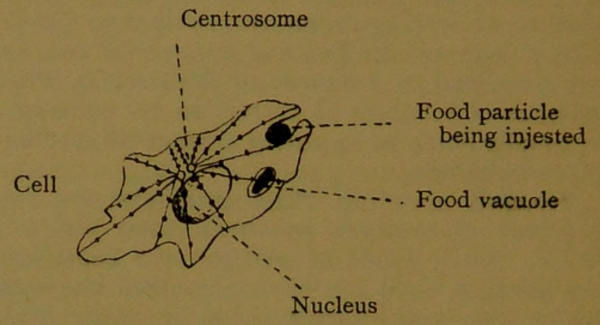
on the external surface and around the nucleus is
specialized into a more or less definite membrane. To
this outer envelope are attached fine fibrils, which join
up to a small body within the cell, called the centrosome,
and by the lengthening and shortening of these its shape
can be altered. The contents are fluids; so if the containing
membrane is loosened in any direction, they tend
to bulge out and form an excrescence, and in this way
the cell is enabled to throw out limbs and surround
particles of food, and, by relaxing the fibrils in one direction
and contracting them in others, to crawl whither
its chemical, thermal, or physical affinities direct. (See
Diagram 1.)
Not particularly inspiring is the sight of life in its
simplest form, but when a few millions of these cells
group together and form one body, dividing the labour
between them, the result is something stupendous.
There are animals composed in this way, some of whose
cells have developed their digestive capabilities to such
an extent that they have almost lost all their others.
These are carefully guarded in the interior of the body.
Other cells in this same beast, receiving their food in a
fluid form from these digestive specialists, secrete lime
around them till a skeleton is built up. To the levers of
this skeleton are attached bundles and strands of cells,
which, if they can do nothing else, can lengthen and
shorten and make it move. Yet, again, there are cells
which have especial facilities for receiving, weighing, and
transmitting chemical and physical promptings. These
cells, again, lie in a protected corner of the interior, but
they send out fine threads to one another and every part
of the body, and control the whole.
The animal in which this beautiful system of division
of labour has been carried to its greatest perfection has
many and varied powers. He can in some cases even
apply to the individuals of the species the principles of
his own cellular economy, and thereby achieve not only
the making of poetry and jokes, but the building of a
Westminster Abbey, the construction of Maxim guns,
and the enforcing of his economic refinements upon his
less highly specialized neighbours.
We have now traced out a general idea of life. We
have seen that its basis rests upon a chemical structure
which, to maintain its identity, must be always changing.
We have seen that to do this it must keep breaking
down its substance, and giving off the products, and
taking hold of extraneous materials, and building them
in, not only to repair the loss, but in order to grow;
and that to do that it has to be more or less modified
in parts, in order that the main bulk may be brought
within reach of its food, and be then able to convert it
into the most useful form. And, lastly, we have seen
that just as several specialized forms of plasm together
make up a cell, so several kinds of cells, each with some
peculiarity exaggerated, aggregate, and, supplying one
another’s needs, compose a body.
Having now roughly sketched out the scheme upon
which such a body works, we can go on to a more detailed
examination of the division of the labour, and the
way in which each department supplies, and is dependent
upon, the others. If we were to do this thoroughly, it
would take a great deal of time and space, for the physiology
of a potato plant, though essentially the same,
presents many differences from that of a horse; but the
physiology of the great human interest is also that of the
most complicated animal, namely, man, so it is on him
that we shall focus our attention.
Protoplasm is more easily studied the more specialized
is the animal it composes. When all the events of life
are taking place in a speck of matter, invisible without
a microscope, it is impossible to analyze the changes
which it is working in its surroundings, or to infer
those which are going on in itself. But when large
numbers of cells are examined collectively, we can
deal with what they take in and what they give out in
sufficient bulk to arrive at a fairly accurate determination.
The study is rendered still easier in an animal with
extremely specialized organs, like man, in which food is
nearly all taken in by the mouth, and thus kept quite
distinct from what is eliminated; the latter, again, being
mostly given off by the kidneys is kept equally distinct.
Moreover, the intermediate changes being performed in
different organs still further simplifies investigation of
the vital process; for the physical effects are also more
easily studied when exaggerated in a particular part of
the animal. The electrical changes in a single cell might
long have remained unsuspected had we not been able to
observe those in a muscle with the galvanometer.
Now, while the cells which make up the body of man
differ very greatly owing to the different tasks which they
have to perform in obtaining food and getting rid of
refuse, they all require very much the same fuel to
enable them to live, and having got it, they all treat it
in very much the same way; therefore our first business
is to consider what the body wants, and what it does
with it. Afterwards we can try to find out how it gets it,
and where.
The first and most indispensable requirement of protoplasm
is water. The next is probably nitrogen, compounds
of which seem to form the framework of the
protoplasmic structure. The next is probably carbon,
and the next free oxygen. The two last-mentioned
combine with a release of energy. This happens in the
grate when coal burns, and the result is heat. In the
tissues of a body the result may be heat, growth, or
movement, all three being present in the phenomenon of
muscular activity. Finally there are mineral salts, the
most important being sodium chloride, which is placed
on the table at every civilized meal.
But though these elements are given here in order,
their importance is really equal, for all are necessary.
That is about as much as it is wise to say here. The
chemistry of the living cells—their anabolism, or how
fresh material is built into their structure; their katabolism,
or how the same structure is broken down that
work may be done; in fact, the general metabolism—is
so complicated, and so little understood as yet, and
requires so extensive a knowledge of chemistry to follow,
that it is best left alone by people who do not want to
go into it deeply. At best, such a discussion resolves
itself into an exposition of different observers’ theories,
with the reasons why they hold them—reasons based on
laborious and technical studies. Pages might be written
on the various theories, backed by pages more of chemical
formulæ, to show why this view deserves deep consideration,
while that, in spite of the obstinacy with which
it is upheld, is absurd; but though such discussions take
one nearest the secret of life, the general public is not unnaturally
apt to stigmatize this side of physiology as dry.
It is a matter which interests experts, not the casual reader.
Quite a different affair is the question of diet. That
is everybody’s business, as the number of faddist societies
and blatantly advertised ‘foods’ attest. And though
the preparation of the food in the body up to the point
where it merges into living matter and is lost sight of—in
a word, ‘digestion’—is again a question of chemistry,
it is one which may be approached without such an
exhaustive knowledge of that science as the previous considerations
would have required. It is, moreover, to judge
from the way it is discussed, a topic of universal interest.
A casual glance at the animal kingdom will show that
diet is a wide subject. A pigeon will eat peas; a tiger
would not know what to do with the peas if he got them;
while a monkey will eat almost anything he can lay
hands on. A plant takes us still further afield, for it can
use the atoms of substances with an extremely simple
molecule—carbonic acid gas, for instance.
Our task, however, is simplified by our having only
man to consider; and although most of the higher animals
are so much alike that they might be considered in general
and contrasted in detail, it is a great thing to get rid of
the whole vegetable kingdom with bacteria and parasitic
animals.
One of the first requisites for the maintenance of life,
as was mentioned above, is nitrogen. Now, nitrogen
is one of the commonest elements in the world, but it is
the hardest to supply to the body. Four-fifths of the air
is pure nitrogen, but pure nitrogen is useless as a food.
We draw it into our lungs at every breath, and are none
the better for it, for we breathe it out again unchanged;
and if it were completely absent from the air we should
not be so very much the worse. The Ancient Mariner
exclaimed, ‘Water, water everywhere, and not a drop
to drink’; a starving man might exclaim, ‘Nitrogen,
nitrogen everywhere, and not an atom to assimilate.’
Animals have to get their nitrogen in the form of
proteid, a substance whose molecule is composed of
nitrogen, oxygen, hydrogen, carbon, etc., and might
roughly be described as dead protoplasm. Plants on
which animals feed, when they do not get their proteid
by the simpler, though less moral, method of eating one
another, are able to get their nitrogen in a simpler form;
but with that we are not concerned.
The proteids are a group of substances which resemble
protoplasm in the elements of which they are composed
and in the complexity with which they are combined.
The various proteids seem, however, to have a definite
chemical composition, and therefore differ from protoplasm
in being true compounds; moreover, if kept
from bacteria they undergo no changes. One of the
best forms of proteid for examination is white of egg;
this, as is known, sets or coagulates when boiled, dissolves
in water, from which it may be precipitated by boiling,
and displays various other chemical properties common
to all proteids. There is, however, a good deal of difference
between the several varieties of proteids, and the more
complex ones have to be converted into the simpler before
they can be absorbed. Hence the necessity for digestion.
Now, as proteid resembles dead protoplasm, it might
be supposed that a diet of proteid alone would be the most
economical; but this is not so. If it were possible to
live without work, i.e., without movement of any kind, it
might be; but to do work, more carbon must be oxidized
than the proteid molecule contains.
Carbon, the next item on our list, is familiar to everyone
in the comparatively pure form of coal, charcoal, and
the ‘lead’ of pencils. It is commonly used to burn—i.e.,
oxidize—that heat may be obtained to boil water and
to work machinery. This is precisely what it is required
to do in the body, where it is burnt by oxygen taken in
by the lungs, that heat and energy may result. It is a
commonplace that severe exercise causes laboured breathing,
and the reason of this is that the carbon in the body
is being oxidized, and the product, carbonic acid gas, has
to be got rid of. The more work is being done, the more
oxygen is required to burn carbon in the muscles. The
more carbon is burnt, the more heat is evolved, and
the more necessary it is that the blood should be cooled
by drawing cool air into the lungs. Hence the more
rapid breathing. The air normally breathed out is
always warmer than that taken in, and always contains
extra carbonic acid gas. After exercise the quantity is
increased, and its increase on the normal amount given
off can readily be demonstrated by analyzing samples of
the air taken in and given out.
But carbon, like nitrogen, cannot be taken in in the
crude form. No one would try to make a meal of
charcoal. A certain amount is contained in the proteid
molecule, enough, no doubt, to secure the basis of the
protoplasmic structure; but unless one is prepared to eat
an excessive quantity of proteid, a proceeding entailing
waste and exhaustion of the digestive apparatus, the
balance must be made up by eating carbohydrate.
The forms in which people are most familiar with
carbohydrate are starch and sugar. Sugar is the better
food, as it is so much more soluble than starch; and, in
fact, starch is always turned into a kind of sugar before
it is used by the body. The common cane-sugar, which
everyone knows so well, is about the most useful food
we have, owing to its purity, and therefore concentration,
and its simplicity. A very small amount of digestion is
necessary to convert it into the simplest of all carbohydrates,
a substance easily stored, as glycogen, till wanted,
which is present in muscle after a meal, and is used up
when the muscle is active, being oxidized to carbonic
acid gas, sarcolactic acid, and alcohol.
The importance of carbon in the diet is therefore
obvious; and people who intend doing extra muscular
work should take extra sugary food rather than extra
proteid. A locomotive which is about to make a record
run takes in more coal, not more engine-drivers, and our
athletes now follow the same principle. We shall, however,
have a good deal more to say about athletes presently.
There is yet another point to be considered in respect
to carbon. Carbon need not be taken in the form of
carbohydrate, the alternative being fats and oils. Fats
and carbohydrates are both composed of the elements
carbon, hydrogen, and oxygen, but the proportions in
which they are joined are different. Fats are not such
useful foods as carbohydrates, nor to most people so
pleasant—compare a spoonful of olive-oil and a lump of
sugar. But there is one important point to be urged in
their favour: they yield twice as much heat as either
proteids or carbohydrates; so their position among foods
is assured.
The other chemical necessities of the body we need
only mention here. Hydrogen is one of the components
of proteid, carbohydrate, fat, and water; and if it does
not enter in the last form, it—at any rate, most of it—leaves
as such, being oxidized in the tissues. Sulphur
and iron deserve honourable mention; common salt is
required by the blood; lime and phosphates go to make
bone; but important as they all are, they need not detain
us further at present.
With regard to the amount of these elements which is
required per day, and which is ascertained by collecting
and weighing all that is given off, it is found that about
½ ounce of nitrogen and 10 ounces of carbon are necessary
to an average man—i.e., weighing about 10 stone.
The ½ ounce of nitrogen and about 2 ounces of the carbon
are contained in 4 ounces of dry proteid, which leaves a
balance of 8 ounces of carbon to be made up; and this
is usually obtained by eating 4 ounces of fat and 18 ounces
of carbohydrate.
Roughly speaking, these principles are contained in
¾ pound of ordinary butcher’s meat and 2 pounds of
bread; but it would be well to defer considering diet for
the present, until we have examined the apparatus by
which the body extracts what it wants from the raw
materials, and which of these offer it the least resistance.
The way in which protoplasm gets its chemical requisites
for growth is doubtless simply by absorbing them.
Some of the lower structureless forms carry this to an
absurd extreme, for when two individuals meet they fuse,
and each no doubt claims to have eaten the other. As,
moreover, the first thing which a cell does when it grows
is to divide, the whole proceeding looks rather futile.
But ready-made protoplasm of an assimilable shape is
rare, and it is not often that a cell, unless it be a plant
or a parasite, finds itself in a substance which can be
handed straight to the nucleus without further elaboration.
Usually the cell has to discharge from itself a
reagent, which will develop the right chemical qualities
in the matter it wants to absorb. This substance is
known as an enzyme, or ferment. Ferments, however,
are an expense to the cell, requiring a certain effort for
their production; so, in order that they may be economized,
they are, in the higher forms, poured over the
food while it is in an enclosed cavity, or stomach. In
the simplest animals, consisting of a single cell, the
protoplasm simply flows round the particle of food, and
it is ‘ingested’ with a drop of water. Into this ‘food
vacuole’ the ferments are secreted, and when all that is
useful has been dissolved out and absorbed, the bubble
moves to the surface and bursts; or, to put it differently,
the cell flows on its way, and the vacuole, with any shell or
refuse it may contain, gets left behind. (See Diagram 1.)
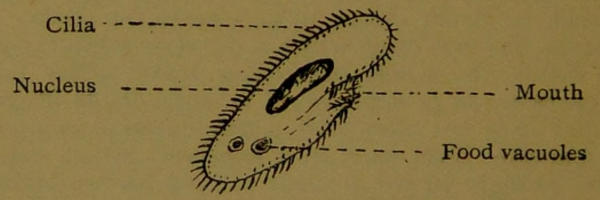
In other cells which are constant in shape there is an
opening leading to the interior of the cell. Round this
there are little projecting threads, which beat the water
regularly. In some positions these threads enable the
cell to swim, but here their duty is to cause a current
and wash particles of food down the primitive throat into
the interior, where, as in the preceding case, they become
enclosed in a vacuole. (See Diagram 2.)
Diagram 1.—The Amœba.
Diagram 2.—Paramœcium.
Moving a stage higher, we find animals consisting of
several cells. Of these it is only natural to suppose that
some have greater enzyme-forming powers than others.
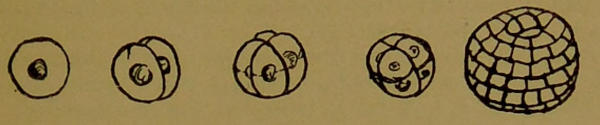
Diagram 3.—Development of an Embryo: First Stage.
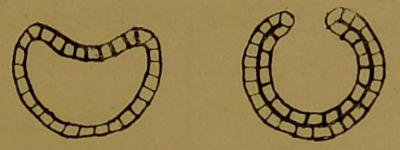
Diagram 4.—Formation of a Digestive Cavity.
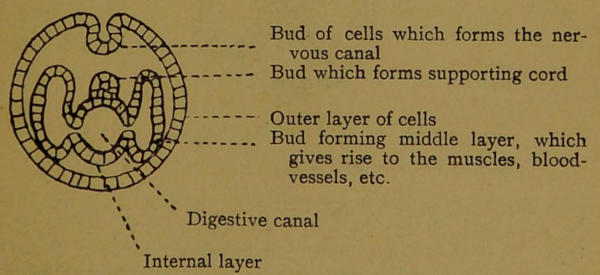
Diagram 5.—Cross Section of a Developing Embryo.
A step higher in the animal scale, or a further advance
in the development of the schematic embryo (depicted in
Diagrams 3 to 6), and we find that these special digestive
cells are losing their sturdier qualities and being placed
in a position protected by cells which have specialized in
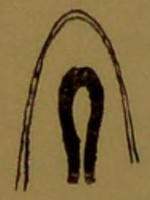
another direction. This is shown in Diagram 4, where
the hollow ball of cells which resulted from the repeated
division of one cell is represented in section. One side
of the ball is pushed in, and now the beast consists of
two layers of cells, an outer protecting and an inner
digesting (Hydra and sea-anemone). Soon, however, it
is found more convenient to have a tube for digesting
food, for then different substances can be digested and
absorbed in different parts; and the refuse, of which the
animal can make no use, need not be brought back to the
mouth to be got rid of.
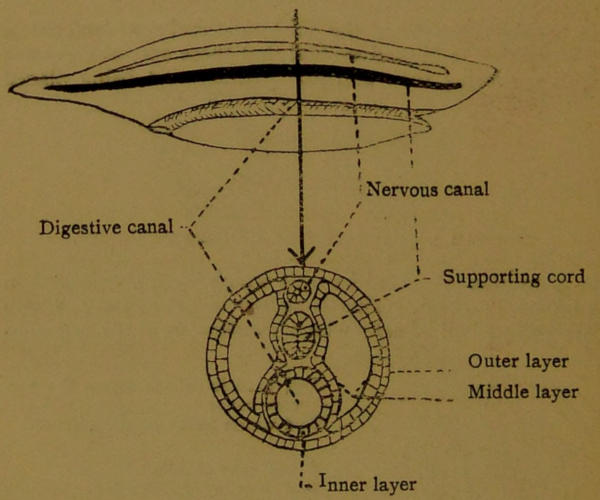
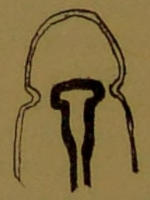
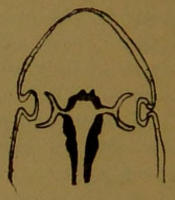
This, however, requires a number of other changes in
the structure of the animal, which are roughly shown
in Diagrams 5 and 6. It is not to our purpose here to
discuss the development of animals or an animal; but
the figures are worth glancing at, as they show not only
how certain of the cells are set apart for digesting food,
but also that a large body consists really only of a mass
of protoplasm, composing kindred cells of common origin.
Diagram 6.—Showing Development of an Embryo.
Now, for obvious reasons, the longer, within certain
limits, this tube is the better. All sorts of different
food-stuffs have to be acted upon in it, and some offer
considerable resistance to digestion; and the further
they have to travel in the tube, the more chance there is
of their being successfully treated. Besides, different
parts have different functions, and the longer the tube—again
within necessary limits—the greater scope is there
for division of labour, and consequent economy. The
comparative length of the alimentary canal is not the
same in all animals by any means. Carnivorous animals,
like the cat, whose food is soft and easily digested, have
a fairly short one. Herbivora, like the sheep, whose
food is difficult to digest and mixed with much husk,
which is wholly indigestible, have a comparatively very
long one. Man, who is omnivorous, but eats less and
more judiciously chosen food than either of the above
classes, has one of medium length. But in all cases
among the higher animals there is an attempt made to
obviate the necessity of increasing the length of the
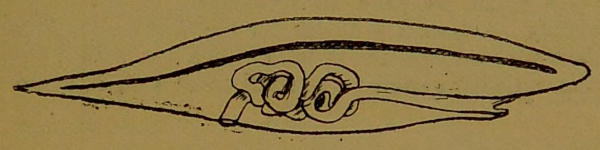
animal by coiling the tube within the body. The
annexed diagram (7) illustrates this principle. It shows
a schematic animal whose digestive canal is much longer
than itself.
Diagram 7.—Showing how the Digestive Canal is
Lengthened.
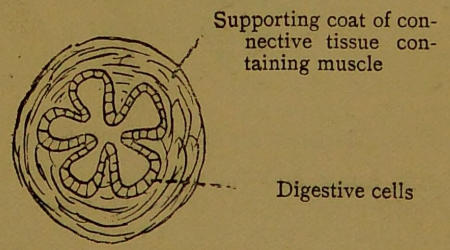
Diagram 8.—Cross-section of the Digestive Tube.
The digestive canal has, however, another function.
The cells which compose it have not only to secrete
juices, to convert the food into a usable form; they have
then to absorb it. The nearer a particle of food is to
the wall of cells, the sooner it is reached by these juices,
and the less chance there is of useful material being
swept away and lost. In view of this fact, along certain
tracts the digestive canal is folded inwards, and there are
projections, which increase the number of cells to secrete
and their opportunities of absorption. (See Diagram 8.)
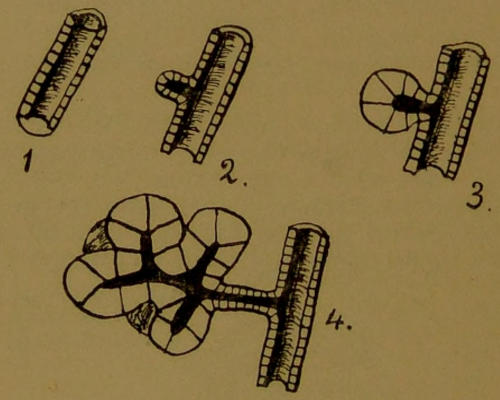
Diagram 9.—Showing how Glands arise.
Here again we have an illustration of a constantly
recurring need, with a device for meeting it—increase of
surface without increase of bulk. We met with it before
in the cellular system; we shall meet with it again in
glands, lungs, and brain, at least. The importance of a
device for gaining this end is apparent when one remembers
what the comparative value of surface and bulk is
to an animal, and that, while surface increases by the
square, bulk increases by the cube.
The principle is pressed to an extreme, together with
the allied principle of division of labour, in glands. The
object of these is to increase the number of secreting
cells, and, as they are delicate, to keep them protected
from contact with coarse particles of food. And, in order
that nothing may interfere with their efficiency, they are
absolved from the duty of absorbing. Hence tubes grow
out from the cavity of the alimentary canal lined with
the same cells, but, as no food ever enters, the cells
which line them devote themselves entirely to pouring
out digestive juices. Glands differ considerably in structure
and in the liquids which they secrete. Some are
very small; some, like the liver, very large. In some the
tube is very short, in some long, coiled and branched,
and sometimes the gland is connected with the surface
by more or less of a duct. Some glands only secrete one
enzyme, some several. In each, however, the principle
is that shown in Diagram 9, no matter how its structure
is masked by the bloodvessels and supporting cells or
connective tissue which envelop it.
After a meal, or, rather, when the process of digestion
is over and the animal is beginning to think about its
next, the gland cells start preparing their enzyme. There
is great activity in the nucleus, and granules stream out
from it towards the lumen of the gland in much the same
way, to take a homely illustration, as bubbles in some
effervescing drink form at the bottom of the tumbler and
rise till the surface is covered with foam. At the right
moment these granules are discharged, just as the bubbles
on the surface of a liquid break at a slight jog. They are
usually not the ferment or enzyme, but its precursor, a
substance which only turns into the ferment when it gets
outside the cells. The ferments, when formed, are very
peculiar substances about which we should like the
chemist to tell us more, though great advances have
been made in our knowledge of them lately.
Among other peculiarities, one may mention that,
though they will keep indefinitely if bottled, they are
easily destroyed by too extreme a temperature or too
acid or alkaline surroundings, that their composition is
entirely unknown, and, strangest of all, that they do not
become used up. A given amount of rennet will clot
any amount of milk within reasonable limits, and yet
remain rennet. The clergyman has been quoted as an
illustration of the action of a ferment, and he makes a
good one. He can make any number of suitable men
and women into married couples, and yet his own state
is unchanged.
In man, the digestive process may be divided into
three stages. They are arranged progressively, so that
each clears the way for the next, and take place in the
mouth, the stomach, and the upper part of the small
intestine, the rest of the canal being mainly occupied in
absorption.
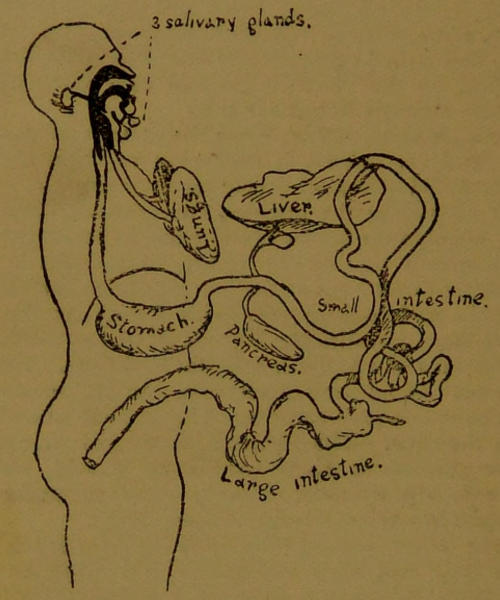
Diagram 10.—General Scheme of the Alimentary Canal,
with its Offshoots—Lungs and Glands.
By far the largest proportion of the food is carbohydrate,
in some form, so one naturally expects the first stage
of digestion will deal with the constituents which represent
this class. This is the case. The food is taken
into the mouth in small quantities and ground up with
the teeth, during which process it is subjected to the
action of the saliva. This fluid, which is the secretion of
three pairs of glands, converts a large proportion of the
carbohydrates, starch, cane-sugar, etc., into a very simple
sugar which is absorbed directly it reaches the stomach.
One of the most sensational discoveries of the physiologist
has been that the saliva leaving the gland does not
contain the ferment necessary to effect this change until
it has been subjected to the action of putrefactive bacteria.
These, fortunately for us, it is pleasant to know, simply
swarm in the mouth.
When the food is swallowed, it passes very rapidly
down the first part of the alimentary canal, which is
straight, and is then kept for some time in the stomach.
The stomach differs from the rest of the canal in several
particulars, among them the following: it is a large cavity,
and is closed at each end by a valve to keep the food in
until it has been thoroughly treated, and it deals with the
whole mass of food taken at a meal at one time, and yet
has no contrivances for increasing its surface.
Here the food is subjected to a most important and
searching examination. Enclosed in this bag, it is
thoroughly mixed with weak hydrochloric acid, secreted
by numerous glands, and kept churning round and round
by the muscular action of its walls, that the contents
may be kept well mixed. The acid is just strong enough
to kill protoplasm, and hence the putrefactive bacteria
which were necessary in the mouth, but would be a very
doubtful blessing in the interior of the body, are disposed
of. Other things are also killed. Not only does the
stomach execute intruding bacteria, but it also kills a
good deal of our food. Fruit and salad consist largely of
still living cells, and occasionally there is bigger game,
e.g., oysters. One thing, however, the acid does not kill,
and that is the cells lining the stomach, and it may as
well be said here that the parts of the body exposed to
ferments have the very necessary power of resisting them,
so that a normal animal does not digest itself.
The stomach, however, is a kitchen as well as a
slaughter-house. The gastric juice, or secretion of all
the glands opening into it, contains, besides the acid, two
important ferments, both of which act on proteids. Carbohydrates
are absorbed, but not digested, in the stomach,
as acid destroys saliva. One of the ferments is rennet,
an article familiar to the culinary profession, which solidifies
milk. The other acts on proteids generally, converting
them ultimately into a very simple form, peptone,
which is absorbed at once. How much of the proteid in
the stomach is converted into peptone is not known, for
the action of acid alone is sufficient to enable it to be
absorbed. A solution of proteid, e.g., white of egg, is
quite altered if made slightly acid; it no longer coagulates
when boiled, but the change of the most practical interest
is that, if injected into the veins, it seems to become part
of the blood, while ordinary proteids act as poisons.
The peptonizing ferment, however, has one very important
function: it digests the collagen of the connective
tissue, the substance which becomes gelatin when boiled.
The reason why this is so important is not only that
nothing else in the body affects it, but that fat is enclosed
in it, and if it were not thus set free would pass through
the body unabsorbed.
The final stage is the digestion by the pancreatic juice.
After the food has been exposed for some time to the
gastric juice, it is allowed to escape a little at a time from
the stomach, and continues its way along the alimentary
tube. Before it has gone many inches it comes to the
openings of two ducts, those of the liver and the pancreas,
and immediately the acid stimulates them, and the glands
pour out their secretion. That of the liver is largely
excretion or refuse from the blood without direct action
on the food, but it enables the pancreatic juice to do its
work by making the food again alkaline, and stimulates
the muscular coats of the intestine to force its contents
along. That of the pancreas is the most important digestive
fluid in the body, containing many ferments; it acts
alike on proteids, carbohydrates, and fats—in fact, digests
everything—so that the rest of the long tube is freed
from any more laborious duty than absorbing them as
they pass.
Note.—The digestive ferments are now prepared for
examination by chopping up the gland and placing it in
glycerine; this extracts the ferment and preserves it from
the action of bacteria. The first experiments on digestion,
however, constitute one of the romances of physiology. A
Canadian named St. Martin got into trouble with Red
Indians whilst in the United States, America, and was
shot through the body. The surgeon who attended him
was unable to make the wound close, and when it healed
there remained an opening in the man’s body communicating
directly with his stomach. The surgeon,
Beaumont, saw possibilities in this, and, obtaining gastric
juice from his patient, made those classical experiments
which entitled him to a place among the fathers of
physiology. Americans do well to be proud of Beaumont,
for it cost him many sacrifices, and his patience and
courage are above praise. Not only was he devoid of all
but the crudest appliances out in the backwoods, but his
subject proved intractable and mercenary. No sooner
did he discover his value than he crossed the border, and
refused to return except upon exorbitant payment. Even
after this had been arranged, he repeated the performance
whenever he thought fresh extortion possible. In spite
of these difficulties, the investigations proved wonderfully
accurate and complete.
Of the absorption of the materials thus prepared it is
not necessary to say much in a work of this compass, but
the absorption of oxygen is too important to be passed
over.
Oxygen is required by the body pure, and, as it is uncombined
with anything in the air, it needs no digestion
to free it. A special organ, however, is necessary to
absorb it. This is the lung. The lungs originate, just
like a gland, by a pouching of the alimentary canal near
its origin, but differ from a gland in their cells being very
much flattened, to offer a large surface to the air on one
side and to the bloodvessels on the other. Incessantly
during life air is being drawn into the lungs; that the
cells to which it is there exposed may transfer its oxygen
to the blood; and then, after the cells have also transferred
the carbonic acid gas from the blood to the air,
driven out again to be replaced by fresh.
(The mechanical means by which the lungs are filled
and emptied come under another heading.)
Food having been absorbed by cells set apart for
the purpose, the next problem is, How is it distributed
to those specialized for other
work? The medium for this
distribution is a liquid called
lymph. All the spaces in the
body are filled with lymph, all
the organs bathed with it, every
cell moistened with it; yet it is
comparatively stagnant, and the
food has to be conveyed from the
walls of the alimentary canal
to the lymph in the neighbourhood
of the cell requiring nourishment
by a more expeditious
agent. This is done by the blood.
Diagram 11.—Principle of
the System of Bloodvessels.
Diagram 12.—Principle of
Double Circulatory System.
The blood is a fluid akin
to the lymph, but confined in
a system of tubes. Through
these tubes it is driven at a
considerable velocity, and in
the course it takes passes
within a reasonable distance
of every cell in the body. As
it passes the cells of the alimentary
canal, they discharge
the nutriment they have absorbed
into it; as it passes
through the other organs of the
body, it discharges the requisite
materials into the lymph bathing
the actual cells: these are
then able to help themselves.
The lymphatic system is
very simple. Lymph is practically fluid which has
exuded through the walls of the bloodvessels, and is
like the plasma of the blood, a thin solution of proteids
in water containing just enough salt to hold them in
solution. From different parts of the body a series of
tubes run towards the heart, going up with increase
in size and decrease in number as they near it. Into
these tubes the lymph is forced with every movement
of the body. At a slow rate, but varying with the
activity of the animal, it is forced to flow along these
tubes, regurgitation being prevented by valves at intervals,
until it reaches the place where the lymphatic
vessels join a large vein, and it is poured back into the
blood-stream, thus completing its cycle.
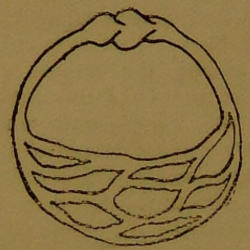
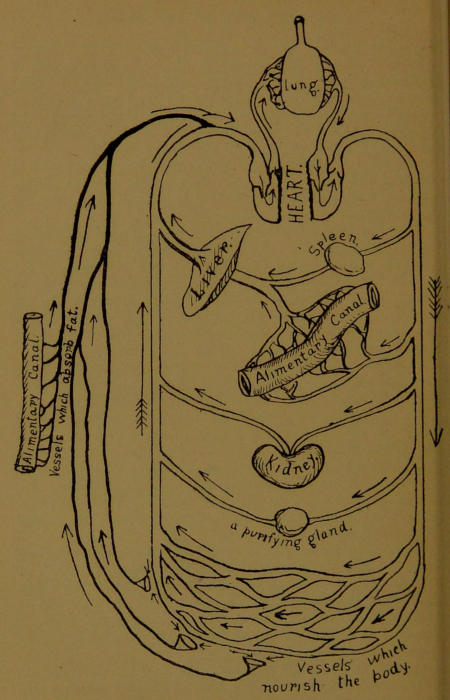
The blood is entirely confined in a closed system of
tubes, along which it moves always in the same direction.
The main principle of the system is that of a ring. One
side of the ring is split into a vast number of fine tubes to
give a large surface for absorption and discharge of food
among the cells; the other side is a single tube, with an
enlargement in which the blood from different parts is
mixed (see Diagram 11). This enlargement, which is
contractile and fitted with valves, rhythmically draws the
blood in from one direction and pumps it out in another.
(The mechanics of the process we shall study later.)
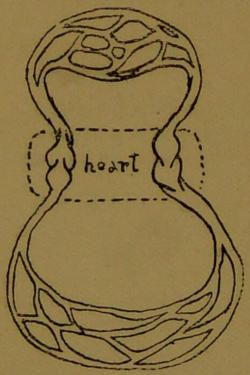
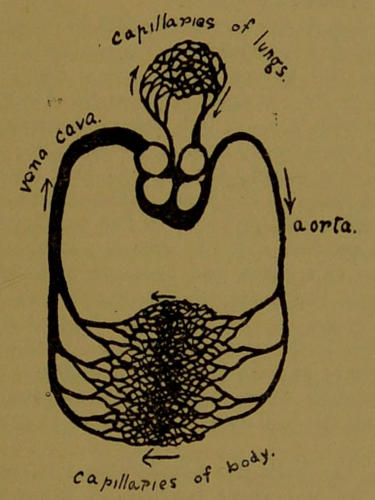
As a matter of fact, this system is twofold, as in
Diagram 12. In passing through one-half of its course
the blood absorbs oxygen in the lungs; in the other
it yields oxygen to the tissues, and absorbs, whilst
passing over the alimentary canal, proteid, carbohydrate,
water, and salts, which are duly distributed to the other
organs. Fat is absorbed by the lymph direct, but poured
into the blood for distribution.
The blood which passes over the alimentary canal on
its way back to the heart goes through the liver. In
this gland it leaves the carbohydrate which it has taken
up, and a large store is laid down there after a meal, to
be doled out as it is wanted. Blood also passes through
the liver from the spleen, where it has been, so to speak,
overhauled for repairs.
Diagram 13.—Scheme of the Circulatory System.
Blood system on the right, lymph system on the left.
As the medium for chemical communication throughout
the community of cells, the blood has another all-important
and obvious function, viz., that of clearing
away the waste products of life. Of these there is, of
course, the same quantity as of new material introduced.
Carbonic acid gas is discharged into the lungs, but all
the nitrogen and most of the other elements in the new
combinations which protoplasm has made them assume
leave by the kidneys, plus a little water by the skin as
sweat and a few items discharged into the last part of the
alimentary canal amongst the unabsorbed portions of the
food.
In their constituents, blood and lymph resemble one
another, being both weak solutions of salts and proteid
material; but the blood is distinguished from the lymph
by the presence of innumerable extremely minute bodies,
which give it its red colour. These corpuscles, to give
them their proper name, are the vehicle by which oxygen
is transported from the lungs to the tissues. They consist
of an envelope of protoplasm filled with a red fluid
(hæmoglobin), which combines loosely and easily with
oxygen. In shape they are discoid, with a thickened rim
and biconcave sides, another device for increasing surface
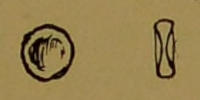
and reducing bulk. (See Diagram 14.)
Diagram 14.—A Red Blood Corpuscle.
With one more fact we may now conclude the chemical
survey of the body. The blood has to pass through
certain glands, or it becomes poisoned, and this quite
apart from whether the gland secretes healthily or not.
Disease of the thyroid (a ductless gland in the Adam’s
apple) causes goitre; of the suprarenal, Addison’s disease;
of the pancreas, diabetes. Whether these organs
secrete some substance into the blood which counteracts
poisons formed in it, or whether they remove injurious
elements from it, is not certain, but they are necessary
to keep the great means of chemical communication in
order.
Note.—The thyroid gland no longer secretes anything
into the alimentary canal, and its duct disappears at an
early age. If, however, it become diseased or is surgically
removed, the distressing symptoms of goitre supervene.
Such a patient may be completely cured by grafting
a thyroid, excised from another animal, anywhere in
his body. Doctors usually, however, give the patient
extract of sheep’s thyroid either in pills or injections.
ESSAY III. THE MECHANICS AND PHYSICS OF THE BODY. — I. — II. — III. — IV. — V. — VI. — VII.
In the preceding essay we regarded protoplasm as a
chemical factor in the universe.
We have seen how it is always changing, always
taking in food, always giving off waste materials. We
have seen, too, that it grows and that it does work, and
that in a large mass the cells which compose it share the
labour instead of each component cell performing all the
vital functions. We have now to consider the work
which protoplasm does—in a word, the mechanical effect
of the chemical actions just described.
The simplest movement of protoplasm is to be seen
by the aid of the microscope in certain vegetable cells,
where granules seem always streaming about in different
directions. A step higher, and we find this streaming
movement converted into movements of the whole cell.
In the simplest unicellular animals the fluid protoplasm
is contained in a membrane, or denser bounding layer,
to which are attached fine filaments springing from a
minute body known as the centrosome. These centrosomes—for
there are sometimes several in a cell—seem to
control the mechanical department, just as the nucleus
does the chemical. Along the fibrils at intervals are
minute globules, and by watching the distance between
them it is seen that the fibrils undergo changes in length,
pulling in the membrane when they shorten, and letting
the cell flow out in any direction when they relax. By
adjusting these two movements to balance one another,
the cell can move in any direction, surround and engulf
particles of food, and assume a strange variety of shapes.
(See Diagram 1.)
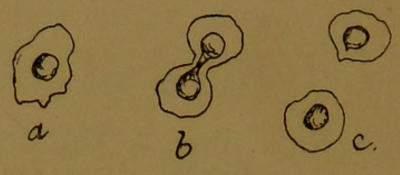
Diagram 15.—Cell Division.
In some cells, probably in all, the centrosome presides
over division. Cells, however, do not always divide in
the same way. Some simply lengthen, the nucleus also
lengthening inside, become constricted in the middle like
a dumb-bell, and separate. (See Diagram 15.)
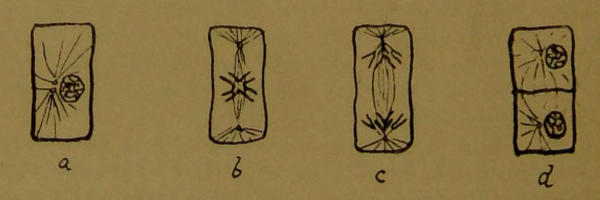
Diagram 16.—Cell Division.
Others manage differently. In them the nucleus
simply bursts, and turns its essential elements, a number—always
a constant number—of coarse threads, adrift.
Meanwhile, two centrosomes have moved to opposite
ends of the cell, and there anchored themselves by fibrils;
other fibrils springing from them become attached to the
nuclear threads, and when all is ready pull them apart,
equally divided, to their respective ends, where they
re-form into two fresh nuclei. (See Diagram 16.)
Unicellular animals, which are constant in shape and
swim instead of flowing when they want to get anywhere,
have at first sight nothing in common with those which
do the latter. From their surfaces spring fringes of free
protoplasmic threads, called cilia, from their fancied
resemblance to eyelashes, which serve as motor organs,
and beat the water like oars. (See Diagram 2.) Waves of
movement, as they lash one after another, all in the same
direction, seem to pass over the cell, and it is propelled
through the water; while others, which are situated in
the neighbourhood of the cell’s mouth, stir the water into
eddies, and drive food particles into it.
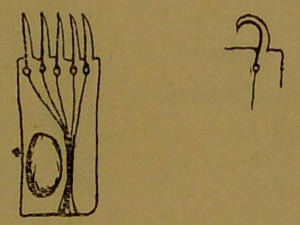
Diagram 17.—Cilia of an Epithelial Cell.
These cilia are important, as they are adapted for
many purposes in large animals. The cells which line
the cavity at the back of the nose, the tubes of the lungs,
and other parts of the body, have a few cilia on their
free surface, and it is in them that the structure of these
organs can best be made out. At the foot of each cilium
is a minute globule, from which a fine fibril passes into
the cell, and the fibrils, collectively forming a leash, are
attached to its opposite end. (See Diagram 17.) It seems
highly probable that the globule is a centrosome giving
rise to two fibrils, one attached as described, the other
passing up one side of the cilium, and fast to its apex.
The result of this arrangement is that when the fibrils
contract the cilium is bent over with a jerk to the side
up which the fibril runs, and when they relax it slowly
straightens itself. There is, therefore, no fundamental
difference between this and the other mode of progression;
both are dependent upon the centrosome.
Finally we have muscle cells. These are only found
in a fairly complicated animal, since they are a product
of the division of labour principle, and their sole business
is movement. There are two varieties of muscle, but
the principle is the same in both—a long thin cell, with
fibrils traversing its length whose contraction causes the
cell to shorten and thicken, thus reducing the distance
between its two ends. At present the development of
muscle and the way in which it ‘contracts,’ to use the
word accepted in this case for describing a redistribution
of bulk, are little understood, and there are accordingly
many opinions; but I think careful study will eventually
show that some modification of the centrosome, with its
contractile fibrils, is responsible for the movement.
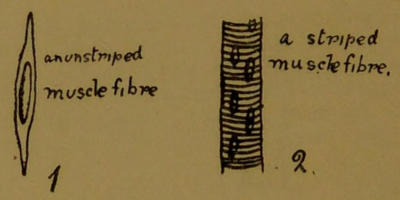
Diagram 18.—Muscle.
The two varieties are: the smooth, or involuntary, and
the striped, or voluntary, muscle. Smooth muscle consists
of spindle-shaped cells with one elongated nucleus.
(See Diagram 18, Fig. 1.) It only contracts very slowly,
and is not under control of the will; but it is very
abundant in the body, since it effects practically all the
movements of the alimentary canal and bloodvessels.
Voluntary or striped muscle, so called from its appearance
under the low power of a microscope, consists of
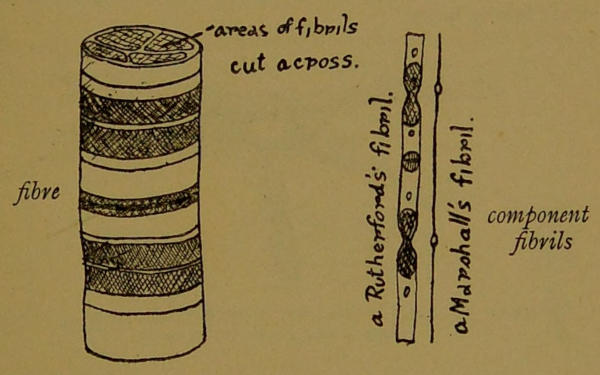
long fibres, each containing many nuclei. (See Diagram 18,
Fig. 2.) Its protoplasm is rich in hæmoglobin, and in it,
under powerful microscopes, can be made out two kinds
of fibrils: Rutherford’s fibrils, the complicated structure
of which gives muscle its striped appearance; and Marshall’s
fibrils, which are much finer and more difficult to
see. The muscle of the heart, though not under control
of the will, is striped; but it differs from ordinary striped
muscle in being made up of small branched cells with
only one nucleus.
The way in which the three elements of striped muscle
contribute to a contraction is practically unknown, and
the subject of much dispute. In fact, one could hardly
wish for a better soil for theories, and some which grow
in it are very wonderful indeed. We have reason for
supposing that there are two contractile substances—one
which gives a sharp twitch, the other a slow, hard pull;
and on the whole there seems good reason to believe
that Rutherford’s fibrils give the sudden movements,
while Marshall’s give the more forcible ones; and that the
ordinary protoplasm of the cell is restricted to the duty
of nourishing the fibrils.
Diagram 19.—Striped Muscle Fibre, more highly magnified
than in Diagram 18.
The muscle cells are modified from among those of the
bud forming the middle layers of the embryo. (See
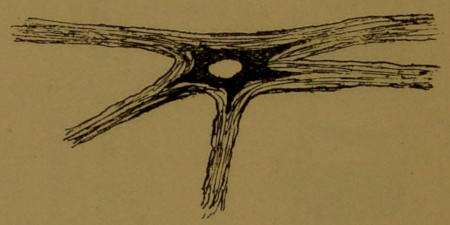
Diagram 5.) Other cells of this bud form connective
tissue, by, so to speak, spinning long fibres of the substance
called collagen, which turns to gelatin when boiled.
(See Diagram 20.) This connective tissue permeates the
whole body, affording a firm foundation for the many
layers of cells which form the skin and the single layer
of digestive cells; supporting the other organs throughout,
and keeping the different parts of the body in their
places, in doing which, however, it is assisted by other
fibres which are not collagenous, but elastic. It also
forms tracts which become lymph and blood vessels.
In parts of the animal which require special support
it forms solid rods, the collagen combining with calcium
salts to form a clear, hard substance—cartilage. At one
period in the development of an animal or animals we
find the only solid support is cartilage, but cartilage is
not sufficiently rigid for a very large beast, especially on
land, so is only used for outlying parts, the main framework
being bone.
Diagram 20.—A Connective-tissue Cell giving rise to
Long Collagenous Fibres.
Bone is formed very much as if Nature were rectifying
a mistake. When a rod of cartilage is unequal to its
work it is eaten hollow, and fresh connective-tissue cells
immigrate and fill up the cavity, eventually laying down
a fine network of cells in its place, the meshes of which
are filled with inorganic calcium salts, chiefly phosphate
of lime. Nature then benefits by experience, and the
last bones to be formed are not preceded by any makeshift
cartilage, but built up straight away in ordinary
connective tissue.
This brings us back again to muscle, for the object of
nearly all the voluntary muscle is to cause movement
among the bones. For this purpose the muscle cells or
fibres are arranged parallel to one another, and bound
up together by connective tissue, the whole bundle being
known as ‘a muscle.’ The two ends of a muscle are
attached to two bones by connective tissue, which sometimes
forms a short cord, or tendon. Then, when the
muscle contracts, the two places of its attachment are
pulled towards one another, and something has to move.
But before saying more about the way in which the bones
are jointed and muscles attached—in fact, what movements
are possible in the human body—it would be as
well here to describe the chief properties of muscle and
the way in which they are studied.
Diagram 21.—Apparatus for recording a Muscular
Contraction.
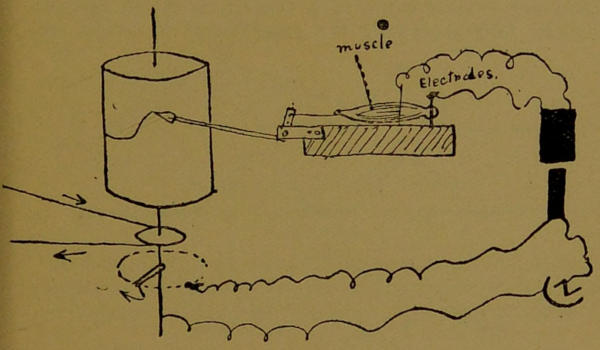
The way in which voluntary muscle is studied is very
simple. A frog is killed by thrusting a probe into the
brain and down the spinal cord, and a muscle is then
dissected out and attached to a piece of apparatus (see
Diagram 21) in such a way that on its contracting it
raises a lever, and draws a line on a moving surface.
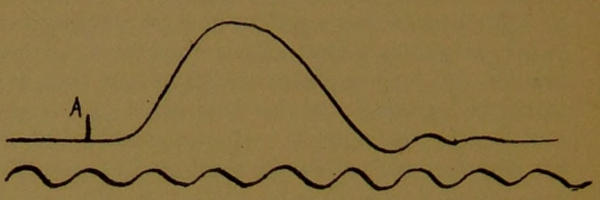
The rate at which the surface is moving is ascertained,
so that the nature of the curve, which is a graphic
record of the contraction, can be analyzed. (See Diagram
22.) For instance, when an electric shock is used to
make the muscle contract, we find that a slight shock
causes a small contraction, as shown by a low curve,
while a stronger one, up to a certain point, causes an
increase.
Diagram 22.—Graphic Record of a Response to a Single
Stimulus applied at A.
Lower line = tuning-fork records of ⅟₁₀₀″.
But having described how muscle is studied, it is only
necessary to state a few facts concerning it; to discuss
muscle, fully describing the experiments by which its
more obscure properties have been elucidated, and the
devices by which causes of error have been eliminated,
would fill volumes.
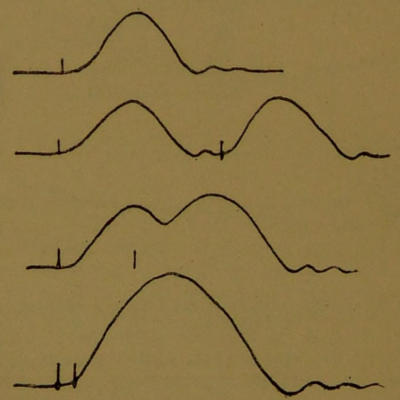
Diagram 23.—Contractions with Two Stimuli at Different
Intervals of Time.
Muscle is thrown into a state of contraction by an
impulse reaching it from a nerve, but it contracts quite
as readily if excited directly by a mechanical or electrical
shock. A second shock causes a second contraction, or,
if the muscle is still in a state of contraction owing to the
first, causes it to contract still more. (See Diagram 23.)
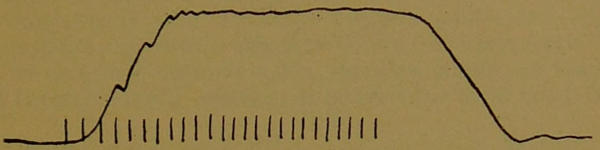
If a number of stimuli are applied to a muscle in such
rapid succession that the effect of the preceding one has
not passed off by the time the next arrives, it will contract
as far as possible, and remain contracted—a state known
as tetanus. (See Diagram 24.) A muscle is therefore
kept in a state of contraction by a continuous nervous
effort, not arranged and then left contracted.
Diagram 24.—Tetanus.
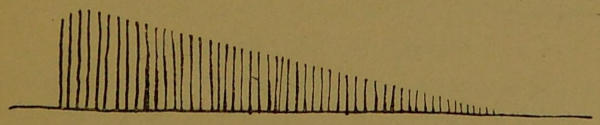
Diagram 25.—Fatigue Curves.
Fast drum: a, point of stimulation. Every tenth contraction
recorded.
Diagram 26.—Effect of Fatigue on Muscular Contraction.
Slow drum. Every contraction recorded.
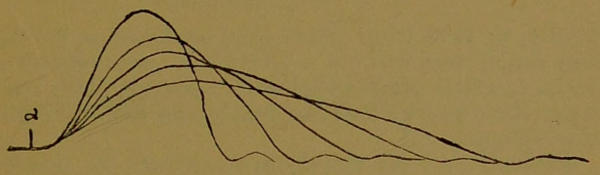
Various conditions alter the character of a muscular
response. With repeated stimuli at short intervals a
muscle fatigues, and each contraction becomes smaller in
extent and longer in duration. (See Diagrams 25 and 26.)
If the muscle has to lift a load it has a certain check on
its contraction, and its relaxation time is shortened.
Temperature also affects muscular contraction, moderate
increase causing a sharper, and moderate cooling a slower,
rise and fall of the lever on stimulation. (See Diagram 27.)
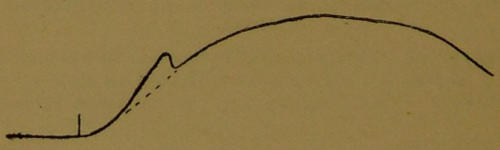
Lastly, we have drugs which exert an influence, but the
only one of these which it is necessary to mention here is
veratria, which makes the slowly contracting fibrils continue
their activity after the quick ones have subsided.
(See Diagram 28.)
Diagram 27.—Effect of Temperature.
Diagram 28.—Veratria Curve.
Finally, there are the electrical changes in muscle.
These, again, may be passed over briefly, since they are
not easily understood or described. To put the facts in
a nutshell, the part of a muscle which is in activity is
negative to all other parts. Thus, if a muscle be dissected
out and cut across, the activity at the seat of the
injury, while it lasts, causes a current to pass through a
galvanometer from uninjured parts to the wounded.
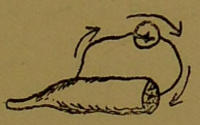
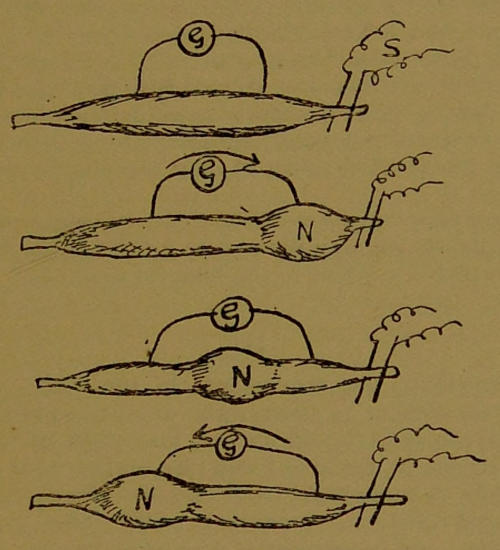
(See Diagram 29.) Again, if a muscle be dissected
out without injury, connected at two points with a
galvanometer, and then stimulated at one end, as the
wave of contraction passes along it, first one, then the
other, contact becomes negative. (See Diagram 30.)
S, Stimulating electrodes; N, contraction which marks the wave of
excitation passing along the muscle; G, galvanometer which
shows that the seat of activity (N) is negative to the rest of the
muscle.
Diagram 29.—Injury Current: Cross-section of Muscle
Negative to Rest.
Diagram 30.—Action Current.
In passing, it may be mentioned that, as the heart is a
muscle slung obliquely across the body, and waves of
contraction are continually passing down its long axis,
the whole body is affected by continual electrical changes.
By very delicate instruments it can be demonstrated that
with each beat the two hands alternately become electrically
positive and negative to each other.
Whilst dealing with the electrical phenomena of
muscle, it may be as well to state that nerve fibres, which
are studied with very much the same apparatus, show
the same electrical changes, the point of injury or of the
greatest activity being negative to all the rest. Single
cells are less easily investigated, but in glands it is
possible to show that the same rule holds.
Undoubtedly the most curious fact about the generation
of electricity by protoplasm is that, by a modification
of muscle and nerve, which causes them to lose their
ordinary properties, they are converted into a special organ
for giving electric shocks. Armed with powerful batteries
of this description, an otherwise rather helpless class of
fish are enabled to defend themselves from their enemies,
and deal unexpected death to their more agile prey.
Having now run over a few of the physical properties
of protoplasm, we may pass on to a brief investigation of
the movements we find in the body of man.
In describing the movements of the body, we shall
have to treat them as several and distinct, as indeed they
are; but the fact should not be lost sight of that they
cannot really be isolated: one idea embraces the whole.
Two kinds of movement may, however, be distinguished
in the vital functions: movement of the actual cells, such
as muscles; and movement of non-protoplasmic elements
acted upon by the cells—e.g., lymph.
There is a parallel to this in the chemical side of life,
where we find some phenomena peculiar to the living
elements, and others, like digestion, going on in the
living body, but outside the cells.
Taking the movements in the natural order—that is,
proceeding from the simpler to the more complex—the
first to be considered is undoubtedly that of the leucocytes,
or general scavengers of the tissues. The body
consists, so far as we have defined its anatomy, of three
layers of cells, and its shape is that of a tube with hollow
walls. (See Diagram 6.) Within the cavity of the
body are various organs, such as the muscles, which are
formed from the middle layer; and its space is largely
reduced by glands, lungs, and other ramifications of the
inner layer which forms the alimentary canal.
These organs hang more or less freely in the body
cavity, slung to its walls by enveloping sheets of connective
tissue, the whole being bathed in lymph. Now, in
such an arrangement the products of wear and tear must
accumulate. Cells here and there die for various reasons,
and pieces of cells become detached even in adult animals.
The interior of a bone is always being eaten away to
decrease its weight, or in order that it may be replaced
by fresh bone of a closer texture, and in young animals
and embryos there are many structures which, useful for
a time, have eventually to be removed; as an instance,
we may quote the tadpole’s tail. In fact, if the tissues
were left to themselves, the body would soon be choked
with débris, and to avoid this it is supplied with an army
of scavengers, the leucocytes.
The leucocytes are detached cells which owe their
origin to the middle layer. In size they are, of course,
very small, quite invisible to the naked eye. In appearance
they resemble unicellular organisms of the amœba
type, which we have had occasion to mention several
times already (Essay II., Section II.; Essay III., Section
I., Diagram 1). They are of several different varieties,
some being larger and more active than others; but they
all wander about in the lymph and blood like independent
animals, creeping in and out between the cells of the
organs, and devouring any foreign matter they come
across. They sometimes multiply, like independent
animals, by division, especially in the presence of inflammation,
or when they have much work to do, and a rapid
increase in their numbers is needed; and they have been
induced to live, and feed, and multiply, outside the body
(in which case they must be considered to have become
independent organisms), thanks to the careful attentions
of the experimenter.
Apart from their duties of devouring the inside layers
of bones and clearing away dead tissue, they are supposed
by some to assist in the absorption of food by creeping
between the cells lining the alimentary canal, and, after
throwing out arms to engulf particles of food, returning
with their spoils into the body. Perhaps, however, the
most interesting, or at any rate most romantic, of their
many and important functions are what may be called
their emergency duties. Frequently people, especially
those who live in smoky towns, draw into their lungs
particles of dust and soot, which if left adhering to the
walls of the air cavities would cause dangerous irritation.
As if by magic a leucocyte will discover the
presence of such a nuisance, and, crawling between the
cells forming the wall of the lung, in which, by the way,
it is outside the body proper, will engulf it and carry it
away with him. This exploit, however, pales beside the
warfare which goes on in the body between leucocytes
and invading bacteria. A bacterium thrives in the blood
or lymph, since it finds itself in a warm alkaline fluid
containing complex organic substances, by breaking
down which it can easily obtain energy. Unfortunately,
the products of such a process are frequently virulent
poisons, the effect of which upon neighbouring cells
produces the distressing symptoms which we associate
with disease. No sooner, however, has the bacterium
begun to generate poisons, than leucocytes, influenced by
chemical attraction (Essay I.), swarm upon it. First
come leucocytes of a small kind, full of zymogen granules,
which crowd round the bacterium till they have covered
it. After a time they creep away, leaving it dead. They
are now in an exhausted condition, and no longer contain
granules, having doubtless discharged them as a destructive
ferment upon their enemy. Then a leucocyte of
another kind moves to the attack, or, rather, to clear up
the remains, for he is a large, non-granular, active fellow,
and eats up the dead bacterium by the simple process of
engulfing him whole. (See Diagram 31.)
A natural question arising out of the study of
leucocytes is, What becomes of them? Particles of soot
and similar refuse can hardly be considered nutritious,
or even digestible, food, and one is rather drawn to the
conclusion that the leucocyte performs its functions for
the good of the body at large, not of itself, and that
when its work is done it must die. Many leucocytes,
probably, loaded with unconsidered and undesirable
trifles, cast themselves into the alimentary canal, and are
got rid of with the useless portions of the food; but they
do not always have the luck or energy to get to a natural
outlet. An unpleasantly familiar phenomenon is the boil.
Here we have some irritating substance under the skin
setting up inflammation, and leucocytes swarm up to
remove the cause of the trouble. Before, however, this
is done, many have perished in the fray, and they have
collected in numbers to the formation of what is commonly
known as pus, or matter. Their dispersal into
the body is now neither easy nor desirable, and the
surgeon usually lets them escape from the surface by a
touch of the lancet.
Diagram 31.
A, Eosinophile leucocyte; B, bacterium; C, leucocytes killing
bacterium with their enzyme; D, leucocytes leaving bacterium
dead; E, hyaline leucocyte devouring dead bacterium.
Such, then, is very briefly the story of the leucocyte,
neglecting such problems as the differences between
those found in the blood, called white corpuscles to
distinguish them from the red corpuscles, with which
they have no sort of connection; those found in the
lymph, called lymphocytes to distinguish them from
those found in the blood; those caught in the act of
devouring bone, called osteoclasts; and those found
with bacteria inside them, therefore known as phagocytes;
and without speculating on how long an individual lives,
and whether the different varieties differ in origin or are
merely at progressive stages of development. The study
of leucocytes is one of the most fascinating in physiology,
but we have many other things calling for our attention,
and we have said enough about the part they play in the
life of the body to justify our passing on to consider
another essential movement.
Next in natural order for consideration come the
movements of the alimentary canal.
So far we have considered this structure as a chemical
laboratory, a tube consisting of a single layer of cells
which secrete ferments into the lumen, where digestion
takes place, and then absorb the products, and we have
not yet accounted for the food travelling along the tube,
without which its functions, as described in the earlier
part of the book, could not be performed. That the
passage of the food is not due to gravitation is obvious
from the many directions of the tube’s coils—not to quote
the old instance of a horse drinking, in which case the
liquid first travels upwards. One must therefore conclude
in favour of some muscular method of propulsion.
We have so far described the alimentary canal as a
single layer of cells, but it must be obvious that these
soft secreting portions of the tube are not capable of
vigorous movement. The canal proper is surrounded
by a tough sheath of connective tissue which prevents
its being overdistended or ruptured, and, by means of a
layer—or, rather, two layers—of non-striped muscle
which it contains, produces the movements which result
in the passage of its contents along the tube. These
two layers lie well to the outside of the connective-tissue
sheath. The fibres of the inner layer are arranged
circularly, so as to form rings round the tube; those of
the outer have a longitudinal direction, running, therefore,
parallel with its long axis. When the former contract,
the diameter of the tube is reduced, while contraction of
the latter has the effect of enlarging it. (See Diagram 32.)
The movements of the intestine are what is known
as peristaltic. Contraction of the muscle fibres is not
simultaneous in all parts, but passes in waves along it.
Just in front of the food the longitudinal fibres contract,
and thus offer less resistance, while just behind the
circular fibres reduce the size of the tube, and so get up
a pressure. The result of a number of successive waves
of contraction passing down the alimentary canal is that
the food is propelled along it.
Diagram 32.—To illustrate the Passage of Food along
the Intestine.
The arrangement of the muscle varies in places to suit
special needs. Where the tube suddenly enlarges to form
the stomach, and where the stomach suddenly narrows
to the intestine, there are two strong rings of muscle,
whose constricting influence converts the enlargement
into a closed chamber during gastric digestion; while
the coats which actually clothe it here run obliquely,
and their activity causes the contents to be slowly
churned about inside.
Thus it will be seen that it is not only the voluntary
muscles which give the alimentary system its opportunities;
without these unobtrusive non-striped cells we
should toil for our bread and swallow it in vain.
Our next step, after having surveyed the principle of
movement by which the chemical necessities of the body
are exposed to its absorbing surface, must be to see how
the fluid which transports them is made to pass along
the tubes containing it. We have already had occasion
to describe how these blood and lymph vessels ramify
through all the organs, when we were dealing with the
chemical influence of the blood and lymph.
The tubes through which the lymph is brought back
to the blood-stream have thin walls, and no muscle of
their own. They are subjected, however, to a constantly
varying pressure by the movements of the limbs and
trunk, and as, owing to valves inside them, the lymph
can only escape in one direction, there is a constant flow
towards the junction with the bloodvessels.
The bloodvessels are quite different. A far more
certain and expeditious current is necessary—hence the
steady circulation through a system of closed tubes.
In order to understand this passage of the blood, it is
necessary to keep in mind the great principle with which
hydrostatics supplies us, viz., that a liquid always flows
from a region of high to a region of lower pressure. The
problem of the vascular system is, therefore: How can
the pressure within a ring of tube be so arranged as to
maintain a regular flow always in the same direction?
Let us begin with the structure of the system. The
tube through which the blood first passes on leaving the
heart is composed of four distinct and essential elements:
A lining of endothelial cells, which we need not discuss
at length; a main substance of tough white fibrous
connective tissue; elastic fibres and muscle fibres, the
two last arranged in the substance of the connective
tissue. All these parts are present in the main arteries
which leave the heart, but in the fine meshwork of
capillaries to which the arteries give rise by repeated
branchings there is nothing left of the outer coats, only
the lining of endothelial cells separating the blood from
the organ traversed. In the veins which these capillaries
unite to form, the connective-tissue sheath reappears, and
also some muscle; but the elastic coat is quite absent.
The heart is really a double coil of the tube (see Diagram
12), in which the muscular coat is predominant, and
is divided into four chambers by the valves, which insure
the blood flowing in the right direction when it contracts.
(See Diagram 33.)
Diagram 33.—Scheme of Circulation
The way in which these structures work is as follows:
Two of the chambers of the heart (the auricles) receive
blood from the veins, and when full suddenly contract,
driving their contents into the other two chambers (the
ventricles). The blood does not run back into the veins,
although the pressure in them is very low and there are
no valves to prevent it, because there is still less pressure
in the ventricles, and also because the veins enter the
auricles obliquely, and the tendency of the increasing
pressure is to close their orifices. Having discharged the
blood into the ventricles, the auricles relax, and the
pressure within being a minus quantity, they are speedily
filled with blood from the veins, blood not being able to
return after entering the ventricles, as valves close automatically
to prevent it.
Stimulated by the blood distending them, the ventricles
then contract simultaneously like the auricles, only with
much greater force: for the right ventricle has to drive the
blood all through the vessels pervading the lungs back
to the left auricle; whilst the left ventricle, which is
proportionately stronger than the right, has to send its
contents to the furthest extremities of the body. They
then relax, in order that conditions of their internal
pressure may favour another inflow from the auricles,
return of blood from the arteries being, as in the preceding
case, prevented by valves.
The pressure in the arteries during life is always fairly
high; indeed, the ventricles have to get up a considerable
force before the valves leading from them will open.
The result of this is not only that the blood is driven
along them with a rush, but also that they are slightly
distended at each beat; and so, owing to the elasticity of
their walls, the blood continues to flow forwards even
between the beats of the heart. The rest of the journey
is quite simple; the pressure in the capillaries is lower
than in the arteries, and the pressure in the veins lower
than in the capillaries, and lower in the veins, too, as
they approach the heart, till, where they join the auricle,
it is actually minus, and the blood has no other course
open to it but to return to the auricle. It looks as though
accidents might happen in the veins owing to there being
so low a pressure there to direct the current, but this is
prevented by the presence of valves at intervals, to stop
any return.
The rate at which the blood travels is another point
which has an important bearing on the nutrition. It
does its work—i.e., gives out nutriment and picks up
refuse—whilst flowing through the capillaries; so here
one finds that it moves slowly. On the other hand, the
sooner it reaches them the better, so it races fast through
the arteries. Finally, its return to the heart need not be
delayed, so it is quickened up again through the veins.
The principle by which this variation in the rate of flow
is obtained is simple and inevitable. If a tube through
which liquid is flowing is not the same size all the way
along, the liquid will be found to flow faster in the narrow
parts than in the wider ones. Now, in branching, the
arteries do not keep becoming smaller in regular proportion,
and the result is that the capillaries have collectively
a diameter five hundred times larger than the
aorta; hence the blood flows through them only one-five-hundredth
of the pace at which it leaves the heart.
But in uniting again to form the veins their cross-section
is reduced once more, so that that of the large veins near
the heart is only two and a half times larger than that
of the aorta, and hence a flow only two and a half times
slower results.
The pace of the blood-stream must depend, obviously,
on the pressure of the blood in the arteries. This
pressure is altered either by changing the rapidity of the
heart-beat or the diameter of the arteries, which are
capable of considerable variation owing to their muscular
coat. The regulation of the blood-pressure is managed
by the nervous system, so does not belong here, and we
may leave it after mentioning one or two facts. High
pressure is due to a large quantity of blood being in the
arteries, and this may be due either to the rapidity with
which it is injected by the heart or to the reduced
capacity of the bloodvessels themselves. High pressure,
due to the latter cause, throws a great strain upon the
heart, owing to the hard work it has in pumping blood
into the arteries; with a low pressure the heart beats
feebly, having less resistance to overcome.
Blood-pressure can be raised by stimulating the muscular
coat and reducing the capacity of the bloodvessels,
and lowered by causing the heart to beat more slowly or
by removing blood from the body. This latter operation
was a favourite way with doctors of the old school; but
as our knowledge of physiology, and with it our control
over the vital functions, increases, such crude and heroic
remedies are able to be replaced by others which are less
dangerous.
Comparisons are rightly regarded as objectionable, so
it would hardly be safe to say that the group of movements
whose primary object is filling the lungs, and
which we must study next, is the most important in the
body, especially when we have just been speaking of the
circulation, which, however, would be of but little use if
the blood could not be oxidized; but we can at least say
that its importance cannot be overrated, so far-reaching
are its effects.
The lungs are, as we have described them above, a
pair of delicate membranous sacs connected by a tube,
the trachea, with the alimentary canal, from which they
originally budded out. They are subdivided, though how
we need not describe in detail, into a vast number of
small compartments, so as to give the maximum surface
in the space accorded them, and the whole somewhat
resembles a cluster of grapes, the stalks being the
branches of the trachea. The membranous parts are
pervaded by an elastic network, enveloping the compartments
in such a way that it would reduce them
permanently to the resemblance of a bunch of raisins
rather than grapes, were it not that they are enclosed in
an airtight box—the thorax—from the walls of which
they cannot shrink without causing a vacuum. Owing,
however, to the latter arrangement and the trachea being
open to the external world, they are always more or less
distended with air.
The thorax, which they thus must always exactly fill,
is a conical-shaped box, its walls being the ribs, and its
floor a sheet of muscle known as the diaphragm. It
contains, besides the lungs, only the heart and large
bloodvessels. The problem, therefore, of drawing air
into the lungs and (after the gaseous interchange described
in Essay II., Section IV., has taken place) of expelling
it again, becomes solely a matter of increasing and
decreasing the capacity of the thorax. (See Diagram 34.)
This can be done in two ways: the diameter through the
ribs can be increased, or the diaphragm can be pulled
down, increasing its depth. Actually, both these methods
come into play together. Diagram 35 will probably give
a better idea of how this is done than could easily be
conveyed by a verbal description. An attempt is here
made to show the action of the ribs and the diaphragm—first,
of each separately, then of the two combined. The
elasticity of the lungs themselves is sufficient to drive out
the tidal air if the diaphragm and the muscles of the ribs
are relaxed, though in hard breathing a muscular movement
may depress the ribs and a contraction of the
abdominal muscles force up the diaphragm.
Diagram 34.—Model (adapted from Rutherford) for showing
how the Lungs are filled with Air by altering the
Size of the Thorax.
But though the primary object of raising the ribs and
depressing the diaphragm may be to fill the lungs, its
secondary influence upon the trunk as a whole is hardly
less important. The effect upon the circulation is profound.
The compartments of the lungs are enveloped
in innumerable capillary bloodvessels, and, as these lie
around and between them in the cavity of the thorax,
they must, when breath is drawn in, be subjected to a
negative pressure before the lung itself, and be the first
to experience a positive pressure when the air is expelled.
Here, again, a diagram is the best explanation. (See
Diagram 36.)
The pulmonary vessels, moreover, are not the only
ones influenced. The reader who attentively examined
Diagram 13 must have been struck by the peculiarities of
the circulation through the spleen, intestine and liver,
and the obstacles which this repeated breaking up into
fine vessels must offer to the flow of blood, as described
in Section V. of this essay.
Diagram 35.—Showing how the Capacity of the Thorax is increased
by raising the Ribs and depressing the Diaphragm.
Diagram 36.—Model for showing Effect of Movements of
the Thorax on the Pulmonary Circulation.
The liver forms the crux of the situation. (See Diagram 37.)
A vein carrying blood from the intestine and
spleen is broken up into fine capillaries to pass through that
organ, and the pressure in this vein is extremely low. How
is a sufficiently rapid flow of blood to be maintained? The
answer to this riddle is best given by Diagram 38, which
shows how, by the contraction of the diaphragm at each
breath, the large veins entering the heart are subjected
to a negative pressure which draws blood out of the
liver, while, simultaneously, that organ is squeezed and
the blood it contains forced out. Obviously this natural
pump influences not only the flow of blood, but also that
of the lymph, and what was said about the hepatic
vessels also holds good for the thoracic duct, up which
the lymph, rich with fat absorbed from the intestine,
passes to be emptied into the large veins near the heart.
So, though vigour in the action of the diaphragm is more
favourable to health than necessary to life, deep breathing
is an essential factor in the well-being of the body.
Diagram 37.—A Diagrammatic View of the Circulation
through the Organs upon which the Diaphragm presses
when it descends.
Diagram 38.—Illustrating the Influence of the Diaphragm
upon the Circulation through the Viscera.
All the movements as yet described are absolutely
necessary to the continuation of life; they are, moreover,
independent of the efforts of the will. But there remains
yet another kind of movement without which the body,
left to itself, would die. This is the movement of the
limbs—organs by which the body is able to move from
one place to another, to capture its food and convey it,
viâ the mouth, to its stomach—in a word, to satisfy its
chemical and physical needs.
To understand how the limbs work requires a knowledge
of their anatomy, for which we have not time or
space here; but the principle throughout is that of a
system of levers, the bones, worked by the voluntary
muscles. Here, as before, a diagram will probably be
found to convey more than could ever be expressed in
words. (See Diagram 39.)
The diagram represents very roughly, but it is hoped
very plainly, the main principle of the elbow-joint; but
for an exact knowledge of the mechanism of the joint,
and the comparative strain upon, and therefore strength
of, each muscle, the reader must consult some work on
anatomy. He will there find, if he goes on to read the
description of the hand, what a wonderful precision,
complexity, and amount of movement can be obtained
by variations of this simple device.
Diagram 39.—Diagram of the Arm.
1, Lifting; 2, pressing.
Here, however, we must leave the study of the manner
and object of the bodily movements, and proceed to
investigate the far more intricate question of how they
originate and are controlled.
ESSAY IV. THE NERVOUS SYSTEM. — I. — II. — III. — IV.
Now comes the final problem. Protoplasm forms a
structure always changing, always making good its waste
by chemical action upon raw material, always capturing
raw material or in search of it, always, when it exists
in large quantities, and the labour is therefore divided
between many cells, economically apportioning the work
and the spoils. How is it that all the actions, chemical
as well as physical, of a vast number of cells composing
a large body are, no matter how complicated, always
harmonious, and always with purpose directed to the
advantage of the whole animal?
In the first essay in this book we discussed the
phenomenon of life, and described briefly the chemical
and physical peculiarities of protoplasm. These in the
two succeeding essays we have gone into more fully; but
there is one characteristic of that interesting substance
which yet remains for us to examine in specialized cells,
viz., its extreme readiness to respond to changes in its
environment.
In Essay I. we saw that chemical agents, light, heat,
electricity, etc.—had a definite effect upon protoplasm,
and that, though they might influence different kinds in
different ways, the effect was nevertheless invariable; in
a word, the response of protoplasm to circumstances is
automatic. But the most remarkable thing about this is
that the response is not confined to the protoplasm
actually affected, but is transmitted to that nearest to the
part stimulated, and again passed on to that beyond, so
that a wave of excitation passes through the whole mass,
not stopping till it has reached the extreme confines of
the cell. It may even pass beyond these and set up
activity in neighbouring cells. The power of conductivity
once grasped, it may easily be seen that certain
cells, by specializing in this direction and adapting their
shape to the needs of the body, might by throwing out
long threads to reach distant parts set up an organic
system of telegraphy.
The organs developed for the control of the body
owe their origin to the outer layer. (See Diagram 5.)
This was only to be expected. In the second essay, in
which we treated of the chemistry of the body, we, of
course, touched upon all three layers from which the
body is built up; but the one which chiefly occupied our
attention was the innermost layer, which is so admirably
arranged as a chemical laboratory. In the third essay
we dealt chiefly with the middle layer, which both by its
position and its bulk might have been guessed to be the
foundation of most of the motor organs. Now that we
have come to the organs of perception and transmission
of impressions, it is only natural to expect that they
should be specialized from the cells already in contact
with the external world, and which, since they form the
envelope of the animal, must allow all such stimuli as
reach the subjacent motor layer to pass through them.
Hitherto we have not dealt at great length with the
development of the organs whose functions we have been
describing, either from the point of view of the embryologist
or the evolutionist. Nor have we spent much
time upon their gross anatomy. With the nervous
system we must proceed rather differently; for to understand
how its higher functions can be performed they
must be traced from their origin step by step, while their
complexity is largely vested in the structure of special
organs.
The way in which the nervous system was evolved is
shown in Diagram 5. Originally, no doubt, the cells of
the outer layer, when the latter was in its simplest
form—that is to say, only one cell thick, not several, as
it is in our skin—would, when influenced in any way
directly call forth the activity of the motor cells lying
beneath them. (See Diagram 40, Fig. 1.) In Fig. 2,
however, we see one cell of the outer layer becoming
specialized. It has thrown out a process above the
surface of the skin the more readily to catch impressions,
and has sent another down into the body the better to
distribute them. Diagram 41, Fig. 1 shows the nerve
cell at a further stage. The principle is the same,
but the cell is removed to a safer place. In Fig. 2
it is not exposed to the outside world at all, but by
receiving its impulses second-hand from several cells the
same work is done with greater economy and uniformity.
Some of the special sense organs are still developed in
this way.
Diagram 40.—Showing Origin of a Nerve Cell.
Diagram 41.—Showing the Development of a Nerve Cell.
Once the nerve cell is developed and safely shifted into
the interior of the body, it is clothed with a protecting
feltwork of connective tissue, and the nerve fibres are
also surrounded by connective-tissue cells which secrete
around them the fatty substance which makes nerves
look white.
Such is the nerve cell or intermediary between the
world and the muscles; but thence to harmonious movement
in a body with complex organs capable of varied
actions is a long step. To obtain precision and uniformity
throughout the body, all the impressions received
must be collected and balanced, and stimuli, the correct
outcome of this balancing, must be transmitted to the
muscles, glands, etc., whose activity circumstances
require. The way in which cells of the outer layer
become enclosed to form a central nervous system is
shown in Diagram 5; but its development will be better
seen in the figures of Diagram 42.
Diagram 42.—To illustrate the Development of the
Nervous System.
Diagram 43.—Cross-section of the Spinal Cord, showing
how it gives off Nerves.
Diagram 44.
This diagram shows how certain cells of the outer layer
are budded off and transferred to a safe place within the
body. In this position the cells are further developed,
throwing out one long fibre, which goes to some distant
organ of the body, and short fibres, which, though they
do not join those of other cells and become continuous,
closely interlace and put them into communication.
They are also separated from one another by connective
tissue, which supports them, holding them suspended
with only their fibres approaching one another
(Diagram 43). Diagram 44 shows how the bone which
replaces the supporting rod (see Diagram 6) throws an
arch round the feltwork of connective tissue in which
the nerve cells are suspended, giving them still further
protection.
It will be noticed in the figures of Diagram 42, which
is fuller than Diagram 5, that there are three of these
buds—one central and two lateral. The central one
becomes a tube running the whole length of the animal,
while the lateral buds form solid clusters or ganglia,
arranged in pairs at intervals beside it (see Diagram 45).
Fibres from these ganglia go to the skin, and bring to
the nerve cells information from the outside world, which
they duly pass on to the cells of the central column.
The cells of the central column, when set in motion by
the ganglion cells, send out impulses to the muscles,
whose contraction is necessary to perform the movement
which circumstances indicate. A movement brought
about in this way is called reflex.
Diagram 45.—Central Nerve Tube and Ganglia.
The reflex movements are, however, not quite the
simplest. For instance, the food is moved along the
alimentary canal by the contraction of two sets of muscle
fibres—an outer longitudinal coat and an inner circular
one. Between these two coats are some nerve cells,
which are thrown into activity by the presence of food
and the iron compounds of the bile secreted by the liver
in the tube. These sympathetic cells do not send their
impulses to any centre for examination, but at once
stimulate the muscle fibres between which they lie,
thereby producing the peristaltic movements we have
already described. Yet it should be remembered that,
though these cells act independently of the central nervous
system, they are under its control, and can, if need be,
have their action modified for the benefit of the body as
a whole.
For convenience’ sake, we had better here specify the
chief kinds of nervous action. First there is what we
may call the immediate nerve action, such as that we
have just been describing; secondly there is reflex
action, the centres for which are in the spinal cord and
the base of the brain; and thirdly there is voluntary
movement, which arises out of the interaction of centres
in the hemisphere of the brain, where the most complex
machinery of all is kept.
Of the first kind we need say no more. The instance
of peristaltic movement illustrates it sufficiently; so we
can at once begin a more careful examination of reflex
action.
The simplest instance of reflex action may be taken
from the schoolroom. If a boy suddenly sticks a pin
into an unsuspecting schoolfellow, the latter invariably
starts, and frequently lets fall an exclamation also. In
this case the presence of an injurious agency is reported
to the nearest motor centre, which is in the spinal cord,
and this automatically convulses the body, jerking the
limb out of danger.
This is reflex movement; the nerve fibre, which conveys
an intimation of the injurious influence, is a prolongation,
or really two prolongations, of a spinal
ganglion cell. (See Diagram 46.) The near end of this
fibre, which enters the cord, has several branches. Some
run a little way up the cord, and some a little way down,
so as to communicate with several motor cells; but one
branch runs right up the cord, and sends the message on
to the brain. Our outraged schoolboy starts a fraction
of a second before he is conscious of the pain of being
pricked, and this first response is involuntary and unvarying;
the sensation, however, is reported to his brain, and
the workings of that wonderful organ are less easy to
predict. It leads to his taking stock of the aggressor, on
the strength of which he decides whether it is safe to
attempt a reprisal, and, if so, in what form it will be most
effective and least likely to attract the master’s attention.
This knotty point settled, the motor cells of the brain
send down messages to the motor cells of different parts
of the spinal cord, and these in turn set the necessary
muscles in motion for delivering a surreptitious kick or
aiming a splash of ink, as the case may be. This is voluntary
movement.
Diagram 46.—Evolution of a Spinal Ganglion Cell.
Diagram 47.—Scheme of the Central Nervous System.
→ shows the path taken by an impulse in reflex action.
↣ shows the path for a voluntary action.
The difference between reflex and voluntary movement
is, as may be seen from the above instances, very much
a matter of degree; but we had better leave a comparison
between them, and any discussion as to the extent to
which the manifestations of consciousness are automatic,
until we have finished describing reflex movement, and
set forth the little we know about voluntary movement.
Time and space forbid a complete list of reflex movements.
The following are, however, a few typical examples
of how the body is automatically made to perform
such acts as are necessary, and of how such as do not
require deliberation are brought about without taxing the
intellect.
A reflex action which is unpleasantly familiar is the
cough, also the somewhat similar phenomenon of the
sneeze. In this case, a foreign body which obstructs the
windpipe, or causes irritation to the membrane lining the
nose, is, on being reported at the spinal cord, incontinently
blown out by an explosive blast of air from the lungs.
An organ which is very important, and at the same
time very sensitive—viz., the eye—has many protective
reflexes. The external surface of the eye is covered by
a very delicate membrane, which must be kept moist and
scrupulously clean. Whenever this membrane gets in
the least dry, or any dust falls on it, the eyelids are
closed for a moment, thereby bathing it with the secretion
of the tear glands. Few people are aware, I think,
that they blink their eyes on an average twice every
minute. The eyes are also closed quite involuntarily by
a reflex when any danger threatens them—for instance,
a sudden dazzling light, a strong wind, or a blow aimed
at the face; and if any foreign substance—say a fly—does
get into one of them, the secretion of the tear glands is
enormously increased to wash it out.
The size of the pupil, again, is quite involuntarily, i.e.,
reflexly, altered in proportion to the strength of the light.
Reflex actions are, however, by no means only protective.
The act of swallowing is reflex. So is the
secretion of the digestive glands when the lining membranes
of the stomach are stimulated by the presence of
food. The very act of standing depends on the reflex
principle, the tendency of the body to collapse and fall
being unconsciously perceived and corrected by the
spinal cord. Walking is also a reflex action. It may
be objected that we think about walking, and do so with
intention; but it is of common experience that we can
walk along ‘thinking of something else,’ and the way in
which an intellectual though absent-minded man will
run into people, charge lamp-posts, trip over steps, and
tread upon dogs, is sufficient to absolve the organ of
thought and intention from any share in the performance.
The blood-pressure is also automatically regulated,
both the diameter of the bloodvessels and the frequency
of the heart-beat being under reflex control; and we
may, as a final instance of reflex action, describe one of
Nature’s most perfect and merciful contrivances—fainting.
Suppose a man receives a severe wound—say, has his
hand struck off by a sword—the shock to his system
causes an immediate dilatation of the large bloodvessels
of the abdomen; this results in a great fall of blood-pressure,
and the heart, finding that it has much less
resistance to overcome, slackens its beats so that soon the
flow of blood is very slow indeed. Hence, it has time to
clot over the wound, and the man does not bleed to
death. Incidentally, the feeble current of blood is insufficient
to keep the most delicate organ of the body, the
brain, in its normal state of activity, and the man is
relieved from his pain by unconsciousness, which passes
off when the heart again quickens its beat. It is perhaps
needless to remark that fainting fits are not always and
only caused by flesh wounds; they may be due to weakness
or other causes.
Now, if we consider the instances quoted above, we
are able to deduce a few general principles from them.
In the first place, it may be noticed that reflex action
compels us to perform the movements necessary to our
existence whether we like it or no. It is not for us to
decide whether we will breathe or not. We must. The
strongest-willed man who ever lived, no matter how
much a philosopher, could not commit suicide by holding
his breath, as Cato boasted he could. Directly he lost
consciousness, supposing he managed to hold out till
then, the tainted blood bathing the respiratory centre
would awake it to activity, and he would start breathing
afresh. Again, it is noticeable that many of these actions
could not possibly be performed by a voluntary effort.
We can, to a certain extent, regulate the depth and frequency
of our breathing, and we can blink our eyes
voluntarily; but an average man would be quite at a loss
what to do if asked to make the pupil of his eye dilate
and contract, the glands of his stomach secrete, or his
heart alter its rhythm.
It is a familiar fact that some reflex actions can be
altered by an effort of the will; in other words, an
impulse from a brain cell will prevent a nerve cell in the
spinal cord from discharging. But it is an equally
familiar fact that with continuous stimulation the impulses
accumulate and ultimately overcome this resistance.
Most people have at some time or other striven
to resist the inclination to cough, consequent upon a
tickling sensation in the throat, and know that there
comes a time when they can restrain themselves no
longer. This is because the accumulated stimuli from
the throat, having reached a greater strength than the prohibitive
impulse from the brain, succeed in compelling
the cells in the cord to discharge.
Lastly, reflexes can be learnt. When a young child
first endeavours to stand upright, the sensation of falling
is doubtless conveyed to the brain, and thought taken of
how the erect position can be maintained. But it is not
until after many experiments and failures that the brain-cells
can send messages to the right cells in the cord, and
these set the necessary muscles in motion. Experience
teaches what must be done, and constant practice eventually
enables the spinal cord to act for itself without
referring for orders to the brain. It is on the same
principle that we learn to ride the bicycle. At first we
have to devote our whole attention to keeping our
balance, but in a short time we find we are doing it with
our mind free to contemplate the scenery.
What can be done by reflex action can only be appreciated
by observing an animal from which the brain has
been removed. A frog which has been treated in this
way—the operation, it should be said, if performed under
an anæsthetic can cause no pain, either at the moment
or afterwards—will live for weeks—in fact, almost indefinitely—if
proper precautions be taken. But it is an
automaton pure and simple. Unless touched it sits
absolutely still. If touched it hops once or twice straight
ahead regardless of obstacles. If placed in water it swims,
equally regardless of obstacles. If turned on its back it
immediately resumes its normal position. If small chips
of wood are placed on its back it kicks them off. If the
table on which it is sitting be tilted it will crawl up the
incline until it reaches a level. But it will starve in
the midst of plenty, having lost all power of thought,
memory and perception. If diligently fed by hand a
frog, a fish, or a bird will live for a long time without
any brain, since their repertoire of movements is small
and mostly reflex, and their occasions for deliberated
action comparatively few. But the higher we get in the
scale of life the more the brain takes over the duties of
the cord, the less automatic become the greater number
of the actions, and hence the more open does the animal’s
conduct lie to moral criticism.
We have now seen how protoplasm exists in a large
body, sharing the work of living amongst specialized
cells, and how it responds as a whole to the influences
exerted upon it by its surroundings. The next thing to
consider is how it is situated with regard to matter which
does not form part of its own body; how protected from,
and how put into communication with, the rest of the
universe.
With regard to the former, we have seen that in the
single cells, constituting unicellular organisms, there is
always a bounding membrane of denser texture than the
rest of the protoplasm. As the cell develops its capabilities,
we have a shell or case of non-living matter
secreted around it, with apertures for communication
with the outside world, and increasingly effective protection
is provided as protoplasm, whether in the single
cell or the body, leaves the water, and has to face the
inclemencies of terrestrial life.
Diagram 48.—Showing the Formation of the Skin.
Diagram 49.—Structure of Skin.
In the schematic embryo (Diagram 6) and other
diagrams contained in this volume, the skin has so far
been represented as consisting of a single layer of living
cells; but we must now admit that the skin of man is
quite different. Such a covering would be no protection
from heat, cold, or irritating chemicals, while, in order to
prevent its drying up, it would have to be kept moist
with slime, and we should look very like frogs. In order
that an adequate defence may be provided for the body,
this layer of cells divides tangentially, forming two layers.
The inner of these two then divides tangentially again,
and a second layer is interposed between the innermost
and that first formed. The skin now consists of three
layers, and so the process is repeated until it is several
layers thick. (See Diagram 48.) It is the innermost
and best-nourished layer which keeps dividing; the
other layers, as they get pushed outwards, are only
reached by a little lymph which filters between the cells,
and are eventually starved even of that. As they get
pushed away from the dividing layer, however, they set
to work to surround themselves with a horny wall, which
thickens and thickens, until eventually there is hardly
any cell left. (See Diagram 49.) Finally the cells die
and the horny envelopes form a dead cuticle, protecting
the living layers beneath, and are ultimately sloughed
off when their successors are ready to replace them.
Diagram 50.—Showing the Development of Hair.
Not even a horny layer of dead cells is, however,
always sufficient protection, and the growing layer has
sometimes to supplement it by hair or feathers. How
hair is developed is shown in the accompanying
diagram (50). The growing layer sends a strand straight
downwards into the connective tissue, which forms the
basement of the skin. The cells in the middle of this
strand, which behaves like ordinary skin, are the least
well nourished, and accordingly die and leave a tube.
This tube, if no further development took place, might
become a sweat gland; but if it is to give rise to a hair
it becomes cup-shaped at the base, enclosing a small
loop of bloodvessel. The cells just above the capillary,
being better nourished than the rest, grow more rapidly
than their neighbours, and the result is that a column
of cells which we know as a hair pushes its way up
through the tube. (See Diagram 50.)
This outer layer comes everywhere between the main
bulk of the body and the outer world. Hair and sweat
glands do not by any means represent its only modifications.
Teeth are formed from it in somewhat the same
manner as hair, while we have already seen that it gives
rise to the whole nervous system.
The next thing which we have to consider is how
knowledge of the external world reaches the central
nervous system. Sensations of touch, temperature, and
pain are fairly easy to understand, since the nerves which
convey such impressions have numerous endings in the
skin. End organs of nerves in the joints and muscles
doubtless enable the animal to perceive and estimate
strain and resistance in moving or lifting things. But
the power of perceiving the chemical peculiarities of
things; light, involving the formation of visual images,
which we call seeing; sound; and position and equilibrium,
it is not possible for the whole surface of the
body to possess. The principle of division of labour is
extended to the task of perception as well as to that of
motion; and cells, with their property of responding to
light, vibration, chemical stimulation, etc., are grouped
together to form special organs, connected with the central
nervous system by special nerves.
Perhaps the most important factor which can influence
protoplasm is the chemical nature of its surroundings;
and in the first essay, on the general nature of protoplasm,
we touched upon the way in which it is drawn towards
some substances, and repelled by others.
In the body there are two sets of cells deputed to act
for the rest in this particular. One set is situated in the
membrane lining the nose, over which the air we breathe
passes; and these cells examine our gaseous surroundings,
and warn us, by what we term ‘smell,’ whether the
atmosphere is fit for us or we had better seek a purer.
The other set is for the examination of liquids. Against
these we are protected by our skin, and, as we do not
absorb anything through it, it is devoid of the power of
examining the things it touches. But with our food it
is different; we must have the power of testing that.
Accordingly, there are Customs officers in our mouth in
the form of little groups of cells, which report upon the
liquids and solids moistened by saliva, and enable the
animal to reject pernicious imports. Thus, the stimulation
of a small portion of the protoplasm composing a
body is transmitted over the whole, and is able to awake
in it the necessary response.
Diagram 51.
Diagram 52.
Diagram 53.
Diagram 54.
Diagram 55.
Diagram 56.
So much for the chemical sense organs; they are
comparatively simple. But between a single cell, which
always makes towards or always hurries out of a ray of
light passing through the water in which it swims, and
an animal with eyes capable of recognising the colour,
shape, size, and distance of objects in space, there really
does seem to be a wide gulf. It is not, however, too
wide to be bridged.
After the single-cell stage has been passed, and we
have beasts consisting of an inner layer of cells which is
digestive in function, and an outer layer which is protective,
motor, and sensory, the power of perceiving light
is doubtless vested in the outer layer. When we get
beasts consisting of three layers progressing along the
straight path of development which leads to man, we
find the outer layer becoming too opaque for this purpose,
and the torch is handed on to the sensory tube
derived from it. (See Diagram 5.) As more and more
protection is required, the skin thickens, and the neural
tube comes to lie deeper, as in Diagram 51. In order
not to lose the light altogether, it has to throw out buds,
which concentrate in themselves the peculiar faculty of
perceiving it, and at the same time little pits are formed
in the skin just over them to help the light to reach
them. (See Diagram 52.) In Diagram 53 both the
nervous elements and the integumentary are developing
their possibilities; and in Diagram 54 a large surface
has been prepared for the reception of light, and a lens
formed to focus the rays upon it. Diagrams 55 and 56
give the concluding stages in the development of the
eye: the formation of the cornea and its protecting eyelids.
The two cavities are filled with clear liquids, and
the whole eyeball supported by connective tissue.
So fascinating is everything connected with the eye
that the temptation to describe it in detail is great; but
in a book of rough outlines, and in consideration of the
many important matters yet awaiting their turn, we must
confine ourselves to briefly mentioning a few of the more
important points concerning it. The light is focussed by
the lens upon the nervous curtain at the back, and produces
there a picture, as in the photographic camera.
Thus we perceive the shape of objects. The different
rays of the spectrum affect different elements in this
curtain or retina, whereby we get sensations of colour.
Finally, the clearness of the picture, its size, the degree
of convergence of the two eyes, and the effort of focussing—for
the curvature of the surface of the lens can be
altered—enable us to estimate the size and distance of
an object. And now, though it would take volumes to
do justice to the physiology of vision, we must pass on
to deal equally briefly with the functions of that no less
important organ, the ear.
The essential part of the ear is a membranous bag,
formed by the pouching in of the outer layer of cells—as
shown in Figs. 1, 2, and 3 of Diagram 57—which comes
to lie in a bony chamber beneath the skull, and assumes
the somewhat complicated shape depicted in Fig. 4. We
have not time, nor is it for our purpose necessary, to
trace all the steps in the development of the ear, either
external or internal, nor need we spend much time upon
its structure, beyond indicating its position. But its
position, which is shown in Diagram 58, must be grasped
in order to understand how it is influenced by sound.
Diagram 57.—Showing Development of the Membranous
Labyrinth of the Ear.
U, Utricle; C, cochlea; S, saccule; S.C., semicircular canals.
It will be seen that the membranous bag, which is fitly
termed the labyrinth, is situated in a bony cavity which
fits so closely as to be termed the bony labyrinth (C).
The membranous labyrinth is filled with a liquid, called
endolymph, and the bony labyrinth (C) is also filled with
a liquid, called perilymph, in which the membranous bag
swims. All this is called the inner ear. The inner ear
communicates with a second cavity—the middle ear (B)—by
two apertures in the bony wall, which are closed
by membranes. The middle ear is full, not of liquid, but
of air, and is separated from the external ear, the cavity
marked A, which is open to the external world, by
another membrane called the tympanum, or drum, of the
ear. The middle ear is connected by a tube with the
throat, so that the pressure of the air on both sides of
the drum may be the same.
Diagram 58.—Showing the Position of the Ear.
A., Outer ear; B., middle ear; C., inner ear.
Now, the object of this arrangement is that the ear
may be able to fulfil one of its principal duties, namely,
the perception of sound. Sound, as the reader is doubtless
aware, is transmitted through the air as waves of
condensation and rarefaction, due to the swinging backwards
and forwards of its particles; it resembles the
passing on of a bump along a line of trucks on the railway
when the engine runs up against the end one preparatory
to coupling. The magnitude of this oscillation
we perceive as the loudness, the frequency as the pitch
of a note. Now, when the waves of sound strike
against the drum of the ear, they cause it to vibrate
backwards and forwards also. Supposing there was no
middle ear, and the sound waves beat directly upon the
membranous windows of the inner ear, these could not
be made to vibrate, as there is liquid behind them, and
liquids are incompressible; so, in order that the movements
of the drum may be transmitted to the liquids of
the inner ear, they are carried across the middle ear by a
chain of small bones, by which their extent is curtailed,
but their force increased, and brought to bear upon one
only of the two openings. The consequence of this is
that the membrane closing it is able to vibrate and pass
on the vibrations to the liquid within, since when it
is pushed in, the membrane covering the other hole is
pushed out.
Diagram 59.—The Semicircular Canals.
Exactly how the different parts of the membranous
labyrinth contribute to our perception of sound we do
not quite know. It appears as though the difference of
pressure in saccule and utricle originally conveyed to the
brain a sensation of noise without any idea of quality,
while the cochlea was developed later to analyze sounds
and give information as to pitch and tone. Whether the
rest of the labyrinth has any longer a part to play in
the perception of sound, we cannot say with certainty;
but it seems pretty certain that the cochlea is the organ
for receiving musical impressions. Here, again, though,
we are at a loss, for we do not know with certainty how
the cochlea acts. In shape it is a long tube, and in the
head is coiled spirally—like a snail’s shell to look at.
Along its whole length is a ridge of cells with short hairs
projecting from their inner surface into the liquid it
contains; and to the cells along this ridge a branch of
the auditory nerve is distributed. But as to whether one
of the cells along this keyboard responds to each of the
notes we can distinguish, or whether they are affected as
a whole, physiologists are not yet agreed.
At least one other important duty the ear performs;
it tells us in what position we are, and how our whole
head moves or is moved. On the top of the saccule, in
Diagram 57, Fig. 4, there are shown three little loops
which are called the semicircular canals. They are shown
again more clearly by themselves in Diagram 59.
Fig. 1 shows their position with regard to each other.
It will be seen that two of them are vertical, with their
loops forming a right angle with one another, and that
the other is horizontal—in fact, that they lie in the three
planes of space. Fig. 2 shows the structure of one of
them; it has a swelling at one end (a), and a knob projecting
into it where the nerve joins it (b). In Fig. 3 is
shown a section through this knob, which gives the key
to the use of these structures. A little head of cells
projects from the wall of the canal into its lumen, and
from these cells hairs bristle out into a dome-like covering
of jelly, weighted, to prevent its moving too easily,
with small particles of lime. Now, if you take up a
round vessel full of liquid—say a bowl of gold-fish—and
give it a twist round, you will notice that, though the
bowl turns, the water inside does not; the fish remain in
their old position. If there were a rod projecting from
the side of the bowl, it would, of course, move with it,
and if a fish came in its way would strike against it.
This is the principle of the semicircular canal. For if
we turn our head, the tube of the canal turns, passing
over the liquid in it, which of course does not move,
though it appears to flow in the opposite direction. The
consequence is that the hairs on the side of the knob in
the direction in which the head is being moved are
pressed upon by the dome of jelly, which, as it floats in
the liquid, tends to remain where it is. The nerves,
stimulated in this way, inform the animal generally of
the movement.
These little organs are very important to us, though
we have our eyes to correct our ideas of position, and
they are still more so to the fish, which dart and turn in
the wide expanse of the ocean, and the birds and bats,
which wheel about in the air. There are, however, some
occasions when we do not feel inclined to bless them;
for, inasmuch as they faithfully report every roll and
plunge of a ship to a person on board, it is they which
are mainly responsible for sea-sickness.
And now that we have seen how the body lies with
regard to the external world; how it is efficiently protected
from its surroundings; how it is placed in communication
with them; and have briefly examined the
organs by which it makes its chemical and physical investigations,
looks out into space, and is kept aware of
what is going on therein, we may return to the means
whereby it responds as a whole to the stimuli thus reported—the
central nervous system—and try to learn
how the right response is brought about.
There is but one thing more to describe in the
mechanism of the body—the connecting link between
the last two sections. In the last we saw how the body
receives stimuli from the external world; in the one
before, that when these stimuli reach the central nervous
canal it in turn stimulates the organs to perform such
movements as circumstances require. What, therefore,
remains to be described is the working of that canal
by which these necessary movements are ordered and
controlled.
Now, in speaking of reflex action a few pages back,
we said that the nerves which bring in stimuli from the
periphery distribute them about the neural canal to those
cells whose activity, by sending out fresh stimuli to the
muscles, produces the requisite movements. These motor
cells, however, are not scattered about the spinal cord
anyhow. They are collected into clusters, or nuclei, as
they are sometimes called, and each cluster has special
duties—i.e., a special organ to control. Thus, we say
that there are in the central nervous system centres—a
nervous centre to control the leg; another to work
the diaphragm; another for the muscles of the ribs;
more for the arm, hand, etc. And these centres are in
communication with one another, so that they may not
pull different ways.
In the first example of reflex action given in Section II.
of this essay, the sensation of a pin-prick was first conveyed
to the centres controlling the limb injured, by
whose activity it was drawn away from the danger. But
the nerve which gave the warning which produced this
elementary movement distributed the impression that
something was wrong to the higher centres, so that the
whole body was involved in protecting, doctoring, and
avenging the outraged member; from which it would
appear that the lower centres are under control of higher
ones. And this is the case. If we may be allowed the
metaphor, there are captains of tens, who are under the
direction of captains of fifties, and the captains of fifties
receive their orders from captains of hundreds. The
nerve canal, the manner of whose formation as a simple
tube is shown in Diagrams 5 and 42, has therefore
different functions in different parts, and this to such
an extent that considerable differentiation in bulk and
structure is produced.
The neural canal may be roughly divided into two
parts—a comparatively simple tube, running the greater
part of the animal’s length, containing many centres from
which nerves run to the organs they control; and a complicated
bulbous enlargement at one end, with thickened
walls, in which are the centres controlling those in the
cord, and thereby managing not so much organs as the
whole animal. The former is called the spinal cord, the
latter the brain.
This division, accustomed as we all are to take it for
granted, offers plenty of food for reflection. Why should
an animal have such a brain placed in its head? Why,
indeed, should it have a head, regarding that member as
a group composed of eyes, nose, mouth, ears and brain?
The mouth gives us the key to the riddle; the mouth is
the essential organ, and all the rest are its accessories.
In the first essay we saw that the basis of life was
chemical, and in the second that the materials necessary
for the chemical action, or food, must, in the higher
animals, be taken into the digestive tube through the
opening which we call the mouth. Therefore, as it is
highly important that only the most beneficial substances
shall be received into it, and that all which are actively
injurious shall be excluded, it is plain that the organs of
chemical perception must be placed in its neighbourhood—the
organs of smell to enable the mouth to find its food,
and the organs of taste to aid in selecting it. As, moreover,
our humble ancestors, the fishes, move literally
mouth foremost, it is not surprising to find the organs of
space perception, the eyes, also situated in its neighbourhood,
especially when one considers that their food is often
of a lively character, and requires precision of movement to
secure it. The inevitable consequence of thus grouping
the more important organs of perception under the fore-end
of the neural canal is that it grows and develops
more highly here than elsewhere along its length, and
soon is in a position to dictate to the rest of the body.
Another reason why it must develop is that it must
contain centres for turning its impressions to practical
account, not only by producing complicated movements
in the jaws, eyes and gills, but also by ruling the centres
in the cord, and instructing the body to carry the mouth
whither it needs to go.
Diagram 60.—Showing Primary Division of Nervous Tube.
In the preceding diagram (60) the origin of the brain
is shown as a dilatation of the end of the neural canal into
a bulb with thickened walls, which has already become
constricted in places, so that it is subdivided into three.
The next diagram (61) is intended to give, in no matter
how crude and schematic a way, some idea of the lines
on which the development continues. We do not show
all, or even half, the structures which go to make up the
brain. To do so would be out of place in a book like
this. Further, we shall endeavour as far as possible to
speak of the brain in general terms, avoiding the five-syllable
bastard Græco-Latin names with which the early
anatomists have endowed almost every square inch of its
substance, and confine ourselves to summing up its
functions as briefly as can be done with justice.
Diagram 61.—Giving a Rough Idea of how the Brain is
developed.
In pursuance of this method, attention must be drawn
to the fact that only the foremost of the three original
bulbs (marked A in the diagram) and the hindermost (C)
continue to grow. The middle one (B) remains comparatively
simple. From the foremost lobe buds grow
out to form the eyes in the manner which we have
already described, and other buds push forwards to meet
the nerves from the nose. The latter have, even in the
early stages shown in Diagram 61, reached an extraordinary
size; and when we come to trace them further,
we shall find that they become very complex, and acquire
remarkable and unexpected powers, considering their
humble origin. Strange changes also take place in the
hindermost bulb. It splits along the top, so that the
cavity it contains is open like a saucer, though bridged
over by a three-lobed body called the cerebellum.
Following the spinal cord up into the brain, we are
conscious of no sudden line of demarcation separating
the one from the other, only of an increasing size and
complexity. The lower parts of the brain send out and
receive nerves much as the cord does; three pairs go to
the muscles which turn the eyes; other pairs bring in
sensations from the face and throat; others control the
muscles of the face, tongue and throat. But the brain
differs from the cord in being directly connected by nerves,
not only with adjacent parts, but also with the distant
and more important organs in the interior of the body—heart,
lungs, etc.; in containing groups of cells which
have stimuli sent on to them from all over the body viâ
the cord; and in possessing centres which control those
lower down in the nervous system. It therefore not only
receives and balances stimuli from all over the body, but,
by governing the centres which preside over the bodily
movements, is able to wield and direct the body as a
whole.
The hinder divisions of the brain, which we shall consider
first, have no connection with consciousness or
volition. They only produce reflex movements, which,
however, owing to the wealth of material they have to
work upon, are wonderfully complex and far-reaching.
Let us take a few examples. In the hindermost
division of the brain (C in the diagrams) there is the
centre which presides over the oxygen supply, the importance
of which we saw in the essay on vital chemistry.
This centre perceives when the lungs have been filled
with a gas, and causes them to be emptied; it perceives
when they are empty, and again does not allow them to
remain too long in that state, before ordering an inspiration;
it notes the quality of the air which is passing
through the nose, and it notes the quality of the blood
which bathes its own cells. The condition of the blood,
indeed, is closely watched. An excessive quantity of
carbonic acid gas, poverty of oxygen, even temperature,
all produce through it an effect upon the rhythm of the
breathing.
Close by the respiratory centre is the centre which
controls the circulation. But enough has been said in
the section on reflex action, wherein the process of
fainting was described, to give an idea of the part it plays
in the body; so it need not detain us here.
We cannot, however, pass over its neighbour, the centre
of temperature, so briefly. Its methods not only afford
one of the most striking and interesting examples of
harmonious regulations by reflex action, but the subject
of temperature itself is so important that we must describe
in some detail how that of the body is kept level.
As we said when discussing protoplasm generally, life—that
is, the change always going on in the protoplasmic
substance—is influenced by temperature: the single cell
becomes less active at a low temperature, and dies at a
high one; so obviously there is a temperature at which its
functions are most easily carried on. Inside the body
the cells are all kept at the temperature best for them by
the circulation of the blood; but the absolute temperature
of the whole body depends upon the heat which is
generated within it by chemical action, and the heat
which it loses to, or receives from, its surroundings.
Under normal conditions this temperature in man is
98·4° F., when the production of heat from its own
metabolism is balanced by the loss of heat by radiation.
If, however, the atmosphere be very hot, less heat is
developed in the body, the general metabolism being
slower; and more heat is lost, since by reflex action the
skin is bathed in sweat and cooled by its evaporation, and
the small bloodvessels under the skin are dilated, so that
more blood being brought to the surface, its chance of
being cooled by radiation is thereby increased. If, on the
other hand, the atmosphere is cool, the loss at the surface
is minimized by constriction of the cutaneous bloodvessels,
and a checking of the perspiration and consequent
evaporation; while internally more heat is generated by
increased metabolism. The cells which are mainly
responsible for the production of heat are those of the
muscles; and when much heat is required they increase
in activity, not only in their general tone, but even by a
visible movement, which we describe as shivering. So,
within reasonable limits, whatever the temperature of its
surroundings may be, that of the body remains the same,
and though we may raise or lower our temperature by
lying in a hot or cold bath, reflex adjustment of the
sweat glands, bloodvessels and muscles brings it quickly
back to normal when we emerge.
With a passing mention of the cerebellum, the three-lobed
organ shown in Diagram 61, and seen again in
a more advanced stage in Diagram 63, we may dismiss
the two hinder divisions of the brain.
The cerebellum lies on the upward path of fibres from
the cord to the higher centres in the fore-brain. It is a
somewhat complicated organ, and its functions are not
yet fully known. The older physiologists took a very
extreme view of its importance, assigning to it, among
other romantic duties, that of providing a habitation for
the soul. This opinion on the strength of later research
we can hardly endorse. The cerebellum really seems
mainly concerned in co-ordinating the action of the
muscles, especially in maintaining equilibrium in standing
and walking.
Our knowledge of the whole brain is very far from
complete. We should like to know the peculiar function
of each little group of cells that can be made out under
the microscope, and the paths of all the fibres connecting
the different parts of the nervous system. As it is, we
have to wait with the best patience we can while they
are being investigated, and hope. In few departments,
however, have the labours of the physiologist proved
more fruitful and interesting than in the study of the
fore-brain (A in the diagrams).
In the simpler form, as shown in Diagram 61, A, and
Diagram 62, Fig. 1, A, the fore-brain is remarkable in
that it throws out buds for the two most important sense
organs—those of sight and smell. So important are these
senses, especially in our humble ancestors, as we have
already pointed out, that it is not surprising to find the
impressions of the other senses brought on up from the
hinder parts of the brain to be compared with them.
The fore-brain is, in fact, a sort of terminus whither the
whole of the afferent or incoming stimuli are brought,
and whence, since information is only received in order
to be acted upon, the supreme orders to the body issue.
In the fore-brain there are centres for specially governing
all the motor organs; but by a strange arrangement
the main root of the brain is overwhelmed by its own
offshoot, the hemisphere, or lobe which gives rise to the
olfactory bud. In fact, so great is the importance of the
sense of smell to an animal whose one object in life is
to find food, that, instead of the hemisphere being subordinate
to its parent, it seems to take over most of the
latter’s business, receiving a report of the sensations collected
by it, and sending out orders upon its own initiative.
Yet, unimposing though the history of this division
of the brain may be, it ultimately becomes the seat of
consciousness, whereby the mental processes are carried
on, and whence all voluntary movements spring.
Diagram 62.—Showing how the Cerebral Hemispheres are
developed from A, the Foremost Bulb of the Brain.
Of course, in order to do this, the hemispheres have to
grow considerably, and thus we find them enveloping the
rest of the fore-brain and swamping it in structure as well
as in function. Diagram 62 indicates how this is done,
while Diagram 63 shows roughly the proportion and
position the different parts of the brain ultimately attain.
Finally, Diagram 64, which is rather more realistic, but still
much simplified, presents a view of the organ in the head.
The size of the cerebral hemispheres, compared with
the rest of the brain, is especially remarkable. So, too,
is their endeavour to increase their surface still more by
throwing it into deep folds. (See Diagram 64.) These
two features vary with the position of the animal in the
scale of development; in man, who stands highest in
intelligence and dexterity, the hemispheres are very large
indeed compared with the other organs, and seamed all
over with a maze of winding furrows. Another remarkable
feature is the extreme degree to which specialization
is carried out. Different parts of the body are represented,
each by a small area of the cortex, or surface
layer, and we know at what spot on the cortex such
sensations as sight and hearing are perceived, and from
exactly what little patch the impulse to move each limb
emanates. In the accompanying diagrams (65 and 66)
these areas are mapped out, their locality being fixed by
the principal folds which act as landmarks on the surface
of the hemisphere.
Diagram 63.—Relation of Different Parts of the Brain.
There is another important fact which we must not
omit to mention in speaking of this localization: each
hemisphere presides over the opposite side of the body.
Early in development the nerve fibres from the eye cross
over to the opposite side of the brain, and the afferent
fibres from the lower parts of the body have accordingly
to follow suit. Then, as the efferent fibres—i.e., those
which set the muscles in motion—have to bring about the
movements in response to information received, they must
also cross to get back to the side from which it came.
So, if a tumour grows inside the head on the right side,
it is the left eye which becomes sightless, or the left hand
which grows numb and powerless, according to the part
of the cortex which is pressed upon.
Perhaps the most interesting part of the whole body is
that little band of the cortex running upwards from
behind the temple to the crown of the head, in which
(cf. Diagrams 64, 65 and 66) the motor areas of the
limbs, and the perception of those sensations which we
have grouped together and called ‘touch,’ are situated.
The minute structure of this region is roughly shown in
section in Diagram 67, as it has been made out with the
microscope; but only a few of the nerve cells are shown,
the connective tissue of feltwork in which they are
suspended, and the bloodvessels by which they are
nourished, being left out. All the structures represented
are of course very, very small; the large black patches
which represent cells would really be invisible, and the
whole field of the diagram only a mere speck, to the
naked eye.
Diagram 64.—Position of the Brain in the Head.
A represents the nerve by which impulses are brought
in. It runs straight up to the surface of the cortex, and
there its branches end, interlaced with those of a many-branched
distributing cell (B). The two cells (C and D)
shaped like pyramids, which send up branched processes
from their apexes, receive an impulse from the distributing
cell, and transmit it along the fibre which runs downwards
from the middle of their base. Where the fibre from the
smaller one goes to we are not sure—probably to another
part of the brain to insure harmonious working—but the
large pyramidal cell sends its fibre right away through
the lower parts of the brain, passing the cell-stations they
contain, on into the spinal cord, till it reaches the centre
there, which immediately works some particular limb.
Diagram 65.—Map of the Cerebral Hemisphere, showing the
Areas in which Various Functions are localized.
Supposing we anæsthetized somebody, throwing him
into deep unconsciousness, and then opened his skull,
laying bare the brain as is done in Diagram 64, only
not quite in such a wholesale manner. If we then
stimulated the part of the brain we are now considering
at different places with electric needles, using a weak
induction current, we should see him moving different
members according to the different regions touched—now
an arm, now a leg, now the whole head. If we were to
place the electrodes in the centre for the hand, and then
gradually increase the strength of the current, the activity
of the hand centre would throw other centres into activity.
The arm would move next, raising the hand towards the
face. Then the eyes would turn, and the whole head to
meet the hand. Lastly the mouth would open. The
movements are those of putting something into the
mouth—the ruling passion strong in unconsciousness.
Diagram 66.—Map of the Cerebral Hemisphere, showing the
Areas in which Various Functions are localized.
Such experiments were, of course, first made upon
animals, but they have been fully verified on the human
subject. The story of how this was done is not, however,
a romance with a martyr or a criminal for the central
figure. The corpus vile was not provided by a volunteer,
or kidnapped and bound in a dark cellar, but treated as
a patient in the airy wards of a hospital. With increasing
knowledge of the brain, it was found that epilepsy was
cortical in origin. A little piece of the cortex becomes
diseased and hyperexcitable. The sufferer suddenly
becomes acutely conscious of one of his members—a
hand or a foot, say—not because there is anything the
matter with it, but because the corresponding area in
the brain is morbidly active, and he refers the sensation
to the part from which it receives its nerves. The next
moment the limb begins to twitch, and the excitement
spreading, as in the experiment we described above, to
other centres which are not diseased, they, too, become
morbidly active, and the whole body is thrown into
convulsions. This is a disease which must be checked
as soon as possible. The surgeon accordingly lays bare
the part of the brain affected, knowing now where to
look; finds the exact spot which is diseased by reproducing
the first twitchings of a fit by electric stimulation,
and removes the source of the trouble.
Diagram 67.—Showing the System of Nerve Cells in the
Cortex.
A, Afferent fibre; B, distributing cell; C, small pyramidal cell;
D, large pyramidal cell.
Returning to general considerations, an important
point is the way in which the different centres are
connected by fibres, which put them into relation. The
brain may consist of many centres, just as the body
consists of many organs, but both body and brain must
live as a whole. If the heart and lungs get out of
harmony there is trouble, and if the bridge which connects
hearing with motion in the brain breaks down, as
occasionally happens for a time in an overworked man,
he is mentally at a discount. He can hear and understand,
but he cannot write or talk sense: he is sane, but
quite helpless, and generally very frightened.
Still more important are the intermediate stations and
sidings on these lines of communication, for it is here
that the most exhaustive weighing and comparing of
incoming stimuli is carried on—the final balancing before
a voluntary action; in a word, thought.
These courts of inquiry are called association centres.
It used to be believed that they were all in the fore-part
of the brain, under the forehead; but this is evidently
not the case. Several men in war or by accident have
had the frontal lobes of their brain damaged beyond
repair; and when they have been discharged from
hospital, where, thanks to the advance made by surgery
since anæsthetics and antiseptics were discovered, they
have been successfully treated, they have gone back to
their work seemingly in no way different from men
whose brains were whole. In some cases they have
even been reported as having become quicker and
sharper than before, probably owing to there being fewer
association centres, and thought being accelerated by
simpler machinery: facts are thenceforward shaken
through a larger-meshed sieve.
A few general considerations, and we have done.
There is no centre for memory in the brain. The facts
which we remember are not stored as in a box, nor can
one imagine how they could be, considering that the
physical basis of an idea is molecular change. The
whole nervous system is probably concerned in memory,
a particular change, which has momentarily occurred in
its tissues, being more likely to occur again under certain
circumstances than a fresh one, and certain tracks
becoming well beaten and more permeable than others.
Pleasure and pain are other general phenomena: they
are not to be localized in the brain like vision or hearing.
Pleasure is the consciousness that the whole body is
under favourable conditions; and pain, the knowledge
that the protoplasm of certain cells of the body is being
acted upon by injurious agents, chemical or physical.
There seems to be good evidence that separate nerves
convey impressions of injury, distinct from those of touch
and temperature; but it is the revolt of the whole body
against conditions affecting a part which constitutes pain.
Amidst the maze of perplexities which lies between
physiology and psychology, there is, however, one fact
which stands out clear and bold: the brain can create
nothing. We have seen how matter is taken into the
body and matter is cast off from the body. We have
seen how energy is released in the body from chemical
compounds, and made use of by the body. So now,
after a moment’s thought, it must be plain that every
stimulus which goes to the brain must have its effect
there, and that a man’s thoughts and conduct are entirely
dependent on what has, at some time or other, come in
from the external world. The association centres can
evolve wonderful thoughts, but they are structurally derived
from the grosser sense organs, and must get all the
material they work upon from them.
The nervous system puts the body into relation with
the external world as a whole, but for convenience it is
subdivided into the afferent system, by which impressions
come in, and the efferent system, by which the
muscles are set in motion. Of the two halves, the
afferent system has a just right to priority, for the efferent
system is merely its consequence. Sights, sounds, smells,
etc., reach the brain by afferent paths from the external
world, and are there moulded into thoughts. Their
effects we see in poetry, architecture, sculpture, or laundry
work, according to the method of the brain in treating
the raw material it receives, and of a quality corresponding
to the fineness with which the brain examines them,
and can control the motor organs of the body.
Whatever goes in at the afferent door, and some
people’s sensory apparatus is much more easily affected
than others, produces its effect within. Sometimes the
energy is expended in thought, sometimes in action;
sometimes it trickles away as laughter. But all these
phenomena have a material basis: matter producing
changes in matter. ‘Those delicate tissues wherein the
soul transacts its earthly business,’ as Stevenson so picturesquely
describes the brain, stick to their earthly
business. There is no astral department opened yet. A
man may evolve a great idea from the data he receives,
but he must give it a material coefficient if he does not
wish it to be lost to his earth-bound brothers. He may
write it in a book, or he may sculpture it in marble; but
the most convenient means of communicating with his
fellows is by sound, which he can command by expelling
the air in his lungs over vibrating cords in his throat.
These cords are adjusted at the position and tension to
give a desired note; and the cavities of the chest, throat
and mouth acting as resonators, a noise is produced,
which is shaped by the tongue, lips and teeth into
words.
By means of language the human body is enabled to
co-operate with others of its kind for the development of
the resources of the earth, the shaping of society, and
the forming of individual character. But here physiology
ends and other sciences begin.
ESSAY V. THE BODY. — I. — II.
Such, as far as it can be compressed into four short
essays, is the nature of protoplasm. We have sketched
out its powers; described how it exists only in the form
of a cell; and shown how cells, by forming a community
and sharing the work, simplify the business of living,
and secure great advantages for themselves individually.
But now we have something fresh—the body.
The body is an organic whole, like the cell. It is
composed of cells, but these cells only develop one of
their many powers to its utmost that they may justify
their existence in the community; they do not acquire
fresh properties. So really the body is merely a mass of
protoplasm in which—though in a greater quantity—the
same changes are going on that we find in a single cell.
Yet how utterly different is the body from the cell! what
a wide gulf yawns between a man and an amœba!
The body has powers of its own, distinct from those of
protoplasm; and the protoplasm may still be alive when
the body it helped to compose is dead. A few thousand
pounds of protoplasm could not have built Westminster
Abbey, but a few hundred men did; for just as out of
protoplasm arises the body, so the body gives rise to the
mind, a thing as much above it as it is above the cell.
So far we have taken the cellular units as our starting-point
in discussing life; but a bird’s-eye view of physiology
would be incomplete which contained no mention of the
major tactics of protoplasm—the life of the body. We
must consider the needs of a man as such.
A man requires, as we have described before, air and
food. The air must contain the proper amount of oxygen,
and the food must consist of liquids and solids.
The important liquid is water. More than half by
weight of the whole body is water, and we are always
losing it: through the skin, through the lungs, and
through the kidneys. People may drink alcohol with
water, but not instead of it. Indeed, the more alcohol
they take, the more water they require, for if they take
their spirits in an undiluted form, they take water out of
the body. If you dip a piece of wet cloth into alcohol
for a minute, it dries with remarkable rapidity, because
the water has been absorbed out of it. In the same way,
if you drink neat spirits, they pass into the blood and
stimulate the nervous system, ultimately being excreted
by the kidneys; but on their way through the tissues
they absorb a great deal of water, which must be
replaced.
Milk is often spoken of as the ideal food, and so it may
be for very young animals; but it lacks one important
constituent—iron. A young animal is born with enough
iron in its body to do without any in its food until it can
take something better than milk. If it is weaned late it
becomes anæmic. An adult animal requires iron and
also a certain amount of solid food. Its alimentary
canal is provided with a good deal of muscle; and this
muscle, to be kept healthy, must have something to work
upon—in fact, be exercised.
A man’s food should contain a certain amount of
coarse material—cellulose, for instance, which forms the
envelope of vegetable cells. And here we see a distinctive
feature of the body. Protoplasm can make no use of
cellulose, there is no digestive juice which will act upon
it; but its presence in the alimentary canal in the form
of husk and small seeds stimulates the walls by contact,
and produces peristaltic movements.
In Essay II., which dealt with the chemistry of the
body, we said that if we were only to live upon meat we
should tax our digestive apparatus severely by having to
eat more proteid than we required in order to get enough
carbon. The converse, however, is equally true: if we
fed only upon vegetables, we should again have to over-eat.
Plants most of them contain large stores of carbohydrate;
potatoes and rice are rich in starch, onions in
sugar; but an exclusively vegetarian diet would necessitate
our consuming huge quantities, as its proteid-supply
is bad. It is defective not only in amount—for sometimes,
as in beans, the proportion is fairly large—but in
being so indigestible that a good deal of it passes through
the body unabsorbed.
Both science and experience teach that we live most
economically upon the carbohydrates of vegetables and
the proteid of animals, and that our food is the better for
being cooked. In cooking, parasitic animals which are
strong enough to survive the ordeal by acid in the stomach
are killed, and the food itself is made more accessible, the
indigestible cellulose envelopes of the vegetable cells
being burst open, and the collagen of the connective
tissues converted into gelatin.
No less important than the quality of our food is the
quantity; and here, again, we get a good illustration of
the necessity for regarding the body as a whole. A
healthy man’s appetite is his best guide, and if he follows
it he cannot go far wrong. People who arrogate to themselves
a wisdom superior to that of Nature little know the
harm they do when they force food down an unwilling
throat. The cells of the alimentary canal digest and
absorb what is sent to them, minding their own business,
which is not to criticise the appetite.
‘Theirs not to question why;
Theirs but to do and die.’
So the digestive and excretory systems embark on hard
and profitless labour, and the whole body suffers.
Passing on to another subject, we find that the body
eats that it may work, and works that it may eat. This
cycle comes naturally enough to animals which have to
go and find their food, but men with a sedentary occupation
have, in view of the artificial conditions under which
they live, to take constitutional exercise.
There are many reasons why the numerous and bulky
muscles with which the body is endowed must be constantly
used. In the third essay in this volume we saw
that the flow of the lymph and the blood in the veins is
largely dependent upon the movements of the limbs.
Muscular exercise, therefore, must be taken to prevent the
circulating streams from growing sluggish. Obviously,
many evils must arise if they do so. Not only would the
muscles be starved by the slowness with which they
received their food, but they would also be poisoned by
the slowness with which the products of their own
metabolism were removed. The blood-stream would
become tainted, and the brain, which requires pure blood,
would suffer.
In other ways, however, than by their action on the
vessels themselves do the muscles help the circulation.
Exercise has secondary effects upon the circulatory and
respiratory centres in the base of the brain, and makes
the heart beat more strongly and the diaphragm contract
more forcibly. The influence of the latter upon the
circulation we have already described; but its vigorous
action is required not only to aid the circulation through
the liver and viscera, but to inflate the lungs to their
fullest extent. In the breathing of a man who takes no
exercise only a small part of the air which the lungs hold
is pumped out at each breath, the greater part remaining
stagnant in chambers which are practically unused.
Thus, not only is the revenue of oxygen diminished, but
there are numerous little crannies in the body filled with
still, warm air which are ideal nurseries for bacteria.
The devil of consumption does not allow such dwellings
to long remain swept and garnished.
Without exercise the sweat glands of the skin will not
act, and its pores get closed up. The muscular coats of
the alimentary canal, too, reflect in their state of health
the condition of the voluntary muscles; laziness is
followed by constipation, for if the voluntary muscles
rust, so do the involuntary.
The muscles, moreover, must be well developed and
kept in a healthy condition for their own sake. They
form a large part of the whole bulk, and no healthy man
can have unhealthy muscles. Ignorant people sneeringly
say that they have no ambition to lift weights or
bend pokers; but they should remember that they are
dependent upon their muscles for their bodily warmth,
and also to save their internal organs from being oppressed
by their own weight.
The bones of the skeleton do not rest one upon another;
they are jointed, and kept slung in position by
springing bands of muscle attached to their levers. If
these muscles are not properly developed, they tire under
the strain of holding the frame up, and a disastrous rearrangement
of the organs is made to save labour. The
chest is drawn in, the hips and knees thrust forward, and
the man stands with cramped chest, compressed viscera,
and his diaphragm under dire constraint. The result
of the redistribution of weight is that his bones tend to
rest upon one another like a column of bricks, and his
whole weight is upon his heels. Such an individual
cannot walk; he stumps along, jarring his whole body
at every step.
A pleasant contrast is the athlete. The athlete is a
man who endeavours to develop the latent powers of his
body to the utmost; and in the achievement of this
desirable object the physiologist takes great interest.
Physiology has revolutionized our ideas of training, as
well as many other things, during the last half-century.
We now recognise two kinds of training—the preparation
which a healthy man makes for an occasion on
which unusual exertions will be expected of him, and
the slower and permanent strengthening of the whole
body, now usually called physical culture. The former
is a comparatively short process now that athletes no
longer think it de rigueur to live in bestial intemperance
when they have no contest in immediate prospect. A
little extra exercise, to stimulate excretion and clear
away any waste products that may have accumulated in
the tissues; a little extra proteid in the diet, since there
is at first a slight inclination to growth; a good deal of
extra carbohydrate, since the muscles want extra fuel;
rest—and the man is ready. Many athletes live continually
in training, and are ready at any moment to
‘fight for their lives.’
The second kind of training is for those who are weakly
or those who wish to excel. Its object is not only to
improve the health, but to increase the absolute strength
and size of the body, and its effects are permanent. It
necessitates careful diet and constant exercise for a long
period, and proves equally beneficial to both sexes. This
book has been written in vain if the reader has not
grasped by now that the activity of the muscles implies
the activity of all the organs in the body. Accordingly,
the whole muscular system is by appropriate methods
given frequent exercise: gentle at first; never exhausting;
but constantly increasing as the strength grows. The
result is a general development of the organs throughout
the body, which will in time work a complete metamorphosis
in the individual’s physique.
Yet by strength alone no athlete can excel; success
depends upon skill. He must have the strength to work
with, but he must have the knowledge to apply it without
wasting energy, and the ability to do this with precision.
He must practise well the sport he intends to
adopt—in other words, train his central nervous system.
Here, again, we must hark back to the main idea—the
unity of the body. We have already dealt in this essay
with the bodily needs in the way of food and exercise,
and we must now consider the needs of its nervous components.
The chief of these is education; but education
of the nervous system means, of course, education of the
whole body. There are still people who cling to the old
fallacy that the mind can be developed at the expense of
the body, but a visit to a hospital or a lunatic asylum will
afford many opportunities of seeing how Nature avenges
ill-treatment of ‘those delicate tissues wherein the soul
transacts its earthly business.’ Physical culture must
come before mental: Mens sana in corpore sano—hackneyed,
but true.
I do not, of course, say that a man must develop equally
both his body and mind; only, that the former must be
functionally competent. The absurdity of supposing that
the brain can benefit by forming part of an unhealthy
body is, surely, obvious to all. Determined invalids may
produce splendid work, as Darwin did, in spite of ill-health,
but not because of it, and men of great mental
energy will sometimes wear themselves out prematurely
by their restlessness; but starvation and maltreatment
of the body will not create intellect, however morbidly it
may stimulate the imagination.
Granting the tenement of a healthy body, the education
of the central nervous system must proceed along four
distinct lines. A child must learn useful reflex actions,
such as walking; have its association centres trained,
that it may reason quickly and correctly; be endued, if
it is not to live upon a desert island, with a sense of moral
responsibility and ethical principles; and have its head
stored with useful facts, from the meaning of words and
the A B C to the value of the coinage.
Few people seem to realize how much a child has to
learn before it gets to the A B C. It begins life with
very little beyond a capacity for learning, and even its
sense organs tell it little until it has had practice in using
them. If baby is so unfortunate as to get a scratch from
a pin, he wriggles, and makes the whole house aware of
it; but he does not seem to have a clear idea at all as to
where he is hurt. He has to learn the way about his
own body. He passes his hand over his face, and learns
that he has features with a definite position and magnitude;
he then waves his arms in the air, and learns that
there is such a thing as empty space; finally, he knocks
his knuckles against the edge of his cradle, and learns
that there are other things in existence besides himself.
Of course, his eyes help him considerably to form his
ideas of things, but his eyes tell him nothing until he has
learnt how far to believe them by correcting their impressions
by touch. He learns the properties of matter
by experiment, not intuition.
Very interesting experiments have been made upon
people who have been born blind, and to whom sight has
been given late in life by an operation. They generally
take some time to appreciate their good fortune. Things,
they say, are all pressed up against their eyes, and they
are afraid to move. Objects with which they have carefully
been made familiar before the operation—wooden
spheres, cubes, cones and prisms—they have been absolutely
unable to recognise by sight until they have
handled them. They have mistaken sparrows for tea-cups,
and it is sometimes only after weeks that they have
suddenly discovered that pictures are something more than
a mixture of irregular splashes of colour on a flat surface.
Babies have to learn to interpret what they see in much
the same way, and take longer about it. The child who
cries for the moon is probably not so unreasonable as people
think. He focuses his eyes upon the little, bright, sharply-defined
disc, and it appears to him, if not actually within
arm’s length, at any rate near enough to be caught with a
butterfly-net. It is only after he has seen it sink behind
a large tree on the distant horizon that he gathers a vague
idea of its real size and remoteness.
The term ‘physical culture,’ as usually applied, is supposed
only to mean the development of the muscles and
viscera; really it only begins there. After the organs of
nutrition have been got into a healthy state the motor
organs are developed. Finally the nervous system should
be trained. Mere muscle will not make even a good
runner. He must practise carefully till he can take his
full stride, and do so without wasting energy by any
needless movements. Then he must make the action
which his brain has decided is the most effective for his
build the property of his spinal cord, that in a race he
may use his strength economically, with his thoughts free
to deal with the tactics of his opponents and the peculiarities
of the course, or he will not make his supreme
effort at the most advantageous moment. This is only
one instance. Many men having a normal body develop
organs of perception, not motion: the musician and the
wine-taster, as well as the juggler and the athlete, are
products of physical culture. Even the philosopher must
foster the physical basis of intellect.
The education of the nervous system goes on all
through life; and just as oft-repeated actions become
automatic, so are habits of thought formed which are
almost as regular; in fact, we might almost call them
cerebral reflexes. Without constant exercise, men lose
their flexibility of mind as well as of body.
But we have already passed the boundaries of our
subject, and it is time for us to pull up, lest we trench
further upon another science; for the study of the mind
is the province, not of the physiologist, but of the
psychologist.
Notwithstanding the strange powers of protoplasm,
and notwithstanding that these are accumulated and
intensified in the body, as we saw in the last chapter,
there are immovable limitations to vital activity.
This is a fact familiar to all. We can trace diminishing
vitality through a series of stages, from slight fatigue
right up to death itself. Sleep is perhaps one of the
most interesting, though it is little understood. During
sleep and the hypnotic trance, we know that the cells of
the hemispheres pause in their work and chemically
recruit themselves; that there is an interruption of consciousness;
and that changes occur in the respiratory and
circulatory, and, in fact, in most of the functions. But
exactly how these states are induced we do not know.
It has been suggested that during sleep less blood passes
through the brain; but this is unlikely, and still less
probable is it that the nerve cells draw in their processes
and shut up like sea-anemones, as another daring theorist
supposed. We can only draw parallels between the
cells of the central nervous system and any others; all
need rest.
The simplest unicellular animals, which we have mentioned
so often already, spend their lives in alternate
spells of activity and rest. In the third essay we mentioned
briefly the weakening of each successive response
when a muscle, in which tissue fatigue has chiefly been
studied, is stimulated. Before the muscle contracted it
contained a form of sugar; when it is tired the sugar is
gone, and has been replaced by the products of the
chemical action by which the energy was evolved. A
period of rest must then follow, for the muscle to be
cleansed and replenished. The case of glands, described
in Essay II., is somewhat similar. After the gland cell
has discharged its ferment, it must spend some time
secreting a fresh stock before it is ready to discharge
again. In fact, a cell seems to load itself up with
supplies, like a locomotive with coal, and, after working
till the fuel is nearly exhausted, it has to stop to take
in more.
All the cells in the body rest at times; even the cells
of the heart, carefully as they are nourished and incessant
as their work seems, rest between each beat, and the cells
of the nervous system form no exception. The brain no
less than the body requires periodic rests to renew its
chemical stores, and these rests have to be all the longer,
as during the waking hours the brain works harder and
less intermittently than any other organ. It is only
because the brain is the seat of consciousness and the
source of voluntary movements that these phenomena
are suspended during sleep.
Death may seem at first sight a very simple affair, the
breaking up of protoplasm into simpler non-living compounds;
but the death of the body is anything but simple—in
fact, it is not always easy to say when the body is
dead. Usually, however, it is considered dead when
the central nervous system has succumbed, though the
muscles may continue to live for several hours.
Death may begin in many ways. The loss of some
organs will bring death only after a considerable time,
while the failure of others disturbs its economy fatally,
and causes an almost immediate cessation of the vital
functions. Any interference with the normal conditions
of the brain, heart, or lungs is very dangerous, and it is
injury or disease of one of the three which puts an end to
most men’s troubles. If the brain weakens so that it no
longer keeps the heart beating or the muscles, which fill
and empty the lungs, to their duties, the body, for obvious
reasons, can no longer keep up the cycle of changes we
call life. On the other hand, if the lungs cannot oxidize
the blood, or the heart drive fresh pabulum to the brain,
that organ collapses immediately, and, if a stream of
pure blood is not quickly restored to it, dies. No return
of the circulation can then restore it; the death of the
rest of the animal must follow.
Being the most delicate, the cells of the central nervous
system usually die first, and we then say that the man is
dead. So the body may be, but much of the protoplasm
of which it is composed—whole organs, in fact—remains
alive; the muscles will respond to electrical stimulation,
and in case some people may dispute that this is a sign
of life, if pieces of his skin be removed and grafted into
another person, they will grow there, produce hair, and
become, in fact, a part of the new body. This they
could not possibly do if they were dead; we cannot
endow inanimate matter with life.
As death creeps on over the tissues, the leucocytes die,
and in doing so form a ferment which solidifies one of
the proteids dissolved in the blood, so that the familiar
clotting takes place. By a similar process certain constituents
of the muscles are also clotted, the muscles
stiffening and passing into what is technically, but also
pretty generally, known as rigor mortis. Rigor is said to
set in soon after death if the body is kept in a warm place, or
if death has been preceded by violent exercise; but death
in this instance means only the death of the body. It is at
the precise moment that a muscle fibre dies that it passes
into rigor. By keeping it cool, so that the processes of life
may go on slowly, especially if it be in a healthy condition,
its death may be deferred for hours; while, on the
other hand, at the end of a severe and protracted battle,
exhausted soldiers sometimes die instantaneously on
being shot, and are found fixed in the position in which
the fatal bullet found them—on their knees, with gun to
shoulder, in the act of firing.
But if the manner of death is not to be lightly dealt
with, its causes are still more obscure. It seems natural
enough that people should be killed by violence or by
diseases with an external or septic origin, or even by one
particular organ wearing out and involving the whole
body in the fate of its part. But why should people die
of old age? Why should their vitality ebb till they
quietly go out? Life is a mechanical cycle of changes.
For a time even after it has stopped growing, the body
replaces what it wastes, and keeps itself in a condition
of equilibrium. Why, then, without any apparent external
cause, does it, after a more or less circumscribed
period, enter into a decline? And, finally, could we, by
taking the proper precautions, delay or prevent old age
and death?
In the first place, regarding protoplasm as a chemical
structure, why, if kept under favourable conditions, should
it ever break down? We have no reason to suppose
that it need. It is hard to see how the minute animals,
consisting of only one cell, can die of old age, provided
that no injurious influence be brought to bear upon them.
When an individual has grown to a certain size, it
divides in two, and each enters upon life afresh. Why,
therefore, should not all the cells of the body continue to
renew their youth?
The reason why the body can only last a certain time,
in spite of the many quacks with recipes for immortality—recipes
including such items as the avoidance of all
trouble, worry, or work—must remain a secret until
we know the chemical basis of life. It seems to lie
in the cell. If a unicellular organism, as described
above, be placed in a vessel of sterilized water and left
to live alone under otherwise ideal conditions, it will
start dividing and multiplying, as though it meant to
reproduce itself indefinitely. After a time, however, the
shoal begins to deteriorate; each successive generation is
feebler than the last, and eventually all die. If, however,
before this happens one of the effete cells be placed in
another vessel with a similar individual derived from
a different ancestor, the two will fuse and form a single
fresh animal with entirely restored vigour, ready to
multiply to the same extent as either of its original
ancestors. A few individuals of a different stock will in
this way revivify the whole brood.
There is, therefore, evidently something in the cell
which wears out after it has divided a certain number of
times—something which must be restored by blending
with cells of another strain. What this is we do not
know, and perhaps never shall. The most we know is
that it seems to be something inherent in the nucleus,
not the main body of protoplasm of the cell, for some
unicellular animals do not fuse, under the circumstances
related above, but exchange only pieces of their nuclei,
and yet derive the advantages of mutually increased
vitality. But if we apply the fact to our conception of
the body as a vast colony of cells with a common origin,
we find that it has an important bearing upon the
duration of its life.
The single eggcell which gave rise to our schematic
embryo in Diagram 3, Fig. 1, was formed by the fusion
of two cells shed by two distinct animals. How this one
cell grows and multiplies by division is roughly shown
in the diagram and those immediately following it; but
though the cells do not separate, but hang together and
form a body, it is obvious that the colony only amounts
to a shoal of unicellular organisms, like that described
above as growing weaker with each successive division
unless blended with individuals of a different stock. This
cannot be done in the body; what would become of our
individuality even if such a thing were possible? The
body can help to give rise to new bodies, but its own
tissues must wear out, and when the colony of cells is
exhausted it must die. Careful diet and regular habits,
the minimum of wear and tear, may enable the body to
run its full term; but they cannot lengthen the lease
of life.
So far only can the physiologist take us. Physiology
may teach us how to develop our powers and economize
our strength; it is already beginning to convert medicine
from an art into a science; it will, it is to be hoped,
shortly work a revolution in our at present barbarous
ideas of how to rear and educate children; it may, in
short, teach us how to make the very most of life and die
easily; but not until, if ever, it understands the physical
basis of life, and perhaps not even then, will it be likely
to succeed in prolonging a man’s days much beyond the
traditional fourscore years.
CONCLUSION.
While the physiologist is quietly working, making slow
but sure progress, his critics, friendly and otherwise,
buzz about him like bees. There are some who are in a
chronic state of excitement, expecting a revolutionizing
discovery from hour to hour; there are others who
assure him that he has reached the limit of human
powers of comprehension, and can never know much
more than he does to-day; and, lastly, there are those
who declare that he has done next to nothing, and that
his utmost endeavours have failed to effect any real result,
and leave all the important secrets of life untouched.
No one knows better than the physiologist how mistaken
is the oversanguine class first mentioned. In
no department of science, certainly not in physiology,
is it possible to reach the top of the ladder by a bound;
each rung must be mastered in order. In invading the
unknown land the scientist must thoroughly explore and
effectively occupy as he advances. He must annex as
he goes along; the flying columns which try to reach
the enemy’s capital by a dash are never heard of again.
In physiology the publication of the various steps is
sometimes withheld until the objective has been reached,
but our knowledge of life is like Solomon’s temple: a
David collects the material, and his successor raises the
edifice. The world watches it grow. It is not like
those bewildering and unstable palaces of the ‘Arabian
Nights,’ built by genii in a single night, and often
vanishing as mysteriously.
In every age there have existed people who declare
that men can never know more than they do at the
moment. There were plenty of them when the science
of physiology was unborn, and there will be plenty more
of them a hundred years hence; only then they will refer
with tolerant amusement to the crude and elementary
ideas of their predecessors at the beginning of the twentieth
century.
The third class, who take such delight in minimizing
the achievements of the physiologist, usually are found,
if anyone takes them seriously, to know very little either
about the science of physiology itself or the history of its
growth. I leave the reader to form his own verdict upon
the value of the results obtained from their exceedingly
brief and sketchy description in this little volume, with
the remark that the science is barely more than three-quarters
of a century old, and the most important additions
to our knowledge have been made within the last twenty
years.
There were, paradoxical as it may sound, great physiologists
before then; the work of Harvey, who three
centuries ago discovered the circulation of the blood, is
above all praise; but how nebulous must have been their
ideas may be seen from the following facts: It was only
at the beginning of the nineteenth century that the atomic
theory of matter was formulated; it was not until twenty
years later that the world was startled by a daring chemist
who showed that organic compounds obeyed the same
natural laws as inorganic; and not until ten years later
was the cellular structure of animals, the groundwork in
all study of life, recognised.
Even when the science was set upon firm foundations,
progress was at first necessarily slow: the organic chemist
took some time in examining and classifying the compounds
met with in the body—he has not finished yet;
and even when the cell theory was grasped, it required
much ingenuity and long patience to devise ways of
examining organs under the microscope, so that their
structure could be made out. The microscope itself was
a poor toy fifty years ago, magnifying a diameter ten
times where now it magnifies a hundred, and giving
only a dim and distorted image. The perfecting of the
microscope, and the introduction of anæsthetics and antiseptics,
have led to enormous strides being made within
the last two decades.
The result of the advance in chemical knowledge, and
the introduction of fresh aids to investigation, led to the
discarding of vital force as a working hypothesis. Vital
force was the bane of the earlier biologists. They made
it accountable for all they could not understand, and
with this restatement of their difficulties—a restatement
which they called an explanation—refrained from further
research. But when it was found that many of these
inexplicable phenomena, though refractory, yielded to
careful study, and could be explained by chemical and
physical laws, the physiologist ceased to say of them,
‘They are problems connected with Life, and therefore
explained by Vital Force, which is past man’s understanding,’
and frankly admitted that there were many
things which he did not as yet fathom. Recently a
vitalistic school has cropped up again, declaring that all
that it cannot understand must infallibly be due to some
occult agency. It shows remarkable vitality in surviving
the shocks of successive discoveries.
Turning once more to the present day, we will conclude
with a brief glance round a physiological laboratory, and
see by what methods the physiologist is preparing future
surprises. The chemical department first claims our
attention. The imports and exports of animals are carefully
balanced, and the changes produced in the food
examined. The animal is enclosed in an airtight chamber,
air of known composition being pumped into it, and the
air which escapes analyzed. The animal most used for
this experiment is man himself, since he will take rest
and exercise to order, the latter usually on the treadmill,
by which it can be also measured, and can be relied upon
not to while away the tedium of his imprisonment by
gnawing holes in the walls or upsetting his food.
All the substances used as food, found in or excreted
by the body, are being thoroughly studied; but it should
be remembered that this is chemistry, not physiology.
Physiology is only concerned with protoplasm, and the
physiologist who goes deeply into the chemistry of non-living
matter has to discipline his mind against forgetting
its ceaseless change, and trying to regard it as though it
were constant. The actual chemistry of protoplasm will
be a very hard nut to crack, and may defy us until we
can depict molecules as well actually as we now can
symbolically. Some idea of the difficulty may be formed
if we consider that it is impossible to imagine a pure
sample. From the restless activity which is the condition
of its existence, it is always working changes in its
surrounding, always mixed with raw material, and always
masked by the products of its own metabolism. Even if
we withhold the former, it consumes its own substance
until the moment of death. It does not even look homogeneous
under the microscope.
Before, however, we can pursue the chemical methods
further, it will be necessary to describe the histological.
The reader may have already wondered how we managed
to find out so much about the cellular structure of the
body. It is no easy matter to cut up soft tissue, of the
consistency of an unboiled egg, into thin slices which can
be examined under the microscope. It is done in the
following manner: The bloodvessels of the freshly killed
body are injected with a fluid which instantaneously
kills and fixes the cells in much the same way as an egg
is fixed by being hard-boiled. The natural shape of the
cells is thus preserved, and the loss of any of their
chemical constituents by putrefaction prevented. The
piece of organ is then impregnated with and cast in the
middle of a solid block of paraffin wax, which is put into
a machine and shaved up into thin slices, about 40,000
to the inch sometimes. One of these shavings is then
stuck upon a glass slide, and on the wax being dissolved
away with some such substance as benzine, a section of
the tissue, about one cell thick, is left on the glass ready
for microscopic survey.
To do anything like justice to the histological methods
would require a volume in itself. When the sections are
fixed upon slides, they are treated with a number of
reagents to show their chemical and structural peculiarities.
One section is stained specially to show the
nucleus; another to show the centrosome; another
zymogen granules, etc. And, as all these cannot be
shown at their best in one cell, the differently treated
sections have to be separately drawn or photographed,
and the typical structure compiled from several. By
careful staining, the chemical composition of the different
parts of the cell is being worked out, and the effects of
rest, activity, feeding, and other influences, studied.
Take as an example the effects of a meal. A number
of animals of the same litter are fed together out of the
same trough. One has been killed before the meal, and
the rest are killed at intervals dividing the time which
must intervene before their next feeding-time comes
round. Series of sections from their organs are prepared,
one from each animal being mounted in order
upon the same piece of glass, dipped in the same reagents,
and examined under the same microscope. From
a number of these sections the progressive effects of a
meal upon each of the several constituents of the cell are
traced out, and some of the chemical processes deduced.
Turning to the physical side of physiology, it is unnecessary
here to say more about the means employed
for studying the properties of muscle and nerve than
that many of the phenomena occur with such extreme
rapidity that they can only be perceived by the photographic
plate. In the study of the large organs, the
physiologist finds a fascinating employment in devising
models in which, so far as possible, all the physical
conditions are reproduced, and this not only for the
benefit of his pupils, but to help himself in perceiving
their meaning. Too much reliance must not be placed
on these models, of course, but they have added considerably
to our knowledge of the eye and throat.
It requires no great imagination to perceive the difficulties
which lie in the way of studying the nervous
system. Tracing nerve fibres under the microscope
through interminable series of sections is a labour
which can neither be hurried nor scamped. It is greatly
aided by pathological specimens. An animal which has
been through life with only one eye will obviously have
central organs of vision showing wide contrasts. Those
connected with the blind eye will be undeveloped, because
never used, while the corresponding lobes of the brain
connected with the other eye will show the effects of
doing extra work.
Many of the problems which meet the physiologist can
only be solved by experimenting upon a live animal, and
these experiments form by no means the easiest part of
his work. The animal must be kept, so far as possible,
under physiological conditions—that is to say, free from
pain and fright and unpoisoned by drugs. Thanks,
however, to an extensive knowledge and skilful use of
anæsthetics, the obstacles to this method of investigation
have been overcome, and its results have proved very
profitable. The absence of pain is a very important factor
in an experiment, and even if the physiologist took the
wanton delight in inflicting suffering which the imagination
of his enemies attributes to him, he would have to
restrain its indulgence in his laboratory, or forego the hope
of even moderate success. In this country, moreover, the
Government will not allow such experiments without its
express permission, and the license is very rightly only
granted to men whose researches promise an adequate
return, and who are likely to conduct them humanely
and successfully.
Physiological research is not a hobby to be lightly
taken up. It is not one merry round of exciting tussles
with tortured and infuriated cats and dogs; on the contrary,
it entails arduous labour and needs infinite patience.
The experiments, often tedious in themselves, have to be
repeated again and again in as many different ways as
possible, until every slight difference in result can be
accounted for; and the certainty that both the methods
used and the interpretation given will, when published,
receive the closest, and not in every case the friendliest,
scrutiny by other members of the profession serves as
an admirable corrective to jumping at conclusions. It
is, however, an occupation of absorbing interest, and the
physiologist feels amply repaid if he can think that his
labours have added, no matter how little, to that control
over Nature which the severe conditions of modern life
make every day more pressingly necessary.