The Epeiridæ are the makers of the familiar round cobwebs.
Like the Therididæ and the Linyphiadæ, they live always in
their webs or nests back downward or, when in the round web,
head downward. The cephalothorax is generally short, as in
Therididæ, and low and wide in front, with the eyes near the
front edge, the lateral pairs close together and farther from
the middle eyes than the latter are from each other. The
mandibles are large and strong. The maxillæ are short, often
as short as wide, and parallel or a little divergent and rounded
at the ends, never pointed or turned inward. The labium is
shorter than wide and rounded or slightly pointed at the end.
The legs are usually long and, more commonly than in the
other cobweb spiders, stout and furnished with spines.
Most of the common species belong to the genus Epeira
and its allies, having rounded abdomens and stout legs, some
of them with humps and spines and peculiar angular forms of
the abdomen. The colors are often bright, and those of the
abdomen arranged in a triangular or leaf-shaped pattern. In
Meta (p. 190) and Argyroepeira (p. 191) the abdomen is more
elongated and the form and marking more like Linyphia. In
Tetragnatha (p. 201) the whole body is long and slender, the
abdomen several times as long as the cephalothorax, and the
maxillæ and mandibles, especially in the males, much elongated.
The colors are more uniform and the markings faint, usually
light gray, yellow, or green, like the plants among which they
live. The round webs of the Epeiridæ consist of a number
of radiating lines, varying in different species from a dozen to
seventy, crossed by two spirals,—an inner spiral that begins
in the center and winds outward, and an outer spiral that begins
at the edge of the web and winds inward. The inner spiral is
made of smooth thread like the rays, and dust will not stick
to it. The outer spiral is made of more elastic and sticky
thread, which, when it is fresh, is covered with fine drops of
a sticky liquid. In the finished web (figs. 379,
380) the outer spiral covers three-quarters or more of the diameter and the
inner spiral a quarter or less, but in the unfinished web (fig. 381),
before the sticky thread is put in, the inner spiral covers nearly
the whole of it and is cut out, piece by piece, to make room for
the outer spiral.
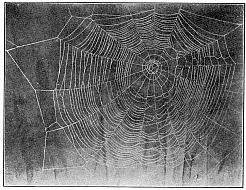 Fig. 379. Web of Epeira strix covered with dew hanging between the rails of a fence.
One-third the real size.
Fig. 379. Web of Epeira strix covered with dew hanging between the rails of a fence.
One-third the real size.
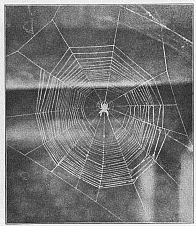 Fig. 380. Finished web of Epeira sclopetaria with unusually small number of rays. The
spider hangs in the center, head downward, in its customary position. The lower half
of the web is wider than the upper half, as it usually is. The cross threads with triangles
at the ends are caused by two or more threads sticking together in the middle.
Fig. 380. Finished web of Epeira sclopetaria with unusually small number of rays. The
spider hangs in the center, head downward, in its customary position. The lower half
of the web is wider than the upper half, as it usually is. The cross threads with triangles
at the ends are caused by two or more threads sticking together in the middle.
In beginning a web, after the radiating threads are finished,
the spider fastens them more firmly at the center and corrects
the distances between them by several short, irregular threads
(fig. 379) and then begins the inner spiral with the turns, at first
close together and then widening, in some species gradually, in
others suddenly, until they are as far apart as the spider can
reach with the spinnerets on one and the front feet on the next,
and so goes on nearly to the outside of the web, where it stops
abruptly (fig. 381). The spider usually rests a moment and
then begins, sometimes at another part of the web, the outer
sticky spiral. In the outermost parts of the web it usually
forms several loops (fig. 381, b to f), filling in the corners until
it approaches the inner spiral and finds room to pass completely
around the web. As soon as the inner spiral is found in the
way a part of it is cut out, and by the time the outer spiral is
finished the inner is reduced to the small and close portion
near the center.
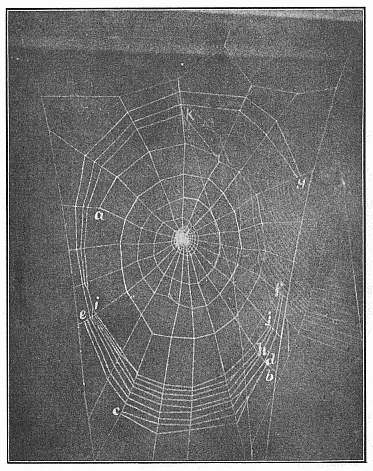 Fig. 381. Unfinished web of Epeira sclopetaria showing the completed inner spiral
ending at a. The outer spiral began at b, went to c, and returned to d; turned
and went to e, and then to f; and from there nearly around the web to g. From
g it returned to the lower part of the web and made loops at i and j, and then
started around the web until it was stopped at k.
Fig. 381. Unfinished web of Epeira sclopetaria showing the completed inner spiral
ending at a. The outer spiral began at b, went to c, and returned to d; turned
and went to e, and then to f; and from there nearly around the web to g. From
g it returned to the lower part of the web and made loops at i and j, and then
started around the web until it was stopped at k.
While the temporary spirals are made as far apart as possible,
the threads of the outer spiral are placed as close together as
they can be without danger of their sticking to each other,
and usually a little closer together toward the center of the
web than they are at the outside. In fastening this thread to
the rays of the web the spider first feels for the last thread
with the first and second feet, and, having found it, turns the
body slightly around and grasps the ray with the nearest foot
of the fourth pair at a short distance from the point where the
last thread crosses. After taking hold of the ray with the
fourth foot, the spider turns down the abdomen so as to place
the spinnerets against the ray and fastens the thread to it, at
the same time holding the thread off with the other fourth foot
to prevent its sticking to anything around it. The whole
making of the web seems to be done entirely by feeling and
is done as well in the dark as in daylight.
When the spider is active and the food supply good, a
fresh web is made every day, the old one being torn down and
thrown away. In tearing down a web (fig. 382) the spider
walks out from the center on one of the rays and gathers in
what web he can reach with the front feet, chews it into a
ball, and drops it; then, having put in new rays in the
cleared space, he goes to another part of the web and tears
down another piece.
The variations between the webs of different species are
chiefly in the central portion. In the webs of hortorum
(p. 19), gibberosa (p. 177), and placida
(p. 178), which spend
most of their time in the web, the close part of the inner spiral
is very large, circular, and finely finished, usually showing no
trace of the wide temporary spirals. The number of rays is
very large, and there is a wide clear space between the inner
and outer spirals. In Argiope the inner spiral is very large
and widens gradually until it almost touches the outer spiral.
It has a closely woven mat in the center and two zigzag bands
of white silk extending up and down.
The webs of Tetragnatha, Meta, and Acrosoma have a hole
in the middle, the irregular center being entirely removed.
Insularis and trifolium live always in tent-shaped nests, with a
thread, or several threads, leading to the center of the web.
Globosa, labyrinthea, and Zilla have a similar thread from
nest to web, and leave open a segment of the web through
which it passes.
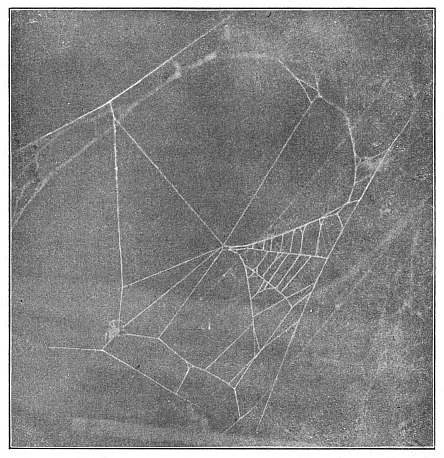 Fig. 382. Epeira sclopetaria tearing down an old web and beginning a new one. Five
new rays have been made and a quarter of the old web remains at the right.
Fig. 382. Epeira sclopetaria tearing down an old web and beginning a new one. Five
new rays have been made and a quarter of the old web remains at the right.
Insects flying through the web strike the sticky threads
and, trying to free themselves, fall against others. The spider
at the center of the web feels the movements of the insect
and goes toward it by the nearest ray and, drawing out silk
from the spinnerets, throws it around the insect until it is tied
fast. Adult male Epeiridæ are seldom seen in webs of their
own, but some of them do occasionally make webs. The male
E. sclopetaria, for instance, sometimes makes a web
nearly as large as that of the female and stands in it
waiting for insects to be caught.
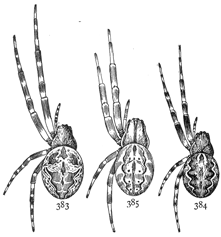 Figs. 383, 384, 385.—383, Epeira sclopetaria. 384,
Epeira patagiata. 385, Epeira strix.
Figs. 383, 384, 385.—383, Epeira sclopetaria. 384,
Epeira patagiata. 385, Epeira strix.
The Three House Epeiras: E.
sclopetaria, patagiata, and strix.—These
are the round-web
spiders most commonly found
about houses, barns, and
fences. They are all
about the same size, a
third of an inch in
length, and of various
shades of brown, with a
distinct scalloped middle
stripe on the abdomen.
Sclopetaria (fig. 383) has the middle
stripe broken at the edges just in front of the middle of each
side, so as to form two separate figures, one covering the front
and the other the hinder half of the abdomen. In patagiata
(fig. 384) and strix the edges of the stripe are usually entire
for their whole length. In strix (fig. 385) the middle stripe
is narrower than in the others and usually lighter in color.
The color of sclopetaria inclines to black, with the light marks
yellow. Patagiata is oftener reddish brown, especially in
alcohol, and the middle stripe is often dark and uniform in
color, less broken by spots and transverse marks than in the
others. The front legs of sclopetaria are longer than those
of the other species, and the front legs of strix shorter and
stouter. The cephalothorax of strix is more plainly marked
than the others, with three longitudinal stripes. There is
not much difference in the markings of the under side. The
epigynum has two hard brown prominences at each side, with
a soft finger-like appendage between. In sclopetaria and
strix this finger is slender and tapers slightly toward the end.
In patagiata it is wide at the end and flattened. In the
palpi of the males there is a similar difference. Those of
sclopetaria and strix are much alike, but that of patagiata has
the forked hook at the base much thicker and more curved.
Patagiata is a northern species, common in Canada and found
occasionally as far south as Massachusetts and New York. It
is also common in the north of Europe. Sclopetaria is also a
European species, and is seldom found far from houses. It is
more common north, but has been found as far south as Norfolk,
Va. Strix is common all over the country, both around
houses and in bushes.
The webs of these spiders have usually from twelve to twenty
rays, and the inner spiral is small and carelessly finished
(figs. 379, 380). The webs are made usually at nightfall,
very young individuals beginning to spin soon after sunset,
and larger ones beginning later, those that are full grown
often waiting until dark, but some of them will occasionally
spin their webs at any time of day. They stand in the web
during the night, but seldom during the daytime, going then
to their usual nests or hiding places, sometimes, especially
with Epeira strix, a long distance from the web. As a rule,
they have no special thread by which to enter or leave the
web, but use any one of the rays which may be convenient,
always injuring the web more or less; but occasionally, if
Epeira sclopetaria has a nest in a convenient situation, he will
make the web near it and have a thread direct from the nest to
the center of the web, as is the usual habit in some other
species. The eggs of sclopetaria are laid in the early summer
in large, round, white cocoons (fig. 386), fastened in sheltered
places on the walls of houses and covered with a loose mass
of silk threads.
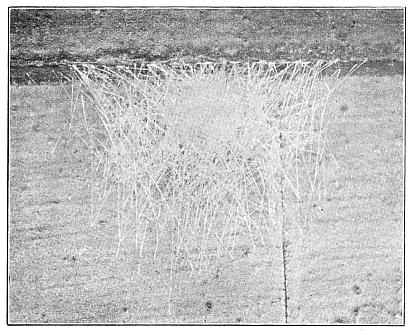 Fig. 386. Egg cocoon of Epeira sclopetaria under the edge of a clapboard.
Natural size.
Fig. 386. Egg cocoon of Epeira sclopetaria under the edge of a clapboard.
Natural size.
The Angulate Epeiras.—E. angulata (fig. 389), silvatica
(fig. 390), nordmanni (fig. 387), cinerea (fig. 391), and corticaria
(fig. 392) all have the humps on the front of the abdomen,
and in young spiders this is the widest part. Angulata,
silvatica, and cinerea grow to a large size. Cinerea is light
colored and lives in great numbers about houses and barns
in northern New England. Angulata and silvatica are found
among trees and are dark colored like bark. Angulata has a
yellow stripe on the sternum and yellow spots under the abdomen
between the spinnerets and epigynum. Silvatica has the sternum
and under side of the abdomen brown, without any distinct
markings. The male angulata has the thickened tibia of the
second leg nearly as long as the tibia of the first leg. The
male silvatica has the second tibia less thickened and a fourth
shorter than the first tibia. The male angulata has a pair of long
spines under the coxæ of the second legs, but in silvatica these
spines are so small as to be hardly visible. E. nordmanni is a
smaller species, about as large as sclopetaria and strix, with
light gray colors and generally distinct marking both above
and below. E. corticaria is not more than half as large as
silvatica and might be mistaken for the young of that species,
but the colors are lighter and the rings on the legs narrower
and more numerous. The epigynum of corticaria
is nearly as large as that of silvatica,
and the middle appendage is often wanting as
if broken off.
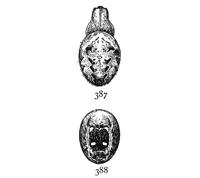 Figs. 387, 388. Epeira
nordmanni.—Upper
and under markings
of female enlarged
twice.
Figs. 387, 388. Epeira
nordmanni.—Upper
and under markings
of female enlarged
twice.
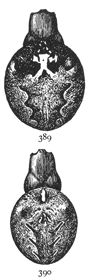 Figs. 389, 390.—389,
Epeira angulata.
390, Epeira silvatica.
Both enlarged
twice.
Figs. 389, 390.—389,
Epeira angulata.
390, Epeira silvatica.
Both enlarged
twice.
Epeira nordmanni.—This is a little smaller
and a little longer legged than cinerea and
angulata. The abdomen is longer than in
those species and has two similar humps in
front (fig. 387). The female is not more than
half an inch long. The colors are white and
gray or black. The cephalothorax is light
gray, darkest at the sides, but without stripes.
The legs have a dark ring at the ends and a
lighter one in the middle of each joint. The
abdomen has a distinct middle stripe on the
hinder half. In front there is an indistinct dark area extending
to the top of the humps and, in the middle, inclosing a bright,
long, white spot, with a round spot on each side sometimes
united with it. The sternum is dark brown, without any stripe.
The under side of the abdomen has a middle dark area in
which are four yellow spots, two just behind the respiratory
openings and two farther back, halfway to the spinnerets.
Epeira angulata and silvatica.—These spiders, which are perhaps
varieties of the same species, live usually among large
trees and grow to over half an inch in length.
The abdomen has two slight humps on the
front. The colors are dark, like the bark of
trees. The cephalothorax is dark brown, with
traces of darker lines in the middle and at its
sides. The legs are brown, with darker rings
at the ends of the joints and less distinct rings
in the middle. The abdomen has a bright
yellow spot in front. The middle stripe is
darker brown than the rest and has a scalloped
edge marked by a dark and light line, which
may be entire or broken into lines of spots.
The under side of the abdomen is black or
brown, with sometimes several yellow spots.
The sternum is uniform brown in silvatica
and has a yellow middle stripe in angulata.
The males are colored like the females and
are about half as large, with the legs longer,
especially the front pairs. The tibia of the
second legs is twice as thick as that of the
first pair, a little bent, with the spines stouter
and more numerous than in the female. In the male of the
angulata variety the tibia of the second pair is nearly as long
as that of the first, but in silvatica it is distinctly shorter. On
the under side of the coxæ of the second legs is a conical spine,
which is longest in the angulata variety. The epigynum is
small for so large a spider and has a long slender finger in
the middle. These spiders are found singly or in small
numbers, usually in the woods, sometimes in webs hung
between trees high above the ground.
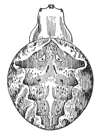 Fig. 391. Epeira cinerea.—Back
of female enlarged
twice.
Fig. 391. Epeira cinerea.—Back
of female enlarged
twice.
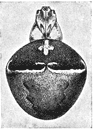 Fig. 392. Epeira corticaria.—Back
of female
enlarged eight times.
Fig. 392. Epeira corticaria.—Back
of female
enlarged eight times.
Epeira cinerea.—This large spider is common in the northern
part of New England, from Maine to New York, where it lives
in great numbers about barns and houses.
It grows to three-quarters of an inch in
length, with the abdomen proportionally
larger than angulata and with two small
humps on the front part (fig. 391). The
color is dirty white, with grayish markings
and long white hairs scattered all over the
body. The cephalothorax is a little darkened
at the sides, but has no distinct stripes.
The legs have gray rings at the ends and
middle of each joint, which are hardly visible
in some individuals and almost black in others. The markings
are like those of angulata, but paler and often indistinct. The
sternum is brown, and the under side of the abdomen has a
central dark stripe bordered by curved yellow
markings. The epigynum is small, as in angulata,
but the finger is flattened and turned up
at the end. The male is colored like the
female, with the hairs on the legs coarser
and darker. The tibia of the second legs of
the male is not thickened or modified as it
is in angulata. The webs resemble those
of E. sclopetaria, and the spider has similar
habits, standing in the web at night and
usually leaving it in the daytime; and it has
no special thread from the web to the nest.
Epeira corticaria.—This is a small species about quarter of an
inch in length, with the abdomen angular in front, where it is
as wide as long (fig. 392). The colors are generally lighter and
brighter than in angulata or silvatica. The cephalothorax has
the cephalic part brown and the sides pale. The legs are
marked with broken brown rings at the ends and middle of
each joint. The abdomen is brown of various shades, with
light markings on the front part that are often bright red or
yellow. There is a narrow light line across the
abdomen from the middle to each hump and
around the outer side
of it. In front of these
light lines the abdomen
is generally darker, except
a light spot, sometimes
cross shaped, in
the middle. The hinder
half of the abdomen has
sometimes an indistinct
middle stripe. The
under side of the abdomen
has the usual middle
dark area, with a
curved yellow mark each
side of it. The finger
of the epigynum is usually
absent, as if broken
off.
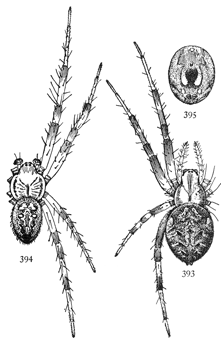 Figs. 393, 394, 395. Epeira trivittata, enlarged four
times.—393, female. 394, male. 395, markings
of under side of abdomen.
Figs. 393, 394, 395. Epeira trivittata, enlarged four
times.—393, female. 394, male. 395, markings
of under side of abdomen.
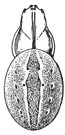 Fig. 396. Epeira
pratensis, enlarged
four times.
Fig. 396. Epeira
pratensis, enlarged
four times.
Epeira trivittata and
domiciliorum.—These
spiders, which may be
considered varieties of
one species, are among the most common Epeiridæ, at least in
the northern part of the country, the smaller variety, trivittata,
quarter of an inch long, living in small bushes and marsh grass,
and the larger variety in trees and fences. The abdomen is
only a little longer than wide and is proportionally smaller than
in insularis and thaddeus. The legs are long and slender, the
first pair being nearly twice as long as the body. The color is
most commonly light yellow, with brown markings. Sometimes
the abdomen is thickly spotted with red, especially toward the
latter part of the summer, and domiciliorum has usually gray
and even black markings. The cephalothorax has three dark
stripes not very sharply defined, and the legs have brown or
gray rings at the ends of the joints. The back of the abdomen
has a row of light spots in the middle, sometimes united into
a stripe, and on each side of this a row of dark
spots nearly surrounded by lighter color. The
sternum is bright yellow in the middle, and
the under side of the abdomen has a dark
center and two or three pairs of yellow spots.
The males are usually smaller than the
females, but resemble them in color and markings.
On the under side of each femur is a
single row of long spines. The tibia of the
second legs is curved more in the small than
in the large variety and has a row of strong
spines on the inner side.
The webs are made usually just before dark, and the spider
stands in them more in the night than during the daytime.
Sometimes they make a thread from the center of the web to
the nest, but this is not a regular habit, as it is with insularis
(fig. 397).
Very young spiders make proportionally larger nests, often on
the ends of grasses, where their round webs are destroyed every
day by the wind. Some of them mature as early as June, and
others, especially of the domiciliorum variety, as late as August.
Epeira pratensis.—This is the same size and color as Epeira
trivittata, and lives, like that species, in grass and low bushes.
The cephalothorax and abdomen are both slightly longer than
in trivittata, and the color is more uniform. The cephalothorax
is dull yellow, with a middle and two lateral stripes, but these
are often absent in
light specimens. The
legs are colored like
the cephalothorax,
sometimes a little
darker at the ends of
the joints. The abdomen
has a middle dark
stripe, at the sides of
which are two narrow
bright yellow lines,
which are sometimes
bordered with red.
Outside of the middle
stripes are six pairs of
black spots partly surrounded
by yellow. On
the under side the sternum
has a yellow stripe
in the middle, and the
abdomen two curved
yellow marks, which
may be broken into
spots. In the male
the body is longer and
narrower than in the female and longer than the male trivittata,
and the tibiæ of the second legs are a little thickened and curved
as in trivittata.
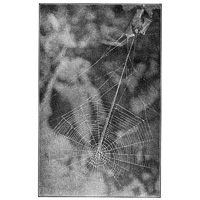 Fig. 397. Web of Epeira insularis, with nest above
covered with leaves and several threads leading
from the nest to the center of the web. One-third
the real size.
Fig. 397. Web of Epeira insularis, with nest above
covered with leaves and several threads leading
from the nest to the center of the web. One-third
the real size.
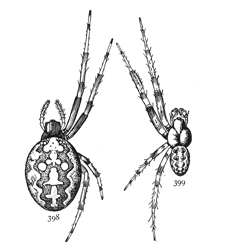 Figs. 398, 399. Epeira insularis, enlarged
twice.—398, female. 399, male.
Figs. 398, 399. Epeira insularis, enlarged
twice.—398, female. 399, male.
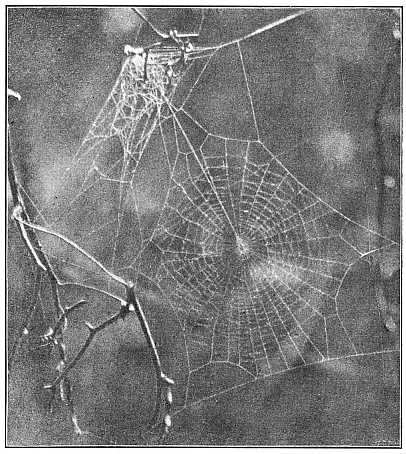 Fig. 400. Web of young Epeira insularis, showing the nest above and the straight thread
leading from the nest to the center of the web. Half the real size.
Fig. 400. Web of young Epeira insularis, showing the nest above and the straight thread
leading from the nest to the center of the web. Half the real size.
Epeira insularis or marmorea.—The adult females are half to
three-quarters of an inch long, the abdomen large and oval, and
bright yellow or orange color, with brown or purple markings
(fig. 398). The cephalothorax is dull yellow, with slightly
darker lines in the middle and at the sides. The femur and
patella of all the legs are bright orange, darker toward the ends.
The other joints are white, with brown ends. The light parts
of the abdomen are bright yellow marked with brown. In the
middle is a narrow deeply scalloped stripe, bordered by a wide
yellow line, outside of which are oblique yellow and brown
markings. In the middle of the stripe is a row of light spots,
each connected at the sides with two others, smaller and round,
forming a large figure at the anterior end. On the under side
the sternum is brown and bright yellow in the middle. The
abdomen is dark brown, with two semicircular
yellow spots. The males (fig. 399) are about half as long as the
females. The tibiæ of the second legs
are thickened, and the spines on the
inner side short and stout. The coxæ
of the second legs have a
conical spine near the base.
This spider lives in bushes
three or four feet high. It
makes a tent of leaves (fig. 397), in which it usually
stands out of sight, holding
a thread which leads to the
center of the nest. Young
spiders make larger tents in
proportion to their size and
make them entirely of silk
(fig. 400). In Massachusetts and Connecticut it matures about
the first of September. It is found all over the country, and
is probably a variety of the European Epeira marmorea.
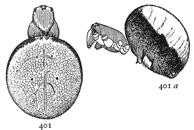 Figs. 401, 401 a. Epeira
thaddeus, enlarged four
times.
Figs. 401, 401 a. Epeira
thaddeus, enlarged four
times.
Epeira thaddeus.—A small species resembling the young of
insularis, but with less distinct markings on the back. Full-grown
females are about quarter of an inch in length, with the
abdomen large and round (fig. 401). The colors are orange
and light yellow like insularis. The two front pairs of legs
have the femur, patella, and tibia orange, darker toward the
ends. The third and fourth legs have the femur and patella
orange. The other joints are white, with dark rings at the ends.
The tibia of the fourth pair has a wide dark ring at the end.
The abdomen is white or light yellow on the upper side, and
brown underneath, the edge of the dark color coming far
enough up to be seen from
above, around the sides and
front (fig. 401). Under the
middle of the abdomen is a
yellow spot just behind the
epigynum (fig. 401 a). In some
individuals there is a trace of
markings on the hinder part
of the abdomen, and the
under side is sometimes light, so that there is a dark ring
around the middle of the abdomen. This spider makes a tent
near the web and lives in
it like insularis.
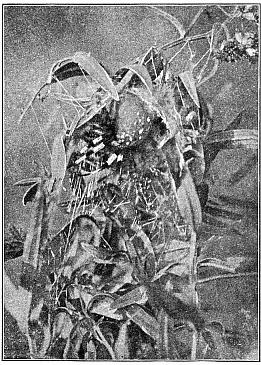 Fig. 402. Epeira trifolium in its nest in a plant
of golden-rod. Natural size.
Fig. 402. Epeira trifolium in its nest in a plant
of golden-rod. Natural size.
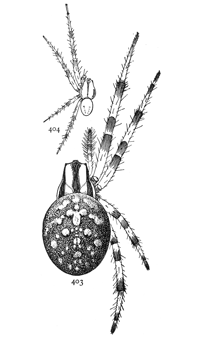 Figs. 403, 404. Epeira trifolium,
enlarged twice.—403, female.
404, male.
Figs. 403, 404. Epeira trifolium,
enlarged twice.—403, female.
404, male.
Epeira trifolium.—This is
one of the largest species
of the family, measuring
from half to three-quarters
of an inch long, with a
large round abdomen,
usually of a purplish brown
color, and legs strongly
marked with black rings
(fig. 403). The cephalothorax
is white, with three
wide black stripes. The
legs are white, with a black
ring at the end of each
joint and in the middle of
the fourth femur. The
back of the abdomen varies
in color from dark purplish brown to light gray or white, or
sometimes light yellow, and the same individual will change
from light color to dark. The usual markings are four white
spots and a middle row of smaller spots, with several
oblique rows still smaller. All trace of the usual
middle stripe is wanting except in very
young individuals. The under side of
the abdomen is dark brown, and the
usual semicircular yellow marks are
absent except in the young. The
males (fig. 404) are not more than half
as long as the females and slender and
light colored. The markings are like
those of the female, but less distinct.
The tibiæ of the second legs are not
thickened or modified in shape as they
are in the male insularis. Trifolium
makes a large web in bushes, but seldom
stands in it. It has near by a
tent above the web (fig. 402) made of
leaves, drawn together and lined with
silk, connected with the center of the
web by a strong thread, and it usually
remains in this tent
with one foot on the
thread, so that it feels
when anything is
caught. The spiders
mature in September,
when the males may sometimes be seen about
the nests of the females. In October they
lay their eggs and all die before winter.
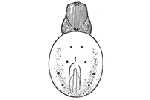 Fig. 405. Epeira displicata,
enlarged four
times.
Fig. 405. Epeira displicata,
enlarged four
times.
Epeira displicata.—Large females are quarter of an inch long,
but they are usually smaller. The cephalothorax and legs are
brownish yellow, without markings. The abdomen is oval and
light yellow or crimson, the latter color more common in the
young. Sometimes there are two white lines in the middle.
At the sides of the
hinder half of the
abdomen are three
pairs of round black
spots surrounded by
lighter rings (fig. 405).
The under side of the
abdomen is a little
darker than the upper
side, with no distinct
markings.
The male has the
legs and cephalothorax
darker brown
than the female, and
the black spots on the
abdomen larger and
surrounded more distinctly
with white,
which sometimes
forms a stripe on each
side. The tibiæ of
the second legs are
not thickened. The
webs are usually
small and among
leaves.
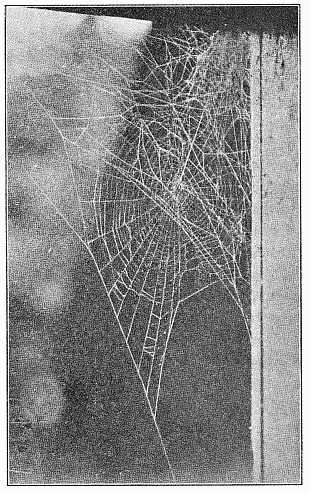 Fig. 406. Web of Epeira globosa in the corner of a doorway,
showing the large tent at the top, from which a
coarse thread runs to the center of the round web.
Fig. 406. Web of Epeira globosa in the corner of a doorway,
showing the large tent at the top, from which a
coarse thread runs to the center of the round web.
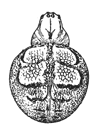 Fig. 407. Epeira globosa,
enlarged four
times.
Fig. 407. Epeira globosa,
enlarged four
times.
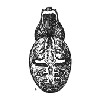 Fig. 408. Epeira
labyrinthea, enlarged
four
times.
Fig. 408. Epeira
labyrinthea, enlarged
four
times.
Epeira globosa or triaranea.—Length about a quarter of an
inch, the male a third smaller. The abdomen is round and as
wide as long, and in the female large for the size of the spider.
The front half of the abdomen is nearly covered by four white,
yellow, or pink spots, partly united into a rectangular figure
surrounded by an irregular black line (fig. 407). The hinder
half has three or four pairs of black spots.
The general color is light brownish yellow.
The cephalothorax has a fine middle line
from the eyes to the dorsal groove and indistinct
dark marks at the sides of the head.
The first and second legs have slightly darker
rings at the end and middle of each joint, the
third and fourth pairs at the ends of the joints
only. The male is marked like the female and
has the tibia of the second legs slightly curved and thickened
with large spines on the inner side.
This spider makes a very large tent, out of which a strong
thread runs to the center of the round web (fig. 406). From
the tent a loose and irregular web extends downward, sometimes
covering half of the round web (fig. 406). Opposite the
thread leading to the tent, a segment of the round web is left
open or partly open without any sticky threads.
Epeira labyrinthea.—This spider makes a large
irregular web in which is a tent connected by a
thread with the small round web below, much as
in Epeira globosa. The female is a fifth of an inch
long. The abdomen is oval and not unusually
large, as it is in globosa (fig. 408). The cephalothorax
is long, dark brown in the middle and
lighter at the sides, and almost white in front
around and behind the eyes. The legs are white, with narrow
dark brown rings at the ends of the joints and wider yellow
rings on patella and femur of the first and second pairs. The
abdomen is marked with four long white spots in front and
a dark brown middle band behind. At the sides the abdomen
is light brown or yellow. On the under
side the ends of the mandibles and the
maxillæ are black. The sternum is black,
with a white middle stripe. The abdomen
has a short middle white stripe surrounded
by a large dark spot, and there
are several yellow spots along the sides
and around the spinnerets.
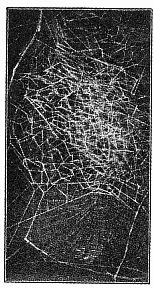 Fig. 409. Web of Epeira
labyrinthea with large irregular
web around the
nest. One-third the real
size.
Fig. 409. Web of Epeira
labyrinthea with large irregular
web around the
nest. One-third the real
size.
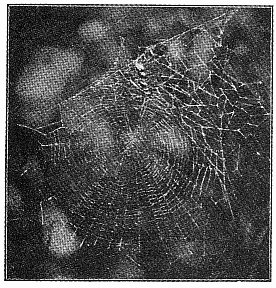 Fig. 410. Web of Epeira labyrinthea with
string of cocoons in the upper part over
the spider's nest. One-third the real size.
Fig. 410. Web of Epeira labyrinthea with
string of cocoons in the upper part over
the spider's nest. One-third the real size.
The round web of this spider is not
large, generally three or four inches in
diameter, but the irregular part above
and partly covering it may be much
larger, sometimes as much as six inches
across, where the shape of the surrounding
plants allows it (fig. 409). One segment
at the upper part of the round web
is partly open, as in globosa (p. 173) and
Zilla (p. 185), and here a strong thread passes to the nest,
which is often covered by a large spreading tent. In the last
of the summer several small, flat,
brown cocoons are strung together
in the irregular web above
the tent (fig. 410), which is then
smaller and less regularly made.
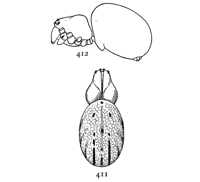 Figs. 411, 412. Epeira gibberosa,
enlarged eight times.—411,
back of female. 412,
side view to show humps on
the cephalothorax.
Figs. 411, 412. Epeira gibberosa,
enlarged eight times.—411,
back of female. 412,
side view to show humps on
the cephalothorax.
Epeira gibberosa.—A small and
light-colored species living among
grass and in bushes in open fields.
The adult female is from a sixth
to a quarter of an inch long, and
the male smaller. The cephalothorax
and legs are light greenish
yellow, and the abdomen gray, or
light yellow covered with lighter
spots and black and yellow markings (fig. 411). The abdomen
is marked with two parallel lines on the hinder half and three
smaller black spots in front, the latter often absent. The
parallel lines are sometimes broken up into rows of spots, and
these may form part of several transverse black and yellow
marks. The cephalothorax has a narrow black line in the
middle from the dorsal groove nearly to the eyes. The feet
are black toward the claws, and the spines
of the legs are long and black. The first
and second femora have a longitudinal
black line on the under side. The abdomen
is oval, half longer than wide. The
cephalothorax is high in the middle and
slopes forward toward the eyes almost as
steeply as backward (fig. 412). The web
(fig. 413) is horizontal or inclined, with a
round well-defined central portion, in the
middle of which is sometimes a round
opaque screen that nearly covers the
spider. In the finished web there is
usually no trace of the temporary spiral,
but sometimes, as in the figure, a little of
it is left, showing how it starts abruptly
from the closer spirals that form the
center of the web. The outer spirals are very fine and close
together and the number of rays unusually large, sometimes as
many as sixty.
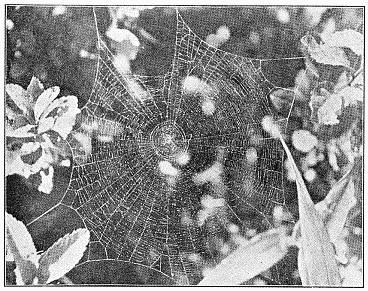 Fig. 413. Web of Epeira gibberosa, showing the round center of the inner spiral, the
great number of rays, and the closeness of the spirals. Torn in several places
by use. Half the real size.
Fig. 413. Web of Epeira gibberosa, showing the round center of the inner spiral, the
great number of rays, and the closeness of the spirals. Torn in several places
by use. Half the real size.
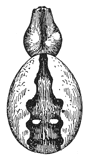 Fig. 414. Epeira
placida, enlarged
eight times.
Fig. 414. Epeira
placida, enlarged
eight times.
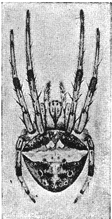 Fig. 415. Epeira scutulata,
enlarged four
times.
Fig. 415. Epeira scutulata,
enlarged four
times.
Epeira placida.—This is a small spider, about a fifth of an
inch long, with the longest legs about a quarter of an inch.
The cephalothorax is high in the middle where it rests
against the abdomen very much as it is in gibberosa (fig. 412).
The abdomen is oval, and widest behind. The legs are comparatively
short and tapering, and the femora thick. The
cephalothorax is brownish yellow, with three brown stripes.
The legs are the same color, a little darker at the ends of the
joints. The abdomen has a middle brown stripe, narrow in
front and widening to the middle, from which it extends to the
spinnerets, keeping about the same width, with a row of black
spots on the edge at each side and a pair of white spots in the
middle (fig. 414). The sides of the abdomen are white or yellow,
and underneath it is brown, with two white stripes in the middle
and four white spots around the spinnerets. The male is
marked like the female and has no peculiar modifications of
the legs. This spider matures early, sometimes before the
first of June in Massachusetts, and half-grown young are
found in the autumn. The web is like that of gibberosa, with
a large, round, and close inner spiral from which, in the unfinished
web, the temporary spiral starts abruptly. The web is
made in low bushes and may be vertical or inclined.
Epeira scutulata.—A light yellow spider, a sixth to a fifth of
an inch long, with the abdomen angular behind and at the
sides and as wide as long (fig. 415). The cephalothorax
is half as wide in front as it is behind,
and the lateral eyes are as far from the middle
eyes as they are from each other. The front
legs are a fourth longer than the second. The
general color is light yellow, the legs darker at
the ends of the joints, with long black spines.
The head has a few brown or red marks behind
the eyes and back to the dorsal groove, but these
are often entirely absent. The
abdomen is lighter across the front between
the two corners, and there is sometimes a
distinct white transverse stripe. In front of
each corner is a black spot, and there is
generally a row of small black spots around
the front of the abdomen, and two rows behind
converging toward the spinnerets. In the
hinder rows of spots the middle pair are
generally longest, and sometimes these are
the only pair present. The under side has no
distinct markings. The epigynum is dark at
the sides, and the finger is short and flat at the
end and turned a little outward. The male
has the legs longer, and the cephalothorax wider behind. The
abdomen is not much larger than the cephalothorax and less
angular than in the female. The colors are the same as in the
female, some individuals being light and some dark.
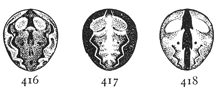 Figs. 416, 417, 418. Markings of the
abdomen of Epeira parvula, enlarged
twice.
Figs. 416, 417, 418. Markings of the
abdomen of Epeira parvula, enlarged
twice.
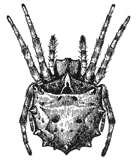 Fig. 419. Epeira stellata,
enlarged four times.
Fig. 419. Epeira stellata,
enlarged four times.
Epeira parvula.—A common spider all over the country, with
the abdomen wide in front and bluntly pointed behind, gray
and brown colors and a great variety of markings. The length
is quarter to three-eighths of an
inch, with the abdomen two-thirds
as long and as wide across the
front. The abdomen is as high
behind as it is in front, and the
pointed end is sometimes turned a
little upward, as it is in conica. The
front of the head is narrow, not more than half as wide as the
back of the thorax. The front legs are half longer than the
body. The cephalothorax is gray, darker at the sides, and
sometimes with a few black spots. The legs are irregularly
marked with rings and spots, and the femora are dark toward
the end. The abdomen is commonly gray, with a tapering
scalloped middle stripe and a distinct dark middle spot and
two large light spots at the front end (fig. 416). Sometimes
there is a middle narrow dark stripe
the whole length of the abdomen (fig. 418), and sometimes all the middle is
white or light yellow. The males have
the head a little narrower and more
pointed, the legs longer, and the second
tibia slightly thickened, but not curved.
The webs are in low bushes.
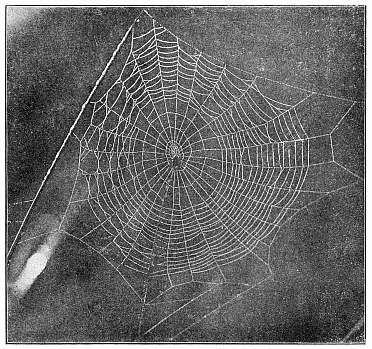 Fig. 420. Unfinished web of Epeira stellata with the spider hanging near the center.
Half the real size.
Fig. 420. Unfinished web of Epeira stellata with the spider hanging near the center.
Half the real size.
Epeira stellata.—A brown spider, a
quarter to a third of an inch long and
nearly as broad, with pointed humps
around the abdomen. The cephalothorax
is wide in front, and the lateral eyes are on the outer sharp
corners. The legs are short and usually drawn up and partly
concealed under the abdomen. The abdomen has a sharp point
in front that extends over the cephalothorax as far as the base
of the first legs, and a large point behind, with a smaller one
under it. At the sides are five pairs of points, and over the
first of these another pair a little higher on the back. The
cephalothorax is brown, lighter in the middle and darker at
the sides, and covered with short gray hairs. The abdomen is
marked with lighter and darker spots of brown, the front part
generally dark with a very light middle spot, and the hinder
half showing traces of the usual middle stripe of Epeira. The
legs have dark rings at the ends and middle of the joints. It
lives among low bushes a foot or two from the ground all over
the country. This spider, as well as several other species,
often leaves a web unfinished with the inner spiral still covering
a large part of it, as in fig. 420.
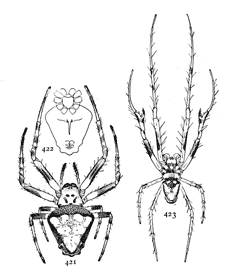 Figs. 421, 422, 423. Epeira verrucosa.—421, female
enlarged twice. 422, under side of female. 423,
male enlarged twice.
Figs. 421, 422, 423. Epeira verrucosa.—421, female
enlarged twice. 422, under side of female. 423,
male enlarged twice.
Epeira verrucosa.—Common in the South and as far north as
Long Island, N.Y. The body is about a quarter of an inch
long. The abdomen is narrow behind but not pointed, and in
front nearly as wide as long. The middle is nearly covered by
a triangular light spot,—white, yellow, or pink in
different spiders,—surrounded by a darker color
of various shades of brown or gray. The cephalothorax
is yellow or light gray, with sometimes
some darker spots in the middle. The legs
are colored like the thorax,
with darker rings at the
ends of the joints and in
the middle of the first
and second femora.
The spines are slender
and colored like the
hairs. The abdomen
has a prominent tubercle
behind, at the end
of the light spot, and
under it in the middle
line two others. At
the sides near the posterior
end are two pairs
of tubercles, and sometimes
two other pairs farther forward, and two at the corners of
the light spot. The colors of the under side are as variable
as those above,—sometimes light without distinct markings,
and sometimes almost black at the sides, on the sternum, and
around the spinnerets. The epigynum (fig. 422) has a slender
pointed finger reaching halfway to the spinnerets.
The male (fig. 423) has the head narrower than the female,
and the abdomen as small as the cephalothorax. The legs are
longer and more slender, with the metatarsus of the second
pair curved inward, and a long forked spine on
the inside of the tibia of the same legs.
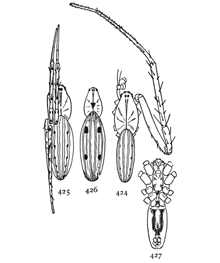 Figs. 424, 425, 426,
427. Larinia directa.—424,
male with one
front leg to show its great
length. 425, female with
the legs of one side drawn
up in a natural position,
showing the spots. 426, female with
four large spots on the back. 427,
under side. All enlarged four times.
Figs. 424, 425, 426,
427. Larinia directa.—424,
male with one
front leg to show its great
length. 425, female with
the legs of one side drawn
up in a natural position,
showing the spots. 426, female with
four large spots on the back. 427,
under side. All enlarged four times.
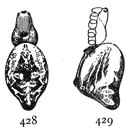 Figs. 428, 429. Cyclosa
conica, enlarged four
times.
Figs. 428, 429. Cyclosa
conica, enlarged four
times.
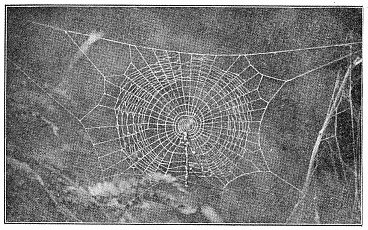 Fig. 430. Half-finished web of young Cyclosa conica, showing sticks and rubbish across
the lower half. The inner spiral has a loop in the left side.
Fig. 430. Half-finished web of young Cyclosa conica, showing sticks and rubbish across
the lower half. The inner spiral has a loop in the left side.
Larinia directa.—This resembles a much
elongated Epeira pratensis (p. 167). It
is about as long as pratensis, a quarter
to a third of an inch, but very slender,—not
much more than a quarter as
wide as long (fig. 425). The general
color is yellowish but pale and
translucent, marked with very distinct
black spots. The spots are
usually in six pairs on the abdomen,
sometimes so small as to be hardly
visible, sometimes so large as to be
the most distinct part of the spider.
In some individuals there is a row
of black spots on the upper side of
each leg, so that when these are
drawn up over the back hardly anything
is visible except the spots. In
some individuals the first and third
pairs of spots on the abdomen are very large and the others
very small (fig. 426). The sternum is nearly twice as long as
wide, with the sides of the front half parallel. It is darker at
the sides. On the under side of the abdomen are two parallel
dark stripes. In the male (fig. 424) the front legs are nearly
three times the length of the body, but neither the first nor
the second pair is curved or thickened. It is found in South
Carolina, Georgia, and Alabama.
Cyclosa conica or caudata.—This spider may be known by the
blunt conical hump at the hinder end of the abdomen, extending
upward and backward over the spinnerets (figs. 428, 429).
Full-grown females are about quarter of an inch long. The
color is a mixture of gray and white, different individuals varying
from almost white to almost black. The cephalothorax
is longer than wide, the front part narrow, and the top of the
front of the head extended forward beyond
the base of the mandibles. The hump on
the abdomen varies considerably in size,
and is generally about half as long as the
rest of the abdomen and slopes gradually
into it. In light individuals the markings
of the abdomen are obscure, but usually
there is a distinct dark middle stripe,
widest near the base of the hump. The
under side is black, with a pair of very distinct light spots
across the middle. The cephalothorax is dark gray or black
without stripes, sometimes a little lighter around the eyes.
The legs are white, with dark rings at the end of each joint
and in the middle of each except the femora. On the first
and second femora the dark rings are very wide, covering
sometimes more than half the joint. The males have the
cephalothorax darker and narrower in front, and the abdomen
smaller, with only a slight hump. The spider seems to live all
the time in the web. The inner spiral is large and widens
gradually from the center outward. There is usually a line of
silk across the web, in which are fastened parts of dead insects
and other rubbish and, in the middle of the summer, the cocoons
of eggs. The spider, standing in the middle of this band where
it crosses the center of the web, looks like part of the rubbish.
When an old web is torn down this band of rubbish is left in
place, and the new web made across it. A peculiarity of the
web of this spider is that the inner spiral has one, and sometimes
two, loops in it, making it wider than it is high (fig. 430).
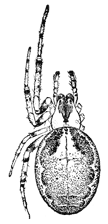 Fig. 431. Female
Zilla atrica, enlarged
four times.
Fig. 431. Female
Zilla atrica, enlarged
four times.
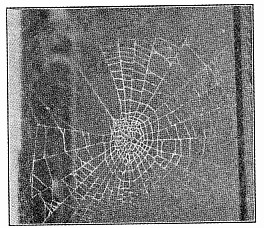 Fig. 432. Middle of web of Zilla atrica with
the open segment and thread to the nest at
the left.
Fig. 432. Middle of web of Zilla atrica with
the open segment and thread to the nest at
the left.
We have three species of Zilla, the females of which are so
much alike that it is almost impossible to tell them apart.
The males also resemble each other closely except in their
palpi, which are distinctly different in the different species.
They are of moderate size, the largest about three-eighths of
an inch long, and in general appearance resemble the genus
Steatoda of the Therididæ (p. 119). The abdomen is large
and oval and a little flattened. The legs are slender and of
moderate length, like those of Epeira. The head is rounded in
front, and the lateral eyes are not separated farther from the
middle pairs than they are from each other. The mandibles
are large and thickened in the middle toward the front. The
epigynum and the spinnerets are both small. The color
of all the species is gray, with sometimes a little yellow
or pink in the lighter parts. The cephalothorax has
usually, but not always, a dark border at the
sides and a middle dark line that widens and
becomes lighter toward the eyes. The abdomen
has a wide middle stripe like Epeira, scalloped at
the sides and crossed at the hinder end by two
or three pairs of transverse spots. In front it is
almost white or tinted with pink or yellow, and
narrows almost to a point, with a much darker
spot each side. The sides of the abdomen are
marked with oblique dark marks that extend
underneath. The sternum has a light middle stripe. Under
the abdomen is a dark middle stripe, with light each side of it.
The legs are pale, with narrow
gray rings at the end
and middle of each joint.
These three species seem to
be the same as three found
in Europe,—Z. atrica, Z.
x-notata, and Z. montana.
Atrica is found at Ipswich
and Salem on the coast of
Massachusetts, x-notata at
Woods Hole on the south
coast of Massachusetts, and
montana in the White Mountains
and Adirondacks.
Wherever found they are in large numbers, atrica and x-notata
living on the outside of houses, and montana in trees and rocks.
The webs of Zilla (fig. 432) have a segment left without cross
threads, sometimes for its whole length, and sometimes only
the part of it nearest the center. Opposite this open segment
a thread leads from the center of the web to the nest (fig. 433),
which is a tube of silk open at both
ends.
The differences between the palpi
of the males are very plain. In atrica
the palpi (fig. 434) are as long as the
whole body, with the femur and tibia
both slightly curved and the tarsus
and palpal organ small and like that
of x-notata. In x-notata (fig. 435) the
palpus is as long as the cephalothorax,
and the tarsus and palpal organ small
and round. The front legs are a
fourth longer than in atrica. In
montana (fig. 435a) the palpus is still
shorter, the tibia thicker, and the tarsus
and palpal organ larger. There
is little difference in the shape of the
epigynum of the different species, but
that of montana is twice as large as
that of x-notata or atrica.
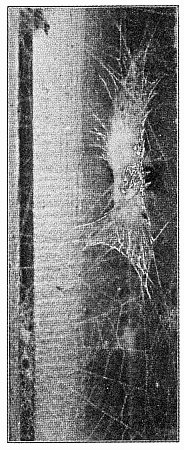 Fig. 433. Tubular nest of
Zilla atrica.
Fig. 433. Tubular nest of
Zilla atrica.
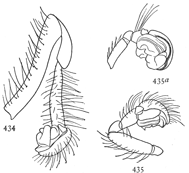 Figs. 434, 435, 435a. Male palpi of Zilla.—434, Zilla
atrica. 435, Zilla x-notata. 435a, Zilla montana.
Figs. 434, 435, 435a. Male palpi of Zilla.—434, Zilla
atrica. 435, Zilla x-notata. 435a, Zilla montana.
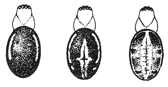 Fig. 436. Markings of the
back of Singa variabilis.
Fig. 436. Markings of the
back of Singa variabilis.
Singa pratensis.—The Singas are
small Epeiridæ a sixth or fifth of an
inch long, with smooth bodies and
bright colors. They live among grass and other small plants in
low open ground. When full grown the females of S. pratensis
are a fifth of an inch long, with the abdomen oval and marked
with a double white stripe in the middle and a single one on
each side. The cephalothorax is yellow, with a little black
between the middle eyes not extending to the lateral pairs.
The legs are yellow, without rings or other markings. The
abdomen is yellow brown, darker toward the hinder end, with
white or light yellow stripes. The under side is the same
yellow-brown color, darker in the middle, with two narrow,
curved, light lines from
the spiracles to the spinnerets.
The males are
marked in the same way
and have a smaller abdomen
and longer spines
on the legs.
Singa variabilis.—This
is a little smaller than
pratensis, usually about a
sixth of an inch long.
The legs and cephalothorax
are bright orange
color. The front of the
head between the eyes is black. The abdomen is usually
entirely black, but occasionally has bright yellow markings
(fig. 436) arranged somewhat as in pratensis. Sometimes there
is a wide middle stripe, with narrower
ones at the sides and two underneath.
Sometimes there are only the two lateral
stripes, and there are all variations
between these markings. The males
are colored in the same way and have
the same varieties. They are smaller than the males of
pratensis, but have the palpal organs as large or larger.
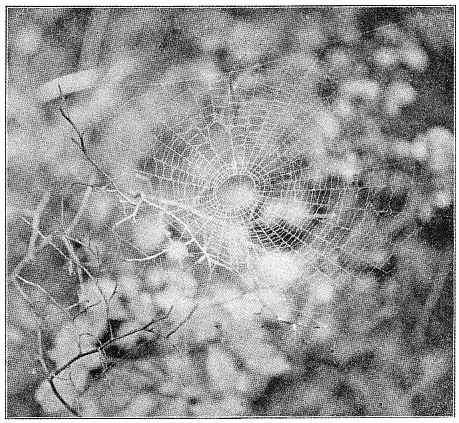 Fig. 437. Web of Acrosoma spinea.
These are small spiders, with the abdomen extended back
half its length beyond the spinnerets, brightly colored, flattened
above, and furnished with several pairs of pointed
processes. The cephalothorax is longer than in Epeira and
Argiope and widest in the middle. The legs are slender
and have only fine and soft hairs. The webs (fig. 437) are
inclined and have a hole in the middle surrounded by several
turns of smooth thread; when hanging in it the spiders look
like burrs or seeds. At a slight alarm they will sometimes
drop to the ground and hide under the nearest shelter.
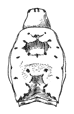 Fig. 438. Acrosoma
mitrata,
enlarged four
times.
Fig. 438. Acrosoma
mitrata,
enlarged four
times.
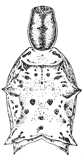 Fig. 439. Acrosoma
rugosa, enlarged
four times.
Fig. 439. Acrosoma
rugosa, enlarged
four times.
Acrosoma mitrata.—This is a smaller species than rugosa or
spinea. The abdomen does not extend as far backward as in
the other species, but comes farther forward so as to cover
half the cephalothorax (fig. 438). The abdomen
is truncated behind, with two pairs of pointed
processes at the corners, one pair below the other.
In front, the abdomen is a little narrowed over
the thorax. The legs and cephalothorax are
brown, as in the other species. The abdomen
is light yellow, darker behind, with two or three
pairs of black spots along the middle and five
or six dark elongated spots along the sides.
The under side is black mixed with yellow spots, as in the
other species. Common as far north as Connecticut.
Acrosoma rugosa.—This has five pairs of spines on the abdomen,
three pairs in the same places as those of spinea and the
other two pairs behind and under the last of the three. All
the humps and spines are about the same size.
The cephalothorax and legs resemble those of
spinea, but the legs are shorter. The colors are
white, yellow, and brown in spots and marks
like those of spinea, some individuals being
almost white, and others as nearly black. The
males have a long slender abdomen without
humps or spines. This is a common spider as
far north as Connecticut, where it is occasionally
found.
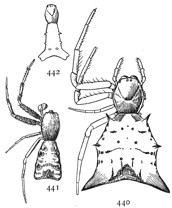 Figs. 440, 441, 442. Acrosoma spinea.—440,
female enlarged four times.
441, male enlarged four times. 442,
young less than half grown.
Figs. 440, 441, 442. Acrosoma spinea.—440,
female enlarged four times.
441, male enlarged four times. 442,
young less than half grown.
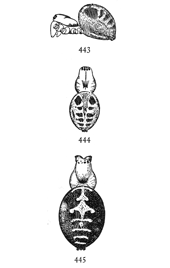 Figs. 443, 444, 445. Meta menardi,
enlarged four times.—443, 444,
half-grown young. 445, back of
adult female.
Figs. 443, 444, 445. Meta menardi,
enlarged four times.—443, 444,
half-grown young. 445, back of
adult female.
Acrosoma spinea.—This spider is distinguished
from all the common species by the shape of
its abdomen, which is narrow in front and has
two long spreading points behind (fig. 440). There is a pair of
smaller spines on the front of the abdomen and another near
the middle of each side. The middle of the abdomen is white
or bright yellow. The spines are black at the points and bright
red at the base. There are several black spots on the back, and
gray marks at the sides. The under side of
the abdomen is darker than it is above and
marked with black and yellow spots. The
cephalothorax and legs are light
brown, the thorax with lighter edges.
The young have the abdomen
longer, with the posterior spines
short and blunt.
The third and
fourth legs are
whitish, with dark
longitudinal
stripes. The males
are smaller than
the females and resemble
the young.
The abdomen is a little widened behind and has
in place of the spines three pairs of low bumps.
The front legs are dark, and the hinder legs light,
as in the young. The web (fig. 437) has a hole
in the middle, across which the spider hangs.
Meta menardi.—This spider lives in caves and
similar cool and shady places in various parts of
this country and also in Europe. In general
appearance, especially when young, it reminds
one of Linyphia. The abdomen is
longer than wide, high in front, and
tapering a little behind (fig. 445).
The eyes are near together, the
lateral eyes almost as near the middle pairs as they are to each
other. The mandibles are long, thickened in front near the
base, and slightly turned outward at the ends and strongly
toothed on the inner side about the claw. The maxillæ are
also long and a little widened at the ends. The dorsal groove
is very deep. The legs are long, the front pair twice the length
of the body. The full-grown
female is half an inch in
length, the male a third
shorter, but with legs nearly
as long. The general color
is gray, the lighter parts
translucent and yellowish.
The cephalothorax has three
gray stripes, more distinct in
the young, a middle stripe
from the eyes to the dorsal
groove, and one on each side
of the thorax. In the young
(fig. 444) the markings of the
abdomen are two large dark
spots near the front end and
several other pairs, becoming
smaller toward the hinder
end. In adults these markings
unite into a middle
stripe more like Epeira, with
a light middle spot in front
and several middle spots and
pairs of spots diminishing
backward. The legs have gray rings at the ends and middle
of the joints. The webs are horizontal or inclined, according
to the shape of the rocks on which they are built. They
resemble the webs of Tetragnatha, having a small central spiral
with a round hole in the middle, across which the spider holds
herself. This spider matures late in the autumn or early in
the summer, and makes large, loose, and transparent cocoons,
hung near the webs.
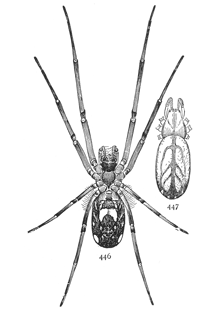 Figs. 446, 447. Argyroepeira hortorum, enlarged
four times.—446, under side of female. 447,
back of female.
Figs. 446, 447. Argyroepeira hortorum, enlarged
four times.—446, under side of female. 447,
back of female.
Argyroepeira hortorum.—This is a green and silver-white
spider, with slender legs and a long abdomen resembling
Tetragnatha. The
body of the female is
about a quarter of an
inch long, the abdomen
twice as long as
wide, and blunt at both
ends (fig. 447). The
first pair of legs are
twice as long as the
body, the second a
fourth shorter (fig. 446). The legs are
bright green, darker
toward the ends. The
cephalothorax is green,
with a darker stripe in
the middle and one on
each side. The upper
part of the abdomen
is silver white, with a
dark line through the
middle, giving off four
pairs of branches at the
sides. At the sides of
the abdomen are yellow
stripes extending
downward, and toward the hinder end two bright copper-red
spots. The colors of the under side are as bright as those
above and are more plainly seen as the spider hangs in its
web. The basal joints of the legs are light in color, and the
sternum and mouth parts dark. The abdomen is green,
darker from front to back, where it is almost black
around the spinnerets. In the middle
is a large double spot of bright copper
red, and the red spots at the end of the
body show as plainly from below as
from above, and around the middle
spot are several small spots of bright
yellow. The hairs and spines of the
legs are so fine that they do not much
affect the general color. On the front
side of the femur of the
fourth leg there is a fringe
of long hairs extending half
its length. The males are
half as large as the females,
with longer and more slender
legs and palpi, and the
same colors. The webs are
nearly horizontal, with a
small hole in the center,
and under the round web
is often a large irregular
web. The round web may
be a foot in diameter, or it may be so
small as hardly to cover the spider. The
webs have a large number of rays, and
the spirals are very close together, as in the webs of Epeira
gibberosa (fig. 413). The smooth central part of the web
is circular and very regularly woven, showing usually no
trace of the beginning of the temporary spirals, and
between it and the sticky circles there is a wide space in which
is nothing but the bare rays.
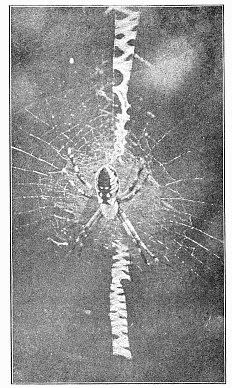 Fig. 448. Argiope riparia in the middle of the web.
Natural size.
Fig. 448. Argiope riparia in the middle of the web.
Natural size.
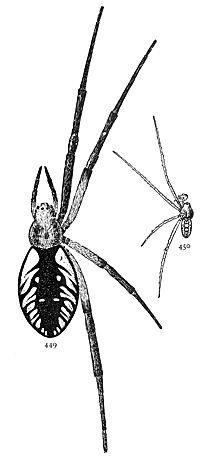 Figs. 449, 450. Argiope
riparia.—449,
female. 450, male
enlarged twice.
Figs. 449, 450. Argiope
riparia.—449,
female. 450, male
enlarged twice.
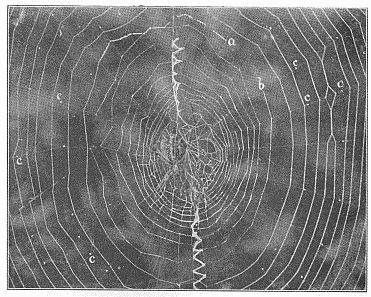 Fig. 451. Middle of web of Argiope riparia, natural size. The large inner spiral ends at b
and the outer spiral at a. At c, c, are thickened spots on the rays where the inner
spiral was attached while the web was making.
Fig. 451. Middle of web of Argiope riparia, natural size. The large inner spiral ends at b
and the outer spiral at a. At c, c, are thickened spots on the rays where the inner
spiral was attached while the web was making.
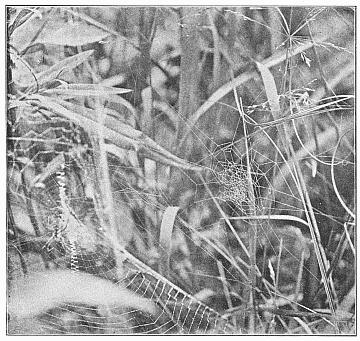 Fig. 452. Rudimentary web of male Argiope riparia of the natural size. Part of the web
of the female at the left shows the difference between the webs of the two sexes.
Fig. 452. Rudimentary web of male Argiope riparia of the natural size. Part of the web
of the female at the left shows the difference between the webs of the two sexes.
Argiope riparia.—This and the next species are among the
largest and most conspicuous of the round-web spiders. It
lives among grass and low bushes in open fields and meadows,
especially along the borders of ponds and ditches. It matures
in the northern states about the first of August. Large females
are nearly an inch long, with the front legs longer than the body
(fig. 449). The cephalothorax is nearly as wide as long and
covered with silvery white hairs, except around the eyes. The
front legs are entirely black, and the others are black, except
the femora, which are light red or yellow. The abdomen is
oval, a little pointed behind and square in front, with two small
humps at the corners. There is a black stripe in the middle
of the abdomen, narrowed between the humps and widened in
the middle, where it includes two pairs of yellow spots. Along
the sides are two bright yellow bands or rows of irregular spots.
The color underneath is black, with a yellow stripe on the
sternum and two wide yellow stripes on the abdomen, with
small yellow spots between and at the sides. The young
differ considerably from the adults. Until nearly full grown
the legs are distinctly marked with dark rings on the ends
and middle of each joint. When very young the abdomen is
slender, the color is pale, and the markings gray, without the
strong black and yellow of the adult. The male (fig. 450) is
only a fourth as long as the female, similarly colored, but with
the markings less distinct and the palpi very large. In the middle
of the summer they live near the webs of the females, where
they make small and imperfect webs of their own (fig. 452).
The females make webs, sometimes two feet in diameter, with
a zigzag band (fig. 448) of white silk up and down across the
middle, and a round thick spot where the spider stands. The
inner spiral of these webs is very large, covering a quarter of
their diameter (fig. 452). The outer spiral comes very near
it, but the spider sometimes passes
through the narrow space between
them from one side of the web to
the other. The web is usually a
little inclined, and on one or both
sides sometimes has a screen of
irregular threads two or three inches
distant from it (fig. 453), but these
are often absent. These spiders
have no nest and stand all the time
in the center of the web (fig. 448).
Sometimes the spider draws away
the grass and leaves so as to make
an oval opening large enough for
the web (fig. 453). In September
the eggs are laid in large pear-shaped
cocoons with a brown paper-like
surface, hung by threads among
the grass and bushes (fig. 454). The
young hatch during the winter and
remain in the cocoon until May. The
adult spiders disappear in October
and probably all die before winter.
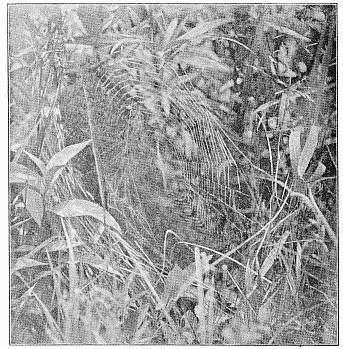 Fig. 453. Web of Argiope riparia in an oval opening among plants from which the
leaves have been drawn away by the spider. At the left of the web is a screen of
irregular threads.
Fig. 453. Web of Argiope riparia in an oval opening among plants from which the
leaves have been drawn away by the spider. At the left of the web is a screen of
irregular threads.
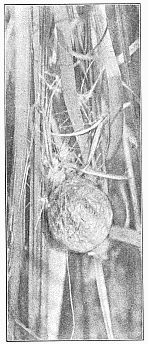 Fig. 454. Egg cocoon of Argiope
riparia in marsh grass. Natural
size.
Fig. 454. Egg cocoon of Argiope
riparia in marsh grass. Natural
size.
Argiope transversa.—This species
is a little smaller than riparia. It lives in the same places and
matures a little later, about September 1. The abdomen is more
pointed than that of riparia (fig. 455). The ground color is
white or light yellow, and is crossed by a great number of black
transverse lines, which are sometimes obscured, especially in
young spiders, by a thick covering of silvery-white hairs. The
cephalothorax is covered with white hairs through which the
dark markings on the sides show indistinctly. The legs are
light yellow, with black bands at the ends and middle of each
joint. The femora of the first legs are sometimes entirely
black. The young have the back entirely
white. The markings of the under side
are similar to those of riparia. The male
(fig. 456) is colored like the female, but is
only a fourth as large. The legs are yellow,
marked with black spots, but have no
rings. It has the same habits as riparia.
It remains in its web later in the season,
and makes a cocoon flattened on the top
(fig. 458) instead of narrowed to a neck,
like those of riparia.
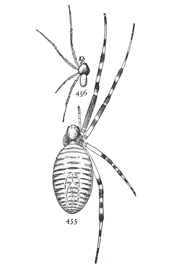 Figs. 455, 456. Argiope transversa.—455,
female. 456,
male. Both enlarged
twice.
Figs. 455, 456. Argiope transversa.—455,
female. 456,
male. Both enlarged
twice.
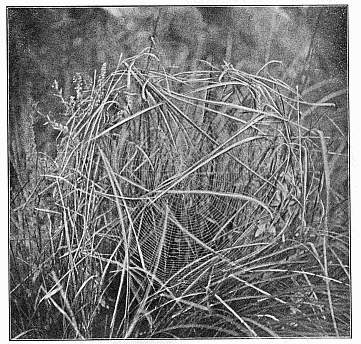 Fig. 457. Web of Argiope transversa in an opening among marsh grass, covered
above by wilted ends of grass leaves.
Fig. 457. Web of Argiope transversa in an opening among marsh grass, covered
above by wilted ends of grass leaves.
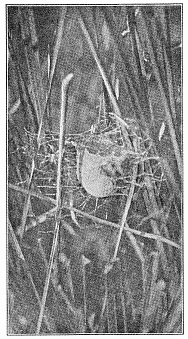 Fig. 458. Egg cocoon of Argiope transversa
in marsh grass.
Fig. 458. Egg cocoon of Argiope transversa
in marsh grass.
This species often makes its web in
marsh grass, which it draws away and
fastens with silk (fig. 457). As the surrounding
grass becomes long and weak,
it sometimes falls away, leaving the web
in a basket of grass fastened firmly
enough together to remain standing.
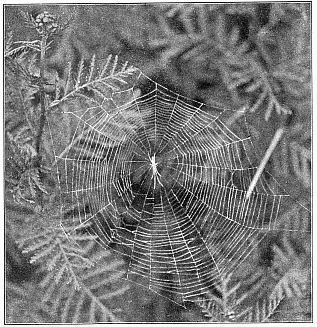 Fig. 459. Web of Tetragnatha in tansy plants, showing the spider in its usual position.
The Tetragnathas are slender, usually
straw-colored spiders, living in their webs
among the long grass in meadows and near water. The legs
are slender, the cephalothorax narrow, and the abdomen long and
cylindrical. The mandibles are large in both sexes, and in the
males are very long and furnished with long teeth at the end
and along the inner margin. When pairing, the male and
female hold each other by the ends of the mandibles. The eyes
are in two rows nearly equal and parallel, and the distance
between the lateral pairs varies in different species. The palpi
are long and slender in both sexes, and in the males their
proportions differ according to the species. The legs are also
long and slender, and vary in length from grallator, where the
female has the first legs ten times as long as the cephalothorax,
to laboriosa, in which they are seven times as long. The webs
are generally inclined and may be nearly horizontal or nearly
vertical, according to the place where they are made (fig. 459).
The inner spiral is small and has a hole in the middle (fig. 460).
The spider stands in the web with the legs extended forward
and backward close to each
other, except at the ends,
where they are turned outward
(fig. 459). On account
of their similar size and color,
the species look at first sight
much alike, but there are differences
in the arrangement
of the lateral eyes and the
length of the legs, palpi, and
mandibles.
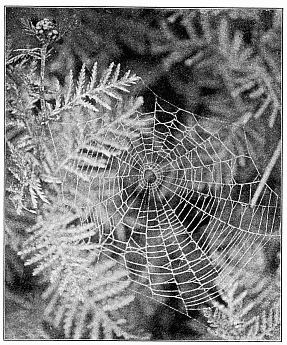 Fig. 460. The same web shown in Fig. 459, treated so as to show the inner spiral
and the hole in the middle of the web.
Fig. 460. The same web shown in Fig. 459, treated so as to show the inner spiral
and the hole in the middle of the web.
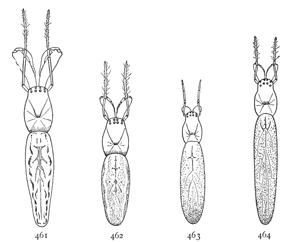 Figs. 461, 462, 463, 464. Backs of females of four species of Tetragnatha.—461,
grallator. 462, extensa. 463, laboriosa. 464, straminea.
Figs. 461, 462, 463, 464. Backs of females of four species of Tetragnatha.—461,
grallator. 462, extensa. 463, laboriosa. 464, straminea.
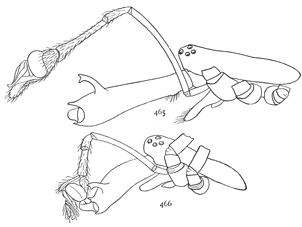 Figs. 465, 466. Cephalothorax, mandible, and palpus of males.—465, Tetragnatha
grallator. 466, Tetragnatha extensa.
Figs. 465, 466. Cephalothorax, mandible, and palpus of males.—465, Tetragnatha
grallator. 466, Tetragnatha extensa.
Tetragnatha grallator.—This
spider grows to be half an
inch long, with the first legs
an inch and a half. The
mandibles of the female are
as long as the cephalothorax,
and those of the male longer
(figs. 461, 465). In both sexes
they are inclined forward, so
as to be nearly horizontal and
spread apart at the ends. The
lateral eyes are near together,
so that they almost touch, and
the upper row when seen from above is nearly straight. The
palpi of both sexes are over one and a half times as long as
the cephalothorax, and in the males sometimes twice as long
(fig. 465). The patella and tibia together are nearly as long
as the femur. The color is sometimes light yellow, but
often gray, with a broken middle stripe of darker gray on the
abdomen, and three stripes on the cephalothorax. The abdomen
is generally enlarged a little in the front third (fig. 461).
The males are smaller and more slender than the females, with
longer legs and mandibles.
Tetragnatha extensa.—Female a quarter to three-eighths of
an inch long, with the first leg three-quarters of an inch. The
abdomen is shorter than in grallator, about twice as long as
the cephalothorax, and not as much widened in front (fig. 462).
The mandibles are two-thirds as long as the cephalothorax and
not much inclined forward. The lateral eyes are near together.
The colors are often dark, dull yellow brown or gray, with
three lines on the cephalothorax and a middle dark stripe
on the abdomen, with a light silvery stripe on each side.
The male is smaller and more slender, with the legs longer.
The male palpi are one-half longer than the cephalothorax, the
femur forming nearly half its length (fig. 466).
Tetragnatha laboriosa.—A little smaller than extensa, with
shorter legs and mandibles, the latter short enough in the
female to be almost vertical (fig. 463). The abdomen is proportionally
longer than in extensa, usually in the females three
times as long as the cephalothorax. The first legs are about
seven times as long as the cephalothorax. The upper row of
eyes is a little curved, so that the lateral pairs of eyes are as far
apart as the middle ones (fig. 467). The general color is light
yellow. The abdomen is silvery white, with some indistinct
gray markings along the
middle, and dark stripes on
the under side. In the males
the mandibles (fig. 467) are
short compared with the
other species, and are about
two-thirds as long as the
cephalothorax, and the tibia
is very little longer than the
patella.
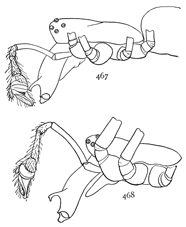 Figs. 467, 468. Cephalothorax, mandibles, and
palpus of male.—467, Tetragnatha laboriosa.
468, Tetragnatha straminea.
Figs. 467, 468. Cephalothorax, mandibles, and
palpus of male.—467, Tetragnatha laboriosa.
468, Tetragnatha straminea.
Tetragnatha straminea.—A
quarter to three-eighths of
an inch long, about the same
size as laboriosa, and the
same color. The legs, palpi,
and mandibles are all a little
longer than in laboriosa,
and the lateral eyes are
farther apart than the middle pairs (fig. 464). In the males
the abdomen is shorter and smaller, and the legs longer. The
male palpi (fig. 468) are one and a half times the length of
the cephalothorax. In females the abdomen is usually three
times as long as the cephalothorax and more slender than in
laboriosa.


