EYES AND NO EYES—DIFFICULTIES OF OBSERVERS—THE BATS—LONG-EARED
BAT—ITS UTILITY—SPORT AND MURDER—SONG
OF THE BAT—A BRAVE PRISONER—HOW BATS FEED—HAIR
OF BAT AND MOUSE—WING OF THE BAT—THE FIELD-MOUSE—ITS
STEALTHY MOVEMENTS—HARVEST MOUSE—WATER RAT—AN
INNOCENT VICTIM.
Every one has read, or at least heard of, the tale
entitled “Eyes and no Eyes”; which tale is to be
found in the Evenings at Home. Now this story,
or rather the moral of it, is, in my opinion, as often
used unfairly as rightly.
Although there are those who pass through life
with closed eyes and stopped ears, yet there are
many more who would be glad to use their eyes and
ears, but know not how to do so for want of proper
teaching. To one who has not learned to read, the
Bible itself is but a series of senseless black marks;
and similarly, the unwritten Word that lies around,
below, and above us, is unmeaning to those who
cannot read it.
Many would like to read, but cannot do so; and it
is in order to help such, to bring before them the
first alphabetical teaching, that the following pages
are written.
It is no matter of marvel that many an observant
person becomes bewildered among natural objects;
that he is lost amid the variety of animal, vegetable,
and mineral life in which he lives; and that, after
vainly attempting to comprehend some simple object,
he finds himself baffled, and so in despair
ceases to inquire into particulars, and contents himself
with admiration of and love for nature in
general.
Objects change so rapidly and so constantly, that
there is hardly time to note a few remarks before the
season has passed away; the object under examination
has changed with it, and a year must elapse
before that investigation can be continued.
From experience I know how valuable are even a
few hints by which the mind can be directed in a
straight course without wasting its strength and
losing its time by devious wanderings. Only hints
can be given, for the limits of the volume forbid any
lengthened discussion of single objects; and, besides,
the mind is more pleased to work out a subject
according to its own individuality than to have it
laid down as completed, and to be forbidden to go
any further.
Almost every object that is described by the pen
will be figured by the pencil, in order to assist the
reader in identifying the creature in an easier manner
than if it were merely described in words.
Of the birds I shall not be able to treat, as they
alone would occupy the entire space of this volume;
and, for the same reason, only a short account can
be given of each object.
As in the scale of creation the mammals fill the
highest place, we will speak of them first, taking, as
far as possible, each creature in its own order.
Perhaps there are few people who would not feel
some surprise when they learn that the very highest
of our British animals is the Bat. Usually the bat
is looked upon with rather a feeling of dread, and is
regarded as a creature of such ill-omen that its very
presence causes a shudder, and its approach would
put to flight many a human being.
There is certainly some ground for this feeling;
for the night-loving propensities of the creature, its
weird-like aspect, its strange devious flight, and more
especially its organs of flight, are so interwoven with
the popular ideas of evil and its ministers, that bats
and imps appear to be synonymous terms.
Painters always represent their imps as upborne
by bats’ wings, furnished with several supplementary
hooks; and sculptors follow the same principle.
In consequence, all bats and objects connected with
bats are viewed with great horror, with two exceptions:
a cricket-bat and a bat’s-wing gas-burner.
Now, I cannot but think that this is very hard on
the bats. It is said that the African negroes depict
and describe their evil spirits as white; and that, in
consequence, the negro children fly in consternation
if perchance a white man comes into their territory.
Yet, a white man is not so very horrid an object
after all, if one only dare look at him; and the same
remark holds good with the bats.
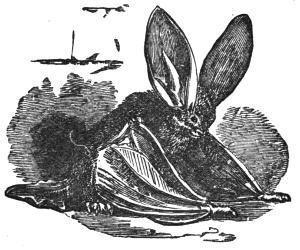
COMMON LONG-EARED BAT.
A very pretty creature is a bat, more especially
the long-eared species, Plecotus communis, as it is
scientifically called, and its habits are most curious.
It is well worth the time to watch these little creatures
on a warm summer’s night, as they flit about
in the air, and to note the enjoyment of their aërial
hunt. They are fearless animals; and provided that
the observer remains tolerably still and does not
speak, bats will often flit so close to his face that he
could almost catch them in his hand.
Their flight is very singular, and reminds one of
the butterfly in its apparently vague flitting. Indeed,
there are many large moths that fly by night
who can hardly be distinguished from the bats, if the
evening be rather dark, so similar are they in their
mode of journeying through the air.
From this peculiarity of flight, they are accounted
difficult marks for a gun; and it is unfortunately a
custom with some ruthless powder-burners to practise
by day at swallows and by night at bats. Now,
even putting the matter in its lowest form, it is
wrong to shoot swallows; for they are most useful
birds, and serve to thin the host of flies and other
insects that people the summer air.
As regards the swallow, this is well known, and
does serve to protect it from some persons who have
more compassion than the generality. Moreover,
the swallows, swifts, and martins are extremely
pretty birds, and their beauty is in some degree their
shield.
But the bat is as useful a creature as the swallow,
and in the very same way; for, when the evening
comes on, and the swallow retires to its nest, the bat
issues from its home and takes up the work just
where the swallow leaves it—the two creatures
dividing the day and night between them. Therefore,
let those who refrain from swallow shooting include
the bat in their free list.
Some there are whom nothing can restrain from
killing, for the instinct of slaughter is strong in them.
With them nothing is valuable unless it is to be
killed. If it can be eaten afterwards, so much the
better; but the great enjoyment consists in the
mere act of killing.
They contrive to disguise the ugliness of the thing
by giving it any name but the right one; but, in
spite of the name, the thing exists. And I wonder,
if they were to look very closely into themselves,
whether they would not find there a decided desire
to kill men, provided that they had no reason to dread
the consequences. Those who have practised the
sport unanimously say that nothing is so exciting as
man-hunting and killing and that all other sport is
tame in comparison.
The chief name under which this profanity is disguised
is that of “Sport,” a word which always reminds
me of the “Frog and Boys” fable. There
are actually men who are audacious enough to declare
that there is no cruelty in “sport”; that foxes
are charmed at being hunted, and that pheasants
derive a singular gratification from getting shot.
Now, I never was either a fox or a pheasant; but I
entirely repudiate the assertion that any animal likes
to be chased or to be wounded; and, moreover, I
disbelieve the sincerity of the man who can say such
a thing. If he says openly that he finds excitement
in the chase, and means to gratify himself without
any reference to the feelings of the creatures which
he chases, I can understand while I disapprove. But
when a man justifies himself by asserting that any
animal likes to be hunted, I can hardly find epithets
too contemptuous for him; and I could see him run
the gauntlet among the Sioux Indians with but small
pangs of conscience.
Some again call themselves Naturalists, and under
the shelter of that high-sounding name occupy themselves
in destroying nature. The true naturalist
never destroys life without good cause, and when he
does so, it is with reluctance, and in the most
merciful way; for the life is really the nature, and
that gone, the chief interest of the creature is gone
too. We should form but a poor notion of the
human being were we only to see it presented to our
eyes in the mummy; and equally insufficient is the
idea that can be formed of an animal from the inspection
of its outward frame. Nature and life belong
to each other; and, if torn asunder, the one is objectless
and the other gone.
Lastly, let me remind those who find such gratification
in destroying, that the word “Destroyer” is
in the Greek language “Apollyon”.
As we do not intend to treat of the dead and dried
bodies of animals, but of their active life, we return
to our bat flitting in the evening dusk, and, instead
of shooting him, watch his proceedings.
Every creature is made for happiness, and receives
happiness according to its capacity; and it is very
wrong to suppose that, because we should be miserable
if we led the life of a vulture, or a sloth, or a bat,
therefore those creatures are miserable. In truth,
the vulture is attracted to, and feels its greatest gratification
in, those substances which would drive us
away with averted eyes and stopped nostrils. The
sloth is, on the authority of Waterton, quite a jovial
beast, and anything but slothful when in his proper
place; and as for the bat, it sings for very joy. True,
the song is not very melodious, neither is that of the
swift, or the peacock, nor, perhaps, that of the
Cochin-China fowl, but it is nevertheless a song
from the abundance of the heart.
There are many human ears that are absolutely incapable
of perceiving the cry of the bat, so keen and
sharp is the note; a very razor’s-edge of sound.
More than once I have been standing in a field
over which bats were flying in multitudes, filling the
air almost oppressively with their sharp needle-like
cries. Yet my companion, who was a musician,
theoretically and practically, was unable to hear a
sound, and could not for some time believe me when
I spoke of the noisy little creatures above.
The sound bears some resemblance to that produced
by a slate-pencil when held perpendicularly in
writing on the slate, only the bat’s cry is several
octaves more acute. I never but once heard the
sound correctly imitated, and that was done by a
graceless urchin, during a long sermon one Sunday
morning. He had contrived to arrange two keys in
such a manner that, when grated over each other,
they produced a squeaking sound that exactly resembled
the cry uttered by the bat. So, by judicious
management of his keys, he kept the congregation
on the look-out for the bat, and beguiled the time
much to his satisfaction.
Of so piercing and peculiar a nature is the cry,
that it gives no clue to the position or distance of
the creature that utters it, and it seems to proceed
indiscriminately from any portion of the air towards
which the attention happens to be directed. The
note of the grasshopper lark possesses somewhat of
the same quality.
Even in confinement the bat is an interesting
creature, and discovers certain traits of character
and peculiarities of habit which in its wild state cannot
be seen. I might here refer to several stories
of domesticated and tamed bats; but as they have
already been given to the world, and my space is
limited, I prefer to give my own experiences.
Not long ago, I received a message from a neighbouring
grocer, requesting me to capture a bat which
had flown into the shop, and which no one dared
touch.
When I arrived, the creature had taken refuge
on an upper shelf, and had crawled among a pile of
sugar-loaves that were lying on their sides after the
usual custom. We pulled out several loaves near
the spot where the bat was last seen, and by casting
a strong light from a bull’s-eye lantern, discovered a
little black object snugly ensconced at the very back
of the shelf.
I pushed my hand towards the spot, but for some
time could not seize the creature, as it was so tightly
packed, and squeezed into a corner. At last the bat
gave a flap with one of the wings, which I caught,
and so gently drew my prisoner forwards.
He was a brave little fellow, as well as discreet,
and bit savagely at my fingers. However, his little
tiny teeth could not do much damage, and I put
him into a cage which I brought with me.
The cage was originally made for the reception of
mice, and was of a rude character—the back and
ends being of wood and the front of wire. In a very
few minutes after his entrance into the cage, the bat
climbed up the wooden back, by hitching his claws
into the slight inequalities of the wood, and there
hung suspended, head downwards.
When so placed, his aspect was curious enough.
The claws of the hind legs being fixed into a crevice,
so as to bear the weight of the body, the wings were
then extended to their utmost, and suddenly wrapped
round the body. At the same time the large ears
were folded back under the wings and protected by
them, the orifice of the ear itself being guarded in a
very singular manner.
If the reader will refer to the figure of the bat on
page 4, he will see that inside the great ear is a
sharply-pointed membrane, somewhat resembling a
second ear. This membrane is called the “tragus,”
and when the large ears are tucked away out of
sight, the tragus remains exposed, and gives the
creature a very strange appearance.
When the bat is living, the ears are of singular
beauty. Their substance is delicate, and semi-transparent
if viewed against the light; so much so, indeed,
that by the aid of a microscope the circulation
of the blood can be detected. As the creature moves
about, the ears are continually in motion, being
thrown into graceful and ever-changing curves. If
people only knew what a pretty pet the long-eared
bat can become, they would soon banish dormice
and similar creatures in favour of bats.
It was rather a remarkable circumstance, that the
bat of which I have just been speaking would not
touch a fly, although one which I had in my possession
some ten years since would eat flies and other
insects readily. Whenever it took the insect, it
daintily ate up the abdomen and thorax, rejecting
the head, wings, and legs. But my second bat
entirely refused insects of any kind, and would eat
nothing but raw beef cut up into very small morsels.
I never had a pet so difficult to feed.
If the meat were not perfectly fresh, or if it were
not cut small enough, the bat would hardly look at
it. Now if a bit of raw meat about the size of a
large pin’s head be placed in the air, a few minutes
will dry and harden its exterior; and when this was
the case, my bat did not even notice it. So I had to
make twenty or more attempts daily before the creature
would condescend to take any food.
When, however, it did eat, its mode of so doing
was remarkable enough. It seized the meat with a
sharp snap, retreated to the middle of the cage, sat
upright—as in the engraving already alluded to—thrust
its wings forward to form a kind of tent, and
then, lowering its head under its wings, disposed of
the meat unseen.
From the movement of the neck and upper portion
of the head, it would be seen that the creature ate the
meat much after the manner of a
cat; that is, by a series of snaps or
pecks; for the teeth are all sharply
pointed, and have no power of
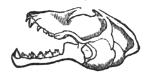
grinding the food. These teeth
can be seen in the accompanying sketch of a bat’s
skull.
In many parts of England the bats are called
“Flitter-mice,” and are thought to be simply mice
plus wings. This opinion has been formed from the
resemblance between the general shape, and especially
that of the fur, of the two animals. But if we
look at the teeth, we find at once that those of the
bat are sharp and pointed, extending tolerably
equally all round the jaw-bone; while the teeth of
the mice are of that chisel-shaped character found in
the rabbit and other rodent animals.
Now if we turn to the fur, and examine it with a
microscope, we shall there find characteristics as
decided as those of the teeth.
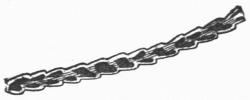
On this page is the magnified image of a single
hair, taken from the long-eared bat. It will be
seen that the outline of the hair is deeply cut, and
the markings run in a double line. These markings
and outlines are caused by the structure of the hair,
which is covered with a regular series of scales
adhering but loosely to its exterior. These scales
can be removed by rough handling, and therefore the
aspect of the hair can be much altered.
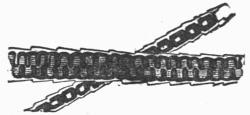
Let us now take a hair from the common mouse,
and place it under the microscope. This being done,
we find the result to be as shown in the accompanying
cut.
The two objects here shown are two portions of
the same hair; the upper one showing the middle
of the hair, and the lower being taken from a portion
nearer the root. Both these specimens were taken
by myself from the animals, and drawn by myself
by means of the Camera Lucida, so that they are to
be depended on.
To return to my caged bat.
Although it did not do much in the eating way, it
frequently came to the water vessel and drank therefrom;
but it was so timid when drinking, that I
could not see whether it lapped or drank. When
disturbed, it used to scuttle away over the floor, in a
most absurd manner, but with some speed. Sometimes
it tried to drink by crawling to a spot just over
the vessel, and lowering itself until its nose was
within reach of the water; but the distance was too
great for the attempt to be successful. In its wild
state, the bat hunts insects, as they hover over the
surface of water, and drinks as it flies, by dipping its
head in the water while on the wing.
I rather think that my bat must have received
some injury from the brooms and caps that were
aimed at it when it entered the shop, for it only
lived a fortnight or so, and one morning I found it
hanging by its hind claws from the roof of the cage,
quite dead.
I believe that bats generally die while thus suspended,
for it is a very common thing to find plenty
of suspended bats, dry and mummified, when entrance
is made into an unfrequented cave, or a hollow
tree cut down, or, indeed, when any bat-haunted spot
is examined.
In speaking of the bat, I have used popular terms,
and therefore have employed the word “wing”.
But the apparatus of the bat is not a wing at all, but
only a developed hand. Let the reader spread his
hand as wide as he can, and he will see that between
each finger, and especially between the forefinger
and the thumb, the skin forms a kind of webbing,
something of the same kind as that on the feet of
ducks and other aquatic birds.
Now if the bones of the fingers were drawn out
like wire until they became some seven or eight feet
long, and the skin between them were extended to
the nails of the elongated fingers, we should have a
structure analogous to that of the bat’s wing. The
thumb joint is left comparatively free; and by means
of this joint, and the hooked claw at its extremity,
the creature walks on a level surface, or can crawl
suspended from a beam or a trunk. It is very curious
to see the bat stretching out its wings and feeling
about for a convenient spot whereon to fix the
hooks.
So tenacious are these hooks, that the baby bat is
often found enjoying an airing by clinging to the
body of its mother, and holding firm, while she flies
in search of prey.
It is true that the little creature is suspended with
its head downwards; but it appears quite comfortable,
nevertheless. Bat-children do not suffer from
determination of the blood to the brain. Neither do
certain human children, it seems, if we are to take
as a criterion those whom we see hanging half out of
perambulators, fast asleep, and rolling from side to
side with every movement of the vehicle.
Both my bats were very particular, not to say
finicking, about their personal appearance. They
bestowed much time and pains on the combing of
their fur, and specially seemed to value a straight
parting down the back.
It was most interesting to watch the little thing
parting its hair. The claw was drawn in a line
straight from the top of the head to the very tail, and
the fur parted at each side with a dexterity worthy
of an accomplished lady’s-maid. The same habit
has been observed in other bats that have been
tamed.
There are more than twenty British bats, but the
habits of all are very similar; and so I prefer to take
the prettiest, and, having described it, to leave the
remaining species for a future occasion.
Pass we now from the Flitter-mouse to the Mouse.
In the fields, in the farm-yards, in the barns, and
in the ricks are to be found myriads of certain little
animals called Field-mice. Acting on the principle
that I have just laid down, I shall take the most
common and I think the prettiest species—the Common
Short-tailed Field-mouse, represented on next
page.
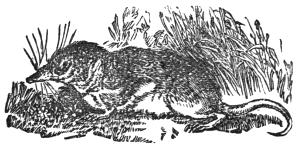
The fur of this creature is strongly tinged with red,
and by its colour alone it is easily to be distinguished
from the common grey or brown mouse. Its tail is
short and stumpy, looking as if it had suffered amputation
at an early period of life, and its nose is more
rounded than that of the common mouse. Indeed,
it has a very bluff and farmer-like aspect, and looks
as if it ought to wear top-boots.
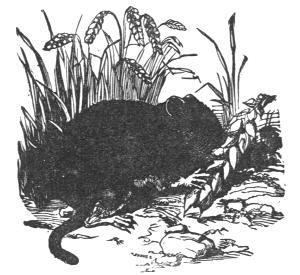
SHORT-TAILED FIELD-MOUSE.
Common as these little creatures are, they are
seldom seen, because they keep themselves so close
to the ground, and assimilate so nearly with it in
colour, that they cannot easily be descried among the
grass stalks, under shelter of which they pursue their
noiseless way.
Their speed is not nearly so great as that of the
house-mice, but they are much more difficult to
catch; for they wind among the grass so lithely, and
press upon the earth so closely, that the fingers
cannot readily close on them, even when they are
discovered.
From this facility of avoiding observation and
capture, they seem to derive much audacity, and
run about a field in fear of nothing but the kestrel.
When first I made a personal acquaintance with
these creatures, it was under rather peculiar circumstances.
There is a certain field, which was given
up to football, cricket, hockey, and similar games,
as soon as the grass was converted into hay and
removed. One day I was very tired with running,
and lay down to rest on a pile of coats that had been
laid aside; my eyes were fixed on one spot of earth,
just visible between the grass stalks, but without
any particular object. Presently I thought I saw a
something red glide across the spot, but was not
certain. However, I leaned over the place and a
little farther on saw the same thing again. So I
made a sharp pounce at the object, and found that
I had caught a short-tailed field-mouse.
Now here was this impertinent little animal taking
a walk close to the wicket, in spite of the bats,
ball, and runners. In order to watch its proceedings,
I released it, and followed it in its progress.
After watching for a few minutes, I happened to
look up for a moment; and when I again looked for
the creature, it was gone, and I could not find it
again.
Subsequently I became sufficiently expert to find
them whenever I wished; and if I wanted a field-mouse,
seldom had to examine more than a square
yard of ground without finding one.
They are very injurious little creatures, for they
are not content with eating corn, but nibble the
young shoots of various plants, and sometimes strip
young trees of their bark.
Fortunately we have allies in air and on earth, in
the persons of owls and kestrels, stoats and weasels,
or the damage done by these red-skinned marauders
would be more than serious.
Some idea of the damage that may be done by the
aggregate numbers of these small quadrupeds may
be formed from the fact that in Dean Forest and
the New Forest great numbers of holly plants were
entirely destroyed by them, they having eaten off
the bark for a distance of several inches from the
ground. And other trees were favoured with the
notice of the field-mouse, but in a different mode.
Great numbers of oak and chestnuts were found dead,
and pulled up; and when pulled up, it was seen that
their roots had been gnawed through, about two
inches below the level of the ground.
Various modes of destroying the marauders were
put in practice, such as traps, poison, &c., but the
most effectual was, as effectual things generally are,
the most simple.
A great number of holes were dug in the ground,
about two feet long, eighteen inches wide, and eighteen
inches deep. This is the measurement at the
bottom of the hole; but at the top the hole was
only eighteen inches long and nine wide, so that
when mice fell into it, they were unable to escape.
In these holes upwards of forty thousand mice
were taken in less than three months, irrespective of
those that were removed from the holes by the stoats,
weasels, crows, magpies, owls, and other creatures.
Like most of the mouse family, the field-mouse is
easily tamed; and I have seen one that would come
to the side of its cage, and take a grain of com from
its owner’s fingers.
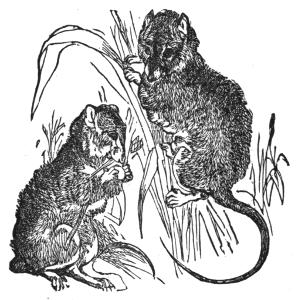
HARVEST-MOUSE.
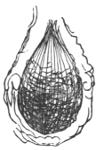
There is another kind of mouse which may be
found in the autumn, together with its most curious
nest. This is the Harvest-mouse, the tiniest of
British quadrupeds, two harvest-mice being hardly
equal in weight to a halfpenny.
The chief point of interest in this little creature
is its nest, which is not unfrequently found by
mowers and haymakers when they choose to exert
their eyes.
One of these nests, that was brought to me by a
mower, was about the size of a cricket ball, and
almost as spherical. It was composed of dried
grass-stems, interwoven with each other in a manner
equally ingenious and perplexing. It was hollow,
without even a vestige of an entrance; and the substance
was so thin that every object would be visible
through the walls. How it was made to retain its
spherical form, and how the mice were to find
ingress and egress, I could not even imagine. The
nest was fastened to two strong and coarse stems of
grass that had grown near a ditch, and had overgrown
themselves in consequence of a superabundance
of nourishment.
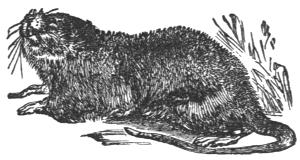
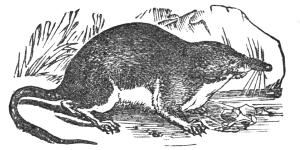
WATER-RAT.
If we walk along the bank of a stream or a pond,
we shall probably hear a splash, and looking in its
direction, may see a creature diving or swimming,
which creature we call a Water-rat; to the title of
Rat, however, it has but little right, and ought
properly to be called the “Water-vole”.
On examining the banks we shall find the entrance
to its domicile, being a hole in the earth, just above
the water, and generally, where possible, made just
under a root or a large stone. Sometimes the hole
is made at some height above the water, and then it
often happens that the kingfisher takes possession,
and there makes its home. Whether it ejects the
rat or not I cannot say, but I should think that it is
quite capable of doing so. Many a time I have seen
the entrance to a rat-hole decorated with a few stray
fish-bones, which the rustics told me were the relics
of fish brought there and eaten by the water-rat.
But I soon found out that fish-bones were a sign
of kingfishers, and not of rats; and so guided,
found plenty of the beautiful eggs of this beautiful
bird. Excepting the eggs of swallows and martins,
I hardly know any so delicately beautiful as those
of the kingfisher, with their slight rose tint and
semi-transparent shell. But, alas! when the interior
of the egg is removed, the pearly pinkiness
vanishes, and the shell becomes of a pure white,
very pretty, but not containing a tithe of its former
beauty.
The piscatorial propensities of the kingfisher are
not the only cause of the slanderous reports concerning
the water-vole, and its crime of killing and
eating fish. The common house-rat often frequents
the water-side; and, it being a great flesh-eater,
certainly does catch and eat the fish.
But the water-rat is a vegetable feeder, and I believe
almost, if not entirely, a vegetarian in diet.
That it is so in individual cases, at all events, I can
personally testify, having seen the creature engaged
in eating.
In former days, when I thought the water-rats ate
fish, I waged war against them, for which warfare
there are great facilities at Oxford. However, a
circumstance occurred which showed me that I had
been wrong.
I saw a water-rat sitting on a kind of raft that
had formed from a bundle of reeds which had been
cut and were floating down the river. Seeing it
busily at work feeding, I took it for granted that it
was eating a captured fish, and shot it accordingly,
stretching it dead on its reed raft.
On rowing up to the spot, I was rather surprised
to find that there was no fish there; and on examining
the reeds, I rather wondered at the regular grooves
cut by my shot. But a closer inspection revealed a
very different state of things; namely, that the poor
dead rat was quite innocent of fish eating, and had
been gnawing the green bark from the reeds, the
grooves being the marks left by its teeth. After this
I gave up rat shooting on principle.
Once, though, a rather curious circumstance occurred.
In my possession was a pet pistol, which would
throw a ball with great accuracy, and I considered
myself sure of an apple at sixteen paces. One day,
just as I was standing by a branch of the river
Cherwell, I saw a water-rat sitting on the root of a
tree at the opposite side of the river, and watching
me closely. The river was not above twelve or fourteen
yards wide; and the rat presented so good a mark
that I fired at him, and, of course, expected to see him
on his back.
But there sat the rat, quite still on the stump, and
about two inches below him the round hole where
the bullet had struck.
As the creature seemed determined to stay there,
I reloaded, and took a good aim, determined to make
sure of him. As the smoke cleared away, I had the
satisfaction of seeing the rat in exactly the same
position, and another bullet-hole close by the former.
Four shots I made at that provoking animal, and
four bullets did I deposit just under him. As I was
reloading for a fifth shot, the rat walked calmly
down the stump, slid into the water, and departed.
Now, whether he acted from sheer impertinence,
or whether he was stunned by the violent blow beneath
him, I cannot say. The latter may perhaps
be the case, for squirrels are killed in North America
by the shock of the bullet against the bough on which
they sit, so that no hole is made in their skins, and
the fur receives no damage. Perhaps the rat was
actuated by a supreme contempt for me and my
shooting powers; and, as the result showed, was
quite justified in his opinion.