Since these papers were sent to the press, the Commons of Ireland have, in
their address to his Majesty, resolved, unanimously, “that it is not by
temporary expedients, but by a free trade alone that this nation is now to
be saved from impending ruin.” And the Lords have in their address
unanimously entered into a resolution of the same import.
INDEX.
A.
Abercrombie, Lord, in Ireland and in Egypt, lxxx-lxxxii
Abraham Hutchinson, lxxxv
Absentees, remittances to, 76
Acts of Parliament quoted:
"Edward III., 17th, 34th, and 50th of, 110
"Edward IV., 3rd of, 4th of, 111
"Henry VII., 10th of, 112
"(English), Henry VIII., 13th and 28th of, &c., 116
"Elizabeth, 87, 116
"James I., 8
"Charles II., 87
"of Settlement and Explanation, 131
"12th, 57
"13th and 14th of, 115
"17th and 18th of, 20
"20th and 22nd of, 106
"22nd and 23rd of, 119
"William and Mary, first of, 57
"William III., 7th and 8th of, 57
"(English) Acts of 1697, 59
"(Irish) Acts of 1695, 10th and 11th of, 20, 88, 91, 105
"for encouraging Tillage, 38 note
"for Bounties on Land, Carriage and Coal Supply to Dublin, lxx, and 39
"3rd and 4th of Anne, 108
"10th, 11th, and 22nd of Anne, 96
"1st of George II, 122
"4th and 6th of, 120
"(English), 32nd of George II, 54, note
"(1750), taxing Irish Exports, 92
"George III., 10th of, 93-96
"18th of, 96
"Imposing Duty on Woollen Goods, 67
"Loan, 1759, 40
Address of English Parliament to William III., 62-65
Admiral Hawke, xv
Aldborough, Petition of, 85
Aldred Mr., of Oxford, xlv
Advance, in Linen Trade, 51
Alexander the Great, xxxiv
Alexandria, Lord Hutchinson of, lxxxvi
Alnager, Office and Fees of, x and 155, note
America, Robertson’s History of, xiii
"Wool and Linen Trades transferred to, by Irish Emigrants, 147
Anderson, Dr., quoted, 72, note
Andrews, Provost, xxxi
Anthologia Hibernica, lxxxvi
Archbishop Craddock, xxxiv, note
Archbishop Fowler, lxvi
Archbishop King quoted, 10
Archbishop Laud quoted, xxv
Arms of Militia given to Volunteers, xiv, note
Army Augmentation, 40, 44, 48
Asia, Africa, and America, closed against Ireland, 90
B.
Baird, Sir David, his Expedition from India to Egypt, lxxxii
Ballinamuck, Battle of, French defeated at, lxxxi
Banks in Dublin failed, 35-40
Bankruptcy Law not known here in 1755, 35, note
Barlow, Mr., T.C.D., Exercising the Veto, xxv, note
Barrè, Colonel Isaac, his description of Hutchinson, lx, &c., and note
Batchelor, the, xii
Baratariana, meaning of name, xiii
"Written by, xiii
"Extracts from, xv, xvii, xxi, note
"appeared originally in Freeman’s Journal, xiii
Beaconsfield, Lord, x, note
Bedford, Duke of, Lord Lieutenant (Speech from the Throne), 37
Beer, Exports and Imports of, 156
Berkeley, Bishop, his Opinion on State of Irish People, cxviii
Berwick, Rev. Edward, deprived of Scholarship by Provost Hutchinson, and reinstated by Visitors, xxxiv
Bessborough Commission, xxix, note
Biographie “Generale,” “Universale,” and “des contemporanes,” quoted, lxxxi
Bishops, Irish, ordaining on Scotch degrees, liii
Black-Dog prison, cvi, note
Blackburne, Mr., quoted, xcix
Blacquiere, Sir John, xxiii, lxxvii
Board and Provost of Trinity College, the, Publisher’s thanks to, v
Bolton, Duke of, Lord Lieutenant (Speech from the Throne), 24
Boulter, Primate, his desire to have Englishmen appointed to Irish Bishoprics, xxvi, note; xlvi, note
Bounty on Land Carriage, and on Coals, to Dublin, lxx, cx, 43
Bowes, Lord Chancellor, 60
Boyle, Lord Shannon, Speaker, xciv
Bretagne, Duke of, Treaty with, 112
Broderick, Speaker, Solicitor-General, Lord Chancellor, 17
Brown, Prime-Sergeant, pumped on Mr. Mills, xix, note
Bruce, Lieutenant, aided in effecting Lavalette’s escape, lxxxiii
Buckinghamshire, Lord Lieutenant. The Letters addressed to, xcix
"""Entertained by Trinity College, lxvi
"""A jobber in a mask, lxviii, note
Burke, Sir Bernard, quoted, xxiii, lxxxi
Burgh, Hussey, his Speech for opening the College to Catholics;
do. on the Irish bishops;
do. on a Money Bill, and Dismissal from Office, liii, lxxii, note
Burrowes, Peter, his speech, xlix
"Robert, xlix
Buyers, none at fairs, 2
Byron, Lord, x, note
C.
Campbell, Dr., his “Political Survey”, 72
Carson, Rev. Dr., S.F.T.C.D., his extract from College Register, xxxvii, note
Carte, his life of Ormond quoted, cv, 12, 54
Carteret, Lord Lieutenant, 28
Castlebar, Battle of, English defeated at, strange mistake by French Encyclopædists, lxxxvi
"atrocities of English army in retreat from, lxxxvi
Castlereagh, Lord, Chief Secretary, xcvi
Catalogue of College Plate, by Mr. Hingston, xxix, note
Cattle, Exportation Prohibition Act, cv and 55
Catholic Scholars, T.C.D., xlv, li, and note
Catholics, admitted to the College by connivance;
how debarred from Scholarship and from voting, xlvi, li, note
Cattle Trade destroyed by England, loss of, drove the Irish into the wool trade, cxi, 11
Cattle, Present of, sent to London after the great fire, and ungraciously received, cv
Causes of Ireland’s debt, 48
Chaffers, In Act of Edward IV., 111
Chancellors of the Exchequer, Irish, xciv
Chancery-lane, xiv-xxiii
Chapelizod Church, Inscriptions in, to the third Earl of Donoughmore, lxxxiv
“Chapels” in T.C.D., xx
Charles I., Subsidies to, 9
Charles II., Letter from, 12
Charles II. See Acts.
Charlemont, Lord, Life of, quoted, lvi
Charter Schools, cxi, 45
Chesterfield, Lord Lieutenant, 32
China, Trade of, 73, cxii
Cista Communis, xxix
Civil Establishment pensions, lxix, 45, 4
Clarendon, Lord, his “History”, 10
Clonmel, Factory at, cv, 13
College Plate in South Kensington Exhibition, xxix, note
College rack-renting, as alleged by Mr. Duigenan—as explained by Mr. Galbraith, xxix, note
College Park, xx, note
Commercial Restraints and Colonial Trade, 1
Commission of Trade, 67
Committees, Parliamentary, on the Hutchinsons, xl, xli
Colonies, Ireland excluded from commerce with, 68
Commons, House of, could not cure the evil, 31
"pass the Act against Irish trade, cvii, and 66
"advanced money for local purposes, 36
"(Irish), Dispute with the Crown, 35
"What they effected in 1782, lxxi, note
"English, Address to William III., 62
Commons, in Trinity College, xlviii
Condition of Irish people, 26
Cooke’s Institutes, 110
Constellation, The, Captain of, cv, note
Corporation of Weavers, 49
Council of Ireland present a Bill to Parliament, 67
Corporation of Dublin petition the College for Lucas’ son, lxiv
Cowper, Lord Lieutenant, his speech at Belfast, cxviii
Cox, his history of Ireland, 9
Croker, Crofton, Popular songs, quoted, xxxi, note
Curates, Salary of, liii
D.
Davis, Sir John, quoted, 7 and note, 9, 110, 127, 149
Decker, his “Decline of Foreign Trade”, 74-78
Debt, National, smallness of in Ireland in 1715, 24
"the alarm caused by the slight increase of, a proof of the destitution of the country, 24
"how increased, 46
Delany, Dr., F.T.C.D., his pupils and income, xlvi, note
Devonshire, Duke of, Lord Lieutenant, 32
Donoughmore estate, The, lxxv, note
Donoughmore, Lord, “blood relations of,” xxxi, note
Distress in Ireland, 23-29
Dobbs, Mr., on the trade of Ireland, 14, 77, note
Dorset, Duke of, 29, 78
"Distress in, 1759, 40
"Sir Bernard de Gomme’s Map of, xx, note
"Scandinavian Kingdom of, xx, note
Dublin, Collection in, for the Waldenses—for New England—
"its freedom given to Hutchinson, x
"""to Captain Porter, cv, note
"aid for the Londoners, cv, note
Duigenan, Dr. Patrick, F.T.C.D., &c., his “Lachrymæ Academicæ,” xxi
""Sketch of his Life, 1, note
""educated in St. Bride’s Parish School, lived in Chancery-lane, lxxxvii
""his sham duel, lvi, note
""his oratory, lix
""a fanatical anti-Catholic and anti-Nationalist, lxxxviii
""did not bring the Provost before the Visitors, xxxvii, note
Dunkin, Rev. Mr., Master of Great Ship-street School, had an annuity from the College, lxiv
Dutch carried on the Trade of Ireland, 73
Duty paid on Export of Linen, 21
E.
Edward III. and IV.’s Acts, 110
Egypt, trade at, cxi
Embargo on Irish provisions, 1776, 5
Emigration of linen workers from Ulster, 101
Embargoes in Ireland, 24;
from 1740 to 1779, 157
England, prohibition of cattle exportation to, civ, note, 5
"remittances to, more than double the entire trade of Ireland, 81
"Great Seal of, to certify Irish Acts, 75
"and Ireland compared as to taxation, 76
"a sufferer by her restrictions on Ireland, 77
"in 1779, had to pay for Irish army, 4
"a gainer by Ireland, cxvii, 149
"the cause of Irish distress, cxvii
"repaid fifty-fold for advances to Ireland, 128
English Parliament’s Address to William III., to destroy Irish wool trade, cvii, and 61
Equivalent of linen trade an imposture, 97
Essex, Lord, Lord Lieutenant, 143
Explanation, Act of, 131
Exshaw’s Magazine, xli, xlvi, note
F.
Failures of Dublin Bankers, Ferral and French, 35
Farmers of Customs, 57
Farming in Ireland depressed, and why, 2
Fashion, former, of Chancery-lane, Stephen-street, Ship-street, &c. &c., xiv, note
Faulkner’s epistle to Howard, lvi, note
Fawcett, Postmaster-General, his Speech at Shoreditch, cxviii
Fellows of Trinity College, Bishops, &c., xxvi, note
Fellows of Trinity College, their income, xxviii-xlvi
Fellowship, worth of, xxxiii
Ferguson, Sir Samuel, the Publisher’s thanks to, viii
Fitzgerald, Lord Edward, on College Parliamentary Committee, xliii
""voted against Hutchinson, l
""served in Irish force in America, lxi
Fitzgibbon, John, Earl of Clare, educated in St. Michael le Pole’s School;
his college contests with Grattan, xcii
his early and rapid successes, x, note
unseats the Provost’s son for the University, and replaces him, xli
At first a parliamentary supporter and great admirer of Grattan; his final quarrel with Grattan, lxxxix
crushed the Round Robin and humbled the Provost, xxxix
as Vice-Chancellor holds a College Visitation, lxvi
had an Honorary L.L.D. from the University, lxxxix
his speech on the progress of Ireland, during the 18 years of freedom, quoted, cxix
Fitzgerald, Rev. Mr., Fellow, treated harshly by Provost Hutchinson, xxxiv
Flanders producing good wool, 99
Flax-seed imported into Ireland, bounty on, 1776, 95
Flax an uncertain crop, 99
Flemings; they beat the Italians out of the wool markets, and are beaten by the English, 99
Flood, Henry, Candidate for the Provostship, xxiv
"His Will, do., note
"Life of, quoted, do., note
Folkestone, Petition of, 84
Food of the Irish people in 1672, and in 1779, cxii, and note
Forbes, John, supporter of Grattan, opposed pension list, educated in St. Michael le Pole’s School in Great Ship-street, lived in Stephen-street, xciii
Foreign Trade of Ireland annihilated, 74
France used to supply England with linen, 92
Free Trade, Meaning of, lxxii, note
Freeman’s Journal published on St. Audoen’s Arch, and in Macœna’s Head, Bride-street (1776), xiii
""printer of, prosecuted, xviii
""quoted, xiii, xviii note, xix note, xxvi, xli note twice, xlv note, liii note, cxvii.
French Pensioners, 38
Friezes exempted from tax, 65
Froude, Mr., quoted, xii, xviii, note, xxix, note twice, xxxvi, xxxvii, xli, note twice, xlv note, lii, note, cxviii.
G.
Galbraith, The Rev. J. A., S.F.T.C.D., Letter on College Rents, xxix, note
Galway, Lord, Lord Lieutenant, his speech from the throne, 63
Gardiner’s Relief Bill, lxvii
Gentleman’s Magazine, quoted, xi, lviii
George II., Acts of, 54-120
George III., Acts of, 121
Gladstone, Mr., his speech in 1880, quoted, xciv
Gloucestershire, Petition from, 84
Grafton, Duke of, Lord Lieutenant, 1723, his speech from the throne, 27
Grattan’s Life of Grattan, lix
Grattan, partly educated at St. Michael le Pole’s, lxxxix
"his College Course and early contests with Fitzgibbon, xc
Graziers prosperous under cattle and wool trade, xcii
Great Britain, Sums remitted to, from Ireland, in pensions and salary, double the whole of Irish Trade, 81
“Groves of Blarney,” Verse of, xxxi
H.
Habeas Corpus for Ireland, Heads of Bills for, cushioned in England, 159
"carried in ’82, lxxxi, note
Haliday Collection, R. I. Academy, xxix, note, liv, note
Halifax, Lord Lieutenant, his speech from the throne, 1762, 44
Hardy, his Life of Lord Charlemont, lvi
Harris, his Life of William III. quoted, 13
Haughton, Dr., Senior Lecturer, quoted, xxxii, note
Hearth Money, 75-151
Herrings from Waterford and Wexford prohibited by England, 85
Hertford, Lord Lieutenant, his speech from the throne, 50
Hessians, The, refused by Irish Parliament, lxi, note
Hibernian Journal, xviii
Hindostan, Trade of, by foreigners, cxii
Historical Manuscripts Commission Report, xvii, note
Hingston, Mr., his catalogue of the College Plate; in charge of the plate at South Kensington Exhibition, xxix, note
Historian, no professed, of Ireland, since 1669, 23
Homer, quoted, cxiv, 127
Hours of Examination in College formerly, xx
House of Commons Journal, quoted, xli
Husbandry, Grants for, prove the poverty of the country, 35
Hutchinson, Rt. Hon. John Hely, Provost, &c., ix
his Matriculation, x
mention of, in College Calendar; his career and numerous appointments, xi
made Provost by Sir John Blacquiere, Chief Secretary, xxxii
and the price of the appointment, x-xiv
accused of a corrupt use of the office, xxi
trampled on Duigenan, xxi
challenged Dr. Doyle, Lucas, and Tisdall, xxxii
prosecuted in King’s Bench and defended himself, xxxviii
a warm supporter of Grattan, lix
inculpated before a Parliamentary Committee, and acquitted, l
evidence brought forward there concerning him, lxv
Miller’s Pamphlet on, and Young’s, liv
Lord North’s saying about him, lx
Hardy’s, Grattan’s, Taylor’s, Will’s, Barre’s, Pery’s, and Single Speech Hamilton’s favourable opinions of him, &c., lvi
published the “Commercial Restraints”, lxiv
entertained the Lord Lieutenant in the College, lxv
his liberal and national politics, lxvii
the constitutional changes which he witnessed and helped to produce, lxviii
read the King’s message to the Irish Parliament in 1782, lxxxiv
his death and will, lxxxiv
his family, lxxvi
a good husband and father, xxxi
his love for his children, lxxxviii
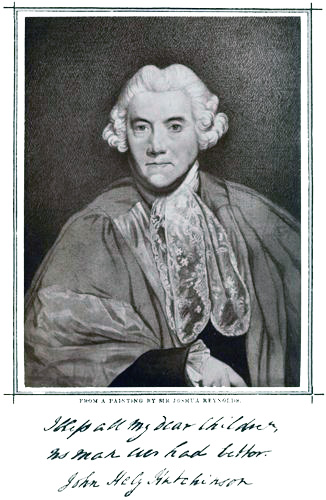
his likeness by Sir Joshua Reynolds, Frontispiece
"Richard Hely, Lord Donoughmore, his appointments, lxxix
""elected for the University and unseated by John Fitzgibbon,—member for Sligo, lxxix
"Francis Hely, member for the University, lxxviii
""petitioned against and sustained
""his duel, lxxviii
""Member for Naas, lxxx
"Abraham Hely, his volunteer military career in Ireland, Egypt, and Russia, lxxviii
""member for Taghmon, lxxix
""Commissioner and Clergyman, lxxxi
"John Hely (2nd), his services in the army in Ireland, Flanders, and Egypt; his defeat at Castlebar, and his conquest of the French in Egypt; voted for the Union, made Lord Hutchinson, and became Lord Donoughmore, lxxx
"John Hely (3rd), “Lavalette,” delivered Lavalette, and became Earl of Donoughmore, died at Chapelizod, tablet in Chapelizod Church, lxxxiii
"the fourth peer, served as an officer in India, lxxxiv
and in the House of Lords advocated the case of the East India Company’s officers, and supports Lord Dufferin’s Land Leasing Bill, do.
"The present peer, the 5th Earl, was one of the European Commission for organising Eastern Roumelia under the Berlin Treaty. He is also the creator of the Lords’ Committee of Inquiry on the Irish Land Act, lxxxiv
I.
Independence, Parliamentary, of Ireland, College identified with, lxxiv
Ireland deprived of the Cattle Trade, cix
"of the Wool Trade, Colonial Trade, and trade with all the world, cxvii
"sold in the linen trade, 47
"constant wretchedness of, caused by England, 44
"possesses abundant means of prosperity, cxix, 2
"oppressed by the Navigation Law, 122
"loyal to English Crown, 125
"a great commercial gain to England, 149
"a mine of wealth to England, cxvii, 149
"Bishop Berkeley’s opinion on, cxix
"ought to depend on her own resources, cxvii
"its people fond of equal justice: their food, 145, and note
"good wool-spinners, 71
"had no professed historian since 1699, 23
"overtaxed in consequence of paying its share of the National Debt, 33
"supposed wealth caused real poverty, 48
"her debt for the war of 1761 was accountable, but its increase during 16 years of peace unaccountable, 46
Ireland, distress of, arose, not from natural causes but from bad laws, 53
Irish, the indolence of, from loss of liberty, 127
Irish shipping useful to Edward I. in his French wars, 111
Irish, population of, more than doubled in 80 years, 148
"population of, in 1779, 148
"able to pay taxes, 151
"residing in houses of one hearth, 151, note
"Non-distribution of property caused by bad English laws, 150
"home trade most important for, 145
"trade of, various restrictions on, 154, 157
"troops, 100,000, served in English army and navy in French and Spanish war, 161
J.
James II. ruined the trade and revenue of Ireland, 13
Jocelyn, Lord, his return of Pension List, lxix, note
Johnston, Dr., his Hon. degree from T.C.D., and letter to Leland, lxxxvi
"his opinion of Leland’s “History”, do.
"his opinion of England’s treatment of Ireland, do.
Judges appointed for life in Ireland in 1782, lxxi
Junto, The, xxiii, lxviii
K.
Keating, Lord Chief Justice, 11, note
King, Archbishop, his “State of the Protestants in Ireland”, 135
Knocklofty, Mr. Richard Hutchinson of, x-lxxv
"Lord Hutchinson of, lxxx
L.
“Lacrymæ Academicæ,” by Duigenan, xxi, &c.
"its severe attack on the Provost, do.
"its interesting record of College events and College life, do.
"censured by the Board, xxxiv
"and the censure replied to by Duigenan in Freeman’s Journal, xxxvii
"in King’s Bench, do.
Langrishe, Sir Hercules, wrote in Baratariana, xiii
"obtained a grant for clothing for the Volunteers, xiii, note
"one of his bon mots, do.
Land Carriage Act, 1757, 43
"improved the agriculture of Ireland, 145
Land Bill, 1759, 40
Latin Schools of Dublin, xcii, note
Laud, Archbishop, his statutes for the University, xxv
“Lavalette” Hutchinson, lxxxiii
Lavalette, his escape from France, lxxxiii
Leaves of absence allowed to Fellows and to Scholars, xlviii
Leland, Dr. S.F., T.C.D, quoted, 9
"Duigenan’s attacks on, xxi
"Dr. Johnston’s letter to, lxxxvi
"mentioned in the Historical Manuscripts, do.
"Commission Report, do.
"Estimate of his history, lxxxv
Leeds, Petition from, 84
“Liber munerum,” quoted, xxxii, xxxv, note, lxx
Linen trade no equivalent for suppressed wool trade, 20
"a hypocrisy and imposture, ciii, note
"sums paid on exportation of, 21, note
"caused the decay of agriculture, 51
"declined, 1771, 4
"Ireland not specially adapted for, 91
"world shut against, 91
London, The Dublin contribution to, cv
Lord Lieutenants, List of, xcv
Lucas, Dr., his son had free education from the Board of T.C.D., lxiv
Lyttleton, Lord George, his history of Henry II., helped by Leland, lxxxvi
"applied to by Swift for Macaulay, xliv
M.
Macaulay, Alexander, supported by Swift, xliv
"returned for College and unseated, do.
"lived in Great Ship-street, xciii
Macaulay, Boyd, his son, educated in Great Ship-street School, do.
Macaulay, Catherine, her history quoted, 135
Magee, Archbishop, his evidence, xlvii
"he wanted to go to the Bar, do.
"his sermon on Lord Clare, xcii
Magill, John, got an Honorary LL.D., was a carpenter and a Commissioner of Barracks, xxv, note
Malone, Anthony, dismissed from Prime Serjeancy, and from the Irish Exchequer, lxviii
"lived in Chancery-lane, xiv, note
Malady, The, of Emigration, 147
Mathers, Rev. Nathaniel, made collection in Dublin, cvi, note
"Rev. Samuel,do.do.do.
Matthew Paris, quoted, 16
Militia Bill defeated by Hutchinson, 1766, xiv, and note
"dropped in 1778, 4
Militia, Arms for, given to the Volunteers in 1779, xiv, note
£20,000 for clothing, do.
enrolled in 1785, do.
Miller, Rev. G., F.T.C.D., &c., lxiv and note
"his evidence, Case, and works, xliv
"his Pamphlet and case for legal opinion, liv
Mills, Michael, the printer, under the College pump, xix, note
Moira, Lord, lxi, note
Mutiny Act, perpetual and repealed, lxx and lxxi
N.
Natives, Places in Trinity College, xxvii
Navigation Act, 7th and 8th, William III., compelled Irish ships coming from America to pass by Ireland and unlade at England, and ship again for Ireland, 120
Navigation Acts, Petty’s opinion on, 123
Netherlands, Treaty with, by Henry VII., includes Ireland as to both Exports and Imports, 112
New England, Dublin Subscription for, by Rev. Mr. Mather, cv
Non-Coing, xxvii
"value of, to Scholars, xlvii
""and to Fellows, do.
North, Lord, his saying about Provost Hutchinson, lx
O.
O’Connor, Charles, of Ballenagare, lxxxvi
"his opinion of Leland, and of the T.C.D. MSS., do.
Offices formerly on the Irish Establishment, List of, lxx
O’Hagan, Lord, his Address to the Social Science Congress, Introd., ci, note
O’Hagan, Mr. Justice, his judgment on the Stackpoole Lease, Introd., ci, note
Ormonde, Duke of, Lord Lieutenant, 12, 16, 18
""his fidelity to Ireland, set up the wool trade at Clonmel, opposed the Cattle Act, lv, 12
""made collection here for Londoners after the great fire, cv
""Personal prejudice against, 55
""Carte’s Life of, cv
Ossory, Lord, challenged Duke of Buckingham, do.
P.
Parliaments seldom convened in Ireland under James and Charles I., 11
"suspended over for 26 years after the Restoration, 11
"Composition of, lxix
"Independence of, 1782, lxxiv
"Acts of, in 1782, lxxi
"Addresses of, to Lord Lieutenant, 15, 24, 25, 27, &c.
Parliamentary Committee on Election of Francis Hutchinson for the University, Duke of Wellington and Lord Castlereagh on it, xlii
"Counsel employed, evidence brought forward, Committee decided in favour of Hutchinson by double vote of Chairman, l
"Catholic Scholars, Toomey and Casey, xlv, li
"Burrowes’ Speech, xlix
Park, The College, levelled and walled in, xx, and note
"infested by the Hutchinsons, xxxi
"formerly a place for pistol practice, xxxii
Pensions, Amount of, 38, 40, 44
"French, Amount of, 38, 40
Pepys, his Diary, quoted, civ, note
Peroration, Eloquent, of the “Restraints”, 158
Pery, Edward Sexten, Speaker, 43
""Notice of, xvii, note
""the fountain of all the good that befel Ireland, lxxi
Petty, Sir William, quoted, 54, 72, 106, 123, 130, 131, 132
""his estimate of the Irish destroyed in the Civil War of 1641, 130
""his opinion of the prohibition of the cattle trade, 55
""on the navigation laws, 123 and 132
""his description of the people’s food, cxii, note
Places, List of, lxx, note
Placemen in Parliament, List of, lxix, note
Plantation goods for Ireland, 120
"to be first unloaded in England, do.
Plate, College, Some of, melted down by Hutchinson, xxix and note
"note on, do.
Plowden, quoted, xxxix, note, lxii, note
Plunket, (Lord Chancellor), his speech before the Parliamentary Committee, xlviii
"son of a Unitarian minister, lii
Poll-tax paid by 360,000 people in 1661, 131
Pope applied to by Swift, xliv
"his translation of the passage from Homer, cxiv
Potatoes, Failure of, 1765, 49
Potter, Captain of the Constellation brought over American supply in last famine, cv, note
and receives the Freedom of Dublin, do.
“Prancer,” nickname of the Provost, xvii
“Pranceriana, Pranceriana Poetica” extracts from, note on, xviii, note
""originally in Freeman’s Journal, xviii
Private works here, carried on by public money, to lessen the balance in the Treasury available for Pensions, &c., 35
"they prove the poverty of the country, 35
Proclamation of 1776, on all provision ships laden in Ireland, 5, note
""partly withdrawn, 1779, 5, note
Provost Andrews, xiii
"Hely Hutchinson, xxv
"The present, the Publisher’s thanks to, v
Provost’s house built at a cost of £11,000, xii
Pryn, quoted, 109, note
Pupils of Fellows, xlvi, and note
Q.
Quickening Speech to Irish Parliament, cvii
R.
Rack-renting, by Provost Hutchinson, xxviii, and note
“Rapin’s History” quoted, 63
Record Office, Public, xxi, note
"Gatherings from, xxiii, note
"fac-simile of Provost Hutchinson’s autograph given by Sir S. Ferguson, Frontispiece
Redundancy in the Treasury caused the dispute between the Crown and the Commons in 1753, 35 and lxx, note
Regulators’ places, xlv
Relief not attempted by Irish of Commons, and why, 31
Remedy proposed by Government, to circulate paper without money, 26
Renewal Fines, Dr. Duigenan and Mr. Stack, S.F.T.C.D., on, xxix, and note
Resnal, Abbé, quoted, 83, note
Reynolds, Sir Joshua, his likeness of Provost Hutchinson, Frontispiece
Robinson, Primate, held visitation in College in 1776, and ruled against Provost Hutchinson, xxxiv
Rolls in Examination Hall, xx
Round Tower in Great Ship-street, xcii
Russia, a powerful rival to Ireland in linen trade, 12
S.
Sancho Panza, xiii
“Scandinavian Kingdom of Dublin,” quoted, xx, note
Scholars of Trinity College, l, note
Scholarship, worth of, xxviii
Scotland, Protestant families had to remove into, 10, 92
Secretaries, Principal, of State, xciv
"Chief, to Lords, List, Lieutenants, List of, xcv
Shaw, Mr., M.P., his speech, 1880, quoted, lxi, note
Shelburne, Lord, Life of, lx, lxi, lxiii, note
Shewbridge, Mr., F.T.C.D., his death and funeral, 94
Smith’s “Wealth of Nations”, 72, 73, 145
Smith’s “Memoirs of Wool”, 59, 77, 107, 145
South Sea Bubble, 25-26
Speakers of Irish House of Commons from the Restoration, List of, xciv
Speaker Perry, xviii, and note
Stack, Rev. T., S.F.T.C.D., letter in Bessborough Commission Report, xxix
Strafford, Lord, his destruction of the wool trade and substitution of the linen trade, his oppression of the country, 10, 13, 56, 73, 87
Stubbs, Rev. Dr., F.T.C.D., quoted, xx, note
St. Michael le Pole’s School, in Great Ship-street, illustrious men educated in, xciii
Subsidies granted to Charles I. by Commons and by Clergy, 9
Swift, Dean, exerted himself for Grattan the Fellow, xlviii
"wrote for Alexander Macaulay, xliv, note
"applied to the Board of College for Dunkin, lxiv
"his estimate of Dr. Delany’s income, xlvi
Sydney, Lord Justice, his “Quickening Speech” to the Irish Parliament to suppress the trade of the country, 11, 13
T.
“Tardies”, xx
Taxes comparatively heavier in Ireland than in England, cxiii
Taylor, his estimate of Provost Hutchinson, lix
Temple, Sir William, 11, 107, 130, 148
Tisdall, Philip, his description of Hutchinson, xv
"description of himself, xxi, note
"verses on, do.
"sketch of, do.
"lived in Chancery-lane, xxiii, note
Tontines introduced, 1773, 81
Townshend, Lord Lieutenant, briber, lxviii, note
Traynor, Mr., of Essex-quay, xix, note
Trinity College, the one home of friendless merit, xxvi
"its plate, xxix, note
"estates, xxix, note
"Park, xx
"Calendar, Registry, Judgment, and Matriculation Books quoted, l, xxii, xxvi, xc
U.
Ulster lost 30,000 people by emigration in two years (1779), 94
“Una Cum,” Clause of, in letters patent of Charles I., quoted, discussed by Mr. Miller, liii
"not decided by Lord Clare, lxvi
"expunged in alterations made by queen’s Letter in 1857, liii, and note
V.
Visitations in Trinity College in Hutchinson’s time, in 1776 and 1791, xxxiv, and lxvi
W.
Walker’s Hibernian Magazine, quoted, xxxviii, xli, lxvi, lxvii
Walpole, Sir Robert, 60
Walpole, Horace, lix
Walpole, Sir Edward, xcv
Warbeck, Perkin, 137
War with Spain, English, Ireland first time taxed for, 44
Weavers of Dublin, their distress and petition, 27
Webb, Alfred, his “Irish Biography,” quoted, xxi
Webb, Professor, Q.C., his “Faust,” quoted, x, note
“Wellington Correspondence”, lxvii
Wellesley, Sir Arthur, lxviii, and lxxxviii
Werburgh’s, St., Church, Conformity in, xlvi
Wesley, Hon. Arthur (Duke of Wellington), on College Parliamentary Committee, voted against Hutchinson, xliii-l
"Chief Secretary for Ireland, lxxxviii
White Boys, 1762, caused by want of means of industry, 44
"produced by the English laws, do.
Will of Provost Hutchinson, lxxiv
"of Mr. Richard Hutchinson, lxxvi
"of Philip Tisdall, xxiii
"of Dr. Duigenan, lxxxix
Wills, Dr., his sketch of Provost Hutchinson, lx
""of Dr. Duigenan, lxxxviii
William III., his Acts, cvii
"his pledge to ruin the Irish wool trade, cvii
"willing to act fairly by Ireland, civ
Wilson, Sir Robert, lxxxiii
“Winstanley’s Poems,” xx, note
Wool trade, Ireland’s great staple trade, and protected from the time of Edward III., 55
"ruined by William III., cvii, 59
Wool-running detrimental to England, and beneficial to her Continental rivals, 77
"could not be prevented in this country, 79
Y.
Yelverton, Barry, his matriculation, a sizar, an usher in Buck’s school, Lord Chief Baron, Lord Avonmore, lxxxvii, note
"Attorney-General, Recorder of Carrickfergus, M.P., presents the address to Hussey Burgh, his Act for T.C.D. Graduate Law Students, xii
Young, Dr., Bishop of Clonfert, Ex-F.T.C.D., liv
Printed by M. H. Gill & Son 50 Upper Sackville-street, Dublin.
Footnotes:
[1] His Matriculation is—“1740, April 29th. Johannes Hely, Filius
Francisci Gen. Annum agens 17. Natus Corcagii. Educatus sub Dr. Baly.
(Tutor) Mr. Lawson.”
[2] See Note A.
[3] Hutchinson had thus achieved very considerable success and distinction
when he was thirty-seven years of age—“the fatal year” in the development
of genius, according to Lord Beaconsfield. Grattan accomplished his great
work at the age of thirty-six, the age at which Lord Byron had finished
his poetry. Fitzgibbon, too, ran high in this respect. At twenty-nine he
was a leading lawyer, and M.P. for the University, having displaced and
replaced the Provost’s son; at thirty-four he was Attorney-General,
governing the country. He was Lord Chancellor and a peer before he had
attained what Dr. Webb, in his “Faust,” calls “the mature age of
forty-one.” He died at 53.
[4] [Pue’s Occur.]
[5] Alnager, or Aulnager, from the Latin Ulna, an ell, was an officer
for measuring and stamping cloth in the wool trade. Pranceriana Poetica
has the line:—
“Send Prancer back to stamping friezes.”
[6] See his will.
[7] See Note E.
[8] Lord Lieutenant Townshend’s organ was “The Batchelor; or, Speculations
of Jeoffrey Wagstaffe, Esq.,” published at the Mercury in
Parliament-street, by one Hoey, a popish printer. To be “mimicked by
Jephson and libelled by Hoey,” were amongst the social terrors of the
period.—[Baratariana.]
[9] Pranceriana has the line, “To storm her fane in Owen’s Arch.”
[10] It was Sir Hercules Langrishe who accounted to Lord Lieutenant
Townshend for the marshy and undrained condition of Phœnix Park, by
observing that the English Government “had been too much engaged in
draining the rest of the kingdom.”
[11] In 1779 the arms which had been intended for the Militia were given
by Government to the Volunteers, the Militia Enrolment Act of the previous
years not having been carried out, from want of money.
In 1783 the Volunteers were—prematurely—disbanded, and in 1785 the
Militia were enrolled, and Langrishe’s Bill obtained from parliament
£20,000 for clothing them. Subsequently the Commissioners of Array were
appointed.
[12] Anthony Malone, along with so many other grandees of the period,
lived in Chancery-lane. It requires an effort of historic faith to realise
that the Chancery-lane of to-day was a couple of generations ago the abode
of such fashion and rank. The fact, however, is quite certain. St. Bride’s
Vestry Book contains a copy of Anthony Malone’s and Alexander MacAulay’s
Opinions in re Powell’s Legacy to the Dublin parishes.
[13] See note E.
[14] Froude details the bargain. In 1771 it was important to secure for
the Army Augmentation Bill the support of Hutchinson, who had been
patriotising on the Surplus, Pension, and Septennial Bills. His terms to
Lord Lieutenant Townshend were, “a provision for the lives of his two
sons, one aged 11 and the other 10, by a grant to them or the survivor of
them of some office of at least £500 a year. If no vacancy occurred, then
either a pension, or a salary to that amount to be attached to some office
for them—and his wife to be created a Viscountess.”—“English in
Ireland,” vol. i., p. 632, and elsewhere.
[15] Palmerston, the Provost’s private country residence, was a noble and
beautifully situated mansion on the banks of the Liffey, between
Chapelizod and Lucan. It is now occupied by Stewart’s Idiot Asylum.
[16] Tisdall did not outlive him, and Hutchinson got the Principal
Secretaryship.
[17] One of the severest letters in the collection is No. 22, on Edmund
Sexten Pery, who, for fourteen years, was Speaker of the House of Commons.
Patriotic and eminent as Pery was, and upright and loyal as he always was
in the Chair, it cannot be denied that he got the Speakership by an
unworthy manœuvre. The passage is fully and bitterly rehearsed in the
last volume of the Historical Manuscript Reports. Pery was bought by the
corrupter Townshend at the same time with Hutchinson, Tisdall, Flood, &c.
[18] The Court of King’s Bench granted an information in the name of the
king, at the prosecution of the Right Hon. Hely Hutchinson, against Samuel
Leathley, the printer of the Freeman’s Journal, for publishing in that
paper the article signed “Crito,” in November, 1776. The article is not in
the “Pranceriana.”—[Freeman’s Journal, June 9th, 1777.]
[19] The Pranceriana Poetica, or Prancer’s Garland, published in 1779,
opens,
“A harlequin provost, cognomine prancer;
A duellist, scribbler, a fop, and a dancer;
A lawyer, prime sergeant, and judge of assizes;
A parliament man, and a stamper of friezes;
A councillor privy; a cavalry major;
A searcher and packer, comptroller and gauger;
A speecher, a critic, prescriber of rules;
A founder of fencing and ’questrian schools.
If various employments can give a man knowledge,
Then who knows so much as the head of the College?
******
The Seniors and Juniors in this are agreed,
As a Consul of Rome was Caligula’s steed;
They very much fear that if Prancer was dead
Sir John would appoint a Jackass in his stead.”
(Halliday Collection)
This book also is a collection of fugitive pieces, and it is dedicated to
“Sir John Blacquiere, Knight of the Bath, Alnager of all Ireland, and
Bailiff of the Phœnix Park.” There is not a copy in the College
Library. The Royal Irish Academy copies have the excellent woodcuts. In an
autograph note to his own copy of the book, Dr. Stock, F.T.C.D.,
afterwards Bishop of Killala, says that the engravings were made by his
brother, Mr. Frederick Stock, who kept a woollen draper’s shop in
Dame-street. He states that the printer, Michael Mills, was forced from
his house by a party of college lads, who conveyed him to the College, and
there pumped on him; and that the late Prime Serjeant Browne, then a
student, had a share in the outrage. Dr. Stock gives the key to the
“Poetica,” viz.—Moderator, Prancer, and Hipparchus = the Provost; Dr.
Pomposo and Mendex = Dr. Leland; Matthew Ben Sadi and Dr. Dilemma = Dr.
Forsayeth; Billy Bib = Dr. Hales; and Bezabel Black-letter = Michael
Mills. A copy of the extract is in the possession of Mr. Traynor,
Bookseller, Essex-quay.
[20] “Pranceriana Pœtica” says that the Provost multiplied the
composition premiums as means of bribery. It gives one of the Provost’s
advertisements (1777): “Any student may be a candidate for all, or for
any more of the said premiums!”
[21] In Sir Bernard de Gomme’s map of the city and harbour of Dublin, in
1673, given in Mr. Prendergast’s edition of “The Scandinavian Kingdom of
Dublin,” p. 229, the college park is marked as set out in paddocks. Dr.
Stubbs says that the park was thrown into its present champaign form, laid
out, and planted in the year 1722, as appears from “Winstanley’s Poems,”
vol. i., p. 269. Dublin: 1742.
[22] Other persons also were satirised occasionally in “Pranceriana,” as,
for instance, Philip Tisdall in the following description:—“He was a man
formed by nature, and fashioned by long practice, for all manner of court
intrigue. His stature was low, so as to excite neither envy nor
observation; his countenance dismal, his public manners grave, and his
address humble. But as in public he covered his prostitution by a
solemnity of carriage, so in private he endeavoured to captivate by
convivial humour, and to discountenance all public virtue by the exercise
of a perpetual, and sometimes not unsuccessful, irony. To these
qualifications he added an extraordinary magnificence of living.(1) His
table was furnished with everything that splendour could suggest, or
luxury could conceive, and his position and policy united to solicit a
multitude of guests. To his house, then, resorted all those who wished
through him to obtain, or learn from him to enjoy, without remorse, those
public endowments which are the purchase of public infidelity.” Tisdall
was depicted in “Baratariana” also. In the pungent rhyme on “The rejection
of the Altered Money Bill,” in 1772, we have—
“The next that stepped forward was innocent Phil,
Who said ‘that in things of the kind he’d no skill,
But yet that he thought it a mighty good bill,’
Which nobody can deny.”
And again, in “A list of the Pack,” we have—
“Lo, Tisdall, whose looks would make honest men start,
Who hangs out in his face the black sign of his heart;
If you thought him no devil his aim he would miss,
For he would, if he could, appear worse than he is.
Then kick out these rascally knaves, boys;
Freemen we will be to our graves, boys;
Better be dead than be slaves, boys;
A coffin or freedom for me.”
Philip Tisdall enjoyed a long tenure of very distinguished success. He was
educated at Sheridan’s celebrated school in Capel-street, and thence
entered Trinity College as a fellow-commoner in 1718. His Matriculation
is:—“1718, Nov. 11th. Philip Tisdel. Soc. Com. Educatus Dub. Mag.
Sheridan. (Tutor) Mr. Delany.” He took his B.A. in the spring
commencements of 1722, the shortened three-and-a-half years’ academic
course, as exemplified in the case of Grattan and Fitzgibbon [see note D],
being a fellow-commoner’s privilege. In 1739, Tisdall was elected
simultaneously M.P. for Armagh and for the University. He chose the
latter, and succeeded in a parliamentary petition against Alexander
Macaulay. He afterwards contested the seat successfully in 1761 against
Mr. French, Lord Clonmel’s nominee; and in 1776 unsuccessfully against
Provost Hutchinson’s second son. In 1741, Tisdall was promoted
Third-Serjeant, in 1751 he was Solicitor-General, and from 1761 till his
death he was Attorney-General. In 1761 he was presented by the City of
Cork with its freedom in a silver box. The Solicitor-General Gore was, in
consequence of some of Tisdall’s trimming, appointed over his head Chief
Justice of the King’s Bench, and soon after was created Lord Annaly.
Tisdall was a very eminent lawyer, and although not at all an orator, he
had great weight and influence in the House of Commons. He commenced
political life as a patriot, and became the organ of the Junto. He was
then, along with Pery and Hutchinson, bought by the corrupter, Lord
Lieutenant Townshend. Tisdall’s house was in Chancery-lane, and his
country villa was in Stillorgan. He died in 1777. He was son of Richard
Tisdall, Registrar in Chancery, and succeeded his father in the office,
1744. Philip’s wife, Mary, had a pension of one hundred a year, and his
brother Thomas was Registrar of the Court of Admiralty. In his will, made
1772, which is in the Public Record Office, he leaves a remembrance to his
daughter, Elizabeth Morgan, “heretofore amply provided for.” The whole of
his real and personal estate he leaves to his wife Mary. His daughter
Elizabeth, by his wife Mary (Singleton), niece and co-heiress of Lord
Chief Justice Singleton, was baptised in St. Bride’s Church. She was
married to Colonel Morgan, of Cork Abbey, county Wicklow, and was
grandmother to the late H. U. Tighe, Dean of Ardagh, and of the Chapel
Royal, Dublin, and afterwards of Londonderry.—[Burke’s Landed Gentry,
Art., “Tighe of Mitchelstown;” Life of Charlemont. Life of Shelbourne,
Record Office, and S. Bride’s Register.]
(1) In the pre-Union times, when a home parliament secured the
residence of our aristocracy and gentry, Dublin was famous for its
fashion and hospitalities. Primate Stone maintained a lordly style at
Leixlip Castle; while, as we read in “Mrs. Delany’s Letters,” Bishop
Clayton at St. Woolstons, close by, and in St. Stephen’s-green, kept
up an equal grandeur. His house in the Green had a front like
Devonshire House, and was magnifique. Mrs. Clayton’s coach, with six
flouncing Flanders mares, was not “out-looked by any equipage except
the Duke of Dorset’s, for she would not be outshone by her neighbours,
a thing not easily done here.” The Delanys entertained Viceroyalty at
Delville, fed their own deer, and went about in a coach-and-six. Luke
Gardiner’s (Lord Mountjoy) house in the Phœnix Park was the
head-quarters of fashionable life(a); and Hussey Burgh drove his
coach-and-six, with outriders. The wealthy wool, linen, silk, &c.,
mercers, of Bride-street and Golden-lane, kept good style and
equipages also, as appears by their wills in the Public Record Office.
(a) Gardiner was Master of the Revels, and Surveyor-General of
Customs.
[23] See note E.
[24] Flood, who did not get the provostship, bequeathed, by his will, in
1791, to the college, his estate in Kilkenny, worth £5,000 a year, to
found and endow a professorship of the Erse or Irish language, and to
establish a library of manuscripts and books in that language, and in the
modern polished languages. Provost Hutchinson did not leave a shilling to
the college. Flood’s bequest fell through owing to his illegitimacy. He
entered Trinity College as a fellow-commoner, completed his junior
sophister terms, and then migrated ad eundem to Oxford.—[Flood’s “Life
of Flood,” and Webb’s “Com. Biog.”]
[25] He was a Commissioner of Barracks; as was also Sir Herc. Langrishe.
Langrishe was, besides, Commissioner of Revenue and Commissioner of
Excise.
[26] There does not seem to have been any Mr. Barlow in these servile days
to exercise the ancient tribunitial power of the Senior Master Non
Regent—the power to veto, in the name of the community, dishonouring
presentations to honorary degrees.
[27] See page liii.
[28] In 1726, Primate Boulter wrote that unless a new Englishman was
appointed to a then vacant bishopric there would be thirteen Irish bishops
to nine English, to the Primate’s great dismay. The Editor of “Boulter’s
Letters,” in 1770, adds, in a note, that there was at one time in the
Irish House of Lords a majority of native bishops, of whom five had been
fellows of the University, viz., Drs. Howard, Synge, Clayton, Whitcombe
(Archbishop of Cashel), and Berkeley. These are, probably, the five
alluded to by Duigenan. In a pamphlet entitled “Thoughts on the Present
State of the College of Dublin,” published in 1782, the well-informed
author says that in King William’s reign, at or nearly at the same time,
“the people saw ten prelates on the bench, who had been Fellows.” The
writer says that there was a great increase in the number of
students—that the undergraduates were 565, the average of entrances 144
yearly, and the average of B.A. degrees, 78.—[Halliday Collection.]
We can ourselves remember, dating from the year 1830, eight bishops and
one archbishop, all Ex-Fellows. Altogether “there have been seven
archbishops and forty-two bishops of the Irish Church chosen from amongst
the Fellows of Trinity College. Eight have become Members of Parliament,
and six have been raised to the Judicial Bench.”—[Coll. Cal.]
[29] This seems not to have been the case in Dr. Delany’s time. See
Primate Boulter’s Letters, and Mrs. Delany’s, and Swift’s.
[30] See page xlv, &c.
[31] The rack-renting cannot have been very exorbitant, inasmuch as the
average rent per acre now paid to the College by its perpetuity tenants is
four shillings and twopence. The great bulk of the College property is
situated in the counties of Armagh, Kerry, and Donegal. The following
statement gives in round numbers the acreage and rental:—
| |
Acres. |
|
Rent. |
|
Rent
per acre. |
| Armagh, |
|
23,000 |
|
£9,600 |
|
8s. |
4d. |
| Kerry, |
|
60,000 |
|
11,500 |
|
3s. |
10d. |
| Donegal, |
|
62,700 |
|
9,000 |
|
2s. |
10d. |
| Total, |
|
145,700 |
|
£30,100 |
|
4s. |
2d. |
The number of perpetuity holdings let by the College are in all
fifty-four; four only are let to persons of the class of tenant-farmers;
of the remaining fifty, sixteen, containing over 60,000 acres, are enjoyed
by three lessees, who pay the College an average rent of 3s. 5d. per
acre.—[See Letter by Rev. J. A. Galbraith, S.F.T.C.D., Bursar, Freeman’s
Journal, March 6, 1882, and also “Statement to the Chief
Secretary.”—Freeman, March, 15, 1882.]
[32] The renewal fines in 1850 averaged £6,700 a year. The arbitration at
that time between the College and the tenants cost the College
£3,000.—[See Letter by Rev. T. Stack, S.F.T.C.D., Registrar, printed in
the Report of the Bessborough Commission, and also “Statement” as above.]
[33] This charge, as it stands, rests on a slender foundation, and is very
misleading. The catalogue of the College plate, which, to guard against
such imputations in future, Mr. Hingston, the Chief Steward, has drawn up
with so much care and skill, shows that the old inscribed plate is still
in use; and it enumerates pieces dated as early as 1632 and 1638. A
selection of the service was sent over, in Mr. Hingston’s charge, to the
late South Kensington Exhibition, and was greatly admired by all who were
conversant with antique silver art—some of the choicest pieces being
facsimiled for the London Institution. The collection of plate is
abundant, and the store was accumulated in this way. It used to be the
custom that all students at entrance should deposit “caution money,” which
was returned to them on graduation. The rich men and Fellow Commoners,
instead of taking back the money, used to present it to the College in the
form of inscribed goblets or tankards, and in the course of years there
was a large assortment of these offerings. Provost Hutchinson had a number
of these tankards melted down and refashioned into the present silver
plates, and this he did with the consent of the Board. Before Hutchinson’s
time a large quantity of the plate was sold by the Board, and the produce
was invested in the purchase of land. In 1689, when James II. seized on
the College, the Vice-Provost and Fellows sold £30 worth of the plate for
subsistence of themselves and the Scholars. At the same time all the rest
of the plate was seized on and taken away to the Custom House by Col.
Luttrel, King James’s Governor of the city, but it was preserved and
afterwards restored to the College.—[See Mr. Hingston’s Catalogue and
Coll. Cal. List of Fellows, 1689.]
[34] In 1775, seven marriage dispensations by King’s Letters were
obtained.—[Lib. Mun.]
[35] In 1796, the term of grace was extended to a twelvemonth by a King’s
Letter.—[Lib. Mun.]
[36] The following—the 5th verse in Milliken’s ever popular song, “The
Groves of Blarney”—was an impromptu addition at an electioneering
dinner in the south of Ireland in 1798. It is said to have been intended
as an insult to Lord Donoughmore, who was present, but his Lordship’s
readiness completely turned the tables. He applauded the verse, and in a
humorous speech acknowledged the relationship, thanked the author, and
toasted the Murphy’s, Clearys, Helys, and others who in the recent
political contest had ventured life and limb in support of the Hutchinson
cause, and had thus made their blood-relationship with him unquestionable.
“’Tis there’s the kitchen hangs many a flitch in,
With the maids a stitching upon the stair;
The bread and biske’, the beer and whiskey,
Would make you frisky if you were there.
’Tis there you’d see Peg Murphy’s daughter
A washing praties forenint the door,
With Roger Cleary, and Father Healy,
All blood relations to my Lord Donoughmore.
Oh, Ullagoane.”
Lord Hutchinson always heartily enjoyed this verse, which has become
completely identified with Milliken’s song.—(See Crofton Croker’s
“Popular Songs of Ireland,” pp. 144-8.)
Father Prout has not translated this verse. Why does not Professor Tyrrell
render it, Græce et Latine?
[37] He challenged Mr. Doyle to single combat for daring to issue an
address to the University constituency against his (the Provost’s) son’s
candidature. Mr. Doyle was a helpless invalid at the time, and had to
stand on a spread-out coat, for fear of cold; the combatants met on
Summer-hill, “fired a pistol each, and made up the matter without blood.”
Hutchinson had previously challenged Dr. Lucas, the patriot, who was
crippled with rheumatism.
[38] The number now is 1,338, of whom 789 are “Residents”—i.e., living
within reach of College opportunities. [See Dr. Haughton’s return
analysis, quoted in the Freeman’s Journal of January 7, 1882.] The
number of students on the books under the degree of M.A. is 1,253 [see
College Calendar for 1882, page 434]. The number of interns now is 250.
[39] See page xlv.
[40] On this Visitation “Pranc. Poet.” has—
“Disgrac’d by libels, worried by his foes
Poor Prancer labours under endless woes;
He therefore only supplicates your Grace
That right or wrong you’ll keep him in his place.”
The Visitation lasted five days, and was held before Primate Robinson as
Vice-Chancellor for the Duke of Gloucester, and Archbishop Cradock of
Dublin. Hutchinson published a pamphlet reviling the Visitors, and
pronouncing their decision invalid.
[41] A King’s Letter was obtained for raising the salary for this special
occasion.—Lib. Mun.
[42] Duigenan did not execute this intention, as appears by the following
record, kindly supplied by Dr. Carson, S.F.T.C.D.:—“I have to inform you
that I have gone carefully through the College Register for the years 1777
and 1778, and I cannot find therein the least trace of any Visitation
having been held in either of these years. The censure on Dr. Duigenan is
duly recorded under its proper date, in the year 1777; but no further
Collegiate notice appears to have been taken of it.”
[43] Walker’s Hiber. Mag. 177-8.
[44] Grattan’s Life, and Hib. Mag.
[45] The Round Robiners probably bethought of the case of 1753 when the
patriots who resisted the Court in the matter of the disposal of surplus
revenue were dismissed from office by Primate Stone. They, no doubt, were
afterwards reinstated with honour, but the conspirators of 1789 had to
deal with John Fitzgibbon.—[See “Plowden,” p. 311, &c.]
[46] Froude, vol. ii., p. 509.
[47] Barry Yelverton was an unsuccessful candidate in this College
Election of 1776. In the next year he was elected for Donegal, Belfast,
and Carrickfergus, and chose the last.—[Ho. Co. Jour.]
It was as Recorder of Carrickfergus that Barry Yelverton presented Hussey
Burgh with an address and the freedom of that Corporation in a gold box
for resisting the Government on the question of Supplies while Prime
Serjeant, and losing his place thereby. [Freeman’s Journal, Jan. 4,
1780.]
[48] Walker’s Hibernian Magazine, Freeman’s Journal, and Exshaw’s
Magazine.
[49] “The case of the Borough of Trinity College, near Dublin, as heard
before a Select Committee of the House of Commons, A.D. 1791.”
[50] Swift made an eager canvass for MacAulay, and wrote to Pope, asking
him to write to Lord George (then Mr.) Lyttleton, who was private
secretary to Frederick, Prince of Wales, the Chancellor of the University.
The prince complied with the request, and Tisdall’s supporters sent over a
remonstrance.—[“Swift’s Letters.”]
[51] This Francis Stoughton Sullivan got Scholarship, in 1744, at fifteen,
and was probably one of the youngest Scholars and the youngest Fellow in
the college records.
[52] He published, through the University Press, in 1797, a scholarly
Edition of “Longinus,” and was the author of several other works. (See an
interesting sketch of his life prefixed to Bohn’s edition of his
“Philosophy of History.”)
[53] “About a month ago considerable sensation was created in Oxford by
the rumour that one of the University examiners, who is also a “coach,”
had prepared his private pupils in the precise questions set for
examination. This, we may observe, was one of the heavy charges brought
against Provost Hely Hutchinson, of Trinity College, about a century ago,
the Provost having had recourse to the unprincipled manœuvre as an
electioneering dodge. The ever-memorable Counsellor Peter Burrowes, when
arraigning the Provost before a committee of the Irish House of Commons,
said that his trick “would have made a docile parrot appear superior to
Sir Isaac Newton;” but the committee condoned the Provost, against the
judgment and votes of Arthur Wesley (Duke of Wellington) and Lord Edward
Fitzgerald. The Oxford authorities seem not to be disposed to view so
leniently the action of Mr. Philip Aldred, D.C.L. When the matter was
reported to the Vice-Chancellor a substitute for the transgressing
examiner was at once appointed. We believe that a University committee has
been appointed to consider the expediency of taking away Mr. Aldred’s
degrees—as was done in the Tractarian controversy days with Mr. Ward, the
author of the “Ideal;” and, meanwhile, Mr. Aldred is now about to bring
his case before the public, with the protest that he has been condemned
unheard, after challenging investigation, and that he is able and willing
to meet every charge brought against him.”—[Freeman’s Journal, Jan.
13th, 1882.]
[54] He was prevented from voting, not by any University or College
statute, but by the Penal Law of 1727, which took away the franchise from
Catholics. All the long past exclusiveness of the college, detrimental as
it was to the college and to the country, was enjoined by the foreign
power which cared little for the advancement of either. Down to this
period the English legislature did not recognise at all the existence of
Catholics in the college, believing them to be effectually excluded by the
statute enforcing attendance at Anglican worship and Sacrament, and by the
Supremacy and anti-Transubstantiation Declarations for Degrees, which were
swept away by the Act of 1792.
[55] In 1725, Primate Boulter estimated that Dr. Delany, a Senior Fellow,
and “the greatest pupil-monger,” had from Fellowship and pupils six or
seven hundred pounds per annum.—[Letters.]
Swift, in 1730, computed that Delany, “by the benefit of the pupils, and
his Senior Fellowship, with all its perquisites, received every year
between nine hundred and a thousand pounds.”—[Works, vol. xiii., p. 82.]
Duigenan, in 1777, reckoned Dr. Leland’s Senior Fellowship at “£800, one
year with another.”—[Lachrymæ.]
In 1777, it was considered surprising that Dr. Leland refused the living
of Benburb, worth £1,000 a year, while his college income fell short of
£700 a year.—[Exshaw’s Magazine, 1777.]
[56] In 1713, Swift wrote to Stella:—“I have been employed in
endeavouring to save one of your Junior Fellows (Mr. Charles Grattan) who
came over here for a dispensation from taking orders, and in soliciting it
has run out his time, and now his Fellowship is void if the College
pleases, unless the queen suspends the execution and gives him time to
take Orders. I spoke to all the ministers about it yesterday; but they
say, ‘the queen is angry and thought it but a trick to deceive her;’ and
she is positive, and so the man must be ruined, for I cannot help him. I
never saw him in my life, but the case was so hard, I could not forbear
interposing. Your Government recommended him to the Duke of Ormond, and he
thought they would grant it; and by the time it was refused, the
Fellowship by rigour is forfeited.” The College Calendar has, “Charles
Grattan, Fellow, 1710—removed for not taking Holy Orders, May 25th,
1713—Master of Enniskillen School, 1714.”—[Journal, Letter lxii.,
March 29th.]
[57] He got Scholarship along with his brother Robert, in 1775. The
brothers Roberts, the present Senior Fellows, did the same in 1836.
[58] Denis George’s name does not appear in the list of scholars. He took
his B.A. in 1773. Neither does Tankerville Chamberlain’s. He graduated in
1774.
[59] From the ranks of the Scholars have proceeded 13 Provosts, 199
Fellows; 1 Archbishop; 16 Bishops, of whom two held English sees; 4 Lord
Chancellors; 2 Lords Justices; 29 Judges; 27 M.P.’s; 4 Vice-Chancellors;
18 Deans; 14 Governors, &c., of British dependencies; renowned Professors
in all the Faculties, and nearly all the distinguished schoolmasters of
the country; 1 Poet Laureate, and several celebrated authors and editors,
besides numerous eminent clergymen and lawyers. This is exclusive of the
enumeration [page xxvi] of the dignities obtained by Scholar-Fellows.
[60] It is even more remarkable that this matter was not mentioned by
Duigenan.
[61] In the petition of 1778 one of the points set forth was that Scholars
and Fellows should be legal Protestants to entitle them to vote, whereas
the Provost had received for his son and Yelverton the votes of some who
were not Protestants at the time of their election.
[62] Catholics and Nonconformists were not excluded from Scholarship by
the statutes or by any oath. They were, however, designedly, and in the
main effectually, excluded by the statute that all scholars, students, and
sizars should attend chapel and partake of Holy Communion as often as it
was administered (see “History of University,” Coll. Cal., 1876, vol.
ii. p. 9), and the “Heron Visitation” (Chartæ and Statuta, vol. ii., p. 3,
1862). Attendance on the Anglican Chapel service and Communicating were of
course intended as tests and pledges of Conformity.
[63] Parliamentary Debates.
[64] William Conyngham, Lord, and Lord Chancellor Plunket was the son of
the Rev. Thomas Plunket, minister of the Strand-street Unitarian
Congregation, who died on the 18th Sept., 1776. There is a very eulogistic
notice of him in the Freeman’s Journal of the date.
[65] Down to the alterations made in the Statutes by the Queen’s Letter of
1855, the words of the Lit. Pat. of Charles I. were:—“in quem vel quos
major pars Sociorum Seniorum unâ cum Præposito, vel eo absente, Vice
Præposito consensisse deprehendetur, is, vel illi pro electo vel electis
habeantur, et mox pronunciabuntur a Præposito. Quod si primo, vel Secundo
Scrutinio electorum major pars, cum Præposito, vel eo absente, Vice
Præposito non consenserint, eo casu in tertio Scrutinio, is, vel illi pro
electo, vel electis sunto, quem, vel quos, Præpositus, vel eo absente Vice
Præpositus, nominabit.” [Caput xxv. De Elect. form. et temp.]
[66] See also “An Enquiry how far the Provost of Trinity College is
invested with a negative on the Proceedings of the Senior Fellows” (1790),
by Dr. Young, Ex-Fellow and afterwards Bishop of Clonfert. It takes the
same view of the case as that put forward in Miller’s
pamphlet.—[Halliday Collection.]
[67] Note A.
[68] Hutchinson had to say to three of these affairs of honour, and
according to Duigenan he came badly out of all of them. Duigenan himself,
it should be observed, once had a sham duel, in which he did not figure at
all brilliantly, according to the orthodox interpretation of the code. He
had insulted Sir Richard Borough so grossly that a meeting could not be
evaded, and when the paces were measured Duigenan refused to take up the
pistols, which in due form were laid at his feet. He then shouted to the
“old rascal to fire away,” and when Borough thereon left the field
Duigenan declined to fight with his second, because he “had too great a
regard for him to kill him.”
[69] In George Faulkner’s “Epistle to Howard” (1771), contained in the
Halliday Collection in the Royal Irish Academy, we have—
“Thou Hutchinson whom every muse
With winning grace and art endues,
Whose power ’gainst prejudice contends
And proves that law and wit are friends—
In that promiscuous page alone
By letters J. H. H. art known.”
[70] [“Life of Lord Charlemont.”]
[71] See Note C.
[72] “History of the University of Dublin,” p. 253, &c.
[73] “Froude,” vol. ii. p. 104.
[74] “Distinguished Irishmen,” vol. v. p. 233, &c.
[75] “English in Ireland,” passim.
[76] Barrè was over here at that time as Vice-Treasurer, &c. He received
the Freedom of Dublin in 1776.
[77] The Bill was to raise the army in Ireland to 15,500 men. Pery and the
Nationalists saw that the object of the Crown was to have troops to send
to America to crush the Colonists, and this they would not have on any
terms. The Government, in reply, passed an Act through the English
Parliament, giving satisfactory security that the full force of 12,000
should be kept in Ireland. Nationalists now have not to complain of any
want of troops in this country, and we do not hear of their demanding any
“satisfactory assurance” of the permanence of the forces.
Nothing could exceed the eagerness of the English Ministry to have the
Army Augmentation Bill passed through the Irish Parliament. Lord
Shelbourne, the English Home Secretary, wrote to Lord Lieutenant Townshend
(March 1768) (a) that he would not hear of Malone’s and Hutchinson’s
suggestions of delay in bringing in the Bill. He further announced that
the English Parliament had passed an Act taking off the limitation of the
troops in Ireland, imposed by the 10th of William III., and pledging that
a full force of 12,000 men should be kept in Ireland. Sexten Pery led the
opposition, which defeated the Bill by a majority of four. The Irish
parliament was prorogued and dissolved, and did not meet for sixteen
months, when they again threw out the Army Bill. Eventually, in November,
1769, Townshend succeeded in having the clause carried in another Act,
whereby 3,235 men, in addition to the 12,000 to be kept here, were voted.
In 1775, Lord Lieutenant Harcourt asked for 4,000 men for the king out of
the Irish establishment to be despatched to America, and he offered to
supply their place by German Protestant troops. Anthony Malone was
chairman of the Parliamentary Committee which, after a warm debate,
granted the contingent as “armed negotiators,” but rejected the Hessians.
Grattan afterwards fiercely, and not unfairly, assailed Flood for carrying
this discreditable measure. The troops were in time for the surrenders at
Saratoga and Yorktown. Lord Edward Fitzgerald, one regrets to read, served
on this expedition as aide-de-camp to Lord Moira. Lord Effingham, on the
other hand, resigned his regiment rather than serve against those who were
struggling for freedom, and he was twice publicly thanked by the people of
Dublin.—[Plowden and Mitchell.]
In 1782, the king was allowed to draw 5,000 men out of the kingdom. In
1793, the Irish force was raised to 20,232. Most of these acts were for
one year.
(a) “Life of Shelbourne,” vol. ii., p. 12.
[78] In the debate (1772) on the Altered Money Bill, Hutchinson seems to
have recovered his prudence.
[79] Another page shows how he was compensated for this “trifling profit”
of the Prime Serjeancy.
[80] Baratariana says:—
“The Prime Serjeant, then, with a shuffling preamble
Like a nag that before he can canter must amble,
Betwixt right and wrong made a whimsical shamble,
Which nobody can deny.
’Twas important, he said, and availed not a groat;
But whether ’twas right or whether ’twas naught,
Or whether he’d vote for it, or whether he’d not
He’d neither assert nor deny.”
[81] One of the rewards that Hutchinson demanded from the Government as
the price of his support was, that his wife should be made a baroness.
[Lord Lieutenant Townshend’s letter, quoted by Froude, vol. ii., p. 67,
and by Lord Fitzmaurice, vol. ii., p. 102.]
[82] See note E.
[83] Froude, vol. ii., p. 50.
[84] [Plowden.] In 1736 the Board granted an allowance of £100 a year to
Mr. Dunkin (who was Ball’s predecessor in the Great Ship-street School),
on Swift’s appeal.—[See Swift’s Letters.]
[85] Walk. Hib. Mag. 1777.
[86] Walk. Hib. Mag. 1791.
[87] In 1771, John Ponsonby resigned the Speakership rather than present
to Lord Townshend the adulatory Address of the House of Commons, and Pery
was, by Government influence, elected in his room.
[88] See Wellington’s Correspondence.
[89] Grattan said Townsend was a corrupter, and Buckingham a jobber in a
mask.
[90] On this prorogation, “Baratariana” has—
“Our worthy Lieutenant comes down to the House,
Protests their proceedings are not worth a louse,
And leaving undone the affairs of the nation,
The session concludes with a d——d prorogation,
Derry down.
“Here mark, my dear friends, that our ruin’s completed
Since a parliament’s useless which thus can be treated;
While they served his foul purpose he’ll fawn and collogue them,
But if once they do right he’ll that instant prorogue them.
Derry down.”
[91] In 1739 the English parliament passed an Act removing the duties on
some of the Irish Woollen Exports, and this was done for the benefit of
the English wool manufacturers.
[92] Out of 300 members 104 held places, and 120 were nominated by patrons
under the influence of Government. The civil establishment, with its
contingent expenses, amounted to over half a million sterling a year,
while the entire revenue of the kingdom was under a million and a
quarter.—[Pery.] In 1789, Lord Jocelyn presented to the House, by
order, the list of pensions. The civil pensions amounted to £97,850, and
the military pensions to £5,827.
In Grattan’s Life, vol. iv., p. 14, the placemen in parliament are
enumerated, and the list shows:—
| In the military department | |
36 |
| In the law do | |
38 |
| In the revenue do | |
38 |
| In state and miscellaneous do | |
9 |
| Pensions | |
7 |
| Total | |
109 |
Lib. Mun. vol. i. part 1, enumerates 389 patent offices in the
establishment of Ireland—amongst them are: Keeper of the Signet, Under
Secretary of State for the Civil Department, do. for Military Do.,
Pursuivant, Master of the Game, Interpreter of Irish tongue, Star Chamber,
with Commissioners, Marshals, clerks, &c., Courts of Wards and Liveries
with Masters; fœdaries, &c., the Court of Palatines, the Lord Almoner,
the Vice-Treasurer, Transcriptor and Foreign Apposer, Summonister and
Clerk of Estreats, the Trustees of the Linen Manufacture, Commissioners of
Wide Streets, Commissioners of Array, Constables of Castles, Muster Master
General, Commissioners for Victualling, Provincial Provost Martials,
Alnager, Clerk of the Pells, Vice-treasurer, Clerk of the Lords, Clerk of
the Commons, six Clerks of Chancery, Principal Secretaries of State, Prime
Serjeant, Lord High Treasurer, Chancellor of the Exchequer,
Auditor-General, Commissioners of Treasury, Commissioners of Accounts,
First Clerk, Second and Third Clerk to do.; Commissioner of Appeals,
Commissioners of Stamps, Hearth Money Collectors, Poll Tax Collectors,
Cursitors in Chancery, Register of Appeals Spiritual, Clerk of the Pipe,
Prothonotary, Philizer, or Filacer Clerk of Privy Council, Wine-taster,
Escheator, Searcher, Packers, Craners, Seneschals, Presidents of the Four
Provinces, Governors of Forts, Clerks of the First Fruits, Deputy Master
of the Rolls, Examinators, Master of the Revels, Clerk of the Nickells,
Exigenter, Clerk of the Outlawries, Clerk of the Essions, Chirographers,
Sirographers, &c., &c.
[93] The first real and important debate in the Irish Parliament was in
1753, on the Money Bill, on the Commons’ power to dispose of surplus
revenue.
The beginning of useful practical legislation for the country was made in
1757 by Edmund Sexten Pery’s Land Carriage Act, giving bounties on the
land carriage of corn to Dublin. In the same year he carried another Act
giving bounties on ship carriage of coal to Dublin.
[94] In the single year of 1782 (short parliaments and free trade having
been already secured)—
The Bank of Ireland was established.
Habeas Corpus was made law.
The Sacramental test for Protestant nonconformists was abolished.
Poyning’s Act and 6th of George I. were repealed.
The perpetual Mutiny Act was repealed.
Judges appointed quam diu.
A great Catholic Relief Act, including education, was carried.
Parliamentary independence was achieved.
Grattan’s parliament did not keep up to this high level of public spirit.
It sank and perished by its own unreformed corruption.
[95] “Free Trade for Ireland,” in 1779, meant something quite distinct
from the political economy free trade of the present day. The latter means
an exemption from all duties to the State on exports and imports; whereas
the former meant a release from the restrictions on Irish trade imposed by
England for the benefit of England. The reform of 1779 continued the
duties, but enjoined that they should be imposed by the native parliament
for the benefit of the Irish kingdom. The Irish Free Trade Parliament was
Protectionist. In the November of 1779 Grattan’s amendment on the Address,
supported by Hussey Burgh and the volunteers, demanding Free Trade, was
carried. In February 1780 the concession was made by England, and the
Provost’s book had a large share in the triumph.—[See Mitchel.]
It was on the debate on the Short Supply in connection with this measure
that Hussey Burgh said, and lost the Prime Serjeancy for saying, “The
English have sowed their laws like serpents’ teeth and they have sprung up
in armed men.”
[96] One other provost, Archbishop Loftus; one chancellor, Lord Cairns;
two vice-chancellors, Bishop Jones and John Fitzgibbon; one fellow, Bishop
Howard; and three scholars, Yelverton, Wolfe, and Plunket, also founded
noble houses.
[97] See the summary of his speech in Plowden.
[98] See Note D.
[99] It is not said what either the real or the personal estate amounted
to. In De Burgh’s “Landowners of Ireland,” the Donoughmore property is set
down at 11,950 acres, with the Government valuation of £10,466. The
Tipperary portion is 4,711 acres, and £4,764. The other portions are
situate in Galway, Cork, Dublin, Kilkenny, Louth, Monahan, Waterford, and
Wexford.
[100] He does not say what price he paid for it, or from whom he purchased
it. Probably it was part of his place-traffic with Blaquiere.
[101] Doubtless this is the “A. Hely Hutchinson” whose autograph appears
in the Preacher’s Book of S. Bride’s, Dublin, in the year 1796. Under the
autograph there is written, in a different hand and in different ink, “Now
an officer in H.M.’s Service.”
[102] This is the only mention of the College; in the Will. The Provost
left it no bequest, and did not even designate himself as Provost.
[103] This direction has never been carried out. The MS. is known to be in
existence; and would it not be seemly and desirable to have it deposited
in the College Manuscript Room?
[104] Duigenan’s matriculation is—
1753—June. Patricius Duigenan, Siz., Filius Annum agens 16.
Educatus sub ferula Mr. Sheill. Natus in Comtu Derri.
Dr. Lawson.
It would be a pity not to give the matriculation above his—
“Barry Yelverton, Siz. Filius Franc. Gen. Annum agens 17. Educatus sub.
fer. Mr. Egan. Natus in Comtu Cork.
Mr. Radcliffe.”
These two poor Sizar boys, one from the North and the other from the
South—meeting probably for the first time in the College hall and sitting
side by side—what careers the College opened to them! Probably, there is
not in all the matriculation books a more interesting page than the page
which contains these two consecutive entries.
[105] “Wellington Correspondence.”
[106] For a full account of this school see “The Old Latin Schools of
Dublin,” by the Editor.
[107] Fitzgibbon’s father had been a Catholic, and was intended for the
priesthood. He and his wife Eleanor are buried in St. Bride’s churchyard,
without any sort of monument or tombstone.
[108] Mr. Blackburne’s “Causes of the Decadence of the Industries of
Ireland,” p. 19.
There are two copies of the work in the College Library, both of which
have been recently obtained, and from one of them, by the obliging
indulgence of the Provost and Board, the present re-issue is taken.
[109] Froude—“English in Ireland,” vol. ii., p. 228.
[110] See the State Papers of Henry VIII., and the official certificates
almost ever since. See also Lord O’Hagan’s Address to the Social Science
Congress in Dublin, 1881. If any of these pronouncements were right, it
would be difficult to discover any room for future improvement. All of
these glowing congratulations were, however, invariably exposed and
exploded by sober contemporary historians and observers, and the O’Hagan
passage illustrates the process. His lordship said: “I have indicated to
you the results of honest effort by Irishmen of this generation in
obtaining for their country amended laws, cheap and facile
justice—education liberal, unconditioned, and available to all—...
increased provision for the national health and comfort—and security in
his possessions and encouragement to his industry for the tiller of the
soil. In the midst of many troubles and much discouragement, these have
been steps of real cheering progress—improvements, permanently conquered
from the past, and auspicious, as they will be fruitful, of a happier
future.” Compare with this charming view the following versions.
In his speech in the adjourned debate on the Address in the House of
Commons, January, 1881, Mr. Shaw, M.P. for Cork County, showed the value
of this “real cheering progress,” and of the “permanent improvements and
increased provisions for the national health and comfort.” “Within three
or four months,” said Mr. Shaw, “I have gone through various parts of the
country, and I must say this—I did not think it possible for human beings
to exist as I found tenant-farmers existing in the West of Ireland.... It
is a disgrace to the landlords, it is a disgrace to the Government, it is
a disgrace to every institution in the country to think of it that now for
years, for generations, this cry year after year has been coming up from
the people.”
In the debate on the 28th of January Mr. Gladstone said that “there are
still hundreds of thousands in Ireland who live more or less on the brink
of starvation, and that forty years ago that was the case not with
hundreds of thousands but with millions.”
A writer in the current number of the Quarterly Review, after picturing
the maddened and disturbed state of the country, adds:—
“And all this with between four and five hundred suspects in gaols with an
army of 50,000 men in the country, with Land Bills, Coercion Bills,
Proclamations, new magisterial boards, the island parcelled out into
military districts, spies, informers, and all the endless appliances of a
Liberal Government in full operation.”
See, too, what Mr. Justice O’Hagan said in his judgment on the Stacpoole
leases. It is not very easy to reconcile these four unassailable
statements of facts with the smooth optimism of the ex-Lord Chancellor,
although without question the “Conquests” enumerated by him have been, as
he says, won. The truth is that these specialist statistics are no more a
real index of the condition of the country than a brick is an index of the
quality of a house. There is no use in attempting to deny that
England—both when meaning well and meaning ill—has kept Ireland in a
deplorable condition.
[111] Concerning this debate “Pepys’ Diary,” vol. iv., p. 109,
records—1666—October 8th:—“The House did this day order to be engrossed
the Bill against importing Irish Cattle—a thing, it seems, carried on by
the Western Parliament men wholly against the sense of most of the rest of
the House; who think if you do this you give the Irish again cause to
rebel. Thus plenty on both sides makes us mad.”
P. 135—1666. October 27th:—“Thence to talk about publique business; he
[Lord Belassis] tells me how the two Houses begun to lie troublesome, the
Lords to have quarrels one with another. My Lord Duke of Buckingham having
said to the Lord Chancellor (who is against the passing of the Bill for
prohibiting the bringing over of Irish cattle) that whoever was against
the Bill was there led to it by an Irish interest or an Irish
understanding, which is as much as to say he is a foole. This bred heat
from my Lord Chancellor, and something he [Buckingham] said did offend my
Lord of Ossory (my Lord Duke of Ormonde’s son), and they two had hard
words, upon which the latter sends a challenge to the former; of which the
former complains to the House, and so the business is to be heard on
Monday.” Clarendon and Carte attribute cowardice to Buckingham in the
matter. Both he and Ossory were sent to the Tower. The Bill, as noticed
above, was subsequently passed.
[112] “Life of Ormond,” vol. iv., p. 234, &c.
[113] Ten years later Dublin sent out a cargo of provisions valued at £937
13s. to New England, and the benevolence was gratefully and gracefully
commemorated in 1880 by Captain Potter, of the Constellation, when he
brought over America’s consignment to our famishing agriculturists, and
received the honorary freedom of our city. It may be noted, too, that ten
years before the contribution to London, Dublin sent a relief amounting to
£1,000 to the Waldenses, when suffering from the persecution of the Duke
of Savoy. The last-named collection was made by a Cromwellian Fellow of
Trinity College, the Rev. Samuel Mather, an excellent man, who on the
Restoration was thrown into a Dublin prison, probably the “Black Dog,” for
declining to sign the Act of Uniformity. The New England collection was
made by his brother, the Rev. Nathaniel Mather, Minister of the New-row
Meeting-house. The collection for London was made by the Duke of Ormond.
[114] This encouragement of the linen trade here proved a hypocrisy and
imposture. The linen trade was never an equivalent for the wool trade.
[115] Excepting, perhaps, Poyning’s Act, and the Act of Union, this was
the most disgraceful Act ever passed by an Irish Parliament.
[116] See page lxx, note, and 35.
[117] See page lxx, note, and 43.
[118] It was on the Army Augmentation Bill that Hutchinson made one of his
early “strides in apostasy.” It was on this occasion also that Ireland was
for the first time called upon to contribute to England’s war expenses.
She passed a vote of credit for £200,000. See pages 44, 46.
[119] The condition of the people would thus seem to have declined from
what it was a century before. In 1672, Petty stated in his “Political
Anatomy,” that the drink of the Irish people was milk, and in winter small
beer or water; and that their food was bread made into cakes, with eggs
and rancid butter, and with muscles, cockles, and oysters, on the
sea-shore parts.
[120] There are also several inaccuracies in the printed edition, which
are reproduced as they stand. E.g., in page 81 “between £12,000 and
£13,000” is set down as an increase on £1,100,000; and Petty’s “Survey” is
throughout put for his Political Anatomy. In the note to page 127 the
literal misprints in the Greek quotation are corrected. The line is given
“as Homer quoted by Longinus,” and as if it were a Homeric line, but it is
not a hexameter at all. The quotation joins the beginning of one line to a
portion of another, and it is needless to say that the break was duly
notified by Longinus, though apparently it was not perceived by the
Provost.
The passage occurs in the 17th book of the Odyssey, V.V. 323-3:—
“Ἡμισυ γαρ τ᾽ ᾽αρετῆς
ἀποαίνυται ἐυρυόπα Ζευς
᾽Ανε᾽ρος, ἐῦτ᾽ αν μιν κατα
δουλιον ἧμαρ ἔλησιν.”
Rendered by Pope,
“Jove fix’d it certain, that whatever day
Makes man a slave, takes half his worth away.”
[121] See Freeman’s Journal, Nov. 3 and Nov. 24, 1881.
[122] Querist, 134.
[123] On account of the inability of Ireland, Great Britain, since
Christmas, 1778, relieved her from the burden of paying forces abroad.
[124] A sum of £50,000 has been lately sent from England for that purpose.
[125] By a Proclamation, dated the 3rd of February, 1776, on all ships and
vessels laden in any of the ports in this kingdom with provisions of any
kind, but not to extend to ships carrying salted beef, pork, butter and
bacon into Great Britain or provisions to any part of the British empire
except the Colonies mentioned in the said Proclamation. 4th of January,
1779, taken off as far as it relates to ships carrying provisions to any
of the ports of Europe.
[126] Its tranquillity was so well established in 1611, that King James
reduced his army in Ireland to 176 horse and 1,450 foot; additional judges
were appointed, circuits established throughout the kingdom (2nd Cox, 17);
and Sir John Davis observes that no nation under the sun loves equal and
indifferent justice better than the Irish (Davis, pp. 184-196).
[127] 13 Jac., ch. 1.
[128] Vol. i. Com. Journ., p. 92.
[129] Vol. i. Com. Journ., p. 61.
[130] Ib., p. 88.
[131] 1 Davis, pp. 1, 193, 194.
[132] Cox’s Hist. of Ireland, vol. ii., p. 91.
[133] Ib. Some of these subsidies, from the subsequent times of confusion,
were not raised.
[134] Cox, vol. ii., p. 33.
[135] Leland’s Hist. of Ireland, vol. iii., p. 31.
[136] Lord Strafford’s Letters, vol. ii., p. 297.
[137] Ir. Com. Journ., vol. i., pp. 228-229.
[138] Lord Clarendon, Cox, ib., Ir. Com. Journ., vol. ii., pp. 280, 311.
[139] Archbishop King in his State of the Protestants of Ireland, pp. 52,
53, 445, 446; Lord Chief Justice Keating’s Address to James the Second,
and his Letters to Sir John Temple. Ib.
The prohibition of the exportation of our cattle to England, though a
great, was but a temporary distress; and in its consequences greatly
promoted the general welfare of this country.
[140] Lord Sydney’s words, in his speech from the throne in 1692, from his
own former knowledge of this country. Ir. Com. Journ., vol. ii., p. 577.
[141] Carte, vol. ii., pp. 342, 344.
[142] Lord Strafford laid the foundation of the linen manufacture in
Ireland, but the troubles which soon after broke out had entirely stopped
the progress of it.
[143] Harris’s Life of K. W., 116.
[144] The words of Lord Sydney, in his speech from the throne in 1692.
Com. Journ., vol. ii., p. 576.
[145] Ir. Com. Journ., vol. iii., pp. 45 and 65, that great supplies were
given during this period.
[146] Dobbs, pp. 5, 6, 7, 19.
[147] Com. Journ., vol. iii., p. 45.
[148] Ir. Com. Journ., vol. iii., pp. 65, 66.
[149] Com. Journ., vol. iii., p. 149.
[150] Ib. p. 195.
[151] Ir. Com. Journ., vol. iii., pp. 207, 208.
[152] Com. Journ., vol. iii., p. 210.
[153] Ib., pp. 79, 94.
[154] Com. Journ., vol. iii., p. 298.
[155] Ib., pp. 225, 266.
[156] Ib., pp. 253, 258.
[157] Ib., pp. 364, 368, 369.
[158] Ib., p. 573.
[159] Com. Journ., vol. iii., p. 827.
[160] Ib., p. 929.
[161] Ib., p. 876.
[162] In the same session an act was made for the advancement of the linen
manufacture, which shows that both kingdoms then thought (for these laws
came to us through England) that each of these manufactures was to be
encouraged in Ireland.
[163] Ir. Com. Journ., vol. ii., p. 725.
[164] Ib., p. 733.
[165] The sums paid on the exportation of Irish linens from Great Britain,
at a medium of twenty-nine years, from 1743 to 1773, amount to something
under £10,000 yearly.—Ir. Com. Journ., vol. xvi., p. 374, the account
returned from the Inspector-General’s Office in Great Britain.
[166] Com. Journ., vol. iv., p. 249.
[167] Ib., p. 296.
[168] Ib., p. 335.
[169] Com. Journ., vol. iv., pp. 694, 700, 701.
[170] Ir. Com. Journ., vol. iv., p. 694.
[171] Ib., p. 720.
[172] Ib., p. 832.
[173] It is not here intended to enter into the question, whether in
different circumstances a national bank might not be useful to Ireland.
[174] Com. Journ., vol. v., p. 12.
[175] Ib., p. 102.
[176] It was then £77,261 6s. 7d. Vol. iv., p. 778.
[177] Com. Journ., vol. iv., p. 108.
[178] Ib., p. 16.
[179] Com. Journ., vol. iv., p. 136.
[180] At midsummer, 1725, it amounted to £119,215 5s. 3⅝d. Vol. v.,
Com. Journ., pp. 282, 295, 434, 435, 642.
[181] Com. Journ., vol. v., pp. 732, 755.
[182] Duke of Dorset’s speech from the throne. Com. Journ., vol. vi., p.
12.
[183] Com. Journ., vol. vi., p. 143.
[184] Ib., vol. vi., p. 189.
[185] Com. Journ., vol. v., pp. 214, 220, 222.
[186] The act entitled an act for better regulation of partnerships and to
encourage the trade and manufactures of this kingdom has not a word
relative to the latter part of the title.
[187] Com. Journ., vol. vi., p. 694; ib., vol. vii., p. 742.
[188] The sum remaining due on the loans at Lady-day, 1753, was £85,585
0s. 9½d. The whole credit of the nation to that day was £332,747
19s. 1⅛d., and deducting the sums due on the loans amounted to
£247,162 18s. 3⅛d. Com. Journ., vol. ix. pp. 3, 349, 352.
[189] Com. Journ., vol. iv., p. 195.
[190] Com. Journ., vol. vi., p. 289.
[191] Ib., vol. ix., p. 352.
[192] Ib., p. 332.
[193] Com. Journ., vol. x., p. 751.
[194] Ib., vol. ix., p. 818.
[195] Ib., pp. 819, 829, 846, 865.
[196] March 6, 1754, Thomas Dillon and Richard Ferral, failed. 3rd March,
1755, William Lennox and George French. Same day, John Wilcocks and John
Dawson.
[197] There was then no bankruptcy law in Ireland.
[198] Com. Journ., vol. x., p. 751.
[199] Ib., p. 16, speech from the throne, and ib., p. 25, address from the
House of Commons to the king.
[200] Ib., p. 25. Address from the House of Commons to the king.
[201] Com. Journ., vol. x., p. 25.
[202] They brought in a law for the encouragement of tillage, which was
ineffectual (see post 42); but the preamble of that Act is a legislative
proof of the unhappy condition of the poor of this country before that
time. The preamble recites, “the extreme necessity to which the poor of
this kingdom had been too frequently reduced for want of provisions.”
[203] Com. Journ., vol. x., p. 285.
[204] Com. Journ. vol. xi., p. 472. Speaker’s speech.
[205] Ib., p. 16.
[206] The Acts passed in ’58, giving bounties on the land carriage of
corn, and on coals brought to Dublin.
[207] Com. Journ., vol. xi., p. 212.
[208] Ib., from 826 to 837.
[209] Ib., vol. xi., p. 141.
[210] Ib., p. 408.
[211] Ib., p. 473.
[212] Ib., p. 862.
[213] Ib.
[214] Ib., p. 982, from 25th March, ’59, to 21st of April, ’60, exclusive.
[215] Clement’s, Dawson’s, and Mitchell’s.
[216] Com. Journ., vol. xi., p. 966, April 15, 1760.
[217] Com. Journ., vol. xi., pp. 993, 994.
[218] Ib., p. 1049.
[219] Brought in by Mr. Pery the present Speaker.
[220] In the year ending Lady-Day, 1778, it amounted to £71,533 1s., and
in that ending Lady-Day, 1779, to £67,864 8s. 10d.
[221] Com. Journ., vol. xii, p. 700.
[222] Ib. p. 728.
[223] Ib., p. 443.
[224] Ib. p. 929. Speech of Lord Hallifax from the throne, 30th April,
1762.
[225] Ir. Com. Journ., vol. xiii., p. 21.
[226] Com. Journ., vol. xiii., p. 23.
[227] For a year ending 25th March, 1763, they were £66,477 5s.; they
afterwards rose to £89,095 17s. 6d. in September, 1777, at the
highest; and in this year, ending the 25th March last, amounted to £85,971
2s. 6d.
[228] Com. Journ. vol. xiii., p. 576.
[229] Ib. pp. 574, 621.
[230] Com. Journ., vol. xiv., p. 715.
[231] Com. Journ., vol. xv., p. 710.
[232] Ib., p. 153.
[233] Ib., vol. xvi., p. 372.
[234] Ib., pp. 190, 191, 193.
[235] Ib., p. 256.
[236] Com. Journ., vol. xii., p. 928.
[237] Ib., vol. xiii., p. 987.
[238] Ib., vol. xiv., pp. 69, 114, 151.
[239] Com. Journ., vol. xiv., p. 665.
[240] Com. Journ., vol. xiv., p. 467, report from committee, and ib., p.
501, agreed to by the House, nem. con.
[241] Carte, vol. ii., pp. 318, 319.
[242] Sir W. Petty’s “Political Survey,” pp. 69, 70. Sir W. Temple, vol.
iii., pp. 22, 23.
[243] By several British acts (32 G. 2, ch. 11; 5 G. 3, ch. 10; 12 G. 3,
ch. 56), allowing from time to time the free importation of all sorts of
cattle from Ireland.
[244] Personal prejudice against the Duke of Ormond (Carte, vol. ii., pp.
332, 337.)
[245] 15 Ch. 2, ch. 7. 18 Ch. 2, ch. 2.
[246] Carte, vol. ii., p. 332.
[247] Com. Journ., vol. i., p. 208, by a clause to be inserted in an Irish
act.
[248] See post, those acts stated.
[249] Com. Journ., vol. ii., p. 576.
[250] English acts, 12 Ch. 2, ch. 32, 13 and 14. Ch. 2, ch. 18.
[251] 1 W., and M. ch. 32.
[252] 7 and 8 W., ch. 28.
[253] 14th Jan., 1697.
[254] 7th July, 1698, dissolved.
[255] In a pamphlet cited by Dr. Smith (vol. ii., p. 244, in his memoirs
of wool) it is said that the total value of those manufactures exported in
1697, was £23,614 9s. 6d., namely, in friezes and stockings, £14,625
12s.; in old and new draperies, £8,988 17s. 6d.; and that though the
Irish had been every year increasing, yet they had not recovered above
one-third of the woollen trade which they had before the war (ib. 243).
The value in 1687, according to the same authority, was £70,521 14s.; of
which the friezes were £56,485 16s.; stockings, £2,520 18s.; and old
and new drapery (which it is there said could alone interfere with the
English trade), £11,514 10s.
[256] Preamble of English act of 1699.
[257] 9th June, 1698, vol. of Lords’ Journals, p. 314.
[258] Lords’ Journ., p. 315.
[259] 30th June, 1698.
[260] 16th July, 1698.
[261] Rapin’s Hist., vol. xvii., p. 417.
[262] 27th September, 1698, vol. ii., p. 994.
[263] Com. Journ., vol. ii., p. 997.
[264] Ib., vol. ii., p. 1022.
[265] October 24, 1698.
[266] Com. Journ., vol. ii., pp. 1007, 1035.
[267] Com. Journ., p. 1032.
[268] Ib., vol. ii., p. 1082.
[269] Com. Journ., vol. ii., p. 1007.
[270] Ib., 1104, by 105 against 41.
[271] 10 W. 3, ch. 5.
[272] And. on Com. Journ., vol. i., 204.
[273] The Commissioners of Trade in England, by their representation of
the 11th October, 1698, say (Eng. Com. Journ., vol. xii., p. 437), “they
conceive it not necessary to make any alteration whatsoever in this
Act,” but take notice that the duties on broadcloth, of which very little
is made in Ireland, is 20 per cent.; but the duty on new drapery, of which
much is made, is but 10 per cent.
[274] Eng. Stat., 10 and 11 William III., ch. 10, passed in 1699.
[275] 12 Ch. II. ch. 4, Eng., and afterwards continued by 11 Geo. I., ch.
7. Brit.
[276] By an Eng. Act, made in 1663, the same which laid the first
restraint on the exportation of cattle.
[277] See the Address of the English House of Lords.
[278] Potatoes and milk, or more frequently water.
[279] Dr. Smith’s “Wealth of Nations,” vol. i., p. 94.
[280] Ib., pp. 85, 86.
[281] Dr. Smith’s “Wealth of Nations,” vol. i., p. 445; Dr. Campbell’s
“Polit. Survey of Great Britain,” vol. ii., p. 159; Anderson on
“Industry.”
[282] Smith, ib.
[283] Sir W. Petty’s “Political Survey of Ireland,” p. 90.
[284] Smith’s “Wealth of Nations,” vol. i., p. 446.
[285] Ib.
[286] Lord Strafford’s Letters, vol. i., p. 33.
[287] Smith’s “Wealth of Nations,” vol. i., p. 445.
[288] Sir M. Decker’s “Decline of Foreign Trade,” p. 155, and Anderson on
“Commerce,” vol. ii., p. 149.
[289] Compare the circumstances of the two countries in one of those
articles which affects all the rest. The sums raised in Great Britain in
time of peace are said to amount to ten millions, in Ireland to more than
one million yearly. The circulating cash of the former is estimated at
twenty-three millions, of the latter at two.
[290] See post 81.
[291] Essay on the “Trade of Ireland,” pp. 6, 7.
[292] “Decline of Foreign Trades,” pp. 55, 56, 155.
[293] Dobb’s, p. 76.
[294] In 1774.
[295] Nor was this deficiency made up by the exportation of yarn. The
quantities of these several articles exported from 1764 to 1778 are
mentioned in the Appendix, number.
[296] Smith’s “Memoirs of Wool,” vol. ii., p. 554. The only way to prevent
it, is to enable us to work it up at home. Ib., p. 293.
[297] This was done for the benefit of the woollen manufacture in England.
Eng. Com. Journ., vol. xxii., p. 442.
[298] This is stated considerably under the computation made in the list
of absentees published in Dublin in 1769, which makes the amount at that
time £1,208,982 14s. 6d.
[299] Smith’s “Wealth of Nations,” vol. i., p. 316.
[300] Anderson on Com., vol. i., p. 131.
[301] The wish of traders for a monopoly is not confined to England; in
the same kingdom some parts are restrained in favour of others, as in
Sweden to this hour. Abbé Resnal, vol. ii., p. 28.
[302] Eng. Com. Journ., vol. xii., pp. 64, 68.
[303] Ib., p. 64.
[304] Ib., p. 7.
[305] Eng. Com. Journ., vol. xii., p. 527.
[306] Ib., p. 530.
[307] Ib., p. 434.
[308] Ib., p. 387.
[309] Ib., vol. xxii.
[310] Eng. Com. Journ., vol. xxii., p. 178.
[311] The Lords Commissioners of Trade in England, by their report of the
31st August, 1697 (Eng. Com. Journ., vol., xii., p. 428), relating to the
trade between England and Ireland, though they recommend the restraining
of the exportation of all sorts of woollen manufactures out of Ireland,
make the following exception, “except only that of their frieze, as is
wont, to England.”
[312] See before speech of Lords Justices.
[313] Mr. Dobbs, and after him Dr. Smith.
[314] 11 Elizabeth, session 3, ch. 10.
[315] 13 Elizabeth, session 5, ch. 4.
[316] 17 and 18, ch. 2; ch. 9 for the advancement of the linen
manufacture. Carte.
[317] See before.
[318] 7 and 8 W. 3, ch. 39, from the 1st of August, 1696.
[319] 7 and 8 W., ch. 28.
[320] Not till the year 1705.
[321] Com. Journ., vol. ii., p. 725, 733; vol. xvi., p. 360.
[322] See before.
[323] Dobbs, 6, 7.
[324] Com. Journ., vol. xvi., p. 362.
[325] Ib., p. 363.
[326] By 3rd and 4th Anne, ch. 9.
[327] And. on Comm., vol. ii., p. 225.
[328] This appears by the preamble to the English Act of the 7th and 8th
W. 3, ch. 39.
[329] Anderson on Commerce, vol. ii., p. 177.
[330] Com. Journ., vol. xvi., p. 365.
[331] In 1750.
[332] By the law of 1750, and the bounties given on the exportation of
sail-cloth from Great Britain to foreign countries, Ireland has almost
lost this trade; she cannot now supply herself. Great Britain has not been
the gainer; the quantities of sail-cloth imported there, in 1774,
exceeding, according to the return from the Custom House in London, the
quantities imported in the year 1750, when the restrictive law was made.
It has been taken from Ireland and given to the Russians, Germans, and
Dutch (Ir. Com. Journ., vol. xvi., p. 363).
[333] 10 G. 3, ch.—continued by act of last session to the year 1786.
[334] In the year 1743.
[335] Com. Journ., vol. xvi., 369, pp. 389.
[336] To please the English Scotland has for half a century past exerted
herself as much as possible to improve the linen manufacture.—Anderson on
Industry, vol. ii., p. 233.
[337] Com. Journ., vol. xvi., p. 370.
[338] The province of Ulster, in two years, is said to have lost 30,000 of
its inhabitants. Com. Journ., vol. xvi., p. 381.
[339] From 24th June, 1705, 3 and 4 Anne, ch. 8, for 11 years, but
afterwards continued.
[340] Brit. Acts, 10 Anne, ch. 19; 11 and 12 Anne, ch. 9; 6 G. 1, ch. 4.
[341] Brit. Act. 18 G. 3, ch. 53.
[342] Ir. Com. Journ., vol xvi., pp. 363, 364.
[343] Ib., p. 365
[344] Anderson on Industry, vol. i., pp. 34 to 40
[345] Com. Journ., vol. xvi., p. 370.
[346] See Com. Journ., vol. xvii., pp. 263 to 287, for the sums paid from
1700 to 1775. They amount to £803,486 0s. 2¾d.
[347] This malady of emigration among our linen manufacturers has appeared
at many different periods during this century.
[348] 12 Ch. II., ch. 7.
[349] As other nations did the same, Ireland was shut out from the New
World and a considerable part of the Old in Asia and Africa.
[350] 15 Ch. II., ch. 15.
[351] Ch. 39.
[352] 10th and 11th Wm. III., ch. 10.
[353] 15 Ch. II., ch. 7. 18 Ch. II., ch. 2. 20 Ch. II., ch. 7. 22nd & 23rd
Ch. II., ch. 2.
[354] Petty’s “Political Survey of Ireland,” p. 70, and ib. “Report from
the Council of Trade,” pages 117, 118. Sir W. Temple, vol. iii, pp. 22,
23, that England was evidently a loser by the prohibition of cattle.
Dr. Smith’s “Memoirs of Wool,” vol. ii, p. 337, that the English have
since sufficiently felt the mischiefs of this proceeding.
[355] 3 and 4 Anne, ch. 8.
[356] 4 Inst., 349. Matth. Paris, anno. 1172, pp. 121, 220. Vit. H. 2.
Pryn, against the 4 Inst., c. 76, pp. 250, 252. Sir John Davis’s Hist., p.
71. Lord Lyttleton’s Hist. of, H. 2. vol. iii., pp. 89, 90. 7 Co., 22, 23.
4th Black, 429.
[357] Cooke’s 4th Inst., 351.
[358] Anderson on Commerce, vol. i., p. 174.
[359] 3rd Edward IV., ch. 4.
[360] The part of this law which mentions that it shall be determinable,
at the King’s pleasure, has the prohibition for its object, and does not
lessen the force of the argument in favour of Ireland.
[361] 4th Edward IV., ch. 1.
[362] Anderson on Commerce, vol. i., p. 285.
[363] Ib., p. 319.
[364] 3rd James, ch. 6.
[365] 12th Ch. II., ch.
[366] 12th Ch. II., ch. 18.
[367] 13th and 14th Ch. II., ch. 11.
[368] Ib., ch. 18.
[369] 12th Ch. II., ch. 27.
[370] Ir. Act, 13th H. VIII, ch. 2.
[371] 28th H. VIII., ch. 17.
[372] Ch. 10.
[373] The necessity of encouraging the people of Ireland to manufacture
their own wool appears by divers statutes to have been the sense of the
legislature of both kingdoms for some centuries.
[374] Ir. Act of 17 and 18 Ch. II., ch. 15.
[375] Carte, vol. ii., p. 344.
[376] 15th Ch. II., ch. 7.
[377] 22nd and 23rd Ch. II., ch. 26.
[378] Sugar, tobacco, cotton, wool, indigo, steel or Jamaica wood, fustick
or other dying wood, the growth of the said plantations.
[379] 4th Geo. II., ch. 15; 6th Geo. II., ch. 15; 4th Geo. II., ch. 15.
[380] The articles in the last note, and also rice, molasses, beaver
skins, and other furs, copper ore, pitch, tar, turpentine, masts, yards,
and bowsprits, pimento, cocoa-nuts, whale fins, raw silk, hides and skins,
pot and pearl ashes, iron and lumber.
[381] From the 24th of June, 1778, it shall be lawful to export from
Ireland directly into any of the British plantations in America or the
West Indies, or into any of the settlements belonging to Great Britain on
the coast of Africa, any goods being the produce or manufacture of Ireland
(wool and woollen manufactures in all its branches, mixed or unmixed,
cotton manufactures of all sorts, mixed or unmixed, hats, glass, hops;
gunpowder, and coals only excepted); and all goods, &c., of the growth,
produce, or manufacture of Great Britain which may be legally imported
from thence into Ireland (woollen manufacture in all its branches and
glass excepted), and all foreign certificate goods that may be legally
imported from Great Britain into Ireland. Two of the principal
manufactures are excepted, and one of them closely connected with, if not
a part of, the linen manufacture.—18th Geo. III., ch. 55.
[382] This appears by the English Acts (3 and 4 Anne, ch. 10, 8 Anne, ch.
1, 2 Geo. II., ch. 35), giving bounties on the importation of those
articles into Great Britain.
[383] Sir William Petty mentions that “the English who have lands in
Ireland were forced to trade only with strangers, and became unacquainted
with their own country, and that England gained more than it lost by a
free commerce (with Ireland), as exporting hither three times as much as
it received from hence,” and mentions his surprise at their being debarred
from bringing commodities from America directly home, and being obliged to
bring them round from England, with extreme hazard and loss.—“Political
Survey of Ireland,” p. 123.
[384] 22nd and 23rd Ch. II., ch. 26, sec. 11.
[385] Sir John Davis and Sir Edward Cooke.
[386] ‘Ημισυ γαρ τ’ ἀρετῆς
ἀποαίνυται δόυλιον ἧμαρ.
[387] Sic utere tuo, alienum non lædas.
[388] Sir William Petty’s “Political Survey of Ireland,” p. 19.
[389] Sir William Temple, vol. iii., p. 7.
[390] The Act of Explanation.
[391] 15 Ch. II.
[392] Sir W. Petty, p. 9.
[393] Ib. pp. 9 and 110.
[394] Sir W. Petty, p. 89.
[395] Ib., pp. 9 and 10.
[396] Ib, pp. 34, 71, 125.
[397] 15 Ch. II., ch. 7.
[398] Carte, vol. ii., pp. 425 to 428, 465.
[399] Archb. Bishop King’s State, 209. James II., in his speech from the
throne in Ireland, recommended the repeal of the Act of Settlement.
[400] Their demands in 1642 were the restitution of all the plantation
lands to the old inhabitants, repeal of Poyning’s Act, &c.—Macaulay’s
Hist., vol. iii, p. 222. In the meeting called a parliament, held by James
in Ireland, they repealed the Acts of Settlement and Explanation, passed a
law that the Parliament of England cannot bind Ireland, and against writs
of error and appeal to England.
[401] 3rd and 4th Anne, ch. 8.
[402] Sir W. Petty’s “Survey.”
[403] Ib., p. 117.
[404] Order 14th March, 1698, Lords’ Journ., vol. xvi. Eng. Com. Journs.,
18th Jan., 1698, vol. xii., p. 440.
[405] The Commissioners of Trade, in their representation dated 11th
November, 1697, relating to the trade between England and Ireland, advise
a duty to be laid upon the importation of oil, upon teasles, whether
imported or growing there, and upon all the utensils employed in the
making any woollen manufactures, on the utensils of worsted combers, and
particularly a duty by the yard upon all cloth and woollen stuffs, except
friezes, before they are taken off the loom. Eng. Com. Journ., vol. x., p.
428.
[406] See in the Appendix an account of those articles imported from
England into Ireland for ten years, commencing in 1769, and ending in
1778.
[407] Com. Journ., vol. iii., pp. 348, 548.
[408] Sir W. Petty’s “Political Survey,” p. 123.
[409] Sir W. Temple, vol. iii., p. 11.
[410] Lord’s Journ., 16th Feb., 1697.
[411] Lord’s Journ., 19th Feb., 1697.
[412] See Dr. Smith’s “Wealth of Nations.”
[413] The consumption of our own people is the best and greatest market
for the product and manufactures of our own country. Foreign trade is but
a part of the benefit arising from the woollen manufacture, and the least
part; it is a small article in respect to the benefit arising to the
community, and Dr. Smith affirms that all the foreign markets of England
cannot be equal to one-twentieth part of her own.—Dr. Smith’s “Memoirs of
Wool,” vol. ii., pp. 113, 529, 530, and 556, from the British Merchant
and Dr. Davenant.
[414] Address of Eng. Commons, ante.
[415] King’s Stat., pp. 160, 161.
[416] Eng. Com. Journ., vol. xii., pp. 514, 523, 528.
[417] Vol. iii., p. 8.
[418] See Sir John Davis’s “Discourses,” pp. 5, 6, 194.
[419] Summary of Imports and Exports to and from Ireland, laid before the
British House of Commons in 1779.
[420] Those states are least able to pay great charges for public
disbursements whose wealth resteth chiefly in the hands of the nobility
and gentry.—Bac., vol. i., p. 10; Smith’s “Wealth of Nations,” vol. ii.,
p. 22.
[421] A very judicious friend of mine has, with great pains and attention,
made a calculation of the numbers of people in Ireland in the year 1774,
and he makes the numbers of people to amount to 2,325,041; but supposes
his calculation to be under the real number. I have, therefore, followed
the calculation commonly received, which makes their number amount to
2,500,000. He computes, as has been before mentioned, the persons who
reside in houses of one hearth, to be 1,877,220. Those find it very
difficult to pay hearth money, and are thought to be unable to pay any
other taxes. If this is so, according to this calculation, there are but
447,821 people in Ireland able to pay taxes.
[422] Ireland was much more numerous in 1685 than at any time, after the
Revolution, during that century, there having been a great waste of people
in the rebellion at that era.
[423] 12 Ch. II., ch. 4. Eng.
[424] Yet, in favour of Great Britain, old and new drapery imported into
Ireland from other countries are subject to duties equal to a prohibition.
Ir. Act 14th and 15th, Ch. II., ch. 8.
[425] On every piece of old drapery exported, containing thirty-six yards,
and so for a greater or lesser quantity, 3s. 4d., and of new drapery
9d., for the subsidy of alnage and alnager’s fee. See 17th and 18th Ch.
II., ch. 15. Ir. But the English have taken off these and all other duties
from their manufactures made or mixed with wool. Eng. Act 11 and 12 W.
III., ch. 20.
[426] 30 per cent. by the British acts of 9 and 10 Anne, ch. 39., and 12
Anne, ch. 9.
[427] This tax is ad valorem, and the linen not valued.
[428] Brit. Act, 9 Anne, ch. 12.
[429] Hence it is that the price of wool in England is said to be 50 per
cent. below the market price of Europe.—Smith’s “Memoir’s of Wool.”
[430] 12 Ch. II., ch. 5. 3 and 4 Anne, ch. 4. 4 and 5 W. and M., ch. 5.
[431] 7 G. I., ch. 7.
[432] When the commercial restraints of Ireland are the subject, a source
of occasional and ruinous restrictions ought not to be passed over. Since
the year 1740, there have been twenty-four embargoes in Ireland, one of
which lasted three years.
[433] The common law of England.
[434] Heads of bills for passing into a law the Habeas Corpus Act, and
that for making the tenure of judges during good behaviour, have
repeatedly passed the Irish House of Commons, but were not returned.
[435] The Eng. Act of Ch. II, ch. —, calls the importation of cattle from
Ireland a common nuisance.
[436] This number of Irishmen was computed to have served in the fleets
and armies of Great Britain during the last war.
[437] The furs of Canada, the indigo of Florida, the sugars of Dominica,
St. Vincent, and the Grenadas, with every other valuable production of
those acquisitions Ireland was prohibited to receive but through another
channel. Her poverty scarcely gathered a crumb from the sumptuous table of
her sister.
Transcriber’s Note: Foonote 86 appears on page lxvii of the text, but there is no corresponding marker on the page.